Rector of Christ-Church and St. Peter's, in Philadelphia;
AND FORMERLY OF
CLARE-HALL, CAMBRIDGE.
The SECOND EDITION.
VOL I.
LONDON;
Printed by J. Phillips, George-Yard,
Lombard-Street.
And Sold by T. Cadell, in the Strand; H. Payne,
Pall-Mall; C. Dilly, in the Poultry; and J. Phillips.
M.DCC.LXXX.
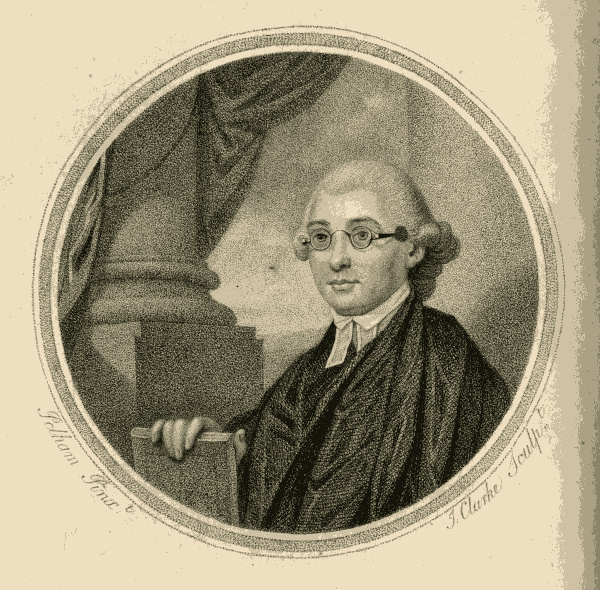
Pelham Pinx.
TO THE RIGHT HONOURABLE
LADY JULIANA PENN.
Madam,
I have ever deemed it one of
the most favourable circumstances
of my life, that your Ladyship
condescended to honour my early
youth with your kind countenance
and protection. Your amiable
character, and exemplary virtues,
have always thrown such a
lustre around you, as could not
but enlighten and improve those,
who came within their influence.
This testimony from me, is no more
than the just tribute of a grateful
heart.
I am, therefore, happy, in having
your Ladyship's permission to
inscribe to you the following discourses.
You are no stranger to
the sentiments they contain: you
love and honour the doctrines they
inculcate.
The author intreats to be indulged
with a continuance of that
regard, which your Ladyship hath
hitherto shewn him; and which
he hath always held more desirable,
in proportion as he hath been
better qualified to judge of what
is truly honourable and estimable
in the intercourses of social
life.
With this sentiment deeply impressed
upon his mind, he cannot
but rejoice in the opportunity
your Ladyship hath granted him,
of thus publickly subscribing himself,
Madam,
Your Ladyship's
Most obliged and
Most faithful Servant,
J. DUCHÉ.
PREFACE.
The following discourses were
preached in the united Churches
of Christ Church and St. Peter, in the
City of Philadelphia, of which the author
was appointed assistant minister in
the year 1759, and to the rectorship of
which he was elected in the year 1775.
The reader will find in them no display
of genius or of erudition. To the former,
the author hath no claim: of the
latter, he contents himself with as much
as is competent to the discharge of his
pastoral duty. His divinity, he trusts,
is that of the Bible: to no other
Standard of Truth can he venture to
appeal. Sensible, however, of his own
fallibility, he wishes not to obtrude his
peculiar sentiments; nor to have them
received any further, than they carry
with them that only fair title to reception,
a conviction of their truth and usefulness.
From his own Heart he hath
written to the Hearts of others; and if
any of his readers find not THERE the
Ground of his doctrines, they are, surely,
at liberty to pass them by, if they do
it with Christian Candour, and to leave
it to time and their own reflections, to
discover that Ground or not.
Universal Benevolence he considers
as the Sublime of religion; the
true Taste for which, can only be
derived from the Fountain of Infinite
Love, by inward and spiritual communications.
The mind, that is possessed
of this true Taste, whatever its peculiarity
of opinion may be, cannot be very
"far from the Kingdom of God."—"Godis Love; and he that dwelleth
in Love, dwelleth in God, and God
in him." One transgression of the
great Law of Love, even in the minutest
instance, must appear more heinous in
the Sight of the God of Love, than a
thousand errors in matters of doctrine
or opinion.
If the reader peruses these volumes
under the influence of such sentiments,
it is not likely, that he will be offended
with any singularities of diction, or any
inelegant and colloquial expressions he
may now and then meet with. Much
less will his censure be incurred by the
constant use of Scriptural Ideas,
and Scriptural Language, in preference
to what are called Moral and
Philosophical. Deviations from the
Simplicity of Evangelical Truth,
have too often been occasioned by deviations
from the Simplicity of Evangelical
Language. A Christian
ought never to be "ashamed of the
Gospel of Christ which is the
Power of God unto Salvation," but
should always speak of Christian Truths
by Christian Names.
The revisal and correction of these
discourses have relieved the author's
mind from much of that anxiety and
dejection, which a long absence from his
family and his churches had occasioned.
And he is now happy in the thought,
that these volumes will ere long reach
his native country, and revive the memory
of his labours of love among a
people, with whom he enjoyed a reciprocation
of kindness and affection, which
for eighteen years had known no abatement
or interruption.
He most gratefully acknowledges the
kind and honourable reception he hath
met with since his arrival in England;
the chearfulness and generosity with
which persons of all ranks have honoured
his publication; and the affectionate zeal
of his friends, relations, and connexions,
in undertaking and completing his subscription,
without giving him the trouble
of soliciting a single name.
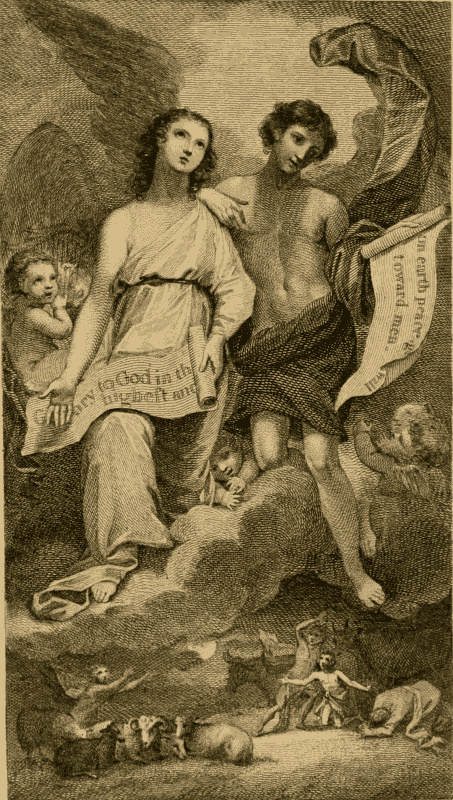
To his most ingenious and worthy
Friend and Countryman, Benjamin
West, Esq. History Painter to his
Majesty, he is happy to acknowledge
himself indebted for the elegant designs,
taken from two of his most capital paintings,
which are placed as frontispieces to
these volumes.
To his dear and valuable friend, the
Author of the late accurate and elegant
Translation of Thomas à Kempis, he
is sincerely thankful for his kind and
chearful advice and assistance, in conducting
the whole publication, to which
the author's inexperience in printing,
as well as his frequent and necessary absence
from the press, would have rendered
him altogether unequal.
He hath only to add, that the revisal
and publishing of these discourses was
undertaken at the instance of some of
the most respectable names in the list of
his subscribers to the first edition, under
whose kind patronage, and in hopes of
every indulgence from the candour of
the publick, he hath ventured to send
them abroad.
The Religion of Jesus, the only
Source of Happiness.
St. John, Chap. vi. Ver. 66, 67, 68.
"From that Time many of his Disciples
went back, and walked no
more with him. Then said Jesus
unto the Twelve, Will ye also go
away? Then Simon Peter answered,
Lord, to whom shall we go?
Thou hast the Words of Eternal
Life."
"And the King said unto Araunah,
Nay, but I will surely buy it of
thee at a Price: neither will I offer
Burnt-Offerings unto the Lord my
God, of that which doth cost me
nothing."
"He shall be like a Tree planted by
the Rivers of Water, that bringeth
forth his Fruit in his Season: His
Leaf also shall not wither, and
whatsoever he doth shall prosper."
The Riches, Privileges, and Honours
of the Christian.
1 Cor. Chap. iii. Ver. 21, 22, 23.
"Therefore let no Man glory in Men:
for all Things are yours; whether
Paul, or Apollos, or Cephas, or
the World, or Life, or Death, or
Things present, or Things to come;
all are yours: and ye are Christ's,
and Christ is God's."
"And so it was, that while they were
there, the Days were accomplished,
that she should be delivered," &c.
SUBSCRIBERS NAMES OMITTED IN THE FIRST EDITION.
Rev. Dr. Allanson, Rector of Rippon, Yorkshire
Mrs. Ambler, of Queen-Square
Mr. George Adams
Lady Boynton, Burton Agnes, Yorkshire
Rev. Mr. Bull, Rector of Sarensfield, Herefordsh.
Rev. Mr. Baker
Miss F. Baker
Robert Burton, Esq.
Rich. Wilbraham Bootle, Esq.
Francis Bernard, Esq.
Charles Barker, Esq.
Rev. Mr. Cook, Rector of Semer, Suffolk
Richard Combe, Esq. Harley-street
Mrs. Cotin, Upper Grosvenor-street
Mrs. Festing, Weymouth
Mr. George Fletcher
Mr. Francis Freshfield, Colchester
James Gordon, Esq. Glasgow
William Grover, Esq.
Mr. Robert Grimditch
Mrs. Garnett
Capt. Grindall
T. Grosley, Esq.
Mr. Greenwood
E. Gurney
Hon. and Rev. Mr. Hamilton
Mrs. Hyde, Bedford-row
Mr. James Hingeston
Mr. Handcock, of Bath
Rev. Mr. Harris
Mrs. Hall, of Tottenham
Mr. Healy, of Cambridge
Tho. Johnson, Esq. Bradford
Rev. Jonathan Judson, Essex
Rev. Mr. Lantley, Prebendary of Hereford
Dr. Lysons, of Bath
Mrs. Levison
Rev. Mr. Myddleton, Fellow of Clare-Hall
W. Middleton, Esq. Bath
Robert M'Kerrel, Esq.
Rt. Hon. Countess Dowager of Northampton
Mr. Nairne
Henry O'Carroll, Esq.
J. Palmer, Esq. of Bath
Rev. Thomas Pryse, Norwich
Mrs. Puget, Red Lionsquare
Tho. Rogers, Esq. Bradford
Robert Rasleigh, Esq.
Mr. Thomas Smith
Rich. Statham, Esq. Leverpool
Mrs. Schaak, of York
William Tompkins, Esq. Abingdon
Mrs. Tuson, Bath
William Taylor, Esq. of Worcester-Park, Surry
Mr. Wm. Taylor, London
Hon. Charles Vane, of Mount Ida, Norfolk
Mr. Vickary
Mr. Joseph Wrightman
Rev. Dr. Watkins, Preb. of Hereford
Rev. Dr. Wharton, of Barbadoes
George Wilson, Esq. of Bedford Row
Mr. Thomas Weston, jun.
Mr. Joseph Woods
Mrs. Wilding, Red Lionsquare
Mrs. Wright, Thunder-Hall, Herts
Miss Witts, Bath
Witham Book Society
DISCOURSE I. The Character of Wisdom's Children.
St. Luke, Chap. vii, Ver. 35.
"But Wisdom is justified of all
her Children."
If we take an impartial view of the
sentiments and conduct of mankind
with respect to religion, we shall find,
that their errors in speculation, as well as
in practice, originate, for the most part,
in the will; that their understandings are
blinded by their passions, and that their
ignorance of truth too often proceeds
from their aversion to goodness.
To combat this prevailing depravity of
human nature, and to strike at that root
of evil which we bring with us into the
world, was the grand and principal design
of all those different dispensations, by
which Heaven hath condescended, from
time to time, to speak to the sons of men.
Instead, however, of yielding a grateful
attention to this benevolent purpose, they
have, in some instances, wholly rejected,
and, in others, perversly misconstrued,
the dispensations themselves. Whether
"God spake at sundry times, and in
divers manners, in times past, unto
the fathers by the prophets;" or, whether
he spake, as in these latter days, to
the children, by his own Incarnate
Son; the generality of men have either
been deaf to the salutary message, or have
availed themselves of some idle pretexts
to elude a compliance with its most serious
and solemn contents. Hence arose
the inattention and opposition of ancient
unbelievers, to the missions of patriarchs
and prophets; and hence it is, that infidels
of later ages have called in question
the truth and authority of that most full
and complete Revelation of the Divine
Will, with which mankind have been
favoured by the ministration of the Blessed
Jesus. Far, however, from resenting
their obstinacy, or indignantly
with-holding from them any further
communications of Divine Light, the
great God and Father of Spirits
hath still persevered in carrying on the
purposes of his Love; and, "whether
they will hear, or whether they will
forbear," still seeks, by a variety of
dispensations, to gain possession of the
hearts of his creatures. Notwithstanding,
therefore, the general indifference
and obstinacy that have prevailed, there
have not been wanting, in every age and
nation, some docile virtuous minds, who
have listened to the Heavenly Voice, and
received with gratitude the instructions
of that "Wisdom which is from above;"
and who, as her true children, have vindicated
her ways to man, and admired
and justified the different methods by
which she manifests herself to different
souls.
The truth of these observations we
find remarkably exemplified in that conduct
and behaviour of the Jews, and
particularly of the sect of the Pharisees,
which is mentioned in the verses preceding
my text, and which indeed gave
rise to the pertinent and beautiful maxim
there expressed.
Ignorant of the spirit of that dispensation
under which they lived, and perversely
attached to those externals of their religion,
that most gratified their pride and
selfishness, they seem to have been equally
offended with the doctrines and manners
of John the Baptist, and those of the
Blessed Jesus. And though the grand
object of the Master and his Forerunner
was one and the same, even the reformation
of the heart and life; and though
the outward means, however inconsistent
they might appear, were but different
parts of the same spiritual and redeeming
process; yet these degenerate Israelites
sought to stifle the power of conviction
in their breasts, by childishly objecting
to the abstracted, severe, and rigorous
life of the Baptist on the one hand, and
the easy, open, and condescending behaviour
of Jesus on the other; insinuating,
that the former was only the effect of a
gloomy, dark, and diabolical spirit; and
that the latter shewed a familiarity and
levity, unworthy the character of a prophet
sent from God.
Our Blessed Lord exposes the weakness
and inconsistency of these objections,
by the following apt and lively similitude:
"Whereunto shall I liken the
men of this generation, and to what
are they like? They are like unto
children sitting in the market-place,
and calling one to another, and saying,
We have piped unto you, and ye
have not danced; we have mourned
unto you, and ye have not wept."
That is to say: We have taken every method
we could devise to engage your attention,
and to prevail upon you to bear
a part in our recreations; but you have
unkindly and sullenly refused to come.
We have endeavoured to adapt our little
sports and exercises to what we conceived
might be your particular taste and
humour; but still we have failed of
success.
In application of this allusion, our
Lord proceeds—"For John the Baptist
came neither eating bread, nor drinking
wine; and ye say, He hath a devil."
The austerity of the Baptist's life, which
was meant to inculcate a lesson of self-denial,
and abstraction from the follies
and vanities of a worldly life, as well as
a solemn preparation for the happiness of
an heavenly one, ye maliciously declare
to have proceeded from the melancholy
suggestion of some dark and evil spirit,
that hurried him into the desart, and secluded
him from all affectionate intercourse
with men. On the other hand,
because "the Son of man is come eating
and drinking, ye say, Behold a
gluttonous man, and a wine-bibber,
a friend of publicans and sinners!"
To answer the great purposes of Divine
Love, I have, with condescending freedom,
mingled with all ranks of people;
put myself in the way of the giddy and
the profligate, and even accepted the invitations
of publicans and sinners. For
this, without knowing the motives of my
conduct, you have vilified me with the
opprobrious names of glutton and drunkard;
and insinuated, that the friendly
attention I shewed to men of their character,
proceeded not from a regard to
their souls, but from a fondness for their
vices. But notwithstanding your blindness
and obduracy, notwithstanding your
weak and wicked misconstructions, be
assured, there are those, who can do justice
to these dispensations of Heaven, whose
minds, illuminated from above, can discern
the beauty, propriety, and uniformity
of design, which Wisdom manifests
in these various methods of addressing
herself to the sons of men. Such children
of Wisdom are abundantly convinced,
that the self-denying life of the Baptist
was necessarily preparative to that meek,
gentle, condescending Life of Love, which
I have inculcated in my precepts, and
recommended and enforced by my example;
and that both these are the happy
effects of that Redeeming Power, which
I manifest in the hearts of those, who,
with simplicity and self-abasement, receive
and gratefully acknowledge my spiritual
salutary visits. "But Wisdom is
justified of all her children."
The truth was this: the Pharisees considered
the severe exercises of John, his
contempt of the world, and total disregard
of the pleasures and honours of life,
as a personal censure of their hypocritical
pretensions to religion, by which, under
the appearance of great zeal for the external
and ceremonial parts of the law,
they "sought the praises of men, more
than the praises of God." In like
manner, the humility and condescension
of Christ, his free and affectionate intercourse
with all ranks of people, even
with those, whom (on account of their
ignorance of some minute traditionary
precepts of their Rabbins) they held accursed,
were a perpetual impeachment of
their intolerable pride and arrogance, and
most effectually tended to lessen their credit
and reputation with those whom they
wished and earnestly sought to engage for
their pupils and admirers. No wonder,
then, that whilst they continued thus
attached to favourite passions and prejudices,
they should wilfully misconstrue
the purest intentions, and vilify the fairest
actions of those, who attempted to combat
and expose them. Their objections
to the person and doctrines of Christ,
as well as to those of his illustrious Harbinger,
came rather from their wills
than their understandings: nor would they
ever have called in question the Divine
authority of their missions, had not the
design and spirit of them militated against
their own evil tempers and dispositions:
"Light was come unto them; but they
chose darkness rather than light, because
their deeds were evil."
In every age of the world, and under
every dispensation of religion, human
nature, in itself, has always been the
same. The serpentine subtilty of human
reason, when engaged in the service, and
acting under the influence of vice and error,
will never be at a loss for arguments
to support their cause against the voice of
truth and virtue. Hence the specious
objections, which modern infidelity hath
thrown out against the necessity of Divine
Revelation; and hence the weak and idle
censures, which libertinism on the one
hand, and false enthusiasm on the other,
so illiberally denounce against the sincere,
honest, and cordial votaries of true
Christianity.
Sincerely to be pitied is the poor unbeliever,
whose short-sighted reason, incapable
of seeing further than the externals
of Christianity, furnishes him with
some plausible objections, that seem to
weaken its outward evidence, but cannot
reach the spirit and power by which it is
animated and supported. "Christianity
was instituted for the common salvation
of all men: its essential truths, therefore,
are plain and obvious, level to every capacity,
and stand in no need of learned
labour to inculcate and explain them;
they are rather matter of feeling, than of
reasoning.
"Whatever is within, whatever is
without us, calls aloud for a Saviour.
Change, corruption, distemperature and
death, have, by the sin of fallen angels,
and of fallen man, been unhappily introduced
into this system of things which
we inhabit. The whole creation groaneth;
and animals and vegetables, and
even the Immortal Image of God himself
in man, are all in bondage to their malign
influences; so that every thing cries
out, with the apostle Paul, "Who shall
deliver me from this body of death?"
so that every thing cries out, with the apostle
Peter, "Lord, save me, or I perish!"
"What kind of a Saviour then is it,
for whom all nature thus cries aloud,
through all her works? Not a dry moralist,
a legislator of bare external precepts,
such as some would represent Christ to
be: no, the existence and influence of
the Redeemer of Nature, must, at
least, be as extensive as Nature herself.
Things are defiled and corrupted throughout;
they are distempered and devoted
to death, from the inmost essence of their
being; and none, but He alone, "in
whom they live, and move, and have
their being," can possibly redeem and
restore them."
These are inevitable truths, which all
men, at some time or other, must feel,
and feel deeply too, whether they attend
to them now or not. The redemption
and restoration of every sinner can be accomplished
in no other way, than by
Christ's spiritual entrance into his heart,
awakening in him an abhorrence of evil,
and a love of goodness.
This is the spirit of the Gospel of
Jesus; this the grand purpose of Heaven,
under every dispensation of Revealed
Truth, from Adam down to this day. The
modes of communication, the outward
forms of worship and of doctrine, may
vary; but the same spirit runs through
the whole, and the enlightened eye of
"Wisdom's children" can see and adore
her radiant footsteps, in paths that appear
dark and dreary to the eyes of
others. However her outward garb may
change; whatever different appearances
she may put on, under the patriarchal,
legal, and evangelical dispensations; her
real features, her whole person and employment,
have ever been invariably the
same. These different appearances were
only adapted to the different circumstances
of men, and calculated to direct their
attention to the one great and principal
object she has always had in view, even
the Redemption of immortal spirits from
the tyranny of earth and hell, and the
full restoration of them to their primeval
innocence and bliss.
Turn then, ye advocates of infidelity!
O turn back from those delusive dangerous
paths, into which the false light of
fallen reason hath led your wayward steps.
Wisdom herself, and all her true and
Heaven-born children, lift up their sweet
and instructive voices, and press you to
return; to recognize your illustrious origin;
to spurn the transitory and polluting
joys of earth, and to aspire after the
pure and permanent pleasures of Heaven!
From the Throne of the Most-High,
the center of her enlightened kingdom,
she speaks, she illuminates, she warms
every intelligent being that turns to her
benignant ray: the darkness of nature
kindles, at her approach, into the Light
and Life of Heaven; every evil principle,
every evil passion, shrinks from before her,
and retires to its native hell; whilst the
spirits of her redeemed children issue forth
from their long captivity, and triumphantly
re-enter the realms of purity and
peace.
Who would not wish, then, to become
a votary, a pupil, a child of Wisdom?
But how is this privilege to be obtained?
what path must we pursue, that will lead
us to her delightful mansion? what conduct
must we observe, that will entitle us
to be members of her illustrious household?
Must we put on the raiment of
camel's hair, and the leathern girdle; follow
the mortified Baptist into the desert,
and feed upon locusts and wild honey?
Or must we not rather adopt the gentler
manners of the Holy Jesus, mix with
the world as he did, and chearfully employ
ourselves in acts of kindness and brotherly
love?
It is evident from the whole passage of
Scripture, of which my text is part, that our
Lord blames the Jews no less for their disregard
of the ministry of John, than for
the contempt with which they treated
himself; and plainly intimates, that, by
the Children of Wisdom, we are to understand
all those who see the Baptist's
ministry in its true point of view, viz.
as introductory and preparatory to his own;
and in consequence of this are fully convinced,
that the chearfulness of Faith,
and the sweetness and condescension of
Love, must naturally be preceded by the
severity of Repentance, and the salutary
bitterness of sorrow and contrition.
"Repent ye, for the Kingdom of Heaven
is at hand," said the Harbinger of
the Son of God: "The Kingdom of
God is come; he that believeth shall
be saved;" said the Son of God himself.
"Repentance, therefore, and Faith
working by Love," are the sure characteristics
of Wisdom's Children.
It is not, therefore, any distinguishing
peculiarity of the Baptist's character,
the outward garb, or the outward deportment,
that we are to assume, but an inward
temper and frame of mind corresponding
to both. A deep sensibility of
the evils and infirmities of our fallen nature,
an heart-felt conviction of the guilt
and misery of sin, and a penitential sorrow
for our own numberless lapses and
deviations from the path of virtue, are the
true Harbingers of Christ in our hearts.
When, under their powerful ministration,
we find ourselves called, not perhaps to
a life of outward solitude and mortification,
but of inward retirement and abstraction
from the world; in the language
of Scripture, "we repent, we are
converted:" we turn our backs upon
every gay and glittering scene, which
worldly honour, wealth, or pleasure, can
exhibit; we find nothing in any of them,
that can give a moment's real peace or
rest to our "weary heavy laden" souls;
we are humbled to the dust; we feel ourselves,
as "worms, and not men," as
"less than the least of God's mercies."
In this mortified, penitent, and afflicted
state, which is mercifully intended
to bring us to a proper sense of our helplessness
by nature, and of the indispensable
necessity of Divine Supernatural
assistance, we must remain, till the happy
effect is produced, and till God is graciously
pleased to call us out of the wilderness.
The Harbinger then hath fulfilled
his office; "The Lamb of God" appears
"to take away the sins of the
world;" "The kingdom of heaven is
come" into our hearts. To sorrow and
disquietude, succeed sweet peace and heavenly
composure of mind: the understanding
is enlightened; the will receives
a new and happy direction; a new
principle animates our whole frame, a
new conduct appears in our whole life and
conversation: the Spirit of Love breathes
and acts in every duty we are called to
perform, in every little office, which common
civility and politeness requires us to
do, even to those, who have yet no taste or
desire for the sublime comforts of religion.
Thus it is, that Wisdom is justified
of all her Children; and thus it appears,
that the Religion of the Gospel,
which is the only True Wisdom, is a
Religion of Love. A Life of Love,
therefore, is the best, the only evidence,
which its disciples can give, of the sincerity
of their profession; and the surest
method they can take of recommending it
to others. "Let your light, then, so
shine before men, that they may see
your good works, and glorify your
Father which is in Heaven."
DISCOURSE II. Evangelical Righteousness.
Jeremiah, Chap. xxiii. Verse 6.
"And this is his Name, whereby
he shall be called, the Lord
our Righteousness."
The great and essential distinction
betwixt the legal and evangelical
dispensation, is accurately pointed out by
the Apostle, where he tells us, that "the
law is but the shadow of good things
to come, and not the very image of
the things." Its types, ceremonies,
and outward ordinances, are taken from
the objects of temporal nature, which are,
at best, but shadowy representations of
Eternal Truth. "The comers thereunto
could never be perfected," by
the most minute observation of its external
rites. The pious, spiritual Jews,
therefore, must have looked further than
these, and considered every outward purification,
as figuratively expressive of an
inward cleansing to be performed in their
hearts.
Moses, their inspired Legislator, and
the prophets that succeeded him, did not
fail to acquaint them with the immediate
and necessary reference of these temporal
symbols to Spiritual and Eternal Truths.
Nevertheless, it appears but too evident,
from the whole Jewish history, that the
generality rested their hopes of salvation,
merely upon their outward law: "They
went about to establish a righteousness
of their own," founded upon a strict
observance of the Levitical ceremonies,
which were only adapted to their present
circumstances, without paying the least
attention to that Inward Law of Righteousness,
to which these ceremonies referred.
Hence it was, that their prophets were
directed by the Most High, to express,
in the strongest terms, his disapprobation
of those very ordinances, which he himself
had originally instituted for their
good; and to tell them, that "he had no
pleasure in their burnt-offerings and
sacrifices, that their oblations were
vain, and that incense was an abomination
in his sight." His displeasure
was not with the ordinances themselves;
for, if considered and observed with proper
views and dispositions, they would
have been subservient to the most glorious
purposes: but he was offended with
the gross and flagrant abuses of them,
which the people were daily committing.
Hence also it was, that the same inspired
prophets, when the hand of the
Highest drew aside the curtain of futurity,
and exhibited to their astonished
view the successive displays of Gospel
Light and Truth, with all that variety of
heavenly scenery, which his Incarnate
Son was to open upon our benighted
world; hence it was, I say, that the
same inspired prophets were particularly
careful to distinguish the new dispensation,
by every figure and mode of expression,
that might lead the most dark
and ignorant Jew to consider it as internal
and spiritual.
The righteousness of the new covenant
is widely different from what the carnal
Israelite apprehended to be the righteousness
of the old. With respect to their
essence, their foundation, their motives
and ends, both covenants are the same,
differing only in the external mode of revelation;
the old being "the shadow,"
the new "the image of good things to
come;" the old, pointing to Christ;
the new, revealing him in all his fulness
to the faithful.
Christ Jesus, therefore, is and must
be, "the end of the law to those that
believe;" that is, he is and must be,
in himself, that very Righteousness to
which the law pointed, but which it
could not attain. "As a school-master,"
it served to instruct its ignorant, dark,
and fallen pupils, in the outward rudiments
of Divine Truth; but could never
communicate to them the Light, Life,
and Spirit of that real Evangelical Righteousness,
which is only to be found in
the Incarnate Word of God.
It is for this reason, that the prophet,
speaking of the approaching kingdom of
the Messiah, in whom all the law and
the prophets were to center, represents
him as "a righteous branch springing
forth from the root of David; as a
king, reigning, prospering, and executing
judgment and justice on the
earth;" in consequence of whose mild
and equitable administration, "Judah
should be saved, and Israel should dwell
safely:" and, as the most characteristical
designation of his nature and office,
tells us, that "This is his Name,
whereby he shall be called, The Lord
our Righteousness."
Let us then enquire, in the first place,
why our Blessed Redeemer has the
name of Righteousness ascribed to
him by the prophet; and secondly, what
we are to understand by his being called
"our Righteousness."
I. A name in Scripture is generally
put to express the intrinsic nature and
qualities of the object named. When,
therefore, the name of the Messiah is
here said to be "Righteousness," we must
necessarily conclude, that Righteousness
is his very nature, his essence, the substance
of all his attributes and perfections.
He is not called righteous, but
Righteousness itself; the source and
fountain, from whence all that is really
and truly righteous, throughout the universe,
perpetually proceeds.
Jesus Christ is "the Brightness of
the Father's Glory, and the Express
Image of his Person." All the beauties,
excellencies, powers, and virtues,
which are essentially hidden in the invisible
Godhead, are substantially, vitally,
inwardly, as well as outwardly,
opened, revealed, and illustriously displayed,
in the person of the Incarnate
Jesus. "All things were made by
him, and without him was not any
thing made, that was made:" all the
"thrones, dominions, principalities and
powers," possessed by angels, archangels,
cherubim and seraphim, are derived
from him; for, "in, and through
him, did the Father create all things."
The highest degree of Righteousness
which the highest Seraph can attain, is
but a beam or efflux from this Eternal
Sun. With glory undiminished he perpetually
imparts spiritual life and vigour
to all those countless myriads of intelligences,
which inhabit the whole compass
of universal nature. He is himself the
living law, the eternal rule of order and
rectitude. God the Father hath
"set this his King of Righteousness on
his holy hill of Sion." Every outward
institute, revealed and written,
which God hath "at sundry times and
in divers manners," delivered to the sons
of men, was but a transcript of that
original law, which lives for ever in the
heart of Christ. "I am the way, the
truth, and the life;" "no man cometh
unto the Father, but by me; ye will
not come unto me, that ye may have
life; without me, ye can do nothing—"
are his own blessed words.
Nature, without this Christ of
God, is impurity, emptiness, poverty,
want, and wretchedness extreme: nature
illuminated, enriched, refreshed, glorified
by him, is holy, righteous, lovely, supremely
happy. Known or unknown to
our fallen race, it is He alone, who inspires
every good thought, every righteous
deed, every sentiment and action that is
amiable and endearing.
In the acts of the apostles we read of an
altar with this inscription, "To the unknown
God!" St. Paul, taking occasion
from this circumstance, tells the Athenians,
"Him whom ye ignorantly worship,
preach I unto you." In the whole
frame of nature, says a truly sublime
writer, every heart, every creature, every
affection, every action, is an altar with
the same kind of inscription, "To the
unknown Beauty!—To the unknown
Righteousness!—To the unknown Jesus!"
This is the eternal standard of
truth, order, righteousness and perfection,
to which every being in nature ignorantly
moveth; this is that which all
understandings, all hearts, cannot but
admire and adore. But blessed above all
beings are those, whose hearts are spiritual
altars, with the righteous person of
Christ engraven upon them by the finger
of God, flaming with the fire of Heavenly
Love, and bearing this radiant inscription,
"To the known and experienced
Beauty and Righteousness of that
Jesus, whom we know; that Word of
Life, which our eyes have seen, our
ears have heard, our hands have handled,
and spiritually embraced!" And
this leads me, in the second place, to
inquire what we are to understand by
Christ's being called "Our Righteousness."
II. Under my first head, I observed to
you from Scripture, that God created all
things "in and by Jesus Christ;" and
that "without him, was not any thing
made that was made." Man, in particular,
was "created in the Image of
God:" Christ is "the Brightness
of the Father's Glory, and the Express
Image of his Person:" and, therefore,
man was created in Christ.
Man in himself, in his outward nature,
was but an empty vessel, till the
Christ of God became his fulness and
perfection. His outward form was from
the dust of the earth; but his inward spirit
was the breath of the Most High. The
Image of God, even Christ himself,
was his first, his sole Righteousness and
perfection; the infallible instructor and
enlightener of his understanding, the
unerring guide and director of his will.
The Name by which the Son of God
was known to him, was "The Lord
his Righteousness." Angels themselves
know no other Righteousness, than the
Righteousness of God in Christ.
The fall of man, or "Original sin," (as
our church article with great truth and
propriety expresses it) "is the fault and
corruption of the nature of every man,
that naturally is engendered of the offspring
of Adam; whereby man is very
far gone from original righteousness,
and is of his own nature inclined to
evil." We have already seen what this
original righteousness was, which man
possessed in a state of innocence, viz. that
it was Christ, "the Lord his Righteousness,"
in him. This is what Adam
lost—This is what Christ alone can
restore.
Man in his present fallen state, without
Christ, must be naturally inclined to
evil; he has no righteousness of his own.
And he can no more be saved by any exertion
of his own natural powers, than
he can see by the utmost stretch of his
organs of sight, without the light of the
sun.
Here then a serious and inquiring
mind may be ready to ask—How is this
Blessed Redeemer to become my
Righteousness? I feel the force of these
Scripture truths you have mentioned, and
experience in my soul the dreadful consequences
of an original apostasy—But I
know not, whether Christ is my Righteousness,
or not. I know not, whether
I have the least traces of his Righteous
Image in my soul.
"Hath Christ, then, been so long
time with thee, and yet hast thou not
known him?" Every little rebuke of
conscience; every emotion of kindness,
tenderness, and love; every sympathetic
feeling of the prosperity or distress of
thy neighbour; every sensibility of admiration,
esteem, and joy, from contemplating
a truly wise and virtuous character;
every fervent desire of imitating what
is good and excellent in others; every
weak aspiration after holiness and perfection;
nay, every little feeling of the restless
cravings of thine own nature, every
little longing after happiness unpossessed;
all, all is Christ, speaking within thee,
and waiting and watching to reveal himself
in Righteousness to thy soul. Nothing,
therefore, is wanting, on thy part, but a
calm and quiet resignation of thyself, and
all that is within thee, to his sovereign disposal,
to redeem, purify, and restore, to do
every thing that is necessary to be done, and
which he alone can do, for thy salvation.
Thus have I endeavoured to give the
plain and obvious meaning of the text.
Distinctions upon distinctions have been
multiplied; books upon books have been
published, to tell us that we are to be
justified by the Personal Righteousness of
Christ outwardly imputed, and sanctified
by the inherent graces of the Holy
Spirit; that one must necessarily precede
the other; and that we must be perfect
in Christ by Justification, before
we can have the least spark of Holiness by
Sanctification. This is, indeed, travelling
in the broad and popular road; and
such kind of preaching might be to the
"praise of men." Let systems be written
upon systems, and comments upon
comments; let preachers oppose preachers,
and hearers wander after this or that
form of godliness; but may Heaven in
mercy preserve us from taking up our rest,
or placing our dependence upon any thing
less than an intimate and experimental
knowledge of "The Lord our Righteousness"
revealing himself, with
all his holy heavenly tempers, virtues, and
dispositions, in our hearts! May we never
rest satisfied with a nominal profession
of Christianity, a nominal acquaintance
with Christ, or a nominal remission
of sins; for, surely, we are not warranted,
by Scripture, to look upon ourselves as redeemed
by Christ, and born again of him,
till by a total purification, a complete
deliverance from all the evil tempers and
passions of our fallen life, he hath obtained
a full and peaceable possession of our
whole nature, erected his Throne of Righteousness
in our hearts, and by the effectual
working of his Holy Spirit
brought us to the "measure of the stature
of that Fulness, which is in
Himself."
DISCOURSE III. The Religion of Jesus, the only Source of Happiness.
St. John, Chap. vi. Ver. 66, 67, 68.
"From that time, many of his
Disciples went back, and
walked no more with him.
Then said Jesus unto the
Twelve, Will ye also go
away? Then Simon Peter
answered him, Lord! to whom
shall we go? Thou hast the
Words of Eternal Life."
Happiness is the great end
and aim of all those restless pursuits
in which mankind are perpetually
engaged. The laborious peasant, and
the contemplative philosopher; the man
that wisheth for wealth, and the man
that possesseth it; the gay votary of worldly
pleasure, and the gloomy tenant of
the solitary cell, are alike industrious in
exploring this hidden treasure. Their
imaginations are ever upon the stretch after
this something yet unknown. Their
ideas of happiness indeed, as well as
the means which they make use of to
attain it, are as different as their prevailing
tempers and inclinations. Whatever
objects coincide with their present conceptions,
those they esteem, and those
they pursue, with all the eagerness of
newly awakened desire. Deluded, however,
by specious appearances, mistaken
again and again in their choice of objects,
loathing to-day what they pursued yesterday
with ardour, chearful and confident
in prospect, disappointed and melancholy
in possession, they fondly rove from one
scene of imaginary bliss to another, unable
to rest on any with permanent satisfaction.
They never once consider, that
no finite objects can fill up the immense
void of an immortal soul, no temporal
enjoyments satisfy its boundless desires;
and that nothing less than "life eternal"
can afford an happiness commensurate to
its eternal nature.
This is not mere theory, or empty speculation.
There is not one in this assembly,
but could bear witness from experience
to the melancholy fact. Was each
of us to be asked, in a serious and solemn
manner, Are you really happy? very few,
I am afraid, if they would speak ingenuously,
could answer in the affirmative.
And yet, perhaps, most of us have attained,
from time to time, what we once
deemed the height of our wishes; and
what we were then sure, if attained,
would make us completely happy.
The child wishes for the employments
and pleasures of youth; the youth longs
to arrive at what he calls the freedom and
independence of manhood; the man anxiously
schemes and plots, and contrives,
and labours and toils, and then wishes to
see the success of his schemes, the accomplishment
of his labours. His schemes
turn out to his satisfaction; the end is obtained;
the object is enjoyed: his bliss is
consummate, to be sure; he cannot be
happier—No such thing—New wants
succeed; new schemes are formed; new
pursuits, new labours, new anxieties and
wishes, tread close upon each other's heels.
But where is his happiness all the while?
Why he loses sight, at last, of the grand
and principal object, in the pursuit of
which he had set out: failing of success in
this, he foolishly adopts the means for the
end; and perpetual care, toil, and vexation,
are the wretched effects of his mistaken
choice.
Thus, for instance, the covetous man
grasps, and saves, and fills his coffers—for
what? Not to make himself, his family,
or his poor neighbours round him,
happy with the fruits of his penurious
efforts. No—he not only turns a deaf
ear to the piercing cries of indigence,
but grudges even his family the common
necessaries of life, and never parts with a
farthing, without uttering some ridiculous
complaint of the hardness of the
times, and their want of economy. He
saves therefore for the sake of saving; his
heart is shut up in his chest with his beloved
mammon, both alike inaccessible
to the mild and soft approaches of kindness
and liberality.
We cannot but shrink back with horror,
from a character so odious and detestable
as this. But the observation
with which I set out, will hold equally
true, when applied to any of those false
paths, which men pursue in quest of happiness.
Pleasure and ambition will deceive
them, as surely as avarice. Enjoyment
in every instance may pall, but cannot
satisfy the restless desire. Nor will it
ever be satisfied, till the soul gets sight
of the only true beatifying object in the
universe, to which she can rise, and upon
which she can rest, with the whole strength
and energy of her immortal nature.
The light of another world, however,
must open and irradiate her spiritual senses,
before she can have the least glimpse of
this supreme source of bliss. The vanity
and deception of all creaturely happiness
must in some measure be unfolded to her
view, before she can stretch one feeble
thought towards Heaven; and she must
be intimately convinced of the bondage
of her fallen life, and the misery of her
condition in this fallen world, before she
can feel the force, or discern the spiritual
depth of these expressions of St. Peter,
"Lord! to whom shall we go? Thou
hast the words of eternal life."
There are many people, indeed, who
though they are walking on in those very
paths of error and delusion which I have
just mentioned, would fain have their
conduct hallowed by some religious appearances.
They begin with deceiving
themselves, and then go on to deceive
others. But, do what they will, they cannot
wholly divest themselves of the feelings
of truth and virtue. For they have
within them a Spiritual Nature, that is
continually striving, under the influences
of its native Heaven, to get disengaged
from the servitude of its corrupt companion.
Call it by what name we please,
conscience, the light of nature, common
sense, common or preventing grace; or,
as the Scripture denominates it, "the
Light that lighteth every man that
cometh into the world, Christ in us the
hope of glory, the Incorruptible Seed
of the Word of God," (for, as Christians,
I think we ought to prefer scriptural
to philosophical terms;) I say, call
it by which ever of these names we like
best, certain it is, that every man at times
feels this Divine Power stirring within
him, and endeavouring to awaken, reprove,
inform, illuminate, and govern his
life and actions.
Now it always happens, that the counsels
of this Heavenly Monitor clash with
and oppose the dictates of corrupt nature.
At this contradiction, the passions are
alarmed; they demand immediate gratification,
and the trembling mortal dares
not at once yield to their solicitations. A
strong sensibility of the falsehood of their
claim, is felt in his breast. Something
must first be done, to stifle or quiet this
uneasy sensation.
Avarice, he will say to himself, is criminal,
it is true; but a well-timed parsimony
is virtuous and commendable; and
a good and prudent man will think himself
in duty bound to provide for the future
support of his children.
Sensual pleasure, vain mirth, and jovial
company, are not quite consistent
with the precepts of the Gospel of
Christ: but a few innocent amusements
can do no harm; and it is but in character
for a Christian to be chearful.
The pursuits of ambition are diametrically
opposite to that meekness and humility,
which should characterize the
disciple of the lowly Jesus: but posts
of honour, and exalted stations, may enable
a man to be of considerable service to
his neighbours, and enlarge his sphere
of usefulness.
Thus, every evil temper and inclination,
wrath, hatred, revenge, envy, jealousy,
&c. may cloath themselves in the garb
of virtue. Men may first deceive themselves,
by endeavouring to reconcile their
criminal pursuits with the dictates of
conscience; and then employ the same
infernal arts, to deceive and impose upon
others. It is with such masks as these,
that hypocrites, pharisees, and all pretenders
to true religion, step forth upon
the stage of life, dare to enlist themselves
under the standard of virtue, and even
sometimes assume the rank and authority
of commanders. But when they are
summoned to the field of battle; when
they are called upon, from within, or
from without, to exert themselves against
their spiritual adversaries, to assert the
rights of Heaven, as well in themselves
as in the world around them, to subdue
the evil lusts and passions that tyrannize
in their own breasts, or to engage with
that bitter and malevolent spirit, who
opposes the advancement of their Master's
kingdom in the life and conduct of
others; then it is, that the traitors drop
their masks; they meanly desert the banner
of the cross, openly disavow their
pretensions to religion, and "deny the
Lord that bought them." They shrink
from the combat, honourable as it would
have been for them to engage, and happy
as they would have found themselves
in the issue; and meanly barter away
their salvation for a false peace, short
in its continuance, and ending in woe
and misery extreme. Like the cowardly
disciples mentioned in my text, "they
go back, and walk no more with their
Master."
Doubtless these timid Israelites were
alarmed at that heavenly discourse of the
Blessed Jesus, which we read in the
preceding part of this chapter. The
mysteries of his kingdom there delivered,
were too refined for their gross conception.
The nature, nourishment, and
growth of the Inward and Spiritual Man,
which is there indispensably required,
militated too powerfully against their favourite
passions and prejudices. Their
high-blown hopes of future preferment
in a temporal kingdom, were, by this
spiritual address, entirely dissipated; and
they were taught to seek and expect nothing
from their Master, but what was
opposite to the life, and spirit, and maxims
of this world.
Alas, how many apostates from the
religion of Jesus, have imitated the conduct
of these unworthy disciples! Past,
as well as present times, afford too many
melancholy examples of this kind. A
temporizing spirit hath prevailed in almost
all ages; and ecclesiastical history abounds
with examples of its venomous influence
upon the minds of men. The temporal
prosperity of the church, hath, in many
instances, proved its ruin; and accessions
of wealth and power have only served to
increase its corruptions. Under the profession
of a religion, which breathes nothing
but purity, meekness, and benevolence,
men have been actuated by all the
diabolical passions that ever inflamed the
breasts of the most ignorant and unenlightened
Pagans.
Wherever the external profession of
Christianity hath been attended with any
outward emoluments, its disciples have
increased, and an outward shew of zeal
for its advancement, hath not been wanting.
This outward shew gives them but
little trouble; and the hypocrite's garb,
though cumbersome at first, is not only
made light and convenient by custom,
but even desirable for the profits and advantages
it brings.
Whilst the Blessed Jesus is distributing
his bounty, and loaves and fishes
multiply under his creating hand, he
will never be without crouds of followers
to partake of his royal munificence.
Whilst he is riding in triumph through
the streets of Jerusalem, nothing is heard
from every quarter, but "Hosannahs to
the Son of David;" every one is ambitious
of joining his train, and of being
in the number of his adherents. But
when the powers of this world confederate
against him; when Herod and
Pontius Pilate, and the whole nation of
the Jews, rise up in arms, seize upon the
innocent victim, and drag him to condemnation,
torture and death; then, indeed,
his false friends appear in their
proper colours; and, O melancholy
truth! even his disciples "go back, and
walk no more with him;" some of
them deny him, and all fly and forsake
him.
Let us not deceive ourselves, my brethren.
It is not an outward profession
of Christianity, or an outward zeal against
its adversaries, that will stand us
in any stead: all this may well enough
consist with inward impurity, a worldly
spirit, and an heart devoted to the service
of sin. The great trial of our faith,
the sure proof of the sincerity of our
conversion, must be sought for in deeper
exercises than these.
When storms arise, when dangers
threaten, when inward and outward enemies
attack our peace; when we cannot
maintain our discipleship without the sacrifice
of some darling passion of almost
irresistible power; when we can walk
no longer with our Master, without the
loss of some considerable temporal advantages;
when we are summoned by
him to fly from the soft allurements of
pleasure, to burst the bonds of avarice
or ambition, to disclaim all dependence
upon the world, ourselves, or any created
being; in a word, "to forsake all, take
up our cross, and follow him;" then,
indeed, is our hour of trial! then the
sincerity of our attachment to Christ,
will be made manifest to ourselves, and
to the world; and we shall learn to know
assuredly, whether we are, or are not, of
the number of those disciples, "who go
back, and walk no more with him."
Therefore, O Christian, thy Beloved
is then only thine, and thou art then
only his, when thou canst abide with
him in the darkness of the vale, as well
as in the splendors of the mount; when
thou canst walk with him in the wilderness,
as well as on the plain; and when
"neither tribulation, nor distress, nor
trial, nor persecution, can separate thee
from the Love of God, which is in
Christ Jesus our Lord."
DISCOURSE IV. The Religion of Jesus, the only Source of Happiness.
St. John, Chap. vi. Ver. 66, 67, 68.
"From that time many of
Disciples went back, and
walked no more with him.
Then said Jesus unto the
Twelve, Will ye also go
away? Then Simon Peter answered
him, Lord! to whom
shall we go? Thou hast the
Words of Eternal Life."
The motives which induced many
of our Lord's first followers to
withdraw themselves from his person,
and wholly relinquish the connection they
had formed with him and his disciples,
I have explained in the preceding discourse.
The erroneous conduct of mankind
in general, their mistaken notions
of happiness, the false and dangerous
paths in which they pursue it, their delusive
hopes and real disappointments;
the palliative arts they make use of to
reconcile their duty with their passions,
and the various methods by which they
deceive themselves as well as others; their
hypocritical pretensions to religion, and
the ways in which their deceptions are
discovered, and their pharisaical professions
unveiled; in a word, the genuine
sources of that error and apostasy, into
which the unworthy disciples mentioned
in the text, as well as others who have
since imitated their example, have sadly
degenerated; all these particulars were
suggested to my mind, from the consideration
of these words of the Evangelist,
"From that time many of his disciples
went back, and walked no more with
him."
The tender and pathetic expostulation
which this ungenerous conduct produced
from the blessed lips of the common
Friend and Saviour of Man, breathes such
a spirit of love, kindness, and compassion,
towards the souls of those whom
he came to redeem, as cannot but claim
our most serious and grateful attention.
The deep concern he must have felt for
such an instance of apostasy, added to
his apprehensions of the fatal influence it
might have upon his beloved Apostles,
awakened in him all those innocent and
delicate sensibilities, which, even in his
human nature, were the genuine offspring
of that Eternal Love to which
he was essentially united.
Friendship, true friendship, is the
Heaven-born Offspring of Divine
Charity. Heaven is her native country.
In that pure and gentle element she lives
and moves without constraint, free,
chearful, delighting and delighted. If
ever she deigns to associate with the sons
of men, it is among the truly virtuous
alone she can be found. She visits none
but those, whose "conversation is in
heaven," who have within them a
birth congenial with her own, whose
hearts and affections are governed by the
Spirit of Love, and can only be wooed
and won by correspondent tempers and
characters. Her sacred name, indeed,
is often prostituted to venal, base, and
corrupt purposes. Her fair and beauteous
garb is often worn by the votaries of avarice,
pleasure, and ambition. Her sweet
aspect, her mild and winning graces,
her obliging and disinterested disposition,
yea, even her peculiar warmth of affection,
and glowing sensibility of heart,
are all profanely counterfeited by the
selfish and sensual, the vain and the aspiring.
Take it for granted, however, that
man, whether gay, dissolute, covetous,
or ambitious, is incapable of real friendship:
all his designs and prospects center
in himself, and every seeming act of
kindness, every splendid appearance of
courtesy and generosity, is calculated to
promote some selfish purpose, to procure
some temporal emolument.
Far different is the friendship of those
who are "born of God;" who, from a
vital union with the Source of Love,
derive such pure and unadulterated streams
of Charity into their breasts, as manifest
themselves in a life of general beneficence
towards all men, and a warm,
affectionate, spiritual attachment towards
"those especially, who are of the houshold
of faith." Such, but in the purest
highest degree, were those heavenly
feelings of true friendship, with which
the heart of Jesus glowed, when he uttered
this sweet and endearing expostulation,
"Will ye also go away?"
The words are few, but the sentiments
are manifold, gracious, and animating;
and they cannot but appear so to those,
who attend, with nice discernment, to the
common feelings of human nature. It is
to these common feelings that our Lord
makes his appeal, in all his heavenly
discourses.
Though, from the general corruption,
it is a case that has but seldom occurred
in the page of history, yet let us suppose
a good and virtuous man, associated
with a set of good and virtuous
companions, bound to him by the strong
and endearing ties of private friendship,
in the defence of some good and virtuous
cause. Novelty, the love of fame,
a desire of appearing to the world in
some conspicuous point of view, the
prospect of some great temporal advantages,
and a variety of other motives
of a selfish nature, might suddenly
prompt a considerable number of persons
to join these champions of virtue,
and follow them in the glorious enterprize.
Enemies appear, dangers threaten;
yea, death, perhaps, in all its horrors,
presents itself to their view. Personal
security is to be preferred before
the general interest of virtue; and where
virtue cannot be supported without personal
losses, her cause must be abandoned.
Upon these principles, the weak
and timid multitude forsake their gallant
leader. Attached to him by no bonds,
but those of interest or ambition, when
these fail, they think themselves at liberty
to abandon his person and his cause. The
noble chieftain, not so much affected
with the prospect of danger to himself
and his cause, as with a real concern for
the baseness of his followers, and an apprehension,
that their flight might perhaps
intimidate those, whom he knew to
be attached, from principle, to virtue and
himself; the noble chieftain, I say, might
with great propriety, and without the
least tincture of fear or despondency, but
rather as a trial of their fidelity, and a
most powerful incentive to new and more
vigorous efforts, address himself in such
words to the chosen few, as those, which
the great Captain of our Salvation delivered
upon this occasion: "Will ye,
also go away?" In this address, there
is not implied the least unkind suspicion
of their integrity. It is no more than
an affectionate appeal to the warm and
tender sensations of true and genuine
friendship.
O, my beloved Apostles! ye see the
weakness, timidity, and worldly-mindedness,
of those pretended friends, who have
hitherto associated with us. So violent
hath been their attachment to earthly
pursuits, that they would not suffer
truths of the highest importance to interfere
with them for a moment. My
last spiritual address was too deep and
powerful a stroke at their corruptions.
Could they have continued in fellowship
with us upon their own terms, and made
their connexion subservient to their own
views of temporal interest, they would
not have so suddenly forsaken us. But
shall their conduct have the least influence
upon yours? Will ye be intimidated
by their flight? Will ye suffer your
fidelity and perseverance to be shaken by
their evil example? Will ye unkindly
abandon a Master, into whose service ye
entered upon the most disinterested principles,
and who knows and feels you to
be attached to him by the heavenly ties
of religion and love? After having seen
so many indubitable testimonies of that
almighty power wherewith he is invested,
will ye doubt his ability to protect and
deliver you? After so many kind and instructive
conversations, in the course of
which he hath gradually, and as he found
you "could bear them," opened to you
the great truths of his spiritual kingdom;
will ye be such enemies to yourselves,
and your real happiness, as to forsake
your best of friends, your kindest
and most powerful protector? "Will ye
also go away?"
These sentiments, and more than these,
are expressed in this pathetic expostulation:
and for our comfort, my brethren,
may we ever recollect, that, though ascended
into the highest heavens, and
seated at the right hand of his Father, he
continues the same loving conduct towards
all his faithful friends and followers,
that he observed towards his disciples
whilst he was upon earth. The
same gentle and affectionate modes of
speech, the same tender, but awakening
expostulations, to which his Apostles
were accustomed, he still applies to the
heart of every believer.
If we look back to past experience, we
shall be convinced, that this very expostulation
of our compassionate Master,
hath frequently sounded in our ears.
When the infectious influence of evil
example, the sudden attack of some powerful
temptation, some severe stroke of
adversity, or some smiling prospect of
temporal felicity; when these, or any of
these, have secretly solicited our frail nature,
to relinquish our religious pursuits,
to surrender ourselves to the dominion
of sin, and renounce the favour
and protection of our Master; hath he
not frequently, and with ineffable tenderness,
whispered this gentle reprehension
to our hearts, "Will ye also go
away?" Happy, indeed, if, with Peter's
affectionate warmth, and honest faithful
adherence to our Lord, amidst the severest
trials, we have been enabled to reply,
from a full conviction of our own weakness,
and of his all-sufficiency, "Lord!
to whom shall we go? Thou hast the
words of Eternal Life."
Peter generally spoke in the name of
all his brethren. His answer here, therefore,
is to be considered as a solemn declaration
on the part of the Apostles, of their
firm trust and confidence in their Master,
founded on the full evidence they had received
of his Divinity. As if he had said:
Think not, dearest Master, that thy
faithful disciples are actuated by such
unworthy motives as have prompted some
of their weak and carnal brethren to forsake
thee. No—we are intimately convinced
of the folly of depending upon
any creaturely strength, or seeking for
happiness in any sublunary prospect.
Thou hast opened upon our wondering
souls such scenes of heavenly bliss, thou
hast manifested to our outward senses
such astonishing displays of thy absolute
power over all temporal nature, thou hast
revived our hearts with such sweet draughts
of those rivers of pleasure that surround
thy Father's throne, thou hast enlightened
our understandings with such piercing
beams of truth, thou hast placed such
endearing objects before our will and
affections, and hast so enamoured our souls
with the beauty and excellency of thy
Gospel; that we are perfectly satisfied
to remain with thee for ever, implicitly
to follow thy blessed footsteps, to accompany
thee through all the difficulties and
dangers of life, and even to meet death
undaunted at thy side. Indeed, "to
whom shall we go?" Every creature
around us, bears the stamp of its own
imperfection. Whatever they possess of
beauty or of bliss, it is all from thee,
thou Lord of life, and source of all perfection!
They are in themselves, as poor and
indigent as we are. If we make the experiment,
and go to them in quest of happiness,
our fond hopes are suddenly overthrown,
and vexation succeeds to disappointment.
The life we are now in, is fallen,
temporal, and transient. The words
of this life are as vain as the life itself:
for it can only speak what it knows and
feels, and the sum and substance of this is
want and woe. But as thou hast in thyself
the very source of eternal life, by virtue
of thy eternal union with the Father; as
the powers, sensibilities, virtues, and perfections
of this life, are completely opened
in thee; as the "fulness of the Godhead
dwells bodily" in thee, so thy
words must be the "words of eternal
life:" for thou "speakest that thou
dost know, and testifiest that thou
hast seen." Thy outward words are,
indeed, but the outward signs of this life
eternal; the real participation of it can be
nothing less than an inward and vital
union of our wills with thine, effectually
co-operating, and gradually "transforming
us into thine own image, from glory
to glory."
Such was the import of the Apostle's
reply; and such must be the real heart-felt
language of every sinner, that expects peace
and pardon at the hands of the Almighty.
Pardon of sin, is not, as some vainly imagine,
like the cancelling of a bond, the
remitting of a debt, or the forgiveness of an
injury betwixt man and man. No—It is
a "dying unto sin, and a rising again
unto righteousness." It is life eternal
opening itself in the fallen soul, and
extinguishing the life of sin, or at least
keeping it in due subjection, till the dissolution
of the body puts an end to its
connection with this fallen world; it is,
according to the Apostle's language, "the
law of the spirit of life making us free
from the law of sin and death."
That eternal life, which we have, and
can have only from Jesus Christ, the
second Adam, can alone pardon, remit,
atone, cover, extinguish, (for all these are
words of the same spiritual import) that
earthly life, which we have received from
the first Adam. The very first motion of
this eternal life within us, is a conviction
of the vanity, sin, and folly of our earthly
life. "They that are whole need not a
physician, but they that are sick." A
sensibility of want and weakness must
necessarily precede a desire of relief: and
the soul must be "weary and heavy laden,"
oppressed beneath the burden of
her fallen nature, and convinced of its inability
to yield her a moment's real peace,
before she will think of making this solemn
inquiry, "what shall I do to be
saved? to whom shall I go?" Yea, even
after she is come thus far, many a weary
step must be taken, many doubts and difficulties
must be encountered, before she
will be able, from her own experience, to
adopt this declaration of the Apostle,
"Thou hast the words of eternal life."
Those doubts and difficulties, with
which men are frequently embarrassed in
their spiritual researches, do in a great
measure proceed from that general deviation
from the primitive simplicity of Gospel
Truth and Gospel Language, which
so sadly prevails among the various denominations
of Christians; in consequence
of which, a multitude of useless and unscriptural
distinctions have been introduced
into catechisms, systems of divinity,
and even books of practical devotion,
which serve only to perplex and
confound the mind of anxious and well-disposed
inquirers.
"To whom shall I go?" cries the
poor penitent sinner, whom Christ, by
the Power of his Grace, hath brought
to a sensibility of his fallen life. Why,
go to the priest, says one; confess, and
get absolution, and you will come away
as innocent as a new-born babe. Go, and
study the Augsburg confession, says another,
and you will soon have every doubt
and difficulty removed. Go, says a third,
and read Calvin's system with great attention,
and you will soon find your soul at
rest. Some advise him to join himself to
one sect of Christians, and some to another;
each maintaining, in his turn, that the
life and power of religion is only to be
found among those of his own particular
society.
The poor misguided seeker eagerly
catches at every thing that looks like
spiritual advice; runs from one book to
another, from one church and conventicle
to another, "seeking rest, but finding
none," or at most, a temporary
peace, a partial truce from extreme distress;
whereas after all, a few plain words
of Scripture, properly applied and attended
to, will go further towards setting
him right in his researches, than
all the popes and priests, and Luthers, and
Calvins, and sects and denominations, in
the world.
What then hath a minister of Christ,
or indeed any private Christian, to say or
do, when a true penitent under such circumstances
applies to him for advice,
and asks him with the utmost anxiety,
"To whom shall I go?" What can he do,
what can he say, that will have a more
immediate tendency to fix his attention,
and compose his distracted mind, than to
answer him in the words of the text?
"To whom shouldst thou go, but to
Jesus Christ? it is he alone who
hath the words of Eternal Life."
I know no other end of preaching but
this; and I am sure, that we are warranted
by Scripture to declare to every
such humbled, penitent, and afflicted sinner,
that if he thus seeks Christ, he
shall not seek in vain. By faithfully directing
his will and affections towards his
Redeemer, thus inwardly unfolding his
graces and virtues in his heart, he will
become more and more acquainted, and
more and more comforted, with that
"Life Eternal, which is the gift of God
in Christ Jesus."
DISCOURSE V. True Religion, a costly and continual Sacrifice.
2 Samuel, Chap. xxiv, Verse 24.
"And the King said unto Araunah,
Nay, but I will surely
buy it of thee at a price;
neither will I offer burnt-offerings
unto the Lord my
God, of that which doth cost
me nothing."
The preceding part of this chapter
presents us with an awful and instructive
example of the fatal consequences
which result from an unbelief or distrust
of the providential power and goodness
of God. Contrary to the express command
of the Almighty, contrary to the
spirit of that dispensation, which inculcated
an absolute and implicit reliance
upon Heaven in all dangers and difficulties,
yea, contrary to an happy experience
of the most signal interpositions of Omnipotence;
David had rashly issued a commission
to the general and officers of his
host, to go through all the tribes of Israel,
and take a particular and exact account of
the numbers of his people. Such a flagrant
instance of unfaithfulness to his
God, after so many merciful deliverances
received, drew upon him a most severe
chastisement. To humble the haughtiness
of his spirit, and convince him of the folly
of depending upon the arm of flesh, instead
of taking the most High God for his
shield and defence, a messenger of vengeance
was immediately sent forth. From
Dan even to Beersheba, he marked his progress
with carnage and desolation: seventy
thousand men, within the space of a few
hours, fell a sacrifice to the devouring
pestilence. He soon reached the beloved
city, and was preparing to pour his phial
of wrath upon the mount of God. The
eyes of the unhappy monarch were now
opened: he saw the destroying angel,
humbled himself in the dust, acknowledged
his guilt, and deprecated the further
progress of the contagion. "Lo,
I have sinned, and I have done wickedly:
but these sheep, what have they
done?" Omnipotence arrested the Angel
in his progress: "It is enough—stay
now thine hand." And David
was directed by the prophet Gad, to rear
an altar unto the Lord, on the very spot
where the pestilence had ceased. This
spot was the threshing-floor of Araunah
the Jebusite.
Deeply sensible of the greatness of his
deliverance, the king immediately proceeded
to execute the divine command.
Araunah discovered him at a distance;
and with all the submission of a conquered
and tributary prince, hastened to meet
him, and "bowed himself before the
king on his face to the ground." "And
Araunah said, Wherefore is my lord the
king come unto his servant?" And
David said, "To buy the threshing-floor
of thee, to build an altar unto the
Lord, that the plague may be stayed
from the people." Araunah, as a king,
with a princely generosity of spirit, immediately
offered him, not only the
threshing-floor, but also his oxen for the
sacrifice, and his threshing instruments
for wood. "And the king said unto Araunah,
Nay, but I will surely buy it of
thee at a price; neither will I offer
burnt-offerings unto the Lord my
God, of that which doth cost me nothing."
The plain and obvious meaning
of which is undoubtedly this:
Hath God favoured me with such an
astonishing deliverance? Hath he manifested
his goodness and loving-kindness
in withdrawing his chastising hand, pardoning
my guilt, and sparing me and my
people from utter destruction? Surely,
then, I will not grudge, the trifling expence
of erecting, upon this spot, a monument
of his love. Surely I will not
accept of the labours of another, or testify
my gratitude by burnt-offerings and
sacrifices at another's expence. The least
I can do is, to make such an acknowledgment,
and in such a manner, as will
best evidence my sense of the obligation,
and the honour that is due to my Almighty
Deliverer.
Those who look beyond the letter and
the outward history, will readily discern
the state of David's mind. They will
readily discern this outward action of his,
though adapted to the outward dispensation
under which he lived, to be highly
expressive of that great and fundamental
principle, which every dispensation of
Truth, from the fall of man down to
this very day, hath strongly inculcated,
viz. that true religion is an inward life,
that cannot rest in external appearances,
but manifests itself in an absolute unlimited
surrender of the whole man to
his Creator. This can never be accomplished
without considerable cost and expence
on the part of the creature, inasmuch
as his will and affections must first
be drawn off from all that variety of imaginations,
desires and enjoyments, to
which his fallen nature strongly allures,
and deeply enslaves him.
Hence it is, that our Blessed Lord
makes the very first duty of discipleship
to consist in "denying ourselves, taking
up our cross, and following him:"
that is to say, in bearing, with meekness,
the necessary evils of our fallen life, resisting
and overcoming its sinful suggestions,
and humbly waiting for and co-operating
with his Spirit revealed in our
hearts.
This is the spiritual warfare, the struggle
betwixt the "law in the members,"
and the "law of the mind;" the fighting
"not only against flesh and blood,
but against principalities and powers,"
in which we are all summoned to engage.
The whole burnt-offering and sacrifice,
the whole price which this must
cost us, is nothing less than the turning
our wills, with the whole tide of our affections,
from the evil to the good principle
within us. And that God through
Christ hath given us ability to do this,
will appear from the following considerations:
The will of man, as coming forth from
the Eternal Will of God, must be eternally
and essentially free. The will of
the fallen angels in hell, was as free as that
of the highest archangel now in heaven:
Freely they stood, who stood; and fell, who fell.
The whole difference betwixt them
consists in this, that the will of those
who fell, is freely turned to evil; the
will of those who stood, is freely turned
to God and Goodness.
Man stands in an intermediate state,
betwixt light and darkness, betwixt life
and death, betwixt heaven and hell.
The whole tenor of Scripture, from beginning
to end, represents him in this
critical situation; represents his Heavenly
Father, as calling to him and inviting
him to "eschew evil, and to do good;"
to "love light rather than darkness;" to
"come to him, that he may have life."
All which certainly implies, that God,
by his Grace, hath given him a power
of choosing, and has made his salvation
or destruction to proceed from himself,
and not from any predetermining divine
decree.
Jesus Christ is always spoken of,
as a freely given Saviour; but salvation,
as "a treasure to be purchased, as a race
to be run, as a battle to be fought, as a
work to be accomplished, even with
fear and trembling." The power or
capacity of being saved, the whole merit
of salvation, comes from Christ; the
using of this power, the availing ourselves
of this merit, from ourselves. "Why
WILL YE die, O house of Israel?
Turn yourselves, and live ye. Ye
WILL NOT come to me, that ye might
have life. How often would I have
gathered you, as a hen gathereth her
chickens under her wings, and ye
WOULD NOT!"
Upon this principle of forsaking sin,
and turning our will to Goodness, are
founded all those Gospel precepts, which
speak of "crucifying the flesh with its
affections and lusts, destroying the old
man, dying to sin, suffering with
Christ, cutting off a right hand,
plucking out a right eye, passing
through much tribulation;" all which
plainly shews, that True Religion is a
perpetual sacrifice; and that this sacrifice
cannot be "offered to the Lord our God,
of that which doth cost us nothing;"
that the price will be far more, than
"fifty shekels of silver," the purchase
of Araunah's threshing-floor and implements;
yea, that it will be no less than the
"whole body of sin," which we carry
about us, with all its affections and lusts;
which we must, with meekness and humility,
surrender to our Blessed Redeemer,
to be burnt up and consumed
upon the fire of his altar.
Having thus endeavoured to establish
this fundamental principle, that "true
religion is a costly and a perpetual sacrifice;"
let us now, to prevent any dangerous
deception, turn our eyes to those false
appearances of it, which we frequently
meet with in the world, which are very
easily assumed, and which cost nothing.
The man of moral honesty first steps
forth, and puts in his claim to the character
of religious. He looks upon any
Revelation from Heaven to be quite unnecessary;
and, with all the forwardness
and presumption of his own blind reason,
pronounces those books, which Christians
believe to be of Divine Authority,
to be idle and chimerical. His religion,
he will tell you, is, "to do as he would
be done by." Poor man! it were well,
if he even practised this golden rule; it
might lead him to something further:
for, by endeavouring to fulfil this, he
might be brought to a view and feeling
of his own natural inability; of the evil
tempers and passions of his soul, which,
in innumerable instances, hurry him on
to do to others, what he would, by no
means, have them to do to him. His
religion, therefore, is properly visionary.
Every thing to him is just and right, that
comes within those bounds of honesty,
which have been fixed by the laws of
the land. A right life is not, with him,
a right principle in the heart; but only
a set of outward actions, that in the eyes
of the world give him the character of
an honest man.
The religion of such a person "costs
him nothing." He has nothing to
sacrifice, but much to gain by the practice
of it; at least, much of worldly happiness;
for he can have no idea of any
other. Being wholly destitute of all sensibility
with respect to the evil of his
fallen life, he is not in the least desirous
of purchasing a better, at the price it
will cost. Before he can form any conception
of the necessity of religion, as a
real inward change and renewal of heart,
he must first be made sensible of his
present error and misery: "for they
that are whole need not a physician,
but they that are sick."
Next comes the nominal Christian,
who hath been baptized, and professes
to believe the great truths of the Gospel,
and joins with some publick assembly
of Christians in outward worship.
Surely his claim to the religious character,
hath a better foundation than the
preceding one: he purchases it at an
higher price; it costs him more to support
it. He neglects no outward duty,
either moral or instituted; you never
miss him at church, or at the sacrament:
he hath been strictly educated
from his infancy; he is sober, virtuous,
kind, and charitable. In a word, he appears
to be, what it were to be wished
every man in the world really was. Thus
far he is undoubtedly right: a strict observance
of all the outward duties of
religion, a minute attention to things in
themselves indifferent, and a prudent abstaining
from every appearance of evil,
are doubtless incumbent, even upon those
who have made the greatest progress in
the Divine Life.
Let us, however, remember, that this
outward strictness will avail little, without
a conformity of our inward man to
the temper and disposition of Christ;
without being "born again," and commencing
a new life, even a life of Heaven
upon earth. The nominal Christian
is a stranger to this blessed process. Talk
to him of the necessity of regeneration,
of doing all that he does from a principle
of Divine Love, and with a view to
God's glory, and not to any self-satisfaction,
and he will not understand you.
His round of duties seems to be the God
whom he worships; at least, he makes
them the opus operatum. He is never
tormented with spiritual doubts and
temptations; he knows nothing of the
severe conflicts which real Christians
sustain, and the dreadful pangs they
must suffer, before their purification is
accomplished; before they can "bow
their heads," with the great Captain of
their Salvation, and say with him, "It
is finished." He is willing to go to
Heaven by an easier and less thorny
path, and to purchase glory at a cheaper
rate.
The last I shall mention, but the
most specious appearances of religion,
are those which are exhibited by the pharisaical
professors of Christianity. And
here I would willingly throw a veil over
those follies and extravagancies, to which
false enthusiasm frequently gives the name
of spiritual exercises and experiences. But
my duty calls upon me to put you on
your guard against these delusive appearances;
as I cannot but think, that spiritual
pride, or an over-weening conceit
and forward exhibition of our own fancied
spiritual attainments, is the most fatal
rock, upon which the Christian can
make "shipwreck of his faith."
In an age, wherein every appearance
of religion ought to be encouraged and
promoted, it is melancholy to think, that
we should be under a necessity of speaking
even against some appearances. But
that you may form a right notion of
what I mean by a pharisaical profession
of religion, I will endeavour to draw the
character of a modern Pharisee.
In the first place, he is one, who talks
much in a religious strain, but takes care
to make himself the chief subject of conversation.
His own illuminations and experiences,
his conviction and conversion,
with all the particular circumstances attending
them, he never fails to communicate,
without distinction, to all those
who will give him an hearing; and to
communicate in such a manner, as to let
them know, that he considers his own experiences
as the infallible standard by
which he measures the experiences of
others.
In the next place, you will generally
find him insisting upon points of controversy,
rather than those of practice;
urging your assent to such and such articles
of his faith, calling upon you to
apply for instruction to some favourite
Rabbi of his own sect, or some favourite
system which himself has adopted, instead
of sending you immediately to him,
who is the Fountain of all Wisdom, and
"who giveth it liberally" to those that
ask it of him.
You will find him careful to "pay
tithes of mint, and annise, and cummin;"
to go to what he calls a gospel-sermon,
though he should neglect the necessary
duties of his occupation; and to
spend hours in talking about religion,
whilst he passes by "the weightier matters
of the law, judgment, and mercy,
and faith." Tell him of the necessity
"of dying daily to sin, of suffering
with Christ, of mortifying the flesh,
denying himself, cutting off a right
hand, &c." he will answer you, that his
peace is made, that his sins are pardoned,
that he has a full assurance of everlasting
life. Tell him of the necessity of being
"born again," of having the righteous
nature, temper, and disposition of the
Holy Jesus in his heart; he will reply,
that he knows of no righteousness but
that of Christ imputed, and that his
Saviour's personal obedience is accepted
by God instead of his own; and though
he may not go so far as to deny the great
doctrine of sanctification, but will even
allow and insist upon it, yet it is such
sanctification, as will turn to very little
account. For, who that looks upon his
work as already done, will chuse to labour
any longer? Who that believes his
sins to be already pardoned, will think it
necessary to implore the forgiveness of
God, or to obtain the healing influences
of the Spirit of Grace?
In a word, if we may judge from his
conversation, he thinks himself perfect—if
we may judge from his actions, he is
indeed very far from it. He shews the utmost
bitterness against every one that
happens to dissent from his opinion; and
looks upon all those as carnal and unregenerate,
who do not walk in his footsteps.
Meekness, humility, benevolence
and charity, the most characteristical
graces of the true disciples of Jesus,
are not to be found in any part of his
conduct. His life, therefore, is not in
Christ, but in a set of doctrines and
opinions, supported by a "zeal that is
not according to knowledge." Till
he is taught to see his own pride and presumption;
till he discovers, and strives to
eradicate, the selfish principle that lurks
at the centre of his heart; he cannot be
said to offer any other sacrifices to God,
than such as "cost him nothing."
To conclude: Having seen what those
real sacrifices of religion are, which will
be acceptable to God, and in how many
instances men deceive themselves, and
others, by false appearances; let us determine
to judge of our acquaintance
with and progress in True Religion,
not merely by outward observances, nor
yet by any transient fits or lively and
pleasant frames of devotion; but rather
by the discovery which God is pleased
to make to us of our weakness and misery,
by our sincere desire of being
united to Christ, and in heart and
spirit assimilated to his nature. Thus
having followed a Suffering Master, "travelling
in the greatness of his strength,"
through the ensanguined paths of a spiritual
warfare, we shall at length "come
forth out of great tribulation;" and,
having "washed our robes in the Blood
of the Lamb," shall be partakers of
his triumphs; and receive the accomplishment
of his great and glorious promise:
"To him that overcometh, will
I grant to sit with me in my throne;
even as I also overcame, and am set
down with my Father in his throne."
DISCOURSE VI. Truth, the only Friend of Man.
Galatians, Chap. iv. Ver. 16.
"Am I therefore become your
Enemy, because I tell you
the Truth?"
Men are generally too apt to consider
religion as unfriendly to their
happiness, and incapable of yielding them
any satisfactions, equal to those which
they derive from the pursuit of worldly
objects. Hence, the aversion to exercises
of piety, and the society and conversation
of the good and virtuous. Hence, the
listlessness and unconcern about the state
of their souls, whilst the whole attention
of their minds, their thoughts, their
desires and affections, their hands and
their hearts, are all busily and constantly
employed, in making provision for the
support, ornament, and gratification, of
a perishing body. Surely, such a strange
conduct as this, must proceed from a
secret persuasion, that religion will interrupt
their pursuit of some present favourite
objects, and damp and deaden all the
sprightliness of enjoyment. Were they,
indeed, charged with holding such principles
as these, they would doubtless take
it exceedingly amiss; and look upon that
man as their enemy, who should presume
thus to arraign their conduct, and ascribe
it to motives, which they would blush
to own.
The tender and affectionate expostulation
in my text, is evidently founded
upon an intimate knowledge of human
nature. The sagacious Apostle readily
discovered the secret workings of pride
and disgust, in the hearts of his Galatian
converts. After having expressed his
astonishment, that "they were so soon
removed from him, that called them
into the Grace of Christ, unto another
Gospel;" after having charged
them with folly, for suffering themselves
to be "bewitched," as he expresses it,
by the artifices of deceivers; after having
declared his fears and apprehensions lest
he should have bestowed upon them labour
in vain; and, after having enumerated
some former testimonies of their
reciprocal regard and affection for each
other; he, at length, addresses himself
to their consciences, and solemnly calls
upon them to declare, whether they
could, with the least justice or propriety,
change their former sentiments of him,
or deem him unfriendly to their best
interests, "because he told them the
Truth;" because, by his Christian and
apostolical reprehensions, he sought to
rescue them from the dominion of passion
and prejudice: "Am I therefore become
your enemy, because I tell you the
Truth?"
One would think, that such well-meant
remonstrances, from the ministers
of Truth and friends of Virtue, would
be kindly received, and have a salutary
influence upon the hearts of sinners; but
experience, alas! tells us the contrary.
There have been many instances, and some,
perhaps, within our own personal knowledge,
in which resentment, rather than
gratitude, hath been awakened by such expostulations;
and where, instead of humbling
the spirit, they have produced a reply
that bore the marks of passion, checked
and disappointed in its favourite pursuits.
Considered with respect to the real
state of his soul, every man, who lives
under the dominion of any evil passion,
or suffers himself to be drawn
aside from the paths of virtue by the
delusive arts of vice, is doubtless in a
situation similar to that of these Galatians.
For though his passions and prejudices
may not be exactly the same, yet
they proceed from the same source, and
enmity to God and Goodness is at the
bottom.
But, blessed be God! there are no
Galatians without an Apostle; no sinner
without an higher messenger of God
than St. Paul; a greater witness, and
more awful reprover of his evil ways;
a friend that speaks to him at all times
and seasons, in the hurry of the day,
and the silence of the night, amidst the
anxiety of expectation, and the ardour
of possession; vigorously remonstrating
against every sinful suggestion, and sharply
censuring and reproving the mind for
every sinful act.
The fallen spirit of man, it is true,
brooks not the frequent appearance of
this Heavenly Messenger; but, as the
Apostle says of the Galatians, treats him
as an enemy, and replies to all his
friendly remonstrances and affectionate
warnings, with indignation and disdain.
"Go thy way for this time," was the
language of voluptuous greatness to the
same blessed Apostle. "Go thy way for
this time," is still the language of every
unconverted heart, when it is checked or
interrupted in its vicious and lawless pursuits,
by the voice of this Inward Monitor—why
art thou perpetually intruding
upon my hours of business, pleasure, or
repose, and teizing and disquieting me with
thine ill-timed admonitions or rebukes?
Who amongst us, let me ask, hath not,
in innumerable instances, given such a
rash and impatient answer to the Servant
of God within us? When some darling
passion hath importunately solicited for
immediate indulgence; some pretty fantastical
object presented itself to our desires;
some impetuous call of pride, envy,
covetuousness, or resentment, demanded
an immediate answer; have we not,
though we were, at the very instant,
warned against the artifice and delusion,
by this constant and inseparable Friend,
have we not petulantly rejected his counsel,
bid him "away for that time" at
least, and treated him with more contempt
than we would dare to shew to an
earthly enemy?
His meekness, however, is not discomposed
by our rising wrath; his fortitude
is not daunted by our repeated insults;
his persevering love is not in the
least abated by the stubbornness and obduracy
of our hearts. He still keeps close
to our side, accompanies us whithersoever
we go, and, "whether we will
hear, or whether we will forbear,"
ceases not, at one time, to whisper to us
in the soft language of heavenly instruction;
and, at another, to thunder in
our ears the most alarming reproofs and
menaces.
But who is this Apostle, this Messenger
of God, this Inward Witness and
Monitor, whom deluded mortals are so
apt to consider as an enemy to their
peace?—Hear, O sinner, and let thy
face be covered with confusion! let
thine hard heart break with deep compunction
for its past obduracy, whilst
thou art told, that this enemy, as thou
hast hitherto deemed and treated him, is
no other than the Eternal Spirit
of thy God and thy Redeemer,
who, by continually opposing the language
of truth to the suggestions of error,
hath been endeavouring to emancipate
thy soul from its grievous bondage,
and to bring it forth into light and liberty.
Thou hast mistaken death for life,
misery for happiness, time for eternity!
Thy will and affections have been fixed
upon objects of unreal bliss; turned
from thy God, the true and only source
of Goodness and Happiness, and working
evil in the element of sin and darkness!
Spirits thus employed, must mingle
with congenial spirits: there is "no
communion of Christ with Belial;"
no fellowship or likeness betwixt thy
spirit in such a state as this, and the
Spirit of thy Redeemer. He appears,
and cannot but appear to thee, as thine
enemy, because the truth he tells thee
militates against thy darling lusts, and
shews thee those dark destructive purposes,
which, because thou canst hide
them from others, thou wishest also to
hide from thyself.
But this seeming enemy is, indeed,
thy real friend. He is only pursuing thee
with his internal counsels and reproofs,
that he may snatch thee out of the hands
of the destroyer; that he may call thee
out of thy present "darkness, into his
own marvellous light." When thou
hast experienced this blessed change, reconciliation
will soon take place; an union
of spirits will commence betwixt thy
Saviour and thee; and thou wilt gradually
grow into his Image and Likeness,
till thou art made perfect in his Love.
Believe me, my brethren, till this great
change hath passed upon our souls, till
we begin to feel, and admire, and love
the communications of this Inward Friend
and Comforter, we must be strangers to
true peace of mind, and totally ignorant
of the proper enjoyment of ourselves,
and the proper use of the world in which
we now sojourn.
In our natural state, all is darkness,
disorder, and disquietude. We see every
thing through a false medium. We are
under a spiritual delirium. Our heavenly
physician is endeavouring, by the
methods I have just mentioned, to restore
our health of mind, to open our spiritual
senses, to give us a clear and distinct
view of "the things that belong to our
peace." We must, therefore, co-operate
with his "labours of love." Even
the severity of his applications proves him
to be our friend; for he knows that,
without them, we can never come to a
"right mind." Let us, then, recollect,
how often these applications have been
made; how often, through inattention
and neglect, they have failed of success;
how often we have slighted his counsels,
despised his prescriptions, and cast his
medicines from us. But let us also remember,
that there is a time at hand,
when, light as we may think of such a
blessing now, we shall most ardently long
for his support and consolation. When
languishing with sickness, and oppressed
with pain, it is he alone who can soften
our pillow, and supply us with inward
strength; when tottering with age, and
bowed down with infirmities, it is he
alone who can be our rod and staff; and
when the lamp of life is so near expiring,
that we can scarcely see our passage
to the verge of time, it is he alone that
can light up the Lamp of God in our
hearts, and conduct us through the dark
valley of the shadow of death, to the
bright confines of a celestial world.
In a word, if the enmity is not destroyed
in our souls in this life, we must
necessarily carry it with us into the next.
And to those who die under the dominion
of a fallen life and sinful nature, "our
God must be a consuming fire."
Let us lay these things seriously to
heart. Let us earnestly seek Reconciliation
with God through Christ, and
endeavour to perfect ourselves in the great
work of Peace and Love, "whilst it is
day; because the night cometh, when
no man can work."
DISCOURSE VII. The Strength and Victory of Faith.
1 John, Chap. v. Ver. 4.
"Whatsoever is born of God,
overcometh the World; and
this is the Victory that
overcometh the World, even
our Faith."
All the doctrines of our most
Holy Religion conspire to inform
us, that the supreme happiness of man
is not to be attained without unnumbered
labours and conflicts; and all its
precepts are calculated to inforce a perpetual
activity, and unwearied perseverance,
in the "pursuit of the things
that belong to our peace."
"The Devil, the world, and the
flesh," are the great adversaries, who
are continually plotting our ruin. The
flesh, by which is meant that corrupt nature
which we bring with us into the
world, is ever harrassing us with its impure
suggestions: "the Devil walks
about as a roaring lion, seeking whom
he may devour:" and the world, by
which we are to understand that fallen
state of things, in which we at present
dwell, never fails of opposing our progress
toward Heaven, with its specious, but
delusive scenes of happiness. Against the
united efforts of such formidable enemies,
where shall we find armour of sufficient
proof? In a conflict so long and
arduous, where shall we meet with such
supplies of strength, as will enable us
to contend and finally to overcome?
The power of contending, and the means
of obtaining the victory, are clearly
pointed out by the Apostle in my text.
"Whatsoever is born of God, overcometh
the world: and this is the Victory that
overcometh the world, even our Faith."
From these words it appears, that those
who engage in this heavenly warfare, are
persons of the highest dignity, and most
illustrious birth: they are the offspring
of him whose "kingdom is not of
this world;" they are "heirs of God,
and joint-heirs with Jesus Christ;"
they are "born, not of the will of the
flesh, nor of the will of man, but of
God."
To be "born of God," is to rise
out of the ruins of a fallen nature into
the glory of a redeemed one. It is to
die to Adam, and to live to Christ;
it is to see, and feel, and to forsake our
own weakness and vanity and sin, and
adhere to the strength and sufficiency
and righteousness of Christ. The first
great work of the Spirit of Truth,
as our Lord assures us, is to "convince
the world of sin." The foundation
of that spiritual edifice which
Heaven erects in the souls of men, must
be laid in humility: "Blessed are the
poor in spirit, for theirs is the kingdom
of Heaven!" He that is "born of
God," lives and acts in direct opposition
to him who is "born of the flesh:"
meekness and love are the prevailing dispositions
of the former; pride and selfishness
the ruling tempers of the latter. A
discerning mind, spiritually enlightened,
and viewing mankind as they really are,
and not through the false medium of
worldly philosophy, will readily discover
the manifest contrariety with which their
characters are marked by these two principles.
Look round you, my brethren;
look into your own hearts; judge for
yourselves: your own experience of what
is continually passing within and about
you, will afford you ample demonstration
of these great truths.
Wherever we discover in ourselves,
or in others, the corrupt passions of
pride, envy, ill-nature, avarice, anger,
jealousy, malice, prevailing, there we may
be as certain of the marks of unregenerate
nature, as we are of a disorder
in the elements, when we see the heavens
overcast with clouds, and thunders
and lightnings issuing from every quarter
of the sky. On the other hand, where
meekness and gentleness, self-abasement,
a forgetfulness of our own interest, and
a chearful attention to the happiness of
others, an heart-felt sympathy in their
joys and sorrows, an universal love of
God and man, testified by a life of uninterrupted
piety and charity; wherever
we find these amiable graces and
virtues, there are the sure marks of Regeneration;
there is the true disciple of
Jesus, "born of God, and overcoming
the world."
The state of such a soul, with respect
to its God, may be expressed in
words to this effect: "Lord, what is
man, that thou hast such respect unto
him; or the Son of man, that thou
visitest him?" "Behold, Lord, I am
less than the least of all thy mercies!"
And yet thou hast had respect even unto
me; and yet thou hast visited even me,
with the greatest of thy mercies! Thou
hast caused thy light to shine into the
darkness of my nature; thou hast laid
open every secret recess of my heart, and
shewn me those roots of evil, from
whence the innumerable sins of my past
life have sprung forth, and diffused their
venom throughout my whole frame.
Yea, thou hast not only discovered to
me the depth and malignity of sin, but,
with thy Light, thou hast also imparted
thy Life to my soul; thou hast supplied
me with strength from above; thou hast
furnished me with armour of heavenly
proof to encounter the enemies of my
peace. Thou hast taught me to despair
of my own strength, and to trust in
thine arm alone for salvation; thou hast
taught me to despise my own righteousness,
and to seek thy righteousness in
Christ Jesus. Though the world
should present to me her most alluring
charms; though she should give, to her
visionary forms, the fairest features that
fancy's pencil can delineate; though she
should court me to accept her proffered
pleasures, in all that false tenderness of
language, which artful vice so frequently
assumes; yet, armed with thy celestial panoply,
I shall be enabled to contend with
the enchantress, and overcome her magic
power; I shall nobly triumph over
all her devices, assert the dignity of
my heavenly birth, and preserve my heart
unspotted from her impurities. For
sure I am; that whilst united in spirit
with thee, my God and Saviour, I
breathe the air of Heaven, I feed upon
the bread of angels; the strength of
Omnipotence is exerted amid the weakness
of nature, and I shall go on, under
thine auspicious guidance, "conquering
and to conquer."
Such is the state of the virtuous and
regenerated Christian, with respect to his
God. With respect to man, his conduct
flows from the same Divine and
lovely principle. He deems every spiritual
blessing, by which he may be
distinguished from the rest of his brethren,
as the gift of God, to be accepted
and enjoyed, not with an haughty,
but an humble mind. He does not,
therefore, stand aloof from them, as if
he was holier than they. He cannot,
indeed, but shrink from their vices,
and, by a prudent distance of behaviour,
shew himself averse to, and even offended
with their levities. But he pities their
blindness, and compassionates the obduracy
of their hearts. He is ever ready
to exert himself for the real service of
wicked, as well as of good men; knowing,
that his "heavenly Father sendeth
his rain, and causeth his sun to shine,
upon the unjust no less than the just."
If he is blessed with worldly affluence,
he cheerfully administers to the
temporal necessities of his indigent neighbours.
If he is poor, and can give them
no earthly aid, he will do all he can—he
will pray for them, and beg his God
to shower down upon them his temporal,
as well as spiritual comforts. He
suffers no ill conduct on their part to
excite his indignation, or make him forget
that they are his brethren, to be
redeemed by that precious blood, whose
salutary influences he has himself experienced.
He envies none their fortunes,
honours, and accomplishments;
neither does he repine, because he is
not so rich, or learned, or polite, or
advanced to such an exalted rank in life,
as others are. He endeavours to be dead
alike to the censure and applause of
beings, mortal and fallible as himself;
inasmuch as he is convinced, that their
good or ill opinion cannot make the least
alteration in the real state of his soul:
he is, therefore, guilty of no mean compliances,
or time-serving practices, to
obtain the one, or to avoid the other. He
gives "honour to whom honour is due."
He endeavours to "owe no man any
thing, but love:" he is, therefore,
careful, not only to pay every just debt,
but to avoid embarking in any worldly
schemes or prospects of advancing his
own interest, to the injury of others.
In a word, by piety to God, justice
and charity to his neighbour, and chastity
and temperance in his own person,
he seeks to maintain "a conscience void
of offence towards God, and towards
man;" to fill the station in which he
is placed, and support the character in
which he appears, in such a manner,
as will do honour to the Religion of his
Master.
This is Evangelical Morality, not confined,
as you may observe, to the external
conduct of life; but reaching inward,
even to the secret thoughts and inclinations
of the heart. What is generally
called morality, I am afraid, is
little more than an external decency,
and common sobriety; and it is well,
if, in every instance, it is carried even
so far. But surely none, but the truly
Regenerate Christian, acting under the
immediate influence of the Divine Spirit,
can properly be called a moral man.
For morality, without an inward principle,
is but a name; and the Scriptures tell
us of no other true principle, but
"the Love of God shed abroad in
the human heart by his Holy Spirit."
Having thus given some of the marks
or characteristicks by which the Regenerate
Christian, or the "Born of
God," is to be known, let us now
enquire what the Apostle means, by
"overcoming the world," and ascribing
"the victory to Faith:" "Whatsoever
is born of God, overcometh the
world; and this is the Victory that
overcometh the world, even our Faith."
"Overcometh the world!" methinks
I hear some say—"that is impossible—human
nature has passions,
and the world abounds with objects
suited to gratify them. Surely the God
of nature hath not placed man in his
present circumstances, to make him miserable.
He created us for happiness,
and hath furnished us with the means
of obtaining it. What a senseless doctrine
this, that would shut us out from
all the joys, which earth holds forth for
our acceptance?"
Alas, vain man! who told thee, that
God had given thee such corrupt passions,
as now solicit for indulgence?
Who told thee, that God created thee
for this world; and that thou art to
take up thy rest in that visionary happiness,
which thou findest here? These
passions are the proofs of thy fall; for
thou hast them in common with the
beasts of the field. This world is thy
temporary prison, though thy disordered
imagination may represent it as a
palace. Thou art dreaming, though
thou thinkest thyself wide awake. Thou
art in darkness, and canst not distinguish
the true appearance of objects around
thee. Let but the Sun of Righteousness
dart one beam into thy benighted
soul, and thou wilt soon discover the
deception, and long for the power of
his Grace to enable thee to triumph
over those passions, that have been leading
thee blindfold to destruction; and
to overcome that world, which hath
been cheating thee with visionary gratifications.
"Overcome the world!" says some
faint-hearted Christian—"Ah me! how
infinitely short do I fall of this glorious
standard! I have been striving for
months, for years, to get the mastery
of this powerful adversary, without being
yet able to discover that I have gained
the least advantage; though I have exerted
my utmost endeavours to disengage
myself from his subtil, but violent assaults."
Hast thou so? But didst thou
ever attend to the true and only means,
by which the Scriptures have assured
thee this conquest may be obtained?
"This is the victory that overcometh
the world, even our Faith."
Now, what is Faith? It is "the
substance of things hoped for, the
evidence of things not seen:" that is to
say, it is a full and assured trust and
confidence in Christ, that the things
hoped for will be finally obtained, and
the things not seen will be fully manifested
to our senses. It is such a trust
and confidence as realises the immediate
possession of them to our minds,
so that we regard not any pain or difficulty
we meet with in the pursuit,
resting upon an Omnipotent God,
by whose strength in us every obstacle
will be gradually removed, and a complete
victory at length secured. Why
then, O Christian, shouldst thou despair
of success? If thou hast hitherto been
striving in thine own strength, and depended
upon the power of thine own weak
resolution, it is no wonder thou hast made
such small advances. "Without me, ye
can do nothing," says our Blessed
Redeemer. "I can do all things
through Christ strengthening me,"
says his experienced Apostle.
When we repose so much confidence
in a friend, as to entrust him with the
whole management of our temporal affairs,
looking to him in every instance,
and upon the least appearance of difficulty
or embarrassment, running to him for
counsel, and implicitly following his directions,
from a thorough conviction of
our own ignorance, of his superior skill
in business, and his known regard and
attachment to us; we are then said to
have faith in such a friend.
And canst thou not, O Christian, have
as much Faith in thy Saviour, as one
frail mortal has in another? When
temptations rise, when dangers threaten,
when enemies attack us from within and
from without, so that our souls are hard
beset, and we know not how to extricate
ourselves from the perilous situation;
can we not fly with confidence to our
Heavenly Friend, ask his counsel, and
entreat his powerful interposition in our
behalf? He is ever ready and willing to
come to our succour. Nothing is wanting
but Faith on our part; and "according
to our Faith, so shall it be
done unto us."
We are not, however, to expect that
this Victory will be easily or speedily
obtained. The Canaanites were suffered
to keep possession of the land of promise
for a considerable time, lest the Children
of Israel, instead of ascribing the glory
of the conquest solely to the Lord of
Hosts, should vainly arrogate it to themselves,
and, in consequence of this, lose
all sense of their dependence upon him.
Many strong and powerful temptations
may be permitted to remain unsubdued,
to exercise the Christian's Faith, to keep
him humble, and duly sensible of his
own weakness and inability.
Besides, there is a wonderful analogy
betwixt natural and spiritual things.
The Child of Grace, as well as the Child
of Nature, must have a gradual growth,
during which many an anxious interval,
many a severe pang, many an arduous
conflict, must be endured. For
let this truth be ever present to our
minds, that the Inward Man increases
in strength, in proportion as the outward
man weakens and decays; and the
earthly nature must be totally subdued,
before "the Born of God" can attain
the "measure of the stature of the fulness,
which is in Christ."
Nor let what hath been said discourage
those sincere and upright minds,
who have but lately turned their backs
upon the world, and entered into the
school of Christ. Our trials are always
suited to our strength: "GOD
will not suffer us to be tempted
above that we are able to bear."
The Child, the Young Man, and the
Father in Christ, have exercises proper
to their different states; they are led
on to glory by an unerring hand, which
supports them by its invisible, but
powerful influence, through the most
rugged thorny paths of the Christian
course.
There is no spiritual adversary too
strong for the Christian, that engages in
the Strength of his Redeemer. David,
though a stripling, vanquished with ease
the giant of Gath, because "he went
out against him," not in his own
strength, but in "the Name of the
Lord of Hosts, the God of the armies
of Israel." The world, with all
its temptations and allurements, will be
as easily overcome by him, who is truly
"born of God," as the uncircumcised
Philistine was by the hand of David.
To conclude: A worldly spirit is one
of the greatest enemies we have to
encounter, because it insinuates itself
into our hearts under as many different
forms, as there are different earthly desires
predominant. The man of business,
according to the more common
acceptation of the phrase, hath obtained
the name of a worldly man. But the
truth is, wherever a worldly temper
prevails, whether it manifests itself in the
pursuit of wealth, or honour, or pleasure,
or literary applause, or indeed of
any object, interest, or end, that is confined
merely to this transient state of
things; there is the Worldly Spirit, the
foe to our real happiness, the "man of
sin, the son of perdition;" from which
may God of his infinite mercy deliver
us, for the sake of the Son of his Love,
Christ Jesus our Saviour!
DISCOURSE VIII. Faith triumphant over the Powers of Darkness.
St. Mark, Chap. ix. Part of Ver. 24.
"Lord, I believe: Help thou
mine Unbelief!"
The false estimate of happiness,
which is made by the generality
of men, entirely proceeds from their not
taking into the account the real, though
invisible, objects of another world, with
which they are much more intimately
concerned than with the present temporary
state of things. Hence it is, that
they judge of the seeming pleasures of
this life, not from a comparative view of
them with the superior enjoyments of
a better, but according to the proportion
which they bear to one another. It
is upon this principle, coinciding with
the peculiar constitutional desires of different
men, that their different worldly
pursuits are formed and regulated.
The penurious grasping miser declaims,
with an eloquence which avarice alone
inspires, against the rash and silly conduct
of the gay and thoughtless spendthrift.
The man of pleasure expresses
his astonishment at the strange taste, and
stupid employment of his neighbour,
who can sit poring over his accounts from
morning till night, and values himself
upon the accuracy with which they are
kept, and the strict economy with which
all his expences are regulated. The votary
of ambition considers his taste and
pursuits of a far more sublime nature than
those of either of the former, and looks
down with contempt upon the plodding
dullness of the miser, and the short-lived
pleasures of the sensualist. In the
mean while, the sagacious enquirer after
knowledge, who spends days and nights
in the most laborious researches, perpetually
seeking after Truth in the countless
volumes of antiquity, congratulates
himself upon the superiority of his genius,
and wonders that all mankind are not so
captivated with the charms of science,
as immediately to forsake the false and
fleeting joys of avarice, ambition, and
voluptuousness.
Now all these various desires, employments,
and pursuits, however superior
some of them may, on comparison, appear
to be to others, terminate generally
in the nourishment and growth of that
fallen life, under which man, in consequence
of an original apostasy, is born
into this world; and it may truly be
said, with respect to them all, that "he
is only making provision for the flesh,
to fulfil the lusts thereof:" for when
the seeming good of this world is the
sole object of his attention and affections,
he must necessarily be regardless
of the real good of another, and a better
world. Whatever his desires center
in, that constitutes his life; and his own
will may be said to create or call forth,
from surrounding nature, every thing
that can feed and nourish those desires.
He stands in the midst of three worlds,
principles, or kingdoms, earth, hell,
and heaven; and to which soever of these
he surrenders his heart, he becomes subject
to its power and influence; so that
the real state of every man's soul depends
upon the exercise of his will: his will
constitutes his faith; and "according
to thy faith," says the unerring Standard
of Truth, "so shall it be done unto
thee."
An afflicted parent brings to our Blessed
Lord a favourite child, who was
sorely vexed and tormented by an evil
spirit, and in the most earnest manner
entreats his advice and assistance. The
compassionate Jesus, after having enquired
into the nature and circumstances
of the disorder, and observed the distress
and solicitude of the father, tells him,
"If thou canst believe, all things are
possible to him that believeth."
This answer abundantly evinceth the
truth of the observation above-mentioned,
that our state depends entirely upon
the inward exercise of our will or desires.
A sensibility of distress naturally
disposes us to seek for relief. Nature,
without God, is nothing but restless
want and anguish: and though fallen
man is possessed of the powers and principles,
by which this want may be supplied,
and this anguish effectually relieved,
yet he too frequently seeks the
remedy in a wrong source; and cannot
be convinced of his error, till the pangs
of disappointment succeed to the delusive
assurances of worldly faith, and the
vain anticipations of worldly hope. Upon
this view of human nature it was,
that the Blessed Jesus founded his reply;
"If thou canst believe, all things
are possible to him that believeth." As
if he had said:
Thou appearest to be under great concern
and anxiety of mind, for the present
afflicting circumstances of thy child.
Thou hast a clear and full perception of
the cruel agency of an evil spirit, and
canst not doubt, but that all his torments
are the effects of diabolical influence.
If thou desirest to see him rescued
from this violent spirit, and restored to
a sound state of mind and body, thou
must believe in the more powerful agency
of a Superior Spirit, to whose unlimited
controul, all the realms of nature, and
its innumerable beings, are subjected,
and, consequently, that none but This
Spirit, or those to whom he imparts his
healing powers, can possibly restore thy
son. When this belief rises in thine
heart, by a living sensibility that carries
its own evidence along with it, thou
wilt not entertain a doubt of the will and
ability of such a Divine Spirit to perform
this miracle of Love, but, in the
full confidence of Faith, wilt apply to
him, and to him alone, for relief. This
very turning of thy will and desire to
the Fountain of Goodness, makes it unite
with those emanations of spiritual health
and vigour, which are perpetually flowing
forth from his all-merciful and compassionate
heart. "All things are possible"
to a soul thus disposed and attempered;
and thy child's health, and thine
own peace of mind, will be the sure and
blessed consequence.
The affectionate parent, overjoyed at
a declaration which was accompanied
with such a Divine Power as awakened
new sensations in his breast, burst into
a flood of tears, and cried out, "Lord,
I believe, help thou mine unbelief!"
I am sensible, deeply sensible of the absolute
necessity of a supernatural interposition;
and the mild Majesty of Love,
which shines so conspicuous in thy person
and address, and whose efficacy hath
already passed from thy lips to my poor
heart, more than convinces me, that this
Supernatural Power of Goodness is lodged
with thee. To thee, therefore, and thee
alone, I apply! In thee I desire to place
my full confidence, earnestly entreating
thee to remove from me all darkness,
doubt, and uncertainty, by further and
brighter manifestations of thyself, and
thy heavenly virtues, in my weak and unbelieving
heart!
We are very apt, when we read this,
or other such passages of Scripture, to
consider them merely as historical facts,
in which we are in no wise particularly
interested. What have we to do with evil
spirits, or possessions, at this day? Such
things might have been permitted, whilst
our Saviour was upon earth, to give
him an opportunity of displaying the
Divine Powers with which he was invested.
Alas! my brethren, human nature is
just the same now, that it was then:
"the prince of the power of the air,"
and his infernal associates, are as maliciously
bent upon our destruction as ever
they were; and the same miraculous interposition
of the same powerful and
compassionate Jesus, is still equally necessary
for our security and relief. These
spirits of darkness are continually "walking
about, seeking whom they may
devour:" they enter into all our
worldly schemes and views; nay, they
are themselves frequently the first projectors
of them: they enter into our very
blood and spirits, strive to gain possession
of the very essence of our souls, and
to bring the whole man in subjection to
their infernal sway. They have deceived
the wise men of this world, whom they
have taught to call them by some honourable
appellation. Philosophy itself seems,
in some instances, to aid them in carrying
on their dangerous delusions. Pride,
envy, covetousness, lust, malice, which
are real spirits of darkness, operating by
real, though invisible, influences in the
human frame, have made their appearance
in a fashionable dress, and have been
suffered to keep what is called the best
company, when introduced by the names
of honour, decency, taste, dignity of
sentiment, virtuous resentment, free-thinking,
and free-acting: they are,
however, devils in disguise, and are secretly
undermining the real felicity of
man.
Had we such a view of their cruel
treatment of us, as the father just mentioned
had of their treatment of his
child, you may think, perhaps, that we
should take the same steps which he did,
towards obtaining relief. And what is
it that hinders us from having such a
view of our real misery? What, but that
fascinating charm, which these very spirits
throw before our eyes to deceive us?
They surround every worldly object with
a false lustre, and thus dazzle, in order
to ensnare. Yea, though we frequently
detect the imposture, a succeeding one
blinds us again. A future world lessens
to our view, in proportion as we become
attached to the present. Nor is the
charm totally dissolved, till, by frequent
disappointment and vexation, we have
learned to read and understand the true
name and character of worldly bliss, even
"Vanity of vanities!" As long as we
have Faith in this world, we can have no
Faith in another; as long as ever we
"think ourselves whole," we shall not
apply to a physician, or have the least
confidence in his skill.
But, blessed be God, there is a time,
when the evil spirit tears and wounds
the child, and casts him into the fire,
and into the water, insomuch, that the
affrighted parent is constrained to fly to
Jesus for aid. In pain, in sorrow, in
distress, in temptation, or upon a sick
and dying bed, the sad effects of every
diabolical delusion frequently appear in
their true colours. Though the infernal
spirits themselves then work within
us with aggravated rage; though they
seem to avail themselves of our bodily
indisposition, to storm the citadel of our
hearts; yet they are, in these instances,
often egregiously deceived themselves.
The trembling sinner, destitute of every
outward comfort, which sun, and air,
and animal spirits could give him, beholds
every sublunary object in its genuine
colours, stripped of its false glare,
and emptied of its delusive treasure. He
cries aloud for help?—"What shall I do
to be saved?" The Child of God,
the offspring of Heaven within me, will
be torn to pieces and destroyed by the
spirits of darkness. Lord, if thou canst
do any thing, have compassion on me
and help me! "If thou canst believe,
all things are possible to him that
believeth," is the soft answer whispered
to his soul. A beam of Heavenly
Light and Love accompanies it; sweet
silence and stillness succeed; till at length
the soul, overpowered by an inexpressible
sensibility of meekness and humility,
breaks forth in the language of my
text, "Lord, I believe, help thou mine
unbelief!" The storm ceaseth; the
evil spirits are cast out, and the Child of
God is delivered from their oppressive
bondage.
"Lord, I believe, help thou mine
unbelief," should be the constant language
of every Christian's heart. No
words can more emphatically express the
weakness of man, and his absolute resignation
to the will of God, than these:
they take every thing from the creature,
and give all to the Creator. Whenever
the human will is thus effectually turned
to God, it soon manifests its origin, as
coming forth from the essentially and
eternally Free Will of God. It brings
down Heaven into the soul; it triumphs
over all opposition; and, through the
greatest weakness of human nature, it
evidences the all-conquering power of
Divine Love.
Why then, O man! O Christian!
Why shouldst thou despond in the hour
of trial? "Faith is, indeed, the gift of
God;" but it is a gift, which he bestoweth
liberally upon all that ask it.
Light and darkness, life and death, heaven
and hell, are set before us: freely
to chuse, and freely to reject, belongs to
that free particle of the Divine Essence,
which "stirs within us." It was, originally,
before the fall of man, the gift
of God in Christ Jesus. It was the
constitution of our nature in its unfallen
state: it was, if I may so speak, the
Great Charter of Heaven, freely delivered
by the King of Heaven, to all his sons
and subjects; and though blotted, obliterated,
lost by an original apostasy, it is
now restored, regained, and purchased by
a Redeemer's blood.
Shall we then tamely suffer these
Rights of Heaven to be invaded by the
powers of darkness? Shall we suffer the
Child of God, the Redeemed of the
Holy one of Israel, to be taken
captive by the armies of aliens? Shall
the splendor of accumulated wealth, the
gay circle of worldly pleasure, the tinsel
trappings of honour, or the fading
breath of popular applause, make us forget
our native home, forget that we are
but "strangers and pilgrims upon earth,"
and that we are "fellow-citizens with
the saints, and of the houshold of
God?" Shall we continue the willing
slaves of the spirits of darkness, of pride,
envy, covetousness and wrath, whilst
Heaven is declared to be our inheritance,
and our Redeemer hath assured us, that
we have "mansions prepared for our reception
in his Father's House."
Regardless, however, as many of you,
my brethren, may be of these illustrious
privileges now, the time may come,
when a proper sensibility of your present
bondage, will make you cry aloud for
deliverance; when the service of earth
and hell will appear base, dishonourable,
and unworthy the free-born sons of
Light.
When the good Providence of God,
in kind commiseration of your secure and
thoughtless state, shall send sorrow and
affliction to your houses and to your
hearts; when the shaft of anguish shall
wound you, either in your own persons,
or in the persons of those whom
you love; when duty, when affection
shall call you to some solemn death-bed
scene, where you shall behold expiring
life just quivering upon the lips of a dear
departing friend or relative; or when
your own frail tabernacles shall be shaken
by disease, and you shall feel death approaching
to take possession of the throne
of life; when the counsels of the wise,
and the sorrows of the tender-hearted,
can stand you in no stead; when the immortal
tenant of your earthly mansion is
just ready to take his flight, and stands
trembling on the confines of a world
unknown; at these, or such like awful
seasons, those amongst you, who have
not heretofore experienced the power of
Divine Faith, will then, if ever, be
made sensible of your want of it. The
visionary scene of earthly bliss will vanish
like a morning cloud, and deep heart-felt
anguish will wring the soul, and
make it feel the full horrors of its bondage.
But to those, who have already
tasted the comforts of religion, and who
have long been groaning for deliverance
from the captivity of an evil nature, and
an evil world, Faith will open the doors
of their prison, let in the Light of Heaven
as they are able to bear it, and sweetly
sing this song of consolation to their
departing spirits: "I will ransom them
from death; I will redeem them from
the power of the grave. O death! I
will be thy plague; O grave! I will be
thy destruction."
DISCOURSE IX. The Flourishing State of the Regenerate.
Psalm i. Ver. 3.
"He shall be like a Tree planted
by the Rivers of Water,
that bringeth forth his
Fruit in his Season: his Leaf
also shall not wither, and
whatsoever he doth shall
prosper."
Whatever seeming inequality
there may be in the dispensations
of the Almighty, or however partial
he may appear to the eye of human
reason, in his distribution of spiritual or
temporal blessings among the sons of men;
it will, nevertheless, be found, at the
consummation of the great scheme of Providence;
that he has done every thing
"in number, weight, and measure;" and
that every part and period of the Divine
Administration hath been planned by unerring
Wisdom, and conducted by universal
and impartial Love.
Minute philosophers, and men who
value themselves upon what they call a
liberal and enlarged way of thinking,
may imagine, that this is no more than
a religious dream; and argue, from present
appearances, that "all things happen
alike unto all men, and that there is
but one event to the righteous and to
the wicked, to him that serveth God,
and to him that serveth him not."
But the Heaven-taught philosopher,
whose inward eye is illuminated from
above, can see into the secret springs, by
which the vast machine is perpetually
kept in motion, and by which all the infinite
variety of workings in intelligent
and inanimate nature, are rendered subservient
to the Glory of God, and the
final consummation of his eternal plan in
the supreme felicity of his creatures.
By virtue of that heavenly euphrasy with
which his visual ray is purged and cleansed,
he sees, and is intimately convinced,
that notwithstanding the frequent vicissitudes
with which the life of a good
man is sadly checquered, he is nevertheless
"like a tree planted by the rivers of
water, that bringeth forth his fruit in
his season; that his leaf also doth not
wither, and whatsoever he doth shall
prosper."
There is a peculiar beauty and propriety
in this similitude, and every part of it
bears a wonderful analogy to that spiritual
life, into which fallen man hath
been reinstated by the Mediation of
the Son of God.
Man, by turning his will from his
Maker, lost that paradisiacal glory, in
which he was originally created; and
found nothing left, in its stead, but a
wrathful spirit within, and a dark disordered
world without. By this act of
his own will, he transplanted his nature,
if I may so speak, from the delightful garden
of Eden, in which the Almighty
had placed him, into the midst of a thorny
barren desart. He deprived it of all that
nourishment it received from those waters
of life, which surrounded the blissful
spot; and, in consequence, it must have
been parched up and have withered away,
had not Divine Love affectionately interposed,
and put him once more into a
capacity of recovering his lost inheritance,
and regaining the vital streams,
by which alone his heavenly nature could
be preserved and cherished.
It is true, man still continues in the
desart of fallen nature: the first Adam is
still condemned to till the ground from
whence he was taken. But the second
Adam, the Lord from Heaven, hath
caused those rivers of water, which are
solely at his disposal, to flow through the
dry and comfortless waste, that "the
wilderness and solitary place might
thereby be made glad, and the desart
rejoice and blossom like the rose."
When man, therefore, convinced of
his dark and barren state by nature, and
the sovereign efficacy of these waters of
life to chear and restore him, freely opens
his heart for their reception, he is then,
indeed, like "a tree planted by the rivers
of water:" his roots shoot deep,
and his branches spread fair and luxuriant
in the heavenly element: the kindly
moisture insinuates itself into every part,
and leaves, and flowers, and fruits, manifest
the internal operation of the life-giving
stream.
"I am the vine, ye are the branches"—says
the Lord of Life.—"As the
branch cannot bear fruit, except it
abide in the vine; no more can ye,
except ye abide in me." There must
be an intimate union betwixt Christ
and his redeemed offspring; an union
not suddenly formed, and as suddenly
broken, but piously and constantly maintained;
an abiding union, without which
there can be no communication of his
Heavenly Virtues, and, consequently, no
fruits of holiness. But wheresoever this
blessed union effectually takes place, the
regenerated nature soon springs forth;
the bud, the blossom, the leaves, the
fruits, all appear in their proper season:
the man of God stands forth content,
and, like a tree nourished by a living
stream, imparts his refreshing shade, and
pleasant wholesome fruits, to all around.
Would you know what these fruits
are? They are fully enumerated by the
Apostle, who tells us, that "the fruits
of the Spirit are love, joy, peace,
long-suffering, gentleness, goodness,
faith, meekness, temperance." These
fruits, says my text, are "brought forth
in their season." The sun must shine
upon the tree, the air must breathe, the
dews and rains must descend, and the
rivers of water must rise through the
roots into the trunk and branches. All
this process must be performed, before
the fruit will appear.
It is just so with that "plant of celestial
seed," which is sown in the human
heart. Meekness, humility, resignation,
love, &c. are not the growth of an hour:
days, and months, and years, must pass,
before they will begin to appear. I well
know, that the first faint manifestation
of these graces in an awakened soul,
hath frequently been mistaken for the
whole of a sinner's conversion. It has
been called the "Witness of the Spirit,"
testifying to the sinner, that the act of
his justification is past, and that his pardon
is sealed in the courts of Heaven.
The Witness of the Spirit it undoubtedly
is, because it results from an union
of the human spirit with the Divine.
And as the Divine Spirit is meekness
and love supreme, so it is no wonder
that such an union should produce such a
spiritual sensation. But we are not to
conclude from hence, that a sudden, and
seemingly instantaneous sensibility of
Heavenly Peace and Love, can be the
whole of our conversion. It is, doubtless,
a sweet token of Divine Grace; an happy
earnest of the residence of the Divine Spirit,
who, perhaps, for years before, had
been seeking to manifest himself in our
hearts, and now gives this present consolation,
as the result of previous and frequent
operations. Our salvation is so
far from depending upon these momentary
sensations, that our Lord expressly
assures us, that though we are united to
him by as intimate an union as "the
branches are to the vine;" yet, except
"we abide in him, we shall be cast as
withered branches into the fire."
"Let him, then, that thinketh he
standeth, take heed lest he fall." Let
us not value ourselves upon past experiences,
or think that we are God's children,
and that our names are indelibly
written in his book of life, merely because
we were once under spiritual distress,
and were once rescued from it by
the consolations of his Spirit. Nothing
can preserve us in a state of union with
our Divine Redeemer, but an inward,
constant thirsting after those "waters of
life," which he alone can give us.
Whilst we stand before him in such a
frame of soul, meekly and humbly waiting
for such portions of his Grace, as
he sees necessary and expedient to impart,
we may then be assured, that "our
leaf shall not wither, and that whatsoever
we do shall prosper." For when
the will of man coincides with the Divine
Will, and is implicitly resigned
thereto in every situation, circumstance,
and event of life, he must necessarily
prosper, because God wills nothing but
Good, and Good Supreme is the aim
and end of all his dispensations.
Well, but say some, How can this be?
Do we not daily see the best of men,
groaning under the most grievous calamities,
pining away with sickness, worn
out with pain, or afflicted with some
sad reverses of fortune? On the other
hand, do we not daily behold men, who
shew not the least regard to religion,
who have no fear of God before their
eyes, who neither in private nor in public
testify the least sense of their dependance
upon him, or their connexion with
another world, who violate his sabbaths,
deride his Revelation, and scoff at every
thing that bears the appearance of seriousness
or sobriety; do we not daily
behold such men advanced to the pinnacle
of preferment, abounding in wealth,
favoured with health and strength, and
surrounded with every good thing this
world can afford? Yes—we certainly do;
and so did David many ages since. But
attend to David's reflections upon this
subject, and you will find them rational
and satisfactory.
"I was grieved at the wicked: I do
also see the ungodly in such prosperity.
For they are in no peril of
health, but are lusty and strong. They
come in no misfortune like other folk,
neither are they plagued like other
men. Lo, these are the ungodly; these
prosper in the world, and these have
riches in possession: and I said, then
have I cleansed my heart in vain, and
washed my hands in innocency. Yea,
I had almost said even as they; but
lo, then I should have condemned the
generation of thy children. Then
thought I to understand this, but it
was too hard for me, until I went into
the sanctuary of God; then understood
I the end of these men, namely, that
thou dost set them in slippery places,
and castest them down and destroyest
them. O, how suddenly do they
consume, perish, and come to a fearful
end!"
These are David's reflections on the
condition of wicked men in his day;
and the experience of preceding, as well
as of after-ages, does abundantly confirm
them. Vice will, sooner or later, meet
with its recompence, even in this world.
But supposing this should not be the
case, and that good and righteous men
should have a much larger share of temporal
misery than the wicked; yet it
may with truth be said, that by this
very misery they prosper; yea, that their
inward prosperity keeps pace with their
outward sufferings.
Every thing that has a tendency to
disengage the heart and affections from
this transient scene of things, ought to
be deemed a real blessing. Now, who
can deny, that sickness, pain, sorrow and
affliction, have in their very nature this
tendency? and, when seen by the happy
sufferer in a true point of light, they never
fail of producing this effect. Hence it
is, that many a pious soul is enabled to
rejoice in such visitations, and to thank
God for them as the richer blessings:
for, "though no chastisement
for the present is joyous, but rather
grievous; yet it afterwards yields the
peaceable fruits of righteousness to
those that are exercised thereby."
True it is, that the outward man suffers,
and is sadly weakened and distressed;
but the Inward Man, the Child of God,
thrives and prospers. The riches of
eternity appear more and more real, in
proportion as he discovers the vanity
of time; and his disappointment in any
worldly concern, is sure to render him
more prosperous and successful in matters
of eternal moment.
Alas! methinks I hear some say, it
would be well if it were always so. But
are not many good men afflicted inwardly,
as well as outwardly? Are they not
often destitute of spiritual as well as of
worldly comforts? Are not their souls as
much bowed down by the weight of their
sinful nature, as their bodies by temporal
evils and infirmities? And can these
men be said to "prosper in whatsoever
they do?" Surely, they are alike unfortunate
with respect to the present
and the future world.
Suspend thy judgment, poor partial
observer! reason not from appearances.
Inward darkness, and distress, and anguish,
are the proper inlets through which
the Christ of God is received into
the heavy-laden soul. A sensibility of
its burden makes it groan for relief:
and the very moment that "patience
hath done its perfect work," and the
human will is thereby brought to yield
itself with implicit resignation to its
God, the burden drops, and sweet peace
and tranquillity of soul succeed. God
never willingly afflicts his children; he
deals with them as a most indulgent
parent. Sin must be known and felt,
before it can be shunned and conquered.
And it is by repeated strokes, that the
wayward child is taught to avoid what
may prove injurious and destructive to
its happiness.
To conclude with the apt similitude
of my text: the real Christian is "like
a tree planted by the rivers of water;"
they afford it all the nourishment that
is necessary. The stormy wind and the
beating rain, while they try its strength,
increase it; they make it cling closer to
the kindly soil, take deeper root, and bear
fruit in greater abundance. Thus, "all
things work together for good, to them
that love God;" and "whatsoever
they do," notwithstanding the many
apparent disappointments and disquietudes
they meet with, "shall finally
prosper," and terminate in never-fading
bliss.
DISCOURSE X. The Cause and Cure of the Disorders of Human Nature.
St. Mark, Chap. vii. Ver. 34.
"And looking up to Heaven, he
sighed; and saith unto him,
Ephphatha! that is, Be opened."
A serious and philosophical mind,
contemplating the innumerable
evils, physical and moral, to which men
are exposed during their short continuance
in this world, would very naturally
conclude, that the present state could
not be that for which the Almighty
originally intended them. Storms and
tempests, sickness and pain, darkness and
disorder, in the natural world; and the
various and destructive effects of pride,
envy, covetousness, and wrath, in the
moral world; are so contrary to the
Divine Nature, which is Life, Light,
and Love, eternal and unchangeable, that
it would be almost blasphemy to say,
that such a system was the original
finished workmanship of his adorable
hand.
To such contemplations as these, philosophy
might lead her sober votary—But
Divine Revelation alone can carry
him back to the origin of things, and
give him the true information with
respect to their present appearances. By
this we learn, that the beautiful order
and harmony of creation were marred
by the creature's transgression; who
turning his will from the source of
infinite Goodness, lost that first
gate in which his Maker had placed
him, and wherein all was light and
joy; and found himself in subjection
to an evil nature within, and a world
of darkness and distress without. By
this Revelation also we are informed, that
nothing less than a return to his Original
Source, could reinstate him in his original
bliss; that this return could be rendered
possible in no other way, than by a ray,
a spark, a seed, an earnest, a taste or
touch of his first life, imparted or inspoken
into his fallen nature by the
God of Love, to be gradually opened
and unfolded by such a Redeeming Process,
as, with the co-operation of his
own will, would effectually restore him
to his primeval felicity; and that
this was undertaken, and only could
be undertaken and accomplished, by
that Eternal Son of the Father,
in and by whom man was originally
created, and in and by whom alone he
could be redeemed.
Accordingly we find, that when this
Express Image of the Hidden Deity appeared
on earth, cloathed in our fallen
flesh and blood, he was invested with an
absolute and uncontroulable power and
authority over the whole system of temporary
nature. His wonder-working
Fiat was sufficient to calm, in an instant,
the most aggravated fury of the winds and
seas; and, as proceeding from the same
wrathful source, to assuage the violence of
raging fevers; to heal, by a mere touch,
by a word, the most inveterate diseases;
and to restore every organ of
sense, which had been injured or destroyed,
to its true state, and proper use and
function. And as all outward disorders
primarily proceed from a wrong state of
the human spirit, his influence pervaded
the inmost recesses of the soul, and
awakened and called forth that precious
spark of his own Heavenly Fire, which
had lain buried under the ashes of sin;
and bade it enlighten, invigorate, and
restore health and peace to, the whole
man.
The gospel for the day presents us
with a very remarkable instance of the
amazing effects of these redeeming powers—"Jesus,
departing from the coasts
of Tyre and Sidon, came unto the sea
of Galilee, through the midst of the
coasts of Decapolis: and they bring
unto him one that was deaf, and had
an impediment in his speech; and
they beseech him to put his hand
upon him. And he took him aside
from the multitude, and put his fingers
into his ears, and he spit and
touched his tongue: and looking up
to heaven, he sighed, and saith unto
him, Ephphatha! that is, Be opened!"
There are three circumstances in this
miraculous cure worthy of our serious
attention, viz. the looking up to heaven,
the sigh, and the Ephphatha.
I. The looking up to heaven, was
beautifully expressive of the real situation,
in which this great Restorer of
human nature stood before his Heavenly
Father. It was intended, no doubt, to
communicate to every attentive observer,
this great lesson of instruction; that all
the powers and virtues of which he was
possessed, came down from above; that
they were communicated to him "without
measure;" and that he could have
no authority over the evils of human life,
so as either to mitigate or remove them,
but by standing continually in the Heavenly
World, inspiring its air, receiving
its beams of light and love, and
sending them forth into every human
heart, that was truly desirous of their
salutary influence; and that it was by
such a communication alone, that he
should be enabled to restore hearing and
speech to the unhappy patient they had
brought before him.
II. This look was accompanied with
a sigh. A sigh seems to indicate distress.
An anxious oppressed and afflicted heart
is sometimes so full, as to deprive the
tongue of the power of utterance; it vents
itself, therefore, in a sigh. But what
could oppress or afflict the heart of the
Meek and Innocent Jesus? His body,
though a fallen one, does not seem to
have been sick or in pain; his soul
was sweetly attempered to Divine Love,
and could have felt nothing but inward
peace and serenity—and yet, he sighs!—The
poor deaf and dumb sinner, who
stood before him, had reason enough
to sigh: but he was insensible of his misery,
and therefore sought not for relief.
The truth is this: The Blessed Jesus,
as the Second Adam, the Father and Regenerator
of our whole lapsed race, voluntarily
assumed our nature, and became
as intimately united to it, as the
head to the members of the body.
In consequence of this union, "he knows
whereof we are made, he remembers
that we are but dust." His sympathetic
heart is sensible of every want
and distress of every son and daughter
of Adam. He is persecuted with the
church that Saul persecuteth; and who—"so
toucheth his children, toucheth
the apple of his eye." Yea, he feels
for those, who feel not for themselves;
and sighs over the sad state of those,
who are blind to their true happiness;
"who call evil good, and good evil;
who put darkness for light, and light
for darkness."
It was from such a tender sensibility
of human woe, that our Lord sighed;
whilst he was preparing to perform this
miracle of love. This look, this sigh,
seem to have uttered some such language
as this: "O Heavenly Father! I
am come into this world to fulfil thy
blessed will, in the restoration of fallen
men to their primeval light and glory.
My desire of accomplishing this great
work, which is continually called forth
by a general view of their complicated
misery, as well as by the particular
wants and distresses of individuals, now
solicits, in favour of the poor mortal
that stands before me, the application
of those healing powers, which I have
received from thee!" This expression of
our Lord's desire, coinciding with the
Eternal Will to All Goodness, immediately
produced the Divine Ephphatha.
III. "And he saith unto him, Ephphatha!
that is, Be opened." Whatever salutary
efficacy there may be in medicine,
it must proceed from that Heavenly
virtue, which rises from the re-union
of divided properties. This re-union
is the source of health, and the restoration
of aught that may be impaired in
any of our outward organs, or inward
faculties. To him, who had all nature
under his controul, who knew how
to bring together and unite, in an instant,
those properties which have been
separated, a single word, the mere motion
of his will, was sufficient to produce
the desired effect. The same Majesty
that said, "Let there be light!"
when "darkness was upon the face of
the deep," now uttered the authoritative
cure, "Be opened!" The injured
organs were instantly renewed; "his
ears were opened, the string of his
tongue was loosed, and he spake plain."
The same Supernatural Powers, which
the Blessed Jesus displayed upon this
occasion, he still continues to exercise in
the hearts of his redeemed offspring.
This look, this sigh, this Ephphatha, is
spiritually fulfilled in the relief of every
one, who is convinced of his spiritual
disorders, and applies to Christ for a
cure.
Deaf and dumb with respect to our
inward and spiritual senses, we all are
by nature. We can hear and speak, in
deed, of worldly things, with a quickness
and facility, which manifests, in innumerable
instances, the strong attraction
by which they hold our attention and
affections. The calls of business and of
pleasure, we are ever ready to answer:
our earthly senses are continually open;
but our heavenly faculties are closed by
a thousand obstructions, which we suffer
the world, the flesh, and the devil,
to form in our hearts.
The great Shepherd of Israel, who is
perpetually employed in "seeking and
saving that which was lost," makes
use of a variety of means and methods
to bring the soul to a conviction of its
loss. The efficacy of these depends, indeed,
upon the concurrence of the human
will; because nothing can come
into the soul, but what itself wills or
desires. The different dispensations of
Providence are wisely and affectionately
adapted to the different circumstances
of individuals: the end and design of them
all is one and the same, viz. to bring
the wandering creature to a sense of his
deviations, and "to guide his feet into
the ways of peace."
By whatever means this conviction
is wrought, the soul soon becomes sensible
of its mistaken choice, and soon determines
to withhold its attention from
the calls of earthly objects. In vain
does the Syren sing her delusive song;
it ceases now to charm; for the finger
of God stops the outward ear, that the
inward ear may be opened to a sweeter
note. The awakened sinner "looks up
and lifts up his head, for his redemption
draweth nigh"—looks up to Heaven—For
what? for the healing hand
of his Redeemer to interpose, and remove
every remaining obstruction—looks
up, and sighs—No desire of deliverance,
without a previous sensibility of distress—a
sigh is the true language of
desire; it is more effectual than long
prayer; it is prayer itself, in its true
spirit: words do frequently render it
less spiritual. The sigh of a contrite
sinner brings down Heaven into his
heart. Jesus often sighed. He loves a
sigh; it invites him into his own Temple;
and "Ephphatha, Be opened!" is the
blessed voice that precedes his salutary
entrance.
Be opened!—Opened, to what?—To
the Harmony of Heaven; to the symphonies
of angels; to "the Voice of
the Bridegroom." "The marriage of
the Lamb" is come; the Bride is
prepared; the silver chord is tried; the
blessed union is completed! The soul
is now all eye, all ear, all heart, all
tongue; and eye, and ear, and heart, and
tongue, are all employed in receiving
the gifts and graces, and celebrating
the beauties and perfections of him,
who is "fairest among ten thousand,
who is altogether lovely."
O Blessed Jesus! vouchsafe, we
beseech thee, so to manifest thy power
in opening our ears, and loosing our
tongues, that we may henceforth hear
no voice but thine, and offer up our
sacrifice of praise and thanksgiving to
none but thee, who, with the Father
and the Holy Spirit, art One God,
blessed for evermore!
DISCOURSE XI. The Riches and Glory of the Christian.
1 Cor.Chap. iii. Ver. 21, 22, 23.
"Therefore, let no Man glory
in Men. For all Things are
yours; whether Paul, or Apollos,
or Cephas, or the World,
or Life, or Death, or Things
present, or Things to come;
all are yours, and ye are
Christ's, and Christ is God's."
These words contain a complete
and beautiful enumeration
of those distinguishing privileges to which
human nature is exalted, by virtue of
that glorious plan of Redemption, which
Jesus Christ the Son of God hath
accomplished for our whole fallen race.
They were occasioned by some little
jealousies and envyings, which had broken
out among the Corinthians, in consequence
of an undue attachment to particular
apostles and preachers of the gospel;
some declaring themselves publickly
in favour of one, and some of another;
some saying they were of Paul, others
of Apollos, and others of Cephas. Upon
this occasion the blessed Apostle, in the
true spirit of Christian Love, and free
disinterested impartial Charity, reminds
them of this grand and important truth,
"that no man can lay any other foundation,
than that is laid, even Jesus
Christ;" that whatever difference
there might be in the particular gifts
and talents of their different preachers,
yet no preference was to be given on
this account, but their attention was
solely to be directed to those fundamental
principles, which all were labouring
to inculcate, though all were not equally
agreeable and captivating in their modes
of communication and address. These
differences were to be considered as accidental
and external, and by no means
sufficient to warrant any partial personal
distinctions. He makes use of a variety
of the most sensible and cogent
arguments, to dissuade them from a
conduct so illiberal and unchristian; and
in order most effectually to silence such
a spirit of contention, he reminds them,
in my text, of the high and exalted
privileges to which they themselves were
called in Christ Jesus—"Therefore
let no man glory in men." As if he
had said:
Let none of you value yourselves upon
your personal attachment to this or
that favourite Apostle; let none of you
boast of the superior spiritual excellencies
of those particular teachers, to whom
you have fondly surrendered your affections;
or look upon the spiritual knowledge
you have acquired, as proceeding
from any powers or virtues in them,
superior to those of their brethren: for
let me assure you, such vain distinctions
are beneath the character of those, who
are themselves united to that very Source
and Fountain, from whence the living
streams of real knowledge, holiness, and
happiness, do alone proceed: "For all
things are yours, whether Paul, or
Apollos, or Cephas, or the world, or
life, or death, or things present, or
things to come; all are yours, and ye
are Christ's, and Christ is God's."
What a glorious inheritance is here!
the whole universe of things declared
to belong to the Redeemed Race of Adam!
No prophecy is of private interpretation.
From the beginning to the end of the
Bible, every prediction, every promise,
every truth therein delivered, equally
belongs to every individual of the human
race: they are addressed to all without
exception. What a senseless distinction
then is that, which some narrow minds
have adopted, and are fond of propagating,
that the promises of Scripture are
made to none but believers? Whereas,
these promises are the very foundation of
every one's faith, and the ground upon
which every one's hope of Salvation
rests.
No son of fallen Adam can apply
for pardon upon any other ground, than
that the promises of Scripture, which
are founded upon the Universal and Impartial
Love of God, are made to him,
and every other person in the like circumstances.
His faith in these promises
makes a glorious change, with respect
to himself; but, on the part of God,
who is "the same yesterday, to-day, and
for ever," they were made to him before
he believed, or thought any thing
about them: "We love him, because
he first loved us." He hath elected
all mankind to salvation, in his Son JesusChrist. An immortal inheritance is
secured to all, by the Merits of this
Blessed Mediator; and if any fall
short of this salvation, or lose their inheritance,
the blame must lie at their
own door: "They would not come to
Christ, that they might have life."
Should an affectionate parent, with
the utmost care and anxiety, make such
an ample provision for the sober and virtuous
education of his children, as, if
accepted and improved by them, would
secure to them knowledge, esteem, and
happiness in this world; would not such
a parent be thought to have done all
that love and tenderness could do in
this respect, for the future welfare of
his offspring? The provision is equally
secured to all; and yet, if any thoughtless,
perverse, disobedient child, should
refuse to avail himself of these paternal
blessings, and prefer an idle, dissolute,
and abandoned life, to all the advantages
which the father had taken care
he should be furnished with, he might
justly be told, as the Apostle tells the
Corinthians—"All these things are
yours." Your Father hath made you equal
with the rest of his children—knowledge,
esteem, and happiness, is as much in
your power as in theirs; your falling
short of them, therefore, is owing to
nothing but your own perverse disposition—"they
are yours," but you will
not enjoy them.
The same might be said of a temporal
inheritance equally divided among a
family of children; each has an equal
portion: and yet if any child should be
so weak and silly, as to chuse to forego
the enjoyment of his share, and prefer
penury and contempt to opulence and
honour, he might still be told, that the
portion was his, though he was so foolish
as to neglect and forsake it.
Even so, "an inheritance incorruptible,
immortal, and that fadeth not
away," is secured, in Christ Jesus,
to every individual of our fallen race:
"All things are ours," by virtue of
that Heavenly nature, which we inherit
from Jesus Christ the second
Adam. Upon the birth, growth, and
maturity of this Heavenly Nature, depends
our possession of this Eternal Inheritance;
and this birth, growth, and
maturity again depend upon the co-operation
of our wills, which are eternally
and essentially free, with the Divine
Will.
What I have here asserted, is fully
consonant to the very letter of Scripture:
"God is not willing that any should
perish, but that all should come to
repentance." But if God is willing to
save all, Why are not all saved? Why
do not all men come immediately to repentance?—The
reason is obvious: it depends
not, as some vainly assert, upon
a Secret Will of God, distinct from his
Revealed Will. Such an idea of the
God of Truth and Love, is unscriptural,
and even blasphemous—No, it depends
wholly upon the co-operation of
our wills, with the unchangeable Will
of God. The promise is made to all;
the inheritance is secured to all; but
the possession and enjoyment can never
come, till the will of the creature is
united to the will of the Creator; till from
a deep conviction of his own nothingness
by nature, he freely opens his heart
to the influences of Grace—and then
he finds, by a blessed experience, that,
"having nothing, he possesseth all
things."
When a minister of Christ, therefore,
addresses himself to a sinner, insensible
of his fallen condition, and
strongly attached to that earthly life,
which he inherits from fallen Adam,
he cannot use a more effectual argument,
than that which the Apostle in my text
presses upon the divided and contentious
Corinthians—For so far as these jealousies
and disputes prevailed among them,
they were doubtless under the evil influences
of the same corrupt nature, to
which the unregenerate are in bondage.
Why, vain mortal, why, alas! art
thou so strangely blind to thy best
interests, so amazingly neglectful of
thy real happiness? Thou fleest from
the substance, and embracest a shadow;
thou pursuest the vanity of time, and
despisest the riches of eternity; thou
preferrest the life of a beast to the life
of an angel; thou art content to feed
upon husks among swine, whilst in
"thy Father's house there is bread
enough, and to spare."—Thou art
in search of a false and delusive happiness
in this world, whilst, if thou
wouldst but attend to and "know the
things that belong to thy peace,"
thou wouldst soon discover, that "all
things are thine." For poor, wretched,
sinful, polluted as thou art in thine outward
nature, thou hast, within thee, a
Seed of Eternal Life, a Birth of the
Triune God, a Son of the Second
Adam, a Reconception of the Light
and Love of God, an Angel near its
birth. To this seed, this birth, this
son, this reconception, this angel in
thy breast, belongs the Kingdom of Heaven,
the pure element of Life, and
Light, and Love. Jesus Christ, thy
Ever Blessed Redeemer, hath sown in
thy heart, and in the hearts of all thy
fellow-sinners, this Seed of his own
Heavenly Nature, by means of which,
he affectionately purposes to redeem thee
from the bondage of corruption, and
exalt thee to a glorious state of life and
liberty. As he is invested with "all
power both in heaven and in earth,"
so this offspring of his, which is within
thee, will become a partaker of his
Power, in proportion as it becomes a
partaker of his Life and Spirit, in proportion
as it increases in Heavenly
Wisdom and Stature.
If thou shouldst ask, how this growth
and increase is to be obtained, and
how all things are thine?—I could answer
thee, that as the earth-born babe
could never grow and increase in bodily
strength, without a perpetual supply of
the light, and air, and food, which this
outward world affords; so it is as really
and physically true, that the Heaven-born
offspring of the Second Adam, can never
grow or increase in spiritual strength,
without the light, and air, and food of
the heavenly world, imparted by its
tender and affectionate parent, Jesus
Christ: and as nothing disposes the
earthly infant to receive that nourishment
which is suited to its nature, but
the hunger of that nature, earnestly crying
for a supply; so nothing can dispose
the Heavenly babe within, to receive the
precious influences of Divine Life and
Grace, which alone can satisfy its nature,
but an hunger and earnest desire of this
Heavenly Food; or, in other words, the
spirit of the will turning to Christ,
loathing all other nourishment, and desiring
only to be fed with his Bread of
Eternal Life.
Thus fed, supported, and strengthened,
by a Vital Union with thine adorable
Redeemer, thou standest not in thine
own strength, but in his; not in thine
own righteousness, but the Righteousness
of Christ within thee; not in thine
outward and perishing nature, but in thy
inward, Angelical, and Divine Nature.
In this nature, sweetly mingling with
its own kindred element, thou art safe,
firm and collected; all temporal objects
are beneath thy feet; like Adam in his
paradisiacal state, the earth, and all that
is therein, is subject to thy will. Health
and sickness, prosperity and adversity,
storms and calms, spiritual comforts or
spiritual distresses, the vicissitudes of
life, the horrors of death, the vanity of
time, and the riches of eternity, are all
at thy command, and thou makest them
all subservient to thy spiritual growth and
consolation.
All these powers, virtues, and enjoyments,
are thine; thine by the Free Gift
of God in Christ Jesus, imparted to
thee; and made thine, at the very moment
the "Seed of the Woman" was
inspoken into Adam's fallen nature. It
is true, they are in an hidden state, and
require the strongest exertion of thy will
co-operating with thy Saviour, in calling
them forth. They can only appear and
manifest themselves, in proportion as thy
will is given up to Christ, in proportion
as thou diest to thine earthly nature,
and its earthly desires, and becomest one
Desire, one Will, one Spirit with thy Redeemer.
This is not a sudden and instantaneous
work: the process is slow and
painful. Many a right hand must be cut
off; many a right eye must be plucked
out; many a favourite passion must be sacrificed,
many a weary step taken, many
a temptation baffled, many a victory obtained
against the devil, the world, and
the flesh, before "all things are thine"
by actual possession.
The combat is tedious, and the victory
sometimes appears doubtful. But be not
discouraged at this—darkness as well as
light, doubt as well as assurance, weakness
as well as strength, will help thee
on thy way. Thy Redeemer is perpetually
watching over his own offspring;
he eyes thee with ineffable compassion
throughout thy whole progress, and renders
all its vicissitudes subservient to thy
real and eternal welfare.
Think not, that it is necessary to thy
spiritual growth, that thou shouldst walk
in perpetual sun-shine, beneath a clear
unclouded sky. The howling winds,
the beating rain, are equally necessary at
times; and are as powerful and operative
in spiritual, as in earthly vegetation.
Through these, and worse than
these, even the gloomy vale of the shadow
of death, the invisible hand of an
Omnipotent Redeemer shall conduct
thee safe to a region of uncreated light
and glory, where eternal nature, in its
essential and unchangeable splendors, manifests
the Beatifying Presence of Father,
Son, and Holy Ghost, in
their full and undivided Trinity of
Glory.
What though pain of body, and inward
anguish of soul, should assault thee;
what though disease should blast the
bloom of health, and convulsion rack
and rend thine earthly frame; what
though death, with all his grim attendants,
should knock at thy door, summon
thee to relinquish all thy temporal prospects,
and to enter at once into the
world of spirits; this single reflection,
that Christ has made "all things
thine," will be sufficient to support
thy sinking frame; nay, more, thou wilt
rejoice in thy deliverance from the captivity
of the body, look forward with
transport into the Paradise to which thou
art hastening, nor "cast one longing
lingering look behind."
Such an address as this, from a minister
of Christ, to a poor thoughtless
sinner, I cannot but think, by the blessing
of God, would have a more sure
and certain effect upon his hardened
heart, than all the terrors of eternal damnation,
thundered, as is too frequently
the case, with more than brutal violence
and impetuosity against him. For
such a method would open two things
to his mind, which are equally necessary
to be revealed to him, neither of which
he can attend to in his present thoughtless
condition, viz. the sin and vanity of
his fallen life, and the comfort, happiness,
and glory of his redeemed nature—one
should never be opened without the
other: it would only be probing the
wound, without administring the restoring
balsam. This method which I have
mentioned, was that which our dear Redeemer
and his blessed Apostles always
used; and if Christian ministers would
more carefully tread in their footsteps,
they might be sure of greater success:
not perhaps in the way of extraordinary
awakenings, violent convictions, and instantaneous
joys; but in the still, calm,
and soothing ways of the Gospel of Peace
and Love.
We should never tell the sinner, that
he is by nature under the bondage of
the devil, the world, and the flesh, without
acquainting him, that he has in him
an High and Heavenly Nature, to which
he would do well to attend, as to a Light
shining in the midst of his darkness:
When we point out the destructive consequences
of sin, we should enlarge at
the same time upon the delights of holiness,
and the exalted privileges of those
that follow it. Thus we should imitate
the Apostle in my text, who, upon giving
this advice to his Corinthian brethren,
"Let no man glory in men,"
immediately adds this high and encouraging
motive to their practice of it,
"For all things are yours."
DISCOURSE XII. The Riches and Glory of the Christian.
1 Corinth.Chap. iii. Ver. 21, 22, 23.
"Therefore let no Man glory
in Men: for all Things are
yours; whether Paul, or
Apollos, or Cephas, or the
World, or Life, or Death,
or Things present, or Things
to come; all are yours, and
ye are Christ's, and Christ
is God's."
My former discourse from these words
contained a general view of the
Apostle's reasoning in this chapter. I
observed, that this part of his epistle was
occasioned by some envyings and jealousies
which had crept into the Corinthian
church, in consequence of an
undue distinction and preference which
different persons had shewn to different
Apostles and Preachers of the Gospel;
and that, in order to silence these
controversies, the Apostle, after a variety
of other excellent arguments, concludes
with enumerating the high and
distinguishing Privileges, to which the
Corinthians themselves were called, in
common with those very teachers, whose
excellencies they were so injudiciously
magnifying.
He tells them, that they ought not
to "glory in men;" that is, to boast
of the superior excellencies of this or
that favourite Preacher, because "all
things were theirs;" that by virtue
of that Heavenly Nature, which they,
as well as their teachers, inherited from
Jesus Christ, the Second Adam, they
were provided with a glorious inheritance,
and invested with high powers
and privileges, whereby this world, and
every thing in it, was subject to their
will, when in union and co-operation
with the Eternal and Unchangeable
Will of their Redeemer: so that all
personal distinctions among men, all
personal admiration of their peculiar
talents and most shining endowments,
were beneath the character of such high-born
souls, and ought not to come into
competition with the Heavenly Graces
of love, meekness, humility, mutual
forbearance, condescension and peace, by
which alone the dignity of their birth
could be asserted, and the actual possession
of their spiritual privileges known
and ascertained.
I endeavoured likewise to explain
to you, the glorious and comfortable
meaning and import of this general proposition
of the Apostle, "All things
are yours:" and shewed, by several
similitudes and observations, that this
was not only applicable to the Corinthians,
and the most effectual motive that
the Apostle could make use of, to disengage
them from their narrow and carnal
notions and jealousies, but that it is
equally applicable to all men, at all times,
and in all places and circumstances; and
the most effectual method that a Minister
of Christ can make use of, to awaken
thoughtless sinners, and engage
them to pursue the things that belong to
their peace.
Let me now, therefore, entreat your
attention, whilst I enter upon the consideration
of those particular Privileges,
which are enumerated under this general
head.
As the immediate design of the Apostle,
upon this occasion, was to put an end
to that strife and division, which subsisted
among them from the attachment
of different persons to different
preachers, so the first Privilege he
mentions, is this, that in whatever
light they might confider the matter,
these Apostles and Preachers were nothing
in themselves, but were furnished
with peculiar talents and endowments
for the service of their brethren: they
were "theirs," because instruments in
the hands of Heaven, to awaken their
attention, and engage their pursuit of
real spiritual knowledge and happiness;
and they were only to be considered in this
light, without any other personal respect
and veneration, than that which their character,
as instruments, might claim: for
"all things are yours; whether Paul, or
Apollos, or Cephas."
That this is a true and just representation
of the Apostle's design, we may
learn from his reasoning in the preceding
part of the chapter. He charges
them with acting under the immediate
influence of earthly and carnal motives;
and though he had adapted his preaching
to their slender capacities, though
he had fed them with milk, as being yet
in the Rate of infants, and incapable
of receiving or digesting the strong meat
of the great and glorious mysteries of
the Gospel, yet they did not profit even
by this; for they had acquired no new
spiritual strength from thence; nay, they
not only remained in their infant state,
unable to bear a further revelation of
Gospel Truth, but gave themselves up
again to the principles and dictates of corrupt
nature. "Ye are yet carnal: for
whereas there is among you envyings,
and strife, and divisions, are ye not carnal,
and walk as men?—For while
one faith, I am of Paul, and another
I am of Apollos, are ye not carnal?
Who then is Paul, and who is Apollos,
but ministers, by whom ye believed,
even as the Lord gave to
every man? I have planted, Apollos
watered; but God gave the increase.
So then neither he that planteth
is any thing, neither he that watereth,
but God who giveth the increase.
Now he that planteth, and
he that watereth, are one." As if he
had said:
I am truly sorry, O Corinthians! to
find that such unexpected animosities
have risen among you: they are too flagrant
proofs of your deviation from
that path of Gospel Truth and Love,
into which you had but just entered.
Certain, indeed, it is, that I have laboured
among you with unceasing vigilance
and care; and "by the Grace of
God that was given me," have planted
a Church of Christ in the midst of
you. The glad tidings of the Gospel
were sent from my lips to your awakened
hearts: you were taught to see, and
feel, and relinquish the vanity and corruption
of your fallen life, and to look
for and experience the birth and growth
of an Heavenly Nature within you.
To this Heavenly Nature, I administered
much mild and gentle food and nourishment,
as I knew was best suited to its
tender opening state. In this situation
I left you to the Grace of Christ,
and the affectionate labours of those other
Apostles and preachers; who seconded
my ministry among you. The labours
of Apollos and Cephas were as necessary
to your growth in Grace, as mine:
for as ye "are God's husbandry, as
ye are God's building," so God hath
bestowed different talents and endowments
on those several labourers or workmen,
whom he chooses to employ for
the culture of his vineyard, and for the
progress and completion of his great
spiritual edifice. "We are all, therefore,
labourers together with God:" We
have all our different tasks allotted us
by the great Husband-man and Master-builder,
under whom we labour, and
from whom alone we receive strength
and wisdom to execute his will. My
business was to plant, Apollos's to water;
but what could it avail to plant
or to water, unless God gave the increase?
The Sun of Righteousness must
shed his genial light and warmth, and
the Divine Spirit must breathe its refreshing
gales upon the tender plants,
or they will wither and die. "He that
planteth, and he that watereth, therefore,
are one," united in the same
blessed work. The culture, growth, and
perfection of the plant, are equally the
care and concern of both, though their
business or employment in this work
be different. Paul, and Apollos, and
Cephas, are only "ministers, by whom
ye believed, even as the Lord gave
to every man," and prospered their
several labours. Paul, and Apollos, and
Cephas, are yours: they are equally concerned,
and equally laborious, for your
Growth in Grace, though their particular
talents and exercises may be different.
Away then with your vain and
unchristian distinctions! for the planter,
and the waterer, are equally necessary,
and equally estimable. Consider them
always in these characters; entertain
an equal love and respect for them all;
and beg of your Heavenly Father to
give increase to their respective labours."
I need not take up your time,—my
brethren, in endeavouring to ascertain the
peculiar and characteristical gifts of these
several Apostles: this would neither augment,
nor diminish the weight of the
argument. Whatever these gifts were,
they were not their own, but only intrusted
to them by Jesus Christ, for
accomplishing his own wise and salutary
purposes towards the children of men.
Some might be eminent for one kind of
usefulness, and some for another. But
it is probable, that those who possessed
such talents, as most captivated the attention
and affections of animal nature,
were most followed; and this merely on
account of the talents themselves, without
any respect to those spiritual salutary
truths, which, through them, were
intended to be conveyed to the hearers.
This conduct, however, is not peculiar
to the Corinthians. The same
evil carnal principle, that raised so many
unchristian animosities in that infant
church, has ever since been working in
every part of Christendom. It is the fatal
source of all that variety of sects, opinions,
and doctrines, into which the outward
church has been, and is still, sadly
divided. But Truth is One—it has been
so from the beginning, and will continue
so for ever. The different sentiments
and conceptions of mankind about
Truth, can no more alter its nature,
or make it cease to be what it is, than
the looking through a variety of glasses
of different colours, forms, and densities,
can change the real colour, form, and proportion
of objects. Every man admires
and esteems his own glass most;
and not content with this, quarrels with
his neighbour, because he does not make
use of it as well as himself. This is but
too true a picture of the present state
of Christianity—while its professors are
disputing and differing about their own
peculiar opinions and notions of Truth,
which are no better than the glasses
through which they contemplate it, they
lose sight of the fair and beauteous object
itself.
The ministers of Jesus Christ ought
to have but one end in view, and that
is, the conversion of hearts to his Redeeming
Love. Their talents for this
great work may differ as much as their
persons; but by this diversity of gifts,
they are better enabled to do the different
kinds of work that are necessary
to be done in their master's vineyard.
They should be careful, however, not
to run before they are sent, not to intrude
upon the labours of their brethren,
but be content to be employed
in a way suitable to their peculiar talents,
and in the field which Heaven
hath assigned them. He that planteth,
should be sent out only to plant; he
that watereth, to water; he that giveth
milk, should continue to give it till
he has something stronger to give, and
his hearers are better able to receive it.
At the same time, neither he that planteth,
nor he that watereth, neither he
that giveth milk, nor he that giveth
strong meat, should interfere with, depreciate,
or counter-act each other's
peculiar work; but rather should faithfully
and lovingly co-operate, each in the
use of his particular gifts and experiences,
to edify and perfect the body of Christ.
Were ministers thus tender, charitable,
affectionate, and helpful to each
other; were they truly fellow-labourers in
Christ; it is more than probable, that
there would be less divisions and jealousies
among the people. Much depends,
under God, upon their prudence
and-forbearance with respect to each
other: and though such is the corruption
and perverseness of human nature, that
the closest union among themselves may
not entirely prevent disputes among their
hearers (as was the case at Corinth, though
the Apostles did, no doubt, affectionately
harmonize in all their labours) yet such
an union would have a great tendency
to heal or disperse them.
But how dreadful must be the consequences,
when any ambitious aspiring
preachers do themselves raise and foment
these divisions; when they limit
the Mercies of Jesus, and call upon men
to join and associate themselves to their
particular sect or party; as if the streams
of Spiritual Life had left every other
channel which Providence had opened,
and, by their direction, taken entirely
to one of their own construction! If
a preacher of this class happens to possess
any popular talents, he is capable
of abusing them to great mischief—to
impose his own doctrines and opinions
upon the ignorant multitude, by
first captivating their passions, and then
leading their judgments and consciences
as he pleases. Many a soul has been
awakened, indeed, under such preachers,
but few have attained to any solid
or substantial piety. Their minds
have been kept in bondage to certain
peculiarities of doctrine and practice,
but their hearts and wills have never
been surrendered to their true and
only Master Jesus Christ. They have
blindly followed the commandments of
men, of their clamorous and enflamed
leaders; but have neglected the weightier
matters of Love, Peace, and Spiritual
Union with Christ and all true
Christians. Paul, Apollos, or Cephas,
they are ready enough to magnify and
extol: but the Master of Paul, Apollos,
and Cephas, they too easily forget—their
attention and affections are too much
engaged by the instrument, to observe
and adore the Hand by which it is,
or ought to be, directed.
To conclude this head: As the best
of teachers, even the Apostles themselves,
found it so difficult to controul
the passions and prejudices of men, and
disengage them from partial distinctions
and preferences among their ministers;
how careful should all ministers be, to
inculcate the Apostolical doctrine contained
in this chapter, upon their hearers!
to caution them against depending
upon, or glorying in man; against
trusting to the piety, zeal, or elocution,
of the most liberal teachers, and much
more against giving up their consciences
to those, whose views are partial
and confined, and who publickly
avow them to be such, by endeavouring
to draw a deluded multitude into
the narrow limits of their own misguided
sect. How often should they
remind their hearers, that they are no
more than their servants, men of like passions
with themselves, though selected
by Divine Providence to convey the
glad tidings of Salvation to their hearts:
that they can, at most, but plant and
water; nor even this, without the continuance
of Divine assistance; but that
it is to God alone they must look for
the increase!
O my brethren! let these truths sink
deep into your hearts. Without a thorough
conviction of them, all the preaching
in the world will be of no service to
you. You may hear a sermon every day,
and every hour in the week, and be as
far from Christ as ever, if you continue
to depend upon preaching and
preachers alone for your salvation. The
utmost they can do, is to direct you to
Christ. Regard them only when they
give you this advice. Value them not
for their natural or even spiritual endowments;
you may be deceived in both.
The surest and most profitable way you
can take, is to consider them as mere
planters and waterers; and to follow
them, so far only as they follow Christ.
DISCOURSE XIII. The Riches, Privileges, and Honours of the Christian.
1 Cor.Chap. iii. Ver. 21, 22, 23.
"Therefore let no Man glory
in Men: for all Things are
yours; whether Paul, or Apollos,
or Cephas, or the
World, or Life, or Death,
or Things present, or Things
to come; all are yours, and
ye are Christ's, and Christ
is God's."
The scope and design of the
Blessed Apostle in this passage
of his epistle, together with the true
meaning and import of his general proposition,
"All things are yours," hath
been already explained in my first discourse
from these words. In my second
discourse, I entered upon the consideration
of those particular privileges
of the Christian, which are enumerated
under this general head: And as the first
of these privileges had a more immediate
and striking reference to the great end
he here had in view, which was to
convince the Corinthians of the sin
and folly of attaching themselves to particular
and favourite preachers; I enlarged
upon this head, and endeavoured
to prove, that Paul, and Apollos, and
Cephas, and all other ministers of the
Gospel, were no more than the servants
of their brethren; that they were
"theirs" by a particular privilege, inasmuch
as their office, their labours, talents,
and several endowments, were entrusted
to them for no other purpose,
but that God, through them, might communicate
"the unspeakable riches of
his Grace" to the whole body of
Christians. In this character, and in this
alone, they were all equally entitled to
their esteem and love, but not to any
personal preference, or undue exaltation
of one above another.
Not content with this, however, the
good Apostle, under the full inspiration
of Divine Truth, and the glorious enlargement
of Divine Love, breaks forth
into a further declaration of those still
higher privileges, to which the meanest
member of the church of Christ is
equally and in common entitled, with
the greatest and most advanced believers:
not only "Paul, and Apollos, and Cephas,
are yours; but the world, and
life and death, and things present,
and things to come: all are yours,
and ye are Christ's, and Christ is
God's."
"The world is yours!"—Is it so,
thou Blessed Apostle? Alas! this strange
assertion seems not to be confirmed, either
by thine own experience, or the
experience of thy fellow-labourers; or of
any of those, who have since trod in
the footsteps of thy Suffering Master.
If bonds and imprisonments, if stripes
and persecutions of various kinds, if
cruel mockings and insults, if outward
and inward tribulations might be admitted
as proofs of their having the world
in their power, these, alas, will not be
found wanting. Sad privilege, indeed!
Wretched consolation! to be told that
misery is our portion, and that distress
and affliction are the Christian's birth-right!—Let
us, however, endeavour to
solve this seeming paradox, and reconcile
the Apostle's declaration with the common
experience of Christians.
Whence was it, O Christian! (for I
now appeal to the real sensibilities of
every believing soul that has tasted of
the Good Word of God) whence was it,
that thou hast acquired that power and
dominion over the world, by which thou
canst sustain its adversity and prosperity,
its evil and its good, with equal calmness,
fortitude, and complacency—for
this is that power and dominion, by
which alone the world becomes thine!
Was it not by those very sufferings,
which seem so diametrically opposite to
this triumphant state? Thy victory rose
from thy defeat; thy consolation, from
the depth of thy distress; thy conquest
of the world, from its conquest of thee.—Yea,
the world furnished thee with arms
against itself. Every new affliction gave
thee some new acquisition; every sigh,
every tear, vanquished some mortal foe.
Bonds and imprisonments, scourging
and insults, hunger and thirst, cold and
nakedness, war, pestilence, and shipwreck,
and all the dire vicissitudes which
the world can bring upon us, serve no
other purpose than to subdue the pride,
envy, covetousness, and wrath of our
fallen life; to open the eyes of our inward
man, and teach us to look upon
this world in its proper light, to fly its
visionary pleasures, and support with patience
its substantial miseries.
To suffer, therefore, is to triumph;
to be distressed, is our glorious privilege;
to "be weary and heavy-laden," is the
only way to rest and happiness! Sure
I am, that there are many here, who
can bear witness to this great and awful
truth; who can say with the Psalmist,
"It is good for me that I have been
afflicted." My God hath manifested
his love in all my sufferings. I should
never have come to the knowledge of
his Truth; I should never have experienced
the Light of his Grace; I should
never have overcome the world, abandoned
its delusive prospects, and gained
a sure and everlasting inheritance; had
not my God made this very world to
frown upon me, had he not beset me
with its troubles behind and before, and
by making me deeply sensible of its evil,
taught me to despise even its good.
Thus, and thus alone, "the world is the
Christian's," because he knows, that
every thing in it, under the administration
of his Blessed Redeemer, is
made subservient to his real happiness,
which he is convinced is more effectually
promoted by its storms than by its calms,
by its frowns than by its smiles.
And if "the world" is thus his, by
particular privilege, consequently "the
Life" which he lives in it must be
so too. The vicissitudes of life arise
from the natural instability of worldly
enjoyments: but even this instability the
believer knows to be under the immediate
Guidance of Almighty Love.
The real enjoyment of life depends upon
the temper and disposition of mind,
with which its vicissitudes are received.
The Christian, therefore, who
knows, that "not an hair of his head
can fall to the ground without his
Heavenly Father," and whose will
is secretly resigned to his Father's,
meekly and patiently, daily and hourly
giving himself up to his sovereign disposal,
he alone can be said to have a
true enjoyment of life.—In sickness and
in health, in prosperity and in adversity,
he alike beholds the hand of his Redeemer
opening to him, by these various
dispensations, the way to never-ending
rest; unfolding his misery by nature,
and his happiness by Grace, and
rendering every change of outward
life instrumental to some blessed change
in the life of his inward and spiritual
man.
But he has not only the highest enjoyment
of this "world," and of "life"
in this world, but what is a still
more surprising and more glorious privilege,
"death too is his." Not, indeed,
in the sense in which it belongs
to the wicked and unregenerate, to whom
it is solely the consequence of guilt, and
the dreadful introduction to misery extreme.
No—to the real Christian, it is the
consequence of a new life, the completion
of happiness, the deliverer from woe,
the gate that opens into Paradise, the
messenger of Redeeming Love. Death,
therefore, is the believer's, because, by
the strength of his Redeemer, he hath
been enabled to make him, who was
once his enemy, become his reconciled
friend.—The King of Terrors hath dropped
his envenomed sting; and his dart
flies now for no other use, but a kind
and friendly one, even to dislodge the
heavenly inhabitant from its frail tabernacle
of clay, and open the world of
light upon its spiritual senses.
But still higher privileges, still higher
prospects, open to the Apostle's view.
"Things present, and things to come, are
yours."—Whatever the present moment
brings to light, as well as what is
concealed in the womb of futurity, is
equally in the Christian's power. He is
prepared to receive the former with
thankfulness and gratitude, because he
knows, that it must operate for his good,
be it painful or pleasant: and from the
same conviction of the kind and loving
Administration of his Redeemer, he,
can wait with patience and resignation
for the future dispensations of his Providence.
I cannot, however, but think, that
these words have a much deeper and
more comfortable sense than this.
"Things present, and things to come,"
generally denote, in Scripture, the visible
and the invisible world; and though
they are equally present, yet, with respect
to our common apprehensions, the
latter must be called future, because it
cannot be unveiled to our senses, till we
have laid aside these garments of sin.
The believer, however, by virtue of his
Heavenly Nature, united by Faith to his
Redeemer, stands in the heavenly
world at the same time that he is in
this. Its light, and life, and air, its
powers, and virtues, and glories, are
opening themselves, though invisibly,
in his heart. Hence it is, that the
Apostle speaks of "tasting the powers
of the world to come," even in this
present state and that not metaphorically,
but as really and physically as our
outward bodies may be said to taste the
powers of this present world. O, what
an high and glorious privilege does this
appear, when considered in this point
of light! An Heavenly Man within us,
standing upon heavenly ground, breathing
the heavenly air, and rising, by its
animating influences, far above that sink of
evil and corruption, in which the earthly
nature still remains a prisoner; and
with heavenly fortitude and resignation,
supporting the painful union, till his true
parent and deliverer rescues him from his
captivity, and admits him into the liberty
of kindred spirits in glory.
Well, therefore, might the Apostle, at
the close of this enumeration, again repeat
his general assertion, "All things
are yours."—But he repeats it, not
only with a view of impressing the truth
more powerfully upon the hearts of
Christians, but also to let them know,
that their privileges are in the most effectual
manner secured to them; that their
title is indisputable, their inheritance
unfading and eternal—"And ye are
Christ's," says he.
Think not, that your title to this inheritance
is founded upon any thing in
yourselves, considered separately and distinctly
in your own natures; no, "Ye
are by nature dead in trespasses and
sins—The wages of sin is death." No
other inheritance, but destruction and
misery, can you derive from your fallen
nature. This inheritance, therefore,
which is "Eternal Life," is solely the
gift of God, through Jesus Christ.
"Ye are Christ's," therefore, not
only as being originally created by him
in his own image, which image ye lost
by sin; but ye are now his by Redemption,
which is in truth a second
creation; for he hath planted his own
seed in your fallen nature. By this, he
is become your Father, your Spiritual
Regenerator, your Creator anew in
Righteousness and true Holiness.—Thus,
by turning your will to this Saviour,
the heavenly seed springs forth, under
his mild and genial influence, into a
beautiful plant, partaking of all the
virtues, powers, odours, and colours of
its Eternal Parent, uniting, rejoicing,
and living for ever in the same Heavenly
Glory.
Nay, that your faith, and hope, and
love, may rest upon an eternal ground,
and that your title may appear to you
still more firm, and your inheritance
still more certain and glorious; I must
tell you, that as "Ye are Christ's, so
Christ is God's."—Here rests the
glorious climax, rising by a fair and beautiful
gradation, till its last step is fixed
to the throne of the Highest!
The essential powers virtues and excellencies
of the Invisible and Supernatural
God, manifest themselves in his
eternal and only-begotten Son Jesus
Christ, God of God, God-Man,
uniting himself to human nature, redeeming,
glorifying, and exalting it,
with himself, to the throne of the Eternal
Father; from thence they are communicated,
in copious streams of light
and love, to the whole race whom he has
condescended to redeem; awakening, illuminating,
sanctifying, restoring, and
investing them with the same kind of
powers and excellencies, which he possesses
himself in an infinite degree, and
thus accomplishing what he before had
prayed to his Heavenly Father might be
accomplished—"That they all may be
one, as thou, Father, art in me, and I
in thee; that they also may be one in
us—that they may be ONE, even as
we are ONE—I in them, and thou in
me, that they may be made perfect in
ONE."
Thus you have seen, my brethren, the
nature, extent, and excellency of the
great Christian privileges here enumerated,
together with the eternal and immoveable
foundation on which they
are built. Need I, therefore, now
call upon you to put in your claim
to this vast inheritance? Alas! I fear
there is too much occasion for the most
solemn calls.—So various are the pursuits
of the sons of men, and so foreign
to their real happiness; so mistaken are
they in their conceptions of good, so blind
to real evil, so easily deluded by specious
appearances, and led astray by so
many false lights; so prone to obey the
dictates of a corrupt nature, and so averse
to every thing that is spiritual and heavenly;
that the weightiest Truths of the
Gospel, the most animating promises,
the most glorious privileges there recounted,
seem to have but very little
influence upon their hearts. O why,
my brethren, why will ye "spend
your money for that which is not
bread, and your labour for that which
satisfieth not?" why, with deluded
Esau, "will you sell your birth-right
for a mess of pottage," an heavenly
for an earthly inheritance? When "all
things are yours," why will you take
up with the scanty provisions which a
poor perishing nature can give? An immortal
soul, redeemed by the blood of
the Son of God, spending its strength,
exerting its faculties in the pursuit of
such fleeting momentary enjoyments as
this world can afford, is a spectacle at
which Angels might weep.—O that every
thoughtless sinner might be induced to
weep for himself, to mourn his wretched,
forlorn condition; and, from a deep conviction
of the insufficiency of all earthly
possessions to make him happy, that he
might be led to seek that "peace of
God which passeth all understanding!
that inheritance immortal, incorruptible,
and undefiled, which fadeth not
away!"
DISCOURSE XIV. Christ, known or unknown, the Universal Saviour.
St. John, Chap. xiv. Part of Ver. 9.
"Have I been so long Time with
you, and yet hast thou not
known me, Philip?"
"Except ye see signs and wonders
ye will not believe," said
our Blessed Lord to those earthly-minded
Israelites, who were ever looking
for some external display of supernatural
power, as the only means of conviction
in matters of religion. This fatal
mistake hath prevailed too much in
the world; and still maintains its ground,
even among those, whose views are more
spiritual, and who have been taught to
look upon religion as an internal operation,
the work of God's Spirit upon
their souls. They do not, indeed, seek
for an outward sign, as the Jews of old
did; they see the impropriety of this under
a spiritual dispensation: their delusion,
however, though perhaps more refined,
is equally dangerous. They cannot
conceive that the Divine Power and Presence
can be manifested to the human
soul, in any other way; than by extraordinary
impressions, visions, or extasies.
Thus, whilst they are looking out for
the appearance of their God in a whirl-wind,
a fire, or an earthquake, their
attention is wholly withdrawn from that
"Still Small Voice," in which he usually
addresses himself to the hearts of his
creatures.
Such was the sad delusion under which
poor Philip seems to have laboured.
"Lord, shew us the Father, said he,
and it sufficeth us." Give us some
visible sign, some sensible demonstration
of the Father's power and presence with
thee. Let him rend the heavens and
come down; and if thou art indeed his
Son, let him own and honour thee as
such, by placing himself near to thy sacred
person, and breaking forth in a
flood of glory upon our outward senses.
Poor mistaken disciple! Little didst thou
think of the dreadful consequences which
might have attended the granting of thy
request. It might have over-whelmed
thy weak nature, but could never have
wrought any salutary conviction in thy
soul: thy outward senses could not have
sustained the shock, and thy mind would
have continued as dark as ever, notwithstanding
the heavenly effulgence that surrounded
thee.
Ignorant, weak, and deluded, as Philip
seems to have been, his Blessed
Master bore with his infirmities, and
answered him with all that sweetness and
gentleness, that usually accompanied even
his censures and reproofs—"Have I
been so long time with you, and yet
hast thou not known me, Philip? He
that hath seen me, hath seen the Father.
How sayest thou then, shew us
the Father?"
Not one of all those excellencies and
perfections, which constitute the Divine
Nature, but thou mightest have beheld
manifested in me. The healing of the
sick, the raising of the dead, making
the deaf to hear, the blind to see, and
the dumb to speak, instructing the ignorant,
and preaching the gospel to the
poor, all these are the surest marks and
evidences that can possibly be given of
the immediate presence of the Divinity
within me. He, therefore, who hath
seen me thus manifesting the Power,
Wisdom, and Goodness of my Heavenly
Father, in these works of wonder, tenderness,
and love to his children, "hath
seen the Father;" inasmuch, as in the
present state of things, there is no other
way in which God can manifest himself
to you his fallen creatures, but by
awakening your attention to every act
and sensibility of goodness, which you
may discover either in yourselves or
others. And as all these divine communications
are imparted from the Father
through me; so in my miracles
life and conversation, had you yielded a
proper attention, you might have seen
"the Brightness of the Father's Glory,
and the Express Image of his Person."
"Have I been so long time with you,
and yet hast thou not known me,
Philip?"
From this particular conversation of
our Lord with his disciple, as well as
from the whole tenor of the Gospel,
arises this grand and fundamental truth:
that our real knowledge of Christ depends
upon an attention of the mind to
those Tempers, Qualities, Dispositions
and Actions, which he manifested in his
life here upon earth, and which are recorded
in Scripture for our instruction,
accompanied with a surrender of our will
and affections to those inward calls, motions,
and sensibilities of Goodness, by
which he reveals himself with all his
heavenly tempers in our hearts. Christ,
therefore, makes himself known to us in
these two principal ways, in his Word,
and in our Hearts.
His Word, or what is known by the
name of the Holy Scripture, is only the
outward testimony—the rule or standard
providentially transmitted to us, by
which we are to judge of the reality of
his Presence in our Hearts. It tells us
of a Christ, who lived, and suffered,
and died in our human nature, in order
to teach us how to live, and suffer, and
die. It assures us, that our everlasting salvation
depends upon our knowledge of
this Christ; that this knowledge can
only be attained by seeking him earnestly;
that the place where he chuses
to be found, where he loves to reside,
is in the human heart;" that "his kingdom
is within us;" that he is "the
light that lighteth every man that cometh
into the world;" that he is the
"hope of glory," in every son and daughter
of fallen Adam.
The Scriptures likewise testify of
the manner of his appearance and residence
within us—that he manifests himself
as a destroyer of that evil work,
which the Devil has wrought in our nature;
first convincing us of sin, of the
darkness and misery of our fallen life,
and then pointing out to us the paths
of righteousness; opening and unfolding
all those sweet and lovely qualities, of
which himself is the great Fountain Spirit,
and which he distributes to every
man according to his capacity and desire
of receiving them.
To know Christ, therefore, is carefully
to cultivate those holy and heavenly
tempers and dispositions, which he
manifested in his outward life here upon
earth, and which he now continues
to manifest in the breasts of all those
who diligently seek after him. To know
Christ, is to know and feel the power
of "love, joy; peace, long-suffering,
gentleness, goodness, faith, meekness,
temperance." Wherever these Graces
take up their residence, there is the Temple
of Jesus. These are the ministring
servants that wait at his altar: and the
sacrifices which they there present and
offer, are all the earthly and diabolical
passions with which human nature is
polluted and oppressed,—pride, envy,
covetousness, jealousy, lust, wrath, bitterness
of spirit, and all the rest of the
infernal legion. Love, Love Divine,
is the vestal fire which there burns pure
and perpetual; which cleanses, refines,
sublimates, and glorifies every thing that
comes within its reach.
In this sense, Christ has been a long
time, indeed, among the sons of men,
though they may not have known him:
He has been long "come to his own,"
though his own have not universally received
him. Where is the man, who
hath not, in innumerable instances, felt
the powerful suggestions of vice; and,
in innumerable instances, been inwardly
warned against them, and pressed to the
exercise of virtue?
Speak, thou unthinking, careless mortal!
Hast thou never felt thyself swoln
with pride, or burning with envy? Hast
thou never coveted, been jealous, angry,
revengeful, bitter, and implacable? Hast
thou never found thyself bound to this
world, by such strong and numerous
ties, that the parting from it would be like
tearing away thy very heart-strings?
Amidst all that storm and confusion, into
which this restless croud of evil passions
has frequently thrown thee, hast
thou never once felt a monitor within,
that would have let thee know, if thou
hadst attended to his voice, that all this
uproar was from an evil principle, and
that thou wert injuring thy soul by submitting
to its power?
Hast thou never been led to admire
and revere the amiable graces of Meekness,
Humility, Love, and Peace, in
the life of thy neighbour; and secretly
to wish, that these plants of Heaven
would spring up in thy own barren soil?
Hast thou not frequently envied the happy
frame and circumstances of some,
whom thou hast seen devout and pious
in their conduct towards God, and affectionate,
mild, and gentle, in their behaviour
towards their brethren? And
hast thou not, in such a situation, been
constrained to sigh out some such wish
as this: O that I could feel, and live,
and act, as these men seem to do! Would
to God that this evil nature of mine,
with all its horrid lusts and passions,
was wholly subdued, eradicated, or
changed!
Let me tell thee, then, poor mortal!
that all these senses, sensibilities, and
secret desires, are from Christ, and
that this is the way he takes to invite
thee to his friendship and communion.
He is in thine heart, waiting there with
all the condescension, tenderness, and
compassion of a most indulgent father,
to deliver thee from thy sins, and shew
himself to thy soul in reconciliation and
peace. He hath been waiting there ever
since thou wert born, seeking to make
himself known to thee, sometimes by
the frowns of conscience, sometimes by
its approving smiles, sometimes by the
endearing intercourse of Christian friendship
and love, and sometimes by the
sweet emotions of his own Charity, kindled
within thee, at the sight of an object
in distress; sometimes by providential
deliverances from imminent dangers,
sometimes by providential visits of health
and prosperity. Whence is it then, O
sinner, that, though thy Saviour hath
been so long time "with thee, yet hast
thou not known him?" Whence is it,
though he has made thee such frequent
offers of his Love, thou hast still slighted
or rejected them?
Various are the obstacles and impediments
which prevent us from coming to
a true and saving knowledge of Christ.
In some persons, the unrestrained sovereignty
and dominion of fallen nature,
leads them captive at its will, makes
them deaf to the voice of conscience,
and blind to every ray of light that
seeks to illuminate the dark region of
their heart. They know not Christ,
because they have not the least desire to
be acquainted with him.
In others, the grand and principal
impediment to the knowledge of Christ,
is their absolute dependence upon an
external decency of conduct, to which
they have given the name of morality.
If they cultivate those seeming virtues,
which are the faint images or shadows
of the True Graces of the Gospel, it is
solely from a selfish principle, a desire
of being noticed and respected by the
world: they have no view, in any thing
they undertake, to that real inward
change of heart and temper, in which
alone the Knowledge of Christ consists.
Such persons, being unacquainted
with the intrinsic evil and corruption
of their own nature, cannot have the
least desire to be delivered from it; and,
till they are providentially awakened to a
sense of this, they cannot find themselves
disposed to enquire after a Saviour, in
and through whom alone these evils and
corruptions are to be healed or removed.
Others again there are, who are kept
from this saving knowledge of Christ,
by an attachment to external forms,
modes, and opinions of religion; who,
provided they are found faithful in the
observance and belief of these, excuse
themselves from the cultivation of those
inward and heavenly graces and virtues,
which alone constitute the life and
power of religion. Such persons frequently
fall into the grossest inconsistencies.
They can be angry, in the defence
of meekness; proud, whilst they are
discoursing on humility; and can speak
of all the sublime truths of religion, and
sometimes of its vital influences on the
heart, with the utmost elegance and pathos
of sentiment and expression, and yet
remain totally insensible of their efficacy
respecting themselves. Such persons
know not Christ, because they do not
seek him in the only way in which he
can be found, viz. in a conformity to
his Heavenly Character.
The last impediment which I shall
mention, that excludes many serious
minds from the knowledge of Christ's
personal power and presence with them,
is that under which poor Philip laboured;
even an expectation of some unusual
display of supernatural agency, to produce
their conviction and conversion.—He,
indeed, looked for an external sign;
they are anxious for something internal
and spiritual; but the nature of the desire
is the same in both, and is equally
delusive and dangerous. Such persons,
solicitous for nothing but an assurance of
the forgiveness of God, expect to have
it communicated by some vision, ecstasy,
or sudden illumination.
Far be it from me to call in question
the reality of such manifestations, which
good men in all ages have experienced.
But at the same time I must confess, that
I cannot look upon them as essential to
Salvation. Christ Jesus reveals himself
to sinners in various methods, and
by various means: but the end of all
these means and methods is the same,
even to produce his own Image of
Righteousness and true Holiness in their
hearts. Let us hear his own blessed
words: "Come unto me, all ye that
labour and are heavy-laden, and I
will give you rest"—Ye that labour
under the evils of fallen life, seduced
by its temptations, enslaved by its passions,
and heavy-laden with its accumulated
guilt and woe, come to me,
deeply sensible of your deplorable condition,
and earnestly desiring deliverance,
and I will give you rest! From the
same Oracle of Truth, we learn too,
wherein this rest, deliverance, or forgiveness
must consist—"Learn of me,
for I am meek and lowly in heart,
and ye shall find rest to your souls."
Meekness and lowliness of heart, therefore,
is the true rest which Christ
gives; for, wherever these are, there
is Faith, there is Hope, there is Heaven-born
Charity.
Tell me, ye favoured souls! who
have been "called out of darkness
into the marvellous light of God;"
who have experienced his "Peace, that
passeth all understanding;" who have
received the sweetest tokens of his Forgiving
Grace; tell me, wherein did this
marvellous Light, this Peace, this token
of Forgiving Grace consist? what kind
of sensibility was awakened in you at
that happy season?—Was it not a sensibility
of Love intense, and Meekness
unutterable? a Love, that would have
clasped universal nature in its charitable
embrace; a Meekness, that would have
forgiven the grossest injuries and insults,
and condescended to the meanest offices
of tenderness and kindness to your brethren?
This, then, is the Knowledge of Jesus
Christ: in this Gentle Element he
delights to move! Let but your souls
be attempered to these Divine Sensations,
and Christ is yours! Seek not
for any sudden and extraordinary impulses
or ecstasies, but "learn to be meek and
lowly in heart!" Ask for Divine Grace
to subdue your corrupt and boisterous passions!—Be
weary of, and groan under,
the burden of your evil nature!—Fly from
pride, envy, covetousness, and wrath;
and cherish the opposite tempers of
meekness, humility, resignation, and
love!—Wander not after an imaginary
forgiveness: but know assuredly, that
there is no other way, in which the
All-atoning Blood of the Holy Jesus
can be applied for the pardon of sin,
but by inwardly cleansing, redeeming,
and purifying your corrupt natures, from
every bestial as well as diabolical impurity.
It is in this process alone, that you
can know, and be known by your
Saviour: and unless you enter upon
this, and seek in good earnest to be
intimately acquainted with him, thus
revealing himself in your hearts; he
will one day have good reason to say
to you, as he did to his disciple in
the text, "Have I been so long time with
you, and yet have you not known me?"
DISCOURSE XV. Human Life a Pilgrimage.
Psalm xxxix. Part of Ver. 12.
"For I am a Stranger with thee,
and a Sojourner, as all my
Fathers were."
In every age of the world, and among
people of every nation and language
under heaven, (if we may credit the
testimony of history and experience)
there have been found many virtuous,
thoughtful, and enquiring minds; who,
from an attentive observation of the
moral as well as physical disorders incident
to the present system of things,
from a personal experience of the unavoidable
miseries consequent thereupon,
and from a secret irresistible desire and
longing after some superior but unknown
state of being, have been led to
form these most philosophical and pious
conclusions:
That their present mode of existence
could not possibly be as that for
which they were originally intended by
a being of Infinite Wisdom, Goodness,
and Love; that the intelligent and immortal
spirit within them, could not
have been created merely to animate a
dark terrestrial body, and to be subject
to the clamorous demands of animal nature;
that the fair signatures of beauty,
order, and love, which they still saw,
and felt, and admired, within and without
them, could not have been originally
impressed by the Divine Fiat upon
that mixture of darkness, deformity and
confusion, in which they now appear;
that the primeval harmony and lustre
of the creation must, by some means
or other, have been marred and spoiled;
and that, for these reasons, they
could not but consider themselves as the
fallen inhabitants of a fallen world.
That these strange disorders must
have proceeded solely from the depravity
of some created intelligences, they
concluded, not only from their own
conceptions of the spotless purity and
goodness of the Divine Nature, but from
their own observation and experience
of the innumerable evils that were produced
in themselves and others, when
ever their wills and affections deviated
from the strait paths of virtue, and
wandered in the mazes of vice. And
yet they saw—and yet they felt—that
so numerous and powerful were
the temptations and suggestions on the
side of vice, that nought but the kind
interposition of their good and powerful
Creator, nought but the super-natural
illumination and direction of his
Blessed Spirit, could rescue them
from the dominion of their passions,
open their understanding to the sight
of Truth, and incline their will to
the pursuit and practice of Goodness.
This affectionate intercourse with their
Creator, they considered as the only
source of their virtue and happiness
in this life, as the only earnest of their
future and final felicity in the next.
Hence they regarded themselves as
strangers and exiles in a foreign land,
and looked upon death as the season
of their deliverance, of their return to
their native country, and re-union with
their Father and kindred spirits in glory.
Many traces of this sublime philosophy
do we meet with in the lives
and writings of the virtuous heathen.
For, however they may differ from us
in their modes of conception and expression,
a discerning mind will soon
discover, that their feelings were congenial
with our own; and that they
wanted but the aids of external revelation
to enable them to "speak what
they knew, and testify what they
saw," in the same language which
we are instructed to use.
The Sacred Writings, however, afford
us the noblest and most indubitable
testimonies to the great truths mentioned
above. For whatsoever scattered
rays of knowledge or of goodness are
found here and there gleaming through
the shades of paganism;—whatsoever the
thrice-great Hermes delivered as oracles
from his sacred tripos;—whatsoever Pythagoras,
Socrates, Epictetus, Zoroaster,
or Confucius, have laboured to inculcate
upon the hearts of their disciples—all
this, and infinitely more, without
any corrupt or superstitious mixture, do
we find expressly revealed, with all the
marks of Divine Authority, in the Holy
Scriptures—all this, and infinitely more,
do we find beautifully exemplified in
those lives and sayings of patriarchs,
prophets, and apostles, which are recorded
for our instruction and imitation
in the Old Testament as well as
in the New.
These venerable teachers and patterns
of Truth and Virtue, do all, with one
voice, express their deep sensibility of
the evils and miseries of their present
state of existence, and their ardent aspirations
after another and a better state.
They all, with one voice, acknowledge
the vanity and insufficiency of every sublunary
enjoyment, and the indispensable
necessity of "setting the affections
on things above, not on things on
the earth." They all, with one voice,
pronounce their state in this world to
be that of strangers and exiles; and consider
their temporary pilgrimage here,
as only intended to purify and prepare
them for a state of eternal peace and
happiness hereafter. In a word, they
all, with one voice, declare, that there
is no other method, by which they can
be redeemed from the evils of their present
life, and qualified for the blessings
of a future, but by a perpetual communion
with the great Father of
their Spirits, kept up on his part
by kind and liberal effusions of his own
essential goodness; and on theirs, by an
affectionate and ardent inclination of their
wills and desires towards him, and a
grateful reception, and faithful improvement
of his loving communications.
Under the Old Testament, this blessed
intercourse was understood and felt
by patriarchs and prophets, through the
outward means of sacrifices, types, and
various ceremonies and ordinances; all
predictive and expressive of a certain
Redeeming Process, which, "in the fulness
of time," was to be accomplished
for human nature, in the person of
a suffering and triumphant Messiah.
Under the New Testament, it broke
forth, with meridian lustre, in the incarnation
and nativity, life and conversation,
sufferings, death, resurrection
and ascension of the Blessed Jesus;
in whose sacred person the divine and
human natures were most happily united,
to the end, that as the Son of Man
and the Son of God, he might communicate
to every Son of Man, that should
receive his testimony, and believe in
his Name, the power of becoming a
Son of God, John i. 12.
His life and conversation upon earth
must, therefore, be the true and only
standard, by which ours is to be regulated.
As he lived, so should we
live also; and consider this world in
the same point of view, and treat it
in the same manner, that he did.
So far, indeed, as the worthies of
the Old Testament have lived or spoken
according to the spirit of his Gospel,
so far, without doubt, we are bound
to follow their example: and a very
little acquaintance with Scripture will
be sufficient to inform us, that "they
did all eat of the same spiritual meat,
and did all drink of the same spiritual
drink," and had all entered upon the
same Redeeming Process, with those, who
have since lived under the Light of the
Gospel, and have known and found this
meat and drink to be no other than
those spiritual emanations of Truth and
Love, which we all receive, or may receive,
from Christ our common Saviour.
When David, therefore, confessed, that
he was "a stranger and a sojourner
with God, as all his fathers were,"
what was this, but an express declaration,
that, though he was encircled
with a diadem, and clad in the robes
of royalty; though he had his residence
in the metropolis of Judea, and exercised
an absolute sovereignty over the
whole realm; he considered himself,
nevertheless, as a stranger in a strange
land, far distant from his native country,
surrounded by a multitude of enemies,
who were perpetually upon the watch
to take advantage of any little mistake
he might commit, perpetually in
arms against him, and determined, if
they possibly could, to rob him at once
of his kingdom and his peace? What was
it, but an humble acknowledgment of his
own spiritually helpless and indigent
condition? and at the same time an
affectionate intimation of his secret hope,
that, as his forefathers had been in the
same circumstances he was now in, and
had experienced the kind interposition
of Heaven for their relief and comfort,
God would be graciously pleased to continue
to him the same loving-kindness,
accompany support and protect him
through his painful sojourn, and conduct
him safe to those blessed abodes,
which he had prepared for the reception
of every true spiritual Israelite? "For
I am a stranger with thee, and a
sojourner, as all my fathers were."
Upon this view of things, and under
the influence of these principles, he
composed the pathetic psalm, from
whence my text is taken; which exhibits
to us a lively representation of
the vanity and shortness of human life,
the difficulties that attend our pilgrimage
through this world, the prudence
and circumspection which the pilgrim
must observe, the enemies he must expect
to encounter on the way, and the
confidence he must repose in the strength
of a superior and Almighty arm, in
order to secure to himself Success and
Victory.
The truth of this representation we
find abundantly confirmed by the whole
tenor of Scripture. The grand apostate
seraph is there called "the prince
of this world, the prince of the
power of the air;" from which, and
other expressions of the like import, we
may justly conclude, that he was once
in possession of this very system which
we inhabit—it was the sphere of glory,
in which he moved, whilst his lustre
yet remained unfaded. Envious, jealous
of its new inhabitants, he is perpetually
"walking about, seeking whom he
may devour." He avails himself of
that earthly nature which we inherit
from our fallen ancestor, insinuates himself
through its foul channels into our
inmost hearts, seduces us from the paths
of innocence and virtue, and, unless
timely rescued by a Superior Power, will
hurry us headlong into the depths of
his own dark and fiery kingdom.
On the other hand, the God of Light
and Love, who reigns supreme in his
own Kingdom of Light and Love,
is most affectionately anxious for our
preservation. For this gracious purpose,
he causes his light to shine forth in
the midst of our darkness; discovers to
us the secret hostile intentions of our
malicious enemy; calls upon us to fly
from his infernal wiles; and invites us
to walk with himself in his own delightful
element, with sweet assurances
of peace and consolation here, and glory,
honour, and immortality hereafter.
Ill fares the man, whose mistaken
heart too easily opens to the false friendship
of his flattering foe—he walks upon
enchanted ground—there is no reality
in the surrounding scene—every
object is visionary—the flowers have no
real fragrance, the fruits no real flavour
or nourishment.—He plucks and
eats, but still remains unsatisfied—he
plucks and eats again—he discovers
the delusion, and yet the delusion pleases
him.—The wily enchanter leads him at
one time into the gardens of pleasure—at
another, conducts him to the pompous
edifice of ambition—at another, opens
upon his ravished sight the splendid
treasures, which Mammon offers to his
foolish votaries.—With this pretended
friend and guardian he walks the tiresome
round, pleased and transported
with every new prospect, but loathing
the objects as soon as possessed. In
the mean while, the calls of a superior
nature are totally disregarded, and
the soul is suffered to famish within the
pampered body.
Not so the wise and virtuous candidate
for sublimer joys. His breast
is no sooner penetrated by a ray of that
Universal Light, "which lighteth every
man that cometh into the world,"
than it opens, with chearfulness and gratitude,
to receive more and more of
the salutary effulgence. He finds within
himself a source of sensibilities, which
correspond to a world of objects far
more real and sublime, than aught that
meets his outward senses in this shadowy
scene. He finds, he feels the presence
of a true friend and guardian, whose
unlimited power can controul the open
or secret attacks of his false friend and
seducer; whose wisdom can furnish him
with every kind of knowledge that is
necessary to his real felicity; and whose
ineffable love is perpetually feeding and
refreshing the angel that is within him,
with such fruits and flowers as are of
celestial growth, and suited to its celestial
frame. With this Guardian God,
he walks the wilds of nature, unappalled,
regardless alike of the smiles and frowns
of his spiritual adversaries. He considers
himself as a stranger and sojourner
in this vale of misery; and under the
conduct of Unerring Wisdom, and Almighty
Love, pursues his painful pleasing
journey to a better country, even an heavenly
one.
But this is not all. Care, prudence,
circumspection, and confidence in God,
are not only indispensably necessary to
secure to us a safe and happy pilgrimage
through life; but they are likewise
the best, the only preparatives for an
happy and comfortable death.
As strangers and sojourners, we ought
to live under a constant expectation of
being called home to our native country.
This expectation will be either
pleasing or painful, according as we are
more or less prepared for the awful
summons. The summons we cannot
dispense with: the time in which it
may be pronounced, is altogether uncertain.
Some of us, within a very few years,
and some, perhaps, within a very few
days, may behold the curtain drop, and
shut out every scene of temporal nature
from our view. With respect to
us, "the heavens and the earth will
then pass away with a mighty noise;
the sun will be darkened, and the
moon turned into blood; the stars
will fall from heaven, and the powers
of heaven will be shaken." Death,
judgment, heaven, or hell, will then be
realized to our disembodied spirits. "He
that is holy will be holy still, and he
that is filthy will be filthy still."
The dissolution of this outward body
will close the season of Divine Grace;
the hopes or the fears, the happiness
or the misery of man will be determined
by his expiring breath; and his GOD
will be manifested to him, either in the
mild majesty of his Love, or in the consuming
fire of his Wrath.
What adds to the solemnity of this
dread moment, is the frequent suddenness
of its approach. The king of
terrors often knocks at the door, when
the master of the house is by no means
prepared for the awful visit. Nay, he
frequently passes by the habitations of
age, infirmity, and distress, and thunders
forth his tremendous summons in the
ears of the young, the gay, and the robust.
Neither superior fortune, nor superior
station, can protract the fleeting date
of life. The monarch tumbles from his
throne; and, after the momentary honours
of a pompous funeral, makes his
bed in the dust, and lies there as poor
and undistinguished as the late tenant
of the homely cottage. Even piety and
virtue cannot screen their votaries from
death's unerring shaft; but he is sometimes
permitted to snatch away the
most amiable patterns of both, in order to
awaken the attention, or chastise the carelessness,
of their friends and neighbours.
Happy would it be for mankind, if
these frequent indiscriminate strokes did
but produce a more general and serious
attention to "the things that belong to
their peace:" and happy for you, my
dear brethren, if the solemn truths that
have now been delivered, are permitted
to have a due weight and influence on
your lives and practice!
Examine yourselves, then, by these
principles. Look well into the present
state of your souls. Be these important
reflections continually present to
your minds—that you are but "strangers
and sojourners upon earth;" that
every object, that attracts and engages
your desires and affections here, must
very shortly be removed from you for
ever; that it is folly and madness to
take up your rest in such poor perishable
things, as the present world
affords, inasmuch as death must soon
put an end to their shadowy forms, and
translate you to a world, where all is real—all
is eternal.
Do not deceive yourselves. A gay
and thoughtless life is no suitable preparation
for death. The heart must be
gradually estranged from the vanities
of time, before it can turn its desires
towards the riches of eternity. You
have heard of the difficulties you may expect
to meet with, of the enemies you
will have to encounter, on your way to
heaven. Up then, and be doing. No
time is to be lost. Every moment is precious:
"it carries Heaven on its wing."
The victory is secure, if you will but
arm yourselves for the conflict. Your
Heavenly Father is perpetually drawing
and inviting you to enter the lists,
and contend for the prize. His Eternal
SON hath promised to be with you,
and in you. And the blessed Spirit,
proceeding from both, will inspire you
with all that celestial strength and ardour,
which alone can render you "more
than conquerors." Thus are you furnished,
from the armoury of heaven, with
a divine panoply, which, upon trial, you
will find impenetrable to "all the fiery
darts of the wicked."
"Fear not, then, thou worm, Jacob!
Be not dismayed, for thy God is with
thee!" Blessed encouragement, this!
What though you are strangers and sojourners
upon earth, yet remember for
your consolation, that you are strangers
and sojourners with God—"For I am
a stranger and sojourner WITH THEE."
O MY brethren! what ineffable peace
and satisfaction would spring up in
your hearts, could you once realize to
yourselves, could you once feel, the
perpetual presence of an Omnipotent
God, travelling with you on the journey
of life, supplying all your wants,
supporting you under all your difficulties
and distresses, and, with the affectionate
fondness of a father, minutely
entering into all your real interests and
concerns! To know, that you are his
offspring, fallen indeed, but redeemed
by his Blessed Son: that his love
for you is so ardent, that "whoso
toucheth you his children, toucheth
the apple of his eye; that in all your
afflictions he is afflicted, and that the
angel of his presence saves and delivers
you; that he will never leave you
comfortless, but will be with you always,
even to the end of the world!"
These are such sweet and delightful assurances,
as you could never have collected
from the vain reasonings of worldly
philosophy, or the vain confidence,
which many pretend to derive from mere
unassisted human virtue.
Upon this ground you may rest secure;
and, in the strength of an Almighty
arm, bid defiance to the open
assaults, or secret stratagems of the enemies
of your peace. Whilst the Sun
of Righteousness continues to impart
his chearing beams, and fountains
of living water spring up on every side to
refresh the weary pilgrim, you may
pursue your journey through the Valley
of Baca, with peace and confidence;
you may "lift up your heads
with joy, as the Ransomed of the
Lord;" and "proceed from strength
to strength, till you appear before the
God of Gods in Sion."
DISCOURSE XVI. The true Knowledge of God internal and practical.
Job, Chap. xlii. Ver. 5, 6.
"I have heard of thee by the
Hearing of the Ear; but
now hath mine Eye seen
thee: therefore I abhor
myself, and repent in Dust
and Ashes."
We can scarcely open any part
of the Scriptures, but we meet
with the following great and leading
truths of Religion: viz. that the Love
of God is universal; that his "Grace,
which bringeth Salvation, hath appeared
unto all men;" that he hath
given a "manifestation of his Spirit to
every man, to profit withal;" that
"GOD so loved the world, that he
hath given his Only-Begotten
Son, that whosoever believeth in him
should not perish, but have everlasting
Life:" that he is "the True Light,
that lighteth every man that cometh
into the world;" that God "wills
not the death of a sinner, but rather
that he would be converted and live;"
that his call has been, and now is to
"every man," every where, "to repent;"
and that every man may partake
of this Universal Love, may be saved
by this "Grace which hath appeared,"
may profit by the manifestation which
God hath given him.
To these great and leading truths we are
continually called and exhorted to attend;
and that there is a possibility of attending
and yielding to them, is implied
in the very nature and spirit of the
declarations themselves. For, certainly,
all is in vain—the call to all in vain, the
appearance of Grace to all in vain, the
gift and manifestation of the Spirit to every
one in vain, and the shining of the Light
in vain, if fallen man is not put into a capacity
of obeying it, and walking therein.
"Man's destruction is of himself"—If
his distempered nature is not healed,
if his soul continues unredeemed, it is
not because there is no "Balm in Gilead;"
it is not because "the arm of the Lord
is shortened, that it cannot save," or
the fountain of Love so exhausted,
that its streams have ceased to flow—but
because men will not avail themselves
of the healing Balm; because they refuse
to be gathered by that compassionate
Arm, that is continually stretched
forth to save; because they will not
open their souls to receive the Waters
of Life. Their eyes are so blinded
by the false glare of earthly beauty,
that they cannot see the surpassing excellency
of the Divine Glory—their
ears are so deaf, that they have no delight
in hearing or obeying the Divine
Voice—they are content to walk on in
the broad way, and suffer the enemy of
their souls to take them captive at his
pleasure. Thus entered sin at the beginning—thus
it continueth, increaseth, and
prevaileth.
No man, in his present deplorable
state, can open that eye which was
blinded by sin; nor unstop that ear
which was sealed by his apostasy from
his Maker; nor save or deliver himself
from the bondage of corruption. Herein,
therefore, is the Universal Love
of God made manifest, that "he
hath laid help upon one that is
Mighty, who is able to save to the
uttermost those that come to him;"
that he hath appointed and prepared
a "Seed that can bruise the serpent's
head;" that he hath caused his Light
to shine in the Hearts of all men; and
hath called all men every where to repent—Now
if man still continues to
shut his eyes, and harden his heart, and
refuse to be reconciled, "his destruction
is of himself, and God will be just
when he judgeth."
But here the grand question may be
asked—How doth God manifest himself
to his creatures? There is no Revelation
in these days—no spiritual visions now.—no
such Sight of God, as Abraham,
Moses, the Prophets, and the Primitive
Christians were favoured with—God forbid!—for
surely where there is no vision,
no sight or sense of heavenly things,
there is the Lost State indeed!—where
there is no Revelation, there can be no
True Knowledge of God-for what saith
the Scripture—"None knoweth the Father
but the Son, and he to whom
the Son will reveal him?"
Ever since the vail was spread over
the human heart, there never was any
other way in any age, nor can there
be in this age, of coming to the true
Knowledge of God, but by Revelation;
that is, by taking off the vail, and removing
the covering that hides the
Face of God from man.—Men "have
sought out many inventions," and devised
many ways and means of coming
to the knowledge of the Deity; moral
and even mathematical demonstrations
of his existence, have been attempted;
but all in vain. As such
inventions and devices have increased,
sorrow and perplexity have increased
also: and even if they have succeeded so
far, as to satisfy the natural understanding,
what is it, at best, but a
kind of historical knowledge, a strong
conceit or imagination of something
concerning God, without any thing
like a sensibility of his Presence, or
an intuitive self-evident conviction of
his nature and attributes?—Far different
this from the knowledge which Job
experienced, and which every real Christian
may express in his language: "I
have heard of thee by the hearing of
the ear; but now hath mine eye seen
thee: therefore I abhor myself, and
repent in dust and ashes."
It is not improbable, but Job might
have amused himself, like some of our
modern philosophizing Christians, with
fine-spun theories and speculations upon
the nature and attributes of the Divinity;
and whilst the tide of temporal prosperity
continued to flow in upon him,
whilst "he washed his steps in butter,
and the rock poured out for him
rivers of oil," whilst his health continued
unimpaired, and his domestic
bliss uninterrupted, such empty researches
might have been sufficient to entertain
his imagination; and such an outward
knowledge of the Most High, might
satisfy a soul, that was yet insensible
of any spiritual or temporal wants or
distresses. But let the hand of God
fall heavy upon him; let his body be
visited with pain and sickness, and his
soul wounded with grief and disappointment;
let him be stripped of all his
worldly affluence, and deprived of all his
domestic comforts; and he will soon
find, that the wants of nature, when
deeply felt, are not to be supplied by reasoning
and speculation; that an outward
hearsay knowledge of God is of no avail;
that it cannot administer the least
relief either to the body or the mind;
that it cannot sooth or mitigate one bodily
pain, or send one ray of light into
the dark and comfortless regions of the
soul.
Go to the chambers of sickness,
visit the melancholy retreats of indigence
and woe! produce there your
strong reasonings—strive, with learned
labour, to open and convince the understandings
of your suffering brethren—enumerate
to them all the outward
evidences, that you can collect, of the
great truths of religion—give them proof
upon proof, demonstration upon demonstration—talk
to them of the Nature
and Attributes of God, and the
immortality of their souls—tell them
what the Son of God hath done and
suffered for sinners; what are the means
of reconciliation, and what the sure
grounds of an happy death—give them
all that they can receive "by the
hearing of the ear"—and what have
you done, and what have they gained?—Why
you have done just as much
as an unskilful physician would do, who
entertained his patient with a learned
dissertation upon the virtues and excellencies
of a certain medicine, which he
had somewhere read or heard of, as
admirably adapted to the disorder, but
which he had never seen with his eyes,
and of the nature of which he knew
nothing by his own experience. Thus
it is with this outward knowledge of
God: the poor soul is left to feed
upon words or ideas, and to seek
comfort, in vain, in empty speculations.
Fruitless, indeed, are such attempts
as these! Till the soul is shaken to
her very center, till the stone is removed
from the door of the sepulchre,
that God who "makes darkness
his secret place," can never be seen.
The eye must be turned inwardly, to
view what is passing in the inmost
soul, to discover what its wants and
necessities are, as well as what will
supply them, and yield it peace, and
yield it happiness, from an inexhaustible
source. It must feel its own darkness,
before it can seek to have it
enlightened—The same Light that
breaks in upon it like the dawn of
day, gives it the first sensibility of
distress, as well as the first sensibility
of consolation "now hath mine eye
seen thee, therefore I abhor myself,
and repent in dust and ashes"—I
now feel the misery of nature
without God—I feel nothing but
darkness, and want, and hunger, and
thirst! But in this darkness, under this
want, in this hunger and thirst, the soul
must wait, without reasoning, without
repining, in stillness, in silence, till
the invisible God shines into the darkness,
and till the darkness comprehends
and eagerly imbibes the Light, and he,
in whom is no darkness at all, manifesteth
his Presence by a self-evident sensibility.
Thus it is, that man, by virtue of
the Redeeming Power of the Second
Adam, implanted in his heart as a spark
of Heavenly flame, hidden under the
flesh and blood of fallen nature, is revived,
quickened, and enlightened. The
Heavenly Birth soon perceives and owns
its parent—the outward knowledge gives
way to the inward manifestation—and
God, and Heaven, and Goodness, and
Grace, are seen and known, and felt
by their own incontestible workings in
the human Heart. Hence, the fruits of
the Spirit, the fruits of Heaven, begin
to bud and blossom: "love, joy, peace,
long-suffering, gentleness, goodness,
faith, meekness," are felt and practised;
and the soul lives and breathes in
the Heavenly world, even whilst she inherits
this frail tenement of clay.
And now, my brethren, is not such
a Knowledge of God worth possessing?
A Knowledge, that unites you to him;
makes you One Heart and Spirit with
him; gives the highest relish to all
the joys, and the firmest support under
all the evils of life; which will stand
by you, when every outward comfort
fails, when relations, friends, wealth,
power, and all that earth is able to supply,
can no longer yield you the least
support or satisfaction.
Some of the great obstacles and impediments
to the attainment of this Knowledge,
I shall enumerate in my next
discourse.
DISCOURSE XVII. The true Knowledge of God internal and practical.
Job, Chap. xlii. Ver. 5, 6.
"I have heard of thee by the
hearing of the Ear; but now
hath mine Eye seen thee:
therefore I abhor myself,
and repennt in Dust and
Ashes."
In a former discourse from these
words, I explained to you the difference
between that Knowledge of
God which is obtained by "the hearing
of the ear," and that which
arises in the human heart, from a
spiritual sensibility of his Presence
and Power within us. I observed, that
the former was, at best, but a kind of
historical knowledge, or, perhaps, nothing
more than a strong conceit or imagination
of something concerning God;
far different from that intuitive, self-evident,
saving Knowledge of him,
which Job speaks of in the text, and
which every truly pious foul cannot but
feel. I endeavoured, likewise, to point
out the Rise and Progress of this Knowledge,
as well as the blessed Fruits or
Effects of which it is certainly productive.
I then concluded with asking you,
whether such a Knowledge of God as
I had been describing, was not worth
your possessing? A knowledge, that
would unite you to him, make you One
Spirit, One Will, One Nature, with
your heavenly Father—that would give
the highest relish to all the joys, and
support you under all the evils of life;
that will stand by you, when every outward
comfort fails, when friends, and
relations, and wealth, and power, and
all that earth is able to supply, can no
longer yield you the least support or satisfaction.
Convinced, as I think you must needs
be, of the infinite value of such a possession
as this, I would now ask you,
what it is that keeps you from desiring
and seeking to obtain it. Your answer,
if you knew yourselves, would be, that
you did not at present feel the want of it.—This
state of insensibility, therefore, to
"the things that belong to your peace,"
must arise from certain obstacles and impediments,
which, agreeable to my promise,
I now proceed to enumerate.
We are told, that the famous Selden, on
his death-bed, sent for archbishop Usher,
and, in the course of a most serious and
affecting conversation, assured him, that
he had accurately surveyed almost every
part of literature and science, that was
held in the highest esteem by the sons
of men; that he had a study filled with
the most valuable books and manuscripts
in the world; and yet, that, at that
time, he could not recollect one single
passage out of any volume in this large
collection, upon which he could rest his
soul, or from which he could derive one
ray of consolation, except some that he
had met with in the Holy Scriptures; and
that the most remarkable passage that then
made the deepest impression upon his
mind, was this: "For the Grace of
God that bringeth Salvation, hath appeared
unto all men, teaching us, that
denying ungodliness, and worldly lusts,
we should live soberly, righteously,
and godly, in this present world; looking
for that blessed hope, and the glorious
appearance of the great God,
and our Saviour Jesus Christ."
"The Grace of God," indeed,
"hath appeared unto all men." One of
the principal impediments to their sight
of this Grace, is what poor Selden complained
of, viz. a looking for it in the
writings of human reason, and expecting
to find it by the same learned labour with
which we investigate some mathematical
or logical truth. Selden, with all his
learning, therefore, was obliged to seek
for a True Knowledge of God, in the
volume of his own heart; and, agreeable
to the direction of an outward revelation,
to look for the appearance of that
Grace which it promised, in a place,
which his genius had not yet explored,
and which could never have been revealed
to his outward eye. He had, no doubt,
"heard of God by the hearing of the
ear," and could have accurately demonstrated
his existence and attributes—but,
till that blessed moment, "his eye
had never seen him."
Thus, all those fine literary accomplishments,
which feed the pride of the
scholar, (though, when properly applied,
they have their uses, and great uses too)
must, nevertheless, be sacrificed, when
they prove, as they frequently do, very
great impodiments to a spiritual knowledge
of God. The most towering genius
upon earth, can never gain admittance
into the Kingdom of Heaven, till he
condescends to the simplicity of a child,
and with faith and humility opens his
heart to his Heavenly Father for that
true wisdom, which can only come by
immediate revelation from him.
But the "wisdom of this world," or
"science falsely so called," is not the
only impediment to our spiritual sight
of God. There are many, who, under a
specious pretence of making a proper and
honourable provision for their families,
involve themselves so deeply in business,
as it is called, that they will not allow
themselves a single moment to attend to
the concerns of another world. And were
we to enquire the reason of this strange
conduct, they might very properly make
us the same answer, which the Duke of
Alva made to King Henry IV. upon another
occasion: Did you observe, my Lord
Duke, said the Monarch, the great eclipse
of the sun, that lately happened?—No,
may it please your Majesty, replied
the Duke—I have so much business to
do on earth, that I have no leisure to
look up to heaven. In truth, my brethren,
your mere men of business, and
a trading city like ours abounds with
temptations to this kind of life; I say,
your mere men of business, either forget,
in the hurry of affairs, that their
souls are immortal, and ought therefore
to be fed and attended to at least as much
as their bodies; or else, to quiet their
consciences, they reason themselves into
a belief that their souls may die with
their bodies, and therefore all thought
or concern about religious matters, is
useless, and will only interrupt their
worldly pursuits.
Success in trade introduces wealth,
and, with it, its never-failing attendant,
luxury. From this fatal source proceed
a thousand impediments to a religious
life, that are more readily felt
than enumerated. Hence an amazing
increase of expence, with an increasing
taste for high living, sumptuous apparel,
and splendid entertainments. By
an immoderate attention to these, the
minds of men are gradually weaned
from those good impressions, which they
have received in their earlier years, from
sober, frugal, and industrious parents.—The
peasant treads close upon the heels
of the courtier; and such is the reigning
fondness for what is called fashionable
life, that people of the most affluent
circumstances, and who move in the
highest sphere, are scarcely to be distinguished
from those of the most scanty
fortunes; and even indigence itself puts in
its claim for a share of the outward glitter.—And
it were well, if the evil proceeded
no further than this.
But if things should come to such a
pass, that Religion itself, nay, even the
very appearances of it, should be deemed
unfashionable; if people should be afraid
to come to the house of God, lest they
should have their taste called in question,
lest they should be suspected by their gay
and worldly friends, of entertaining one
serious thought about another world,
about God and their own souls; if the
Sabbath, instead of being wholly dedicated
to, and spent in the service of, that
God by whom it was instituted, should
be either lolled away in indolence, or
spent in posting of books, settling of
accounts at home, or devoted to entertainments
and parties of pleasure abroad;
if such should be the consequences
of an immoderate pursuit of business,
and an inordinate fondness for a
fashionable life, would you not conclude,
that these were surely the greatest and
most dangerous impediments to a true
and saving knowledge of God? If these
evils have not appeared in such a degree,
as I have described them, I think, at
least, they are not far from it; and I
begin to fear, that the time is approaching,
when many amongst us will be so
far from "seeing God," as Job expresses
it, "with their eyes," that they will
not even "hear of him by the hearing
of the ear." For believe me, my brethren,
we cannot know God, we cannot
even desire to know him, whilst our
whole hearts and minds are engaged in
the things of the world, whilst we turn,
with all the eagerness of desire, to the
senseless pageantry and pleasures of a vain
and trifling age.
Shall I spare myself the pain of telling,
what ought not to be an offence
to you to hear?—or will you give me
leave to point out to you, in plainer
terms, what I apprehend to be your principal
impediments to such a view of the
Divine Majesty, as would lead you to
"abhor yourselves, and repent in dust
and ashes."
It cannot be denied, that luxury, extravagance,
and dissipation of every kind,
have, within these few years, made a
most rapid progress amongst us.—Your
ministers have long, perhaps too long,
been silent upon these subjects.—But
though preventive medicines are sometimes
given with success, yet the symptoms
of a disorder, as they appear in
its process, are what must principally
direct the application. What they have
now to say, comes to you with this corroborating
circumstance in its support,
that we speak not from what we have
apprehended might be, but from what
we have seen hath actually come to
pass.
We have observed, with real heart-felt
concern, a general proneness to pleasure,
and a general indifference to the
very forms of religion.—Our discourses,
though without particular applications,
have been adapted, as far as we were
able to judge, to the circumstances of
the people whom we addressed.—We
have not, however, been unconcerned
spectators of your conduct. We have
observed, with what eagerness many of
you have crouded to scenes of amusement
and dissipation, and what backwardness
you have shewn in attending
the publick worship of God. Even the
man of business could devote many hours
in the week, to the calls of worldly
pleasure, whilst he refused to give one
to the calls of God upon his own Sabbath.
Matters are, indeed, too serious to be
passed by in silence. We are your
ministers, we are your servants; we
should not be faithful to you, nor to
ourselves, were we to neglect giving you
the alarm, when we saw, or even apprehended,
that you were in imminent danger.
The enemy hath already entered
your houses—he hath entered your hearts!
Under the specious disguise and appellation
of innocent amusements, he is secretly
drawing off your hearts from God,
and carrying you away captive at his
will—Use not, I beseech you, the word
innocent, in vindicating your pleasures—Nothing
can be innocent, let it be ever
so seemingly trifling, that wholly engrosses
the mind, and takes it off from attending
to the great concerns of Salvation. Amusements,
though they may be innocent
at first, become more or less criminal,
as they have a greater or less tendency
to wean the heart from God.
Upon this maxim, I leave it to your own
experience to determine, what particular
kind of amusements has had the
greatest tendency to effect this in you.
Far be it from me, to declaim, with
an affected pharisaical severity, against
innocent recreations of any kind. But,
Gracious God! can a Christian complain
of want of amusements, that has
a family round him; that has a dear
child, or children, to educate; that has
brothers, or sisters, or relations, or
friends; with whom he can live in a
most sweet and delightful intercourse of
endearing offices? What a strange perversion
of nature, sense, and reason, to
take delight in going abroad, to have
our affections excited by imaginary objects
and romantic representations, when
we have so many real ones at home, in
the course of every day, and in the way
of our duty, to call forth and promote
their best and highest exercise? I do not
descend to particulars—let these few
hints suffice.—I have delivered them in
love—in love, I hope, they will be
received.
Permit me, however, once more to repeat—that
it is this immoderate fondness
for pleasure and dissipation, that
keeps you from feeling the real wants
of your nature, and, consequently, from
applying to the true and only Source,
from whence they can be fully satisfied.
But this deception cannot last long;
false happiness has no sure foundation;
it must, therefore, totter and fall at last.
You will not always be as gay, as healthy,
and as prosperous, as you are now.—The
vigour of the best constitution cannot
long preserve you from sickness, and
from death.—Neither the abundance of
wealth, nor the increase of power, nor
the support of popularity, can long protect
you from disappointment and distress.
You may think as lightly as you please of
religious duties now; but, depend upon
it, the hour is at hand, when every little
neglect of them, every little preference
you have given to the solicitations
of pleasure, will wound you to the very
heart. You will then be convinced of
the danger of trifling with that immortal
spirit that is within you; and deeply regret,
that you have been so far from
having "seen God," spiritually manifested
in your hearts, that you have
scarcely "heard of him by the hearing
of the ear."
I cannot dismiss you, without one observation
more. Hypocrisy, and a pharisaical
righteousness, are as great, and
perhaps greater impediments to the true
Knowledge of God, than any of those
I have already mentioned. The root is
deeper, the evil more difficult to be
eradicated.
Should any of you, therefore, have
been solacing yourselves with the view of
your own fancied virtues, and thanking
God, that you have not, like others,
been running after this or the other
new and fashionable amusement, but
have kept yourselves strictly within the
pale of outward duties; I beseech you
not to be too liberal of your censures,
nor too forward in prying into the conduct
of your neighbours; but to look
at home with a jealous and watchful eye,
to examine your own hearts, and see,
that whilst ye are "paying tithe of
mint, and annise, and cummin," ye
do not "neglect the weightier matters
of the law, mercy, justice, forbearance,
and charity." Whilst ye have
"heard of God by the hearing of the
ear," your eyes, perhaps, may not yet
have seen him; whilst you are abhorring
and standing aloof from your brethren,
as if ye were holier than they, ye do
not "abhor yourselves, and repent in
dust and ashes." Remember, that a
censorious spirit, and a disposition to
think and speak evil of others, is as
foreign to the Spirit of Christianity, as
any other evil temper or disposition can
be.
To conclude: A true Christian will
lament the general decline of Religion,
and wish and pray for better times, without
being angry, or shewing any marks
of unkindness to his brethren. Yea, so
far from keeping himself at a distance,
he will mingle, as occasion or duty calls,
with men of every class. He will be
religious without severity, and chearful
without dissipation; he will instruct
without seeming to dictate, and reprove
with such mildness, that his very censures
shall be received as the highest
tokens of his love.
In this sweet Spirit of the Gospel of
Jesus, Heaven grant that we may mutually
receive and impart such truths,
as "belong to our peace," both here and
hereafter!
DISCOURSE XVIII. On the Nativity of Christ.
St. Luke, Chap. ii. from Ver. 6 to 20.
"And so it was, that while
they were there, the Days
were accomplished, that she
should be delivered," &c.
In the first chapter of his Gospel, the
Evangelist has given a particular account
of the conception and birth of John
the Baptist, the Salutation of the Blessed
Virgin, and her miraculous conception
of the Holy Jesus. According to a
regular series of historical facts, this second
chapter opens with a like circumstantial
narrative of the nativity of our
Blessed Redeemer.
An edict is issued by Augustus Cæsar,
enjoining all the subjects of the Roman
empire to repair to their several cities,
in order to have their names enrolled
for a general taxation. In obedience to
this imperial decree, Joseph, the espoused
husband of Mary, is obliged to
leave Nazareth, the place of his residence,
and take a journey to Bethlehem
the city of David, to be enrolled there,
because he was of the house and lineage
of David. Mary, his espoused
wife, though "great with child," accompanies
him. A most remarkable interposition
of Divine Providence appears
in the whole transaction. The prophets
had foretold, that the Messiah should
be born at Bethlehem, and that he should
descend from the family of David. The
Roman emperor's decree was rendered
subservient to the accomplishment of
these prophecies. Mary was thereby
brought to Bethlehem, and delivered of
the Messiah, and her descent from
the royal line of David was publickly
recognized.
Ver. 6. "And so it was, that while
they were there, the days were accomplished,
that she should be delivered."
Ver. 7. "And she brought forth her
first-born son, and wrapped him in
swaddling clothes, and laid him in
a manger, because there was no room
for them in the inn."
A plain but affecting narrative! The
apartments of the inn, we may suppose,
were occupied by more honourable
guests. The Virgin Mother was
content to retire to a stable, and to
lie down among brutes. Hapless Mary!
we are ready to exclaim—is it thus,
that the promises of the Angel are to
be accomplished? Is this to be "highly
favoured?" And are these the blessings,
by which thou art to be distinguished
from the rest of thy sex? Must
thy spotless Babe, at the very instant
of his birth, enter upon his Labour of
Love? and must the stable at Bethlehem
be the first scene of that awful drama,
which was afterwards closed on the
trembling top of Calvary?
But in what manner was the appearance
of this illustrious Babe made known to
the world? Should not the princes and
great ones of the earth have had proper
intelligence of his arrival, that they
might have hastened from their several
kingdoms and provinces, thrown themselves
at his feet, paid him the homage
due to his exalted character, and obliged
all their subjects to do the same?
No—."God's thoughts are not as man's
thoughts, neither are his ways as man's
ways." The same reason for which
he thought proper to send his Angel to
the humble Mary, induced him now
to give the first notice of his Son's
birth to a few simple shepherds.
Ver. 8. "And there were in the same
country shepherds abiding in the field,
keeping watch over their flock by
night."
Ver. 9. "And lo, the Angel of
the Lord came upon them, and the
Glory of the Lord shone round about
them, and they were sore afraid."
The pastoral life was once thought
to be the happiest and most innocent
life upon earth. Far from the noise
of cities, and the hurry of the busy
world, free from its anxieties, and ignorant
of many of its vices, they enjoyed
the full tranquillity of the rural
scene. As their flocks were their only
care, they had abundant leisure for
meditation and prayer. As they had
no schemes of interest or ambition to
accomplish, they were plain, unprejudiced,
and undesigning men. A few of
these shepherds were in the fields, bordering
upon Bethlehem, watching by
turns their sheep the whole night, as
was the custom of the country; when
their senses were suddenly struck with
a great and unusual glare of light, in
the midst of which appeared an Angel
of God, bright and glorious. They
were confounded with the excessive
splendor. They trembled, and were
sore afraid. But the Angel, with all
the sweetness and chearfulness of Heaven
in his countenance, thus comfortably
addressed them:
Ver. 10. "Fear not: for, behold!
I bring you good tidings of great
joy, which shall be to all people."
Ver. 11. "For unto you is born
this day in the city of David a Saviour,
which is Christ the Lord."
Be not afraid! I am come, not to
terrify you, but to bring you great and
joyous tidings, in which not yourselves
only, but the whole nation of the Jews,
yea, all the inhabitants of the world,
are deeply interested! For he, of whom
all the prophets prophesied, and whom
all the people of Israel have, according to
the promise of God, long and ardently
expected, even the Messiah, the Saviour
and Deliverer, is this night born
in Bethlehem, the city of David.
Ver. 12. "And this shall be a sign
unto you—" a sign, by which you
shall know him, the moment you enter
into his presence—"ye shall find
the Babe wrapped in swaddling clothes,
lying in a manger."
Scarce had the Angel delivered his
message, when a whole choir of his celestial
brethren burst forth with additional
splendors from the midnight sky,
and saluted the shepherds' ears with a
birth-day anthem.
Ver. 13. "And suddenly there was
with the Angel a multitude of the
heavenly host, praising God, and saying:"
Ver. 14. "Glory to God in
the highest; and on earth peace, good-will
towards men!"
No expressions of joy could have been
more admirably adapted than these, to
so glorious an occasion: for the glory
of the Divine Majesty was most eminently
displayed in that gracious message
of peace and reconciliation, of Love
and Good-Will, which was here published
to the world. If those pure
and perfect Intelligences could thus testify
their transport upon an event, in
which an inferior order of beings were
more immediately concerned; surely, that
order are continually bound to render the
highest and most grateful returns of
praise, acknowledgment, and love!
For us men, and for our Salvation,
a God becomes incarnate. The Eternal
Word clothes himself in clay.
He assumes our nature in its most helpless
state; and is born, like one of us,
a naked, weak, and wailing Babe. Thus
began the mighty process of Redeeming
Love! To rescue us from the misery
of a fallen life; to restore the Divine
Image to our souls; to regain, for us,
that state of rectitude, of union and
communion with God, which we had
lost in Adam; and completely to repair
the ruins of nature were the benevolent
purposes, which the God of
Love determined to accomplish by sending
into the world his only-begotten
Son. Well, therefore, might the inhabitants
of Heaven, at the prospect of
such ineffable goodness and condescension,
break forth, enraptured, into these
sublime and joyous strains: "Glory to
God in the highest; and on earth
Peace, Good-Will towards men!"
Ver. 15. "And it came to pass,
as the Angels were gone away from
them into Heaven, the shepherds said
one to another: Let us now go, even
unto Bethlehem, and see this thing
which is come to pass, which the
Lord hath made known unto us."
They did not stay to "confer with
flesh and blood;" to reason, and doubt,
and hesitate, whether this might not be a
delusion; but, in the true simplicity of
faith, improved the heavenly warning,
and hastened to Bethlehem, in full assurance
of meeting with every thing
conformable to the notice they had received.
Ver. 16. "And they came with haste,
and found Mary and Joseph, and the
Babe lying in a manger."
Glorious confirmation and reward of
the shepherds' faith! O that all who call
themselves Christians, would with the
same child-like simplicity surrender themselves
to Jesus Christ! They have
frequent and sufficient warnings of his
kind intentions towards them. They
are assured, that he is the Light and Life
of men; and that if they apply to him,
they will receive the most salutary manifestations
of this Life and Light in
their souls. Were they to listen and
obey these warnings, and go as they are
directed, they would as surely find this
Heavenly Babe in their hearts, as the
shepherds found him in the stable at
Bethlehem.
Ver. 17. "And when they had seen
it, they made known abroad the saying
which was told them concerning
this Child."
In like manner, the true Believer, who
hath experienced the operation of the
Spirit of God bearing witness with his
spirit, that the Child Jesus is born in
his heart, cannot but "make known
abroad," what he has felt and experienced
of this spiritual birth, though
his testimony rarely produces any better
effects upon his hearers, than that of
wonder and astonishment.
Ver. 18. "And all they that heard
it, wondered at those things, which
were told them by the shepherds."
"They were greatly amazed, and at
a loss to know, what to make of the
report. They could not think it likely,
that such a set of plain, honest, undesigning
men should have formed the
story, and should go about to impose it
on the world. They could not but know,
indeed, that their testimony was strengthened
by a general expectation, at that
time, of the Messiah's appearance, and
by the prevailing opinion that his birth
would be at Bethlehem: yet they were
astonished, that he should be born of
such mean parents, and in such despicable
circumstances; and that persons of
such low figure as these shepherds, should
be the men to whom God had sent an
Angel to reveal it."
From the conduct of the shepherds,
the Evangelist passes to that of the Blessed
Virgin, which differs much from
theirs, as might indeed be expected from
her different situation and circumstances.
For whereas, "they made known abroad
the saying that was told them concerning
this child," we are assured, that
Ver. 19. "Mary kept all these
things, and pondered them in her
heart."
By "these things," we are doubtless
to understand the whole series of astonishing
events, from the first salutation
of the Angel, to this visit of the shepherds.
Under the power of these reflections,
methinks I see the Blessed Mother, bending
disconsolate over her shivering infant!
Her countenance speaks a thousand
tender emotions of her heart! It is a
look, composed of deep anxiety, maternal
fondness, compassion and love inexpressible!
In her varying features one
may read too the varying sensibilities of
her soul.
Sweet heavenly babe! How mild, how
serenely soft thy aspect! How seemingly
satisfied with thy hard allotment! Surely
the bleak winds will pierce thy tender
frame! Surely the rugged winter
means not to relent for thee! And yet
the Messenger of Heaven hath assured
me, that thou shouldst be a Jesus, a
Saviour; that thou shouldst be called
the Son of the Highest; that thou
shouldst sit upon the throne of David,
and that of thy kingdom there should be
no end. But where are the ensigns of
royalty? where are the tokens of thy
illustrious birth? Instead of a sumptuous
palace, thou art lodged in a loathsome
stable. No bed of down receives thy
precious limbs! No warm and comfortable
apartments shield thee from the
rude inclemencies of the air! A manger
is thy cradle! And thy poor indigent
mother seems, under Providence, to be
thine only support! No courtiers attend
to bow the knee, to pay the customary
homage due to royalty, and bid thee
welcome to the throne of Israel. A few
simple shepherds have indeed been here,
and tendered thee their honest obeisance!
They told too a wondrous tale, from the
several circumstances of which, I am
now more and more persuaded, that the
finger of God is here; that his Veracity
spoke in the salutation of the Angel; that
his Power and Goodness will be exalted
by thy present Humiliation; and that I
must henceforth feel more than a mother's
fondness, and look upon thee, sweet
Babe! as my Lord, my Life, and my
Redeemer.
Such were the astonishing circumstances
that employed the attention of
Mary; and thus it was, that "she kept
all these things, and pondered them
in her heart." She did not publish
her sentiments to the world. She did
not court the honour and respect of
men, by displaying the dignity of her
babe, or telling abroad what she knew
concerning him; but satisfied with
her own conviction, humbly waited,
till Providence should make use of some
other means to acquaint the world with
these "tidings of great joy."
If now, like Mary, we seriously attend
to, and ponder in our hearts all the
amazing circumstances of this great event,
we cannot fail, I think, of learning from
thence a lesson of Humility. This amiable
and peculiarly Christian grace, is the
foundation and ground-work of every
other excellence and perfection. Without
it, we can have no pretensions to
Christianity; we are strangers to the
Truth and Spirit of the Gospel: "Except
ye be converted, and become as
little children, ye cannot be my disciples!"
As long as pride, vanity,
arrogance, and inordinate self-love, keep
possession of thy soul, be assured, O man,
that the Babe of Bethlehem will not take
up his residence with thee! In order to
invite this Heavenly Guest to thine heart,
it must be as empty and free from worldly
ornaments, as was the stable in which
he was born. "Be ye then cloathed
with humility." This plain and modest
garb best becomes the disciples of so
meek a Master. Thou must feel thyself
very poor, before thou canst be rich in
Christ. Thou must part with all that
thou hast, for this Pearl of great Price;
and must come to him as naked and helpless
as a new-born babe, in a true child-like
simplicity of faith. It is this alone
can give thee sweet tranquillity of soul,
even that "peace of God, which passeth
all understanding;" that "white
stone and new name, which no man
knoweth, save him that receiveth it."
Thy soul will then "magnify the
Lord, and thy spirit will rejoice in
God thy Saviour."
This inward spiritual change, is not
the consequence of a bare meditation
upon the circumstances of our Lord's
nativity, a simple assent to, or belief of,
the historical account given by the Evangelist.
No, it arises from an experience
of the whole process in our own souls.
In vain was this Divine Infant born
into the world, unless he is likewise
born in our hearts, not figuratively
born, which is no birth at all, but
manifesting himself by a vital and essential
union with our spirits. This is
regeneration, our new-birth, our birth
to light, and life, and glory. Those
who have experienced this, must taste
and feel, in some degree, the raptures
of those exalted spirits, who dwell continually
in the Beatifying Presence of
their Master. They are raised above
flesh and blood: "It is not they that
live, but Christ that liveth in them."
They are sensible of the daily growth of
that Heavenly Nature, which they receive
from him, and which diffuseth a light
through their souls, that "shineth more
and more unto the perfect day." Like
the shepherds returning from Bethlehem,
they are continually "glorifying and
praising God for all the things that
they have heard and seen."
The End of Vol. I.
Transcriber's Notes:
Missing or obscured punctuation was silently corrected.
Typographical errors were silently corrected.
Inconsistent spelling and hyphenation were made consistent only when a predominant form was found in this book.