Diversity of Figure no Cause of its absolute Natation
or Submersion.
The diversity of Figures given to this or that Solid, cannot any
way be a Cause of its absolute Sinking or Swimming.
So that if a Solid being formed, for example, into a Sphericall
Figure, doth sink or swim in the water, I say, that being formed into
any other Figure, the same figure in the same water, shall sink or
swim: nor can such its Motion by the Expansion or by other mutation of
Figure, be impeded or taken away.
The Expansion of Figure, retards the Velocity of the
ascent or descent of the Moveable in the water; but doth not
deprive it of all Motion.
The Expansion of the Figure may indeed retard its Velocity, aswell of
ascent as descent, and more and more according as the said Figure is
reduced to a greater breadth and thinness: but that it may be reduced
to such a form as that that same matter be wholly hindred from moving
in the same water, that I hold to be impossible. In this I have met
with great contradictors, who producing some Experiments, and in
perticular a thin Board of Ebony, and a Ball of the same Wood, and
shewing how the Ball in Water descended to the bottom, and the Board
being put lightly upon the Water submerged not, but rested; have held,
and with the Authority of Aristotle, confirmed themselves in their
Opinions, that the Cause of that Rest was the breadth of the Figure,
u{n}able by its small weight to pierce and penetrate the Resistance of
the Waters Crassitude, which Resistance is readily overcome by the
other Sphericall Figure.
This is the Principal point in the present Question, in which I
perswade my self to be on the right side.
Therefore, beginning to investigate with the examination of exquisite
Experiments that really the Figure doth not a jot alter the descent or
Ascent of the same Solids, and having already demonstrated that the
greater or less Gravity of the Solid in relation to the Gravity of the
Medium is the cause of Descent or Ascent: when ever we would make
proof of that, which about this Effect the diversity of Figure
worketh, its necessary to make the Experiment with Matter wherein
variety of Gravities hath no place. For making use of Matters which
may be different in their Specifical Gravities, and meeting with
varieties of effects of Ascending and Descending, we shall alwayes be
left unsatisfied whether that diversity derive it self really from the
sole Figure, or else from the divers Gravity also. We may remedy this
by takeing one only Matter, that is tractable and easily reduceable
into every sort of Figure. Moreover, it will be an excellent expedient
to take a kinde of Matter, exactly alike in Gravity unto the Water:
for that Matter, as far as pertaines to the Gravity, is indifferent
either to Ascend or Descend; so that we may presently observe any the
least difference that derives it self from the diversity of Figure.
An Experiment in Wax, that proveth Figure to have no
Operation in Natation & Submersion.
Now to do this, Wax is most apt, which, besides its incapacity of
receiveing any sensible alteration from its imbibing of Water, is
ductile or pliant, and the same piece is easily reduceable into all
Figures: and being in Specie a very inconsiderable matter inferiour
in Gravity to the Water, by mixing therewith a little of the fileings
of Lead it is reduced to a Gravity exactly equall to that of the
Water.
This Matter prepared, and, for example, a Ball being made thereof as
bigge as an Orange or biger, and that made so grave as to sink to the
bottom, but so lightly, that takeing thence one only Grain of Lead, it
returns to the top, and being added, it submergeth to the bottom, let
the same Wax afterwards be made into a very broad and thin Flake or
Cake; and then, returning to make the same Experiment, you shall see
that it being put to the bottom, it shall, with the Grain of Lead rest
below, and that Grain deducted, it shall ascend to the very Surface,
and added again it shall dive to the bottom. And this same effect
shall happen alwaies in all sort of Figures, as wel regular as
irregular: nor shall you ever finde any that will swim without the
removall of the Grain of Lead, or sinke to the bottom unless it be
added: and, in short, about the going or not going to the Bottom, you
shall discover no diversity, although, indeed, you shall about the
quick and slow descent: for the more expatiated and distended Figures
move more slowly aswel in the diveing to the bottom as in the rising
to the top; and the other more contracted and compact Figures, more
speedily. Now I know not what may be expected from the diversity of
Figures, if the most contrary to one another operate not so much as
doth a very small Grain of Lead, added or removed.
An objection against the Experiment in Water.
Me thinkes I hear some of the Adversaries to raise a doubt upon my
produced Experiment. And first that they offer to my consideration,
that the Figure, as a Figure simply, and disjunct from the Matter
workes not any effect, but requires to be conjoyned with the Matter;
and, furthermore, not with every Matter, but with those only,
wherewith it may be able to execute the desired operation. Like as we
see it verified by Experience, that the Acute and sharp Angle is more
apt to cut, than the Obtuse; yet alwaies provided, that both the one
and the other, be joyned with a Matter apt to cut, as for example,
with Steel. Therefore, a Knife with a fine and sharp edge, cuts Bread
or Wood with much ease, which it will not do, if the edge be blunt and
thick: but he that will instead of Steel, take Wax, and mould it into
a Knife, undoubtedly shall never know the effects of sharp and blunt
edges: because neither of them will cut, the Wax being unable by
reason of its flexibility, to overcome the hardness of the Wood and
Bread. And, therefore, applying the like discourse to our purpose,
they say, that the difference of Figure will shew different effects,
touching Natation and Submersion, but not conjoyned with any kind of
Matter, but only with those Matters which, by their Gravity, are apt
to resist the Velocity of the water, whence he that would elect for
the Matter, Cork or other light wood, unable, through its Levity, to
superate the Crassitude of the water, and of that Matter should forme
Solids of divers Figures, would in vain seek to find out what
operation Figure hath in Natation or Submersion; because all would
swim, and that not through any property of this or that Figure, but
through the debility of the Matter, wanting so much Gravity, as is
requisite to superate and overcome the Density and Crassitude of the
water.
Its needfull, therefore, if wee would see the effect wrought by the
Diversity of Figure, first to make choice of a Matter of its nature
apt to penetrate the Crassitude of the water. And, for this effect,
An Experiment in Ebany, brought to disprove the
Experiment in Wax.
they have made choice of such a Matter, as fit, that being readily
reduced into Sphericall Figure, goes to the Bottom; and it is Ebony,
of which they afterwards making a small Board or Splinter, as thin as
a Lath, have illustrated how that this, put upon the Surface of the
water, rests there without descending to the Bottom: and making, on
the otherside, of the same wood a Ball, no less than a hazell Nut,
they shew, that this swims not, but descendes. From which Experiment,
they think they may frankly conclude, that the Breadth of the Figure
in the flat Lath or Board, is the cause of its not descending to the
Bottom, for as much as a Ball of the same Matter, not different from
the Board in any thing but in Figure, submergeth in the same water to
the Bottom. The discourse and the Experiment hath really so much of
probability and likelyhood of truth in it, that it would be no wonder,
if many perswaded by a certain cursory observation, should yield
credit to it; nevertheless, I think I am able to discover, how that it
is not free from falacy.
Beginning, therefore, to examine one by one, all the particulars that
have been produced, I say, that Figures, as simple Figures, not only
operate not in naturall things, but neither are they ever seperated
from the Corporeall substance: nor have I ever alledged them stript of
Figure is unseperable from Corporeall Substance.
sensible Matter, like as also I freely admit, that in our endeavouring
to examine the Diversity of Accidents, dependant upon the variety of
Figures, it is necessary to apply them to Matters, which obstruct not
the various operations of those various Figures: and I admit and
grant, that I should do very ill; if I would experiment the influence
of Acutenesse of edge with a Knife of Wax, applying it to cut an Oak,
because there is no Acuteness in Wax able to cut that very hard wood.
But yet such an Experiment of this Knife, would not be besides the
purpose, to cut curded Milk, or other very yielding Matter: yea, in
such like Matters, the Wax is more commodious than Steel; for finding
the diversity depending upon Angles, more or less Acute, for that Milk
is indifferently cut with a Raisor, and with a Knife, that hath a
blunt edge. It needs, therefore, that regard be had, not only to the
hardness, solidity or Gravity of Bodies, which under divers figures,
are to divide and penetrate some Matters, but it forceth also, that
regard be had, on the other side, to the Resistance of the Matters, to
be divided and penetrated. But since I have in making the Experiment
concerning our Contest; chosen a Matter which penetrates the
Resistance of the water; and in all figures descendes to the Bottome,
the Adversaries can charge me with no defect; yea, I have propounded
so much a more excellent Method than they, in as much as I have
removed all other Causes, of descending or not descending to the
Bottom, and retained the only sole and pure variety of Figures,
demonstrating that the same Figures all descende with the only
alteration of a Grain in weight: which Grain being removed, they
return to float and swim; it is not true, therefore, (resuming the
Example by them introduced) that I have gon{e} about to experiment the
efficacy of Acuteness, in cutting with Matters unable to cut, but with
Matters proportioned to our occasion, since they are subjected to no
other variety, then that alone which depends on the Figure more or
less acute.
The answer to the Objection against the Experiment of
the Wax.
But let us proceed a little farther, and observe, how that indeed the
Consideration, which, they say, ought to be had about the Election of
the Matter, to the end, that it may be proportionate for the making of
our experiment, is needlessly introduced, declaring by the example of
Cutting, that like as Acuteness is inefficient to cut, unless when it
is in a Matter hard and apt to superate the Resistance of the wood or
other Matter, which we intend to cut; so the aptitude of descending or
not descending in water, ought and can only be known in those Matters,
that are able to overcome the Renitence, and superate the Crassitude
of the water. Unto which, I say, that to make distinction and
election, more of this than of that Matter, on which to impress the
Figures for cutting or penetrating this or that Body, as the solidity
or obdurateness of the said Bodies shall be greater or less, is very
necessary: but withall I subjoyn, that such distinction, election and
caution would be superfluous and unprofitable, if the Body to be cut
or penetrated, should have no Resistance, or should not at all
withstand the Cutting or Penitration: and if the Knife were to be used
in cutting a Mist or Smoak, one of Paper would be equally serviceable
with one of Damascus Steel: and so by reason the water hath not any
Resistance against the Penitration of any Solid Body, all choice of
Matter is superfluous and needless, and the Election which I said
above to have been well made of a Matter reciprocall in Gravity to
water, was not because it was necessary, for the overcoming of the
crassitude of the water, but its Gravity, with which only it resists
the sinking of Solid Bodies: and for what concerneth the Resistance of
the crassitude, if we narrowly consider it, we shall find that all
Solid Bodies, as well those that sink, as those that swim, are
indifferently accomodated and apt to bring us to the knowledge of the
truth in question. Nor will I be frighted out of the belief of these
Conclusions, by the Experiments which may be produced against me, of
many severall Woods, Corks, Galls, and, moreover, of subtle slates and
plates of all sorts of Stone and Mettall, apt by means of their
Naturall Gravity, to move towards the Centre of the Earth, the which,
nevertheless, being impotent, either through the Figure (as the
Adversaries thinke) or through Levity, to break and penetrate the
Continuity of the parts of the water, and to distract its union, do
continue to swimm without submerging in the least: nor on the other
side, shall the Authority of Aristotle move me, who in more than one
place, affirmeth the contrary to this, which Experience shews me.
No Solid of such Levity, nor of such Figure, but that
it doth penetrate the Crassitude of the Water.
Bodies of all Figures, laid upon the water, do
penetrate its Crassitude, and in what proportion.
I return, therefore, to assert, that there is not any Solid of such
Levity, nor of such Figure, that being put upon the water, doth not
divide and penetrate its Crassitude: yea if any with a more
perspicatious eye, shall return to observe more exactly the thin
Boards of Wood, he shall see them to be with part of their thickness
under water, and not only with their inferiour Superficies, to kisse
the Superiour of the water, as they of necessity must have believed,
who have said, that such Boards submerge not, as not being able to
divide the Tenacity of the parts of the water: and, moreover, he shall
see, that subtle shivers of Ebony, Stone or Metall, when they float,
have not only broak the Continuity of the water, but are with all
their thickness, under the Surface of it; and more and more, according
as the Matters are more grave: so that a thin Plate of Lead, shall be
lower than the Surface of the circumfused water, by at least twelve
times the thickness of the Plate, and Gold shall dive below the Levell
of the water, almost twenty times the thickness of the Plate, as I
shall anon declare.
But let us proceed to evince, that the water yields and suffers it
self to be penetrated by every the lightest Body; and therewithall
demonstrate, how, even by Matters that submerge not, we may come to
know that Figure operates nothing about the going or not going to the
Bottom, seeing that the water suffers it self to be penetrated equally
by every Figure.
The Experiment of a Cone, demitted with its Base, and
after with its Point downwards.
Make a Cone, or a Piramis of Cypress, of Firre, or of other Wood of
like Gravity, or of pure Wax, and let its height be somewhat great,
namely a handfull, or more, and put it into the water with the Base
downwards: first, you shall see that it will penetrate the water, nor
shall it be at all impeded by the largeness of the Base, nor yet shall
it sink all under water, but the part towards the point shall lye
above it: by which shall be manifest, first, that that Solid forbeares
not to sink out of an inability to divide the Continuity of the water,
having already divided it with its broad part, that in the opinion of
the Adversaries is the less apt to make the division. The Piramid
being thus fixed, note what part of it shall be submerged, and revert
it afterwards with the point downwards, and you shall see that it
shall not dive into the water more than before, but if you observe how
far it shall sink, every person expert in Geometry, may measure, that
those parts that remain out of the water, both in the one and in the
other Experiment are equall to an hair: whence he may manifestly
conclude, that the acute Figure which seemed most apt to part and
penetrate the water, doth not part or penetrate it more than the large
and spacious.
And he that would have a more easie Experiment, let him take two
Cylinders of the same Matter, one long and small, and the other short,
but very broad, and let him put them in the water, not distended, but
erect and endways: he shall see, if he diligently measure the parts of
the one and of the other, that in each of them the part submerged,
retains exactly the same proportion to that out of the water, and that
no greater part is submerged of that long and small one, than of the
other more spacious and broad: howbeit, this rests upon a very large,
and that upon a very little Superficies of water: therefore the
diversity of Figure, occasioneth neither facility, nor difficulty, in
parting and penetrating the Continuity of the water, and,
consequently, cannot be the Cause of the Natation or Submersion. He
may likewise discover the non operating of variety of Figures, in
arising from the Bottom of the water, towards the Surface, by taking
Wax, and tempering it with a competent quantity of the filings of
Lead, so that it may become a considerable matter graver than the
water: then let him make it into a Ball, and thrust it unto the Bottom
of the water; and fasten to it as much Cork, or other light matter, as
just serveth to raise it, and draw it towards the Surface: for
afterwards changing the same Wax into a thin Cake, or into any other
Figure, that same Cork shall raise it in the same manner to a hair.
This silenceth not my Antagonists, but they say, that all the
discourse hitherto made by me little importeth to them, and that it
serves their turn, that they have demonstrated in one only particular,
and in what matter, and under what Figure pleaseth them, namely, in a
Board and in a Ball of Ebony, that this put in the water, descends to
the Bottom, and that stays atop to swim: and the Matter being the
same, and the two Bodies differing in nothing but in Figure, they
affirm, that they have with all perspicuity demonstrated and sensibly
manifested what they undertook; and lastly, that they have obtained
their intent. Nevertheless, I believe, and thinke, I can demonstrate,
that that same Experiment proveth nothing against my Conclusion.
In Experiments of Natation, the Solid is to be put
into, not upon the water.
And first, it is false, that the Ball descends, and the Board not: for
the Board shall also descend, if you do to both the Figures, as the
words of our Question requireth; that is, if you put them both into
the water.
The Question of Natation stated.
The words were these. That the Antagonists having an opinion, that
the Figure would alter the Solid Bodies, in relation to the
descending or not descending, ascending or not ascending in the
same Medium, as v. gr. in the same water, in such sort, that, for
Example, a Solid that being of a Sphericall Figure, shall descend
to the Bottom, being reduced into some other Figure, shall not
descend: I holding the contrary, do affirm, that a Corporeall Solid
Body, which reduced into a Sphericall Figure, or any other, shall
go to the Bottom, shall do the like under whatsoever other Figure,
{&}c.
Place defined according to Aristotle.
But to be in the water, implies to be placed in the water, and by
Aristotles own Definition of place, to be placed, importeth to be
invironed by the Superficies of the Ambient Body, therefore, then
shall the two Figures be in the water, when the Superficies of the
water, shall imbrace and inviron them: but when the Adversaries shew
the Board of Ebony not descending to the Bottom, they put it not into
the water, but upon the water, where being by a certain impediment (as
by and by we will shew) retained, it is invironed, part by water, and
part by air, which thing is contrary to our agreement, that was, that
the Bodies should be in the water, and not part in water, and part in
air.
The which is again made manifest, by the questions being put as
well about the things which go to the Bottom, as those which arise
from the Bottom to swimme, and who sees not that things placed in
the Bottom, must have water about them.
The confutation of the Experiment in the Ebany.
It is now to be noted, that the Board of Ebany and the Ball, put into
the water, both sink, but the Ball more swiftly, and the Board more
slowly; and slower and slower, according as it shall be more broad and
thin, and of this Tardity the breadth of the Figure is the true Cause:
But these broad Boards that slowly descend, are the same, that being
put lightly upon the water, do swimm: Therefore, if that were true
which the Adversaries affirm, the same numerical Figure, would in the
same numericall water, cause one while Rest, and another while Tardity
of Motion, which is impossible: for every perticular Figure which
descends to the Bottom, hath of necessity its own determinate Tardity
Every perticular Figure hath its own peculiar Tardity.
and slowness, proper and naturall unto it, according to which it
moveth, so that every other Tardity, greater or lesser is improper to
its nature: if, therefore, a Board, as suppose of a foot square,
descendeth naturally with six degrees of Tardity, it is impossible,
that it should descend with ten or twenty, unless some new impediment
do arrest it. Much less can it, by reason of the same Figure rest, and
wholly cease to move; but it is necessary, that when ever it resteth,
there do some greater impediment intervene than the breadth of the
Figure. Therefore, it must be somewhat else, and not the Figure, that
stayeth the Board of Ebany above water, of which Figure the only
Effect is the retardment of the Motion, according to which it
descendeth more slowly than the Ball. Let it be confessed, therefore,
rationally discoursing, that the true and sole Cause of the Ebanys
going to the Bottom, is the excess of its Gravity above the Gravity of
the water: and the Cause of the greater or less Tardity, the breadth
of this Figure, or the contractedness of that: but of its Rest, it can
by no means be allowed, that the quallity of the Figure, is the Cause
thereof: aswell, because, making the Tardity greater, according as the
Figure more dilateth, there cannot be so immense a Dilatation, to
which there may not be found a correspondent immence Tardity without
redusing it to Nullity of Motion; as, because the Figures produced by
the Antagonists for effecters of Rest, are the self same that do also
go to the Bottom.
* The Figure & Resistance of the Medium against
Division, have nothing to do with the Effect of Natation or
Submersion, by an Experiment in Wallnut tree.
I will not omit another reason, founded also upon Experience, and if
I deceive not my self, manifestly concluding, how that the
Introduction of the breadth or amplitude of Figure, and the Resistance
of the water against penetration, have nothing to do in the Effect of
descending, or ascending, or resting in the water. *Take a piece of
wood or other Matter, of which a Ball ascends from the Bottom of the
water to the Surface, more slowly than a Ball of Ebony of the same
bignesse, so that it is manifest, that the Ball of Ebony more readily
divideth the water in descending, than the other in ascending; as for
Example, let the Wood be Walnut-tree. Then take a Board of
Walnut-tree, like and equall to that of Ebony of the Antagonists,
which swims; and if it be true, that this floats above water, by
reason of the Figure, unable through its breadth, to pierce the
Crassitude of the same, the other of Wallnut-tree, without all
question, being thrust unto the Bottom, will stay there, as less apt,
through the same impediment of Figure, to divide the said Resistance
of the water. But if we shall find, and by experience see, that not
only the thin Board, but every other Figure of the same Wallnut-tree
will return to float, as undoubtedly we shall, then I must desier my
opposers to forbear to attribute the floating of the Ebony, unto the
Figure of the Board, in regard that the Resistance of the water is the
same, as well to the ascent, as to the descent, and the force of the
Wallnut-trees ascension, is lesse than the Ebonys force in going to
the Bottom.
An Experiment in Gold, to prove the non-operating of
Figure in Natation and Submersion.
Nay, I will say more, that if we shall consider Gold in comparison of
water, we shall find, that it exceeds it in Gravity almost twenty
times, so that the Force and Impetus, wherewith a Ball of Gold goes to
the Bottom, is very great. On the contrary, there want not matters, as
Virgins Wax, and some Woods, which are not above a fiftieth part less
grave than water, whereupon their Ascension therein is very slow, and
a thousand times weaker than the Impetus of the Golds descent: yet
notwithstanding, a plate of Gold swims without descending to the
Bottom, and, on the contrary, we cannot make a Cake of Wax, or thin
Board of Wood, which put in the Bottom of the Water, shall rest there
without ascending. Now if the Figure can obstruct the Penetration, and
impede the descent of Gold, that hath so great an Impetus, how can
it choose but suffice to resist the same Penetration of the other
matter in ascending, when as it hath scarce a thousandth part of the
Impetus that the Gold hath in descending? Its therefore, necessary,
that that which suspends the thin Plate of Gold, or Board of Ebony,
upon the water, be some thing that is wanting to the other Cakes and
Boards of Matters less grave than the water; since that being put to
the Bottom, and left at liberty, they rise up to the Surface, without
any obstruction: But they want not for flatness and breadth of Figure:
Therefore, the *spaciousnesse of the Figure, is not that which makes
the Gold and Ebony to swim.
And, because, that the excess of their Gravity above the Gravity of
the water, is questionless the Cause of the sinking of the flat piece
of Ebony, and the thin Plate of Gold, when they go to the Bottom,
therefore, of necessity, when they float, the Cause of their staying
above water, proceeds from Levity, which in that case, by some
Accident, peradventure not hitherto observed, cometh to meet with the
said Board, rendering it no longer as it was before, whilst it did
sink more ponderous than the water, but less.
Now, let us return to take the thin Plate of Gold, or of Silver, or
the thin Board of Ebony, and let us lay it lightly upon the water, so
that it stay there without sinking, and diligently observe its effect.
And first, see how false the assertion of Aristotle, and our
oponents is, to wit, that it stayeth above water, through its
unability to pierce and penetrate the Resistance of the waters
Crassitude: for it will manifestly appear, not only that the said
Plates have penetrated the water, but also that they are a
considerable matter lower than the Surface of the same, the which
continueth eminent, and maketh as it were a Rampert on all sides,
round about the said Plates, the profundity of which they stay
swimming: and, according as the said Plates shall be more grave than
the water, two, four, ten or twenty times, it is necessary, that their
Superficies do stay below the universall Surface of the water, so much
more, than the thickness of those Plates, as we shal more distinctly
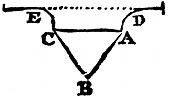
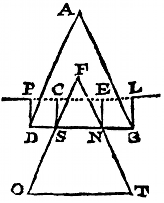
shew anon. In the mean space, for the more easie understanding of what
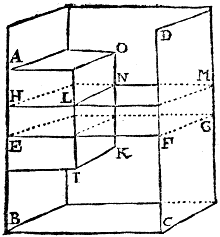
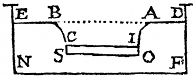
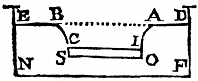
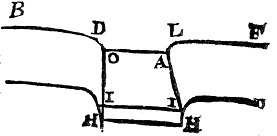 I say, observe with me a little the present Scheme: in which let us
suppose the Surface of the water to be distended, according to the
Lines F L D B, upon which if one shall put a board of matter
specifically more grave than water, but so lightly that it submerge
not, it shall not rest any thing above, but shall enter with its whole
thickness into the water: and, moreover, shall sink also, as we see by
the Board A I, O I, whose breadth is wholly sunk into the water, the
little Ramperts of water L A and D O incompassing it, whose
Superficies is notably higher than the Superficies of the Board. See
now whether it be true, that the said Board goes not to the Bottom, as
being of Figure unapt to penetrate the Crassitude of the water.
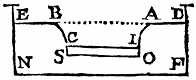
I say, observe with me a little the present Scheme: in which let us
suppose the Surface of the water to be distended, according to the
Lines F L D B, upon which if one shall put a board of matter
specifically more grave than water, but so lightly that it submerge
not, it shall not rest any thing above, but shall enter with its whole
thickness into the water: and, moreover, shall sink also, as we see by
the Board A I, O I, whose breadth is wholly sunk into the water, the
little Ramperts of water L A and D O incompassing it, whose
Superficies is notably higher than the Superficies of the Board. See
now whether it be true, that the said Board goes not to the Bottom, as
being of Figure unapt to penetrate the Crassitude of the water.
Why solids having penitrated the Water, do not proceed
to a totall Submersion.
But, if it hath already penetrated, and overcome the Continuity of
the water, & is of its own nature more grave than the said water, why
doth it not proceed in its sinking, but stop and suspend its self
within that little dimple or cavitie, which with its ponderosity it
hath made in the water? I answer; because that in submerging it self,
so far as till its Superficies come to the Levell with that of the
water, it loseth a part of its Gravity, and loseth the rest of it as
it submergeth & descends beneath the Surface of the water, which
maketh Ramperts and Banks round about it, and it sustaines this loss
by means of its drawing after it, and carrying along with it, the Air
that is above it, and by Contact adherent to it, which Air succeeds to
fill the Cavity that is invironed by the Ramperts of water; so that
that which in this case descends and is placed in the water, is not
only the Board of Ebony or Plate of Iron, but a composition of Ebony
and Air, from which resulteth a Solid no longer superiour in Gravity
to the water, as was the simple Ebony, or the simple Gold. And, if we
exactly consider, what, and how great the Solid is, that in this
Experiment enters into the water, and contrasts with the Gravity of
the same, it will be found to be all that which we find to be beneath
the Surface of the water, the which is an aggregate and Compound of a
Board of Ebony, and of almost the like quantity of Air, or a Mass
compounded of a Plate of Lead, and ten or twelve times as much Air.
But, Gentlemen, you that are my Antagonists in our Question, we
require the Identity of Matter, and the alteration only of the Figure;
therefore, you must remove that Air, which being conjoyned with the
Board, makes it become another Body less grave than the Water, and put
only the Ebony into the Water, and you shall certainly see the Board
descend to the Bottom; and, if that do not happen, you have got the
day. And to seperate the Air from the Ebony, there needs no more but
How to seperate the Air from Solids in demitting them
into the water.
only to bath the Superficies of the said Board with the same Water:
for the Water being thus interposed between the Board and the Air, the
other circumfused Water shall run together without any impediment, and
shall receive into it the sole and bare Ebony, as it was to do.
But, me thinks I hear some of the Adversaries cunningly opposing this,
and telling me, that they will not yield, by any means, that their
Board be wetted, because the weight added thereto by the Water, by
making it heavier than it was before, draws it to the Bottom, and that
the addition of new weight is contrary to our agreement, which was,
that the Matter be the same.
To this, I answer, first; that treating of the operation of Figure
in Bodies put into the Water, none can suppose them to be put into the
Water without being wet; nor do I desire more to be done to the Board,
then I will give you leave to do to the Ball. Moreover, it is untrue,
that the Board sinks by vertue of the new Weight added to it by the
Water, in the single and slight bathing of it: for I will put ten or
twenty drops of Water upon the same Board, whilst it is sustained upon
the water; which drops, because not conjoyned with the other Water
circumfused, shall not so encrease the weight of it, as to make it
sink: but if the Board being taken out, and all the water wiped off
that was added thereto, I should bath all its Superficies with one
only very small drop, and put it again upon the water, without doubt
it shall sink, the other Water running to cover it, not being retained
by the superiour Air; which Air by the interposition of the thin vail
of water, that takes away its Contiguity unto the Ebony, shall without
Renitence be seperated, nor doth it in the least oppose the succession
of the other Water: but rather, to speak better, it shall descend
freely; because it shall be all invironed and covered with water, as
soon as its superiour Superficies, before vailed with water, doth
arrive to the Levell of the universall Surface of the said water. To
say, in the next place, that water can encrease the weight of things
that are demitted into it, is most false; for water hath no Gravity in
water, since it descends not: yea, if we would well consider what any
Water hath no Gravity in Water.
immense Mass of water doth put upon a grave Body; that is placed in
it, we shall find experimentally, that it, on the contrary, will
rather in a great part deminish the weight of it, and that we may be
Water deminisheth the Gravity of Solids immerged
therein.
able to lift an huge Stone from the Bottom of the water, which the
water being removed, we are not able to stir. Nor let them tell me by
way of reply, that although the superposed water augment not the
Gravity of things that are in it, yet it increaseth the ponderosity of
those that swim, and are part in the water and part in the Air, as is
seen, for Example, in a Brass Ketle, which whilst it is empty of
The Experiment of a brass Ketle swiming when empty, &
sinking when full, alledged to prove that water gravitates in
water, answered.
water, and replenished only with Air shall swim, but pouring of Water
therein, it shall become so grave, that it shall sink to the Bottom,
and that by reason of the new weight added thereto. To this I will
return answer, as above, that the Gravity of the Water, contained in
the Vessel is not that which sinks it to the Bottom, but the proper
Gravity of the Brass, superiour to the Specificall Gravity of the
Water: for if the Vessel were less grave than water, the Ocean would
not suffice to submerge it. And, give me leave to repeat it again, as
An Ocean sufficeth not to sink a Vessel specifically
less grave than water.
the fundamentall and principall point in this Case, that the Air
contained in this Vessel before the infusion of the Water, was that
which kept it a-float, since that there was made of it, and of the
Air, the Cause of the Natation of empty Vessels of
Matters graver in specie than the water.
Brass, a Composition less grave than an equall quantity of Water: and
the place that the Vessel occupyeth in the Water whilst it floats, is
not equall to the Brass alone, but to the Brass and to the Air
together, which filleth that part of the Vessel that is below the
Levell of the water: Moreover, when the Water is infused, the Air is
removed, and there is a composition made of Brass and of water, more
grave in specie than the simple water, but not by vertue of the
water infused, as having greater Specifick Gravity than the other
water, but through the proper Gravity of the Brass, and through the
alienation of the Air. Now, as he that should say that Brass, that by
its nature goes to the Bottom, being formed into the Figure of a
Ketle, acquireth from that Figure a vertue of lying in the Water
Neither Figure, nor the breadth of Figure, is the Cause
of Natation.
without sinking, would say that which is false; because that Brass
fashioned into any whatever Figure, goeth always to the Bottom,
provided, that that which is put into the water be simple Brass; and
it is not the Figure of the Vessel that makes the Brass to float, but
it is because that that is not purely Brass which is put into the
water, but an aggregate of Brass and of Air: so is it neither more nor
less false, that a thin Plate of Brass or of Ebony, swims by vertue of
its dilated & broad Figure: for the truth is, that it bares up without
submerging, because that that which is put in the water, is not pure
Brass or simple Ebony, but an aggregate of Brass and Air, or of Ebony
and Air. And, this is not contrary unto my Conclusion, the which,
(having many a time seen Vessels of Mettall, and thin pieces of
diverse grave Matters float, by vertue of the Air conjoyned with them)
did affirm, That Figure was not the Cause of the Natation or
Submersion of such Solids as were placed in the water. Nay more, I
cannot omit, but must tell my Antagonists, that this new conceit of
denying that the Superficies of the Board should be bathed, may beget
in a third person an opinion of a poverty of Arguments of defence on
their part, since that such bathing was never insisted upon by them in
the beginning of our Dispute, and was not questioned in the least,
being that the Originall of the discourse arose upon the swiming of
Flakes of Ice, wherein it would be simplicity to require that their
Superficies might bedry: besides, that whether these pieces of Ice be
wet or dry they alwayes swim, and as the Adversaries say, by reason of
the Figure.
Some peradventure, by way of defence, may say, that wetting the Board
of Ebony, and that in the superiour Superficies, it would, though of
it self unable to pierce and penetrate the water, be born downwards,
if not by the weight of the additionall water, at least by that desire
and propension that the superiour parts of the water have to re-unite
and rejoyn themselves: by the Motion of which parts, the said Board
cometh in a certain manner, to be depressed downwards.
The Bathed Solid descends not out of any affectation
of union in the upper parts of the water.
This weak Refuge will be removed, if we do but consider, that the
repugnancy of the inferiour parts of the water, is as great against
Dis-union, as the Inclination of its superiour parts is to union: nor
can the uper unite themselves without depressing the board, nor can it
descend without disuniting the parts of the nether Water: so that it
doth follow, by necessary consequence, that for those respects, it
shall not descend. Moreover, the same that may be said of the upper
parts of the water, may with equall reason be said of the nether,
namely, that desiring to unite, they shall force the said Board
upwards.
Happily, some of these Gentlemen that dissent from me, will wonder,
that I affirm, that the contiguous superiour Air is able to sustain
that Plate of Brass or of Silver, that stayeth above water; as if I
would in a certain sence allow the Air, a kind of Magnetick vertue of
A Magnetisme in the Air, by which it bears up
those Solids in the water, that are contiguous with it.
sustaining the grave Bodies, with which it is contiguous. To satisfie
all I may, to all doubts, I have been considering how by some other
sensible Experiment I might demonstrate, how truly that little
contiguous and superiour Air sustaines those Solids, which being by
nature apt to descend to the Bottom, being placed lightly on the water
submerge not, unless they be first thorowly bathed; and have found,
that one of these Bodies having descended to the Bottom, by
conveighing to it (without touching it in the least) a little Air,
which conjoyneth with the top of the same, it becometh sufficient, not
only, as before to sustain it, but also to raise it, and to carry it
back to the top, where it stays and abideth in the same manner, till
such time, as the assistance of the conjoyned Air is taken away. And
to this effect, I have taken a Ball of Wax, and made it with a little
Lead, so grave, that it leasurely descends to the Bottom, making with
all its Superficies very smooth and pollite: and this being put gently
into the water, almost wholly submergeth, there remaining vissible
only a little of the very top, the which so long as it is conjoyned
The Effect of the Airs Contiguity in the Natation of
Solids.
with the Air, shall retain the Ball a-top, but the Contiguity of the
Air taken away by wetting it, it shall descend to the Bottom and there
remain. Now to make it by vertue of the Air, that before sustained it
to return again to the top, and stay there, thrust into the water a
Glass reversed with the mouth downwards, the which shall carry with it
the Air it contains, and move this towards the Ball, abasing it till
such time that you see, by the transparency of the Glass, that the
contained Air do arrive to the summity of the Ball: then gently
The force of Contact.
withdraw the Glass upwards, and you shall see the Ball to rise, and
afterwards stay on the top of the water, if you carefully part the
An Affectation of Conjunction betwixt Solids and the
Air contiguous to them.
Glass and the water without overmuch commoving and disturbing it.
There is, therefore, a certain affinity between the Air and other
Bodies, which holds them unied, so, that they seperate not without a
kind of violence. The same likewise is seen in the water; for if we
The like affectation of Conjunction betwixt Solids &
the water.
shall wholly submerge some Body in it, so that it be thorowly bathed,
in the drawing of it afterwards gently out again, we shall see the
water follow it, and rise notably above its Surface, before it
seperates from it. Solid Bodies, also, if they be equall and alike in
Also the like affectation and Conjunction betwixt
Solids themselves.
Superficies, so, that they make an exact Contact without the
interposition of the least Air, that may part them in the seperation
and yield untill that the ambient Medium succeeds to replenish the
place, do hold very firmly conjoyned, and are not to be seperated
without great force but, because, the Air, Water, and other Liquids,
very expeditiously shape themselves to contact with any Solid
Bodies, so that their Superficies do exquisitely adopt themselves to
that of the Solids, without any thing remaining between them,
therefore, the effect of this Conjunction and Adherence is more
manifestly and frequently observed in them, than in hard and
inflexible Bodies, whose Superficies do very rarely conjoyn with
exactness of Contact. This is therefore that Magnetick vertue, which
Contact may be the Cause of the Continuity of Naturall
Bodies.
with firm Connection conjoyneth all Bodies, that do touch without the
interposition of flexible fluids; and, who knows, but that that a
Contact, when it is very exact, may be a sufficient Cause of the Union
and Continuity of the parts of a naturall Body?
Now, pursuing my purpose, I say; that it needs not, that we have
recourse to the Tenacity, that the parts of the water have amongst
themselves, by which they resist and oppose Division, Distraction, and
Seperation, because there is no such Coherence and Resistance of
Division for if there were, it would be no less in the internall parts
than in those nearer the superiour or externall Surface, so that the
same Board, finding alwayes the same Resistance and Renitence, would
no less stop in the middle of the water than about the Surface, which
is false. Moreover, what Resistance can we place in the Continuity of
the water, if we see that it is impossible to find any Body of
whatsoever Matter, Figure or Magnitude, which being put into the
water, shall be obstructed and impeded by the Tenacity of the parts of
the water to one another, so, but that it is moved upwards or
downwards, according as the Cause of their Motion transports it? And,
what greater proof of it can we desier, than that which we daily see
in Muddy waters, which being put into Vessels to be drunk, and being,
after some hours setling, still, as we say, thick in the end, after
The settlement of Muddy Water, proveth that that
Element hath no aversion to Division.
four or six dayes they are wholly setled, and become pure and clear?
Nor can their Resistance of Penetration stay those impalpable and
insensible Atomes of Sand, which by reason of their exceeding small
force, spend six dayes in descending the space of half a yard.
Nor let them say, that the seeing of such small Bodies, consume
six dayes in descending so little a way, is a sufficient Argument
of the Waters Resistance of Division; because that is no resisting
of Division, but a retarding of Motion; and it would be simplicity
to say, that a thing opposeth Division, and that in the same
Water cannot oppose division, and at the same time
permit it self to be divided.
instant, it permits it self to be divided: nor doth the Retardation
of Motion at all favour the Adversaries cause, for that they are to
instance in a thing that wholly prohibiteth Motion, and procureth
Rest; it is necessary, therefore, to find out Bodies that stay in
the water, if one would shew its repugnancy to Division, and not
such as move in it, howbeit but slowly.
What then is this Crassitude of the water, with which it resisteth
Division? What, I beseech you, should it be, if we (as we have said
above) with all diligence attempting the reduction of a Matter into so
like a Gravity with the water, that forming it into a dilated Plate it
rests suspended as we have said, between the two waters, it be
impossible to effect it, though we bring them to such an
Equiponderance, that as much Lead as the fourth part of a Grain of
Musterd-seed, added to the same expanded Plate, that in Air [i. e.
out of the water] shall weigh four or six pounds, sinketh it to the
Bottom, and being substracted, it ascends to the Surface of the water?
I cannot see, (if what I say be true, as it is most certain) what
minute vertue and force we can possibly find or imagine, to which the
Resistance of the water against Division and Penetration is not
inferiour; whereupon, we must of necessity conclude that it is
nothing: because, if it were of any sensible power, some large Plate
might be found or compounded of a Matter alike in Gravity to the
water, which not only would stay between the two waters; but,
moreover, should not be able to descend or ascend without notable
force. We may likewise collect the same from an other Experiment,
An hair will draw a great Mass thorow the Water; which
proveth, that it hath no Resistance against transversall
Division.
shewing that the Water gives way also in the same manner to
transversall Division; for if in a setled and standing water we should
place any great Mass that goeth not to the bottom, drawing it with a
single Womans Hair, we might carry it from place to place without any
opposition, and this whatever Figure it hath, though that it possess a
great space of water, as for instance, a great Beam would do moved
side-ways. Perhaps some might oppose me and say, that if the
Resistance of water against Division, as I affirm, were nothing; Ships
should not need such a force of Oars and Sayles for the moving of them
from place to place in a tranquile Sea, or standing Lake. To him that
should make such an objection, I would reply, that the water
How ships are moved in the water.
contrasteth not against, nor simply resisteth Division, but a sudden
Division, and with so much greater Renitence, by how much greater the
Velocity is: and the Cause of this Resistance depends not on
Crassitude, or any other thing that absolutely opposeth Division, but
because that the parts of the water divided, in giving way to that
Solid that is moved in it, are themselves also necessitated locally to
move, some to the one side, and some to the other, and some downwards:
and this must no less be done by the waves before the Ship, or other
Body swimming through the water, than by the posteriour and
subsequent; because, the Ship proceeding forwards, to make it self a
way to receive its Bulk, it is requisite, that with the Prow it
repulse the adjacent parts of the water, as well on one hand as on the
other, and that it move them as much transversly, as is the half of
the breadth of the Hull: and the like removall must those waves make,
that succeeding the Poump do run from the remoter parts of the Ship
towards those of the middle, successively to replenish the places,
which the Ship in advancing forwards, goeth, leaving vacant. Now,
because, all Motitions are made in Time, and the longer in greater
Bodies moved a certain space in a certain Time, by a
certain power, cannot be moved the same space and in a shorter
time, but by a greater power.
time: and it being moreover true, that those Bodies that in a certain
time are moved by a certain power such a certain space, shall not be
moved the same space, and in a shorter Time, unless by a greater
Power: therefore, the broader Ships move slower than the narrower,
being put on by an equall Force: and the same Vessel requires so much
greater force of Wind, or Oars, the faster it is to move.
But yet for all this, any great Mass swimming in a standing Lake,
may be moved by any petit force; only it is true, that a lesser
force more slowly moves it: but if the waters Resistance of
Division, were in any manner sensible, it would follow, that the
said Mass, should, notwithstanding the percussion of some sensible
force, continue immoveable, which is not so. Yea, I will say
The parts of Liquids, so farre from resisting
Division, that they contain not any thing that may be divided.
farther, that should we retire our selves into the more internall
contemplation of the Nature of water and other Fluids, perhaps we
should discover the Constitution of their parts to be such, that
they not only do not oppose Division, but that they have not any
thing in them to be divided: so that the Resistance that is
observed in moving through the water, is like to that which we meet
The Resistance a Solid findeth in moving through the
water, like to that we meet with in passing through a throng of
people:
with in passing through a great Throng of People, wherein we find
impediment, and not by any difficulty in the Division, for that
none of those persons are divided whereof the Croud is composed,
but only in moving of those persons side-ways which were before
divided and disjoyned: and thus we find Resistance in thrusting a
Stick into an heap of Sand, not because any part of the Sand is to
be cut in pieces, but only to be moved and raised. Two manners of
Or in thrusting a Stick into an heap of Sand.
Penetration, therefore, offer themselves to us, one in Bodies,
whose parts were continuall, and here Division seemeth necessary,
the other in the aggregates of parts not continuall, but contiguous
only, and here there is no necessity of dividing but of moving
Two kinds of Penetration, one in Bodies continuall, the
other in Bodies only contiguous.
only. Now, I am not well resolved, whether water and other Fluids
may be esteemed to be of parts continuall or contiguous only; yet I
Water consists not of continuall, but only of
contiguous parts.
find my self indeed inclined to think that they are rather
contiguous (if there be in Nature no other manner of aggregating,
than by the union, or by the touching of the extreams:) and I am
induced thereto by the great difference that I see between the
Conjunction of the parts of an hard or Solid Body, and the
Se{e} what satisfaction he hath given, as to this
point, in Lib. de Motu. Dial. 2.
Conjunction of the same parts when the same Body shall be made
Liquid and Fluid: for if, for example, I take a Mass of Silver or
other Solid and hard Mettall, I shall in dividing it into two
parts, find not only the resistance that is found in the moving of
it only, but an other incomparably greater, dependent on that
Great difference betwixt the Conjunction of the parts
of a Body when Solid, and when fluid.
vertue, whatever it be, which holds the parts united: and so if we
would divide again those two parts into other two, and successively
into others and others, we should still find a like Resistance, but
ever less by how much smaller the parts to be divided shall be; but
if, lastly, employing most subtile and acute Instruments, such as
are the most tenuous parts of the Fire, we shall resolve it
(perhaps) into its last and least Particles, there shall not be
left in them any longer either Resistance of Division, or so much
as a capacity of being farther divided, especially by Instruments
more grosse than the acuities of Fire: and what Knife or Rasor put
into well melted Silver can we finde, that will divide a thing
which surpasseth the separating power of Fire? Certainly none:
because either the whole shall be reduced to the most minute and
ultimate Divisions, or if there remain parts capable still of other
Subdidivisions, they cannot receive them, but only from acuter
Divisors than Fire; but a Stick or Rod of Iron, moved in the melted
Metall, is not such a one. Of a like Constitution and Consistence,
I account the parts of Water, and other Liquids to be, namely,
Water consists of parts that admit of no farther
division.
incapable of Division by reason of their Ienuity; or if not
absolutely indivisible, yet at least not to be divided by a Board,
or other Solid Body, palpable unto the hand, the Sector being
alwayes required to be more sharp than the Solid to be cut. Solid
Bodies, therefore, do only move, and not divide the Water, when put
Solids dimitted into the water, do onely move, and not
divide it.
into it; whose parts being before divided to the extreamest
minuity, and therefore capable of being moved, either many of them
at once, or few, or very few, they soon give place to every small
Corpuscle, that descends in the same: for that, it being little and
light, descending in the Air, and arriving to the Surface of the
Water, it meets with Particles of Water more small, and of less
Resistance against Motion and Extrusion, than is its own prement
and extrusive force; whereupon it submergeth, and moveth such a
portion of them, as is proportionate to its Power. There is not,
therefore, any Resistance in Water against Division, nay, there is
not in it any divisible parts. I adde; moreover, that in case yet
there should be any small Resistance found (which is absolutely
false) haply in attempting with an Hair to move a very great natant
If there were any Resistance of Division in water, it
must needs be small, in that it is overcome by an Hair, a Grain of
Lead, or a slight bathing of the Solid.
Machine, or in essaying by the addition of one small Grain of Lead
to sink, or by removall of it to raise a very broad Plate of
Matter, equall in Gravity with Water, (which likewise will not
happen, in case we proceed with dexterity) we may observe that that
Resistance is a very different thing from that which the
Adversaries produce for the Cause of the Natation of the Plate of
Lead or Board of Ebony, for that one may make a Board of Ebony,
which being put upon the Water swimmeth, and cannot be submerged,
no not by the addition of an hundred Grains of Lead put upon the
same, and afterwards being bathed, not only sinks, though the said
Lead be taken away, but though moreover a quantity of Cork, or of
some other light Body fastened to it, sufficeth not to hinder it
from sinking unto the bottome: so that you see, that although it
were granted that there is a certain small Resistance of Division
found in the substance of the Water, yet this hath nothing to do
with that Cause which supports the Board above the Water, with a
Resistance an hundred times greater than that which men can find in
the parts of the Water: nor let them tell me, that only the Surface
of the Water hath such Resistance, and not the internall parts, or
The uper parts of the Water, do no more resist Division
than the middle or lower parts.
that such Resistance is found greatest in the beginning of the
Submersion, as it also seems that in the beginning, Motion meets
with greater opposition, than in the continuance of it; because,
first, I will permit, that the Water be stirred, and that the
superiour parts be mingled with the middle, and inferiour parts, or
Waters Resistance of division, not greater in the
beginning of the Submersion.
that those above be wholly removed, and those in the middle only
made use off, and yet you shall see the effect for all that, to be
still the same: Moreover, that Hair which draws a Beam through the
Water, is likewise to divide the upperparts, and is also to begin
the Motion, and yet it begins it, and yet it divides it: and
finally, let the Board of Ebony be put in the midway, betwixt the
bottome and the top of the Water, and let it there for awhile be
suspended and setled, and afterwards let it be left at liberty, and
it will instantly begin its Motion, and will continue it unto the
bottome. Nay, more, the Board so soon as it is dimitted upon the
Water, hath not only begun to move and divide it, but is for a good
space dimerged into it.
Let us receive it, therefore, for a true and undoubted Conclusion,
That the Water hath not any Renitence against simple Division, and
that it is not possible to find any Solid Body, be it of what Figure
it will, which being put into the Water, its Motion upwards or
downwards, according as it exceedeth, or shall be exceeded by the
Water in Gravity (although such excesse and difference be insensible)
shall be prohibited, and taken away, by the Crassitude of the said
Water. When, therefore, we see the Board of Ebony, or of other Matter,
more grave than the Water, to stay in the Confines of the Water and
Air, without submerging, we must have recourse to some other
Originall, for the investing the Cause of that Effect, than to the
breadth of the Figure, unable to overcome the Renitence with which the
Water opposeth Division, since there is no Resistance; and from that
which is not in being, we can expect no Action. It remains most true,
therefore, as we have said before, that this so succeds, for that that
which in such manner put upon the water, not the same Body with that
which is put into the Water: because this which is put into the
Water, is the pure Board of Ebony, which for that it is more grave
than the Water, sinketh, and that which is put upon the Water, is a
Composition of Ebony, and of so much Air, that both together are
specifically less grave than the Water, and therefore they do not
descend.
I will farther confirm this which I say. Gentlemen, my Antagonists, we
are agreed, that the excess or defect of the Gravity of the Solid,
unto the Gravity of the Water, is the true and proper Cause of
Natation or Submersion.
Great Caution to be had in experimenting the operation
of Figure in Natation.
Now, if you will shew that besides the former Cause, there is another
which is so powerfull, that it can hinder and remove the Submersion of
those very Solids, that by their Gravity sink, and if you will say,
that this is the breadth or ampleness of Figure, you are oblieged,
when ever you would shew such an Experiment, first to make the
circumstances certain, that that Solid which you put into the Water,
be not less grave in specie than it, for if you should not do so,
any one might with reason say, that not the Figure, but the Levity was
the cause of that Natation. But I say, that when you shall dimit a
Board of Ebony into the Water, you do not put therein a Solid more
grave in specie than the Water, but one lighter, for besides the
Ebony, there is in the Water a Mass of Air, united with the Ebony, and
such, and so light, that of both there results a Composition less
grave than the Water: See, therefore, that you remove the Air, and put
the Ebony alone into the Water, for so you shall immerge a Solid more
grave then the Water, and if this shall not go to the Bottom, you have
well Philosophized and I ill.
Now, since we have found the true Cause of the Natation of those
Bodies, which otherwise, as being graver than the Water, would descend
to the bottom, I think, that for the perfect and distinct knowledge of
this business, it would be good to proceed in a way of discovering
demonstratively those particular Accidents that do attend these
effects, and,