General Considerations.—“Few departments of natural history offer
greater inducements or facilities to the student than Entomology. He
need not pass his threshold for material, for it may be found on every
hand and at all seasons. The directions for collecting, preserving, and
studying insects might be extended indefinitely in detail, as volumes
have already been written on the subject; but the more general and
important instructions are soon given.
“Beginners are very apt to supply themselves with all sorts of
appliances advertised by natural history furnishing stores. Many of
these appliances, when it comes to real, practical field-work, are soon
abandoned as useless incumbrances; and the greater the experience, the
simpler will be the paraphernalia. My own equipment, on a collecting
trip, consists chiefly of a cotton umbrella, a strong and narrow steel
trowel or digger, a haversack slung across the shoulders, a cigar box
lined with sheet cork, and a small knapsack attached to a waistbelt
which girts a coat, not of many colors, but of many pockets, so made
that in stooping nothing falls out of them. The umbrella is one of the
indispensables. It shields, when necessary, from old Sol's scorching
rays and from the pelting, drenching storm; brings within reach, by its
hooked handle, many a larva-freighted bough which would otherwise remain
undisturbed; and forms an excellent receptacle for all insects that may
be dislodged from bush or branch. Opened and held inverted under a bough
with the left hand, while the right manipulates a beating-stick, cut for
the occasion, it will be the recipient of many a choice specimen that
would never have been espied amid its protective surroundings. Some
collectors use an umbrella painted or lined on the inside with white, to
facilitate the detection of any object that drops into it; but as there
are fully as many, if not more, pale and white insects as there are dark
or black ones, the common dark umbrella is good enough for all ordinary
purposes; and if any improvement on the ordinary cotton umbrella is
desired, it should be in the way of a joint or knuckle about the middle
of the handle, which will facilitate its packing and using. The trowel
is valuable for prying off the loosened bark from old trees, whether
felled or standing, and for digging into the ground or into decaying
stumps and logs. The haversack is for the carriage of different kinds of
boxes (those made of tin being best) intended for larval and other forms
which it is necessary to bring home alive for breeding purposes; and if
made with a partition so that the filled and empty boxes may be
separated, all the better; it may also be used for nets and other
apparatus to be mentioned, and for such provender as is necessary on the
trip. The knapsack may be made on the plan of a cartridge box, of stout
canvas or leather, and should be of moderate size and slung onto the
belt so as to be slipped to any part of the waist and not hinder free
bodily motion. It may be used to carry bottles, phials, and other small
appliances, and should be accordingly partitioned and furnished with
loops or pockets on the inside. The cigar-box is for the reception of
pinned specimens, and may be slipped onto the belt, or buttoned to the
trousers by means of leather.
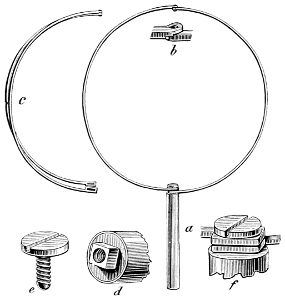
Fig. 44.—The Butterfly net-frame.
“The greatest requisites in collecting are a pair of sharp eyes
and ready hands, with coolness and self-possession; but a few traps will
materially aid. One of the most important is the hand-net, which may be
made so as to subserve the two purposes of a sweeping and an
air-net.”
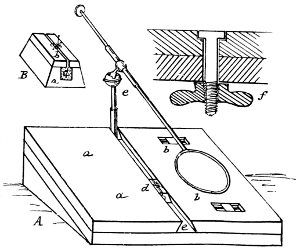
“The frame of the net which I use is illustrated herewith (see Fig. 44),
and will be found strong and serviceable and conveniently portable.
It is constructed as follows: Take two pieces of stout brass wire, each
about 20 inches long; bend them half-circularly and at one end by a
folding hinge having a check on one side, b. The other ends are bent
and beaten into two square sockets, f, which fit to a nut sunk and
soldered into one end of a brass tube, d. When so fitted, they are
secured by a large-headed screw, e, threaded to fit into the
nut-socket, and with a groove wide enough to receive the back of a
common pocket-knife blade. The wire hoop is easily detached and folded,
as at c, for convenient carriage; and the handle may be made of any
desired length by cutting a stick and fitting it into the hollow tube
a, which should be about 6 inches long. It is well to have two
separate hoops, one of lighter wire, furnished with silk gauze or some
other light material, for catching flying insects, and one which is
stouter and furnished with a net of stronger material for sweeping
non-flying specimens.
“Another still more simple, but less convenient frame, is thus
described by my friend F. G. Sanborn, of Boston, Mass.:
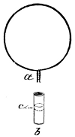
Fig. 45.—The
Sanborn net-frame.
‘Make a loop of strong iron or brass wire, of about 3-16ths of an
inch in thickness, so that the diameter of the loop or circle will not
exceed 12 inches, leaving an inch to an inch and a half of wire at each
end bent at nearly right angles. Bind the two extremities of the wire
together with smaller wire (see Fig. 45, a), and tin them by applying a
drop of muriate of zinc, then holding it in the fire or over a gas flame
until nearly red hot, when a few grains of block tin or soft solder
placed upon them will flow evenly over the whole surface and join them
firmly together. Take a Maynard rifle cartridge tube, or other brass
tube of similar dimensions; if the former, file off the closed end or
perforate it for the admission of the wire, and having tinned it in the
same manner on the inside, push a tight-fitting cork half way through
(Fig. 45, c) and pour into it melted tin or soft solder, and
insert the wires; if carefully done, you will have a firmly constructed
and very durable foundation for a collecting net. The cork being
extracted will leave a convenient socket for inserting a stick or
walking cane to serve as a handle.’
“My friend, J. A. Lintner, of Albany, N. Y., makes very good use,
in his ordinary promenades, of a telescopic fish-rod, with a head (Fig. 46)
screwed on to one end, in which to fasten an elastic brass coil on
which the net is drawn, but which when not in use sits snugly inside his
silk hat.
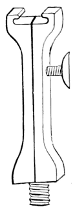
Fig. 46.—
Clamp of the
Lintner net.
“The bag should taper to the bottom, and in any case its length
should be fully twice the diameter of the hoop, so that by giving the
net a twist, the mouth may be closed and the contents thus secured. The
sweeping-net may be protected around the hoop with leather, and in use
should be kept in a steady and continued back-and-forth motion, over and
touching the plants, until the contents are to be examined; when, by
placing the head at the opening and quietly surveying the restless
inmates, the desiderata may be secured and the rest turned out. A sudden
dash of the air-net will usually lay any flying object at the bottom. A
net for aquatic insects may be made on the same principle, but should be
stout, with the meshes open enough to allow free passage of water, and
the bag not quite as deep as the diameter of the hoop. A forceps net,
which consists of two gauze or bobbinet covered frames, having riveted
handles, so as to close like a pair of scissors, is employed for small
insects; but I find little use for it. A coarse sieve, together with a
white towel or sheet, will be found of great service for special
occasions, particularly in the spring, when the search for minute
insects found under old leaves, or for pupæ around the butts of trees,
is contemplated. With the sheet spread on the ground, and a few handfuls
of leaves and leafy mold sifted over it, many a minute specimen will be
separated from the coarser particles and drop to the sheet, where the
eye may readily detect it. Conversely, the earth taken from around trees
may be sifted so as to leave in the sieve such larger objects as pupæ,
etc. Another favorite plan, with some collectors, of obtaining
specimens, especially night-flying moths, is by
‘sugaring.’ This consists of applying to the trunks of
trees or to strips of cloth attached to the trees some sweet,
attractive, and stupefying preparation. Diluted molasses or dissolved
brown sugar, mixed with rum or beer, is most frequently employed. I have
found sugaring of little use till after the blossoming season, and it is
almost impossible to so stupefy or intoxicate an insect that it will
remain upon the sugared tree till the next morning. I generally sugar at
eve, and visit the tree several times between sundown and midnight,
armed with wide-mouthed killing-bottles and accompanied by a second
person, who carries a dark-lantern. Isolated trees, on the edges of
woods, give the best results. Everybody knows how some poor moths will
persist in flitting around a light until they singe their wings; and, as
many insects are strongly attracted to bright artificial light, it may
be employed with good results, especially during warm and damp evenings.
The collector should never go unprovided with a small box or tube full
of different sized pins (a corked cartridge-tube makes a good box,) a
pair or two of forceps, a pair of scissors, a little mucilage, and the
killing apparatus to be described.”
With these general remarks, it will be well to consider some of the
important paraphernalia more in detail.
The Sweeping Net.—A multitude of insects of all orders feed or rest
on grasses and other low plants. Upon close inspection of these plants a
careful observer will be able to secure, without any instruments, not
only many mature insects, but also many larvæ in connection with their
food-plants. This is laborious and slow work, only necessary on special
occasions. The beating net, which is constructed on the same general
plan as the butterfly net, is valuable here as a time saver. By holding
the handle of the net firmly in one hand and quickly sweeping over the
plants first from right to left, and then, after quickly turning the net
again, sweeping from left to right, most insects coming within reach of
the sweep will fall into the bag and may be easily taken out and put
into the collecting-vials. From this mode of operation it is evident
that the sweeping net must be stronger in all its parts than the
butterfly net, but otherwise it may be made on the same plan.
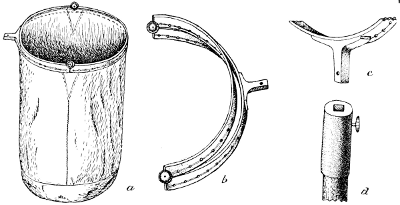
Fig. 47.—The Deyrolle Sweeping Net. a, net entire;
b, frame; c and d, attachment of frame and handle (original).
The ring should be rigid, made of brass or iron, either of one piece or
of two pieces, and fastened to the handle or stick in the same way as
the butterfly net. The bag need not be as long as in the butterfly net,
about 18 inches being sufficient, but it should be of stout cotton or
linen and the bottom should preferably be sewed in as a round piece, so
as to avoid corners. Care needs to be bestowed on the fastening of the
bag on the ring, for by the use of the net the part of the bag sewed
around the ring is soon chafed through. To prevent this a strip of
leather is sewed over the cotton along the rim, but since even this must
be frequently renewed some other devices are used to give greater
durability to the net. In the pattern of a beating-net originally sold
by Deyrolle in Paris, the metal ring was flattened, with the narrow edge
pointing upwards and the broad side pierced with holes at suitable
intervals and grooved on the outer surface between the holes. The bag is
sewed on to the inner side of the ring by stout twine, which passes from
one hole to the next and is thus prevented from coming in contact with
obstructive objects, and only the bottom of the bag wears and will need
to be occasionally mended or renewed.
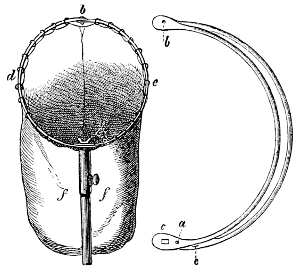
Fig. 48.—Beating net, opened and attached to handle,
with frame of same folded.
(After Kiesenwetter.)
Another method of preventing the tearing of the upper rim of the bag is
described and illustrated in Kiesenwetter's useful volume “Der
Naturaliensammler” from which I shall frequently have
occasion to quote. In this net the main ring is of rounded iron
wire on which a number of brass rings are slipped. These must be but
little larger than the diameter of the wire. These little brass rings
should not be more than 30 mm. or at most 40 mm., distant from each
other, and to them the upper rim of the bag is sewed with very strong
twine and is thus protected from wear and tear. The handle or stick of
the net should be firmly and solidly attached to the ring and should be
stout and not liable to break. I prefer a rather short stick, say not
longer than two feet.
I figure herewith the ring of a very convenient net for sweeping or
beating purposes. It has the advantage of being for sale on the market,
and in fact is an ordinary fishing dip net of small size. It is hinged
in three places, as shown in the figure, and folds into very small
compass. When unfolded and brought together, it screws into a ferrule
which may be attached to a cane or a special handle.
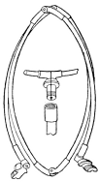
Fig. 49.—Folding ring
for beating net (original).
The beating net can be successfully used at almost every season of the
year. Even on warm days in winter time many specimens can be swept from
the dead grass. So long as the dew is on the plants or in rainy weather
no beating should be attempted, as the more delicate species are more or
less spoiled by the moisture. After one or two minutes' sweeping the
contents should be examined. Those insects which are quick to take wing
or which are good runners should first receive attention; the less
active can then be examined more at leisure. The desiderata are then
disposed of, the rest thrown away, and the beating renewed.
The beating net is an important instrument for collecting all insects
excepting mature Lepidoptera, which are apt to get rubbed. Many larvæ,
especially of Lepidoptera, are caught by beating and are mostly in good
condition, but it is usually difficult to ascertain the food plant.
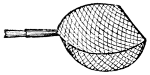
Fig. 50.—The Water Net.
(After Packard.)
The Water Net.—The numerous insects or insect larvæ which live in the
water can not be conveniently collected without the use of a net, except
where they live in small shallow streams or creeks with gravelly or
stony bottoms. A suitable water net can readily be made by using the
frame of the beating net and attaching to it a rather short bag of some
coarse material, e. g., “grass cloth,” coarse millinet.
The mode of operation with this net is very simple: if some insect is
seen swimming in the water, the net is carefully brought beneath the
specimen, which is thus lifted out of the water. Most water insects are,
however, not seen swimming about freely, but hide amid the various
plants, mosses, etc., or in the mud at the base of the plants, and they
can best be captured by dragging the net through these plants. When
taken from the water the net is more or less filled with mud and parts
of plants, and the water must be allowed to run out and the contents of
the net spread out on a cloth or on a flat stone, if such be at hand.
The insects are at first not readily seen, but after a short while they
begin to emerge from the mud and crawl about, and can readily be taken
up with a forceps.
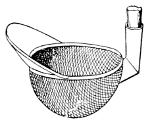
Fig. 51.—Small Water
Dip Net (original).
Water Dip Net.—The small water sieve, shown in the accompanying
illustration (Fig. 51), and somewhat resembling in appearance a jockey
cap, is frequently of service in collecting the larvæ of aquatic
insects, especially where it is necessary to scrape submerged stones or
timbers. In use it is fastened on the end of a cane or stick, and can be
easily made by any tinsmith.
The Umbrella.—The umbrella, as already stated, is one of the most
useful instruments of the collector, since it enables him to obtain all
those numerous insects which live on the branches of trees, on shrubs,
and on other large plants. A common stout cotton umbrella is
sufficiently large, but is liable to get out of joint, and moreover the
specimens hide themselves under the ribs. It is well, therefore, to have
the inside of such umbrella lined along the ribs with muslin, or some
other material, preferably of a light color. An umbrella specially
constructed for entomological purposes is offered for sale by E.
Deyrolle, in Paris. It resembles a stoutly built common umbrella, but
has the inside lined with white linen and the handle has a joint near
the middle, so that the umbrella can be more conveniently held and more
readily packed away. The opened and inverted umbrella is held with the
left hand under the branch which the collector intends to relieve of its
entomological inhabitants, while the right hand, armed with a heavy
stick, is free to properly jar the branch. Care must be taken in the
jarring, lest the insects are knocked beyond the circumference of the
umbrella. The larger the umbrella the greater are the chances of making
rich captures, but the more difficult it becomes to manipulate,
especially where the woods are dense or where there are many vines, etc.
In the absence of an umbrella the butterfly net or the beating net can
be used.
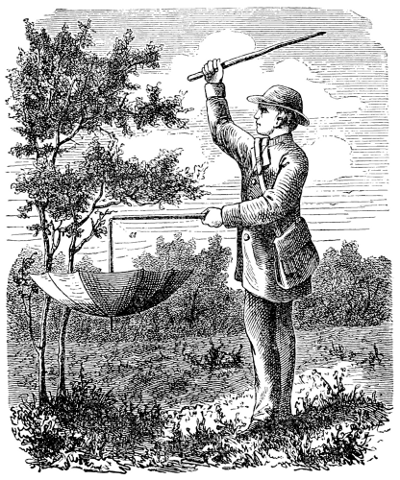
Fig. 52.—The Umbrella and its mode of use. (After
Kiesenwetter.)
A drawback to collecting with the umbrella is that many insects take
wing and escape before being secured. This can hardly be avoided, and
experienced collectors, in southern countries more particularly, have
found it advisable to discard the umbrella and to use in its stead a
very large butterfly net, 2 feet or more in diameter.
The Beating Cloth.—A very simple substitute for the umbrella, and one
which can always be carried without inconvenience, may here be
described. It consists of a piece of common unbleached cotton cloth (1
yard square), to each corner of which a loop of stout twine is sewed.
Upon reaching the woods, two straight sticks, each about 5 feet in
length and not too heavy, but also not so small as to be liable to break
or to bend too easily, are cut from a convenient bush. The sticks are
placed crosswise over the cloth and fastened to the loops at the four
ends. This is easily and quickly done by making sliding loops of the
simple loops. The cloth is thus kept spread out between the sticks, and
forms a very good substitute for an umbrella. In beating, the sticks are
held at their intersecting points. When not in use one of the loops is
detached from the stick and the instrument can be rolled up and carried
under one arm without seriously interfering with other operations of the
collector. When laid on the ground, with the sticks on the underside,
this simple instrument may be advantageously used as a cloth on which
to sift or examine fungi, moss, pieces of bark, etc., and since the
cloth is always tightly expanded, it offers a smooth and level surface,
where examination of various objects can be made with ease and accuracy.
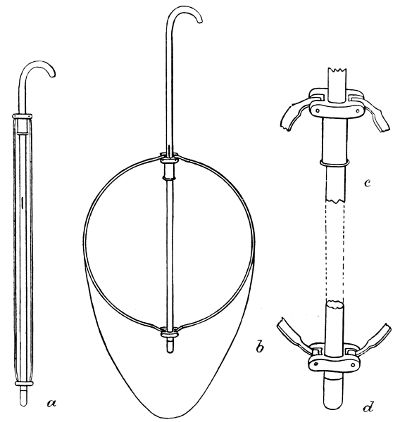
Fig. 53.—The umbrella beating and sweeping net
(original).
The Umbrella Net.—A very convenient form of net for both sweeping and
for use in place of an umbrella for beating has been devised by Dr. George
Marx. (See Fig. 53) It is constructed from an old umbrella, as
follows: To the handle of the umbrella are attached two steel rods
working on hinges at the apex of the umbrella, as do the ordinary
umbrella ribs, and attached to the sliding piece of the umbrella in the
same manner, as shown at a. These rods should be about 2½ feet long.
When the sliding piece is pushed up and caught behind the spring clip,
as shown at b, a circular loop is formed giving the framework for the
net. The latter, which should be comparatively shallow, is made of stout
muslin and sewed to the frame, as in the ordinary sweeping net. The
enlarged drawings c and d illustrate clearly the manner of
constructing the frame. The advantage of this net is its convenience in
carrying and its general usefulness, taking the place of both the
umbrella and the sweeping net. When not in use the frame is allowed to
assume the position shown at A, and the net may be wrapped about the
frame and the whole inserted in an ordinary umbrella cover.
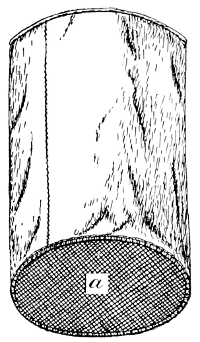
Fig. 54.—The sieve. a, wire netting
(original).
The Sieve.—This useful aid to good collecting has not been generally
employed by American entomologists. It facilitates the finding of small
insects living under old leaves, in moss, in decayed trees, in fungi, in
ants' nests, or in the ground. Any ordinary sieve about a foot in
diameter and with meshes of about one-fifth of an inch will answer,
though for durability and convenience of carriage one made of two wire
or brass rings and muslin (Fig. 54), as follows, is the best. The ends
of the wire netting should be bent around the ring so as not to project.
A piece of common muslin about 1 foot wide and long enough to go around
the circumference of one of the rings is then sewed together so as to
form a kind of cylinder or bag without bottom, and the upper and lower
rims of this bag are then sewed on around the two rings. The whole
instrument thus forms a bag, the top of which is kept open by the simple
wire ring, and the bottom is closed by the second ring covered with the
wire netting. After choosing a suitable locality a white cloth is spread
as evenly as possible on the ground; the collector then takes the sieve,
places therein two or three handfuls of the material to be sifted,
returns to his cloth, and, holding with his right hand the lower ring
and with the left hand the upper ring, shakes the sieve over the cloth.
The larger particles and specimens are retained in the sieve while the
smaller fall through the meshes on to the cloth. Care must be taken that
the siftings form an even and thin layer on the surface of the cloth, so
as to be easily examined from time to time. If the locality is favorable
many insects will be seen at the first glance crawling or running about,
and these can easily be picked up by means of a moistened brush, or with
the forceps. Many other insects, however, either feign death or, at any
rate, do not move until after the lapse of several minutes, and the
proper investigation of a single sifting often requires much time, and
patience will be more fully rewarded here than in any other mode of
collecting.
The size of the wire meshes given above is best adapted for sifting the
fragments of old decayed trees, which furnish the most frequent material
for the use of the sieve, but for sifting ants' nests, soil, etc., a
sieve with smaller meshes is desirable.
The sieve is indispensable to the Coleopterist, the Arachnologist, and
to the specialist in the smaller Hemiptera and Hymenoptera, but it is
also useful for most other orders, many interesting species existing
which can be secured in numbers only by this mode of collecting. Many
Tineidæ and even Noctuidæ hide under old leaves, but the specimens are
usually rubbed and rendered useless in the process of sifting. Many
larvæ and pupæ can, however, thus be obtained.
If the locality chosen for sifting prove to be a good one, it pays to
put the sifted material in a small sack and to carry it home where it
can be investigated at leisure, and with a greater thoroughness than is
usually possible outdoors. This sack can be easily arranged to be
attached to or drawn over the lower ring of the sieve, so that the
sifting can be done directly into the sack.
As a rule it may be said that very dry places are least productive,
while more or less moist places are apt to furnish a rich harvest. Old
wet leaves lying immediately along the edges of swamps, or wet moss,
harbor many interesting insects, but such wet material is sifted with
difficulty.
The sieve can be used with great advantage at all seasons of the year,
but more especially late in fall or early in spring, when so many
species are still hibernating.
The Chisel.—For securing the many insects living or hiding under bark
of dying or dead trees an instrument of some sort is indispensable, as,
in most cases, the bark so firmly adheres to the wood that it cannot be
torn off with the hand. A stout pocket-knife will do good service, but
far better is a common chisel of medium size and with a short handle.
This chisel is also useful as an instrument for digging in the ground or
for investigating the interior of partly decayed logs.
The Trowel.—Aside from the fact that many insects enter the ground
for the purpose of hibernation in various stages, there is a rich
subterranean life to be found during the summer. There are many
burrowing Coleoptera; many, if not most, ants construct subterranean
nests; the number of other fossorial Hymenoptera is very large, and
there are also various burrowing Orthoptera and many Lepidopterous larvæ
which hide in the ground during the day. Some instrument for digging in
the ground is therefore of great importance, and while, as stated above,
the chisel will answer this purpose if nothing else be at hand, yet
there are other instruments which perform the work much quicker and more
thoroughly. The most available instrument is a rather small steel
trowel, such as can be had at the hardware stores in a great variety of
patterns, and which can be carried on excursions without much
inconvenience. One with a long and narrow blade, made very stout, I have
found very useful, though somewhat awkward to carry.

Fig. 55.—The collecting tweezers.
The collecting Tweezers.—In the picking up of specimens and
transferring them into the various bottles, vials, or boxes, the trained
collector will gather by hand the most delicate specimens without
injuring them. Yet this labor will be greatly facilitated by the use of
the tweezers or the brush. The former is a small, light pair of forceps,
made of steel or brass. It should be as pliable as possible, and the tip
should be narrow and rounded off and not pointed. It may be either
straight or curved at tip, according to individual preference.

Fig. 56.—Pinning forceps.
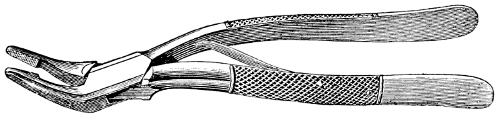
Fig. 57.—Pinning forceps.
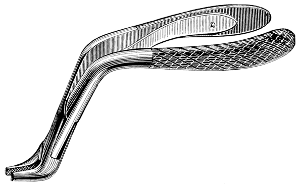
Fig. 58.—Pinning forceps for Lepidoptera.
Suitable tweezers may be obtained at the larger hardware stores or of
watchmakers. Excellent tweezers made of steel (see Fig. 55 are sold for
about 40 cents a pair by Codman, Shurtleff & Co., Tremont street,
Boston, Mass. Aside from their utility in picking up specimens from the
collecting cloth or the umbrella, the tweezers are indispensable for
extracting insects from cracks, or holes in timber, or from their
burrows in branches and stems of plants, or from places whence it is
impossible to dislodge them by hand. The larger “collecting
forceps,” sold by various dealers, do good service in certain
emergencies, as when large scorpions or other very large and ferocious
insects are to be secured.
For the handling of mounted insects various special forceps are
employed, a number of styles of which are shown at Figs. 56–8.
The Brush.—A common camel's hair brush, of smaller or larger size
according to individual preference, is useful for picking up very small
or soft-bodied insects. For this purpose the brush is slightly moistened
with saliva, and the tip brought in contact with the specimen, which
then adheres to the brush, so that it can readily and without injury be
transferred to the collecting bottle or box. The brush is indispensable
also for preparing small specimens for the cabinet. If taken into the
field the handle of the brush should be of a bright color, otherwise the
brush is often lost.
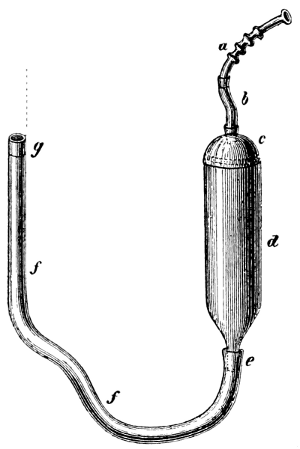
Fig. 59.—The Fumigator. (After Kiesenwetter).
The Fumigator.—This is not used by American collectors, but there are
several patterns sold by European dealers. It is intended to smoke out
specimens that hide in otherwise inaccessible places, e. g., cracks in
the ground, holes in hard wood, etc. The accompanying figure and the
following description of a fumigator are taken from Kiesenwetter. A
common smoking-pipe mouthpiece (Fig. 59, a) with flexible rubber joint
(b) is attached to the cover (c) of a very large smoking-pipe head
(d). To the mouth (e) of the latter a rubber hose (f) is attached,
which has a convenient discharge at its end (g). The pipe is then
filled with tobacco, and the latter ignited by means of a piece of
burning tinder placed on top; the cover is then screwed on, and the
smoke can be directed to any desired point by blowing air through the
mouthpiece. The smoke from a common pipe or cigar is often useful. In
sifting in cold weather a puff of tobacco smoke gently blown over the
débris on the collecting cloth will induce many specimens to move, which
otherwise “play possum” and could not be observed; and,
further, tobacco smoke blown into holes and cracks in timber by means of
an improvised funnel made of a piece of paper will be the means of
securing many rare specimens.
The Haversack.—In order that the above-mentioned instruments and the
various bottles, vials, and boxes which are needed for the preservation
of specimens may most conveniently and with the least impediment to the
collector be carried along on excursions, a haversack is indispensable.
This is made either of leather or, still better, of some waterproof
cloth, and should contain various compartments of different sizes; one
for stowing away the nets, the sieve, and the larger instruments, and
several smaller ones for boxes and vials—the whole so arranged that
each desired object can readily be taken out and that nothing will drop
out and get lost. The haversack is slung across the shoulders by means
of a leather strap, and a full field outfit need not be very heavy nor
seriously interfere with free bodily movements.
Many of the smaller objects are most conveniently carried in the pockets
of the coat, which acquires, therefore, some importance to the
collector. The coat should be of some durable stuff and provided with
many pockets, so arranged that in stooping nothing falls out of them.
The Lens and Microscope.—In the examination of the minuter forms of
insect life the naked eye is not sufficient, and a hand-lens, or, for
more delicate work, the compound microscope will be found necessary. I
had, in my early experience, some difficulty in getting a satisfactory
hand-lens, and the use of a poor hand-lens in time injures the eyesight,
as I know by a year's rather disagreeable experience. For a hand-lens
the achromatic lenses formerly manufactured by A. K. Eaton, of Brooklyn,
N. Y., and now made by John Green, 35 Liverpool street, East Boston,
Mass., are most excellent in workmanship and are satisfactory in every
respect. A very good lens can also be purchased of any of the leading
manufacturers of microscopical apparatus in this country. The kind of
compound microscope to be purchased will depend upon the nature of the
work of the investigator. Very serviceable instruments are made by J. W.
Queen & Co., Philadelphia, Pa., and by the Bausch & Lomb
Optical Company, of Rochester, N. Y., and others. The German microscopes
are in many respects superior to those of American make, and if one has
sufficient means, I would recommend the purchase of one of the better
instruments of Zeiss's manufacture, which may be obtained either direct
from the manufacturers or through Queen & Co., or from the Boston
Educational Supply Company. Microscopic material, including slides,
cover glasses, instruments for mounting, mounting media, staining
fluids, etc., may be obtained of either of the firms named above.
Having thus indicated somewhat fully the general methods of collecting,
and the paraphernalia most desirable in collecting, it will be well to
go still further into detail, and in connection with the different
orders give some more specific information that will be valuable as a
guide not only to the general collector, but to the specialist.
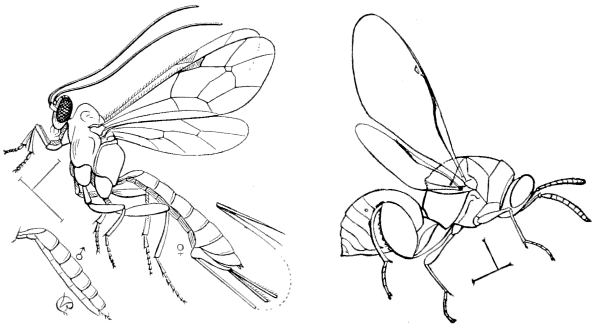
The insects of this order, including Bees, Wasps, Ants, Ichneumon-flies,
Gall-flies, Saw-flies, and allied insects have always been of unusual
interest both to entomologists and non-entomologists on account of their
diversified and peculiar habits. In abundance of species they exceed
perhaps even the Coleoptera. In general they are day fliers and always
to be found in abundance on bright days about flowers. The best season
for collecting is in early spring, on the bloom of the Willow, Alder,
and other trees. They may also be found at any season of the year, but
the males of many species are only to be taken in fall. In this order,
species of many groups can be most easily obtained by breeding. This
includes the gall-making family, Cynipidæ, and the parasitic families
Chalcididæ, Proctotrypidæ, Ichneumonidæ and Braconidæ. The Chrysididæ
and certain other less important families are also parasitic, but are
more easily obtained by general collecting. The implements necessary for
collecting Hymenoptera are the sweeping-net and the beating-net. Many
rare forms of the smaller parasitic families may be obtained by sweeping
the grass and foliage of all sorts. The Proctotrypidæ may be collected
in quantity by sifting leaves and rubbish collected in the woods. Mr. William H. Ashmead, who has made an especial study of this group, finds
winter sifting profitable. Dried leaves and rubbish are sifted, the
finer portion being retained and transferred to a bag. When a sufficient
quantity is collected it is removed to a warm room. Many hibernating
species are taken in this way, and, revived by the warmth, are easily
noticed when the material is spread on white paper.
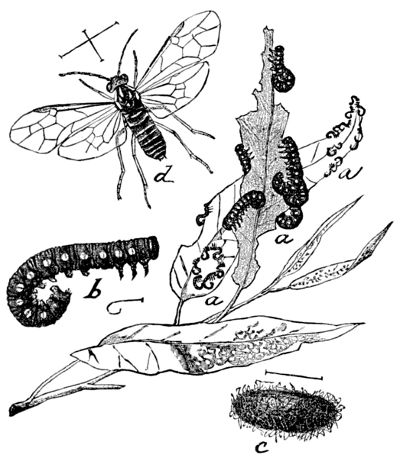
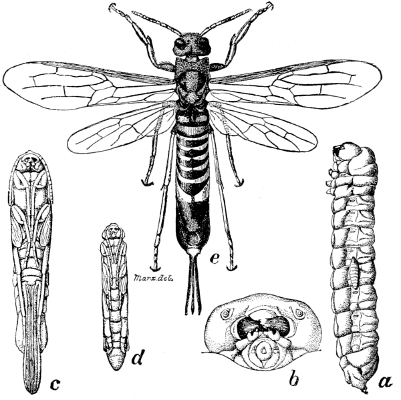
Fig. 60.—A Saw-fly (Nematus ventralis). a, a, a,
young larvæ; b, full-grown larva; c, cocoon; d, adult; all
slightly enlarged.
On account of the interest attaching to a knowledge of the various hosts
of parasitic insects the collector should always aim to obtain the
latter by breeding as much as possible. This can easily be done by
keeping a lookout for larvæ of all sorts which give evidence of being
parasitized. The larvæ of Lepidoptera found late in the fall are very
apt to be parasitized, and should be collected and kept over the winter.
The parasites will emerge throughout the winter season and in the early
spring. Such larvæ will be found on the trunks of trees, in the crevices
of the bark, and the cocoons of parasites will also be found in similar
situations.
The Tenthredinidæ (Saw-flies) are not so often found about flowers but
usually remain in the vicinity of the food-plant of the larva, and may
many of them be collected by sweeping. The larvæ of this family are in
many cases difficult to breed, as most of them are single-brooded, and
it becomes necessary to carry the larvæ over the winter.
The Gall-flies, Cynipidæ, are the easiest of the families to collect,
because of their abundance and because of the ease with which they may
be reared. Their galls occur in enormous variety on oaks of various
species and also upon brambles and certain common weeds. These should be
collected when mature and be kept in glass jars. The Gall-flies and
inquilinous and parasitic species may thus be easily obtained, the
former appearing at particular seasons and the latter emerging from the
galls at all seasons of the year, and sometimes continuing to escape for
a period exceeding two years.
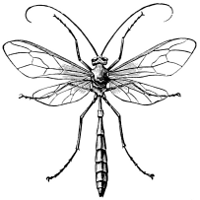
Fig. 61.—An Ichneumon (Ophion).
One of the most interesting families in this order is the Formicidæ,
which comprises the true ants. In the case of these insects isolated
specimens should not ordinarily be collected, and it is especially
desirable to collect the species from colonies so that the three forms
(males, females, and workers) may be obtained together. This holds also
in the case of the social wasps and bees, but the different sexes of the
latter may be collected in a season's collecting about flowers, the
females and workers in early spring and the males in the fall.
The Uroceridæ or woodborers are to be found only about trees in which
the larvæ breed. They may frequently be taken about tree trunks, or
burrowing with their long gimlet-like ovipositors into the trunks of
trees to oviposit. Breeding is also a satisfactory method of obtaining
these insects.
Some special methods of collecting Hymenoptera may be briefly outlined.
In the case of the social bees, particularly bumble-bees, and also the
smaller wasps and yellow-jackets, a very satisfactory method of
collecting consists in first stupefying the insects in the nest by
introducing a small amount of chloroform, benzine, or bisulphide of
carbon. This should preferably be done in the late evening, after all
the insects have come in for the night. The nest may then be opened and
examined without any danger of being stung, and the different forms may
thus easily be obtained, together with any rare parasitic or inquilinous
insects. In the case of the nests of Bombi this is the best method of
obtaining the inquilinous Apathus species.
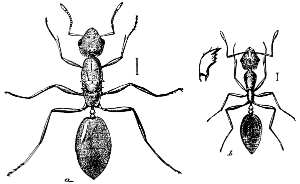
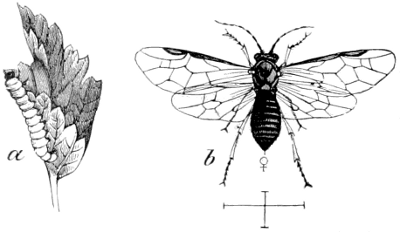
Fig. 62.—The Little Red Ant (Monomorium pharaonis).
a, female; b, worker enlarged.
On account of the danger of being stung, and also on account of the
extremely quick flight of these insects, the removing of Hymenoptera
from the net is not always an easy task, and in many cases rare
specimens escape. One method of avoiding the danger of being stung is to
have the collecting net constructed with an opening at the bottom which,
during the sweeping, is tied with a string. When a sufficient quantity
of insects is obtained they are, by a few quick motions, driven to the
bottom of the net, and the net is then seized just above the insects
with the hand, the folds of cloth preventing the insects from getting to
the hand, so that there is little danger of being stung. The lower end
is then carefully untied and inserted into a wide-mouthed bottle, and
the contents of the net shaken out into the bottle. After the catch is
stupefied the vial may be turned out and the undesirable material
discarded. A second method consists in the use of an ordinary
sweeping-net of light material. A quantity of Hymenoptera are collected
from flowers and driven to the bottom of the net, and secured as in the
preceding method. The portion of the net containing the insects is then,
by means of a pair of forceps, thrust bodily into a large collecting
bottle. After a few minutes the insects are stupefied and may be readily
examined.
General Directions.—Owing to their hard outer skeleton, Coleoptera can
be collected, handled, and preserved with greater safety and with less
trouble than most other orders of insects. From this fact, and from
their very great diversity in form, Coleoptera have, next to the
Lepidoptera, always been favorites. As a consequence, there are now more
species described in this than in any other order, and in the large
museums they are much better represented than other insects. This rich
material has been studied by numerous and competent specialists, and the
classification of Coleoptera is at present more advanced and more
accessible than that of the other orders. This fact gives stimulus to
neophytes, and though the literature of our North American fauna is much
scattered and we are still in want of comprehensive works (with the
exception of the general “Classification” by Drs. Le Conte
and Horn), yet, except in a few hitherto neglected families and smaller
groups, the species are fairly well worked up.
On the other hand, our knowledge of the earlier states of Coleoptera is
yet very imperfect as compared with the Lepidoptera. Coleopterous larvæ
are, with few exceptions (notably Coccinellidæ and some Chrysomelidæ),
much more difficult to find and rear, and their distinguishing
characters are more difficult to study. The few comprehensive works on
Coleopterous larvæ that have been published are based on rather scant
material and none of them deal with the North American fauna.
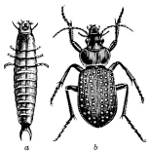
Fig. 63.—A Ground-beetle
(Calosoma calidum).
a,
larva; b, adult.
Coleoptera occur in all climates and in all localities. Species are
known from the highest northern latitudes ever reached by man, and in
the tropics they occur in an embarrassing richness of forms. They are
found in the most arid desert lands, in the depths of our subterranean
caves, and on our highest mountains up to the line of eternal snow. The
open ocean and the open water of our Great Lakes are the only regions
free from them. As a rule, the number of species gradually increases
from the Arctic regions toward the tropics, but it would be difficult to
decide, speaking of North America, whether or not the fauna of the
Middle States is poorer in the number of species than that of the
Southern States; or whether the beetles of the Atlantic slope outnumber
those of the Pacific States or those of the Central region. On the
Pacific slope the influence of the seasons on insect life is greater
than on the Atlantic slope. While in the latter region a number of
species may be found the whole year round, there is, in the more arid
regions of the West, an abundance of insect life during and shortly
after the rainy season, with great scarcity during the dry season,
except, perhaps, on the high mountains.
Few persons have had a more extended experience in collecting Coleoptera
than Mr. E. A. Schwarz, one of my assistants, and the following account
has been prepared by him at my request and is given in extenso.
Winter Collecting.—There are more species of Coleoptera
hibernating in the imago state[3] than in any other order and winter
collecting is therefore most profitable in many respects. For instance,
great swampy tracts which are inaccessible in the summer season harbor
an abundance of rare Coleoptera, which either can not be found in summer
time or are found at that season with the greatest difficulty. At the
approach of winter, however, all or most of these species will leave the
swamp and seek drier ground, where they hibernate under old leaves,
under bark of trees, or in rotten stumps near the edge of the swamp.
Such places will, therefore, give a rich harvest to the Coleopterist
late in the fall, during warm spells in midwinter, and in very early
spring. If the temperature is below the freezing point, or if the ground
is frozen hard, no winter collecting should be attempted, first,
on account of sanitary considerations, and also because the Coleoptera
then retreat more deeply into the ground and can not be found so easily
as when the ground is free from frost. Other good collecting places in
winter are the accumulated old leaves along the edges of forests or
under the shrubbery along water courses, thick layers of moss, and the
loose bark of dead or dying trees, and, finally, also under the bark of
certain living trees, e. g. Pines, Sycamore, Shellbark Hickory.
Digging in the ground at the base of large trees or rocks also yields
good returns. The only instruments necessary for winter collecting are
the sieve, the chisel, and the trowel.
Spring Collecting.—With the first days of spring, collecting becomes a little more
varied. The methods used for winter collecting can still be continued with good
success. Certain spring flowers, notably Willow blossoms, will furnish many valuable
species, which are not seen again during the rest of the season.
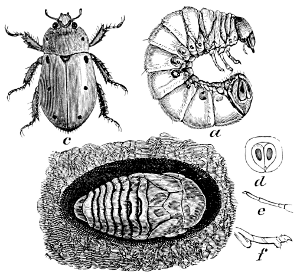
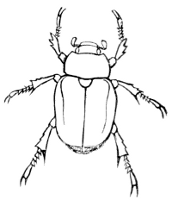
Fig. 64.—A Lamellicorn (Pelidnota punctata).
a, larva;
b, pupa; c, beetle; d, e, f, enlarged parts.
Myrmecophilous and Termitophilous species.—The early spring is
also the best time for collecting the Myrmecophilous and Termitophilous
Coleoptera. Termitophilous species have in North America hitherto been
found only in connection with the White-ants (Termes flavipes), and
the inquilinous beetles are found running among the White-ants in the
colonies under stones, loose bark of trees, and more numerously in the
interior of old infested trees. Myrmecophilous Coleoptera are by far
more numerous in species than the Termitophilous species and are found
among many species of ants which have their nests either under stones or
loose bark of trees, in stumps or logs, or which construct larger or
smaller hills. Upon uncovering a colony of ants under a stone, the
underside of the latter as well as the galleries of the ants in the
ground should be carefully examined for inquilines, which from their
greater or slighter resemblance to the ants are liable to be overlooked
by an inexperienced collector. If such colony of ants harbors a rare
beetle the subterranean part of the colony itself should be dug out and
sifted, but since from the stony nature of the ground this is not always
practicable it is to be recommended to carefully replace the stone under
which the colony has been found. Upon revisiting the spot again the next
day or even a few hours after the first visit additional specimens of
the inquilines are usually to be obtained on the stone or in the
superficial galleries of the ants. Ant colonies in hollow trees and in
rotten logs should be sifted and there is no particular difficulty
connected with this operation. Owing to the pugnacious character of the
hill-constructing ants it would seem to be a rather unpleasant task to
examine a strong and vigorous colony for inquilinous beetles, but the
collector must not mind being bitten and stung by the infuriated ants,
and after a little experience he will find that it is not such a
difficult thing after all to attack even the largest ant-hill. The only
thorough way of investigating such ant-hills is to sieve the same, which
can be easily done if the hill is composed of sticks and other vegetable
débris. If it is built of earth or sand the process of sifting is more
difficult and tedious. Another method of securing specimens of these
inquilinous beetles is to place flat stones or similar objects on the
surface of the ant-hill and to examine them occasionally, when the
beetles will be found on the underside of the traps.
Spring Flights of Coleoptera.—On the first really warm days of
spring commences the “swarming” season of
Coleoptera, when all winged species are flying about, especially toward
evening. On favorable days the number of specimens and species that can
thus be found is astonishingly great, and this is one of the few
occasions when the Coleopterist can advantageously use a light butterfly
net. The flying beetles preferably alight and rest on the top of wooden
fences (especially newly made ones), on the railings of bridges, etc.,
where they can be easily seen and secured, or they are attracted in
great numbers by the white-painted surface of buildings. This flying
season lasts in the latitude of Washington from the end of April to the
middle of June, but favorable days are not of frequent occurrence, since
a peculiar combination of atmospheric conditions appears to be necessary
to induce the Coleoptera to fly about in great numbers.
Beach collecting.—Along the shores of the ocean and the Great
Lakes untold numbers of Coleoptera and other insects fall at this season
into the water, and, if the tides, the currents, and the winds be
favorable, they are washed ashore by the waves on the sandy beaches,
where they often form windrows several inches in height and width. If
the collector is happy enough to be at the right place on the right day
he has then the opportunity to pick up hundreds of rare species within a
very short time and without any trouble. Many of the specimens thus
washed ashore are dead and decayed, but the majority are alive and in
excellent condition. This “beach collecting” affords also an
excellent opportunity for the Hymenopterist and Hemipterist to secure
large numbers of rare species, but favorable days are also here of rare
occurrence.
Attracting by Lights.—On the beaches, day and night flying
insects can thus be captured. Away from the beach night-flying
Coleoptera can best be collected at the electric lights of our cities;
but, as in the Lepidoptera, not all night-flying species are attracted
by the light. Gas and other lights also attract Coleoptera, and the
various “light traps” that have been devised and described
can advantageously be used for collecting these insects.
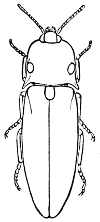
Fig. 65.—An Elaterid
(Pyrophorus noctilucus).
(From Packard.)
Traps.—The method of “sugaring,” so important to the Lepidopterist, is by far less
favorable for collecting Coleoptera. Still, certain rare Carabidæ, Elateridæ, and
Cerambycidæ are attracted by this bait, and the Coleopterist
should not entirely ignore this mode of collecting. There are
a few other methods of trapping certain Coleoptera. By laying
out dead mammals, birds, fishes, snakes, etc., on suitable places
and so that they are protected from dogs, rats, etc., the carrion-feeding
Coleoptera can be found in great abundance, but a cleaner
and less disagreeable method of obtaining them is to bury in
the ground tin cans or glass jars so that the top is even with
the surrounding ground and to bait them with pieces of meat,
fried fish, boiled eggs, etc. Many Curculionidæ, Scolytidæ, and
numerous other wood-inhabiting species can be successfully
trapped in the following way: A number of branches, preferably
of only one kind of tree, are cut and tied up into bundles of convenient
size. The bundles are then laid on the ground in a
shady place or firmly fastened on trunks of trees. When the
cut branches begin to get dry they will attract many of these
Coleoptera, which can then be readily collected by shaking the
bundles out over the collecting cloth.
Freshets.—Freshets usually take place in springtime in most of
our rivers and creeks, and furnish the means of obtaining a multitude of
Coleoptera, among which there will be many species which can not, or
only accidentally, be found otherwise. These freshets, sweeping over the
low banks or inundating wide stretches of low land, carry with them all
insects that have been caught by the inundation. Intermingled with, and
usually clinging to, the various floating débris, these insects are
eventually washed ashore by the current at various points and
the Coleopterist should not miss this rare opportunity, but go out to
the river bank at a time when the water is still rising, or at least
when it has attained its highest point. Among, or on the washed up
débris, a multitude of Coleoptera of various families can be found, and
the specimens can either be gathered up on the spot or a quantity of the
débris be put in sacks and taken home, where it can be examined more
thoroughly and with greater leisure than out of doors. A day or so after
the floods have receded the washed up specimens will have dispersed and
only a few will remain in the débris for a longer period. Still more
profitable than the spring floods are the summer freshets, because a
larger and more diversified lot of Coleoptera is then brought down by
the water. A similar opportunity for collecting is offered near the
seashore if unusually high tides inundate the low marshes along the
bayous and inlets.
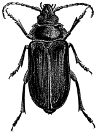
Fig. 66.—A Longicorn
(Prionus
laticollis).
Summer Collecting.—During the latter part of spring and throughout
the whole summer, when the vegetation is fully developed, every possible
collecting method can be carried on with success, so that the beginner
hardly knows what particular method to use. There are stones to be
turned over; old logs, stumps, and hollow trees to be investigated;
newly felled or wounded trees to be carefully inspected; here a spot
favorable for sifting claims attention; promising meadows and low
herbage in the woods invite the use of the sweeping net; living or dead
branches of all sorts of trees and shrubs to be worked with the
umbrella; the mud or gravel banks of ponds, lakes, rivers, and creeks
afford excellent collecting places; the numerous aquatic beetles are to
be collected in the water itself; the dung beetles to be extracted from
their unsavory habitations; in the evening the electric and other lights
are to be visited, the lightning beetles chased on meadows and in the
woods, or the wingless but luminous females of some species of this
family to be looked for on the ground, and the trees and shrubs are to
be beaten after dark in search of May beetles and other nocturnal
leaf-feeding species which can not be obtained at daytime; and, finally,
some of the rarest Scarabæidæ and some other species fly only late at
night or again only before sunrise.
In view of this embarrassing multitude of collecting opportunities in a
good locality, the beginner is apt to be at a loss what course to
pursue. Experience alone can teach here, and only an expert collector is
able to decide, at a glance at the locality before him, what collecting
method is likely to produce the best results, and his judgment will
rarely be at fault.
It is impossible to go into details regarding the various collecting
methods, just mentioned, and only a few general directions can be given
regarding those methods which have not previously been alluded to.
Collecting under Stones.—Turning over stones is a favorite
method among beginners multitude of species of other families. Stones on
very dry ground are productive, only early in spring or in the fall,
while those on moist ground, in the shade of woods, are good at all
seasons. In the Alpine regions of our mountainous districts, especially
above the timber line, collecting under stones becomes the most
important method, and is especially favorable along the edges of snow
fields. In often frequented localities the collector should carefully
replace the stones, especially those under which he has found rare
specimens. The neglect of this rule is one of the principal causes for
certain rare species having become extinct in the vicinity of our
cities.
Collecting in rotten Stumps and Logs.—Success in collecting in
rotten stumps depends much upon the more or less advanced stage
of decay as well as upon the situation of the log and upon the
particular kind of wood. If the decay is very much advanced neither the
loose bark nor the interior of the log will harbor many Coleoptera
excepting a multitude of Passalus cornutus and its larvæ. If the decay
is less advanced, but if such log is exposed to the scorching rays of
the sun, it will be far less productive than a log in a shady situation.
The investigation of the bark of a favorably situated log in the right
stage of decay does not need any special instruction, but the decayed
wood itself should be pried off with a chisel or trowel, put in the sieve and sifted on the collecting cloth. This is the best
way of obtaining the numerous species of rare Micro-coleoptera of
various families that inhabit such places. A “red rotten”
oak or beech log is more favorable for this mode of collecting than a
“white rotten” of the same or other kinds of trees.
Collecting in dying or dead Trees.—Dying or dead trees almost
always harbor a large number of Coleoptera and offer an excellent
collecting opportunity until the wood becomes thoroughly dry, which
usually takes place in large trees two or three years after the death of
the tree, and in less time with smaller ones. The bark of such trees is
the best collecting place for Cucujidæ, Colydiidæ, Scolytidæ, Histeridæ,
etc., and it will be found that the shady side of the tree is more
profitable than the side exposed to the sun. The numerous Buprestidæ,
Elateridæ, Ptinidæ, Cerambycidæ, Melandryidæ, etc., which breed in the
wood can be obtained only with difficulty. Some specimens may be cut out
from their holes by a skillful use of the knife or hatchet; others
(especially the Buprestidæ) may be found resting on or crawling over the
trunk in the bright sunshine, while the more nocturnal species may be
found on the tree toward evening or after dark, when, of course, a
lantern must be used. A large proportion of the species living in the
trunks of dead trees also breed in the dead branches of otherwise
healthy trees from which they can be beaten into the umbrella, or where
the use of the knife is more practicable than in the large trunks. The
trunks of freshly felled trees attract numbers of Cerambycidæ and
Buprestidæ and have to be carefully looked over, while the drying
foliage of such trees affords an excellent opportunity for the use of
the umbrella.
Beating living Trees, Shrubs, and Vines.—The success of beating
into the umbrella branches of living trees and shrubs depends on the
particular kind of tree or shrub, on the condition and situation of
these, and largely also upon the season. Pine trees are very productive
from early in the spring to early in the summer, but much less so in
midsummer and later on. Young Oak trees or Oak shrubs are much more
preferred by the leaf-eating Coleoptera peculiar to this tree than the
older trees. The Beech, which, next to the Oak, is the best tree for
wood-boring species, harbors but few leaf-eating species. The leaves of
the Chestnut are also generally not attacked by Coleoptera; still a
surprising number of species can be beaten from this tree when it is in
blossom. There is not a single species of Coleoptera known to live in
the wood or to feed on the leaves of the Holly (Ilex glabra); still it
will pay the Coleopterist to beat this tree when it is in bloom. Trees,
shrubs, and vines in the interior of unbroken forest districts are, as a
rule, unproductive, while the edges of the woods, narrow strips of
hedges, and especially solitary trees are excellent collecting places.
In the Rocky Mountains, especially in the more southern sections, long
stretches of mountain slopes are occasionally perfectly bare of
vegetation with the exception of a few solitary, sickly-looking, and
dwarfed trees, but every one of these is a veritable gold mine to the
Coleopterist with his umbrella.
Sweeping.—The use of the beating net continues profitable from
spring till fall, a different set of species appearing with each season.
Low and swampy meadows, meadows on the slopes of mountains or surrounded
by woods, low underbrush, and herbage in smaller patches of woods are
very good beating grounds. Dry and sandy meadows are less productive,
but harbor usually a different set of species on account of the
difference in the flora. Pastures and meadows much frequented by cattle
and horses are much less productive, and where a large number of sheep
are kept there is usually no chance for using the beating net,
since neither grass nor specimens are left. The lawns in our parks and
gardens are usually poor collecting ground on account of the limited
variety of plants in such places; but the few species found there occur
in enormous number of specimens. The endless stretches of our western
prairies swarm at the right season (in June) with numerous Coleoptera
(mostly Malachiidæ, Chrysomelidæ, Mordellidæ, Curculionidæ, etc.),
provided prairie fires have not swept too frequently over the place.
Fires and cattle produce a remarkable change in the flora and fauna of
the prairies; many indigenous species disappear or become scarce and are
replaced by a much smaller number of imported species.
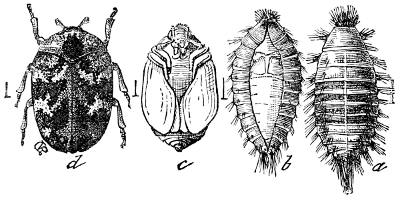
Fig. 67.—A Dermestid (Anthrenus scrophulariæ).
a, larva, dorsal view; b, larva, ventral view; c, pupa; d,
adult—all enlarged.
Sweeping may commence in the forenoon as soon as the dew has
disappeared; it is less profitable in the heat of the midday, but
produces the best results late in the afternoon and more especially in
the short interval from just before sunset until dark. At this time many
rare Pselaphidæ and Scydmænidæ, species of the genera Colon and
Anisotoma, and other small Silphidæ can be beaten from the tips of
grasses, all being species which can not, or only accidentally, be found
during daytime, when they hide between the roots of plants.
Collecting on mud and gravel Banks.—The mud or gravel banks of
rivers, creeks, and stagnant bodies of water are inhabited, especially
early in summer, with an astonishing multitude of Coleoptera. Countless
specimens of smaller Carabidæ (Dyschirius, Clivina, Bembidium,
Tachys, etc.) and Staphylinidæ (Tachyusa, Philonthus, Actobius,
Stenus, Lathrobium, Trogophlæus and many other genera) will be
seen actively running over the mud or sand; many other specimens are
hiding under the pebbles in company with other species (Cryptohypnus,
Georyssus, etc.) or in little subterranean galleries (Dyschirius,
Bledius, Heterocerus). All these beetles must be collected by
picking them up with the fingers, an operation which, owing to the
activity of the specimens, requires some little practice. The beginner
will at first crush or otherwise injure many of the delicate specimens,
the capture of which is moreover by no means facilitated by the rapidity
with which most of them are able to take wing. The collector must
necessarily kneel down and he must not mind getting covered with mud. A
good device for driving these species out of their galleries or from
their hiding places under stones or in cracks of the ground is to pour
water over the banks, and this can in most cases be done with the hand.
Larger stones and pieces of wood or bark lying on the bank are favorite
hiding places of certain larger Carabidæ (Nebria, Chlænius,
Platynus, etc.), and should of course be turned over. Finally, the
moss growing on rocks and logs close to the water's edge, and in which,
besides other beetles, some rare Staphylinidæ and the Byrrhid genus
Limnichus can be found, should be scraped off and investigated on the
collecting cloth or on the surface of a flat rock, if such be
conveniently at hand.
Collecting aquatic Beetles.—The fishing for water beetles in
deeper water by means of the water net has already been alluded to (p.
[32]), but many species live in shallow brooks with stony or gravelly
bottom, where the water net can not be used. The Dytiscidæ and
Hydrophilidæ living in such places usually hide under stones, and can in
most cases be easily picked up with the hand, or a little tin dipper or
a spoon will be found convenient for catching them. The species of the
family Parnidæ are found on the underside of rough stones or logs which
are either partially or entirely submerged. They are more numerous,
however, in the moss or among the roots of other plants that grow in the
water. Such plants have to be pulled out and examined over the
collecting cloth.
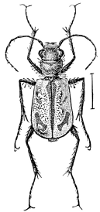
Fig. 68.—A Tiger Beetle
(Cicindela limbata), drawn
by Miss Sullivan—enlarged.
Collecting at the Seashore and on sandy Places.—A large number
of species belonging to various families live exclusively in the
vicinity of the ocean, some on the open beach, others along the inlets,
bayous, or salt marshes, and still others on the dry sand dunes. The
Cicindelæ are actively running or flying about close to the water's edge
and have to be captured with the butterfly net. The remaining maritime
species live hidden under the seaweed and other débris cast up by the
waves, or in the sand (sometimes quite deep below the surface) beneath
the débris or between the roots of the plants growing on the dunes. The
majority of the maritime species do not appear before June (in the
Middle States), but the collecting remains good until September.
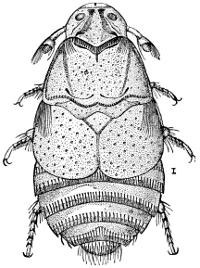
Fig. 69.—The Beaver Parasite
(Platypsyllus castoris),
adult—greatly enlarged.
In dry sandy places away from the seashore, the collecting at the roots
of plants is especially to be recommended, and the plants, and more
especially the bunches of coarse grasses usually growing in such places,
should be pulled up and shaken out over the collecting cloth. This mode
of collecting acquires a great importance in the arid regions of the
West and Southwest, where, in the warm season, nearly all Coleoptera are
hiding during daytime in the ground at the roots of plants.
Collecting Dung-beetles.—The collecting of the numerous species
(Hydrophilidæ, Staphylinidæ, Histeridæ, Scarabæidæ, etc.) which
live in the droppings of various animals is by no means an agreeable
task. The collector should provide himself with a pointed stick and
collecting tweezers, and must manage to pick up the specimens as best he
can. The larger specimens are best collected in alcohol, while the more
delicate species can be collected in a cleaner condition by removing the
droppings and sifting the ground beneath the same. Some species hide
deep in the ground beneath the droppings and have to be dug out. Summer
freshets, when pasture lands are inundated, offer an excellent
opportunity for collecting the dung-inhabitingspecies in a
clean condition.
Night Collecting.—The beating of trees and shrubs after dark is
a good method of obtaining Lachnosternas and other species, and here the
collector will do well to secure the assistance of a companion, who
takes charge of the lantern and the collecting bottles, while the
collector himself works the umbrella.
Fall Collecting.—From the first of August the number of species
gradually diminishes, but late in the summer or early in fall quite a
number of other species make their appearance, e. g., some
Chrysomelidæ, Cerambycidæ, and many Meloidæ. Many of these frequent the
blossoms of Golden-rods, umbelliferous and other late-flowering plants.
The fall is also the best season for collecting Coleoptera living in
fungi. Although puff-balls, toadstools, and the numerous fungi and
moulds growing on old trees, etc., furnish many species of Coleoptera
also earlier in the season, yet most fungi, and more especially the
toadstools, flourish best in the fall, and consequently there is then
the greatest abundance of certain species of Coleoptera. Decaying
toadstools are especially rich, and should be sifted, and the collector
should also not omit to examine the soil beneath them.
During the “Indian summer” there is usually a repetition of
the “spring flight” of Coleoptera, though on a smaller
scale, and collecting on the tops of fence posts and on whitewashed
walls again becomes good. The first really sharp frost causes these late
species to disappear, and winter collecting commences again.
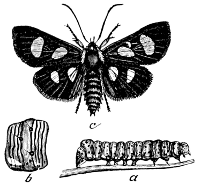
Fig. 70.—The Eight-spotted Forester
(Alypia
octomaculata). a, larva; b,
enlarged segment of same; c, moth.
In this order the importance of collecting the early states and of
rearing the adult insects rather than of catching the latter should, if
the collector has the advancement of knowledge and the greatest pleasure
in mind, be insisted upon. Collected specimens, in the majority of
cases, will be more or less rubbed or damaged and unfit for permanent
keeping, and will always be far inferior to freshly reared specimens.
All Lepidopterists, therefore, rely to a great extent upon breeding
rather than upon field collecting. There are, however, many species of
which the early states are still unknown, and these can only be taken by
field collecting, and by attracting to various lights or traps. This
subject, therefore, naturally falls into two categories—(1) the general
collecting of the adult, and (2) collecting the early stages and rearing
the perfect insects.
Collecting the Adult.—The implements for the general collecting of
butterflies comprise the collecting net, and in some cases the beating
net, although the use of the latter will not often be called for. The
Rhopalocera or Diurnals may be taken about flowers, and the best season
is in the early spring. Most of them are double-brooded, and the second
brood will be in the greatest abundance during July and August. They
are, however, to be found throughout the summer. They are also to be
looked for in the neighborhood of the food-plants of their larvæ, and in
the case of many species, examination of such plants affords the most
satisfactory means of collecting. The food of butterflies is almost
exclusively the nectar of flowers, but strangely enough they are also
attracted to decaying animal matter, and many species, including rare
forms, may be taken about decaying animal matter or resting on spots
where dead animals have lain, or beneath which they have been buried.
Moist spots of earth are also frequented by them, especially in dry
seasons. Many of the larger butterflies, whose larvæ feed
on the taller shrubs and the foliage of trees, will be found fluttering
about the open spaces in forests, but by far the larger number, as the
Browns, the Blues, the Yellows, and the Whites, which develop on the
lower herbaceous and succulent plants, will be found flying over fields,
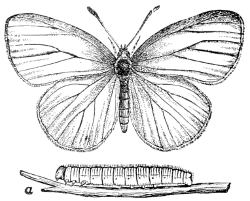
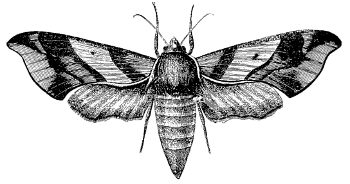
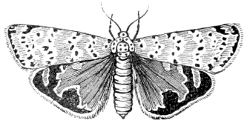
prairies, and gardens. Crepuscular and nocturnal Lepidoptera, comprising
most of the Heterocera, the Sphingidæ, Bombycids, Noctuids, etc., have
different habits. The Sphingidæ or Hawk Moths fly in early evening, and
may be collected in quantity about such plants as the Honeysuckle,
Thistle, Verbena, Petunia, etc. The Bombycids and many Noctuids also fly
in the early evening, but mostly at night. The former, however, do not
frequent flowers, except such as are the food-plants of their larvæ, as
their mouth-parts are rudimentary, and they take no nourishment.
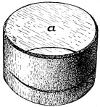
Fig. 71.—Collecting Pill-box.
a, glass bottom
(original).
Collecting by the aid of strong light is a favorite means for moths as
well as other insects, and nowadays the electric lights in all large
cities furnish the best collecting places, and hundreds of species may
be taken in almost any desired quantity. In woods or in other situations
they may be attracted to a lantern or to a light placed in an open
window. Various traps have been devised, which comprise a lamp with
apparatus for retaining and stupefying the insects attracted to the
light. The common form is made by providing a lantern with a strong
reflector. Under the light a funnel several inches larger than the
lantern reaches down into a box or bottle containing the fumes of
chloroform, ether, or benzine.
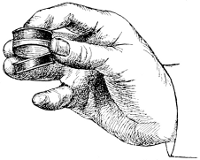
Fig. 72.—Method of holding and manipulating
collecting
pill-box in capturing (original).
Mr. Jerome McNeill describes at length and figures in the American
Naturalist, Vol. xxiii, p. 268–270, an insect trap to be used in
connection with electric lights. It consists of a tin pail or can
charged with cyanide after the manner of a collecting bottle, which is
attached beneath the globe of the electric light.
The insects attracted by the light strike against a vertical tin screen
fixed above the can and fall into a tin funnel the small end of which
enters and closes the mouth of the can, and they are thus conducted into
the last. A support or post in the center of the can bears a hollow tin
cone, the apex of which is pierced with a number of small holes to admit
light, and enters and partly closes the lower end of the funnel. The
entire interior of the can is painted black and the chief light comes
through the holes in the apex of the interior cone. The entrapped
insects endeavor to escape by crawling up the central post towards the
light coming through the small holes in the end of the cone rather than
by the entrance slit about the latter and fall back repeatedly until
overcome by the cyanide.
Many of the Lepidoptera will be ruined by the beetles and other insects
or by their own ineffectual attempts to escape, but Coleoptera,
Hymenoptera, Neuroptera, and Hemiptera are secured in satisfactory
condition.
Many of the devices are very complicated and can not be described in
this connection. The nocturnal species, also, fly into our houses, and
this is especially the case in the country, and an open window, with a
strong light reflected onto a table covered with either a white paper or
a white cloth will keep one busy, on favorable nights, in properly
taking care of the specimens thus attracted.
Another favorite method of collecting moths early in the evening, or as
late as or later than midnight, is by sugaring. This consists in
smearing a mixture of sugar and vinegar, or some similar compound, on
the bark of trees or on the boards of fences, and visiting the spot from
time to time to collect the moths attracted to the bait. It has been
found that the use of beer or some other alcoholic liquor, as rum or
brandy, with the sugar or molasses water, greatly adds to its efficiency
in attracting the moths. This method of collecting moths will be found
especially efficient on warm, moist, cloudy nights. The collector should
be provided with a dark lantern and a good net, and a number of
wide-mouthed cyanide collecting bottles. The smearing should be done
just before dark, and I have always found that better success attends
this method of collecting when two are engaged in it—one to hold a
bull's eye lantern while the other bottles the specimens. Experience
will soon teach the surest way of approaching and capturing the
specimens.
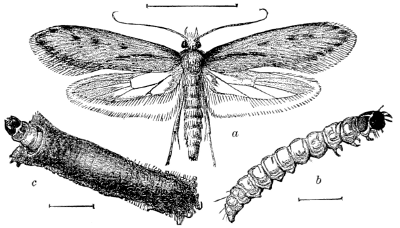
For collecting Microlepidoptera, in addition to the ordinary net, some
special apparatus will be found very essential. Lord Walsingham makes
use of a special glass-bottomed pill-box, with which to capture
specimens, and the satisfactory nature of the work done with this box,
and the dexterity acquired by practice with it, I can vouch for by
personal experience. These glass pill-boxes are useful, also, in
admitting of the examination of specimens, so that worthless or common
species can be discarded and only desired forms kept. The method of
holding these boxes is illustrated in the accompanying illustrations.
(Figs. 72, 73.) A drop of chloroform on the bottom of the box at once
stupefies the capture so that it can be taken out and otherwise disposed of.
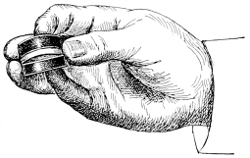
Fig. 73.—Same, showing method of closing pill-box
after
the specimen is secured (original).
The necessity of rearing to obtain perfect specimens is even more
important in the case of the Microlepidoptera than with the larger
forms, and many species are very easily reared and can thus be obtained
in quantity. The Micros are abundant from early spring to late fall
about shrubbery, in open fields, and along the edges of woods. They are,
for the most part, day fliers, being on the wing chiefly in the latter
part of the day and early evening. As soon as collected they should be
transferred to pill-boxes and the greatest care should be exercised to
avoid mutilating them, as the slightest touch will denude them of a
portion of their scales or break their limbs or antennæ. Lord Walsingham
thus gives his experience in collecting Micros:
I go out with a coat provided with large pockets inside and out,
containing an assortment of pill-boxes, generally of three sizes,
glass-bottomed pill-boxes preferred, a bag slung over my shoulder,
and a net. Unless searching for particular day-flying species, I
prefer the last three hours before dark. As the sun goes down many
species move which do not stir at other times. I watch the tops of
the grass, the stems of the flowers, the twigs of the trees; I
disturb leaves and low-growing plants with a short switch and
secure each little moth that moves, taking each out of the net in a
separate pill-box, selected according to the size of the insect, as
he runs up the net to escape. Transferring the full boxes to the
bag I continue the process until moths cease flying or night sets
in. Many species can be taken with a lamp after dark.
Collecting the early States.—The careful entomologist who prides
himself on the appearance of his specimens, will, as stated above, rely
largely on collecting the early states and on rearing the insects, for
his material. The Macrolepidoptera have either a single or two broods,
or more, in a season, and the collection of the early states will be
greatly facilitated if a knowledge of the insect's life-habits is first
obtained. The eggs are often found on the food plants of the species,
and where they are deposited in masses they afford a very easy method of
getting the larvæ in numbers. In many cases, however, the eggs are
deposited singly and their discovery then becomes a difficult matter.
More satisfactory in some respects is the method of obtaining the eggs
from captured gravid females, and the general collector should always be
on the lookout for females of rare species from which he may be able to
obtain eggs. A single battered female may, in this way, be the source of
large numbers of excellent reared specimens. Many rare Lepidopterous
larvæ may be obtained by the use of the beating net and by beating
foliage over an umbrella. A very satisfactory method consists in
collecting pupæ, which may frequently be found in numbers about the
bases of the trees on which the larvæ feed. Many larvæ of the large
family of Owlet Moths (Noctuidæ) are found either on the surface of
the ground or under various substances, while others burrow into the
stems of the different herbaceous plants, some being subaquatic and
feeding on the underside of leaves or in the stems of aquatic plants. In
the case of Microlepidoptera, their habit as larvæ, of mining leaves or
tying or webbing them together, affords an easy means of detecting their
presence in most cases. The miners are easily noticed by the discolored
spots on the leaves or the wavy, pale, or brown lines marking their
burrows. The presence of others is indicated by the leaves being drawn
together and united with webs, or withered and brown from being
skeletonized by the larvæ. Many species are case-bearers, and live upon
the leaves and branches of trees and plants, dragging their cases along
with them. Others burrow in grasses or in the stems of plants or the
trunks of trees, or in fungi. In the case of the leaf-miners and
leaf-tiers, little difficulty is experienced in rearing the imagoes.
The care of the larvæ, the outfit required, and the methods of breeding
will be described in later sections.
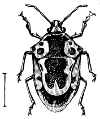
Fig. 74.—A Pentatomid
(Stiretrus anchoraga).
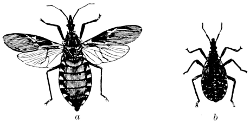
Fig. 75.—The Blood-sucking Cone-nose
(Conorhinus
sanguisuga).
a, mature bug; b, pupa.
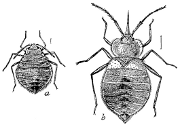
Fig. 76.—The Bed-bug (Acanthia lectularia).
a,
young; b, adult—enlarged.
For the most part the directions for collecting Coleoptera will apply to
this order of insects equally well, especially so far as concerns the
first section of the order (Heteroptera), and the higher families of the
second section (Homoptera). A few directions may be given for the lower
forms, including the Aphididæ, Coccidæ, Aleurodidæ, and Psyllidæ, and
the suborder Parasita, including the degraded forms which infest man and
the lower animals. The Plant-lice or Aphides should always be collected
in connection with their food-plants, and it is very essential also to
collect the same species at different seasons of the year to obtain the
different forms or generations, which frequently present very marked
differences. It is also very necessary to secure the winged forms, which
are usually produced toward autumn, and without which the species are
not easily identified. The Bark lice or Scale-insects should also be
collected in connection with the leaves or twigs which they infest. The
males of these insects are minute and, as a rule, two-winged, resembling
small gnats, and may be bred from the male scales. The females are for
the most part stationary, being fixed to the plant by the protecting,
waxy, excretion or scale. The Flea-lice (Psyllidæ) frequently produce
galls, and these should always be collected with the insect architects.
Some species do not produce galls, and may be collected by sweeping. The
Hackberry is infested by large numbers of species of Psyllids, and these
produce a great variety of interesting galls. The Aleurodidæ
(Fringe-scales) are delicate insects, and easily injured in the taking;
they are therefore best reared from their stationary and fringed larvæ
and pupæ, which occur on the leaves of many plants. Leaves bearing the
latter should also be collected and pinned or preserved in alcohol. The
Parasita, the lowest representatives of the order, may be obtained from
the domestic and wild animals which they infest.
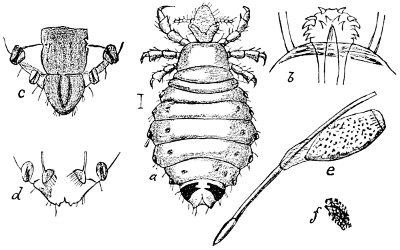
Fig. 77.—The Short-nosed Ox-louse (Hæmatopinus
eurysternus). a, female; b, rostrum; c, ventral surface, last
segments of male; d, female; e, egg; f, surface of egg greatly
enlarged.
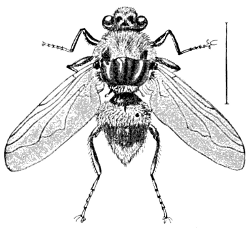
Fig. 78.—Ox Bot-fly (Hypoderma bovis)
enlarged.
(After
Brauer.)
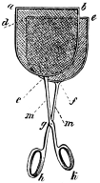
Fig. 79.—The Collecting Shears.
(After Kiesenwetter.)
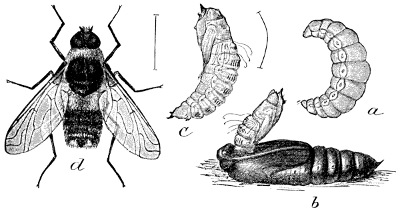
Fig. 80.—A Bee-fly (Anthrax hypomelas). a, larva
from side;
b, pupal skin protruding from cutworm chrysalis; c, pupa;
d, imago—all enlarged.
Fig. 81.—A Syrphus-fly.
Most Diptera frequent flowers and may be collected with a sweeping net
without much difficulty. The best season is from April to June, and the
bloom of the Willow, Alder, Plum, Cherry, Dogwood, Blackberry, etc.,
will ordinarily yield a bountiful supply of specimens and species.
Parasitic and saprophytic forms may also readily be obtained by
breeding, the former as in the case of the parasitic Hymenoptera, and
the latter from decaying vegetable matter and fungi. The Diptera
require the most delicate treatment, and the greatest care must be
exercised both in collecting and handling. A light sweep net is the best
implement for collecting and the contents of the net should frequently
be emptied into bottles provided with blotting paper to absorb the
excess of moisture. Very small Diptera should not be killed when they
can not be immediately pinned, and hairy flies should never be taken
from the net with the hand, but should be handled with fine forceps. A
pair of special collecting shears has been used by Lord Walsingham very
successfully. It is represented in the accompanying figure, and consists
of a pair of screen-covered disks, between which the fly is caught. The
insect is at once pinned through the screen and may be removed and
transferred to a box containing a sponge soaked in chloroform. The use
of this implement is especially advisable in the case of the Bee-flies
(Bombiliidæ) and other hairy forms which are liable to be rubbed when
collected in the ordinary net. The Gall-making Diptera (Cecidomyidæ)
are of little value unless accompanied with their galls, and the aim
should always be to collect the galls and rear the insects rather than
the keeping of specimens taken in the course of general collecting with
a sweep net. The rearing of Cecidomyidæ is, however, a delicate task,
and requires considerable experience. Some knowledge of the habits of
the species is very essential to success. From immature galls no
rearings need be expected. A good plan is to examine the galls from time
to time and collect them when it is found that the larvæ are beginning
to abandon them. In the case of species like the common Cone Gall-gnat
of the Willow, the larvæ of which do not leave the gall to undergo
transformation in the earth, it is advisable not to gather the galls
until the transformation to the pupa state takes place, which, in this
species, occurs in early spring. The various leaf-mining and seed
inhabiting species can be treated as in the case of the
Microlepidoptera.
The insects of this order may all be collected by the use of the
sweeping net. Some of the families are attracted to light, as certain of
the roaches and green locusts, or Katydids (Locustidæ). Our common
roaches (Blattidæ) are cosmopolitan insects, and infest dwellings.
Certain species are also found about ponds, under rotten logs, the bark
of trees, and particularly in decaying vegetable matter. In the tropics
the species are very abundant, but aside from the domestic forms, they
occur rarely in northern latitudes. The collection of the egg-cases
(oötheca) is important as they furnish many interesting characters. The
Mantidæ, of which the Preying Mantis (Phasmomantis carolina) is a
type, are sluggish, carnivorous insects frequently found about houses
and may best be collected by general sweeping of vegetation. The
Phasmidæ or Walking-sticks are herbivorous and may be collected in the
midst of vegetation by sweeping or by the hand. The crickets
(Gryllidæ) frequent, for the most part, moist situations. Certain
forms, like the Mole-cricket and the Jumping Water-crickets
(Trydactylus spp.), burrow in moist soil and occur in numbers near the
edges of ponds and water courses. The katydids and locusts are abundant
on low shrubs or trees and in pasture and meadow land, but are most
numerous in the somewhat dry, arid regions of the West. Most of these
insects mature in late summer and fall and should be collected at this
season. The Forficulidæ or Earwigs are very odd-looking insects,
resembling somewhat the Rove-beetles (Staphylinidæ),
and are provided with a prominent anal forceps. They are very rare in
the United States, are nocturnal in habit; and, flying about at dusk,
may be attracted to light or may be secured by sweeping after nightfall.
They feed on flowers and fruit.
Fig. 82.—A blind Cricket (Hadenalcus) from Mammoth
Cave. (From Packard.)
As indicated in the preliminary outline of classification, this large
order has been divided into many orders by later entomologists. It has
also been divided, as indicated, into two grand divisions, the
Pseudoneuroptera, comprising those insects with incomplete
transformations, and the Neuroptera proper, comprising those insects
whose metamorphoses are complete. It will be convenient to discuss these
insects under these two heads.
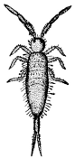
Fig. 83.—A Spring-tail
(Degeeria lanuginosa).
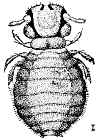
Fig. 84.—A Mallophagan
(Trichodectes latus).
(After
Denny.)
Pseudoneuroptera.—Spring-tails, Bird-lice, Stone-flies, White-ants,
Dragon-flies, May-flies.
The Spring-tails, Fish-moths, etc., representing the primitive stock
from which the higher forms have developed, have a varied habit and
hence are to be found in divers situations. The Spring-tails
(Collembola, etc.), occur in damp and moist places, usually in immense
numbers. The Fish-moths and Book-mites are common household pests, but
also occur outdoors under logs, boards, bricks, and rubbish of all
sorts. In houses they feed on the starch paste beneath wall-paper and
also on the starch in bookbindings and other domestic articles. They may
be collected at all seasons and a sieve is the only implement necessary.
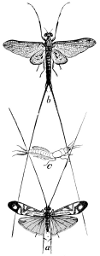
Fig. 85.—b, a May-fly
(Palingenia
bilineata);
c, its larva; a, a Caddis-fly
(Macronema
zebratum).
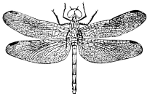
Fig. 86.—A Dragon-fly (Libellula).
(From Packard.)
The Bird-lice or Mallophaga may be collected at all seasons on birds and
mammals. A number of species infest domestic animals, horses, cattle,
etc., but the majority of them can be found only by the examination of
domestic fowls and wild birds. The Stone-flies (Perlidæ) are found in
the neighborhood of water courses and ponds, are very sluggish in
flight, and easily captured with the sweep-net. They are also attracted
to light. The Psocidæ are a small family of certain degraded wingless
forms, comprising the Book-lice, which, as the name implies, infest
books, feeding on the starch of the binding. Others have ample wings and
closely resemble large Aphides. They occur on the trunks of trees and on
foliage, and feed on lichens and other dried vegetable matter. They are
gregarious in habit and frequently occur in immense numbers together. In
the case of the Termitidæ or White-ants, their abundance renders their
collection an easy matter. Effort, however, should be made to discover
the different forms, the females and soldiers as well as the workers.
The former may be found in rotten tree trunks, but are very rarely met
with. In the tropics many species occur and construct curious nests,
either attaching them to the boughs of trees or building them in the
form of pyramids on the ground. The Dragon-flies (Libellulidæ,) are
collected in the same way as the Diurnal Lepidoptera. They are very
swift flyers, and are practically always on the wing. Their collection
requires some degree of skill in the use of the net. A good method
consists in visiting, in the early morning, water courses in which the
larval and pupal states are passed, and capturing the adults just as
they issue from their pupal skins at the edges of the pond or stream. In
cold weather they are less active and may frequently be found clinging
to trees and plants, particularly in the vicinity of their breeding
places. May-flies (Ephemeridæ) occur in immense numbers near their
breeding places in ponds and streams and are also attracted in large
quantities to electric lights. Their collection is therefore an easy
matter, but on account of the very fragile nature of these insects the
utmost care must be employed in handling them. The early states of all
the aquatic forms mentioned above may be obtained for breeding by the
use of the dip net by dragging it forcibly against water plants.
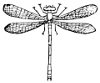
Fig. 87.—A Dragon-fly (Agrion).
(From Packard.)
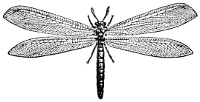
Fig. 88.—An Ant-lion, adult (Myrmeleon).
(From
Packard.)
Neuroptera proper (Hellgrammites, Lace-wings, Ant-lions, Caddis-flies,
etc.)—Among the largest insects of this order are the Sialidæ, which
includes the enormous Hellgrammite Fly, Corydalus cornutus. The larvæ
of this insect are carnivorous and occur in streams, under stones, etc.
The adults may be collected in neighboring situations and are also
attracted to light. The Lace-wing flies (Chrysopa), Ant-lions, etc.,
are carnivorous as larvæ, and occur, the former among the Aphides which
infest various plants and the latter at the bottom of pits in loose,
sandy soil. The adults may be obtained by general sweeping and are also
attracted to light. The most interesting insects of this order are the
Caddis-flies, on account of the peculiar and frequently very beautiful
cases constructed by their larvæ, which it is important to collect. The
Caddis-flies breed in ponds and lakes and the adults may be collected in
such situations or at light. The larvæ may easily be reared, and should
be collected for this purpose. Most of the insects named in this order
are extremely delicate and require great care in handling.