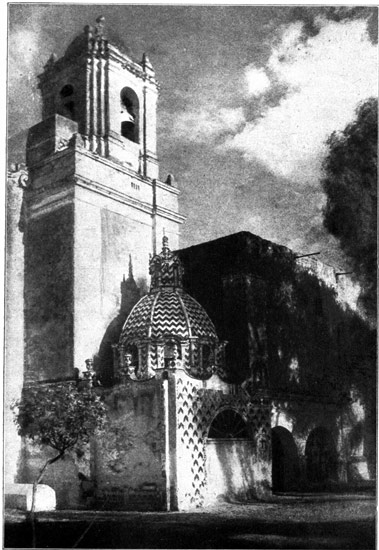
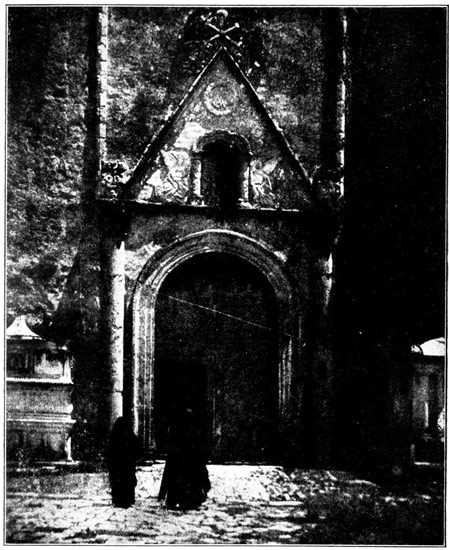
Madero shows indications of nervous tension—Why one guest of Mexico's
President did not sit down—A novena with Madame Madero—Picture-writing
on maguey—Picnic at El Desierto—San Fernando
March 3d.
Yesterday Mr. Taft issued a wise proclamation
directing citizens of the United States to comply
strictly with the neutrality laws between our country
and Mexico till there is a change in conditions, which
gave rise to various expressions of satisfaction at a large
luncheon at Madame Simon's.
I sat by Mr. Chevrillon, a French mining expert since
many years in Mexico, and also having a wide experience
of our own southwest. He told strange mining stories;
one about an ancient whip he once found in a remote
chamber in an old mine, with a lash so long that it was a
mystery how it could have been used in the small spaces.
A detail, but it gave me a sudden, shivering glimpse into
the sufferings of subject peoples. However, it's no use
throwing stones at Spain for not having practised political
liberty in those centuries. As we know it to-day, it
was nowhere existent. It had not even begun to glimmer
on any horizon, and certainly Mexico has lived
through a terrible century since its light dawned on her.
March 7th.
At the Chapultepec reception to-day one felt the
tension.
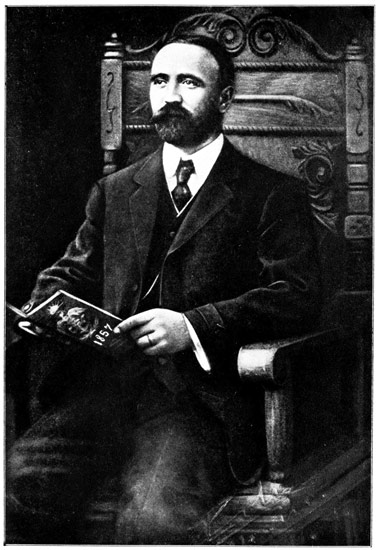
Madero was walking up and down the terrace with
his new private secretary, Gonzales Garza, clad in some
sort of a dark suit, with a conspicuous peacock-blue vest,
doubtless a family offering. His glance was more than
usually visionary and introverted, his unacquisitive
hands were behind his back; but can Mexico be governed
by a well-disposed President from Chapultepec
terrace? He has a way of avoiding facts, which, in the
end, are sure to hit somebody as the national destinies
take their course. One can only hope his sterling honesty
will see him safely through the snares that are
spread everywhere.
As I talked with him on the sun-flooded terrace above
the gorgeous valley, with all Mexican creation at our feet,
though he had his usual smile, I noted many wrinkles,
as he stood bareheaded, and it was difficult to fix his
eye, an honest eye.
The new Minister of the Interior, Flores Magon, took
me out to tea. He is a huge, square-faced Zapotec
Indian, rather portly—which they rarely are—with
straight, black hair, a strong jaw, and observant eyes.
The foreigner on the other side of me—whether his tale
be true or apocryphal I know not—related that on his
last visit to Madero, as he was about to sink into an
inviting armchair he was hastily asked not to take it,
for at that moment it was occupied by George Washington!
As his surprised person was suspended over
another and was half-way down, he was waved to still
a third, for in the second was sitting Jean Jacques
Rousseau! After which, fearful of incommoding other
illustrious dead, he remained standing. Si non e Verdi
e bene Trovatore.
Madero has a certain natural inclination toward the
French, fostered by those years at the Versailles Lycée,
without, however, any of their logic or genius for facts,
and he often converses vaguely, but admiringly,
about
the French Revolution. They say he sleeps with Le
Contrat Social under his pillow. He has not a single
suspicion of the Anglo-Saxon mind, nor of that composite
and extremely personal affair we call the national
conscience; and still he is supposed to govern his country
after our pattern. The whole seemed unrelated to
the situation.
In fact, I told Aunt L., as we came away, that I didn't
think the loggias and terraces are good for his psychology.
You have no need for the firm hand when you are
looking out upon a valley swimming in a strange transparency,
where the hills seem of purest mother-of-pearl,
inevitably leading to golden streets, not black heaps of
earth peopled by passionate, starving human beings.
Am now off to the Red Cross. It is temporarily stationed
in a beautiful old Spanish house, with a garden,
and a large patio and fountain in the middle, and doors
opening on to it, in the Calle Alamo, a once fashionable
part of town. Mexico was almost the last country to
join the Red Cross organization.
March 11th, evening.
At the reception at Chapultepec I found I had, by a
curious chance, arranged with Madame Madero to make
a novena with her to the Guadalupe shrine. Whatever
reliance she may have had on accidental spirits in the
past, I now see her having recourse to the one Great
Spirit, the Cause of Causes. I don't feel unassailable by
the chances of life myself.
She has been coming for me the past three mornings
in the big presidential auto. N. and Aunt L. are thankful
to see me return; they think a bomb, aimed at the
conveyance full of piety, would not be beyond the
bounds of possibility. I am sure Madame M. would
do the distance gladly on her knees, instead of in the
big car; her passionate solicitude for her husband's
welfare has no limits, and she means to compel whatever
powers there be to take the kingdom of heaven by
violence, if need be. Like all people who are playing
with great chances, she is, I fancy, superstitious. She
arises very early, attends Mass, begins her day's work,
and is at our house from the castle at 9.30, apparently
going the rest of the day at the same high pressure.
I gather they prefer De la Barra not to return; indeed,
the faces of any darken at the mention of other possible
candidates for public favor. Jealousies and struggles of
individual ambition are more evident than struggles for
principles in this most personal of all games, Mexican
politics.
There was not a hint of any political happening on
her part, nor on mine, as I got into the motor this morning.
She told me about the six children they have
adopted at one time or another, according to various
exigencies; all the children too small to make an appearance,
however, on the presidential stage.
An Indian boy ran across our path and was knocked
down by the auto, just as we were going through the
teeming suburb of Peralvillo. In a moment a crowd
gathered about us, giving vent to growls. We stopped
and got out of the motor. The boy, fortunately, was
not injured, and he was wearing few garments to dust.
We gave him money, and the mollified parents, pulque-eyed
and battered, received him tenderly, plus money
and minus hurt, so we were able to drive on through
the soft, shimmering morning, out the broad Calzadato
to Our Lady of Guadalupe....
We came back through the old Plaza of Tlaltelolco,
where the Church of Santiago still exists, though now
the yards of the National Railways surround it, and it
is used to store cotton and grain, the customs, too,
having offices there. It was formerly connected with
Mexico City by canals instead of these dusty streets,
getting dustier every year, as the volume of water
decreases in the valley.
Here Cortés found the great market he described in
his letter to Charles V., and here Fray Gante taught the
Indians for fifty years. Here, too, the first Bishop of
Mexico is said to have carried into effect his unfortunate
idea of gathering a pile of Aztec hieroglyphics,
on cotton, maguey, or deerskin; and piling them mountain
high; according to the historian, Ixtlilxochitl, he
had them set afire. Now there are only squalid remnants
of that civilization, here and there ancient corner-stones
on which dilapidated mesones, lodging-houses for
men and beasts, show themselves.
But, somehow, when one peeps in at the little courtyards
the life itself doesn't seem so squalid. Any patio
you look into has a bit of color in the way of a child or a
flower or a bright bit of garment. I thought of the three
patrician women who, during the siege of Mexico, stood
for several days up to their necks in water with only a
handful of corn for nourishment, and of the last and
noble Aztec king, Cuauhtemoc,[39] who, at the hour of
Vespers, fell into the Spaniards' hands, and was brought
to Cortés as he was standing on the terrace of a house
in Tlaltelolco, watching the operations.
Cortés asked him to be seated, but the young king
put his hand on a poignard that Cortés carried in his
belt and asked him to kill him, because, having done
what he could to save his kingdom and his people, it
only remained for him to die. He was the son-in-law
of Montezuma, and was escaping in a canoe with his
young wife, just emerging into womanhood, when he
was captured. History is so evident here and so in
relief—I have never lived in a place where the past
follows and arrests one as here, though I doubt if Madame
Madero, trying to pierce the heavy curtain of the future,
gave it a thought this morning.
March 12th.
The Blair Flandraus are here now, visiting Madame
Bonilla. He is the "brother" in that delightful book,
Viva Mexico, that I sent you, and meeting him made
me remember a line where one brother says to the
other brother, "What very agreeable people one runs
across in queer, out-of-the-way places," meaning themselves,
and quite warranted, as I have discovered.
I had a luncheon to-day for Mrs. Flandrau, and
Madame Bonilla, Madame del Rio, Madame Simon, and
Madame Scherer came. In the afternoon bridge at
Madame Bonilla's, at which husbands and also the
unattached and solitary appeared. In Mexico, when
you have spent one part of the day with people, it isn't,
as in more conventional climes, a reason for avoiding
them the other hours.
We are all rather amused by the visible romance of
a young querido (lover) who stands for hours leaning
against the garden rail of a big, handsome house in the
Calle Liverpool, wherein his inamorata dwells. The irate
father has just built a trellis above the wall, gardeners
are busy, and the quickly growing vines will soon make
it a rather bootless pastime for the young man to pelar
la pava. The girl is watched every moment, quite in
the way of old dramas concerning unwelcome lovers,
determined Dulcineas, and vigilant duennas.
March 14th.
Went to the French Legation this afternoon, where
one of Madame Lefaivre's pleasant "days" was in full
swing. I met there the Marquis de Guadalupe (Rincon
Gallardo), very polished and agreeable, and we looked
at a most interesting old book of picture-writing on
maguey, which shut up like a folding screen, with a
piece of wood at each end to hold it fast. We opened
it out on Mr. Lefaivre's long study table. It was of
silky, papery fiber, as smooth to the touch as to the eye.
Across strong, blue-black grounds were pictures of hunting
scenes, or scenes of vengeance—hounds let loose
from the leash, springing at Indians whose eyes bulged
with terror. Forests were depicted and dark men entering
them, and footmarks; a babe was being held to the
heavens, and groups of Indians were selling and buying,
bending over mats on which their wares were laid out,
as to-day.
The Marquis thought it wasn't Aztec, but must have
belonged to the period immediately succeeding the Conquest,
as there was a Moorish touch to head-dress and
garments. Mr. Lefaivre thought it was perhaps one
of the cunningly wrought impostures of the sixteenth
century. It was for sale for some thousands of pesos
and in excellent condition. Life sometimes seems like
it here.
Secretary Stimson has poured oil on the troubled
waters by saying there is no thought of intervention
in Mexico for pacification and otherwise, but it's
all a
playing with fire—and a good many American and
Mexican fingers are like to be burnt. It would seem
'twere better to let the Mexican revolutions quietly
simmer till they boil dry—we can't do a little; all or
nothing.
I must say I have some sympathy with Madero, for,
having allowed him to "use" the border for equipping
and organizing his revolution, he now naturally wonders
at our coldness. It's all a puzzle, whichever way one
looks. I keep thinking of Don Porfirio's watch on
Mexico; what he knew would happen is happening.
Prophets may not only be stoned, but justified, in their
own country.
The Senate has wisely adopted a resolution authorizing
the President to prohibit shipments of war materials
into Mexico—at least we won't be feeding fuel to the
Mexican fires.
March 16th.
This afternoon I went out late with Madame Lefaivre;
she had come to inquire for Elim, who has had some
mysterious ailment which has kept me hanging over his
bed in terror for two days. We drove up the Paseo in
her victoria, and by the statue of the "Independencia"
got out and walked about the broad space surrounding it.
Night was near, though not yet fallen, and the sun
had disappeared behind Chapultepec. In the changing
light the stars shone in the heavens with a brilliancy I
have scarcely ever seen in deepest night. They illuminated
a pale-blue dome which had a sort of faded
sunset lining. I looked up and saw the Southern Cross,
the glory of these skies, hanging just above the horizon,
and came home touched and quieted by the beauty of
it all, to find my babe awake, in a gentle moisture, the
fever gone. So often in Mexico the natural changes
bring personal
help.
March 17th, evening.
To-day a delightful picnic at the famous "Desierto,"
the old Carmelite monastery, deep in one of the splendid
forests of the Ajusco hills off the Toluca road.
We met, about fifteen merrymakers, in front of Mr.
Potter's house, in the Calle Durango, one of the newest
of streets in the newest of the "colonias." All were
loudly congratulatory when we appeared, about "St.
Patrick's Day in the morning." After a careful packing
in of baskets, bottles, and other paraphernalia which
always flow most lavishly from Mr. Potter's house, we
started out in a long line—where, however, the disadvantages
of companionship were soon apparent, as the
dust got the hindmost with a vengeance.
It being more necessary to keep the ambassador
dusted than lesser objects, he led off, arriving with his
luster undimmed. As we passed through Tacubaya, the
Sunday market was going its usual picturesque pace,
and the trail of equality and fraternity we left behind
dimmed many eyes and wares. Once on the high
Toluca road we could spread out more, distance lending
a decided enchantment.
At Santa Fé, in the great ravine where there has
been a powder-factory for a hundred years or so, were
unwonted signs of activity. After a stiff bit of steep,
broken road, we left the motors in a blessed, grassy,
dustless spot, and began a long and lovely walk, through
a forest of magnificent oaks and pines. The loveliest of
ferns grew beneath them, and there were thick carpets
of green and gray mosses, patterned with bright, flowery
patches. There was the sweet sound of rushing waters,
so rare on the plateau, and occasionally there was a sudden
rustle to show that we had surprised some wild
living thing, and twice we saw some deer.
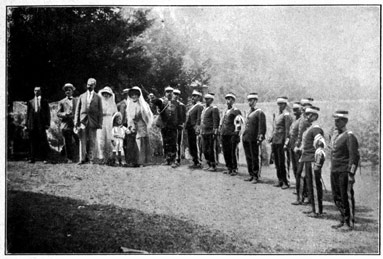
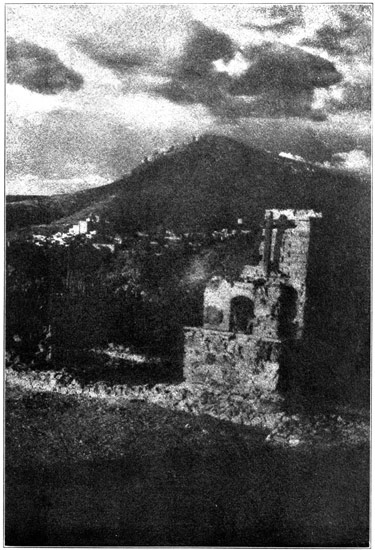
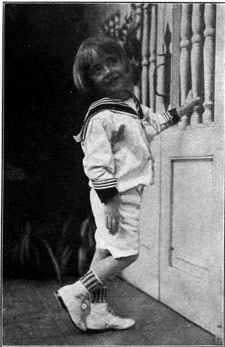
AT EL DESIERTO, APRIL 29, 1912
(Mrs. O'Shaughnessy and Elim in the foreground)
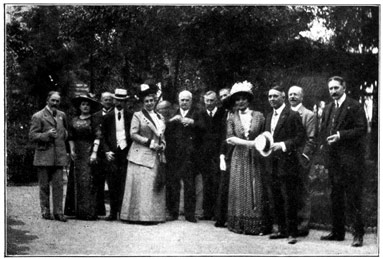
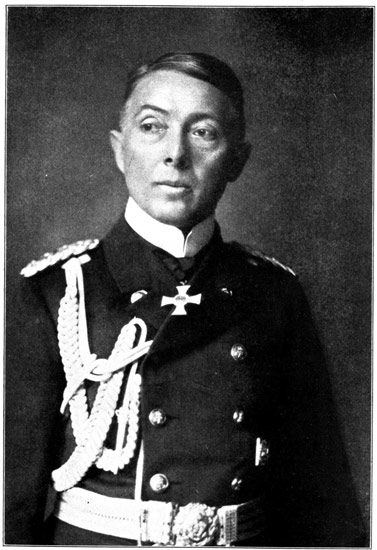
LUNCHEON AT THE VILLA DES ROSES
In front row (left to right) Mr. de Vilaine, Mlle. de Tréville, Ambassador Wilson,
Madame Lefaivre, Mr. J. B. Potter, Mr. Rieloff (German Consul-general), Mrs.
Nelson O'Shaughnessy, Von Hintze, Mr. Kilvert, Mr. Seger
One scarcely ever hears of the Mexicans hunting their
game, though there are occasional shooting parties toward
the lakes where the wild duck abound. Some one
remarked they would seem to be too busy stalking one
another. The Riedls, the Bonillas, Von Hintze (who is
not much given to picnicking on Sunday, generally
spending the holy day hunting the perpetrators of the
Covadonga outrage of last July), Mr. Potter, Mr. Butler,
their English friend Mr. Leveson, Mr. Seeger, the ambassador
and ourselves, made rather an imposing array as
we proceeded through the wilderness, which, however,
was "paradise enow."
As you know, when picnickers get hold of a joke nothing
but separation or annihilation causes them to let it
go, and Mr. Potter started a gentle but persistent one
as we walked along, about not fearing snakes, as the
presence of the O'Shaughnessys in a forest on St.
Patrick's Day could not do less than rid the paths
of them or analogous reptiles. I was sorry we didn't
meet a boa-constrictor, so that he might have said his
neglected Sunday prayers. It was so delightful, under
the shade of the great trees, the sun filtering through
with such a fresh warmth, and the birds singing so
sweetly upon what seemed, indeed, a snakeless paradise
that we were positively sorry to come upon the deep,
flat space that holds the old monastery, near whose
walls a long table, evidently known to generations of
picnickers, was waiting to groan with our twentieth-century
edibles.
After we had bestirred ourselves with the unpacking,
festivities proceeded as if on a stage. We were almost
immediately surrounded by dozens of Indians, men,
women, and children, who furtively and fortuitously
inhabit various parts of the old cloister. During and
afterward they received the overflow from "Dives's
table." Several little tots found pieces of ice,
which
they carried off in the greatest excitement—doubtless
never seen before, and overrated as to nutritive qualities.
We refreshed ourselves to the usual accompaniment
of quips about life in general, and in particular what
each would do, especially the fair sex, if surprised by
Zapatistas—who give a spice of danger to festivities in
these parts—as "Emiliano's" capital is only over the
near-by blue hills. There was an exceedingly knotty
and delicate question hovering in the air, as to whether,
in the event of the Zapatistas performing their usual
rites of removing garments, "would it be better to be
with friends or strangers."
Suppositions about Mexico's future bind every assemblage
together, and Riedl insisted on conversing only in
a strange and ingenious language of his invention, composed
of Portuguese, picked up in Rio, Italian in Rome,
and Spanish in Madrid and here—too amusing and clever
for words, and something new to the echoes of that spot.
As he said, "What's the use of traveling if you don't
learn something?" And he insisted on sitting near
part of his own contribution to the picnic, a long and
very special kind of salami (sausage) from his native
land, to be taken with some equally celebrated schnapps,
called Slimbowitz, also from his native land, and contributing
to cordial relations.
After lunch we walked about the old ruined monastery,
inexpressibly lovely in that solitary spot. Trees
grow from what once were cloisters and cells; the
mother-church in its midst is crumbling, pink, vine-grown,
delicious. Thomas Gage, an English monk who
visited Mexico in 1625, found it then in full blast. The
old retreat is a mass of lovely, unexpected details, long
galleries, carved lintels, bits of sculptured vaulting,
romantic inclosures, and everywhere some natural
growth to fling a living charm about it all.
The pink belfry still has its old bell, but now when it
rings it warns Zapatistas of the approach of gendarmes
instead of calling monks to prayer. Supporting it and
the church behind, roofless and overgrown, are low, very
broad flying buttresses, and several small chapels are
still domed and cupolaed. Fine trees grow everywhere,
and the whole is inclosed by pink, flower-grown, old
walls.
The large patio, filled with bits of columns, stone
beams, and crumbled mortar, was made lovelier still by
some young and beautiful cherry-trees in full blossom,
that rose gently but persistently against the background
of decay.
About five o'clock the sun began to come slanting
through the trees, bringing a warning of night with
it, so we regretfully had the things packed to leave
the snakeless paradise, the day done instead of before
us—and there is always a difference. We found
ourselves going rather quietly through a blackly
purple forest, though overhead the sky was still pale
blue.
When we got out into the Toluca highway we saw
that a great dust-storm was blowing over the valley.
There was no sight of the city; Lake Texcoco and the
hills were veiled. We and the motors were shortly all
of a light, yellowish-gray tinge. The fine earth of the
road has not had a drop of moisture since last September,
so you can imagine. We didn't even try to wave
farewells when we got into town, but each rolled off in
the direction of his own roof, to remove the marks of
pleasure. Certainly the six or eight motors must have
been a scourge to the dusty villages through which we
passed.
I do enjoy the evenings so, after these long outings,
in a tea-gown, with writing-pad or book on my comfortable
sofa, knitting the little thread to cast across
the waters....
March 18th.
De la Barra is now in Paris and preparing to return.
I notice a further darkening of faces at the imminent
prospect.
A Latin-American said to me, à propos of this, "It is
a sign of degeneracy when nations arrive at a point
where they are willing to rend their country into a
thousand bits rather than tolerate the personal success
of another." Our beloved maxim, "There's always room
at the top," could be changed here into "there's never
room at the top."
However, everything is interesting, and even the pamphlet
I have just looked over concerning the celebrated
Tlahualilo case has the usual color to it. The river
Nazas flows down through the lands of the Tlahualilo
claim, the aguas baldías overflow the banks at certain
seasons and are used for the irrigation of the Laguna
district. The T. Co. had contracted with the Mexican
government regarding its development, including irrigation-works,
placing of colonists, buildings, etc. The
Mexican proprietors round about wanted the water,
too, and the T. Co. found itself in the impossibility of
fulfilling its contracts, because it could not get the
water necessary to the cotton crops.
Lack of water is a terrible question in Mexico, cursed
with irregular rainfalls, and rivers few and far between.
The Madero family own much territory in this
part of Mexico, and wanted water for themselves. This
is an example of the complications arising when the
interests of a family are the same as the interests of the
government over against foreign capital, without which,
however, Mexico cannot exist. The case was pending
during the Diaz régime, and now apparently it is frito
since the Madero incumbency, with the inevitable judgment
that they had had sufficient water to fulfil their
contract, but had failed to do so.
Humboldt, with his usual up-to-dateness, said, "Tout
devient procès dans les colonies espagnoles." There is
certainly no change between his time and mine....
One has an impression that Cortés knew what he was
about when he asked the king not to send him lawyers,
but monks and priests, and of these latter he did not
want les chanoines. The separation of Church and
State is certainly a blessing to the Church.
So few have loved Mexico for her beauty; they mostly
only want her for what they can get out of her. I wonder
even her geographical position is left.
The last two nights, for a change of air and scene.
I have been reading Vanity Fair, and it has changed
things. I found it with all the "bead" on it, as if it
had just been poured from the master's brain. I remember
when I read it first, in my early teens, asking
you why Rawdon Crawley threw the jewel at Lord
Steyne. Looking back on things, I am still of the
opinion that one should do one's classics very young;
the flavor never leaves one and no harm is done.
March 24th.
This afternoon I went to call on Madame Madero.
She has been ill, and, of course, very anxious. I went
out of the glare of the hot terrace into the comparative
dimness of the room, where she was lying with a handsome
satin spread covering her, a rosary in her hands,
and some newspapers on the bed. Her eyes were bright
with fever, and a pink spot was on each cheek, but it
seemed something besides fever was burning there. She
is clever enough to know when to worry, and my heart
went out to her; the political mills are waiting to
grind
her and the man whose destiny she shares and whom
she loves.
The newspapers were announcing in large head-lines
the operation of the Federal commanders around Rellano—Trucy
Aubert, Blanquet, and Gonzalez Salas, who
was once Minister of War and among the "232,"
being Madero's cousin. Orozco is headed apparently
full to the south toward Torreon, and, say the timid and
doubtful, to Mexico City. From where I sat I could
see through the slit in the half-drawn curtains the glittering
volcanoes and the blue, translucent hills; the
deathless beauty of it all gave me a pang. Any human
destiny, even clothed in the supreme office, seemed insignificant,
and only the "last four things" of account....
March 25th.
Last night Gonzalez Salas, in a fit of despair, finding
himself cut off from his army, which had been scattered
and demoralized by the main army of Orozco, committed
suicide in the train that was carrying him from defeat.
All day long the city has been flooded with rumors,
and a not infrequent "Viva Orozco!" has been heard.
Squads of rurales had been patrolling the streets, picturesque,
but giving an additional note of unrest.
A Cabinet meeting was hurriedly held in the Palace.
Can the disaster be retrieved? is what foreigner and
native alike have been asking themselves all day. I
dare say a large proportion of the population are ready
to turn "Orozquista" at the slightest further indication
of fate. There's always a "military genius" here ready
and generally able to upset whatever existing apple-cart
there be.
Zapata looms large on the horizon, as he has chosen
this auspicious moment to declare that he would descend
upon the fold with his cohorts, not, however, gleaming
in purple and gold. The beauteous morning sun revealed
various notices to this effect pasted up during
the night in the heart of the city by daring Zapatistas.
I haven't seen them, but a rumor is as good as a fact
for unsettling the public. However, I did see that
La Perla and La Esmeralda had their iron windows
drawn down upon their glittering treasures, when I
took a turn down the Avenida San Francisco a little
while ago—and many other shops had done the same.
I have no doubt the population of the submerged-tenth
quarter, through which Zapata would have to
pass, coming in via the Tlalpan and Country Club road,
would enjoy rallying to his call. Our street seemed at
one time already in the hands of revolucionarios in the
shape of hundreds of newspaper boys—babes who
could scarcely hold their papers, but whose bright little
eyes can distinguish the national currency at any distance,
and big boys and old women.
They scented large editions from the offices of La
Prensa, and there was much begging for centavitos right
under my windows to buy copies with. Shrieks and
howls mingled with cries of "La Prensa!" and "Viva
Orozco!" The trolley-cars were blocked, and we seemed
the focus of the Orozco victory as far as the capital
was concerned. It was late when an adequate police
force appeared on the scene and formed a cordon about
the lower part of the street. Even as I write they are
calling an extra, which I am sending down for. It has
been an exciting day, and all exciting days in Mexico
are blood-colored.
March 31st.
Palm Sunday evening.
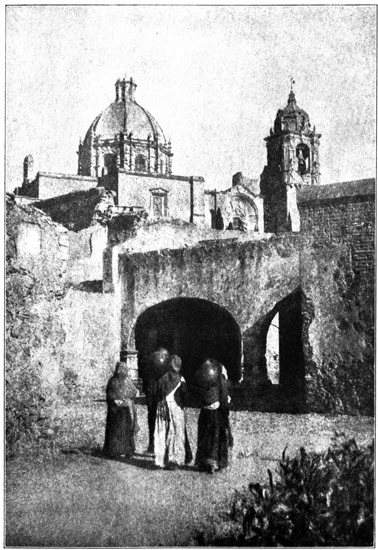
This morning I went to the Church of San Fernando.
The sun was shining softly as I passed down the street
of the Hombres Ilustres in through the little palm- and
eucalyptus-planted plaza, in the middle of which,
surrounded by the most peaceful of flower-beds, is the
statue of Guerrero (shot in Oaxaca in 1831). His body
lies in the old cemetery near by.
A soft, shining peace was over everything, and I felt
inexpressibly happy and in accord with it. No hint
came to me, as I walked along, of any bloody sacrifice of
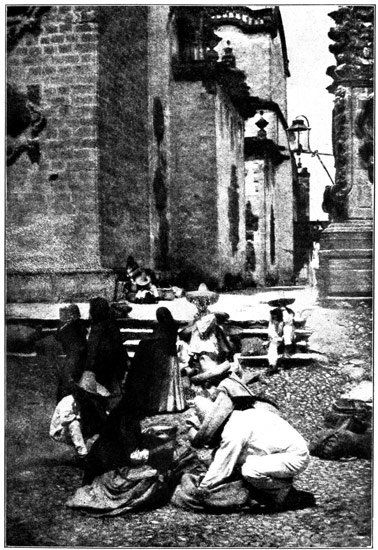
God or man. Little groups of Indians were waving
their palms, kneeling at the door of the church, or walking
about, and a few were selling elaborately plaited
branches.
Though San Fernando is in a populous quarter, the
tide has set to other shrines. Once it was the center of
great activities, for from this church and the monastery
and seminary adjoining were fitted out all the missions to
the Californias. Padre Junipero Sierra and Padre Magin
Catalá, and many other holy youths, burning with a
zeal we don't even dimly comprehend, came from Spain
to be trained here before starting out into unknown
wildernesses, "for souls and for Spain." It's all so
mysteriously suggestive.
The church has a pinkish-brown baroque façade,
beautifully patinée, and the old doors are carved in a
noble, conventional design. As I went in it seemed
rather empty, a few Indians and a few gente decente only,
praying before the purple-draped altars. Dreary, immense,
uninteresting paintings decorate the walls now;
but its interior was once hallowed, dim, gleaming with
the gold of Churrigueresque altars and retablos, carvings,
embroideries, and beautiful silver and gilt candelabra
and vases.
Afterward I went to the cemetery adjoining the
church, known as that of the Hombres Ilustres, where
a somnolent custodian let me in. The most prominent
tomb is that of Juarez, dating from somewhere in the
eighties. He is represented with his head lying in the
lap of a weeping woman, symbolic of the sorrows of
the nation (and tears enough to make a river have
been shed by women here, since then). I asked myself,
by his tomb, what has it availed to scatter the treasures
of the church? All are poorer and none, alas, the wiser.
Guerrero, of the little flower-planted plaza, Comonfort,
Zaragoza, lie near, all executed by the hand of
some one momentarily stronger. Generals Mejía and
Miramon, the companions in death of Maximilian[40] on
the fatal morning of June 19, 1867, repose here too.
In Mexico it is difficult to live for your country without
the certain prospect of dying for it, but I must confess
that to me the readiness with which the men of
Mexico give up their lives is impressive and affecting.
It is at least removed from the conventionalities of other
types of political men, where mostly each one intends
to live comfortably by as well as for his country, until
he dies of disease, or Anno Domini.
Inspired by the wonted passion for moving things,
a huge new panthéon is being constructed near by,
and some day all these tired bones must make another
journey. I think the cemetery as it is would make a
good school-room for the study of the history of Mexico
since she began her struggle for "independence."
Later we went out to the Country Club, where there
was a luncheon of the usual contingent, and spent the
afternoon following various friendly golfing squads over
the beauteous links, beginning with the ambassador,
Mr. Parry, Mr. McCarthy, and N. The volcanoes, now
in one aspect, now in another of their beauty, were
as gracious to the foreigner as to the indigène. The
short, wiry grass, something like the tough grass of
Scotland, made the most luxurious of carpets as we
strolled along, though now it is dried to the palest
yellow—the greens kept green only by exhaustive
efforts—a lot of Yankee push behind the hand that
wields the hose. At sunset we drove home through a
world of sifted gold. Such are the days of Mexico.