Although under not more than half her full
spread of sail, the Pinta was dashing freely
through the constantly roughening water, responding,
like the good sailer she was, to the
freshening breeze.
Night had come on with a black sky, and it
was only now and then with the utmost difficulty
that the lights of the other vessels could
be seen, rising out of the darkness for an instant
only to be engulfed as if forever.
All through his watch, Diego had divided his
interest between these appearing and disappearing
lights and the possibility of some action on
the part of the conspirators on the Pinta. His
anxiety on that score had been sharpened not a
little by the ominous tone of Juan Cacheco’s
words to him.
But, alert as he was, nothing occurred that was
in the least suspicious, and his watch was relieved
without anything having taken place to justify
his fears; and as his belief was that the man
Miguel was at the head of whatever plot there
was, he felt reassured when he saw him, after a
few muttered words with one of the new watch,
plunge into the close cabin where the men crowded
together to sleep.
The company of those who disliked him, whether
they were asleep or awake, was never pleasant
to Diego, and, moreover, the bad air and odors
of the close cabin were almost sickening to him,
though a good sailor; so he did not follow his
watch into shelter, but determined to remain on
deck as long as the rain, which threatened, held
up.
With this intention he crept silently to a corner,
where a coil of rope offered a support for
his head, and curled up, intending to sleep there.
It is easy enough to imagine what thoughts must
have come to the desolate and lonely yet high-spirited
boy as he lay there, clinging to his coil
of rope to steady himself under the increasing
motion of the boat. The bitterness of the present
was mingled with regretful thoughts of the
happy past.
The night was fresh, but not really cold—not
cold enough, anyhow, to prevent his sleeping
where he lay, and he had already dozed and
opened his eyes twice or thrice, when it seemed
to him that something like an animal stole past
him, and he stared with wide eyes to see what
it might be, or to determine whether or not he
had been merely dreaming.
Not quite dreaming, nor yet wide awake.
Something had passed him with a stealthy step
and crouching body, and, dark as the night was,
he could distinguish a human form; and, indeed,
what other living thing was there on board the
vessel? Dislike is sometimes keener than even
love, and it was this that led Diego to the quick
conclusion that the crouching figure, moving so
softly and cautiously aft, was that of Juan Cacheco.
And it seemed to his strained eyes that
there was a gleam of a knife-blade once when a
lantern swung around the foremast.
His first thought, with a gulp of terror, was
that the convict boy was stealing aft with the
intention of murdering Martin Alonzo Pinzon;
but then, though the idea was not an irrational
one, he reflected that it was not likely, since the
after-cabin was too full of friends of his cousin
to make the thing possible for a boy to accomplish.
And yet Juan’s errand must be a wicked
one, or he would not go about it in such fashion.
But be it what it might, Diego was determined
to understand it, and with that idea was rising
softly, when a new terror was added to the first
by the sudden apparition of a man skulking along
the opposite side of the vessel. And there was
something about the movement of the man that
made Diego fancy at once that he was Miguel
de la Vega.
Some evil it certainly was that took these two
wretches out on deck when they should have
been asleep in the forecastle. Diego was a brave
enough boy, and at this moment was nerved by
the desperate feeling that his own safety—life,
perhaps—depended upon his action; but, notwithstanding,
a chill of fear crept over him as
he stole from his shelter by the coil of rope and
followed the dim figure of Juan.
He wondered at first that none of the sailors
of the watch challenged the two skulking figures;
for it was inconceivable that they had not yet
been seen by some one. Then it came over him,
with a new accession of terror, that all of the
watch must be in collusion with Miguel and
Juan.
And if that were so, might not their errand
be the murder of his cousin? But no, it seemed
so unreasonable that they should attempt that,
with the cabin so full of friends of the captain.
However, he was determined to watch Juan, who
had paused for some reason; and if he saw him
turn into the cabin door, he would throw himself
on him and shout for help. He would have
done that anyhow, but he was afraid of making
a mistake and of thus calling down on himself
the wrath of his cousin.
Juan had stopped, evidently to listen for some
noise from the cabin, and, as if reassured, had
gone on again. Diego saw him pass the cabin
door and felt relieved of his greatest fear, but
was still certain that some evil was the object of
this stealthy excursion. Could it be the helmsman?
No, that was improbable, for the sea, having
grown rough, had made the helm so difficult to
control that the man there had called a companion
to help him, and it seemed unlikely that
Miguel and Juan would take the uncertain
chances of assault on two able-bodied men. Besides,
what would be the object, since it was more
than probable that the two men were in sympathy
with whatever plot there was on board?
Indeed, though they must have seen Juan and
Miguel, too, they paid no attention to them, but
kept up a conversation in a low tone, as if they
stood there quite alone. What should Diego do?
What could he do but hide in the shadow of the
cabin and wait?
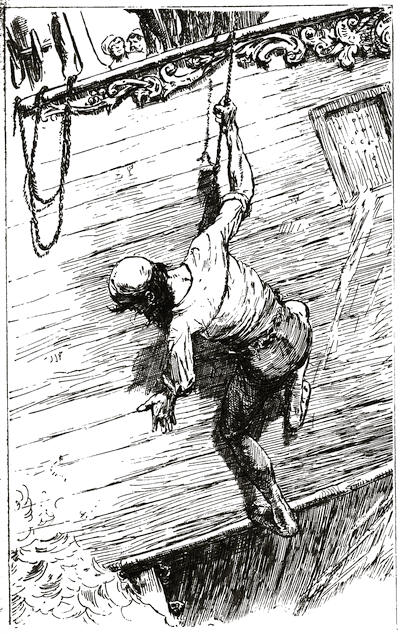
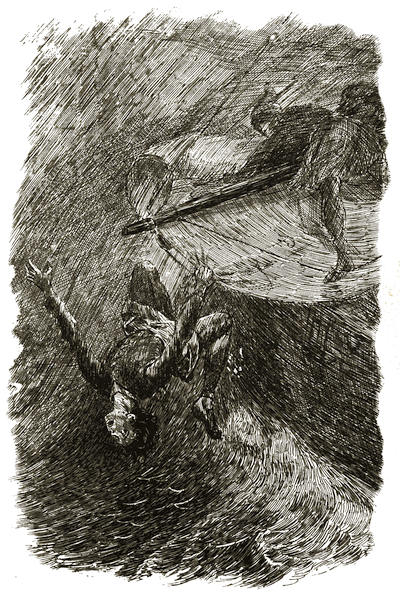
And so he waited and watched Juan, who had
crawled to the starboard rail, and was exchanging
some whispered words with Miguel. Then,
of a sudden, Juan rose to his feet, and, to Diego’s
eyes, seemed to drop over the side. His first
impulse was to cry out and run to the rail; but
he checked that, knowing that the boy could not
have deliberately jumped overboard, as a result
of all his mysterious preparation.
Again the impulse was strong to slip into the
cabin and warn his cousin that something unusual
was going on, and again the fear of being
put in the wrong restrained him, and he did nothing
but wait for something else to happen which
might elucidate what had gone before.
Juan was gone what might have been five
minutes before his head appeared above the rail
again. Miguel at once rose to his feet and helped
Juan carefully to the deck, the men at the helm
studiously keeping their eyes turned the other
way all the while.
What did it mean? What had been done?
What ought he to do? It seemed incomprehensible
that those two should have made all
that mystery for nothing but to enable Juan to
idly get over the quarter-rail; but what object
could there be in it? Perhaps there was a porthole
through which the knife of the prison boy
could be thrust with fatal effect! Diego shuddered
at that thought, and shrank away behind
the cabin, feeling that he might have been wasting
precious time, and that it was now too late
for him to do any good.
But at least he could brave the possible displeasure
of his cousin and go into the cabin
to ascertain if any foul deed had been committed.
He told himself that he would do so as
soon as the two conspirators had returned to the
forecastle.
He stole to the mast and crouched at its foot,
thinking to be better hidden there. Juan appeared
around the corner of the cabin on the
same side that he had first passed it, crouching
by the rail and peering on every side. Suddenly
he stopped and stared towards where Diego
hugged the shadow under the mast. Diego
waited breathlessly, intending to leap towards
the cabin at the first sign of discovery.
But, after a minute of peering, Juan resumed
his progress, and Diego turned his head to watch
for Miguel. Dislike and ready suspicion had
done for Juan, however, what they had already
done for Diego, and had caused him to recognize
Diego in the half-hidden figure at the foot
of the mast.
He had moved on as if freed from the doubt that
had made him stop, and then he turned again
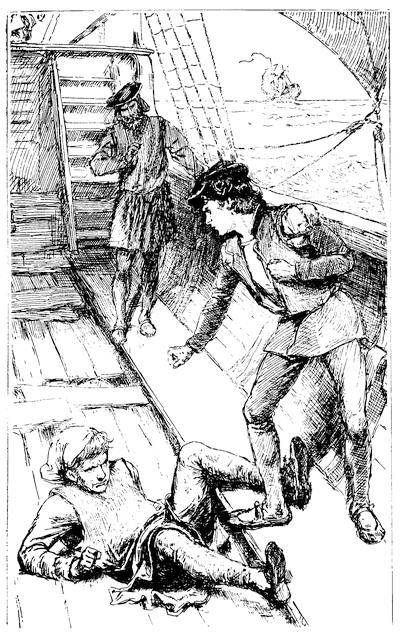
quickly and had leaped on Diego from behind;
so that, almost at the moment that Diego had
espied Miguel coming along the starboard rail,
he had felt himself seized by the neck and borne
to the deck.
Fear and anger combined gave him courage
and strength, however, and he twisted under the
grasp of his antagonist, and gave utterance to a
yell at the same moment that he grappled with
Juan.
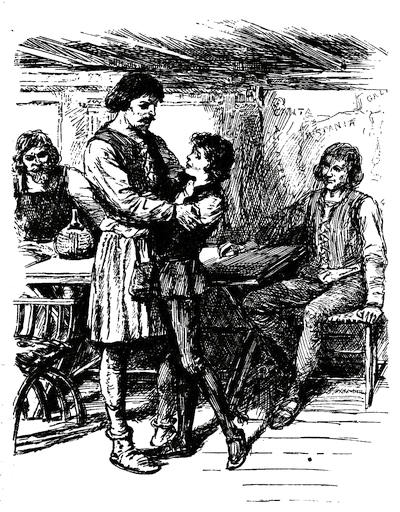
“Help, Miguel!” cried Juan, finding himself
unable to cope with Diego, and fearing another
yell that would arouse the sleepers in the cabin.
And before Diego could utter more than a
hoarse cry, he was caught by the neck in the
strong hands of Miguel, and despite his struggles
was in a fair way of being choked.
“Who is it?” he heard Miguel whisper.
“The boy Diego,” was Juan’s answer.
“Ah! and he was spying on us?”
“I think so.”
There was an instant of silence, during which
Diego felt the grasp on his throat relax, and he
made a furious, desperate effort to free himself.
“Ah! would you?” said Miguel, angrily, and
once more tightened his grasp on Diego’s throat.
Then he said, suddenly: “The little spoil-sport!
The best place for him is over the rail. Bear a
hand, Juan, and we will send him to find better
company, since he seems to dislike ours.”
“What! throw him overboard?” demanded
Juan.
“What else?”
“No, no. I won’t do it,” was the hasty answer.
“Why, you little fool! do you think our lives
will be safe if we leave this little friar to tell the
captain what he knows?”
“I will not do murder,” said Juan, in a frightened
tone.
“Then out of my way, and take no part in it.
If it is his life or mine, I shall not take long in
the choosing. You’re a fool, Juan.”
“You shall not do it,” said Juan, laying hold
of Diego, who was as still, now, as if senseless,
though, in fact, he was cognizant of all that was
going on.
“Out of my way, boy!”
“I will cry out and alarm the cabin,” said
Juan.
Miguel cursed him for his folly, and demanded
what he would have done, then.
“Make him promise not to tell a word of what
he knows.”
“Ay! he’d promise anything for his life’s
sake,” said Miguel. “So much for having a
boy to work with.”
“He’ll keep his promise,” said Juan, positively.
“Let him speak in a whisper. Say,
Diego! will you promise—will you swear on
the crucifix not to speak of what you have seen
to-night, or of what you suspect? Let him speak,
Miguel!”
“And let him yell out and arouse the cabin,”
retorted Miguel, in a surly growl.
“If he tries to do it, throw him over,” said
Juan.
Diego shook his head, as well as he could, to
intimate that he would not cry out. Juan seemed
to understand the movement, and again urged
Miguel to loose his grasp. And, indeed, it was
about time he did; for Diego was losing consciousness.
Miguel unwillingly did as Juan
urged him, and the latter spoke quickly to Diego.
“Will you swear as we ask you?” he said.
It was a minute before Diego could recall his
senses to make a reply. Then he demanded
brokenly:
“Have you done harm to my cousin?”
“Not a thing has been done to him,” answered
Juan.
“Have you taken any life?” asked Diego.
“Fool! no. Will you swear?”
“What have you done?”
“Holy St. Martin!” growled Miguel, “does
the little priestling think we are confessing to
him?”
“You will learn soon enough what has been
done if you will swear; but if you do not take
the oath and that at once, it is like you will not
be alive to learn,” answered Juan, angrily.
“I will swear,” said Diego.
“Where’s a crucifix?” said Juan to Miguel.
“You may be sure the priestling has one,”
answered Miguel. “And let me warn you, boy,”
he said, savagely, “if you break your oath, you
shall not escape.”
“Here’s my crucifix,” said Diego, “and if I
swear I will keep my word. Now what shall I
swear?”
“Swear that you will say nothing of what you
have seen or heard,” said Juan.
“Stop!” growled Miguel, suspiciously, “do not
forget that he is a fray, or hopes to be, and that
it is his trade to juggle with words. Make him
swear in such a way that he cannot get around it.”
“I will swear honestly what you like,” said
Diego, indignantly.
“You are too ready to swear,” said Miguel
with all the suspicion of ignorance.
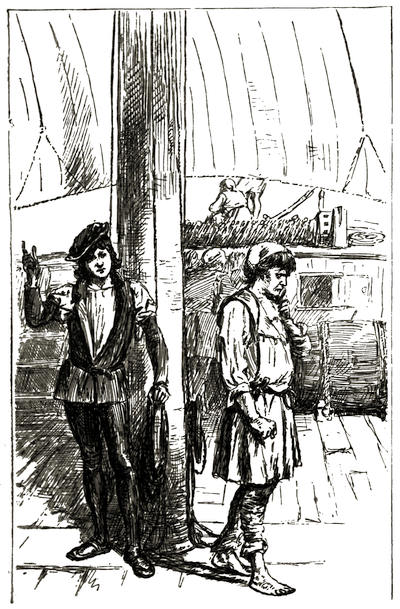
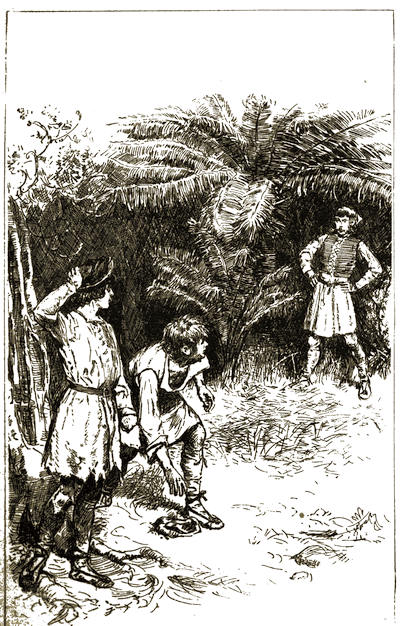
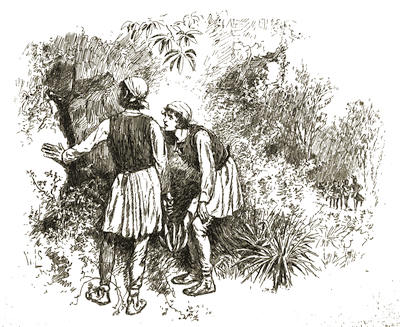
“Hush!” whispered Juan, suddenly. “There
is a noise in the cabin. Swear as I said,” he
ejaculated hastily to Diego.
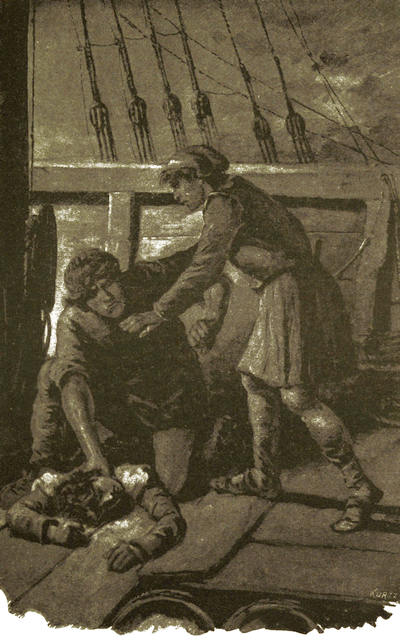
“‘HUSH!’ WHISPERED JUAN, SUDDENLY. ‘THERE IS A
NOISE IN THE CABIN.’”
“The captain!” muttered Miguel with an oath,
and he and Juan crawled away, attempting to
drag Diego with them.
But he was not minded to bear them company,
and tore away, only just in time to avoid a vicious
stab from the knife that Miguel drew from
his belt.
“We will hang for it!” he heard the older
convict growl. “Curse you, Juan, for a soft-hearted
fool! Curse you!”
The man was in such a rage that Diego expected
him to brave all consequences and rush
after him; so he ran aft near to where Martin
Alonzo was standing, and waited. Miguel and
Juan had disappeared into the forecastle, however,
and he was not molested.
Martin Alonzo, like the thorough seaman that
he was, had been waked from his sleep by an
unusual motion of his vessel; and, as he had lain
down in the full expectation of being disturbed
by the coming of the storm he had foreseen, he
had leaped out of his bunk and rushed out on
deck. His first thought had been that the disturbance
had been caused by the storm; but
when he reached the deck and discovered that
the storm had not yet burst, albeit the wind was
fresh and the waves running high, he sprang to
the men at the helm and roared out:
“What’s wrong? Can’t two of you hold that
helm steady? She yaws like a blind mule on a
hill-side. Steady there!”
He pushed the men angrily away and caught
the helm in his own strong hands, and braced
his feet to keep the rudder steady. Still, there
was a quivering, unsteady motion to the vessel.
“Whose watch is it?” he roared. “Is it yours,
Lopez?” as the third mate came hurrying aft.
“Have you turned lubber like the rest? Have
you lost your wits because we’re three days out?
How long has she been yawing like this?”
“Just commenced it,” was the surly answer.
“What’re you doing for’ard? Couldn’t you
tell that something was wrong with the steering-gear?
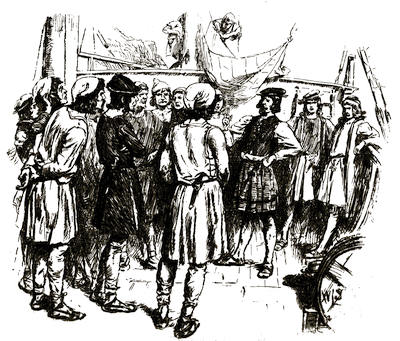
All hands on deck and have everything
made snug! Jump, now! Let go the main
sheet and bring her upon the starboard tack.
Jump, you lubbers! Do you think I want her
brought about, you sea-calves? There! that
steadies her. Here, take this helm, and keep
her where she is.”
The vessel was alive almost from the first roar
of the captain, and everything was being done
as expeditiously as possible; although most of
the people aboard of the vessel were wondering
what was the cause of so much excitement.
The captain, however, gave no one much opportunity
for reflection; for as soon as he had given
the helm into other hands, he had issued more
orders looking to lightening the canvas, making
all snug, and to keeping the vessel steady.
Diego had quickly seen that there would be
nothing for him to do but to take his part in the
execution of the orders of Martin Alonzo, and he
had jumped like the others at the first word.
The only care he had was to keep away as far
as possible from his two recent antagonists, and
this he accomplished, notwithstanding the manifest
efforts of Juan and Miguel to have a word
with him.
He had wondered how he would be able to
keep them at a distance after the excitement had
subsided; but he had no need to concern himself
about that; for no sooner had Martin Alonzo
put the vessel in condition to hold her own than
the storm that had been threatening broke upon
them, accompanied by sheets of rain, forked
streaks of lightning, and peals of thunder; so
that until daylight dawned there was little idleness
for any of the crew.
The rudder worked so badly that the vessel
would not head as she was put, and in consequence
shipped so much water that all hands
were kept busy bailing her and pumping too.
When morning dawned, the first thought was
of the other vessels, and great was the relief to
see them laboring in the great waves, not far
away; though in the event of danger to the
Pinta the others could have done nothing for
her in such a sea. Still, there was some comfort
in the companionship of the vessels. What Diego
thought most of, however, when the first
streaks of dawn lighted up the gray waste where
sky and water were hardly distinguishable, was
that now his life would be safe from Miguel.
He had made no effort to have any communication
with his cousin; for that efficient sailor
seemed to know what was wrong better than he
could have told him, and any information he
could have given seemed to him superfluous.
He felt sure, of course, that whatever had happened
had been the result of the action of Juan;
but, as no danger seemed to threaten in consequence,
he decided that it would be wisest to
keep silence. He knew, too, that everything he
did was watched by Miguel.
The Pinta was quite bare of canvas by this time,
and was laboring frightfully. Martin Alonzo had
made several efforts to ascertain what was wrong
with the steering-gear; but without result, since
it was dangerous to go over the side during the
gale, and he had determined to postpone his investigation
until the storm had abated.
All this while he had been without food, even
when the sailors had been supplied with theirs,
and as the wind was now blowing steadily from
one quarter, he left his brother, Francisco Martin
Pinzon, in charge of the deck while he went for
a hasty bite of something.
He had hardly taken two mouthfuls, however,
as it seemed, when the vessel suddenly shuddered
from stem to stern, and in a moment more
was rolling like a log in the trough of the sea.
With two leaps he was out of the cabin and at
the helm.
Something in the gearing had snapped and
the rudder was useless. It looked as if the vessel
would swamp in another minute. The water
poured over her low rail, and yards dipped into
the waves at each roll.
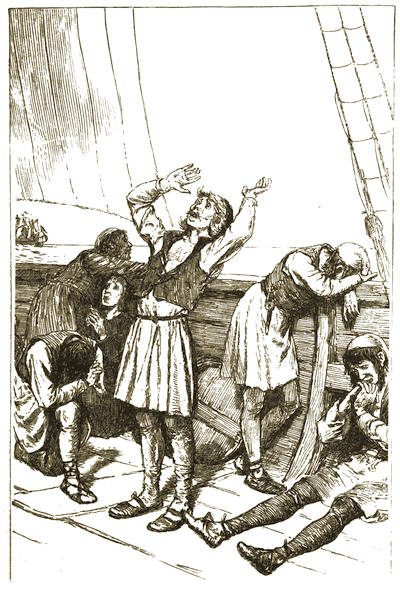
No man on board expected to survive that
hour, and more than one who had not prayed
for many a year knelt where he clung to some
rope and tried to recall the forgotten words.
Diego found himself side by side with Juan
Cacheco.
“You did this,” he cried, furiously.
“I didn’t expect this,” answered Juan, his
face blanched with terror.