‘You must answer me this question very decidedly,
ma’am: am I to go, or the baby? Is my night’s
sleep to be again disturbed by the peevish wails of a troublesome
infant? I must know at once, madam, what you intend to
do? Miss Jenkins, over the way, has offered me her front
parlour with the bedroom behind, and her terms are lower than
yours. You have but to say the word, ma’am, and my
bed will be well aired, and the room at Miss Jenkins’s all
comfortable for me to-night. I don’t want you to turn
that infant away, oh dear me! no, but I must decide my own plans;
stay in the house with a baby, and have my sleep broken, I
will not!’
The speaker was Mr Martin. He had come into Mrs
Franklin’s little back parlour and expressed his mind very
freely. The poor woman was standing up and regarding her
best lodger with a puzzled and almost despairing air. She
did not know that Flossy had crept into the room and was hiding
herself behind her chair, and that Flossy’s little face had
grown even more white and despairing than her own.
‘Give me until to-night, sir,’ she said.
‘Mrs Potts has also been in and complaining about the poor
child. She’s an orphan child, and my husband’s
niece, but we are in no way bound to support her. I would
not treat her badly, sir, but there are limits; and, of course,
as you say, your night’s sleep must not be broken.
Rather than that should happen, Mr Martin, I would send the
child to the workhouse, for, of course, she has no legal claim on
us. If you will be so kind, sir, as to give me until
to-morrow morning, I will then let you know what I have decided
to do with the baby, and I faithfully promise that you are not to
be disturbed to-night, sir.’
‘That is all right,’ said Mr Martin, with a
mollified air. ‘Of course it is not to be expected
that an old bachelor such as I am should be worried by an
infant’s screams. The screams of a baby have to me an
appalling sound. Do what you think well with the child,
ma’am, and let me know in the morning; only I may as well
state that I think the workhouse an extreme measure.’
Then Mr Martin left the house. Mrs Franklin followed him
out of the room, and Flossy crept slowly back to the nursery.
Mrs Franklin did not notice her little daughter, and
Flossy did not venture to address her mother. She came into
the room where Peter and Snip-snap were doing their utmost for
the baby. Peter had her in his arms, and was walking up and
down with her, and Snip-snap was bounding after a ball and
tossing it into the air for her benefit.
‘She’s to go, Peter,’ said Flossy.
‘I guessed it—I guessed it quite well last
night. She’s to go away to the
workhouse—that’s what mother said; I heard her
telling Mr Martin so.’
‘She’s not!’ said Peter. He turned
very pale, and, still holding the child in his arms, sat down on
the nearest chair.
It is to be doubted whether this poor neglected baby had ever
been christened. The children had given her a name of their
own; they had called her Dickory Dock.
The reason they had given her this distinctive title was because
the first amusement which had brought a smile to her little face
had been the old play of Dickory Dock and the mouse that ran up
the clock.
‘She said it,’ repeated Flossy, coming up close to
her brother, and fixing her anxious eyes on the baby.
‘She said that our Dickory was to go to the
workhouse.’
‘Well then, she shan’t!’ said Peter.
‘I know nothing about workhouses, but I expect they are
very nasty places, and Dickory shan’t go there!’
Then he sat silent, his arm round the little child, who looked
up at him and then back at Flossy, and then smiled in that
wonderfully pathetic way she had.
‘Look here, Flossy,’ said Peter, ‘if you are
quite certain sure that mother said the
workhouse, that she didn’t say nothing about Dickory Dock
being put to sleep in another room, or maybe down in the
kitchen—if you are quite positive about the workhouse,
Flossy, why, I know what I’ll do.’
‘She did say the workhouse,’ answered Flossy;
‘I heard her with my own ears, and Mr Martin said it was a
stream measure. I don’t know what he meant by that,
but I do know that mother said the workhouse, and that she has
got till to-morrow morning to take baby away.’
‘No, she hasn’t,’ said Peter;
‘we’ll take her away first, you and me,
Flossy—you and me and Snip-snap—we’ll take our
little baby away, and we’ll hide her. Dickory shall
never go to no workhouse!’
Here Dickory looked up again at Peter, who looked down at her
and kissed her, and two tears splashed from his eyes on her
little face.
‘Oh, what a dear baby she is!’ said Flossy.
‘Yes, Peter, we’ll run away, and we’ll take
Dickory. Where shall we take her to, Peter?’
‘Oh, I don’t know,’ said Peter.
‘We’ll get her out of this, that’s the first
thing. How much money have you got, Flossy?’
‘A crooked halfpenny,’ said Flossy, in a decided
voice.
Peter sighed. He was older than Flossy, and he knew that
a crooked halfpenny did not represent a large capital.
‘I have got sixpence,’ he said;
‘that’ll buy milk for her. We’ll manage
quite well, Floss. When mother goes out with her
market-basket, we’ll slip downstairs with Dickory, and well
take her away, and we’ll hide her somewhere. She shan’t go to no workhouse, the darling
pet!’
‘No, that she shan’t, the dear!’ said
Flossy. ‘It’s a lovely plan, Peter, and
I’ll just go and watch on the top of the stairs for mother
to go out with the old market-basket.’
‘We’d better take a bag with us,’ said
Peter. ‘The bag will come in very handy; it will hold
baby’s milk when we buy it, and some bread for you and me;
for we may have to walk a long way before we find a nice
hiding-place for Dickory.’
Children seldom take long in carrying out their resolutions,
and Mrs Franklin, puzzled and anxious, and with no real intention
of sending the poor baby to the workhouse, had not long turned
the corner of the street before the hall door of the rambling old
house was eagerly and nervously opened, and a funny little quartette issued forth. Dickory did not often get
the air, and she enjoyed herself very much, sitting well up in
Peter’s arms, and wrapped up, head and all, in an old
tartan shawl. Flossy, holding the bag, walked by her
brother’s side, and Snip-snap behaved in his usual erratic
fashion, now running before, now lingering behind, now stopping
to exchange a greeting with a fellow-dog, or to sniff with
watering jaws and wistful eyes at a butcher’s shop, but
always returning faithfully to his charge, and always raising an
inquiring face to see if Dickory was quite comfortable. She
was thoroughly so, and when she crowed, and laughed, and
chuckled, Flossy wondered they had never thought of taking her
out before. The sun was shining and the day was bright and
warm, with the promise of spring in it, and the two children were
highly delighted with their scheme, and
not a bit afraid of the result. The only thing which had at
all alarmed them was the fear that Mrs Franklin or Martha might
find out their little plan before they had time to carry it into
effect.
Having succeeded in getting quite away with the baby, they
considered their difficulties at an end. Peter was old
enough to know that a crooked halfpenny did not mean much,
considered as a provision for three human beings and a dog; but
he was still sufficiently young to have perfect confidence in the
capabilities of sixpence for meeting the demands of the
hour. As they walked along, Flossy, Dickory, and Snip-snap
were all very happy, and Peter too was happy, although his arms
ached sadly. But, alas! the paths of the poor little
adventurers were not to be without thorns.
The time was April, and an April shower first damped the
ardour of the travellers—the poor baby’s shawl was
wet through, and she began to cry pitifully with hunger and want
of sleep.
‘She must want her milk,’ said Peter;
‘there, Dickory, there’s a darling, now go to sleep
like the dear baby you are.’
‘You know, Peter, she won’t go to sleep without
her milk,’ said Flossy. ‘I’ll run across
to that milk-shop and buy some. How much milk shall I get,
Peter?’
‘A ha’p’orth,’ said Peter; ‘you
get a ha’p’orth, Flossy, and we’ll sit down on
the step of this empty house and feed the baby, and eat up our
crusts ourselves.’
A bottle to hold the milk was to be found in Flossy’s
bag, and accordingly in a short time Dickory had a meal; not
quite what she was accustomed to, but sufficient to soothe her
off into a slumber in which she forgot the discomfort of
her damp clothes and all her other baby tribulations.
‘Flossy,’ said Peter, ‘we have gone a long
way from home now, and baby is asleep and resting nicely on my
knee; my arm won’t ache a bit when she wakes, and
I’ll be able to carry her a splendid long way.
We’ll have to think of making up our plans,
Floss—we’ll have to find some place where we can all
sleep comfortably to-night.’
‘Well, we’ve got sixpence,’ said Flossy,
‘that’s lots and lots of money; but the night is a
long way off, Peter, and I’m so hungry. I’ve
eaten up all the crusts that you and Snip-snap left for me, but
I’m still as hungry as possible. Mightn’t I
spend a halfpenny or so of our sixpence in getting a good dinner
for you and me and Snip-snap?’
Peter put his hand to his brow, and began to reflect.
‘I don’t think so, Floss,’ he said,
‘for I’m afraid you don’t understand
marketing—it’s best for me to go, for I’m quite
old, and I know the way mother talks to the baker’s man and
the milkman when they come to the door. I must be sharp
with them, Floss; that’s what I must be, and I don’t
think you could be; so you had better hold the baby while I fetch
our dinner. Oh dear, what a good thing it is I have got
sixpence!’
The baby, being very sound asleep, was transferred to
Flossy’s arms without waking, Snip-snap was left in charge
of the two, and Peter, who knew very little more of London and
London life than his little sister, started off manfully to the
eating-house round the corner. He had gone away with a
bright face, but he returned in a very short time with one
singularly depressed.
‘Here’s a bit of stale bread for each of us,’ he said, ‘and I had to give two
halfpennies for that. I did see such a nice piece of beef
and of pudding, and I ordered some for you and me and Snip-snap,
but the woman said all that much would cost three sixpences, so
then I had to say I wouldn’t have it; and I took the stale
bread, and she was very cross. O Floss, I hope I’m
right about sixpence; I hope it will buy a bed for baby, and milk
and food for us all, for I’m thinking we had much better
none of us go back to-night.’
‘Of course, we won’t go back,’ said
Flossie. ‘The stale bread’s ’licious, and
I’m so hungry. O Peter, do look! Dickory is
stretching herself, and rubbing her little fat hands into her
eyes; and I know she’s going to wake, and I’m afraid
she’ll cry.’
‘Give her to me,’ said Peter, with the air of a
practised nurse. ‘I’ll hold her, and
you can feed me while I’m doing so, Flossy.’
But notwithstanding all Peter’s efforts, notwithstanding
his singing, and even shouting, for the baby’s benefit,
notwithstanding the admiring cheers of a little street mob that
collected round him, the baby cried, not a loud cry, but a weak,
broken-hearted wail. The fact was, the indifferent milk
Flossy had fed her with had made her ill, and her little frame
was already sadly chilled by the damp shawl which she wore about
her. Poor Dickory scarcely ever got any air or exercise,
and in consequence was very susceptible to cold.
‘She is sneezing,’ said Flossy. ‘Oh
the poor, poor darling! Peter, I think we’d better
see about our night’s lodging soon; it doesn’t agree
with Dickory to keep her out so long.’
‘We’ll go at once,’ said Peter, rising to his feet. ‘There’s another black
cloud coming up, and there’ll be a shower again before
long. We’ll get a nice room for us four, and then
we’ll be as happy as possible.’
Accordingly the little party again moved forward, and whenever
Peter or Flossy saw a card up in a window they stopped and rang
the house-bell, and inquired for lodgings for themselves and
their baby. Of course, they were repulsed in all kinds of
ways—some people merely laughing, and shutting the door in
their faces; some scolding them, and calling them tiresome,
impertinent little brats; and some even threatening to tell the
police about them; but no one ever hinted at the possibility of
taking them in. Presently they left the more respectable
streets, and wandered into very poor quarters. Here,
doubtless, they could have found accommodation were they able to pay for it, but everybody laughed at
Peter’s pennies, and no one dreamt of offering them a
shelter. Then the rain which had threatened came down, and
baby was again wet through, and now she looked ill, as well as
fretful, and refused some fresh milk which Flossy bought for
her. She was not the least like the bright little Dickory
who used to laugh and show her dimples in the old attic-nursery
at home.
‘Look here,’ said Peter, ‘what are we to
do? ’T will be night soon, and we haven’t found
no hiding-place for Dickory, and no one will take us
in.’
‘Baby is not at all well, either,’ said Flossy;
‘her head is quite hot, like fire, when I touch
it.’
‘What are we to do?’ asked Peter. ‘We
can’t get home, but it seems to me, Floss, that this is
worse for poor Dickory than the workhouse.’
‘I’ll tell you what,’ said Flossy
suddenly, raising her bright half-humorous face to Peter’s,
‘let’s take baby to the lady what cried.’
‘The lady who cried?’ repeated Peter.
‘I don’t know nothing about her, Floss.’
‘O Peter, you do know; it was that day our Uncle David
took us a long walk, and we went to the cemetery with him, you
know, the place with the flowers and the trees, and where they
put the pretty little children when they die—there was a
little baby being put there, and there was a lady crying very,
very bitter. I never saw no one cry so dreadful bitter as
that lady, and they said she was putting her baby in the
ground. I’m sure she must want another baby, and I
think perhaps it would be right for us to give her
Dickory.’
Peter’s face became very sad. ‘I don’t
know,’ he said; ‘I don’t want to give Dickory away. I’m quite dreadfully fond of
her; it seems to me she makes a lot of difference in the house,
and you know, Floss, it used to be very dull before she
came.’
‘Yes,’ said Flossy, ‘I love her more than
anything; she’s a dear baby, and I never find the days long
when I’m playing with her and talking to her: but you see,
Peter, she’s not to be kept at home; she’s to go to
the workhouse to-morrow morning, unless we can find a nice
hiding-place for her. We can’t find a hiding-place,
Peter, for though you are a rich boy and have got a lot of
pennies, yet you haven’t enough for us to get a room for
ourselves and Dickory, and the night air don’t agree with
her—oh, there, she’s sneezing again—bless her,
the pet! Peter, I hope you always say “bless
her!” when Dickory sneezes. Martha says it
isn’t lucky if you don’t. O Peter, I do think if we must part with the baby it would be better
to give her to the lady who cried than to send her to the
workhouse.’
‘But we don’t know where the lady lives,’
said Peter. ‘We might do it if we knew where the lady
lived; but we can’t, however much we wish to, if we
don’t.’
‘But I do know,’ answered Flossy, ‘I know
quite well, ‘cause last week I saw the lady. I was
out with mother, and mother went to the greengrocer’s, and
while she was there the lady comed in. She was all in
black, and I am sure she had been crying a lot, for she looked so
sad; and I knew it was her. Afterwards mother and I walked
behind her as she went home, and she turned into a great big
house in the square near us. You know the square, Peter,
the square that begins with a big B; Bev--- something, I
can’t say it all.’
‘Bevington Square,’ said Peter, in a gloomy
voice.
‘Yes, yes, that was it, and 10 was the number of the
house. I don’t forget the number ’cause I asked
mother, and she said it was 10. O Peter, that’s where
our lady lives, and I do think it would be better to give her
Dickory. There, Peter, bless her! she’s sneezing
again. I’m sure we had better take her to the
lady.’
‘All right,’ answered Peter, ‘I’ll be
a termagant again when she’s gone; see if I
won’t. I’ll get up an awful racking cough at
night, and I’ll worry that nasty Mr Martin much more than
Dickory has worried him, see if I don’t; and I’ll
sing on the stairs, and I’ll whistle awful loud, and
I’ll buy a Jew’s-harp with one of my pennies.
I’ll turn into a horrid boy! but I suppose you are right
about Dickory, Flossy. Here, let’s go back as fast as
we can to that house you were so ’cute as to take
the number of. I’m mis’rible, and I mean to be
mis’rible, so don’t you expect nothing cheerful from
me, Flossy.’
‘Very well, Peter,’ said Flossy meekly.
And then the little party, slowly and painfully, for Flossy
was very, very tired, and poor Peter’s arms ached
fearfully, retraced their steps. The baby had ceased crying
and was asleep, and after about two hours’ patient walking
and asking their way, the children found themselves in Bevington
Square.
‘I’d better go up first to the door,’ said
Flossy, ‘and ask her if she’d like a baby. You
might stand round there, Peter, and you might keep Snip-snap with
you.’
‘You needn’t press her about it,’ said
Peter; ‘if she don’t seem quite delighted we
won’t give up Dickory on no account; and kiss her before
you go, Flossy, for of course the lady will take her; and
in a few minutes she won’t be our Dickory no
more.’
Peter unfastened a corner of the old tartan shawl, and Flossy
imprinted a grave kiss on the baby’s forehead. Then,
with great solemnity, and with the air of one engaged on an
important mission, she went up the steps of the great house and
rang the bell. Flossy was an attractive little child, her
hair was really beautiful, and she had a very wistful and taking
manner.
‘Please,’ she said now to the tall, powdered
footman, ‘I know the lady what cried is here; please can I
see her? I’ve brought her a little baby, and I want
to see her about it.’
Flossy did not look quite like a common child, and her face
wore a very sweet expression when she spoke of the baby;
nevertheless the footman only stared at her, and
would have certainly shut the door in her face, had not the lady
of the house at that moment come into the hall. Flossy saw
her, and quick as thought she darted past the servant and up to
the lady.
‘Please, lady,’ she said, ‘I’ve often
thought of you, and I’m so very sorry for you.
Please, I’ve brought you another little baby instead of the
one you put into the ground in the pretty place where the flowers
and trees are. She’s a dear little baby, and when you
have her you won’t cry no more.’
Flossy’s voice was very earnest, and her eyes looking up
full into the lady’s face were full of the most intense
sympathy. Those pretty eyes of hers were too much for the
poor bereaved mother: she put her handkerchief to her own eyes,
and there and then burst into fits of fresh weeping.
‘Come away, little girl, at once,’ said the
indignant footman; but the lady put out one of her hands and took
Flossy’s.
‘Leave the child with me,’ she said to the
man. ‘I’ll be better in a moment, little
girl,’ she continued, ‘and then you shall tell me
what you mean; but you have upset me talking about babies: it is
not long since I buried my child, my only child.’
‘I saw you,’ said Flossy, nodding her bright
head. ‘I was in the cemetery and I saw you. Oh,
didn’t you cry bitter! but you needn’t cry no more
now, for God has sent you another little baby.’
‘No, my little girl,’ said the lady, ‘He has
not. I have asked Him, but it is not His will.’
‘I guessed you’d want another baby,’ said
Flossy. ‘I knew quite well you would, and she’s
waiting for you round the corner with Peter and Snip-snap.
You put on your bonnet and come and look at her;
she’s a real beauty; she’s got a dimple, and her name
is Dickory.’
‘I’ll come,’ said the lady in an excited
voice. ‘It’s the very strangest thing I ever
heard. A child coming to me like that. We’ll
slip out, little girl. James need not open the door for
us.’
Flossy wondered who James was.
‘Give me your hand, little girl,’ continued the
lady. ‘And take me to the baby; I’ll look at
her anyhow.’
Peter was standing in a very sulky attitude at the corner
where the railings were. In his heart of hearts he was
extremely anxious that Flossy’s mission should fail.
It seemed to him that every bit of the niceness, all the interest
would go out of his life if he hadn’t Dickory. In
some ways he considered that Dickory was more to him than she was
to Flossy. He wondered how Flossy could even talk of
parting with her. He hoped sincerely she would fail in
winning the lady’s pity.
But no, there they were both coming to meet him, the tall lady
in deep black, and little eager wistful Flossy.
‘This is the lady what cried,’ she said to
Peter. ‘She have come out to see our baby. Show
her our baby, Peter.’
In solemn gloomy silence Peter unfolded a morsel of the tartan
shawl which covered the baby’s face.
‘Let me have her in my arms, please,’ said the
lady.
She took the baby tenderly, peeped once again at its small wee
face, felt a sudden glow coming back into empty arms and more
empty heart, and then turned again to the children.
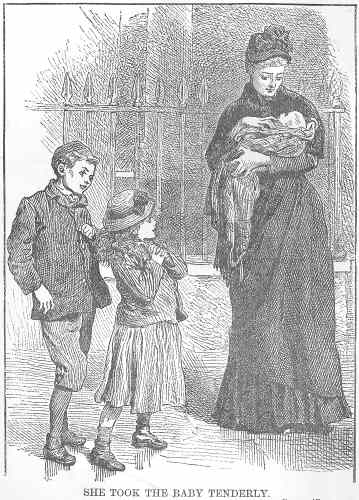
‘I must be mad to do such a thing,’ she
said. ‘Two little waifs in the street come and offer
me a baby, and I don’t refuse it! There, baby,’
for Dickory began to cry again, ‘there,
baby—hush, sweet—hush, dear little baby,
hush.’
This lady’s voice had quite a new tone for Dickory, a
sweeter tone even than Peter’s or Flossy’s. She
stopped crying at once.
‘Our baby takes to you, ma’am,’ said Flossy,
in a voice of thrilling interest.
Peter, very pale, and still silent, drew a step nearer.
‘Well, children,’ said the lady, ‘I have
made up my mind. I’ll take this baby home for the
night. My husband will think me mad—anyone in their
senses would think me mad, but I’m nearly wild with
mother-hunger, and that little mite there,’ pointing to
Flossy, ‘guessed it, and she brought me the baby, and I say
God bless her for it, whether she’s a ragamuffin or
not. Yes, I have made up my mind. I shall take the
baby home for to-night at least. In the morning I
shall make inquiries, but for to-night the baby is
mine.’
‘Half milk, half water in her bottle,’ said Peter
in a very grave reproachful voice. ‘Half milk, half
water, and a little sugar, and a pinch of salt, and Dickory likes
her feet kept werry warm. Come home, Flossy.’
‘And we are not ragamuffins, please lady,’ said
Flossy. ‘Our name is Franklin, and we live in 24
Montfiore Square. We lets lodgings, please lady, and it was
Mr Martin what turned so crusty about baby.’
‘Tell your mother I will come and see her
to-morrow,’ said the lady. ‘You have a mother,
I suppose?’
‘Yes, oh yes. She wanted to send the baby to the
workhouse.’
‘I don’t think that will be necessary. My
name is Ross. Tell your mother to expect me
to-morrow.’


