Martin Chuzzlewit
THE BLUE DRAGON—THE HALF MOON AND SEVEN STARS—TWO SALISBURY
INNS—THE BLACK BULL, HOLBORN
The Blue Dragon is an inn whose name, through the magic pen of Dickens,
has become as familiar as that of the veritable Pecksniff himself, and
almost as important. Dickens found evident delight in describing it and
its beaming mistress, Mrs. Lupin, but was careful not to disclose its real
whereabouts beyond saying that it was located in a “little Wiltshire
village within easy journey of the fair old town of Salisbury.” It is
first introduced in Chapter II of Martin Chuzzlewit in that wonderful
description of an angry wind, which, among the other extraordinary and
wilful antics it indulged in, gave “the old sign before the ale-house door
such a cuff as it went that the Blue Dragon was more rampant than usual
ever afterwards.” In the following chapter we are allowed to become more
intimate with this sign and learn what “a faded, and an ancient dragon he
was; and many a wintry storm of rain, snow, sleet, and hail had changed
his colour from a gaudy blue to a faint lack-lustre of grey. But there he
hung; rearing, in a state of monstrous imbecility, on his hind legs;
waxing, with every month that passed, so much more dim and shapeless that
as you gazed at him on one side of the sign-board it seemed as if he must
be gradually melting through it, and coming out upon the other. He was a
courteous and considerate dragon, too; or had been in his distincter days;
for in the midst of his rampant feebleness he kept one of his fore paws
near his nose, as though he would say, ‘Don’t mind me—it’s only my fun’;
while he held out the other in polite and hospitable entreaty.”
No less delightful is Dickens’s picture of the mistress of the Blue
Dragon, who “was in outward appearance just what a landlady should be:
broad, buxom, comfortable and good-looking, with a face of clear red and
white, which, by its jovial aspect, at once bore testimony to her hearty
participation in the good things of the larder and cellar, and to their
thriving and healthful influences. She was a widow, but years ago had
passed through her state of weeds, and burst into flower again—and in
full bloom she had continued ever since; and in full bloom she was now;
with roses in her ample skirts, and roses on her bodice, roses in her cap,
roses in her cheeks—aye, and roses, worth the gathering too, on her lips
for that matter ... was comely, dimpled plump, and tight as a gooseberry.”
To this inn and the care of its jovial landlady unexpectedly came old
Martin Chuzzlewit and Mary Graham in a rusty old chariot with post-horses.
The old man, suffering horrible cramps and spasms, was accommodated in the
best bedroom, “which was a large apartment, such as one may see in country
places, with a low roof and a sunken flooring, all downhill from the door,
and a descent of two steps on the inside so exquisitely unexpected that
strangers, despite the most elaborate cautioning, usually dived in head
first, as into a plunging bath. It was none of your frivolous and
preposterously bright bedrooms, where nobody can close an eye with any
kind of propriety or decent regard to the association of ideas; but it was
a good, dull leaden drowsy place, where every article of furniture
reminded you that you came there to sleep, and that you were expected to
go to sleep.”
Here old Martin was put to bed in the old curtained four-poster, and was
soon discovered by Mr. Hypocrite Pecksniff, who knew the Blue Dragon and
its bar well and had come in from his house not far away. In short time
followed the other relatives until all the beds in the inn and village
were at a premium. These relatives included Mr. and Mrs. Spottletoe,
Anthony Chuzzlewit and his son Jonas, the widow of a deceased brother and
her two daughters, a grand-nephew, George Chuzzlewit, all of whom we
assume slept at the inn; whilst Montague Tigg and Chevy Slime put up at
the Half Moon and Seven Stars, where they ran up a bill they could not pay
and so tried the Blue Dragon. The King’s Arms in the village was no doubt
the original of the Half Moon and Seven Stars.
Throughout the first portion of the book the Blue Dragon is the meeting
place of many of the characters, with Mrs. Lupin the friend of most of
them. Therefore within its walls many scenes and incidents of the story
take place, apart from the visits of old Martin and Mary Graham.
One of its chief claims to affection, however, is its intimate association
with Mark Tapley, the ostler there, and his attraction to Mrs. Lupin, in
connection with which we need only recall the scene on the night of his
departure for America and that on his ultimate and unexpected return.
On this latter occasion he arrived at the Blue Dragon wet through and
found Mrs. Lupin alone in the bar. Wrapped up in his great coat, she did
not know him at first, but soon recognised him as he vigorously caught her
in his arms and showered kisses upon her. He excused his final burst by
saying “I ain’t a-kissing you now, you’ll observe. I have been among the
patriots: I’m kissing my country.” This exuberance ultimately led to the
marriage of Mark to the buxom widow and the conversion of the sign of the
Blue Dragon into that of the Jolly Tapley, a sign, Mark assured us, of his
own invention: “Wery new, conwivial and expressive.”
And so with such a warm-hearted and homely couple to guide the fortunes of
the Blue Dragon, we may assume that its comfort and hospitality continued
to be a byword in the village and surrounding country.
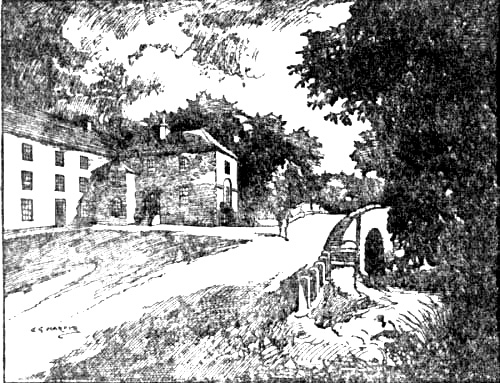
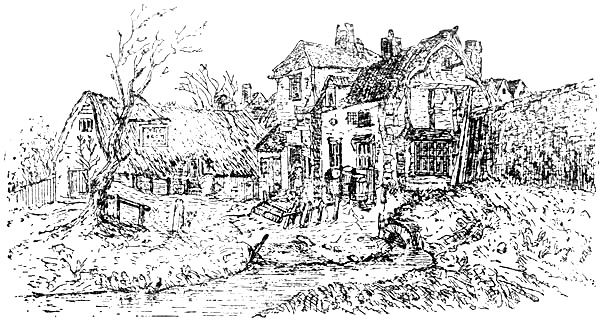
The Blue Dragon has been carefully identified as the George Inn at
Amesbury, eight miles north of Salisbury, and not far from Mr.
Pecksniff’s house, for which an old mansion on the Wilsford Road near the
village is made to stand.
It is true that at Alderbury there is a Green Dragon, and, although it may
reasonably be assumed that Dickens knew of this and appropriated the sign
and changed its colour, he did not otherwise adopt the inn for the scene
of those incidents we have referred to, for it was not commodious enough
for the purpose. Whereas the George at Amesbury fulfils all the
requirements of the story and was at the time a coaching inn and a
hostelry capable of supplying all the wants and all the accommodation
demanded by old Martin Chuzzlewit and the retinue that pursued him
wherever he went.
H. Snowden Ward, who made a minute study of this district in relation to
the Blue Dragon, became convinced by means of ordnance maps and coach
routes that Amesbury answered in every detail the requirements of the
little Wiltshire village described by Dickens. He found that the turnpike
house where Tom Pinch left his box still existed, and the church where he
played the organ was rightly situated, and, though there was no walk
through the wood from the house selected as Pecksniff’s, there was a path
through a little plantation making a short cut to the north-west corner
of the churchyard.
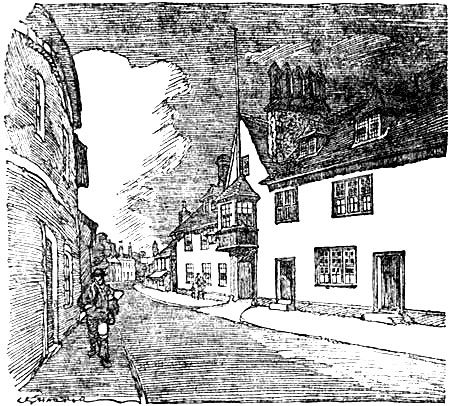
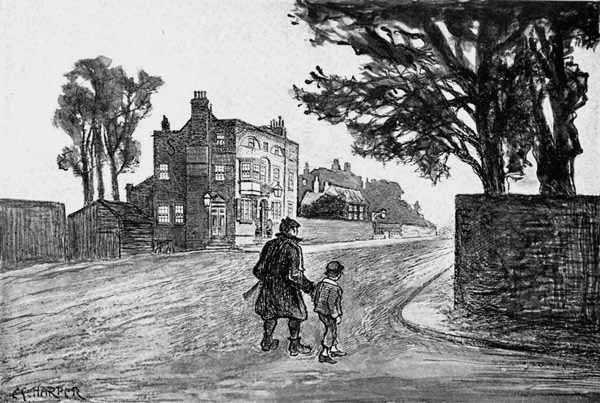
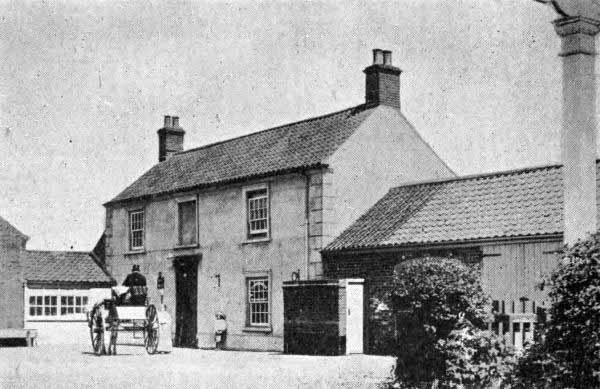
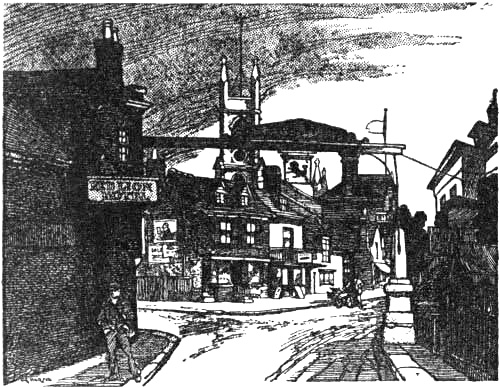
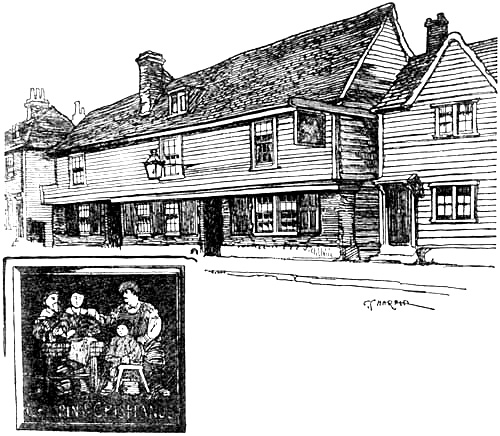
THE GEORGE, AMESBURY
Drawn by C. G. Harper
Amesbury also fits geographically into the story in regard to the route of
the London coach which carried Tom Pinch and others on their journeys to
London, and the George Inn still stands a famous Dickens landmark there,
where visitors can be shown the identical bedroom occupied by old Martin
Chuzzlewit, and where they can otherwise indulge the sentiment of being
in the Blue Dragon once presided over by the very attractive, comely and
dimpled Mrs. Lupin when in her bloom, and utterly ignore the disparagement
and contempt poured upon it by that unprincipled adventurer, Montague
Tigg.
Leaving the “little Wiltshire village” with as much reluctance as Mark
Tapley did on one occasion, let us visit the “fair old town of Salisbury”
in the company of Tom Pinch, who, it will be remembered, was commissioned
to drive there to meet and bring back Martin Chuzzlewit, the new pupil.
Mr. Pecksniff’s horse, which resembled, it was said, his own moral
character in so far that “he was full of promise, but of no performance,”
was harnessed to the hooded vehicle—“it was more like a gig with a tumour
than anything else”—and simple-hearted Tom, with his gallant equipage,
pursued his way to the cathedral town, which he had a shrewd notion was a
very desperate sort of place. Having put up his horse at an inn and given
the hostler to understand that he would look in again in the course of an
hour or two to see it take its corn, he set forth to view the streets.
Salisbury was noted for its inns then, and the day being market day—still
a notable sight to-day—he watched the farmers standing about in groups on
the tavern steps. Later, as the evening drew in, he returned to the
parlour of the tavern where he had left his horse, “had his little table
drawn out close before the fire, and fell to work upon a well-cooked steak
and smoking hot potatoes, with a strong appreciation of their excellence,
and a very keen sense of enjoyment. Beside him, too, there stood a jug of
most stupendous Wiltshire beer; and the effect of the whole was so
transcendent that he was obliged every now and then to lay down his knife
and fork, rub his hands and think about it. By the time the cheese and
celery came, Mr. Pinch had taken a book out of his pocket, and could
afford to trifle with the viands, now eating a little, now drinking a
little, now reading a little.”
Whilst thus comfortably and happily occupied, a stranger appeared in the
room, who turned out to be Martin Chuzzlewit, for whom he was waiting. On
becoming friends a bowl of punch was ordered which in due course came “hot
and strong,” and “after drinking to each other in the steaming mixture
they became quite confidential.” When the time came to depart, Tom settled
his bill and Martin paid for the punch, and, “having wrapped themselves
up, to the extent of their respective means, they went out together to the
front door, where Mr. Pecksniff’s property stopped the way,” and started
on their way back.
Dickens makes no mention of the inn where this meeting took place, but H.
Snowden Ward identified it as the old George Hotel in the High Street. We
cannot vouch for the accuracy of this, although we are not inclined to
dispute it. It may have been the inn Dickens had in his mind’s eye, but it
must have been a recollection of an earlier visit to Salisbury, for at the
time he was writing Martin Chuzzlewit the George had lost its licence
and would have been unable to supply the “jug of most stupendous Wiltshire
beer” or the bowl of hot strong punch with which Tom Pinch and Martin
regaled themselves. It may be the waiter sent for it as is done to-day.
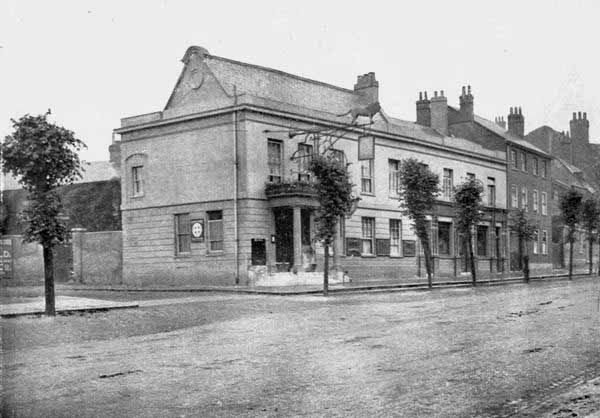
However, if the assumption that this is the tavern where the two met draws
visitors to it, there can be no regrets, for it is surely one of the most
ancient hostelries in the country. It dates back to 1320 and retains its
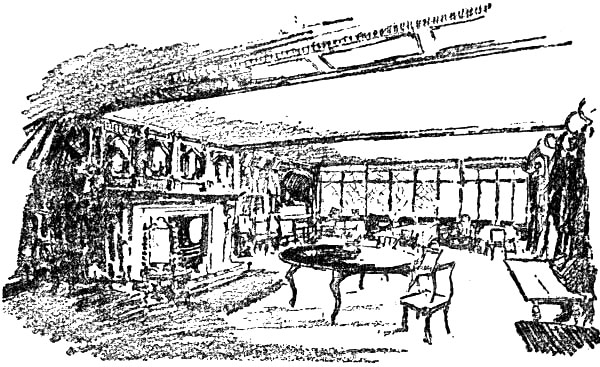
fine Gothic arches of oak, its timbered roofs and ceilings, its massive
oak supports to the cross-beams in several rooms, its splendid example of
an oak Jacobean staircase, its four-poster bedsteads, old fire-places, and
ancient furniture. In one of the rooms there is also a portion of a very
ancient wall of Roman bricks in herringbone work, where in 1869 were
found Roman coins, some of which are to be seen in the hotel to-day.
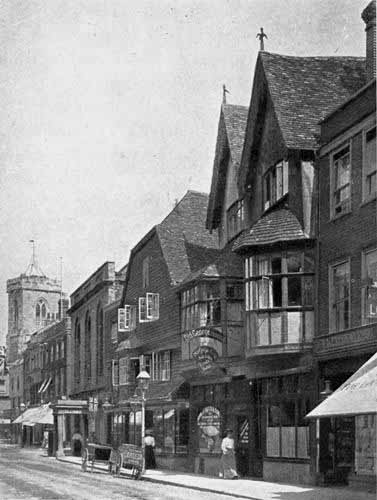
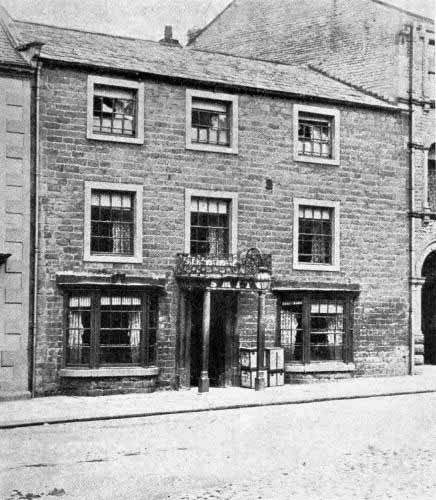
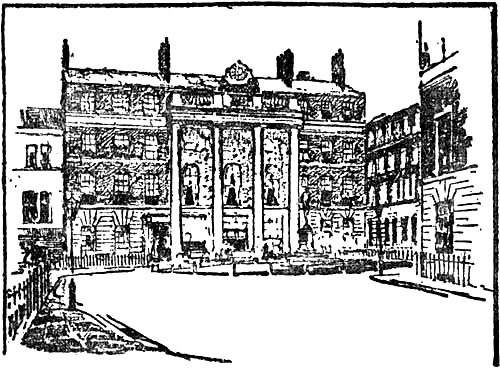
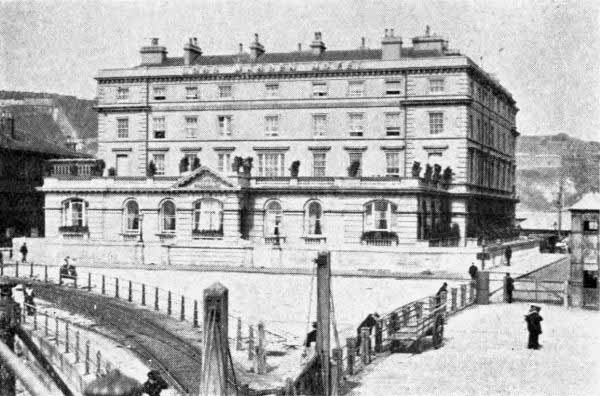
THE GEORGE INN, SALISBURY
Photograph by T. W. Tyrell
It is no longer a coaching inn. The court-yard where the strolling players
of the sixteenth and seventeenth centuries gave their dramatic
performances is now the garden, and the entrance for the coaches has been
narrowed to an ordinary hotel entrance. In doing this, the rooms on each
side were widened, and in this process the massive rough-hewn oaks that
support the cross-beams of the ceilings, and which at one time formed part
of the walls, became isolated, and stand now like trees growing out of the
earth.
Such an ancient inn naturally has many historic stories and traditions
associated with it, and these are not overlooked by the present proprietor
in a little brochure available to visitors. Shakespeare, we are informed,
acted in its court-yard, Oliver Cromwell slept in the inn when passing
through the city to join his army on the 17th October, 1645, whilst Samuel
Pepys makes mention of it in his diary where he records his welcome to a
silk bed and a very good diet.
This inn is referred to again in Chapter XXXI, when Tom Pinch, having
parted from Mr. Pecksniff, tramped on foot to Salisbury and “went to the
inn where he had waited for Martin,” and ordered a bed, which, we are told
“was a low four-poster shelving downward in the centre like a trough.” He
slept two nights at the inn before starting on his ride to London, so
graphically described by Dickens, meeting Mrs. Lupin at the finger-posts
where she had brought the box of good things which he shared with the
coachman on the journey.
Where was situated the Baldfaced Stag, where four fresh horses were
supplied to the admiring gaze of the topers congregated about the door,
cannot be determined. But the inn where Tom alighted in London, and where,
in one of the public rooms opening from the yard, he fell fast asleep
before the fire, although not named, was probably the “Swan with Two
Necks,” which stood in Lad Lane (now Gresham Street) until 1856. It was a
famous coaching inn whence the Exeter and other coaches set out and
returned.
There was another inn at Salisbury where John Westlock entertained Tom
Pinch and Martin to dinner one evening. It is described as “the very first
hotel in the town.” Tom and Martin had walked in from Pecksniff’s on a
very cold and dry day and arrived at the inn with such flushed and burning
faces and so brimful of vigour that the waiter “almost felt assaulted by
their presence.” Dickens describes the hostelry in these words: “A Famous
Inn! the hall a very grove of dead game and dangling joints of mutton; and
in one corner an illustrious larder, with glass doors, developing cold
fowls and noble joints, and tarts wherein the raspberry jam coyly withdrew
itself, as such a precious creature should, behind a lattice-work of
pastry. And behold, on the first floor, at the court end of the house, in
a room with all the window-curtains drawn, a fire piled half-way up the
chimney, plates warming before it, wax candles gleaming everywhere, and a
table spread for three, with silver and glass enough for thirty—John
Westlock.”
What a greeting for hungry souls after a long tramp in the brisk cold
country air. “I have ordered everything for dinner that we used to say
we’d have, Tom,” said their host, and an excellent idea of a dinner it
was, too—“like a dream,” as he added.
“John was wrong there,” the narrator goes on, “because nobody ever dreamed
such soup as was put upon the table directly afterwards; or such fish; or
such side-dishes; or such a top and bottom; or such a course of birds and
sweets; or, in short, anything approaching the reality of entertainment
at ten-and-sixpence a head, exclusive of wines. As to them, the man who
can dream such iced champagne, such claret, port or sherry, had better go
to bed and stop there.”
It was a right royal, jolly dinner, and they were very merry and full of
enjoyment all the time; “but not the least pleasant part of the festival
was when they all three sat about the fire, cracking nuts, drinking wine,
and talking cheerfully.” They parted for the night, “John Westlock full of
light-heartedness and good humour, and poor Tom Pinch quite satisfied.”
After breakfast next morning the two young men returned to Pecksniff’s and
John Westlock to London.
Again Dickens does not give a name to this hotel. He tells us it was not
the same one where Tom Pinch met Martin on the occasion referred to
previously; but he does tell us that it was the very first hotel in the
town and that it was a famous inn. That has given the clue to many
students of the book who have identified it as the White Hart, a very old
house where many coaches stopped and were horsed in the coaching days of
the period of the story. The White Hart was certainly famous and quite
capable of providing such a dinner as John Westlock gave his two friends.
It is called an hotel to-day and is evidently very proud of its tradition
and stories. Here are one or two anecdotes relating to its past taken from
local histories.
In the year 1618 King James came to Sarum and it was just before this
visit that Sir Walter Raleigh passed through the city. He was on his way
from Plymouth after the failure of his last voyage to Guiana and reached
Salisbury on the evening of Monday, the 27th July, in company with his
wife, Sir Lewis Stukeley and Manourie, a French empiric. His forebodings
were of the gloomiest and he feared to meet the King whose early arrival
was expected. He therefore resorted to stratagem, and feigned sickness,
hoping by this means to gain time to employ the intercession of friends,
arrange his affairs and perhaps awaken the King’s compassion. He feigned
sickness, then insanity, and by means of unguents provided by Manourie
acquired the appearance of suffering from a loathsome skin disease. Three
local physicians were called in and pronounced the disease incurable. This
treatment and his exertions produced at the end of the second day an acute
sense of hunger, and, in the words of the chronicler, “Manourie
accordingly procured from the White Hart inn a leg of mutton and some
loaves, which Raleigh devoured in secret and thus led his attendants to
suppose that he took no kind of sustenance.” It was in Salisbury at this
time that he wrote his apology for his last voyage to Guiana. The Court
arrived before he left, but he did not see the King and gained a temporary
respite.
On the 9th October, 1780, the celebrated Henry Laurens, President of the
American Congress, arrived at the White Hart on his way to London, where
he was committed to the Tower.
The Duke and Duchess of Orleans with a numerous retinue arrived at the
White Hart on the 13th September, 1816.
On October 25th, 1830, the Duchess of Kent and Princess Victoria, with
their suite, arrived at the White Hart from Erlestoke Park. They were
attended by a guard of honour from the Salisbury Troop of Yeomanry.
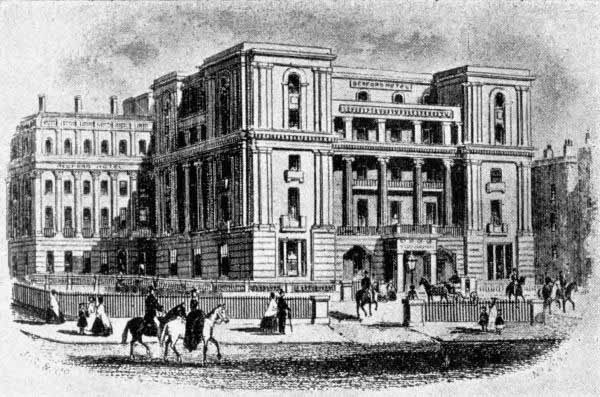
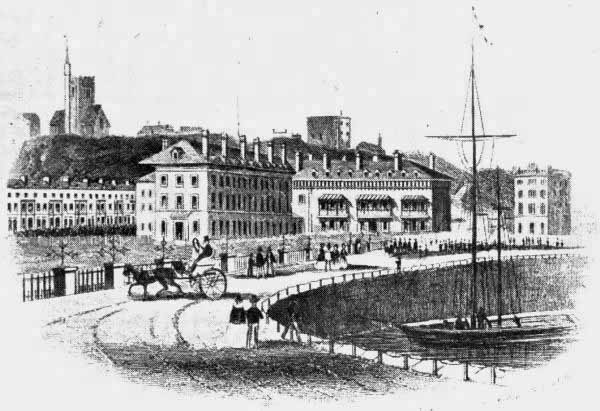
The White Hart is probably the most famous in the city to-day. Its outside
appearance is more like a small replica of the National Gallery, with its
stone pillars and stucco work. Prominently placed over the entrance is a
graceful White Hart with its neck encircled with the gold band of
tradition.
A fitting inn, John Westlock, for your royal repast!
The exciting and romantic days of coaching were beginning to ebb away at
the time Martin Chuzzlewit was published; but so wonderfully does
Dickens describe the scenes on the road, and so exhilarating are his
word-pictures, the spirit of those times can better be visualized from its
pages than from any history of the period. Not only are those days not
allowed to be forgotten, but inns that have since been wiped out of
existence have had their name and fame indelibly marked on the tablets of
time for ever.
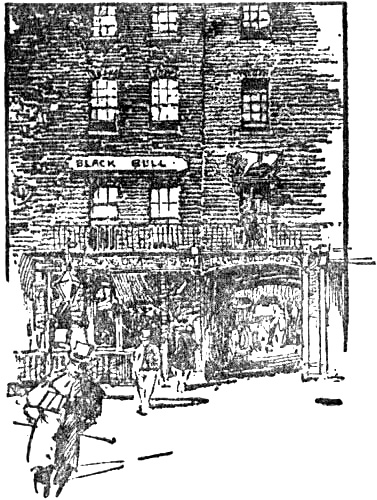
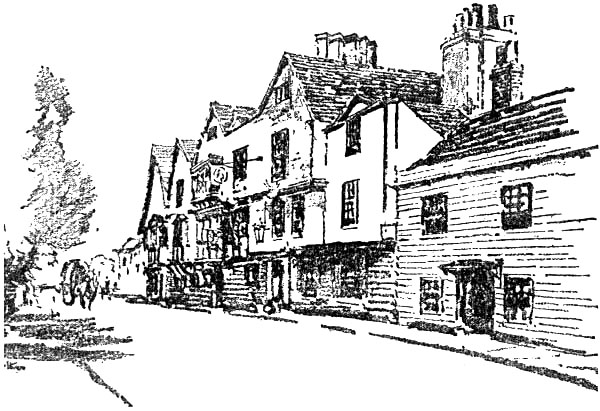
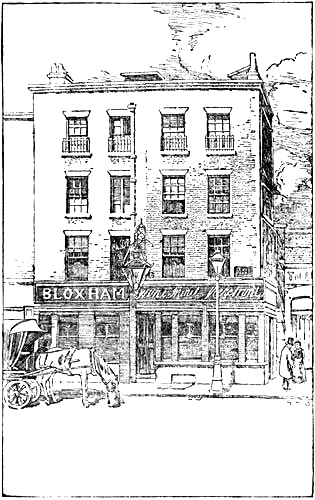
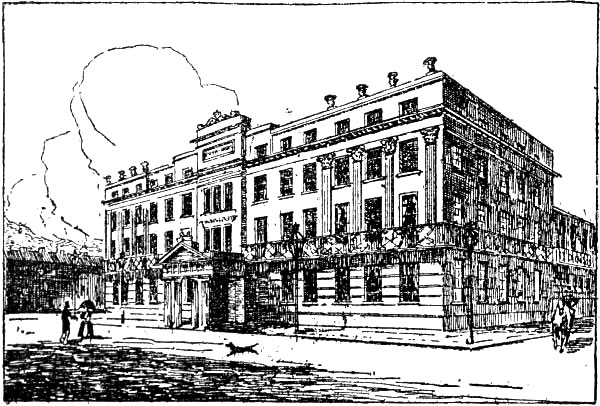
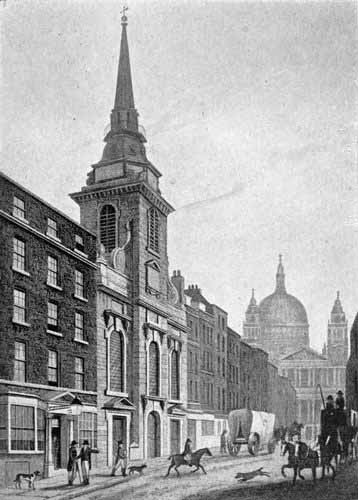
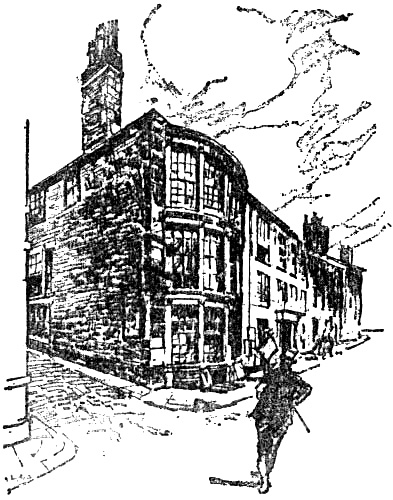
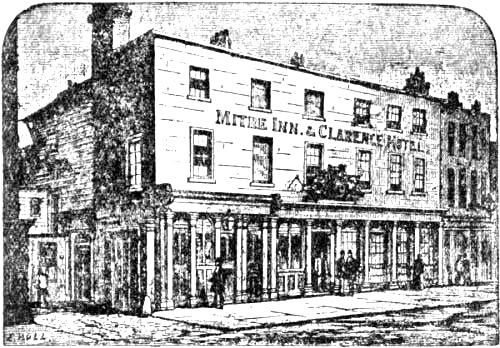
THE BLACK BULL, HOLBORN
Drawn by L. Walker
Such is the case of the Black Bull that once stood in Holborn. It was here
that the two estimable females, Sairey Gamp and Betsey Prig,
professionally attended Mr. Lewsome in his illness. Mr. Lewsome, it will
be remembered, was the young man who sold the drugs to Jonas Chuzzlewit
with which old Anthony was poisoned, and who after the death of the latter
made a voluntary confession of the fact, impelled to do so by the torture
of mind and dread of death he himself endured by his severe sickness.
This is Mrs. Gamp’s announcement of her appointment:
“There is a gent, sir, at the Bull in Holborn, as has been took ill
there, and is bad abed. They have a day-nurse as was recommended from
Bartholomew’s; and well I knows her, Mr. Mould, her name bein’ Mrs. Prig,
the best of creeturs. But she is otherwise engaged at night, and they are
in wants of night-watching; consequent she says to them, having reposed
the greatest friendliness in me for twenty year, ‘The soberest person
going, and the best of blessings in a sick room, is Mrs. Gamp. Send a boy
to Kingsgate Street,’ she says, ‘and snap her up at any price, for Mrs.
Gamp is worth her weight and more in goldian guineas.’ My landlord brings
the message down to me, and says, ‘Bein’ in a light place where you are,
and this job promising so well, why not unite the two?’”
Dickens then describes how Mrs. Gamp went to her private lodgings in
Kingsgate Street close to the tavern, “for a bundle of robes and wrappings
comfortable in the night season; and then repaired to the Bull in Holborn,
which she reached as the clocks were striking eight.
“As she turned into the yard, she stopped; for the landlord, landlady, and
head chambermaid, were all on the threshold together, talking earnestly
with a young gentleman who seemed to have just come or to be just going
away. The first words that struck upon Mrs. Gamp’s ear obviously bore
reference to the patient; and, it being expedient that all good attendants
should know as much as possible about the case on which their skill is
brought to bear, Mrs. Gamp listened as a matter of duty.”
At a suitable moment she ventured the remark, “Ah! a rayal gentleman!”
and, advancing, introduced herself, observing:
“The night nurse from Kingsgate Street, well beknown to Mrs. Prig the
day-nurse, and the best of creeturs.... It ain’t the fust time by many
score, ma’am,” dropping a curtsy to the landlady, “that Mrs. Prig and me
has nursed together, turn and turn about, one off, one on. We knows each
other’s ways, and often gives relief when others failed.”
Regarding herself as having now delivered her inauguration address, Mrs.
Gamp curtsied all round, and signified her wish to be conducted to the
scene of her official duties. The chambermaid led her, through a variety
of intricate passages, to the top of the house; and, pointing at length to
a solitary door at the end of a gallery, informed her that yonder was the
chamber where the patient lay. That done, she hurried off with all the
speed she could make.
“Mrs. Gamp traversed the gallery in a great heat from having carried her
large bundle up so many stairs, and tapped at the door, which was
immediately opened by Mrs. Prig, bonneted and shawled and all impatience
to be gone.”
Having learned from Mrs. Prig that the pickled salmon was quite delicious,
that the cold meat tasted of the stables, that the drinks were all good,
that “the physic and them things is on the drawers and mankleshelf,” and
other valuable bits of information, thanked her and entered upon her
occupation. “A little dull, but not so bad as might be,” Mrs. Gamp
remarked. “I’m glad to see a parapidge in case of fire, and lots of roofs
and chimley-pots to walk upon.” Mrs. Gamp was looking out of the window at
the time, and the observations she made then applied to the view seen from
the same window during a visit to it just before the inn was destroyed.
Having unpacked her bundle and settled things to her liking she came to
the conclusion that it was time for supper and promptly rang for the maid.
“I think, young woman,” said Mrs. Gamp to the assistant chambermaid, in a
tone expressive of weakness, “that I could pick a little bit of pickled
salmon, with a nice little sprig of fennel, and a sprinkling of white
pepper. I takes new bread, my dear, with jest a little pat of fresh
butter, and a mossel of cheese. In case there should be such a thing as a
cowcumber in the ’ouse, will you be so kind as bring it, for I’m rather
partial to ’em, and they does a world of good in a sick-room. If they
draws the Brighton Tipper here, I takes that ale at night, my love; it
bein’ considered wakeful by the doctors. And whatever you do, young woman,
don’t bring more than a shilling’s-worth of gin and water warm when I
rings the bell a second time; for that is always my allowance, and I never
takes a drop beyond!”
“A tray was brought with everything upon it, even to the cucumber; and
Mrs. Gamp accordingly sat down to eat and drink in high good humour. The
extent to which she availed herself of the vinegar, and supped up that
refreshing fluid with the blade of her knife, can scarcely be expressed in
narrative.”
This was the occasion, and the Black Bull the place, where Mrs. Gamp gave
utterance to her famous piece of philosophy: “What a blessed thing it
is—living in a wale—to be contented.”
Without following Mrs. Gamp through the details of her effort to help the
patient to convalescence—albeit those efforts were peculiar to herself
and have a unique interest on that account—we need only record that, in
spite of her assurance that, “of all the trying invalieges in this walley
of the shadder, that one beats ’em black and blue,” Mr. Lewsome was
eventually able to be moved into the country and Mrs. Gamp was deputed to
accompany him there by coach.
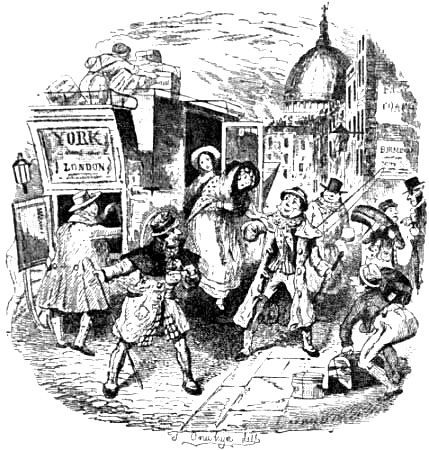
“Arriving at the tavern, Mrs. Gamp (who was full-dressed for the journey,
in her latest suit of mourning) left her friends to entertain themselves
in the yard, while she ascended to the sick-room, where her
fellow-labourer, Mrs. Prig, was dressing the invalid,” who was ultimately
assisted downstairs to the coach, just then on the point of starting.
“It was a troublesome matter to adjust Mrs. Gamp’s luggage to her
satisfaction; for every package belonging to that lady had the
inconvenient property of requiring to be put in a boot by itself, and to
have no other luggage near it, on pain of actions at law for heavy damages
against the proprietors of the coach. The umbrella with the circular patch
was particularly hard to be got rid of, and several times thrust out its
battered brass nozzle from improper crevices and chinks, to the great
terror of the other passengers. Indeed, in her intense anxiety to find a
haven of refuge for this chattel, Mrs. Gamp so often moved it, in the
course of five minutes, that it seemed not one umbrella but fifty. At
length it was lost, or said to be; and for the next five minutes she was
face to face with the coachman, go wherever he might, protesting that it
should be ‘made good’ though she took the question to the House of
Commons.
“At last, her bundle, and her pattens, and her basket, and everything
else, being disposed of, she took a friendly leave of Poll and Mr.
Bailey, dropped a curtsy to John Westlock, and parted as from a cherished
member of the sisterhood with Betsey Prig.
“‘Wishin’ you lots of sickness, my darling creetur,’ Mrs. Gamp observed,
‘and good places. It won’t be long, I hope, before we works together, off
and on, again, Betsey: and may our next meetin’ be at a large family’s,
where they all takes it reg’lar, one from another, turn and turn about,
and has it businesslike.’”
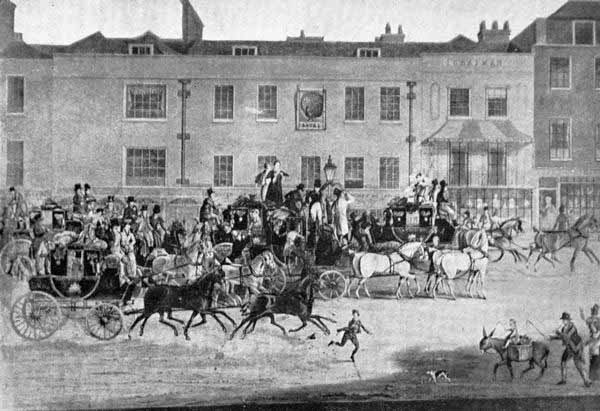
And so the coach rolled out of the Bull yard with Mrs. Gamp and her charge
comfortably seated within, amidst a cloud of bustle and commotion,
terminating events which have left their mark for all time on the history
of the famous Dickensian tavern.
Although the Black Bull during its existence in so important a
thoroughfare as Holborn must have been the centre of much activity in the
coaching days, the resort of many notables and the scene of important
events, there seem scanty records of its past history available.
We find but few references to it in the annals of London beyond the fact
that it was a busy coaching inn from the seventeenth century until the
passing of the coaches from the road in the nineteenth century, when its
association with the notorious Mrs. Gamp gave it its chief claim to fame.
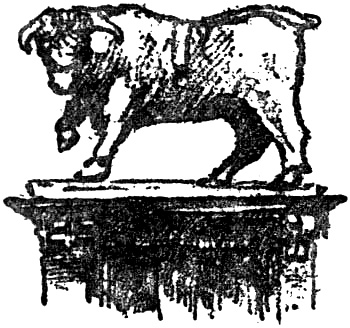
THE SIGN OF THE BLACK BULL
How far its history dates back it is difficult to say. It may even have
been one of those many fair houses and inns for travellers referred to by
Stow as existing on the north side of Oldbourne in the middle of the
sixteenth century. In the days when access to the city of London was not
possible after sundown, the Black Bull and many others, situated outside
the boundary, catered for those late comers who could not enter the gates.
No doubt these inns were established to meet such contingencies, and
perforce did a good trade. They were all very similar in general
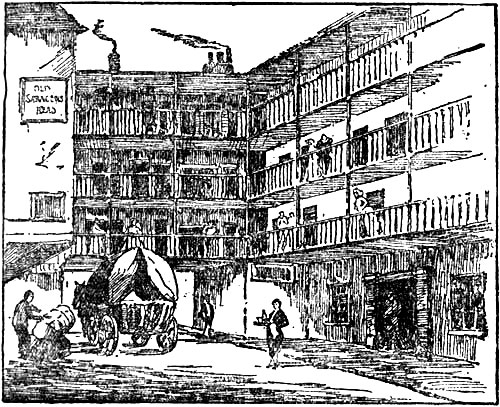
appearance and in accommodation. The Black Bull was the terminus and
starting place for coaches, and its court-yard, like most of the others,
was large and surrounded by galleries. It had, of course, many flights of
stairs, and a variety of intricate passages up to the top of the building.
But it had a more distinctive and prominent sign than the rest of them in
this district, which, perhaps, made it more conspicuous. This was the very
fine specimen of a black bull, with gilt horns and hoofs, and a golden
band round its body. Its perfection of workmanship stamped it as that of
some renowned artist. Resting on a bracket fixed to the front of the
building, it naturally attracted attention immediately, and it was to be
seen as late as 1904 when the building was finally demolished to make room
for a different kind of business altogether. By that time all the romance
of the coaching era had left the tavern, and its court-yard had long
before been put to other uses.
This building of Mrs. Gamp’s day was erected in 1825, but many such had
flourished earlier on the same site, although we believe the splendid
effigy which adorned its exterior first appeared in that year. Prior to
that date the inn was known as the Bull and Gate, unless Fielding enlarged
its designation unwittingly when he tells us in 1750 that Tom Jones, on
entering London after his exciting encounter with highwaymen between
Barnet and the metropolis, put up at the “Bull and Gate in Holborn.”
Whatever it may have been called in Fielding’s days, its fame will survive
in history as the Black Bull of Holborn, immortalized by association with
Sairey Gamp.