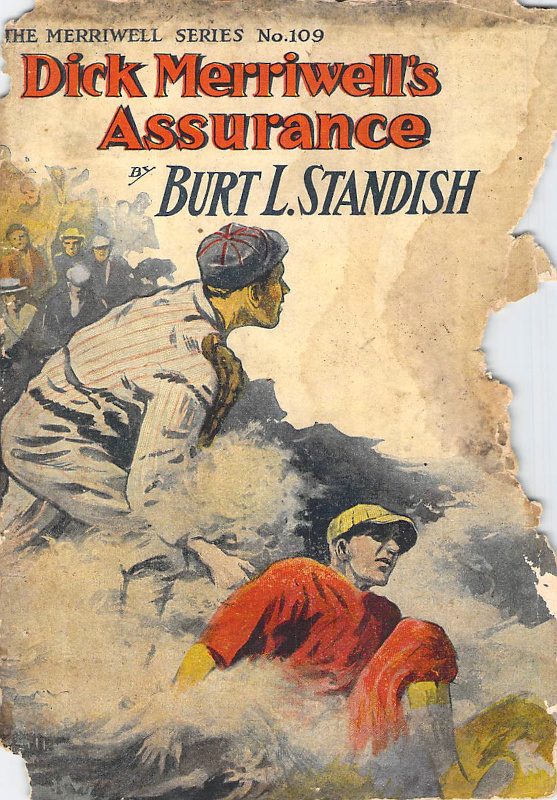
Minor errors, attributable to the printer, have been corrected. Please
see the transcriber’s note at the end of this text
for details regarding the handling of any textual issues encountered
during its preparation.
Any corrections are indicated using an underline
highlight. Placing the cursor over the correction will produce the
original text in a small popup.
Any corrections are indicated as hyperlinks, which will navigate the
reader to the corresponding entry in the corrections table in the
note at the end of the text.
BOOKS FOR YOUNG MEN
MERRIWELL SERIES
Stories of Frank and Dick Merriwell
PRICE, FIFTEEN CENTS
Fascinating Stories of Athletics
A half million enthusiastic followers of the Merriwell brothers
will attest the unfailing interest and wholesomeness of these
adventures of two lads of high ideals, who play fair with themselves,
as well as with the rest of the world.
These stories are rich in fun and thrills in all branches of
sports and athletics. They are extremely high in moral tone,
and cannot fail to be of immense benefit to every boy who reads
them.
They have the splendid quality of firing a boy’s ambition to
become a good athlete, in order that he may develop into a
strong, vigorous right-thinking man.
ALL TITLES ALWAYS IN PRINT
1—Frank Merriwell’s School Days
By Burt L. Standish
2—Frank Merriwell’s Chums
By Burt L. Standish
3—Frank Merriwell’s Foes
By Burt L. Standish
4—Frank Merriwell’s Trip West
By Burt L. Standish
5—Frank Merriwell Down South
By Burt L. Standish
6—Frank Merriwell’s Bravery
By Burt L. Standish
7—Frank Merriwell’s Hunting Tour
By Burt L. Standish
8—Frank Merriwell in Europe
By Burt L. Standish
9—Frank Merriwell at Yale
By Burt L. Standish
10—Frank Merriwell’s Sports Afield
By Burt L. Standish
11—Frank Merriwell’s Races
By Burt L. Standish
12—Frank Merriwell’s Party
By Burt L. Standish
13—Frank Merriwell’s Bicycle Tour
By Burt L. Standish
14—Frank Merriwell’s Courage
By Burt L. Standish
15—Frank Merriwell’s Daring
By Burt L. Standish
16—Frank Merriwell’s Alarm
By Burt L. Standish
17—Frank Merriwell’s Athletes
By Burt L. Standish
18—Frank Merriwell’s Skill
By Burt L. Standish
19—Frank Merriwell’s Champions
By Burt L. Standish
20—Frank Merriwell’s Return to Yale
By Burt L. Standish
21—Frank Merriwell’s Secret
By Burt L. Standish
22—Frank Merriwell’s Danger
By Burt L. Standish
23—Frank Merriwell’s Loyalty
By Burt L. Standish
24—Frank Merriwell in Camp
By Burt L. Standish
25—Frank Merriwell’s Vacation
By Burt L. Standish
26—Frank Merriwell’s Cruise
By Burt L. Standish
27—Frank Merriwell’s Chase
By Burt L. Standish
28—Frank Merriwell in Maine
By Burt L. Standish
29—Frank Merriwell’s Struggle
By Burt L. Standish
30—Frank Merriwell’s First Job
By Burt L. Standish
31—Frank Merriwell’s Opportunity
By Burt L. Standish
32—Frank Merriwell’s Hard Luck
By Burt L. Standish
33—Frank Merriwell’s Protégé
By Burt L. Standish
34—Frank Merriwell on the Road
By Burt L. Standish
35—Frank Merriwell’s Own Company
By Burt L. Standish
36—Frank Merriwell’s Fame
By Burt L. Standish
37—Frank Merriwell’s College Chums
By Burt L. Standish
38—Frank Merriwell’s Problem
By Burt L. Standish
39—Frank Merriwell’s Fortune
By Burt L. Standish
40—Frank Merriwell’s New Comedian
By Burt L. Standish
41—Frank Merriwell’s Prosperity
By Burt L. Standish
42—Frank Merriwell’s Stage Hit
By Burt L. Standish
43—Frank Merriwell’s Great Scheme
By Burt L. Standish
44—Frank Merriwell in England
By Burt L. Standish
45—Frank Merriwell on the Boulevards
By Burt L. Standish
46—Frank Merriwell’s Duel
By Burt L. Standish
47—Frank Merriwell’s Double Shot
By Burt L. Standish
48—Frank Merriwell’s Baseball Victories
By Burt L. Standish
49—Frank Merriwell’s Confidence
By Burt L. Standish
OR,
IN HIS BROTHER’S FOOTSTEPS
BY
BURT L. STANDISH
Author of the famous Merriwell Stories.
STREET & SMITH CORPORATION
PUBLISHERS
79-89 Seventh Avenue, New York
Copyright, 1904
By STREET & SMITH
Dick Merriwell’s Assurance
(Printed in the United States of America)
All rights reserved, including that of translation into foreign languages, including the Scandinavian.
5DICK MERRIWELL’S ASSURANCE.
CHAPTER I. ARLINGTON GETS THE CHANCE.
When the Fardale Military Academy arranged to
play a baseball game with the Great Northern A. A.
it was generally believed that the cadets would be
“snowed under.” The Great Northern was a semi-professional
organization, and it had been necessary to
give the team a large guarantee in order to bring it to
Fardale.
Captain Merriwell, of the Fardales, had taken no
part in the arrangements for this game. He had advised
neither for nor against it.
The success of the Fardale team had been such that
the athletic committee of the school, on receiving the
proposition from the Great Northern, had decided to
make the game, even though it was known that the
schoolboys would be pitted against semi-professionals
who were much older and many of whom made a regular
business of baseball. It was generally believed
among the cadets that their team had risen superior to
the school nines with which they were scheduled to
play.
This being the case, there was a great rejoicing at
the academy when it was known that the Great Northern
6A. A. would appear there. There were a few
who predicted overwhelming defeat for Fardale.
These, however, were greatly in the minority; the
main body of cadets were confident of victory.
When Captain Merriwell’s opinion was sought in
advance, he simply declared that Fardale was going to
capture the game if possible. On being asked if he
did not consider it almost a sure thing, he replied that
no baseball game could be a sure thing unless one team
greatly outclassed the other, for that element called
“luck” often decided the result of a contest on the
diamond.
Brad Buckhart, Merriwell’s chum and roommate,
was the only one who knew Dick was in no condition
to pitch his best. Dick’s side had been injured by an
assault upon him in a billiard room, when he had been
thrown against a table. It had not recovered, and if
he went into the box with the idea of pitching nine
innings when the Great Northern appeared, it was
quite likely he would retard his recovery to such an
extent that he might remain out of condition for the
rest of the spring season. It was Brad who urged
Dick to let some one else pitch against the athletic
organization. The Texan chose the opportunity to do
this privately in their room.
“If you get knocked out for fair and can’t pitch
any more this season, I certain see where we land in
the ditch,” said Brad; “this yere game don’t amount
to such a lot, pard; what if we do lose it? It won’t
hurt our standing any at all in the school series, and
it certain will be the natural thing any man with a
good nut on him will expect. What if you did go in
7against these Great Northern chaps and win, but
knocked yourself out so you had to stay on the bench
and see FairportFairport, Rivermouth, Hudsonville, Springvale,
and the rest of them eat us up? Wouldn’t that
be fine! Wouldn’t that make you tired! You didn’t
have anything to do with arranging for this game,
and so there’s no responsibility on your shoulders.”
Dick shook his head.
“I have little to do with arranging any of the
games,” he said; “but I feel just as much responsible,
Buckhart. Every one knows this is going to be a
tough old struggle. If I put some one else in to pitch
they will have the impression that I was afraid to go
against the Great Northern.”
“What do you care! You’re a whole lot independent,
and I certain never knew you to mind what any
one thought, as long as you believed you were right.”
“It’s not that, Brad. I can’t afford to lose the confidence
of the team. As long as the fellows behind
me believe in me implicitly, they play better baseball.
Let them lose confidence in me, in even a small degree,
and it will affect their playing.”
“Then it’s up to you to let them know your condition.
It’s up to you to keep it secret no longer that
your side is hurt. Pard, you’re a plenty queer. Why,
some pitchers squeal and say they have lame arms, or
something, every time there is a tough game in sight.
But you never want to let any one know you are in
bad shape, no matter what the circumstances may be.
Tell you what, partner, if you don’t explain about
your side so it will be understood, I sure am going to
do it myself.”
8“You will do nothing of the sort, Buckhart; when
I get ready to tell, I’ll tell. If you stop to think a
moment you will see the bad effect of putting another
man into the box. It will look as if I felt shaky about
going against these fellows, and put some one else in
to take chances and suffer blame and defeat if we are
beaten.”
“Oh, rot! Any one who knows you well knows
you better than that. And there is Chet Arlington.
He is just seething to pitch a game.”
Dick smiled.
“You can see yourself how it would seem if I
should ask Arlington to pitch this game. He wanted
to pitch against Hilsboro, and was not given the
chance. He felt that he might win that game. If I
should put him in now, and Fardale lost the game,
which it is quite possible she may, there would be
many who would fancy I had not given him a fair
show. He might think so himself. You can see that,
old man.”
“Well, I suppose that’s so,” admitted the Texan.
“Never thought of it that way. No, pard, you can’t
ask him to pitch; but, all the same, you can’t pitch
yourself. What are you going to do?”
“It’s a problem I can’t answer now,” said Dick.
Arlington was the one who settled the problem.
That very day he stopped Merriwell on the parade
ground, drew him aside, and said:
“See here, Captain Merriwell, I am going to ask
you just one more favor. If you don’t grant it, this
will be the last time I’ll ever ask anything of you.”
“What is it?” demanded Dick.
9“I want to pitch Saturday.”
“Do you?”
“Sure thing. May I?”
“Do you realize what you are asking?”
“You bet I do!” warmly retorted Chet. “You
turned me down the last time I asked such a favor,
and I thought I’d never ask another.”
“I didn’t turn you down. I thought seriously of
using you against Hilsboro, but you went round telling
that I had promised to put you into that game
when I had done nothing of the sort. You knew I
had done nothing of the sort, but you tried to force
me into it by circulating the report that I had. This
is true, Arlington, and you cannot deny it.”
“Well, maybe that’s right,” confessed Chester. “I
did wrong about that, Merriwell. I am willing to
acknowledge it to any one.”
Instantly Dick’s face cleared.
“Now that you have acknowledged it to me you
don’t have to say anything more about it,” he nodded.
“We’ll let it drop. But I want you to think this matter
over before you plunge. You know the kind of
a team we have to meet Saturday. Those fellows are
professionals. Our chance of beating them is a small
one. I don’t want you to go around telling that I
said this, but you should understand the facts. If
you pitch that game you may lose it. If I put you in,
there will be many ready to say I did it because I
didn’t dare pitch myself.”
“Any one who says such a thing is a chump!” exclaimed
Chester. “You don’t have to pay any attention
to such talk.”
10“But you know it will be said.”
“Put me in and I will tell everybody the truth-that
I begged you to do so. Why should you pitch
this game, anyhow? It’s not a school game, and it
will be no disgrace to lose it. If I pitch, I am going
to do my utmost to win. You know what it will mean
to me if I do win. It will put me on my feet here.
It will give me a reputation. The actual fact is that
by letting me pitch you will be doing a great favor to
one who has done you no favors.”
“Is that the way you look at it, Arlington? Tell
me the truth. Is that the way you look at it?”
“I swear that’s the way I look at it.”
“Then say nothing and get into the best condition
possible for that game.”
Chester’s face brightened.
“Now, that’s great stuff, Captain Merriwell!” he
said. “I won’t forget this of you, and you see if I
don’t work like a dog to take that game!”
“I hope you take it,” said Dick.
CHAPTER II. FARDALE’S BRILLIANT OPENING.
11
The game of the Great Northern being well advertised
and the day fair and bright, a large crowd
turned out. The Great Northern boys seemed to
think the whole thing something of a lark. They
looked on the cadets with amusement, fancying they
could win the game with ease.
At the usual hour the game was called, with the
visitors at bat. When Chester Arlington went into
the box for Fardale and Dick Merriwell was seen
sitting on the bench, there came from the cadets a
murmur of surprise and disappointment.
“Well, what do you think of that?” exclaimed Hector
Marsh, who was seated with his usual companions,
Walker, Preston, and Shaw. “Arlington is going to
pitch this game.”
“This is clever of Merriwell,” said Preston. “He
is sending a lamb to the slaughter. He knows which
side his bread is buttered on. We can’t beat those
fellows.”
“Well, I will say one thing,” observed Walker.
“This is the first time I have ever known Merriwell
to decline to face the music.”
“It shows just how big a chump Arlington is,”
growled Marsh. “Why, poor fellow! he oughter
know better!”
“I was counting on seeing the mighty Merriwell
12knocked out of the box to-day,” said Preston. “This
is a great disappointment to me.”
“It’s ten to one Arlington won’t last three innings,”
nodded Walker. “Perhaps Merriwell will go in after
that, and we will have the pleasure of seeing both of
them get their bumps.”
Chester had been taking good care of himself for
several days and was feeling in fine fettle. He was
full of confidence, as usual, and believed he would be
able to astonish every one by his work that day.
“Well! well! well!” roared one of the Great Northern
players from the bench, as their first batter
stepped out. “See him pound the leather! Watch
him drive it a mile!”
Up popped Ted Smart, who cried:
“Please don’t drive it a mile, sir! Please don’t
drive it more than half a mile! I know you will hit
it very, very hard, but I hope you won’t spoil the
ball!”
Arlington was ready to pitch, and now the players
behind him opened up.
“Put it right over, old boy,” said Earl Gardner.
“Trim his whiskers!” chattered Chip Jolliby.
“Let ’im see ’ow ’ard ’e can ’it hit,” advised Billy
Bradley, the English boy.
“Dern my picter! I am right here behind ye!”
piped Obediah Tubbs.
“Put it into the pocket!” growled Buckhart, holding
up his big mitt. “Put it right there, old man!”
Having toed the slab, Arlington whistled in the
first ball, which was a sharp inshoot.
13The batter struck, and the ball plunked into the
Texan’s glove.
“Oh, dear me!” came from Ted Smart. “Didn’t
he hit it hard!”
The entire Fardale team was chattering away now
in a lively fashion, every player on his toes and ready
to do his duty.
Having led the batter to swing at the first one,
Chester sought to “pull” him with an outcurve.
Ligner was wary, however and refused to go
after it.
“Get ’em over! Get ’em over, young feller!” he
growled. “Can’t you find the plate?”
Chester tried a high one, and again Ligner
missed it.
“Wasn’t that an awful hit!” came from Smart. “I
didn’t expect him to hit it so far!”
Arlington was doing his best at the very outset.
He could not lead Ligner into reaching for wide ones.
As a result, he was compelled to put the ball over.
Then the batter did hit it. He drove it like a shot
straight at Gardner, who never flinched. The ball
struck in Earl’s hands, but dropped to the ground.
Quick as thought Gardner picked it up and sent it
across to first, and the first batter was out.
Ligner paused near the base and stood with his
hands on his hips, staring at Gardner.
“Burned your mitts a little, kid, didn’t it?” he cried.
“Next time I will take your paws off. You will
learn better than to stand in front of those after a
while.”
At this the cadets set up a derisive shout.
14“That fellow is foolish, Mr. Man!” cried Smart, as
soon as he could be heard. “He never will seem to
dodge ’em!”
“That’s the first one, Arlington,” said Gardner.
“They’re half gone—half gone!”
“You must be good at arithmetic!” derisively called
one of the visitors from the bench.
“Beautiful work, Gardner!” said Arlington, in satisfaction.
“A fellow can pitch with that kind of support!”
The second hitter was a stocky young Irish lad by
the name of O’Rouke.
“He’s easy,” asserted Ligner. “All you have to do
is wait, and he will put a pretty one right over.”
Chester surveyed O’Rouke critically, his toe on the
pitching plate. His pose was one of grace, and he
knew it. He knew also that in the grand stand were
several girls who were watching him anxiously. He
had seen his sister, accompanied by Doris Templeton
and Zona Desmond, enter the grand stand, and occasionally
his eyes sought them.
“June,” said Zona, “I think your brother is just
splendid! I think he is the handsomest fellow in the
whole school!”
June smiled.
“I am glad you think so,” she said.
“I know lots of girls who think so,” declared Zona,
flashing Doris a glance.
“I hope he wins this game to-day,” murmured June.
“It will mean so much to him. It will give him courage
and confidence.”
“Of course he will,” nodded Zona.
15“Oh, it isn’t sure. It is going to be a hard game.
Every one says Dick Merriwell acknowledged it
would be a hard game.”
“Why didn’t he pitch?”
“Yes, why didn’t he?” broke from Doris.
“I don’t know,” June confessed. “It does seem
strange he should use Chester in such a game.”
“Perhaps he was afraid,” suggested Zona.
“Oh, I don’t believe that!” June exclaimed immediately.
“Nor I,” said Doris.
“Still you can’t tell,” persisted Zona. “Of course,
he would hate to lose a game. It would hurt his
record.”
“I don’t believe he would put any one else in to
pitch for that reason,” declared Chester’s sister. “It’s
not like him.”
“You think it isn’t like him,” smiled Zona, in a
knowing manner. “But I believe you’re mistaken.”
“Why are you always against Dick, Zona?” demanded
Doris, with a touch of resentment.
“Oh, I’m not! You’re quite mistaken if you think
I am. Only I don’t believe he is such a very superior
boy, anyway. Even Chester says his success is mainly
good luck.”
“Like other fellows,” observed June, “Chester says
many things he doesn’t mean.”
At this point O’Rouke hit the ball and drove out
a liner, which Obediah Tubbs failed to reach, although
he jumped for it.
The batter was a swift runner, and he started instantly
16when the bat hit the ball. Getting such a
good start, he crossed first and dashed for second.
Both Jolliby and Flint raced after the ball, but Jolliby’s
legs carried him to it first. He caught it up
and wheeled, seeing that O’Rouke was trying to
stretch the hit into a two-bagger.
In the matter of throwing the lanky centre-fielder
of the home team was a wonder. He now sent the
ball on a dead line into the hands of Obediah Tubbs,
who received it and jumped into the air as O’Rouke
slid, spikes first, for the bag. The runner made the
slide in that manner in order to drive Tubbs away;
but the leap of the fat boy in the air permitted him
to escape being spiked, and he came down with all
his weight fairly on the sliding player.
Obediah’s bulk stopped O’Rouke as if the fellow
had struck a stone wall. His foot was six inches
from the bag, and Tubbs had fallen on him.
“Judgment!” cried the fat boy shrilly. “Dern my
picter! He came near opening a seam in me that
time! But, by Jim! I bet he won’t try to put his
calks into me again!”
In truth the breath had been knocked out of
O’Rouke, and he lay still for four or five seconds after
Obed got up.
“The man is out!” was the umpire’s decision.
“What a shame!” yelled Ted Smart.
Arlington walked down toward second, receiving
the ball from Tubbs as the latter tossed it to him.
“You nailed him fast, Obed, my boy,” he said.
“You bet I did, by jinks!” grinned Tubbs.
“Why didn’t they get an elephant to play second
17base!” snarled O’Rouke, as he brushed the dust from
his suit and walked off the diamond.
“Struck a snag, didn’t you, Mike?” asked Tom
Grace, the captain of the Great Northern, as O’Rouke
returned to the bench.
“That’s what I did,” nodded the fellow. “I thought
I’d fix him with my spikes that trip, but he just
jumped into the air and came down on me like a
brick block. I thought he had broken every rib in my
body. You fellows want to look out for him when
you slide to second.”
Hardy, the next batter, sent a nasty little bounder
down to Bradley, who fumbled it long enough for the
batter to safely reach first.
“Now we’re going, boys,” laughed Grace, as he
stepped out to hit. “We might as well clinch the
game right here in this inning.”
“Of course you will do it!” cried Ted Smart. “We
know you will! We’ll take delight in seeing you
clinch the game!”
Chester held Hardy close to first, but the fellow
was a good base runner, and he started to steal on
the second ball pitched.
Grace gave his bat a wild flourish in front of Buckhart,
but the Texan was undisturbed by this, and he
proceeded to snap the ball on a line to Tubbs, who
caught it in time to be waiting for Hardy as the
latter made a desperate lunge for the bag.
“Tag, you’re it!” piped the fat boy, as he “nailed”
the ball onto the runner.
Three men were out, and the Great Northern had
not scored in the first inning. Although they were
18surprised by the result, the players trotted onto the
field, laughing and joking. There were three pitchers
with the team, and they had decided to use their
weakest man in the box, for they were sure he would
be good enough to hold the cadets down.
The next surprise came when Gardner bunted the
second ball pitched and scudded down to first with
such speed that he reached the bag safely.
“Dear me, isn’t that too bad!” cried Ted Smart, as
the Fardale cheer died away.
“That’s the tut-tut-tut-time you fuf-fuf-fuf-fooled
him!” laughed Chip Jolliby, prancing about on the
coach line back of first base.
Barron Black, the second hitter, finally picked out
a good one and sacrificed himself in driving Gardner
down to second.
With one man out, Dave Flint came up. Flint was
beyond question one of the finest batters on the Fardale
team. He seldom lifted a ball into the air, and
his line drives were generally safety placed. On this
occasion he selected an outcurve that was on the outer
corner and lined it into right field.
With a good lead off second, Gardner literally flew
over third and came home on the throw to the plate.
This throw enabled Flint to reach second.
“That doesn’t amount to anything,” declared the
captain of the visitors. “We can give you a dozen
runs and then beat you out.”
“’Ow remarkable!” drawled Billy Bradley. “’Ow
hextremely confident you hare!”
Dick was directing the game by signals from the
bench, having a bat in his hands, which he held in
19various ways understood by all the players. At the
same time he was talking to Arlington.
“You’re getting the support,” he said. “If they
back you up that way you will make those fellows
hustle to win this game. They are overconfident now
and think they can take it anyhow. The time for us
to get a start is right away.”
“But they are hitters!” retorted Chester. “By
George! I did my best to fool those fellows and they
got at the ball!”
Dick nodded.
“They know how to hit, all right,” he admitted.
“It depends a great deal on your success in keeping
them from hitting safely at critical times. I want you
to win this game, Arlington, and I sincerely hope
you do.”
Billy Bradley was the batter, but his hit to right
bounded straight into the fielder’s hands, and he was
thrown out at first. At the same time Flint was
held on third by the catcher.
Chip Jolliby now strode out, and Factor, the
pitcher, paused to laugh at him.
“Where did this chalk mark come from?” chuckled
Factor. “Bet you have to stand twice in a place to
cast a shadow.”
“You’re awful fuf-fuf-fuf-funny!” chattered Chip.
“Just you pup-pup-pup-pitch the ball, and perhaps you
won’t fuf-fuf-fuf-feel so fuf-fuf-fuf-funny!”
“Try this,” invited Factor, as he sent in a high one.
Jolliby caught it on the end of the bat and drove it
over the infield, bringing Flint home.
Then came big Bob Singleton. The cadets were
20wildly excited, for they believed Bob would improve
this opportunity to slug the ball. Singleton went after
it hard, but Factor was on his mettle, and big Bob
finally fanned, which retired Fardale with two runs
in the first.
“What are you doing, Factor?” muttered Grace, as
he walked in with the pitcher. “They hit you that
trip.”
“Oh, what’s the use!” returned Factor. “We can
take this game any time we want it. I am not going
to pitch my arm off for a lot of kids like these.”
“Better not fool with them too much. We can’t
afford to let them beat us.”
“They can’t win this game in a thousand years!”
was the retort.
Although the Great Northern went after runs in
the second inning and succeeded in getting a man on
third and another on second, with only one man out,
a beautiful play extinguished their hopes and shut
them off with startling suddenness. At this the cadets
rose in a body and gave the Fardale cheer.
“That was squeezing out of a tight corner,” confessed
Arlington, as he reached the bench. “They
had me guessing then.”
“Get at it, boys, and make some more runs!” urged
Dick.
Obediah Tubbs was distinctly seen to shut his eyes
and dodge awkwardly as the first ball was pitched.
It struck him glancingly, and the umpire sent him to
first.
“The next time I will take a wing off you, Fatty!”
declared Factor. “You want to look out for that!”
21“Dern your picter! You will have to put more
speed into it than that!” retorted Obed, having
reached the bag. “I’d never knowed I was hit if the
empire hadn’t told me to take my base.”
Buckhart seemed eager to hit, and Factor now tried
to coax him into going after bad ones. The result
was that Brad finally worked out a pass to first, and
two runners were on the bags when Arlington stepped
out to the plate.
There was a hush.
“Now watch him!” growled Hector Marsh, nudging
Fred Preston. “He thinks he will do something
great! Bet he strikes out.”
“I will bet he doesn’t get a safe hit,” said Preston.
“Look at the pose he assumes!” sneered Walker.
“Wouldn’t that freeze your feet!”
After a wide out, Chester let a good one pass, and
a strike was called on him. Factor tried to deceive
him with a drop, but Chester was wary and stopped
the swing of his bat so quickly that the umpire declared
it a ball.
“Oh, hit it! hit it!” exclaimed the pitcher. “What
are you making motions like that for?”
Arlington did not reply. With the next ball pitched,
however, he swung and met it full and fair. At first
it seemed certain the ball would go over the fence,
and a roar of delight rose from the cadets. It struck
against the top of the fence, however, and bounded
back. Although it did not go over, this hit was sufficient
to let both Tubbs and Buckhart score.
Immediately the cadets began to sing “Fardale’s
Way.”
22Factor now keyed himself up and pitched at his
best. Gardner drove out a short fly that was captured,
while Black followed with a longer one that was
taken by an outfielder, on which Arlington reached
third. Flint now came up once more and was given
an ovation. This time he drove a hot one along the
ground, and Grace barely touched it as it went bounding
past. On this Arlington scored.
The Fardale boys were wild with delight. They
shouted until they were hoarse.
Bradley did his best to follow the good example
that had been set for him, but at last Factor woke
up and struck the latter out, which retired the home
team; but not, however, until three tallies had been
added to their score, which left them, at the close of
the second inning, five in the lead.
CHAPTER III. GREAT NORTHERN FINDS ARLINGTON.
23
By this time the cadets were jubilant, and Chester
Arlington was greatly puffed up over his success. The
Fardale boys had anticipated nothing like this, and
they were beginning to believe their team would take
the game with ease.
“This is Arlington’s day,” declared Clint Shaw.
“He struck it right this time.”
“He’s pitching a great game,” muttered Tom
Walker.
“Rats!” growled Marsh. “Pitching nothing! It’s
the support he’s had. Those chaps have hit him
right along, but good luck has prevented them from
piling up runs.”
“There has been lots of luck to it,” nodded
Preston.
“I should say so!” snarled Marsh; “but you fellows
wait—wait and see! If they keep on hitting the ball
that way, they will put him to the stable before the
game is over.”
Again Arlington’s support enabled him to hold the
enemy down and keep them from scoring.
Chester was in high spirits as he came in to the
bench and sat down beside Merriwell.
“I thought I could hold them down to-day,” he
laughed.
24“You’re doing well,” declared Dick. “Keep the
good work up.”
At the first opportunity Buckhart slid up to Dick’s
side and muttered:
“You want to watch him close, partner. See how
those fellows found the ball. Don’t sit still and let
them pound out a victory when they get started. If
we can hold them down now we have got the game.
Arlington will take all the credit if we win.”
“He deserves some credit,” declared Dick.
“But you can see the kind of support he is getting.
Why, Gardner could pitch a winning game with that
support!”
Although June Arlington was well pleased by what
was happening, she knew enough about baseball to
understand that great credit was due her brother’s
backers for the success he was having.
Zona Desmond, however, did not look at it in this
light.
“I knew what he could do if he had the chance,”
laughed Zona. “He hasn’t been given a fair show
before this. Now, just look what is happening, and
he is pitching against the hardest team Fardale will
have to face this season. Aren’t you delighted,
June?”
“Of course I am,” nodded June.
“But I think it was funny of Dick to put him into
such a hard game,” declared Zona. “If Dick is the
greatest pitcher in this school, why doesn’t he pitch
the hard games and let the other fellows pitch the
easier ones?”
25“Perhaps he has a good reason for not pitching to-day.”
The yellow-haired girl gave her head a toss.
“Very likely he didn’t care about taking chances
himself. He was afraid.”
“You know better, Zona!” burst from Doris. “You
know Dick is not afraid of anything!”
“Oh, that’s what you think! Other people may
think differently.”
“I am sure Doris is right,” said June quietly. “I
know Dick is afraid of nothing.”
“Well, it is a fine thing for a fellow when every
girl he knows seems to fancy him such a wonder!”
retorted Zona, with an unpleasant laugh.
The third inning proved to be a whitewash, Fardale
not even succeedingsucceeding in getting a player down to first.
In the fourth inning the Great Northern got a man
to third base with only one out. But Chester’s success
made him confident of shutting off the score.
His confidence vanished, however, when the next
player lined the ball out for two bags and the enemy
secured a run.
Buckhart glanced toward Captain Merriwell and
shook his head. Nevertheless, Dick did not seem at
all disturbed, although Tom Grace was roaring with
laughter on the coaching line and declaring that the
slaughter had begun.
“Accidents will happen, old man,” said Gardner, as
he returned the ball to Chet. “Don’t mind that.”
“But you should have stopped it!” declared Arlington.
“Oh, he has had his lesson!” averred Grace. “He
knows how those liners feel! Bet his hands are burning
yet!”
“If you’re afraid,” said Chet, “you had better let
some one else play that position.”
This injustice touched Gardner keenly, but he made
no retort.
The following batter lifted a long one into the field,
and the runner on second believed he saw his opportunity
to score.
By a splendid run Black succeeded in pulling the
fly down, upon which he immediately threw to Gardner,
who wheeled and snapped the ball to Tubbs for
a double play.
This splendid work delighted the cadets and relieved
Arlington. As he came in to the bench, however,
Chester was growling at Gardner.
“If you had stopped the liner,” he said, “they could
not have scored! You didn’t go after it until it was
past you!”
Earl was beginning to get sore over this, and he
gave Chet a resentful look as he warmly retorted:
“If you’re not satisfied with my playing I will get
out of the game!”
“That will do, both of you!” said Dick sharply.
“No one was to blame for that run. And no man in
Gardner’s place could have touched the ball.”
At this Chester suddenly shut up, although he continued
to feel angered because the run had been made.
“We still have a good lead,” said Dick. “Get into
27it, fellows, and hold them down! Perhaps you can
add a few tallies right here!”
The cadets had not lost their confidence, and by a
combination of good work and good luck they also
landed a man on third with only one out.
By this time Factor was nervous. He had not
anticipated this sort of a game, and he realized that
his reputation with his own team depended on his
success in the present contest. Fully aware that he
was regarded as the weakest pitcher the Great Northern
had, and that he had been used against the schoolboys
because Grace did not wish to wear out a better
man, he saw before him the prospect of release in case
Fardale should win.
The cheering and singing of the cadets seemed
once more to put vigor and determination into the
players, and they went after Factor hotly. The next
batter happened to be Singleton, and big Bob got in
one of his wonderful long drives to the fence, on
which he took three bags and sent a man ahead of
him home.
Factor’s nervousness increased.
“What’s the matter with you, Bill?” growled Tom
Grace. “Are you going to let those kids blanket you?
You claim to be a pitcher!”
Factor set his teeth, determined to end it right
there.
Once more Obediah Tubbs managed to get hit by
the ball, and this added to the unsteadiness of the
visiting pitcher. Then came Buckhart, who smashed
the leather a fierce one, scoring Singleton and landing
Tubbs on third, while he himself took second.
28Arlington walked out, smiling and confident, resolved
to clinch his own game then and there. As a
result of his overconfidence Factor was able to make
him swing ineffectively twice and might have struck
him out had he not lost control and hit Chet with the
ball.
This filled the bases.
Grace called for “time” and walked into the diamond.
“See here, Bill Factor,” he said under his breath,
“if you’re off your trolley you had better go to the
bench. I will put Peterson in.”
“Don’t,”“Don’t,” begged Factor. “I’m all right! I can
win this game!”
“Play ball! Play ball!” roared the cadets.
“Dear me!” shouted Ted Smart, waving his arms
in the air. “It can’t be you’re frightened! Why, of
course you’re not frightened! We know you will win!
You can’t help winning! It’s just as easy as can be.
You’re only playing a lot of kids, you know.”
“Poor old Factor! Poor old Factor!” sang a lot of
the cadets in unison.
“I will give you one more show,” growled Grace.
“It’s your last chance!”
This knowledge did not add to Factor’s steadiness,
and, after having one strike and two balls called,
Gardner tucked in a beautiful little single that scored
two men.
Immediately Grace ordered Factor out of the box
and replaced him with Peterson, who was a left-hander.
Peterson had a nasty drop that curved in toward
29the batter’s ankles, and in short order he retired
the home team.
At this stage of the game, however, the score was
eight to one in favor of Fardale, and Arlington confidently
declared he would never let the enemy overtake
them.
The next two innings proved to be hard ones, and
neither side scored.
The cadets saw that in Peterson they had a problem
that was difficult to solve. Had this pitcher been
put in at the beginning of the game, it is doubtful
if Fardale would have obtained a run. As it was, it
began to appear as if the schoolboys had secured a
lead sufficient to give them the game.
No longer were the members of the athletic team
laughing and joking, for at last they realized that
they were “up against the real thing.”
As the innings passed and the home team continued
to hold its lead, Arlington’s confidence increased
until it reached the point where he was altogether too
sure. Overconfidence is often as fatal in a hard game
of baseball as lack of confidence. It has defeated
many a team that should have been victorious.
The seventh proved to be a disastrous inning for
Fardale. The visitors came to bat with the head of
their list up.
Ligner justified his name and his position by catching
an outcurve near the end of the bat and driving
out a two-bagger. O’Rouke followed with a clean
single to right field, and Ligner came home with three
feet to spare. The throw to the plate in an effort to
stop this run let O’Rouke advance to second.
30Yet Arlington had lost none of his confidence, and
it still seemed that the cadets had a safe lead.
Chester believed he had found Hardy’s weak spot,
which was a high ball close to the shoulder, but he
had not discovered that the batter was one of those
rare men who have no weak spots. This being the
case, Chet was not a little surprised and disgusted
when Hardy dropped back on a close one, caught it
fairly, and singled. O’Rouke was held at third by the
catcher, although it seemed that he might have scored.
It was now up to Tom Grace, the captain of the
Great Northern, and the look on this man’s face indicated
he meant business. Chester was smiling as
Grace took his position to hit.
“Having a good time, my boy?” inquired the batter.
“Splendid!” retorted Arlington.
“I’m glad you’re enjoying yourself. I hope you
don’t meet with any disappointment.”
“Don’t worry about me,” advised Chet, as he whistled
in a high ball.
“Get ’em down, kid! Get ’em down!” cried Grace.
“You have got to do it or furnish me with a stepladder!
I am only five feet ten, and I can’t reach that
high!”
When Arlington tried a slow drop, Grace stepped
forward to the limit of his box and picked it up with
a sweep of the bat that drove it over the infield and
out between Black and Jolliby, neither of whom could
catch it.
O’Rouke scored and Hardy followed him to the
plate, making the third run of the inning without a
man retired.
31No wonder the smile faded from Arlington’s face.
By this time Hector Marsh was convulsed with delight,
although he was trying to conceal the fact.
“Here’s where they make a hundred!” he muttered
in Preston’s ear. “They are onto little Chet at last,
and he will never stop them.”
“It begins to look that way,” confessed Fred.
“Wait a minute and you will see Merriwell take Arlington
out.”
“He’s a fool if he does!” declared Hec. “This
game isn’t important, and this is Merriwell’s opportunity
to let Arlington stay in and get his bumps.”
June Arlington had grown pale, for she realized
the danger, and it was with difficulty she repressed
her agitation.
“Why don’t they catch those balls?” exclaimed
Zona Desmond.
“They can’t,” asserted Doris.
“I don’t believe they’re trying,” declared Zona.
“They are jealous because Chester is pitching so well,
and they don’t want to catch them. What do you
think, June?”
“I am afraid Dick will have to go in to save the
game,” confessed June.
“Nonsense!” cried Zona, tossing her head. “How
can he save it?”
“He might stop that hitting.”
“If those fellows will catch the ball it will be all
right. I tell you they are not supporting your brother,
June.”
“I don’t think that is the matter.”
“Well, I do! Any one can see it is!”
32Again Brad Buckhart had cast an appealing look
toward Dick. All along the Texan had felt the visitors
had a hitting team and might make a spurt any
time, and now he was sure the dangerous moment of
the game had been reached.
Chester set his teeth and faced Minot, the next
batter.
Minot was a good waiter, and he compelled the
Fardale pitcher to put the ball over the plate. Getting
one that satisfied him, the batter drove it swiftly along
the ground between first and second.
By a rapid play, which was astonishing for one so
corpulent, Tubbs cuffed the ball to one side, although
he did not capture it. Singleton was compelled to get
off first to secure the ball, which permitted Minot to
reach the bag in safety.
With two men on the bases, Brinkley followed the
example that had been set by his companions and
drove out a two-bagger, which scored Grace and
Minot.
Still not a Great Northern man had been put out in
the inning.
Although the cadets had cheered Tubbs for stopping
the ball, there seemed a note of apprehension in
their voices.
Hal Darrell was talking with Day and Whitney,
and now Darrell said:
“See here, Day, old man, we’re going to lose this
game if something isn’t done right away.”
“What do you think ought to be done?” questioned
the chairman of the committee.
33“I think Merriwell ought to get in and pitch the
game out.”
“Why doesn’t he do it?” exclaimed Whitney. “He
is there on the bench, and he can go in any time.”
“Perhaps he thinks it won’t be right to take Arlington
out now.”
“Do you favor interfering?” asked Day.
“Surely I am not in favor of keeping still and seeing
this game lost,” answered Hal.
“Perhaps Arlington will take a brace,” observed
Whitney.
“He’s got to take a brace pretty quick,” said Darrell.
“If he doesn’t this game will be gone to the
dogs before he knows it.”
“If the next man hits safely,” said Day, “I will
speak to Merriwell.”
He had his opportunity a moment later, for Costigan,
after fouling twice, drove out a grounder that
could not be touched by the infield, and Brinkley took
a chance to score on it. The ball was thrown to the
plate, but the throw was bad and pulled Buckhart off
so far that he could not tag Brinkley in time to stop
the run.
The Great Northern had now made six runs in this
fatal inning, and Fardale was but one score in the
lead. Costigan was on second, and not one of the
hilarious visitors was out.
“The game is lost!” declared Darrell.
Immediately Day hurried to Dick.
“Look here, Captain Merriwell,” he panted, “you
have got to take that fellow out.”
“Is that an order from you?” asked Dick.
34“It is an order from the committee.”
“All right,” said Dick, as he quickly rose to his feet
and made a signal.
Immediately Buckhart stepped onto the home plate
to prevent Wallace from hitting.
Dick walked onto the diamond.
Instantly the cadets rose in a mass and roared his
name.
“Well! well! well!” laughed Tom Grace. “At last
we have put a blanket on your pitcher. He gets to
the stable. Back, back to the stable, my pretty boy.”
Chester was white as a sheet. The moment he saw
Merriwell rise from the bench he dropped the ball and
walked out of the box.
“I am sorry, Arlington,” said Dick, in a low tone;
“but I have got to take you out.”
“I am glad of it!” declared Chet. “It is fiendish
luck! What’s the matter with those duffers behind
me? Have they gone to pieces?”
“You are being hit hard, that’s all,” said Dick.
“You’ve pitched a fine game up to this inning, but
those Great Northern chaps are hitters, and they have
solved your delivery.”
“That’s what you think,” retorted Chet; “but I
know I’m not getting proper support. I am ready to
go out.”
Although he was in no condition to pitch, Dick
warmed up a little and went into the box.
“Now we will give this baby his bumps,” laughed
Grace.
Merriwell had been studying the batters, and he
felt that his only chance to stop the hitting was to
35“use his head.” He could not depend on his best
curves, for his side was too lame to permit him to
throw them.
Chester had been using speed, and now Dick began
pitching a slow ball, which proved troublesome to the
batters. After swinging twice at these slow ones,
Wallace snapped:
“Oh! put a little ginger into your arm! What’s the
matter with you? Speed up, kid—speed up!”
“Well, here’s speed for you,” retorted Dick; but
again he threw a provokingly slow ball, with the result
that Wallace popped up a little fly that dropped into
Merriwell’s hands.
Like a flash Dick whirled and threw to second,
catching Costigan off the bag, and two men were out.
“Ha! ha! ha! ’Rah! ’rah! ’rah! Ziggerboom!
Riggerboom! Merriwell! Merriwell! Merriwell!”
burst from the cadets.
“Talk about luck!” grated Chester Arlington, who
had witnessed this play. “That’s his luck! Why
can’t I have some of it?”
“Say, youngster,” called Tom Grace, “let me see
your horseshoe. Where do you keep it?”
Dick paid no attention to this. He concentrated
every faculty on the effort to retire Peterson, knowing
the Great Northern pitcher was not nearly as good
a hitter as Ligner, who followed him.
Peterson finally lifted a high infield fly, which Earl
Gardner smothered, and the joy of the cadets was
expressed in another wild cheer, for at last the enemy
had been checked, with Fardale still one run in the
lead.
36Arlington was savage enough when the boys came
in to the bench.
“I had that game won,” he declared. “It was not
my fault they made those runs. Why didn’t you
chaps keep on playing baseball?”
This was more than Chip Jolliby could stand.
“Oh, go sus-sus-sus-soak your head!” he chattered,
in disgust. “You need something to take the sus-sus-sus-welling
out of it.”
“Be careful!” panted Chet. “I won’t stand that
from anybody.”
“Don’t talk to us about support!” indignantly exclaimed
Earl Gardner. “No fellow ever got better
support on this field than you got.”
“That’s all right,” muttered Chet. “I saw you
shirk. I saw you dodge a liner.”
“After the game I will tell you what I think about
that,” returned Earl. “I can’t waste breath on you
now.”
Although Fardale made a great effort to again increase
her lead, Peterson was too clever for the boys,
and they could not score on him. In the eighth inning
Dick again worked his slow ball with success,
only one single being made off his delivery.
“We have got ’em, pard!” muttered Buckhart, as
the cadets again gathered at their bench. “You saved
the game!”
“I hope so,” said Dick; “but we ought to have a
few more runs.”
“Don’t fool with the kids, Peterson,” called Grace.
Peterson had no intention of fooling, and he struck
out the first two hitters who faced him in the eighth.
37The next man lifted a foul that was captured by
Wallace.
The Great Northern now came up for their last
time at bat, and their captain urged them to wait for
Dick’s slow ones.
“He can’t use speed,” said Grace. “He’s got a
lame side. A fellow told me that before the game.
Don’t get eager, fellows. Make him put the ball over,
and don’t go after it too soon.”
This advice was taken, and the first batter got a
safe hit.
The next man sacrificed him to second, and there
seemed a possibility that the visitors would tie the
score. At this point the strain and excitement was
intense.
By steady headwork Dick caused the next hitter to
bat an easy one to Bradley, who threw the fellow out
at first.
“Whoop!” roared Buckhart, relieved and delighted.
“We’ve got them now. They are done to a turn.
You hear me warble!”
There is an old saying that “no game is over until
it is finished.” This proved to be the case now, for
the next hitter met one of Dick’s slow ones and drove
it far into the outfield. In their desperate dash to
catch this fly neither Flint nor Jolliby heard Dick’s
warning cry to them.
“Take it, Jolliby!” was Merriwell’s command.
Flint did not stop, and the two collided just as the
ball struck Chip’s hands.
Both went down, and the ball bounded away.
Right there misfortune fell heavily on Fardale, for
38both of the fellows were temporarily stunned and so
bewildered that they had lost sight of the ball. It is
certain that the Great Northern would have scored
one run, but she could not have made two scores had
either Jolliby or Flint found the ball quickly and returned
it to the diamond. By the time Dave got the
ball the man who had hit it was past third and coming
home.
Flint made a magnificent throw to the plate, but
Buckhart received the ball a moment too late, and at
last the Great Northern was in the lead.
“There you have it!” muttered Chester Arlington, a
gleam of satisfaction in his eyes. “There is support
for you, Mr. Merriwell.”
“Why, we knew how it would be!” laughed Tom
Grace. “We were fooling with you youngsters all
the time.”
“Talk about horseshoes!” roared Buckhart. “If
that wasn’t a case of horseshoes for you fellows, I
hope to be lynched for a horse thief!”
Now, for all of his side, Dick set his teeth and began
to use speed and curves. Buckhart shook his
head warningly, for he knew every speedy ball pitched
by Merriwell was injuring his lame side. The jump
ball and the combination curve proved too much for
the next hitter. He fanned three times without touching
the leather.
The Great Northern was out at last, but she had a
lead of one run, and the general impression was that
Fardale had lost the game.
Nevertheless Dick encouraged his players to struggle
to the last, and they made a magnificent effort to
39win the game in the final half of the ninth. With one
man out a runner was advanced to third, but Peterson
again deceived the following batters, and Fardale
failed to score.
The Great Northern had won the game, by a score
of nine to eight.
CHAPTER IV. BY FAIR MEANS OR FOUL.
40
It was a hard game to lose, and the Fardale boys
felt pretty sore over it. Not a few blamed Dick for
not putting Arlington out earlier in the fatal seventh.
It was generally admitted that Fardale would have
won had Flint heard Dick’s cry to Jolliby as he was
running after that long fly.
Among the cadets, there were a few fellows who
seemed to feel well satisfied over the result, although
they took care not to let this be generally known.
Hector Marsh found it difficult to repress his pleasure
and pretend to be regretful. To Preston he secretly
said:
“If I had planned that game it couldn’t have pleased
me better. Arlington got his bumps and was taken
out by Merriwell, and then Merriwell lost the game.
Two mighty idols have tottered a little this day. You
bet your life Arlington is sore!”
“I know he is,” nodded Preston. “Any one could
see that when he went to the bench.”
“He will hate Merriwell for taking him out.”
“I don’t think Merriwell did it on his own responsibility.
I saw Day speak to him.”
“That won’t make any difference to Arlington; he
will be just as sore with Dick.”
In truth Chester was in bad humor. Having pulled
on his sweater, he refused to accompany the rest of
41the team to the gymnasium when they retired there
to bathe and change their clothes. He watched for
his sister and her companions as they came down from
the grand stand, and joined them.
“Well, what do you think?” he asked, with a sneering
smile on his face. “Wasn’t that a fine game?”
“Oh, Chester, I am awfully sorry!” exclaimed
June. “It was too bad!”
“Well, I am not sorry. I am glad of it! If those
fellows had supported me right through the game the
way they started off we might have won in a walk.”
“Just what I said,” agreed Zona. “I knew I was
right about it!”
Seeing the mood her brother was in, June said nothing
to arouse him further. As they left the grounds
they found Mrs. Arlington’s carriage, with a driver on
the seat, waiting outside.
“Come, girls,” said June; “there is room for all of
us.”
Doris, however, who was on the verge of shedding
tears over the game, was anxious to get away by herself,
and declared she meant to make a short cut to
Lakeside Academy.
“I will go with you,” said Zona. And they started
off while Chester was helping his sister into the carriage.
Arlington did not permit them to go far alone, for
he hastened to overtake them, expressing his desire to
accompany them.
“We don’t need any one,” said Doris, immediately
feeling sorry she had not accepted June’s invitation.
“You can’t be sure about that,” said Chet. “You
42have to go through the woods, and there are tramps
in this vicinity.”
“I am glad you’re going along with us,” said Zona.
“I told the girls you were not being supported. They
couldn’t seem to see it that way, but I knew it.”
“Oh! June doesn’t know much about baseball, anyway,”
said Chet. “She couldn’t tell whether I was
getting proper support or not. But I think even Miss
Templeton will acknowledge that Merriwell wasn’t
supported. Look how those two chumps ran into each
other and lost that fly.”
“That was too bad,” confessed Doris, in a low tone.
“I think Dick would have saved the game but for
that.”
Arlington laughed.
“Why didn’t he leave me in the box?” he cried.
“It would have been just as well, and it might have
been better. I could have stopped that streak just as
well as he did. After putting me in to pitch this kind
of a game, it was up to him to let me finish it.”
“Did he ask you to pitch?” inquired Doris.
“Of course he did! I didn’t want to pitch that
game. I knew what I was going against. He didn’t
want to pitch it, either, and that’s why he put me in.”
“You can’t mean that he was afraid to pitch this
game?”
Chet shrugged his shoulders.
“I don’t know what you call it. If he wasn’t afraid,
why didn’t he pitch it? He’s ready enough to pitch
a game he thinks he can win.”
“Now, that’s just what I said,” cried Zona. “I
thought it strange he should put you in to pitch
43such a game, when he thinks himself the greatest
pitcher in the school.”
“Well, you know he is a fine pitcher!” flashed
Doris. “Every one knows that.”
“Oh, of course, of course!” laughed Chester. “But
he’s got brains enough to know when he is outclassed.
Those chaps are professionals. What makes me tired
is the fact that every one seems to think Mr. Merriwell
perfect in every respect. I don’t pretend to be
perfect myself. I have one or two faults, and he has
his. For one thing, he talks too much to fellows he
is friendly with. I could tell you something that
would interest you, Doris.”
“Me?”
“Yes, indeed!”
“Why, what could you tell me?”
“Oh, never mind,” said Chet tantalizingly. “You
think he is all right. I won’t say anything about it.”
Doris flushed.
“Do you mean to insinuate that he has been talking
about me?” she asked.
“I won’t say another word,” declared Arlington,
shaking his head. “I didn’t meanmean to say that much.”
At the same time he winked slyly at Zona.
They walked on in silence, Doris having grown
pale. After a time she suddenly turned to Chester,
saying:
“I don’t think it right for you to insinuate anything
without making an explanation. You ought to
tell me what you meant.”
“I didn’t mean to hurt your feelings,” he declared.
“Forget it!”
44But it was not easy for Doris to forget, and when
they came to the rustic bridge over Ripple Brook
she paused there, looking down into the water.
Behind Doris’ back Chet made a signal to Zona,
who did not understand it at first; but she finally drew
aside.
Arlington leaned his elbows on the rail close beside
Doris, speaking in a low tone.
“Do you want me to tell you the truth?” he asked.
“Do you want me to tell you just what Dick Merriwell
said?”
“I don’t believe he said anything.”
“All right; we will let it drop.”
But, girllike, Doris’ curiosity was aroused, and she
felt a strong desire to hear what Arlington seemed
willing to tell.
“If he did say anything, go ahead and tell me,” she
finally urged. “But don’t tell me anything save the
truth.”
“No danger that I will do that,” he asserted, with
an air of apparent sincerity. “Of course, you met
Dick first and were friends with him before my sister
came to Fardale. I have heard all about it. I know
the whole business. I know, too, that you and Hal
Darrell were pretty good friends before Dick interfered
between you.”
“He never interfered.”
“Well, that’s what I have heard. Why, a fellow at
school told me that Merriwell himself said he cut
Darrell out with you.”
Again the girl’s cheeks blazed.
45“I don’t believe he said it,” she indignantly declared.
“Well, that’s the talk at school. They say he brags
about it to his friends. He claims he can get any girl
stuck on him if he tries.”
“Somebody has been lying about him.”
“If that is true, how do the boys know that your
father and Hal’s father, who were great chums, put
it up to make a match between you when you were
old enough? Who told that? Isn’t that one of the
secrets you told Dick Merriwell yourself?”
Doris refused to answer. Her heart was beating
furiously and she felt herself trembling a little.
“Miss Templeton,” Chet went on, “I don’t like to
see you deceived by any fellow. You ought to know
by this time that Dick Merriwell thinks more of my
sister than he does of any one else. I will tell you
what I have heard that he has said about this affair.
He has told his friends that he hoped you would
let him alone and take up with Darrell again.”
Quick as a flash, Doris straightened up, her eyes
full of fire.
“Whoever has said such a thing, Chester Arlington,
has lied,” she blazed.
Again he shrugged his shoulders.
“Perhaps they have,” he admitted. “I am only repeating
the gossip of the school.”
“Well, I wish to hear no more of it. I wish you
to let me alone. Come, Zona!”
Doris stamped her foot.
“You will leave us this minute!” she cried. “You
46pretend to be a gentleman. If you are you will not
force yourself on us any more!”
“Oh, very well,” smiled Chester. “Sometime you
won’t feel this way toward me. Good day!”
He lingered on the bridge and watched the girls as
they climbed the path and disappeared into the budding
woods. Zona turned to look back and waved
her hand at him, to which he replied in like manner.
When they had vanished, he muttered:
“The seed is planted; we will see what it grows
into. I will win by fair means or foul!”
CHAPTER V. A TROUBLED HEART.
47
“What is the matter, Doris?” asked Zona, as the
path at length brought them through the woods and in
sight of Lakeside Academy.
Doris shook her head and swallowed down a
choking lump in her throat.
“Nothing,” she answered.
In a moment Zona’s arm was about her.
“Tell me,” she urged. “I am your friend. What
was it Chester said to you? I could hear but little
of it.”
“He said enough to prove conclusively that he is
no gentleman!” declared the troubled girl.
“Oh! I am sure you’re wrong about that. He is
naturally a gentleman, Doris. If he told you anything,
he told it because he believed you should know.”
“But it isn’t true—it can’t be true. Dick wouldn’t
say such things to his best friends. I will never believe
the academy boys are talking such gossip.”
Again Zona urged her companion to tell, and Doris
finally consented. With her cheeks burning, she repeated
what Chester Arlington had said.
“What do you think of that, Zona?” she demanded.
The girl with the yellow hair turned her face away.
“I—don’t—know,” she murmured, finding it difficult
to reply.
48“You don’t know,” cried the other, grasping her
arm. “Why, you don’t believe the boys are saying
such things, do you?”
Suddenly, with a burst of absolute frankness, Zona
turned toward her friend:
“Do you want me to tell you the actual truth?” she
asked. “Perhaps it will be the best thing I can do. It
will be better for you, better for Hal, better for Dick,
better for every one.”
Although her heart was seized with apprehension,
Doris urged Zona to speak.
“To begin with,” said Zona, “you know it’s true that
your father and Hal’s, who have always been true
friends, agreed long ago to make a match between
you, if possible.”
“I know that,” murmured Doris. “And that’s the
very thing I have resented most. As if we had no
minds of our own. In France they make such matches,
I believe, but not in this country. Any girl with the
least spirit would resent it. It’s the very thing to
make a girl detest a fellow.”
“But you don’t detest Hal?”
“Well, I thought I did. But for this foolish
agreement between our parents I might have liked him
very well.”
“Of course you would; you couldn’t help it. He’s a
splendid fellow, and he’s done everything for you. All
the girls like him, but as soon as you gave him the
shake, he would have nothing to do with any of
them.”
“I wish he would,” passionately exclaimed Doris.
“I’d like him better myself if he would!”
49“No doubt of that,” smiled Zona, showing her fine
teeth. “At the same time down in your heart youyou
know you like him very well as it is. You have given
him the cold shoulder simply because you were provoked
over that agreement, and because Dick Merriwell
happened to be convenient as a friend. Hal
has been too earnest in his attentions, Doris.”
“Not of late. He despises me now.”
“Don’t think that! He is paying you back in your
own coin, that’s all.”
“But this has nothing to do with the gossip Chester
Arlington spoke of. How does this prove Dick said
he was sorry he had ever become so friendly? I
know he is not the boy to boast that he cut Hal out.”
“If there was no such gossip, Doris, how did Chester
know about it? You say you want me to tell you
the truth? Well, I will, even though you get angry
with me. I have heard such talk myself.”
“You?” breathed Doris, as she started away and
stared at her companion, her hands clinched. “You,
Zona?”
“Yes,” nodded Zona grimly. “Why, it is the most
natural thing in the world. Dick has his friends and
confidants, and he is liable to trust them with his secrets
and tell them his thoughts. You know girls
have to talk; they can’t help it. They have their little
secrets, and it often happens these secrets are betrayed
by the ones they trust. Brad Buckhart is
Dick’s closest friend. Why shouldn’t he talk things
over with Brad? It’s perfectly natural. Brad might
tell some one else, and in that way it could leak out.
50If there was no foundation of the truth in it you may
think it never happened.”
“But I can’t—I can’t believe it!” murmured the
distressed girl. “I shall go to him and ask him about
it myself.”
Zona shook her head.
“You will do nothing of the sort,” she asserted.
“Why not?”
“You have too much pride.”
“Pride?”
“Yes. You know you can’t face Dick and ask him
about it. What would he think of you? He would
fancy you were running after him, and I am sure you
don’t want him to believe that.”
“No, no!” panted Doris.
“Now, be reasonable, dear. When you think it
over you know well enough that you like Hal Darrell
as well as you do Dick. It is only because you were
proud and spirited that you gave him the cold shoulder.
At the same time you must see that Dick likes
June Arlington. Of course, it is nothing but friendship,
but it is friendship of a sort that means something.
Many a time you have told me how much
Dick has done for Chester. Why should he do all
those things? Wasn’t it for the sake of June, and
not for Chester? You’re not the girl to run after
any fellow. You know a fellow gets tired of a girl
who chases after him.”
“Oh, I decided long ago that Dick and I could
never be anything but ordinary friends.”
“Then let him see it—let him understand it.”
“How?”
51“That’s easy. Suppose you receive attentions from
Hal? That will open his eyes. He will understand
what you mean quick enough. At the same time, if
he still likes you more than he does June, it will bring
him round pretty quick.”
“I don’t want to bring him round. If he bothered
me I’d soon show him that I didn’t want his attentions.”
“Well,” laughed Zona, “at least you would have
the satisfaction of doing that. If he didn’t come
round you would know beyond question that he liked
June better.”
“Oh, I don’t know what to do!” cried Doris. “I
am just as miserable and wretched as I can be. It
seems to me that every one is false and treacherous.”
“Not every one, dear,” murmured Zona, again
clasping her friend. “You know you can trust me.”
Doris began to quiver:
“I—I—believe I—must cry!”
She could not keep back the tears of vexation and
injured pride which welled from her eyes.
When the two girls reached the academy and were
met by others who inquired about the game, Zona explained
how Fardale had lost, and declared that both
she and Doris had felt so badly over it they came
near “crying their eyes out.”
Alone in her room, Doris gave way to her feelings,
and the result of that “good cry” relieved the strain
on her nerves so that she felt much better after it.
Still she continued to think with perplexity and vexation
of what Chester Arlington had told her.
Shortly after sunset, with the dusk of evening
52coming on, a carriage stopped before the academy,
and June Arlington ran up the steps. She found
Doris and Zona together in their room.
“Oh, girls!” she exclaimed. “I have a splendid
plan! Mother has agreed to it, and I think it will be
just fine! I am going to have the members of the
baseball team and a few others at my house this
evening, and I want you to come. I am going to invite
several of the girls here, and we will have a jolly
time. You know the boys feel so badly over that
game that I think we ought to cheer them up. Now,
what girls shall we invite?”
“That’s splendid!” laughed Zona. “Why, it’s almost
an impromptu party! I wonder if we can obtain
leave to go, Doris?”
“I think I can fix that,” said June. “I will see
Miss Tartington about it myself. I don’t believe she
will object.”
June and Zona eagerly talked over the plans, deciding
on the girls to be invited. Doris took little
part in this, which June finally noticed.
“What’s the matter?” she questioned.
“Oh, she was just about heartbroken over that
game,” quickly explained Zona. “She can’t seem to
forget it.”
“Nor I,” confessed June. “And I think I should
feel worse than any one, for my brother pitched. We
will make you forget it to-night, Doris.”
“I am not feeling well,” said Doris. “I—I don’t
know as I can go.”
“Oh, goodness! What nonsense! Of course you
53will come. Why, we couldn’t get along without
you.”
“Of course you will!” Zona joined in.
Suddenly through Doris’ mind flashed the thought:
“It is my opportunity to show him I don’t care.”
Immediately she said:
“Well, June, if Miss Tartington gives permission I
will come.”
CHAPTER VI. A RISING CLOUD.
54
June’s party came off as arranged, and a jolly
party it proved to be. Besides the members of the
baseball team, Darrell, Smart, and one or two others
were invited. Obediah Tubbs was on deck, with his
“weather eye” peeled for pie. Chip Jolliby, stammering
and awkward, yet bubbling with good nature,
provided considerable amusement. There were
games of various sorts, card-playing, music, and
singing. Billy Bradley found a jolly little black-eyed
girl, who interested him immensely, and to
whom he gave pronounced attention. He was trying
to entertain her when Ted Smart drifted up.
“When do the drinkables float on?” inquired Ted.
“I suppose they are going to have lemonade, or fruit
punch, or something? It’s about time.” He pulled
out his watch and looked at it. “By the way,” he
chirped, “why should a thirsty man always carry a
watch?”
“Why not?” chuckled Ted. “Every watch has a
spring inside.”
At this the little dark-eyed girl laughed heartily,
while Billy slowly scratched his head, a puzzled look
on his face.
“Hi suppose that’s one hof your blooming Hamerican
55jokes!” he half growled. “Still Hi dunno ’ow
’e can get a drink hout hof hit.”
“Oh, Mr. Bradley!” laughed the girl. “How
funny you are!”
“Lordy! Lordy!” muttered Ted. “I will have to
show him the spring. Why, don’t you see, Sir William,
any watch has a spring in it? A man who is
thirsty can wet his whistle at a spring.”
Still it was some moments before Billy managed to
grasp the point. When he did he suddenly hit his
knee a slap and gave a shout:
“By Jove!” he exclaimedexclaimed. “That’s a good one,
don’t y’ ’now!”
“How wonderfully quick you are to catch on!”
chuckled Ted. “But I know another good one.”
“Go a’ead and give hit to hus,” urged the Cockney
youth.
“What’s the hardest kind of soap?” asked Ted.
“The ’ardest kind?” repeated Bill. “Why, there’s
lots of ’ard soaps.”
“But what’s the hardest kind?” persisted Ted.
“Give it up?”
“Hi suppose Hi’ll ’ave to. What his the ’ardest
kind hof soap?”
“Why, Castile, of course. Don’t you see, Sir William—cast-steel
soap must be very hard.”
Still Bradley failed to tumble, and his perplexity
added to the merriment of the dark-eyed girl.
“He’s a wonder, Billy is!” exclaimed Ted. “But
just wait till he springs these conundrums and see
how he will convulse everybody.”
“The ’ardest kind of soap,” muttered Bradley,
56wrinkling his brows. “Castile is the ’ardest kind hof
soap.”
“Why, of course,” said the girl. “Steel is hard,
isn’t it? He made it plain enough. Cast steel, Mr.
Bradley, don’t you see?”
“Ow-wow!” gasped Billy. “Dear me! I hunderstand!”
“Let me whisper something in your ear,” said Ted.
“Those are strictly new. I don’t think any one here
has ever heard them before. If you want to bump
this bunch good and hard, just spring them.”
“Hall right,” said Billy. “Hif Hi hever get a
chance Hi’ll double them up.”
Ted went on his way, and soon he had the entire
party puzzling over the answers to his conundrums,
which he sprang one after another.
Suddenly Chip Jolliby unfolded himself and rose
by sections to his full height.
“Wait a minute!” he cried. “I have a gug-gug-gug-good
one!”
Instantly all gave him their attention.
“What is the difference between an auction and
seasickness?” grinned the tall boy.
There were several guesses at the answer, but no
one gave it. Finally Jolliby was urged to explain
the difference between an auction and seasickness.
“Why,” he laughed, “one is a sale of effects and
the other is the effects of a sail.”
Smart produced his handkerchief and began to
sob.
“What’s the matter?” asked one of the girls.
“I have been robbed!” moaned Ted. “That was
57my pet property. I owned that. My happiness is
ruined!”
“I’ll tell you where you can always find happiness,”
declared Dick at once.
“Where?” cried Ted.
“In the dictionary,” answered Merriwell.
And immediately Smart fell off his chair with a
thud.
“Don’t feel so bad over it, my little man,” said
Buckhart, as he patted Ted on the head. “You’re a
bright little fellow. You’re a wonderfully witty little
chap.”
“Say, Texas,” chirped Ted, looking up, “bet you
can’t tell what makes every one sick save the one
who swallows it.”
“I am not good at guessing,” said Brad. “What
is it?”
“Flattery,” answered Smart, and cheered up at
once.
Catching Billy’s eye, Ted winked at him and
nodded. Billy fancied he saw his opportunity.
“Hi have a beautiful conundrum, don’t y’ ’now,”
he declared, and immediately received the attention
of every one. “What’s the ’ardest kind hof soap?”
When all professed their inability to answer this
conundrum and demanded the answer from him, the
Cockney youth threw out his chest.
“Why,” he said, “that’s heasy. The ’ardest kind
hof soap his cast-hiron soap, hof course.”
Having told this, he fetched his knee a resounding
crack and then clung to his sides, as he doubled
up with laughter. When he straightened up and
58looked around he was astonished to see a lot of blank
faces, for no one save himself was laughing. Ted
Smart had crammed his handkerchief into his mouth
to keep from shouting.
“I am afraid we don’t catch the point, Billy,” said
Dick. “You will have to explain it again.”
“What’s the matter, hanyhow?” exploded Bradley.
“Hit’s dead heasy! You will see hit in a minute.
Hi didn’t see hit at first. Why, think of it!
Why, of course, cast hiron is the ’ardest kind hof
soap!”
“Not having seen any cast-iron soap,” said Singleton,
“we will have to take your word for it.”
Bradley was both disappointed and disgusted.
“Hit’s mighty queer, don’t y’ ’now!” he growled,
“that nobody sees the point when Hi spring a joke!
Some’ow, Hi can’t see the point now, myself. Hi
thought Hi could, but Hi ’ave forgotten just what hit
was. Now Hi ’ave got another one, and hit his better
than that.”
Smart started to crawl behind the piano.
“Give us the other one,” urged the boys and girls.
“Well,” said Bill, “why should a thirsty man halways
carry a watch? There you hare!”
Again, after a little, they gave it up and urged him
to explain why a thirsty man should carry a watch.
“Why, don’t you hunderstand?” said Billy. “A
watch ’as a well in hit.”
Once more, being satisfied he had hit the nail on
the head this time, the Cockney youth laughed loudly.
In the midst of his laughter he stopped with his
59mouth wide open, suddenly realizing that no one else
was laughing.
From behind the piano came a sound like sobs of
distress.
“Say, what’s the matter with you now?” snapped
Billy.
“I don’t think I ever saw a well in a watch,” confessed
Gardner.
“Did Hi say a well?” gasped Billy. “That was a
mistake; Hi meant a cistern. That’s hit! Don’t you
see?—a cistern!”
Then, when they failed to laugh, he gripped Tubbs
by the shoulder and shook him.
“Why don’t you laugh, you fat chump?” he
shouted. “If you don’t laugh Hi will ’ave to ’it you.”
“He! he!” said Obediah moanfully.
Somehow this was more than they could stand,
and suddenly the entire party burst into shrieks of
laughter. Immediately a look of happiness and relief
overspread Billy’s face, and in the midst of all
this commotion and merriment he stood in the middle
of the floor repeatedly slapping his knee and crying:
“Hi knew you would see the point! Hi thought
you couldn’t ’elp seeing the point! Hit’s hawful
funny! Hit’s the funniest joke Hi hever ’eard!”
Out from behind the piano rolled Smart, who lay
on the floor, clinging to his sides and gasping for
breath. From one side to another he rolled, and his
merriment caused tears to fill his eyes.
“You little wretch!” chuckled Dick, as he pounced
on Ted. “This is some of your work.”
60“Kill me!” gasped Ted. “Put me out of my misery.
Kill me and save my life!”
At last Bradley was satisfied, but he was not destined
to be left in peace. One after another the boys
came round to him with a watch, asking him to point
out the cistern in it. Those who had no watch borrowed
one in order to put the question. Finally Billy
became indignant.
“Hi ham no blamed watchmaker, don’t y’ ’now!”
he shouted. “Get haway from me, the ’ole hof you!”
All through the evening Doris gave Dick scarcely
a look or a word. Once he spoke to her and tried
to enter into conversation with her, but she quickly
excused herself and left him. On the other hand,
she had nothing but smiles for Darrell. At first Hal
remained reserved, but beneath her sunniness he
gradually thawed.
Zona Desmond improved the first opportunity to
speak privately with Arlington. They were standing
in a little alcove, and she observed that Chet
was watching Doris closely.
“You have something to thank me for, Mr. Arlington,”
she declared.
“Indeed,” he said, lifting his eyebrows. “How’s
that?”
“I have saved you from a lot of trouble.”
“Have you?”
“Yes.”
“Then be sure of my thanks. But I am certain I
do not understand what you mean. How have you
saved me a lot of trouble?”
61“You know what you told Doris on the bridge this
afternoon?”
Chet shrugged his shoulders.
“Yes.”
“Well, do you know what she was going to do?”
“I am sure I do not.”
“Well, she was just determined to go straight to
Dick Merriwell and demand to know if it was the
truth. What if she had done that? You would have
found yourself in a fix.”
“I knew well enough that she wouldn’t.”
“How did you know?”
“Well, if I’m not mistaken, she has a little pride
of her own. She could not do that without humbling
her own pride.”
“Still, Chester, she was just angry enough to do it.
And it was I who stopped her. If it hadn’t been for
me you never would have known of those things you
told her. You know you fibbed when you said it
was the gossip of the school.”
He laughed easily.
“There is such a thing as lying in a good cause,”
he said. “Merriwell doesn’t care a snap for her, and
any one can see that. Look at him now. There he
is in the corner, talking to my sister.”
“At least,” said Zona, watching her companion
slyly, “you have done a good thing for Hal Darrell.”
Instantly a cloud came to Arlington’s face.
“I am not spending any time doing that fellow
good turns!” he muttered.
“But see how Doris is taking up with him to-night.”
62“I see!”
Inwardly Zona was laughing. Things were occurring
to satisfy her. She knew well enough that Chester
had sought to break the friendship between Doris
and Dick, with the object of placing himself in favor
with Doris. In this he had failed completely.
“It was a shame for Dick Merriwell to come between
them,” asserted Zona. “And your fib will be
pardonable if Doris and Hal again become friendly
as of old.”
“Oh, yes!” he grated. “It will be a fine thing,
won’t it!”
“Why not?” she innocently asked.
“Never mind!” he growled. “Let it go!”
When refreshments were served in the dining
room, Arlington made a desperate venture in offering
Doris his arm to escort her to the table.
“I hope you will give me that much pleasure to-night,”
he said.
“You will have to excuse me,” she murmured. “I
have promised Hal.”
Even as she spoke Hal appeared, and she accepted
his arm.
Chester clinched his hands and glared after them.
“I don’t see that I have made much out of this,”
he thought savagely. “I have simply smoothed out
things for Merriwell and left myself in a hole. But I
won’t give it up! I am not beaten yet. I will trap
Mr. Darrell if I live long enough.”
Zona appeared at his side.
“Come Mr. Thundercloud,” she laughed. “Why,
63you’re the picture of tragedy and revenge! Don’t let
anybody get onto it.”
“What do I care for this bunch of flubs!” he exclaimed.
“We’re the only ones left,” reminded Zona, as
Billy escorted the little dark-eyed girl from the room.
“Aren’t you coming?”
“No!”
“You’re not? What are you going to do?”
“I am going upstairs,” said Chet. “I have got a
headache.”
Although she urged him not to do this, he persisted,
and to her chagrin she was left to enter the
dining room alone. June met her at the door.
“I was just looking for you,” she said. “Where
is Chester?”
“He has a headache,” said Zona. “He’s gone upstairs.”
Having excused herself for a few moments, June
went in search of her brother. She found him
pacing the floor in an upper room.
“Come, Chester,” she urged; “aren’t you going
to join us?”
“Oh, what’s the use! I don’t want anything. Let
me alone.”
“But you must come. Think how it looks! What
will the others think?”
“I don’t care!”
“But I care, Chester. You must come down for
my sake.”
“Tell ’em I’ve got a headache! Tell ’em anything.”
64“No, no; I can’t do that! They will know better.
You must come down. Please come, Chester. I am
sure I would do as much for you.”
“All right. I will come, June; but it’s a mistake.
The best thing you can do is to leave me here. I am
dangerous to-night.”
Nevertheless, she succeeded in leading him down
to the dining room, and he took a seat at the table.
However, he did not participate in the talk and laughter
of the company, and after a while his gloomy
spirits began to dampen the pleasure of the others.
Obediah Tubbs seemed to be the only one who was
not disturbed, and he was so absorbed in eating pie,
several of which had been provided for him, that he
failed to notice the growing shadow.
When refreshments were over June urged some of
the boys to sing, and she accompanied them on the
piano. They sang “Fardale’s Way,” “Fair Fardale,”
and two or three similar songs; but at last the party
began to break up.
In turning from the piano, Darrell bumped full
and fair against Arlington.
“I beg your pardon,” said Hal.
“Well, you’d better,” flashed Chet. “You ran
against me on purpose.”
“Nothing of the sort.”
“You mean to call me a liar?” hissed Arlington.
“I won’t take that front any fellow anywhere.”
In another moment he would have struck Hal in
the face, but his wrist was seized by Dick, and some
of the others stepped quickly between them. The
girls were frightened, and June’s distress was completed
65by this ungentlemanly act on the part of her
brother.
“Chester!” she entreated. “For my sake—please!
please!”
“All right,” he said. “Take your hands off me,
Merriwell. I will see that fellow again.”
Then he strode out of the room, and the departing
guests saw no more of him that night.
CHAPTER VII. ARLINGTON MAKES MORE TROUBLE.
66
In making their trip through that section the Great
Northern Athletic Association had succeeded in arranging
a game with Rivermouth, to be played the
following Monday morning after the game with Fardale.
Having been defeated by the Great Northern, the
Fardale boys anxiously awaited the result of the
game at Rivermouth.
It was generally believed that Rivermouth would
be disastrously defeated. This being the case, when
a telephone message was received, late Monday afternoon,
that Rivermouth had won by a score of five to
three, few were willing to believe it. His disbelief
led Anson Day to call up the captain of the Rivermouth
team and ask for the actual facts. To do this
Day was obliged to visit a telephone pay station in
the village, and his return was eagerly awaited by
the boys at the academy.
It was one of those times when there were no
drills or exercises of any sort, and the cadets were
enjoying a brief leisure, many of them rambling over
the parade ground, when Day, accompanied by one
or two friends, came down the road from the village.
“’Ere ’e comes!” exclaimed Billy Bradley. “Now
we will know ’ow ’ard Rivermouth was beaten.”
67The boys flocked around Day.
“What was the score?” they eagerly demanded.
“Five to three,” answered the chairman of the athletic
committee.
“Dern my picter!” squeaked Obediah Tubbs; “that
was close! I s’posed the Great Northern would beat
’em worse than that.”
“But the Great Northern didn’t win,” declared Anson.
“The report that Rivermouth took the game
was correct.”
“I knew it!” cried Ted Smart. “I was certain
Rivermouth would win.”
Somebody gave him a punch in the ribs.
“You’re a fibber!” roared an excited cadet.
“Look here, Day,” said Bob Singleton, “are you
sure you have this straight? Why, it can’t be possible!”
“I have it straight,” asserted Day positively.
At this the boys groaned.
“Well, wouldn’t that skin you alive!” chattered
Jolliby.
“Great Cæsar!” muttered Barron Black. “If
Rivermouth defeated those fellows what are we
going to do against Rivermouth Saturday? We
have to play her then, and it begins to look as if we
were due for a trimming.”
“Oh! we could have beaten the Great Northern all
right with Merriwell in the box,” asserted Hector
Marsh, who had forced his way into the group. “We
all know how the game was lost.”
“Hold on!” exclaimed Mel Fraser, Arlington’s
roommate. “You can’t say that. Didn’t Merriwell
68go in? Wasn’t the game lost with him in the box?
Don’t pile this whole thing onto Chester.”
“Waugh!” exclaimed Brad Buckhart. “They
made two runs off Dick and seven off Arlington.
That’s the size of it. And one run was made through
a fielding blunder.”
At that moment a stocky, square-shouldered boy,
who had remained silent, spoke up:
“I lost the game,” he said. “I am the only one to
blame. Every one tells me that Merriwell shouted
for Jolliby to take that fly. I didn’t hear him.”
The speaker was Dave Flint.
“I suppose that lets Merriwell out,” half sneered
Fraser. “All the same he was in the box when the
game was lost.”
Instantly Buckhart was aroused.
“I want to tell you fellows one thing,” he said. “I
am going to tell it right here and now. I have kept
still just as long as I propose to. My pard had no
business to go in to pitch. He was not in condition.”
“Oh, was that it?” inquired Fraser insinuatingly.
“Strange we never heard about it before.”
“Nothing strange in it!” fiercely retorted the Texan.
“Dick don’t go around any whatever telling his
troubles. Any one who knows anything about him
could see Saturday that he used neither speed nor
curves. He couldn’t. He was a heap used up. He
had a lame side that kept him from pitching at his
best. He had it a week ago, too, and he won that
game by setting his teeth and pitching when every
ball he threw nearly cut him in two. If he hadn’t
pitched against Hilsboro his side would have been all
69right last Saturday. That is straight goods, and any
galoot who says different is a prevaricator. You
hear me warble!”
“Why didn’t he tell us about his side?” asked Earl
Gardner.
“Why didn’t he? Because he didn’t want to knock
the confidence out of his team. That’s why he didn’t
tell.”
“How did he get this lame side?” inquired Fraser,
still in a sneering manner.
Buckhart took a stride and confronted Arlington’s
roommate.
“I will tell you how he got it,” he snorted. “He
got it while doing Chet Arlington a good turn. He
was jumped on by a bunch of Arlington’s associates
and knocked against the edge of a pool table. That’s
how he got it, Cadet Fraser.”
“We will take your word for it,” said Fraser, backing
off, as he was somewhat afraid of the fighting
Texan.
“Well, it’s a right good thing that you do,”
growled Buckhart.
At this point a burst of laughter caused the boys
to start and turn. They saw Chester Arlington pushing
into the crowd.
“Well, I have expected something like that,” cried
Chet. “I didn’t believe Dick Merriwell would take
his medicine without making some sort of an excuse.
A lame side, eh? Well, that sounds first rate; but, if
you fellows have noticed it, it is a fact that a pitcher
who loses a game always has a lame shoulder, a lame
70arm, or a lame side to put the blame on after the
game is over.”
Buckhart’s face grew dark as a thunder cloud. He
confronted Chester, who continued to laugh in that
aggravating manner.
“Look here, you,” said the Texan in a low tone;
“do you mean to call me a liar?”
“Oh, not at all!” said Chet easily. “Of course
Merriwell told you all about his lame side. I don’t
doubt that a bit.”
“Then do you mean to say that my pard lied?
Waugh! I’d swallow it a heap better if you called
me a truth twister. Maybe Dick will swallow these
yer things from you, but hang me if I do!”
The fury of the Texan burst forth in a twinkling,
and he struck full and fair at Chester’s face; but Arlington
ducked, and his cap was knocked from his
head. Instantly the boys pressed between them and
pushed them apart. They remonstrated with Brad,
who for the time being seemed to have wholly lost
control of himself.
Hal Darrell was one of those who seized Buckhart.
“Hold on there, old man!” hissed Hal in Brad’s
ear. “I am the one who is laying for that fellow.
I am the one to settle a score with him.”
At last the Texan was quieted and led away.
After this the boys knew that at any time there
might come a clash betweenbetween Arlington and Darrell or
between Arlington and Buckhart.
Chester, however, kept by himself a great deal of
71the time, and the days slipped by without the expected
encounter taking place.
Dick took little part in practice during the week,
although he was on the baseball ground every day
and saw that the team put in the proper work and
was given needed coaching.
As Saturday grew near the apprehension of the cadets
over the result of the game with Rivermouth
increased. There were all sorts of rumors about
the great improvement of the Rivermouth team,
which was said to be superior to anything the place
had turned out in many seasons.
Brad’s statement concerning Dick’s lame side was
also accepted as a fact by the great mass of cadets.
With Dick out of condition to pitch, it seemed that
Rivermouth would have an easy thing.
“I am sorry you said anything about my side, old
man,” declared Dick one day. “It was a mistake. I
told you to keep still.”
“Pard,” cried the Texan, “I couldn’t do it—I just
couldn’t keep my face closed and hear what they
were saying. I had to spit her out.”
“And the result has been the very thing I feared.
The boys have lost confidence. They are afraid of
Rivermouth.”
“I am plumb sorry, partner. I reckon you’re right.
I am tired of answering questions about your side.”
“Yes; they all want to know about it. Even Professor
Gunn has heard about it and made inquiries.”
“We will never have any peace in this yere school
until Arlington gets out,” averred the Westerner. “I
have it pretty straight that he has been telling some
72rotten things about you lately. Just what he has
told I don’t know, but I am going to find out if I
can.”
“You pay too much attention to Arlington,” declared
Dick. “I have found that the fellow who lies
about another usually hurts himself the most. Lies,
like curses and chickens, come home to roost.”
“That may be the way you look at it, pard; but the
galoot who lies about me has to fight or run.”
“It’s useless to fight Arlington. If you whip him
it simply makes him worse. Unless he straightens
out of his own accord, he will eventually bring about
his destruction.”
“Mebbe that’s right, but I can’t look at it just that
way. Say, pard, are you going to try to pitch this
game against Rivermouth?”
Dick nodded.
“I am going to pitch that game!” he grimly declared.
CHAPTER VIII. FARDALE WINS!
73
Never in all her baseball career had Rivermouth
been more confident of victory than she was on that
gray Saturday when she came to Fardale. Accompanied
by a hundred rooters, the players marched
from the station to Fardale field.
The cadets were waiting for them, and a crowd of
spectators had assembled.
“Here they come!” was the cry, as the visiting
team and its supporters were seen marching down the
hill.
As the Rivermouth boys poured through the gate,
and the visitors marched onto the diamond, Fardale
received them with a welcoming cheer.
Little time was wasted. The visitors took the field
for practice, and went at it in a sharp and snapping
manner, which seemed to denote what they could do.
Their supporters packed in a solid mass on the side
reserved for them, and cheered the clever plays made
by the practicing boys.
“Well, what do you think, pard?” asked Buckhart,
as Dick stood watching the enemy.
“They’re overconfident,” declared Merriwell in a
low tone. “It may be the cause of their defeat. If
we get down to business at the very start and fight
hard we may take some of the assurance out of
them.”
74“How’s your side?”
“Oh, it’s still lame; but I find I can pitch with my
left hand without straining it. I am going to see
what I can do that way.”
“Great tarantulas!” gasped Buckhart. “Why, do
you know that Peterson, a left-hander, pitched
against them Monday, and they biffed him for eleven
clean hits? You know how hard it was for us to hit
him. Well, they found him pie.”
“All the same,” said Dick in the same quiet manner,
“I shall begin with my left hand, and use it as
long as possible. When I am compelled to do so, to
save the game, I may use my right.”
Ted Smart left the seats and came out to Dick.
“Say! Guess!” chirped the little fellow. “Arlington
feels sure you will win, doesn’t he?”
“I dunno.”
“He must!” said Ted in his queer way. “He’s betting
on Rivermouth!”
“Is that so?” muttered Buckhart.
“That’s what they say,” nodded Ted. “Of course
he wants to give his money away. It’s just like him.
He loves to give his money away. That’s why he’s
betting on Rivermouth.”
“Well, we will do our best to see that he gives it
away this yere day,” asserted the Westerner.
It was a fact that Chester had bet on Rivermouth.
He made no effort to hide his belief that the visitors
would win.
The game began promptly on time, with Rivermouth
at the bat. The first man started off in a manner
75to delight the visitors, for he drove out a single
with perfect ease.
Buckhart shook his head a little and pounded his
fist into the hole in his big mitt.
Still Merriwell continued to pitch with his left
hand, and the next batter, in an effort to sacrifice the
base runner to second, rolled the ball into Dick’s
hands. Scooping it up quickly, Dick snapped it to
Gardner, who covered the bag for Tubbs. Earl
whistled it up to Singleton, and the handsome double
play set the cadets into a roar.
“Dern my picter!” squeaked Obediah Tubbs.
“That was too easy!”
The third batter tried hard for a hit. He simply
lifted an infield fly that was easily captured, and
Rivermouth was quickly retired in this manner without
accomplishing anything, for all of her propitious
start.
The visitors had a new pitcher, a long, lank,
green-looking freshman, whose movements were very
awkward, but who soon revealed the fact that he had
an exasperatingly hard ball to hit safely. He was
not a “strike-out” pitcher. He was one of the kind
who kept batters popping up little flies or knocking
easy grounders into the diamond.
Gardner and Black were both thrown out at first,
and Flint reached the bag only through an error by
shortstop. Bradley tried hard for a single, but
popped a little fly into the lank pitcher’s hands.
The second inning was a fast one, for once more
only one cadet reached first, and there he “died.”
“They can’t do anything with you!” yelled a Rivermouth
76rooter. “They are up against it to-day! You
will make monkeys of them, the same as you did the
Great Northern chaps.”
Three innings passed without a score. In the fourth
Rivermouth got a runner to third; but two men were
out, and, with three balls and no strikes called against
him, Dick braced wonderfully, putting two straight
ones over the plate and then fanning the batter with
a drop.
This seemed to revive the confidence of the home
team somewhat, and Jolliby started off with a hit in
Fardale’s half. On Singleton’s out at first Chip
reached second.
Tubbs bunted and came near beating the ball to
first. Although he was thrown out by a narrow margin,
Jolliby was landed on third.
Buckhart tried his best for a hit, but drove the ball
along the ground at Armstrong. The pitcher snapped
it up, whirled toward third, and held Chip close to
that bag, after which he turned and threw to first.
The throw was a trifle wide, and it bounded out of
the baseman’s mitt. By the time the ball was picked
up Buckhart had crossed the bag.
“Well! well! well!” roared the cadets in great relief.
“Up!” shouted the leader of the cheering, with an
upward motion of both arms. “All up for Merriwell!”
Every boy in blue rose to his feet as Dick advanced
to the plate, bat in hand.
“’Ere’s where we win the game, don’t y’ ’now!”
shrieked Billy Bradley. “He will do the trick!”
77When Dick struck wide of the first ball with an
awkward swing of the bat some were surprised. Others,
however, saw the object, for Buckhart took second
on that pitch, and Merriwell’s flourish had been for
the purpose of bothering the catcher. He had not
tried to touch the ball.
“A hit now will win this game!” panted Earl
Gardner.
“He will get it,” said Barron Black confidently.
Armstrong was on his mettle, and did his best to
deceive Merriwell. He led the batter to swing at a
deceptive in-drop, and two strikes were called.
“Sit down! sit down!” yelled a Rivermouth fellow.
“The inning is over! He will never disturb Armstrong!”
Barely had the words been uttered when Dick met
one of Armstrong’s curves and sent the ball skimming
along the ground at great speed.
The shortstop sprang to get in front of it, while Jolliby
made a daring dash for the plate. The ball took
an erratic bound just before reaching the shortstop
and went over his shoulder.
Then there was a shriek from the cadets.
“’Ome! ’ome!” yelled Billy Bradley, who was on
the coaching line near third.
Buckhart dashed over the bag and swung toward
the home plate.
The left-fielder had come in for the ball, and he
made a beautiful throw to the plate. Buckhart was
tagged barely a second before he reached home, and
was out.
78However, Fardale had scored a run, as Jolliby had
reached the plate safely.
The game continued to be of the sort to keep every
one keyed to a high pitch. Repeatedly Rivermouth
seemed to be on the verge of scoring, but in each instance
the home team managed to crawl out of the
hole and save itself.
With seven complete innings played and no other
run secured, it began to seem as if one score would
settle that game.
In the first half of the eighth, however, a peculiar
thing happened. The first two batters were easy outs.
By this time, although they continued to cheer their
team valiantly, the hearts of the Rivermouth cheerers
were growing faint. The next hitter managed to
drive out a clean one that looked to be good for two
bases. It passed over Tubbs’ head just out of reach
and went bounding away toward the fence.
Jolliby raced for it. The ball reached the fence and
disappeared.
The Rivermouth runner was astonished on reaching
second to find a coacher back of third wildly shrieking
and motioning for him to come on. Wondering what
had happened, he made for third, feeling certain
he must stop there. In the meantime, Jolliby and
Flint had reached the fence where the ball had disappeared,
and were seen kneeling on the ground.
At that spot there was a small hole in the fence,
and by a rare freak of fortune the ball had passed
through this opening. Jolliby peered through a crack
and could see the sphere outside the fence at a little
distance, lying on the ground. He thrust his long
79arm through the hole and found himself barely able to
touch the ball with the ends of his fingers. In trying
to get hold of it he pushed it farther away.
Thus, while Chip was vainly seeking to stretch his
arm far enough to get the ball, the Rivermouth runner
came home with the tying score.
The spectators of both sides were shaking with excitement.
The eighth inning ended with a score of
one to one. In the ninth Rivermouth apparently
started off with grim determination to win the game
then and there. Two hits and a bad error filled the
bags, with only one man out.
Chester Arlington, who had been watching the
game with intense interest, now nodded and smiled.
“She’s over!” he declared. “The jig is up! Rivermouth
wins right here!”
For the first time during the game Dick began to
pitch with his right hand. Regardless of his right
side, he used speed and curves. The next batter
fanned twice in his eagerness to get a hit.
“Steady, old man!” cautioned the Rivermouth captain.
“We have this thing clinched.”
Then the batter hit the ball a savage crack, and it
shot on a dead line, so that it seemed certain to pass
over Obediah Tubbs at least eight feet from the
ground and somewhat to one side of the fat boy.
Obediah made a marvelous leap into the air.
Spat!
He had the ball! It was a most astonishing catch,
and a wild cheer of delight went up from the cadets as
the fat boy quickly stepped onto second and made a
double play, the runner having left the bag.
80Somehow this strange blighting of their high hopes
seemed to take the snap out of Rivermouth.
The first Fardale batter drove an easy one to third
base, but the baseman fell all over himself in trying to
pick it up. A comedy of errors followed. The infielders
apparently sought to outdo one another in
bungling plays, and the bags were filled.
Then Armstrong took a brace and struck out a batter.
The next player connected with the ball in time
to settle the game. The ball was lifted over the infield,
the shortstop failing to get back for it, and Fardale
scored the winning run in the last half of the
ninth, thus capturing one of the hardest games ever
played on that field.
CHAPTER IX. THE POWER OF A SUPERIOR MIND.
81
Near noon Saturday a steam yacht ran into Fardale
harbor and lay alongside the wharf to coal. This
yacht was the property of Mrs. Arlington. During
the game June had invited Doris Templeton to accompany
her on board the yacht that evening.
“I will call for you at Lakeside Academy,” said
June. “If you can go, I will take you over in a carriage.”
Doris readily agreed to go if possible.
June was on hand according to agreement, and
Doris was able to accompany her. As they were driving
away from the academy, June said:
“I wasn’t sure you would come. I almost thought
you might not.”
To the surprise of Doris, it seemed as if there was
something of disappointment and regret in her companion’s
voice.
“Why, don’t you want me to?” she asked in surprise.
“Oh, yes—yes, of course.”
Still Doris was not satisfied, and a feeling of uneasiness
began to creep over her. Having reached the
wharf at which the yacht lay, they left the carriage
and went on board. The captain was on hand and apparently
expecting them. He escorted them to the
cabin.
82Somehow June seemed strangely nervous and excited;
Doris fancied she was not at all like herself.
The yacht was commodious and comfortable, although
not extremely large, and it interested Doris exceedingly.
Indeed, she was so absorbed in looking about
that she did not notice a strange tremor of movement
which ran over the craft. June observed it, and her
face paled, but she said nothing.
At length Doris noted with surprise that something
of a suspicious nature was happening.
“Why—what is it?” she questioned, looking at June
in alarm. “The yacht is moving! How is that?”
Even as she spoke a boy appeared in the doorway
and bowed smilingly.
“It means that we are going to take a little cruise,”
he declared. “I am delighted to have such agreeable
company.”
It was Chet Arlington!
Doris turned even paler than June.
“Chester Arlington,” she cried, “you don’t mean
that? You can’t mean it! Why, you wouldn’t dare!”
He shrugged his shoulders.
“It’s plain you don’t know me. I have taken a
fancy to make a little cruise on this yacht, and, of
course, I am not to blame if you chance to be aboard
at the time I am sure you will enjoy it. You can’t
help it. I will do my best to make it pleasant for
you.”
At this June suddenly sprang toward her brother.
“Chester!” she exclaimed, catching her breath; “you
promised me——”
83“Oh, never mind. That’s all right, sis. Don’t get
excited.”
“But you promised me we would take a run only a
short distance and then return.”
“I have not said how far we are going,” he coolly
answered. “But it seems to me we may not be able to
get back into the harbor to-night. It’s a little dangerous
after dark.”
“You can get back if you can get out.”
“We will talk that over later. Make yourselves at
home, girls.”
“Chester, order Captain Long to run back at once!”
cried June.
“Sorry I can’t oblige you, sis.”
“You won’t do it for me?” she questioned.
“No, not even for you, June.”
“Perhaps he will do it for me,” said a calm voice,
and the sound of that voice caused Chester to give a
mighty start and turn, his own face blanching.
Another boy had descended the companionway and
stood just outside the door.
“Merriwell!” gasped Chet.
“Exactly,” said Dick.
“How did you get on board?”
“Never mind that now,” said the uninvited guest, as
his dark eyes were steadily fixed on Chester. “I want
you to give your captain immediate orders to run back
to the wharf!”
Another step Dick took, and this brought him into
84the cabin, where the light was full and fair upon his
face. In his dark eyes there was a strange magnetic
power which Arlington felt. Chester experienced a
queer thrill and gazed in fascination at those intense
eyes. Dick lifted his hand and seemed by some marvelous
power to keep Chet’s gaze steady and unmoved.
The two girls looked on in awe, feeling that between
these lads there was now a mighty battle of
minds. Arlington felt that his own determination was
weakening and surrendering. He struggled to the
last, but was not equal to the conflict.
Finally Dick spoke once more, and to Chester it
seemed that the words he uttered came from a great
distance.
“Chester Arlington, a week ago you told Doris
Templeton something about me. Did you tell her
the truth, or did you lie?”
“I lied!” was the whispered reply.
“Now,” said Dick, stepping forward and taking
Chester’s arm, “we will go and tell the captain to put
back to the wharf.”
Arlington permitted Merriwell to lead him from the
cabin.
“Oh, June!” palpitated Doris, “I don’t understand
it yet! Can’t you explain?”
“Yes, I will,” said June, although it plainly cost
her a great effort. “Chester made me promise to
bring you on board. He threatened to do something
reckless if I didn’t. He said he would simply back
off into the harbor as a joke. But I feared he might
not be telling the truth. I was afraid I couldn’t trust
him, and I sent a note to Dick Merriwell, asking him
85to come on board. I also arranged with the captain
that he should be permitted to do so. That’s how he
happened to be here.”
“June,” said Doris, “do you think Dick will make
the captain turn back?”
“I think my brother will give that order, as Dick requested.
Let’s go on deck.”
When they reached the deck they discovered that
the yacht was already slackening headway. It came
to a full stop, backed up a short distance, and then
swung slowly around.
The girls stood, each with an arm about the other,
as the dark buildings on shore drew nearer and nearer.
At length, with the sound of signal bells in the engine
room, the yacht came softly to the wharf, and two
sailors threw out a plank after the hawsers were made
fast.
Dick appeared before June and Doris, while in the
background was seen the form of another boy, who
stood there without approaching or interfering.
“Come, Doris,” said Merriwell, “I will take you to
the academy. June, you did well to write me that note
and arrange it for me to come aboardaboard. Good night,
June!”
“Good night, Dick!” she murmured. “Good night,
Doris!”
They passed over the plank, and the gloom on shore
soon hid them from June’s eyes.
CHAPTER X. PERSISTENT CHESTER.
86
Spr-rr-rr-rr—crash!
“Hooray! A strike!”
“That does it!”
It was a rainy afternoon, and the members of the
team were putting in the usual hour for the baseball
practice in the gymnasium.
Darrell, Jolliby, Tubbs, and Merriwell were just
finishing a bowling match on the new alleys, Dick
and Obediah being matched against Hal and Chip.
Up to the last frame it had seemed as if Darrell and
Jolliby were the winners. It looked like a forlorn
hope when Merriwell took his place to bowl for the
last time, as he needed eighteen pins to tie and nineteen
to win. Nothing but a spare or a strike could save
him. With a spare, his chance of getting nine pins
on the last bowl would be very slim.
This being the situation, there was great excitement
when Dick sent his first ball curving into the pins,
striking number one quarteringly, and raking down
the whole bunch.
“Dern my picter!” palpitated Obediah Tubbs, his
eyes bulging.
“Wouldn’t that sus-sus-sus-sus-scald you!” chattered
Jolliby.
“How sorry I am!” shouted Ted Smart, who was
setting up the pins.
87“Talk about luck!” sneered Arlington, who was one
of the spectators. “What do you think of that? That
was a case of horseshoes, all right!”
“Luck! Waugh!” snorted Buckhart. “Didn’t he
hit ’em right?”
“I have seen them hit a hundred times in that way
without making a strike,” retorted Chet. “But he has
to get nine pins with his next ball in order to tie. He
can’t do it.”
Up to this point Dick had been bowling for sport
and for the fine exercise it provided. It must not
be understood that he was not trying to do his best,
for he always did at anything. But now Arlington’s
words aroused him, and he was seized with a sudden
powerful desire to win.
“Bet you a horse he gets them!” exclaimed the
Texan.
“If he does,” declared Chet, “it will be more of his
slobby luck. When it comes to bowling he is a mark.
I can bowl a little myself. I’d like to get at him once
at this. But he doesn’t dare to give me a show on
these new alleys.”
“Hi suppose you’re a wonderful bowler?” put in
Billy Bradley. “I suppose you ’ave an hastonishing
record?”
“I have bowled one hundred and thirty-eight in a
single string of candlepins,” asserted Chet.
“And then you woke up!” observed Buckhart.
“You’re pretty clever—let you tell it.”
Chester was not a whit abashed. He continued to
boastingly assert that he knew he was able at any time.
88barring accident, to defeat Merriwell or any other boy
in the school at candlepins.
“Dern his picter!” muttered Obediah Tubbs, nudging
Dick, who was apparently unconscious of Arlington’s
presence. “Don’t you hear what he is saying?
By Jim, he needs a good lesson!”
Merriwell, however, felt it was an impossibility to
teach Arlington a lesson he would remember, for even
his experience on the yacht had had no lasting effect.
“Ken you git nine pins?” anxiously whispered the
fat boy.
“I can try,” was Dick’s quiet answer, as he lifted
the polished candlepin ball and stood with his eyes
fixed on the pins.
“Watch him!” muttered Arlington, seeking to divert
the bowler’s attention. “He knows we’re all looking
at him. See him get two pins with that ball.”
It’s a sure thing that mind as well as body plays a
prominent part in scientific bowling. Not only does it
require brains to secure the best result, but the bowler
must fix his mind on the object he desires to accomplish
most, seeing in advance what success he would
attain, and must, in rolling a curving ball, behold in
advance the sweeping movement he wills the ball to
take. It is sometimes the case that a player may secure
a good string by rolling carelessly, without any
particular mental effort. This is always a matter of
chance. But the heady bowler who uses his brains,
and seems to control the ball with his mind, is one who
persistently and repeatedly accomplishes surprising results.
Arlington knew something of this, and he understood
89that it was often a fatal mistake for a player to
let his mind be diverted in the least, at the moment
when he starts to deliver the ball. This being the
case, it was Chester’s object to “rattle” Dick if possible.
He failed utterly.
Advancing three steps to the line, Dick sent the ball
down the polished alley, striking the pins with a clattering
crash, leaving but one standing on the corner.
Dick had won the string with a ball to spare.
The boys gave a shout of satisfaction, while Arlington
bit his lip in disgust.
“Dern my picter!” cried Obediah Tubbs. “I kinder
thought that I was going to beat you by my rotten
bowling, Dick; but you pulled us out of the hole.”
“That was clever,” laughed Chet, as he stepped onto
the runway of the alley; “but still I believe it was
nothing more than luck. As I have just said, I can
bowl a little myself, and I don’t depend on luck. I
challenge you to go me a string, Merriwell.”
Dick was becoming wearied by these repeated challenges
on the part of Arlington. Defeat after defeat
made no difference with Chester. He persisted with
bulldog determination in his efforts to beat Merriwell
at something.
Hal Darrell was annoyed by the insolent manner in
which Chester forced himself among them. His eyes
blazed as he said in a low tone:
“This party is made up. We’re bowling among
ourselves now! When we have finished, get your
friends and take the alley! Don’t butt in!”
“I am not speaking to you, sir!” retorted Chet
haughtily. “I have issued the challenge to Mr. Merriwell.
90Perhaps he doesn’t dare accept. If that’s the
case, of course I will retire.”
“Gug-gug-gug-gug-go chase yourself!” said Jolliby.
“You know he isn’t afuf-fuf-fuf-fuf-fraid of you!”
“Actions speak louder than words,” said Chet. “I
am here on the spot, and I have issued my challenge.
I am feeling just like bowling him now, and it will
show he hasn’t the nerve if he tries to put it off.”
“Dern his picter!” whispered Obediah Tubbs. “You
will have to trim him, Dick. There ain’t no way out
of it.”
Suddenly Dick’s mind was made up.
“One string settles it, does it, Arlington?” he asked.
“That will be all you will care for,” laughed Chet.
“You will get all the satisfaction you want in one
string.”
“Get off your coat,” said Dick. “I will bowl you
one string.”
Among the spectators who gathered around were a
few sympathizers with Chester. These chaps were in
every instance dissatisfied fellows, who themselves had
failed to be particularly successful at anything,
through lack of determination or industry, and who
were envious of others who succeeded.
Chet joyously removed his coat and hung it on a
hook. He also took off his collar and tie and rolled
up his sleeve, displaying his forearms.
A coin was flipped to decide who should lead off,
and the lead fell on Arlington.
“Get them right on the spot, every one of them,
boy!” he called to Smart.
“I will do it,” retorted Ted. “It will be such a
91beautiful sight to see them standing there after you
roll! They will be all up for Merriwell when you get
through!”
Arlington examined the balls, and picked out and
placed aside two that were slightly marred. Then,
having weighed several of them in his hands, he selected
one and slightly dampened his fingers with the
sponge.
As Chet started to roll Buckhart started to say
something, but Dick silenced him with a gesture and
a look.
With his eyes on the pins, Arlington balanced himself
on the balls of his feet, ran lightly forward three
steps, and sent the ball spinning whirringly down the
polished surface of the alley. It struck the head pin
squarely and cut a hole through the bunch, leaving five
standing, three on one side and two on the other.
“Hard luck!” exclaimed one of the fellows who
sympathized with him.
“Oh, that’s all right!” retorted Chet with supreme
confidence. “I will clean them off.”
He then assumed a new position on the alley and
rolled for three pins on one side. It seemed that he
would hit them perfectly, but the ball missed the pin
in advance by the narrowest margin and clipped off
the other two.
“Now that was hard luck!” he exclaimed. “Never
mind; I will take the two on the other corner and
start with nine.”
“That’s the talk!” cried a spectator.
Chester rolled with care and hit the nearest pin,
which set its mate swaying, and the latter finally fell.
92“Nine pins!” announced Gardner, who was scoring.
“I don’t believe Smart had them on the spots,” declared
Chet, standing with his hands on hips and
glaring at the two pins left upright. “That ball should
have taken them, sure.”
“What a shame!” cried Smart. “I am so disappointed!”
“That will do for you!” flared Chet. “While
you’re setting up pins, you’re supposedsupposed to be dead!”
Arlington sat down with an air of dissatisfaction.
It was now Dick’s turn, and he was ready by the
time Ted had the pins up.
Dick’s ball seemed to strike them handsomely, and
he swept down eight pins, leaving, however, one standing
on each corner.
“Now that was hard lul-lul-lul-luck!” came from
Jolliby.
Merriwell said nothing. Picking up another ball,
he took his position on the left side of the runway and
prepared to try for one of the pins. As he started to
bowl some of his friends uttered low exclamations of
dismay, for it seemed that the wooden sphere would
leave the alley four or five feet before it reached the
pin. Nevertheless, this did not happen, for the ball
took a pretty curve and clung to the edge of the alley
until it struck the pin fairly and sent it spinning
against the buffer.
“Ha!” was the cry. “He did it!”
“Well, there is one remaining on the other corner,”
laughed Chet. “Let’s see him pick that off.”
“He will do it, you bet your boots!” declared Buckhart.
93Dick now got into position at the right hand of the
runway and rolled what is called a “cross-alley” ball.
That is, he rolled the ball so that it started on the right
side of the alley, crossing diagonally to the left on a
perfect line for the pin at the corner. In this manner
this pin was picked off, and Gardner called:
“Ten pins for Merriwell!”
“Beautiful work!” exclaimed one of the boys, while
several clapped their hands softly.
“Evidently you’re going to stretch yourself, Merriwell,”
laughed Arlington, maintaining that insolent atmosphere.
“You will have to stretch yourself, all
right, my fine fellow. I haven’t started to bowl yet.”
“You’d better start right away,” said Buckhart,
whereupon Dick promptly stepped over to Brad, to
whom he spoke in a low tone.
“Don’t make any talk, old man,” he said. “I have
more friends here than he has, and I want him to have
just as good a show as I do. If he beats me let him
do it fairly; if I beat him I will do so without taking
any advantage.”
“Well, you’re a whole lot scrupulous!” growled the
Texan. “That galoot certain has missed no opportunity
to take advantage of you.”
“Do you wish me to put myself on the same level?”
“You can’t get down to his level in a year if you
try!”
The pins were up and Arlington was ready. He
thrust up his right sleeve a little farther, so that the
lower portion of his swelling biceps could be seen.
Chester did not use a curve, but rolled a ball with a
moderate amount of speed, starting his first one in
94each set from the right side of the alley and sending it
toward the head pin. This time he barely missed the
pin in advance, and the ball lopped off the entire side
of the bunch, leaving four standing on the opposite
side.
“That would have been a strike if he had touched
the head pin,” declared one of the spectators.
“It is a spare now,” averred Arlington, with unshaken
confidence. “I can’t miss them.”
At this statement some one laughed.
“Oh, laugh away!” exclaimed Chet. “But just
watch this ball a moment!”
Chester rolled his second ball. This time he used
a trifle too much speed. The ball seemed to hit the
head pin squarely, and the pin took one of those peculiar,
freakish jumps that carried it clean over the
others without touching them.
Arlington stood still in the middle of the runway
with his hands on his hips, glaring at the pins.
“I’d like to have some one tell how that happened,”
he finally cried.
“Hard luck!” said a voice. “You should have had
your spare!”
“I know it!” growled Chet, picking up another ball.
He then did a foolish thing, for, having missed the
spare, he rolled the final ball carelessly, the result
being that it simply clipped off the corner pin.
In a close candlepin bowling match every point
counts, and the winner often is the man who can best
pick off single pins.
“Eight pins for Arlington!” said Gardner, as he recorded
95it on the score board, making a total of seventeen.
Dick had hard luck with his first ball, cutting two
pins out of one side of the bunch.
“That’s a shame,” said Chester, laughing.
Although Dick took the greatest pains, his next ball
cut out two pins on the opposite side, and left in the
worst possible position the ones standing.
At this Chester laughed heartily.
“A wooster!” he shouted. “You’ll get five pins on
this roll, if you’re lucky.”
Brad Buckhart was both angry and disgusted.
“Well, that was beastly luck!” he muttered.
“Pick off two of the corner ones, Merriwell, old
man,” advised Barron Black, who was an interested
spectator.
Dick paused a moment in consideration. He had
once been able to get eight pins out of a similar break
by hitting the head pin, although he knew the chances
were ten to one that he could not score more than two,
while the odds were decidedly against obtaining more
than one in hitting them in that manner.
Nevertheless he decided to take chances and roll for
all he could get. With this in his mind, he sent the
third ball straight for the head pin. He gave it a
twisting whirl as it left his hand, using great speed.
The head pin was struck and sent flying against the
others. To the astonishment of Arlington and the
surprise of every one, those pins flew in such a peculiar
manner that all save one went down.
“Well, what do you think of that?” exclaimed Chet.
96“I think it was great luck,” smiled Dick quietly, as
he turned to sit down on the bench.
“Luck!” said Buckhart. “It was science. You hear
me chirp!”
“Science!” sneered Arlington. “Why, it wouldn’t
happen in a hundred times! Science, indeed!”
Gardner recorded the score on the board, the total
giving Dick nineteen points and putting him two in
the lead.
“I think I will have to let myself out if I am going
to beat his luck with my science,” said Chet.
When the pins were up, he sent the first ball into
them in such a manner that they all fell, save two.
Those two were widely separated, but at one side of
the alley a deadwood fell, lay spinning a moment, and
then began to roll toward the other side.
“Look at that deadwood!” burst from Arlington.
“Why, the confounded alley isn’t level! The left-hand
corner is lower than the other, or that pin wouldn’t
roll across in such a manner.”
“The left-hand corner is lower,” immediately agreed
one of the spectators. “We discovered that several
days ago.”
“Well, that puts a big element of chance into the
game,” declared Chet. “When the pins roll like that
there is no telling what may happen.”
The rolling pin, however, stopped against one of
the two left standing, and Chester studied its position.
“That isn’t so bad,” he finally declared. “If I can
hit that deadwood fairly I know I can get the pin it
rests against, and the deadwood ought to drop the
other pin. Watch me do it.”
97Having called their attention in this manner, he
chose his ball and with careless ease and assurance sent
it straight at the end of the deadwood.
The ball did not swerve a fraction of an inch during
its course down the alley. It struck the deadwood perfectly,
and in a twinkling both pins were down.
Arlington had made his first spare.
Exclamations of satisfaction and applause burst
from a number of the witnesses, while Dick Merriwell
generously clapped his hands and said:
“That was a beautiful shot, Arlington.”
“Oh, I knew I could do it!” smiled Chester in a
most conceited and lofty manner. “I can always do a
thing like that when I have to. You can’t beat me at
this little game, Merriwell.”
Ted Smart heard these words, even though he was
standing up the pins at the far end of the alley.
“If there’s anything I admire it’s a chap that never
boasts!” cried Ted. “There’s the modest fellow for
you!”
“Until you finish setting up those pins you’d better
be seen and not heard!” warmly retorted Arlington.
Dick followed with a handsome break, leaving only
two pins standing.
“There is a spare for him,” declared Black.
“If he gets it,” said Chet instantly.
A deadwood had fallen in such a manner that it
seemed certain Dick could not miss sweeping down the
pins with it. While he was picking up his next ball,
however, this deadwood began to roll toward the lower
side of the alley, and by the time he was ready it was
98too far from the standing pins to be any use against
them.
“Fine old alley!” laughed Arlington. “That’s how,
by being out of level, it robs him of almost a sure
spare.”
Dick used a curve, and again it seemed that his ball
would leave the alley on the right side. Once more it
curved in time to cling to the edge, but it failed to
touch the pin in advance and simply removed the one
on the extreme corner.
“Ha! ha! ha!” laughed Chet. “That’s the time he
didn’t do it! The cant on the alley surely did me a
good turn then. He would have made it had the deadwood
remained where it fell.”
Merriwell made no complaint, but chose his third
ball, and with it sent the last standing pin against the
buffer, which gave him another score of ten, with a
total of twenty-nine.
“Twenty-nine,” said Chester, as he rose and looked
at the score board. “I must get two pins with my
first ball in order to tie him. Well, here goes for
eight pins.”
Crash! He sent the ball into the pins. Six fell.
“Only six!” he exclaimed, as if disappointed.
“That puts you four in the lead in the third box,”
said one of the spectators.
“That ball should have been good for eight or nine,”
asserted Chester.
“Dern my picter!” exclaimed Tubbs. “He beats
the earth!”
“Sus-sus-sus-sixteen looks pretty good for him in
that box,” stuttered Jolliby.
99“Sixteen is better than the average spare,” confessed
Mel Fraser, who had heard the match was taking
place and hurried to the gymnasium to witness it.
“No bigger than the ordinary spare that I make,”
declared Chet, wagging his head.
“Well, there is another spare for you, if you hit
them right,” said Fraser.
“Oh, I will get it, all right,” promised Arlington,
posing with his second ball ready. “Just watch this!”
Once more, however, his confidence was too great,
and to his unspeakable disgust he missed the pins entirely.
Instantly he caught up the third ball and sent it with
a snapping movement flying down the alley. This ball
took off only one pin, which gave Chester seven in his
fourth box and a total of forty.
“If the alley had been level, I must have made another
spare with my second ball!” he growled as he
sat down.
This was not true, for the ball had swerved, at
most, less than half an inch in its course.
Dick slowly moistened his fingers with the sponge.
“Now let’s see him get another ten!” cried Arlington.
“He can’t make all nines and tens.”
Dick’s curve was a fraction too wide, for the ball
missed the head pin and gave him a poor break.
“I told you!” laughed Chet. “He couldn’t keep up
that string of tens.”
Buckhart started to say something, but remembered
Dick’s warning and stopped.
For all of the bad break, Merriwell sent his next
100ball into the pins in such a manner that they fell handsomely
and only one was left standing.
“Well, he has nine!” nodded Chester. “I think he
will leave that one standing.”
“You’ve got another th-th-th-th-think coming!”
burst from Jolliby, as Dick picked off the tenth pin.
“Ten!” called Gardner, making the record on the
board. “Thirty-nine for Merriwell in the fourth
box!”
Arlington rose and stood with his hands on his
hips, looking at the score board. He whistled softly.
“Thirty-nine,” he said. “Why, he’s only one behind!”
“And he hasn’t made a spare yet,” observed Barron
Black.
“I see I must get down to business,” said Chester.
“I have fooled with him just as long as I can.”
Having made this remark, he chose a ball and
rolled.
Crash!
Every pin fell!
“A strike!” shouted Fraser.
“Well, wouldn’t that ju-ju-ju-jar you!” chattered
Jolliby.
“I rather think it will jar Mr. Merriwell a little,”
said Chet, as he gracefully sat down, his face
wreathed in smiles.
Dick did not look disturbed. There was in his eyes
that strange, grim determination so often seen there
on the diamond and the gridiron.
“There’s a strike!” cried one of the watchers, as
101Merriwell’s first ball smashed into the pins, sending
them flying.
It was not. On the corner one pin remained tottering
and swaying a little until it settled and stood
still.
Not a word of complaint came from Dick. Instead,
he rolled his next ball with great precision, and removed
the standing pin, thus getting a spare.
“That’s all right,” exclaimed Black. “It wouldn’t
surprise me to see him get as many pins on his spare
as Arlington does on his strike.”
CHAPTER XI. THE WINNER.
102
“Oh! it wouldn’t surprise you, eh?” sneered Chet.
“Well, if he gets as many pins on his spare as I do on
my strike, I’ll eat my hat!”
This confidence on Arlington’s part caused more
than one to smile. Chester sent his first ball smashing
into the pins, and five fell.
“Here’s where I get another spare!” he laughed,
picking another ball from the return.
In truth, the standing pins were in such a position
that a spare could be made without difficulty in case
they were hit correctly. Arlington took pains to be
very graceful in his movements as he sent the ball
down the alley, and the mere fact that he thought of
himself, without fixing his mind on the object he
wished to accomplish, may have kept him from success.
At any rate, he missed the pin he wished to hit
and secured only two of the remaining five.
“Seventeen on his strike! Fifty-seven in all!” announced
Gardner, as he jotted down Chet’s score in
the fifth box.
With his last ball Chester obtained two more pins,
making nine in the sixth frame, with a total of sixty-six.
“There, I guess that will hold you for a while,” he
said, with a glance at Dick, as he sat down. “Let’s see
you get seven pins with your first ball!”
103Dick did his best, and hit the pins in what seemed
to be a perfect manner, yet he secured but five of
them, which gave him fifteen on his spare and fifty-four
as a total in the fifth box. This left him three
points behind Chester.
A moment later, however, a shout arose, for with
his second ball Dick cleaned the alley.
He had made another spare.
“What do you think of that for luck?” cried Arlington.
“Luck!” burst from Buckhart. “Why, he earned
it! It was good bowling.”
Rising and facing the score board, Chester saw at
once that Merriwell needed only two pins on his spare
to get sixty-six in the sixth box.
A grim look came to Chet’s face. At last he realized
that the game was not going to be as easy as he
had anticipated.
“It’s up to you to get a spare yourself, Chester,”
said Mel Fraser.
“Dern my picter!” piped Obediah Tubbs. “I’ll bet
he’ll need it.”
“Pretty poor bowling! Pretty poor bowling!” cried
Smart, as he reset the pins.
Arlington stood quite still with his ball poised and
his eyes fastened on the head pin.
Sp-rr-rr-rr—crash!
Then there was a shout, for Chester had made another
strike. Instantly his look of anxiety disappeared,
and he smiled again as he sat down.
“I can’t bother with spares now,” he said. “I will
have to scoop a few strikes.”
104“Gug-gug-gug-gug-great thutteration!” stuttered
Jolliby. “This is gug-gug-gug-gug-getting almighty
hot!”
Although Dick rolled with the greatest care, he
made a bad break with his first ball and was able to
secure only eight pins in the seventh box, making a
total of seventy-four.
Arlington seemed on his mettle, for his first ball
gave him eight pins, and he followed this up by cutting
off the remaining two, thus making another spare,
which gave him twenty in his seventh box and a total
of eighty-six.
“That clinches it,” he nodded.
“Sure thing!” agreed Mel Fraser. “This is going
to be a corking old string!”
Of all Dick’s friends Brad Buckhart was the only
one who seemed entirely unshaken in confidence. The
Texan remained firm in his belief that Dick would
win.
With only three boxes to roll and Arlington twelve
points ahead in the seventh box, the case looked desperate
indeed. But Merriwell was one who never gave
up as long as there was a shred of hope left, and now
he delighted his friends by sending a graceful curve
into the pins and sweeping them all down except one
on the corner. This pin stood and tottered until a
rolling deadwood struck it.
Then it fell!
“Whoop!” burst from the Texan, as he smote his
thigh a crack. “There it is! There’s a strike for
you!”
“He needs it,” said Fraser.
105“Well, he has it,” retorted Buckhart. “This yere
game isn’t finished yet, not by a long shot! You hear
me chirp!”
Arlington was not disturbed by Dick’s success.
With his nerves perfectly steady he prepared for the
next effort. But he only got six pins, which gave him
sixteen on his spare and a hundred and two, all told,
in the eighth frame.
“Look at that! Look at that!” smiled Fraser.
“There’s a score for you! One hundred and two on
eight rolls! He will make a hundred and twenty!”
“I am afraid he is out of reach,” muttered Barron
Black. “I am afraid Merriwell can’t touch him.”
“Hi dunno habout that,” said Billy Bradley.
“There’s a chance left, don’t y’ ’now!”
“A mighty slim one!”
“Well, Dick his the boy to make hit hif hit can be
done. ’Ere he goes!”
Seven pins fell with the first ball, and but one was
left standing when Dick rolled the second. This gave
him nineteen on his strike, with a total of ninety-three
against Chester’s one hundred and two. At that point
Arlington was nine points in the lead.
With the remaining ball Dick tried to secure the
last pin standing, but barely brushed it, and it did not
fall. At the end of the ninth the score stood one hundred
and eleven to one hundred and two in Arlington’s
favor.
Chester made ready for the final effort.
“He can’t beat me now,” Chet was exultantly thinking.
“I have him at last!”
Then, although handicappedhandicapped by a poor break, he succeeded
106in securing ten pins in the final box, making
in all a total of one hundred and twenty-one, which
was indeed splendid bowling.
“It takes nineteennineteen to tie and twenty to win,” said
Fraser. “It is settled now beyond question.”
“Wait a minute and see,” nodded Buckhart.
Barely had the pins been reset when Dick sent his
first ball into them and swept them down in a twinkling,
leaving not even a deadwood on the alley.
Buckhart nearly had a fit.
“I knew it!” he cried. “I was dead certain of it.”
Although Chester was somewhat disturbed, he simply
shrugged his shoulders and observed:
“It is necessary for him to make nine points with
his next two balls in order to tie. If he makes ten
he wins.”
“He will never do it,” asserted Fraser.
“Say, if we were anywhere else, I would bet my last
dollar on that!” Buckhart exclaimed. “You wait and
see if he doesn’t do it!”
“Isn’t it too bad!” Smart was heard saying to himself,
as he reset the pins. “How sorry I am! I hate
to see him win!”
Dick picked two balls from the runway. Holding
a ball in each hand, he prepared to roll.
Now there was a hush. Arlington felt his nerves
quivering a little. To himself he was asking if it
could be possible that Merriwell’s usual luck would
stand by him and enable him to win at the finish.
With a soft, whirring sound the ball sped down the
alley. When it struck the pins they flew.
“Seven!” was the shout. “Two more ties!”
107“He will get ’em, too!” declared Buckhart. “He
will win!”
One of the deadwoods had fallen on the higher side
of the alley, while there were two in the gutter. This
pin in the gutter Smart instantly removed. As he did
this, the deadwood started to roll toward the lower
side of the alley.
Already Dick was on the point of bowling, and he
delivered his ball while the deadwood was in motion.
Arlington was on his feet now, and he saw that
Merriwell’s last ball was curving gracefully toward
the pins.
“He has them! He has them!” breathed Chet, in
unspeakable dismay, for he felt certain the ball would
hit the pins perfectly.
A moment later a groan came from some of the
witnesses, for the curving ball touched the deadwood,
which had rolled into its path. The ball was deflected
just enough to miss the two head pins and clip off the
one at the corner.
In this unfortunate manner Merriwell had been prevented
from securing at least two of the pins and
probably three.
Arlington had won by a single pin.
Chester’s triumph was complete, and he made the
most of it. Fraser hastened to shake his hand and
congratulate him.
The disappointment of Dick’s friends seemed acute,
but Dick accepted defeat with the same composure
that was habitual with him in times of triumph.
“You hold the record on the alley, Arlington,” he
108said. “One hundred and nineteen was the record before.”
“Oh, that’s a poor string for me!” asserted Chester
laughingly.
Brad Buckhart was furious, but he managed to suppress
his anger.
Dick slipped on his coat and walked away.
“Of all the beastly luck I ever saw!” growled the
Texan, joining him. “Why didn’t you challenge him
to bowl again?”
“Because our agreement at the start was that we
were to roll only one string. That settled it.”
“But you should have won! You would have won
only for that rolling deadwood!”
“Forget it!” smiled Dick. “It is of no consequence.”
“What? No consequence? No consequence to
have that fellow beat you? Why, pard, he is not in
your class at anything!”
“He is a clever fellow, Brad; you can’t deny that.”
“All the same, he can’t beat you again once out of
ten times.”
“I don’t know about that. In fact, I am inclined
to think your statement altogether extravagant.”
Ten minutes later Dick had changed his clothes for
a gymnasium suit and came forth to engage in a
fencing bout with Darrell. Both boys were clever
with the foils, and soon a number of cadets were
watching them. Arlington and Fraser joined the
spectators.
It was a beautiful spectacle to watch the graceful
movements of the two lads, and the clever work of
109both was applauded. Dick was beyond question the
superior of Darrell, who accepted the situation with
good grace.
Arlington, however, did not hesitate to comment on
Merriwell’s style and work. These comments were
not wholly complimentary.
“Look at that lunge!” he exclaimed derisively.
“Why, any one could parry that! His wrist is stiff.
He loses half his opportunities to counter.”
“Still,” observed Fraser, “he is called the best
fencer in the school.”
At this Chet laughed derisively.
“Wait,” he said. “If he dares I will try him a go.
Come on, and I will get into a suit.”
Arlington hastened to the dressing room, returning
as soon as possible in a gymnasium suit.
Dick was resting, and Chet walked straight up to
him.
“I’d like to tackle you,” he declared. “What do
you say?”
“All right,” nodded Dick.
Professor Broad, instructor in gymnastics, was
near at hand, and was selected to act as referee.
Once more an eager and excited throng of boys
assembled to witness a contest between Arlington and
Merriwell.
In Dick’s eyes there was a slight gleam of fire as
the two boys faced each other. Chester was smiling
in that supremely confident manner of his.
“On guard!” called Professor Broad.
At this the two lads made the graceful movement
of coming on guard.
110“Engage!”
The foils met with a steely, hissing sound.
“Here’s where a rolling deadwood doesn’t spoil the
match,” observed Buckhart.
Chester entered into the bout in earnest, forcing the
attack from the start. His movements were quick,
and he was catlike on his feet. Repeatedly he lunged
and recovered in time to prevent a counter.
Dick watched Arlington’s style and movements
closely, seeking to discover his capabilities.
“Why, Chester is playing with him!” declared Fraser.
“He is keeping him busy, too.”
“Juj-juj-juj-just you wait a bit,” stuttered Jolliby.
“Merriwell hasn’t bub-bub-bub-begun yet.”
A dozen times, in scarcely more than as many seconds,
Chester sought to counter on his adversary, and
a dozen times he was foiled by a simple movement of
Dick’s wrist. At last, like a flash of lightning, Merriwell
lunged, and the button of his foil counted in
quarte.
Arlington’s backward spring was made too late to
avoid this. He lighted on the balls of his feet and
came forward in a twinkling, seeking to catch Dick
off guard after that thrust.
Once more Chester’s effort was foiled by a graceful
and easy movement on Merriwell’s part. And again
Dick scored, this time in prime.
“Well! well! well!” cried Buckhart. “Didn’t I say
so? Didn’t I know it?”
Chester flushed and showed symptoms of anger.
“Oh, this is just the beginning!” he declared.
“If this was the real thing it would be all over for
111you now,” asserted the Texan. “You’d have a surgeon
trying to patch you up by this time.”
“That will do,” said Professor Broad sharply.
“The spectators will make no remarks.”
“Well, I opine I can think,” muttered Brad to himself.
Enraged by the success of Merriwell, Arlington
continued the bout with redoubled energy. For some
moments he succeeded in keeping Dick on the defensive,
but all the while Merriwell was watching for
another opening, which he found at last. His thrust
was so swift that the eye could scarcely follow it, and
he scored in second.
A savage exclamation escaped Chet’s lips.
“Play fair! Play fair!” he cried.
“I’ll call the fouls,” said the athletic instructor.
This seemed to excite and enrage Arlington more
than ever, and he flung himself into the contest with
great fury.
In warding off the fellow’s thrusts and avoiding his
fierce attacks, Merriwell now displayed marvelous
skill. He was supple as a panther and quick as a flash
of light, and the look on his handsome face was that
of one who conquered by mastering himself.
Chester’s breast was heaving and his lips parted.
He was rapidly becoming winded through his own
furious movements. When his attacks showed signs
of weakening Dick began to push the engagement,
and from that moment to the finish he played with
Chet in a manner that revealed his superiority to every
spectator. Again and again he scored without once
being touched by the button on Arlington’s foil.
112“I knew it!” muttered Brad Buckhart, in deep satisfaction.
At last, determined to make one count, at least,
Chester risked all in a thrust which left him quite unguarded.
The point of his weapon was caught by the
point of Merriwell’s, and it slipped and passed through
to one side until the guards of the foils touched.
Then, with a single light, quick turn of the wrist, Dick
snapped Chester’s foil from his hand and sent it spinning
into the air. As it fell he caught it gracefully,
gave it a turn in his hand, and held it hilt first toward
his antagonist.
Arlington’s face grew purple with rage. With a
quick movement, he seized the proffered foil, and an
instant later the blade whistled through the air as he
sought to strike Dick across the mask with it.
Down dropped Merriwell, his left foot sliding back
and the fingers of his left hand lightly touching the
floor. At the same instant he thrust, and the button
of his foil struck against Chester’s padded jacket with
such force that the blade was doubled into a half
circle.
For all of this thrust Dick was up and away before
Chet could recover.
“Try that again! Try that again!” grated Arlington.
Even as he uttered the words, while he was following
Dick up, the latter once more dropped and thrust.
To every one it seemed that Chester was beyond
reach, yet that movement on the part of his antagonist
gave Dick such a long lunge that he easily counted.
113“There you have it!” whispered Buckhart, in great
satisfaction.
Arlington was astounded.
“What do you think of that, professor?” he demanded.
“Is it allowable?”
“Perfectly,” answered Broad.
“All right! all right!” snarled Chet, once more seeking
to engage his antagonist.
By this time Arlington realized that he was in no
way a match for Dick with the foils. Still he vowed
to himself he would not stop until he had countered
once on Merriwell.
At last Dick lowered the point of his foil in such
a manner that Chester fancied the opening was such
that he could not be checked.
Nevertheless, with a sidelong movement of his
hand, the marvelous young fencer caught Chet’s
blade and turned it so that again the foils slid past
until the guards touched.
Once more there came that twisting snap of the
wrist, and once more Arlington’s blade was sent spinning
into the air.
Chet stood panting and baffled, making no attempt
to pick the weapon up.
“I should say that was about enough,” declared
Broad, who saw that Arlington was too angry to continue.
“You had better try some one for whom you
are more nearly a match.”
“Oh! I am a match for him,” panted Chet. “He
will find it out yet!”
With that, overcome with chagrin and shame, Arlington
turned and hastened to the dressing room.
CHAPTER XII. A DASTARDLY DEED.
114
The following afternoon there was an extra drill
of Arlington’s class, in which he was compelled to
take part. He detested this work, and his heart was
full of envy as he stood in line with his classmates,
bearing a rifle, and saw the members of the baseball
team, several of whom had been excused from drill,
hastening away to the ball ground.
“Oh, this is a fine old school!” he thought. “Now
if I was on the baseball team I could get out of this
work.”
His mind wandered so that he failed to hear the
command, twice repeated, of “right dress,” and at
length the cadet officer in command was compelled to
speak directly to him.
“Dress, Cadet Arlington!” was the order.
Chet’s face grew crimson as he moved into line with
his companions. He was destined to suffer still further
annoyance, for the inspecting officer, on looking
his rifle over, reprimanded him sharply for not having
it in perfect order.
“What does he think!” Arlington mentally exclaimed.
“Does he fancy I am going to spend my
time rubbing at a useless old gun with a greased rag?
That’s a fine occupation for a gentleman’s son!”
When drill was over, and he could get away, Arlington
hastened toward the ball ground, arriving
115there to find the boys on the point of leaving. In vain
he looked around for Merriwell.
“Hello, Arlington!” said Jack Harwood. “Why,
you look ugly enough to chew nails!”
“I am! I am sick of a school where a lot of fellows
can get excused from drill in order to put in
baseball practice. I believe in using every one alike.”
“Do you?” smiled Jack. “Why, it has been hinted
here that you fancy you should be used better than
any one else.”
“Well, I haven’t been! I have been used worse!
Merriwell is the only fellow who can do just as he
pleases around here. Where is he?”
“Why, I saw him a while ago,” said Jack. “I saw
him strike off to the south.”
“Alone?”
“Yes.”
“With a ball suit on?”
“Yes.”
“Wonder where he was going?”
“I don’t know.”
“I’ll bet I do!” muttered Chet.
Five minutes later Arlington was also hurrying
away.
“Let me catch him!” he growled. “I know where
he has gone! He is playing a double game.”
Coming to the woods, he hurried along the path
that led to the rustic bridge over Ripple Brook. As
he approached the vicinity of the bridge he moved
with great caution, coming at last to a point where he
could look down along the path and see the bridge.
116There he suddenly halted. Leaning on the rail of the
bridge, he saw Zona Desmond.
Beyond Zona, at the opposite end of the bridge,
partly hidden from view, he beheld another girl in
company with Dick, who was talking to her. The
foliage prevented him from obtaining more than a
glimpse of them, and immediately he hissed:
“I knew it! He came here to meet Doris. If ever
there was a two-faced duffer, it is Merriwell; but I
will fix him—I will fix him!”
Backing away a short distance, he turned and fled
along the path, retracing his course. He did not stop
running until he was within sight of the academy.
There were some boys on the parade ground, and he
hastened toward them.
“Seen anything of Darrell?” he asked.
“Why, yes,” answered one. “There he is over
yonder.”
Reaching Hal, Chet touched him on the shoulder.
“I have something to tell you,” he said.
Darrell frowned.
“All right; tell away.”
“It’s private.”
“Private?”
“Yes. It will interest you, and you won’t care to
have everybody hear it.”
Chet drew aside and, after a moment’s hesitation,
Hal followed him. He did not trust Arlington, whom
he regarded with the greatest aversion, yet something
led him to listen to the fellow’s words.
“I presume,” said Chester, “you think Dick Merriwell
117is one of your friends? You fancy him a fine
sort of a chum, don’t you?”
“We’re not chums,” retorted Hal. “We’re simply
friends.”
“Oh! you’re friends, are you?” was the sneering
retort. “I suppose you are such friends that you are
always open and aboveboard with each other. You
wouldn’t deceive each other for the world, would you?
You don’t have an idea that Merriwell would fool
you?”
“He is not that kind.”
“Oh! isn’t he? That shows how little you know
him.”
“I am sick of this business, Arlington,” declared
Darrell. “No fellow in this school has done as much
for you as Merriwell. Yet you continue to backbite
him. What sort of a cock-and-bull story have you
faked up now?”
“Oh! I am not going to tell you any story, but if
you want to see something with your own eyes that
will wake you up, just follow me and get a move on.”
“I can’t waste time in chasing you about.”
“Well, you’d better—you’d better!” nodded Chet.
“I will show you something that will make you sizzle.”
“What will you show me?”
“Come and see. I will prove to you by the evidence
of your own eyes that Dick Merriwell is a
double-faced sneak. If I don’t prove it——”
“If you don’t prove it,” said Hal grimly, “I will
make you wish you had! Go ahead!”
“You will follow?”
“Yes. Lead on.”
118Not a few of the boys were surprised to see Chet
and Hal walking rapidly away in company. As soon
as they were some distance from the academy and
not liable to attract attention, Arlington started into
a run.
“We must hurry!” he called. “Get a gait on you,
Darrell!”
Coming to the path through the woods, they ran
along this, with Chet in advance and Hal close at his
heels.
“I am a fool!” thought Darrell more than once.
“I know it. I ought to be kicked for taking any stock
in him.”
Approaching a spot from which they might peer
down the path to the bridge, Chester slackened his
pace and cautioned his companion to move silently.
At last Darrell reached out and seized Chet by the
collar, stopping him in his tracks.
“Now, hold on,” he said, in a low tone, “I want you
to tell me just what you are going to show me.”
“You will see in a minute.”
“What is it?” demanded Hal. “I refuse to play the
monkey any longer unless I know why I do it.”
“Don’t speak so loud!” whispered Arlington. “We
will be in sight of the bridge in a minute. There is
some one down there by the bridge, or was a short
time ago.”
“Merriwell?”
“Yes.”
“Who else?”
“Oh, two girls!”
“Who are they?”
119“Well, one is Zona Desmond; but she didn’t go
there to meet Merriwell. She just came to accompany
a chum. Now you ought to guess who the other girl
is. You know who she chums with.”
Hal’s eyes gleamed.
“See here,” he said, “you don’t mean to tell me
that Doris Templeton met Merriwell at the rustic
bridge by appointment?”
“Don’t I?”
“Do you?”
“It looks like it. I saw them together down there.”
“I believe you lie!” grated Hal. “Why, Doris told
me herself——”
Chester began to laugh.
“So she told you she would never have anything
more to do with Merriwell, did she? Ha! ha! She
probably thought so then; but you know how he fascinates
the girls. They can’t resist him. He is a perfect
sneak! He charms them!”
“Your sister——”
“Now don’t say a word about her!” harshly exclaimed
Chester, in a low tone. “I’d give fifty dollars
to have her here now so I could show her! I have
done everything possible to break her foolish friendship
with that fellow.”
Darrell felt his blood burning hot in his veins. His
admiration for Doris had remained unchanged
through everything, but the manner in which he believed
she had “turned him down” for Dick had made
him bitter and morose. At last her eyes had been
opened to the fact that Merriwell admired June Arlington
more than any one else, and again she had
120turned to Darrell. This had filled him with deepest
satisfaction, and over and over he vowed Merriwell
should never again interfere between them.
Now—now, what if they had met by appointment
at the bridge!
“Go on, Arlington!” he said. “Hustle! Prove it—or
you will wish you had!”
Once more they stole softly forward, quickly coming
to the spot where the bridge could be seen.
Chester had feared the trio might have left the
bridge during his absence; but his heart gave a leap
of triumph as he saw they were still there. Dick
was talking to both of the girls now, while Zona was
idly tossing pebbles into the pool below the bridge.
“There!” panted Chet. “There they are! Now
you see! Now you’re satisfied!”
Hal stood quite still for a moment, then began to
retreat softly, drawing back so that he could not be
seen by the three on the bridge.
Chester followed, eagerly demanding:
“What are you going to do? Aren’t you going
down there and pitch into him?”
“You poor fool,” retorted Hal, in the greatest disgust.
“You miserable, sneaking spy!”
“Here! here!” grated Arlington. “What do you
mean by talking like that?”
“Why, you blithering idiot,” said Darrell, “that’s
not Doris down there with them! That’s your own
sister, June!”
Arlington stood still a moment as if turned to
stone. Then he whirled and peered forth along the
path toward the bridge.
121Darrell had spoken the truth. In his eagerness and
excitement Chester had not paused to obtain a good
view of the girl with Merriwell, being convinced on
seeing Zona that her companion must be Doris.
“Well, I’ll be blowed!” he growled, backing away.
“I swear I thought it was Doris!”
Darrell stood looking at him, with an expression of
supreme contempt on his face.
“Arlington,” he said, “you’re not only an ingrate,
but you’re a liar and a sneak! That’s my opinion of
you.”
“Be careful!” palpitated Chet, quivering with disappointment
and rage. “I won’t stand that from any
fellow!”
“You will have to stand it from me!” retorted Hal,
in the same low tone. “You know it’s the truth, too!
You have been lying about Merriwell, and now you
play the spy upon him! Why, I thought you had reformed—and
that you were going to be honorable and
upright! Is this your honor? There is not a particle
of decency in your miserable body! You don’t know
what it is to be decent! You’re a disgrace to your
sister and to your family! You are a disgrace to Fardale!
I was a fool to take any stock in you and follow
you here! I am ashamed of it! Here and now
I quit you, and I want you to keep away from me
at all times in the future!”
With that Hal turned his back on Chester and
started to move away.
Shaking with rage, Arlington made two swift, silent
steps and leaped on Hal’s back, grasping him by
the throat and hurling him to the ground.
122Hal made a desperate effort to turn on his assailant,
and together they rolled over and over in the path
until they came to the top of the slope, down which
they plunged, crashing into the bushes at one side.
Arlington’s hold was broken, but he continued fighting
savagely.
The girls and Dick had been startled by the sounds,
and now Merriwell came running up the path. June
and Zona followed.
When Dick reached the struggling boys he found
Hal holding Chet down, and was in time to see Darrell
lifting his clinched fist. With a leap he seized
Darrell’s fist and prevented the blow.
“Hold on, Hal!” he exclaimed. “Don’t hit him!”
June saw her brother and uttered a cry of alarm as
she ran forward.
“The spy! The sneak!” grated Darrell.
“Let me up!” panted Arlington.
“Don’t! don’t—don’t strike my brother!” burst
from June’s lips.
“The girls, Hal—think of the girls!” urged Dick.
“He jumped on me!” declared Chester. “He
jumped on my back!”
“You liar!” hissed Darrell.
“Let him up, Hal,” urged Dick. “It’s the best
thing you can do. Let him up.”
June added her pleading, and Darrell finally rose to
his feet. Arlington scrambled up, livid with rage.
“You will pay for this!” he palpitated, shaking his
fist at Darrell. “I will fix you for this!”
He seemed on the point of again attacking the boy
123he had so treacherously assaulted. June seized his
arm.
“Stop, Chester—for my sake, stop!”
“For your sake!” he snarled, turning on her.
“Why should I do anything for you? What do you
mean by coming here to meet this duffer, Merriwell?
I thought better of you! You’re a fine sister to have!
I’m ashamed of you! You’re a disgrace!”
“Chester!” she gasped.
“I mean it!” he raged. “Now, you come along
with me!”
Saying which he seized her roughly by the arm,
giving it a jerk that made her utter a cry of pain.
That was too much for Dick, who suddenly tore
him from June and sent him staggering to one side.
“Don’t put your hands on her again, Arlington!” he
said, in a low tone, his eyes blazing.
“You’re crazy, Chester!” exclaimed June.
“Well, isn’t it enough to make a fellow crazy!
What will your mother say when I tell her? Nice
sort of a girl you are!”
Dick quickly stepped toward Chet.
“Another insulting word from your lips and you
will regret it!” he declared.
Their eyes met, and for a moment there was a silent
battle between them. At last Chester looked down.
“Oh, this doesn’t end it!” he muttered.
“Take the girls away, Merriwell,” urged Hal. “I’ll
take care of him.”
“No, no!” panted June.
Turning his back on Arlington, Dick stepped to
June’s side.
124“Come,” he said, “let me take you back to the academy.
He will be all right when he cools down. It
isn’t safe for you to trust yourself with him now.
He is beside himself with rage.”
It was quickly arranged that Hal should act as
Zona’s escort, and the four set off down the path.
Chester watched them a few moments and then deliberately
started to follow, at the same time crying:
“You’re both cowards! Merriwell is a coward and
a sneak! I dare him to come back!”
“Pay no attention to him, Hal!” said Dick.
Although they disregarded Arlington, he continued
to follow them all the way through the woods.
“How did it happen?” asked June. “Why, I don’t
understand it! Chester has been so good lately, and
I thought he had changed.”
“How did you two come to be there, Darrell?”
asked Dick.
Hal flushed.
“I will tell you sometime,” he said. “I don’t want
to talk about it now.”
Coming to the border of the woods where they were
in full view of Lakeside Academy, Dick paused.
“I think I can handle Chester better than any one
else,” he said. “I am going back. Darrell, take the
girls to the academy.”
June clung to his arm.
“Dick, you—you won’t——”
“Trust me,” he said.
“I do,” she whispered. “I trust you fully, Dick.”
Arlington saw Merriwell turn back and wondered
at it.
125“He’s coming!” panted Chet. “I wonder what he
thinks he’s going to do?”
After a moment he turned and fled along the path,
and, although Dick followed at a rapid walk, Chester
soon disappeared from view.
Wondering if Arlington would not stop, Dick continued
to hurry along. The bridge was reached and
recrossed, but nowhere could Chet be seen. Near the
spot where the encounter had occurred Merriwell
paused a moment.
“Strange,” he muttered. “Strange Darrell should
be here with him!”
On the ground near his feet he saw a jackknife, and
he stooped to pick it up. As he bent over something
came whizzing through the air and struck him on the
side of the head. It was a heavy stone, and Dick fell
senseless to the ground.
As the stricken boy lay there the bushes were parted
and a pair of eyes peered out at him. They were set
in a pale, wrathful face, and the voice of Arlington
muttered:
“Soaked you that time!”
Then, as Dick continued to remain motionless,
Chester came creeping from the bushes and hesitatingly
approached him.
“Hit him plumb on the head,” he said. “That was
a big stone, too. By George! perhaps I cracked his
skull!”
Drawing a little nearer and feeling a quiver of apprehension
run over him, Chester bent and turned the
prostrate lad upon his back. As he did so he saw a
streak of blood across Merriwell’s temple.
126A gasp came from the lips of the young scoundrel
and he straightened up.
“Heavens!” he muttered, “I believe I have fixed
him! Must have hit him fairly on the temple. If
I did he’s dead, that’s all!”
Fear grew upon him as he stared at the pallid face
of the unconscious lad. Bending over, he placed his
hand on Dick’s breast. With a cry he started back.
“He’s dead!” he whispered. “I have killed him!
Good Lord! what a scrape!”
He was trembling in every limb. Suddenly he
crouched like a hunted thing and began staring
around.
“No one saw me!” he whispered. “They can’t
prove it! What will I do? Darrell will find him
when he comes back!”
Through his mind ran a wild plan to carry the body
away into the woods and conceal it somewhere. With
this object in view, he again bent over Merriwell; but
suddenly terror seized him to such an extent that he
could not touch the silent figure.
“No, no!” he half screamed, as he quickly drew
back. “I can’t do it—I can’t! I won’t put my hands
on him again!”
With his heart pounding furiously in his bosom, he
began to retreat, his eyes still fixed on the boy he had
so treacherously struck down. Step by step, foot by
foot, he backed away. The bushes closed around him.
He paused a moment to take a last look at that still
form and then vanished.
With a feeling of horror and guilt growing upon
him, he hurried away into the silent woods. Now
127and then he cast an apprehensive glance backward
over his shoulder, for time after time he felt that the
spirit of the lad he had slain was following him.
“They will call it murder!” he groaned. “But I’ll
deny it! I’ll swear I never did it! How can they
prove it against me?”
The woods grew thicker and thicker. Finally he
found himself crashing and floundering through a
dense jungle. Before him the tangled bushes seemed
to bar his way, and, as he sought to force a passage,
they resisted and held him back.
“You can’t stop me!” he snarled. “You can’t hold
me! I know what you are trying to do. You want
him to catch me!”
At length he paused, panting and exhausted. For
some moments he stood listening to the silence of the
forest. Behind him at a distance a twig snapped. It
seemed as loud as a pistol shot, and he gave a great
start.
“He’s coming! he’s coming!” he palpitated, and
then tore his way through the tangled underbrush.
The branches whipped his face and tore his clothes.
He tripped and fell on his hands and knees. He crept
onward. Finally he sank on his stomach, prostrate
on the dank ground, where he lay trembling and
breathing heavily. Somewhere in the dense wood a
tree toad piped mournfully.
“Peep! peep! peep!” cried the little fellow, and
there was unutterable sadness and lamentation in the
sound.
“Dry up!” whispered the haunted lad. “Be still and
let me listen!”
128But the only voice he could hear, save that of the
tree toad, was the voice of his conscience, which
seemed to whisper over and over:
“You’re a murderer! You’re a murderer!”
“Who says so?” he almost shouted. “It’s a lie!
It’s a lie! I am not a murderer!”
But a gloomy echo answered:
“Murderer!”
CHAPTER XIII. FORCED TO FIGHT.
129
Until the shadows began to deepen and night was
close at hand, Chet lay hidden in the thicket.
“I am getting what is due me,” he finally confessed.
“No fellow ever treated me better than Merriwell
has. What a fool I have been! It’s too late
now—too late! I may as well go forth and confess.
Let them hang me; what do I care!”
Then the horror of the scaffold, the shadow of
which seemed upon him, made his blood run cold
through all his body.
“They won’t hang me!” he half sobbed. “Why,
they can’t! My father is a rich man! He will save
me! They will never hang the son of D. Roscoe Arlington!”
But still, although he kept telling himself over and
over that he would escape such a fate, the benumbing
fear of it would not leave him.
“What a disgrace it will be to my mother! And
June—how can she bear it! Poor June! Never any
fellow had a better sister. But how have I treated
her! This very day I insulted her before Merriwell
and Darrell. Oh, if I could begin over again! But
it is too late—too late!”
Then he noted that darkness was coming on, and
the shadows added to his terror.
130“I can’t stay here any longer,” he said. “I must
get out of the woods.”
Wearily he dragged himself to his feet and forced
his way through the thicket. Again the branches
whipped against him and tore at his clothes. At
times, with savage rage, he snatched himself free
from the clinging twigs.
At last the darkness grew so great that the
wretched lad feared he would be unable to find his
way out of the wood. This fear seemed to give him
new energy, and he plunged on and on, escaping at
length from the jungle-like thicket and finally coming
to the edge of the timber.
In the west, where the sun had vanished, there was
a faint, reddish tinge as of a conflagration. Overhead
the sky was dark and grim.
“There is the academy,” he murmured, as he saw
gleaming lights in the distance. “Shall I go back
there? What shall I do? I might run away, but it
would do no good. They would overtake me. They
would know then that I was guilty. If I go back I
may be able to bluff it through. What a fool I was!
Why didn’t I rob Merriwell of his trinkets and money
and bury them somewhere in the woods? Then they
might think it was done by a tramp. But it is too
late for that now.”
It was difficult, indeed, for him to return to the
academy, but he set his teeth and started on a run.
Across the fields he went, leaping the fences. In this
manner he finally came into the road not far from
the academy and unexpectedly ran fairly into a number
of boys who were walking along that road.
131“Whoop!” cried one. “Whoever is this yere
galoot? Whoever is this rambling maverick?”
Chester was seized by several hands, but he attempted
to break away.
“Let me alone!” he cried. “Mind your own business!”
“What?” roared the voice of Buckhart. “Chaw
me up! I opine I recognize that musical voice. See
here, pard, here’s the fine gent you’re looking for.”
Then Arlington came near swooning, for, in spite
of the darkness, he saw before him Dick Merriwell.
And around Dick’s head there was a white bandage.
“So it’s you!” exclaimed Dick, confronting his
enemy. “And you are the whelp who struck me down
in the woods! I am looking for you!”
“You’re a liar!” instantly cried Chester. “I haven’t
touched you!”
“Fighting talk, pard!” said Buckhart.
“Oh, yes!” sneered Chester, “you want to force a
fight on me, do you? That’s Merriwell’s game, is it?
He has a lot of his friends with him, and I am alone.
I will fight him, but give me a fair show. Let me
have some of my friends with me. I will fight him
any time.”
“I will meet you in Chadwick’s pasture in an hour,”
said Dick.
“I will be there!” hotly retorted Chester. “And I
will have some friends with me.”
“I will bet a bunch of longhorns he won’t come,”
said the Texan.
“You’re a liar, too!” blazed Chet. “I tell you I’ll
be there!”
132“We will take his word for it,” came quietly from
Dick. “If he doesn’t keep the appointment—well,
we’ll know what to think of him then.”
Before the expiration of an hour Dick and his
companions crossed Chadwick’s pasture and descended
into the little hollow where so many encounters had
taken place. With Merriwell were Buckhart, Smart,
Jolliby, and Tubbs.
“By Jim!” exclaimed Obediah, “I am hungry!
Anybody got a pie in his pocket?”
“You don’t mean a pup-pup-pup-pie?” asserted Jolliby.
“What you need is a dud-dud-dud-drink. How
would some whisky gug-gug-gug-go?”
“I don’t drink whisky,” piped the fat boy. “It
takes the coat off a fellow’s stomach.”
“Worse than that,” chuckled Smart. “It takes the
coat off a fellow’s back.”
“I think this yere is a fool piece of business, anyhow!”
growled the Texan. “I’ll bet Arlington doesn’t
show up. He certain knows he is about to get a good
trimming if he does, and he is not looking for that.”
“I think he will be here,” said Dick quietly.
“Well, it’s about time he was here now. Where is
he?”
“Wait and sus-sus-sus-see,” advised Jolliby. “I
didn’t suppose Dick would fuf-fuf-fuf-fight him, anyhow.”
“I don’t know what you think I am made of, Jolliby,”
said young Merriwell grimly. “I have stood
almost everything from Arlington, but the time has
passed for me to stand any more. He struck me down
in the wood. What could I do about it? If I reported
133it, it is possible he would be expelled. In that
case he would think me afraid of him. Even now,
because of his sister’s sake I have stood so much, he
seems to fancy I fear him. I have got to get that out
of his head.”
Buckhart laughed.
“You will get it out of his head all right to-night
if he shows up.”
The sound of voices now came to their ears, and
several persons were seen approaching through the
darkness.
“Here they cuc-cuc-cuc-come!” whispered Jolliby.
There were four of them, as Dick and his friends
saw when the approaching party drew nearer. One
fellow advanced quickly and spoke to them.
“I see you’re waiting,” he said. “Arlington is
ready, too.”
It was Mel Fraser.
“Yes, we’re waiting,” said Brad. “Let him strip
and get into gear. We will settle this thing in a
hurry.”
“He is all ready without stripping,” asserted
Fraser. “He don’t need to take off his coat. Here
he is.”
He made a motion toward one of his companions,
who stepped out from the others.
Dick tossed his coat aside and announced his readiness.
“Fly at it!” exclaimed Buckhart. “And may the
best man win!”
A moment later the two met and the fight was on.
Although the moon was obscured by clouds, there
134was a faint, hazy light that enabled the spectators, by
pressing close, to watch the struggle.
“Get into it, pard!” growled Buckhart.
“Go for him, Arlington!” cried the companions of
Dick’s antagonist. With the bandage showing plainly
about his head, Merriwell circled round his enemy,
moving to the left. No word came from the lips of
the other lad.
There was a moment of sparring, and then Merriwell’s
foe closed in swiftly, leading with a blow at
Dick’s head.
Dick ducked and tried to counter on the fellow’s
body, but was blocked.
“That’s the stuff, Arlington!” shouted Fraser.
“Keep him going! Keep after him!”
During the next few moments Dick busied his antagonist
to such an extent that the fellow had no
chance to keep after him. Indeed, it was with considerable
difficulty that he avoided the varied attacks
made upon him.
Nevertheless, his defense was so skillful that Merriwell
was somewhat astonished.
“Arlington has been taking lessons,” he decided.
“This is not his style of fighting.”
Finally Dick received a blow on the shoulder that
jarred him slightly, and the enemy sought to follow
up the slight advantage thus gained. In doing so, he
left an opening that Merriwell improved, and a sudden
cry rose from the spectators, for, following the smack
of a hard fist, one of the fighters went down.
“It is Arlington, by Jim!” squeaked Tubbs. “Dick
soaked him a good one that time!”
135“You bub-bub-bub-bet your life!” chattered Jolliby.
The fellow recovered in a twinkling and sprang to
his feet. Dick was waiting, and they went at it again
with still greater fury. Round and round they circled,
their feet sounding thuddingly on the solid
ground.
The spectators grew more and more excited. Buckhart
was in a perfect fever.
“Put your brand on him! Put your brand on him!”
palpitated the Texan.
“Don’t hit him!” entreated Smart. “It would be
a shame to hit him!”
“Keep him going, old man!” urged Fraser. “He’s
up against the real thing to-night.”
The fight was so fast and furious that it kept every
spectator on edge. Once or twice the circle was
forced to fall back swiftly to get away from the struggling
lads. Several times Dick’s antagonist sought
without success to close with him, but seemed at last
to accomplish his object.
“Down with him!” hissed Fraser.
But it was not Dick who went down. He managed
to twist his opponent over his hip and throw
him heavily. Immediately he rose to his feet and
waited for the other to get up.
“Why didn’t you soak him when you had him?”
asked Brad.
“I can’t hit a chap when he is down,” declared Dick.
“Give him the same chance at you and see what
he will do!”
“That makes no difference to me.”
The fallen boy rose slowly, but was at Dick in a
136twinkling as soon as he reached his feet. Apparently
he sought to take Merriwell by surprise, rushing
unexpectedly and savagely. However, he was the
one surprised, for Merriwell’s hard fist struck him a
blow that stopped him in his tracks. His hands fell
for a moment, and Buckhart palpitated:
“Now! now—put him out!”
Dick might have struck the final blow, but for some
reason he held his hand, giving the other time to
recover.
After that, Merriwell’s enemy was wary and cautious
for several seconds. Dick followed him up and
pressed the fight, but was given no good opening for
a telling blow.
“Waugh!” growled the Texan. “I certain don’t
understand this yere pard of mine any. Here that
galoot soaks him on the head and knocks him silly,
but he continues to let him have more than an even
show in this go.”
“Dick always fuf-fuf-fuf-fights fair,” said Jolliby.
Merriwell’s foe seemed to recover rapidly, for soon
he was once more meeting Dick halfway, and the
fight seemed fiercer than ever.
This kind of battle could not last long, for some
time one or both of the boys were bound to weaken.
Plainly, it was a struggle in which staying power
must tell.
In the end Dick’s splendid condition and fine training
told. His foe was breathing heavily, although
persisting in the same fierce style of fighting.
Several times Dick tried to end the encounter with
a telling blow, but the skill of the other chap enabled
137him to avoid this until his wind began to fail. Finally
Merriwell forced his enemy to retreat and kept close
after him.
“It’s all over!” half laughed Buckhart, as Dick
struck Arlington repeatedly. “There he goes!”
Even as the words were spoken, Dick landed a
sledge-hammer blow on the jaw of his antagonist, and
Arlington went down like a log.
“I knew it!” declared the Texan.
The fallen chap did not stir.
“Give me a match,” cried Dick. “Quick—give me
a match!”
Some one thrust a match into his fingers, and he
struck it, protecting the blaze with his hands and
throwing the light full on the face of the chap who
lay prone on the ground.
“Look!” he cried. “Here’s the Chester Arlington
I’ve been fighting!”
Then there were many exclamations of astonishment,
for it was seen that the fellow was not Arlington
at all, although he wore Arlington’s clothes and
was built very much the same as Chester.
“Dern my picter!” piped Obediah Tubbs, in astonishment.
“What kind of a gol-dinged game is this?”
“Cuc-cuc-cuc-crooked work!” burst from Jolliby.
“Where is Mel Fraser?”
But Fraser had backed away, and now he suddenly
took to his heels and fled.
“Here, you!” growled one of the fallen chap’s companions.
“Let him alone! We will take care of
him!”
“Whoop!” roared Buckhart.
138“You will take care of him, will you? Well, I
opine we will take care of you. Get into them, fellows!”
Instantly he went at them, and he was followed by
Jolliby and Tubbs, who were fierce with rage and
indignation at the trick.
The young toughs could not stand before such an
assault, and they, like Fraser, turned and fled. Tubbs
would have pursued, but he tripped and fell heavily,
upon which all stopped, permitting the fleeing boys to
escape.
“Well, of all the low-down tricks I ever heard of
this takes the prize!” declared the Texan. “What do
you think of it, pard? It’s mighty queer you didn’t
tumble.”
“I did,” said Dick.
“When?”
“Some time before the finish. I saw his style of
fighting was not like Arlington’s.”
“Why didn’t you say something? Why didn’t you
let us know?”
“It was too late then. There was but one thing to
do, and I did it. Arlington’s proxy got what was
coming to Chester.”
“Hang a sus-sus-sus-sneak!” cried Chip. “Confound
a cuc-cuc-cuc-coward! That’s what Arlington
is! He didn’t dare fuf-fuf-fuf-fight you!”
“Oh, don’t say such hard things about him!” half
sobbed Smart. “See how kind and self-sacrificing he
was. He permitted another fellow to take his place
and enjoy the pleasure of this little scrap. Wasn’t
that splendid of him? Wasn’t it perfectly fine?”
139“I hope this chap isn’t hurt much,” said Dick; and
as he uttered the words the fellow stirred and attempted
to sit up.
“By Jim! I guess he is all right,” said Tubbs.
“Dud-dud-dud-do you know him, Dick?” asked
Chip.
“I have seen him. He is well known in town. His
name is Moran.”
“Yes, that’s my name,” acknowledged the fellow.
“Where are the others? Where’s my gang?”
“The whole bunch stampeded,” answered Brad.
Moran was surprised and disgusted.
“They’re a fine lot,” he muttered. “Look here!
what sort of a slugger did I go against? Arlington
told me the fellow would be easy.”
“Well, you’re a fine specimen,” growled the Texan.
“Whatever were you trying to celebrate?”
“I got the coin, and I reckon I earned it, too,” was
the retort.
“So Arlington paid you for this job, did he?” questioned
Dick.
“Sure thing! But I made a mistake. I put the
price too low.”
Merriwell’s indignation was unbounded.
“You’re lucky to get off so easy,” he declared.
“Easy!” exclaimed Moran. “Why, you t’umped
me up in fine style. Where did you learn to handle
your dukes that way? I am the champion of Fardale,
but you’re too much for me.”
“Dern your picter!” said Tubbs. “What you need
is a coat of tar and feathers.”
140“No,” said Jolliby. “That’s wh-wh-wh-what Arlington
needs.”
Moran slowly rose to his feet.
“Anyhow, I have got a good suit of clothes out of
him,” he said. “That will help pay the extra for the
slugging I went against. But that don’t settle it; he
will hear from me again. He lied to me; you bet I
will soak him for it, too!”
“Now, that’s where you’re talking, stranger,” nodded
Brad. “If you agree to soak him good and plenty
we will let you off; otherwise, it’s up to us to finish
this job.”
“Let me alone and see if I don’t put it all over him
the first chance I get. I swear I will, or my name is
not Tom Moran!”
“Please don’t hit him,” entreated Smart. “That
would be too bad.”
“Oh, I won’t hit him,” growled the fellow. “I will
just knock the stuffing out of him!”
“All right,” said Dick. “We’ll let you go with that
understanding.”
CHAPTER XIV. A RECKLESS YOUTH.
141
Chester did not return to the academy that night.
This was nothing remarkable, for his mother had
made arrangements which enabled him to frequently
stop with her without obtaining permission. A written
excuse from Mrs. Arlington was all that Chester
needed to present in case of such infringements on
the rules of the school.
Nevertheless, when he failed to appear the following
day, Fraser worried, and knew that more than the
ordinary excuse would be required from him.
Dick watched in vain for Arlington. Obtaining
leave the following evening, he went into town. He
contemplated calling at Mrs. Arlington’s before returning
to the academy, with the intention of asking
June about her brother.
The necessity of doing this was avoided, for, as he
was leaving the post office, he saw June pass on the
opposite side of the street. She was alone, and
immediately Dick hastened after her. To his surprise,
she turned into the street that led toward the
harbor. Wondering where she could be going, he followed,
until the crest of the small hill was reached,
and the harbor lights lay twinkling beyond.
By this time she had discovered that some one was
behind her, and Merriwell noticed that she quickened
her steps. Immediately he made haste to overtake
her, at the same time calling her name.
142In surprise she stopped.
“Is it you, Dick?” she exclaimed. “Why, I saw
some one coming, and I was afraid.”
“Afraid, June? Then why did you choose this
street? Why did you come this way alone? I was
surprised when I saw you take such a course.”
She seemed at a loss for a reply.
“Surely you know this part of the town is not safe
for you to be in after dark without an escort?” he
said.
“My mother’s yacht is down there,” she murmured.
“I didn’t know but what I might find Chester on——”
“He has not appeared at the academy to-day, June.”
“I know it. He told me he was not going back
there to-day.”
“Then you saw him?”
“Yes. He came to the house near noon. I was
surprised to see him. Oh, Dick, I am afraid it is no
use. I am afraid Chester may as well leave Fardale.”
“Perhaps it would be better for him,” Dick admitted.
“But father should know—father should take him
in hand. If he goes away of his own accord, as he
has threatened, there is no telling what he may do.”
“You fear that he is contemplating something of
the kind?”
“I do. He must be kept here a little longer.
Mother expects father to come on in a week or two.”
“In your anxiety about your brother, June, you are
rashly venturing into a dangerous part of the village.
Better wait until morning before seeking him.”
143“I can’t!” she exclaimed. “I am sure he is again
with bad companions. I can’t ask you to do anything
more for me.”
“But I will do anything for you, June. Let me see
you safely home, and then I will try to find your
brother.”
“Oh! will you?”
“I give you my promise.”
“Dick! Dick! you have done so many things for
me. I am grateful, be sure of that.”
“Don’t talk about gratitude, June. Come, let’s turn
back.”
She permitted him to accompany her until they were
again in the vicinity of the post office. There she
paused and begged him to leave her and go in search
of Chester. This he finally consented to do.
Passing once more over the hill, Merriwell came
again into the disreputable portion of the village, wondering
if Arlington could be found on board his mother’s
yacht, and, if so, how he could be approached.
Passing one of the cheap saloons of that locality
Dick paused, for to his ears came the sound of singing.
The voice was a melodious one, and he was sure
he recognized it as that of the boy he sought. The
song was a reckless drinking melody, and the singer
was joined when it came to the chorus by several
hoarse voices, roaring as follows:
"We’ll send her round again, boys,
So drink your bumpers dry;
“Whisky was made for men, boys,
And men will drink and die!”
144“He is in there,” muttered Dick, “and it is plain
he is carousing with a lot of desperate characters.”
Approaching the place, Dick quickly discovered why
he had heard the singing so plainly, for a window
stood open. He did not enter, but passed round the
corner and paused near this window, where he looked
into the low, smoky barroom. It was a sailor’s resort,
and a number of rough-looking men were inside.
Standing in front of the bar, glass in hand, was
Chester Arlington, swaying slightly as he sang the
second stanza of the drinking song.
Again the sailors joined in the chorus, some of
them thumping the tables at which they were seated,
while Arlington beat time in an extravagant manner.
As they finished, Arlington hurled his glass, liquor
and all, crashing against the wall.
“That’s the stuff!” he cried. “It takes men to drink
fire-water. It’s not pap for babies. I know a chap
who thinks he is a man, and who is proud because he
doesn’t drink. Bah! he makes me sick. I’d like to
fill him to the chin. I’d like to put him under the
table. Have another one on me, boys! Set ’em up,
Johnnie, old man—set ’em up!”
“You’re all right, my hearty!” huskily cried one
of the sailors, reeling up and slapping Chet on the
shoulder.
“Look here, my friend,” said Chet, bracing with
his feet wide apart and giving the sailor a savage look,
“don’t get so free with me. I will treat you all right,
but keep your distance. I am Chester Arlington! I
am the son of D. Roscoe Arlington. My mother’s
yacht lies off Gibb’s wharf.”
145“You’re all right,” reiterated the sailor. “’Scuse
me. Didn’t mean anything particular. You spend
your money.”
“You bet your life I do! I know how to spend it.
I know how to live while I live. I don’t dry up and
die, and think I am still living. Say, Johnnie, this
is awful booze. Haven’t you anything better?”
“This is good enough for my customers,” answered
the bartender. “They don’t kick. You claim to be a
man, and this is the sort of stuff men drink.”
“All right; I can drink as much as anybody else.”
He dashed off the vile stuff that was provided, then
crossed the door toward the window, where two or
three men were sitting at a table.
Already Dick had recognized one face at the table
as that of Tom Moran.
“Hello, boys!” said Chet, as he dropped on a chair.
“What’s the matter with me? I’m all right! Who
said I was intoxicated?”
“Not a soul,” laughed Moran. “Certainly, you’re
all right.”
“Rotten bad booze, just the same,” asserted Chet.
“Wouldn’t I like to drive a quart of that stuff into
Dick Merriwell! He is a model chap, he is. He
never drinks. If I had him where I wanted him I’d
make him drink and I’d make him smoke. Have a
cigarette?”
Fumblingly Chester produced a package of cigarettes,
which he offered to his companions, none of
whom accepted.
“All right,” he said; “I will smoke alone. Have
cigars on me? Johnnie, give these gentlemen cigars.”
146CigarsCigars were provided, and all began to smoke.
“Wish I had Merriwell where I could get my hands
on him to-night,” growled Chet, thumping the table.
“Captain Long’s ashore, and I can run the old yacht
myself. I’d like to get Merriwell onto her. I’d carry
him out to sea, and I’d fill him to the muzzle.”
“When does Long return?” asked Moran.
“He won’t be back for two days. Gone to New
York on business. Old lady sent him. Sailors will
stand by me. They’ll do anything I want them to do—all
but that dago, Tony. He can’t be trusted.
Can’t trust a dago, anyhow. Say, you fellers! will
you stand by me? I’ll pay. I can get the coin. Will
you help me shanghai this Merriwell? I will fix it
up somehow; I will get him in the trap. We’ll run
him off.”
“Why, of course,” said one of the sailors. “You
can count on this crowd for anything.”
“Then I’ll do it!” vowed Chet, again striking the
table. “You bet your life! I know how. I’ll fake
up a letter from my sister. I’ll make appointment for
him, and we’ll jump on him. Then we’ll sack him
onto the yacht and give him a little cruise. That’s the
stuff! He’ll smoke cigarettes! He’ll drink booze before
I am through with him!”
In his present condition any sort of a wild scheme
seemed feasible to Arlington.
“You ought to have it in for him, Tom,” he said,
nodding at Moran. “You bear marks of his knuckles
on your mug now.”
“That’s right!” growled the young bruiser; “but
you told me he was easy!”
147“Ought to have been easy for you. You ought to
do him up without half trying. Wait till we get him
on the yacht. Then you can thump him if you want
to. Then you can get square with him. What do you
say?”
“Go ahead,” said Moran. “Give me the chance.”
“I’ll fix it,” averred Chet. “I’ll soak him if it is
the last thing I ever do around here! Might as well
get out of this old town, anyway! Got to leave this
rotten old school! When I do leave I want to have
Merriwell fixed so he can’t hold up his head again
and say he don’t drink and don’t smoke. If it wasn’t
for Tony we’d be all right. I can depend on the rest
of the crew. Where’s Lazaro? He is my right-hand
man. He ought to be here now. Where is he?”
No one seemed to know.
“Told him to be here,” Chet mumbled, dropping his
cigarette and looking around in vain for it.
While he was searching for the cigarette a slim,
dark-faced man entered and approached the table.
“Here comes Tony,” said one of the sailors.
Arlington braced up and stared at the newcomer.
“Who invited you?” he demanded.
“I beg da pard, Mist’ Arlington,” said the Italian,
respectfully touching his cap. “I t’ink I better tella
you. Nobod’ on da yacht. I t’ink you better know.
Mebbe your mother no lika it.”
“What’s that to you, you dago dog!” snarled Chet.
“You pay attention to your own business!”
Instantly the dark face of the Italian grew darker
and his black eyes glittered.
148“Tony no dago doga!” he hissed. “He no gita
drunk! He minda his bis’!”
“What’s that?” growled Chet, pushing back from
the table.
“Your sist’ very fina girl,” asserted the Italian.
“You maka her feel very bada. You ought to be
ashameda.”
Somehow Arlington managed to throw off, for a
moment, the effects of the liquor, and he rose quickly
to his feet, taking a single step. Evidently Tony was
unprepared for what happened, for he fancied Chester
was too intoxicated to do anything of the sort. At
any rate, he could not avoid Arlington’s blow, which
made him stagger.
“You cur!” snarled the enraged youth. “Don’t dare
speak of my sister! Don’t dare refer to her!”
With a savage Italian oath, Tony plunged his hand
into his pocket, and the lights flashed on a glittering
blade of steel, which his shaking fingers brought
forth.
Fortunately for Arlington, the two sailors and Tom
Moran seized the enraged Italian.
“Leta go! Leta go! He strika me!”
“Put up that knife!” growled one of the men. “Do
you want to hang?”
“He strika me!” palpitated Tony, struggling to get
at Chet.
The sight of the knife caused Chester to pale a little
and shrink away.
“Hang onto him!” he ordered. “Don’t let the murderous
fellow break away from you!”
One of the sailors attempted to reason with the
149Italian, but it was some moments before Tony quieted
down and put up the knife. By that time several
others had taken a hand, and there was no possibility
that the infuriated Italian could reach Chester.
As soon as he saw this, Arlington once more became
bold and reckless in his manner, and applied
several scornful epithets to Tony.
“Get out of here, now!” he commanded. “Go back
to the yacht and stay there!”
Without a word the Italian turned and left the
saloon.
Dick had been prepared to leap through the window
to Arlington’s protection in case it was necessary,
and he was relieved when the affair terminated
in this manner. At the same time, he felt that Chester
had made a desperate and bitter enemy in Tony.
When the Italian was gone Arlington sat down at
the table and once more ordered drinks.
“I will have that fellow discharged,” he declared.
“If you don’t,” said Moran, “the chances are that he
will stick a knife between your shoulders some dark
night.”
“Oh, I am not afraid of the dog!” averred Chet.
“I am afraid of no one! The man doesn’t live that
I am afraid to face!”
“How about Dick Merriwell?” inquired Moran.
“Why, I don’t give a rap for him! He’s a common
bruiser, and that’s why I don’t fight with him!
I paid you, didn’t I?”
“Yes.”
“Well, what are you kicking for? You have no
kick coming. Drink up.”
150By this time Dick had decided that it would be anything
but an easy task to get Arlington away from
his companions while in such a condition. He could
not return and tell June, and he was wondering what
could be done when suddenly, without the least warning,
he was struck to the ground by some one who
had noiselessly approached from behind.
CHAPTER XV. A FRIEND IN NEED.
151
Bound hand and foot, Dick Merriwell lay on the
floor of the deck of Mrs. Arlington’s yacht and heard
Chester giving orders which indicated that he meant
to put out from the wharf and leave the harbor as
soon as the engineer could get up steam.
Dick had been carried there by his captors, who,
after striking him down, bound him firmly before he
could recover and resist.
Chester came and stood near him, swaying a little
as he looked down at the unlucky youth.
“Got you this time, Merriwell,” he declared thickly.
“So you were sneaking around and looking into the
windows, were you? Well, you made a bad mess of
it. Where’s Lazaro?”
“Here, sir,” answered a voice, and a man approached.
“Lazaro, you’re all right!” asserted Chet. “Lazaro,
you’re a dandy! How did you happen to spot him,
Lazaro?”
“I saw some one standing near the window. The
light shone on him. He seemed to be listening and
watching. I crept near. Then I saw it was the fellow
you had pointed out to me. I hit him with my
sand bag.”
“Good boy, Lazaro—good boy!” cried Chet. "I hit
him with something harder than a sand bag a short
152time ago, but he has a hard head. Can’t knock him
out very easy. We’ll give him a little sea voyage.
I’m dry.
“Whisky was made for men, boys,
And men will drink and die.”
“Arlington,” said Dick, “you’re intoxicated. You
had better wait a while before carrying out your foolish
plan. What good will it do you?”
Chester laughed recklessly.
“Oh, it’s great sport!” he declared. “You will enjoy
it. We will make you enjoy it. You don’t know
what it is to be a man and drink and smoke like a
man, do you? Well, I will teach you. Lazaro, tell
that fool engineer to hurry up with his steam.”
“He is doing his best, Mr. Arlington. We will cast
off directly.”
“Here, you chaps!” called Chet. “Some of the
sailors come here. I want you!”
They approached.
“Take this fellow and lug him into the cabin,” was
the command. “Dump him down on the floor and let
him lay there.”
Dick was lifted and carried below. After a few
minutes Chet came stumbling down the companionway
and entered the cabin. He was followed by Tom
Moran.
“Here he is, Moran,” chuckled the reckless boy.
“Here’s the proud and mighty Mr. Merriwell. He is
very quiet now.”
“He seems to be,” said Moran.
“He is the chap who gave you those marks. Take
it out of him if you want to, I don’t care.”
153“Why, I can’t do that when he is tied and helpless,”
said Moran.
“Can’t you? Well, now that’s funny. I thought
you were just fierce to get at him? I thought you
were just palpitating to hammer him?”
“Not this way,” said Chet’s companion, shaking his
head.
“What if I order you to?” asked Arlington.
“It won’t do you any good,” grimly answered the
young bruiser. “I fights square when I fights, and
I don’t punch up any man who can’t punch back.”
“Ho! ho! ho!” laughed Chet. “All right. You will
enjoy my little picnic with him. What do you think
of a chap who thinks he is better than other people because
he doesn’t drink, or smoke, or swear, or have
any bad habits? He’s never tasted of liquor, and
boasts of it. Well, he will get a taste to-night. You
bet your life! Within an hour he will be drunk as a
fool. Where’s Lazaro?”
“Here, sir,” answered a voice, and Lazaro appeared.
“I want some whisky, Lazaro. Do you know where
the keys of the wine locker are kept?”
“I think so, sir.”
“Well, get them.”
“Captain Long——”
“Hang Captain Long! I am captain now! I want
those keys!”
“Very well, sir.”
Chester lighted a cigarette and puffed at it.
Dick was sitting up now, with his back against a
locker.
154“Get hold of him, Moran!” ordered Arlington.
“Let’s sit him up where we can look at him.”
The captive was lifted to a seat on the locker.
“There you are,” said Chet, standing in front of
Dick, with his feet apart and puffing at the cigarette.
“How do you like the smell of this?”
He blew a whiff of smoke into Dick’s face.
“Never smoke, eh? Well, you bet you will smoke
to-night! Here, confound you! take this and smoke,
if you don’t want to be skinned alive!”
He attempted to thrust the cigarette between Dick’s
lips, but it fell to the floor. In trying to pick it up,
he fell awkwardly himself, and Moran assisted him to
his feet.
“Where’s Lazaro?” he demanded. “Why, the keys
ought to be right here! Where’s he gone?”
“I don’t know,” answered Moran.
“Well, I’ll find him! I’ll find him! I want the
keys! I want to get at that booze!”
Staggering a little, he left the cabin and stumbled
up the companionway to the deck, leaving Moran
alone with Dick.
As soon as Chester was gone and Moran felt sure he
was alone with Dick, he spoke in a low tone:
“That drunken fool is crazy, Merriwell. He is
bound to get us all in a bad mess. I am willing enough
to drink his liquor and take his money; but he is going
too far to suit me.”
“What are you going to do about it?” asked Dick
quietly.
“Well, I am not going to see him carry this thing
much farther,” asserted the other. “He thinks I am
155a chump. He doesn’t know that I am dead sore on
him. Your little finger is more of a man than the
whole of his worthless body.”
“Thank you!” returned Merriwell, with a grim
smile. “But that does me little good. Whoever tied
me up this way certainly fixed me good and solid.
I have tried my best to get my hands free, but I can’t
budge them.”them.”
“See here,” said Moran, “the whole crew is drunk
and reckless. If I am caught—well, I don’t care, I
will chance it. Here, let me get at those cords!
Quick!”
Dick turned on the locker so that Moran was able to
get at the cords which bound the captive boy’s hands
behind his back. Working swiftly, the young bruiser
loosened the cords until it seemed certain that Dick
could free himself with a very small effort.
“Now let them be just that way,” said Moran.
“They will think you are all safe and solid. When
the time comes I’ll get you out of this.”
“I will see that you lose nothing by it,” promised
Dick.
“Oh, that’s all right. I ain’t——Keep still! Here
he comes!”
Chester was heard talking to some one as he once
more stumbled down the companionway, and he was
followed by Lazaro and two sailors on entering the
cabin. He had the keys, and in a few minutes the
wine locker was opened and a bottle of whisky produced.
“Now,” cried Chet, “we will all drink! Mr. Merriwell
will take a drink! I have brought some men with
156me who will see that he takes a drink! If he refuses
they will strip him and give him a taste of the rope’s
end.”
Glasses were brought out and Arlington filled them,
spilling much of the whisky in doing so. His condition
was both pitiful and disgusting.
“Now, Mr. Merriwell,” he said with sarcastic dignity—"now,
Captain Merriwell, I invite you to drink
with me. I am sure you won’t refuse. Lazaro, hold
the whisky to the young gentleman’s lips. Let him
taste the kind of stuff that real men drink. It will do
him good. See that he drinks it. Make him drink it!
Confound him! Drive it into him!"
Lazaro took a glass of the stuff and started to obey.
“Wait!” commanded Chet. “Come to think of it, I
would like that job myself. I want to be the first person
to put a drink into him. Give me the booze.”
In taking the glass from Lazaro’s hand he dropped
it, and the stuff was spilled as the glass smashed on
the floor.
“Never mind that; plenty more,” laughed Arlington.
“Give him another geyser! Fill her up!”
Another glass of liquor was handed him, and he
stepped in front of Dick, who was vainly trying to
catch his eye.
“Oh, you’re a wonder, you are!” sneered Chet.
“You think you can make me obey you just when you
want to, but I know you. I know better than to let
you catch me this time. Here, you, drink—hang you,
drink!”
He bent over and held the glass to Dick’s lips.
“Drink!” he again snarled.
157Merriwell’s lips remained firmly closed.
“Won’t you!” grated Chester. “I bet you will! I
know you will! I will choke you till you do it!”
With his left hand he seized Dick by the throat.
A moment later Merriwell rose to his feet, tearing
his hands free, and struck Chet a blow that sent him
clean across the cabin. With his feet still bound,
Dick was unable to follow up this advantage.
Chester recovered and gave a cry to Lazaro and
the sailors:
“Jump on him! Down him!” he panted.
As they started toward Merriwell another surprising
thing happened, for Tom Moran suddenly produced a
pistol, which he leveled at them.
“Hold up, you drunken dogs!” he exclaimed. “This
thing has gone too far! It stops right here! Back
up, or I will blow you full of holes!”
They halted in their tracks.
“What?—what?—what?” gasped Chet, in astonishment.
“What ails you, Moran? What do you mean?”
“I mean that I am not a crazy fool, if you are. I
don’t care to go to the jug for this piece of business.
Here you, Merriwell, take this knife and cut those
ropes that hold your feet.”
With his free hand Moran produced a jackknife,
which he quickly passed to Dick, who opened it and
freed his feet with a single slash at the ropes.
“Now, I think we’re pretty near good for this whole
drunken gang,” said Moran. “I’ve had a little booze
to-night myself, but I have some sense left.”
“You traitor!” palpitated Arlington; and then, with
158a sudden lurch, he staggered toward the companionway.
Dick had closed the heavy jackknife given him by
Moran, but he still held it in his hand. As Arlington
reeled to one side Merriwell saw crouching, just beyond
the cabin door, a dark-faced man, whose beady
eyes glittered in a deadly manner and whose hand
clutched the haft of a knife.
It was Tony!
Suddenly the Italian sprang forward, for Arlington
had stopped a few feet away, and his back was
toward the door. The glittering knife was lifted for a
murderous blow.
Whiz!—something flew through the air and struck
Tony fairly between the eyes.
It was the heavy jackknife, which Dick had thrown
at the Italian. Tony was knocked backward and dazed
for a moment. The knife fell from his hand and
struck, point first, in the floor, where it stood quivering.
Filled with sudden horror, for all of his intoxicated
condition, Arlington staggered aside and stood staring
at the Italian.
With a bound, Dick caught up the knife.
“Get out of here, all of you!” he cried. “Be lively
about it! Look out for that Italian there! Take care
of him!”
As they hesitated, Dick turned to Chester.
“Do you want to be carved up?” he asked. “If you
don’t, tell your intoxicated men here to take care of
that chap.”
The fact that he had escaped by such a hair’s breadth
159and that Merriwell was now free seemed to overcome
Arlington.
“Look out for him, Lazaro! Look out for him,
boys. Take the dago away!”
“But this fellow?” questioned Lazaro, with a motion
toward Dick.
“Don’t mind this fellow,” said Moran, still holding
his pistol ready for use. “No one will trouble him any
more to-night. I promise you that. Get on out of
here!”
“Cursa you!” hissed Tony, glaring at Chester. “I
geta you yeta!”
“Take him away,” Chester urged, retreating from
the door.
The sailors seized Tony and hustled him up the
companionway to the deck.
Arlington stood swaying slightly, one hand to his
head. The situation seemed to bewilder him.
“What are you trying to do, Moran?” he hazily
asked.
“It’s a good thing for you,” was the reply, “that this
fellow you fancied tied so hard and fast happened to
be free just then. He saved your life.”
“Did he?” mumbled Chet.
“That’s what he did. Now it’s up to you to see
that he goes ashore without further molestation.”
“All right! All right!” said Chester. “I’ll run
away! I’ll be gone in the morning! Engineer getting
steam up! I’ll get out of here!”
Suddenly Dick stepped toward Arlington, seized him
by the shoulders, and sternly said:
“Look at me! You’re not going to do anything of
160the sort! I wouldn’t care a rap what you did if it
wasn’t for your sister. You could run away, or do
anything you chose to do. Already you have caused
her untold worriment and distress. If I can prevent
it, you shall cause her no more at present. You’re
going ashore with me, Arlington.”
The manner in which Dick uttered the final words
seemed to indicate there was not the least doubt in his
mind on that point.
“Who says so?” whispered Chet thickly.
“I say so, and I mean it. You will go. We will
go on deck now, and you will order the engineer to
bank his fire. Come along!”
Moran looked on in surprise, for he began to perceive
that the tables were turned and Merriwell was
master of the situation in every respect.
“Just a joke,” mumbled Chester. “Just a little fun.
Didn’t mean anything by it. Confound that dago!
He tried to stab me, didn’t he? Did you stop him,
Merriwell? What did you do? I didn’t see.”
“Never mind what I did. Come on, now. Follow
us, Moran, and see that the Italian gets no fresh opportunity
to use a knife. Arlington must go ashore,
for his life wouldn’t be safe if he remained here.”
“Guess that’s so,” acknowledged Chester, as he permitted
himself to be led up the companionway to the
deck.
Having reached the deck, Dick again told Chester
to order the fires banked.
Lazaro was waiting near, and he concealed his surprise,
if he felt any, when Arlington gave this order.
The yacht had not left the wharf, and a few minutes
161later, accompanied by Dick and Moran, Arlington was
on shore.
“Just a little joke,” he kept muttering. “Didn’t
mean anything by it. Drank too much. Made a fool
of myself, I guess. Wonder if June knows ’bout it.
She’s good girl. Nobody can say anything ’bout her
to me. I won’t stand for it! She’s all right!”
“We will get him over to the hotel, Moran,” said
Dick. “I wonder if there is any way to do it without
his being seen?”
“Tell you what I can do,” suggested Moran. “I can
get a closed carriage and come for you.”
“That’s it,” said Dick. “We will be on the road
somewhere between here and the hotel. Just you
hustle. I’ll watch for you.”
“All right,” was the assurance. “Depend on me.”
And Moran started away on a run.
* * * * * * * *
Arlington awoke the next morning in a room at the
Fardale House. He had a splitting headache, and his
mouth was dry as a pine board. When he stirred a
groan came from his lips.
“Oh, murder!” he muttered. “What is the matter
with me? Where am I?”
Dick Merriwell rose from a couch near the window.
“You must feel pretty rocky this morning, Arlington,”
he said.
Chester stared at him in blank astonishment.
“What the dickens are you doing here?” he questioned.
“Where did you come from?”
“Why, I found you on a little toot last night and
162managed to get you in here without attracting much
attention. I stayed with you to see that you came out
of it all right. Want a drink of water?”
“Give me a bathtub full! I will drink it all!”
“Here you are,” said Dick. “A whole pitcherful.”
Arlington seized the pitcher and drank greedily.
“Oh, my head!” he muttered. “What sort of stuff
was I drinking, anyhow? And I had such a beastly
dream! Why, I dreamed about kidnapping you and
taking you aboard the old lady’s yacht and having a
devil of a time. Then there was a dago trying to
stab me, and all that kind of stuff. I’ll never touch
any more cheap booze!”
“That was a pretty bad dream,” said Dick. “But,
as long as it was a dream, it’s best to forget it. You
will have to take a cold bath and brace up to get back
to the academy.”
“A cold bath!” gasped Chet, shaking with horror.
“I can’t do that! Great Cæsar! I can’t do that! Not
this morning!”
“You will have to, just the same,” asserted Dick. “I
am here to see you through this thing.”
In spite of Arlington’s protestations, Dick forced
him to get out of bed, compelled him to take a cold
bath, made him drink a strong cup of coffee, and finally
led him like a lamb back to the academy. And for a
time, at least, it seemed as if Chester Arlington had
really learned a lesson that he took to heart.
CHAPTER XVI. DARRELL CALLED INTO THE GAME.
163
Fairport’s new grand stand was filled long before
the time arrived for the game with Fardale to begin.
As Hal Darrell entered he was both surprised and
pleased to see, seated together, three girls, two of
whom he knew, for they were Doris Templeton and
Zona Desmond.
Zona smiled on Hal and bowed to him, but Doris
seemed anxiously watching the Fardale players, who
were grouped about their captain, near the bench.
“Oh, Doris!” cried Zona; “here is Hal! I say, here
is Hal, Doris! Are you asleep?”
The girl addressed gave a slight start and greeted
Hal with a fleeting smile and a welcoming word.
“This is my cousin, Miss Dale, Mr. Darrell,” said
Zona. “She lives here, you know, and that’s how
Doris and I happened to be here to-day.”
Hal bowed, cap in hand.
Bessie Dale, a freckled, vivacious, lively little girl,
gave him a smile and a nod.
“I suppose you came to see your team beaten to-day,
didn’t you?” she said, laughing.
“I expect so,” was his surprising answer.
“You don’t mean it, Hal!” cried Doris quickly.
“Why not?” he said. “Fairport has been winning
right along this season, and Fardale might be in better
shape.”
164“What’s the matter?” Doris questioned. “I knew
something was wrong. I could tell it by their actions.”
“Oh, I don’t know that there is anything particular
the matter, but the whole team is in bad shape. It has
struck one of those streaks when a team goes down
hill. They have fallen off in their batting and in their
fielding.”
“I told you Fairport would win to-day,” said Bessie
Dale. “Of course, I am sorry for you girls, and I
know you think your great Captain Merriwell can’t be
defeated.”
Doris made a place at her side, and Hal sat down.
“Can’t you find out what the trouble is?” she asked.
“I am not particularly anxious about it,” he indifferently
retorted, speaking in a low tone. “In fact, I
don’t care a rap if Mr. Merriwell does get his bumps
to-day.”
“How can you say so, Hal! I don’t understand
you!”
“I have good reasons,” he grimly retorted. “I have
heard a few things lately. He needn’t take me for a
chump.”
“I am sure he doesn’t, Hal.”
“And I fail to see why you should be so greatly interested
in him. If you knew everything——”
Darrell checked himself, as if fearing he would say
too much.
“If I knew everything!” palpitated Doris. “Why, I
know that it is Fardale against Fairport, and you are
a Fardale boy! Isn’t Dick in condition to pitch to-day?”
“I don’t know about that.”
165“You know he has not been in the best condition
lately. Oh, Hal, why didn’t you stick to baseball?
You might be in the game, and you were a good
pitcher.”
“If I had stuck to it I’d not pitch this game,” he declared.
Believing Hal constantly loyal to Fardale, these
words from him continued to puzzle Doris.
“Why, I am sure you would do anything to win for
your own team.”
“Under certain conditions I would. But I, like
others, have grown weary of doing things for which
another person gets all the credit.”
“I wish you would explain!” she exclaimed, her annoyance
increasing. “You’re not a bit like yourself
to-day, Hal! I am surprised at you!”
“Some time I will explain—perhaps. When I do
you will understand. I have heard things that have
opened my eyes.”
“You can’t believe all you hear, Hal.”
“Well, I have seen things, too.”
At this moment Merriwell was seen approaching the
grand stand.
“Wonder what he wants!” muttered Darrell.
Dick entered and came up to them, bowing and lifting
his cap.
“What’s the matter?” asked Zona. “Is it anything
serious?”
“I don’t think so,” he answered. “I am glad to see
you and Doris here at the game. It’s a surprise.”
Zona then introduced him to her cousin, and in her
tantalizing way Bessie Dale said:
166“This gives me an opportunity to offer you my sympathy
in advance, Mr. Merriwell. Of course, you
know our boys are going to win to-day. They haven’t
lost a game since getting their new suits.”
“Well, it’s about time their streak was broken,” retorted
Dick. “I thank you for your sympathy, but
hope we will not need it.”
“Oh, but you will! You haven’t seen Jack Ware
pitch this year! All the fellows say he is a perfect
wizard, and I hear your team is not batting very well
now.”
“You may hear almost anything, Miss Dale. I say,
Hal, can’t you give us a lift to-day? We need you.”
“Need me!” muttered Darrell in surprise. “Why
do you need me?”
“Gardner was taken ill on his way here, and is too
sick to play. He is out there, but he says he can’t go
into the game.”
“Well, you have a substitute.”
“Yes, but not a man who can fill his place, without
shifting the team around, which is a bad thing. I
want to keep the boys in their regular positions.”
“Well, you know I am not in practice.”
“You have practiced some. You have been out a
few times with the team.”
“All the same, I am not in shape to play, and I don’t
care to go into a game and make an exhibition of myself.”
“You will not make an exhibition of yourself. You
can play at short if you will, and it will fill the gap
left by Gardner. I know you want to see us win this
game. You will do this—for old Fardale?”
167“I can’t,” persisted Darrell.
In a moment Doris’ hand fell on his arm.
“Please do, Hal,” she urged anxiously.
He saw a look exchanged between her and Dick,
and somehow it made his blood hot.
“What if I go out there and lose the game?” he
exclaimed.
“If you do no one can blame you,” said Doris.
“Certainly not,” agreed Dick. “All we can expect
of you is that you will do your best for the old school.
You can get into Gardner’s suit in time for the game.
Come on, Darrell!”
A moment more Hal hesitated, but at last he rose.
“All right!” he half growled. “I will play, but I
don’t stand for any kicks after the game.”
He followed Dick from the grand stand, and they
were joined by Gardner, who looked pale and ill, indeed.
Beneath the grand stand there was a dressing
room, and to this they repaired in order that Hal and
Earl might exchange garments.
“I am sorry one of your players is ill,” said Bessie
Dale. “You will have that as an excuse for your
defeat.”
“Not at all!” quickly retorted Doris. “Hal can play
as well as Gardner. He might have been a better
player if he had kept at it. The team will not be
weakened by taking him on.”
“That’s right,” said Zona. “Still, I am beginning
to feel as if Fairport might win.”
At this Bessie laughed outright.
“You will feel more so after you see them play a
while,” she averred.
168After a short time Dick and Hal emerged from the
dressing room and hurried to join the Fardale players.
As they walked out Merriwell said:
“I am going to change the batting order to-day,
Darrell. Gardner has been batting at the head of the
list. He was a good man to lead off. I am going to
put you in fourth place, which is a more important
position.”
To this Darrell made no reply.
Following is the batting order of both teams as
given to the scorers:
Fardale.
Fairport.
Black, lf.
Crockett, 2d b.
Bradley, 3d b.
Dustan, rf.
Flint, rf.
Roberts, ss.
Darrell, ss.
Conway, cf.
Jolliby, cf.
Macon, 3d b.
Singleton, 1st b.
Milliken, lf.
Tubbs, 2d b.
Anson, 1st b.
Buckhart, c.
Warren, c.
Merriwell, p.
Ware, p.
Roberts, Macon, and Anson were three new men on
the home team; otherwise the team was about the same
as it had been the year before.
Preliminary practice on both sides was sharp and
snappy, and it keyed the spectators up to a point of
intense interest and eagerness.
Five minutes after the time set for the game to begin
the umpire walked out to his position and Fairport
trotted onto the field.
“Now they start!” exclaimed Zona. “Oh, girls, isn’t
it awfully exciting! I am just as nervous as I can be!”
“I can’t blame you,” smiled Bessie Dale in that tantalizing
169manner of hers. “It’s natural you should be.be.
But I am not. See how calm and confident I am.”
“How do you feel, Doris?” asked Zona.
Doris could not have described her feelings had
she tried. Somehow there was in her heart a sense of
doubt and dread. An inward voice seemed warning
her that all was not as it should be.
“Play ball!” cried the umpire.
“Now we’re off!” squeaked Obediah Tubbs. “Git
right after her, fellers!”
A year before Ware had been rather slender and
slight, but in the last twelve months he had developed
wonderfully, and was now a rather well-built chap.
With the ball in his hands, which were pressed together
in front of his breast, he settled himself on his feet
with his toe upon the slab.
Barron Black took his place at the plate, and barely
was he in position when the Fairport player delivered
the ball, which whistled past the batter’s shoulders, so
near that the latter was driven back a little.
Warren snapped the ball back to Ware, who sent it
in a second time with astonishing quickness, catching
Barron slightly off his balance and thus securing a
called strike.
Instantly Dick spoke to the players near him on the
bench.
“Look out for that trick of his, boys. You saw
how he worked it. Don’t let him play that on you. Be
ready for the next one when he drives you back with
an inshoot.”
With two strikes and two balls called, Black hit a
hot one along the ground between Macon and Roberts.
170Macon managed to touch it so that it was deflected
and bounded straight into Roberts’ hands.
The shortstop sent it humming across to first, and
the leading Fardale batter was out.
“There you are!” shouted the Fairport crowd.
“That’s the way we do it!”
“’Ow hunfortunate!” muttered Billy Bradley, as he
walked into the batter’s box.
Billy got a wide one and let it pass for a ball. Then
came a swift inshoot that made him jump away, and
once more Warren snapped the ball to Ware, who instantly
returned it.
Bradley had remembered Dick’s cautioning words,
and he was not fooled by this piece of business. The
ball was a straight, swift one, and he met it with a resounding
crack. Out on a line it went, but Roberts
thrust up his bare right hand and gathered it in with a—spat!
It was swift and beautiful work, and the crowd had
good cause to cheer heartily.
“’Orseshoes!” shouted Bradley, who had dropped
his bat and started for first, only to stop suddenly
when he witnessed the spectacular one-hand catch.
“Didn’t I tell you, girls!” laughed Bessie Dale.
“You told us,” admitted Doris. “But both of our
boys hit your wizard of a pitcher.”
“They hit the ball, but they didn’t get safe hits.
Safe hits count, you know.”
“Had that last one been six inches higher Bradley
would have made two bases on it,” asserted Doris.
“Oh, yes, if, if!” said Bessie. “But if’s don’t count
in this game.”game.”
171Dave Flint took his place to strike.
“Here’s your third victim, Jack, old boy!” bellowed
Anson, from first base. “He is just as easy as the
others.”
Ware smiled in a confident manner. He threw the
first ball straight at Dave’s head, but Flint avoided it
with ease. The next one was a drop, and the boy with
the scar gently lifted it over the infield for a safe
single.
“There! there!” breathed Doris Templeton. “Now
you see!”
“Here comes Hal!” exclaimed Zona. “What will
he do?”
“Oh, I hope he gets a hit!” exclaimed Doris, her
hands pressed together and her anxiety betrayed in her
face.
“Jack Ware won’t let him,” retorted Bessie Dale.
“Jack never lets any one get a hit off him at a critical
time.”
“This isn’t critical yet,” said Zona. “This is only
the beginning of the game.”
“That’s true,” nodded Bessie. “If he did get a hit it
isn’t likely your team could score off it.”
“Well! well! well! what’s this?” cried Roberts, dancing
around in his position back of the base line between
second and third.
“Fruit!” roared Anson, stooping and pounding his
mittmitt with his fist. “Ripe fruit! Pluck it, Jack, old
boy!”
“He’s a pitcher, Ware!” said Macon. “Pitchers
can’t hit a house! You’ve got him!”
172“Put them right over the pan!” roared Conway
from centre field. “We’re all behind you.”
“He never got a hit in his life,” asserted Crockett.
“We have seen him before.”
Now, whatever had been Hal’s intention on walking
out to the plate, suddenly a flash of anger came into
his eyes and his jaw squared. Ware sent a high one
humming past Hal’s head, whereupon the latter looked
skyward in a derisive manner.
“Hello! he is an astronomer!” chuckled Roberts.
“He is looking for new planets!”
“Fan the astronomer!” shouted Anson.
“Astronomer!” snickered Warren, as he crouched
under the bat. “That fits you, old man! You can hit
a star easier than that ball!”
Again a high one sped through the air, and again
Hal threw his head up in the same contemptuous manner.
“Sus-sus-sus-say,” chattered Chip Jolliby, “don’t
you want a sus-sus-sus-stepladder, Darrell?”
“Get ’em down! Get ’em down!” growled Brad
Buckhart.
“Keep those men still on the bench, Mr. Umpire!”
cried Don Roberts, captain of the home team.
“They’re breaking the rules!”
Instantly Dick was on his feet. “You broke the
rules first yourself!” he declared. “You have no right
to address the batter when he is in the box! If you
want to coach your pitcher, coach him; but confine
your remarks to proper coaching.”
Instantly there rose a cheer from the small crowd
of Fardale spectators. There were others who applauded
173and others who laughed and scoffed. This
made no difference to Dick, for he knew his position
was right.
The umpire knew it, too, and he turned to Roberts,
saying:
“If your team talks to the batter, you can’t object
if the players talk from the bench.”
“All right! all right!” snapped Roberts. “We’ll see
who can do the most talking to-day. I rather think
they will get all they want of it.”
“That’s courtesy!” growled Brad Buckhart. “You
hear me chirp! That’s politeness! That’s being used
handsomely when we’re away from home!”
“Never mind, old man,” said Dick, as he sat down.
“We can stand it if we run against nothing worse than
that to-day. I don’t believe there is a man on the team
they can rattle by their talk.”
“Darrell is rattled now. Look at him! He is fighting
mad!”
“I don’t believe he is rattled, just the same. I think
he will hit the ball, even if he doesn’t get a——”
Crack! Hal hit it. He hit it savagely, too, and it
went out like a bullet.
Flint was running when bat and ball met, and the
speed of the stocky lad as he dashed over second and
tore down toward third was surprising to all who did
not know his ability.
It was a clean two-bagger, and as Hal dashed down
to second he saw Conway gathering up the ball. With
the ball in Conway’s hands, good judgment should
have stopped Darrell at second base. Flint, however,
had crossed third and was trying to score. Darrell became
174ambitious to stretch his two-base hit into a three-bagger,
or his anger robbed him of judgment, or
perchance, he was reckless of consequences, for he
kept on toward third.
Conway lined the ball into Crockett’s hands. Crockett
whirled, and a single glance showed him it was too
late to cut off the run.
“Third!” rang out Roberts’ clear voice. “Third
it!”
On a dead line the ball sped from Crockett’s hands
into those of Macon, who put it onto Hal with ease.
This made the third man out.
“Well, of all the fool tricks!” muttered Buckhart, in
disgust. “What made him try that? Tubbs was
squawking for him to hold second. He lost his head
completely.”
Dick said nothing, but somehow a strange feeling
of uncertainty came over him. As he walked out to
the pitcher’s box he spoke to Hal, slowly shaking his
head.
“That was a mistake, Darrell,” he said. “You had
a pretty two-bagger. Should have anchored fast at
second.”
“Are you beginning to kick so soon?” retorted Darrell
in a low tone.
He did not wait for a reply from Dick, but turned
his back and sought his position.
“Oh, well! Oh, well!” cried Crockett. “One measly
little run doesn’t count in this game. Here’s where we
go after a dozen.”
“Dern my picter! I hope you git um!” cried Obediah
175Tubbs derisively. “We’ll stand round and watch
yer while yer do it.”
“You see he did get a hit, Bessie!” triumphantly exclaimed
Zona Desmond.
“Yes, and I saw him get out at third,” returned
Zona’s cousin. “That was fine playing, wasn’t it!
What do you think of it, Doris?”
“I am afraid he tried for too much,” confessed
Doris.
But in her heart there was another fear, of which
she whispered no suspicion.
CHAPTER XVII. AT THE CRITICAL MOMENT.
176
“Start her up, Crock! Start her up, old boy! Start
her up!” cried Roberts, as the first Fairport batter
walked out.
“Show us ’ow you do it,” invited Billy Bradley.
“Dern my picter! I am afraid of that dozen runs
they are going to git!” piped Obediah Tubbs.
“Put it over, captain, old boy, and see what they
will do with it,” urged Bob Singleton.
“Let her sis-sis-sis-sizz!” chattered Jolliby, as he
reached centre field. “We’re all watching yer!”
“Put her into the old pocket, pard!” rumbled Buckhart,
holding up his big mitt behind the bat.
Dick began with a speedy one, close to Crockett’s
knees.
“One ball!” called the umpire.
“What are you trying to do?” muttered Crockett.
“Trying to take my props off?”
“Wee! wee!” squeaked Obediah Tubbs, prancing
around like a baby elephant. “Near skinned him of
his kneecaps that time!”
A high ball followed. To Crockett it seemed as if
the ball would pass over the plate level with his shoulders.
As he swung to meet it the ball seemed to take
a singular outward and upward sweep, and he missed.
“What sort of a curve was that?” growled Anson,
who had been watching closely. “Looked like a high
out-rise to me.”
177“Out-rise!” sneered Warren. “Who ever heard of
an out-rise?”
“Well, that’s what it looked like,” nodded Anson.
“You know this fellow has some mighty odd curves.”
“Well, we’re ready for his old jump ball to-day,”
retorted Warren. “We’ve practiced to hit a sharp
rise, and he will find his jump ball n. g.”
“But you know he has a queer combination rise and
drop,” said Milliken.
“Don’t know anything of the kind,” asserted Warren.
“It’s an impossibility. The way he delivers a
ball makes it seem to rise and drop, that’s all.”
“Well, anyhow, he has the reputation of throwing
it,” said Milliken.
Crockett was anxious to start the thing with a hit,
and Dick found himself compelled to work cautiously
with the fellow, for, even though desiring a hit, the
batter was one who refused to be deceived by ordinary
methods.
With three balls and two strikes called, the batter
and pitcher paused an instant to look hard at each
other.
There was a hush.
With his toe on the very outer edge of the slab at
one side of his box, Merriwell suddenly rose to his
full height in the air, stretched his arm far upward
as he brought it over, and the ball left his hand at the
moment when he seemed reaching highest in the air.
Downward from that height the sphere shot toward
the outside corner of the plate, over which it passed
about a foot from the ground.
It was a most deceptive ball to strike at, for it
178passed over the plate at least a foot lower than expected
by the batter, who swung hard for it and
missed.
Buckhart was close under the stick, and the ball
plunked into his big mitt.
“You’re out!” declared the umpire.
Crockett retired to the bench, flinging aside his bat.
“Say,” he muttered, “this fellow has some new
wrinkles this year. He threw one or two queer ones
that time. Did you see that last ball? I don’t know
how I missed it.”
“It was a drop, wasn’t it?” asked Anson.
“Drop—nothing! It was a straight ball, but he
threw it with his hand stretched high, and it came
down at an angle and on a line. Next time I will be
watching for it.”
“Well, there’s your first batter gone, Bessie,” said
Zona Desmond. “He didn’t hit the ball, did he!”
“They can’t all hit,” retorted Zona’s cousin. “But
you watch Dustan! He never strikes out!”
“Oh, doesn’t he?”
“No, indeed!”
“Perhaps he will this time.”
“It will be the first time this year, if he does.”
Dustan was watching for Merriwell’s jump ball,
against which all Fairport players had been warned,
and for which they had practiced batting against a
professional pitcher who could throw a quick rise.
Something led Dustan to fancy Merriwell had
thrown the jump at the very start, for the first ball
came speeding in almost shoulder high.
179The batter made an instantaneous calculation and
struck above the course of the ball.
To his surprise, he swung over it by at least eight
inches.
“Hang it!” he whispered to himself. “That was a
straight one! If I had known, I might have knocked
the cover off!”
Zona Desmond pinched her cousin.
“He didn’t hit it that time,” she said.
“That’s all right,” confidently returned Bessie. “I
have seen him get a hit lots of times after two strikes
were called on him. It seems to put him on his mettle
to have two strikes on him.”
Dustan had a “good eye,” and he refused to wiggle
his bat at the next two balls, both of which were wide.
Then he saw Merriwell make the same movements as
he did on delivering the first ball, and instantly Dustan
calculated on another straight one. Apparently he had
made no miscalculation, but the ball took a sharp drop
just in time to prevent him from hitting it.
“Two strikes!” sang the umpire.
“There he goes! There he goes!” laughed Zona,
giving Bessie a little shake. “What do you think
about it now?”
“I think just the same,” was the confident answer.
“Even if he doesn’t get a safe hit, he will hit the
ball.”
“Do you believe he will hit it, Doris?” asked Zona.
Doris did not reply. In fact, she did not hear the
question. Her eyes were fastened on Dick Merriwell,
and she was deaf to the words of her nearby friends.
“Ye-ee-ee!” squealed Tubbs, once more prancing
180about awkwardly. “What you trying to do, captain?
Why don’t you give us fellers a show? We’re all
going to sleep out here!”
“Don’t worry, Fatty,” advised a Fairport spectator;
“you will have all you want of it before this game
is over.”
“Do tell!” grinned Obed. “Won’t that be just
splendid! Anybody got a pie in his pocket? I’m hungry.”
“There is a pie in the box doing the pitching,”
laughed the same spectator. “Our boys will feed off
him before the game is over.”
“Dustan will get a hit now,” averred another watching
youth.
Dustan was on his nerve. He set his feet firmly
and gripped his bat, while he watched every move
made by the Fardale pitcher. He saw Dick go through
the motions of delivering a swift ball, and apparently
such a ball followed. It came straight enough and
seemingly just where the batter wanted it, whereupon
he slashed at it. To his unspeakable surprise the ball
seemed to halt and hang in the air in such a manner
that he struck too soon. Too late he realized this, and
his rage caused him to hurl the bat to the ground as he
heard the ball strike with the usual plunk in the
catcher’s big mitt.
Dustan had struck out for the first time that season.
Zona Desmond actually pounded her cousin on the
shoulder.
“There, there!” she palpitated. “What do you think
about it now?”
Bessie could not conceal her surprisesurprise and dismay.
181“Why, I don’t see how it happened!” she said.
“You will see lots more things just like that happen
to-day,” asserted Zona, whose courage had now
risen to the highest point.
“Oh, the game is young yet! Here comes Captain
Roberts.”
“And Captain Roberts is third on the list,” asserted
the exuberant Fardale girl. “They retire in order this
inning.”
Roberts was a first-class hitter, and he connected
with the first ball pitched, driving it swiftly along the
ground.
Darrell got in front of the ball, but, somehow, he let
it go through his hands, and it sped on over the short
grass outside the diamond.
A groan came from the little bunch of Fardale boys
on the bleachers.
“Wasn’t that a shame!” exclaimed Zona Desmond.
“WhyWhy didn’t he stop that ball, Doris?”
Doris shook her head.
“I don’t know,” she confessed. “You know such
things will happen.”
But in her heart the feeling of doubt and anxiety
was rapidly increasing.
Roberts, by swift running, reached second, as Darrell
had not been backed up by a fielder, and there was
some delay in returning the ball to the diamond.
Pausing on second, the captain of the home team
shouted with laughter.
“Why didn’t you strike me out?” he derisively inquired.
“Dern your picter!” said Tubbs. “You ought to be
182out! You didn’t get a hit! You made them two
bases on an error!”
“But your shortstop never touched the ball.”
“If he didn’t,” said Tubbs, “he ought ter have
touched it. There wasn’t anything to prevent.”
Dick caught the fat boy’s eye and shook his head
warningly. To Darrell he made no complaint.
Hal was a trifle pale, and he had turned toward
Dick as if expecting a reprimand, holding himself
ready to retort.
“Right after him, Conway!” cried Roberts, dancing
about close to second base. “A clean hit ties the
score.”
For the first time, after throwing two called balls to
the next batter, Dick tried the jump ball. Of course,
he was not aware that the Fairport batters had been
putting in special practice at hitting a sharp rise.
This was exactly what Conway had been wishing
for, and he hit the ball hard and fair. Out over the
infield on a line it sped, somewhat to the right of centre
field. Had it been a high fly Jolliby might have
secured it. Being a liner, Chip could not get to it, and
it went bounding past him. He raced after it, while
Roberts came home and Conway went to second.
Conway, like Darrell, fancied he saw an opportunity
to stretch the hit into a three-bagger. In fact, he
fancied there was a bare possibility he might reach
home on it. With this thought in his mind, he passed
over second and kept on toward third.
Jolliby caught up the ball and whirled swiftly
toward the diamond. He saw that the runner was
making for third. To the spectators it did not seem
183that Conway could be prevented from reaching that
bag.
Then Chip made one of those famous throws of his.
Without losing a moment of time, he sent the ball on
a line from his position far out into the field straight
to third base. An ordinary thrower would have
thrown it in to Tubbs, who was the nearest infielder.
Had this been done, Conway must have reached third
in safety, but the ball came straight into the hands of
Bradley, who caught it about a foot from the ground
and quickly put it onto Conway, who had made a slide,
under orders from the coacher.
“Out at third!” declared the umpire.
A shout of joy arose from the little knot of Fardale
boys.
The score was tied at the end of the first inning,
each side having obtained a tally.
“You see, some one else can make the same kind
of a mistake, Merriwell,” said Darrell, as he walked in
to the bench. “I haven’t heard Roberts kicking at
Conway.”
“No one is kicking at you, Darrell,” replied Dick
quietly. “It’s all right. You were doing your best,
and that’s all any fellow can do.”
Still Hal did not seem satisfied. In truth, strange
though it is, he might have been better satisfied had
Dick condemned his carelessness in getting put out
in the first inning.
Jolliby picked out his pet bat and was ready to take
his place at the plate.
“Don’t try any slugging, Chip,” advised Dick in a
184low tone. “Just go after a clean single, or be contented
to take a base if you can get it.”
The lanky boy walked into the batter’s box and was
ready as Warren crouched behind the stick and gave
the signal.
Ware threw three balls in succession without tempting
Jolliby to swing at one of them.
“Got him in a hole, Chip!” exclaimed Barron Black.
“Make him put it over!”
Chip stood and watched two straight ones cut
the plate.
“I wonder if you will dud-dud-dud-do that again!”
he stuttered, as he gripped his bat.
“I can try it,” retorted Ware.
Apparently the pitcher threw another straight one,
but it was a sharp drop, and Chip missed.
“That’s what a fuf-fuf-fuf-feller gits fer waiting!”
he chattered, as he retired in deep disgust to the bench.
“That’s playing the game,” asserted Dick. “Any
batter who will swing at the ball after having three
balls called by the umpire without any strikes doesn’t
know his business.”
“Well, if you’re sus-sus-satisfied,” said Chip, “I
don’t sus-sus-sus-suppose I got any kuk-kuk-kuk-kick
coming.”
Bessie Dale was laughing.
“You see how easy that was for Jack Ware,” she
said. “He is just beginning to pitch now.”
“Oh, he won’t keep that up,” said Zona. “He was
careless. See those clouds in the west? I am afraid
we’re going to have a shower before this game is
over.”
185“Better pray for it to come before five innings are
finished,” said Bessie. “If it doesn’t you will lose the
game.”
“You’re not ahead of us now.”
“We will be pretty soon.”
Ware did his best to deceive big Bob Singleton, but
Bob got in one of his lucky cracks and lined out a
beautiful three-bagger. He would have tried to make
it a homer, but Dick was on hand at the coach line
back of third base and stopped him there.
There was a shout of derisive laughter from the
Fairport boys as Obediah Tubbs waddled out to strike.
“Laff! Dern your picters!” shrilled the fat boy indignantly.
“Mebbe you will laff out t’other corner of
your mouth pritty soon!”
Then, in a desperate endeavor to hit the first ball
pitched, Obed swung with such violence that he was
thrown off his feet, for he missed entirely. The bat
flew out of his hands and sailed into the middle of the
diamond, while he fell flat on his back, with a great
grunt, as if the breath had been jarred from his body.
At this there was another shout of laughter.
“Pick up the poor little thing!” cried one.
“Hit it where you missed it, Fatty,” advised another.
“Look out for his bat!” shrieked a third. “He’ll
kill somebody with it!”
“Ding your old ground!” squeaked Obediah, as he
rolled over and awkwardly rose to his feet. “It ain’t
solid nohow! It wiggles!”
Roberts gravely brought the bat to Tubbs, presenting
it to him with a profound bow.
186“You may not need it,” he said. “It may not do
you any good, but here it is.”
“Oh, you think I won’t need it, do you?” piped the
corpulent lad indignantly. “Well, I’ll show you!”
When Roberts was again in position,position, Ware once
more whistled a ball over, and a second time Obediah
struck, missed, and threw his bat. This time it went
spinning down toward third, and Macon made a comedy
run to get out of the way.
“It’s a plot!” shouted Roberts. “He is trying to kill
our team or maim us so we can’t play the game.”
“Drat that bat!” said Obediah. “This is the golldingedest,
slipperyest thing I ever got holt of!”
Once more it was returned to him.
Ware was laughing. He regarded the fat boy with
derision, fancying Obediah could not hit effectively
unless by a blundering chance. This led the pitcher to
use a swift straight ball, over the centre of the plate,
and what followed caused him to come near collapsing,
for this time Tubbs’ bat fell on the ball with a
sharp report, and the liner that was driven out could
not be caught by any one.
“Laff! Dern your picters—laff!” squealed Obed, as
he wildly ran down to first, his short arms held out at
an angle from his shoulders and his hands pawing at
the air as if seeking to assist in propelling him along.
If any one fancied Obediah would be satisfied to
stop at first he was mistaken, for the fat boy streaked
on over the bag, darted promptly to the left, and made
for second. Conway secured the ball and threw it
swiftly to Crockett.
Crockett fancied he would have plenty of time to
187tag Tubbs, for he did not conceive that the fat boy
would attempt to slide. Such an attempt, however,
Tubbs made, and Crockett tagged him a moment too
late, for Tubbs lay with his hand on the bag as he
was touched with the ball.
Then the little Fardale crowd rose and cheered in
earnest, shouting Obediah’s name.
Singleton had scored on the hit.
When the ball was tossed to Ware he angrily threw
it on the ground at his feet and walked around it.
“Talk about your horseshoes!” he growled. “That
was the worst accident that ever happened!”
“He! he!” exclaimed Obediah, as he rose to his
feet. “Fooled you that time, Mr. Pitcher! You’re
pretty slick yourself, but you can be fooled!”
Buckhart was the next batter.
Apparently Ware continued to be very angry, and
he did not seem to give much attention to Tubbs.
This being the case, Obediah edged off from second,
elated over his success and feeling a strong desire to
create further enthusiasm by stealing to third.
Suddenly Warren put his hand up to his mask, as if
to change it as he crouched under the bat.
Instantly Ware whirled and snapped the ball into
the hands of Roberts, who had darted past Tubbs and
was in position to receive the throw and tag Obediah
before the fat boy could get back to the bag.
The coacher had uttered a cry of warning, but it
came too late.
“Out at second!” announced the umpire.
Then the Fairport crowd had a chance to cheer.
188Tubbs looked ashamed and disgusted as he walked
from the field.
“Dern my picter!” he kept muttering over and over
to himself, paying no attention whatever to the derisive
laughter and words of the spectators.
“Carelessness, Tubbs,” said Dick. “You haven’t
been trapped that way before this year.”
“And I won’t be ag’in,” promised Obediah.
Buckhart was disgusted by what had happened, but,
nevertheless, he hit the ball hard and fair, lifting it
far into left field.
After a sharp run, Milliken caught it, and Fardale’s
last chance in the second inning had vanished.
In her half of this inning Fairport made a strong
bid for a run, getting a man safe on third; but Dick’s
pitching proved too much for them, and Ware, the last
hitter, went out on a weak pop fly.
“There!” said Zona Desmond, nudging her cousin.
“You see we’re one score ahead on even innings! Let
the shower come! If it doesn’t hurry too much, I
fancy we will be ahead when the game stops. How
many innings make a game?”
“Why, five, of course,” said Bessie.
“Then they will have to play three more, or it will
be no game. My, I don’t believe they will have time!
That shower is coming, and it is coming fast.”
“Your side had a lot of luck that time,” declared
Bessie, who was still confident; “but you can’t always
make runs by luck.”
“What do you call luck?” asked Zona.
“Why, wasn’t it luck when that big fat boy hit the
ball?”
189“I guess not! He’s a good batter!”
“He looks it!” tittered Bessie.
“He is, isn’t he, Doris?”
“What did you say?” asked Doris.
“My goodness! You haven’t opened your lips since
the game began! And you don’t even seem to know
we’re here! What’s the matter with you?”
“Nothing,” answered the girl questioned. But both
her companions could see that there was something the
matter.
In the third inning Dick led off with a clean hit.
Black sacrificed him to second. Bradley tried hard to
line the ball out, but finally fanned.
Ware was of the opinion that Dave Flint was dangerous,
and in trying to fool the boy with the scar he
finally gave Flint a pass to first.
Again Darrell came up.
Doris Templeton caught her breath.
“Hit it, Hal!” she murmured.
“Oh, he won’t get a hit!” declared Bessie Dale.
“He’s a nice fellow, but he can’t hit Jack Ware.”
Hal slashed at the ball in a reckless manner without
seeming to use judgment. He missed the first three
pitched and was out in such short order that every
one was surprised for a moment.
Flint and Merriwell had been left on the bases.
“That’s the time you handed ’em hot, Jack, old
man!” cried Roberts.
The home team once more started with the head of
the batting order. Crockett refused to be fooled as he
had been in the first inning, and finally caught a good
one on the end of his bat, lifting it over the infield.
190Tubbs ran back for it, but caught his heel and fell
down just as the ball would have struck his hands.
Crockett crossed first and saw Obediah wildly pawing
around in the grass at his feet in search of the ball.
Immediately the runner turned and scudded toward
second.
Obed had one eye rolled up toward first, and, as
soon as Crockett was well down toward second, which
had been covered by Darrell, the fat boy picked up
the ball and gave it a snap toward the base without
rising to his feet.
Crockett was trapped and would have been in a bad
place, but the ball struck on the end of Hal’s fingers
and bounded off.
The runner laughed with derisive relief as he
reached the bag.
“Why didn’t you take your time, Tubbs?” demanded
Darrell. “You had an hour. You snapped
that ball so quick I wasn’t ready for the throw.”
Not a word did Obediah retort, but the look on his
face expressed a great deal.
Dustan now came up and attempted to sacrifice
Crockett to third. In trying to do this the batter
made a little slow bunt that rolled along the first base
line.
Singleton ran in for the ball, but fancied it would
roll foul and paused, letting Dustan go to first. The
ball struck a slight rise and rolled over the chalk mark
into the diamond, where it finally stopped.
It was a fair hit.
“Well! well! well!” laughed Roberts. “We’re doing
it this time!”
191“Talk about ’orseshoes!” exclaimed Billy Bradley.
“You must ’ave your pockets full!”
“Pitch the ball! pitch the ball!” cried Roberts, who
had observed the rising cloud and feared the shower
would break before five innings had been played.
“Make him pitch the ball, Mr. Umpire!”
When Dick did pitch the ball Dustan started for
second, Crockett having reached third.
Unhesitatingly Buckhart lined the sphere down to
Tubbs.
Crockett jumped off third, as if determined to make
a dash for the home plate.
Tubbs did not wait for Dustan, who had paused, but
returned the ball to Buckhart.
Crockett had whirled and plunged back toward
third.
Dustan reached second.
Seeing this, Buckhart snapped the ball to Bradley,
who put it onto Crockett, but the umpire declared the
man safe.
“There you are!” laughed Roberts. “That was all
right, boys!”
There was a muttering of thunder in the west.
Roberts managed to hit a sharp grounder that went
out between second and third. It was a clean hit, and
on it both Crockett and Dustan scored.
Not one of the home team was out.
“That wasn’t my fault,” said Darrell. “He hit you
that time, Captain Merriwell.”
Dick used speed for Conway, who, pretending to
make an effort to avoid a close one, permitted himself
192to be hit. Although this seemed apparent, the umpire
allowed him to take first.
Macon tried hard for a hit, but Dick was too much
for the fellow, and he struck out.
“They’ve sus-sus-sus-stopped right here!” yelled
Jolliby.
Milliken slashed away twice without finding anything
more than the empty air, which led Roberts to
growl at him. The fellow swung by guess at the very
next ball, without using the least judgment and really
seeming to shut his eyes. What followed was one of
those rare accidental hits that are made by incompetent
batters. Had the fellow sought to met Dick’s sharp
curve, using his best judgment in doing so, it is likely
he would have missed cleanly. As it was, he hit the
ball and drove it out on a line for two bases, which
was as much a surprise to himself as to any one else.
Two more scores came in, making four in the third inning
for Fairport.
The thunder rumbled nearer.
“Hustle this thing, fellows!” panted Roberts.
“We’ve got this game nailed! You can hold them
down, can’t you, Ware?”
“Sure!” answered Ware.
“Fan, Anson—fan!” hissed the captain of the home
team.
Immediately Anson struck out, and Warren followed
his example.
Believing they had the game safely in hand, the
home players were doing their best to hurry through
five innings.
The visitors saw their design, and Dick urged his
193men to go after the ball earnestly at the beginning of
the fourth. Jolliby did his best, but was thrown out
at first. Singleton lifted a fly that was captured.
Tubbs reached first on an error, and Buckhart lifted a
foul back of third that was secured by Macon. Fardale’s
chance in the fourth was passed.
The clouds were hanging black overhead now, and
a few sprinkles of rain came pattering down.
“What shall I do, captain?” asked Ware of Roberts,
as he picked up his bat.
“Fan,” answered Roberts. “Get out just as quick
as you can.”
Ware obeyed, and both Crockett and Dustan did
the same thing, much to Buckhart’s disgust.
“Waugh!” exploded the Texan. “What sort of an
old baseball game is this yere? Are you chaps playing
a kids’ game? Why don’t you play ball?”
“That will be all right!” laughed Roberts. “Just
you fellows play one more inning. That’s all we
want.”
Then, as his team took the field, he again urged
them to hold Fardale down.
Merriwell again led off with a handsome clean drive
for one bag. Black strained every nerve to get a hit,
but popped up an infield fly, on which Dick stuck to
first and Barron was declared out.
The raindrops came thicker. There was a flash of
lightning, and the thunder rumbled more nearly overhead.
Still the spectators lingered, wishing to see that
inning through.
Bradley finally got a safe hit, and Flint worked
Ware for a pass to first, which filled the bases.
194At this critical point Darrell again came up.
A long hit might tie the score.
Would Darrell make it?
Dick was watching him closely and anxiously.
Twice Hal struck, seeming to try hard to hit the ball,
but when he swung the third time Dick felt certain he
made an effort to miss. He was out.
It depended on Jolliby now. Chip was rather pale
as he gripped his bat and took his position. The second
ball pitched he hit hard and fair.
At the same moment there was another flash of
lightning, and the thunder followed it quickly.
The men on bases ran without stopping to see the
result, for with two out there was no reason why they
should hesitate.
Conway ran hard to get under the ball, and, as it
was coming down, leaped high into the air and
caught it.
A great shout of joy arose from the Fairport
crowd, for in Fardale’s half of the fifth inning she
had made no scores, and Fairport was three ahead.
If the final half could be played out before the rain
fell heavily Fairport would win the game.
Roberts shouted for his men to hurry in, and Buckhart
rushed to Dick, urging him to delay as much as
possible.
“We’re beaten if you don’t, for she’s going to rain
in a minute. Hold her up, if you can.”
Then the Texan himself fumbled and fooled with
his body protector in adjusting it until Roberts angrily
called the umpire’s attention and demanded that Fardale
be made to play.
195“Trot out your batter!” said Dick. “We will play.”
“He is waiting,” said Roberts. “Why don’t you go
ahead and pitch?”
“Yes, go ahead and pitch!” palpitated Buckhart,
suddenly getting under the bat, as he saw Conway in
position to strike.
Conway was not the right hitter. Roberts was the
man, and Buckhart knew it.
At this point the scorer for the home team discovered
the mistake and invited Roberts to hasten into the
batters’ box.
Even as he did so, the heavens seemed to open and
the rain came down in torrents.
“Time!” called the umpire, and the players scudded
for shelter, while the crowd on the bleachers followed
their example.
“Now,” said Buckhart, “let her rain thirty minutes!
That’s all we ask!”
It did rain thirty minutes. In fact, it rained an hour
before stopping, and the umpire declared it no game.
CHAPTER XVIII. CHARGE AND CONFESSION.
196
Among themselves the Fardale boys confessed that
the rain had come just in time to save them from defeat.
Of course, many of them were confident they
would have won out had it held off until nine innings
were played. But had it delayed until the close of the
fifth inning the score would have been five to two in
favor of Fairport.
“Talk about luck!” growled Don Roberts, as he accompanied
Merriwell to the hotel after the rain had
ceased. “You fellows certainly had it in that shower.
Why, we had the game clinched!”
“You had a five-inning game clinched,” confessed
Dick. “You certainly worked hard, Roberts, old man,
to play five innings before the rain fell.”
“But, between you and me,” said Don, taking Dick’s
arm, “we gained a lap on you through the bad playing
of one man on your team. You know whom I mean.”
“I don’t put it onto any one man,” retorted the Fardale
captain. “The simple truth is that I was not
pitching my game to-day.”
Roberts laughed.
“Our fellows were hitting well, Merriwell; but your
shortstop made several bad breaks. The only thing
he did during the game was to get that first two-bagger.
And he spoiled it by trying to make three
bases. I don’t know how it looked to you, but, by
197George! it actually seemed to me that he was trying
to throw you fellows down.”
Dick shook his head.
“Darrell isn’t that kind of a chap,” he asserted.
“He has always been loyal to Fardale, and there is no
reason why he should wish to see us defeated.”
“All right,” said Roberts. “You know best.”
“I had to put him into the game to fill a gap. Our
regular shortstop, Gardner, was taken ill.”
“Well, take my advice, don’t fill any more gaps with
Darrell. When are we going to play this game off?
Of course, we will have to do it some time. We’re
confident we can beat you this year, and we don’t want
to let the chance slip.”
“Why, I don’t know,” answered Dick. “Our dates
are pretty well filled.”
“Then you had better make a date,” grinned Don.
“Of course, if you’re afraid——”
“You know better!” retorted Dick quickly. “Let
me run over the schedule. Let’s see!”
Then Dick mentioned the games Fardale had to
play, and Roberts confessed that for the rest of the
season the cadets had their time pretty well taken up.
“We might play you Wednesday,” said Merriwell.
“Next Wednesday?”
“Yes.”
“But we have a game for Wednesday. It is not
very important, but we have it arranged. We play a
country team from Charlesford.”
“I am afraid that’s the only time we can meet you.
If you’re so very anxious to play us, isn’t it possible
for you to cancel this engagement with Charlesford?”
198“Of course, we can do that,” admitted Roberts. “It
won’t be much of a game, anyhow, for those fellows
are not in our class. We made a date with them simply
to fill in.”
“Then it looks like an easy matter to cut it out.
What do you say, Roberts?”
“I will cut it out, Merriwell, if you fellows will
come herehere Wednesday.”
“How about expenses?”
“We will give you the same guarantee as to-day.”
Dick shook his head.
“It won’t do, old man. This rain cut our guarantee
in two. According to arrangements made, we can’t
afford the expense. If you’re so anxious to play us,
you will have to give us a regular guarantee under any
circumstances, rain or no rain. We will do this by you
if you will come to Fardale.”
“By Jing, Merriwell! we can’t do it! We can’t afford
it. We’re running behind now. I am worrying
about our bills. You see we had to give rain checks
to-day because the game was not finished.”
“Well, if you can’t pay us what we want to come
Wednesday, why don’t you accept my offer and take
a like amount to come to Fardale? You know you
will be treated right there.”
“But the umpire——”
“Bring your umpire, if you want to,” said Dick.
“This chap we had to-day was all right. We’re satisfied
with him. We will pay his bills, too. It shan’t
cost you a cent to bring him.”
Roberts clapped Dick on the shoulder.
“That’s generous, Merriwell!” he exclaimed.
199“That’s a good, square offer! I think we’ll do it. I
will try to let you know before you leave. You can’t
get a train for an hour. I will see Hoffmore, our
manager, and talk it over with him.”
“Do,” urged Dick.
At the hotel the Fardale boys spent the time while
waiting for the train in talking over the game.
One of the silent but interested spectators of the
game had been Chester Arlington. For once, at least,
Chet made himself conspicuous by his retirement. As
Dick reached the hotel, however, Arlington stepped
out and came face to face with him on the steps.
To the surprise of the Fardale captain Chester said:
“See here, Merriwell, I suppose you’re onto this
business to-day? You must have your eyes opened by
this time?”
“What do you mean?” asked Dick, unable to repress
his surprise.
“Why, it was plain enough to everybody,” declared
Chet. “That game was thrown away, or would have
been thrown away if it had been played out. You
have an idea that I am the only fellow in the school
who has ever done anything to injure you. But this
very day the fellow you had playing at short did his
best to throw you down. I mean Darrell. He wanted
to see you beaten.”
“Stop, Arlington!” exclaimed Dick sharply. “You’re
not the fellow to make such a charge against any one.”
“It’s the truth,” declared Chet. “Don’t you believe
it? Why, you ought to see it’s the truth! You’re not
blind!”
“Better not let Darrell hear you,” warned Dick.
200“You refuse to believe?”
“Yes, I refuse to believe any clean, upright fellow
like Hal Darrell would stoop to such a trick. There
is no reason in the world why he should do it. What
was his object? What could he gain by it? Don’t
talk to me like that, Arlington! Better keep your
mouth shut!”
Chester stared at Dick a moment, then exclaimed:
“You do believe it! I can see you believe it! You
just don’t want to acknowledge it! You refuse to acknowledge
anything bad about Darrell!”
“Get away from me, Arlington!” commanded the
dark-eyed lad. “Don’t come to me with any of your
accusations! As I just told you, you are not the chap
to accuse any one. I wish to hear no more from you.”
With which Dick passed Chester and entered the
hotel.
Now it happened Hal Darrell was sitting at an open
window directly above, and he had heard every word
that passed between the two boys beneath. At first
his face turned pale, and he trembled with rage at Arlington’s
charge against him. When Merriwell refused
to believe, and defended him vigorously, his face
softened and the look of anger turned to one of shame.
He drew back a little in order that he might not be
seen, yet listened until Dick entered the hotel, leaving
Chester on the steps.
Springing to his feet, Hal paced the floor, his hands
clinched and his appearance one of intense excitement.
“Arlington was right!” he muttered. “I did try to
do it! Merriwell refuses to believe it of me. I ought
to be kicked! No matter what he has said about me,
201I had no right to seek revenge in such a manner. I
was an idiot! No matter what he has said—how do
I know he ever said it? I can’t prove it. I can’t go
to him and ask him. I’d like to get away from every
one! I am ashamed to look any of the fellows in the
face!”
He had changed his clothes, and at the first opportunity
he sought to slip out of the hotel, thinking that
he would wander off and stay by himself until the
time came to take the train. At the outer door he suddenly
paused, for on the steps was Chester Arlington,
talking to Doris, Zona, and Bessie.
“There wasn’t any luck about it,” laughed Chet.
“With proper support Merriwell would have won the
game hands down.”
“With proper support!” cried Bessie Dale. “Didn’t
he get proper support?”
“Not by a good deal!” retorted Arlington. “One
fellow on our team tried to give the game away, and
he succeeded pretty well, too. You know him. Miss
Templeton—you know him very well. I don’t have to
call any names.”
“I don’t want you to call any names!” flashed Doris.
“I don’t want to listen to any of your insinuations,
sir!”
“Oh, that’s all right,” chuckled Chet. “But I fancy
you know enough about baseball so you can see
through it, when you think it over. Just take my advice
and think it over. Whose bad playing gave Fairport
several runs? Who might have won that game
with a hit, and didn’t try to hit the ball?”
202Instantly Darrell stepped out, his face livid with
rage.
“I presume you mean me, Arlington?” he grated.
“Why don’t you make your talk to me? Come out
here where we are alone and repeat it!”
Instantly Doris seized his arm.
“No, no, Hal!” she exclaimed. “You shall not
fight with him!”
“There’s no way out of it!” declared Hal fiercely.
“I’ve got to thrash him!”
“Not now! Not here, Hal! Please come with me!
Please walk with me!”
She clung fast to his arm.
Arlington stood with his hands in his pockets, regarding
Darrell with a sneering smile. He seemed
cool and indifferent.
Doris continued to urge Hal to accompany her, and
he finally consented.
“Why should you pay any attention to him?” she
asked, as they walked down the street side by side.
“No one will believe him.”
“It’s not that,” retorted Hal. “No fellow can stand
for such talk about him. Of course, I couldn’t hit him
then, with you three girls present, but I’ll get at him.”
“No one will believe it,” persisted Doris. “Let him
go ahead and tell it as much as he likes. It can’t hurt
you.”
“He told Merriwell something a short time ago. I
heard him.”
“But Dick won’t take any stock in it. Dick knows
you too well, Hal. He knows you were out of practice.
He knows Arlington told an untruth.”
203Hal shook his head.
“Doris!” he suddenly and fiercely declared, “the
worst part of it is that Arlington told the truth! I am
ashamed of myself! I never did such a thing before.
You will despise me now, but I can’t help it. I did try
to throw that game!”
She shrank from him, and he saw her face pale.
“That’s right,” he said. “Hate me! Despise me!
I deserve it! I don’t suppose you will ever speak to
me again?”
“Hal, how could you?” she murmured in distress.
“No one else could have made me believe it! I was
full of doubts and fears, but I decided it could not be
possible.”
“Then even you suspected me? If you did, Doris,
certainly all the rest of the fellows must. They will
think me a fine sort of chap now! They will put
me in the class with Chet Arlington! Any boy who
will go back on his school team is a mighty cheap sort
of a duffer! Are you going back to the hotel?”
“Not now, Hal,” she gently answered, as she took
his arm. “I am going to walk with you. You must
tell me just why you did it.”
For some time they walked in silence along the
street, coming at length to the outskirts of the village,
where they paused opposite an old gate, upon which
they leaned. Everything was fresh and green after
the shower, and the sweet breath of spring was in the
balmy air.
“You know you can trust me, Hal,” said Doris.
“And I know you didn’t seek to betray your own team
without cause.”
204“But I can’t tell you the reason,” he protested. “It’s
better that I should not tell you. It will simply annoy
you and hurt your feelings.”
“Instead of that, Hal, I feel confident that it would
justify you in some degree in my eyes. How could it
annoy me?”
“Because you are concerned.”
“I?” she exclaimed in surprise.
“Yes.”
“How is that possible? Now, you must tell me. I
will never be contented until you do.”
Suddenly he turned and faced her, and in his eyes
she saw the old-time look of admiration, which he
could not conceal.
“Doris, it would have been better for us had we
never known Dick Merriwell. You liked me before
you met him.”
Quickly her hand fell on his arm.
“I liked you then, Hal, and I like you still.”
“But you are changed.”
“I don’t think so. You can’t seem to understand
me, Hal. Frankly I confess to you that I admire Dick,
but I like you none the less.”
“Then why have you treated me in such a——”
“Hal, haven’t you any pride of your own? Certainly
you have! Do you fancy your father and my
father patching up a match between us, just as if we
were creatures of wood and stone, and had no minds
of our own? That’s what I resented. If that had
never happened——”
“And just because of that you are going to treat me
as if you detested me?”
205“That is something I have never done. Far from
detesting you, Hal—far from disliking you in the
least, I have never liked you better than now.”
His face flushed and the eager light in his eyes
grew.
“Do you mean it, Doris?” he whispered, bending
nearer.
“I mean it, Hal.”
“Then he lied—he lied!” cried Darrell. “You never
said it!”
“Never said what?”
“You haven’t heard the gossip at the academy. I
didn’t mean for you to hear it. They say this Merriwell
boasted of cutting me out with you. They said
he told his friends you were glad to be rid of me—you
were tired of me. He told them you said so yourself.
It was a lie, Doris?”
Her face was a trifle pale now, but she restrained
herself and demanded:
“So that was the reason for your doing as you did
to-day, Hal? Was that all the reason?”
“No; he said more. He said that he was tired of
you. That you couldn’t hold a candle to June Arlington,
and he wished to be rid of you. When I heard
it I would have fought him, but the one who told me
pledged me to secrecy. I have betrayed the secret now
to you. I was looking for some excuse to pick up
trouble with Merriwell—something that would not involve
you. I was ready to do anything to quarrel
with him without bringing you into trouble. I fancied
he would be furious with me to-day and would take
me out of the game. I didn’t believe he would leave
206me in long enough, after seeing me play as I did, to
let me lose the game. That would have given me the
excuse I sought.”
After a moment’s silence Doris said:
“Hal, I believe you made a serious mistake. Who
told you that?”
“I can’t tell.”
“Can’t you tell me?”
“No, not even you, Doris, for I gave my promise
I would never breathe the person’s name.”
“Why should you believe such things of Dick Merriwell?
You ought to see it is not like him.”
“But you, Doris—don’t you fancy some of these
things may be true?”
She turned her head away in order that he might
not read the truth in her face. She did not tell him
that she had heard the same things, and had been
placed in such an embarrassing position that it was
impossible for her to learn the truth without sacrificing
her pride. She did not confess that her own
mind had been filled with doubts and misgivings.
“We should not believe them, Hal, until we know
beyond dispute that they are true.”
“If they are—if they are, I will kill Dick Merriwell!”
panted Darrell.
She well understood his passionate and revengeful
disposition, and felt that he might be led hastily into
something he would ever after regret in case he afterward
found that the gossip of the school had no real
foundation of truth in it. She believed it her duty to
prevent him from any rash action and to hold him in
check.
207“Hal,” she said, “you must promise me you will
have no trouble with Dick—for my sake. I am not
blind. I can see through some things. If I have
treated you shabbily, it was because of my pride.
Let’s forget it. Let’s let things be as they were long
ago before we came to Fardale.”
“Do you mean it?” he cried eagerly.
“I mean it, Hal. We will be friends, just as we
were of old. If there is a shadow of truth in this
gossiping talk, which I don’t wish to believe, Dick
Merriwell will soon see that he has made a mistake
in thinking I care—I will not speak to him. Promise
me—promise me you will not quarrel!”
“I promise, Doris,” he said earnestly. “We must
walk back now, for we cannot miss our train.”
When they arrived at the station, however, it was
nearly train time, and the Fardale boys were there,
while the Fairport lads had come down to see them
off. There was a great crowd on the platform.
“Oh, here you are, Doris!” exclaimed Zona Desmond,
as with Bessie Dale she hastened to meet her
friend. “We have been worrying about you.”
“No need of worrying about me,” laughed Doris.
“Hal can take care of me; can’t you, Hal?”
“I think I can,” he declared. And the light in his
eyes and the look on his face made such a change in
him that Zona was astonished. Not only was she astonished,
but suddenly she grew worried; and, at the
first opportunity, while Doris was speaking with Bessie,
she drew Hal a little to one side and whispered
anxiously:
“What have you been telling her? I hope you
208didn’t breathe a word of what I told you. If you
did she will never forgive me.”
“Don’t worry,” he retorted. “Whatever I have
said, I have not mentioned your name.”
“You mustn’t,” said Zona. “If you do I will never
tell you anything else as long as I live, Hal Darrell!”
“It is all right,” he again assured her. “Here
comes the train.”
The train drew up at the station, and the Fardale
crowd boarded the cars, while the Fairport boys merrily
bade them “so-long!”
“We will see you again Wednesday, Merriwell!”
cried Don Roberts. “We will finish the game then.”
“And we will give you the handsome trimming you
so narrowly missed to-day!” asserted Jack Ware.
“Anticipation is sometimes more satisfactory than
realization!” laughingly retorted Dick. “Look out
that you are not disappointed Wednesday!”
As the train pulled out the Fairport boys gave a
lusty cheer, which was answered from the open windows
of the cars.
“Well, by juj-juj-juj-jingoes!” said Chip Jolliby.
“I am gug-gug-gug-glad of one thing: We’re not going
home bub-bub-bub-bub-beaten.”
“But we did come within a hair of it,” said Barron
Black. “If we had not lost Gardner——”
“’Ush, there is Darrell!” cautioned Bradley.
“I don’t care if he hears me!” said Black. “He
came as near doing us up to-day as possible, and I
don’t believe he wanted us to win.”
“’E’ll fight hif ’e ’ears you,” said the cockney
youth.
209“He is too interested in Doris Templeton to hear
anything,” asserted Barron. “See how he is laughing
and talking with her. Why, I haven’t seen him that
way for months! He has been sullen, and sour, and
grouchy all the time. What’s come over him so suddenly?”
“Fellers!” piped Obediah Tubbs, rising and waving
his fat hands in the air, “I perpose a little music; let’s
sing—let’s all sing! Let’s sing some classic air by
some great composer!”
Up popped Ted Smart, who had been remarkably
quiet.
“What composer is most noted of modern times?”
he propounded.
“Give it up,” said some one. “What composer is
the most noted?”
“Chloroform!” cried Ted, and promptly sat down.
“Somebody ought to give him a medal, by Jim!”
squeaked the fat boy. “Why does your mouth make
me think of a tavern door? Give it up? He! he!
Because it’s always open.”
“That’s funny!” sneered Ted. “That’s dreadful
funny, but you will have to write it out for us. Wait
until you have had a square meal. Why isn’t it best
to write on an empty stomach?”
“You tell,” invited Tubbs. “You’re so all-fired
bright, go ahead and tell why it isn’t best to write on
an empty stomach.”
“Because there is plenty of paper to write on,” said
Ted serenely.
“Hello, Darrell!” called Dick, “what is the best
land for girls?”
210“America,” answered Darrell promptly. “The girls
of America beat the world. You couldn’t tell of a
better land for them.”
“Oh, yes, I can,” was the reply.
“Name it.”
“Lapland.”
There was a little burst of applause and laughter.laughter.
When it subsided Billy Bradley gravely asked:
“’Ow his that? Hi never ’eard there were prettier
girls in Lapland than hanywhere else.”
This caused another shout of laughter, and Billy
scratched his head in a puzzled manner, trying to discover
the cause of the merriment.
Ted Smart looked sad and disgusted.
“See here, Dick Merriwell, you ought to be put in
jail for that! That’s stealing! I own the copyright
on that conundrum! But I bet you can’t tell the difference
between a jeweler and a jailer.”
“One sells watches and the other watches cells,” answered
Dick, laughing. “Give us something new.”
“Confound you!” snapped Ted. “If I had a gun
I’d use it on you! But, speaking of guns, what does
a seventy-four-gun ship and her crew weigh with all
on board?”
“What’s the answer?” laughed Dick. “What does
she weigh?”
“She weighs anchor,” smiled Ted, satisfied at last.last.
“Great Cæsar!” exclaimed Jolliby. “These are
coming fuf-fuf-fuf-fast!”
Immediately Smart bobbed up again.
“Speaking of Cæsar,” he said, “what proof have
we that he was acquainted with the Irish?”
211“Hacquainted with the Hirish!” said Bradley.
“’Ow was ’e? ’E couldn’t ’ave been!”
“History proves it,” asserted Ted.
“Hi don’t believe hit,” declared Billy. “What’s
there in ’istory that proves Cæsar was hacquainted
with the Hirish?”
“Why,” grinned Smart, “after he crossed the
Rhine, didn’t he come back to bridge it?”
“What ’as that got to do with hit?” snorted the
Cockney youth.
“Why, don’t you see, Sir William, he came back to
Bridget.”
Again Billy was puzzled and confused. The fact
that the boys were laughing simply added to his bewilderment.
“Hi’d like to see one hof your blooming Hamerican
jokes that ever had a point to it!” he shouted. “Now,
hif you want to get something really funny you
hought to read Punch, don’t y’ ’now.”
“I always read a copy just before attending a funeral!”
said Smart. “It makes me cry! It makes me
sad for a whole day!”
Some one started a song, and the boys took it up.
Earl Gardner was the only fellow on the train who
did not seem to be enjoying himself. Earl was still
ill, and he showed it plainly.
Suddenly, without the least warning, there came a
jarring sensation and a succession of crashes. The
cars bumped and rocked, and then the entire train left
the track and plunged down a low embankment.
It had been derailed!
CHAPTER XIX. THE OUTCOME OF THE WRECK.
212
Confusion and chaos followed. Dick Merriwell
was hurled against the roof of the car as it plunged
over into the ditch, and, although he was partly
stunned, and lay still, when the crashing was followed
by some moments of appalling silence, his wits were
not benumbed, and his mind was actively at work.
Wondering how badly he was hurt, he sought to drag
himself from beneath some of the broken timbers.
This was not a very difficult job, and, to his intense
relief, he discovered that he seemed to have no broken
limbs and apparently had escaped serious injury.
Then all around him suddenly rose screams and
shouts of pain and fear. The horror of it was intense,
for it seemed certain that many of that gay party
had been maimed and killed in the wreck. Dick’s second
thought was of the girls. They had been seated
a short distance ahead of him on the opposite side of
the car, and now he endeavored to find them. He
saw before him a muscular youth, who had found the
tools always kept for use in such cases, and was already
wielding an axe in an endeavor to cut and smash
a hole through the side of the car.
It was Buckhart. For once Brad uttered no whoop,
spoke no word, but bent every nerve to the task before
him.
“Brad!” cried Dick.
213“Hey, pard!” was the retort. “Thank the Lord
you’re alive!”
“Doris?” was Dick’s next word. And the sturdy
Texan answered:
“She must be right here somewhere, partner. Look
for her while I am making a hole to freedom.”
All around them were excited and bruised lads.
Some had been cut by broken glass or timbers, and
two or three were so frantic that they interfered with
Buckhart as he swung the axe.
“Keep them back a moment, Black!” cried Dick.
“Brad will open her up and you can all get out.”
Then he continued to search for Doris.
Buckhart was not long in making an opening large
enough for the boys to crawl forth. One by one they
crawled out at that point, while the Texan turned to
look for Dick amid the wreck of the smashed car.
Merriwell found the girl he sought. She had been
pinned down by a seat. In the dim light her face
showed deathly pale and her eyes were closed. His
first thought was that she was dead. But even as he
stooped over her with a cry, her eyes unclosed and
looked into his.
“Doris!” he exclaimed.
“Dick—oh, Dick!” was her only answer.
In a moment he was doing everything in his power
to drag her free. Her skirt was caught somewhere
and seemed to hold her fast. He seized hold of it
with his hands and gave a mighty pull that ripped her
free. Then swiftly, yet with strange gentleness, under
such circumstances, he drew her from beneath the seat
and lifted her in his arms.
214“Doris, are you badly hurt?”
“I don’t know, Dick. I think I fainted.”
He asked no further questions, for at that moment
he found Brad Buckhart with Zona Desmond near
at hand. The Texan aided Zona over the débris and
enabled her to creep out by the opening he had made.
He followed and assisted Doris, Dick coming last.
When they were outside a scene of terrible confusion
met their gaze. All around them were excited
boys and appalled men and women. A few cool-headed
ones were working steadily to rescue from the
wreck those who still remained in it. At a little distance
lay several who had been injured.
From the overturned engine a cloud of steam and
smoke arose. The express and baggage car were piled
on top of the locomotive.
As he gazed on the spectacle, Dick found himself
wondering that so many had escaped. He thought of
his friends, and near at hand he saw Chip Jolliby
with a bloody cheek, yet apparently otherwise unharmed.
Dave Flint had a blood-stained handkerchief tied
about his wrist, while Obediah Tubbs sat on the
ground and tenderly clung to his fat stomach, complaining
that some “dern fool” had kicked all the wind
out of him.
Doris clung to Dick.
“Isn’t it awful?” she shuddered.
“Who is missing?” was Merriwell’s question.
“Hi believe almost everybody got out, don’t y’
’now,” answered the familiar voice of Billy Bradley.
“Hal!” exclaimed Doris—"where is Hal?"
215“Has anybody seen Hal?” Dick demanded.
No one had seen him.
“Great tarantulas!” burst from Buckhart. “I opine
he must be in there now, pard!”
Even as the Texan uttered these words, Dick
thrust Doris Templeton upon him and plunged back
into the wreck, though the express car was afire and
the flames were spreading rapidly.
“I’m with yer, partner!” shouted the Texan; but
Dick paused long enough to order him to remain and
look after the girls.
To those waiting Merriwell’s reappearance every
minute seemed an hour. When he could stand it no
longer, Brad surrendered the girls into other hands
and started to crawl back into the car. He had not
entirely disappeared from the view of those outside
before he found Dick, who was assisting Hal to get
out. Darrell had been shocked senseless, and there
was a bad scalp wound on his head, from which blood
trickled down one side of his face.
“There you are, pard!” exultantly cried Buckhart.
“Let me give you a lift.”
“Clear the way!” answered Dick. “You can help
us move. We’re all right, aren’t we, Darrell?”
“Yes, yes,” muttered Hal thickly. “Where is
Doris?”
“She’s all right. I took good care to look after her.
She’s outside.”
“Hurt?”
“I don’t think she is hurt a bit.”
“Thank God!” said Hal.
When Doris saw him, as he crept forth with his
216face blood-stained, she uttered a scream and hastened
to him.
“Hal! Hal!”
He looked at her and smiled.
“Well, you are all right!” he exclaimed thankfully.
“Dick told me the truth.”
“But you—you?”
“Oh, it’s nothing but a scratch. Don’t worry about
me.”
“I am so glad, Hal—so glad!” she sobbed joyfully.
“Isn’t it just marvelous we escaped?”
“It’s a wonder every one on the train wasn’t killed.”
It was, indeed, a wonder. Still, among them all,
the fireman was the only one who lost his life. The
engineer escaped with scarcely a scratch. The expressman
had a broken leg, and others were injured,
yet none very seriously. The marvelous escape of so
many from such a terrible disaster caused no end of
newspaper comment and wonderment.
There was plenty of excitement at Fardale when
news of the catastrophe reached that place. A special
train had been made up and sent to the relief of the
victims, and this train took the Fardale passengers
back to town some three hours behind time.
As it drew up at the station, those on board looked
out on a vast crowd packed on the platform and
banked back beyond it, until swallowed by the darkness.
It seemed that, besides the academy boys, every
man, woman, and child in the village was there.
When the train stopped Dick Merriwell was almost
the first person to appear on the platform of the
car. At sight of him a wild roar of joy went up from
217the cadets. The lights fell on their upturned faces,
and he saw them fling their hands into the air as they
hoarsely shouted his name. It gave him an indescribable
thrill.
“There he is, boys!” howled one of the cadets, with
a powerful voice. “There’s Dick Merriwell! He’s
all right!”
“Merriwell! Merriwell! Merriwell!” they shrieked.
Dick lifted his hand, and in a few moments their
shouting died away.
“Fellows,” he cried, in that clear, musical voice of
his, “it gives me unspeakable happiness to inform you
that we are all all right. Not one of our party was
seriously injured.”
This set them wild again, and they cheered each
person who emerged from the car. As the fortunate
ones descended the steps to the platform they were
seized and hugged, one after another. Some of those
excited boys actually shed tears. It seemed that their
emotions must quite exhaust them when Hal Darrell
made his appearance, a blood-stained handkerchief
about his head and Doris clinging to his arm. The
yell that went up then was even louder than anything
yet.
Somehow, in a slight lull, Ted Smart made his shrill
voice heard.
“There’s our mascot!” he shrieked. “She gave us
luck! ’Rah for Doris Templeton, the mascot of Fardale!
All ready!” he cried, dragging himself up the
car steps and lifting his arms. “All together now!”
For the first time the cadets cheered in unison,
guided by Ted’s jerking arms.
Mrs. Arlington and June had been sitting in a carriage
close to the platform, with a great crowd packed
around them. The face of the woman was pale and
anxious, but it brightened as she saw her son, apparently
unscathed, descend from the train.
Without pausing to say anything to her mother,
June left the carriage, and the boys made a passage
for her so that she reached her brother.
“Chester, you’re not hurt?”
“Not a bit, sis,” he answered.
“Then go quickly to mother. She is in the carriage
there, and she is almost distracted.”
Leaving him, June turned and flung her arms about
Doris.
“Oh, I’m so glad!” she panted. “Even after the
message came that no one from Fardale had been
seriously injured we were in doubt, and almost died
from anxiety. Weren’t you hurt a bit, Doris?”
“I think my side was bruised a little, that’s all.”
“And Zona?”
“She says she was not hurt.”
“Come, both of you—come to the carriage.”
Mrs. Arlington was urging Chester to get into the
carriage.
“My poor boy!” she said, her hands trembling. “It
was a terrible shock to me when I heard about that
wreck. But it didn’t seem right that my boy could
be killed if any one else escaped. Get in, Chester.”
219“Oh, say, mom, don’t drag me off in this old turnout!
I want to stay with the gang. They will march
back to the academy, and I want to march with them.”
“You have changed so! You are so different, Chester!
Why, you even seem to enjoy the company of
these common boys!”
“That’s all right, mom. After a narrow squeak
like this there is bound to be things doing, and I propose
to keep with the push.”
By this time June, with Doris and Zona, returned
to the carriage.
“What are you doing, child?” asked Mrs. Arlington
grimly. “Have you completely forgotten your
brother?”
“Not by any means, mother. I found he was unhurt,
and then I thought of some one else. I wish to
take my friends home with me.”
“That’s the talk!” exclaimed Chet. “Get right in,
girls! Take them right along, mom!”
Mrs. Arlington said nothing more, and Chester almost
lifted each one of the girls into the carriage.
They lingered a few moments to witness the joyous
demonstration on the platform and listen to the cheering
of the cadets.
“If we’d known you were all in such good shape,”
said Anson Day, “we would have brought the band.”
At length, when the confusion had subsided somewhat,
the cadets formed near the station, with the ball
players at the head of the procession, and away they
marched, followed by the immense crowd. One of
the leaders struck up “Fair Fardale,” and every boy
220in the ranks took up the song. Singing thus, and followed
by the laughing villagers, scores of whom
found their eyes dimmed with blurring mists, the boys
paraded the main street of the village and finally
turned toward the academy.
CHAPTER XX. DICK’S CONFIDENCE.
221
The following day Earl Gardner was ill in bed.
Among the others, although more serious results had
been anticipated, no one was laid up. True, some of
them were stiff and lame, but all were up and about.
Late in the afternoon, while Dick was alone in his
room, there came a knock on his door, and Darrell
entered.
“Hello, Hal!” cried Dick. “Sit down, old man.”
Darrell seemed strangely awkward and ill at ease.
“They tell me Gardner is in bed,” he said.
Dick nodded.
“Yes; I am afraid he is in for a sick spell. It’s
lucky none of the rest of us are in bed. How’s your
head, old man?”
“Oh, I’d hardly know anything had happened to it.
Just cut my scalp a little, that’s all.”
“It looked pretty serious for you when I found you
covered with blood in that mess, Hal.”
“I came to speak about that, Merriwell. They tell
me you crawled back into that wreck after every one
save me was out of it. You did that for me, and yet
you must have known——”
He stopped, biting his lip.
“Go ahead, Hal,” urged Dick. “I must have
known—what?”
“Well, you know what happened in that baseball
222game. You saw the kind of a game I put up, didn’t
you?”
“Of course.”
“What did you think of it?”
“You were out of practice.”
“Oh, you know I didn’t play like that just because I
was out of practice. See here, Merriwell, I am disgusted
with myself! You’re a white man, and I feel
like a cur!”
“That’s a bad way to feel, Darrell,” said Dick.
“But that’s just the way I do feel. You must know
that it is a blamed hard thing for me to come here and
tell you this, but I have thought it all over, and I made
up my mind to do it, no matter how hard it was.
Merriwell, I was sore on you Saturday. I can’t explain
just why, but I was dead sore. I didn’t expect
to stay in that game long enough to lose it for you.
I thought you would take me out. Frankly and
squarely, I was looking for trouble. Had you put me
out of the game it would have given me the excuse I
sought.”
“I am sorry to hear you say this, Darrell. Why
should you have to pick up trouble with me? There
was a time when we did not pull together very well,
but I fancied that time was passed.”
“So did I.”
“But now——”
“I tell you I can’t explain it, for certain reasons,”
said Hal; “but I frankly confess I acted the part of a
cheap duffer. I am thoroughly ashamed of myself,
and that’s why I came to you to ask your pardon.
But for that shower I would have lost the game for
223Fardale. And to-day I’d be in the depths of remorse.
I am conscience-stricken as it is. What can they
think of me? I know the fellows are not all fools.
They must have seen through my wretched work. I
am certain they did, for some of them have given me
the scornful eye. They have no confidence in me.
You can have no confidence in me.”
Dick arose and advanced to Hal’s side. The latter
was sitting now, with his elbows on the table and his
head on his hand.
“You’re mistaken, old man,” said Dick gently. “I
still have confidence in you.”
Darrell looked up quickly.
“Is it possible?” he asked.
“Why shouldn’t I?” exclaimed Dick. “A fellow
who has manhood enough to confess a mistake or a
fault is just the sort to win my confidence. You
come here like a man and acknowledge your mistake.
I suspected you before that, and yet I hated to believe.”
“I knew you couldn’t help suspecting me. I am always
doing some confoundedly foolish thing! I have
a miserable disposition, Merriwell. I can’t seem to
control it at times.”
“A chap who recognizes his own weaknesses and
fights against them stands a good chance to win. The
one who can’t see his failings, or refuses to see them,
is the fellow who fails.”
“Perhaps that is right.”
“I know it is right, Darrell.”
“Still, even now you wouldn’t give me another
show? You say you have confidence in me; but,
224knowing as much as you do, would you dare put me
into the game against Fairport?”
Dick stood squarely before his visitor.
“Darrell, you can play baseball, and I know it. I
was sorry when you refused to come out with the
others this spring. We lost a good man in you.
Gardner is ill, and it seems likely now he will not be
able to play Wednesday. Do you want to fill his
place?”
Instantly Hal sprang to his feet.
“Do I?” he exclaimed. “You bet your life I do!
But you won’t use me? It isn’t possible.”
“Come out for practice to-morrow,” urged Dick.
“We will have Monday and Tuesday to practice, and
you may be able to improve some in that time. If
you can get into your old form you will be all right.”
“And Wednesday?” questioned Hal.
“If Gardner is not in condition to play Wednesday
you shall fill his place.”
Hal seized Dick’s hand.
“Merriwell,” he chokingly exclaimed, “you’re the
whitest fellow in the world! I will never again believe
any gossiping lies about you.”
“So you have been hearing gossip of some sort,
have you?” questioned Dick. “Well, never mind; I
don’t wish to hear it myself. The quickest way to kill
gossip is to scorn it.”
“Not always,” asserted Hal. “In some cases a fellow
has to find where it started and choke it off
there.”
There was no small surprise among the cadets when
Darrell appeared on the field the following afternoon
225in a baseball suit. Already it had been whispered
about that, through his deliberate crookedness, Fardale
had nearly lost the game at Fairport. If Darrell
observed the indignant glances bestowed upon him he
made no sign.
That night Anson Day stopped Dick near the gymnasium.
“See here, Captain Merriwell,” said the chairman
of the athletic committee, “I have a question to ask
you.”
“All right,” smiled Dick. “Ask away.”
“You used Darrell in practice to-day, I observed.”
“Yes.”
“Do you trust him?”
“Yes.”
“You do?”
“Yes.”
“But, great Scott! you’re not blind, and the boys
are saying that Darrell tried to throw the game at
Fairport. Didn’t you see anything suspicious?”
“No matter what I saw, Day, I am satisfied that
Hal Darrell is loyal to Fardale and will do his level
best to win if he plays Wednesday.”
“Then you mean to play him, do you?”
“Some one must fill Gardner’s place.”
“There are others.”
“No other man as good as Darrell.”
“I am afraid you’re making a mistake, Merriwell,”
said Day, seriously shaking his head. “I am not the
only one who thinks so.”
“Wait. Wednesday you shall see that I am making
no mistake. Darrell will prove it.”
CHAPTER XXI. DARRELL REDEEMS HIMSELF.
226
Never had any visiting team been more confident
of success on Fardale field than was Fairport when
she faced the cadets on Wednesday. The assurance
of her supporters was demonstrated by the large number
of rooters who came with the team.
Both sides lined up for the contest just as they had
on Saturday. For Fardale, Darrell was again at
short, in spite of suspicions and doubts.
Fairport went first to bat.
“No shower to-day!” laughed Roberts, as Crockett
walked out to the plate, his bat on his shoulder.
“There will be no such good luck for poor old Fardale!”
“Dern your picter!” squeaked Obediah Tubbs.
“Mebbe you will be wishing for a shower before this
game is over.”
Dick was in the pitcher’s box.
“Right off—start right off, captain!” cried Black,
from left field.
“Put hit hover!” urged Billy. “’E can’t ’it hanything!”
“Try his eye, old boy—try his eye!” urged Darrell.
“He is a mark,” averred Singleton.
“Right there, pard—right there!” said Buckhart,
holding up his mitt.
227Chester Arlington and Mel Fraser were sitting side
by side. Chester smiled derisively, and observed:
“For a dead cold fact, Merriwell beats anything I
ever saw. I reckoned he would be furious with Darrell,
but he is letting the fellow into this game.
Wouldn’t that give you chilblains?”
“Do you suppose he knows what Darrell tried to
do?” asked Mel Fraser.
“Oh, he has sense enough to know that!”
“Then why has he given him another show?”
“Ask me! I will never tell. There they go!”
Dick delivered the first ball and Crockett fouled it.
“That’s touching him!” chuckled Roberts. “You’ll
hit it on the trade-mark next time, Crock!”
The batter did hit the next ball, but it was one of
those exasperating pop flies which fell into Bradley’s
hands, and Crockett retired to the bench.
“Start us off, Dustan!” urged Roberts. “Give us
a hit here! Let’s clinch the game in the first inning.”
Up popped Ted Smart on the bleachers.
“Please don’t make too many runs in the first inning!”
he entreated. “Please don’t make more than
ten or fifteen runs in this inning! Just give us a little
show! Don’t bury us at the very start! It isn’t fair.”
Dustan proved to be a good waiter and finally compelled
Dick to put the ball over. He then sent a swift
one skimming along the ground, and Tubbs failed to
stop it. It was a safe hit.
“Here we go!” yelled Milliken, as he capered down
to the coaching line. “We’re off! We’re off!”
“Don’t mind that, captain,” said Darrell. “It
doesn’t amount to anything!”
228Roberts was ready to strike.
“I wish he’d drive a hot one down to Darrell!” muttered
Arlington. “You’d see Darrell let it go. I will
bet my life on that.”
Even as he spoke he had his wish. Roberts hit a
savage grounder in Darrell’s direction. It was not
straight at Hal, but some distance to one side. Apparently
it could not be touched, although Darrell
made a spring for it.
“Clean hit!” burst from Arlington.
A second later he gasped in astonishment, for Darrell
had flung himself at full length on the ground,
with one hand outstretched, and stopped the ball.
Not only did he stop it, but it stuck fast in his fingers,
and he sat up instantly with it in his possession.
Without making an attempt to rise, Darrell snapped
the ball to Tubbs, who had covered second.
Dustan was off first and away toward second even
before bat and ball met. Nevertheless, Darrell’s astonishingastonishing
stop and snap throw to Tubbs was so rapidly
performed that Dustan was out “on a force.” He saw
this and remained on his feet in an endeavor to bother
Tubbs so he could not throw to first; but Tubbs sent
the ball whistling past the fellow’s ear so close that
Dustan felt the wind from it.
Straight into Singleton’s big mitt sped the ball, and
then the umpire was heard crying:
“Out at second! Out at first!”
Darrell’s astounding stop of that hot grounder had
enabled him to take part in a most brilliant double
play. Those who had expected to see Darrell do
something quite different were electrified. Instantly
229the cadets burst forth into a cheer over this sensational
piece of work.
“Well, what do you think of that?” gasped Mel
Fraser, nudging Arlington.
Chester sat still a moment without replying, but
finally said:
“He’s got a long head on him. He did it to fool
them. Just wait and see if he doesn’t do something
to lose this game before it is over. He will if he has
a chance.”
Zona, Doris, and June were together in the grand
stand, and apparently Hal’s play had filled them all
with the greatest enthusiasm and admiration.
“Wasn’t it splendid!” breathed Doris, her eyes
shining.
“I didn’t think he could stop it,” confessed Zona.
“I don’t see how he did stop it,” asserted June. “I
thought it was past him before he flung himself on
the ground.”
“And then the way he threw it without getting up!”
laughed Doris. “Oh, Hal! I am proud of you!”
“I wish we had Bessie here,” said Zona. “We’d
show her to-day!”
Fardale came in to the bench, and Dick walked at
Hal’s side.
“That was one of the finest stops I ever saw, Darrell,”
he said.
“Thank you,” answered Hal. “I was afraid I
couldn’t get it.”
“And I never had an idea you could touch it; but
you did, and that double play was a fancy one.”
At first Don Roberts had seemed too astounded to
230say anything; but now, as he took his position on the
field, he cried:
“That’s all right, fellows! They can’t have that
rabbit’s-foot luck all through the game. Just get right
after them now!”
Jack Ware threw a few swift ones to Anson to limber
up his arm. As Black reached the plate and took
his position, Ware whirled and delivered the ball.
It was a swift, high one, and Barron did his best
to meet it, but failed.
“One strike!”
Behind Ware the visitors chattered away like a flock
of magpies.
“Keep him fanning, old boy!”
“Put ’em right over!”
“He can’t touch you!”
“He’s fruit! He’s fruit!”
“Got your speed to-day, Jack!”
“Oh, what fancy work!”
Ware worked carefully with Black until three balls
and two strikes were called. Suddenly he delivered
that big out-rise, and, believing it was a straight ball,
Barron made the mistake of swinging for it.
“You’re out!” declared the umpire, as the ball
plunked into Warren’s mitt.
“That’s the first one, Jack!”
“Got him easy.”
“The others are just as easy!”
“Keep ’em going.”
“They will never touch you to-day.”
“Let’s see ’ow ’e does hit!” muttered Bradley, as he
231got into position. “Let’s see hif ’e can do the same
trick with me!”
It began to seem that Ware would repeat the performance
with Bradley, for Billy slashed at the first
ball and missed it, then let the second one pass, only
to hear a strike declared.
“Got him in a hole!” shouted Roberts. “Got him
foul, Jack, old boy!”
As two strikes and no balls were called, the Fairport
pitcher immediately began to try to “work”
Billy. Bradley was wise, and, although he pretended
to be eager to get a hit, he let the bad ones pass. In
this manner three balls were called in succession.
“Make him put it over this time, Bradley!” cried
Dick.
Ware faced the alternative of putting the ball over
the plate or letting Billy “walk.” Knowing this, he
endeavored to get one over; but, as often happens
with the best of pitchers, he failed. Bradley declined
to swing and was given a “pass.”
Flint strode out to the plate.
“Dern their picters!” squealed Obediah Tubbs,
prancing up and down on the coach line back of first.
“We’ve got ’em guessing now! Get a lead, Bradley.
Let him throw it over. He can’t catch you in
a year.”
In order to hold the runner close to first, Ware
snapped the ball over to Anson twice before delivering
it to the batter. When he did deliver it he tried a
drop.
Now Flint was a bad man to deceive with a drop.
232When he got under one and hit it, he always lifted it
a wonderfully long distance.
Knowing the batter’s ability for heavy hitting, the
fielders had fallen back as soon as he came to the
plate. Flint smashed the first ball a fearful crack, and
away it slid toward the outfield.
“A fence ball!” shrieked Tubbs, in delight. “Git
up and git, Bradley!”
Fearing the ball might be caught, Billy lingered
near first; but now he fancied there was no chance that
the fielder would capture it, and away he scooted.
Running in the same direction as the ball, Conway
turned at the critical moment, looked over his shoulder,
and saw it coming. He leaped high in the air and
caught it. By this time Bradley had crossed second,
and he was astonished when he heard Jolliby yelling
at him from the coaching line near third.
Stopping as quickly as possible, Bradley turned and
saw Conway preparing to throw the ball into the diamond.
Although Billy literally tore up the chalk
along the base line in his endeavor to get back to first,
he did not succeed, for the ball reached Anson’s hands
ahead of him, and three men were out.
Neither side had scored in the first inning.
The five innings following were quite as exciting,
and still neither side was able to get a man around
the bases and across the rubber. It was not entirely
a pitchers’ battle. At times both teams hit the ball,
but the fast playing kept either Fardale or Fairport
from scoring a tally. In critical moments Dick rose
233to the occasion, and his masterly pitching prevented
the enemy from obtaining their object.
Jack Ware was also doing clever work. The home
players came up time after time with determination in
their eyes, resolved to bat out a victory. And time
after time Ware, by his clever headwork, prevented
them from accomplishing their purpose.
Hal Darrell had a remarkable number of “chances,”
and he accepted them all. Indeed, his playing was one
of the features of the game.
This remarkable work by Hal disturbed Arlington’s
nerves and aroused his resentment.
“Well, look at the lobster! I believe he is actually
trying to redeem himself for his rotten playing at
Fairport.”
“He is not only trying,” said Fraser, “but he is doing
it. The boys were all against him at the beginning
of the game, and now they are all with him.”
Doris Templeton’s heart was beating with keenest
satisfaction and joy. To her ears the cheers for Darrell
were sweetest music.
“Just see, Zona!” she finally exclaimed. “Isn’t he
doing splendid to-day?”
“Who? Brad?” asked Zona, who had been watching
the clever work of the sturdy backstop from
Texas.
“No! I mean Hal.”
“Oh, yes,” answered Zona. “He is playing a great
game to-day. Don’t you think so, June?”
“I don’t believe I ever saw him pitch better,” said
June.
234“Pitch?” cried both girls. “Why, he isn’t pitching!
He is playing shortstop.”
“Oh!” exclaimed June, getting quite red. “I—I
mean—I mean I never saw him play better.”
But she did not deceive her companions. Both
knew who had chained her attention.
In the seventh inning, after striking out Conway,
the first batter, Dick saw Macon drive a hot grounder
through Bradley and make two bags on the cockney
youth’s error.
Immediately the Fairport rooters rose to their feet.
“This is the fatal seventh!” shouted one. “Here’s
where we do the trick!”
This was followed by the Fairport cheer, and Milliken,
the tall left-fielder, managed to connect with one
of Dick’s drops, lifting it over the infield.
It was a safe hit, but should have carried Macon
no farther than third base. Tubbs secured the ball
and made a quick throw in an endeavor to nip Macon
at third. Bradley was not expecting the throw, and
did not see the ball until it was close upon him. He
put up his hands, but misjudged it, and it struck his
fingers without being stopped.
Billy was after the ball in a twinkling, but Macon
saw his opening and scudded for the home plate.
When Bradley caught the ball he made a desperate
effort to shut the run off, but threw low, and on a bad
bounce the sphere got past Buckhart.
Already Milliken had raced down to second, and
now he pranced on to third, amid the wild cheering of
the visitors.
235“Blocked ball! Blocked ball!” was the shout.
“Come home, Macon!”
The runner had paused at third, and now Buckhart
whistled the ball to Dick, who remained in the
box. At the same time Brad rushed back to the plate.
Milliken fancied he saw his chance to score before
Merriwell could return the ball to Buckhart, and he
did his best to add another run to the one already
obtained.
The Texan flew over the ground with giant strides.
He got into position behind the bat and received the
swift one that Merriwell sent humming into his mitt.
Macon threw himself forward in a desperate and
beautiful slide for the rubber. At the same moment
the stalwart catcher made a headlong dive at the
runner and tagged him a moment before his hand
reached the plate.
Merriwell had made no mistake in permitting Fairport
to bring her umpire to Fardale. This fellow
knew his business, and he was within eight feet of the
plate when Brad tagged the sliding runner.
“You’re out!” he shouted.
Although the decision was rather close, there was
no question about its justness, and the surprising success
of this quick work brought a sharp cheer from
the relieved cadets.
“Splendid work, Brad, old man!” laughed Dick,
who had also dashed forward.
“Splendid work!” growled the Texan. “What
were those crazy galoots shooting at? The way they
threw the ball round was a howling shame! They
simply presented Fairport with a run!”
236“That can’t be helped, Brad.”
“Mebbe not, pard; but this is the kind of a game
that one run may win.”
“We haven’t had our turn yet.”
“You will never get it to-day,” chuckled Anson,
who was at bat.
“That’s what you think,” smiled Dick. “Fardale
always has a show sometime during the game.”
Obediah Tubbs was walking round and round second
base, a look of unspeakable disgust on his fat
face.
“Be careful about careless throwing, boys,” was all
Dick said in the way of a reprimand.
“Well,” said Mel Fraser, nudging Arlington, “they
have scored at last.”
“Yes,” retorted Chester sourly; “but it wasn’t Merriwell’s
fault, and it wasn’t Darrell’s fault.”
Encouraged by what had happened, Anson tried
hard for a hit; but now Dick used both speed and
curves, and Fairport’s lusty first baseman vainly
fanned the air. The visitors were compelled to be
content with one run in the seventh.
“Hold ’em down, Ware, my boy!” urged Roberts.
“Let every man play for his life! We have them
where we want them.”
In truth it seemed that Ware meant to hold Fardale
down, for in the last half of the seventh he permitted
only three hitters to face him, and only one of
them connected with the ball. This fellow drove a
weak grounder into the diamond and was thrown out
before he could get much more than halfway to first.
237In the eighth Fairport again made a strong bid for
a run; but, although one of the visitors reached second
on a scratch hit and an error, he got no farther.
Jolliby was the first batter in the last half, and he
brought the home crowd up in a twinkling with a
beautiful line drive for two bags.
With his massive “slugger” in his hand, big Bob
Singleton followed Chip to the plate.
Singleton hit the second ball pitched, and it went
straight up into the air a most astounding distance.
As it came down Warren found the task of judging it
a most perplexing one. The ball twisted off to one
side, and all fancied the Fairport catcher could not
touch it. He made a sidelong spring, however, and it
plunked into his big mitt. Singleton was out.
“Dern my picter! It’s up to me!” squeaked Tubbs,
as he waddled out.
Ware knew Obediah was one of those erratic hitters
who did the most surprising things at the most
unexpected times, and now he tried hard to strike the
fat boy out. Obed saw what the pitcher was endeavoring
to accomplish, and wisely held back until Ware
was forced to put the ball over. Then Tubbs fell on
one of the swift ones, and away it flew into left field.
Milliken’s long legs carried him in front of the ball,
and he held it. Without delay he lined it to Macon,
and Jolliby was compelled to remain at second.
“That’s where you do it!” triumphantly shouted
one of the Fairport crowd. “That’s where you surprise
us!”
238Never in his life had Buckhart been more anxious
for a hit. The very fact that he was so keenly anxious
caused him to be deceived on the third strike by
Ware, and he swung at a bad one. When he realized
what had happened the Texan hurled down his bat in
chagrin.
Fairport now had her last opportunity at bat, but
her best hitters were easy for Merriwell, who was in
his finest form. They were quickly retired, and the
home team came to the bench.
Dick was the first hitter.
“Tap it out, captain,” urged Black, “and I will
sacrifice you to second.”
Merriwell made no reply, but walked to the plate
and dropped a clean hit over the infield.
On the instant the cadets were all up, cheering
madly.
Black “made good” and cleverly sacrificed Dick to
second.
“They are working hard for a run, Jack, my boy!”
laughed Roberts, “but they will never get it off you!
This game ends one to nothing!”
“Dern my picter!” cried Obediah Tubbs. “I wisht
I thought it!”
But when Bradley failed to touch the ball in three
efforts, and was out, all knew the situation was more
than serious for Fardale.
The hopes of the cadets now centred on Flint.
Dave cracked a fierce one along the ground at Roberts.
The captain of the visiting team made a dive
for it, got his hands on it, but did not stop it cleanly.
In fact, it got through him a distance of four or five
239feet before he could pick it up. Flint was on first and
Merriwell had safely reached third.
“Darrell!” was the shout, as Hal walked out. He
was almost deathly pale, but his hands were firm as
iron as they gripped the bat.
His pallor was no more intense than Chester Arlington’s,
who stood watching him near the grand
stand.
Hal let the first ball pass, although it was straight
over. He did it that Flint might get down to second,
and Dave improved the opportunity. Warren made
a bluff of throwing to Crockett, but simply returned
the ball to Ware.
“A clean hit wins this game, Arlington,” said Mel
Fraser.
“And this is Darrell’s time to throw Merriwell
down,” returned Chester. “He will do it, too.”
When Hal swung and missed the next ball Chester
was more confident than ever that the result he predicted
would follow.
With two balls and two strikes called Hal went
after one of Ware’s high straight ones. He met it
full and fair and drove it on a line into the outfield.
No fielder could reach it, and pandemonium followed,
for Merriwell and Flint came home, and Darrell had
won the game with a handsome two-bagger.
When the shouting cadets poured onto the field and
made a rush toward the players they found Dick Merriwell
at Darrell’s side. Dick was patting Hal on the
shoulder and softly saying in his ear:
“Well done, old man! You redeemed yourself
nobly to-day!”
CHAPTER XXII. AN INQUISITIVE STRANGER.
240
In a train, bound for Fardale, sat a peculiar-looking
man and a hunchback boy. The man was “Cap’n”
Wiley, sometimes known as the marine marvel, an
eccentric individual who claimed to be a sailor. Wiley
had met Frank Merriwell, while the latter and his
friends had been playing baseball in the West.
The boy was known only as Abe. He had been
reared amid wild and reckless men, in a Western
mining camp, where Frank had first seen him. The
boy’s helplessness, and his apparent superiority to his
surroundings, had interested Merriwell, who, learning
that he had absolutely no relatives, so far as he
knew, assumed charge of the boy, and started to
bring him East with him.
Wiley, for years a world-rover, had decided to
visit his old home in Maine, and had joined Frank
on his eastward journey. On reaching Kansas City,
Frank had been called to St. Joseph on business, and
had left the boy in charge of the sailor; and to explain
their presence on the Fardale train, and the
events which followed, it will be necessary to follow
them from the West.
As soon as Frank left, Wiley at once set out to
show his young friend the sights, and they finally
drifted into one of the best restaurants in Kansas City,
where Wiley proceeded to order a lavish meal. When
241the food was set before them the sailor, in his breezy
and characteristic manner, summoned the waiter.
“What!” he exclaimed, gazing suspiciously at the
meal; “is this the smell of cheese I hear? Waiter,
where are those humming birds’ tongues on toast?
Don’t be reluctant about spreading before me a copious
display of the culinary art. I have a delicate appetite,
and when I eat I eat like a prince. This bill
of fare seems crude, and limited, and unfinished. The
list upon it might suit ordinary mortals, but what I
yearn for are a few pickled eels’ feet.”
“I am afraid, sir, we cannot satisfy you!” returned
the waiter haughtily. “Unless you can discover what
suits your taste upon our bill of fare, you will have
to go elsewhere.”
“Look here, William,” cried the sailor, “don’t look
at me in that tone of voice. I don’t approve of it.
You should be obsequious and attentive to one of my
lofty station and high caste, for I am liable to press
into your palm, as a small token, a gold doubloon,
when I depart. It pays, William, to bow and scrape a
little to me. I like it. Now here is my friend Abe—gaze
at him, Sir William. You may not be aware of
it, but Abe is a genius. He is the musical wonder of
the century. Behold at his side his wonderful violin,
from which he draws the most excruciating melodies.
When he greases his bow and lets it slide over the
quivering strings, the sounds which emanate from
that instrument are sufficient to appal every one with
admiration. You will observe that Abe is delicate.
I couldn’t think of offending him by ordering a common
sole-leather steak for him to masticate. The soul
242of a genius cannot survive on steak. It lives mainly
on inspiration. Were you ever inspired, William?
My boy, I have, on various occasions, devoured whole
quarters of inspiration at a single sitting. Suppose
you bring us a quart of inspiration? Make it Mumm’s
extra dry.”
In spite of his dignity, the waiter could not help
smiling at the marine marvel’s words and eccentric
manner.
“Do you wish champagne, sir?” he inquired.
Wiley gently touched his lips with the corner of his
napkin.
“Champagne! There is but one fault to find with
it; whoever indulges to his full limit in the sparkling
fluid invariably has real pain the following morning.
No, William, on second thought, having with me my
unsophisticated young friend, I will remain on the
water wagon. Should I set a bad example for him,
my quivering conscience would smite me a painful
smote. As long as this place cannot provide the little
delicacies I have mentioned, Abe and I will plow into
this spread before us and do our best to calm our
ravenous appetites. Stand behind my chair, William,
and endeavor to anticipate my slightest want. When
I depart I will look over my counterfeit money and
find a hundred-dollar bill for you.”
There were a number of persons dining in the restaurantrestaurant,
and Wiley had attracted considerable attention.
One of the guests now rose from his table and
advanced toward the sailor and the boy. As Abe saw
this man he gave a little gasp, and whispered to his
companion:
243“Look, cap’n—look! There is a man who has been
following me about. He is coming!”
“I behold him advancing,” said the marine marvel,
also in a low tone. “Paragorically speaking, his eyes
are gimlets and his nose is an interrogation point. I
think he intends to ask questions.”
The person who approached was a slim man in
black, with his coat buttoned tightly across his breast.
He was smooth-shaven, keen-eyed, and about forty
years of age.
“Excuse me,” he said, as he paused at the table. “I
believe I have heard of you before.”
“No doubt of it—no doubt whatever,” instantly retorted
Wiley. “I am notorious from the equator to
the Arctic circle. My face is spread broadcast from
Kalamazoo to Hongkong.”
“You are a baseball player?”
“I am; I confess it. I am one of the finest baseball
players this great and glorious country has ever
produced. I am lingering here a day or two before
proceeding East to take charge of the New York Nationals.
Once or twice I have suspected that I would
never again prance forth upon the diamond and toy
with the leather sphere; but I am unable to restrain
my natural inclination, and the ozone of this gorgeous
spring atmosphere has set the baseball fever throbbing
once more in my pulmonary artery. Are you
interested in the great American game, sir?”
“I am what is called a fan,” answered the stranger,
with a faint smile. “I presume that is how it happens
that I have heard of you. If I remember right, you
were with Frank Merriwell’s team last season?”
244“On one glorious occasion I delivered the goods for
that organization. I presume you read an account of
it in the newspapers? The press of the entire country
literally palpitated with it.”
“I saw an account of it somewhere. Who is your
young friend?”
The man nodded toward the hunchback.
“Whom?” said Wiley. “Why, he is Master Abe,
the wizard violinist. He’s one of the greatest musicians
of modern times. His playing would draw tears
from eyes of stone. You should hear him, sir. He
has thrilled the hearts of thousands. Why, when we
were abroad together he played before the crowned
heads of the foreign countries.”
Abe looked surprised.
“Then he has traveled abroad?” questioned the
stranger.
“Has he?” cried the sailor. “You may wager your
coin without parsimony upon it. We traveled together
through Europe, Oorup, Eerup, slid through
Greece, and knocked the stuffing out of Turkey. His
greatest triumph was when he played before Emperor
William, of Germany. The emperor was spellbound.
In his excitement the ends of his mustache became
entangled in his eyebrows, and it required fourteen
attendants with currycombs and brushes to clear them
out. At the close of the performance, when the last
throbbing note of music had died away, and Abe had
lowered his violin, the emperor sprang to his feet and
shouted:
”‘Ich liebe dich! Gott in Himmel! Frankfurters
and harncase! Likewise pumpernickle!’ Then he fell
245on Abe’s neck, weeping as if his heart would break.
We were entertained at the royal palace, where we
dined in state. That night I slept in a beautiful bed
with rustling silken curtains, and then—I woke up."
“Why, cap’n!” gasped Abe.
“Hush!” said Wiley, behind his hand. “You may
have forgotten it, but I remember it just as well as I
remember our trip abroad.”
“Who is the instructor of this wonderful young
musician?” asked the stranger.
“Instructor?” exclaimed the marine marvel. “Why,
such a prodigious prodigy needs no instructor save
his own intuition. Nature has been his instructor.
He has listened to the singing of the brook, the wind,
the trees, the birds, and the grasshoppers. All those
palpitating melodies he has incorporated into his wonderful
curriculum of music.”
“What did you say the boy’s name was?” asked
the inquisitive stranger.
“It is Abe—Master Abe.”
“But his name in full?”
“His name in full, sir? He has never been full!”
“I mean his complete name.”
“That’s it; that’s the whole of it.”
“But what is his history?”
“My dear inquisitorial friend,” said the sailor, “you
are projecting yourself into our repast and retiring
mastication. Speaking about names, it occurs to me
that I have never been introduced to you.”
“I beg your pardon. My name is Nathan Callgaul.”
“Thanks for the information, Mr. Allgaul.”
246“Callgaul, Cap’n Wiley—Callgaul!”
“Well, you may call it gaul or anything you choose,
but it occurs to me that your intense curiosity in regard
to us is becoming exasperatingly annoying. You
had better retire and permit us to persue the even
tenor eleven of our ways.”
“Oh! very well,” said Nathan Callgaul, shrugging
his shoulders. “I have no desire to annoy you.”
“You can’t gnaw me,” retorted the sailor. “I
wouldn’t permit such familiarity. So long, Mr. Tallgaul.
See you later—I don’t think.”
As the stranger retired Wiley fell upon the food
with an air of ravenous greediness.
“Cold!” he muttered. “Cold as Mr. Somegaul’s
nerve. William, will you kindly present the check to
the gentleman and explain that he has ruined this meal
and therefore should pay the bill? It will save me the
price, and that will be nice. My! my! there is another
poetic accident!”
“Cap’n,” said Abe, who seemed strangely agitated,
“somehow I am afraid of that man. I know he has
been watching me. He was on the train when we
came here to this city. I have seen him a number of
times since. Something tells me to look out for him.”
“My boy, you are troubled with the hallucinations
of genius. I am quite sure Mr. Barrel-of-gaul is entirely
harmless. He is simply one of those exasperatingly
inquisitive persons who desire to know every
one’s business better than their own. Fly at the hash,
Abe, and satisfy the cravings of the inner man.”
Although he tried to eat, the boy found little satisfaction
247in it, and his relief seemed intense when the
man in black finally left the restaurant.
“Is he gone?” said Wiley. “Why, William, you
failed to present him with the check! He has departed
without settling, William! That was a terrible
oversight on your part, and I fear you will regret it.”
Having paid the bill, Wiley paused ere leaving and
looked the expectant waiter in the eye.
“William,” he said, “it was my intention to give
you a large tip. You have been very faithful and attentive,
William. I have no fault to find with you on
that account; but you are expensive. You permitted
Mr. Too-much-gaul to ruin my repast, and then you
failed to present him with the check. That being the
case, I shall deduct the amount of the check from the
tip I contemplated making you, which leaves you exactly
seventy-five cents indebted to me. Do you wish
to pay it now, or shall I let it stand against you?”
The waiter was too astonished to reply, and before
he could recover Wiley had teetered out with Abe at
his side.
CHAPTER XXIII. WHAT HAPPENED TO ABE.
248
“Abe,” said the sailor, as they reached the street,
“I entertain palpitating fears that I shall never place
my lily-white hands on the balance due me from
William. I am afraid he will not settle. I shall have
to charge it up to profit and loss.”
“Why, cap’n,” said the boy wonderingly, “I believe
he expected you to give him something. I think he
was disappointed.”
"Haven’t a doubt of it, my boy; but this world is
full of bitter disappointments. I have encountered a
number of them in my time. A person gets used to
it after a while. Disappointments roll from me like
water off a duck’s back. Once on a time they filled
me with bitterness, and heartburning, and other painful
emotions too numerous to mention. Once on a
time I had a girl who threw me down for a homelier
chap. Abe, it then seemed that for me the sun had
eternally set and Stygian night lay spread before me
for all time. I even thought of taking a shotgun and
discharging it into that vacuum where my brains are
supposed to be. I longed to rest in my cold, cold
grave, where all would be peace, and silence, and relief.
In my mind’s eye I saw above me a little mound
of earth, with daisies, forget-me-nots, hollyhocks,
cowslips, and other aristocratic flowers growing all
249over it. I saw the cruel, cruel girl weeping above that
mound, and it gave me untold satisfaction.
“The only thing that saved me from destruction
was my thirst. I was seized by an awful thirst, and
when I had quenched it I felt a great deal better.
What I drank helped me to forget my sorrows, and
the next day I had another girl. As I inspected this
other girl with my critical eye, I arrived at the conclusion
that she just about knocked the spots off number
one. And ever since that time I have faced disappointments
with philosophical complaisance, firm in
my belief that every disappointment and fizzle I made
is simply a blessing in disguise. That’s why I stroll
through life with such serene urbanity. That’s why
I smile in the face of the finger of scorn and the
tongue of gossip. Excuse me if my metaphor is
slightly mixed.”
“What are you talking about, anyway, captain?”
“I don’t know, Abe. I often wonder what I am
talking about. At one time I engaged a cultured person
to translate my language for me. But when he
explainedexplained it to me, some of the things I said so shocked
me that I immediately discharged him. I concluded
that it was better for me to pass through life in blissful
ignorance of the real meaning of my own fluent
conversation. But stay, Abe, stay! Methinks I have
forgotten something. Even so, I have left my hundred-dollar
meerschaum pipe in that restaurant. I
placed it on the table at my elbow, and came away
without it. It’s ten chances to one that the waiter has
already gathered it unto his person, and is now chortling
with glee over his good fortune. Pause here a
250moment, while I hasten back to recover my property.
I will return before any elongated amount of time
has evaporated.” Saying which, Wiley quickly dashed
back into the restaurant, leaving the boy waiting upon
the sidewalk.
Barely had the sailor disappeared when a closed cab
stopped at the curb, and from it sprang two black-bearded
men, whose slouch hats were pulled low down
over their eyes. Before Abe could dream that he was
in the slightest danger, these men seized him. One
of them clapped a broad hand over his mouth, to prevent
him from making an outcry, and in a most astonishing
manner he was snapped up, carried to the cab,
and lifted into it. If passing pedestrians observed
this daring piece of work it was completed before one
of them thought of interfering. The cab door closed
with a bang. The driver whipped up his horses, and
the astonished and frightened hunchback was borne
swiftly away.
“Keep still, boy!” growled one of the bearded men.
“If you raise a yell you’ll be sorry. We’re not going
to hurt you.”
Abe had managed to cling to his fiddle, which was
a habit of his at all times. He was terrified, shocked,
and almost smothered.
“Don’t!” he begged. “What have I done to you?
Let me go, please! Let me go!”
“We’ll let you go,” was the retort. “We’re just
going to give you a little ride. You will enjoy it.”
“Look out for him,” cautioned the other man. “He
may set up a whoop.”
251“I know he won’t, because I’ll choke the gizzard out
of him if he does. Don’t you even peep, kid!”
“I never hurt you,” whispered the agitated boy.
“Let me get out. Cap’n Wiley will miss me. He told
me to wait.”
“You didn’t have time to wait, kid. You was in
a hurry. You met some very dear friends, who took
a great interest in you, and you couldn’t linger for
Cap’n Wiley.”
“Where are you taking me?”
“Oh, we will take you to a nice place, where there
are lots of pretty things, and you will enjoy yourself.
Eh, Sam?”
“Sure, Bill!” agreed Sam.
“I don’t want to go.”
“Oh! yes, you do; yes, you do. Perhaps you think
you don’t want to go, but you do. You will have a
nice time—eh, Sam?”
“Sure, Bill! He will enjoy himself immensely.”
“Why did you do it?”
“Oh, it’s just a little joke—a fine little joke on
Cap’n Wiley. Ha! ha! He will be all fussed up
when he comes out and finds you gone. To-morrow
morning you can go back to him. The joke will be
all over then—eh, Sam?”
“Sure, Bill; it will be all over as far as we are concerned.
We won’t have anything further to do with
it.”
Then the two ruffians laughed in a manner that
made the unfortunate boy’s blood run cold. He felt
sure they were scoundrels, yet why they should seek
to hurt him was beyond his understanding. Once before
252he had been kidnapped in a similar manner, and
the experience through which he passed was so terrible
that the memory haunted his waking hours and
troubled his dreams. He was now terrified by the
thought that he must again pass through a similar
experience. Yet, somehow, the suddenness of what
had happened robbed him of strength to struggle, and
convinced him it would be folly for him to shout
for aid.
The cab rolled on, turning corner after corner, and
to the boy the ride seemed almost interminable. Finally
it came to an end, and one of the men flung the
door open as soon as the cab stopped. He sprang out
and looked around.
“All right,” he said. “Chuck the kid out, Sam. No
one near.”
The boy was thrust out by Sam, and instantly Bill
caught him up, turned like a flash, and ran up the steps
of a house. Even as he reached the door it opened
for him, and then, for the first time, Abe uttered a cry
which rang sharp and shrill, and full of unspeakable
terror, along the dark block. He attempted to struggle,
but his puny strength was of no avail, and a moment
later the door closed heavily behind him.
In the darkness of that house the boy was carried
up a flight of stairs and thrustthrust into a room. The door
closed upon him, and he was alone. For some moments
he stood shaking like a leaf, his legs seeming
almost too weak to bear him.
“What does it mean?” he breathed. “It must mean
that Frank’s enemies have done this. What good
could it do them to hurt me?”
253His only satisfaction lay in the fact that his dear
fiddle was still in his possession.
After a time he felt for the door and found it; but,
as he expected, it remained immovable beneath his
touch. There seemed to be no window to the room.
“I can’t get away!” he sobbed. “I will never get
away any more unless Frank finds me. He found me
once and saved me. He can’t find me now!”
Until he met Frank Merriwell, Abe had never heard
the name of God save as an oath. He had known
absolutely nothing of religion.
Frank himself, a firm believer in all things good,
had found time to teach the lad, and now little Abe
knelt in that dark room and prayed. It was a simple
prayer, but who can say it was not heard by the One
to whom it was addressed?
“Dear God,” he sobbed, “I am alone, a poor little
hunchback boy. I never hurt nobody in my life. I
wouldn’t hurt nobody if I could. Dear God, Frank
says you know everything, see everything, and are
good and kind to every one. I know what Frank
says is true, for he couldn’t say anything that is not
true. Please, God, don’t let the bad men take me
away from Frank. If they do I shall die! Frank is
the only one in the whole world who has ever been
kind to me. I love him, dear God, and so won’t you
please, please let him find me again! Amen!”
Even as he uttered the final word there came a
sound at the door. He leaped to his feet, shaking with
excitement, his heart filled with the belief that somehow
his prayer had been answered thus quickly.
The door opened. Abe fell back with a little gasp
254of disappointment, for into the room stepped a
masked man who carried a lighted lamp in his hand.
This man closed the door behind him and stood with
his back against it, the lamp held high, while he
stared through the twin holes of the mask at the cowering
hunchback.
There were some moments of silence. The man
with the lamp was first to speak.
“What’s your name?” he asked.
“It’s Abe, sir—only Abe.”
“Is that all the name you know?” came the harsh,
cold voice from beyond the mask.
“That’s all, sir.”
“Don’t lie to me, boy! Tell me the truth!”
“I am not lying. Frank says it is wicked to lie.”
“Where were you born?”
“I don’t know.”
“See here, boy, I want you to tell me all you know
about yourself. It’s the best thing you can do. If
you don’t know where you were born, at least you do
know where you have lived.”
“Always, until Frank found me, I lived down in
Camp Broncho.”
“That’s in Arizona, is it?”
“I think so.”
“How did you come to be in Camp Broncho? Who
left you there?”
“Oh, I can’t remember much about it. Once there
was a man named Black Dorson, and I used to play
the fiddle for him and get money for him, and he beat
me; but one night he was shot, and after that I lived
the best way I could.”
255The masked man advanced into the room and
placed the lamp on a small table.
“You don’t remember anything about yourself before
you lived with Black Dorson?”
“I don’t seem to remember much. Sometimes I
almost remember, but it is like a dream.”
“What is it you almost remember?”
“Oh, I can’t tell! I can’t tell! It is all confused!
I think it must be a dream, for I know it cannot be
true. It seems that once I had a home and was not
a little miserable hunchback that everybody kicked
and cursed.”
Again the man stood still some moments, staring
at the boy.
“What are you going to do with me?” asked Abe.
“Are you going to kill me?”
“It may be true!” he muttered. “I believe he looks
like her!”
Then he suddenly commanded:
“Boy, take off your coat!”
“What for?” panted Abe. “What are you going
to do?”
“Take off your coat! Don’t be scared. I am not
going to hurt you.”
Realizing the folly of refusing to obey, the boy
pulled off his coat as directed.
“Shove up your right sleeve above the elbow,” ordered
the man.
With shaking fingers the lad obeyed.
The wearer of the mask then gripped Abe’s wrist
with his left hand, still keeping his right behind him,
256as he had done almost constantly since entering the
room. He drew the boy nearer to the light and
seemed gazing eagerly and excitedly at the thin, bared
arm.
“Push your sleeve higher,” he directed.
Abe did so.
Suddenly a low, savage exclamation came from the
hidden lips of the man.
“There it is!” he almost panted. “There is the
mark!”
On the lad’s arm, just above the elbow, were the
faint outlines of a blue star, as if it had been tattooed
in the flesh years before. Hundreds of times Abe
had gazed at this mark upon his arm and wondered
over it. To him it was a mystery and one he fancied
would never be solved.
Suddenly the man threw the boy’s wrist aside, and
through the eyeholes of the mask Abe fancied he
caught a reddish gleam. And now suddenly upon him
fell a feeling of hopeless fear more intense than any
he had yet experienced.
“He will kill me now!” he whispered. “I know he
will!”
“It is her brat!” muttered the man. “Shawmut lied
to me. The kid still lives!”
He turned as if to depart, and for a moment the
hand he had so persistently held behind his back
dropped at his side. In a twinkling Abe seized it, as
he began wildly pleading for mercy. Only a few
words escaped his lips, for the touch of that hand,
cold, and clammy, and deathlike, silenced him. It was
257as if he had grasped the fingers of a corpse, and he
saw that the hand, scarcely larger than a child’s, was
white as chalk.
With a terrible oath the masked man lifted his
other hand and struck the boy down. Then he caught
up the lamp and hurried out of the room, the door
closing with a click behind him.
CHAPTER XXIV. AN APPEAL TO BIAL KEENE.
258
“There is the house, Frank,” declared Wiley. “I
am dead sure of it. I saw them shanghai Abe. I
saw them chuck him into the cab. I was too late to
render assistance, but like a bloodhound on the trail
I followed that cab.”
Frank Merriwell and Wiley were standing in the
dark shadow of a building almost directly across the
street from the house into which the hunchback lad
had been taken. Having completed his business in St.
Joseph sooner than he thought he could, Merry returned
to his hotel in Kansas City and found Wiley
almost tearing his hair in despair. Overjoyed by
Frank’s appearance, the sailor lost no time in telling
how he had dined with Abe in the restaurant, had left
the boy outside to return for his pipe, and, on again
leaving the restaurant, had seen the unfortunate lad
bundled into the cab and carried off. Fleet of foot as
a deer, Wiley had followed the cab, but had found no
opportunity to rescue the captured boy. Nevertheless,
he had spotted the house into which Abe was taken,
had obtained its number, and the name of the street,
and was contemplating the advisability of appealing to
the police when Frank showed up.
Merry commanded the sailor to take him to the
house.
“Unless he was taken out as soon as they brought
him here,” asserted Wiley, “he is still there.”
259“An obvious fact, if you have made no error.
Cap’n, I am afraid I will never be able to trust you
again. Whenever I do you fail me. I warned you to
look out for Abe.”
“Crush not my sensitive spirits with incrimination,”
entreated the marine marvel. “Why should I
have anticipated trouble for Abe at such a time?
Your enemies seemed beaten to a white froth, and before
you I fancied there was nothing but peace and
salubrity.”
“Whenever I crush one enemy,” muttered Frank,
“it seems that another rises to take his place.”
“You are certain this is a plot of your enemies?”
“What else can it be? Why should any one kidnap
that boy unless they did it to injure me in some
manner?”
“Ask me a question upon which I can expatiate astutely.
This one is too much for me, Frank. What
are you going to do?”
“I am going to find Abe.”
“How? How are you going to get into that house?
If you demand admission it will be refused.”
“I can appeal to the police.”
“Yes, but——”
“But first I shall see Bial Keene.”
“Who is Bial Keene?”
“One of the cleverest private detectives in the country.
I have employed him before, and I know his
ability.”
“Then it’s up to you, Frank, to put your mud hooks
onto him at once, and get him into the game. Time
is valuable. Some gazaboo once observed that time
260is money, but I notice that I have a great deal more
time than money.”
“Wiley,” said Merry, “I want you to stay right here
and shadow this house. Don’t take your eyes off it
for a moment. I am going to find Bial Keene, if possible.”
“Yours to command. I will stick to that house like
glue. Depend on me for that, Frank.”
“If you see anything that leads you to believe Abe
is being removed from the house, follow him.”
“Ay, ay, sir. When it comes to that little trick,
Wind-jammer Wiley is the boy!”
Having left Wiley there, Merry hastened to the
nearest point where a cab could be found, and was
soon being carried toward the office of Scott & Keene,
Kansas City’s two famous private detectives.
His one fear was that Bial Keene would not be at
his office and could not be found. He knew Keene’s
house address, yet it was possible the man would be
engaged in some piece of work, so that he would be
neither at the office nor the house. Having reached
the office building, Merry instructed the cab driver to
wait. As it was after hours, the place seemed almost
deserted. The watchman was on hand, however, and
promptly stopped Frank.
“I must see Mr. Keene,” explained Frank.
“Mr. Keene is probably at home.”
“Are you certain?”
“It makes no difference. You can’t see him here at
this hour.”
“Not if I have an appointment with him?”
261“He has said nothing to me about an appointment
with any one.”
“See here, watchman, don’t you remember me? I
am Frank Merriwell. It was not many months ago
that I was here, and upon that occasion a man fell
down the elevator shaft and was killed. I think you
should recall the affair.”
“I do,” confessed the watchman.
“Then you know that Mr. Keene was in my employ
at that time. I must see him again on a most important
affair. Here, watchman, is something for
you. I shall consider it a favor if you permit me to
proceed to Mr. Keene’s office.”
As Merry spoke he pressed some money into the
Watchman’s hand. The man seemed to hesitate, but
finally said:
“It’s against orders, but I will chance it. I may get
into trouble.”
“You will not,” assured Frank.
The watchman escorted Merry up several flights of
Stairs and finally paused before the door of the detective’s
rooms. There he gave a peculiar knock, with
the result that the outer door was finally opened.
The man who opened it was neither Scott nor
Keene, but the watchman knew him, and said:
“Jones, here is a gentleman to see Mr. Keene on important
business. It’s all right, I am sure.”
“I don’t know about that,” returned Jones. “If he
wishes to see Mr. Keene he can do so in the morning.”
“My business cannot wait until morning,” declared
Merry. “I must find him to-night.”
262“What’s your name?”
“Merriwell.”
“Frank Merriwell?”
“That’s right.”
“If you will wait a moment right where you are I
will see about the matter. I am not certain Mr. Keene
is in his private office, but I can telephone him if he is
not. Excuse me.”
The door was closed, leaving Merry outside with
the watchman, who whispered:
“Keene is in there. He will see you, all right.”
This proved to be true, for, a few moments later,
the door was again thrown open and Jones invited
Merry to enter.
“Mr. Keene was studying over a very perplexing
matter, sir,” he said, in explanation, “and I was doubtful
if he would care to be interrupted; but immediately
on hearing your name he told me to bring you
in. He is in his private office.”
The door of this private office was opened and
Frank entered. A tall, dark-eyed, clean-shaven, keen-faced
man arose from before a desk and held out his
hand.
“Mr. Merriwell,” he said, “I am glad to see you
again. It is something of a surprise, as that little
Alaskan business you wished looked after has fallen
through.”
“Yes,” said Frank, “there is no necessity for following
it up. Milton Sukes is dead and will trouble me
no further; but I have other enemies who are giving
me trouble.”
263“Not this man, Macklyn Morgan? Why, I understand
that he lost a leg recently, and it hardly seems
that he will be very energetic and troublesome to you
in the future.”
“How did you know that he lost a leg?”
Keene smiled the least bit.
“I have been keeping track of you, Merriwell, and
know all about your desperate fight to hold your
mines. I thought you might need my services again,
and for that reason I decided to keep fully informed
of all that transpired.”
“Well, Keene, I do need you and need you bad. I
hope the matter on which you are engaged this evening
may be put aside for a short time, at least, as it is
of the greatest importance that you give me assistance
without delay.”
“I will do anything I can, Merriwell. I think this
affair may rest until to-morrow. It was by a bare
chance that you found me here at this hour. I wished
to be alone to study over a case which I had on hand,
which is decidedly bothersome, and so I chose to come
here when everything was quiet. Sit down, sir, and
tell me what you desire.”
In a short time Merriwell had related the facts of
the affair, explaining in a few words how on a former
occasion his enemies had tried to strike at him through
the hunchback boy, and how he had followed the trail
of Abe’s kidnappers to Camp Nowhar, at last succeeding
in rescuing the little cripple.
Keene frowned and tapped his desk with his
knuckles as he sat in silence after hearing of this.
When a few moments had passed he observed:
264“It seems rather singular that your enemies should
try the same trick over. Besides that, it is a weak
method of striking at you. I can see how Sukes did
it in order to divert your attention at the time when
you were exerting yourself to ruin his illegal business.
But is there any reason now why any one should wish
to bother you to prevent you from accomplishing any
purpose you have in mind?”
“I know of no reason, Keene.”
“Merriwell, there is a mystery behind this that you
have not penetrated. I don’t know why I think so,
but in some cases I depend on intuition. In this case
intuition tells me that this second kidnapping of the
hunchback means something entirely different than the
first affair. What it means I am not now prepared to
say. You say the house to which the boy was taken
is on Euclid Avenue?”
“Yes, sir.”
“This fellow, Wiley, in whose charge the boy was
left, has told you so?”
“Yes, sir.”
“Is Wiley reliable? Can you trust him in everything?”
“He is a strange character, Mr. Keene; but I believe
he would not deceive me. In fact, I am positive
he would not. I even became convinced by his own
actions that he was false to me, yet in the end he
proved himself true as steel, and he saved my life. I
am satisfied he spoke the truth when he told me how
Abe was captured, and how he followed the kidnappers
to that house. I have left him there to watch
265the house. On you I must depend for aid in rescuing
the boy.”
“You shall have it,” declared Bial Keene, as he rose
to his feet. “We will lose no time.”
He flung open the door to the outer room and
called:
“Jones!”
“Yes, sir,” was the answer, as the man outside appeared.
“Jones, go to police headquarters and tell them that
I need six of their best men in plain clothes. Tell
them the department shall have the entire credit of an
important piece of work, if those six men are sent
without delay to the corner of Euclid Avenue and
Tenth Street. Not a moment must be lost. Accompany
the officers to the same corner. That’s all.”
“Yes, sir.”
Instantly Jones wheeled and hastened from the
office.
“Are you armed, Mr. Merriwell?” asked Keene
quietly.
“I am not. I do not habitually carry a weapon.”
The detective opened a drawer and picked out a business-like
revolver.
“Slip this into your pocket,” he directed. “You
may need it.”
Frank took the pistol, and Keene then armed himself
with two revolvers, after which he slipped on his
topcoat and clapped on his head a hat with a wide,
slouching brim.
“Come, Mr. Merriwell,” he said. “We’re off to see
what we can do.”
CHAPTER XXV. THE SIGNAL WHISTLE.
266
The door of the shadowed house on Euclid Avenue
opened and two bearded men came out. As they descended
the steps theythey mumbled in low tones to each
other. Neither of them saw certain shadowy figures
lurking in the dark places, nor suspected the fact that
the house was under surveillance. Nor did they become
aware of the fact that they were followed as they
walked away. These men were the ruffians, Sam and
Bill, who had kidnapped the hunchback boy. From
the house they proceeded to a saloon several blocks
away. Entering this saloon, they sat down at a table
in a little back room and ordered drinks.
“Well, pal,” growled Bill, “we’ve got our coin.”
“Yes, we’ve got it,” returned the other, “and I suppose
we ought to be satisfied.”
“Are you satisfied?”
“I call it a measly, bum price for the job we done.”
They drank the liquor placed before them and ordered
cigars.
“At the very least,” declared Sam, “the gent should
have paid us a hundred apiece.”
Bill nodded.
“You’re right about that, pal. He was right eager
to git his paws on that kid. I wonder just what he
wanted hunchy for?”
“No telling. I dunno; but I do know he wanted him
a heap bad.”
267“Lemme whisper something to yer, pal. I have
heard a little something that aroused my suspicions.
I reckon the kid is some lost heir, or something of that
sort, and the gentleman what wants him is the individual
who will profit by it if hunchy disappears from
the face of the earth. That being the case, it is dead
certain we might have squeezed the old guy for twice
the money he paid us.”
At this both the men growled, and one of them
struck the table with his clinched fist.
“Dern these false whiskers!” grated Sam, as he
gave a jerk at them. “I am going to take mine off.”
“Don’t do it here, pal,” cautioned Bill. “Somebody
may see yer. What will they think if ye do? You
came in here wearing whiskers, and you can’t go out
clean-shaved without attracting attention.”
“All right,” said Sam; “I’ll keep the things on till
we mosey out of here, but I’m going to get rid of them
at the first opportunity.”
“I’ve been thinking of something, pal,” nodded Bill.
“I’ve been thinking we got out altogether too easy.
We should have hit the bloke up for another fifty. I
opine we might have frightened him into coughing
up.”
“Did you ring, gents?” inquired one of the bartenders,
thrusting his head into the room.
“Naw, we didn’t ring,” said Sam.
“We didn’t,” agreed Bill; “but you may bring us
two more whiskies.”
“Got ter talk kinder low and quiet-like here,” said
Sam. “They are nosey around this place. Notice
how that chap looked at us?”
268“Mebbe he didn’t like the cut of our whiskers.”
The bartender soon returned with the drinks, which
were promptly paid for, and he departed.
“Sam,” said Bill, having dashed off his drink at a
single gulp, “have you the nerve to stand by me?”
“Nerve? What do you want? What do you
mean?”
“I mean that I am just about ready to go back
there, and light on that gent all spraddled out, and
squeeze him hard. If you back me up we’ll go, and
I’ll bet we will make him cough up fifty plunks to each
of us.”
Sam’s eyes gleamed a little.
“Do you think it can be done, Bill?”
“We can make our bluff. I’ll threaten him if I have
to.”
“That might be dangerous.”
“Go on! He has only one other chap and that old
woman there in the house with him. What if we go
back and tell him we will peach if he doesn’t crack
down the extra coin? What if I tell him I know
something about the kid?”
“The game might work, Bill.”
“Well, if it doesn’t work, it is worth playing. Are
you with me?”
“Sure thing! Let’s have another drink and I’ll be
ready.”
Again they ordered drinks, which they disposed of.
“Wait here a minute for me, pal,” said Sam. “I
will be right back.”
He then left the room, and Bill sat puffing a cigar,
while he revolved in his mind the scheme of getting
269more money from the man who had employed them to
kidnap the hunchback. At length Bill grew impatient
because of Sam’s delay in returning.
“What’s the matter with him?” he growled. “He
acts as if we had time to burn. If we’re going back
there, the sooner we go the better it will be.”
Still his companion delayed about reappearing, and
finally Bill rose to his feet in a huff.
“Let him go!” he growled. “I’ll go back alone!
I’ll get the whole of it!”
But as he started toward the door the other man reappeared.
“Well, where yer been?” Bill angrily demanded.
“Did yer think we had a month to do this little trick
in?”
“Oh. that’s all right, Bill,” was the husky reply. “I
ran into Sheeny Joe out here and had hard work to
shake him.”
“Well, come, Sam; if yer going to stick by me
through this thing, let’s get a move on!”
Together they left the saloon and turned their steps
toward the house on Euclid Avenue.
As they reached the steps of the house Sam huskily
whispered:
“Mebbe we can’t git in, pal.”
“I will get in,” vowed Bill. “I know the signal.
If he refuses to answer I’ll kick the door down.”
But the signal was answered directly by an old
woman, who peered out suspiciously from the partly
open door. The sound of a chain told the two ruffians
that it would be useless for them to attempt to
force the door open.
270“Who is it?” demanded the woman.
“Let us in, Mag,” said Bill. “We’ve important
business with the boss.”
“Go ’way from here!” rasped the old hag. “He
can’t be disturbed any more to-night.”
“Well, he better be disturbed!” said Bill. “If he
knows what’s good for him, he’ll see us! We’re dead
onto something that means a heap to him. The police——”
“The police?” hissed the woman.
“There’s something doing, Mag, and the boss should
know about it. It’s for his good we’ve come back
here. You know he trusts us, so unhook that chain
and let us in quick before we are seen here.”
After a little pause the chain rattled again, and then
the door swung open.
“If you know anything the boss better know, why,
all right,” mumbled the old woman; “but if you’re
lying, look out! That’s all!”
“Take us to him!” ordered Bill.
A few moments later the two ruffians stood in the
presence of a man with iron-gray hair and mustache
and deeply furrowed features. The eyes of this man
were sharp and restless, while his right hand was small
as that of a woman and white as snow.
“What’s this stuff Mag tells me?” he demanded, in
a cold, hard voice. “Why are you two back here?”
“We come back here for your own good, Mr. Jarvis,”
declared Bill. “Eh, Sam?”
“Sure, Bill,” nodded the second ruffian.
“For my own good? You said something about
the police.”
271“That’s what we did, Mr. Jarvis.”
“What did you mean?”
“You tell him, Bill,” urged Sam, backing off a little
and standing in the doorway of the room.
“What ails yer?” growled Bill in disgust. “Are
you afraid? Well, I’m not afraid of the Old Boy
himself.”
Instantly the suspicions of the man with the corpse-like
hand were aroused.
“What are you two rascals up to?” he demanded
harshly. “Speak up, both of you!”
“Look here, Mr. Jarvis,” said Bill, wagging his
head. “We opine we’ve done a good turn for you to-night.”
“You were paid for it.”
“Paid!” snarled the disguised desperado. “Paid
for that job! Well, I should say not! Why, Mr.
Jarvis, we know a thing or two—eh, Sam?”
“Sure, Bill,” agreed Sam from the doorway.
“We know that kid is a heap valuable to you. We
know he is a lost heir and he can make you a lot of
trouble.”
The face of the man called Jarvis hardened and his
eyes grew dangerous.
“You fools!” he said in a low tone. “What are
you trying to do? What do you want?”
“We want more money,” asserted Bill gruffly. “And
we’re going to get it, too!”
“Are you?”
“You bet your boots we are! We wasn’t half paid
for that job, and you have to crack down as much
more coin!”
272“So you’re trying to intimidate me, are you? I
am a bad man to try that trick on. I made a bargain
with you, and stood by it. You have been paid, and
that ends it!”
“Not by a blamed sight!” cried Bill. “Either you
pay us what we ask, or else——”
“Or else—what? What will you do? Be careful!”
“Well, we were speaking of the police. It’s a right
easy matter to put them onto your track. It’s a right
easy matter to tell Mr. Frank Merriwell where the
kid is. He is some dangerous, and you know it. Let
him get started after you and he will give you a whole
lot of trouble.”
“So you threaten me?” said Jarvis in a voice that
was now soft and smooth. “So you come back here
for the purpose of forcing me to give up more money
to you? I am afraid you don’t quite know me. You
fool! Do you think I am alone in this house—alone
with old Mag? Not by any means! There are others
who will answer the call if I press that button.”
“But you won’t press it,” asserted Bill. “Will he,
Sam?”
There was no answer, for Sam had retreated and
disappeared into the adjoining room.
Jarvis laughed softly.
“You are a great bluffer, Bill, but Sam hasn’t the
nerve. The chances are that he is already on his ways
to the street. He knows better than to try to carry
this thing through with me.”
“Here, Sam!” savagely called Bill. “Come back
here!”
Still there was no answer.
273“Go!” commanded Jarvis in a sudden terrible tone,
pointing toward the door. “Go at once, and never
trouble me again! If you do, I’ll put you where the
dogs will not disturb you!”
But Bill was a stayer, and he declined to be baffled
in such a manner.
“I have come for more money, and I’ll stay here
till I get it,” he declared.
Jarvis took a step toward the push button.
“Don’t touch it!” grated Bill, also stepping forward,
and at the same time thrusting one hand into his
bosom. “If you do I’ll cut your heart out!”
Jarvis seemed to hesitate, and the ruffian fancied he
was intimidated.
“I mean business,” Bill asserted. “You cough up,
or I will carve you!”
“Oh, very well,” Jarvis finally said. “I presume
it’s the easiest way to get rid of you. Sam gets nothing,
but I will pay you. I have the money here.”
He thrust his hand into his pocket, but when he
drew it forth a revolver gleamed in his fingers and the
muzzle was turned on the disguised desperado.
“Put up that knife, you dog!” he commanded; “or
I will blow a hole in you! You threatened to betray
me to the police! Why, you idiot! You would not
dare show your face to the police of this city! They
want you, and they would nab you the moment you
appeared before them! You can’t bluff me!”
Bill uttered an oath.
“Here, Sam, you infernal coward!” he called.
“Where are you?”
“I am here,” was the answer, and Bill’s companion
274once more appeared in the doorway. His eyes surveyed
the scene.
“What did you sneak for?” hissed Bill. “You gave
him a chance to pull a gun on me! Had you remained
here——”
“It would have made no difference,” asserted Jarvis.
“Perhaps not,” said Sam, as he lifted his fingers to
his lips.
From those lips suddenly came a clear, shrill, peculiar
whistle that caused Bill and Jarvis to start in
astonishment.
“What the devil does that mean?” Jarvis demanded.
“The boy knows,” laughed Sam in a singularly
changed voice. “He heard the whistle, and he is not
the only one. Mr. Jarvis, the police are at your door.
Listen! They are in this house now.”
“A thousand furies!” snarled the astonished man.
“What have you done?”
“You—you opened the door? Why, you fool! You
will go to prison yourself—you and your dog of a pal
here!”
“Perhaps he will go,” said Sam; “but not I. They
are not looking for me.”
“Not looking for you? Who are you?”
Like a flash the false beard was torn from the face
of the man who had given the signal whistle, and at
the same time he cried:
“I am Frank Merriwell! Surrender, both of you,
for you are trapped and cannot escape!”
Even as he uttered these words, mingled with the
distant wailing of the violin came the sound of rushing
275feet. Behind him appeared several men, one of
them wearing a long, dark overcoat and a wide-brimmed
hat.
“Ah!” cried Bial Keene. “I see you have your
birds, Merriwell.”
CHAPTER XXVI. BOUND FOR FARDALE.
276
“Well, Abe,” said Captain Wiley, as the train on
which they were traveling approached Fardale, “it
strikes my acute perception that we must be drawing
near our goal. This gang of salubrious young bloods
in the car are evidently going to Fardale. However,
by their appearance to my optical vision and from the
conversation that is trickling from their lips, and tickling
the tympanum of my ears, I am led to infer that
they are members of a baseball team, together with a
number of enthusiastic rooters. It strikes me that
there will be a little baseball doing in Fardale this
afternoon, on which occasion we will take in the sport,
my boy—we will take in the sport. There will be but
one drawback. Little Walter will have to sit still and
see others perambulate over the diamond and swat the
ball on the trade-mark.”
“Fardale!” exclaimed the hunchback, his eyes glowing.
“I have heard so much about it! And Dick is
there!”
“Yes, beyond question we shall encounter Richard
Merriwell at Fardale. It will be a surprise to him,
Abe. I know that he will palpitate with joy when he
beholds our beaming countenances.”
“And Frank is coming soon?”
“As soon as he can. He said it was possible he
might arrive almost as soon as we did. I have in a
277secret chamber of my cranium a conviction that Frank
Merriwell himself will soon again be seen upon the
baseball field. Abe, he is a wiz! He is the greatest
pitcher this grand and glorious country has ever produced.
When he sends the sphere whirling through
the atmosphere and causes it to cut curious capers, the
batter who faces him invariably hits nothing solider
than the empty ozone.”
“Frank has been kind to me,” murmured Abe. “But
I did fear I might never see him again when those men
seized me and carried me away in Kansas City.”
“There was where Little Walter got in his fine
work. I trailed them to their lair and then sicked
Merry on them. It was a fine piece of business he did.
There was but one fizzle to the affair. The gent
named Jarvis, who was at the bottom of the infamous
plot, managed to escape. Either he or one of his tools
in the house turned off the lights. In the darkness he
shot Bill; but when the lights flared again luminously,
he had vanished like a spook into thin air. With the
assistance of Bial Keene, Frank is doing his best to
again get track of Mr. Jarvis and to learn why you
were kidnapped. He will do it, too, my boy; mark
that!”
“It’s so different here in this part of the country,”
said the hunchback, as he gazed from the car window
at the flying landscape. “It doesn’t seem like the
country I know. There are such fine houses and such
big towns! I am afraid in the cities, cap’n. There
are so many, many people. I didn’t think there could
be half so many people in the whole world.”
“And I don’t think you have seen half the people
278there are in this little old world,” said Wiley with a
smile.
In the car with them the youthful members of the
baseball team joked, and laughed, and sang. Just
ahead of them sat two young chaps, who were earnestly
discussing baseball; and now Wiley became interested
in their conversation.
“If we win to-day,” said one, “it will be the first
time Fardale has been defeated this season by a school
team.”
“Oh, we are going to trim them to-day, Andy!”
confidently asserted the other. “It’s all settled.”
“You think it is all settled, Paul,” said Andy. “But
the game is not so easily settled with Dick Merriwell
against us.”
“My dear fellow,” chuckled Paul, “we have everything
on our side this day. Even the umpire will be
with us; but keep it quiet—keep it quiet!”
Wiley pricked up his ears and listened more intently.
“How do you know the umpire will be with us?”
“That’s all right. Nort Madison is out for Fardale’s
scalp on this occasion, and he has left no stone
unturned to accomplish the trick. We even know
Merriwell’s system of signals from the box.”
“Do you mean to tell me that Madison has things
fixed with the umpire?”
“Oh, Nort is too clever to fix things himself; but
he has arranged it all right. If that old game is close
toward the end, we will get the favors, and don’t you
forget it!”
“Merriwell’s signals?”
279“Why, he has had it fixed so every member of his
team knows the kind of a ball he will pitch from his
movements, or from the position he assumes. For instance,
if he intends to throw that nasty combination
ball of his, he gives a hitch at his trousers with both
hands. When he is going to throw a drop, just before
toeing the slab he stands for a moment with his feet
both planted squarely together. When he lifts both
hands above his head with the ball hidden in them, he
is going to throw an outcurve. For an inshoot he settles
on his right foot with a little jerking movement.
And so on.”
“How did Madison find out all those signals?”
“That’s all right, my boy. Merriwell has a great
many friends at Fardale Academy, but he likewise
has an enemy or two. His enemies would dearly love
to see him batted out of the box.”
“One of his enemies gave away those signals, eh?”
“That’s about the size of it.”
Wiley settled back in his seat. The look on his
face was one of deep disgust.
“Is that the way they play baseball in these parts?”
he muttered. “I have done a few questionable things
myself in my abbreviated span of life, but a chap
who will give away the signals of his own team ought
to be presented with a nice, beautiful coat of tar and
feathers.”
“If they know those signs they will be able to beat
Fardale to-day, won’t they?” anxiously whispered
Abe.
“Not on your tintype!” retorted the sailor. “Little
280Walter will lose no precious moments in putting Richard
Merriwell wise on what’s doing.”
The two lads in front of them continued their conversation.
“Merriwell has always had enemies in this school,
hasn’t he?” said Andy.
“The same as any fellow who is unusually successful,”
nodded Paul. “But he has one now who is more
powerful and determined than his former enemies.”
“Do you mean Chester Arlington?”
“That’s his name.”
“Arlington!” whispered Wiley. “Jot it down in
your memory, Abe. He is the crooked duck we have
to keep our optics on.”
Ahead of them, at a little distance, a flush youngster
was offering to give odds that Franklin would defeat
Fardale that day.
“You must have money to burn, Tommy,” laughed
a friend.
“I have,” declared the one called Tommy, as he
flourished a small roll of bills. “I will bet two to one
we beat Fardale for fair!”
Immediately Wiley popped up.
“Tom, I will provide you with a match, as long as
you have legal tender to combusticate. I have a few
germ-infested dollars which I am willing to risk on
the result of this baseball game.”
Tom seemed surprised.
“Who are you?” he asked.
“Me! I am nobody but a rover of the briny deep.
I am a sailor, and to me baseball is an unknown quantity.
I never saw a game in my life, but I am willing
281to take any kind of a bet—almost—when the odds are
two to one. So, Tommy, my dear, pick out the honorable
gent who will hold the stakes and stick up as
much cash as you like. I will cover it with half as
much, and my bet goes that Fardale beats you to a
crisp to-day.”
Wiley’s words and manner seemed to amuse the
boys in the car, for they laughed uproariously and
urged Tom to get after the money.
Tommy was not really anxious to bet, but thus encouraged
by his comrades, he placed his money in the
hands of his companion.
“Now make good!” he cried, nodding at Wiley. “I
don’t believe you have ten dollars in your clothes.”
“It’s plain you are of a skeptical disposition,” said
the sailor. “However, I will soon alleviate your skepticism.”
Saying which, he plunged a hand into his pocket,
and drew forth a wad of bills.
“How much have you ventured, Tom?” he asked.
“Thirty dollars,” boldly retorted Tom.
“Only thirty? Dear me! I was looking for a hundred
or so from you. Why, fifteen dollars doesn’t
begin to make a hole in my pile. Here it is, and just
gaze on this package I have remaining. Now, my
sporty young gentlemen, if there are others among you
who wish to help along the good cause by similar bets,
I will be delighted to take everything offered as long
as my money lasts. Smoke up, youngsters—smoke
up!”
He stood laughing at them in a manner that was
most provoking.
282“Is it possible?” he exclaimed. “Can it be that the
betting is all over and I am to win only a measly
thirty plunks! It is a shame! I had fancied you fellows
had more nerve. Can’t you scrape up a few coppers
among you?”
Thus challenged, the boys felt their pride assailed,
and straightway they began forming a pool. By
doing this they raised nearly fifty dollars, which was
placed in the hands of the stakeholder, and Wiley put
up an amount equal to half of it.
“This is assuredly a snap!” he declared. “To-morrow
I will celebrate on my winnings. I will open a
bottle of sarsaparilla and buy a pint of peanuts.”
“You must be a dead-game sport!” sneered one of
the boys. “Where do you hail from?”
“I hailed, rained, or snowed from any old place.
Of late I have been out into the wild and untrammeled
West, hobnobbing with cowboys, redskins, and
rattlesnakes. Indeed, I acquired a habit of sleeping
with two or three rattlesnakes in my bed every night.
That’s a handy habit to have, for it gives a chap an
excuse to absorb whisky. It was a dull and uneventful
day that passed without my being bitten two or three
times by a rattlesnake. I am a temperance man by
principle and it became extremely worrisome to me
to be compelled to thus often fill my system with alcohol.
I was troubled with the fear that I might acquire
the habit, and outside a rattlesnake country no
person has ever seen me under the influence of liquor.
Down in dear old Camden, Maine, I am worthy chief
of the Good Templars.”
By this time every one in the car seemed interested
283in Wiley, and soon he was relating some of his marvelous
yarns, to which they listened with amusement
and wonder. He kept this up until the train whistled
for Fardale.
“Here we are, cap’n!” excitedly whispered Abe, seizing
his sleeve and pulling him down into the seat.
“We’re almost there!”
As the train drew up at the station they looked out
and saw on the platform a great crowd of cadets, who
promptly began to cheer. The Franklin boys piled off
in a hurry and were received with demonstrations of
enthusiasm.
In the midst of this excitement Wiley and Little
Abe were unnoticed.
CHAPTER XXVII. A CHANGE OF SIGNALS.
284
Franklin had various reasons for her self-confidence.
Principal among these was the fact that her
team was stronger than ever before. It was also
known that since Dick’s unfortunate injury of his side
he had found it impossible to use the highest speed and
the most difficult curves to any great extent in any
game. He was compelled to depend on headwork
rather than curves and speed. But that was not all.
Some traitor in the Fardale camp had betrayed Dick’s
signals to the enemy. With the aid of these signals
Merriwell kept his whole team posted on the kind of
balls he was pitching; but now the enemy would be
equally well posted. The batter would know just what
was coming, and Franklin felt sure she would biff the
ball all over the field. Still another thing added to the
confidence of the visitors. It had been secretly whispered
about that Nort Madison had fixed things with
the umpire. In case the game was close near the finish,
Franklin would get all the favors.
No wonder the visitors marched confidently to Fardale
Field. No wonder those among them who had
bet on their team were already planning how they
would spend their winnings.
Never was there a more beautiful day. The air was
soft and balmy, and the sunshine was full of mellowness.
All the world was fresh and green. It was just
285the day to bring out a great crowd of spectators to
witness a baseball game, and a crowd was present at
Fardale Field.
At two o’clock the Franklin players, in their dark-blue
suits and red caps and stockings, entered the inclosure
and marched across to their bench.
Immediately the faithful ones who had accompanied
them from Franklin to Fardale rose and gave
them a hearty cheer.
Bat bags were opened, and bats brought forth and
arranged in a line on the ground, in front of the visitors’
bench. These bats were guarded by a colored
boy, who was the mascot of the team. Within three
minutes after entering the inclosure the Franklin players
were engaged in desultory practice.
“Here, Tipton, Knealy,” called Captain Madison;
“you fellows get some batting practice. Take your
time about warming up, Westcott. You know just
how much throwing you want to do before the game.
How’s that ankle, Gannon? All right? That support
stiffens it, does it? I see you have fixed your mitt,
Dickson. What did you do, take some of the wadding
out of it? Well, you have a fine little pocket in it
now. You will never drop a ball to-day. Here,
Colter, go over there and pitch for those fellows to
bat. You know the kind of ball to throw for them.
You know what we’re laying to hit to-day. Is your
arm all right, Dustan? Well, work the stiffness out
of it.”
From one to another he went, talking to them and
giving them snap and ginger so that, although, regular
practice was not commenced for at least ten minnues
286after their appearance on the ground, they went
at their individual efforts with an air of earnestness,
which indicated their vim and determination to leave
the field winners.
After a little time, the Fardale players appeared,
following at the heels of their captain. They were
greeted with the Fardale cheer.
As the cadets stopped cheering, the leader of the
Franklin crowd gave a signal and the Franklin rooters
generously saluted the home team.
Almost instantly the cadets responded with a cheer
for Franklin.
“Now one for Merriwell!” said the leader of the
Franklin cheerers, and their ringing salute was finished
with Dick’s name thrice repeated.
Even as this was taking place the cadets prepared
for a response, and Nort Madison was given a similar
ovation. The enthusiasm and cheering was something
to set the blood dancing, and make all present feel the
unbounded joy and delight of youth. In after years,
when time and fortune had separated them from their
schoolfellows, scores of those boys would think of
that day and long again to feel their blood thrill with
the old-time ardent ecstasy.
Happy is the man who bears with him the memory
of happy schooldays! Happy and fortune-favored
is the boy who finds himself surrounded with congenial
schoolmates, who takes keen delight in honest
sports and games.
Of course, on this beautiful day a large number of
girls from Lakeside Academy were present in the
287grand stand. Zona and Doris were there, and June
was with them.
The field practice of the visiting team was of the
highest order. In fact, if anything, Franklin made
a better showing than Fardale in practice. Gardner,
who had recovered from his illness, was again in
his old position at short. Obediah Tubbs had a split
finger, and, therefore, his position at second was filled
by Hal Darrell. Obed sat on the bench and looked
very sad and downcast because he was not in the
game.
Franklin’s team was made up mainly of old players.
The battery, however, was new to Fardale, Westcott,
the pitcher, being a handsome, ruddy-cheeked fellow,
with dark eyes and wavy hair. The two teams lined
up as follows:
Franklin.
Fardale.
Dustan, rf.
Darrell, 2d b.
Gibbs, 3d b.
Black, lf.
Gannon, rf.
Flint, rf.
Madison, 1st b.
Gardner, ss.
Jarley, ss.
Bradley, 3d b.
Knealy, cf.
Jolliby, cf.
Tipton, 2d b.
Singleton, 1st b.
Dickson, c.
Buckhart, c.
Westcott, p.
Merriwell, p.
The time for the game to be called came, and the
umpire walked onto the field. Franklin went first to
bat, and the home team trotted into their positions.
Just as the game was about to begin a jolly-faced
chap in a new golf suit, closely followed by a hunchback
boy, came onto the ground, and, regardless of restrictions,
proceeded directly to the bench of the home
288team. Springing onto this bench, he stood upright
and cried:
“I will wager eleventeen thousand dollars on the
home team!”
Immediately one of the ground officials hastened
toward him and notified him that he would have to
retire from that bench and take his seat on the bleachers.
“What, me?” exclaimed the chap in a golf suit.
“You can’t mean me! Haven’t you made a mistake?
I am Cap’n Wiley, and Richard Merriwell is an old
side partner of mine.”
Immediately Dick called to the official and told him
to let the sailor and his companion remain on the
bench.
Standing with his hands on his hips, Brad Buckhart
surveyed Wiley and Abe with unspeakable astonishment.
“Is this yere a dream?” he exclaimed. “Or do my
eyes behold the only and original marine marvel?”
“Ahoy, there, Buck, you magnificent son of the
Lone Star State!” cried the captain, as he made a salute.
“It gives my optics a sensation of delectation to
once more behold your sturdy form. Go ahead, boys,
and cut your capers. You will excuse me if I occasionally
indulge in a hornpipe around the bench here.”
“Play ball!” cried the umpire.
“They’re off!” shouted Wiley. “Let the excitement
sizzle!”
Dick gave a sudden hitch at his trousers with one
hand and then pitched the ball.
It was a rise.
289Dustan was prepared for it, and the bat met the
ball with a resounding crack.
“Ah!” cried the Franklin spectators.
It was a clean two-bagger.
“Here we go!” laughed Nort Madison, dancing
round on the coaching line. “Get a lead, Dustan!
We’ll jump into this game and win it at the start!”
Gibbs, a stocky-looking chap, was the next hitter.
Dick settled his right foot on the ground with a
jerking movement and delivered a sharp inshoot.
Almost before the ball left Merriwell’s hands Gibbs
fell back a little from the plate, and he, like Dustan,
met it fairly and squarely.
It was a single to right field, and Dustan, having a
good lead off second, literally flew over third on his
way toward the home plate.
Dave Flint secured the ball and did his best to stop
a score. On that throw to the plate Gibbs took second.
Dustan made a beautiful slide and was safe.
How the Franklin crowd did cheer! This was the
sort of work to delight them. Only two men had
faced Merriwell. Only two balls had been pitched, yet
two clean hits and a score was the result.
“Got ’em on the run! Got ’em on the run!” cried
Madison. “Keep it going, Gannon! We might as
well make a hundred in the first inning!”
To confess the truth, Dick had been surprised by the
manner in which the visitors started off. He knew
Gannon was a clever hitter, and there seemed every
prospect that another score, at least, would be made
by the enemy before Fardale could check them.
290“It’s all right, Merriwell!” declared big Bob Singleton.
“Accidents will happen!”
“Bet they don’t know ’ow they did hit!” said Billy
Bradley.
There was on Dick’s face a grim look of determination.
He was determined to prevent Gannon from
following up the hitting. Giving a sudden hitch at his
waistband with both hands, he whistled the combination
ball over the plate.
Gannon fouled it.
“You touched him, Gan, old boy!” cried Madison.
“Let him try that again!”
Young Merriwell lifted both hands above his head
and then seemed to throw one that was bound to pass
over the very centre of the plate.
Gannon stood without moving his bat, and the ball
took a sudden outcurve.
“One ball!” was the umpire’s decision.
“Make him put ’em over, Gan!” urged Madison.
The batter nodded.
An inshoot followed, but it was too close to be a
strike, and Gannon simply let it pass, falling back
slightly from the plate.
“Two balls!”
“He can’t fool you that way!” declared the Franklin
captain laughingly. “Your eye is peeled to-day,
old man.”
A high ball followed, and once more Gannon refused
to go after it.
“Got him in a hole!” was the cry.
Naturally Gannon would not strike at the next one,
and Dick knew it, therefore he used a speedy one,
291sending it straight over the plate. The batter hit it,
and the ball went zipping along the ground, Darrell
failing to touch it by scarcely more than an inch.
Gibbs landed on third.
Nort Madison himself was the next batter.
“Well! well! well!” shouted Dickson, who was near
third. “We win this game right here!”
Little Abe sat with his hands clasped, his face showing
his intense anxiety and excitement.
“What’s the matter, cap’n?” he asked. “Are they
really winning the game?”
“Well, if there’s not a change in things pretty quick,
it looks as if they might,” confessed the sailor. “I
expected to arrive here before this old game started.
Had I done so, I would have warned Richard Merriwell
to cut out those signals. Every batter knows
just what he is going to throw. That’s why they are
hitting him this way.”
Madison missed the first ball. The next one was
wide, and he let it pass. The third was a drop, and he
drove it far into the outfield.
Jolliby made a desperate run and a wonderful one-hand
catch.
Knowing the ability of Fardale’s centre-fielder,
Gibbs had stuck close by third. When the ball fell into
Jolliby’s hands Gibbs scooted for the plate.
Chip made a magnificent throw into Buckhart’s
hands, but failed to stop the score.
“Rah! rah! rah!” cheered the Franklin crowd.
“Well, brand me good and deep if this doesn’t beat
anything I ever saw!” growled Buckhart, in deep disgust.
292Dick advanced to the plate and the Texan met him
in front of it.
“We’ve got to stop this hitting streak right away,
Brad,” said the Fardale captain. “There’s something
wrong.”
“Sure thing, pard,” nodded Buckhart; “but whatever
it is I can’t make out.”
“The signs of the times are altogether too apparent!”
shouted Cap’n Wiley.
Dick gave a slight start as he heard these words.
“You signal, Brad,” he instantly said. “No matter
what sort of a signal I make, I will take your sign for
the ball.”
Then they returned to their positions.
Dick received a sign for a drop from the Texan, but
gave a hitch at his trousers with his hand, which meant
under ordinary circumstances that he would use a rise.
He threw a drop.
Jarley struck over it at least eighteen inches and
looked surprised.
“The signs of the times are not so apparent!”
chirped Wiley from the bench, a grin of delight overspreading
his swarthy face.
When the ball was returned to Dick, he held it with
both hands and lifted it above his head, which was
his usual signal for an outcurve.
At the same time Brad gave him a sign calling for
a straight ball.
Dick threw a straight one.
Jarley leaned forward and swung at it, expecting it
would curve over the outside corner. Instead the
ball struck the bat close to his fingers and went bounding
293slowly and weakly down to Merriwell, who easily
picked it up and tossed it over to Singleton for an
“out.”
“The tempest has abated,” chuckled Wiley. “It is
growing calmer.”
Knealy, the next hitter, watched Dick’s signals
closely, and, to his surprise, every ball delivered took a
curve he did not anticipate. The result was that he
struck out in short order, and Franklin was retired
with two runs in the first inning.
CHAPTER XXVIII. AGAINST TEN MEN.
294
“Ah! ha! Richard Merriwell,” exclaimed Wiley, as
he grasped Dick’s hand. “It thrills my palpitating organism
to again press your perspiring palm.”
“How does it happen that you are here, Wiley?”
Dick asked.
“The tale is one too long to unfold under such agitating
circumstances. Suffice it to say that men with
evil ways have looked with covetous eyes on my friend
Abe, and your brother decided that it was expedient
that we should waft ourselves thitherward to a region
of safety. He will follow. It’s possible that he may
arrive to-morrow, or even to-night.”
“Indeed!” exclaimed Dick delightedly. “Frank
coming so soon?”
“Do you doubt my veracity? The mere thought
that any one could suspect me of a falsehood pains me
keenly. Truth—I love it! Truth—I adore it! This
is easily understood, for you know familiarity breeds
contempt.”
“What did you mean a few moments ago when you
spoke of the signs of the times?” asked Dick.
“By chance this day I took passage on the craft
by which your opponents made this port. I heard them
discussing, among themselves, certain things. I heard
them talking over the fact that you habitually gave
your signals from the box when pitching. It seems
295that here at Fardale you have a traitor whose name is
Arlington. This chap has betrayed you to Franklin.
He has given away your signals. That was why those
first batters hit you so expertly. They knew exactly
what was coming, and, therefore, they placed the stick
against the sphere with firmness and precision. Had
you continued to use those signs there is no telling
how many runs they would have made.”
“Did you hear them say Arlington was the traitor?”
asked Dick.
“I heard his name mentioned.”
“That’s enough, pard!” growled Buckhart savagely.
“You can see what sort of a reformer he is. There’s
not a decent bone in his whole onery body! You hear
me warble!”
“I’m afraid you’re right,” admitted Dick.
Although Fardale made a strong bid for a run in
the first inning, Darrell leading off with a hit, and
finally reaching third, the pitching of Westcott was of
such a puzzling nature that the following batters could
not drive Hal home. Bradley was the third man out,
being retired on an easy pop fly to the infield.
While this was taking place Dick had informed his
players that he would continue to signal from the box,
but that his signals would mean nothing, as it was his
intention to follow the signs made by Buckhart.
This plan proved most baffling to Franklin in the
second inning, for when a batter expected a drop he
was certain to get a rise, an outcurve, or something
entirely different than he anticipated. Only one man
of the three who faced Merriwell touched the ball at
all. This was Dickson, who fouled by accident.
296As Merriwell easily struck out Westcott, the cadets
rose and cheered.
Chester Arlington was with them, and he seemed to
join heartily in this cheering. Apparently no one was
more delighted than he. In case he was the traitor, he
was playing the hypocrite well.
“What’s the matter, captain?” asked Westcott, as
Franklin took the field. “We’re not touching Merriwell
now.”
“There’s something wrong,” answered Nort Madison.
“He has changed his signals.”
“Why do you suppose he did it?”
“He must have tumbled to the fact that we were
onto them. There’s no other explanation. This is
going to be a hard game, but we are two runs to the
good. We must hold Fardale down. Pitch for your
life, old man!”
Never had Westcott pitched more cleverly. Jolliby
lifted a foul back of first base, and Madison gathered
it in.
“One!” counted the visiting spectators, in unison.
Singleton did his best to get a hit, but finally struck
out on a high drop that fell past his shoulders.
“Two!” chorused the Franklin crowd.
“Let me get at him!” muttered Buckhart. “Let’s
see if he can fan me that way!”
“Don’t swing your head off,” advised Dick. “Try
for a safe single.”
In attempting to follow this advice, Brad missed
twice. The delight of the visitors over this annoyed
him. He set his teeth, and his eyes took on a steely
gleam.
297With all his strength the Texan cracked out a long
high liner to left field, but it was caught.
“Three!” roared the Franklin crowd.
Buckhart had reached first, and he walked back,
growling his disgust.
“This is now a most salubrious little game!”
chuckled Wiley. “Why, these youngsters know how
to play baseball! What’s the matter with you, Abe?
What are you staring that way for?”
The hunchback drew closer to his companion on the
bench.
“There’s a man over there who is watching me,”
he answered.
“Over where?”
“Over there in that crowd. I saw him in front of
the hotel.”
“Point him out.”
“I can’t now. He has disappeared.”
“What did he look like?”
“He has a sandy beard, and is dressed in a brown
suit.”
“Abe, my boy, you’re dreaming. You’re nervous.
Forget it, Abe. Your enemies are far away. We
have fooled them handsomely.”
“Perhaps so; but I am afraid, cap’n, they are near.
Something tells me they are near.”
“Well, just you linger by my side, and you will be
all right. Have no fear of the minions of iniquity, for
my good right arm will defend you to the extremest
extremity. I have vowed to Frank that never again
shall harm befall you while you are in my charge.
And Little Walter always makes good.”
298Although the boy tried to throw off the feeling of
apprehension that weighed heavily upon him, he was
unable to do so.
The head of Franklin’s batting list again came up
in the third inning. Dustan had started off at first
with a beautiful hit, and he tried to repeat the performance.
This time, however, he, like those before
him, was handsomely fooled by Merriwell’s curves,
and he cast down his bat in disgust, on striking out.
“This is getting monotonous for us, captain!” cried
Darrell. “You’re not giving us anything to do. Do
let them hit it once in a while.”
“Don’t worry!” retorted Nort Madison. “We’ll get
after him again before long.”
“Pay no attention to his signals, Gibbs,” advised
Dustan in a low tone, as the second batter walked out
to the plate.
Gibbs did not find this easy to do, but he finally
succeeded in hitting a furious grounder past Dick.
Darrell went for it and made one of his phenomenal
pick-ups, electrifying the cadets and bringing a shout
of joy from their lips as he tossed the ball to Singleton
and put Gibbs out.
Gannon was desperate after having two strikes
called on him, and he managed to throw out his elbow
at an inshoot so that it was hit by the ball.
“What do you think of that, Mr. Umpire?” exclaimed
Dick. “You saw him do it!”
The umpire paid no attention to Dick, but motioned
for Gannon to take first.
“You can see what you’re up against!” cried Wiley.
299By this time Madison had lost his jovial humor,
and at once he exclaimed:
“Keep that man still on the bench, or have him put
off, Mr. Umpire!”
“You will have to keep still there!” said the umpire,
with a motion toward the sailor.
“For me that will be a most difficult task,” muttered
Wiley. “I am afraid I shall explode if I try it.”
Madison fouled the second ball pitched and followed
this up by driving the third one straight at
Gardner. The ball was twisting fiercely when it struck
Earl’s hands, and he failed to hold it. By the time he
had recovered it Gannon was on second and Madison
close to first. Earl did not throw to Singleton.
“Rotten!” he muttered, his face flushing.
“That’s all right, old man,” assured Dick. “Don’t
worry about that.”
Madison hopped about near first, slapping his knee
and laughing.
“Got ’em going again, fellows!” he cried. “Keep
it up, Jarley, my boy! They are rattled!”
“I wish I thought it!” squeaked Obediah Tubbs
from the bench.
Dick worked carefully with Jarley, getting two
strikes on him, while two balls had also been called.
He then put a speedy one over the inside corner, but
the umpire declared it a ball.
Buckhart signaled for a drop. Dick threw the ball
so it seemed as if it must pass the plate higher than
Jarley’s head. It was a magnificent sharp drop, and
cut down across the batter’s shoulders.
Jarley let it pass.
300“Take your base!” directed the umpire.
“Robbery!” whooped Wiley. “That was a beaut!”
The umpire gave him a look.
“Forget it! Forget it!” growled the sailor in a low
tone. “I am onto your tricks!”
The bases were now filled, and Knealy was at the
bat.
“A little single, Knealy, old huckleberry!” cried
Madison from second. “That’s all you want!”
“Dern his picter! he will never get it!” squealed
Obediah Tubbs.
In a few moments, however, it began to look as if a
run might be forced in. Although Dick “cut the corners,”
the umpire refused to call strikes, and three
balls in succession were declared.
This was too much for Dick, who turned on the
umpire, asking in a low tone:
“What’s your price for this job?”
“What’s that?” fiercely demanded the fellow. “Are
you offering to buy me?”
“On the contrary, I am wondering how much you
get.”
“You play ball!” was the angry command. “You’re
getting all that’s coming to you!”
“Look here, Madison,” said Dick; “you’re in a position
where you can see. I want you to watch this
business.”
“Oh, don’t insinuate!” retorted Madison. “Isn’t
this your own umpire?”
“Selected at your special request,” reminded Dick.
“I don’t forget that!”
“You play ball!” again commanded the umpire.
301“You’re delaying the game, and I shall call strikes
on you.”
Immediately Dick sent a straight speedy one over
the plate, about waist high. The umpire was compelled
to declare it a strike. Merriwell followed it by
another in the same place.
“Two strikes!” said the umpire, after a moment’s
hesitation.
“Strike him out, Merriwell!” shouted the cadets.
Dick whistled the next ball straight over, just a little
lower than the batter’s shoulders. The batter crouched
and let it pass.
“Four balls; take your base!” directed the umpire,
and Gannon was forced home.
“What do you think about that, Madison?” asked
Dick.
“It was high,” instantly asserted the captain of the
visiting team, as he trotted up to third base.
“We’re up against ten men, pard!” shouted Buckhart.
The cadets on the bleachers expressed their feelings
by groans and hisses for the umpire.
“Dern his picter! he better be keerful!” squeaked
Obediah Tubbs. “This is a putty bad place for him to
try them tricks!”
“That’s right!” sneered Madison, nodding toward
the Fardale crowd. “Do your best to intimidate the
umpire! That’s the way to play baseball! That’s a
fine sort of a game!”
Dick now decided to take all chances of being hit
and use a straight ball. This he did with splendid control,
sending it over the very heart of the plate.
302The disapprobation of the cadets had caused the
umpire to look a trifle nervous, and he declared the
first two balls pitched to be strikes, although Tipton
let both pass.
“Now, are you satisfied?” demanded Madison.
“You have bulldozed the umpire so he is giving you
everything.”
Dick made no response, but whistled over another
straight one. Tipton hit it, and the ball rose high into
the air.
Gardner ran back for it; while Darrell also seemed
determined to get under it.
“Gardner! Gardner!” called Dick sharply. “Take
it, Earl!”
The ball fell into Earl’s hands, while Hal crouched
low close behind him.
Earl muffed the ball.
“Ah!” burst from the Franklin crowd.
The ball fell into Darrell’s hands, and he held it.
“Ah!” roared the Fardale crowd.
Up in the grand stand Doris Templeton embraced
June, giving her a hug of joy.
“Hal did it!” she breathed.
“That was splendid!” agreed June.
“Oh, I don’t think it was such a wonderful thing!”
declared Zona. “It just fell right into his hands, and
he couldn’t help holding it.”
Doris gave her a resentful look.
Dick waited for Hal and walked in to the bench
with him.
CHAPTER XXIX. FARDALE’S FIRST RUN.
303
“You saved us that time, old man,” smiled Merriwell,
with his hand on Darrell’s arm. “That was
clever backing up.”
Darrell flushed and looked pleased over this compliment.
As Dick reached the bench, Wiley rose and said:
“Mate Richard, if you wish to put yonder perfidious
rogue out of the game, and thus give yourself a fair
chance with an honest umpire, I stand ready to take
my solemn oath that I know he is crooked. While on
the train to-day I heard some of those fellows saying
they had the umpire fixed. If you permit him to continue
his sinuous course you are destined to lose this
game.”
“Are you telling me the truth when you say you
heard such a thing on the train?” asked Dick.
Wiley gave a little sob.
“How can you doubt my veracity?” he murmured.
“Here is Abe. He heard it also. Am I not speaking
the unadulterated and undefiled truth, Abe?”
“It is true,” declared the hunchback.
Immediately Dick called Captain Madison.
“Look here, Madison,” he said grimly, “we want
another umpire.”
“Oh, do you?” sneered the captain of the visiting
304team. “You want everything your own way I presume.
Well, we are satisfied with this umpire.”
“I am not.”
“That makes no difference to me. He will stay in
there until the game is finished.”
“I don’t think so,” retorted Dick quietly. “I have
evidence that there is a double deal in this affair. I
have the proof, Madison. Some of your players were
heard saying that the umpire was fixed.”
“Who said so?”
“Come up here to the bench.”
Madison followed Dick to the bench.
“Here is the man who says so,” said Merriwell, indicating
Wiley, who bowed gracefully and smiled serenely
into Madison’s face.
“That chap?” sneered the Franklin captain. “Why,
who would believe him?”
“He is not the only one who heard it,” asserted
Dick. “We want no trouble here, Madison; but
we’re looking for a square deal and we propose to have
it. You named this chap as umpire, and we agreed to
him, even though we were not fully satisfied. It was
my desire to please you fellows. Are you here to
win a square game? or are you here to steal one?”
Madison flushed and looked furious.
“I don’t like that sort of talk, Merriwell!” he exclaimed.
“I presume you don’t. All Fardale asks is a square
deal. You know as well as I do that I didn’t get a
square deal in the last inning. I know as well as you
do that there has been monkey business with that umpire.”
305“An umpire can’t be taken out of a game after it
begins.”
“He can, if both captains agree on his removal.”
“If you don’t like the way this game is going, I can
take my team and go home,” declared Madison threateningly.
“If you do so, Nort, you know Fardale will refuse
to have any dealings whatever with you in the future.
You have a good lead in the game now, and you may
win it. If you wish to quit under such circumstances,
why—go ahead.”
“What will you do if I don’t quit? What will you
do if I simply decline to change umpires, and continue
the game?”
“I shall step out onto the field and make an announcement.
I shall state for all to hear just what I
know in regard to that umpire.”
“Oh, well, we won’t have any fuss over it!” exclaimed
Nort, suddenly weakening. “I don’t want to
keep a fellow in there that you’re kicking about. Go
ahead and take him out?”
“Who shall we put in his place?”
“Any one you please. I don’t care. Where is your
regular umpire?”
“Tell you what we will do,” said Dick. “We will
take a man from the bench and you take one of your
men, and we will let the two finish umpiring the game.
That will make it perfectly satisfactory on both sides.
What do you say to that?”
“All right; I’m agreeable,” nodded Madison.
The umpire was greatly astonished when he was
306called to leave the field. He walked off in high indignation,
expressing his feelings in mutterings.
The approval of this act on the part of the two captains
came from the cadets and the spectators in a
burst of applause.
The game continued with two of the substitutes
acting as umpires, Obediah Tubbs being one of these,
while Franklin furnished the other. These fellows alternated
with every inning in deciding on the balls
and strikes, so that both sides were given a fair show.
Merriwell was the first batter up for Fardale in the
third inning, and, after having two strikes called on
him, he hit a grounder past Gibbs, secured first on it,
turned toward second, and drew the ball from Jarley,
to whom it had been returned by Gannon. Jarley
snapped the ball over so quickly in order to catch Dick
that he made a bad throw.
Madison stretched himself for it, but barely touched
it with the end of his mitt.
Dick danced down to second.
“Now that’s too bad!” piped the voice of Ted
Smart. “I’m just as sorry as I can be! I am afraid
we’re going to get some scores!”
“Don’t be afraid, little fellow,” said Gibbs mockingly.
“There is not the least danger of it.”
“Oh, I am so anxious!” said Ted. “I am so nervous
and excited! Why, I should just hate to see us getting
any scores now!”
As Darrell walked out to bat he glanced toward
Dick, who was on second, and received a signal to
bunt.
Although Darrell longed to swing hard at the ball,
307he obeyed the signal, and bunted toward first base,
doing his best to outrun the ball.
Dick was off for third almost before Hal bunted
toward first base, and he secured it easily. In the confusion
Darrell reached first safely.
Black knew his businessbusiness, and refused to go after the
first ball pitched to him, although it was a good one.
This gave Hal a chance to try to steal second, and he
improved it. Dickson snapped the ball to Westcott,
who turned like a flash and threw it to Tipton. Although
this was done swiftly, Hal slid under Tipton
and lay with his hand on the bag as the ball came into
the second baseman’s hand. Dick made a fake dash
off third, so that Tipton did not attempt to tag Darrell.
Instead he threw the ball to Gibbs, but threw it
so high that Gibbs was compelled to spring into the
air for it.
Immediately Madison’s voice was heard ordering
his players to stop throwing the ball around in such a
manner. Tipton’s high throw had frightened him,
for Dick would have scored easily had Gibbs failed to
catch it.
The cadets now had an opportunity to cheer their
team on, and they began singing “Fardale’s Way.”
Chester Arlington joined earnestlyjoined earnestly in this song:
“It’s no use groaning, it’s no use moaning,
It’s no use feeling sore;
Keep on staying, keep on playing,
As you’ve done before;
Fight, you sinner, you’re a winner,
If you stick and stay;
Never give in while you’re living—
That is Fardale’s way!”
308Wiley sat on the bench, and smiled serenely as his
ears drank in this song.
“Surely this is salubrious,” he murmured. “This
is the real stuff. Reminds me of my college days
when I used to warble the songs of my dear old alma
mater.”
Black also glanced toward Dick, who again gave a
signal to bunt. Black bunted the first ball pitched,
dropping it down about eight feet in front of the
plate and off to one side toward third.
Dick was on his way for the home plate even before
the bat touched the ball. He had taken chances on
Black’s success in bunting safely and started as soon
as Westcott swung his arm.
Westcott caught up the ball and snapped it to Dickson,
but was too late. Dick had scored. At the same
time Darrell had moved up to third, and Black reached
first in safety.
“I am willing to admit the kids know how to play
the game,” chuckled Wiley. "This would not please
Frank Wilbur. He believes in beefing it out. He
has a delectable little habit of sitting on the bleachers
and youping persistently: ‘Beef it! beef it! beef it!’
That may have been the style of playing in his day,
but modern baseball is somewhat different."
Dave Flint was not a first-class bunter. For this
reason Dick gave Dave a signal to hit the ball.
Flint did hit it. He met it full and fair, and sent
it onto a dead line into the hands of Jarley, who was
almost lifted off his feet.
Nevertheless the Franklin shortstop clung to the ball
309and snapped it over to third so quickly that Darrell
was caught off the bag and put out.
This brought a yell of joy from the Franklin crowd.
“Hard luck, Dave,” said Dick, as Flint returned to
the bench.
“Bad judgment!” declared Flint. “I tried to drive
it ten feet to the right of him, and I put it straight
into his hands.”
“Well, you did your best,” said Dick, “and that’s all
any one can do. Angels can do no better, you know.”
“It’s a shame!” declared the boy with the scarred
cheek, as he sat down on the bench. “We had a
chance to win this game right there!”
“The chance will come again,” asserted young Merriwell
confidently. “It is not over yet. Black is on
second and Gardner has a crack. A single to right
field may score Black.”
But now Westcott aroused himself, and, although
Gardner tried his level best to make a hit, it was no
use. He finally struck out, and at the close of the
third inning the score stood three to one in Franklin’s
favor.
“Why, this is a fine little game!” nodded Wiley.
“This is the sort of a game to provide undiluted
amusement for the numerous visitors assembled to observe
the seething conflict.”
Suddenly Abe clutched the sailor nervously, as he
exclaimed:
“There! there! That umpire is talking to the sandy
man who watched me! Look at him!”
“There must be a hazy cloud over my optics,” said
310Wiley, “for I assure you I fail to see the parties in
question. Where are they?”
“Over there in the crowd,” declared the boy, pointing.
“They saw me! The sandy man has gone
again!”
“Abe, what you need is something for your nerves.
When I get that way I take a little spirits fermenti.”
Although Abe declared he was certain he was being
watched, Wiley fancied it a case of nervousness and
gave little attention to anything save the game.
CHAPTER XXX. THE LAST EFFORT.
311
The three innings which followed were exciting
enough to keep the spectators nerved to the highest
pitch. In each inning the contesting teams struggled
hard for more scores, but good work and fast fielding
prevented either side from obtaining a tally.
Franklin came up into the first half of the seventh
with Jarley at bat. The clever little shortstop of the
visitors bunted the first ball pitched, and managed to
reach first ahead of it. Knealy followed with a bunt
and was out at first, but Jarley went down to second.
“Lace it, Tipton—good old Tip!” sang the Franklin
crowd.
Tipton smashed a hot one down to the first-base
line, and Jarley stretched himself for third.
The ball carromed off Singleton’s mitt, and by the
time he had secured it and reached first Tipton had
crossed the bag, while Jarley was safe on third.
“This is our inning!” shouted Madison. “Push ’em
hard, fellows! Don’t let up!”
Dick sent the first ball to Dickson straight over the
centre of the plate, and Dickson flourished his bat at
it without trying to hit it.
Tipton improved the opportunity to dash down toward
second.
With a runner on third, it was dangerous for Buckhart
to throw the ball to second, but Brad did not
312hesitate. Quick as a flash, with a short-arm movement,
he lined it down.
Tipton stopped before reaching second, with the
idea of throwing Darrell off in an effort to run him
down.
At the same time Jarley scudded for the home plate.
Darrell did not even glance toward Tipton, but immediately
lined the ball back to Buckhart.
Brad was in position and caught it.
Jarley slid, but the Texan pinned him fast to the
ground before his hand could reach the plate, and he
was out on a close decision.
The disappointment of the Franklin crowd was only
exceeded by the delight of the cadets. Nort Madison
attempted to dispute the umpire’s decision. He
claimed that Jarley was safe, but those who had
watched the plate closely knew this was not so.
Wiley hugged himself.
“Beyond question,” he murmured, “I shall have to
get into gear and take to the diamond. This arouses
me to the limit.”
After two strikes and two balls were called, Dickson
managed to catch one of Merriwell’s shoots and
drop it over the infield. On this safe hit Tipton ran
as if his life depended upon it, and the coacher near
third sent him home.
Darrell secured the ball and tried to stop the run at
the plate, but was a moment too late to do so.
“Oh, has Fardale lost the game, cap’n?” anxiously
asked little Abe.
313“Not yet,” declared Wiley. “Strange things may
happen before this game ends.”
Westcott was the weakest hitter on the visiting
team, and Dick had little trouble in striking him out.
“Now, fellows,” said the Fardale captain, as his
players gathered around him at the bench, “it’s up to
us to cut loose. We haven’t made a run since the third
inning.”
“Here’s where we turn the trick, pard,” declared
Buckhart.
But again Fardale was unable to accomplish the
feat. The best she could do was to get a man to second,
where he “died.”
The visitors danced in to the bench, cheered by
their admirers.
In the grand stand Doris and June were worrying
over the probable outcome of the game.
“I’m afraid they can’t win!” said Doris, almost in
tears. “That horrid umpire defeated them at the first
of the game!”
“There are two more innings to play,” reminded
June. “At least, Doris, you should be satisfied with
the game Hal Darrell has put up to-day.”
“Yes, indeed!” laughed Zona. “He has outdone
himself. He can play almost as well as Chester.”
Doris opened her lips to make some retort, but
closed them at once.
The eighth was fast and furious. Dustan smashed
a whistling liner at Gardner, who muffed it, but
caught it up in time to throw the runner out at first.
Gibbs hit a twister into the air, and Bradley got
under it.
314When the ball struck in Billy’s hands, it twisted
out before he could close his fingers on it, and Gibbs
reached first in safety.
Gannon followed with a two-bagger to left field,
but Gibbs was held on third by the coacher.
“Now, what do you think?” shouted Nort Madison.
“We think you’re the next victim!” growled big
Bob Singleton, as Madison stepped out to strike.
“You’ve got another think coming to you,” Nort
confidently retorted. “This is my turn to get a hit.”
Brad signaled for a drop, but Dick shook his head
and continued to shake his head until the Texan asked
for the combination ball. With this ball Merriwell
made Madison swing twice ineffectively.
Then Dick tried a rise.
Madison let it pass, and it was pronounced a ball.
Then he threw one of his high ones, which dropped
like a flash and shot down past the batter’s shoulders.
Madison fancied it would pass higher than his head
and made no move to strike at it.
“You’re out!” squealed Obediah Tubbs, whose turn
it was to umpire behind the pitcher.
“What’s the matter with you?” burst from Madison.
“That was higher than my head! Give us a
show, will you?”
“Dern your picter, you’re out!” piped Obed excitedly.
“Do you see that?” demanded Madison, shaking his
315finger at the Franklin umpire. “Now you want to
even up for that! Your turn comes the next inning!”
At this the cadets uttered a derisive groan.
Madison was filled with rage as he took his seat on
the bench.
Jarley quickly put an end to Franklin’s chance in
the eighth inning by swinging at the first ball and
lifting it into the air for Merriwell to capture when it
came down. The score remained unchanged.
“Get after them, Black,” urged Dick, in a low tone,
as Barron walked out.
Black said not a word, but picked out a good one
and hit it hard, but Tipton made a marvelous stop
and threw Black out at first.
“Only five more men, Westcott!” called Madison.
“They will all be easy!”
Flint was determined, and he secured a clean single.
Gardner followed with a grounder that Jarley fumbled
long enough to let Gardner reach first and Flint
get safely to second.
“Dear me!” muttered Billy Bradley, who was
deathly pale, as he picked up his bat. “’Ow Hi wish
somebody helse ’ad to ’it in my place!”
Nevertheless, Billy made a handsome single, and
Flint scored on it.
“Abe, my boy,” said Wiley, “Fardale wins right
here.”
Jolliby, however, lifted a long fly to right field and
was out, although Gardner advanced from second to
third on it.
Big Bob Singleton had not made a safe hit for the
316day. He redeemed himself now by cracking out a
beautiful drive, on which Gardner scored.
Buckhart did his best to get a hit, but Westcott revived
again, and the Texan fell a victim to his curves,
and made the third out for Fardale, which left the
home team one run behind the visitors.
In the first half of the ninth inning, with the Franklin
umpire at work behind him, Dick quickly discovered
that he was receiving no favors. Having made
this discovery, he used the jump ball a great deal,
leading the batter into thinking, whenever possible,
that he was throwing straight ones. Through this he
succeeded in striking out two of them and causing the
third to put up an easy fly.
Fardale came up in the ninth with Merriwell first
at bat.
Dick looked determined to try for a home run as
he strode up to the plate, gripping the end of his bat.
When Westcott delivered the ball, however, Merriwell
suddenly shortened his hold and bunted. He was off
like a flash, and by great running succeeded in crossing
first ahead of the ball.
As Darrell came out to strike, Dick made a signal
that Hal understood. Darrell let the first one pass.
On the second ball pitched Merriwell, who had been
watching Westcott’s feet, scudded for second base.
Dickson lined the ball down to Tipton, but Dick
slid under handsomely and was again declared safe.
“He will stay right there,” asserted Madison.
Nort was mistaken, however, for on the very next
ball pitched, which proved to be a little wild, Dick,
having secured a good lead off second, made a dash
317for third, and again was declared safe after a sensational
slide.
The cadets rose and cheered wildly.
A moment later Darrell put up a weak foul and was
out.
Dick was crouching near third, every nerve
strained, as Westcott pitched the first ball to Black.
Barron missed it.
Dickson tossed the ball back to Westcott. Then,
as Dickson made that tossing movement, when it was
too late for him to retain the ball, Dick electrified
every beholder by starting for the home plate at astonishing
speed. By the time the ball reached Westcott’s
hands Merriwell was at least halfway home.
In his eagerness to return it to Dickson, Westcott
made a poor throw. Dickson fumbled the ball, and
Merriwell slid home safely in a cloud of dust, while
the Fardale boys split their throats with a great
cheer.
By his daring base-running Dick had tied the score.
Madison was furious. In the midst of the excitement
he said something to the umpire, and, following
this, Black was declared out on three strikes, although
but one of them had passed over the plate. Flint was
now the hitter, and he had his eye peeled for a good
one. The first ball was at least a foot beyond the
plate, yet the umpire declared it a strike. The next
one was too high, but another strike was called.
The watching cadets roared their disapprobation.
“Robbery!” they shouted.
Having discovered what the umpire was trying to
do, Flint went for the next ball, even though it was
318above his shoulders. He met it full and fair, and
sent it sailing far over the fence for a home run; and
the uproar that followed as the boy with the scarred
cheek trotted around the bases was simply indescribable.
Down onto the field poured the rejoicing cadets,
and, forgetting everything else, Wiley plunged into
their midst, eager to shake hands with the winners.
Barely had Wiley left little Abe, when the sandy
man the hunchback had seen watching him appeared
at the bench. Immediately Abe rose and fled in great
fear. He ran toward the crowd, but could see nothing
of Wiley. Then he turned for the gate, through
which he dashed. In doing so he plunged straight into
the arms of a man who seemed waiting for him. Instantly
he was caught up and carried toward a closed
carriage.
“Help!” he faintly cried.
“Shut up, you brat!” hissed the voice of Jarvis, for
Abe’s captor was the man with the icy hand.
The carriage door was flung open, and, in another
moment, Abe would have been thrustthrust in. Just then
an athletic lad dashed at Jarvis and struck him a
heavy blow behind the ear, causing him to stagger.
“Drop that boy, you whelp!” rang out a clear voice.
“What are you trying to do?”
Jarvis clung to Abe, but managed to draw a pistol.
“Interfere with me, will you, you fool!” he snarled.
Then the pistol spoke, and Chester Arlington, who
had attempted to save Abe, dropped to the ground.
But Arlington was not alone. Several other boys
had witnessed the encounter, and with shouts they
charged on the man. Somehow Abe managed to
319struggle from Jarvis’ hands and plunge beneath the
carriage. The sound of the pistol had caused the
horses to begin prancing, and with a fierce oath Jarvis
yelled at the driver and leaped into the carriage, slamming
the door behind him.
The driver cracked his whip, and away went the
horses.
The wheels did not pass over the hunchback, for he
was between them, and he seemed unhurt when the
cadets picked him up.
Not so Chester Arlington. The bullet had grazed
his head and rendered him unconscious. Blood was
flowing down the side of his face, and the horrified
boys believed he had been killed. When a doctor examined
the injury, however, it was found that the
bullet had grazed Chester’s skull, but there was no
reason why the wound should be serious. Indeed,
Arlington recovered rapidly, and among the first to
congratulate him on his bravery in attacking Abe’s
enemy single-handed was Dick Merriwell.
Although a number of the cadets had attempted to
follow the closed carriage, it dashed away at a furious
pace and the boys were distanced.
The sheriff in Fardale was notified and requested
to secure Abe’s assailant, if possible. Although the
officer did his best to comply, Jarvis managed to hide
until nightfall, when he escaped from Fardale.
On the following day Frank Merriwell arrived.
When he heard what had taken place, Merry shook
his head and expressed great regret that Abe’s enemies
had not been captured.
“I am afraid we have not seen the last of them,”
320he declared. “If what Bial Keene tells me is true,
they are almost certain to give Abe further trouble.”
“Why should they?” innocently questioned the
hunchback. “I have never done anything to them.
Why should they hurt me?”
“My dear boy, Keene has discovered that you are
the rightful heir to a rich estate. He expects soon
to clear up the entire mystery. He is now certain
that this man Jarvis, the man with the ice-cold hand,
is your own uncle, who long years ago had you kidnapped
from your home by scoundrels, and he supposed
that you had been put out of the way forever.
Leave everything to me, Abe, and to Bial Keene. We
will baffle your enemies, and some day you shall possess
the riches that are rightfully yours.”
THE END.
No. 110 of the Merriwell Series, by Burt L.
Standish, is entitled “Dick Merriwell’s Long Slide.”
It is a story rich in fun and thrills, teeming with intense
vigor.
The Dealer
who handles the STREET & SMITH NOVELS
is a man worth patronizing. The fact that he
does handle our books proves that he has considered
the merits of paper-covered lines, and
has decided that the STREET & SMITH
NOVELS are superior to all others.
He has looked into the question of the morality
of the paper-covered book, for instance, and
feels that he is perfectly safe in handing one of
our novels to any one, because he has our assurance
that nothing except clean, wholesome
literature finds its way into our lines.
Therefore, the STREET & SMITH NOVEL
dealer is a careful and wise tradesman, and it
is fair to assume selects the other articles he
has for sale with the same degree of intelligence
as he does his paper-covered books.
Deal with the STREET & SMITH NOVEL
dealer.
STREET & SMITH CORPORATION
79 Seventh Avenue New York City
Transcriber’s Note
Retaining (or not) hyphenation that occurs on line breaks is decided
by comparison with other instances in the text.
Errors deemed most likely to be the printer’s have been corrected, and
are noted here. The references are to the page and line in the original.
The following issues should be noted, along with the resolutions.