Minor errors, attributable to the printer, have been corrected. Please
see the transcriber’s note at the end of this text
for details regarding the handling of any textual issues encountered
during its preparation.
Any corrections are indicated using an underline
highlight. Placing the cursor over the correction will produce the
original text in a small popup.
Any corrections are indicated as hyperlinks, which will navigate the
reader to the corresponding entry in the corrections table in the
note at the end of the text.
BOOKS FOR YOUNG MEN
MERRIWELL SERIES
Stories of Frank and Dick Merriwell
Fascinating Stories of Athletics
A half million enthusiastic followers of the Merriwell brothers will
attest the unfailing interest and wholesomeness of these adventures
of two lads of high ideals, who play fair with themselves, as well as
with the rest of the world.
These stories are rich in fun and thrills in all branches of sports
and athletics. They are extremely high in moral tone, and cannot
fail to be of immense benefit to every boy who reads them.
They have the splendid quality of firing a boy’s ambition to become
a good athlete, in order that he may develop into a strong, vigorous,
right-thinking man.
ALL TITLES ALWAYS IN PRINT
1—Frank Merriwell’s School Days
By Burt L. Standish
2—Frank Merriwell’s Chums
By Burt L. Standish
3—Frank Merriwell’s Foes
By Burt L. Standish
4—Frank Merriwell’s Trip West
By Burt L. Standish
5—Frank Merriwell Down South
By Burt L. Standish
6—Frank Merriwell’s Bravery
By Burt L. Standish
7—Frank Merriwell’s Hunting Tour
By Burt L. Standish
8—Frank Merriwell in Europe
By Burt L. Standish
9—Frank Merriwell at Yale
By Burt L. Standish
10—Frank Merriwell’s Sports Afield
By Burt L. Standish
11—Frank Merriwell’s Races
By Burt L. Standish
12—Frank Merriwell’s Party
By Burt L. Standish
13—Frank Merriwell’s Bicycle Tour
By Burt L. Standish
14—Frank Merriwell’s Courage
By Burt L. Standish
15—Frank Merriwell’s Daring
By Burt L. Standish
16—Frank Merriwell’s Alarm
By Burt L. Standish
17—Frank Merriwell’s Athletes
By Burt L. Standish
18—Frank Merriwell’s Skill
By Burt L. Standish
19—Frank Merriwell’s Champions
By Burt L. Standish
20—Frank Merriwell’s Return to Yale
By Burt L. Standish
21—Frank Merriwell’s Secret
By Burt L. Standish
22—Frank Merriwell’s Danger
By Burt L. Standish
23—Frank Merriwell’s Loyalty
By Burt L. Standish
24—Frank Merriwell in Camp
By Burt L. Standish
25—Frank Merriwell’s Vacation
By Burt L. Standish
26—Frank Merriwell’s Cruise
By Burt L. Standish
27—Frank Merriwell’s Chase
By Burt L. Standish
28—Frank Merriwell in Maine
By Burt L. Standish
29—Frank Merriwell’s Struggle
By Burt L. Standish
30—Frank Merriwell’s First Job
By Burt L. Standish
31—Frank Merriwell’s Opportunity
By Burt L. Standish
32—Frank Merriwell’s Hard Luck
By Burt L. Standish
33—Frank Merriwell’s Protégé
By Burt L. Standish
34—Frank Merriwell on the Road
By Burt L. Standish
35—Frank Merriwell’s Own Company
By Burt L. Standish
36—Frank Merriwell’s Fame
By Burt L. Standish
37—Frank Merriwell’s College Chums
By Burt L. Standish
38—Frank Merriwell’s Problem
By Burt L. Standish
39—Frank Merriwell’s Fortune
By Burt L. Standish
40—rank Merriwell’s New Comedian
By Burt L. Standish
41—Frank Merriwell’s Prosperity
By Burt L. Standish
42—Frank Merriwell’s Stage Hit
By Burt L. Standish
43—Frank Merriwell’s Great Scheme
By Burt L. Standish
44—Frank Merriwell in England
By Burt L. Standish
45—Frank Merriwell on the Boulevards
By Burt L. Standish
46—Frank Merriwell’s Duel
By Burt L. Standish
47—Frank Merriwell’s Double Shot
By Burt L. Standish
48—Frank Merriwell’s Baseball Victories
By Burt L. Standish
49—Frank Merriwell’s Confidence
By Burt L. Standish
50—Frank Merriwell’s Auto
By Burt L. Standish
51—Frank Merriwell’s Fun
By Burt L. Standish
52—Frank Merriwell’s Generosity
By Burt L. Standish
53—Frank Merriwell’s Tricks
By Burt L. Standish
54—Frank Merriwell’s Temptation
By Burt L. Standish
55—Frank Merriwell on Top
By Burt L. Standish
56—Frank Merriwell’s Luck
By Burt L. Standish
57—Frank Merriwell’s Mascot
By Burt L. Standish
58—Frank Merriwell’s Reward
By Burt L. Standish
59—Frank Merriwell’s Phantom
By Burt L. Standish
60—Frank Merriwell’s Faith
By Burt L. Standish
61—Frank Merriwell’s Victories
By Burt L. Standish
62—Frank Merriwell’s Iron Nerve
By Burt L. Standish
63—Frank Merriwell in Kentucky
By Burt L. Standish
64—Frank Merriwell’s Power
By Burt L. Standish
65—Frank Merriwell’s Shrewdness
By Burt L. Standish
66—Frank Merriwell’s Set Back
By Burt L. Standish
67—Frank Merriwell’s Search
By Burt L. Standish
68—Frank Merriwell’s Club
By Burt L. Standish
69—Frank Merriwell’s Trust
By Burt L. Standish
70—Frank Merriwell’s False Friend
By Burt L. Standish
71—Frank Merriwell’s Strong Arm
By Burt L. Standish
72—Frank Merriwell as Coach
By Burt L. Standish
73—Frank Merriwell’s Brother
By Burt L. Standish
74—Frank Merriwell’s Marvel
By Burt L. Standish
75—Frank Merriwell’s Support
By Burt L. Standish
76—Dick Merriwell At Fardale
By Burt L. Standish
77—Dick Merriwell’s Glory
By Burt L. Standish
78—Dick Merriwell’s Promise
By Burt L. Standish
79—Dick Merriwell’s Rescue
By Burt L. Standish
80—Dick Merriwell’s Narrow Escape
By Burt L. Standish
81—Dick Merriwell’s Racket
By Burt L. Standish
82—Dick Merriwell’s Revenge
By Burt L. Standish
83—Dick Merriwell’s Ruse
By Burt L. Standish
84—Dick Merriwell’s Delivery
By Burt L. Standish
85—Dick Merriwell’s Wonders
By Burt L. Standish
86—Frank Merriwell’s Honor
By Burt L. Standish
87—Dick Merriwell’s Diamond
By Burt L. Standish
88—Frank Merriwell’s Winners
By Burt L. Standish
89—Dick Merriwell’s Dash
By Burt L. Standish
90—Dick Merriwell’s Ability
By Burt L. Standish
91—Dick Merriwell’s Trap
By Burt L. Standish
92—Dick Merriwell’s Defense
By Burt L. Standish
93—Dick Merriwell’s Model
By Burt L. Standish
94—Dick Merriwell’s Mystery
By Burt L. Standish
95—Frank Merriwell’s Backers
By Burt L. Standish
96—Dick Merriwell’s Backstop
By Burt L. Standish
97—Dick Merriwell’s Western Mission
By Burt L. Standish
98—Frank Merriwell’s Rescue
By Burt L. Standish
99—Frank Merriwell’s Encounter
By Burt L. Standish
100—Dick Merriwell’s Marked Money
By Burt L. Standish
101—Frank Merriwell’s Nomads
By Burt L. Standish
102—Dick Merriwell on the Gridiron
By Burt L. Standish
103—Dick Merriwell’s Disguise
By Burt L. Standish
104—Dick Merriwell’s Test
By Burt L. Standish
105—Frank Merriwell’s Trump Card
By Burt L. Standish
OR,
Friends and Foes
BY
BURT L. STANDISH
Author of the famous Merriwell Stories.
STREET & SMITH CORPORATION
PUBLISHERS
79-89 Seventh Avenue, New York
Copyright, 1901
By STREET & SMITH
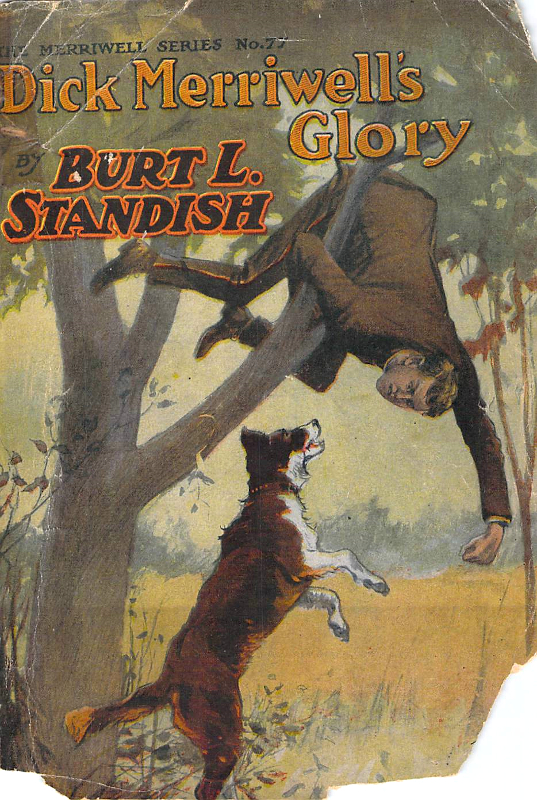
Dick Merriwell’s Glory
(Printed in the United States of America)
All rights reserved, including that of translation into foreign languages, including the Scandinavian.
5DICK MERRIWELL’S GLORY.
CHAPTER I. FRIENDS AND FOES.
In more ways than one Dick Merriwell had become
the wonder of the Fardale Military School. His astonishing
work in the football-game against White Academy
was the talk of Fardale. By running with the ball
the length of the field, he had made both of Fardale’s
touch-downs in the game, and, to crown these thrilling
plays, he had kicked two clean goals.
Naturally, at the conclusion of the game, the delighted
cadets had rushed onto the field, raised the
hero of the day aloft, and carried him about on their
shoulders, cheering until they were hoarse.
But there were some who took no part in these
demonstrations, and they were the jealous enemies
of the remarkable young plebe who had created such
a sensation. Singularly enough, not a few of these
enemies were in Dick’s own class, being such envious
chaps as Uric Scudder, Zeb Fletcher, and Jim Watson.
However, Dick’s most dangerous enemy was Jabez
Lynch, a first-class man, whose ambition had
6been to play half-back on the eleven—a position that
had been given to Merriwell.
On account of a treacherous attempt to injure Dick,
Jabez had been nearly forced to leave school. In
Dick’s heart there had been no thought of mercy
toward Jabez, but his brother Frank had been more
forbearing, especially as Jabez might bring a serious
complaint against Old Joe Crowfoot, the Indian, who
had threatened him with torture and death because of
his action toward Dick.
When Dick fully understood that Jabez might retaliate
by having Old Joe arrested, in case he was
forced out of Fardale, he agreed to keep still concerning
the treachery of his enemy. But he told
Frank that he could never feel anything but contempt
for Lynch, and he did not believe it possible that such
a fellow could reform and become decent.
In his heart Frank Merriwell doubted if Jabez
could change his natural inclinations; but, at the same
time, he was confident that the course chosen was
the proper one, for he did not wish Old Joe to come
to harm through his affection for Dick and his desire
to punish the boy’s enemy.
There was something about the old redskin that
Frank admired. Joe knew little of white men’s laws,
and cared less. "An eye for an eye and a tooth for
a tooth" was the law that appealed to him, and
in which he firmly believed. To Joe there seemed
7nothing particularly wonderful in the feat of Dick.
For years the old Indian had trained the lad to be
fleet of foot, keen of eye, and quick of hand, and
it had been his expectation and belief that Dick would
excel in feats and games calling for these qualities.
Frank had quickly understood the immense good
the training of Old Joe had done the boy, who might
have been weak and sickly but for his free, open-air
life, with the redskin as his chief tutor.
But Merry saw that there were points Old Joe had
neglected, and Dick was far from perfect physically
when Frank took him in hand. In a short time Frank
had wrought an improvement, but he was keeping the
work up at Fardale, seeking to develop his brother
into a youth who should be an absolute physical model.
Frank believed he could accomplish the work,
though he realized that it could not be brought to a
successful conclusion at once. It would take time and
patience to make Dick Merriwell as near perfect as
possible; but time and patience Frank was ready to
give.
At first Old Joe regarded Merry’s work with silent
disdain. There was something of a look of scorn
in his beady black eyes when he saw the magnificent
Yale athlete instructing the boy in the use of
dumb-bells and Indian clubs to strengthen and round
out certain muscles; but the beady eyes were keen
to detect the slightest improvement, and it finally happened
8that the old fellow nodded and pronounced it
"heap good."
It must not be supposed that Frank’s only thought
was to make his brother perfect physically. On the
contrary, he had entered Dick at Fardale because he
was satisfied that the course of mental instruction
there would be the very best the lad could obtain.
Fortunately for Dick, he was much like his famous
brother in one respect. He had a wonderfully active
and retentive mind, so that he could learn almost anything
quickly and well when he applied himself fixedly
to the task of doing so. Thus it happened that in
this respect, as well as others, he was a wonder to his
classmates, many of whom, discovering somehow that
he had never attended a regular school, had felt positive
he would have a difficult time at Fardale, even
if he was able to get along at all after being admitted.
Until her death, Dick’s mother had been his tutor,
and her instructions were of the very best.
It was with untold satisfaction that Frank Merriwell
had taken up the task of developing his brother
into perfect manhood; and it was now his great aim
in life to make a complete success in this work, into
which he had entered with all his heart and soul.
At first the boy had not understood how fortunate
he was in having such a brother and friend, but, little
by little, his eyes had been opened, and at last he was
9coming to know just what it meant. Dick had been
frivolous to a certain extent, and he had seemed wild
and untamable; but his journey from the Rockies to
the Atlantic coast had opened his eyes and filled him
with respect for Frank. He had found that Frank
was known everywhere, and that by the youth of
the United States he was regarded as a model young
American.
This knowledge had brought about something of
a change in Dick, in whose heart was born a desire
to emulate his brother and become like him, in some
degree, at least. And the lad’s modesty—which at
first he had not seemed to possess in any degree—had
led him to doubt his ability to ever rise to the heights
attained by Frank.
At one time Old Joe had sought to turn Dick against
Frank, being consumed by the belief that Merriwell
meant to carry the boy away where they would never
meet again; but Merry had found a way to conquer
the jealous Indian, and Crowfoot became one of his
greatest admirers. Then it was that the Indian had
said to Dick:
"Do what um broder, Steady Hand, say for um to
do. Him know best. Him got heap big head, all
right. Ugh! Him heap mighty young white chief."
And these words of the old Indian had been, to a
great extent, instrumental in the change that came
over the lad. Not that Dick was able to at once fling
10off all his wild ways; not that he became immediately
sober and serious. Far from it. He was still a boy,
with a boy’s love of sport and play and pranks. The
advent at Fardale had cast him into a life far different
from anything to which he had been accustomed, and
for a time he had seemed reserved and distant, which
led many to think him haughty and overbearing.
In time they were to learn that he was anything but
haughty. In time, when he came to know them better
and they to understand him, they were to find in Dick
Merriwell a frank, honest, companionable, whole-souled,
fun-loving boy, who would make friends and
keep them.
Already Dick had made a few stanch friends. Hugh
Douglass, one of his roommates, an uncouth, farmerish
plebe, was one of these. Douglass had seen beneath
the surface, and he was convinced that Dick
was all right.
Brad Buckhart, "the Texan Maverick," as he delighted
to call himself, was another friend Dick had
found. At first Buckhart did not take to young Merriwell,
but a change quickly came over him when he
found Dick beset by envious and jealous enemies, and
the breezy chap from the Lone Star State soon evinced
a hot desire to fight for Dick on the slightest provocation.
And now, since Dick had astonished everybody by
his amazing work in the game against White Academy,
11scores of fellows were praising him, and many
who had held aloof were willing to know him and
become friendly. But Dick did not like to be patronized,
and he found that the men of the classes above
him were inclined to praise him in a manner that was
not wholly unoffensive. Some of them had a way
of speaking compliments as if they were patting a precocious
boy on the head and offering him a penny.
This caused Dick to shun them still more, and thus
it came about that he was thought "stuck up." His
enemies knew how to make capital of this, and they
did not lose the opportunity to do so.
Dick kept about the even tenor of his way, however,
studying, drilling, training, and practising on
the football-field. He had tremendous energy, and
the number of things accomplished by him continued
to astound and anger his jealous foes, who soon found
a new method of striking at him.
CHAPTER II. A SCHEMING TRIO.
12
"It’s a mean shame!" declared Zeb Fletcher, trying
to look at Uric Scudder with his crooked eye, but
seeming to glare at a fatigue-cap hanging on the
wrong hook.
"That’s right," nodded Scudder, rubbing his weak
chin with an air of indignation. "It’s favoritism,
that’s what it is."
"Of the rankest sort," piped Jim Watson, in his
weak, effeminate voice. "And all because the fellow
is Frank Merriwell’s brother."
"What can we do about it?" questioned Uric. "We
ought to do something."
"We will do something!" declared Fletcher.
"What will we do?" questioned Scudder and Watson
together.
"Kick!" exclaimed Zeb.
"I’m afraid that won’t do much good," said Watson.
"He has a pull, and he can do just about as
he likes. The rest of us fellows have to attend drill
regularly, while Merriwell is excused from taking anything
but enough to make a showing. Now, I hate
drilling as much as any fellow can, yet I have to
take my dose right along, and it’s mighty disgusting."
13"It is disgusting," agreed Fletcher. "And inspection
makes a fellow sick! Why, think of those stuck-up
corporals calling a fellow down for having a little
dust on his old gun, or for not being just as prim and
starchy as they are! It’s too much! They want a
chap to be all the time brushing and cleaning and doing
such foolishness."
"If I’ve got to do it, I’m going to raise a howl at
the let-up on Merriwell," said Scudder.
"Of course," piped Jim, "they’ll say it was because
he’s on the eleven, and he doesn’t have time enough to
practise and drill, too. But we know how he got onto
the eleven, and——"
"We won’t stand for it!" cried Fletcher, jumping
up and striding about the room.
"Still," said Scudder, "no one has suggested what
we can do."
This trio were three of young Merriwell’s most persistent
and most obnoxious plebe enemies. Two days
after the football-game with White Academy they had
learned that Dick was excused from drill, being required
to appear only at inspection, and it made them
very wroth. Then they gathered in Fletcher’s room
to talk it over.
Both Scudder and Watson were roommates of Merriwell,
who, after the rule of the academy, had been
placed in a "cock-loft" room with three companions.
14Of these companions, Hugh Douglass was the only
one who had shown an inclination of friendliness toward
Dick.
Watson was a sly fellow, and he had very little to
say in the presence of Merriwell. At times he even
pretended to be Dick’s friend; but Dick was able to
read him like an open book, with the result that Watson’s
hypocritical blandishments were taken for exactly
what they were worth.
Scudder was also sneaky, and, on first entering Fardale,
he had sought to gain favor with the yearlings
by playing spy for them. As a result, he had been
forced into an encounter with Dick, and had been
soundly thrashed. This made him the persistent and
scheming foe of the successful young plebe.
It made no difference to Uric that Merriwell had
also thrashed Big Bob Singleton, the champion boxer
of the school, and that Singleton had seemed to think
all the more of Dick because of this feat. Uric desired
to "get even." And now he suddenly exclaimed:
"Wait! I have an idea."
"What is it?" questioned the others.
"You all know what an old duffer Professor Gooch
is."
"Sure thing."
"I hear that he is raising a rumpus because too
much athletics have been introduced in the school."
15"Yes; we’ve heard about that."
"He is down on football."
"Yes."
"Says it’s a brutal game, and should be abolished
by the school."
"Yes."
"He’s the one for us to get at."
"How can we do it?" questioned Fletcher eagerly.
"Get up a petition, a round robin, or something of
the sort, protesting against Merriwell being excused
from drill in order to take part in football practise.
What do you think of that?"
"All right!" piped Watson. "It’s a great idea!"
"Oh, I have a great head!" said Uric loftily.
"But can we get enough signers?" questioned
Fletcher. "That is to be considered."
"We can try hard. I know some fellows who will
sign. If we can work old Gooch up, he may make a
big kick against this business."
"And if Merriwell is compelled to attend drill regularly,
it’s certain he can’t keep up in his classes, for,
with drill and football, he won’t have time for study.
By Jove! Scudder, I believe it is possible that you
have struck on a scheme to force Merriwell to drop
out of the eleven! That will be a corker on him."
"And on his brother, too; for Frank Merriwell
wants Dick to make a good showing at football this
fall."
16"Who’ll draw up the document?"
"Let’s all have a hand in it. Bring out ink and
paper and the things needed, Fletch. Let’s get right
down to work."
So, in a very few moments, these three youthful
schemers were hard at work framing a protest against
Dick Merriwell being excused from drill that he
might practise on the football-field. They stated, as
well as they could, that it was not fair to others of
the class to favor a certain one in such a way, taking
care, as they thought, to make their language impressive
without being offensive.
"There!" cried Scudder, when it was finished; "that
ought to be a regular bombshell!"
"If it doesn’t raise a rumpus, I’m no prophet,"
chuckled Fletcher.
"Merriwell will be angry," said Watson faintly.
"What the dickens do we care!" said Uric.
"His brother will be sore when he hears of it."
"His brother is nothing to us. Besides, it will be
a good thing to show Mr. Frank Merriwell that he
does not run things here at Fardale."
"Who signs first?" questioned Jim timidly.
"Scudder," said Fletcher positively.
"No," said Uric, "you are the one to sign first, as
you do not room with Merriwell."
There was some argument over this matter, but
Zeb seized the pen at last and wrote his name with
17a flourish. Scudder followed, his handwriting being
rather hazy. Then Watson tried to get out of signing
until more names were added to the paper, but
Fletcher and Scudder would not listen, and he was
compelled to be third on the list.
Then came an argument as to who should take the
paper and seek more signers. At last, in exasperation,
Fletcher snatched it up, exclaiming:
"I’ll do it! I know a few fellows who will back us
up, anyhow. We ought to have the whole class; but
some fellows will be afraid to put their names to
anything like this. All the same, there are several
on the football-team that played the regular eleven that
first game who are sore because they were not given
a trial on the eleven, and we’ll get them. Oh, there
are more ways than one of making things warm for
Mr. Dick Merriwell!"
The trio broke up in great satisfaction.
CHAPTER III. THE TWO PROFESSORS.
18
Professor Barnaby Gooch, thin, wrinkled, crabbed,
and bald, rapped sharply on the door of Professor
Zenas Gunn’s private study. As the knock was not
answered at once, Professor Gooch rapped again,
sharply, nervously, and in a manner that denoted irritation.
Then he pushed the door open and walked in.
Professor Gunn, dignified, old-fashioned, yet kindly
in appearance, stepped from behind a screen and came
forward. Before he could speak, however, Professor
Gooch rasped forth:
"I’ve nearly beaten the skin from my knuckles rapping
on your door. Are you deaf, professor—are
you deaf, sir?"
"I hope not, professor," was the answer.
"But you didn’t answer me—you didn’t answer.
You let me pound away—you let me hammer."
"I was engaged when you first rapped, sir," said
Professor Gunn somewhat stiffly. "I was about to
answer your knock."
"Ah-a!" rasped Professor Gooch. "You were about
to answer! But you were in no hurry."
"You seem to be in a bad humor this morning,
Professor Gooch. Is there anything wrong? Will
you have a chair?"
19"No; I won’t have a chair. Yes, there is something
wrong. I have come to speak to you about it,
sir."
"Very well."
"It’s not very well; it’s very bad," declared Professor
Gooch, rapping on the floor with his cane and
glaring at the head professor. "It’s a disgrace, I say!
It’s all wrong! It’s a matter to which we must give
our immediate attention."
"If there is anything so very bad that requires our
attention it shall have it."
"Ah-a! I hope so—I hope so! I have seen it
coming on for some time. I have on several occasions
expressed myself as opposed to it. Now—now, sir,
something must be done!"
"As yet I am not aware of what you are speaking.
Will you kindly enlighten me?"
"I’m speaking of this matter of permitting football
and athletics and such frivolous things to interfere
with the regular course of studies and drill at
this academy—that’s what I’m speaking of. And it is
high time somebody spoke up. The tendency of our
day to permit such things at schools and colleges is
deplorable—deplorable, sir. I mean it!"
Professor Gooch shook his cane at his companion,
as if threatening him. When Professor Gunn started
to speak, he went on:
"Wait sir—wait! Hear me! I say it’s deplorable.
20Do young men go to school and to college to be
trained to break one another’s bones in a murderous
game called football? Is that why parents send their
sons to school? Is that what fathers desire their sons
should be taught? You know it is not; you cannot
say it is. In former times such games were not given
prominence here. True, they were played some, but
those who took part in them were not encouraged and
shown special favors by the faculty and officers of this
school. Such is not the case now. Baseball, football,
and kindred dangerous sports and games are encouraged
here. You know it is true, Professor Gunn.
You will not say it isn’t true!"
"Still," said the head professor calmly, "I am at a
loss to understand why you are making all this fuss."
"Fuss!" gasped Professor Gooch, throwing up both
hands and waving his cane dangerously near the
other’s head. "Fuss, sir! Is that what you call it?
Well, it’s high time to make a fuss! It’s time to see
if something cannot be done to check this tendency to
go football crazy. I mean to see if something cannot
be done. There is altogether too much of this business
at Fardale. Next I shall hear that inducements
have been offered students to come here because they
can play baseball or football unusually well. That
is what we’re coming to, sir."
"Do you think so?" said Professor Gunn, still
with perfect calmness.
21"Hey?" exclaimed Professor Gooch. "I know it!
I see it approaching! Now, what do you think of
that? What do you think of this craziness for athletics?
Answer me, sir!"
"Excuse me," said the head professor, "if I sit
down. Of course, you may stand if you prefer. You
ask me what I think of athletics. I will answer you
briefly. I think that athletics as practised in our
schools and colleges is doing a great work for the
young men of our country."
"Hey?" again squawked Professor Gooch. "Great
work! What kind of work, may I ask?"
"Making stronger, healthier, manlier men, and truly
that is a good work."
"Fudge!" snorted Professor Gooch.
"Truth," asserted Professor Gunn.
"Fudge!" again burst from Professor Gooch. "I
say fudge, and I mean fudge! Does it make a stronger
and manlier chap of a fellow to put him into a game
of football and break his leg or his collar-bone? Bah!
Don’t talk to me, Professor Gunn! It makes that
boy just so much weaker. Yes, sir!"
"The youth who is properly trained and prepared
for the game of football rarely meets with a serious
accident."
"Fudge, sir—fudge! What is the good of all this
training and preparing for a game so brutal?"
"The training and preparing helps build up the
22physical powers of the lad, gives him health and
strength to fight the battles of life. It prepares him
for success in the world."
"Tut! tut! tut! What nonsense! It’s education,
sir, that prepares the boy for the battle of life."
"But what is education without health, Professor
Gooch? Give a man a fine education and a weak
body, and he has not the energy or courage to make
the most of his education. I’m an old man, sir, and
I can remember the time when I entertained ideas
similar to your own. But I have studied and sought
to advance with the advance of time. I have endeavored
not to become antiquated and a back number.
I have seen that it is the young man with the
strong and healthy body who wins in the battle of
life. Of course, he must have education to go with
his health and strength, and, therefore, the two things
go hand in hand. I believe, sir, the time is coming
when physical training will be compulsory in nearly
all the schools of our land. I hope the time is not
far distant when it will be compulsory here at Fardale.
A boy cannot be a successful football-player
unless he is something of an athlete. Thus football
encourages a certain class of aspirants to train their
bodies and to become athletic, as the only way they can
get on the teams. In that way alone, regardless of
any other, it is a good thing."
Several times Professor Gooch had sought to interrupt
23the head professor, but Professor Gunn checked
him and persisted in speaking till he had finished.
"He! he! he!" laughed Professor Gooch sneeringly.
"That’s fine talk, but it’s nothing but talk. I’d like
to know what good it would have done me to train
and become an athlete when I was a boy?"
"It would have filled out your flat chest, professor,
and it would have given you better arms and
shoulders and legs. It would have made you a handsomer
man, and it might have prevented your becoming
sour and crabbed in your old age."
"Yah!" snarled Professor Gooch. "Are you trying
to make sport of me, sir? If you are, I won’t
stand it! I’m opposed to all this athletic nonsense,
and I shall remain so. But, more than anything else,
I am unalterably against favoritism, which is creeping
into this school."
"I do not understand your meaning."
"I’ll make you understand. I have reliable information
that a member of this school has been excused
from drill in order that he might have time to
practise with the football-team. What do you think
of that, sir? Now, I think you’re surprised."
"He must be a very good football-player, else such
a thing could not happen."
"What has that to do with it? Drill is a regular
part of the course here, and football is something
entirely foreign. I hold that no one should be excused
24from drill, much less a scholar who has just
entered here. Such a course is bound to produce dissatisfaction
and arouse protest. In fact, it has done
so already—already, sir. I have in my pocket such
a protest. It was that which brought me to you, and
I hope you will do something about it. It is a protest
against the excusing of Richard Merriwell from
drill in order that he may practise with the football-team.
There is much feeling over it. You can see
what football has done here, sir—you can see."
Professor Gooch brought out the protest.
"Permit me to examine it," said Professor Gunn,
adjusting his spectacles and taking the paper from
the hand of the other. "Ah! I see there are only five
names attached out of a very large class."
"That’s enough—that’s enough! It shows the feeling!"
"Um-mum!" came from Professor Gunn, as he read
the protest. "I fancy I see something of a personal
feeling in this."
"Well, there seems to be reason for such a feeling.
The statement is made that Richard Merriwell is insolent
and overbearing toward his classmates, that
he makes sport of his superiors, that he mocks and
derides the faculty, and that he has sought to bring
disgrace upon at least one cadet by circulating false
and malicious reports concerning him."
25There was a sudden stir behind the screen, a quick
step, and a boy, with flushed cheeks and flashing eyes,
appeared.
"I demand to know," cried Dick Merriwell, "the
names of my accusers!"
CHAPTER IV. DICK MAKES ANOTHER ENEMY.
26
Professor Gunn had invited Dick to call at his
room. The head professor was very friendly toward
Frank, whom he greatly admired, and he had taken
the first opportunity to have a talk with Frank’s
brother.
It happened that Professor Gooch had called while
Dick was in the room, but the screen had prevented
him from becoming aware of the presence of the boy
until Dick stepped out.
Professor Gooch was somewhat staggered by the
appearance of the lad, but he quickly recovered, his
wrinkled old face twisting into hard knots.
"Yah!" he exclaimed. "So you were listening behind
there! Yah! Listening!"
"I was here when you came," returned Dick. "I
did not come here to listen to anybody, sir."
"Insolence!" grated the professor. "It’s plain there
are good grounds for the charges."
"I beg your pardon," said Dick, restraining himself
with not a little difficulty. "I have no intention
of being insolent. I simply demand my right. False
charges have been made against me, and I ask to
know the names of those who have made them."
"What would you do if you knew?"
27"I’d make the chaps who said such things retract,
or I’d——"
"You’d what?"
"Thrash every one of them!" exclaimed the boy
hotly.
"Ah-ha!" exclaimed Professor Gooch, with satisfaction.
"That’s the kind of spirit football breeds!
It makes fighters, Professor Gunn—brutal fighters!"
"Unless a man is ready to fight for his rights, he
stands little show of amounting to much in this
world," said the head professor. "I don’t blame the
boy for wishing to fight."
"I’m astonished at you—astonished, sir!" cried Professor
Gooch, with a pretension of being aghast.
"At the same time," said Professor Gunn, "I do
not believe in giving him, at present, the names on
this paper."
"At least, you show judgment in that," said Professor
Gooch, with sarcasm.
"Why am I not to know the names of those who
have made these lying charges against me?" demanded
Dick. "I have never been overbearing or insolent toward
any one, I have never made sport of my superiors,
I have not mocked or derided the faculty, and
I have circulated no false reports against anybody."
"In short," said Professor Gunn, "you deny the entire
list of charges?"
"I do."
28"And I believe your denial," said the head professor.
"It’s simply one against five," said Professor Gooch.
"I choose to believe the five."
"Have they offered you any proof of the truth of
their charges?" asked Dick.
"It makes no difference. You have not proven the
charges are not true."
"Until there is some evidence against the boy he
is supposed to be innocent."
"By you, sir, perhaps; but me——"
"You have no right to believe me guilty!" flashed
Dick, his indignation breaking all bonds.
"Don’t talk to me that way!" flared the professor—"don’t
dare! I will not have it! You must keep
your place, sir!"
"You are not my master!" he cried. "You cannot
tell me what I shall do!"
Gooch flourished his cane, with the intention of
shaking it at the lad, but, quick as a flash, Dick
snatched it from his hand.
"Don’t you dare!" he blazed. "Why, if you
do——"
He took a step toward Professor Gooch, who fell
back, uttering a little squawk of alarm. His appearance
was so comical that a sudden and surprising
change came over the lad. The look of anger was
29chased from his face by one of merriment, and he
cried:
"Oh, dear! Don’t be frightened! Ha! ha! ha!
Oh, ha! ha! ha! I won’t hurt you, sir!"
"Professor Gunn!" gasped Professor Gooch, "will
you stand here and see me insulted and threatened like
this? Isn’t this just cause to have this boy expelled?
I demand that he be brought to book for this conduct!
I demand it, sir! He shall be turned out of
this school! I will see that it is done!"
Dick tossed the cane at the feet of the excited
professor.
"Turn me out!" he said. "What do I care for
your old school? I didn’t wish to come here, in the
first place. I’ll go back to my home—back to Felicia!
Old Joe will go with me, and I’ll be free again. Then
I can do as I like, and I’ll have plenty of friends in
the birds and the wild creatures that know me. There
I’ll have no mean and lying enemies who are trying to
hurt me! You may believe the lies about me! I don’t
care!"
He turned as if to leave the room, but suddenly
whirled toward Professor Gunn, whose hand he
quickly grasped.
"You have been kind to me," he said, his voice soft
and musical. "I’ll never forget it, sir—never!"
Then, before Zenas Gunn could stop him, he had
dashed from the room.
30"Why, he’s a perfect young wildcat!" gasped Professor
Gooch. "He is not safe to have round! It
will be a good thing for the school if he should go!"
Zenas Gunn gave Professor Gooch a look that contained
a meaning that was far from complimentary.
"What you need, professor," he said, "is something
for your liver. I don’t blame the boy."
"You—you don’t? Why, he snatched the cane from
my hand!"
"When you shook it at him."
"But I didn’t mean to strike him."
"How did he know? I have talked with his
brother, and he has asked me to bear with any peculiarities
of the lad, who was raised alone and without
playmates, save one little girl. He is not like
other boys. You do not understand him at all."
"I don’t want to; the young wildcat! I think it a
shame to have such a boy in the school!"
"And I think it a shame there are not more like
him. He is honest and open, and he——"
"But these charges against him, professor?"
"I take no stock in them. I understand that the
boy has made enemies because he has been successful
in doing remarkable things since entering Fardale.
His success has made others envious and jealous.
They are trying to down him. Are you going to help
them, professor? Are you going to become the
instrument of these enemies?"
31"Oh, you have a slick way of putting things, Professor
Gunn; but you know the boy insulted me in
this very room and before your eyes. You know it,
sir!"
"He dared stand up manfully and defend himself,
for which I confess my admiration."
"Your admiration?"
"Exactly."
"Yah! His actions were admirable! Oh, yes!
The young spitfire! I’d like to have the handling
of him! He’d play no more football for one while!
I’d put him in the guard-house, and he’d live on bread
and water for a week, a month, a year, if necessary!
I’d break his spirit! I’d show him I was his master!"
"Professor Gooch, you are so angry that you talk
childish. When you have cooled down, you may
regard this matter in a different light."
"No, sir—no! I have placed in your hands the
charges against that boy! I demand that they be
investigated!"
"Very well," said the head professor. "They shall
be, and if I find they are not true, the ones whose
names are signed here must suffer for it. That is
all, professor."
"All right, all right! I’m willing to have it stand
that way. But that boy must apologize to me, whatever
the result of the investigation. I demand it!"
"Very well."
32"I demand it!" repeated Professor Gooch. "He
must apologize! He must say he is sorry!"
"Very well. I have other matters that require my
attention now, professor. You will excuse me."
Zenas Gunn accompanied the visitor to the door,
which he held open for the angry professor to pass out.
The result of this affair was that Dick Merriwell
had made an enemy in Barnaby Gooch, and one who
might cause him serious trouble at Fardale.
CHAPTER V. THE PLOT AGAINST MERRIWELL.
33
Again there was a meeting in the room of Zeb
Fletcher, but this time five nervous, frightened boys
had gathered there. Of course, Zeb was on hand,
and both Uric Scudder and Jim Watson were present.
The others were Mart Reid and Gus Wade, two
fellows who, through the blandishments of Zeb, had
been induced to sign the protest against permitting
Dick Merriwell to be excused from daily drill.
Fletcher was trying to reassure Reid and Wade, but
was not succeeding very well.
"I tell you," said Reid, "old Gunn has announced
his intention of probing the matter to the bottom."
"I didn’t want to sign the paper, anyway," said
Wade. "I thought it might get us into trouble."
"Now, how can it get us into trouble?" exclaimed
Zeb.
"Why, old Gunn says we’ve got to prove the charges
against Merriwell."
"And that we’ll be made examples of if we do not,"
put in Reid.
"Which means that we’ll be expelled," faltered
Wade.
Jim Watson looked frightened, but said nothing.
34"Oh, nothing of the kind!" declared Zeb, with attempted
bravado. "They can’t expel you for a little
thing like that."
"But they say it’s a mighty serious offense to deliberately
try to damage a fellow’s character here at
Fardale."
"You’re in just as bad a hole as we are," said Reid,
"and you are to blame for the whole thing. You
made me believe it was a joke more than anything
else."
"Me, too," asserted Wade. "It’s a pretty serious
joke—for us. My mother sent me here, and it will
be hard on her if I’m expelled."
Uric Scudder rubbed his weak chin and looked at
Watson, who returned the glance with interest. Then
Fletcher turned to them, and his expression was an
appeal for backing.
"Don’t you worry," he urged. "Old Gunn won’t
do anything."
"It’s no use to say that," said Wade. "He’s doing
something now. He’s begun an investigation on his
own hook, and I’ll bet anything we’ll all be hauled up
before him within a week."
"In which case," said Scudder, attempting to help
Fletcher out, "we must be prepared with a slick little
story, to which we can all stick."
"Not for me!" cried Reid.
"Nor me!" said Wade.
35"Why, you don’t mean you will welch, do you?"
snapped Zeb, in apparent amazement.
"I mean that I shall tell the truth," said Mart Reid.
"I shall confess that I was sore because Merriwell
made the eleven and I was not given a trial."
"You fool!" snarled Zeb, his crooked eye blazing
and looking very wicked.
"That will be cutting your own throat," averred
Scudder. "You can’t do it!"
"I shall, all the same," persisted Reid.
"And I shall do the same thing," said Gus Wade.
"I’d give a hundred dollars this minute, if I had it,
if I had never put my name to your old paper!"
"I’d give two hundred!" cried Mart.
Zeb saw that Watson was frightened, as well as
Reid and Wade, and, for the first time, he began to
fear that the charges against Merriwell might result
in injury to the ones who had made them. He tried
to think of the proper course to pursue, but he was
bewildered and uncertain until Reid said:
"Wish I could get my hands on that old paper.
I’d soon fix it so it would not serve as evidence
against me."
A light that was new came to Fletcher’s crooked
eye.
"Look here, fellows!" he said, "don’t you worry
about this matter any more."
"How are we going to help it?" questioned Wade.
36"Just don’t. It will be all right, I promise you that.
I’ve got a scheme of fixing it."
"What is the scheme?"
"That’s all right. Leave it to me. Your Uncle
Fletch knows a thing or two. That paper never will
be used as evidence against any of us."
"Why, it’s in old Gunn’s hands. How can——"
"Never mind that. Forget it. No matter what
you hear, keep your faces closed, and you’ll be all
right. Now, we had better break this meeting up,
and you fellows trust in me, that’s all."
Neither Reid nor Wade seemed satisfied, but Zeb
made them promise to keep still and wait, after which
he hustled them out of his room.
When they were gone, he turned to Scudder and
Watson.
"Those chaps are squealers," he said, in a disgusted
way.
"But they’ll get us in a bad scrape if we don’t look
out," said Uric, still fumbling at his chin with his
fingers.
"It’s a desperate case," nodded Watson. "I’m
sorry myself that we did it. We can’t back up our
charges with proof."
"We might if those chaps who were here just now
had backbone," said Zeb. "We could fake up a nice
little story and stick to it till the cows came home."
"But they’ll never do that," from Scudder.
37"I know it, and there is where the difficulty rises."
"What’s your scheme?"
"A desperate one."
"Tell us."
"Can I trust you? I’ve got to trust you. I
wouldn’t think of doing it if it wasn’t that those chaps
will squeal, but I’m going to try to—sh-h-h!—to get
hold of that paper."
Zeb whispered the final words.
"How?" whispered both Uric and Jim.
"I know a way. I have a key to the door of old
Gunn’s den. How did I get it? Made it. He leaves
the key in the outside of his door sometimes, you
know. I noticed that. Thought I might want to get
into his department some time, and so one day I
slipped it out when I was passing the door, and took
a wax impression of it. I’ve done the thing with
other keys just for sport, and I’ve got the trick down
fine. I slipped the key back into the lock and got
away. Then I made a key from the impression.
Here it is."
The crooked-eyed young rascal held up the key he
had made. Scudder looked at him in admiration.
"You’re a dandy, Fletch!" he exclaimed.
"Oh, I have a little way of preparing for emergencies,"
said Zeb, with a swagger. "This key is all
right, and I’ll bet my life on it. I can open the door
of that room first pop."
38"But what good will that do you?"
"I know just when old Gunn goes out late in the
afternoon for a walk."
"You’ll go there then?"
"If I get the chance. I’ll get into his den, and
I’ll bet you anything you like I’ll find that paper. He
keeps his important papers on his desk, and the one
I want will be there. I’ll get my hands on it, and
then it will disappear."
"We don’t want anybody to think any of us swiped
the paper."
"Of course not."
"But it would be clever of us to make it seem that
a certain fellow did the job."
"What fellow? You mean——"
"Dick Merriwell. We might make it seem as if
he got in there somehow and carried off the complaint
against him."
"How can that be done?"
"You fellows room with him?"
"Yes."
"Get into his clothes and bring me one of his handkerchiefs.
All linen is marked here, so it can be
readily identified. Bring that handkerchief to me."
39"What will you do with it?"
"Drop it."
"Where?"
"Old Gunn’s room. Catch on? Oh, it’s a clever
idea! Suspicion will be thrown on him. I’ve got a
long head."
"I’m afraid——" began Watson.
"Don’t be afraid of anything," said Zeb.
"I’ll get the handkerchief," promised Scudder. "Jim
needn’t do anything. I’ll bring you a handkerchief
at the first opportunity, Fletch."
"And I’ll do the rest. Leave it to me. Now, get
out and look for that hankie. Why, I see where we
turn this whole business in our favor and make Merriwell
look like thirty cents. There will be something
doing around here before long. Trust to little Zeb."
* * * * * * *
That evening, having buttoned his rather shabby
old overcoat about him, and taken his crooked walking-stick,
Professor Gunn started out for his usual walk.
He strolled along in his accustomed absorbed manner,
his head down, buried deep in thought. But it
happened that the professor did not walk as far as
usual. He had that day been pondering over a most
puzzling mathematical problem, and, as he strolled
along, carrying his cane behind his back, the solution
suddenly dawned on him.
40"Hum!" he said, stopping short. "Wonder why I
didn’t think of that before?"
Then he felt in his pocket for paper and a pencil.
He found the paper, but no pencil. Through every
pocket he searched, but not a bit of a pencil could he
find.
"Dash it!" he said.
Then he went through his pockets again.
"Dash it!" he said once more, with greater vehemence.
"I must put that down at once, for fear it
may slip me."
So he turned and retraced his steps to the academy.
Up to his room went the professor.
It had grown dark, and there was no light in his
room. Somewhat to his surprise, his key did not
seem to work right in the lock, and then, turning the
knob, he found the door was not locked at all.
"Carelessness!" he muttered, as he entered the
room.
He started to approach the shelf on which the
matches were kept. Then, of a sudden, a dark form
sprang at him and hurled him against the wall with
such violence that he fell to the floor, stunned. The
dark figure rushed from the room and vanished.
The professor did not rise for several minutes,
When he collected his scattered senses he began to
wonder what had happened. His head was ringing,
41and he felt very weak. With great difficulty he
dragged himself to his feet.
His first thought was to raise an alarm. Then he
reached for the matches, found them, and struck one.
Glancing about, he saw that his desk was in disorder,
papers being scattered about and the drawers pulled
out.
Then beside the desk he saw something white. He
picked it up. It was a handkerchief, with the letters
"R. M." on one corner.
"‘R. M.,’" muttered the professor. "Now, whose
handkerchief is this? It was dropped by the intruder
here. It is a clue to the fellow. ‘R. M.’ Can it
be——"
He stopped short, appalled by a thought that came
to him.
"The boy was here yesterday," he murmured. "Did
he see something here that aroused his cupidity? Is
it possible he has entered my room in my absence
and——"
Again he failed to complete the sentence. Putting
the handkerchief out of sight, he closed the door of
his room, having lighted a student’s lamp. Then he
began an investigation.
In time he discovered that the protest and charges
against Dick Merriwell were missing, but nothing else
seemed to have been touched. When he made this
discovery Professor Gunn sat down by his desk, and
42the look on his face was one of mingled pain and
anger.
"Is it possible," he said, "that I have been mistaken
in that boy? Is it possible he is not what I thought
him to be? Has he thought to stop the investigation
of the charges against him by stealing the paper?
"I am not willing to believe it! There is honesty
in his face and in the way he looks one square in
the eyes. His brother is the finest young man I ever
knew. Yet it looks bad for Dick. I’ll say nothing
about this now, but if I find that boy is not what I
thought——"
CHAPTER VI. DICK’S REMARKABLE PLAY.
43
All unaware of the suspicion that had been aroused
against him in the heart of Professor Gunn, Dick
Merriwell went about his daily tasks and practised
regularly on the football-field. At first he had thought
of leaving the academy. He had even started to do so.
But his blood cooled, and he resolved to wait and
fight it out with his enemies.
His surprise was great when the days slipped by
and he heard nothing further of the affair. Several
times he was tempted to go to Professor Gunn and
demand to know what was being done, but each time
he decided to wait.
So the time passed and the day of the football-game
with Rivermouth came round. This time Fardale was
to play away from home, Rivermouth being more
than twenty miles away.
The day was gloomy and threatening when the
team boarded the train, and few of them were in high
spirits.
As it was Saturday and a half-holiday, quite a large
number of cadets accompanied the team. However,
Captain Nunn had expected the crowd of "rooters"
would be larger, and he was somewhat displeased because
it was not.
44Frank Merriwell, the coach, was with the team, and
he did more than anybody else to give it spirit and
courage.
Teddy Smart had scraped together enough change
to purchase a round-trip ticket to Rivermouth, and
he boarded the smoker of the train, with two packages
of cigarettes and a determination to enjoy "a genuine
debauch."
"What a lovely day!" he chirped, looking out at the
cloudy sky. "How bright the sun is!"
Then he sang comic songs and smoked cigarettes
at the same time, and did all he could to make things
lively, until somebody told him that Professor Gunn
was on the train.
"Oh, lud!" he exclaimed, flinging his cigarette aside.
"I don’t want to smoke! I haven’t smoked to-day!
I never smoke!"
Rivermouth was a small place, but it was said to
have a strong football-team. On their arrival the
Fardale crowd proceeded directly to the field, which
was an open lot about half a mile from the village.
The Rivermouth team was there. Rogers, the captain,
came forward and met Steve Nunn.
"Where do we dress?" asked Steve, looking round.
"Why, we thought you’d come in your suits," said
Rogers. "No dressing-room here. You’ll have to
go over to that old barn."
So over to the barn they had to go, and there they
45got out of their regular clothes and into their football
togs. While they were changing their clothes
Zeb Fletcher came sauntering through the barn in
a swaggering manner.
"Hello, Merriwell!" he said. "Give us a cigarette."
"I do not smoke cigarettes," said Dick quietly,
"which you know very well."
"Oh, well, you may not," said Zeb. "That is, there
are times when you may not."
Dick felt like striking the fellow, for he knew Zeb
had purposely insinuated that he sometimes smoked
and broke the training-rules.
"Whatever is that galoot in here for?" growled
Brad Buckhart.
When the boys were ready they left the barn and
went forth to the field, near which a crowd of at least
five hundred persons had gathered. In this crowd
Dick was surprised to catch a glimpse of Professor
Gunn. Not till then had he known that the professor
had accompanied the eleven on the train.
Zenas Gunn was looking at Dick, and somehow it
seemed that he was trying to bore straight through
him with his eyes.
"We’ve got a hard job on our hands to-day, fellows,"
said Captain Nunn. "These Rivermouth chaps
are much heavier than we are. They are fighters,
too."
46"That’s the kind I like," declared Brad Buckhart.
"Wouldn’t give a lame mule or a locoed steer to butt
up against a lot of quitters. The harder the varmints
fight, the more they tickle me."
Arrangements were soon made for the game to
begin, Rivermouth getting the ball for the kick-off.
The teams lined up on the field as follows:
Fardale.
Positions.
Rivermouth.
Burrows
Right end
Rogers
Stanton
Right tackle
Stover
Douglass
Right guard
Twain
Buckhart
Snapback
Price
Gordan
Left guard
Golding
Blair
Left tackle
Dana
Kent
Left end
Ryan
Shannock
Quarter-back
Mercer
Nunn
Right half-back
Newton
Merriwell
Left half-back
Dolby
Singleton
Full-back
Hurting
In this arrangement of the Fardale team Buckhart,
the plebe, had been placed at center, while Blair, the
former snap-back, was given Brad’s position in the
line. Douglass was put on the field at the very start,
in the place of Eddy. This had been done through
the advice of Frank Merriwell, who saw that the center
of Fardale’s line had been too weak in previous games.
Of course, both men had been given practise in
these positions, and Buckhart had shown that he was
capable of snapping the ball handsomely, and then
blocking any chargers who might try to come through
him.
47Blair had been a trifle too light for the center of
the line, although he was a gritty fellow and quick
in his work. Frank felt that he would show up better
at tackle than at center.
The suits of the Rivermouth team were strong and
expensive, but they showed that their owners had
played more than one earnest game in them. They
were not spotless and unsoiled, by any means. For
once Fardale looked startlingly clean and prim in
contrast to the enemy.
But this was not all. The Rivermouth team was
made up mainly of players much older than the players
on the Fardale eleven, and they were rather savage
in their appearance. It is pretty certain that not a few
of the Fardale players were overawed by the formidable
appearance of their antagonists.
When the moment for play arrived,arrived, Hurting, the
heavy full-back of the Rivermouth team, balanced
himself, and looked hard at the ball, lying like a huge
yellow egg on the center of the field. Fardale crouched
for the start as Hurting began advancing on the ball.
The big fellow gaged his kick handsomely, and he
smashed the oval a terrible thump.
Far over the heads of the outspread Fardale men
sailed the ball, with the Rivermouth ends coming
down like the wind to be on hand when it dropped.
But this early exertion was lost, for Hurting’s heavy
48kick had sent the ball fairly over Fardale’s goal-line
which made it necessary to kick off again.
While this result seemed simply to delay the beginning
of the game, it accomplished something Hurting
had desired to bring about, for it impressed Fardale
at the very start with a conviction that her own full-back,
Singleton, was outclassed by the full-back of the
enemy.
When the ball was on the spot once more and all
were ready, Hurting again kicked off. Again the ball
sailed through the air till it seemed that a third trial
would be required.
But Singleton captured it on Fardale’s ten-yard line
and punted at once, as the Rivermouth ends had come
through with amazing swiftness, and were sure to
tackle him before he could make a run of any consequence.
In his haste, Big Bob showed up weaker than usual,
for he did not drive the ball anywhere near to the
center of the field. Golding, the Rivermouth left
guard, caught the oval handsomely and started to run
with it. He was downed by Burrows on Fardale’s
thirty-yard line.
Then the two teams lined up for the first scrimmage.
Fardale was ready now to go into the work in
earnest, realizing it had a fearful task on hand that
day.
Rivermouth got into line for the attack in a quick
49way, that showed experience, while Fardale was not
quite as quick as usual, and there was a slight mistake
in lining up that necessitated a quick change at the last
moment.
There was a lull, the sound of a voice giving the
signals, then an upheaval, a whirling, sweeping rush,
a tackle, and the sound of the whistle.
Rivermouth made five yards on the very first try,
and the onlookers were delighted or dejected, according
to their sympathies.
"It’s a snap!" declared a Rivermouth man. "Fardale
never could play real football. This is the first
time in four years she has dared play us, and we’ll
show her to-day what football really is."
It was true that Fardale had declined for four years
previously to play with Rivermouth, but that was because
Rivermouth had no real standing as a school
team, being made up of both high-school players and
outsiders. This year, however, Rivermouth had
seemed to comply with the requirements. Eaton had
stood by Fardale in barring Rivermouth, but Eaton
agreed to play the barred team this year, and so Fardale
was brought to consent, not wishing to seem
afraid.
But all the time it was known that several of the
players on the Rivermouth team simply attended the
high school there in a perfunctory way in order to
get onto the team. They took no regular course of
50studies, and made little effort to progress in any superficial
course they pretended to follow. At least one of
them, Dolby, the left half-back, had played on a semi-professional
baseball-team and received money for his
playing. His home was in Rivermouth and the baseball
season was over, so he went in for football.
The first gain of the home team was of a nature
to make it seem that Rivermouth could walk right
through the visitors.
Newton had made the first advance. In the second
trial the ball was given to Dolby, and he went smashing
into Buckhart.
Buckhart was right there this time, and he stood
"with his hoofs planted," as he expressed it. Rivermouth
was held without gaining an inch.
Thinking this might be the fault of Dolby, the ball
was given to Newton again, and the red-headed half-back
of the home team went at Buckhart with his head
down.
"Whoa, dang ye!" snorted the Texan, as he
crouched, got Newton roundround the legs, and slammed
him to the ground, unmindful of the interferers who
had tried to butt him aside.
"There!" puffed the "Maverick," with keen satisfaction.
"I reckon mebbe that’ll hold you for a while!"
Now the Fardale crowd broke into cheers, for this
stand of their team showed that there was no reason
to lose courage so soon.
51Rivermouth had learned that Fardale’s center was
not as weak as had been expected. The reports of
previous games had led Rivermouth to believe it would
find no difficulty in walking straight through the center
of the visitors.
As the teams lined up, the Fardale crowd cheered
in unison:
There was another sudden swaying and clashing;
a running figure, aided by interferers trying to get
round the end, players in red and black trying to tear
their way to the runner, one breaking through and
clutching him, and then——
The ball was down, Blair having stopped an effort
to go round the left end. No gain had been made, and
the oval went to Fardale on downs.
How the visitors cheered then! What was the
matter with their team? It was all right! Those
Rivermouth fellows hadn’t made such a big thing
after all in trying to walk over Fardale!
"Good gracious!" gurgled Teddy Smart. "How
52sorry I am that they didn’t keep right on rushing
through our line! Isn’t it a shame!"
Now it was Fardale’s turn to try the mettle of the
enemy, and the ball was given to Nunn at the very
start. With a mass formation revolving round him,
the captain of the Fardale team went into the left wing
of the home team, gaining only one yard. It was not
much, but it was a gain, and Steve fancied he could
do better next time.
Following the policy of Frank Merriwell, persistently
drilled into him, Nunn again hammered at the
left wing of the enemy, seeking a weak spot. Again
a yard was made, but it was the second down, and
three yards were needed.
Steve gave a signal for a repetition of the play, and
Dana was the objective point in the line when the
mass went hurtling at it. This time Dana was so well
backed that not an inch was made.
There were still three yards to gain, and it must be
made on the very next attempt.
For a moment Steve hesitated. Then, satisfied that
a kick would be expected, he signaled for a false play.
Singleton seemed to prepare to kick, and Rivermouth
made ready for that kind of a play. But
Nunn’s signal called for Merriwell to run with the
ball, not to pass it to Singleton.
Then Shannock became nervous, or something happened
53to him, for he made a wretched pass to Dick,
who was bothered in catching the ball, nearly losing it.
By the time Dick had recovered, the Rivermouth
players came tearing through and slammed him to the
ground.
Fardale had lost on downs.
Both teams had showed themselves strong in defense.
It was fully expected that Rivermouth would resume
bucking Fardale’s line, and the visitors were
quite unprepared for what happened.
Hurting was proud of his ability to kick a goal
from the field, and he had sought and obtained permission
to make a try for such a goal at an early
stage in the game, knowing the natural inference
would be that such a trial would not be made until
every artifice to secure a touch-down had been tried.
Therefore the greater portion of the Fardale team
seemed totally unprepared when, after the line-up, the
ball was sent back to Hurting, who smashedsmashed it hard
and fair in a drop-kick for a goal.
Fardale had charged the moment the ball was
snapped. Blair went through and hurled Captain
Rogers of the home team down in the effort to fling
him aside, falling with him. Gordan was stopped by
Twain, but he managed to make a gap in the line.
Through that gap shot Dick Merriwell, leaping like
a panther toward Hurting.
54Plunk!—the foot of the Rivermouth full-back struck
the ball.
Then something happened that took away the breath
of every beholder, for up into the air in a most magnificent
leap shot the lithe figure of Dick Merriwell,
seeming to stand out clear and distinct far above all
the others. The ball struck him fairly on the breast,
lodging under his out-held and bent right arm, and remaining
there as he dropped back to the ground.
Dick had spoiled what seemed like a probably successful
attempt to kick a goal from the field.
CHAPTER VII. FARDALE’S TURN.
55
The witnesses of Dick Merriwell’s play gasped for
breath. It seemed that he had leaped fully as high as
a man’s head.
What mattered it if he was downed the moment he
touched earth again? What mattered anything? He
had stopped Rivermouth’s attempt to make a goal from
the field. But for him the effort might have succeeded,
for it had been wholly unexpected. He was deserving
of all credit.
This fact caused Zeb Fletcher to chew his tongue,
and swear inwardly. Zeb was not the only one.
Dick’s bitterest enemy in the school had come along
to witness this game, again hoping something might
happen to show Merriwell up as weak and incapable.
Jabez Lynch actually groaned aloud, but his groan
was drowned by the burst of cheering from the Fardale
crowd.
Probably Hurting, the Rivermouth full-back, was
the angriest fellow on that field.
"Did you ever see anything like that?" he snarled
to Dolby, as the two teams lined up, with the ball in
Fardale’s possession.
56"Hardly ever," admitted Dolby. "Who is the fellow?"
"Ask me!"
"Don’t you know?"
"No."
Dolby was not the only person asking the question.
Scores were seeking to know the name of Dick
Merriwell. When they learned it there was a stir.
So this was Frank Merriwell’s brother? Well, it
was pretty plain that he had some of Frank Merriwell’s
ginger.
"Dick Merriwell! Dick Merriwell!" was the name
quickly passing from mouth to mouth.
Both Lynch and Fletcher heard these comments,
and they turned green with jealous anger.
"The fellow’s luck!" said Lynch to himself.
"This will drive me to drink!" muttered Fletcher.
Professor Zenas Gunn was watching this game for
a purpose. While he believed in athletics, he had given
very little attention to football, and had never watched
an entire game. The outcry against football raised by
Professor Gooch had caused Professor Gunn to decide
to witness a complete game that he might decide
to his own satisfaction in regard to the brutality of the
playing.
Zenas Gunn found himself shouting with the others
when Dick Merriwell made that grand leap into the
air, but he quickly checked the outburst.
57"Be still!" he muttered, putting his hand quickly
over his mouth. "You’re acting like a boy, sir! Besides,
that is Merriwell, the fellow who is under suspicion.
But I can’t bring myself to believe that boy is
guilty!"
The Fardale team lined up quickly for the attack,
Captain Nunn finding time to give Dick a pat on the
back and say:
"Great, old man—great! You’re a wonder!"
From the side-lines Frank Merriwell looked on. He
stood like a statue when his brother made the play
that prevented Hurting from kicking a field goal, his
face not seeming to change expression in the least; but
had any one looked deep into his eyes he must have
seen there was a glow of satisfaction and pride.
Now Fardale began a series of mass-plays that resulted
in gains that took the ball fairly to the center of
the field. By that time Rivermouth was prepared for
this style of playing, and the gains stopped. Fardale
was held for three downs and kicked.
Hurting made a fair catch and bored his heel into
the ground on the spot, which gave him a free kick in
return.
Then the great kicker of the Rivermouth team
booted the leather almost to Fardale’s goal-line, where
Singleton got it.
Big Bob resolved to try at a kick in return, but he
must have been nervous, for he sent the ball out of
58bounds at Fardale’s forty-five-yard line. Rogers fell
on it and brought it out for a scrimmage. There the
teams lined up again, Fardale having lost the ball and
some ground through this exchange of kicks.
Now Rivermouth suddenly began a new style of
playing, forming tandem fashion and spearing into
Fardale’s line, picking out Stanton for repeated attacks.
The first effort resulted in a gain of full ten
yards before Fardale could break up the play and
check the advance.
"That’s the style!" said Captain Rogers, of the
home team. "Now we have them going, boys! They
are easy!"
Again and again the tandem play was tried, and
Stanton was battered and bruised and bleeding when
the ball was held for three downs within twelve yards
of Fardale’s goal.
The Fardale crowd was cheering, but it seemed
that the home team was too heavy to be resisted. Still,
if full four yards were not made on the next play the
ball would go to the visitors.
"They’re going to make another try to kick a goal!"
exclaimed a Fardale spectator.
It seemed that he was right.
Rivermouth apparently prepared to resist Fardale’s
rush, while Hurting fell back as if to kick. There was
a hush. Rogers was heard repeating the numbers.
A sudden move, and the ball was snapped back.
59Mercer turned like a flash and passed it to Newton, instead
of to Hurting.
Newton went leaping across toward Fardale’s right
end, and around him massed the interferers. This
mass struck Stanton again, just when the attack was
not expected.
Around the man with the ball the attacking wedge
revolved, and Fardale seemed unable to tear it to
pieces in time to stop the steady advance.
Just when, at the last moment, it seemed that Fardale
had held the enemy, Newton was shot out of the
formation and rammed over Fardale’s line for a
touch-down.
Then the Rivermouth crowd roared and roared, and
went wild with satisfaction. The ball had been carried
over at the corner of the field, and Rivermouth decided
to punt out, as it would be difficult to make a
goal if it were brought out. Fardale lined up at the
distance, and Rogers kicked the ball out.
Dick Merriwell had been stationed where it was
thought he might be able to spoil this effort; but
Hurting caught the ball fairly, which gave Rivermouth
a chance to kick for a goal.
"He didn’t do it that time, did he?" muttered
Fletcher, grinning in spite of himself.
Rivermouth prepared carefully for the effort to
kick a goal. Captain Rogers decided to hold the ball,
60and he stretched himself on the ground with his left
side toward the goal-posts.
The cheering and excitement had stopped. Everybody
seemed watching and waiting with breathless interest
for the result. Hurting was resolved not to fail.
With deliberateness he booted the oval, sending it
rotating through the air.
A great shout rose from the crowd, for the ball was
taken by a flaw of wind and carried to one side of the
posts.
But Rivermouth had scored.
"It’s no use," said Jabez Lynch, in pretended regret.
"They are too strong for us."
"Back up! back up!" chirped Teddy Smart, who
happened to hear the observation. "You please me
very much with your remark. I like the way you
talk! It’s too bad you were not retained on the team!
You would give the boys lots of courage with that
kind of talk!"
"Don’t get sassy, plebe!" grated Lynch, scowling.
"You’re too free with your tongue!"
"Really and truly?" smiled Teddy. "Then I’ll bite
it right off this very minute."
The applauding crowd continued to cheer as the
ball was brought to the center of the field. The first
half was drawing to a close, and it scarcely seemed
possible that Fardale had time to do any work of consequence,
61even if she were strong enough, which now
seemed doubtful.
Some sportily inclined chaps began to offer even
money that Fardale would not score during the game.
"Here’s a chance for somebody to make a small fortune,"
said Smart. "If I had money, I wouldn’t take
that kind of an offer—oh, no!"
But the betting part of the crowd found no takers.
Singleton kicked off to Rivermouth’s twenty-yard
line. Hurting again demonstrated his superior ability
at this kind of work by driving the ball back to Fardale’s
forty-yard line.
Then something happened that gave Rivermouth a
shock.
Merriwell caught the ball, heeled the ground, and
smashed it into the territory of the home team. It
was a grand punt of fifty yards, and Hurting was
compelled to take the ball on the run, which resulted
in a fumble.
Kent and Burrows had followed down under the
ball with great speed, and the latter blocked Hurting,
while Kent dropped on the oval.
By this piece of work Fardale got the ball on Rivermouth’s
fifteen-yard line, and the visiting crowd went
wild with joy.
"I’m afraid it won’t do us any good," said Jabez
Lynch.
62"I see you are afraid!" exclaimed Teddy Smart.
"You are shaking with terror!"
Jabez scowled and remained silent.
The teams lined up. Off at one side, just as Captain
Nunn began to give the signal, Dick Merriwell carelessly
knelt upon one knee and started to tie the lacing
of his shoe. It seemed a foolish piece of business, for,
to all appearances, he was utterly unprepared to take
part in the scrimmage to follow.
"Now, look at that fellow Merriwell!" said Jabez
Lynch, loudly enough to call attention of those about
him. "That shows just how much he knows about
this game! He’s had luck, but he’s green as unripe
cucumbers. He isn’t ready to——"
Jabez stopped short, with a gasp of astonishment.
He had not been the only one who regarded Dick
Merriwell as unprepared. The Rivermouth crowd had
fancied Dick would not be in the coming clash.
What was the astonishment of everybody but the
Fardale players to see Shannock deftly whirl and send
the ball flying through the air toward Merriwell!
It was a long pass to the side, and looked like a very
bad break. But up from his crouching position shot
Dick in time to receive the pass handsomely, and like
a wild colt he dashed forward, having the oval hugged
to his heart.
Rivermouth was taken off her guard. She had
fancied the attack would come from the other side.side.63Before she could recover, aided by very successful interference,
Dick Merriwell went round the right end
and planted the ball back of the goal-line.
Then Fardale woke up. It was a touch-down! How
they did cheer!
And Teddy Smart yelled in the ear of Jabez Lynch:
"Isn’t it too bad that fellow Merriwell is so green!
I’m ashamed of him, aren’t you? I think he ought to
be fired right off the team for doing anything like
that, don’t you?"
Jabez walked away without speaking.
CHAPTER VIII. MERRIWELL’S RUNNING TACKLE.
64
The ball was brought out, and, laughing his satisfaction,
Captain Nunn gave the honor of a try for
goal to the dashing, dark-eyed chap who had made
the touch-down.
The cheering of the visitors was stilled as young
Merriwell paused before making the kick. For an
instant Dick turned, and it was seen that he looked
toward the spot where his brother was standing.
Frank smiled, and the approval in that smile filled
Dick’s heart with a glow.
"He’s proud of me!" thought the boy. "At last
he’s proud of me!"
That was all the happiness he asked.
He went at the ball, and sent it over the cross-bar
with a most graceful kick, and Fardale was a point
ahead of her powerful antagonist.
Two minutes of play remained in that half, and
Rivermouth kicked off without delay.
It was the object of Steve Nunn to kill time during
those two minutes. Fancying he saw a good opening
for a run with the ball, which came directly to him, he
caught it and started. But Captain Rogers had
avoided every interferer, and Nunn did not make eight
65yards before Rogers pounced upon him and slammed
him to the ground.
Steve went down with such violence that he was
somewhat stunned, and the ball escaped from his
grasp.
Ryan was there. He made a jump for it, together
with Douglass, but the Rivermouth man was the
swifter, and he fell on the ball.
Not a second was lost in lining up. The whistle
would blow in a very short time, ending the half.
Apparently Rivermouth was prepared for a furious
onslaught.
"Hold ’em—hold ’em, boys!" urged Captain Nunn.
"It won’t be a minute! They can’t score again this
half!"
The moment the ball was snapped Fardale tried to
break through and reach it; but Rivermouth blocked
these efforts most successfully for a few moments.
During those few moments, instead of charging,
Hurting again made a drop-kick for goal. This time
Dick Merriwell was unable to get through and block
the ball, nor did any one else interfere until Hurting
had made a clean kick.
Then the Rivermouth half-back was slammed to
the ground, but it was too late.
Over the cross-bar sailed the ball, the whistle
sounded, and the home team was in the lead by a
score of 10 to 6.
66Steve Nunn was a very sore fellow.
"I’m to blame for that fluke!" he muttered, in deep
disgust, as the team retired to the bar to rest a few
moments and be rubbed down. “Somebody“Somebody ought to
kick me!”
Zeb Fletcher came round while the players were
being rubbed down, water having been brought to
the barn in buckets.
"Great work!" he said, pretending to be pleased.
"I didn’t think we had a chance once."
"Sheer off!" roared Brad Buckhart, his hand going
to his hip, as if to pull a shooting-iron. "That kind
of praise makes me want to do some target-practise."
Fletcher got away from Buckhart in a hurry, confiding
to a friend that the fellow from Texas was a
great bluffer.
Frank Merriwell personally superintended the work
of rubbing down the men, giving directions and talking
with the players. It was noticed that he said no
word to Dick Merriwell; he simply grasped the hand
of his brother.
Frank’s words to the team were sufficient to give
them new courage. He spoke in whispers to Captain
Nunn, who listened gravely, nodding his head.
"Fellows, we’re going to win this game," said
Steve, when Frank had passed on to some one else.
He was full of confidence, and this spirit was felt by
the others. It was plain enough that Merry did much
67good by his manner of speaking to the players and
encouraging them. He criticized, to be sure, but his
criticisms were not harsh and sneering, after the manner
of some coaches, for he knew there was no surer
way of getting a young team rattled and discouraged
than by snarling at them and using harsh language in
making criticisms. He had seen such things done, and
now he would have guarded against it had his inclination
been to make such criticisms.
Thus it came about that Fardale returned to the
field in good spirits, every man ready to do his level
best in the last half.
Fardale kicked off, Singleton again being the man.
Big Bob made a very handsome drive to within twelve
yards of Rivermouth’s goal; but Hurting promptly
punted ten yards into the territory of the visitors.
Merriwell was under the ball, caught it, and jumped
away like a flash, avoiding the rush of Rogers. Nearly
twenty yards Dick ran with the ball before being
tackled and brought to earth by Dana.
This was brilliant work for the Fardale half-back,
and his admirers cheered loudly.
With great courage Fardale lined up for the attack.
Up to this point Rivermouth had played an unusually
clean game for them, but now there came a
change. In the very first charge, Stanton, who had
received severe usage in the first half, was slugged in
the mêlée and knocked out. When the ball was down
68Fardale’s right tackle was discovered stretched on the
ground, though the referee had not seen the foul that
laid him low.
Frank Merriwell’s sharp eyes had seen it, and he
was indignant. He made a demand that Twain be
put out of the game, but this was ignored.
Stanton did not recover quickly, and so Hovey was
substituted and the game went on. Fardale seemed
angry at what had happened and slammed into the
home team hard enough to advance the ball to the
forty-yard line.
But there they stuck. Try as hard as they might,
not another yard could be made, and the oval went to
Rivermouth on downs.
At once Rivermouth began a series of mass-plays
that seemed to stagger and daze the visitors. The first
gain was four yards. Then six yards were made.
Then four more yards.
And then, with a revolving wedge, the home team
literally hurled aside and trampled on the Fardale line,
carrying the ball across into the territory of the visitors
and within one foot of the fifty-yard line.
In this scrimmage Gordan went down with a twisted
knee, and he could not bear his weight on that leg
when he was helped to his feet.
Another Fardale man had been knocked out, and
he was almost carried from the field, fighting to break
away and get back into line. He was plainly heard
69begging his assistants to let him go, asserting that he
would be all right in a minute.
"Wonder if they’ll substitute another plebe?" said
Jabez Lynch, with a sneer.
Sure enough, that was just what happened. Toby
Kane, who had played right end with the original
plebe team organized by Dick Merriwell, was put into
the line as left guard, and Fardale was ready to resume
the defense.
"Now, wouldn’t that kill you to death?" exclaimed
Lynch, in deep disgust. "There are twenty other
men who are better."
But somehow it seemed that this change had stiffened
Fardale’s defense, for two efforts to advance
the ball resulted in no gain.
It did seem that this was the intention of the home
team; but, at the last moment, Captain Rogers fell
back out of the line. The ball was snapped and passed
to Rogers. At the same time a compact mass of interference
struck Kane like a thunderbolt.
Out of this mass Rogers was flung, and away he
went like the wind, two men running with him. Buckhart
tried to reach the runner, but he was skilfully
blocked. Blair made an effort to get in to Rogers and
bring him down, but again clever interference prevented
success of the attempt.
Rogers was past MerriwellMerriwell before Dick could stop
70him, and then, with a clear field, he went flying toward
Fardale’s line.
"A touch-down! a touch-down!" roared the Rivermouth
crowd.
"They’ll never catch that fellow!" cried a man.
"There isn’t a man in the county who can run with
him!"
Indeed, Rogers was a wonderfully swift runner,
and now he was covering ground at a great rate. He
laughed inwardly at the thought of the ease with
which he would secure a touch-down. Then behind
him he heard the thud-thud of flying feet, and he gathered
himself for a supreme effort.
The witnesses had been astounded to see a slender
youth start after Rogers with great speed, and swiftly
gain on the runner.
"It’s Merriwell!" was the cry, for by this time
nearly every person on the field had learned the name
of the youth who had done such splendid work for
Fardale in the first half.
"He can’t run down Rogers!" roared a man.
"He’s doing it!" ejaculated another, in amazement.
"Run, Rogers—run!"
Rogers did run, but he could not get away from
those thudding footfalls, which came nearer and
nearer.
With set teeth and flashing eyes, Dick Merriwell
ran down the flying lad with the ball. Drawing close,
71Dick prepared for the most difficult sort of a tackle.
Of a sudden he seemed to shoot his body headlong
through the air. His hands fell on Rogers’ hips,
slipped to the knees, clung like hooks of iron, and
down came the astonished runner on Fardale’s twenty-yard
line.
CHAPTER IX. IN THE LAST DITCH.
72
The visiting witnesses shrieked till they were hoarse
as crows and their faces were almost black.
"Merriwell!" they howled. "What’s the matter
with Merriwell?"
Rivermouth watchers seemed too amazed to say
anything for a time. Finally they began to tell one
another that Rogers had not done his level best.
"He felt too sure," they said. "He might have
made a touch-down if he’d let himself out."
The ball was still in the possession of the home team,
and the assault on Fardale’s line was resumed.
Rivermouth was fierce now, and they resorted to
play that was decidedly yellow. Their first gain was
full five yards, but they slugged two of the Fardale
players in their plunge. Again the referee declared he
had not seen the foul, but the home team was warned
on the appeal of Captain Nunn.
The next onslaught was upon Blair, who was not
strong enough to withstand it. Again there was rough
73work, and by this time the fighting blood of the Fardale
team seemed aroused.
Being on Fardale’s ten-yard line the home team
was confident, and it was discovered with astonishment
that two more attempts had not netted a gain
worth considering. Then the ball was given to Ryan,
who tried to circle the end. Douglass brought him
down after he had been blocked by others, and the ball
went to Fardale.
The visitors breathed easier, for their goal had
been threatened. The danger was still great, and it
was thought best to punt.
Singleton was not given sufficient time, the line
being unable to resist Rivermouth’s charge, and his
kick was therefore somewhat weak. However, Kent
was on hand when Newton captured the ball, and
Newton was promptly grassed thirty-eight yards from
Fardale’s goal.
Again Rivermouth resumed her battering-ram style
of playing, walking into the visitors with a fierceness
that seemed irresistible, and steadily the ball advanced
toward Fardale’s goal. In vain Fardale tried to stand
up before these attacks. Her line seemed to melt and
crumble, and gain after gain was made.
It must be confessed that Frank Merriwell was far
from easy when he saw this. Captain Nunn appealed
to his men when the ball was down less than eleven
yards from the goal.
74"We must stop it right here!" he said.
But they didn’t. Rivermouth’s next assault gave her
full five yards.
"It’s all up with Fardale!" said Zeb Fletcher.
"Those chaps are playing horse with us now."
And no one had the heart to contradict him.
With their hearts in their mouths, the Fardale witnesses
watched, expecting the next attack of the enemy
would mean a touch-down. But Fardale stiffened up
enough to stop the foe within two yards of the line.
Then a lucky thing happened—lucky for Fardale.
Rivermouth fumbled the next pass, and Brad Buckhart
dropped like a load of pig iron upon it, having
come through the line in one irresistible surge.
"Whoa-up!" grated the Texan Maverick. "I
reckon this here business is getting somewhat monotonous!
It’s our turn to do a little hustling, and we’re
going to hustle!"
Fardale had kicked before when her goal was
threatened, and it was thought she would at once kick
again. She aided in this belief by a show of preparing
to kick. But the ball went back to Nunn, who
sought to redeem his record by slipping through the
center and making full seven yards. This was encouraging,
and it angered Rivermouth. Merriwell
was given his opportunity right away, and he beat
Nunn’s gain by at least half a yard.
By this time Dick was spotted by the Rivermouth
75players as dangerous, and word had been passed round
to make it hot for him whenever possible. In the next
effort Dick found himself held firm for some seconds,
and then those behind lifted him and he hurdled Rivermouth’s
line for three yards.
These efforts had carried the ball twenty yards from
Fardale’s line. But another attempt to hurdle resulted
in utter failure.
Then Kent fell back, as if to take the ball and try
for an end play. This was an effort to deceive the
home team, which resulted in nothing at all, as, when
the ball was passed to Nunn, Steve was held and
dragged down without a gain.
In this emergency it was decided best to kick, and
Big Bob drove the oval to the center of the field. The
man who caught it was able to run it back almost ten
yards before being downed.
But Fardale had carried and driven the ball away
from the danger-line, and the watchers from the military
academy were breathing easier. Still the fighting
seemed to be almost entirely in Fardale’s territory, and
this, with the fact that Rivermouth held the lead, made
it seem dark for the visitors.
Rivermouth went into Fardale in the same savage
way, but this time, not having been called to account
for previous offenses, they were careless in their playing,
using their hands to fling the visitors aside, and
one fellow struck Dick Merriwell a stinging blow.
76Instantly the whistle sounded, and the referee,
awakened at last, gave the ball to Fardale on a foul.
Once more Fardale had one of her lively spasms,
and she made full ten yards on her very first charge.
With the ball close to the center of the field, the cadets
succeeded in once more pushing it over into the territory
of the enemy.
Now Fardale’s colors fluttered in the wind, and
cheer followed cheer. But, as on previous occasions
when placed on the defensive, Rivermouth refused to
let Fardale gain more than four yards in the required
number of efforts, and the visitors lost the ball on
downs.
Rogers dropped back from the line, the ball was
snapped, a hole was torn right through Fardale’s
center, and the captain of the home team once more
sprinted for the cadets’ goal.
As on the previous occasion, Dick Merriwell was
passed, and Rogers seemed to have a clear field when
one of the interferers blocked the attempt of Bob
Singleton to make a tackle.
"He’ll never catch me this time!" breathed Rogers,
as he gathered himself and ran as fast as it was possible
for him to cover ground.
Never in all his life had he tried harder than at
that moment; but, to his untold amazement, he again
heard those thudding feet behind him.
77Was it possible Merriwell was in close pursuit?
Perhaps it might be one of his own team.
Rogers was unable to resist the desire to turn his
head and see. He did so, and his heart leaped into
his throat, for bearing down upon him was the same
Fardale lad who had tackled him and spoiled the success
of his previous run.
Then it seemed to dawn on Rogers that behind him
was a lad who could outrun him in any kind of a race.
However, he kept on, expecting to feel at any moment
those gripping hands.
He was not disappointed. Something touched him,
clutched his legs, and down he went with a shock that
drove the breath from his body—a shock that must
have injured him seriously had he not been a trained
athlete in excellent condition.
For a second time in that half Dick Merriwell had
made a masterly and wonderful running-tackle. For a
second time the witnesses roared forth his name.
Of course, Dick’s enemies were disgusted, and none
was more disgusted than Zeb Fletcher.
"I can’t stand this!" muttered Zeb to himself.
"Even if Fardale loses, that duffer has covered himself
all over with glory this day. I’ve got to have a
smoke to steady my nerves. Guess I’ll sneak off to
the old barn and smoke there."
So this envious fellow, with his heart full of jealous
78hatred, actually left the field and slipped away toward
the old barn, into which he disappeared.
But, although Merriwell had stopped Rogers’ run,
Rivermouth could not be held there. Resuming her
battering-ram style of playing, she hammered into
Fardale’s line for repeated gains, carrying the ball
nearer and nearer to the goal of the visitors.
Not till the ball was down within one yard of Fardale’s
line did the cadets check the advance.
In these savage onslaughts Rivermouth had
stretched Fardale players on the field repeatedly.
Twice Douglass had seemed knocked out, but both
times he revived and insisted on staying in the fight.
Buckhart was bleeding and dirty, but still as stubborn
as a mule. One of Kent’s eyes was nearly closed,
and that bothered him not a little. Burrows limped,
telling that he had been hurt, and, taken altogether,
Fardale seemed nearly used up.
Still, into these fellows Frank Merriwell had somehow
instilled the dogged spirit of Yale—a spirit that
fights hardest in the last ditch, when the battle seems
most hopeless.
This was exactly what happened now. With the
ball only one yard from Fardale’s line, the cadets
braced up and refused to let Rivermouth make another
inch.
Frank Merriwell’s heart swelled with pride as he
saw those dirty, battered, bloody boys stand there like
79the eternal hills and hurl Rivermouth back repeatedly.
He was proud of them then, and he would remain
proud of them, even though they lost the game. They
had made a most heroic fight and were deserving of
all credit, whatever the result.
CHAPTER X. VICTORY AND RETRIBUTION.
80
And there Fardale held the enemy until it secured
the ball on downs, which was something quite unexpected
by Rivermouth.
But what could Fardale do? The question was soon
answered. Captain Nunn realized it would be a very
bad thing to permit Rivermouth to secure the ball
again in that immediate neighborhood, and he resolved
to see what Dick Merriwell could do in the line of
punting. So the ball was snapped back and passed to
Dick.
In that most exciting moment the boy seemed cool
as a cake of ice. With those Rivermouth fellows tearing
their way through to tackle and slam him to the
ground, Dick turned the ball till it was just right,
dropped it correctly, and kicked it at precisely the
proper second. He did not see the result of the
kick, for three wolves of the Rivermouth pack
came through and slammed him down. He saw stars,
though.
The spectators uttered a cry of admiration, for
never before had such a beautiful punt been made on
that field. Through the air the ball sailed until it was
81caught by a Rivermouth player one yard from the
center of the field.
Kent had made a fast run down beneath the ball,
and he was on hand to bring to earth the right half-back
of the home team before the latter had advanced
more than six yards.
Exasperated by the success of Fardale, Rivermouth
attempted to resume their heavy mass-plays; but now
there was a change. The first effort secured no
ground. The second made a gain of five yards; but
right there Rivermouth stuck.
A double pass was tried, but Fardale discovered the
trick and spoiled its effectiveness. Still the home team
was confident and refused to kick, whereupon the ball
went to Fardale on downs twelve yards from the center
of the field.
By this time Captain Nunn realized that something
out of the ordinary must happen to save the day.
Rivermouth had a lead of four points, and she had
kept Fardale fighting on the wrong side of the field
fully nine-tenths of the time during this half.
In his heart, Jabez Lynch had one satisfaction, for
he felt that Fardale had no show of winning. Like
Zeb Fletcher, however, he was angry because Merriwell
had found so many opportunities to make brilliant
plays. Unlike Fletcher, he did not leave the
field.
82Having secured the ball, Fardale smashed into
Rivermouth with such sudden energy that a clean gain
of seven yards was made. Still the ball remained in
Fardale territory.
But now came a clever piece of passing and a fake
assault on the center of Rivermouth’s line. Apparently
Nunn had the ball, but he passed it behind
him to Merriwell, who slipped like a flash round
the home team’s right end and was off. The trick
was discovered quickly, and after Dick started the
whole pack.
Newton had been playing back of the line, and he
bothered Dick, who dodged first one way and then the
other in the attempt to get past. Then Dick made a
daring dash, saw Nelson leap outstretched, felt his
touch, but sped on.
Only one man remained between Dick and the
Rivermouth goal. That was Hurting, who had been
playing back in case Fardale attempted a surprise kick.
Hurting cut in on Dick, forcing him toward the
center of the field. But it was seen that Merriwell
stood a fair show of getting past the full-back. This
Dick accomplished and Fardale rose to roar, when
something happened.
Dick never knew what his foot struck, but he slipped
and went down like a flash. Up he sprang, but, before
he could get under way again, Hurting had reached
83him and he was flung full length, eighteen yards from
the desired goal. Those who knew how near the end
of the game was drawing said Fardale had lost her
last chance.
When Dick arose he found he had turned his ankle,
which pained him sharply; but he set his teeth and
said not a word.
The home team was desperate when it lined up so
near its own goal, and the attacks of the cadets were
utterly lacking in strength to make a gain. Captain
Nunn believed the only chance was to get through
for a touch-down, and his persistence resulted in
the loss of the ball after the limit in efforts had been
reached.
Rivermouth started right in to bear Fardale back.
The first rush gained more than five yards. Then the
ball went round the end for five more.
And then happened another lucky thing for Fardale.
On her thirty-yard line Rivermouth fumbled, and
Kane came through and got the ball.
"It’s all right, fellows," said Captain Rogers.
"There is only about one minute more of play, and
they can’t score."
Rogers had been tipped to the time. His words
were heard by the keen ears of Dick Merriwell, who
instantly appealed to Nunn for the privilege of trying
to kick a goal.
84"It can’t be done from this angle," said Steve.
"It’s our only chance," declared Dick. "If you
won’t let me try it, for Heaven’s sake let somebody
else!"
Steve gave in.
"Get ready," he said.
Rivermouth divined at once what Fardale meant to
do, and she laughed aloud.
"Not once in a hundred times!" she said.
Two lines of tired, dirty, dogged fellows crouched
with their noses together. Then the ball was snapped
and passed to Dick.
Just long enough the line held the rushers. The
boy again was cool as possible, and again he kicked
barely in time to get the ball off before he was
slammed down.
"It’s a miss!" yelled many.
But Dick had taken the wind into account, and the
breeze caught the huge yellow egg, veered it surely
and swiftly, so that the ball passed over the bar.
The goal was made, and less than thirty seconds
later the whistle blew. Fardale had won in the last
minute of the game by this goal from the field, the
score being 11 to 10.
The diagram on the opposite page shows how the
plays of the second half were made:
85
86In the midst of the cheering came a sudden cry:
"Fire! fire! Gideon’s barn is afire!"
Smoke was seen issuing from one of the broken,
upper windows of the old barn.
"Our clothes are in there, boys!" shouted Steve
Nunn, as he started on a run for the barn. Others
followed him, and one ran faster, soon overtaking and
passing Steve. It was Dick Merriwell.
As Dick approached the barn, a screaming, smoking
figure came rushing from the door, waving its arms in
the air and shrieking for help. It was Zeb Fletcher,
who had retired to the haymow of the old barn to
have a smoke and fallen asleep while puffing at a
cigarette. He awoke to find himself and the haymow
in flames.
Dick Merriwell ran to the fellow, caught him,
flung him down, and rolled him over and over, beating
the fire with his bare hands, at the same time shouting
to Nunn:
"Bring a blanket from the barn! Quick! The poor
fellow is burning to death!"
Steve rushed into the burning barn and came out
with a blanket, and together they smothered the fire
that was eating Fletcher’s clothes. But Zeb had been
burned severely, and he groaned and moaned and
prayed in a pitiful manner.
"I’m dying!" he screamed, in agony. "Oh, dear!
It’s punishment! it’s punishment!"
87He looked at Dick in horror, and in the eyes of the
boy he hated he saw nothing but sympathy and pity.
"Don’t!" he moaned; "don’t look at me that way!
Hate me! You would if you knew! I tried to hurt
you every way! I tried to——"
"Never mind that now," said Dick, kneeling beside
the unfortunate wretch. "You haven’t hurt me.
They’re bringing a doctor. You’ll be all right when
he has cared for you."
"I’m going to die!" persisted Zeb. "I know it!
Oh. the pain! I can’t bear it! I tried to make you
out a thief, and—your handkerchief——"
"Do you mean this one?" asked Professor Gunn,
who had arrived on the scene, taking from his pocket
the handkerchief he had found in his room, having on
one corner the letters, "R. M."
"Yes!" gasped Zeb. "That’s it. I——"
"Here’s the doctor," said Dick Merriwell gently.
"For Heaven’s sake, doctor, do something for the
poor fellow. It’s awful to have him in such pain!"
The doctor made a hasty examination of Fletcher’s
burns, soon applying something to soothe the pain.
"We must remove him to the village at once," he
said. "Wrap him in that blanket so the air will not
strike his wounds. I’ll attend to him as soon as we
can get him to my house."
"Are his burns dangerous, doctor?" asked Dick
Merriwell, speaking so that Zeb could not hear.
88"Not necessarily so," was the answer, "though he’ll
carry the marks for life if he recovers."
"Poor fellow!" said Dick, once more. "I’m sorry
for him!"
Then it was that Professor Gunn put an arm across
Dick’s shoulders and gave the boy a genuine embrace
of affection.
"I want you to forgive me!" he said earnestly.
"You?" gasped Dick. "What for?"
"For being an old fool!" said the professor. "I’ll
explain later."
CHAPTER XI. A BOY’S REVENGE.
89
"Can you see them?"
"Sure thing."
"Are they practising?"
"Yes."
"Frank Merriwell there?"
"Yes; he is coaching."
Jabez Lynch was standing beneath the tree which
Uric Scudder had climbed, and he was the one who
asked the questions. Uric had managed to draw himself
up to a somewhat perilous position near the end of
a bending branch, where he clung as he gazed away
beyond the narrow fringe of woods.
In a clearing beyond that fringe of woods the Fardale
team was hard at work in secret practise. Having
no fenced field, from which unwelcome spectators
could be excluded, it became necessary for the eleven
to retire to this spot when it was decided to get in
practise, for Frank Merriwell did not care to have
witnesses outside the regular players and a few chosen
and trusted substitutes.
Although Fardale had defeated Rivermouth, the
most loyal and enthusiastic cadet was obliged to confess
that the result was brought about principally
90through the splendid and amazing work of Dick Merriwell.
Rivermouth had seemed far too strong for
Fardale, and honest ones acknowledged that the cadets
would not have scored once had Merriwell been out
of the game.
This filled Dick’s enemies with bitterness and envy,
but they dared say very little openly against the remarkable
boy from the West. But both friends and
foes united in saying it was unfortunate when a team
showed up so weak that it could be seriously, perhaps
fatally, crippled by the loss of a single man.
While he was proud of his brother, Frank Merriwell
quickly decided that there must be less individual
playing and more team-work. Fardale must be put in
such condition that the loss of a star player would not
surely defeat her.
Up to this time Frank had been content to drill
Fardale in the simple lines of the game; but the team
had made such progress in learning these things that
he now determined to resort to more difficult plays.
Aware that Dick’s success had aroused a spirit of
jealousy at home, and knowing there might be traitors
in camp, Frank decided on some secret practise. Never
before had Fardale started off so brilliantly in football,
and Merry was determined that the school should
make a great record that season, if possible.
So the eleven and the choice substitutes were taken
out for practise in this field, a long distance from the
91academy, where it was believed there existed little
danger from spies or traitors.
The players had gone off quietly, in order to avoid
attention; but Uric Scudder was on the watch, and
his suspicious soul awakened. Before long he had
communicated his suspicions to Jabez Lynch, who
found an opportunity to slip away with Scudder and
strike across lots in the direction it was supposed the
football team had gone.
Just what he hoped to accomplish, the chief rascal
did not himself know, but he wished to be fully informed
concerning the plans and progress of the
eleven.
"Can you tell me what they are doing?" asked
Lynch, with some eagerness. "Can you make out
their plays from there?"
"Yes, I can see them plainly," answered the fellow
in the tree. "I take it that Merriwell is drilling them
in some new formation."
"I must see that!" exclaimed Jabez, starting to pull
off his coat. "I’m coming up."
"This limb won’t hold us both," said Uric.
"Then you had better come down. If Merriwell is
putting the team up to some new stunts, I’m going to
find out what’s doing."
At this moment, however, came a sound that caused
Jabez to pause. Not far away somebody whistled
sharply in the woods.
"Keep still!" advised Lynch, in a guarded tone, although
he looked somewhat alarmed and quickly drew
on his coat.
The whistle sounded nearer, and then a dog barked.
Jabez Lynch stopped for nothing, but scudded softly
away, disappearing into the bushes.
"Hold on!" cried Uric, in alarm at thus being deserted.
"Wait for me! Don’t run off like that! Hold
on!"
His cries seemed to bring some one hurrying toward
the spot, and he began descending the tree in great
haste, making not a little noise in doing so.
Then a huge dog came bounding into view, setting
up a savage barking. At that moment Scudder lost
his hold, clutched wildly at a branch, turned, and fell
crashing through the limbs toward the ground, a yell
of terror escaping his lips.
It seemed that Scudder was in danger of landing
on the ground with sufficient violence to break his
bones, and the fear that clutched his heart when he
felt himself falling was something he did not soon
forget.
Fortunately for him, the sharp prong of a strong
limb pierced his trousers, and his downward flight was
arrested with such suddenness that he nearly lost his
93breath. There he hung, not more than twelve feet
from the ground, perfectly helpless.
His first feeling was one of intense relief and thankfulness.
His hands and face smarted from the stinging
blows of the smaller branches, received as he
crashed through the tree, but he minded that not at all,
for had he not been saved from more serious injury by
the abrupt checking of his flight?
Then, directly beneath him, the dog began to leap
and bark, showing a shining lot of very savage-looking
teeth.
Of a sudden Uric began to fear his trousers would
not prove strong enough to sustain him, and that he
would fall into the waiting jaws of the animal below.
He tried to squirm about and get hold of the limb,
but found this was a difficult or impossible thing to
do. He heard a boyish voice crying:
"Tige—here, Tige!"
The dog barked still more fiercely, if possible.
"Hey, you Tige!" called the voice. "What are you
doing there?"
"Help!" cried Uric. "Come quick and call your old
dog off! Help! Help!"
"Hello!" shouted the boy, as he crashed nearer.
"Tige’s got something treed."
Then into view came a ragged, freckled, snub-nosed
chap of fourteen, carrying an old-fashioned muzzle-loading
shotgun. The youngster stopped and stared
94at Uric in amazement, holding the gun as if ready to
shoot.
"Jiminy!" he ejaculated.
"What ails you?" snapped Uric angrily. "Take
your dog away, will you?"
"Oh, golly!" cried the boy. "What you doin’ up
there—hung yourself out to dry?"
"You saucy monkey!" shouted Scudder. "Don’t
you dare talk to me that way! Oh, my trousers are
tearing—oh! oh!"
"Oh! oh!" whooped the boy, in delight and derision.
"You’ll be off in a minute!"
"Please take that dog away!" begged Scudder.
"He’ll pounce on me the minute I drop! He’ll bite
me!"
"If he does," said the youngster with the gun. "It’ll
p’isen him, and then you’ll have to pay damages."
"You young wretch! Don’t you see I’m in danger?
Why don’t you do something to help me? Do you
want to see me killed? Do you want to see me chewed
up by that beast?"
"Perhaps I do," carelessly answered the boy, without
a sign of sympathy.
"Why, you heartless young brute! You ought to
be——"
"Now, don’t you go to callin’ too many names!"
exclaimed the lad. "If you do, you’ll wish you hadn’t.
I’ve seen you before, an’ I ain’t forgot about it, either.
95I made up my mind I’d remember you, and I have. I
guess you know what happened the last time we saw
each other?"
"I don’t remember anything about it. Can’t you
climb up here and help me somehow? I’ll pay you for
it. I’ll——"
"Oh, yes!" cried the boy, in great sarcasm. "I
know you—I know how you’ll pay me! The same
way you paid me for the apples I brought you out of
our orchard two weeks ago. I ain’t forgot that; have
you? You said you’d give me five cents to bring you
a hatful of apples, and I brought them. Then you
kicked me, and when I follered you and asked for my
five cents you throwed my hat in the brook and pushed
me in after it. Oh, I’m the same feller you done them
things to, and I kinder think it’s my turn to do a few
things to you, mister."
Uric remembered all these things with some alarm,
and he quickly said:
"Oh, I was just fooling with you, kid. Can’t you
stand a joke?"
"Sure thing," chuckled the boy. "I’m the greatest
feller to stand a joke you ever saw. And this is the
kind of a joke I like to stand."
Scudder was furious.
"If I can get my hands on you again," he thought,
"I’ll break your back!"
Aloud he said:
96"Can’t you get a ladder somewhere and help me
down? I’ll give you ten cents if you do."
"Will ye, honest?" exclaimed the boy, with pretended
eagerness.
"Honest."
"All of ten cents?"
"Yes."
"To keep you from droppin’ and breakin’ your
neck?"
"Yes, to keep me from——"
"It ain’t worth it," grinned the boy; "but I guess
I’ll do it. Just you hang on there till I come back.
Old Eb Jones lives over here on the road a piece, and
there’s a ladder right by his barn. I’ll be back in a
hurry, an’ I’ll leave Tige right here to watch you.
Hey, Tige, keep your eye on him, boy."
"Bow-wow!" barked Tige, glaring at Uric in a
vicious way, as if longing to rend him with his keen
teeth.
"Oh, take your dog away!" cried the unfortunate
boy in the tree. "Don’t leave him here!"
"Oh, he’s all right!" declared the boy. "He can’t
reach you."
"But what if my trousers give? Take him away,
I say! Please don’t leave him here!"
But the boy ran off, laughing, having left his old
gun leaning against a crotched sapling.
"The young brat!" snarled Uric. "Wait till I get
97down! I won’t do a thing to him—not a thing! Oh,
I’ll make him sick! If I can get my hands on his old
gun I’ll shoot his dog, too!"
Then the dog growled fiercely, as if understanding
Uric’s words.
"You mongrel!" grated Scudder. "If I can——"
He twisted about in another attempt to get hold of
the limb, but again his efforts caused his trousers to
give a little, with an ominous sound, and he quickly
desisted from the trial.
"The boy’ll bring a ladder pretty quick," he said.
"I can’t stand it hanging here much longer! My head
is beginning to feel dreadfully bad."
The dog sat down beneath the tree, licking its jaws
and turning its eyes upward toward the dangling
figure.
It was a long and tedious wait for the return of the
boy, but at last Uric heard him coming through the
bushes.
"Hurry up!" cried Scudder.
"Be there in a minute," was the answer.
"Did you bring the ladder?"
"No; but I brought something else."
The lad came into view, carrying his old hat in both
hands, and the hat was full of eggs.
Scudder’s head seemed to swim. Through a haze
he saw that hatful of eggs, and he was dazed and bewildered.
98"What have you got?" he gasped.
"Fruit!" chuckled the boy. "Found ’em over at
Jones’ barn. I gave you a hatful of fruit once before
and didn’t get anything for it, and now I’m going
to give you another hatful. Oh, golly! Tige, ain’t we
goin’ to have some fun!"
A feeling of despair seized upon Uric Scudder.
"Don’t you dare!" he gasped.
The boy carefully placed the hat on the ground.
"The most of this fruit is dead ripe," he grinned.
"It’s been layin’ in an old nest under the barn till it
ripened off fust-rate. Now this, for instance"—selecting
one of the eggs—"is the real thing. Jest open
your mouth and let me see how nigh I can come to it."
"If you throw that at me——" began Uric.
Whiz!—Spat!
The aim of the kid was excellent, and the egg struck
the dangling boy on his breast, spattering in a slimy,
yellow mass over the cadet’s shirt.
Oh, the smell that assailed Uric’s nostrils! It
made him sick and faint!
"Stop it!" he hoarsely yelled.
The boy selected another egg.
"This one," he said, "is a better specimen than
t’other. Bet I can hit you right in the left eye with
it."
Whiz!—Spat!
Uric managed to move his head, so that the egg
99struck him where he wore his hat on ordinary occasions,
filling his hair.
"He, he!" laughed the boy.
"Bow-wow!" barked Tige, prancing about beneath
the tree.
"Ain’t it fun!fun!" whooped the urchin. "Oh, dear
me! I don’t believe I ever had so much fun!"
"I’ll kill you!" screamed Uric, kicking wildly, regardless
of the danger of falling.
"Oh, I’m just foolin’ with you," said the freckled
youngster. "Can’t you stand a joke?"
"If you throw another——"
Whiz!—Spat!
The third egg struck UricUric on the forehead and
spattered into his eyes. The dangling target yelled
again, but his cries were choked, for the fourth egg hit
him fairly in the mouth.
"He! he! he!" shrieked the boy. "This is more’n
five cents’ worth of fun! Kicked me for a joke, didn’t
ye? Pushed me into the brook for a joke, hey? Well,
take that! and that! and that!"
The eggs flew thick and fast now, and hardly one
missed the unfortunate wretch in the tree. The dog
barked and the boy laughed, while Uric could scarcely
groan.
Of a sudden, the dog pricked up its ears, faced off
toward the north, and barked.
"Somebody comin’, Tige?" said the boy quickly.
100"Well, we’re pretty near done with this job. Here go
the last two eggs. Can’t miss with them."
Spat! spat!—both eggs landed.
"Good-by," said the boy, catching up his gun. "Next
time you kick a feller take somebody of your size.
Hope you’ve had lots of fun. I have."
With these words he hurried away into the woods,
the dog following, leaving the wretched boy in the
tree to get down as best he could.
CHAPTER XII. THE HUMILIATION OF SCUDDER.
101
The Fardale football-team, returning to the academy
after a period of sharp practise, were surprised to
hear feeble cries for help. Upon investigation they
found Uric Scudder still hanging from the limb of
the tree, as he had been left by the revengeful youngster.
"What it is?" grunted Big Bob Singleton, placing
his hands on his hips and staring in astonishment at
the egg-bespattered chap.
"Whoop!" cried Brad Buckhart. "From the smell
I should say it’s something that has died."
Although not on the team, Teddy Smart had been
permitted to witness the practise.
"My! my! what a delightful odor!" he chirped.
"Talk about your attar of roses! This has any old
attar skinned to death!"
"For Heaven’s sake help me!" whined Uric. "I’m
almost dead!"
"Blowed if I didn’t think you’d been dead a long
time!" said Buckhart. "Whatever has happened to
you, anyhow?"
"I’ll tell you after you take me down," promised
Scudder. "Oh, somebody shall pay for this!"
Like a shadow a strange figure came out of the
102woods near at hand. It was an Indian, whose footfalls
seemed to make absolutely no sound.
"Joe!" exclaimed Dick Merriwell, instantly recognizing
Old Joe Crowfoot.
"Ugh!" grunted the redskin, a strange twinkle in
his small black eyes.
"Perhaps he knows something about this," said
Steve Nunn, captain of the eleven, with a motion toward
Scudder.
"Joe know," nodded the old fellow. "Joe him
been near in woods. Him know."
"Then how did it happen?" asked Frank Merriwell
himself.
"Him come with odder one to watch football," explained
Joe. "When um git here, him climb tree to
see. Odder one him stay on ground. They hear
somebody. Odder one he run. This one try to git
down heap quick. Him fall; git ketched. See?"
"So he was playing the spy on us?" exclaimed Dick
Merriwell, his eyes beginning to flash.
"Heap so," said the Indian. "Joe him watch um
play spy. When odder one run boy come with gun
an’ dog. This one him fall, git ketched so. He ask
boy to help. Boy him say, ‘Ha! ha!’"
"The boy felt bad," chuckled Teddy Smart. "He
shed tears."
"Some time this one him kick boy, knock him in
water. Boy him say ’bout that. This one him say it
103joke. This one him tell boy give ten cent to help um
down."
"Ah! such boundless generosity!" burst from
Teddy. "Such open-hearted munificence."
"Boy he say him go git ladder," Joe went on. "Him
go off, leave dog here to watch. He come back with
hat full of egg. Ugh! Then him git square for kick."
"Cruel boy!" sobbed Teddy. "Oh, how I hate that
boy!"
"Boy he throw heap straight," said the old Indian.
"Spy he kick an’ yell! Boy him laugh. Say it joke."
"Oh, what a bad, bad boy!" sighed Smart, with
such a comical look of grief that nearly every one
burst into laughter. "After this generous chap had
kicked him, once on a time, he was heartless enough
to return the kindness by pelting him with rotten
eggs. That boy should be severely punished."
"Oh, for the love of goodness, help me down!"
begged Scudder weakly. "I’m nearly dead."
"I don’t wonder," guffawed Brad Buckhart. "And
you offered to give that boy ten cents to help you
down?"
"And he gave you more than ten scents, and let you
stay," said Ted Smart. "What a horrid boy!"
Of a sudden, Dick Merriwell burst into a peal of
laughter, struck by the comical side of the affair.
"Oh, ha! ha! ha! ha!" he shouted. "I can’t help
laughing! Ha! ha! ha! ha! What a sight he is!"
104"I am surprised at you!" said Ted Smart severely.
"Such levity is most reprehensible! Stop it this minute!
Go ’way back and sit down!"
But Dick’s laughter was so infectious that all the
others present, excepting Old Joe, Smart, and Scudder
were compelled to join him. In that moment not a
few of them who had regarded him as silent and lacking
in humor suddenly understood that bottled in this
peculiar lad was a streak of merriment that might,
burst forth on provocation and prove decidedly
catching.
"Stop it! stop it!" cried Smart, holding in with difficulty.
"I’m ashamed of you! You make me want
to shed tears. Oh, dear! I know I’m going to cry
in a minute!"
Then, unable to restrain himself longer, he joined
in the outburst.
"Laugh at me!" screamed Scudder, beginning to
kick. "Oh, you’ll all be sorry some time! Oh,
you’ll——"
There came a tearing sound, and then the unlucky
youth suddenly dropped, his trousers having given
way beneath the continued strain. Fortunately, he
fell sprawling and was not much hurt. He sat up,
wiping the sticky, yellow mass from his eyes, and
shaking his clenched fist at the ring of hilarious lads.
"Laugh!" he snarled furiously. "I hate you all—I
hate you! I hate you!"
105His aspect was so ludicrous that the merriment of
the party was augmented.
"Somebody ought to shoot it and put it out of its
misery," said Buckhart.
"That’s what you get, Scudder, for playing the spy,
and it serves you right," said Steve Nunn. "Perhaps
this will teach you a lesson. You were trying to
watch our private practise for no good reason. I
haven’t a doubt that you would give away our plays if
you could. You’re so mean that you’d like to see
Fardale beaten, just because you happen to dislike
somebody on the team, and that prevents anybody
from having sympathy with you now."
"Oh, how can you talk to him so!" exclaimed
Teddy Smart.
"Hereafter," grunted Bob Singleton, "we’ll have
to call him the Scented Plebe."
"Eggscellent!" said Smart. "But I think it too
harsh. Hen Fruit would be an eggstry fine name for
him. I think no one can take eggsceptions to that."
"I suggest Eggs as terse and applicable," put in
Dick Merriwell, "and I hereby christen him Eggs."
"That’s perfectly rotten!" from Smart.
"Let me take him," urged Old Joe.
"Take him," said Buckhart. "I don’t think anybody
else wants him."
"Ugh!" grunted the Indian. "Joe take care of him.
He play no more spy."
106Scudder shook with fear.
"Don’t let that old devil touch me!" he whined,
crawling toward Dick Merriwell. "He’ll mind you.
Don’t let him touch me!"
Dick drew aside in disgust.
"Back up!" rumbled Singleton.
"Keep away from me!" commanded Dick. "You
brought it on yourself."
"Don’t let that Indian touch me!" entreated Scudder.
"He won’t touch you. He won’t dirty his hands
on you."
"But we all ought to take a kick at the onery galoot,"
said the Texan Maverick. "If I had a gun
I’d enjoy shooting it full of holes."
"You’re all a set of brutes!" burst from Uric, in
sudden anger. "I won’t forget this!"
"I hope not," said Nunn. "It will be a good thing
for you to remember. Come on, fellows; let’s leave
him."
"But the Indian!" gasped Scudder. "He will——"
"He oughter take your scalp," declared Brad, as
he started away.
Then the others turned to leave Uric, who uttered
a cry of fear, sprang up, and ran wildly into
the woods. Old Joe made a move to follow, but Dick
touched his arm, saying:
"Let him go."
CHAPTER XIII. TREACHEROUS URIC.
107
Of course, all Fardale Academy soon knew what
had happened to Uric Scudder, the story being repeated
and told in various forms, and it seemed that
the entire academy fell to laughing over it. It appeared
to be the universal opinion that the fellow had
met his just deserts, and no one seemed to express
sympathy.
Thus it came about that the nickname of "Eggs"
was applied to Uric from all sides. Dick Merriwell’s
appellation stuck.
Scudder was filled with mortification and fury.
Whenever he appeared on the grounds where the
boys were gathered to chat during intermission he was
gravely addressed as "Eggs." If he objected to that,
perhaps he was called "Chickens," or "Cluck-cluck,"
or something equally as irritating. As he hurried
past one group a boy commenced to cackle like a
hen, while another crowed in imitation of a rooster.
"Merriwell is to blame for it!" he panted, after
repeated experiences of the sort. "And I have to
room with him!"
With his heart filled with fury and his face flushed
with shame, Uric hurried to his room. A sentry in
108the corridor, pacing slowly up and down, clucked like
a setting hen.
Scudder fairly tore into his room. There sat Dick
Merriwell, studying, by the window. Without a
word, Uric caught up a chair and swung it over his
head in a fury of passion uncontrolled, intending to
strike Dick unawares.
The chair was caught and twisted from his grasp.
At the same time he received a blow under the ear
that sent him against the wall with a bang.
"Don’t try that kind of a game here!" exclaimed
the harsh voice of Hugh Douglass, whom Uric had
not observed, but who had been dusting the room, it
being his week as room orderly.
Douglass was not a handsome chap, and he looked
uglier than ever just now, as he glared at Scudder.
Dick Merriwell had turned like a flash and was
looking on.
"What’s the matter, Douglass?" he asked.
"This fellow was going to hit you with a chair,"
answered Hugh. "He just came in and caught up a
chair quick as a flash, but I don’t think he saw me."
"Why should he hit me?" said Dick.
"You know why!" panted Scudder. "You are to
blame for it all! You’ve done everything you could
to humiliate me since coming here! Now, you have
all the fellows calling me Eggs! You are the one,
Merriwell!"
109A flash of scorn came to Dick’s dark eyes.
"That is the way you reason, Scudder. You do
not pause to consider that you brought it on yourself.
I know a few things about you that I have never
told. I know that within a week after entering this
academy you were playing the sneak and the traitor to
your class. You were carrying tales to the yearlings."
"It’s a lie!"
"If you were worth it, I’d make you swallow that!
You know it is true. I know it! I know you met
Singleton and several others of the yearlings in the
Wolf’s Den within a week after entering school, and
there plotted to do me up. The result of that plot
was a little fight in Chadwick’s pasture one night, and
you had to meet me first. If, at the time, I had known
as much as I do now, I’d have used you rougher than
I did."
Scudder could not deny the accusation, and he inwardly
confessed that Merriwell seemed to have a
way of finding out every move made and every word
spoken against him.
"That old sneak of an Indian told you!" he snapped.
"Somebody ought to shoot him!"
Dick smiled grimly.
"He’s a bad chap to fool with, Scudder, as you and
your sort have already discovered. Better let him
alone. In fact, in the future, you had better mind
your own business and let me alone. You will be
110better off, for I shall get mad pretty soon, and when
I get mad I may hurt you. Let him alone, Douglass.
He won’t do anything. I doubt if he would have had
courage enough to strike me with the chair when I
wasn’t looking."
And Dick Merriwell coolly sat down and resumed
study.
"Better take heed," said Douglass. "Because if he
doesn’t soak you by and by, I shall. You ought to
be fired out of Fardale."
"That’s what you’re all working for!" flung back
Uric. "But you won’t succeed in getting me out."
"You’ll succeed in getting yourself out if you keep
on," declared Hugh, resuming his work of putting
the room in order.
All this simply served to make Scudder more malicious
than ever. While he feared Dick Merriwell,
he continued to seek to devise some means of hurting
the popular young plebe, for Dick was becoming
popular.
It was Dick’s work on the football-field that was
fast making him popular, something Scudder well
understood. If Merriwell could keep at it as he had
begun, he would make such a record at football as few
of his years ever accomplish.
So Uric desired to injure Dick somehow in the way
of football. Fardale was to play Hudsonville at Fardale
the following Saturday, and on Friday morning
111Jack Glennon, of the Hudsonville team, received the
following letter:
"Mr. Jack Glennon.
"Dear Sir: If you will meet me in Fardale at
half-past nine o’clock Saturday morning, I will tell
you how to defeat the Fardale Academy team. I
have particular reasons for wishing Fardale to lose,
and I believe you are the one who can fix it so that
Hudsonville will surely win if you follow my tip. By
Saturday I expect to know all about the new plays
Fardale is learning in secret practise. You can reach
Fardale on the nine A. M. train, and I will be at
the post-office at half-past nine. I know you by sight,
and will speak to you. I will not sign my name to
this, as it might fall into hands for which it is not
intended. Be sure to meet me in Fardale as directed."
Now, Glennon was the big center-rush of the Hudsonville
team, and his record was none too clean. His
playing the previous season had caused vigorous protests
from many of the teams encountered by Hudsonville,
and Scudder had picked him out as a fellow
who would do pretty nearly anything to win a game,
hence the letter.
Glennon quickly decided to meet the writer in Fardale
and find out what it all meant. Therefore, he
reached the academy town ahead of the Hudsonville
team on Saturday, and hung about the post-office. But
nine-thirty came and passed, and Glennon began to
think the whole business was a hoax.
112"I’ve been fooled!" he muttered, in disgust. "Bet
a dollar some of the Fardale gang are around laughing
at me this minute."
A boy in uniform passed him and walked to the
delivery-window, at the same time looking sharply
around. Glennon was going out when the uniformed
lad touched his arm, saying in a low tone:
"I wrote that letter. Follow me."
It was Uric Scudder.
When they were outside Glennon started to walk
along beside Uric, but in a low tone the latter quickly
said:
"Better not let people see us together. Lots of
these townies take in the matches. Somebody might
have something to say. Just chase me up till it’s safe
for us to chin. I’ll give you the tip."
Scudder walked away in a careless manner, and
Glennon followed at a little distance. In this manner
they left the main street of the village and proceeded
toward The Harbor, which was the poorer
part of the town. Scudder knew there was little
danger that any one from the academy would see
them there. Coming to an old lumber-yard, he
stopped and waited for the follower to come up.
Glennon sauntered up, a grin on his face.
"What is this deal, anyhow?" he demanded. "What
kind of a game are you putting up on me?"
113"No game at all," said Uric quickly. "Come
round here behind this pile of lumber."
"Now, if you’re up to tricks——" began the chap
from Hudsonville.
"Forget it. Come on. Somebody might happen
along the road."
Prepared for anything, Glennon followed. When
they were behind the lumber-pile Uric said:
"We can sit down here and talk it over. Haven’t
much time, for I must get back to the academy in
short order."
They sat down, and the traitor produced cigarettes,
which he offered to the other, who refused them,
with a curl of his thick lips.
"I’m in training," said Glennon.
"Oh, what’s the odds!" from Uric. "All this business
about training is mostly rot. Lots of fellows in
training smoke on the sly."
"The more fools they!" declared the Hudsonville
chap.
"It isn’t your conscience that keeps you from smoking?"
"No; it’s my sense. A man who smokes cigarettes
right along has no business trying to play football.
Now, what did you mean by the letter you sent me, if
you sent it?"
"I sent it, all right, and I meant just what I said."
114"You promised to tell me how we could defeat Fardale
in the game this afternoon."
"Yes."
"Well, I confess that you aroused my curiosity, and
I got a notion to hear what you had to tell. But I
can’t see why you should wish to give anything away,
for you’re a Fardale man."
"And a chap I hate worse than poison is on that
team," said Uric, rubbing his narrow chin with his
fingers. "I am ready to do anything to down him."
"Oh, that’s it. Well, Fardale has been pretty lucky
this year. She never started off so strong before.
In fact, we’ve reckoned Fardale as easy meat in the
past; but I’m willing to acknowledge that she worried
us a little by downing Rivermouth. If it hadn’t been
for that, no attention would have been paid to your
letter. We beat Rivermouth to open the season, but
it was by a fluke. If it hadn’t been for that fluke,
they would have held us for a tie game. They’ve got
a fierce old team this season, and everybody our way
expected they would wipe up the earth with you chaps.
When you beat them we had fits. Now, if you can
give us a tip that will make it easy for us to walk
over Fardale, I shall be much obliged. Does that pay
the bill, or are you looking for dough?"
"I want no dough. All I want is for you to rub it
into Fardale hard. The fellow I hate was the fellow
who beat Rivermouth, and he’ll beat you to-day if
115you don’t take my tip. His brother is coaching the
team, and——"
"So that’s it!" exclaimed Glennon. "You’re talking
about Dick Merriwell?"
"You’ve heard of him?"
"I guess yes! We knew there was something doing
when we heard Frank Merriwell was coaching Fardale.
Then came the stories of the doings of this
Dick Merriwell. He must be a holy terror."
Scudder turned almost green.
"Now, wouldn’t it kill you to death to have a fellow
like him get a reputation!" he snarled. "He’d never
made the team this year if Frank Merriwell hadn’t
been coach."
"But he can play the game, can’t he?"
"He has devilish luck—or something," said Scudder.
"I never saw anything like it. He gets all the
chances."
"You said something about new plays Fardale has
been learning in secret practise. Now, if you can
tell me what those plays are, it will make us wise, and
we’ll be ready for them."
"I’m sorry," confessed Uric; "but I haven’t been
able to find out much about them. I thought I’d get
onto them, all right, but I’ve had hard luck."
"Then you don’t know what they are?" asked Glennon,
in disappointment.
"No."
116"Well, what are you going to tell me?" growled
the displeased Hudsonville chap. "What’s all the guff
you gave me in the letter?"
"I’m going to tell you how to win the game," said
Uric positively, "even though I can’t tell you the
plays, as I hoped to do."
"Go ahead."
"There’s just one way to do it."
"That is?"
"Play Merriwell to a finish early in the game. They
say you’re pretty good at putting men out of the game
when they prove too troublesome."
"Well, I have done such a thing," admitted Glennon,
with a grin that was far from pleasant.
"Do it again! Put your whole team onto the trick.
Aim right at Merriwell from the start. Break his
legs, collar-bone, neck, any old thing; but be sure to
put him out of the game for good. I’d be happy if
you could fix him so that he’d never play football
again."
"You must hate him some!"
"Why shouldn’t I? But you don’t know my reasons.
You may think me a pretty mean fellow to
turn against my own team this way," said Uric sadly,
"but that is because you know nothing of my reasons.
I never harmed this chap Merriwell, but he has done
everything in his power to disgrace me and drive me
117out of the school. He has abused me, lied about
me, and everything else from the very start. Oh,
he’s the meanest chap on two legs! They say that
Frank Merriwell is a pretty decent fellow, but it’s
certain his brother is not much like him. Of course,
Frank Merriwell stands up for his brother, because he
is his brother. But Dick Merriwell will do anything
mean or low to hurt a chap he hates. I’m not going
to tell you all he has done to me, because——"
"No need of it," cut in the other. "I didn’t come
here to hear about your personal troubles. But is
this tip the only pointer you can give me?"
"It’s enough—if you follow it. Do up Dick Merriwell,
and you’ll surely win the game. Fail to do
him up, and he’ll find a way to beat you, even if you
have a lead up to pretty near the last of it. Mark
what I say; he’ll find a way to beat you, and he will
be the one to do the trick. Just promise me that
you’ll put him out in short order, and I’ll have some
courage to see the game. If you won’t promise that,
I’ll hardly care to watch it, for I know what he’ll do."
"Well, don’t you worry," said Glennon, in a significant
way. "We’ll be pretty sure to put anybody who
is dangerous out of business. If you really want to
see Fardale beaten as bad as you pretend, just be sure
to watch the game this afternoon. That’s all I have
to say."
"All right," nodded Scudder, with satisfaction, rising
118to his feet. "I’ll be on hand. And I’ll look for
you to knock Merriwell out inside of ten minutes after
the game begins. Of course, you know how to do
the trick without being disqualified."
"Leave that to me," said Glennon, also rising.
CHAPTER XIV. A HOT CHASE.
119
"Oh, wait a minute!" exclaimed Scudder, struck by
a sudden, thought as he was turning away. "That
letter."
"What letter?"
"The one I wrote you."
"What about it?"
"Better let me have it."
"What for?"
"Well, you know it might happen to fall into the
hands of somebody who would make trouble."
"No danger of that."
"All the same, I’ll feel better if you pass it over.
You can’t have any use for it now."
"Why, of course not; but I hope you don’t think
I’d throw you down by giving it up?"
"Certainly not," said Uric, as he rubbed his chin
and assumed a smiling air; "but it’s best to be safe."
"I don’t believe I have it here," said Glennon, feeling
in his pockets and bringing out some letters and
papers. "If I have, you are welcome to it. I’ve got
a lot of trash here that don’t amount to anything."
He commenced running the letters and papers over,
tossing some of them aside in a careless manner.
120"Of course," said Scudder, "I didn’t sign my name
to the letter, and I did disguise my handwriting; still,
I’d rather see the thing burned, and then I’ll feel
safe, for my word is as good as anybody’s."
"Well, here it is," said Glennon, handing the letter
over.
Uric drew a breath of relief as he seized it.
"We’ll soon fix that," he said, producing a match.
"I’ll burn the thing right here."
As he struck the match and prepared to apply the
flame to the letter the head of a ragged, freckled-faced
lad of fourteen rose and peered down over the
edge of the lumber-pile. The boy was lying flat on
his stomach on top of the timber, where he had listened
to all that passed between Scudder and the fellow
from Hudsonville.
The eyes of the boy glistened and seemed to be
measuring the distance from the pile of lumber to
the spot where the worthy pair were standing. With
a look of longing he gazed at that letter, while his
fingers worked nervously.
"Confound it!" exclaimed Scudder, as a gust of
wind blew out the match.
He struck another, and just then a rough-looking
man appeared in the yard, saw the two young boys,
and instantly cried:
"Here, there! what are you fellows doing? You
121have no business smoking or lighting matches in this
yard. Get out of here, or I’ll have you both arrested!"
While the attention of Scudder and Glennon was
turned toward the man, the boy rose softly, slipped
over the edge of the pile of lumber, dropped like a
cat to the ground, and darted forward.
In a twinkling he had snatched the letter from
Scudder’s hand and was off as fast as he could run.
Uric uttered an exclamation of astonishment and dismay.
"Here! here!" he shouted. "Stop, you young rascal!"
"Stop me!" invited the boy.
"I’ll stop you!" snarled Uric, as he started after
the lad. "Come on, Glennon! I’ll give you five dollars
to help me catch that brat!"
It may be this offer tempted Glennon, or perhaps
the fellow thought it best to get out of the yard before
the man could get hold of him; anyhow, he
started with Scudder in hot pursuit of the running
boy, who was making off as fast as his legs could
carry him.
"I know that young whelp!" grated Uric, remembering
his experience with the boy and the dog in the
woods. "I owe him a score, and I’ll willingly give
five dollars to settle it."
The boy looked back at them and whooped gaily,
122kicking up his heels. He waved the letter over his
head, tauntingly yelling:
"Don’t you wish you had it?"
"I’ll get it!" panted Scudder. "Run, Glennon—run!
I’ll surely give you five dollars if you catch
him!"
"Then he’s my meat!" said the Hudsonville chap, as
he sprinted after the boy, who had reached the road
and was making off toward The Harbor.
Glennon was a swift runner, and he soon led Scudder,
whose wind had been impaired by cigarette-smoking.
The boy quickly realized that it would not be an
easy thing to get away from one of his pursuers, and
he set his teeth and ran as if his life depended on the
effort. Over the crest of the rise they went, and
started down the road toward The Harbor, a huddled
collection of old buildings and decaying wharves.
At one time this had been the main part of Fardale
village, but with the advent of the steam railroad
there had come a change, and the respectable portion
of the town had "moved over the hill."
Straight for the old wharves ran the lad with the
letter, Glennon seeming to gain on him each moment.
A few rough people about the old huts looked on in
languid interest. An old woman, with her apron
thrown back over her shoulder and her hands on her
hips, stood by a rickety gate and laughed.
123Straight to the nearest wharf Glennon and Scudder
pursued the boy. An old vessel lay at the pier, and
the lad leaped onto her deck. Glennon followed, and
Scudder was not far behind.
"Now we’ve got you!" cried Glennon triumphantly.
"In your mind!" flung back the boy, as he dodged
round the cabin of the vessel.
The Hudsonville chap pursued him round, the boy
laughing tauntingly.
"Head him off the other way!" cried Glennon to
Scudder.
"All right," said Uric. "Let me get my hands on
him! Won’t I make him sick!"
But the lively lad darted away from the cabin,
avoiding both of his followers.
"You fellers are too slow!" he grinned, as he
thumbed his nose at them from the forward deck.
"I’ll show you how slow I am if we ever catch
you!" grated Uric.
As they charged for him, the boy suddenly ran up
the shrouds like a monkey. The shrouds were rotten,
however, and threatened to break beneath his
weight.
"Come on!" invited the freckled youngster. "Come
on up!"
"Come down!" snarled Scudder.
"Come up and bring me down!"
"I’ll bring you down without coming up!" declared
124Uric savagely, as his hand went round to his hip
pocket. He drew a revolver.
"If you don’t come down," he said, pointing the
weapon at the boy, "I’ll shoot you!"
The boy was frightened now, but he went yet
higher on the shrouds.
"Stop!" cried Scudder. "I’m not fooling! By the
blazes! if you don’t come down, I’ll begin shooting!"
"Better come down, kid." said Glennon. "He can’t
fail to hit you there if he fires."
But the boy had mounted to the cross-trees, where
he suddenly caught a dangling rope. Before the two
fellows below were aware of his intentions, the lad
had wound a leg round that rope, and down he came
like a streak alongside the mast.
Glennon jumped for him, but the boy struck the
deck and dodged the outstretched hand of the Hudsonville
youth. Then he again ran the length of the
vessel, dodged round the cabin, and escaped over the
side to the old wharf.
But Scudder was hot after the fugitive now, and
it seemed that the youngster must be captured in a
few seconds.
"Ain’t got me yet!" panted the boy, as he darted
round a corner of the old wharf-building.
Scudder uttered an exclamation of anger at this,
but followed the lad closely.
Between two of the buildings the lad disappeared.
125Uric plunged in there, and a cry of satisfaction broke
from his lips, for he had the lad penned, there being
a huge opening in the rotten flooring between the
buildings.
"Now, I’ve got you!" grated Scudder, in triumph.
"And I’ll give you just what you deserve!"
He jumped for the boy, who was standing on the
edge of the opening. The desperate lad had not given
up, however, and he suddenly crouched and leaped to
spring across the opening.
Uric saw the boy’s feet slip on the wet and rotten
planking, saw the little fellow fail to land on the farther
side of the opening, saw him strike heavily against
the timbers, and then go whirling downward.
The whirling body of the boy struck in the water
beneath the old wharf.
"Where is he?" asked Glennon, behind Scudder.
"Down there!" answered Uric, pointing through the
opening.
"Then he——"
"Tried to jump across."
"Failed?"
"Yes; slipped."
"Fell in the drink, eh?"
"Struck on the edge over there. Dropped back
limp as a rag. Never made a sound."
"Stunned?"
"I think so."
126"Great Scott! Perhaps he’ll drown!"
Glennon was on his knees peering down through
the opening.
"See him?" questioned Scudder.
"No."
Uric knelt and looked down; Beneath the old wharf
it was dark and slimy, with the running tide swashing
against the green spiles. The sound of the water
sent a chill over Scudder.
"Hey, boy!" called Glennon. "Where are you?"
His voice echoed hollow and ghostly beneath the
wharf. There was no answer.
"This is bad!" said the Hudsonville chap, showing
alarm. "I’m afraid he’s gone!"
"I’m afraid so myself," confessed Uric, a sensation
of horror coming upon him. "But we’re not to
blame."
"We may be blamed, just the same."
"Why?"
"Because we were chasing him. Hey, boy! boy!
Answer, and we’ll help you out."
They listened. Swish-swash sounded the water,
creeping about the slimy timbers.
"He should have come to the surface," said Glennon.
"If he hadn’t been stunned, he would have risen
at once. It’s likely he was able to swim. Most boys
of his age are."
127"If he didn’t come up——"
"That settles it!"
"What can we do?"
"Nothing."
On their knees beside that opening they looked at
each other. Scudder’s weak face was very pale, and
his trembling fingers fumbled at his chin.
"It’s a bad piece of business," he said huskily.
"Decidedly so," admitted Glennon.
"We’re likely to be blamed for it."
"Likely."
"But we’re not to blame. That boy was a thief!
He had stolen a letter from me."
"You made a bad break when you pulled that revolver
on him," said Glennon. "If anybody saw
that——"
Scudder gasped.
"They might think we murdered him," he whispered,
his fears increasing.
"They might," admitted Glennon.
"Of course we can swear that we didn’t."
"But I don’t fancy this kind of a scrape!" growled
the chap from Hudsonville. "You got me into it!"
He scowled at Uric.
"Don’t make that sort of an excuse!" exclaimed
Scudder. "If you hadn’t wanted to, you didn’t have
to meet me. I hope you’re no squealer."
128"I was a fool to meet you, anyhow!" said the
other. "What has it amounted to? All you told
me was of no consequence. We’d found out for ourselves
that Merriwell was dangerous, and then we
could have put him out of the game without your
advice. You’re a pretty cheap kind of a chap, to go
back on your own team to ‘do’ a fellow you hate."
"Now, don’t begin calling names! That kind of
business won’t go down with me!"
"It’ll have to go down!" sneered Glennon, rising
to his feet. "What are you going to do about it?
You must know you’re a cheap fellow. Of course,
if you had anything to tell me about the secret practise
of your team, I was ready to hear it; but that
didn’t make me think anything of you. All the while
I regarded you as a poor tool, and that’s just what
you are. If that boy doesn’t turn up all right, I’ll
tell everything concerning the affair."
"You’ll blow on me?"
"I’ll tell the truth, as the best way out of a bad
scrape, that’s all."
Uric caught hold of his companion’s arm.
"But don’t blow till you have to!" he entreated.
"Perhaps the boy is all right. Perhaps he jumped
in there to dodge us. I believe he did. I am pretty
sure of it now. That is just what he did, and he’s
hiding down there, or he swam off. Ha! ha! We’re
129foolish to get all worked up over it. The young rascal!
He played a slick trick on us."
Glennon looked at Uric suspiciously, but the latter
continued the bluff.
"If I had time," he said, "I’d stay right here and
watch for him; but I’ve got to get back to the academy,
or I’ll have trouble. Come on; we might as well give
it up. The boy has fooled us."
He urged Glennon away, and so they departed.
Beneath the dark old wharf the water whispered
and gurgled around the rotting, barnacle-covered
spiles. The sound of retreating footsteps died out
overhead.
CHAPTER XV. DICK’S STRANGE ILLNESS.
130
Dick Merriwell was ill. He had awakened with a
throbbing headache and burning flesh. During the
remainder of the night there had been little sleep for
him, though he tried not to disturb Douglass.
In the morning Dick had risen, uttering no word
of complaint, although he was weak and it required
a mighty effort for him to get up at all.
The keen eyes of Douglass had discovered that
something was wrong, and he asked Dick if he felt
sick. Dick had answered that he was feeling somewhat
"off," but reckoned he would be all right after
a bit.
And so he took his morning shower, believing that
would set him right. He was unable to eat any breakfast,
but still he would not give up and admit himself
ill.
Prank Merriwell had appointed a time that forenoon
to go through certain signal-practise with the
team, wishing to make sure the players thoroughly
understood the signals calling for the new formations
he had planned.
It was precisely ten o’clock when the eleven went
onto the field, finding their coach waiting for them
131Frank’s keen eyes scanned the men, to see if they
appeared in condition. He smiled a bit as he noted
their clear eyes and healthy complexions—smiled till
his eyes rested on Dick. Then that smile disappeared,
and a moment later he was speaking to his brother.
"You’re sick, Dick," he said positively.
"Oh, I’m feeling a little rocky, that’s all," was the
assertion of the boy. "That will be all right."
Frank grasped his hand, finding it hot and throbbing.
"You’re sick," he repeated. "You are feverish.
Your face is flushed and your eyes are red. I’m afraid
you need a doctor, boy."
"Pooh!" scoffed Dick. "I won’t have any old doctor!
I won’t be dosed with powders and pills! Don’t
you worry about me, Frank, for I’ll come round all
right."
"I’m sure you’re in no condition to play this afternoon,"
declared Merry, in a low tone.
"Oh!" exclaimed the boy almost fiercely. "I will
play! Don’t tell me I can’t play, Frank—please don’t.
I’m going to play in that game. I wouldn’t miss taking
part in it for a thousand dollars!"
Frank was compelled to smile, even though the smile
was a grave one.
"You must be reasonable," he said. "If you are not
in condition to play, it will hurt the game and hurt
you to put you in. Your boundless energy has enabled
132you to do surprising things in past games, but
that will fail you if you’re ill."
"Oh, my energy’s all right," insisted the lad doggedly,
adding, in true boyish fashion: "I’ll prove it.
See!"
Brad Buckhart was standing thirty feet away, with
his hands on his hips, his back toward them, surveying
the field. Straight at the Texan Dick Merriwell
dashed, to the surprise of Frank, who was not quick
enough to restrain him. Frank’s first thought was
that Dick meant to tackle the unsuspecting Western
youth and fling him down. Instead of doing so, however,
Dick leaped like a panther into the air, and
sailed fairly over Buckhart’s head.
A shout of surprise went up from all who witnessed
this feat, while Buckhart stared, and exclaimed:
"Well, durn my hoofs! Talk about your wild
horses! Whatever sort of springs have you got concealed
in those legs of yours, Merriwell?"
Dick laughed, his face flushed more than ever, and
turned back to Frank, demanding:
"Now, what do you think? Are you going to keep
me out of the game because I lack energy?"
Frank shook his head, but his eyes could not entirely
conceal his admiration for his brother’s feat.
"That’s no real proof," he said. "You’re all right
to do that now, but you know it takes endurance to
hold out through a game of football."
133"If you keep me out of the game," came almost
passionately from the lips of the boy, "I’ll never forgive
you as long as I live! If I couldn’t play football,
I wouldn’t stay in this old school another day!"
In his anxiety and excitement, Dick was saying
things he did not really mean, which Merry well understood.
"We’ll talk it over later," said Merry. "Now, we’ll
go through the drill I want the team to take this forenoon."
That drill consisted of making quick formations for
mass-plays and interference, and in trying certain new
plays which demanded prompt and concerted action in
order to be effective.
No effort was made to teach any one anything further
in the way of tackling, punting, kicking, or running
with the ball. This was no time for that sort
of practise. Indeed, Merriwell would not have called
the team out at all on this forenoon had he felt confident
that all were thoroughly familiar with the new
plays he had planned.
A ball was used, and the passes and formations
made on the signals. When anything went wrong,
Frank kept them repeating the attempt till they got it
right.
Dick filled his regular position as half-back, and
seemed trying to prove to his brother that he was all
right. But before the practise was over something
134happened. Several times Dick had fumbled the ball,
adding to Merry’s anxiety, for, as a rule, the boy
was rather clever in handling any kind of a pass. The
ball was sent back to Dick, and, with it clasped under
his arm, he started to spring forward to go through
the center. He did not take two steps when he suddenly
staggered, dropped the ball, and fell to the
ground.
In a moment Brad Buckhart was kneeling beside
him and had lifted his head. Dick’s eyes were closed,
and now his face was white and almost ghastly.
"Bust my broncos!" blurted Brad. "Something
wrong with him! He went down like a cow with a
rope round her horns. Bring water quick, somebody!"
Water was brought, and Dick’s temples were wet,
while a little was forced between his lips. Frank
was at work over him when the boy drew a deep
breath and muttered:
"I’m not sick! Going to play! Will play! Tell
you I will play!"
Frank was pale, for he was troubled by a suspicion
that filled him with untold anger.
Was it possible Dick had been drugged in some
manner by some dastardly enemy at the academy?
There was a department in the academy known as
"The Hospital," and thither Dick Merriwell was carried.
135He revived while they were taking him there,
finding the arm of his brother about him.
"What’s the matter?" he asked bewilderedly.
"Something black came before my eyes, and then the
ground seemed to come up and strike me."
"We’ll find out what the matter is, if possible," said
Frank grimly. "Perhaps a doctor can tell us what
ails you."
Then once more Dick was seized by the fear that
he would not be permitted to take part in the football-game
that day, and he struggled weakly to be put
down.
"I can walk," he said. "I’m all right, Frank!
Anybody’d think me a baby, to see you fellows carrying
me this way."
"Whoa-up!" came from Buckhart, who was one of
the party bearing Dick. "Don’t you go to bucking,
my boy. Your brother is running this here drive,
and he’s the boss of the whole outfit. I allow you’ll
have to do as he says."
In the hospital Frank whispered a few words in
the ear of the doctor.
"There is something queer about this business, doctor,"
he said. "I wish you would see if my brother
has been poisoned, or drugged. I have reasons to fear
that he has. If he has been drugged, don’t say a
word of it to anybody but me—at present."
The doctor nodded.
136So it came about that, on his return to the academy,
Uric Scudder found the cadets gathered in groups,
earnestly talking of what had happened. Scudder
heard them expressing opinions concerning the result
of the game if Merriwell did not participate, and he
stared. Then he heard a fellow say that it was pretty
certain Dick would not be able to play, and that gave
him a shock. Straightway he began to ask questions,
and soon learned what had happened.
"I suppose you’re glad of it, Eggs?" said Ned
Stanton.
Uric’s face flushed as he heard this opprobrious
name, and he snarled:
"I sha’n’t cry!"
Then he whirled and hurried away, hearing behind
him the imitated clucking of a hen, the crowing of a
rooster, and a general cackling from a dozen different
ones in the group.
"Pards," said Brad Buckhart, who was one of the
gathering, "I’ve got a notion in this old noodle of mine
that there has been some kind of crooked business. I
stayed with Merriwell as long as they would let me,
and I heard the doctor whisper something to his
brother after he had made an examination. I don’t
reckon I’d better state just what I heard, for I didn’t
hear it very clear, and I might be mistaken; but it
wouldn’t surprise this old Maverick if some sneaking
rattler had soakedsoaked his fangs into Merriwell on the
137sly. And if it turns out that way, hanging will be
too good for the varmint! We all know Merriwell’s
got a bunch of coyotelike enemies hereabouts, though
some of them have been singing mighty soft lately."
His words aroused some excitement, and not a little
indignation, it being the generally expressed sentiment
that somebody deserved the severest sort of punishment
in case Merriwell had met with foul play.
And now it quickly became evident that Merriwell
had been generally regarded as of prime importance
on the eleven, for on all sides were heard expressions
of fear concerning the outcome of the game with Hudsonville
if Dick did not play.
Not a few positively declared that Fardale didn’t
have one chance in ten of winning with Merriwell off
the team. Some asserted that too much importance
was given to the feats of Merriwell in the past, asserting
that another capable fellow in his position, having
the same opportunities, might have accomplished
fully as much. But this was not the general feeling,
and when the report came from the hospital that Dick
could not play that afternoon, a cloud of gloom
seemed to settle over the academy.
Ted Smart went round telling how happy he was,
and begging somebody to kick him just to make him
feel still happier.
"Oh, we’ll wipe up the earth with Hudsonville!"
he said. "We’ll have a regular walkover now that
138we’ve been strengthened by the loss of Merriwell! He
was a poor man on the team! He never could play
the game! Oh, luddy-dah! what a gay old day this
is going to be for Fardale!"
There was one fellow who kept out of sight as
much as possible, yet who was anxious to know what
effect the sudden illness of Merriwell had on the cadets.
Meeting Jim Watson in an upper corridor of the barracks,
Lynch stopped and questioned him. Watson
was pleased to have a first-class man like Lynch speak
to him, and he readily told everything he knew. But
when it was all over, and Lynch had gone on his way,
Watson fell to wondering over some of the questions
the fellow had asked. It was plain to him that Lynch
was keenly interested in Merriwell’s condition, yet did
not wish to have it generally known that he was so
greatly concerned.
"I wonder why?" speculated "Foxy" Watson.
"They say there’s something queer about Merriwell’s
illness. I told Lynch of that, and he seemed rather
nervous. I wonder why?"
And he continued to wonder if it were possible that
Lynch was in any way connected with the sudden
manner in which Dick Merriwell had fallen ill.
CHAPTER XVI. DICK’S AMAZING HURDLE.
139
Fardale.
Positions.
Hudsonville.
Burrows
Right end
Fisher
Stanton
Right tackle
Tilton
Douglass
Right guard
Clove
Buckhart
Center
Glennon
Gordan
Left guard
Dinsmore
Blair
Left tackle
McBride
Kane
Left end
Swett
Shannock
Quarter-back
Haggerty
Nunn
Right half-back
Church
Kent
Left half-back
Aiken
Singleton
Full-back
King
Above is the line-up of the two teams that faced
each other on Fardale field that Saturday afternoon.
Although it was said that, under the treatment of
the doctor, Dick Merriwell had improved rapidly, yet
his friends claimed that he was unable to play, and
might not leave the hospital for a day or two.
The absence of Dick from the team made some
changes necessary, and, on the advice of Frank Merriwell,
Substitute Kane was placed at right end, while
Don Kent was put in Dick’s position as left half-back.
Uric Scudder noted with regret the absence of Merriwell,
for it had been his desire that the fellow he
hated should be knocked out by the slugger, Glennon.
140"All my trouble for nothing," he thought bitterly.
"Wish I had never written that letter. Oh, that
wretched letter! It may get me in no end of trouble."
He was troubled and worried, for he could not keep
his thoughts from the rotten wharf, beneath which the
unlucky boy had disappeared, and before his mental
vision seemed to rise the slimy spilings, with the rushing
tide gurgling about them. In fancy he saw a
gruesome form floating beneath the old wharf, knocking
against the spiles and whirled with the eddies of
the restless water. He shivered and grew cold whenever
he thought of this.
Hudsonville was swaggering and confident, and the
captain of the team expressed regret that Merriwell
was not on hand to take his drubbing with the rest
of the Fardale aggregation.
The game began by Fardale kicking off, but the
strong westerly wind carried the ball out of bounds,
and it was brought back, for Big Bob to have another
try. On the second trial Singleton booted the leather
savagely, sending it to the ten-yard line of the enemy,
where it was captured by Aiken, who rushed it back
fifteen yards before being downed.
Beginning operations in earnest on their twenty-five-yard
line, Hudsonville walked into Fardale in a
manner that seemed to appal the cadets at first, and
not till they were within eight yards of the center of
the field were they held and forced to kick.
141King drove the ball to Fardale’s thirty-five-yard
line, but Kent ran it back ten yards, and there Fardale
lined up to see what she could do against the
enemy. Then Shannock was heard giving the signal:
"5—Y—21—17—100—11."
The ball was snapped, and Shannock passed it
swiftly to Kent. Don leaped forward like a flash, the
others closing round him, and he went bang into Hudsonville’s
center.
Only two yards were made, although the other backs
had given Kent as much impetus as possible, and had
tried to ram him through for a good gain.
Two yards were something, however, and the home
team lined up courageously for the next assault.
"2—32—6—31—X—43—100," came the signal
from the quarter.
And then the ball went to Captain Nunn, who repeated
Kent’s plunge into center, only to be held rigidly
without making a foot.
Glennon laughed in Nunn’s face.
"It won’t work twice," he said.
Fardale had found the enemy’s center hard to break.
The home team did not hesitate, however, and next
came the signal for Kent to try a run round the end.
It happened that Hudsonville was looking for just
this kind of a play, and, although Don did his best,
he was simply forced out of bounds without a gain.
Then Fardale was compelled to bring the ball in for
142a kick, in order to avoid the loss of the oval on downs
as the probable result of another rush.
Singleton did not cover himself with glory this
time, for he drove the ball only to Hudsonville’s forty-yard
line, and Tilton got back to within five yards
of the center of the field before being turfed.
Then the onlooking Fardale enthusiasts saw Hudsonville
again batter through the home team and
quickly carry the ball over the center, putting the
cadets on the defensive in their own territory.
"What’s the good of all Merriwell’s secret practise?"
said Jabez Lynch, who was watching from the
lower tier of seats. "Our fellows are playing the
same old simple game. I haven’t seen anything new
thus far."
"Perhaps we’ll see something later," said Tod Hubbard,
who was at Jabez’s side.
"Let us hope so," sneered Lynch. "I want Fardale
to win to-day, for Dick Merriwell will think he’s
the whole team if we lose when he’s off."
Hudsonville kept Fardale going till the ball was
lost on a fumble twenty yards from the home team’s
goal. Once more Fardale attempted to advance by
a mass-formation attack on the enemy’s center, but
secured no ground.
Then came the first new play of the day. At the
signal the whole right end of the Fardale team seemed
to melt and vanish, but the line went across like a
143flash, and reenforced the left wing, Douglass backing
Blair, Stanton behind Gordan, and Burrows supporting
Buckhart. Close behind this mass was Kent, with
the ball, guarded by Nunn and Shannock on one side
and Kane and Singleton on the other.
Before Hudsonville could mass to resist this attack,
Fardale had swung her right end backward and round
for a gain of full twelve yards.
How the watchers cheered! This was what they
desired, and they were delighted.
A repetition of this play, with the left end backing
the right, netted seven yards more, and Fardale’s
colors were waving joyously.
"There is some of the work Merriwell has been
drilling them on," said Tod Hubbard. "It’s proving
good, too."
"But it’s dead simple," said Lynch, with curling
lip. "Anybody could have devised that kind of a
play, and it will prove bad for Fardale before we are
through with this game. Wait till Hudsonville gets
onto it for fair, and then see what those chaps do to
the line-over trick."
It was some time, however, before Hudsonville
seemed prepared to meet the new line-over formation,
but the visitors finally found a method of breaking
up the interference and getting to the man with
the ball, so that the effectiveness of the play was ended.
144By this time, however, the first half was nearly finished,
and neither team had scored.
Fardale was doing better than had been anticipated,
although she seemed unable to threaten the enemy’s
goal.
Realizing that the first half was drawing to a close,
Hudsonville hammered into Fardale in a deadly manner.
Douglass had been doing great work in defense,
and he was spotted by Glennon. At the end of a furious
scrimmage Hugh was found stretched senseless
on the ground. Glennon had been able to get in his
work at putting a dangerous man out of the game.
Somehow, it seemed that Fardale became alarmed,
for Hudsonville carried the ball to within twenty yards
of the home team’s goal. There, however, the spirit
of the cadets revived again, and the advance was
checked.
After it was seen that another down that did not
net three yards would give the ball to the home team,
the visitors decided to try to kick a goal from the field.
Fardale saw what was to be attempted, and every
effort was made to break through the line and spoil
the kick. King, however, was given plenty of time,
and he drove the ball over the bar in handsome shape.
Hudsonville had scored, and the wisdom of this kick
for goal from the field was shown when the whistle
blew shortly after, ending the half, with the tally
standing 5 to 0, in favor of the visitors.
145"Too bad!" said Jabez Lynch. "Unless we can
do better in the last half the cry will go up that we
have lost the game because Merriwell was not playing."
"It’s strange," said Tod Hubbard, "that they didn’t
give you a show when Merriwell was taken sick."
"Strange!" sneered Jabez. "Nothing strange about
it! It simply shows the nasty feeling against me."
"Didn’t you expect they would give you a show?"
"Well, if I hadn’t expected it, I’d never——" Right
there Jabez checked himself suddenly, and the expression
on his face seemed to indicate that he feared he
had said too much.
"You’d never what?" asked Hubbard.
"Never mind," growled Lynch, getting up. "I’m
going to move round and stretch my legs during the
intermission."
"Now, I wonder what he started to say," thought
Hubbard, as Lynch walked away. "He’d never done
what? What did he do that made him fancy he might
get a chance in this game?"
The question remained unanswered, but Tod continued
to ponder over it.
The work of the Fardale team in the first half had
been anything but satisfactory to Frank Merriwell,
and he was fearful that the second half might prove
even more disastrous. However, he did his best to
146encourage and liven the men while they were being
rubbed down during intermission.
"That’s all right, pard," said Brad Buckhart, in his
breezy way; "but there’s no use denying that this
here team is weakened mightily by the loss of that
boy Dick. Why, he’s a holy terror on ten wheels, he
is! If he could get into the round-up now, we’d have
those galoots milling before the next half was quarter
played. You hear me shout!"
Captain Nunn came to Frank.
"We need Dick," he said. "I can see a big difference
in the team without him."
"He wanted to play, badly enough." said Merry.
"He was begging the doctor to let him come out not
an hour before the game began."
"Is he going to be sick long?"
"I think not."
"It’s queer he was taken so suddenly. What did
the doctor say was the matter with him?"
A grim look came to the face of Frank Merriwell.
"Poison!" he said.
"What?" gasped Steve. "You don’t mean—— Why,
how was he poisoned?"
"That is the mystery, but there are plenty of ways
to drop something into a glass of water in the mess-hall."
"Great Scott!" exploded Nunn. "You don’t suppose
anybody did that?"
147"I don’t know; but the doctor has plainly said that
he must have taken some sort of a drug, and I know
he never took it of his own accord."
"Well, somebody ought to be lynched!" Steve declared.
"That’s the worst I ever heard about!"
"Say nothing," warned Frank; "we may find out
some time who did it."
The time for the second half to begin came round,
and once more the two teams spread out on the field
for the kick-off. This time it was Hudsonville’s turn
to open the game, and King led off with a handsome
long drive into the home team’s territory.
Singleton returned the kick, doing almost as well,
the difference being not more than three yards. Back
came the ball from King, and Kent believed he saw a
splendid chance to make a good run and cover himself
with glory. The ball struck in his hands, but he
was too eager to get a start, and he muffed it.
Fisher came down like a swooping hawk, caught up
the ball, and was brought to earth with it nine yards
from Fardale’s goal.
Kent’s face was white and his heart was full of
shame over his bad piece of work. He fancied he
could hear the spectators saying that Merriwell would
never have done anything like that, had he been playing
the position.
Hudsonville was bristling with confidence, feeling
sure Fardale would be easy in this half, but this very
148confidence made the visitors altogether too sure of
carrying things their way. And they little realized
what a desperate stand the cadets could make in the
last ditch.
Fardale gave the enemy only a single yard in the
first onset. The second resulted in no gain, but the
third made another yard. However, that left three
yards to gain on the next attempt in order to retain
the ball.
Still overflowing with confidence, the visitors tried
a double pass for a round-the-end play, and right there
they lost the ball to the home team on downs.
Again the dogged spirit of resistance instilled into
the Fardale team by Frank Merriwell had enabled the
cadets to prevent the enemy from making a touch-down
when the goal seemed within reach. But Hudsonville
was determined to keep the fighting close to
Fardale’s goal, and the line-across play now proved
utterly worthless in enabling the cadets to advance.
"You’re pretty good," said Haggerty; "but we’re
better."
"Maybe so, partner," retorted Brad Buckhart; "but
we haven’t reached the end of this here drive. Can’t
always count on your steers till you have them in the
corral."
"Well, we’ve got this lot pretty nearly into the corral,"
laughed Haggerty.
149Shannock gave the signal, and, with the line holding
hard, Don Kent shot across and round Hudsonville’s
right end. He had made ten yards when Tilton
brought him down.
The ball escaped Kent as he fell, and that accident,
which seemed unfortunate for the moment, proved
lucky, for Nunn had come through with Don, and he
scooped up the ball on the jump, getting off with it.
Steve ran nearly to the center of the field before he
was brought down, and the Fardale witnesses were
given another chance to cheer, while Hudsonville
snarled at its own luck.
"Well, darn my hoofs!" laughed Brad Buckhart,
as the two lines formed again. "This bunch seems
to be headed in the other direction all of a sudden."
"Luck!" declared Haggerty. "You may thank your
stars."
Fardale’s courage was good, but she could not shove
the ball over the center line, try as she might. The
battle raged fiercely, but Hudsonville managed to keep
it in Fardale’s territory, and it was apparent all along
that something might happen almost any time to give
the visitors another tally.
The minutes passed, and to the watchers it became
more and more apparent that the cadets were "up
against the real thing."
"Oh, for Dick Merriwell!" sighed more than one
of the watchers.
150Fardale was doing her best, but the game was lost
unless she could do better.
With the ball in her possession, the home team attempted
a center-back play, in which they had been
coached by Merriwell; but they did not carry it
through skilfully, and the result was a loss of two
yards.
This caused Merriwell’s enemies to sneer again at
his secret practise and original plays. But Frank,
who was watching everything closely, knew the lack
of success came through the failure of the team to
perform the play rapidly and without hesitation. It
would require still further practise to make Fardale
efficient in the new formation.
Now and then Frank looked at his watch. At last
he called TeddyTeddy Smart to his side and whispered something
in his ear.
"Will I?" exclaimed Smart, his face brightening.
"Not for the world! Oh, no!"
"Wait," said Merry, catching hold of him, and
again he whispered in Ted’s ear.
Then Smart was seen to turn and run from the
field as if his life depended on reaching a certain point
in a very few seconds.
The game went on, Fardale doing her best when
driven to extremities, but failing to come out strong
in aggressive play. The Fardale crowd continued to
151cheer, but it was generally admitted that the cadets
could win only on a fluke. The fluke, however, did
not come, and Fardale began to fag and show signs
of exhaustion before the continued sledge-hammer onslaughts
of the enemy.
Finally the home team showed signs of giving out
entirely. Substitutes were sent out to fill the places of
both Kane and Blair; but that did not brace the team
up sufficiently to enable it to hold Hudsonville. With
things going their way, the visitors smashed a path
down the field till they were within five yards of Fardale’s
line, and they must have made a touch-down but
for a bungling pass by Glennon.
Buckhart came through like a frightened mustang
and slammed himself down on the ball.
Less than five minutes would end the game. Although
Fardale had gained possession of the ball, her
case seemed utterly hopeless. The only good of kicking
was to get the ball away from the danger-point,
but that would simply give it back to Hudsonville,
something that meant absolute and certain defeat.
So Fardale lined up for a final despairing effort,
and Kent was sent to try to circle the left end of the
enemy. Don did his level best, but was brought down
without making a foot.
The line-across was tried on the right wing of
the visitors, and Hudsonville showed she was onto
that style of playing by ripping wide the formation
152and downing Nunn without an advance being secured.
A revolving formation struck Hudsonville’s center,
only to find that part of the line like a wall of
granite.
The spectators groaned, for the only thing left, as
it seemed, was to kick, and that meant defeat.
Just when the friends of Fardale were looking for
the worst to happen, across the field there came a yell
that was so strange and wild and shrill that it brought
nearly everybody standing.
The cry came from the lips of Old Joe Crowfoot,
who, wrapped in his red blanket, had appeared. At
the old redskin’s side walked a youth wearing a bathrobe.
His face was pale and firm, and there was a
light of eagerness in his dark eyes.
A great shout went up from the crowd.
"Dick Merriwell!" roared two hundred voices.
"Dick Merriwell!"
Jabez Lynch was with Tod Hubbard once more,
and he exclaimed:
"Well, now, I wonder what they are going to do?
Is it possible they’re going to run a sick man in there
at the last moment? Ha! ha! ha! Well, of all the
fool tricks I ever heard about! What do they imagine
he can do? Now they will show him up!"
"He’s not going in," said Hubbard. "He’s shown
himself just to have people yell for him."
153Then they saw Dick Merriwell suddenly fling aside
his bathrobe and run onto the field. And the sight
of him caused, exclamations of wonder to break from
the lips of nearly every one, for, instead of wearing
the accustomed football uniform, Dick was dressed in
a light running-suit, his legs and arms bare, and on
his feet were running shoes, having, however, rubber
cleats on the bottoms.
Everybody was standing now, and the excitement
was intense. Scores were asking questions which no
one seemed able to answer.
As Merriwell came out, Bob Singleton walked off
the field, which made it plain that Dick would take
big Bob’s place as full-back. Getting into position,
Dick began to swing his right leg in a very suggestive
manner.
"He’s going to kick, that’s all," was the general
opinion.
This caused the excitement to subside somewhat,
for a kick meant that Fardale had given up the last
hope of winning, and was simply trying to keep Hudsonville
from securing further points.
Everything was ready, and the two lines faced each
other, Captain Nunn having a last word with one or
two of his men.
No signal was given, but, of a sudden, the ball was
snapped, and Shannock passed it cleanly and handsomely
to Merriwell.
154The Hudsonville tigers charged and tried to break
through, but now Fardale stood firm, not yielding an
inch, and the two lines crushed together, rigid and
motionless for a moment.
In that moment the most amazing thing ever seen
on Fardale field happened.
With a whirlwindlike dash, Dick Merriwell ran
straight toward the line, the ball hugged under his
arm. Then up into the air he shot like a bird, and,
with the grace of a fawn, he passed directly over the
heads of his friends and antagonists in the line!
CHAPTER XVII. GLORY FOR THE VICTOR.
155
Those who saw the feat could scarcely believe they
were not dreaming.
Dick landed on his feet, recovered quickly, and was
off like a flash. The spectators yelled like maniacs.
There was no such thing as concert cheering now; it
was simply the wild whooping of hundreds of witnesses
gone mad with amazement, admiration, and
joy.
Students climbed on one another’s shoulders and
waved hats, hands, handkerchiefs, and flags, shrieking
till their eyes nearly popped from their heads.
Never before in the history of football at Fardale
had such a scene been witnessed. Lifted in one thrilling
moment from the depths of despair to the heights
of hope, with possible, nay, probable, victory in sight,
the Fardale spectators were shrieking lunatics then.
With the speed of the wind, Dick Merriwell flew
along the field, headed for the Hudsonville line. Hudsonville
players broke away and started after him.
Then came the whole pack trailing out in his wake.
But as well might a lot of mongrels have sought to
overtake a greyhound. The crowd saw he could not
be stopped, and it shrieked and shrieked.
156The hearts of Dick’s enemies were filled with such
dismay that, had the triumphant lad known their
sufferings, he must have felt himself fully avenged for
all injuries he had suffered at their hands.
Jabez Lynch turned sick and faint, while his white
lips moved, but made no sound. Uric Scudder cursed,
his words being drowned in the uproar.
So Dick Merriwell ran the length of the field with
the ball, and planted it squarely behind the Hudsonville
goal-posts.
It seemed that the crowd would never stop its yelling,
but, at last, the cadets on the seats gained sufficient
self-possession to start a regular cheer.
The dismay and disgust of Hudsonville knew no
bounds, for, in the last few minutes of play, she had
been tied by a touch-down. If a goal were made from
that, she was beaten.
The ball was brought out when Steve Nunn had
hugged Dick Merriwell before everybody, and Steve
held it for the kick.
Dick was the one to kick, and he was careful, taking
into consideration the wind. His kick was perfect,
and the ball sailed over the bar in handsome style.
Then, although Hudsonville was given the ball to
kick off, all knew Fardale had won by such a thrilling
157and sensational finish that the story would be handed
down as something to wonder over in the traditions of
football at the academy.
When the whistle blew, with the ball on Fardale’s
forty-yard line, the cadets poured onto the field and
surrounded the players, who had lifted Dick Merriwell
aloft.
But Old Joe Crowfoot was with the first, and he
flung the bathrobe over Dick’s shoulders. Then,
again, waving one hand in the air, the old redskin
gave a yell that was the battle-cry of victory of his
tribe. His black eyes were gleaming with pride and
joy.
"Injun Heart!" he cried, pointing at Dick. "Him
heap mighty young chief! Him great white boy warrior!"
"That’s what he is, Joseph!" roared Brad Buckhart.
"He’s a holy terror, and no mistake! He can have
my ranch and my last hoof and horn!"
"Say, I don’t want to play on the team any more!"
cried Bob Singleton. "He can have my place right
along!"
Then they cheered, marching about the field with
Dick on their shoulders.
The boy’s face had been pale, but now it was
flushed, and he begged to be put down. They did not
seem to hear him.
158"Dick Merriwell!" they roared. "Dick Merriwell!
Dick Merriwell! ’Rah! ’rah! ’rah! ’Rah! ’rah! ’rah!
’Rah! ’rah! ’rah! Dick Merriwell!"
Frank Merriwell stood looking on, smiling a little,
a flush in his checks and pride in his heart. Surely
this was a brother worth having, and he had a right
to be proud. Frank felt somebody catch hold of him,
and saw Teddy Smart at his side.
"Oh, dear! dear! dear!" moaned Smart. "How
sorry I am! Oh, my goodness! how bad I feel!
Wasn’t it just perfectly too bad to do it! I know I
shall cry my eyes out—I know I shall! Aren’t you
ashamed of having a brother like that? You ought
to be ashamed, and I don’t blame you. He’s a disgrace
to you and to Fardale!"
"Smart," said Merry, "you did well to get him
here in time. I was afraid you wouldn’t succeed."
"Shouldn’t if it hadn’t been for that old Indian."
confessed Ted. "Doctor refused to let him come. I
found Old Joe outside the door, and told him. You
should have seen Old Joe rip things up! It was perfectly
tame the way he walked into that hospital!
No guard could stop him. No doctor had any business
trying it. He told Dick you wanted him, and
Dick was ready in short order. I’m afraid they’ll
want to give Old Joe a reward of merit for his doings.
You’ll have to make it easy for Joe."
"I’ll see to that," laughed Frank.
159Uric Scudder found Jack Glennon ready to leave
the field.
"Didn’t I tell you!" said Scudder. "I knew what
he could do!"
"Get out!" growled Glennon savagely. "What did
all your telling amount to? He didn’t come into the
game in time to give anybody a show at him. If
you’d really tipped me to anything worth anything,
it might have been different. Go ’way back and sit
down!"
Glennon turned from the traitor in disgust.
At this moment Scudder uttered a cry, caught Glennon
by the arm, and pointed toward a ragged boy who
was trying to force his way into the shouting crowd
that surrounded Dick Merriwell.
"Look!" he hissed.
"What is it?" demanded the other.
"The boy!"
"What boy?"
"The one we chased! There he is!"
"Good!" said Glennon, in relief. "I was afraid he
had been drowned."
"He’s trying to get to Merriwell."
"Let him try."
"I know what he wants to do! He means to tell
Merriwell about our meeting!"
"Let him tell. It won’t hurt me."
"It will me!"
160"You’ll have to look out for yourself."
"Bet he has that letter! He’s going to give it to
Merriwell."
"I don’t care."
"It will be used against me! Let’s stop him! Let’s
try to fix it with him!"
"Go on!" sneered Glennon. "Fix it yourself—if
you can. Get away from me, and stay away."
Then he again turned his back on Scudder.
Uric ran toward the boy, who did not see him
coming. He grasped the youngster by the shoulder,
pulling him aside, and saying:
"Look here a minute, sonny; I want to say something
to you."
The boy saw him, made a face at him, and retorted:
"I don’t want to talk with you! Keep your dirty
hands off me! You’re going to git it in the neck
for fair, all right, all right."
"Come here, boy!" grated Uric. "If you know
when you’re well off, you’ll do as I say."
But the boy was not at all impressed, and he tried
to break from Scudder’s grasp. In the excitement this
struggle was not observed at once, although the boy
shrilly shouted:
"Leggo! leggo! Get away from me!"
Scudder tried to put a hand over the boy’s mouth,
while he said in his ear:
161"I’ll give you five dollars for that letter."
"Leggo!" squawked the boy.
"Ten dollars!" offered Uric.
"Break away!"
Then, with sharp nails, the lad scratched Uric’s
hand till the blood ran. Uttering a snarl of rage,
Scudder lifted his fist to strike the belligerent youngster.
From his position on the shoulders of his admiring
friends, Dick Merriwell had witnessed some of the
struggle, and now he came right over the shoulders
of the closely packed mass of yelling cadets who had
been gathered about him. In a moment he had seized
Uric by the collar, tearing the boy from his grasp.
"What are you doing?" he demanded, his eyes flashing.
"Were you going to hit this boy, you coward?"
Scudder shrank back before those flashing, indignant
eyes.
"That’s just what he was going to do," cried the
boy, "and all because I was trying to get to you to
tell ye how he wrote to a feller on the other team and
offered to put the feller wise how to beat Fardale."
"What’s that?" exclaimed Dick.
"It’s a lie!" said Uric hoarsely, his face pale and
a frightened look in his eyes. "Don’t believe the
little whelp!"
The crowd had gathered about them now, and Scudder
saw he was hemmed in on all sides. There seemed
162no way of escape in case he wished to take to his
heels.
"It’s the truth!" insisted the boy earnestly. "I had
the letter, too. Snatched it right out of his hand
this forenoon, when he met the other feller. He was
going to burn it. I ran with it, and they chased me
all the way to The Harbor. Then I fell through a
piece in one of the wharfs and lost the letter in the
drink. This feller had pulled a pistol on me, and I
guess he would ’a’ tried a shot at me if he’d seen
me under the wharf, so I just kept still till they went
away."
An angry murmur rose on all sides. Uric heard it
and turned paler than ever. He looked round, and
saw that he was watched by hundreds of scornful, indignant
eyes.
But the letter—the boy said it was lost! Where was
the proof against him? All at once Scudder braced up.
"This kid has a grudge against me," he said, "and
he’s trying to soak me. The whole story is a lie from
start to finish."
"It’s the truth!" again asserted the boy. "He wrote
and told the other fellow how Fardale was practising
secretly, and that he thought he’d be able to find out
all about the plays in a short time."
"That was what he was doing the day he climbed
the tree and got pelted with eggs," said somebody.
The boy grinned.
163"Yes," he said, "he was spying then, and I done the
pelting when he got caught and hung by the seat of
his trousers. I had a grudge to settle, for he kicked
me one day and chucked me into the drink."
"You see what kind of a fellow he is," said Uric.
"He says he has a grudge against me."
"Oh, I guess I came pretty near getting even that
day!" grinned the youngster. "I did soak you good
and hard."
"He certainly was good to him!" said Teddy Smart,
who had forced his way toward the center of the
crowd. "How now, Hen Fruit? You seem to be
enjoying yourself. You look very happy."
"He’s a bad egg," said somebody.
"This is a serious charge against you, Scudder,"
said Dick Merriwell. "If the boy tells the truth, you
ought to be tarred and feathered."
"Oh, that would be horrid!" exclaimed Smart. "I
wouldn’t think of taking part in the obsequies. I’d
hide my face with shame till it was all over."
"You have no right to do anything of the sort!"
choked Scudder, in great fear. "Will you take the
word of this kid against mine? He can’t prove a
thing he says."
"Do you know the fellow he met on the other team,
boy?" asked Dick.
"Sure thing."
164"Then we’ll take this chap to him and see what he
has to say."
Scudder’s heart sank, for, remembering Glennon’s
contempt and words, he feared the Hudsonville center
might expose him. But it would not do for him to
show hesitation, and Uric knew that, so he cried:
"That’s right; take me to him! Let’s see who
speaks the truth. I’m ready to go."
The Hudsonville team had gathered in the dressing-room
to get out of the dirty suits, take baths, and
put on their street clothes. To these rooms Scudder
was marched, with the boy in advance and the angry
cadets following behind in a dense body.
"The jig is up!" thought Uric. "Glennon will croak
on me!"
In that case, he knew what to expect, and he was
shaking in his boots.
Glennon had made great haste, and was nearly
dressed when Scudder was marched in. It had been
his intention to get away from the vicinity of the
academy as soon as possible.
"That’s the feller!" cried the boy, pointing at
Glennon.
"This boy," said Dick Merriwell, "has made a
charge of treacherytreachery against this fellow here. The boy
says this chap wrote to you and offered to tell you
how to beat Fardale to-day, and that you met him in
the village this forenoon. If the charge is true, it is
165right for us to know it here, and I ask you fairly to
answer if it is so."
Glennon’s eyes met those of Scudder, and he saw
there the light of fear that caused his lip to curl a bit.
Then, with a scornful gesture, he said:
"Nothing in it—nothing at all. Never saw the fellow
before in my life."
Scudder was saved.
One mystery, however, remained unsolved. The
doctor had said that Dick Merriwell had been drugged.
How the trick was done, and why it was done, remained
a puzzle to some who knew of it.
But Frank Merriwell believed in his heart that he
knew the full explanation. In some manner the drug
had been given to Dick at the table, in water, or in
his food.
Frank suspected Lynch, but Jabez kept his mouth
closed, and deported himself in a manner outwardly
beyond censure.
CHAPTER XVIII. THE LISTENER.
166
"It’s dangerous," said Scudder.
"Nonsense!" derided Lynch.
"It is," persisted Uric, fumbling with his weak chin.
"I know."
Jabez shrugged his shoulders, drawing his heavy
coat about him, for the day was cold, though the sun
was shining. The keen wind set the fallen leaves
rustling. The fields were brown, and the woods
looked bleak and uninviting.
The two cadets were seated in a little hollow, sheltered
from observation by evergreen bushes on the
side toward the highway.
"How do you know so much?" questioned Lynch.
"You don’t mean——"
"I’ve tried it."
"Then the boy’s accusation was true, and you did
have a meeting with Glennon, of the Hudsonville
team? You offered to give him points in regard to
the style of playing Fardale would adopt?"
"I told him all I had discovered."
"Which wasn’t much, thanks to the kid who caught
you in the tree watching Fardale’s secret practise,
and——"
167"Don’t speak of that!" harshly exclaimed Uric, his
face flushing at the remembrance. "Some day I’ll
kill that kid!"
Lynch laughed at Uric’s words, which made Scudder
still more angry.
"Don’t laugh!" he snarled. "You ran off and left
me when you heard the boy coming. But for
that——"
"I did not know it was a boy."
"You might have waited to see."
"And been caught, perhaps, by some one from the
academy. I did not care to take the chances."
"Not you! Yet now you wish me to communicate
with a Viewland chap and offer to give away important
information concerning Fardale. Thank you,
Mr. Lynch; I may be a fool, but I’m not such a
thundering big fool as you take me to be!"
"You’ve let a little thing like that knock the sand
out of you. I thought you had more backbone."
"Don’t talk to me about sand! What’s the matter
with you, Mr. Lynch? Why don’t you do your own
work? You know I am under suspicion. If Glennon
hadn’t denied ever seeing me before, I’d been kicked
out of Fardale."
"Likely," nodded Lynch coolly.
"Then what do you wish—to get me kicked out?"
"I want to reach this Dick Merriwell somehow—and
his brother. I hate Frank Merriwell as much as
168I do Dick. Why shouldn’t I? I believe he had me
dropped off the team that Dick might take my place."
"You don’t hate either of them more than I do, but
I’m just where I can’t do anything without being in
danger of losing my head any moment. I’m watched—I’m
spied on, and the worst spy of the lot is that
infernal old wretch of an Indian, Joe Crowfoot."
It was Jabez’s turn to shiver a little then, for he
remembered a thrilling experience with Old Joe in
the woods when the Indian had threatened to burn
off his right hand because he had flung red pepper into
Dick Merriwell’s eyes.
"That old devil!" he snapped. "He ought to be
shot! One thing is certain—he can’t get near enough
to us here without being seen to hear our talk."
"That’s right," nodded Uric, poking at the mass of
dead leaves in the hollow, having picked up a dead
branch from the ground. "But he’s the very Old
Nick for concealing himself. One can never be dead
sure the old wretch is not watching or listening. I
wish somebody would shoot him!"
"Still," said Lynch, "if it hadn’t been for him I’d
not be in Fardale now."
"Eh?" said Uric. "What do you——"
"Never mind what I did," said Jabez, remembering
that Scudder had never learned the particulars of the
affair in question, the truth being that Lynch had
played in disguise with an opposing team against Fardale,
169and had, during the game, thrown red pepper
into Dick Merriwell’s eyes. "Anyhow, it was that
old red dog that found me out and exposed me to
Merriwell. If Merriwell blowed, it cooked my goose.
He said get out of Fardale, and I decided to get.
Then the old redskin caught me in the woods and
was going to torture me."
"Jiminy!" gasped Uric.
"Fact!" nodded Lynch. "I think perhaps he’d half-killed
me if Frank Merriwell hadn’t turned up."
"And then—what?"
"Of course, Merriwell made him let me go. But
you see, he knew I had Old Joe in a bad hole."
"I don’t see——"
"Why, the old dog had tied me up and started to
burn my hand off in a fire he built. What if I had
gone and sworn out a warrant against him?"
"You didn’t?"
"No."
"Why?"
"Because Merriwell agreed to keep everything dead
quiet if I let the matter drop. It was my chance to
stay at Fardale, and I kept still. To save Old Joe,
Dick Merriwell had to be silent."
"You were lucky to get off that way."
"Sure thing; but I was told that I’d get it the first
time I made another move against Dick Merriwell.
So, you see, I have to lay low and pretend to be good.
170I must get somebody else to do the jobs. That’s why
I wanted you to do this piece of business."
"Well, I’m just as bad off as you are since that kid
accused me. I’m suspected."
"Do you propose to lie down and give up?"
"No, not much!"
"What can you do?"
"As much as you."
"That’s not much just now, and now’s the time.
Fardale is making a record under Frank Merriwell’s
coaching. Not a game lost yet, and the team’s growing
stronger. If somebody does not take a fall
out of Fardale pretty soon, Frank Merriwell will own
the academy and run it."
"Well, what’s your plan?"
"Somebody must find out the signals."
"And then——"
"Post the other team."
"I see."
"Merriwell is teaching Fardale another formation."
"I’ve heard about it."
"It leaked out somehow. Every man on the team
seems to think it a winner."
"That’s right."
"They say it’s new."
"Yes."
"And will make other teams look sick. Now, I’d
give something to learn what sort of a play it is. His
171line-across trick worked pretty well against Hudsonville
for a time, but it’s hinted that this new play is a
peach and will paralyze Viewland next Saturday."
Scudder’s curiosity was whetted, and he scratched
his chin excitedly.
"It would be great to have Viewland onto the trick
and ready to blank it with another play," he said.
"That’s just what I want," nodded Lynch. "That’s
why I proposed that you open negotiations with
Cranch, whom I know to be a fellow who will do anything
to beat Fardale."
"You’ll have to get somebody else," said Uric,
shaking his head. "I won’t take the chances."
"Then that settles it!" exclaimed Lynch, in disappointment,
rising to his feet. "It’s no use to chin
over it longer, and we’d better separate, for somebody
might see us together and make talk about it. Keep
your mouth closed. Understand?"
"Sure thing. There’s no danger that I’ll blab.
Don’t let that worry you."
"I’ll go down the road. Better wait a little before
you come along."
"All right."
Lynch started off without another word, leaving
Scudder there. Uric watched him till he disappeared.
"Do your own work, Mr. Lynch," he muttered,
"and I’ll do mine. There was a time when I’d been
glad to stand in with you on almost anything; but
172I’ve found you don’t care a continental about me, and
you wouldn’t turn your hand over to help me if I got
in a scrape. I don’t love Merriwell, but, at the same
time, I don’t trust you."
After a few minutes, Uric followed his late companion,
and the little hollow was deserted. The
wind came down and rustled the heap of dead leaves
that had gathered thickly at the bottom of the depression.
And then, when the sound of retreating
footsteps had died out and all was still, the leaves
seemed to move of their own accord.
There was a gentle upheaval, and from the midst of
the leaves rose a human head, in which were set a
pair of small, keen, coal-black eyes.
"Ugh!" grunted a guttural voice.
And from this spot of concealment, where he had
listened within three feet of the rascally pair, rose Old
Joe Crowfoot.
CHAPTER XIX. THE SPY.
173
It happened that Jabez Lynch found some excuse
that enabled him to be absent from school a day, and
he left Fardale by rail, saying nothing of his destination
to any one. The following day, by an early train,
there came into Fardale a dark-faced youth, who went
directly to a hotel, obtained a room, and retired to it.
An examination of the register would have shown
that he had written there "H. T. Lincoln, Philadelphia,
Pa." Mr. Lincoln did not show himself much
about the hotel, for Fardale was a small place, and
strangers always attracted more or less attention there.
That forenoon he received a letter that had been
dropped in the post-office at Fardale. When he tore
open the letter, he found written within: "This afternoon,
half-past four. Come."
Shortly before four o’clock that afternoon, Mr.
Lincoln buttoned his overcoat to his chin, pulled on a
pair of gloves, set his soft hat well down on his head,
and started out briskly in the direction of Fardale
Academy.
He did not hesitate to approach the academy boldly,
and there was nothing unusual about him to attract
particular attention or arouse suspicion. Happening
to meet two cadets, he paused to ask:
174"How may I find Elmer Tyke?"
Both professed that they were unacquainted with
Elmer Tyke, but they readily gave him directions and
passed on, paying no further attention to him, as he
seemed to be some chap who was seeking to meet an
acquaintance there after the afternoon session.
The stranger, however, followed the walk around to
the door of the barracks, but kept on along the walk,
passing round the corner of the building, and walking
swiftly toward another building beyond, the door of
which stood open.
As Lincoln ascended the steps of this building somebody
came out, carrying a book, and passed him without
stopping. It was Jabez Lynch, and, although
Jabez did not seem to give the stranger so much as a
glance, any one watching closely might have seen his
lips move slightly when he was at the very shoulder
of the other.
The stranger heard these words:
"Lower south room. Be lively. You can get out
after dark."
That was all. Jabez passed on and the other walked
straight into the building, disappearing within the dark
doorway.
Not much more than twenty minutes later the members
of the Fardale football-team, together with the
trusted substitutes, assembled in one of the rooms of
that same building. In that room there were seats,
175desks, blackboards, charts, and so forth, indicating it
was one of the recitation-rooms. Barely had the
members of the eleven assembled when Elmer Dow,
the manager of the team, came in, accompanied by
Frank Merriwell.
"Is every one here?" asked Dow.
"All here," answered several.
Thereupon Dow closed the door and locked it.
"That will save interruptions," he said. "Now, go
ahead, Mr. Merriwell."
Frank Merriwell advanced to the platform, calling
the members of the team down to the front seats near
him. The afternoon light that sifted through the windows
was beginning to fail, and shadows were gathering
in the corners of the room.
"It is my intention," said Frank, plunging into his
subject at once, "to introduce and attempt several
new and untried plays this season. If you will remember,
it was the introduction of a new and surprising
play, the tandem, that gave the University of
Pennsylvania such an advantage over unprepared opponents
a few seasons ago. The tackles-back formation
has been very effective at Yale. The flying
wedge, until it was barred by the rules, was a terrible
ground-gainer. Any one that understands football
may devise new formations, but not everybody can
work out plays that will prove successful. I am willing
to admit that not all the new plays I have devised
176have been winners; but I believe I have struck a play
that will prove a good one with any team until that
team gets onto the trick. If I am not mistaken in
studying out the results of this play, it will cause a
portion of the opposing team to play against itself."
This statement created a sensation, the listening
lads looking at each other in surprise.
"I reckon that must be a corker," said Brad Buckhart.
"Of course," Merriwell went on, "this will be prevented
very quickly by any first-class team when it
sees through the trick and realizes what is being done,
but before another team can find out an effective way
of smashing the formation the game may be won. I
call the new play ‘ends around,’ and will now proceed
to illustrate it to you here on this board."
Then, with a piece of chalk, Frank drew the line-up
of a team on the blackboard.
"Now," he said, "pay close attention to my description
of the play, for I want every one of you to get
onto it so well that there will be no confusion when
we put it into practise to-morrow."
All were listening.
"At the signal the ball goes to the left half-back. I
have chosen him to take the ball, because it is better to
move three men on the right end of the line and only
two on the left end, and the left guard will remain
with the center to hold the middle of the opposing line
177as the formation is being made. The attack is to be
focused on the center and right guard of the enemy.
The quarter will plunge in between left guard and
center, with the left half, carrying the ball, right at
his heels. The right half must jump behind the left
half, grasp him by the waist, and drive him forward,
and the full-back follows. The right guard swings
back and gets the right half by the waist, adding his
weight to the assault. The left tackle swings back in
the same manner and adds his force to the plunge.
The right tackle does the same, and the two ends
swing round and back for the same purpose."
As he talked, Merriwell drew lines illustrating the
manner in which every man swung back and formed
to advance the ball, making the play so plain that even
a novice must have understood his meaning.
"Supposing the center and left guard have been able
to hold the assault of the enemy," Merry continued,
"seeking at the same time to split them for an opening.
Then comes the quarter right through between
them, backed and propelled by the force of nearly the
whole line and the other backs. But here I will explain
how it is that I count on assistance from the
enemy, who will also aid—a part of them—in helping
forward the ball. As players of our line swing back,
it will be natural for the opposing players to follow
them up. By swinging skilfully and not letting the
enemy through or past, he may be forced to pursue
178right round and add the impetus of his rush to help
hurl the formation forward. Of course, I do not say
that a crack team will do this repeatedly and continually,
but I believe that, by skilful management, any
team may be led to do it several times in a game, and
I think the play is one to use in critical moments as a
desperate resort. For ordinary occasions the old and
tried simple plays will be better.
"This play may be varied as a tandem or a mass.
In the latter case, the retreating ends must form round
the man with the ball and thrust him forward in a
body, at the same time protecting him from assault on
either side. The tandem may work well at the start,
but two or three trials may give a quick-witted enemy
opportunities enough to get on and smash through the
tandem formation. Then it will be well to try the
mass.
"Now, is there any one present who does not understand
the play as I have described it? If so, let
him speak up, and I will seek to make it plain in any
particular detail."
There was a brief silence, and then Brad Buckhart
said:
"A galoot that didn’t understand that would be
denser than a Rocky Mountain burro."
Frank smiled a bit.
"I am glad I have succeeded in making it so plain,"
he said; "but, you know, Fardale has had a difficulty
179in being quick to take the signals and carry them into
effect, some of the men finding it difficult to carry the
signals, though our code is one of the simplest. That
made it seem possible that somebody might not understand
the full details of this play. Fardale must liven
up before next Saturday in forming to any kind of a
signal. We’re going to meet one of the strongest
teams of the season in Viewland, and we must not let
them break our string of victories."
"Oh, we’ll walk off with another scalp, you bet your
boots," said the irrepressible Buckhart.
"You mustn’t forget my lesson on overconfidence,
given you before the last game. It’s just about as
bad as lack of confidence. Hudsonville was overconfident,
and Fardale defeated her."
"Well," said Steve Nunn, captain of the eleven,
"the report is that Viewland is worried. She thought
Hudsonville would have an easy time, but the result
of the game has set her thinking in a different way."
"It’ll kill her to death to be beaten by Fardale,"
said Don Kent. "She beat us sixteen to nothing last
year."
"It’s going to be different this year," declared big
Bob Singleton.
"But Viewland will do anything to win," asserted
Kent. "Those people haven’t any scruples."
Then Dick Merriwell spoke up for the first time.
"There are certain chaps here at Fardale who want
180to see us lose," he said. "I know them, but, for reasons,
I’m not going to call their names. We have
traitors and spies at this school."
"Oh, I don’t like to think that any Fardale fellow
really wants to see us beaten!" exclaimed Steve Nunn.
"I don’t like to think so," said Dick; "but I know
it."
"But they wouldn’t do anything to help down us?"
"Wouldn’t they?"
"An onery Piute who would do anything of the
sort ought to be lynched like a horse-thief!" exploded
the Texan Maverick, in his forceful way.
"I have reasons to believe," said Dick quietly, "that
there is at least one fellow at Fardale who has opened
communication with a member of the Viewland team,
with the intention of putting Viewland onto our style
of playing and our signals."
"Say, Dick," called Buckhart, "just name the varmint,
and we’ll give him a coat of tar and feathers!
That’s the sort of medicine that will do him good."
"As I have no absolute proof against him, I’ll not
name him now," said Dick, remembering how his
charge against Uric Scudder had fallen flat through
Jack Glennon’s denial that he knew Scudder.
"I think it will not be easy for Viewland to get
hold of our signals," said Frank Merriwell, "as the
series signals, which will be adopted in the next game,
will make it hard for them to tell what we’re going to
181do. But every man here must be sure he has those
signals by heart, so he will make no blunders in the
plays. I want to see if everybody here is up on signals,
so I’ll just give a few and call on different ones to tell
what they mean. I’ll take simple signals first, and
then follow with series signals. Ready now. The
one I call will answer."
They sat quiet and gave him attention. The darkness
was gathering more rapidly in the corners now,
the red and gold of the sunset dying out of the autumn
sky.
"21—37—70—Z—43," called Frank. "Gordan."
"Drop-kick by full-back," answered Gordan
promptly.
"Left half round right end," answered Shannock,
with equal promptness.
"Right again," said Frank. "2—7—22—18—Y—40.
Blair."
"Left half through center," spoke Blair, without
hesitation.
"Correct. 26—28—B—100—4. Merriwell."
"Tackles back; right tackle through center," answered
Dick Merriwell.
"27—29—F—100—7. Burrows."
"Tackles back; left tackle round right end," said
Burrows.
182"21—Z—83—2—1—62. Douglass."
"Drop-kick by full-back," said Douglass slowly.
"Have to think quick in a game, you know," said
Frank.
"I never could think any too quick," confessed
Hugh Douglass, his face flushing somewhat.
Many who knew this was true had wondered that
Douglass had been used in the line, or on the team
at all, yet all were compelled to confess that he had
done good work for a new man, and seemed to be a
steady, promising player.
"We all seem to understand," said Frank, "that in
our code of signals the players is indicated by a letter
and the play by the first number spoken, except in the
tackles-back formation, which is called for by two
leading numbers over twenty-five and under thirty,
the signal for the play then being the number following
one hundred. Although this code is simple and
easy to understand, it is hard enough for an outsider,
unless the outsider receives some pointer to begin work
upon. But what will make it more difficult for another
team to get onto our signals is the using of a
single signal for a series of three plays. I’ll see if you
have remembered these signals. Ready, now. ‘Brace
up.’ Kent."
Quick as a flash, Don Kent answered:
"First play, right half round left end. Second play,
guards-back tandem. Third play, fake double pass."
183"Excellent," said Frank. "That’s all right. ‘Hold,
everybody.’ Nunn."
"First play," answered the captain, "mass on center.
Second play, left half round right end. Third play,
again mass on center."
"And that is all right, too," smiled Merry. "It’s
plain you have been studying your little lesson. Of
course, everybody understands that these series of
plays may be changed at any time by the giving of a
new signal. If it is found that the series may not
work well, or if it is thought a better play has been discovered,
then a new signal cuts off the remaining portion
of the series and starts the boys at something else.
These word signals will be likely to take by surprise
the team that is waiting for a number to be called before
the ball is snapped. And then will come another
surprise when the second and third plays are made
without any signal for them seeming to have been
spoken at all."
"Oh, we’ll have Viewland daffy," laughed Big Bob
with satisfaction.
"We’ll stampede the whole bunch," said Brad Buckhart.
"We must have a signal for the new ‘ends-around’
formation," said Frank. "I suggest ‘On the jump,’
and think it best to keep using that formation repeatedly
after the signal until the signal is changed.
Do you understand that?”that?”
184"Please make it a trifle plainer," suggested Douglass.
"‘On the jump’ is the signal for the new ‘ends-around’
formation which I have illustrated here on the
board, and the play is to be kept up after that signal is
given till another signal is spoken. Surely that is
plain."
"I understand it now," said Hugh.
Dick Merriwell had risen, without saying anything,
and now sauntered back toward one of the dark corners.
Several times he had heard a slight noise in that
corner, and now he took a fancy to investigate.
The others looked at Dick curiously, but, without
paying any attention to them, the dark-eyed lad penetrated
to the corner. Then, of a sudden, he plunged
under a bench and pounced on a figure he saw crouching
there.
"A spy!" he cried.
Then there was a commotion in that room.
CHAPTER XX. THE CAPTURE.
185
"Spy! spy!" cried the boys, jumping up and rushing
back.
Dick yanked the fellow out in a hurry.
"Come out here, you sneak!" he exclaimed hotly.
"Let us have a look at you!"
"Be careful," warned the spy angrily. "You’ll
tear my clothes."
"They ought to be torn!" retorted Dick. "You
should have them torn off your back!"
Then the fellow struck at Dick, who dodged the
blow. The spy tried to break away and seek some
means of escape, for he realized that the Fardale
players were certain to be furiously angry.
"Let me get at him!" roared Brad Buckhart. "He’ll
think he’s been run over by a stampeded bunch of
longhorns!"
"Give me a chance!" came from Bob Singleton. "I
want to thump him once!"
But Frank Merriwell leaped in and checked their
furious assault on the fellow.
"Stop!" he said sharply. "Let’s have a look at
him. Let’s see who he is."
But the fellow did not fancy being looked at, and
he made another lunge to break from Dick, although
186he would have found it difficult to escape from the
room had he succeeded in that plunge.
"No, you don’t!" exclaimed young Merriwell. "Be
still, sneak!"
"Don’t you call me ‘sneak’!" panted the spy, as he
succeeded in hitting Dick a glancing blow on the
cheek.
That was where he made a mistake. It was like
a flint striking steel in a powder-mill. Quick as a
flash, Dick hit the spy a blow under the ear, lifting
him and dropping him prostrate at the upper end of
an aisle.
Frank Merriwell caught the chap by the collar and
stood him up, at the same time thrusting back with a
sweep of the arm Brad Buckhart, who was trying to
get in a blow.
"Steady down!" commanded Merry. "Let’s inspect
him and hear what he has to say for himself."
Then he pinned the fellow against the wall, and
they crowded around.
"He’s not a Fardale man," said Steve Nunn.
"Who knows him?" demanded Frank.
"He’s a stranger," said Burrows. "Doesn’t belong
here."
"I’m glad of that," came from Merry.
"You fellows are too fresh!" exclaimed the spy, with
pretended indignation. "Can’t a person look round
your old academy without being mobbed like this?"
187"You were looking round?"
"Yes."
"What were you doing in here?"
"Just happened to drop in."
Dick Merriwell laughed.
"A silly excuse," he said.
"I’d like a chance to settle with you!" declared the
stranger hotly. "I’d make you laugh out of the other
side of your mouth!"
"Bet you can’t do it!" came quickly from Dick.
"Let him go, Frank! Let him take his coat off! I’d
like to have it out with him! I’d like to give him
what he deserves!"
"Yes, let me!" urged the spy just as eagerly. "I’ll
agree to lick that fellow in one minute!"
"Why, you poor, onery scrub!" exclaimed Buckhart,
"he’d knock the hay out of you in about ten
seconds! You don’t know what you’re talking about!
That’s Dick Merriwell, and I allow he can whip four
times his weight in mountain lions!"
"I don’t care who he is! He hit me, and I’ll settle
with him for that!"
"Stop that fighting-talk now," ordered Frank Merriwell,
"and explain how you happened to be in this
room."
"Why, I just walked in. Saw the door open and
sauntered in."
"What for?"
188"To look at the place."
"Mighty interesting place to look at!" sneered the
Texan Maverick incredulously.
"What were you doing under that bench?"
"Nothing in particular."
"Listening?"
"Well, I couldn’t help hearing what you were saying,
though that didn’t amount to much."
"Of course, he’s a spy," said Elmer Dow. "That’s
how he happened to be here. He was here to find out
about that new play and to get onto the signals."
"Do you deny that?" asked Frank of the captive.
"Of course, I deny everything," answered the fellow
defiantly. "What are you going to do about it?"
He showed his teeth in a sneering smile.
At this moment Dick Merriwell brought out something
he had discovered beneath the desk where the
fellow had been.
"Look here!" he exclaimed. "A pad and pencil.
He’s got the signals scrawled here on the pad! He
was taking them down!"
Then there was a moment of silence, followed by
an angry murmur from the Fardale men, which grew
louder and louder.
"Spy!"
"Sneak! sneak!"
"Dirty dog!"
"Onery coyote!"
189"Give it to him!"
But for Frank Merriwell he must have received
rough treatment then and there.
"It’s proof enough against him," said Steve Nunn.
"It’s useless for him to try to lie out of it now."
The fellow decided to be defiant.
"What are you going to do about it?" he brazenly
asked.
"Somebody helped him get in here," Dick declared.
"He was told when we were to meet here! He was
helped by a traitor in our own camp!"
"I’m afraid that’s right," said Dow regretfully.
"Of course, it’s right! He won’t deny it."
"I won’t deny anything," said the captive. "What’s
the use?"
"Well, I’d like to get my paws onto that traitor!"
broke forth Buckhart. "I’d kick him into shoestrings!
You hear me shout!"
"Make him tell who it is," suggested Burrows.
"Yes, go ahead and make me!" laughed the spy
defiantly.
"Bring him out here where I can get a good look
at him," urged Don Kent. "I believe I know him."
So the captive was pulled out to a spot where the
light from the windows fell on his face.
"Sure thing!" cried Kent. "I know him! Some
of you others ought to know him, too."
"Who is he?"
190"Phil Cranch, Viewland’s left end last year."
"Cranch?" cried several. "It is!"
"Well, if you’re not a peach!" came scornfully from
Big Bob, as he glared at the captive. "You should
be ashamed of yourself! I’d want to go die if I’d
been caught this way."
"Viewland must consider the case pretty desperate
when it resorts to this kind of business," said Frank
Merriwell.
"Don’t blame the team," said Cranch quickly. "I
did it on my own accord, and none of the rest knows
anything about it."
"You ought to be proud of the trick," grumbled
Big Bob. "I suppose you regard this as square sport?"
"Square or not," said the spy, "we don’t propose
to let Fardale beat us this year."
"I’ll bet you anything you like we do beat you!"
flashed Dick Merriwell. "All you’ve found out here
won’t do you any good."
"Oh, I don’t know. You can change your code of
signals, but you won’t be able to use your fancy ‘ends-around’
play against us. We’ll have something to offset
that, all right."
"Do you think we’re going to let you go back and
carry your information to your old team?"
"I don’t see how you can help it."
"Don’t you?"
"No."
191"Well, you’re going to find out."
Cranch laughed.
"You worry me," he sneered.
"What do you say, fellows," came from Dick Merriwell,
as he appealed to the others, "are we going to
let this fellow off, to carry all he has discovered back
to his team for Viewland to use the information
against us?"
And it seemed that every man appealed to answered
in a breath:
"No!"
Cranch laughed again, in the same derisive, defiant
way.
"I’d like to know what you think you can do?" he
said.
"We’ll show you!"
"You can only turn me over to the authorities.
They may fancy there is a case against me for some
trivial charge, but what does that amount to? I
did not break and enter. This is a recitation-room,
not a residence. If I am held, I fancy I can readily
obtain bail. Now, will you be good?"
The spy seemed to think he had the best of it.
"Oh, we won’t turn him over to the authorities!"
exclaimed Dick Merriwell, at once.
"Hardly that!" came from several of the others.
About this time Frank Merriwell decided that it
192was best for him to withdraw and let the others settle
what they would do with the captive.
"Do not offer him any bodily injury," advised
Frank. "I find I have urgent business that must be
given attention."
He laughed, and they understood him. He was
giving them the opportunity to dispose of Cranch as
they saw fit. Cranch understood this, too, and he
appealed to Frank.
"Hold on, Mr. Merriwell!" he cried. "You have
no right to leave me this way. You saw them attempt
to mob me, and——"
"I really think you deserve to be mobbed," returned
Frank, with perfect coolness. "At the same time, I
counsel against anything of the sort. A chap of your
stripe, Mr. Cranch, does not deserve protection when
he gets into a scrape. You’ve got nerve, it seems;
well, let your nerve stand by you now, for I decline
to bother with you longer. It is true that I have
business elsewhere."
Some one unlocked the door for him, and he departed,
leaving the spy in the hands of his angry captors.
The moment Frank was gone, Brad Buckhart again
proposed doing physical violence to Cranch. But now
Dick Merriwell seemed to take the lead, and he intervened.
193"No," he said, "we’ll not lower ourselves by jumping
on him; but we must find a way to prevent him
from carrying tales to his team. Now, how is that
to be done?"
That was a serious question.
"We might drown him," suggested Big Bob. "They
say that is a very easy death, and so we could not be
accused of violence."
"It really will not do to let him loose," said Elmer
Dow.
"Then," spoke Dick, "the only thing to be done is
to keep him a captive."
"That’s right."
"Till after the game Saturday."
"Good scheme!"
"Who agrees?" asked Dick.
"I! I! I!" came from all sides.
The spy saw they were in earnest, and he began to
grow anxious.
"Oh, you can’t mean that!" he said. "Why, that
would be an unlawful piece of business."
"Don’t talk to us about the law, you duffer!" rumbled
Singleton.
"Thank your luck you’re not in the Rio Pecos Valley,"
said Buckhart. "They’d hang you in the first
chaparral out there."
"And serve him right, too!" exclaimed Captain
Nunn.
194"I promise you I shall give you the full extent of
the law if you forcibly detain me," threatened Cranch.
"Go ’way back and sit down!" said Burrows.
"We’ll take our chances with the law."
"And you’ll show yourself up as a pretty poor pup
before the case is over if you resort to the law," said
Buckhart.
"It’s getting dark," said Dick. "We can run him
out of here, but where shall we take him?"
"The Meadow Barn," suggested some one.
"Good place! First rate! But some of the fellows
who do not understand about the affair might find
him there and make trouble."
"I’ll be missed," said Cranch, "and they will search
for me everywhere. You can’t keep me anywhere
without getting into a scrape. Better drop this foolish
piece of business."
"Save your breath," said Dick Merriwell. "You’re
in for a period of imprisonment, and it’s no use to
squirm. Can’t somebody think of a better place than
the old barn?"
"The Dead Road Mill," said Don Kent. "That’s
the place."
"That’s the place," agreed the others. "But it’s
farther away than the barn."
"All the better."
"And the story that the old mill is haunted will
keep people away from it," said Nunn. "He’s not
195likely to be found there. We’ll have to set a guard
over him."
"To the Dead Road Mill he goes," decided Dick
Merriwell, who had assumed leadership without being
disputed.
"I think I have something to say about that!" exclaimed
Cranch. "I won’t go! You can’t make me!"
"Oh, I think we can!" said Big Bob. "That doesn’t
worry us a bit."
"I’ll raise a disturbance! Do you think I’ll go without
a fight? Well, you’ve made a mistake! I’ll yell
for help now if you do not set me free at once! I’ll
bring the faculty of the academy down upon you!"
They looked at one another, and then, of a sudden,
as if by a single impulse, three of them leaped upon
him. He was tripped and flung to the floor, being
held there.
"Kneel on his arms!" commanded Dick Merriwell.
"Hold his hands while I fix this!"
He had taken out a handkerchief.
"Help!" shouted Cranch, his voice echoing hollowly
in the room.
Over his mouth the handkerchief was placed. He
struggled to keep them from fastening it there, but
two more knelt and held his head. Dick was skilful
and rapid in his work. Soon the captive’s roars
for help were muffled and smothered, but Dick called
196for another handkerchief, which he bound over the
first.
Cranch began to realize that he was in a decidedly
serious scrape, and he grew frightened at last.
"Bring cords of some kind," commanded Dick.
"We’ve got to tie his hands behind him, to keep him
from snatching the gag away from his mouth."
It was not long before the captive’s hands were
securely fastened behind his back. Then they lifted
him and stood him on his feet. By this time it had
grown quite dark in the room.
"Now," said Merriwell, "two of you fellows saunter
out and see when the coast is clear. Give us the signal,
and we’ll run him out round the building, get
him back of the gym, and carry him off across the
field."
It was strange that none of them thought of rebelling
against accepting this plebe as their leader, and
the team was made up of men in every class; but
during the past few weeks Dick had made a record
that seemed to indicate his right to be a leader, and,
in the excitement of the moment, the fact that he was
a plebe did not count against him.
As directed, two of them went out and looked
around. Pretty soon one of them slipped back and
hissed at the door.
"Come on, quick!" he said. "Now is our time."
Cranch made one more feeble attempt to resist, but
197they packed about him, grasping his arms, and he was
carried forward. Out through the hall, down the
steps, and round the corner hastily went that mass of
lads, bearing the captive spy in their midst. They did
not pause, rushing round the gymnasium, and soon
they were quite a distance away from the buildings.
No sentry paced the path across the field at this
season of the year, and they escaped without being
challenged or stopped. Not till they were far away,
however, did they pause for a breathing-spell.
"Talk about rustling cattle!" exclaimed Buckhart,
in a low tone. "Well, this must be something like it,
though I allow I never took part in that kind of a
game."
"Will you agree to keep quiet if we take the handkerchiefs
off?" asked Dick of Cranch.
The captive nodded.
"All right," said Merriwell. "Off they come."
But barely were they removed than the spy raised
a wild shout for help.
They flung themselves on Cranch again, soon gagging
him more securely than before.
"Might have known I could not trust him!" muttered
Dick. "Come on, fellows; let’s get him away
from here."
And soon they had vanished into a fringe of dark
woods, where a lonesome owl was hooting now and
then.
CHAPTER XXI. A HOT START.
198
"Mr. Lincoln" failed to return to the hotel that
night. The following day Jabez Lynch called at
the hotel to inquire for the young man, and was told
of his rather singular disappearance.
Jabez left the hotel in a somewhat puzzled state of
mind, but soon decided that "Lincoln" had obtained the
information he desired and taken a hurried departure
from Fardale.
Then it was that Jabez fancied he saw an opportunity
to increase his pocket-money, for Fardale’s past
victories had made the cadets rather confident in regard
to the future, and some of them were willing to
risk a little in backing the academy team.
In an unostentatious way Jabez proceeded to seek
bets, which he found. He protested that he hoped
to see Fardale win again, but said he was satisfied
that Viewland would prove superior. Whenever he
succeeded in raising an argument on this point he offered
to back his conviction with coin of the country,
and, therefore, it was not long before he had wagered
his last dollar.
Secretly, Jabez chuckled to himself when he thought
199of the surprise Viewland would give Fardale and
Frank Merriwell. For he felt certain that, knowing
Fardale’s code of signals, the opposing team would
be prepared for any play, and, therefore, must readily
defeat it.
Whenever any one accused him of disloyalty for
betting on Viewland, Jabez insisted that he did so not
because he wished the enemy to conquer, but because
he believed that must be the inevitable result. But he
found that not a few of the cadets seemed indignant
because he was willing to bet against the academy team
under any circumstances.
"They’ll be madder," he told himself, "when I
gather in their dough. Perhaps they’ll begin to think
Mr. Frank Merriwell is not such a great coach, after
all."
The Fardale team worked steadily in practise that
week, although Merriwell did not permit it to engage
in a contest with the scrub the day before the game
was to come off.
Saturday arrived, and found Fardale more confident
than ever.
Fardale’s good record brought out an unusually
large gathering of spectators, filling the seats provided
for them.
Of course, Zona Desmond and Doris Templeton
200were on hand, for they seldom missed a game played
in Fardale. Zona seemed more dashingly handsome
than ever, but it was Doris who received the undivided
attention of Hal Darrell, who accompanied the girls,
looking spick and span in his uniform.
A few minutes past two a band of shaggy-haired
youngsters, garbed in football-armor, trotted onto the
field, and then about thirty loud-lunged Viewland
rooters broke loose.
Divesting themselves of their heavy sweaters, the
visitors lost no time in beginning practise. Two footballs
were brought out, and then a ring was made,
and part of the players began to pass the ball round
the circle.
Off at one side, the center, full-back, and a half-back
took positions. The center placed the ball on the
ground, as far in front of him as he could reach in a
stooping position, with his legs wide apart, then
snapped it back to the full-back, who caught it and
punted it to the half-back at a distance. This was
kept up for some time, the half-back punting the
ball back, or throwing it by taking hold of the
end in a peculiar manner and giving it a sweeping
swing.
201In the midst of these operations there was another
stir, and then a second band of youthful gladiators
were seen coming on the run.
It seemed that the Fardale team shed their sweaters
on the run, for they were ready for practise when
they reached the gridiron, across which they trotted to
the side opposite that on which Viewland was practising.
Even as they came to a pause, the quarter-back
was heard calling a signal. Down went a ball, and
the players lined up quickly; then there was a snap, a
pass, and a forward rush.
Frank Merriwell came onto the field with the team,
and he was close to the players as they formed, talking
to them all the while. He kept them at work right
along, and it was plain to see that the home team
moved with more snap and regularity than ever before,
each man seeming to know what was expected
of him and to do the thing expected. This was calculated
to arouse enthusiasm on the part of the Fardale
spectators, and it did not fail.
Jabez Lynch was watching, and there was an expression
of anxiety on his face. He saw the captain
202of the visiting team come across and meet Steve
Nunn, and from his position Jabez was able to hear
some of their talk.
"What are you going to do to us?" asked the Viewland
captain.
"We expect to beat you," was the prompt answer.
"Well, you can’t do that, even though we have lost
one of our best men."
"Lost a man! Hurt?"
"No—vanished. It’s the queerest thing. Cranch
left home the first of the week, saying he’d be back
the next day. Didn’t tell anybody where he was
going, and we have not seen him since. But we can
beat your chaps without him."
Jabez felt faint and ill. His face turned pale, and
he longed to rush out and ask questions, an inclination
he was compelled to resist.
Cranch gone! What did it mean? And the fellow
had not returned since coming to Fardale!
"I’m soaked!" thought Lynch despairingly. "What
the dickens has happened! Good Lord! If Viewland
loses, I’m cleaned out of my last dollar and
about twenty I have borrowed! I’ll be in a bad
hole!"
From that moment he was desperately anxious.
Things moved swiftly. Viewland got the choice,
and gave the ball to Fardale. The wind was blowing
203almost directly across the field from the west, so
there was little choice in goals.
The positions of the players are here given:
Fardale.
Positions.
Viewland.
Burrows
Right end
Warwick
Stanton
Right tackle
Purcell
Douglass
Right guard
Sargent
Buckhart
Center
Kernan
Gordan
Left guard
Low
Blair
Left tackle
Pitman
Kent
Left end
Gould
Shannock
Quarter-back
Moulton
Nunn
Right half-back
Warne
Merriwell
Left half-back
Jordan
Singleton
Full-back
Young
Viewland’s line was heavier than Fardale’s, and the
appearance of the visiting team was such as to give
the impression that it would be able to batter the
cadets down by sheer weight and brawn. But Fardale’s
men were in fine condition, their training not
being too fine, and they were due to put up a better
fight than the casual and uninformed observer might
think possible.
The officials were on hand, the referee wearing a
red sweater. On one side of the field were two men
with stakes, and a line that permitted them to be set
five yards apart.
The two teams scattered out over the field, the Viewland
backs retiring to their goal-line, with the exception
of the quarter.
Then there was a pause, as a discussion rose over
204something, and a boy, with a pail of water, trotted
onto the field. He was called by several players, and
plunged a huge sponge into the water-pail, letting the
water run from the sponge into the mouths of the
players. One fellow grabbed the dripping sponge
and rubbed it over his face. Then the boy trotted off.
A player tore off some kind of head-gear and flung
it aside. The ball had been placed on the spot in the
center of the field.
At this moment the Fardale crowd gave the regular
cheer, ending with Viewland three times shouted. Not
to be outdone, the thirty Viewland rooters promptly
retorted with their cheer, ending with "Fardale! Fardale!
Fardale!"
This was a little bit of courtesy that was intended
to show that the game was for square sport and there
was no ill-will.
There was a hush, and then the whistle sounded.
"They’re off!" cried a voice.
The Fardale full-back advanced toward the ball,
swung his muscular leg, and booted the oval far into
Viewland’s territory.
Warne took the ball on the run at the ten-yard
line, and he carried it ten yards before Kent brought
him down. So the teams lined up on Viewland’s
twenty-yard line for the opening scrimmage.
Viewland was encouraged by cheers from her thirty
lusty-lunged rooters.
205A pause, a move, a rush, a swirl—then a mass of
human beings piled up. But Viewland had made
full six yards by a plunge into Fardale’s center.
Again the visiting spectators cheered, for it seemed
by this that Fardale’s line was not strong enough to
hold such rushes.
The signal was given as the teams lined up facing
each other, crouching, alert, ready. The players of
the two lines bent forward so that it seemed as if their
noses must touch, and thus they glared into one another’s
eyes.
Again Viewland went hard for Fardale’s center,
but this time Brad Buckhart stood there like a tree
rooted to the ground, and the guards on either side
of him refused to be swept back. There was a shock,
a straining, a break, and Buckhart had the man with
the ball down, without a gain.
Now Fardale opened up with a great cheer of satisfaction.
"Didn’t do it that time!" whooped a loud-voiced
cadet joyously. "Oh, I don’t know that it’s so easy!"
But Viewland was in for swift work, and the line-up
was made in breathless haste, so that the two teams
were at each other again in the shortest possible time.
Once more, with the best interference that could be
made, the visitors hurled themselves against Buckhart.
The Texan set his teeth and met the assault in the
same spirit that it was made. He held it until Shannock
206could break through and throw the man with
the ball.
There was another roar of joy from the Fardale
seats, and the red and black was wildly waved in
the breeze.
"Do it again!" whooped the same loud voice. "It’s
just as easy!"
But Viewland had discovered that the center of
Fardale’s line was not as easy as had been anticipated.
"Will they kick?" asked many.
But Viewland was not yet satisfied that the required
gain could not be made, and the ball went to Jordan
for an end-run. Moulton and Warne ran across with
Jordan, as interferers, while the Viewland line held
Fardale. Round the left end of the cadets the swiftest
half-back of the visiting team tried to circle.
Down on him came a flying tackler, and the excited
witnesses yelled:
"Merriwell!"
Moulton tried to stop Dick, but Don Kent had
escaped Warwick, and he went into Moulton like a
battering-ram, spoiling the interference of the visiting
quarter-back. Warne was running too fast to turn
in time when he made the discovery that Merriwell was
on hand, and Dick shot past him and had Jordan by
the leg in a moment.
Down came the runner, who had dodged back in a
207poor attempt to avoid Dick, and Viewland was stopped
with a loss of at least four yards.
Then there was another cheer from Fardale—a
cheer of exceeding great joy. The game was opening
well for the home team, and Fardale showed she was
not in the least awed by the apparent heaviness of the
enemy.
The cadets had secured the ball, and, as the flags
flew, the bleachers began to sing, a wildly gesticulating
fellow leading the chorus.
Zona Desmond had leaped up with a cry when Dick
tackled Jordan, waving above her head the flag she
had brought. Turning, she caught hold of Doris,
and cried:
"Wasn’t that just beautiful? Why don’t you
cheer?"
But Doris had been too breathless to utter a sound,
though her blue eyes were filled with a light of admiration.
The students were singing:
What’s the matter with old Fardale?
She’s all right!
She can fight!
She’s always in the game.
And her work is never tame;
She’ll get there just the same;
So——
What’s the matter with old Fardale?
"They’re singing too soon!" muttered Jabez Lynch.
"Better wait a little while!"
208"That’s what I think," said a voice beside him.
Lynch started, for he had not fancied that he spoke
the words aloud. Scudder was there.
"What do you want?" asked Jabez, not quite pleased
at having Uric there.
"Oh, nothing, nothing!" was the answer, as Scudder
grinned and rubbed his chin. "Just happened
along and heard what you said."
"I didn’t say anything."
"Didn’t you? Then I must have been dreaming."
"And I don’t wish to talk to you here."
"Why not?"
"Because it may arouse suspicion. I——"
"Now, don’t get on your high horse with me!" said
Uric, in a low tone, suddenly assuming a defiant air.
"I know all about you, and you’re not a bit better
than I am—if as good. Just because I declined to be
your tool, don’t think you can play the lofty with me.
You acknowledged that you had been caught,
and——"
"Stop that kind of talk here! I don’t want to play
the lofty; but we’re both known as Merriwell’s enemies,
and some of these suspicious ones may see us
talking together. We’re not in the same class. You’re
a plebe. If I have too much to say to you, it will excite
comment. That’s all."
"I’m glad that’s all," said Uric, with sarcasm. "All
right; I’ll not call suspicion down upon you. But if
209you’re banking on Viewland winning to-day, I fancy
you’ll lose. Your game didn’t work, did it?"
Somehow, this pricked the curiosity of Lynch. Was
it possible Scudder knew something about the disappearance
of Cranch?
"My game?" said Jabez. "You mean——"
"Oh, you know."
"What makes you think it didn’t work?"
"Did it?"
Uric did not seem inclined to commit himself.
"Are you quizzing me?" said Jabez angrily.
"Oh, not at all! But it looks to me as if something
had gone wrong in your plans. You wear a worried
expression."
"Well, don’t you worry about me!"
"Little danger; but if Viewland wins, I’ll call round
and see you to-night."
"You call——"
"Sure thing."
"Why? You——"
"I’m broke, and I shall need a little loan," said
Uric significantly.
Jabez glared at him.
"Well, you won’t get it!" he snapped.
"Won’t I?" grinned Scudder. "Oh, I don’t know!
Perhaps you’ll conclude to cough after you think
about it. Of course, I don’t want to make it unpleasant
for you, you know, but [illegible]but [illegible]"
210Lynch felt like hitting the fellow.
"Go on!" he grated. "You may be sorry if you
try any blackmailing-game on me!"
"Oh, law!" said Scudder, in pretended horror.
"Don’t use such harsh language! You shock me!"
Then, with a sneering laugh, he moved off. Lynch
glared after him.
"That fellow is going to make trouble for me,"
thought Jabez. "I’ve told him too much. He can’t
be trusted."
But now he gave his entire attention to the playing.
Having secured the ball on downs, Fardale lined
up for the assault, and Merriwell was hurled into
Viewland’s center. Kernan was a good man there,
but the impetus of Merriwell’s rush, backed as it was
by Singleton, Nunn, and Shannock, forced Viewland
to give for a distance of four yards.
This was good, and the watchers expected that the
attempt would be repeated. The signal followed, as
the two lines formed once more:
"11—17—92—X—13—40."
Merriwell was not given another opportunity. The
ball was snapped and passed to Nunn, who started to
the left on the run, Shannock and Merriwell falling in
between him and the line, with Singleton just ahead
of him.
But the left end of Fardale’s line broke, letting Purcell
through. The right tackle of the enemy plunged
211between Shannock and Merriwell and nailed Nunn,
throwing him fairly onto his head. The ball escaped
Steve and went rolling away. Singleton tried to drop
on it, but missed, and Warwick came down on the
oval, having followed Purcell through the break.
Viewland had recovered the ball on this fumble.
CHAPTER XXII. SIX TO TWO.
212
A groan of dismay went up from the watching
Fardale crowd.
"Oh, what a shame!" came from Zona Desmond.
"What’s happened?" panted Doris, who did not
seem to understand the play.
"Viewland’s got the ball again."
"How—how did they get it? I thought Dick had
it a moment ago. He was running with it."
"Dick? I presume you mean Mr. Merriwell?" said
Hal Darrell, his face flushing. "I didn’t suppose you
were well enough acquainted with him to speak of
him in such a familiar manner."
"Everybody calls him Dick," she said. "I suppose
it’s because he has a brother who is so well known."
"Oh, is that how it happened?" said Darrell, with
just the slightest touch of sarcasm in his voice. "Well,
I do not call him Dick. He did not have the ball at
all. It was Nunn who had the ball. Merriwell was
running ahead as an interferer, but a poor fellow he
proved for the work that time."
"I don’t see why."
"Because he didn’t keep that Viewland chap from
getting to Nunn on the jump."
"Could he have done it?" asked Zona.
213"Of course, he could! That’s what he was there
for. He should have blocked the tackler. But you
will notice that Merriwell does not put himself in
much danger unless he is given the ball to advance.
He never does much in helping any one else to advance
the ball. It’s plain he hankers for all the glory, and
I will say that he has a way of getting the biggest part
of it. He’s continually thrust forward by his brother
and by Nunn till all Fardale is coming to believe him
far superior to what he really is."
"Why should you be jealous of him?" asked Doris,
suddenly turning on Hal, her eyes flashing.
"I—jealous?" said he, as if astonished.
"Yes, you—jealous. You are not in the game,
and——"
"I assure you that you are unjust to me, Doris!"
he exclaimed. "I am not jealous of that fellow. I
simply spoke the truth. He’s a much overrated chap.
I am expecting that this game will show it, too. I am
not the only one who thinks this, and——"
"I understand!" panted the girl, her cheeks flushed.
"You can’t deceive me that way. But I believe he is all
right. I’m sure he’s a perfect gentleman. He never
talks about anybody, friend or foe, behind his back."
"I have said nothing here that I should fear to
repeat to his face," asserted Hal, who also was very
red in the face. "If you mean that I am not a gentleman,
Doris——"
214"Oh, stop talking that way and watch!" said Zona.
"Viewland is going to do something! What are they
going to try?"
So Hal and Doris became silent, though the hearts
of both were hot within them.
Viewland had learned that Fardale’s center was
strong, and so the attack was concentrated on the
right wing of the home team. Warne was sent into
Stanton, and he made three yards in a desperate
charge. Then the ball went back to Young, who followed
up Warne’s attack and secured full five yards.
The wind had been knocked out of Stanton, and
out came the boy with the bucket and the sponge. A
dash of water over Stanton’s face, some squeezed from
the sponge into his mouth, and he revived, jumped
up, and exclaimed:
"I’m all right! Let her go!"
The whistle gave Viewland privilege to continue its
assaults.
Next time Warne was given the ball for a run round
Fardale’s right end, and, with a goodly number of
interferers to assist him, he cleared the end of the
line at top speed, passing Nunn, who was blocked
off, and seemed to have a good chance to make a run
straight to the cadet’s goal.
The thirty Viewland rooters rose up and howled
for joy. But down on Warne with terrible speed
215came a flying form. The runner tried to dodge, but
Dick Merriwell shot through the air, got Warne by
the leg, and stretched him on the turf.
Not more than ten yards had been made, when it
seemed that the enemy was due for a touch-down.
"Of course, that was a case of bad playing!" cried
Doris Templeton revengefully. "Don’t you think so,
Hal?"
Darrell bit his lip, but he had the manhood to say:
"That was a good tackle; I confess it."
But Doris was not to be appeased so easily.
"I presume you might have done better," she said.
"Why don’t you go in for football, Hal? You play
baseball; you might play football. Are you afraid?"
"Afraid—of what?"
"That Mr. Merriwell will do better at the game
than you can. That you may be hurt. That—lots of
things."
He was stung by her words and manner.
"I might have played the game if I’d wished!" he
said hotly.
"Why don’t you? I don’t believe you could make
the team if you tried."
"Perhaps not now; but——"
"I thought so!" she said, in a manner that added
to his discomfiture. "That’s why you’re against some
other fellow who has made it on the first trial."
216Her manner was quite unusual for her, and he felt
it keenly. It stirred him to exclaim:
"I see you think I could not get onto the eleven if
I tried! I’ll show you! I’ll go out for practise Monday.
If I do not get onto the team, it will be the fault
of somebody besides myself. I have played football.
But perhaps Mr. Dick Merriwell will object to having
me on the team. If he does, I won’t get on, no matter
how good I may prove to be."
"He’ll never be mean enough to try to keep you
off."
While this conversation was taking place Viewland
had tried Fardale’s center again, but had been hurled
back, with a loss of two feet. That seemed to indicate
that, beyond a doubt, the center of the line was really
one of the cadets’ strongest points. But Viewland was
determined, and it found other spots which seemed
weak, so that a succession of gains brought the ball
to Fardale’s ten-yard line.
"Touch-down! touch-down!" the visiting rooters
were shouting. "Put it over, Warne—put it over!"
Viewland was determined, but, unfortunately for
her, Warwick became too excited in an effort to send
Jordan round the end. Warwick saw Kent was going
to get past and tackle the runner, and he proceeded
to grasp Don and hold him.
Instantly the whistle sounded, and the ball was given
to Fardale right there.
217"A godsend!" breathed Hal Darrell, with a sigh of
genuine relief. "But for that I think those chaps
must have made a touch-down. If we can get the ball
away from the danger-point now, there is a chance
that we may brace up a little. It must be a kick."
But it was not. Fardale simply settled down to
an effort to get back at Viewland by a series of rushes
and mass-plays. The first rush was a failure, but a
mass-play followed that carried the ball forward four
yards. Then a surprise was sprung in Frank Merriwell’s
line-over play, which had been used with good
results in the Hudsonville game, and full five yards
were secured.
Viewland was surprised by these gains, for it had
seemed that Fardale was weakening, and now the
cadets proved strong enough to advance smashingly
into the enemy’s line. The line-over formation was
a new one on Viewland, but the next attempt to work
it was spoiled by the quick charge of the visitors, who
seemed to go through Fardale’s line like sand through
a sieve.
Fardale was quick to see that the line-over formation
could not be worked on Viewland except at unexpected
moments.
A revolving wedge was tried, and the swinging
mass plowed through the visitors for full seven yards.
Once more the Fardale spectators were happy. Again
the singing struck up. What if all the playing had
218been in Fardale’s territory? What if the eagerness of
the enemy had prevented them from making a touch-down?
No score had been secured, and the cadets
showed they were not discouraged, or weakening.
Again came the revolving wedge, but this, like the
repeated line-over play, was broken up and the object
defeated. A tandem-play was attempted, hitting the
right wing of the enemy, but this failed.
"They must kick now!"
The speaker was right, and the full-back of the opposing
team was seen running back as fast as he
could, to be ready for the expected punt. It came.
Singleton booted the ball fair and hard, sending it
well over into Viewland’s territory.
Kent and Burrows went down the field like wild
colts, both finding no trouble in getting away speedily.
Kent was waiting for Young to catch the ball, and
he had the Viewland full-back by the leg when the
oval struck in Young’s hands. Down came Young.
The play was thus transferred into the territory of
the visitors, where, thirteen yards from center, the
next line-up was made.
Jabez Lynch was sadly disappointed, for his heart
had been jumping joyously when the enemy forced
Fardale to the ten-yard line. It was his conviction
that a touch-down must be made right there. And
now Fardale had succeeded in getting the ball over
the center line.
219By this time it was plain to Lynch that Viewland
was not familiar with Fardale’s signals, and this satisfied
him that the captain had made no bluff in saying
Cranch was missing. Jabez was not happy. He had
hoped to see the visitors pile up score upon score in
a disheartening manner for Fardale; but once more
it was looking like a close and hard-fought game.
Viewland earnestly sought to get the ball back over
the center line by rushes, a feat she found herself unable
to accomplish, not a little to her dismay. Five
yards from center she was compelled to kick.
Merriwell caught the ball and sent it back. Dick’s
kick caused the witnessing crowd to shout and rise,
for it was a grand effort, the ball going fully to Viewland’s
thirty-yard line. Warne got it, but Don Kent
was on hand, and Warne was downed promptly, although
he managed to roll over and over for almost
five yards before being stopped entirely.
On her thirty-five-yard line Viewland again prepared
for the onslaught. Things were not going to
suit the visitors, and they started in to hustle things.
The tackles were placed back of the line, and Purcell
was given the ball, while the interference hit Gordan.
Gordan was backed by Shannock and Merriwell, and
he managed to stand up to the task of holding the
push until Blair got through and brought Purcell to
earth.
Fardale was fighting well now, and it began to look
220as if the visiting team would find its hands full with
the lighter cadets.
This efforteffort failing to get a gain, Warne was given
the ball. He went flying across, having several interferers
to protect him, and it seemed like an effort
to circle Fardale’s right end. Certain it was that the
greater part of the Fardale team regarded it as a
straight attempt to get round the right end, and there
the resistance rushed.
But Warne made a skilful pass to Jordan, who was
going in the opposite direction. Dick Merriwell had
seen the pass, and he made a leap to get at Jordan
when he came round. But Dick was fooled then, for
Young was in a position to take the ball from Jordan,
who kept right on toward the left end of Fardale’s
line, as if still retaining possession of the leather.
These movements had caused Fardale to leave an
opening right through her center, and Young went
through like a streak.
Dick was on the point of tackling Jordan as the left
half-back came round, when he discovered the fellow
didn’t have the ball. Then Dick turned and saw
Young going for Fardale’s goal-line like the wind.
Without a word, setting his teeth, Merriwell started
after Viewland’s full-back. Young was doing his best,
but the spectators saw the pursuer gain on him swiftly.
Nevertheless, it seemed that Young must make a
touch-down before he could be stopped.
221"Merriwell!" roared the Fardale crowd. "Merriwell!
Merriwell!"
With the leaps of a frightened greyhound, Dick
Merriwell bore down on Young. Drawing near, he
launched himself at the full-back, clutched him, and
dragged him to earth. Then others came piling upon
them, and the ball was down three yards from Fardale’s
line.
It was a play to set both sides wild, and cheer followed
cheer.
But again Fardale’s goal was in great danger, and
Viewland was happy.
"Hold ’em!" begged Captain Nunn, as the defenders
lined up. "Stick your toes in, everybody! Don’t let
them have an inch."
And they obeyed him as far as Viewland’s first
effort was concerned, and the visitors had made no
gain on that down. But the heavy line told in the
next attack, and the ball was jammed to within a foot
of Fardale’s line.
Panting, desperate, sweaty, and dirt-stained, the
defenders made ready for a last stand.
"Don’t let them do it!" implored Nunn. "Steady, all!"
Then came the pass and the shock. For a few
seconds it seemed that Fardale was going to swing
the heavy visitors back for a loss; then through that
mass of straining humanity somehow wiggled Warne.Warne.
How he did it no one seemed able to tell, but he
222squirmed through and shoved the ball over Fardale’s
line.
It was a touch-down!
When this result became known, Jabez Lynch could
scarcely restrain a shout of joy.
Viewland took time in bringing out the ball. The
strong wind had to be judged well in kicking for goal,
but Young was equal to the occasion, and he sent the
oval over the bar in very handsome style.
It was fancied that Fardale would weaken now;
but the visitors were surprised to find the cadets stiffer
and livelier than ever when play was resumed.
As Viewland had made the first score, it again became
Fardale’s duty to kick off, and this time Merriwell
was sent in to do the turn. He made a handsome
kick, that was almost a duplicate of that with
which Singleton opened the game.
Warne got the ball, but he did not advance four
yards before Kent had him nailed and stretched on the
ground. Then came some swift playing that was almost
bewildering to the witnesses. Viewland seemed
to think she could make gains by her great weight in
charging; but two attempts, with no material gain,
set her to thinking something different.
Then came a sudden kick, but Merriwell had anticipated
it and dropped back. Getting the ball, Dick
dodged tackler after tackler, running with it clean to
the ten-yard line before being downed.
223Realizing that the half must be drawing toward a
close, Fardale went in to rush the ball over in a hurry.
The first effort advanced it three yards. Then came
two yards. Then four.
The ball was down one yard from Viewland’s goal.
Fardale might have scored, but at this critical juncture
Shannock made a bad pass to Nunn, who dropped
the ball. Pitman leaped through and dropped on the
oval.
Viewland had regained possession of the leather.
Jabez Lynch drew a deep breath of relief, his heart
seeming to drop back from his throat, where it had
throbbed in a choking way.
Still confident of her ability to make gains by bucking
Fardale’s line, Viewland declined to kick in order
to get the ball away from this dangerous point.
In this she made a mistake. The ball was passed
to Warne, and the star half-back of the visitors let it
get away from him and roll along the ground back of
the goal-line.
Brad Buckhart came through with a roar, but Jordan
saw the danger and fell on the ball.
This was a safety, but it counted two points for
Fardale, as Buckhart had pinned Jordan on that spot.
The whistle cut the air.
"Time!" cried a voice.
The first half was over, and the score was: Viewland,
6; Fardale, 2.
CHAPTER XXIII. "ENDS AROUND."
224
Not once during the first half had Frank Merriwell’s
new "ends-around" formation been tried. The
line-over had not proved a good thing, and it seemed
that Fardale was afraid to try anything but the simplest
kind of tactics.
During the intermission, however, Frank had a talk
with Captain Nunn and other members of the eleven.
Somehow, it always seemed that the team came out
stronger and more determined after being talked to
by Frank between the halves.
Fardale was anxious to win this game, but every
man of the team knew it must be won by hard, persistent,
determined playing. No half-hearted work
would count this day. Some of the players had been
used pretty roughly, but every man was ready and
eager to go back for the second half.
The Fardale benches were singing "Glory to the
Red and Black" when the squad came trotting out to
the field once more. Then, just before the second half
began, a cadet arose and proposed a cheer for Frank
Merriwell. It was given with a will.
Another popped up and proposed one for Dick Merriwell.
Then the popularity of the strange boy who
225had made many enemies at the academy was shown.
The crowd had cheered heartily for Frank, but it broke
into a perfect roar of applause for Dick.
Hal Darrell did not cheer, but he saw Doris Templeton
rise when the cheer was called for and add her
voice to the burst of sound, waving her flag. Hal
bit his lip and said nothing, while she gave him a
laughing look as she sat down, asking:
"Why didn’t you cheer, Hal?"
"I didn’t feel like cheering for either of those fellows,"
he said. "I’m not a hypocrite, Doris, whatever
else you may believe me."
And, somehow, she liked him better for the answer.
But little time was lost in making ready after the
two teams came out. The men scattered over the field
for Viewland to kick off. There was a slight pause,
and then the whistle shrilled.
Young was the man who booted the oval, which
was caught by a strong gust of wind and carried far
to the right. Apparently, the ball was going out of
bounds, but Blair took it eighteen yards from Fardale’s
line, and ran it forward fourteen yards before
being grassed by Warwick.
There the teams lined up, but a single change having
been made on either side. For the visitors Hagan
had replaced Low as left guard.
"26—28—15—F—100—4," came the signal, and
226the tackles-back formation was made, the ball going
to Stanton on the pass. Stanton found an opening
through the center, was tackled, but dragged his
tackler along to one side for a gain of fully six yards.
This was the kind of work that always proved surprising
to the team that faced Fardale at the opening
of the second half. It made Viewland angry, and
the captain talked sharply to his men who had permitted
Stanton to get through.
Then Viewland stiffened up wonderfully, and held
the assaults for downs till Fardale was compelled to
kick. Singleton took into account the wind, and was
careful not to have it carry the ball out of bounds, as
they were still near the side-lines. Up into the wind
he drove the ball, till it fell into the hands of Jordan,
who made a forward dash of eleven yards, and was
brought down with a terrible shock by Burrows, five
yards from the center of the field.
Jordan was hurt. Out came the bucket of water,
and he was soused till he gasped for breath. But when
he tried to get up he toppled over, and was ordered off
the field. He went with reluctance, a red-headed chap
trotting out to fill his position. The name of the newcomer
was Quimby, and the Viewland crowd gave him
a cheer.
"He’s better than Jordan," declared more than one.
"He ought to be on the team, anyhow."
The ball was given to Quimby the very first thing,
227and, aided by good interference, with the whole backfield
behind him, he was rammed through for fully
seven yards, carrying the ball into Fardale’s territory
once more.
But Viewland did not stop there. With merciless
persistency she hammered at Fardale’s line, making
gains that took her within twenty-eight yards of the
home team’s goal. Even then it is possible that the
gains might have continued, but the visitors made an
open and plainly seen forward pass.
Instantly the whistle sounded clear, the umpire declared
the ball as belonging to Fardale, and there was
a sudden change in affairs.
Shannock gave the signal:
"3—33—Y—32—201—76—16."
It was a call for Dick Merriwell to take the ball
through center.
Dick felt that something must be done to arouse
Fardale and put the team on its mettle, so, the instant
he got the ball he went in after Shannock, who had
plunged between Buckhart and Gordan. Shannock
managed to butt an opening, and through this Dick
shot, making fully ten yards before being tackled.
Then Moulton and Warne nailed him, but when they
had dragged him down he crawled forward, with
them clinging to him, and the ball was close to the
forty-five-yard line, when it seemed that several tons
came down on Merriwell and held him fast.
228The breath was driven from Dick’s body, and he
fancied he heard his bones cracking. The pressure
was something frightful to endure, but no sound escaped
his lips. When they rose from him he lay there,
stretched limply on the ground.
Into the heart of Jabez Lynch leaped a wild thrill
of joy.
"Merriwell’s done for!" he muttered.
"It looks that way," said a well-known voice, and
again Lynch found Scudder at his elbow.
"You—again?" he growled.
"Oh, yes!" said Uric. "I’m not drifting far away
from you, dear boy. I’m waiting to see you collect
your bets after the game."
"What for?"
"I have a little bill to settle Monday."
"You’ll settle it with none of my money!" grated
Lynch.
"Oh, dear boy!" exclaimed Uric, grinning and passing
his fingers over his chin. "We’re such good
friends, I know you’ll not refuse me. If you did, I
might feel bad and talk too much about it."
"Hang you!" panted Lynch, in a whisper. "I was
a fool to ever have anything to do with you!"
"Don’t call yourself such harsh names, Lynch. A
fellow like you can’t help being a fool—sometimes."
Jabez longed to smash the insulting fellow, but he
dared not do it there.
229A shout rose from the spectators. Dick Merriwell
had risen, and he was thrusting off those who offered
him assistance. They heard him declaring that he
was fit to remain in the game.
Then somebody began to sing, and the crowd took
it up:
What’s the matter with Dick Merriwell?
He’s all right!
He can fight!
He’s always in the game,
And his work is never tame,
He’ll get there just the same;
So——
What’s the matter with Dick Merriwell?
Scudder actually laughed when Lynch swore in a
smothered tone of voice.
"It’s a shame," he said, "but you can’t knock that
fellow out with an iron bar."
Dick was rather weak when the team lined up
again, and, of course, he was not selected to advance
the ball, which was given, instead, to Nunn, for an
end-run. Steve was tackled and held without a gain.
But the next effort was successful, Singleton going
through center for seven yards. The ball was close
to the center of the field. Again Fardale was doing
well, and her supporters cheered lustily.
But Shannock soon became an offender, for he failed
to take Buckhart’s pass properly, and let the ball get
away from him. Kernan came through and fell on
230the oval, which brought the thirty Viewland rooters
up standing and shouting.
Seeing this, Jabez Lynch laughed.
"Now Viewland will do something," he thought.
His conviction seemed justified, for the visiting
team quickly lined up and hit Fardale’s right wing
for a gain of more than five yards. As a rusher, the
new man Quimby gave Douglass all he wanted to do.
Warne was given the ball next, and he seemed to
start for a run round the end, but he turned suddenly,
and hit the line in the same place as before, going
through between Douglass and Stanton for fully nine
yards before being brought down by Nunn.
Viewland did not stop. She was out for blood this
time, and something like seven yards were made with
a revolving formation that again struck Fardale’s right
wing.
Lynch, seeing all this, put his hand over his mouth
to keep from laughing aloud.
"Keep it up!" he whispered. "Don’t make a foolish
fumble now! Stick to it!"
This was exactly what the visitors did, for the next
plunge took the ball almost to Fardale’s twenty-yard
line.
Captain Nunn urged his men to brace up and stop
these steady gains, but all his urging could not prevent
another gain through the right wing that lay
the ball fairly on the line fifteen yards from the goal.
231Douglass had fought grimly, and now he reeled
when he was lifted to his feet, after the mix-up on the
down. Immediately Toby Kane was called out to
take Douglass’ place, while Stanton gave way to
Hovey.
"Bet five dollars Viewland scores!" cried one of the
visiting spectators, and no one made a move to take
him, for, as a last resort, the visitors might kick a
goal from the field, the position in front of the posts
being favorable.
The mass-plays on Fardale’s right wing were
abandoned for the moment, while Warne was again
given the ball for an end-run, and he took it to within
eight yards of Fardale’s line.
"They can’t be stopped!" roared the man who had
offered to bet.
Doris Templeton was in distress.
"Oh, why don’t they stop them?" she exclaimed,
trembling with excitement and fear.
"I’m afraid they can’t," said Hal Darrell, who was
very pale. "It’s beginning to look bad for us."
Quimby tried Fardale’s left end, but Merriwell was
ready to meet him, and he went down without a gain.
But then Young slammed into Sargent and crowded
the ball to within two yards of the line before being
held.
"Touch-down! touch-down!" roared the thirty loyal
Viewland rooters.
232The Fardale crowd suddenly drowned these cries
with a great cheer, meant to encourage the home team.
Perhaps that cheer did give the battered young heroes
courage, for Viewland’s following two efforts were
failures as ground-gainers, and the ball remained two
yards from the goal.
Still, Viewland did not believe the cadets could
hold her there, and a revolving-mass play was hurled
against the right wing. Kane and Hovey showed
their mettle by standing up well before this assault,
backed by Shannock, Nunn, and Singleton, and the
ball went down without a gain.
To the joy of the greater portion of the crowd,
Fardale had secured the leather on downs at this
point, where it seemed Viewland must score. Without
delay, the ball was given to Merriwell to kick.
Dick took the wind into account, and made a magnificent
drive clean to the fifty-yard line.
The ball was run back about seven yards, when Burrows
stopped it, and there the line-up was again made.
Surely, Fardale was fighting for her life, but all her
efforts could not prevent a clean gain of six yards.
Then the cadets made a strong stand, and Viewland’s
following efforts failed to give but four yards
and a half in the required number of trials, which
gave the home team the ball on downs.
Nunn made nearly five yards on the first effort.
"13—93—Y—168—13—33," was the signal.
233Merriwell knew what was required of him, but he
seemed utterly unprepared. Apparently, something
was the matter with his leg, for he limped about off
at one side, and not one of the visiting players fancied
he would attempt to do anything.
But the ball went to Dick on the pass, and he seemed
to take it on the run, tuck it under his arm, and go
shooting round the end. It was done swiftly, and
Dick was past Gould and Quimby before they could
tackle him. Then he flew over the field toward Viewland’s
goal.
Only for one thing, Dick must have made a touch-down
in that attempt. Young had been holding far
back, to take any sudden kick, and he was between
the runner and the goal.
Dick did his best to pass the Viewland full-back, but
Young closed in on him surely. Dick came very near
escaping, but Young got him by one leg and brought
him down. With Young clinging like a leech, Dick
managed to roll over and over till he had secured still
more distance.
The Fardale crowd rose and shrieked like fiends.
At last the time had come for the home team to get
into the game in desperate earnest, or defeat was certain.
There was scarcely any delay. Fardale lined up,
and the signal was given for a tackle-back formation.
Hovey went into the center and made a handsome
234gain. The same formation drove Blair forward with
the ball for more than six yards.
And now, with the ball twenty-five yards from
Viewland’s line, there began to seem a possible chance
of a field-goal.
Fardale’s next effort secured no gain, but then Nunn
took the ball through for six yards. The team seemed
full of fire, and the witnesses were wildly excited.
But Viewland stiffened and held fast for two
downs. Would Fardale try a drop-kick?
"On the jump!" cried Nunn.
"On the jump!" echoed Shannock.
A thrill went through every player. It was the signal
for Frank Merriwell’s new "ends-around" play.
There was a crouching, a pause, a stir—the ball had
gone to Dick Merriwell.
Then it seemed that both ends of Fardale’s line
crumbled and were thrust back before the charge of
the other team. Merriwell leaped in behind Buckhart
and Gordan, feeling himself grasped about the waist.
He was astonished at the force with which he was
thrust forward, and a gain was made that left the
ball within twelve yards of the enemy’s goal.
But that play had not been made exactly right,
some of the players failing to do their part. Captain
Nunn was afraid of a bungle, and so he fell back on
old tactics, giving Shannock the word.
235Five yards more were secured by fierce work, and
then Kane became too enthusiastic and got off-side at
this critical juncture, making a play that gave the ball
to Viewland.
The Fardale crowd groaned in dismay, as the half
was getting near the end.
Viewland had learned a lesson, and now she lost
no time in kicking the ball away from this dangerous
point. Young drove it over the forty-five-yard line,
where Singleton caught it and ran back a trifle over
five yards before being downed.
Captain Nunn saw the situation was desperate, for
it seemed that the game would end before anything
more could be done. In this extremity he resolved on
extreme measures.
"On the jump!" he cried.
"On the jump!" came again from Shannock.
The line formed, the ball was passed, the ends swung
round, followed by the opposing ends, and the full
force of this movement was used to shoot Dick Merriwell
forward seven yards.
"’Rah! ’rah! ’rah!" yelled the crowd. "Give ’em
some more of that!"
Not a word was spoken, and the Fardale team knew
it was to continue the play. Again it was tried, and
again more than five yards were made.
Viewland was amazed, for Fardale seemed to
236weaken in the rush, yet somehow the ball was thrust
forward for a good gain each time. It was rather bewildering,
to say the least. Again the same trick was
played, and the ball went to within a yard of Viewland’s
twenty-yard line.
The visitors could not realize that they were playing
against themselves.
Time was precious, and Fardale played swiftly, making
no change. Another play had the ball over the
fifteen-yard line. Another carried it within seven
yards of the goal.
It seemed a new team Viewland was facing, and
the wondering visitors could not understand it.
"Over this time—over!" cried Nunn.
And, with that same trick, the ball was jammed
through Viewland’s center and over the line for a
touch-down.
Then, as the Fardale crowd cheered and sang, the
oval was punted out and cleverly caught. With a
good position in front of the posts, Captain Nunn
stretched himself on the ground, and Dick Merriwell
prepared to try for a goal.
"You must kick that goal, Dick!" cried the Fardale
boys.
There was a hush in the cheering as Dick went at
the ball and kicked.
The diagram on the opposite page shows all the
plays of the second half:
CHAPTER XXIV. TOO LATE.
237
In a room of the Dead Road Mill Phil Cranch was
held a captive, despite his threats, protests, and offered
bribes. He had not fancied the Fardale men would
dare do such a thing, and he was furious when he
found they actually meant to carry it out.
"You shall suffer for this!" he threatened.
"We’re frightened!" said Ted Smart, who had accompanied
the captors. "Please don’t make us suffer."
"I’ll have you all arrested!"
"Won’t that be jolly?" chirped Ted. "I just love
to be arrested. I enjoy it. It’s such fun being taken
to jail, and all that."
"Don’t be a fool!" snarled Cranch. "I am in earnest."
"Oh, well, we’re in fun," said Smart. "We don’t
mean to keep you here till after the football-game
Saturday—oh, no! We’re going to set you free, and
let you run right back and carry all you know to your
friends."
"You’d better set me free! I know you all."
"That’s fine! We’re proud to know you, you’re
such a splendid fellow. Now, I’m going to watch
238you, while my friends here get some lovely, refined
gentlemen to take charge of you for the rest of the
present week. I won’t hurt you if you try to break
away and raise a rumpus. I won’t hit you real hard
with this soft club. I’ll just let you break away and
do as you please."
This was Ted’s way of telling what he would do,
and Cranch understood.
The captive had been tied to a beam in the wall of
the old room, his hands still fastened behind him. An
old lamp sat on a shelf. In that room, which had
once been used by the miller as a dining-room, there
was a table and some broken chairs.
With some words of caution to Smart, the others
left him there to guard the captive. When they were
gone Cranch tried to bribe Ted, but found all his
efforts vain.
Near morning two rough-looking fellows appeared
and told Ted they would take charge of the prisoner.
"Be kind to him, gentlemen," urged Smart. "It’s
quite likely he has only one mother. I love him tenderly."
"Don’t worry," said one of the men gruffly. "If he
cuts up any funny business, we’ll break his neck and
chuck him down under the mill."
"That’s the easiest way to fix him, anyhow," said
the other.
239"I think he would like that," smiled Smart. "It
would be such fun for him. Don’t kill him if he tries
to get away; just half-kill him. Your feed will be
brought you some time to-morrow, and you can make
yourselves uncomfortable here just as much as you
like. I don’t have to hurry back to the academy to
get in before the cock crows. Oh, no! I’ve got
plenty of time. Good morning."
Cranch saw that the rough-looking guards were in
disguise, for it was plain their beards were false. After
a time he began appealing to them, but they paid very
little attention to him. With the aid of a pack of
cards, they whiled the hours away.
Cranch was able to lie down on the floor, where
some old sacks had been placed, but, when he pretended
to be asleep, he kept watch for some sort of an
opportunity to get away. However, when they were
tired of playing cards, one of the men slept, while the
other smoked and kept guard.
In the morning they provided food for Cranch,
setting his hands free for him to eat, after having
first tied his feet, and warned him to let the rope
alone.
The food was good enough, such as it was, but
Cranch choked over it. He fell to reviling the two
men and calling them all sorts of hard names, until,
becoming tired of it at last, they compelled him to
be still.
240Somebody brought food to the old mill where
Cranch was kept a captive, as the long days slipped
away. He tried in various ways to gain his freedom,
but every effort failed, and, at last, came the night
before Saturday.
The fellow was desperate. He longed to get away
and turn the tables on Fardale. He thought of the
satisfaction he would enjoy could he accomplish this.
In the night he worked at his bonds until he felt that
it was a hopeless case, and gave up in despair.
His captors welcomed the coming of Saturday, for
they were becoming tired of their task. They offered
him breakfast, but he had no appetite, and refused
it. Again he tried all his blandishmentsblandishments on
them, but they laughed at him and advised him to
keep quiet a little longer.
That morning one of the men went away. The
other remained deaf to the prisoner’s appeals. But
when the man returned he brought a bottle of liquor
with him, and the two proceeded to celebrate. They
drank and sang and had a high old time.
Cranch watched them, and finally what he hoped for
happened. One of the men became stupefied and fell
asleep. The other staggered over and made a pretense
of examining the captive’s bonds.
"You’re all ri’," he said thickly. "Orders to let
you go three closh this afternoon. Don’ worry.
Goin’ to do it. ’Sall ri’."
241Then he went back to the table, sat down, sprawled
on his crossed arms, and soon fell asleep, also.
Thirty minutes later Cranch had freed one hand.
Then he worked feverishly to accomplish what he
desired. He succeeded finally, and proceeded to steal
out of the room, leaving the drunken guards unmolested.
He knew it was past noon, but he was not
many miles from Fardale. He would be on hand
at the game, and his heart leaped for joy. In a short
time he was outside the dismal old mill and hurrying
away.
Finding the grass-grown road, he ran pantingly
along it.
"Oh, I’ll be on hand!" he exulted. "I’ll give them
the surprise of their lives!"
At last he came to an old house, with a shed nearby.
Wishing to get a view of the country, in order
to see which course to pursue, he decided to climb
to the top of the shed and look around. He found a
broken ladder, and leaned it against the shed, after
which he mounted to the roof and crept to the ridgepole.
His survey from this point was unsatisfactory,
and he was about to descend, when he saw the ladder
jerked away.
A moment later Cranch uttered a cry of astonishment,
for out from beneath the eaves of the old shed
stepped an Indian. It was Old Joe Crowfoot, who
took from beneath his red blanket a long knife, the
242edge of which he carefully felt with his thumb, his
manner being most ominous.
"Ugh!" grunted the redskin, eying the fellow on
the roof. "Heap sharp. Take white boy scalp much
quick!"
"Lord!" gasped Cranch. "It’s a real Indian, sure as
preaching! And he looks murderous!"
Cranch was scared, and he remained on the roof
of the shed.
"Come down," invited Old Joe. "Come down,
white boy, and let chief take um scalp."
"Not if I know it!" chattered Cranch.
Then the old Indian proceeded to squat upon the
ground and bring out his pipe, which he lighted.
"He’s going to wait for me to come down!" muttered
the boy. "Well, he’ll wait a long time."
So he remained on the shed, while Old Joe smoked
below. And the time slipped away. Cranch saw the
sun getting down in the west, and knew the football
game was on.
At last, becoming desperate, Cranch resolved to
make an effort to get away. He believed he could
run fast enough to escape this old savage, provided
he could reach the ground. Of a sudden he slid down
the roof and jumped to the ground. Regaining his
feet, he was off like a frightened deer.
He never knew if Old Joe pursued. Thinking the
Indian might be at his heels, he ran until he fell
243exhausted. He was alone, but the experience he had
passed through made him a shuddering, shaking, fearful
chap, and it seemed that every tree-trunk and every
old stump hid an Indian with a knife.
Cranch was never able to tell just what happened
after that, but he wandered about for a long time.
At last he came out of the woods and followed a road.
Meeting a man in a wagon, he asked the direction to
Fardale Academy, and was told the way to go.
As he approached he heard cheers in the distance,
and his blood leaped. The game was not over. He
started and ran until he reached a spot where he could
see the field. From that distance he saw Fardale
breaking through Viewland’s line for repeated gains.
"If I can get there in time!" he thought, and ran
again.
But as he came panting up to the field he was just
in time to see Dick Merriwell kick the goal that finished
that game, with the score 8 to 6, in favor of the
cadets.
Cranch stood there, his heart filled with bitterness,
as the victorious Fardale team trotted off the field.
They passed him, and one of them noticed him.
"Hello!" said Dick Merriwell, with a laugh.
"You’re a little late to get in your work, Mr. Cranch,
for the trick is done and the game is won."
CHAPTER XXV. A NEW CANDIDATE.
244
When the Fardale eleven and the scrub came out for
practise the Monday following the great game with
Viewland, not a few were surprised to see Hal Darrell
show up on the field in football-togs.
"What’s this?" cried Teddy Smart, as he stared at
Hal in his comical way. "Art about to attend a wedding,
or an afternoon tea? I see you are elaborately
attired for a society event of some sort."
Teddy couldn’t help being familiar if he tried, and
his manner permitted him to say things that must
have caused resentment from any other plebe at the
academy.
Don Kent, like Darrell, was a yearling, and so
might address him on terms of equality.
"What are you going to do, Hal?" asked dark-eyed
Don, coming up. "You don’t mean to say that
you’ve got the fever, and think of getting into the
game?"
"I’m going to try to get a chance to practise," said
Hal. "Perhaps I won’t be permitted to do that."
"Permitted!" exclaimed Captain Steve Nunn.
"Why, Darrell, you know I begged you to come out
at the very beginning of the practise this year, and
245you would not do it. I told you that I believed you
could make the team then."
"I know you did," admitted Hal; "but I did not
want to try it then."
"It’s different now."
"What do you mean?"
"Why, circumstances are different. I’m not sure
you can make the team."
"Oh, I see!" exclaimed Hal, with a touch of scorn.
"You mean that you’ll not be permitted to use your
own judgment now about taking on another good
man if one shows up."
"That was not what I meant. I’ve never been
permitted to use my own judgment without consulting
others in regard to players. You know that, Darrell."
"Oh, I think there was a time that what you said
went. You were really captain of the team at first."
Steve flushed.
"Do you mean by your words that I am not really
captain of the team now?" he asked, touched.
"Well, I don’t want to say anything unpleasant, but
you should hear some of the talk here at the academy.
You know football is being run differently here this
year than ever before."
"Differently and better!" exclaimed Steve stiffly.
"Fardale has cut a little ice in baseball before this,
but we’ve never done much at football, and all these
246other teams thought they were as good or better than
Fardale. This is the first year Fardale ever started
off a winner and kept it up. We owe this to the coaching
we have received."
Darrell laughed.
"Why don’t you confess that you owe it to that
remarkable left half-back, who is robbing you of the
honors?" he asked.
"You mean Merriwell—Dick Merriwell?"
"Of course. How could I mean any one else?"
"Who says he is robbing me of honors?"
"Oh—everybody, except a few particular friends
of his."
"Well, it isn’t true, and no one has a right to say
so. He plays the game to win, as anybody should,
and if it happens that he gets a few more chances
than other fellows——"
"Why, it’s all luck. That’s what I’ve said before
now, but I find any amount of fellows who rise up and
howl at me and declare him a marvel. I confess that
he’s fairly good. I wouldn’t try to rob him of any
credit due him; but there are others, and it’s tiresome
to hear the rabble howling for him continually."
"Good gracious!" said Smart. "How utterly lacking
in envy and jealousy you are! It’s astonishing!
Permit me to congratulate you! You deserve a reward
of merit in this great, envious, selfish world. I’d
like to give it to you—if I were big enough."
247Jabez Lynch had been standing near, and now,
with a sneer on his unprepossessing face, he observed:
"You’re wasting your breath, Darrell. They’ll continue
to howl for Merriwell just the same."
Hal frowned at Jabez, turning his back on the fellow.
"I’m going to get into practise to-day, Captain
Nunn," he said, "if I am permitted to do so."
"It’s too late," declared Steve, who had been nettled
by the words of the other. "I wanted you out at
first. Now the team is made up and you can’t get a
chance."
"Who ever heard of such a thing?" demanded Hal
warmly. "No college team is made up so a fellow
can’t get a chance if he can play better than some
other man and he proves it. Why should this team be
made up to the exclusion of better outsiders? Why,
when you say that, it’s the same as telling the scrub
that no man on it has any show of making the eleven.
That’s encouraging to the scrub! That will be likely
to make the scrub turn out and be battered up in practise—I
hardly think! Wait a minute, Captain Nunn.
I’m pretty sure you don’t mean to say that there is no
show for me to make the eleven now in case I show
that I am superior in a certain position to some man
now playing with the regular team, and in case there
is no other candidate who is superior to me? You
don’t mean that, do you?"
248"Of course not," said Steve; "but——"
"That’s all. I thought you didn’t mean it. It’s
all I want to know. I am satisfied."
"I’m glad you’re satisfied," said Steve, walking
away in anything but a pleasant temper.
Immediately Jabez Lynch approached Hal.
"It’s silly of you to waste your time in the attempt,"
said the fellow, with curling lip.
Hal surveyed him from his head to his feet, without
speaking.
"Oh, you ought to know it’s silly!" said Jabez.
"If you can play fast football, so much the worse.
Merriwell doesn’t like you. I happen to know why,
and——"
"You know too much!" said Hal meaningly. "It
would be better if you did not take such an interest in
other persons’ affairs."
"Don’t throw it into me like that!" snapped Lynch.
"I’m your friend."
"Not if I know it!"
"You may need me some time."
"I hope I’ll never come to that."
"Oh, you do? What’s the matter with you, anyhow?
I thought something must be the matter with
you, else you’d never try to make the team with Dick
Merriwell playing on it. He hates you, and a word
from him will keep you off the team. His brother
runs the eleven, and all Dick has to do is to speak the
249word—he gets things just as he wants them. Do you
fancy he’s going to give you a chance to play with
him? You must have bats in your belfry!"
Darrell turned sharply on Lynch.
"I don’t like you or your style of talk!" he exclaimed.
"Go away! I don’t want any one to see you
talking to me. They might think I’d come to being
friendly with you, and that’s enough to queer anybody
at this school."
Lynch literally turned purple with rage.
"Oh, you’re very high and lofty now!" he said.
"There was a time when you were willing to be
friends."
"That was before you had advertised yourself to be
a thoroughbred rascal."
"You even had some ideas about going in with
me to down Merriwell."
"But not in a sneaking way."
Jabez came close to Darrell.
"You’ll need my aid again some time!" he hissed.
"You’re a tame sort of chap at best, and Merriwell
will make sport of you—he’ll kick you and laugh in
your face. It’ll be good enough for you, too! I shall
enjoy seeing him do it!"
Then Darrell knocked Jabez down.
Now, Jabez Lynch was something of a fighter, and
he was ready to pitch into Hal Darrell then and there
when he quickly arose; but, knowing that a fight in
250that place meant a stay in the guard-house for both of
them, several cadets sprang between them at once.
"Let me at him!" snarled Lynch, his ugly face contorted
with rage.
"Let him come!" flared Darrell, ready enough for
the encounter.
"Don’t be fools, both of you!" growled big Bob
Singleton. "This is no place for a scrap. Fight it
out away from the academy grounds. If Lieutenant
Swift saw you he’d take satisfaction in going for you."
"That’s right," said others. "There’s plenty of
time to fight, but don’t do it here."
"Anywhere he likes," said Darrell.
"Chadwick’s pasture," suggested Lynch.
"Agreed," said Hal.
"To-night."
"Yes."
"If you’re not there——"
"Don’t worry."
"There’s no moon," said somebody.
"Somebody bring a few bicycle lamps," suggested
Darrell. "We’ll manage to get along."
Then he turned and walked away.
Uric Scudder had been a witness, and he improved
the first opportunity to whisper in the ear of the
panting, anger-shaken Jabez:
"Well, you are getting it in the neck! Lost all your
own money and all you could borrow betting against
251Fardale last week, and now nobody wants anything to
do with you. You turned up your nose at me, did
you? Well, I’m thought just about as much of around
here now as you are."
"Get away from me—get away!" grated Lynch.
"I’m in an ugly temper now."
"He! he! he!" snickered Uric, rubbing his chin
with satisfaction. "I don’t wonder. I’d as lief be
called Chickens and Hen Fruit as to be in your shoes.
You went back on me, and now you’re getting paid
for it. Why, even the fellows who do not like Dick
Merriwell won’t have anything to do with you."
"Will you get away from me!"
"Oh, yes! I don’t want to fight with you. Hal
Darrell will attend to your case. Bet you anything
you like he does you up inside of fifteen minutes."
It seemed that Lynch would hit the taunting plebe,
but Scudder, laughing in a most provoking manner,
edged away.
Jabez was beginning to feel himself truly something
of an outcast, and, in an unreasoning way, he
blamed it all on Dick Merriwell. A year before,
during the football season, he had been popular as
one of the Fardale team; but now Merriwell was playing
in his old position, and he, having refused to take
any other, was off the team entirely. And all his efforts
to injure Dick had miscarried wofully, to his
252unspeakable disgust. Besides that, not even when
Dick was unable to fill his place on the team had Jabez
been asked to come back and play there for a single
game, which had made him unspeakably angry and revengeful.
Lynch had not fancied that Darrell, a yearling,
would rebuff him, a first-class man, for usually yearlings
looked up in reverence and awe to the first class.
Besides that, Jabez had imagined that Hal’s openly
expressed dislike for young Merriwell would form a
bond of sympathy between them, and he had counted
much on this in his advances toward the other.
But Darrell was a peculiar fellow. Although he
hated Dick, he was not ready to join hands with any
one like Lynch, for all the way through he was loyal
to Fardale, and he knew Lynch was not. Originally
he had sympathized with Jabez, thinking him misused;
but the course the fellow had taken had thoroughly
disgusted Hal, and his satisfaction was great
when he learned that Jabez had lost heavily betting
against Fardale.
Jabez was incapable of understanding a fellow like
Darrell, just as he was incapable of understanding
Dick Merriwell. With him it was anything in order
to obtain revenge on an enemy, and, to accomplish his
vengeful ends, he would have willingly sacrificed the
Fardale football-team and rejoiced to see it go down
in defeat before its antagonists.
253Both Lynch and Darrell were selfish and egotistical,
but there the likeness between them ended, for the
former was unscrupulous and without honor, while the
latter intended to be square, and honorable, and just,
although he sometimes failed.
But both Jabez and Hal fully believed that Dick
Merriwell would not hesitate to resort to anything to
prevent them from getting on, and it is probable that
Darrell hated Dick as intensely as did Lynch. But
Hal had another reason for disliking Dick. He was
truly smitten by the charms of Doris Templeton, and,
until the appearance of young Merriwell, he had
seemed to have a clear field. Knowing that it was the
wish of their parents, he had fancied that some day
Doris would become his wife, although, of course, that
day was regarded as quite remote.
Then Dick Merriwell had appeared on the scene,
and it did not take Hal long to discover that Doris
was smitten by more than a mere fancy for the dark-eyed
youth whom she had first seen standing silent as
a statue and looking straight at her in Farmer Snodd’s
picnic grove. He could not forget that, on that very
day, Doris had suspected him of treacherously striking
Dick down in the grove, an act of which Lynch,
not he, was guilty.
That had hurt him, and he often thought how her
blue eyes had flashed as she pointed at him, crying:
"You did it, Hal Darrell!" He could not forget that
254dramatic scene, and it made him hate Dick all the
more.
For a time he had fancied that Dick was getting the
best of him in relation to Doris; but of late something
very strange had happened. Young Merriwell
had seemed to shun the blue-eyed girl in a singular
manner.
Doris had observed this, and she felt it keenly. She
did not know the cause, for Zona Desmond had not
revealed to her that she had made Dick acquainted
with the fact that Hal had a claim on Doris, young
though they both were.
So the fair-haired girl was forced to believe that
Dick Merriwell was fickle and a flirt, for, truly, he
had looked into her face in a manner that seemed to
betray untold admiration, and he had hinted at great
and sudden regard for her.
Hard as it was, she tried to seal her lips and not
let even her best friend know how Dick’s conduct
troubled her. But what girl of her age could keep
such a secret? One day, in a confidential mood, she
told Zona everything.
"I like him awfully much, Zona," she said. "And
I thought at first that he liked me—a little. But now
he takes pains to avoid me, and I never see anything
of him any more. Why is it? What have I done?"
Zona caught her in her arms, crying:
"Doris, you’re just the sweetest girl in the whole
255world, and Dick Merriwell is a—a—a chump—there!—not
to see it! I couldn’t help the slang."
"If he had cared more for you," said Doris, "I
might understand it. I mean if he had tried to see you
sometimes. For I know you are far handsomer and
more fascinating than I. But it doesn’t seem to be
that."
Zona winced a little. She was in the habit of
bringing fellows to her feet in a queenly way, and
she dismissed them in the same queenly fashion after
getting them there; but somehow all her arts had
failed on Dick Merriwell, and it had angered her, although
she kept the fact concealed.
She knew well enough why it was that Dick had
suddenly cooled toward Doris, for she had taken
special pains to show him that he was breaking in between
Doris and Hal when he had no right to do so;
but she did not know and could not understand why
she had failed to win his regard to herself.
"Don’t talk like that, dear!" she exclaimed. "I’m
not handsomer and more fascinating than you. You
only think so. You’re so modest, Doris!"
Then she kissed her friend, but neither of them was
happy. Zona felt that somehow she was guilty of
doing something underhand, although she tried to
justify the act by saying it was better for Dick to understand
at the very start before he really came to
care a great deal for Doris.
256This day the girls had come out to witness the football
practise. As Hal Darrell walked away from the
vicinity of Lynch he saw them standing at the far side
of the field, near the seats, and he started across to
them.
CHAPTER XXVI. FALSE SUSPICIONS.
257
Zona greeted Hal with a smile, but he observed
that Doris scarcely observed his approach. Her eyes
seemed to be fastened on a group of football-players
holding a consultation at a distance. Dick Merriwell
was in that group.
"Really and truly are you going to try it?" exclaimed
Zona. "Oh, I didn’t think you would!"
"Didn’t I say so?" he demanded, forcing a smile,
but keeping his eyes on Doris.
"Yes, but we thought you were just piqued then,
Doris and I, and that you’d forget it."
"It’s plain neither you nor Doris know me very
well."
"And are you going to play on the team?"
"Doubtful."
"Why?"
"Oh, there are reasons. I’m going to try for a
chance to show what I can do on the scrub, though;
but I may be prevented from having even that opportunity."
"Prevented?"
"Sure."
"How?"
258"Oh, by a certain party."
"You mean——"
"Well, Mr. Frank Merriwell is running things here,
as I have told you before. His brother is on the
eleven, and his brother does not like me."
"Do you really think Dick Merriwell would resort
to such a petty thing?"
"Haven’t a doubt of it."
"Well, I don’t believe anything of the sort!" said
Doris, suddenly turning toward them. "I am sure he
can’t be that kind of a fellow?"
"What makes you so sure?" questioned Hal, with
a smile that meant much.
"Why, a fellow who is so splendid—I mean such
a splendid player——"
"Don’t change it."
She blushed.
"You’re actually becoming hateful of late, Hal!"
she exclaimed. "Haven’t I a right to say he is a
splendid player?"
"Oh, of course? Go on."
"Well, I don’t believe he’d resort to anything
small and petty, even against a fellow he might not
like. So there!"
"We’ll see," said Hal. "Nunn asked me to come
out with the squad some time ago. He said I stood
a show of making the team. I didn’t come out then,
259but I’m here now. Let’s see what kind of a chance I
have. Keep watch."
He did not confess that he believed he had aroused
Nunn against him. Not he! In case he did not get
a show, he was willing they should think the Merriwells
were entirely to blame.
Captain Nunn was calling out the regular players.
He gathered them about Frank Merriwell, who proceeded
to talk to them about the new "ends-around"
play that had been worked successfully against Viewland
on Saturday, and was no longer a secret.
"I want you to put the play into use against the
scrub to-day," said Frank. "You must be surer in
your formation behind the center and left guard.
The ends must come round exactly as if compelled to
do so before the charge of the opposing line, while
the center must hold fast. Both Kane and Hovey
were too much in a hurry to swing back when the play
was first tried Saturday. They jumped back so quick
once that they cut Burrows off and left him where it
was not possible for him to swing round at all, as
several of the other team were between him and the
formation. Haste is all right, but hurry is not. There
is method in haste; confusion in hurry. In football
every move should have method. When you make
this play let the ends begin to swing back first, so that
they may not be cut off when they come round to help
shove the ball along."
260Frank also spoke to them of several other points,
singling out some of the men for special criticism and
instruction.
"The team must play together always," he said, in
conclusion. "Individual playing, while it serves to
attract attention to some particular player, does not
win as many games as team playing. I have seen successful
teams that did not have a star player. But
they had practised until they worked together like machines.
I do not mean to discourage brilliant individual
playing, but always I want such plays to come
from opportunities that do not admit of team plays,
or through the aid of a team play behind it, and I want
no man to be constantly watching for opportunities to
distinguish himself above his fellows."
Dick Merriwell could not keep back the color that
surged to his face, for somehow it seemed that Frank’s
words were directed especially at him. It touched
him, too, for already Dick had learned that the one
thing a good football-player should keep in mind is
the success of his team in the game, regardless of
what happens to himself. At the cost of injury, in
the face of danger, at all times, he must be ready to
sacrifice himself that somebody else may advance the
ball.
Dick was not to blame because his remarkable
strength, agility, and skill had enabled him to make
plays which plainly elevated him as a star. Yet he
261could not help feeling that he was blamed, not only
by his enemies, but somehow by his own brother.
When Frank had talked to the team and to certain
ones on the team, he took Buckhart aside and showed
him how to play low in hitting the opposite line. Then
he put several others on the eleven through a "course
of sprouts" before he permitted the regular contest
with the scrub.
Meantime the scrub was hard at work kicking,
tackling, falling on the ball, passing, and getting used
to signals. And Hal Darrell, although ready to take
part, had not been called on. With one or two others
he secured a ball and began passing it and kicking it
about. One of the fellows took a position and snapped
the ball back to Hal, who kicked it. The second time
he did this he made a wonderfully long drive, and,
within a few minutes, he had attracted some attention
by his kicking, Then he shifted back and caught the
ball, permitting another fellow to kick.
Now, Darrell had played football before coming to
Fardale, although he had not made an attempt to get
onto the eleven at the academy, being satisfied to be
regarded as the star pitcher of the nine.
Hal soon showed that he was decidedly clever in
capturing punts, and not a few chaps who were watching
from the side of the field began to express wonder
because he had not appeared on the field before.
And then, having taken the ball, Darrell ran with
262it dodging two or three fellows who made a bluff at
tackling him. When he stopped he found himself
within three feet of Frank Merriwell, who was looking
at him.
"What’s your name?" asked Frank.
"Darrell, sir."
"I don’t remember seeing you before. Have you
been out in practise?"
"This is the first time."
"I thought so."
That was all. Frank turned and walked away without
another word. Looking after him, Hal saw Dick
Merriwell step out quickly and meet his brother, with
whom he began to talk earnestly.
"I thought so!" muttered Darrell grimly. "He saw
Frank Merriwell speak to me, and here is where he
gets his little knife into my back. I doubt if I’m given
any kind of a show."
But Dick was speaking to Frank of quite another
matter.
Leaving Dick, Frank walked over to Cogswell, the
captain of the scrub.
"Cogswell," said Frank, "I see there is a new man
by the name of Darrell out to-day."
"Yes, sir."
"Give him a try."
"Where, sir?"
"Any position at all that happens to be weak. He
263seems to punt well, catch the ball in form, and is a
fast runner."
"All right," said Cogswell, "I think I can use him."
And, having watched every move, Hal Darrell believed
that Frank had notified the captain of the scrub
to avoid using him. With his heart full of bitterness,
Darrell walked over to Doris and Zona.
"I told you how it would be," he said. "I’m thrown
down."
"Thrown down?" said Doris. "What do you mean
by that?"
"Wait and you will see. A certain young gentleman
here has fixed it all right, and I’m not to play
to-day. Frank Merriwell has just notified Cogswell
not to use me on the scrub."
"Darrell, Darrell!" called a voice; "come over here.
We’re going to play two eight-minute halves, and I
want you."
It was Cogswell.
Not a little surprised and taken aback, Hal went
over to Cogswell, who said:
"You have played the game before, haven’t you?"
"A little."
"Where?"
"On the high school team at home."
"What position?"
"End, half-back, and full-back."
"You’ll play right end to-day. Billings has a bad
264knee, and we need somebody to fill his place. Dustan
will put you onto the signals. Here, Dustan."
Dustan was the quarter-back of the scrub. He
came over to Darrell at once and began to explain
the code of signals.
Hal asked no questions on the point, but he was
wondering how it happened that Cogswell had called
him out to play. He was not yet willing to believe
that Merriwell had suggested using him, although it
looked very much that way.
Soon the teams were called out for practise, and
the brush began with the regulars kicking off. There
was some good timber in the scrub, and it started off
to-day with snap and vim, running the ball back fifteen
yards before being stopped.
Then came the first line-up, and Darrell found himself
opposite Burrows, who was an energetic player,
and he fell on Darrell at the first opportunity with a
jump that sent the new player over in a twinkling,
and the effort to advance the ball round that end was
stopped. Hal rose chagrined by his failure to block
Burrow’s, for the end-run might have been successful
had he accomplished this.
The next attempt was through the center, but this
time Darrell got in swiftly, and had the right end of
the regulars out of the play in a twinkling. This provoked
Burrows, who growled at Hal, receiving a
smile in return.
265The scrub was forced to kick, and Dick Merriwell
got the ball. Through the field he darted, dodging
tackler after tackler. Darrell fancied he saw his opportunity,
and he cut through to down Dick. In another
moment he would have had the runner, but just
then another member of the scrub made a beautiful
tackle, and Hal was robbed of the satisfaction.
Now the regulars began an assault on the scrub
line, and the very first play tried was the "ends-around."
It worked beautifully, fully twelve yards
being made.
Hal realized at once that he had been led in a most
skilful manner by Burrows to help in advancing the
ball by adding his weight to that of the right-end as
the ends swung round. Now, Burrows grinned back
at him.
Again the same play was tried, but this time, instead
of charging against Burrows, Hal made a feint and
then cut through the line past Stanton, and hurled
himself into the formation that was to send Dick Merriwell
forward with the ball. So fierce was his assault
that the formation was disturbed, and, before an advance
could be made the scrub had shattered the interference
and stopped the trick.
When they lined up again Hal gave Burrows a
smile of triumph.
As the play continued Darrell showed both strength
and skill, soon proving one of the most efficient men
266on the scrub. His one fault was in playing too high,
but his success seemed to anger Burrows, who resorted
to rough measures that caused Frank Merriwell
to reprimand him repeatedly.
Finally Frank took Burrows out, going in to correct
Darrell’s style of playing high by taking a position
on the right end himself. He talked to Darrell, giving
him instructions on charging, and then he met the
assault of the new player in the first scrimmage.
Hal found Merriwell like a rock.
"Lower! lower!" said Frank. "You lose force by
playing so high."
Thus Frank Merriwell gave Darrell considerable
attention, although he did not forget others or the
general play of the regulars.
But Hal’s opportunity came near the middle of the
second half, when, by a clever tackle, he prevented
Dick Merriwell from getting away and running half
the length of the field for a touch-down. Hal slammed
Dick down with particular viciousness, his heart full
of joy, but when Dick started to roll, which he did at
once, the tackler forgot himself and resorted to what
looked like slugging methods. Instantly Dick said:
"If that’s what you want, you may have it any time
after the game. I shall be pleased to accommodate you."
"Don’t get mad because you were tackled," returned
Hal. "You’re not the whole shooting-match, even if
you think so."
267But on the next attempt young Merriwell was successful,
and he scored the only touch-down of the
game.
However, with only a brief time to play, Darrell got
through for a run and carried the ball to the twenty-yard
line, where he was tackled from behind by Merriwell
and stopped.
Then Hal asked to try a field-kick for goal, inducing
Cogswell to permit it.
This kick might have been successful, although the
regulars knew what was going to happen when Darrell
was sent back of the line; but Merriwell broke
through, leaped into the air, and blocked the kick in a
hair-raising manner.
Darrell felt aggrieved. To him it seemed that he
had been singled out by Dick Merriwell, who had
taken special pains to spoil his efforts. He did not
reason that it was all in the game, and that he had
first tackled Dick and handled him in a manner that
was not to be expected.
So, when the practise was over, he was not feeling
in a most agreeable mood as he walked off the field.
To add to his displeasure, he saw Zona Desmond intercept
Dick Merriwell and call him over to where she
was standing with Doris.
Dick smiled on Zona, but bowed with what seemed
slight coldness to Doris.
268Hal, who had been approaching, stopped. He was
seen, however, by Zona, who laughingly called to him.
"Well, sir," she said, as he drew near, "you see you
were mistaken, don’t you? You were given a chance."
For a moment the eyes of Dick and Hal met, and
in that glance flared the dislike each felt for the other.
"I was given a chance," said Hal, with a slight
sneer. "I presume you saw just what it amounted to.
Every effort was made to show me up as a dumb one.
That’s why I was given a chance. But I’m not so
thick as I’m taken for. I can see through some
things."
To his further anger, Merriwell seemed to pay no
attention at all to these words.
"Why, what do you mean?" asked Zona, surprised.
"Frank Merriwell gave you lots of attention, and he
wouldn’t have done that if he hadn’t thought——"
"That it was a good way to show how much I didn’t
know about the game," cut in Hal. "He was not the
only one who did everything possible to make me look
like a stiff."
He had intended for Dick to resent this, and he
was not disappointed in the result.
"My brother was foolish to give you any attention
whatever, Mr. Darrell!" flashed young Merriwell
hotly. "He might have known you would not appreciate
it!"
"I appreciated it for just what it was worth," said
269Hal, holding his hot temper in check. "Mr. Frank
Merriwell was tipped to show me up, and he did as
directed. You do not like me, Merriwell, and for that
reason you do not wish me on the eleven. Well, as
your brother is the boss, I presume I’ll have to keep
off and be satisfied."
"I confess that I do not like you, Mr. Darrell," said
Dick, with icy politeness; "but I think so little of you
that, had you not made such a ridiculous charge
against me, I’d never thought of using my influence
in any manner concerning you. Now, however, I am
satisfied that you would be a very poor man for the
team, and, if I’m asked, I shall not hesitate to say so."
"I understand the whole game! You don’t have to
make any bluff with me. You’ll tell your brother to
keep me off the team in case there is any hope of my
making it, and I’ll be kept off. I call that crooked and
low!"
"Call it what you like. You regard yourself of too
much importance."
"And I agree with Hal!" flashed Doris, to the surprise
and delight of Darrell. "I’m sure he is as good
as anybody, and should have a fair show. If he is kept
off the eleven, he’ll know just who is to blame. Come,
Hal, will you walk over to the drive with me?"
"With pleasure," he said, as he hastened to place
himself at her side.
CHAPTER XXVII. FRANK’S ADVICE.
270
The satisfaction of Hal Darrell was great as he
walked away with Doris. He felt that he had shown
Dick Merriwell up in style and convinced the girl that
the fellow was unfair and selfish. How could he know
that Doris had welcomed the opportunity to hurt Dick
because she had been piqued by his cold greeting?
Little did he understand the workings of her mind,
but he was to learn that the ways of a girl are strange.
As they walked away, he said:
"Now you are getting your eyes open, Doris. Now
you begin to understand just how it is. You see I
have no real show, because this selfish fellow Merriwell
is bound that I shall not have one. I’m glad you
spoke up and told him what you thought."
She was silent. When he looked at her she turned
her face away.
"You saw how he took pains to spoil my plays," he
went on. "He singled me out, and he did everything
he could to show me up, just as his brother did. I was
getting along too well with Burrows, and so Frank
Merriwell himself went in against me. Then Dick
Merriwell got hot when I tackled him and kept him
from making a touch-down. He wanted to fight."
271She looked at him suddenly, and there was a peculiar
expression in her eyes. He went on:
“He’s a mean, selfish chap, and he wants to be the
whole thing in a game. You saw how he acted,
Doris, and——”and——”
"How you acted, Hal!" she interrupted. "Don’t
talk to me! I’ve seen enough football to know something
about it, and he was not to blame for being
angry when you tackled him."
"Doris!"
"When he rolled over you threw yourself on him
again and hit him. I saw you."
"Why, Doris——"
"I saw you!" she repeated. "You were to blame
Hal! You talk about his selfishness; you are selfish
yourself. You seem to think he should have let you
alone—should have permitted you to make a touch-down.
Why do you think anything so ridiculous?"
"Doris, I——"
"And you were angry because he spoiled your kick.
He had a right to do that if he could. You accused
him of telling his brother to show you up. I don’t believe
it! You said he was crooked and low. It is not
true!"
"But—but you told him you agreed with me!"
panted the amazed fellow. "Why—why did you do
that?"
"Because I was silly—that’s why! I’m ashamed of
272it. Oh, where is Zona! I wish I was away from
here!"
She felt like bursting into tears, and her fear that
she would do so made her anxious to get away. She
turned to look back for Zona, but there was a mist
before her eyes and she could not see.
As for Hal, he was bewildered and dazed. All the
satisfaction and pleasure he had felt was gone now.
But he was angry.
"I don’t understand you at all, Doris!" he exclaimed.
"I know you don’t," she choked. "I don’t understand
myself. You may go now. I’m going to walk
alone."
"But I will not leave you like this. I——"
"I tell you I wish to walk alone!" she said. "Let
me do so!"
"No, Doris. I must——"
"If you’re a gentleman, you’ll do as I ask! Do you
pretend to be a gentleman?"
"I hope I do."
"Then go!"
She would not be denied, and he was compelled to
obey. When he had left her, she hurried away till
she heard Zona calling behind her. She had not been
able to keep back the tears entirely, and the sound of
Zona’s voice led her to hurry still more. But Zona
overtook her, filled with amazement by her remarkable
273manner. However, girls quickly understand each
other, and it did not take Zona long to fathom the
feelings of Doris.
In the meantime, Dick Merriwell, after leaving
Zona, had sought his brother.
"See here, Frank," he said, as he drew him aside,
"I want you to know just what that cheap dog has
been saying about you."
"Eh?" said Merry. "What cheap dog?"
"Darrell."
"You mean the new man who played with the
scrub?"
"Yes."
"Why, that fellow’s promising. He ought to make
the eleven within a week. I was surprised to see such
a good man come out at this late day."
"He’s cheap!" said Dick warmly. "I’ve known it
a long time, but he proved it to-day. If you let him
get onto the team you are foolish, Frank! You
mustn’t let him do it."
"Why, Dick," said Merry gravely, "would you
think of objecting to any man, no matter who, in case
you knew he’d be a valuable addition to the team?
You must not let personal feelings influence you in
the least when it comes to football. If you have an
enemy on the team, it is your duty to interfere for him
if he carries the ball, to help him make gains, to do
everything in your power to win. Personal likes and
274dislikes cannot enter into the game of football. The
moment they do a team begins to get disorganized.
You may play with a man you would not accept as a
friend or associate, but you do that for the good of the
team."
"Oh, you’ve told me all this before, Frank; but it’s
different in this case."
"Different—how?"
"Why, this chap has been lying about me and about
you to some girls I know."
"What did he tell them?"
"Oh, he said I told you not to give him a show,
and then he said you called him out and played against
him just to show him up. You saw him slug me the
first time he tackled me, didn’t you? That’s the sort
of fellow he is, Frank, and you know a chap like that
is not fit for any team."
"Evidently he lost his temper then, but he did not
repeat the trick."
"Because he didn’t get another chance at me. He
did try to kick me when I tackled him, but he was
shaken up so that he didn’t seem to kick in the right
direction."
"What have you ever done to him, Dick?"
"Nothing."
"Why does he dislike you?"
"Oh, why do lots of fellows here dislike me, Frank?
They just do, that’s all."
275"And this one has no particular reason for it?"
"No; no real reason."
Still Dick thought of his first meeting with Doris
Templeton in Farmer Snodd’s beech-grove, and of the
evident jealousy he had awakened in the breast of
Darrell by his attentions to the blue-eyed girl, and he
knew why Hal disliked him.
"Look here, Dick," said Merry, "when I first came
to Fardale I made many enemies here. One of my
most bitter enemies was Bart Hodge. He fought me
tooth and nail every time he could, and I confess that
he was a fighter. But he was not satisfied in those
days to fight on the square. In order to get the best
of me he resorted to every expedient, some of them
decidedly shady. But I fought him openly, and I
never sought to take an underhand advantage of him.
I might have exposed him and made it pretty hot for
him here, but I didn’t do that.
"I didn’t like him then, but there came a time when
he got into a bad scrape, being accused of something
of which he was entirely innocent. It looked dark
for him, but I discovered the truth and saved him.
Was he grateful? Perhaps so, but his pride did not
let him show it. Chance made him my roommate. I
can’t say just how it came round, but in time that
fellow changed and became my friend. You know
him, Dick, and you know how much I think of him
now. He is a true friend—one to be proud of. He
276has told me a hundred times that he owes it to me
that he is not a bad fellow to-day. He says I made
him ashamed of himself at last, and then he quit trying
to hurt me.
"But that was not all. He had made himself unpopular,
but he started to do what was right, and be just
to those who disliked him. It was a hard thing for
him to do, and often he failed in his efforts, but he
kept on fighting until to-day there is not a finer fellow
anywhere than Bart Hodge. He is square, manly,
straightforward. I believe he will make a successful
man. Dick, you must know that I feel satisfaction
when I hear him tell me that I—my example and influence—have
made him what he is. You must understand
that I am glad I did not push him down when
I had a chance, and when I might have done so with
apparent justice. Think this over, Dick. If you have
an enemy play fair with him, no matter what he does.
He may become ashamed in time. I do not advise you
not to stand up for your rights, but I do advise not to
mind petty things, and, when possible, to give a fellow
another show. I do not believe Darrell is so very
bad, and some time he may become your friend."
"Never!" exclaimed Dick. "Never! I’m not like
you, Frank. I can’t forget so easy. Under no circumstances
will I ever accept Darrell as my friend."
CHAPTER XXVIII. A RASCAL AND HIS TOOLS.
277
Jabez Lynch had been boiling with passion when he
challenged Hal Darrell to fight him in Chadwick’s
pasture. In that condition Jabez would have put up
a hot fight, but afterward his blood cooled and he
regretted that he had made the challenge.
"I was a fool!" he told himself. "The fellow can
scrap some, and he may mark me in the dark. I
should have found some other way to get even for
his blow."
The more he thought about it the greater became
his regret. He did not wish to meet Darrell, but he
knew he would be regarded as a coward if he failed to
appear. Then he set about trying to devise some
method of escaping the encounter without seeming to
back down. After a while, he fancied he had hit upon
the proper idea.
That evening Jabez found an excuse which gained
him permission to go to the village. Dick Merriwell
had likewise obtained leave, and in town Dick saw
Jabez talking with two fellows who looked like sailors,
and were plainly tough characters. Lynch was speaking
to them in a confidential manner when he happened
278to observe Merriwell, and at once he gave the men the
tip and moved away.
"Something’s up," decided Dick, his curiosity
aroused by the suspicious actions of the fellow. He
thought of following Lynch, but decided to keep his
eyes on the sailors.
This did not prove a hard task for the boy, who had
been trained by Old Joe Crowfoot in the art. He saw
the sailors strike out toward The Harbor, and, although
it seemed like time wasted, he followed.
At The Harbor was an old house that had been
turned into a saloon. The sailors entered the place.
Of course Dick had no thought of going in there, but
five minutes later he was crouching beneath a broken
window, from which shone a light.
A look through the window had shown him the
sailors within, and they were talking to a third man,
quite as rough as themselves. The trio were seated
around a table. An old woman came in and brought
drinks for the three.
Dick felt a desire to hear what they were saying,
but, for a time, they spoke in low tones, so he caught
only an occasional word. What he heard, however,
was enough to convince him that some sort of deviltry
was afoot. Several times the old woman was summoned
to bring drinks, and, at last, under the influence
of the liquor, the men began to speak louder.
"It’s easy," declared one, who had a black beard.
279"The fellow will give us ten each, and we can knock
out the lubber without any trouble at all. He’s only
a boy."
"Why didn’t you an’ Jim do it alone?" asked the
third man.
"Because the kid insisted that we was to get another.
We said we’d do it, but he said the feller might have
one chap with him, and he was afraid the right one’d
get away."
"Come on, Bill," urged the black-bearded man’s
companion. "It’s an easy way of earnin’ a tenner."
"Oh, I don’t mind," said Bill. "But why does the
kid want this here job done?"
"Got some kind of a hunch agin’ the chap he wants
knocked out," explained Jim.
"We may git inter a scrape an’ run foul o’ the law."
"No danger."
"If the chap should recognize us——"
"How can he? It’ll be pitch-dark, and we’ll lay
him out stiff afore he knows what’s hit him."
"A fine piece of business!" thought the boy under
the window. "I wonder if I’m the one they are to lay
out."
"How are we to know just where to strike him?"
"Kid says he’ll show us. We’re to meet him in an
hour. Let’s have another drink and come on."
So the old woman was called in to bring more
drinks, after which the ruffians prepared to depart.
280Little did the slightly intoxicated sailors know that
they were being followed by a shadow that made no
sound, yet kept close enough not to let them get away.
Back to the main part of the town went the ruffians.
After entering another saloon and having drinks, they
sallied forth and met Jabez Lynch, who seemed to be
waiting for them.
Toward the academy they went. At a point on the
road they stopped, and Dick heard Jabez talking to
them. It took the shadow but a few moments to slip
forward to a point where he could hear what was
being said.
"He’ll come along this way," said Jabez. "It’s
probable there will be one chap with him, but it’s certain
not more than one, for they always go to Chadwick’s
pasture by twos or singly, so that they will not
attract attention."
"Well, how are we to know when therther right chap
comes along?" questioned one of the sailors.
"I’ll be down the road a short distance, and I’ll
whistle after he has passed me—so."
Lynch gave a peculiar whistle.
"That will be the signal to jump the fellow, or the
two fellows, who come along. See?"
"That’s plain enough, kid. An’ we’re to knock
both of ’em stiff?"
"Sure. Don’t fail. Put both of them out, and fix
281them so they’ll be likely to go to the hospital for a
few days."
"Done! When do we get our sawbucks? Better
cough in advance, for——"
"Oh, you can trust me."
"Mebbe; but we don’t propose to. Cough up now,
kid, or we quit right here."
"That’s the stuff," said another of the men. "Pay
in advance for a job like this."
"’Cause we may have ter jump outer this town
right spry, you know. We’re liable to sail any day."
"All right," said Jabez, somewhat reluctantly; "but
don’t you fail me."
"No danger, kid. You has our word of honor."
"Well, I’ve got just thirty dollars with me. It’s
three tenners, and here they are."
Lynch handed the bills over in the dark, but one of
the men struck a match to examine the money and
make sure it was all right. The light of the match
flared on the faces of the quartet, and the watching
lad could not help observing that Jabez looked as much
the rascal as any of his chosen tools.
"Are you satisfied?" demanded Lynch, with a
smile. "I use you square, and now you must me. I
had to touch up a fellow for that money, and leave
my watch for security. Lost all my money betting on
a football-game last week."
282"Reckon they’re all right, kid. Now, we’re to squat
right here, are we?"
"Get into those cedars and lay low till you hear me
whistle."
"It’s rather chilly to-night, kid. I hope therther feller
shows up pretty soon."
"It may be an hour, or even a little more. Keep
still till then, but be ready when you hear me whistle.
I’m going down the road. If others come ahead of
the one I want you to do up, don’t mind them, but
keep out of sight."
Having given these instructions to his tools, Lynch
slipped away.
It did not take Dick Merriwell long to decide to
remain right there and see the finish of the affair.
After a while the dark forms of the sailors disappeared
in the bushes, where they proceeded to seek to
keep out the cold by frequently imbibing from a bottle
one of them had brought.
Dick slipped down into a little hollow where a
boulder shut off the sharp night wind, and there, with
his hands in his pockets and his collar turned up, he
waited.
The time passed slowly, but the boy had learned
patience from his Indian tutor, and he did not fret.
Finally he heard voices drawing nearer, and two persons
left the highway, jumped over the fence, and
started away across the rough clearing.
283Dick recognized them by their voices. They were
Big Bob Singleton and Tod Hubbard.
"Singleton is on hand at all fights," thought Dick.
"He gets round to see fair play."
Singleton and Hubbard passed on and their voices
died out in the direction of the "Bloody Hollow" in
Chadwick’s pasture.
There was another brief period of waiting, and
then down the road sounded the signal—that peculiar
whistle!
Instantly Dick Merriwell was on the alert, his
blood leaping and his nerves tingling. The victim was
coming!
Dick knew that there were to be brisk "doings"
around that locality in a short time, and he had decided
to take a hand in the affair. He did not propose
to remain idle and see anybody waylaid and assaulted
by some hired ruffians.
In a moment he had unbuttoned his coat. As a
dark form vaulted the fence, Dick flung that coat
aside. Then he crouched, ready to leap forward.
The unsuspecting fellow started to pass close to the
bushes where the ruffians were hidden. Of a sudden,
out sprang the three ruffians, confronting the startled
chap.
"Give it to them!" cried Dick Merriwell. "They’re
going to do you up! Soak ’em!"
At the same time he made a dash forward. The
284ruffians had rushed at their intended victim. One of
them was armed with a sand-bag, and he tried to lay
out the fellow they had been hired to slug.
Warned by Dick’s cry, the chap dodged the blow;
but, even then, he was not certain it was not some
kind of cadet joke.
"You fellows quit!" he cried. "If you don’t you’ll
get hurt! I didn’t come along for this, and I’m no
plebe."
"Give it to them!" cried Dick again. "They’re paid
to do you! Look out!"
One of the sailors had clutched the victim from behind
and was seeking to hold him while the chap with
the sand-bag got in his work. Fortunately the liquor
had affected the trio enough, so they were not very
certain in their movements.
Then Dick Merriwell took a hand, and his hard fist
caught under the ear of the thug who was holding the
intended victim. The blow was hard and sure, and
the fellow would have been knocked flying had he not
clung to the chap he had grasped. Both were sent
staggering, and then the unknown broke away.
"Jump them!" again urged Dick. "They’re paid to
do you! I heard the bargain!"
Then the other woke up, and the two sailed into
the ruffians in earnest. This was quite unexpected by
the sailors, but they had taken enough liquor to make
them ready for any kind of a fight, and they did not
285quit on finding they had tackled more than they anticipated.
"Soak ’em, Bill!" roared one. "They’re a couple o’
kids. Give ’em thunder!"
"Don’t get caught from behind again!" cried Dick
to the fellow he was aiding. "Back to back! I’ll stand
by you! We can do these drunken thugs!"
"All right!" came the reply, as the one attacked
sailed into the fight and managed to thump one of
the ruffians in the stomach, doubling him up.
Then followed a furious encounter, for the sailors
were determined to earn their money, and they had no
thought of being routed by two boys. Being engaged
in front by the biggest fellow of the trio, who seemed
to know something about the science of boxing, Dick
received a heavy blow on the temple, which dropped
him to one knee.
"He’s down!" snarled the fellow who had struck
him. "Now we’ve got him!"
But at this point the chap Dick had hastened to aid
broke away from the third ruffian, saw Dick’s peril,
and leaped to his assistance, skilfully tripping one of
them and kicking the other in the side.
"Thank you," said Dick, springing up, although
the blow had made things seem to swim around him
for a moment. "Now, back to back. We can take
care of these dogs."
286So, for the moment the lads stood back to back,
meeting the renewed assault of the thugs, two of
whom engaged Dick, while the one with the sand-bag
went at the other fellow.
Dick was having his hands full, when he heard a
cry that was half a groan, and felt a body strike
against him. Instantly he understood what had happened.
The other fellow had been downed.
Nine boys out of ten would have taken to their
heels in such a fix and tried to get away, but Dick did
not. He made a sidelong leap, and was just in time to
avoid being dropped by a blow from the sand-bag.
A glance showed him that he was left for the time
to fight the three ruffians. If he did not meet the
emergency, if he fled, the sailors would accomplish
their dastardly work of knocking out a Fardale cadet.
Then Dick Merriwell became a perfect whirlwind.
It seemed impossible for one of the three sailors, or
the three combined, to follow him up and get a telling
blow at him. He leaped here, there, to the right, to
the left, forward, backward, and his arms shot out
now and then, his hard fists counting on the heads of
the ruffians.
He was pantherish in his movements. When a thug
sought to clutch him from behind he was away in a
twinkling. When they struck at him, he dodged like
a flash. When it was least expected, he sprang in and
delivered sharp blows. He could handle his feet, too,
287as the rascals found out to their sorrow. He kicked
first one and then another of them.
The ruffians began to curse, but still they continued
to follow the leaping lad about. Dazed and partly
stunned by a glancing blow he had received, the other
fellow rose to his elbow and stared weakly at the
struggle. He was amazed by the manner in which the
pantherish lad fought the three ruffians, keeping them
all engaged. A feeling of awe and admiration seized
him. Three times he tried to rise and take part in
the battle, and three times he fell back with a strange
weakness that made him helpless.
Still Dick Merriwell fought on like a fury. Thrice
he knocked down the smaller of the three thugs. As
many times he sent the big man staggering before
heavy blows. And he gave the other jabs and kicks
that made him snarl and curse.
It was a grand fight against odds, and the chap
who had been knocked down felt that young Merriwell
was a wonder.
"I must help him!" he panted. "I must!"
Then he set his teeth and made a fourth attempt to
get up. The ground seemed unsteady beneath him,
but just then he saw one of the men get hold of Dick
from behind.
In an instant the chap whom Dick had warned grew
steady and rose. He saw the trio close in on Merriwell,
and then he plunged into the battle again.
288It was fortunate that he recovered just as he did,
for the ruffians had caught Merriwell at a disadvantage.
They might have succeeded in downing
him, but the other came rushing into the fray once
more, striking right and left.
This diversion gave Dick a chance to break away,
and, with a singular laugh, he resumed the unequal
struggle. That laugh—it was like the laugh of Frank
Merriwell when beset by peril and when fighting
against odds. It was full of recklessness, and there
was something about it that made a foe hesitate in
amazement.
"Ha! ha! ha!" it sounded. "Why, this is real sport!
Get at them, pardner! I reckon we’re enough for a
set of curs like these! How do you like it, coyote?
Ha! ha! ha? Oh, ha! ha! ha! ha!"
That laugh sounded strange and eery in the darkness,
and it made the ruffians pause a moment.
"He’s the devil!" declared one of them.
"He’s northin’ but a kid," grated the big fellow.
"At ’em again!"
But Dick had not waited a moment, and he managed
to get in another knock-down blow during their
hesitation.
“Put them out of business!”business!” he urged, getting after
another one. "Finish the whelps!"
Inspired by his example, the other chap went into
the fight once more with a vim that counted, and the
289two boys would have been more than a match for the
rascals had not one of the latter been armed with the
sand-bag.
Again the fellow with the sand-bag succeeded in hitting
the one Dick had aided, knocking him down. At
this moment dark forms were seen coming over the
fence, and a voice exclaimed:
"Why, they must be fighting here, instead of at the
regular place."
"Help!" called Dick. "Give us a hand! Three
thugs have tried to do us up!"
Then the dark forms came hurrying forward.
"Sneak, mates!" growled one of the sailors. "The
jig is up! We’d best git out o’ this in a hurry!"
Then the thugs took to their heels.
"Run ’em down!" cried Dick. "They’re ruffians!
Don’t let them get away!"
The cadets who had leaped the fence rushed away
in pursuit of the sailors, while Dick knelt beside his
fallen comrade of the terrible encounter.
"Hurt bad, partner?" he asked, lifting the head of
the other.
The injured fellow drew a deep breath and answered
thickly:
"Bumped pretty hard, but I think I’m all right.
You’re a dandy, old man, whoever you are. How
did it happen, anyway?"
290"I heard a sneaking cur hire those dogs to do you,
and so I waited to give you a lift."
"Who hired them—who was it?"
"A nice young chap by the name of Lynch."
"Jabez Lynch?"
"Yes."
"The sneak! He’s the dirtiest fellow at Fardale!"
"I think you are right. How do you feel now?"
"Weak. I was to fight him to-night in Chadwick’s
pasture. That’s why he did it. But I’ll be there—I’ll
meet him if it——"
The injured lad tried to rise, but dropped back
limply, for the effort had caused his head to whirl.
"Oh, the sneak!" he groaned. "He has fixed me
so I can’t be on hand! The time will pass! He’ll
claim I failed to appear! I can’t fight him!"
"Then," said Dick, "it will give me pleasure to take
your place and meet Mr. Lynch. I think I can polish
him off."
"You?"
"Yes. Why not?"
"Why should you?"
"Because you can’t do it now. Because I have a
little score against him."
"But who are you? I believe I know your voice!
I believe I know you! Is it possible——"
The injured lad began to choke in his bewilderment.
291Up to that point he had been too excited to
seek to recognize Dick.
And Dick—well, it must be confessed that he had
not been cool, and he had not recognized the other.
Now, however, he started back a little, leaving the
fellow resting on his elbow and facing him.
In silence the two lads stared at each other through
the darkness. They heard the fellows who had pursued
the ruffians returning, but still for some moments
they did not move.
At last Dick felt in his pockets and found a match.
In a moment he had struck it, holding it so the light
fell on the face of the fellow opposite.
It was Hal Darrell!
Then a gust of wind blew out the match, and they
were again in darkness.
"You?" choked Darrell.
"You?" said Dick coldly.
"I didn’t know," spoke Hal.
"No more did I," confessed Dick.
"If you had, you might not have been so ready to
aid me. You would not!"
"I ask no credit for it, Darrell. I did not once ask
myself who the fellow was that Lynch had hired the
ruffians to soak. I simply decided to take part in the
scrap. That’s how it happened."
"I’m sorry it was you!" exclaimed Darrell bitterly.
292"And I’m sorry you were the one. We can’t help
it now. But I have a favor to ask of you."
"A favor?"
"Yes. Will you grant it?"
"I don’t know. What is it?"
"Let me fight Lynch to-night in your place."
"No, no—hang him, no! I’m going to——"
Darrell tried to rise, but again he dropped back,
gasping:
"My head swims, and I’m so weak!"
Dick did not offer to touch him, but he swiftly
said:
"You must do it! Some of the fellows are coming
right here. They will help you reach the Hollow, but
you’ll be in no condition to fight when you get there.
I’m all right. I’ll give Jabez Lynch what he deserves.
Don’t refuse, Darrell! Do me this favor, Darrell,
and we’ll be square. You’ll owe me nothing then!"
"All right," said Hal. "If I can’t fight him when
we get there—understand. If I can, no one else
shall."
"If you can’t——"
"Then you may."
"It’s a bargain. Not a word about him to the
others—not a word till after the fight."
"All right."
Then Brad Buckhart, Ted Smart, and Toby Kane,
who had pursued the fleeing ruffians, came up.
293"The varmints got away," said Buckhart regretfully.
"They stampeded into a piece of timber over
yonder, and it was too dark to trail them. What was
the merry old rumpus, anyhow?"
Dick explained in a few words.
"What a lovely time!" exclaimed Smart. "It must
have been like a church raffle. How I should enjoy
to be jumped on by three big, brawny seamen! It
would be such fun to have them thump me round!
Oh, dear! I’m sorry they didn’t do it to me!"
By this time, with assistance, Darrell was able to
stand, but he was pretty limp.
"Well, I don’t reckon you’re going to be in shape
to put up much of a fight," said Buckhart. "You’d
better go back to the academy and do your fighting
some other night."
"No!" grated Hal. "I’ll meet Lynch if I can get to
the spot."
"But," said Dick, at once, "if he’s not in condition
to fight he has agreed to let me take his place."
"Oh, my!" said Smart. "I know you’re frightened
to death! How can you think of scrapping with such
a perfectly lovely gent as Jabez Lynch? You are real
mean, so there!"
In a short time they set off toward Bloody Hollow,
which they reached in due time. But, although they
waited long, and about twenty cadets gathered there
to witness the fight, Jabez Lynch failed to appear.
CHAPTER XXIX. HOW THE GAME BEGAN.
294
The game with Fairport was about to begin. Fardale
had won the toss and taken the southern goal to
defend. A fluctuating wind was blowing from the
northeast, and the day was raw and cold.
The line-up of the teams was as follows:
Fardale.
Positions.
Fairport.
Burrows
Right end
Wade
Stanton
Right tackle
Vance
Kane
Right guard
Stratton
Buckhart
Center
Taylor
Cogswell
Left guard
Powers
Blair
Left tackle
Holden
Kent
Left end
Gilson
Shannock
Quarter-back
Coleman
Nunn
Right half-back
Marley
Merriwell
Left half-back
Ringsdale
Singleton
Full-back
Emerson
Cogswell, the captain of the scrub, was to be given
a trial in the place of Gordan, who had not been entirely
satisfactory as left guard in the last game, while
Kane had replaced Douglass, being quicker than the
former right guard. Kane was not new in the line,
having been substituted for Douglass on a previous occasion;
but these changes led some of the knowing ones
to shake their heads and prophesy trouble.
295Fairport turned out a stocky-looking set of fellows,
most of them having light hair, which led their
admiring friends to allude to them as "the Vikings."
It was generally admitted that Fairport might give the
home team the hottest game of the season, and Fairport
was confident it could make a break in the wonderfully
victorious career of the cadets.
The Fardale band was out and made things lively
before the game. The band could play well for
youngsters, and blue noses and stiff fingers did not
seem to make any difference to-day.
Wrapped in furs and overcoats, the crowd shivered
and watched from the stand, while another gathering
lined up at one side of the field, beyond the ropes, to
witness the game.
"Where is Hal?" asked Zona Desmond, who, of
course, was on hand with Doris Templeton. "I
thought they were going to give him a chance to play
to-day. They’ve taken another fellow instead. Now,
I don’t think that’s just fair, do you, Doris?"
"I don’t know," answered Doris. "Perhaps they
think the other fellow better than Hal."
"I believe it’s just as Hal said—I believe they don’t
mean to give him a chance."
"I don’t believe anything of the sort."
"Why, you said——"
"Never mind what I said, Zona; I am sure he’ll get
a fair show. There—there he is with the substitutes."
296"Sure enough; but not half the substitutes ever get
a chance to play. It’s easy enough to keep a man a
substitute and never let him get onto the field in a
game. You said yourself——"
"Something I did not mean, perhaps."
"But you’re so queer, Doris!"
"Am I?"
"You are changeable. I don’t wonder that Hal
doesn’t know what to think of you. Do you fancy
you treat him just right?"
"I don’t know; I haven’t thought much about it."
"I have, and I’m sure you have not treated him
right. You know he has a reason to expect a great
deal from you."
"I do not know. I have never given him such a
reason. I think he expects too much."
"Well, you are enough to worry any fellow and
keep him guessing," laughed Zona.
"The game is about to begin," said Doris, eager
to turn the subject. "Fairport kicks off."
The ball had been placed in the center of the field,
and the two teams were spread out. Emerson was
ready, and the whistle sounded. A moment later the
full-back of the Vikings advanced and kicked. As
the ball rose a strong wind took it and carried it far
to one side, with the result that it was out of bounds
when it was caught by a Fardale man. This made it
297necessary for another trial, and the oval was brought
back to center.
Emerson did better next time, driving the ball to
Fardale’s fifteen-yard line, where Nunn caught it.
Steve did not try a kick, but ran at once, dodging a
tackler, having another blocked off by Stanton, and
reaching the thirty-five-yard line before being downed.
Fardale rose with a roar as Steve made this run.
Fairport answered with another roar when the captain
was downed.
The line-up was sharp and quick, and Fardale
opened its assault by bucking Fairport’s center. Taylor
was a big fellow, and, assisted by the backs, he
stood like a house until the ball was downed without
a gain.
"Fairport!" roared the visiting spectators. "Fairport!
Fairport!"
"4—11—Y—93—44—4," called Shannock, as the
lines formed, and every Fardale player knew an end-run
was to be tried.
The ball was snapped quickly, and passed to Merriwell,
who took it deftly, without the least sign of
fumbling, and was off. Shannock and Nunn fell in
as interferers, while the line did its best to withstand
Fairport’s charge.
Shannock came out round the end a bit in advance
of Merriwell, and Ringsdale, who was on hand,
promptly tripped him in Dick’s path. Dick jumped
298as Shannock went down, but Holden had broken
away from Stanton’s attempt to block him and was
on hand, so that Merriwell was dragged to the ground
with a gain of only two yards.
But now the umpire promptly came forward and
gave Fardale ten yards on Ringsdale’s tripping of
Shannock, which advanced the ball to the forty-five-yard
line. Then Fardale roared again, thus expressing
its satisfaction over the punishment meted out by the
umpire to the offenders.
As may be imagined, Fairport was not at all pleased.
Ringsdale had played the tripping trick thus far during
the season without being punished for it before,
and the visitors felt hurt and wronged because
a just penalty had been imposed in this case. They
started in to wrangle over it, but were choked off
at once, and the game progressed.
Things were going Fardale’s way, and it looked
brighter when five yards were made through Fairport’s
right wing. Then, with the ball five yards
from the center of the field, Fardale grew too eager,
both Kane and Blair getting off-side on the next play.
The ball went to Fairport, which gave the visiting
witnesses of the game another opportunity to cheer.
"That’s bad, fellows," said Steve Nunn, shaking
his head. "We had them going. You must look out
for that. We can’t afford to lose this game through
breaks of that sort."
299But it quickly began to seem as if there was danger
of having this first break count against them heavily,
for Fairport made full ten yards on the first plunge
through the right wing of the home team. This was
so encouraging to the Vikings that they repeated the
play, only to find this time that the right wing stood
firm, and the ball was stopped without a gain.
Then Fairport tried a trick play. Apparently Marley
was sent to circle the left end, but he passed to
Ringsdale, who darted in the opposite direction. Dick
Merriwell took it for a double-pass, and laid for Ringsdale.
The left half-back of the enemy, however, made a
clever pass to Emerson, although keeping right on.
When Ringsdale came round the end Dick Merriwell
discovered he did not have the ball.
As no runner followed Ringsdale, Dick whirled to
look for the ball, discovering that Emerson had taken
it through a big opening in the center and was dashing
down a clear field, Singleton and Shannock having
rushed to stop Marley.
Dick was disgusted, for once before during the season
had the same trick been worked on Fardale, and
the members of the team had talked it over till they
felt certain that they were fully prepared for a repetition
of it. Both Cogswell and Buckhart had been
fooled by the clever passing of the enemy, and that
explained why they had made the opening at center.
300Dick was off after Emerson like a flash, but the full-back
of the opposing team had obtained a big start.
However, the watching crowd was electrified by seeing
Dick Merriwell fairly flying in pursuit of the runner
and swiftly closing the gap.
Two girls on the seats rose and screamed in excitement.
"He’ll catch him!" cried Zona. "I know he will!"
"He’ll catch him!" echoed Doris, waving her flag.
"Oh, how he can run!"
Dick strained every nerve, for he saw the case was
desperate. Emerson was a swift runner, and he
drew nearer and nearer to the Fardale line.
The spectators were shrieking as Dick Merriwell
shot forward through the air and tackled Emerson,
dragging him to the ground. Then it seemed that
half the players on the field, who had been trailing
out after the runners, came and slammed themselves
down on the two.
When the piled-up mass of humanity had untangled
it was found that Emerson, although thrown inside
the line, had managed to reach out with the ball and
was holding it on the ground six inches beyond the
line.
"A touch-down!" shouted the Fairport crowd in
joy.
Dick Merriwell’s splendid run had not availed to
stop this score.
301Emerson was pretty well used up, but he revived
when they told him he had made a touch-down.
The ball was brought out, and Wade was called
back from the line to try for the goal. Wade waited
till the wind lulled, and then, seizing a favorable occasion,
drove the yellow egg twisting over the bar, while
the Fairport crowd yelled with joy.
There was a brief breathing-spell, during which the
water-bucket went round and the players took a drink
and sopped a little over their faces, for they were
perspiring, in spite of the cold wind.
Now it was Fardale’s turn to kick, and Big Bob
booted the ball up against the strong gust of wind,
driving it barely thirty yards from the center. Kent
ran under the ball, and was on hand to down the
fellow who caught it; but a fair catch was made, and
Fairport retorted with a return kick that sent the ball
almost twenty yards into Fardale’s territory.
With the uncertain wind against her, Fardale decided
against kicking, and Captain Nunn, who had
the ball, sprinted with it. Gilson did his best to pull
Nunn down, but was blocked off by Shannock. Holden,
however, was on hand, and he tackled Steve at
the fifty-yard line.
Now, Steve had been awake to all that was going
on, and he knew who was behind him. He saw he
could not avoid being tackled. As he felt Holden
touch him, just as he was being dragged down,down, the
302Fardale captain twisted about and passed the ball over
his shoulder to Dick Merriwell.
Dick took the ball cleverly, and was off like a flash.
Taylor made a grab for him, but he crouched and
escaped by a sidelong movement. Ten yards he ran,
and found Powers coming down on him. It seemed
then that he gave up, and Powers flung himself forward
for the tackle.
At that instant Dick made a sudden spring and
shot out of the reach of Fairport’s right guard. On
he went, twisting and turning. It was a run through
a broken field, and no more exciting play may be
witnessed on any gridiron.
Dick seemed cool enough, and it was plain his eyes
did not fail to note every danger. His strategy was
wonderful, and the Fardale witnesses roared and
roared as he avoided tackler after tackler.
Stratton tried to get at the runner, but Brad Buckhart
had fallen in for interference, and he balked
Stratton’s attempt.
"Whoop!" he gasped. "Go it, Dick. Wild mustangs
can’t catch you now, pard!"
But Emerson was laying for the runner, as young
Merriwell saw. Having no interference, Dick knew
he must depend on his own skill.
Could he deceive the triumphant full-back who had
lately made a touch-down? He had been unable to
303stop Emerson from scoring, and a fierce desire not
to be balked himself by the fellow seized upon him.
Emerson was crouching, ready to tackle him, no
matter which way he turned. Dick did not hear the
roaring of the spectators. He heard nothing then, for
every particle of energy within him was concentrated
on the task he hoped to accomplish.
As he approached Emerson, Dick bore to right.
Yet in his manner the runner suggested that he meant
to dodge the other way, and Emerson was prepared
for the movement.
True enough, of a sudden, Dick seemed to make a
dart to go past on the other hand. Emerson whirled
to meet him.
Then, like a flash, and in a most amazing manner,
the runner changed his course again, darting swiftly
to the right.
Emerson was not steady on his feet when he
turned and sprang to tackle Dick, but he knew no moment
was to be lost if he would stop the runner. His
uncertainty caused him to make a false spring, and he
saw Dick go clear of his grasp.
Then, with the Fardale witnesses shrieking like a
lot of wild Indians, Dick Merriwell continued down
the field, having no tackler before him, and shot over
the line for a touch-down.
CHAPTER XXX. DARRELL CALLED TO PLAY.
304
Not more than twenty yards did Dick have to run
after passing Emerson. As he put the ball down behind
Fairport’s line he became aware for the first
time that the great crowd was roaring. His eyes
saw the red and black fluttering everywhere. Then
he heard the organized cheering-squad burst forth
with Fardale’s "Rigger-boom! zigger-boom!" ending
with his name.
"Merriwell!" they shrieked. "Merriwell! Merriwell!"
Captain Nunn came tearing up and flung his arms
round Dick.
"Merriwell, you’re a dandy!" he shouted, in supreme
delight. "That was the greatest run I ever
saw!"
"That’s what it was!" agreed Brad Buckhart. "Just
threw his head back like a wild mustang, shook out
his mane, and tore up the turf with his hoofs.
Whoop!"
The ball was brought out. Dick was chosen to kick,
while Steve held it. Dick took the wind into consideration,
and kicked with care. As the ball rose,
however, a sudden gust caught it and carried it to
one side.
305"A miss!" gasped the Fardale crowd.
"A miss!" shouted the Fairport spectators.
"It’s all over!" shouted a loud-voiced cadet.
The wind had not veered it quite enough to carry it
past the part of the post that rose above the bar at
one side. It barely brushed that post, but went over
on the right side, and the score was tied.
Fairport was angry enough over the success of Merriwell
in making such a remarkable run through a
broken field.
Hal Darrell had withdrawn a little by himself, where
he was watching the play. At this moment he heard
a voice behind him saying:
"Don’t make a show of yourself, Darrell. Are you
silly enough to think Merriwell will give you a show
as a sub? Then you ought to go ’way back and sit
down!"
Hal whirled as if struck. Somehow, Jabez Lynch
had penetrated within the ropes and joined the substitutes
near the side-line. Hal was white with anger.
"Don’t speak to me!" he panted. "You cowardly
dog! You’re a disgrace to the academy! You hired
those thugs to do me up, like the whelp you are!"
"It’s a lie!" returned Lynch. "That’s one of Merriwell’s
stories, and my word is as good as his. Why
didn’t he produce the thugs? Why didn’t he bring
them forward as evidence against me? He couldn’t
do it, though he made a bluff at it. If you were attacked
306at all, it was done by somebody who wanted to
rob you; but I’m not inclined to believe you were attacked."
"Go on! Get away from here!" grated Hal.
"You’re a coward, or you’d been on hand to fight
me, as you agreed."
"I’ve explained why I failed to get there, and——"
"Lied! You might have been there, but you did
not come. You are branded as a coward for failing.
The best thing you can do, Lynch, is to leave Fardale.
You haven’t a friend here, and you’ll be kicked
out before the end of this term if you get your just
dues."
Then Hal disdainfully turned his back on Jabez.
Lynch seemed tempted to leap on Darrell, but little
Ted Smart had been watching, and he quickly said:
"That’s right, respected sir—show your nobility of
character by slugging him in the back of the head!
It will be a very genteel thing to do."
"Bah!" snapped Lynch, turning away.
By this time the ball was again on the spot, and
Fairport was ready to kick. Emerson was vicious,
and he lifted the oval with a force that sent it clean
to Fardale’s ten-yard line. Nunn took the ball on
the run, and carried it back fifteen yards before he was
tackled by Holden.
Then began the fiercest struggle of the game thus
far, for Fairport went in for blood. Dick made an
307attempt to go round the left end of the enemy, but
Burrows was bowled over by Gilson, and the end of
the line did not hold the charge of the enemy.
Burrows was in bad shape when they lifted him up,
but he would not retire. In the very next scrimmage,
however, he went down and out, beingbeing limp as a rag.
As Burrows was aided off the field, Frank Merriwell
spoke to Hal Darrell.
"You’re wanted, Darrell," he said. "Captain Nunn
is calling for you."
Hal started and flushed. He had not believed he
would be given an opportunity in a real game, and
he scarcely could believe it now. With his heart beating
wildly, he started out upon the field.
Then he saw Doris Templeton rise on the seats, saw
her wave her flag, and heard her cry:
"It’s Hal! It’s Hal! He’s going to play!"
How he thrilled! Doris was happy because he was
going to play.
"I’ll do my best!" he thought.
"Darrell!" cried the cadet who was leading the
cheering. "Ready for Darrell, fellows! Now—one,
two, three!"
Then, at the word three, the great crowd lifted up
their voices as one man and cheered for Hal Darrell.
"Look out for that man Gilson," said Steve Nunn,
to Darrell. "He’s a bad egg, and he’ll put you out
of the game if he can."
308Hal nodded and took his place in the line as it
formed. Having been made a regular substitute, he
had learned the signals of the team.
It was plain that Fardale had resolved to get the
ball farther away from the dangerous point, if possible,
by kicking, and Fairport prepared in haste to
receive the kick. When the ball was snapped Gilson
flung himself on Darrell like a tiger, but Hal blocked
him nicely, and the line held well for Singleton to
kick.
Big Bob was fortunate in getting in a splendid punt,
which Emerson caught in Fairport’s territory. Kent
had escaped Wade, and was coming down like a hawk,
so Emerson kicked in return.
This time the ball fell into the hands of Dick Merriwell.
Dick decided to try his luck, and he booted
the leather still farther into Fairport’s territory.
Emerson again captured the ball, and, fancying he
had a good opening, started to run with it. But he
had not observed Darrell, who had given Gilson the
slip, and was close at hand. Not over five yards did
Emerson make before Darrell had him, and the tackle
was made in very pretty style, stretching the big half-back
on the turf.
"Darrell!" shrieked the Fardale crowd. "Darrell!
Darrell!"
"Good boy!" panted Steve Nunn, as he came rushing
up. "That’s the kind of work!"
309On the stand were two delighted girls, and certainly
Doris seemed the most pleased. She clapped
her hands and screamed in a perfect abandon of joy
when Hal tackled Emerson.
"There, Zona—see, see! He did it—Hal did it!"
"Well, you’re too much for me!" murmured Zona.
"First you don’t and then you do."
With the ball in their possession, the Fairport
players began the assault on Fardale’s line. Fardale
fought every inch of the ground, and Darrell showed
his mettle by meeting the veteran Gilson in splendid
style. His friends were delighted, as well they might
be, considering the fact that he had practised so little
with the team.
But Fairport hammered her way steadily along by
small gains, making the distance in the required number
of downs each time, until she had again passed
center and was in Fardale’s territory.
Then, just as the struggle was becoming terrific, the
whistle blew and time was called. The first half had
ended, with the teams tied.
Darrell was complimented as the sweating fellows
trotted off to the dressing-rooms for a rub-down; but
what really gave him more satisfaction than anything
else was to feel the hand of Frank Merriwell on his
shoulder, and to hear Frank say:
"You played like a veteran, my boy! Keep it up!"
Darrell choked a little, for this was the fellow he
310had declared unfair and prejudiced—the fellow he had
believed would refuse to give him a fair show.
"Thank you," he said huskily.
But Dick Merriwell did not give him as much as a
look. In fact, since the night Dick had saved him
from the ruffianly sailors, Merriwell had treated Darrell
like an utter stranger. Hal had been compelled
to express gratitude, but Dick declared he did not
deserve it, as he had not known who it was he was
helping. And the incident had appeared to create a
still wider breach between the two, instead of bringing
them nearer together.
Frank Merriwell talked to the players during the
intermission. He told them that Fairport would be
sure to make a desperate attempt to rush them from
the very outset of the second half, and he gave a
number of the players definite instructions. To Captain
Nunn and Quarter-back Shannock he said:
"Don’t forget the ends-around play. It’s a good
thing to change your style of playing in the second
half, as the enemy will talk over the way you have
played, and make preparations to meet your style. If
you spring a surprise by new plays, you will have
them guessing. They are tricky, and you’ll have to
be on the guard all the time, as they are clever in making
running passes."
The crowd on the raised seats were singing "Fair
Fardale" when the team trotted out for the final half.
311The band struck up when the young gladiators appeared.
Fairport was waiting, having come out a moment
before. No time was spent standing around in the
cold. The time for the second half had arrived, and
the teams were called onto the field by the whistle.
Now the goals were changed, and Fardale had the
advantage of the wind. It was the home team’s kick-off,
but now Merriwell was chosen to kick, instead of
Singleton. Dick advanced steadily on the ball and
lifted it handsomely, sending it full forty-five yards.
Darrell and Kent were off like greyhounds at the
proper moment, and they had Marley cornered when
he attempted to run back with the ball. It was Kent
who brought him down, about twenty yards from
the goal-line.
Fardale came down and lined-up to hold the enemy
in check, if possible. But, as Frank Merriwell had
expected, Fairport was out for business in this half,
and her first assault was of the battering-ram sort,
tearing a hole through the home team’s center and
making full seven yards.
Buckhart arose covered with dirt and having blood
running from his nose. The blood was washed off,
and the Texan declared that he was all right.
"Just let’s see if that herd can stampede over me
again," he growled. "I reckon I’ll be ready the next
time they buck up against me."
312"Hold ’em, boys!" urged Steve Nunn.
Ringsdale was saying:
"You know what I want, fellows. I want you right
through there, now—right through. Get in lively!
Rush it! rush it! Be ready! At ’em! at ’em!"
"Come on!" muttered Buckhart.
The ball was snapped and passed, and this time
Cogswell was picked out, being hit by a revolving
formation. Fardale’s left guard would not have been
able to do much before that rush, but the backs of
the team were there to assist him at the right time,
and Blair did good work in ripping open the formation.
Dick Merriwell went through an opening made
by Blair and downed the man with the ball.
This time Fairport had not gained. The Vikings
lined up swiftly, the ball went back to Ringsdale, and
the captain of the visitors scooted toward Fardale’s
left end. It looked like an end-run, but before reaching
the end Ringsdale turned and plunged into the
line with all the force he could command, being hurled
forward by Emerson.
Blair was carried back, and lost Ringsdale, but
again Merriwell was on hand, and downed the runner.
Four yards had been made.
The next assault was on Buckhart, and, although
the Texan was expecting it, two yards were made.
Fairport had made her distance.
313"Got to stop this business!" said Captain Nunn.
"Ready, everybody! Watch out! watch out!"
"Right through! right through!" came from Ringsdale.
"Keep them going! They’re easy!"
Marley was given the ball, and he sprinted toward
Fardale’s right end. But Ringsdale’s trick was tried,
and he turned and smashed into the line, giving Stanton
a shock. Stanton could not stand before it, but
Darrell escaped Gilson and brought Marley down with
a gain of three yards.
There was no let up in this style of work. The
ball went to Emerson, who came plunging into the
center of the line, hurled forward by both Marley
and Ringsdale. Despite the fact that Buckhart had
been watching for this, full four yards were secured.
And thus Fairport continued the attack until the
center of the field had been reached and passed.
This kind of playing was hard on the line, and
Fardale began to show signs of wavering. Nunn
talked to his men, and Frank Merriwell, on the sidelines,
seemed to betray some anxiety.
On Fardale’s forty-yard line a fortunate thing happened,
for Coleman fumbled a pass and lost the ball.
Before he could drop on it, Kane was sprawling over
the oval. This fumble came at a time when it seemed
the Vikings were liable to break through any moment
and carry everything before them.
314There was a brief pause for the water-bucket to
go round, and then Fardale prepared for the offensive.
"26—28—F—203—100—3," was the signal, and
the tackles-back formation was made.
Blair was given the ball, and, supported by the
backs, hurled himself into center. The assault was
heavy, but Taylor was supported in splendid style by
Fairport’s entire back-field, and barely two yards
were made.
"28—29—B—73—197—100—11."
It was the same formation, but this time Stanton
was given the ball, and away he went toward Fardale’s
left end. The line held well, and Stanton
rounded the end for full six yards before being grassed
by Vance.
Fardale was getting on, and the crowd cheered.
"5—Z—42—2—130—91."
This time it was the regular formation, and Singleton
was sent for a plunge into center. Big Bob
charged like a thunderbolt, hitting the line with staggering
force and making five yards. But, on the very
next play, Cogswell plunged into Stanton too soon,
and the ball went to Fairport for off-side playing.
This was bad, but Fardale seemed determined to
check the successful career of the enemy, being able
to hold the Vikings twice without a gain. Emerson
fell back.
"A kick!" was the cry.
315It looked that way, but it was simply a trick. The
ball went to Ringsdale, who dashed for Fardale’s left
end, Emerson coming forward on the jump at the
same time. Ringsdale passed to Emerson, and the
latter found an opening between Buckhart and Kane,
getting through the middle of the home team’s line.
Shannock and Singleton had been fooled, and Nunn
was not quick enough to stop the runner. Merriwell
leaped for Emerson, but Stratton had got through,
and was able to block Dick for a bit. Dick thrust him
off, however, and started after the runner.
Again it was a thrilling race, and again it seemed
that Merriwell would not be able to prevent the full-back
of the enemy from making a touch-down. Emerson,
in spite of his size, was a swift runner. However,
Dick was swifter, and he summoned every bit
of energy at his command. Over the chalk-marks sped
pursued and pursuer. Dick gained, drew near, hurled
himself forward.
Down came Emerson full fifteen yards from Fardale’s
line. This time Dick had been successful in
spoiling Emerson’s run for a touch-down.
But Fairport was full of confidence, and lined up
in a hurry to rush the ball along. Now Fardale took
a brace and held like a granite wall. After two trials
without a gain, Emerson fell back.
"A try for a field-goal!" exclaimed the witnesses.
316The next moment the ball was snapped and passed
to Emerson, who dropped it and kicked.
"It’s over!"
Over it was, and Fairport had added five points
more to her score.
Then the visitors were given a chance to cheer
lustily.
From the time of the next kick-off the witnesses
saw such whirlwind football as never before had they
witnessed at Fardale. It was rough work, for Fardale
fought furiously, her plunging being sharp and
heavy.
For Fairport three substitutes were put in, Vance
retiring for Mullen, Powers for Dyer, and TaylorTaylor,
with a twisted knee, giving place to Cobb.
But, in spite of everything, a fumble enabled a
Viking to get the ball and carry it to Fardale’s twenty-yard
line, where another field-kick was tried. This
time the wind spoiled the kick, a gust taking the ball
just outside the posts, and the score remained the
same—11 to 6 in favor of the visitors.
It was necessary now for Fardale to do some desperate
work to win. When the ball had been carried
to Fairport’s thirty-five-yard line and held there, Dick
asked leave to try a kick from the field.
"It will tie," he said; "and that may save us from
defeat."
317Captain Nunn consented, and young Merriwell
made a handsome kick before the chargers broke
through and downed him.
Over the bar went the ball, and the score was tied.
"That’s all to-day," said a witness. "Nothing more
will happen. There is not two minutes to play."
"Well," said another, "Fairport is the first team this
season to hold Fardale down to a tie."
The Vikings kicked off, and the ball came into the
hands of Dick Merriwell, who took it on a sharp
run. Marley missed Dick by an inch, and away flew
Fardale’s left half-back, turning to the right. Singleton
was behind, Shannock did not get started soon
enough, and it seemed that Mullen would nab Dick.
Then, from somewhere, up bobbed Hal Darrell in
a most surprising manner, and he put his shoulder into
Mullen, bowling the tackler over.
It did not seem that the shock stopped Darrell in
the least. On he dashed with Merriwell, turning
when Dick turned, seeming to think Dick’s thoughts,
and ever he was in the way of the tacklers who sought
to reach the runner.
The work of Darrell caused the watchers to gasp,
for never had a single Fardale interferer helped a runner
in such magnificent style. He was as good as three
men during that run.
Over the middle of the field sped Dick, still with
Hal at hand. Dyer tried for him, but again Darrell
318did the trick, and Dick was able to keep on. Coleman
came from another direction, but Hal got across
and spoiled Coleman’s chance.
"For the love of goodness!" cried a Fairport witness,
"will somebody pull that interferer down! It’s
the only way to stop the runner!"
"See! see!" panted Doris Templeton, clinging convulsively
to Zona. "Dick Merriwell—Dick and Hal!
See how Hal is helping him!"
"They’re playing together like a machine," said
Zona. "It’s just perfectly splendid! Nothing can
stop them!"
All Fardale was standing—all Fardale was shrieking!
To the dull November sky rose a medley of
sounds that seemed to indicate a thousand maniacs
turned loose.
Toward the Fairport goal sped the lad with the
ball. Ringsdale came at him. Ringsdale sprang for a
tackle. Darrell was on hand to balk the play, and
Ringsdale rolled on the ground empty-handed.
Emerson was in the way, and now Emerson meant
to do or die. This time Darrell was too far on the
opposite side of Merriwell. But Dick swung toward
Hal and Hal swung toward him. Then Emerson
leaped and brought down—Darrell!
Dick Merriwell ran on and crossed the line.
The time was up as the ball lay dead on the ground
back of Fairport’s goal, but the touch-down entitled
319Fardale to a try for goal, and the ball was brought
out.
Emerson kicked, and the goal was made, the final
score being:
Fardale, 17; Fairport, 11.
The delighted cadets rolled onto the field in a great
wave, and once more lifted Dick Merriwell aloft, uttering
cheer after cheer.
But he motioned them to silence, and the cheering
died.
"Fellows!" cried Dick, in a clear voice, "I’d never
been able to make that touch-down in the world but
for Darrell’s interference. He’s the one who should
be up here in my place. Put me down! Take him
up!"
"Darrell!" roared the crowd. "Up with them
both!"
And then Hal Darrell was lifted to their shoulders
by the side of Dick Merriwell.
THE END.
No. 78 of the Merriwell Series, entitled "Dick
Merriwell’s Promise," by Burt L. Standish, is a
thriller from beginning to end, and has some surprising
incidents that will astonish and delight the reader.
No boy should miss reading this.
320The Dealer
who handles the STREET & SMITH NOVELS
is a man worth patronizing. The fact that he
does handle our books proves that he has considered
the merits of paper-covered lines, and
has decided that the STREET & SMITH
NOVELS are superior to all others.
He has looked into the question of the morality
of the paper-covered book, for instance, and
feels that he is perfectly safe in handing one of
our novels to any one, because he has our assurance
that nothing except clean, wholesome
literature finds its way into our lines.
Therefore, the STREET & SMITH NOVEL
dealer is a careful and wise tradesman, and it
is fair to assume selects the other articles he
has for sale with the same degree of intelligence
as he does his paper-covered books.
Deal with the STREET & SMITH NOVEL
dealer.
STREET & SMITH CORPORATION
79 Seventh Avenue New York City
Transcriber’s Note
Errors deemed most likely to be the printer’s have been corrected, and
are noted here. The references are to the page and line in the original.
The following issues should be noted, along with the resolutions.