STREET & SMITH CORPORATION
PUBLISHERS
79–89 Seventh Avenue, New York
Copyright, 1910
By STREET & SMITH
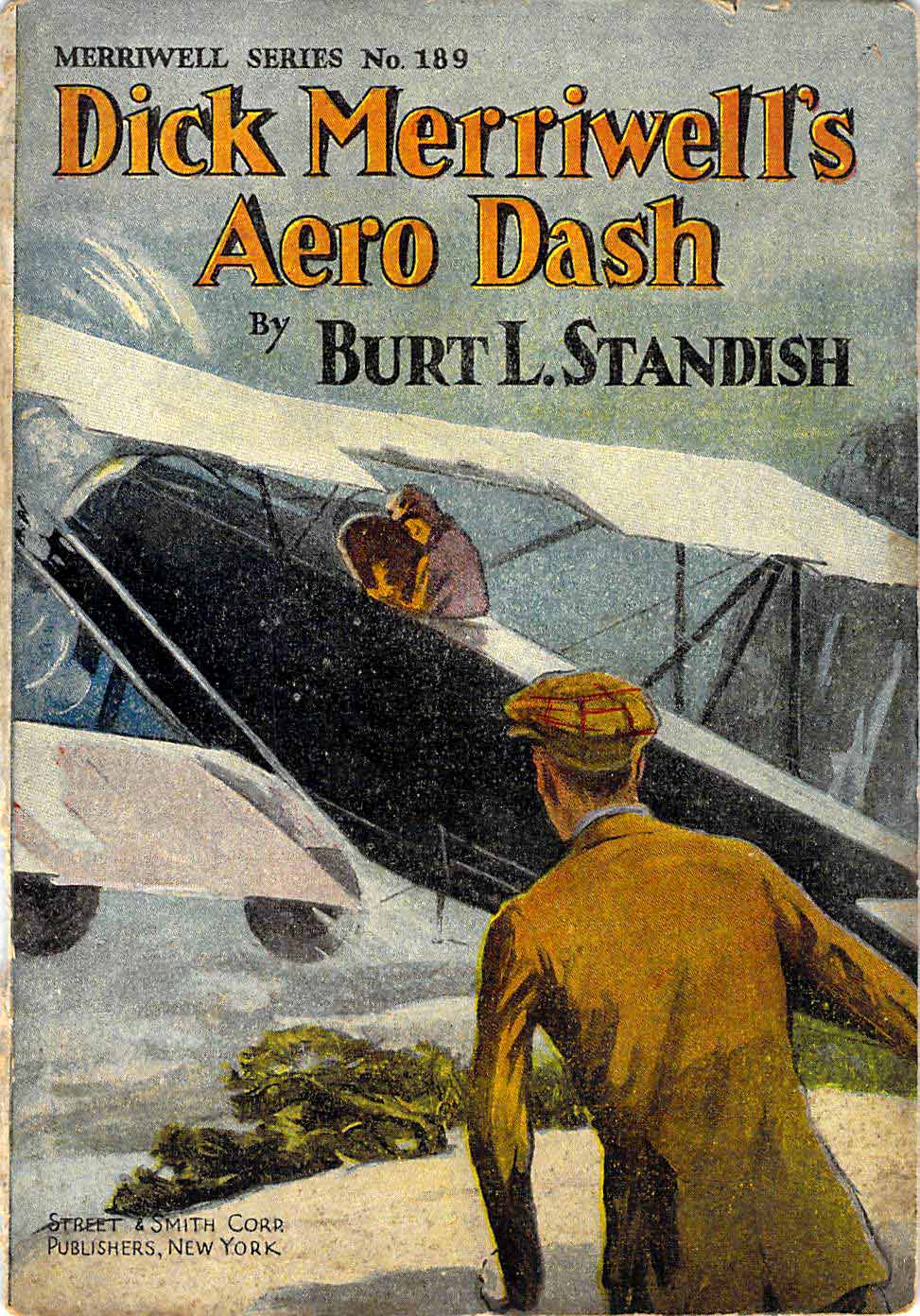
Dick Merriwell’s Aëro Dash
All rights reserved, including that of translation
into foreign languages, including the Scandinavian.
Printed in the U. S. A.
CHAPTER I. THE CATASTROPHE.
DICK MERRIWELL’S AËRO DASH.
A glorious midsummer morning, clear, balmy and
bracing. An ideal stretch of macadam, level as a
floor and straight as a die for close onto two miles,
with interminable fields of waving wheat on either
side. A new, high-power car in perfect running order.
It was a temptation for speeding which few could
resist, certainly not Brose Stovebridge, who was little
given to thinking of the consequences when his
own pleasure was concerned, and who had a reputation
for reckless driving which was exceeded by none.
With a shout of joy, he snatched off his cap and
flung it on the seat beside him. The next instant he
had opened the throttle wide and advanced the spark
to the last notch. The racing roadster leaped forward
like a thing alive and shot down the stretch—cut-out
wide open and pistons throbbing in perfect
unison—a blurred streak of red amidst a swirling cloud
of dust.
Stovebridge bent over the wheel, his eyes shining
with excitement and his curly, blond hair tossed by
the cutting wind into a disordered mass above his
rather handsome face. The speedometer hand was
close to the fifty mark.
“You’ll do, you beauty,” he muttered exultingly.
“I could squeeze another ten out of you, if I had the
chance.”
The horn shrieked a warning as he pulled her down
to take the curve ahead, but her momentum was so
great that she shot around the wide swerve almost on
two wheels, with scarcely any perceptible slackening.
The next instant Stovebridge gave a gasping cry
of horror.
Directly in the middle of the road stood a little
girl. Her eyes were wide and staring, and she seemed
absolutely petrified with fright.
The car swerved suddenly to one side, there was a
grinding jar of the emergency and the white, stricken
face vanished. With a sickening jolt, the roadster
rolled on a short distance and stopped.
For a second or two Stovebridge sat absolutely still,
his hands trembling, his face the color of chalk. Then
he turned, as though with a great effort, and looked
back.
The child lay silent, a crumpled, dust-covered heap.
The white face was stained with blood, one tiny hand
still clutched a bunch of wild flowers.
The man in the car gave a shuddering groan.
“I’ve killed her!” he gasped. “My God, I’ve killed
her!”
He would be arrested—convicted—imprisoned. At
the thought every bit of manhood left him and fear
struck him to the soul. He knew that every law,
human or divine, bound him to pick up the child and
hurry her to a doctor, for there might still be a spark
of life which could be fanned into flame. But he was
lost to all sense of humanity, decency, or honor. Maddened
by the fear of consequences, his one impulse
was to fly—fly quickly before he was discovered.
In a panic he threw off the brakes, started the car
and ran through his gears into direct drive with frantic
haste. The car leaped forward, and, without a backward
glance at the victim of his carelessness, Stovebridge
opened her up wide and disappeared down the
road in a cloud of dust.
The child lay still where she had fallen. Slowly the
dust settled and a gentle breeze stirred the flaxen hair
above her blood-stained face.
Then came the throbbing of another motor approaching,
a deep-toned horn sounded, and a big, red touring
car, containing four young fellows, rounded the bend
at a fair speed.
Dick Merriwell, the famous Yale athlete, was at the
wheel, and, catching sight of the little heap in the roadway,
he stopped the car with a jerk and sprang out.
As he ran forward and gathered the limp form into
his arms, he gave an exclamation of pity. Then his
face darkened.
“By heavens!” he cried. “I’d like to get my hands
on the man who did this. Poor little kid! Just look at
her face, Brad.”
As Brad Buckhart, Dick’s Texas chum, caught sight
of the great gash over the child’s temple, his eyes
flashed and he clenched his fists.
“The coyote!” he exploded. “He certain ought to
have a hemp necktie put around his neck with the
other end over a limb. I’d sure like to have a hold of
that other end. You hear me talk!”
Squeezing past the portly form of Bouncer Bigelow,
Tommy Tucker leaned excitedly out of the tonneau.
“Is she dead, Dick?” he asked anxiously.
Merriwell took his fingers from the small wrist he
had been feeling.
“Not quite,” he said shortly. “But it’s no thanks
to the scoundrel who ran her down and left her here.”
His eyes, which had been looking keenly to right
and left, lit up as they fell upon the roof of a farm
house nestling among some trees a little way back from
the road.
“There’s a house, Brad,” he said in a relieved tone.
“Even if she doesn’t belong there, they’ll make her comfortable
and send for a doctor.”
With infinite tenderness he carried the child down
the road a little way to a gate, and thence up a narrow
walk bordered with lilac bushes. The door of the
farm house was open and, without hesitation, he walked
into the kitchen, where a woman stood ironing.
“I found——” he began.
The woman turned swiftly, and as she saw his burden,
her face grew ghastly white and her hands flew
to her heart.
“Amy!” she gasped in a choking voice. “Is—she——”
“She’s not dead,” Dick reassured her, “but I’m afraid
she’s badly hurt. I picked her up in the road outside.
Some one in a car had run over her and left her
there.”
For an instant he thought the woman was going to
faint. Then she pulled herself together with a tremendous
effort.
“Give her to me!” she cried fiercely, her arms outstretched.
“Give her to me!”
Her eyes were blinded with a sudden rush of tears.
“Little Amy, that never did a bit o’ harm to nobody,”
she sobbed. “Oh, it’s too much!”
“Careful, now,” Merriwell cautioned. “Take her
gently. I’m afraid her arm is broken.”
“Would you teach a woman to be gentle to her
child?” she cried wildly.
Without waiting for a reply, she gathered the little
form tenderly into her arms and laid her down on a
sofa which stood at one side of the room. Then running
to the sink for some water, she wet her handkerchief
and began to wipe off the child’s face.
“You mustn’t mind what I said,” she faltered the
next moment. “I didn’t mean it. I’m just wild.”
“I know,” Dick returned gently. “A doctor should
be called at——”
“Of course!”
She sprang to her feet and flew into another room,
whence Dick heard the insistent ringing of a telephone
bell, followed quickly by rapid, broken sentences.
As the handkerchief fell from her hand he had picked
it up and was sprinkling the child’s face with water.
Presently the girl gave a little moan and opened
her eyes.
“Mamma,” she said faintly—“mamma!”
The woman ran into the room at the sound.
“Here I am, darling,” she said, as she knelt down
by the couch. “Where do you feel bad, Amy dear?”
“My arm,” the child moaned, “and my head. A big
red car runned right over me.”
“Red!” muttered Merriwell, his eyes brightening.
“My precious!” soothed the mother. “The doctor’ll
be here right off. Does it hurt much?”
The child closed her eyes and slow tears welled from
under the lashes.
“Yes,” she sobbed, “awful.”
Dick ground his teeth.
“It’s a crime for such men to be allowed on the
road,” he said in a low, tense tone. “I’m going to do
my level best to run down whoever was responsible
for this, and if I do, they’ll suffer the maximum penalty.”
“I hope you do,” the woman declared fiercely.
“Hanging’s too good for ’em! My husband, George
Hanlon, ain’t the man to sit still an’ do nothing,
neither.”
“They—wasn’t—men,” sobbed the child. “Only
one.”
“One man in a red car of some sort,” Dick murmured
thoughtfully. “He must belong around here;
a fellow wouldn’t be touring alone.”
Then he turned to Mrs. Hanlon.
“I think I’ll be getting on,” he said quickly. “I
can’t do anything here, and the longer I delay the less
chance there’ll be of catching this fellow. I’ll call you
up to-night and find out how the little girl is doing.”
“God bless you for what you’ve done,” the woman
said brokenly.
“I wish it might have been more,” Dick answered as
he walked quickly toward the door. “Good-by.”
As he hurried out he almost ran into a slim young
fellow, who was running up the walk. He was bare-headed,
and his long black hair straggled down over
a pair of fierce black eyes that had a touch of wildness
in them.
Catching sight of Dick he glared at the Yale man,
and hesitated for an instant as if he meant to stop
him. Then, with a curious motion of his hands, he
brushed past Merriwell and disappeared into the house.
“I’ve found a clue, pard,” Buckhart announced triumphantly,
as Dick reached the car.
“What is it?”
The Texan held up a cloth cap.
“Picked it up by the side of the road,” he explained.
“Find the owner of that and you’ll sure have the onery
varmit who did this trick. You hear me gently
warble!”
Dick took it in his hand and turned it over. The
stuff was a small black and white check and was lined
with gray satin. Stamped in the middle of the lining
was the name of the dealer who had sold it:
“Jennings, Haberdasher,
Wilton.”
Wilton was a good-sized town they had passed
through about four miles back.
“I thought he belonged around here,” Merriwell
said as he rolled up the cap and stuffed it into his
pocket. “Look out for a fellow without a hat, alone,
in a red car of some sort, Brad. That’s all we’ve got
to go by at present, but I shouldn’t wonder if it would
be enough.”
He stepped into the car and started the engine, Brad
sprang up beside him and they were off.
They had not gone a hundred feet when the black
haired youth rushed out of the gate to the middle of
the road. His eyes flashed fire, and as he saw the car
moving rapidly away from him his mouth moved and
twisted convulsively as if he wanted to shout, but could
not.
Then, as the touring car disappeared around a turn
in the road, he clenched one fist and shook it fiercely
in that direction. The next moment he was following
it as hard as he could run.
CHAPTER II. THE COWARD.
With pallid face and nervous, twitching fingers,
which his desperate grip on the wheel scarcely served to
hide, Brose Stovebridge flew along the high road between
Wilton and the Clover Country Club.
Now and then he looked back fearfully; at every
crossroad his eyes darted keenly to right and left, as
he let out the car to the very highest speed he dared,
hoping and praying that he might reach his goal without
encountering any one.
All the time fear—deadly, unreasoning, ignoble fear—was
tugging at his heart-strings.
He had gone through just such an experience as this
little more than a year ago in Kansas City. How
vividly it all came back to him! The unexpected meeting
with two old school chums whom he had not seen
in months; their hilarious progress of celebration from
one café to another, which ended, long past midnight,
in that wild joy ride through the silent, deserted
streets.
He shuddered. He thought he had succeeded in
thrusting from his mind the details of it all: The sudden
skidding around a corner on two wheels; the man’s
face that flashed before them in the electric light,
dazed—white—terrified. The thud—the fall—the
sickening jolt, as the wheels went over him. Then that
wild, unreasoning, terror-stricken impulse to fly, to escape
the consequences at any cost, which possessed him.
He gave no thought to his unconscious victim. He only
wanted to get away before any one came, and somehow
he had done so.
A few days later, in the safe seclusion of his home
near Wilton, when he read that the fellow had succumbed
to his injuries in the Kansas City hospital, his
first thought was one of self-congratulation at his own
cleverness in eluding pursuit.
His two chums he had never seen since that morning.
Only a few weeks ago one of them had declined an invitation
to visit him. He wondered why.
Once in his prep school days, when the dormitory
caught fire, he had stumbled blindly down the fire escape
and left his roommate sleeping heavily. Luckily
the boy was roused in time; but it was no thanks to
Brose that he escaped with his life.
For Stovebridge was a coward. In spite of his
handsome face and dashing manner; in spite of his
popularity, his athletic prowess, his many friends—in
spite of all, he was a moral coward.
Few suspected it and still fewer knew, for the
fellow was constantly on his guard and clever at hiding
this unpleasant trait. But it was there just the
same, ready to leap forth in a twinkling, as it had done
this morning, and stamp his face with the brand of
fear.
As the great, granite gateposts of the club appeared
in sight, Stovebridge breathed a sigh of relief.
By some extraordinary luck he had encountered no one
on his wild ride thither. He had passed several crossroads,
any one of which he was prepared to swear
he had come by, and for the present he was safe.
Slowing down, he turned into the drive, and as he
did so he took out a handkerchief and passed it over his
moist forehead. He must compose himself before encountering
any of his fellow members.
He carefully smoothed his ruffled hair with slim,
brown fingers, and reached over for his cap.
The seat was empty. The cap had disappeared.
The discovery was like a physical blow, and for an
instant his heart stood still.
Where had he lost it?
The spot where he had run down the child was the
only feasible one. The cap must have fallen out when
he put on the emergency, and probably lay in plain
sight, a clue for the first passerby to pick up.
For a moment he had a wild idea of going back for
it, but he thrust this from him instantly. It was impossible.
Then the clubhouse came in sight. He must pull
himself together at once; he would get something to
steady his nerves before he met any one.
Instead of continuing on to the front of the clubhouse,
where a crowd was congregated on the wide
veranda, he turned sharply to the right and drove his
car into one of the open sheds back of the kitchen.
Then he dived through a side door into the buffet.
“Whisky, Joe,” he said nervously to the attendant.
A bottle, glass and siphon were placed before him,
and even the taciturn Joe was somewhat astonished
at the size of the drink which Stovebridge poured
with shaking hand and drained at a swallow.
He followed it with a little seltzer and, pouring out
another three fingers, sat back in his chair and took out
a gold cigarette case.
As he selected a cigarette with some care, and held
it to the cigar lighter on the table, he noticed with
satisfaction that his fingers scarcely trembled at all.
“That’s the stuff to steady a fellow’s nerves,” he
muttered, blowing out a cloud of blue smoke. “There’s
nothing like it.”
He took a swallow and then drained the glass for the
second time.
Presently his view of life became slightly more optimistic.
“It was a new cap,” he remembered with a sudden
feeling of relief.
“I’ve never worn it here, and there’s an old one in
my locker. All I’ve got to do is to swear I never saw
it before if I’m asked about it—which isn’t likely.”
When the cigarette was finished he went into the
dressing room and took a thorough wash. There was
no one there but the valet, who gave his clothes a good
brushing, so he had no trouble in getting the old cap
out of his locker and placing it at a becoming angle on
his freshly brushed hair. Then he strolled out onto
the veranda.
Three or four fellows, lounging near the door,
greeted him jovially as he appeared.
“Rather late, aren’t you, Brose?” one of them remarked,
as he joined them.
“A little,” Stovebridge returned nonchalantly. “It
was such a bully morning I took a spin along the river
road.”
“Alone?” the other asked slyly.
Stovebridge laughed.
“Well, I happened to be—this time,” he answered,
a little self-consciously.
Being very much of a lady’s man, it was rare for
him to be unaccompanied.
“How I do love a hog!” drawled one of the fellows
who had not spoken. “Why the deuce didn’t
you ’phone me? I’ve been sitting here bored to death
for two solid hours.”
Stovebridge was looking curiously at a big, red touring
car which had just driven up to the entrance.
“Er—I beg pardon, Marston,” he stammered. “What
did you say?”
“Really not worth repeating,” returned the other
languidly. “You seem to have something on your
mind, Brose.”
Stovebridge gave a slight start as he turned back
to his friends.
“I was wondering who those fellows are that just
drove up,” he said carelessly. “They’re talking to
old Clingwood.”
Fred Marston turned with an effort and surveyed
the newcomers.
“Don’t know, I’m sure,” he drawled sinking back
in his chair. “Never saw them before.”
For some reason the strangers seemed to interest
Stovebridge extremely, and he continued to watch them
furtively. There were four of them. The one who
had driven the car, and with whom Roger Clingwood
was doing the most talking, was tall and handsome,
with dark hair and eyes, and the figure of an
athlete. The fellow who stood near him was good-looking,
too, and much more heavily built. Behind
them, a short, wiry youth was talking to a tremendously
stout fellow with a fat, good-humored face.
Presently Stovebridge left his friends and wandered
along the veranda, pausing now and then to exchange
a remark with some acquaintance, and before long
he had reached the vicinity of the strangers, where
he leaned carelessly against a pillar and looked out
across the golf links.
“Very glad you could get here this morning, Merriwell,”
Roger Clingwood, an old Yale graduate was
saying. “You’ll be able to look around a bit before
the race this afternoon.”
“Merriwell!” exclaimed Stovebridge under his
breath. “I wonder if that can be Dick Merriwell, of
Yale.”
Suddenly a hand struck him on the shoulder and a
voice exclaimed heartily:
“Hello, Brose, old boy! Wearing your old brown
cap, I see. What’s the matter with the one you got
at the governor’s shop yesterday?”
Stovebridge wheeled around with a sudden tightening
of his throat and saw the grinning face of Bob
Jennings, son of the haberdasher at Wilton, who had
been in the store when he bought that wretched cap
the day before. Here was the first complication.
Stovebridge forced himself to smile.
“Left it at home, Bob,” he returned carelessly. “This
was the first one I picked up as I came out this morning.”
In the pause which followed Roger Clingwood stepped
forward.
“I didn’t notice you were here, Stovebridge,” he
said pleasantly. “I’d like you to meet my friend Merriwell,
who has come up with some of his classmates to
spend a day or two at the club.”
“Delighted, I’m sure,” Stovebridge said with an air
of good fellowship. “I know Mr. Merriwell very well
by reputation, but have never had the pleasure of meeting
him.”
“Dick, this is Brose Stovebridge,” Clingwood went
on. “We claim for him—and I think justly—the title
of champion sprinter of the middle West.”
Merriwell smiled as he held out his hand.
“Very glad indeed to meet you, Mr. Stovebridge,”
he said heartily.
Stovebridge gave a sudden gasp and faltered; then
he took the proffered hand limply.
“Glad to meet you,” he said hoarsely.
Instead of meeting Merriwell’s glance, his eyes were
fixed intently on the corner of a checked cap which
protruded from the Yale man’s pocket.
It was the cap he had lost out of the car that morning,
or one exactly like it. Apparently it did not belong
to Merriwell, who held his own in his left hand.
Where had he picked it up? Where could he have
found it but in that fatal spot? Stovebridge’s brain
reeled and he felt a little faint. Then he realized that
Clingwood was speaking to him—introducing the other
Yale men—and with a tremendous effort he forced
himself to turn and greet them with apparent calmness.
For a time there was a confused medley of talk and
laughter as some of the other members strolled up and
were presented to the strangers. Stovebridge was very
thankful for the chance it gave him to pull himself together
and hide his emotion.
Presently there was a momentary lull and Dick
pulled the cap out of his pocket.
“Does this belong to any of your fellows?” he asked
carelessly. “We picked it up in the road this morning.”
Bob Jennings pounced on it.
“Why, that looks like yours, Brose,” he said as he
turned it over.
Stovebridge glanced at it indifferently. He had himself
well in hand now.
“Rather like,” he drawled; “but mine is a little larger
check; besides, I didn’t wear it this morning, you
know.”
“I could have sworn that you bought one exactly
like this,” Jennings said in a puzzled tone.
Stovebridge laughed.
“I wouldn’t advise you to put any money on it,
Bob, because you’d lose,” he said lightly. “I’ll wear
mine to-morrow, and you’ll see the difference.”
“Where did you find it, Dick?” Roger Clingwood
asked.
Merriwell paused and glanced quietly around the
circle of men. Most of them looked indifferent, as
though they had very little interest in the cap or its
unknown owner.
“It was picked up in the road about four miles this
side of Wilton,” he said in a low, clear voice. “It lay
near the body of a little girl who had been run over by
some car and left there to die.”
There was a sudden, surprised hush, and then a perfect
volley of questions were flung at the Yale man.
“Where was it?”
“Who was she?”
“Didn’t any one see it done?”
“Is she dead?”
The expression of languid indifference vanished from
their faces with the rapidity and completeness of chalk
under a wet sponge. Their eyes were full of eager
interest, and, as soon as the clamor was quelled, Dick
told the story with a brief eloquence which made
more than one man curse fiercely and blink his eyes.
Once or twice the Yale man darted a keen glance
at Stovebridge, but the latter had turned away so
that only a small portion of his face was visible. He
seemed to be one of the few to remain unmoved by the
recital.
Another was his friend Fred Marston, a man of
about thirty, with thin, dark hair plastered over a low
forehead, sensuous lips, and that unwholesome flabbiness
of figure which is always a sign of a life devoted
wholly to ease.
As Dick finished the story, he shrugged his shoulders.
“Very likely she ran out in front of the car, and
was bowled over before the fellow had time to stop,”
he drawled. “Children are always doing things like
that. Sometimes I believe they do it on purpose.”
Merriwell looked at him fixedly.
“That’s quite possible,” he said quietly, but with a
certain challenging note in his voice. “But no one
but a coward—a contemptible coward—would have
run off and left her there.”
Marston flushed a little and started to reply, but before
he could utter a word, a number of the club members
began to voice their opinions, and for a time the
talk ran fast and furious.
Merriwell noticed that Stovebridge took no part in
it. He stood leaning against a pillar, his hands in his
pockets, apparently absorbed in watching a putting
match which was going on at a green just across the
drive.
Presently the Yale man strolled over to his side.
“Nice links you have here,” he commented.
Stovebridge nodded silently without taking his eyes
from the players.
“You have a car, haven’t you,” Dick went on casually.
The other’s shoulders moved a little.
“Yes,” he answered. “Racing roadster—sixty horse-power.”
There was a curious glitter in Dick Merriwell’s
dark eyes.
“Dark red, isn’t she?” he queried.
Stovebridge hesitated for an instant.
“Ye-s.”
The players had finished their game and were coming
slowly toward the clubhouse, but Stovebridge’s
eyes never left the vivid patch of close-cropped turf.
He was afraid to look up, afraid to meet the glance
of the man beside him. He dreaded the sound of the
other’s low, clear voice. Why was he asking these
questions? Why, indeed, unless he suspected?
“You didn’t happen to run over the main road from
Wilton this morning, I suppose?”
The guilty man could not suppress a slight start. It
had come, then. Merriwell did suspect him. His
tongue clove to the roof of his mouth and for a moment
he was speechless. He moistened his dry lips.
“No,” he said hoarsely. “I came—by the river
road.”
What was the matter with him? That did not sound
like his voice. It was not the way an innocent man
would have answered an unmistakable innuendo. If
he did not pull himself together instantly he would be
lost.
The next moment he turned on the Yale man.
“Why do you ask that?” he said almost fiercely.
“What do you mean by such a question?”
His face was calm, though a little pale. His long
lashes drooped purposely over the blue eyes to hide the
fear which filled them.
Merriwell looked at him keenly.
“I thought perhaps we could fix the time of the
accident, if you had gone over the road before me,”
he said quietly. “But I see we cannot.”
He turned away, with a slight shrug of his shoulders,
and joined the others.
Brose Stovebridge gave a shiver as he saw him go.
He had the desperate feeling of going to pieces; unless
he could steady his nerves he felt that in a very
few minutes he would give himself away.
Without a word to any one, he slipped through the
big reception hall of the clubhouse and thence to the
buffet. Here he tossed off another drink and then
hurried out the side door.
The attendant looked after him with a shake of his
head.
“He’s got something on his mind, he has,” he muttered.
“Never knew him to take so much of a morning—and
the very day he’s going to run, too.”
Stovebridge walked over to the automobile sheds.
He was not likely to be disturbed there, and if some
one did come around he could pretend to be fussing
with his car.
He scarcely noticed Merriwell’s touring car, which
had been put into the shed next to his own. At another
time he would have examined it with interest,
for he was a regular motor fiend. But now he passed
it with a glance, and going up to his own car, lifted
up the hood and leaned over the cylinders.
He had not been there more than a minute or two
when he felt a hand grasp his shoulder firmly.
With a snarl of terror, he straightened up and
whirled around.
He had expected to find Merriwell, come to accuse
him. Instead, he saw before him Jim Hanlon, a
deaf mute, who occasionally did odd jobs around the
club. The fellow’s face was distorted with rage, his
eyes flashed fire, his slight frame fairly quivered with
emotion.
Stovebridge stepped back instinctively.
“What’s the matter with you?” he asked harshly.
“What are you doing here?”
As the clubman spoke the deaf mute’s eyes were fixed
upon his lips. Evidently he understood what the other
said, for his own mouth writhed and twisted in his
desperate, futile efforts to give voice to his emotion.
The next instant he snatched a scrap of soiled brown
paper from his pocket and produced the stub of a
pencil.
Stovebridge watched him with a vague uneasiness as
he scrawled a few words and then thrust the paper
into the clubman’s hand.
“Somebudy run over Amy an kill her.”
As he deciphered the illiterate sentence, Stovebridge
shivered. Until that moment he had forgotten that
this fellow was the child’s brother. What was he
about to do? He looked as though he were capable of
anything. Above all, how much did he know?
Looking up, Brose met the fellow’s eyes fixed fiercely
on his own. He shivered again.
“Yes,” he said, with an effort at calmness. “I heard
about it. It’s too bad.”
As the words left his lips he realized their utter
inadequacy.
With a scowl, Hanlon snatched the paper from his
hands and wrote again.
“I’ll kill the man that did it—kill him!”
The word kill was heavily underlined in a pitiful
attempt at emphasis.
As Stovebridge read the short line he felt a cold
chill going down his back. He had not the slightest
doubt that the fellow meant what he had written. But
how had he found out? Who had told him? Was it
possible that he could have witnessed the accident from
some place out of sight?
He shot another glance at Hanlon and met the same
malignant
glare of hate. The fellow looked positively murderous.
The next moment the deaf mute had pulled a long,
keen knife out of his pocket, which he held up before
Stovebridge’s terror-stricken eyes and shook it
significantly. At the same time he nodded his head
fiercely.
Brose gave a low gasp as he gazed at the wicked
blade with fascinated horror. Why had he ever come
out here alone and given the fellow this chance? Why
hadn’t he stayed with the others? No matter what
else might have happened, he would have been safe.
Arrest, conviction, disgrace—anything would have
been better than this.
Overcome by a momentary faintness, he closed his
eyes.
Suddenly the paper was twitched from his fingers,
and, with a frightened gasp, he looked up.
The knife had disappeared and Hanlon was writing,
again.
Desperately, as a drowning man clutches a straw,
Stovebridge snatched at the paper.
“What’s the name of the feller that came with three
others in that car.”
Puzzled, the clubman looked at Hanlon and found
him pointing at Dick Merriwell’s touring car. What
did he mean? What could he want with Merriwell?
Was it possible that he did not really know—that he
wanted to get proof from the Yale man before proceeding
with his murderous attack?
“Why do you want to know?” he faltered.
The other seized the paper from the man’s trembling
fingers, wrote three words and thrust it back.
“He killed Amy.”
As Stovebridge read the short sentence, he could
have shouted with joy. Hanlon did not know the
truth, after all. For some unaccountable reason he
suspected Merriwell. Perhaps it was because the Yale
man had carried the child into the house; anyhow it did
not matter, so long as he himself was safe.
Then another thought flashed into his mind. The
fellow suspected Merriwell—not only suspected, but
was convinced. He would try to kill the Yale man,
and perhaps succeed. Well, what of that? With
Merriwell out of the way Stovebridge would be safe—quite
safe. No one else had the slightest suspicion.
He took the pencil out of the deaf mute’s hand, and,
after a moment’s hesitation wrote, on the bottom of
the paper:
“His name is Dick Merriwell.”
Somehow, as he handed the paper to the wild-eyed
youth, he had the odd feeling that he had signed a
death warrant.
CHAPTER III. A SCRAP OF PAPER.
The Clover Country Club had acquired a wider reputation
than is usual with an organization of that
description.
Intended originally as a simple athletic club, with
out-of-door sports and games the special features, it
had one of the finest golf links in the Middle West.
Its tennis courts were unsurpassed, its running track
unrivaled. There was a well-laid-out diamond which
had been the scene of many a hot game of baseball,
and which was used in the fall for football. Indoors
were bowling
alleys,
billiard, and pool tables, a beautiful
swimming tank in a well-equipped gymnasium.
But in the course of time other and less desirable
features had been added. The younger set had developed
into a rather fast, sporting crowd, and, slowly
increasing in numbers and in power, they gradually
crowded the old conservatives to the wall, until finally
they controlled the management.
To-day the club was better known for the completeness
of its buffet, than for the gymnasium; and it was
a well-known fact that frequently more money changed
hands in the so-called private card room in a single
night than in the old days had been won or lost on
sporting bets in the course of an entire season.
In spite of all this, however, out-of-door sports were
still a feature, and now and then, when some especially
well-known athletes were at the club, matches and contests
of various kinds were arranged.
That very afternoon a mile race had been planned
between Stovebridge and Charlie Layton—a Columbia
graduate reported to have beaten everything in his
class from Chicago to Omaha—who was coming on
from the latter city especially for the occasion.
Fred Marston and others of his ilk usually did a
great deal of sneering at such affairs, calling them
farcical relics of barbarism, and made it plain that they
only attended for the excitement of betting on the
result; but this made little difference in the general enthusiasm.
For a time after the departure of Stovebridge the
discussion of Merriwell’s story continued with some
warmth, and many were the speculations as to the
identity of the brute who had run over the child and
left her there. But even that topic could not hold the
interest of such a crowd of men for very long, and
presently they began to disperse, some seeking the
card room, others the buffet, while the remainder
found comfortable seats on the veranda to put in the
hour before luncheon in indolent lounging and small
talk.
Roger Clingwood hesitated an instant before the
wide doors of the reception hall.
“It’s too late for golf or tennis,” he said regretfully.
“Is there anything else you would like to do
before lunch? Er—cards, perhaps, or——”
He was one of the older members who had fought
vigorously, but in vain, against the introduction of
gambling in the club; but his innate sense of hospitality
made him suggest the only form of amusement
possible in the short time.
Dick smiled.
“Not for me, thank you,” he said quickly. “It always
seems a waste of time to sit around a table in
a stuffy room when you might be doing something
interesting outside.”
Clingwood’s face brightened.
“I’m glad of that,” he said warmly. “I enjoy a good
rubber as well as the next man, but I don’t like the
kind of play that goes on here. How do your friends
feel about it?”
He looked inquiringly at the others.
“Nix,” Buckhart said decidedly. “Not for me.”
Tucker and Bigelow both shook their heads.
“I used to flip the pasteboards in my younger days,”
the former grinned; “but I’ve reformed.”
“Why not just sit here and do nothing?” Merriwell
asked. “I feel that I’d enjoy an hour’s loaf.”
Bigelow evidently agreed with him, for he sank instantly
into one of the wicker chairs, with a sigh of
thankfulness.
The others followed his example, and their host
took out a well-filled cigar case and passed it around.
Tucker accepted one; the others declined.
“Layton ought to show up soon,” Clingwood remarked,
settling back in his chair and blowing out
a cloud of smoke. “I believe he’s due in Wilton at
eleven forty-seven.”
“Layton?” Dick exclaimed interestedly. “Not Charlie
Layton, the Columbia man?”
“That’s the boy. Know him?”
“I’ve met him. He’s one of the best milers in the
country. Stovebridge must be pretty good to run
against him.”
“He is,” returned the older man. “He trains with
a crowd that I’m not at all in sympathy with, but, for
all that, he’s not a bad fellow; crackerjack tennis
player, and has a splendid record for long distance
running. He keeps himself in fair training and doesn’t
lush as much as most of his friends do.”
“I see,” Dick said thoughtfully.
This did not sound at all like a fellow who would
run down a child and never stop to see how badly she
was hurt. As a rule, good athletes are not cowards,
though he had known exceptions.
At the same time, Stovebridge’s actions had been
suspicious. Dick had not failed to notice his consternation
at the sight of the cap, though he had quickly
recovered himself and his explanation had been plausible
enough.
Later, during Merriwell’s conversation with him,
the fellow’s agitation had been palpable. That he was
laboring under a tremendous mental strain, the Yale
man was certain. Of course, the cause of it might
have been something quite different, but to Dick it
looked very much as though Brose Stovebridge knew
a good deal more about the accident than would
appear.
And he had come to the club that morning alone
in a red car!
All at once Dick became conscious that some one
had paused on the drive quite close to the veranda and
was looking at him.
As he raised his head quickly, he saw that it was
the same dark-haired, sullen youth he had passed as
he came out of the farmhouse that morning.
To Dick’s astonishment the fellow’s eyes were fixed
on him with a look of fierce, malignant hatred which
was unmistakable. His fingers twitched convulsively
and his whole attitude was one of consuming rage.
As Merriwell looked up, the other seemed to control
himself with an effort, and, turning his head
away, slouched on along the drive.
“What’s the matter with him I wonder?” the
Yale man mused. “He looks as if he could eat me
up with the greatest pleasure in life. I wonder who
he is?”
He turned to Roger Clingwood, who was talking
with Buckhart and Tucker.
“Who is that fellow that just passed, Mr. Clingwood?”
he asked, when there was a lull in the conversation.
“Did you notice him?”
“Yes, I saw him. That’s Jim Hanlon; he occasionally
does odd jobs about the grounds.”
“Hanlon!” Dick exclaimed. “Any relation to the
little girl?”
“Yes, her brother.”
“Oh, I see.”
Dick hesitated.
“Is he—all there?” he asked after a moment’s pause.
Roger Clingwood looked rather surprised.
“Yes, so far as I know. He’s deaf and dumb, you
see, and has the reputation of being rather hot tempered
at times; but I never heard that he didn’t
have all his faculties. Poor fellow! It’s enough to
drive any one dotty to have to do all one’s talking
with pencil and paper. I’m not surprised that he
loses his temper now and then.”
“I should say not,” Tucker put in. “Just imagine
getting into an argument and having to write it all
out. I’d lay down and cough up the ghost.”
“I opine you’d blow up and bust, Tommy,” Buckhart
grinned. “Or else the hot air would strike in
and smother you.”
“You’re envious of my wit and persiflage,” declared
Tucker. “I’d be ashamed to show such a disposition
as that, if I were you.”
“When you’re talking with Hanlon, do you also
have to take to pencil and paper?” Dick asked interestedly.
“Oh, no,” Clingwood answered. “He knows what
you’re saying by watching your lips. He’s amazingly
good at it, too; I’ve never seen him stumped.”
At that moment Stovebridge strolled out of the
clubhouse and stopped beside Clingwood’s chair.
“Any signs of Layton yet?” he drawled.
“Haven’t seen him,” the other man answered. “He’s
had hardly time to get here from Wilton, has he?”
“Plenty, if he came on the eleven forty-seven. Sartoris
went over with his car to meet him. I hope he’s
not going to disappoint us.”
He turned away and walked slowly down the veranda
toward Marston lounging in a corner.
As Dick followed him with his eyes, there was a
slightly puzzled look in them.
Stovebridge was so cool and self-possessed, so utterly
different from the man who had shown such agitation
barely half an hour before, that for an instant Merriwell
was staggered.
“Either I’m wrong and he’s innocent,” he thought
to himself, “or he has the most amazing self-control.
There isn’t a hint in his manner that the fellow has a
trouble in the world.”
Then the Yale man’s intuitive good sense reasserted
itself.
“He’s bluffing,” he muttered under his breath. “I’ll
stake my reputation that, for all his pretended indifference,
Brose Stovebridge is either the guilty man,
or he knows who is. And I rather think he’s the one
himself.”
Roger Clingwood pulled out his watch.
“Well, boys, it’s about time for lunch,” he remarked.
“Suppose I take you up to your rooms and, after you’ve
brushed up a bit, we’ll go in and have a bite to eat.”
“I’ll get the bags out of the car and be with you in
a minute,” Dick said as they stood up.
“Wait, I’ll ring for a man to take them up,” proposed
Clingwood.
“Don’t bother,” Dick said quickly. “They’re very
light, and Brad and I can easily carry them. Besides,
I’d like to see just where they’ve put the car so that
I’ll know where to go if I want to take her out.”
“Well, have your own way,” smiled the other. “The
garage is around at the back. Follow the drive and you
can’t miss it.”
Leaving Tucker and Bigelow with their host, the
two chums followed the latter’s directions and had
no difficulty in locating the automobile sheds.
Merriwell was glad of the opportunity, for he wanted
very much to have a look at Stovebridge’s car. In
fact, that was his principal reason for coming out instead
of having the bags sent for.
There were a dozen machines in the sheds, of all
sizes and makes, but only two runabouts. One was a
small electric, and the other—standing in the compartment
next to Dick’s car, the Wizard—was a new, high-power
roadster, painted a dark red.
“That’s the one, I reckon,” he said aloud, as they
surveyed it.
The Texan’s eyes crinkled.
“I opine it is, pard, if you say so,” he grinned.
“Might a thick, onery cow-puncher ask, what one?”
“Stovebridge’s car,” Merriwell explained briefly.
The Westerner gave a low whistle.
“Oh, ho! A red runabout,” he murmured. “So
you think he’s the gent we’re after?”
As Dick stepped in to examine the car more closely,
his eyes fell upon a scrap of paper which lay on the
ground close by one of the forward wheels. Picking
it up, he saw that it was a torn piece of common
brown wrapping paper, very much mussed and dirty.
He was about to toss it aside when he happened to
turn it over. The next instant his eyes widened with
surprise.
“What the mischief is this, I wonder?” he said in
a low tone.
Buckhart stepped forward and looked at it over the
other’s shoulder.
“‘His name is Dick Merriwell’,” he read slowly.
“Who’s been taking your name in vain, partner?”
Dick made no reply. He was busy trying to decipher
the illiterate scrawl which preceded the one
legible sentence the Texan had read. Slowly, word
by word, he made it out.
“Somebody—run over—Amy—and—kill her,” he
read at last.
“Amy—who is Amy?” he mused. “Why, that’s the
little girl we picked up this morning—Amy Hanlon.”
He looked at the paper again, and then, like a ray
of light, the solution flashed into his brain.
“Why, that dumb fellow—her brother—must have
written this!” he exclaimed. “Clingwood said he had
to do his talking on paper. But what on earth is my
name here for? Wait a minute.”
His eyes went back to the scrap of paper, and for
a few minutes there was silence. When he looked up
at Buckhart, his face was set and his eyes stern.
“Listen, Brad,” he said rapidly. “On this paper there
are four questions and one answer. The questions
were written by an illiterate person; the answer—was
not. It is evidently part of a conversation between
this dumb fellow and some one else. Hanlon first
informs this person that his sister had been run over
and killed. How he got the idea I don’t know, unless
she had fainted when he went into the room, and he
did not wait long enough to find out the truth. Then
he proceeds to inform whoever he is talking with
that he will kill the man who ran the child down.
Then he writes: ‘What’s the name of the fellow that
came, with three others, in that car?’ Do you make any
sense out of that, Brad?”
The Texan shook his head.
“I sure don’t,” he said decidedly.
“Well, I don’t know as I blame you,” Merriwell
returned. “The next sentence is apparently the answer
to a question by the other man. It is: ‘He killed
Amy.’ Meaning that the man in a car with three
others ran over his sister, which, of course, we know
isn’t so. There was only one, according to her statement.
Then follows the line in another hand which you
read: ‘His name is Dick Merriwell.’ Don’t you see
now, Brad?”
“Afraid I’m awful thick——”
“Why, it’s clear as day,” Merriwell interrupted.
“This Hanlon has somehow got the idea that I ran
over the little girl. He doesn’t know my name and
proceeds to ask this unknown person what it is, giving
at the same time the reason why he wants to
know. He gets the answer without a word of denial
or explanation, and goes away with the firm belief that
I am a murderer. That accounts for the look he gave
me when he passed the veranda a little while ago.”
“The miserable snake!” exploded the irate Westerner.
“Wait till I put my blinkers on him!”
“He isn’t to blame,” Dick asserted quickly. “He
thinks he’s right. It’s the other man I’d like to get
my hands on—the fellow that let him go on believing
a lie.”
He paused and looked significantly at Buckhart.
“Who is the man most interested in shifting the
blame to my shoulders?” he asked in a hard voice.
“Whom have we suspected? Under whose car did
I pick up this paper?”
“Stovebridge!”
The word came in a smothered roar from the lips of
the irate Texan, and, turning swiftly, he started toward
the clubhouse, his face flushed with rage and his
eyes flashing.
“Stop! Come back, Brad,” Dick called. “You must
not do anything now. We have no real proof; he
would deny everything.”
Buckhart hesitated and then came slowly back to
the shed. Dick went over to his own car and pulled
out a couple of bags from the tonneau.
“Don’t worry, you untamed Maverick of the Pecos,”
he said with a half smile. “We’ll get him right before
very long.”
He folded the paper and put it carefully away in his
breast pocket.
“I’ve got this, for one thing,” he went on, “and I
also have an idea in my head which I think will come
to something.”
CHAPTER IV. STOVEBRIDGE FINDS AN ALLY.
Brose Stovebridge dropped down in a chair beside
his friend Marston and pulled out his cigarette case.
“Have one?” he invited, extending it to the other.
Marston selected a cigarette languidly.
“How did this fellow Merriwell happen to honor the
club with his presence to-day?” he inquired sarcastically.
Stovebridge struck a match and held it to the other’s
cigarette; then, lighting his own, he sank back in the
chair.
“He’s Clingwood’s friend, I believe,” he answered
with apparent indifference. “You speak as though you
didn’t like him.”
“I don’t,” snapped Marston. “I hate him—hate the
whole brood.”
The blond fellow raised his eyebrows.
“I didn’t know you’d ever met him,” he commented.
“You certainly didn’t greet him as though you had ever
laid eyes on him before.”
“I haven’t,” the other said bitterly. “I know his
brother—that’s enough.”
“His brother?” queried Stovebridge.
“Yes, Frank Merriwell. I ran up against him at
Yale, and of all the straight-laced freaks he took the
cake—wouldn’t drink, wouldn’t smoke; wouldn’t play
poker, wouldn’t do anything but bone, and go in for
athletics.”
“Humph!” remarked Stovebridge cynically. “I don’t
wonder you didn’t like him. He wasn’t in your class
at all. But if he was as good an athlete as his brother,
he must have been some pumpkins. I don’t just see,
though, how that accounts for your violent antipathy.
Why didn’t you let him go on his benighted way and
have nothing to do with him?”
Marston’s heavy brows contracted in a scowl.
“You don’t suppose I cared a hang what he did,
do you?” he snarled. “That didn’t worry me any,
but he had to get meddlesome and butt into my affairs.
Got my best friend so crazy about him that he went
and gave up cards and all that, and trained with Merriwell’s
crowd. Of course, he was no use to me after
that. Do you wonder that I dislike Frank Merriwell,
and his brother as well?”
Stovebridge hesitated.
“Don’t know as I do?” he said in a preoccupied
manner.
He had been thinking of something else.
They smoked for a few minutes in silence. Once or
twice Marston glanced curiously at his friend, who
was scowling at the floor.
“What’s the matter with you to-day, Brose?” he
asked presently. “You act like you had something on
your mind.”
The other looked up with a sudden start.
“Why, no; I——”
Marston shrugged his shoulders indifferently.
“Don’t tell me, if you don’t want to,” he drawled.
“But if it’s something you want to keep to yourself,
for goodness sake, wipe that scowl off your face and
brace up.”
Stovebridge eyed the other with a speculative glance.
Why not confide in Marston? He hated Merriwell and
would certainly never peach. Besides, he might suggest
something helpful.
“I’ll tell you about it, Fred,” he said in a low tone,
as he drew his chair closer to his friend. “I’m in a
deuce of a scrape. I—I—was the one—who ran over
that kid this morning.”
His face flushed a little; his eyes were averted. He
did not find it easy to tell, even to Fred Marston.
The latter gave a low whistle.
“By Jove!” he exclaimed. “You don’t say! How
did it happen?”
“It was at the bend by the Hanlon farm,” Stovebridge
explained. “I was hitting up a pretty good clip,
and when I came round the bend she was standing in
the middle of the road. There was plenty of time for
her to get away, but she never moved. I tried to
run to one side, but there wasn’t room, and—the kid
went under.”
“I always said they didn’t have sense enough to get
out of the way,” Marston remarked in a vexed tone.
Then he looked curiously at his friend.
“What made you beat it?” he asked. “Why didn’t
you stop and pick her up? It wasn’t your fault—no
one could have blamed you, if you only hadn’t run
away.”
“I couldn’t, Fred—I simply couldn’t,” Stovebridge
confessed, without lifting his eyes. “My one idea was
to get away before any one saw me. You know the
beastly things they do to a fellow sometimes. Why,
I might have been jugged for a year or more.”
“Yes, I know,” agreed the other. “Still——”
He stopped abruptly and looked out over the golf
course in a meditative way.
“You managed pretty well, though,” he said presently
as he turned back to Stovebridge. “No one saw
you on your way here, I suppose?”
The other shook his head.
“No; if it wasn’t for that beastly cap I should feel
quite safe. But Merriwell suspects me on that account.”
Marston’s beady eyes glittered.
“Let him suspect!” he snapped angrily. “We’ll fix
that all right. It wouldn’t be safe for you to buy another,
but there’s nothing to prevent my doing so.”
“Of course there isn’t!” Stovebridge exclaimed in
a tone of relief. “And you’ll do it?”
Marston’s teeth snapped together.
“I certainly will,” he declared. “I’d do more than
that to spite a Merriwell. Lend me your car and I’ll
go to Wilton right after lunch.”
Stovebridge breathed a sigh of relief. How fortunate
he had confided in Marston. With the question
of the cap settled and Jim Hanlon sidetracked,
he would have nothing to fear. Dick Merriwell might
do his worst, but he could prove nothing.
Marston arose to his feet, yawning.
“Well, let’s toddle in and get something sustaining,”
he suggested. “I feel the need of a little bracer.”
“Don’t forget to pick out a medium check,” Stovebridge
reminded, as they strolled through the reception
hall to the dining room beyond. “I said mine
was a little larger than the one he picked up, but if
you get it too pronounced, Bob Jennings will smell a
rat. He’s a bit doubtful now.”
“Trust me,” Marston returned confidently.
They settled themselves comfortably at a small table
near one of the windows, and a waiter hurried up.
“Two Martinis—dry,” Marston said, unfolding his
napkin. “Bring them right away.”
“Not any for me,” Stovebridge put in hastily. “I’ve
got to run this afternoon.”
“Oh, shucks! What’s one cocktail?” expostulated
the other. “Just put a little ginger into you.”
But Stovebridge persisted in his refusal; already he
had taken considerably more stimulant than he felt
was wise. So when the cocktails came Marston drank
them both.
While his friend was writing out the order, Stovebridge
glanced idly about the well-filled room. He
gave a slight start as his eyes met those of Dick Merriwell,
who was seated with his party three or four
tables away. The Yale man was looking at him with
a certain steady scrutiny that was a little disconcerting.
There was no gleam of friendliness in his dark eyes,
but rather a cold, steely glitter. His fine mouth was set
in a hard line, curving disdainfully at the corners, as
though he were regarding something beneath his contempt.
It was not a pleasant expression, and, despite
his belief that the other could really prove nothing,
Stovebridge could not help feeling a little uneasy.
“Who are you staring at?”
Marston’s drawling voice roused Stovebridge, and,
turning quickly, he looked at his friend.
“Merriwell,” he breathed softly.
“Bah!” snapped the other. “He can’t do anything.
We’ll put a spoke in his wheel. For goodness’ sake,
Brose, do brace up and forget it!”
Stovebridge made an effort to do so, but all the
time he was eating lunch he had an uneasy feeling
that those cold eyes were still fixed upon him, and
it was only by the most determined exertion of will
power that he kept himself from looking again toward
the table where Roger Clingwood and his guests seemed
to be enjoying themselves so thoroughly.
As they came out to the veranda after lunch, Roger
Clingwood pulled out his watch impatiently.
“Almost two!” he exclaimed. “What in the world
is the matter with Layton?”
He turned to a short, pleasant-faced, youngish-looking
fellow who, also watch in hand, was looking anxiously
down the drive.
“Heard anything of Charlie Layton, Niles?” he
asked.
“Not a thing,” the other answered petulantly. “I
can’t understand what’s delayed him. He promised to
be here soon after twelve, and the race was to be
pulled off at three. People are beginning to come
already.”
“Sartoris is there to meet him, I believe,” Clingwood
remarked.
“Yes, and I tried just now to get him on the phone,
but couldn’t.”
Jack Niles shut his watch with a snap and shoved it
back in his pocket irritably. He was extremely homely.
Every feature seemed to be either too large or too
small, or not placed right on his face; but for all that
there was something very attractive in his expression,
and in the straightforward, honest directness of his
brown eyes. His clothes were loud almost to eccentricity,
and it was quite evident that he was a thorough-going,
out-and-out sport.
As he started to walk away, Roger Clingwood
caught his arm.
“Oh, by the way, Jack,” he said suddenly, “I want
you to meet my friend Merriwell. Dick, this is
Jack Niles, to whose efforts is due the fact that we
still occasionally have athletic events at the club.”
As Niles turned quickly, his hand outstretched, the
worried look on his face gave place to one of surprised
interest.
“Not Dick Merriwell, of Yale?” he asked eagerly.
Dick smiled as he took the other’s hand.
“I happen to be,” he said quietly.
He felt a sudden liking for this homely young fellow
with the honest eyes, who looked as though he
was square down to the very bone.
“Well, say!” Niles exclaimed, as he gripped Dick’s
hand and worked it up and down like a pump handle.
“If this isn’t a little bit of all right. I’ve seen you
play ball, and I’ve seen you run, but I never had a
chance of shaking hands before. What are you doing
away out here?”
“Touring with some friends of mine,” Dick answered
smiling. “I’d like you to meet them.”
He introduced Buckhart, Tucker and Bigelow, and
for a few minutes they stood talking together.
“I don’t know what we’ll do if Layton throws us
down,” Niles said anxiously. “We’ve made so much
talk about the race, and there’ll be an awful mob here
to see it. Oh, there’s Sartoris! Now we’ll find out
something. Excuse me, will you?”
Without waiting for a reply, he dashed down the
steps toward a car that had just driven up. Its occupant,
a tall, bare-headed fellow in tennis flannels,
sprang out, waving a yellow envelope in his hand.
“He can’t get here until to-morrow,” he explained.
“Held up by a wreck on the road.”
Niles took the telegram in silence, and, as he read it,
his face shadowed.
“Well, what do you think of that?” he muttered, as
he crumpled it in his hand. “To-morrow! And look
at the bunch that’s here to-day, expecting to see something
good. Coming thicker every minute, too.”
He glanced down the drive where several cars were
in sight, heading toward the clubhouse.
“Wouldn’t that drive you to the batty house!” he
went on. “I suppose it’s up to yours truly to get busy
and announce that there ‘won’t be no race.’”
His eyes, full of an expression of whimsical chagrin,
roved slowly over the crowd which had hastily gathered
at the approach of Sartoris, until they rested on Dick
Merriwell’s face.
The next moment a gleam of hope had leaped into
them, and Niles sprang up the steps to the Yale man’s
side.
“Say, what’s the matter with your taking Layton’s
place, old fellow, and saving my rap?” he asked eagerly.
Merriwell smiled a little.
“It would be rather difficult to take his place,” he
said slowly. “Layton is one of the best milers in the
country, and it’s a long time since I’ve done any
running.”
“Oh, that be hanged!” exploded Niles. “You’re
too blamed modest. You can do it if you want to.
Come ahead, old fellow, and save me from making
an ass of myself by disappointing this crowd.”
“When you put it that way, Niles, I can scarcely
refuse,” Dick smiled. “I’ll be very glad to do what
you want, only you mustn’t expect too much of me.”
Jack Niles was overjoyed.
“That’s bully!” he exclaimed. “You’ve helped me
out of a deuce of a hole and saved the day. It’s just my
luck to find a substitute as good or better than the
original.”
Brose Stovebridge stood near, a slight sneer on his
face.
“It’s lucky I’m not the one who didn’t show up,”
he drawled. “Merriwell seems to think such a lot of
this fellow Layton that I don’t suppose he could possibly
have been induced to run against him, if our
positions were reversed.”
Apparently his words were intended for the man
next to him, but they were quite loud enough for the
Yale man to hear.
The latter turned and surveyed Stovebridge with a
cool, disconcerting glance.
“I happen to have run against Layton several times,
Mr. Stovebridge,” he said quietly. “If he were here
to-day, I should be very glad to do so again. I hesitated
just now—for another reason.”
To the guilty man, his meaning was obvious; and
though Stovebridge shrugged his shoulders with affected
indifference, his face flushed, and he made no
reply.
“Come ahead, fellows, and get ready,” Niles broke
in briskly. “We’ve got just ten minutes to start on
time.”
He took Dick’s arm and hustled him through to the
dressing room, where he hunted up running trunks,
shoes, and shirt; and in less than the allotted time, the
Yale man was ready for the contest.
As they came out of the clubhouse and walked over
to the track, Merriwell felt a thrill of the old enthusiasm.
The well-kept track and the crowd of spectators
thronging both sides made his blood course more
swiftly and caused his eyes to sparkle.
They went directly to the starting point, where Stovebridge
presently joined them. Niles, mounted on a
stand, megaphone in hand, waved his arm for silence.
When the hub-bub of talk and laughter had ceased he
put the instrument to his lips.
“Gentlemen,” he declaimed, “I have to announce that
Mr. Layton has been detained by a wreck and cannot
reach the club this afternoon.”
A murmur of disappointment arose from the crowd,
which was quickly stilled by another motion from
Niles.
“I have, however,” he went on, “secured an efficient
substitute in the person of Dick Merriwell, of Yale,
who has kindly consented to run in order that we
shall not be disappointed.”
As he jumped to the ground, the quick round of
hearty applause, mingled with cheers, showed that
Merriwell’s name was not unknown. Then the buzz of
talk started up again with renewed vigor, as the
judges and timekeepers consulted with Niles and arranged
the details of the race.
Dick stood a little to one side of the mark, talking
to Buckhart, whose face was aglow with enthusiasm.
“Lick the stuffing out of the coyote, pard,” urged
Brad, in a low tone. “You can sure do it if you
try.”
“No question of my trying, old fellow,” Merriwell
smiled. “There’s no use in going into a thing unless
you do your best! But they seem to think this fellow
is pretty good, and you know I’m out of practice.”
“That don’t worry me a whole lot,” the Texan
grinned.
“Say, Merriwell, come over here, will you?” Niles
called, standing near Stovebridge.
“We’ll have to toss for positions,” he explained, as
Dick walked over to him. “The track is just a mile
in circumference, so that you’ll have to make one
complete circuit, and of course, the fellow on the inside
has a little the advantage.”
He took a coin out of his pocket and sent it spinning
in the air.
“Heads, or tails?”
“Tails,” Dick said quickly.
The other caught the coin deftly.
“Heads it is,” he grinned. “You lose. Take your
places, gentlemen—Stovebridge, inside; Merriwell,
out.”
Dick toed the mark, and his eyes wandered for an
instant down the long line of eagerly watching men.
As he did so, he caught sight of the dark, sullen face
of Jim Hanlon glaring at him from behind two of
the clubmen.
“Still thinks I’m it, by the looks of him,” the Yale
man said to himself. “I must have a talk with him
when this is over.”
Then he thrust the fellow out of his mind and
crouched for the start. Stovebridge was beside him,
vibrant and ready. The two timekeepers stood by the
mark, stop watches in hand. Niles stepped back a
pace and drew a small revolver from his pocket.
“Are you ready?” he called in a clear voice.
He raised the revolver above his head.
“Set!”
Both runners quivered slightly, as they waited with
every muscle tense the moment when they could shoot
forward down the track.
The sharp crack of the pistol split the silence, and
like a flash both men leaped forward, to the accompaniment
of a bellow from the watching crowd, and flew
down the stretch of hard, dry cinders.
Merriwell had made the better start and was slightly
ahead of the other man. Presently it was seen that
this lead was slowly increasing, and the spectators
cheered wildly as they observed it, for as a rule they
were an impartial lot and believed in shouting for the
best man. Besides they were grateful to the stranger
for having made the race possible.
Almost imperceptibly this lead increased. In spite
of his lack of practice, the Yale man was wonderfully
speedy and ran in almost perfect form, and with amazing
ease. His body was bent forward but slightly,
with his head held up naturally. He threw his legs
out well in front with a full easy stride, and brought
his feet down squarely, his thighs and knees thrown a
little forward. There was absolutely no lost motion.
His arms swung easily beside his body, and, with
every stride, seemed to help him along.
Stovebridge ran well, but he had a bad trick of
swinging his arms back and forth across his body,
which retarded him slightly, and moreover, in his
haste to finish the stride, he bent his knee somewhat,
thus losing a fraction of an inch each time, which
would mount up considerably in the course of the
mile.
The first quarter of a mile was made by Merriwell
in a fraction over a minute—almost sprinting time.
Stovebridge was barely two seconds longer. Then
both men seemed to settle down to a slightly easier gait,
for such speed could not be kept up for the entire distance,
and the second quarter took several seconds
longer.
The excitement was intense. Men shoved and jostled
each other in their eagerness to get a good view;
some even ran out onto the track behind the runners.
There was no more talking and laughing. A tense
silence had fallen upon the crowd as they watched
breathlessly.
Suddenly the Yale man was seen to stumble and almost
lose his footing. As he recovered his balance
with a tremendous effort, Stovebridge shot by him,
and a great sigh went up from the crowd.
“He’s twisted his ankle!” gasped Jack Niles, his
fingers closing on Buckhart’s arm with unconscious
strength.
The Texan made no reply. His face was set and a
little pale.
The next instant Merriwell had recovered himself
and flashed on down the track with almost his former
speed. To most of the spectators there did not seem to
be anything the matter with him, but those who were
near enough to see his face, noticed the lines of pain
in it, and the great beads of perspiration which stood
out on his forehead.
“By Jove, that’s plucky!” Niles muttered. “It’s
the nerviest thing I ever saw.”
His keen eye had instantly taken in the situation.
In some way the Yale man had strained his ankle, but,
instead of giving up the race he was going to fight
it out to the finish.
As Merriwell flashed over the three-quarter mile
mark, Stovebridge had a good twelve feet lead, but
was showing signs of exhaustion. His breath came
in gasps, the sweat poured down his face, and his
stride was perceptibly shorter.
The Yale man, on the contrary, was in much better
condition, except for his left leg, which he seemed
trying to favor at each step. It was apparent to everyone,
by this time, that he was suffering tortures with
every stride, but he showed no signs of giving up.
Instead, to the amazement of all, he took a fresh
spurt and actually began to gain on his opponent.
Slowly he crept up. Foot by foot the distance between
the two was lessened, until at length it was
reduced to a yard. But there was not enough time.
Already the finish was in sight, and the eager watchers
waited in strained silence the end of this amazing
race. Could the gamey fellow from Yale possibly
make up those three feet in the few seconds which
remained? They feared not, for almost without exception,
their sympathies were with the man who was
now showing such extraordinary pluck.
There was a final spurt on the part of both men,
and then, almost in the last stride, Stovebridge flung
himself forward with uplifted arms, and breasted the
tape a fraction in advance of Dick.
The Clover Club champion had won, but the resulting
applause was strangely feeble. There was
scarcely a man present who did not realize that Merriwell
was the better of the two.
As Dick reeled across the line, he staggered and
a spasm of pain flashed into his face.
Jack Niles caught him by the shoulder.
“Quick, Buckhart!” he ripped out in his sharp, decisive
tones. “We must get him into the house and
look after that ankle. Good nerve, my boy—good
nerve!”
Merriwell smiled faintly.
“Well, I lost the race for you, Niles!” he said.
“Lost be hanged!” snapped the other. “You’re the
gamest piece of work that ever came down the pike.
Why the deuce didn’t you stop when you twisted your
ankle that way?”
“I don’t generally give up when I can still go ahead,”
Dick said quietly.
“Well, you’ve got that foot of yours into a beautiful
condition,” Niles went on. “It’s beginning to
swell already. Here, sit down, while we take you
into the house.”
He and Buckhart clasped hands and, lifting Merriwell
up between them, started slowly back toward the
clubhouse, the spectators straggling behind, discussing
the result with much interest.
The two fellows carried Dick into the dressing
room, where he rested on a chair while they bathed
his ankle in cold water and then bandaged it as tightly
as they could to keep down the swelling.
“How the mischief did you do it, pard?” Buckhart
asked, while this was being done.
“I think I stepped on a small stone,” Dick answered
“At least it felt like that.”
Niles looked up quickly.
“A stone!” he exclaimed. “That’s impossible. I
walked over the track an hour before the race and it
was in perfect condition. It couldn’t have been a
stone.”
“Well, it felt like one,” Dick smiled. “I can’t
swear to it.”
Niles turned to one of the men who had acted as
timekeepers, and who was helping them with the bandage.
“Say, Johnson, just take a run out to the track
and see if you can see anything of a stone, will you?”
he asked. “I want to find out about this.”
Johnson was back in a few minutes and reported
that he could not find even a pebble on the track. He
had questioned the dumb fellow, Hanlon, who was
raking up near the clubhouse, and found that he had
not yet touched anything on the track.
“I must have been mistaken, then,” Dick said lightly.
“It was just pure carelessness.”
He took a shower and then dressed and limped into
the reception hall with Buckhart and Niles, who had
waited for him.
A group of men were talking in the centre of the
room, and Niles stepped aside for a moment to speak
to one of them, leaving Merriwell and the Texan
standing close beside one of the big windows which
opened on the veranda.
Brose Stovebridge was lounging in a wicker chair
just outside, and as Dick noticed him he saw a look
of eager interest flash into the fellow’s eyes, which
were turned toward the drive.
A moment later Fred Marston came in sight, walking
rapidly along the veranda, and presently stopped
beside his friend’s chair.
“Well, did you get it?” the latter asked eagerly.
“Sure, I did,” returned Marston with a smile.
He pulled a small parcel wrapped in brown paper
out of his pocket and handed it to Stovebridge, who
almost snatched it out of his hand.
“Ah,” he breathed in a tone of relief. “I guess that
will settle his hash. He can suspect all he wants——”
He broke off abruptly as he turned his head and
looked into Dick Merriwell’s cool, slightly smiling
eyes. A sudden rush of color flamed into his face,
and, with a quick drawn breath, he half rose from
his chair.
“What’s the matter?” asked Marston.
Then, following the direction of the other’s
fascinated
gaze, he too, saw the Yale man, and scowled
fiercely.
“Come in and let’s get a drink,” he said abruptly.
“I need a bracer.”
Stovebridge got up a little unsteadily, and the two
vanished in the direction of the buffet.
Dick looked significantly at the Texan.
“What do you think of that, Brad?” he asked
quietly.
“Huh!” grunted Buckhart contemptuously. “The
onery varmit’s sure a whole lot shy of you, pard. If
he isn’t the coyote you’re looking for, I’ll eat my
hat. You hear me gently warble!”
Merriwell gazed thoughtfully out of the window.
“I wonder what was in that package,” he mused.
“And I wonder too, where this Marston comes in.”
“I reckon he’s in the same class as Stovebridge,”
the Texan said emphatically. “I wouldn’t trust him
as far as I could throw a yearling by the tail.”
Jack Niles came up briskly at that moment.
“Well, fellows, let’s make ourselves comfortable
outdoors,” he said. “You don’t want to stand on that
leg of yours more than you can help for a while, old
chap.”
“It’s feeling pretty comfortable just now,” Dick returned,
with a smile. “Your bandages are all to the
good.”
At the same time he was not sorry to sit down in
one of the big wicker chairs, soon becoming the centre
of a laughing, joking crowd of men, all bent on showing
their admiration for the Yale athlete who had
given such an exhibition of nerve and pluck as few of
them had ever seen.
Merriwell thoroughly enjoyed himself, and was so
taken up with the discussion and talk that he had no
time to give to the problem which he had set himself
to solve. At length, as the afternoon wore on, the
fellows began to drop away. One by one, or in parties
of two or three, they left the club in motor cars, runabouts,
or on horseback, and by six o’clock there were
only about a dozen left on the veranda, who were
either stopping at the club or taking dinner there.
Then Dick remembered Jim Hanlon, and turned to
Buckhart who sat beside him.
“Say, Brad,” he said in a low tone. “Do you think
you could find that dumb fellow and bring him into
the clubhouse? You know I wanted to straighten
him out about who ran over the little girl. He seems
to have an idea that I did it.”
The Texan got up readily.
“Sure thing. He ought to be around somewheres—maybe
in the kitchen.”
It was ten minutes before he came back with the
announcement that Hanlon was not to be found. They
had told him in the kitchen that the fellow usually
went home at six o’clock.
“Well, it doesn’t matter much,” Dick said. “I’ll
probably see him to-morrow.”
Very soon afterward they went in to dinner. Niles
and two other men joined them, and they made a jolly
party around a big table in the middle of the room,
which was not so empty after all, quite a number of
people having driven out to the club especially to take
dinner there. Stovebridge and Marston sat at the
same table they had occupied at lunch, and Dick noticed
that both seemed to be hitting it up pretty freely.
The evening being a little chilly, they did not return
to the veranda after dinner, but made themselves
comfortable in the reception hall, where a fire
had been lit in the great stone fireplace.
Presently Merriwell remembered that he wanted to
call up the Hanlon farm to find out about the little
girl, and, on inquiring, found that the telephone was
in a small room opening out of the hall.
He had no trouble in getting the number, and Mrs.
Hanlon herself came to the telephone. She seemed
very much worried and nervous, and told that the
doctor had been there almost all the afternoon. The
child’s arm had been broken and her head badly cut,
and, from the symptoms, the physician was afraid
that there was some internal trouble.
“Poor little kid!” Dick muttered as he hung up the
receiver. “I certainly shall do my best to show up the
brute who is responsible for that. He ought to get the
maximum penalty, and if she doesn’t pull through I
shouldn’t like to be in his shoes.”
He opened a door which led directly outside, and
stepped out on the deserted veranda. It was a perfect
night, still and rather cool for that time of year, and,
as he looked up at the glittering stars, he drew a long
breath of pure oxygen.
All at once he heard a stealthy footfall behind him,
and, half turning, he caught a glimpse of a crouching
figure close upon him.
As he leaped instinctively to one side he felt the
impact of a spent blow on his back. Something sharp
pricked his skin.
He whirled around swiftly, only to see a shadowy
figure leap from the end of the veranda and disappear
into the darkness.
CHAPTER V. THE STRUGGLE IN THE DARK.
Like a flash Dick was after him, but as he reached
the edge of the veranda, he realized the futility of
pursuing the would-be assailant. The fellow, whoever
he was, evidently knew the ground thoroughly,
and, handicapped as the Yale man was with his bandaged
ankle, it would be a waste of time to try and
catch him.
He walked slowly back into the light that streamed
out through one of the windows, and slipped off his
coat.
Just between the shoulders was a clean cut about
twelve or fourteen inches long, evidently made by an
extremely sharp instrument.
The Yale man gave a low whistle.
“That fellow was out for blood,” he murmured.
“That’s about as close a call as I’ve ever had. I
wonder——”
Putting his hand up to his back, he found that both
shirt and undershirt had been cut through, though not
so badly, and that there was a tiny cut in the skin
just between the shoulder blades.
Thoughtfully he slipped into his coat again.
“That couldn’t have been Stovebridge,” he mused.
“Much as the fellow hates me, I don’t believe he would
deliberately attempt murder.”
He glanced through the window into the reception-hall.
Neither the tall athlete nor his friend Marston
were in the room.
Dick shook his head slowly.
“Just the same, it wasn’t him. It must have been
that dumb fellow. He’s been looking at me all day
as though he would like to knife me, and now he’s
tried it. I wish I could get hold of him to convince
him that he’s on the wrong track.”
Just now, however, the Yale man was more troubled
as to how he could get up to his room and slip into
his spare coat without attracting attention by passing
through the reception hall. He saw nothing to be
gained by letting the clubmen know what had happened.
They could do no good now, and Roger Clingwood
would be worried to death and tremendously
mortified at the thought of such a thing happening
to his guest.
He remembered having noticed a small stairway
leading from the second floor straight down to an outside
door which Clingwood told him opened on the
drive at the other end of the house—a door that was
occasionally used by members who wanted to go directly
to their rooms.
This door might possibly be unlocked. At any
rate it was worth trying.
Slipping around the house, he found to his relief
that the door yielded to his touch. In a moment he was
upstairs, and had taken the coat from his bag and
slipped into it. Then he threw the other on a chair
and went downstairs again.
No one made any comment on his rather long absence,
and presently they all adjourned to the billiard
room. Not wanting to tax his ankle, Dick did not
play but sat watching the others, and by ten o’clock,
he was so sleepy that he could scarcely keep his eyes
open.
Niles noticed this as he stood beside the Yale man
watching Buckhart run off a string.
“Say, old man, you look as if you were about ready
for your downey,” he grinned.
Dick smiled.
“I am,” he confessed. “Sitting around this way,
doing nothing, always sends me off.”
“I don’t feel any too wide awake myself,” the other
remarked. “As soon as we finish this game, we’ll strap
up that ankle of yours, and then all of us can hit the
pillow.”
The others being of the same mind, they presently
put up the cues. The Yale man’s ankle was treated
with iodine, freshly bandaged, and everyone trouped
upstairs.
The entire second floor of the clubhouse was divided
into a series of small single rooms opening off
a long hall. Most of the club members who stayed
there regularly, had quarters on the third floor, where
the rooms were larger and where there would be less
need to shift around to accommodate a large number
of guests.
The Yale men had been assigned four of these rooms
nearest the stairs, and there were only two other
rooms on that floor occupied, one by Roger Clingwood,
who was spending the night there on account
of his guests, and the other by a friend of Jack
Niles.
Clingwood went before them, switching on the lights
in each room, and, having seen that they were provided
with everything, he bade them good night.
Bouncer Bigelow betrayed no interest in anything,
save his overweening desire to get to bed, and, closing
his door at once, he proceeded to disrobe in haste.
Tucker, however, wide awake and lively as usual,
skipped into Buckhart’s room where Dick had stopped
for a minute’s talk.
“Well, how does the sleuthing come on?” he chirped,
as he dropped down on the bed. “What clues has the
great Sherlock Holmes unearthed?”
“Not as many as I’d like, Thomas,” Dick smiled.
“While I’m morally certain that Stovebridge is the
man we’re looking for, I can’t quite prove it.”
Tucker’s eyes widened.
“Whew!” he whistled softly. “Stovebridge, eh? The
great and only distance runner. Keep it up, Richard.
There isn’t a man about these parts I’d rather see
nailed. He thinks he’s just about the warmest baby
that ever chased over a cinder path. You ought to
have heard him blowing around after the race this
afternoon, when anybody with the brains of a hen could
see that you were the better man. It made me sick.”
Dick smiled. “He won fairly enough; but I would
like to know how that stone got on the track—for it
was a stone without any doubt.”
“Maybe that flabby, rum-soaked friend of his put it
there,” suggested Tucker seriously. “He’s another
one I’d like to sock in the jaw.”
Merriwell’s eyes twinkled as he got up and moved
slowly toward the door.
“What’s the matter with you, Tommy?” he asked.
“Seems to me you’re awfully savage to-night.”
“It’s my nature,” Tucker returned plaintively. “I
really have the sweetest disposition you ever saw, but
there are some men that rile me like a sour gooseberry.”
He gave a sigh and dropped back on the bed at full
length with the air of one who was comfortably settling
himself for a long stay.
“Now, look ahere, little one,” Buckhart said firmly,
as he beheld these preparations, “you needn’t think
you’re going to settle down there for one of your talk
fests. I’m going to bed, and I reckon you’d better
hike for your own bunk. You hear me!”
Tucker arose with an injured look on his freckled
face.
“I’m thankful I haven’t the inhospitable nature of
some people,” he remarked, as he edged toward the
door. “I’ve heard much about the free, open-handed
nature of Westerners, but the only one I ever had the
misfortune to get real intimate with, has such a mean,
envious, grudging——”
He dodged through the door just ahead of the
Texan’s shoe, and finished his sentence in the corridor:
“—— unaccommodating disposition, that he must
be the exception that proves the rule.”
“Go to bed, you little runt,” Buckhart grinned.
“You sure buzz around worse than a mosquito. Go to
bed before I lay violent hands on you.”
“Don’t you dare put your hands on me,” defied
Tommy. “I’ll chaw you up if you do. You hear me
gently——”
The Westerner made a dash at him, and the little
fellow skipped into his room and snapped the key.
Dick, who had been watching these proceedings
with a smile, now walked down the hall to the room
next to Buckhart’s and, stepping in, closed the door
mechanically behind him.
Then, as he groped for the electric light button, he
suddenly remembered that, when he had stepped into
Brad’s room, he had left his own light turned on.
In fact, it had been burning ever since Roger Clingwood
had come upstairs with them.
This was rather peculiar. He remembered distinctly
that there were two globes, one on each side of the
dressing-table; it seemed impossible that they should
both burn out at the same time. Some one must have
turned the switch. And the annoying part of it was
that he did not know where that switch was. He
turned to open the hall door and let in a little light
from outside, and as he did so he suddenly realized
that there was some one else in the room.
Instantly he held his breath and listened. The sound
of guarded breathing was unmistakable; some one was
there, and, what was even more unpleasant, that some
one was between him and the door.
For an instant Dick stood like a statue. Could this
be Jack Niles, or one of the other members of the
club playing a trick on him? It did not seem likely,
and yet who else——
Jim Hanlon!
As the thought flashed suddenly into his brain, it
must be confessed that his heart began to beat a little
unevenly though the hand which reached out and
began to grope along the wall for the switch was perfectly
steady.
He must find that button. With the light on, he
had not the slightest fear of his assailant, armed
though he probably was. But in the pitch darkness
of the room the other had an immense advantage of
which, the Yale man’s experience earlier in the evening
warned him, the fellow would not hesitate to avail
himself. His fingers searched the wall swiftly, but
in vain.
Then a board creaked softly near the door. The man
was coming toward him.
Merriwell at once abandoned his search for the
switch and turned to face the intruder. His back was
toward the wall, and he could not see his hand before
his face. There was a little satisfaction in the thought
that the other man was probably no better off.
Then the unpleasant recollection came to him of
having heard that when a person has lost one or more
senses the remaining ones become more keen and
powerful. It was possible that this fellow could see
in the dark, or at least, distinguish enough to give him
a great advantage.
Very softly the stealthy sound came on; the other
had apparently removed his shoes and was walking in
his stocking feet. The Yale man pictured to himself
the attitude the fellow would take. His head and
shoulders would be bent in a crouching position, the
right hand, holding the knife, extended a little, with
the point out. With this in mind, he leaned forward
a little himself, his feet braced, both arms outstretched
before him, and waited.
It seemed an interminable time before his keen eye
saw what seemed to be a shadow looming up not a foot
away. Without an instant’s hesitation, he plunged forward
and made a beautiful flying tackle. As he had
hoped, he caught the fellow fairly about the knees and,
with a crash which shook the room, they went down
together.
Like a flash, Dick twisted around and made a grab
for the unknown’s right wrist. In the darkness he
missed it, but managed to get a grip on the arm just
below the elbow.
Then followed a brief but desperate struggle. The
fellow writhed and twisted and did his utmost to
break away and free the hand which held the knife,
but, having once closed with his enemy, Merriwell
had little trouble in pinning him down.
He had scarcely done so when the hall door was
flung open and Buckhart stood on the threshold,
Tucker just behind him.
“Suffering coyotes!” the Texan exclaimed as his
eyes fell upon the two men in close embrace on the
floor.
Then he pushed the electric light button, which
was close beside the door, and the room was flooded
with brilliancy.
“Come in, Brad,” Dick said quietly, “and close the
door.”
Buckhart and Tucker both stepped inside, the latter
shutting the door after him.
“Kindly relieve this gentleman of his sticker, one of
you,” came again in Merriwell’s even tones.
To hear him, one would never have supposed that
he had just been engaged in a struggle for his life.
The fellow clung desperately to the long, keen knife,
but the big Texan seized his wrist with a grip of
iron, and the next moment the weapon clattered to the
floor, being at once secured by Tucker.
Merriwell sprang lightly to his feet, and his assailant
followed his example more slowly and stood sullenly
eying the three men.
It was Jim Hanlon.
“The miserable snake in the grass!” roared the
Texan, his great fists clenched and his eyes flashing
fire. “He ought to be thrashed within an inch of his
life, and I’m going to do it!”
Dick put a detaining hand on his friend’s arm.
“Wait a minute, Brad,” he said quietly. “Don’t be
in such a hurry. This fellow is only doing what he
thinks is right. I want to talk to him.”
He took a step forward and stood for an instant
looking steadily at Hanlon.
“You can understand what I am saying, can’t you?”
he asked presently.
The other nodded sullenly.
“You came here to-night to kill me because you
thought I was the one who ran over your sister?”
Dick queried.
The deaf mute made an emphatic gesture of assent,
and his black eyes flashed.
Merriwell continued to eye the other steadily.
“I did not do it,” he said quietly.
A look of scornful disbelief lit up Hanlon’s sombre
eyes.
“Listen to me,” said Dick slowly, “and I will tell
you what happened this morning. My friends and
I were driving to the club from Wilton. At the curve
we saw something in the road, and stopped. When
I got out I found that it was a little girl, unconscious
and bleeding from a great gash in her forehead. I
carried her into the farmhouse and found that she belonged
there. She was not dead at the time, but badly
hurt, and the doctor was sent for at once——”
He stopped abruptly. The dumb youth was searching
frantically in his pocket for something; his mouth
was trembling and his eyes filled with a wild eagerness.
Dick stepped over to a small desk and took out a
sheet of paper, marked with the club letterhead, which
he handed to Hanlon.
“Is that what you want?” he asked quietly.
The fellow snatched it from him and, turning to the
dressing table, rested it on the polished surface while
he scrawled a brief sentence. Then he thrust the
paper into Dick’s hands.
“Not killed—is that true?”
The Yale man looked up from the paper.
“Perfectly true,” he said. “She is alive now. I
telephoned to Mrs. Hanlon this evening and found that
she was alive, though in a very critical condition.”
The other took the paper and wrote again.
“Will she die?”
“I don’t know,” Merriwell said simply, as he read
the question.
Jim Hanlon seemed to be in an agony of indecision.
His hands clenched and unclenched and the slender,
brown fingers twitching nervously. All the time his
glittering black eyes were fixed fiercely on the
Yale man’s face as if he were trying to plumb the
depths of the other’s soul and read his very thoughts.
Finally he reached out, took the paper from Merriwell’s
hand, scrawled a sentence and gave it back
again.
“If you didn’t run over her, who did?” was what
Dick read.
As he raised his eyes again to Hanlon’s face, the
Yale man felt a thrill of pity go through him at the
thought of what this fellow must be suffering. He
had also a distinct feeling of admiration for the manner
in which the mute was persevering in the face of all
obstacles in his search for the man who had been
responsible for his little sister’s injuries.
Whether Dick approved of the other’s primitive
method of taking the law into his own hands was another
matter. Though the Yale man’s temper was
under perfect control, it was still alive, and there
had been a time when he might have done just what
this dumb boy was trying to do. It was not strange,
then, that there should be a certain bond of sympathy
between the two.
“I am not sure,” he said, handing the paper back
to Hanlon. “I have been trying all day to find out.”
The other wrote hastily and returned the scrawl.
“Who do you think it is?”
Merriwell hesitated. The ferocity had quite gone
from the boy’s face, and its place been taken by a
look of intense pleading. The Yale man wondered
whether it would be right for him to give voice to his
suspicions. And yet, they were more than mere suspicions.
In his mind there was no doubt whatever that
Stovebridge was the guilty man, but the difficulty was
to get absolute proof.
As he watched the play of emotions on the mobile
face of the lad before him, a sudden thought leaped
into Dick’s brain which made his eyes sparkle and
brought a half smile to his lips. What a solution that
would be—to make this fellow whom Stovebridge
had fooled and played with the means of bringing
the clubman to justice!
“I think it is Stovebridge,” he said aloud; “but I am
not sure. I want you to find out the truth. Can you
read the lip talk at a distance—say at fifty feet?”
Hanlon nodded emphatically.
“Good! Well, this is what I want you to do. Stovebridge
and this Marston are great pals, and I believe
Marston knows all about the accident. They are likely
to talk it over to-morrow—probably on the veranda;
for Marston always sits there. Of course, they would
not talk loud enough for any one sitting near them
to hear, but they would never suspect you, if you
were out raking the drive. Yet you could read their
lips and understand. You get my meaning?”
There was a look of admiration in the boy’s eyes as
he nodded.
“You’ve sure got a head on your shoulders, pard,”
the big Texan said enthusiastically. “That’s a jim
dandy scheme.”
Dick only smiled and looked at Hanlon.
“I will fix it so that you will be put to work on
the drive in the morning,” he said. “And you know
what to do. If they say enough to betray themselves,
write it down and come to me with it. I’ll do the
rest.”
The dumb fellow nodded emphatically. The dark
eyes were full of a keen intelligence as he looked at the
Yale man.
“Well, I think that’s about all we’ve got to say to-night,”
the latter remarked, after a thoughtful pause.
“It’s pretty late, and you’d better be getting home.”
Still the other hesitated, and a flush slowly mounted
into his tanned face. Then he took the paper and
wrote two words on it.
“I’m sorry.”
Merriwell smiled a little.
“Oh, that’s all right,” he said quietly. “You thought
you were doing the right thing.”
He opened the door and stepped out into the hall,
the fellow following him. They went down the narrow
flight of stairs to the door which opened onto
the drive—a door that Dick found had been left unlocked.
With a brief gesture of farewell, the dumb
man vanished into the darkness. Merriwell turned the
key and came back to his room, a look of satisfaction
on his face.
CHAPTER VI. DICK MERRIWELL WINS.
About ten o’clock next morning Brose Stovebridge
and his friend Marston were sitting together in the
latter’s favorite corner of the Clover Club veranda.
Considering the crowd of the day before, the place
seemed deserted. One man, absorbed in the morning
paper, lounged at the far end of the veranda, and a
foursome was just teeing off on the links across the
drive; but otherwise there was no one in sight.
Presently the deaf mute, shouldering a rake, came
around the corner of the house and began to rake up
the roadway.
Fred Marston yawned.
“Deuced dull this morning,” he drawled.
“Little early yet for any one to be around,” Stovebridge
returned absently.
He was dressed much as he had been the day before,
except that he wore a cloth cap of medium black
and white check, obviously new.
“Cap worked to a charm, didn’t it?” Marston remarked
after a moment’s pause. “I saw Merriwell
taking it in when we drove up, and it stumped him,
all right. He’d be surprised to learn that I bought it
yesterday afternoon.”
“Yes, it’s got him guessing all right,” the other answered.
“He may suspect what he likes, but he can’t
prove anything on me now.”
Despite the athlete’s assumption of nonchalance,
there was an underlying note of anxiety in his voice
which Marston seemed to notice.
“What’s the matter with you, anyway?” he asked in
a peevish tone. “You ought to be chipper as a lark,
and yet I swear you’ve got something on your mind.”
Stovebridge glanced quickly around, but there was
no one within hearing distance.
“I can’t help worrying about the girl,” he said in a
low voice. “I heard this morning that the doctor was
there all night. They’re afraid of internal complications.”
“That’s too bad, of course,” Marston remarked,
without any particular feeling in his voice. “But I
wouldn’t lose any sleep over it. You’re safe, no matter
what happens.”
“But if she should die, there’ll be a rigid investigation,”
Stovebridge said slowly. “You can’t tell what
they might unearth. The idea makes me cursed nervous.”
“For goodness’ sake, don’t borrow trouble!” the
other said sharply. “If you keep on going around
with that long face some one will begin to smell a rat.
All you’ve got to do is to sit tight and say nothing.
They can’t prove anything on you if you only throw a
good bluff.”
Neither of them gave a thought to the dumb youth
who was raking the drive some forty feet away. But
had Stovebridge seen the ferocious glare in the dark
eyes which were furtively watching him, he would
have been more than disturbed—he would have been
seriously alarmed.
Marston yawned again and stretched himself lazily.
“Wish somebody would come around so we could
get up a little poker game,” he remarked. “This sitting
here doing nothing is deadly dull.”
Stovebridge arose to his feet with sudden resolution.
“Get your clubs and let’s go around the nine hole
course,” he suggested. “It will do you good.”
“No thanks,” Marston drawled. “I never by any
chance enjoy doing the things that are good for me, and
you know I hate golf. Toddle along, Brose, and I’ll
wait here until somebody comes around that has a
sensible idea of amusement.”
Stovebridge shrugged his shoulders resignedly.
“Well, I’ll have to do it alone, then,” he said as he
started for the dressing room for his clubs.
When he returned, a few minutes later, Jim Hanlon
had disappeared.
“Aren’t you going to take a caddy?” Marston inquired
as his friend crossed the drive to the first tee.
“No; I’ve only got a few clubs. I can manage
without one.”
Marston watched him drive off with a tolerant
smile, and when Stovebridge had disappeared over a
knoll, he got up and lounged through the reception
hall to the buffet.
Stovebridge was not playing in good form at all.
He drove wretchedly, his brassy shots were impossible,
and even his putting worse than he had ever known it
to be before. Consequently by the time he had holed
in at the fifth green with a score greater by fourteen
than ever before, he was in a furious rage and cursed
the clubs, the balls, the course—everything but himself.
With an effort he pulled himself together and made
a fair drive from the fifth tee. The course was rather
winding and along one side was a thick wood, which
had been left quite untouched when the links were laid
out.
As he followed the ball he saw that the wind had
taken it close to the trees, if not in amongst them,
and he cursed fiercely again.
When he came up, however, he found that it lay
about six feet from the edge of the wood, and, with
an exclamation of satisfaction, he took his cleek out
of the bag and swung it once or twice over his
shoulder.
His back was toward the trees, and he did not see
the figure which crept stealthily out of the underbrush.
The next instant there was a rush behind him,
something struck him on the back, and, taken by surprise,
the clubman lost his footing and fell, with Jim
Hanlon on top of him, clutching his windpipe with all
the strength in his slim, muscular fingers.
After the first, momentary shock of surprise, Stovebridge
struggled desperately, finally succeeding in tearing
the choking fingers from his throat and struggling
to his feet. For a moment he stood silent, his breath
coming in gasps and his eyes full of a great fear, as
he
faced the crouching figure before him.
Then, without warning, the clubman snatched up the
iron-headed cleek and, springing forward, struck the
other a terrific blow over the head.
Hanlon reeled and collapsed in a silent heap on the
ground, blood smearing his forehead.
For a full minute Stovebridge stood as if turned to
stone. His face was white as chalk, as he gazed in
horror-stricken fascination at the silent thing before
him.
Then he passed one shaking hand across his forehead
in a dazed manner.
“What have I done?” he muttered in a strange voice.
“What have I done?”
His eyes traveled slowly to the blood-stained cleek,
and with a shudder he hurled it from him into the
woods.
“I’ve killed him!” he gasped hoarsely. “What shall
I do? Where shall I go?”
Suddenly he raised his head and listened intently.
Was that the sound of voices coming from behind the
hill yonder? They must not find him here. He must
fly somewhere—anywhere to get away from that horror
on the ground whose ghastly half-closed eyes
seemed to be watching him.
In a panic of fear he snatched up his golf bag and,
without a backward glance, sprang into the woods and
disappeared.
Presently the crashing of the flying man through the
undergrowth died away and all was still. A gray
squirrel poked his head out of the bushes and, sighting
the huddled heap, fled with chatterings of alarm.
Then came the distant sound of talk and laughter from
beyond the hill, and the next moment a small, white
sphere came sailing through the air and landed with a
thud on the turf close to the body of Jim Hanlon.
It was as though the thing had roused him, for with
a low moan he stirred uneasily and opened his eyes.
Following the thud of running feet, some one knelt
beside him and raised his head, and the half-conscious
boy found himself gazing into Dick Merriwell’s eyes,
full of compassion and concern.
“Who did it, Jim?” he asked quickly.
Then he suddenly remembered.
“Was it Stovebridge?” he questioned eagerly.
Hanlon nodded weakly.
“Which way did he go?”
The dumb boy shook his head.
“You don’t know?” Dick said disappointedly. “Did
you find out anything? Is he the one who ran over
Amy?”
Hanlon nodded, and his eyes took on a faint gleam
of rage.
“What’s happened?” asked Jack Niles as he hurried
up.
Then he saw the boy’s face.
“By Jove!” he exclaimed. “Somebody hit him!
What cur would do a thing like that?”
The Yale man looked up at him, and his dark eyes
were cold and icy.
“Our friend Stovebridge is the man,” he said in a
tense voice.
“What?” Niles cried in utter amazement. “Stovebridge!
The cowardly hound! But what reason——”
“I rather think it was because Hanlon found that
Stovebridge was the man who ran over his sister,”
Dick explained quietly. “They must have had an altercation,
and this is the result.”
Overcome with amazement, Jack Niles listened to
Merriwell’s brief explanation; and when the Yale man
had finished the other’s face was dark with rage. Roger
Clingwood had come up with Buckhart and Tucker in
time to hear it.
“The scoundrel!” he exclaimed. “I’ll have him run
out of the club for this.”
“Out of the club and into jail!” supplemented Niles
fiercely. “The child may die at any moment, I hear.”
“The thing is to catch him,” Clingwood said anxiously.
“No doubt after this, he’s run away.”
Jim Hanlon staggered to his feet with Dick supporting
him.
“I think I can catch him,” the Yale man said quietly.
“Look after Hanlon, will you, Brad.”
Buckhart stepped over and took the dumb boy’s arm,
and without a word Merriwell turned and sprang into
the woods, Niles following close at his heels.
Almost at once he found the bloody cleek and, a
few feet farther on, came upon the bag of golf sticks,
which Stovebridge had thrown aside in his haste. Then,
with what seemed to Niles almost superhuman skill,
the Yale man picked up the trail of the fleeing scoundrel,
and followed it on a run. His lame ankle was
forgotten; he betrayed not the slightest limp.
To one of Dick’s training, trailing was a comparatively
easy matter in the woods, where broken twigs,
bruised leaves, and bent branches of the bushes marked
the way clearly. But when they emerged from among
the trees to the close cropped sward of the links again,
he scarcely lessened his speed. It seemed as though
he knew almost by intuition which way the man had
gone.
Very soon Niles fell behind. For all of his condition
he was beginning to be winded, while his companion
showed no signs whatever of even hurried
breathing.
Rapidly the distance between them increased as
Merriwell forged ahead, and presently he vanished over
a high knoll, leaving Niles to plod on alone, gasping
and breathless, but determined not to give up.
At last he reached the summit and there he paused
with an exclamation of satisfaction.
A perfectly straight stretch of green was spread out
before him. It was over a mile in length, and by
far the longest hole of the course. Though there were
several slight undulations, it was for the most part
quite level, being broken here and there with grassy
bunkers placed to make the hole more difficult.
About half way down the stretch a party of golfers
had stopped their play and were staring in astonishment
at the strange sight of two young fellows tearing
over the grass as hard as they could run. The
one in advance was Stovebridge, who ran desperately
as though his life depended on it. His face was white
and set, his breathing labored, his eyes full of a great
fear.
A hundred yards behind him Dick Merriwell was
covering the ground at an amazing speed. Apparently
unhampered by golfing clothes or bandaged ankle, he
ran lightly and easily as though on the cinder track.
It seemed to the excited Niles on the hill top that
he almost skimmed over the ground like a bird.
“Jove, what running!” he cried aloud. “Oh, I wish
I had a watch! I never saw anything like it on the
track. There can’t be eighty yards between them
now; he’s gained twenty in a couple of minutes. Stove
must be getting winded. There! What a jump! He
took that bunker like a bird. Stove had to climb over
it. What a hurdler he must be! Another five yards
gained.”
For a moment he stood silent, shading his eyes with
his hand.
“Another bunker!” he cried presently. “Merriwell
is a perfect wonder. He’s as fresh as when he started.
Great Scott! I never saw anything like this in all my
life.”
Niles was fairly jumping up and down in his frenzied
excitement.
“Go it! go it!” he cried. “Stove’s all in. Only
fifteen yards more. Why didn’t I bring a watch? He’s
making a record! Go it, Dick! Ten yards more—eight!
Oh, why isn’t there somebody else here to see this!
He’s got him! He’s got him!”
Fairly shrieking out the last words, Jack Niles
plunged down the slope, his arms waving like an erratic
windmill, and ran toward the two men who stood together
at the far end of the course. One, cool and
fresh, his breath coming a little unevenly, stood with
his hand on the shoulder of the other, who was exhausted
to the verge of collapse, breathing with great
gulping gasps, unable to get enough air into his lungs.
His whole frame trembled, and his guilty eyes, unwilling
to meet the stern, accusing ones of the man before
him, were fixed upon the ground.
CHAPTER VII. THE BRAND OF FEAR.
It was not a lively party that approached the clubhouse
half an hour later. Merriwell had turned his
captive over to Roger Clingwood and Jack Niles, and
was devoting his attention to the dumb boy, who had
so far recovered as to be able to walk with very little
assistance.
Brose Stovebridge looked like another man. With
dragging feet and eyes fixed on the ground, he was the
picture of guilt as he slouched along between the two
other clubmen. Roger Clingwood’s eyes, wearing a
mingled expression of anger and humiliation, were set
straight ahead, as though he could not bring himself
to look at the fellow who had so disgraced his club.
The homely, honest features of the other man, showed
only a fierce contempt. Behind them straggled the
curious party of golfers who had witnessed that extraordinary
race.
As they approached the veranda, a tall, well-built
fellow with bronzed face and pleasant gray eyes, stepped
forward from the group assembled by the door.
“Hello, Niles,” he said, holding out his hand. “Awfully
sorry I disappointed you yesterday, but it couldn’t
be helped. I’m ready to run your champion to-day,
though.”
“Glad to see you, Layton,” Niles said warmly. “I
don’t know——”
Roger Clingwood’s cold, cutting voice interrupted
him:
“We have no champion, Mr. Layton. Mr. Stovebridge
will soon be no longer a member of the club.”
A gasp of astonishment went up from the listening
members, and a feeling of utter desolation and despair
swept over Stovebridge, who turned his back swiftly on
the veranda.
“And if he were a member,” supplemented Niles,
“he would no longer be champion. Dick Merriwell holds
that honor at present. I have no doubt he will race
you any time you wish.”
A look of pleased surprise flashed into Layton’s
face as he caught sight of Dick for the first time,
and, stepping forward quickly, he took the Yale man’s
hand.
“Awfully glad to see you, old fellow,” he said
warmly.
Then he turned to Niles.
“A race between us would be pretty much of a
farce,” he smiled. “Apparently you don’t know him
as well as I do. If there’s one fellow I’ll pull my
colors to, it’s Merriwell of Yale.”
Roger Clingwood stepped forward and touched
Niles’ arm.
“Take him upstairs and lock him in the end bedroom
while I telephone the police,” he said in a low
tone. “Much as I loathe the fellow, there’s no reason
why he should be put to needless humiliation.”
With the disappearance of the two into the clubhouse,
a perfect Bedlam of eager, breathless questions
were flung at the other men of the party, and,
as the story was briefly told, exclamations of amazement,
contempt and scorn arose on every side. Some
of the men were even incredulous. It did not seem
possible that the dashing, debonair Stovebridge, one
of the most popular of their number, and the best all-around
athlete in the club, could have been guilty of
such behavior; but they were at length convinced,
and Roger Clingwood was urged to lose no time in
summoning an officer to take him into custody.
As Brose Stovebridge crossed the threshold of the
bedroom, his self-control snapped like a broken thread
and he flung himself face downward on the bed, uttering
a gasping cry of despair. Lying there, shaken with
dry, racking sobs, he thought of the little child whose
life had been the penalty of his recklessness. There
was no doubt in his mind that she had died, and for
the first time in his life the thought of his own troubles
was swallowed up in the agony of that greater wrong
he had done another.
Jack Niles gazed down at the man who had once
been his friend, and his first feeling of infinite contempt
gradually changed to pity. The man was suffering—suffering
keenly; and Niles did not like to see
any one suffer.
“Brace up, Stove,” he said roughly, but with kindly
intent. “Take your medicine like a man. There’s no
use crying over spilt milk.”
A shiver went through the other’s frame.
“It’s spilt—blood—I’m thinking about,” came in
muffled gasps.
Suddenly he sprang to his feet and faced Niles. His
eyes were full of unutterable despair; there were
traces of tears on his cheeks, his hands clenched and unclenched
ceaselessly.
“You won’t believe me, Jack,” he said in a strange,
unnatural voice, “but I’m not thinking about myself,
I don’t care what they do to me. It’s the idea of that
little child, dead—killed by my own hand as surely
as though I had shot her through the heart—that’s
driving me mad.”
Niles opened his lips to speak and then closed them
again. It was not up to him to tell Stovebridge that,
so far as he knew, the child was not dead. She might
have died that morning—they had been expecting it
all night—and it would be cruel to raise any false
hopes.
So he muttered a few rough words of sympathy and,
closing the door, locked it on the outside.
His heart sank as he walked out on the veranda
and saw the rugged face of little Amy’s father. The
child must be dead, and he was telling Clingwood the
sad news. He pressed up to the two.
“An’ so he says there ain’t any more fear of her
dyin’,” the man was concluding. “She’ll be all right as
soon as thet arm o’ hers gits well.”
“Splendid!” exclaimed Clingwood, his eyes brightening.
“I can’t tell you how glad I am.”
Niles had heard enough. The child was not likely
to die, and he hurried over to Dick Merriwell.
“Say, Dick,” he began hesitatingly, “Stove is pretty
near crazy up there with the idea that he has killed
the little girl. Now, Hanlon says she’s going to get
well after all. Don’t you think you ought to tell
Brose? He’s given up thinking about himself and says
he don’t care what they do to him; but he’s just about
wild with remorse. I hate to think of a fellow suffering
the way he is.”
The Yale man hesitated for an instant, and then his
face cleared.
“Why, yes, I’ll tell him,” he said readily. “If he
were only thinking of the consequences to himself, it
would serve him right to be kept guessing; but, as it
is, that would only be needless cruelty.”
He turned quickly and disappeared into the house.
Upstairs, Brose Stovebridge was pacing up and
down the room in a frenzied manner. His eyes were
wild and his brown hands trembled as he lifted them
now and then in an aimless fashion to his ghastly, set
face.
“A murderer!” he muttered, in a strained voice.
“Twice a murderer! I never thought of it in that
light the other time.”
He stopped in front of the mirror and gazed fixedly
at the reflection of his strangely altered face.
“What are you made of?” he whispered hoarsely—“what
can you be made of to do the things you’ve
done and not to care? Is there no soul, no conscience—nothing
to make you care?”
He turned away from the glass, laughing harshly.
“Nothing there—nothing but a horrible face!”
Then fear seemed to grip him and drive remorse
away.
“They’ve sent for the police!” he gasped wildly.
“They’ll be here soon and drag me away. The jail,
a barred cell, the courtroom full of scornful, grinning
faces that were once my friends! And then—and
then—perhaps, the electric chair!”
His voice sank to a vibrant whisper, and at the
last words he caught at his collar like one choking.
“I can’t stand it!” he muttered. “I’m—afraid!”
Suddenly he stood erect and listened. Some one was
coming upstairs. He crouched by the window, his
white face turned breathlessly toward the door. Now
they were coming down the hall. Another moment
the key would turn, the door would open, and they
would drag him away to prison. He shuddered.
“I can’t stand it,” he muttered—“I won’t stand it!”
Summoning
all his resolution, he slipped through the
window and hung by both hands. As the key clicked
in the lock, he dropped to the ground, staggered, regained
his footing with an effort, and then ran across
the drive toward the automobile sheds.
He did not see Dick Merriwell’s head appear at the
window and then quickly disappear. He did not know
that he was flying from his own salvation. His one
desperate thought was to get away.
He reached his car and, cranking the engine with
feverish haste, sprang into the seat and swiftly
backed her out. With a sharp turn, he went through
the gears with a rush and started the car out of the club
grounds at top speed.
As he dashed by the end of the veranda a yell arose:
“Stop him! Stop him!”
Several men ran out, waving their arms, but it was
of no avail. He disappeared down the drive like a
streak of light.
Merriwell, Niles and several others ran back for their
cars to give chase; and as the fellow with the homely
face and honest eyes bent to crank his engine, he
shook his head seriously.
“He’s crazy,” he muttered to himself—“clean daffy.
If something don’t happen pretty quick, I miss my
guess.”
It was a long, long time before the jolly, happy-go-lucky
Niles could thrust out of his mind the picture
of that face—set, strained, and ghastly white, the eyes
wide open and glittering with a strange light, the colorless
lips parted over the clenched teeth. It was a face
which bore the brand of fear; the face of one going
to destruction.
Stovebridge whirled out of the club gates into the
highroad, skidding, barely missing the ditch; but he
did not pull down the speed a hair. Down the road
he went, a blurred streak of red. He must get away.
He would not be caught.
Presently he turned onto a narrower road which
led over the hills into the more unsettled country.
He knew they would follow him, and he meant to
give them a long chase.
The road wound up hill and down dale, through
farming country and wheat fields, with now and then
a stretch of woods or meadow land. Once he flashed
past a farmhouse where a woman stood drawing water
from an old well, and as she caught a fleeting glimpse
of his face, she gave a cry of horror and gazed after
the thick cloud of dust, her hand lifted to her heart.
The brand of fear was very plain.
On went the car like a flying monster. The man
was pushing her to the utmost, and she responded
nobly. They were nearing the river which he meant
to cross by an old, unfrequented bridge close beside
a deserted mill. He would fool them all, for few
knew of the crossing which cut off several miles on
the way to the wilder country beyond. He had not
been that way himself in many months, but he knew
it perfectly.
Up a steep hill he flew on the high, flashed over
the level summit, and began the rough, winding descent.
He was driving recklessly, but with splendid skill.
A little grove of trees blurred past, and then he reached
the river bank.
Too late he saw that he had blundered.
The bridge was gone!
Following a grinding shock of the emergency, the
car shot through the frail protecting timbers at the
brink, and, for one brief, awful instant, seemed to
hover in the air above the river.
With a tremendous splash, it struck the water and
sank beneath.
By some strange freak of chance, Stovebridge had
been flung free of the entangling car, and presently,
dazed by the shock, he struggled to the surface and
strove to reach the shore.
But the current was very swift, and something
seemed to drag him down. Still he struggled frantically.
He must reach it. He did not want to drown.
He was afraid to die, as he had been afraid of many
things in life.
His arms grew numb and his legs seemed to have
no feeling left. If he could only loosen the weight
which dragged him down! It was as though hands
were clutching him and pulling him slowly but inexorably
below the surface.
Finally into his numbed brain came the thought that
they were really hands—the hands of the child! Ah,
well, it was only justice that the weak fingers of the
little one he had murdered should have grown strong
enough to draw him to his destruction.
He was tired. If he could only give up and cease to
try. But he did not want to face the child down in
the deep, cold river. The water washed over his face
and he struggled weakly to raise his head, but could
not. In his ears there was a distant roaring which
grew louder and louder. The dragging hands were
very heavy. Why not stop battling and let it go?
Life was not worth the effort. His arms dropped
feebly and a sense of infinite rest and peace stole over
him.
The roaring ceased.
CHAPTER VIII. THE YOUNG MAN IN TROUBLE.
When Dick and his friends left the Clover County
Club, to continue their trip, Forest Hills was their
next scheduled stopping place.
“Try the Burlington,” said Roger Clingwood, as
he bade the party good-by; “the restaurant is the best
in the place.”
Following Clingwood’s advice Dick and his friends
had gone at once to the Burlington, and after removing
the stains of travel, sought the dining room.
As the head waiter spied them, he conducted them
to a round table near one of the open windows and
drew out the chairs with a flourish.
As soon as they were seated, Tucker reached for
the menu.
“Well, let’s get this struggle over with,” he remarked,
as he ran his eye down it. “I eat from a sense
of duty. Hotels must be supported. Mere grub is
repugnant to me, but I have to go through the motions.”
Buckhart looked at Dick and lowered one eyelid.
“Catch on to his order, pard,” he murmured.
At that moment the waiter approached with pad and
pencil.
“What are you going to have, Tommy?” Dick asked.
“Don’t torture yourself too severely.”
The little fellow’s brows were knitted in deep
thought.
“H’m! A little consommé to start with, I think.
That ought to taste pretty good on a warm day like
this. Then—let me see. A filet mignon sounds
right. Potatoes come with it, I suppose?”
“Yes, sir,” nodded the waiter.
“Lima beans and green corn will do for the other
vegetables. Follow that with a lettuce salad; and, for
dessert, sliced peaches with a portion of vanilla ice
cream. That’s about all, except that I want a pot of
coffee with cream brought with the filet.”
He sat back in his chair and unfolded his napkin
with an air of much satisfaction.
“Looks like you got a rake off from the management,”
the Texan grinned.
“Aren’t you the real clever thing to guess it,” returned
Tucker. “How else do you suppose I make
expenses? These hotel proprietors are only too glad
to give a little bonus to a good-looking chap like me.
Gives tone to the establishment, you know.”
Merriwell gave his order and then, sitting back,
glanced casually around the room. It was well-filled
with the usual crowd of business men, among whom
were a few ladies in light summer dresses, and a
pleasant air of refinement pervaded the establishment.
Presently Dick noticed a party of three young fellows
who were lunching at a table in the centre of the
room. One of them faced him—a pleasant-looking,
well set up man of about twenty-two, with clean-cut
features and curly, brown hair; and, as the Yale man
glanced at him, he hastily averted his eyes as if he
had been staring.
“I suppose there isn’t any chance of going through
the mine this afternoon,” Dick remarked, turning back
to his friends. “Clingwood said the morning was the
best time. We can put in the rest of the day looking
the town over, and after dinner I’ll hunt up the superintendent,
Orren Fairchilds, and give him that card of
introduction.”
“I think I’ll take a rest,” yawned Bigelow. “The
roads were awful this morning. I’m black and blue all
over from being jounced around.”
“Hear him talk!” jeered Tucker. “He’s so packed
with blubber, you’d have to jab something into him a
good two inches before he could feel it.”
Dick glanced over at the other table again and met
the curly haired fellow’s eyes fixed squarely on him.
One of his companions had half turned and was also
regarding the Yale man intently.
“They’re certainly going to know me the next time
they see me,” he thought. “I wonder if I have ever
met them before.”
He decided that he had not. Endowed with an
extraordinary memory, he never forgot a face, and
those two were totally strange.
The next moment he was surprised to see the brown-haired
man rise from his table and come across the
room toward him.
“I beg your pardon,” he said, pausing beside Dick’s
chair; “but isn’t your name Merriwell—Dick Merriwell?”
There was a slightly puzzled look on Dick’s face.
“It is,” he answered. “But I don’t remember——”
“No, of course you don’t,” the other interrupted
with an embarrassed smile. “You’ve never laid eyes
on me before; but I’ve seen Merriwell pitch several
times, and the minute you came into the room I was
sure you were he.”
He hesitated for an instant, and Dick waited quietly
for him to continue.
“I’m the captain of the Field Club nine here in
Forest Hills,” the tall fellow went on presently. “Our
big game—the game of the season—is scheduled for
to-morrow, and our battery is beastly weak, especially
Morrison, the pitcher. I thought—I wondered whether
it would be possible for you to come out to the grounds
this afternoon and give us a pointer or two. I—I
know I’ve got nerve, but that game means a lot to us.
My name is Gardiner—Glen Gardiner.”
Merriwell’s heart warmed to this frank, pleasant-voiced
young fellow, who was so obviously embarrassed
at the favor he had ventured to ask; and, as
Gardiner finished speaking, the Yale man rose quickly
to his feet and held out his hand.
“I’m very glad to meet you, Mr. Gardiner,” he said
heartily. “You’re not nervy at all. I shall be delighted
to help you in any way I can. We were just
wondering how we could put in the afternoon. I’d
like you to meet my friends, Brad Buckhart, Tommy
Tucker, and Bouncer Bigelow.”
Gardiner’s face glowed with pleasure as he shook
the Texan’s hand.
“I’ve seen Mr. Buckhart before,” he said quickly;
“and I’m very happy to meet you all. You have no
idea, Mr. Merriwell, how much I’ll appreciate your
coming out and coaching us.”
“Better wait until you’ve seen how I can coach before
you thank me,” Dick smiled. “Won’t you bring
your friends over and lunch with us? There’s room
enough at this table, and we can get some more
chairs.”
“Thank you very much, but we’ve just finished,”
Gardiner said. “I know they’d be awfully pleased,
though, to sit here while you eat yours.”
He went back to his own table and returned with the
two men, whom he introduced as Ralph Maxwell and
Stanley Garrick. The former played shortstop on the
nine and was short and wiry, with red hair and freckles.
He was not unlike Tucker in looks and manner, and
the two took to each other at once. Garrick, who
played second, was tall and rather ungainly, with a
noticeable deliberation of speech and manner. To the
casual observer, he seemed slow and clumsy, but on
the diamond he was anything but that.
They were both delighted to meet the Yale men, and,
drawing up some chairs, made themselves comfortable
while the latter began on the luncheon which had just
appeared.
“Who is it you play to-morrow?” Dick asked, as he
took up his knife and fork.
“The Mispah team—the mine boys,” exclaimed Gardiner.
“They’ve got a crackajack nine this year and
have licked everything they’ve been up against, so far.
We have a pretty good organization ourselves, and
we’ve won every game we’ve played. So you can see
that it will be a hard fight from start to finish. If we
win, we’ll hold the state championship.”
Dick nodded.
“I see; but how does it come that these mine fellows
are so good? They don’t generally amount to
much at scientific baseball.”
“It’s on account of Orren Fairchilds, one of the mine
owners,” Gardiner answered. “Perhaps you’ve heard
of him?”
“Yes, I have. But I didn’t know he was one of the
owners. I thought he was the superintendent.”
“He’s both. He also happens to be one of the greatest
baseball enthusiasts in the country. Before he
went into mining, he played on one of the big-league
teams, and he’s still a crank over the game. He
got together the most promising of the young fellows
in the mine and practically taught them the game from
start to finish—spent months coaching each man separately
and the whole nine together. He hardly ate
or slept during that time, and, as a result, he’s got a
crowd that he boasts can lick anything in the country
outside the big leagues.”
“He must be all to the good,” Dick said, smiling.
“He’s a man after my own heart, and I shall be much
interested in meeting him to-night.”
“You have an appointment?” queried Gardiner.
“No; a card of introduction from a mutual friend,”
Merriwell returned. “We are anxious to go through
the mine to-morrow, if possible.”
“You’d better be at his house before seven to-night,
then,” Gardiner said. “He has dinner at half-past
six, and the minute he’s through he goes up to
the diamond he’s laid out near the mine, where the
boys practice until dark.”
“Much obliged for the advice,” Dick smiled. “I’ll
be there on the dot; for our only reason for coming
to Forest Hills was to see the mine.”
CHAPTER IX. A DISGRUNTLED PITCHER.
“What seems to be the matter with this pitcher of
yours?” Merriwell asked a little later.
“Poor control,” Gardiner answered briefly. “He’s
got excellent curves, but he’s wild. Some days he
is fine, especially if we have things our own way from
the start. But let the other side get a few hits off him
to begin with, and he seems to go all to pieces.”
Dick took out his pocketbook, and selecting a bill,
handed it to the waiter.
“That’s a bad fault,” he commented. “Curves are
no earthly use unless a man can control them. Does he
use his head?”
Gardiner hesitated a moment.
“Well—sometimes,” he said slowly. “I hate to knock
a man, especially a fellow I don’t like, but you can’t
very well help us much unless you know all about
him. Morrison’s great trouble is a case of abnormally
swelled head. Up to a month ago we had another
pitcher we could fall back on. He didn’t have many
fancy stunts, but he was steady, and in the long run
he made a better record than Morrison. But he had to
leave town, and since then Edgar seems to have the
idea that he’s the whole team and that we can’t get
along without him. He’s a great masher, and when
he’s on the slab he spends more time thinking how he
can make a hit with the girls in the grand stand than in
preventing the batters from making a hit in the box.
We’ve had several run-ins on that account, but there’s
no reasoning with a fellow like that. I freely confess
that, personally, I don’t like him; but I hope that fact
hasn’t made me unfair.”
He looked questioningly at Ralph Maxwell.
“It hasn’t,” the latter declared quickly. “You
haven’t been hard enough on him. The fellow doesn’t
make any pretense at training. There’s hardly a night
that he isn’t to be found at Dolan’s Café on Front
Street. I don’t mean that he gets jagged, but he certainly
drinks and smokes a lot there; and you can’t
tell me that a fellow can play good ball when he
spends his time that way.”
Dick picked up his change from the silver tray
the waiter had just laid in front of him, and they
all arose and started for the door.
“You’re up against a hard proposition,” said Merriwell.
“It’s always difficult to do anything with a man
like that. They usually resent advice and never by
any chance follow it. How is your catcher?”
“Fine!” declared Gardiner enthusiastically. “Burgess
is a great pal of Morrison, but he’s all to the
good. More than once he has pulled Edgar out of a
hole and saved the day.”
“A good catcher is worth his weight in gold,” Merriwell
said, with a sidelong glance at Buckhart, who
appeared deaf.
“Let’s go out this way,” he went on. “I thought we
would use the car this afternoon, so I left it at the
side entrance.”
As they went down the steps, Maxwell and Garrick
started to walk away.
“See you on the field,” the former called back.
“Hold on,” Dick said quickly. “Aren’t you going
right over there?”
“Yes; but——”
“Well, come along with us, then,” the Yale man
invited, as he slipped in the coil plug. “There’s room
enough for everybody, if you don’t mind crowding.”
The two fellows came back and squeezed into the
tonneau with Tucker and Bigelow, who had given up
his idea of taking a nap. Dick cranked the engine
and took his seat at the wheel, Gardiner beside him.
The Texan sat on the side of the car with his feet
hanging out.
The Field Club was situated in the residential part of
town and covered a good deal of ground. Besides
the diamond, there was a good nine-hole golf course,
excellent tennis courts, and a simple, attractive and well-arranged
clubhouse. This last was built at one side of
the diamond, so that the club members could enjoy
the game from the wide veranda, which completely
surrounded the house, quite as well as the spectators in
the grand stand.
Under Gardiner’s direction, Dick drove the Wizard
through the entrance and up to the veranda, where a
number of young fellows in baseball suits were congregated.
“Hello, Glen,” one of them called out, as the party
came up the steps. “We’d about given you up. Thought
you were lost, or something.”
“It’s about time you showed up,” another said rather
sharply. “Practice ought to have begun half an hour
ago. I’ve got a date at five o’clock, which I propose
to keep.”
He was a tall, dark, rather good-looking fellow, who
was evidently quite aware of the fact, and as he spoke
his full, red lips were curved in a slight sneer.
Gardiner flushed a little at the other’s tone, but
otherwise paid no attention to it.
“I know that, Morrison,” he said pleasantly; “but
I guess we can make up the lost time. Fellows, I want
you to meet Dick Merriwell, the famous Yale pitcher,
who has been so good as to say he’d coach us a little
for the game to-morrow.”
A suspicious gleam flashed into Morrison’s eyes as
he extended a languid hand.
“Glad to meet you,” he drawled. “Merriwell, did
you say? You go to Yale, do you?”
This assumption of ignorance was affectation, pure
and simple. The Forest Hills pitcher knew perfectly
well who Dick Merriwell was, but he thought it might
irritate the Yale man if he pretended never to have
heard of him.
It had, however, no such effect.
“Yes, I happen to,” Dick said good-naturedly, as
he shook the fellow’s hand, and turned to meet the
other men.
“You fellows go ahead and start practice,” Gardiner
said, when the introductions were complete. “I’ll
slip into my clothes and be with you in half a jiffy.”
He disappeared into the clubhouse, and the others
left the veranda and walked out to the diamond.
Merriwell was chatting with the catcher, George Burgess,
a short, stout heavily built fellow with a good-humored
face and small, twinkling eyes.
“Gardiner tells me you’re up against a hard proposition
to-morrow,” the Yale man remarked.
“Yes, the mine boys are a tough crowd to beat,”
Burgess returned. “But I guess we can do it.”
He slipped his mask on and began to buckle his chest
protector.
“Let’s see how your wing is to-day, Edgar,” he
called. “One of you fellows stand up here and be
struck out. You’re all ready, Art. Come ahead.”
Arthur Dean, a well-built, muscular fellow who
played third, picked up a bat and walked over to the
plate.
Morrison went into the pitcher’s box, a sullen look
on his face.
“I like that fellow Merriwell’s nerve, butting in
this way,” he muttered. “I suppose that fresh Gardiner
thinks I need coaching. Well, he won’t show me
very much.”
He tried an outshoot, and was chagrined when it
missed the pan by a good foot and Burgess had to
stir himself to get it.
“Wild, Morrie—wild,” the stout fellow said, as he
tossed the ball back.
Morrison bit his lips. The next ball was high.
It held no speed, but it passed so far above Dean’s
head that Burgess was forced to stretch his arms at full
length in order to pull it down.
He shook his head as he snapped it back.
Then the pitcher sent a speedy one straight over the
pan, and Dean cracked out a clean single toward right
field.
Gardiner appeared in time to see this performance,
and, though he said nothing, his face wore an anxious
frown.
“I think I’ll get out where I can see his delivery
better,” Dick said, as the captain approached.
“I wish you would,” Gardiner returned in a low
voice. “He’s pretty wild, isn’t he?”
Merriwell nodded and walked out on the diamond,
taking a position behind Morrison, who had just received
the ball from the field.
“Now, Reddy, get up to the plate and see what you
can do,” Gardiner directed. “See if you can’t strike
him out, Morrie.”
“He can’t do it,” grinned Maxwell, taking a firm
grip on his bat. “Bet you can’t fan me, Edgar, old
boy.”
Morrison flushed a little as he toed the plate, his
eyes fixed on Burgess.
The catcher signaled for an incurve, and the next
moment Maxwell dodged back to avoid being hit by
the ball.
“I don’t want a present of the base, thank you,” he
laughed. “Try again, Morrie.”
Morrison scowled and whipped a swift shoot, which
was entirely too high. The following two balls were
equally wild, and the red-headed chap tossed his bat
to the ground with a grin.
“Told you that you couldn’t,” he said triumphantly.
The lanky Garrick took his place, and, after giving
him three balls, the pitcher sent one straight over
the pan, which Garrick promptly swung at and laced
out a hot two-bagger.
“What’s the matter with you, Morrison?” Gardiner
said sharply. “What’s the good of curves if you can’t
get them over? You’ve got to take a brace pretty
soon, or we might as well make the Mispahs a present of
the game.”
The pitcher’s face darkened and he controlled himself
with an effort.
“There’s no use killing yourself at practice,” he
said, with affected nonchalance. “I’ll be all right in
the game.”
“I shouldn’t like to bank on it,” Gardiner retorted,
with some heat. “I could mention a few games in
which you were decidedly not all right. The trouble
with you is that half the time your mind isn’t on what
you’re doing. A fellow can’t pitch and think about
something else at the same time.”
Morrison flushed hotly.
“You don’t say so!” he sneered. “Perhaps you’d
like your Yale friend to show me how it’s done.
That’s what you brought him here for, isn’t it?”
Gardiner’s chin squared.
“I asked him here to coach us all,” he said quietly.
“So far, you seem to be the one to need it the most.”
Morrison’s eyes flashed and he wheeled suddenly
and faced Dick, who was standing behind him.
“Perhaps you’ll be so kind as to give us an exhibition
of your skill,” he said ironically, in a voice
which trembled with suppressed anger. “You pitch, I
believe?”
“Occasionally,” Merriwell returned carelessly; “but
I doubt whether I can be of any assistance to you.
Your curves and speed seem to be all right. A man
can only acquire good control by constant practice
and unremitting attention to the game.”
The ball came bounding across the diamond from the
field, and leaning over, Morrison scooped it up and
tossed it to the Yale man.
“Sounds good,” he sneered. “Just show us a few.”
He folded his arms, an ugly look on his face, and
stepped back, while Dick took off his coat and rolled
up his right sleeve, exposing an arm of such perfect development
that even the man whose place he had taken
could not suppress a feeling of envious admiration.
Gardiner picked up a bat and stepped to the plate;
the catcher crouched and gave a signal, which Dick
recognized as the call for a drop. As the ball left
Merriwell’s fingers, it seemed that it would pass above
the first baseman’s shoulders. Too late the latter saw
it take a sudden downward shoot and plunk into the
catcher’s big mitt.
“Gee! that’s a dandy,” Gardiner exclaimed, as Burgess
tossed the ball back.
The next one was a beautiful outcurve which cut
the corner of the plate, though the batter had not
thought it possible for the ball to pass over any part
of the pan. He planted his feet firmly, a little frown
on his face. Though he knew Merriwell was giving
Morrison an object lesson, he did not propose to be
fanned by the Yale man if he could help it.
Dick placed his feet and rose on his toes for a
moment. Backward he swung, poised upon one pin,
his left foot lifted high above the ground. Forward
he threw his body with a broad, sharp swing of
his arm, and the ball came sizzling over the inside corner
of the rubber, Gardiner missing cleanly.
A murmur of astonishment and admiration went
up from the little group which stood near the plate.
To have their heaviest hitter struck out by the first
three balls pitched was something the members of the
Forest Hills nine had never expected to see. Gardiner
threw down his bat with a little grimace of
disgust.
“That’s some pitching,” he said. “I haven’t had
that happen to me in many moons. Now, Edgar,
suppose you see what you can do.”
But Morrison was walking rapidly toward him from
the pitcher’s box, his hands clenched and his face
dark.
“You can’t make a monkey out of me,” he snarled.
“I’m through.”
Gardiner looked at him in amazement.
“Do you mean you won’t pitch to-morrow?” he
asked.
“Neither to-morrow nor any other day,” snapped
Morrison. “Nothing would hire me to pitch on this
team after the dirty trick you’ve played bringing a
fellow in to make a show of me. Think I’m a fool?”
Gardiner flushed hotly.
“Nobody could make a fool of you,” he said, with
sarcastic emphasis. “You seem to have been born
that way.”
The angry man disdained any reply.
“Any of my friends will have to choose now between
Gardiner and me,” he went on furiously. “If
they prefer playing on his team, well and good; but
at that moment they cease to be my friends. Understand?”
He cast a significant glance at George Burgess, and,
turning on his heel, walked rapidly toward the clubhouse.
Burgess hesitated for an instant and, with a shrug
of his shoulders, slowly unbuckled his chest protector
and threw it on the ground, together with his mask
and mitt. Then he followed Morrison.
The flush had died out of Gardiner’s face, leaving
it a little pale. His eyes traveled slowly over the faces
of the remaining men.
“Well,” he said quietly, “any more?”
Unconsciously, perhaps, he looked at Roland Hewett,
the centre fielder, a slim, fastidious fellow with thin,
blond hair and pale blue eyes, whom he knew was
another friend of the deserting pitcher. There was
a worried, undecided look on his weak face.
“I don’t know——” he stammered. “I—I believe
I’ll go and see if he really meant what he said.”
Then he, too, left the group on the diamond and
presently disappeared into the clubhouse.
For a moment no one spoke. Then Reddy Maxwell
broke the silence.
“Well, fellows,” he said, with forced cheerfulness,
“I should say that the team is better off without a
bunch that will desert it at a time like this.”
“But how the deuce are we going to fill their places?”
Irving Renworth, the right fielder, asked apprehensively.
“By Jove, fellows. I’m sorry!” Gardiner broke in
contritely. “It’s all my fault. I shouldn’t have talked
that way to Morrison, knowing how touchy he is.”
“Oh, cut that, Glen,” Maxwell said quickly. “It would
take a wooden man to stand Morrie’s nasty, sneering
way without answering back. I’m glad he’s gone,
though I am surprised at Burgess backing him up.”
“Yes, don’t worry, Glen,” Garrick said in his deliberate
manner. “It wasn’t your fault. We’ll have to
make the best of it, and look around for some one
else.”
The captain ran his fingers despairingly through
his thick brown hair.
“We can fill Hewett’s place all right, and we might
find a catcher,” he groaned. “But how in the world
do you expect to get hold of a pitcher in less than
twenty-four hours, when I’ve tried in vain to do that
very thing ever since Smith left us a month ago?”
A hand clapped him on the back, and the big Texan’s
hearty voice sounded in his ears.
“Brace up, bucko! You don’t seem to be wise to the
fact that you’ve got a battery complete right on the
ground; and, in the field, Tucker can knock spots out
of that quitter. You hear me gently warble!”
Gardiner turned swiftly as though he could scarcely
believe his senses.
“What?” he exclaimed. “You mean that you
would——”
“That’s sure what I’m trying to express,” Buckhart
grinned. “Seeing as we’re someways responsible
for that bunch going on strike, it’ll only square things
up if we take their places. How about it, pard?”
“Of course, we’ll play,” Dick said quickly, “if they
want us to.”
A sudden smile flashed into the first baseman’s face.
“Want you!” he cried. “Well, I guess yes! Only I
should never have dared suggest such a thing. Talk
about luck! Why, this is the best thing that could
have happened. We’ll give the mine boys the surprise
of their lives, and a minute ago I was thinking of
throwing up the game. Gee! I can hardly believe it’s
true.”
Dick looked at his watch.
“We’ve got a couple of hours yet which we may as
well put in practicing a little, don’t you think?” he remarked.
“That is, if you can supply us with togs.”
“Sure thing,” Gardiner returned. “Come in to the
house and I’ll fit you fellows out.”
It was amazing how quickly the anxious, worried
looks on the faces of the Forest Hills boys were replaced
by grins of joy, as they realized their good luck.
A few minutes later they were dashing about the field
after flies, scooping up hot liners, or taking turns at the
bat with an enthusiasm and vim which was a marked
contrast to the demeanor they had displayed earlier in
the afternoon.
Merriwell became so interested in the practice that
he delayed longer than he had intended. The result
was that he had barely time for a hasty shower in the
dressing rooms of the club, which was followed by a
dash back to the hotel where he swallowed his dinner
at a speed which was ruinous to his digestion. Even
at that, it lacked only five minutes of seven when the
turned into the drive and stopped the Wizard at the
entrance of Orren Fairchilds’ costly and beautiful residence,
in the most exclusive section of Forest Hills.
“Doesn’t look much like the home of a man who
cares for nothing but business and baseball,” he
thought, as he ran up the marble steps and pushed the
electric button.
The door was promptly opened by an impressive
butler, who ushered the Yale man into the drawing
room.
“Mr. Fairchilds is at dinner,” he announced, “but
he will be through directly.”
Dick took out the card on which Roger Clingwood
had written simply, “Introducing Richard Merriwell, of
Yale,” and handed it to the man.
“Will you give this to him when he has finished,”
he requested.
“Very good, sir,” returned the butler. “Will you be
seated, sir.”
He took the card and disappeared, while Merriwell
dropped into a chair and glanced around the great
room, which was furnished richly, but in perfect taste.
The next moment some curtains at the other end were
thrust violently aside and a man entered hurriedly.
“Dick Merriwell, as I live!” he exclaimed, advancing
with outstretched hand. “You haven’t changed a
particle since I saw you twirl years ago at New
Haven. Jove, that was a game! My boy, I’m very
glad to meet you.”
He was short and slim, with a brisk manner and
springy walk. His thin hair and heavier moustache
were slightly tinged with gray; nevertheless he certainly
was not much over thirty-seven or eight, and
with his healthy brown skin and alert, twinkling brown
eyes, he did not appear even that. Dick took an instant
liking for him as he shook his hand heartily.
“I hope I haven’t interrupted your dinner,” he said.
“They told me you had it early.”
“Not at all, not at all,” returned the mine owner
briskly. “I do have it early. I always make a point
of attending the evening practice of my team. Have
you seen Clingwood lately? I haven’t laid eyes on him
in over a year. Does he still play golf?”
Merriwell smiled at the half-contemptuous tone in
which he brought out the last word.
“Yes, he’s an enthusiast.
Says there is no game
like it.”
“Bah!” snorted Fairchilds. “An old woman’s game.
That’s the only fault I have to find with Clingwood—he
doesn’t like baseball. How any sane, healthy man
can stand up and say he isn’t interested in the greatest
game on earth—the only game, to my mind, that’s
worth the time and trouble that’s spent on it—I can’t
understand.”
“I hear you’ve got a great team up at the mine,”
Dick remarked.
The little man’s eyes sparkled.
“We have—a dandy team,” he said enthusiastically.
“They’ve wiped up the diamond with everything they’ve
met this year, and to-morrow I expect them to win the
game of the season with the Field Club nine. Of
course, you’ll be on hand for that?”
Merriwell nodded with a smile. He expected to be
very much on hand.
“Say, why can’t you come up to the field with me
now and watch the boys practice?” the mine owner
said suddenly. “You’ll see some work that will surprise
you, considering that six months ago the boys
knew very little about the game. Come along; my car’s
waiting outside now.”
He rose quickly to his feet.
“I think I’d better not, Mr. Fairchilds,” Dick returned
quietly, as he faced him. “You see, I’ve promised
to pitch for the Forest Hills team to-morrow.”
The sharp little eyes of the older man fairly bulged
out with surprise.
“You’ve what?” he exclaimed.
“I’ve promised to pitch for the Field Club fellows,”
the Yale man smiled. “Morrison, their pitcher, and
his friend, George Burgess, left the team in a huff this
afternoon. Gardiner asked me to come out and give
Morrison a few points, and the fellow, getting mad at
what he was pleased to call my interference, quit, taking
the catcher with him. Naturally, having been, in
a way, responsible, I volunteered to take his place, and
my chum will catch.”
The mine owner dropped back upon his chair.
“Well, I’ll be jiggered!” he exclaimed.
“I hope you don’t disapprove,” Dick said quickly.
“Disapprove! No, of course not. It will make the
game all the more interesting. I never did like that
fellow, Morrison, and he can’t pitch for sour apples.
But I must get up and tell the boys about this. We’ll
have to get in all the practice we can to-night. I don’t
feel quite so cocksure of winning as I did a few moments
ago.”
He stood up quickly and started for the door, the
Yale man at his side. In the hall he took his hat
from the butler, and then stopped suddenly and looked
at Dick.
“I reckon my wife must be right,” he said, his eyes
twinkling. “She says I haven’t got an idea in my head
but baseball. Here I’m running off without ever asking
you what I could do for you. You must have had
a reason for coming.”
Merriwell smiled.
“I did have a favor to ask,” he said. “I am very
anxious to go through the mine with three friends, if
it’s possible.”
“Why, certainly,” the older man returned briskly.
“Delighted to have you. Come up to the offices to-morrow
about nine, and you’ll find me there. Will
that time suit you?”
“Perfectly,” Dick answered. “And I’m sorry to
have taken so much of your time to-night.”
The mine owner laughed.
“I’m right glad you did,” he said, as they went down
the steps. “You’ve given me some valuable information.”
He paused and looked at Dick shrewdly.
“I only wish I’d seen you pitch inside of two years.
I expect you’ve developed a lot of new tricks in that
time.”
“Oh, I don’t know,” the Yale man smiled.
Orren Fairchilds sprang into a big gray car which
stood near the steps, while Dick hurried forward to
get the Wizard out of the way. He sprang into his
seat and started the engine, which was still warm, and
as he did so, he heard the voice of the older man behind
him.
“Just the same, my boy, don’t think you’ve got a
cinch, to-morrow. Good night.”
“Good night,” Merriwell called back.
The Wizard shot down the drive and into the street,
with the gray car close behind. Dick waved his hand
in response to a salute from the other man, who turned
in the opposite direction and quickly disappeared. Merriwell
drove slowly back toward the hotel.
He was much taken with the enthusiastic mine
owner, whose simple, straightforward manner was a
pleasant contrast to the airs affected by some wealthy
men he had met.
“You’d never imagine, to look at him, that he was
burdened with overmuch coin,” the Yale man thought.
“Yet Gardiner says that he and his brother are sole
owners of the mine, and must have four or five million
a piece. He certainly is a baseball crank, and
yet I should think it would be great fun, if a fellow
had plenty of money, to see how good a team you
could make out of ordinary material.”
The Fairchilds’ place was situated at the extreme
limits of the city, and, as Merriwell passed through the
residential section, he drove slowly in order to observe
some of the houses and well-kept grounds along
the street.
Suddenly he heard a stifled cry from the sidewalk,
causing him to swerve in toward the curb and slow
down to a crawl. The next moment he saw a young
girl trying to free herself from the grasp of a man,
and instantly he jammed on the brake and sprang out
of the car.
“Let me go!” cried the girl. “Take
your
hands off me!”
Her face was flushed and her eyes wide with fright
as she strove to shake the fellow’s hand from her
arm. Then she caught sight of Dick.
“Oh!” she exclaimed quickly. “I’m so frightened.
Won’t you please make him go away.”
Almost before the words were out of her mouth,
the Yale man sprang forward and, catching the man’s
wrist in a grip of iron, tore it from the girl’s arm and
sent him reeling against the fence.
Then, to his amazement, he recognized the scowling
face of Edgar Morrison, the Field Club pitcher.
“Curse you!” snarled the fellow, advancing with a
threatening gesture. “Butting in again, are you? I’ll
teach you to mind your own business!”
Dick laughed lightly.
“Come right along.” he said quietly. “I’m always
ready to learn, even from a cur like you.”
With a furious oath, Morrison lunged forward and
attempted to hit Merriwell; but his blow was parried,
and he received a return punch that sent him reeling.
Uttering a frightened cry, the girl turned and fled
down the street.
Morrison was back at Dick in an instant, fairly foaming
with rage. He had quite a reputation in Forest
Hills as a fist-fighter, and when he kept his head he
could put up a good, scientific scrap. The Yale man
found no difficulty, however, in parrying his furious,
savage lunges, and presently he got in a straight uppercut
on the fellow’s chin which sent him to the ground
with a crash.
Dick stood over the man, waiting for him to rise.
“Anything more you’d like to teach me?” he asked
quietly, as Morrison staggered to his feet and stood
swaying, one hand lifted to his chin.
For a moment the other did not speak. Though
his ardor for fighting seemed to have cooled considerably,
his rage was apparently unabated, and
mingled with it there was a look of unutterable hate in
the fierce dark eyes, which were fixed on the contemptuous
face of the Yale man.
“Not here—not now,” he muttered. “But I’ll teach
you a lesson some day that you won’t forget in a hurry,
curse you! I’ll get even with you yet.”
With a shrug of his shoulder, Dick walked over to
the car.
“You’ll have to be quick about it,” he said, as he took
his seat at the wheel. “I don’t propose spending
much more time in this town of yours.”
He started to let in the clutch, and then suddenly half
turned in his seat, looking Morrison straight in the
eyes.
“One thing more,” he said in a low, cold tone,
which held a decidedly threatening undercurrent. “If
I catch you annoying that girl again, or any other
woman, I’ll take great pleasure handing you another
bunch of fives. Understand?”
CHAPTER X. IN DOLAN’S CAFÉ.
Morrison watched the car disappear down the street,
and clenching his fist, shook it fiercely in the air.
“I’ll get even with you yet, you meddling fool!” he
rasped.
He took out his handkerchief and pressed it to his
bleeding chin. It was not a bad cut, but the humiliation,
of being knocked down in a public thoroughfare
by almost the first blow struck, ate into his very soul
and made him grind his teeth in a blind, bitter rage.
To have suffered at the hands of Dick Merriwell
added fuel to the blaze of his resentment. The happenings
of that afternoon had made him hate the Yale
man almost as much as he did Gardiner, whom he had
always disliked, but he had come out of that affair
with flying colors. He had crippled the Forest Hills
team so that they would stand no show whatever
against the mine boys; likely they would have to forfeit
the game for it would be impossible for them to find
both pitcher and catcher at so short a notice and his
heart rejoiced at having evened up his score with
Gardiner at last.
But on the heels of that triumph came this new disgrace,
the very thought of which made him clench his
teeth and long fiercely to have that Yale upstart at
his mercy, somewhere, somehow, so that he could
pound the fellow until his arms were tired.
He had no desire to stand up against Merriwell in
a fair fight. Wild with rage as he had been, Morrison
realized that the Yale man had enough science to handle
him with one hand. But he would give almost everything
he possessed to get even with Merriwell in some
perfectly safe way, which carried no risk with it. Of
that sort of stuff was the former pitcher of the Forest
Hills team.
He was aroused by the sound of footsteps and,
glancing up, saw several men coming toward him. He
did not linger, but hurrying to the near-by corner,
dodged into a side street, and made his way swiftly to
the car lines on Woodland Avenue.
Swinging himself on the rear end of an open car,
he sat down in the shadow. He had intended going
directly to Dolan’s Café for a bracer, but just before the
car reached that corner the colored lights of a drug
store caught his eyes, and, leaping off, he went inside.
Here he got some court-plaster which he applied
to the cut on his chin, explaining to the clerk that he
had fallen and struck his face on the curbing. That
done, he started for Dolan’s.
Almost at the threshold he came face to face with
George Burgess and Roland Hewett, who greeted him
warmly.
“We’ve been looking all over for you, Morrie,” the
former said quickly. “Where the mischief have you
been?”
“Oh, up street a ways,” Morrison returned vaguely.
“Let’s go in.”
They pushed through the swinging doors, passing
the bar, and went on into a large room beyond, which
was the distinguishing feature of Dolan’s.
The place was long and lofty, with walls and floor
of marble, and was filled with little tables, set around
with heavy mission chairs. It was brightly lit with
many electric clusters which brought out in their full
crudity the gaudy decorations and flashy pictures.
But to the cheap sport of
Forest Hills, there was
nothing gaudy about it. It represented to him the very
acme of luxury, and night after night he would spend
the evening there, with others of his kind, in talk and
loud-mouthed bragging, smoking cigarettes and stretching
to the utmost limit the time allowance of a five-cent
glass of beer.
For some vague, inscrutable reason he thought that
this was manly. He never seemed to realize what a
poor fool he was to waste his short leisure hours in
that foul atmosphere, poisoning his lungs, his stomach,
and his mind at the same time. He never seemed to
know that a man is not valued for his ability to smoke
and drink, but for what he is—for what he has done
that is worth while and uplifting in this world.
The three fellows sat down at one of the tables, and
Morrison touched the bell.
“What’s the matter with your chin, Morrie?” Hewett
asked curiously, as he settled himself in his chair.
The dark-haired fellow raised his hand carelessly
to the court-plaster.
“Oh, that, you mean?” he asked nonchalantly. “I
cut myself shaving.”
The waiter appeared.
“What’ll you have, fellows?” Morrison went on.
“I’m going to take a rye high ball.”
“Beer for me.”
The other two spoke together.
Burgess took a box of cigarettes from his pocket and
passed them around. They all lit up, and presently
the drinks were brought and set down before them.
“Have you heard the latest?” Burgess inquired, exhaling
a cloud of smoke.
“What latest?” asked Morrison.
“Why, about the team. It didn’t take Gardiner
long to fill out places.”
As Morrison put his glass down on the table, his
hand trembled a little.
“What do you mean?” he asked slowly.
Burgess gave a short laugh.
“He’s got Merriwell to pitch, and that fellow Buckhart
to catch.”
“What?” exploded Morrison.
His face had paled a little and he looked as if he
could not believe his senses.
“Yes, that’s straight goods,” Burgess assured. “He’s
even filled Hewett’s place with Tucker, another of that
crowd, who, I understand, has played short on the varsity
nine. Not bad for a pick-up, is it?”
For a moment the former pitcher of the Forest Hills
seemed unable to utter a word. His face purpled and
his eyes flashed with rage. The veins on his forehead
stood out like cords.
Suddenly he burst out in such a frenzied volley of
cursing that his two companions looked at him in astonishment.
“Say, Morrie, ease up a bit,” cautioned Burgess.
“Pretty quick we’ll be thrown out of here.”
“Yes, what’s the use of losing your temper that
way,” put in Hewett nervously. “The thing’s done,
and it can’t be helped now.”
Morrison glared at him.
“Who wouldn’t lose his temper?” he frothed. “You
would, if you had a little more red blood in your
veins. It’s enough to drive a man crazy to have this
upstart from Yale step in and get all the credit after
I’ve pitched the whole season and done all the hard
work.”
“Now, look here, Morrie,” George Burgess said
sharply, “there’s no sense in cussing Merriwell that
way. He’s no more to blame than I am. After you
had stepped out it was only decent for him to volunteer
to take your place, especially when Gardiner’s bringing
him out to the field started the whole row.”
Morrison took a gulp from his high ball and set
down the glass with such violence that some of the
liquid slopped over on the table.
“Oh, so you’re going back on me, are you?” he
sneered. “Maybe you’d like to boot-lick Gardiner and
get back on the team.”
The stout fellow flushed a little and a dangerous
look came into his small eyes.
“That will about do for you,” he said in a tone of
suppressed anger. “You know I’m no quitter.”
Several men entered the room at that moment, and,
as Morrison’s eyes fell on one of them, he calmed
down suddenly.
“There’s Bill McDonough,” he said in a low tone.
Burgess nodded.
“So I see. I wonder what he’s doing here. Old
Fairchilds is daffy about close training.”
The man to whom they referred seated himself at a
table near them and ordered vichy. Apparently one
of his companions joked him about the drink, for he
grinned broadly, showing a gaping hole in his upper
jaw where two front teeth were missing.
“You betcher life it won’t be that ter-morrow
night,” he said loudly. “After we’ve wiped up the
ground with them dudes, training is broke, and it’s
me for the beer can. Gee! I wisht I could have a
schooner ter-night. I got a thirst a yard long.”
He was a big, burly, rough-looking fellow, with a
bull neck and amazingly long arms. A jagged scar,
running from the edge of his close-cropped, stubby
hair almost to the corner of his hard mouth, gave a
sinister expression to his unattractive face. It was not
the face of a man one would care about encountering
in a lonely place on a dark night.
While McDonough did not exactly live up to his
tough appearance, there were yet vague stories afloat
concerning him which were not the most creditable.
Nothing had ever been proved against him, but where
there’s smoke, there is usually some fire; and there was
a general impression in Forest Hills that Bill McDonough
would allow few things to stand between him
and the accomplishment of a purpose.
He was one of the foremen at the Mispah Mine,
the acknowledged leader of the mine boys, and the
star pitcher on Orren Fairchilds’ baseball team.
There was a speculative look in Morrison’s dark
eyes as he watched the fellow drink his vichy at a
gulp and then call for more.
Then a sudden idea flashed into his mind, and he
leaned toward his two companions.
“Say, fellows,” he whispered, “I’ve a good mind to
call Bill over and tell him about this business of
Merriwell’s pitching to-morrow.”
Burgess frowned a bit.
“What good will that do?” he asked.
Morrison hesitated for an instant.
“Well,” he said significantly, “you know Bill’s reputation.
If he should pick a fight with Merriwell, or
do something equally effective, Gardiner would be
minus a pitcher.”
The stout fellow leaned back in his chair and surveyed
his friend curiously.
“Sometimes you’re one too many for me, Morrie,”
he said slowly. “Where do you get these ideas, anyhow?
Would you really think of doing a thing like
that?”
Morrison looked a little annoyed.
“You’re too finicky altogether, George,” he
returned. “I shouldn’t be doing anything out of the
way by simply telling McDonough that this Merriwell
is going to take my place in the box to-morrow.”
“Oh, you know well enough what I mean,” Burgess
retorted. “What’s your object in telling him? Because
you hope Bill will do something dirty to prevent
Merriwell’s playing.”
“I don’t see anything out of the way about it,” put
in Hewett. “It would be an easy way of getting
even.”
The stout chap looked at him contemptuously
through narrowed lids.
“Quite your style, isn’t it?” he inquired.
Then he turned to Morrison.
“Go ahead and tell him if you’re set on it,” he said
shortly. “But I wash my hands of the business. I
refuse to be mixed up in it.”
He got up from the table, and, without further
words, walked to the door and disappeared.
“George is amusing when he throws one of those
virtuous bluffs,” he said sarcastically.
He glanced over at the other table.
“Say, Bill—McDonough,” he called.
The big fellow looked around quickly.
“Oh, hello, Morrison,” he bellowed. “How’s
things?”
“Come over here a minute, will you? I want to
talk to you.”
“Sure, Mike.”
McDonough arose and, stepping over to the chair
Burgess had just vacated, plumped himself down.
“Well, what’s up?” he inquired, with a grin.
“What’ll you have—vichy?”
“Sure. I could drink gallons of the stuff without
quenching my thirst.”
Morrison beckoned to a waiter and ordered a siphon
of vichy, then he leaned forward with his elbows on
the table and surveyed the hulking giant before him.
“I just wanted to give you a little point about the
game to-morrow,” he said significantly. “Do you
know who’s going to pitch?”
“Sure,” grinned McDonough. “Some guy from
Yale College.”
Morrison’s jaw dropped.
“Who told you?” he gasped in astonishment.
“Why, the old man. Who else do you s’pose
would?”
“The old man!” Morrison exclaimed in bewilderment.
“Fairchilds, you mean? How the deuce did
he find out?”
“Give it up. Told us to-night when he come up for
practice.”
Morrison was silent for a moment.
“You take it pretty calmly,” he said presently, a
morose scowl on his face.
“Why shouldn’t I?” demanded McDonough. “The
old man said he was a crackajack, but I guess he
won’t get much on yours truly.”
Morrison threw back his head and laughed, long
and loud.
“Say, you’re pretty
cocky,
Bill, aren’t you?” he inquired.
“I suppose you think there isn’t a man living
that can strike you out. Did you know that this
Merriwell is the best amateur pitcher and all-around
baseball player in the country. The managers of the
big-league teams have had their eyes on him ever since
he entered Yale. He could get any price he wanted
this minute, if he’d go into professional ball. Why,
you’ll be easy fruit. He’ll make pie of you and your
whole team. There won’t be any pieces left to pick
up. He’ll make a holy show of you to-morrow unless——”
He hesitated, his eyes fixed curiously on the big
man’s face, which during that short speech had mirrored
a variety of emotions that were passing through
the man’s mind. Incredulity, surprise, amazement,
uneasiness, and consternation flitted rapidly across it
and finally gave place to a sinister look of rage which
was not prepossessing.
“Say, what yer giving us?” he said hoarsely.
“The truth,” Morrison returned simply. “He’s all
I said he was, and more.”
Taking out his cigarette case, he selected a cigarette,
passing the case to Hewett. Lighting up, he leaned
back in his chair, his eyes fixed keenly on McDonough’s
face.
The big man was staring absently at the table,
his heavy brows drawn together in a black scowl.
With one square, callous forefinger he traced a pattern
with some vichy which had spilled on the polished
surface. All at once he raised his head and looked
fixedly at Morrison, who gave a slight start at the
expression he saw in those sullen orbs.
“Unless—what?” demanded McDonough in a suppressed
tone.
Morrison hesitated.
“Unless—well, there’re plenty of ways to stop a man
from playing baseball,” he finished lightly.
For a full minute the two looked at each other in
silence. It seemed that something was passing from
one mind to the other. Then the big fellow arose
slowly to his feet.
“Much obliged,” he said shortly.
Without another word he returned to his table, and
a moment later Morrison and Hewett passed out
through the bar and into the street.
“I—think—I’ll go home,” stammered the latter.
“It’s getting late.”
His weak face was a little pale and his hands shook
nervously.
“Well, so-long, Hew,” his companion said carelessly.
“See you at the game to-morrow.”
Left alone, he strolled aimlessly down the street
until he came to the entrance of the Burlington Hotel.
There he hesitated for a few moments and finally
went up the steps and into the lobby.
As he did so he gave a sudden start. Across the
room, seated sidewise on a big leather sofa, was Dick
Merriwell. His back was toward the entrance and he
was deep in conversation with some one whose face
Morrison could not distinguish.
The sofa was one of those large double ones with a
high back between the two seats, and, almost without
realizing why he did it, Morrison walked softly across
the lobby, and sat down on the other side with an air
of affected carelessness.
Merriwell was talking, and Morrison could distinguish
the words quite plainly.
“You never saw such a baseball crank in your life.
I don’t believe he thinks of anything else out of business
hours. He says if we come up to the mine at nine
to-morrow he’ll have us shown all around.”
Morrison gave a start and his dark eyes gleamed.
“The mine!” he muttered to himself. “They’re
going through the mine to-morrow, and McDonough’s
foreman on the lower level. What a chance!”
Without stopping to hear more, he sprang up and
went hurriedly into the writing room, where he sat
down at a small table and drew a sheet of the hotel
paper from the rack.
First carefully tearing off the heading, he picked up
a pen and wrote rapidly. Then he looked around for
a blotter, but there was none in sight.
“Where the deuce do they keep the things?” he
muttered angrily.
Finally he jerked open a drawer and found a stack
of new ones inside. He snatched up one of them and
carefully blotted the scrawl. Then he folded the note
and put it in his pocket.
“I must get a plain envelope at the stationer’s,” he
murmured, “and then find a boy to take it to Dolan’s
before Bill gets away. I rather think you may have
an interesting time at the mine to-morrow, my friend.”
As Morrison peered out into the lobby, he was
dismayed to find that Merriwell and his friend Buckhart
had left the sofa and were talking to the clerk
at the desk. His first instinctive impulse was to dodge
back into the writing room. Then he gave a muttered
exclamation.
“Pshaw! What a loon I am! I’ve got as much
right in this hotel as he has, and he’ll never know what
I came here for.”
Squaring his shoulders, he stalked toward the entrance,
with eyes averted from the desk, and disappeared
into the darkness.
“There goes your friend, the pitcher, pard,” Buckhart
grinned. “Wonder what that varmint’s doing
here.”
Dick shrugged his shoulders as he turned away
from the desk.
“Give it up, Brad,” he said carelessly. “I don’t
know that I care very much. I want to write a letter
to Frank. Will you wait for me, or join Tommy
and Bouncer upstairs?”
The big Texan yawned.
“Sure, I’ll wait,” he said. “Might as well scrawl
off a note myself, since I’ve got the chance.”
They went into the writing room, and each sat
down at a small table. Taking a sheet of paper from
the rack, Dick wrote rapidly for several minutes. He
was telling Frank what they had been doing for the
past few days, and, when he had finished that, he
stopped to think out their itinerary for the next week.
“Let’s see,” he murmured meditatively. “We’ll stay
here over Sunday, and start Monday morning. By
Monday night we ought to be in——”
He stopped, his eyes fixed curiously on the oblong,
white blotter which lay before him.
“That’s funny,” he said slowly.
The Texan looked up from his letter.
“What is?”
Dick did not answer at once. He picked up the
blotter and scrutinized it closely. It was a fresh one
and apparently had been used but once. Evidently
some one had written a short note in a heavy, scrawly
hand with a stub pen, and blotted it in haste. What
had attracted the Yale man’s attention was his own
name reversed, which appeared almost at the top of the
blotter.
“This is very interesting,” he said at length. “Somebody
seems to have been taking my name in vain, and
I’m a little curious to see what the connection is.”
He pushed back his chair and stood up, the blotter
in one hand. Over the mantel at the other end of
the room was a long mirror, and walking across to it,
Dick held the blotter up to the glass. Buckhart had
also risen and was looking at the reflection over his
friend’s shoulder.
“Merriwell,” deciphered Dick slowly; “mine—to-morrow—your
chance—miss—want to put—business—pitch.”
The Yale pitcher turned and eyed his friend quizzically.
“This is decidedly interesting,” he remarked. “Even
more so than I expected. There’s some more words
in between the others that are not very clear, but perhaps
we can make something out of them. Get a
sheet of paper and a pencil, will you, Brad?”
The Texan made haste to bring paper and pencil,
and, laying the former on the mantel shelf, Dick
studied the blotter carefully again. Presently he
wrote something on the paper and turned again to the
blotter.
He kept this up for ten or fifteen minutes in silence,
and at the end of that time he picked up the paper and
carried it back to one of the desks.
“That’s about all I can make out,” he said, as he
sat down and spread the sheet out before him. “Draw
up a chair and let’s see how it reads.”
The Texan pulled a chair up, and they bent their
heads over the desk.
What they saw was fairly clear. A few letters
were missing, but not enough to destroy the sense of
the letter.
“Merriwell wi—be—mine to-morrow—ni— ——
ock. —his—s your chance. —nt miss it—yo— want
to put hi— —ut of business so—e —an— pitch ——
nst —ou.”
“That’s as plain as daylight,” Dick said, with satisfaction.
“Put in the few letters which are missing,
and it will read like this:
“‘Merriwell will be at the mine to-morrow at nine
o’clock. This is your chance. Don’t miss it, if you
want to put him out of business so he cannot pitch
against you.’
“That’s really the most interesting epistle I’ve read
in a long time, old fellow,” Merriwell went on. “Short,
and to the point. No address, no signature. The
plot thickens, Bradley, my boy.”
“It sure does, pard—a-plenty,” growled the Westerner.
“I’d like to know the onery varmint that wrote
it. I’d make him a whole lot shy about repeating the
performance. You hear me softly warble!”
“I’d rather know who it was written to,” Dick said
meditatively. “Then I’d know who to look out for.”
He looked at Buckhart with a sudden gleam in his
eyes.
“Did you notice where Morrison came from when
he went through the lobby a little while ago?” he asked
slowly.
The Texan brought his clenched fist down on the
desk with a crash that made the pens and inkwells
bounce.
“By the great horn spoon!” he exploded. “He came
out of this very room. The miserable snake in the
grass! He ought to be tarred and feathered, only
that’s a heap too good for the coyote.”
Dick smiled quietly.
“I rather thought he might be the one,” he remarked.
“It’s the sort of trick you’d expect from a fellow like
that. He’s evidently found out that we’re going to
play to-morrow, and he’s so dead sore that he’s willing
to do anything to prevent it.”
He glanced at the letter again.
“Written to some one in the mine, that’s plain,” he
murmured. “Also some one who plays on their nine.
Notice where he says, ‘so he cannot pitch against you.’
Well, I don’t know that we can glean any more information
by poring over this thing. We’ll have to
keep our eyes open to-morrow at the mine and look
out for snags. I’ll just keep this blotter; we may have
use for it sometime.”
He tucked it carefully away in his pocket, together
with the transcription he had made, and resumed his
letter. When this was finished he addressed and
stamped it, and, after posting it in the lobby, the two
chums stepped into the elevator and were carried up to
their rooms, where Tucker and Bouncer had retired
more than an hour before.
CHAPTER XI. THE EXPLOSION.
The Mispah Mining Company of Forest Hills had
the reputation of being one of the best managed, as
well as one of the most paying, propositions of its
kind in the State.
Though technically a stock company, it was practically
owned by the two brothers, John and Orren Fairchilds,
who were thoroughly up to date in their
methods and believed in giving their employees the
benefit of every possible convenience and comfort.
The natural result was that the men gave them
willingly more real work and good results than they
could possibly have secured by the grasping, driving
methods of some more shortsighted business men;
labor troubles were practically eliminated, and everything
worked smoothly and in perfect harmony.
The mine was located in the mountains to the north
of Forest Hills. In fact, that portion of the town, occupied
mainly by the miners, with its rows upon rows
of comfortable frame cottages, closely abutted on the
land owned by the company along the level ground at
the foot of the rocky slope, where was situated the
large brick office building, which was used by the officers
of the company, their clerks, surveyors, draftsmen,
and civil engineers.
Here were also storehouses, railroad sidings, and
a number of other buildings, which looked almost
like a little town in itself, while behind the office
building was the baseball diamond, laid out by the enthusiastic
Orren Fairchilds, with its grand stand,
bleachers, and high board fencing, complete.
Halfway up the side of the mountain, perhaps a
thousand feet above the level, was the main shaft of
the mine, with its shaft house, pumping station and all
the infinite details which go to the proper equipment
of a mine. Made of timber cased in sheet iron, well
painted, they seemed to be poised on the side of the
mountain like a fly on a wall, and the stranger always
expressed wonderment as to how they had been built
in that apparently inaccessible spot.
Connecting the two levels curved the inclined track,
down which shot cars, filled with ore destined for the
smelter, to be carried back empty, or filled with supplies,
shifts of laborers, or any one else who wanted
to go up to the mine. For this was the only way of
reaching the mouth of the shaft.
At five minutes before nine the Wizard, with Dick
Merriwell at the wheel, whirled through the open
gates which marked the entrance to the property of the
Mispah Mining Company, and drew up before the
handsome office building.
The four Yale men alighted and walked into the
main office, where Dick sent his card in to the mine
owner. The office boy returned with a message that
Mr. Fairchilds would be out in a few moments, so
they made themselves comfortable on a heavy oak
bench that stood near the door.
In less than ten minutes Dick’s friend of the night
before appeared from his private office, and advanced
with outstretched hand.
“Well, well, my boy, how are you this morning?”
he said briskly. “I hope you’re ready for a good
sweat. It’s pretty warm down on the lower level.”
Then his eye fell on Buckhart.
“Bless my soul!” he exclaimed. “The Yale catcher,
or I’ll eat my hat! I don’t know your name, but I
never forget a face.”
“Buckhart,” Dick put in, as the Texan shook the
older man’s hand. “Bradley Buckhart from Texas.”
“Glad to meet you—very glad,” the mine owner said
in his sharp, incisive manner. “Have you brought
any more of your team with you, Merriwell? I foresee
that my boys will have to stir themselves to lick
you this afternoon.”
Dick smiled.
“Tommy Tucker, here, sometimes plays short,” he
explained. “He’s going to hold down centre field
to-day.”
There was a whimsical look of mock consternation
on Orren Fairchilds’ face as he shook hands with
Tucker and Bigelow.
“I wish you’d brought the other six along,” he
said. “There’d be some honor in beating the Yale
varsity.”
Without waiting for a reply, he ushered them into
an adjoining room, which was fitted up with a number
of lockers, and opening one of them he began
to toss out a variety of garments.
“We’ll have to change here,” he explained. “There’d
be very little left of your regular clothes if you went
down in them.”
In the course of five minutes all five were arrayed in
rough woolen trousers, flannel shirt, heavy shoes, and
felt hats. The transformation was astonishing. But
for the healthy tan on their faces, they might easily
have been taken for a party of laborers, ready for
their daily descent into the mine.
The mine owner then led the way through the office
and across the yard to a platform outside the
smelter. Here they climbed into one of the short,
dumpy little ore cars and were borne swiftly up the
incline.
It took but a minute to reach the top, where they
found, to their surprise, that there was a good deal
more space than they had supposed.
Jumping out of the car, they followed their guide
into the pump house where they gazed in surprise
at the huge engines which worked night and day pumping
air into the underground workings, and drawing
out through the ventilation shafts the hot, poisonous
vapors from below.
From thence they passed quickly to the shaft house,
where two mammoth hoisting engines of a thousand
horse power each operated the cages, of which there
were four, the main shaft being divided into that
number of compartments.
The engineer and his assistant nodded as the chief
entered.
“Be one along in a minute, Mr. Fairchilds,” the
former said, as he glanced at the dial before him.
In less than that time, a cage shot up from the shaft
and two miners stepped out. One of them was a big,
burly fellow with a long scar on one side of his face.
“Hello, Bill,” the mine owner called. “After anything
important? I want you to show us around
down below.”
The fellow grinned, displaying a void on his upper
jaw where two front teeth were missing.
“Need a little powder, that’s all,” he said. “I’ll be
with you in a jiffy.”
He strode out of the door, and Orren Fairchilds
turned to Dick.
“That’s my prize pitcher,” he explained. “Six
months ago he knew as much about baseball as a two-year-old,
and I thought he’d never be able to get a
ball over the plate. But he was anxious to learn, and
we kept at it. I’m proud of him now.”
The fellow came back on the run, a package of dynamite
sticks swinging carelessly from one hand. At the
sight of them, Bigelow’s fat face turned pale and he
edged away a little.
“My goodness!” he whispered hoarsely to Tucker.
“Look at the way he carries them. What if they
should drop.”
“Don’t worry, Bouncer,” Tommy returned, with a
nonchalance he was far from feeling. “It needs a
spark combined with the concussion to set it off.”
“Still, I don’t like it,” complained the fat chap.
The mine owner had paused at the cage door.
“Merriwell, shake hands with my pitcher, McDonough,”
he said briskly. “You two boys will be up
against each other good and hard this afternoon.”
Dick put out his hand promptly, and the miner’s
great paw closed over it with a grip which gave a
hint of amazing strength. He looked the Yale man
straight in the eyes, and for a brief instant Merriwell
seemed to read something like a threat which flashed
into those dark orbs and was gone.
“Glad to know you,” McDonough said quietly. “I
reckon we’ll try to give the grand standers the worth
of their money.”
He followed Dick into the cage and dropped the
dynamite on the floor with a thump which made
Bouncer jump nervously. Then the descent began.
In an instant the floor of the shaft house had vanished
and they were dropping noiselessly into the darkness,
lit only by the flickering rays of the lantern which
hung from the top of the cage, showing the timbers
that lined the shaft seemingly leaping upward.
Bigelow caught his breath in a sudden gasp and
clutched Tucker’s wrist convulsively.
Presently the cage passed a large, irregular, well-lighted
room opening back into the rock from the
side of the shaft. Men were busy there, and they
could hear the throbbing of machinery at work.
“That’s one of the stations,” explained Fairchilds.
“It’s the opening to one of the intermediate levels,
but we won’t stop. I want you to see the lowest
level.”
Down they went. Other stations flashed past at
regular intervals until they had counted seven or eight
of them. Presently the cable supporting the car began
to take on a peculiarly disagreeable bobbing motion,
which gave the novices an odd sensation, as though
they were hung over an abyss by a rubber strap, and
caused Bouncer to clutch Tucker again and gasp
anew. Then the car stopped and they stepped out onto
the floor.
The station of the lowest lift was like all those they
had passed—well-lighted, walled, floored and roofed
with heavy planking, and filled with all sorts of mining
supplies. A narrow-gauge track led from the shaft
back into the drift, or tunnel beyond, which was fairly
well lighted by electric globes at intervals along the
walls.
McDonough took the lead, and they at once plunged
into the tunnel, which had a barely perceptible upward
grade.
“Follows the course of the vein, you understand,”
the mine owner explained, as he pointed out where
the ore had been taken out along one side of the drift.
“We’ll get to where they’re working in a few minutes,
and then you can see how it’s done.”
“Look out!” yelled McDonough warningly.
He caught Dick’s arm and drew him back against
the wall, the others following suit, and a moment later a
laden ore car flashed past in the direction of the shaft,
and disappeared.
Presently they turned into a crosscut, and a few
minutes later they began to pass small groups of men
working at the rock with picks and bars. Almost without
exception they were stripped to the waist, for the
heat had become oppressive, and was growing greater
as they advanced.
They crossed the openings of innumerable small
drifts which led out of the main tunnel, some of which
were short, blind tunnels, while others extended for
a long distance, sometimes curving around and returning
to the drift from which they started. It was a
veritable labyrinth.
At length they reached a spot where a number of
men were loading the ore cars, and the mine owner
stopped.
“This will show you the working as well as any
place,” he said, taking off his hat and mopping his
forehead. “You notice that the tunnel runs along one
side of the vein? That’s to prevent caving. The ore
is much softer than the rock through which it runs.
You can see for yourselves how it is taken out with
pick and bar. Sometimes we help it along with a
blast.”
While he was talking Dick stepped up to the side
of the drift and looked closely at the vein. It did not
look in the least like one’s preconceived notion of
gold ore, but the Yale man had had enough experience
to see that it was good stuff.
“It ain’t as rich here as we struck it a ways back,”
said a voice.
And turning, Dick saw McDonough standing at his
side.
“Still, I shouldn’t mind having a couple of thousand
tons of this ore,” Merriwell said, smiling.
The big fellow grinned.
“Me neither,” he returned. “But if you’ll step into
this here crosscut, I’ll show you something that’s about
three times as good.”
For an instant the Yale man hesitated, thinking of
the sinister note on the blotter. But here in this
lighted spot, with men on every side, there was nothing
McDonough could do, even if he was the man to
whom that note was written. Certainly he didn’t
propose to let the fellow think he was afraid.
“Why, yes,” he said quietly; “I’d like very much to
see it.”
The rest of the party were busy watching the miners
and paid no attention when Dick turned and followed
the brawny foreman about twenty feet back along the
passage and then into a drift which ran at right angles.
This drift curved so sharply that they had not
gone more than a dozen steps before the entrance was
lost to sight. Presently McDonough stopped and held
his candle close to the wall.
“That’s some to the good, I tell you,” he said enthusiastically;
“and it’s better yet further on. We——”
He broke off abruptly and listened.
“Gee! There’s the old man calling!” he exclaimed.
“Hold this, will you? I’ll be back in a jiffy.”
He thrust the candle into Merriwell’s hand and
darted back along the passage. Dick examined the
ore with much interest. It certainly was rich and
averaged much more to the ton than that in the outer
drift. A footstep sounded, and looking up, he saw a
figure advancing toward him from the opposite end
of the passage. For a moment he thought it was McDonough,
and wondered how he had managed to get
around so soon; for he comprehended at once that
the tunnel must have another entrance. Then the
man spoke, and he realized that it was Orren Fairchilds.
“Taking a look at my prize vein, are you?” the
mine owner said briskly. “How did you find——”
A sudden, muffled roar drowned his voice. A cloud
of smoke belched from the wall, and the next instant
a huge section of the rock crashed down into the
tunnel, filling it to nearly half its height, and totally
obliterating every sign of the unfortunate man who
had stood there.
The cry of horror which Dick Merriwell uttered
as he sprang forward, changed to one of joy when he
saw that, instead of being utterly crushed, Fairchilds
had escaped the heaviest part of the fall by a swift,
forward plunge, and was only pinned down by the
weight of some large chunks of rock which had
dropped on his legs.
He saw something else, too, which sent a thrill
through him and turned his tanned face a shade less
brown.
Directly above the mine owner, a great mass of loosened
rock hung as if suspended by a thread, and as
the Yale man glanced up, it quivered a little. The
slightest movement—the vibration of a voice, perhaps—would
send it crashing down on those two beneath.
Yet Dick did not hesitate an instant.
Swiftly sticking the candle upright in a crevice, he
bent over the fallen man and, with infinite caution,
began to lift the pieces of ore from his legs.
Despite the shock he had experienced, Orren Fairchilds
was quite conscious. Lying on his back, his
eyes fixed on the tottering mass which was poised
above him, he knew well that death was staring him
in the face, and he appreciated to the full the heroism
of the man who was deliberately risking his own life
in what seemed a futile attempt to save another’s.
He moistened his dry lips.
“You can’t do it,” he whispered. “Leave me. Get
back—quickly! Another moment and it will fall!”
He dared not raise his voice; his eyes never left
the trembling rock above him.
Dick Merriwell made no answer; apparently he did
not consider one necessary. One by one the heavy
chunks of rock were lifted up and put aside.
“Go, I tell you,” repeated the mine owner in that
same suppressed tone. “Why don’t you go? Do you
want to be crushed to death?”
The Yale man dashed the sweat from his eyes.
“Do you really think I will?” was all he said.
“No,” breathed the older man. “No, I don’t; but
I wish——”
He stopped suddenly, his eyes widening with horror.
The rock was moving. Slowly, slowly, it crept forward,
sending rattling showers of dust and small
stones in its wake.
“It’s coming!” gasped Fairchilds. “It’s moving!
For God’s sake save yourself!”
Abandoning all caution, Dick rolled the last piece
of rock from the fallen man and, catching him in his
arms, staggered backward.
There was another crash, louder than the first, as
the great mass plunged downward into the tunnel.
Something struck Merriwell on the right shoulder,
hurling him against the wall, and thence to his knees.
Then came the flash of light along the passage, the
sound of hurrying feet, the quick, staccato note of many
voices raised in excitement, and the next instant Dick
felt himself caught up in a powerful grasp and literally
carried out of the drift into the main tunnel.
Wrenching himself free, he turned and looked into
the face of Brad Buckhart, drawn, white and horror-stricken,
great beads of perspiration standing out on
his forehead.
“You?” Merriwell exclaimed. “I thought—— Thank
you, old fellow.”
The Texan drew one sleeve across his forehead.
“By George, pard!” he grunted; “I sure thought
you were done for that time.”
“Where’s Mr. Fairchilds?” Dick asked anxiously.
“Did he get out all right?”
“He did, thanks to you, my boy.”
The mine owner’s voice sounded from the tunnel’s
mouth, and the next instant he appeared, supported
by Bill McDonough and another miner. There were
cuts on his head and face, one hand was bruised, and
he could not stand alone; but his eyes were bright
and his voice firm.
“By gorry!” he exclaimed. “That was the closest
thing I ever saw. I shall never forget this, Merriwell.
Are you hurt?”
Dick smiled.
“None to speak of,” he returned. “Shoulder a little
numb, that’s all.”
“Good.”
The monosyllable was snapped out like a pistol shot,
and into Orren Fairchilds’ face came a look which
seldom appeared there, and which those who knew him
dreaded. His eyes grew cold and hard and piercing,
and, as he turned slowly from one to another, men
dropped their heads, and with nervously shuffling feet
and crimsoned faces awaited in awe-struck silence the
inevitable explosion.
It came.
“Who set off that blast?”
There was a steely menace to the words as they
issued from the mine owner’s set lips.
Not a man spoke. Not one in the circle lifted his
eyes. Fear and embarrassment made them all look
equally guilty.
“McDonough!”
Fairchilds withdrew his hand from the foreman’s
arm, and the big fellow took a step forward.
“McDonough, you’re in charge of this level,”
snapped the mine owner. “Who set off that blast?”
The man with the scar moistened his lips with his
tongue. His face was a little pale, but he met his
chief’s eyes squarely.
“I don’t know,” he said in a level tone—“so help
me, I don’t.”
There was a momentary silence as the bright, steely
eyes of the smaller man seemed to bore into the foreman’s
very soul.
“You don’t know?” he rasped. “You must know!
A blast can’t be planted without your knowing.”
The burly giant never hesitated.
“I didn’t know it was planted,” he said in a low
tone—“I swear I didn’t. That’s what I brought the
powder down for. If you want to know what I
think, I bet it was meant for me. There’s
a lot of fellows here’s got a grudge agin’
me ’cause they think I drive ’em hard; and
I bet one of ’em put that blast there while I was
up above, thinking to let it off the first time I went in
there. When they seen me go in with Mr. Merriwell,
they done the trick.”
“Humph!” snapped Fairchilds. “What made you
leave Mr. Merriwell there?”
“I thought I heard you calling me.”
The mine owner looked a little doubtful.
“I did call you,” he said slowly.
He tried to take a step forward, and a twinge of
pain crossed his face.
“Get an empty,” he said shortly. “I can’t stand here
any longer. I’ve got to go up.”
His stern eyes left McDonough’s face and traveled
swiftly over the other men.
“But this thing is not going to drop,” he rasped.
“I’ll find out who set off that blast if I have to grill
every man in the shift. I’m going to get at the truth
somehow.”
An empty ore car was brought up and the mine
owner helped into it. He was followed by the other
members of the party. As McDonough stepped forward
to help Dick into the car, the Yale man looked
at him keenly, searchingly, with narrowed lids. It
was the briefest sort of a glance, but there was something
in Merriwell’s eyes which caused the burly giant
to move uneasily and turn away his head.
Dick sprang into the car without assistance. They
moved slowly down the crosscut to the main drift,
and were soon back at the station again.
By the time the mine owner’s office was reached,
Fairchilds was able to hobble along without assistance,
though he still suffered considerable pain. He led the
Yale men into his private office, where he insisted on
Dick’s taking off his shirt so that his shoulder could
be attended to.
Though Merriwell made light of it, there was an
ugly bruise where the piece of rock had struck him, and
his whole arm pained him, as if it had been badly hurt.
Fairchilds’ secretary, who was experienced in looking
after such things, painted it well with iodine, after
he had assured himself that there were no bones
broken, and cautioned Dick about taking care of it
for a few days, so as not to strain it further.
“Swell chance I’ll have of taking care of it, with a
game on this afternoon,” Dick remarked, as they were
changing their clothes in the small room off the main
office.
“Great Scott, pard!” Buckhart exclaimed in dismay.
“I’d clean forgot the game. How in thunder are you
going to pitch?”
Dick smiled.
“Be a south paw, I reckon, if I find the other wing
won’t stand the racket.”
“But can you swing a bat?” Tucker put in anxiously.
“I hope so,” Merriwell said quietly. “It’s not so
bad as all that, and it will be much easier this afternoon.
Don’t worry, Tommy; we’ll get through somehow.
I’ve got to pitch, you know. There isn’t anybody
else.”
They had already said good-by to the mine owner,
so when they finished dressing they went out to the
car. Dick took his seat at the wheel while the Texan
turned the engine over.
As they went through the gates, Tucker leaned forward
from the tonneau.
“Where are you going?” he asked curiously.
Merriwell’s eyebrows went up a little.
“Why, to the Field Club, of course,” he returned.
“Have you forgotten that we promised Gardiner to
come there directly from the mine? We didn’t get
half enough practice yesterday.”
CHAPTER XII. THE GAME BEGINS.
A steady stream of baseball fans poured into the
Field Club grounds. It was Saturday; there was not
a cloud in the sky, and it seemed as though every man
and boy, as well as the greater part of the women, of
Forest Hills had made up their minds to witness the
great game.
In perfect equality clerks rubbed elbows with their
“bosses.” Newsboys, with bare feet and dirty faces,
shouted witticisms over the shoulders of bankers and
merchants. Miners, in their rough working clothes,
thronged the field in great numbers and kept up a continuous
roar for their team. Automobiles had been
barred from the grounds that afternoon, but an endless
string of them lined the street outside.
The game was scheduled for three-thirty. At two
the grand stand was crowded and the bleachers filled
to overflowing. An hour later there was not a seat
to be had for love or money; men were scattered all
around the diamond, wherever they could find a place
to stand, and a solid mass of humanity lined the fence
back of the field. The wide veranda of the clubhouse
was jammed to the very rail with wives and daughters
of the members, in their bright summer dresses, whose
gay chatter added a lighter note to ceaseless hum of
many voices.
As the hour struck the mine boys took the field
for fifteen minutes of short, snappy practice. As they
did so a great roar went up from the bleachers, which
continued long and loud until stilled by the upraised
hand of Orren Fairchilds, who, despite his injury
of that morning, seemed to be as active as any man
on the field.
There was an anxious look on Gardiner’s face as
he came over to where Dick was warming up.
“How’s the arm, old fellow?” he asked.
“Left’s all right, but I’m afraid there’s nothing
doing with the other,” Merriwell answered. “I can
toss a couple with it, but that’s the limit. Begins to
pain right away.”
“Think you can pitch nine innings with your left?”
Gardiner inquired.
The Yale man smiled.
“I’ll have to,” he said quietly. “What troubles me
more is swinging a bat. I can’t put any strength into
it. Guess I won’t be much use to you in the hitting
line.”
“Don’t worry about that,” the curly haired fellow
said quickly. “If you can only pitch through the
game the rest of us will try and look after the batting.
I reckon it’s time for us to take the field.”
As the Field Club team took the places of their
opponents in the field, there was a good deal of cheering
and stamping from the grand stand, but a noticeable
silence from the occupants of the bleachers. Evidently
the miners did not propose to waste their breath
on the opposing nine.
With the hand on the big clock in the clubhouse
tower creeping toward the half hour, the fans began
to grow impatient. There was much shuffling of feet,
catcalls and shrill whistles arose and mingled with
them, cries of:
“Get a move on!”
“Get busy!”
“Play ball!”
At exactly three-thirty, the fellows raced in from the
field, and the two captains got together with the umpires
for the toss. The Field Club men won, and
promptly took the field again amidst a roar of approval
from the crowd.
The first man up was Jimmy Rooney, the Mispah
catcher, a short, stocky, muscular fellow, with reddish
hair and a mass of freckles. As he walked to the
plate a cheer went up from the bleachers, which was
quickly stilled as the umpire tore off the wrappings
from a ball and tossed it to Dick.
“Play ball!” he called.
The Yale man caught it in his left hand and toed
the rubber. Buckhart crouched and gave the signal
for an outcurve, and the next moment the ball left
Merriwell’s hand.
“Ball one!” yelled the umpire.
The next one was also wild.
“Don’t let him fool you, Jim,” advised the mine
owner. “Make him put it over.”
A moment later Merriwell got the inside corner of
the plate, and Rooney failed to swing.
“Strike!” barked the umpire, with an upward motion
of his right hand.
The red-headed catcher squared himself and dug
his toes into the ground. He wouldn’t let another
good one get by.
Merriwell took the signal for a drop. He started
the ball high, but it dropped sharply and swiftly and
Rooney decided to strike. Lunging at it, he hit it
on the upper side of his bat and popped it high above
the infield.
It was an easy fly and Reddy Maxwell got under it
confidently. Perhaps he was too confident. At all
events, he caught it and—dropped it.
Despite the fact that it seemed a sure out, Rooney
was racing toward first as hard as he could go, and
by the time Maxwell snatched up the ball and lined
it to Gardiner, the miner had touched the bag.
Maxwell’s face was crimson as he trotted back to
position.
“Hard luck, old fellow,” Dick said quietly.
“Blamed rotten, you mean,” Reddy retorted. “I
ought to be kicked all over the place.”
Herman Glathe, a tall, blond German, came to the
bat; and, at the first delivery, Rooney, who had taken
a good lead off the cushion, went down the line toward
second like a race horse.
It almost seemed as though Buckhart, having caught
the ball, waited an instant for Maxwell to cover
the sack. Then he sent the horsehide sphere whistling
straight as a bullet into the hands of the red-haired
shortstop, who bent a little forward to receive it
and jabbed it on to Rooney as the latter slid.
“Out at second!” announced the umpire.
But his decision was almost drowned in the excited
shriek which went up from the clubhouse veranda.
“Good boy!” Dick murmured, as he caught the ball.
The next moment Glathe had lined out a clean single
into the outfield, and he reached the initial sack amidst
a roar of applause from the bleachers.
As though to atone for this, Dick teased Sam Allen,
the Mispah second baseman, into striking at the first
two balls pitched. Then followed a couple of wide
ones, but Sam refused to be further beguiled. At
last he landed on what he thought was a good one, and
lifted a high foul back of the pan, away near the
grand stand.
Like a flash Buckhart snapped off his cage and
perked his head up to get its bearings. Then he
spread himself and just managed to smother the ball
within five feet of the front line of spectators, who
shrieked a frenzied approval.
“Two gone, pard,” he grinned, as he lined the ball
out to Dick. “See if you can’t fan this Adonis.”
Bill McDonough was swaggering to the plate with
a smile of confidence on his ugly face, and, as Merriwell
watched him through narrowed lids, he made up
his mind to strike him out if he could.
He began on the miner with a jump ball. It shot
upward and McDonough, who had felt certain of hitting
it, missed cleanly, nearly throwing himself down
with the violence of his swing.
“That’s pitching, pard,” laughed the Texan, as the
sphere buried itself in the pocket of his mitt. “That’s
the kind.”
The burly giant scowled a little as he stamped his
spikes into the ground and squared himself, crouching
and leaning a bit backward, with his weight on his
right foot.
Merriwell shifted the ball in his fingers and took
plenty of time. Suddenly he pitched, and the sphere
came humming over with speed that almost made the
air smoke.
Again McDonough missed.
A cheer went up from the crowd.
Dick felt that the batter would expect him to try
a coaxer, for, with no balls called, most pitchers would
feel that they could afford to waste one or two.
He glanced around at his backers, his foot on the
slab. When he turned, he pitched without the slightest
preliminary swing, sending over a high, straight,
speedy ball. It had been his object, if possible, to
catch the miner unprepared, and he succeeded. The
batter struck a second too late, and the ball spanked
into Buckhart’s glove.
“Out!” shouted the umpire.
But the word was not heard in the tremendous
roar which went up from the grand stand.
“Bully work, old fellow!” Glen Gardiner said enthusiastically,
as they trotted in from the field. “You
shut them out beautifully. Shoulder all right?”
“Fine!” Dick returned.
“Well, we’ll see if we can’t get a run or two,” the
curly haired captain went on, as he selected a bat.
“Nothing like getting a good start.”
But his hopes were soon shattered.
McDonough proved something of a surprise to the
Yale men as they watched his work from the bench.
He was not at all the type of man of which good
pitchers are usually made. Huge almost to unwieldiness,
with muscles sticking out like great cords, at first
sight he seemed to lack the supple, flexible, swiftness
so necessary to good work in the box. Neither did
his rough, brutal face give any indication of mental
agility and well-developed brain power, without which
no twirler can succeed.
In spite of all this, however, he did astonishingly
well. His chief reliance was a swift straight ball
which started high and ended with a sharp drop.
Besides this he was the master of a few good curves.
But what surprised Merriwell was his amazing headwork.
He seemed almost to read the mind of the
man at the bat, and, by some marvelous intuition, to
give him just the sort of ball he was not expecting.
Two strikes were called on Gardiner, who then
popped an easy fly to the infield and was caught out.
Reddy Maxwell promptly fanned, to the tumultuous
enjoyment of the mine crowd on the bleachers.
Tucker managed to bang a hot liner past second
and got to first by the skin of his teeth. Urged by
Gardiner, who was coaching, he danced off the cushion
and, with the first ball pitched to Arthur Dean, he
scudded down the line like a streak of greased lightning.
Rooney made a perfect throw to second; but
Allen dropped the ball, and Tommy, sliding, was safe.
It was a wasted effort, for Dean fanned, and the
Forest Hills boys took the field again.
“That’s the biggest surprise I ever had,” Dick said,
as he sprang up from the bench. “I didn’t think he
had it in him.”
“Wouldn’t have given ten cents for him that many
minutes ago,” growled Buckhart, buckling his chest
protector with a jerk. “He’s sure been well trained.”
Max Unger, right field, started the inning with a
high fly between short and third, which Garland misjudged,
giving Unger plenty of time to jog to first.
He was followed by Foy, the miner’s third baseman,
who lined a red hot single into the outfield.
Hodgson, shortstop, knocked a foul back of first,
which Gardiner gathered in; and Hall, the Mispah first
baseman, fanned in short order.
At second, Unger had been inclined at first to
lead off pretty well, but two or three sudden throws
from Merriwell, prompted by Buckhart’s signals
warned him to stick close to the hassock.
With two men out and two on bases, Mike Slavinsky,
a stalwart Pole, came to the bat.
“Now, Slavvy, take it easy,” admonished the mine
owner. “Don’t try to knock the cover off the ball.
Just a nice little single. Rooney comes next, you
know.”
The big fellow grinned a little as he squared himself
at the plate. But in spite of this warning, he swung
at the first ball with such force that he turned halfway
around.
“Easy now,” cautioned Fairchilds—“take it easy.”
Then Slavvy calmed down, let two coaxers go by,
and hit the next ball a smash which sent it across the
infield. Stan Garrick forked at it, but the sphere was
too hot to hold, and he dropped it. While he was
seeking to recover it, Unger made third, Foy landed
on second, and Slavvy was too well down to first to
be caught.
As Rooney advanced to the bat the Forest Hills infielders
crept up into the diamond. If the miner played
the game he would certainly try for a bunt, and they
balanced themselves on their toes, ready to go after it
if the fellow succeeded in laying one down.
For some unknown reason he did not try. Instead,
he duplicated his high fly of the inning before, except
that this time there was more muscle behind
it and the ball went sailing into the outfield.
Buck Garland got under it easily and waited confidently
for it to drop. To his intense dismay and
everlasting shame, he repeated Reddy Maxwell’s error,
but with far graver results.
The men on bases were off like streaks of greased
lightning, and, by the time Garland had secured the
ball and lined it to third, Unger had crossed the
plate and Foy was halfway down from third.
To cap the climax he made a high throw which Dean
had to jump for. He succeeded in stopping the ball,
but ere it reached Buckhart’s eager, outstretched hands,
the Irish boy had made a beautiful slide and his finger
tips touched the plate.
A deafening roar went up from the bleachers, augmented
by the enthusiasm of the men in the grand
stand, and for five minutes the field echoed with the
frantic cheering.
Glen Gardiner was sick at heart at this display of
errors and the thought that their opponents had secured
a lead of two runs. He looked desperately at
Merriwell, who stood calmly waiting for the next batter
to face him. With two men on bases, there was no
telling where the mine boys would stop unless the Yale
man checked them at once.
Dick seemed to be of the same mind, for he proceeded
to fan Glathe in very short order.
“By Jove, this is fierce!” Gardiner exclaimed, as
his men gathered around the bench. “We’ve got to
brace up. What in the world got into you, Buck, to
do a thing like that?”
Garland shook his head in despair.
“I don’t know, Glen,” he said, with a sickly grin.
“It was awful. I ought to be kicked off the nine. I
expect I’ve lost the game.”
“Nonsense!” Merriwell said quickly, before the
Forest Hills’ captain could reply. “Don’t say a game
is lost before the third man is out in the last inning.
Don’t even think it, for just as sure as you do, you begin
to lose heart and, whether you realize it or not,
you slump. You don’t make the effort—it doesn’t
seem worth while. A game was never lost for a certainty
in the second inning, boys. What if they have
a lead of two runs? That’s nothing. Two runs are
easily made up—and more. Make up your minds
that we’re going to win this game. We must win it,
and we shall.”
There was something magnetic in the Yale man’s
manner—something inspiring in his quiet, calm assurance,
which seemed to put heart into the discouraged
fellows, causing their eyes to brighten and their shoulders
to square instinctively. The usually deliberate
Stan Garrick snatched up a bat and advanced to the
plate with the determination to start off with a hit.
“I must hit it!” he whispered to himself. “I must,
and I will.”
He was altogether too anxious to hit, and somehow,
McDonough seemed to divine this, for the miner pulled
him with the first two balls handed up, neither of
which Stan touched.
“You’ve got him, Bill,” chirped Orren Fairchilds,
who stood a little to one side of the plate. “Keep it
up.”
“Look out for those wide ones, Stan,” cautioned
Gardiner.
Garrick knew he had been fooled into striking at
what must have been balls, and he resolved to use better
judgment. It seemed likely that, having deceived
him in such a manner, McDonough would still seek to
lure him into biting at the bad ones, and he resolved
not to repeat the error.
The burly Mispah pitcher took his time. Dick was
standing beside the mine owner, for it was his turn
next at the bat, and suddenly he caught the flash of
McDonough’s eye as it was turned in his direction.
It was the briefest possible glance, for the next instant
the miner whipped one over the inside corner of
the plate with all the speed he could command.
Too late Garrick saw that the ball might be good.
He could not get his bat around to meet it, and therefore
let it pass, hoping the umpire would call it a
ball.
“You’re out!” came sharply from the umpire.
Garrick stepped back and tossed his bat on the
ground.
“Too bad, Stan,” Dick said, as he came forward to
take his place.
“Take it easy, Merriwell,” Gardiner advised, in a
low tone. “It’s better to let him fan you than to
strain your arm.”
Dick nodded comprehendingly. All the same he did
not intend to strike out if he could help it.
He squared himself at the plate and faced the
pitcher. McDonough turned the ball in his hands, and
once more the Yale man caught that brief, almost
imperceptible flash of the miner’s eyes toward the right.
Then he toed the plate and sent in a swift one with
a sharp outcurve.
Merriwell did not move his bat.
“Ball one!” cried the umpire.
Again McDonough tried a coaxer, but the Yale
man refused to bite, nor did he budge when the ball
came whistling over the plate a little too high and
cut the pan almost on a level with Dick’s neck.
“You’ve got him in a hole,” laughed Gardiner.
“He’s going to make you a present of the base.”
McDonough grinned sourly and then put one
straight over the centre of the plate.
Dick played the game and let it pass.
“Strike one!” declared the umpire.
The miner reached for the inside corner on his
next delivery and caught it.
“Strike two!”
Then the Mispah man sought to send over a high
one across Merriwell’s chest.
Dick lifted his bat, holding it loosely, and dropped
the ball on the ground with a skillful bunt. It rolled
slowly along the base line, and both McDonough and
Rooney dashed after it, while the Yale man flew
toward the base as though endowed with wings. Ten
feet from the sack he launched himself through the
air, feet first, and touched the hassock a second before
the ball plunked into the baseman’s glove.
“Safe!” yelled the umpire.
As Buckhart came to the plate, Dick took a good
lead off the cushion, and, with the first ball pitched,
he was away toward second running like a fiend.
“There’s nothing the matter with his legs,” chuckled
Gardiner, as the Yale man picked himself up and
dusted off the front of his shirt, one foot on the bag.
“I only hope he don’t jolt that lame wing of his too
much.”
This was just what Merriwell was taking particular
pains not to do. He slid either feet first, or on
his left side, and, though the shoulder gave a painful
twinge now and then, he hoped it would hold out.
Meanwhile the big Texan, assured and smiling,
squared himself at the plate. He refused to be fooled
by the first ball, which went a little wide; but he
presently picked out one of McDonough’s benders
which seemed to suit him, hitting it fair and square
with a sharp, snappy swing which sent it out on a line.
It was a clean drive to the outfield, and two fielders
chased the ball while Brad tore over first and managed
to reach second a moment after Dick crossed the plate
to the accompaniment of shrieks from the crowd, who
billowed to their feet in the excitement of the moment,
wildly waving hats and arms and shouting themselves
hoarse.
The Field Club team had made a run.
CHAPTER XIII. AGAINST HEAVY ODDS.
Gardiner was jubilant. With a run already, a man
on second, and only one out, things were picking up.
“Take it easy, Irv,” he said, as Renworth picked
out a bat and advanced to the plate. “All we want is
a nice single.”
Then he hurried down to the coaching line at first.
Renworth was not a particularly strong batter. He
was apt to lose his head and misjudge the balls, and,
in spite of his determination to make a clean single or
at least a bunt, he had two strikes called on him almost
before he knew it. Then he popped a high fly
over toward centre field, and, but for an error on the
part of Glathe, he would have been done for. Luckily
the big German muffed the ball, and Renworth
cantered across the initial sack, while Buckhart reached
third.
“Now, Buck, it’s up to you,” Gardiner cried. “You
know what to do. Say, Tucker, come out and coach,
will you? I’m up next.”
As Garland came to the plate, Dick kept his eyes
fixed on the burly pitcher. He was very curious to
learn the reason for that momentary sidelong glance
which he gave almost before every delivery. He
thought he had solved the problem, but he was not
quite sure. There it was again! A swift, glinting
flash of his dark eyes, and then he pitched.
“Strike one!” called the umpire.
“I thought that was it,” murmured the Yale man
with much satisfaction. “He’s getting his signals
from Fairchilds. That’s pretty clever.”
Since his attention had been attracted to the pitcher’s
odd trick of hesitating almost imperceptibly before he
delivered the ball Merriwell had been looking about
for the reason. Soon he saw that the mine owner
never left his position a little back of the base line
some twenty feet to the left of the plate. He noticed,
moreover, that Fairchilds was strangely silent while
his own team was in the field, whereas, with them
at the bat, he took to advising, coaching, and encouraging.
Dick, therefore, came to the conclusion that his first
impression of the burly miner had been correct. It
was not his brain which was doing such good work,
but that of Orren Fairchilds. The mine owner had
been able to teach the man curves and speed and good
control, but he could not teach him judgment. Instead,
he had done the next best thing, and by means
of a clever system of signals, he himself practically did
the thinking and directed every move made by the
burly giant in the box.
At first, Renworth was inclined to stick much too
close to the base to suit the vivacious Tucker.
“Get off! get off!” yapped Tommy. “Stir your
stumps! Get to going! Drift away from that sack,
Irv! Stop hugging it! It isn’t a girl. Get a divorce
from that cushion!”
Thus admonished, Renworth danced away from the
hassock as McDonough received the ball from Rooney.
Dick noticed the quick flash of his eyes, and the next
instant the burly pitcher whirled without a warning
and lined the sphere to Hall, who covered the base.
“Slide! Slide!” shrieked Tucker frantically.
Renworth did his best, but was caught almost by
a hair’s breadth, the umpire declaring him out.
Then McDonough wound up the inning by striking
out Buck Garland.
“Never mind, boys,” Gardiner said cheerfully, as
they jogged into the field. “They’re only one run
ahead. We’ll make that up.”
But inning after inning came and went, and the
score remained unchanged.
As the game wore on McDonough seemed to improve.
His speed grew greater, his control more perfect,
his curves more difficult; but more surprising
than anything else was the wonderful headwork he
displayed. He seemed to divine a batter’s weak points
with marvelous intuitiveness, varying his delivery with
a cleverness which was almost uncanny. In addition
to all that, he made so many brilliant put-outs on bases
that the Forest Hills boys dared not take any chances.
It was as though he had eyes in the back of his head.
To the great crowd in the grand stand and on
the bleachers, even to the Forest Hills men in the field,
it was an extraordinary exhibition of almost perfect
pitching. Only one among them seemed to realize that
the hulking miner in the box, whose name resounded
almost continually from the mouths of the roaring
thousands, was a mere machine, and that the real
credit belonged to the quiet little man, standing silently
near the home plate, his bright eyes taking in every
inch of the field—a man who had once held a high
place on one of the big leagues, but who was doing
his playing now by proxy.
Dick Merriwell was fighting desperately against
tremendous odds. As the game progressed his shoulder
grew constantly worse. From the first occasional
twinges it had advanced by leaps and bounds, to a
constant, steady, almost intolerable pain, which caused
him to catch his breath at every throw, and made each
turn at the bat an agony.
But nothing of this appeared to the men on the
field, much less to the spectators. With splendid grit
and unflagging cheerfulness he kept at the work without
a murmur, using every cure at his command and
every possible wile on the man at the bat, though not
sparing himself when speed was necessary. And,
thanks to Buckhart’s signals, the mine boys soon discovered
to their cost that they could steal no bases
on the Yale pitcher.
Off the field Merriwell’s cheery voice, on the coaching
lines or at the plate, put new life into the Forest
Hills fellows and kept them from growing disheartened
as the fierce battle waged without further tangible
results on either side.
One man on the field saw more than did the others.
The big Texan seemed to realize something of what
his friend was suffering, and the knowledge spurred
him to do more than his best. There were no errors
in the Westerner’s brilliant playing. There were no
passed balls; his throws into the field were swift, accurate,
and perfect; his eyes seemed to take in every
foot of the diamond; and, time and time again, his
rapid signals caused an unexpected put-out on bases.
At each turn at the bat he made a clean hit; one
was a two-bagger, which the rapid fielding and steady
play of the mine boys made ineffective.
But, in spite of all this, the seventh inning ended
without either side having added to their score.
Before Dick went into the box he had Gardiner put
his right arm into a sling. It seemed to him that if
he could have it tied firmly so that it wouldn’t swing
he could get along better.
“If it’s as bad as that you ought to stop,” protested
the curly haired captain.
Dick shook his head decidedly.
“At the beginning of the eighth!” he exclaimed
lightly. “Never! It’s a pity if I can’t hold out for
two innings. We’ve got to get at least a couple of
runs, you know, old fellow.”
Among the spectators the excitement was intense.
Such a game had never before been seen in Forest
Hills, and every man sat forward on the edge of his
seat, his eyes glued on the field. Something must
happen soon.
As Dick appeared with his arm in a sling, a voice
from the bleachers roared:
“His wing is on the bum, boys! Now’s the time
to pile up the runs! Hammer the life out of him!”
But they did not.
Merriwell had resolved to hold them down. More
runs at this stage of the game would be fatal, and,
summoning every effort, he put forth all the skill that
was in him. Grimly he kept at the work, pitching with
his left hand, and striking out some of the heaviest
hitters who faced him; and in little more than ten minutes
the Mispah boys were back in the field.
Tucker now started the ball rolling by lining out a
red hot one past shortstop. Dean fanned and Tommy
stole second, making the cushion by a hair’s breadth
amid a cloud of dust. Then Garrick popped a fly
out to left field, and, shrieking with joy, Tucker saw
Slavvy muff it. Tommy scooted to third, while Stan
made first by a close margin.
Fortune was certainly smiling on the Forest Hills
boys.
Merriwell slipped the sling from his arm and, picking
up a bat, walked over to the plate.
He allowed two strikes to be called and then bunted,
sending the ball rolling and squirming toward first.
He was out, but he had accomplished his purpose, for
Tucker slid home and Garrick reached second safely.
The score was tied, and the crowd in the grand
stand and about the field shrieked itself hoarse. There
was a sullen silence from the bleachers.
Gardiner was delighted.
“That’s going some!” he cried. “Now, Brad, see
if you can bring in another.”
The Texan refused to be tempted by McDonough’s
coaxers. He forced him to put one straight over and
then fell on it with violent delight. It was a frightful
smash, and the sphere went sailing on a line into the
field to the right of centre.
There was nothing slow about Garrick as he dashed
across third like a race horse and, in response to Dean’s
frantic urging, kept on toward home. He made the
plate easily, and Buckhart got to second with a splendid
slide.
The crowd went wild and nearly stamped down the
grand stand.
Renworth quickly fanned, but the Forest Hills boys
did not care, for they were one run to the good.
As Merriwell resumed his sling and walked out to
the box he was greeted with a sudden round of applause.
Though they did not know the circumstances,
the crowd seemed suddenly to realize how much of the
success of the game was due to the grit of this cool,
smiling stranger, who, in spite of his injured arm,
was doing such splendid work.
Herman Glathe, the big German fielder, was the
first to face the Yale twirler.
Dick took no chances. If he could hold them down
for this inning the game would be won. He pitched
skillfully and with care, and the German fanned.
“One down, pard,” grinned Buckhart through the
wire meshes of his cage. “Let the good work go on.”
Sam Allen, the chipper little second baseman, picked
up his war club and squared himself at the pan.
Merriwell was not hurrying, nor wasting his time.
Perfectly calm and deliberate in his movements, he
continued his work in the box, and Allen presently got
a high drop which he decided to strike at when he
saw it coming over in a manner that indicated that it
would be good.
The ball hit the upper side of Allen’s bat and went
into the air.
Like a flash of lightning, Buckhart tore off his
mask, whirled, looked upward, located the ball, and
went after it.
A gust of wind carried the ball farther and farther
away, but the Texan stretched himself amazingly and
reached it as it came down. It stuck fast in the pocket
of Brad’s big glove; and the miner’s exasperation was
expressed by the manner in which he fiercely flung his
bat toward the bench.
Two men were out, and Bill McDonough strode
forward with a look of fierce determination on his
face. He had made up his mind to line out the sphere
or die in the attempt.
The Yale man was equally determined that he
should not. He was pitching as if life and fortune
depended on his performance. The torturing pain
in his shoulder was forgotten as he grimly faced the
hulking scoundrel at the plate.
His first ball looked fine to McDonough. Nevertheless,
it shot upward with a little jump, rising over the
miner’s bat as he struck.
“Strike!” snapped the umpire.
“Get him, Dick—get him!” implored Tucker. “It
will settle everything! Cook his goose!”
McDonough set his teeth with a snarl; his eyes
gleamed fiercely.
He was ready with every nerve tense, hoping and
desiring to meet Merriwell’s speed fairly. But now,
at this critical point, Dick, after using a delivery
which seemed to prophesy a swift one, handed up the
slowest sort of a slow ball. It came with such exasperating
slowness from the Yale man’s hand, that
something actually seemed holding it back. In spite of
everything he could do, McDonough struck too soon.
A snarl broke from his lips in a sound which was the
height of rage expressed without words. His face
turned purple and he gripped the handle of his bat
with all the strength in his great hands. As he glared
ferociously at the cool, half smiling face before him,
something like a haze seemed to gather before his
eyes. Before it had passed, Merriwell whistled over
a high, swift ball which cut the plate in halves.
McDonough seemed to see something flit past, but
it was the spank of the ball into Buckhart’s glove that
told him that Dick had pitched.
“Out!” cried the umpire.
With a roar like thunder, the crowd poured down
onto the field in a human cataract from the stand, and,
before he could escape, Merriwell was seized and lifted
up on some one’s shoulders. For a moment he struggled
to get away; then, seeing it would be useless, he
resigned himself to the inevitable and waited calmly
until their enthusiasm should cool.
After marching about the field for a few minutes,
they came back to the clubhouse and allowed him to
slip to the ground. As he did so, Orren Fairchilds
hurried up.
“Wonderful work, my boy,” he exclaimed—“wonderful!
By Jove! I never saw anything like it. It
was a fair, square beat; and every bit of it was due
to you—you and that catcher of yours. How did the
arm hold out?”
Dick made a wry face.
“It’s not as comfortable as it might be,” he confessed.
“Well, I won’t keep you,” the mine owner said
quickly. “You ought to get something on it at once.
Come around to the club and take dinner with me to-night
about seven—bring your friends with you. The
Reform Club, on Locust Street, you know. Good-by.”
With a wave of his hand, he disappeared into the
crowd; and Dick hastened into the dressing room of
the club.
A few minutes before seven o’clock that evening
Dick drove the Wizard up to the entrance of the Reform
Club, and slipping the plug into his pocket,
alighted with his three friends.
In the reception hall an attendant came forward.
“Is Mr. Fairchilds here,” Dick inquired—“Mr. Orren
Fairchilds?”
The man looked at him rather curiously.
“Are you Mr. Merriwell?” he asked.
Dick nodded.
“Kindly take the elevator to the third floor,” the
attendant said quickly. “He asked that you be sent up
directly you came. James!”
A page came forward, and the man said something
to him in a low tone. Then he waved them toward
the elevator, and in a moment they were whisked upstairs.
The page stepped out first and, going down the hall
a few steps, opened a door and announced clearly:
“Mr. Merriwell!”
Dick stopped aghast on the threshold. The room
was a private dining room and not small, yet it seemed
to his startled senses to be full of people.
“There’s some mistake,” he gasped. “I——”
The mine owner suddenly appeared and seized his
hand.
“Come in, my boy—come in,” he said briskly.
“What are you afraid of? Just a few people I wanted
you to meet.”
There was a smile on his face, and he winked at
Buckhart over Merriwell’s shoulder.
As in a daze, Dick followed his host into the room.
He had a vague recollection of being presented to an
amazing number of men, who smiled at him and shook
his hand warmly. They were of all ages, from gray-haired,
stout, substantial bankers and merchants, down
to clean-cut, good-looking fellows of his own age,
among whom he recognized smiling Glen Gardiner
and most of the other members of the team.
One, a tall, handsome man of middle age, with a
close-cropped beard and brilliant, kindly eyes, he heard
spoken of as the mayor.
At length he found himself at one end of a very
long table. Orren Fairchilds was on his left; he had
quite lost sight of Brad and the others.
Presently the mine owner arose, and, as he did so,
the talk and laughter ceased and silence fell.
“Gentlemen,” he began slowly. “I have asked you
here to-night to meet a young friend of mine. To
many of you his name is well known as that of the
best amateur pitcher in the country. Most of you had
a chance of seeing his work this afternoon, when he
pitched nine hard innings with as perfect form and
most wonderful display of headwork that I have ever
seen—and entirely with his left arm. His right was
injured, and I should like to tell you how.”
He paused. The smile had left his face and his
eyes were deep with feeling.
“In the mine this morning there was a premature
explosion of a blast,” he went on. “I was caught by
the falling rock and pinned to the ground, unable to
stir. As I lay there on my back, I saw a great mass
poised above me, loosened from the top of the tunnel,
ready to fall at a breath and crush the life out of me.
My friend, here, saw it too, and knew that he was
risking almost certain death when he sprang to my
assistance and began to drag the rocks off me.
“I begged him to go and leave me. It seemed useless
for us both to perish. Of course, he refused. The
rock began to move. I shrieked to him to go back,
but he did not answer. The next instant he caught me
up and dragged me back just as the mass fell. There
had not been a second to spare. He had saved me at
the risk of his own life.”
The mine owner paused again, and one hand rested
affectionately on the Yale man’s shoulder. Then he
leaned forward and took up a brimming wine glass.
“Gentlemen,” he said slowly, as he held it up, “I
drink to Dick Merriwell, the gamest pitcher, the truest
sport, the bravest man I know.”
Like one man, the company rose, holding their
glasses high. As with one voice the shout of “Merriwell—Dick
Merriwell!” made the rafters ring; and
they drank the toast standing. Then they subsided
into their chairs, and in the silence which followed,
Dick pushed back his chair and stood up slowly.
His face was flushed, his eyes bright and, as he
looked down that long line of friendly faces, something
clutched his throat. For a moment he could not
utter a word.
“Thank you,” he stammered huskily. “I—I cannot
say—another word, but just—thank you.”
He dropped back upon his chair; a thunderous clapping
broke forth, and something like a mist flashed
across the Yale man’s eyes and blurred his sight.
CHAPTER XIV. THREE MEN OF MILLIONS.
Marcus Meyer, head of the wealthy firm of jewelers
who did business under the name of the Meyer Diamond
Company, was pacing restlessly up and down his
luxuriously fitted up private office on the third floor
of the Commercial Building in Denver.
He was a smooth-shaven, alert Hebrew of about
thirty-nine or forty, well groomed and clothed with a
fastidious taste, which was almost foppish, in garments
of the very latest cut and material. In reality, however,
there was nothing of the fop or fool about
Marcus Meyer. He was a keen, quick-witted business
man of extraordinary cleverness, and had the reputation
of knowing more about the inside conditions of
the diamond industry than any other individual west
of the Alleghenys, save only the great Herman
Spreckles, of Chicago.
As he walked restlessly from end to end of the
long room, his troubled eyes sought the ornate clock
which slowly ticked away the minutes on a mantel
of carved marble, and every now and then his slim,
well-manicured fingers strayed to his smooth, black
hair in an unconscious gesture of impatience.
Presently he stopped at one end of the long mahogany
table, which was set around with heavy leather-cushioned
chairs, and occupied the centre of the room.
Seated in one of these chairs was a man of about
fifty-five. Short, stout, and comfortable of build,
round-faced and rosy-cheeked, with light-blue eyes in
which was a look of almost infantile innocence, one
would never have guessed him to be the Philander
Morgan who held a controlling interest in so many
corporations on the Pacific Coast, and who was reputed
to be the wealthiest man in San Francisco.
“I can’t understand why he doesn’t come,” complained
Meyer, in his quick, nervous manner. “The
train was due at nine-fifteen, and here it is nearly ten.”
He took out a handkerchief and passed it over his
moist forehead.
Philander Morgan eyed him quizzically, with a
slight pursing of his lips.
“Ah, you young men!” he said placidly. “How
much vital energy you waste in worry! You prance
about, tear your hair, and get hot and unpleasantly
moist; and what do you gain by making yourself
uncomfortable? Nothing. Spreckles will come because
he said he would, and I have never known him
to break his word. There are such an infinite number
of reasons why he should be late that it is useless
to speculate. Take my advice and make yourself
comfortable until he appears.”
He folded his plump hands and gazed meditatively
at the ceiling.
“I know it’s absurd,” Meyer replied, with a harassed
smile; “but I can’t help it. Besides, I have so much
more at stake than you. In comparison to all the
other irons you have in the fire, your interest in the
diamond trade is insignificant. But should this monstrous,
incredible thing prove true, I shall be ruined—totally
ruined.”
Philander Morgan withdrew his eyes from the ceiling
and puffed out his fat cheeks.
“Tut! tut!” he protested. “Don’t speak of it. Surely
you have not allowed yourself to credit for an instant
this wild rumor. It’s absurd—impossible.”
The Hebrew tapped nervously with his finger nail
on the polished surface of the table.
“That’s what I told myself at first,” he said slowly.
“I snapped my fingers at them—I laughed. It was inconceivable,
beyond the bounds of reason. But later,
every evidence seemed to point——”
A loud knock sounded at the door and he broke off
abruptly.
“Come in!” he cried, springing to his feet.
The door slowly opened and an old man appeared
on the threshold. He was very tall and very thin,
with narrow, drooping shoulders and a slow, almost
shambling step. His clothes were mussed and almost
threadbare; but, in spite of that, it needed no more
than a glance at the wrinkled face, the great mane of
snow white hair brushed straight back from a high,
broad forehead, the piercing eyes, bright as live coals,
gleaming through big spectacles with rims of tortoise
shell, to tell that he was somebody.
Such a man was Herman Spreckles, of Chicago.
Rumor had it that, besides his many other interests,
he was the moving spirit of a gigantic secret combination
of jewelers which ruled the diamond market of
the United States with a rod of iron.
Marcus Meyer hurried forward with both hands
outstretched.
“My dear Mr. Spreckles!” he cried joyfully. “I
am very glad to see you. We were beginning to fear
that you had missed your train.”
The tall man sniffed scornfully as he took one of
the Hebrew’s hands.
“Huh! Did you ever know me to miss a train,
Meyer?” he inquired.
Then he looked out in the hall.
“Come in, Pickering—come in!” he said sharply.
“Don’t dawdle out there.”
He moved away from the door, and a slim, alert-looking
man of about forty appeared, at the sight of
whom Marcus Meyer’s eyes sparkled.
“Ah—Pickering!” he exclaimed with satisfaction.
“I’m glad you’re here. We shall need the skill of the
best diamond expert in the country before we’re
through, or I’m very much mistaken.”
Meanwhile Herman Spreckles had advanced to the
table, where Philander Morgan arose ponderously to
greet him.
“Ha! You here, too?” inquired the older man,
peering through his spectacles. “This begins to look
serious.”
He shook hands with the stout man and dropped
into a chair.
“Well, Meyer, let us get to business at once,” he
said briskly. “I must take the early afternoon train
back. What’s this cock-and-bull yarn you’ve been
writing me about. Begin at the beginning and let
us get through with it. Sit down, man—sit down!
You make me nervous stamping up and down that
way.”
The Hebrew dropped upon a chair and passed his
hand over his hair with a nervous gesture.
“You both had my letters in cipher,” he began
quickly. “You know about the mysterious diamonds
which have been coming in to me for the past few
months with such amazing regularity.”
Spreckles nodded.
“Exactly,” he said impatiently. “You purchased
them on my instructions at the prevailing price, and I
wired you to ascertain where they came from. Have
you done so?”
Marcus Meyer made a gesture with his hands.
“I have, so far as has been in my power. There
was no difficulty in finding out who they came from.
Their original source remains as much a mystery as
it was in the beginning. Perhaps, in order that we
may have all the facts clearly, I had better tell the
whole story briefly.”
He looked questioningly at the white-haired
Spreckles, who nodded silently.
“On the third of March,” Meyer began, “a man came
to me and asked whether I wished to buy some diamonds.
I told him, of course, that I should have to
examine them first, whereupon he promptly pulled
out of his pocket an oblong package wrapped in white
tissue paper. Imagine my astonishment when I unrolled
it and found within, twenty perfect stones ranging
from one to five carats in weight. They were
flawless and of that exquisite blue-white color which,
as you both know, is so sought after and so rare. I
have sold no better stones than those for five hundred
dollars a carat.”
“And the man?” Herman Spreckles asked quickly.
“Where did he say they came from?”
“He would not say,” Meyer answered. “He would
tell me nothing. He said that if I did not care to buy
them he would go elsewhere. I finally paid him three
hundred and fifty dollars a carat—a great bargain.
As soon as he had gone, I sent for a detective and had
inquiries made. The fellow was one Johnson, a native
of Denver, who had been in a variety of enterprises,
none of which were very successful. For the past
year he had apparently done nothing at all, though
the report had it that he lived very well, in a comfortable
place on the outskirts of the city, where he kept an
expensive motor car, among other luxuries. His only
intimate was an eccentric fellow named Randolph, who
came here from the East some seven years ago, built
an extraordinary fortified dwelling in the mountains,
and has lived there a recluse ever since, supposedly
dabbling in chemical experiments of some sort.”
“Ha!” exclaimed Spreckles. “You had this fellow
Randolph looked up?”
“Not at once,” returned Meyer. “At the time it
seemed to me that he could have no connection with
the diamonds. It was much more probable that Johnson
had stolen or smuggled them; but as the weeks
passed no stones of that description were reported
missing, and inquiry at Washington revealed the fact
that there had been no suspicious purchasing abroad.
The day after I received that letter, Johnson appeared
with another packet, which, on opening, I found to be
in every way identical with the first. There were
twenty stones of the same blue-white color, and they
weighed, to a fraction of a carat, exactly what the first
had weighed.
“I was dumfounded. It seemed incredible that
such stones as those could have been brought into the
country without my knowing it. I was positive they
had not been stolen. Johnson persisted in his absolute
silence regarding the source from which they came,
he was even loath to let them remain in my hands for
three days while my experts made an exhaustive examination
of them. It was then that I wrote to you.
I had already paid out nearly twenty-five thousand
dollars for the first lot, and dared not sink any more
money without your sanction.”
“Quite so,” nodded Spreckles. “You sent on one
of the stones, and I wired you to purchase as many
of them as you could, and to find out their source.”
“Exactly,” returned Marcus Meyer. “I paid the
man and at once set the detectives on the trail of Randolph,
for the thing was becoming too serious to
neglect any clue, however slight. The report they
turned in was singularly complete in some respects,
and disappointingly lacking in others. Scott Randolph
is a man of about thirty-two or three. He comes from
a good New England family, and, while he was still
in college, his father died and left him about seventy-five
thousand dollars. He appears not to have any near
relatives and but few friends. He graduated from
Yale, and then spent three years at the Sheffield school
of science, where he paid particular attention to chemistry
and mechanics. After leaving New Haven he
came directly to Denver, bought a tract in the mountains
and built there a stone house which is absolutely
impregnable. The windows are guarded with iron bars
and steel shutters, the door is of steel like a safe, and,
so far as I could discover, no human being but this
Johnson has ever been inside. His provisions are
brought to the door and left there; apparently he does
his own cooking, for there are no servants around.”
Herman Spreckles lifted a thin, wrinkled hand.
“Wait,” he said quickly. “What about the men who
built the house?”
“All brought from a distance,” Meyer answered.
“None of them could be located. I did, however, examine
a teamster who carted his belongings from the
freight office. This fellow saw a few rooms in the
lower part of the house and confirms the general impression
that the place is as difficult to get into as a
fort. Randolph’s belongings were all carefully crated,
but the teamster remembered that many of the crates
were extraordinarily heavy; several, he knew, contained
machinery.”
“At regular intervals Randolph disappears. At first
it was supposed that he had left the house, since no
amount of knocking or pounding could rouse him.
After my detectives got on the trail, they kept a strict
watch of the place day and night to catch him when
he came forth or returned, in order to find out where
he went. They finally came to the conclusion that he
did not leave the house. He did not issue from any
of the doors or windows. His motor car remained
unused in a small shed to one side of the larger building.
It was apparent, therefore, that he shut himself
up alone for some purpose.”
He paused and looked from one to the other of the
two men before him. They were both intensely interested
in his recital. Philander Morgan’s fat face
had lost the look of baby innocence, and had taken
on a keen, alert expression, which quite transformed
the man. Spreckles’ shaggy head was bent slightly
forward and from beneath beetling brows his eyes
gleamed like coals as he surveyed the Hebrew.
“Well,” he said sharply—“well, what was that purpose?”
Marcus Meyer hesitated, his slim hand straying again
to the smooth head.
“I can think of but one solution,” he said slowly at
length. “Wild, absurd, incredible as it may sound, I
think the man has discovered the secret for which
so many scientists have toiled in vain. I believe—he
has found a way—of manufacturing diamonds!”
The stillness which followed the Hebrew’s amazing
statement was so intense that the slow ticking of
the clock on the mantel beat on the tense nerves of the
waiting men like the strokes of a hammer. Suddenly
Philander Morgan snorted incredulously.
“Ridiculous!” he cried in a shrill voice. “The
thing’s impossible!”
Herman Spreckles made no reply, for several moments
his piercing eyes remained fixed on Meyer’s
pale face. Then he turned swiftly toward the man
he had brought with him.
“Pickering!”
The name came snapping from his thin, straight lips
like the shot of a pistol, and the young man sprang up
from where he had been sitting at the far end of the
table and came forward.
“Yes, sir.”
“Is such a thing possible—manufacturing diamonds,
I mean.”
James Pickering hesitated an instant.
“It has been done,” he said slowly. “Both Edouard
Fournier, of Paris, and Professor Hedwig, of Berlin
University, have produced pure diamonds; but the
process was so costly and the resulting stones so small,
that their methods were not commercially practicable.”
Again silence fell. Spreckles was thinking, while
Philander Morgan sat aghast, with pendulous cheeks
and popping eyes. His expression of dismay would
have been ludicrous had the situation not been so
serious.
Marcus Meyer passed a crumpled handkerchief over
his moist forehead; then he began again.
“I can think of no other explanation,” he said in a
low, strained voice. “The man never leaves his house.
His only known accomplice never leaves Denver. Yet,
a few days after these regular periods of retirement,
twenty-five thousand dollars’ worth of exquisite diamonds
are brought to me with the precision of clockwork.
They are all of the same perfect quality and the
carat weight of each package is identical. I could
make out my check beforehand and it would be
correct.”
“You have the stones?” Spreckles asked quickly.
Meyer nodded.
“All except those in the first lot, which I have sold.”
“Get them.”
The Hebrew arose from the table and went over to
a great safe in the corner. Opening this, he took out a
small drawer, which he carried back and placed before
the other two men. The contents of the drawer were
hidden by a folded square of black velvet, and when
this was removed and spread out on the polished
mahogany, five small, insignificant-looking packets of
white tissue paper were revealed.
With fingers that trembled a little, Meyer took up
one of these packets, and, unfolding the paper, poured
the contents out on the velvet square.
There was a glittering cascade of light as they
streamed down onto the velvet and lay against the
black surface, a blazing mass, catching the light from a
thousand facets, gleaming with a wonderful fire, until
even Herman Spreckles could not suppress an exclamation
of admiration, as he leaned forward and plucked
one between thumb and forefinger.
“A diamond of the first water,” he said slowly,
examining it intently. “And you tell me that has been
made by the hand of man? I won’t believe it.”
He turned to Pickering, who stood behind his chair.
“Look it over, James,” he said, “and let us know
what you think of it.”
The expert’s face was slightly pale and his eyes
very bright, but otherwise he betrayed no signs of
emotion as he took the stone from the old man’s
hand and carried it over to one of the windows. Here
he fixed a glass in one eye and began a thorough
inspection of the diamond.
Philander Morgan clasped his chubby hands together
nervously.
“But what are we going to do?” he asked plaintively.
“If this man can make diamonds, the bottom will fall
out of the market in no time. We’ll be ruined. Our
stock will be worthless. What are we going to do?”
Herman Spreckles surveyed him with a cynical
gleam in his black eyes.
“Don’t cry before you’re hurt, Morgan,” he said
sarcastically. “Even if you lose your diamond stock,
I hardly think you’ll be a candidate for the poor house.
Besides the stock has not depreciated yet, and it is
our business to see that it does not.”
He glanced up from under his shaggy brows at
the expert, who was coming back from the window.
“Well, Pickering, what’s the verdict?”
“It’s a diamond, all right, Mr. Spreckles,” the man
said decidedly. “I’ll stake my reputation on that. It
has all the fire and color of the best products of
the Kimberly mines, and is absolutely flawless. It’s
worth easily five hundred dollars a carat. Whether it
is a natural or manufactured product I cannot tell.
Had I not heard the story Mr. Meyer has just
told, I would have sworn that this came from South
Africa. As it is, I frankly confess I am puzzled.
If this Randolph has discovered a process whereby
diamonds like this can be made, he has done something
which will cause a world-wide stir, and very
probably world-wide ruin to a vast industry.”
Philander Morgan moaned a little and wiped his
fat face with a large handkerchief. Marcus Meyer
was biting his finger nails nervously. Only the grim
Chicago magnate remained apparently unmoved.
“Select some from the other packets,” he said tersely,
“and examine them carefully. We must be sure of the
facts before we act.”
The expert selected two stones at random from
each of the four unopened packages, and retired with
them to the window.
Spreckles leaned back in his chair and put the tips
of his skinny fingers together.
“This Randolph,” he began slowly, “receives mail,
I suppose—parcels by express and by freight?”
“Very little mail,” the Hebrew answered. “Most of
it is apparently from chemical supply houses and other
dealers. He seems to have no personal correspondence.
It is also rare that anything comes to him by express;
but he has a good many pieces of freight, which are
invariably delivered by Johnson. So far as I have
been able to discover, they also come from supply
houses and seem to contain chemicals of some sort.”
“We must make sure,” Spreckles said significantly.
“From this moment Randolph must receive nothing
into that house which we do not know of. Above
all, his letters must be examined carefully.”
Marcus Meyer’s face paled a little.
“But the government——” he protested.
“Tut, tut, my dear Meyer!” Spreckles said calmly.
“You are a sensible man, and a clever one. Don’t
let us have any foolish qualms when a matter of such
moment is at stake. There are plenty of ways in
which this can be done quietly and safely by a man
of your ability. I leave the details to you, who are on
the ground. But I repeat that neither Randolph nor
this man Johnson must receive anything which you
have not previously read or examined. Well, Pickering?”
The diamond expert returned the stones to their
original packets and faced his employer.
“They are identical with the first one,” he said
quietly. “Perfect, flawless, and of equal value. I
think there can be no question that their source is
the same.”
“I expected as much,” Spreckles said quietly.
“Though I am not an expert like Pickering, my eyes
are still pretty fair, and I have examined a goodly
number of diamonds in my life. That will be all for
the present, James. Be good enough to wait for me
downstairs. I will be through directly and we can
take lunch and return on the early train.”
As the door closed behind the diamond expert, Herman
Spreckles bent forward a little and fixed his eyes
keenly on Marcus Meyer.
“In addition to the precautions I have suggested,”
he said quietly, “it is absolutely necessary for us to
obtain an entrance to this house of Randolph’s and
make a thorough examination. That is the most important
step of all. It would be more satisfactory
if you yourself could be present, but I doubt whether
that is possible. However, pick your detectives intelligently,
tell them exactly what you want to know,
and the result should be adequate.”
The Hebrew’s face turned pale and he twisted his
fingers nervously together.
“But think of the risk,” he objected. “That’s a
criminal proceeding. It’s breaking and entering.”
The older man waved away his objection impatiently.
“Don’t be a child, Meyer,” he snapped. “Everything,
in this world is a risk. Do you realize that your
very existence is at stake? If we don’t get at the
bottom of this business and stop it, you will be ruined,
and Morgan and I will be severely crippled. Let us
have no more of this foolish squeamishness. Do as I
tell you, and do it at once.”
As he arose, his gaunt height towered above his
companions.
“One more thing,” he went on. “Don’t let the man
suspect. Buy all the diamonds which are offered, and
above all keep silent about them. Should a whisper
of this get abroad, a tremendous slump in our stocks
will follow. Keep me advised daily as to your progress.
I am taking the two-fifteen train back. Don’t
hesitate to draw on me for money if you need it.
Good-by.”
He stepped into the hall and closed the door behind
him, leaving Philander Morgan and Marcus staring
at one another with expressions of the deepest anxiety
and concern.
CHAPTER XV. THE MYSTERIOUS MR. RANDOLPH.
Rather less than twenty-four hours later Dick Merriwell
entered the lobby of the Brown Palace Hotel
and walked directly to the desk.
“Anything for me on that last mail, Fred?” he
asked.
The clerk turned to the rack behind him.
“I believe there is, Mr. Merriwell,” he answered.
“Yes, here it is. Only one, though.”
“That’s all I was expecting,” he returned.
He walked slowly from the desk, tearing open the
envelope as he went. Close by the door he stopped
to glance through the several sheets it contained.
“He’s well and flourishing, that’s one good thing,”
he murmured. “It’s so long since the last letter that
I was beginning—— By Jove, what a peculiar coincidence!”
Without pausing to read further, he folded the letter
hastily and hurried out of the door and down the
steps. Waiting at the curb stood the Wizard in the
front seat of which was Brad Buckhart. Letter in
hand, Merriwell sprang up beside him.
“Say, Brad,” he began eagerly, “talking about coincidences,
I’ve got one here that beats the Dutch. Do
you remember that interesting scrap of conversation we
couldn’t help hearing last night in the dining room?”
“I sure do,” the Texan returned promptly. “The
one between the dressy little Jew and the pudgy gent
with the china-blue eyes, you mean?”
Dick nodded emphatically.
“That’s it,” he returned quickly. “They were talking
about somebody by the name of Randolph—Scott
Randolph, who evidently had something to do with
diamonds.”
“If I got their lingo straight, he had quite some to
do with them,” Buckhart put in. “Unless I’m a whole
lot wrong, those same two gents were saying that this
Randolph manufactured ’em.”
“It did sound that way,” Merriwell returned; “but
of course, that’s impossible. We must have misunderstood
them. At any rate, they were very secretive
about it, for the minute the little fellow noticed us,
he nudged the big man and they shut up like clams.”
He paused and unfolded the letter he had just received
from his brother.
“Here’s a letter which just came from Frank,” he
went on. “He’s well and very busy and all that. Glad
we’re having a nice trip and a lot more that won’t interest
you. Then comes the coincidence. I just want
you to listen to this:
“‘This will reach you while you are in Denver,’”
Dick read. “‘I wish, if you have time, you would look
up an old friend of mine who is located somewhere
near there. He’s a rather retiring chap and doesn’t care
at all for company; but we got to be pretty good friends
at Yale, and afterward kept up a more or less regular
correspondence for some time. I haven’t heard from
him in over two years, and several letters of mine
have been unanswered. I’d like to know whether he is
still in the land of the living; and, if so, what he is
doing and why he doesn’t write occasionally. He was
a great fellow for experimenting with chemicals and
had the most extraordinary inventive ability and talent
for mechanics that I have ever seen. I fancy he is
doing a lot of experimenting, though he never told
me just what he was after. His name is Scott Randolph.
If you find him, tell him I should very much
like to hear from him again.’”
Dick folded the letter and restored it to the envelope.
As he did so, a card dropped out of the latter
and he stooped over to pick it up.
“Scott Randolph!” the big Texan exclaimed. “Now
what do you think of that? This is a sure enough interesting
gent. Mebbe he’s got the receipt of making
diamonds out of these chemicals he experiments
with.”
Dick secured the card from the bottom of the car
and tucked it into his pocket.
“Just one of Frank’s cards introducing me to his
friend,” he said. “I think I shall do my best to present
it. From the way Frank writes about him, Randolph
must be a good sort of a chap, and I’d like to meet
him for other reasons.”
Buckhart laughed.
“A chap that can make diamonds must be a very
good sort,” he observed. “I’d sure like to put my
blinkers on him. Mebbe he’d present us with a bushel
or two. You hear me softly warble!”
“That’s all nonsense, of course,” Dick smiled. “We
must have misunderstood those men last night. You
know we only heard a few words. But, all the same,
I’d like to meet this Randolph. Now we’ve seen
Tucker and Bigelow off for Colorado Springs, we
haven’t a thing on hand for the rest of the day, and
we might as well start on a still hunt for this friend
of Frank’s. I’ll run in and see if Fred knows anything
about where he can be found.”
He stepped out of the car and reëntered the hotel
lobby, walking up to the desk. The clerk was not
busy and turned to him at once.
“Say, Fred,” Merriwell began, “I’m looking for a
man by the name of Scott Randolph, who is supposed
to live in or around Denver. Ever heard of him?
That’s a pretty big order, I know, but you seem to be
wise to the life history of about every one in town.”
The hotel clerk laughed.
“You’ve got me this time,” he said. “Scott Randolph?
I don’t think I ever heard of him. What
does he do? In business here at all?”
“I don’t think so,” Dick answered. “I believe he
spends most of his time experimenting with chemicals,
or something like that.”
There was a puzzled look on the clerk’s face as he
looked meditatively across the lobby. All at once his
eyes brightened.
“Say, there’s old Captain Winters sitting over there,”
he said. “He’s the boy that can tell you what you want
if anybody can. He’s a regular old man gossip, and
there isn’t much that gets away from him, I can tell
you. If he ever wrote a book and put in it all he
knows about people in this town, you bet your life
there’d be things doing. Come over and I’ll introduce
you.”
He slipped from behind the desk and walked across
the lobby, with Dick at his side, approaching a little,
weazened-up old man who was reading a paper in an
armchair close by one of the big windows.
“Captain Winters,” he said, “I’d like you to meet
Mr. Merriwell, who is looking for some information
about a party in town. I told him you’d be able to
give it to him if anybody could.”
The old man peered at Dick over the tops of his
spectacles, extending a palsied hand.
“Pleased to meet you, young man,” he piped in a
shrill voice. “Pleased to meet you. Fred’s a great
boy to talk. Mebbe I know a thing or two about
folks, but I ain’t telling it all. He, he! I wouldn’t
dast. What was it you was wanting to find out?”
“I’m looking for a man named Scott Randolph,
Captain Winters,” Dick smiled. “I think he lives
somewhere on the outskirts of town.”
“Scott Randolph!” the old man said sharply. “Why,
I’m surprised at ye, Fred. You’d oughter know who
that is. He’s the one that come here seven or eight
years ago an’ built that crazy house like a fort in
the mountains off Bonnet Trail a piece.”
“Oh, is that the man?” the clerk exclaimed. “I
didn’t know his name was Randolph. Well, I guess
you can tell Mr. Merriwell how to get out there. I
must go back to the desk.”
He left them and Dick dropped into a chair beside
the captain.
“Folks call it ‘The Folly,’” resumed the old man with
the peculiar zest and relish of a born gossip. “It’s
built like a fort, with bars to the winders and a door
like a safe. Nobody knows what he does there, but
they do say he invents things. Folks going by has
heard enjines going fit to kill, an’ onct Jake Pettigrew,
that keeps the store in Duncan, seen a great flame o’
fire shoot out o’ the roof. Whatever he’s doing, he
ain’t up to no good, you can depend. It’s agin’ nater
an’ the Bible to fool with the powers o’ darkness.”
“Did you ever see him, Captain Winters?” Dick
asked curiously.
“Not more’n a couple o’ times, my boy. He don’t
come around often. Sometimes folks don’t set eyes
on him for weeks at a time; then again, he’ll come
down to town in his autermobile. He’s a smallish, bald
man, not much to look at. Some say he’s cracked, but
I ain’t comitten’ myself.”
The captain pursed up his lips and shook his head
slowly with the air of one who could tell a good deal
more if he only would. In reality, he had already exhausted
his small store of wisdom regarding Scott
Randolph, who remained a perplexing mystery that
the old gossip had never been able to solve.
“Can you tell me how I can find this place?” Dick
asked.
“I kin,” answered the captain, “but it ain’t likely to
do you much good, cause he never lets anybody inside
the door. Howsomever, you kin try, if you have a
mind to. You know where Bonnet Trail is, I s’pose?”
“Runs out to the mountains a little south of Georgetown,
doesn’t it?” Dick asked.
“Yep. About twenty miles out is Duncan. It
ain’t much of a place; jest a few houses an’ Jake
Pettigrew’s store. Randolph’s place is some four
miles from there, as I recollect. You’d better ask Jake,
though, an’ he’ll tell you right.”
Dick arose from the chair.
“Thank you very much, Captain Winters,” he said,
holding out his hand. “I’m very glad to have met
you, and shall see you again while I’m here.”
“Don’t mention it,” returned the old man. “Let me
know if you get inter Randolph’s. I’m kinder curious.”
“I will,” Dick laughed, turning toward the door.
Buckhart yawned openly as his friend appeared beside
the car.
“Say, pard,” he drawled, “why didn’t you stay a
couple of minutes longer and clean up the hour. I
reckoned you were plumb lost and was just thinking
of organizing a searching party of one to locate you.”
Cranking the engine, Dick squeezed past the Texan
and took his seat at the wheel.
“I couldn’t break away from the old party who was
telling me about our friend Randolph,” he explained.
“He seems to be something of a mystery to the people
around here. In fact, it is quite doubtful whether we
shall be let into his place, once we’ve found it.”
“Say you so?” Brad inquired interestedly. “Let’s
hear about it.”
Threading his way through the streets, Merriwell
narrated for Buckhart’s benefit the curious story, or
rather fragment of a story, he had just heard from
Captain Winters; and by the time they reached the
outskirts of the city and wheeled into Bonnet Trail,
the Westerner had all the particulars and was as much
interested as his chum.
“Looks like there was something queer about this
gent, pard,” he remarked. “My curiosity has sure
riz up on its hind legs.”
The road was extremely bad, being full of ruts and
bumps and apparently not much traveled, so that it
took them a good two hours to reach Duncan, where
Dick drew up in front of the one store the small place
boasted. A tall, lank individual in shirt sleeves and
cowhide boots lounged in the doorway, chewing a
straw.
“Are you Mr. Pettigrew?” Dick asked, stopping the
engine.
“I are,” was the laconic reply.
“Can you tell me how I can get to Mr. Randolph’s
place?”
Jake Pettigrew nearly swallowed the straw in his
surprise, and was some time recovering it. When he
had done so, his face was rather flushed and in his
eyes there was a look of unmistakable interest.
“Randolph’s place?” he exclaimed. “The Folly,
you mean?”
“That’s what they call it, I believe,” Merriwell answered.
“Take the footpath just beyond Injun Head Rock,”
the lanky man directed, resuming with an evident
effort his air of indifference. “It’s about four miles
along the trail. You can’t miss it, ’cause the rock
looks like the head of an Injun. ’Tain’t of’en Randolph
has callers.”
“So I understand,” Dick said. “Is he at home,
do you know?”
“So help me, no,” the man answered hastily. “He
may be, or he mayn’t. I don’t know nothin’ about
him.”
The Yale man thanked him, and with the engine
started, the car continued up the hilly trail on second
speed. They passed the rocky peak which, strange to
say, really did bear some resemblance to an Indian’s
head, and a few hundred yards beyond came to a clearly
defined track leading from Bonnet Trail up into the
foothills.
Dick turned the car in to one side of the road well
out of the way. Pocketing the coil plug, he followed
Buckhart out of the machine, and they started up
the narrow, rocky track on foot.
It wound straight up into the mountains, hugging
the steep wall on one side, while on the other the
ground fell away abruptly into a multitude of gorges
and ravines. Sometimes the descent was precipitous
and the track seemed almost to be hung in mid-air over
an abyss, while at other places the slope was more
gradual and covered with great boulders, mingled
with a heavy growth of pine and bushes.
At length they rounded a sharp turn and came out
on a fairly level plateau, perhaps a hundred yards in
diameter, completely hemmed in on three sides by high
cliffs, while on the fourth it fell away abruptly into a
deep ravine.
Facing them, and built against the highest cliff,
was a stone house, which they at once made certain was
the one they sought.
It was large and square, and composed entirely of
the same dark, somber rock of which the surrounding
mountains were made. Hugging, as it did, the cliff, it
was somewhat hard to distinguish just where the
natural rock ended and the house began. This difficulty
was increased by the fact that the dwelling was
in reality built into a sort of depression in the side of
the cliff, the jagged top of which overhung the roof.
In the middle of the front side was a large door
that seemed to be closed by a single sheet of iron or
steel, while the windows, even on the upper floors,
were protected by stout iron bars and some sort of
inside shutters.
Taken all in all, it was a most dreary, desolate,
prison-like structure, to which the surrounding barriers
of jagged, gray cliffs, hard, bare, with no relieving
touch of green, added an almost sinister grimness.
“By George, pard, what a place to live in!” Buckhart
said in a low tone. “I’d as soon bunk up in a
prison.”
The depressing influence of the surroundings was so
great that, unconsciously, the Texan had lowered his
voice almost to a whisper.
His companion did not answer. His head was bent
slightly forward and there was look of keen intentness
in his eyes. The next moment he spoke.
“Listen!” he said softly. “What’s that noise?”
In the silence which followed, a faint, regular, scraping
sound came from their right. It was so slight that
for a minute or two neither of them could place it.
At length they decided that it came from around the
corner of the building, a spot which they could not
see from their present position at the entrance of the
plateau.
Scrape, scrape, scrape. Scratch, scratch, scratch. It
sounded, with the regularity of clockwork.
Buckhart eyed his chum with a puzzled expression
on his face.
“What the deuce is it?” he whispered.
“I’m not sure,” Dick returned, “but it sounds like
filing—as though somebody was filing an iron bar.
I’m going to find out.”
He dropped down on his hands and knees and commenced
to creep slowly through the scattered boulders
to the right. Brad promptly followed him, and in
less than five minutes they were ensconced behind a
great rock, from which a very good view of that side
of the house could be obtained.
There was a momentary pause, and then they both
peered cautiously around the corner of the boulder.
The next moment the Texan caught his breath with
a sudden, swift intake, his eyes widened with astonishment.
Dick, crouching beside him, pressed his
chum’s arm warningly, without for an instant averting
his own gaze from the surprising sight before
them.
CHAPTER XVI. THE MYSTERIOUS HOUSE.
On the ground floor of this side of the house were
two windows, barred and shuttered like the rest, and,
crouching in a group about the one nearest the cliff,
were four men.
They were roughly dressed in dark clothes and slouch
hats, and their faces were completely covered with
black masks. One of them was on his knees cutting
methodically at the bottom of an iron bar, while a
companion stood by his side, a bottle of oil in his
hand, from which he occasionally poured a few drops
on the saw. The other two men stood a little to one
side, taking no part in the work, but watching its
progress with every sign of intense interest.
When they had fully taken in what was going
on, the two chums drew back into the shelter of the
boulder and Dick eyed his companion significantly.
“Looks as though some one was even more interested
in Randolph than we are,” he murmured.
“That’s what,” Buckhart returned softly. “Did you
ever see anything like their nerve, breaking into a
man’s house in broad daylight?”
At that moment the filing ceased and the watchers
looked out just in time to see two of the masked
men take the bar in their hands and slowly bend it
upward. That done, the fellow promptly commenced
work on the next bar.
He had scarcely done so when the sound of some
one carelessly whistling a tune, came faintly from a
distance.
The effect was magical. The man at the bar sprang
to his feet with an oath and dropped his file. The
other three looked around in a startled manner, and
there was a brief, hurried consultation between all
four.
The whistle grew louder and more distinct. To
Dick it seemed that the sound came from the ravine to
the left of the house, but he was too much interested
in the proceedings of the masked men, to pay particular
attention to it.
After a swift interchange of words, the group split
up and, hugging the wall of the house, stole noiselessly
in single file toward the front corner.
The situation was growing more and more interesting.
By squirming forward a little, Merriwell managed
to reach a spot where he had a good view of both
the front and side of the house. The next moment,
to his amazement, he saw the head and shoulders of
a man appear at the edge of the ravine and step up
on the plateau.
Short and slim, he was dressed in a suit of khaki
with leggings, as though he had been riding or taking
a long walk. As he sauntered toward the door with a
springy step, his cheery whistle sounded out of place
in the gloomy desolation of the silent spot.
Dick caught his breath and his heart beat a trifle
unevenly. The foremost of the masked men had almost
reached the corner of the house when the whistling
stopped and the slim unknown slipped his hand
into his pocket and pulled out what was apparently
a key.
Something was going to happen, and that very soon.
Merriwell felt it instinctively and waited, muscles taut
and nerves quivering, for the first move to be made.
The Texan crouched behind him, also ready for business.
Though he could not see the man at the door,
Dick’s eyes were riveted on the four masked ruffians,
who betrayed by their actions that they were up to no
good.
The slim man fitted the key into a lock; and then,
with the resulting click, there was a rush of feet from
the corner of the house as the masked men came at
him in a bunch.
Though taken by surprise, the fellow at the door
was quick as a cat. Whirling around, his back to the
opening, he met the first comer with a straight blow
from the shoulder which sent him reeling back against
one of his companions. But the odds were too great,
and almost instantly the man in khaki was borne to
the ground by the sheer weight of his opponents, though
he still continued to struggle desperately.
It was then that the two Yale men took a hand in
the game. A swift rush carried them across the
plateau, where they landed on the masked men with
the demoralizing suddenness of a thunderbolt.
In grim silence each one seized a collar and jerked
a man to his feet, at the same time administering a
swift jab on the jaw which sent the fellows sprawling
a dozen feet away. This performance was repeated
with the other two, and, as the ruffians landed on the
ground with a thud, the unknown sprang up with the
elasticity of a rubber ball.
“Thank you, gentlemen,” he said in a quick, incisive
voice.
One hand slid to his hip pocket and he drew a serviceable-looking
revolver, which he leveled at the
masked men, who apparently about to resume their
attack.
“Get!” he ripped out tersely, his eyes gleaming.
“Beat it! Vamoose! If you’re not out of sight in
three minutes I’ll drill you full of holes.”
The tallest of the four—the one who had done the
filing—seemed inclined to disregard the warning, but
one of his companions plucked him by the arm and
whispered a few words into his ear.
“Skip!” repeated the slim man. “I mean what I
say. The next time I catch you around here I’ll shoot
first and you can explain afterward—if you’re able.”
Without further delay, the men turned and hurried
toward the trail. The unknown watched them until
they were out of sight, and then he wheeled quickly
around.
“I seem to have an unexpected influx of callers to-day,”
he remarked. “Might I ask your business?”
His tone was cool and self-possessed, but he shoved
the revolver back into his pocket as he spoke.
“You are Mr. Randolph,” Dick inquired—“Mr.
Scott Randolph?”
The stranger nodded and his eyes narrowed.
“I am,” he said tersely. “And you?”
The Yale man took a card from his pocket and
handed it to the other.
“My name is Merriwell,” he said, quietly. “My
brother asked me to give you this.”
As his eyes fell on Frank Merriwell’s card with the
brief written words, “Introducing my brother Dick,”
the cold, questioning, almost skeptical expression, instantly
left Scott Randolph’s face, and his keen, gray
eyes softened with a look of friendliness, mingled with
regret.
“I’m awfully glad to meet Frank’s brother,” he said
warmly, as he extended his hand. “The more so since
you came just in time to help me out of a tight place.
I hope you don’t think I’m ungrateful because I didn’t
enthuse at first. The truth is, I’ve got so I look at
every one with more or less suspicion, and, even though
you did knock those ruffians around some, I couldn’t
understand what you were doing here.”
Dick shook his hand heartily.
“Don’t mention it,” he smiled. “I think I understand
a little of what you mean. It was rather startling
to have four masked men pile onto you and then be
assisted by two others who were total strangers. This
is my friend Brad Buckhart, Mr. Randolph.”
Randolph gripped the Texan’s hand warmly and then
looked at Dick again.
“How is Frank?” he asked quickly. “Though I
don’t deserve to know, after the beastly way I’ve
neglected him lately. He was my friend at Yale—almost
the only fellow I could really call a friend; but
so much has happened in the past few years——”
He broke off abruptly and his face sobered.
“Perhaps some day you’ll understand,” he finished
slowly. “Tell me about Frank.”
“He’s well and happy, and absorbed in his work,”
Dick returned. “He wanted me to look you up and
see what you were doing and why you hadn’t written.”
Scott Randolph suddenly pulled out his watch and
looked at it with a worried expression.
“By Jove, I’m sorry!” he exclaimed, his face clouding.
“I’d forgotten. I can’t stay here another minute—can’t
even ask you in. I have a most important—engagement.
It’s frightfully inhospitable, but I can’t
very well explain. Say, won’t you both come back
and take dinner with me at six o’clock? You can
spend the evening, and we’ll have a good talk. I can’t
tell you how beastly sorry I am.”
Though Dick was rather surprised, nothing of it
appeared in his manner.
“Why, I think we can,” he said slowly. “We’ve
nothing on for to-night and we might come.”
“That’s splendid!” Randolph exclaimed, in a tone
of relief. “Come at six, and I’ll be ready for you.”
He had already picked up the key from where it had
dropped to the ground and was fitting it into the lock
with feverish haste. The two Yale men started away,
when Dick suddenly remembered something.
“Those fellows were filing a bar in one of your
windows,” he called back.
Randolph did not turn his head.
“Thanks,” he said hurriedly. “I’ll look after it
presently.”
The next instant he had disappeared inside the house,
and the steel door closed with a clang which resounded
through the rocky gorge. As the two friends hesitated
at the entrance to the plateau, they heard the click of
the key and the sound of a bolt being shot home.
Then silence fell.
Neither of the two chums spoke a word until they
were well along the narrow track and the stone house
was out of sight. Then Buckhart stopped suddenly.
“Well, of all the wild, woolly, mysterious goings
on,” he burst out, “this has sure got any I ever bumped
up against skinned a mile. Say, pard, tell me honest
what you think of a gent who is piled on by four bad
men with masks, and as soon as we politely rescue
him, he looks at us like we were bunco steerers, and
asks our business. Furthermore, when he’s found out
we’re fairly respectable he gives us the glad hand, and
the next minute tells us to run away and play, and
come back to dinner. I tell you there’s something a
whole lot queer about this here Randolph. You hear
me talk!”
“He certainly seems to be a trifle odd in his behavior,”
Dick returned. “But, all the same, I rather
like his looks. Wait until after to-night before we pass
final judgment on him. He may have a pretty good
reason for everything he’s done. Come on, Brad, don’t
waste time here. It evidently hasn’t occurred to you
that the gentlemen with masks may have taken a fancy
to the Wizard and made a quick getaway in her.”
“Great Scott, no!” the Texan gasped. “I never
thought of that.”
Almost at a run, they covered the rest of the narrow
path, and both gave an exclamation of relief as
they reached Bonnet Trail and found the car safe and
sound where they had left it.
“Gee, what a relief!” Dick said, as he gave the
crank a flip and stepped into his seat. “I hadn’t the
slightest desire to hoof it back to Denver; and in these
parts a stolen car is a mighty hard thing to get track
of.”
Turning the Wizard deftly, he started her back toward
the city. An animated discussion at once arose
concerning the mysterious Scott Randolph, his personality,
his peculiar dwelling, and above all, his probable
occupation, which continued until the hotel was
reached; without, it must be confessed, arriving at any
very satisfactory solution on any of the points.
Promptly at a quarter before six that night the
Wizard again passed Jake Pettigrew’s store, causing
that worthy to gasp in surprise and instantly to be
assailed with the awful pangs of ungratified curiosity.
The car did not stop. Disappearing up the hill in a
cloud of dust, it was guided to the spot where it had
rested earlier in the day, and the two fellows stepped
out and walked briskly up the narrow path.
As they reached the plateau both men hesitated instinctively,
their eyes traveling curiously over the front
of the strange building. The sun was low in the west,
and the frowning, battlemented cliffs cast weird, purpling
shadows over the desolate spot. Out of these
shadows rose the grim, gray, silent walls of the house.
No cheerful ray of light penetrated through the steel
shutters of the barred windows to welcome the expected
guests. They were like the eye sockets in a
skull—gaunt, dark, expressionless. A thousand things
might happen behind those walls of which they would
never give a hint.
With a shrug of his shoulders, the Texan likened
the place to a tomb, and they walked forward and beat
a resounding blow upon the door.
It was opened almost instantly, and Scott Randolph
stood smiling on the threshold, his slim figure silhouetted
against the blaze of light which streamed from
the hall behind him.
“You’re on time to the minute,” he said briskly.
“Come in and make yourselves at home.”
Blinking in the glare of light, which was as grateful
as it was unexpected, Dick and Brad stepped into
the hall. Randolph swiftly clanged the door to behind
them and shot the bolt.
“Where did you leave your car?” he asked, turning
to them. “I assume that you came in one.”
“Out on the trail,” Dick answered. “I reckon it’s
safe, isn’t it?”
The older man laughed.
“Sure thing,” he said. “There’s hardly any one
uses the trail after dark. I have a little car which
I keep in a shed a couple of miles this side of Duncan,
but it’s no pleasure to use it on Bonnet Trail, so I
don’t often take the trip in to Denver. Well, what do
you think of my castle? Want to look around before
dinner?”
The Yale men gave an instant eager assent. The
glimpse they had already had of the broad, comfortably
furnished hall, with its rugs and pictures and
easy-chairs scattered about, all brilliantly lighted by
the clusters of electric globes suspended from the ceiling,
had amazed them and stimulated their curiosity.
Somehow, it was so totally different from what they
had expected, that Dick could not help commenting
on it.
Scott Randolph laughed heartily.
“Did you expect to see bare prison walls and a stone
floor?” he asked, when he had recovered his breath.
“I don’t know that I blame you, though. The outside
of the place does look pretty fierce, but I had
special reasons for wanting it that way, and I tried to
make up for it as well as possible inside.”
He opened a door to the left of the hall and stood
aside for them to enter.
“This is my library and general lounging room,”
he explained. “It takes up this whole side of the
house.”
The room, a good fifty feet long and half as wide,
was lined with bookshelves crowded to overflowing.
A great stone fireplace occupied the centre of the outside
wall, a piano stood in one corner, and all about
were scattered comfortable chairs and couches, together
with several tables on which were shaded electric
lamps. The floor was covered with rugs and skins of
various sorts.
“What a dandy room!” Dick exclaimed enthusiastically.
“I don’t know when I’ve seen one more homelike
or attractive.”
“It’s where I rest from my labors and enjoy myself,”
Randolph said lightly. “We’ll settle down here
after dinner and have a good talk.”
He led the way to the hall again and started upstairs.
Then he seemed to change his mind.
“Let’s have dinner first and do that afterward,” he
said. “Aren’t you fellows hungry?”
Confessing that they might be induced to partake
of food, they followed him through the door opposite
the one leading into the library. Though not quite
two-thirds the size of the big room, the dining room
was still spacious. The furniture was of dark oak,
simple but substantially made, the table being spread
with a spotless linen cloth and lighted with shaded
candles in silver candlesticks. There were places laid
for three; a large, oblong chafing dish stood at one end,
while in the middle of the table were several covered
dishes.
Randolph motioned them to their places, taking his
seat in front of the chafing dish.
“You fellows will have to be charitable to-night,”
he remarked, as he took off the cover and laid it aside.
“My work is of such a nature that it is impossible
for me to have servants of any kind about, and, as a
result, I have grown accustomed to looking after things
myself.”
Dick looked at him in surprise.
“Do you mean to say that you never have any one
here to cook or clean up?” he asked.
Scott Randolph hesitated.
“Well, not exactly that,” he said slowly. “I have
a fri—a man who comes in and helps me occasionally;
but as a rule I look after myself. It isn’t hard when
you’ve grown used to it, and the chafing dish is a
great help. Of course, when I’m alone, as I generally
am, I don’t do things elaborately.”
His apology for the meal was quite unnecessary, for
it was delicious and cooked to perfection. The two
fellows enjoyed every mouthful of it, marveling how
a man could live so well in a place that was so out of
the way as to be almost in a wilderness.
Scott Randolph was an ideal host. Bright, witty,
and entertaining in his conversation, he had, when he
chose to exert himself, an extraordinary charm of
manner. By the time they arose from the table and
returned to the library, both Merriwell and Buckhart
had made up their minds that he was a very good
sort indeed, and were not surprised that he had been
a friend of Frank.
They settled down comfortably on a couch, and for
nearly an hour Dick regaled his host with everything
he could think of that would interest him regarding
Frank’s doings, even giving him the latter’s letter to
read.
“I shall write to him to-morrow,” Randolph said
contritely, when the Yale man had finished. “I’m
afraid, living in seclusion as I do, with scarcely any
relaxation from an absorbing and interesting work,
I’ve grown selfish. I don’t want Frank to think I’ve
forgotten him, for I haven’t. One makes few enough
real friends in this world, and a fellow is lucky to
have one like your brother.”
Dick hesitated for an instant.
“Would it be impertinent if I asked what your work
is?” he asked slowly. “Frank was very much interested
in it.”
Randolph cast a swift glance at Buckhart, who was
examining the bookshelves at the other end of the
room.
“Shall you see Frank soon?” he asked, lowering his
voice.
“Probably within a few weeks,” Dick returned. “I’ll
drop in on him on my way back to New Haven.”
“Then I will tell you, but you must not write it to
him. You must tell it to him only by word of mouth,
and then when he is alone. I shall have to ask for
your word of honor that you will say nothing to any
other living soul of what I am about to confide in
you. Will you pledge me this?”
The Yale man did not reply at once. What could
be the nature of a work which required such secrecy
as this?
“I assure you it is necessary,” Randolph went on in
the same low tone. “If the slightest hint of my discovery
should leak out, it would precipitate the greatest
panic this country—nay, the world—has ever seen.”
Dick gave a slight start. A sudden thought had
flashed into his brain. Could it be possible that—— He
recovered himself quickly.
“I give you my word, of course,” he said gravely.
“I shall say nothing to any one but Frank of what
you have to tell me.”
Randolph breathed a sigh of relief as he bent closer
to the Yale man. His voice was so low that the
latter had to strain his ears to hear.
“Listen,” he murmured. “I have discovered the
process of making diamonds. Not tiny pinheads such
as Fournier of Paris has produced, but stones of any
size I wish, which the greatest experts in the country
cannot distinguish from the natural gems. By the
merest chance in my experimenting, I have stumbled
upon the secret for which men have sought since the
world began; and wealth beyond the dreams of avarice
is in my grasp.”
CHAPTER XVII. IN THE SHADOW OF THE CLIFFS.
For a moment Merriwell sat dazed and bewildered.
It was true, then! Those few muttered words, overheard
by chance the night before in the dining room of
the Brown Palace, were true, and not wild figments
of the imagination as he had supposed them. Somehow
it did not occur to him for an instant to doubt
Scott Randolph. Perhaps, had he not heard that stifled
scrap of conversation, he might not have believed so
readily this amazing, incredible statement. But it
seemed to fit in so well with what Randolph had just
told him—to confirm it, in a way—that he felt no
doubt.
“Then what they said is true,” he murmured, his
eyes fixed in wonder on the face of the slim man beside
him.
Randolph suddenly stiffened as though an electric
current had passed through his body.
“Who said?” he rasped. “What did they say?
Quick, tell me!”
Dick repeated the scrap of conversation he and Brad
had heard in the hotel dining room, and as he listened
Randolph’s face paled.
“Who were they?” he asked in a strained voice,
“What did they look like?”
Dick shook his head.
“I don’t know who they were. One was a medium-sized
Jew, very carefully dressed; the other a stout man
with a fat face and small blue eyes. The expression
on his face was like that of a peevish baby. They
both looked like men of importance.”
“Marcus Meyer!” Randolph exclaimed, with a sigh
of relief. “I don’t know the other one, but Meyer
controls the diamond trade in the Middle West. They
don’t really know; they only guess. But even if they
were sure, they would keep it quiet for their own
sakes.”
Buckhart strolled toward them at that moment.
“You folks must have Frank talked to death,” he
drawled.
“We’ve just finished,” the older man said, with a
smile, as he rose from the couch. “Would you boys
like to look about upstairs?”
In one breath the Yale men expressed their readiness,
following their host out into the hall and up the
broad stairs. Randolph touched a button at the top
of the flight which flooded the upper hall with light.
The next instant Dick thought he heard him draw a
sudden, quick breath. Buckhart heard nothing, for he
had dived promptly into an open door close to the
head of the stairs.
“Any light in here?” he called.
Scott Randolph hesitated for the fraction of a second
and then pressed a button on the wall.
“By George!” the Texan exclaimed. “This is sure
a funny room. What’s it for, anyhow?”
Stepping to the door, Dick looked in. The room
was a small one, not more than twelve feet square,
and had neither doors nor windows, nor any other
opening save the entrance. It was absolutely bare of
furnishings, with not even a shelf on the wall nor a
scrap of paper on the floor. There was nothing but
the four walls of gray stone.
“Looks like a vault,” Buckhart remarked.
“It does, doesn’t it?” Randolph said slowly. “But
the only treasures I have kept there are expensive chemicals
which cannot be exposed to light or air or dampness.
If I should shut this door on you, I venture to
say that in two hours at the latest, you would have
exhausted every bit of oxygen in the place; and since
it is absolutely air tight——”
“Say, don’t!” the Westerner exclaimed, with an expression
of mock dismay. “Let me amble out, quick!”
Scott Randolph laughed as Buckhart came out of
the room, but his eyes narrowed a little when the Texan
caught sight of the peculiar construction of the door.
Instead of being of wood, it was of sheet steel. On
one side were cemented slabs of stone so that, when
closed, it would be absolutely impossible for a person
inside to locate that door. On the outer side it was
covered with the same oak paneling with which the
hall was lined, and there were no signs of lock or
catch, not even so much as a doorknob or latch.
“That’s certain sure a neat job,” Brad commented.
“When it’s shut nobody can tell where it is. Regular
secret room, isn’t it?”
“That was one of my hobbies,” the man of mystery
explained. “When it is shut, I can push a secret spring
which slides a powerful bolt and holds the door so that
it would be easier to tear down the wall than to
open it.”
He switched off the light and closed the door. Both
Dick and Brad examined the wall closely, but neither
of them could tell between which panels the joint
came.
The remainder of the second floor was divided up
into five bedrooms and a bathroom, the water for which
was pumped into a tank on the roof by a windmill
on the cliff above. Passing by a door at the end of
the hall, which, as their host mentioned casually, opened
into a store closet, they mounted to the next floor,
which was given over entirely to the laboratory and
experimenting rooms.
They were all filled with a multitude of machines and
pieces of apparatus, many being of strange shapes and
unknown uses. Randolph stepped forward to explain
one of these to the Texan, giving Dick a significant
glance, and at the same moment pulling open a drawer
in a cabinet which stood against the wall.
Merriwell had difficulty in restraining an exclamation
of amazement, for the drawer was half full of the
most beautiful diamonds he had ever seen. They were
of varying sizes from a pea to a small hickory nut, and
Dick gave a stifled gasp as he looked at the shimmering,
glittering blaze of light.
The man closed the drawer with a snap and turned
to the visitors, his face a trifle pale. The drawer
contained a king’s ransom. It seemed beyond the
bounds of reason that they could have been actually
manufactured by this slim, quiet man.
“But how do you get away from this place without
anybody seeing you?” the Texan was asking.
“People say you’re away for weeks at a time, but no
one sees you go or come.”
Scott Randolph threw back his head and laughed
heartily.
“That’s very simple,” he said. “I don’t go away.
When a passion for work comes over me I shut myself
up and absolutely refuse to open the door to any one.
It’s the only way I can accomplish anything. They
may hammer and pound all they like, but I pay no
attention to it. That’s one of the reasons why I had
this house built like a fortified castle. I can shut myself
up in it and work undisturbed.
“Of course, I have to lay in a big supply of eatables,
and so forth. For instance, this very afternoon I got
in a big order from Jake Pettigrew’s store; and, when
you have gone to-night and the door is locked behind
you, I shall begin one of these periods of retirement
in order to complete some very important work.
Nothing short of blowing the house down would induce
me to open the door again.”
As he finished he cast a significant glance at Dick,
who thought he understood what that important work
would be.
After looking about a little longer, they descended
to the lower hall.
Glancing at his watch, Dick saw that it was almost
ten o’clock.
“It’s about time we were wandering,” he said. “I
can’t tell you how much I have enjoyed myself, Mr.
Randolph. It is very good of you to have us up here,
and I shall be careful in delivering your message to
Frank.”
“The pleasure has been mine, I assure you,” Randolph
returned, as he shook hands with the Yale men.
“It is not often that I have such a relaxation. I am
only sorry that the pressure of work will not allow
me to see you again. However, we shall meet somewhere,
some time. The world is very small, after all.
Good-by, fellows, and good luck.”
As he spoke, he swung open the great steel door,
and, with a cordial good-by, Merriwell and Buckhart
went out into the night. For a brief instant they
stood in the brilliant square of light which poured out
of the doorway. Then it was suddenly blotted out as
the door clanged and the bolt was shot.
“He’s sure not running any chances,” Buckhart remarked,
as they stumbled forward through the darkness.
“I reckon his work must be mighty important
when he has to shut himself up in a prison to do it.”
Dick made no answer. He could scarcely say anything
on that score without committing himself, so
they felt their way along in silence until they struck
the road. Their eyes becoming accustomed to the
darkness, they made much better time to Bonnet Trail,
where they found the Wizard safe and sound as they
had left her.
Merriwell turned on the prestolite and lit the lamps,
before cranking her. Then, circling around, he started
slowly down the road toward the city.
As they passed Pettigrew’s store a voice suddenly
hailed them from the dark piazza:
“Hey, there, you fellows!”
Dick stopped the car and looked back.
“You want us?” he asked.
Pettigrew’s lank figure loomed up out of the darkness
as he hurried to the side of the Wizard. His
lively curiosity had made it impossible for him to sleep,
and he had been sitting alone on the piazza for some
time waiting for the return of the Yale men.
“I jest wondered how you made out up to The
Folly?” he remarked, with an attempt at casualness.
Dick laughed.
“Why, we had a very good dinner and passed a
pleasant evening there,” he replied.
“Waal, I swan!” ejaculated the storekeeper. “I
reckon you’re the only fellers, ’ceptin’ Al Johnson, as
is ever been inside the place. What’s it look like?
What’d you have fur supper?”
“It’s just like any other house inside,” the Yale
man answered. “You ought to know what we had
for supper, you furnished the supplies, didn’t you?”
“I did not!” snapped Pettigrew. “I of’en wondered
why this here Randolph don’t git his stuff here. It’s
nearer nor anywhere else.”
Dick hesitated a moment.
“Didn’t Mr. Randolph leave a big order with you
this afternoon?” he asked.
“No, nor any other arternoon,” the storekeeper returned
promptly. “He never bought a cent’s worth
offen me.”
This was evidently a sore point, for the man displayed
considerable heat.
“Well, we must be getting on,” Dick said, as he
let in his clutch. “Good night, Mr. Pettigrew.”
As the car glided away, Merriwell was thinking over
this new discovery. Randolph had certainly told them
of getting in a large order of supplies from Pettigrew’s
that afternoon, and yet the storekeeper had
just declared most emphatically that the man had never
bought a cent’s worth from him. Randolph must have
been lying. Why had he done so? What possible
reason could he have for wishing to deceive them?
The next instant he put his hand up quickly to his
breast pocket.
“By Jove, what a chump I am!” he exclaimed in a
tone of annoyance.
“What’s the matter now, pard?” the Texan inquired.
Dick stopped the car with a jerk.
“I’ve left my pocketbook back at Randolph’s,” he
explained.
“Are you sure you left it there?” Brad asked.
“Mebbe you dropped it in the car.”
“No; I left it in the library,” Merriwell returned
positively. “I remember now taking it out to get
Frank’s letter, which Randolph wanted to read. I
laid it on the couch, intending to replace the letter
when he had finished. Instead, I must have put it
in my pocket and left the bill case lying there. We’ll
have to go back. It contains all my money and a lot
of other things.”
He jammed on the reverse and, by dint of careful
manœuvring, turned the car around and started back.
In a few minutes the path was reached, and they
scrambled out and hurried along it as rapidly as they
could.
Under the bright starlight they had no trouble in
finding their way; but reaching the plateau and facing
the grim, stone building, it seemed even more desolate
and deserted than when they had left it half an hour
before. Under the shadow of the towering cliffs, the
house loomed up a vague, mysterious bulk.
It did not seem possible that there could be a living
soul behind those dark, silent walls; but it had looked
that way before, and the opening door had revealed
a bright glow of cheerful comfort. Consequently the
two hastened confidently to the entrance and Dick
knocked loudly on the steel door.
The sound reverberated in a hollow manner which
seemed loud enough to wake the dead, and they waited
expectantly for a response. But none came. Their
keen ears could detect no sound of footsteps within;
the massive door remained closed.
After five minutes of patient waiting, Dick was
raising his hand to knock again when Buckhart gave
a sudden exclamation.
“By George, pard! I’ll bet we can knock here all
night without his coming. Don’t you remember what
he said about shutting himself in after we were gone,
and paying no attention to anybody or anything?”
“Yes, I remember that, all right,” Dick answered;
“but I thought that, coming so soon after our departure,
he would guess who it was and come down
to——”
He broke off abruptly and looked swiftly upward.
“Listen!” he exclaimed in a low voice.
In the silence which followed there came faintly to
their straining ears an odd, muffled humming. For
a moment they both thought it was one of the pieces
of machinery in Randolph’s laboratory, but very soon
they reached the conclusion that it was much farther
away than that. It seemed to come, in fact, from high
up among the cliffs which towered above the house.
Dick looked at his friend significantly.
“It’s a gasoline engine,” he whispered.
Buckhart nodded silently. It certainly sounded very
much like one.
“What the mischief is it doing up there on the mountain?”
he asked presently.
There was no chance for Merriwell to reply. The
humming increased as though the engine was speeding
up, followed by a strange rustling, creaking noise unlike
anything they had ever heard. Suddenly before
their astonished eyes, a vast, black, shadowy shape
rose slowly from the cliffs and hovered an instant in
the air high above them. There was a majestic sweep
of great wings, as it made a wide, half circle; then it
shot northward into the darkness, gathering momentum
at every instant, and a moment later the muffled hum
of the engine died away in the distance.
“Thundering coyotes! What was that?” the Texan
exclaimed, when he had recovered from his surprise.
“An aëroplane, I should say,” Dick returned quietly,
though his voice quivered with suppressed excitement.
This new development added tremendously to the
mystery with which the personality of Scott Randolph
was surrounded, for it must belong to him. There
could be no question of that. But why had he not
spoken of it? What was it doing up on the cliffs?
Above all, what did this silent, stealthy flight through
the darkness mean?
“What in time is it doing up there?” Brad questioned.
“I haven’t an idea. I suppose it belongs to Randolph
and that he keeps it up on the cliffs somewhere.”
Silently they turned and began to retrace their
steps.
“Say, partner, mebbe that’s what he’s experimenting
on,” the Texan remarked presently.
“Perhaps it is,” Dick returned absently.
Could it be that Randolph had deceived him? Was
it possible that the amazing statement he had made was
false, and that, instead of making diamonds, he was
experimenting on an aëroplane?
Merriwell did not like to think that the man who
had once been a friend to Frank, and whom he himself
had found so attractive and likable, would stoop
to a thing like that. It was so totally unnecessary,
too. He need not have told any story at all had he
desired to keep his work a secret. Dick had nailed one
lie that night, and if there was one thing he despised
above another it was a deliberate liar.
But there was the drawer full of diamonds. They
were real enough and bore out the man’s astounding
statement. It was a most puzzling situation.
All at once Buckhart caught his friend’s arm.
“Look,” he cried excitedly—“look at the lights!”
Following the direction of the Texan’s hand, Dick
strained his eyes to the northward. There certainly
were lights there. Brilliant, regular flashes came from
high up in the air many miles away. As Merriwell
studied them, it seemed to him that some one was
signaling from the clouds. If they were really signals,
the man was using a secret code and not the regular
government system, with which Dick was perfectly
familiar. Suddenly they ceased.
“Signals, weren’t they?” Buckhart inquired.
“Looked like it; but I don’t know the code.”
They had reached the car and Dick stooped to crank
it. The next instant he let go the handle and stood
erect, his head bent back and his eyes upward, in an
attitude of strained attention.
A faint humming sound came from the distance,
gradually growing louder.
The aëroplane was returning.
Even as this conviction darted into his mind, the
vast shape flashed by high in the air. For a second
the shadowy form was barely discernible against the
glittering stars, and then it vanished from sight among
the mountains.
“Back again, eh?” commented the Texan. “What
do you know about that? I tell you, pard, this here
gent has sure got me guessing some.”
Starting the engine with a flip of the crank, Dick
took his seat at the wheel and Buckhart climbed in
beside him.
“You’re not the only one he has guessing,” Merriwell
remarked, after he had turned the car and started
back. “He’s a most perplexing mystery, and I rather
think we couldn’t spend to-morrow more profitably
than in trying to solve that problem.”
For several hours that night Dick tossed restlessly
on the bed. His mind was working so actively that
it seemed impossible to go to sleep. Theory after
theory flashed into his brain, as he sought to account
for the curious behavior of Scott Randolph, only to
be rejected because of some serious flaw in his reasoning.
Each of the important, vital facts he had
gathered concerning this mysterious man were utterly
at variance with the other.
The astounding statement that he had discovered a
method of manufacturing diamonds seemed to be corroborated
by the drawer full of the precious gems,
and also by the scrap of conversation the two Yale
men had overheard in the dining room of the Brown
Palace. Besides, Dick knew that diamonds had been
produced by scientists, though not on a scale which
made the process a scientific success. But the thing
was possible.
In the face of all this stood the lie Randolph had
told and the presence of the aëroplane. Why had the
man kept such absolute silence about the flying machine
when he had been so communicative in a far more vital
matter? And more than that, why had he told Dick
a deliberate falsehood in the matter of the provisions?
What had been his object? What had he gained?
At last the Yale man gave it up and fell into a
troubled slumber.
Bright and early next morning the Wizard again left
the city and spun out along Bonnet Trail. Merriwell
had cashed a check at the desk before starting
and so was supplied with funds. Yet he was anxious
to obtain his bill case more for the papers it contained
than for anything else; and besides, it would serve him
as a sufficient excuse for trying to locate Randolph.
Again the car was driven over to the side of the
trail and the coil plug removed. Again the two friends
hurried up the narrow, mountain track which led
to the mysterious house of stone.
In the bright glare of the morning sun it did not
look so gloomy and desolate as it had the night before;
but it was still quite grim and forbidding enough, with
its blank expressionless windows and absolute lack of
sound or life.
Merriwell had hardly expected any response to his
repeated poundings on the metal door, and he was not
disappointed. He might have spared himself the effort.
When he was finally satisfied that there was no
possibility of effecting an entrance, he turned his attention
to the cliffs above the house, from which the
aëroplane had appeared. A glance told him that they
were insurmountable. For the greater part of their
height they were almost as smooth as glass, and the
top ledges overhung the plateau in such a manner as
to make an attempt at climbing them out of the question.
“I’d certainly like to get up there,” he remarked.
“But there’s nothing doing from here.”
“Do you think the flying machine is up there, pard?”
Buckhart inquired.
“That’s what I want to find out,” Merriwell returned,
“I shouldn’t be surprised if it were.”
He stepped to the edge of the ravine from which
Randolph had appeared the afternoon previous, but
though a faint outline of a path showed among the
rocks, it turned abruptly away from the cliffs and
followed the course of a little stream as far as the
eye could reach.
“Let’s take the car and go up the trail a bit,” Dick
said, as he turned from the ravine. “Perhaps we can
find some way to climb up the mountains in that
direction.”
They went back to the car and Dick drove slowly
on along Bonnet Trail. For perhaps a mile nothing
favorable appeared, then his quick eye discerned the
almost obliterated signs of where a path had once
wound among the rocks up the steep slope. Drawing
the car in to the side of the road, they stepped out
and started their climb.
The path was rough and winding. Once or twice
they lost it, but, after a little searching, struck it
again farther up. The general direction it took was
southeast, and Dick noticed with satisfaction that it
seemed to lead with more or less directness, toward the
heights surrounding the stone house. On the side of
the mountains was a fair amount of vegetation—small
pine trees and some underbrush. Presently, emerging
upon a wide, fairly level spot surrounded by the higher
reaches of mountain, they stopped stock-still in astonishment.
Quite near them was a small cabin, ruined and decayed.
It had evidently been long deserted, and what
its former use had been it was impossible to determine.
It was not upon the cabin, however, that their eyes
were fixed in gaping amazement. It was a question
whether they even saw it at first, so engrossed were
they in the intricate mass of rods and metal, burnished
copper and great, wide-spreading planes which lay on
the ground near them, stretched out like an enormous,
uncouth bird at rest.
“By George!” the Texan exclaimed. “It’s the flying
machine, or I’ll eat my hat!”
“It certainly looks like it,” Dick returned with much
satisfaction.
Then a strange voice sounded from the cabin, and
the two Yale men whirled around instantly in surprise.
“Guessed right the first crack, gents. It sure is a
flying machine.”
CHAPTER XVIII. BERT HOLTON, SPECIAL OFFICER.
Standing in the doorway was a slim, wiry, alert-looking
man of twenty-eight or thirty, dressed in a
dark, serviceable suit, with leather leggings. He leaned
carelessly against the sagging doorpost, a slight smile
on his smooth-shaven face, watching them with keen,
snapping black eyes.
“Is this your monoplane?” Dick asked quickly.
“I don’t know anybody that has a better claim to it,”
the stranger answered promptly.
As he glanced again at the aëroplane, Merriwell gave
a sigh of relief. This, then, was what they had seen
the night before, and he had quite misjudged Randolph.
The scientist had probably never left his house.
Dick had been so anxious to think the best of
Frank’s friend that he was rejoiced beyond measure
to believe that his suppositions to the contrary were
wrong. Then he remembered the lie Randolph had
told him. That, at least, had not been disproved.
“You gents seem mighty interested in my little bird,”
the slim man remarked as he stepped forward and
joined them. “Might I inquire if you’ve happened to
see another one around here lately?”
Dick gave a slight start.
“Why do you ask that?” he questioned.
The stranger hesitated.
“I might as well tell you the truth,” he said at
length, with a slight shrug of his shoulders. “I’m
about at the end of my rope, and you’re not apt to
help me any unless you know what you’re doing. My
name is Holton—Bert Holton. I’m a special officer
from Washington. For about five months we’ve been
trying to run down the cleverest gang of diamond
smugglers that ever tried to beat Uncle Sam. Got on
to ’em first through one of our agents in Europe.
Glen is certainly a smart chap; I don’t know how he
smells out some of these cases, but somehow he got
wind of a party that was having a big bunch of rough
diamonds cut in Amsterdam. Didn’t know where they
came from, but he got suspicious at the amount of stones
the duck had and wired us when he took passage
direct to Canada.
“We had men on hand to meet the gent, and he was
shadowed wherever he went. He didn’t make any
try to cross the border, but took the Canadian Pacific
direct to a farm he had about two hundred miles the
other side of Winnipeg. It was a good seventy-five
miles from the State line, and the fellows didn’t have
much difficulty shadowing him. They had their trouble
for their pains, though. The old duck didn’t stir away
from his farm for six weeks, and then what do you
suppose he did?”
Merriwell smiled at the fellow’s earnest manner.
“Give it up,” he answered. “What was it?”
“Took ship to the other side and went direct to
Paris. This time the boys over there were ready for
him. He stayed two days at one of the big hotels and
then went to Amsterdam. While at Paris he was seen
talking with a big, rough-looking fellow who looked
like a Dutchman. After Carleton—that was the name
of the Canadian guy—left Paris, this Dutchman was
followed until he got aboard a steamer bound for South
Africa. At Amsterdam, Carleton trots right off to
his diamond cutter, leaves a lot of rough stones with
him, and sails for home with another bunch of cut and
polished sparklers. It was a cute game, and Heaven
only knows how long they’d been playing it.
“Well, sir, that chap had the whole department guessing.
Try as they would, they couldn’t catch him with the
goods. Of course, they couldn’t touch him on British
soil; he had a perfect right to have bushels of diamonds
there if he wanted to. But there was a bunch of inspectors
watching him and all his friends, that pretty
near started a riot among the people thereabouts. Nothing
doing, though. He never went near the line; and
if he had, it wouldn’t have done him much good, with
the country a wilderness for hundreds of miles.
“Finally I was put on the job, and after the fellow’s
third trip across the pond—he must have brought
back half a million in diamonds, all told—I got wise
to their little game. It certainly was the slickest thing
you ever heard of, though I’d been kind of expecting
something of that sort ever since airships began doing
stunts in the air.”
A look of intense interest leaped into Merriwell’s
face.
“What!” he exclaimed. “You mean that they brought
the diamonds across the line with an aëroplane?”
“That’s what,” nodded Holton. “Of course Carleton
wouldn’t let us on his property, so we couldn’t
look around much. He had a lot of fierce dogs, and
the place was full of man traps and all sorts of riggings
like that. But I found out afterward that the
whole side of one of his barns was removable, so when
the aëroplane came at night it landed in the upper
part of the barn and nobody was the wiser. He’d
load up with the sparklers and slide out the next dark
night that came along. The only way I got onto the
game was by keeping watch all night at the edge of the
farm, and at last I saw the thing swoop down and
land somewhere among the buildings.
“I beat it back home and had a talk with the chief,
who decided that the only way to catch them with the
goods was in another aëroplane. You see, nobody had
the least idea where he went after he crossed the
border. So he bought a good model on the quiet, and
I took some lessons running it. In a couple of weeks
I could handle it pretty fair, and it was shipped to
Winnipeg and assembled there. I had the dickens of
a job finding a place near Carleton’s to keep it, but
finally located an out-of-the-way barn that I rented and
fixed up. When the machine was installed there, I
went back to watching again.
“I hadn’t been at it long before he slid in one night,
and don’t you believe that I wasn’t ready for flight
then. He stayed over one night, but the next he was
off just after dark, and me after him. I thought he
was never going to stop flying. We made about fifty
miles an hour, and by daybreak I figured we must be
somewhere in Wyoming. He landed in the mountains
just as the dawn began to break, and I dropped down
a few miles away.
“At dark I was ready again, up in the air circling
around. He made for this place straight as a string,
swooped down a little after midnight, and then blamed
if I didn’t lose him. Seemed as if the earth had just
opened and swallowed him up, and I haven’t seen hide
or hair of him since. You see, I’m up against it for
fair, and when one of you gents says, ‘it’s the airship,’
like as though you’d seen one around here before, I
thought perhaps you’d glimpsed the other fellow’s, and
maybe you could help me out.”
As he finished, the young inspector looked inquiringly
from one to the other of the two Yale men. He
retained his air of careless nonchalance, but only by
a palpable effort. Deep down underneath it there was
an expression of anxious appeal in his eyes. It was
quite evident that he was, as he had said, “up against
it for fair”; otherwise he would never have confided
so promptly in two total strangers, and Dick had a
very strong inclination to help him out. But could
he?
Not being in the least slow, Merriwell had at once
sensed the entire situation. The mystery of Scott
Randolph was a mystery no longer. Bert Holton’s
straightforward story had cleared it up completely.
He was a smuggler, pure and simple. Amazingly
clever, to be sure, and conducting his operations on a
huge scale, he was none the less a smuggler, and his
extremely plausible story of manufacturing diamonds
had been made up out of whole cloth to cover his real
doings.
A faint flush mounted into Dick’s face as he realized
how he had been duped, and for a moment he
would have given a good deal to be able to put this
clever officer on Randolph’s trail. But could he? There
was that unfortunate word of honor which he had
given and which he could not break. Moreover, such
was Scott Randolph’s extraordinary charm of manner
and likableness that, in spite of everything, Merriwell
did not quite like the notion of turning him over to
the law.
It was Buckhart who solved the problem. Bound by
no promise of silence, knowing nothing of the diamond
hoax, his mind was so full of what they had seen the
night before that the consequence of his words did not
occur to him before he blurted them out.
“Why, sure, bucko,” he said quickly. “We saw an
airship fly out of these very mountains last night.”
A gleam of excitement leaped into Holton’s keen
eyes.
“You did?” he cried. “What time? Which way did
it go?”
“About eleven o’clock,” the Texan answered
promptly, “It flew northward.”
Holton made a despairing gesture with his hands.
“He’s gone back to Carleton’s,” he exclaimed. “By
George! He’s given me the slip! If I’m not the
worst kind of a lunkhead!”
“I reckon not,” Brad put in quickly. “He came back
again in about thirty minutes.”
“Are you sure?” Holton asked doubtfully.
“Yep; we saw it plain. He must have gone twelve
or fifteen miles, and then we saw him flash some lights
like signals. Pretty quick after they stopped the machine
came back again to the place where it started
from.”
“And where was that?” the officer asked eagerly.
“Say, Jack, haven’t you any idea at all who it belongs
to?”
“We thought it was Randolph,” Buckhart returned
promptly. “He’s the fellow that lives in that stone
house with barred windows and a steel door.”
“Never heard of him,” Holton said quickly. “I’m
a stranger here, you know. It sounds good, though.
How do you get to it?”
“Go down to Bonnet Trail and walk toward Denver,”
the Texan answered. “In about half a mile you
come to a narrow road on your right. Randolph’s
place is at the end of that road, not more than a quarter
of a mile——”
He stopped abruptly as his eyes fell on Dick’s face.
It was calm and impassive, but there must have been
something there which made the big Westerner think
that perhaps he had been saying too much. He hesitated
for a moment and then went on rather lamely:
“Of course, I’m not at all certain that it was his
aëroplane. It came from near the house, but it might
have belonged to some one else.”
“All the same, I think I’ll look the gent up,” Holton
remarked. “It’s the only clue I’ve had, and it
sounds pretty good to me.”
There was silence for a few moments, then Merriwell
glanced suddenly at the special officer.
“Are these monoplanes hard to manage?” he asked.
“Why, no, not very,” Holton answered. “The control
is very simple, once you’ve got the hang of it.
I’d rather manipulate a monoplane than a biplane any
day. Ever been up in one?”
“No, but I’ve always wanted to,” Dick answered.
“I’ve done something with gliders at college. The
principle is pretty much the same, isn’t it?”
“Exactly. Some people seem to have the idea that
you get along by flapping the planes like the wings
of a bird, whereas they are almost immovable. Of
course, they can be deflected or depressed according
as you rise or descend, but the only thing that keeps
you going is the revolution of the propeller. If the
engine should stop, you’d be turned into a simple
glider. Even then, you wouldn’t go down with a
smash, but by a proper manipulation of the plane and
rudders, you could glide on a long, easy curve, and
could almost choose your own spot for alighting.”
“I see,” Dick said. “The two rudders are controlled
by levers, I suppose.”
“Sure.”
Holton stepped to the rear of the aëroplane and
Merriwell followed him interestedly.
“Here’s the horizontal rudder,” the officer explained,
pointing out the two smaller, parallel planes
which were attached to the extreme end of the light
frame that protruded from the body of the aëroplane
like an enormously long tail. “By a system of wires
and pulleys, it is connected with the lever next to the
seat. You pull that lever forward and the rudder is
thrown upward, inclining the big plane so that the air
strikes it underneath and drives it upward. In the
same way when the lever is thrown back, the plane is
deflected the other way and the machine descends. In
flying it’s always necessary to give the plane the least
possible upward inclination, so as to get the full benefit
of the air striking against it.”
Merriwell nodded understandingly.
“This rudder above it is the vertical rudder, I suppose,”
he said. “It looks exactly like the rudder on a
boat.”
“It is like it, and acts the same way. You use that
in making a turn, and it is controlled by the lever
next to the other one. Pushed forward, it turns the
rudder to the right, backward, to the left. When
you’re flying straight ahead it’s kept upright, of
course.”
He pulled a worn, red leather notebook from his
pocket and slipped off the rubber band.
“It’s this way,” he went on, as he drew a simple diagram
on one of the pages.
Dick bent his head over the book, while Holton explained
in detail the principle of rudder control, illustrating
his meaning with rough sketches. When he had
finished, the Yale man straightened up and looked again
at the machine.
“It’s quite as simple as I thought,” he said slowly.
“I believe I could operate it with a little practice.
Eight-cylinder engine, isn’t it?”
“Yes, and it’s a little beauty,” the officer said enthusiastically.
“I’ve never had a bit of trouble worth
speaking about. It’s a French make and only weighs
a fraction under three pounds per horse power. It
drives the crank shaft, which runs under the seat out
to the propeller in front.”
Dick examined the engine closely. It was beautifully
made and took up a surprisingly small space.
Seeing his interest and his quickness of comprehension,
Holton, who was an enthusiast, pointed out the
various parts, and at the end of half an hour the
Yale man understood it thoroughly.
“I suppose you’d have to have some kind of a start
to make an ascension from here, wouldn’t you?” he
asked.
“All you’d need would be some one to loosen the
anchor rope which I’ve tied to that tree over there, and
give you a good, running shove,” Holton said. “Of
course, you’d get your engine going first and the plane
and horizontal rudder inclined properly. You see,
with these light pneumatic wheels underneath, it’s no
trouble at all for one man to give you the necessary
starting velocity. Sometimes you don’t even need that,
but can start yourself, especially if you’re on a slight
incline. That’s the sort of place I usually try to pick
out when I come down.”
He hesitated for an instant. He was plainly an
enthusiastic aviator.
“I’d like to make a short ascension and show you
how it works,” he said, “but I don’t dare to. That
fellow doesn’t know I’m anywhere around, but if I
went up now, he’d spot me in a minute and be on his
guard.”
“Of course he would,” Dick agreed readily. “Perhaps,
though, after you’ve nailed him, you’d be willing
to give us an exhibition.”
“Sure thing,” Holton grinned. “Come out and see
me to-morrow. Maybe there’ll be something doing by
that time.”
“I will,” Merriwell returned promptly.
Then he turned to Buckhart.
“I guess we might as well be on our way, old fellow,”
he said quietly. “Now that we’ve mastered the
principles of flying, there’s nothing to keep us here.
Good-by, Mr. Holton.”
“By-by, fellows,” the officer said warmly as they
started down the slope. “Much obliged for the tip.”
“Don’t mention it,” Brad called back.
They had almost reached Bonnet Trail where they
had left the car, when he stopped suddenly and looked
at his companion.
“Say, what about Randolph’s aëroplane that we
started to find?” he inquired. “I never knew you to
give up anything as quick as that, pard.”
Dick smiled.
“I gave it up because I didn’t want to find it,” he
returned. “Randolph’s a piker, all right, and deserves
to have this fellow Holton land on his neck; but I’d
rather not have anything to do with his capture.”
The Texan grinned broadly.
“That’s why you looked so blamed serious while I
was chattering away like a dame at a pink tea,” he
remarked. “I sure put my foot into it, didn’t I?”
“Not a bit of it,” Merriwell returned. “I was
afraid you were going further and put him wise to
all this talk about diamonds and that sort of thing.
There seems to be no question that he’s the smuggler
Holton is after, but somehow I’d like him to have
every chance he can. We were his guests last night,
and he was mighty nice to us; besides, he used to be a
friend of Frank’s, and—— Oh, well, let’s just put
him out of mind. If he gets pinched, all right; if he
gets away it will be equally satisfactory.”
This proved to be easier said than done. After a
leisurely luncheon the two friends took the car again
and went for a long drive out toward Castlerock,
from which they did not return until past six. It is
safe to say that half an hour did not pass during the
entire afternoon in which one or the other of them
was not thinking of Scott Randolph and wondering
whether Holton had found him, or whether he had
escaped, or what had happened.
Returning to the hotel, Dick drove around to the
garage very slowly; and, instead of running the car
in, he slid up to the curb and stopped. Then he
turned in his seat and eyed Buckhart questioningly
without saying a word.
“Well, why not?” the Texan inquired suddenly,
apparently apropos of nothing on earth. “I’m sure
curious to know how it all came out.”
Dick laughed as he guided the car slowly down the
street again.
“Evidently we haven’t either of us been successful
in getting Randolph out of our heads,” he said.
“We’ll just take a run out and see if I can get hold of
my pocketbook this time.”
The swift twilight was just beginning to fall as
they hurried up the narrow track and reached the
open space before the stone house.
If they expected to find any signs of life about
the place they were disappointed. The same grim,
menacing wall of stone confronted them, from the
same desolate, shadowy background. The steel door
was as tightly closed as ever, the barred windows as
expressionless. But wait! Were they quite the same?
Dick’s eyes were fixed on the end window on the
second floor.
“Take a good look at that shutter up there, Brad,”
he said in a low tone. “It looks to me as though it
were open about an inch, but this dim light is beastly
deceptive.”
The Texan studied it for an instant.
“You’re right,” he said quickly. “It is open the
least bit. Some one’s been there since this morning,
all right.”
Merriwell stepped to the door and hammered loudly
on it.
Five minutes passed in unbroken silence. Then
he beat another thunderous tattoo on it, long and loud.
Still no response. The house was silent as a
tomb.
The Yale man stepped under the window and
looked keenly up at it. Was it possible that some one
was watching them through that tiny crack? If so,
the rapidly falling darkness hid him effectually. With
a sigh of regret, Merriwell stepped back, his foot striking
a small object on the ground.
Instantly he pounced on it and held it up.
It was a small, worn notebook, bound in red leather
and kept together by a rubber band.
For a moment both men gazed in tense silence at
the commonplace thing. Then Dick slipped off the
band quickly and opened the book.
As his eyes glanced swiftly over the first page,
even the semidarkness did not hide the sudden pallor
which spread over his face.
“Heavens above!” he breathed in a horror-stricken
voice.
“What is it, pard?” Brad asked anxiously. “What
has happened?”
Unconsciously Merriwell clenched one hand tightly
and his teeth came together with a click.
“Randolph has shut Holton into the air-tight room,”
he said slowly.
“What!” gasped the Texan, as though unable to
believe his ears. “Deliberately left him there, you
mean?”
“Yes,” Dick said in a hard, dry voice. “Listen.”
He bent over the notebook, barely able to distinguish
the scrawling words, in the failing light.
“‘He caught me by a trick,’” the Yale man read
slowly. “‘Says he’s going to shut me in a room where
the air will last two hours and no longer. If anybody
finds this, for God’s sake get me out. I’ve only
a minute to write this and throw it out of the window.
Don’t waste a minute, but hurry. I can’t die like a
rat in a trap.
Hol——’”
The note ended in an irregular line as though the
writer had been suddenly interrupted.
The Texan’s ruddy face was pale as death and in
his eyes there came a look of horror.
“Two hours,” he exclaimed in a strange voice—“two
hours to live!”
Dick threw out one hand in a gesture of despair.
“And those two hours may be up!” he cried. “No
one knows how long ago this note was written!”
CHAPTER XIX. THE RACE IN THE CLOUDS.
The words were scarcely spoken when, from the
cliffs above them, came the familiar muffled purr
of the gasoline engine.
Instantly a look of hope flashed into Dick’s face as
he quickly turned his head upward. Scott Randolph
had not yet departed. He might be stopped—must
be stopped—and induced to return and release his
prisoner. He could not possibly realize what an awful
thing he was doing.
The humming increased; there was that same rustling,
creaking sound which had attracted their first
sight of the aëroplane, and then the great black shape
appeared slowly and majestically from among the
mountains.
Dick placed his hands trumpetwise to his mouth.
“Randolph!” he shouted at the top of his voice.
“Come back! You must come back! It is I—Merriwell.
You must not leave that man there! Randolph!
Randolph!”
His voice rang out clearly on the still night air,
and the echoes came back mockingly from the gloomy,
towering cliffs. But Scott Randolph paid no heed.
The course of the black aëroplane did not waver by
so much as a hair’s breadth as it sped on with rapidity
increasing momentum, presently vanishing to the
northward.
Dick dropped his hands despairingly at his sides.
“What a monster,” he exclaimed. “What an inhuman
monster! I wouldn’t have believed it possible.”
“Isn’t there something we can do?” Buckhart asked.
“We just can’t stand here and let that fellow suffocate.
Don’t you suppose there’s some way of finding
the spring? Or we might tear down the wall.”
Though he spoke eagerly, there was not much conviction
in his voice.
“By the time we’d found a way into the house
the man would be dead,” Dick answered. “We
couldn’t tear down the wall in time. No Randolph
is the only one who can save him. He must be
brought back; but how—how to do it?”
He was thinking rapidly. There must be way—some
way. But there was so little time.
Suddenly he gave a quick exclamation.
“I’ve got it! By Jove, I’ve got it! Come along—quick!
There isn’t a second to lose.”
He turned and flew toward the trail as fast as he
could get over the ground, with Buckhart close at
his heels. Into the car he sprang and started the engine.
“Never mind the lights!” he cried, as Brad hesitated.
“Jump in—quick!”
The Texan leaped up beside him, and a moment
later the Wizard was hitting the high places on Bonnet
Trail, heading away from Denver.
To the bewildered Westerner it seemed as though
they had scarcely started before Dick jammed on the
emergency and leaped from the car. He darted up
the steep, rocky slope, Brad still keeping close behind
him. At last a glimmering of what his friend
meant to do flashed into the Texan’s mind and turned
his blood cold.
“Say, pard,” he gasped. “You’re—not going—to
monkey with—that airship?”
“I’ve got to!” came through Merriwell’s gritted
teeth. “It’s the only way.”
There was silence for a brief space as they climbed
rapidly.
“But you’ll be killed,” Buckhart panted in an unsteady
voice. “You’ve never run one in your life.”
Dick laughed.
“Don’t worry, old fellow,” he said. “It isn’t as bad
as that. I may not catch Randolph, but I learned
enough about the thing this morning to keep myself
from being killed—I hope.”
A moment later they burst through the bushes and
Dick gave a sigh of relief as the shadowy bulk of the
aëroplane loomed before him.
“I wasn’t quite sure whether Holton had used it
or not,” he said, hurrying toward it. “Now, Brad,
let’s get busy. Just hold a match to that burner while
I turn on the prestolite.”
The next instant the bright light blazed forth, and
Dick proceeded methodically to prepare for flight.
He passed his hands swiftly over the steering levers
to make sure which was which. Then he turned on
the gas and plugged into the coil. Setting spark and
throttle experimentally, he started the engine. She
pounded a little at first, but he quickly pulled down
the throttle a trifle and soon had her running smoothly.
That done, he pushed the lever governing the horizontal
rudder forward. The vertical lever he left
upright.
Swiftly he thought over Holton’s instructions. There
was nothing more to be done, and, with a last look
at the engine, which was running perfectly, he climbed
into the seat.
For a second he sat there motionless. It must be
confessed that his pulse beat rapidly, and he felt an
odd, unpleasant tightening at his throat as he realized
what he was about to attempt.
Then the thought of Holton, slowly smothering in
that air-tight room, made him press his lips tightly
together as his left hand reached out and closed over
the steering lever. The propeller in front of him
was revolving swiftly with a whirring sound, and
it seemed as though he could feel the aëroplane tugging
gently at the anchoring rope, as if it were
anxious to be off.
“Loosen the rope, Brad, and give me a good, running
shove!” Merriwell said quietly.
The Texan stifled with an effort an almost irresistible
impulse to drag his chum off the seat and prevent
him forcibly from going to what he considered
almost certain death. Then he made a last appeal.
“Dick, you ought not to do this,” he said, in a
low voice. “It’s madness!”
“I must, old fellow,” Merriwell returned quietly.
Somehow the confidence in Merriwell’s voice seemed
to put heart into the big Texan.
Turning, he walked to the rear of the machine and
slipped the hook of the anchor rope out of the ring.
Then he took a good hold of the framework and ran
forward, pushing the aëroplane before him.
As it rose with a long, sweeping glide, Dick caught
his breath suddenly.
For an instant he seemed as though he were standing
still and that the earth was dropping swiftly away
from him—dropping, and at the same time rushing
backward. He wanted to look back at Buckhart,
but he did not dare. It was as though the machine
was poised in so fine a balance that the least motion
on his part would upset the equilibrium.
The big Texan was left standing in the centre of
the clearing, his hands clenched so tightly that the
nails cut into the flesh, his face white and drawn,
with great beads of perspiration standing out on his
forehead, his whole frame trembling like a leaf. As
he watched with a strained and breathless eagerness,
the aëroplane soared upward and away, carrying the
best friend he had in the world swiftly out of sight
in that perilous race through the darkness for a human
life.
It took but a moment for Dick to recover his coolness
and presence of mind. Then he realized that he
was headed in quite the wrong direction.
Instinctively he felt that it might not be safe to attempt
a turn with the monoplane still gliding upward,
so very slowly he drew the horizontal lever toward
him until he was going nearly on a level. Then he
clasped the vertical lever and pushed it forward, little
by little.
Luckily there was scarcely any wind, and the aëroplane
responded instantly by turning in a wide, majestic
circle. As soon as the propeller was headed
northward, he pulled the lever back into the upright
position, with a sigh of satisfaction. So far, there
had been not the slightest hitch.
Presently he noticed that the monoplane was steadily
increasing in speed, but somehow, this did not
trouble him in the least. He was rapidly gaining confidence
in himself and in the strange air craft, which
was momentarily proving herself so much more steady
and controllable than he had ever imagined she
could be.
Then, too, there was an extraordinary sense of exhilaration
in that rapid flight through the night air. A
delicious feeling of lightness, of buoyancy unlike anything
he had ever known. And stranger than all else
was the amazing lack of fear. It did not seem as
though he could possibly fall, or if he did, he felt
that he would float to earth with the lightness of a
thistledown.
He leaned forward and deflected the powerful
searchlight, but he could see nothing. He must have
gone considerably higher than he had realized, and
promptly he pushed back the horizontal lever.
The result was startling. The monoplane gave a
swift downward plunge which nearly threw him from
his seat, so unexpected was it. With a jerk, he thrust
the lever forward, and the craft slowly regained its
equilibrium and began an upward glide.
A little experimenting showed him the danger of
dropping too suddenly, and he soon discovered how to
reach a lower level by a series of short gradual glides,
instead of too abrupt a descent.
After a little he tried the wonderfully powerful
searchlight again and was relieved when he found that
the earth was clearly visible. He must have been at
an elevation of little more than a thousand feet, and
as he swept along at the speed of an express train, the
plains and isolated farms flitted by under him with
the silent, uncanny unreality of a dream.
Then he flashed the light ahead, but could see nothing
of Randolph’s aëroplane. He increased the speed
a little, and presently he foolishly raised his head
above the wind shield. It cut his skin like alcohol
from an atomizer on a raw surface and made him
draw quickly back into shelter again.
“Not for mine!” he muttered. “A little more of
that would flay a fellow alive.”
He shot the searchlight before him and this time
the powerful rays fell on something in the air far
ahead of him—a black, indefinite shape, barely within
the range of the reflector. His heart leaped joyfully.
“Randolph!” he muttered. “I’m gaining!”
Almost before he could realize it the black air craft
leaped into vivid relief, he could distinguish clearly
every rod, almost every tiny wire, even the white face
of Randolph shown clear in the bright light. Then
the black monoplane flashed by him with throbbing
engine and was gone.
“Great Cæsar!” he gasped in amazement. “He’s
going back! What does that mean?”
His first natural impulse was to turn swiftly as
he might have done in a motor car, but he caught
himself in time and remembered the need of extreme
caution.
First pulling down the speed of the engine, he
moved the vertical lever slowly, and executed a wide,
graceful curve. Once headed southward, he increased
the speed and started on the return journey at a rate
that made the air hum.
What could be the cause of this sudden change
on the part of Scott Randolph? Was it possible
that he had relented and was voluntarily going back
to release Holton? Had he come to a full realization
of the awful thing he had done? Merriwell
sincerely hoped so, but he did not relax his vigilance
in the least. He meant to follow the other aëroplane
to the bitter end, and his searchlight still shot its
bright rays straight ahead as he strained his eyes to
catch another glimpse of the shadowy craft.
Before long he saw the lights of Denver far in
the distance, but on his right. At once he throttled
down on the engine and swerved to the west a little.
In returning, he had gone too far east. When he was
finally headed in the right direction, he throttled the
engine still further and turned the flashlight earthward.
In an instant he had his bearings and shut off all
power. The propeller slowly ceased its revolutions,
and the aëroplane, with horizontal rudder depressed
a trifle, glided downward.
Randolph’s aëroplane was nowhere in sight, but
the bright gleam of light from the door of the house,
showed Merriwell that something out of the way
had happened, and he resolved to waste no time, but
drop down there. He landed in fair shape, but he had
not calculated on the retained velocity of the monoplane,
and the craft rushed forward on its light wheels,
striking against the front of the house with a splintering
crash which threw Dick headforemost out of his
seat to the ground.
He was up in an instant. Running into the hall,
he dashed up the stairs. The first person that met
his eager gaze was Bert Holton, lying on a couch in
the upper hall, gasping painfully for breath. Then,
standing by the open door of the air-tight room,
he saw Scott Randolph, his face pale, but seeming
otherwise cool and collected.
“I’m very glad you’ve come, Merriwell,” he said
quietly. “You will be able to look after Mr. Holton.
He is somewhat in want of air just now, but will soon
recover.”
He hesitated for an instant, still looking straight
into Merriwell’s eyes.
“I think I have you to thank for saving me from
myself,” he said slowly. “But for you I should have
done something which would have made the remainder
of my life a living hell.”
There was a puzzled look on Dick’s face.
“I don’t think I quite understand,” he said. “You
came back of your own accord. What had I to do
with it?”
“I did not turn until I saw your searchlight,” Randolph
explained. “It was that which brought me to
my senses. The moment I saw it flash far behind me,
I knew that another aëroplane was following me.
I knew there was no other around here but Holton’s,
and he was—er—locked up. It puzzled me for
a moment, and then the realization suddenly came
to me that it must be you. I don’t know just what
made me think so, but the conviction was a very positive
one.
“You had found out about Holton in some way,
and had taken the only possible means of following
me to bring me back. And at the thought of the
tremendous risk you were running to save the life
of a total stranger, I seemed to realize for the first
time what a horrible thing I had done. I turned at
once and started back. I was just in time, thank
God! Holton was almost gone.”
He paused and then went on in a lighter tone:
“I leave him to your care. I cannot stay. I can
only say that I am glad to have met you, Dick Merriwell.
You’re a thoroughbred, if there ever was one,
and I shall not soon forget you. After what I have
done, you probably won’t shake hands, so I’ll just say
good-by.”
Without another word, he wheeled and started down
the hall.
Holton struggled to his feet.
“Catch him!” he gasped thickly. “Don’t let him
get away! He must not get away!”
Dick ran down the hall with the officer stumbling
after him.
“Stop, Randolph!” the Yale man cried.
The loud slam of a door was his only answer. It
was the door at the end of the hall which Randolph
had told them the night before led into a closet.
Dashing forward, Dick tore it open and tripped
against the first step of some stairs leading upward.
Without a moment’s hesitation, he hurried up them.
It was slow work, for the way was pitch dark and he
had to trust to his sense of feeling alone. His outstretched
hands touched the rough, uneven surface of
rock on either side. He seemed to be in a natural
tunnel which wound along with many twists and turns,
but always steeply upward. It had been fitted with
rough wooden stairs, but that was all.
On he went, and on and on. He felt as though
he must be almost among the clouds before the cool
night wind began to blow upon his face. At last he
emerged on a flat, rock-floored surface, walled and
roofed with timbers, but open in the front.
The hum of a gasoline engine was in his ears, the
whirring purr of an aëroplane propeller; and, as he
ran forward to the open front of the shed, he saw
the shadowy bulk of the black craft spread out before
him on the flat, rocky surface.
Even as it flashed into view, it began to move swiftly
down a steep incline.
“Randolph!” the Yale man cried. “Stop!”
But Scott Randolph paid no heed. As Dick sprang
out on the rocky platform, the great black aëroplane
launched itself from the cliff, and, gathering speed
with every moment, it soared upward and northward,
vanishing into the night. Presently the muffled throb
of the engine died away and all was still.
“He’s gone!” almost sobbed a voice at Merriwell’s
elbow. “I’ll never get my hookers on him again.”
It was Bert Holton, weak and exhausted by his
hard climb, but rapidly recovering in the cool night
air.
“I’m afraid not,” Dick answered slowly. “I don’t
think he’ll ever come back here.”
But somehow, deep down in his heart, he was not
so sorry.
Presently he turned and looked about him. They
were standing on the top of the cliff with only the
glittering stars above them. It was a wide, rocky, flat
surface—an ideal spot from which to launch an aëroplane,
sloping sharply as it did, toward the outer
edge.
Over a small part of this surface a rough shed
had been built. The roof was completely covered with
boulders, and when the great, gray painted doors,
which closed the front, were shut, it would have taken
a keen eye to detect the presence of that ingenious
shelter for the aëroplane.
“How did he catch you?” Dick asked, turning to
Holton.
“I was too blamed cocksure,” the officer answered
bitterly. “He was wise to me all the time. When I
come snooping around the house I finds the door open,
and like a fool, in I walks. Next thing I knew he
had a gun at my head.”
“But how did he know you were around?” Merriwell
interrupted.
“One of his pals piped him off the other night,”
Holton explained. “That was the signaling you saw.
The guy had seen me following, and put Randolph
wise. That’s why he came back so soon. Well, he
politely tells me what he’s going to do, and then locks
me into a room while he gets his air-tight place ready.
I unfastened the shutter, but there was no way to get
out through the bars. So I hauls out my notebook
and scrawls a note. You got it, didn’t you?”
Dick nodded.
“I hadn’t more than tossed it out the window, when
he comes back and makes me go into that room. I
knew from the look in his eyes that he’d shoot me
then and there for two cents. He was just itching
to do it. Otherwise, I’d have made a fight for it.
But I had a little hope that maybe you or some one
would find the book and get me out.”
He paused and wiped his face with a handkerchief.
“I can’t describe the rest,” he went on slowly. “It
was awful. I never hope to go through a thing like
that again. Say, Jack, was that straight what
he said about your taking the monoplane and going
after him?”
Dick smiled rather ruefully.
“It was,” he acknowledged. “And I’m very much
afraid I smashed something when I landed outside.”
“Oh, that be hanged!” Holton exclaimed. “I don’t
care a rip if it’s smashed to bits. But, by George!
That was a gritty thing to do! You’ve sure got pluck.
Did you have any trouble?”
“Not a bit after I got the hang of it,” Dick answered.
“But I certainly had a sinking feeling when
I first went up. Let’s go down and see how much
damage has been done.”
They felt their way to the stairs and slowly descended.
About halfway down they were surprised
to hear some one stumbling toward them. The next
moment a big body bumped into Dick and a pair of
arms closed around him with a strength that nearly
took his breath away.
“Thunderation, pard!” came in the Texan’s voice.
“I’m sure a whole lot glad to get my paws on you.
I could rise up on my hind legs and howl like a wolf.
You had me near off my trolley till I saw your light
coming back. I beat it over here quick. Did you
catch him?”
“I did not,” Dick returned, his hand resting on his
chum’s shoulder. “He came back of his own free will
and let Holton loose. More than that, he was slick
enough to get away again in the aëroplane before we
could stop him.”
They had reached the lighted hall by this time,
and started down the main stairs.
“What do you know about that!” Buckhart exclaimed.
“He’s sure a slippery one.”
He looked at Dick with a grin.
“Say, pard,” he drawled, “tell us, honest, how you
like flying?”
Four days later Dick Merriwell read the following
item in a Denver newspaper with absorbing interest.
“Miles City, Montana:—Word was brought to this
city last night of the discovery, by a party of prospectors
in the mountains of Cook County, of a wrecked
aëroplane. The affair has been the cause of a good
deal of curiosity and speculation, since the presence
of an air craft in this vicinity was totally unsuspected.
The machine was completely wrecked, having apparently
struck the rocks from a great height, so that
scarcely a part remained entire. A curious feature
which will, perhaps, lead to its identification, was the
fact that every portion of the machine, planes, metalwork,
framework, and even the engine, had been
painted black. There were no signs of the unfortunate
occupant, but it is hardly to be hoped that he escaped
the fall alive, the supposition being that his body was
eaten by wolves.”
Dick gazed silently out of the window of the Denver
Club, where he was taking lunch.
“I wonder!” he murmured presently. “Eaten by
wolves, eh? I don’t believe Scott Randolph was the
man to be eaten by wolves.”
CHAPTER XX. THE OUTLAWS.
Bob Harrison, manager of the famous “Outlaws,”
was angry. His swarthy face expressing intense exasperation,
he glared at the tall, quiet young man before
him and flourished a huge fist in the air.
“Now, look here, Loring,” he rasped, “what do you
take me for? Do you think I’m an easy mark? I’m
carrying around the greatest independent baseball team
ever organized, every man a star with a reputation,
and it costs me money. The expense is terrific. The
terms on which I agreed to play your old Colorado
Springs bunch were perfectly understood between us
when we made arrangements over the phone—two-thirds
of the gate money to the winner; one-third
minus local expenses, such as advertising, the sum
paid for the use of the park and so forth, to the losers.
You know this was distinctly understood; now you’re
trying to squeal. You’ve got us here in Colorado
Springs ready to play to-morrow, and you think you
can force me into divvying up with you.”
“I deny,” retorted the manager of the Colorado
Springs team, “that I entered into such an arrangement
as you claim I did. If you can prove——”
“Blazes! You know I can’t prove it. I took you
for a man of your word. I had an open date for to-morrow;
so did you. I phoned you, and after we had
fixed it up you said to come on. Now we’re here,
and you want to make it dead certain that you’re going
to get one-half the pie. You’ve got something of
a team, haven’t you? You think your bunch can play
baseball, don’t you? Well, if you can beat us, I’m
willing you should lug off two-thirds of the gate
money. Such an arrangement as that makes an object
to work for. With an equal division, either of us will
be as well off financially whether he wins or loses.”
“You called me on the phone, Harrison. You were
mighty anxious for the game; I wasn’t particular.
The open date to-morrow meant an opportunity for
my boys to rest up, and they know it. Hot weather
and a long, grilling pull at the game threatens to make
’em go stale. My pitching staff is on the blink.
There’s only one slabman left in good condition—and
he might be better.”
Harrison looked the local manager up and down, as
if taking his measure.
“You’re just about built to run a third-rate bush
league team,” he sneered. “This is the first time I’ve
got bitten by anything as small as you.”
Loring flushed to the roots of his hair.
“You’re an insolent, coarse-grained bully, Harrison,”
he said hotly; “but you’ll find you can’t browbeat
me. The Springs will rest to-morrow, and you’ll
do the same as far as I am concerned. It’s off.”
“Quitter!” snarled Harrison, choking with excess
of anger.
With a shrug of his shoulders Loring turned and
left the furious man there in the lobby of the hotel,
spluttering and snarling his wrath.
The Outlaws, managed by Harrison, was indeed a
famous baseball organization, being composed entirely
of men who had worn Big League uniforms. Harrison
had been the manager of the Menockets in a certain
Middle Western League, which had blown up in
the midst of a season, the cause of the disaster being
reckless extravagance and astonishing lack of business
methods on the part of various managers in the
league. The rivalry had been intense, and the salaries
paid not a few of the players who had deserted the Big
League teams, something to gasp at.
Stories of these “plums” waiting to be plucked had
caused a host of fast players on the leading teams of
the country to disregard contracts and hike for the
land of promise. In most instances, it is true, these
men had been disgruntled and fancied they were justified
in their acts. Some claimed to have escaped
from a slavery almost as bad as that which once nearly
disrupted the Union. In almost every instance, doubtless,
the lure which drew them like a magnet was the
prospect of big money quickly and easily obtained.
The get-rich-quick microbe lurks in the blood of almost
every human being.
But the bubble had burst. The Outlaw League had
gone to smash. Nearly a hundred clever baseball players
had found themselves out of a job, with frosty
weather and the end of the season far away.
Then it was that Harrison had conceived the idea
of making up a nine picked from the cream of the different
teams; and to encourage him he had been able
to arrange in advance a game with St. Louis, in case
he could bring such an organization of stars. Of the
Menocket players he had retained Smiling Joe Brinkley,
Nutty McLoon, and South-paw Pope, the latter
being a wizard who had made an amazing record in
giving his opponents only one hit in the two games
which he had pitched for the New York “Yankees.”
Then, with his head swelled, Pope had quarreled
with nearly every man on the team, finishing up in a
fist fight with two of them, which resulted in his suspension.
Raw to the bone, he grabbed at the bait
which Bob Harrison flung in his direction at that psychological
moment.
Smiling Joe had worn a Boston uniform, and had
declined to go back to the bush for another season
when a veteran second sacker had crowded him out.
McLoon, a great hitter and wonderful centre fielder,
was said to be a bit off in the top story, and for three
seasons the brand of the Outlaw had been upon him,
while he wandered from one unrecognized league to
another. He was remembered, however, for his remarkable
hitting and base running one season with
St. Louis.
The other men, gathered up from the various disbanded
teams, were Long Tom Hix, once with Cleveland;
Gentle Willie Touch, who had worn a Louisville
uniform; Grouch Kennedy, a former New York
“Giant”; Buzzsaw Stover, from smoky Pittsburg; and
Dead-eye Jack Rooney, who pretended to be not over-proud
of the fact that he was an ex-“Trolley Dodger.”
Among the reserves were Biff Googins, pinch hitter
from Boston and general all-round man; Strawberry
Lane, a pitcher who had lost his trial game for the
Quaker City Americans and found it impossible to endure
the gruelling of his teammates; and Wopsy Bill
Brown, who had spent a season on the bench with the
Chicago Nationals without being given a chance to
pitch a ball over the plate.
With this aggregation Harrison had proceeded to
make
monkeys
of St. Paul’s representative nine. Indeed,
the “Outlaws” simply toyed with their opponents
in that game, winning at will.
Then it was that Harrison conceived the idea of
touring with his team of wonders. Being a clever advertiser
and press agent, he managed to get a great
deal of space in the newspapers, and it was not long
before immense crowds of baseball enthusiasts turned
out wherever the Outlaws appeared.
To his deep satisfaction, Harrison found himself
pocketing more money than he had dreamed of looking
upon while representing Menocket. He was able
to make a good thing, financially, while paying his
players salaries which satisfied them.
In the matter of winning games the Outlaws seemed
almost invincible. It is true that they dropped a game
occasionally, but even then it was suspected that this
came about through design rather than necessity.
Through the Middle West, the Southwest, and along
the Pacific Coast they toured triumphantly, boosted
not only by Harrison’s clever advertising, but by sporting
writers everywhere.
Several times, through the efforts of minor league
managers to gobble up certain men desired from the
Outlaws, Harrison found it necessary to fight in order
to hold his team together. He sought to impress upon
the men the belief that by sticking to him they would
eventually do far better than by accepting the bait of
the minor league magnets. He was continually hinting
of a “plum” that was coming to them.
Furthermore, he satisfied them that, one and all,
they were Big League timber, and that he possessed
the ability to put them back into the company where
they belonged.
While Harrison stood there, snarling and glaring
at the back of the departing manager, he was approached
by Dick Merriwell, who was stopping at
the hotel, in Colorado Springs, which was the first
stop, after Denver.
“I beg your pardon,” said Dick.
“Yah!” rasped the manager of the Outlaws, turning
fiercely.
The other smiled upon him with serene good nature.
“I chanced to overhear a little of your conversation
with Charlie Loring,” said he. “It was quite without
intent upon my part, I assure you; you were both
speaking somewhat loudly. As your subject was baseball,
I couldn’t help feeling some interest, for I’m a
baseball enthusiast.”
“Yah!” repeated Harrison. “Perhaps you’re one
of Loring’s cubs?”
“No, indeed.”
“Belong here?”
“No, sir.”
“Sorry. I wanted to tell you what I thought of that
yellow quitter, for is he a quitter. I’ve been to the
trouble and expense of bringing my team here to play
a game of baseball to-morrow. Now it’s off—off because
that man won’t stand by his verbal agreement.
It will cost me a tidy little sum.”
This thought added fuel to his rage, and he swore
again, causing the hotel clerk to glower upon him from
the desk. Fortunately, there were few guests in the
lobby of the hotel.
The young man seemed more amused than disturbed
by this burst of violent language.
“The best-laid plans of mice and men go wrong,”
he observed.
“I hope you don’t call Loring a mouse,” rasped Harrison.
“He isn’t big enough to be a mouse; he’s a
worm. If we could play every day it would be different;
but I’m under heavy expense, and these long
jumps add to the drain. I counted on doing fairly
well here at the Springs, for the place is full of tourists
who must be sick of seeing scenery and itching for
diversion of a different sort. Think of that man going
back on his word and trying to get an even split on
the gate money! I told him over the phone that I
would only play on the agreement that the winning
team took two-thirds. That was pretty fair, too, considering
that in lots of cases the contract has been for
the winners to take three-fourths and the losers the remainder.”
“Evidently you felt certain of winning.”
Harrison’s lips curled.
“There’s nothing west of the Mississippi we can’t
beat three times out of four,” he declared, “and I’d
take my chances on an even break with anything the
other side of the river.”
“You must have a great team.”
“Haven’t you ever heard about us?”
“I think I’ve seen something in the papers about
you.”
“I’ve got the fastest independent team ever pulled
together in this country. There isn’t a man in the
bunch who can’t step into any of the Big Leagues and
make good. They have played on the big teams, every
one of them.”
“Has-beens?” questioned the young man smilingly.
For a moment it seemed that the manager of the
Outlaws would explode with indignation.
“Has-beens!” he rasped. “Not on your life!
Comers, every one.”
“But I inferred they had been canned by the big
teams.”
“Canned! Wow! You don’t know what you’re
talking about. Not one big-league manager out of
ten knows how to handle an eccentric or sensitive
player. Most of them have the idea that the way to
get baseball out of a man is to pound it into his head
that he’s a slob. They are afraid the new player will
get chesty and conceited. Now, there’s another way
to take the conceit out of a youngster without breaking
his spirit. I know how to do it.
“Never mind; it’s my secret. You’ll find my boys
pulling together like clockwork if you ever see them
play. They’re fighters, just the same. They’re out
to win, you bet. Sometimes to see them you would
think they were going to eat one another up. ’Sh!
It’s all a bluff. They do that, so they can turn on the
opposing players the same way, and it generally gets
the other team going.”
Dick lifted a protesting hand.
“Don’t let me in on too many of your secrets,” he
smiled; “for I am contemplating challenging you to
play a game with a team of my own organizing.”
Bob Harrison was astonished. He stepped back and
surveyed the speaker from head to foot, an amused, incredulous
grin breaking over his face.
“You?” he exclaimed. “You were thinking of challenging
us?”
“So I said.”
“I thought maybe I misunderstood you.”
“Evidently you didn’t.”
“Where’s your team?”
“Right here in Colorado Springs.”
“Oh, some amateur organization, eh?”
“You might call it that; we wouldn’t call ourselves
professionals.”
“Ha! ha! ha!” laughed Harrison. “Why, my boy,
it would be a joke.”
“Well, I don’t know about that. I have an idea
that I can get together nine college baseball players
who will make it a fairly interesting game, if you dare
accept my challenge.”
“Dare!” spluttered Harrison. “Why, young fellow,
I’d jump at the opportunity, if there was anything
in it. It wouldn’t be worth my time, however, to play
a bunch of kids.”
“You won’t find them kids—not exactly. I presume
you’ll admit that there are some college men who
can play baseball.”
“In every way. But the finest college teams have
no business with professionals; in proof of which, consider
the result of the regular yearly Yale-New York
game. The ‘Giants’ always have a snap with the
college boys.”
Dick nodded.
“That’s the natural order of things,” he confessed.
“The New York team is made up of the best professionals
in the country, and those men play together
year after year until they become a machine. Yale
picks from her undergraduates, and the personnel of
the team is constantly changing. This prevents the
collegians from working out a team organization with
the fine points of a big professional nine.
“Nevertheless, year after year New York spots certain
promising youngsters on the college team and attempts
to get a line on them. If those same youngsters
could play together season after season under a crackajack
coach, it wouldn’t be long before the Giants would
have to hustle in order to take that spring exhibition
game.”
“You seem to know something about baseball,” admitted
the manager of the Outlaws, nodding his head
slowly, “and there’s more or less sense in what you
say; but you’re talking about picking up a team here in
Colorado Springs to butt against the acknowledged
fastest independent nine the country has ever seen.
You haven’t practiced together, and you would be rotten
on team work.”
“By chance,” said the young man, “I happened to
come to Colorado Springs. With me came some players
from my own college team. To our surprise and
pleasure, we found here at the Springs some other men
from the same college team. We’ve nearly all played
together. I’m confident that we can get together a
nine that will acquit itself with a certain amount of
credit. In fact. I think we can make you hustle to
beat us.”
“You don’t look like a chap with a swelled head; but
I’m afraid you’ve got a touch of it.”
“In that case,” was the laughing retort, “you might
do me an eternal favor by reducing the swelling.”
“I’m not working for the benefit of humanity in general;
I work for Bob Harrison’s pocket.”
“You might be doing that at the same time. You
have been well advertised. Wherever you go people
turn out especially to get a look at your wonderful aggregation
of stars. They would do it here, even if
they felt pretty sure that the game might be one-sided.
It’s better than lying idle to-morrow.”
“What’s your name?” demanded Harrison suddenly.
“You may call me Dick.”
“Dick what?”
“Well, Richard Dick—let it go at that for the present.”
“Richard Dick? Odd name. Mr. Dick, what do
you reckon you’re going to get out of this?”
“Sport—that’s my object. If we could beat you,
we would get a little glory also.”
“I should say so! Beat us? Why, boy, you couldn’t
pick up a bunch of college men in America who could
do that trick once out of ten times.”
“Did it ever occur to you, Mr. Harrison, that you
might possibly have a slight touch of the swelled head
yourself?”
The manager of the Outlaws gasped, frowned, and
grinned.
“Of all sassy youngsters, you are certainly the
smoothest.”
“I’m not insinuating that you have; but such a thing
is possible for a man of any age and station in life.
It is true that young men are far more often afflicted
by it. Now, look here, Mr. Harrison, you’re up
against the necessity of lying idle, accepting Charlie
Loring’s terms, or playing with some other team.
I don’t think Loring is anxious to play for some reason
or other. He may have been; perhaps he was when he
phoned you. Isn’t it likely that advisers got at him
after he phoned and made it apparent that he would
place the Springs in a ridiculous light if the game was
pulled off and your Outlaws buried him alive? If he
could be sure of the soothing balm of an equal division
and a big pull at the gate money, he might afford to
let them laugh; but to be walloped and get the short
end of the finances would make him ridiculous. Now
I’m not afraid of anything of that sort.”
“I should say not! Apparently you’re not afraid of
anything at all.”
“I’ll tell you what I’ll do. I’ll guarantee to pick up
a team to play you to-morrow, and the winners shall
pocket three-fourths of the gate money, the losers paying
all expenses. Can you ask anything more satisfactory?”
“Nothing except an additional guarantee of two
hundred and fifty dollars.”
“Indeed, you are modest!” scoffed Richard Dick.
“You seem to want it all, and a little something more.
But if you think you’re dealing with a blind sucker,
we had better drop the business at once. I’ve told you
I was out for sport, and that will satisfy me. Whatever
share of the gate money might come to me, I’d
agree in advance to donate to the Collins’ Home for
Consumptives. I don’t want a dollar above expenses,
and our expenses will be light.”
“You’re certainly not working this deal as a business
proposition,” agreed Harrison. “How do I know
you’ll get up the team? How do I know you’ll play at
all? Perhaps you’ll squeal, as Loring did.”
“I’ll agree to place a hundred dollars in the hands of
the proprietor of this hotel, as a forfeit to be paid you
in case we don’t play. I shall ask that you put up a
similar amount as a forfeit. The game shall be advertised
at once—as soon as I can make arrangements
for the field. The announcement shall be spread broadcast
that a team of college players will meet your Outlaws
to-morrow afternoon. What say you?”
“It sounds better than nothing,” admitted Harrison
slowly. “Of course, you chaps wouldn’t be much of
a drawing card, but we might get out a fair crowd to
see my boys work. Yes, it’s better than nothing.”
“Do you accept?”
“Three-fourths to the winners, and the losers to pay
all expenses?”
“Yes.”
“But the grounds—how can you get them?”
“Leave it to me. I happen to know Charlie Loring
personally. The local team will not use the grounds
to-morrow. I’m confident I can secure them.”
“All right,” snapped the manager of the professionals
sharply, “it’s a go. We’ll sign an agreement
right away. I have a regular blank form, which can
be filled out in less than a minute. I accept your proposition
that each of us shall place one hundred dollars
with the proprietor of this hotel to stand as a forfeit
in case either party backs down. Come ahead into the
writing room.”
CHAPTER XXI. DICK MERRIWELL’S FIST.
When they came to sign the agreement Harrison
was not a little surprised to note that instead of “Richard
Dick” the name the young man wrote at the foot
of the document was Richard Merriwell.
“Hey?” cried the manager of the Outlaws, gazing
at that signature. “What’s this? I thought you said
your name was Dick.”
“And so it is,” was the smiling answer; “Dick Merriwell.
While we were talking I told you that Richard
Dick would serve for the time being.”
“Merriwell? Merriwell? I’ve heard of a fellow by
that name—Frank Merriwell.”
“My brother.”
“That so? He was a great college pitcher. He was
one of the college twirlers the Big Leagues really
scrambled for—and couldn’t get.”
“My brother always had a decided disinclination to
play professional baseball. For him, like myself, it
was a highly enjoyable sport; but to take it up professionally
went against the grain.”
“Oh, yes,” grinned Harrison, “I understand about
that. He didn’t have to do it. If he had been poor,
maybe he’d looked at it differently; but he was loaded
with the needful, and, therefore, he could afford to
pose.”
“At one time, in the midst of his college career, my
brother was forced to leave Yale on account of poverty.”
“Really?”
“Really. He might have gone into professional
baseball then and made money.”
“Why didn’t he?”
“Because of his prejudice against professionalism in
that sport; because he hoped some day to return to
Yale and finish his course, and he wished to play upon
his college team.”
“Oh, that rule about professionalism is all rot.”
“It is useless to enter into a discussion over it. It
may seem to work unfairly toward certain clean young
college men who might make money playing summer
baseball; but on the whole, it’s an absolute necessity to
keep college baseball from deteriorating into something
rotten and disgraceful.”
“It’s pretty rotten now in some cases. Lots of college
men play for money on the quiet.”
“Some may, but not so many as is generally supposed.
Those who do so are dishonest.”
“That rule makes them dishonest.”
“No, it doesn’t. They might do something else.
There are many ways by which a college man can earn
money to help himself. If he’s a good player or athlete,
he will find hands enough extended to help him.
He will be given opportunities of earning money honestly
by honest work. The trouble with nine out of
ten of the ball players who play for money is that they
shirk real work. I said I wouldn’t enter into a discussion
over this rule, but you seem to have lured me into
one.”
“What did your brother do when he had to leave
college and go to work?”
“He started in as an engine wiper in a railroad locomotive
roundhouse.”
“Engine wiper! A greasy, dirty, slaving job.”
“Well, pretty near that; but he didn’t stay at it
long.”
“Oh! Ho! ho!” laughed Harrison derisively. “It
was too much for him, hey? He quit, did he?”
Dick Merriwell flushed a little.
“My brother never quit in his life,” he retorted.
“He was promoted. It wasn’t long before he was a
locomotive fireman, and the day came when his place
was at the throttle.”
“That wasn’t doing so worse,” admitted the baseball
manager. “He must be some hustler.”
“He’s a hustler all right. He never yet put his hand
to the plow and turned back.”
“And you’re his brother?”
“His half-brother.”
“I haven’t taken much interest in college baseball
these late years,” admitted Harrison. “Been too busy.
What position do you play?”
“I pitch.”
“Well, my boy, we’ll try to treat you gentle and
kind to-morrow. It would be a shame to spoil your
reputation all at once.”
“That’s very thoughtful,” laughed Dick. “Now,
we’ll put up that forfeit with the hotel proprietor, with
the understanding that it doesn’t stand if we can’t get
the park for the game.”
“We? You said——”
“That I thought I could make arrangements with
Charlie Loring. I do. I shall attend to that matter
at once. Are you stopping at this hotel?”
“Yes; but my players are at the Sunset.”
“I’ll phone you as soon as I’ve secured the park.”
“O. K. I’ve got a lot of paper I’ll agree to scatter
through this town, telling people just what sort of a
team they’ll see if they come out for the game to-morrow.”
“And I’ll attend to the rest of the advertising.”
At the desk they called for the proprietor, who came
forth, after a brief delay, from his private office.
When the matter was explained he agreed to hold the
forfeit money, which was placed in his hands.
As they were turning from the desk a lanky, hard-faced
man with a hoarse, rasping voice approached and
spoke to Harrison.
“What’s this about the game here?” he inquired.
“I hear it’s off. If there’s no go to-morrow, I’ll run
up to Denver this afternoon to visit an old partner of
mine who’s playing on the Denver nine.”
“It looks now, Stover,” said Harrison, “as if there
might be a game to-morrow, but not with the regular
Springs team.”
The fellow with the harsh voice appeared decidedly
displeased.
“I was counting on a lay-off,” he growled.
“You get lay-offs enough, Stover. Out in this country
we don’t play more than four games a week at the
most.”
“Well, when we’re not playing, we’re pounding
around over four or five hundred miles of railroad at
a jump.”
“Quit your growling. You have a snap, and you
know it. Can’t you shake that grouch you’ve had for
the last ten days?”
“Who do we play with, anyhow?”
“A team of college men.”
“What? Well, that will be a ripping old game!
Them college kids can’t play baseball. They don’t
know what it is.”
“Perhaps you’ll change your mind after to-morrow,”
smiled Dick.
The fellow gave him a contemptuous stare.
“Oh, I reckon you’re one of the college guys.”
“You’re right.”
“He’s the manager of the team,” explained Harrison.
“He looks it. Somebody picked him too soon. He
isn’t half ripe yet.”
“Don’t mind Buzzsaw, Merriwell,” said the manager
of the Outlaws. “This is his way when his liver
goes wrong.”
“He needs to take something for his liver,” said
Dick. “A shaking up would do it good. If he handed
out enough loose tongue to some people he might get
the shaking up.”
“Well, blamed if you ain’t a sassy young rat!”
rasped Buzzsaw Stover, an ugly light in his eyes.
Harrison grasped the man’s shoulder, turned him
around, and gave him a push.
“Go away, Stover,” he commanded. “You’ve been
ready to fight with anybody for a week or more.”
“By and by,” laughed Dick quietly, “he will get
what he’s hunting for.”
Stover walked out of the lobby.
A few minutes later Dick followed. He found
Buzzsaw waiting on the street. The pugnacious Outlaw
blocked Dick’s way.
“What you need, my baby, is a first-class spanking,”
rasped Stover. “If you’d minded your own business,
I’d had the rest of to-day and to-morrow to do as I
please.”
“If I was manager of your team you would have
the rest of to-day and to-morrow, and the brief remainder
of this season, and all the seasons to come,
to do as you please,” returned Dick quietly. “I would
hand you a quick shoot that would land you at liberty
to please yourself for all time.”
“Oh, you would, hey?”
“That’s what I told you.”
“Well, I’ll hand you something you won’t forget!”
As he roared forth the threat Stover sprang in and
swung a blow at the face of the seemingly unprepared
Yale man.
Several minutes later Buzzsaw awoke to find Warwhoop
Clinker and Gentle Willie Touch laboring to
revive him, while a curious crowd stood around looking
on.
“What’s—what’s matter?” mumbled Stover. “What
happened to me—sunstroke? This blamed hot
weather——”
“It was a stroke, all right,” murmured Gentle Willie,
“and it was the son of some proud father who
passed it out to you. He was a nice, clean, sweet-looking
young man.”
“What’s that?” snarled Stover, struggling to rise.
“What are you talking about?”
“You got up against a polite gent and made one
reach for him with a bunch of fives,” explained Warwhoop.
“Willie and I were over across the way and
saw it all. We didn’t know what was going to happen
until it was all over and you had stretched yourself
out to rest in the dust. He reached your jaw
with the quickest wallop I ever saw delivered. There
must have been chain lightning behind it, for you
went down and out instanter.”
Stover felt of his jaw and rubbed his head wonderingly.
“Who was it?” he asked. “I remember talking to
that upstart who’s made arrangements to put a college
team against us to-morrow. He got sassy, and I decided
to take it out of him.”
“You made a slight miscalculation, Buzzsaw,” murmured
Gentle Willie. “He knocked you stiff.”
“It’s a lie!” snarled Stover. “Somebody hit me
from behind.”
“No,” denied Clinker, “that young fellow ducked
your blow and rose with a wallop on your jaw that
sent you to by-bye land.”
It was beaten in upon Buzzsaw at last that he had
been knocked out in a flash by a single blow of Dick
Merriwell’s fist. He struggled to his feet a bit weak,
but shook off the supporting hand of Warwhoop.
“He took me by surprise,” he snarled. “I wasn’t
looking for it. Wait! I’ll get him for that, and I’ll
get him good and hard!”
CHAPTER XXII. ALL ARRANGED.
Having disposed of Buzzsaw Stover and seen him
cared for by his two friends, Dick Merriwell quietly
walked away and sought Charlie Loring at the Sunset
House, a small hotel at which most of the Outlaws had
found accommodations.
It fortunately chanced that Loring was there, and
soon Dick was explaining his business. Surprised, the
manager of the Springs nine looked Merriwell over
with a queer smile on his face.
“What’s this you’re giving me?” he said. “You
want to engage the ball park to-morrow? You’ve
made arrangements to play Harrison’s Outlaws?
Why, my boy, where’s your ball team?”
“I’ll have one to-morrow,” laughingly declared Dick.
“But I don’t understand where you’ll get it.”
“Leave it to me, Loring. If I can secure the field
I’ll put a team against Harrison’s bunch.”
“Well, I think perhaps we can fix it about the park.
When I entered into negotiations with Harrison, I had
no idea the backers of my team would object, but in
a way they’re a lot of old women, and they got cold
feet. You see, they have an idea that these Outlaws
would make us look like fourth raters, and they’ve figured
it out that there wouldn’t be much of any profit
in the game anyway if we got only one-third of the
gate money and stood for all the expenses.
“Furthermore, it’s a fact that my players are pretty
badly smashed up. We’ve had rotten hard luck this
season. I really couldn’t blame Harrison for making a
howl, though he barked it into me so hard that I had to
get away in order to keep from punching him. You
understand when the financial backers of my team got
out from under me I had to find a loophole for myself.
Never did such a thing before, and I hope I’ll
never be forced into it again.”
“Well, if I get together a nine and play the Outlaws
it will let you out all the more gracefully. Your backers
ought to jump at this chance. They really ought
to give us the use of the park without money and without
price.”
“That’s right. Perhaps I can fix it that way. I’ll
put it up to them good and stiff and let you know inside
an hour. I’ll phone you at your hotel; I know
where you’re stopping.”
“Thank you.”
“Still, as a special favor, would you mind telling me
where you expect to get your players?”
“Buckhart, the regular Yale catcher, is here with me.
Two others of my party are Tommy Tucker, who once
played short on the Yale varsity, and Bouncer Bigelow,
who isn’t much at baseball, but might fill right
field on a pinch—though I hope I won’t have to use
him. Chester Arlington, an old Fardale schoolmate, is
stopping here, along with his mother and sister. To my
surprise and delight, this very morning I ran across
old Greg McGregor, a Yale grad who once played on
the varsity nine, and McGregor tells me that Blessed
Jones, another Yale man, will be down from Denver
this afternoon. They’re out here on some sort of a
business deal.
“There are seven men of the nine, if we count Bigelow
in. Jimmy Lozier and Duncan Ross, two Columbia
men, are here at the Springs, stopping at the
Alta Vista. We sat out in the moonlight last night and
talked baseball and college athletics for two hours.
The fever is still burning in their veins, and they would
jump at the chance to get into a game.
“So you see, Loring, old man, I’m confident that I
can get a team together. I hope to find another man,
so that I can keep Bigelow on the bench in case of accident.
I didn’t jump into this blindly; I had it all figured
out in advance.”
“Well, it seems that you can scrape up a team; but,
oh, my boy! what chance do you fancy you will have
against the Outlaws? They will make a holy show of
you.”
“Perhaps so,” nodded Dick; “but you never can tell.
We’re not going into this thing for money. In fact,
I’ve agreed to donate my share of the gate receipts to
the Collins’ Home for Consumptives. It’s sport we’re
after, Loring.”
“There isn’t much sport in being wiped all over the
map. However, if you fancy it, that’s your funeral,
not mine. I’ll do what I can for you.”
“Harrison has agreed to pepper the town with paper
advertising his own team. I’m to look after the rest
of the advertising.”
“Leave that to me also, Merriwell. If I can get
the park for you, I’ll see that everybody at the Springs
knows there’s going to be a game to-morrow.”
“Thank you, Loring. You’re putting yourself to
too much trouble.”
“Not at all. I couldn’t put myself to too much trouble
to oblige the brother of Frank Merriwell.”
True to his word, in less than an hour Charlie Loring
looked up Dick at the big hotel where Merriwell
was registered and informed him that he had found no
difficulty in securing the ball park. The matter of advertising
was discussed, and Loring hastened away to
attend to it.
Having phoned Harrison and put him wise to the
successful course of affairs, the Yale man looked
around for Lozier and Ross. He found the latter in a
short time, and Ross delightedly agreed to play, giving
his positive assurance that Lozier would be equally
glad of the opportunity.
Things were moving along swimmingly. On the
broad veranda of the hotel Dick discovered Chester
Arlington, who greeted him with a friendly smile.
Arlington pricked up his ears at once on hearing
what Merriwell had to say.
“Baseball?” he cried. “A game with the Outlaws?
Why, say! I thought they were to play the local
team.”
“So they were, but it’s off—a disagreement over
terms.”
“And you’ve got it fixed to tackle them?”
“It’s all fixed. The ball ground is engaged for the
game.”
“Will I play!” laughed Chester. “Will I! Ask me!
I haven’t touched a ball, it is true, since I played down
in Texas with Frank’s pick-ups. Oh, we gave the
great Tigers a surprise down there! But say, I’ve
been looking over the list of games played by these
Outlaws, and they walloped the Tigers to a whisper.
They must be the real hot stuff.”
“I fancy they are,” nodded Dick.
“Think we’ll stand any show with them?”
“I don’t know about that. We’ll do our handsomest,
and it won’t kill us if we’re beaten. Nevertheless, if
they win we’ll try to leave them with the impression
that they’ve been in a baseball game.”
“Surest thing you know, Dick. Say, old man, think
of it! You and I playing together shoulder to shoulder—you
and I, old foes of bygone days! I’m not
especially proud of my record in those old days; but
still, I can’t help thinking of it sometimes.”
“I think of it often, Chet. As an enemy you were
the hardest fighter I ever got up against.”
“Absolutely unscrupulous,” said Arlington. “In
those times it was anything to down you, Merriwell.
I used to think you lucky, the way you dodged my
best-laid traps and sort of ducked me into the pits of
my own digging. After a time I got my eyes opened
and realized that it wasn’t luck—it was sheer superiority.
I was sowing the wind in those days, and it’s
a marvel that I didn’t reap the whirlwind. I was the
lucky man, after all.”
Indeed, Arlington had been fortunate; for a score of
times, at least, he had been concerned in heinous plots
and schemes which might have lodged him behind
prison bars. His reckless career had carried him to
the point of nearly committing homicide, and the shock
of it, together with Dick Merriwell’s friendly eye-opening
words, had finally caused him to turn over a
new leaf.
The fight to regain his lost manliness and win an
honorable standing in the world had been long and bitter;
but, with those words from Dick’s lips echoing in
his heart, he had struggled onward and upward. At
last he had shaken himself free from the shackles of
evil passions and bad habits, and, despite occasional
falls and lapses, had risen to a man whom any one
might proudly call friend.
In business, as in other things, Chester had shown
himself to be a thoroughbred hustler and the worthy
son of D. Roscoe Arlington, once known as the greatest
railroad magnate of the country. This hustling
had lifted him into financial independence, despite his
youth, and placed him on the road to wealth. Mingled
with remorse for his reckless past, there remained the
regret that he had never been able to take a course at
Yale.
“Buckhart, Tucker, and Bigelow are out somewhere
with old Greg McGregor in my touring car,” said Dick.
“They will be ready enough for the sport. Tommy
and Bouncer spent a week, with headquarters here at
the Springs, while Brad and I hunted up Scott Randolph,
an old college acquaintance of my brother. We
found Randolph in the foothills west of Denver. It’s
a mighty interesting tale, Arlington, and I’ll spin it for
you sometime when we’re sitting down comfortably at
leisure.”
“Good! Think of it—you and I sitting down comfortably
at leisure and chatting! But say, old man, I
wish you would have a little chat with my mother.”
“Your mother?” breathed Dick, not a little surprised
by the proposal.
“Yes. You know she’s ill. It’s pitiful, old man—she
has almost completely lost her memory. I was
speaking to her of you last night, and she tried in vain
to recall you. She’s sitting yonder at the far end of
the veranda.”
As Chester made a motion with his hand Dick’s
eyes discovered a woman, seated amid pillows in a
big, comfortable chair. He was shocked. Was it
possible that this thin, sad-faced, white-haired old lady
was Chester Arlington’s mother, the woman who, as
an enemy, had been even bitterer and more venomous
than Arlington himself?
There she sat with her pallid hands resting on her
lap, gazing dreamily upon the mountains which rose
majestically against the western sky.
“Will you come, Merriwell, old man?” asked Arlington
softly, as his hand rested on Dick’s arm.
“Yes,” was the answer.
CHAPTER XXIII. CHESTER ARLINGTON’S MOTHER.
Mrs. Arlington looked up as they approached, and
at sight of her son a faint smile passed over her face.
From her faded eyes the old fire had died, to be rekindled
no more. There was no longer rouge upon
cheeks or lips, and the hands which had once been
loaded with jewels were now undecorated, save by a
single heavy ring of gold, her wedding ring. Her
dress was plain and modest, almost somber.
“Mother,” said Chester tenderly, “this is Dick Merriwell.
You remember, don’t you, that we were speaking
of him last evening?”
“Dick—Dick Merriwell?” she murmured. “Were
we speaking of him, Chester? I’m so very forgetful.
It’s annoying to be so extremely forgetful.”
“Yes, mother, I told you that he was my dearest
friend—the fellow I esteem above all others.”
She held out her hand, which Dick promptly took,
bowing low, his head bared.
“You will excuse me, Mr. Merriwell,” she said. “I
would rise to greet my son’s dearest friend, but I’m
not very strong.”
“I wouldn’t have you rise for the world, Mrs. Arlington,”
said Dick, his voice a trifle unsteady in spite
of himself, a slight mist creeping into his eyes. “I
am very glad indeed to meet Chester Arlington’s
mother. It is a pleasure and a privilege.”
“Thank you,” she returned, looking at him earnestly.
“You have a fine face, and you are a thoroughbred
gentleman. My boy has to mingle with very rough
characters, you know—his business demands it. His
business is—it is—— Chester, what is your business?”
“Mining, mother.”
“Oh, yes. Isn’t it strange I can’t remember such
things? My daughter is here with me. Have you
ever met my daughter, Mr. Merriwell?”
Had he ever met June Arlington! It seemed impossible
that her mind could be blank to all recollection of
the past, in which she had so intensely opposed the
friendship between June and Dick.
“I have met her, Mrs. Arlington.”
“You seem to have forgotten, mother,” said Chester,
“that June and Dick are quite well acquainted.
They met for the first time several years ago at Fardale.”
“Fardale—that’s the place where you attended
school, I think you told me. It was your father’s
choice to send you there, was it not? Seems to me I
opposed it; and that, I presume, was the reason why
I never cared to visit you at Fardale.”
She had spent months at Fardale!
Unobserved by Mrs. Arlington, Chester and Dick
exchanged glances. Although Chet was smiling, Dick
knew that deep down in his heart there was hidden a
great sorrow for the affliction of his mother.
“My daughter is a very charming young lady,” Mrs.
Arlington continued. “In a way, I am quite as proud
of her as I am of my fine, manly boy. Few mothers
are blessed with such children.”
“Few indeed,” agreed Dick, accepting the chair
which Chester had placed beside that of Mrs. Arlington.
“I quite agree with you, madam.”
“You see, mother,” laughed Chester, “Merriwell is
something of a flatterer.”
“I am sure it is not flattery. I see nothing but sincerity
in his face and eyes. Is he interested in your
business affairs, my son?”
“Oh, no, indeed. He is still a student at college.
He’s the pride of old Yale, the college I would have
attended had circumstances permitted.”
A slight frown of perplexity settled upon her forehead.
“I can’t understand how circumstances could have
prevented you from attending any school you wished
to attend, my son. Am I not right in thinking that
your father was in a situation to give you the advantage
of a course at any college in the country?”
He evaded the question.
“At the time when I was contemplating entering
Yale,” he said, “I saw a business opportunity that fascinated
me.”
“I shall never cease to regret that you chose to let
business interfere with your education, Chester. You
might have attended college, and been assured that
your father would have set you up in any business or
profession you chose to follow.”
There was not the slightest recollection of the fact
that appalling reverses had stripped D. Roscoe Arlington
of wealth and power and made it necessary for him
to husband the few resources left him, in order to provide
for himself and his wife in their old age.
More than once Chester had wondered at the
strength of the man who, in face of such calamities,
had found it possible to hold up his head and resist
the temptation to put a bullet through his brain. It
is almost invariably the brave man who survives crushing
adversity; it is the coward who commits suicide.
“Father was not very well, you know,” Chester went
on. “Besides, it is often the worthless chap who depends
upon his pater to start him out in life.”
“You are very independent, my son. I presume it’s
a spirit to be proud of. I can’t quite understand why
your father didn’t come out here with us.”
“He didn’t wish to take the long railroad journey,
mother. We’re going back in a few days. A letter
from the physician tells me that father is not at all
well.”
“Then we should return at once. If he is ill, my
place is at his side. You must stay with us, Chester.”
“I am going back with you, but I can’t stay there
long unless it is absolutely necessary. A man of business,”
he added, “makes a serious blunder when he
neglects his affairs. In these hustling times, a fellow
has to keep on the jump to gather in the shekels.”
“Oh, but there’s something better than mere money.
Whoever gives himself wholly to the accumulation
of wealth loses half his life.”
The change in her was marvelous, for once her only
thought had seemed to be of wealth and power and
social prestige. A country girl, risen from the humblest
station in life, she had slavishly worshiped false
gods. After all, was it not a blessing of kind Providence
that the page of the past had been turned down
and sealed for her? There was no recollection of the
years she had spent in a private sanitarium, separated
from husband and children—and that was well.
They sat there talking for some time. Other guests
of the hotel came forth in summer garments and scattered
themselves in chairs along the veranda to get the
cool breath which now came creeping down from the
snow-capped Rockies. Parties of sight seers were returning
from Manitou, the Garden, the Cañon,
Monument Park, and other near-by places of interest.
Nearly all the guests of that big hotel were tourists
from the East.
Presently a large touring car containing four young
men rolled up to the steps and stopped. Brad Buckhart
was at the wheel. His companions were Tucker,
Bigelow, and Gregory McGregor.
At sight of them Dick rose and excused himself, bidding
Mrs. Arlington adieu.
Chester proposed to take his mother to her room,
but she declined, saying that she preferred to sit there
a while longer.
“Go with your friend, my boy,” she urged. “I am
all right. Don’t worry about me. Such a friend as
that young man is worth cleaving to.”
“You’ve sized him up right at last, mother.”
“At last?” she breathed. “Why, I’ve never had the
opportunity before. I could only judge of him from
what you told me about him.”
“Oh, of course—certainly,” said Chester hastily.
“I’ll return directly, mother.”
Buckhart had turned the car over to a man from the
garage, who took it away.
Tucker threw himself into a chair on the veranda.
“There,” he said, “we’ve done up this old town
brown. We’ve taken a peek from the top of Pike’s
Peak, we’ve gaped at the wonders in the Garden of the
Gods, we’ve seen a man or two down at Manitou—likewise
two or three girls. There isn’t anything more
to be done, and I’m ready to weep. Bigelow, lend me
your handkerchief.”
“Not on your life,” said Bouncer. “I’m sick of paying
laundry bills for you. I’ve been lending you handkerchiefs
and socks and pajamas until the laundry man
has got the most of my wealth.”
“Now, wouldn’t I look well rattling around in a suit
of your pajamas!” scoffed Tommy. “Big, you’re a
heartless, unfeeling creature, and I repudiate you as a
friend. In order to get up some excitement to kill the
monotony, I’ll have to kill you.”
“There’s a little excitement in the air,” said Dick.
Then he told them of the arrangements for the baseball
game.
“Wow! wow!” barked Tucker delightedly. “You’ve
saved my life, Richard. You’ve preserved me from a
possibly fatal attack of ennui. Will we play the Outlaws?
Oh, say, watch us!”
“But can you get together a team, pard?” asked
Buckhart.
“I’ve figured it all out. We will have nine men, including
Bigelow.”
“What?” cried Tommy, jumping up. “Are you going
to let Big play? That settles it. It’s all off as far
as I’m concerned.”
“What do you mean?”
“I quit. I throw up both hands. Bigelow play
baseball! Say, Dick, you’re a subject for the dotty
house.”
“Oh, come now,” protested the fat fellow. “I don’t
pretend to be a crack at baseball, but if you’ve got to
have me, I’ll do my best. One thing I’m proud of, I
never was dropped from the Yale varsity.”
“A stab at me,” snapped Tucker; “a most unkind
thrust. But, look here, it’s a well-known fact that I
got too fast for the varsity.”
“Oh, yes,” agreed Bouncer, “you got too fast all
right. You certainly hit a fast pace, and it’s a wonder
you didn’t get too fast for the college. All your
friends expected you would be invited to chase yourself.”
“Of course,” said Dick, “if we can find a crackajack
ninth man, Big will be willing to sit on the bench and
look handsome. You see, we’ll give the impression
that he’s a marvelous pinch hitter, and his size ought
to awe the Outlaws.”
“I’m a martyr,” said Bigelow. “For the sake of
any good cause I am ready to be benched. In fact, I’d
really enjoy playing the game on the bench, for then
I wouldn’t have to exert myself and get all damp with
perspiration and rumple my beautiful hair and scatter
a lot of cuticule around the diamond sliding to bases.
I love baseball, but oh, you cuticule!”
“You’re sure a generous, self-sacrificing soul,
Bouncer,” grinned Buckhart.
Dick told of his encounter with Buzzsaw Stover.
“I opine,” observed Brad, “that Mr. Stover thought
something worse than a buzz saw had struck him.”
As they were chatting in this manner two horsemen
came riding along the street. One of them, the
younger, was dressed in corduroy and woollens. He
sat his horse beautifully. The other, however, was
the most picturesque figure of the two: for both were
Indians, and the older man, bent and bowed, wore,
despite the warmth of the unclouded sun, a dirty old
red blanket draped about his shoulders.
Tucker saw them first, and, uttering a yell, he
grabbed Dick’s shoulder.
“Look,” he cried, pointing; “look there, Richard!
What do you see?”
“So help me marvels,” exclaimed Dick, astounded,
“it’s old Joe Crowfoot and young Joe!”
CHAPTER XXIV. TWO INDIAN FRIENDS.
True enough, the newcomers were Dick’s childhood
friend Shangowah, and his grandson, young Joe
Crowfoot, Dick’s college friend. The young Indian’s
keen eyes had discovered Dick already, and there was
a smiling look of joyous astonishment on his handsome
bronzed face. Both redskins reined toward the
hotel steps as the group of young men came charging
down from the veranda.
Then the guests lounging on that veranda beheld a
singular spectacle. They saw the young Indian leap
from his horse and shake hands with one after another
of those delighted youthful palefaces. They saw the
old Indian let himself down slowly and painfully from
the saddle to stand half bent and seemingly tottering,
with arms extended, to give Dick Merriwell an affectionate
embrace. This was a sight that caused many
of the wondering ladies, and not a few spick and span
gentlemen, to gasp and turn up their noses.
“Of all surprising things,” young Joe was saying,
“this is the greatest. Merriwell, Buckhart, Tucker,
Bigelow—here in Colorado Springs!”
“Right here, chief,” chirped Tommy, “and ready
at sight of your beaming, dusky mug to execute a war
dance, a ghost dance, a waltz, or an Irish jig of joy.
Tell us, how doth it happen thou art gallivanting
around these parts?”
“Shangowah, my grandfather, sent a message requesting
me to meet him here,” explained the youthful
redskin.
Old Joe having released Dick, nodded his head
slowly.
“The long trail,” he said, “has led Shangowah’s feet
near to the place where he must lie down for the big
sleep that has no end. Shangowah him mighty near
polished off, finished up, cooked, done for. He think
he like once more to put him blinkers on Wind-that-roars-in-the-night,
his grandson; so he get white man
to write talking letter that say for young Joe to come.”
“Now, Crowfoot,” protested Dick, “I’ve heard you
sing this same song before, but I notice that you invariably
come out of these spells with colors flying.”
Nevertheless, in his heart Merriwell was pained to
note positive signs of declining strength and vitality
in the old redskin.
“Mebbe sometime old Joe he make bluff ’bout it,”
confessed Shangowah; “but no can keep up bluff always.
Bimeby, pretty soon, time come when bluff is
real thing, and old man he have to croak. He no
think when he get paleface friend to write talking
letter that mebbe he meet you, too, Injun Heart. He
much happy.”
“Come up onto the veranda out of this sun,” urged
Dick. “There are some chairs yonder, and you can
rest while we talk a little.”
“Sun him feel good to old Crowfoot,” mumbled
the bowed and aged chief. “Blood get thin in old
man’s body; sun he warm it up some. All same, Crowfoot
like little powwow with Injun Heart and friends.”
Pride would not permit him to allow Dick to assist
him up the steps. With an effort he mounted them in
a certain slow and dignified manner.
Surprised and not at all pleased, some of the guests
upon the veranda stared at the aged redskin and the
presuming young fellows who had brought him thither.
The two saddled horses had been turned over to the
care of a boy.
McGregor placed the easiest chair for old Crowfoot,
but the chief declined to take it.
“No like-um chair,” he said, as he slowly let himself
down to a sitting posture upon the floor of the
veranda, placing his back against the hotel wall.
“When Shangowah get so he can’t sit this fashion, he
stand up till he flop over for good. He take little
smoke now.”
The old rank, black pipe was produced, crumbed
tobacco jammed into the bowl with a soiled thumb,
and Crowfoot lighted up. As the breeze carried the
tobacco smoke from his lips toward some of the
near-by guests they turned up their noses still further
and moved away, making some low, uncomplimentary
remarks.
“Dear me!” chuckled Tommy Tucker. “The dukes
and duchesses seem disturbed by the fragrant aroma
of the chief’s calumet.”
“Never mind them,” said Dick. “Let’s mind our
own business and pay no attention to people whose
delicate sensibilities are so easily disturbed. Tell me,
Shangowah, how has the world been using you?”
“Ugh!” grunted Crowfoot, pulling slowly at the
pipe. “Same old way. Knock-um Injun ’round like
young palefaces kick football. Sometime old Joe
he be up; sometime he be down in mud. No can
seem to settle nowhere. Injun have no home now.
Palefaces take it all; pretty soon, bimeby, he own the
earth.”
“That’s practically his now,” grinned Tucker, “and
with flying machines he’s preparing to set forth for
the conquering of other worlds.”
“I was doing well guiding this summer,” said
young Joe, “when I received my grandfather’s letter
asking me to meet him here. I need all the money
I can earn to help me through college, but——”
“Shangowah he have little dough in his kick,” interrupted
the old man. “He have ’nough to pay bills
for his grandson one whole year at white man’s big
school. He no take chances to send it by mails; he
want to hand it over himself, so he send for young
Joe.”
“You must have made a lucky strike of some sort,
chief,” said Dick.
“Oh, old Joe he manage to scrape along. He play
little poke’ now and then. He get together some mon’
’bout time big fight come off in Reno. Never see big
fight like that, so he think he take it in. He go to
Reno. Ugh! Everybody there. Town plumb full,
swelled up, run over; but old Joe he got ’long—he
sleep anywhere, he eat anyhow.”
“Well, what do you think of the old sport,” cried
Tucker delightedly, “taking in a big prize fight? Did
you see it, Crowfoot?”
The aged Indian gave the little chap a look of pained
reproof.
“You bet-um your boots,” he grunted. “Old Joe he
buy ring-side seat. He meet up with heap much fight
men before scrap come off. He look-um John Jack
over; he look-um Jim Jeff over. He like-um Jim
Jeff, but when he hear how Jim go by, when he see
John Jack in prime, he think mebbe Jim no come back
good enough to whip Jack. He have little talk with
Jim Cob, too. He hold small powwow with John
Sul.”
“Waugh!” laughed Buckhart. “You certainly got
in with high society at Reno.”
“Jim Cob,” continued Crowfoot, “he tell old Joe,
Jim Jeff sure to win. Him fine feller that Jim Cob,
but he make big mistake. Old Joe he listen heap much,
say nothing, think all the time. When he see big
odds on Jim Jeff he think mebbe it is good chance
to make fancy clean-up, so he bet last dollar on John
Jack. He win fourteen hundred plunk, United States
cash, clean dough.”
“Well, what do you know about that!” gasped Gregory
McGregor, in profound admiration. “But what
would you have done if you had lost every cent you
had in the world, chief?”
Old Crowfoot looked at him wisely.
“If so,” he replied, “it not be first time Shangowah
get skinned to him teeth. He take chance more than
once. He go busted more than once. He always find
some way to get on feet again.”
“You blessed old soldier of fortune!” chuckled
Tucker. “How I admire you! If I was not fearful
you would rise up and take my scalp, I would slap you
familiarly on the back.”
“Back ’gainst wall,” reminded old Joe, sucking at
the gurgling pipe. “Rheumatiz in back. Anybody
slap-um Shangowah on back, he get in heap much
trouble.”
“We’re stopping at a small hotel called the Sunset
House,” said young Joe. “I knew some of the big
hotels might object—or the guests might—if my
grandfather should seek accommodations in them.”
“The Sunset House?” said Dick. “Why, that’s
where Harrison’s ball team is putting up.”
“Yes,” nodded young Joe, “they’re there. To-morrow
they play with the Springs’ nine, and my grandfather
wishes to see the game.”
“They will not play with the Springs’ nine to-morrow.”
“Why not? That’s what brought them here.”
“But that game has been called off.”
“Too bad,” mumbled old Crowfoot. “Joe he get
so he like-um baseball heap much. He like-um to see
one more game.”
“Well, you’ll have the chance,” smiled Dick, “for to-morrow
Harrison’s Outlaws will play a team picked
up by yours truly, Richard Merriwell, and your grandson
is going to be in that game as a member of my
nine.”
A light of joy leaped into the old redskin’s beady
black eyes.
“The Great Spirit is good!” he said. “Shangowah
he like to see young Joe and Injun Heart play again,
but he no expect to have the chance.”
After a time the two Indians departed, young Joe
having delightedly agreed to take part in the baseball
game.
Even as the redskins were departing a tall, lank, insipid-looking
young man in flannels detached himself
from a group of guests and approached Merriwell’s
party.
“I—I say, m’friends,” he drawled, “don’t you really
think it’s rawther outré—rawther bad taste, you understand?
You should realize that there are ladies
and gentlemen here. You should understand that
bringing such offensive persons onto this veranda is
deucedly distasteful.”
Dick smilingly faced the fellow and took his measure.
“I don’t think,” he said, “I’ve ever been introduced
to you.”
“Quite unnecessary—quite. My name is Archie
Ling.”
“Ting-a-ling-ling,” chirped Tommy.
Mr. Ling gave the little chap a look intended to be
crushing.
“I’m addressing this young man here,” he said
haughtily. “I’m remonstrating against bringing common,
dirty, foul-smelling creatures like those Indians
onto the veranda of this hotel, and I hope my remonstrance
will be heeded. If it occurs again, the guests
will feel it their duty to protest to the management.”
“They may file their protests as soon as they please,”
said Dick quietly. “Those Indians are friends of
mine.”
“Aw, really, you ought to be ashamed to make such
an acknowledgement. If circumstances of any sort
made it necessary for me to know such characters, I’d
certainly do my best to hide the fact from the general
public. I’d never acknowledge that I was friendly
with an Indian, never.”
“Don’t worry,” returned Dick; “you would never
have the chance, for I don’t know an Indian who would
care to be friendly with you. Look here, Mr. Ling,
you’re poking your nose into a crack where it’s liable
to get pinched.”
“Or twisted,” growled Buckhart. “Back up, Ling.
Chase yourself, before somebody is tempted to put
their paws on you and toss you over the rail.”
“Such insolence!” sniffed Ling. “I don’t understand
how such cheap, common people ever could find
accommodations here.”
“Judging by appearances, your understanding is
very limited,” said Merriwell. “Really, I think it is
dangerous for you to strain your meagre intellect to
understand things beyond your narrow scope.”
“Now, say, that’s insulting—actually insulting! I
shall hold myself in restraint, however. In behalf of
the ladies and gentlemen who were offended, I protest
again against a repetition of your recent behavior.”
“Go away and play with your dolls,” begged Tucker.
“If you annoy people, somebody will give you a
spanking.”
Mr. Ling gasped and choked.
“How dare you talk to me like that, you little——”
Tommy was on his toes in a twinkling.
“Cut it out, Ting-a-ling-ling,” he interrupted, “or
I’ll hand you the spanking myself, and I’ll guarantee
that I can do the job to the queen’s taste.”
“Sic him, Tommy,” gurgled Bigelow delightedly.
“For once in my life I’ll bet on you.”
But the lanky young man backed away.
“It’s evident,” he spluttered, “that you’re a set of
young ruffians. I shall inform the management what
I think of you.”
“If you try to think too hard you may get a pain
in that upper story vacuum of yours.”
Ling retired, still muttering, and reported to the
watching guests, some of whom seemed amused, while
others betrayed sympathetic indignation. Neither
Dick nor his friends, however, gave any one of them
further attention.
“I’ll have to get suits for the bunch,” said Merriwell.
“Brad, Tommy, and I have ours, which we
brought along with us on the tour. I’ll find Loring
and see if he can fit the rest of the crowd out with
uniforms.”
In this he was successful, and ere the dinner hour
he had procured uniforms enough for ten men, one of
which, according to Loring’s statement, was fully
large enough for Bouncer Bigelow. He likewise
learned that Loring had set about advertising the game
in a manner which promised to leave no one at the
Springs uninformed concerning it.
An hour after dinner, Dick found Chester and June
Arlington chatting on the veranda. Mrs. Arlington
had retired to her room.
“Just in time to entertain sis, old fellow,” laughed
Chet. “I have a little business that I should look after.
Make yourselves sociable.”
He left them together, whistling on his way down
the street.
For a time they spoke somewhat constrainedly of
commonplace things. Finally June put out a hand and
touched Dick’s sleeve lightly.
“Dick,” she murmured, “I have something that I
want to say. I want to tell you just what’s in my
heart, but I can’t. Perhaps you understand how happy
I am. Perhaps you know that I appreciate all you
have done for my brother.”
“I never did much for Chester, June. It was impossible;
he wouldn’t let me.”
“You did everything for him. He knows it, and
he has spoken of it many times. It was you who made
him what he is.”
“Hardly that, June. If there had not been the making
of a man in him, I could have done nothing.
Really, I did nothing but——”
“Many a time you had it in your power to punish
him as he justly deserved, and yet you held your
hand.”
“For your sake, June, not his,” whispered Dick as
his fingers found hers in the soft darkness.
Again it was impossible for her to find the words
she sought, and their hands clung together.
“It’s so strange,” she said, in a low tone; “so strange
that my mother should speak of you with such deep
friendliness. She told me about meeting you this
afternoon. She told me how glad she was that Chester
had such a staunch and worthy friend. She’s wonderfully
changed, Dick.”
“She is indeed.”
“The doctors have given some encouragement that
her memory might be restored, but I almost think it
is better as it is. The recollection of the past would
be bitter to her now.”
“To all of us the past holds both sweet and bitter
memories.”
“I’m very glad fortune brought us together here at
the Springs, if only for a few days. We must take
mother back home soon, for father is ill and lonely.
Poor father! In his heart he always admired you,
Dick.”
Thus drawn into reminiscences and memories of the
past, they chatted until Chester finally returned.
Five minutes after the reappearance of Arlington,
a tall, quick-stepping young man ascended from the
street, and by the light over the entrance of the hotel
Dick recognized young Joe Crowfoot.
Joe turned and came forward quickly at Merriwell’s
call.
“Looking for you, Dick,” he said. “You can handle
my grandfather better than I. He will listen to
you when he won’t hear a word from me. Unfortunately,
he’s started to celebrate the pleasure of our
meeting here. You know what that means. He’s
found liquor. I’ve locked him in a room at the Sunset,
but I can’t get the whisky away from him. I wish
you would come over with me and see what you can
do.”
“I will,” said Dick. “I’ll come, Joe.”
CHAPTER XXV. THE MAN IN THE NEXT ROOM.
Gentle Willie Touch, of the Outlaws, was an inveterate
poker player. He was likewise a constant loser,
but the more he lost the keener became his desire to
play; and so whenever he was paid his salary or could
borrow money to get into a game, he might be found
trying to “hatch up something.”
At the Sunset House, as the members of Harrison’s
ball team lounged around after dinner, Willie sought
to inveigle some of his comrades into tempting fortune
with the pasteboards.
“Oh, come on, you sick kittens,” he pleaded softly.
“Come ahead up to my room and rob me. I’ve got
twenty bucks all in hard money that’s too heavy for
me to carry around. The weight of so much silver
is a severe strain upon my delicate strength, and some
one will be doing me a favor by taking it away from
me.”
“Get out!” growled Grouch Kennedy. “I’m
ashamed to play with you, you’re such a thundering
mark. Every time I get into a game and you go broke
I want to hand you back anything I’ve won, and that
causes me intense pain; for I can’t seem to give up
money without distress. I’ve sworn off, Willie boy;
I’ll play with you no more.”
“Cruel old Groucher!” sighed Touch. “Now you
know you’re welcome to my dough when you win it
honestly.”
“Talk about honesty in a poker game!” sneered Kennedy.
“Who ever heard of such a thing?”
“You know there’s supposed to be honesty even
among thieves.”
“‘Supposed to be’ is good! You’ll have to find
somebody else, Willie. Your twenty doesn’t tempt me.
I’m sore because these locals got cold feet, and I’d be
poor company, anyhow. I might growl.”
“Goodness!” said Willie. “If you didn’t, everybody
would think you sick. You’re always sore about
something, you old groucher. Tell you what I think,
I have a notion that you’re afraid of me. You’re not
willing to give me a chance to get even. That’s a mean
disposition.”
But he could not taunt Kennedy into playing.
Nevertheless, in time he found three men who were
willing to sit into a game for a while—Buzzsaw Stover,
Warwhoop Clinker, and South-paw Pope. They followed
him up to his room, where the quartette peeled
off their coats, rolled up their sleeves, and seated themselves
around a table upon which Willie tossed a well-thumbed
pack of cards.
“Too bad we couldn’t find one more man,” said
Touch. “Five players make a better game than four.
Shall we use chips?”
“Nix,” said Warwhoop. “Let’s play with real
money, and then there won’t be any disagreement and
chewing the rag over settling up. Every time chips
are used the banker finds himself short. Cold cash is
better, and out in this country there’s always plenty of
coin floating around. I’ve got a pocket full of chicken
feed.”
“Haven’t you better cards than these, Willie?”
asked South-paw, looking the pack over disdainfully.
“Dunno,” was the answer. “Mebbe I have in my
clothes somewhere. I’ll see.”
Touch opened the door of a closet at the back of
the room and went through a suit of clothes hanging
inside that closet.
“Nothing doing,” he called. “Those are all the
cards I have. Perhaps I’d better go out and get a
new pack.”
“Aw, forget it!” rasped Buzzsaw. “These’ll do.
Come on, let’s get down to business.”
Seated at the table, they produced fists full of silver
and gold money and cut the cards for the first deal.
“Dollar limit?” inquired Warwhoop.
“Let’s make it a little lighter,” urged Touch. “With
that limit my twenty wouldn’t last long if luck ran
against me as usual. Luck—Grouch says you’re all
thieves. He doesn’t believe there’s such a thing as
honesty among poker players.”
“Grouch judges everybody by himself,” said Stover,
who had cut “low” and was shuffling the cards. “Still,
I’m willing to call it a half, with a dime limit; there
seems to be plenty of dimes. Cut, Clinker. Your
ante, South-paw.”
Touch piled up his silver dollars in front of him,
kissing them, one after another.
“Good-by, boys,” he murmured. “I know we must
part. You’ll soon be scattered among my good friends,
these thieves. I love money, but, oh, you little game
of draw!”
“Hark!” rasped Buzzsaw. “What’s that?”
To a sad and doleful tune some one in the adjoining
room was singing:
“We from childhood played together,
Heap fine comrade, Jack and I;
We would fight each other’s battles,
To each other’s aid we’d fly.”
“Oh, cut it out!” roared Buzzsaw. “Go file your
voice.”
“That’s the tune the old cat died on,” cried South-paw.
“Something awful!” growled Warwhoop. “It
would drive a man to murder.”
“These partitions are very thin,” said Gentle Willie.
“I don’t think much of the old man bunking us
in this place, when he might have put us up at the Antlers,
the Alamo, or the Alta Vista.”
“Oh, what do you want, anyhow?” cried Warwhoop.
“Do you want to be a howling swell? If he had put
us up at any one of those places it would have cost him
two or three times as much as it does here. Here the
feed is good, the bed is fair, and I’m not kicking for
some of the places we’ve bunked in. Let’s play
poker.”
As the game got under way they were still further
disturbed by a doleful, wailing chant which floated
in from the adjoining room. Listening in spite of
themselves, they heard something like this:
“No booka lo go dana,
No booka lo go dana,
No booka lo go dana—
Happy he away yah!”
“What the blazes is it,” snarled Buzzsaw; “Chinese,
Hottentot, or——”
“Injun,” said South-paw. “If that ain’t an Injun
dirge I’ll eat my hat.”
“Sure it is,” agreed Warwhoop. “They’ve put a
couple of Injuns into that room, a crazy old brave
and a tall young buck.”
“They seem to be celebrating,” laughed Gentle Willie.
“I should say they had been indulging in fire
water.”
“Don’t talk of it,” entreated Warwhoop. “You
make me thirsty, and I have to be careful to let the
booze alone while the baseball season is in swing.”
Clinker’s besetting weakness was his taste for liquor.
Started on a toot by a single drink, he invariably went
the limit, which meant a protracted spree from which
he always recovered in a shaky condition.
The doleful singing continuing, they yelled threats
at the singer and threw things against the partition.
The result was a sudden burst of fierce and startling
whoops and yells, followed by a return thumping on
that same partition.
“Wow!” gasped Warwhoop, his eyes bulging. “I
think mebbe we’d better let that party alone. He may
break through and attempt to scalp us if we continue
to irritate him.”
“Close the door to the closet, Willie,” directed
South-paw. “That’s what makes us hear it so plain.”
“I guess you’re right,” said Touch, as he rose and
peered into the closet. “The old partition is only
boarded up part way. There’s an opening two feet
wide at the top.”
Closing the door, he returned to his seat and the
game continued. To the delight of Touch, luck favored
him from the first, and it was not long before
his twenty became forty.
“I know my hoodoo now,” he laughed; “it’s old
Groucher. I always lose with him in the game. We
wanted a fifth man to play.”
The door of the closet swung open, and old Joe
Crowfoot stepped softly into the room.
“You like-um ’nother man to play?” he asked
eagerly. “Shangowah, he play poke’ sometime. He
sit in now. He take little hand.”
CHAPTER XXVI. WHEN GREEK MEETS GREEK.
They started up in astonishment.
“Mercy!” murmured Gentle Willie.
“Great Scott!” gasped South-paw.
“Thunder!” rasped Buzzsaw.
“Wow!” barked Clinker.
“Whoop!” cried old Joe Crowfoot.
“How in blazes did he get into this room?” snarled
Stover.
“Heap easy,” declared the aged Indian sweetly.
“Nice big hole in top of little room. Old Joe climb
up on shelves, wiggle through hole, come right in.
How, how. Much glad. You got ’nother seat, he
take-um hand in little game.”
“The nerve of it!” exploded Warwhoop.
“Kick him out!” roared Clinker. “Open the door,
Willie. We’ll drop him out on his neck.”
But when Clinker and Stover took a step toward
the old Indian, the latter silently produced a long,
wicked-looking knife.
“Try to kick-um old Joe, he make nice mince meat
of you,” said Crowfoot.
They stopped.
“The old buck is drunk,” said South-paw.
Shangowah’s beady eyes twinkled.
“Come to meet grandson, young Joe,” he said, in
an explanatory manner. “Meet other friends. Heap
glad. Celebrate some. Old Joe so old he no have
time to celebrate much more, so he whoop it up now.
’Scuse-um me.”
The knife disappeared, and its place in Crowfoot’s
hand was taken by a large, flat bottle containing a
brownish amber liquor. Removing the cork, the redskin
tipped the bottle and permitted two or three swallows
to slide gurglingly down his throat.
“Oh, murder!” muttered Warwhoop. “It’s
whisky. I smell it.”
“Mebbe you have little drink?” invited Crowfoot
cordially, as he extended the bottle.
But Stover seized Clinker by the shoulder.
“Don’t you touch the stuff, Warwhoop,” he warned.
“You know what it will do to you. We’ve got to play
to-morrow.”
“Got to play a bunch of college kids,” said Clinker.
“We could beat them if every man on the team was
jagged.”
“You no take little drink?” asked Crowfoot. “Then
old Joe he have to drink-um it all. Grandson, Wind-that-roars-in-the-night,
he think old Joe jigged up
now. He lock old Joe in room so he get no more joy
juice. Waugh! Shangowah have bottle hid under
blanket. Grandson no know it.”
“He’s a sly old duck,” grinned Gentle Willie.
“Really he’s a most amusing specimen.”
“But he’s interfering with the game,” complained
Clinker.
“No interfere,” said Crowfoot. “Play some—take
hand.”
“You don’t know anything about draw poker,”
said South-paw.
“Not much,” agreed the Indian. “Mebbe play little
bit.”
“Why, you haven’t got any money,” sneered Buzzsaw.
“Guess some more,” invited the ancient chief, as
he promptly dug up a fistful of clinking coins. “Got
heap much cash. Make heap good haul on prize fight
in Reno.”
Gentle Willie laughed aloud.
“Well, now, what do you know about that! Here’s
an Injun loaded down with real money.”
The deportment of the four Outlaws underwent a
sudden change.
“Really,” said Buzzsaw, “he looks like a nice, decent
old brave. Perhaps we’d better let him into the game.”
The others agreed to this, and, a chair being placed,
old Joe advanced unsteadily and seated himself between
Stover and Pope.
“The limit is fifty cents, chief,” explained South-paw.
“Let’s make it a dollar,” urged Gentle Willie, success
having given him confidence. “What do you say,
Mr. Lo?”
“Make-um it anything,” grunted old Joe. “No
limit suit me.”
“Well, he is a sport!” chuckled Clinker. “Tell you
what, we’ll call it a dollar limit and all Jack pots. Understand
that, Tecumseh?”
“Lemme see. Mebbe so,” answered old Joe. “You
make little explanation.”
“It will be like taking candy from the baby,” whispered
Clinker in Gentle Willie’s ear; while Buzzsaw
explained to the Indian, who listened in a dull, half-comprehending
way.
But when the game was resumed old Joe seemed
to catch onto the run of it in a manner which surprised
the others.
“No play much,” said the redskin. “Most forget
how.”
He was permitted to win one or two small pots,
which seemed so to elate him that he took another
long pull at the bottle. His tongue grew thick and
his eyes seemed to be glazy. At intervals he insisted
on singing, and always the tune was a doleful dirge.
“I’ve traveled about heap much in my time,
Of troubles I’ve sure seen a few;
I find it heap better in every clime
To paddle my own canoe.”
“You’re certainly a musical cuss,” said Clinker;
“but music and draw poker don’t go well together.
Cut it out.”
“My cut?” grunted old Joe, reaching for the cards.
“You no like-um music, hey? Shangowah he no sing
much; he too old. He got rheumatiz in his voice.
What you do ’round here?”
“We came here to play baseball,” explained Gentle
Willie. “Know what that is?”
Crowfoot scratched his head.
“Mebbe so,” he mumbled. “Old Joe see game once.
See men throw balls like bullet at ’nother man.
’Nother man hit it with big stick. Then everybody
run, crowd yell, one who hit ball make quick foot race
round in circle back to place where he start. There he
scoot-um head first on ground. Somebody throw ball
to feller who grab it and hit-um man on ground
’tween shoulders. Everybody yell: ‘Kill umpire.’
Old Joe he get out knife and start to do it. Next
thing everybody jump on old Joe, kick him stiff.
What make-um holler ‘kill umpire’ if no want him
killed?”
“Haw! haw! haw!” roared Buzzsaw. “You certainly
was going to be obliging.”
“No understand it,” sighed Crowfoot sadly. “Take-um
knife from old Joe, kick-um him, put-um bracelets
on him, yank him to lockup. Next day judge fine-um
him twenty-five dol’ and costs—say ’cause he break
peace. He no break anything. He all broke up himself.”
“Well, just come out to the game to-morrow,”
urged Stover, “and you’ll see us eat a lot of kids up.”
“Eat um—eat um kids?”
“I mean the fellers on the opposite team.”
“You eat um?” repeated Crowfoot in a puzzled
way. “You like-um baseball players to eat?”
“He’s speaking figuratively, Powhatan,” exclaimed
Gentle Willie. “He means that we’ll beat the everlasting
stuffing out of them. We can beat anything
that plays the game, and a chesty, conceited youngster
by the name of Dick Merriwell had the nerve to challenge
us to play. What do you think of that!”
“Heap much nerve,” nodded Crowfoot, swaying
slightly on his chair. “Old Joe come. He have great
fun to watch you beat-um young fool Merriwell.
Mebbe you no beat.”
“It will be a cinch,” said South-paw. “I’m going to
pitch.”
“You no got swelled head nor anything?” mumbled
Crowfoot.
“Keep your eye on me,” advised Buzzsaw. “I’ve
got it in for that feller Merriwell. He hit me when
I wasn’t looking, and I’ll hand him his pay if he ever
gets round to third base. That’s my position.”
“What you do to him?”
“Spike him if I get a chance. Watch me. See him
come up to third, and watch me if I get the ball. Will
I tag him with it? Will I? I’ll bang it onto his
muzzle and send him to the dentist’s for new teeth.”
“You got heap bad grudge,” said Crowfoot. “Much
fun to see you knock-um teeth out of Merriwell feller.
Old Joe he laugh when he see it. It give him big fun.”
“Let’s play poker and cut out the talk,” urged
Clinker.
Crowfoot took another drink, and the game continued,
with the old savage nodding and blinking over
his cards. Apparently he was half doped by the liquor;
yet, strange to say, try as they might, they could not
seem to win a great deal of his money. He had most
astonishing luck. Repeatedly Stover, who could manipulate
the cards, put up a hand to win, only to have
Crowfoot drop out or show down a better hand.
Gradually the third baseman of the Outlaws grew
ugly and resentful.
“Rotten luck!” he growled.
“Ugh!” grunted Crowfoot. “Good luck for Shangowah.”
“The old sinner is a shark at the game,” muttered
Warwhoop.
“Sharks should be harpooned,” said South-paw
under his breath.
They arranged it without spoken words to sink the
harpoon into old Joe. Under cover Buzzsaw showed
Warwhoop three aces in his hand, and Clinker passed
him the fourth.
Then old Joe dropped out, although he had already
pushed eight dollars into the pot. Gathering up the
Indian’s cards, Pope managed to get a look at them
and gasped with amazement; for Crowfoot had put
down three queens and a pair of ten spots. Thenceforth
for a time South-paw felt certain it was sheer
blundering luck which prevented the uninvited guest
from losing his last dollar.
Once, as Crowfoot seemed dozing, Stover attempted
deftly to purloin a stack of coins from the
Indian’s pile. Joe lurched forward and put out his
hand as if to save himself; his fingers closed on Buzzsaw’s
wrist, and he woke up.
“Hello!” he muttered. “What you do? You
make-um little mistake. You think mebbe my dough
belong to you.”
“I was just pushing it back from the edge of the
table, so that you wouldn’t knock it all over the floor,”
said Buzzsaw sourly.
“Heap much oblige,” said Crowfoot. “Shangowah
do as much for you sometime, mebbe.”
Gradually they began to wonder and suspect.
Finally there came a heavy pot, in which, at the start,
every one lingered. Gentle Willie and Warwhoop
were finally driven out; but, with Crowfoot between
them, Buzzsaw and South-paw continued to raise.
Again Stover had made up a hand, and this time, having
discarded an ace, he felt confident that his four
kings must win. At last it seemed that the old redskin
had been lured into a trap.
When the show-down came Pope dropped his
hand, and Stover triumphantly displayed the four
kings.
“Pretty good,” mumbled old Joe. “How you like-um
these?”
He lay down four aces!
“Crooked work!” snarled Stover fiercely. “I discarded
an ace myself.”
“Oh, you make little mistake,” protested old Joe.
“You no have ace.”
“Wait! Don’t you touch that pot!” cried Buzzsaw,
as he grabbed the discards and turned them. “Look—look
at this! Here’s the ace I discarded.”
He picked the ace of diamonds out of the discards.
“Ugh!” gurgled old Joe. “Heap funny. Lemme
see. Lemme look at back of that card.”
Stover turned it over.
“Waugh!” exploded Shangowah, pointing a soiled
finger at the pasteboard. “That no belong in pack.
Back of that card not like others.”
It was true, and before their eyes Crowfoot turned
his own cards, revealing that they belonged to the pack
with which they were playing.
“You try to soak-um me,” he sneered. “You slip
’nother card in pack so you can make bluff old Joe
cheat.”
Stover was staggered for a moment, but, as Crowfoot
reached out to gather in the pot, Buzzsaw uttered
a yell and sprang from his chair, seizing the redskin.
On the other side South-paw Pope did the same, and
Clinker, upsetting his own chair, came quickly to their
assistance.
Crowfoot had started to rise. As he did this a pack
of cards slipped out of his clothes somewhere and fluttered
over the floor. Gentle Willie grabbed up several
of them and looked at the backs.
“What do you think!” he cried. “These cards are
like the odd one in the pack we’ve been using! The
Injun substituted that odd card!”
“Kill him!” raged Buzzsaw.
CHAPTER XXVII. SHANGOWAH’S BACKERS.
When young Joe and Dick arrived at the room of
the Indians in the Sunset House they were astonished
to find it empty. The door had remained locked, but
old Joe Crowfoot was not to be found in that room.
Young Joe even looked beneath the bed in search of
him.
“He’s gone,” said Dick. “He’s not here.”
“But how could he get out?” muttered the young
Indian, puzzled and dismayed. “I had the key, and
the door was locked, as you saw.”
Merriwell thrust his head out of the window and
looked down to the ground. The room was a second-story
one.
“Perhaps he jumped.”
“No,” said young Joe positively, “he didn’t do
that.”
“I’m not so sure of it. I’ve seen the time when he
would think nothing of dropping out of a window this
distance from the ground.”
“That time is past. Really, Dick, my grandfather
is getting old and feeble. He’s not the man he was.
I’ve seen a great change in him. I doubt if he could
jump from this window to the ground without injuring
himself.”
“Old as he is,” returned Dick, “I’ll guarantee, if put
to it, or pitted against a desperate enemy, he would
astonish some people. I’ve seen him before when he
seemed nearly all in, and I’ve likewise seen him ‘come
back.’”
Dick opened the closet door and peered into it.
Suddenly he lifted his hand, with his ear bent toward
the closet.
Young Joe stepped swiftly and noiselessly to the
Yale man’s side.
A faint smile crept over Dick Merriwell’s face.
“We’ve located Shangowah,” he said, in a low tone,
as the sound of voices came to their ears. “He’s in
the adjoining room, and, so help me! I believe he’s
playing poker with a bunch in there.”
Mingled with the murmur of voices they heard the
clinking of money and shuffling of cards.
“You’re right,” whispered young Joe. “But how
did he get in there?”
Even as he asked that question his eyes answered it,
for he discovered the opening high up at the back of
the closet, and he knew the old Indian had mounted
the shelves, squirmed through that opening and entered
the next room in a decidedly unusual manner.
“He will play poker and he will drink,” muttered
young Joe. “He says he’s too old to abandon such
habits, though he’s rather proud because his grandson
has listened to the counsel of Injun Heart and never
become a confirmed victim of such practices.
“It’s ten to one.” Joe went on, as he closed the closet
door, “that he’s fallen in with a bunch of sharks, and
he’s in poor condition to take care of himself.”
“If that is true,” laughed Dick, “it will be something
unusual; for, sober or otherwise, I’ve never
yet seen Shangowah in such a condition that he could
not look after number one. However, I think it will be
well enough to get in there if we can and pry him away
from that bunch.”
As they reached the door of the other room the
sound of loud, angry, and excited voices came to their
ears, Merriwell’s hand fell on the doorknob, but the
door was locked.
“Kill him!” shouted a voice within the room.
Dick stepped back two strides, then he flung himself
forward, and his shoulder crashed against the door,
which flew open, the lock broken.
Into that room leaped the two youths red and white.
In a twinkling they had seized old Crowfoot’s assailants
and sent them reeling right and left. The aged
Indian was torn free from the hostile hands that had
clutched him.
“Ugh!” he grunted stoically. “Heap much obliged.”
“What’s the row in here?” demanded Dick Merriwell.
Buzzsaw Stover gathered himself up from the corner
into which he had spun from the hand of Merriwell.
“We caught that dirty old wolf cheating!” he howled
hoarsely. “He substituted a card from a pack of his
own.”
“Ugh!” grunted old Joe once more. “You cheat.
You put up one, two, three, and some more little job
on old Crowfoot. You think he not see? You
think he no have eyes? He see you monkey with
pasteboards. He see other man pass you card under
table. He see you try to swipe stack of money from
him. Cheat? You biggest blame thief on two legs!”
“It’s a lie!” panted Stover. “I’ll choke the breath
out of the old robber! Come on, fellows! Going to
let these two kids come in here and bluff us?”
His companions answered with vicious cries, and,
following his example, proceeded to attack the intruders.
During the next few moments there were lively
times in that room. If those Outlaws fancied that by
superior strength and overwhelming numbers they
were going to have a snap with their opponents, they
fooled themselves to the limit. Young Joe Crowfoot
could use his fists with all the skill of a finished boxer;
and, side by side with Merriwell, he took care of his
share of the assailants. Gentle Willie Touch got a
punch in the wind that promptly put him hors de combat,
and Warwhoop Clinker was given a thump on the
bugle
that nearly drove his proboscis back into his face.
Meanwhile, South-paw Pope had “got his” from
Dick, and once more Merriwell reached for Buzzsaw’s
jaw and found it. Stover dropped into the same corner
from which he had lately emerged and sat very
limp and dazed, prevented from keeling over by the
angle of the partitions.
While this was taking place old Joe Crowfoot
calmly proceeded to rake his own money off the table
and take possession of the big jack pot which had
brought about the clash. The money piled in front
of the chairs at which the Indian’s associates in the
game had sat was left untouched.
“Now we puckachee,” said old Joe; “we vamoose.
We make a sneak.”
He wabbled a bit as he passed through the open
door. Dick and young Joe followed him, leaving the
Outlaws to recover.
“Oh! oh!” gasped Gentle Willie. “I’ll never draw
a full breath again.”
“My nose!” groaned Clinker, whose face was an unpleasant,
gory spectacle.
Pope made his complaint, but for the time being
Stover had nothing to say.
Having recovered a short time later, however, Buzzsaw
raged like a lunatic.
“There’ll be murder in this town!” he snarled. “I’ll
have that feller Merriwell’s hide before another day
is over.”
“Are we going to let that old Injun get away with
the money?” asked Pope.
“No!” was the furious answer. “We’ll take it away
from him. Come on, let’s find him.”
But they looked for Shangowah in vain. When they
finally inquired at the desk they were informed that
old Crowfoot and young Joe had settled and left
the hotel for good. No one knew where they had
gone.
CHAPTER XXVIII. BATTED OUT.
To the satisfaction of Bob Harrison, an astonishingly
large crowd of people turned out to watch that
baseball game. The manager of the Outlaws realized
it was doubtful if a bigger attendance would have appeared
had Manager Loring stood by his agreement
to put the regular Springs’ team onto the field. Harrison
could not appreciate the fact that a host of tourists
in town knew about the college men who were to
play, and had a keen desire to see what they could
do against the dreaded Outlaws. He imagined the
crowd had been drawn out solely on account of the
reputation of his star team.
Mr. Archie Ling was one of the spectators, and for
a time he sought in vain some one who had the courage
to bet on the collegians.
“Really,” said Mr. Ling disappointedly, “I’ve heard
some people say they thought the youngsters had a
chance in this game, but ’pon my word I can’t find anybody
who cares to back them. I’d like a little wager,
you understand. That would make it interesting.”
Some one touched him on the shoulder, and, looking
round, to his disgust he discovered, an arm’s length
away, the same old Indian who had offended him by
appearing on the veranda of the hotel the previous
evening.
“Ugh!” grunted old Crowfoot. “You make little
bet? How much you bet on Outlaw men?”
“Go away,” said Ling, fanning old Joe off and turning
up his dainty nose.
“You make bet talk,” persisted old Joe. “You
shoot-um off your mouth. How much you bet?”
“Why, you haven’t any money.”
“How much you bet?” repeated the old redskin.
“You bet five hundred plunk, old Joe he cover it.”
“Five—five hundred plunks!” gurgled Ling. “Why,
you never saw so much money in your life. I doubt if
you have five cents in your dirty clothes.”
Then Crowfoot dug up a huge leather sack, which
clinked significantly and seemed to be stuffed to overflowing.
Pulling the strings of this pouch, the redskin
showed that it was filled with gold and silver coins.
“How much you bet?” he again demanded.
“Why—why,” spluttered Ling, aghast, “where did
you get it?”
“None your blame business,” was the answer. “You
go five hundred dol’ on Outlaw men?”
“Five hundred dollars! Why, no, indeed!”
“How much you bet?” again came the question;
“one hundred dol’?”
“No, indeed! I—I’d like to make a little wager
just to—just to have it interesting. I’ll bet—oh—er—about
five dollars.”
With a grunt of unspeakable disgust, Crowfoot
yanked at the bag strings, closing the sack, which he
again stowed away upon his person.
“Five dol’!” he sneered. “You big piker. You tin
horn bluffer. You make heap much loud chin. Old
Joe no waste time to bet little candy money with
dude.”
Mr. Ling hastily retreated, his face crimson, his
ears offended by the loud laughter of the spectators.
The practice of the Outlaws was of that accurate,
easy, professional order which marks the work of big
teams. The youngsters likewise practiced well, but
they lacked the cool atmosphere of indifference and
certainty which characterized the professionals.
A man known to be a fair and impartial umpire
had been secured. Confident of an all too easy victory,
the Outlaws permitted the captain of the opposing
team to name this official, and Dick took the man
he was advised to take by Loring.
The toss of a coin gave the Outlaws the choice, and
they took the field. The umpire called “play,” and
the game began with South-paw Pope on the slab.
“Eat ’em alive!” roared Stover.
“Mow ’em down!” shouted Nutty McLoon.
“Be gentle with them!” pleaded Willie Touch.
“Wow! wow!” barked Warwhoop Clinker. “It will
be an awful massacre.”
“We’ve never had such a snap as this,” laughed
Smiling Joe Brinkley.
Now possibly four out of five of the spectators fully
expected to witness a one-sided game, with the Outlaws
making a runaway from the very start; and when
Stover mowed down Arlington and Blessed Jones at
the pan, neither of those batters even touching the
ball, it seemed such a sure thing that some sporting
individuals were willing to wager that the youngsters
would not score at all.
Moving about, old Joe Crowfoot picked up bets here
and there. With one man he bet one hundred even
that the collegians would get half as many runs as
the Outlaws; with another he wagered that Merriwell’s
pick-ups would make as many hits as their opponents;
in fact, they found him ready, as long as his
money lasted, to lay almost any sort of a bet on the
youthful antagonists of the professionals.
It created universal surprise when young Joe Crowfoot
got a clean single off Pope. Following this, however,
Buckhart popped to the infield, and the collegians
left the bench.
“Start right in on the kid, Clinker,” urged Stover
savagely. “Let’s give him a drop to start with. Let’s
take the conceit out of him. Wait till I face him!”
Clinker tried to start things going, but he hit a ball
on the upper side of his bat and popped it high into the
air for Duncan Ross, who was covering first base.
“Rotten!” complained Warwhoop, seating himself
disgustedly on the bench.
Kennedy banged a hot one against the shins of
Tucker at short, and Tommy fumbled long enough for
Grouch to canter easily over first.
“We’re off! We’re going!” roared Buzzsaw.
Tucker was saying a few uncomplimentary things
to himself, but Dick Merriwell did not seem greatly
disturbed.
Long Tom Hix bumped a Texas leaguer over the
infield, and Kennedy, on the jump, crossed second,
keeping on toward third.
Joe Crowfoot, coming in fast from center field, took
the ball in the bound and whipped it like a whistling
bullet to Jimmy Lozier at third.
The coacher yelled a warning at Kennedy, who suddenly
realized that he could not make the sack. A moment
later the crowd was filled with excitement, as
the youngsters trapped Kennedy on the base line and
attempted to run him down.
Again Tommy Tucker made a mess of it. He it was
who fumbled a throw and gave Kennedy the chance to
dash past him back to second base.
“Oh, I’m pretty good, I am!” said Tommy. “I’m
playing for the Outlaws to-day. I’m afraid they won’t
get a score, and I’m doing my best to help them along.”
The Outlaws scoffed and sneered at the youngsters.
His eyes gleaming viciously, Buzzsaw Stover walked
to the plate, bat in hand.
“Hand one over, you young snipe,” he rasped at
Dick, “and I’ll hit it a mile!”
He missed the first ball cleanly, with Merriwell
smiling at him in an exasperating manner. The next
one was wide, but, immediately following, Buzzsaw
struck again.
Bat and ball met with a crack, and the sphere, shooting
at Tommy Tucker, touched the ground once. The
little chap took that hot one cleanly. Like a flash of
light he snapped the ball to third for a force-out, and
Lozier, making a beautiful throw, hummed it down
to second for a double.
The spectators rose and shouted, while the Outlaws
stared in wonderment. Stover could not find language
to express his feelings.
“That’s the way to redeem yourself, Thomas,”
laughed Dick, as he jogged toward the bench with
Tucker at his side.
“You little no-good runt!” gurgled Bigelow. “I’d
like to hug you. A few moments ago I had to hold
myself hard to keep from rushing out there to kick
you.”
“I was fooling ’em, Bouncer,” grinned Tommy.
“They thought they could all pound the horsehide
through me.”
It was Merriwell’s turn to hit.
“Get busy with that conceited bottle of buttermilk,
South-paw,” urged Stover. “Show him up.”
Pope grinned and gave Dick one on the outside corner.
A moment later the crowd was yelling, as Nutty
McLoon, far out in the field, went wildly racing after
the sphere.
Over first and second and on toward third ran Dick.
McLoon got the ball and returned it in the diamond,
causing Tommy Tucker, dancing wildly on the coaching
line, to make frantic gestures for Merriwell to stop
at the third sack.
Fortunately, Dick had been warned by old Joe
Crowfoot, and he had his eye on Buzzsaw Stover. As
he came up to the sack he saw Stover, standing close
by the bag, prepared for something. Then Buzzsaw
did his prettiest to jab his elbow into Dick’s wind for
what might have been a knockout.
Stover never knew exactly what happened to him,
but he found himself spinning end over end, and
Tucker was compelled to dodge to get out of his way.
He picked himself up off the turf, the most amazed
man in Colorado Springs. He was likewise infuriated,
and started to rush at Dick. When he saw Merriwell
ready and waiting, however, he changed his mind.
“What in blazes do you mean?” he snarled.
“You want to be careful with your elbows and your
spikes to-day, Mr. Stover,” said Dick. “Likewise, I’d
advise you, if you have occasion to tag me, not to
attempt to knock out any of my teeth. I shall be looking
at you all the time.”
Some of Stover’s companions were inclined to rush
at Dick in a bullying manner, but the crowd rose and
made it plain that sympathy lay with the youngster.
“Here, here!” shouted Harrison from the bench.
“Let up on that business, boys! We won’t have to
scrap to take this game in a walk.”
They knew the old man meant it by his tone, and
they likewise knew it was policy to obey him.
Lozier, who followed Dick, took a signal from the
Yale man at third and batted the ball into the diamond.
Merriwell came home like a streak, sliding safely,
in spite of the effort to stop him from scoring. This
attempt to get Dick at the plate gave Lozier time to
reach first.
South-paw Pope was exasperated. He heard the
crowd shout its delight and distinguished in the midst
of that tumult the sound of a wild, shrill warwhoop
that came from the lips of a well-satisfied old redskin
who had bet his last dollar on the college boys.
Old Greg McGregor jogged into the batter’s box and
let two wide ones pass. Then he found one of Pope’s
benders for a safety in right that sent Lozier all the
way to third.
The Outlaws were amazed and possibly somewhat
rattled. At any rate, Dead-eye Jack Roony made a
poor throw to second when McGregor attempted to
steal, and the runner was safe.
Duncan Ross fouled out.
“The little flurry is over, Pope,” cried Long Tom
Hix. “We’ll take ’em in order now. Let the two
kids cool their heels on the sacks.”
Tucker scarcely looked like a hitter as he stood at
the plate twiddling his bat. He looked even less so
when he missed Pope’s first ball by a foot. But a moment
later he bumped an easy hit through the infield,
and both Lozier and McGregor raced home.
“Oh, my, how easy!” whooped Tommy. “It’s pie!
it’s pie! We’ll bat him out of the box.”
Chester Arlington had caught the fever. He followed
with a stinging two-sacker, which carried
Tucker to the pan.
The crowd was cheering and laughing; Bob Harrison
was astounded and furious. The exasperated manager
roared at Pope threateningly, and South-paw
vowed to stop the “doings” right away.
He vowed in vain. Jones hit safely, and Arlington
scored. Then young Joe emulated Arlington in hitting,
and old Blessed added another tally.
Manager Harrison had a fit.
“Come in here, Pope!” he thundered. “You’re on
the bum! Go out there and stop this business,
Brown!”
The collegians had batted the great south-paw
twirler off the slab!
CHAPTER XXIX. THE FINISH.
Wopsy Bill Brown had better luck to start with.
Buckhart hit the ball hard, it is true, but the sailing
sphere was gathered in by an outfielder, and Crowfoot
lodged on third.
Dick likewise banged the horsehide far into the outfield,
but again it was caught, which retired the
youngsters after they had made six runs.
The Outlaws went to bat determined to change the
aspect of affairs in a hurry. Imagine their astonishment
when Merriwell smilingly mowed down three
men in quick order.
Up to the beginning of the seventh inning Wopsy
Bill held the collegians successfully, although twice the
youngsters pushed a runner round to third. The Outlaws
fought savagely, trying in various ways to
frighten their opponents, but failing utterly.
The seventh opened with Buckhart at bat, and he
led off with a smash that netted three sacks.
Dick hit safely a moment later, scoring Brad. Lozier
bunted and died at first, while Dick took second.
Old Greg McGregor showed his mettle by drawing
a two-sacker that gave the youngsters still another
tally. Merriwell kept his eyes on Stover as he crossed
third, and Buzzsaw did not dare try any dirty tricks.
When Duncan Ross followed with a hit, Bob Harrison
went into the air and yanked Wopsy off the plate.
Strawberry Lane, the only remaining pitcher of the
Outlaws, went in to stem the tide.
“Too late! too late!” came the cry from the crowd.
“They’ve got the game now.”
Like Brown, Lane succeeded in checking the run getting
for the time being, striking out Tucker and forcing
Arlington to lift an easy fly.
In the last of the seventh the Outlaws obtained their
one and only tally. Stover struck out to begin with
and retired to the bench, his heart bitter with hatred
for Dick Merriwell.
McLoon, coming next, hit along the third-base line,
and the ball caromed off Lozier’s bare right hand.
Nutty ran wild over first, and Lozier, trying to get
him at second, caught the ball up swiftly and made a
bad throw.
Over third McLoon sped, and McGregor, who had
tried to back up second, completed the unfortunate
series of errors by throwing wide to the plate.
“Now,” snarled Buzzsaw Stover, “let’s keep right
at it and make a hundred.”
A few moments later, Merriwell had cut down Smiling
Joe Brinkley and Gentle Willie Touch, and Buzzsaw
went to third sore as a flea-bitten cur.
In the eighth there came near being a riot when
Stover tried to spike Blessed Jones, who had reached
third on a single, a sacrifice by Crowfoot, and a steal.
The umpire promptly informed the vicious third sacker
of the Outlaws that he would be put out of the game if
he tried any more such contemptible tricks.
Jones scored on a safety by Buckhart.
Dick hit one into centre field and was out.
Lozier fanned a few seconds later.
There was no further run getting on either side. In
the eighth and ninth innings Merriwell was invincible
on the slab. Those amazed Outlaws could do nothing
whatever with his delivery, and the delighted spectators
simply shouted themselves hoarse. Never had
Harrison’s stars received such a drubbing, the final
score being nine to one against them.
The college lads were congratulated on every hand.
Old Joe Crowfoot found young Joe and looked him
over approvingly.
“You make heap fair baseball player bimeby,
mebbe,” said the old chief. “You learn some, mebbe.
Old Joe he clear up good thing to-day. He have
money ’nough to-night so you pay two year at Yale
school. He reckon he hand-um it over so he no lose
it.”
Bob Harrison shouldered his way through the crowd
and reached Dick Merriwell.
“Look here,” he called; “look here, young fellow,
you certainly was loaded with horseshoes to-day. It
was the biggest accident that ever happened. Play us
again. Play us to-morrow, and we won’t leave you
in the shape of anything. I’ll call off a date with
Cheyenne in order to play you.”
“I’m very sorry, Mr. Harrison,” smiled Dick; “but
it will be impossible for us to give you another game.
My pick-up team disbands to-night, as business will
make it necessary for several of the players to leave
the Springs to-morrow.”
“Yah! You’re afraid!” cried Harrison. “You
don’t dare play another game.”
“Go ’way back and set down,” grunted old Joe
Crowfoot. “He beat-um you any time you play. You
have big team of stars? Waugh! No good!”
Then several of the bystanders stepped between Harrison
and the old redskin to prevent the exasperated
manager from laying violent hands on Shangowah.
That evening Dick and June sat talking in low tones
on the hotel veranda.
“Buckhart,” said Dick, “has an uncle on a ranch up
North, and we’re going up there. It was a great treat
to meet you here, June.”
“It was fine, Dick,” she returned. “Oh, it was just
splendid to watch the game to-day! It seemed like
old times. We are leaving to-morrow.”
“Going back home?”
“Yes. Chester and I decided that we ought to go
right away. I’m sorry we can’t all stay here a little
longer, for it has been very pleasant—very pleasant——”
His hand found hers and held it tightly.
“It has been the pleasantest feature of my summer,
June,” he declared.
In the shadows he lifted her hand to his lips.
“Till we meet again, June!” he whispered.
“Till we meet again, Dick!”
THE END.
Don’t fail to ask for No: 190 of the Merriwell
Series, entitled “Dick Merriwell’s Intuition,” by
Burt L. Standish.
NOTE THE NEW TITLES LISTED
Western Story Library
For Everyone Who Likes Adventure
Ted Strong and his band of broncho-busters have most exciting adventures
in this line of attractive big books, and furnish the reader
with an almost unlimited number of thrills.
If you like a really good Western cowboy story, then this line is
made expressly for you.
ALL TITLES ALWAYS IN PRINT
1—Ted Strong, Cowboy
By Edward C. Taylor
2—Ted Strong Among the Cattlemen
By Edward C. Taylor
3—Ted Strong’s Black Mountain Ranch
By Edward C. Taylor
4—Ted Strong With Rifle and Lasso
By Edward C. Taylor
5—Ted Strong Lost in the Desert
By Edward C. Taylor
6—Ted Strong Fighting the Rustlers
By Edward C. Taylor
7—Ted Strong and the Rival Miners
By Edward C. Taylor
9—Ted Strong on a Mountain Trail
By Edward C. Taylor
10—Ted Strong Across the Prairie
By Edward C. Taylor
11—Ted Strong Out For Big Game
By Edward C. Taylor
12—Ted Strong, Challenged
By Edward C. Taylor
13—Ted Strong’s Close Call
By Edward C. Taylor
14—Ted Strong’s Passport
By Edward C. Taylor
15—Ted Strong’s Nebraska Ranch
By Edward C. Taylor
16—Ted Strong’s Cattle Drive
By Edward C. Taylor
17—Ted Strong’s Stampede
By Edward C. Taylor
18—Ted Strong’s Prairie Trail
By Edward C. Taylor
19—Ted Strong’s Surprise
By Edward C. Taylor
20—Ted Strong’s Wolf Hunters
By Edward C. Taylor
22—Ted Strong in Colorado
By Edward C. Taylor
25—Ted Strong’s Search
By Edward C. Taylor
26—Ted Strong’s Diamond Mine
By Edward C. Taylor
27—Ted Strong’s Manful Task
By Edward C. Taylor
28—Ted Strong, Manager
By Edward C. Taylor
30—Ted Strong’s Gold Mine
By Edward C. Taylor
32—Ted Strong’s Wild Horse
By Edward C. Taylor
34—Ted Strong’s Stowaway
By Edward C. Taylor
35—Ted Strong’s Prize Herd
By Edward C. Taylor
36—Ted Strong’s Trouble
By Edward C. Taylor
37—Ted Strong’s Mettle
By Edward C. Taylor
38—Ted Strong’s Big Business
By Edward C. Taylor
39—Ted Strong’s Treasure Cave
By Edward C. Taylor
40—Ted Strong’s Vanishing Island
By Edward C. Taylor
43—Ted Strong’s Contract
By Edward C. Taylor
44—Ted Strong’s Stolen Pinto
By Edward C. Taylor
45—Ted Strong’s Saddle Pard
By Edward C. Taylor
46—Ted Strong and the Sioux Players
By Edward C. Taylor
47—Ted Strong’s Bronchos
By Edward C. Taylor
48—Ted Strong’s Ranch War
By Edward C. Taylor
49—Ted Strong and the Cattle Raiders
By Edward C. Taylor
50—Ted Strong’s Great Round-up
By Edward C. Taylor
51—Ted Strong’s Big Horn Trail
By Edward C. Taylor
52—Ted Strong in Bandit Cañon
By Edward C. Taylor
53—Ted Strong at Z-Bar Ranch
By Edward C. Taylor
55—Ted Strong’s Border Battle
By Edward C. Taylor
56—Ted Strong on U. P. Duty
By Edward C. Taylor
57—Ted Strong’s Lariat Duel
By Edward C. Taylor
58—Ted Strong’s Vigilantes
By Edward C. Taylor
59—Ted Strong’s Mesa Foe
By Edward C. Taylor
60—Ted Strong Tries Prospecting
By Edward C. Taylor
61—Ted Strong’s Desert Round-up
By Edward C. Taylor
62—Ted Strong at Lost Gulch
By Edward C. Taylor
63—Ted Strong on an Outlaw’s Trail
By Edward C. Taylor
64—Ted Strong and the Two-Gun Men
By Edward C. Taylor
65—Ted Strong’s Rodeo Ride
By Edward C. Taylor
66—Ted Strong’s Ivory-Handled Gun
By Edward C. Taylor
67—Ted Strong’s Redskin Pal
By Edward C. Taylor
68—Ted Strong and the Sagebrush Kid
By Edward C. Taylor
69—Ted Strong’s Rustler Round-up
By Edward C. Taylor
ROMANCE
ADVENTURE
MYSTERY
All types of stories are represented
in this catalogue. The
S & S novels are the world’s
greatest entertainment at a price
that truly entitles them to be
termed:
THE RIGHT BOOKS AT THE
RIGHT PRICE
NICK CARTER STORIES
New Magnet Library
Not a Dull Book in This List
ALL BY NICHOLAS CARTER
Nick Carter stands for an interesting detective story. The fact
that the books in this line are so uniformly good is entirely due to
the work of a specialist. The man who wrote these stories produced
no other type of fiction. His mind was concentrated upon the creation
of new plots and situations in which his hero emerged triumphantly
from all sorts of troubles and landed the criminal just where
he should be—behind the bars.
The author of these stories knew more about writing detective stories
than any other single person.
Following is a list of the best Nick Carter stories. They have been
selected with extreme care, and we unhesitatingly recommend each of
them as being fully as interesting as any detective story between cloth
covers which sells at ten times the price.
If you do not know Nick Carter, buy a copy of any of the New
Magnet Library books, and get acquainted. He will surprise and delight
you.
ALL TITLES ALWAYS IN PRINT
850—Wanted: A Clew
851—A Tangled Skein
852—The Bullion Mystery
853—The Man of Riddles
854—A Miscarriage of Justice
855—The Gloved Hand
856—Spoilers and the Spoils
857—The Deeper Game
858—Bolts from Blue Skies
859—Unseen Foes
860—Knaves in High Places
861—The Microbe of Crime
862—In the Toils of Fear
863—A Heritage of Trouble
864—Called to Account
865—The Just and the Unjust
866—Instinct at Fault
867—A Rogue Worth Trapping
868—A Rope of Slender Threads
869—The Last Call
870—The Spoils of Chance
871—A Struggle with Destiny
872—The Slave of Crime
873—The Crook’s Blind
874—A Rascal of Quality
875—With Shackles of Fire
876—The Man Who Changed Faces
877—The Fixed Alibi
878—Out with the Tide
879—The Soul Destroyers
880—The Wages of Rascality
881—Birds of Prey
882—When Destruction Threatens
883—The Keeper of Black Hounds
884—The Door of Doubt
885—The Wolf Within
886—A Perilous Parole
887—The Trail of the Finger Prints
888—Dodging the Law
889—A Crime in Paradise
890—On the Ragged Edge
891—The Red God of Tragedy
892—The Man Who Paid
893—The Blind Man’s Daughter
894—One Object in Life
895—As a Crook Sows
896—In Record Time
897—Held in Suspense
898—The $100,000 Kiss
899—Just One Slip
900—On a Million-dollar Trail
901—A Weird Treasure
902—The Middle Link
903—To the Ends of the Earth
904—When Honors Pall
905—The Yellow Brand
906—A New Serpent in Eden
907—When Brave Men Tremble
908—A Test of Courage
909—Where Peril Beckons
910—The Gargoni Girdle
911—Rascals & Co.
912—Too Late to Talk
913—Satan’s Apt Pupil
914—The Girl Prisoner
915—The Danger of Folly
916—One Shipwreck Too Many
917—Scourged by Fear
918—The Red Plague
919—Scoundrels Rampant
920—From Clew to Clew
921—When Rogues Conspire
922—Twelve In a Grave
923—The Great Opium Case
924—A Conspiracy of Rumors
925—A Klondike Claim
926—The Evil Formula
927—The Man of Many Faces
928—The Great Enigma
929—The Burden of Proof
930—The Stolen Brain
931—A Titled Counterfeiter
932—The Magic Necklace
933—’Round the World for a Quarter
934—Over the Edge of the World
935—In the Grip of Fate
936—The Case of Many Clews
937—The Sealed Door
938—Nick Carter and the Green Goods Men
939—The Man Without a Will
940—Tracked Across the Atlantic
941—A Clew from the Unknown
942—The Crime of a Countess
943—A Mixed-up Mess
944—The Great Money-order Swindle
945—The Adder’s Brood
946—A Wall Street Haul
947—For a Pawned Crown
948—Scaled Orders
949—The Hate that Kills
950—The American Marquis
951—The Needy Nine
952—Fighting Against Millions
953—Outlaws of the Blue
954—The Old Detective’s Pupil
955—Found in the Jungle
956—The Mysterious Mail Robbery
957—Broken Bars
958—A Fair Criminal
959—Won by Magic
960—The Plano Box Mystery
961—The Man They Held Back
962—A Millionaire Partner
963—A Pressing Peril
964—An Australian Klondike
965—The Sultan’s Pearls
966—The Double Shuffle Club
967—Paying the Price
968—A Woman’s Hand
969—A Network of Crime
970—At Thompson’s Ranch
971—The Crossed Needles
972—The Diamond Mine Case
973—Blood Will Tell
974—An Accidental Password
975—The Crook’s Double
976—Two Plus Two
977—The Yellow Label
978—The Clever Celestial
979—The Amphitheater Plot
980—Gideon Drexel’s Millions
981—Death in Life
982—A Stolen Identity
983—Evidence by Telephone
984—The Twelve Tin Boxes
985—Clew Against Clew
986—Lady Velvet
987—Playing a Bold Game
988—A Dead Man’s Grip
989—Snarled Identities
990—A Deposit Vault Puzzle
991—The Crescent Brotherhood
992—The Stolen Pay Train
993—The Sea Fox
994—Wanted by Two Clients
995—The Van Alstine Case
996—Check No. 777
997—Partners in Peril
998—Nick Carter’s Clever Protégé
999—The Sign of the Crossed Knives
1000—The Man Who Vanished
1001—A Battle for the Right
1002—A Game of Craft
1003—Nick Carter’s Retainer
1004—Caught in the Toils
1005—A Broken Bond
1006—The Crime of the French Café
1007—The Man Who Stole Millions
1008—The Twelve Wise Men
1009—Hidden Foes
1010—A Gamblers’ Syndicate
1011—A Chance Discovery
1012—Among the Counterfeiters
1013—A Threefold Disappearance
1014—At Odds with Scotland Yard
1015—A Princess of Crime
1016—Found on the Beach
1017—A Spinner of Death
1018—The Detective’s Pretty Neighbor
1019—A Bogus Clew
1020—The Puzzle of Five Pistols
1021—The Secret of the Marble Mantel
1022—A Bite of an Apple
1023—A Triple Crime
1024—The Stolen Race Horse
1025—Wildfire
1026—A Herald Personal
1027—The Finger of Suspicion
1028—The Crimson Clew
1029—Nick Carter Down East
1030—The Chain of Clews
1031—A Victim of Circumstances
1032—Brought to Bay
1033—The Dynamite Trap
1034—A Scrap of Black Lace
1035—The Woman of Evil
1036—A Legacy of Hate
1037—A Trusted Rogue
1038—Man Against Man
1039—The Demons of the Night
1040—The Brotherhood of Death
1041—At the Knife’s Point
1042—A Cry for Help
1043—A Stroke of Policy
1044—Hounded to Death
1045—A Bargain in Crime
1046—The Fatal Prescription
1047—The Man of Iron
1048—An Amazing Scoundrel
1049—The Chain of Evidence
1050—Paid with Death
1051—A Fight for a Throne
1052—The Woman of Steel
1053—The Seal of Death
1054—The Human Fiend
1055—A Desperate Chance
1056—A Chase in the Dark
1057—The Snare and the Game
1058—The Murray Hill Mystery
1059—Nick Carter’s Close Call
1060—The Missing Cotton King
1061—A Game of Plots
1062—The Prince of Liars
1063—The Man at the Window
1064—The Red League
1065—The Price of a Secret
1066—The Worst Case on Record
1067—From Peril to Peril
1068—The Seal of Silence
1069—Nick Carter’s Chinese Puzzle
1070—A Blackmailer’s Bluff
1071—Heard in the Dark
1072—A Checkmated Scoundrel
1073—The Cashier’s Secret
1074—Behind a Mask
1075—The Cloak of Guilt
1076—Two Villains in One
1077—The Hot Air Clew
1078—Run to Earth
1079—The Certified Check
1080—Weaving the Web
1081—Beyond Pursuit
1082—The Claws of the Tiger
1083—Driven from Cover
1084—A Deal in Diamonds
1085—The Wizard of the Cue
1086—A Race for Ten Thousand
1087—The Criminal Link
1088—The Red Signal
1089—The Secret Panel
1090—A Bonded Villain
1091—A Move in the Dark
1092—Against Desperate Odds
1093—The Telltale Photographs
1094—The Ruby Pin
1095—The Queen of Diamonds
1096—A Broken Trail
1097—An Ingenious Stratagem
1098—A Sharper’s Downfall
1099—A Race Track Gamble
1100—Without a Clew
1101—The Council of Death
1102—The Hole in the Vault
1103—In Death’s Grip
1104—A Great Conspiracy
1105—The Guilty Governor
1106—A Ring of Rascals
1107—A Masterpiece of Crime
1108—A Blow for Vengeance
1109—Tangled Threads
1110—The Crime of the Camera
1111—The Sign of the Dagger
1112—Nick Carter’s Promise
1113—Marked for Death
1114—The Limited Holdup
1115—When the Trap Was Sprung
1116—Through the Cellar Wall
1117—Under the Tiger’s Claws
1118—The Girl in the Case
1119—Behind a Throne
1120—The Lure of Gold
1121—Hand to Hand
1122—From a Prison Cell
1123—Dr. Quartz, Magician
1124—Into Nick Carter’s Web
1125—The Mystic Diagram
1126—The Hand that Won
1127—Playing a Lone Hand
1128—The Master Villain
1129—The False Claimant
1130—The Living Mask
1131—The Crime and the Motive
1132—A Mysterious Foe
1133—A Missing Man
1134—A Game Well Played
1135—A Cigarette Clew
1136—The Diamond Trail
1137—The Silent Guardian
1138—The Dead Stranger
1140—The Doctor’s Stratagem
1141—Following a Chance Clew
1142—The Bank Draft Puzzle
1143—The Price of Treachery
1144—The Silent Partner
1145—Ahead of the Game
1146—A Trap of Tangled Wire
1147—In the Gloom of Night
1148—The Unaccountable Crook
1149—A Bundle of Clews
1150—The Great Diamond Syndicate
1151—The Death Circle
1152—The Toss of a Penny
1153—One Step Too Far
1154—The Terrible Thirteen
1155—A Detective’s Theory
1156—Nick Carter’s Auto Trail
1157—A Triple Identity
1158—A Mysterious Graft
1159—A Carnival of Crime
1160—The Bloodstone Terror
1161—Trapped in His Own Net
1162—The Last Move in the Game
1163—A Victim of Deceit
1164—With Links of Steel
1165—A Plaything of Fate
1166—The Key Ring Clew
1167—Playing for a Fortune
1168—At Mystery’s Threshold
1169—Trapped by a Woman
1170—The Four Fingered Glove
1171—Nabob and Knave
1172—The Broadway Cross
1173—The Man Without a Conscience
1174—A Master of Deviltry
1175—Nick Carter’s Double Catch
1176—Doctor Quartz’s Quick Move
1177—The Vial of Death
1178—Nick Carter’s Star Pupils
1179—Nick Carter’s Girl Detective
1180—A Baffled Oath
1181—A Royal Thief
1182—Down and Out
1183—A Syndicate of Rascals
1184—Played to a Finish
1185—A Tangled Case
1186—In Letters of Fire
1187—Crossed Wires
1188—A Plot Uncovered
1189—The Cab Driver’s Secret
1190—Nick Carter’s Death Warrant
1191—The Plot that Failed
1192—Nick Carter’s Masterpiece
1193—A Prince of Rogues
1194—In the Lap of Danger
1195—The Man from London
1196—Circumstantial Evidence
1197—The Pretty Stenographer Mystery
1198—A Villainous Scheme
1199—A Plot Within a Plot
1200—The Elevated Railroad Mystery
1201—The Blow of a Hammer
1202—The Twin Mystery
1203—The Bottle with the Black Label
1204—Under False Colors
1205—A Ring of Dust
1206—The Crown Diamond
1207—The Blood-red Badge
1208—The Barrel Mystery
1209—The Photographer’s Evidence
1210—Millions at Stake
1211—The Man and His Price
1212—A Double-Handed Game
1213—A Strike for Freedom
1214—A Disciple of Satan
1215—The Marked Hand
1216—A Fight with a Fiend
1217—When the Wicked Prosper
1218—A Plunge into Crime
1219—An Artful Schemer
1220—Reaping the Whirlwind
1221—Out of Crime’s Depths
1222—A Woman at Bay
1223—The Temple of Vice
1224—Death at the Feast
1225—A Double Plot
In order that there may be no confusion, we desire to say that the
books listed below will be issued during the respective months in
New York City and vicinity. They may not reach the readers at a
distance promptly, on account of delays in transportation.
To be published in January, 1928.
1226—In Search of Himself
1227—A Hunter of Men
To be published in February, 1928.
1228—The Boulevard Mutes
1229—Captain Sparkle, Pirate
1230—Nick Carter’s Fall
To be published in March, 1928.
1231—Out of Death’s Shadow
1232—A Voice from the Past
To be published in April, 1928.
1233—Accident or Murder?
1234—The Man Who Was Cursed
To be published in May, 1928.
1235—Baffled, But Not Beaten
1236—A Case Without a Clew
To be published in June, 1928.
1237—The Demon’s Eye
1238—A Blindfold Mystery
BOOKS THAT NEVER GROW OLD
Alger Series
Clean Adventure Stories for Boys
The Most Complete List Published
The following list does not contain all the books that Horatio Alger
wrote, but it contains most of them, and certainly the best.
Horatio Alger is to boys what Charles Dickens is to grown-ups. His
work is just as popular to-day as it was years ago. The books have
a quality, the value of which is beyond computation.
There are legions of boys of foreign parents who are being helped
along the road to true Americanism by reading these books which are
so peculiarly American in tone that the reader cannot fail to absorb
some of the spirit of fair play and clean living which is so characteristically
American.
In this list will be included certain books by Edward Stratemeyer,
Oliver Optic, and other authors who wrote the Alger type of stories,
which are equal in interest and wholesomeness with those written by
the famous author after which this great line of books for boys is
named.
ALL TITLES ALWAYS IN PRINT
By HORATIO ALGER, Jr.
12—Chester Rand
13—Grit, the Young Boatman of Pine Point
14—Joe’s Luck
15—From Farm Boy to Senator
16—The Young Outlaw
17—Jack’s Ward
18—Dean Dunham
19—In a New World
20—Both Sides of the Continent
22—Brave and Bold
24—Bob Burton
26—Julius, the Street Boy
28—Tom Brace
29—Struggling Upward
31—Tom Tracy
32—The Young Acrobat
33—Bound to Rise
34—Hector’s Inheritance
35—Do and Dare
36—The Tin Box
37—Tom, the Bootblack
38—Risen from the Ranks
39—Shifting for Himself
40—Wait and Hope
41—Sam’s Chance
42—Striving for Fortune
43—Phil, the Fiddler
44—Slow and Sure
45—Walter Sherwood’s Probation
47—The Young Salesman
48—Andy Grant’s Pluck
49—Facing the World
50—Luke Walton
51—Strive and Succeed
52—From Canal Boy to President
53—The Erie Train Boy
54—Paul, the Peddler
55—The Young Miner
56—Charlie Codman’s Cruise
57—A Debt of Honor
58—The Young Explorer
59—Ben’s Nugget
62—Frank Hunter’s Peril
64—Tom Thatcher’s Fortune
65—Tom Turner’s Legacy
66—Dan, the Newsboy
67—Digging for Gold
69—In Search of Treasure
70—Frank’s Campaign
71—Bernard Brook’s Adventures
73—Paul Prescott’s Charge
74—Mark Manning’s Mission
76—Sink or Swim
77—The Backwoods Boy
78—Tom Temple’s Career
79—Ben Bruce
80—The Young Musician
81—The Telegraph Boy
82—Work and Win
84—The Cash Boy
85—Herbert Carter’s Legacy
86—Strong and Steady
87—Lost at Sea
89—Young Captain Jack
90—Joe, the Hotel Boy
91—Out for Business
92—Falling in with Fortune
93—Nelson, the Newsboy
94—Randy of the River
96—Ben Logan’s Triumph
97—The Young Book Agent
168—Luck and Pluck
169—Ragged Dick
170—Fame and Fortune
171—Mark, the Match Boy
172—Rough and Ready
173—Ben, the Luggage Boy
174—Rufus and Rose
By EDWARD STRATEMEYER
98—The Last Cruise of The Spitfire
99—Reuben Stone’s Discovery
100—True to Himself
101—Richard Dare’s Venture
102—Oliver Bright’s Search
103—To Alaska for Gold
104—The Young Auctioneer
105—Bound to Be an Electrician
106—Shorthand Tom
108—Joe, the Surveyor
109—Larry, the Wanderer
110—The Young Ranchman
111—The Young Lumberman
112—The Young Explorers
113—Boys of the Wilderness
114—Boys of the Great Northwest
115—Boys of the Gold Field
116—For His Country
117—Comrades in Peril
118—The Young Pearl Hunters
119—The Young Bandmaster
121—On Fortune’s Trail
122—Lost in the Land of Ice
123—Bob, the Photographer
By OLIVER OPTIC
124—Among the Missing
125—His Own Helper
126—Honest Kit Dunstable
127—Every Inch a Boy
128—The Young Pilot
129—Always in Luck
130—Rich and Humble
131—In School and Out
133—Work and Win
135—Haste and Waste
136—Royal Tarr’s Pluck
137—The Prisoners of the Cave
138—Louis Chiswick’s Mission
139—The Professor’s Son
140—The Young Hermit
141—The Cruise of The Dandy
142—Building Himself Up
143—Lyon Hart’s Heroism
144—Three Young Silver Kings
145—Making a Man of Himself
146—Striving for His Own
147—Through by Daylight
148—Lightning Express
149—On Time
150—Switch Off
151—Brake Up
152—Bear and Forbear
153—The “Starry Flag”
154—Breaking Away
155—Seek and Find
156—Freaks of Fortune
157—Make or Break
158—Down the River
159—The Boat Club
160—All Aboard
161—Now or Never
162—Try Again
163—Poor and Proud
164—Little by Little
165—The Sailor Boy
166—The Yankee Middy
167—Brave Old Salt
175—Fighting for Fortune
By Roy Franklin
176—The Young Steel Worker
By Frank H. MacDougal
177—The Go-ahead Boys
By Gale Richards
178—For the Right
By Roy Franklin
179—The Motor Cycle Boys
By Donald Grayson
180—The Wall Street Boy
By Allan Montgomery
181—Stemming the Tide
By Roy Franklin
182—On High Gear
By Donald Grayson
183—A Wall Street Fortune
By Allan Montgomery
184—Winning by Courage
By Roy Franklin
185—From Auto to Airship
By Donald Grayson
186—Camp and Canoe
By Remson Douglas
187—Winning Against Odds
By Roy Franklin
188—The Luck of Vance Sevier
By Frederick Gibson
189—The Island Castaway
By Roy Franklin
190—The Boy Marvel
By Frank H. MacDougal
191—A Boy With a Purpose
By Roy Franklin
192—The River Fugitives
By Remson Douglas
193—Out For a Fortune
By Roy Franklin
194—The Boy Horse Owner
By Frederick Gibson
195—Always on Deck
By Roy Franklin
196—Paul Hassard’s Peril
By Matt Royal
197—His Own Master
By Roy Franklin
198—When Courage Wins
By Edward S. Ellis
199—Bound to Get There
By Roy Franklin
200—Who Was Milton Marr?
By Frederick Gibson
201—The Lost Mine
By Roy Franklin
202—Larry Borden’s Redemption
By Emerson Baker
EVERY BOY
Knows
FRANK MERRIWELL
No other fiction character is half so
well known. Why? Well the books
tell why in no uncertain manner
BOOKS OF QUALITY
Select Library
Big, Popular Standards
This line is truly named. It is Select because each title in it has
been selected with great care from among hundreds of books by well-known
authors.
A glance over the following list will show the names of Mary J.
Holmes, Marie Corelli, Rider Haggard, “The Duchess,” R. D. Blackmore,
and translations of some of the more famous French authors,
like Victor Hugo and Alphonse Daudet.
If you are looking for books which will add to your knowledge of
literature, a complete set of the Select Library, which is so reasonably
priced, will do more for you than a like amount expended on
ordinary fiction between cloth covers.
ALL TITLES ALWAYS IN PRINT
1—Cousin Maude
By Mary J. Holmes
2—Rosamond Leyton
By Mary J. Holmes
6—Beulah
By Augusta J. Evans
10—The Homestead on the Hillside
By Mary J. Holmes
14—East Lynne
By Mrs. Henry Wood
16—A Romance of Two Worlds
By Marie Corelli
17—Cleopatra
By H. Rider Haggard
18—Maggie Miller
By Mary J. Holmes
27—Under Two Flags
By “Ouida”
28—Dora Deane
By Mary J. Holmes
29—Ardath. Vol. I
By Marie Corelli
30—Ardath. Vol. II
By Marie Corelli
31—The Light That Failed
By Rudyard Kipling
32—Tempest and Sunshine
By Mary J. Holmes
35—Inez
By Augusta J. Evans
36—Phyllis
By “The Duchess”
42—Vendetta
By Marie Corelli
43—Sapho
By Alphonse Daudet
44—Lena Rivers
By Mary J. Holmes
48—Meadowbrook
By Mary J. Holmes
50—Won by Waiting
By Edna Lyall
51—Camille
By Alexandre Dumas
53—Uncle Tom’s Cabin
By Harriet Beecher Stowe
54—The English Orphans
By Mary J. Holmes
57—Ethelyn’s Mistake
By Mary J. Holmes
58—Treasure Island
By Robert Louis Stevenson
59—Mildred Trevanion
By “The Duchess”
60—Dead Man’s Rock
By “Q.” (A. T. Quiller-Couch)
61—The Iron Pirate
By Max Pemberton
62—Molly Bawn
By “The Duchess”
63—Lorna Doone
By R. D. Blackmore
66—Airy Fairy Lilian
By “The Duchess”
67—The Cruise of the Cachalot
By Frank T. Bullen
69—The Last Days of Pompeii
By Sir Bulwer Lytton
71—The Duchess
By “The Duchess”
72—Plain Tales From the Hills
By Rudyard Kipling
75—She
By H. Rider Haggard
76—Beatrice
By H. Rider Haggard
77—Eric Brighteyes
By H. Rider Haggard
78—Beyond the City
By A. Conan Doyle
79—Rossmoyne
By “The Duchess”
80—King Solomon’s Mines
By H. Rider Haggard
81—She’s All the World to Me
By Hall Caine
83—
Kidnapped
By Robert Louis Stevenson
84—Undercurrents
By “The Duchess”
87—The House on the Marsh
By Florence Warden
88—The Witch’s Head
By H. Rider Haggard
89—A Perilous Secret
By Charles Reade
93—Beauty’s Daughters
By “The Duchess”
100—Led Astray
By Octave Feuillet
102—Marvel
By “The Duchess”
107—The Visits of Elizabeth
By Elinor Glyn
108—Allan Quatermain
By H. Rider Haggard
110—Soldiers Three
By Rudyard Kipling
113—A Living Lie
By Paul Bourget
114—Portia
By “The Duchess”
117—John Halifax, Gentleman
By Miss Mulock
118—The Tragedy in the Rue de la Paix
By Adolphe Belot
119—A Princess of Thule
By William Black
122—Doris
By “The Duchess”
123—Carmen and Colomba
By Prosper Merimee
125—The Master of Ballantrae
By Robert Louis Stevenson
126—The Toilers of the Sea
By Victor Hugo
127—Mrs. Geoffrey
By “The Duchess”
129—Love and Shipwreck
By W. Clark Russell
130—Beautiful Jim
By John Strange Winter
131—Lady Audley’s Secret
By Miss M. E. Braddon
132—The Frozen Pirate
By W. Clark Russell
133—Rory O’More
By Samuel Lover
134—A Modern Circe
By “The Duchess”
135—Foul Play
By Charles Reade
137—I Have Lived and Loved
By Mrs. Forrester
138—Elsie Venner
By Oliver Wendell Holmes
139—Hans of Iceland
By Victor Hugo
141—Lady Valworth’s Diamonds
By “The Duchess”
143—John Holdsworth, Chief Mate
By W. Clark Russell
145—Jess
By H. Rider Haggard
146—The Honorable Mrs. Vereker
By “The Duchess”
147—The Dead Secret
By Wilkie Collins
148—Ships That Pass in the Night
By Beatrice Harraden
149—The Suicide Club
By Robert Louis Stevenson
150—A Mental Struggle
By “The Duchess”
152—Colonel Quaritch, V. C.
By H. Rider Haggard
153—The Way of a Siren
By “The Duchess”
158—Lady Branksmere
By “The Duchess”
159—A Marriage at Sea
By W. Clark Russell
162—Dick’s Sweetheart
By “The Duchess”
165—Faith and Unfaith
By “The Duchess”
166—The Phantom Rickshaw
By Rudyard Kipling
209—Rose Mather
By Mary J. Holmes
210—At Mather House
By Mary J. Holmes
211—Edith Trevor’s Secret
By Mrs. Harriet Lewis
212—Cecil Rosse
By Mrs. Harriet Lewis
213—Cecil’s Triumph
By Mrs. Harriet Lewis
214—Guy Earlscourt’s Wife
By May Agnes Fleming
215—The Leighton Homestead
By Mary J. Holmes
216—Georgie’s Secret
By Mary J. Holmes
217—Lady Kildare
By Mrs. Harriet Lewis
218—Kathleen’s Strange Husband
By Mrs. Harriet Lewis
219—Millbank
By Mary J. Holmes
220—Magda’s Choice
By Mary J. Holmes
221—Sundered Hearts
By Mrs. Harriet Lewis
222—Bitter Sweet
By Mrs. Harriet Lewis
223—Edith Lyle’s Secret
By Mary J. Holmes
224—Edith’s Daughter
By Mary J. Holmes
225—A Wonderful Woman
By May Agnes Fleming
226—The Mystery of Bracken Hollow
By May Agnes Fleming
227—The Haunted Husband
By Mrs. Harriet Lewis
228—The White Life Endures
By Mrs. Harriet Lewis
229—Darkness and Daylight
By Mary J. Holmes
230—The Unloved Husband
By Mary J. Holmes
231—Neva’s Three Lovers
By Mrs. Harriet Lewis
232—Neva’s Choice
By Mrs. Harriet Lewis
Round the World Library
Stories of Jack Harkaway and His Comrades
Every reader, young and old, has heard of Jack Harkaway. His remarkable
adventures in out-of-the-way corners of the globe are really
classics, and every one should read them.
Jack is a splendid, manly character, full of life and strength and
curiosity. He has a number of very interesting companions—Professor
Mole, for instance, who is very funny. He also has some very strange
enemies, who are anything but funny.
Get interested in Jack. It will pay you.
ALL TITLES ALWAYS IN PRINT
By BRACEBRIDGE HEMYNG
1—Jack Harkaway’s School Days
2—Jack Harkaway’s Friends
3—Jack Harkaway After School Days
4—Jack Harkaway Afloat and Ashore
5—Jack Harkaway Among the Pirates
6—Jack Harkaway at Oxford
7—Jack Harkaway’s Struggles
8—Jack Harkaway’s Triumphs
9—Jack Harkaway Among the Brigands
10—Jack Harkaway’s Return
11—Jack Harkaway Around the World
12—Jack Harkaway’s Perils
13—Jack Harkaway in China
14—Jack Harkaway and the Red Dragon
15—Jack Harkaway’s Pluck
16—Jack Harkaway in Australia
17—Jack Harkaway and the Bushrangers
18—Jack Harkaway’s Duel
19—Jack Harkaway and the Turks
20—Jack Harkaway in New York
21—Jack Harkaway Out West
22—Jack Harkaway Among the Indians
23—Jack Harkaway’s Cadet Days
24—Jack Harkaway in the Black Hills
25—Jack Harkaway in the Toils
26—Jack Harkaway’s Secret of Wealth
27—Jack Harkaway, Missing
28—Jack Harkaway and the Sacred Serpent
29—The Fool of the Family
30—Mischievous Matt
31—Mischievous Matt’s Pranks
32—Bob Fairplay Adrift
33—Bob Fairplay at Sea
34—The Boys of St. Aldates
35—Billy Barlow
36—Larry O’Keefe
37—Sam Sawbones
38—Too Fast to Last
39—Home Base
40—Spider and Stump
41—Out for Fun
42—Rob Rollalong, Sailor
43—Rob Rollalong in the Wilds
44—Phil, the Showman
By Stanley Norris
45—Phil’s Rivals
By Stanley Norris
46—Phil’s Pluck
By Stanley Norris
47—Phil’s Triumph
By Stanley Norris
48—From Circus to Fortune
By Stanley Norris
49—A Gentleman Born
By Stanley Norris
50—For His Friend’s Honor
By Stanley Norris
The Dealer
who handles the STREET & SMITH NOVELS
is a man worth patronizing. The fact that he
does handle our books proves that he has considered
the merits of paper-covered lines, and
has decided that the STREET & SMITH
NOVELS are superior to all others.
He has looked into the question of the morality
of the paper-covered book, for instance, and
feels that he is perfectly safe in handing one of
our novels to any one, because he has our assurance
that nothing except clean, wholesome
literature finds its way into our lines.
Therefore, the STREET & SMITH NOVEL
dealer is a careful and wise tradesman, and it
is fair to assume selects the other articles he
has for sale with the same degree of intelligence
as he does his paper-covered books.
Deal with the STREET & SMITH NOVEL
dealer.
STREET & SMITH CORPORATION
79 Seventh Avenue
New York City
BOOKS FOR YOUNG MEN
MERRIWELL SERIES
ALL BY BURT L. STANDISH
Stories of Frank and Dick Merriwell
Fascinating Stories of Athletics
A half million enthusiastic followers of the Merriwell brothers will
attest the unfailing interest and wholesomeness of these adventures
of two lads of high ideals, who play fair with themselves, as well as
with the rest of the world.
These stories are rich in fun and thrills in all branches of sports
and athletics. They are extremely high in moral tone, and cannot
fail to be of immense benefit to every boy who reads them.
They have the splendid quality of firing a boy’s ambition to become
a good athlete, in order that he may develop into a strong, vigorous,
right-thinking man.
ALL TITLES ALWAYS IN PRINT
1—Frank Merriwell’s School Days
2—Frank Merriwell’s Chums
3—Frank Merriwell’s Foes
4—Frank Merriwell’s Trip West
5—Frank Merriwell Down South
6—Frank Merriwell’s Bravery
7—Frank Merriwell’s Hunting Tour
8—Frank Merriwell in Europe
9—Frank Merriwell at Yale
10—Frank Merriwell’s Sports Afield
11—Frank Merriwell’s Races
12—Frank Merriwell’s Party
13—Frank Merriwell’s Bicycle Tour
14—Frank Merriwell’s Courage
15—Frank Merriwell’s Daring
16—Frank Merriwell’s Alarm
17—Frank Merriwell’s Athletes
18—Frank Merriwell’s Skill
19—Frank Merriwell’s Champions
20—Frank Merriwell’s Return to Yale
21—Frank Merriwell’s Secret
22—Frank Merriwell’s Danger
23—Frank Merriwell’s Loyalty
24—Frank Merriwell in Camp
25—Frank Merriwell’s Vacation
26—Frank Merriwell’s Cruise
27—Frank Merriwell’s Chase
28—Frank Merriwell in Maine
29—Frank Merriwell’s Struggle
30—Frank Merriwell’s First Job
31—Frank Merriwell’s Opportunity
32—Frank Merriwell’s Hard Luck
33—Frank Merriwell’s Protégé
34—Frank Merriwell on the Road
35—Frank Merriwell’s Own Company
36—Frank Merriwell’s Fame
37—Frank Merriwell’s College Chums
38—Frank Merriwell’s Problem
39—Frank Merriwell’s Fortune
40—Frank Merriwell’s New Comedian
41—Frank Merriwell’s Prosperity
42—Frank Merriwell’s Stage Hit
43—Frank Merriwell’s Great Scheme
44—Frank Merriwell in England
45—Frank Merriwell on the Boulevards
46—Frank Merriwell’s Duel
47—Frank Merriwell’s Double Shot
48—Frank Merriwell’s Baseball Victories
49—Frank Merriwell’s Confidence
50—Frank Merriwell’s Auto
51—Frank Merriwell’s Fun
52—Frank Merriwell’s Generosity
53—Frank Merriwell’s Tricks
54—Frank Merriwell’s Temptation
55—Frank Merriwell on Top
56—Frank Merriwell’s Luck
57—Frank Merriwell’s Mascot
58—Frank Merriwell’s Reward
59—Frank Merriwell’s Phantom
60—Frank Merriwell’s Faith
61—Frank Merriwell’s Victories
62—Frank Merriwell’s Iron Nerve
63—Frank Merriwell in Kentucky
64—Frank Merriwell’s Power
65—Frank Merriwell’s Shrewdness
66—Frank Merriwell’s Setback
67—Frank Merriwell’s Search
68—Frank Merriwell’s Club
69—Frank Merriwell’s Trust
70—Frank Merriwell’s False Friend
71—Frank Merriwell’s Strong Arm
72—Frank Merriwell as Coach
73—Frank Merriwell’s Brother
74—Frank Merriwell’s Marvel
75—Frank Merriwell’s Support
76—Dick Merriwell at Fardale
77—Dick Merriwell’s Glory
78—Dick Merriwell’s Promise
79—Dick Merriwell’s Rescue
80—Dick Merriwell’s Narrow Escape
81—Dick Merriwell’s Racket
82—Dick Merriwell’s Revenge
83—Dick Merriwell’s Ruse
84—Dick Merriwell’s Delivery
85—Dick Merriwell’s Wonders
86—Frank Merriwell’s Honor
87—Dick Merriwell’s Diamond
88—Frank Merriwell’s Winners
89—Dick Merriwell’s Dash
90—Dick Merriwell’s Ability
91—Dick Merriwell’s Trap
92—Dick Merriwell’s Defense
93—Dick Merriwell’s Model
94—Dick Merriwell’s Mystery
95—Frank Merriwell’s Backers
96—Dick Merriwell’s Backstop
97—Dick Merriwell’s Western Mission
98—Frank Merriwell’s Rescue
99—Frank Merriwell’s Encounter
100—Dick Merriwell’s Marked Money
101—Frank Merriwell’s Nomads
102—Dick Merriwell on the Gridiron
103—Dick Merriwell’s Disguise
104—Dick Merriwell’s Test
105—Frank Merriwell’s Trump Card
106—Frank Merriwell’s Strategy
107—Frank Merriwell’s Triumph
108—Dick Merriwell’s Grit
109—Dick Merriwell’s Assurance
110—Dick Merriwell’s Long Slide
111—Frank Merriwell’s Rough Deal
112—Dick Merriwell’s Threat
113—Dick Merriwell’s Persistence
114—Dick Merriwell’s Day
115—Frank Merriwell’s Peril
116—Dick Merriwell’s Downfall
117—Frank Merriwell’s Pursuit
118—Dick Merriwell Abroad
119—Frank Merriwell in the Rockies
120—Dick Merriwell’s Pranks
121—Frank Merriwell’s Pride
122—Frank Merriwell’s Challengers
123—Frank Merriwell’s Endurance
124—Dick Merriwell’s Cleverness
125—Frank Merriwell’s Marriage
126—Dick Merriwell, the Wizard
127—Dick Merriwell’s Stroke
128—Dick Merriwell’s Return
129—Dick Merriwell’s Resource
130—Dick Merriwell’s Five
131—Frank Merriwell’s Tigers
132—Dick Merriwell’s Polo Team
133—Frank Merriwell’s Pupils
134—Frank Merriwell’s New Boy
135—Dick Merriwell’s Home Run
136—Dick Merriwell’s Dare
137—Frank Merriwell’s Son
138—Dick Merriwell’s Team Mate
139—Frank Merriwell’s Leaguers
140—Frank Merriwell’s Happy Camp
141—Dick Merriwell’s Influence
142—Dick Merriwell, Freshman
143—Dick Merriwell’s Staying Power
144—Dick Merriwell’s Joke
145—Frank Merriwell’s Talisman
146—Frank Merriwell’s Horse
147—Dick Merriwell’s Regret
148—Dick Merriwell’s Magnetism
149—Dick Merriwell’s Backers
150—Dick Merriwell’s Best Work
151—Dick Merriwell’s Distrust
152—Dick Merriwell’s Debt
153—Dick Merriwell’s Mastery
154—Dick Merriwell Adrift
155—Frank Merriwell’s Worst Boy
156—Dick Merriwell’s Close Call
157—Frank Merriwell’s Air Voyage
158—Dick Merriwell’s Black Star
159—Frank Merriwell in Wall Street
160—Frank Merriwell Facing His Foes
161—Dick Merriwell’s Stanchness
162—Frank Merriwell’s Hard Case
163—Dick Merriwell’s Stand
164—Dick Merriwell Doubted
165—Frank Merriwell’s Steadying Hand
166—Dick Merriwell’s Example
167—Dick Merriwell in the Wilds
168—Frank Merriwell’s Ranch
169—Dick Merriwell’s Way
170—Frank Merriwell’s Lesson
171—Dick Merriwell’s Reputation
172—Frank Merriwell’s Encouragement
173—Dick Merriwell’s Honors
174—Frank Merriwell’s Wizard
175—Dick Merriwell’s Race
176—Dick Merriwell’s Star Play
177—Frank Merriwell at Phantom Lake
178—Dick Merriwell a Winner
179—Dick Merriwell at the County Fair
180—Frank Merriwell’s Grit
181—Dick Merriwell’s Power
182—Frank Merriwell in Peru
In order that there may be no confusion, we desire to say that the
books listed below will be issued during the respective months in
New York City and vicinity. They may not reach the readers at a
distance promptly, on account of delays in transportation.
To be published in January, 1928.
183—Frank Merriwell’s Long Chance
184—Frank Merriwell’s Old Form
To be published in February, 1928.
185—Frank Merriwell’s Treasure Hunt
186—Dick Merriwell Game to the Last
To be published in March, 1928.
187—Dick Merriwell, Motor King
188—Dick Merriwell’s Tussle
189—Dick Merriwell’s Aëro Dash
To be published in April, 1928.
190—Dick Merriwell’s Intuition
191—Dick Merriwell’s Placer Find
To be published in May, 1928.
192—Dick Merriwell’s Fighting Chance
193—Frank Merriwell’s Tact
To be published in June, 1928.
194—Frank Merriwell’s Puzzle
195—Frank Merriwell’s Mystery
RATTLING GOOD ADVENTURE
SPORT STORIES
Stories of the Big Outdoors
There has been a big demand for outdoor stories, and a very
considerable portion of it has been for the Maxwell Stevens stories
about Jack Lightfoot, the athlete.
These stories are not, strictly speaking, stories for boys, but boys
everywhere will find a great deal in them to interest them.
ALL TITLES ALWAYS IN PRINT
1—Jack Lightfoot, the Athlete
2—Jack Lightfoot’s Crack Nine
3—Jack Lightfoot Trapped
4—Jack Lightfoot’s Rival
5—Jack Lightfoot in Camp
6—Jack Lightfoot’s Canoe Trip
7—Jack Lightfoot’s Iron Arm
8—Jack Lightfoot’s Hoodoo
9—Jack Lightfoot’s Decision
10—Jack Lightfoot’s Gun Club
11—Jack Lightfoot’s Blind
12—Jack Lightfoot’s Capture
13—Jack Lightfoot’s Head Work
14—Jack Lightfoot’s Wisdom
TALES OF THE ROLLING PLAINS
Great Western Library
By COL. PRENTISS INGRAHAM and W. B. LAWSON
Thrilling Adventure
For many years we have been urged by readers who like Western stories to publish
some tales about the adventures of Diamond Dick. Therefore, we decided to have a
new series of stories based upon the adventures of this famous Western character, and
to put them in a line called GREAT WESTERN LIBRARY, together with stories
about Buffalo Bill, by Col. Prentiss Ingraham.
Thus, in this line two of the most famous of all American characters join hands.
The so-called society stories with a kick in them come and go, but these clean, wholesome
tales of the West give a clean-cut picture of the lives and characters of the men
who carried the advance banners of civilization westward.
There are Indian stories, cowboy stories, outlaw stories, all sorts of stories of adventures
out West. Each one is clean and decent, even if it is thrilling.
ALL TITLES ALWAYS IN PRINT
1—Diamond Dick’s Own Brand
By W. B. Lawson
2—Buffalo Bill’s Honor
By Col. Prentiss Ingraham
3—Diamond Dick’s Maverick
By W. B. Lawson
4—Buffalo Bill’s Phantom Hunt
By Col. Prentiss Ingraham
5—Diamond Dick’s Man Hunt
By W. B. Lawson
6—Buffalo Bill’s Fight with Fire
By Col. Prentiss Ingraham
7—Diamond Dick’s Danger Signal
By W. B. Lawson
8—Buffalo Bill’s Danite Trail
By Col. Prentiss Ingraham
9—Diamond Dick’s Prospect
By W. B. Lawson
10—Buffalo Bill’s Ranch Riders
By Col. Prentiss Ingraham
11—Diamond Dick and the Gold Bugs
By W. B. Lawson
12—Buffalo Bill’s Death Trail
By Col. Prentiss Ingraham
13—Diamond Dick at Comet City
By W. B. Lawson
14—Buffalo Bill’s Trackers
By Col. Prentiss Ingraham
15—Diamond Dick and the Worthless Bonanza
By W. B. Lawson
16—Buffalo Bill’s Mid-air Flight
By Col. Prentiss Ingraham
17—Diamond Dick’s Black List
By W. B. Lawson
18—Buffalo Bill, Ambassador
By Col. Prentiss Ingraham
19—Diamond Dick and the Indian Outlaw
By W. B. Lawson
20—Buffalo Bill’s Air Voyage
By Col. Prentiss Ingraham
21—Diamond Dick and Gentleman Jack
By W. B. Lawson
22—Buffalo Bill’s Secret Mission
By Col. Prentiss Ingraham
23—Diamond Dick at Secret Pass
By W. B. Lawson
24—Buffalo Bill’s Long Trail
By Col. Prentiss Ingraham
25—Diamond Dick’s Red Trailer
By W. B. Lawson
26—Buffalo Bill Against Odds
By Col. Prentiss Ingraham
In order that there may be no confusion, we desire to say that the books listed
below will be issued during the respective months in New York City and vicinity.
They may not reach the readers at a distance promptly, on account of delays in transportation.
To be published in January, 1928.
27—Buffalo Bill’s Bid for Fame
By Col. Prentiss Ingraham
28—Buffalo Bill’s Bonanza
By Col. Prentiss Ingraham
To be published in February, 1928.
29—Buffalo Bill’s Swoop
By Col. Prentiss Ingraham
30—Buffalo Bill and the Gold King
By Col. Prentiss Ingraham
To be published in March, 1928.
31—Buffalo Bill’s Still Hunt
By Col. Prentiss Ingraham
32—Buffalo Bill’s Traitor Guide
By Col. Prentiss Ingraham
To be published in April, 1928.
33—Buffalo Bill and the Doomed Dozen
By Col. Prentiss Ingraham
34—Buffalo Bill’s Border Duel
By Col. Prentiss Ingraham
To be published in May, 1928.
35—Buffalo Bill’s Triumph
By Col. Prentiss Ingraham
36—Buffalo Bill’s Body Guard
By Col. Prentiss Ingraham
37—Buffalo Bill’s Prairie Scout
By Col. Prentiss Ingraham
To be published in June, 1928.
38—Buffalo Bill’s Death Call
By Col. Prentiss Ingraham
39—Buffalo Bill’s Double Surprise
By Col. Prentiss Ingraham
Transcriber’s Note:
The Contents was added by the transcriber.
Punctuation and hyphenation have been standardised. Brand names “Vichy”
and “Prestolite” have been presented without initial capitals as they
appear in the original publication. Spelling anomalies retained include
“onery”, “varmit” and “cuticule”, otherwise spelling has been retained
as published except as follows:
Page 5
streak of red admist a swirling cloud changed to
streak of red amidst a swirling cloud
Page 6
scarcely any preceptible slackening changed to
scarcely any perceptible slackening
Page 9
heard the insistant ringing changed to
heard the insistent ringing
Page 11
in that dierction changed to
in that direction
Page 15
Stovebridge returned nonchanlantly changed to
Stovebridge returned nonchalantly
Page 17
haberdasher at Witlon changed to
haberdasher at Wilton
Page 20
hesitated for an intsant changed to
hesitated for an instant
Page 23
malignent glare of hate changed to malignant glare of hate
Page 23
with facinated horror changed to
with fascinated horror
Page 25
were bowling allies, billiard changed to
were bowling alleys, billiard