"Lester!"
A small boy, red-faced and puffing after
a hard run with his message, paused at
the wicket gate of the playground of a great school.
He wore an anxious look, for he had been bidden
to hurry; and to pick out one boy from two or
three hundred seems a rather overwhelming task,
especially with most of the number vigorously
kicking practice footballs. He gave up the idea of
plunging into the throng, sighed, drew a long breath,
opened his mouth to its fullest extent, and shrilled
again:
"Lester! Hi, Lester!"
There was no response, except from two youngsters
near, who kindly advised him to call loudly, adding
that there was no sense in whispering. The injured
messenger turned a shade redder, glared, and
renewed his shriek.
"Lester! You're wanted!"
"Why not telephone?" asked one of his
tormentors, lazily. "It's much easier."
"Besides you'll hurt yourself if you make awful
noises like that," commented the other. "The last
chap who did it busted. And nobody wants to
gather up your pieces."
"Beasts!" said the small boy; and again,
desperately: "Lester!"
"He's somewhere over in that corner," said a
senior boy, who was standing against a tree, sheltering
from the nipping wind while he knitted his brows
over a Virgil—unpleasantly conscious that the
Doctor would demand heart-to-heart intercourse
concerning it within half an hour. "Clear out,
for goodness' sake, and stop behaving like a
motor siren."
The small boy trotted away in the direction
indicated, dodging the footballing groups as best
he could, and keeping a sharp look out for the
object of his search. Presently his anxious face
lightened, and he hurled himself against a boy who,
being just about to kick at a spinning ball, turned
upon him, justly indignant.
"Can't you look out where you're going, you silly
young ass!"
"Lester, you're wanted!" said the messenger
breathlessly.
"Who by?" demanded Dick Lester, ungrammatically.
"The doctor. And he said you were to hurry."
"Now, I wonder what I've been doing." Lester
knitted his brows. "Was he in a wax?"
"Oh, much the same as usual," returned the
messenger—to whom the doctor, even in his most
benevolent moments, was a being of terror and
thunderbolts. "You'd better hurry up, or you'll
know all about it."
Dick trotted off across the playground, meeting
friendly salutations on the way from some who
desired to know what had been his latest iniquity,
and from others who counselled a pillow beneath
the jacket as an aid to the coming interview. He
hoped—rather faintly—that his face was clean,
knowing for certain that his hands were not. It
seemed prudent not to waste time in going to clean
up, so he ran on, and presently tapped at the door
of the doctor's study, having as yet been unable to
guess why he should be sent for. There was a little
matter of a highly-unauthorised ride on a pony
belonging to a milkman near the school; another
item of a sketch on the blackboard, which had proved
very diverting to his form, but had not been effaced
quite quickly enough to escape the eagle eye of the
science master. It had represented the doctor,
full-fledged in cap and gown, careering along St. Kilda
beach on a donkey. Without any doubt, one might
prophesy that the doctor would not find in it the
undiluted delight it had given to the form.
"All the same, old Stinks potted me himself for
it," Dick pondered, referring to the science master
aforesaid. "I don't believe he's beast enough to
have me carpeted as well. And nobody knew about
the pony except Bottles. At least I hope not!" He
shrugged his shoulders, and renewed his delicate
tap at the study door.
"Come in!" said a deep voice, and Dick entered.
Dr. Gurdon glanced round from his writing table.
"Oh, you, Lester. Go into the room across the
hall."
Wondering greatly, Dick withdrew, closing the
door behind him. The opposite door belonged to
Mrs. Gurdon's drawing-room; presumably he was
merely to wait there until the doctor had time to
attend to his case. He went in, still lost in
conjecture.
"Dickie!"
Someone little and slight and dainty sprang to
meet him, and with an inarticulate cry Dick fled
to her.
"Mother! Oh, you blessed old darling!"
"I couldn't resist taking you by surprise,"
Mrs. Lester said, still holding him closely. "It was
only yesterday that I knew that I was coming.
Oh, Dick, you've grown ever so!"
"Have I?" he said, laughing. "Yes, I believe
I have—my trousers are a mile shorter. Oh, and
I thought it meant a licking when the old doc. sent
for me; and it was—you!"
"What have you been doing to deserve a licking,
you bad boy?" said his mother, smiling.
"Oh, lots. Tell you all about it afterwards."
Dick said cheerfully. "Nothing very awful, though,
Mother-est, how long are you going to be down?"
"Two days. And you're coming away with me
until to-night, because we've got lots to talk about.
Run and change your clothes—yes, and you might
wash your face, too, my son."
"Right-oh! Back in two jiffs."
He went upstairs three steps at a time,
unbuttoning as he went. In the room which he
shared with three other boys a very fat youth was
laboriously endeavouring to remove sundry stains
from an Eton collar.
"My last collar," grumbled he. "I guess the
laundry eats 'em. And I've got to go to the dentist,
and matron'll eat me if she sees me in this. Wish
you had a decent neck, Skinny, and I'd borrow one
from you."
"Seventeens, isn't it, that you take?" queried
Dick, grinning. "Never mind, Bottles, you're the
pride of the school."
"Oh, am I?" rejoined his plump friend sourly.
"I don't know about the pride of the school, but
I'm a fortune to the man who makes my clothes—I
bust out of 'em once a fortnight. Why on earth
anyone wanted to be fat beats me."
"Did anyone?" Dick grinned—and dodged a
hair-brush, hurled by Bottles with an agility that
was surprising, considering his bulk. "Steady, you
playful old elephant—I'm busy."
"You seem a bit rushed," remarked Bottles,
observing his friend's movements with some amazement,
as Dick flung off his school suit hurriedly,
dived at the wash-stand, emerged from the basin,
dripping, and after a brief towelling plunged at his
locker for his Sunday clothes. "Going to have
lunch at Government House, by any chance?"
"No—something better," Dick knotted a blue
tie carefully. "Mother's turned up suddenly, and
I'm off for the day."
"Some people have all the luck," Bottles said,
enviously. "Things don't get sorted out equally
at all—some get mothers and some get dentists.
Jolly glad, all the same, Lester. You didn't expect
her down, did you?"
"No, and when the old doc. sent for me I made
sure it was the milkman's pony," Dick said, grinning.
"That's what it is to have a guilty conscience,"
laughed Bottles, whose name, by the way, happened
to be Glass. "Great Scott, you're dressed; and
I'm still pounding at this beastly collar, and it only
gets worse. What on earth am I going to do?"
"Dodge matron, and buy some new ones at the
stores when you get in," counselled Dick, giving his
hair a furious brushing. He dived into his locker
for a new cap. "So long, old man; hope the dentist
won't be very beastly. See you to-night." He
clattered down the corridor, leaving Mr. Glass gazing
ruefully at his murky collar.
Mrs. Lester was standing at the window of the
drawing-room, looking out upon the rather dismal
shrubs of the school garden. She turned to meet
Dick, with the delightful smile that made her look
only old enough to be his sister.
"Ready? and so spruce!" she said. "Did you
bring your overcoat, Dick?"
"It's outside," Dick answered. His eyes dwelt
upon her lovingly. "I say, mother, you do look
stunning!"
Other people had had the same thought that
morning, looking at the dainty figure in the plain
suit of dark brown. Her little face, with its
wild-rose colouring, looked out from a great collar of
brown furs, under a big hat; and pinned in her
muff was a knot of violets and boronia that lent
their fragrance to her sweetness. Dick could not
have told you what she wore, only he knew that
everything about her, from the curly hair under her
brown hat to the dainty feet in the brown suede
shoes, was perfection.
"Not one of the chaps has a mother like you," he
told her, stumbling over the eager words. "Some
of 'em have awful old squaws of mothers——"
She put a hand over his mouth, smiling into
his eyes.
"And if I were the most awful old squaw alive
you wouldn't think it, and neither do they," she said.
"You'd be just as glad to see me if I were ugly and
dowdy, Dickie-boy."
"I would, but I'm jolly glad you're not," returned
her son. "I'm just frightfully proud when you
come to school, and you should hear what the fellows
say about you. So there!" He tucked her hand
into his arm—she had blushed like a girl at his
words—and half pulled her out of the room. "Come
along, or someone'll come and talk to you, and that
would waste an awful lot of precious time."
There were a thousand questions to ask as the
train whisked them towards Melbourne. Dick's
father had been for a year in England; there was
a letter from him, Mrs. Lester said, rather vaguely.
Dick could read it presently. Apart from father
there was home—the big station up north, with its
myriad interests; dogs and horses—all old friends—cattle,
and the prospects of the season ahead; Dick's
pet wallaby and rabbits and pigeons, and all the
station people who made up the little circle in which
his life had been spent until school claimed him;
overseer, stockman, boundary riders; cook, with
her big heart and her amazing capacity for sending
wonderful hampers; old nurse, who had a somewhat
disconcerting way of still regarding him as her baby,
but who came very close in his affections for all
that. Dick had not found out half that he wanted
to know when the short journey came to an end,
and they found themselves at the familiar hotel.
"We'll have lunch," said Mrs. Lester. "It must
be nearly one o'clock. Then we'll go up to my room
and talk before we go out."
Dick shot a quick glance at her. They were very
close friends, these two; during all his thirteen years
they had never been apart for more than a few days
until he went to school, and he knew every intonation
of her voice, every changing shade of expression
on her face. Now he suddenly understood that
something new was to be manifested in that talk;
and therefore he ate his lunch with some impatience,
though without anxiety, seeing that his mother was
far too cheerful for any trouble to be hovering near.
This was as well, since the lunch was something of
an event to a small boy at the end of a long term of
the "plain and wholesome" food of boarding school;
and as his mother was very merry, and the rooms
crowded with people all more or less interesting,
and a good string band was playing lively music in
a palm-fringed gallery at the end of the room, the
moment was sufficiently enthralling to keep Dick
from much speculation as to the mystery.
"Nothing more, sonnie?"
"No thanks." Dick regarded with affection a
dish that had held trifle. "That was a topping
lunch, mother. Have you finished?"
His mother nodded, gathering up her furs.
"Come upstairs—I want to consult you about
something."
The lift flashed them up several storeys, and
presently they found themselves in Mrs. Lester's
room, overlooking the calm stateliness of the eastern
end of Collins Street. Mrs. Lester took off her hat
and tossed it upon the bed.
"Sit down, Dickie. I want to read you father's
letter."
Dick gave a sudden little shiver.
"Do you remember last time you said that?"
he asked.
She met his eyes. "Before you went to school?"
"Yes. You read me father's letter, saying I
ought to go. And it was awful, 'cause he left it to
us, and I felt such a sweep, 'cause I couldn't make
myself say I would."
"But you did say it, Dick."
"Yes—but it took me a bit to make up my mind."
"Well, it isn't always easy to swallow a nasty
dose off-hand," said the little mother philosophically.
"And now you've got another dose. Is it as
bad, mother?"
"Ah, you must judge that for yourself," she
said. "Listen—and, first of all, remember that
we have evidently missed a letter. There is quite
a gap between this and the last one we had from him,
and he speaks of a letter he posted us from Edinburgh—but
it hasn't come. However, I don't know that
it matters much."
"Not matter? Why, we may never get it!"
cried Dick, wide-eyed. English mail day was the
chief day of all to them. To miss one of father's
letters was a calamity not lightly to be borne. Yet
here was this mother smiling over it.
"No—nothing matters much," she said, and
rumpled his hair suddenly. "Listen, old son."
"... So it's nearly over, the long, hard
separation from you two dear ones, and I needn't
worry that this time I've only a moment to send
a note. I've booked my berth in the Ohio, and
have none too much time now to attend to all
sorts of odds and ends before I sail——"
"Mother!" exploded Dick. "When?"
"Be quiet!" said his mother, laughing. "There's
more yet."
"——and fix up business finally. I can't realise
that I'll see you and the boy so soon; it's too good
to be true. And I don't mean to wait for it one
day longer than I have to. We're due at
Fremantle on 27th August. I think you said Dick's
term ended about the end of August, and then
he'll have three weeks' holiday for me to make his
acquaintance. (Snort from Dick.) Well, it would
mean cutting into school a bit, but the boy is
only a youngster after all, and I don't think it
would matter"—here the little mother suddenly
began to read very fast, and the words tumbled
out of her mouth so quickly that Dick could
hardly have caught them if he had not been
listening with all his ears and his eyes as well,
listening, kneeling at her feet, with his gaze fixed
on her face, with its rose-flush, and its dancing
eyes and lips that trembled ever so little—"if
he missed a few classes; what do you say to
hurrying off to town, kidnapping him from
Dr. Gurdon, and bringing both my belongings across
to Fremantle to meet me?"
"Ow!" said Dick faintly, his mouth and eyes
round circles of amazement and delight.
"Fremantle! Oh, mother-est, are we going?"
His mother rumpled his hair all over again.
"Going!" said she. "Do you think we could
refuse an invitation like that, Dickie?"
She found herself suddenly hugged with a
vehemence that left her breathless.
"Oh, isn't he just the very best person ever!"
gasped Dick. "Mother—when?"
"To-morrow," said his mother calmly. "And
even so, we'll have to go overland to Adelaide.
The boat that will get us to Western Australia in
time to meet the Ohio leaves Melbourne to-day.
I knew I couldn't catch it in Melbourne; but it
doesn't matter."
Dick sat down on the floor, looking at her with
a kind of solemn bewilderment.
"Do you mean to tell me," he asked, "that
to-morrow you and I go to Adelaide and catch a
steamer to meet father at Fremantle?"
"To-morrow as ever is," said his mother as
solemnly.
"And that in less than a week we'll see father?"
She nodded. Her sweet mouth quivered suddenly
and her eyes dimmed. Dick, suddenly flinging his
arms round her, felt her trembling.
"Oh, Dickie, it's been so long," she whispered
brokenly. "And I've been so lonely." She put
her face against his smooth, sunburnt cheek, and
he patted her very hard. Presently she sat up and
smiled at him again.
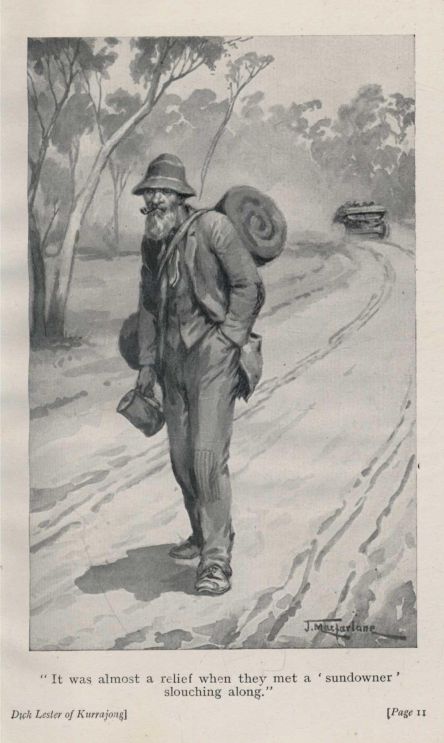
"It was almost a relief when they met a 'sundowner' slouching along."
"Now, isn't that ridiculous, when we're going to
get him back so soon! And there's more letter yet,
Dick."
"It would be a little change for you—you've
been alone on the place so many months now.
Dick won't refuse, I know; and as for me—well,
the voyage will be long enough, even if I do shorten
it by a week. I'll leave the Ohio at Fremantle
and we'll come back together on an inter-State
boat. The Ohio is packed, and there might be a
difficulty about getting berths for us all. Besides,
we shan't be hurried then, and we can show Dick
a glimpse of the West. I want to get home badly
enough; but, after all, that can wait. I just
feel that when I once get you two back I shall
never want to hurry again."
The low voice paused and they looked at each
other.
"Mother, is it all fixed?" Dick demanded.
"Did you square the doc.?"
"I represented the case to Dr. Gurdon," said
his mother, with a dignity that was belied by the
twinkle in her eyes. "And he kindly agreed to
excuse you, in the special circumstances.
Anticipating this courtesy on his part, I——"
"Oh, mother," said Dick reproachfully.
"——went to the shipping office and bought
tickets before going out to the school," finished his
mother, laughing. "If you think, Master Richard
Lester, that I'm going to let any head master, or
any other old thing, stand in our way when we're
going to meet father after he has been away a year,
you are sadly mistaken."
She sprang up suddenly and began to dance—a
quaint, elfish dance of quick, swaying movements
like a brown leaf fluttering before the breeze. Dick
watched her, laughing, until presently her steps
changed to something more definite, and she
swooped and caught him by the hands and pulled
him up, and together they pranced up and down
the big room like a pair of young horses, too full of
joy of living to keep still. Dick's mother had taught
him to dance when he was little more than a baby,
so that he was not quite as stiff-legged as you might
expect from a muscular schoolboy of thirteen. It
was not the first time he had suddenly been called
upon to take part in what he called "one of his
mother's war dances." So they pranced together
until a crusty old gentleman in the room below
found his chandelier rattling, and was on the point
of ringing for the waiter to demand angrily the
reason, when Mrs. Lester ceased for lack of breath
and fell into an arm-chair.
"Dear me, and I an old married woman," she
gasped, fanning herself and looking far more like
a flushed child. "Whatever would father say?
I must think more of my dignity."
"He'd say you were just a kid, like he always
does," said Dick, who had collapsed upon the hearth-rug.
"It would be an awful shock to father if he
found that you'd got prim and grown up."
"I misdoubt he'll never find that, the poor man,"
said his mother tragically. "Dickie, I'll never forget
how terrible it was when I first found myself married
and settled down at Kurrajong, with a house and
several servants. You see, I was only seventeen
when I married, and though seventeen may seem
a lot to you, it isn't so much of an age when you come
to it. And I had always been at boarding school
and I didn't know a thing about keeping house.
I used to like stock very much as a child, but I
remember that for a while after I was married I
used to look at a bullock or a sheep with horror,
as unpleasant beasts that got cut up into a number
of joints, of which I never could remember the
names."
"Poor old mummie!" said Dick, laughing.
"How did you manage to learn things?"
"Cook pulled me through; I found her six
months after my marriage. Before that there was
a terrible cook who scorned me and my ignorance,
and gave me a very bad time, and father very bad
meals. Of course, he never grumbled."
"No, he never would," said Dick.
"It was only one day when he found me crying
in my room that he discovered that I was really
unhappy—and you should have seen how angry he
was. He sent away the terrible cook, and we went
to Melbourne and hunted for a really nice one—and
got her. And dear old cookie taught me all
the things I ought to have learned before I got
married. But I made up my mind that if ever any
daughters came to me I would have them taught
very thoroughly at school how to run their houses.
But they never did come—only one little ragamuffin
of a son!"
She rumpled his hair, and leaning forward,
dropped a butterfly kiss on his nose.
"Now you look like a golliwog," she said, "and
we have no time to spare, because we must go and
buy deck shoes, and cures for sea sickness, and other
interesting things. We have got to look our very
smartest when we board that big mail-boat to get
father. Tidy yourself, beloved, and we'll go out."
Dick brushed his hair with her long-tailed
hairbrush, which he despised very much; and after
his mother had pulled his coat here and there and
settled his tie with deft fingers, she pronounced him
fit to accompany her, and they fared forth into the
busy streets. Shopping with his mother generally
resolved itself, for Dick, into waiting at the doors
of big drapery houses, where she was swallowed up
into mysterious regions that had no charms for her
son. He preferred to stand in the doorway, tucked
into a corner out of the way of the hurrying throng
of eager women passing in and out—there was fun
in watching the crowd, the clanging tram-cars, the
beautiful horses—it was before the days of many
motors, and good carriage horses were still to be
seen in the city streets. Like most bush-bred
boys—and girls, for that matter—Dick thought there
was no sight to equal that of a good horse. He was
staring at a big, taking chestnut, driven by a man
in a light buggy, when a voice said, "Hullo, young
Lester!" and he turned to greet Master Glass,
resplendent in a new collar, and no longer melancholy
in appearance.
"Hullo, Bottles!" Dick rejoined. "How did
the dentist treat you?"
"Oh, not too badly," Bottles answered.
"Finished me up in pretty quick time, too, so I've
got the rest of the afternoon to play in. What are
you up to?"
"Mother's shopping," said Dick. "Oh, I say,
Bottles, such a lark! I'm off to Western Australia
to-morrow!"
"Whew-w!" whistled Bottles. "What for?"
Dick unfolded his news.
"Well, of all the lucky young kids," was Bottles'
comment. "So you'll be gone until after the
holidays? Anyhow, you'll have your father at
home to keep you in order, so it's to be hoped that
you'll come back well licked."
"I hope you don't think I have failed in my duty
in that respect, Bottles," said a laughing voice;
and the abashed Master Glass turned quickly to
greet Mrs. Lester, blushing to the roots of his
close-cropped hair.
"You don't give him half enough, Mrs. Lester,"
he mumbled. "I have to attend to him myself, or
he'd get too bumptious."
"You!" said Dick, with huge scorn. "I'd like
to see you, old fatty!" Which loathed insult
caused the irate Bottles to vow to take deep
vengeance no later than that very night.
Mrs. Lester restored tranquillity.
"Leave him to me, Bottles; I'll keep him severely
in order," she laughed. "Meanwhile, come and
have some tea with us; I'm sure you need some."
The boys followed her into a big restaurant, so
crowded that they found some difficulty in finding
a table. A band was playing softly, and somewhere
near them a little fountain plashed gently under
a clump of tree-ferns, catching rays of rosy light
from some concealed source overhead. A waitress
brought them tea and muffins, with a dish of cakes
so attractive that the only problem was which to
choose; and their satisfaction was heightened
presently by the spectacle of three senior boys from
their own school wandering helplessly about in a
vain attempt to find a resting place. Bottles and
Dick nodded kindly to them, and felt intensely
superior, selecting cakes with a calm enjoyment
that brought murderous feelings to the three prefects,
who propped themselves against a pillar and waited
dismally for someone to vacate a table, which no one
seemed inclined to do. Indeed, they were still
standing when Mrs. Lester called for her bill.
"We might as well give those three boys this
table," she said. "I suppose you know them, Dick?"
Dick knew them as the cabin boy may be expected
to know the captain and chief officer of his
ship, as superior and mighty beings, too far above
him to dream of more than the curtest recognition.
One of them had cuffed him for getting in his way
in the playground no later than yesterday. It was
therefore somewhat soothing to have the opportunity
of sauntering across to these lords of creation
and remarking; "Care to have our table, Landon?" And
soothing, too, to see how meekly the famished
ones accepted the invitation, and how the lordliness
of demeanour that seemed part of them at school
fell from them when Mrs. Lester spoke to them.
Landon, indeed, blushed like any junior, and
stammered in his answer, which gave unmitigated
joy to Bottles and Dick, and formed the subject of
much merry jest in the dormitory that night.
Bottles said good-bye after tea, and took himself
back to school, while Dick and his mother, their
shopping finished, boarded a tram that landed them
near the Fitzroy Gardens, where the flowers were
beginning to show promise of their spring blaze of
glory, and the splendid stretches of turf under the
great trees made a haven of refuge to tired city
dwellers. They found a quiet seat in a sheltered
corner—there was still something of winter in the
breeze—and talked, filling in all the gaps that even
the longest letters must leave when the smallest
detail is eagerly treasured. Dick heaved a great
sigh when at length they rose and strolled slowly
across the lawns towards the street.
"I feel almost as if I'd been home again," he
said. "My word, mother, won't it be gorgeous
to go back to Kurrajong—and to take father!"
Spencer Street Station, and the long
line of the Adelaide express glittering beside
the long grey platform, the great carriages
brave with polished and shining glass and nickel.
People were hurrying to and fro, looking for seats,
hurrying porters with trucks of luggage, raiding the
bookstall for bundles of magazines and papers, and
the fruit stall for oranges and bananas and baskets
of early Queensland strawberries. The express
conductors, who are chosen for their good manners,
among other qualifications, stood near the entrance
to the saloon carriages, good to look on in their
blue and silver uniforms; quick to render aid to
real passengers, or gently to head off idle folk who
merely wished to stroll through the train and look
curiously at the travellers. Boys, laden with bundles
of evening papers, rent the air with shouts of
"'Erald—Penny 'Erald!" snatched at coppers held towards
them through the windows, or impatiently sought
for change for anxious ladies who insisted on
tendering half a crown for a paper, and craned
their necks anxiously after the boys as they rushed
to the bookstall for the money. People hurried
along outside the carriages, peering in through the
wide, nickel-barred windows for friends whom they
wished to farewell. A theatrical company occupied
several compartments, and occasioned a solid block
of people outside their windows, through which
their admirers thrust offerings of sweets and flowers.
There were snatches of song from this section of the
train, shouts of "Good-bye!" "Good luck!" and
"Come back again!"—and many of the newly-arrived
bouquets were pulled to pieces by their
owners in response to the clamorous demand for
souvenirs.
Dick Lester and his mother arrived in the wake
of a porter laden with hand-baggage, and fought
their way through the throng until they reached one
of the blue and silver conductors. He glanced at
the number of Mrs. Lester's ticket, and then, ushering
them into the carriage, led them along a wide
corridor until he came to an empty compartment.
"This is yours, madam." He offered any other
assistance, while the porter placed their possessions
in the rack and departed to see to their heavy
baggage.
"All this ours!" Dick queried, looking round
the compartment. It was fitted with a seat on one
side only—a wide, comfortable seat, upholstered
in grey. A folding nickel wash-basin was near the
window, with towels overhead. Everything was
solid and comfortable and compact.
"Yes, it's ours," smiled his mother.
"But you said it was a sleeper?"
"Yes; the conductor will wave his magic wand
and produce your bed out of that wall later on."
"Oh!" said Dick, and fell to examining the wall,
to find out its mechanism. Meanwhile the clamour
about them redoubled; people hurried along the
corridor, peeping in, and withdrawing again
impatiently at sight of the occupied compartment.
Others peered from the platform through their
windows, and a heated lady asked anxiously,
"Is that you, Willie dear?" and then fled without
waiting for an answer. Bells rang, somewhere afar
the engine gave a furious whistle, and slowly the
great train slid out of the station, while the theatrical
people and their friends sang "For He's a Jolly
Good Fellow" with immense enthusiasm. Gathering
speed, they whisked through the packed streets of
North Melbourne and Newmarket, and out beyond
to the wide Keilor Plains.
"Off at last, Dickie!" said his mother.
"Yes." They looked at each other, very content.
Daylight held until they had flashed past Bacchus
Marsh, with its deep green of fertile farms, where
the willows were beginning to wave their long
feathery arms; and soon after came dinner, which
in itself was an event to Dick. A white-jacketed
waiter summoned them, and they followed the long
corridor, which seemed to swing under their feet,
until they came to a carriage fitted as a dining-room,
with little tables for two or four people, sparkling
with polished glass and silver-plated fittings on
snow-white linen. The theatrical people filled many
of the tables; they were very merry, and rather
loud-voiced, calling to each other across the car.
Dick privately thought them rather entertaining,
but he saw his mother wrinkle her pretty nose two
or three times in a way he knew meant disapproval.
One of the actresses came in a few minutes later,
and, disregarding shouted invitations to "come and
sit here," finally paused by Mrs. Lester's table,
where there were two vacant seats. She hesitated.
"May I?"
"Of course," Mrs. Lester answered, making room.
The woman sat down in a tired way. She was tall
and rather pretty, but her face, seen closely, was
lined and worn. She gave her order to the waiter
listlessly, and when her dinner came she only toyed
with it. But she stared at Dick in a way that would
have embarrassed that young man had he not been
too hungry to pay attention to anything until the
meal was half over. Then he met her eyes so many
times when he glanced up that he became quite
uncomfortable, and wished heartily that she had
chosen to sit at any other table.
"I sure do beg your pardon for looking at you,"
said the actress suddenly. "It's vurry rude of me,
I know. But the fact is, I sat at this table just so's
I could look at you!" She turned to Mrs. Lester.
"I've a boy in the States just about his size, ma'am;
I've not seen him for two years."
"Oh, you poor soul," said Mrs. Lester.
"Fact. He's at boarding school, and he writes
every mail—never misses. But that don't make up
for wanting him. There's times when I've just to
get close to a boy and make believe he's my Jimmy."
"Are you going back to him soon?"
"Not for a good piece yet," said Jimmy's mother
with a sigh. "We're tourin' round a lot; business
is good, and we keep extending our dates. It's
a long time—Jimmy's fourteen, and he'll be 'most
grown up when I get him again. Boys in Amurrica
grow up terrible quick."
"We haven't seen my father for a year, and I
thought that was pretty bad," Dick said. "We're
going to meet him now."
"That's real nice, isn't it?" The actress's big
dark eyes lit with quick interest. "I guess your
father's wonderin' what sort of a boy his son's
grown into, same's I am."
"And I guess your Jimmy will be as glad to see
you as we shall be to see father," said Mrs. Lester,
smiling. "What is he going to be?"
"Wa-al, of course he thinks he's going to be a
sailor—all boys do, don't they?" said the actress.
"But he's got bitten with motors now, so I shouldn't
wonder if it's something engineering, after all.
Jimmy's got plenty of brains. That's one thing.
Not that you care much, when he's your only boy,
whether he's got brains or not, do you, ma'am?"
"I hope she doesn't, 'cause I'm her only boy,
and goodness knows I've got none!" said Dick,
grinning.
Mrs. Lester laughed, rising.
"Brains aren't everything, certainly," she said.
"We're slowing down. I think this must be
Ballarat. Come on, Dick, and stretch your legs on
the platform—we wait here for awhile." She
nodded kindly to the American, and Dick followed
her out of the car.
It was Ballarat. They ran into a big, crowded
platform, with a domed, lofty roof, that glimmered
mysteriously far above them. They went outside
and strolled up a quiet street, but were too nervous
about their tram to go far, since an Adelaide express
waits for no man.
"Some day," Mrs. Lester said, "we'll come here
and hear the bands play."
"Have they got many?" asked Dick.
"They collect them from all over Australia once
a year, and they play all the time for big prizes.
That is, when they are not playing for prizes,
they are practising. So it goes on all day; you
wake in the morning to band music and you go to
sleep at night to the tune of a quickstep; and when
you go out during the day you generally find yourself
keeping in step with a band marching beside you,
playing for dear life. Then each instrument has its
own tune. I was once inveigled into a hall where
I heard forty-nine euphoniums play 'There's a
Flower that Bloometh.'"
"Forty-nine!" said Dick, laughing. "It sounds
a bit tall. Did you like it, mother?"
"I think it is necessary to be a specialist to enjoy
that sort of thing thoroughly," his mother said.
"I fled at the nineteenth, and that weary old tune
beat in my brain for a week. But the other music
is lovely. We'll go some day, Dickie."
They came back to the station, and, finding the
crowd too dense for comfort, sought their own
compartment, where a transformation awaited them.
The bare wall opposite the seat had been let down
and now a comfortable bed with snowy sheets was
ready on each side of the aisle. The conductor
hovered near.
"Will you require anything further, madam?"
"No, thank you," Mrs. Lester said. "But we
shall want morning tea, conductor."
"The coffee and rolls at Murray Bridge are
excellent, madam," murmured the conductor.
"I remember them of old," said Mrs. Lester
laughing. "Very well. Good night, conductor."
"Now I'm going to bed, Dick," Mrs. Lester
remarked, as the tall, uniformed figure disappeared.
"So you can run and get a wash and brush up, and
come back in twenty minutes, when I should
recommend you to go to bed too."
Dick thought the idea a good one, especially when
he returned, to find his mother comfortably tucked
up, reading by a shaded electric light. He slipped
into bed quickly, and enjoyed a magazine, while the
train roared on its way, stopping occasionally with
a great grinding of brakes, and then gathering way
again slowly as it left a wayside station behind, and
went swinging on through the night. The swinging
motion made him sleepy; he put down the magazine
and lay drowsily listening to the roar of the train.
Once his mother glanced across and smiled at him;
later, he had a drowsy fancy, half a dream, that she
was bending over him, tucking him in. But he did
not see the tired face of the American actress later
on. She tapped gently at the door, looking apologetic
when Mrs. Lester, in a hastily-donned dressing
gown, opened it.
"Were you in bed?" she asked contritely.
"Well, now, I'm real sorry—it's early, and I
thought you'd be up still." She hesitated, and a
dull flush came into her cheeks. "Is the boy
asleep?"
"Yes." Something in Mrs. Lester responded to
the hunger in the other mother's eyes. "Would
you care to look at him?"
"I came to ask if I could. You see—it's two
years since I had the chance of tucking up Jimmy."
She came in noiselessly, and looked down at the
sleeping Dick. He lay with one arm flung up
above his head; a very ordinary, healthy boy,
sunburnt and clear skinned, with just a hint in his
close cropped hair of the curls of his boyhood, and
only a baby still to the two women who watched
him. The American stooped suddenly, and brushed
his forehead with her lips. Dick stirred, and said,
sleepily, "Mother."
"I sort of had to," said the actress, turning in
the corridor to say good night. "You—you get
kinder desperate for them after two years. Thanks,
ma'am, ever so." She glided away, leaving
Mrs. Lester with tears in her eyes.
All night long the train, with its sleeping freight,
rushed and roared through the desert country,
passing over dreary leagues of sand and sparse
scrub. Sometimes the unfamiliarity of his
surroundings woke Dick, to lie drowsily for a moment
in the dim light that filtered through the fanlight
from the corridor; then to float back lazily through
the gates of sleep. He woke in earnest about six
o'clock and, slipping out of bed, peeped through
the window. The train was standing in a wayside
station.
"Tailem Bend," read Dick. "What a rummy
name. I say, we must be in South Australia.
Great Scot! there's a camel!"
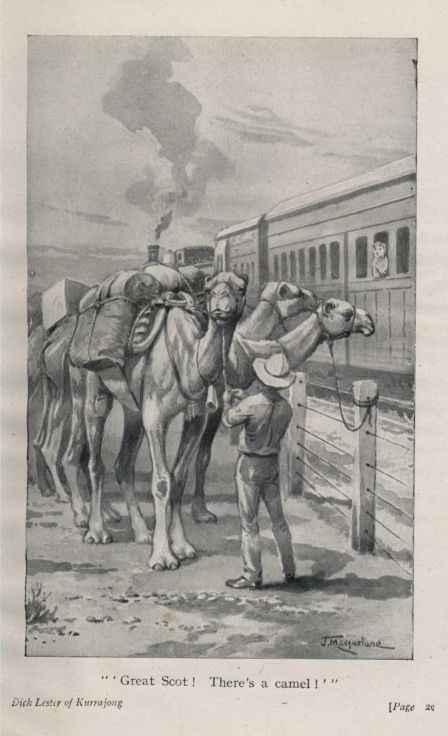
"'Great Scot! There's a camel!'"
There was a string of camels tied to the station
fence, all scientifically packed with bales and bundles,
their heads drooping sleepily. The unfamiliar
sight made the morning more than ever like a
dream. A tall, weather-beaten man in moleskins
and a red shirt was knotting the halter of the leading
camel; his mate was wrangling with the station-master
about some parcel that should have been
awaiting him, but had failed to turn up. Dick
heard the official say angrily, "Well, you'll have to
wait till the express goes out, anyhow. I'm busy."
"And ain't I busy?" demanded the man.
"Ain't I got the camels waiting, an' high time we
was on the track? Blow yer old express."
But the railway man had fled, and the man of
camels could only glare after his retreating back
and mutter what he felt.
The conductor came past as the train gathered
way, and nodded a civil "Good morning" to
Dick, who had ventured into the corridor in his
pyjamas to see if any other queer sights awaited
him on that side of the line.
"Sleep well?"
"Yes, thanks," Dick answered. "Why do they
call it Tailem Bend?"
"Lots of people ask me that," remarked the
conductor. "Some folks say it's a shot at an old
native name, but more believe it's because cattle
used to be tailed at the bend in the river here in
the overlanding days."
"Pity they don't stick to native names when
they go christening places in Australia," remarked
a man close by. "Murray Bridge used to be Mobilong,
and it would have been more sense if they
had left it at that. Murray Bridge, indeed. What's
the good of a name like that? Here's the Murray,
of course, and there's a bridge; so they stick them
together and cut out the pretty native name."
"There's some people," said the conductor,
nodding assent, "who'd sooner see their own silly
names on a signboard than the best native name
you could get. That's why you get names like
Harrisville and Smithtown, and Wilkins's View all
over the map of Australia. Take Belalie now—that's
a pretty-sounding native name for you, and
it was the name of a town all right. Then comes
along some jolly old Governor or something with
swelled head and calls it after himself."
"What's that?" queried the other man.
"Jamestown," said the conductor with deep
disgust; "Jamestown. And it might have been
Belalie. Right, sir, I'm coming." He fled in answer
to a fierce call from a sleeping bunk.
Dick realised that he was a little chilly, and
peeped into the compartment. His mother was still
asleep, and he slipped into his clothes as noiselessly
as possible and then went in search of soap and
water. Returning presently, he found her sitting up,
with a dressing-jacket round her pretty shoulders.
"What, dressed, old man?" she said.
"Rather." Dick seized his brush and made an
onslaught upon his wet hair. "We're getting near
Murray Bridge, mother—aren't you going to have
a look at the Murray?"
"I've seen the Murray before," said Mrs. Lester
severely. "It's a nice, wide river, but I'm very
comfy, Dick."
"Lazy old thing!" said her son. "Well, I
haven't, so I'm going out to look at it." He dived
for a clean collar, and presently hurried back to
the corridor.
The train was skirting a wide flat, across which
he could see the line of a river. They swung round
soon to run over a very long bridge, beneath which
the big river ran sluggishly—wide and yellow, with
low banks. Below the bridge was moored one of
the Murray steamers, a white paddle boat with
two decks; he could see no one on her, but a faint
curl of blue smoke was lazily rising from the funnel
that marked the cook's galley. There were fishing
boats against the banks, and a bare-legged boy of
his own size was pulling a heavy rowing boat slowly
down stream. Then the train swung round from
the bridge, and in a few moments slowed into a
station.
Dick hopped out on the platform. Very few
people were in sight; a few passengers left the
train and hurried towards the refreshment room.
The conductor appeared presently, bearing, in a
mysterious manner, many trays.
"Coffee and rolls?" he said. "Is your mother
awake?"
"Yes. I'll take her tray," Dick said.
"I'll see you to the door," said the conductor
grimly. "You don't realise how people dart out
and cannon with you in the corridor until you've
carried trays round. Nearly turns your hair grey."
This Dick found to be true, for a very stout
gentleman dashed from his sleeper without warning,
and would certainly have demolished all the trays
had not the conductor avoided him with a dexterity
born of long practice. Dick left his mother to
her coffee, and went off to explore the platform,
nibbling his roll as he trotted along.
It was early, and a chill wind blew from the
river. There was not much to look at, so Dick
found his way along the train to the huge engine,
and stood looking at her and admiring her. The
engine driver was also eating his breakfast, which
consisted of chops, fried scientifically on a red-hot
coal shovel. He nodded in a friendly way to the
small boy, and they chatted until Dick's roll was
finished, and a craving for coffee took him back
to the sleeper.
"I was beginning to wonder where you were,"
said his mother, who was up and brushing her hair
energetically. "Take the tray out, Dickie. I
want to get as much dressing done as possible
before we start again."
She joined him presently in the corridor, fresh
and dainty. They were rushing along again between
miles of grey fencing. Ploughs were already busy in
the paddocks, where flocks of white cockatoos settled
on the newly-turned brown earth in search of grubs.
Past trim dairy farms, with the herds slowly stringing
away from the sheds after milking; by little
townships, where the air was blue with the smoke of a
hundred breakfast fires; by creek and gully, towering
hill and stretching plain, the express roared.
People in the carriages were beginning to wake up;
heads, more or less in undress appearance, peeped
from the doors of the sleepers, and voices were
heard demanding the conductor and hot water.
The summons to breakfast came presently, to Dick's
great joy, for the keen air had made him hungry,
and when they came back from the meal they found
that their beds had disappeared, and the sleepers
once more bore the air of an ordinary compartment.
"We're in the hills now," Mrs. Lester said,
glancing out. "Come to the doorway, Dickie; this
is the loveliest bit of any railway journey I know."
They went along the corridor to the big doorway.
The door was open, and through it they could see
that the train was rushing through hills, steadily
mounting all the time. The gum trees that clothed
everything with green waved feathery heads quite
close to them, and, far as the eye could see, golden
wattle blazed through the scrub. Up and up they
went. White roads led away through the hill
slopes; now and then could be seen an early
motorist spinning along in the joy of their perfect
surface. Then came the very summit of the climb,
and the train ran into a trim little station, gay
with flowers, perched on top of the highest hill.
"Mount Lofty," said Mrs. Lester.
"My word, what jolly houses!" was Dick's
comment.
They looked from the doorway down into the green
heart of the scrub. Here and there, half buried
in the trees, were the homes to which happy people
of Adelaide fly when the summer heat lies scorching
on the plains; red houses, with terraced lawns and
gardens ablaze with blossoms; grey houses, with
roses climbing over high trellises. They perched on
terraces cut out of the sides of the hills, or nestled
in nooks in the gullies, their gardens gleaming like
jewels in the dull green of the eucalyptus. The curve
of a road showed here and there, white level, diving
down into some unseen hollow. Dew yet hung
on the gum trees, and little wreaths of mist floated
upwards from the gullies; the bush scents filled
the air. Everywhere birds sang and twittered in
the branches; everywhere the gold of the wattle
gleamed through the dull green of the scrub. Then
the train moved on, slipping quietly down, each
moment revealing some new turn of beauty; until
at last the plains opened out below, and they could
see Adelaide lying just where the land seemed to
end, and the blue rim of the sea widened, with the
smoke of the steamer making a long trail across
the water.
"Wonder if that's our boat?" Dick said. "No,
it can't be, because it's coming the wrong way—amn't
I stupid! Oh, mother, isn't it all jolly!" He
pranced gaily back to the sleeper, to lend a hand
in collecting their hand baggage. They were
running now through trim, flat suburbs, and
presently, with a grinding of the brakes, they stopped
in a big station—Adelaide at last.
A helpful porter—brought them, as a kind of
offering, by their friend the conductor—collected
their luggage and put them on a train
bound for Port Adelaide; a place of grimy wharfs
and dusty streets, where, after some search, they
discovered their boat, the Moondarra, spic and span
in her dingy surroundings. Dick's heart bounded
as he followed his mother up the gangway. He
had never before been on anything but a Bay paddle
steamer; to him, even the seven-thousand ton
inter-State boat seemed a mighty ship, and he
longed to explore her from stem to stern. It was
with a feeling of disappointment that he learned
they were not to sail until the evening.
"It's really hardly worth your while to remain
on board," an officer told Mrs. Lester. "We've a
rush lot of cargo coming at the last moment, and
the ship won't be comfortable before six o'clock—nothing
but noise and dust. I should advise you
to go up to Adelaide for the day. Why not have
a run in the hills? Is your luggage on board?"
"It is on the wharf," Mrs. Lester said, glancing
towards a laden truck in charge of a porter.
"Give me the number of your cabin and I'll
see that your steward takes charge of it." He took
them down the gangway, probably relieved, in his
heart, that they were going, since passengers are
not beloved of sailor folk when loading cargo is in
progress. "Glorious day—too good to spend down
in this place," he said, wistfully, looking at the
dark masses of the hills.
They found a train about to start, and were
soon back in Adelaide itself; little city of wide
streets, girdled with a four-square belt of park lands.
Wandering, somewhat aimlessly, up King William
Street, a tall man suddenly detached himself from
a group at a corner and came quickly to meet them.
"Why, Mrs. Lester—what luck?" He shook
hands vigorously. "And the kid—he's grown up!"
"Oh, Billy, how nice to see you!" said Mrs. Lester.
Billy Cathcart had gained "colonial experience"
on the Lesters' station for two years before
his father, a rich Englishman, had bought him a
property of his own in South Australia. They were
very fond of him; he had made himself a kind of
big son of the house, and when he went away they
missed him sorely.
"But what are you doing here? And is the
Boss back?"
Mrs. Lester explained.
"And you never told me you were going
through!" said Billy reproachfully.
"My dear boy, I knew you were nearly two
hundred miles from Adelaide—and I had about
two minutes' warning that I was coming. I never
dreamed of any possibility of seeing you. Why
aren't you in the wilds, earning your living?"
Billy Cathcart laughed.
"I've been earning it at a great rate lately," he
said. "Made a lucky deal in cattle, and cleared
quite a lot—so I came down to buy a car. I've
been driving one a good bit, and it made me keen
to have one of my own. I say—-if you've got the
day to do nothing in, do let me take you out. She's
a beauty, really."
"Why, it would be lovely!" Mrs. Lester said.
"But are you doing nothing yourself?"
"Only killing time. It would be ripping to take
you; and there are first-rate runs about Adelaide.
As for roads—well, they can teach road-making to
any other State I've been in. Like to come, Dick?"
"Rather!" Dick was hopping on one foot. "I
say, Mr. Cathcart, how's old Danny?"
"Oh, fitter than ever!" Danny, as a pup, son
of a noted cattle dog, had been a farewell present
to the departing jackeroo on leaving the Lesters'
station. "He's an absolute wonder with cattle.
I believe if I sat in a buggy and cracked my whip
and told old Danny to go ahead, he'd muster my
roughest paddock and not leave a beast behind."
"Father will be jolly glad to hear that," said
Dick, solemnly. "He always said Danny would
turn out a clinker."
"So you're going to school?" Mr. Cathcart said,
glancing at his hat-band and badge. "You'll
have to tell me about it presently. Well,
Mrs. Lester, may I get the car now?—or, wait a minute,
you look a bit tired; how about a cup of tea first?
Yes, come along." He led them to a café across
the street, and plied them energetically with food.
"Not like the cakes you used to make us at
Kurrajong—still, they're better than nothing," he
remarked. "Finished already, Dick? Well, shall
we go and get the car, and come back here for
your mother?"
That seemed a good plan to Dick. He followed
the tall figure out into the street, where they dodged
precariously round two of Adelaide's flying electric
trams, which hurtle down King William Street in
fevered haste, and presently found themselves in
Rundle Street, a thread-like thoroughfare where the
footpath is so narrow that people are forced to
walk in large numbers in the roadway.
"Looks as if they'd used all the land for that
big street we were in, and found they hadn't left
themselves enough over for this," commented Dick.
"It does; and they put all their biggest shops
in this tiny lane, so that it's always packed with
people. Quaint system," Billy Cathcart said.
"Rundle Street generally looks like a sheep race
to me—and you fight your way out of it into a
street like a hundred-acre paddock."
"Rummy," remarked Dick. "I say—what jolly
fruit carts!"
"Oh, they're the pride of Adelaide—amongst
other things," laughed his companion. "They
take some beating, don't they?"
They were drawn up in line along the kerbstone,
in the shade of the buildings; carts as spic and
span as shining paint and gleaming brass and
spotless cleanliness could make them, each in charge of
a boy in a white jacket. Their gay little awnings
fluttered in the breeze over piles of many-coloured
fruit—oranges, red and yellow apples, dark masses
of passion fruit, bunches of bananas, strawberries
gleaming redly in little baskets lined with leaves.
A boy near them was polishing his apples, and the
cloth he used was as clean as the apples themselves.
"Well, I'm blessed!" Dick ejaculated. "They
don't have carts like that in Melbourne."
"No, you have awful men with barrows that
look only fit for pig food, and they tip about fifteen
cases of fruit out in a heap, and wheel it about
in the sun with the flies sitting on it. Seems a pity,"
said the Englishman, reflectively. He stopped at
a barrow and bought fruit largely, piling up bags
in Dick's arms. "Can you manage all those?
Come along."
The garage was not far off; a great shed-like
building full of odours of petrol and lubricating oil,
which are heartsome smells to any boy. Dick
poked about among motors big and little while his
friend's car was being prepared; and soon they
were in it, and worming their way through the
crowd in Rundle Street.
"Can you really take a car along here?"
"Oh, it's possible," said Billy. "I'll admit it
doesn't look probable. You push people out of
the way gently and politely with the bonnet. But
it pays to dodge up a side street, if you can, and
get into something wider." He slewed round as he
spoke, and presently they were running along the
broad pavement of North Terrace, and so into
King William Street again and to where Mrs. Lester
stood awaiting them under a verandah near the café.
They slipped away from the city, along well-kept
streets, lined with blossoming gardens, until,
after a few miles of a dusty road, the hills drew
suddenly near, and they turned into a gully where
the road ran by the bed of a little creek, following
all its windings. The hills towered above them,
and they climbed up and up. Here and there
came an open stretch, where orchards laden with
blossom fell away below them. Now and then
the creek made a sudden, sharp bend, enclosing a
little flat, gay with tall bulbs. Indeed, all the
banks of that little creek were bright with flowers,
because when it ran rapidly in the winter it washed
down a freight of seeds and roots from the gardens
of the houses on the summit. Sometimes tall
poplars stood, with their feet in the gurgling water;
sometimes a little cottage by the wayside displayed
a sign asking wayfarers in for tea, and you could
cross the creek by a rustic bridge and sit in a cool
summer-house hung with creepers, and eat
strawberries and cream in the midst of a delightful
garden. The road was steep, and yet so well
graded that the car took it without an effort. Even
stray cyclists whom they overtook seemed to be
climbing its twists and turns without undue exertions.
So they came to the top of a long rise called
Montacute, where a lonely little tin church perches
among the gum trees; and there they sat in its
shade, with a myriad birds twittering about them,
looking down over the tree-clad slopes to the plains
beyond, where Adelaide lay like a chess-board,
a network of regular lines and squares. They ate
fruit and talked. Billy Cathcart had to learn of a
hundred happenings at Kurrajong, and to tell of
more than a thousand that had befallen him in his
first attempts at running a station unaided. He
was a light-hearted person; it afforded him huge
amusement to tell of his own mistakes. "Goodness
knows, there would have been plenty more of them,"
he added, "if it hadn't been for the gruelling
Mr. Lester gave me on Kurrajong."
"Was it very bad, Billy?" Mrs. Lester laughed.
"Oh, he never meant it to be bad. But the
first six months were pretty awful, because I felt
such a perfect fool all the time. The trouble was,"
he grinned, "that I came out from home with an
idea that I knew quite a good bit. After I realised
that I was mistaken I got on better. But I never
thought I would arrive at being a full-blown squatter
myself. It seemed to me I'd never get any higher
than keeping goats."
"That also has its difficulties, I believe," said
Mrs. Lester smiling.
"I believe it has—a chap near me has a flock of
Angoras, and they seem to worry him more than
his babies." He got up lazily. "Shall we go on?
There are so many places in these hills I want to
show you that I mustn't let you stay too long
anywhere."
They came down from the hills at the end of a
run that had been a long succession of beauties,
on such smooth roads, winding among the tree-clad
crests, plunging into deep gullies, finding little
townships hidden here and there, and coming out
upon summits where, below the ridges, the plains
swept for miles before them, pink and pearly-white
with great stretches of almond orchards. Evening
was drawing near as the big car purred smoothly
alongside the wharf. Billy Cathcart had insisted
on bringing them back to the boat at Port Adelaide.
"Well," he said, "it's been glorious to have you.
And you'll let me know when you're coming
through?"
"Indeed, yes," said Mrs. Lester. "But you'll
be two hundred miles away then, earning your
living."
"I'll let the station run itself and come down
again," he said. "Do you think I'd miss a chance
of seeing you and the Boss again—to say nothing
of the nipper?" He gave Dick's ear a friendly
tweak. "Just you make your father stay here
for a while, and I'll teach you to drive the car, old
son"—a promise that left Dick no words but a
gasp of delight. They stood watching as the car
swung round, threading its way between lorries,
laden with beer barrels, and cabs, hurrying down
with passengers. Billy turned once to wave his
cap to them, and narrowly escaped collision with
a huge coal waggon, the driver of which loudly
expressed the lowest possible estimate of his powers
as a chauffeur. Then he passed out of sight, and
Dick and his mother turned towards their ship.
All was bustle and hurry aboard the steamer.
Cargo was still being loaded; the creak and
rattle of the great crane, as it swung back
and forth, the crash of cases, dumped into the
yawning mouth of the hold, mingled with the
confusion of arriving passengers and the shouts of
sailors and dock hands. On the decks people were
hurrying about, seeking stewards and cabins, and
the doorways were blocked with little groups saying
good-bye. Overhead a harsh whistle shrilled
out—so suddenly that everyone jumped, and horses on
the wharf danced nervously. Someone in uniform
shouted:
"Everyone for the shore!"
Good-byes filled the air. Women hurried towards
the gangway, as if fearful of being carried off to the
"wild and woolly West," followed more slowly by
those more experienced. Passengers hastened up
from the wharf; cab drivers, trotting in leisurely,
whipped up their horses in response to nervous
appeals from their anxious fares. The big crane
went on, creaking and swinging, dumping in its
cases as though there were no such item on the
ship's programme as starting.
Dick watched the late arrivals curiously. Men
formed the greater number; there were smart and
brisk commercial travellers, and others, less
prosperous, evidently off to seek their fortune in that
West which, to much of the rest of Australia, is
still an unknown land. Tearful wives and children
hung about the necks of some of these, saying the
last hard good-byes; but in some cases the wives
and children were coming too, and they trooped
on board, shabby little flocks, with the tired mothers
trying to keep the stragglers together.
The whistle sounded again, and there was a
second summons, a peremptory one this time, for
strangers to leave the ship. They hurried down
the gangway, and then the great ladder was hauled
up the ship's side, the deck-railing swung in across
the gap, and in a few moments the Moondarra
began to back slowly from the wharf. The people
below grew smaller, their upturned faces white
dots in the evening gloom. From everywhere came
shouts of "Good-bye." A young bride, off to the
West with a huge, bronzed bushman, leaned over
the side, holding the ends of long streamers of
ribbon, of which the other ends were held by her
friends on shore. Her face was happy and yet
tearful; she looked wistfully towards Adelaide.
The ribbons lengthened out, gradually tightened as
the ship drew further away, and finally, released
by the people on the wharf, sprang in the air.
The girl gathered them up to her quickly, a gay,
fluttering bundle, and Dick heard her give a little
sob.
Just as the ship gathered way, they saw a motor
suddenly turn in to the wharf from the street,
hooting as it came. Mrs. Lester peered at it through
the gloom.
"Isn't that Billy's car?" she said.
"My word, yes!" Dick cried. "He's standing
up and trying to see us. I wonder what he wants."
"Oh—he has remembered something he didn't
tell us; and of course, it's just like Billy to come
racing back," Mrs. Lester said, laughing. "At
all events, he is too late." She waved her
handkerchief towards the car, though she knew that
it would be impossible to distinguish anyone in the
long row of passengers crowding to look over the ship's
rail. "There—he has given it up as a bad job."
They saw Billy sit down again, after waving his
hat in a kind of general salutation towards the
ship. Then the car turned slowly, and slipped away.
The dusk swallowed it up.
Somewhere near them a bugle blared, so suddenly,
that everyone jumped. The bugler, a very fat
steward, finished a long trill carefully, and then
moved off to repeat the performance elsewhere.
Someone hailed him.
"What's that for, steward?"
"Dressing bugle, sir," responded the fat player,
stolidly. "Dinner in half an hour, sir."
There was a general move from the deck. Dick
and his mother found themselves in a crowd going
down the first staircase. Dick was too much of a
landsman yet to call it a companion. At the foot
they encountered another steward, who directed
them to their cabins, along an alley-way; Dick's
was opposite his mother's. It was a two-berth
cabin, and he found that he was not the only
occupant—-indeed, so big was his fellow passenger
that it seemed unlikely that there would be any
room for Dick at all. He paused uncertainly,
just inside the doorway.
An enormous man, who was unstrapping a
leather suit-case, swung round suddenly.
"Hullo, youngster," he said. "Do you belong
in here?"
"Well—the steward said so," Dick answered
with some uncertainty.
"Then you probably do," said the big man.
"What's your number, sonny? Thirty-seven?
Yes, that's your bunk. Got anyone with you?"
"My mother," Dick nodded. "She's in the
opposite cabin."
"I see. And I've a wife and small son and
daughter somewhere about. Well, there's not a
whole heap of room in these cabins, so it's luck for
me that I haven't struck a mate of my own size.
But I expect you don't look at it in that way."
Dick grinned. He rather liked this big, friendly
person, but was much too shy to talk. Indeed, it
was rather dreadful to think of sharing a cabin
with him—with any stranger, for that matter.
"We won't worry each other very much," said
his companion, as if guessing his thoughts.
"You'll be asleep long before I come to bed, and
I'm not as early as I might be in the mornings." He
was unpacking swiftly, distributing his belongings
in shelves and on hooks. "I'll leave space for
you—those drawers are handy for your height,
so I'll take the upper ones. I see you've got the
berth with the porthole—lucky kid."
"I'll change, if you like," Dick said. It seemed
the only thing to say, but he didn't feel a cheerful
giver. The little round window just over his bed
looked very inviting.
The big man laughed.
"Oh, not much!" he said. "Thanks, all the
same, sonny, but I wouldn't take it from you.
Now, I'm pretty straight, so I'll clear out, for it's
quite evident that we can't move about together.
So long." Dick squeezed himself against his bunk to
leave room for the great form as he moved to the door.
His mother was a little inclined to be sympathetic
on the subject a little later.
"Oh, he might be worse," Dick said. "He's
really quite a good sort. And we shan't see so much
of each other in the cabin, 'cause I'm going to get
up awfully early. You see, I don't want to waste a
single minute of my time on board ship."
"Well, you could nearly always take refuge in
here if you were very crowded," Mrs. Lester said.
"Thanks very much, mummie." Dick glanced
round her cabin; it was the same size as his own,
but looked, somehow, immeasurably larger. The
second bunk was not made up, and looked inviting
as a sofa. Already his mother had unpacked,
and her dainty belongings made the tiny place
homelike. "It is jolly, isn't it?" the small boy said.
"Yes, it's quite comfy. We'll use it together
as a sitting-room, Dickie. There's the bugle for
dinner—come along."
There were many people in the long alley-way,
hurrying towards the dining saloon. Smooth water
was certain for the first few hours of the journey
while they steamed down the Gulf. What sort
of weather might await them when they turned into
the Bight—that place of many storms—no one
could say. Therefore, there was a general
determination to have at least one meal in comfort.
People trooped up from their cabins and down from
the deck, crowding into the big saloon. The
stewards were busy directing all to their places, and
delicately shepherding new-comers from seats
already reserved.
Mrs. Lester and Dick found themselves at a table
presided over by the ship's doctor, who promptly
made himself known to all the passengers, found out
their names and saw to it that all under his wing
felt at home. He was a plump, cheery man, full of
anecdotes and chatter. Dick felt that it would be
jolly to sit at his table. Opposite the Lesters were
four vacant places. Already at the table were a
thin and angular lady, whose name they found out
was Miss Simpson; a very pretty girl of eighteen,
with her mother, a Mrs. Merritt, and a tall, silent
man, Mr. Dunstan, who looked as though he
hailed from the bush, and made but the briefest
of responses to the doctor's jokes.
Close at hand was the captain's table, where,
as the doctor remarked, "Emperors and pontiffs"
might be found. There were no emperors aboard
this time; the nearest approach to a pontiff was
an English bishop, who, with his wife, was touring
Australia. He was a pink and pleasant person,
who rather gave the impression that he was curate
to his wife—a very tall woman, stout, dignified
and extremely English. Dick rejoiced inwardly
that he did not sit near this dignitary. He went
as far as to feel sympathy for the captain himself,
who made heavy weather in his efforts to entertain
her, and used to look slightly exhausted towards
the close of a meal. A famous singer—a tall,
handsome woman—was also at his table; and a
noted actor, whom the bishop's wife snubbed
whenever possible. There was a chief justice from
an eastern state, he had a keen, clever face, at which
Dick liked to look when he spoke. The other
people included a ship's captain going to take
command of a vessel at Fremantle; a member of
Parliament and his wife, a Riverina squatter, a
German wool buyer and one or two others less
distinguished. Dick eyed them with awe, and was
glad that he sat at another table.
Just as the soup appeared, a quiet-looking young
man slipped into one of the vacant seats at the
doctor's left; and presently a party of three
arrived to complete the table—Dick's enormous
cabin mate, with his wife and little girl. They sat
down opposite, and immediately the little girl
made a face at Dick.
Now, Dick did not know much of the ways of
girls, little or big. He was thirteen, and at thirteen
girls are the last things a boy worries about.
Therefore, this pleasantry on the part of the new-comer
merely puzzled him slightly. He wrinkled his
nose a little and went on with his soup.
The doctor was greeting them boisterously.
"Good evening, Mrs. Warner. Had a good
run round Adelaide?"
"Oh, delightful," said the lady vaguely. Her
husband laughed.
"Much she knows of Adelaide," he said. "She's
been to a tea-party at the club, and Merle and I
have been running round like good tourists.
Haven't we, Merle?"
The little girl muttered something that sounded
like "Horrid place!" and again Mr. Warner
laughed.
"Merle is in the stage of disliking everything
outside her own boundary fence," he said, attacking
his dinner. "I've shown her all the beauties of
Eastern Australia, and she still says there's no
place like the sandy west, so we'll go back for
another ten years or so before coming this side
again." His eye fell on Dick, and he nodded in a
friendly way. "Why, there's my cabin mate,"
he said. "I say, doctor, don't you think it's a
trifle hard on a boy of that size to find he has drawn
me in the lucky bag?"
"Distinctly," agreed the doctor, "but great
luck for you." He made the Warners and Lesters
known to each other, and the elders chatted through
dinner. Merle, after another grimace at Dick,
did not look his way again, for which he was mildly
thankful. He decided that she was a cheeky
kid, and thought no more about her—save that
whenever he chanced to look across he saw the
square little face, surrounded by a shock of dark
hair and crowned with an enormous butterfly
bow of black ribbon.
The Warners, it seemed, were station owners north
of Coolgardie, and they were returning from a trip
east.
"Our first for over twelve years," Mrs. Warner
said. "We had a run over just after we were
married."
"And we've never had any time since," ejaculated
Mr. Warner.
"No, what with babies and hard work," Mrs. Warner's
face saddened. Later, Mrs. Lester learned
that two of the babies had failed to pull through
a very bad summer. They had begun with a very
little place, but gradually luck had come their way,
and now they owned a big run.
"Thanks to our being willing to go out-back,"
said Mr. Warner. "People nowadays forget what
the first settlers did—our grandparents, who went
cheerfully out into the wilds and thought themselves
lucky if they got a mail and stores twice a year.
There's any amount of room yet for men and women
with pluck enough to go into the back-country.
But most of them nowadays want a place two
minutes from a township, with a post office and
a picture theatre round the corner. It makes me
tired."
"Are you far out?" Mrs. Lester asked.
"Oh, not so far. Now that we have a car we
get a mail once a fortnight, and that has made us
feel very civilised. We used to have trouble with
the blacks, but they're tame enough now."
"It was lonely enough at times," Mrs. Warner
said. "One used to long to see another white
woman. But now that the children are bigger
things are better."
"Your little girl is old enough to be a companion
to you now," Mrs. Lester said, smiling at Merle,
who merely scowled.
"More of a companion to me, I'm afraid," said
Mr. Warner, laughing. "Merle isn't a domesticated
person; she thinks horses and dogs are the only
real things that matter."
"So they are," said Merle, suddenly, in a kind
of small explosion. Everyone laughed and she
flushed to the roots of her black hair.
"Oh, Merle will become domesticated soon enough—she
isn't twelve yet," her mother said, comfortably.
"She is to have a governess when we get back."
"I pity the poor governess who is to teach Merle
all the useful domestic arts," said Mr. Warner.
"She will have an uphill game."
The angular lady, Miss Simpson, spoke suddenly.
"Do you not think," she asked, "that the tuition
of the useful arts should begin at a very much
earlier age?" Her voice, like herself, was angular;
she glared at Merle, who returned the glare with
interest. "Much more was expected of little
girls when I was young."
Mr. Warner gave one of his great laughs.
"Oh, much more, I'm sure," he said. "But
surroundings count for something; perhaps you
weren't brought up on a lonely run, where your only
playmates were horses and dogs."
"Certainly not," said Miss Simpson. "I was
brought up in London. And in my day young ladies
learned decorum."
"What's decorum?" asked Merle bluntly.
"Something you haven't got, my little savage,"
said her father.
"Well, what is it, anyhow?"
"Decorum is refined and ladylike behaviour,"
said Miss Simpson severely.
"Must be beastly," said Merle and went on with
her dinner.
"That's enough, Merle," said her father, looking
annoyed. He turned back to the thin lady.
"Life in London has not many of the problems
that beset small Australians," he said. "Merle
found a cow bogged in a swamp once. I was away,
so she had to gallop in to the homestead, collect a
few rubbishy blacks, the only men about, and get
them on to the job of rescue. I believe she had
to wade in herself and hold up the poor brute's
head while they tugged her out. Of course, it
was only a very ordinary thing for a bush-bred
child; no particular credit to Merle. But it
wouldn't have fitted in with your ideal of decorum,
would it?"
"Most certainly not," said the angular lady.
"It seems a fearful thing for a little girl to do."
"But it saved the cow."
"Then you place a cow before your daughter's
welfare?"
"It never did me any harm," said Merle, fiercely.
"And a cow's a cow!"
Mr. Warner's crack of laughter made heads
turn in his direction.
"Beyond doubt a cow is a cow," he said. "We
rank 'em high out back. Seriously, Miss Simpson,
you wouldn't see an animal choke to death rather
than upset decorum, would you?
"I am glad that such incidents have not come
my way," said the spinster, vinegarishly. "I
cannot but think a little girl would be better at a
good boarding school than exposed to influences
of the kind you describe. What, may I ask, will
be your daughter's future?"
"Oh, she'll be pretty useful, I hope," said the
squatter, cheerfully. "There, Merle, go on with
your pudding," for the subject of the discussion
showed imminent signs of bursting with wrath.
"We'll take you in hand yet and make a young
lady of you. All the same, I'll be disgusted if you
ever turn your back on a cow in a bog!"
The silent young man spoke.
"I reckon," he said in a slow drawl, "that some
of our old hands would have been in a bit of a hole
if their womenfolk hadn't been willin' to lend a
hand outside. My old grandmother talked half a
dozen languages, and played three or four
instruments, and sang in Italian and painted on satin,
and all that sort of thing, and before she came out
from England she'd never so much as made a bed.
Then she came to Sydney with her father's regiment,
and married and went up into the Never-Never
country. After that there wasn't anything she
didn't do, from fightin' blacks and bush fires and
floods to helpin' clear the land and build the house.
Did it all well too. Didn't hurt her, either, she
said; she liked it. Great old sort. Lots like
her, of course. Reckon they made Australia."
"Yes, and we're proud of 'em," said Mr. Warner.
He grinned. "But what about their decorum,
Miss Simpson?"
"I think the dear bishop is rising," said the
spinster, acidly. "If you will excuse me——" She
left the table in the wake of the "pontiffs."
"All the same," said Mr. Warner, when the laugh
had subsided, "it isn't quite the same thing. Those
old grandmothers of ours had decorum—stacks of it.
They never lost it, even when they did a man's
work. I suppose it was because they had so much
of it ground into them when they were young.
And it never did them any harm. But somehow
nowadays it doesn't seem an easy matter to put on
the decorum layer first. I don't know how it is." He
looked across the table. "Got any little girls,
Mrs. Lester?"
"No, only one bad boy," replied Dick's mother.
"Just as well for your peace of mind. Girls
are a great responsibility, especially when they
persist in thinking they're boys." He tweaked his
small daughter's hair. "Finished? Then suppose
we go up on deck, and you can make friends with
my cabin mate."
But Merle looked across at Dick scornfully.
"I'm going to see the engines," she said, with
her nose tilted. "The chief engineer said he'd
take me, an' mother said I could."
"Oh, all right," said her father, easily. "You
can make friends with Dick to-morrow." To
which Dick, smarting under the double injury of
her scorn and the fact that she—a scrap of a
girl—was about to revel in the engine room, for which
his whole soul hankered, registered a vow that
he'd see her farther first. His nose was as tilted
as Merle's own as he passed her on his way to the
deck.
Dick woke early next morning, and looked
about him for a minute in bewilderment
before he remembered where he was. He
had been dreaming that he was in the dormitory
at school, with Bottles snoring as he always snored.
It was confusing to awaken in a narrow berth, with
white-panelled walls creaking close by. The ship
gave a lurch, and a cabin trunk slid half-way out
from under the opposite berth, then it went back
again, and Dick experienced a peculiar feeling of
hollowness and discomfort that he could not classify,
coupled with a longing for fresh air.
He hopped up on his bed, and put his head out
of the open porthole. The sun had just risen, and
stared him in the face across a long stretch of
heaving sea—grey, tossing water, broken here and
there by a "white horse." A keen breeze swept
by; Dick drank in a great draught of it, and from
that moment forgot his first and last hint of
seasickness. It was too cold to stay, however, he
shivered in his thin pyjamas, and returned to the
shelter of the blankets.
The snoring that had put Bottles into his dream
was still going on, though louder than Bottles had
ever snored. It came from the berth where
Mr. Warner slumbered peacefully, lying on his back,
with his mouth wide open. Dick reflected enviously
upon the chance such an attitude on the part of
Bottles would have afforded his interested dormitory
mates, though Master Glass had grown cunning,
even in repose, since his friends, having caught him
snoring open-mouthed, had filled up the yawning
cavity with soap shavings. The memory of the
victim foaming at the mouth returned to Dick
and he chuckled—at which, to his great alarm,
Mr. Warner half roused and said, "Eh, Merle?" Dick
refrained from answering, and in a moment
there was audible evidence that the huge man,
waked, like the lobster, too soon, was slumbering
again.
The ship was beginning to stir. Overhead could
be heard trampling feet and the swish of hoses,
as the decks were washed down; in the passages
the stewards were busy with mops and brooms.
Dick decided that bed had lost its charms, and,
seizing a towel, went forth in search of a bath. A
friendly steward directed him to a bath-room, and
gave him a big, rough towel, remarking that the
smooth and shiny one he carried was merely for
"moppin' yourself up in the cabin," and Dick
presently revelled in a huge bath of hot sea-water,
followed by an icy shower. He returned glowing,
and finished dressing rapidly, while Mr. Warner
slumbered and snored in calm majesty. Then he
seized his cap and ran out.
In the alleyway he met his own cabin steward,
who greeted him cheerfully.
"Morning, you're up early. Like a cup of tea?"
"Rather!" said Dick, who, like all bush boys,
could drink tea a dozen times a day if opportunity
occurred.
"Right-oh!" said the steward. "Wait half a
jiff."
He dived into a passage, and presently reappeared
with a cup of tea, the saucer encumbered with two
biscuits and a banana.
"Like to take it up on deck?"
"Good idea," said Dick. "Thanks, awfully."
He mounted the stairs with care—the ship was
lurching a little, and he was not used to carrying
liquids on a floor that rose and fell beneath him.
Still, he reached the deck, although with not more than
a quarter of the tea in the saucer—he had prudently
pocketed the biscuits and fruit—and sat down
near the rail to dispose of his load. This over,
he took back his cup and saucer and was greeted
with astonished thanks by the bewildered steward,
who said, "Lor', you could 'a lef' it up on
deck—someone or other'd take it down."
Dick ran up again quickly. The wet decks
glistened in the morning sunshine. A few of the
men passengers were astir; some still in pyjamas;
but no women were visible. An officer coming by
gave him a pleasant greeting. He went forward
until he could look down on the lower deck, where
sailors were busy mopping, coiling ropes and
generally stowing everything in ship-shape fashion
for the uninterrupted run west. Land was still
in sight on the starboard, a faint blue line of hills;
ahead and to port there was nothing but the grey
waste of heaving sea, brightened to blue wherever
the sunlight sparkled on it. The air was full of
sea birds, circling round the ship on the alert for
any scrap of food that might be thrown over.
As he watched a flock of gulls pounced, screaming,
on the contents of a refuse tin from the galley,
and fought over the spoil. To port, half a mile
away, a little steamer wallowed along, her smoke
making a black trail in her wake.
It was too cold to stand still, so Dick joined the
steady march round the deck, taken by the few
passengers who were about. Turning a corner
presently he almost ran into someone coming
rapidly in the opposite direction—Merle Warner,
with her shock of hair flying in the wind, and her
hands digging deeply into the pockets of a rough
blue serge overcoat.
"Can't you look where you're goin', silly," she
demanded.
"Didn't see you," Dick responded cheerfully.
He had had ideas of apologising, but they vanished
hurriedly. They glared at each other.
"Is my daddy up?" she demanded.
"He wasn't when I left," Dick said. "Don't
think he meant to be, either, by the way he was
snoring."
She flamed into anger.
"You're cheeky. My daddy never snores!"
"Oh, doesn't he?" returned the bewildered
Dick. "Well, you go down to the cabin and listen,
that's all, if you don't believe me."
"I don't need to go—I know he doesn't," she
said loftily. "I expect you were snoring yourself,
and thought it was my daddy. I think he's jolly
good to let you sleep in his cabin."
The amazing effrontery of this made Dick gasp.
"Well—you have a nerve!" he said. "His cabin,
indeed. I like that. It's mine just as much."
"No it isn't—-my daddy had it before you came."
"Well, we've paid for half, anyhow," said Dick,
practically. "And even if your father is big, he
can't sleep in two bunks."
"I don't care—you're just a horrid little nuisance,
getting into a gentleman's cabin," declared Merle,
endeavouring to tilt a rather snub nose.
The speech was meant to crush—as Dick remarked,
later, to his mother, it might have been
employed in describing a cockroach; but it had
the wrong effect on Dick. He broke into a shout
of laughter.
"I say," he cried, "it's as good as a play to
hear you talk. You weren't behind the door when
they served out bad tempers, anyhow, were you?"
It was ordinary schoolboy repartee, but it
reduced Merle to impotent fury. She glared at him,
speechless, her face flushing from brow to chin;
and just then a friendly, boisterous presence swung
round the corner.
"Hullo, children." The doctor greeted them
cheerily. "Out for an early walk, eh?" Something
in their demeanour made him look more
keenly. "Why, I believe you're quarrelling! Fie
now, for shame."
"Not we!" declared Dick laughing.
"I am," Merle exploded. "He's just a beastly
little boy."
She turned, wriggled from the hand the doctor
dropped on her shoulder, and fled, leaving the two
bewildered males staring after her.
"Now that's a firework in petticoats!" ejaculated
the doctor. "What's annoyed her, Dick?"
"Blest if I know," Dick replied, grinning. "You
wouldn't have said she was in a good temper from
the start, and then she went off like a packet of
crackers 'cause I said her father snored. And he
does snore, too!"
"Snore—why, man alive, he's like an engine!"
said the doctor. "He went to sleep in the smoking-room
the other day, and before long he'd cleared
the room. Snored 'em clean out. How could a
man of his build fail to snore, may I ask?"
"Well, he doesn't fail to," said Dick laughing.
"That is so, certainly. But I suppose that
square-faced small daughter of his thought you
were insulting him. Never mind, she'll get over it.
Come for a walk. You ought to do a mile round the
deck three times a day at least. Passengers who
do that never develop livers!"
"I don't think I have one," Dick grinned.
"Continue in that belief, if you can, my son,
and then you won't make any doctor's fortune.
There's disinterested advice for you!" The doctor
set off round the deck with long strides, so that
to keep up gave Dick no little exertion. They
pounded along, too fast for conversation. The
deck was sprinkled with passengers now, and at
every moment new heads appeared, coming up the
companion ladders. There was no sign of Merle,
but presently they encountered Mrs. Warner, with
a five-year-old boy, and stopped to greet her.
"Good morning," said the doctor. "And how's
my friend Bobby?"
"Vezzy well," said Bobby, solemnly. He
looked at Dick with interest. "Is you the new
boy?"
"I expect so," Dick replied.
"Merle says you is a beast. Is you?"
"Never mind Merle," Mrs. Warner said hastily.
"She's just an old stupid. Of course Dick isn't
a beast, Bobby."
"I don't fink you looks like one," Bobby
pronounced, solemnly, after inspecting him.
Dick grinned, somewhat confused. He was never
a person of many words, except with his mother;
it was somewhat disconcerting to be dissected in
public.
"You come along, and I'll show you the gulls,"
he said, and Bobby tucked a fat little hand into
his hard paw and trotted off ecstatically. They
made great friends over the swooping gulls, and
Dick learned that there were two little Warners
younger than Bobby—"twinses," the small boy
said. Being but three, they were considered too
young to travel; they stayed in Perth with Grannie.
"We's goin' back to find the twinses now," Bobby
finished.
"Are you glad?"
"Wather! They's troublesome kids, but they's
nice. I've got a pony at home."
"So have I," said Dick. "Is yours a good one?"
"He's lovely," Bobby said solemnly. "His
name's Micky. Can yours jump?"
"Can he—what!" said Dick, with a sudden
homesick vision of Tinker and the great galloping
stretches at home, of the log fences over which
they loved to fly. It was believed that Dick would
take Tinker across anything over which the pony
could lift his nose. "Yes, he can jump a bit." Speech
fell upon him with that beloved subject,
and he talked of Tinker, with his eyes dancing,
while the little boy hung upon his words and spurred
him whenever he paused with, "Tell me more
about him."
"We lost him once when he was a two-year-old,"
Dick said. "Some ass of a swagman burned some
of our boundary fence—didn't put his camp fire
out properly—-and a lot of our horses got out through
the gap and into the ranges. We got most of 'em
back, but Tinker and a little bay mare joined a
mob of wild horses, and we never saw them for
six months."
"Never any more?" Bobby's eyes were round
with horror.
"Yes, we did. Father said he'd get Tinker
back if it took him a year, and he took all the
men out with him to hunt the mob down. He took
me, too, on old Pivot. And we found the wild
horses in a big gully in the ranges, and the men
managed to get nearly round 'em before they
smelt us. Then they went off like smoke. I was
on top of a hill and I could see Tinker going with
them. The men headed them back towards the
plains, but they found a way up another gully,
and I don't believe we'd ever have seen them again
if it hadn't been for father."
"What did your faver do?"
"He just set sail across country—up the hill
between the two gullies—you never saw such a
hill to ride up—and down the other side. If it
was bad going up, it was simply awful going
down—all overgrown with trees and scrub, and great
rocks sticking out of the ground. And father went
down it at a gallop, as if he was on one of the
plains. You never saw anything like it. The
men said, 'Well the boss can break his neck if
he likes—we're not going!'"
"Oo-oh!" said Bobby.
"The mob came up the gully at an awful bat—it
was just a race between them and father. But
he got down first, and he swung round down the
gully, and, my aunt! you should have heard his
stockwhip. It was just like rifle shots. He met
the mob coming up in a narrow place, and they
wouldn't face him—they pulled up and looked at
him for a moment, and then they wheeled and went
tearing back, and father after them. And of
course the men were ready enough then—they
kept 'em going down, never gave 'em a chance
to wheel back into the ranges—got em out on
the open plain and across through the gap into
our run—and we yarded the whole blessed lot!"
"And Tinker, too?"
"Yes, Tinker too, of course. Father never
would have come back if we hadn't got Tinker.
My word, that was a gallop!" Dick's eyes were
dancing. "I don't know how I got down the
hill—old Pivot did it—he's the best stock horse you
ever saw. He just did what he liked. I hadn't a
say in it. You see, the only chance was to keep
the mob going, never giving them a second to
turn or break. All the men were using their
stockwhips and yelling like fury, and father was
riding out on the wing, near the big chestnut that
was leading the mob—-he knew that was the horse
to watch. He did try to wheel too, but father was
always there with his whip. I guess that chestnut
found out who was boss that day!"
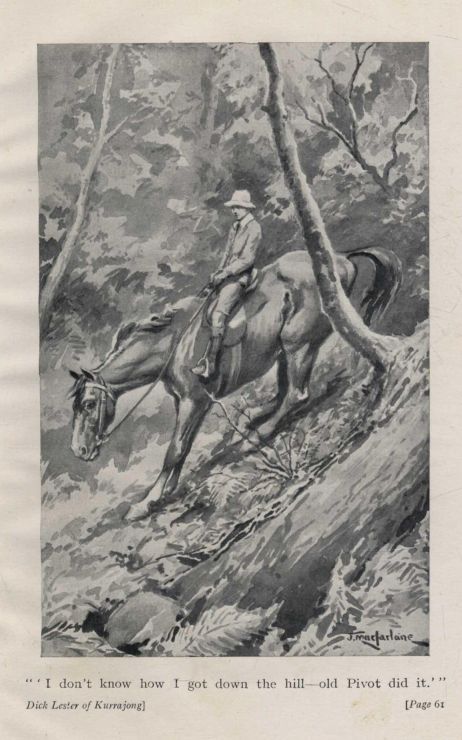
"'I don't know how I got down the hill—old Pivot did it.'"
"I say—your faver must be splendid."
"Of course he's splendid." Dick brushed away
so superfluous an observation. "That chestnut's
his best hack now. Father lassoed him in the
yards, and broke him in himself, and you should
have seen him buck. The men swore he'd always
be an outlaw, but father said he wouldn't, and he
beat him in the end. He wouldn't let another
soul touch him, and though he goes quietly enough
with father, no one else can ride him now. I guess
father will have to break him in again now, 'cause
he's been turned out for a year since father went
to England."
"Was Tinker all right?" asked Bobby eagerly.
"Tinker just came up to me in the yards when
they cut him out from the mob and put his old
head down to my pocket, looking for an apple.
He always did that from the time he was a foal."
Someone behind them—they were leaning over
the rail, the ship forgotten—put a hand on Dick's
shoulder, and the boy jumped round, his face
flushing. Mr. Warner stood laughing at him—near
him, Merle, her face a curious mixture of interest
and sullenness.
"That was pretty exciting," said Mr. Warner.
Dick's colour deepened. He muttered incoherently
something about "just telling the kid a
yarn."
"You come to breakfast, Bobby," Merle said
crossly. "Mother wants you." She seized the
unwilling Bobby's hand and led him away.
Many people find the run across the Great
Australian Bight a dull matter; and, indeed,
if you should ever find yourself returning
from the other side of the world, it is apt to be the
longest part of all the long six weeks at sea. But
to little Dick Lester, afloat for the first time, it
was a voyage full of marvel and delight.
Dick did not give his masters at school an especially
easy time; there was, I fear, nothing of the
saintly little boy about him; nor did any of them
ever have reason to suspect him of any especial
cleverness. He was a very ordinary, healthy
youngster, unencumbered by much brain power.
But he did respectably at school and more than
respectably at sports, because he was quite unable
to take things easily. There was in his nature a
streak of keenness that made the pursuit of the
moment the most interesting thing possible. He
flung himself heart and soul and generally with
all his alert young body, too, into all he did.
Naturally, his very keenness often made him make
mistakes; but at least it saved him from dullness.
"He's a provoking little animal," a tired
form-master once said of him; "but, thank goodness,
he's no slug!"
Being so designed, partly by Nature and partly
by parents who had themselves that strong quality
of keenness, it may readily be imagined that a ship
opened up to Dick a storehouse of novelty and
opportunity. He made his way into every permitted
corner, and since he did not do it bumptiously,
he found a welcome where a cheeky youngster
would have been promptly ejected. The chief
engineer succumbed to the longing face at the
entrance to his mysterious domain, and let him
spend hours in the engine room, where the roar
and beat of the mighty machinery was the purest
music in Dick's ears. He penetrated even to the
stokehold, where, stripped of his outer garments,
he toiled eagerly with a stoker's shovel, flinging
great lumps of coal into the yawning mouths of the
furnaces, where the flames leaped redly. There
was something in feeling that, even for a moment,
he was helping the onward rush of the ship that
brought him nearer to Fremantle and his father.
He stopped only when he could no longer hold the
heavy shovel, and the fourth engineer, laughing,
hustled him from the stifling stokehold into the
not particularly fresh air of the engine room, which
seemed to Dick an ozone bath by comparison.
The men made him free of their quarters, and
spun him long yarns of the sea, more or less true,
while they taught him intricacies of splicing and
knotting that are generally hidden from the
landsman. They made him highly technical in speech,
so that he would have shuddered at calling the
companion a staircase, or in misusing such ordinary
expressions as "abaft the binnacle." He saw
their dim and smellful sleeping accommodation,
and came away with his small soul full of wrath
that men so admirable should be herded in dens
so uninviting. They took care of him in more ways
than one; he saw a sturdy apprentice roundly
cuffed on the head for having made some remark
in his presence of which the older men did not
approve. Dick had not caught the remark—which
was as well. It made him rather uncomfortable
to see the boy cuffed, but having great respect
for the cuffer, a boatswain of wonderful ability
where knots were concerned, he took it for granted
that everything was all right. He told them stories
of station life in return for their sea yarns, and
altogether spent some of his happiest hours in the
fo'c'sle.
The baggage officer took him into the upper hold
and held forth learnedly on the art of handling cargo;
the cook showed him the galley, with its rows of
shining copper pots and pans, its contrivances
for washing and peeling potatoes by the hundred,
and other strange devices—which so enthralled
Dick that he obtained permission to come again,
and to bring his mother, who was no less interested
than he. He even penetrated into the mysterious
regions where the stewards lurk when off duty, and
had no small hand in the fun behind the scenes,
when the stewards gave a concert in aid of the
funds for seamen—a Christy minstrel entertainment,
at which the performers appeared with faces
so well and truly blacked that for the remainder
of the voyage they had a murky look sadly out
of keeping with their otherwise spic and span
appearance. But the crowning point of Dick's
voyage was when the Captain found him on deck
very early one morning—so early that no other
passengers were astir, and, first swearing him to
secrecy, took him to his state-room under the
bridge where they hob-nobbed over an early cup
of tea, and afterwards showed him chronometers
and sextants, chart-room and navigating room,
and the forbidden glory of the bridge itself; a
condescension that left Dick gasping with delight
and amazement. He did not know that the Captain
had a little son in Perth; another boy with an
eager face, for whose sake the great man had a soft
corner in his heart for all small boys.
With so many distractions, it was natural that
the days should fly quickly. But in addition there
was the sea itself, which Dick loved; an Australian
sea at its best, with bright sunshine, dancing blue
water, and a long, easy swell that barely rocked
the Moondarra as she steamed westward. They
passed but few ships. A great English liner
overtook them one morning, passing so close that
greetings could be shouted from deck to deck;
a P. and O. boat, her black and tan painting and
her winking brasswork making her a heartsome
sight. Beside her, the Moondarra, which had
seemed to Dick enormous, became quite a small
affair. The liner was outward bound, most of the
people on her decks were Australians, off on the
long trip to the old countries that every son and
daughter of the Southern Cross longs to see some
day. Once there passed another inter-state boat,
like themselves; now and then a little tramp
steamer, red with rust and generally grimy. And
one day came the most beautiful sight of the sea,
a great four-master, with every sail set, swinging
by to Sydney for wheat. She came down towards
them, until she was quite close—then, tacking
suddenly, she swung away, the sunlight, as she
went about, turning every sail to glittering silver.
Dick had no breakfast that morning—he remained
glued to the rail until the beautiful ship was only a
tall shadow on the horizon.
At all odd moments during the day there were
games; deck-tennis, bull-board, quoits, cricket.
Dick was handicapped in being the only boy of
his age on board, so that he found it hard to get
a suitable partner, but some of the elder girls
took him into their games, and on the whole he had
a good time, though, to Dick, girls were curious
beings, with mysterious and incomprehensible ways.
He told his mother one day that he could not
imagine why any fellow ever wanted to get
married—"unless it was to you, of course," he added,
gallantly. To which Mrs. Lester listened gravely,
and did not even make the annoying rejoinder
that some day he would think differently—to
which species of remark grown-ups are so prone.
Merle Warner remained the most incomprehensible
female of all. Circumstances conspired to
throw the two children together, for the elders
quickly made friends; the Warners were pleasant,
kindly people, and, as table companions, they were
a good deal brought into association with
Mrs. Lester. Mr. Warner and Dick had struck up a
great friendship; the big man liked his small
and unobtrusive cabin-mate and felt for him
something of the protective feeling he would have
experienced had it been his own little lad who lay
asleep in the opposite bunk each night when he
came to bed. They used to tramp the deck together
in the early mornings and after dinner, and "yarn"
of station matters, of the ways of bullocks—and
most inexhaustible theme of all—of horses. Dick
had been his father's constant companion until
Mr. Lester sailed for England; he had learned a
good deal of station affairs, and where his knowledge
failed his love of the subject was enough to make
him a good mate. He used to beg for stories of
the Western life, that held so many differences
from his own, and Mr. Warner was ready enough
to tell of his early days, with their struggle and
adventure. Dick thought him a very wonderful
man. He told his stories very simply; they were,
indeed, very commonplace happenings to him, and
on the rare occasions that he became enthusiastic
it was in speaking of the part his wife had
played. "You take it from me, son, women are
pretty wonderful," he said. "She's plump and
placid and comfortable enough now—but I've seen
her holding off a crew of yelling blacks with only an
old shot gun. She never was afraid—or if she
was, she never showed it; and that's the most
wonderful of all." Dick agreed, and thereafter
looked at Mrs. Warner with eyes of awe, which
considerably puzzled the cheery, motherly woman.
Possibly it was her father's friendship for Dick
that made Merle so definitely unfriendly. She was
devoted to him; her mother and Bobby counted
for something to her, but her father ranked before
the whole world. It hit her hard to see him make a
companion of this new boy. She was a child of a
queer, silent nature—her own worst enemy, for
she struggled against her better impulses. Something
in her made her rude, unfriendly, unforgiving.
So much was evident, and led to punishments and
unpopularity. What was not so apparent was that
the queer streak made her very unhappy as well.
"I know jolly well I'm a pig," she had said once
to her father, "only I don't seem to be able to
be anything but a pig. Why do people get born
like that?" To which Mr. Warner, not understanding
in the least, had replied, laughing, that the
sooner she left off being a pig the better for
everyone. Merle knew that very well. But the bad
fairy who had dealt her the wrong kind of temper
at her christening was as yet too strong for her.
She could not make friends freely; not like
Bobby, whom she sometimes almost hated for the
ease with which he fell in love with everyone.
Everyone liked Bobby, too. He was so merry,
so full of quaint chatter, so ready to make the
best of the world. Their trip to Sydney had been
as complete joy to Bobby as it had meant misery
to Merle. They had stayed with a big family of
boy cousins; town boys, knowing nothing of the
country that Merle loved, and wildly keen on
swimming, yachting and school sports—all of them
sealed books to Merle. Her shyness and sullenness
had meant rare fun to them, and they had teased
her with all the thoroughness of public school
boys. She hated them all, with an intensity that
almost frightened her; for their sake she was ready
to hate all boys, and Dick was merely another
member of the abhorred species. That her father
should take to him instantly was almost more than
she could bear.
Dick was civil to her, in his off-hand boy fashion.
He was too busy and too happy to worry about a
cross-grained little girl. If she had cared to be
friendly he would have met her half-way, but as she
showed him very definitely that she did not want
him, he was quite willing to let her alone. It was
sometimes a little awkward to be paired off with
her—to have an elder say cheerfully, "Run away,
Merle, and play with Dick." A ship, however, is
a place of many corners, and after rounding the
nearest it was an easy matter to go off in different
directions. Merle would say, "I'm not comin' with
you!" Dick would reply, "Right oh!" and that
would end the matter.
"You know," Mrs. Lester said to Dick—they
were talking in her cabin one evening—"I'm
really sorry for that little girl. She gives herself
such a bad time. And if she would only let herself
be nice, she would be quite nice."
"You always think people are nice, mother-est,"
said Dick. He was lying on the spare bunk, his
hands crossed under his head, glad to keep still
after a hard set of tennis. "But why shouldn't
she behave decently? No one does anything to
annoy the poor thing!"
"N-no." Mrs. Lester hesitated; she did not
choose to hint to Dick that Merle might be jealous.
"I think she feels herself out in the cold—Bobby
is so attractive, and everyone likes him, and of
course she is different."
"She's a silly ass, then," said Dick, unexpectedly.
"Nothing's wrong with her looks, is there, if only
she didn't seem so jolly cross?"
"Why, no—nothing, of course," Mrs. Lester
answered. A vision of Merle's face, square and
defiant, came to her. "Only, of course, Bobby
is such a friendly little man. I wish she would
chum up with you, Dick. You wouldn't mind,
would you?"
"Well, a fellow doesn't always want a girl
at his heels," Dick said. "She's only a kid,
too"—with the condescension that thirteen feels for
eleven. "But, of course, she could come along
if she liked—if you want her to, mother." He
grinned all over his sunburnt face. "But what's
the good of talking?—a team of bullocks wouldn't
bring her!"
And that seemed so far beyond argument that
Mrs. Lester held her peace.
Nevertheless, despite Merle's attitude, the friendship
between the Warners and the Lesters flourished.
Bobby frankly adored Dick, and as Dick didn't
mind admitting that he "liked small kids," Bobby
trotted at his heels and, if he could not actually
be with him, remained glued to the spot if he could
watch him playing games. Mrs. Warner, relieved
from a good deal of attendance on her small son,
found Mrs. Lester a congenial spirit; the Lester
deck-chairs were pitched near the Warner encampment,
in a sheltered angle of the deck, and they
grew to know each other with the swiftness of
board-ship friendships—a week at sea having the
curious faculty of making perfect strangers better
acquaintances than if they had lived in the same
township for a year. Mr. Warner hovered about
like a large guardian angel, glad to see his wife
enjoying the most restful portion of her trip. Even
Merle fell a little under the spell of Mrs. Lester's
charm. She was so used to people who found
fault with her that it was almost amazing to know
someone who never seemed to notice bad temper
or black looks. Mrs. Lester's attitude was that
no one—not even Merle—could possibly mean to
be rude or unpleasant. It somehow made Merle
feel that rudeness and unpleasantness were cheap
and nasty.
Their fellow passengers were, on the whole,
a pleasant set. Miss Simpson and the "dear
bishop's" wife were apt to be a little overpowering;
the bishop himself made elephantine efforts at
being jolly, because of a peculiar belief that only
by so doing could he succeed in understanding
Australians, and thereby puzzled very much the
Australians themselves, who liked him far better
on the rare occasions when he forgot to be playful
and was just plain bishop. There was enough
musical talent on board to provide excellent
concerts each evening, after which energetic people
danced on the deck until an unfeeling quarter-master
came along relentlessly to extinguish the
lights. The captain and his officers made friends
with everyone and kept things moving with the
quiet tact that seems part of the training of a
passenger boat's officers—and answered questions
innumerable concerning the ways of the Moondarra
and the wonders of the deep, such questions
being an unfailing part of the routine of each
voyage. So the quiet days passed swiftly enough,
too swiftly for Dick, who, but that Fremantle
meant his father, would willingly have had it
twice as far away.
He came on deck one afternoon, after an hour
spent in the fo'c'sle; it was their last day at sea,
and he had been saying good-bye to his friend
the boatswain, who had presented him with a
marvellous trophy—a full-rigged ship, built in the
most astounding fashion, inside a bottle. Dick
had inspected this curiosity with bewildered awe,
never dreaming that it might actually become his
own; and when the boatswain gave it to him as a
farewell gift he was speechless with gratitude.
He carried it carefully to his cabin, and stowed it
away. Then he ran up in search of his mother.
He came out on the starboard side, where a
keen wind whistled that had driven nearly
everyone away in search of shelter on the port deck.
The only people in view were Bobby Warner and
Miss Simpson; and it was evident that Bobby
was very naughty. He was perched on the top
of the rail, holding lightly to a stanchion, his
handsome little face glowing with delighted mischief.
Miss Simpson—who had the faculty of arousing
all that was worst in him—was lecturing him
severely.
"Are you not ashamed, Bobby? Come down
at once, you naughty little boy!"
"S'an't," said Bobby calmly.
"Come down, or I shall bring your father to
whip you."
"He won't," said Bobby, unmoved. "He never
does."
"So I should think," said Miss Simpson, with
bitterness. "It is high time he began. Come down
immediately."
"You go 'way, ole fing," Bobby said, unmoved.
"Don't like you."
"No one likes naughty boys like you," returned
the lady, severely, "Will you come down, or
must I pull you down?"
"Don't 'oo touch me," said Bobby, meeting her
eyes fearlessly, as she stood angry and irresolute.
"Dis is my pony—I'm goin' to ride it."
He threw one leg over the rail as he spoke,
balancing his slender body easily. Miss Simpson
uttered a muffled shriek, and sprang to hold him,
gripping at his knee.
"'Oo get away!" Bobby threatened. He
twisted himself from her grasp, bending outwards,
just as Dick came upon the scene. Dick gave a
low whistle.
"Come down out of that, Bob, you silly ass!"
Bobby started at the voice. Simultaneously the
ship rolled, and then a shriek from Miss Simpson
rent the air and she clutched at him unavailingly
as he lost his balance and fell. The list of the
ship sent him clear of her, down to the lazy green
swell, flecked with foam from the bow. He gave
one cry—a frightened baby's scream for help.
The water choked it almost unheard.
Dick did not hesitate. He reflected afterwards
with shame that he did not even shout, "Man
overboard!" as do all well-conducted rescuers;
instead he gave an incoherent cry of, "Coming, old
chap!" as he swung himself up by the stanchion
and dived outwards. It did not seem far—he had
often dived from the top of the gallery round the
swimming baths near his school. What he was not
prepared for was the icy coldness of the water. It
caught his breath—he came up blinded and gasping,
unable for a second to see anything. Then, just
as despair seized him, he caught sight of a white
jersey a few yards away on the crest of a wave, and
flung himself through the water towards it. His
fingers closed on it, and the wave swallowed them
both.
They came up again after what seemed an
eternity. Dick's head was bursting, and his whole
body numb. Mechanically his training in
life-saving came back to him, and he turned on his
back, still gripping Bobby, from whose little body
the breath had been knocked so effectually by the
fall that he was merely a log in the water, unable to
struggle. It was as well for Dick, for there was no
fight left in him. The icy water chilled him, body
and soul; he could only keep afloat, with his fingers
twisted into Bobby's jersey. His mother's face
seemed to float before his tired eyes.
Back on the Moondarra Miss Simpson's despairing
shrieks had been drowned by the long hoot of the
steamer's siren. The officer on duty on the bridge
had seen Dick's dive; almost before he had
struck the water the steamer's engines were reversed,
life-belts had gone skimming overboard, and a
boat's crew was working desperately at the davits
swinging the boat outboard. Quicker still two
others had flung themselves after the boys—Dick's
friend, the boatswain, and the thin, silent man
who sat at their table. It was he who reached
them first; his voice came to Dick as though
muffled in wool, like the voice of a person very far
away.
"Keep still, old chap; I'll take the kid."
Bobby's weight was lifted, but Dick could not
detach his clutching fingers from his jersey. He
saw, as in a mist, a face near him in the water, but
the cruel cold held him, choked him, gripped his
very heart. He moved his free hand feebly,
resisting, as he knew he must, an overpowering
instinct to grasp at the new-comer. Another voice
came, even further away.
"I can manage this one," it said. There was
comfort in that, since Dick knew he could not
manage anything more. The waves seemed to be
swinging him in a great cold bed—up and down,
up and down. A hand was under his head, more
restful than the softest pillow he had ever known;
he let himself sink back with a little sigh, just as
the blue sky above him flickered suddenly and
turned black. Close, very close, was the sound of
oars working furiously in rowlocks, but he did not
hear them.
The Moondarra was turning in a great circle,
her railing black with people. Women were clustering
round the two mothers, who stood silently
watching the sea that was fighting out beyond for
the little lives; and there were men holding back
Mr. Warner, who could swim scarcely at all, but
had been in the very act of flinging himself over
the rail when an officer caught him. "If Flanagin
and the other fellow can't get them, no one can,"
the crisp voice said. "You'll only complicate
matters if you go in." And after that Bobby's
father stood still, gripping at the rail, not feeling
the hands that held him mechanically.
The long moments dragged themselves away—how
long they seemed, first from the time that the
two little heads had been a tiny speck together on
the sea, and then until the other heads and the
long, clean overarm strokes had forged through
the water towards them! Then, longest of all
came the terse waiting while the boat, lowered with
swift dexterity, reached the water—the waiting
oars ready to pull the instant she touched—the
straining muscles flinging themselves into each stroke
that sent her flying across the long green swells.
A sudden, broken cheer came from the ship, mingled
with a woman's sobbing cry.
"Oh, they have them, they have them!"
The two mothers, silent yet, caught at each
other's hands. Beyond, strong arms were lifting
the boys together into the boat; then, strain their
eyes as they might, they could see nothing, for
two sailors were working over the little figures,
wrapping them in rugs; they had to loosen Dick's
fingers by force from Bobby's jersey. Others were
hauling the rescuers on board, the boat turning even
as they were pulled in; and then she came racing
back to the ship. On the bridge the captain glanced
at his watch, with a flash of professional pride.
"Seven minutes from the time of the alarm—not
bad going!" he said.
The cheering broke out again as the boat swung
alongside, and then died out uncertainly. Was it
a time to cheer? The little muffled figures lay
still and stiff, white faces upturned to the towering
ship. Mr. Warner's heart seemed to stand still as
the doctor suddenly tapped him on the shoulder.
"Bring your wife and Mrs. Lester to the hospital,"
he said. "I have everything ready."
A hush seemed to fall upon the ship, long after
the boat had been hauled slowly upwards, and
waiting arms had received the motionless bundles
and borne them swiftly to the hospital. The steady
beat of the re-awakened engines bore the Moondarra
westward; but on the decks passengers stood
about in little knots, with their eyes ever wandering
to the doorway behind which the dripping procession
had disappeared. The captain came out once,
shaking his head at the eager inquiries.
"Both unconscious," he said. "I'm afraid——"
and stopped.
There was a sick hush on the decks as the Bishop—no
longer playful—came forward, holding up his
hand for silence.
"If you will come with me to the saloon," he
said, "we can do our best for the children. They
need our prayers."
The people flocked after him—card-playing men
and half-grown girls, and women who sobbed as
they went. There were sobs round the saloon as
the Bishop prayed—simple, manly words that asked
for help and mercy. He finished, and there was
silence, and then a cheer from the deck and a
steward burst in.
"Doctor says they're all right!"
In the sick bay, Mrs. Warner held Bobby to her
like a baby—a bundle of hot blankets, in which his
sleeping face nestled peacefully. Dick lay in a cot,
also a mound of blankets. He opened his eyes and
a smile flickered weakly on his lips as he saw his
mother's face.
"Mother-est!" he whispered.
She put her head down beside him, trembling—one
arm across him, holding him to her. He gave
a half sigh of utter contentment, nestling to her,
as he fell asleep.
It was many hours later that Dick woke up, at
an unfamiliar noise, feeling stiff and tired and
extremely puzzled as to where he was. Bobby,
who had awakened him with a dismal little howl,
was sitting up in his cot. The two mothers had
been dragged away to dinner by the doctor, who
had brutally remarked that the boys would sleep
just as well if they didn't sit and stare at them,
with other wise observations as to the necessity
of over-strained people taking nourishment. The
steward, who had been left on guard at the hospital,
was gossiping placidly outside on the deck.
Dick regarded Bobby sleepily.
"Hullo, kid," he said. "Don't howl."
"Isn't howlin'," returned Bobby, untruthfully.
"Wants my muvver." His lips quivered. "I
tumbled into the water," he said, his blue eyes
suddenly misty.
"So you did," said Dick, memory coming back
to him. "Weren't you an ass? Never mind, you
got out all right."
"It wasn't nice," said Bobby, miserably. The
eyes brimmed over. "Don't like this funny place.
Want to come an' 'nuggle on your bed."
"Come on, then," Dick said.
Bobby made an effort to clamber out, but relapsed
into his blankets.
"My legs is all funny and horrid," he said.
"They—they won't work." Tears were in his
voice. "Wants to 'nuggle wiv you—wants my
muvver!"
"Well, you stay there—I'll come," Dick said,
hurriedly.
He climbed out, realising fully the moment he
moved Bobby's accusation against his legs. His
own felt as though they belonged to someone entirely
different—Mr. Warner for choice, for they felt
enormous. He found himself glad to hold on to
the cot after he was on the floor, and his progress
across to Bobby was slow and painful.
"What's the matter?" Bobby asked. "Is your
legs funny, too?"
"Jolly funny," Dick returned. He climbed in
beside the tearful Bobby, who clung to him
vehemently—and somehow Dick was not sorry for the
warm, comforting touch. He was desperately stiff
and weary; he, also, wanted his mother every bit
as much as the small boy who snuggled against
him. He put his arm round him.
"Just you go to sleep, old chap," he said—and
in a moment followed his own advice.
"Ain't never stirred, mum," was the calm
assurance of the steward at the door, ten minutes
later, when the anxious mothers came hurrying
back from dinner. "I been sittin' in there near
'em—they——"
His jaw dropped and the mothers gave a stifled
exclamation at sight of the two heads on Bobby's
pillow—both boys fast asleep. The steward, when
taken outside for purposes of discussion, found
difficulty in inventing a suitable explanation, cut
short by the arrival of the doctor, who remarked
that he would attend to him later, and went to
inspect the patients.
"Well, they're all right, anyhow," he said.
"But I'd like to know how young Dick felt on
his journey across."
It was a journey of which Dick had no recollection
when he woke for the second time, four hours later;
and he was sufficiently astonished at finding Bobby
beside him. The mothers were close by; at Dick's
first movement Mrs. Lester came swiftly to the
side of the cot. Presently, just as Bobby too
awoke, came the doctor; and close on his heels, the
repentant steward, bearing hot soup, which seemed
to the boys the most heavenly thing they had ever
tasted. They ate it, and asked for more, and would
have made a gallant effort at that, too, had not
sleep overcome them again. Bobby tumbled asleep
almost over his bowl, and his father, coming in,
carried him off to his mother's cabin; and presently,
just as Dick was settling to a dream, the big man
was back, and this time it was Dick whom he
picked up like a baby and carried down the long
alleyways; not to their own cabin, but to the
spare bunk in Mrs. Lester's, which had been made
ready for Dick. She was waiting for him, ready
to tuck him up. It was comforting to think she
would be near him. He was very sleepy—too
sleepy to do more than wonder when, as he put
him down, Bobby's father said, huskily, "God
bless you, old chap," and brushed his forehead
with his lips—and then went hurriedly out.
It was all like a dream when Dick woke next
day, still a little stiff, but otherwise feeling his
usual self. Mrs. Lester was asleep, which was not
unnatural, seeing that she had been up at
ten-minute intervals throughout the night, to bend
over him and make sure that he was still breathing.
He got up softly, and slipped out for his bath;
somewhat embarrassed, on his return, by the
necessity for hunting out fresh clothing in his own
cabin—though he had long ceased to have any
fear of waking Mr. Warner, which, indeed, was a
task beyond the average small boy. He managed
to get dressed at last, and went up on deck.
A steward gave him tea, and asked feelingly
"how he was keeping?" A quarter-master came
over to him and inquired, "All right, this morning,
after your swim?" The third officer, very busy
with landing preparations, tossed him a greeting
across the deck, and asked if he thought the water
would be nice for bathing. Dick began to feel
rather hot, and moved away to another part of
the deck, where there might be people who had
failed to notice yesterday's adventure. There,
however, he met the captain, who patted him on
the head, and said, "Good kid; where did you
pick up high diving?" and just after he had
escaped from this encounter, who should come
along, stately and tall, but the Bishop's wife, who
made a kind of run at him, grasped his hands, and
said, "My child, how can we express our feelings of
gratitude and admiration?" which so terrified Dick
that he broke away without ceremony, and, muttering
something incoherent, fled as he would never
have fled from the most infuriated bullock. He
went round a deck house at a run, and cannoned into
Merle Warner, who scowled and said, exactly as
she had said on the first morning at sea, "Can't you
look where you're going, silly?"
Dick burst out laughing.
"I wish you'd say that again," he said.
"Why?" demanded Merle, blankly.
"'Cause it sounded quite decent. Everybody
else on this blessed ship is talking such bosh!"
"What sort of bosh?"
Dick turned red.
"Oh, nothing," he said. There was a moment's
pause, and then Merle flushed in her turn.
"I say—thanks for goin' in after Bobby," she
said awkwardly.
Dick gave a kind of howl of disgust.
"Oh, you, too!" he cried. "I say, do chuck it.
If you knew how sick I am of hearing about it!"
"Oh, all right," said Merle, plainly comprehending
this point of view, and relieved to find that no
more politeness was expected of her. Somewhat to
her surprise, however, she found herself making
further conversation:
"You glad we're gettin' in to-day?"
"Oh, rather!" Dick's face suddenly lit up.
"I like the ship—but I'm awfully keen to see
father."
"Whose father?"
"Mine, of course. He's coming out from
England—we're going to meet him at Fremantle."
"Oh, I didn't know," Merle said. "Has he
been long away?
"Over a year," Dick said. "Seems about ten."
"A year!" Merle's eyes grew round. Life
without a father seemed an impossible thing.
"'M," Dick nodded. "It's been jolly nice to be
with your father on this ship. A fellow misses his
father a bit, I can tell you."
"'Spect you do," Merle said. "When's yours
coming?"
"To-morrow, some time, his boat gets in," Dick
answered. "He's on the Ohio." His eyes were
dancing; somehow, as Merle met their glance, she
smiled in spite of herself. "I guess mother and I
will be on the old pier pretty early."
There was a moment's pause, while they looked
at each other like two awkward young puppies.
"I better go an' see if mother wants me," Merle
said at length.
"Right oh!" Dick answered with alacrity.
They parted with a glance that, at any rate, was
semi-friendly. Merle went away with a feeling that
she had been, as usual, a pig. She had been grudging
her father, for a few days, to a boy who had not
seen his own father for over a year—twelve whole
months! It was a bit low down. And on top of
this, he must go into the sea after Bobby, which
made her feel more of a pig than ever, especially as
he did not seem inclined to make a fuss about it.
Merle was accustomed to put an end to such
uncomfortable thoughts by shrugging her shoulders
and reflecting that, after all, no one expected her
to be anything but a pig, so what did it matter?
But this time she found herself unexpectedly
troubled about it.
Dick made his way swiftly to the companion,
in the vain hope of eluding his fellow-passengers.
But the ship was getting up for breakfast—everyone
was coming on deck, or going along the alleyways in
search of baths, and he met a string of inquiries,
congratulations and compliments that reduced him
to the lowest pitch of shy discomfort. The Bishop,
extraordinarily human in pyjamas and a short
dressing-gown, patted him on the back and said,
"Feel all right, old man?" which was easier to
bear than most of the greetings. But the flappers
fairly oozed over him, the men pumped his hand,
while he tried vainly to edge past them, and Miss
Simpson, holding him tightly by the arm, made him
a speech, in which Dick vaguely recognised
quotations from the prayer book. He escaped, scarlet
cheeked, and ran with his head down, darting
round the corner towards his own cabin, and there
ran into Mrs. Warner, who said nothing at all, but
only looked at him piteously, with her mouth
trembling, just as Bobby's had trembled the night
before, and then put out her hands to him suddenly
and kissed him. Somehow, to his own astonishment,
Dick did not mind it at all. He found himself
patting her very hard, and saying, "Never you
mind, he's all right." He felt so terribly sorry for
her that he forgot all about himself, and they went
to breakfast with Mrs. Lester, while Mr. Warner
remained with Bobby, whose legs were still refusing
duty, though his appetite was unimpaired.
Land was in sight—the coast of Western Australia,
and there was much bustle of packing and preparing
to leave the ship.
"It isn't a very interesting-looking coast," Mrs. Warner
said, looking at the low line of sandy hills.
"But I remember what it meant to me when I
came back from two years in England when I was
nineteen. I had been desperately home sick all
those two years, and when at last the homeward
voyage was nearly over it almost seemed to kill
me with joy. I couldn't sleep the night before,
and I got up before dawn to see the land—it was
like heaven, as it came slowly out of the mist.
West Australia!"
"But you weren't a 'sand groper' yourself?"
said the doctor.
"Oh no; I was a Sydneysider. But you don't
worry about inter-state differences when you're
coming home—Australia is all that matters."
"I wonder if father's thinking that," Dick said.
"Most certainly—as you're going to meet him at
Fremantle!" said the doctor, laughing. "Otherwise
I fancy he'd be stretching out his neck towards
Port Phillip Bay, and regarding anything between
as an annoying interlude."
"Well—that may be," admitted Mrs. Lester
demurely. "Come on, Dickie, we must finish our
packing."
The Moondarra slipped quietly into Fremantle
Harbour while they were still in their cabins; Dick's
first intimation of the fact being a shadow across
the port-hole as a yacht's tall masts slipped by,
followed by the blackened smoke stack of a collier.
He jumped up on his bunk to peer out. The land
was very close; a confused jumble of uninteresting
red-brick houses met his eyes, and a mass of shipping
of all sorts and sizes. The western sea gate of
Australia is busy, but unbeautiful. Dick
remarked, "H'm—about up to Port Melbourne!"
and got down again to finish locking a suit-case.
"Can I help you, Dick? We're nearly in."
"Just finished, mother, thanks. Did the steward
strap up your trunks?"
"He's doing them now. Dick, I have been
talking to Mr. Warner; they are going to an hotel
in Perth, and he suggests that we should go there
too; it is the best, he says."
"Right oh, mother. And where's Perth?"
"What do I send you to school for?" demanded
Mrs. Lester laughing.
"Oh, I know it's on the Swan," said Dick,
grinning in his turn. "But is it far?"
"Only a few miles. Mr. Warner advises us to
go up by motor."
"That would be jolly!" Dick exclaimed. "I
say, mother—can we go to the Orient office and
ask about father's boat?"
"We'll go there at once," said Mrs. Lester.
"Dick, are you sure you feel all right?"
"Right as pie," Dick answered, unpoetically.
"Don't you worry about me, old mother." He
got up, putting his arm into hers. "Come on deck
and see new things."
There was not much new, save that anything is
a change to eyes that for several days have seen
nothing but sea and sky. The Moondarra was
slowly warping into the wharf, amidst a mass of
shipping. A knot of interested people stood
watching her come, some of them exchanging signals
with her passengers; but the centre of attraction,
ashore and afloat, was the big P. and O. liner that
had passed them in the Bight. She was on the
point of sailing, her gangways already drawn up;
and a big crowd was watching her go. Somewhere
a band was playing "Auld Lang Syne"; the
sweet notes came dreamily across the water. Slowly
she drew out from the pier. There were confused
sounds—shouts of farewell, cheering, long coo-ees
shrilling a last Australian call. Her wash set the
Moondarra rocking.
"Isn't she splendid!" Dick breathed.
She was very splendid, as she moved slowly out
past the breakwater, fronting the wide sweep of
western seas that tossed between her and the old
world whither she was bound. A German submarine
was to send her to the bottom years later—without
warning, leaving her freight of helpless
souls to the mercy of an angry sea. But the veil
of the future was drawn yet: stately and secure,
the great ship went out, scarcely rocking to the
great ocean swells that rolled in to meet her. The
cheering and the long cries of farewell died away.
Simultaneously the gangway of the Moondarra
went down, and people poured on board, friends
meeting passengers, hotel and motor touts, carriers,
shipping agents. Mr. Warner's deep voice boomed
behind the Lesters.
"Been looking for you," he said. "Not in a
hurry, are you? It's pleasanter to wait until the
first rush has gone. Then I can get you a good
car from an hotel if you like."
Mrs. Lester thanked him, and they stood chatting
until Merle arrived to say that Bobby was ready.
His father disappeared hastily, presently returning,
carrying his small son, whose extremely cheerful
face showed only amusement at being unable to
walk. Mrs. Warner followed. They deposited
Bobby in a deck-chair, and smiled down at him.
"How are the legs now, Bobby?" Mrs. Lester
"They's nearly all right, only they wobbles,"
said Bobby. "Doctor says they'll stop wobbling
to-morrow." He grinned delightedly. "I is just
awful funny when I tries to walk!"
"He is too," echoed his father, laughing. "He'd
make his fortune in a circus. Bobby, man, do you
see we're nearly home?"
"'M," nodded Bobby. "Where's the twinses?"
"Oh, we'll get the twinses soon—Grannie has
them."
"And when do we go to own-truly home?"
"In a few days. Will you be glad, old son?"
"Wather!" said Bobby. "Micky's there!"
"And when he gets on Micky's back nothing else
in the world matters," said his mother, with a half
sigh. "I sometimes wonder if either of the twinses
will be domesticated—there's no sign of my two
eldest being anything but stock riders!"
The crowd on the ship had almost cleared away,
swallowed up by motors and cabs, and the business
of unloading cargo was beginning, with its rattle of
cranes and winches.
"Well there'll soon be too much noise here to
be pleasant," said Mr. Warner. "Are you ready,
Mrs. Lester? Shall I go after cars?"
"Quite ready—my luggage is all on deck," she
told him.
"Then, come on, Dick, and we'll go car hunting."
They went together down the gangway—there
was a new stab of the old jealous pain in Merle's
heart as she watched them go. Mrs. Lester called
her to her side with a question about Fremantle—her
keen eyes had noticed the shadow on the little
girl's face.
"I am shockingly ignorant of this part of the
world," she said, laughing. "You are an old
inhabitant, so you must tell me all about it";
and she kept her near, making her talk, until
Merle had forgotten her troubles.
Dick followed Mr. Lester along the wharf, and
up a wide and dusty street, until they came to one
rather wider and a little less dusty, where trams
rattled and business seemed brisk. There were
big shops and fine buildings, and people moved
about as though they had no time to dawdle.
There is always a kind of feverish activity about a
city that lives by shipping. Other places may doze
sleepily between trains, waking now and then to
send off or receive mails, but a seaport knows no
time-table, and is busy all the time, as the big ships
come and go, and the blue-clad sailors hurry along
its streets. So Perth lies dreamily on the borders
of its wide river, and, but a few miles off, Fremantle,
like a busy watchdog, never seems to rest.
They found a garage that readily supplied
Mr. Warner with two cars, in one of which they were
soon back at the Moondarra, where they found the
others waiting on the wharf. Carriers had taken
their heavier luggage; lighter effects were quickly
packed in, and presently they were gliding along a
well-kept road, where sparse gum trees fringed
bungalow houses set in gardens flaming with many
unfamiliar flowers. The motors made short work
of the distance; soon they could see the buildings
of Perth, and then a gleam of silver, and a turn
in the road brought them out beside the Swan, a
wide, shining expanse, dotted with the white sails
of many little yachts. Dick uttered a delighted
whistle.
"I say! Did you know it was such a big river,
mother?"
"No, I didn't," admitted his mother. "Why
it is almost a lake! What an ideal place for
yachting!"
Perth seemed to think so, for the boats were
legion; fairy-like yachts, little rowing skiffs,
motor-boats chugging across the rippled surface, and
even canoes, their broad paddles flashing in the
sunlight as they dipped and fell. Boat-houses were
thick along the banks: here and there the big
buildings of yachting clubs, with wide verandahs and
balconies overhanging the water. All the river
was full of the stir of moving boats.
"I think this is a jolly place," Dick pronounced,
solemnly.
The car turned from the river and ran along a
wide, tree-fringed road, and in a moment they
were in the heart of Perth itself, winding in and
out of the traffic until they stopped before a big
hotel. Mr. Warner was before them. Their rooms
were already engaged, and a boy in buttons took
them up and brought their luggage. Dick was
kneeling on the floor in his mother's room unstrapping
her dressing-case, when a knock came to the
door. Mrs. Lester opened it.
Mr. Warner stood there, his enormous bulk
seeming to fill the corridor.
"I ran out to the Orient office, it's no distance
from here," he said, beaming at them. "The
Ohio comes in at ten o'clock to-morrow morning.
And there's a wireless for you!"
He held out a thin brown envelope. Then he
was gone, and the door shut, and Mrs. Lester was
tearing at the envelope with fingers that shook.
"All well. Love to you both."
"Dickie!" she said, catching at the boy;
"Dickie." They clung together for a moment,
and the flimsy paper that was like a dear voice
speaking after twelve months of silence fluttered to
the ground between them.
Dick Lester and his mother never had any
very clear idea of how they passed that day
in Perth. Lunch filled up an hour; then
they took a hansom and drove to the beautiful
public gardens, and wandered about them, and at
intervals took out their precious wireless and read
it again, as if expecting to find some new remark
tucked in among its six brief words. In the evening
Mr. Warner took them to a theatre—Mrs. Warner
declining to be again separated from the twinses.
Presumably it was a good play, for Mr. Warner and
Merle seemed to enjoy it, but neither Mrs. Lester
nor Dick could have told you what it was about.
The wireless also went to the theatre, in Dick's
pocket. He had asked his mother if he might
keep it.
"Rather a curio, when you've never seen a
wireless before, you see," he explained, in an
elaborately off-hand manner. Mrs. Lester had
nodded comprehendingly, a little sad at heart, for
she would certainly have liked to keep it herself.
Dick went to bed, declaring that he could not
sleep; his eyes so bright that Mrs. Lester was half
afraid that his belief was true, but when, half an
hour later, she peeped into his room he was lying
peacefully with his head on his arm, already far
away in the land of dreams. She sat down in a
chair near his open window, feeling the need of
companionship, if only that of a sleeping little son.
It was moonlight; from the high window she
could catch a glimpse of the river, a streak of
silver. Beyond it her mind flashed out to sea,
where a great ship ploughed landwards, and on its
deck a man paced up and down, gripping his pipe
in his teeth, and striving with his mind to bridge
the few miles that yet lay between him and his
dear ones. Possibly he succeeded, for thoughts often
fly further than we know. After an hour Mrs. Lester's
wakefulness left her, and she stole to bed,
drowsy and content.
Breakfast in the morning was a scramble, for
they woke late, and were both quite unable to
think of anything so ordinary as food. Dick put
salt into his tea and sugar on his fish, and would
probably have consumed both without noticing
anything amiss had not the waiter intervened in
horror. Mr. Warner ordered a car for them, and
very soon they were flying down the road, that
seemed oddly familiar. It was early; but then,
as Dick said, the Ohio might be early too. Dick
was not acquainted with the clock-work methods
of mail steamers. He dashed breathlessly on to
the wharf at Fremantle to ask if the Ohio were in,
and was met with bored surprise by a man in a
blue jersey, who said, "The Ohio? But she don't
come in till ten"—much as a railway porter might
answer if you demanded the Sydney express an
hour too soon. Dick returned ruefully to the car.
"No sign of her, mother. It really will be ten
o'clock."
"I was afraid so," said his mother, laughing,
while the chauffeur grinned broadly. "Jump in
and we'll go for a spin while we wait."
Dick would have preferred to stay on the wharf,
straining his eyes to the horizon. But he obeyed,
and they went careering over strange roads that
neither saw, though the sense of swift motion
helped them in a measure. Still, it was a relief
when at length the car turned, and again they spun
towards the pier. The chauffeur had judged his
time well; the wharf was crowded now, and, just
beyond the breakwater, a great ship loomed through
a little drifting mist.
"That's her," said the chauffeur, half-turning.
"Steady—it'll take her a quarter of an hour to
get aside yet." This to Dick, who was wrestling
with a stiff door-handle before the car could stop.
They edged through the throng on the pier to
where a dock-hand told them the mail steamer's
gangway would come down. She was close in
now, they could see sailors on board getting the
great gangway ready. The passengers were crowding
along every yard of the deck railing; it was
impossible to pick out one face amidst the mass,
no matter how hard they might strain their eyes.
Everywhere, people were waving to their friends
ashore, shouting, coo-eeing; Dick coo-ee'd too, but
with a kind of helpless irritation at being unable
to see the only face that mattered. The minutes
dragged on, while the ship edged her way in, yard
by yard; and still they scanned her decks in vain.
"Oh, mother, isn't it awful?" Dick's voice
had a quiver in it. "Do you think he's really
there?"
"Of course he's there, son." The voice was little
more than a whisper.
Suddenly, and together, they saw him. The
crowd was densest on the deck near the gangway,
but he must have taken up his position very early,
for he was in front of everyone, talking to the
officer in charge of the landing operations. He
towered over the other people; six foot three of
lean, muscular activity, with a clean-shaven face,
bronzed and keen. Dick heard his mother catch
her breath, and he slipped his hand through her
arm. Then, as if their upward gaze drew him, John
Lester turned and looked down, straight into their
eyes. His cap was pulled low on his brow, but
they saw the sudden light that sprang into his
face—the quick smile that was a caress, singling
them out from the crowd. He took off his cap
with a swift movement, and stood bareheaded,
his eyes never moving from his wife and son. So
they stood, until, with a rattle, the gangway came
down—and while it still shook from the impact,
John Lester ran down it lightly, the first man to
leave the Ohio. He put an arm round them both,
hustling them gently towards the gangway.
"Come up," he said, a little breathlessly. "I've
squared the man on top."
The officer greeted them with a smile as they
mounted—it was against rules, but John Lester had
a way of getting what he wanted. He edged a way
for them through the crowding passengers with
courteous little apologies; somehow they found
themselves in the clear space behind the throng,
hurrying along the deck—and in a moment they
were in a single-berth deck-cabin, and the door
was shut, and he was holding them as if he could
never let them go.
"A year!" he said. "Well, don't let either of
you think you're ever going to get rid of me
again!" He scanned his wife deliberately.
"A bit thin, I think," he said. "But you
haven't let her get any older, Dick. She hasn't
grown up yet."
"Not she!" said Dick.
"To read her letters you might almost think she
had—sometimes. I used to be a little anxious
about it. I wouldn't know her if she grew up!" His
arm tightened round her, and the keen eyes
turned to Dick, dwelling on the well-knit, active
figure.
"It's you who have done the growing up, old
son," he said. "I left a little kiddie—but you
aren't that now. Is he too big to be hugged, do
you think, mother?"
"He's not!" said Dick, and proved that he
was not.
"Well, that's all right," said Mr. Lester, with a
great sigh. He sat down on the sofa, and drew
one down on each side, holding them closely.
The time flew by unheeded; they talked, more or
less incoherently, occasionally falling into silence
that was as satisfying as talk, since they were
together again.
A tap came to the door an hour later—a steward,
with telegrams. Mr. Lester glanced over them.
"Just greetings," he said. "I must answer
them, though. Dick, can you find a telegraph
office here?"
"Rather," said Dick. "I can go in the car."
"Good gracious!" said his mother, faintly. "I
forgot the car!"
"What—have you one waiting? Well, it's a
nice day for it!" said her husband placidly. He
was scribbling answers. "Here you are, old chap,
and here's the money. Sure you can manage?"
"Of course he can," said Mrs. Lester. "Hasn't
he been looking after me ever since you went
away?"
"I'll take up my job again," he said, as the door
closed behind Dick.
The chauffeur welcomed the boy with some relief.
"Thought you were never comin'," he remarked.
"Well, did 'e get here all right?"
"Rather!" Dick answered.
"So I should think, by your face," quoth the
chauffeur. "Beamin's no name for it. Well,
where to now?"
"Telegraph office," said Dick, getting in beside
him. They whirred up through the busy streets,
while the chauffeur discoursed learnedly on the
ways of motors, in terms which were Greek to
Dick though he tried to conceal the fact. He tried
once to divert the conversation to horses, but the
chauffeur said loftily, "Oh, 'orses is out of date,
unless it's on a racecourse!"—which made Dick
gasp with disgust.
"I'd sooner have my Tinker than all your jolly
old cars!" said he. To which the chauffeur
responded, "Oh, you'll grow out of that!" in a
manner so intensely superior that Dick writhed
beneath it. He was glad when they reached the
telegraph office, and he could dash in and write out
his telegrams. There were dozens of other people
on the same errand, most of them from the mail
steamer. Dick had to wait his turn, and, as he
was a slow writer, it was some time before he could
finish; after which a very fat lady blocked him
at the counter until he was almost dancing with
impatience. He got through at last, and hurried
the chauffeur back to the wharf.
His father and mother did not seem to notice
that he had been long away. They were still sitting
together on the sofa. John Lester looked at his
son with a glance at once tender and proud.
"Come here, old chap," he said. He put his
hand on Dick's shoulder, gripping it tightly.
"Mother has been telling me," he said, and
stopped; something seemed to make speech not
easy. "About your swim after that small boy.
I'm proud of my son, Dick."
Dick reddened furiously.
"Oh, it wasn't anything," he mumbled. "A
chap couldn't see the poor kid go in, and not go
after him."
"No, of course you couldn't. Still I'm glad
you thought quickly—and moved quickly. Was
it very cold?
"Oh, beastly!" said Dick, with a reminiscent
shiver. "You couldn't imagine how cold, father!
I didn't seem to be able to kick or do anything,
after the first minute. I thought I could just
swim back to the ship with him, as easy as wink,
but my word, I couldn't!"
"A good thing you didn't have to try," said
John Lester, his grip on Dick's shoulder tightening.
"Well, all's well that ends well, anyhow. Now
how about getting up to Perth?"
Dick hesitated.
"Could I have a look round the ship first,
father?"
"Why, of course you can. Come along."
They explored the great mail steamer thoroughly—meeting,
on their tour, the captain himself, who
took them over his quarters and up on the towering
bridge. Behind Dick's back he asked Mr. Lester
in an undertone:
"Is that the small boy who's been diving off
the Moondarra?"
"Yes, that's the culprit," Mr. Lester answered in
some surprise. "How did you know?"
"Why, there's half a column about him in the
Perth morning papers."
"Good gracious!" ejaculated Mr. Lester. "I
trust he won't hear about it."
"Well, you ought to be proud," said the captain
severely. "If I had a kid like that——"
"I'm proud enough," said John Lester. "But
I don't make a song about it to Dick. He takes it
as the most ordinary thing—only beastly cold!" He
shuddered. "Good Lord—when I think how
nearly I might never have seen him again!"
"Yes," said the captain, staring at Dick.
"Great kid. Rough on his mother, too—paper
said she was looking on." He opened a cupboard
and solemnly presented Dick with a little ebony
elephant. "There's an Indian beastie, for luck,"
he said. "You can teach him to swim——" At
which Dick turned scarlet, and fled, cutting short
his thanks. He had hoped to leave such annoying
reminders on the Moondarra.
But there was a more substantial reminder in
store for him that night, when he was dressing for
dinner in the hotel. A tap on his door heralded
Bobby Warner, very pink and important, bearing
a little parcel.
"Daddy said I was to give you this myself,"
he said. "And he and mummy send veir love
wiv it, cause you jumped into the water after me.
I say, can I open ve parcel for you? I does love
opening parcels!"
"Right oh!" said the puzzled Dick, vigorously
towelling his face and head.
"It's a tick-tick, but you has to be vewy sp'rised,"
explained Bobby, kindly, fumbling with the string.
"I fink I ought to have one, too, 'cause I was in
the water wiv you. Oo-oh, it's tumbled!"
It had, but no further than the hearthrug on
which he was sitting. Dick, who had had a vague
idea that the small boy was carrying sweets,
suddenly made a jump towards a little glittering
heap that had slipped from its white tissue paper
A beautiful gold watch and chain—no boy's watch
but a man's; inside the hunting case his own name,
with a brief inscription:
"To remember the Moondarra."
The date followed, and the Warners' initials.
Dick stared at it blankly.
"It's a pwetty tick-tick, isn't it?" Bobby
remarked, placidly. "Daddy has one like it, only
ve twinses gave it to ve goat. I wouldn't let vem
have yours, if I was you."
"I say, they oughtn't to," murmured Dick, still
blankly looking at the watch. He did not refer to
the twinses, but Bobby was satisfied.
"Vat's what daddy said when he got his back
from ye goat," he remarked. "She had nearly
etted it—it's all funny wiv her toof marks now.
Where's you goin', Dick?"
Dick had plunged out into the hall in his
shirt-sleeves, his wet hair standing on end, the watch
and chain in his hand. There he ran into
Mr. Warner, whose memories of the twinses' methods
with watches possibly made him a little anxious at
having made Bobby a messenger.
"I say, sir, you shouldn't!" blurted Dick
miserably.
"Shouldn't what?"
"This." Dick held out the watch, looking very
much as if he had received a beating. "I—I
didn't do anything."
"Well, you can look at it that way if you like,
old man," said Bobby's father. "I look at it
another—it seems to me I'd have no Bobby
to-night but for you. And I have a value for Bobby.
Don't you worry, anyhow. Just remember that
you spoiled a good suit of clothes on his account,
and got jolly wet and cold; and that we're goin'
to be good friends always." He patted Dick's
wet head, reassuringly. "I say, what about this
father of yours? Am I going to meet him?"
"Rather!" said Dick. "He's in his room. I
ought to be getting ready, I suppose."
"I'll come with you and rescue Bobby," said
Mr. Warner.
They found Bobby gloriously happy over the
forbidden joy of Dick's pocket knife, and presently,
leaving him with the twinses and their nurse, went
downstairs together. At the foot of the staircase
stood John Lester, smoking. Dick's confused
introduction was scarcely necessary. The two men
gripped hands over his head.
"I owe your boy a heap," Mr. Warner said.
"I'm glad he was handy," Dick's father answered.
Which was all that either said upon the matter.
Instead, they talked stock and station, crops and
weather, horses and dogs; all the bush talk of
Australia, from which John Lester had been exiled.
The talk began in the hall before dinner—they
sat at adjoining tables, and continued in the lounge
afterwards. Dick sat near, blissfully content; it
was the talk that he, too, loved to hear, and
Mrs. Lester lay back in a great easy-chair, watching her
husband's face. It lit up wonderfully when he
talked; he leaned forward, asking eager questions,
drinking in the other man's slow speech. After a
time he turned to Mrs. Warner, apologetically.
"I shouldn't let you in for so much 'shop,'
should I?" His smile was as boyish as Dick's.
"But you have no idea what it means to hear
Australian talk again. I haven't enjoyed anything
so much for ages."
"You are very glad to be back?"
"Glad!" He gave an expressive shrug of his
broad shoulders. "Well, I knew I was homesick,
but I didn't know how badly until I got here."
"He has lain flat on the grass in the wildest
corner of the gardens all the afternoon, looking
at the gum trees," Mrs. Lester said, laughing.
"So would you, if you hadn't seen one for a
year." His eyes dwelt on her tenderly. "Of
course, I did see blue gums now and then; they
grow them in big gardens—funny leggy things, that
never look quite healthy or quite right, somehow.
They let them get too tall and spindly, and then
the winter gales break them to pieces. I used to
preach the advantages of lopping their tops when
young, but the English can't bring themselves to
do it. It's good to come back and see the old
things growing as they were meant to grow."
"So Australia is still good enough for you?"
Mr. Warner asked.
"Quite good enough. I'll go back some day,
and take my wife and Dick; I want to show them
everything on the other side—and possibly then
I shan't be so homesick. But we'll come back
again. And I don't want to think of starting for
a very long while!"
He finished with a little smile at his wife.
"You don't know the West?" Mr. Warner said.
"No—not at all. I've only passed through on
my way to England."
"Well, look here——" Mr. Warner leaned forward
eagerly. "My wife and I were thinking how
delightful it would be for us if you three would come
up with us to Narrung Downs. We could show
you some unfamiliar country—the wild flowers
should be at their best now, Mrs. Lester—and I
think you'd be interested in the working of a
Western place. There are some fairly decent
horses that Dick might try. What do you think
of our plan?"
John Lester hesitated, looking at his wife.
"It sounds delightful—many thanks," he said.
"But I don't know about inflicting such a party
upon you."
"Oh—!" Mrs. Warner brushed this aside. "We
have such a barrack of a house; and servants of
a kind, even if they are mostly blacks. We know
you would make allowances for the shortcomings
of the bush, wouldn't you, Mrs. Lester?"
"I don't think they would exist for me," Mrs. Lester
said. "It's a lovely plan, Mrs. Warner;
I don't know how to thank you."
"Would you like to come up into the back
country, Dick?" inquired Mr. Warner.
Dick's eyes were round.
"My word, wouldn't I!" he uttered. Everyone
laughed.
"Well, think it over," Mr. Warner said. "We
don't leave for three days; that would give you
time to look round Perth and the country near
here. We shall be more than pleased if we can
take you back with us." They drifted away,
murmuring something about writing letters.
"What do you think, Jean? Shall we go?"
Mrs. Lester smiled up at her husband.
"You must decide," she said. "I'm just like
an absolutely contented and placid old cow at the
moment——"
"I never saw you look less like anything," he
said. "Go on, however."
"But I am, John. I have everything I want in
the world; you aren't in England, and Dick isn't
drowned, and nothing can possibly matter. Whereever
we may be doesn't seem to signify in the least.
Would you like to go?"
"Yes; I think so," he said. "They're nice
people, and it would be good experience for the
boy. You'd like it, Dick?"
"I think it would be ripping, father," said Dick
eagerly. "After all, once we get back to Victoria
we'll be a long time there, won't we?"
"That's a highly philosophic remark," said his
father, laughing. "All right, old son; we'll go."
After all, they did not go north with the
Warners. Mrs. Lester's housewifely soul
realised that am woman who had been away
for six weeks from a home principally staffed with
black servants would prefer to be without guests
for at least a few days after her return, and
accordingly it was arranged that they should follow
Mr. Warner's party within the week.
The plan suited the Lesters very well. They
were, as Dick's mother said, in a state of absolute
content at being together again. It was delightful
enough to explore Perth, to go yachting on the
Swan with a friend of Mr. Warner's who had a
beautiful little cutter; to take a motor-boat for
the day, exploring up the river, or to go out into
the country in a car. Wherever they went they
only seemed to want to talk. There was so much
to tell and to hear; so many details of the long
separation to remember, to discuss, to laugh over.
Dick's memory of that first happy week was that
they seemed to have laughed all the time.
The Warners left in a huge motor, heaped confusedly
with luggage and passengers, the twinses
occupying precarious positions whenever they could
escape from their mother's anxious eye.
"See you next week!" shouted Mr. Warner.
"Be sure you bring some rough clothes!" was
Mrs. Warner's farewell, as she clutched at a twin
who threatened to dive over the wheel. "Thick
boots, mind!"
"Mind you come, old Dick!" This from Bobby.
Only Merle said nothing. She sat beside her
father, looking stiffly ahead, as the car slowly slid
away from the little group on the hotel steps.
"I don't see why they want to come," she had
said to her father.
"Why not?"
"Oh, I don't know. I hate visitors."
"I suppose you'll get sense some day," was all
Mr. Warner's rejoinder. He did not know that
the curt remark hit her more sharply than a whole
volume of remonstrance.
Merle was the one fly in the ointment in Dick's
cheerful anticipations of his visit to the Warners'
station. On the Moondarra and in the hotel it
had been easy enough to avoid being much with
her, since she so clearly showed that she did not
desire his company; but in her own home it would
be different. They were too near in age, and too
similar in tastes, not to be thrown together. That
in itself was painful enough, since girls, to Dick,
were rather boring creatures, full of queer whims
and notions—not plain, straightforward people like
Teddy Raine and Bottles and Nugent. But a girl
who would not even take the trouble to be
civil—that, in Dick's language, was "over the
odds." He hoped that her governess would make regular
demands upon her time, and grinned to think
what would have been Merle's opinion of him,
had she guessed at that particular hope.
However, life was too joyful at the moment to
allow him to worry over Merle's whims. He began
each day with a walk before breakfast with his
father; long, brisk walks outside Perth, and long
talks that bridged the year of silence that lay
behind them. They swung along together, Dick
rejoicing that he could now keep in step with his
father—a year ago he had to jog if Mr. Lester
lengthened his stride; and the father noting the
development of his boy's mind as well as of his
body, and meeting his questions and his crudely
expressed views with a ready sympathy that
knitted them more closely together than anything
else could have done.
"He's only a baby yet, of course," John Lester
said to his wife. "His mind is clean and open
and honest; just a child's mind still. But his
body—well, he's going to be something of a man,
I believe."
"He is, I think," agreed Dick's mother. "And
so good looking, John!"
"Oh, that!" He laughed down at her. "You
women only think about handsome faces!"
"Indeed, I don't," Mrs. Lester defended herself.
"I've been just as keen about his physical training
as you have. I wanted him to be strong first of
all. But he might have been strong and ugly—and
he isn't. And you're just as proud of it as
I am!"
"Well—perhaps." He smiled down at her.
"But physique comes first; and he certainly has
that. His muscles are extraordinarily good for
such a kid."
"Fresh air and cold water," said Mrs. Lester
solemnly. "That has been Dick's treatment since
he was a baby, and it certainly has paid. He
hardly knows what medicine is, and he looks the
very picture of strength and fitness."
"Thank God!" said her husband hastily.
"Yes, thank God," she agreed. "Why do you
say it in that way, John?"
"Oh, I don't know." He gave a short,
half-embarrassed laugh. "They say in Ireland that if
you don't add 'Thank God' after you praise
anyone it brings bad luck. The peasantry there
never omit it; you'll hear, ''Tis a fine child, thank
God!' or 'She have lovely eyes, thank God!'—and
you'll worry a peasant woman badly if you
admire her baby without giving God the credit.
I got into the way of it, I suppose."
"Well, it's a pretty good habit to cultivate,"
said his wife thoughtfully. "Look at Dick now!"
They had motored far out into the country, and
had camped in the bush for lunch; after which
Dick had stripped to his shirt and knickerbockers,
and had begun to climb trees. Nine months of
hard training in the gymnasium at school had put
a finish on lifelong practice, a steady eye and a
cool head. Dick had always loved climbing—before
he had discarded frocks for knickerbockers
he had been found by his horrified nurse some
distance up a pepper tree. Now he was almost
like a monkey in the swift agility of his movements.
As his father and mother watched him, he swung
himself cleanly across a wide gap between two
trees; caught a bough with one hand, and came
dropping down from branch to branch until he
reached one about ten feet from the ground—a
smooth, straight limb, that tempted him with its
likeness to a horizontal bar. He swung head
downwards, hanging by his knees, and then circled round
and round with such swiftness that the slender
bough bent and quivered. Finally, he turned a
quick somersault in the air and came down on the
grass, landing lightly on his feet.
"Good man!" said his father approvingly. "It's
a pity that the gentleman who derived us all from
tree-apes couldn't see you. You'd have been great
support to his theory."
Dick grinned.
"Can't climb decently in boots," he said, casting
a disparaging glance at his feet. "But it's jolly
to get up a tree again."
"No trees at school?"
"Oh, some," admitted Dick. "We're not supposed
to climb them, of course, but——" He
grinned again. "But, anyhow, they're not like
good bush trees, like these. I don't suppose anyone
ever climbed here much, but the trees at school—well,
they're just polished with climbing!"
"Being a forbidden luxury," said his father,
laughing. "Well, I think I was one of the early
polishers of those same trees, so I can't say anything
to you."
"But you never do jaw a chap, father," said
Dick comfortably.
That was one of the points that made their early
morning walks so satisfactory—that there was
never any "jawing." John Lester encouraged his
boy to tell him each little detail of his life at school.
He learned all about his friends—Teddy Raine, the
captain of the junior eleven, who was easily the
leader of the lower school; Bottles, fat and cheery
and honest, whom everybody liked; Nugent, the
homeless boy, with a father in India and no mother;
these were the chief, but there were a host of others.
Mr. Lester knew them all fairly well now. He
learned about their scrapes and their pranks, their
midnight suppers, half-holiday escapades, and—not
in such details—their schoolroom life. Dick was a
little shy of talking at first; but, finding only ready
sympathy and interest, his tongue became loosened,
and he chattered away as freely as he would to
the irrepressible Teddy Raine. Mr. Lester never
preached. His eye generally held a twinkle; his
sharpest criticism was, once or twice, "I don't
know that that's altogether the thing." There the
matter ended, for him; but Dick made up his
mind that the incidents in question should not
happen again.
They would come back to breakfast; glowing
and hungry, and make a raid on Mrs. Lester in her
room, declaring that she was the laziest person
alive, and did not know how much she missed;
at which Mrs. Lester smiled quietly, and would go
down to breakfast arm in arm between them. Not
for worlds would she have made a third—even a
beloved third—in those walks. Dick had lived in
her pocket long enough; it was his turn for his
father now, and she rejoiced in each day's new
evidence of how completely they were becoming
mates.
They visited the great limestone caverns at
Yallingup, making a three days' expedition of it,
and coming back to Perth full of the weird charm
of the glistening underground world. At the hotel
they found a two-days' old telegram from Mr. Warner.
"Can you start Thursday obliged to take car
Westown with sick governess like meet you same
trip don't worry if inconvenient can arrange
anything suit you had good trip up."
Mr. Lester glanced at the date.
"H'm; and Thursday is to-morrow. The train
starts at five o'clock."
"In the morning?" gasped Mrs. Lester.
"Oh, no—don't be anxious!" He laughed at
her. "Five in the afternoon; and we get to
Kalgoorlie at ten next morning."
"And after that?"
"After that a little train that wobbles north to
Westown at its own sweet will, I suppose," said
her husband. "I don't know anything about it;
but it's believed to put us off at Westown some time
in the afternoon, and Warner will be there with
his car. We must go, if possible. I don't want
to give him the long journey in from Narrung
Downs again."
"Oh, we couldn't do that, of course," said
Mrs. Lester hastily. "And there is no reason why we
should not get away to-morrow."
"No more shopping?" asked he, smiling down
at her.
"Of course, there's always shopping!" returned
his wife with dignity. "But not more than we can
get through to-morrow. Oh, and the packing I
must do! Don't let me think of that to-night,
John—take us to the theatre instead!"
"Indeed, I think it would be wiser if you went
early to bed and had a good night's sleep," he said.
"Was there ever such an irresponsible young
person!"
"Don't want to be responsible!" said she.
"I'm having a holiday. If you telephoned for
seats, now——"
"You know you'll have to, father!" said Dick,
capering. "Better give in nicely."
"This is what it is to be meek—you get
systematically bullied!" said his father, with mock
despair. "All right; I suppose I shan't get any
peace if I don't." He departed whistling.
"Mother, it is nice of you not to grow up!"
said Dick solemnly.
They followed their last gay night in Perth by
a busy day; there was a rushed visit to shops,
collecting the last odds and ends of country kit that
had seemed so unnecessary when packing in
Melbourne—riding gear, chiefly, with thick boots and
the cooler clothes that might be found necessary
up North. Then came packing, with much sorting
out of luggage; most of their baggage was to be
left at the hotel until their return. They were glad
to get into their train at five o'clock, and its jolting
failed to keep them awake during the long night
while it rattled into the north-east towards
Coolgardie and Kalgoorlie.
They breakfasted on the train, arriving at
Kalgoorlie soon afterwards; and after a wait too short
to allow them to do more than peep at the busy
gold-fields capital they were off again, travelling
slowly into the north. Soon the mullock heaps and
poppet heads of the mines thinned out and they
found themselves running through country covered
with sparse scrub, with mulga and saltbush mingling
with stunted gum trees and she oaks; a dreary
enough land, dry and desolate, where many a gold
seeker had perished from thirst in the days when
every yard of earth was turned up in the search
for nuggets. Now and then the train pulled up at
a little township, built of weatherboard and
corrugated iron, where the people crowded the narrow
gravelled platform to look at the train and peer
curiously in at the passengers. It seemed to Dick
that as they travelled farther and farther into the
country these bush folk grew more and more lean
and bronzed; tall men, in blue shirts and moleskin
trousers, wrinkled about the eyes, as men grow
early when they live in wild spaces under a hot
sun; women, in faded blouses and skimpy skirts,
with print sun-bonnets or men's felt half pulled
down over their eyes. Such lonely women! They
stood in the doorways of little isolated homesteads
watching the train wistfully as it roared past them;
generally with a baby tucked into one arm, and
three or four older children playing near them, or
perched on the railway fence, shouting greetings
to the train. Indeed, all through that lonely
country, as the train sped north, came appealing
shouts—from the isolated cottages, from children
evidently sent a mile or two to be at the line when
the train was due, or rising almost from under the
wheels, from navvies working on the line. Just one
word—"Papers! Papers!"—and people would
jump up, and sleeping travellers rouse themselves,
to hurl newspapers and magazines from the windows.
Dick used to lean out to watch them flutter down
like great white birds, to be pounced on by eager
hands before they touched the ground. It did not
much matter who got them, for they were sure to
be passed round and read by every family and every
camp within five miles.
Here and there, as they rattled over stony ridges
or wide sandy plains, were mines; the big mullock
heaps and towering poppet heads seemed to dot
all the country. Some were working still; others
derelict; with hardy bushes trying to find a footing
in every corner where men had toiled in the feverish
hunt for gold. Sometimes they saw long strings of
camels slouching along in their sulky fashion, laden
with wood for the mines; there were Afghans in
charge of some of the teams, tall, dirty-looking
natives, whose dark faces, under grimy turbans,
scarcely turned to glance at the train. Donkey
teams came into view, hauling waggons along the
sandy tracks; it was curious to watch them sneaking
in and out of the sparse mulga scrub.
The carriage grew hotter and hotter, and ever
more full of dust. There was a halt for a meal at a
wayside station, where the food in the refreshment
room also seemed to have acquired a liberal
coating of dust, and the tea was stewed to an inky
blackness. Mrs. Lester fled from the meal, and
lunched frugally on bananas, which, she remarked,
were at least dust-proof. Then they rattled on
into country that became wilder and yet more sandy,
until, about the middle of the afternoon, they
found themselves standing on a rough gravel
platform, surrounded by their luggage, while the train
vanished in a belt of kurrajong trees. A motor
hooted outside, and in a moment Mr. Warner
appeared, looking huger than ever in an enormous
wide-awake hat, and very red-faced and hurried.
"It's splendid to see you all—welcome to Out
Back!" He shook hands vigorously all round.
"Had a good trip? But I needn't ask. I've done
it too often myself. I was nearly late for you.
A dog insisted on trying to commit suicide under
the car as I was coming from the hotel, and I had
no end of trouble getting him out. Wasn't hurt,
only pretty badly frightened. I don't think he'll
choose a motor next time he feels tired of life. Come
along—we'll get your stuff loaded up, and then have
a cup of tea at the hotel before we start. I told
them to have hot scones ready!"
"Hot scones!" said Mrs. Lester faintly. "It
sounds too good to be true!"
"I know that refreshment room on the way up,"
said Mr. Warner, laughing. "You all look starved;
however, we'll have you home in time for dinner.
Getting off here saves you two hours in the train.
Of course, it's a longer run in the car, but not so
wearying."
"And the governess?" asked Mrs. Lester.
"Oh, poor soul, she's pretty bad. The wife of
the doctor here is her sister, and nothing would do
but she must come to her. I didn't think she was
fit for the journey myself. However, she wept
until we had to let her go. So Merle's at a loose end
again, as far as education is concerned. I've no
doubt she'll find occupation enough." He was
scientifically fitting luggage on the steps of the car,
and lashing it firmly. "You people are wonders;
I thought you'd have twice as much baggage as
this. Sure you haven't lost a trunk or two?"
"Why, we were afraid you would have heart
failure when you saw the amount we were bringing,"
said Mr. Lester, laughing.
"Bless you, this is nothing; my wife's sister
came up last year with three times as much for her
lone self," Mr. Warner answered. "We get accustomed
to carrying luggage on the car in a way that
would horrify a Melbourne or Sydney motorist.
I believe I'll come home some day with a few trunks
perched on the bonnet. There, that's all right." He
stood back, opening the door. "Now, Mrs. Lester,
I'm sure you're needing those hot scones!"
The scones proved all that hungry travellers could
wish, and twice they exhausted the hotel's largest
teapot. Mr. Warner hurried them over the meal,
and soon they were in the car again, and the iron roofs
of the little township a grey blur in the distance.
The road was good firm sand, with a few softer
patches where bullock teams had cut up the surface;
but on the whole they made good time over it,
slipping through the scented scrub that bordered the
track. Wild flowers, unfamiliar and beautiful,
gleamed among the trees in every clear patch;
wild arums and asters and clumps of dwarf yellow
cassia. They passed a wide swamp, where red legs
and sand pipers stalked among the sparse rushes
on the edge, and further out pelicans swam lazily,
with a host of lesser fowl.
"Great shooting here," said Mr. Warner—"or
would be if it were not for the blacks. Any amount
of teal and musk duck and wild geese. But the blacks
fairly live in the swamp when the birds are here."
"Do they shoot them?" Dick asked.
"Oh, no—they're not allowed guns. But they're
very useful with spears and throwing sticks; our
blacks are fairly uncivilised, you see. Later on I
suppose they'll lose all their old darts and become
utterly useless; that's what has happened in the
eastern states."
"Do you find them faithful?" asked Mr. Lester.
"Well—sometimes. You never can tell. A
woman or a boy may have every appearance of
being thoroughly settled down, and of responding
to training, and then some fine morning you find
one 'gone bush'—back to the tribe. Possibly you
never see that one again; possibly he or she will
turn up six months later, quite prepared to go back
to work. On the other hand, we have a few who
have been for years with us. Children are their
best tie; if they once become attached to your
youngsters they're much less likely to go."
He talked on, telling stories of the blacks and
of the wild life of the early days, leaning back in his
seat with one careless hand on the wheel, while the
car seemed to find its own way along the noiseless
sandy track. The scattered farms that spread out
a few miles from the township gave place to wide
plains, partly covered with scrub, where only an
occasional house was to be seen; and the road grew
more and more lonely. At first they had met
buggies, bullock wagons, and one or two other
motors, but after a time they seemed to be the only
people on the plain, and it was almost a relief
when they met a "sun-downer" slouching along
under a heavy swag, his felt hat pulled low over his
eyes, and a battered quart pot in his hand. The
sun sank lower and lower, and a keen breeze made
the travellers glad to put on heavier coats. It
was almost dusk when they emerged from a dense
belt of gum trees and saw ahead of them a fence,
stretching apparently for miles east and west, and
a gate that stood open, held by a solemn black boy.
Mr. Warner nodded to him, and they swept through.
The track curved round a plantation of pines, and
they saw a homestead so large that it looked like
a village. White-painted roofs gleamed among the
trees, and scattered buildings fringed the main
block until there seemed no end to them, while the
tall, spidery outlines of windmills towered above
the green. The deep emerald of a lucerne paddock
stretched down to a little creek.
"I didn't know you could grow lucerne here,"
remarked Mr. Lester. "In fact, I had a vague idea
that nothing but sand and mulga really flourished
in the West. But your place doesn't suggest
that!"
"You can do a heap with irrigation," his host
answered. "Between the windmills and a hydraulic
ram down at the creek I can get as much water as
I want; and with water you can grow anything in
this climate. I'll show you all the place to-morrow."
He gave a long coo-ee, bringing the car more
slowly round a fence that bordered a great garden.
There seemed a dense crowd waiting for them:
Mrs. Warner first, her kind face alight with welcome.
Merle beside her; close at hand the twinses,
struggling against control; and then a few white
faces amidst a mass of black ones, all striving to
have a good look at the new arrivals. The car came
to a standstill, and suddenly Bobby hurtled through
the throng and flung himself at the step.
"Hallo, Dick! Oh, I's so glad you came!"
Willing hands, black and white, seized upon their
luggage. They drifted in through the gate, and
found themselves on a very wide verandah, which
completely surrounded a long, one-storied house,
almost hidden by creepers. The architecture of that
house was simple. It had begun by being two
rooms, opening out of each other; than a room
had been added at each end; then more, as need
arose; until at last there were fourteen rooms, all
in a long row, and all opening upon the verandahs.
Kitchen, storerooms and other offices had been
built across a little space from the main building,
and at a later date a wing had been thrown out
connecting the two; and now the space was a great
sandy courtyard, with shrubs and palms growing
in enormous tubs, and seats scattered here and
there. The living rooms—dining and drawing rooms,
Mrs. Warner's workroom, and a big man's "den"
were in this new wing; the long side of the house
was principally given up to bedrooms. Mrs. Warner
led them inside. Two strapping black girls were
putting trunks into a big airy bedroom.
"This is your room, with the dressing-room
opening from it. Dick's is next door," she told
them. "Bobby, you take Dick to his room."
Bobby tugged at his friend's hand.
The room into which he ushered Dick was long
and bright, with two little beds in opposite corners,
and windows at each side.
"Muvver said I wasn't to ask you somefing,"
Bobby began and hesitated.
"How's that?" asked Dick.
The small boy cast an appealing look at the
second bed.
"Vat's not your bed," he said. "The uvver
one has ve sheets and fings. Nobody sleeps in vat
bed. 'Course, I could easy bwing up my sheets
from my howwid silly bed in the nursewy, if——"
He stopped, round-eyed. "O-o-oh, I nearly wented
and asked you, after all!"
Dick laughed.
"I believe you nearly did," he said. "Better
not, or mother might be cross with you. I say,
I'll ask you something instead. How'd you like
to come and sleep in this spare bed? I'd rather like
a mate!"
Bobby was out like a flash.
"Muvver! Muvver! Dick wants me to sleep
in his room."
Came Mrs. Warner's voice reproachfully:
"Oh, Bobby, you asked!"
"No, I didn't—I only nearly did. True, mother!"
"He really didn't, Mrs. Warner. I asked him,"
said Dick, appearing.
"And do you really want him, Dick?"
"Oh, rather!"
But Bobby waited for no more. He fled down
the verandah like a rabbit to its burrow, his voice
coming faintly as he ran:
"I'm goin' to ask Nanna—for—my—sheets—an'—fings!"
"Merle! Where are you?"
"Here," said a sulky voice.
"Make haste, then," said her father. "I
want you."
Merle emerged from the shrubbery slowly. The
expression on her face was not inviting, but her
father was too preoccupied to notice it.
"Look after Dick, will you?" he said. "A man
is sick in one of the huts in the far paddocks, and
Mr. Lester is going with me to have a look at him.
Show Dick round a bit and keep him entertained."
Merle scowled.
"Can't Bobby?" she asked.
Her father stared at her.
"You can't leave a boy of Dick's age to a kid like
Bobby," he said. "Whatever is the matter with
you? One would think you would be only too
glad of the chance of a mate. Behave yourself,
and remember the boy is our guest."
A black boy called from the gate.
"Horses ready, boss!"
"All right. Now, mind what I told you, Merle." He
strode away across the garden.
Merle stood watching his retreating form, her
heart seething with rebellion. She had not wanted
Dick; she did not like him. Why should she
be saddled with his entertainment? She had kept
out of the way the night before, and her absence
had not been noticed in the excitement of their
arrival. To-day she had planned to climb up a
favourite tree with a book and remain there until
they were all out—she was sure her father meant
to take them on a tour of the place. To have this
cheerful plan frustrated, and to find herself
responsible for Dick, was a heavy blow. She made her
way inside, her scowl darker than ever.
Dick was with his mother, watching Mrs. Warner
ordering her household for the day. Her cook was
a middle-aged Scotchwoman, whose husband was
storekeeper to the station; but all her other maids
were black gins, and, with a native, nothing can be
indefinite—orders have to be repeated daily, supplies
doled out as they are needed, and only constant
watchfulness ensures any comfort. She was at the
moment interviewing the laundress, a big lubra,
whose scanty attire was already soaked from
splashing in the tubs.
"But I gave you plenty soap last night, Julia."
Julia rolled her great eyes wildly.
"Not this pfeller, missis. Mine thinkit that
very little picaninny soap you bin gib. All bin
tumble down (die) in water."
"Havers!" broke in Mrs. Macleay, the housekeeper
briskly. "'Twas the usual quantity, and
the wash no bigger than usual. Julia, you bin give
soap to that feller Ben."
"No, no, missis, Julia no gib Ben good pfeller
soap. That Ben no good." Julia's air of virtuous
surprise and indignation was perfect.
Mrs. Warner pondered, and then turned to a little
girl.
"Mary, you go and bring me Julia's bag."
Julia heard the order unmoved—a circumstance
that did not escape Mrs. Macleay's keen eye. She
slipped away, as the little girl, returning with the
lubra's woven grass bag, tipped the contents out
on the floor for Mrs. Warner's inspection. There
were a few lumps of sugar, half a stick of coarse
tobacco, some string, a half-eaten chop, a cup
handle and a strip of bright print. But no soap.
"I bin tell you truth, missis," said Julia smugly.
"Now, you gib it more soap?"
Mrs. Warner hesitated. Then came the whisk
of Mrs. Macleay's starched skirt, and a large and
capable hand deposited part of a bar of yellow soap
on the table before her.
"You bin no good, Julia," said Mrs. Macleay
severely. "Carefully planted under a tub of clothes,
ma'am. I know Julia."
Julia's eyes rolled anew, and her lips parted in a
childlike grin.
"I bin put 'em there by mistake," she said airily.
"Mine thinkit you very good woman, Missis Mac."
"I don't doubt it," said the Scotswoman dourly.
"Suppose you get on with the washing, Julia?"
Julia grasped the soap and disappeared, while
Mrs. Warner turned to her guest.
"Julia's husband is very fond of soap."
"Rather unusual in a black fellow, isn't it?"
asked Mrs. Lester, laughing.
"Quite. He eats it."
"Oh," said Mrs. Lester blankly.
Mrs. Warner was attending to another case.
A tall young black answered to a call of "Jacky,"
and stood before her, looking sheepish.
"Jacky," said Mrs. Warner sternly, "I bin give
you Boss's washing to carry down to Julia, and one
fellow pair of trousers gone. You tell me what you
do with 'em."
"Mine gibit all that pfeller clothes to Julia,
missis," said Jacky stolidly. "Mine thinkit she
steal 'em that pfeller t'ouser for Ben."
Julia suddenly reappeared, with the briskness
of a pantomime artist.
"Nebber mine see that white pfeller t'ouser," she
screamed angrily. "I good lubra—nebber steal!"
She paused and added a convincing proof. "Boss's
t'ouser no good for Ben—he too big!"
"And that's true," said Mrs. Macleay. "What's
more, ma'am, you sent four pairs down by Jacky
and I counted them over to Julia, and there was
only three."
"What you done with 'em, Jacky?" Mrs. Warner
asked severely.
"Mine gibit all them things to Julia," reiterated
Jacky. "She no good."
Mrs. Warner knitted her brows.
"You not telling me truth, Jacky," she said.
"I send you to boss unless you do."
"Mine thinkit always tell truth," said Jacky.
"That pfeller God him kill Jacky if not tell truth.
Jacky very good black pfeller." He beamed on his
mistress in a childlike fashion.
A tall man strode into the kitchen verandah—a
stockman, so bronzed that he might almost have
been taken for a native. He carried in his hand a
begrimed and crumpled pair of flannel trousers.
"Morning, missus!" he said. "Glad you've got
that chap on the carpet." He nodded wrathfully at
Jacky, who suddenly assumed the air of a hurt baby.
"I seen him last night doin' the grand in these
down at the camp—reckon he got lost if he tried
to put 'em on, so he was wearin' 'em tied round his
dirty neck! I wasn't able to stop just then—I
was after a bullock—but I turned out his hut this
mornin' and got 'em from his gin. Good pants, too.
They'll take a bit of washin' now."
"I go wash 'em, missis," said Julia, in a voice of
oil. "I tell you that pfeller Jacky no good." She
seized the trousers and departed.
"Jacky!" said Mrs. Warner sternly.
Jacky rolled his eyes and said nothing. Possibly
from his point of view, there was nothing to say.
"No baccy for you this week," said his mistress.
"I tell boss, too; very like he send you back alonga
camp."
"No, missis—I not go back alonga camp!"
cried Jacky. "I be good boy!"
"Then you not steal again! I give you one
chance," said Mrs. Warner. "Now you go work
in garden."
Jacky withdrew, crestfallen, and Mrs. Warner
proceeded to deal with each native in turn, giving
instructions, seeing, where necessary, to the weighing
out of supplies; and, so far as possible, guarding
against any chances of household matters going
wrong.
"Of course, they do go wrong," she remarked,
as the last lubra left the verandah. "No matter
how careful one may be there is always to be taken
into consideration the airy nature of the black.
You can't count on them; however contented and
docile they may sometimes seem, they will always
yield to the merest impulse—to steal anything that
takes their fancy, to drop any job they may be at,
generally at the most inconvenient moment, or to
clear out altogether to the tribe. I have known
my best housemaid leave a room half-scrubbed,
bucket and brush in the middle of the floor, and be
found up to her armpits in the lagoon looking for
lily pods!"
"It must lend great variety to housekeeping,"
said Mrs. Lester, laughing.
"It does. Of course, it's funny enough—one is
always laughing at them—but it can be rather awful
as well. I had some bad times before I got
Mrs. Macleay as second in command." Her eye fell on
her daughter. "Oh, there you are, Merle. Take
Dick round the place—Mrs. Lester and I are having
a morning indoors."
"All right," said Merle.
"Thanks," said Dick.
They looked at each other like two distrustful
puppies, and moved off together.
"I say," said Dick, "don't come if it bothers
you. I can easy poke round by myself."
"Oh, it doesn't matter," said his entertainer—with
a sudden determination that he should do no
such thing.
Conversation flagged after that. They went
down a wide path, bordered with flowering shrubs,
which opened out into a broad, sanded yard behind
the kitchen. Here were a series of small buildings,
made fly-proof with wire sides, and kept cool by
thick roofs projecting so far that they almost
formed verandahs. They stood in the shadow of
some huge trees.
"What are all these for?" Dick asked.
"Oh, that's the meat house, and that's the dairy,
and that's the bacon-curing house. They make
salt beef and corned beef there too. That new
place is for a 'frigerator thing daddy's just bought."
Dick peeped in through the wire. Rows of hams
and sides of bacon hung from whitewashed beams,
and there were great tubs and vats where,
presumably, many a good bullock found a last resting
place in brine. At one end was a kind of table
with a ledge all round, where the salting of the meat
was done. The floor was cemented; so was that
of the dairy, where stood a separator, a churn and
a complicated apparatus for cooling milk. Cream
and milk, in enamelled buckets, stood on big slate
slabs, and all the woodwork was scrubbed to a
snowy whiteness.
"We can keep water dripping all round the
dairy in the summer, and running over the floor,"
Merle said proudly. "Daddy fixed it. Could your
father do that?"
"I don't know—don't suppose he ever tried,"
answered Dick, much impressed. "How d'you get
the water!"
"It's all pumped up from the big dam by a windmill.
When it's cooled the dairy, it runs away
down that little channel to the vegetable garden."
"That's a jolly good idea," said Dick. "I say,
don't the blacks ever try to steal the meat? They
could break that light wire as easy as wink."
"They did try once, but daddy was all ready for
them—he had some big fireworks, and he let them
off just as they were coming on a dark night. You
ought to have seen them run!" And for the first
time Merle permitted herself to smile. "Now they
say, 'Big pfeller debbil-debbil live here,' and none
of them would go within a hundred yards of the
meat-house after dark."
Dick's eyes danced.
"My word. I wish I'd been here!" he exclaimed.
"Do you?" said Merle coldly—and Dick felt
as if he had suddenly received a ducking with icy
water. "Oh, well, these old houses aren't up to
much—we'll go and see the stables." And Dick
followed meekly, not because he felt meek, but
because he did not know what else to do. He was
conscious of a wholly unchivalrous desire to smack
her.
But the stables were a spot so near to the heart
of each that it was impossible to keep up coldness.
They were large and roomy, with great lofts full
of sweet-smelling hay, where the sunlight flickered in
dusty shafts from cracks in the walls. There were
big loose boxes and comfortable stalls, and a large
harness-room, where the saddles and bridles were
so beautifully kept that Dick lingered lovingly
over them, feeling the supple, glossy leather with
all a country boy's delight. Merle pointed out her
own saddle proudly—a splendid little English
hunting model.
"I s'pose you'll use one of the stock saddles
when you go out," she said carelessly. "Can you
ride?"
Dick's heart swelled within him, but he kept his
temper.
"Oh, a little," he said. He could not remember
any time that he had not ridden; but there was
no need to say so to this small, scornful person
with the tilted nose. Anyway, he reflected, she
knew that he lived on a station; she was probably
only trying to get a rise out of him. School had
taught him not to rise to such easy baits.
"Dad has lots of quiet old horses you could
try," went on Merle.
"Thanks," replied her guest. "You don't feel
anxious on a quiet horse, do you?"
"I don't know," she answered. "I never ride
'em." And this time the desire to smack her was
so strong that Dick was obliged to take down a
bridle and examine it to keep his hands out of
harm's way.
They found O'Mara, the head groom, busy in a
yard behind the stables, helping a black boy to
bathe the hock of a fine bay mare that had managed
to get entangled with some barbed wire. The
mare was young and half-broken, and could understand
neither her throbbing leg nor the hands that
were dealing with it; and the boy was stupid and
rough, with the result that she was plunging and
kicking violently, and resisting every attempt to
touch the injured part. O'Mara was rapidly losing
patience.
"Ye have no more gumption than a cow," he
told the boy angrily. "Take her aisy, will ye?
Remember her laig is sore, an' don't touch it as
if ye were scrubbin' a brick floor." The boy dabbed
at the swollen hock, and the mare kicked furiously
and danced away on three legs and O'Mara uttered
pungent comments. "That you, Miss Merle?
Take care, now, an' keep back; that one'd kick
the eye out of a mosquito, she's that bothered with
this black omadhaun. 'Tis all I wish the boss
hadn't gone before he helped me to do her; this
boy's no good either to hould her or to bathe her.
Whisht now, my beauty—no one's going to hurt
you at all."
"Can I hold her?" Dick asked.
"Better keep back, sir. She's gentle enough,
only she don't understand why she's hurt."
"Poor old girl!" said Dick gently. He went
up to the mare's head, all his horse-loving soul
eager to touch her. The wild eyes softened under
his quiet hand. He stroked her nose, and then slid
his fingers up quietly, rubbing her neck and talking
to her under his breath. It was months since he
had handled a horse, except the forbidden luxury
of the milkman's pony. The very feel of the
rippling muscles under the satin skin of her neck
was a delight to him. He put his cheek against
hers and the mare stopped trembling and muzzled
against him. Dick looked up at O'Mara half shyly.
"Isn't she a beauty?" he said. "Seems a
shame to hurt her."
"We'll try not to," said O'Mara happily. "Sure,
'tis yourself has the way with you, with a horse.
Keep talkin' to her, now, and I'll do her hock that
gentle she won't know she's touched."
He took the sponge from the black boy, who stood
aside thankfully, and softly bathed the injured leg,
keeping away from the hock at first, until she had
grown used to his touch. The mare started a
little when she felt the sponge, but Dick's caressing
voice and fingers steadied her, and presently she
stood quietly, only flinching when the sponge
finally rested on the worst place.
"There now—'tis nice an' comfortin' against
that hot place, isn't it, my beauty?" said O'Mara
wheedlingly. "Begob, she'd say 'Thank you,' if
she could spake. 'Is it kick?' says she. 'I'll
not kick at all if only I'm treated like a lady,' she
says. Divil a bit of vice have she in her, only she
couldn't see why we'd want to hurt her, an' she
havin' done no harrm to anny wan of us. Whist
then, me jewel, let me hould it on ye just a wee
bit now."
The soft Irish voice ran on coaxingly, and Dick's
hand never ceased fondling, and finally the mare
stood quietly, submitting to the gentle handling of
her hock with perfect confidence. It was finished
at last, and Dick led her to the gate of a shady
little paddock close by.
"This is the hospital paddock," O'Mara told him.
"'Tis only invalids goes in here, where we can
keep an eye on them. She have not much company,
only ould Druid, an' he's nearly well afther stakin'
himself." He indicated a big bay Clydesdale
grazing in the corner. "But they're the best of
friends entirely."
"Where are the other horses?" Dick asked.
"They're all out in the home paddock; there's
just a few gets stabled at night since the boss came
home. Pretty fresh, most of 'em; nearly the
whole mob was turned out for a spell while he was
away, barrin' a few needed about the place, and
they're all kicking up their heels. And have you
many, sir, at your own place?"
Dick told him, and they stood by the gate talking
of horses—both forgetting Merle, who stood still in
the yard, looking after them sullenly. She had
experienced only a new pang of jealousy over
Dick's handling of the bay mare. O'Mara need
not have called to her to stand back, she reflected
angrily; she knew the mare, and she was certain
she could have quietened her just as well as any
strange boy who had never seen her before. It
was just the way in everything, she thought;
whenever Dick was about she was not wanted. Now
O'Mara and he stood talking as if she did not exist.
Well, if she was not wanted, at least she did not
mean to stay. She had been told to entertain
Dick, but to stand waiting while he talked to the
groom was quite a different matter. Her book was
still where she had left it in the tree. Thus it was
that when Dick suddenly remembered his guide
and turned from the entrancing company of O'Mara,
who was telling him stories of horses he had managed
as head-groom in a big hunting stable in County
Cork, there was no Merle to be seen.
"Is it Miss Merle?" asked the Irishman. "I
seen her streakin' across to the garden five minutes
ago. That's the queer little gerrl entirely. She's
that short in her temper you'd hardly hould her
at times."
"I suppose she's all right," said Dick uncomfortably.
"You can be very sure Miss Merle's all right,"
said O'Mara. "She do be getting all she wants,
most times—herself is the wan to make sure of
that. Well, as I was sayin', Captain Keogh had
a big brown horse——" and Merle and everything
else faded from Dick's mind.
It was an hour later that Mr. Warner and Mr. Lester,
riding home, perceived, in a tree in the
front garden, the flutter of a blue print frock.
"That looks like Merle," Mr. Warner said. "I
wonder if Dick is with her." He gave a short
whistle. It was Merle's signal from him, and she
responded to it promptly, running to the fence.
"Where's Dick?" queried her father.
"I don't know."
Mr. Warner's face darkened.
"How's that, Merle? I left you to look after
him."
"Well, he doesn't want me—he started talking
to O'Mara," Merle said sulkily.
"H'm," said her father, giving her a keen look.
They rode on.
"For goodness' sake, don't worry about my
urchin," said Mr. Lester, laughing. "He's well
able to look after himself."
"I assure you I'm more worried about my own,"
said his friend. "If I could only inculcate some
ordinary good manners into her——"
"Why, she's a nice little soul. I think you
worry unduly," said Mr. Lester. "And she's only
a baby yet." He gave a short laugh. "Dick is
happy enough, at any rate."
They had come into view of Dick and O'Mara—the
former perched on the gate-post of the little
paddock, while the old man, leaning against the
gate, was talking so earnestly that he failed to
see his master approaching. Dick's intent face
suddenly beamed, and a shout of delighted laughter
rang out.
"Oh, that was ripping!" he cried. "My word,
I'll tell father that!" Then his eye fell on his
father, and he slid from the post and ran to meet
the riders.
"I say, what a lovely horse!" His glance
dwelt for a moment only on his father's mount—a
useful black—and then lingered on Mr. Warner's.
Indeed, there was excuse for looking at that horse.
He was a great iron grey, all of seventeen hands in
height, and built on perfect lines. He carried
Mr. Warner's huge bulk as if it were a feather
weight, and his beautiful head and mild eye showed
both spirit and good temper. As he stood there,
arching his powerful neck, he was a picture to
delight any horse lover. Mr. Warner laughed.
"Not bad, is he?" he said. "I bred him myself,
and he's carried me through many a long day and
never seemed tired—and I've never been able to
say that of any other horse. Good old Conqueror!" He
swung to the ground and patted the grey's
neck, and Conqueror put his head against him.
"Well, young man, and how have you been getting
on? Did Merle desert you?"
"I'm afraid she may have thought I deserted
her, Mr. Warner," Dick said, reddening a little.
"I got talking here, and I clean forgot she had
stayed behind. I hope she isn't offended."
"He was helping me with the mare beyant, sir,"
said O'Mara. "An' 'tis the fine help he
was—that black imp Jimmy had me an' the mare
desthroyed with his clumsiness."
"Good man!" said Mr. Warner, nodding at
Dick approvingly. "I'm glad Merle didn't leave
you alone. We'll soon make it all square with
her. Did she show you all round?"
Dick grinned.
"We didn't get very far," he said. "We just
came by the meat houses here, and then we stopped.
You see, the bay mare was very interesting."
"I see," said Mr. Warner, inwardly wondering
why the mare seemed to have failed to interest
his daughter. "Well, shall we have a look round
now?"
They left the horses to O'Mara, and went down
the hill to the creek, where an hydraulic ram
conserved the flow of the water and ensured an
ample supply for the household. There was a
great storage dam—a miniature lake, indeed,
whereon swam many strange waterfowl. A dinghy
was moored to a tiny landing stage, and there was
a bathing box, with a good spring-board projecting
over the deepest part. The lake was fringed with
trees. Beyond them was the vegetable garden,
where a stolid Chinaman gave them a friendly
greeting, as he worked among his well-tended beds;
and then came a high green hedge, through a
gateway in which they passed to the wide lawns and
gay flower beds surrounding the house itself.
Everywhere there were great trees, and the whole
impression was of space and shade and beauty.
A tennis court, where the twinses and Bobby were
playing a tennis of their own, with forgotten balls,
lay to the east; the players uttered loud shrieks
of joy at the sight of the new-comers, and fled to
meet them, pursued by their protesting black nurse.
Thereafter the tour continued, with Bobby clinging
to Dick's hand, and with Mr. Warner and Mr. Lester
each in undisputed possession of a twin,
while nanna followed disconsolately in the rear.
"It's a rambling old place," Mr. Warner said.
"We began with two rooms, and every drop of
water had to be carried up from the creek in
buckets. The windmills do it all now, and I've
an oil engine that pumps our supply if the wind
fails us."
"You added a good bit to your two rooms," said
Mr. Lester, laughing.
"Well—rather. Of course, there's no architecture
about it; we just planted rooms wherever we
needed them. That big shed is for the black girls;
the men have a camp on the other side of the creek.
That"—he pointed with his pipe stem—"is
Macleay's cottage; the store is close by. The
building connecting with the house by that covered
gallery is the children's special preserve—school-room,
play-room and den. They can make as
much noise there as they like—and they generally
do! That's the barracks—the bachelors' quarters—beyond
the tennis court. I've generally two or
three jackeroos on the place, and there are beds
there for any stray man who happens along. The
stock yards are on the far side of the stables;
I'm a bit proud of my yards. The forge and
blacksmith's store are near them. The new-looking
building is, of course, the garage; the car is a
recent toy."
"Do you like it better than horses, Mr. Warner?"
queried Dick.
"No," said his host, explosively. "I wouldn't
give my old Conqueror for a dozen cars! Still, it
makes a tremendous difference; we really were
pretty well cut off from civilisation before we had it.
As it is we seldom get a mail more than once a
fortnight, and our stores come up twice a year,
by bullock wagons or donkey teams. But we can
get down to the railway fairly easily now, if we
want to, and we can get a doctor in eight or ten
hours. That feeling makes life much easier to a
woman."
Mr. Lester pulled at his pipe.
"Do you reflect, Dick," he said, "that we've
been accustomed to think ourselves quite in the
country at Kurrajong?"
"My word, yes!" said Dick. "Three miles
out—and we reckon we're bush whackers! Makes
you feel small, doesn't it, father?"
"It makes me feel suburban," said his father,
laughing. "And that's a thing I never expected
to feel."
Mr. Warner gave his big, comfortable laugh.
"Come and see old Macleay's domain," he said.
They found the storekeeper busy supplying
the wants of the two stockmen; men camped in
huts five miles from the homestead. A red
blanket—"burned the best one, goin' to sleep with the
pipe alight," explained one—shirts, boots, a
dog-collar, tobacco, tinned fish and fruit, cartridges,
boiled sweets, writing-paper, for the
younger—"Engaged, 'e is!" was the explanation from his
mate—a comb, a jack-knife, a box of pills, and
some hair-oil. The pile on the counter grew, and
the brown, silent men gazed at it with the satisfaction
of children; finally wandering round the store and
selecting various articles that they did not want
at all, for the mere pleasure of buying. Finally
they sauntered off, asking Mr. Macleay to send out
their purchases by the ration-cart.
"First time those laddies have been in for three
months," said the storekeeper, after greeting the
new-comers. "They canna get whisky, and they
must knock down their cheque somehow. 'Tis a
harrmless enough dissipation—bullseyes and
hair-oil! But these mouth-organs were their greatest
finds. There'll be great serenading of the dingoes
and 'possums wi' those!"
"There'll be a split in the camp, I should think,"
said Mr. Warner, laughing. "One will want to play
'Swanee River,' and the other 'Camptown Races,'
and it will end in a fight!"
"Aweel, there's country enough where they are
for them to get out o' hearin' of each ither," Macleay
said. "Happen they'll agree to play duets. What
do you think of our store, Maister Lester?"
"I think it's ripping," said Dick, with enthusiasm.
"I had no idea you had such a stock as this,"
Mr. Lester remarked, looking round the big building.
"Oh, it's necessary," Mr. Warner said. "We're
a kind of outpost of civilisation—even for the
station wants, and for the blacks we need to stock
a lot of goods, and the men are far more contented
if they can get the oddments they need—and some
that they don't need! There are lots of things
here that ordinarily we wouldn't dream of keeping,
but that some of the men ask for them—mouth
organs, for example. They get the things almost
at cost price, and they can pick up some dainties
that aren't included in the station rations."
"Why, you've a regular chemist's shop in this
corner," said Mr. Lester.
"That's the maist popular corner of the store,"
said Macleay. "Pills—ye've no idea how the
bushman loves pills; any new brand tempts them.
I think they eat them for dessert! Patent medicines
of every kind—hair oil—soap; 'tis as much as my
life is worth not to have everything on hand.
There's a few likes books—I keep a lot of cheap
novels; and they're fair terrors for a Bulletin, or
any ither weekly paper. Sweets are low at the
moment, but the stores wagons will be up soon and
then there'll be a rush in from the out stations!
If you're here then, Maister Lester, I'll tak' ye
on as junior clerk and salesman!"
"If it's sweets, I'd like that!" grinned Dick.
"Do you let the blacks in here?" asked Mr. Lester.
"No; they have their own store for baccy,
cheap cloth and a few other things. You see,
they don't deal in money at all; they get goods as
wages. And it's no good dangling temptation
before their thieving eyes. Also, even with an
honest and quiet tribe like this, there's risk of
information leaking to tribes that are not so quiet."
"Do you ever have any trouble?"
"Hardly ever. Sometimes a raiding party comes
down to the out station from the north, and we
get a few cattle speared. But they've a wholesome
fear of us; every stockman is armed in that part
of the run, and cartridges are part of the regular
ration issue. I don't let any man work alone in
a lonely place, and indeed I like three to camp
together if possible. But it's two years since we
had any bother," finished Mr. Warner, "and I
think the blacks have come to regard us as too
far south to be good hunting ground."
A bell rang loudly from the house—so suddenly
that Dick jumped.
"Did you think that was a raiding party?"
queried his host. "Well, it used to be the signal
for that; only then you wouldn't forget hearing
its ring. It can make a very tolerable din in the
hands of an active person. Now it's reduced to
a polite tinkle, and it means lunch. Come along,
or we shall have Mrs. Warner sending a search
party for us; so long, Macleay!" He hurried
them hospitably towards the house.
"Coming down to see the blacks' camp,
mother?" Dick put a head in at the
open window of the room where his mother
sat talking to Mrs. Warner.
"Do," said the latter, putting down her sewing.
"Are the others going, Dick?"
"Mr. Warner and father are waiting. They
sent me in."
"Well, we'll all go, if you are not too tired,
Mrs. Lester," Mrs. Warner said. "It isn't a long
walk."
"I should like it of all things," said Mrs. Lester.
"Run for my hat, Dick, please. May we take
that nice fat Bobby?—and Merle?"
"Bobby, certainly—he adores the camp. But
Merle had better stay—she's in an unfortunate
kind of mood," said her mother, with a little sigh.
"I tried to get her to go out for a ride with Dick,
but she wouldn't. She's very difficult at times."
"Oh, she will grow out of it," Mrs. Lester said,
comfortably. "Some children don't like strangers—and
I honestly think that a good deal of Merle's
trouble is shyness. Don't worry about her,
Mrs. Warner."
"I try not to, but she's rather a problem";
and Mrs. Warner's kind face was clouded. "Dick
is so nice with her that it is a shame for her to
treat him badly."
"Oh, Dick is all right——" Mrs. Lester broke
off as her son came running back with her hat,
and with Bobby in close attendance. He swung the
little fellow upon his back and galloped off with
him, Bobby drumming his heels delightedly on his
sides, and the two mothers following.
The well-worn footpath they took led them
away from the homestead, on the far side from
the lake. It snaked through the grass of the home
paddock—no black fellow ever makes a straight
track—and then turned down a hill towards a bend
of the creek, where, half a mile below the house,
the camp was situated. The place looked sleepy
enough as the visitors came down to it in the
afternoon sunshine. Most of the men were away hunting,
and a good many of the lubras were in the scrub
looking for yams and berries, or gathering lily
pods in the lagoon, a wide swamp with stretches of
deeper water, that gleamed a mile down the creek.
The miserable-looking dogs that always hang about
a blacks' camp woke the echoes with sharp barking
as the visitors approached; and from the tumble-down
wurleys of bark and interlaced boughs came
the blacks, men and women, while children of every
age suddenly swarmed into view.
"There's old Tarwan—he's the Chief," remarked
Mr. Warner.
A tall old fellow came to meet them, giving
them a courteous enough greeting in his own
language, which the Warners spoke as well as they
did their own. They shook hands with him, and
the Lesters followed suit.
"He says you are welcome," translated Mr. Warner.
Mr. Lester smiled and said, "Thank you," and
produced a large parcel of coarse tobacco which he
had brought from the store. It made a great
impression upon the tribe, who uttered guttural
ejaculations of pleasure, and expressed the opinion
that he was a great chief. From his pockets came
a few handfuls of sweets for a scramble for the
children—but it was a scramble in which the entire
camp joined, even old Tarwan finding it impossible
to refrain from diving for a brandy-ball that rolled
to his very feet; while the other men pursued the
sweets as whole-heartedly as any picaninny. When
the hunt was over the camp was on very good
terms with the new-comers.
The wurleys were pitched here and there, with
no attempt at order, Tarwan's standing a little
apart from the others. There was no attempt at
architecture either—most of them were lean-tos,
affording scarcely any protection and looking as
though a gust of wind would blow them away.
Here and there smouldered the embers of a fire,
over which crouched a few very old men and women.
Mr. Warner had brought a little tobacco for them,
and their bleared old eyes lit with something like
delight as they grasped at the gifts. Some
concealed the tobacco hurriedly in their bags. A few
brought out short black pipes and prepared happily
to smoke.
"You can't do much for an old black fellow,"
Mr. Warner said. "They have only three
wants—warmth, food and baccy. The Government grant
of blankets supplies most of the warmth, and this
tribe lives well enough not to let its old folk be
hungry. Baccy is the one real luxury, and there's
no doubt it eases old age enormously. I generally
carry a few bits for the old folk."
"Money is no good to them, I suppose?" asked
Mrs. Lester.
"No, thank goodness, so you don't get the
perpetual whine of 'Gib it tickpen,' that is always
on the lips of more civilised blacks. If they get
an occasional coin it's only valued as an ornament,"
and he pointed to a young lubra who proudly wore
a penny as a locket.
"And do they stay here always?"
"Oh, no. They go off, perhaps in the summer,
or if game gets scarce. You don't get any warning.
One day they'll be here as usual, the next the camp
will be deserted and the tribe 'gone bush.' But
they always come back, especially when it's near
'blanket time.' Then the women go fairly far
afield for the rushes and grasses they want for
their weaving. These women are quite industrious—we
can get you anything you'd like in the way
of woven mats or baskets or bags."
"They won't do much of that work in the eastern
states," said Mr. Lester. "It is becoming a lost
art."
"Yes—a pity; for much of it is beautiful work.
But the civilisation of cities kills every decent
impulse in them. To like the aboriginal you want
him as we have him here—neither civilised nor
wild. Once he gets to know the meaning of either
money or drink he's done for."
There was a cluster of picaninnies round Bobby,
staring at him with great, wondering eyes. The
little fellow, rosy cheeked and fair haired, in his
white linen suit, was a curious contrast to the black
babies, most of them innocent of a rag of clothing.
Bobby was enjoying himself hugely—making
occasional dashes at them, at which they would
scatter in every direction, shrieking with laughter.
"The twins were a particular source of interest
to them," Mrs. Warner said. "They used to come
to the house in flocks, begging to be allowed to
see the 'two-pfeller picaninny'—and so many
wanted to touch them that we had to make an
absolute rule against it for fear the poor babies
would be poked to death. Even now I hardly
dare to bring them near the camp—not that they
will touch them without leave, but they make a
ring round them, everyone trying to see them, and
blackfellow in the mass is rather overpowering."
"That's so," said Mr. Warner, with feeling.
"'Possum fat is one of the chief toilet articles of
the camp."
"Ugh," said Mrs. Lester, and shuddered.
"What do the men do?" asked Dick.
"Mighty little. They hunt, of course, whenever
necessary, but they're lazy even over hunting.
If a gin will keep one supplied with any other food
he won't go hunting until he actually craves for
meat. They make their weapons—spears, throwing
sticks and boomerangs—but they are by no means
as skilful with them as they used to be. They like
to get a job on the station, but only a few manage
to keep their jobs. They can't stand the regular
employment. Still, even if they go back to the
tribe, they don't forget all their teaching, and we
can always count on them for odd help in a time
of stress—a big muster, a bush fire, or any other
emergency."
"I have one as a stockman," said Mr. Lester.
"Very good boy, too."
"Yes. When you get a good boy with stock
he's a treasure. It's the work they like best, and
they are born riders—but apt to be cruel with
horses. We have to keep a sharp eye on them in
that respect." He turned to the old chief, and
spoke to him in his own language. "Can any of
your young men show us how they throw their
weapons, Tarwan?"
Tarwan hesitated.
"Nearly all my young men are away," he
answered. "But there's one who can throw the
boomerang."
"All right; let's see him."
There was a little delay before a tall young
fellow appeared from one of the wurleys, with three
or four boomerangs in his hand. He walked to
the edge of the camp, where the green of the creek
bank gave place to tussocky plain, and then,
poising himself suddenly, flung one of his weapons,
apparently with little effort. The boomerang
seemed to move slowly at first—then it appeared to
gather way in mid air, whirling round and round
until it turned and came back with a low, dropping
flight, falling almost at its thrower's feet. Before
it had returned he flung the remaining weapons,
one after another, so that they seemed to be leaping
and pursuing each other in the air, making amazing
circles and dives. Two came back to the black
fellow so truly that he caught them in his hand.
A crow flew slowly across to a tree; he watched it
for a moment, and then flung a boomerang that
caught it just as it alighted, and brought it like a
stone to the ground. A chorus of delight arose
from the camp, and half a dozen small boys dashed
to pick up the bird. The visitors applauded
energetically, and complimented Tarwan.
"Well, I've seen a lot of boomerang throwing,
but it always beats me," said Mr. Warner. "Some
of these fellows seem to be able to make the blessed
thing do anything they like after it leaves the hand.
Kind of wireless, I believe! Well, Mrs. Lester,
have you seen enough of the gentle aborigine for
to-day?"
They bade good-bye to old Tarwan, whose
extremely hideous face relaxed into a toothless
smile as they shook hands with him. An escort of
small boys accompanied them half-way up the
hill, until sent back by Mr. Warner, who evidently
was a great and terrible being in their eyes, for they
scuttled like rabbits when he spoke to them.
Tea awaited them on the wide verandah, with
Mrs. Macleay anxiously watching for their arrival,
lest her hot cakes should be toughened by waiting.
Presently three jackeroos drifted in, tall and brown
and silent—two of them young Englishmen gaining
colonial experience, and the third a Perth boy, not
long emancipated from school. They had been
camping at an out station, helping to muster some
young stock.
"The black boys out there are keeping pretty
close to camp," drawled one of the English lads.
"They won't talk, but old Bill Summers says he
believes some of the Northern blacks aren't far off."
"Is he taking any extra precautions?" Mr. Warner
asked. Summers was an old hand, and
could be trusted to deal with any emergency.
"Well, he can't hear anything definite, so he
isn't really bothering. But you can be sure he's
keeping a wary eye on the cattle."
"Yes. I'm very sure Bill is," said Mr. Warner
laughing. "Bill's jumpiness is a family joke where
anything black is concerned; the men have a story
that he found a black beetle once among some
stores and fired his gun at it before they could
stop him! These rumours of blacks are always
cropping up, but, as I told you, it's two years
since we had any trouble."
"All the same, it's a good thing to have a man
constantly on the jump," commented Mr. Lester.
"Oh, the best thing possible. Bill's so jumpy
that I never have to be jumpy at all!" Mr. Warner
answered. "He saves me any amount of worry.
How are the cattle looking, Downes?"
"First rate, Bill says. I thought you'd rather
have his evidence than mine!" answered the
jackeroo, who had a lively sense of his own
limitations. "He's awfully pleased with them. The
feed out there is better than usual; even the men's
horses are in great form. We had some good
shooting, too; Bill was anxious that we should fire
as many cartridges as possible, as a warning to
possible trespassers."
"Very sound," commented his employer. "No,"
he added hastily. "I don't mean that for a pun!
You needn't look as though you suspected me, Dick.
Have some more cake?"
"No, thank you," said Dick, laughing.
"When I was a boy I wanted more cake all the
time," Mr. Warner said. "Well, if you won't, how
about some tennis? You three boys ought to be
ready for a game after a week in the wilds."
The jackeroos were very ready, and said so as
one man. They trooped off to the court, taking
Dick with them.
"You're not really worried about the blacks,
Robert?" his wife asked.
"My dear, no! Old Bill will send a boy in to
me long before there's any need to worry. Of
course I'll keep in touch with him, but my own
impression is that the northern tribes have long
ago given us up as too hot to handle." He rose,
stretching his great form; like many very big
men he was constitutionally restless. "Come on,
Lester, and we'll go and see if these youngsters
have learned as much tennis as you and I have
forgotten!"
The horses were mustered in the homestead
yard—twenty or thirty, ranging from
Conqueror, towering over the mob, to the
children's ponies—Merle's fiery little black, Bobby's
quieter bay, and a diminutive Sheltie of ten hands,
whose mission in life at present was to draw a tiny
carriage sacred to the twinses. It was not yet
seven o'clock, and the sun was slowly mounting
into a sky of cloudless blue. Mr. Warner stood
by the rail, looking over the restless horses. He
glanced round, hearing a step.
"Hullo, my daughter!" he said cheerfully.
"Coming out with the crowd?"
"Oh, yes, I s'pose so," Merle answered. "Where
are we going, Daddy?"
"Oh, just for a ride round, to show the Lesters
something of the place," he said. "We might
send the cart out to meet us at Gaffney's Lagoon,
and have lunch there—it's as good a place as any,
isn't it?"
"Yes, I think so," Merle answered. "Will you
ride Conqueror, daddy?"
"No, I'll give Bayard a turn. He's pretty fresh,
and needs riding. So does Agility, by the way.
I think I'll let young Downes go to give the horse
exercise; he bucked with one of the black boys
on Monday, but Downes can handle him. You'll
ride Olaf, of course, and we'll put Mr. Lester on the
horse he had yesterday—he liked him; and
Mrs. Lester on Delight. What shall we give Dick?"
Merle hesitated.
"Well, he said yesterday he couldn't ride much,"
she said.
Mr. Warner looked surprised.
"Really?" he said. "I should have thought
he'd be pretty useful on a horse—he must have
had plenty of riding. Are you sure?"
"Well, I asked him, and he said, 'A little,' and
afterwards he was saying he didn't feel anxious if
he was on anything old and quiet." Merle's eyes
did not meet her father's. She affected to be very
interested in a black mare near her.
"Oh, if that's the case, he'd better have something
of that kind," said her father, looking
disappointed. "I wouldn't have thought he was like
that. Let's see—he'd better have old Sergeant;
he won't play any tricks with him, unless indeed
he goes to sleep." He whistled to a man in the
stable yard, who came across to them, and gave
him the orders for O'Mara. "Nine o'clock sharp,
mind," the squatter finished. "Come on, Merle.
I want to go round the new Ayrshires before
breakfast."
Merle trotted off beside her father, completely
happy for the first time since they had left the
station on their eastern trip. This was like old
times, when he had always wanted her for his
mate; before other places and other people—especially
Dick Lester—had come between him and
his well-worn routine. He talked away to her
cheerily, pointing out the various beauties of the
new Ayrshire heifers, and discussing station matters
generally, just as he had been always wont to do.
Merle's face lost its scowl, and became almost
merry. As they turned back to breakfast she
felt even charitable to Dick. After all, he would
soon be gone back to Victoria, and then she and
her father would settle down to the good old ways
again.
It did not worry her at all that she had arranged
a dull ride for Dick. Sergeant did not shine as a
hack, she knew; he had been "general utility"
horse so long, ridden by all sorts and conditions of
people, black and white, that his paces had become
curiously jumbled, and his one ardent desire was
to pause and sleep. In her own heart Merle knew
quite well that Dick could ride; he had talked to
her of Tinker, his own beloved pony, and no one
who had seen him handling the maddened bay
mare the day before could have imagined that his
preference was really for "something old and
quiet." Partly she meant to "pay him out" for openly
preferring O'Mara's company to hers; partly she
wanted to keep him from mounting any further in
her father's regard. "Daddy's quite silly enough
about him as it is," was her mental comment.
"He won't think half as much about him if he
thinks he can't ride." Therefore she went cheerfully
to breakfast, certain that Dick was not likely
to shine on a horse on which Merle herself would
have remarked that she would not be seen dead
at a pig fair.
O'Mara meanwhile was puzzled. Certain
questions put to Dick the day before had satisfied
him that the boy could ride! He whistled in
astonishment when the message came to him that
Dick's mount was to be the ancient Sergeant. He
rubbed the horse down himself, and saddled him,
still pondering the matter. There was something
he did not understand.
The horses stood ready saddled, tied to a fence
in the shade of a row of grevillea trees, when Dick
came out after breakfast. He was aching to be in
the saddle; the milkman's pony had been his one
means of a ride during the long winter term at
school, and he longed to feel the creak of the leather
and the movement of a good horse under him again.
Meeting a stable-boy, he stopped him.
"Do you know which I'm to ride?"
The boy jerked his head towards the horses.
"Bay 'orse there, under the tree," he said
casually; and added with a grin, "Look out 'e
don't sling yer orf, mind."
"Right-oh," said Dick, grinning. He walked
towards the horses; and it never occurred to him
that the "bay 'orse under the tree" meant old
Sergeant. That ornament to his species, with
drooping head and slumbrous eye, was probably
waiting to go on a station errand; he looked like
it. But the boy's description equally applied to
Agility, and Dick went over to him without hesitation.
The stirrups were too long, and he shortened
them while Agility tried to walk round himself in a
way that made it sufficiently clear that he was
very fresh. He was a light bay, half thorough-bred;
not more than fifteen hands in height and very
compact. At the moment he was like a restless
mass of steel springs enclosed in a satin skin. Dick
slipped off his halter and talked to him for a moment,
patting his neck. Then he put the reins gently
over his head and was in the saddle with a
movement so quick that the horse had not time to
realise it.
It was just at that moment that Mr. Warner
and Mr. Lester, with Merle beside them, came
strolling across from the house. The big man was
in the midst of a sentence when his eye fell on the
line of horses, and he broke off with a startled
exclamation.
"Good God—is O'Mara mad! That horse will
throw the boy!"
"Where?—throw Dick?" Mr. Lester gave a
little laugh. "Oh, I don't think so."
Mr. Warner did not hear him. He broke into a
run, calling agitatedly:
"Steady, Dick—hold him! Let me get to his head!"
The words were lost on Dick. Agility, feeling
the light weight on his back, was dancing sideways,
giving playful little kicks and trying to get his
head down. Dick's hands gave to the strain on
the bit to a certain point; then they were steel, and
the horse knew it. He reared suddenly, striking
out with his forefeet, so nearly upright that even
Mr. Lester, who had no nerves where his son's
horsemanship was concerned, caught his breath.
Agility came down, with all his hoofs firmly planted;
stood motionless for a moment, and then began to
buck.
Dick sat him lightly, giving to the furious plunges
just enough to save himself from jar. He knew
quite well how the horse felt—he felt rather like
it himself, on this beautiful spring morning, when
the very air was like a draught of wine. It was
not the first time he had sat on a buck; it would
not be the last, if Dick knew anything about it.
So he sat quietly, his hands well down and his
shoulders back. Mr. Warner broke into a sudden
shout of laughter.
"Oh, Merle, you duffer! So you thought he
couldn't ride!"
"Who? Dick?" asked Mr. Lester, in a voice
of utter amazement.
Merle said nothing. She stood with her black
brows drawn together, watching the slight, erect
figure on the plunging bay. Agility had nearly
bucked himself out; it was evident to him that
Dick did not mean to leave the saddle, so he came
gradually to a standstill, while the boy patted his
neck and spoke to him soothingly. Dick glanced
over and caught Mr. Warner's eye.
"May I take him round the paddock? He's just
spoiling for a gallop!"
"Anywhere you like," said Mr. Warner,
resignedly, still laughing.
Dick gave Agility his head, and the horse went
off with a flying bound. The gentle slope of the
hill ended in a long stretch of flat—good galloping
ground, firm and sound, with the spring grass like
a carpet underfoot. They swept round it at a hard
gallop, keeping near the fence. Then a fallen tree
tempted Dick, and he put the bay at it. Agility
asked for nothing better. His ears pricked daintily;
he shortened his stride, and flew the log like a bird.
O'Mara, watching from the stable yard, gave a
hoarse cackle of laughter.
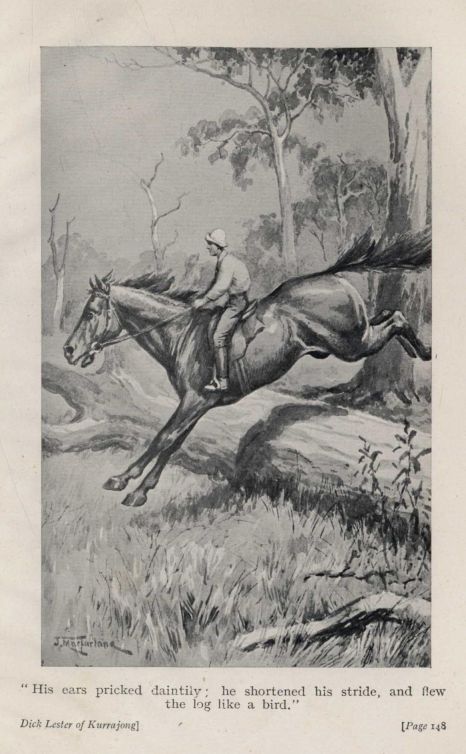
"His ears pricked daintily; he shortened his stride,
and flew the log like a bird."
"Is it that one you'd be putting on old Sergeant,
now?" he demanded. "Yerra, ye might do
worse than take him on as horsebreaker!"
"I might, indeed," laughed Mr. Warner. "Oh,
Merle, aren't you easily taken in!"
But Merle had disappeared. Endurance, for her,
ended when Dick put Agility at the big log; she
turned and scurried indoors, her heart hot with
shame and disgust. She had been made to look
and feel a fool—and it was Dick Lester's fault!
Dick, who was always in her way. She hid her
burning face in her room, and did not reappear
until all the party had mounted, and her father was
shouting for her with angry impatience. It was
the final touch that she passed old Sergeant, hastily
let go, and slumberously cropping the grass; while
Mr. Downes, on a fresh horse, capered airily in the
distance beside Agility, to whose back Dick was
still glued.
Nobody bothered about Merle. Bobby was as
close as he could get to Dick, while Mr. Warner
and Mr. Lester were riding beside Mrs. Lester.
There was nothing for Merle to do but fall in behind
them, where she had the doubtful pleasure of
hearing her father tell the story of the morning, and
of his careful plans for Dick. It was Mrs. Lester
who looked round after a time and took pity on
the unhappy face, checking her mare that she
might ride beside her. The charm of her voice
chased away some of Merle's ill-humour; but the
sting of the morning remained.
They passed a number of young blacks from the
tribe, coming in after a night's hunting, laden with
game—wallaby, 'possum, bandicoot and gerboa, all
speared or killed with the throwing stick. One man
had got three or four bright-coloured parrots with
his boomerang, as well as a beautiful black cockatoo.
Mr. Warner stopped to talk to them, complimenting
them on their good luck, and one opened a skin
bag and showed him other prizes in the shape of a
fat, stumpy-tailed lizard, a young iguana,
and—greatest delicacy of all—half a dozen of the big
tree grubs that the black will go far out of his
way to secure.
"People say they're quite good—but I don't feel
like experimenting on them," remarked Mrs. Lester,
wrinkling her pretty nose as she looked at the
plump insects.
"I've been very glad to eat them when I ran
short of tucker in the bush," Mr. Warner said.
"They're really good, too—if you grill them they're
very like chicken. But I'll admit that their
appearance is against them."
The blacks were in a hurry to get back to camp;
it was long since they had brought with them such
promise of solid feasting. They said good-bye, and
set off with their long, noiseless stride—ball of the
foot down first and then the heel, as is the way of
natives nearly all the world over.
"Those fellows could go through the bush, with
dead leaves and bark and dry sticks lying all over
the place, and you'd never hear them," Mr. Warner
said. "I've watched 'em sometimes stalking musk
duck in the lagoons. They tie a bundle of rushes
over their heads and faces, and wade neck-deep
in the water, zig-zagging here and there, perhaps
taking half an hour to cover fifty yards. Sometimes
they get near enough to grab the ducks under
water. Sometimes they have to straighten up in
a hurry and get them with the throwing stick.
But it's mighty seldom they fail to get them."
"Do they supply you with game?" Mr. Lester
asked.
"Yes, to a great extent. We can nearly always
depend on them for certain things—fish, wild geese,
and duck and teal and quail. Of course there
are a good many of their delicacies that we don't
touch—and we had some difficulty in persuading
them that we really prefer game fresh! Payment
is in goods or baccy, and they soon become pretty
shrewd at driving a bargain. We've had to adopt
a regular tariff for ordinary things."
"They are good-looking fellows, as aborigines
go," remarked Mr. Lester.
"Yes, far before the eastern tribes. They're
taller and stronger, and their standard of intelligence
is higher. Many of the piccaninnies are quite
pretty little chaps—you saw them yesterday. Of
course they all become abominably ugly as they
grow old. Their features spread and thicken until
they are positively repulsive. I don't believe
there's any human being less attractive than an
ancient Australian black gin!"
Ahead, Dick and young Downes were galloping,
picking out a natural steeplechase course over fallen
tree trunks, while Bobby followed as best he could
on his pony, delighted when he could make him
hop over smaller obstacles. Merle looked at them
enviously. She knew her pony, Olaf, could jump
anything in the paddock, and yet she was out of
it, condemned by her own ill-temper to ride sedately
with the elders. Her father glanced down at her
curiously.
"What's up, Merle? Why don't you join in?"
"Don't want to, thanks," Merle muttered.
"Well, you are turning into an old woman,"
he said contemptuously.
Merle flushed and said nothing.
"I believe I'm not too old to jump," said
Mrs. Lester. "Those logs are very tempting. Can
Delight manage them, Mr. Warner?"
"She'll jump whatever you ask her to," he said.
"If you'd really like a few jumps, Mrs. Lester,
we'll give you a lead."
"Then come on, Merle, and we'll show them
we're not the inferior sex," laughed Mrs. Lester.
"I can't let Dick get superior!"
The two big horses thundered off ahead, and
close behind them came Olaf and Delight, each
capering with joy at the sudden gallop. In and
out they went among the trees, finding natural
jumps everywhere and an occasional clear space
where they could put on speed. The noise of the
hoofs came to Dick and the other boys as they
circled round the great paddock, so wide that the
fences were out of sight. Dick shouted with joy,
and bore across until he was riding abreast of his
mother, yelling encouragement at each big log. He
was more than ever sure that nobody had ever
had a mother like her!
Merle shot ahead of them suddenly, and set to
work to overhaul her father and Mr. Lester. Her
pony was a beautiful black, full of fire and breeding;
he jumped like a deer, and took his logs almost at
racing pace. Merle sat him as though she were
part of him—leaning forward a little at each leap,
and lifting him at the log with little inarticulate
words of encouragement. Gradually he lessened
the distance between him and the great horses in
front, making up by quickness in jumping more
than the handicap of his shorter stride. He forged
ahead at last, so stealthily that they did not realise
they were being left behind, and then Merle sat
down to ride him in earnest, and soon was far in
the lead.
Agility put an end to the steeplechase by bolting.
His feelings became too much for him altogether,
and he suddenly swerved from a log, and dashed
through the timber at such a pace that Dick was
only saved from overhanging boughs by lying flat
on his neck—in which position he could do little
to check him. The others pulled up, in some
anxiety, to watch him. He emerged from the
trees safely, and shot across the tussocky plain
beyond, where Dick at length got him in hand, and
he returned more sedately, except for an occasional
irrepressible caper. On the way they overtook
Merle, walking Olaf back to the other horses.
"My word, that pony's a beauty!" said Dick,
looking at Olaf with open respect. "And I say,
you can ride!"
The black dog that had sat so long on Merle's
shoulders was gone for the moment—routed by the
joy of the gallop. She gave the boy something
like a smile.
"He's a darling, isn't he?" she said, patting
Olaf's arching neck. "He can beat any horse on
the place at jumping—you ask dad if he can't."
"Well, I guess I've seen for myself this morning,"
Dick answered. "This chap's not too bad, either,
is he? He can't beat your pony, though." He
grinned. "Didn't we have a ripping go! I'm
jolly glad I wasn't on old Sergeant."
The brightness suddenly faded from Merle's face.
Her eyes dropped before Dick's merry ones. To her
own amazement, a lump came in her throat.
"I say, what's up?" blurted Dick.
She managed to meet his eyes with a great effort.
"It was my fault," she said, speaking very low.
"I mean, I worked to get you put on Sergeant.
I told dad you couldn't ride."
"Well, I'm blessed!" said Dick, in utter
astonishment—too amazed to be indignant. "But why?"
"I don't know." She flushed hotly. "Oh,
because I'm a pig, I suppose. I'm sorry."
It would have taken more than Dick's easy-going
nature could assume to be stern.
"Well, it doesn't matter, anyhow," he said.
"You only made a mistake."
"No. I didn't make a mistake," Merle said
shrilly. "I knew you could ride all right. I—I
told you I was a pig!" A large tear rolled down
her cheek, to her intense shame. She felt for a
handkerchief, and, finding none, rubbed her cheek
on Olaf's mane.
Dick pondered the situation gravely.
"I guess, if you're a pig, it hurts yourself more
than anyone else," he said at length. "I say,
why don't you knock off being one and be pals?
I'll help."
At the moment he forgot altogether that he had
no real desire to be "pals" with her at all. But
no boy could help being rather sorry for this small,
incomprehensible person, with the miserable face.
And there was no doubt she could ride!
Merle swallowed twice before she could command
her voice. Then she merely managed to mumble
"All right"—and immediately found her hand
shaken in a manly fashion.
"Well, I guess we'd better canter," said Dick,
thankfully putting an end to the situation. "Those
other people are getting too far ahead." They
cemented their bargain in the way most
acceptable to both of them, by a quick sprint
across the plain, to join the main body of the
expedition.
The paddocks immediately surrounding the homestead
were comparatively clear, except for belts of
timber left standing for shelter for the cattle. The
soil was good, and long ago, when the ground had
been cleared and burnt off, English grasses had
been sown, making a firm sward. But as the riders
went further, the country gradually assumed more
and more of a bush aspect, and the good soil changed.
They passed over stony ridges, with red rock
outcropping from the short, sparse grass and ironstone
rubble that necessitated careful riding. The trees
grew smaller in character; there were patches of
mulga, tall whip-trees with slender tops curving
beneath their load of little green flowers like berries;
banksias covered with honey-laden blossoms and
all a-flutter with the wings of honey-eaters, whose
long, curved beaks plunged deep into the sticky
flowers. Everywhere there were flowers. They
passed swampy patches, full of the fragrance of
wild boronia, and murmurous with the hum of
innumerable wild bees; near at hand, ti-tree, with
flowers of many colours—some scarlet, some pink,
and some of tender green and white. There were
curious plants with leaves apparently made of
flannel, and others bearing blossoms like balls of
red and blue down. Later, Mr. Warner said, the
plains would blaze with a dozen kinds of
everlastings, the crimson seeds of the native hop would
vie with the trailing black and scarlet of Sturt's
desert pea, and the cottonwool berries, with their
white eye would be everywhere. Rose-coloured
mesembryanthemums would trail a gorgeous blanket
over the loose granite on the stony ridges—"beastly
stuff it is to slip on when you're galloping after
kangaroo," added the squatter, with a callous
disregard of beauty.
There were birds in every belt of timber;
parrakeets, their brilliant colours flashing in the
sun as they went screaming overhead; parrots,
more brilliant still; cockatoos, black and white, and
a host of tiny feathered people, twittering among
the blossoms that garlanded the bare earth. Now
and then a curlew stepped daintily away, out of
sight like a grey shadow, but sure to be ceaselessly
watching the intruders from its hiding place.
Wild turkeys passed overhead, in swift flight, or
black swans, spread fan-like in the sky, the leader
ahead, winging their way to some distant lagoon.
They saw a group of emu out on a plain—the great
birds made off at their approach, their heavy feet
sounding almost like a horse's hoofs on the hard
ground.
It was after midday when they came in sight of
Gaffney's Lagoon, a broad stretch of water named
after a stockman who had been attacked by blacks
while camping near the shore.
"A good man, Gaffney," said Mr. Warner;
"one of the best hands I ever had. He was looking
for some lost cattle, and the blacks got round him
quietly one night. Poor old Gaffney—he must
have put up a good fight, for they didn't get him
until he had used up all his ammunition. He had
been in Canada, in the North-West Mounted
Police, and he could shoot quicker than any man
I ever saw."
"They killed him?" asked Dick, wide-eyed.
"Oh, yes, poor old chap. There were nearly
twenty spears in him. But there were dead
blacks all round him—he had a good escort to
the next world. I don't think he'd missed a
single shot."
"A pity to lose a man like that," said Mr. Lester.
"Yes, it was bad luck, though it was the sort
of finish he had always hoped to get. I used to
have great yarns with Gaffney, and the one end
he didn't want was to die in his bed. That
fellow Stevenson would have appealed to him, with
his 'Under the wide and starry sky.' And he did
good, even in his death, for his last fight gave the
blacks such a wholesome dread of the white man's
capabilities that they sheered off for a long time.
That was fifteen years ago, and I don't think they
ever came so close in again." Mr. Warner pointed
ahead with his whip. "Do you see our camp fire,
Mr. Lester?"
A trail of blue smoke was lazily rising under some
trees near the head of the lagoon. Near it was a
cart, with a couple of donkeys hobbled close by,
and across the rough grass came a light buggy,
drawn by a fine pair of browns.
"The missus is just on time," said Mr. Warner.
"Let's get there to welcome her."
They put their horses to a canter, and arrived
at the camp fire just before the buggy came up,
Mrs. Warner driving herself, while the twinses,
spotless in white, were with difficulty restrained by
nanna, whose smile was like a streak of ivory across
an ebony surface, as she clung to each wriggling
small body.
"The sight of you has a most demoralising effect
on them," said Mrs. Warner to her husband,
laughing. "They have been quite good until they saw
you, and since then nanna has her hands full. Be
quiet, twinses, and sit still!" It was noticeable
that nobody ever thought or spoke of the Warner
babies either singly or by name; being inseparable
both in companionship and wickedness, it was not
necessary to allude to them as anything but "the
twinses." Dick had an idea that they were boy
and girl, but as they were always dressed alike, and
resembled each other so closely that he was quite
unable to tell one from the other, even that was
uncertain.
Mr. Warner lifted his restless infants out of the
buggy, holding them tightly until nanna was on
the ground, and able to resume at least partial
control.
"There—keep away from the horses' heels," he
said. "Go over and see what old Harry is
cooking." The twinses fled tumultuously.
"Harry's an old soldier," Mr. Warner told Mrs. Lester,
"and, like most old soldiers, the handiest
man on the place. He has a wooden leg, which was
interfering very badly with his career as a swagman,
when I found him ten years ago; but it never
affects his usefulness now. There's nothing he can't
or won't tackle, but his particular accomplishment
is camp cooking, so I sent him out to fix up lunch
for us to-day."
They gave the old man full credit as a cook
presently, when they ate the wild turkey, roasted
in the ashes, in a jacket of clay, which he had
prepared. There were potatoes, also roasted in
their jackets, to be followed by flapjacks of
surpassing lightness.
"Do you always have banquets like this when
you come out on the run?" demanded Mr. Lester.
"I'm accustomed to a packet of sandwiches and
creek water!"
"My lunches vary," said Mr. Warner, laughing.
"They range from turkey, like to-day—but you'll
admit this is a special occasion—-to yams and
grubs, and I've been more thankful for the yams
than for the turkey! You see, you're exceedingly
hungry before you take to black fellows' tucker,
and when you're really hungry you're glad to get
anything."
After lunch they went to compliment old Harry,
a courtesy he received unmoved, standing stiffly
to attention, but inwardly very proud. Then they
explored the shores of the lagoon, when the twinses
created a diversion by falling into a pool, in an
effort to catch fish which were not there.
Mrs. Lester marvelled at the calmness with which
Mrs. Warner received her soaked offsprings from the
rescuers.
"You might as well wash the mud off them while
they're wet, nanna," she told the black nurse,
who was agitatedly proclaiming her opinion that
"that two-pfeller Mas' Twinses bad babies."
"But, good gracious! how will you manage?"
ejaculated Mrs. Lester. "They'll catch their deaths
of cold! You must be five miles from home."
Mrs. Warner had risen leisurely.
"Oh, but we know the twinses," she said, laughing.
"Their amazing capacity for getting into
trouble developed before they could crawl; we
never come out without a complete change of
clothing for each. If there is fire, or water, or
mud—preferably mud—the twinses will get into it.
I'll go over to the buggy and help nanna."
"Let me come, too," said Mrs. Lester, jumping up.
That refitting the twinses was no new thing was
amply demonstrated by their mother. A clump
of bushes, reinforced by the buggy rug as an
additional windbreak, formed a dressing-room;
from under the seat of the buggy appeared a flat
basket with fresh raiment. Nanna appeared
presently with her charges, and they were stripped
and rubbed down—creating a diversion by contriving
to elude even the vigilance of their mother,
and, all unclad, making a dash for liberty. The
mothers pursued the gleaming little white bodies and
brought them back, wriggling and protesting, to be
clothed anew.
"You can't have many dull moments," said
Mrs. Lester, hugging a twin.
"I haven't," said Mrs. Warner, dryly. "But
then, I never had before they came, so really it
doesn't matter much. When you have fifteen or
twenty grown-up black babies under you, a couple
of small white ones really don't signify!"
The twinses, restored to dry clothes, proved
unexpectedly docile, and consented to be taken by
nanna to visit an enormous anthill, towering in the
distance, a column of dried mud. The elders
explored the lagoon and gathered wild flowers, until
there seemed some doubt as to whether there would
be any room in the buggy for its passengers.
Old Harry presently produced tea, with old-time
damper, perfectly baked. They gathered near
the camp fire again, and back across the paddock,
scenting the banquet, came nanna and the
twinses.
Merle came up to Dick just as they were preparing
to go home.
"I say," she said, speaking with an effort, "you
can ride Olaf home if you like."
"Thanks awfully," Dick returned in astonishment.
"But I'm all right on Agility—and I know
you like Olaf better than anything."
She hesitated, flushing.
"I'd like you to try him." Suddenly it came to
Dick that it would hurt her to be refused.
"All right, it's jolly good of you," he said
awkwardly. "Come on, and I'll change the
saddles."
Merle helped at that, slipping her saddle off her
own pony, and bestowing upon him a surreptitious
little pat. No one but herself ever rode him; she
knew every inch of him, even, she herself believed,
to his thoughts. Nothing would have made Merle
agree that horses did not think. She wondered,
rather miserably now, what his views were on being
handed over to a stranger.
"I've got to," she whispered to him, "for being
a pig!"
Dick did not understand anything of this;
boy-like, he rather fancied that Merle was offering
him her pony to show off his perfections. It would
have interested him more to ride Agility; but,
being as good-natured as he was dense in these fine
matters, he got up on Olaf good temperedly, and had
to admit that he was a far more finished hack than
his previous mount. Merle looked pleased at his
praise.
"He is lovely, isn't he?" she asked. "Daddy
bought him at the Perth show; he's won lots of
prizes. He and I are awful good mates."
"I'm sure you are," Dick said. "Jolly good of
you to let me ride him."
Across the grass Mr. Warner had suddenly gaped
in astonishment.
"Well, I'm blessed!" he ejaculated to his
wife. "I believe Merle is repenting in style; she's
actually put Dick on Olaf. That's in amends for
the ride he might have had on old Sergeant, I
suppose!"
"Making amends isn't much in Merle's line,"
said Merle's mother.
"No, so I suppose we should be thankful for
any sign of grace. At least, they seem happy
enough now—look at them!"
Two small figures on galloping horses dipped
down into a grassy hollow, flashed up again on
the further side, made for a big log ahead, flew it
together, and fled on again across the plain at full
speed.
"That's all right," said Mrs. Warner, comfortably.
"They can't possibly be bad friends now."
"No. But isn't it characteristic of Merle that
although even the fact that he'd saved Bobby's
life didn't make her treat him decently, she's
reduced to penitence and friendliness by nearly
giving him a ride on a bad horse!"
A week went by, and the Lesters found
themselves dropping so completely into the life
of the western station that it might almost
have seemed to be their own home. They applied
insistently for work, and got it; Dick and his
father were constantly out on the run with
Mr. Warner and his men, while Mrs. Lester lent a
willing hand within the house, plying a busy needle
at Mrs. Warner's perennially overflowing mending
basket, and, by way of recreation, embroidering
linen smocks for the twinses.
"They'd be happier in sugar bags!" said their
father, looking at the dainty garments.
"But I wouldn't get any fun out of sugar bags,"
protested Mrs. Lester. "It's mere selfishness!"
The twinses adored her, and constantly impeded
her work by climbing over her and piling themselves
upon her; at which times the matter would generally
end by the disappearance of all three into the
garden, where, under a big tree, she would tell
them stories of fairies and leprechauns until their
big eyes grew round with delight. Merle often
formed a third listener. She and Mrs. Lester had
become great friends, albeit the friendship on Merle's
side was a silent one. Speech was never easy to
her; her father was the one person to whom she
could talk without constraint; and yet he knew
less of her heart than did this woman who had
known her but a few weeks.
"I'm really sorry for her," Mrs. Lester said to
her husband. "She's just like a chestnut burr;
quite sound inside that hard, prickly exterior. It's
very bad luck to be born with a shell like that!" So
she was unceasing in her efforts to be friends
with Merle, and had the satisfaction of seeing the
prickles visibly decrease.
As for Dick, nothing troubled him. He bathed
at daybreak each morning in the lake with the
jackeroos, and added to his learning in the matter
of fancy diving, for the Perth boy was a swimmer of
note. With them, too, he rode and shot and
fished and played tennis, since Mr. Warner gave
them a few slack days after their time in camp—"to
put on condition," said he. In the long blue
days there were expeditions to the out stations,
mustering of the cattle, marking and branding
clean skins, picnics in the scrub and by the lagoons,
and motor runs wherever the roads would allow
the big car to go. Dick took lessons in driving from
Mr. Warner, and, though his allegiance to horses
never wavered, was obliged to admit that there
was more in motoring when you happened to be
the man at the wheel. There were no dull moments,
largely because there were no empty ones; no
day was half long enough for all that he wanted to
pack into it.
The jackeroos took kindly to the new-comer;
he was "only a kid, but a decent kid," Downes
said; and he brought a breath of the outer world,
with his cheery stories of life at school. He was
keen to learn, too, and enjoyed everything so
intensely that it was rather fun to have him with
them. So they made him one of them, both in the
work and play of the long clear days, and in the
star-lit nights when they fished in the lagoon, or
went 'possum hunting in the belt of scrub that
fringed the creek, or came back from a visit to
another station, racing through the long grass with
all the nameless thrill and leap of the blood that
catches alike horses and riders in a night gallop.
Afterwards, when galloping days are over, it is the
night rides that come back to us most clearly;
memories of scented darkness, with only the clear
stars overhead; memories of the moonlight, when
the ring-barked gums stood ghost-like, throwing
long shadows across the track—shadows over which
the racing horses plunged, half-shying, too excited
to be more than half afraid. They come back to
us, and with them come the sounds of the night:
the long howl of a dingo in the ranges, a mopoke's
weird cry, or a fox's bark; mingled with the tinkle
of a bell on a working bullock, grazing fitfully, the
creak of saddle leather and the jingle of bit and
stirrup-iron; and over all the hot scents of the
dew-wet bush. Dick Lester, being a very ordinary
boy, did not talk of these things; did not even
frame them into thoughts. But a night ride left
him glowing, in mind and body; so that his mother,
seeing his shining eyes, understood. The child in
Dick was fast giving way to the manhood stirring
in him; and Mrs. Lester—bring an ordinary
mother—found herself looking ahead, proud and yet
regretful, clinging to her baby, and yet eager for
all that she hoped for him.
Dick came in one night with the jackeroos to
find the elders discussing plans.
"We're going to be civilised to-morrow,"
Mr. Warner told him. "That is, we're going to put
on our best clothes and take the car and go calling—the
Harrisons at Mernda have asked us all over.
Means starting at eleven and not home until dark."
"Oh," said Dick, his face falling involuntarily
Calls—in best clothes—did not appeal to him;
always they seemed to him waste of time, and here
in the free western life, with so many new things to
do daily, to go calling was little short of sacrilege.
Moreover, the ration cart, escorted by the jackeroos,
was to go to the out-stations next day, and he had
hoped to accompany it. Good manners came to his
aid—but his "That will be jolly!" was like flat
sodawater.
Mr. Warner laughed.
"Yes, you look as if you thought so!" he said, at
which Dick reddened, grinning. "Well, we meant
to give you your choice, old man; there's room for
you in the car, if you're hankering after society,
but if you have such queer taste as to want to
stay and take rations out to old Bill Summers, I've
no doubt Downes and Stephens and M'Leod will
be glad of your company."
"Oh truly?" Dick brightened visibly. "I'd
rather stay, if you don't mind."
"I suspected as much," Mr. Warner said, turning
to Mrs. Lester. "No use to offer him flesh-pots;
old Agility and a job on the run have them beaten
every time! All right, then, Dick; you four can
get away early. Send your tucker by the cart,
Downes, and you can pick it up in time to lunch
at the Ten-Mile."
"I don't fancy we need take any, sir," Downes
said, smiling. "Last time we were out with Dick,
old Bill made us promise we'd have dinner with
him next visit; and Billy Fox was in from his
camp three days ago, so we sent him word we'd
be there on Thursday."
"Oh, that's all right," said the squatter. "You
won't miss the flesh-pots so much after all, Dick,
for Bill is safe to have got a wild turkey."
Dick laughed. Damper and corned beef were to
him better than any feast which had to be eaten
in "best clothes," and inside four walls; it puzzled
him to imagine why people should drive south in a
cushioned motor-car when they could mount good
horses and ride north over the saltbush plains and
into the forests of whispering gums. However, it
was merciful that no such sacrifice was expected of
him. He had been once to the Ten-Mile, and had
instantly made friends with old Bill Summers, who,
having watched him helping to bring in an unruly
bullock, had decided that there was something
useful in "the Melbourne kid," and had shown his
favour by spinning him long yarns of the bush. It
would have troubled Dick to be unable to fulfil his
promise to go to see him again.
Later, Mr. Warner talked to the jackeroos in
the office.
"Fox reported that the scare had died away;
I don't think it ever existed, except in old Bill's
imagination," he said. "Still, there's never any
harm in being on the safe side, and, though a
revolver is a nuisance to carry, it's better to be
sorry you have one than sorry you haven't. So
you'll each take one; you needn't say anything
about it to Dick. Not that he's at all likely to be
scared, but he'd probably want to carry one himself,
and then the scare would be on my side!"
"I don't think he'd do any harm with it,"
Macleod said. "We've been teaching him to use one."
"I daresay not—still, he's only a kid, and kids
and guns are best apart, especially on a horse that
may buck. Tell Bill he can come in with the cart
for a couple of days if he likes; a spell at the
homestead won't hurt him, and I want to talk to him
about his cattle." He went on with other directions,
concise and curt, and the lads nodded comprehendingly.
Dawn found them in the lagoon; an alarum
clock near Macleod's bed had shrilled its clamorous
summons ten minutes before, and he had dragged
the others out, awakening them by the simple
process of first hauling them, bed clothes and all,
to the floor, and then dividing the contents of the
water jug impartially between them. He fled,
pausing on his way to collect Dick; and the drenched
and injured Downes and Stephens pursued them,
and took their revenge by ducking Macleod very
thoroughly in a muddy corner near the bank, so
that it took him some time to get clean. They
they dived and swam, and skylarked like four
healthy young porpoises, getting back to the
homestead with gigantic appetites for the gigantic
breakfast which Mrs. Macleay had ready for them.
It was quickly disposed of, and they clattered down
the verandah and out to the stable yard. As they
passed Mrs. Lester's window she called Dick softly.
He went in to her room. She was in a dressing-gown,
looking very little and sweet.
"I just wanted to say good morning to you,
Dickie," she said. Her eyes dwelt on him
restfully—tall and bronzed and eager-eyed, in his soft
shirt, breeches and leggings. "Take care of
yourself, old man."
"Rather," Dick answered. "You, too, mummie.
Have a good day."
"Oh, yes." She kissed him, her hand lingering
wistfully on his arm—she could feel the hard
muscles under the shirt sleeve. "I'd rather be
going with you, Dick."
"Then why ever don't you come?" Dick
ejaculated.
"Because it wouldn't be manners," she said, and
laughed. "Never mind, I'll hear all about your
adventures to-night." She kissed him again
suddenly. "Now go on; you mustn't keep the
others waiting." From her window she watched
him racing across to the stables. Presently they
all came out, and went down the paddock helter-skelter,
Agility reefing and plunging in the lead.
She watched them until the trees swallowed them up.
Early as they were the ration cart had been
earlier still. Drawn by two stout mules, and driven
by old Harry, it had set out more than an hour
before, for it had to visit a number of camps and
huts, and the tracks between them were rough and
sandy. And, whatever may happen, the ration cart
must not fail. To the men in the lonely huts on
the out stations it is the one link with civilisation,
and the food it brings does not count so much in
their longing for its monthly visit as its cargo of
mental "tucker"—news, letters, papers, the sound
of a fresh voice, the chance of a little new
companionship for men who have lived together so long
that there is often little between them but silence.
"I don't know how these fellows stick it," said
Downes, as they rode along. "Most of 'em come
in to the homestead about once in three months;
between those times all they see is the ration cart
once a month, and an occasional visit from the
boss or some of us. You'd want to be awfully keen
on your mate to be able to live with another fellow
like that."
"Do they ever fight?" queried Dick.
"Oh, sometimes. Not often, though. Of course
there are plenty of stories of fellows who have gone
off their heads and murdered their mate, but we
haven't had them going in for those capers on this
station. Now and then a man comes in and asks
for his cheque—says he can't stand Bill or Jim, or
whoever he is, any more. Then the boss has to
hustle to get Bill or Jim another mate."
"Like the old story of two mates who couldn't
agree about the bird," said Stephen.
"What's that?" asked Dick.
"Oh, it's a chestnut. They were going back to
their hut one night and one man said, 'There's a
magpie up in that tree.' The other chap said
nothing till a long while after, and then he said,
'That wasn't a magpie—it was a crow.' The first
man didn't answer; but next morning his mate
saw him rolling up his swag. He said, 'Where y'
goin' Bill?' The other fellow slung his swag up
on his shoulder. 'Too much bloomin' argument
about this camp,' he said—and went."
The boys laughed.
"Well, if you once began to argue, I guess you'd
go mad," observed Downes. "Most of 'em know
that, and they hold their tongues rather than start
any subject that may lead to a quarrel."
"There's one old man at the Three Crows. Well,
who prefers to live alone—won't have a mate,"
Stephens told Dick. "He says it's better to be a
hatter than to have the wrong man with him and
that he doesn't believe the right one exists. So he
goes on being a hatter, and he seems to like it all
right."
"He writes poetry in his spare time," said
Macleod with a grin. "I camped in his hut one
night and he showed me stacks of it. Awful rum
stuff. There was one poem that I thought was to
his girl. It began:
"Ader, she can't be licked by much,
And I have often told her such,
She has the neatest little head,
From horns to hoofs she is clean bred!"
at which point I recognised that Ada was a cow!"
There was a howl from the boys.
"I believe you made it up yourself," Downes
accused him. "It sounds like the drivel you'd
write!" Which led to retaliation on the part of the
injured Macleod, and they wrestled until their
horses ended the matter by going off in opposite
directions—the combatants, refusing to separate,
being left on the ground still wrestling. The horses
were restored by Dick and Stephens, weak with
laughter, and they resumed progress.
They crossed a belt of timber fringing a creek
that in summer dwindled to a few muddy waterholes,
and struck across a sandy plain, where saltbush
and spinifex grew among outcrops of ironstone.
The grass was harsh and scanty, and the
breeze brought with it loose particles of sand.
"Glad we haven't much of this country," Macleod
said. "And it gets worse the further you go in
this direction—no water, except native wells, and
you can't always rely on them; and no grass
except dry sticks."
"Can stock live on it at all?" Dick asked.
"They'll eat the salt bush sometimes—in a bad
year. But it isn't a white man's country, this sort
of stuff, unless you can get gold out of it. I think
it must have been intended for that," Macleod
said. "Further out in the desert they used to
say that at the Creation that part must have been
meant for the bottom of the sea, only the sea
wouldn't lob there!"
"My father used to prospect in that country,"
said Stephens, the Perth boy. "He never found
any gold worth picking up, and then he struck two
dry wells and 'did a perish,' and he wouldn't have
got back alive if some other prospectors hadn't
found him. He says that where the early miners
used to camp for any time they used to cut a spiral
ringbark in the big trees, from as high as they
could reach to the ground. Then, if it rained—not
that it often did—the water running down the tree
would get caught in this spiral cut, and flow down
the tree to the ground. They nailed a bit of tin
there to lead it into a bucket."
"Seems a complicated way of getting a drink,"
remarked Downes.
"The only other way was to condense—and
condensed water wasn't up to much," Stephens
answered. "I guess those old prospectors earned
all the gold they got."
"Any gold on this place?" asked Dick.
Stephens shook his head.
"They've hunted for it, of course," he said.
"Where haven't they hunted for it in Western
Australia? This little old State is dotted all over
with poppet-heads and mullock-heaps like plums
in a pudding. Mr. Warner reckons if you could go
down deep enough you'd get gold; but there'll
never be the water available for deep mining."
Near the boundary of Narrung they came upon
a frowsy camp, where half a dozen Afghans were
cutting timber for the mines. They were eating
as the boys rode up, and their greeting was not
over-cordial; swarthy, hook-nosed fellows in dirty
clothes that were a mixture of East and West.
Two or three half-starved dogs flew out to yelp at
the horses.
"Wouldn't have them on the place, if it was
my say," remarked Stephens. "Dirty, lazy brutes,
and look at their poor wretches of starved camels.
They haven't had a decent feed for a month. I told
the boss they'd start a lively fire on the run some
day, but he reckons they can't do any harm in this
sandy corner. Well, I wouldn't trust 'em." He
rode on, muttering, and shaking an anxious young
head.
They had reached the eastern boundary line;
a fence had to be mended half a mile beyond the
Afghan camp, and when it was finished, they turned
north, riding fast until they came to more fertile
country. They passed the hut where lived Macleod's
poetical "hatter," pausing for five minutes' chat
with the old man, who was seated on a stump
outside his door under a big belar, devouring papers
left him by the ration cart; and then on, across a
wide, grassy plain, until they came into the belt of
timber that extended beyond the out-station,
where Bill Summers and his mate spent their
lonely existence. The wheels of the ration cart
had left a recent mark upon the grass.
"Harry must have hurried a bit," said Downes.
"Of course he goes straight from point to point,
and we go round all the corners—still, he must
have made his mules travel. He's going to have
dinner with old Bill, too; it's a great day for Bill.
He'll be awfully sick if he hasn't managed to get
a turkey and has to give us salt horse."
"Much we care!" said Stephens.
"No, but he does. Bill's what my mother calls
'house-proud,' and he's also jealous of Harry's
cooking. He's a great old chap!" said Downes,
enthusiastically.
They came into sight of the hut. The cart was
standing near it, the mules contentedly cropping
the grass; but there was no sign of any of the
men.
"Harry's inside advising Bill as to the last
stages of the turkey," laughed Stephens.
"Helping him light up his fire, I should think,"
said Downes, glancing keenly at the hut. "There's
no smoke." He looked puzzled. "Wonder if the
old chap is out after cattle—let's give him a coo-ee."
They shouted, and as there was no response
they shook their horses into a canter. The mules
looked up at them uninterestedly as they dashed
up; then they resumed feeding. Something in the
utter stillness of the place caught at the boys'
hearts and stilled their merry voices.
"Hold my horse a minute, Dick." Downes
flung his bridle across. "I'm going in."
He ran up to the hut. As he did so old Harry
limped out, with a face so ashen that the boy cried
out in alarm.
"Harry! What's wrong?"
The old man was looking at Dick.
"Don't let that kid come," he said. "Get him
home—quick. They've got Bill and Fox."
"Got them? Who? What do you mean?"
"The blacks. They're there—in their
bunks—speared."
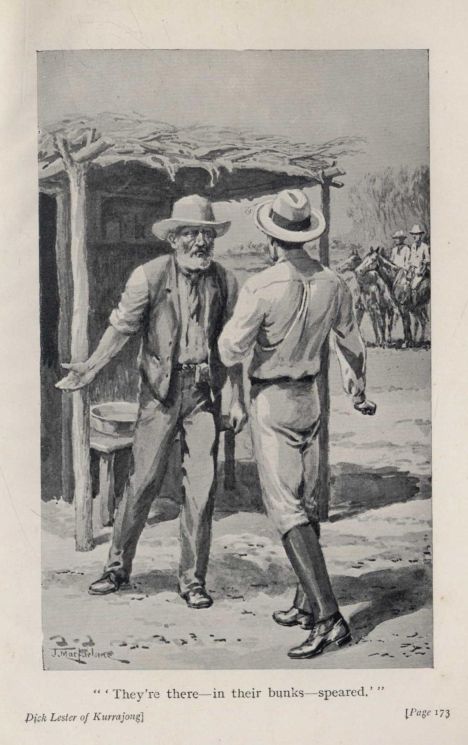
"'They're there in their bunks—speared.'"
Downes reeled back.
"Dead?"
"Yes; both dead." The old man's voice broke
in a quavering sob. "They couldn't've known,
that's the only thing—both of 'em must have bin
asleep. The brutes! the brutes! the brutes!
Poor old Bill Summers, that never hurt man,
woman or child in his life! My God, if I could get
my hands on them!"
The other boys were round them now, leaving
Dick with the four horses. They stared at each
other, white-faced; and Stephens looked into the
hut, to stagger back, hiding his eyes.
"They couldn't've suffered," Harry repeated.
"That's the only thing. But it's hard on old
Bill, to go out without a chance to hit back. And
Fox, too—a decent young chap as ever stepped.
Got an old mother, and a girl in Geraldton."
"What are we to do?" Downes gasped.
"Get the kid there home, and warn the other
out stations. For all we know they're in the timber
here now; not that they're likely to attack five
or six men together and in daylight. I must take
the—the bodies in in the cart. One of you must
help me—you're the eldest, Mr. Downes, you'd
better stay—and then you'll have to ride with me;
'cause I can't keep a lookout from the cart, and we
must go round by the Five Mile and warn 'em
there. Mr. Stephens can go to the eastern stations—not
likely to be trouble there, but they must get
in their cattle. Mr. Macleod can take the little
chap home and warn the other huts on his way.
Mr. Warner must hear as quick as you can get
home to tell him, Mr. Macleod."
"He's over at Mernda," Macleod said, his voice
husky. "Won't be home until after dark."
The old soldier's keen face darkened.
"You'll have to go after him, then. The news
has got to get to Westown, and he'll do it quickest in
the car. Get a fresh horse when you go in. The
police and the black trackers'll have to come out
from Westown. Ride as hard as you can, every
one of you. And keep your eyes skinned all the
time—you don't know where the black fiends may be."
"We'd better wait on guard until you—until
you start," Macleod said. "You can't keep a
watch while you get them——" The words stuck
in the boy's throat. "They could rush you from
the trees if we left you alone."
"Yes, that's right," Harry said. "Well, take
the little chap off for a minute, Mr. Macleod—poor
lad, he doesn't know what's up, and he's
looking like a ghost—and we'll get a start."
Macleod went over and took two of the horses
from Dick, leading him off behind the hut while
he told him of the tragedy. Dick stared at him
blankly; evident as it had been to him that
something was terribly wrong it was impossible to
realise that the old man who had been kind to
him lay dead in his hut, foully murdered with his
sleeping mate.
"I don't think we've anything to be scared
about," Macleod said. "I've a revolver, and,
besides, I don't think the brutes would attack any
of us in broad daylight."
"I'm not scared," Dick said dully. "I say, do
you—do you think it—hurt them much?"
"Harry says not," said Macleod, with a gulp—he
was only a boy himself. "He says they couldn't
have known. Bill must have been very sound
asleep or they would never have got in—I don't
expect he ever woke, poor old chap."
"That's something," Dick said. His eyes blazed
suddenly. "Can't we do anything? Can't we
fight?"
"We'll raise the whole country when we get
home," Macleod answered savagely. "I only hope
the boss will let us go out with our guns, and not
wait for the police. But our job is to warn the
out stations, and then to get the news to the
boss." He wheeled round, and suddenly took off his hat.
"Here they are."
The cart came by, its pitiful burden covered with
the dead men's blankets; old Harry, tight-lipped,
driving, and the white-faced boys following.
Downes made two efforts to speak before his voice
would come.
"That's all right, Mac," he said. "Get to the
huts and home as quick as ever you can. Keep
close together, mind, while you're in the timber,
and go like smoke!"
Stephens had gone off at a hand gallop already.
Macleod nodded, and he and Dick gave their horses
their heads, taking the track through the trees
where the cart wheels had left their print on the soft
grass. They were out of sight in a moment, galloping
side by side, with keen eyes searching through
the timber on either hand. Once Dick fancied that
he saw a shadowy black form, and it was easy
enough to think he heard, above the pounding
hoofs, the whistle of a spear; but the moment
passed and they were racing onward, only checking
their speed when they came to another lonely hut.
A few words, and they were off again, leaving the
amazed and infuriated men to look to their guns
and muster their cattle out of harm's way. Another
hut, and another; and then, their work half done,
they turned their horses towards home. The trees
were left behind them now, and they came out upon
the wide plain where scattered clumps of timber,
easy to dodge in their gallop, gave shade to the
lazy bullocks.
"We can get a move on now!" Macleod said,
between his teeth. "And every minute we save
means more chance of catching those fiends!"
They leaned forward in their saddles to ease the
horses, and urged them to racing speed. Mile after
mile, trees flashing by them, cattle lumbering,
affrighted, out of their way, with no word between
them, and only the dull thud of the hoofs to break
the silence. Not until they reached the gate of the
paddock near the homestead did they draw rein.
Macleod, leaning across his horse's dripping neck to
open it, glanced at Dick.
"Tired?" he asked. "You've had nothing to
eat, poor kid."
"I'm not tired," Dick said; "and I feel as if
I never wanted to eat again."
"Same here!" Macleod nodded. "But it isn't
sense. We'll have to get something at the house.
No use in cracking up just when we're wanted."
They were galloping again, across the last stretch
of grass. Suddenly Agility faltered in his stride
and half pulled up, limping heavily. Dick was off
in a flash.
"He's picked up something," he cried. "Don't
wait; I'll lead him in."
Macleod had checked his horse, but at the words
he shook his bridle and shot forward. Dick patted
Agility's neck, and lifted his forefoot. He whistled
softly.
"You poor old beggar!" he said. A scrap of
barbed wire was embedded in the frog by two cruel
teeth. The horse flinched from the touch. Dick
soothed him a moment, and then, with a quick
movement, drew out the torturing steel, dodging
back as Agility plunged wildly.
"There!" he said. "All over, old chap. Now
come and get doctored."
He led him slowly across the grass, Agility on
three legs. Near the gate O'Mara, wide-eyed with
horror from Macleod's story, met him.
"Barbed wire, is it? I dunno why they have
the misfortunate stuff on anny decent place," he
said, taking the horse's foot up to examine it.
"H'm—'twill be a while before he gets that to the
ground. Could ye bathe him now, Master Dick?
I'd do it meself, only I must drive Mr. Macleod to
Mernda; the browns are ready in the stable, an'
'twill be quicker than riding. And there's not
another man about the place; they're all out at
some job or other. Sure I'm only in meself ten
minutes, and that's why the browns are handy; I
drove Mr. Macleay over to Andrews's for the day."
"I'll bathe him, of course," Dick said, taking
Agility's bridle. "Don't you worry about him."
"I'd have worried ten minutes ago, but it don't
seem to matter much now," the old groom said.
"Poor old Bill Summers! Well, I hope them
murdherin' fiends will find it the worst day's work
ever they did. Masther Dick, will ye keep a lookout,
an' the first man that comes in, send him over
to Andrews's for Mr. Macleay—he'd betther be
home. There'll be guns and cartridges wanting
out of the store."
"All right," Dick nodded. "Better let me help
you put the browns in."
The light buggy was still in the yard, and the
horses harnessed. They put them back, and O'Mara
drove out just as Macleod came running over.
"Good man!" he said, swinging himself up.
"You all right, Dick? Mind you get something to
eat. Let 'em go, O'Mara!" The buggy dashed
away down the hill, the browns resenting the
unaccustomed touch of the whip.
Dick bathed Agility and rubbed him down,
finally putting him into loose box and giving him a
feed. He glanced into the other boxes; they were
empty, until he came to the last one, where
Conqueror's iron-grey head poked over the half-door.
Dick patted the long nose as he passed.
"You'd better take a rest while you can," he
said. "I guess you'll be wanted pretty
soon." But just how soon he did not dream.
The day had gone slowly for Merle Warner.
From her room she had watched the boys
ride off in the early morning, sore and resentful
that she was not one of the party. It was her
favourite ride: of all the station jobs there was
none Merle loved like going out to the Ten-Mile.
Bill Summers and she were great friends; he
always expected to see her when the ration cart
went out. And just because her father was not
going, she also must remain at home, since long
rides were only permitted her under his wing.
She had begged that the rule might, for this
once, be relaxed, but her father had been adamant.
"Don't be stupid, Merle," he had said sharply,
at last. "Apart from the fact that I wouldn't let
you go without me, you might have the sense to
realise that the boys really wouldn't want you.
Boys don't want a little girl always hanging
round." Then—a little sorry for her quick flush, "You can
come with us to Mernda in the car, if you like."
"I wouldn't go a yard to Mernda!" Merle had
flashed.
"Very well, then, stay at home," Mr. Warner
had responded cheerfully. "After all, it's the best
place for you. Run off to bed, I'm busy." He had
turned to his writing-table and forgotten all about
her.
The memory did not tend to make Merle amiable
at the breakfast-table, which seemed curiously
empty without the cheery presence of the four
boys. She hurried through her breakfast, and then
retreated with a book to her nest in the big pine
tree in the garden, turning a deaf ear to occasional
calling of her name. From her hiding-place she
watched the car drive off after a while, her father
at the wheel. She did not descend until the luncheon
gong boomed out its summons; and then strolled
in, rather hoping that her absence had caused
anxiety. It was rather crushing to learn from
Mrs. Macleay that Yet On, the Chinese gardener,
had seen her climb the tree and had mentioned the
fact to the first person he had heard calling her.
Lunch, with Bobby and the twinses, had been
both dull and irritating; Bobby, who was mourning
Dick's absence, was in a provoking mood, and the
twinses insisted on emptying their soup into a vase,
and howled dismally when nanna, returning after
a short absence, checked this interesting diversion.
The pudding, too, was one Merle did not happen to
like; she refused to eat any, and, pushing her
chair impatiently away, left the table. Bobby
pursued her, presently demanding that she should
play with him; she locked herself in her room to
avoid him, declining to come out until the sound
of little voices, dying away in the distance, told
her that nanna had taken the children for their
afternoon walk.
She opened her door and strolled out upon the
verandah. It was a glorious afternoon; the sun,
shining through the trailing masses of tecoma on
the posts, was enough to charm away even bad
temper. A sudden thought came to her, and she
turned back into her room, to emerge presently
dressed for riding. Olaf was in the stable, she
knew. Why should she not take him out?
Mrs. Macleay was the only person likely to interfere
with her, and she was safely in the kitchen. Merle
ran across to the stable yard, almost cheerfully.
She called O'Mara, but received no answer; and
then remembered that she had seen him go out,
driving Mr. Macleay. Well, it did not matter. It
was easy enough to saddle Olaf without help. She
mounted and rode down towards the lake, looking
out for the children. They were playing with
nanna near the bank, and she trotted along to them.
"Where's you goin', Merle?" demanded Bobby.
"I'm going to meet the boys," Merle said. "You
can tell Mrs. Macleay, nanna, if she asks for me."
The black nurse looked uneasy.
"Boss, him be cross this pfeller if you go far,"
she protested. "Mine thinkit baal you go all by
you'se'f, Missy Merle."
"Oh, rubbish, nanna," Merle said.
"Dad'll be jolly wild wiv you—an' so'll mummy,"
said Bobby warningly.
"I don't care. I'm not going far, anyhow. The
boys'll be home soon. I'm sure to meet them in
the Middle Plain."
"Boss him say baal you go out on yarraman
(horse) 'less he go longa you," said nanna. "Mine
thinkit better you get off."
She put out a hand to the bridle. But Merle
was too quick for her; a touch of her heel, and
Olaf sprang aside. She cantered off along the
track, turning to laugh at them. Bobby's woeful
little face touched her a little.
"Never mind, old chap," she called to him.
"I'll bring Dick home, and we'll have a game."
She cantered across the first two paddocks. The
boys should be home soon now, she thought;
better fun not to meet them too near the home
stead, in the smaller paddocks, where they could
not have a good gallop. Out on the plain they
might put up a hare, and a racing spin over the
grass would be some compensation for the
disappointment of her day. Olaf was very fresh; she
gave him his head when she had shut the last gate,
and soon was far out in the open. Once she thought
she caught sight of the boys in a clump of trees,
and rode away from the track to see; but, though
she beat through the trees, thinking they were hiding
from her, she found only a big shorthorn bullock,
which lumbered off at her approach. There was
still no sign of the boys as she emerged again upon
the plain; she stared ahead fruitlessly. Had she
glanced back she might have seen two racing
figures making for the homestead: Dick and
Macleod, getting the last ounce they could out of
their horses. But it did not occur to Merle to
look back. She touched Olaf impatiently, and
again cantered forward.
The green line of the timber ahead beckoned her.
She knew well that she would never have been
allowed to enter it alone; but she was in the
reckless, defiant mood that considers it as well to
be hanged for a sheep as for a lamb. After all,
she thought, she must certainly meet the boys very
soon; every moment she paused, thinking she
heard their voices. It would be cooler to wait in
the shade, even if she only went just within the
edge of the belt of trees. But once there, she
strayed further and further in, tempted by the leafy
green alleys that she loved. Olaf loved them as
much as she; he paced along, daintily arching his
beautiful neck. The sunlight, filtering through the
gum leaves, made dappled patterns on the black
satin of his skin. Once or twice he pricked his
ears questioningly, as though listening to some
sound Merle could not hear—surely, she thought,
the boys' horses coming through the trees from the
Ten-Mile. So she went slowly on.
*****
Dick came across to the homestead from the
stables, feeling suddenly very tired. He had not
eaten since breakfast; and morning, with its early
start and the fun and laughter of the ride out,
seemed to belong to another age altogether. Then,
cruelty and murder had been things that people
talked about, without realising their existence;
now they had suddenly come close enough to be
touched, and the whole world was altered. His
heart was heavy for the old man who had been
kind to him; dead now, and without the chance
of striking a blow in his own defence. Dick's fists
clenched in helpless anger.
The great bell of the station crashed out suddenly,
in such thunderous clamour that he jumped and
then stood still. What Mr. Warner called its
"tinkle"—the daily summons to dinner—had
seemed to Dick violent enough; but this was a new
sound altogether, a resonant, brazen din that
clanged furiously, sending its strident clashing far
out across the paddocks. The squatter's words
came back to him—"It can make a very tolerable
din in the hands of an active person." Well, that
was no exaggeration—surely its wild clamour must
reach every man working out on the run.
He went across to the high stand from which
the bell hung. It was swaying back and forth in
a kind of mad dance, and below stood Mrs. Macleay,
her muscles swelling under her thin blouse as she
tugged at the rope.
"I'd nearly forgot the bell," she panted. "'Tis
two years since we had to ring it—and then 'twas
for a bush fire. Go in, laddie—there's food waiting
for ye in the dining-room, and Mr. Macleod said
ye were to eat."
Dick turned away heavily. The black girls were
gathered round, staring and chattering. At the
moment even their friendly ebony faces were
horrible to him, and he brushed past them as
quickly as he could. The food in the dining-room
seemed to choke him at first; he gulped down a
cup of strong tea, and then found it easier to swallow.
The clanging of the bell never ceased; he felt as
though it were beating inside his head, paralysing
him. And he was suddenly terribly lonely. A great
longing for companionship came over him, and he
went out again.
Mrs. Macleay had given the bell rope to a black
girl, and was speaking hurriedly to nanna, who had
run to the house with the children when the bell
began to ring. Her kind face was white.
"Think what you're saying, nanna! Miss Merle
gone out on her pony! Where?"
Bobby piped up.
"Merle's gone to meet Dick and the boys," he
said. "Out over the Miggle Plain towards the
Ten-Mile. We tole her dad would be jolly angwy,
but she would go."
"That Missy Merle bad pfeller, mine thinkit,"
said the black gin, stolidly. "Ball she let me stop
her—she kicking yarraman, all same jump away
quick."
"Bobby!" Mrs. Macleay's voice was a wail.
"Are you sure she went towards the Ten-Mile?"
Bobby nodded decidedly.
"Dead certain. She was awful cwoss 'cause dad
wouldn't let her go wiv 'em this morning. She said
she'd meet 'em comin' home." His eye fell on
Dick, and he sprang to meet him with a gay little
shout. "Oh, Dick! Didn't you meet Merle?"
Over the fair head Dick's eyes met the Scotchwoman's,
and there was dread in both.
"How long ago, Bobby?"
"Since Merle went? Oh, ages!" said Bobby
airily. "Didn't you see her?"
Dick shook his head.
Mrs. Macleay gripped his shoulder suddenly,
pulling him aside.
"Can you go after her?" Her voice was thick.
"I can't ride, and there's not a man on the place.
Is there a horse in? Mr. Macleod said yours was
lame."
"Conqueror's in the stable," Dick said. "Of
course I'll go; most likely I'll catch her up before
she gets to the timber. Anyhow, she'll never go
into the timber by herself, and no black fellow
would go near her in the open on Olaf."
"Are you fit to go, child?" The woman wrung
her hands. "You look dead beat now. But what
am I to do?"
Dick forced a laugh.
"Don't you worry; I'm all right," he said.
"Ten to one she'll have turned back and I'll
meet her coming home. I'd better scoot, hadn't
I?" Turning, he ran, pursued by an indignant
wail from Bobby.
Conqueror was fresh and impatient, and to saddle
a horse of seventeen hands is not an easy task for
a boy of thirteen, even if that horse be inclined to
stand still. Dick was struggling with him when
Mrs. Macleay appeared.
"I'll hold him," she said, briefly. She helped
to saddle the great horse, and then gave Dick an
awkward leg-up. Still holding the bridle she took
something from her pocket.
"Is this any good to you?"
It was a small automatic pistol, and Dick's
heart leaped at the sight of it.
"I can't hit a haystack," he admitted. "But
I know how to use it—we've been practising every
evening—and at least I can fire it off. Is it loaded?"
She nodded.
"Yes—but I can't find any more cartridges."
"Well, I mightn't need even these, but I'd better
take it," Dick said. He slipped it into his pocket.
"Can you open the gate, Mrs. Macleay?"
"Ay," she said. "And there's black girls ahead
at the next two gates for ye. Ride fast, laddie, and
God keep ye!"
Dick needed no telling. Conqueror was already
reefing and dancing with impatience. He went
through the gate in a flash and settled into his stride
across the next two paddocks, in a way that would
have been impossible but for Mrs. Macleay's
forethought in sending the gins ahead to open the gates.
The wide Middle Plain spread before him, and he
gave his head a little shake, taking the bit in his
teeth. This featherweight on his back was as
nothing; and the stretching plain, with its soft
grass, was a galloping ground that he loved.
Dick had never ridden such a horse. On his
father's station, while at odd times he might ride
anything, as occasion demanded, his favourite
mount was his pony, Tinker; here, he had ridden
Agility, a horse full of fire and speed, but not big.
Conqueror's huge bulk beneath him made him feel
like an insect on an elephant. There seemed miles
of great neck before him—iron-grey in colour, and
hard as iron; and to pull at the huge head was like
pulling at the side of a mountain. The massive
hoofs seemed to fling themselves out, pounding the
grass with earth-shaking thuds. Dick tried to get
the horse in hand once, but realised that he had
no chance whatever, Conqueror merely shook his
head and galloped on.
Well, after all, to gallop was all Dick wanted.
Luckily, the great horse kept to the faint wheel
track, and that, presumably, was the line that
Merle had taken. He ceased to try to steady
Conqueror or to guide him, realising that all his
energies would be needed for sitting still on the
mighty, plunging bulk beneath him. Leaning forward,
he scanned the plain eagerly for a glimpse of
a little figure on a black pony; but there was nothing
save open grass and blue sky, except for the
scattered clumps of trees to right and left. She
would not be in one of those, he thought, or if she
were, the noise of thundering hoofs would make
her show herself. He could do nothing but gallop
ahead towards the long-blurred line of timber.
But he was cruelly tired. Each great bound
under him seemed to shake him from head to foot.
The spring had gone out of him; between hard
riding and shock, his nerves had tightened almost
to breaking point. Yesterday, riding out to
revolver practice with the jackeroos, he had fancied
himself almost a man; to-day he knew himself for
a little boy, and a tired one at that. The thought
of his mother came to him, and a sob rose in his
throat.
Yet, when the line of timber grew near, and
he knew that he must enter it, with all its stealthy
peril, something of the clean pluck that was his
inheritance came back to him. He sat erect, and
tried to steady Conqueror; and to his surprise the
mighty horse gave to the light fingers on his bit,
and the stretching gallop steadied to the slow canter
that his master declared was the easiest pace in the
world. With the slackening of the pounding gallop
relief came to Dick's overtaxed senses. Had it gone
on, he had known that he must fall; now, that fear
left him, and with it some of his weariness. He
reined Conqueror to a walk as they reached the
trees, peering into their dark recesses.
Nothing seemed stirring there. The wheel tracks
lay before him, faint, yet clear enough; he was not
bushman enough to say if other hoof-prints had
stirred the soft grass. With a sudden impulse he
coo'ee'd loudly, wondering immediately if he had
done the wrong thing. There was no answer. He
took his courage in both hands and rode into the
forest.
Everything there was very quiet. Not even a
bird seemed awake among the trees. So still was
it that when a long trail of bark came fluttering
down Conqueror jumped, and Dick felt himself turn
cold. He realised that he was very badly afraid,
and the knowledge brought with it an angry disgust
of himself that did more to steady him than
anything else could have done. He tried to keep
himself from thinking of the hut ... of what had
lain in it that the men had not let him see; but
the thought came over him like a wave. The utter
stillness of the bush was like a cold hand upon his
heart. He rode on, deeper and deeper into the
green silence.
Then, ahead, something crashed over some dry
sticks; and Conqueror flung up his head and
whinnied loudly. He thought he heard a cry.
Then came galloping hoofs, and suddenly, down a
long aisle of the trees, Olaf came into view, riderless
and mad with fear. Conqueror plunged aside
shivering with some sense more keen than Dick's;
and the black pony flashed past them, his head low,
his eyes glazed with terror, and right through his
neck a long spear that hit the trees as he galloped.
A moment and he was gone, and the silence of the
bush was more profound than ever.
"Merle! Merle!"
Dick's cry shrilled through the forest. He took
Conqueror by the head, and sent him at a sharp
trot down the open space whence Olaf had come,
glancing keenly from side to side, peering into the
scrub. Again and again he shouted, as much in
the hope that the blacks, hearing, might imagine
that he was not the only new-comer as to warn Merle
herself. But indeed, though he rode on desperately,
he had but little hope. Surely, when the black
pony lost his rider it was because the spears had
found her first.
The glade ended in a dense thicket so overgrown
with creepers that to force a way through would
have been difficult. Dick pulled up, thinking hard.
Someone was near, he felt—and there came a queer,
pricking sensation in his skin as he wondered what
it felt like to be speared. Then he saw an opening
on his right hand, and pushing through, found
himself on the edge of a long gully, fringed with
ferns and thick with sarsaparilla and clematis.
Here was where Olaf had come; the pony's hoof
marks were clearly visible among crushed flowers
and leaves in the rich soil. And then his heart gave a
great bound, and stood still.
Merle was running desperately towards him,
dodging in and out of the trees that grew on the
bank of the gully. She was hatless, and there was
a long smear of mud on her face that looked like
blood. And behind her, running swiftly and
silently, were half a dozen men—slender black
figures with horrible patterns on their bodies in
black and red, and in their hands bundles of spears.
Dick saw one flash in the air past Merle, burying
its point in a tree.
He shouted, sending Conqueror forward. Something
hard knocked against his side with the sudden
movement, and he gasped with relief as he remembered
Mrs. Macleay's pistol. There was no aiming,
with Merle between him and the racing black figures;
he fired twice in the air, shouting with mingled joy
and excitement when he saw them pause and dodge
behind cover. Then he was beside Merle, and she
was clinging to his stirrup. He found himself
praying desperately.
"Oh, God! keep Conqueror steady!"
The great horse stood like a rock. Dick kicked
his feet out of the stirrup and slid to his back behind
the saddle.
"Jump up!" he said sharply. "You've got to
be in front."
Somehow, with his help, she managed it. Her
boot caught him in the face as she gained the saddle
and almost knocked him off. She gathered up the
reins, and Dick caught her belt with one hand. The
blacks showed again on both sides of the gully. He
fired wildly among them, and thought he saw one
man drop. But there was no time to see anything.
Conqueror was off, and they were tearing up the
long glade. A spear whistled by them, and Dick
flung his arms around Merle, sheltering her as best
he could.
"Lie down on his neck," he gasped. "He'll take
us home if they don't hit him."
Right ahead a knot of blacks showed, fiercely
barring the way, and a flight of spears came whirring
through the air. Dick fired his last shot, with a
feeling of numb despair. Conqueror would never
face them, and once he turned, wheeling back
among the trees, what chance had they? For the
bush was alive with blacks. He could see their
fierce forms slipping in and out among the timber;
could hear their guttural shouts. He forced Merle
down yet further, vainly trying to shield her with
his body.
A spear caught the tip of Conqueror's ear, and
another grazed his flank. He plunged so violently
that his riders were almost unseated; and then,
mad with pain and terror, the great horse charged
forward, pounding the glade with outstretched
neck and nostrils flecked with foam. The blacks
stood for an instant, and then wavered and fled,
and Conqueror swept by them, shaking the earth in
the might of his stride. A few spears flew
harmlessly past, and then Dick felt a sudden red-hot
pain in his shoulder; but it did not seem to
matter—nothing mattered save the wild exultation of that
race with Death. He shouted triumphantly, "Good
old Conqueror!" and heard a sound from Merle
that was half laugh, half sob.
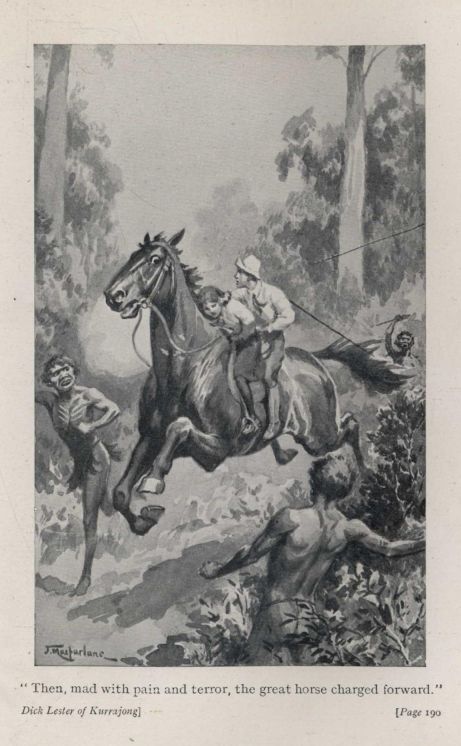
"Then, mad with pain and terror,
the great horse charged forward."
The plain danced before their tired eyes. They
were out of the timber, and galloping towards home,
with no hideous lurking dangers ahead—only the
long stretch of thick grass over which the
wheel-tracks made a pathway. Conqueror was settling
down to a steady gallop—the reins were loose on
his neck, for Merle had no strength left to guide him;
she could only cling to the pommel, her breath coming
in short gasps. The pain in Dick's shoulder suddenly
flashed into burning life; he put up one hand, and
could feel the haft of a spear. There was blood on
his hand when he took it away; he looked at it
curiously, as if wondering if it could be really his
own. Then a sick faintness came over him, and
he could only cling to Merle's belt and struggle for
self-command.
Ahead, a blur showed on the grass—the ration
cart, which had come out of the trees at a different
angle, and was now jogging slowly homeward, with
Downes riding beside it. He turned at the sound
of the galloping hoofs; and then shouted in horror,
as Conqueror came up, drew level, and then thudded
past. It was as though neither horse nor riders
saw them.
"Harry—it's the kids! And did you see Dick's
shoulder? There's a spear in it!"
"Keep as close as you can without racing them,"
the old man cried. "The boy may fall off any
minute."
Downes set off in pursuit. Conqueror was still
galloping hard, but without his first terror—only
with his smarting ear and flank, and the memory
of the yelling black figures to spur him on. The
reins flapped on his neck; he missed the light touch
of a hand on his bit, the sensitive pressure of the
knees—all that makes horse and rider seem as one.
This dead weight on his back, that neither spoke,
nor moved, nor guided him—what was it? Something
was all wrong; there was nothing to do but
gallop forward, since ahead lay home and his stable,
and behind was the yelling, hideous terror of the
scrub.
A clump of trees was before him. He rounded
them in his gallop, and then shied violently at a
new horror—the black pony, lying dead across the
track, with the cruel spear still sticking in his neck.
The sudden movement was too much for Dick.
The sick faintness had been creeping steadily over
him, and the quick wrench, twisting the spear in
his wound, brought an agony beyond endurance.
Consciousness slipped from him as his fingers loosed
their hold. He had a sudden vision of the earth
rushing up to meet him. Then he was
falling—falling—through an eternity of space, and the
world was blotted out in blackness.
It was night, and everything was very dark.
Somewhere, a million miles away, was a pinpoint
of light. He kept his eyes fixed upon it,
because it seemed the one thing in the world where
there was any hope. Someone was swinging him
backwards and forwards through space, sometimes
bringing him near the light and then drawing him
steadily back until it seemed that he would never
reach it. He could not put out a hand to touch it,
even when it drew near, and he knew that the pain
that wrapped him round would be gone if he could
but grasp it. There were sharp cords holding him
tightly, cutting into him; and all the time the
ceaseless swinging, swinging. He tried to cry out,
but no sound would come.
Then a hand came on his brow, so cool, so gentle,
that the formless blackness wavered and melted,
and the light grew stronger. The utter helplessness
was still there; but the sense of being gripped by
something mercilessly cruel faded, and it was as
though something infinitely pitiful was holding
him quietly. He gasped, "Don't let me swing!"
and the soft touch held him closer until he was still
and quiet. The light came nearer. Pain was there
yet, but pain was as nothing compared to the relief
of stillness. Nothing mattered, if only those soft
hands would hold him—would keep him from
swinging into space again.
Gradually the darkness melted. Things took
shape in a kind of dim twilight; he looked long
at a strange silver ball, floating in space, before he
knew that it was but the knob on his bed-post.
The window of his room came out of the dimness;
through it he could see gum leaves on boughs that
fluttered softly in the breeze. These things he saw
because they were in front of him; to turn his head
was a task much too hard to be thought of, no
matter what might be there. It troubled him that
he could not, because he felt something beside him
that he wanted desperately to see—something soft
that nestled close to his cheek. If it moved, he grew
afraid, and cried to it to come back, and it always
came quickly and gently, so that he was not afraid
any more. Still nestling to it, he drifted into sleep.
"You can get up." The doctor was bending over
Mrs. Lester, whispering, "He's asleep."
"He might wake if I moved." Her lips formed
the words almost without sound. She could not
bear him to cry to her again, in his agony, for the
help that only the touch of her lips against his
cheek had seemed able to give.
"He won't—yet. The medicine has taken effect." The
doctor's face was almost as ghastly as her own;
together they had fought death in the little room
for thirty-six hours.
He helped her to her feet gently. John Lester
slipped an arm about her, putting her into a chair.
Her eyes asked the question that her lips could not
frame.
"Good, as far as it goes," the doctor answered.
"That the sleep has come at all is a big thing;
now, we can only hope that it will last long enough
to rest him. He wants it, poor little chap."
"You want it, too," her husband said gently.
"Come and lie down while he sleeps."
"I won't leave him." She shrank back pitifully.
"You needn't, dear. Lie down on the sofa.
I'll call you if he stirs. I promise, Jean."
She let him put her on the sofa, wrapping a rug
about her, and taking off her slippers. The doctor
went out, after whispering a few directions, and
John Lester sat down beside his son.
He did not know much about the outside world
since they had come racing home in the car on
Thursday evening, to find Dick's broken body,
mercifully unconscious, awaiting them. The car
had turned back within five minutes, breaking
speed records to bring a doctor from the nearest
town, sixty miles away; and since that they had
never left the boy's side. To the stupor of
unconsciousness had succeeded delirium, when he had
struggled with unseen enemies and urged on unseen
horses, fighting blindly with pain that robbed him
of all sense. The doctor, a young country
practitioner, acknowledged his helplessness; the thing
was beyond him, and until a surgeon and nurses
could arrive from Perth he could only administer
narcotics and opiates, that had until now been of
little effect. There was injury to the head, that
was certain; beyond that he feared that the spine
was affected. The spear wound, once relieved of
the terror that the barb might have been poisoned,
was comparatively simple. But John Lester's face
was old and haggard as he stared at his son.
Out in the bush, north of the run, infuriated men
were scouring the ranges for the flying blacks,
dealing out swift justice without waiting for black
trackers and police, whose slower methods were little
satisfaction to a district that clamoured for revenge.
From fifty miles around men had come to help to
hunt down the slayers, until Narrung resembled a
huge camp when night brought the hunters home
to the head station. In another room lay Merle,
ill from shock and exhaustion. She had clung to
Conqueror's mane until the grey horse came to a
standstill at the gate of the home paddock. Downes
and old Harry had found them there, and had had
to use force to unclasp her fingers. But the Lesters
knew nothing of these things. The world, for them,
began and ended round Dick's bed.
The slow hours passed, and still Dick and his
mother slept. Now and then Mrs. Warner, as
haggard as they, tiptoed to the door, bringing food
or offering help; but John Lester would not leave
the room. He ate mechanically, knowing that he
must eat; but his eyes scarcely wandered from the
dark head on the pillow, half hidden in its ice-pack.
He prayed, desperately, muttering thanks for every
moment of the blessed sleep that meant freedom
from pain—-that might bring healing in its wings.
All the while he watched for any change—for any
shade of colour to creep into the still, white face.
But no change came; and the day dragged on to
evening.
Mrs. Lester woke with a start, trembling. Her
husband was beside her in a flash, holding her,
whispering.
"No change—and he has slept all this time!
Oh, thank God!" Her pale lips quivered—and
then she clung to him, starting up. "John—you are
sure it is really sleep?"
"It's really sleep," he told her. "Now you
go—get a bath and some food. No, you must do it,
Jean—remember, this isn't going to be a short
business, and you will need all your strength. I'll
call you if he moves." Mrs. Warner came in answer
to his finger on the electric bell, and took her away.
It was an hour later that Dick's eyes opened, and
he looked at his mother wearily.
"Mother," he said. The voice was weak, but his
eyes were clear.
She kissed him gently.
"Don't worry, old son." The doctor was beside
him, raising his head ever so little.
"Take this, lad."
Dick drank obediently and lay without speaking
while they busied themselves over him. When he
spoke again his voice was steady, but his lips were
grey with pain.
"What's up, father? Am I going to die?"
"Not you!" said the doctor hastily. The boy's
glance went past him, to his father.
"Am I, father?"
"No, my son, I think not. But you're badly hurt.
You have got to help us to get you better, Dick."
Dick pondered that, his fingers closed round his
mother's. Then memory came back to him with
a flash.
"Did we get in all right? Is Merle hurt?"
"No; only knocked up. You brought her in."
"I?" said Dick. There was a sorry little ghost
of his old smile. "I didn't have any say in it.
Conqueror bolted."
"Well, you went out for her, and you brought her
back," the doctor said. "And now you mustn't
talk any more. Go to sleep, if you can."
But sleep was gone for Dick. He lay in silence,
with his eyes closed; so quietly that after a while
his father gave way to entreaties and went off to
find the rest he so badly needed. Twilight gave place
to darkness, and only a shaded lamp lit the little
room. The doctor moved in and out, presently
coming to whisper that he was going for a walk.
Mrs. Lester nodded, glad that he should have the
opportunity. Silence brooded everywhere.
It was a little later that she saw that Dick's eyes
were open. His fingers moved towards her, on the
counterpane. She bent over him swiftly.
"What is it, my son? A drink?"
"No." The word came with difficulty. "If I—if
I could hold your hand."
She put her hand in his, and felt hot fingers close
round it tightly. So he lay, and then a stifled moan
broke from him.
"Is the pain bad, Dick?"
"Pretty stiff," he said. "I'm—I'm sorry,
mother." She saw his lips tighten, and he clutched
at her fingers desperately. "My aunt!" he gasped
presently; and then she heard a whisper, as if to
himself—"Buck up, School!"
She bent over him, murmuring broken words of
love and pity. It was almost more than she could
bear to see the motionless struggle. He lay, unable
to stir; and agony gripped him until his hair lay
dark on his wet forehead, and great drops of sweat
ran down his grey face. And no cry came. He
clung to her hand as if it were the one thing left him
in the world, and his lips moved in the school call
that surely went straight to God as a prayer for
courage and endurance—"Buck up, School!"
She slipped her hand away presently.
"Just a second, Dick—I want to send a message."
She pressed the bell until she heard someone
running to answer it, and then sprang to the door.
"The doctor, quick! Find him—he's in the
paddock."
Dick's eyes were looking for her desperately as
she ran back to him. He clutched at her hand.
"I thought you'd gone," he gasped, "Don't let
me go, mother—mother!"
"I won't, my darling," she said. "Hold tight to
me. Oh, Dick, cry out—it may help you."
She saw his head move in the ghost of what had
been his old, decided shake.
"Can't do that," he muttered. His voice died
away to an anguished whisper. "Buck up!" was
all she could hear; and once he carried her hand
to his mouth, holding it against his lips as though
with it he might hold back the cries to utter which
would have been crueller to him than pain itself.
It seemed an eternity before she heard the gate
of the yard bang, and quick strides across the
verandah. The doctor came in, switching on another
light. His eyes dwelt pityingly for a moment on the
boy's ravaged face.
"Having a bad time, old man?" he said quietly.
"Let's see if we can help you."
He asked a few questions, his hands busy with
Dick's arm. There was a prick with a hypodermic
needle, and presently it was as though a merciful
hand had sponged the lines of agony from Dick's face.
His lips relaxed their grim line, and the torment
died out of his eyes. Mrs. Lester felt his clutching
fingers curl themselves loosely in her palm.
"That's ripping!" he murmured sleepily.
"Thanks, ever so!" His eyelids drooped and
closed.
Mrs. Lester's head went down on the bed-side.
She was shaking with suppressed sobs.
"The trouble is, I haven't enough of the stuff,"
the doctor told Mr. Warner presently on the verandah.
"I'd had a sudden run on my stock—unusual series
of cases, and a fool of a maid smashed a bottle in
dusting the surgery. I wired Perth for more just
before your car came, but I hadn't much to bring up
here with me. Brereton will bring some with him,
of course, but he can't get here before morning."
"And you haven't enough to keep the boy out
of pain?"
The doctor shook his head.
"Not nearly. I've been using it most cautiously
all the time; there'd be none left now but for that
splendid sleep he had during the day. Now—well,
we can only hope that he may sleep again."
In the early dawn John Lester came out on the
verandah, staggering as he walked. Mr. Warner,
who had sat there throughout the night, jumped up,
catching him by the arm, but the father shook him
off blindly, dropping into a chair a little way off,
his whole frame shaking with tearless, rending
sobs. Mr. Warner watched him for a moment,
and then hurried away noiselessly. He was back
almost instantly, a glass of brandy in his hand.
"Drink this," he said authoritatively
John Lester took the draught at a gulp.
"He's asleep," he said. "It will only be for a
moment, of course—the pain will wake him. My
God, Warner, it would be easier to see him dead!"
"I know," Robert Warner said.
"If he'd cry out!" the father groaned. "He
lies there and holds on to us—I tell you my hand is
sore from his poor fingers; and his eyes ask us for
help, and we can't do a thing. And he will not
give in. Just 'Buck up, School!' when the pain
is almost beyond endurance. It's too much strain
for him—it would ease him, I believe, if he would
scream. We've begged him to let himself go, but
he won't."
"And his mother?"
"She just kneels there and holds his hand, and
tries to help him through. I don't know how she
stands it. It's been ghastly for the last half-hour—poor
little son, he asked for pity at last. 'Can't
you put me to sleep, doctor?' he said. And there's
not a drop of stuff left. It cut the doctor to the
heart to tell him."
"And then?"
"He didn't say anything—-only tried to smile.
And then I suppose God had pity, for he fell asleep
suddenly." He stopped, sitting erect to listen.
"There's his mother's voice—he's awake again." He
stumbled back into Dick's room, and Mr. Warner
heard him speaking, his deep tones wrung with pity
and love: "Hold on to me, old son."
The big man went out with hasty strides across
the yard, with tears running unheeded down his
cheeks. To and fro he paced; and then, as though
the yard were not big enough, he opened the gate
with a gesture of helpless impatience, and went
down the track. Dawn was breaking after the
endless night; the trees were black against a sky
that began to turn to palest primrose. Half way
down the paddock Mr. Warner stopped suddenly,
listening to a sound from very far away—only a
bushman's ear could have heard the dull whirr.
Then, as he looked, far across the dim plain came a
flash—the twin lamps of a motor.
He began to run, uttering a great gasp of relief,
thankful to be able to help by even so little as opening
a gate. The lights grew in size, speeding across the
plain to meet him as he ran down the track, until
they were great eyes of fire. He swung the gate open
as the car came up, slowing down. A keen-eyed
man looked out at him from beside the driver. In
the tonneau he could see two nurses in uniform.
"This is Narrung Downs? Hullo, is that you,
Warner?"
"Don't stop!" Robert Warner uttered, panting.
"Room with the light, off the verandah. And for
God's sake, Brereton, have something ready to put
him to sleep."
Dr. Brereton spoke to the chauffeur, and the car
whizzed on. They heard it in the sick room; and
the Westown doctor, with a gesture of relief, went
out hurriedly. Presently Dick, in the grip of pain,
almost beyond endurance, saw a new face by his
side—dark eyes that looked into his weary ones with
compassion, and a voice with a ring of quiet strength.
He felt again the divinely merciful prick on his arm.
Agony and fear slowly slipped away from him.
His fingers grew limp in his mother's clasp. She
put her cheek against his, and, with a little contented
sigh, he fell asleep.
"I wish I could give you better hope, Mr. Lester."
"Is there any loophole?"
John Lester's face was white and drawn
as he leaned against the fence, staring at
Dr. Brereton. There were streaks of grey in his hair
that had not been there before the night of Dick's
agony.
The doctor shrugged his shoulders.
"There is always a loophole where the patient
has youth and strength on his side. But I would
not be justified in telling you to hope. I have
known no case of the kind that recovered more than
a measure of power. These spinal cases are terribly
difficult; I suppose in the future we may find out
more about them."
"But the operation was successful?" Mr. Warner
put in.
"The operation was entirely successful—so far
as it could go. If it had not been the boy could
only have lived a few hours—I was only just in time.
Indeed, how he lived through what he must have
borne is rather a mystery."
"And now—tell me again what the sentence is.
I want to get it clearly," said the father.
"He may outlive you both—though these cases
sometimes don't last more than a few years. Your
boy is so strong that I should not anticipate any
change for the worse, however. He should have a
fair measure of health and strength—given every
possible chance, as he will be, with skilled nursing.
But—it would only be false kindness to mince
matters, Mr. Lester—he will never walk again."
The world was going black about John Lester.
Mr. Warner caught at his arm.
"You can do a great deal for him," the doctor's
steady voice went on. "Fill his life with all the
interests you can; get hold of nurses who know
how much incurable cases can be trained to do.
Keep an atmosphere of happiness about him—remember,
always, how strongly the mind acts upon
the body. He has more pluck than anyone I ever
saw, and he will respond." The deep voice was
wrung with pity. "I'm sorry for you, Lester, from
my heart—I've sons myself."
"I had only one," said John Lester, with dry lips,
"and I was too proud of him, I suppose. I was
proud of every inch of him, mind and body—his
pluck, his strength, his manliness and his clean,
straight mind. Even as a baby he was always such
a plucky kid. I used to say he was ordinary enough,
even to his mother, but in my heart I thought no one
ever had a son like him. And now—well, I suppose
I've got my punishment for being too proud."
"You have his pluck still," the doctor said.
"He'll need it, as he never needed it before; and
your pride in him, too. You can't let yourself get
down, mind; Dick will need every ounce of help
you can give him. Don't let him ever feel he is
less your son because he can't be the son you've
hoped for. You've got to put every personal
feeling aside for him and his mother."
"His mother! Oh, my God!" said John Lester
desperately. He turned from them and went
across the paddock with his head down.
"No—don't go after him. He's got to work it
out alone, poor chap!" said the surgeon, pityingly.
"You haven't told the mother yet?"
"No. He wants to tell her himself. But she
won't feel it as much."
"She! Why, she adores the boy!"
"Yes, but women are different, which is something
to be thankful for," said the doctor. "She
has the boy still, and the relief of his being alive is
so intense that the other part will be secondary.
He'll be her baby again; she'll be able to attend
him ceaselessly; to spend her whole life on him.
That's always going to help a mother. Lester
won't have as much comfort that way, and he has
all a father's broken pride and thwarted ambitions.
It's a hard sentence for a man with an only son."
From the shadow of a great clump of desert pea
a little figure crept—Merle, her lank black hair
hanging about her tear-stained face. She caught at
her father's coat with shaking fingers.
"Daddy! It isn't true—Dick won't be a cripple!
Say it, daddy!"
Robert Warner looked down at her gloomily.
"I wish to God I could," he said. "And I wish
I'd never asked them on this unlucky visit." His
face hardened as he looked at his daughter. "You'd
better go inside, Merle—and remember you're not
to talk about it."
She went obediently, not crying, but with her
childish face set in a look of horror that was not
good to see. The doctor looked after her.
"Poor child!" he said. "She came to me last
night, and knelt down in front of me and begged
me to make Dick well. Someone has told her it's
all her fault."
"And so it is," Robert Warner said heavily.
"No good telling a baby that—and she's little
more." The doctor lit a cigarette. "And it was
only a bit of childish disobedience."
"Well, its consequences will darken my house
as long as I live," Mr. Warner said.
Out in the paddocks Dick Lester's father tramped
up and down, trying to realise the thing that had
befallen them, and praying for courage to tell his
wife. How could he tell her? How to find words
to shatter the hopes and the joy that thirteen years
had built up so happily? She had always known
his love of physical perfection, and from the very
first days of Dick's dimpled babyhood she had
seconded his efforts to make the boy's body
splendidly fit. Together they had trained him,
proud of every fresh step of physical achievement
and muscular development. And now—the body
they had gloried in lay a helpless log for ever.
Never to walk, never to ride through the bush and
the paddocks that he loved; never to spring to
meet them with all his happy soul in his eyes. He
groaned aloud in his misery.
"I won't tell her to-day," he said. "To-morrow
will do."
Then he saw her coming towards him across the
grass, fresh and dainty in her white gown. He
went to meet her.
"Mrs. Warner saw you going over here," she said,
slipping her hand into his arm. "Dick's asleep,
and the nurse bullied me into coming out for some
fresh air. He's so well this afternoon, the darling!
No pain to speak of, and he's quite merry. The
nurse says he's doing splendidly."
"That's something to be thankful for," her
husband said. "Are you rested, dear?"
"I? Oh, it's rest just to see Dick out of pain, and
to know that he'll be all right soon," she said happily.
He tried to answer, and could not. Suddenly
she turned, looking keenly at his face.
"John, there is something wrong!" She went
white. "Is it Dick? Tell me quickly!"
"Dick is doing well," he said hastily. For she
trembled so that he was afraid she would faint.
"But there is something. Sit down on this log." He
put her down gently, and stood looking at her,
and then in broken words he told her of the doctor's
sentence.
She heard him almost in silence, uttering now
and then a quick question. The colour died even
from her lips, but she took the blow without flinching.
"Are we to tell him?"
"No—not until we must."
"He was asking the nurse this afternoon when
he could get up," she said with a pitiful little smile.
"I—I do not know how one could ever tell him.
Dick—my Dick—a cripple! It doesn't seem the
sort of thing that could possibly happen."
Suddenly she stood erect, facing him.
"I don't believe it," she said fiercely. "It may
seem so now, and I suppose Dr. Brereton knows as
much as most men; but, beloved, we'll never give
up hope. He's so young, so strong, so perfect! I
don't believe that science won't find the way to
cure him. We'll make him as well and strong as
we can, and take him to Melbourne—to England, to
America, to Germany, if necessary. Thank God,
there's money enough! You mustn't believe it,
either. We've got to keep happy thoughts all
round him; to be certain in our own minds that
he'll get well. If we let ourselves despair we make
ourselves less able to help him."
"You haven't talked to Brereton," he said sadly.
"No, and, if necessary, I won't talk to him!" she
flashed back. "I won't do anything to lessen my
faith that Dick will get well. Doctors have made
mistakes before; and you know he said himself that
they don't understand spinal trouble yet, John!"—she
caught at him fiercely—"don't believe it!
God never meant our boy to be a cripple all his life!"
"I haven't your pluck," he said. "Warner tells
me Brereton's about the best man in Perth; he
should know. But there's nothing to be gained, at
any rate, by giving way to despair. We'll do all
we can to fight the verdict. Brereton did say there
was always a loophole where there was youth
and strength."
He took her hands, looking at her.
"Well, thank God for you, anyhow," he said.
"I wonder if there are any depths you wouldn't
draw a man from. I came out wondering how I
could ever tell you; picturing your despair as
black as my own; and instead, you've given me—well,
if not hope, at least something to fight for.
And that is always something. Come home, and
we'll see if Dick's awake."
He wondered often, in the long, hard days that
followed, if there were secret moments when her
splendid faith and courage did indeed waver. If
there were, she did not show them. To Dr. Brereton
she listened calmly, taking in all he said, trying in
vain to gather from him a shred of encouragement.
At the end she thanked him for saving the boy's life.
"I wish I could have given him health as well
as life," the doctor said pityingly.
"That will come—some day," she told him.
"Please don't try to make me believe anything
else."
He shook his head.
"It would not be fair to let you hope."
"It would not be fair to take hope from me,"
she said. "That's not going to help Dick. Perhaps,
in ten years, if everything fails, I might believe you.
But we're never going to cease believing and trying."
"You are a brave woman," he said.
"Brave! Why, I am not brave enough to do
without hope," she answered. "If I once believed
that Dick would never walk again, I would not know
how to face life. But he will walk—I know it!"
The doctor went back to Perth when it was safe
to leave Dick to the care of the two nurses—experienced,
matter-of-fact women, who settled down
to the care of an incurable case with a calm
professional certainty as to the future that often goaded
their patient's mother to the limit of endurance;
a fact which they never suspected. Dick himself
gave little trouble. He was very weak; so tired
that it was happiness to lie still, now that there
was no longer pain to dread. "I'm jolly lazy," he
said—"but if I move I know the pain will come
back, so I don't try." He did not dream that
movement was impossible.
Gradually his clean youth triumphed over the
minor injuries, and his wounds healed quickly.
The Westown doctor, who came out twice weekly,
professed himself delighted with him; the nurses
allowed themselves a touch of pride over his
fast-disappearing scars. A faint tinge of colour crept
back into his white face. He had no inclination
but to lie still; but interest in the outer world
awoke once more, and he liked to hear the station
talk; the daily stories of work among the cattle—to
hear what horses were in use, and how the young
ones were shaping in their work. His room, as he
grew stronger, became a kind of centre for the
household, and everybody drifted there throughout
the day—Bobby and the twinses, with queer offerings
of flowers and such curiosities as stick insects and
blue-tongued lizards; Mr. Warner solemnly asking
advice on station matters; Macleay, the storekeeper,
with dry Scots stories. Each evening the three
jackeroos came to him with the history of the day;
tip-toeing at first, with exaggerated caution, and
gradually forgetting it, at Dick's quick questions,
so that the sickroom would become a Babel of
cheery voices, until the nurse on duty would plead
over-excitement for her patient, and turn them all
out. Dick hated to see them go, although he would
be too tired to want them to stay. "Makes you
nearly forget you're lying on your back," he would
say.
But there were long hours when he did not seem
to want to talk; lying quietly, his eyes always on
the patch of sky outside his window, where the
gum leaves made a wavering pattern against the
blue. Hours when he wanted nothing, he said;
neither reading nor stories, nor any of the hundred
devices with which they sought to make his day less
long. What did he think of? his mother wondered
wretchedly, watching the still face against the
white pillows. Were there fears in his brave heart?
Unknown terrors of the future, that he would not
tell even to her? She would ask him if he were in
pain, and he would shake his head with a little
smile—the smile that never failed for her. But if
there were times when Mrs. Lester's own courage
wavered, it was in those quiet hours when something
beyond her knowledge seemed to be drawing Dick
away from her into a silence where she might not
enter.
One shadow haunted the verandah outside the
room—Merle, white-faced and wretched, haunted by
self-reproach too agonising for a child's mind.
Whatever bitterness might have been in Dick's
mother vanished at the dumb misery in her eyes.
She put her arm about the little girl, holding her
tightly, while Merle clung to her, shaken with dry
sobs.
"I wish I was dead!" she had gasped.
"You mustn't say that," Mrs. Lester said.
"Dick would hate to hear you. And you must
help us to get him well!"
"But they say he'll never be well!"
"Hush!" The mother's hand was across her
mouth. "I don't believe that. You must come
to see him when he is stronger, and help to cheer
him up."
Curiously, it became apparent after a time that
Dick liked to have Merle in the room. She never
talked much, and it did not seem that she knew
how to smile; but a queer sympathy sprang up
between them, for which words were not necessary.
She developed an instinct, almost uncanny, for
knowing what he wanted. At all times he was slow
to voice any need—his sturdy independence was one
of the hardest sacrifices he had to make on the altar
of his helplessness, and it died hard. Merle divined
needs almost before they shaped themselves in his
mind. He would find a book, a fresh handkerchief,
a piece of fruit, within reach of his hand, put there
with a silence that wished to avoid thanks. She
saw him feeling awkwardly for his watch, and
presently a little clock from her own room was
placed at an angle where he could always see it.
If the blind flapped, or the door creaked, or the
light fell too strongly on his eyes, it was Merle who
saw it first, and went quietly to mend matters.
"I think she sits there just trying to imagine what
Dick may want, so that she may do it for him,"
Mrs. Lester said to her husband.
"That child's a born nurse, if only she had a
decent bedside manner," said one nurse to the other.
But Dick liked her manner. It was "not fussy,"
he said. She did things quietly, and he soon learned
that she hated to be thanked by anything but a
glance and a nod. A silent comprehension drew
them together, until, after his mother and father,
he preferred Merle to any other attendant.
So the weeks went by; and at last one day the
Westown doctor declared his part of the work done.
"I can't do any more for him," he said to Mr. Lester.
"He has a clean bill of health now, except
for the one big thing."
"And that is no better?"
The other man shook his head.
"It can't be any better, Mr. Lester. I wish I
could think otherwise."
"What about moving him?" the father asked.
"We can't quarter ourselves at Narrung for ever—even
if we wished. And I want to get the boy to
Melbourne."
"It's a brute of a journey," the doctor said.
"Still, it must be faced some time, and the hot
weather will make it worse, the longer you wait." He
thought deeply. "The train is vile; and the
drive to it, even in the Warners' big car, would be
a strain."
"My own idea," John Lester said, "was to get
a motor ambulance from Perth, and do the whole
journey by road. Do you think it's workable?"
"It's your best plan, I believe," the doctor said,
with relief. "Brereton would fix it up for you."
"We can make the stages what we choose,
according to Dick's strength," said Mr. Lester. "I
should take tents, and, if necessary, we could camp
on the road. Dick would be better off in the
ambulance than in some of the wayside hotels. If
it took us a fortnight or more it would be easier
for him than that jolting, grinding train."
"There's no risk to the boy," the doctor said.
"Only weariness, and you want to spare him as
much of that as you can."
A week later Mrs. Lester sat on the verandah
outside Dick's room. Her husband had been reading
to Dick; the boy had fallen asleep under the spell
of the low, deep voice, and now the father sat
watching him. She looked wearily across the
garden to the wide paddocks beyond. Two months
ago they had driven over them for the first time,
radiant in the happiness, still a new thing, of being
all together; to-night she looked at them for the
last time, and there was bitterness in her soul.
They were to take Dick away in the morning, the
wreck of what he had been; that had been Fate's
gift to them at Narrung, the sorry end of the visit
that had promised such brightness. Before them
lay new happiness or despair—which?
A soft step roused her. Merle stood there, with
a kind of trembling determination in her face.
"Mrs. Lester," she said, "will you take me with you?"
"Take you, Merle? My dear child, how could we?"
Merle suddenly slipped to the floor beside her,
catching at her skirt.
"I'll slave for you," she said wildly. "I'll do
any mortal thing I can. If you leave me here I'll
go mad. I 'spect you must hate me, but Dick
doesn't, though I don't know why he doesn't.
Nobody can hate me like I do myself."
"Nobody hates you at all, Merle."
"People must. D'you think I don't know what
I've done?" the child stammered. "Wouldn't
you let me come, just for a bit, to work for
you—to help you to look after Dick? I'd never be any
trouble. I can do my own hair and everything.
I'd just be legs for Dick!"
"Legs?" queried Mrs. Lester, puzzled.
"Yes. It's all my fault he can't use his. If I
came I could just be there to hand him things and
run his errands. He doesn't mind telling me to do
things, but he won't ask you, 'cause he hates you
to get tired. Oh, couldn't I come, just as Dick's
legs?"
Mr. Lester appeared in the doorway.
"Take care—Dick is awake."
They heard Dick's voice, "Mother."
"Yes, sonnie." Mrs. Lester put Merle aside and
went in.
"Don't let that poor kiddie cry," he said. "I
say, couldn't we take her?"
"You want her, Dick?" said his mother, amazed.
"Oh, she's not a bad kid," Dick said. "I give
you an awful lot of work now, and she'd save you a
bit. And she wants to come ever so. Might as
well let her, don't you think?"
Mrs. Lester looked at her husband uncertainly.
"If you want her I expect you can have her, old
son," he said. "I'll see what her father and mother
say."
He went out, leaving Dick and his wife alone.
A small, sobbing figure crept after him.
Dick looked at his mother steadily.
"I say, mother—am I getting better?"
"Why, of course you are, old man," she said
brightly.
"When am I going to sit up?" It was the
question she had long dreaded, and she was ready
for it.
"When your back strengthens sufficiently. You
must give it time, beloved."
"It's not the spear wound? Nurse says that's
all right."
"Oh, the spear wound was nothing—beyond
being painful at first. You see, when Conqueror
threw you, you fell on an outcrop of ironstone, and
that is what has given you the real trouble." She
forced a smile. "You know, you can't bounce about
on ledges of rock as if you were india-rubber!"
He was silent a moment, and then spoke suddenly;
and there was terror in his eyes.
"Mother—my back isn't broken?"
"No!" she said quickly.
"You'd tell me—straight?"
"On my honour, Dick."
He heaved a big sigh.
"I've been wondering ... lying here," he said,
"I'd heard about fellows with broken backs, and
I do feel so queer and helpless. Of course I knew
I couldn't get well all in a hurry; but I thought it
was about time I could move my legs."
He looked at her with the absolute trust that all
his life she had seen in his eyes. Twice she tried
to speak before words would come.
"Will you just go on being patient, Dick?" she
said at last. "I know it is hard—and you have
been wonderfully good. Try not to get impatient
yet."
"I can stick it all right if I know I'm going to
get better," Dick said. "And you say I am,
mother."
She met his eyes.
"I believe you are, Dick—with God's help."
"Well, that's all right—mother-est," he said;
and he took her hand and carried it to his cheek.
So they stayed together while darkness crept into
the room. She would have stirred once to switch
on the light, but he said, "Ah, don't go away,"
and she drew closer to him. Through the open
windows the kind stars looked down in pity as her
lips moved, praying.
It was a queer procession that moved away from
Narrung homestead in the early morning. A
great motor ambulance, with a bed for Dick
that was a marvel of cushions and springs, went
first, his mother and a nurse with him. Mr. Lester
and the second nurse followed in another car that
had come up from Perth; and, last of all, Mr. Warner,
in his own motor, with Merle's little white
face beside him. For Merle had got her wish—not
because it was hers, but because of Dick's few
words. "If Dick wants Merle, or my house, or
every penny I have in the world, he has only got
to say so," Mr. Warner had said. "If she's in
the way, or whenever Dick is tired of her, you can
consign her to her grandmother in Perth." He
looked at Merle as if she were a bale of goods. If
the words stung her she made no sign.
Both the cars were piled high with baggage.
Where possible they would stay in towns on the
way, but since Dick's fatigue might demand that
they should stop at any moment, there were tents
to be carried, food, cooking utensils—all that was
necessary for his comfort. The driver of the
ambulance was a skilled man, trained to steer his great
car so gently as to avoid the slightest jolt, if the
roads were reasonably good—and there were
favourable reports of the condition of the tracks.
The Westown doctor had arrived the night before
on his motor cycle to see his patient start; he
helped to carry him out, with the nurses, when it
was time to go.
Dick was a little flushed with excitement, and
his eyes very bright. He smiled at the people
who thronged round to say good-bye to him, and
his weak hand had a special pat for Bobby—Bobby,
who wailed because he was going, and
refused to be comforted. The doctor and nurses
hurried the farewells; their patient must not have
any more fatigue than was necessary. Indeed, the
doctor heaved a sigh of relief when he was safely
in the ambulance, and it moved slowly away down
the paddock.
The two mothers clung together for a moment
at the last.
"I would give up my own son if I could give
yours back to you," Mrs. Warner murmured.
Tears were running down her kind face.
"I will have him back," Mrs. Lester said steadily.
"Some day you must come to see him—straight
and well again." But Mrs. Warner had no words.
The day passed more easily than they had dared
to hope. If the tracks were sandy, at least they
were in good order; the ambulance passed over
them gently, and the fresh air acted as a sedative
to Dick, who slept calmly during the warmest
hours of the morning. They pitched a camp early
in the afternoon, afraid to make the first stage a
long one. It was an ideal spot—a grassy clearing,
ringed round with tall trees and low bushes, full
of birds that had never learned to be afraid of
humans. Dick begged to be taken out, and they
lifted his stretcher into the shade, where he could
lie watching the business of camping. Mr. Warner
and Mr. Lester were old hands at the business;
the tents went up, firewood was brought in, and
the camp-fire lit, and their evening meal prepared,
long before it was time to put Dick back to bed
and make him comfortable for the night. He put
off the moving as long as he could. "I've been
in bed so jolly long—I'm sick of four walls," he
pleaded. So they let him wait until their meal
was over and dusk came down; and the nurses,
fearing the chill of the evening air, became adamant,
and carried him off.
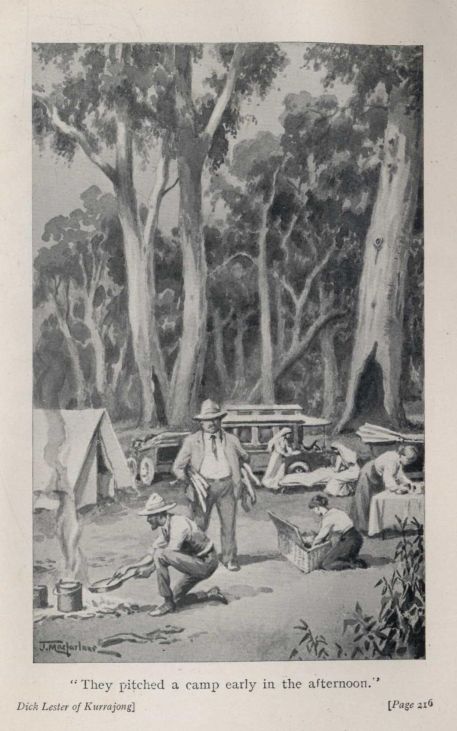
"They pitched a camp early in the afternoon."
Mrs. Lester woke when the first rays of the sun
came into her tent. She slipped on a coat and
hurried across to the ambulance, peeping in.
Already the nurse was busying herself about
nourishment, and Dick's eyes, clear and merry,
peeped at her over the edge of his blankets.
"Isn't it jolly, mother! Did you sleep well?"
"Ever so well," she told him. "And you?"
"Oh, we've had a beautiful night!" the nurse
said, cheerfully. "My patient snored serenely, while
the 'possums and wombats and things kept me
awake. This boy of yours thrives on the bush,
Mrs. Lester!"
"But, of course; isn't he a bush baby?" She
laughed. Not since his illness had there been such
a ring of health in Dick's voice. Looking at his
face, with its touch of colour, it seemed impossible
that presently he would not leap up to join her in
the old way, to ramble through the trees, exploring
the new world. Her thoughts flew back to their
last day near Perth, when he had gone climbing,
swinging from bough to bough with all his lithe
young body like a steel spring, supple and strong.
Now—she choked back the sigh that came to her lips.
"Can he get up to breakfast, do you think, nurse?"
"Oh, I think so, as he's so good!"
"Well, rather!" Dick stated. "Wash me
quick, nurse, dear, and take me out. I want to
see trees and scrub, and bacon frying, and
everything. Oh—cocoa? Well, all right!" He
submitted to be fed, more or less meekly.
So the days passed, one like the other. They
left the main roads as they came near civilisation,
finding good camping places, since Dick showed
that he had a dread of being taken to hotels. "I
don't want to be carted in and out, with people
staring at me," he pleaded. "And the bush is so
lovely. You don't mind camping, mother?" She
would have lain on the bare earth to keep the ring
of happiness in his voice. They made each day's
journey short, so that the vibration, however
softened, should not affect him. It never tired him
to be in the open, watching them move about the
camp. His old keen interest awoke again. They
made a point of consulting him about everything,
so that he should feel himself an active part of
each day's life, his father desiring his opinion about
the set of a tent rope with earnestness equal to
that of Mr. Warner when he carried a pan of bacon
to his side to find out if it were properly cooked.
The motor driver entered into the spirit of it, and
discoursed to him learnedly on the finer parts of
his car's anatomy; and no one thought of watching
the billy, since it was Dick's job to attend to it,
and to call out when the steam poured from the lid.
Merle had a task all her own. From the moment
they halted each day she sought through the bush
tirelessly bringing to his bedside whatever treasures
she could gather—flowers, deserted nests, curiously
marked stones, gorgeous beetles; all that keen
eyes could find. Dick grew to look for her
collections with delighted interest. "My word, you are
a brick, the way you find things!" he told her.
As she had begged Mrs. Lester, so her desire came
to her—she was indeed "legs" to him. He could
not shake off his innate distaste for asking older
people to run about for him. Even with the nurses
he would go without something he wanted rather
than send one on an errand. Somehow, Merle was
different. He began to look on her rather as a
younger brother; to find it easy to employ one
whose eagerness to be employed was evident in
every look. He never omitted thanks, but she did
not want them. Her gratitude was for being
used—thanks did not matter.
With everyone else she was as silent as ever.
Sometimes Mrs. Lester would manage to make her
talk a little; but for the most part she rarely spoke,
and when she was not watching Dick her eyes
followed her father about like a hungry dog's. She
knew that he no longer wanted her. In his way
he was sorry for her; but his overmastering feeling
was angry disgust and impatience that through one
of his children so bitter a calamity had befallen
his friends. He had said to his wife, "When I
look at that boy, remembering what he was, and
then think it is Merle's fault that he lies there, I
feel as if I never wanted to see her again."
The journey might have been accomplished much
more quickly than it was. There was no need to
hurry, for there was no doubt that the open-air
life was doing Dick good. He was as helpless as
ever, but his appetite was keener; he slept better
and he had fewer attacks of pain. They watched
him hungrily, snatching at each hopeful sign.
Supplies ran out, but it was easy for one of the cars
to run ahead into a town and lay in a store of all
that they needed. The weather held good, with
calm, starry nights, that made sleeping in the open
delightful. They were all better for the trip when
at last they rolled into Perth late one afternoon.
Dr. Brereton had made all arrangements for
them. His big private hospital was on the outskirts
of the city, and there Dick was installed with
his nurses in a room with a balcony overlooking
the Swan, where he might be wheeled to pass the
day. They found a corner also for Mrs. Lester,
since she flatly refused to be parted from Dick; and
there was a hotel not far off for the others.
Dr. Brereton whistled with delight when he came in
to see his former patient.
"Well, young man! Why, you look as fit as a
fiddle!" he ejaculated. "What have you been
doing with him, Mrs. Lester? He's brown as a
berry."
"Camping suits him, and we have been over a
fortnight on the road," she said, smiling. "I don't
know how he is going to stand being inside walls
again."
"We'll keep him on the balcony, then," responded
the doctor. "Feel strong, old man?"
"Pretty good," Dick nodded. "I'll be all right
once I can sit up. When will that be, doctor?"
"Oh, some day. We've got to get you thoroughly
fit first," the doctor evaded.
Dick's face fell. What he had hoped from his
meeting with Dr. Brereton only he knew.
"Don't you think I'm well enough to try now?"
he pleaded. "You don't know how jolly well I feel."
"I'm going to bring another man to see you
to-morrow," the doctor said. "Too late to-night to
overhaul you; but I want to see how my job looks."
"Oh, your job was all right long ago—you did it
awfully well," Dick assured him kindly. "Dr. Carter
took the stitches out at Narrung."
"Hurt you?"
"Well—everything hurts a bit," Dick admitted.
"It didn't hurt more than other things. I'd be
lonely now if I didn't have an ache or two!"
"Poor old chap!"
"Oh I'm all right. At least, I would be, I know,
if you'd let me sit up. No one could get well,
always lying flat. Why you couldn't keep me
flatter if my silly back was broken!—and you said
it wasn't, didn't you, mother?"
His eyes were like a pleading animals. Mrs. Lester
smiled at him with stiff lips.
"And it isn't, old son. But you must be
patient—give us time."
Dick saw her mouth quiver, and was seized
with swift penitence.
"I didn't mean to be a brute, mother. I won't
worry you." He gave a little laugh. "You see,
Dr. Brereton was someone new for me to worry,
so I had to."
"H'm!" said the doctor. "We poor wretches
are supposed to be able to stand anything. Never
mind—just wait until you're up, and able to
fight——"
He was interrupted by a quick cry from Dick.
The boy's eyes were shining, his voice shaking
with excitement.
"Doctor! You mean that! You mean I'll
t-truly be up—able to f-fight—I won't lie here
always! You did m-mean it——!"
Mrs. Lester turned to the window, unable for a
moment to command her face. The doctor patted
the boy's head with swift remorse.
"Of course I meant it, old man," he spoke
soothingly. "Only you must give us time."
"I'll wait any time, if I know it's all right,"
Dick muttered. A shade of weariness passed over
his face. Then he looked at his mother, and put
out a hand to her.
"Been a beast again," he said apologetically.
"Didn't mean to, mummie—only he sort of
surprised me."
She dropped a butterfly kiss on his brow.
"Here's nurse with your tea," she said, thankful
for the diversion. "I wonder how you will like
food cooked in a respectable oven again?"
"There's no food anywhere like the food you
cook over a camp fire," Dick declared.
"You can't have lost the camp appetite yet,"
said the nurse warmly. "So don't tell me." She
tucked a napkin under his chin with a deft
movement. "Please, we would like people to run
away—my lion doesn't like to be watched while
he's fed!"
"I'm sorry I said it," Dr. Brereton confessed out
in the corridor. "One says things hurriedly—anything
to soothe a patient. And you know I
strongly advised that he should not be told his
case was hopeless."
"No, and of course we have not told him so.
But I think he looked on any statement from you
as coming with special authority. I'm sorry, too;
he has never been so excited."
"Poor little chap! I wouldn't have given him
false hope for anything."
"And you are sure it is false?"
He shrugged his shoulders.
"I haven't any hope, Mrs. Lester. It wouldn't
be fair to you to tell you otherwise. Mind, I
would leave no stone unturned; I want another
surgeon, the best man in Perth, to examine him with
me to-morrow. But I think his verdict will be the
same as my own."
They told it to the parents gently next morning
trying to soften the cruel words. No hope, so far
as they could see, that Dick would ever walk again.
In time, with special treatment and massage he
might sit up; but further than that they could
promise nothing.
"He's wonderfully strong," Dr. Brereton said.
"Everything is in his favour, to a limited extent;
there's no reason why he should not have a long
and happy life, because he has pluck enough to
face the future when once it becomes necessary to
tell him."
"You would not tell him yet?" Mr. Lester said.
The doctor shook his head.
"He's too young—too full of hope. Later on,
when lying still has become second nature"—Mrs. Lester
shivered suddenly—"it will be easier for him
to bear the telling. Now, if you take hope from
him, he might slip back."
"What did you say to him this morning? He
asked you, of course?"
"Oh, yes, he asked, poor laddie. We put him
off; told him—it's the truth, too—that he was
getting on well, but that he must be patient and
put up with the massage. It will be painful, you
know, Mrs. Lester. He was very good—extraordinarily
patient under our handling this morning.
After it all he was dog-tired, so we have put him to
sleep. The nurse is with him."
"When do you think we can move him to
Melbourne?" Mr. Lester asked.
"Oh—almost any time. Let him have a few
days' rest. I should advise you to get passages on
one of the big mail steamers; the inter-state boats
are more apt to kick about if there's bad weather
in the Bight. Not that you should have bad weather
now."
"The Occident is due next week," the second
doctor put in. "She's one of their newest boats—you
should be able to get a deck cabin on her for
the boy. I know the manager here, Mr. Lester;
would you care to go round with me and arrange
matters?"
So Dick, lying wearily on his balcony that
afternoon, still stiff and sore from the morning's
handling, heard with relief that they were to be
homeward bound.
"That's jolly," he said. "I'd like to see Melbourne
again—and the fellows at school. Will the
old doc. let Bottles and Nuge and Teddy come to
see me, do you think, mother?"
"Of course he will," Mrs. Lester said. "They
will be wild to hear about your adventures—think
of the untold sums they have spent on wiring to
you!" The story of the Northern blacks' raid
upon Narrung had been sent to the papers in the
Eastern States, and Dick had been inundated with
telegrams from his school.
"Well, it will be great to see them," he said.
"Perhaps one of them would come up to Kurrajong
next holidays, mother; I expect I'll be sitting up
by then, so it wouldn't be so very dull for them." He
grinned. "Old Bottles is going to be a doctor—it
would be handy for him to practise on me!"
"Thank you," said the nurse hurriedly; "I'd
rather not!"
"So would I," agreed Dick. "Just you keep
your eye on him, though, nurse; he's safe to have
some patent pill of his own that he'll be mad keen
to give me!"
"I will be there," said the nurse, with a grim
determination not to quit her patient's side during
any invasion by Bottles.
"Mother," Dick said, "will there be more doctors
in Melbourne?—more overhauling like to-day?"
"There may be, my son. You won't mind, Dick,
if it's to make you better?"
"Oh, no," he said. "Anything's better than
lying still. I didn't seem to mind it so much at
Narrung, but since we began to move about, and I
feel stronger, I just feel that I'd be all right if I
could only get up. But these silly asses of doctors
won't let me try."
"Never mind," said his father hastily. "We'll
see what the Melbourne men say. Meanwhile, I've
got you such a jolly deck cabin on the Occident,
Dick, with one for mother and me next door.
You'll be able to be out on deck every day. It's
her first trip out, and she's one of the finest boats
that ever came to Australia. It will be something
to tell the boys that you came in her."
"Yes, that'll be ripping," said Dick, with interest.
"I say, father, what about Merle?"
"Well, I don't know," Mr. Lester said, pondering.
"I know she wants to come with us; and if you
would like to have her, of course she can come."
"Oh, I don't think I could do without my old
'Legs,' could I?" said Dick, laughing. "Do let
her come—she just hates the idea of going back
to Narrung. And let me tell her, father, will
you—she'll be no end bucked!"
Merle was waiting at the street corner for a
tram. It was the day before they were to
sail for Melbourne, and she had been to say
good-bye to her grandmother; the distance was
not great, and she was allowed to make the little
trip to and from the hotel by herself. She was
impatient, for she was to go on to the hospital to
see Dick; and the only part of Merle's day worth
consideration to her was the part she spent in being
"legs" to the boy. She looked up the long road,
fidgeting and frowning to see no tram in sight.
Two men came strolling along and stopped near
her, also glancing up the tram track. They went
on chatting, without noticing the small figure by
the lamp post.
"——won't be out here long," one said,
completing a sentence. "No, he's not coming out to
practise; just on a visit to Melbourne to see his
mother. He's been away four years, and she is
getting old."
"He was always a very devoted son, wasn't
he?" the other said.
"Yes, very. My brother died when the boy was
at school, and he's been everything to his mother.
Of course he would have done remarkably well in
the ordinary course of things; he had a big practice
before he went to Germany. But his mother was
as keen as he was about his becoming a specialist,
and he has always been determined to keep himself
abreast of the latest discoveries in spinal treatment."
"The spine was always Neil's pet subject."
"Yes—he used to say there ought to be another
big war, because then surgeons had a chance of
finding out things they would never find in ordinary
practice. True enough, too. Anyhow, he has been
at extended research work in America and Germany
these four years, and when he finally comes out
he will practise only as a spine specialist. That
won't be for another two years, however; this is
only a flying visit, as I said."
The word "spine" had caught Merle's idle ears,
and she was listening, with parted lips, her breath
coming quickly.
"There's the tram," the first man said. "Lunch
with us at the club to-morrow, won't you, Onslow?
I'd like you to meet my nephew again. The
Occident gets in in the morning, and I'm going to
run down in the car to meet him, and bring him
up for the day."
"Thanks, I'll be delighted," his friend said. He
nodded good-bye as the tram rattled up. The first
man stood aside courteously to let Merle in, and
then sat down in a seat across the aisle. The tram
banged its way down the hill.
The conductor said, "Fares, please!" three
times, each with mounting impatience, before Merle
realised that he was speaking to her. Then she
took out her purse and paid him mechanically,
with an air so distracted that the conductor reported
later to the motorman that there was a kid back
there quite cracked.
Her heart was thumping furiously. Someone
was on the Occident—someone who knew all about
spines—who might cure Dick! Someone who
would not practise; but if he only saw Dick, he
might relent. She did not think anyone could
possibly see Dick and not relent. Anyway, if he
were asked. And then she realised with a kind of
horror that she did not know his name.
She looked across the aisle at the man who had
talked about his nephew. He was kind-looking,
she thought; short and plump, with a grey beard
and nice eyes. He surely would not mind being
asked. But to speak to a stranger was a stupendous
task to Merle, who found it difficult enough to speak
to anyone she knew quite well. The very thought
was enough to make her trembling and tongue-tied.
Perhaps, if he got off when she did. And just
then she looked again, and almost cried aloud in her
dismay. The tram had stopped, unnoticed by her,
and the man had got off and was walking briskly
up a side street.
The conductor's bell had rung, and the tram was
already under way as she started up, springing to
the side. A woman caught at her dress with an
alarmed exclamation; from his end of the car the
conductor uttered an angry shout of warning; but
Merle did not heed them. She swung herself to the
roadway, spinning round as she alighted, and finally
falling heavily. The tram was stopped, people were
shouting. Her one thought was to get away. She
scrambled to her feet, brushing the dust from her
dress, and, bruised but determined, raced up the
side street.
"It's the cracked kid," reported the conductor
gloomily, ringing his car on again. "Wonder why
they let her out without a keeper. That's the sort
as makes us chaps get bad marks on our tickets!" He
stared wrathfully after Merle as long as she was
in sight.
The stout gentleman heard running feet behind
him, but he was in a hurry, and did not turn until
a breathless voice addressed him.
"Oh, please!" Merle panted.
"Bless my soul!" said the man, looking at the
dishevelled figure. "Are you hurt? What's the
matter?"
"You were talking," Merle choked—and then
took a long breath—"about a man on the
Occident—somebody who knows all about the spine."
"Well—if I was?" said the amazed Westralian.
"Oh, please, would you tell me his name?"
"Why on earth——?"
Merle cut him short.
"Oh, tell me! There's a boy going on the
Occident with a hurt spine—he might look at him!
It wouldn't hurt you."
"Well——" began the man, staring at her. "My
nephew won't practise, if that's what you mean.
But his name is Neil Fraser, if you must know.
Better not tell him I told you, for he's on a holiday,
and doesn't want to think about spines!"
"He couldn't help it if he knew Dick!" said
Merle solemnly. "Thanks, very much." She
turned. "I must go and catch another tram."
"I think you had better let me brush you down
a bit first," said the Westralian, suiting the action
to the word. "I've got daughters myself, and if
your mother sees the state your frock is in——!"
Merle submitted to his ministrations more or less
gratefully. At the moment it would not have
mattered to her if she had no frock at all. She
was seething with excited hope. Each night she
prayed blindly, desperately, to some God she did
not in the least realise that He would make Dick
well—that He would let her work out her wickedness
by taking Dick's pain, if He only could. Perhaps
God was really there, after all—perhaps He really
meant to help! She said good-bye to the fatherly
Westerner, and managed to get back to the hotel—how,
she never knew. A great thought had come
to her. She had heard of cases of skin-graft—taking
skin from a sound person to heal another's
wound. Perhaps this wonderful new man could
take a piece of her spine and put it into Dick's.
She knelt down by her bed, and prayed wildly to
God that He would arrange it.
"It doesn't matter what becomes of me," she
said. "Daddy has two sons, and I'm only a girl—and
they've only Dick. And it's all my fault.
If you can fix it so's he'll be able to walk soon,
before he gets any discourageder, I don't care what
you do to me. Oh, God, won't you let this Fraser
man know all about spines like Dick's!" It was
a queer prayer; but who shall say that it did not go
straight upwards?
The burden of Merle's secret was heavy upon
her as she climbed the gangway of the Occident
next day. She had not dared to speak to anyone, in
a childish fear of being ridiculed; and the temptation
to speak to Dick was so strong that in resisting
it she became entirely silent, until Dick grew worried,
and said finally, "Look here, Legs, old girl, are
you really sure you want to come?"
"Want to come?" She looked at him in a
dazed way. "Oh, I never wanted anything so
much in my life! You don't want to leave me
behind, do you?"
"Rather not!" Dick said, relieved. "You're
jolly good to me, you know, old Legs! Only I
thought you were a bit down in the mouth at
leaving your father. Sure you're not?"
She shook her head emphatically.
"No. He wants me to go with you. You can
send me back any time, you know, to Grannie.
But even if you send me back at once, I want to
go on the Occident."
Dick, being a gentleman, was indignant.
"You make me feel like a perfect beast!" he
said warmly. "I don't want to send you back at
all—and I wish you wouldn't talk as if you were
a beastly parcel! You're coming up to Kurrajong
with us, and you'll have to ride Tinker for me
until I can ride him myself."
Until he could ride himself! The words were
in her ears as she climbed the gangway, up which
two sailors had carried Dick's stretcher carefully
a moment before. She went to the side of the ship,
scanning the faces of the passengers as they came
along the pier, wondering which could be "Neil
Fraser," and hoping that any man with a specially
kind face would be he. The time passed, and the
cry of "Visitors ashore!" startled her. Then she
heard her father's voice behind her.
"That you, Merle? I'm going." His big face
was sadder than she had ever seen it, and he kissed
her gently. She flushed; he had not often kissed
her since Dick's accident. "Be a good girl, and
do all you possibly can for that poor boy.
Remember, none of us can ever make up what we have
cost him. If—if you see anything he would like,
buy it for him—you can have all the money you
want." He half turned, and she heard him say
miserably under his breath, "If one were not so
helpless!" Then he put his hand on her shoulder.
"It's something—just a little—if you can be legs
for him. Don't spare yourself."
"I won't," she said. "Oh, I won't, daddy!"
He kissed her again, and went down the gangway.
She watched his huge form threading its way along
the pier. His head was bent down, and he did not
look back again.
Dick did not leave his cabin that evening. He
was tired with the excitement of starting, and was,
moreover, developing an invalid's dread of being
stared at. The nurses kept him very quiet; even
Merle was not allowed inside the cabin, and she
wandered about miserably, handicapped by her
shyness, and wondering how, in the crowded mail
steamer, she was ever going to find a man she did
not know. She went to bed with the problem still
unsolved, slept badly, and got up early in the
morning, dressing as noiselessly as possible in order
not to disturb the nurse whose cabin she shared.
In the alleyway she met a steward, and a sudden
thought came to her.
"Steward," she said, "do you know which is
Mr. Fraser's cabin?"
"Not in my lot," said the steward carelessly.
"You don't know 'is number, by any chance?"
"No."
"Well, I dunno. Ask some of the other stewards—or
the purser'd tell you, of course."
Merle's courage was fast oozing away; to tackle
the purser, a mysterious and terrible individual
of great power, was a task beyond her. She
dived into her pocket and produced a bright
half-crown.
"You find out for me," she said, proffering the
coin, which the steward pocketed with an adroitness
born of long habit. "It's very important; I've
got to know soon. I'll come down after breakfast,
and you tell me and I'll give you another."
"Right-oh!" said the steward, with a new respect
for a small girl who could distribute half-crowns
with such large ease. "I'll 'ave 'is number ready
for you, miss."
Dick was better; a good night had made him
inclined for breakfast, and he was longing to get
out into the fresh air, even if people did look at him.
He kept Merle busy, running errands and telling
him all about the passengers; and it was not until
the nurses were ready to prepare him for going out
that she was able to slip away and hurry down to
her own cabin.
The steward met her, rather aggrieved.
"Nice little jig-saw puzzle you set me, miss!"
he said. "Mr. Fraser, you says; well, there's
seven Frasers on board! Now which is it?"
Merle's face fell.
"Seven!" she exclaimed. "How will I ever—oh,
but, of course, his name's Neil!"
"Ah, that's something like," said the steward,
cheering up. He consulted a paper in his hand.
"Neil—that's N. Well, there's two N. Frasers,
apparently, miss; N. F. Fraser in 352, and
N. H. Fraser in 279. Now, which is your mark, I
wonder?"
"I don't know," Merle said hopelessly.
"Couldn't you find out for me?"
A sudden cry of "Smithers!" smote upon the
ear of the steward.
"That's me," he said hurriedly. "'Fraid I'll
'ave to go, miss—that's my chief 'owlin'. You
won't 'ave any difficulty in findin' your man—just
try each in turn." He put the paper into her hand,
and almost mechanically Merle parted with her
second half-crown, and watched him rush off in
response to another call.
Merle stood looking at the paper for a helpless
moment. To track these mysterious Frasers to
their lairs seemed a task beyond her courage.
Still, there was nothing to be gained by putting it
off—and the sooner she set about finding her man,
the sooner would her suspense about Dick be
relieved. So she set her lips firmly and went off
along the alleyways, hunting for one of the numbers
she wanted.
She found one presently—279. No one was
about, and she knocked at the door timidly. There
was no response at first; but presently awful sounds
arose, and Merle realised with a shudder of horror
that the inmate of 279 was extremely seasick!
She took to her heels, rushing wildly along the
corridor until she considered herself at a safe
distance—scarcely realising that nothing was further than
pursuit from the mind of the unfortunate 279.
Then she stopped to consider the position; what
she should do if the terrible man she had heard was
indeed the object of her quest; what, if, as might
well be, 352 was in no better case. There seemed
nothing to be gained by standing still, however, so
she wandered up companions and along alleyways
until she found herself confronting the second cabin
on her list.
The door was shut, and she stood trying to
summon up her courage to knock; and feeling the
said courage rapidly oozing from her. But before
she had time to make up her mind, the door opened
suddenly, and a man came out, so quickly that he
nearly knocked her over.
"I beg your pardon!" he said, stepping back.
"I didn't know anyone was there." He looked
mildly surprised; but his voice was pleasant and
his clean-shaven face was so keen and alert, and his
eyes were so kindly, that Merle was suddenly no
longer afraid. "Did you knock?" he went on.
"Were you looking for anyone?"
"I'm looking for someone called Neil Fraser,"
Merle stammered. "I do hope you're him!"
"Well—I am!" he said, and laughed. "Why
did you want me?"
Twice she tried to speak, and could not. He
saw the struggle in her face and patted her shoulder.
"Is anything wrong?" he asked. "I am a
doctor—can I help you? Come in and tell me."
He drew her into the cabin. Merle made a tremendous
effort, and her words came with a rush.
"I know all about you," she said. "You've
been all over the world finding out all about spines,
and now you've got to cure Dick's!"
"Dick's?" he said. "What's wrong with Dick's?"
"It's all wrong—broken or something. I don't
know what. It's all my fault, anyhow; cause I
went out and the blacks nearly got me, only Dick
came after me—and they speared him, and he fell
off Conqueror when he was galloping, and lobbed
on some rocks, and now they say he'll never walk
again. And he must walk—you don't know how
splendid he is! He's only thirteen, and you
couldn't let a boy like that be a cripple all his life
if you could cure him!"
Suddenly she went down on her knees before
him, catching at his hand.
"Can't you do what they do with skin when
they graft it?" she prayed. "Can't you take a
bit of my spine? You can have every bit of it,
if it'll make Dick's all right. I know it's quite a
good spine, if you'll only use it!"
If he wanted to laugh he did not show it. He
pulled her to her feet gently.
"I can't do that," he said; "we're not clever
enough yet. But I'll do what I can, though, of
course, I can't promise to cure him. Tell me more
about Dick. Where is he?"
"He's on the ship. We came on yesterday.
His father and mother—and two nurses, and me.
He's in a deck cabin; I'll take you to see him if
you'll come; he'll be out on deck now."
"How long is it since he was hurt?"
"Over two months. It was up on our station.
They got Dr. Brereton from Perth up to him first,
and then they took him to Perth in an ambulance
Now they're taking him to Melbourne, and they'll
take him all over the world to try and get him cured.
And—" her voice broke into sobs, and tears ran
down her face—"he doesn't know they say he'll
always be a cripple. He lies so still, but he's
always planning for when he's going to get up and
ride again."
"Poor lad!" said Dr. Fraser. "And are you
his sister?"
"Me?" said Merle. "No; I'm just his legs!"
"Are you?" he said, and laughed for the first
time. "Well, you're a plucky little girl, anyhow.
Shall we come up and see Dick?"
They went up together. Dick was lying in the
shade of a deck house, a nurse beside him. He
opened his eyes as Merle came up, and grinned at her.
"Hullo, old Legs!" he said. "Where have
you been? I've been out ever so long."
"Oh, just about," said Merle vaguely. "Dick
this is—er—Neil Fraser." She flushed scarlet,
conscious of the peculiar nature of the introduction.
Dr. Fraser sat down near the stretcher, apparently
unconscious of anything unusual. Dick had shrunk
into his shell at the idea of speaking to a stranger,
but this man proved to be a very decent sort of
person, with no tactless ways of looking at a fellow's
stretcher, or of making silly inquiries as to how long
a fellow had been ill. He chatted away, in a low
pleasant voice, and actually of horses! He had
been, it seemed, in the western states of America,
and had the queerest stories of cowboys and their
ways and their horses, told in a quaint American
drawl that made them irresistibly funny.
The nurse slipped away. A little way off Mr. and
Mrs. Lester were talking to the captain; they
glanced round once or twice, hearing Dick laugh
as he had not laughed since his accident. The poor
mother flushed with pleasure.
"Listen to my boy," she said. "Who is his
new friend, captain?"
The captain looked round.
"A nice fellow, and a clever one," he said.
"Dr. Neil Fraser, of Melbourne. I believe he's a
spine specialist, but I don't know for certain.
Wonder if he could do your boy any good, Mrs. Lester?
He can make him laugh, that's certain."
The father and mother stared at each other.
"A spine specialist!" Mrs. Lester murmured.
"So our doctor says. He's a quiet fellow, with
I don't know how many letters after his name;
but he's out for a holiday, and doesn't mix much
with the other passengers. I should say someone
must have told him about your boy."
"One of the nurses, perhaps," Mr. Lester said.
"I wonder——" He paused, and looked long at
Neil Fraser's face, and came to Dick's conclusion
that it was a face to invite confidence. The captain
strolled off to talk to other passengers. John Lester
put his hand on his wife's arm.
"Shall we go and speak to him?"
"No, don't go," she said. "He and Dick are
getting on famously—let us leave them to make
friends. John, do you think——"
"I don't know," he said slowly. "Somehow
when I saw him beside Dick a queer wave of hope
came over me. I'd almost forgotten what hope
was like. He looks clever, Jean."
"And kind," she said. "Let us go and find the
ship's doctor, and ask him about him."
The ship's doctor, a grizzled old Scot, had only
good words to say of Neil Fraser.
"He's going to be a great man," he said. "I
heard of him in London from my brother—a
doctor in Harley Street. He did some great work
at Munich, did Fraser, and I knew of a case he
tackled in London with extraordinary results. Oh,
I'd certainly advise you to talk to him, Mr. Lester.
He's not practising, of course, but I'm certain he
wouldn't refuse to give you an opinion, at least."
"Does he only doctor spines?" asked Mrs. Lester.
"From all I hear," said the Scot drily, "he's
disinclined to recognise any part of the body but
the spine! He's spine mad." He hesitated. "I
tell you this, Mrs. Lester; whatever opinion he gives
you I don't think you need go past it. If Neil
Fraser can't cure your boy there is no one, in
Australia at any rate, who can."
Outside the surgery the Lesters looked in each
other's eyes.
"Jean!" he said. "Take care, dearest; don't
let yourself hope too much."
"I shouldn't, I suppose," she said, trembling.
"But—we've prayed, John; who knows if God has
not sent us on this ship to answer us!"
"Come and we'll find him," her husband said.
Neil Fraser was still talking to Dick. The boy
called them eagerly as they came up.
"That's father and mother!" he said. "Do
come here; this is Mr. Fraser, and he has been telling
me most gorgeous yarns. Tell them about the pony
and the rattlesnake, Mr. Fraser—I'd love to hear
it again."
Neil Fraser told the story, and they were all
laughing when the nurse came up with a steaming
cup in her hand.
"More nourishment!" said Dick, disgustedly.
"My word, I'll be glad when I'm well and can have
just food to eat and not nourishment! Why do
you have to be nourished when you're ill, and
not fed?"
"That's one of the great problems we've never
solved," said Fraser, laughing. "Never mind,
Dick—it looks good."
"Oh, it's always good," said Dick, grinning up at
the nurse. "It's only its name I'm grumbling at."
"Indeed, I'd call it anything you like, so long
as you leave me an empty cup," she said with spirit,
pulling his hair.
"We'll leave him; he doesn't like an audience,"
said Mr. Lester, as the second nurse appeared. They
strolled out of sight, and then he turned to Fraser
suddenly.
"Will you come to our cabin for a little?"
he said.
In the cabin they looked at each other.
"They tell us you are a specialist in such cases
as our boy's," John Lester said. "Will you
undertake Dick?"
Fraser hesitated.
"I'll examine him, and give you an opinion, if
you wish," he said. "I can't say more until we
see the result of the examination."
"Will you do it on the ship?"
The doctor shook his head.
"I'd rather not. The slightest roll, or vibration
of the screw might make a difference."
"I'm glad," said Mrs. Lester. "Dick is happy—let
him have his time on board in peace."
"Yes, that's so," Fraser agreed. He looked at
her eager face pityingly.
"Don't build up false hopes," he said. "These
cases are very difficult; there are a hundred reasons
why I should not succeed where other men fail.
The little girl told me the Perth men had pronounced
against your boy's recovery."
"The little girl!" John Lester echoed.
"Yes; the one Dick calls 'Legs.' She came to
my cabin and dragged me up to see Dick. I don't
know how she knew anything about me, but she
begged me, on her knees, to take out her spine and
use it for Dick."
"Poor little soul!" said John Lester huskily.
He put his arm around his wife. She had broken
down as, even in those hard days, she had not done
before. Over her bent shoulders he looked at the
doctor.
"I don't want to build up hopes," he said, "and
the Perth men certainly did give us none. But
they admitted there was a loophole; that no one
understood everything about the spine. They tell
us you know more than most men."
"Well, I have studied nothing else for four
years," Fraser said. "And fresh discoveries are
bound to take place. We cure things now that
ten years ago would certainly have been hopeless.
But I'm only a learner, as any honest doctor must
admit himself. I shall be a learner all my life.
It may be—it is possible—that I may find some
solution of your son's trouble. I'll do my best.
Only don't be too hopeful."
He got up, clenching his hand.
"And still, never give up hope," he said. "More
cases are lost through hopelessness than you would
dream of. We're only beginning to know the power
of thought; but this I can assure you, that if you
surround your boy with an atmosphere of hope and
courage you go far towards helping him, just as you
help to drag him down if your heart is full of despair.
He's a boy to fight for, too. Well—I don't even
know your name yet—but I'll do my best to help
you fight!"
There is a quiet street in a Melbourne suburb—a
street lined with big trees, where in the
long, hot days you can hear the soft cooing
of wood pigeons; and yet so near the great highway
of St. Kilda Road that the clang of the tram bells
comes clearly. There are queer wild creatures there
yet; the mopokes call at night in Fawkner Park,
undisturbed by the racing motors along Toorak
Road, and some quick-eyed people declare that
they have seen 'possums dart across the tram lines.
If you sleep out on a balcony, as wise folk do, you
may see owls flit by, even while in the small hours
the string of market carts from the country creeps
into Melbourne, the horses plodding along steadily,
while the tired drivers curl up on the seats asleep.
But the carts do not come up the quiet street.
It lies dreaming until the magpies in the Grammar
School trees carol their morning song.
Back from the road in the quiet street stands a
big house, girdled with wide verandahs. It is the
quietest place of all, though at all hours of the day
and night there are motors before its gate. Its
wide lawns and gardens shelter behind tall
pittosporum hedges; climbing roses and tecoma have
clambered up the posts, making a screen to shield
the balconies. It never sleeps, although it is so
quiet; white-uniformed nurses flit here and there
about it by night and day, and often the big glass
dome of a room at the back blazes with light throughout
the night, as busy surgeons fight Death over an
unconscious form. In the daytime there are beds
and stretchers under the trees on the lawns, or
sheltered by gaily-striped tents; and people pass in
and out, taking sheaves of flowers to the people
within, or leading pale-faced convalescents home,
to take up life anew. But it is a cheery place, as
a house of healing should be; it had seemed to smile
to Dick Lester when they brought him there from
the ship, so brown and merry, after a week on deck,
that it was hard to understand why he should lie
so still.
Neil Fraser gave his verdict next day.
"It's for you to decide," he told Dick's parents.
"There is a chance; I'll admit it's a slender one.
If you decide to have no operation he will probably
live a long time, as they told you before—always a
cripple. Will he suffer? Yes, probably, at
intervals—a good deal; and there is always a chance of
worse trouble developing."
"And the operation?" John Lester said.
"It is a risk. I've done it successfully; I've
seen as good a man as I am fail. Should it fail,
it means a worse condition; possibly hastening
the end. If it should succeed—well, Dick will walk
out of the hospital."
Mrs. Lester drew a long breath.
"Will you tell me," she begged, "if you would
advise us to have it done?"
"Ah, that's too much to ask me," he said gently.
"That is surely only for you and his father to say.
I can only tell you the chances."
There was silence for several minutes. Then the
mother spoke, quickly.
"Then I say—do it!" she said. "I can't look
Dick in the face if we do not give him every possible
chance. I can't tell him he's a cripple for life
without having a fight to save him. It isn't
fair—it's like caging some wild, free thing. I know
what Dick would say, if we gave him his choice."
Her husband took her hand and held it tightly.
"Yes, Dick would always choose the fight—he
never yet lay down to anything," he said. "We'll
give him his chance, dear. Can you get it over
quickly, Fraser?"
"In two days," Neil Fraser said. He looked at
them pityingly. "And you know I'll do my best."
They knew it on this sunny November morning
as they wandered blindly up and down the quiet
street; over to the roaring traffic of St. Kilda Road
and back again; ever back to the big house where,
with two surgeons to aid Neil Fraser, Dick was
taking his last chance. They could hear nothing
yet, they knew; it was too soon to look for any
word from the glass-domed theatre at the back. Of
that John Lester tried to keep his wife from thinking.
They talked of Dick—of his merry baby days; of
his first pony, of the happy years when life at
Kurrajong had centred about him while he slipped
from childhood into boyhood. He had looked only
a little child when they kissed him that morning.
"We're going out for a little while," they had
said. "You won't mind?"
"Oh, no!" Dick had answered, faintly surprised.
There were several surprising things that morning,
the worst being that no one had seemed to have
time to bring him any breakfast. The nurse had
laughed when he said he was hungry, telling him the
cook had gone on strike; but he was nearly sure
he saw one of them put her handkerchief to her
eyes as she left the room. Perhaps she was worried
over something, he had thought; he would not
bother her any more about breakfast, anyway.
Then his father and mother had come for that queer
early visit, leaving again very soon. They had
gone out quickly—but his mother had turned back
from the door and kissed him again.
"God bless you, my darling!" she had whispered—and
was gone.
He was thinking over it when Dr. Fraser had
appeared beside him. They were great friends, and
he grinned up at him.
"I say, is mother all right?"
"Quite all right," the doctor had said. "We've
got to poke round you again a bit, Dick, old man,
but we're not going to hurt you like we did last
time—we'll put you to sleep instead. Just smell
this—deep breaths, now." Something light had
been slipped over his face; he had felt the doctor's
hand over his, holding it in a firm, comforting clasp,
while a sudden roaring filled his ears, and the world
slipped away.
That was an hour ago—an hour since a nurse had
run hastily to Mrs. Lester to whisper, "He's taken
the anæsthetic beautifully, and the doctor says
you're not to worry." And since then minutes had
been ages to the man and woman who waited for
another messenger. They set themselves walks, at
first, round a block of streets, once, twice; all the
time with a listening ear for hurrying feet that might
be sent to fetch them; and when they came back
to the end of the quiet street they found themselves
walking more and more quickly, straining to catch
the first glimpse of the gate where, perhaps, someone
might be standing, ready to beckon them to hasten.
And at last they could keep away no longer. They
came to the hospital and walked up and down a quiet
path, that had seen many other people tramp in
just such suspense as theirs.
Mrs. Lester gave in at last. There was a garden
seat under a flaming mass of bougainvillea; she
sank upon it suddenly, and hid her face in her hands,
not weeping, but shuddering from head to foot
with convulsive tremors. Her husband put his arm
round her, holding her closely, almost welcoming any
sign of emotion after long weeks of unnatural calm.
She pulled herself together after a while.
"It won't do—he may need us at any moment,"
she said. "John, how long is it?"
"Nearly two hours. They can't be much longer,
dear heart."
"I can't walk any more—my knees have turned
stupid," she said. "If I had something to
do—anything——"
A woman turned in at the gate near them pushing
a perambulator, in which the baby cried angrily.
They had seen her before; a young mother whose
little girl was in the hospital recovering from
pneumonia. She came to see her each morning, leaving
the baby boy asleep in the garden. But this
morning the boy was considering a tooth that would
not come through; he declined to sleep, and woke
the echoes with his protests at being left. The poor
young mother stood rocking him, her face furrowed
with perplexity.
"Ah, you naughty boy!" they heard her murmur.
"How am I going to see Winnie?"
John Lester took a quick stride forward.
"Lend my wife your baby," he said. "We'll
look after him."
He picked up the child with a deft movement that
made it clear that Dick's thirteen years had not
been long enough to make him forget how to handle
a baby. Mrs. Lester held out her hands for the
crying bundle and held it to her, rocking it
backwards and forwards and crooning brokenly. The
baby struggled for a moment, and then gave in,
putting out a dimpled hand to catch the lace at
her breast; and she leaned down to him, holding
him until she could touch the velvet-soft cheek.
Her husband stood looking at them, a lump in his
throat; the years slipped away, and she was a
child-mother again, holding Dick to her, singing the
little sleepy song he loved. He had been so proud
of them both—his two babies, he had called them;
and he had boasted that she had never grown up.
There were lines in her face now, graven in the last
three months; and in the glass-domed room his
other baby lay, taking his last fighting chance;
and he could help neither. He shut his lips on a
groan, turning away.
Neil Fraser was coming across the grass, taking
the flower-beds in his stride. He was pale and
tired, but his eyes blazed with triumph. John
Lester stared at him, and no words would come.
"It's all right!" Fraser said. He put out a
hand to each, and suddenly grabbed the borrowed
baby, for Mrs. Lester trembled so violently that he
feared she would faint. "It's all right, I tell you!
He's splendid—sleeping peacefully."
"And the operation?" John Lester uttered.
"Don't I tell you it's all right?" He threw
back his head, with a laugh like a boy's. "There
were complications, as well as what I thought, and
I had to take chances—but Dick will be as fit as
ever he was. He'll walk out of the hospital,
Mrs. Lester—ah, poor soul!"
They caught her between them as she swayed
forward. The baby was dumped unceremoniously
on the grass, where, in sheer perversity, he lay
kicking fat legs and chewing a clover blossom
contentedly. Mrs. Lester came back to consciousness
to find herself on the garden seat, the silver cup
of a flask at her lips.
"Tell me again!" she whispered.
"I could tell you all day, for I don't mind
admitting I'm a proud man!" Fraser said. "I don't
think it's been done before. I had a case much the
same in Munich, but there were, as I said, complications
in Dick's case; but it worked out splendidly.
He stood it well—not that I ever had any doubt
about that; he's so tremendously fit, physically.
And next year, unless you go hunting for scars on
him, you won't need to remember that he was
ever hurt!"
"When can we see him?" the father uttered.
"You can look at him whenever you like; he's
back in bed, fast asleep, with a nurse watching him.
And you can see him for five minutes this evening.
I'll ring up to see how he is after lunch, and if you
like I'll meet you here at five o'clock. Now I'm
going to tell my old mother—you've no idea how
keen she has been about Dick. She's coming to
see him as soon as I'll let her!"
He wrung their hands in turn.
"We can't thank you," John Lester said huskily.
"There's no need; I've had the most entirely
successful case I've ever handled. I ought to thank
you for giving me such a chance. And I'm more
glad than I can say—he's no end of a boy!"
His steps died away on the gravel. Mrs. Lester
looked up at her husband.
"Will you go and just look at him?" she said.
"I can't—my silly knees won't do as they're told,
and I can't risk making a fuss. Just look at him
for me, and come and tell me every little thing
about him!"
"Sure you're all right if I leave you?"
"Quite sure."
There was only the baby in sight. He stooped
suddenly and kissed her; they clung together for a
moment, without speaking. Then he went away
across the lawn. Mrs. Lester sat still for a moment;
then she stooped, still trembling, and picked up the
baby. She was holding him silently, her face
against his, when the other mother came back.
Across the little face they looked at each other.
"They told me your boy has come through all
right," the baby's mother said. "Oh, I'm so glad!
And my little girl is better."
"I'm so glad, too, for you," Mrs. Lester said.
Suddenly the tears she had not shed for three
months began to rain down her face, but she did not
hide them. She looked through the mist of them
at the other mother—who, being a mother, was
crying too.
A big tear fell, presently, on the nose of the baby,
who roared disapproval; whereupon they both fell
to consoling him apologetically.
"I must take him away—he's so big, he'll make
you tired," his mother said, gathering her son up
proudly.
"Thank you for lending him to me," Mrs. Lester
said. "I think he kept me from going mad. He's
such a dear, comfortable baby—just what Dick
was. How many teeth has he?"
The baby's mother told her, with other thrilling
details—so engrossing that they did not hear
Mr. Lester's step until he was beside them.
"He's just as peaceful as that baby is going to
be in two minutes," he said, smiling at the little
sleepy face. "And you're going to lie down as
peacefully, too, the moment I can get you home.
Come on, we must go and tell Merle that she need
be 'Legs' no longer!"
"Good man!" said Teddy Raine.
"Great action!" said Bottles.
"Do you think," queried Nugent
thoughtfully, "that there's any tendency to
string-halt? Bit of a kick about that off leg."
"Do you realise, young man, that you're jesting
with my professional reputation!" said Neil Fraser
severely.
"Not to mention with my best leg!" put in Dick.
He flung a cushion with a quick movement that
found Nugent unprepared. It took him in the
face, and he subsided on top of Teddy, who received
him without any gratification.
"Get off, young Nuge!" he said, hurling him
away. "Trot up and down again, Lester; I want
to see."
"Not if I know it," said Dick, lowering himself
gently on a couch. "When you haven't used your
legs for about seven ages they don't make exercise
exactly a joke. And that's my third walk to-day.
Trot Bottles up and down; he needs it."
"Don't you; the balcony won't stand it," grinned
Nugent. "There's a notice somewhere that nothing
over ten tons is allowed to trot on this floor!"
"Don't listen to them, Bottles," said Mrs. Lester,
laughing. "These skinny people are always jealous
of good, honest weight!"
"Bless 'em, I don't mind," Bottles answered
cheerfully. "Keeps 'em happy and good, and then
they're no trouble, the pretty dears!" He grinned
in a fatherly way at Dick and Nugent.
"When I can put on the pace a bit," said Dick
with emphasis, "I'll teach you to call me a pretty
dear! Pound him to-night in the dormer for me,
Nuge, will you? He's got horribly above himself
since I've been away."
They were all on the hospital balcony, where, on
a table, were the remains of afternoon tea. Mrs. Lester
sat near Dick's couch—he still liked to feel
that she was within reach of his hand. On a
cushion beside her chair Merle was curled up; she
held jealously to her position as "Legs," and
looked forward with some dismay to the day when
Dick would need her no longer. The three boys
had come racing across from school directly the
unfeeling claims of education ceased to hold them.
Afternoon tea with Dick had become an institution
that was seriously threatening the claims of cricket,
insomuch that Melville, the school captain, was
endeavouring to screw himself to the point of
exercising his authority in the matter. He found
it difficult to be authoritative. It was not so very
long since the day when Mr. and Mrs. Lester had
kept their vigil in the Quiet Street, when, in the
school chapel, the boys had gathered while the
chaplain prayed for Dick Lester, whose feet were
in the Valley of the Shadow.
Melville himself had been to tea on the balcony
since then, and it is safe to say that at no time had
Dick been so near pride as when the great man,
rather shy and tongue-tied at first in the presence
of Mrs. Lester, had sat on his couch and talked to
him, a scrubby junior, as an equal!
"You've got to look sharp and well, you
know, Lester," he had said, at parting. "We want
all our men badly; the Wesley and Scotch juniors
are going to take a heap of beating next term!" Which
had left Dick speechless, yet glowing. He
astonished the nurse that evening by demanding
two eggs for tea!
Neil Fraser had brought his mother this afternoon—a
sweet-faced old lady, who sat beaming alternately
on her tall son, and on the "case" that
had already made his name a household word
among surgeons. And John Lester leaned against
the balcony rail, smoking, and looking contentedly
at his son.
Dick's feet were very uncertain still. He had
discarded crutches after a few days' use, declaring
that they hurt him more than they helped him.
Then he had hobbled, with a stick or between two
helpers; only the day before had he suddenly
declared that he would walk alone—and had walked!
A few steps, at first, from his couch to his mother;
subsiding on her, flushed and laughing, while she
caught him to her and held him, as she had done
when, twelve years before, his baby feet had first
carried him to her across the nursery floor. She
remembered yet the pride of that long ago day.
It was a small thing beside the utter thankfulness
of this.
The hospital was keenly interested in Dick's
convalescence. It was not often that they had a
patient so doggedly determined to get well. He
demanded instructions as to working his muscles,
and struggled with them as soon as he was
permitted, rubbing himself, moving limbs that no
longer seemed to belong to him, and performing the
limited amount of "physical jerks" possible to
one who lies flat in bed. The scope of his energies
widened as he was allowed to sit up; he learned
from Neil Fraser and from the masseur who visited
him daily how to second their efforts, and the
nurses found him, at regular intervals, exercising
solemnly, grimacing with pain at the creaking of
his unused muscles, and working the harder the
more he grimaced. The pretty girl in room five,
who had just lost her appendix, and the stout old
gentleman in three, very bad-tempered with the
gout, used to ask their nurses each morning how
many inches young Lester had moved since breakfast,
and send him messages of congratulation;
the matron, tall and beautiful in snowy white,
would stand at the end of his bed, cheering him on,
with an eye wary for signs of fatigue. And when
he sat up—and when he first hobbled on his
crutches—the word ran from room to room, and the nurses
left their work to peep in at him and applaud. Even
the bad-tempered old gentleman, who was wont to
drive his nurse almost to tears if a stray sound
penetrated his room, was found only smiling on the
morning that Dick, forgetting his surroundings in
the triumph of his first steps, sat on the end of his
bed and woke the echoes with a shout of "Buck
up, School!"
In the intervals of exercising there came over
him a great peace; something altogether different
from the weary patience of the months when he
had lain helpless. He seemed to want nothing if
his mother were near; looking at her, he would
lie quietly, his happy face so peaceful that a tired
night nurse, peeping in, declared to a comrade that
only to look at that Lester boy made you feel as
if you'd had a night's sleep and a cold swim!
Not until long after did he confide to his mother
what the dread and terror of those first months
had been. "It was only you who kept me going,"
he said. "I knew the others thought I was always
going to lie there; only you told me my back wasn't
broken—that I'd be better some day. I just hung
on to that, when everything else in the world was
black, 'cause I knew you'd never tell me a lie!"
Peace too, had come to Merle. Something of
her burden lifted upon the ship—when Dick's father
and mother had heard from her stumbling lips the
story of how she had found Neil Fraser, and had
thanked her as best they might. The rest had
rolled away on the day of the operation. She had
known nothing of it until it was over; they had
agreed that she had already borne sufficient strain.
She only knew that heaven had suddenly come out
of darkness when Mrs. Lester, her worn face smiling
through tears, had taken her in her arms and told
her that Dick would walk again.
They did not want her to go back to Narrung
for a year. So much of shock and horror and bitter
self-reproach hung over the vision of her home that
they dreaded what might be the effect of returning
too soon; besides which, Dick declared that he
wanted old "Legs" at Kurrajong—and nobody just
then denied Dick anything, which made it fortunate
that he was a sweet-natured and unexacting person.
So Mrs. Lester had written to ask if Merle might
be her daughter for a year—to go to a good
boarding-school, returning to Kurrajong, with Dick and his
mates, for the holidays. Already Bottles and
Teddy and Nugent had unknowingly done much to
convince Merle that she might have been wrong in
believing that all boys were beasts! She was
beginning to laugh naturally; to make, occasionally,
remarks that were more than curt monosyllables.
"She's getting quite human!" Dick's nurses said.
They were planning the return to Kurrajong that
afternoon on the hospital balcony. In a few days
they were to go down to a hotel by the sea, where
Dick could lie in the sand and let sun and ozone
have a share in completing his cure. Mr. and
Mrs. Lester would leave him there with a nurse in charge,
while they paid a flying visit to their home, to
make sure that everything was in readiness for
the real return. They would come back for Dick
and Merle.
"And that will make it just about breaking-up
time," Dick said. "So you three chaps can join
up, and we'll all go home in a bunch. Glory,
won't it be a day!"
"And Mrs. Fraser and the doctor will come for
Christmas," Mrs. Lester said, smiling at them over
Dick's head.
"I think you had better arrange to travel with
us, Fraser," Mr. Lester said. "I'll need some
support if I have to take all these young people
home. Four—five of them; and a wife who always
forgot to grow up! You can't expect a man to
handle an unbroken team like that single-handed!"
"Don't you worry, sir," said Bottles ponderously.
"I can sit on any two of 'em at once—except
Mrs. Lester!" he added hastily, with a furious blush.
The others roared unkindly.
"I'd hate you to try, Bottles dear!" said
Mrs. Lester—whereat the unfortunate Master Glass
reddened yet more painfully.
"It'll be jolly dull for you chaps, I'm afraid,"
Dick said. "They won't let me ride or play tennis,
or do anything, for a bit. You'll just have to
find your way about, and get busy on the station.
There'll be plenty of work for them, won't there,
father?"
"Any amount," said his father. "I'll start a
bush fire, if necessary, to prevent their feeling
bored. Merle, how are you at fire fighting?"
"Had too much, thanks," said Merle.
"Then I can't entertain you that way. How
is your tennis?"
"Rotten," said Merle, with emphasis.
"So's mine, Merle," said Bottles. "Never mind—you
and I'll go out together and kill snakes!"
"Right," said Merle, unusually cheerful. "I'd
like that!"
"There's something unexpected about you;
but give me guests who are willing to entertain
themselves," said Mr. Lester, laughing. "We had
a man out from Scotland once who turned down
all our schemes for his amusement. But he never
gave us any trouble; whenever we missed him he
was sure to be down in the pig paddock looking
at my Berkshires! Queer taste, but it kept him
happy."
"When you begin to tell calumnious stories about
my nation, it's time we went, isn't it, mother?"
said Neil Fraser. "Pigs, indeed! Are you sure
your Scot wasn't an Irishman, Lester?"
"He was not—and I never saw an Irishman who
would look at a pig when a horse was about,"
Mr. Lester remarked. "Not that I think there
was any love of my pigs, as pigs, on M'Glashan's
part; he was a confirmed mathematician, and he
was merely calculating the amount of bacon those
Berkshires would cut into! Must you really go?"
"I must—apart from the painful nature of your
conversation," Fraser said, laughing. "I'm taking
this young mother of mine to the theatre to-night,
and she must have a rest first."
They said good-bye, and disappeared through the
long window. Teddy Raine rose.
"Come on, you fellows," he said. "I must take
'em back, Mrs. Lester, or poor old Melville'll be
throwing fits. Cricket practice has slumped since
you people came here." He patted Dick's head, his
merry face gentle. "Going to have a mighty supper
in the dormer to-night, old thing!" he said. "Wish
you were going to be there."
"I wish I was!" said Dick ruefully. "Never
mind, there'll be lots next term!"
"And we'll drink more power to your old back,"
said Teddy, "in raspberry vinegar!"
"Out of a soap-dish lid?" queried Mrs. Lester
demurely.
"Now, you know too much, Mrs. Lester," Teddy
reproached her. "'Spose this fellow revealed all
our black secrets when he was delirious. You
ought to be ashamed, anyhow, Lester. No chap
in our form was ever delirious before!"
"Why, I thought it was your normal condition!"
said Mr. Lester.
"That's one below the belt!" murmured Bottles,
amidst the laughter. "Come on, chaps, we're not
appreciated here—or anywhere else! It doesn't
matter!" They clattered downstairs, to the
profound wrath of the bad-tempered old gentleman.
Dick propped himself on one elbow to wave to
them as they raced down to the gate.
"Want to be going with them, old son?" his
father asked.
Dick shook his head contentedly.
"No," he said. "Next term I will, I s'pose—when
my silly old back is in going order again.
But just now"—his eyes lingered on his father
and mother—"between you two and old 'Legs,'
and learning to walk—well, I've just got jolly well
all I want."
THE END.
********
STORIES BY
MARY GRANT BRUCE
Published by
WARD, LOCK & CO., LTD.
OF WHICH MORE THAN 320,000
COPIES OF THE ORIGINAL EDITIONS
HAVE BEEN SOLD
"THESE BOOKS SHOULD FIND A PLACE
AMONGST ENGLISH STORIES; THEY BRING A
TOUCH OF SOMETHING STRANGE AND YET AKIN
TO THEIR READERS HERE, AND MAY HELP
TO AWAKEN NEW INTERESTS."—The Times.
A LITTLE BUSH MAID
MATES AT BILLABONG
TIMOTHY IN BUSHLAND
GLEN EYRE
NORAH OF BILLABONG
GRAY'S HOLLOW
FROM BILLABONG TO LONDON
JIM AND WALLY
'POSSUM
DICK
CAPTAIN JIM
DICK LESTER OF KURRAJONG
BACK TO BILLABONG
THE STONE AXE OF BURKAMUKK
THE TWINS OF EMU PLAINS
BILLABONG'S DAUGHTER
THE HOUSES OF THE EAGLE
THE TOWER ROOMS
BILLABONG ADVENTURERS
GOLDEN FIDDLES
THE HAPPY TRAVELLERS