To follow a man through Arctic twilight, to slink
from tree to tree and cover to cover, to keep hid
always and make very little sound—is not an easy
accomplishment. At least, the three boys found that
it was not. They stole stealthily along about fifty
yards behind Frischette, attempting to keep within
that distance, neither advancing too quickly nor too
slowly.
The wood they had entered was exceedingly dense,
in places almost impassable. Underbrush grew so
thick that it choked out even the grass. So thick
indeed was the undergrowth, through which Frischette
hurried, that it was utterly impossible always
to keep within sight of him. Now and again they
would see his hurrying form, only to lose it a moment
later. Sometimes the crackling of the underbrush
would reveal his whereabouts. At other
times the boys would be in doubt as to where he
was, and would come to the conclusion that perhaps
they had lost him. Then they would hesitate about
pressing on for fear that they might walk boldly
out in plain view of him.
39
Yet always they contrived to pick up his trail,
either by finding his footprints or by hearing some
slight sound ahead. As they continued their pursuit,
their astonishment grew. Why did the Frenchman
seek out a hiding place so far from the house? Had
his greed completely unseated his mind? Already,
Dick estimated, they had come at least two miles,
and yet Frischette showed no sign of stopping. He
was walking at a furious pace now, his nimble legs
darting along over the uncarpeted forest path. He
hugged his treasure-box to him and fairly plunged
through thicket and across the open spaces, occasionally
muttering to himself.
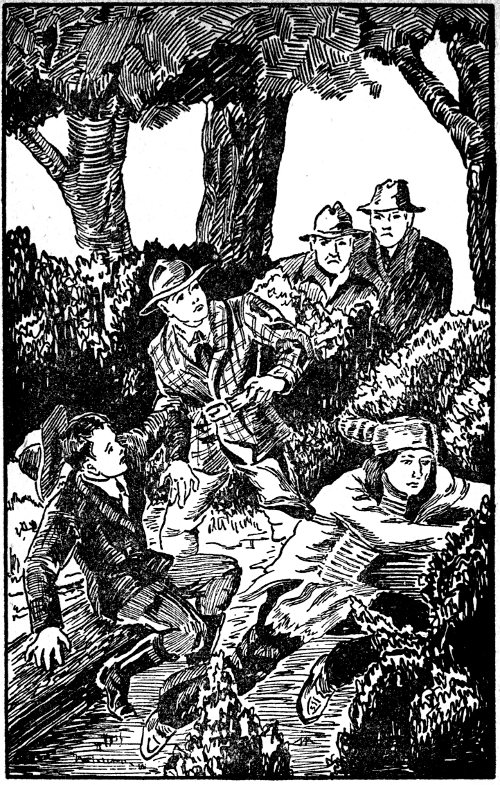
To the boys’ amazement, the chase ended abruptly.
They had come out to a small clearing in which
stood a cabin. Frischette’s fingers stole to his lips
and a peculiarly soft, bird-like whistle sounded
through the forest. Then the Frenchman remained
standing where he was until the door opened and
a slouching figure emerged.
40
At sight of the occupant of the cabin, the boys
gasped in wonder. Never before had they seen so
unusual a person. He was bent and old, and hobbled
as he walked, in one hand a cane to guide him. His
head was hatless, covered with a thick, straggling
crop of hair, some of which fluttered into his face
and over his shoulders. His beard was long and
heavy—of a peculiar reddish tinge, streaked with
gray.
He approached Frischette, pausing a few feet
from him, and looked up at his visitor with eyes that
peeped out from the shadowed depressions between
his beard and eyebrows like two black beads. The
Frenchman was the first to speak:
“I bring back ze box again, M’sieur Creel. You
will take et an’ watch over et. You are a faithful
guardian, my friend. I weesh to compliment you.
Ever’zing ees here: ze money, ze treasure—ever’zing.”
The stranger spoke in a voice so low that, from
their hiding place, the boys could make out but a
few words. Frischette spoke again:
“Et ees tonight.”
The old man shook his head vigorously, gesturing
with his hands. The Frenchman raised his voice:
“Et ees tonight, I tell you. You will do as I
say.”
This time they heard the protest:
“No, no; I cannot come. Tonight I have other
work. I cannot be there. I refuse to do as you
wish, Frischette, even for the sake of gain.”
41
The Frenchman’s face grew suddenly crimson
with fury. He stooped and picked up a club, advancing
threateningly.
“I see ’bout that,” he fairly shouted. “I see ’bout
that pretty queek. You try fail me, m’sieur, I make
you sorry.”
The other did not blink. He faced his antagonist
calmly, scornfully, presently breaking into an amused
chuckle.
“You couldn’t hurt a fly. You are a coward,
Frischette. I, an old man, have far more courage
than you.”
The road-house keeper’s sudden flare of fury
quickly burned out. He dropped his club and
stepped back several paces, hugging his treasure to
him. Before the unwavering gaze of the old man
he was helpless, and possibly a little afraid. He
glanced about sullenly.
“All right, et ees your own broth you brew,
monsieur. I shall keep ze box. Et ees all mine.
Do you hear? Et ees mine.”
“Faugh! A bluff! You wouldn’t dare. I ask
you to try it.”
The Frenchman clutched the box still more tightly.
“Et ees mine,” he persisted stubbornly.
“You try it,” warned the other.
42
“No more will I come to you,” Frischette informed
him. “We are through. I shall keep ze
box.”
“Fool!” cried the other in vexation, beginning
to relent “I suppose that I must humor you always.
Very well, it shall be as you say. I give you my
promise. But it will cost you a pretty penny this
time.”
Suddenly they began to barter.
“Half,” said the Frenchman.
“Two-thirds,” insisted the man with the beard.
Frischette gave vent to a shriek of anguish.
“Two-thirds,” he howled. “What? Are you
crazy? I will not leesen to zat. Et ees outrageous,
m’sieur.”
Sandy poked Dick cautiously in the ribs.
“Both mad!” he announced. “Can you make anything
out of that gibberish? What are they talking
about?”
“I’ll confess,” Dick whispered, “that I’m at a
loss to know.”
In the end, the two conspirators came to an
agreement
“One-half it shall be,” they heard the old man
mutter.
Having won his point, Frischette beamed. He
thrust the box into the other’s hands.
43
“Take et, m’sieur. I am sorry ef I speak cross.
We must be friends. We must understand each
other. En a ver’ few weeks we go to Edmonton an’
we shall be rich, m’sieur.”
Creel grumbled something through his beard,
seized the box with eager hands and half-turned as
if to depart.
“Tonight then?”
“Yes, tonight.”
The boys scrambled back quickly, for Frischette
was beginning his journey homeward. A moment
later, from the deep shadow of a heavy thicket,
they watched him pass. He was shaking his head
and talking to himself in a complaining undertone.
Not long afterward he had disappeared in the tangle
of greenery, and over the woodland there settled
a deep and impressive silence. Dick looked at Sandy
and Toma and smiled.
“The farther we go into this thing, the stranger
and more perplexing it becomes. I wonder who
that man is? In what way is he associated with
Frischette? Why is he guarding the box? Now
what do you suppose they were arguing about?”
“I can’t imagine,” answered Sandy. “What do
you think, Toma?”
The Indian youth rose and broke off a twig from
a branch above his head.
44
“I think him bad fellow just like Frischette.”
“Yes,” agreed Sandy, “probably his accomplice.”
“It doesn’t look as if we would open that box
now,” grimaced Dick.
“Not unless we overpower the old man.”
Dick too arose, glancing back at the cabin.
“I’d like to think it over before we attempt it.
Possibly some plan may occur to us tomorrow. At
present we’d better go back to the road-house before
Frischette becomes suspicious. I wouldn’t be in
the least surprised if he attempts to relieve me of
that roll tonight.”
“I can agree with you there,” said Sandy. “Did
you notice his eyes when you pulled it from your
pocket?”
“Yes.” Dick smiled at the memory.
They started back along the trail, for a time
walking in silence. Presently, however, Sandy
turned toward Dick, his face thoughtful.
“Supposing,” he inquired, “that Frischette really
does attempt the robbery tonight. What will we do?
Let him have the money? Or do you want to catch
him in the act?”
“We’ll let him have it.”
“But there’s nearly sixty dollars of our money.
I’m not so rich that—”
45
“We’ll get it back somehow, Sandy,” Dick interrupted.
“The police will see to that. I’ve marked
the bills so that we can identify them.”
“Good!”
“We’d better remain awake, all of us,” continued
Dick. “I’ll take the lower bunk in the corner
near the door. You can sleep in the upper one.
Toma can occupy the lower bunk next to mine. Just
before we retire, while Frischette is still in the
room, I’ll remove my coat and throw it over the
back of a chair.”
“We’ll all keep perfectly still,” said Sandy, “when
he enters the room. Remember, Toma, that you are
not to make any effort to stop him.”
The young Indian nodded:
“Yes, I understand. Me do nothing.”
Later, when they had retired for the night, they
were in an excited frame of mind. Had they been
ever so tired, it is doubtful whether they would
have been able to relax for sleep. Dick lay, facing
the doorway, so that he could command a view of
the entire room. Frischette’s sleeping apartment,
almost directly opposite, opened on to the large
bunk-hall they occupied. If the Frenchman planned
to take the roll, it would be necessary for him to
pass through the doorway, directly across from
Dick, and steal stealthily along the row of bunks to
the chair, over which Dick had carelessly flung his
coat.
46
The bunk-hall was shrouded in a partial darkness.
Outside the night was clear, and a half-moon rode
through a sky sprinkled with stars. To the ears of
the boys, as they lay quietly awaiting the Frenchman’s
coming, there floated through the open windows
the droning sounds of the forest. An owl
hooted from some leafy canopy. The weird, mournful
cries of a night-bird, skimming along the tree
tops, could be heard distinctly. The curtain, draping
the window on the west side of the room, fluttered
softly as it caught the rippling, nocturnal
breeze.
As time passed, Dick became conscious of an
increasing nervous tension and restlessness. He
found it difficult to lay still. He turned from side
to side. The strain upon his eyes from watching
the door so continuously had caused a blur to appear
before them, and only with difficulty could he make
out the various objects in the room. Time and
time again, he imagined he could hear a slight sound
coming from Frischette’s apartment. Yet, as he lay
there and the door did not open, he realized that he
must have been mistaken.
47
At length he decided that the road-house keeper
would make no effort to come that night. Reasoning
thus, he lay very still, his eyes closed, drowsiness
stealing over him. Through his mind there flashed
confused pictures of the day’s happenings. In imagination,
he was threading a woodland path, following
the fleeing form of a man, who clutched to him
a mysterious wooden box. Again he saw the angry,
distorted face of Frischette, who was standing there,
one arm raised threateningly above the stooped form
and uncovered head of Creel—the queer old recluse.
Tossing restlessly, his eyes came back to the door,
and suddenly his nerves grew taut. The door, he
perceived, was now slightly ajar. It was opening
slowly. A few inches at a time it swung back, and
at length a muffled form stood framed in the doorway,
then moved noiselessly nearer. Unerringly, it
padded across the floor, straight towards Dick’s
bunk. It paused near the chair, scarcely four feet
from where Dick lay.
With difficulty, Dick suppressed a cry. The
skulking, shadowy form was not that of Frischette—but
Creel! Creel, a horrible, repellent figure in the
half-darkness. Long, straggling locks of hair fell
over his eyes, while the heavy beard formed a mask
for his repulsive face. Dick could almost imagine
that he could see Creel’s deep-set eyes shining from
their sockets. They were like those of a cat.
48
Previously it had been agreed between the three
boys that in the event of Frischette entering the
room and attempting to steal the money, no effort
would be made to prevent him. Now Creel, and not
Frischette, was about to commit the crime. For
some unknown reason Dick felt that he could not
lay there inactive. Resentment and anger suddenly
burned within him. As Creel cautiously lifted up
his coat, Dick found himself sitting bolt upright,
and, to his amazement, heard himself shout out:
“Drop that coat if you don’t wish to get in
trouble. Drop it, I say!”
Creel started so quickly, dropped the coat so suddenly,
that the chair overturned and crashed to the
floor. There came the sound of moccasined feet
pattering away! Dick had sprung from his bunk,
as had also Sandy and Toma. For a time confusion
and excitement reigned. Frischette appeared
in the doorway, and upon his heels came Fontaine
and Le Sueur, rubbing their eyes.
“What ees ze matter?” Frischette inquired in a
frightened voice. “What has happen?”
“Someone came in here a moment ago,” cried Dick
angrily, “and tried to steal my money. I tell you,
Frischette, the thief is in this house!”
49
CHAPTER VI NEW COMPLICATIONS
Not until the following morning did the boys
have a chance to discuss the happenings of the previous
night. Over the breakfast table, Dick was
the cynosure of two hostile pair of eyes—those of
Sandy and Toma. It was quite evident that Dick’s
chums were not satisfied with the outcome of the
night’s adventures. Sandy, in particular, could
scarcely contain himself. He kept glowering at his
friend over his coffee and bacon, and Dick could
see that a lecture was forthcoming. However, Sandy
did not get his chance until nearly an hour later,
when the three boys left the dining room for a turn
in the open air. Scarcely were they outside, when
Sandy broke forth petulantly:
“Look here, Dick, I must say that you followed
out our agreement to the letter. What did you mean
by crying out like that, after it had been decided to
let Frischette walk away with the money?”
“But it wasn’t Frischette,” Dick defended himself.
50
“Wasn’t Frischette. What do you mean? Of
course, it was Frischette. I saw him with my own
eyes.”
“It was Creel.”
“Creel!”
“Yes, that fellow who took the box from the
Frenchman yesterday.”
Sandy whistled softly.
“So that’s their game. Creel is Frischette’s confederate.
I can see it all now.”
“That’s the way I have it all figured out too.
Frischette is the man who plans all the robberies
and Creel is the one who executes them.”
Dick paused and leaned against the trunk of a
huge jack-pine, contemplatively regarding his two
chums.
“It means we have two persons instead of one
to deal with. The treasure-box they keep between
them. Each probably has an equal interest in it.
I wish there was some way we could get hold of
it.”
“Mebbe that not be so very hard,” Toma suddenly
interjected. “One night we go over to Creel’s
cabin an’ find it sure. I think I know how we get
it without much trouble.”
“How?” demanded Sandy.
51
“You remember yesterday when Frischette come
close to Creel’s cabin he stop in the brush an’ make
’em noise for him to come out. Well, one of us do
same like that while other two hide close to cabin.
When Creel come out, thinking it Frischette, good
chance go get box. What you say?”
“A good plan, certainly,” criticised Dick, “only
how are we going to imitate that peculiar, mysterious
whistle. I’m sure I couldn’t.”
“I couldn’t either,” declared Sandy.
Toma put two fingers to his mouth and blew
softly. It was an excellent imitation of the sound
the boys had heard on the previous day, and both
Dick and Sandy clapped their hands in delight.
“You’re good!” Sandy exclaimed. “I’m proud of
you. How can you manage to do it, after hearing
it only once?”
“I hear it many times,” flushed the young Indian.
“You see, there is bird that hide deep in the woods
that make ’em call like that. Frischette, jus’ like
me, try make sound like that bird.”
“We’ll go tonight,” exulted Dick.
The other two nodded in agreement.
52
“Ten o’clock will be a good time,” Sandy suggested.
“Dick and I will enter the cabin, while you,
Toma, practice your wiles upon the thieving Mr.
Creel. Lead him away from the cabin as far as
you can, so that we’ll have plenty of time to look
around. We may have some trouble in finding the
place where he has hid the box.”
The boys had worked themselves up to a high
pitch of excitement long before the time appointed
for setting out on their night’s adventure. In order
not to arouse Frischette’s suspicions, should he discover
their absence, they had informed him that
they were planning to go over to Lake Grassy Point,
a distance of about eight miles, and visit the Indian
encampment there. Fontaine and Le Sueur, they
explained, would accompany them too, and he,
Frischette, must not worry if they were late in getting
back.
To their surprise, the arrangement met with the
Frenchman’s immediate approval.
“Et ees good you go,” he told them. “You young
fellow get ver’ tired stay one place all ze time.”
Then he sighed regretfully. “Ver’ often I weesh
I might be young too. Always go, always have
good time. Et ees ze great fun, monsieurs.”
Dick’s brow contracted thoughtfully. Did Frischette
contemplate a visit to Creel himself? Had
the Frenchman a plan of his own?
“Just our luck,” Dick told Sandy a few minutes
later, “if the old rascal decides to visit Creel tonight.
We’ve gone to a lot of trouble already.”
53
The young Scotchman slapped irritably at a
mosquito that had lit upon his arm.
“Yes, it was necessary to take Fontaine and Le
Sueur more or less into our confidence. That’s one
phase of the thing I don’t like. Those two friends
of Toma’s know we’re up to something. All I hope
is, that they’ll have sense enough to keep their
mouths shut. If Frischette ever gets an inkling that
we’re watching him, the game’s up.”
“But Fontaine and Le Sueur haven’t the least
idea what we purpose to do,” said Dick. “Neither
one of them knows that we’re spying upon Frischette.”
“Yes, but they’ll think it’s queer that we’re deceiving
him. They’ll wonder why we have lied to
him, want them to go to the encampment while we
remain behind.”
“You don’t need to worry about that, Sandy.
You may depend upon it that Toma has made our
proposed actions seem very plausible.”
Sandy grinned.
“Toma probably has told them a wonderful story.
I’ll agree with you there. He certainly possesses
a keen imagination.”
Dick consulted his watch.
54
“It’s twenty minutes past nine now. I think,
Sandy, we’d better go back to the house and find
Toma and the others. It’ll be time to start before
long.”
They hurried along the path, and a few minutes
later entered the house, where they were joined by
Toma and his two friends. Soon afterward, Frischette
strode into the room, carrying his coat and
hat.
“I go with you a leetle way,” he announced. “All
day long I work in ze kitchen, where et ees hot. I
think ze night air mebbe make me feel good.”
Dick glanced sharply across at Sandy, keen disappointment
depicted in his gaze. The Frenchman’s
announcement had taken him completely by surprise.
The situation was awkward.
“Why not come all the way to the encampment
with us,” invited Dick. “We’ll be glad to have you.”
Frischette threw up his hands in a gesture of dismay.
“All zat way! Empossible! Et ees too far, monsieur.
I am too tired. Eight miles there an’ back
an’ ze brush tangle in my poor tired legs. No, I
will go only a ver’ short way.”
So Frischette, much to the boys’ disappointment,
accompanied them. He chatted as they walked, continually
gesturing, often stopping abruptly in his
tracks to point out some inconsequential object.
55
Never before had Dick been given so excellent an
opportunity to study the man. He was slightly
amused at the Frenchman’s queer antics. He would
become intensely enthusiastic over the merest trifles—a
bright flower, a sparkling stone, a gnarled, misshapen
tree.
A person of moods and impulses, Dick decided,
watching him. Sometimes he wondered if Frischette
were not assuming a certain behavior for their
special benefit. What was his real purpose in coming
with them? Certainly it was not because he really
wanted the exercise and fresh air. More likely, he
intended to go over to visit Creel.
Their course to Grassy Point Lake led them in
the general direction of Creel’s cabin. When the
Frenchman bade them adieu and turned back, Dick
estimated that they had still about two miles farther
to go before they would be directly opposite the
abiding place of the mysterious recluse. Realizing
this, his previous conviction that Frischette was
really going there became shaken. Perhaps, after
all, the road-house keeper had told the truth, was
actually going back as he said.
56
Even if the man planned to strike off obliquely
through the woods to Creel’s, hope of obtaining possession
of the box was not altogether lost. They
might still turn the trick that same night, if only
they hurried. By running part of the way, they
would arrive at the cabin sufficiently in advance of
Frischette to achieve their purpose. With this
thought in mind, Dick, after waving a friendly farewell
to the unsuspecting Frenchman, led the party
forward quickly until a turn in the trail obscured
their movements. Then, breaking into a run, he
darted along the shadowy forest path, motioning the
others to follow.
Ten minutes later, the three boys drew away from
Fontaine and Le Sueur, striking off at right angle
with the dim trail to Grassy Point Lake, and continued
their hurried course straight in the direction
of the lonely cabin. As they proceeded on their
way, excitement, caused by the thought of their
coming adventure, grew upon them. They were
shaky and nervous when they finally drew up in
front of a thick screen of underbrush, less than
sixty yards from the house. Dick motioned to Toma.
“Hurry around toward the front of the cabin,”
he whispered tersely, “and give your bird-call.”
“Sure you all ready?” inquired the young Indian.
“Yes, all ready.”
“I go then.”
Without further word, Toma slunk forward,
skirted the line of underbrush and presently disappeared
from view.
57
CHAPTER VII THE MYSTERIOUS POKE
Dick and Sandy waited breathlessly. Thus far,
no sound had come to them. The forest was pervaded
by a silence so deep and oppressive that the
two boys, waiting for Toma’s mysterious call, could
hear the thumping of their own hearts. They had
crept forward through the dense thicket to a point
where, though still concealed themselves, they could
see the cabin plainly. In the sombre northern twilight
its every detail stood clearly revealed—the low,
grass-grown sod roof, the tiny window and the
crude, rough door.
The boys found it difficult to restrain their gathering
impatience. What was Toma doing? Chafing
over the delay, they crouched low, their gaze sweeping
the tiny clearing ahead. On Dick’s forehead
beads of perspiration gathered slowly, while the
palms of his hands were moist and warm.
“Can’t imagine what’s happened to him,” Sandy
croaked in Dick’s ear. “What’s he waiting for?
What’s got into him, anyway? First thing we
know, Frischette’ll be here—and it’ll be too late.”
58
Dick did not reply. Just then he thought he had
heard a slight sound in the brush, directly in front
of the house. Excitedly, he reached forward and
seized Sandy’s right arm.
“Ssh!” he whispered. “Keep still. Just look
over there.”
Following his friend’s instructions, Sandy looked
and immediately his mouth gaped open, and he
emitted a startled gasp.
Two men plunged out into the open—rough, desperate,
evil-looking men, who made their way
stealthily forward. Each carried a knife and revolver
at his belt. One was tall and sinewy, the
other short and thin. The tall man proceeded ahead
with long awkward strides, while the little man at
his side pranced along, like a small boy attempting
to keep pace with his elder.
Of the two, the face of the smaller man was, if
such a thing were possible, more sinister, malevolent
and wicked than that of the other. His features
were twisted in an expression that was both horrible
and repellent. It was as if he had been overcome
by some violent emotion: rage that hungered
for revenge, or cruelty inflamed by avarice. In all
their experience, the boys had never encountered
a more terrifying pair. The very sight of them
caused Dick and Sandy to shiver and draw back in
a sudden panic.
59
“Ho-hope they don’t come this way,” shuddered
Sandy.
“Toma saw them before we did,” whispered Dick.
“That’s why he didn’t attempt that call. Who do
you suppose they are?”
In terror, Sandy shook his head.
“Keep down,” he trembled, “or they may see us.”
Dick grew suddenly tense. The two men had
reached the door of the cabin, and for a brief moment
stood undecided. Then the tall man raised
a gnarled hand and struck the door so violently and
unexpectedly that Sandy and Dick both jumped
back, as if they, instead of the rough pine barrier,
had received the full impact of that mighty blow.
The echo had scarcely subsided, when the tall man
struck again.
“Open up! Open up!” he thundered. “Creel,
open up this yere door.”
The door swung back on its rusty hinges, and then
the boys saw Creel framed in the aperture. But
it was a different Creel than the man they had seen
previously. He looked much older. The stoop to
his shoulders was more noticeable. A pathetic figure
now, a terror-struck human derelict. At the very
best he could offer but feeble resistance to these
two terrible fellows, who had come storming and
raging upon him.
60
“Guess yuh know what we’ve come fer, Creel,”
the little man snarled. “Yuh can guess, can’t yuh?
Quick now, an’ bring it out. We’re in a hurry, I
tell yuh. Quick!”
Creel made the fatal mistake of pretending he did
not know what the other was talking about. He
raised a trembling hand.
“If you’ll explain a little more clearly, gentlemen,
what you want I’ll—”
The sentence was not completed. The tall man
reached out with one arm and caught Creel about
the neck. Scarcely seeming to exert himself, he
lifted him completely off his feet, holding him dangling—head
pressed back against the frame of the
door. For a brief moment the body of the recluse
remained pinioned there, then was suddenly released
and fell with a muffled thud across the threshold.
Dick and Sandy, who had been silent witnesses
of the drama unrolling before their eyes, caught
their breath in anger. Much as they despised and
feared Creel, the unwarranted brutality of the tall
man caused them to experience a feeling of sympathy
for the helpless old recluse. Dick’s hand
flashed to the revolver at his belt, and he had half-started
to his feet, when Sandy drew him back.
61
“Don’t be foolish, Dick,” he trembled. “Keep
out of this. We can accomplish more by remaining
right here where we are. Look!”
Creel had stumbled dazedly to his feet, gripping
the door for support.
“Now,” declared the little man grimly, “I guess
yuh understand. Bring it out.”
Creel staggered inside and appeared, a short time
later, carrying the box. Both men made a grab for
it, but the smaller was the quicker of the two. He
flung open the lid of the small treasure-chest and
both he and his companion pawed through it excitedly,
their faces distorted with greed.
Dick and Sandy, who were watching events with
wide-open eyes, were wholly unprepared for the
next step in the little drama. In a sudden fury of
disappointment, the little man raised the box and
sent it crashing to the floor. His expression was
awful to behold, his eyes like two bright coals of
fire. Nor did his companion contain himself much
better. With an oath, he spurned the box at his
feet, sending it flying within the room. His cheeks
were livid.
“It ain’t here, Emery!” he almost screamed. “It
ain’t here! That squaw lied to us. We’re done for.
MacGregor got it after all!”
But the other was not so easily discouraged.
62
“It is here!” he fairly howled in his rage.
With a lightning motion, he turned upon Creel,
advancing with outstretched hands—hands that
looked like the talons of some huge bird; hands that
worked convulsively as they floated toward Creel’s
throat. Before the little man’s advance, the old recluse
tottered back, throwing up his arms in a defensive
gesture.
“I’ll give yuh jus’ two minutes tuh bring out that
poke,” the words came screaming at him. “Yuh
got it. I know yuh got it. If yuh don’t want to
make food fer the crows, yuh better trot it out.”
“Gentlemen—” began Creel, his voice deathly
calm.
The little man’s right hand flashed out and for
the second time Creel measured his length across
the threshold. This time, however, he did not rise.
In falling, his head had struck the sharp edge of
the doorway, rendering him unconscious. Without
even as much as a glance at him, the two men stepped
over his prostrate body and disappeared into the
room. For a space of nearly five minutes they remained
inside, while Dick and Sandy sat in a sort
of stupor and blankly regarded each other.
63
Then abruptly, Creel’s assailants re-appeared and
from their expression and behavior, the boys realized
instantly that the search had been successful. The
big man guffawed loudly as he pushed Creel’s body
to one side with his foot and stepped out into the
pale light of that Arctic summer night.
“We got it,” gloated the little man. “That was
a stroke o’ luck, pardner. The squaw was right.
We got it!”
As he spoke, he drew from his pocket a small
object and fondled it in his hands. Again the loud
guffaw rang out, penetrating the silence. Chattering
and exulting, the pair made their way through
the lush grass that overran the clearing. Then,
suddenly, they stopped. At the edge of the clearing
there had sprung up a frail but defiant figure.
“Stop!” cried a voice. “Put ’em hands up or I
shoot you quick.”
Creel’s assailants, looking straight at the muzzle
of Toma’s revolver, had no other alternative. Their
hands went high. Dick thought the pair looked very
foolish standing there. And he could hear very
plainly their astonished, burning oaths. He and
Sandy leaped to their feet and hurried to Toma’s
assistance. They came up from behind and, with
a nod to their chum, quickly disarmed the murderous
pair. But though they searched everywhere, they
could not find the poke. Dick paused in consternation.
“Big fellow got it in his hand,” said Toma.
64
“Give it to me,” Dick turned upon the outlaw.
The big man’s eyes gleamed with hatred, but with
Toma’s revolver threatening him, he was forced to
obey.
“Take it,” he growled out an oath. “But I bet
yuh don’t keep it long, stranger. Yuh won’t never
get away with it. Jus’ mark my words.”
Dick stepped back, laughing.
“That remains to be seen,” he answered the outlaw.
“You fellows can go now. If you know
what’s good for you, you’ll leave this neighborhood
as quickly as you can. I have the description of
both of you and will notify the mounted police of
this night’s affair.”
The partners struck off through the underbrush,
calling out their taunts. It was not long before
silence came again. The three boys stood in a little
circle, looking at each other. Now that the tension
had relaxed, they were all more or less bewildered.
Dick still had the small poke in his hand, and as
yet had scarcely deigned to give it a second glance.
Suddenly, Sandy’s voice rang out:
“Well, if you ask me, this is a peculiar night’s
business. I’m almost stunned. We’re indebted to
Toma for the way everything has turned out. Let’s
see what’s in that poke, Dick. Why don’t you open it?”
65
Dick looked down at the small object in his hand.
He turned it over and over thoughtfully.
“No,” he said, “you can open it, Sandy. I’m too
shaky.”
With the poke held firmly between two fingers,
he reached out to hand it to his chum. But in that
moment a strange thing happened. A crackling of
brush, a lightning leap forward, a snarl like that of
a beast—and the thing was whisked from his fingers
as it dangled there in the air. Then a figure darted
past them and disappeared in the darkness of the
forest beyond.
The three chums gaped at each other.
“Who was that?” gasped Dick.
Toma was the first to speak.
“I see ’em,” he spoke dolefully. “It was Frischette.”
66
CHAPTER VIII CORPORAL RAND TAKES CHARGE
Sandy rubbed his eyes.
“I don’t know what to make of this. Frischette
has the poke now. In a way I’m glad that he has.
It’s better for us, Dick. I’d hate to have another
encounter with those two prospectors. Wonder
what Frischette will say to us when we return to
the road-house.”
“Don’t worry,” said Dick, “we’ve seen the last
of him. He won’t come back.”
“You mean he’ll leave everything?”
67
“Yes, that’s my opinion. I don’t know what the
poke contains but it must be something of immense
value. Just stop a moment to reason it all out,
Sandy. First of all, the poke belonged to Dewberry.
MacGregor tried to get it, but was thwarted in his
purpose either by Frischette or Creel. Creel had
it in his possession until those two prospectors came
along and took it away from him. Now it’s in
Frischette’s hands again. If he returns to the road-house,
he’ll be afraid that we’ll get it away from
him. After what happened tonight, he’ll take no
chances. He’ll not even consider his partner, Creel.
He has a fortune in his hands and will attempt to
keep it.”
“What’s to be done now?” asked Sandy. “Do
you think we ought to set out in pursuit of Frischette?”
For a time Dick stood undecided.
“No,” he answered, “we haven’t time. Tomorrow
Corporal Rand will return to Fort Good Faith. He
has asked us to meet him there. We’ll have to follow
his instructions: Go back tonight.”
“But what about Creel? We can’t leave him
here.”
“That’s right. Let me see,” Dick scratched his
head in perplexity.
“Tell you what we do,” Toma suddenly broke
forth. “One of us stay here look after Creel an’
other two go back to Fort Good Faith. If you
like, I stay here myself while you, Sandy, you,
Dick, go on see Corporal Rand. After while I get
Fontaine an’ Le Sueur to help me. Soon they come
back from Grassy Point Lake.”
68
“Your plan is a good one,” approved Dick. “It’s
the best thing to do. If Sandy and I start at once—go
over to the road-house and get our horses—we
can reach Fort Good Faith shortly before the corporal
arrives. What do you think, Sandy?”
“We ought to go, of course. The way things
have turned out, we need someone to take charge
and straighten out this tangle. Corporal Rand will
know what to do. I expect his first move will be
to set out in pursuit of Frischette. The sooner we
get Rand back here the sooner he’ll be able to follow
and overtake him. Yes, we’d better start at
once.”
“All right, we’ll walk over and get the horses.”
Toma gave a little start of dismay.
“I jus’ happen think, Dick— By Gar— Make
me feel like silly fool. What you think I do?”
“What did you do?” Dick asked kindly.
“Yesterday I turn ponies out to eat grass.”
“Hang the luck!” exploded Sandy. “That means
we’ll have to walk. We might have to look around
all night before we find ’em.”
“I very sorry,” began Toma. “I—”
Sandy cut him short.
“Forget it! I don’t blame you, Toma. It’s just
a bit of bad luck, that’s all.”
“An’ you don’t feel mad at Toma?” inquired
that young man plaintively.
69
“Certainly not,” Dick assured him. “Either
Sandy or I might have made the same mistake. It’s
all right. We’ll walk.”
Without even returning to the cabin to determine
the extent of Creel’s injuries, they shook hands
with the young Indian and quickly departed. Their
hurried trek back to Fort Good Faith long remained
in the boys’ memory. Dick struck out with Sandy
at his heels, and hour after hour they pushed on
without even a pause for rest.
Both were swaying on their feet from weariness
as they entered the broad meadow, surrounding the
fort, and came finally to the well known trading
post.
Factor MacClaren looked up from his work as
the two youths entered.
“Why, hello,” he exclaimed in surprise. Then:
“Whatever has happened to you. You both look
as if you’d been stuck in a swamp somewhere for
the last day or two. I wish you could see yourselves.”
The boys looked down at their mud-spattered
garments. Sandy’s eyes were bloodshot and his
shoulders drooped. Dick’s face was scratched with
brambles. He had lost his hat and his hair was
rumpled and streaked with dirt. Each flopped into
a chair and breathed a sigh of relief.
70
“We made record time from Frischette’s stopping-place,”
Sandy announced finally.
Sandy’s uncle laughed. “I can well believe that
from your appearance. Have you been travelling
all night?”
“Yes,” answered Dick, “all night. By the way,
is Corporal Rand here?”
Factor MacClaren nodded.
“Arrived last night. Got in sooner than he expected.
He’s waiting for you. Went out to the
stables just a few minutes ago.”
“Uncle Walter,” Sandy requested wearily, “I
wonder if you’ll be kind enough to notify him that
we are here.” He sprawled lower in his chair. “I’m
so tired that I don’t think I could walk out there.
Also, while you’re at it, I wish you’d tell Naida, the
cook, to prepare a good breakfast for two hungry
men.”
“Men!” grinned the factor.
“Yes, men. At least, we’re doing men’s work.”
Chuckling to himself, Sandy’s uncle departed upon
his errand. Not long afterward Corporal Rand
himself appeared in the doorway and came eagerly
toward them.
“Well! Well!” he exclaimed. “So you’re back.
What luck did you have?”
71
“Great!” replied Dick, too weary to rise. “If
you’ll sit down for a moment, corporal, we’ll tell
you everything.”
When Dick and Sandy had completed their narrative,
Corporal Rand sat for a long time in thought.
His fingers drummed on the table.
“You’ve done much better than I expected,” he
complimented them. “And to be perfectly frank,
I don’t know what to think of it all. Those two
men you spoke of, who attacked Creel and secured
the poke, I can’t recall that I’ve ever seen them.
However, your description tallies with that of two
prospectors I met one time at Fort MacMurray.
But that’s hundreds of miles from here. It hardly
seems likely that it would be the same pair. But
that is neither here nor there. You boys have practically
established Frischette’s guilt. If he didn’t
actually take the poke from Dewberry himself, he
must have induced Creel to do it. Probably when
I have seen and talked with Creel I can force the
truth from him.”
“Will you place Creel under arrest?” asked Sandy.
“Not unless I can get him to confess. As yet we
can prove nothing against him.”
72
Naida appeared at this juncture to announce that
breakfast was ready, and Corporal Rand accompanied
the two boys to the dining room. Dick and
Sandy applied themselves with such diligence to the
feast before them, that Rand refrained from asking
any more questions just then. When the boys
had pushed back their chairs, sighing contentedly,
Rand took up the subject anew.
“I’m glad you came when you did. I’m anxious
to go out on the trail after Frischette. Just now
Frischette holds the key to the riddle. If we can
catch him, I think our troubles will be at an end.”
Dick looked across at the policeman.
“Your suggestion, then, is to return immediately
to the road-house?”
“If you boys are not too tired, I’d like to start
at once.”
“Now that we’ve had something to eat, I’m ready
to go,” said Sandy. “I feel a lot different than I
did when we arrived here a short time ago.”
With one accord the three rose to their feet, and
not long afterward secured their horses and departed.
Following a hard but uneventful ride, they reached
the scene of the events of the night previous. They
met Toma just outside the door of the road-house.
He greeted them with a cheery smile, striding forward
to shake hands with Corporal Rand.
“Glad you come so soon, corporal. I get ’em
Creel over here last night. Him pretty near all
right now.”
“Did Frischette come back?” asked Sandy.
73
The young Indian shook his head.
“He no come. Creel no think he come either.”
They found Creel a few moments later, sitting,
with bandaged head, in a chair near an open window.
At sight of the mounted policeman his
eyes dilated perceptibly. Yet otherwise he showed
little of the emotion and fear the boys had
expected.
But if Rand had hoped to secure information of
value from the old recluse, he was disappointed.
When questioned about the events of the night before,
his answers were evasive. He knew nothing
about the poke. He had seen no poke. The money-box,
slightly battered, which Toma brought forth
as evidence, belonged to him, he admitted. Why the
thieves had not taken the box, Creel could not understand.
It contained upward of five thousand dollars
in currency.
“If this box and money belongs to you,” Rand
demanded, “what was Frischette doing with them?
The boys say that Frischette had this box in his possession
here only two days ago. What was he doing
with it?”
Creel met the policeman’s eyes unflinchingly.
74
“The boys must be mistaken,” he wagged his head.
“The box is mine. Until last night no one has seen
it. People call me a miser. Those men, who came
last night, were disappointed because they expected
to find more.”
Rand scowled. He saw the uselessness of further
questioning. Though Creel might be aware of
Frischette’s treachery, it was evident that he had
no intention of attempting to obtain revenge upon
him. To incriminate his confederate, would be to
incriminate himself. Both would go to jail. Creel
was wise enough to see that.
“Perhaps,” said Rand grimly, “you’ll have more
to tell us when we bring your friend, Frischette,
back and obtain possession of that poke. You could
save yourself a lot of trouble by giving me a confession
now.”
“I have nothing to confess,” Creel declared obdurately.
“I do not understand Frischette’s disappearance.
But even if you do find him and bring
him back, you’ll learn nothing of value. Frischette
is my friend and I know that he is not Dewberry’s
murderer, that he is innocent of all wrong.”
The policeman rose to his feet, walked over and
looked down at the old recluse.
“I didn’t say that Frischette murdered Dewberry.
I’m convinced that MacGregor did that, just as much
as I’m convinced that either you or Frischette secured
the money and poke that belonged to the murdered
man.”
75
Thus openly accused, Creel shrank back. His
hands trembled. Yet, in a moment, the weakness
had passed. Again, unflinchingly, he met the gaze
of the man opposite.
“You are mistaken,” he declared in a clear, steady
voice. “You will find that you are mistaken. Events
will bear me out.”
Rand suddenly drew back. Footsteps sounded
outside. Voices, scarcely distinguishable, floated to
their ears. More scuffling of feet, and then the door
opened. Dick, Sandy and Toma darted to their
feet, staring wildly at the two newcomers:
Creel’s assailants of the night before!
76
CHAPTER IX UNEXPECTED NEWS
For a full minute no one spoke.
It was a question who was the more astonished—the
prospectors or the three boys. Corporal Rand
turned his head as the two men entered and regarded
them steadily. Creel had half-started from his chair,
then quickly sat down again, while a queer smile
puckered the corners of his mouth. If Dick had
expected that Creel’s assailants of the previous night
would show fear at sight of the mounted policeman
he was greatly mistaken. To his surprise the big
man nodded in a friendly way toward the corporal,
then advanced to confer with him.
“This sure is a piece of luck,” he exclaimed, extending
a grimed and hairy hand, which Rand totally
ignored. “I hadn’t expected to find yuh here.
Most allers when yuh want a policeman, there ain’t
one within fifty miles.”
This statement, apparently, did not wholly please
Rand, for he scowled lightly, his sharp blue eyes full
upon the other.
77
“What business have you with the police?” he
demanded.
“It ain’t nothin’ that concerns us,” the little man
cut in, in his attempt to smile looking more repulsive
and ferocious than ever. “It’s like this, constable—”
“I’m a corporal,” interrupted Rand severely.
“A’ right, corporal. As I jes’ started out tuh
say Burnnel an’ me—that’s him there. He’s my
pardner—is a hoofin’ it along on our way to Deer
Lick Springs, when sudden like, in a little clearin’
in the brush ’long side the trail, we comes upon the
body of a man.”
The prospector paused, rubbing his chin with the
sleeve of his coat.
“He was dead, corporal,” he went on, “—dead
as a dead crow he was, sir, a lyin’ there all stiff
an’ cold with a bullet through his head.
“Fer more ’n a minute Burnnel an’ me we couldn’t
speak, we was that surprised, corporal.”
“My pardner has told yuh right,” the big man
hastened to confirm the other’s story. “He’s back
there now, jes’ like we found him.”
78
During the short announcement by the two men,
Rand’s expression had grown severe, as was always
the case when he was thinking deeply or when he
had suddenly been made aware of some new and
unexpected happening. A deep pucker showed between
his eyes. He motioned the partners to be
seated, produced a notebook and fountain pen.
“Now just a moment,” he began, glancing sharply
across at the two tale bearers. “Answer my questions
as I put them to you. First of all, just where
did you find this body? How far from here?”
Burnnel scratched his head.
“Le’s see—I reckon, corporal, ’bout twenty miles
from here, southeast on the trail tuh Deer Lick
Springs. It was on the right side o’ the trail,
wa’n’t it Emery?”
“It was,” Emery corroborated the other.
“On the right side o’ the trail,” continued Burnnel,
“close to a willow thicket.”
“In what position was the body?” Rand next inquired.
“The man was a lyin’ stretched out a little on his
left side, one arm throwed up like this:” The speaker
imitated the position of the body by putting his head
forward on the table and extending his arm. “It
was like that, wa’n’t it, Emery?”
Again he turned toward the little man.
“It was,” came the ready rejoinder.
“And you say there was the mark of a bullet on
the man’s forehead?”
79
“Yep,” Burnnel answered, “an’ a revolver in the
hand what was outstretched.”
“In other words,” Rand’s tone was incisive, “it
looked like suicide.”
Both the men nodded emphatically.
“Yeah, that’s what it was. Suicide. An’ it happened
not very long afore we had come. Yuh could
see that.”
The policeman tapped softly on the back of his
hand with his fountain pen. For several minutes
he did not speak, then—
“You say you didn’t disturb the body?”
“No,” answered the little man, “we didn’t touch
him.”
“Did you, by any chance, examine the contents of
his pockets?”
The big man flushed under the direct scrutiny,
while his partner, Emery, suddenly became interested
in the fringe of his mackinaw jacket.
“Well, yes,” drawled the big man. “Yuh see,”
he attempted to defend their actions, “Emery an’
me thought that mebbe we could find a letter or
suthin’ in his pockets what would tell who the fellow
was.”
“Quite right,” approved Rand. “And what did
you find?”
80
“Nothin’,” stated Emery.
“Nothin’,” echoed his partner.
“Absolutely nothing?” Rand’s eyes seemed to
bore into them.
The partners exchanged furtive, doubtful glances.
Then the face of Emery darkened with a sudden
resolve, and he thrust one hand in his pocket and
brought forth—to the boys’ unutterable amazement—a
small moose-hide pouch, scarcely more than two
inches in width and three inches in length—a small
poke, identical to the one Dick had held in his own
hands less than twenty-four hours before. Seeing
it, Dick had taken in his breath sharply, while Sandy
and Toma rose excitedly to their feet and crowded
forward.
“You found that?” asked Rand, wholly unmoved.
“Yes.”
“Let’s see it.”
Emery tossed it over and it fell in Rand’s lap.
The corporal picked it up and examined it closely.
He untied the cord at the top and opened it. He
thrust two fingers inside.
“Empty,” he said.
“Yeah. Empty.”
Both Burnnel and Emery wagged their heads.
Corporal Rand favored them with a keen, searching
look.
81
“You’re sure about that. You didn’t take out
its contents?”
The partners denied the implication stoutly. Their
denials and protestations were so emphatic, that
neither Corporal Rand nor the boys could believe
that they spoke anything but the truth.
“And this was all you found?” Rand continued
his questioning.
“Nothin’ else,” grunted the big man. “There
wasn’t even a pocket knife or a comb or a watch,
or anything like that. His pockets was absolutely
empty.”
The sight of the moose-hide pouch had produced
a strange effect upon Dick. His eyes kept returning
again and again to the mysterious object Rand still
held carelessly in one hand. Improbable as it seemed,
Dick could not shake off the belief that the poke
was the same one that had been taken forcibly from
Creel the night before. He wondered what the old
recluse thought about it all. Turning his head, he
glanced sharply in his direction.
To his surprise, Creel sat unmoved, apparently
uninterested. His round, staring eyes, which somehow
reminded one of those of a cat, were set in a
fixed stare. Occasionally, Creel’s long hand stole
to his bandaged head. It was evident that nothing
was to be gained here. Then Dick became conscious
of a question that Rand had just asked the two men:
82
“You found the body along the trail, twenty miles
from here. Deer Lick Springs is only ten miles
farther on. What motive prompted you to return
here? Wouldn’t it have been much easier to go on
to your destination?”
“We thought about that,” the little man answered
without a moment’s hesitation. “Burnnel an’ me
we talked that over when we was standin’ lookin’
down at that man’s body. I was fer goin’ on tuh
the Springs, but Burnnel he says no. Wouldn’t
hear to it. He insists on comin’ back all this way
tuh Frenchie’s stoppin’-place.”
“Why?” asked the policeman, turning upon
Burnnel.
The big man drew a deep breath before he answered.
“It’s like this, corporal,” he finally declared. “Yuh
see I had a notion that I had seen that man before.
He looked like somebody I knowed what lives over
this way. I wa’n’t sure, o’ course, but I had a suspicion.
It sort o’ bothered me. I says to Emery:
‘We’ll go back an’ find out.’”
83
The pucker came back between the corporal’s
brooding eyes. He looked upon Burnnel with suspicion.
Dick wondered if Rand believed, as he was
somewhat inclined to believe himself, that the partners
were the man’s murderers.
“What did you intend to do when you arrived
here?” Rand asked.
“We was plannin’ to send word tuh the police.
We thought they ought tuh be notified. But afore
God, corporal, we didn’t have no idea that yuh was
here. Mighty lucky, I call it. Saved us a hull lot
o’ time an’ trouble.”
“Yes, it was lucky,” the corporal averred grimly.
“Rather fortunate for me too. You may consider
yourselves under arrest, at least until I have investigated
this case. You and your partner will lead me
to the scene of the tragedy.”
“A’ right,” agreed Emery, his face more repellent
than ever, “me an’ Burnnel’ll go with yuh. It won’t
take long. If we had some horses now—”
“I’ll supply the horses,” Rand informed him.
“That’s fine!” Emery’s smile expanded into a leer.
“We can go an’ get back afore night. Ain’t that
right, Burnnel?”
“Yeah,” agreed Burnnel, “an’ when do we start,
corporal?”
“Right away.”
“That’s a’ right with us,” said the big man,
“only—”
“Yes,” insisted Rand, “Only—”
84
“Yuh see, me an’ Emery ain’t had nothin’ tuh eat
fer a long time. Soon as we get suthin’—jes’ a bite,
corporal—we’ll be ready tuh start. Ain’t that fair
enough?”
Rand nodded. His brow had contracted slightly,
deepening the pucker between his eyes.
“There’s one thing you’ve forgotten to tell me,”
he informed them. “Burnnel, you said a moment
ago that the man out there reminded you of someone.
Who?”
“Yes, yes,” said the big man eagerly, “I was
a comin’ tuh that. It’ll explain, corporal, why we
drifts back this way ’stead o’ goin’ on to Deer Lick
Springs. Yuh see, the man out there looked,” he
paused, wetting his lips, “looked like this here fellow
what runs this stoppin’-place—this here Frenchie
Frischette.”
The three boys bounded from their seats. Corporal
Rand himself started visibly. With one exception
every one in the room showed his astonishment. That
exception was Creel. The old recluse sat perfectly
unmoved, as though he had expected, had been prepared
for the strange denouement.
85
CHAPTER X CONFLICTING THEORIES
Soon after the departure of Corporal Rand,
Burnnel and Emery, the boys sat in the big, cheerful
room of Frischette’s road-house and discussed the
latest episode in the chain of mysterious events.
“I never expected to encounter anything like this,”
Sandy was saying. “Honestly, Dick, it gives me the
shivers just to think about it. If I were called upon
to express an opinion, I’d say that the farther we
get into this case, the more muddled and difficult
everything appears to be. For one thing, whoever
would have guessed that this sudden tragedy would
have overtaken Frischette. What is the reason for
it? Do you really believe the story about the
suicide?”
“It sounds plausible, the way they tell it, but to
be perfectly frank, I think it’s a deliberate lie. Why
should Frischette take his own life? It would be
rather difficult to supply a motive.”
“That’s what I think. But if he didn’t take his
life, how—I mean, what happened?”
86
“Simple enough. Burnnel and Emery met Frischette
on the trail, discovered that he had the poke
and murdered him. Then, having committed the
crime, they became afraid. In order to save their
own necks, they devised a scheme so that it will appear
that the Frenchman had taken his own life.
They probably arranged the body to bear out the
story, placing a revolver in Frischette’s hand. They
emptied the poke, hid its contents, and then came
back here, intending, as they both openly admitted,
to get in touch with the police.”
“Well, that is a lot more plausible than the suicide
story. Do you think that Corporal Rand was taken
in by it?”
“No; not in the least. They won’t be able to fool
him for a minute. When they return here tonight,
I’ll be willing to wager every cent I have that Burnnel
and Emery are still under arrest.”
“I won’t take your bet,” said Sandy. “That’s my
belief too.”
Imagine their surprise, therefore, less than four
hours later, to witness the return of Corporal Rand
and to perceive that he was unaccompanied. Burnnel
and Emery were not with him. The horses which
had borne the two prospectors to the scene of the
tragedy, trotted behind the policeman’s horse at the
end of a lead-rope, saddled but unmounted.
87
It seemed incredible to the boys that Rand, usually
so careful and cautious in matters of this kind,
should permit the two miscreants to slip out of his
hands. It was not like him. What could be the
reason for it? They could hardly wait for the policeman
to dismount.
“I found everything,” said Rand a few minutes
later, “just as Burnnel and Emery told us. It is
unquestionably a case of suicide. Everything pointed
to it. The revolver gripped in Frischette’s hand, the
position of the body and the wound in his forehead.
But what caused him to commit such a rash act, is
a problem which we may never solve.”
While the corporal was speaking, Dick could
scarcely contain himself. On two or three different
occasions he started to interrupt the policeman. At
the very first opportunity he broke forth:
“Corporal Rand,” he began earnestly, “you have
made your investigations and, no doubt, are in a
better position than we are to form an opinion. But
has it occurred to you that there is something unusually
mysterious about the whole affair. Sandy
and I were talking it over just before you came in.
And no matter from what angle we look at it, we
can draw but one conclusion.”
“And what is that?” Rand was smiling.
88
“That Burnnel and Emery killed Frischette, afterward
making it appear that the road-house keeper
took his own life.”
Corporal Rand moved over to where Dick stood
and patted that young man on the back good-naturedly.
“Splendid! You’ve both shown that you know
how to use your heads. And now, I’ll make an
admission: That was exactly my own estimate of
the case up to a few hours ago. To use a well
known expression, the thing looked like a ‘frame-up,’
very carefully planned by Monsieurs Burnnel
and Emery. I could have sworn that they were
guilty. I was absolutely sure—as sure as I am
that I’m standing here—that Frischette had not committed
suicide at all, but had been murdered. There
was pretty strong circumstantial evidence to bear
out this belief. The two men had gone to Creel
to obtain the poke, and had secured it, only to lose
it again through your intervention.”
The corporal paused, clearing his throat.
89
“Then Frischette got it from you. Now, I ask
you, what would be more likely than that the two
prospectors and Frischette should meet each other,
that Emery and Burnnel should learn that the
Frenchman had come into possession of the poke
and eventually murder him in order to get it. As
I have said, that was the reasonable and logical
deduction, and you can imagine my astonishment to
discover, almost beyond the shadow of a doubt, that
such a deduction was entirely wrong. Motive or no
motive, the Frenchman took his own life. I have
proof of that.”
“What is your proof?” asked Sandy.
“Well, I made a search of the body and found
something that both Burnnel and Emery had overlooked,
a note in the inner pocket of Frischette’s
coat. I know his handwriting and I am positive that
the note is not a forgery.”
“What did it say?” Dick asked breathlessly.
By way of answering, Corporal Rand produced
a wallet and extracted from it a small, soiled slip of
paper, handing it over to the boys to read. For a
moment they found difficulty in deciphering the
sprawling, almost illegible script. But presently
Dick read aloud:
“To whom it may concern:
“I, Louis Frischette, am about to kel myself
because I am veery much desappoint. I write
thes so no other man be acuse an’ put in jail for
what I do.
Signed:
“Louis Frischette.”
90
Dick’s hand shook as he handed the paper back
to the policeman.
“I’m not convinced yet,” he declared.
“But here’s the evidence—the proof right here.”
Rand patted the slip of paper.
“It might be explained,” Dick pointed out.
“What!” The corporal looked startled.
“How do you know that Emery and Burnnel did
not force Frischette to write that note before they
murdered him?”
Rand did a peculiar thing. He stared at Dick
for a moment in absolute silence, then turned without
a word and walked back into the stable and led
out his horse. Not until he had sprung into the
saddle did he trust himself to speak.
“I’m going back. I ought to be jerked back there
by the nape of my neck. What have I been dreaming
of? Dick, I’ll take off my hat to you. It’s a
fortunate thing that one of us, at least, has not been
wholly deprived of the faculty of sober reasoning.”
He smiled grimly. “If this ever got to Cameron’s
ears, I’d be fined six months’ pay.”
“But I may be wrong,” Dick flushed at the other’s
compliment.
“Right or wrong, we can’t afford to take any
chances. In any event, I’m going back before Emery
and Burnnel slip out of my hands.”
91
And, in an incredibly short space of time, he was
gone. A turn in the woodland path shut him from
view. But, even long after he had gone, Dick and
Sandy stood looking down the trail, across which
laggard twilight had flung its darkling banners.
Sandy broke into an amused chuckle.
“That’s one on the corporal. He won’t be in a
very pleasant frame of mind for the remainder of
the evening, will he?”
Dick scowled.
“You must remember, Sandy, that we all make
mistakes. Rand’s oversight is excusable. He’s been
working on this case day and night for the last six
months. He’s tired out, and sometimes so sleepy
that he can hardly stick in the saddle.”
“Yes, that’s right.” The laugh died on the young
Scotchman’s lips. “He’s had a lot to contend with.
And perhaps he hasn’t made a mistake after all.
Frischette may have committed suicide. The note
might not have been forced from him. Who can
say?”
“Yes,” said Dick, “who can say? Why don’t you
put on your thinking cap, Sandy, and find a motive
for Frischette’s act?”
“That’s a bargain. We’ll find the motive. We’ll
go over the details carefully in our minds and try
to come to some conclusion.”
92
Sandy grinned. “And tomorrow morning we’ll
compare notes.”
They were interrupted at this juncture by the appearance
of Toma. They could see at once, from
that young man’s expression, that something unusual
had happened. His face, sober at all times, was
unusually gray and depressed. As he came forward
quickly, he kept glancing from one to the other
interrogatively.
“Have you seen ’em fellow Creel?” he asked
anxiously.
“Why, no, Toma,” Dick answered. “What makes
you ask that?”
“Little while ago,” the young Indian enlightened
them, “I think mebbe I change bandage on that fellow’s
head. I look everywhere. I no find.”
“Come to think about it,” Sandy made the assertion,
“I haven’t seen him myself since lunch.”
Toma’s face darkened.
“I ’fraid mebbe he run away.”
93
CHAPTER XI FINDING A MOTIVE
The disappearance of Creel caused the boys a lot
of worry. He had left the road-house without a
word to anyone and had slipped away without being
seen. It occurred to Dick to question Fontaine and
Le Sueur, in the hope that they might be able to
throw some light on the matter. But neither of
the two young half-breeds could supply any information.
“He must have gone back to his cabin,” guessed
Sandy. “He’s a queer old duffer in some ways,
and probably prefers to be alone. No doubt, we’ll
find him there.”
But such did not prove to be the case. Creel’s
cabin was empty. When the boys entered, the place
was strangely silent and eerie. It was so dark within,
that at first they could see nothing. It was
damp and musty, and their footsteps echoed cheerlessly
through the gloom.
94
“Strike a match,” said Dick, “and we’ll see if
you can find a candle. Although he isn’t here, I’d
like to look around a bit.”
The boys fumbled in their pockets. No one had a
match, apparently, but finally Toma found a broken
stub of one and a tiny glare flickered through the
room. In its light, Sandy discovered a short piece
of candle on a soap box near the fireplace and carried
it triumphantly over to Toma before the match
sputtered out.
It was well that the boys had decided to look
around before pursuing their investigations further.
The room was in complete disorder. Confusion was
everywhere. Toma, who had been the last person
to leave it on the previous day, was astonished at
the change which had been brought about there.
“What you think about that?” he exclaimed excitedly.
“Yesterday, when I leave this place, everything
all right. Somebody him come an’ make
trouble here.”
“Creel must have come back,” Sandy decided. “I
wonder where he went to from here?”
“That seems hardly likely,” Dick spoke up.
“Everything here belongs to Creel and he wouldn’t
be apt to throw things about like this. It isn’t at
all reasonable, Sandy. Even if he was planning
to leave this place for good, he wouldn’t do this
thing, unless he had suddenly gone mad.”
95
“Yes, that’s right. Just look at things! It’s more
reasonable to think that someone came here with a
grudge against Creel and proceeded to do as much
damage as possible.”
The boys spent a few more minutes in looking
about. A tall cupboard, at one end of the room,
had been completely emptied. Its contents—parcels,
packages, cans of fruit and an occasional dish or
granite plate—had been swept to the floor. Chairs
had been overturned. A small trap-door, entering
upon a tiny cellar below the rough, board floor,
gaped open. Looking at it, Dick came to a sudden
conclusion.
“Do you know what I think?” he began hurriedly.
“This isn’t a case of wanton revenge. There’s a
reason behind it all. In Creel’s absence some person
has been ransacking this place in the hope of
finding something of value.”
“You guess right that time,” Toma nodded.
“That’s what it look like. Somebody, not Creel,
come here. Mebbe he look for box, where Creel
keep all his money.”
Sandy turned upon the young Indian.
“By the way, Toma, what became of that box,
the night we left here and you took Creel over to
the road-house?”
“He take box with him.”
96
“Whoever came here,” reasoned Dick, “must have
thought that Creel’s treasure had been left behind.”
Sandy scratched his head.
“Look here, Dick, do you think it was the box?
Was it the money he came after? Why not that
mysterious poke?”
Dick slapped his chum on the back.
“You have it,” he exulted. “We’re getting closer
now.”
“And the plot thickens,” grinned Sandy.
“A few more tangled threads,” Dick answered,
smiling. “Perhaps we’d better give up. This case
is too deep and complicated for us. We haven’t
the ability to solve it.”
“I quite agree with you. Not one of us is a
Sherlock Holmes or an expert from Scotland Yard.
We’re out of our natural element.”
“Just the same,” Dick’s enthusiasm was contagious,
“we’ll have lots of fun in trying to figure
it all out.”
“What we do about Creel?” Toma wanted to
know.
In their interest in the new development, Dick
and Sandy had completely forgotten about the old
recluse until thus reminded. Where had he gone,
and what was his purpose in going?
97
“No use in trying to do anything more about him
tonight,” Dick came to the obvious conclusion. “It
would be foolish to start out now to look for him.
We don’t know which way he has gone.”
“Perfectly true,” said Sandy. “He has given us
the slip and, even in broad daylight, we’ll probably
have plenty of trouble in picking up his trail. We’ve
been careless. I dread to think of what Corporal
Rand will say, when he hears the news.”
Dick righted an overturned bench and sat down
upon it.
“Let’s rest here for a moment and then go back
to the road-house.”
Toma, who had been carrying the candle about
in his hand, moved forward and placed it upon the
table. Sandy drew up a chair. A short silence
ensued. Outside they could hear the plaintive whispering
of the pines, the rustling of leaves near the
open window.
Suddenly, Sandy sat up very straight on the
bench, then leaned forward eagerly, his merry blue
eyes now serious.
“I’ve just had a real inspiration,” he announced.
“Incidentally, I’ve fulfilled my part of our agreement.
I’ve found the motive for Frischette’s suicide.”
“Tell us.”
98
Dick’s face lit in a half-smile. At the moment
he did not take Sandy seriously. He doubted very
much whether Sandy would be able to advance anything
of value concerning the Frenchman’s untimely
end. Yet he was mildly curious to learn what the
other had to say.
“What is your motive?”
“Before I tell you,” Sandy’s eyes were sparkling
now, “I want to ask you a question. Please comb
that old wool of yours and help me out as much
as you can.”
“Fire away,” smiled Dick.
“The other night when we took the poke away
from Burnnel and Emery, can you remember what
it felt like?”
Dick broke into a roar of laughter.
“Felt like? What do you mean, Sandy?”
“The poke, of course,” scowled the young Scotchman.
“I’m perfectly serious. It’s important. For
nearly a minute you held that poke in your hand.
Didn’t you feel it? Didn’t you look at it? What
were your sensations?”
“Why, why—I was too excited at the time. I
had it in my hand, of course. I remember it sort
of fitted nicely in my hand—a little, flat poke, made
of soft leather, that was somehow pleasant to the
touch.”
99
In his excitement, Sandy rose to his feet.
“There! That’s what I’ve been driving at. Didn’t
it occur to you at the time that the poke was curiously
light?”
“No, I can’t remember that it did. On the contrary.
I have a sort of hazy memory that, although
the poke was somewhat flat, it did contain something.”
Sandy sighed. “Well, if that’s the case, I guess
my theory is already exploded.”
“What were you trying to deduce?”
“You can have it for what it’s worth. You will
recall that after Burnnel and Emery had spurned
the money-box, and had knocked Creel flat across
the threshold, they went inside and found the poke—the
thing they had come after. They weren’t inside
that room more than a few moments. I don’t
believe they opened the poke inside the room, and
I know they didn’t open it outside. They were
probably satisfied that it contained what they had
reason to believe it contained—I mean, weren’t suspicious.”
“I don’t understand you.”
100
“Well, it’s just a possibility, of course, yet it
seems quite reasonable. Anyway, for the sake of
argument, we’ll say that Creel had removed everything
of value from the poke. Not suspecting this
ruse, Burnnel and Emery took the poke away with
them. A few yards away from the cabin they are
confronted by Toma, and then we relieve them of
that mysterious poke. We have it in our possession
only a short time. Frischette snatches it away from
you. Believing that he has a fortune in his hands,
he decides to make his escape, leaving Creel, his
confederate, in the lurch.”
Sandy paused for breath, smiled soberly, then
went on again:
“Let us say that he puts the poke in his pocket
and hurries along, gloating over his good fortune.
At first, he’s so busy endeavoring to put distance
between him and the rest of us, that he doesn’t find
it convenient to open the poke and examine its contents.
“After a time, he slackens his pace. He pulls the
poke from his pocket, opens it, and, to his horror,
discovers that it is empty. What is he going to do?
He dare not turn back. He has no money. You
will remember that Frischette was a person of sudden
moods and emotions. He was violent in everything—violently
happy or utterly dejected. He feels
that there is nothing to do but to take his own life.
A few hours later, Burnnel and Emery came along
and find his body and the empty poke. Now, what
do you think of that for a theory?”
101
“Sandy,” said Dick, in tones of deep admiration,
“you’ve done well. Splendid! Very logical. I’ve
almost begun to believe in your theory myself.”
“The trouble is,” sighed Sandy, “it has one very
weak point.”
“What is it?” questioned Dick.
“You said just a moment ago that you were under
the impression that, when you had the poke in
your hand, it contained something; wasn’t quite
empty.”
“No,” remembered Dick, “it wasn’t.”
“So all my clever reasoning has been in vain.”
Sandy looked despondent. “The circumstances do
not fit my theory.”
Another long silence.
“Let’s not discard your theory altogether,” said
Dick at length. “Perhaps I can help you out a
little. Two minds are better than one, you know.
Permit me to offer a suggestion. From what you
have said, I gather that your inference is that Creel
removed the contents of the poke. Well, perhaps
he did.”
“Yes, yes,” said Sandy. “Go on.”
102
“And made a substitution. Put something of no
value, whatsoever, in the poke. That will bolster
up your theory.”
Sandy’s eyes gleamed.
“You’re right. If we keep at it, Dick, we’ll soon
be as proficient as the great Sherlock Holmes himself.”
103
CHAPTER XII “RAT” MACGREGOR’S WIFE
Before the lunch hour on the following day,
Corporal Rand and his two prisoners returned to
Frischette’s road-house, only to discover that Creel
and the three boys were gone. However, Fontaine
had a letter, which he pressed into the policeman’s
hands. It was from Dick, a short note, scrawled
hastily over the discolored surface of a torn piece
of wrapping paper:
“Dear Corporal:
“Creel disappeared yesterday and we have set
out this morning in an effort to find him. If our
search is not successful, it is doubtful whether we
will return to the road-house before tonight—and
it may possibly be sometime tomorrow. Very
sorry this had to happen.
“Sincerely,
“Dick.”
104
Rand looked up, after perusing the short missive,
and pursed his lips. Then he made a swift calculation.
If Dick and his two chums had contrived
to pick up Creel’s trail, and had travelled steadily
in one direction, they were not more than twenty
or thirty miles away at that precise moment. They
were on foot, while he had the choice of three tough,
sturdy horses. It would be possible to overtake
them and assist in the search. He wondered if it
would be advisable to leave Burnnel and Emery
locked up in a room at the road-house, awaiting his
return.
He thought the matter over carefully. He hated
to risk the chance of losing his prisoners, yet it was
very important that Creel should not escape. The
recluse, as the boys had ascertained a few days before,
had been associated with Frischette in a number
of robberies, including that of Dewberry.
Dewberry’s poke had been in the possession of
Creel until the coming of Burnnel and Emery. No
doubt, Creel knew all about the murder as well. In
any case, he was too dangerous a character to be
permitted to run at large. The policeman roundly
upbraided himself for his negligence in failing to
instruct the boys about keeping close watch over the
man during his own recent absence.
105
After much thinking, pro and con, the corporal
came to a decision. He would go. Fontaine would
watch over the prisoners. Just as soon as he, Rand,
could feed and water his horse and get something
to eat himself, he would immediately take the trail
south—for that undoubtedly was the direction in
which the wily old recluse had gone.
Having made his plans, the policeman proceeded
to put them into execution. He cared for his horse,
had lunch, gave Fontaine final instructions, and, just
before starting out, locked Burnnel and Emery in
the room, which formerly had been the private chamber
of the road-house keeper himself. He led out
his horse, saddled and bridled, and was in the very
act of mounting, when a sound came from the opposite
side of the road-house. It caused him to
hesitate, one foot already in the stirrup, then presently,
with an exclamation of surprise, to withdraw
that foot and place it firmly on the ground again.
A half-breed woman, quite young, sitting gracefully
on a pinto pony, guided by a rope bridle, came
around the corner of the house and drew up, less
than twenty feet from the spot where the corporal
stood.
106
Seeing a woman there, was not what had interested
Rand so much as the fact that he had immediately
recognized her. It was “Rat” MacGregor’s
wife!
If he had suddenly been brought face to face
with her like this at any other place except here,
at Frischette’s road-house, he would have thought
nothing of it, would have continued about his business,
untroubled by a single suspicion.
But here it was different. What was the woman
doing here? Surely it was for no good purpose.
Her coming had induced a perplexing train of
thought in the corporal’s mind, and had made necessary
a complete revision of his plans.
Shaking his head, he led his horse back into the
stable and advanced to question the woman. Removing
his hat, he bowed politely.
“Madam is a long way from home,” he remarked.
“May I ask which way you are going?”
“Rat” MacGregor’s wife threw back her head
haughtily.
“Police! Bah!” she sniffed.
“You have been released on probation,” the policeman
reminded her, not unkindly. “Inspector
Cameron has asked you to remain at home. What
are you doing here?”
The woman sniffed again, but did not answer.
She turned her back and began fumbling with the
cinches of the saddle.
107
“You will return home at once,” Rand instructed
her, endeavoring to keep his temper.
She turned her head and looked over her shoulder,
her face set and determined.
“Why you say where I go?” she broke forth passionately.
“What business you have tell me go
home? I go, I stay where I like. First, you keel
my man, then you put me in jail, then you say I no
go where I wish. Police pretty big fool, eh?”
“Mrs. MacGregor,” declared the corporal patiently,
“we have been more than kind to you. We
released you from jail and placed you on probation.
All that we have asked is that you remain at home
and be good, attend to your own affairs. If you
will do that, we will not put you back in jail
again.”
“Bah!” snorted MacGregor’s wife, sticking out
her tongue and defying him.
“You must promise to go back,” said Rand. “You
must be good. You must not try to anger the police.
If you will go back this afternoon, I will not mention
this matter to the inspector. He shall know
nothing about it and will not ask me to put you
back in jail.”
For a moment the policeman believed that he had
won his point. Her manner changed suddenly.
“My horse he is very tired.”
108
“I will take him in the stable for you and give
him something to eat. He can rest there for a few
hours and then you can start back.”
The corporal advanced, pushed her gently aside,
loosened the cinches and swung the saddle from the
back of the pinto mare. As he did so, MacGregor’s
wife withdrew a few paces. The policeman had his
back to her, and, therefore, did not see the swift
movement of her right hand toward her blouse. But
he did see, when next he chanced to turn his head,
the small revolver nestling in her hand—pointed
straight at his head.
“I didn’t think you’d do a thing like that,” declared
Rand, reproachfully. “You’ll only get yourself
in more trouble. Put it down.”
“You keel my man,” the young barbarian declared
spitefully. “Now I keel you.”
“That’s your privilege,” answered the policeman,
quite unmoved. “But if you do, you’ll hang for it.
Be reasonable, and put down that gun.”
“Rat” MacGregor’s wife possessed the black, beady
eyes of a snake. They were unrelenting, wicked,
revengeful. Her staring gaze never left the policeman’s
face. Eight feet away—it would not be
possible to leap suddenly forward and disarm her.
His best chance was to endeavor to get his own
gun.
109
But how could he get his gun, when she was
watching him like that? He knew that if he moved
his hand a single inch, her weapon would explode
in his face. Hers was no idle threat. She really
intended to kill him!
There was a chance, very remote, of course, that
Fontaine or Le Sueur might come to his assistance.
Look out of the window. See him and the woman
there.
“Look here,” said Rand, fighting for time, “I
think you are making a very serious mistake. You’ll
have to answer for it in the end. Inspector Cameron
will be sure to get you. You can’t possibly escape.
While there is still time, you’d better put down that
gun.”
“If I do,” her eyes glinted, “will you promise not
put me in jail?”
The corporal did not hesitate.
“A while ago I could have given you my promise.
But not now. It is too late, madam.”
110
The policeman was afraid that he had sounded his
own death-knell. Well, he had told the truth, anyway.
He had not lied to her. He had not stained
his honor or violated the code. He wondered why
he could feel so calm with those eyes blazing at him
and the knowledge that he was about to die. Calm!—when
he could see that the index finger of her
right hand was beginning to press slowly but determinedly
against the trigger.
“Time’s up!” thought Corporal Rand.
And then—like the sound that comes out of a
dream—the opening of a door.
111
CHAPTER XIII ON CREEL’S TRAIL
The search for Creel had taken the boys southward.
They were not sure that he had gone that
way; it merely seemed the most likely direction. He
had taken the contents of his money-box and had
decamped, leaving no trail. Just before starting,
they had found the empty chest in the room which
he had occupied.
Being a fugitive from justice, and with a considerable
amount of money in his possession, the natural
deduction was that he was making his way
out to Edmonton. His chance of escaping was good.
He had at least six hours’ start. He was not known
to be a criminal. Almost anywhere he would have
passed unchallenged. As yet, the police had had no
opportunity to telegraph ahead in an effort to secure
his apprehension.
112
The boys had discussed his probable route, deciding
that he would go by way of Peace River Crossing.
Boats of the Hudson’s Bay Company plied
up and down the river during the spring and summer
months, and it was only reasonable to suppose
that he would secure passage on one of these, ascend
the river to Peace River Crossing, where he could
purchase a ticket to go by rail to Edmonton.
All this, of course, was mere conjecture. They
had no real assurance that it was the route that the
old recluse would take. For all they knew, he might
still be in hiding somewhere in the vicinity of the
road-house. The only way to determine whether
or not he was on his way south, was to set out
along the trail, making inquiries wherever possible.
Dwellings were few and far between. Sixteen
miles due south of Frischette’s, they arrived at
Meade’s Ferry, where there was a road-house and
small trading-post, conducted by Hampton Meade, a
kindly veteran of the North. Here Fortune befriended
them. They learned that their assumption
had been correct. Creel had spent the night there.
“And he left early this morning,” Meade’s son, a
handsome young man of about Dick’s own age, informed
them. “Queer old beggar, isn’t he?”
Dick nodded.
“Did he leave here on foot?”
“Yes.”
Dick considered for a moment thoughtfully.
113
“Would it be possible to obtain a horse or two?
Are there any here? We had our own ponies when
we arrived at Frischette’s stopping-place. We turned
them out to graze and they have disappeared. If
you have any, I will pay you handsomely.”
“There are two ponies,” answered the young man,“—one
of them mine, the other, father’s. You
may have the use of them.”
The boys were overjoyed at this unexpected stroke
of luck. It would be necessary, of course, for one
of them to remain at Meade’s, while the other two
went on after Creel. They drew straws. It fell
to Sandy’s lot to wait at the road-house until his
two chums returned.
“I don’t expect we’ll be away very long,” declared
Dick a short time later, as he and Toma mounted
the two borrowed steeds. “We ought to be back
before night.”
Creel had a few hours start of them, but he was
walking. With light hearts, feeling confident of
success, the boys cantered away. Soon the miles
wound away behind them. They pressed their ponies
forward, urging them to their greatest speed. Time
passed quickly. They had now begun to scan the
trail ahead, in the expectation of seeing the queer,
shambling figure of the old recluse. They galloped
past a party of Indians, then two prospectors, trudging
along, weighted down by heavy shoulder-packs,
and finally drew up at a wayside cabin, inhabited by
a half-breed trapper. Dick questioned him:
114
“Did an old man stop here not so very long ago?
Walked with a stoop, face covered with a heavy
beard, hair straggling in his eyes. Did you see him?”
“Oui, m’sieur. I see him two, three hour ago.
Him ver’ fine fellow. Plenty money. I have nice
horse. He buy et.”
Dick had not expected this. The news had come
as a shock. He blinked.
“Rotten luck!” he exclaimed irritably.
“What you say, m’sieur?”
Dick did not answer. He was making a rough
calculation. They had already come fifteen or sixteen
miles at top speed. No longer were their ponies
fresh. Creel had the advantage. It would be absolutely
impossible to overtake him now. Apparently,
Toma held the same opinion.
“No use go on now,” he declared grimly.
Dick turned to the half-breed.
“You haven’t any more fresh horses?”
The half-breed looked surprised.
“Know where we can get any?” Dick persisted.
“Not many ponies ’round here,” explained the
trapper. “Why you no like those pony there?”
“Tired out,” answered Dick. “And we want to
go fast.”
115
He relaxed in the saddle, and just then an idea
came to him.
“How far is it from here to Fort Wonderly?”
“’Bout twelve mile.”
Dick thanked the half-breed, motioned to Toma,
and they set off again.
“Well,” announced Dick, “we’re going over to the
fort.”
“Why you go there?” Toma stared blankly. “Fort
Wonderly off trail. Creel him no go that way. I
no understand why you do that.”
“I’ll tell you, Toma,” Dick spoke despondently.
“We haven’t a chance now to overtake Creel. But
at Fort Wonderly there’s a government telegraph
office, and I’ll give a message to the operator, warning
everybody along the route. There is another
detachment of the mounted police at Peace River
Crossing, and they’ll send out a man to intercept
him.”
So it was late that night when Dick and Toma
returned to Meade’s Ferry and reported the outcome
of their journey.
“It’s too bad,” Sandy commented, “I was sure
that when you got back you’d have Creel with you.
But you showed a lot of good sense when you sent
that message. If Creel manages to slip through
the police lines farther south, he’ll be a wizard.”
116
“I’ve been thinking about Creel all day,” said
Dick. “I’ve been blaming myself continually for
my negligence. We should never have permitted him
to escape. I’m positive now that your theory is correct,
and that he’s going south, not only with the
money that was in that box, but the contents of
Dewberry’s poke as well. I really believe that if
we had our hands upon him now, and searched him,
we’d find everything.”
“No doubt, you’re right. Well, I suppose there’s
only one thing to do now: Return to Frischette’s
road-house. Corporal Rand must be back by now.
He’ll know what to do next.”
The two boys were joined later by Toma, Meade
and his son. The free-trader, a tall, imposing
figure, complacently smoked a pipe and now and
again engaged the boys in conversation.
“I understand that you’ve come from Fort Good
Faith,” he said.
“Well, not exactly,” Dick replied. “We live there.
Factor MacClaren is Sandy’s uncle; but for the last
few days we’ve been stopping at Frischette’s roadhouse.”
Meade’s clear blue eyes shadowed.
“Friend of his?”
“Not exactly,” answered Dick evasively.
“Queer character,” commented Meade.
117
“He’s dead,” said Sandy.
“Dead!” The free-trader straightened in his chair,
removed the pipe from his mouth and stared. “What
happened to him?”
“Took his own life.”
Meade received this information with a slight
raising of his eyebrows.
“Queer! That road-house will soon have an evil
name. First Dewberry and now Frischette.”
For a time conversation languished. Everyone
seemed to be occupied with his own thoughts.
“I was interested in the Dewberry case,” Meade
finally broke the silence. “You see, I knew him;
knew him better probably than most folks. Sort
of unusual fellow, Dewberry was. One of the quietest,
queerest men I have ever met.”
Dick locked across at Meade sharply.
“Not very many people really knew Dewberry,”
he stated.
“I knew him,” said Meade, “and I was sorry to
hear of his death.”
“Where do you suppose Dewberry was going?”
Sandy spoke up. “I mean just before the tragedy.
No one seems to know.”
118
Meade smiled. “There’s no secret there. Dewberry
often passed along the trail, and sometimes
remained here for several days at a time. He was
a queer duffer. But once you got to know him, his
eccentricities passed unnoticed. Not many folks
knew it, but Dewberry’s time was divided between
this country and Peace River Crossing. Usually,
about six months of the year, he lived at the Crossing.
He owns property there. Has a little house,
overlooking the Hart River, and for weeks at a
time he’d shut himself up in it. A lot of folks
couldn’t understand why he chose to do that. Neither
could I, until one time, when I happened to be in
Peace River Crossing, I met him on the street.”
For a time Meade lapsed into silence, gazing reminiscently
away in the direction of the river.
“He invited me up to the house,” he continued.
“Tidy little place, I found it. Nicely furnished.
Piano, violin, books. Books!—there were rows
upon rows of books. Special bindings, shelf upon
shelf, I tell you, and strange old volumes, musty
with age. He loved them. That’s where he spent
most of his time. Read from morning ’til night,
and when he wasn’t reading, he was fiddling away
on the violin or thumping on that piano. I stayed
there two days, and I want to tell you that I’ve never
enjoyed anything more. His company. His talk
about the books. The music he made on that piano.”
“Too bad he’s gone,” said Sandy.
The free-trader nodded.
119
“He was reputed to be very wealthy,” said Dick.
“I guess that is true,” Meade answered thoughtfully.
“You see, he was one of the best prospectors
that ever came into the North. There are some
folks who say that his luck was phenomenal. At any
rate, he had no occasion to worry. In recent years,
it was more for the love and excitement he got out
of the game than the necessity of making more
money that induced him to take those long, lonely
treks out there in the foothills.”
“After what you have told us about him,” puzzled
Sandy, “there is one thing rather difficult to understand.
Why did a person of his intelligence carry
so much wealth about his person.”
“I don’t think he did,” declared Meade.
“If that is so,” persisted Sandy, “why did they
follow him and plan the robbery and murder at
Frischette’s?”
“Well, there is no doubt that he had a considerable
amount of money and gold with him, but no
more, probably, than the average prospector. I am
positive that he didn’t carry his entire wealth with
him. ‘Rat’ MacGregor, or whoever it was that
committed the robbery, merely suspected that such
was the case.”
Sandy abandoned the issue. Yet neither he nor
Dick was convinced. There was that tell-tale poke.
120
As they sat there, watching the shadows steal out
from the darkening woodland beyond, they were
presently made aware of a newcomer.
An Indian pony, a pinto mare, left the turn of
the trail near the fringe of trees, bordering the
river, and came slowly forward. A woman sat
astride the pony—a young woman, unmistakably an
Indian or half-breed. Meade rose as she reined up
in front of the cabin and slowly dismounted. The
boys were not particularly interested. They had
never seen the woman before.
“Who is that?” Sandy inquired listlessly.
Both boys started at the unexpected answer.
“Heaven help me,” growled Meade, “if it isn’t
‘Rat’ MacGregor’s wife!”
121
CHAPTER XIV A MEETING IN THE WOODS
Scarcely had the boys recovered from their astonishment,
when they were treated to a still greater
and more breath-taking surprise. Meade’s son was
the first to draw their attention. In their interest
in the newcomer, they had entirely overlooked the
approach of two others.
These two were Burnnel and Emery. They rode
up to the accompanying thump, thump, thump of
three wildly beating hearts. Astride two horses!
Stolen horses! In his agitation, Dick rose and
gripped the back of his chair. He recognized the
wiry little ponies, and rubbed his eyes. Less than
twenty-four hours before he had ridden one of them
himself. The other belonged to Sandy.
122
In truth, Dick had become so excited that for
the next few moments he was barely aware of what
was taking place. He was confused and befuddled.
He saw Sandy and Toma shoot to their feet in sudden
dismay and shrink back toward the open doorway.
Not knowing that anything was wrong, Meade
and his son had gone forward to bid the new arrivals
a hearty welcome. And it was probably well
that they did, for it gave the three boys time to
slip within the log building, hurriedly cross the room
and pass out of the door at the opposite side.
All three were trembling with excitement. Below
his shock of bright yellow hair, Sandy’s forehead
was ashen. The boys hoped that they had not been
recognized. Undoubtedly, while making their approach,
Burnnel and Emery had seen them, but Dick
recalled that in the position in which they sat out
there on the front porch, they had been hid somewhat
by the figures of Meade and his son.
The coming of the two malevolent prospectors
had placed them in a rather awkward, if not dangerous
position. It would be impossible for them to
remain at the road-house while the partners were
there. Burnnel and Emery had not forgotten the
encounter of two days before in front of Creel’s
cabin. No doubt, they would take a great deal of
pleasure in evening the score. Both were remorseless,
savage, vindictive. Neither would hesitate for
a moment to take any advantage offered, any opportunity
for reprisal.
123
“No, it will never do for us to remain,” Sandy
trembled. “You and Toma can stay here if you
like, Dick—not I. If we stay here, we’ll be compelled
to fight it out.”
“I willing fight,” Toma announced darkly.
“It wouldn’t be fair to Meade,” Dick objected.
“There’s sure to be trouble. Anyway, there’s nothing
to be gained by remaining here.”
“The thing to do,” said Sandy emphatically, “is
to get out—go somewhere and make camp for the
night. Either that, or start back at once for Frischette’s
road-house, which we had planned to do tomorrow
anyway. I’ll repeat that I don’t care to
show my face around here—at least, not until Burnnel
and Emery have gone.”
They were standing just outside the door on the
side of the cabin opposite to the one, where they
had previously been sitting talking to the free-trader
and his son. They were safe from detection
here only for a few moments. As soon as Burnnel
and Emery and “Rat” MacGregor’s wife put up
their horses, they would enter the cabin. Then
the boys would be seen, for not only the door
but one window overlooked the space there on the
west side of the house, where they were now
standing.
124
Toma pointed to a line of brush two or three
hundred yards away, and they proceeded hurriedly
toward it. In leaving thus surreptitiously, they had
been forced to abandon part of their equipment—their
rifles and shoulder-packs, and a small roll of
Hudson’s Bay blankets.
“What will Meade think?” Dick inquired anxiously,
as they plunged into the dense thicket and
commenced picking their way ahead. “He won’t
understand our sudden disappearance. I’m afraid
he’ll be anxious about us.”
“Worse than that,” Sandy struck out at a branch
directly in front of him before taking his next
step. “He’ll be sure to give us away. Emery and
Burnnel, if they don’t know it already, will learn
from him that we were at the road-house when they
arrived.”
“It can’t be helped. I don’t think they’ll follow
us.”
“What beats me,” Sandy stopped altogether and
turned to face his two companions soberly, “is how
they managed to get away from Corporal Rand. You
don’t suppose he turned them loose again, do
you?”
“It seems hardly likely, yet—” Dick paused.
125
“Yet they’re here,” the young Scotchman finished
the sentence for him. “Either they escaped, or he
gave them their freedom. If he gave them their
freedom, Rand has proved to his own satisfaction
that Frischette really committed suicide. Then, of
course, he wouldn’t have any reason for detaining
them any longer.”
“Perfectly true. But that doesn’t explain about
the ponies. Rand may be kind-hearted and all that,
yet he wouldn’t deliberately lend them the ponies,
would he? We need them ourselves.”
“They might have stolen the ponies,” reasoned
Sandy.
“That seems more probable.”
“Well, what we do now?” Toma had grown impatient.
“I think it be foolish to stay here in brush
all night. Better we start right back an’ see if we
find ’em Corporal Rand.”
“But suppose the corporal didn’t release Burnnel
and Emery?” Dick asked perplexed. “We’d be
foolish to run away then. The least we could do,
would be to keep in sight of them. Remember,
Creel has already escaped.”
In exasperation, Sandy strode over to a fallen
tree trunk and sat down, moping his perspiring forehead
with short, angry jabs, a scowl on his face.
“O pshaw! What’s the use? Everything’s turning
out all wrong. We’re getting deeper and deeper
and deeper into trouble every minute. I’m through!
I’ll never become a policeman or a good detective—I
know I won’t. I’m growing tired of all this, Dick.
It’s wearing on my nerves. It is, I tell you.”
126
Dick and Toma both laughed.
“Nonsense, Sandy! This is a game of wits. I
like it.” Dick made a comical gesture with his
hands. “All you have to do is to out-guess the other
fellow. We’ll win in the end. We’re bound to.”
“Oh, is that so. A guessing contest!” The other’s
tones were deeply sarcastic. “Well, if that’s the
case, we’re at the losing end right now. How many
of your guesses have been correct?”
Boy-fashion, Dick strode over and placed a hand
on his chum’s indignant shoulder.
“Forget it, Sandy. This isn’t a bit like you.
Come on!”
“Come on where?”
Thus put to it, Dick found himself in somewhat
of a predicament. The question required an answer.
“Why—why—well—” he began. “You see,
Sandy—”
“It’s a contest,” Sandy reminded him scornfully.
“All you have to do is to outwit the other fellow.
You like it. Now tell me, please, what is your
guess?”
Dick flushed, but contrived to keep his temper.
“I haven’t quite decided yet. There are two
courses open to us. We can stay here and keep an
eye on Burnnel and Emery, or go back to meet
Corporal Rand.”
127
In such a mood, Sandy got a good deal of enjoyment
in tantalizing his friend.
“All right. I’m waiting. Why don’t you guess?”
Dick looked about him in desperation. Then
gradually out of his perplexity there sprang a solution
to his difficulty. It came like the sudden glimmer
of inspiration.
“We’ll have to do both,” he stated positively.
“How?”
“Separate.”
“I don’t quite understand.”
“One of us can go back to meet Corporal Rand,
the other two remain here to watch Burnnel and
Emery.”
Sandy rose from his place on the fallen tree,
grinning a little sheepishly.
“Now you’re talking. Why didn’t you think of
that before? Which one of us will go to meet the
corporal?”
“You can go if you like, Sandy,” said Dick with
great magnanimity.
“No, no; I wasn’t thinking about that. You’d
better go, Dick. You’re the one that thought of it.”
Dick shook his head.
“I think I’d rather stay here, if you don’t mind.”
“Just as you say.”
Sandy was really pleased.
128
“It’s a bargain, then, unless Toma—”
“I like stay here, too,” declared Toma.
The three boys were grouped together, facing
each other. For the time being, they were off guard.
Not that they had felt at any time during the past
few moments that danger really threatened them.
Although still fairly close to Meade’s road-house,
they weren’t troubled about Burnnel and Emery just
then. Even if the two prospectors had seen them
when they rode up, it was extremely unlikely that
they would attempt anything until they had fully
rested. Immediate pursuit was a thing that had not
entered the boys’ calculations, and yet—
Dick’s first intimation of an attack, or even of
the presence of an enemy, came when he beheld
Toma—apparently for no reason at all—leap
straight back, like a deer surprised in its forest
haunt, and plunge headlong into a willow thicket.
Sandy’s behavior was equally puzzling. Sandy sat
down. He sat down on the seat he had just vacated
and stared wildly past Dick, both eyes and mouth
open wide. Whirling about, Dick blinked and
caught his breath. A familiar pair confronted him.
“Don’t move,” said a heavy voice. “We got
yuh!”
129
CHAPTER XV A DESERTED ROAD-HOUSE
Frischette’s road-house was quiet. A casual
passer-by, threading his way along the shadowy
forest trail, a trail arched by the branches of tall
poplar trees, might have thought that the place was
deserted. There was no sign of life anywhere,
although a door and several windows stood partially
open. A young Indian, who approached the
familiar landmark, was struck by an overwhelming
feeling of presentiment.
The morning was well advanced and yet there
was no evidence of life here. No smoke issued from
the tall mud-chimney, which rose like a bleak sentinel
at one side of the building. Sitting on the
projecting end of the center ridge-pole, a hawk
basked in the sun. Intense quiet reigned, a funereal
silence, that was broken only by the faint rustling
of the leaves and the nervous stirring of the tall
grass, which encroached up to the door of the cabin
itself.
130
Toma rubbed one hand across his brow wearily.
For four hours he had walked steadily with this
place as his objective, and in the hope of finding his
friend, the mounted police corporal. He knew that
Rand ought to be here. That had been their agreement,
the understanding between the policeman and
the three boys.
When he had approached to within thirty or forty
yards of the house, Toma’s spirits fell. He was
sure now that the road-house was untenanted. No
occupied dwelling, he reasoned, could be wrapped
so deeply in that tragic, sombre silence. The door
stood invitingly open, yet Toma knew before entering
that no person recently had left it thus. He
paused on the threshold, staring into the room. It
seemed to mock him. Except for the few bare
furnishings, it was entirely empty. With a quaking
heart and a trembling step, he passed through the
main front room to the kitchen at the back.
No one was about. In the kitchen there had been
stacked up, on a long work-table opposite the stove,
a pile of dirty, unwashed dishes. He glanced at
them casually, then passed on out of the back door
and made his way over to the stable. Like the
cabin, the stable was unoccupied. Disconsolately,
Toma walked over and, climbing up, sat down on
the top rail of the six-foot-high corral fence.
131
He didn’t know what to make of it all. The absence
of Corporal Rand might, of course, be accounted
for. But what about Fontaine and Le
Sueur, his two friends? Since the death of Frischette,
these two last named young men had taken
over the management of the road-house. They had
entered upon their duties with a good deal of enthusiasm,
and it seemed unusual that they should
both be away now, neglecting their business.
It was true, of course, that summer visitors were
few. The bulk of Frischette’s trade had come during
the early fall and winter and just before the
spring break-up. However, even if there were no
guests at the road-house, there was always the chance
that one might come—an occasional straggler—and
it was not reasonable to suppose that both Fontaine
and Le Sueur would leave the place for any length
of time.
Yet, that was exactly what they had done. They
were neglecting their business. Toma scowled at
the ground, and one moccasined foot beat an impatient
tattoo along the surface of the rail beneath
him. He decided after a time that, low on supplies,
they had gone over to Fort Good Faith to replenish
their larder. But the absence of Rand was not so
easily explained, unless he was out searching for
Burnnel and Emery.
132
Shaking his head, Toma hopped down off the
corral fence and strode back in the direction of the
house. This time he had a purpose in mind. He
would enter the kitchen and prepare himself a belated
breakfast. He had not eaten since early the
night before and was tremendously hungry. He
entered the kitchen, kindled a fire in the large iron
cook stove and methodically set about his task.
In the middle of his preparations he paused, pricking
up his ears. Had he heard something—a slight
scraping sound? He stood perfectly still, listening
patiently. Then, as the sound was not repeated, he
decided that he had been mistaken. He returned to
his task, and in a short time breakfast was ready.
He set a place for himself on the table in the adjoining
room, and was returning to the kitchen for
his rasher of bacon and pot of coffee, when he heard
the sound again.
This time there was no doubt in his mind. He
had heard aright. The sound issued from the room
which had formerly been used by Frischette for his
office and private sleeping apartment. It was the
only room in the house that he had not explored.
He bounded quickly forward, seizing the knob of
the door. He bent his weight against it.
133
He stood back, scratching his head in perplexity.
It was locked. Something or someone was inside
there. He called out softly. But, although he
imagined he heard the faint, scraping sound again,
no voice answered him.
Toma was not long in deciding upon his course of
action. He hurried into the kitchen, passed through
the door at the back, picked up a small log, about
four feet in length and six inches in diameter and,
returning with it, he applied himself to the door.
At the first blow from his heavy battering-ram,
the lock gave way. A splintering and cracking of
wood, and the door swung back. Looking inside,
Toma dropped his battering-ram.
Closest to the door, lay Rand, gagged, bound hand
and foot. A few feet farther on, sprawled the
youthful figures of his two friends, Fontaine and
Le Sueur.
Following a little gasp of amazement, Toma
strode into the room.
134
CHAPTER XVI TRAPPED!
Burnnel and Emery had appeared so unexpectedly
before the boys, opposite Meade’s road-house,
that resistance was useless. Dick and Sandy had no
chance, whatever, to raise a hand in their defense.
Of the three, Toma had been the only one at all
fortunate. His sudden leap backward into the
brush made possible his escape, but Dick and Sandy
were powerless. The young Scotchman, shrinking
with terror, still sat on the fallen tree, while Dick,
no less overcome with fear, stood motionless, as
the two men drew closer, flourishing their guns.
Emery’s face was malignant but triumphant.
“So you thought you’d bust into our little game,
eh?” he snarled, as he relieved Dick and Sandy of
their revolvers. “Yuh thought yuh was pretty
smart back there at Creel’s a few days ago, didn’t
yuh? Well, yuh can pay fer that now. Time we
get through with yuh, yuh won’t be so willin’ to
meddle in somebody else’s business.”
Dick found his voice.
135
“We didn’t harm you.”
Emery’s scowl darkened. He was on the point
of making some sarcastic reply, but Burnnel cut in
sharply:
“Save your gab, both o’ yuh. Too bad that other
feller got away.”
Dick hoped that their captors would take them
back to Meade’s road-house. It would be the best
thing for him and Sandy. Their chance of getting
away would be better. They would feel safer there.
Meade, no doubt, would interfere and gain their
release.
Sandy had sunk into deep and utter dejection.
He recalled, with little shivers of apprehension, the
treatment which had been meted out to Creel a few
days before. He was not buoyed up by any false
hopes. He could see in Burnnel and Emery’s actions
only an effort at reprisal—revenge for their previous
humiliation. Unlike Dick, he did not believe that
they would be taken back to Meade’s road-house.
In fact, such a thought had never entered his mind.
The partners were too shrewd for that. No, he
and Dick would be mistreated and tortured merely
to satisfy their craving for revenge. Besides, it
would not suit Burnnel and Emery’s purpose to be
encumbered with two prisoners. They had other
business to attend to.
136
And, in a way, Sandy was right. Shortly after
the boys had been relieved of their guns, Burnnel
straightened up, his mouth twisted in a venomous
leer.
“Turn out your pockets,” he ordered.
The boys obeyed hastily, their hands nervous and
trembling. Emery stood over them, watching like
a hawk, seizing from one or the other the miscellaneous
assortment of things that were brought to
light. Dick, who had acted as treasurer for the
three boys, was relieved of a roll of bills and a handful
of silver. Burnnel’s eyes lighted with satisfaction
at sight of the money, but his partner only
grunted. Soon the boys had completed their task.
Their pockets had all been emptied.
“Where’s the poke?”
Dick stared incredulously.
“Poke? Why—why—what do you mean?”
“Don’t yuh try tuh look so blame’ innocent. Yuh
got it, one o’ yuh.”
“Look here,” said Dick hotly, “you know where
that poke is—in Corporal Rand’s possession. You
had it yourself on two different occasions. Why
didn’t you keep it?”
Burnnel advanced threateningly.
137
“Enough o’ that! Yuh know what I mean, a’
right. We want what was in that poke an’ we want
it quick.”
“But see here,” protested Dick, “we haven’t anything.
I tell you, we haven’t. We don’t even know
what was in the poke in the first place.”
Burnnel and Emery exchanged glances. Then,
indignantly, the little man addressed the other:
“There, what’d I tell yuh. It’s plain they ain’t
got it. I was right. It’s Creel!”
The huge bulk of Burnnel stood like a statue.
Since questioning Dick, he had not moved, except
to turn his head in his partner’s direction. Now
his chin was bent forward, resting upon his expansive,
barrel-like chest. To all appearances, his partner’s
assertion had given him food for thought, required
deliberate and careful consideration. In a
moment he raised his eyes again, glancing at Emery.
With the fingers of one hand he scratched the
stubble on his pocked, scarred face.
“How do yuh know that? You’re jus’ guessin’.
I’d as soon think these boys had it as Creel. Fact
is, it’s a hull lot more likely. How do we know
that this here young tomcat didn’t empty the poke
t’other night right after we left an’ afore Frischette
comes along an’ grabs it?”
Emery darted a quick, insolent, sarcastic glance
at his huge confederate.
138
“I don’t believe it. Creel’s the one what’s fooled
us. Fooled us in the first place there at his cabin.
It’s all your fault, too. Yuh never looked in that
poke. An easy mark you are,” he declared scornfully,
“lettin’ him put it over yuh like that.”
Burnnel snarled like a bear in a trap. Emery
perceived that he had gone too far. His next words
were placating, almost a whine.
“Now look o’ here, Bob, yuh don’t need to get
huffy. I think you’re wrong an’ I’m goin’ to stick
to it. The only reason I said I’d come over here
tuh question these brats was all on your account.
I wanted yuh to be satisfied, tuh see fer yourself.
We’re jus’ wastin’ time. The thing tuh do is tuh
go back, pick up that blame’ squaw an’ see if we
can’t run that worthless ol’ rat tuh earth.”
Burnnel hated to admit that he was in the wrong,
and in order to cover his chagrin and disappointment,
he flew into a violent rage and for a period
of nearly two minutes cursed wildly and furiously.
As he did so, he paced back and forth, huge fists
clinched, swinging his arms violently. With a final
snarl, he cuffed Dick across the head, sending the
young man reeling back dizzily. His large moccasined
foot, swinging up, brushed Sandy’s thigh.
Then he seized Emery by the shoulder.
“Come on! Let’s get out o’ here!”
139
The little man’s head jerked back with a snap.
He, too, became furious. They were still cursing
and storming at each other as they disappeared from
view.
The boys could scarcely believe their good fortune.
They had not expected to escape from the
encounter with so little injury. They had not even
been taken prisoners. Their only loss had been
that of their money and their revolvers—a thing
which troubled them little. Meade, Dick was quite
certain, would willingly help them out, as soon as
they explained their predicament.
Of course, they couldn’t go back to the road-house
until Burnnel, Emery and the woman had
taken their leave. Tonight they must remain in the
woods, sleeping out under the trees. Also they must
find Toma.
Through the blue, enveloping twilight, they wandered
hither and thither, calling out his name. For
hours they searched in vain. In response to their
repeated halloos, no cheery answer came. The deep
silence drew in around them.
“He’s gone for help,” Sandy decided, flinging
himself down on a soft carpet of moss and pine-needles,
and looking up anxiously into Dick’s face.
His chum sighed wearily.
140
“Yes, he must have gone back to Frischette’s in
the hope of meeting Rand. But you may depend
upon it, he’ll give a good account of himself.”
“Toma’s a trump,” said Sandy, closing his eyes
and speaking drowsily. “I couldn’t help but admire
the way he leaped for that thicket at the first sound
from Burnnel and Emery. He’s quicker than we
are. Pretty hard to catch him off guard.”
“And yet,” answered Dick, “I can’t understand
why he didn’t linger in the vicinity. That would
have been more like him. Waiting and watching
for a chance to get the drop on them, and then rescuing
us. Just thrilling enough to suit him. Funny he
didn’t do it.”
Sandy sat up, smiling.
“I think he left his gun behind—over there at
Meade’s. I’ll bet he was provoked. He must have
decided that the best thing to do was to hurry back
to Frischette’s and rush Corporal Rand to our assistance.”
Although the days were warm, the nights were invariably
cool. It would not be pleasant to sleep out
without blankets. Nor was it possible to start a
fire. Every article they possessed, including a box of
matches, had been taken by the two outlaws.
141
They slept but ill. Mosquitos buzzed about them
in swarms. They kept up an incessant fight with
these vicious pests, shivering on their bed of moss,
waking every few minutes to wonder if morning
would never come.
Somewhere around three o’clock, they rose and
made their way back in the direction of the road-house.
It was too early yet to think about disturbing
any of its occupants. Burnnel and Emery would
still be there, and they had no wish to meet them
again. Hungry as they were, and sleepy, they realized
that it would not be advisable to approach the
cabin until after the outlaws had departed.
“When we get something to eat, and borrow a
rifle or two from Meade,” said Dick, “I suppose
we’ll have to trail on after them.”
Sandy glanced at Dick sharply.
“But don’t you think we ought to wait for Toma
and Corporal Rand?”
“If we do, we’ll be apt to lose trace of them, just
as we lost trace of Creel. You must remember that
we’ll have to follow them on foot. They have
horses.”
Sandy said no more, lapsing into a moody silence.
The mosquitos continued to buzz around their heads.
But no longer was it cool. The sun, an hour high,
shed its warm rays to every part of the land. The
moisture, caused by the dew, was soon evaporated.
Day had commenced.
142
Yet they waited a long time before they were rewarded
for their patience. Smoke curled upward
from the rough mud-chimney at the road-house.
Now and again, they could see someone walking
about outside. Another long wait, and they breathed
a sigh of relief. Three mounted ponies came out
around one end of the cabin and headed down the
trail. A few minutes more, and they were out of
sight.
“Thank goodness!” Sandy breathed thankfully,
parting the screen of brush in front of him and
stepping out into the open. “I thought they’d never
go. Come on, Dick—breakfast!”
Dick hurried after Sandy, and it was not long before
they pushed open the door of the cabin and
entered. Meade was there, and at sight of them,
sprang to his feet. He came forward quickly.
“Where in the name of Old Harry have you boys
been? We missed you last night; looked everywhere.
I wondered if you hadn’t gone suddenly crazy.”
“We didn’t want to meet Burnnel and Emery,”
explained Sandy.
“You mean those two men, who stopped here
last night?”
“Yes.”
Meade whistled. “Why not?”
143
Stammering out something, Sandy looked at Dick.
His chum returned the gaze, then stared straight into
the eyes of the pleasant-faced free trader.
“Well, I guess it won’t do any harm to tell you.
Those two men, who stopped here last night, are
in some way implicated in the Dewberry case. Corporal
Rand went out with them yesterday to the place
where Frischette was found. They were under police
surveillance. Apparently, they have escaped. Those
two ponies that they were riding belong to us. We
had met Burnnel and Emery before and thought
there might be trouble if they saw us. So we left.”
“And it was a good thing we did,” Sandy cut in.
“As it was, they followed us, shortly after their arrival
here, and came upon us unexpectedly. They
took our revolvers and all the money we had. Toma
escaped. Then they came back here.”
“And you’ve been out there in the woods all
night?” Meade inquired softly.
“Yes, we have, Mr. Meade,” replied Dick, “and
we’re mighty tired and hungry.”
144
CHAPTER XVII A POLICEMAN’S HORSE
Toma had never seen Corporal Rand in a rage
before. The corporal’s face was flushed with anger
and his expressive blue eyes snapped. As yet the
young Indian had received no explanation of how
the policeman and his two friends had been made
prisoners. He had been too busy to question them.
Besides they had been in no condition to talk. The
first intelligible word from any of them had been:
“Water!”
None of the three could stand. Locked in that
hot stifling room, their suffering had been terrible.
For more than an hour Toma had administered to
them, chafing their limbs, bringing them water, making
them more comfortable. After that, he had been
compelled to hurry back to the kitchen to prepare
a meal for them. Cared for in this fashion, their
recovery had been rapid. Soon all, except Le
Sueur, were able to stand and to limp about the
room.
145
It was then that Toma noticed the policeman’s
anger. His lips were pressed together tightly, his
hands were clinched. The nails of his fingers dug
into his palms.
“How it happen you get tie up in that room?”
Toma asked, his sober dark eyes gravely regarding
the policeman.
“Burnnel and Emery.” The answer came short
and terse, with no attempt at elaboration.
“How they do that?”
“I had them locked up here,” Rand pointed to the
room, “when that woman came.” He paused, while
a slow flush of shame mounted to his bronzed forehead.
“It was she, MacGregor’s wife, who did it,
Toma. Came riding into the corral, just as I was
preparing to start. I led my horse back into the
stable and went over to question her. You see,”
Rand explained, “I knew her—‘Rat’ MacGregor’s
wife. Wondered why she had come here, Toma.
Surmised, of course, that she was up to some mischief.
But I was wholly unprepared for her treachery.”
The corporal paused again and the flush deepened.
“What she do?” inquired Toma.
The policeman’s mouth set in a straight hard line.
146
“Pulled a gun on me without warning and without
provocation. I didn’t have a chance. I knew
she’d use it. Fontaine and Le Sueur came out of
the house and she got the drop on them too. Marched
us back to the road-house and forced us to release
Emery and Burnnel.
“As soon as Emery and Burnnel were released,
they took charge. We were thrown into the room,
bound, gagged, and the door was locked.”
The corporal paused again, moistening his dry
lips.
“But that isn’t all, Toma. I have still to tell you
about—about Inverness. My horse! In my position,
lying on the floor, I had a view through the
window, and those fiends,” Corporal Rand choked,
“brought Inverness around and shot him before my
very eyes. After that I saw them drag him away.
They came back again and I caught a glimpse of
them as they rode off: Burnnel astride Sandy’s
horse, and Emery riding Dick’s, the woman bringing
up the rear on her own pony.”
Toma’s face had grown dark with suppressed
emotion.
“Bad thing they shoot your horse, corporal.”
147
The deep lines about the policeman’s mouth tightened.
The pupils of his eyes were like two steel
points, hard, glittering. It was not difficult to see
what most aroused his ire. Rand could accept, without
complaining, the indignities offered to his own
person. Not so, regarding his horse. He loved the
animal. Through weary, lonesome days on patrol, it
had been his only friend and companion. A strange
attachment had grown up between them. Almost any
time, Rand would gladly have sacrificed his own life
to save that of the fiery little steed.
The wilful, deliberate shooting of this horse was
the cause of the corporal’s anger. In his heart, he
had sworn revenge.
“You see, Toma,” his voice was strangely calm,
“he meant a lot to me—Inverness. I—I hated to
see him go. Poor old fellow! I could see his pleading
look, when they brought him over opposite the
window, and he looked in and saw me.”
Unbidden, a tear came into the corporal’s steely
eye and trickled down his cheek. He rose from his
chair and strode to the door.
“Why they shoot your horse like that?” Toma
wanted to know.
“To insure their escape,” the policeman answered,
not turning his head. “If I were released, it would
be necessary to follow on foot.”
He turned quickly upon Toma.
“How did it happen,” he asked, “that you came
on alone? Where are Dick and Sandy?”
148
“Burnnel and Emery get them jus’ like they get
you. Almost get me, too, but I jump away from
them. I come on here because I think mebbe you go
back an’ help.”
“You did well, Toma. Where did this happen?”
“Near the place where keep ’em house that free
trader.”
“Meade?”
The Indian nodded.
“That isn’t far from here,” said Rand. “We’ll
start at once.”
In admiration, Toma drew in his breath. Well
he knew the agony the policeman must endure from
his limbs, still swollen, as the result of that terrible
ordeal. Notwithstanding this, he proposed to start
out as if nothing had happened. It was nearly twenty
miles back along the trail to Meade’s Ferry. Twenty
miles with legs like that! Twenty miles through the
stifling heat of that summer’s day—and over a rough
trail!
“You think you do that?” he asked, his mouth
agape.
“I can do it,” declared Rand simply.
And not long afterward they were on the trail,
the policeman walking with a pronounced limp, yet
keeping abreast of his more agile companion. Mosquitos
drove around them in clouds. The hot breath
of the sun-steeped earth rose up about them. It was
tedious work, a gruelling, unpleasant experience.
149
Yet the corporal did not complain. When he spoke
at all, it was to joke or jest, to comment lightly upon
some phase of their journey. And with each passing
minute, his limp grew more pronounced. He
was hobbling now upon swollen, blistered feet.
“We better stop rest,” Toma advised him.
“No,” said Rand, clenching his teeth, “we’ll go
on. It can’t be much farther now. Just a few miles
more.”
So they went on again, a weary, perspiring pair.
Though Toma suffered no particular physical discomfort,
he endured mental torture as he watched
the policeman keep pace with him. He could have
cried out with thankfulness, when at last, through an
opening in the trees, he discerned the low, rambling
structure, which served the double purpose of store
and road-house.
A short time later they entered the building itself
and were greeted by the kindly free trader.
“Glad to see you, corporal. The boys were expecting
you.”
“Where are they now?”
“They’ve gone on.”
“And Burnnel and Emery?”
“The boys are camping on their trail.”
Corporal Rand looked very much surprised and
turned upon Toma.
150
“I thought you said that the boys had been taken
prisoners?”
“Yes,” nodded Toma.
“Well, how can that be?”
“I can explain it all,” Meade laughed. “Dick and
Sandy were taken prisoners, all right, but were released
a few minutes later. They slept out last night
in the open, returning here shortly after the three
set out—Burnnel, Emery and the squaw.”
“How did the boys travel?” Rand asked.
“I lent them two ponies.”
“Got any more?”
“Not another one, corporal. I have only the
two. One is mine and the other belongs to my son,
Frederick. But where is your own horse, corporal?”
Thus reminded of his loss, Rand’s face became
grim again.
“They shot it. Back at Frenchie’s road-house.
That’s why I’ve come on foot.”
“And you’re almost crippled,” said Meade, who
had observed the policeman’s limp.
“I can manage somehow.”
“Not until you’ve doctored up those feet,” Meade
declared kindly.
Rand flung himself down in an easy chair, motioning
to Toma also to be seated.
151
“You’d better rest while you can, Toma. We’ll
go on again in a few minutes.”
Meade had grown thoughtful.
“I’ve an idea,” he announced at length, “that I
can get two horses for you over at Bonner’s Lake
from a half-breed there. This man has a herd of
ponies he keeps for Spring and Autumn freighting.
They’re feeding on the range now and I’m sure he’ll
accommodate me.”
Meade smiled, puffing stoutly on his pipe.
“I’ll send my son, Frederick, over there,” he resumed.
“In the meantime, you can rest here. He
won’t be long.”
The kind offer was accepted. In truth, the corporal’s
limbs were so badly swollen from the effects
of the thongs and the hard trek immediately after
being released by Toma, that he doubted very much
whether he could walk more than a few miles more,
anyway.
“I won’t forget your kindness,” the policeman
thanked him. “It’s very good of you.”
“Not at all! Not at all!” Meade hastened to assure
him. “I’d do that much for the Royal Mounted
any time. I’ve heard about the case you’re working
on, corporal, and I’m anxious to have you succeed.
Dewberry was a friend of mine.”
152
Rand looked up quickly.
“That’s interesting. So few men really knew
Dewberry. Queer character, from what I’ve heard.”
“A splendid man,” Meade declared reverently. “A
generous and fine man!”
“While your son, Frederick, is away after the
horses, I wonder if you’ll tell me what you know of
him. It has been very difficult to gather any information
concerning him. It might help a lot in
this case if you’d give me a clear insight into his
character. There are a number of things I can’t explain.”
Frederick was called and sent after the ponies.
Then Meade sat down and began telling about his
friend, the mysterious Dewberry. It was a story
very similar to the one he had told Dick and Sandy.
Rand listened without once interrupting, and Toma
also paid close attention until, growing drowsy, he
fell asleep in his chair. When he awoke again, Meade
was still talking, but now occasionally the policeman
plied him with a question.
Toma yawned, rose to his feet and stalked over
to a window. Looking out, he was surprised to see
the free trader’s son already returning with the
horses.
“They come,” announced Toma. “The ponies
are here.”
153
Corporal Rand smiled and nodded at Toma, but—a
thing the young Indian could not understand—seemed
more interested in the conversation than in
the arrival of the ponies. Nevertheless, a moment
later Rand rose and hobbled to the door. Meade
followed him. They went out ahead of Toma, and,
as they did so, the policeman remarked:
“Your talk has been a revelation. I’m beginning
to see a little light.”
Long afterward, when he and the corporal were
out on the trail, Toma studied over that statement.
What did Rand mean by that? Hadn’t he always
seen the light?
Then he shook his head and gave up in despair.
For Corporal Rand, as Toma was well aware, had
never had trouble with his vision.
154
CHAPTER XVIII A RED BLOB
Burnnel, Emery and Rat MacGregor’s wife set
a hard pace. They led Dick and Sandy far afield
and it was seldom that the boys ever came in sight of
them. It was plain that the prospectors intended to
force their horses to the limit in an attempt to overtake
the fleeing recluse.
The trail led south. It was a well known trail,
much travelled, especially in the Spring and Fall of
the year. Then, to the boys’ amazement, the outlaws
suddenly left it, striking off southeastward
through a country infrequently visited. For a long
time Dick and Sandy could find no reasonable explanation
for this, but, finally, the younger of the
two boys, brooding over the strange conduct of the
outlaws, offered an opinion.
They were crossing a broad meadow at the time,
exerting their ponies to renewed effort. Through
the thick, waving grass ahead, almost waist high,
was the faint track made by Burnnel’s party.
155
“I know now,” Sandy’s voice was excited. “I’ve
solved the mystery.”
“What mystery?”
“The reason why they went this way. It’s a shortcut,
Dick. The main trail, if you happen to remember,
turns straight east about fifty miles south of
here. Burnnel and Emery figure that they can head
Creel off by coming this way.”
“You must be right, Sandy. But I wonder if
they’ve stopped to consider that they have a river to
cross. It’s a wide one, too, nearly a quarter of a
mile, I should say. Do you suppose they can swim
the horses?”
“Dangerous, but they must intend to try it. It will
be interesting to watch them. If they can make it,
so can we.”
“We ought to arrive at the river some time this
afternoon. Hope they don’t see us coming. We
must be fairly close to them right now.”
156
Crossing the meadow, they entered a grove of
poplar, through which they made their way more
slowly, emerging, at length, to another meadow,
somewhat smaller than the one they had previously
crossed. Here they paused. On the far side, several
miles away, they saw three tiny specks, which
they knew was Burnnel’s party. Not wishing to approach
any closer, they rode back to the poplars
again, dismounted, staked out their horses and prepared
their midday meal. At the end of an hour,
when they resumed their journey, they knew there
would be little danger of drawing within sight of the
outlaws.
So they pushed on steadily. They left the meadow
behind and entered a woodland, which grew thicker
as they advanced. The dim trail ahead became more
difficult to follow. Finally, they lost it altogether,
but a few hours later the trees thinned out and
straight ahead of them, a shining, glistening ribbon
in the sun, they saw the broad expanse of the Hay
River.
They staked out their ponies, and set out on foot
to reconnoitre. For several hundred yards they followed
the course of the valley, but could find no trace
of the outlaws. However, continuing eastward, they
were rewarded by the sight of a thin column of
smoke, drifting lazily up through the trees. The
outlaws had made camp a few hundred yards below
on the bank of the river. Just now they were engaged,
so the boys surmised, in the preparation of a
meal.
Dick and Sandy crept closer. Nerves taut, they
wormed their way ahead. Then Dick touched
Sandy’s arm.
“Look!” he whispered.
157
Burnnel and Emery were squatting in front of the
fire, indolently smoking their pipes, while MacGregor’s
wife busied herself in gathering wood, laying
out the camp utensils and in other ways making
herself generally useful.
“Lazy brutes!” sneered Sandy. “They don’t seem
to be in much of a hurry. Do you suppose they’ll attempt
to ford the river this afternoon?”
“Yes, I think so. In spite of their indolence now,
they’re anxious to get on.”
“No use staying here,” Sandy spoke again. “We’d
better get back to our ponies. We’ll bring them over
to the top of the ridge, where I think they’ll be safe
enough. There’s little danger that those lazy beggars
will climb the slope again.”
In returning to their horses, they chose to circle
around the outlaws’ camp, went down to the bank
of the river and moved slowly along, conscious of a
cool breeze and the close proximity of the water.
They were hot and tired and the water looked inviting.
Close to the bank it was clear as liquid glass.
Here and there were the shadows of whitefish and
Northern trout. At the bottom of the river was
white sand. Every few yards or so, projecting up
through this white sand, were smooth, brownish-colored
rocks that were surrounded by innumerable
tiny eddies.
158
In the interest of the moment, the boys almost forgot
the grim business in which they were engaged.
Both had an overwhelming desire to linger here. It
was a peaceful, quiet spot. Sandy turned and smiled
upon his chum.
“That water,” he remarked, “looks cool.”
He wiped his perspiring brow.
“I know what you’re thinking,” laughed Dick.
“You’d like to strip and plunge in, wouldn’t you? I
wish we could.”
Sandy stopped and commenced fanning himself
with his hat.
“Why not? It will do us both good. We’d be
safe enough, I’m sure. They can’t possibly see us
from here.”
Dick was tempted. He looked down at the water.
A trout flashed up from the cold, clear stream. Only
for a moment did he hesitate.
“All right. Come on.”
They threw off their clothes, racing with each
other to see who would be the first to dive in. Sandy
won. Both boys commenced swimming about, diving,
floating, frolicking in the water to their hearts’
content. So absorbed were they in the refreshing
sport, that they became oblivious of the passing of
time. Had not Sandy chanced to glance across the
river, it is probable that they might have forgotten
about their responsibilities for at least another hour or two.
159
But in that glance, the young Scotchman had seen
something that quickly brought him back to the
world of realities. He sprang ashore, calling to Dick
excitedly.
“Look, Dick! What do you make of that?” One
glistening wet arm was flung out in front of him.
On the opposite side, a few rods up from the
water, Dick saw a blob of red—something that
looked very much like a large strip of flannel, caught
against the darker background of green.
“A red cloth,” answered Dick, only slightly interested.
“Wonder who left it there?”
“It moves! It moves!”
In spite of the nearness of Burnnel’s party, Sandy
almost shouted out the words.
Both boys stared, as if under some queer mesmeric
spell. They watched the red blob move along the
line of brush and disappear with magic abruptness.
It came back again, however, in a very few minutes—only
in a different place. Again it remained perfectly
stationary, then fluttered behind a rock. In
its second re-appearance, it moved toward the brink
of the river and, suddenly, instead of being merely
a red blob, mysteriously it formed itself into the unmistakable
outline of a human figure.
160
“Some one in a red mackinaw,” declared Sandy,
laughing.
“In a police tunic, you mean,” Dick corrected him,
commencing to hurry into his clothes.
“What! A mounted policeman?”
“Exactly that. Why, you can see his broad-rimmed
hat and heavy top-boots.”
161
CHAPTER XIX ACROSS HAY RIVER
“I’d like to go over there,” said Dick, “but if we
do, Burnnel and Emery will be sure to see us. We
don’t want that to happen. Our best plan is to wait
until after we ford the river. Then, if he hasn’t already
left the vicinity, we’ll find out who he is.”
“I know one thing,” Sandy declared confidently,
“and that is he’s not from the Mackenzie River detachment.”
“I’m not so sure. It may be our old friend, Sergeant
Richardson.”
“But that territory, over there across the Hay, is
patrolled by men from the Peace River Detachment,”
Sandy objected.
Dick rose quickly to his feet, hugging himself in
sheer ecstasy.
“I have it! I have it!” he cried. “You’re right!
He’s from the Peace River Detachment. They received
my wire. I’m willing to bet on it. It’s someone
after Creel.”
162
For a time Sandy caught the infection of the
other’s enthusiasm but, after mature deliberation, he
became more serious again.
“No; you’re wrong. The police haven’t had time
to come up from Peace River Crossing since you
wired them.”
“This man might have been on patrol somewhere
between here and the Crossing. They probably got
in touch with him; wired back, I mean. Sent him
out on Creel’s trail.”
“A possibility, of course. I wonder if we couldn’t
signal to him?”
The suggestion interested Dick for a time. Then
caution warned him that it was not a very good
plan after all. It might lead to complications.
“No, we’d better let things remain as they are.
Whatever we do, we mustn’t let Emery and Burnnel
know that we are here.”
“Very well, then,” Sandy agreed, “we’ll go back
to our ponies. It shouldn’t be long now before the
outlaws commence to ford the river.”
163
Cheered and invigorated, they made their way up
the slope, and not long afterward came to the place
where they had picketed the ponies. Saddling and
bridling their rugged little mounts, they rode slowly
along the ridge to a point above the outlaws’ camp.
Again they tethered out their horses and sat down
to wait. It was more than an hour later before the
outlaws attempted to cross. The sound of splashing
came up from below, punctuated now and again by
sharp voices of the two men.
The boys bounded to their feet and scrambled
down the steep embankment. Arriving at the abandoned
camp, they observed that Burnnel’s party were
already more than a quarter of the distance across
the stream. The ponies were swimming bravely,
while the two prospectors and “Rat” MacGregor’s
wife could be seen in the water beside them, clinging
to the pommels of the saddles. It was an exciting ordeal
and the boys watched the progress of the party
breathlessly. Soon they had reached the center of
the river, fighting valiantly. Now they were being
carried along by the swift central current. Gradually,
however, they neared the opposite shore. They
made their landing safely, a few minutes later, nearly
a mile downstream. They clambered up the slippery
bank, shook then like rats, and soon afterward
disappeared from view.
The boys waited for nearly an hour, before they
made any effort to follow. Then, leading their
horses down, they, too, plunged into the icy stream.
Exultant and happy, ten minutes later they waded
ashore and paused to dry their dripping garments in
the hot sun, near the edge of the river.
164
“Now,” grinned Dick, “we’ll look for that policeman.”
They mounted their horses and proceeded on their
way. But, although they kept the river within view,
they could find no trace of the red-coated figure they
had seen only two hours before. He had vanished
mysteriously. Fearing that they had proceeded too
far down along the course of the stream, they turned
back, mounting the slope. Twilight had fallen. The
boys were baffled and discouraged. When they made
camp for the night, neither had much to say. After
supper they sat gloomily, looking out across the valley.
“I’m afraid we’ve lost out all around,” complained
Dick. “We may have some difficulty in finding
Burnnel’s party now. I wish we had left the policeman
to his own devices and had gone on after them.”
Sandy struck irritably at the mosquitos swarming
about him.
“Think I’ll start a smudge,” he growled.
Dick rose to his feet.
“While you kindle the fire, I’ll go along the slope
and get an arm-load of moss.”
165
Suiting the action to the word, he started away,
walking leisurely. He had gone less than fifty yards,
when he drew back, startled. Unless his eyes had
deceived him, he had seen something—a movement
in the brush. Trembling, he took up a position in
the deep shadows, close to a willow copse, straining
his eyes through the obscurity.
“Might be a deer,” he thought.
He had really not expected to see a man. Yet a
man it was. Creel! Dick blinked. The old recluse
stood limned in the darkening twilight, scarcely
twenty feet away. His attitude was that of a hunted
beast. His long hair fell over his eyes in straggly
disorder, giving him the appearance of a madman.
His long beard fluttered lightly in the breeze.
Dick’s heart leaped. Creel was coming straight
toward him. Cold sweat beaded Dick’s brow. He
was shaking as if from the ague. Nearer and nearer
came Creel. Only a few feet away now—almost
upon him!
Then, suddenly, for no apparent reason, the recluse
paused. Dick could hear his labored breathing.
Some intuitive sense had warned the man of impending
danger. For a full minute he remained perfectly
still, his gaze darting from right to left. He took
one step forward cautiously. A second step. Again
he paused. He was so close now, that Dick could
almost reach out his hand and touch him. The young
man’s mind was awhirl, dizzy with conflicting impulses.
His quarry within his grasp, and yet he hesitated.
Why, he did not know.
166
The recluse took one more step and in that instant
caught sight of the crouching form. He attempted
to turn, one hand struggling at his belt. Dick
lunged forward, catching Creel around the knees,
bearing him down. The struggle was short but
spirited.
“No use,” panted Dick, “I’ve got you!”
Creel’s struggles subsided.
“What do you want with me?” choked the captive,
as Dick pinioned his arms.
“The police are looking for you, Creel,” the other
breathed in his ear. “The game’s up. You’ll have
to come along with me.”
Securing the other’s revolver, Dick rose to his
feet.
“Come on now,” he ordered, “Get up!”
He drove Creel ahead of him to the place where
he and Sandy had made camp. In the dim light,
Sandy saw the approaching shadows, but as yet was
unaware of the presence of a third person.
“Did you bring the moss?” he inquired petulantly.
“What kept you so long?”
“Sandy,” Dick’s voice quavered, “come here!”
The young Scotchman put down the branch, which
he had been breaking into short lengths, and strode
forward. His astonishment was unbounded.
167
“Creel!” he exclaimed. “Where did you find him,
Dick?”
“Out there,” Dick pointed. Then, turning upon
the old recluse: “Hand over the contents of that
poke,” he ordered, pressing his revolver close to the
man’s chest.
Creel backed away.
“I haven’t it,” he whined. “It’s gone—gone! Release
me, I tell you. I haven’t it.”
“You had it,” said Dick. “What did you do with
it?”
“They took it,” answered Creel, his voice rising
almost to a scream.
“Who?”
“Burnnel and Emery. That woman.”
“Where did you meet them?”
“Back there,” the recluse waved one arm. “I came
on them unexpectedly.” He shook in his agitation.
“Wasn’t even thinking about them. I—I— The
policeman— He was following me. Ever since last
night.”
The story seemed plausible, yet in order to make
sure that their captive spoke the truth, they searched
his pockets, which proved to be almost as bare as
their own.
“Did they take your money too?” Dick demanded.
168
“Yes.”
“Where are they camped now?”
“About a mile from here. They turned me loose
less than an hour ago.”
“Creel,” said Sandy, “there’s one thing I wish
you’d explain. What are you doing here so far from
the trail?”
“Trying to get away from that policeman,” came
the answer. “I was on my way south to Peace River
Crossing, when I met him on the trail. He had me
cornered. He was sitting there on his horse, waiting
for me. I could see that. But I gave him the
slip. I dropped off my horse and ducked into the
thick timber on the left side of the trail. I ran. I
was sure that I could get away from him. I knew
that no horse could follow me there. But he kept on
my trail, and several times that night and today, I
caught sight of him following me.”
Sandy’s voice broke the next interval of silence.
“What’s to be done now?”
“I’m going over to the outlaws’ camp,” declared
Dick with grim decision.
“But what will we do with Creel?”
“You can stay here and watch him.”
Sandy caught his breath.
“Do you mean to say you’d tackle ’em all alone,
Dick? A terrible risk! They’d be sure to get you.”
169
“No, they’ll be too surprised to do anything. They
won’t expect me.”
Sandy put one trembling hand to his face.
“I—I hate to think of it. You’d be all right if
only Toma were with you. But alone—”
He paused, choking.
“I’ll set out right away,” said Dick, “and you
needn’t worry, Sandy. I’ll promise to be careful. I
won’t take any more chances than necessary. Perhaps
I’ll find them asleep.”
He turned to go. Sandy sprang after him, seizing
his arm.
“If anything happens to you, Dick, I’ll—I’ll feel
that it’s all my fault. But don’t forget that I’m
with you. If—if they should happen to take you
prisoner, I’ll manage your release somehow.”
“I know you will, Sandy,”—in a smothered voice.
“Good-bye, Dick.”
“Good-bye.”
Dick stumbled forward through the shadows, his
heart beating wildly. A mile to Burnnel’s camp. Not
far! He’d move cautiously. He mustn’t fail now.
Victory was in their hands.
The shadows were very dark along the ridge, and
far below came the murmur of the river. From its
darkened perch, an owl hooted dismally.
170
CHAPTER XX A THRILLING EXPERIENCE
Though only a short distance away, Burnnel’s
camp proved to be hard to find. It was darker than
usual that night, owing to the fact that the sky was
overcast. It is doubtful if Dick would have discovered
the camp at all, had he not, after nearly an
hour of beating futilely about in the underbrush,
been attracted by the dull red glow of a dying campfire.
Stealing upon his enemies with a quaking heart,
he had soon advanced within the circle of light made
by the glowing red embers. Near the fire were
stretched the forms of the two prospectors, while
thirty or forty feet away lay the woman.
The camp slumbered. Conditions could not have
been more favorable for Dick’s project. It would
be easy to walk over, gun in hand, and awaken the
sleepers. Neither of them would have the least opportunity
to offer resistance.
“It’s dead easy,” Dick argued with himself. “I
can’t fail. It’s all as easy as A, B, C.”
171
Yet he hesitated. He had planned his approach
and knew exactly what he was going to do and say.
But, somehow, it was easier to think about it than
to act. Once or twice he started determinedly forward,
but as quickly checked himself.
“I don’t know what’s the matter with me,” he
breathed. “Any minute they may awake, and yet
I’m standing here.”
He was nervous and shaky; his cheeks and hands
were deathly cold. His right hand gripped his revolver
so tightly that the bones in his fingers ached.
A stricture in his throat made breathing difficult. For
the second time, he took a step forward. The fire
was slowly dying out. Its subdued glow was less
bright than when he had arrived. If he didn’t act
promptly he’d be forced to accomplish his purpose
in the darkness and run the risk of failure.
He was less than twenty paces from the sleeping
forms. Moving very slowly, it would take less than
two minutes to reach the sleeping men. He realized
that to hurry over might be fatal to his plans. The
faintest sound might betray him. He mustn’t
snap a single dry twig or brush too hurriedly through
the tall grass. He couldn’t afford to fail now.
172
He negotiated the distance without mishap. Heart
in his throat, he stood with his back toward the fire.
Immediately in front of him lay the two unsuspecting
outlaws. Burnnel snored peacefully, while
Emery, lying on his right side, one arm flung out,
might have been dead, for all the sound he made resting
quietly there.
Dick, preparing to shout out to awaken them,
checked himself in time. A cold sweat broke out upon
his body. An obstacle had presented itself. When
he aroused Burnnel and Emery, he would awaken
the woman too, and he was too far away from MacGregor’s
wife to prevent her escape. Or, what would
be more disconcerting or fatal still, she might suddenly
determine to come to the outlaws’ rescue. No
doubt she was armed. Dick’s heart beat wildly
against his ribs and a lump rose in his throat, choking
him. What was he going to do?
He considered waking the woman first, being as
quiet as possible, then coming back for the two prospectors.
But he dismissed this idea almost as quickly
as it had come. Better, far better to start with the
outlaws. He dismissed his original plan of shouting
out. That would never do. No; he would prod
them quietly with his foot until they woke up.
A distance of several feet separated the two sleepers.
He stepped between them. Burnnel lay flat on
his back. Dick stooped over and jerked the big
prospector’s gun from its holster, expecting of
course, that the man would awake. To his surprise
Burnnel slept on. So he turned his attention to Emery.
173
Dick now had a gun in either hand. It gave him
more confidence. Emery stirred, as he prodded him
with his foot. He continued until the wiry little man
sat up, rubbing his eyes.
“A word out of you,” said Dick softly, “and I’ll
blow your brains out. Hand over your gun, butt
forward.”
Emery obeyed. Dick thrust the revolver in his
own holster, an awkward proceeding because he was
compelled to keep his opponent covered.
“Now,” said Dick, “wake up Burnnel and do it
quietly. Get busy!”
Emery, who evidently was thoroughly frightened,
rolled over and shook his partner. The big fellow
half-awoke, perceived who was shaking him, thrust
out one huge arm petulantly and pushed the little
man back with considerable violence.
“Shoot me or not,” snarled Emery, “yuh kin wake
him yourself.”
“Wake him up!” Dick’s voice carried a menace.
This time Emery succeeded. But the big man
was noisy and profane, even after his sleep-stained
eyes had caught the glint of Dick’s weapon.
174
“Keep quiet!” ordered Dick, almost beside himself
with fear. “Keep quiet! If you don’t I’ll drill you
through and through. Give me the contents of that
poke!”
The campfire glowed an angry red. In its ghostly
light the two prospectors turned out their pockets,
defiantly. Dick recovered his own money, watch and
the huge roll of bills, belonging to Creel, Toma’s
jack-knife, Sandy’s pocket-compass, and two keys on
a ring. The articles were so many and varied that
he soon perceived that he would not have room for
them about his person. So he compelled Emery to
tie them up in a bundle, flung over his own coat for
the purpose. But where was the treasure? Nonplussed,
Dick stared from one to the other.
“Where’s the contents of Dewberry’s poke?”
Emery gave Dick a look of unutterable surprise—and
almost choked. Burnnel laughed scornfully.
“We ain’t got it.”
“What have you done with it?”
“Ain’t never had it,” said Emery, choking with
laughter.
“You lie!” exclaimed Dick hotly. “Creel told me
that you took it away from him.”
“No, you’re wrong, pardner. If Creel told yuh
that, he was spoofin’ yuh. We ain’t never even seen
him.”
“If that’s true,” said Dick, white to the lips, “how
did you manage to get Creel’s roll?”
175
Neither of the outlaws attempted to reply. Emery
hung his head guiltily. Burnnel’s face was averted.
Further questioning proved futile. Both men persisted
that they had taken nothing from Creel except
his money. Angrily, Dick drove them ahead of him
to where the woman lay, still sleeping, and aroused
her. Then, forcing the three to saddle and lead their
ponies, they made their way back to Dick and
Sandy’s camp.
On his way back, Dick felt that he had been robbed
of a complete victory. His achievement in capturing
the outlaws single-handed was darkened by the
knowledge that in some unaccountable way Burnnel
and Emery had contrived to hide Dewberry’s much-sought
treasure. He decided that when morning
came he would make a more careful search. It was
possible that he had overlooked its hiding place. It
occurred to him that it might be in one of the saddle-packs,
or sewed up in the outlaws’ garments. At
any rate, he would leave no stone unturned until he
had fully satisfied himself that Creel had lied to
him.
Sandy’s joy and astonishment over the safe and
successful return of his chum were unbounded. He
clapped Dick on the back, shouting out his approval.
176
“If we’re only careful now,” he cried, “we’ll soon
reach the end of our adventures. We’ve won. Won’t
Corporal Rand and Toma be pleased when we return
with all these prisoners.”
For the remainder of that night neither of the
two boys slept. They took turn in replenishing the
fire and guarding the prisoners. Dick had become
more cheerful and was confident that when morning
came they would find the mysterious treasure, which
had been responsible for so much trouble and tragedy
and waste of human life.
Yet, when morning came, they were destined to be
disappointed again. They found nothing. Burnnel
and Emery watching them, sneered openly. Creel
seemed perplexed. Noticing his expression, Sandy
questioned him.
“Why did you lie to us about the contents of that
poke?”
“I didn’t lie to you,” Creel retorted. “They’ve done
something with it, you may depend upon that.”
“Don’t bother, Sandy,” Dick exclaimed in exasperation,
“you’re just wasting time. We might
as well start back. Corporal Rand will know what
to do.”
177
So, a few minutes later, they set out on their
return journey. They were forced to travel more
slowly than they had come, owing to the fact that,
on the previous day, while attempting to evade the
police, Creel had abandoned his horse. The boys
forced the outlaws to take turn and turn about walking.
On the evening of the first day they were treated
to a pleasant surprise. Sitting around the campfire,
enjoying their evening meal, the party was suddenly
made aware of the presence of a stranger. He had
come up silently and unnoticed. Presently he stood
before them, a trim, natty figure, the bright crimson
of his police tunic contrasting sharply with the deep
green around him. The policeman smiled at their
quick start.
“I’m Constable Wyatt, of the Peace River Detachment,”
he announced.
The boys sprang to their feet and hurried forward
to greet the constable.
“I’m Dick Kent and this is Sandy MacClaren,”
Dick explained to him. “We have been helping
Corporal Rand, who has been working on the Dewberry
case.”
The policeman smiled.
“Well, you’ve been more lucky or clever than I
have. From all appearances, you’ve made a coup.
I see you have Creel, the man they wired about.”
“I sent the telegram for Corporal Rand,” said
Dick a trifle proudly.
178
“I almost had my hands on him on several
different occasions. Perhaps I would have
taken him eventually if you hadn’t. Who are these
others?”
“Burnnel and Emery, two prospectors, and she,”
Dick pointed, “is ‘Rat’ MacGregor’s wife. All of
them are mixed up in the case, constable. We had
reason to believe that Creel had Dewberry’s treasure.
Creel claims that Burnnel and Emery took it away
from him. Whether or not this is true, we have been
unable to determine. We can’t find it.”
And in a few words Dick related their experience
of the previous night.
“You say you’ve made a very careful search?”
asked Wyatt.
“Yes.”
“The only thing that I can think of,” hazarded
the police constable, “is that Burnnel and Emery
hid the treasure somewhere near their camp before
they retired for the night.”
“That’s possible,” said Dick. “It didn’t occur to
me. Of course, they wouldn’t tell us if they had.”
“Naturally not,” Wyatt smiled grimly.
179
On the following morning they reached the trail
and the first habitation they had seen for many, many
miles. Here they were able to procure another horse,
and thereafter they moved forward more quickly.
The next day, threading their way along through the
cool forest spaces, a turn in the trail revealed two
approaching horsemen. Dick and Sandy rose in
their stirrups and waved their hats wildly.
The two horsemen were Corporal Rand and Toma.
180
CHAPTER XXI THE KEY TO THE MYSTERY
Two days later, on its way north to the Mackenzie
River barracks, the party stopped for the night at
Meade’s Ferry. After supper Toma, Sandy and
Frederick Meade went over to the river for an evening’s
fishing. The two policemen and Dick remained
behind. Sitting in the large trading-room,
they conversed quietly.
“There’s only one thing that I regret,” said Corporal
Rand, “and that is that we have been unable
to recover Dewberry’s treasure.”
“What is this treasure?” Wyatt asked, then turned
his head as someone came to the doorway. “You—Mr.
Meade. Step right in. You don’t need to hesitate.
This isn’t a private conference.” As soon as
the free-trader had taken a seat beside him, Wyatt
repeated his question:
“What is this treasure?”
181
“We don’t know,” replied Rand. “However, it is
an established fact that on the night he was murdered
Dewberry had a roll of bills in his pocket and a small
poke, suspended from a cord tied around his neck.”
Rand paused, reached in his pocket and brought to
light a diminutive moosehide pouch or leather sack,
which he passed over to his fellow policeman.
“There it is. That’s the poke. You see how small
it is. Nevertheless, at one time it contained something
of great value. MacGregor risked his life to
get it. Frischette or Creel—as I now have reason
to believe—surprised MacGregor in the very act of
committing his crime, and took it forcibly from him.
Since that night the poke has had an interesting history.
Creel kept it in his cabin, but one night he was
visited by Emery and Burnnel, who secured possession
of it. A few minutes later Dick, Toma and
Sandy took it away from them. But in the end
Frischette got it and escaped. The next day his
body was found by Burnnel and Emery, who reported
the news to me.”
“They murdered him.”
“No, it was suicide. I’m almost sure of that. You
see, I found a note in the inner pocket of Frischette’s
coat. This note was in Frischette’s hand-writing and
mentions that he is about to take his own life.”
“Burnnel and Emery might have forced him to
write that note. It might be a case of murder after
all.”
182
“I’ve considered that too, Wyatt, but—well, to be
frank, I have a theory. My theory is that although
this is the poke originally carried by Dewberry, its
contents were tampered with and a substitution made
by Creel at his cabin before Burnnel and Emery
came. To make my theory more clear to you, I’d
like to say that I believe that this poke had been filled
with something of no value whatsoever. A clever
deception on Creel’s part. Not only did it fool
Emery and Burnnel, but it fooled Frischette himself.
When Frischette opened the poke, you can imagine
his rage and disappointment. The treasure was
not there. He was a coward at heart and dared
not return. Hopeless and despondent, he shot himself.”
Corporal Rand paused to light his pipe.
“My theory is strengthened by Creel’s subsequent
actions,” the corporal continued. “While I was out
on the trail investigating the cause of Frischette’s
death, he took the opportunity to slip away unnoticed.
The assumption was that he had started
out for Edmonton, or some other point, with Dewberry’s
treasure. Burnnel, Emery and ‘Rat’ MacGregor’s
wife evidently came to the same conclusion
for, after locking me up at Frischette’s road-house,”
the corporal flushed at the memory, “they set out to
follow Creel. If they didn’t suspect him of having
the treasure, why did they follow him? How are you going to answer that question?”
183
“Your theory must be correct,” said Wyatt.
“It must be,” Meade agreed.
“It isn’t my theory particularly. Young Sandy
MacClaren came to the same conclusion. You have
the facts. I needn’t go further into detail. You
know what happened over there by the river.”
“They cached the treasure somewhere,” declared
Wyatt.
Corporal Rand nodded.
“It seems to be the only solution.”
Conversation wandered to other things, and Dick
soon lost interest. He yawned, rose from his chair
and went outside. It was a lovely evening, cool and
exhilarating. There came to his ears the drowsy
sound of the forest. Birds peeped, preparing to
nestle down for the night. The pine trees droned
their incessant chant. Here and there, rabbits scampered
into the open, their curious little muzzles twitching
inquisitively.
Dick yawned again and stretched his arms above
his head. It was about time the boys were coming
back. He wondered if their fishing expedition had
been successful. Bored with the inactivity, he decided
to stroll down toward the river to meet them.
184
He was twenty yards from the cabin when a voice
called him back—the voice of Corporal Rand. Quickly
he retraced his steps.
“Sorry to trouble you, Dick,” Corporal Rand met
him at the door, “but Wyatt and I would like to
see that bundle of stuff you secured that night from
Burnnel and Emery. Where is it?”
“In my bunk,” Dick answered, “rolled up in my
coat. I’ll get it for you.”
A moment later he secured the bundle, carried it
to the table and opened it. Wyatt, Rand and Meade
gathered in a little circle around him. He took up
the objects, one by one, very much after the manner
of a person taking inventory.
“This is Creel’s roll of money. This is mine.
These bills and coins belong to the outlaws. This
is my jack-knife and here is Sandy’s compass. This
is my watch and this is Emery’s revolver.”
There remained a pocket-comb and mirror, a pipe—its
bowl somewhat battered—two hunting knives
and the ring with the two keys. As Dick picked
up the last named object, Meade gave vent to a
startled cry and jumped forward.
“Let’s see it! Let’s see it! Give it to me!”
Dick handed it over.
“Keys,” said Rand. “Who owns them?”
“I think they belong to one of the outlaws,” answered
Dick.
185
“Outlaws!” shrieked Meade, his face distorted.
“I should say not! They’re Dewberry’s keys. I’d
know them anywhere.”
A hush came over the room. An old-fashioned
clock ticked loudly. Presently Meade’s feet shuffled
away from the table and he went over and sat down.
His head dropped in his hands. For several minutes
he sat there in deep abstraction. He was thinking
deeply. Then, with unexpected suddenness, he
bounded to his feet.
“I’ve solved your mystery!” he shouted.
The three other occupants of the room surrounded
him in a body.
“Tell us,” cried Rand.
The free-trader waved them to their chairs.
“Sit down,” he commanded, “and I’ll tell you all
about it. But I must begin at the beginning, so that
it will all be clear to you.”
“Yes, yes,” breathed Rand.
“Dewberry was my friend. I was his guest one
time at Peace River Crossing. You know where
his place is?” He turned to Wyatt.
“A little cottage on a hill. Overlooks the Hart
River,” answered the policeman.
“Have you ever been inside of it?”
“No.”
“Were you acquainted with Dewberry?”
186
“I knew him slightly,” said Wyatt. “But I’ve
seen him often enough. An unusual character.”
“Exactly. He was queer—queer in many ways.
He loved books—scores of them in his book-cases.
A violinist and pianist too! But the most peculiar
thing of all about him was his aversion to human
companionship. He had no real friends. He was
shy and reserved. Kept to himself. For months at
a time, he would be away somewhere in the foothills
prospecting. Then he’d return again to Peace
River Crossing and become absorbed in his books;
or else he’d go out to Edmonton.”
Meade paused to light his pipe. He puffed reflectively.
It was several moments before he resumed:
“The minute I laid my eyes on that key-ring with
its two keys, I knew it. I’d seen it many times
before.”
As he spoke, Meade exhibited the ring and selected
the larger of the two keys.
“This,” he informed them, “is the key to the front
door of Dewberry’s cottage.”
“And the second?” Rand interrupted, unable to
check his curiosity.
187
“This key, gentlemen,” Meade held it up and announced
dramatically, “is, I think, the key to your
mystery, the cause of all your trouble. It was the
thing that MacGregor wanted when he murdered its
owner, that Frischette died for, that Creel, Emery,
Burnnel and the squaw fought over. In other words,
unless I am very badly mistaken—and I don’t think
I am—this key unlocks a large iron chest that stands
in the front room of Dewberry’s cottage.”
188
CHAPTER XXII DEWBERRY’S TREASURE
Peace River Crossing is a growing, bustling town
that nestles in the broad, deep valley of one of the
North Country’s largest rivers. Until a few years
ago, it was a trading post merely, the stamping
ground and meeting place of trappers, prospectors
and adventurers, who, from various points along the
river, and from the wilderness to the east and west,
came here to transact their business or find companionship
and entertainment.
At the time of this story, the Edmonton, Dunvegan
& British Columbia Railway only recently had
been built. Just a few months before his death,
Dewberry had seen the miracle of two lines of steel,
supported by a marvelous system of trestlework,
creep slowly into the village.
189
Soon after that Dewberry decided that he would
go north. Turning his back upon his cherished books,
he went out, locking the door after him for the last
time. The cabin looked very lonely in his absence.
Perched on a hill, overlooking the Hart River, it
stood day after day, a sort of bleak landmark among
the other houses in the village. When the sun was
bright, and happened to be shining from the right
direction, the two front windows blinked and glistened
like two large human eyes. Indian and half-breed
children, playing in the level fields below,
would look up at them in fear. They were afraid
of the house. They were afraid of the man who
lived there. Nothing whatsoever could have induced
them to climb the rocky path and enter the yard,
which just now was overgrown with tall weeds and
grass.
This fear on the children’s part was shared to some
extent by their parents. They shunned the cabin.
In all the time Dewberry was away on this last trip,
probably not more than three persons passed by the
house, and then only because it was necessary to do
so. Not until late in midsummer, did anyone actually
cross the yard and deliberately walk up to the
door with the intention of entering.
190
That person was Constable Wyatt, of the Peace
River Detachment of the Royal North West Mounted
Police. He was not alone. Another policeman
and three boys accompanied him. The constable
strode forward, erect and graceful, jingling a keyring.
He selected one key and fitted it into the lock.
Then he turned, before proceeding further, and
smiled at his companions.
“The right one. It will work, I think.”
“Open the door,” instructed the other policeman,
who stood close behind him, and appeared to be
either eager or impatient.
The key grated in the lock and the door creaked,
as Wyatt turned the knob and pressed his weight
against it. Five pairs of eyes stared into the room.
One of the boys—the youngest of the three—drew in
his breath sharply.
“Great Scott! Books! Look at ’em—just look
at ’em, Dick! A thousand or more!”
“A piano too,” said Dick. “But where’s the
chest?”
The small party crowded into the room. A heavy
odor assailed their nostrils. The place was stuffy
and close. The blinds, which hung over the closed
windows, shut out most of the light. Not until these
blinds were raised and a window or two flung up,
did any of the party do more than to give the room
a curious inspection.
“According to Meade,” Rand spoke calmly, “the
chest ought to be somewhere in this room.”
191
No chest was visible. Eyes darted here and there,
questioningly. Wyatt, Sandy and Dick hurried into
the adjoining room to continue the search there.
Corporal Rand sat down, while Toma still remained
in almost the identical position he had taken up when
he had first entered the house.
At one side of the room a heavy fur overcoat lay
in a wrinkled heap upon the floor. Four feet above
it, a long wooden peg projected from the scored
surface of a log. The inference was that the coat
had slipped off the peg at some time or other and
that Dewberry, either through oversight or neglect,
had failed to hang it back in its accustomed place.
For a short space the young Indian gazed at the
garment and then at the peg. His eyes lit perceptibly.
Something told him that the overcoat had not fallen
to the floor from that sturdy peg, and, besides, there
was a suspicious bulge—something underneath.
With an amused chuckle, he darted forward and
lifted up the coat. The chuckle died in his throat.
He stepped back.
The chest was there!
192
Corporal Rand’s sharp exclamation drew the
others quickly. They were crowded around him and
Toma, looking down with bated breath at an iron
box, covered with fantastic scrolls and figures, embellished
and ornamented with metal rosettes and a
fret-work of bronze. Neither Dick nor Sandy had
ever seen anything quite like it. It was not an ordinary
chest. It looked old—hundreds of years old—yet
it was neither battered nor broken, nor in any
way scarred or defaced. Beautiful though it was,
its beauty produced a strange effect upon them. A
malevolent influence seemed to emanate there.
Two feet high, three feet in length, approximately
twenty in breadth—the iron box stood there and
seemed to defy them. Its workmanship was superb.
Dick guessed that it was of foreign origin, probably
Oriental. He shivered a little as Wyatt gave the
key-ring to Corporal Rand and motioned to him to
stoop down and open the chest.
Rand’s fingers fumbled with the ring. A hollow
scraping sound followed the insertion of the key,
and, having turned it, the cover—fitted with a hidden,
powerful spring—sprang open so quickly that
its outer edge caught the policeman on the point of
the chin and threw him back amongst his astonished
companions.
Dazed, the corporal scrambled back to a position
on his knees and stared in bewilderment at the chest.
There was not a great deal to see. Within, the chest
was fitted with a thin metal lid, which completely
hid everything below. On the inside of the cover,
however, was pasted a heavy label, upon which was
the following writing:
193
“TREASURE CHEST.—Exhumed in September
1843 from the ruins of an ancient temple discovered
by Sir George Pettibone, English explorer,
near Kaifeng, in the province of Honan, China. Believed
to date back to the Mongol or Ming Dynasty,
(A. D. 1260-1368), (A. D. 1368-1644).”
“Wonderful!” exclaimed Dick, when Corporal
Rand had finished reading.
“It is wonderful,” breathed Wyatt. “It would be
interesting to know how it came into Dewberry’s
possession.”
Sandy was impatient. He had pushed closer to
Corporal Rand and was looking down at the chest
over the policeman’s shoulder.
“I can hardly wait until you remove that lid,” he
broke forth. “Why don’t you lift it up, corporal?”
Gingerly, Rand placed a thumb and finger in two
round holes in the lid and tugged gently. Slowly,
an inch or two at a time, it came up, revealing an
interior space taken up by six square trays of sandalwood—any
one of which contained a fortune.
Gold! Treasure! The boys caught their breath.
There came a concerted rush around the box. Exclamations
of amazement. Not only gold here—but
precious stones. Diamonds! Sapphires! Blood-red
rubies! Platinum in rings and bars. Gold
dust! Curios! Priceless antiques! Nuggets!
194
Sandy and Dick were shouting and exclaiming
like maniacs. Wyatt and Corporal Rand were talking
in excited tones. Toma, less interested than any
of them, after a curious, puzzled glance into the interior
of the chest, backed away, grunting out something
under his breath.
It was Sandy, who presently discovered that the
trays were removable, that underneath them was a
shallow compartment, three or four inches in depth,
completely filled with letters and papers and documents
of various kinds.
“Here!” he shouted, holding it up. “A book!
Must be very valuable or Dewberry wouldn’t keep it
in here.”
He passed it on to Corporal Rand, then turned
again and, with Dick’s assistance, began replacing
the trays. The contents of these were, to the boys,
of far more importance and interest than anything
else confined within that ancient, mysterious receptacle.
Again they fell to examining the treasure.
They were so absorbed in this delightful pastime,
that they were wholly unaware of what was taking
place in the room behind them. The two policemen
had drawn up chairs and were sitting opposite each
other, their faces alight. Wyatt, who leaned forward
eagerly, was listening to Rand. Rand flipped
the pages and read out of the book:
195
“November 20, 1908.—This is my second trip out
to Edmonton this year. Today I met Professor B—,
of the University of Alberta, who promised to secure
for me a first edition of Thackeray’s Vanity
Fair. Will send to Vincent’s at Montreal. Ought
to have it here next time I come down. Professor
B— is generous and kindly. Knowing of my interest
in antiques, he sent me, with a letter of introduction
to a Mr. Lipton, a private collector, who occupies
a suite of rooms at the King Edward. I enjoyed
this visit and induced Mr. Lipton to part with
a very valuable cameo.”
“Interesting,” remarked Wyatt. “Go on!”
Corporal Rand flipped several pages and resumed:
“May 6, 1909.—Spent the better part of this week
around the head-waters of the Finley. Gruelling
work, but I love it. The mosquitos are savage, persistent
little brutes, and only the fine mesh of my
new net, with the addition of a pair of gloves, saves
me from being sucked dry. I’ll need what blood and
energy I have to complete my work here. Have been
looking for the famous Crystal Lode, which old Dave
Crystal found somewhere near here in 1890 and subsequently
sold, ‘unsight, unseen,’ to Ben and Gordan
Wilson, who have never been heard from since.”
A slight pause while Rand cleared his throat and
turned more of the pages.
196
“December 2, 1911.—I’m happy tonight. This
afternoon Lipton agreed to sell me that wonderful
Chinese chest. I paid him two thousand dollars for
it without once blinking an eye. At that, I’m lucky
to get it. Lipton wouldn’t have parted with it for
twice that sum eight months ago. I’m afraid he’s
been buying so much real estate that he’s short of
cash. Whatever his motive, I’m exceedingly grateful
to him.”
Wyatt slid forward in his chair.
“Yes! Yes!” he exclaimed excitedly. “Read on.”
197
CHAPTER XXIII LEAVES FROM AN OLD DIARY
Dick and Sandy turned from their inspection of
the treasure.
“What’s that you’ve been reading?” Sandy demanded.
“Dewberry’s diary.”
“Is that the book I handed you a few moments
ago?”
“Yes,” the answer came from Corporal Rand.
“I believe it will prove of invaluable assistance to
us in this case.”
The corporal still held the book in his lap, and
seemed loath to discontinue its perusal. The excerpts
he had read aloud to Wyatt had still further excited
his curiosity, a curiosity which was shared by
the other policeman. The man from the Peace
River Detachment consulted his watch.
“It’s only three o’clock, Rand,” he pointed out.
“We still have plenty of time at our disposal. I’d
enjoy hearing more from that book. Why not
continue, corporal?”
198
Rand turned the pages at random, his keen blue
eyes glancing over the contents. In a clear, musical
voice he continued:
“November 12, 1912.—Why is it that my chest
from Honan continues to fascinate me? Sitting
here at home this evening, my thoughts dwelt upon
it. Twice I opened it and removed the trays, one
by one, with the rapt interest of a child; removed
them and placed them on the floor beside me. How
indescribably bare it looks. I’m sure it wasn’t like
that during the Ming dynasty.
“November 17, 1912.—Today I finished reading
Marco Polo’s wonderful narrative. Very naturally,
it turned my thoughts to the chest. I’m obsessed
with a whimsical fancy. My chest, I am quite sure,
was at one time the depository for the jewels and
wealth of the great Ming himself. I visualize all
those mysterious compartments overflowing with the
treasure from seven seas. This one contained diamonds;
this one rubies; this one sapphires and
emeralds. In the remaining trays there are quantities
of silver and gold. Just to heighten the illusion,
I have placed the contents of three pokes in
one of the trays. Then I locked it up. I, too, shall
have my treasure.”
Corporal Rand ceased reading. Dick and Sandy
laughed.
199
“Queer old duck, wasn’t he?” Dick commented.
“Well, I don’t know as I blame him any. It is
mysterious.”
Corporal Rand did not reply. He turned a few
pages idly, then read again:
“June 2, 1913.—I have found the Crystal Lode.
Could scarcely believe my good fortune. Came
upon it more by accident than design. Tremendously
rich. Here and there, I found evidences of
the workings of old Dave Crystal. Will be compelled
to keep this a secret. Took out over a thousand
dollars yesterday.”
“Whew!” gasped Sandy.
Rand was excited too. He turned the pages more
quickly.
“October 1, 1914.—I’m back at the Crossing
earlier than usual this year. Brought a good deal
of gold with me. Raced it in the chest. It will
soon be filled to overflowing. The depository of
the great Ming has come into its own.
“November 10, 1914.—Lipton would smile if he
knew what I was up to. Today—the third since
my arrival in Edmonton—I converted nearly eight
thousand dollars worth of gold from the Crystal
Lode into precious stones. The jewelers here must
think I am mad. Almost overnight, I have changed
my vocation. In place of being a collector of rare
old books and antiques, I have become a connoisseur of gems.
200
“November 12, 1914.—Professor B— of the
University of Alberta, had lunch with me at the
Cecil Hotel. Our talk was on various subjects but
finally I led him, rather adroitly, I think, to a topic
which, at present, is my all-absorbing passion. Did
Professor B— know anything about jewelry,
precious stones? He did. I have yet to touch upon
a subject he is not interested in. During our conversation,
he happened to mention casually that the
Dalton’s, who are very wealthy people here, possess
what is undoubtedly the most valuable sapphire in
this country. I think I must have pricked up my
ears at this information. During the rest of the day,
I could think of nothing else. Perhaps tomorrow I
shall pluck up enough courage to go and see Dalton.
“November 13, 1914.—The Dalton sapphire is
mine. Paid forty thousand for it. Dalton is not
an agreeable person to deal with. I almost came
away without it. Was forced to draw on my account
at the Bank of Montreal. Dalton demanded
a certified check and made a number of pertinent
inquiries over the telephone. In spite of his haughty
manner, he must need the money. Didn’t even offer
to shake hands with me at parting.”
Rand closed the book, pointing at the chest.
201
“It’s easy to see now where he got those things.
For years he’s been converting the gold from the
Crystal Lode into precious stones.”
“Merely to satisfy a whim,” smiled Wyatt.
A moment later Rand resumed reading:
“August 8, 1915.—What an inconceivable ass I
am. Yesterday in some unaccountable manner, I
lost my note-book. I have been in the habit, while
away on these prospecting trips, of writing each
day’s events in a note-book, and later copying them
in my diary at home. Hope no one ever finds it.
‘My thoughts are precious things’ and I wouldn’t
care to have some fool laughing over them. Also, I
fear that in the book I made mention of the chest.
Worse luck!”
A sudden silence followed the reading of this last
excerpt. Then Wyatt rose to his feet and began
pacing up and down the floor.
“That has a direct bearing on this case,” he announced
suddenly. “MacGregor must have found
that note-book—or Creel or Frischette.... Any
of those scoundrels. It’s the only possible way they
could have learned of the existence of this chest
and the two keys Dewberry carried with him. I am
as sure of that as I am that I am standing here.”
“Extremely likely,” admitted Rand.
202
“Of course. And if we can determine which one
of those men found the note-book, we’ll have some
valuable evidence.”
“It may force a confession from them,” said
Rand. “Just before we came down here, as you
remember, Inspector Cameron endeavored to cross-examine
them. It was useless. Well, I haven’t
lost hope that we may succeed next time. I’ll take
this diary with me.”
“May I look at it?” requested Sandy, holding out
his hands.
“What about the treasure?” asked Dick. “What
will we do with the chest?”
“Our inspector will attend to that,” answered
Wyatt. “Probably will be removed to the new Bank
of Commerce, just recently established here.”
“There are two likely places, where one might
find that note-book,” mused Rand, “—at Creel’s and
Frischette’s.”
“We can stop at both places on our way back,”
suggested Dick.
“A good idea. Then there’s MacGregor’s shack
too, I—”
“Listen to this,” interrupted Sandy, waving one
arm about excitedly.
203
In his haste to open it, the diary slipped from
his trembling fingers and fell to the floor. Picking
it up, he experienced some difficulty in finding the
right page again. The others waited impatiently.
Finally, Sandy read:
“September 28, 1915.—The first heavy snow of
the season has come early this year. Imagine my
surprise this morning to wake in a blinding snow
storm. It is driving me away from the Crystal
Lode. After breakfast, I made haste to set out with
my two pack-ponies, and arrived at Carson’s cabin
shortly after two. I have always made it a point to
stop at Carson’s whenever possible. They are
friendly people. Mrs. Carson is an Indian, but exceedingly
pleasant and well educated. A cook too!
I can’t understand why a couple like that should be
afflicted with such hopeless offspring. Their
daughter, about fifteen, is vicious, while their son,
Reynold, two years older, is a young cutthroat, if
ever there was one. This afternoon I found him
in my room, quite brazenly going through my things.
It caused me to wonder if, after all, Reynold doesn’t
know something about that lost note-book. I recall
that I stopped here just the day before I discovered
it was gone.
204
“September 29, 1915.—I am almost sure that
Reynold has it. Today he was copying something
out of a book—a black leather note-book—that
looked suspiciously like mine. He rose when he
saw me and beat a hasty retreat. I can’t accuse him
openly just yet, but when I come back this way in
the spring, I intend to lay a trap for him. That
young scoundrel really ought to be put in jail, although
I am afraid I never would have the courage
to do it myself. It would break both Mr. and Mrs.
Carson’s hearts.”
Sandy paused.
“Have you finished? Is that all?”
In his eagerness, Corporal Rand stepped over behind
the young Scotchman and looked down at the
open book.
“No,” answered Sandy, “it is not all. Here is
another paragraph, dated September 30—just a day
later.”
“I purposely remained at Carson’s one more day.
Thought I might be able to keep an eye on Reynold,
catch him again with the book and this time positively
identify it. Unfortunately for me, nothing
happened. Carson sent his son out with an armload
of traps in the forenoon, and after lunch, two
prospectors, Emery and MacGregor, stopped for an
hour or two on their way east to Fort Good Faith.
Carson introduced both men and we conversed for
a few minutes. Can’t say I liked either one. If I
were forced to choose a person to hang me, I think
I’d name MacGregor. Emery’s face is too vile—even
for a hangman’s.”
205
“Ugh!” Dick’s voice trembled. “If only he had
known!”
“October 1, 1915,” Sandy read on. “I can scarcely
believe it yet. Perhaps there is a redeeming trait in
the boy after all. At any rate, Reynold came to me
this morning, as I was preparing to leave, and gave
me my book. I was so astounded that I simply
stood staring at him. According to his story—which,
of course, I accepted, although I knew it was
a lie, ‘trembling unto heaven’—he had found the
book after my last visit here. He found it in my
room, he explained, ‘just where I had dropped it.’
I breathed a sigh of relief that was almost a gasp,
thrust the accursed thing hastily into my pocket and
departed thence—sans two nuggets (worth about
twenty dollars) which I had given him as a reward
for his honesty.”
“The brat!” choked Wyatt.
“Yes,” stormed Rand, “that young scoundrel concocted
a devil’s mess indeed. He’s the one that ought
to be hanged for Dewberry’s murder.”
“But why?” Dick asked innocently.
“Why? Can’t you see. It’s as plain as the nose
on your face. He copied the contents of the note-book
and gave it to Emery and MacGregor.”
206
CHAPTER XXIV CARSON’S SON
Several weeks had passed. They were back in
the North Country again—all except Wyatt. Outside
the door of the trading room at Fort Good
Faith, Sandy and Toma were bidding Corporal Rand
and Dick good-bye, and wishing devoutly that they
too might have been permitted to accompany the
policeman on this—the last stage of a memorable
journey.
Dick had been more than fortunate, they considered,
in receiving official sanction to be in at the finish.
He had earned this privilege, to be sure, but for
that matter, hadn’t they? For weeks now they had
been pursuing what had at first appeared to be a
phantom. The phantom had taken form. The mystery
had been uncovered. Step by step, day by day, slowly
and inexorably events had moved to an ultimate end.
The guilty were about to be punished. A few more
things to do, then—
207
“Hang it all,” thought Sandy, “the real work is
over anyway. I’ve done my part. They can’t say
I haven’t. This case is run to earth. What little
excitement remains, Dick is welcome to. Toma and
I both need a rest.”
Thus philosophically dismissing the matter, he
and Toma went fishing; and Corporal Rand and
Dick made their way on horseback to the foothills,
arriving at the Carson cabin one evening before dusk.
Mrs. Carson met them at the door. She smiled
her greeting and led the way into the house. A sort of
motherly person, Dick thought.
“I hadn’t expected anyone at this time of the
year,” she told them laughing, at the same time
brushing back a dark wisp of hair that had fallen
over her kindly forehead. “I’m afraid you’ll find
everything in disorder. We’ve been drying saskatoons
for the winter. Mr. Carson is in the kitchen
helping now. He’ll come right in.”
True to his wife’s prediction, Mr. Carson came
right in and, looking at him, Dick became heartily
sick of the whole business. Carson was the sort of
man one couldn’t help but like instantly. A much
older man than Dick had expected, yet agile enough
in spite of the white crown of hair, and handsome in
a dignified way. He shook hands and took a seat
opposite.
208
“Everyone is welcome here. You’re tired, I expect.”
“And hungry,” Corporal Rand amended.
“Mrs. Carson will soon attend to that,” her husband
smiled. “She’ll have something ready in a
few minutes. Have you come far?”
“From Fort Good Faith.”
A girl appeared in the open doorway, having come
noiselessly, and stood, staring at them. The young
lady mentioned in Dewberry’s diary, Dick surmised.
She continued to stare as the now somewhat bashful
young man stole a glance in her direction, then
quickly dropped his gaze.
“Gertrude,” expostulated her father, “that isn’t
nice. Either come forward and be introduced or
return to the kitchen. My daughter,” he explained,
turning his head and speaking to Rand. Gertrude
made a wry face, shrugged her pretty shoulders and
returned to the room, where her mother was preparing
the evening meal. Her place was immediately
usurped by a tall youth, older than Dick, who took
up the business of staring with considerably more
energy and effect, adding a dark scowl or two for
good measure. As this was the young man he and
Corporal Rand had come all that way to interview,
Dick lost no time in giving him a careful appraisal.
209
Reynold Carson’s appearance was not prepossessing.
He resembled neither of his parents. Unlike
his sister, he was not good-looking. His mouth
turned down at the corners. An unpleasant habit of
scowling had etched two deep lines across his narrow
forehead.
“A young cutthroat and no mistake,” mused Dick,
remembering Dewberry’s verbal picture of him.
It was not until after supper that Rand stated his
errand. All except Mrs. Carson were in the room.
The boy and girl sat in one corner and conversed
in low tones. Rand and Carson had pushed back
their chairs from the supper table and had lit their
pipes.
“Came over from Fort Good Faith,” said Rand,
endeavoring to keep his voice steady, “to see your
son. There’s a certain matter Mr. Carson, that I’d
like to discuss with him. It’s important.”
“Yes, yes—” Carson removed his pipe and seemed
to exhale the words with the smoke. “Reynold—”
he trembled. “What—what has he done?”
The policeman placed one hand on the old man’s
shoulder.
“I—I hate to do this. I wish it wasn’t necessary
to tell you. You—you understand my position. It’s
hard for me—hard for all of us.”
210
Dick choked and turned away his head. His heart
had gone out to this poor old man, and he just
couldn’t look at him now. And then, too, there was
the boy’s mother. Thinking about her— It was
terrible! She mustn’t come into the room. She
mustn’t hear what Rand was saying.
“It’s in connection with Dewberry’s murder. Indirectly
your son is implicated. I—I—”
Carson shrank back in his chair, threw up his
hands in front of his face and moaned in misery—in
terror. Reynold, who had heard his name mentioned,
and perceived his father thus afflicted, got
unsteadily to his feet and came stumbling across
the floor, glaring at Rand.
“What you doing to dad?” he demanded.
Carson sat up, endeavoring to get a better grip
of himself. Almost fiercely he turned upon his son.
“Reynold, you’re in trouble. The police have
come for you. What have you done? Speak up,
boy; speak up! My God!—this will kill your
mother.”
“He lies! He lies!” stormed the boy. “I’ve done
nothing. He lies!”
The corporal held up his hand, commanding
silence.
211
“Sit down, Reynold—and keep quiet. You probably
don’t know what it’s all about—yet. Listen to
me. Answer my questions. No! Don’t try that,”
he warned, as Carson’s son reached for his knife.
“Sit down!”
“You’re lying,” whimpered the boy, taking a
chair next to his father.
“Reynold, I wish you wouldn’t say that,” pleaded
the old man. “He may be mistaken, but—but he
isn’t lying.”
“I haven’t done a thing,” protested the boy.
“Perhaps you’ve almost forgotten the incident,”
Rand cleared his throat, “but there was a note-book.
You found a note-book belonging to Dewberry.
Isn’t that right?”
“Yes,” Reynold acknowledged. “I did.”
“I remember that too,” said Carson brightening
a little. “Reynold said he found it in Mr. Dewberry’s
room. The prospector had—had mislaid it,
I believe.”
“I gave it back to Dewberry,” stated the young
man defiantly. “You don’t think I stole it, do you?
I gave it back to him.”
“Quite right,” said Rand. “But is that all?”
“All! O’ course, it is. What you tryin’ to insinuate?”
212
“I’m trying to insinuate,” the policeman was very
deliberate in his choice of words now, “that you read
the book, copied something out of it and afterward
sold that copy to two men—Emery and MacGregor.
You did that, didn’t you?”
Reynold seemed to sink into his chair. His lips
were white. Either he could not or would not
answer. Feeling faint, Dick looked out of a window.
Shadows were falling everywhere outside.
The trees were black silhouettes. Night was shaking
out its mantle from a metal-colored sky. There was
no brightness or radiance anywhere except a single
orange streak in the west, a sinister orange streak
that marked the place where the sun had gone down.
“If he doesn’t confess,” thought Dick, “and have
this over with, I’ll go crazy.”
A voice, trembling but defiant, broke across the
silence.
“Yes, I did do that. What was wrong about it?
Tell me—what was wrong about it? I didn’t commit
no crime— It wasn’t a very bad thing to do—you
can’t make me believe that. Just sold a copy
of something that was written in that old book.”
“Reynold!” cried the old man. “Reynold!”
“Listen, dad, it wasn’t so terrible wrong. I
didn’t touch anybody an’ I didn’t steal nothing. All
I did was to sell what was in that book to a few
men for just a few dollars.”
“To a few men!” gasped the corporal. “Who—beside
Emery and MacGregor?”
213
“I sold one copy one day when Dewberry was
here—before I gave him back the book. I made a
second copy, but I didn’t sell it for months afterwards.
Dad and I had a quarrel and I ran away.
I played cards and I lost money—all I had. I tried
to sell the copy. I showed it to a few men, but
they laughed at me. Then one night, when I was
at a road-house a queer looking chap, named Crane,
gave me ten dollars for it.”
“Are you sure his name wasn’t Creel? Stop and
think a moment.”
“Creel! Creel! That’s it.” Reynold looked at
the policeman in surprise. “How did you know?”
“I found out,” answered Rand.
“So you see, dad, it wasn’t anything so very
terrible,” Reynold ran on. “I—”
“Can you repeat what you copied from the book?”
Rand interrupted.
“No, not word for word. It was something about
an old chest that Dewberry had at his home at Peace
River Crossing—full of money; about a key that he
carried around his neck.”
“Would you remember if I read it to you?”
“Yes, I would,” answered the boy.
214
Corporal Rand crossed the room, knelt down, and
opened his saddle-pack. A moment later he returned,
carrying Dewberry’s diary, resumed his seat,
and began thumbing the pages. It was several
minutes before he found the right place. Then he
read:
“May 13th, 1915. That chest is an obsession.
Even out here in the wilderness away from it, it
seems to haunt me night and day. Sometimes I call
myself a doddering old fool. To buy it was a
waste of money, an act of folly. That were bad
enough, but this thing I have been doing lately is
madness itself. In a thousand years, if God gave
me that long to live, I could never restore that chest
to its original glory and splendor. I’m sure that I
haven’t put into it one infinitesimal part of the
wealth and treasure that he did. If he were living
now, Ming would laugh my diamonds and rubies and
emeralds to scorn. I’m afraid he’d spurn my gold
too. Cheap stuff! Trash! Where I have thousands
he had millions. Folly to pit the Crystal Lode
against the resources of an empire. Yet here I am,
walking about with the key around my neck, trying
to emulate an emperor.”
Corporal Rand closed the book.
“Is that what you copied?” he asked.
“Yes, that’s it,” answered Reynold.
215
“I wonder if you realize what you’ve done,” Rand
spoke softly. “When you sold those copies you
signed Dewberry’s death warrant. You must have
known that one of those men, to whom you sold that
information, would try to obtain Dewberry’s
treasure.”
“I didn’t think much about it,” the boy declared
doggedly.
“Dewberry is dead. MacGregor murdered him.
It’s your fault. MacGregor never would have murdered
him, if—if it hadn’t been for you. I want
that fact to sink in. You know now why I’ve come
to get you.”
“I’ll be hanged,” blubbered the boy.
Rand walked over and put his hand on the young
man’s shoulder.
“No—not that. We’ll do what we can for you.
You have a wonderful father and mother. For their
sake—and for your own—we’ll be as lenient as possible.”
The young man’s body shook with sobs.
“Hush! Hush!” whispered Carson, wiping away
his own tears. “I think I hear your mother coming.”
216
CHAPTER XXV PIECING THE THREADS
Creel was the first to confess. Sitting in the
office of the commandant, in the presence of Inspector
Cameron, Corporal Rand, Reynold Carson and
Dick, he poured out his story. Confronted by Carson,
who identified him as being one of the men to
whom he had sold Dewberry’s secret, Creel saw that
only the truth could help him. His deep-set eyes
glowed dully. He moistened his lips.
“It’s true,” he began. “Frischette and me robbed
Dewberry. Took his money and his poke. For
months, we’d been waiting our chance. Dewberry
stopped at the road-house several times, but nearly
always it was during the middle of the day. Usually
he’d hit our place about noon and stay not more than
an hour. He preferred to go on and spend the
night with Meade, who was his friend.”
The sun, shining in through the window, bothered
the old recluse and he hitched back his chair. Not
until he became comfortable again did he resume:
217
“Our chance come finally. Dewberry, delayed in
a storm, drifted in one afternoon late—about four
o’clock. He hadn’t time to make Meade’s that night.
It was a cold day and miserable. A blizzard out.
You could scarcely see ahead o’ you. I was surprised
when Frischette come over and notified me
that Dewberry was there. I hadn’t expected to stir
out of my cabin. I didn’t want to walk back through
the storm with him, but Frischette said it was the
best time for our plan, that we’d have to strike that
night if we ever intended to. After while I agreed
and we walked over and I hid in Frischette’s room.
“Neither one of us had any idea that that man
MacGregor was playing the same sort o’ game as us.
He was stopping at Frenchie’s that night, along with
a lot of others, and, of course, we thought nothing
of it. You see, we was sure that we was the only
ones ‘in’ on the secret. We had got the dope from
the kid and had made our plans.”
“Was a part of your plan to kill Dewberry?”
Inspector Cameron interrupted.
Creel nodded.
“Wasn’t any other way our plan would work out.
We simply had to do it. We was compelled to put
Dewberry out of the way, else he’d sound the alarm
and prevent us from getting into his cabin at Peace
River Crossing.
218
“About nine o’clock Frischette come into the
room where I was, bringing my supper. Then the
two of us sat there talking. We had decided that it
wasn’t much use to try to do anything until along
about midnight. So we waited there in the dark.
When the bunk-hall began to get a little quiet we
stopped talking ourselves for fear we might keep
someone awake. It was exactly twelve by my watch,
when we stole out of that room.”
Creel paused reflectively, his eyes half closed. He
remained motionless and silent so long that Dick
began to wonder if the man had lost his power of
speech. Suddenly he sat up straight in his chair and
continued:
“We was both in our stocking-feet and we moved
as quiet as ghosts between the rows of sleepers.
Nobody could have heard us. Men was snoring all
around us. It was dark in the room, almost black,
but we knew exactly where to go. All the details
had been planned out in advance. Yet, as I said
before, we hadn’t figured on MacGregor, and on
that account we nearly got tripped up. We didn’t
know nothing about him until we was directly over
him.”
Again Cameron interrupted: “Directly over him?
What do you mean? Had you made a mistake and
gone to MacGregor’s bunk instead?”
219
“No! No!” the old recluse spoke impatiently.
“He was on his knees, stooping over Dewberry, with
the poke and money in his hands. Dewberry was
dead!
“MacGregor hadn’t even heard us come up. I
was carrying a knife in my right hand and I pushed
it against his throat. I whispered that if he made a
sound I’d kill him. In fact, I thought I would anyway.
I was so frightened I could hardly stand on
my feet. But if I was frightened, MacGregor was
worse than that. He was frozen like a block of ice.
I don’t think he had more than strength enough to
hand over the poke and the roll of bills. After that
we took him back into the kitchen and told him we
would give him his life if he’d promise to leave the
place at once and make no effort to get back the
poke.”
“He was glad of the chance, I guess,” a smile
twisted Creel’s lips. “We were pretty sure that we’d
never see him again. We weren’t afraid that he’d
squeal, because he was the one that had committed
the murder. Our hands was clean. Things had
worked out better than we could have planned ourselves.”
“You didn’t worry?” asked Cameron.
220
“Yes, we did worry—some. We knew that MacGregor
wouldn’t say a word about us unless he was
placed under arrest for the murder. We didn’t
think you was going to get him, and you wouldn’t
either if it hadn’t been for Fontaine. We had no
idea that Fontaine knew anything about MacGregor
until he blabbed out that he had seen MacGregor
dope a drink he was mixing for the prospector. We
could have killed the kid for that, but if we had,
you’d have known right away that we was the ones
that had done it and was implicated in some way in
the other murder. There wasn’t a thing for us to
do but just sit and wait.
“We didn’t have to wait very long either. MacGregor
gets himself killed in a scrap with the police.
And lo and behold!—the ‘Rat’s’ wife won’t talk. She
wouldn’t tell you a thing and she knew everything.
You can bet MacGregor told his wife all about us.
But why didn’t she squeal? She could have got revenge
on us good and proper. She had us right
where she wanted us. When she wouldn’t give evidence,
we knew what was in that lady’s mind then
and there: She was planning to get back that poke!”
“Have you any more to say for yourself?” asked
the inspector, following a long interval of silence.
“No, sir, not a thing.”
“If you don’t mind,” said Rand, addressing his
superior, “I’d like to ask him a question.”
“Very well, corporal.”
221
“What was in the poke the evening Emery and
Burnnel came to your cabin?”
Creel’s laugh sounded like the cackle of a madman.
“A rusty nail and a piece of broken string, taken
from an old alarm clock. That’s what I call a clever
piece of work. It was my idea. Frischette didn’t
know a thing about it. It fooled everybody. I
buried Dewberry’s keys in a hole I dug in the cellar.
When I got the chance, I came back and dug them
up. It was the same day that you went over to investigate
about Frischette. You thought he had committed
suicide.”
“Well, wasn’t I right?”
“No.”
“If he didn’t commit suicide, what happened to
him?”
“The squaw shot him—MacGregor’s wife.”
One might have thought that Rand had been shot
himself. He jumped. It was several moments before
he fully recovered from his surprise.
“How do you know that MacGregor’s wife shot
him?”
“She told me so herself.”
“When?”
222
“The night her and Emery and Burnnel took the
keys away from me, that night across the Hay River.
Flew into a rage and spilled everything. I guess
she’d have shot me too, but Burnnel wouldn’t let
her.”
“If what you say is true, how can you account
for the note I found in Frischette’s pocket?”
“She made Frischette write it before she shot him.
Then she came back to my cabin and searched everywhere
for the keys. They were there, but she
couldn’t find them. My place looked like a wreck.
After that she met Burnnel and Emery who had
come back to try to get the poke again. The next
morning she stayed out there in the woods while
them two prospectors went over to see you.”
“And did she stay in the woods until the afternoon
of the next day?”
“That’s exactly what she did.”
Corporal Rand turned to Inspector Cameron.
“I guess that’s all, sir. I’d suggest that you verify
the prisoner’s last few statements by questioning
Mrs. MacGregor herself and Burnnel and Emery.
However, I believe that they are true. Shall I take
Carson and Creel to their cells, sir?”
The commandant nodded absent-mindedly, waved
one arm in a gesture of dismissal. Dick started to
file out with the others, when he heard Cameron calling
his name. Turning sharply upon his heel, he
strode back to the inspector’s desk and saluted.
223
“Dick, you young rascal,” began the mounted
police official, “I’ve been wanting to have a talk
with you for a long time. You see, I have received
a letter concerning you and Toma. It came from
the Commissioner of the Canadian Royal North
West Mounted at Ottawa.”
“I received a letter from him, too,” said Dick,
“about a year ago. In this letter he said that he had
considered favorably my application to join the
mounted police, and that I should hold myself in
readiness to report at the barracks at Regina.”
“And you’ve heard nothing from him since?”
“Not a word, sir.”
“Didn’t you ever think that this was a little
strange?”
“Well—er—” Dick flushed. “As a matter of
fact, inspector, I’ve been so busy—we’ve all been so
busy—that I haven’t had much time to bother my
head about it.”
Inspector Cameron laughed and nudged Dick
slyly.
“Would you care to hear a paragraph or two
from the letter that I received?”
“Yes, sir. That is, if you’d care to read it, sir.”
“I do wish to read it. Here it is.” Cameron
picked up a typewritten sheet on the desk in front
of him. “Now prepare yourself for a shock.”
224
“Regarding your request,” read the commandant,
“that Recruits Kent and Toma should be retained
at your detachment for special police service,
I wish to say that although such an arrangement is
not usual and often not advisable, we have decided
to make a concession to you in this particular case.”
“Great Scott!” exclaimed Dick.
“So you see it was my fault that you didn’t go to
Regina. You boys are too valuable to lose.”
Dick’s face beamed like the sun. He felt that
some great force underneath him had lifted him up
and that now he was being whirled around and
around the room in a rose-tinted cloud. He couldn’t
speak because he was so happy.
“Don’t stand there looking like a ninny. Compose
yourself, my boy. Here’s your first month’s
salary check. Here’s another one for Toma. Came
direct from the paymaster at Ottawa. I haven’t one
for Sandy because he didn’t put in his application.
You tell him he’d better—if he wants to work for
me. And while you’re telling him that, you might
slip this bit of paper into his pocket with my compliments.
Drawn from my own personal account.”
Dick recalled afterward that he had thanked the
inspector, but he never could quite remember how
he had gotten out of the room. He often wondered
if he hadn’t floated out in triumph and in regal state
on that rose-tinted cloud.
225
CHAPTER XXVI DICK REJOINS HIS COMRADES
Three boys sat on the edge of a huge raft that
drifted lazily over the clear, cool surface of Whitefish
Lake, near Fort Good Faith. It was a hot day
in late summer. Heat waves danced across the water.
There wasn’t a speck of a cloud anywhere in sight.
Neither was there another craft on the lake.
With the exception of the three young sportsmen,
no person might have been found within
a radius of ten miles, which was fortunate, else it
might have been discovered that not one of the trio
wore any clothes. Naked as on the day they were
born, they sat and dangled their feet in the water.
“Mr. MacClaren told me that you were here,” Dick
was saying. “I stopped just long enough to have
something to eat, then I came right over. I was
so anxious to tell you how everything came out.”
“How long did you remain at detachment headquarters?”
asked Sandy.
226
“Four days,” replied Dick. “It was longer than
I should have stayed, but I was anxious to learn
what they were intending to do with young Carson.
Inspector Cameron gave his case a special hearing
the day before I left. You can imagine how pleased
I was at the outcome.”
“What was the outcome? Let him off with a
light sentence, I suppose.”
“You couldn’t guess. He’s out on probation. Inspector
Cameron would have sent him to Edmonton
for trial, along with the rest of them, if it hadn’t
been for Corporal Rand. During the hearing Rand
proved to everybody’s satisfaction that Reynold
hasn’t full control of his mental powers—in a way
almost an idiot. He doesn’t fully realize yet what
he’s done.”
“So they sent him home,” said Sandy.
“I took him home.”
“Great Scott! How did that happen?”
“Inspector Cameron asked me to,” answered Dick.
“I couldn’t very well refuse, could I? I didn’t really
want to go—but I’m glad now. Sandy—if you
could have seen Mr. and Mrs. Carson’s faces when
we walked through the door, you’d have felt repaid
a million times.”
“I can believe that. What did they say?”
227
“I can’t remember all they said. At a time like
that, things people say don’t count. It’s what they
do and how they feel that really matters. I can’t
explain exactly what I mean. But if you’d been
there, you’d understand.”
“I think I understand now, Dick,” said Sandy
softly.
“That experience will make a man of him. He’s
changed already. And the girl, too. It was a
lesson for both of them.”
Toma dropped off the raft a moment later, during
a lull in the conversation, and swam in widening
circles around them. For a short time the two boys
watched him, then suddenly, with a little start,
Dick seized his trousers and plunged one hand in a
pocket.
“There! I’d almost forgotten. Here’s a check
for both of you from Inspector Cameron. Toma,”
he called, “come back!”
Toma swam back to the raft, and then Dick told
them of his interview with the commandant, not forgetting
to mention the letter that had been read to
him.
“Wish I’d put in my application too,” sighed
Sandy.
“It isn’t too late yet. Inspector Cameron told me
to tell you.”
“I’ll write one out this very day,” decided Sandy.
Toma regarded his check thoughtfully.
228
“How I spend all this money?” he wanted to
know.
“A new saddle,” suggested Dick.
“Got ’em good one now.”
“A rifle then.”
“Plenty rifle.”
“Tell you what,” impishly advised Sandy, “tell
you what, Toma, you can save your money and later
on purchase a Chinese chest.”
“One that dates back to the Ming dynasty,” Dick
elaborated.
“Ugh!” said the young Indian.
THE END