Three persons plodded along the snow-piled
floor of a tiny canyon in the heart of the northern
Canadian wilderness. The broad snow-shoes on
their feet made their progress like that of so many
huge crabs on a sea shore. In the fore was a tall,
well-knit young man, whose weather-tanned face
was that of Dick Kent, who for more than a year
had sought and found adventure in the vast land
where the sole guardians of the peace are the Royal
North West Mounted Police.
“It can’t be very far from here,” he turned and
spoke, his breath puffing out in white vapor.
Sandy MacClaren strained his eyes ahead. His
stocky frame, no less hardened than that of his
older chum, Dick Kent, seemed to bend forward
with a little more eagerness as he replied:
4
“I hope we don’t pass it by.”
The man in the rear laughed. He was Sandy’s
uncle, Walter MacClaren, an old Scotchman, and
factor at Fort Good Faith for the Hudson’s Bay
Company.
“I hardly think I could miss the cave,” he spoke.
“I spent too many unpleasant hours in there without
anything to eat.”
Dick Kent was about to respond to this, when
he caught sight of what they were seeking, the
mouth of a large cave in the wall of the canyon.
“There it is!” he cried, quickening his pace.
“Now for the map!” exulted Sandy.
All three removed their snowshoes at the mouth
of the under-ground passage, which seemed to have
been formed by the erosion of water in ages gone
by, and, in moccasined feet, went along the dark
corridor, lighting candles which they had brought
with them from Fort Good Faith, not far south.
“Remember it’s the left branch when we get to
the fork,” Sandy called to his chum.
“Yes, I guess I won’t forget that.”
Dick recalled a particularly exciting incident in
that same cave, which would indelibly impress upon
his memory the correct passage to the underground
chamber, which was their destination.
5
The three hurried on down the main passage until
ahead, in the dim glow of the candles, they could
see where the main cavern branched. Almost there,
Dick in the lead, paused.
“Wait,” he whispered.
Sandy and his uncle drew back.
“I thought I heard a sound in the passage to the
right,” Dick said in a low voice.
They listened for a few seconds, but heard nothing.
“Probably some animal who has come in here
out of the cold,” Sandy’s uncle observed.
“It sounded like footsteps,” Dick replied dubiously.
“And you know we’ve plenty of reason to believe
we’re not the only ones after what’s in this cave.”
Sandy agreed, but was anxious to go on, and
since whatever sound had been detected by Dick’s
sharp ears was not repeated, they continued down
the passage to the left.
For several minutes they wound downward before
they reached the widening of the passage and
abruptly entered an underground chamber which
seemed to have been fashioned by the tools of man.
“At last,” whispered Dick.
6
There was no sign of life evident, except those
a week or so old, as they hurried to a particular
portion of the rock wall and bent over it with their
candles. What the light revealed was a confusing
tracing of charcoal lines and crosses. It was the
map of the location of the lost gold mine, and had
been the purpose of their visit.
“I’ll copy it on this sheet of paper I’ve brought,
so it will be clear to you boys,” Sandy’s uncle spoke,
his voice sounding hollow in the silent, damp place.
He had just placed the paper on a smooth portion
of the rock and touched the pencil to it, when a
sound brought them to their feet. Somewhere along
the passage they had come a stone had fallen. Someone
was following them!
For the benefit of those readers who did not follow
the adventures of Dick Kent and his chum,
Sandy MacClaren, in the first volume of this series,
a few explanations may clear up many obscure
points. Several months before, they had with the
aid of the mounted police, rescued Walter MacClaren
from the control of Bear Henderson, an
unprincipled enemy of the Hudson’s Bay Company,
who had tried and failed to gain control of all the
far north trading posts. In the incidents leading to
the rescue they had met a particularly mysterious
enemy, whom they called the Scar-Faced Indian.
7
At Fort Good Faith—when as a reward for their
help during the Henderson trouble, Sandy’s uncle
had consented to let them hunt for the lost mine—the
scar-faced Indian had been detected eavesdropping
at the door by Toma, a young Indian guide,
who had accompanied the boys on many of their adventures.
Toma had sworn vengeance against Scar-Face,
since he believed his brother, Big John Toma,
had been killed by the Indian. But, with his usual
elusiveness, Scar-Face had escaped Toma, and the
boys were left to wonder just what steps the Indian
would take to thwart them in their attempt to find
the mine.
The sound that had startled the three in the cavern
chamber immediately brought before the minds of
Dick and Sandy a vision of the evil face of the
Indian.
“Shall we go back and chase whoever it is out
of the cave?” Sandy queried tensely.
“I wouldn’t do anything like that,” Dick shook
his head. “If it’s the scar-faced Indian he’ll have a
trap set for us. We’ll just watch the entrance while
your uncle copies the map. When that’s done, all
three of us will be ready for trouble.”
Factor MacClaren considered Dick’s plan wise
and went ahead with his work, while Dick and Sandy
turned their attention to the entrance of the chamber.
Fearfully they waited, wondering just what might
appear. It was very nearly an hour before Walter
MacClaren finished copying the map, yet no one
had come. Out of the corner of their eyes, Dick
and Sandy watched the factor erase the charcoal
tracings on the rock and turn to them.
8
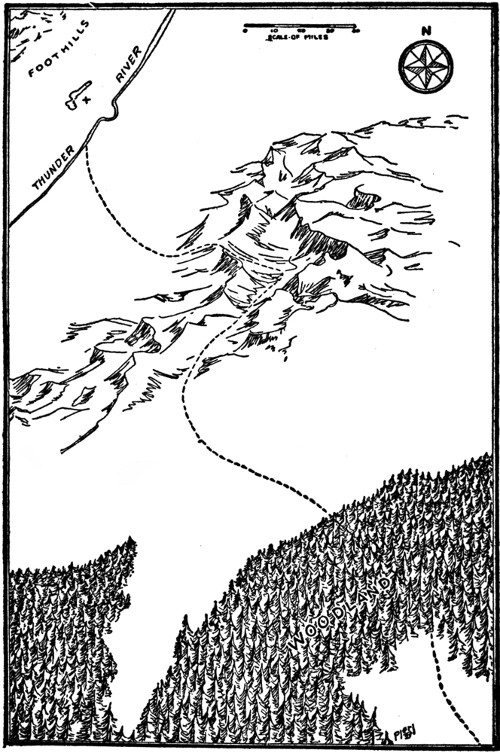
Map Drawn by Factor MacClaren
9
“We’re ready to go back to the fort now,” he
said.
“If we ever get back,” Sandy rejoined.
“Oh, I don’t think there’s much danger with the
three of us,” Dick encouraged.
“Yes, but that scar-faced Indian is apt to have
some one with him, and if they jump down on our
heads from one of the ledges in this cave, we’ll
have small chance of getting away.”
“Well, we’ve got to hope for the best and be prepared
to fight with all there is in us,” Dick responded
grimly, gripping his rifle, a 45.70 Winchester, and
starting into the cavern.
Tensely Sandy followed, the factor taking up the
rear with the precious map stuffed under his heavy
bearskin overcoat.
Slowly they progressed back along the dark passage,
scanning the shadows ahead and overhead for
a sign of whatever had made the noise. A hundred
feet from the chamber, a pair of eyes glowed out
of the darkness. Dick raised his rifle, aiming at
the gleaming points ahead. His sights came into line
squarely and he fired.
Sandy and his uncle had joined Dick over his
kill. The large black body quivered under the candle
light.
“I hated to do it,” Dick was sorry. “Poor old
fellow!”
“He was probably wintering here somewhere,”
Sandy’s uncle put in. “I wonder if he made that
rock fall which we heard.”
“Probably did,” said Sandy.
“Well, I hope so,” the factor declared earnestly.
“My old bones won’t stand much excitement. I’m
not the tough customer I used to be when I was
your age.”
All three went on, a little more confident that no
danger lay ahead. Dick alone, had his suspicions
of what lay before them, and he was about to advise
the factor to walk between him and Sandy, when of
a sudden, there sounded the fall of a body directly
behind them. There came a grunting shout and
Sandy’s candle was knocked from his hand, and
the cavern plunged in darkness.
“Hey!” Dick whirled, his gun clubbed. The sound
of scuffling was heard, and blindly he plunged back.
11
“Here he is,” Sandy’s muffled shout directed him.
“He’s got Uncle Walter down, trying to take the
map away from him.”
Sandy’s voice died away with a sudden umph!
Dick’s rearward leap was stopped by a heavy body.
The shock almost knocked the breath out of him, but
he clung on to the person he had collided with, feeling
that it was neither Sandy nor the factor.
“Here, here! I’ve got him!” cried Dick, panting.
Then he was overpowered and thrown heavily down.
The sound of retreating footsteps sounded along the
cavern in the darkness. Sandy’s candle flared up
under a match.
“Are you all right, Dick?” was Sandy’s question.
Dick picked himself up and replied that he was.
“Quick, find out if he got the map from your
uncle!”
Factor MacClaren himself replied: “Luckily he
didn’t, though he thinks he did. He got an old
letter out of my inside breast pocket. The map is
safe. Wonder who it was?”
“It must have been the scar-faced Indian,” Dick
guessed the identity of their unknown assailant.
“Say, he didn’t work slow, did he?”
“I’ll say he didn’t,” rejoined Sandy, rubbing one
eye, which was already commencing to blacken from
a blow received at the hands of the man in the dark.
12
“Let’s hurry and get out of this hole and back to
the fort,” said Dick hastily.
All three hurried on and reached the blinding sunlight
of the canyon without further mishap. An
hour later they were in the big log house of the
factor, gathered around the map, listening to Walter
MacClaren’s directions regarding it. Toma, the
young Indian guide who was to accompany them
on the trail to the lost mine, had joined them. His
dark, immobile face was over the table with the
rest, when a tall, long-haired man entered. They
looked up.
“Hello, Malemute,” Dick greeted the newcomer.
“What’s the news?”
“Reckon we’re goin’ to have company on this
here trip,” said the big man. “A constable of the
mounted from Fort Dunwoody has just come in
with instructions to capture a party of fur thieves,
hidin’ in the territory you’re goin’ into.”
“Good! We may need him badly before we get
through,” Dick replied.
13
Malemute Slade, an official scout for the mounted
police, who through the effort of the factor had
been detailed to accompany the boys on their trip
northward, agreed with Dick, and ushered in a
scarlet-coated, brisk-looking officer, at sight of whom
both Dick and Sandy emitted exclamations of delight.
It was no less than Corporal Richardson, an
old friend, whom they had aided when he was
wounded on the trail from Fort du Lac to Fort
Dunwoody.
Corporal Richardson was as pleased as they at
this reunion, and, at their invitation, joined them
around the big table in the post living room.
That night, after a brain-taxing afternoon, following
the factor’s instruction regarding the location
of the lost mine, Dick lay wide awake until very
late, thinking over the happenings of the day. He
had a bunk curtained from the living room, not far
from the entrance to MacClaren’s private sleeping
room. He realized that Sandy’s uncle had taken the
map with him, and half that kept him awake was a
fear that another effort might be made to steal it.
Lying there, looking up into the impenetrable darkness,
it seemed that a hundred suspicious sounds
were audible. But at last he fell fitfully asleep.
It seemed to Dick that he had slumbered for only
a moment, when suddenly he was wide awake, his
skin prickling as if some unknown presence were in
the room. Quietly he lay there, listening in the
darkness, forcing the dullness of sleep from his
senses. What had awakened him?
14
Then his hand crept slowly to the head of his
bunk where a rifle leaned. Some one was fumbling
at Factor MacClaren’s door. As he strained his eyes
in the dark, he could distinguish a shadowy figure
crouching there.
15
CHAPTER II A MESSENGER FROM HEADQUARTERS
In the breathless interval that followed, Dick
Kent was unable to decide upon a definite course
of action. The figure of the man still crouched before
Factor MacClaren’s door but Dick, rifle in hand,
felt that under no circumstances could he bring
himself to fire point-blank at the shadowy form,
even if the entire success of their expedition depended
upon it. He could hear the slight rattle of
the door, and the faint shuffle of the intruder’s
moccasined feet. Momentarily, he awaited the crash
that would follow the man’s efforts to break in.
16
The rifle lay like a dead weight in Dick’s hands.
The suspense and excitement of the moment seemed
unendurable. His limbs had commenced under the
strain to shake and quiver, as if afflicted by some
deadly malady. If he fired, he would kill the man,
and if he cried out, as he very much wanted to do,
the man would probably kill him. It was the sort of
predicament with which Dick had no desire to cope,
and yet here he was, in spite of himself, at the very
beginning of their adventures, placed in a position
that might have daunted a much older person.
While he still hesitated, there fell suddenly across
the deep quiet of the room the smashing sound of
the door breaking in, and through the dark shadows
Dick perceived, as he sat there, wide-eyed with apprehension,
the intruder thrown into Factor MacClaren’s
room with a force that carried him half
way to the sleeping man’s bed. He knew immediately
what had happened. Shoulders hunched, the man
had employed what, in school circles, would have
been called football tactics. From a position about
ten feet from the door, he had charged forward,
breaking through the heavy obstruction and gaining
access to the room.
He had picked himself up from the floor, as Dick
sprang to the assistance of the factor, shouting as
he went. By the time Dick had entered the chamber
itself, a furious struggle was in progress—a wild
tossing and tumbling about of two scarcely distinguishable
forms. A chair crashed to the floor. Some
heavy object whirled past Dick’s head, striking the
wall with a thudding impact, before it dropped clattering
almost at his heels. No sooner had he started
forward to give his assistance to Factor MacClaren
in the unequal struggle, when he was thrown back
again violently, as the two men, locked in each
other’s arms, swayed into him. Dick sat down with
a thump, the corner of the heavy table cutting the
back of his head.
17
The fall had dazed him and his recovery was slow.
From this point on Dick was unaware of the events
that followed in rapid succession. His first really
clear impression was that of a blinding glare of light
in his eyes, and the voice of Malemute Slade raised
in alarm.
“This boy’s hurt a’right. Bad cut on the back
of his head. Move back, corporal, while I lift him
up.”
The mounted police scout stooped forward and
Dick felt himself being raised bodily, swung up in
the powerful arms of his friend. Then Richardson
spoke:
“I’ll attend to MacClaren’s bruises while you put
this lad to bed. We’re lucky in one way that no one
was seriously hurt. Mighty lucky!”
“Except for that map, I’d call this night’s business
more than lucky,” affirmed Malemute Slade. “But
it’s too blamed bad he got that. MacClaren’ll feel
worse about the loss of the map than the trummeling
he got. Still as you say, corporal, we’re all of us
mighty fortunate that nothin’ worse happened. Ol’
Scar-Face ain’t usually so keerful ’bout things.”
18
The scout continued talking to himself as he
carried his bewildered burden into the adjoining
room.
“So the map’s gone,” Dick quavered a moment
later. “Are you sure, Slade?”
“You sit here an’ keep your trap shut,” Slade
ordered, not as gruffly as his manner indicated.
“You’re hurt, boy, an I’m goin’ to fix you up. I’ll
fetch some bandages right quick.”
“But the map——” Dick sat straight up, not in
the least heeding Slade’s command. “Did he really
get it? I tell you, I must know.”
“He sure did. Broke the window an’ made good
his escape. I don’t want to discourage nobody,
but you an’ Sandy had better say good-bye to your
chances of ever finding that mine. Jes’ forget it.”
An interval of silence ensued. The mounted
police scout stroked Dick’s hand.
“Plucky little savage—you!” he grinned. “But
you better forget it. Sandy an’ you can have lots
of fun anyway. Couldn’t keep you out of mischief
very long, I guess. Not you two, I reckon!”
19
“I don’t care so much about losing the map or our
chance of finding the mine,” declared Dick manfully,
smothering what sounded very much like a
sob, “but I hate to give up before we’re really licked—especially
by that—that——” He paused, searching
for the word that would most aptly describe the
person he had in mind, “by that tripe,” he concluded.
“Yeah, it does seem bad,” Slade reflected.
“’Course, we’ll try to get the map back again. I
didn’t mean to sit with our arms folded, or anything
like that. Scar-Face ain’t through with us
yet, an’ the mounted police’ll have a nice string of
crimes chalked up to his credit when we do get him.
But this here map is a different matter, if you can
follow me, son. They’ll be sure to hide or destroy
it when they are in danger of being captured. It
stands to reason that if they can’t have the pesky
mine themselves, they won’t let you have it.”
“You’re right,” admitted Dick.
“’Course I am. An’ now for those bandages. No
sense in sittin’ here yapping like this anyway. We
can’t help ourselves by talking, can we? The thing
to do is get goin’—quick!”
“You mean follow Scar-Face?”
“Yep. That’s exactly what I do mean. A light
snow has fallen an’ he won’t be so hard to track.
Corporal Richardson an’ I’ll be on the trail in less
than an hour. How does that strike you?”
20
“Splendid!” exclaimed Dick, unable to conceal
his enthusiasm. “Sandy and I will follow along in
the morning. We’ll catch up to you, won’t we,
Slade?”
The mounted police scout laughed as he strode
away. When he had returned a short time later
with his first-aid emergency kit tucked under one
arm, a basin of water in one hand and a pair of
scissors in the other, he was still grinning broadly.
For several minutes Slade was too busily occupied
with his task of dressing Dick’s wound, to find time
to talk. Having finished, however, he sat down on
the bed beside his young charge and playfully poked
that young man in the ribs.
“So you an’ Sandy are goin’ to catch up to us,”
he chuckled. “Son, I like your spirit. It’s boys
like you that grow up to be men like—well, say like
Corporal Richardson.”
“Or Malemute Slade,” suggested Dick.
A tiny scowl flickered between Slade’s eyes.
“No—not me. I’m nobody. I ain’t ever had a
chance. I can’t even read or write. A good mounted
policeman has education, brains and nerve. I ain’t
got nothin’ except nerve.”
21
“And a heart as big as a house,” added Dick.
“Not to mention other things like woodcraft and
knowledge of birds and animals and men. You
know the location of most of the trails, lakes and
portages in this country. Corporal Richardson told
me that you were a crack shot. He said that you could
shoot faster and hit oftener than any person he had
ever known. You’re the best marksman in northwestern
Canada.”
Malemute Slade flushed to the roots of his hair.
“Look here,” he began gruffly, “you keep your
trap closed.”
“I know now why you laughed when I said Sandy
and I would overtake you and Corporal Richardson
on the trail,” grinned Dick. “What I meant, of
course, was that we’d follow along and join you
later.”
“You’ll stay right here until we get back,” ordered
Slade. “That’s final. There’s goin’ to be some
trouble up the line. We’re risking our own lives—not
yours.”
“He’s right, Dick,” broke in the heavy, though
not unmusical voice of Corporal Richardson.
“Neither you nor Sandy can come along this time.
You must wait here until we return.”
Dick choked back his disappointment, looking up
at the stalwart figure of Corporal Richardson
through a blur of tears. He turned his head and
stared miserably across at the room which had
almost been wrecked in the recent encounter between
Factor MacClaren and the scar-faced Indian. A
whirl of conflicting thoughts flashed through his mind.
22
“All right,” he said dully, “but——”
He was interrupted by the appearance of an Indian
servant, upon the heels of whom came a tall young
man with flashing eyes, clad in a heavy fur coat and
parka. For a brief moment the young man stood,
surveying the three occupants of the room. Then,
without further preliminary, he advanced shyly
toward Corporal Richardson, fumbling in the pocket
of his coat.
“For ze mounted police,” he said, presenting
Richardson with a long official-looking envelope.
“Inspector Cameron he tell me take eet to you. To
be queek. To be very careful. I have been on the
trail eight, ten hours, monsieur.”
“Thank you,” said Corporal Richardson simply.
He tore open the envelope, produced the letter and
read its contents. Except for a slight pucker on his
brow, there was no change in his expression.
“It will be necessary,” he said, turning to Slade,
“to change our plans completely. I must ask you to
go on alone in pursuit of the scar-faced Indian. It
will be my duty to proceed elsewhere. I’m sorry,
Slade.”
23
“Don’t you worry about that, Corporal. Orders
is orders. I’ll go alone.” A moment of silence,
then: “When do you think I’d better start?”
“Right away,” answered Corporal Richardson.
Dick grunted and rolled back into bed, thoroughly
disgusted with the whole world in general, but particularly
with a certain body of men known as the
Royal North West Mounted Police. They had commanded
him to remain at the post, while glorious
adventure stalked valiantly along the snow-white
trail just beyond. He and Sandy were not babies
to be petted and pampered in this manner. He’d show
’em. He——
With rebellion in his heart, Dick rolled over
presently, thumped down his pillow, and, in a very
short time, fell fast asleep.
24
CHAPTER III SCARLET AND GOLD
Dick awoke on the following morning to find
Sandy stooping over him, regarding him silently
with eyes from which shone sympathy and deep concern.
As a matter of fact, Sandy was seriously
alarmed over his friend’s appearance. Dick’s bandaged
head and somewhat pallid face gave him the
look of one who hovers close to death’s door. There
was an unmistakable catch in the young Scotchman’s
voice as he leaned forward still closer to the recumbent
form and inquired solicitously:
“Are you feeling any better, Dick?”
“I’m feeling fine,” came the surprising answer,
“and I’m going to get up in about three minutes and
fight it out with Corporal Richardson. I have no
intention of being treated like a child.”
The angry wave of color that swept into Dick’s
cheeks, coupled with the dark frown and resentful
eyes, so astonished Sandy that he sat down on the
edge of the bed and gasped weakly:
25
“You don’t really mean that. Why, Dick, you’re
no match for Corporal Richardson. Besides, it’s a
criminal offense to assault a mounted policeman.”
“I’m not going to assault a mounted policeman,”
Dick petulantly explained. “I think too much of
Corporal Richardson for that. What I intend to do
is to find out why he intends to keep us here until
Malemute Slade returns. My contention is that as
long as we obey the laws and conduct ourselves like
honest citizens, no person has the right to interfere
in our business.”
Sandy sat for a long time before answering. Here
was a problem that required a good deal of careful
thought and attention. On the face of it, Dick’s
grievance seemed pardonable, and yet common sense
told him that Corporal Richardson was fair and just,
not at all the sort of person to take advantage of his
authority. If the mounted policeman insisted upon
Dick and him staying here, there must be a good
reason for it.
“Didn’t Corporal Richardson tell you why he
wanted us to stay here?” Sandy asked.
“He and Malemute Slade thought we would be
risking our lives if we followed Scar-Face.”
“Well, perhaps they’re right.”
Dick sat up and put one hand on his friend’s
shoulder.
26
“Listen to me, Sandy. Listen to me and then, if
you wish, form your own opinion. The mounted
police insist upon our remaining here at the post
because if we undertake to follow old Scar-Face we
may be risking our lives. They may be right. I
haven’t the least doubt but that we’ll encounter certain
dangers. Possibly we’ll be risking our lives
but,” Dick paused and waved one hand dramatically,
“what else have we been doing except just that:
Risking our lives every day, running into dangers
and difficulties with the consent of everybody, including
the mounted police. Now, suddenly, for no
reason at all, we’re asked to be good little boys, to
remain indoors for fear we may catch a bad cold. I
tell you, Sandy, it sounds fishy to me.”
“Dick, I think you’d make a great orator,” said
Sandy admiringly.
“And a poor soldier,” chimed in a voice. “Pardon
me for eavesdropping, gentlemen, but the fact is I
couldn’t help overhearing a part of your conversation.”
27
Faces red with shame, the two boys turned in the
direction of the newcomer, Corporal Richardson
himself, who stood just inside the door. Dick could
have bit out his tongue or, better still, hid his head
under the pillow while some friendly magician transported
him—bed, blankets and all—to some remote
place, thousands and thousands of miles distant. For
the first time he realized what a fool he had been—a
miserable young fool with a wagging tongue in his
head. He hadn’t the courage to look Corporal
Richardson in the face.
“You’d make a poor soldier,” continued the corporal,
calmly surveying the two culprits. “You see,
Dick, a soldier’s first duty is obedience. What do
you suppose would happen to me if I questioned my
superior’s commands, if I didn’t do what I was told
to do even if, deep down in my heart, I believed or
knew that my superior was in the wrong?”
“You’d be placed under arrest,” surmised Sandy.
“Right! That’s exactly what would happen to me.
And I’d deserve the punishment I got.”
Corporal Richardson ceased speaking for a moment,
strode forward and placed a kindly hand on
Dick’s bandaged head.
28
“Now don’t feel badly about this, Dick, and when
I go out of the room I want you to try and forget
the reprimand. Dismiss the whole incident, just as
I propose to dismiss it. We’re all friends, I owe you
boys a debt of gratitude. I admire you both very
much. As a general thing, I’m not usually one to
hand out compliments or bestow praise, but I’ll say
this: You and Sandy are as rough a pair of young
vagabonds as it has ever been my experience to
meet.”
A roar of laughter greeted this amusing sally, and
for a moment Dick entirely forgot his discomfiture.
“Seriously now,” Corporal Richardson continued,
“I want both of you to understand my position in
this matter. Remember this: It is one thing to risk
your life, but quite another to risk your life needlessly.
That’s exactly what you’d be doing if
you went out on the trail with Malemute Slade. Your
chance of stopping a bullet would be exceedingly
good. Scar-Face would lead you into a trap before
you had gone thirty miles. I tell you Henderson’s
gang of cut-throats and ruffians has become a terrible
menace to the entire western portion of this north
country. Conditions have never been worse since
the Riel Rebellion. If things do not improve shortly,
I’m afraid the Royal Mounted will be compelled to
call in outside aid.”
“But what will happen to Malemute Slade?” questioned
Sandy in awed tones.
“To be perfectly frank, I’ll be worried about him
and won’t know a single moment’s peace until he
returns. However, Slade can look after himself
much better than he could if you boys went with him.
He’s the best scout in the mounted police service.”
29
“Do you think he has any chance of recovering
the map?” Dick asked.
Corporal Richardson shook his head.
“I doubt it very much. I do not believe any of us
will ever see the map again. But that does not mean
that you need give up hope altogether. Your chance
of finding the mine and eventually getting it into
your possession is almost as good now as it ever
was.”
“What do you mean?” both boys shouted out in
unison.
“Henderson and his gang will be apt to find it,
won’t they? Well if they do, we’ll take it away from
them. Could anything be simpler? It sounds easy
but, of course, it isn’t. Just the same, I really do
think the thing could be managed.”
“A sort of roundabout way of gaining possession,”
laughed Dick.
“Any way is a good way, especially in their case,”
grinned Sandy. “But if you’ll excuse me, I’m going
to see Uncle Walter. He’s covered with bruises
from head to foot. Painful, of course, but not
serious. I can’t imagine how I managed to sleep
through all that uproar last night.”
“I’m not at all surprised,” rejoined Dick, who
well knew his friend’s propensity in this regard, and
never lost an opportunity of chiding him about it.
30
When Sandy had hurried away, Corporal Richardson
turned to Dick.
“We’re friends, aren’t we?”
“You bet!” came the answer unhesitatingly. “Corporal,
I owe you an apology. I can see now what a
fool I was.” Impulsively he extended his hand.
“Now that that’s settled,” said Richardson, “I
have a job for you. Do you happen to remember
the messenger, who came last night?”
“Yes.”
“If you saw him again would you know him?”
“Yes,” stated Dick positively.
“How did he impress you?”
“Why, favorably, I guess.” Dick wondered what
the policeman was driving at.
“That was my first impression too,” Corporal
Richardson resumed, “but I have since had occasion
to alter it considerably. I don’t mind telling you that
I nearly made a very fatal error of judgment. That
French-Canadian messenger was a fake, and he
brought me a fake message, supposed to be from
Inspector Cameron. I was fooled last night and permitted
my man to escape. This morning a careful
scrutiny of the message proved that the signature
affixed was a forgery. In other words, the letter
did not come from headquarters at all, although the
stationery upon which it had been penned must have
been stolen from the Inspector’s office.”
31
“What did the letter say?” Dick asked.
“It instructed me to proceed, not later than the
morning of March 2nd—which is today—to a place
called Little Run River and there place a certain
person under arrest for the theft of valuable furs.”
“But what would be the purpose of such a hoax?”
Dick wanted to know.
“Simply to get me out of the way. For some
reason, not yet quite apparent, my presence here at
Fort Good Faith is not wanted. For some reason,
my presence here interferes with the carrying out of
important plans of certain unscrupulous persons;
which, of course, makes it all the more necessary why
I should remain and why you should go on to Run
River in my place.”
Dick would not have jumped to his feet any
quicker if he had been pricked by a pin.
“In your place!” he gasped. “Why, corporal, I
don’t understand! No one could mistake me for
you!”
“When I get through with you,” calmly smiled
the mounted policeman, “anyone will be very apt to
be fooled by the resemblance. The main thing is,
you’re about my height.”
32
At that moment Dick was too excited to grasp
fully what the corporal was telling him. Presently,
however, he was enlightened.
“For the first time in your life, Dick,” declared
Corporal Richardson, still smiling, “you’re going to
don the uniform of his majesty’s Royal North West
Mounted Police.”
33
CHAPTER IV DICK MAKES A SUGGESTION
A very serious but elated young man, no other
than Dick himself, strode into the room occupied by
Corporal Richardson and proceeded to put on the
scarlet and gold uniform of the Royal North West
Mounted Police. At that particular moment his
mind was in a whirl of conflicting emotions. He still
possessed a somewhat hazy idea of what was expected
of him, although he knew that when the time
came Richardson would give him complete and
painstaking instructions.
That he was embarking upon an important and
mysterious errand, there could be no doubt, and it
thrilled him to know that the mounted policeman had
sufficient confidence in his ability to give him this
chance to be of real service. As he pulled on the
blue breeches with the wide yellow stripe and later
the scarlet tunic, resplendent with braid and shining
brass buttons, he made a solemn resolution to be
worthy of the trust imposed in him.
34
“Sandy will laugh when he sees me,” he told Corporal
Richardson, “and I must say that I feel awkward
and out of place.”
“It fits you remarkably well,” smiled the corporal,
“considering how much heavier I am. I think I’m
inclined to be proud of your appearance, and perhaps
just a little bit jealous.”
“When do you want me to start?” Dick asked.
“In about an hour. But first, there are a number
of things I want to discuss with you. So, if you’ll
just sit down in that chair over there and listen
attentively, I’m sure there’ll be no question about the
ultimate success of our plan.”
“As I explained to you before,” continued Corporal
Richardson, “the French-Canadian messenger,
who came here last night with the forged letter, is
an agent or emissary of a band of crooks. Who
these crooks are, I’m not altogether sure. My belief
is that they’re the fur thieves Malemute Slade and I
have been trailing for the last three weeks.”
Sitting very still and rigid in his chair, Dick followed
closely every word spoken. Richardson’s face
had become serious, even stern in its expression.
35
“I’ve nothing very tangible to go on, of course,
but during the past few hours I’ve given a good deal
of thought to this case. I’m convinced of one thing.
I’m positive that the fur thieves and Henderson’s
gang are one and the same. I believe it was Henderson
who sent the messenger last night. Henderson
is the author of this strategy or hoax, just as surely
as he is the person directly behind the effort to secure
possession of your lost gold mine.”
“You really think so?” Dick interrupted.
“Yes.”
For a short interval the mounted policeman sat
without speaking. The room had become almost
intolerably silent. Turning towards the window,
Dick looked out across a vast snow field, dotted here
and there with the dark green of spruce and jackpine.
“And now,” suddenly resumed Richardson, “we’ve
come to the very serious part of this whole business.
I must confess to you that I’m worried and—you
may be surprised at this admission—afraid!”
“Afraid!” Dick gasped. “Why, corporal, I can’t
believe that anything would ever frighten you.”
“Something has,” confessed Richardson, “and
right now I’m frightened so badly that I’m almost
inclined to tell you to take off that uniform and go
and hunt up your friend, Sandy, for a game of
cards.”
Dick started to laugh, but a second look at the
brooding, troubled eyes of the man opposite, choked
his untimely mirth.
36
“This is a serious moment for you, my boy, and
I’ll tell you why. The message received last night
was sent to me for a purpose. For reasons, as yet
not quite clear to us, my presence at Fort Good
Faith constitutes a hindrance to certain plans of
Henderson. Henderson wants me to clear out—to
go away. Why?”
“I’m sure I can’t answer that question,” said Dick.
“Neither can I; but I’ve a pretty fair hunch. Fort
Good Faith is on the only direct, open, well-travelled
trail, leading south to civilization. Henderson, let
us say, has a valuable shipment of stolen fur. He
wants to dispose of it. He’s in a hurry to get it
south before the spring thaw. Every day that he
is forced to wait, is time and money lost. He’s
anxious to start right away, sending out his fur by
dog teams, but he can’t do that because I’m here at
Fort Good Faith and will be sure to seize his
shipment.”
“Whew!” whistled Dick. “How did you ever
contrive to figure that all out? It sounds very
plausible.”
“Nevertheless,” said Corporal Richardson, “it’s
entirely supposition and may be absolutely wrong.
I’m hoping that it’s right, because if it isn’t, the
only other motive that I can think of for inducing me
to go to Run River is a very sinister one.”
37
“What is it?” asked Dick.
“A trap for me to fall into. Somewhere between
here and Run River an ambush—a slinking half-breed
or Indian lying in wait to pop me off. A score
of mounted policemen have gone that way. It’s an
old trick. That’s why I’m shivering clear down to
the bottom of my feet for fear that I may be sending
you out to your death. Before God, I wish I had
detected that forgery before I ordered Slade to set
out in pursuit of the scar-faced Indian.”
Dick caught at the side of his chair, his cheeks
deathly pale. The room seemed to be spinning
around in a sort of dark haze, through which he
could see the distorted face of Corporal Richardson
opposite. When he had recovered somewhat, he
observed that the mounted policeman had sprung to
his feet and was pacing abstractedly back and forth.
“I can’t—I can’t do it, Dick,” he was muttering.
“It isn’t fair. No—there must be some other way.”
“But I want to go,” Dick insisted. “I’ll take good
care of myself and I’m sure nothing will happen.
Anyhow, I’m convinced that your first guess was
right, that Henderson and the fur thieves are planning
to send that shipment.”
38
“And, on the other hand,” pointed out Corporal
Richardson, “both guesses may be right. It would
be a feather in Henderson’s cap if he could dispose
of the furs and have me put out of the way at one
and the same time.”
For several moments the two stood, facing each
other, both deep in thought. Suddenly, Dick’s face
lighted and he clapped his hands together gleefully.
“Corporal Richardson, I think possibly I may
have hit upon a rather sensible plan,” he cried out
enthusiastically. “Why not follow the trail to Run
River only a short distance, then strike off in an
entirely different direction, make a wide detour, and
come back here to the post. Henderson will naturally
suppose that I have gone on to Run River. If
your first supposition is correct, the dog teams with
the fur will start to move down this way at once.
If your second guess is right, I won’t run into an
ambush because I won’t be travelling where they
expect me to go.”
“Good!” exclaimed Richardson. “Dick, you’re
a young man after my own heart. Why in the
Dickens didn’t I think of that myself.”
“You’ve done well enough for one day as it is,”
Dick rejoined. “All I hope is that you won’t have
any trouble capturing the men with the fur shipments.
Aren’t they apt to put up a fight?”
“I expect that,” answered the corporal, “but I’ll
have Sandy, young Toma and Mr. MacClaren to
give me a hand if necessary.”
39
Breakfast, a few minutes more of preparation, and
Dick and the mounted policeman, the latter now
clothed in ordinary civilian garb, slipped quietly out
of the room and hurried down a long hall in the
direction of the side entrance. As they went, the
corporal was speaking in hushed undertones:
“It’s just as well that Sandy doesn’t see you before
you go. We haven’t time now for explanations or
further delays. Good luck, and God be with you.”
They paused for a single hand-clasp before Dick
turned to close the door after him, which action Corporal
Richardson prevented by sticking out his foot.
“Straight ahead until you cross the river, then
take the first trail to your right,” he called out. “Be
careful!”
“Good-bye,” said Dick without turning his head.
His eyes were moist and a sticky lump reposed in
his throat. Chin out, arms swinging at his side,
who, indeed, might detect anything amiss here? The
trail was ahead, a glimmering stretch of snow, dazzling
in the early morning light. Behind him were
friends, comfort and a good fire.
Dick plodded on.
40
CHAPTER V DICK IS INDISCREET
Three hours after he had left Fort Good Faith,
Dick Kent, still on the Run River trail, had become
conscious of an increasing nervousness. The section
of country through which he now passed was densely
wooded, rugged and broken, a treacherous, uninviting
prospect. Dick estimated that he had travelled
about twelve miles from the post. To continue much
farther might prove to be a dangerous business.
Even now, as he went cautiously forward, he could
almost persuade himself that behind every clump of
bushes, behind almost every tree, there crouched the
leering, skulking form of one of Henderson’s men.
41
If he followed his original plan, the thing to do
presently was to strike off, either to the right or left,
and proceed on his way back by a circuitous route.
Tonight he would camp somewhere in the open,
building himself a shelter of spruce boughs. Tomorrow
morning he would set out again, moving
slowly, making a wide detour, always bearing in
mind that he must not, under any circumstances,
return to Fort Good Faith before two days had
elapsed. The fur thieves, both he and Corporal
Richardson had conjectured, would be sure not to
delay more than two days before commencing the
trek southward with their valuable loot. So Dick
had a good deal of time to waste, before he might
hope to rejoin his friends.
A hundred yards farther on, a turn in the trail
brought Dick to a small creek. Frozen, and covered
deeply with snow, it traced its way through the dark
green of the forest. From where he stood, Dick
thought that it looked very much like a white snake,
twisting through the trees. It would be great fun,
he decided, to leave the trail at this point and follow
the creek on a little voyage of exploration, later
leaving it, if he found that the general course of the
stream ran too far in the wrong direction.
Also, by following the creek, there would be a
certain advantage to himself, well worth considering.
It offered a smooth, hard trail to his feet, with no
obstruction from rocks, bramble and bush, as the
case would be if he chose to strike out in a more
haphazardly course through the forest.
42
Turning to the left, Dick slid down the small
embankment and commenced leisurely to walk along
the creek bottom. The snow-crust was so heavy
that he paused, kicked off his snowshoes and went
forward again, whistling happily. It was a great
relief to leave the Run River trail. He would have
no fear now of a deadly ambuscade. His heart had
ceased its disconcerting flip-flops every time he went
past a dark screen of brush or a heavy clump of trees.
It now functioned in a more healthy manner.
The weather was mild, a stream of warm sunshine
lighting the open forest spaces with a dazzling radiance.
The glare of snow was hard on the eyes, but
by keeping in the shadow of the large trees, bordering
the creek, Dick contrived to overcome this difficulty.
In another hour or two he would pause for his
midday meal. The long walk had given him an
appetite. He was sorry that Sandy hadn’t come
along to enjoy the fun. On a day like this it was
good to be alive. He grinned as a rabbit whisked
across his path, boy-fashion stooping to pick up a
chunk of ice to hurl after it. As he straightened up,
eyes on the trail ahead, he was startled by the sight
of a thin, white spiral of smoke curling up from the
trees, not more than two hundred yards distant.
43
Dick stopped dead in his tracks, scarcely believing
the reality of the thing he saw. He was totally unprepared
in the emergency and for a moment stood,
with bated breath, debating whether he ought to
go on or turn tail, like a frightened husky, and
scamper for cover.
Corporal Richardson had warned him to keep
away from all human kind. Before the experienced
eyes of the average frontiersman Dick’s masquerade
would be useless. And once the deception had been
laid bare, no one might tell how soon the news would
reach Bear Henderson and his gang of outlaws.
To add to Dick’s discomfiture, there emerged
unexpectedly in plain view ahead the figure of a man.
Half way across the creek the man paused, perceiving
Dick, and one arm went up in a gesture of
friendly salutation.
In chagrin, Dick bit his lips. His chance now to
get away undetected had been lost. In less than four
hours from the time he had left Fort Good Faith,
he had committed a most unpardonable blunder. All
very well for spying eyes to follow his progress along
the Run River trail, and Indian messengers to report
the news later to Henderson—that was playing the
game correctly; but to be discovered here, four miles
off the prescribed route, calmly throwing chunks of
ice after scurrying rabbits, was an entirely different
matter. If word of it ever reached the suspicious
outlaw, Corporal Richardson’s chances of capturing
the fur thieves was very slim indeed.
44
“The only thing about me worthy of the name of
a mounted policeman is this uniform,” Dick
lamented to himself. “I’ve messed up everything.
I’ll be ashamed to go back and look Corporal Richardson
in the face. Hang the luck!”
With a snort of disgust, he strode forward again
to meet the waiting figure. There was no turning
back now. The thing to do was to swallow his
disappointment and endeavor to make the best of it.
In a few minutes more he had approached to
within twenty feet of the man. His moccasins
crunched lightly over the snow, but the blinding glare
of sun in his eyes, together with the dazzling reflection
of millions of white crystals underfoot, made
it difficult to see. He heard a voice announce:
“Ah, et eez ze Corporal Richardson himself. I
bid you ze welcome, monsieur. You come to ze
house. You come——”
The words trailed off suddenly, culminating in an
exclamation of surprise. Dick stopped.
“My mistake. Et ees not ze good Corporal Richardson
at all. Mon Dieu! A boy!”
45
A prickling sensation ran up and down Dick’s
spine. He could see more clearly now, and one good
look at the man in front of him was more than sufficient.
Who could mistake those snapping eyes, or
that tall, lithe, athletic figure? It was the messenger
of the night before—the man who had brought the
forged letter to Corporal Richardson!
During the first few minutes of bewilderment and
surprise, Dick found it impossible to think clearly,
but as this feeling wore off, there flashed through
his mind the thought that perhaps this messenger of
Henderson had not yet discovered his true identity.
The man had seen him only once. Dick presented
an entirely different appearance now than he had on
the evening before in the poorly lighted room at the
post.
“What ees your name, monsieur?” demanded the
Frenchman.
“Corporal Rand,” Dick lied deliberately. “Recently
from the mounted police training school at Regina.
This is the first time I’ve ever been sent out on actual
service. I arrived at Fort Good Faith a few hours
ago to relieve Corporal Richardson, but I discovered
he had left under instructions just a few minutes
before for a place called Run River.”
The Frenchman, to judge from the relieved expression
on his face, actually believed the story.
“And so you already start on ze friendly patrol?”
he inquired politely.
46
“No,” answered the quaking young counterfeit,
“at first that really wasn’t my intention. I had hoped
to overtake Corporal Richardson before he had gone
very far, but I guess I wasn’t swift enough. There
is no catching him!”
The messenger grinned at this admission. He surveyed
the lanky young tenderfoot, bethought him of
the prowess of Corporal Richardson on the trail, and
doubled up in a paroxysm of mirth. Dick joined
willingly in the laugh on himself.
“Monsieur will become swift himself if he continue
to stay in zis countree,” came the encouraging
assertion.
“Conditions here are much different than they
were in the south,” explained Dick, “but I imagine
that in time I’ll get used to them.”
“True, monsieur, an’ now you are veree tired, I
expect.” The messenger’s gestures were expressive.
“So you will come with me to my house. You will
honor me, monsieur. You will stay an’ rest an’
forget about ze hardness of ze trail. Baptiste La
Lond ees a veree good friend to ze mounted police.”
Dick guessed at the motive underlying the messenger’s
efforts at hospitality. La Lond was afraid
that Dick might decide to return at once to Fort
Good Faith. It would never do, of course, after
getting rid of one policeman, to have all their plans
spoiled by the sudden advent of a second.
47
“I really must return to Fort Good Faith at once,”
stated Dick, by way of a feeler. “I’ll be stationed
there for several days, I imagine.”
“No! No! No!” protested La Lond, throwing
up his hands in protest. “Et ees unthinkable. Monsieur
is tired after ze hard trek. He must rest an’
eat at my house.” He paused, a smile of eagerness
lighting his face. The dark eyes snapped. “An’ now
I will tell you ze beeg news, monsieur. Tonight my
veree good friend, Pierre Chapelle, ees hold a dance
at hees house. We will go. What you say, monsieur?”
“I’ll think about that later,” Dick answered, deciding
to play into the other’s hands. “I’ll stay here
for a while, if you insist. I really am very tired.”
La Lond kept up a continuous chatter as he
quickly led the way to the house—a small cabin,
nestling in the woods. His host threw open the door
to permit him to enter a tidy room, at one side of
which Dick perceived a young man of about his own
age.
“My brother, Phellep,” explained the messenger,
pushing his way in and closing the door. “We live
here together. Phellep, take monsieur’s coat.”
48
Phillip La Lond rose stiffly, a look of fear on his
face. Evidently he was not accustomed to entertaining
members of the Royal Mounted and was
probably trying to figure out the reason for Dick’s
unexpected visit.
But if Phillip experienced fear, he was not without
company. Dick also was afraid. It had just
occurred to him that perhaps the wily messenger had
not been in the least deceived by the story, which he,
Dick, had related. Perhaps La Lond had recognized
him at the very beginning and was now planning
some devilish method of getting rid of him.
During the preparation of the midday meal and
for several hours afterward, Dick sat, shivering with
apprehension. La Lond’s continuous flow of conversation
fell on unheeding ears. The pressure of
the revolver in its holster at Dick’s side was somewhat
reassuring, yet what match was he, a single
inexperienced youth, against a seasoned criminal like
La Lond. He had probably made a serious mistake
in coming here. No doubt, he would be made to pay
dearly for his blundering. But in any event, it was
up to him now to play the game in a way that would
be a credit to the faith imposed in him.
And so with this grim resolve, Dick straightened
in his chair, endeavoring to conquer the quailing
spirit within. La Lond was still speaking:
49
“Perhaps monsieur ees veree tired an’ would like
to lie down an’ rest,” he inquired solicitously. “While
you have your leetle nap, Phellep will take ze run out
to ze trap-line.”
“What you mean, you deceiving scoundrel,” Dick
thought to himself, “is that you are sending Phillip
over to Henderson’s camp with the news of my
coming.” Then aloud:
“No, I’m not as tired as you think. Let’s sit here
and rest for a few minutes more, then all three of
us will go out to examine your traps.”
The appearance of animation and the smile of
good fellowship suddenly and inexplicably disappeared.
In their place a dark frown settled over the
face of the messenger. For one brief moment he
glared at Dick.
“All right, eet will be as you wish,” he snapped.
Then his eyes met Dick’s in a look that could not
possibly be misunderstood.
Unconsciously, Dick stiffened in his chair as he
read the challenge.
50
CHAPTER VI IN THE HOUSE OF THE MESSENGER
It was a trying ordeal. Never before, in all
Dick’s experience, had time seemed to pass so slowly
as it did upon that fateful afternoon. The messenger
had thrown aside all further attempts at conversation.
Head bent forward, fingers locked, he feigned
a drowsiness, which did not fool Dick in the least.
Phillip, on the other hand, had grown restless, continually
fidgeting about, or pacing up and down the
room like a caged lion.
Occasionally Dick would catch a glimpse of a
furtive, frightened glance cast in his direction. The
younger La Lond, less adept in the school of deception,
could not conceal his real feelings.
“Have you many traps out this winter?” Dick inquired,
looking across at Phillip.
51
The other mumbled something in reply and went
on with his pacing. Evidently, he had no desire to
commit himself. In the cabin were no evidences of
traps or trapping, and Dick would have been willing
to swear on oath that the brothers La Lond not only
did not possess such a thing as a trap-line, but had
other and more profitable ways of making a living.
To all appearances, the two brothers lived a life
of ease and indulgence. The room was nicely furnished,
the cupboards were stocked with food, two
bottles of Hudson’s Bay Company’s rum peeped
from behind an inadequate curtain. But the thing
which struck Dick’s gaze most forcibly of all, was
a queer-looking object which stood near the fireplace.
It was a sort of rack, cleverly constructed out of
wood, upon which fairly bristled a miniature arsenal
of guns, rifles, knives and belts—the last bulging
with cartridges.
Time and time again, Dick’s eyes returned to a
fascinated scrutiny of that rack. There were weapons
enough here to supply a small army. Deadly looking
revolvers and automatics, shot-guns, 45 and 30-30
caliber repeating rifles, with here and there a long-bladed
knife to add interest to the general effect.
52
On the floor, close to the rack, were several packing
cases, as yet unopened, which probably contained
a more complete supply of ammunition. The brothers
La Lond might boast of possessing a different
weapon for almost every day of the month. So complete
were their requirements in this respect, that
Dick very quickly jumped to the conclusion that no
two men could possibly find use for them all. It was
much more reasonable to believe that others, beside
the two brothers, had an interest in them, and that
this cabin was used as a meeting place—if not for
Henderson’s gang itself—for another band equally
as bad.
“I’m about as safe here,” Dick grimaced to himself,
“as I would be sitting on a case of nitroglycerine.
The best thing for me is to get away
from here as quickly as possible.”
From under his lowered brows, Baptiste La Lond,
still feigning sleep, was secretly watching him. Dick
felt the scrutiny through some intuitive sense, and
became more and more uncomfortable. Another
worry was caused by the younger La Lond, who,
during his restless pacing to and fro, often passed
behind Dick’s chair. It would be very easy, Dick
thought, for Phillip to spring forward and pinion
his arms behind him. In fact, chancing to look
across at the former messenger he intercepted a
signal, a sly wink which might, had Dick been less
on guard, easily have passed unnoticed. Dick turned
almost completely around, just as Phillip came
stealthily forward, preparing for a spring.
“When are we going to visit the trap-line,
Phillip?” Dick inquired mockingly.
53
Phillip stopped suddenly, his face red with anger
and embarrassment. He turned and beat a hasty
retreat, glowering from his corner as Dick rose and
moved back his chair.
Then, as never before, Dick realized fully the
seriousness of his position. Not for one moment
could he relax his vigilance. His life itself depended
upon extreme caution and, when it became necessary,
swift action. But even by exercising the utmost
care, sooner or later a little slip on his part might
give the treacherous brothers the advantage they
craved.
Dick rose to his feet, finally, and addressed the
still drowsing messenger.
“La Lond,” he stated in a clear, steady voice, “I’ve
decided to go at once. I’m afraid it will be impossible
for me to neglect my duty. It is too late in the
afternoon to go back to Fort Good Faith, but I
think I’ll continue on my patrol, returning to the
post late tomorrow afternoon or the morning following.”
Baptiste, apparently, was sleeping with one ear
open. Almost immediately he sprang to an upright
position.
“No! No, monsieur!” he protested, waving his
arms wildly about. “You must not go, I beg of you.
Stop here for a time longer, monsieur.”
But Dick shook his head.
54
“I must go,” he declared firmly.
“But think, monsieur, eet will be veree late by ze
time you get back to Fort Good Faith.”
“I’ll not go there tonight, as I just explained to
you, and probably not tomorrow. I must finish my
patrol.”
La Lond’s eyes blinked.
“Where do you go then?” he asked, evidently
much relieved.
“That is a matter I have not yet decided,” answered
Dick. “I’m not very well acquainted with
the country hereabouts, and I’ve been wondering if
you’ll be kind enough to direct me to the nearest
dwelling.”
“Yes, certainly, monsieur, I will be veree glad.”
His sudden great eagerness to assist him did not
escape Dick’s attention. He knew very well what
Baptiste would say, and he had no intention of following
any suggestions of the bandit as to where
he should go. It was easy to guess where the wily
messenger would send him—to Henderson’s camp
probably, or, if not there, to the house of some other
crook in the outlaw’s employ.
“I have a friend who live seex miles from here,”
said La Lond. “Ze trail ees veree easy to his house.
You must go zere.”
55
“All right, I’ll do as you say,” agreed Dick, “but
first you must be very careful in directing me so
that I do not get lost.”
“Et ees easy to tell, monsieur. You will not get
lost,” the messenger shrugged his shoulders expressively.
“Two mile down ze leetle creek to ze first
turn to ze right, zen four mile straight ahead to my
friend’s house. Not possibly can you miss et, monsieur.”
“So that is where Henderson is camped,” exulted
Dick to himself. “The information may be valuable
to Corporal Richardson.”
“Thank you very much,” he said to Baptiste.
“Et ees nothing,” La Lond blinked wickedly.
Phillip had suddenly come to life again and was
treading soft-footed across the floor. From the
corner of one eye, Dick watched him. Then Baptiste
shuffled farther to one side, probably with the
intention of preventing Dick from observing his
brother’s sly movements. Not to be outdone in this
clumsy fashion, Dick took a step in the opposite direction,
just in time to see Phillip approach the fireplace
and the rack of guns close by.
56
“You will find ze place without difficulty,” declared
Baptiste in a loud voice, attempting to attract attention
to himself. “I tell you, monsieur, my friend he
ees veree good host. So joll-ee, so kind, monsieur.
You will not regret.”
Dick whipped his revolver from his holster and
sprang back just in time.
“Put down that gun,” he shouted to Phillip. “Put
it down, I say!”
Phillip’s weapon clattered to the floor, and his
hands clawed at the empty air above his head. At
that particular moment he was a very much frightened
and surprised young man. His cheeks were
white as the drifts of snow outside. Baptiste turned,
his face crimson with fury.
“Fool! Fool!” he screamed, rushing forward and
cuffing the shivering culprit about the face and head.
Then he turned apologetically to Dick.
“Pardon, monsieur,” he whimpered. “Mon Dieu!
I am stricken! Ze boy ees mad. Perhaps you notice
et before, monsieur. I intend to tell you ze truth
when first you came, but there ees always ze shame
an’ ze pride. You understand me, monsieur.”
“Yes, I understand you,” Dick replied coldly.
“Believe me, I’ll know exactly what to expect from
you in future. One false move from either one of
you, and I won’t hesitate about using this nice little
plaything here in my hands. Stand aside!”
57
Baptiste obeyed quickly as Dick backed slowly to
the door, opened it and went quickly out. His pulses
were pounding and his hand trembled as he returned
the gun to its holster.
“Close shave!” he muttered to himself. “I guess
I was pretty lucky that time.”
At a dog trot, he hurried along the foot-path, leading
to the creek.
58
CHAPTER VII FLIGHT THROUGH THE WOODS
A very alert and still somewhat frightened young
man in the person of Dick Kent hurried across the
small creek he had commenced following a few
hours before, and struck off through the heavy
forest of spruce and poplar, which lay between him
and Fort Good Faith.
In spite of the fact that travelling was now more
difficult, Dick made remarkably good time. The
thought uppermost in his mind was to put as many
miles between him and the treacherous Baptiste as
possible, to go on with undiminished speed until
darkness came to prevent further progress.
Pursuit would be almost certain, Dick reasoned.
The two brothers, smarting under their recent
thwarted attempt to take Dick prisoner, would be
anxious to even the score.
“They’ll be wild,” Dick grinned to himself, “and
angry enough to boil me in oil if ever I fall in their
hands again.”
59
He chuckled as he visualized the picture of Baptiste
and Phillip, quarreling amongst themselves over
the miscarriage of their plans. By the time they had
fought out the verbal battle and had got down to the
real business of recapturing their slippery guest,
Dick hoped he would have several miles to his credit,
and would be able to retain the lead.
He had been unwise in accepting the hospitality
offered by Baptiste, yet in so doing he had made
several important discoveries. One was that the
cabin, occupied by the two brothers, afforded a meeting
place for the band of criminals, then infesting
the country, and a second, that either Henderson
himself or other members of the band could be found
in the place to which Baptiste had directed him.
Dick pondered over this information as he hurried
on. He recalled what Corporal Richardson had told
him regarding the operations of a large criminal
organization there in the North, and he was quite
sure the mounted police would welcome any news of
their movements or places of abode. He remembered
also what Richardson had said about the connection
between the fur thieves and Henderson’s outlaws.
The corporal believed that they were one and the
same—all under the leadership of Henderson. If
this supposition were correct, then the La Lond cabin
was just as apt to be a meeting place or rendezvous
for the men who had stolen the map of the lost mine,
as for the fur thieves themselves.
60
Sooner or later, reasoned Dick, the scar-faced
Indian would show up at one or the other of the two
places of which he, Dick, had knowledge. Probably
right now the possessor of the map was somewhere
in that very neighborhood. Having escaped Malemute
Slade, what would be more natural than that he
should immediately proceed to Henderson’s camp to
report his good fortune.
Dick paused abruptly at the thought, his pulses
pounding with excitement. In a high state of tension
he strode forward, brushed the snow from a small,
broken stump, and sat down to think it all out.
“I’ve a good notion to throw caution to the winds,”
he confided to himself, gulping a handful of snow,
“and go right back at once. They won’t be expecting
me. Anyway, it’ll be dark by the time I return to
the La Lond cabin. It will be comparatively safe
then. I’ll reconnoitre a bit, find out if Baptiste and
Phillip are still there, and, if they’re not, I’ll slip over
to Henderson’s. I’ve just got a hunch that the scar-faced
Indian has returned.”
61
Dick had never been placed in a similar position,
and found it very difficult to decide. Reason told
him that it would be the height of folly to embark
upon any such enterprise. But in Dick’s veins was
the hot, adventurous blood of youth. Here was a
chance in a thousand to win back the ground which
had been lost. He would find the scar-faced Indian
and endeavor to recover the map.
He had risen to his feet for the express purpose
of proceeding to carry out his foolhardy plan, when
quite unexpectedly there rang in his ears a former
statement of Corporal Richardson:
“You’d make a mighty poor soldier, Dick.... A
soldier’s first duty is obedience.”
Was this obedience? He had been warned to keep
away from all human habitation, to be careful not
to expose himself needlessly—to shun men! And
now—— A slow flush of shame mounted to his
forehead. Hang it all, what an imbecile he was. So
far he had obeyed none of the commands of his
superior. He had—or very nearly had—violated
them all. At every turn, instead of doing the right
thing, he had done the wrong thing. He was not
worthy of Corporal Richardson’s or any other man’s
trust. Even Sandy, younger than he, nor half as
strong physically, would never have been guilty of
such willful disobedience.
62
It was a more sober and earnest young man who
faced resolutely about and continued the trek eastward
towards Fort Good Faith. The silence of the
great forest lay about him. Shadows had lengthened,
the sun had slipped down out of sight, the
cooler breath of evening stung color in his cheeks
and tickled his nostrils with tiny particles of frost.
“I’ll go on for an hour before stopping to make
camp for the night,” he decided.
He felt more tired now as he resumed his lonely
and monotonous journey. Crossing a narrow valley,
thickly studded with clumps of red willow and saskatoon,
he commenced scrambling up a sharp incline,
until finally he reached a wide plateau. Here, except
for an occasional stunted jack-pine, there were no
trees. Huge boulders and queer looking rocks, most
of them covered thickly with snow, gave a weird
appearance to the place.
The wind had full sweep across the plateau. It
was bitterly cold here, so cold indeed that even the
heavy fur jacket and parka, worn by the mounted
police, failed to keep out the insidious penetrating
frost. Dick beat his arms against his shivering body
and stumbled on across that desolate plain, anxiously
scanning the darkening prospect ahead. He hoped
that he would come soon to the more friendly forest,
where, when a stop became necessary, he could gather
wood and kindle a fire. But out there ahead he could
see nothing except a long and weary stretch of country
covered with snow and bristling with rocks, a
land indescribably lonely and terrible just then in the
rapidly gathering darkness.
63
Fully an hour passed before he had traversed the
plateau and had come again to the welcome woodland.
Breathing a sigh of relief, he started down
the slope, faintly outlined in the gloom ahead. It
was so steep here that Dick had difficulty in keeping
his balance. He slid, stumbled, now and again
reaching out for a young sapling to aid him in his
somewhat precipitous descent. He had almost
reached the bottom when he felt himself being
thrown violently forward, falling in a crumpled heap
at the foot of a large spruce. A stab of pain in his
right ankle, and Dick momentarily lost consciousness.
He realized presently what had happened. The
thong of the snowshoe on his right foot had become
caught in a snag of brush and had tripped him. His
fall had been heavy, but Dick did not become aware
of the full extent of his injury until he attempted to
rise.
It was useless. His right ankle throbbed with a
sickening pain. A bad fracture or torn ligaments—he
was not sure which—made it absolutely impossible
for him to put any weight at all upon that foot.
64
A sudden, horrible fear overcame him. In the
first moment of weakness, a terror-stricken sob
broke from his lips. Here he was absolutely helpless,
without wood, water or fire, without shelter of
any kind, in weather so bitterly cold that in a few
hours time, lying there inactive, he would be frozen
as stiff as a block of ice.
Not entirely to Dick’s discredit, he cried like a
child, one arm flung out, the other pillowed under
him. He lay there, his body shaking with ill-suppressed
grief. Face blanched with terror, he sat up
finally staring about him with tragic eyes. Everywhere
around was deep and utter silence. To all
appearances, there was no life anywhere in that dead
waste of snow, in that land of bitter, penetrating
cold.
And then, suddenly, far away, he heard the
familiar wolf-cry. Long and mournful it was, and
Dick shivered, remembering a former occasion when
he, Sandy and Corporal Richardson and Toma had
very nearly given their lives to a hungry pack in the
vicinity of the Big Smoky. If there was anything
on earth which Dick feared, hated and despised, it
was a wolf. Whenever he heard the eerie cry of this
species of human hunters in the North, his hair
fairly bristled from panic and indignation. In his
present predicament, it was the very thing required
to put strength and determination in his heart. Groaning
in the effort, he rose dizzily to his knees and
commenced to scoop away the snow with his hands.
65
By dint of hard work, he had soon cleared a fairly
wide space around him. The exercise had warmed
his body and kept his mind from dwelling too much
on the seriousness of his plight. From a bush nearby,
he gathered an armful of twigs, and from a dead,
fallen tree, just beyond the big spruce, sufficient dry bark
and moss to start his fire. In an hour’s time,
considerably cheered and comforted, he was brewing
tea over a roaring blaze.
“Things are not as bad as I thought,” Dick was
forced to admit to himself a few minutes later as he
gulped down a cup of hot tea and ate sparingly from
his supply of emergency rations. “As long as I can
crawl around on my hands and knees, I can manage
somehow to gather enough wood to keep myself
from freezing. By eating very little and drinking
plenty of snow water, I can stay here for a week if
necessary. After that——”
What would happen after that, Dick did not dare
even to conjecture. The thought was too appalling.
But surely his ankle would become strong again
before a week had elapsed.
“It’s only a bad sprain,” he endeavored to reassure
himself. “Perhaps even by tomorrow I’ll be
able to hobble around.”
66
He settled back with a smile on his face and
stretched out full length before the blaze. Worn
out, mentally and physically, he soon drowsed lightly,
only to be awakened by the wolf-cry again, a bloodcurdling
howl, which pierced the deep silence in the
forest space around him.
“Great Caesar!” sputtered Dick, sitting bolt upright
and staring out balefully in the intense darkness.
“Troubles never come singly. If I had my
hands on the neck of that brute, I’d choke him into
silence and insensibility.”
For a brief space he stared, then abruptly his eyes
opened wide in astonishment. Out of the velvety
blackness, beyond the circle of light made by his
campfire, there emerged two fur-coated figures
carrying rifles. Slowly, confidently, they came on—in
their approach exercising not even the slightest
caution.
Dick turned his head indifferently and gazed
quietly into the fire. What did he care for the
brothers La Lond now? As well die at their hands
as to stay here to be eaten by wolves. He did not
even look up as the treacherous pair stepped forward
within the narrow space he had cleared with his own
hands.
“Dick!” shouted a familiar voice.
In wonderment, almost in a stupor, Dick looked
up into the smiling, joyful faces of Sandy and Toma.
67
CHAPTER VIII TRACKS IN THE SNOW
“How,” inquired Dick in bewilderment, “did you
ever manage to find me here?”
Sandy sat down and put one arm around Dick’s
shoulders.
“You miserable, deceiving old rascal,” he threatened,
“if I could have got my hands on you this
morning, when I discovered the scurvy trick you and
Corporal Richardson had played upon me, you’d
never be able to walk over another trail again. I
really mean it, Dick. I think it was the most unfriendly
act you have ever committed. If I wasn’t
just naturally patient and forgiving by nature, you
and I would never have seen each other again.”
“What would have happened to you?” grinned
Dick.
Before replying, Sandy winked broadly and good-humoredly
at Toma.
68
“I had a blamed good notion to go right out and
join forces with the Henderson gang. They need
a lot of new blood now that Corporal Richardson
has taken so many of ’em into camp. Four dog
teams and eight men! Just think of it, Dick! He
captured the whole outfit—lock, stock and barrel—single-handed.”
“And the stolen fur?” Dick questioned breathlessly.
“He got that too,” answered Sandy, glad of the
chance to tell the story. “But first of all, I’m going
to start at the beginning. Three hours after you set
out over the Run River trail, Toma and I, who were
looking out of the window and suspecting nothing,
saw the four dog teams coming into view. There is
nothing unusual about a dog team up here in this
country, so we weren’t much interested. I had just
turned away from the window to start another
search for you and the corporal—somehow, I hadn’t
gotten over the idea that you were skulking somewhere
about the place—when Toma poked me in
the ribs. Dick, I wish you could have seen it. It
all happened so suddenly that no one knew just
what was up.”
“Yes! Yes!” said Dick a little impatiently. “Go
on, Sandy. What happened?”
69
“They were just opposite us, travelling along merrily,
when a man slipped out of the brush on the
far side of the trail, holding something in each hand.
They must have been startled all right. Corporal
Richardson told me afterward that they were taken
completely by surprise. At any rate,” Sandy went
on, “the dog teams stopped and eight men stepped
forward with their arms in the air. It was a regular
hold-up.”
Sandy paused for breath.
“Both Toma and I very naturally jumped to the
conclusion that the person who had committed the
hold-up was a bandit, probably in the employ of
Henderson. So we grabbed our rifles and hurried
out to help. We ran straight over in the direction
of the dog teams, firing our rifles as we went and
yelling like mad.”
“You see,” explained Sandy, “we thought that
the bandit would become frightened and start running
away. But,” admitted the young Scotchman,
a little shamefacedly, “he didn’t run. He stood right
there like a statue, keeping those men covered. All
the time we kept getting closer and closer, until
finally Toma poked me in the ribs again and told
me to stop firing—that the bandit was Corporal
Richardson himself.”
In spite of the discomfort and pain he endured,
Dick roared with laughter.
“What did Corporal Richardson say?” he asked.
Sandy smiled at the recollection.
70
“When we came up, he stared at us coldly.
“‘If you two young fools have finished with your
celebration,’ he said, ‘you’ll please take charge of
these dog teams while the rest of us gentlemen
retire to the post.’
“That’s all there is to tell you, I guess, except
that Corporal Richardson locked the men up in a
big room at Fort Good Faith and that we stored
all the stolen fur in the company’s warehouse.
Afterwards, when the corporal had cooled off and
was a little more friendly towards me, he told me
where you had gone and about the plan you had
employed to deceive Henderson’s spies.”
“I tell you, Dick,” Sandy went on, “you can’t
imagine how much the corporal likes you. He
seemed worried stiff for fear that something might
happen to you. Finally, after we had bothered him
a lot, he gave us permission to go out and try to
find you.”
“You found me all right,” Dick was forced to
admit, “but I don’t see how you ever managed to
do it.”
“It was easy enough—for Toma. He found your
tracks where you left the Run River trail and we
followed them up to a house.”
“The house of La Lond,” said Dick.
71
“I don’t know whose house it was. It was almost
dark when we got there. My plan was to walk right
up, knock at the door and ask for you, but Toma
thought differently.”
“Bad men him live there,” interrupted Toma,
moving closer to the fire. “I know him Baptiste
for bad fellow. Me see that man many times an’
no like at all. I ’fraid mebbe he kill you an’ hide
body. So I listen at door. I find out something.”
“What did you find out?” asked Dick.
“Me find out you been there an’ go ’way again.
Baptiste very mad an’ talk in loud voice. He say
I kill him that fellow bye-’n’-bye. Drink much rum
an’ shout all time. No have trouble to listen.”
Sandy started to speak but Dick motioned to him
to be silent. He was anxious to learn what the
young Indian had found out, and wanted to hear the
story from the lips of Toma himself.
“Did he mention the name of Henderson at all?”
he inquired.
Toma nodded. “Yes,” he answered, “him talk
about Henderson too. Him say he go see Henderson
pretty soon. Then get scouting party an’ find you
where you hide in the woods. Talk like Henderson
no live very far away.”
“That’s exactly what I wanted to make sure of,”
Dick explained to Sandy, “and I’m almost certain
that I know where the outlaw’s camp is.”
72
“Did you see the camp?” asked Sandy.
Dick shook his head. “No, I didn’t see it. Baptiste
told me where it was.”
“But why did he do that? I should think he’d
want to keep its location a secret.”
“He wanted me to go there and directed me to
the place because he knew that the moment I walked
into the outlaw’s camp Henderson would either kill
me at once or make me his prisoner.”
In a few words Dick related his experiences at
the house of the Brothers La Lond, of his escape,
and, finally, of the accident that had befallen him.
“You’re hurt!” cried Sandy, suddenly jumping
up. “Why, Dick, you should have told us before.”
The faces of Sandy and Toma were very grave
as they stooped to untie his moccasin and examine
the injured foot.
“Very bad sprain,” said Toma, straightening up.
“I help you fix him, so after while you feel very
much better. Sandy,” he ordered, turning to his
still gaping companion, “you start build shelter right
away. You, me work all night mebbe to make nice
warm place. Dick stay here with bad foot one, two
days, I think.”
73
In less than an hour, his foot properly attended to,
Dick was resting more easily. Around him a shelter
was being hurriedly constructed. He could hear
Sandy and the young Indian guide walking back
and forth, gathering huge arm-loads of brush, spruce
boughs and moss, occasionally calling out to each
other in bantering tones. The fire, which had been
replenished, blazed brightly in front of the opening
of the shelter. Its welcome heat succeeded in making
Dick drowsy and presently he fell asleep.
When he awoke on the following morning, he
rubbed his eyes in astonishment. All about him was
the green, circular wall of a large tepee, so closely
woven together with spruce boughs and moss that
it was impossible to see even the faintest shaft of
light coming through from the outside. The opening
had been hung with a small blanket, but, what
astonished Dick more than anything else, was that
the fire, which had formerly been outside, was now
inside the shelter. Smoke from an arm-load of
burning branches rose straight up, escaping through
a vent at the top of the tepee.
The shelter was warm and cozy, fragrant with
the smell of spruce. Over the fire a small kettle of
snow water was bubbling merrily. Dick threw back
the four-point Hudson’s Bay blanket, which covered
him, and clapped his hands with delight. What a
miracle Toma and Sandy had wrought during the
night! They had worked like Trojans to make
things pleasant and comfortable for him.
74
He wondered where they were now. Except for
the crackling of the fire and the sound of the water
boiling in the kettle, there was nothing whatsoever
to break the deep hush of that winter morning. He
sat up and endeavored to examine his ankle. It
felt better, he thought. There was no pain worth
mentioning, and he was quite sure the swelling had
gone down.
“I don’t mind staying here in the least,” he informed
himself, twisting around and making his
way over to the inviting blaze. “It will be great
sport to live in a green wigwam like this with
Sandy and Toma for company.”
A dull tramping in the snow outside, caused him
to raise his head and turn his eyes toward the opening.
The blanket was pushed aside and Sandy appeared,
crawling on hands and knees, trailing his
rifle and a large rabbit. Toma, who entered immediately
behind, had two rabbits and a ptarmigan.
The eyes of the two youthful hunters glowed from
the excitement and pleasure of their successful foray.
“We eat good breakfast,” Toma announced, holding
out the rabbits and ptarmigan for Dick’s inspection.
“When did you wake up?” Sandy wanted to know.
“Thought you’d sleep for an hour yet.”
75
“It’s wonderful!” Dick voiced his appreciation
and nearly choked in the effort. “You fellows are
certainly two good pals. When I woke up I could
scarcely believe my eyes.”
“It took us nearly all night,” said Sandy. “I don’t
suppose I could ever have done it alone. Of course,
I don’t need to tell you that Toma was the architect.”
“My people build ’em like that many times,” Toma
modestly explained. “Plenty warm even when
weather very cold. See many like that on Indian
trap-line.”
“How long were you away hunting?” Dick asked.
“About an hour, I think. Game seems to be
fairly plentiful around here. And, O Dick!——”
Sandy paused as he turned somewhat eagerly toward
his friend, “a mile from here, just across a narrow
ravine, Toma came across snowshoe tracks. He
says they were made by a white man.”
“Baptiste or Phillip,” guessed Dick, shivering a
little.
Toma shook his head.
“Me no think so. Tracks at least two days old.
Some white man he go by here day before yesterday.”
76
“But how,” sceptically inquired Dick,
“do you know it was a white man? Surely you’re not able
to tell that. Are the tracks so very much different?”
The Indian guide laughed as he nodded his head
in the affirmative.
“Easy to tell. White man no use ’em snow shoes
same like Indian. Tracks turn out. Indian tracks
go straight ahead.”
“I think there’s something in it,” Sandy volunteered,
“because after Toma had told me, while we
were still out there on the trail, I noticed that Toma’s
tracks were different from mine.”
Although still a little sceptical, Dick was sufficiently
well acquainted with Toma and his ability
and prowess, not to doubt that the Indian lad might
be correct in his surmise. Very rarely, indeed, did
Toma err in matters of this kind. A natural-born
tracker and scout, versed in the ways of the wilderness,
he had often startled his two young friends
by his almost unlimited knowledge of wood-lore.
“And that isn’t all,” Sandy’s voice broke the lull
in their conversation. “We discovered something
else besides those tracks. I almost hate to tell you,
Dick.”
“What was it?” his friend asked wonderingly.
“Blood stains!” Sandy enlightened him. “The
man’s tracks were sprinkled here and there with tiny
red spots. He must have been hurt or wounded,
Dick. It makes me shiver to think about it.”
77
“Perhaps he was carrying some animal he had
killed,” suggested Dick.
Again Toma shook his head.
“No,” he stated with conviction, “man hurt very
bad. Him not go many miles like that. Toma feel
plenty sorry for that man.”
In alarm, Dick looked from one to the other of
his two friends. A hurt or wounded man out there
on the trail alone—it made him feel weak and sick
himself. He recalled his own helplessness and horror
on the previous night, when he had fallen and
sprained his ankle.
“Isn’t there something we can do?” he finally
blurted out. “Just think what it may mean, Sandy.”
Sandy did not answer. Neither did Toma. The
three boys were looking at each other now in a
gloomy silence.
“You mustn’t forget your own condition, Dick,”
Sandy reminded him. “We can’t leave you here
alone, can we?”
“One of you could go after we’ve had breakfast.
Why couldn’t you, Toma?” He turned appealingly
to the Indian guide. “What do you say?”
To Dick’s surprise, Toma drew back and raised
one arm in a gesture of protest.
78
“What you think poor Toma make crazy altogether?”
he inquired. “Sandy an’ me both stay here
to fight ’em Henderson’s men when they come. What
good you think just one against two, three, four—mebbe
six, ten men?” he demanded hotly.
It was, indeed, a poser. Dick sat with his head
in his hands and Sandy turned wearily away to
commence the preparation of breakfast.
79
CHAPTER IX THE COUNCIL OF WAR
Breakfast was over and three very sober young
men sat down to what Sandy described as a council
of war.
“We must make some sort of a plan right away,”
he stated. “First thing we know Henderson will be
here to catch us napping.”
Sandy’s brow wrinkled at the very unpleasant
thought.
“Now my proposal is that each one of us make
a suggestion. Then the three of us will consider
these suggestions one by one and try to pick flaws
in them. Maybe out of the three suggestions we can
build some sort of working plan.”
“All right, you’re number one,” smiled Dick.
“What is your plan?”
Sandy flushed with embarrassment.
“Look here, Dick, not so fast. Give me a little
time please. You know blamed well that I haven’t
had an opportunity to think yet.”
80
“What about you, Toma?”
The Indian guide stirred uneasily and licked his
dry lips. From his look of detachment, it was quite
evident that he had been deeply engrossed in his own
thoughts for quite a long time. He stared blankly at
Dick.
“What you mean?” he asked.
“We’re trying to think of some way to fool Henderson,”
Dick patiently explained. “What are we
going to do, Toma? We can’t sit here all day just
waiting for something to happen.”
“Only way I think of is for me go down trail in
direction La Lond’s house. Bye-’n’-bye when Henderson
come, I hide in bush and shoot rifle. Henderson
stop. He not know what to do. Mebbe
he think man in bush is you, Dick. He come after
me an’ I keep shoot all time, but all time me I run
very fast. No can catch. I keep lead him away
more all time from this camp.”
Dick and Sandy clapped their hands enthusiastically.
“Very good,” Dick complimented Toma. “Your
plan’s so original that I don’t think we can improve
on it.”
81
“I can improve on it,” boasted Sandy. “You see,
Dick there is one weak spot in his plan. Henderson
will be sure to catch sight of Toma, no matter how
careful he is about hiding and shooting from cover.
And once he sees him, he’ll know right away that it
isn’t you—because you’re wearing the uniform of
the mounted police.”
“You right,” admitted Toma. “I never thought
of that.”
“And so you think that Henderson will realize
right away that Toma isn’t the man he wants, and
will keep right on coming?” asked Dick.
“That’s it,” Sandy answered. “Toma may check
him, but he won’t stop him. Henderson will very
likely divide his force, sending part of his men after
Toma and the rest down here. It won’t be very
difficult for him to follow the trail the three of us
have made.”
“No, of course, it won’t,” agreed Dick.
“There’s only one way to make Toma’s plan absolutely
water-tight and fool-proof,” continued Sandy,
“and it’s as simple as A, B, C.”
“Prove it,” challenged Dick. “I guess I don’t
understand you.”
“Easy enough,” Sandy enlightened him. “Put
your uniform on Toma. That little trick will work
just as well now as it did in the case of the fur
thieves.”
82
“Whew!” Dick whistled. “Honestly, Sandy,
there are moments when you show indications of real
genius. At other times you’re so hopelessly imbecile
that it makes me tremble to think what will become
of you.”
“Easy there!” ordered the person both complimented
and accused, throwing a chip at Dick’s head.
“You and Toma are nearly the same size. The
uniform will fit well enough for our purposes. If
there aren’t any more suggestions, we’d better get
busy.”
In a few minutes more the uniform had again
changed hands. Toma put it on with a feeling of
awe and reverence, that was only natural in one who,
since infancy, had been taught to respect and revere
the men who wore it.
“You look fine, Toma,” said Dick, “and I haven’t
the least doubt but that you’ll make a much better
mounted policeman than I did.”
“I try be better,” Toma stated simply, which
assertion brought a laugh from Sandy.
“Before you go,” smiled Dick, “I think we’d
better have some sort of an understanding. How
far are you going down the trail before you stop to
wait for Henderson, and how long will you wait
there if he doesn’t come along right away?”
“I go down trail about four miles,” answered the
guide, “an’ wait until dark. Him no come at all if
no come by dark, I think.”
83
“I don’t think so either,” Sandy cut in. “You’d
better not stay out too late, Toma. Return as
quickly as you can after night comes.”
“Another thing,” Dick spoke again, “I wouldn’t
fire at Henderson’s men until after they had fired at
you. Show yourself from a safe distance and let
them do most of the shooting. Besides, you know
as well as I do, Toma, that a real mounted policeman
never fires from ambush.”
With the words of his friends still ringing in his
ears, Toma crawled through the narrow opening and
a moment later was gone. Dick and Sandy sat
motionless.
“I’d like to be in his shoes,” Sandy finally broke
forth, “and I’m sorry now that I didn’t go along.”
“That would be foolish. Toma can look after
himself.”
“But I feel like a fool sitting here and doing nothing.”
“Go out and hunt for some more rabbits,” suggested
Dick. “You don’t need to bother about me.
I feel that I am perfectly safe here now. I have a
lot of confidence in Toma and the plan he and you
so cleverly worked out. Why don’t you go, Sandy?”
Sandy opened his clasp-knife and commenced to
whittle on a stick.
84
“I would, only I hate to leave you here alone. It
would be pretty lonesome for you just sitting or
lying here with nothing to occupy your mind.”
“I have plenty of things to think about,” Dick
replied. “So don’t let that worry you. Why don’t
you go?” he repeated.
“If I do go, it won’t be on a hunting trip.”
“Why?”
Sandy threw down the stick and put away his
hunting knife. He rose to his feet.
“Do you know, Dick, I keep thinking about that
man out there—the one who was hurt. Do you
suppose that—that something has happened to him?”
“I’ve been thinking about him too,” Dick confessed.
“It’s terrible, isn’t it, Sandy?” He paused
as he drew himself to a more upright position. “But
I imagine,” he continued hopelessly, “that he’s
beyond help now. Toma said that he wouldn’t go
very far.”
Sandy strode forward and put one hand on Dick’s
head.
“Do you suppose, Dick——” he began, then
paused abruptly.
Smiling, Dick looked up.
85
“I know what you are going to say, Sandy. You
feel that it’s our duty to try and do something. But
you are hesitating on my account. You’d like to
follow those tracks and see if you can find the man.”
Dick seized Sandy’s hand and gave it a re-assuring
squeeze. “It’s exactly what I hoped you’d want to
do. Hop to it, Sandy.”
“I’ll return before dark,” promised the other, his
face lighting up with pleasure.
“Don’t get lost,” cautioned Dick.
“Of course, I won’t. I have a better sense of
direction than I used to have, and I’m a lot more
careful too.”
Sandy stooped down and picked up his shoulder-pack.
He was eager now and worked hurriedly
assembling his kit.
“Take two or three days’ rations with you,” Dick
ordered. “You never can tell what will happen.”
Sandy complied willingly enough. He turned to
bid Dick good-bye.
“Don’t worry about me,” he said cheerfully. “I’ll
be all right. I’ll return safe and sound, depend on
that.”
86
Then, almost before he realized it, Dick was alone.
He sat staring at the green, thatched walls of his
little prison, disconsolately kicking, with his uninjured
foot, at the tangled mat of moss and dead
leaves at the side of his bed. Hours would pass
before either of his two friends would return. The
day would drag itself along, seeming never to come
to an end. If there was only something he could
do to make time slip away more quickly.
For an hour or more, he cleaned and polished his
rifle, pausing now and again to crawl over and put
a stick of wood on the fire. By carefully conserving
the wood, which Toma and Sandy had gathered on
the previous night, there would be sufficient to last
for quite a long time.
A little later, putting down his rifle, his gaze fell
upon the two rabbits and ptarmigan Toma had
brought in. The one rabbit, which Sandy had killed,
they had eaten for breakfast. Securing his hunting
knife, Dick worked his way across the tepee and
commenced to skin and dress the game they had been
so fortunate in obtaining.
Having completed this task, Dick went to the
opening for snow, which he melted in a kettle over
the fire. It was necessary to make many of these
trips before he had sufficient water for drinking purposes
and for the rabbit-stew he had decided upon.
Thus occupied, he contrived to keep himself in a
cheerful frame of mind. Staying here alone was
not really as monotonous as he had expected.
87
After he had prepared a light lunch and had drunk
several cups of tea, he retired to his bunk and soon
fell asleep. When he awoke, it was with the consciousness
of being chilly and uncomfortable. Turning
his head, he perceived, with a start, that the fire
had gone out. It was now quite dark inside the
tepee, and looking up he was astonished to see several
stars peeping down at him through the smoke-vent.
“I must have slept a long time,” thought Dick,
scrambling to a sitting position and preparing to
crawl over to rekindle the fire.
In a few minutes a bright blaze sprang up under
his hand and in a few minutes more, piling on brush
and sticks, he had driven the chill from the room.
He was in the act of placing the rabbit-stew over the
fire, when the blanket, covering the opening, was
pushed unceremoniously aside and Toma entered.
“Hello, you old rascal!” shouted Dick. “This is
luck. You made a quick trip of it.”
Toma grinned broadly as he approached the fire
and commenced to remove his parka and coat.
“Plan work fine,” he informed him. “Me fool
Henderson good an’ plenty, I guess. Make ’em run
all through woods try and catch me. Shoot plenty of
rifles an’ make big noise. Bye-’n’-bye I give ’em
slip an’ come back here.”
“You’re a trump!” exulted his hearer. “I knew
you could do it.”
88
“Henderson him plenty sick by now,” chuckled
Toma. “Go home like mad grizzly ’cause he no
find mounted police.”
The Indian guide stood for a moment, warming
his hands over the fire.
“Where Sandy go?” he suddenly asked.
Dick flushed slightly under the direct, searching
scrutiny. The truth was, he felt a little guilty about
Sandy. After all, perhaps, he should not have permitted
his friend to go.
“I’ll tell you about it,” said Dick, which he proceeded
to do, wondering what Toma would say.
When Dick had concluded, the guide stood for
several minutes silently contemplating the leaping
flames at his feet. His face was expressionless—neither
sober nor gay.
“No like,” he declared finally, shaking his head.
“No like Sandy go away alone. Him more young
me an’ you. Him little fellow. No stand much.
Mebbe get lost.”
“No,” said Dick, endeavoring to reassure the
young Indian and likewise himself, “Sandy will be
perfectly all right. We don’t need to worry.”
89
But, as a matter of fact, both of them did worry.
They ate supper in a gloomy mood, straining their
ears for the sound of a familiar step. The hours
passed, and still Sandy did not appear. When midnight
came, Dick, nearly frantic, raised his head
from his pillow, deciding to sit up.
“He no come yet,” said Toma in a hushed voice.
Somewhere, fairly close at hand, they heard the
howling of a wolf.
It was the only sound which, for many long hours,
had broken the deep silence of the forest.
90
CHAPTER X SANDY PLAYS A LONE HAND
“Wake up! Wake up!”
A light was shining in Dick’s face and he was
being shaken roughly by the shoulders. Something
had fallen near the bed—a dull clatter of some sort.
Then a voice raised slightly, then more voices, and,
presently, as Dick half-sat, half-reclined on his
spruce couch, endeavoring to rub the sleep from his
eyes and collect his befuddled senses, he perceived
what seemed to be at first a miracle.
The tepee was full of people. It seemed incredible,
but true it was. The narrow confines of the
room, in which he had spent the previous thirty-six
hours, most of them alone, now fairly bustled with
life. To his great amazement, he saw Sandy, Toma,
Corporal Richardson, Factor MacClaren and two
half-breeds, employed as servants at Fort Good Faith.
They were all standing or sitting about, everyone,
apparently, talking at once.
91
Dick made another quick dab at his eyes to make
sure that his vision had not suddenly played him
false. Was he suffering from some sort of a delusion?
Was he seeing and hearing things? What
did it all mean?
“That boy could sleep through an earthquake,”
Sandy’s uncle declared, detaching himself from the
little group and walking over beside Dick. “My
boy,” he inquired, placing a solicitous hand on Dick’s
head, “how are you feeling? Sandy tells me that
you have been quite seriously hurt.”
For the third time, Dick rubbed at his eyes.
“What has happened?” he cried in a hollow, unnatural
voice.
A general laugh followed this plaintive inquiry.
“It means,” Corporal Richardson enlightened him,
“that everything is all right, Dick. We’ve come to
take you back to the post.”
“But how——” began Dick.
“Sandy brought the news to us last night.”
Dick turned reproachful eyes in the direction of
his chum.
“I like your nerve,” he said coldly, “and that’s no
joke either. You said you’d come back before dark,
and all the time you were scheming and planning to
sneak back to the post. I suppose it didn’t matter to
you how much Toma and I worried.”
92
“No such thing,” Sandy retorted hotly. “I
wouldn’t have gone back to the post at all if I hadn’t
come across Malemute Slade. I thought he was
dying.”
“Malemute Slade!” Dick stared incredulously.
“I think,” Factor MacClaren broke in, “that you’d
better let me straighten out this tangle.”
“No, Uncle Walter,” Sandy protested, “I can do
that better myself.” He walked over and sat down
on the bed beside Dick.
“When I left here,” he commenced, “you know
what my intention was: to follow the tracks of the
man who had been hurt and, if possible, to find him.
Well, I had no difficulty in getting back to the place
where Toma and I had been. The trail wasn’t very
hard to follow. There were blood-stains in the
snow, and here and there, I could tell where the man
had sat down to rest.
“I had been out on the trail—well, it couldn’t have
been much more than an hour—when the tracks led
me to an old dilapidated-looking cabin. Right away,
I had a feeling that the man would be there, and I
had a horrible suspicion that I would find him dead.
93
“I knocked at the door,” Sandy continued breathlessly,
“but there was no answer. So I went in. I
couldn’t see anything at first, it was so dark inside.
There was only one small window. But pretty soon
my eyes became accustomed to the light. There was
a bunk, stove and two wooden benches in the room. A
man was lying in the bunk with some blankets pulled
around him.
“The wounded man had started a fire, but it had
gone out and it was quite cold in the room. At first,
I just stood there looking around, almost too frightened
to move. When I walked over to the bunk, I
was trembling all over. I had scarcely strength
enough to pull down the blankets, which were tucked
around the man’s head.”
Sandy paused and looked around him. His face
was gray and drawn. Evidently, the memory was
not a very pleasant one.
“The man,” he resumed in a low voice, “was
Malemute Slade.”
Dick jumped.
“Sandy!” he cried in a stricken voice. “Don’t tell
me he’s dead!”
“Of course not,” smiled the speaker. “We wouldn’t
all be so blamed cheerful if he was. But when I
found him, he was delirious, and I don’t mind telling
you that I was nearly frightened stiff.
“I was so excited, that I don’t know exactly what
I did. I remember starting the fire and trying to
bathe his wound in some warm snow-water. He was
wounded in his right arm, which was badly swollen
and almost black from infection.”
94
“Did Malemute Slade recognize you?” Dick
asked.
“No, he was too sick for that. But he kept asking
for water, sometimes sitting up and staring wildly
about him. I gave him all the water he would drink,
and late in the afternoon his fever subsided and he
fell in a deep sleep.
“You can bet,” Sandy went on, “that I had been
doing a lot of thinking. I couldn’t let him stay there
like that. I was afraid he was going to die. I decided
that the best thing I could do was to go back to the
fort for help before it was too late.
“Shortly before dark, I banked my fire and
started out. I knew I couldn’t be very far from the
Run River trail, probably not more than two miles
west of it. I found the trail, after a good deal of
trouble, and reached Fort Good Faith soon after
midnight.”
“Where is Malemute Slade now?” Dick wanted
to know.
“He ought to be at the post by this time,” Corporal
Richardson replied. “As soon as Sandy
appeared and told us the news, I called for a little
party of volunteers and we started out. The cabin,
where Malemute Slade lay wounded, is between here
and the Run River trail, so, of course, we stopped
there first, bundled him up and sent him back in a
hurry. Then we came on here for you, Dick. There
is a dog team and sleigh waiting for you outside.”
95
“I wonder how Slade happened to get wounded?”
came Dick’s next question.
“I don’t know,” the corporal replied. “We won’t
be able to find that out until Slade is sufficiently recovered
to tell us. However, I know this: It’s a
bullet wound, and the weapon his assailant used was
fired at close range. The hole in his arm is a large
one. I’m afraid the bone is shattered.”
“Will he get well again?” Dick asked.
“Yes; I think so. With proper care and attention,
he’ll be around again in a few weeks, although I
doubt very much whether he’ll be able to use his
right arm for a long, long time.”
“I’d like to get my hands on the man who shot
him,” Sandy stated belligerently.
Everybody laughed at this assertion except Toma,
who had good cause to remember a certain experience
only a few months before, when he had been
somewhat roughly treated by the young Scotchman.
“Well, there’s no use of wasting any more time
here,” said Factor MacClaren. “I suggest that we
roll our friend, Dick, up in a nice little bundle and
proceed on our way. Averse to a sleigh-ride, Dick?”
“Not at all.”
96
“You may change your mind before we reach the
Run River trail,” the factor warned him. “It’s
pretty rough in places.”
“My foot’s better, and I won’t mind it at all,”
said Dick cheerfully.
The sun had just slipped up over the horizon when
the small cavalcade, with Corporal Richardson in the
lead, set out. In a short while, a brilliant flood of
sunshine lay over the land. Out of the west came a
warm chinook, stirring the spruce and pine branches
over their heads.
“Spring is coming,” rejoiced Sandy, sniffing the
air and prancing about Dick’s sleigh like a young
colt. “Won’t it be glorious, Dick, when the grass
and flowers start to grow?”
“And the rivers and streams commence running
again,” Dick added. “We’ll go fishing then, won’t
we, Sandy?”
“You bet!”
Sandy appeared to be so happy, indeed, that it
occurred to Dick presently, watching him gamboling
about, that there must be some other explanation for
his friend’s high spirits than the mere fact that
Spring was approaching.
“What’s up, Sandy?” he inquired a moment later
as the young man came cavorting back to the sleigh.
“Anyone would think that you’d just been elected
King of Scotland.”
97
“Nothing like that, Dick, on my word. I’m just
feeling fine.”
“Sandy, you’re lying to me.”
“Not I.”
“You might as well tell me,” persisted Dick, “because
I’ll be sure to find out anyway. I can tell by
the way you act and by the expression on your face
that something out of the ordinary has happened.
Out with it!”
Sandy hesitated, then moved closer to his friend.
“It’s not exactly a secret, but we thought we
wouldn’t tell you until we got back to the post. However,
now that you’ve become so suspicious, I don’t
see any harm in it. Are you prepared for a shock?”
“Certainly. Go right ahead.”
Sandy looked about him to make sure that they
were not overheard, then leaned forward, as he
walked beside the sleigh, and fairly hissed the words
in Dick’s ear:
“We’ve got back the map of the lost mine!”
“No!” shouted Dick.
“It’s a fact. Corporal Richardson found it this
morning on the body of Malemute Slade.”
For a brief second, Dick stared incredulously,
wonderingly at his friend, then removed his parka
and threw it high in the air.
98
CHAPTER XI OFF FOR THE MINE
On a bright Spring morning, nearly a month after
the recovery of the map, a small but enthusiastic
party of young prospectors left Fort Good Faith,
and started north on its exciting quest. In the lead
went Toma, the young Indian guide, and Dick Kent,
now fully recovered from his recent injury. Sandy
MacClaren and two Indian packers, Lee and
Pierre, brought up the rear.
Three pack-horses, carrying supplies, blankets and
equipment, trudged along behind the packers. They
were heavily laden and, considering the fact that
they had but recently come off the winter range, were
in excellent condition.
The route Dick and his friends followed was a
narrow trail, which threaded its way north by a little
west through a practically unexplored and uninhabited
country. By following the trail, the party would,
in a few days, cross a low range of hills and emerge
upon a trackless, broken plain. This plain, according
to the map, sloped away in a northwesterly direction to Thunder River.
99
Thunder River, although not the boys’ final objective,
was yet not very far away from the location,
presumed or real, of the lost mine. The map was
not very clear on this point. The small “X,” indicating
the position of the mine, had been placed the
fractional part of an inch on the west side of
Thunder River. Whether the distance between the
river and the mine was one mile or ten, there was
no way of ascertaining.
The boys conversed animatedly as they proceeded
slowly along the trail. The weather was mild. Here
and there, were a few discolored patches of snow.
The ground was moist and cold, dotted with pools
of water or streaked with tiny rivulets that trickled
audibly away to join other streams in the steaming
forest spaces beyond.
At exactly twelve o’clock by Dick’s watch, the
party came to a halt for its midday meal. After consulting
the two packers, Dick had chosen a small
bluff, thickly covered with dry grass and almost
devoid of trees, as the best spot for the picketing
out of the ponies. They could feed and rest here
for an hour.
100
“I’ve an appetite myself,” Sandy declared. He
stood, watching the two Indian boys, Pierre and Lee,
remove the packs from the hungry little steeds and
stake them out near the top of the bluff.
Dick and Toma had already started a fire. The
latter was carrying an armful of brush, considerably
larger than himself, and Dick, squatting on his
haunches, hunting knife in hand, was carving thick
slices of steak from a hind-quarter of moose he had
fetched from the unloaded packs. He looked up at
Sandy’s approach.
“Here you, old lazybones, get a stir on if you expect
to eat with the rest of us. Just now I require
two frying-pans, salt, kettle and a liberal supply of
water from that creek over yonder. You’ll find
bannock in the large canvas bag, tied with the yellow
string.”
“I was just planning to put myself to work when
you mentioned it,” Sandy retorted. “Gee, but I’m
hungry. I know blamed well from the way I feel
that our four-months’ supplies won’t last us more
than a week.”
He trotted away without waiting to hear what
Dick’s answer might be, and in considerably less than
half an hour the boys were seated around the camp
fire, eating their savory meal. At its conclusion,
Dick stretched himself out at full length, basking in
the warm noonday sun.
101
“Well, Sandy,” he exulted, “we’re away to a start
at last. Aren’t you glad?”
“You bet I am,” came the hearty answer as the
youngest member of the expedition sprawled down
beside his friend. “The only thing I’m sorry about
is that Uncle Walter couldn’t come along with us.
He’s taking inventory at the store, and it’ll be several
weeks before he’ll be ready to start.”
“A good thing in one way,” commented Dick.
“When he comes he’ll bring another string of packhorses
and more supplies.”
“Corporal Richardson and Malemute Slade promised
to pay us a visit too,” Sandy reminded him.
“What were you three doing together last night?”
he suddenly demanded, sitting up and glowering
down at the other.
“You think I’m secretive and selfish, I suppose,”
Dick replied, “but really there wasn’t anything so
very mysterious about our little meeting. You could
have come into the room where we were if you had
cared to. I motioned to you when you passed down
the hallway, but you pretended not to see. You’re
terribly stubborn at times, Sandy.”
102
“Not at all,” Sandy protested. “But I feel like
this: I wouldn’t for the world attempt to intrude
where I’m not wanted. You and Corporal Richardson
and Malemute Slade went into that room without
saying a word to me. Not a word!”
The aggrieved young man carefully broke off the
brown stem of a withered pea-vine and crumpled it
between the palms of his hands.
“As usual you weren’t around when we wanted
you,” explained Dick. “I looked everywhere. But
as I said before, there was no particular secret between
us except—” Dick lowered his voice—“except
that, at Corporal Richardson’s suggestion, we made
a second copy of the map. He took the copy and put
it in the inside pocket of his coat. In a day or two,
when he returns to headquarters, he’s going to hand
it over to the Inspector for safe-keeping.
“You can see for yourself,” Dick resumed, “that
it was a wise precaution. If the map we have with
us should be lost or stolen, we’ll still be able to find
the mine.”
“Yes,” agreed Sandy, now fully recovered from
his pique, “the plan was a good one. The Inspector
will give us the other copy if we lose ours. A little
delay, that’s all.”
“Just the same, I hope we don’t lose the map again.
I’ll be pleased if nothing happens this time. I’d like
to make good time getting over to the mine.”
103
That Dick’s wish gave every promise of being fulfilled,
became more and more apparent as the days
passed. So far the little cavalcade had not been
molested. Through deep forests and across broad,
seemingly endless meadows they plodded hopefully,
making very good progress. It seemed to Dick that
one rare and glorious day followed another. The
sun shone almost incessantly—a great, yellow, burning
disc,—that had begun to work miracles in the
land, which only a few weeks before had been gripped
in the mighty hand of an implacable winter.
Continuing north and west, the country through
which they passed became more rugged and difficult.
The trail they had followed came to an end. There
was no track, no outstanding landmark of any kind
to guide them. For five dismal days, consulting their
compass from time to time, the three boys with their
packers and ponies struggled on over the scarred and
battered face of a land of utter desolation. Gray,
towering, misshapen rocks, rising up on every side,
seemed to offer them mute defiance.
“It’s as if they dared us to go on,” Sandy remarked.
“I’m getting so I hate the sight of them. I
wonder, Dick, if we’ll ever manage to get through?”
“Of course, we will,” Dick replied cheerily enough,
although at heart he was troubled. They could get
through all right, they themselves, but the packhorses——
104
He looked around at the struggling little beasts,
who were slipping and sliding over the treacherous
slate and granite formation underfoot. Their hoofs
had been worn smooth as glass. One of them had
become lame and part of its burden had been transferred
to the other ponies and to the weary, chafed
shoulders of the boys.
Since morning the two packers, Lee and Pierre,
had shown the first symptoms of open rebellion.
Neither one could speak English, so their complaints
came to Dick and Sandy through the medium of
Toma, who acted as interpreter.
“Them fellows say ponies die if no find grass
pretty quick. Ponies so weak now can hardly stand
up.”
It was true. There was no grass, or so very little,
that it provided but scant nourishment for the plodding,
overworked animals. The soil was not productive.
Indeed, so far as the boys could determine,
there was no vegetation at all in that bleak and unfriendly
waste. Dick and Sandy pitied the horses
but were powerless to do anything.
“Before long we’ll come to a place where the
grass grows,” Dick stated, attempting to cheer the
packers.
Toma conveyed this message to the glowering pair
but without result.
105
“They say no think so. Many, many miles yet
before we reach ’em place where grass grows.”
“The fools! The fools!” stormed Sandy, stamping
his feet and glaring about him. “What do they
expect us to do: shoot the horses or manufacture a
lot of grass. The horses would surely starve if we
turned back now. Ask them what they want us to do,
Toma?”
“They say go on no good,” Toma replied patiently,
after he had put the question. “Fellows say we must
go back or pretty soon we all die. Fellows say this
bad medicine land.”
“Bad medicine or not, I’m going to take it,” exploded
Sandy. “You tell them, Toma, that if they
don’t like our company or the place we’re going,
they’re at perfect liberty to quit, like the miserable
cowards they are, and return to the post.”
“No! No! Don’t tell them that,” Dick quickly
interposed. “Ask them to remain with us for a day
or two longer. We’ll be sure to find forage for the
ponies before long.”
The packers protested but finally consented to remain.
The little party pushed forward. On and on
It went through the glaring sunlight that fell across
that indescribable waste, Lee and Pierre shaking their
heads and muttering to themselves. Just before
nightfall, Dick and Toma, who were well in advance
of the others, led the way down to a deep gulch, a
sort of miniature canyon, that stretched away before
them as far as the eye could see.
106
A few miles farther on, a tiny stream of pure,
cold water gurgled down from a cleft in the rocks.
“Grass here!” Toma shouted. “Plenty grass here
for many horses.”
Dick breathed a sigh of relief as he unslung his
shoulder-pack. The horses came up at a brisk trot.
Sandy, foot-sore and weary, the last person to reach
the friendly oasis in that desert of rocks, grinned at
sight of the green velvety strip that carpeted the
entire floor of the gulch.
“They’ll gorge themselves and die of colic,” he
predicted. “Just look at them, Dick!”
Dick laughed as he looked, then stepped back
quickly, every ounce of blood gone from his face.
A strange whirring sound through the air, and
something had whisked past his head, striking the
ground not more than ten feet behind him. One of
the ponies had snorted in sudden fear, and Lee, the
packer, reached out, plucking the still quivering shaft
from the ground at his feet.
Toma, ever on the alert, was the first to take the
queer missile from the packer’s trembling grasp.
“Look!” he said, holding it up. “An arrow!”
107
An arrow it was—a yellow arrow with a long
shaft and a sharp head. Dick and Sandy regarded
it for a moment in blank amazement. Then both of
the boys jumped as a sudden, deafening report rang
out.
Toma had fired his rifle. It lay now in the crook
of his arm, and Toma himself, one hand shading
his eyes, scanned the rugged cliffs on the opposite
side of the ravine.
“Did you see something?” Dick quavered.
“Me not sure,” Toma spoke calmly. “One time
I thought see something move. Mebbe only sun
shining on rocks. Anyway,” he paused, smiling a
little, “him fellow shoot arrow be frightened now at
big noise an’ run away, I think.”
“I hope so,” said Dick, endeavoring to control the
tremor in his voice and trying to appear unconcerned.
Sandy’s face was pale but he said nothing as he
walked over to the supply packs and commenced to
haul them out in preparation for supper.
108
On the following morning, when Dick awoke,
there was no sign, no indication anywhere of their
mysterious enemy of the night before. In the
bright presence of a new day, it seemed scarcely
possible that the thing really could have happened.
The fear and dread he had experienced before retiring
for the night, was gone. The bright rays of
the sun were friendly and reassuring. There was
something peaceful and comforting in the sight of
the green strip of grass growing there in the ravine,
and in the sound of the water tumbling down from
the rocks.
Lighted-heartedly, he threw back his blankets and
jumped up, only to meet the troubled gaze of Toma,
who sat, fully dressed, a few feet away, his rifle in
his lap.
“What’s the matter, Toma?” Dick cried jovially.
“You look as if you’d lost your best friend.”
The guide replied by pointing in the direction of
the pack-horses. Dick turned his head quickly. A
few feet away, two of the ponies were munching the
grass, straining at their picket ropes.
“Where’s the other one?” he asked.
“It go along with Lee and Pierre sometime last
night,” Toma answered disconsolately. “Them fellows
’fraid like coyotes. Take supplies along too—nearly
half. What you think about that?”
What Dick thought was best expressed in his
sudden exclamation:
“The miserable, cowardly thieves! Toma, I’ve a
mind to go and fetch ’em back.”
“No catch ’em now,” pointed out the more practical
Toma. “I no feel sorry very much they go.
But the supplies—I no like that.”
109
“You’re right! Good riddance!” Dick walked
over to the small stream of running water and commenced
washing his face and hands. “We’ll make
out very well without them.”
“I hate wake Sandy,” said Toma. “Him get so
mad mebbe no stop talking.”
Dick laughed, not so very heartily, and went on
with his task.
110
CHAPTER XII A MYSTERIOUS TEN DOLLAR BILL
On the afternoon of the day following the disappearance
of the two packers, the ravine narrowed
down to a mere gully, and the three boys, leading the
pack-horses, scrambled up the precipitous slope to
find themselves looking out across a broad and fertile
meadow.
Off in the northwest, a low-lying haze or ribbon
of mist indicated the presence of a body of water.
“It’s probably Thunder River,” Dick surmised.
“According to the map, there’s no other stream of
any importance we have to cross. That means,
Sandy, that we must be very close to the end of our
journey.”
Sandy raised one hand and clapped Dick on the
back as he spoke.
“I’m glad for all of us. But I must say, Dick,
that this trip hasn’t been so unendurable after all.
On the whole, I’ve rather enjoyed it.”
111
“With the exception of the arrow and the disappearance
of those cowardly packers, I’ve enjoyed it
too,” said Dick.
“Queer about that arrow,” mused Sandy, as they
started off again. “You know, Dick, I’ve been thinking
a good deal about that ever since it happened.
It’s so terribly mysterious. I wonder who shot it?”
He paused for a moment as he hurried forward
to keep abreast of his much swifter companion.
“Do you suppose,” he resumed, “that the person
who shot the arrow intended to kill one of us, or
merely wanted to give us a good fright?”
“I hold to the former view,” Dick answered a little
grimly. “I don’t think there’s the least doubt on
that score. The arrow missed my head by less than
a foot, and nearly caught Lee in his right leg.”
“A good shot all right,” Sandy mumbled, half to
himself. “Whoever fired it, was a marksman. He
knew his business. It was an Indian, of course.”
“Yes, it must have been.”
Sandy raised his voice so that the guide, who was
leading the pack-ponies, could hear.
“Toma, how does it happen that some of the
Indians around here still use a bow and arrow. I
thought that all of them went to the trading posts
now to buy rifles. How do you account for it?”
112
“Not all buy rifles,” Toma enlightened him. “Once
in a while far away from trading post like this, you
find wild people, mebbe not more than once or twice
see white men. These Indians very much afraid
white man’s guns. No come very close to settlements
or trade at post. These people not many—only
few tribes left.”
“Yes,” said Dick, “I remember hearing something
like that before. Possibly, it was from Corporal
Richardson.”
“Well, I know this much,” Sandy broke in, “I’d
much rather have them to contend with than the
outlaws under Henderson.”
“Mebbe have both very soon,” predicted Toma.
“Great Guns! I hope not!” Sandy’s alarm was
genuine. “I’ve had enough of Henderson to last me
all the rest of my days. I’m really beginning to
believe, though, that we’ve seen the last of him. At
any rate, I don’t think he’s going to bother us any
more about the mine.”
“It has commenced to look that way,” Dick
agreed. “But I think we can account for it. Corporal
Richardson and Malemute Slade are keeping
them so busy, they haven’t time to come up here to
worry us.”
113
“Still,” Sandy reflected, “I don’t believe Henderson
will give up so easily. They know about the
mine and will do everything possible to gain control
of it. The outlaws will be in a dangerous mood
now after losing the fur.”
Toma did not, as a general thing, enter into the
discussions Dick and Sandy so often indulged in.
But he was an attentive listener at all times, very
rarely failing to understand what was being said.
In the present instance so interested had he become,
that he quite forgot his usual taciturnity.
“What you think, Dick,” he suddenly broke forth,
“if I tell you Henderson’s men him close to us all
the time since we left post? You believe me crazy
fool, eh?”
Dick was so startled by the question that he
stopped dead in his tracks and stared curiously at the
young Indian.
“Why—why,” he stammered, “I don’t know. I
don’t know what to think. But you’re spoofing me,
Toma. It isn’t reasonable, of course.”
“I think,” Toma was in deadly earnest, “that Henderson
send men to follow us when we left post.
Right now, Henderson’s men in hiding close by. You
see if Toma not speak you the truth.”
Sandy laughed in derision.
“That’s a good one! If Henderson is within fifty
miles of us right now, I’ll undertake to eat our two
pack-horses for supper.”
114
Toma flushed with embarrassment, but still held
stubbornly to his belief. Sandy’s laughter and Dick’s
sceptical smile had not influenced him in the least.
“You see if Toma not speak the truth,” he said
doggedly.
“What I want to know,” Sandy taunted him, “is
if a change in the weather wouldn’t make you feel
better. Perhaps a little rain would freshen your
mind, Toma. This everlasting sunlight is getting
the better of you.”
“If the outlaws have really been following us,”
inquired Dick, scowling darkly at Sandy, “why
haven’t we heard from them before? Why haven’t
we been attacked? If what you say is true, Toma,
Henderson has decided to be a good man instead of
the rascal we have always known.”
“Henderson him bad, but very smart fellow,”
said the guide. “He shoot you, me, Sandy, in one
minute if he like. But he no like because if he shoot
us he mebbe lose mine.”
“You mean——”
“Much more easy, much better for him to follow
along ’till we find mine ourselves. Then he take it
away from us. More sense do thing like that than
kill you, me, Sandy, when not know for sure if we
have map.”
Sandy’s smile suddenly faded away.
115
“By George, you’re right! Toma, I’ll take back
everything I just said—with some interest added.”
“Then, according to your belief,” said Dick, “we
have nothing to fear until we have located the mine?”
“No. Only men with arrows bother us now. Me
pretty sure Henderson keep out of sight. He no
want us suspect anything when he get ready take
mine.”
“How long have you had this suspicion in your
mind,” quizzed Dick, “and why didn’t you tell us
before?”
“I think same as you an’ Sandy until last night,”
came the startling revelation. “Them fellow, Lee an’
Pierre, go off like that make me worry. First I
think all same you an’ Sandy. I say to me: ‘Toma,
them fellow run away because this bad medicine land
an’ because they ’fraid get killed Indian arrows.’
“But more I think like that the more not sure I
get all the time. Lee an’ Pierre have ’em more sense
mebbe. Not so crazy fool after all. Both them
packers I know for long, long time. Lee pretty
good fellow, but Pierre get drunk, gamble—not so
good like Lee.”
“What in Sam Hill are you driving at?” interrupted
Sandy impatiently. “I fail to see what they
have to do with it. We were talking about Henderson—not
about the packers.”
116
“You understand pretty quick,” said Toma, reaching
in his pocket and bringing forth a crisp ten-dollar
bill. “I find that in the grass next morning
Lee an’ Pierre run away.”
“One of them lost it,” reasoned Sandy, “but I
fail to see——”
“I find the money an’ pick it up,” Toma went on,
ignoring Sandy’s remark. “Then I forget all about
it, because I get me so excited they steal supplies
an’ run away. But bye-’n’-bye, I start think about
that money. I remember Pierre he say to me one
day: ‘Toma,’ he say, ‘me, Lee like play poker some
night but no got money.’ He ask me lend him money
so him an’ Lee play poker.”
“He must have lied to you,” said Dick.
Toma shook his head.
“Me no think so. He no lie that time. Pierre
an’ Lee get money from somewhere else.”
Dick jumped.
“From Henderson!” he exclaimed.
The Indian nodded in the affirmative.
“Me pretty sure Henderson man come during
night, wake up Lee an’ Pierre an’ give money so they
run away. In the dark, they drop money in grass
an’ no find this one.”
Sandy turned mournful, accusing eyes upon Toma.
Dejectedly, he kicked the turf at his feet.
117
“That’s always the way,” he lamented. “The
minute I begin to feel happy and contented, something
like this comes along to upset me. I believe
Toma now. This business about the money has so
thoroughly convinced me, Dick, that I wouldn’t be
surprised if Henderson himself should step out of
that clump of bushes over yonder and tell us to
throw up our hands.”
“We’ll keep guard every night now,” Dick decided.
“Whatever happens, we’ll be ready for
them.”
“Perhaps we ought to camp here and wait for
Uncle Walter,” Sandy suggested. “I don’t mind
confessing to both of you that I’m scared stiff. Between
the Indians and their arrows and Henderson
and his guns, I predict that we’re going to have a
hot time of it.”
“I think we be all right ’till we get to mine,” said
Toma. “No use stop here.”
“What do you propose, Dick?”
“I don’t know what to say,” Dick confessed.
“Three or four weeks is a long time to wait for
reinforcements. Even then we’ll probably be outnumbered.
It’s rather difficult to decide. Perhaps
you’d like to give up altogether, Sandy, and return
to the post.”
Sandy’s face flamed a bright crimson.
118
“Are you trying to insult me—or what!” he demanded
hotly.
“Of course not. I mean it. It’s no crime to
run away if the job is too big for us. I’m not
doubting your courage.”
“I’ll die and rot in my tracks before I go back
to the post. If that’s what you’re figuring on doing,
go ahead.”
For a full minute the two boys stood, face to face,
breathing heavily. There was a gleam of defiance in
Sandy’s eyes, while Dick’s face had become overshadowed
with anger. Toma dropped the end of
the lead-rope carefully on the ground and placed one
foot on it. Then he straightened up, putting a hand
on the shoulder of each one of the young belligerents.
“No fight here,” he grinned. “Dick, Sandy, you
come with me. Toma show you nice place where
fight all time, day an’ night. Mebbe you like that
better.”
Dick and Sandy glared at each other for a moment,
then grinned sheepishly. The matter was settled.
They would go on to the mine.
119
CHAPTER XIII THE RAIDING PARTY
Thunder River at last! Like most northern
streams it had cut its channel deeply into the earth,
through soil, rock and sandstone, and the result now,
after ages of this corrosive action, was a deep canyon
at the bottom of which roared and tumbled the
mighty river.
Spring floods, caused by melting snow and ice in
the hills and mountains to the west, had made a
veritable torrent of the river, and Dick, Toma and
Sandy, looking down at the racing, foam-capped
waters, were a little dubious about crossing it.
“We’ll never get the horses over at any rate,”
Dick decided. “There’s no animal living that can
swim against that current. It simply can’t be done.”
“No,” agreed Sandy, “it can’t. And I very much
doubt whether we can get across ourselves. It looks
to me as if the strongest raft in the world would
be dashed to pieces against those rocks in a very
few minutes. What do you think, Toma?”
120
For once, apparently, their guide was at a complete
loss to know what to say. He frowned as he looked
down below.
“I never see river so bad like that before,” he
admitted, shaking his head.
“If Toma thinks it’s bad, it must be pretty bad
indeed,” laughed Dick. “How are we going to cross
it, I wonder?”
“We no cross here,” said Toma, “but mebbe we
find better place somewhere else.”
Acting upon this suggestion, they started out.
They followed the river for several miles, making
their way along the comparatively level ground that
skirted the edge of the canyon. At the end of an
hour, they paused in dismay.
“It seems to be getting worse instead of better,”
complained Sandy. “It’s hopeless. I don’t believe
we’re going to get over.”
“We’ve got to do it somehow,” Dick gritted his
teeth. “Let’s make camp here, stake out the ponies
and go after this thing systematically. Sandy and I
will return to the place we just came from and scout
further up the river, while you, Toma, go on in the
other direction. We’ll meet back here sometime
before evening.”
121
“All right,” said Toma, “I think that good idea.
We pretty sure find some place not quite so bad.
Then we build raft.”
“But what about the ponies?” Sandy wanted to
know.
“They’ll be safe enough here.”
“I don’t mean that, Dick. What are we going
to do when we build the raft? We can’t take pack-horses
along with us.”
“We can take the packs along,” reasoned Dick,
“and that’s almost as important. We’ll turn the
ponies loose and let them shift for themselves.”
“But we can’t carry all our supplies with us when
we do get over. It’s impossible. We can’t do it.”
“No,” admitted Dick, very much perplexed. “We
can’t.”
“We make ’em cache for supplies,” Toma suggested.
“We carry ’em over to mine, little at a
time.”
“That’s the only solution, I suppose,” said Sandy,
“but it’s sure to be a whale of a job. How’ll you
like to climb up those slippery rocks with a hundred
pounds on your back? Another thing, how far do
you think it is from the other side of the river to
the mine?”
Dick produced the map, while Sandy and Toma
gathered around him.
122
“It doesn’t say how far it is,” Dick stated, as he
unfolded the now soiled piece of paper. “But it isn’t
so very far because the cross, indicating its position,
is very close to the river.”
“That doesn’t mean anything,” Sandy turned away
in disgust. “How do we know at what point along
the river the mine is? We may be fifteen or twenty
miles out of our course, for all you know. The
place where we cross may be miles and miles away
from the mine.”
Dick placed an agitated finger on the map and
bit his lips in vexation. Sandy was right. How
could they possibly find the mine unless they knew at
least approximately at what point along the river
it was situated? And then, suddenly, staring at the
paper in his hand, he became aware of something
he had not noticed before. Across the upper portion
of the map, Thunder River was indicated by a
line, a fairly straight line throughout its entire
length. A casual or fleeting look at the line brought
out nothing of importance, but a close and careful
examination showed that, midway between the source
and mouth of the river, there was a tiny loop or bow.
Within this bow, on the opposite or upper side of
the line, was the “X,” which showed the location
of the mine.
123
“I’ve got it!” Dick shouted. “There’s an abrupt
curve in the river at only one place—opposite the
mine. When we find that curve, we’ll know where
to cross.”
Sandy took the map from his friend and inspected
it closely, silently.
“Yes, the curve is there,” he was forced to admit.
“And it ought to simplify matters, too. The next
thing on our program is to find it.”
“Why not do as I just proposed,” said Dick.
“While we’re hunting for a place to cross, we may
find the bow.”
It seemed about the only thing to do under the
circumstances. In a short time the boys had staked
out the ponies, and had picked up their rifles in
preparation for departure. Toma, who had been
looking about, suddenly exclaimed:
“I have good idea. I climb big, tall tree over
there an’ mebbe I find out where river makes turn.
I go up see.”
He crossed over to the tree at a brisk trot and
commenced climbing up. It was a huge, towering
spruce, and it was several minutes before he reached
the top.
“Do you see anything?” shouted Sandy.
124
Toma clung to the topmost branches, swaying
there nearly seventy-five feet above their heads, a
dark blur against a background of blue sky. He
made no answer to Sandy’s shouted inquiry, in
fact refusing to divulge any information until he
had clambered down again and stood there on the
knoll beside them.
“I find ’em curve all right,” he announced gleefully,
brushing away the fragments of bark which
clung to his clothing. “You laugh when I tell you
only two miles down river. I see very plain from
top of tree. River come out on this side nearly
quarter-mile before it turn go back again.”
Sandy clapped his hands joyfully.
“What luck! Toma, you old rascal.”
“I find out something else too,” continued the
guide, pleased at the impression he was making.
“In place where river turns, I see another big ravine
where river flow long time ago. Mebbe it just
about place where you find ’em mine.”
Waiting to hear no more, Sandy, overcome with
a fever of excitement, rushed over to the pack-horses
again.
“Let’s hurry,” he called, beginning to gather up
their supplies.
“Come on, Dick, get a move on! Toma, you’ll
have to pack these brutes yourself. I never could
throw a diamond hitch. Gee, but I’m excited.”
125
Dick had never seen Sandy quite like this before.
His chum’s face was flushed; his eyes glowed
brightly.
“We’ll get to the mine tonight,” he exulted.
“Throw on these packs, Toma. If we can’t cross
the river any other way, I’m going to swim.”
The contagion had caught Dick, too. His own
hands were trembling as he stooped down to untie
the picket-rope from the stake he had driven down
only a few minutes before.
“This is great!” he mumbled to himself. “We’re
almost there. I can hardly believe—”
The pony, only a few feet away, reared suddenly
on its hind legs, screaming in pain. The stake
snapped under Dick’s hands and the rope swished
away in the grass as the stricken little beast leaped
forward a few feet, then fell headlong.
Completely taken aback, Dick raised his head.
Sandy and Toma had flattened themselves out on
the ground and were reaching for their rifles. A
series of sounds very much like small rocks thudding
around them, was followed soon after by a deep,
resounding crash from the direction of Toma and
Sandy. A few more reports from Toma’s gun,
and the deep, brooding hush of the wilderness became
suddenly intensified—a silence that seemed to
wall them about, to encompass them.
126
Three startled, white-faced youths crawled on
hands and knees to the protection of a large rock and
squatted down in mute terror. By some wonderful
miracle, each had escaped injury. A score or more
of yellow-plumed shafts; the arrows of the invading
party, projected here and there above the green grass,
like so many tiny sentinels of death.
“A close call,” breathed Dick, “and may God help
us if they come back.”
“They were all in hiding over there on that ridge,”
Sandy volunteered the information, pointing out the
place with a finger that still shook. “I didn’t see
one of them—not one! Did you, Toma?”
“No.”
“Cracky! but how those arrows came,” Sandy
shivered. “Well, our pony’s gone.”
“We go too,” said Toma, “unless we be more
careful. Crazy, them fellows! What harm we do
them?”
“No harm,” answered Dick, “unless they feel
we’ve no business here on their hunting ground.
We are trespassing, when it comes right down to it.”
“This bad medicine land,” Toma asserted. “That’s
why free traders no come here. Once in a while
mebbe come but never go back.”
127
“Be quiet!” Sandy expostulated. “I’m feeling
creepy enough now. Those Indians steal up on us
and disappear again like ghosts. It takes the nerve
right out of me.”
“Me too,” said Dick, “but hereafter I, for one,
intend to be ready for them. At least, I don’t purpose
to be asleep when they come over for their next
raid. And I’m going to keep my eyes open as I never
kept them open before.”
“Well, we weren’t exactly asleep,” objected Sandy.
“We might just as well have been. I’ll bet that
any one of their party could have walked over here
and taken a scalp before we would have noticed
him.”
Toma rose warily and went over to the packs.
“I think no more danger now,” he called. “We
better hurry before dark comes. Lots of work
build raft over at river.”
“We’ll have to make two trips down there,” Dick
suddenly remembered. “We’ve only one pony now.”
128
CHAPTER XIV A FATEFUL CROSSING
The remainder of the afternoon was passed in
getting their supplies to the river. This task was
accomplished with the greatest care possible. Sandy
led the pack-horse, while Dick and Toma went forward,
rifles in hand, ever on the alert. In dead
silence, they scanned the woods to the right and
left for a possible sign of their recent enemy.
One piece of good fortune came with the discovery
of a safe crossing place in the river. Toma had
found it after a half hour of reconnoitring, while
Dick and Sandy awaited his return on the steep slope,
near the top of the canyon.
“Mebbe we swim pony across in the morning,” he
confided, smiling for the first time in several hours.
“River wide an’ very few rapids. Find ’em plenty
easy for raft.”
With Dick standing guard, the raft was built that
same night, and, on the following morning, supplies
and equipment aboard, they were ready for the crossing.
129
“The thing to do first,” said Sandy, scratching his
head, “is to get our little playmate, Sir Bucking
Broncho, into the water. How do we go about it,
Toma?”
Toma led the pony down to the water’s edge and
coaxed and cajoled the little beast but to no avail.
The horse sniffed, snorted, swung around this way
and that, but refused stubbornly to do more than
wet his front fetlocks at the brink of the running
stream. He was a good pony, but he was taking
no chances.
Dick laughed in spite of himself, although the
delay was irksome.
“I don’t know as I blame him very much. The
water does look cold and it’s a long way across.
Perhaps, we’ll have to leave him on this side after
all. Do you suppose the three of us could push him
in?”
The pack-horse not only refused to be pushed,
but resented the liberty taken. A glancing blow
sent Sandy reeling back and deposited him, none too
gently, in the exact center of a willow copse, where
he sat for a moment with a surprised look on his
face. The look of surprise changed to one of anger
as there came to his ears the loud guffaws of Dick
and Toma.
130
“Laugh if you want to,” said the aggrieved
young man, rising and brushing his clothing. “It
may interest you to know that I’m through. You
fellows can do your pushing alone.”
The merriment subsided presently and Dick
turned to Toma.
“I guess we’ll have to give up,” he decided, wiping
the tears of laughter from his eyes. “Your friend,
has plainly indicated his intention of remaining on
this side. Perhaps he doesn’t like your company,
Sandy.”
“And perhaps he does,” Sandy retorted promptly.
“I’m blaming you, not the pony. Any idiot ought to
know that that’s no way to treat a horse.”
“If you like, you can coax him over with a lump of
sugar,” Dick grinned.
Sandy turned his back upon his tormenter.
“Go ahead and don’t mind me. Why don’t you
put your own vast intelligence to work in some
practical way? I wouldn’t give up if I were you.”
“I try once more,” Toma suddenly announced.
“I think this time I make pony swim across. You,
Dick, Sandy, stand on raft ready push off jes’ so
soon as I get in water.”
“Get in water!” cried Dick in alarm. “Why
you’re not going to swim, are you?”
“Watch!—See!”
131
Toma walked back, leading the horse. Thirty
feet from the shore he bolted to the pony’s bare
back, wheeled the animal abruptly about, and came
forward at a brisk trot. Dick and Sandy jumped
aboard the raft, poles in hand, ready to push off.
At the river’s edge the pony hesitated, but a quick
pressure from Toma’s heels sent him plunging into
the water. A second later steed and rider struck
out boldly for the opposite shore.
As the raft came abreast of the two swimmers,
Toma released his hold of the pony’s mane and,
lead-rope in hand, scrambled aboard.
“Like clock work,” exulted Sandy, slapping
Toma’s dripping shoulders. “You’re a wonder,
Toma, and there’s no mistake about that. Even
Dick would never have dared to pull a stunt like
that.”
“You’re right,” Dick returned good-naturedly,
“I never would.”
The crossing was made without mishap. As the
craft glided up to the rocky shore, Dick and Sandy
cheered lustily.
“Before we do anything more,” said Dick a few
minutes later, when they had unloaded the raft, “I
think we had better decide upon some definite course
of action. Unless this map and everything connected
with it is a hoax, we are now within a few
miles of the mine.”
132
“Yes,” said Sandy.
“Well,” Dick continued, “we are all very anxious
to find it. From now on our search must be painstaking
and we musn’t waste any more time than is
absolutely necessary.”
“Of course,” Sandy agreed, “but where are we
going to look first?”
“That’s a question we’d better decide right away.
The place where we’re standing now,” Dick made a
sweeping gesture with his arm, “seems to form one
end of a more or less oval space, which lies between
the river on one side and the dry canyon or ravine
on the other.
“The mine,” he went on slowly, “may be located
in any one of a number of likely places. It may
be in the oval, stretching away behind us, or in the
ravine, or somewhere on the other side of the ravine.
In which of these places are we going to search
first?”
“The ravine,” said Sandy. “I believe we’ll be
more apt to find the mine there.”
“I think ravine too,” Toma agreed with him.
“What you say we make camp here while we look
for mine? No use take supplies an’ pony along
everywhere we go.”
133
“That’s a good suggestion. This will be our base,
which we can always come back to. Anyway, it
won’t take more than an hour or two to travel
through the ravine from one end to the other. If
the mine’s there, we’ll be sure to find it in a very
short time.”
“There’s one thing I don’t like about this arrangement,”
Sandy pointed out. “If we make our base
here—which seems a pretty good idea—aren’t we
running the chance of losing everything? In our
absence the Indians could easily slip down here and
steal it all. Put us in a nice pickle, wouldn’t it?”
“It would!” Dick declared most emphatically.
“One of us will have to remain here, that’s all.”
“Which one of us?”
The three boys looked at each other. It was quite
apparent from the expression on the face of each,
that none of them wished to remain behind. To go
and look for the gold mine was much more interesting
and exciting.
“I guess we’ll have to draw straws,” Dick grinned.
“That’s fair enough,” Sandy broke off a twig as
he spoke.
He divided the twig in three small pieces—one
shorter than the rest. He turned his back as he
arranged them in his hand.
The unpleasant choice of remaining to guard the
camp fell to Dick. For a moment his face clouded
with disappointment as he gazed at the tell-tale straw.
134
“O well,” he comforted himself, “I’ll have my
chance later on.”
Sandy and Toma rose joyfully to their feet, slung
on their shoulder-packs and otherwise prepared for
an immediate departure.
“We’ll be back before lunch time,” Sandy sang
out, as the two made their way across the comparatively
level piece of ground, and headed for the
ravine.
“Good luck!” shouted Dick.
A few moments later they had disappeared.
“I hope they find it,” Dick mused, turning away.
“Sandy will be overjoyed.”
He walked back to the packs, his thoughts in a
whirl of excitement. A few feet away the packhorse
grazed contentedly. The camp, since the departure
of his two friends, had become strangely
quiet. There was only the sound of the river to
break the heavy, all-pervading silence.
Digging down in one of the packs, Dick brought
forth presently a hook and line and afterward, cutting
a pole from a clump of bushes and procuring a
small piece of moose meat for bait, he turned his
attention to the river.
135
Dick loved to fish and on this particular morning
luck was with him. The water swarmed with trout.
In less than twenty minutes he had pulled out a
good two-days’ supply of them.
“It doesn’t require a great amount of skill to do
this,” he informed himself, throwing out his line for
the last time. “If I had a hay fork, I believe I could
pitch ’em out by the ton. Great Caesar! What’s
that!”
A quick splashing in the water on the opposite
shore had drawn his attention, caused him to
straighten up in sudden alarm.
“A moose!” he ejaculated, breathing his relief.
“I thought maybe it was something else.”
He stood perfectly still as the majestic swimmer
came on.
“I can’t shoot him—I can’t!” decided Dick, his
admiring gaze on the monarch of the northland
forests, watching with bated breath as the splendid
beast continued its course across the murky, discolored
stream. “Anyway,” he continued, “it
wouldn’t be fair to take an advantage like that.
Our larder is full of meat now.”
He actually turned his back a moment later as he
rolled up his line, picked up the fish he had caught
and walked back to the packs. Yet he swung about
again when the moose plunged to shore, scarcely more
than a hundred feet away. Head raised high, the
magnificent animal struck out at a brisk trot and
was soon lost to view.
136
“I’m glad I didn’t take a shot at him,” Dick
breathed thankfully. “He was too wonderful.”
The morning wore on. It was eleven o’clock
when Dick consulted his watch, and only a few
minutes after when Toma and Sandy appeared.
Haggard-eyed, faces gray with dust, they loped into
camp and threw themselves down, gasping for
breath.
“We’ve got to get out of here quick!” Sandy
wheezed, turning a terror-stricken gaze upon his
chum. “I’m fagged out.... Crawled a hundred
yards on our bellies before we dared to get up and
run.... We haven’t a moment to lose.”
“Why, Sandy, what do you mean?”
“They’re coming now!”
Sandy staggered to his feet; Toma raced to get
the pony. It was not until the packs had been lifted
and tied into place, that Dick was made aware of
the danger which threatened them.
“Indian encampment over there in the ravine. Ran
right into it. Dick, I’m afraid they saw us.”
Dick’s pulses quickened perceptibly as he received
the disconcerting news.
“We’ll cross the river. Better there. Don’t
bother with the pack-horse.”
137
“No, Toma thinks we’ll be safer among those
high rocks behind us.”
As Dick paused for a brief space undecided, Toma
seized the lead rope, motioning frantically.
“I see ’em first fellow already. Look out!”
He raced forward, pressed the lead-rope in Dick’s
hands, then fell back to cover their retreat. His
rifle roared intermittently as they made their way
up the slope.
“Our chance is slim, but we may make it,” Sandy
breathed in his chum’s ear. “You see, Dick, there’s
the danger of being cut off. We may walk straight
into a trap.”
“You think they may climb up from their side
of the ravine and head us off.”
“Yes,” shuddered Sandy. “It will be sure to
happen if we don’t hurry.”
“Encumbered as we are with this pony, I don’t
see how we can hurry. The farther we go, the
harder it’s going to be. We’ll never reach that high
point of rocks up there at this rate.”
“Let’s wait here until Toma catches up with us.
I think myself we’re risking our lives needlessly by
taking the pony along. He’s too much of a hindrance.”
Toma came up and the situation was explained
to him.
138
“All right, we unload pony,” he said tersely, suiting
the action to the word. “Sandy, you, Dick stand
by ready with guns.”
The task took but a moment. They were off again
at a dead run, while the pack-horse stood gazing
reproachfully after them.
139
CHAPTER XV WITHIN THE BARRICADE
Toma poked out his head from behind a gray
pile of rocks and looked down. Far below him, at
the bottom of the ravine, he beheld a sight which
caused his hands to clinch involuntarily and his
heart to quicken a beat or two in righteous indignation.
In the Indian encampment, there was a very noticeable
flurry and bustle of excitement as a small party,
headed by an exceedingly atrocious individual, made
its way into camp. With the exception of the leader,
Toma had never seen any of them before. Also,
with the exception of the leader, every man was
weighted down with a load of what—even at that
distance—Toma recognized immediately as being
the supplies he, Dick and Sandy had discarded at
the beginning of their hasty retreat.
140
Even the pony, which brought up the procession,
was the self same pack-horse he had ridden into the
river that morning. Their supplies and their horse
were gone, but it was not this loss alone which had
been the direct cause of Toma’s anger.
The young guide flashed one more look of resentment
in the direction of the encampment, then
turned quickly and made his way back to Dick and
Sandy, who were crouched within a natural rock
barricade, about one hundred yards distant.
“What did you find out?” Sandy demanded as
Toma rejoined them.
“Indians get our supply an’ pony,” came the
prompt answer.
“Well, that was to be expected,” said Dick. “It
can’t be helped now. Did you find out anything else?”
“Yes.”
“What was it?”
“Toma see scar-face Indian.”
“What!” exclaimed Dick and Sandy in one voice.
“Scar-face Indian him there all right. Make
himself big fellow. What you think about that?”
“It’s an outrage!” stormed Dick. “No wonder
we’re having trouble. So Henderson is at the bottom
of this after all.”
“If scar-face Indian here, Henderson not very far
away,” speculated Toma.
“Old Scar-Face must have discovered the mine
before this if it’s located in the ravine,” Sandy suddenly
spoke up.
141
“It doesn’t matter much now where the mine is,”
Dick stated despondently. “We can’t do anything
anyway. Our cause is pretty nearly hopeless.”
“Uncle Walter is coming,” Sandy reminded him.
“Don’t forget that.”
“Two or three weeks from now. We may all
be dead before then.”
“We can defend ourselves here for a day or two,”
said Sandy. “In the meantime maybe something
will turn up.”
“What about food and water?”
“Dick!” exclaimed Sandy, moving over and placing
one arm affectionately about his chum, “You’re
not your usual self. It’s not like you to give up so
easily.”
Dick received the gentle rebuke with calm indifference.
He stared soberly out across the desolate, sun-filled
space without speaking.
“Indians make night attack mebbe,” Toma suddenly
broke the silence.
“Let ’em come,” growled Dick. “We’ll be ready.
All I hope is that Scar-Face leads the attacking
party and that I can get a shot at him.”
“They’ll probably be in no hurry about that
attack,” Sandy sagely remarked. “They know we’re
up here somewhere and practically helpless. It would
be a whole lot simpler and easier to starve us out.”
142
“That sounds reasonable,” said Dick. “We’re
trapped and they know it.”
“I tell you something,” Toma rose and began
pacing back and forth across the narrow, confining
space within the barricade. “We have good chance
now to make ’em Indians all look foolish. Place
over there”—pointing—“where look down camp.
You, me, Sandy go over there an’ start shoot rifles.
Kill ’em plenty men in very few minutes. We drive
’em all bad fellows out of ravine.”
Dick and Sandy stared at each other aghast.
“What you say?” inquired Toma.
“Never!” shuddered Dick.
“Murder!” shivered Sandy.
“Why not?” the tone was plaintive. “Toma
not understand.”
“You poor devil,” Sandy commenced grimly, but
checked himself. “What quarrel have we with those
people down there, Toma? It’s not their fault—it’s
Henderson’s and the scar-face Indian’s.”
“All right, I go shoot him—that fellow.”
Dick’s sudden laugh relieved the tension.
“We didn’t come out here to kill anyone,” Sandy
attempted to explain. “We came out here to find
the mine. It’s wrong to take any human life.”
Toma shrugged his shoulders.
143
“You mean you sit here an’ no shoot if attack
come?” he asked in amazement. “You sit here an’
let bad fellow kill you without so much raise up your
rifle?”
“If I’m cornered, I’ll fight, of course. But not
until then.”
The guide shook his head and subsided into a
puzzled silence.
“What we do then?” he asked presently.
“What I’d like to do,” Dick cut in sharply, “is to
run away—get out of this mess somehow.”
“How we swim river?” Toma wanted to know.
“No chance build raft.”
“What about our own raft?” Sandy wondered.
“Do you suppose they’ve overlooked that?”
“I’ll give them more credit for brains than that,”
was Dick’s opinion. “I don’t think we ought to
consider it.”
He paused for a moment, his brow wrinkling in
thought.
“The only other way of escape is across the ravine,
and I’m willing to bet they have sentries posted
every hundred yards.”
“Very probably,” Sandy agreed, “but even at
that there’s a possibility that we could make it.
After dark there might be a chance. It’s better than
staying here.”
144
“In our present hopeless position,” said Dick
calmly, “I’ll try anything.”
“What about you, Toma?”
The young Indian drew himself up proudly.
“I go too,” he stated simply.
“Well, then, it’s decided.” Sandy arose and gazed
out across the rough, broken strip of land to the
south, conscious of a sinking feeling within.
To attempt to escape by way of the ravine was, as
he well knew, a desperate hazard. Their chance of
getting through safely was slim indeed—with every
advantage in favor of their ruthless enemy.
“It’s the only thing we can do,” he declared,
turning again toward his two companions and speaking
in a low, trembling voice.
Dick evaded Sandy’s direct gaze and he, too,
looked out upon that weird, desolate view. The
afternoon sun was very bright and the rocks, gray
and white and brown, were like blinding mirrors to
his eyes. Somewhere, deep down within his breast,
he could feel the beginning of a sob—a choking,
helpless feeling difficult to express.
“My throat’s dry,” said Sandy, “and I’d like to
have a drink.”
“I go for water,” volunteered Toma.
Dick wheeled about quickly.
145
“No! No! Don’t be a fool, Toma. We’ll
have to stand it. You can’t risk your life now.”
In dull, aching monotony, the afternoon passed.
The sun slipped down through a bank of clouds to
a flaming northwestern sky. Innumerable shadows,
spreading grotesquely about them, grew dark, then
velvet-black, merging finally into one complete inky
blot.
“There aren’t a hundred stars out tonight,” Dick
whispered to his two delighted companions. “Conditions
couldn’t be better.”
“It has clouded over,” said Sandy. “Thank God
for that.”
Out of the west had come a cool, moist breeze.
If it rained, so much the better. Since their departure
from Fort Good Faith, three weeks previous, the
days and nights had succeeded each other with no
hint of rain, a seemingly endless procession of sunlit
and starlit hours.
“We ought to start pretty soon,” said Dick, as
he paced uneasily, restlessly about.
“I’m ready any time you fellows are,” Sandy
replied.
Ten minutes passed. The wind seemed stronger
now and was blowing more from the south. Unable
longer to endure the suspense, Toma plucked at
Dick’s arm.
“Come,” he whispered.
146
Slowly, cautiously, three figures worked their way
up and over the rough barricade of rocks and headed
for the ravine.
“Keep close together,” cautioned Dick in a low
voice. “Whatever happens, we mustn’t become
separated.”
In a few minutes they had reached the edge of the
ravine and prepared for the perilous descent. They
had to feel their way now. Every step forward was
tedious, conscious effort. The moisture-laden wind,
breathing over the warm rocks, had produced a wet,
slippery surface under foot. Careful as the three
boys were, one of them slipped or fell occasionally,
producing a sound which caused them to pause in
consternation in the belief that the noise must have
carried to the sentries below.
About half way down, a most disconcerting thing
occurred. In attempting to recover his balance, Sandy
dropped his rifle. It slid out of reach as he made a
wild lunge for it, and a moment latter dropped
twenty feet to the ledge below. The loud metallic
clatter resulting, broke across the silence—so it
seemed to Sandy—with a force and noise as terrifying
as that made by a derailed express train dropping
over a cliff.
147
The three boys stood huddled together in speechless
dismay. Had they been heard? Would the
sentries know now for a certainty that an effort was
being made to escape?
Sandy recovered his rifle and, following a whispered
consultation, it was decided to make their way
along the slope of the ravine before descending
further. They had succeeded in covering a distance
of perhaps three hundred yards, when they paused
again—this time in absolute terror.
Up along the ridge, not far from their previous
barricade, there arose a medley of demoniacal
shrieks and yells that would easily have struck fear
in the bravest heart. So suddenly and unexpectedly
had it come, that the three boys, white-faced and
trembling, shrank back against the side of the ledge
too frightened even to move.
148
CHAPTER XVI A PATH THROUGH THE ROCKS
Following the first shock of surprise and terror,
Dick reached out and clutched Sandy’s arm.
“Now is the time to cross the ravine,” he whispered
tersely. “Our best chance. Come!”
The remainder of the descent to the floor of the
ravine was made at the cost of bruised bodies and
torn garments, but with a speed and dispatch that
made caution utterly impossible. Dick’s shins and
knuckles were bleeding as he helped Sandy to his
feet and spoke again in a low voice.
“Are you there, Toma?”
“Yes.”
“All right, we’ll make a bee-line for it. Ready!”
Three shadowy forms moved out to the level floor
of the ravine, hesitated a split-second, then bolted
for the opposite side.
Crash!
149
The report thundered in Dick’s ears. His own
gun flamed into the night with a loud, reverberating
roar. Four or five wavering figures, who had attempted
to check their flight, fell back suddenly,
making a path for them. First Sandy, then Dick,
then Toma—each in turn fired his rifle into the air
as he sprinted for the safety of the rocks.
They were clambering up presently, side by side,
in the first flurry of a drenching Spring rain. The
wind whipped about them, tearing fitfully at their
soiled and rent clothing. Somewhere, miles up the
river valley, a crooked flare of light lit up the sky.
It was a smothering downpour long before they
had reached the top. It seemed now as if the earth
was slipping under their feet. Water and gravel!
Curious little patches of sliding wet clay! In places,
thick mud, ankle deep, oozing out of crevices in
the rocks! Yet they went on somehow through a
breath-taking torture of exhaustion, contriving
finally to pull themselves up over the edge of the
canyon wall to the firm, grass-grown space beyond.
They had struggled to safety and were, for the
present, at least, beyond the fear of immediate pursuit.
Something very much like a prayer breathed
from Dick’s lips. Sandy had thrown himself to
the ground, his body shaking with sobs. With the
exception of Toma, who, even in this extremity,
possessed the untamed, unbeaten spirit of the wild,
the little party had spent its last ounce of endurance
and its last spark of courage.
150
Yet, they had made good their escape. They had
come through the Indian lines, less than a quarter
of a mile from the main encampment. It was an
achievement worth while. Dick, recovering his
breath, sat perfectly still, thrilled and happy as he
looked out into the storm.
He was recalled from his abstraction by Toma’s
voice, almost at his ear.
“We go pretty soon an’ find dry place to sleep.
What you think?”
“Yes,” he answered, “but let Sandy rest for a
while. This warm rain won’t hurt us.”
The youngest member of the trio rolled over,
propping himself up on one elbow.
“I’m all right now. I’m ready to go on. I’m so
happy I can’t think. If there was ever a time to
feel glad for the sparing of three no-account lives,
it’s tonight.”
Not long afterward, they crawled into a dense
thicket which, though far from dry, afforded some
protection from the steadily falling rain.
“Wake me up early,” Sandy muttered sleepily, as
he snuggled down like a young lynx and closed his
eyes.
Dick had started to follow his example, when he
noticed that Toma still sat like the graven statue
of a Hindu god.
151
“Aren’t you going to lie down?” he asked.
“No,” came the rather startling answer, “Toma
no sleepy tonight.”
Dick stared his unbelief.
“How can that be?” he asked incredulously.
“Toma, if it wasn’t so blamed dark, I could look
into your face and convince myself you’re lying.”
“No dare go sleep tonight.”
“Why?”
“Forget to wake up. First thing we know Indian
come. Just so soon get light, Scar-Face send
out party look everywhere. He try find us. We too
close encampment yet.”
“Why, you deceiving old rascal——” Dick choked,
deeply impressed by the other’s unselfishness. “Do
you mean to tell me you’d sit here all night and keep
watch alone?”
“Yes,” answered Toma, “I sit here so I wake
you and Sandy before it get light. Then we travel
fast. When Indian start look for us we be many
miles away.”
“So you intend to sacrifice your own comfort for
us?”
“Toma no understand.”
Dick crawled over and put his arms about the
statuesque figure.
152
“Lie down, you miserable deceiver,” he purred.
“Lie down before I pull out my hunting knife and
scalp you. No wonder we hate you—Sandy and I.”
“Stinging rattlesnakes!” gasped a sleepy voice.
“Have you gone suddenly mad, Dick? What was
that you just said to Toma?”
Dick laughed.
“Listen, Sandy, do you know what this lump of
uselessness purposes to do?”
“No.”
“Stay up all night so he’ll be sure to wake us
before dawn.”
“But what’s the big idea?”
“He doesn’t think we’re safe here, so close to the
Indian encampment. He thinks Scar-Face’ll send
out a scouting party at daybreak.”
“I never thought of that. Of course, he will,”
Sandy had become genuinely alarmed.
“So Toma is going to watch while we two lazybones
sleep,” Dick concluded.
“Like fun he is.”
“I’ve come to the conclusion,” Dick commented
dryly, “that Toma is taking too much responsibility
upon himself. He’s not satisfied with doing most of
the work; he must do most of the thinking too.”
“It’s a terrible state of affairs,” Sandy growled.
“What will we do with him?”
153
“As duly appointed judge sitting on this case, I
propose to make an example of you, John Toma.
Prisoner before the bar, with malice aforethought, I
do hereby sentence you to four hours of solitary
slumber.”
“Without benefit of clergy,” supplemented Sandy.
“Without benefit of clergy and with his boots on.”
“Moccasins, your honor,” corrected the prosecuting
attorney.
“All right,” Dick laughed, “without clergy and
with moccasins tightly strapped about his ankles.
Take him to his cell, sheriff.”
“I no understand what you try say me,” said the
prisoner, a little bewildered.
“You’re to sleep four hours without stopping while
Dick and I keep watch,” Sandy explained.
It was exactly three o’clock by Dick’s watch when
the three boys emerged from the thicket to continue
their interrupted flight. The rain had ceased falling
and a few stars peeped out from between dark clouds,
scudding before the wind.
“We’ll make a nice wet trail through the wet
grass,” Sandy grumbled sleepily. “Almost anybody
could follow us.”
“It may be more difficult than you think,” Dick
was of the opinion. “The sun will be up in an
hour, and it won’t take long to dry things off.”
154
Their course away from the river—almost due
west—led them across a rolling plain in the direction
of a high range of hills, beyond which were the
mountains. With the coming of daylight, they
discerned the gray outline of the nearest hill, not more
than two miles away.
The hill was steep and wide, more like a lofty
plateau than a hill. Trees and vegetation covered
its lower portion, but towards its summit the earth
and rocks were perfectly bare.
“We’re going to have a good, stiff climb,” Dick
remarked. “Do you feel equal to it, Sandy?”
The person addressed shifted his pack over chafed
and burning shoulders.
“If I had something to eat, I could make it better.”
“No eat ’till we get to top,” said Toma. “We
hide better up there. Indians see where we are if
stop here.”
It took an hour of exhausting effort to make the
ascent. Very much out of breath, limbs shaking
with weariness, they stumbled forward a few paces,
then threw off their shoulder-packs and proceeded
to bring forth the meagre store of food that remained
to them. Dick divided a bannock and a
small chunk of bacon.
155
“We’ll have to eat the bacon raw,” he declared, a
slight quaver in his voice. “There’s no firewood
here.”
“Or water either that I can see,” added Sandy.
“It’s a good thing we filled our water bottles on the
way over.”
Towards the close of the inadequate, barely satisfying
meal, Dick, who had been gazing curiously
about him, pointed to an opening in the rocks a
few yards away.
“It looks as if a sort of path runs through there,”
he remarked.
“Deer-run,” suggested Sandy.
“What would deer be doing up here?” Dick
wanted to know.
“Mebbe salt-lick somewhere,” Toma bore out
Sandy’s conjecture.
Investigation proved that there was a path, clearly
defined and well-beaten, a path which wound away
towards the center of the plateau. Following it for
a while, the three weary explorers passed through
a narrow, broken defile and emerged at length to an
opening amongst the rocks. They paused in wonder.
156
Immediately ahead sparkling like a jewel under
the bright rays of the morning sun, was a pool or
small lake. A perpendicular wall of sandstone rose
sheer on one side, but on the other, a little to the
right of where the boys were standing, the shoreline
was practically unbroken and level, sloping slightly
upward over a grass- and tree-grown space to another
wall of sandstone. The whole effect was that of a
huge hole or depression sunk into the earth: The
small lake occupied one-half of this depression and
the green slope the remaining half.
The boys stood for several minutes, struck with
the beauty and novelty of the scene.
“I don’t care whether that pond’s a thousand feet
deep and cold as a cake of ice,” Sandy suddenly
decided. “I’m going to have a swim in it. A cool
plunge right now would make me feel like a million
dollars.”
He laughed as he spoke, but a surprised grunt
from Toma quickly drew his attention to another
quarter. As the guide pointed out the cause of his
startled ejaculation, both Dick and Sandy gasped in
wonder.
Twenty feet to their right, a heavy wooded cross
reared its awesome shape above a mound of earth
and rocks.
“A grave!” whispered Sandy.
“I’m not sure it is a grave,” said Dick a moment
later, as they approached to examine the cross.
“Why not?” asked Sandy.
157
“Because,” Dick looked about carefully, “there’s
no indication of one. The mound and pile of rocks
support the cross.”
“If that’s the case,” argued Sandy, “what was it
put here for? People don’t build crosses just for
the fun they get out of it.”
“I realize that. But where’s the grave?”
“It’s here somewhere. I feel sure of it.”
“There’s no name carved on the cross,” Dick
pointed out. “And it isn’t a regular cross either.
Look here,” he indicated one of the arms. “The end
of this is pointed; the other isn’t. It looks like a
marker or sign of some sort.”
Sandy stood perfectly still, head on one side, and
examined the cross speculatively.
“Do you suppose——” he began.
Dick jumped.
“A marker for the mine! Good heavens! I
never thought of that!”
“It might be,” said Sandy in an awed, breathless
tone.
“Yes, it might.”
“It points over there at that perpendicular wall
on the other side of the lake.”
“The mine couldn’t be under water,” protested
Dick.
“No, of course not. But it could easily be off
somewhere in that general direction.”
158
“Over on the other side of the cliff, you mean?”
“Yes.”
“Tell you what,” Dick had become heir to a
strange excitement, “let’s continue following the
path up out of this hole and see what we can see.
We’ll skirt around to the back of the lake.”
“It certainly wouldn’t do any harm.”
The path led away across the slope, swerved
sharply to the left and came to an abrupt stop at
the foot of a wall of solid sandstone, more than
forty feet in height. Cut into the sandstone, to the
boys’ utter amazement, was a rough flight of steps.
“May wonders never cease!” gasped Sandy. “Who
do you suppose did this?”
“A path leading down to the water,” cried Dick.
“Sandy, we’re closer now. I’m convinced of it.”
“Dick, I’m shaking like a leaf.”
They went up the steps slowly, Sandy in the
lead. Reaching the top, they paused again, looking
carefully about them.
With a wildly beating heart, Dick noticed that
the path still threaded its way through a veritable
graveyard of broken rocks and tomb-shaped ridges
of sandstone.
159
CHAPTER XVII SANDY EXPLORES THE MINE
Sandy’s whoop of joy was the first intimation
Dick had of the actual discovery of the mine. Unable
to suppress his excitement and eagerness, the
young Scotchman had loped down the path well in
advance of his two friends, and had reached the
coveted goal at least five minutes before Toma and
Dick put in their belated appearance.
Sandy was gibbering inanely as Dick stepped up
and clapped him on the back. They shook hands all
around, and then even Toma so far forgot his dignity
and reserve as to join in an impromptu dance
that would have shamed a drink-crazed party of
South Sea Islanders. Presently Dick held up one
hand.
“Enough of this, Sandy. Let’s cool off. We’re
actually here at last. But we musn’t take leave of
our senses altogether, or play the part of fools. I
propose that we make a careful inspection of the
mine.”
160
The mine proper consisted of a single shallow
shaft cut down into the rock and shale to a depth
of about eight feet. Over the top of the shaft stood
a windlass, a huge cumbersome affair made out of
spruce logs.
“Our mine is more than half full of water,”
laughed Dick, looking down into the shaft. “It’ll
take us a day or more to bail the thing out.”
Following a cursory look around, Dick led the
way to a small log cabin, which stood a short distance
back from the mine. It was old and considerably
out of repair. The door had been nailed
shut and the windows sealed from the inside. A
mud chimney, projecting through the roof, had
crumbled to decay; and a good deal of the chinking
between the logs of the house had dropped out,
leaving gaping holes behind.
“It’s very nearly useless now,” Sandy observed,
shaking his head, “but I have no doubt we could
make it habitable.”
Dick and Toma attempted to pry open the door.
They had no tools at their disposal except a small
hatchet, the guide always carried with him. By
using the blade as a wedge and then hammering upon
it with a rock, they contrived finally to force their
way into the dark, musty interior.
161
Even with the light streaming in from the open
doorway, it was at first very difficult to see very
clearly to every part of the cabin. A mud fire-place,
a rough bench and table comprised the furnishings
of the room. Propped against the wall on one side
were a few mining tools, including a small pick, a
coil of rope and a shovel. A large bucket which,
judging from its shape and general appearance, had
been carved out of a pine log, stood in one corner.
Further examination on the part of the three
boys proved unavailing. Little more of interest was
found until Toma, prowling about, discovered a trap
door, which had been cut through the scored logs in
the floor.
The trap was ponderous and heavy, stubbornly
refusing to come up. It was raised, at length,
through the combined efforts of the excited trio,
who peered down into the dark hole, faces alight
with interest.
“Looks very much like a deep cellar,” said Sandy,
with a sharp intake of breath. “But what was it
used for?”
Dick lit a match in an effort to see below. The
tiny flame flared up for a moment, then went out.
A second, third and fourth match——
162
“No use!” impatiently Dick threw the box to the
floor and sat down with his feet dangling through
the trap. “There’s a draft coming up out of here.
Wish I had my old pocket light.”
“Move aside,” ordered Sandy. “I’m going down.”
“It may be deep,” objected Dick. “Let’s get a
pole and find out.”
He had risen to go outside for the pole, when
Sandy pushed quickly forward, swung out over the
trap and let himself down to his full length, holding
on by his hands.
“Don’t let go!” warned Dick, swinging around
abruptly. “You don’t know what’s down there. Be
careful, Sandy!”
Sandy grinned up provokingly, like a young ape
bent on mischief, released his grip on the floor and
disappeared forthwith. A low thud, coming up
from below, attested to the fact that he had reached
bottom. Toma’s annoyed grunt and Dick’s terrified
exclamation, preceded a short but oppressive
silence.
Was Sandy hurt? Pale and trembling, Dick
stared into the black pit beneath and attempted to
call out. His breath seemed to rattle in his throat.
“Are you hurt?” he finally contrived to squeak.
No answer.
“Are you there, Sandy?”
163
“Heigh ho up there!” came a firm and confident
voice. “Throw down that box of matches.”
Toma and Dick breathed a sigh of relief. The
matches were dropped down. In an incredibly
short space, a small flame partially lit up the dank
interior and soon after began flickering and bobbing
about like a large firefly.
“What luck?” Dick called out.
Sandy, bent on exploration, was too busy to reply.
Match after match flared brightly, burned down to
a stub, and was swallowed up in the inky maw of
the hole.
“Can you pull me out of this?” Sandy asked
finally, when Dick’s patience had been worn to a
shred. “I figure I’m about fourteen feet down.
Didn’t I see a coil of rope up there?”
Sandy was pulled up through the trap a short
time later, blinking as his eyes met the glare of light
from the doorway. In spite of his effort to appear
unconcerned, it was apparent that he was gripped in
some strong emotion.
“What did you find, Sandy?”
The eyes of the young Scotchman gleamed queerly.
“There’s gold down there,” he exploded. “Loads
of it! Sacks and sacks of gold, Dick, piled up
down there in moose-hide sacks, waiting to be carried
away!”
For a brief interval Dick was incapable of speech.
164
“Go-o-ld!” he stammered.
“Yes, gold!—thousands and thousands and thousands
of dollars worth, I guess.”
Dick’s eyes were popping.
“So they hid it there.”
“Hid nothing!” Sandy was pacing back and
forth in his excitement. “The real mine’s down
there, I tell you. Right under our feet.”
“I can’t believe it.”
“Go down and see for yourself,” shrieked Sandy.
“It’s there,—it’s there, I tell you! Passages lead
out three ways from that main hole or shaft. I
could see them.”
“And those moose-hide sacks?”
“At one side of the shaft, directly under this
room.”
“But where did they dump the rock and gravel
that came out of those passages?” Dick asked incredulously.
“It didn’t just disappear, did it? Tons
and tons of earth and rock must have been moved in
order to get the gold.”
“I can’t explain it,” Sandy admitted, somewhat
defiantly. “All I know is that it was moved somewhere.
The real mine is down there.”
“We’ll start exploring it at once,” Dick decided.
“I’ll make some sort of miner’s lamp and we’ll all
go down. What do you say?”
165
A fever of excitement had seized upon them.
Hunger and weariness, the fear of pursuit—everything
was forgotten in the obsession of the moment.
Sandy moved about with an accustomed lightness
in his step; Dick had become over-eager and impatient.
Of the three, Toma alone remained unshaken
and indifferent.
“Why you so hurry go see mine?” he demanded
of Dick, during a lull in their preparations. “You
think mine run away, eh?”
“Why, no.”
“How you feel if Indian come pretty soon an’ no
ready for him?”
“What’s that?”
“Indian pretty sure come bye-’n’-bye.”
“Well, what of it?”
“Dick,” admonished the guide, “you, Sandy no
think today. No think at all. Crazy like fool.
What good is mine today if get killed tomorrow?”
“Look here, old Trouble-Face,” Sandy sang out,
“you’re a joy killer. I don’t think there’s the least
bit of danger.”
“Danger all time,” stubbornly persisted Toma.
Dick’s eyes wandered back to the trap in the floor.
He visualized the moose-hide sacks, bulging with
gold. He wondered if Sandy had not been mistaken
about those three passages.
166
“The Indians won’t come today,” he decided.
“Don’t worry, Toma. Besides——”
He paused to watch Sandy throw the coil of rope
into the shaft and then walk back and tie the end,
still in his hands, to a large iron hook in the wall—a
hook that had, apparently, been put there for that
express purpose.
He turned again to Toma.
“Come on, let’s go down. It’ll take only a few
minutes.”
To his surprise, the guide shrugged his shoulders
and turned away. As Dick lowered himself through
the trap, Toma strode to the doorway and stood
looking out across the shimmering, sunlit vista of
rocks and sandstone.
167
CHAPTER XVIII IN THE TOILS OF HENDERSON
Returning to the main shaft, following a tour
of exploration through the mine, Dick and Sandy
were staggered by the discovery that during their
absence some one had removed the rope and had
closed the trap. Darkness enveloped them. The
stream of light, which had poured through the wide
opening in the floor of the cabin, had been cut off.
The shock of the discovery for a moment unnerved
the two young adventurers. The thing was incredible—almost
past belief! Sandy raised his candle
aloft and stared up through its flickering light.
Dick smothered a cry, then stood mopping his perspiring
face, too dumbfounded for words.
168
After the first shock of surprise, it occurred to
Dick that Toma was playing a joke upon them.
Piqued and resentful because of his and Sandy’s
refusal to postpone the exploration of the mine,
their guide had probably decided to teach them a
lesson. No doubt, he wanted to frighten them a
little in his effort to revenge his wounded feelings.
Such an explanation seemed reasonable enough. It
caused Dick to smile to himself and presently to
chuckle aloud:
“Toma’s done this, Sandy. The old boy’s a little
peeved because we wouldn’t listen to him. If we
wait here a few minutes, he’ll relent and open the
trap.”
They waited in silence. Sandy nudged Dick and
laughed. In order to pass the time quickly, they went
over and commenced to examine the sacks of gold,
piled against one side of the shaft.
Ten, fifteen, twenty minutes—and no sound from
Toma! Dick sat down and began mopping his face
again. Sandy blew out his candle, grumbling to himself.
“A joke has its limits,” he sputtered. “In about
two more seconds——”
Footfalls sounded overhead. A low rumble of
voices, a clatter of something on the floor—and the
trap came open. Light streamed down, lighting up
the shaft.
“Bear!” exclaimed an unfamiliar voice. “Better
keep back. They’re armed!”
“No, I tell yuh, we got their rifles. Fink,” the
tone was overbearing and threatening, “get a move
on an’ throw down that rope.”
169
The rope came down with a dull thud. Then the
voice:
“Get out o’ that. Scramble up that rope. You’re
both down there—we know it.”
A string of blasphemous oaths accompanied the
sharp command. Sandy shrank back close to Dick.
They were both shaking with terror.
“Do yuh hear!” screamed Henderson, enraged at
the delay. “Your game’s up, I tell yuh. I’m givin’
yuh just five minutes to come outta that hole.”
“I can’t,” moaned Sandy. “I can’t, Dick!”
With difficulty, Dick was gaining control of himself.
“We must, Sandy,” he quavered. “There’s no
help for it. They have the upper hand now. Let me
help you to your feet.”
Sandy could scarcely stand. He trembled, and
raised a white, pathetic face to the opening.
“We’re coming, Henderson,” Dick called out, his
voice ringing tragically.
170
Slowly, tremblingly, they went up. Dick’s head,
then his shoulders projected through the opening.
Strong, rough arms yanked him forward with a
force so violent that his jaws snapped. He was
lying on the floor now, Sandy beside him. The leering,
uncouth faces above were faces without pity.
A circle of eyes, like those of hungry wolves, glared
down at them. Big, powerful—a tower of brute
strength and wickedness—Bear Henderson stormed
through the group of men, cursing roundly.
“Truss ’em up! Truss ’em up, you fools. Think
we got all day to stand around in. Flick—bring
that rope!”
The boys were bound hand and foot, then dragged
across the floor and kicked into a corner. Through
a smother of dust, Dick perceived that the party of
outlaws were preparing to make a descent into the
mine. Above the din and confusion, came the
hoarse, bellowed orders of Henderson.
One by one, the moose-hide sacks, containing the
gold stored in the shaft, were lifted up through the
trap. A perfect bedlam of cries and shouts arose.
Order was forgotten. Sweating men, their faces
distorted with greed and passion, clawed over the
precious metal, snarling like beasts.
For a time it looked as if Henderson might lose
control of the outlaws. With one exception, every
man cursed and fought around the moose-hide sacks,
turning deaf ears to their leader. This rebellion
against authority transformed Henderson from the
brute he was to a glaring-eyed madman. Never
before in all his life had Dick seen anything to equal
the awful fury of the man, as he leaped here and
there through that pack of human wolves and beat
them into submission.
171
In less than five minutes, the man, called Flick,
was the only one left of the cowering band who
dared to dispute its leader’s authority. Flick had
backed away, nursing a cut over his right eye, blood
trickling down his face. His cheeks were livid. As
Henderson rushed towards him, a knife gleamed and
whirred through the air, missing the outlaw by a
scant two inches. A short time later Baptiste La
Lond, the only one of the party who had shown
little interest in the sacks of gold, proceeded to remove
the unconscious body of Flick. He accomplished
this task by the simple expedient of dragging
it out by the heels, yanking it brutally along
the floor, through the doorway and thence outside.
Immediately the room became more quiet. With
a jerk of his head, Henderson tossed back his mop
of yellow hair and wiped his face with the back of
one hairy hand.
“Any more o’ yuh devils lookin’ fer trouble—step
out!”
No one moved. Sulky faces, many of them
battered almost to a pulp, were cast down; shoulders
drooped in dejection. Not even the breath of a
murmur stirred through their broken ranks.
172
“Yuh got us licked, Bear, an’ yuh know it,”
trembled one of the outlaws. “We didn’t mean no
harm jes’ lookin’ at that gold. There ain’t a nugget
missin’.”
“No, I suppose not,” snarled their chief. “Couldn’t
see nothin’, could I? Empty yer pockets fer I knock
yuh all down again!”
Hastily, they complied. In spite of the torture of
the rope that bound him, Dick choked back a laugh
as each one brought to light handful after handful
of the tell-tale nuggets and passed them over to their
brutal master.
Returning from his gentle mission, Baptiste La
Lond sauntered through the door and made his way
unhesitatingly over to the corner where Dick and
Sandy lay.
“Ah, ze pretty mounted police boy,” he chortled,
prodding Dick with his foot. “Where is ze fine
uniform now?”
Dick stared back in defiance, but made no answer.
“Pardon, monsieur!” Mockingly, La Lond bowed
low before him. Then he turned to the outlaws
with what he considered to be a humorous gesture.
“Ze leetle boy ees feel sick now—so veree sick.
He not feel lak talk today.”
One or two of the outlaws guffawed loudly.
173
“Come out o’ that!” growled Henderson. “Leave
that boy alone. We got work to do.”
Baptiste cringed and slunk away from the corner.
Turning upon his men, Henderson raised his voice:
“Listen tuh me, yuh yellow skunks—I’m boss o’
this party. If yuh don’t believe it, jes’ try some
more o’ your funny tricks. None o’ this gold ain’t
gonna be divided ’til we get back. The police won’t
find much when they come. Do yuh understand?”
“Yes,” came the cowed answer.
“All right!” The outlaw glared about him
threateningly before he proceeded: “Now, I’ll tell
yuh somethin’: We got jes’ five days to get what
we can outta this mine. I’m gonna strip it. These
few sacks here ain’t all we’re gonna get.”
“How do yuh figger yer gonna do it?” inquired
the man who had previously spoken.
“Work!” boomed Henderson. “We’re gonna
work this mine four days an’ four nights like it’s
never been worked before. Not countin’ them two
boys over there, there’s ten o’ us. Scar-Face’ll
bring up a few Indians an’ I’m gonna make them
get busy too. I’m plannin’ to run two shifts fer
each one o’ the shafts. Any o’ yuh got any objections?”
he inquired belligerently.
“Ze more we get, monsieur, ze more we divide,”
Baptiste pointed out.
174
“Sure! That’s what I’m tryin’ to tell yuh. Now,
as I said before, the police is comin’. One o’ my
Indian runners was here last night with the news.
We gotta work fast an’ we gotta work sure. If
there’s any way o’ wreckin’ the mine before we go,
I’m gonna do it.”
“We ought to be able to stop the police, Bear,”
one of the men declared.
“What for? There ain’t no sense to it. If yuh
devils is willin’ to work, we can clean up plenty in
a few days.”
Greed and avarice was without doubt the only
real bond that held the outlaws together. Even the
domineering force and brutality of Henderson would
have been inadequate to cope for any length of time
with so murderous a crew. At thought of the great
wealth lying in store for them, the sulky, glowering
looks, that were cast in the direction of their leader,
faded. The tension slackened. In a very few
minutes the room was noisy again—the scene of
bustling and excited activity.
175
CHAPTER XIX HOURS OF TORTURE
The afternoon and evening wore on. In their
corner, Dick and Sandy passed through an ordeal
of suffering that had sapped even their rugged
endurance. They lay now with closed eyes, moaning
in their sleep. The lips of each were dry and
cracked. Dust choked their nostrils. Ankles and
wrists throbbed and pained from the constant friction
and pressure of the rope with which the outlaws
had bound them.
It was not until the following morning that Henderson
deigned to notice them. Nor was it pity
that prompted him to bellow out at the top of his
voice:
“Baptiste, untie them two young swine an’ put
’em to work. We need ever’ available man. You
can take charge of the outfit that’s workin’ outside
on that new shaft.”
176
This was the sort of thing that Baptiste did well.
He pounced down upon the benumbed and thirst-crazed
pair with a whoop of delight. He untied
their bonds and kicked them to their feet, grinning
in derision as they swayed there, totally unable to
stand. He shook them roughly, leering into their
bloodshot eyes.
“Ah, ze pretty boys,” he crooned, “zey will wake
up to come with their veree good friend, Baptiste.
What you think about that, eh?”
“Stop it!” thundered Henderson, as he turned to
go down through the trap. “There ain’t no time to
fool. Them boys’ll be all right in a few minutes.
Rub their legs. Go an’ fetch ’em some grub.”
By the time Baptiste had returned, the blood had
commenced to circulate in Dick’s and Sandy’s
swollen limbs, but it was nearly two hours before
they were able to stagger forth to join the party
of Indian workers, who were engaged at that
particular moment in bailing water from the shaft
situated about one hundred yards from the
cabin.
177
In the group, very much to the boys’ surprise, was
Toma. Their guide stood turning the handle of the
windlass as they approached, and, except for a faint
flicker in his eyes, one might have thought that the
tall, lithe Indian lad looked upon the two newcomers
for the first time in his life. Impassively he went
on with his work when Dick and Sandy took their
places with the rest and were given instructions by
Baptiste.
“I’ll be here to watch you veree close,” he warned
them. “Et ees a good thing for you ef you move
veree quick when I say.”
Concluding this threatening speech, he pushed
them roughly in the direction of two wooden
buckets, and bade them commence at once. Dick
was raging with suppressed anger; Sandy was furious.
They picked up the buckets, nevertheless, and
walked back to the shaft. Greatly pleased with himself,
Baptiste sat down on a flat rock and puffed contentedly
on his pipe.
In the very next moment, the boys were given
their first opportunity to look directly into the eyes
of Toma, and were rewarded with a sly wink. Pretending
to brush the perspiration from his face,
Toma’s finger stole to his lips.
Either Dick or Sandy would have given a good
deal just then to have been able to speak to their
guide. But they realized that this was impossible.
Baptiste’s duty it was to see that the work progressed
rapidly and Henderson had given strict orders that
there was to be no talking. To disobey this ironclad
rule would result in swift punishment, either
at the hands of La Lond or some other person
equally as brutal.
178
It did not take the boys long to discover that Baptiste
was a hard taskmaster. He was continually
among them, exhorting them to redouble their efforts
and speed up the work, bullying and tormenting
them in every way possible. On one occasion he
jabbed Toma in the ribs with the muzzle of his
revolver and threatened to throw him down the
shaft if he didn’t step more lively.
Toma blinked, but held his peace. In a few minutes
his face was as inscrutable as ever.
The work party at the new shaft consisted of four
persons besides Dick, Toma and Sandy. These four
were Indians recruited for the purpose from the tribe
with whom Scar-Face had aligned himself. They
were all tall, swarthy young men of about Dick’s
own age. They had entered upon their duties with
a good deal of enthusiasm, but at the end of an hour
or two, the uninteresting, monotonous work palled
upon them. Shortly after Dick’s and Sandy’s arrival,
they had begun to regret their promises to Scar-Face
and slackened down on the job.
179
This action on their part placed Baptiste in a rather
peculiar position. Neither could he speak their
language, nor dare to employ the brutal methods he
did not hesitate to use in the case of the three
prisoners. Time and time again, he strode forward
with grim purpose in his eyes, only to check himself,
growl out a burning oath and return sullenly to his
seat on the rock. A climax was reached finally when
Henderson, on his regular round of inspection,
paused to peep down in the shaft.
His sudden, violent verbal explosive caused every
member of the work party, including Baptiste, to
jump.
“This water ain’t goin’ down a danged inch,” he
snarled. “What’s wrong?”
“Ah, monsieur——” La Lond wrung his hands in
desperation. “Ah, monsieur, zer ees a veree great
trouble. Ze Indians, ze Indians, monsieur!”
“Well, what about ’em?”
“Zey will not hurry one leetle bit. Zey are veree
slow, veree slow, monsieur.”
Henderson flung himself away with a torrent of
oaths.
“Make ’em work!” he bellowed over his shoulder.
“If there ain’t more done when I come back next
time—look out! I’m holdin’ yuh responsible, La
Lond. Get busy!”
180
Baptiste proceeded to get busy with a vengeance.
Smarting under the rebuke, he advanced savagely
upon his unsuspecting workmen, brandishing his
gun. Before his furious advance, three of the Indians
scrambled back to their buckets in alarm. The fourth,
Dick observed, was not so easily frightened. He
stood his ground calmly, drew himself to his full
height and folded his arms. Dick’s heart beat with
admiration—but only for a moment; for La Lond’s
hand went back, revolver clubbed, then forward with
a sickening thud.
The blow had caught the Indian squarely on the
side of the head, knocking him flat. At sight of such
inexcusable brutality, something within Dick seemed
to snap. Leaping across the space that separated
him from the outlaw, he struck out with all the force
of his right arm. Baptiste sat down with a grunt.
He was still sitting there when Henderson, drawn
by the commotion and the loud screech from Sandy,
came hurrying up.
“What’s wrong here?” he thundered.
Baptiste was too dazed just then to make a very
satisfactory reply. Holding his chin in his hands,
he mumbled incoherently. Dick looked up squarely
into the eyes of Henderson.
“I struck Baptiste myself,” he acknowledged.
“What fer?”
“Because he clubbed the Indian with his gun.”
181
“I’ll settle with yuh later,” Henderson scowled,
making a sudden swipe at Dick with his open hand.
“Get back to work. Get back to work all o’ yuh.
Hereafter, I’m runnin’ this little show.”
It was several minutes before the Indian recovered
consciousness and staggered to his feet, his three
comrades gathered about him. The four of them
glared at Baptiste, who stood cowering in front of
Henderson.
“Baptiste,” roared the outlaw, “go and fetch Scar-Face.
Tell him I want to see him. Tell him that I
want to see him blamed quick. Either these Indians
is gonna start to work or I’ll know the reason why.
Yuh shore made a pretty mess o’ things, ain’t yuh?”
“Et ees impossible, monsieur. Scar-Face has gone
to ze Indian village.”
“Find some other breed then what can talk to these
Nitchies. Get!”
Baptiste had no sooner slunk out of sight, than the
four Indians, favoring Henderson with a few chilling
glances, started off across the rugged slope
toward the footpath, supporting their injured companion.
In vain did Henderson call out, entreating
them to return. The four figures did not hesitate,
did not once look back until they had gained the more
even ground on the slope beyond. Then one of
them turned, waving his arms defiantly in the air.
182
A flood of abusive oaths broke forth from the lips
of the exasperated outlaw.
“Go on! Go on!” he screeched after them. “Yuh,
ain’t no good anyway. Yuh ain’t no good fer
nothin’, yuh yellow scum!”
With a final livid oath, he turned quickly and
strode away in the direction of the cabin.
183
CHAPTER XX HENDERSON’S PLANS MISCARRY
“He doesn’t seem to care whether we run away
or not,” observed Sandy, when the outlaw had passed
out of hearing. “Shall we make a try, Dick?”
Dick shook his head.
“We wouldn’t go far. I’d rather stay here and
take my chances.”
Toma dropped the handle of the windlass and
walked over to his two friends. His eyes were
shining.
“You think I play mean trick when I drop trap
yesterday,” he began. “I think mebbe you feel mad
at Toma.”
“No,” protested Dick, “but tell us how it all happened.
What did they do, Toma?”
184
“I stand look out door mebbe not more than ten
minutes, when I see plenty men come along ridge.
No time to do much. Henderson close already.
No good shoot; no good run away. First thing I
think about you an’ Sandy. I try shout down hole,
but you no hear. Men come closer all time. I run to
door then back to hole. I shout once more, but you
no hear. Pretty soon I have good idea. I think
mebbe I close trap and scrape dust over it. Henderson
him not find where you, Sandy are. By time I
pull up rope and close hole bad fellows just outside
cabin. When they come in, I give up. Fellows
take our guns. Henderson speak out:
“‘Where other fellow go?’
“I tell him lie. I say you, Sandy run away. He
no believe that. He see you, Sandy gun an’ shoulder-pack.
He ask me many, many times where you go,
but always I tell him same thing. Bye-’n’-bye one bad
fellow pull knife an’ prick me three, four, five times
so it hurt very much. He keep on until I stand it
no longer, so I tell him where you, Sandy go, an’
where he find ’em plenty sacks of gold.”
As proof of the truth of his story, Toma opened
his shirt, exhibiting his bare, scarred breast. Sandy
turned away, a mist filming his eyes. Here indeed
was conclusive proof of the terrible ordeal through
which Toma had passed.
“They’ll pay for this all some day,” Dick
prophesied. “They can’t keep on doing these awful
things and expect never to be punished for them.”
185
It was late that night before they were relieved
from their arduous labors and were permitted to
eat or rest. Accompanied by one of the outlaws,
they were sent back to an opening among the rocks,
where a camp had been erected during the afternoon.
At one side of the camp was a large tepee, which
served as a sort of mess-hall for the men, while on
the opposite side, flanked by rocks and somewhat
sheltered by them, was a level strip of ground which
afforded ample room for sleeping.
They ate supper in the tepee with several of the
other men and when they had finished their guide
led them over to the space reserved for sleeping
quarters.
“Yuh can roll out your blankets here,” he said
gruffly. “But yuh better keep your traps closed if
yuh don’t want to get in trouble.”
Although it was not yet dark, Dick’s watch showed
that it was after eleven o’clock. Northern twilight,
brooding across the land, lent a certain weirdness
and eeriness to the camp. Here and there, beyond
the sleeping forms of Henderson’s first shift, blinked
the red embers of several campfires. Around one of
these were three outlaws, drinking from a large
bottle. Their coarse voices and loud disputes could
be plainly heard by the boys. As Dick lay watching
them, unable to sleep, he observed the approach of
two other men, whose figures seemed somehow
vaguely familiar. Passing by, on their way over to
the three tipplers, he recognized them immediately.
They were Lee and Pierre, the two packers, who had
deserted his own party less than a week before.
186
Dick was on the verge of waking Sandy to inform
him of this discovery, when a third person, no other
than Henderson himself, made his way hastily forward
and paused just a few feet away from where
the three boys lay.
“Are yuh there, Brennan?” he called out.
“Yep,” one of the men answered from the campfire.
“Come here!”
Brennan lost no time in obeying the summons.
“Yes, Bear, what is it?”
“Scar-Face jes’ got back to camp from the river,”
Henderson informed him. “He tells me that we’d
better watch out fer the Indians tonight. They’re
gettin’ dangerous. The hull outfit is buzzin’ around
like a swarm of mad hornets. He thinks they’re
comin’ over.”
“What fer?”
Henderson cleared his throat.
“All on account o’ that Indian kid La Lond
cracked over the head this afternoon. He’s the chief’s
son.
187
Brennan laughed. Alcohol had given him unlimited
courage—of a sort. Just then he was worried
more about the diminishing contents of the bottle
than the chance possibility of an attack by Indians.
“Let ’em come,” he declared drunkenly. “What
do we care? You ain’t afraid of a few Nitchies
with bows an’ arrers, are yuh, Bear?”
“There’s close to two hundred of ’em, not countin’
a few strays they may be able to pick up. We ain’t
got fifteen men.”
“Well, what do yuh think we’d better do?”
“I don’t think—I know. That’s what I came all
the way over here fer. Wake up all the men, except
them three kids, an’ give ’em rifles. Tell ’em to be
ready an’ waitin’ in case the Indians decide to come
over. I gotta supply of guns an’ ammunition over
at the cabin, an’ I’ll look after that end if you’ll
look after this.”
“I don’t think there’s no danger,” argued Brennan.
“Why don’t you send Scar-Face back to sorta quiet
’em down?”
“Scar-Face has got a broken arrow in him already.
He won’t live ’til mornin’.”
Brennan considered this startling news for a brief
space.
“All right, I’ll do as you say, Bear.”
188
When Brennan and Henderson had left, Dick lay
quietly, pondering over the information. Were the
Indians really planning an attack? Would they dare
to do such a thing, fearful as they were of the white
man’s guns? He sat up, blankets tucked around him,
and listened intently, half expecting to hear the sound
of the invaders prowling around in the rocks above.
Brennan had returned to his cronies and regaled
them with the conversation he had had with Henderson.
Loud bursts of drunken laughter followed
the recital.
“The ol’ man’s gettin’ so he’s afeared of his own
shadow,” chortled one of them. “’Magine them
Nitchies tryin’ to attack us. It don’t make sense.
Why I ain’t a bit scairt to fight the hull blamed
outfit alone. Pah!”
“He told me to wake up ever’body an’ give ’em
guns,” giggled Brennan.
Another roar of laughter greeted this remark.
When it had subsided, Pierre, amid wild shouts of
approval, produced a second bottle from somewhere
about his person, took a long draught himself, and
passed it around.
It was the beginning of a mad debauch. In disgust,
Dick turned his head and silently regarded the
forms of his two sleeping companions. Should he
awaken them? For a moment he hesitated. He put
out one hand toward Sandy, gently touching the face
of his chum, smoothing back the lock of hair that
had fallen over the tired forehead.
189
An outlandish yowl sounded from the direction
of the campfire. The noise had disturbed Toma, for
he stirred restlessly and finally sat up.
“What I hear?” he demanded sleepily.
“A few drunken fools——” began Dick.
He did not complete the sentence. A concerted,
nerve-wracking screech broke across the area above
them. Its echo trembled for a moment in the still
air, then suddenly the camp filled, as if by a miracle,
with scores of hideous forms, darting here and there
through the gathering darkness.
190
CHAPTER XXI THE RED FURY
It was an avenging red fury that swept down
upon them.
Huddled in his blankets, Dick beheld a sight that
caused him to shrink back in mute terror. The
camp was alive with invaders. Hideous shouts rose
on all sides. Rifles crashed. Through the gray twilight,
appearing like scurrying phantoms from another
world, the attacking party had hurled itself
upon the outlaws’ encampment.
Brennan and his four companions had been among
the first to attempt flight. In desperation, reeling
drunkenly as they hurried along, they struck out in
the direction of the cabin three hundred yards away.
As they passed opposite the three boys, four grisly
forms leaped out from the rocks just ahead and
darted towards them. Dick could hear the courageous
Brennan squeaking like a rat before he turned again
to make off. Without thought of the possible consequences,
they had swung about and raced wildly
back, screaming at the top of their lungs.
191
The din and commotion increased. Over at the
mine a furious fusillade of rifle shots attested to the
fact that Henderson and the other outlaws, who
occupied the cabin, were resisting stubbornly every
effort on the part of the Indians to storm the stronghold.
The shouting had become deafening. Pine
torches in the hands of scores of the besiegers began
fluttering across the slope, thence up to the cabin.
In an incredibly short space of time a dense cloud
of smoke enveloped the low structure. Wide tongues
of flame leaped up, mounting quickly to every part
of the building.
Since the beginning of the attack, the three boys
had made no effort to escape. Sandy, weak with
terror, clung to Dick while Dick himself, nearly as
badly frightened, sat shivering close to Toma. On
several occasions Indians had passed within a few
feet of them, but had gone on. It occurred to Dick
that the reason their presence had not yet been discovered
was because they had pitched their blankets
at the very foot of the cliff, where the shadows were
deepest. This thought gave birth to an inspiration.
A ray of hope flashed into Dick’s mind. Would it
not be possible, keeping within the dark shadow of
the cliff, to creep along to the far side of the encampment
undetected, thence make their way up
through the sheltering rocks to the top of the plateau?
It was perhaps a forlorn hope, yet it offered possibilities.
192
In a low whisper, Dick told of his plan. A moment
later the three boys crept stealthily forth with
wildly beating hearts. Inch by inch, they wormed
their way over the uneven ground. It required a
full half hour of ceaseless, uninterrupted crawling
to negotiate the eastern side of the wide, natural
opening among the rocks. Scarcely daring to breathe,
they commenced the ascent. It was darker now, but
the glaring reflection from the burning cabin fell
across their path directly above.
“They’ll see us up there,” Sandy panted. “We
can’t make it.”
“Our only chance,” returned Dick. “Come on!”
They reached the top of the plateau in a panic of
fear. Had they been seen? Dick put one shaking
hand on Sandy’s shoulder and pointed to a low
barrier of rocks.
“Make for it!” he quavered, gulping at the lump
in his throat.
They broke into a run. Thirty, forty, fifty yards—they
were tearing along now at top speed, hurdling
the low obstructions, darting around the higher slabs
of sandstone that stood in their road. Madly they
raced for another twenty yards—and stopped!
193
They had run straight into the arms of two powerful
Indians. It had been impossible to see them
coming. Dick checked himself so suddenly that he
nearly fell. Sandy emitted a startled, agonized
shriek, while Toma, unable to stop, plunged ahead,
colliding with the foremost of their adversaries
and sent him reeling back with crushing force against
a rock.
Dick and the second Indian came to grips a moment
later. A murderous-looking knife flashed down
in a short half-circle, but Sandy seized the hand
that held it and clung grimly there until Dick had
contrived to tear himself away from the smothering
embrace. He was gasping for breath as he drew
back. Encumbered with Sandy, the Indian shook
himself like a huge mastiff, but Dick’s clinched fist
drove forward with telling effect. Seeing their temporary
advantage, the boys were away again in a
rush, Toma—somewhat dazed by the collision—bringing
up the rear.
As they raced farther and farther away from the
encampment, hope mounted in their breasts.
“We’ll get away yet,” Dick puffed. “We’ll make
it, Sandy. Don’t lose heart.”
194
They crossed a narrow swale, still running at top
speed, and, continuing eastward, came at length to
a small meadow which extended to one side of the
plateau. The thickening dusk had become darkness.
Far behind them they could hear only faintly the
noise of the attack. The red glow of the burning
cabin had almost subsided. The three boys tumbled
in the grass and lay still. Their breath came in
choking gasps. Perspiration oozed out from every
pore in their bodies.
Pausing only for a short rest, they hurried on
again, turning more to the northward. Once or
twice Dick or Sandy stopped to listen, fearful lest
the two Indians they had encountered might be following
them.
“I can’t believe we’ve managed to get away so
easily,” Dick declared.
“It doesn’t seem possible,” replied Sandy. “They’ll
be sure to follow us.”
They struggled on. It was difficult now to pick
their way without stumbling into ruts and slipping
over rocks. They had left the meadow behind. On
every hand, boulders, stones, tall jagged cliffs surrounded
them. Their brisk walk had changed to a
mere snail’s pace.
“We no get on very fast,” complained Toma at
the end of another half hour. “I think mebbe we
made mistake come this way. Take all night to go
one, two miles.”
“Let’s turn more to the left,” suggested Dick.
“That may lead us out of here.”
195
Toma’s keen sense of hearing was responsible
for their next full stop a few minutes later. Groping
out with his two arms he caught Dick by the sleeve
and Sandy by the back of his coat. Frantically, he
pulled them back.
“I think I hear someone.” His whispered warning
was scarcely audible. “Don’t move unless want to
die. Somebody come.”
A small stone rattled down the sharp incline immediately
ahead of them. A guttural voice broke across
the stillness.
“Indians!” breathed Sandy. “Quick!”
With alacrity, the three quaking refugees pivoted
about. For a few paces they hurried forward. Another
stone rattled down almost at their feet. In
dismay, they came to a sudden halt.
“Trapped!” gurgled Dick.
His legs were growing limp under him. Fearfully,
his eyes endeavored to pierce the surrounding darkness.
Was it illusion, or did he actually see something?
196
Vague shapes took human form. Dick had barely
time to reach out and draw his two companions
closer to him, to squeeze Sandy’s hand, and brace
himself for the final shock—when the blow fell.
One long, piercing, fiendish scream cut the silence.
A wild scramble, hideous faces leering out of the
dark, the sensation of being pummelled, struck,
thrown back; the faint memory of a strangled sob—then
complete oblivion!
When he woke to consciousness, Dick was being
bounced and jerked about in a most unusual and
disconcerting way. He tried to raise his arms above
his head, but the effort proved futile. His wrists
were bound. Across his chest and around his legs
he could feel the pressure of tightly drawn rope.
By turning his head slightly and squinting down
along the curved surface of the object under him—to
which he had been tied—he discovered the cause of
his trouble.
He was strapped to a horse. The horse was slipping
and sliding over treacherous underfooting, and
was one in a long string of similar pack animals.
The pack-train was advancing through the uncertain
light of early morning, moving very slowly to the
accompaniment of hoarse, guttural shouts.
197
In a sudden flash, the memory of the events of
the preceding night came back. Up to a certain point
he retained a vivid, clear-cut impression of everything
that had passed—the Indian attack at Henderson’s
encampment, the flight across the plateau and
finally the harrowing experience among the rocks.
What had happened afterwards he did not know.
Had Sandy and Toma been killed? Why had the
Indians taken him prisoner? Where were they going
now, and what did they purpose to do with him, when
they got there?
But whatever fate lay in store for him—it mattered
little. Just then Dick was not particularly concerned
with worry over himself. His mental images had
taken a gruesome and awful shape. Before his eyes
he could see the bruised and lifeless bodies of his
two chums—Sandy and Toma. A burning sob
escaped him. He turned his head again, gazing up
in the gray, shadowy vault of the sky.
With the coming of the morning light Dick saw
that the country around no longer possessed the
aspect of grim, forbidding desolation. The plateau
had been left far behind. They were now winding
their way over a beautiful rolling woodland, whose
varied scenic effects were pleasing to the eye. At
one place the ponies forded a shallow creek and a
little farther on skirted the shore of a lovely lake.
This lake was narrow and long, sparkling like an
emerald in the slanting rays of the morning sun.
And then Dick perceived, with a sigh of relief, the
Indian village. Scores of brown tepees nestled
among the trees on the north side of the lake. Blue
pinions of smoke floated lazily through the still air
above the pines.
198
Dick could scarcely believe that the howling demons
of the night before could in any way be associated
with this pastoral scene. A drowsy peace lay
over the village. Men and women sauntered here
and there. Children played in the white belt of sand
that sloped gently away toward the lake.
The pack-train turned quickly to the right and
threaded its way along a narrow path through the
trees and a few minutes later drew up in a cleared
space at one end of the village. Their approach
had been heralded by an ear-splitting yowling of
dogs and the noisy clamor of a small regiment of
half-naked children. During the general excitement
following their arrival, Dick began to believe that his
own existence had been entirely overlooked. Did
they intend to leave him strapped to the pony all
day? Was it some new brand of torture devised for
his particular case?
He was still brooding, when three particularly
ferocious-looking warriors drew away from the noisy
hubbub and approached. Without a moment’s hesitation,
they proceeded to untie the moose-hide thongs
and drag him down from his perch. In an incredibly
short time, he was lying in the grass at their feet, the
cynosure of hundreds of curious eyes.
199
Dick sat up and rubbed his wrists and ankles. He
wriggled his toes. He made an unsuccessful effort to
rise. His legs were as numb and useless as those of
a paralytic.
Two of the Indians who had released him helped
him to his feet and, thus supported, he was taken
through the gaping crowd to a tepee nearby. Here
he was given food and water, one of the Indians remaining
behind to guard him.
“I suppose they’ll keep me confined here for the
rest of the day,” thought Dick. “They’re probably
holding a council of war right now to decide what’s
to be done with me.”
As the hours passed, Dick’s guard sat stoically
watching him. There was no expression in the calm,
deeply-lined face. Except for an occasional flutter
of his eye-lids, one might have thought that the silent,
tranquil figure had been carved out of stone.
When the numbness had left his legs, Dick rose
to his feet, and, as the inactivity was unendurable, he
began pacing back and forth across the narrow, confining
space. The exercise succeeded in restoring his
sluggish circulation. He felt so much better that he
wished he might be permitted to go out and walk
along the shore of the lake. The flap of the tepee
had been pulled back, revealing an inviting prospect
of cool blue water and green trees.
200
From time to time, visitors came to glance in at
the prisoner. Occasionally these were women and
children, but more often dark-visaged warriors, clad
in moose-hide jackets and trousers that had been
beautifully embroidered in some kind of brightly-dyed
fiber thread. Dick became greatly absorbed in
noting the various designs. There were totem poles,
bears, caribou, and animals of all descriptions. One
Indian had a picture of the sun emblazoned across his
wide chest.
He was occupied on one occasion in admiring a
particularly interesting sample of this native handiwork
when he was startled by an explosive grunt.
When he looked up quickly, it was to meet the gaze
of a young Indian, whom he had seen somewhere
before. He was probably one of the men who had
conducted the pack-train, Dick thought. Then, suddenly,
he remembered. An involuntary cry of recognition
escaped from his lips. It was the son of the
chief—the victim of Baptiste’s brutal attack.
Dick’s heart was beating joyfully as he sprang
forward to grasp the outstretched hand.
201
CHAPTER XXII IN THE INDIAN VILLAGE
The young Indian’s first act was to dismiss the
guard and wave aside the inquisitive group that had
gathered outside the tepee. Then he turned towards
Dick, jabbering excitedly, his face wreathed with
smiles. He patted the prisoner on the back and
laughed uproariously.
His manner indicated plainly his surprise and joy
at the unexpected meeting.
“This is a huge joke,” he seemed to be trying to
say. “Please don’t worry any more—O fair-skinned
stranger. I am the chief’s son. I have unlimited
authority. No one shall harm you.”
He went through an amusing pantomime for a
few moments, then clutched Dick by the arm and
drew him quickly outside, making a sign for him to
follow. He led the way to a large tepee, kicked aside
the flap and motioned Dick to enter.
202
The chief, sitting cross-legged just opposite the
entrance, was startled into sudden wakefulness by
the unexpected interruption. He had, it was quite
apparent, been indulging in an early morning nap.
His manner was not especially cordial, Dick thought,
yet this impression vanished a moment later when,
at the conclusion of his son’s brief explanation, he
rose with great dignity, crossed over and placed a
reassuring hand on Dick’s head.
This ceremony over, the young Indian smiled, took
his charge in tow again and they were off—this time
to the far end of the village. Tepee after tepee they
visited, going through the same monotonous performance.
Then Dick received a shock. The last
tepee they had entered did not contain the usual
swarthy, dignified inmate. The atmosphere was
wholly different here. Dick drew back with a startled
cry, while a feeling of revulsion swept over him.
Baptiste La Lond, a shivering white-faced wreck,
sat with his back propped against a small pile of
firewood and, close by, snoring as contentedly as if
nothing had ever happened, sprawled the huge bulk
of Bear Henderson.
“Ah, monsieur,” whimpered the abject, cowering
wretch, “so you too haf suffered ze terrible misfortune.
Veree soon we die. Zees barbarians haf no
heart. Zey thirst for our veree blood. O monsieur, I
am stricken. I feel ze so terrible, terrible position.”
“You look it!” Dick growled at him.
203
Dick felt that he should have been sorry for the
unhappy Frenchman, but for various reasons he
could not. Sympathy would have been wasted upon
him. To a certain extent both Henderson and this
cringing outlaw deserved the fate that most assuredly
awaited them.
The chief’s son nudged his arm and they had
turned away, when Baptiste again broke forth:
“Where ees ze rope?”
“What rope?”
“Why are you not bound, monsieur?”
“They took the rope off,” answered Dick noncommittally.
“An’ your two friends—are zey too without ze
rope?”
“I haven’t seen either one of them since the attack.
I think they are dead,” Dick choked.
“Et ees not so, monsieur. With my own eyes I see
them both. Zey come along on ze same pack-train.
Ze leetle fellow cry most ze way like beeg baby.
Somewhere, I tell you, zey are here.”
With that startling information ringing in his
ears, Dick was led outside. The young Indian scowlingly
shook his head and pointed back at the tepee
which sheltered the outlaws. Still scowling, he
plucked two broad leaves from a weed growing at
his feet, squatted on his haunches, placed the two
leaves on the ground in front of him and, with a cry
of rage, drove his long-bladed hunting knife through
each in turn.
204
It was not difficult to comprehend that sort of
sign language, and Dick signified that he understood.
Well he knew that it was a mock murder—with
Henderson and La Lond as the victims.
Watching his rescuer, suddenly Dick had an inspiration.
Might it not be possible to learn the whereabouts
of Sandy and Toma through the medium of
this sign language. If Baptiste’s statement had been
correct, his two chums were imprisoned somewhere
in the village. If only he could make the young
Indian understand.
With that purpose in view, Dick selected two
smaller leaves growing on the same weed. Speaking
sharply to his new friend in order to make sure that
he had gained his strict attention, he stroked the
leaves against his face, coddled them in his hands,
brushed them against his lips, and in other ways
attempted to show his love for them. That the leaves
represented two persons, the Indian knew, of course;
but Dick’s efforts apparently had overshot their
mark. He had hit the wrong target The chief’s
son evidently believed, judging from the sudden
savage scowl on his face, that Dick was attempting
to make known his friendship for the two outlaws.
205
Dick pointed to the outlaw’s tent and then at the
two leaves he still held in the palm of his hand and
shook his head vigorously. The scowl disappeared.
With a small twig, he drew in the sand a crude likeness
of two tepees. Within one of the tepees he
placed the remnants of the leaves which had been
mutilated by the Indian’s knife and in the other the
two leaves he had himself selected, first being, very
careful to wind long blades of grass around each of
them. The blades of grass, he hoped, would carry
to the Indian’s mind the suggestion he wished to
convey—rope wound around the ankles and wrists
of his chums.
There followed a few more explanatory gestures—and
Dick gazed eagerly across to his benefactor. Had
the young Indian grasped the message? The minutes
seemed interminable as the two squatted there in the
sand.
To Dick’s great disappointment, the chief’s son
shook his head as if in doubt. Evidently he knew
nothing of Sandy and Toma. However, he rose
quickly to his feet and with a grunt to his eager
companion hurried away through the trees, returning
a few minutes afterward accompanied by three
men. As he approached Dick he smiled and gesticulated
excitedly.
“Come!” said one of the Indians.
Dick started in surprise.
206
“You speak English!” he shouted joyfully.
“Come!” solemnly repeated the Indian.
Motioning to Dick, the four struck off sharply to
the right. They passed a few tepees, the last at that
end of the village, and plunged straight on through
a thicket of saskatoon, very much to Dick’s bewilderment.
At the opposite side of the thicket a path,
evidently used as a pack-trail, threaded its way
through a dense growth of underbrush. Where were
they taking him? A few hundred yards farther on,
Dick stopped short, resolved not to take another
step until he had satisfied himself that the party was
not leading him astray.
“Where are we going?” he demanded of the Indian
who had spoken the one word of English.
There ensued an interval of silence, in which the
four Indians stared at Dick in mild disapproval.
Then a wild chattering broke forth. They surrounded
their dazed and discomfited protege, gesticulating
almost savagely. Before their well-intended onslaught
Dick shrank back in dismay.
Perceiving the uselessness of such tactics, the
chief’s son approached the now thoroughly alarmed
young man, smiling affably. He patted Dick’s arm
reassuringly and pointed to the trail ahead.
“Come!” he said in a soothing voice, imitating
the Indian who spoke English so fluently.
207
“Good! You come!” cried the fluent one, his face
distorted in what probably was intended for a smile.
“All right,” grinned Dick. “I come.”
In high spirits they set out again. In less than
twenty minutes they came upon a wide natural
clearing, dotted here and there with the tepees of
another Indian encampment. A few minutes later,
Dick’s heart pounding in his throat, they entered the
narrow opening of one of the tepees.
“Dick!” immediately shrieked a voice. “You!
You! You!——”
With a cry that sounded like the screech of a
calliope, Dick bounded forward and caught his chum
in his arms.
“Sandy!” he almost blubbered. “Toma!—Everything’s
all right! Gee!—I’ve found you—Don’t
worry—Gosh! I’ve been nearly crazy, thinking,
thinking——”
Tears were welling in Sandy’s eyes.
“Did you drop from the clouds?” he inquired
brokenly. “Say, Dick, we’ve been through hell.”
“Don’t worry any more,” Dick comforted him.
“We’re all right now. These Indians have come
to release you. Just think of it, Sandy—we’re free.
Free! Do you hear me, Sandy?”
“Yes, I hear you. But why——”
“The chief’s son—— We owe our lives to him.”
208
“Why chief’s son do that?” Toma demanded.
“Mebbe they make you like fool.”
Dick turned quickly and grasped the guides drooping
shoulder in a friendly grip.
“Listen, Toma. Look at that young Indian standing
over there,” he pointed as he spoke. “Ever see
him before?”
Toma blinked a number of times, then suddenly
started.
“Sure!” he broke forth excitedly. “I know him.
Young Indian fellow Baptiste strike ’em hard with
revolver that day over at mine.”
“I’m beginning to see light,” Sandy cut in quickly.
“We owe our lives to you, Dick. Because you
knocked Baptiste down that day, after he’d struck
the chief’s son, he—— he——”
“Is showing his gratitude,” Dick completed the
sentence.
Then the three boys looked up expectantly. With
a slow, measured tread, the subject of their discourse
advanced with great solemnity and, bending over
each of the prisoners in turn, cut the moose-hide
thongs that bound them.
“Hurrah!” shouted Sandy. Then facing about,
turning his head slowly, he looked up at Dick. “I
was never happier—never quite so happy as I am
right now,” he declared fervently.
209
CHAPTER XXIII GUESTS OF THE CHIEF
There was much to think about, much to tell
during the next few hours. Over and over again,
Sandy related the story of his capture, lingering over
certain details which lent themselves to dramatic exploitation.
“I was certain that you were dead,” he told Dick
for the hundredth time. “I saw them carry your
body away and I could have sworn that there wasn’t
a breath of life in it. If ever there was a corpse that
looked——”
“Forget about it,” Dick hastily interrupted. “I’m
pretty much alive now—and that’s all that matters.
When you come to think of it, we’ve been more than
fortunate. How we’ve managed to get out of this
scrape without suffering seriously is a mystery to
me. We’ve lost a little weight, a little sleep, a little
skin and cuticle here and there, but——”
“And we’ve lost the mine,” Sandy interrupted
him.
210
“To whom?” Dick demanded.
“To Henderson or the Indians—I’m not sure
which.”
“Do you mean to tell me that you don’t know
where Henderson is?”
“Why should I? I haven’t seen him, have I?”
Dick reached over and laughingly shook his friend.
“Wake up, Sandy. Of course, you have. Baptiste
told me that you and Toma, Henderson and he himself
all came out here on the same pack-train. He
said that you cried all the time like a big baby.”
Sandy sprang to his feet, his face crimson with
rage.
“He’s a liar! Maybe they came out with us all right,
but if he says that he’s—he’s mistaken. I
didn’t! I swear it, Dick. Toma will vouch for me.
I was a bit hysterical, of course and—and badly
frightened. I might have moaned once or twice.
You know how it is. But that’s all—positively!”
“Over at the other village. They’re both trussed
up, and there’s a sentry guarding them. I’d hate to
be in their shoes.”
“Serves ’em right,” growled Sandy.
211
“So I don’t see why we can’t get complete and
undisputed possession of the mine. We’ve won out.
Sandy. Just think of it—not a single obstacle in the
road.”
“And you think the Indians won’t want it—won’t
molest us if we go back there?”
“Exactly.”
Dick gazed dreamily through the tepee opening.
The late afternoon sunlight fell radiantly across the
earth. Through the trees at the far side of the
meadow he caught sight of the rippling, blue waters
of the lake.
“Do you know,” he spoke earnestly, “there’s a
certain thing I’d like to do, if you fellows are
willing.”
“What is it?”
“Show our appreciation and gratitude to the
Indians in some definite way,” responded Dick. “I
guess we all realize the extent of our indebtedness.
We owe them everything—our lives, the mine, the
right to go and come unmolested. We’ve gained
their friendship and their respect; we have them on
our side to help us. I’m confident that they’ll prove
to be as loyal friends as anyone could expect.”
“I’d rather have them our friends than our enemies,”
shivered Sandy.
“So would I. And I’m going to make a proposal.
Let’s divide our ownership in the mine with them,
all of us sharing equally in the profits.”
212
“But they don’t care for money,” protested Sandy.
“Gold! What does it mean to them? Nothing! It
would be a whole lot more sensible to stake them to
a winter’s grub-stake. I think they’d appreciate it
more.”
“That’s exactly what I’m coming to,” declared
Dick. “My proposal is to divide the property in
this way: We’ll own a half interest, the Indians the
other half. It will be necessary to appoint a guardian
for the Indians. This guardian will look after their
interest and——”
“Spend their money!” laughed Sandy.
“Sure. Buy them the things they really need and
can enjoy—food, guns, knives, traps, clothing. As
long as the mine continues to produce, they’ll never,
never want for any of these things.”
“It sounds all right. It would work out all right,
too, if only we could find an honest, absolutely trustworthy
guardian.”
“What about the Royal North West Mounted,”
suggested Dick.
“By George! You have it. They’ll be the guardians!”
Sandy rose in his enthusiasm and smote
Toma a resounding whack. “What do you think of
it, old sober-face? We haven’t heard from you yet.”
“I think ’em mighty fine idea,” their guide responded
quickly.
213
The chief’s son appeared at this juncture and
smiled at them through the opening.
“Come,” he requested gutturally.
“I think he wants us to accompany him back to
his own village,” said Dick, when they had hurried
outside.
This proved to be the case. Through the brilliant,
warm sunshine of late afternoon they followed the
lithe young native along the path that led back to
the first and larger village. Arriving there, the boys
were escorted directly to the chief’s tepee, where a
large crowd had gathered. The chief himself, now
fully arrayed in resplendant regal garb, awaited their
coming. As the small party drew up before him, he
advanced solemnly, raised one arm in a commanding
gesture and everyone sat down, including the
chief’s son and the three boys.
“What’s the old beggar going to do now?” Sandy
whispered.
“I don’t know,” Dick scratched his head in perplexity.
“It’s probably a meeting of some sort.”
Toma leaned over and nudged Dick in the ribs.
“Indians make ready for big feast. Look!”
214
A corpulent, kindly-looking squaw, closely followed
by four Indian girls, appeared suddenly in
their midst, carrying huge trays or platters, which
were heaped high with what looked like roasted
venison. The first tray was placed on the ground
in front of the chief, the next before the boys, while
the remaining three were deposited at different
points of vantage amongst the assembly. The hostess
with her four comely helpers disappeared, only to
return a moment later, bearing other trays piled with
food.
Altogether it was a novel experience. It was the
first time that the boys had ever attended a regal
function of this kind, and they thoroughly enjoyed
it. At the conclusion of the feast, the crowd fell
back, forming itself in a wide circle. Within the unoccupied
center space strode three grotesquely-attired
braves, carrying a short section of a hollow log,
over one end of which moose-hide had been tightly
stretched.
The booming notes of the crude, home-made drum
trembled forth its invitation to the dance. A weird,
unearthly yowling was struck up. Warrior after
warrior leaped into the cleared space and began spinning
about, to the accompaniment of a yip-yip-yihing
that reminded Dick of the howling of wolves.
215
Through the long evening and late into the night
the dance continued, growing more hideous and
noisy with each passing hour. So violently did a
number of the participants disport themselves that
they dropped to the ground in utter exhaustion, but
leaping up again as soon as they had recovered sufficiently
to make such an effort possible.
Dick and Sandy had grown weary of watching
long before the dance broke up, yet as guests of
honor they hesitated about making known their wish
to retire for the night.
“I’m so sleepy I can’t hold my head up much
longer,” Sandy declared. “But just look at Toma—he’s
enjoying every minute of it. I honestly believe
the old boy is anxious to get out there himself.”
Hearing the remark, the guide turned a flushed,
excited face toward Sandy and grinned good-naturedly.
“You bet! I like go there myself. Mebbe sometime
I show you how good I make ’em like that
dance.”
“I’ll take your word for it,” answered Sandy.
Squaws and children kept adding fresh fuel to the
three huge campfires that had been kindled within
the dancing space. In their bright glare there came
presently a group of Indians, attired in complete war
regalia, and closely following them, still another
group, half-carrying, half-dragging two pitiable,
quaking forms.
216
Dick’s heart seemed to stand still when he had
recognized the identity of the two victims—no other
than Henderson and Baptiste La Lond! With a
shaking finger, he pointed them out to Sandy and
Toma.
“Great Caesar! I hope the Indians are not going
to torture them right here in front of our eyes,”
Sandy exclaimed.
The approach of the group of warriors had been
the signal for the dance to cease, although the drum
still kept up a low, muffled roll. Dick turned to Toma.
“What do you think they’re about to do, Toma?”
he quavered.
“Me not sure yet.”
“But will they kill them?”
The guide shook his head.
“Mebbe tomorrow morning—but not tonight.
Tonight I think chief an’ brave fighting men hold big
meeting to decide what they do. Pretty sure, Baptiste,
Henderson no get killed tonight.”
“Yes, it’s a meeting,” cried Sandy. “See—they’re
all sitting down. Look, Dick, the chief is rising to
his feet. Toma—run over and find out what they’re
going to do.”
When Toma returned, nearly an hour later, the
meeting had ended and the two prisoners were being
dragged back to their former prison.
217
“I no find out very much,” he greeted them.
“Indians make different talk from my people. I
hear only few words I understand. I find out just
enough know that they take ’em Baptiste, Henderson
long way off tomorrow.”
“What did the chief do when he walked over and
stood in front of them?” asked Sandy. “From here
it looked as if he had stooped over to cut or untie
their ropes.”
“I not understand that part,” replied Toma.
“Chief stoop down all right but he no untie. He
give Baptiste, Henderson each one little canoe small
like my hand. Then he walk away again an’ pretty
soon Indians take them bad fellow back to tepee.”
“The canoes must signify something,” mused
Dick. “They’re symbols of some kind. It would be
interesting to know.”
That night the boys slept in a large tepee that
had been pitched near the shore of the lake. It was
late when they awoke. Dick scrambled out of his
rabbit-robe and hurried outside. A loud clamor,
coming from the center of the village, increased in
volume as he stood there shading his eyes with his
hand.
Toma and Sandy came bustling out a short time
later and the three boys stood watching the dense
throng, milling about the space where the feast and
dance had taken place on the previous night.
218
“Wonder what’s up?” said Sandy. “They’re making
more noise than a house full of huskies. I’ll bet
everybody forgot to go to bed last night.”
“Perhaps the village executioner is getting ready
to sharpen his hatchet,” guessed Dick.
“Ugh!” shivered Sandy. “I’d almost forgotten
about that. It’s one event that I don’t intend to witness.
You fellows can go if you like—but please
count me out. My father went to a ‘hanging’ once in
England, and he used to wake up nights for months
afterward and would lay there thinking about it.”
The approach of the chief’s son cut short any
further comment on the impending tragedy. The
young Indian greeted them cordially, pointed to
the glistening waters of the lake, and proceeded to
disrobe. With a whoop of delight, Sandy commenced
to follow his example.
“Come on, Toma!” Dick cried. “We’ll join them.
I haven’t had a decent bath for—let’s see—how long
is it?”
“For years!” jibed Sandy. “I reckon you’re about
the dirtiest prospector that ever struck these parts.”
Dick repaid Sandy for the insult by bouncing a
small pebble off his defamer’s head. A moment later
they were engaged in a friendly scuffle, when a warning
shout from Toma drew their attention.
219
“Henderson!”
Less than eighty yards behind them the outlaw, a
heavy club in each hand, battled his way through the
crowd. His towering form plunged this way and that
in an effort to shake himself free of the two or three
swarthy figures that still clung to him. Like a madman
he fought forward fifteen or twenty yards, then
went down suddenly before a concerted rush that
literally tramped him in the sand under the infuriated
feet of the mob.
“He was a fool to try it,” said Sandy. “How in
the dickens did he ever manage to free himself of
the rope in the first place? Whew! He’s a regular
human tornado!”
“They were getting ready to take the prisoners
away somewhere, by the looks of it. Probably he was
untied for a moment, and he saw his chance,” Dick
replied.
“He’ll never have another one,” Sandy prophesied.
“I’ll bet they’ll watch him so closely from now on,
they’ll all need glasses for their worn-out eyes. I
hope he didn’t kill any of them.”
A splash in the water near at hand recalled their
forgotten swim, and the two boys looked up just as
the chief’s son came blowing to the surface a few
feet from shore.
220
“He’s a cool one,” admired Dick. “He didn’t pay
any more attention to the struggle back there just
now than he would to a dog fight.”
Sandy kicked off his moccasins and socks and
paused to wriggle his toes in the sand.
“I’m very anxious to know what they intend to do
with Baptiste and Henderson. Toma, don’t you suppose
you could find out. You said last night that you
could understand a few words of what they said
at the meeting. Why don’t you try to question the
chief’s son?”
“Bye-’n’-bye I speak to him,” promised Toma.
“But why you worry so much ’bout them?”
221
CHAPTER XXIV THE CARIBOU HERD
A belated breakfast followed the swim. Greatly
refreshed, both in mind and body, Dick and Sandy
repaired to the shade of an ancient spruce to discuss
the plans for the day. Toma, who had struck up a
close friendship with the young Indian, had betaken
himself to the village in an effort to gather the information
that Sandy’s morbid curiosity seemed to
require.
“We ought to go back to the mine as soon as
possible,” said Dick. “I’m anxious to see how things
are, and especially to find out about the moose-hide
sacks. I doubt very much whether they’re still stored
in the main shaft. The chances are that Henderson
and his men attempted to take them with them when
they were driven from the mine.”
“I hope we’ll be able to find them,” Sandy responded.
“If they’re not buried under the charred
remains of the cabin that must now be littering the
main shaft, we may have to search the entire north
side of the plateau.”
222
“Another reason why we ought to hasten back to
the mine,” Dick pointed out, “is because your Uncle
Walter and the mounted police are scheduled to
arrive there in the next day or two.”
“But what makes you think that?” asked Sandy.
“Henderson himself said so. One of his Indian
runners came in with the news the night before we
were captured by the outlaws. That was the reason
why Henderson was in such a hurry to strip the
mine, as he called it, and make his ‘get-away’.”
Sandy nodded and lapsed into a short silence.
“You’re right, Dick. We ought to hurry back,”
he finally broke forth. “If Uncle Walter and Corporal
Richardson arrive at the mine during our
absence, they’ll be terribly alarmed. Everything there
is in an awful mess. The cabin’s burned. Here and
there, they’ll come across signs of the Indian attack.
They may possibly find a few dead bodies of the
outlaws. You can guess what they’ll think has
become of us.”
“Yes,” shuddered Dick, “I know what they’ll
think. It wouldn’t occur to them that we’d been
taken by the Indians.”
“Why not return today?” suggested Sandy.
223
“We’ll try to, Sandy. I only wish that there was
some way that we could talk to the chief’s son and
explain matters to him. If we hurry away he may
think that we don’t appreciate his kindness.”
Sandy gazed thoughtfully at his chum for a few
moments, then rose decisively to his feet.
“Well, it can’t be helped. Let’s go over to the
village and see if we can find Toma. He’s right in
his element now. It would tickle him pink if we
would decide to remain here for the rest of the
summer.”
Dick laughed as he swung into step beside his
friend.
“You’re wrong there. Toma may enjoy a day or
two of this, but the novelty would soon wear off.
He’s on the job day and night. Besides, he’s troubled
with a secret ambition.”
“What is it?”
“He hopes some day to become a mounted police
scout like Malemute Slade. It’s about all he lives
for. He’ll be the proudest mortal in seven kingdoms
and fourteen republics if they ever decide to give him
a chance.”
“And he’d make good, too,” said Sandy.
“I know it. In some respects he’s almost as clever
as Malemute Slade right now. Corporal Richardson
and Inspector Cameron are keeping an eye on him.
It’s hard to get good scouts for the mounted.”
224
The subject of this short but complimentary appraisement
came suddenly in view, accompanied by
the chief’s son. Both were smiling in great good
humor as they approached.
“I make ’em pretty good talk,” Toma proudly
announced. “I find out where Indian take Baptiste
an’ Henderson. Where you think?”
“I can’t imagine,” replied Dick.
“Thunder River.”
“Thunder River!” exclaimed Sandy. “What for?”
“I suppose,” said Dick, “they intend to drown them
or else throw them over a cliff.”
“No,” said Toma, shaking his head, “Indian do
better thing than that. Big men an’ chief decide
about that last night. You remember ’bout little
canoes chief gave to Baptiste and Henderson?”
“Yes, I remember you mentioned it.”
“When he give ’em Baptiste, Henderson little
canoes he mean by that a certain thing. He mean
they take voyage on river. He send ’em down river.”
“How kind of the dear old chief,” said Sandy
sarcastically.
“Not so kind you think,” retorted Toma. “Indians
take Baptiste, Henderson to bad place in river.
Put each one in different canoe, then push canoe
away from shore. No paddle! Nothing! God swim
along under the water——”
225
“What!” shouted Dick and Sandy in unison.
“What did you say?”
“God swim along under the water,” calmly repeated
Toma, “an’ if he see man in canoe very bad
he tip it over. Mebbe man not very bad, so he no tip.”
“What makes you think that God swims in the
water?” Dick inquired, suppressing a smile.
“Indians see him many times—they tell me that.”
“A river manitou,” said Sandy, winking slyly at
Dick. “I’ve heard of him before. Do you suppose
he’ll permit Henderson and Baptiste to pass safely
through the rapids?”
“No can tell.” Toma shook his head gravely.
“Sometimes bad fellow from tribe get through, but
not very often. This afternoon we find out about
Baptiste, Henderson. You see for yourself. Indian
get ready go Thunder River pretty soon. Chief’s
son he like it we go along.”
“But we ought to return to the mine, Toma. Factor
MacClaren and the mounted police are almost
due now, and we’d hate to miss them.”
The guide’s face clouded with disappointment.
From his expression and actions it was evident that
he looked forward to the ordeal at the river with
considerable anticipation.
“Chief’s son feel bad you no go,” he declared
disconsolately.
226
“It can’t be helped,” Sandy interjected. “You
must explain to him somehow. Tell him we’d like to
stay and would gladly go with him to the river if
we weren’t expecting the arrival of friends at the
mine.”
Toma performed the unpleasant task with his
usual willingness. He had some difficulty, however.
At the first attempt the chief’s son stared blankly at
the perspiring interpreter, unable to translate the confusing
jumble of words, signs and gestures the guide
showered upon him. Toma had nearly exhausted his
supply of ideas before he succeeded in making himself
understood. Dawning comprehension showed
itself in the quickly brightening features, then suddenly
a smile rewarded Toma for his efforts.
With a good-natured grunt he turned, motioning
to the boys to follow, and led the way to a small
clearing in the woods, where a herd of Indian ponies,
picketed in the long grass, raised their heads and
snorted in affright.
Dick and Sandy paused in wonder.
“Can you beat that!” gleefully shouted the latter.
“He’s going to lend us ponies, Dick. If that isn’t
the last word in kindness and generosity, I’ll eat
Toma for dinner.”
“If that is really his intention, we’ll get back to
the mine in a hurry,” chuckled Dick.
227
“You bet!” grinned Toma. “We ride fast. What
you say if Toma tell him thank you.”
“You can fall on his neck and kiss him if you
like,” said Sandy, jumping about and clapping his
hands in delight. “By George, he’s a true sport if
there ever was one. Just for this I’m going to give
him my jack-knife and pocket mirror.”
The suggestion seemed a good one and the three
boys turned out their pockets and took inventory of
the contents. Sandy handed over the mirror and
knife with an elaborate bow; Dick parted with his
pocket-compass without a single sigh of regret, while
Toma’s contribution consisted of a much-prized
mouth-organ, two steel fish-hooks and a string of
glass beads.
The young Indian was so overcome by this liberality
that his hands shook as he examined each
object in turn. The harmonica especially enthralled
him. He listened to Toma’s expert piping on this,
the most favored of all musical instruments among
the Indians in the North, with eyes that grew bright
with pleasure, and broke forth at the conclusion of
the short concert with an awed expression of approval.
228
Less than an hour later, loaded down with fresh
meat and fish, a gift from the Indians, and with the
shouts and plaudits of a large crowd that had gathered
to see them off, the young adventurers turned
the heads of their ponies southward and cantered
away. The chief’s son accompanied them for several
miles before he waved his final farewell. As the
horse and rider disappeared in a turn of the forest
path, Dick heaved a sigh of regret.
“I hated to see him go,” he confided to Sandy,
“I wonder if he’ll ever come over and visit us at
the mine.”
“I sincerely hope so.”
“He come all right,” Toma assured them. “He
tell me mebbe he ride over tomorrow to see how we
get along.”
A few miles farther on the forest thinned out and
presently they rode forth across an open prairie.
To the south lay the plateau. Far to the westward,
a chain of purple-belted hills extended back to meet
the rugged slope of Dominion Range. In this direction,
above the horizon’s broken rim, they could
discern plainly many snowy mountain peaks.
“It take about three hours to get back to mine,”
guessed Toma.
Dick, gazing away in the direction of the plateau,
nodded his head.
“Yes, it shouldn’t take much longer than that.”
He paused, squinting in the bright morning sunlight.
229
“I wonder if my eyes are deceiving me,” he suddenly
broke forth. “What are those dark spots a
little west and south of here? Looks to me like a
band of horsemen.”
“Unless it’s a whole tribe of Indians on the
march—it couldn’t be that,” Sandy interposed, reining
up his pony. “If I didn’t know better, I’d say
it was a big herd of cattle.”
“Caribou!” trilled Toma, becoming suddenly tremendously
excited, and almost falling off his mount
as he craned his neck in order to get a better view.
“Pretty soon you see something mebbe you never
forget. Only one time before I watch ’em big
caribou herd.”
Dick and Sandy had often been told about but had
never witnessed one of the most interesting and marvelous
sights to be seen in the far North—a migrating
herd of caribou! Almost as numerous as the
bison or American buffalo that once roamed over
the western plains of the United States, twice a
year—south in the autumn, north in the spring—these
sleek, antlered beasts, that very much resemble
the reindeer of northeastern Europe, formed themselves
into vast herds and started forth on the inevitable
trek to new grazing grounds.
230
Dick’s breath caught with excitement as he followed
their slow, unhurried course. On and on they
came in a dense, black wave, pouring out over the
prairie in one long, seemingly endless column. Their
thundering hooves shook the earth. Had the boys
possessed rifles and been less kind-hearted, they might
easily have slaughtered hundreds of the mild-eyed,
forward-surging animals without leaving a single
gap in the line.
“In all my life I’ve never seen anything so wonderful!”
Sandy gasped.
“Neither have I,” admired Dick. “I can believe
now the story that Malemute Slade told me one time.
He and a mounted policeman, named Corporal
Casserley, were proceeding north through the first
heavy snow of early winter when they met a huge
herd of caribou travelling south. For three hours
they stood shivering in the cold, waiting for the herd
to go by. Finally, they were forced to build a campfire
and erect a shelter. It was not until noon of the
following day that the last of the herd passed and
Slade and Casserley were permitted to proceed on
their journey.”
“I’d hate to ride out in the path of the caribou,”
Sandy declared, as he turned his pony’s head. “It
might cause them to stampede.”
231
“It would be very apt to,” Dick replied. “Personally,
I haven’t any desire to be trampled under
their hooves. In preference to being chopped into
mince-meat, I think I’ll steer my course more to
the east and avoid them.”
“I think like that too,” smiled Toma. “What you
say we hurry along now an’ get back to mine. Pretty
soon we get hungry an’ no like to stop an’ build
campfire then. Much better we travel fast an’ cook
’em big dinner soon we get there.”
“And I want to get there before Uncle Walter
arrives,” remembered Sandy.
“I don’t think we’ll find them at the mine,” said
Dick. “They’ll be in exactly the same boat that we
were. They won’t know where the mine is. During
the last hour or two I’ve been turning things over in
my mind, and I’ve just about come to the conclusion
that our best plan is to go right on past the plateau
to Thunder River, where we made the crossing. I’m
sure we’ll meet them sooner by doing that.”
“Of course we will. Funny I never thought about
it But that means, Dick, that we have a longer ride
ahead of us than we first expected. Even by forced
travelling, we won’t reach the river much before
night.”
“Yes, that’s true.”
“And we’ll have to stop to graze the ponies, not
to mention preparing our own lunch.”
232
“Yes.”
“Then, let’s hurry!”
With a last look at caribou, they dug their heels
into their impatient mounts and sped southward,
whooping like three cowboys.
233
CHAPTER XXV REUNION
Sandy sat with his chin in his hands, his brooding,
disconsolate eyes fixed on the opposite shore of
Thunder River.
“They aren’t coming tonight,” he finally exploded.
“Not a sign of them. We’ve been sitting here for
hours just wasting our time. I’m beginning to believe
that Henderson lied about that Indian messenger.
If Uncle Walter and the mounted police were
really coming, they ought to be here now.”
“Don’t be so impatient, Sandy,” Dick laughed.
“If you keep on worrying like that, you’ll be a nervous
wreck by the time they do get here. Of course,
they’re coming. If not tonight—tomorrow or the
next day. I see no reason to doubt Henderson’s
statement.”
“Tomorrow or the next day!” groaned the other.
“Mighty cheering, aren’t you? If I actually thought
they wouldn’t arrive before then, I’d cross the river
and go on to meet them.”
234
“You foolish fellow if you do that,” stated Toma,
throwing a handful of pebbles into the swiftly-flowing
stream. “You easy pass by each other by mistake
an’ not know thing about it. Bye-’n’-bye you find you
hit trail for Fort Good Faith an’ factor an’ mounted
police same time hit trail close to mine. How you
like that?”
“I wouldn’t like it,” responded Sandy, “and I
haven’t the least intention of pulling a crazy stunt
like that. What I would do if I crossed, would be
to search for them along the river. You remember
the trouble we had in finding a place where the current
wasn’t too swift for a raft. It is only natural
to suppose that they may be having the same trouble.”
“True enough,” agreed Dick. “But eventually
they’d be forced to come down here. It’s the only
safe crossing.”
“I’m not so sure about that.”
“Another thing, you can’t cross over without a
raft,” Dick went on. “It would be more difficult to
build a raft on this side of the river than on the other.
The trees are all on the other side.”
“There’s plenty of driftwood,” Sandy pointed out.
235
“I think mebbe it good idea if we do build raft,”
Toma suddenly spoke up. “It save time for mounted
police. First thing they have to do when they come
is make ready chop down trees. Mebbe pretty tired
an’ no like do that. Factor MacClaren him be glad
when he find raft all ready—only wait for him to
cross.”
“You said a mouthful!” approved Sandy. “We
can have one ready in two or three hours. Then
we’ll slip over to the other side and wait until they
come.”
Dick acquiesced willingly, not only because the
suggestion seemed a good one, but also because the
work entailed would cause them to forget the slow,
monotonous passing of time. Sandy became cheerful
again almost immediately. He and Toma hurried
away to select the logs from the large piles of driftwood,
while Dick sauntered over to the three ponies
and returned a moment later with an axe and a coil
of rope.
When twilight descended, their task was nearly
completed. Toma and Dick were tying the last log
in place when a fervid, reverberating halloo sounded
across the canyon. Dropping everything, the three
boys darted to their feet.
“Yih! Yip!” screamed Sandy. “Who’s there?”
“Mounted police!” came the answering shout.
“Is that you, Sandy?”
Sandy’s hysterical reply took the form of a screech
that might have been heard for miles. Dick’s own
contributing whoop was scarcely less powerful.
236
“Coming over?” Sandy’s question stirred up another
battery of echoes.
“No raft! Everybody safe?”
“Yes, we’re all here. Wait just a few minutes.
Own raft almost finished. Stand by, we’ll soon be
there.”
Twenty minutes later they had made the crossing
in safety and were joyfully helped ashore by the
three men, Corporal Richardson, Factor MacClaren
and Malemute Slade. Vocal confusion ensued.
Everybody talked at once. With a strangled cry,
Sandy threw himself in the outspread arms of Walter
MacClaren. Malemute Slade and Corporal Richardson
took turns in pounding Dick and Toma on the
back.
“Thank God, we got here in time,” Corporal
Richardson declared fervently. “We hardly expected
to find you alive.”
“Why not?” asked Dick.
“Why not!” Corporal Richardson repeated Dick’s
question sharply. “Why not! Because every member
of Henderson’s murderous gang followed you
out here. They’re here—right in this vicinity now.
We’ve been right on the jump ever since we heard
the news.”
“What news?”
237
“Why—the news that they had followed you.”
“If you ain’t seen ’em, you’re liable to before
long,” Malemute Slade hinted darkly. “Did you
fellers find the mine?”
“Yes, we found it,” answered Dick.
“Any good?”
“It’s a peach!”
“Funny Henderson didn’t take it away from you.”
“Why, he did,” shouted Sandy. “He took it
away from us the very same day we found it.”
“Well, that sure is tough luck. Never mind,”
Malemute Slade patted Sandy’s arm comfortingly,
“mebbe we can get it back fer yuh. Mebbe we——”
“But we’ve already got it back,” Dick interrupted
him.
“Got it back? What do yuh mean? See here,
young feller—you’re not spoofin’ me. I think not!”
Bit by bit the story came out. Sandy, Dick and
even Toma took turns in the telling. Eagerly, the
three men gathered around them and listened, often
interrupting the narrator to ply him with questions.
Often Corporal Richardson, unable to follow the
broken thread of the story’s sequence, threw up his
hands in despair:
238
“Hold on there, Dick! Not so fast! Wait a
moment, Sandy, you forgot to tell us what happened
before that. Toma, why don’t you speak in Cree.
We’ll understand you better. You’re too excited to
talk ’em English tonight.”
It was so late when the tale was concluded, that
by common consent the party decided not to cross the
river that night.
“It will be perfectly safe to leave the ponies on
the other side,” said Dick. “There’s plenty of grass
where we have them picketed. I don’t believe anything
will come to disturb them.”
“We have our own pack-horses on this side,”
laughed Factor MacClaren. “We left them in charge
of three half-breeds up there on the level ground
above the canyon. I thought it would be better not
to make the descent with the horses until we had
looked around a bit.”
“Did you have much difficulty in following our
trail?” Dick enquired.
“No, not very much. Malemute Slade is a good
tracker and we found many of your campfires. Once
we picked up an old pair of moccasins that we
thought had been discarded by Sandy. They were
small—about the size he usually wears.”
239
The camp was astir early on the following morning.
When Dick and Sandy tumbled out of the
blankets they had borrowed from Factor MacClaren,
a pan of bacon sizzled over the fire and the odor of
strong black coffee blended with the smell of spruce
and balsam. Malemute Slade and Corporal Richardson
nodded a cheery greeting as the two young adventurers,
still rubbing their eyes, stumbled down to
the river for an icy-cold plunge.
Shivering for a moment in anticipation, Dick
raised his arms above his head, darted for a few
paces over the smooth white sand and shot straight
out into the gurgling current. Sandy hit the water
almost simultaneously. As the two boys came blowing
to the surface, Dick made a playful swipe at his
chum’s head. Instinctively Sandy ducked.
“I’ll race you down to that big rock, you big,
overgrown puppy,” he called out mockingly. “I’m
in my natural element now. Try to catch me!”
They plowed through the water. An expert swimmer,
Sandy won the race by a wide margin. He was
sitting on the rock, feet dangling above the surface
of the stream, when Dick came puffing up. But instead
of the look of triumph on his face that Dick
had expected, Sandy’s countenance was distorted
painfully.
“Why, Sandy—what’s the matter? Did you get
cramps?”
240
The other did not reply. He was staring at Dick
now with eyes that were wide with horror. He
slipped from the rock in a sort of panic and struck
out for shore. Hastily, Dick followed him.
Wading out, Dick approached the trembling figure.
“You’re frightened,” he declared. “Or are you
sick, Sandy? Was the water too cold for you?”
“Dick—I saw it! A body floated past! A man!”
“A what——” gasped Dick.
“I was crawling on the rock. I could see it plainly.
I tried to call out.”
Sandy’s voice choked. He reached out and gripped
Dick by the arm. His lips were blue from fright and
cold.
“It was Henderson!” he whispered.
Perceiving that something was wrong, Malemute
Slade and Corporal Richardson hurried over.
“The boy’s sick!” exclaimed Slade. He turned his
head: “MacClaren, fetch a blanket. Hurry!”
A moment later they were chafing his limbs, and
had wrapped him up in heavy folds of the thick,
woollen blanket.
“You boys ought to know better than this,” Corporal
Richardson scolded them. “Thunder River is
a glacier-fed stream and its water is like ice. Don’t
go swimming in it again. No wonder Sandy got
cramps.”
241
“He didn’t,” Dick protested. “He’s frightened.
He said that he saw the body of a man floating past.
He thinks it was Henderson.”
“Bosh!” declared the policeman, pointing over at
the river. “The current is full of driftwood. A
water-logged stump a short distance away might
easily be mistaken for the body of a man. What
Sandy thought he saw and what he actually saw—are
two different things. Besides, Sandy is nervous and
unstrung as a result of his experiences over at the
mine.”
“I did see it, I tell you!”
“There! There!” soothed Factor MacClaren.
“You’ll be all right in a moment. Please forget about
it. We’re having breakfast now, Sandy. Toma is
pouring the coffee this very minute.”
With the possible exception of Dick and Malemute
Slade, no one believed that Sandy had seen anything
out of the ordinary, notwithstanding the young
Scotch lad’s angry protestations. In the hurry and
bustle of the morning, the incident was soon forgotten.
Sandy himself soon recovered his usual
cheerfulness, assisting Dick and Toma in the work
of rafting the supplies of the police party to the
opposite side of the river.
242
The trek over to the mine commenced early in
the afternoon. On this occasion it was an imposing
cavalcade that wound its way up through the rocks to
the wide plain that stretched away to the westward.
In advance, went the three half-breed packers with
the ponies; behind them, Corporal Richardson and
Malemute Slade, while Factor MacClaren and the
three boys, chatting animatedly, brought up the rear.
“We feel a lot different than the last time we went
over this route to the plateau,” Dick remarked. “It
was raining and we slept part of the night in that
thicket you see just ahead.”
“You must have had a terrible experience,” said
the factor. “I doubt very much whether I could
have endured the nervous tension had I been with
you. Looking at it from a selfish viewpoint, I can
see now how very fortunate I was that that pesky
inventory prevented me from coming along. I might
not have been as lucky as the three of you were.”
“It wasn’t good luck at all, Uncle Walter,” grinned
Sandy.
“Well, what was it?”
“Courage and good management,” declared Sandy,
as he winked slyly at Dick.
243
CHAPTER XXVI DEBTS OF GRATITUDE
Malemute Slade kicked a branch of burning
wood into the center of the roaring campfire and
turned eagerly to address the scarlet-coated figure of
Corporal Richardson.
“It couldn’t o’ come out any better if we’d done
the thing ourselves,” he drawled complaisantly. “I
guess there ain’t anybody what can deny that. Here’s
the mine—an’ there’s Dick an’ Sandy an’ that young
scamp of a Toma—all as safe an’ happy an’ contented
as if nothin’ had ever happened.”
As he spoke, Slade pointed to the ruins of the log
cabin, around which the three boys had gathered. In
the center of the charred and littered space, one could
make out, even at that distance, a gaping hole partially
filled with debris. But no one, unless he had made
a more thorough investigation, might have guessed
that the hole, instead of being the cellar or basement
of the ruined cabin was, in reality, the main shaft
leading to a very valuable gold mine.
244
The ruined cabin was the one and only grim reminder
of a night of tragedy. Slade eyed it contemplatively
as he continued in his drawling tone:
“It kind o’ makes me shudder when I think o’
what might have happened if Dick hadn’t fought
Baptiste, when the Frenchie knocked down the Indian
kid. It’s the only thing that saved ’em. Them
Indians is as friendly now as the friendliest Cree in
the settlements along the Peace. The chief’s son
was over here ’bout an hour ago to pay his respects
to the boys an’ to promise ’em that they needn’t
worry ’bout bein’ molested. That’s what I call gratitude.”
“When the boys told their story I could hardly
believe it,” Corporal Richardson spoke reminiscently;
“I can imagine how they felt when the Indian attack
took place. Sandy said that the three of them
were so struck with terror, that for a long time they
didn’t move a foot away from their bed-rolls. The
attack was nearly over before they plucked up sufficient
courage to make an attempt to escape.”
Malemute Slade drew out his pipe and grinned
across at the mounted policeman.
245
“At any rate, them Indians has saved you an’ me
a whole lot o’ trouble. I don’t imagine we’ll ever hear
from Henderson again. His band is pretty well
broke up. I sometimes wonder how many o’ them
outlaws escaped.”
“No one knows except the Indians, and I doubt
very much whether they do. The outlaws left everything
behind, including those precious moose-hide
sacks, and a large quantity of supplies and provisions.
The boys have food enough to last them for
seven or eight months.”
He broke off suddenly, as a familiar figure
emerged from a small canvas tent in the space to the
right and came over to join them. Advancing, Factor
MacClaren waved an arm cheerily.
“I’m getting things in order over at my private
hotel,” he laughingly called out. “At my age, gentlemen,
personal comfort means everything. It is as
necessary and important to my well-being as excitement
and adventure is to those three young scallawags
over there at the mine. There they are puttering
about, entirely oblivious of the fact that it’s fully
three-quarters of an hour past our regular lunch
time.”
“I’ll call ’em,” said Malemute Slade, placing two
fingers in his mouth. “Now watch ’em race!”
246
At the shrill summons, three jostling forms scrambled
over the rocks near the site of the former cabin,
and sped forward for a few yards, neck and neck.
Then the race became a hard fought contest in
which Dick, panting and out of breath, won by a
narrow margin from Toma. Sandy was grumbling
as he came up.
“They had to push me, of course. I’m protesting
this race on the grounds that two of the contestants
presumed to take unfair advantage.”
“I’ll look into it,” laughingly promised Corporal
Richardson. Then he turned to the victor. “Dick,
how are operations progressing at the mine?”
“Fine!” panted Dick. “We’ll clear the shaft before
night. Once we’re able to get into the mine, work’ll
go along more quickly.”
“There’s one thing I don’t understand,” Sandy’s
uncle declared, as he pulled a grub-sack closer to the
fire. “Your mine hasn’t a dump. What becomes of
the rock and shale?”
“We asked ourselves that very same question,”
replied Dick, “but we discovered the answer the first
time we descended into the mine. We have water
pressure to carry away everything except the pure
ore itself.”
“But I don’t understand,” puzzled the factor.
“What do you mean by water pressure?”
247
“There’s an underground river which flows below
the mine,” explained Dick. “One of the passageways
slopes down to a wide opening, through which one
can hear the sound of rushing water. The former
owners of the mine dumped all of the refuse here
and it was quickly carried away. Sandy and I have
figured out that the source of the river is the deep
lake, near the wooden cross, two miles to the east of
us. You remember seeing it.”
“Yes,” answered the factor.
“You boys are rich now,” congratulated Corporal
Richardson. “What are you going to do with all
your wealth?”
“Well, we have some pressing obligations,” hinted
Dick.
“What are they?”
“Our first debt is to the Indians. We’ve decided
to give them half ownership in the mine. Papers will
be made out in the regular way and a guardian appointed.”
“Who will be the guardian?” asked Factor MacClaren.
“The Royal North West Mounted.”
“But they may not care to accept such a responsibility,”
smiled the corporal.
“O they’re all pretty decent fellows,” teased Sandy.
“I don’t think we’ll have very much difficulty on
that score.”
Corporal Richardson laughed.
248
“Are yuh really serious ’bout this, Dick?” demanded
Malemute Slade. “Yuh don’t mean you’d
give half the mine to them Indians?”
“We don’t mean anything else,” Dick spoke very
quietly. “They spared our lives. We wouldn’t be
here now if it wasn’t for them. When we went to
school back in the States, our history books told
us how white men have been taking land and valuable
resources away from the Indians for the past three
hundred years. Here’s one case where the Indian
is going to receive what’s coming to him.”
“Here! Here!” shouted the factor. “Good boy,
Dick! If you and Sandy and Toma can manage to
carry out your plan successfully we’ll all be proud of
you.”
Dick flushed with embarrassment, then hurried
on:
“The debt to the Indians is not the only one.
There are three persons, all of them white men, who
are entitled to share in our good fortune. These
men are Factor MacClaren, Corporal Richardson and
Malemute Slade.”
The right hand of the mounted policeman stole
over to Dick’s shoulder.
249
“We appreciate your kindness, Dick, but I’m afraid
that you’ll have to wipe out a part of that debt. As
members of the force, we—Malemute Slade and
myself—have no right to accept anything at all.
We’ve already been paid for any service we may have
rendered you. It is a part of our regular duty.”
“If that’s the case, will you and Malemute Slade
accept our thanks for all you’ve done for us,” blurted
out Sandy.
“Gladly! It is nothing at all. We wish you every
success in your new undertaking.”
“Thank you,” said Dick and Sandy in unison.
A short silence ensued. Presently Sandy walked
over to the grub-sack and stooped down to untie the
string.
“I’m hungry as a bear,” he grumbled. “It’s getting
so there’s no system around this camp. Who’s
cook?”
“I suppose,” said Corporal Richardson with a sly
twinkle in his eye, “that when the ghost of Scar-Face
or Henderson or Baptiste La Lond comes back
here to visit you, he won’t recognize your thriving
mining town as the place of his former misfortunes.”
“You bet he won’t!” emphatically declared Sandy.
Dick laughed—a cheery, boyish laugh—as he
picked up a frying pan and a slab of bacon, opened
his hunting knife and then squatted down in front
of the fire.
THE END
Transcriber’s Notes
Copyright notice provided as in the original—this e-text is public domain in the country of publication.
Silently corrected palpable typos; left non-standard spellings and dialect unchanged.
Replaced the otherwise unknown Sandy MacPherson by Sandy MacClaren.
Added a Table of Contents based on chapter headings.
In the text versions, delimited italics text in _underscores_ (the HTML version reproduces the font form of the printed book.)