DICK KENT AT HALF WAY HOUSE — BOYS of the ROYAL MOUNTED POLICE SERIES
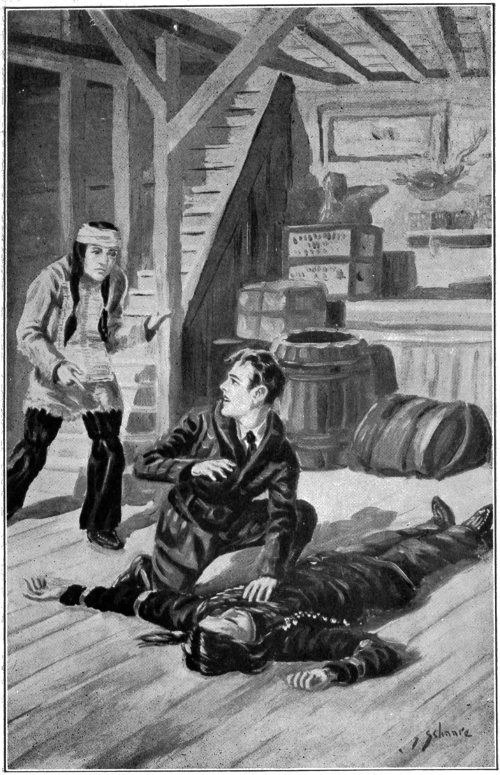
“Dick,” he trembled, “What happen? You shoot this man—you—” (Page 174)
By MILTON RICHARDS
Author of “Dick Kent With the Mounted Police,”
“Dick Kent in the Far North,”
“Dick Kent With the Eskimos,”
“Dick Kent, Fur Trader,”
“Dick Kent With the Malemute Mail,”
“Dick Kent on Special Duty,”
“Tom Blake’s Mysterious Adventure,”
“The Valdmere Mystery,” etc.
A. L. BURT COMPANY
Publishers New York
Printed in U. S. A.
STORIES OF ADVENTURE IN THE NORTH WOODS
FOR BOYS 12 TO 16 YEARS By MILTON RICHARDS
DICK KENT WITH THE MOUNTED POLICE
DICK KENT IN THE FAR NORTH
DICK KENT WITH THE ESKIMOS
DICK KENT, FUR TRADER
DICK KENT WITH THE MALEMUTE MAIL
DICK KENT ON SPECIAL DUTY
DICK KENT AT HALF WAY HOUSE
Copyright, 1929
By A. L. BURT COMPANY
Printed in U. S. A.
Just before dusk, riding in on a slight swell, the
canoe touched on the leeward side of the island.
It was a wooded island, similar to a score of others
that dotted that lake. There was little to differentiate
it from its brothers except that in its very
center the fir and balsam had graciously withdrawn to
permit a huge shaft of solid rock to raise its head
loftily and majestically skyward.
The three young men who disembarked from the
canoe, stood looking toward the shaft with something
like eagerness in their eyes. Then one of
them spoke:
“There it is! The rock of the dinosaur!”
4
Another of the trio, a stockily built boy with
light blue eyes and sandy complexion, removed a
battered felt hat that had been crammed down over
his well-shaped head and ran his fingers through a
mop of corn-colored hair.
“Bones! Toma—bones!”
The remaining member of the party, swarthy,
dark, soft-footed, agile as a panther, grinned as he
stooped down to tie the strings of one of his moccasins.
“Mebbe this not right place after all,” he said.
The first speaker turned swiftly at this and regarded
the stooping figure. What had induced
Toma to make that remark? The description that
had been given them by Mr. Donald Frazer, factor
at Half Way House, fitted this island exactly: an
island in a lake of many islands, an island with a
tall rock. Dick Kent remembered as well as if it had
been only yesterday.
“It’s three hundred miles northwest of here in a
country of innumerable lakes,” the factor had directed
them. “These lakes all drain into the Half
Way River. They are all very close together,
forming a sort of chain. Most of the lakes are
dotted with a few islands, but there is one lake, near
the center of the chain, that has more islands than
all the rest—scores of small wooded islands. On
one of these you will find a tall, spindling rock. The
island with that rock is the island of the dinosaur.”
5
So remembering this conversation, Dick could
not believe with Toma that they might have come
to the wrong place. Here was the wooded island.
Here was the spindling rock. Here was the lake of
many islands.
“Why don’t you think it’s the right place?” he
demanded.
The young Indian straightened up quickly, his
eyes twinkling.
“Why you get so worried, Dick?” he inquired
blandly. “I no say this the wrong place. Mebbe so,
mebbe not. Plenty islands I see in other lakes an’
plenty rocks too.”
“But not a rock as tall as that one,” objected
Sandy.
Dick nodded his head.
“Yes, and most of the other lakes we explored
had only a few islands. This one tallies exactly
with the description Mr. Frazer gave us.”
Toma grinned again.
“All right,” he waved their arguments aside.
“What you say, we go see?”
6
The three boys pushed forward. The island was
scarcely more than four or five acres in area. In
a few minutes they reached the center, coming to
a full stop near the base of the pinnacle. They
found a peculiar formation here. In some prehistoric
time a gigantic upheaval had thrust the
underlying strata to a position very nearly perpendicular.
In other words, layer upon layer of substratum
had been lifted up out of the earth and
exposed to view. Embedded in one of the layers
of rock was the huge fossil of a prehistoric reptile.
Its immense frame could be seen very distinctly
from where the boys were standing. Supported by
the rock, much of which had crumbled away, the
skull of the dinosaur rested lightly against the side
of the pinnacle and the bones of the rest of the
body, still joined and intact, extended downward to
the edge of a deep pit.
The effect of all this was ghastly. Staring at it,
one was conscious of an indescribable feeling that
the fleshless body of the dinosaur still retained life
and that it had clambered out of the deep pit beneath
it and was now endeavoring to climb the tall,
spindling spire of granite. So lifelike and terrible
indeed, did the primeval monster appear, that for
a full five minutes the three boys stood there without
as much as moving a muscle.
Suddenly the tension snapped as Dick burst into
a roar of laughter. He laughed until the tears
came into his eyes and coursed down his cheeks.
He roared and slapped his thigh and sat down on
a rock, swaying back and forth in a paroxysm of
uncontrollable mirth.
Toma and Sandy stared at their chum in utter
amazement. They surveyed each other blankly.
They looked quickly over at the dinosaur in the
belief that possibly they had overlooked something.
7
“See here,” began Sandy, “what in the name of
common sense are you yowling about? If you can
possibly see anything funny in that grewsome mass
of bones your sense of humor is warped. Stop it,
Dick! Stop it, I say before you drive me daft.
Stop!”
Dick raised his head and wiped his eyes. He
was still choking.
“You—you see nothing funny?” he gasped.
“I do not!”
“What do you think of our friend, the dinosaur?”
and Dick indulged in another convulsive chuckle.
Sandy’s eyes flashed fire.
“Say—”
“Look at it! Look at it!” shrieked Dick. “Its
size! Must weigh tons—tons, Sandy. And—we’ve
come—three hundred miles—laboring under impression—going
to carry it back on a raft.”
“Well—”
“On a raft,” continued Dick. “That thing on a
raft. If you can, just get that picture in that slow
mind of yours.”
Toma was grinning broadly now.
“The portages,” he wondered.
“Yes, think of carrying that huge skeleton over
the portages.”
8
“Why it—it can’t be done,” stated the young
Scotchman, beginning to see the light. “Absolutely
out of question. We’ve come on a fool’s errand.
Mr. Frazer must have—”
“Known it!” Dick took the words out of his
chum’s mouth. “Of course, he knew it. Can’t you
see, Sandy, we’ve been victimized, made the butt
of one of the worst jokes I’ve ever heard of. No
wonder they all grinned and acted so queerly when
we left the post. By this time, half the people in
this north country are laughing up their sleeves.
It’s all a hoax. I’ll bet that London museum Mr.
Frazer told us about hasn’t even made an offer for
this dinosaur.”
“You mean the whole affair from beginning to
end was planned by that fool and his friends?”
“Exactly.”
“And that we’ve not only lost what we thought
was a chance to make a few hundred dollars but
have become the laughing stock of—of—” Sandy
choked and gurgled.
Sandy’s color drained from his cheeks and he
sat down quickly, endeavoring to control the fierce
gathering storm within.
9
“And you call that a good joke,” he inquired bitterly,
“a friendly, decent joke that sent us packing
through a hundred dangers at the risk of life and
limb? You can laugh at that?”
“Well, what would you have me do? Sit down
and cry? Not I. Might as well make the best of
it. I’ll go back and laugh with ’em.”
“I laugh too,” said Toma. And he did.
Sandy continued to glower. He looked up at the
dinosaur. Then he put his head in his hands and
groaned.
10
CHAPTER II. TWO VISITORS.
Dick Kent had plenty of time that night to
think about the crude joke Mr. Frazer, the factor
at Half Way House, had played upon them. The
factor must have known full well that the mammoth
skeleton of the dinosaur could not be conveyed
easily up the river on an ordinary raft. He must
have known, too, of the utter impossibility of packing
the huge creature over the thirteen portages that
are to be found between the island of the granite
shaft and the trading post, three hundred miles up
the river.
11
Given sufficient leisure to think the matter over,
Dick decided that he did not blame Sandy one bit
for the anger and bitterness that Frazer’s trickery
had aroused. The young Scotchman had eaten his
supper in a huff and later had retired to his blankets
in a manner that was, to say the very least,
thoroughly hostile and unfriendly. His actions indicated
very plainly that he, for one, didn’t consider
this business of the dinosaur as the sort of
joke that could pass unnoticed or unforgiven, or
that could be laughed down or yet dismissed with
a shrug. It rankled and cut deep. Some day Mr.
Frazer would hear about it.
Dick turned his eyes toward the campfire and
watched the shadows creeping up to the bright
circle its glimmering light made. He lay quite still,
listening to the monotonous beat of the water around
the shore of the island. He was dimly aware of
the tall granite slab that thrust up its pointed head in
cold disdain of the lowly trees under it. Far away
somewhere a loon called out mockingly and derisively
to its mate.
Sandy woke on the following morning in a better
humor. Over a hot cup of tea and a crisp rasher
of bacon, he apologized for his behavior on the
previous night.
“I had no reason to be angry with you, Dick,”
he stated contritely. “But you irritated me because
you took it all so good-naturedly. It can’t be denied
that the joke is on us, but you surely know that he
went too far with it. He never should have permitted
us to start out. Our time is worth something
and we paid the factor a good stiff price for
our grubstake. Then there are all those cumbersome
tools we brought along—rock chisels, pickaxes,
hatchets and what not. We paid for them
out of our own hard-earned money. A very expensive
practical joke, if you ask me.”
12
In the act of raising a cup of steaming beverage
to his lips, Toma paused and his dark eyes fell upon
Sandy’s face.
“Mebbe not so much joke like you think. Mebbe
Mr. Frazer him not want us to stay at Half Way
House any longer. Mebbe he think your Uncle
Walter send us fellows down to spy on him an’ he
no like that.”
Both Dick and Sandy started. They had never
looked at the situation from quite that angle. The
young Indian’s statement had induced a new train
of thought. Come to think of it, why had Sandy’s
uncle, Mr. Walter MacClaren, factor at Fort Good
Faith and superintendent for the Hudson Bay Company
for all that vast northern territory, sent them
over to Half Way House in the first place? Sandy
looked at Dick searchingly for another moment,
then broke forth:
“Gee, I never thought about that. Toma, you’re
too deep for us. I can begin to see now.”
Dick pursed his lips, scowling slightly.
13
“Mr. MacClaren said that the hunting was good
up around Half Way House and that we’d enjoy
our summer’s vacation there. He didn’t tell us that
he was suspicious of Mr. Frazer. Naturally he
wouldn’t. He wanted us to find that out for ourselves.
Sandy,” he glanced eagerly across at his
chum, “as far as you know, has Mr. Frazer a
reputation for being much of a practical joker?”
Sandy put down his cup and proceeded to pour
out his second helping of tea.
“No, I’ve never heard that he was. And certainly
he doesn’t look the part. I wouldn’t call him frivolous.
My impression of him has always been that
he is inclined to be sort of taciturn, reserved and
fairly uncommunicative.”
At this juncture, Toma again broke into the discussion.
“He not look like man that see anything to laugh
about ever. I no like that fellow very much. I no
like them friends he keep alla time hanging around
the post. Look like bad men to me.”
On many occasions previously during their sojourn
in the North, the two boys had come to place
a good deal of reliance on the young Indian’s snap
judgment. He had an almost uncanny ability to
read character and of finding hidden traits, both
good and bad, in the persons with whom he came in
contact. Seldom did he err.
“He’s referring to Wolf Brennan and Toby McCallum,”
said Sandy. “Well, I don’t know as one
could call them Frazer’s friends.”
14
“I see Mr. Frazer talk with them many times,”
Toma wagged his head. “When I come close they
hush up—don’t talk any more. An’ one time I see
a light in Mr. Frazer’s room late, ’bout two o’clock,
I think. An’ there through the window I see ’em.
Wolf Brennan, McCallum, Frazer an’ two Indians
I do not know.”
“Why didn’t you tell us this before?” demanded
Dick.
That was the way with Toma—ever reticent.
His uncommunicativeness often became a source of
despair to his two chums.
“You no ask me.”
“But how did we know?” glared Sandy. “We
weren’t up at two o’clock that night.”
“I no tell you that,” Toma explained, “because
I think mebbe you no want to hear bad things about
Mr. Frazer.”
“You cherub!” Sandy snorted.
“Sandy,” questioned Dick, “how does Mr. Frazer
stand with the company?”
Sandy stirred the oatmeal, sugar and bacon
grease together in what was to Dick an unappetizing
mess.
“Uncle Walter never told me.”
“But haven’t you heard?” Dick persisted.
“No, I haven’t,” Sandy commenced to eat his
favorite dish. “Uncle Walter never tells me anything
about his business. He’s as close-mouthed as
the average Scotchman, I guess.”
15
“There are some ways in which you do not resemble
him in the least,” pointed out Dick, winking
at Toma.
No more was said on the subject then. As soon
as they had washed their breakfast dishes, Dick
and Sandy went over for another view of the
dinosaur, while Toma set out to explore the island.
The dinosaur, in the bright morning sunlight,
seemed to be as ugly and repellent as it had been in
the evening’s shadows on the night before. Again
they were awed by its presence. It seemed inconceivable
that anything so huge and ugly had ever
walked upon the earth.
“How’d you like to meet one of those things
alive?” asked Sandy.
“Not for me. A bullet would probably flatten
out on its scaly hide. At the best, it would feel
like no more than a pin-prick. And Mr. Frazer
told us we could bring that thing back on a raft.
He must have known better, because he was here
two years ago and saw it with his own eyes.”
“Of course, he knew better,” growled Sandy.
The bushes parted behind them. First Toma’s
head was thrust through and then his body. He
motioned to them eagerly.
“Come on,” he said. “I show you something.
Come quick!”
16
They turned and followed him, finding it difficult
to keep pace with him, so quickly did he go. They
came presently to a fringe of willows not far from
the western shore of the lake. The young Indian
motioned them to be seated.
“Watch out there in the lake,” he commanded
them. “Pretty soon you see something. Keep very
quiet. No talk now.”
Both waited expectantly. Out ahead of them the
lake rippled and sparkled. Suddenly a canoe glided
within their range of vision—a canoe containing
two occupants. Their paddles dipping in unison,
the two men sat very straight, one in, the center and
one in the stern, two mackinaw coated figures, two
bearded white men whom the boys recognized instantly.
In the excitement of the moment, Sandy
jabbed his elbow in Dick’s ribs.
“Cracky!” he blurted out. “What’s up now?
Wolf Brennan and Toby McCallum! They’re
coming here.”
But in this Sandy was mistaken. The canoe did
not pause, did not waver. It swept in fairly close
to the island then, as if it had suddenly changed
its mind, it swerved sharply and continued on its
course. The two men sat like statues until they
were thirty or forty yards away. Then Wolf
Brennan craned his thick, bull-like neck and looked
back.
17
Even at that distance the boys caught the expression
that distorted the man’s coarse features. A
leer, a mocking, unfriendly grin, a diabolical,
fiendish sneer!
Abruptly he turned and the paddle, gripped in his
huge ape-like hands, glinted in the sunlight as it
smote the gleaming water.
18
CHAPTER III. SUSPICION GROWS.
“Now what are they up to?”
Dick’s hands clenched as he spoke. He half rose
from his kneeling position behind the willow copse
and glared at Sandy as if he expected that that
young man could answer the question.
“Yes, what are they up to?” he repeated in a
low tense voice. “Messrs. Brennan and McCallum
must be on our trail. And from the look that Wolf
just now directed toward this island, they know
we’re here. The whole thing is a puzzle to me. I
don’t know what to think of it.”
“What I can’t understand,” said Sandy in a
breathless voice, “is why they did not stop. They’ve
gone right on. The reasonable and decent thing
for them to do would be to come over and say
‘hello’. They might, at least, have shown that they
were hospitable.”
“Wonder if Frazer sent them,” mused Dick.
Sandy pursed his lips and scowled as he looked
out toward the flashing crests of water.
19
“I shouldn’t wonder,” he answered. “Now that
we’ve found the little joker in this deal of the
dinosaur, I’m inclined to think he has. Further
than that, I’m prompted to believe that there was
something more than the mere playing of a practical
joke that induced Factor Frazer to get us
to come out here. There must be some deviltry
afoot at Half Way House. Our presence there isn’t
wanted. He sent us up here on this wild goose
chase to get us out of the way, and, working on
this hypothesis, the next logical inference is that
Wolf Brennan and Toby McCallum have trailed
us all the way up here.”
Dick motioned Sandy and Toma to follow him to
the opposite side of the island. Arriving at their
camp, he turned upon his two chums.
“I’ve been thinking of what you’ve just said,
Sandy,” he remarked, as he began packing their
luggage. “I want to tell you that I believe you’ve
hit the nail on the head. Something underhanded
is taking place at Half Way House. We’ve been
sent out here to be kept in ignorance of what is
going on. They know that all of us are attached
to the Mounted Police reserve and it would be fatal
to their plans to have us there at the post. Wolf
Brennan and his pal are out here to watch us, to
see that we do not return. I—”
The young Scotchman interrupted him.
20
“Hold on there a moment, Dick. I don’t know
as I’d care to go that far. I gather from what
you’ve just said that you mean they’ve been commissioned
by Frazer to put us out of the way.”
Dick smiled. “No, I didn’t quite mean that,
Sandy. I don’t think we’ll be murdered. Not that.
As long as we stay on this island, or remain here in
this vicinity, we’ll be safe enough. We might stay
here all summer, and we’d never see them again,
never be bothered, but—”
“Yes, yes,” said Sandy impatiently, “go on,
Dick.”
“But,” continued Dick, “let us leave this island
or this vicinity and then trouble aplenty.”
“You mean they’ll attempt to stop us if we start
back for Half Way House?”
“Yes, that’s exactly what I mean,” said Dick.
“They’ll harass us at every turn. I’m convinced
of it. I won’t say they’ll resort to open violence
if underhanded methods will avail.”
“Oh come, Dick, surely not.”
“As I live, I sincerely believe it. I wouldn’t put
these thoughts in your mind, if I didn’t But I can
easily prove my point.”
“How?”
“By starting back.”
“What—you mean right now?”
21
“No better time than now. If my suspicions are
correct, we’ll run into some snag within the next
day or two.”
“Is that why you were starting to pack that luggage?”
“Yes.”
Sandy tongued his cheek and in the bright light
of that perfect morning he squinted at his chum.
In that brief interval he did some quick thinking.
“Wait a minute, Dick,” he finally broke forth.
“Let’s not be too hasty.”
“But I’m not hasty. No use staying here any
longer that I can see. We’ve all agreed that it’s
out of the question to bother with the dinosaur.
There’s absolutely nothing we can do here unless
it is to put in a few weeks fishing and hunting, and
somehow,” Dick stroked back the hair from his
forehead, “I’m in no mood for that. Let’s start
back and see what happens.”
“No, I think I have a better plan. Let’s postpone
that return trip until we’ve had a chance to interview
Messrs. Brennan and McCallum.”
“Just what do you propose to do?”
“Well,” began Sandy, “I doubt if they are aware
that we’ve seen them. We can jump into our canoe,
slip down along the east side of the lake and come
upon them in such a way that they’ll think our
meeting is quite accidental. We’ll profess great
surprise at seeing them. We’ll ask them point-blank
what they are doing out here.”
22
Dick laughed. “Yes, and not learn a thing.
They’ll have a very plausible story, don’t worry
about that. And why go to all that trouble anyway?
If you want to talk to them, Sandy, let’s jump in the
canoe and overtake them at once.”
“All right. Just as you say. I’m ready.”
“What do you think about it?” Dick turned upon
the young Indian.
Toma deliberated for nearly a minute. His eyes
flecked and his gaze dropped.
“No harm we go see them. Take jus’ a few
minutes an’ we find out what they say. Come on.”
They dragged their canoe down to the water and
Sandy pushed off. The light craft bobbed and
swayed for twenty feet through the blue, almost unruffled
surface near shore, then headed straight out
toward the gradually disappearing speck retreating
in the distance. For fully ten minutes no one spoke.
The little vessel leaped and darted through the blue,
sparkling element. In another ten minutes the other
canoe had grown appreciably larger. Between
strokes, Dick puffed:
“Remember, Sandy, this is your suggestion.
You’re the spokesman.”
“Leave it to me,” the other retorted. “I know
just what I’m going to say.”
23
“Whatever you do,” Dick warned him, “don’t let
them guess that we’re suspicious of them.”
“I won’t,” growled Sandy.
Thus it happened that when they pulled abreast
of the smaller craft, it was Sandy who hailed them.
The two men raised their paddles and permitted
their canoe to be overhauled. There ensued an exchange
of greetings.
“Why didn’t you stop?” asked Sandy.
“Stop?” Wolf Brendan rubbed his unshaven
chin and stared questioningly. “Stop where?”
“Why, at the island, of course.”
Brennan continued to stare blankly, almost foolishly.
He was a good actor.
“There’s a hull lot of islands in this here lake.
What island do you mean?”
“The dinosaur’s island, of course. You saw us,
didn’t you?”
“Nope, we didn’t see yuh. Knew yuh was up here,
o’ course, getting them bones of that thar dinosaur,
but we didn’t know just where—which island, I
mean.”
“You weren’t very far behind us on the trail.”
“Nope, ’bout a day I guess. Seen your campfire
along the trail. One was still smoking when we
got to it.”
24
“We sort o’ half suspected we’d run across yuh
somewheres,” McCallum interjected. “So this yere
is the lake of the dinosaur? ’Magine yuh fellows
will be pretty busy durin’ the next few weeks gettin’
them bones chipped out o’ the rock ready for
shippin’.”
“No,” Sandy informed them, “we’re not going
to bother with it. The thing’s too big for us to
handle.”
“Yuh can build a big raft,” McCallum suggested.
“What about the portages?” There was a faint
note of anger in Sandy’s voice.
“Yuh’ll have to pack it, o’ course,” McCallum
said. “But it’s almost as easy to build a big raft
as a small one.”
“The dinosaur’s skeleton is too big and too heavy
to pack,” declared Sandy haughtily.
“Yuh don’t say.”
“It certainly is.”
“What yuh gonna do then?”
“We’ve given it up,” Sandy spoke harshly.
“We’re starting back to Half Way House this afternoon.”
Wolf Brennan spat in the water and glanced
inquiringly at the three occupants in the other canoe.
“If yuh fellows was right smart now, yuh
wouldn’t give up so easily. There’s a lot o’ money
to be made if yuh can manage to get that big lizard
back where it can be took to one o’ the company’s
steamers. If I was making a contract now,” Wolf
Brennan spat in the water again, “I’m thinkin’ I’d
move Heaven an’ earth afore I’d give up.”
25
Sandy glanced back at him.
“I’m not saying we’ll never get the dinosaur out.
But if we do, it won’t be this summer and it won’t
be on a raft one is required to pole up a river that
has thirteen portages.”
“How else could yuh get it out?”
“I don’t know. We haven’t thought about that—yet.
Perhaps this winter we may come to some
definite conclusion.”
“So yuh’re goin’ back to Half Way House?”
“You bet we are.”
“Too bad.”
“And where are you going?” Sandy inquired innocently.
Wolf Brennan glanced at McCallum for a brief
interval and between them passed a significant and
knowing look.
“Sort o’ figured we’d go prospectin’ for a time.”
“Where?”
Brennan seemed to be hazy on this point. He
coughed embarrassedly and looked again at his
partner.
“’Tother side o’ the lake there’s some hills an’ we
kind o’ thought we’d put in a week or two jus’ sort
o’ looking’ around.”
“What side of the lake?” persisted Sandy.
26
“On the north side,” Brennan answered. “If
yuh’re startin’ back for the post this afternoon, we
may see yuh again.”
“I shouldn’t wonder. Because we are starting
for the post this afternoon.”
Brennan blinked and again he looked at McCallum.
Evidently this was McCallum’s cue for he spoke up.
“Mebbe if yuh’d stick around for a while,” he
suggested, “the four of us could figure out some way
to get out that dinosaur.”
“Five of us,” corrected Dick, speaking for the
first time. “You’ve overlooked Toma.”
“Breeds don’t count.”
“This one here,” stated Dick furiously, stooping
over and patting Toma on the shoulder, “is as good
as any dirty, bewhiskered white man that ever came
over the trail from Half Way House. You can
take that statement in any way you see fit, McCallum.”
“Regular spit-fire, ain’t yuh?”
“I’m not accustomed to have my friends insulted.”
McCallum removed his hat and bowed gravely.
“I shore beg your pardon. I didn’t mean no offense.
Along toward evening, me an’ Wolf will
drop over to your little island and pay yuh our
respects.”
27
“Suit yourself,” said Sandy, “but we won’t be
there. As I’ve already told you, we’re starting
back to Half Way House this afternoon.”
What Sandy read in McCallum’s eyes was a challenge,
but it was Wolf Brennan who spoke.
“Mebbe,” he said.
28
CHAPTER IV. THE FIRST ENCOUNTER.
The first night on their return trip to Half Way
House the boys camped twenty miles south of the
lake. Here they received their first set-back. In the
morning they awoke to find their canoe was gone.
Rage in their hearts, they gathered in a little group
and stared at the place where it had been. They
guessed immediately what had happened. After the
first shock, Dick scowled and looked at his two
chums.
“Well, we know where we stand now,” he declared
grimly.
“Three against two,” blurted Sandy. “They can’t
stop us.”
Dick mopped his moist forehead and dug the tip
of one moccasin into the loose sand.
29
“That may be true. We have the advantage in
numbers. But I’d also like to point out to you that
even though that is so the odds are in their favor,
nevertheless. We never know when to look for
them. They’ll strike when we least expect it and
always from under cover. They’ve already won the
first round. Poling up the river in a raft is a
tedious and disheartening undertaking. It will take
us three times as long to reach our destination. I
don’t know as I’m in favor of going on in that
way.”
“Why not?”
“Too much danger.”
“Not any more danger than there was in the
canoe,” objected Sandy.
“Probably not. But until this moment we haven’t
been sure in our own minds that Wolf Brennan and
Toby McCallum have taken the offensive. Now we
know. There’s absolutely no question about it.
They’ve struck once and they’ll strike again too.
The next time it may be a stray shot that will get
one of us.”
“What do you mean by a stray shot?” demanded
Sandy.
“If one of us gets killed it might as well be a
stray shot, mightn’t it? I mean, it will be a difficult
thing to prove that we were deliberately fired on and
that those two miscreants did the firing.”
“You propose then to walk back?”
“Yes, I think it will be safer.”
“But they can shoot us just as well while we are
going through the woods as they can if we were
aboard a raft.”
30
“I don’t agree with you there. There’s no better
mark that I can think of then three standing figures
on a raft, no obstructions of any kind to check the
progress of a bullet, the best sort of cover along
the shore in which they can hide.”
“Well, I don’t mind walking,” said Sandy. “But
what about our luggage here? We can’t carry all
of that. I’m mighty glad now we left those tools
back there at the island of the dinosaur.”
“I’d suggest that we make a cache, right here,
of what we can not carry. If we are to travel
swiftly, we ought not to pack more than fifty pounds
each. Isn’t that right, Toma?”
The Indian nodded. “Not more than fifty pounds.
That way we travel quick. Think much better like
you say not to pole up river in raft. Next time
Wolf Brennan him not be so easy on us.”
Sandy suddenly clapped his hands. His face
brightened and he laughed gleefully.
“Cracky! I’ve just had an inspiration. We’ll
beat them at their own game. We won’t set our
course along the river. We’ll go a more roundabout
way and put them off our trail entirely.”
“But how?” questioned Dick, greatly interested.
31
“I just happened to remember,” explained Sandy,
“that sixty miles southwest of here is the Clear
Spring River. It’s a large stream, fairly navigable.
On this river, near what is called the Great Heart
Portage, is an old trading post, now deserted, once
the headquarters for an independent fur company.
If I remember correctly, Uncle Walter said that this
independent company has been out of business for
something like eight years. But their stores and
warehouses are still there. These have been made
over into dwelling houses and are occupied by half-breeds
and Indians during the winter months. If
we proceed in a straight line toward this old trading
post, we ought to reach it in two days. When we
arrive there, the chances are, we may find Indians
in the vicinity and may be able to purchase another
canoe. If we do, we’ll proceed up the Clear Spring
River to Halstead’s Island, which will bring us about
fifteen miles west of Half Way House.” Sandy
paused and regarded Dick and Toma questioningly.
“What do you think of that for a plan?”
“Good,” declared Toma.
“I like it very much,” smiled Dick. “It ought
to throw Brennan and McCallum completely off our
trail. They’ll be waiting for us somewhere a short
distance up the river and, when we fail to put in an
appearance either by raft or on foot, they won’t know
what has become of us. I doubt if they’ll ever
tumble to the fact that we’ve gone over to the Clear
Spring River. When they do come back here to
investigate and stumble upon our trail, we’ll be so
far away they won’t be able to overtake us.”
32
While Dick had been talking, Toma paced restlessly
back and forth near the campfire. For some
unexplainable reason, he felt uneasy. For several
minutes now, he had been watching closely a thicket
of elders as a cat might watch a mouse. On two
different occasions the leaves and branches of the
elders had stirred gently. A light breeze flowed
down along the river valley, yet it was so vagrant
and listless that it scarcely could be felt fanning
one’s cheek. Yet he had distinctly seen the elders
moving. His quick eye had noted this and his first
thought had been that possibly a squirrel was playing
there. Catching up his rifle, he strode straight
over to the clustered thicket and parted the branches.
As he peered within, for one fleeting moment he was
under the impression that he had caught sight of
something brown. Then he heard a stealthy movement,
followed, by the unmistakable crackling of
dry branches.
Pushing his way within the thicket, he paused to
listen. He could hear no further sound. Yet something
told him that that fleeting glimpse of something
brown had not been of an animal but of a man—Wolf
Brennan or McCallum!
33
He took a few steps forward, critically examining
the ground. A barely audible sound escaped his
lips. He stooped quickly over the faint imprint
of a moccasined foot. Satisfied, his suspicions confirmed,
he dashed on through the thicket, emerging
at its farther side, just as two figures topped a low
hill not thirty feet ahead. Toma raised his rifle to
his shoulder in a lightning motion, then came a
blinding explosion and the two men ducked their
heads as a bullet whistled between them.
The skulkers did not hesitate for even a fraction
of a second. They dashed down the hill toward
the thicker growth just below. Just as they entered
this welcome barrier, a second bullet clipped the
leaves above their heads.
In the wild scramble that followed, Wolf Brennan
lost his hat. Cursing, he started back for it when
still another lead pellet whizzed past, so close to
his face that he thought better of it, turned and
plunged on after his companion.
Soon afterward, Toma strode back into camp as
calmly as if nothing happened. His expression was
reserved and dignified. Except for a faint sparkle
in his eyes, one could never have guessed that only
a short time before he had been so busy.
“What were you shooting at?” Dick and Sandy
demanded.
The young Indian smiled faintly.
“A wolf,” he answered.
“Where did you see it? Pshaw, you’re joking,”
accused Sandy. “A wolf! One seldom sees a wolf
during the summer.”
34
“I see ’em wolf,” declared Toma, “an’ I shoot at
him one, two, three times.”
“Yes, we heard you,” said Dick. “Hit him?”
“I not try very hard. I have lots fun scare that
wolf. Wolf no good to eat unless one pretty near
starve. Why for I kill him?”
“I’d kill a wolf any time I had a chance,” declared
Dick. “I hate them.”
Sandy started to say something, then suddenly
paused. Of a sudden his eyes had grown very round
and he stared at Toma as if fascinated. He was
looking straight at the young Indian’s hip pocket.
From it a bulky object protruded. The object was
brown and it was a little difficult to tell just what
it was, nevertheless, Sandy had his suspicions. He
strode forward quickly and yanked it from his
chum’s pocket. He smoothed it and held it out for
better inspection.
“Where did you get it?” he demanded.
At the sharp question, Dick turned and he, too,
stood goggling.
“I no tell you a lie,” Toma explained. “That
fellow him wolf all right—Wolf Brennan.”
Dick turned pale. “Did you kill him?” he cried
in horror. “Tell the truth, Toma, you didn’t hit
him, surely? You wouldn’t do that.”
35
“I just tell you I like make ’em run. Wolf Brennan,
Toby McCallum do very fast run back there in
the trees,” Toma pointed away in the direction he
had just come. “Mebbe next time them fellows
think twice before they try spy on our camp.”
For a brief interval, Dick and Sandy grinned over
the mental picture of those two racing figures, but
their mirth was short-lived. The same thought came
to each at the same time.
“I’ll bet they heard what we were talking about,”
gasped Sandy.
“Sure they did,” said Dick.
“In that case, no use going to Clear Spring River.
Might as well go on the way we planned in the first
place”—dolefully.
“Might as well.”
Toma, who had been gazing up and down along
the shore, suddenly broke forth:
“What you think them fellows do with our
canoe?”
“Set it adrift, of course,” grunted Sandy. “It’s
probably miles away by this time. Might even have
reached the Lake of Many Islands.”
Toma rubbed his forehead with a grimy hand.
“Mebbe not. Mebbe current take it close in to
shore an’ that canoe not very far away this minute.”
“Possible, I’ll admit,” agreed Dick, “but not very
probable. More likely they took it out here in mid-stream
and sunk it.”
36
“If you fellow stay here,” suggested Toma, “I
very willing to walk back to see if mebbe I find it.”
“No,” said Dick, “I wouldn’t want you to do that.
I mean it isn’t fair that you should take all the risks
and do all the work, Toma. Let’s toss a coin to see
who goes.”
It was agreed. They tossed the coin and Dick
lost. A few minutes later, carrying his rifle and a
few emergency rations, he waved good-bye to his
two chums and started out.
37
CHAPTER V. DICK FINDS A CANOE.
Dick had no definite plan in mind other than to
proceed down the river in search of their missing
canoe. As Toma had suggested, there was a possible
chance that the unscrupulous Wolf Brennan and his
partner had set the craft adrift, believing that it
would be carried by the current into the Lake of
Many Islands—out of sight and out of reach of
their three young opponents. If this was the plan
that Wolf had actually put into effect, there was
still a frail chance for its recovery. It might have
floated out of the main current and subsequently
been washed ashore. If Dick were lucky, he might
come upon it. It was a somewhat hopeless quest yet,
under the circumstances, it might be well worth the
effort.
“I won’t waste more than a few hours,” Dick
decided, as he picked his way along the rock-strewn
shore. “If I don’t find it within five miles from
camp, I’ll give up.”
38
At the end of an hour, his patience was rewarded.
Turning a bend in the stream, his heart gave a
quick leap. Two hundred yards ahead was what
looked to be very much like the thing he sought. It
was a canoe—that much he knew. It was close to
shore, drifting idly, round and round a circular
pool on his own side of the river. He emitted a fervid
sigh of satisfaction and relief and bounded forward.
Fifty feet from his objective he stopped short, his
breath catching.
It was not their canoe at all. It was the one in
which only the day before, he had seen Wolf Brennan
and Toby McCallum pass by the island of the
dinosaur. The realization had come so unexpectedly
that, for a time, Dick was almost too dazed and bewildered
to collect his scattered wits.
So Brennan and his partner had lost their canoe,
too? How had that happened? Had they left it
partly in the water and partly on shore, and had the
current succeeded in tugging it away? It seemed
probable. The river played no favorites.
And then Dick saw something that caused his
pulses to leap with excitement. In the white sand,
twenty feet from where the craft was bobbing idly,
were the marks made by the canoe when it had been
beached, and around these marks were the unmistakable
imprints of moccasined feet.
39
Dick could not suppress a grin of appreciation.
Well-trained canoe that! A very obliging current!
Caught in a net-work of in-shore eddies, moving
round and round in a circle, the canoe was nearly
as safe as if it had been dragged clear of the water
and deposited in the white sand along the beach.
Coincident with this discovery, there came the
realization that he was treading on dangerous
ground. Having left their canoe here, very naturally
the partners would return. Perhaps they already
had. For all Dick knew to the contrary, right at
this moment from behind some leafy ambuscade
they might be watching his approach. The thought
frightened him. He paused dead in his tracks, undecided
what to do. After the reception Wolf had
received back there at the boys’ camp, it was only
reasonable to suppose that neither of the partners
would hesitate about using their own weapons. On
the other hand, if they were still lingering in the
vicinity of the other camp or had paused to rest
somewhere, he would be missing a golden opportunity
if caution or the fear of a bullet kept him from
making a closer approach.
Come to think of it, he was in as much danger
here, a mere fifty yards from his goal, as he would
be if he were actually at the side of the canoe.
Already he was within rifle range. But they hadn’t
fired. Were they waiting for him to come just a
wee mite closer, or was it really true that they hadn’t
yet arrived upon the scene?
40
For a full minute Dick stood there, unable to
decide. His heart pounded like a trip-hammer.
Three times he took a step forward and thrice he
stopped short, in panic at the thought of what might
happen to him if he could command the courage to
go on.
And then, almost beside himself from the inactivity
and suspense, he gathered together the fluttering,
loose ends of a waning decision, gritted his
teeth, and darted forward. Bounding along at top
speed, in a few seconds he came abreast of the canoe,
checked himself, then splashed out waist-deep into
the water and clambered aboard.
He dropped his rifle, frantically seized one of the
paddles and was half way out into the river before
he was sufficiently recovered from his fright to realize
that he had actually made good his escape. Yet
he continued to paddle furiously. Never before had
he bucked a current with such fierce and desperate
ardor. He swept round the bend in the river, perspiration
pouring from every pore, working with a
dogged, automatic, machine-like regularity. Seemingly
he could not, dare not ease up for even as
much as a split-second.
41
On and on he raced. A thin, white line of foam
trailed off in his wake. Now and again in his eager
haste, his paddle scooped the water in the air behind
him, where the freshening breeze caught it and
whirled it away.
He was limp as a rag and utterly spent when he
reached camp. Toma and Sandy, who stood watching
him as he glided up to shore, blinked in amazement.
He had not the breath to answer their eager questions.
He lay back in the stern, puffing, gasping,
while the blood throbbed in his head with such insistence
that for a time he actually believed that his
temples would burst. His vision was somewhat
obscured, too. Through a sort of haze he could
perceive Sandy dancing wildly like a jungle savage.
“Dick, you lucky beggar!” shrieked the suddenly
daft and madly plunging young maniac. “What’s
the meaning of this? O boy! Cracky! If you
haven’t turned the tables after all. What a come-back!
I’ll bet if either one of ’em had gold teeth
you’d have stolen them, too. Where’d you get it?”
Not yet able to speak intelligently, Dick pointed
down the river.
“You did, eh?”
Dick nodded.
“Fight ’em?” Sandy persisted.
Dick shook his head.
42
“Well, that’s too bad. I was hoping that you
had left them back there to nurse a couple of broken
heads. Serve ’em right after what they did to our
canoe.”
Dick sat up, his breathing now less violent.
“Ju—just what do you mean, Sandy? Have you
found it?”
“You bet we have. Toma and I found it in your
absence. It’s not down the river at all. It’s over
there in the brush, just where they carried it after
smashing it up with rocks. We must have slept like
logs not to have heard them.”
Dick thrust his two arms into the water over
the side of the canoe and commenced to bathe his
hot, sweat-streaked face.
“Well, it doesn’t matter now. We have this.”
“Yes, thanks to you. What do you say we leave
this accursed place before something else happens?
Toma and I can bring over the luggage while you
sit there and rest a bit. You need it. When we saw
you first, I’m only exaggerating a little when I say
you were travelling at the rate of twenty knots an
hour.”
“I’ll admit I was frightened.”
“You must have been. Next time we want to get
a little speed in a pinch, I’m going to frighten you
myself.”
43
“Cut out the talking, Sandy, and let’s start. I’m
afraid to linger here much longer. Don’t forget
that we’ve stirred up a hornets’ nest by taking a
flying shot at Messrs. Brennan and McCallum, and
now have added insult to injury by appropriating
their canoe.”
“Serves ’em right.”
“Please——”
Dick did not finish the sentence. A warning shout
from Toma was followed instantly by a sinister
crack of a rifle and the whine of a bullet. The
young Indian came running, carrying part of the
luggage. Dazed by the suddenness of the attack,
they could not determine at first from whence the
murderous leaden messenger had come. A second
puff of smoke revealed the place the two outlaws
were hiding. Sitting in the canoe, Dick returned
their fire, while Sandy, strangely calm for him,
sprang up the bank to fetch what remained of their
provisions.
When they were ready to embark, the firing had
ceased. But it was only a lull before the storm.
Changing their position, this time creeping down
closer to the shore, Wolf Brennan and his companion
blazed away at the speeding, bobbing mark out there
in the water. In order to save themselves, the three
boys dropped their paddles and sprawled at full length
in the bottom of the canoe.
“Whatever you do—keep down!” panted Dick.
44
Crack! Crack! Crack! Wood splintered around
them. Running wild in the current now, their craft
started down stream. Suddenly, water commenced
pouring in through one side. They were sinking—and
drifting as they sank. Calm though he was,
Dick had a feeling that they were irretrievably lost.
The water was like ice, chilling one to the marrow.
The opposite shore was still a long distance away.
“Be ready!” Dick called sharply. “Swim! Keep
under as much as possible!”
Like a man dying, the canoe gurgled and went
down. A bullet spat in the water where it had been.
A yell of triumph sounded from the shore.
“Dive!” shivered Dick. “We’ll make it!”
45
CHAPTER VI. A BLEAK PROSPECT.
Drenched and exhausted, they waded ashore.
They wrung the water out of their dripping garments,
eyeing each other soberly. His mouth grim,
Toma turned and waved defiance at their two
enemies, who stood watching them from the opposite
side.
Dick was too overcome, too utterly sick at heart
even for speech. His mind dwelt upon their awful
plight. No catastrophe, except death itself, could
have been more terrible. Canoe, supplies, guns—everything
they possessed—had gone to the bottom
of the river. In one stroke, fate had delivered a
fearful blow. They were face to face with starvation,
that grimmest of all spectres of the wild. They
were two hundred miles from the nearest trading
post—and food. The country through which they
must pass was unsettled, except for roving bands
of Indians, and here and there, probably, a white
hunter or prospector. Without rifles, it would be
very difficult to obtain game. They had not even
matches with which to light a fire.
46
Standing there, shivering and despondent, Sandy
addressed his chums:
“We’re alive, and that’s about all. An hour ago
the odds were in our favor. Not now. The tables
have been turned. The advantage is theirs. At
least, they have rifles and matches.”
Despondently, they turned out their pockets. Each
of the boys had a hunting knife. Dick had three
fish hooks and a line. Sandy produced a watch,
compass, and an emergency kit containing bandages
and medicine. Toma pulled out an odd assortment
of articles, including three wire nails, a mouth-organ,
a bottle of perfume, a mirror, and a package of
dried dates. That was all, not counting a small
amount of money which each one carried.
“The prospect doesn’t look very bright,” sighed
Dick. “Fish will have to keep us alive until we get
back to the post. Toma,” he turned eagerly upon
the young Indian, “do you know how to start a fire
without matches?”
“Yes,” Toma nodded.
“Well, that will help some. We haven’t any salt
to eat with our fish, but in this sort of emergency
I guess we can’t complain. One thing that pleases
me, that makes all this endurable, is that Wolf Brennan
and Toby McCallum are not apt to bother us
any more. We’re on opposite sides of the river,
and by the time they can build a raft, we’ll be a good
many miles ahead of them. If you fellows are willing,
I’d just as soon walk all night.”
47
“But we can’t walk without food,” Sandy reminded
him. “We must stop, catch a few fish, and
make a fire. In time the sun will dry out our
clothing, so we don’t need to worry about that.”
Toma led the way as they pushed on. It was
late when they stopped. Dick immediately repaired
to the river, where he caught four trout. In the
meantime, Sandy watched Toma making a fire. It
was a slow process. The young Indian walked up
through the woods, and from the stem of a number
of weeds he gathered a handful of pith. Next he
procured dry moss, and, from the shore of the river,
a hard rock about the size of a man’s hand. Proceeding
with these materials to a place sheltered
from the wind and handy to fuel, he squatted down,
holding the rock in one hand and his knife in the
other. With the ball of pith on the ground in front
of him, working with incredible speed, he struck
knife and rock together, sending a shower of red
sparks upon the inflammable substance below.
48
Presently, it began to smoulder. Lying prone, he
blew upon it gently. Delicate, fine pencils of smoke
arose, then a tiny flame, no larger than that made
by a match, flamed up from the pith. With a quick
motion, still continuing to blow, Toma sprinkled
over his embryo fire a quantity of dry moss. The
little flame rose higher. He added a few tiny twigs
and the outer husks of the weeds, from which he
had taken the pith. Within five minutes their campfire
was blazing brightly, and when Dick returned
with the trout, he stood there staring in wonderment.
“Did you do that, Toma?”
“Yes, I do ’em.”
“What with?” Dick inquired curiously.
“The steel of his hunting knife and an ordinary
rock,” explained Sandy. “Struck them together and
made sparks. The sparks ignited a little ball of
fluff he gathered from some weeds in the woods.”
“That not ordinary rock,” Toma pointed out.
“That what Indian call fire-rock. Make spark easy.
Not always you find rock like that. If I use different
kind of rock, it take much longer.”
When they had eaten their supper, consisting of
the four trout, baked over the fire, they all felt much
more cheerful. Dick and Sandy spent an interesting
half-hour receiving instructions in the art of fire
making. Both soon discovered that it was not as
easy as it looked. Each made several futile attempts
before he finally succeeded. When they left camp,
setting out upon their lonely night’s journey, much
to the young Indian’s amusement, Dick took the fire-rock
with him.
49
“We find plenty more rock like that along the
river,” Toma told him. “Why you carry that extra
load?”
“It’s not heavy,” Dick grinned. “Besides it fits
nicely into my left hip-pocket. I don’t intend to take
any chances about finding another rock as good as
this. I know I can make a fire with this one and I
might not be so fortunate with some other kind.”
Toma laughed again as they made their way
through the enveloping spring twilight. The air was
exhilarating and the quiet earth was touched with a
solemn beauty. Not a breath of air stirred through
the fir and balsam along the slope. A fragrant
earth smell uprose from the rich soil. They passed
shrubs that flamed with white and crimson flowers.
Dick became so impressed with the loveliness of it
all that for a time he quite forgot about their
dilemma. Later, when he did remember it, it didn’t
seem so terrible after all.
“We’ll fool them yet,” he announced cheerily.
“If we can manage to get food as we go along,
there’s no reason why we can’t arrive at Half Way
House in time to upset Frazer’s plans.”
“We must do it,” replied Sandy soberly.
“It won’t be easy,” warned Dick.
“I know that. It makes me all the more anxious
to succeed. I’m not very apt to forget this experience
for a long time. If the factor really is up to
some underhanded work—and the actions of Brennan
and McCallum have indicated that pretty plainly—I,
for one, intend to get to the bottom of it.”
50
“That’s the spirit,” applauded Dick. “We’ll show
him. We’ll go till we drop. If anything happens to
one of us, the other two must carry on.”
They paused at that and shook hands all around.
Then they went on more grimly and doggedly. All
night they tramped. When the early morning sun
blazed a new trail across the blue field of the sky,
they made a second camp, started another fire with
flint and steel and devoured hungrily, almost ravenously,
the six trout which Dick had the good fortune
to catch in a deep, quiet pool near the shore of the
river.
In catching the trout, Dick had used clams for
bait. Watching him, the operation had given Sandy
an idea. He set out along the shore, returning at
the end of an hour with thirty large clams, which
he placed in a hole he had scooped out in the sand.
“When we’ve had a few hours sleep,” he told
Dick and Toma proudly, “I’ll roast these fellows in
the hot ashes and we’ll have a change of diet.”
“Not a bad idea,” Dick rejoined. “I’m almost
hungry enough to eat them right now.”
51
They slept longer than they had intended. It was
late afternoon when they awoke. The warm sun,
beating down upon their tired bodies, had kept them
as warm and comfortable as if they had been
wrapped in blankets. So refreshed were they when
they had clambered up from their couches of white
sand that Toma was moved to remark:
“Not bad idea to sleep daytime an’ travel night.
At night fellow sleep by campfire with no blankets
get cold. No rest good.”
“True,” agreed Dick. “We’ll do most of our
travelling at night. Wish I knew what time it was.
Too bad the water spoiled Sandy’s watch. By the
look of that sun, I’d say it was about three o’clock
in the afternoon.”
Toma squinted up at it and shook his head.
“Five o’clock,” he corrected. “Soon as we get
something to eat, better tramp some more. Dick,
you give ’em me fishhook and line an’ mebbe by time
you an’ Sandy get fire ready an’ bake clams, I catch
some more fish.”
Toma had better luck even than Dick. A few
minutes before the clams were baked, he appeared
upon the scene with eight speckled beauties, none of
which weighed less than two pounds. They cleaned
and baked them all, wrapped up five in Dick’s moose-hide
coat, made a pack of it, and started out upon
their journey.
52
They went jubilantly. It was many hours before
the sun swung down toward the northwestern horizon.
Just as the twilight waned and the half-night
of the Arctic dropped its mantle over the
earth, Toma, who was twenty yards in the lead, suddenly
stopped short and threw up his hands, shouting
for his two companions to hurry. When they
reached his side, he pointed down at the loose sand
at his feet.
“Go—ood Heavens!” stammered Dick.
In the sand, plainly distinguishable, were the imprints
of naked human feet.
53
CHAPTER VII. BREEDS DON’T COUNT.
Who made those naked footprints in the sand?
For hours afterward the boys puzzled over it, but
could come to no satisfactory conclusion. Indians,
as they well knew, seldom went barefoot. If, on
the other hand, the tracks had been made by a white
man, who was he and from whence had he come?
Though they searched long and diligently for the
remains of a campfire or other evidences of the
stranger’s presence, none was to be found. The
tracks could be followed for a distance of nearly a
quarter of a mile along the shore, after which they
turned away from the river and became lost in the
thick moss that carpeted the woods.
Nor could they pick up the tracks again. Toma,
whom nature and training had specially fitted for
this kind of work, was forced to admit, finally, that
even he was baffled. Given a little more time, he
believed that he could find other imprints, but inasmuch
as Sandy and Dick chafed at the delay already
caused by the mysterious, barefoot stranger, he decided
to concur with popular sentiment and try to
think no more about it.
54
But it was not thus to be dismissed so lightly. The
passing of time seemed only to add fresh interest to
the puzzle. During the next two days it was the
popular topic of discussion. New theories were advanced
by one or other of the boys, argued over
sometimes for hours, then relegated to the limbo of
dead and forgotten things.
On the morning of the third day, however, while
travelling over a rough section of country near the
winding, interminable river, Dick was reminded
again of the tracks. His own toes had worn through
his moccasins. There was a hole about the size of
a silver dollar in each one of his heels. In another
day or so, he, too, would be walking barefoot, much
as he dreaded to think of it, making those peculiar
and tragic marks in the sand.
He glanced over at Sandy’s moccasins and noted
with a sinking of the heart that his were even in
worse condition than his own. Toma’s were in
better shape, but also very badly worn. Soon they
must all endure the torture of going unshod, or else
cut up their moosehide coats and make new footgear.
None of the three wanted to part with his coat.
The nights were often chilly and it would be a positive
hardship to do without them.
“I’d almost as soon go barefoot,” declared Sandy.
55
“Yes, I know,” Dick’s face clouded, “but do you
think we can endure these forced marches if our
feet are cut and bruised? Mine are beginning to
cause me untold suffering now. You, Sandy, are
limping. No! Don’t try to deny it. I’ve been watching
you. A few more bruises, a few more scratches
and cuts, and we won’t be able to walk five miles a
day. You may not have noticed it, but already we
have begun to slacken down. I don’t believe we
made more than eighteen miles yesterday. We put
in the hours but we don’t seem to get the results.
I’ll admit that it’s tough going through here, but we
won’t find anything better until we reach the seventh
portage.”
“I know it,” sighed the other. “Yet I hate to
part with my coat. Say—where in the dickens has
Toma gone?”
“I saw him around here only a few minutes ago,”
Dick answered absent-mindedly, still absorbed with
the pressing problem of footgear.
“No, you didn’t,” his chum flatly contradicted.
“He’s been away a long time now—over an hour, I’m
sure. I’m beginning to worry about him.”
“Probably away somewhere getting fish for
breakfast,” Dick decided.
“He’s done that already.”
“You couldn’t lose that restless scamp if you
tried, so stop worrying.”
56
“I can’t help it,” grumbled Sandy.
Dick suddenly sat up straight, the perplexed lines
vanishing from his forehead.
“Say, I’ll bet I know. He’s gone off to snare
rabbits. He’s been complaining a lot lately about
our fish diet. I recall now that when we were walking
along together early this morning he informed
me that at our next stop he intended to set out some
snares.”
“Don’t blame him one bit. I’m tired of this fish
diet myself. Every time I wake up, I examine my
body to see if I haven’t started to grow scales.”
Dick laughed. “Fish are called brain-food,
Sandy. Don’t forget that. By the time we reach
Half Way House, we’ll all be very learned and
wise.”
“I much prefer to wallow along in ignorance,”
Sandy retorted. “I hate fish. When we get home
I never want to see another. Lately, about all I
can think about is flapjacks and coffee and thick
slices of white bread with a top covering of butter.
Last night, or to be more exact, yesterday afternoon
while I slept, I dreamed that Uncle Walter
had just received one of those big plum puddings
from England and that he made me a present of the
whole of it.”
Sandy paused to moisten his lips.
57
“I never had such a vivid dream,” he went on.
“At one sitting I ate the whole of it. It had dates
and raisins in it, and currants and nuts, and there
was a rich sauce that I kept pouring over it and—yum,
yum—”
“Stop! Stop!” Dick shouted, vainly trying to shut
out the appetizing picture. “You can tell the rest
of that some other time when I’m in a better condition
to appreciate it.”
“Well, if you won’t listen to me,” Sandy said
aggrievedly, “I’m going to curl up here in the sun
and go to sleep. Maybe I’ll dream about another
plum pudding.”
“Think I’ll roll in too,” said Dick, smiling at the
idiom.
Sans blankets or covering of any kind, even a
coat, there was, of course, nothing to roll into. One
simply stretched out in the sunshine, covered one’s
face with a handkerchief to keep away the flies and
fell away into deep slumber. He felt particularly
tired today and decided that, as soon as Toma returned,
he’d follow Sandy’s example. He lay back,
his arms pillowed under his head, watching a few
widely scattered fleecy clouds floating lazily along
under the deep blue field of the sky.
58
He did not hear the young Indian steal quietly
into camp more than two hours later, having fallen
asleep in spite of himself. But when he did recover
consciousness, Toma was the first person his
eyes lighted upon. The Indian was standing less
than twenty feet away, his back toward him, and
he was busily absorbed in feeding a freshly-kindled
fire. Something unusual about the native boy’s appearance
immediately attracted Dick’s attention. He
saw what it was. Toma, apparently, had rolled up
his moose-hide trousers and had gone wading for
clams. From his ankles to his knees his legs were
bare.
“Did you get any clams, Toma?” Dick inquired
sleepily. “How long have you been back? Why
didn’t you wake me, Toma?”
The young Indian answered none of Dick’s questions.
However, he smiled somewhat sheepishly as
he turned around and faced his chum. Then Dick
gave utterance to a prolonged exclamation of genuine
astonishment. His eyes widened perceptibly.
He sat up very quickly, contemplating Toma as one
might contemplate a man from Mars.
“What in blue blazes have you done with the bottom
of your pants?” gasped Dick.
“I cut ’em off,” answered Toma, flushing.
“Yes, I see you have—but why?”
By way of explanation, and not without a touch
of the Indian’s native dignity, he strode over to a pile
of driftwood and fished out of it two new moccasins.
Excellent work, Dick could see at a glance; moccasins
of which anyone might have been proud.
59
“Sew ’em all same like squaw,” said Toma.
“But you had no needle.”
“Make ’em needle out of stick,” came the prompt
reply.
“But what about the sinew, Toma? You had no
thread. How could you sew without thread?”
Toma hung his head. He hated to make this admission,
but the truth must come out. Toma was
always truthful.
“I use part of fish-line,” he explained.
“Part of the fish-line?” gurgled Dick.
“Yes, I use ’em part of the fish-line.”
“Well, I must admit that you made good use of
it. There is really more than we require anyway.
I’m glad for your sake, Toma. Who, beside yourself,
would ever have thought of a stunt like that?
They’ll come in mighty handy for you, of course,
but won’t you feel cold, Toma? When the winds are
chilly I’m afraid you’ll suffer.”
Toma shook his head, bit his lips and stared very
hard at some imaginary object across the river. It
was plain that he was keenly embarrassed and quite
at a loss to know what to say. Finally, he found the
words that he had been vainly striving for and
quickly blurted them out:
60
“Dick, I no can stand it any longer to see Sandy
all time limp. Mebbe two, three more days Sandy
sit down and feet swollen so bad not walk any
farther.”
He gulped, averted his eyes, then tossed the result
of his handiwork over at the sleeper’s side. Dick
took in the little tableau, feeling suddenly very sick
and mean and miserable and selfish. He did not try
to hide the tears that came into his eyes. Through
a sort of mist he saw Sandy’s blurred form stretched
out there on the sand. Then he glanced at Toma,
who looked very ludicrous and silly standing there
in his abbreviated trousers, the cool night wind
blowing over his bare legs.
At that instant there popped into his mind the
sarcastic utterance of one Toby McCallum:
“Breeds don’t count!”
61
CHAPTER VIII. A HUMAN GORILLA.
Neither that day nor the following did the boys
succeed in getting a single trout. It was an unforeseen
calamity and they were wholly unprepared for
it. At first, they could not understand it. They knew
that the river teemed with fish. Up to this time,
they had had no trouble in catching all they had
required. That blazing hot noon when Sandy returned
to camp empty-handed and reported that not
one member of the countless schools of trout and
white-fish, that literally darkened the stream, would
rise to his bait, Dick could not believe his ears.
“You couldn’t have tried very hard, Sandy,” he
chided him. “Here, give me that line. You never
were much of a fisherman, that is the trouble with
you. You haven’t the patience, Sandy.”
The young Scotchman relinquished the line, his
eyes stormy.
62
“I’ll admit I’m no fisherman,” he blurted, “but
please don’t tell me that I didn’t try, because I did,
or that I haven’t the patience because I have. I’ve
caught nearly as many trout on this trip as you
have. But they aren’t biting today at all. I think
the river must be bewitched.”
Dick smiled knowingly and confidently, unsheathed
his hunting knife and cut a long alder pole. Then,
winking at Toma, he hurried over to the river, sure
in his belief that he’d show Sandy a thing or two
about the gentle art of fishing.
He baited his hook and cast his line. Repeatedly
he whipped the swift water, grinning. In a moment
he’d feel that sharp tug, experience that old familiar
thrill. Poor Sandy! At best, he was only a half-hearted
fisherman, had never learned to love the
sport, had never entered into it with the enthusiasm
and spirit that made for proficiency. The minute
passed, but he was not discouraged. Back and
forth his line flipped over the water. The smile left
his face. He scowled, swung in his line, walked
fifty or sixty yards upstream and tried again.
63
An hour—two hours—he was very grim now,
but he just couldn’t give up. There were fish here.
He must get fish. They had no other food except
clams and it was not possible to get many of them.
Good Lord, what would happen if their one heretofore
unfailing source of sustenance were cut off?
Following their long tramp that previous night, they
were all weak from hunger. He was so famished
right now that he could even relish eating a dead
crow. Despondently, he sat down on a rock, still
whipping the water. A shadow appeared from behind
him and he heard a voice:
“What’s the matter, Dick? No catch ’em one yet?”
Dick turned his head. He looked up into Toma’s
serious face and gulped down a lump in his throat.
“I don’t understand it. I don’t understand it!”
he wailed.
The young Indian regarded the river with a sober,
thoughtful face.
“Long time I been ’fraid about this,” he sighed.
“All the time I hope mebbe I’m wrong. River too
swift here to get many fish. No pools along here.
Trout keep in central current an’ hurry on to better
feeding place down the river.”
“So that’s the reason. But, Toma, what are we
going to do? We must eat, somehow, and for
nearly thirty miles the river is just like this. Is it
starvation? Has it come to that?”
“Mebbe not starve, but get mighty hungry.”
“Perhaps we could kill a few birds with stones,”
Dick suggested hopefully.
“I know better plan than that. We do like Indians
before white men come. I make ’em bows an’
arrows. Only trouble is we no shoot straight at
first.”
“But what about the strings for our bows?”
“We use fish-line.”
64
Dick slid off the rock, his expression more hopeful.
“All right, let’s set to work. I’ll help you, Toma.
We’ll eat birds for dinner, squirrels—anything!
Perhaps we might even be lucky enough to get a
rabbit. If we don’t find something to eat pretty
soon we’ll——”
The words died in his throat. On that instant
back at camp, Sandy let out a scream—a ringing,
pulsating, vibrant, piercing scream of terror. Looking
back, they perceived Sandy tearing along toward
them, arms and legs swinging, hat gone and the
loose sides of his unbuttoned jacket billowing up in
the wind.
While Dick stood there, wondering what it was
all about, Toma stooped swiftly then straightened
up, a rock in either hand, his cheeks the color of
yellow parchment. At that moment, Dick caught
sight of the apparition himself. His eyes popped
and unconsciously he made a queer, choking noise
in his throat. A thing that looked like a beast and
yet, somewhat resembled a man, was making its
way slowly down the steep bank toward their campfire.
The horrible creature’s face was covered with
a long black beard and the hair of his head straggled
down over his eyes and fluffed out in a sinuous black
wave around his shoulders.
65
It was a man undoubtedly—but what a man! A
skin of some sort had been wrapped and tied around
his torso, but both his arms and legs were quite
naked. In every sense—a wild man. His huge
frame supported bulging muscles. His chest expanded
like a barrel. He walked with a gliding
motion. His head rotated from side to side and,
during the breathless silence that followed Sandy’s
arrival, they could hear him clucking and grunting
to himself.
The three boys waited there, rigid with terror.
Never before had they seen a wild man. His awful
appearance, his constant gibbering, his bobbing head
and fearful eyes reminded Dick of gorillas and huge
hairy apes, whose pictures he had often studied in
his natural history book at school. When the hideous
creature had turned from a momentary inspection of
their campfire and commenced gliding toward them,
with one accord they shrieked and fled.
They had no thought of their sore feet now,
neither were they aware of the incessant, gnawing
pains of hunger. In a great crisis of this sort, the
mind has a peculiar tendency to become wholly subjective
to the feelings of instinct. Instinct inherited
from a thousand generations of jungle-prowling
ancestors, told them to flee—and they fled.
66
CHAPTER IX. BOWS AND ARROWS.
Soon they headed away from the shore into the
thickets of willow and jack-pine and began to climb
the ascent that led away from the river, up and up,
until right ahead they could see the somber, interminable
green of the forest. It was cool here, a
welcome coolness after the stiff climb. They were
all panting for breath, fearful lest the wild man be
still in pursuit of them. None of the boys wanted
to meet him, cared about engaging in a hand to
hand fight with that gorilla-like monster. So,
plunging in the forest, they continued on, leaving the
river far behind. At the end of a half hour, they
swung south, guided by the sun, and continued their
difficult journey in the direction of Half Way
House.
When Dick felt perfectly sure that they were no
longer being followed, he called a halt and brought
up the subject closest to all of them.
“What about something to eat?” he inquired.
“This will never do. We must eat. Toma, let’s
put your plan into execution.”
67
“You mean ’em bows and arrows? All right,
you get ’em fish-line.”
Dick handed it to him. With his hunting knife
the young Indian set to work, cutting and fashioning
the bows, while Dick and Sandy sharpened some
straight sticks for arrows. Under Toma’s instructions,
they tufted one end of each arrow with some
tough, fibrous bark the young Indian found for
them. In a little less than twenty minutes they were
ready. Walking at a distance of about one hundred
yards apart and, still moving south, they commenced
to hunt.
Dick was not very hopeful. The first bird he saw,
a bird that resembled a king-fisher, he shot at and
missed. Five minutes later, his heart landed up in
his throat as a rabbit scurried into his path and,
for the second time he bent his bow and again he
missed. He missed a squirrel that ran up a tree in
front of him. Recovering his arrows each time, he
took five shots at the squirrel and in the end lost
sight of it. Every minute he was becoming more
discouraged and more hungry. The arrows never
went just where he expected. Usually, he was a
foot or two wide of his mark, whether that mark
was moving or stationary. After what seemed like
an hour, he pressed over more to his right to discover
if either of the others had had any better luck.
There he found Sandy.
68
“How are you getting on?” he inquired eagerly.
Sandy turned his head. No need to ask him how
he had fared. The discouraged lines in his face
told the story. His words confirmed it.
“Dick, I’ve seen two rabbits and three grouse and
I failed to get any of them. Think I’m too excited
and eager. What did you get?”
“Nothing!” Dick’s eyes were tragic.
The young Scotchman averted his face.
“Cripes!” he choked.
When he turned toward Dick again the latter
experienced a momentary feeling of utter discouragement
and despair. Slow starvation—had it come
to that? He noticed how gaunt and drawn his
chum’s face was.
“Every minute that we have to spare, we must
practice with these bows and arrows, Sandy,” Dick
told him. “It’s our only salvation. In time we’ll
grow expert in their use. I had a chance once to
take up archery and now I wish I had.”
They heard a shout near at hand. The bushes
parted and Toma plunged forward to join them.
Toma was carrying something. What was it? Staring,
Sandy suddenly let out a whoop and bounded
forward to meet him.
“A porcupine!” he shouted. “Dick, Dick, come
here! A porcupine and two rabbits! Thank God
for that.”
69
Dick merely stood there, gasping—doubting the
evidence of his own senses. A queer feeling swept
through him. It was not merely joy at the successful
outcome of their hunt, but a feeling of relief, of
tension relaxed. The future did not look quite so
dark now. With food they could make it. Good
old Toma! Faithful ever, a wonderful help in time
of stress or emergency.
All the boys contended that they had never tasted
anything so good as that porcupine, which they
roasted, Indian fashion, over the fire. When they
had eaten they were actually happy. For nearly an
hour Toma instructed them in the use of their bows
and arrows. Then they sat down to decide what to
do next.
“I don’t know what would be the best plan,”
puzzled Dick, “keep on as we’re doing or retrace
our steps to the river. What would you boys suggest?”
“Go back to the river,” answered Toma unhesitatingly.
“But why?” asked Dick.
“Follow the river,” explained Toma, “an’ then no
chance we get lost. Bad to get lost now without
grub, blankets. Pretty soon all our clothes wear
out. What we do then?”
70
“Yes, that’s true,” agreed Dick. “There’s no
danger of getting lost if we follow the river. The
only thing I was thinking of, will we find as much
game in the river valley as we will up here?”
“Not much difference,” returned Toma. “Hunting
pretty much the same everywhere. It’s like what
you call ’em—luck. If we lucky we see many things
to shoot. If not see ’em, no luck. ’Nother thing,
by an’ by, fishing get good again.”
Seeing the wisdom in all that Toma had said, they
returned to the river valley without discussing the
matter further. After partaking of the porcupine
they had become more optimistic and were determined
now to push on to their destination more
hurriedly. It was agreed that not only would they
walk all that night, but part of the next day before
they made camp. They had still some of the roasted
porcupine and rabbit, so it would not be necessary
to stop long for lunch.
An hour later, breaking through a willow thicket,
they perceived the slope leading to the river, descended
it and continued along the shore. Occasionally,
while they were marching, Dick and Sandy
would test their marksmanship by firing at some
object ahead, picking up the arrow again when
they reached it. The interminable twilight of the
Arctic made this possible and it was not long before
each of the boys began to note a decided improvement
in his marksmanship.
71
The feet of the three adventurers grew more sore
and swollen through the passing of the hours. Yet
they pushed doggedly on. They had walked so
much that the action had become mechanical. Sometimes
they plodded ahead with eyes half-closed,
nearly asleep. The twilight faded and the day
sprang forth. The gray morning mist lifted from
the river. A hot sun threw its slanting rays across
the strip of white sand along which the boys were
proceeding.
Suddenly, Toma who was in the lead, stopped
quickly, called sharply to his two chums and pointed
ahead.
“Look!” he shouted.
On their side of the river, less than a quarter of
a mile away, gently eddying among the tops of the
spruce and balsam, were thin spirals of smoke.
“A campfire!” shrieked Sandy in wonder. “Oh
boy, we’re in luck! Maybe we can get help—a canoe
or a gun.”
Unmindful of his great weariness and tortured
feet, he had started out on a dead run, when Dick
called to him sharply.
“Just a minute, Sandy. Not so fast. It may be
Wolf Brennan and Toby McCallum.”
Sandy stopped dead in his tracks.
“What’s that? Are you mad? If they had come
up the river, we’d have seen them.”
72
“I’m not so sure. They might have passed us
while we slept, or yesterday when we were in the
woods after that experience with the wild man. One
can never be too sure, Sandy. Our best plan is not
to rush that camp, to make sure who they are before
we let ourselves be seen.”
“That is right, Dick,” agreed Toma. “Brennan
an’ McCallum very bad; also very clever fellow. No
tell just where they may be now.”
Sandy, quick to see the wisdom propounded by
his two friends, nodded in agreement while he waited
for them to come up. They left the flat, sandy shore,
where they could easily be seen, and proceeded thereafter
through the jack-pine and willows farther up
along the slope. Inside of twenty minutes they had
approached to within a short distance of the place
where the smoke was ascending.
73
At first they could see no one. They waited in
a breathless inactivity. The brush was very thick
and, from where they crouched, the boys could see
only the light streamers of smoke drifting up from
among a heavy copse of willow. Indeed, to determine
who might be sitting around the campfire, the
boys soon saw that it would be necessary to creep
even closer. This they did not care to do for fear
that the sound of their light movement might be
detected. If only one of the campers would rise
up behind that brush. For ten long minutes they
waited, undecided whether to take the chance or not,
For ten long minutes they watched the smoke rising,
curling and eddying up through the trees. Putting
his hands to his lips, Dick rose stealthily and tiptoed
forward another twenty feet, this time more to
the right. Then through a narrow opening in the
thicket he caught sight of a kneeling form which
he recognized instantly. It was McCallum! And as
McCallum put up a hand and leaned to one side to
evade a momentary puff of smoke from the fire, he
saw Wolf Brennan and another man. The third
person sat in such a position that Dick caught only
his profile and so did not immediately recognize
him.
Even when this third person did present a better
view, Dick pondered over his identity. There was
something vaguely familiar about him. Where had
he seen him? A repulsive looking man, heavily
bearded with deep-set, staring eyes. His flannel
shirt, open at the neck, revealed a hairy, bear-like
chest. The man was huge and muscular. One more
look, then Dick sat down, gasping. A slow flush
mounted his cheeks. He knew now. It was the
wild man!
74
CHAPTER X. TOMA’S DARING PLAN.
“Can’t be!” gasped Sandy.
“I tell you it is! The wild man. With McCallum
and Brennan.”
The young Scotchman sank down to a sitting
position, staring across at Dick. Just then he had
no words to voice his astonishment. But not so
Toma.
“What’s that you tell ’em Sandy an’ me? This
fellow look like crazy man now wear clothes? Sit
there an’ talk McCallum an’ Brennan like he got
some sense after all?”
“Yes, that’s exactly what I’ve been trying to tell
you.”
“No believe.”
“Slip over there then and see for yourself. It’s
true, Toma. He looks different now, but it’s the
same person undoubtedly.”
75
The young Indian still shook his head in unbelief
as he crawled forward to the place Dick had
recently vacated. For several minutes he crouched
there, his eyes on the three men, then cautiously
returned.
“Am I right?” demanded Dick.
“You say right. It is that fellow. He no more
crazy than you an’ me. He look like wild man,
that’s all. I think mebbe Wolf Brennan tell him
come over dress like that to make us big scare.”
“That’s what I think.”
Sandy caught at Dick’s arm.
“Well,” he said nervously, “let’s get away from
here before we’re discovered.”
Dick did not reply. His face was serious,
absorbed. He was thinking deeply.
“Let’s get out of here,” Sandy insisted. “Remember,
Dick, they’re armed and we aren’t.”
“Just a moment, Sandy. It’s just occurred to me
that these men must have a canoe or craft of some
kind. I’ve been wondering if it wouldn’t be possible
to get it away from them a little later when they fall
asleep. If we can successfully put such a plan into
effect, it won’t take us long to get to Half Way
House.”
Toma emphatically nodded his head.
“Yes, if they got canoe, we try get it.”
Sandy brightened visibly.
76
“I’m willing to take the chance,” he said. “This
constant walking has begun to tell upon us all.
We have still a long way to go. Yes, I’m willing
to take the chance,” he repeated eagerly.
It was hot where the three boys sat. The sun,
now directly overhead, beat down upon them with
fierce, penetrating insistence. Not a breath of wind
stirred along the river valley. Dick wiped away the
beads of moisture that stood out upon his face and
commenced fanning himself with his broad-rimmed
hat.
“First of all we must find out for certain whether
they have a canoe,” he pointed out. “If they have,
it’s probably hid in the brush near the river. We
must try to find out exactly where it is.”
Sandy nodded his head.
“Do you suppose there is any chance that the three
of them will take a nap?” he inquired.
“Extremely likely,” rejoined Dick. “From what
I can make out, they’re preparing their mid-day meal
now. After they have eaten, they’ll do either one of
two things, embark on their journey again immediately
or sit around and rest for an hour or two. I’m
very much inclined to the latter view. Unlike ourselves,
they’re in no hurry to return to Half Way
House. They’ve been sent out here to watch us.
No doubt, they think that after the scare we received
yesterday, we’re still up in the woods.”
“I shouldn’t wonder,” Sandy half grinned.
77
“You think we better try get gun as well as
canoe?” Toma asked.
“That depends a good deal upon circumstances.
I mean, we’ll get one if we can do it without taking
too much of a chance.”
“You suggest waiting here then until we find out
what they’re going to do?”
Dick nodded. “We’re as safe here as anywhere.”
“Let’s creep a little closer,” suggested Toma.
“No, we’d better stay here. In these bushes they
can’t see us. If we’re quiet, they can’t hear us
either.”
During the interval of deep silence that followed,
they could hear quite distinctly the voices of the
three men. Occasionally, too, there came to their
ears the rattle of a kettle or the clatter of a spoon.
The ascending streamers of smoke thinned gradually
and finally disappeared. Now and again, Wolf Brennan’s
harsh laugh fell across the quiet air.
The minutes slipped by. Dick began to wonder if
they would never cease talking. The drone of their
voices continued on unintermittingly, for an hour
or more, before the sequestered camp became quiet.
Not until then did Dick turn and motion to his
companions.
78
“Now’s our chance,” he whispered. “Toma, you
and Sandy follow me down along the shore of the
river and we’ll try to find that canoe. We must
take our time. In case they hear us we’ll make a
break for the trees and climb the slope.”
Moving slowly, cautiously, Dick led the way down
to the river. They were glad when they reached the
belt of white sand. Their footsteps could not be
heard here. They proceeded about fifty yards, to
a point just below the place where the three men were
camped. Though they looked up along the bank
eagerly, they had seen no trace of the outlaws’ craft.
But presently, Toma moved closer to Dick, nudging
him in the elbow.
“I see it,” he breathed.
“Where?”
The young Indian pointed. “Right there,” he
said.
Dick’s heart nearly stood still. The canoe was
farther up the bank than he had expected. The
three men had carried it within thirty feet of the
place where they had built their fire. Its graceful
lines standing out sharply against the background of
green brush—never had the boys looked upon anything
they wanted so much and yet which seemed
so unattainable. Even if Wolf Brennan and his
two unprepossessing companions were sleeping
soundly, how could they ever contrive to creep up
there unheard, pick up the canoe and make their
way back to the river?
79
It would be a terrible risk. Careful though they
might be, it would be almost impossible to secure
the prize without arousing the sleepers. Disheartened,
the boys crouched down close to the bank.
“Guess we’ll have to give it up,” murmured Sandy,
“We’ll lose our lives in the attempt.”
Dick groaned. “And when they wake up, they’ll
start up the river again and we’ll probably never
have another chance.”
As he spoke, he looked at Toma and noticed a
sudden sparkle of determination in the young
Indian’s eyes. Toma had become excited, restless.
His hands moved along the edge of the bank
nervously.
“Tell you what we do,” he proposed. “I have
plan. Listen, Dick. You two fellows stay here.
Keep down close to bank so they no see you. While
you do that I circle round through the trees an’ come
down on them from above, making loud noise. Pretty
soon I wake ’em up. I try keep hid. By an’ by,
them fellows think mebbe it’s a bear an’ come up an’
try find it. Soon they do that, you, Sandy run up
quick, get canoe.”
“And leave you in the lurch,” protested Sandy.
“I guess not. You’ll get a bullet for your pains.”
Toma shook his head. “No ’fraid of that. I keep
plenty hid alla time. Pretty soon them fellows give
up an’ go back to camp.”
“But what will you do?” inquired Dick.
80
“I keep right on till I come to bend in river. You
an’ Sandy be watch, look for me alla time an’ soon
I come down to shore you paddle in an’ pick me up.”
Dick’s face grew instantly grave.
“The plan might or might not work,” he decided.
“Supposing, Toma, that only one or two of them
leave camp. How do you know they’ll all follow
you?”
“I not know that,” the young Indian admitted.
“But pretty good chance they all come when I make
noise.”
“But if only two should follow you, what will we
do?” persisted Dick.
“Mebbe you get chance to get canoe anyway. If
one fellow stay at camp, he very much like to know
what other two fellow do, what you call ’em, he be
excite. He keep look up that way. Then mebbe
you an’ Sandy creep up close behind him with club
an’ knock him down.”
Dick’s breath caught. He and Sandy were staring
questioningly and a little wildly into each other’s
eyes.
Toma persisted. “What you say ’bout that?”
“I couldn’t do it, Dick,” Sandy exploded.
“There’s something sneaky and cowardly about
creeping up and knocking a man down with a club.
I just can’t do it. I can’t!”
81
“He try same by you,” the young Indian scowled.
“What for you not do it to him?”
“If we had a rope,” said Dick, “we might grab
him and tie him up.”
Toma’s face fell. “Why we talk ’bout that now?
Mebbe all three follow me. It’s only chance I see
to get canoe.”
“All right,” Dick suddenly came to a decision.
“We’ll risk it. We’ve delayed long enough now.
Get busy, Toma, and carry out your plan just as
you’ve told it to us.”
The Indian’s sober features lighted into a broad
smile. Swinging about without further preliminary,
he broke into a dog-trot, then, twenty yards further
down the shore, turned and began making his way
up the steep embankment. The boys watched him
for a while, whereupon they turned and looked at
each other, their cheeks flushed with excitement.
Dick reached over quickly and laid his right hand
on Sandy’s shaking shoulder.
“We’re in for it now,” he said.
82
CHAPTER XI. A CANOE AT LAST.
The first intimation Dick and Sandy had that
Toma had arrived opposite the outlaws’ camp was
when they saw Wolf Brennan spring to his feet,
rifle in hand, and call sharply to his two friends.
Immediately after that, a crackling in the brush,
made by Toma, came to their ears.
“A moose!” shouted Wolf Brennan, pointing.
The other two, disturbed from their slumbers,
scrambled to a place beside Brennan, their attitudes
that of tense watching.
Breathless with excitement, Dick wondered if
Toma’s ruse would work. The three men stood
there immobile as three statues. The crackling
noise up along the slope continued. Finally, when
the boys had begun to believe that the outlaws were
too clever for them, Wolf Brennan turned upon his
two compatriots, growling:
“Toby, yuh stay here while me and Willison take
a run up there tuh see what’s up. All ready, Willison,
grab your gun.”
83
Willison obeyed implicitly, following Wolf Brennan
up along the slope to the first ridge on the
ascent. Toby McCallum, one hand against a tree,
stood and watched them depart. Dick nudged
Sandy.
“Now!” he whispered tersely. “You drag down
the canoe while I attend to McCallum.”
They clambered up the low embankment, moving
swiftly and quietly. Reaching the canoe, Sandy
paused while Dick gathering momentum, leaped
straight over a low barricade of scraggy brush and
hurled himself straight at his adversary.
Turning in time to see Dick leaping for him,
McCallum instinctively raised one arm to ward off
the attack. However, this defensive action came too
late. With all his weight behind it, Dick struck
McCallum in a flying tackle just above the knees.
The outlaw crashed down like a sack of wheat. He
was somewhat stunned by the impact of the fall,
but, even then, tried to reach out for his rifle, lying
on the ground barely two feet away.
In the meantime, perceiving both Dick and McCallum
struggling on the ground, locked in each other’s
arms, Sandy dropped the bow of the canoe and hurried
to the rescue. Just as Dick succeeded in pinioning
McCallum’s arms under him, Sandy caught up
the outlaw’s gun.
“Quick, Dick!” he shouted. “I’ve got it.”
84
Dick released his hold and staggered to his feet.
“Glad you came, Sandy,” he panted. “McCallum,
lay right there,” he ordered savagely, “if you know
what’s good for you.”
While Sandy covered their prisoner, Dick stooped
and unbuckled the cartridge belt from around McCallum’s
waist, placed it about his own, then took the
rifle from Sandy’s trembling hands.
“Hurry, Sandy!” he blurted. “Go over and pull
down that canoe. I’ll watch McCallum here until
you’re ready.”
The prospector’s face was livid with rage and
humiliation as Sandy departed. Suddenly, to Dick’s
surprise, he opened his mouth and shouted at the top
of his voice. It was a warning, clarion call that
echoed and re-echoed through that quiet forest place.
Dick’s cheeks blanched. “Yell all you like,” he
told McCallum. “We’ll get away just the same.”
From his position there on the ground, the outlaw
glared up, his face crimson with fury, and
broke into a torrent of abusive oaths.
“Yuh’ll pay for this,” he snarled. “Yuh ain’t got
safe back tuh Half Way House yet. It’ll take a
hull lot more than one canoe and one rifle tuh get
yuh there. Remember that.”
“Yes, I’ll remember it,” said Dick tensely, “and
I’ll be on the lookout for you too.”
“Yuh better,” growled the other.
85
Dick did not reply. Out of the corner of one eye
he was watching Sandy’s progress toward the shore.
The moment the canoe slid across the belt of yellow
sand, he addressed himself to McCallum.
“If you get off the ground before I reach the river,
I’ll take a pot-shot at you,” he threatened. “We’re
desperate—and I mean business. Just try it if you
like.”
Evidently McCallum took Dick at his word, for
he did not so much as move a muscle as Dick sped
down to the shore where Sandy awaited him. He
jumped into the canoe and Sandy pushed off. Putting
down his rifle, he seized one of the oars and
began paddling frantically. The canoe rocked and
swayed as it darted over the water. Spray dashed up
around them. They swept into the central channel,
desperately bucking the swift current. It was a race
against death. Any moment now Wolf Brennan
would return and commence firing from shore. In
the glare of the sun, the river roared about them.
They paddled as they had never paddled before. The
shoreline gradually receded. On and on they swept.
Perspiration poured out upon their foreheads and
trickled into their eyes. Their breath struggled in
their throats.
Zip! A bullet whistled between them and spat
viciously into the water. Crack! A puff of smoke
from shore, and Dick’s paddle leaped out of his
hands, punctured by a speeding pellet of destruction.
86
With a quick, convulsive movement of his arm,
Dick retrieved his paddle and as he did so he caught
a glimpse of three figures running along the shore.
“Make for the opposite side!” he screeched to
Sandy. “We must get out of rifle range.”
“But Toma—” faltered Sandy.
“He’ll look after himself. Quick, Sandy!” His
own paddle clove the water again just as a third
bullet whistled above their heads.
In a few minutes more their danger perceptibly
decreased. The fire from the two on shore was now
going more wide of its mark. Soon it ceased altogether.
They were close to the opposite shore now,
still paddling desperately.
“Dick, I can’t stand this pace much longer,”
Sandy gasped
“All right, ease up. We’ll run ashore for a minute
or two.”
When Sandy had grunted his approval, Dick
turned the bow of the canoe sharply and the light,
graceful craft grated upon the white sand and came
to a full stop.
“Good gracious, Dick,” Sandy gurgled, springing
out, “that was a close call. I’m afraid they’re going
to capture Toma.”
Dick shook his head. “Not that boy. He’s too
clever for them,” he replied, still breathing heavily.
87
“But how will we ever manage to pick him up
again?” blurted the young Scotchman.
“Have to await our chance. Toma will keep an
eye on us. He’ll make his way along the opposite
shore. When he thinks the time is propitious, he’ll
give us a signal.”
“I hope so,” said Sandy prayerfully. “If it
wasn’t for him, we wouldn’t be where we are now.”
“True. But don’t worry about him. He’s clever,
as you ought to know by now. I haven’t the least
fear that Brennan will ever succeed in capturing
him.”
“What do you propose to do now?” asked Sandy.
Dick pursed his lips. “When we are rested, we’ll
paddle along this side of the river slowly so that
Toma will have plenty of time to keep up with us.
We’ll go up the river a mile or two and then stop
for the night. We’ll build a fire close to the shore
so that Toma will know just where we are, what
we are doing. We’ll have to take turns sleeping tonight.
I don’t think there is any danger that Brennan’s
party will build a raft and come over, yet it
will be wise to be on our guard. Now that they
know we have a rifle, they’ll think twice before they
try a stunt like that.”
88
The remainder of the afternoon passed uneventfully.
They saw no more of Brennan and his friends,
neither did they catch a glimpse of Toma. Just
before dusk they disembarked in a sheltered spot and
by means of the fire stone soon had a blazing campfire
near the shore. While Dick watched it and
gathered more drift-wood and dry branches, Sandy
took the rifle and went up along the slope in search
of game. Within twenty minutes he came back
carrying a rabbit.
“Wish Toma was here to enjoy it with us,” he
stated a little sorrowfully. “Dick, I’m terribly
afraid that something has happened to him. I try
to make myself believe that he’s safe, but the feeling
still persists.”
Dick laughed away Sandy’s fears while he prepared
supper and later as they gathered brush for a
high bon-fire. The fire would keep them warm
that night, Dick explained. Also it would be a beacon
to let Toma know just where they were.
“We’ll keep it burning brightly until morning,”
he told Sandy. “What part of the night would you
like to keep watch?” he inquired.
“From now until a little after midnight,” replied
Sandy.
So it was decided. A pale dusk covered the
earth when Dick stretched out by the fire and went
to sleep, but it was much darker than usual when
he was awakened by his weary chum and notified
that it was his turn to stand guard.
89
“Keep the fire going good, Dick,” Sandy instructed
sleepily. “It’s chilly and I’d like to have
an unbroken sleep.”
The young Scotchman was slumbering deeply,
curled up alongside the comforting blaze, by the time
Dick had returned with his first arm-load of wood.
The older boy smiled as he looked down at him.
What an eventful day it had been, he mused. No
wonder Sandy was so tired. The difficulties and
hardships of the past week had tested strength,
endurance and nerve to the utmost. They couldn’t
go on indefinitely like this. The hard pace had begun
to tell. By the look of him, Sandy couldn’t stand
much more of it. His cheeks were sunken and there
were deep hollows under his eyes.
The young leader sighed and sat down with his
back to the fire, his gaze wandering. Up overhead
the clouds seemed to be gathering for rain. Through
a narrow rift shone a handful of brilliant stars and
a white half-circle of moon. Down below, glinting
mysteriously, was the wide path of the river. Tonight
its song was as mournful as the weird music
of an Indian lullabye.
Dick continued to sit there half musing, half
dreaming, until suddenly down near the shore he
heard a loud splash. He bolted to his feet and ran
for his rifle. Wolf Brennan—was his first thought.
Wolf Brennan and Toby McCallum! They had
made a raft and come over after all!
90
He caught the rifle to him, when a muffled figure
staggered up over the bank, shaking himself like
a dog that had been thrown into a mill-pond—shaking
and blowing and shivering, and beating his arms
to quicken the circulation in his body.
Dick gave one short, sharp cry, dropped his rifle
and darted forward, arms outstretched.
“Toma! Toma!” he called.
91
CHAPTER XII. THE MEETING ON THE RIVER.
When Sandy awoke on the following morning,
his joy was unbounded. Taking one look at Toma,
he gasped and daubed frantically at his sleep-stained
eyes. Both the young Indian and Dick laughed at
the young Scotchman’s astonishment.
“How did you get here?” asked Sandy, finding
his voice.
“I swim across the river,” grinned Toma.
“What’s that! Across the river!” Sandy’s eyes
grew wide.
“Yes, that’s what I do. River cold and swift, but
me, I think pretty sure I make it.”
“He arrived here in the middle of the night,” explained
Dick. “It was about an hour after you woke
me up to relieve you for guard duty.”
Sandy looked out at the river that swirled and
rolled along northward. At the point where Toma
had crossed, it was over half a mile wide. Its waters
were swift and as cold as ice. A remarkable feat
even for an expert.
92
All the boys were happy and in high spirits when
they embarked in the canoe an hour later and resumed
their journey upstream. Though it was
hard work to paddle incessantly against the strong
current, it was nevertheless a welcome relief after
the days they had spent in travelling on foot. All
day they sweated at their task. They were miles
away from Wolf Brennan and his party by the time
that night fell. They were turning in towards shore
to make camp, when Toma, who was sitting in the
bow, suddenly sang out:
“Canoe! Canoe! I see ’em canoe!”
Instantly Dick and Sandy straightened up, their
eyes almost staring from their heads.
“Where?” they demanded in one voice.
“Oh, I see it now!” Sandy shouted. “Hold into
mid-stream Toma, so we’ll meet him. Small canoe.
Just one man. Wonder who it is?”
93
The canoe and its lone occupant drifted toward
them. Closer and closer it came. The man, industriously
plying his paddle, took form. Dick’s
heart leaped and he suddenly went weak all over.
He recognized the garb of that lonely traveller. No
mistaking that broad-brimmed hat and scarlet coat.
A mounted policeman! All of the boys had become
so breathlessly interested in trying to determine
the identity of the occupant of the canoe that
he was within two hundred yards of them before
any of them spoke again. Then, suddenly Dick
raised his paddle and waved a frantic, hilarious
greeting.
“Corporal Rand!” he shrieked.
The policeman had never received a more spontaneous
and noisy welcome. The three chums
howled and shrieked. They rent the air with their
huzzas. In the stern, Sandy laughingly reached out,
caught the prow of Rand’s canoe and both crafts
floated down stream nearly fifty yards while they
exchanged greetings. Then, as if moved by a common
impulse they swerved to the left and presently
disembarked at the edge of a sand-bar projecting
out from shore.
“I never expected to meet any of you here,” stated
the corporal, pulling up his canoe. “Thought you
were all over at Fort Good Faith. In fact, I sent a
letter over there less than a week ago, asking you to
meet me at Half Way House.”
“You did?” gasped Dick and Sandy.
“Yes, and I was disappointed when you didn’t
show up.”
Dick’s expression was one of amazement.
“Didn’t Factor Frazer tell you where we had
gone?” he demanded.
“Why no. Did he know?”
94
“Certainly he knew.” There was an angry quaver
in Dick’s voice. “He was the one that sent us up
here.”
“Did you let him know that you expected us from
Fort Good Faith?” inquired Sandy.
The corporal nodded.
“And he said nothing?”
“Not a word.”
In jerky, angry sentences, Dick told Corporal
Rand of the dinosaur and of the incidents leading
up to their journey to the island of the granite shaft.
Out of breath at last, he paused and Sandy took up
the narrative where he left off, relating in the minutest
detail everything that had happened subsequent
to their departure from the island. Rand listened
without once asking a question or making a comment.
Even after Sandy had finished, he sat silent
and thoughtful, the toe of one boot tracing patterns
in the sand.
“Why don’t you laugh?” asked Sandy.
Corporal Rand straightened up. “Laugh? What
for?”
“Why, at the beautiful joke Factor Frazer played
upon us.”
Corporal Rand’s brows knit and his mouth
tightened.
“It doesn’t impress me as being particularly
amusing.”
“What do you make of it all?”
95
The policeman raised his eyes toward the young
Scotchman and half smiled.
“I’ll be perfectly frank. I haven’t the least idea.”
“Can you imagine what we have done to incur
their enmity—Factor Frazer’s, Wolf Brennan’s and
Toby McCallum’s?”
“No.”
“When I first saw you, do you know what I
thought?” inquired the young leader of the trio.
“No. What did you think, Dick?”
“I thought perhaps you had guessed that we
were in trouble and had come to our rescue.”
Corporal Rand shook his head. “No, I am on
patrol duty.”
“But why did you wish to meet us at Half Way
House?” persisted Dick.
“That’s a different story. The police have another
little job for you.”
“What is it?” the boys inquired in unison.
“Wanted you to go over to Caribou Lake to investigate
a rumor.”
The three boys gathered more closely around the
policeman.
“What rumor?” asked Dick.
Corporal Rand rubbed his chin thoughtfully.
96
“It concerns a certain Conroy Miller, a prospector
who has been working up in that section.
Miller has not been heard from since last fall. He
sent word down to Ford Laird by an Indian that he
proposed to trap all winter in the vicinity of Caribou
Lake, where he had staked out a few mining claims,
and asked Factor Goodwin to send out a quantity of
supplies. On the first of December last year the
Indian, who had brought in the message, and several
companions with dog teams, took the supplies
out to Miller and afterward returned, reporting that
Miller had received them and wished to thank the
factor for his kindly co-operation.
“Well, a few weeks ago a trapper, a German
named Lutz, reported to the Fort McKenzie detachment
that he had passed through the Caribou Lake
region and had stopped at Miller’s cabin. He reported
that the cabin was well stocked with provisions
but that no one was there. In fact, there was
every evidence that the cabin had not been tenanted
for months. Dishes were on the table just as Miller
had left them. In one corner of the room was a
quantity of green fur and a pile of traps. Dust had
settled everywhere, proving conclusively that Miller
had not been at home for a long time.”
Corporal Rand paused for a moment, then
resumed.
97
“Lutz, who is an honorable fellow in every way,
became frightened, jumped to the conclusion that
Miller had met with an accident and searched the
vicinity in an attempt to find the prospector’s body.
Unsuccessful in this, he proceeded straight to McKenzie
Barracks and reported the matter to us.”
“Are you on your way there now?” Dick cut in.
“Yes. I wanted you boys to go along to help
search for the body. When you failed to meet me
at Half Way House, I started on alone.”
“You hold to the Lutz theory then, that he met
with an accident while trapping?” interrogated
Sandy.
“We have come to no definite conclusions yet.
We may find his body there and we may not. If we
don’t, I propose to follow up another lead, that he
has met with foul play.”
“Foul play?” cried Dick.
“Yes, it is possible. There are many rumors floating
around about him. Nothing tangible yet. However,
there is one thing we have made a note of. On
April third, an Indian named Henri Karek claims
he met Miller on the trail between Thunder River
and Lynx Lake. He stated further that Miller was
in the best of health and carried a good grub supply.
His destination, he told the Indian, was Fort Laird.”
“Wonder if the Indian really met him,” mused
Dick.
98
“He met someone by the name of Miller,” replied
the corporal, “but whether it was our man or not
is a debatable question. Since then other stories
have been circulated, most of them, I fear, without
foundation. If it was really Conroy Miller that
Karek met on the trail, he never reached his destination.
That much I have found out by making
inquiries at Fort Laird.”
The corporal paused abruptly, regarding the boys
through half closed lids. Dick wondered what he
was thinking about.
“How long since you left the dinosaur’s island?”
the policeman suddenly inquired.
“Just two weeks ago today,” Sandy replied.
“You’ve had an unusual experience. Went hungry,
didn’t you? Looks as if you’d been living on
a diet of fish and no mistake. Honestly, Dick, I
believe you’ve lost ten pounds.”
“I think I have,” came the unconcerned rejoinder.
“Wolf and McCallum will have to answer for this
some day, but I don’t want to do anything now.
We’ll give them plenty of rope and see if they
won’t eventually hang themselves. Now about that
pseudo-wildman you spoke of, I can’t seem to place
him—unless it’s old Bill Willison, an eccentric trapper
who used to live in the vicinity of Fort Laird.”
“That’s who it is!” Dick exclaimed. “I remember
now. They called him Willison.”
99
“Too bad he’s fallen into their net. He’s not
a vicious character and would harm no one if left
alone. The old man is as rugged as the hills and
they say as old as Methuselah. If he has joined
Brennan’s party, it was under compulsion. Of that
I feel sure. No doubt, the canoe you have belongs
to him.”
“Does the old man wander around sometimes just
dressed in furs and without any shoes or moccasins?”
Rand laughed. “Yes. The other clothes you saw
him in, he wears only when he goes to a trading
post for supplies. In his own natural habitat, old
Willison is almost as wild as he looks.”
“Then Brennan and McCallum sent him to
frighten us?” asked Sandy.
“Undoubtedly.”
Toma edged closer, waiting for a chance to break
into the conversation. Corporal Rand noted his
look.
“Yes, Toma, what is it?” he asked kindly.
The young Indian put his hand to his stomach
and grinned.
“If you got some tea, corporal,” he hinted, “I
like ’em get your kettle and put some water over
the fire. No taste tea for over two weeks.”
“Just fish and rabbits,” grunted Sandy.
“And don’t forget the clams and porcupine,” appended
Dick.
100
CHAPTER XIII. HALF WAY HOUSE.
Cool air rose from the river, driving before it
long, grey streamers of mist. Up through the trees
it spread, close to the ground, dense as smoke.
Across the sandbar, well up on the bank above, in
the deep shadow of the balsam, a bright fire etched
in bold relief the faces of Corporal Rand and the
three boys. They made a complete circle around
the fire and were conversing eagerly. Just now it
was Sandy who held the center of interest.
“Something underhanded going on at Half Way
House,” he explained to the corporal. “I think that
Uncle Walter is suspicious of Factor Frazer. I
don’t know exactly what the trouble is, but I think
it has something to do with the way Mr. Frazer
has been keeping his accounts. You see, Uncle
Walter is Chief Factor for this district and audits
the books of all the trading posts. He acted very
mysterious when he asked us to go over to Half
Way House. Didn’t he, Dick?”
“Yes, he did,” Dick corroborated his chum.
101
“It looks to me,” Sandy went on, “as if Mr.
Frazer suspected that we were spies sent by my
uncle and took the method he did to get rid of us.”
“Seems very likely,” smiled the policeman.
“Wolf Brennan and Toby McCallum were at the
post when we left,” continued Sandy. “After what
has happened, we can draw only one conclusion, that
these two men are paid emissaries of Frazer’s. I
suspect he wants to keep us out here until he has
had time to cover up some sort of deviltry.”
Corporal Rand rose and gazed down into the
fire.
“It would seem so, Sandy. Something deeply
mysterious afoot there. Probably another case for
the police to solve. I’ve never known it to fail.
No sooner do we hear of an important case and
start working upon it, than something else crops
up. We’ve done nothing but patrol duty until this
Miller case came to our attention. I start out upon
this case when I learn of this business at Half Way
House. Probably before I get back from Caribou
Lake, there will be a murder or two added to the
growing list of crimes.”
“Do you plan to have us accompany you to Caribou
Lake?” Dick asked.
102
“When I met you out here this afternoon, that
was my intention. But now that I’ve talked with
you and heard your story I’ve changed my mind.
It’s more important that you should go on to Half
Way House. By travelling as fast as you can, you
should make it in four more days.”
“What will we do when we get there?” asked
Dick.
“That’s up to you,” Corporal Rand spoke grimly.
“You handled the Dewberry case very nicely. I’m
really in no position to advise you or help you in
any way because I don’t know what’s wrong there.
If I were you though, the minute I arrived I’d confront
Frazer and demand an explanation. I’d mention
Wolf Brennan and McCallum too. Make it
plain that you intend to take up the matter with the
police.”
“Do you believe there is a chance that he may
confess?” asked Sandy incredulously.
“No, I don’t. But there is a chance that your
accusations may sweep him off his guard, that he
will blurt out something that will give you a clue
to the mystery.”
“I never thought of that,” said Dick.
“I’ll divide my grubstake with you,” Rand went
on. “I haven’t much, but you’re welcome to half
of it. I can give you tea, rice, a little sugar, part of
a slab of bacon and about ten pounds of flour.”
“You may run yourself short,” Dick hesitated.
“No,” smiled Rand. “I can look after myself.”
103
“Now that we’ve met you, I hate to separate so
soon.”
“It can’t be helped,” smiled the policeman. “And
that reminds me that it’s getting late. We must
hurry to bed if we expect to make an early start
tomorrow.”
Following a good breakfast the next morning,
the boys loaded their canoe, shook hands with the
corporal and, just at six o’clock by Rand’s watch,
the two canoes floated out into the river, separated
and began speeding on their respective ways. All
day the boys worked like Trojans. In spite of a
delay of over an hour at one portage, they managed
to travel over forty miles before they stopped at
dusk to make camp.
The second day was more or less a repetition of
the first and, on the afternoon of the third day
since their meeting with Corporal Rand, they drew
up at the boat landing at Half Way House, tired
but exultant.
104
They walked up along the well-beaten path toward
the trading post, the cynosure of curious eyes. And
indeed, this was not to be wondered at. Their
appearance resembled scarecrows more than human
beings. They were ragged from head to foot.
Their faces were burned a deep brown from the
exposure to sun and wind. As they made their way
past a row of cabins, the company’s warehouse and
finally to the store itself, Toma’s abbreviated trousers
caused a good deal of merriment among
lounging groups of Indians and half-breeds.
Though they were exultant, they were also grim.
Dick’s eyes were hard as he led his two companions
through those tittering groups. His hands were
clenched tightly at his sides and, reaching the entrance
he flung open the door and strode defiantly
in. Toma and Sandy followed, their manner belligerent.
Behind the counter, busily occupied in rearranging
merchandise on the shelves, the factor, Mr.
Donald Frazer had not noticed their entrance.
When he did look around, his face paled.
“Y—y—you!” he trembled.
Three pairs of glaring, unfriendly eyes bored into
the wavering optics of the man behind the counter.
As yet, not one of the boys had spoken. A deep
and ominous silence settled over the room.
“We’re back!” Dick cleared his throat.
“So I perceive,” the factor attempted to make
light of the matter, but his effort at jocularity
proved a dismal failure.
105
“We’re back,” Dick repeated, his voice harsh and
cold, “and we demand an accounting. You’re a
miserable snake, Frazer, and you have a lot to
answer for. Before we report this matter to the
police, perhaps you’d like to do a little explaining
on your own account.”
The factor’s right hand reached out and he
grasped the counter for support. He tried to speak,
but in his fear and great agitation, the words would
not come. A queer rumbling in his throat, his jaw
muscles twitching, his face white, he stood there
helplessly staring at the three determined figures
confronting him.
“Didn’t expect us back, did you?” almost snarled
Dick. “Had an idea that we’d starve out there,
didn’t you? Thought that your friends, Wolf
Brennan and Toby McCallum, would settle our hash
for good and all, didn’t you? Well, we’re back.
What do you propose to do about it?”
Frazer’s face distorted queerly and he protested
angrily.
“What sort of a plot are you trying to lay at
my door?” he wheezed. “Brennan and McCallum—I
don’t understand you. What have they to do
with me? If you had trouble with them, it was
not of my making.”
“Don’t try to deny that you didn’t send them.
You did.”
At this juncture Sandy completely lost his temper.
In a flash, he had bounded over the counter, seizing
Frazer by the throat.
106
“You wretch!” he shouted, shaking the factor as
a cat might shake a mouse. “You wretch! Don’t
lie to us! You sent us out there to the island of the
dinosaur for no other reason than to get rid of us.
And then,” Sandy shrieked “you instructed those
two miserable rats to follow us to make sure we
didn’t get back.”
The factor was a powerful man and Sandy’s
advantage was only temporary. Frazer flung him
off, stepped back and his fist crashed into Sandy’s
face sending him reeling back, where he toppled and
fell over a packing case. The resounding impact
of his fall was sufficiently heavy to shake the room.
Dick and Toma cried out angrily and they, too,
leaped over the barrier. Retreating before them,
Frazer sped down along the space behind the counter,
reached up in one of the shelves and whipped out a
revolver, just as Dick made a lurch for him.
“Stand back!” he cried, breathing hard.
An inner door flew open. There came the sound
of running footsteps. Dick turned in time to see,
to his unutterable astonishment, the commanding
figure of Sandy’s uncle, Mr. Walter MacClaren.
107
CHAPTER XIV. CHARGES AND COUNTER-CHARGES.
“Mr. Frazer,” ordered Factor MacClaren, “put
down that gun. Dick, what’s the meaning of this?”
Before Dick had time to reply, Sandy’s head uprose
behind the counter, twisted around and presented
a blood-stained face to his uncle. At sight
of it, Mr. MacClaren started back in dismay.
“Good Heavens, Sandy—you too! What have
you boys been up to?” He whirled toward Frazer
again. “Put down that gun, I told you. Put it
down! Mr. Frazer, Dick, Sandy, I demand an explanation.
Are you all mad?”
“If you want the truth, they attacked me first.”
Frazer had grown more calm now. “Your own
nephew grabbed me by the throat and I knocked
him down. These other two miscreants were coming
toward me just as you ran in. I picked up the
revolver as a last resort. I have a right to defend
myself.”
108
Mr. Walter MacClaren sat down in a chair, produced
a handkerchief and feverishly mopped his
brow. Sandy clambered over the counter and advanced
toward him. Dick was still trembling and
fighting mad. Toma’s lips were drawn tightly
across his teeth. There was still an atmosphere of
tension in the room. Sandy’s voice broke the quiet.
“Uncle Walter, that man is no better than a murderer.
He sent us up Half Way River on a fool’s
errand, then hired a couple of his confederates to
track us down and try to kill us.”
Mr. MacClaren stared at his nephew incredulously.
It was his Scottish caution that moved him
to exclaim.
“Careful, Sandy. Careful, Sandy, my boy. Those
are hard words. A murderer, you say. Are you prepared
to back up your statements?”
“I am,” spat Sandy.
“Mr. MacClaren, he lies.” It was Frazer’s voice.
“There is no truth in what he says. The boys are
laboring under a delusion. If they’ve been attacked
while away on their trip, it was not through any of
my conniving. I have nothing whatever to do with
Wolf Brennan and Toby McCallum. Those men
are not in my employ, as these three young men
seem to believe.”
“They have been in your employ, haven’t they?”
MacClaren asked drily.
“Indeed, they have not,” protested Frazer.
109
“If that is true, how do you account for the
three entries in your own ledger under the date of
March third, seventh and fifteenth? According to
your own books, you paid McCallum and Brennan
for work done here at the post.”
“Yes, I’ll admit that but—” Frazer paused
slightly confused.
“They have been in your employ then?” Mr.
MacClaren persisted.
“Little tasks about the post here,” the other retorted.
“Does it necessarily follow that they are
in my employ regularly?”
“No, it doesn’t. But it does give us a line on the
type of men you do employ.”
“You’re prejudiced,” flamed Frazer.
“Not at all. If these boys are wrong, I shall
insist that they apologize. But it hasn’t been proved
that they are wrong yet. Sandy, go on with your
story.”
During its recital, Mr. MacClaren’s eyes narrowed.
He turned again upon the factor.
“You must have known, Mr. Frazer, that the
boys could never bring back the bones of that dinosaur.
Isn’t that true?”
“No, it isn’t. I never saw the dinosaur. I had
no idea that it was so large.”
“Look here,” protested Dick, “I can bring witnesses
here to prove that you visited the dinosaur’s
island two years ago.”
110
Sandy’s uncle ignored the sally. He asked the
post manager another question.
“You promised the boys six hundred dollars if
they would bring the bones of the dinosaur back
here to Half Way House. Is that correct?”
“Yes, sir.”
“As I understand it, the bones of the dinosaur
were to be sold to a famous London Museum. Is
that also correct?”
“Yes, sir.”
“You have a letter from that museum making a
certain offer.”
“Yes, Mr. MacClaren, I have.”
“May I see it?”
“You could see it if I had any desire to show it
to you, but I haven’t. I consider it none of your
business.”
Mr. MacClaren smiled grimly at this affront.
“Very well. That may not be my business, but
what you do here as a factor of a Hudson’s Bay
Company’s post is my business. Does your contract
permit you to engage in any enterprise not connected
with that of the company?”
“On my own time, yes.”
“You’d better re-read your contract.”
“I’ve already done that,” sneered the other.
111
“When I came over here today,” Mr. MacClaren’s
voice was deathly calm, “an audit of your books
showed that you had robbed the company of over
two thousand dollars. I suppose you had a perfect
right to do that under the terms of your contract?”
“I object to that word ‘robbed’,” rasped Frazer.
“I’ll admit to a shortage but I’ve covered it.”
“Yes, when I drew your attention to it.”
“I paid back every cent of it in gold.”
“Where did you get the gold?” sneered Mr. MacClaren.
“How did you come in possession of it?
There’s another point that may need a little explaining.”
“You know as well as I do that we take gold
over the counter in exchange for goods.”
“Correct. But whenever we do we keep a record
of the transaction. In auditing your books, I found
no such record.”
“The more you talk the farther you get away
from the subject under discussion. You asked me
what was wrong here and I told you. Your own
nephew assaulted me without cause. Not only that,
but he made a very serious charge against me, a
charge without any foundation whatsoever.”
“Whose word can I take for that?” inquired
Mr. MacClaren sarcastically and angrily.
“Mine.”
112
“But I do not consider that your word is sufficient.
You’ve lied to me repeatedly. You lied to me this
afternoon. Your conduct generally is so deceitful
and dishonest that I think I was perfectly justified
in asking for your resignation.”
“By doing that you haven’t hurt my feelings in
the least. For some time past, I have been seriously
thinking of quitting the service anyway. In fact,
not long ago I completed arrangements to take
charge of an independent trading post shortly to be
established at Caribou Lake.”
At the mention of the name, Caribou Lake, Dick
pricked up his ears. That was the name of the
place Corporal Rand was proceeding to.
“It is your privilege to go anywhere you like,”
Dick heard Mr. MacClaren say.
Sandy looked across at Frazer, a peculiar gleam
in his eyes. At that moment he presented a most
unusual appearance. His bruised lips had swollen
to twice their normal size. His cheeks were smeared
with blood.
“If you’ll permit me to say so,” he blurted forth,
“I’d like to prophesy that you’ll not take charge at
Caribou Lake either. I propose to swear out a
warrant for your arrest.”
Frazer’s face grew a shade whiter, but he recovered
himself quickly.
“Two can play at the same game,” he reminded
Sandy.
“My charge is a more serious one.”
“What is your charge?”
113
“Attempted murder.”
The man behind the counter laughed a mirthless
laugh and made an ugly grimace.
“You may have a lot of trouble proving that.”
“I expect to,” said Sandy calmly, “but we’ll get
you in the end. Please don’t forget that. This
matter isn’t settled by a long way.”
Mr. MacClaren rose hastily to his feet.
“Enough,” he said. “Argument will get us nowhere.
Mr. Frazer will be leaving us tonight and
after his departure we’ll have plenty of time to
discuss your case.”
The factor darted from behind the counter and
strode over to where Mr. MacClaren stood.
“I didn’t say I was going tonight,” he snarled,
his face close to that of his superior.
“No, but I’m saying it. In fact, I insist upon it.”
“You’re exceeding your authority. You have no
right to compel me to go.”
“Nevertheless, that is my intention.”
“I refuse to go.”
Coming from a mysterious place, a revolver
leaped into MacClaren’s hands. Dick was astounded.
He had never suspected that Sandy’s uncle could
draw a gun so quickly. Its cold nozzle sprang forward
pressing against the front of Frazer’s coat.
114
“We won’t argue the matter,” he declared pleasantly.
“I’ll accompany you to your room while you
pack your things. After that I’ll arrange for a
transport. Much as we may dislike to part with
your company, Mr. Frazer, I think it is for the
good of all concerned. Turn and march to your
room.”
Frazer complied hurriedly, his features swollen
with rage. The two figures passed through the
inner doorway, their footsteps echoed down the long
corridor and, presently, in the trading room a deep
silence reigned.
Mopping the blood from his face with a handkerchief
which Dick moistened, Sandy was soon
more presentable.
“That was a mighty wallop he gave me,” half
grinned the injured one. “Still, I suppose that it
was coming to me. Shouldn’t have lost my temper.”
“It’s probably just as well that things have turned
out as they have,” Dick reassured him.
115
CHAPTER XV. A THREATENING LETTER.
The next morning, after the departure of Donald
Frazer, Harold Scott, Frazer’s assistant, was placed
in charge of the company’s post at Half Way
House. Having made the appointment, Sandy’s
uncle issued final instructions and then prepared for
an immediate departure for Fort Good Faith.
“I’d just as soon you’d stay here for a week or
two,” he told the boys. “There is a bare possibility
that Frazer may return to cause trouble. Mr. Scott
may require your help.”
This request on the part of Mr. MacClaren met
with general approval, for none of them believed
that Frazer’s real perfidy had yet been uncovered.
Something deeper and more mysterious was afoot.
Frazer’s attempt to rob the company was not, they
reasoned, his only crime. He was mixed up in
other and more sinister affairs. Wolf Brennan and
Toby McCallum were, undoubtedly, part of the
gang who were operating under Frazer’s directions.
116
“Where do you suppose Frazer will go?” Sandy
inquired of Dick soon after Mr. MacClaren’s leave
taking. “Do you think that he is really establishing
a new trading post at Caribou Lake?”
“No, I don’t,” Dick replied. “I think that was a
fabrication, pure and simple. There wouldn’t be
enough money in it for him. That is a very sparsely
inhabited district. Few Indians trap there during
the winter and I doubt very much whether the fur
trade would warrant the establishment of a post.”
“That’s what I’ve always heard. The country is
rugged and hilly, better adapted to mining and
prospecting than to trapping.”
“Exactly. Frazer has no intention of engaging
in trade there. You could tell when he said it, that
it was a lie. He has other projects in mind.”
“All I know is,” put in Sandy, “that anyone that
would associate with characters like Wolf Brennan
and Toby McCallum can’t be very honest himself.”
“Where do you suppose he got the gold to cover
his shortage?” Dick mused.
“Probably stole it. That’s Uncle Walter’s belief
too. It’s another case of robbing Peter to pay
Paul.”
117
Dick and Sandy were sitting on a bench outside
the trading room while this discussion was going
on. It was a lovely morning and after the rigorous
activities of their experience down river, it seemed
good merely to sit there basking in the sun. Some
distance away, Toma sauntered about among the
idling groups of Indians and half-breeds who came
here to trade. Presently, he came strolling up with
that shrewd gleam in his eyes that denoted some new
discovery. Dick looked up and smiled as he approached.
“What’s on your mind now, Toma?”
Without preamble, the young Indian plunged into
his subject.
“You remember them two fellow, Indian boys,
I tell you ’bout I see in that room one night with
Toby McCallum, Wolf Brennan an’ Mr. Frazer?”
Dick scratched his head. “Let me see. You mean
that time when you saw the light burning in Frazer’s
room at two o’clock in the morning?”
“Yes. Them two fellow here.”
“Here at the post?” inquired Sandy, straightening
up in his seat.
“Yes.”
“What are they doing?”
“They just hang ’round. Do nothing like us. I
find out they have tepee down near the river.”
“Well, what about it?” demanded Dick. “They
have a right to stay there if they want to, haven’t
they?”
118
Toma grinned. “That just the trouble. Why they
want to stay here now that their friend, Mr. Frazer,
go ’way? They very good friend Mr. Frazer, you
think they like go ’long too.”
“Perhaps they’ll follow later,” surmised Sandy.
“Mebbe so. But I think I know why they stay
here.”
“Why?” asked Dick.
“’Cause Mr. Frazer tell ’em to. Mr. Frazer talk
with them two fellow just before he go. I see him
do that. I see they very careful nobody hear what
they say too.”
Dick felt a momentary quickening of his pulses.
“Good boy! No one could ever accuse you of
being slow-witted. I know what’s on your mind
now. You believe that these two Indians have been
left behind purposely—that they’ll be up to some
mischief before long.”
“Yes, Dick, them very bad fellow. Other Indians
say that. Like drink alla time an’ get in trouble.”
Toma scowled and took a seat on the bench beside
Sandy. For one full moment no one spoke.
“There are two reasons why Frazer instructed
those two Indians to remain here. Either they intend
to cause Scott all the trouble they can or they
are waiting for the arrival of Wolf Brennan and
Toby McCallum,” said Dick.
“We’ll keep an eye on them,” stated Sandy darkly.
“We might possibly learn something to our advantage.”
119
Toma turned his head. “There they are now,”
he said.
Two Indians came down the path toward the trading
room, walking one behind the other. Both were
sinister looking men, Dick thought. He wondered
if they were intending to enter the store to make
some purchase or whether the object of their visit
was to appraise himself and his two chums. He
bent his head toward Sandy and whispered in a low
voice.
“Slip into the trading room and see what they
do.”
The young Scotchman rose, stretched himself
languidly, imitated a yawn and lounged through the
open door. The two Indians followed him in. Dick
winked at Toma, produced his hunting knife and
began whittling on a stick. For five minutes they
waited. At the end of that time the Indians came
out, one of them carrying a package under his arm.
Just outside the door, looking about them for a
moment idly, they took a seat on the bench near
Dick and Toma.
The action was wholly unexpected and Dick was
taken unawares. Were the two Indians giving
them a secret appraisal? Was there an ulterior
motive behind this seemingly trivial act? To add
to his surprise, one of the two men addressed him.
120
“You come up the river yesterday?” he asked.
“Yes,” answered Dick.
“River more high than last year,” said the Indian
conversationally.
“I believe it is,” Dick nodded.
“You come back prospecting trip, eh?”
Dick shook his head. “No, we weren’t prospecting.”
“How you like ’em new factor?” came the next
question.
“Mr. Scott is a very nice fellow,” replied Dick,
half smiling to himself.
“Mr. Frazer fine fellow too.”
Dick looked startled. “I’m—I’m glad you like
him,” he stammered.
“You no like him?” persisted the Indian.
“Why do you ask me that question?” Dick wanted
to know.
The Indian did not answer.
“You call ’em your name Dick Kent?”
“Yes.”
The Indian rolled a cigarette and lighted it, inhaling
the smoke deeply, puffing with satisfaction.
Sandy came out and, perceiving his seat occupied,
stood leaning lazily against the door frame. An
interval of silence, then Dick’s questioner fumbled
in his pocket and drew forth a slip of white paper
which he handed over with a slight bow.
121
“What’s this?” Dick asked.
“That am letter for you. By an’ by you read.”
The Indian rose to his feet beckoning to his
companion.
“By an’ by you read,” he repeated.
“Who is this letter from?”
“I not know that.” A slight frown settled between
the native’s eyes.
“But who gave it to you?” persisted Dick.
“Fellow come up river this morning gave it to
me. Tell ’em me give it to you. Tell ’em me you
read it by an’ by.
“But don’t you know this man’s name?”
“Fellow name—” the Indian hesitated, “fellow
say his name John Clark. By an’ by you read letter.”
The speaker smiled a sort of twisted smile, took
his companion by the arm and hurriedly made his
departure.
Puzzled, Dick looked down at the letter in his
hands. Then he glanced up at Sandy. He gulped.
Who was John Clark? He had never heard of him.
“For goodness sake, don’t keep me in suspense!”
It was Sandy’s voice. “Open the letter.”
122
Dick complied hurriedly. Sandy left his position
by the door and slumped in the seat beside him. A
bit of a white paper fluttered in Dick’s hands. He
read in a choked voice:
“Mr. Dick Kent:
“If everything goes well, I’ll be seein’ you a few
days after you receive this letter. Mebbe you can
guess why. Mebbe it won’t be very good for your
health if you stop very long at Half Way House.
“Yours,“Wolf.”
“So that’s it!” Sandy exclaimed excitedly.
“A threat,” said Dick.
“Wolf come an’ shoot you, Dick,” grinned Toma.
“That fellow mad all over. While you got chance,
you better run away.”
Dick laughed. Yet, in spite of his laughter, he
did not feel very happy at that moment. Wolf
Brennan was a desperate character. The Wolf felt
that he had a grievance and would try to settle his
score.
123
CHAPTER XVI. A MIDNIGHT RAID.
Dick did not sleep well that night. Though he
was not willing to admit it even to himself, Wolf
Brennan’s threatening letter had upset him. He lay
for a long time on his bed in the loft over the trading
room, his mind active and restless. Close at
hand, he could hear the even breathing of Sandy and
Toma and, through the open window, there was
borne to him the soughing of the wind in the pines.
It was a clear June night of half darkness and only
partially stilled woodland noises. Birds still peeped
sleepily in the trees, the little denizens of the forest
spaces still moved about as they had during the
brighter hours of day.
124
Lying there, Dick was aware of a myriad night
sounds. The staunch old log building, built nearly
eighty years before by members of the Honorable,
the Hudson’s Bay Company, creaked and groaned
in the brisk night wind. Something was flapping
up there on the roof. Was that a bird that made
that peculiar pecking noise just under the eaves?
Trying desperately to sleep, Dick succeeded only in
becoming more and more awake with each passing
moment.
In despair, finally, he swung his legs over his
bunk, reached for his clothes and commenced to
dress.
“I’ll go outside,” he thought, “and walk around
for a while. The exercise may make me sleepy.”
He slipped quietly down the stairway and thence
outside. Walking briskly, he turned his steps toward
the river and, upon reaching the boat landing, sat
down with his back against one of the pilings,
watching the water eddying along under him.
Along the shore for nearly a quarter of a mile,
both up and down stream, were the brown, skin
tepees of the post population. About them the stillness
of night had descended. From the inverted,
cone-like top of one of them, smoke issued. Dick
sat and watched it speculatively. The members of
that household were up early. Probably someone
sick. Through the translucent walls he could see the
faint reflection of a fire within.
Must be someone sick, he mused. An Indian child
perhaps. A papoose suffering an attack of colic.
Once he thought he heard a child’s plaintive whimper.
125
The flap was drawn aside and a figure emerged.
Behind the first figure came a second. Dick drew
in his breath sharply, slid along the rough planking
and concealed himself behind a flat-bottomed boat
which had been drawn up on the pier for caulking.
Lying flat on his stomach, he raised his head and
peeped over the top.
The Indians, who had brought the letter from
Wolf Brennan, were making their way along the
shore. They walked after the manner of men who
knew where they were going. Reaching a point just
opposite the boat landing, they swung sharply to the
left, taking the path that led up along the warehouse
to the trading post.
Dick’s heart thumped excitedly as he rose soon
afterward and commenced following them. He
went leisurely. He endeavored to keep himself concealed
as much as possible by walking, not along the
path, but through the bushes that grew on either
side of it. For two hundred yards he stalked his
quarry, finally bringing up in a clump of willows
not sixty feet from the trading room. Lying concealed,
his eyes were glued upon the forms of the
two prowlers, who had strolled boldly up to the
building itself.
126
Dick’s mind raced. What was the intention of
those two midnight raiders? What were they up
to? Had they designs upon the life of Mr. Scott, the
new incumbent? Was this to be the first in a long
series of reprisals aimed at Mr. MacClaren and the
Hudson’s Bay Company by a disgruntled former
factor and his insidious crew?
Now that it was too late, Dick regretted his folly
in coming out of doors without first taking the precaution
to arm himself. In case the two men broke
into the trading room—and that seemed to be their
intention—what could he do to prevent further depredations?
Two against one, and they were armed.
He was no match for either one of them physically.
To make matters still worse, he recalled that he had
left the door, leading to the loft, unlocked. If the
Indians succeeded in forcing the door of the trading
room, they would have easy access to Factor Scott’s
room, which adjoined the hall at the top of the stairs
just across from the space that the boys occupied.
Almost desperate because of his helplessness, it
suddenly occurred to Dick that probably the best way
to prevent the Indians’ entrance would be to call
out sharply, attracting attention to himself. Such
a move might cost him his life, but on the other
hand, it might arouse the sleeping occupants of the
post. In the very act of inflating his lungs another
plan popped into his head.
127
Why not, he asked himself, follow the two Indians
inside? In a flash, there had come to him a mental
picture of the revolver Donald Frazer had returned
to the shelf behind the counter yesterday afternoon.
If the Indians went up the stairway, he would rush
in, seize the weapon and could probably reach the
factor’s room in time.
His body bent forward almost at right angles, he
slipped out from behind his place of concealment and
very cautiously commenced working his way forward.
He was within thirty paces of the trading
room door by the time the two Indians had forced
the lock and had gained admittance. When the
door closed behind them, he sprinted lightly across,
not to the door but to the window. The interior
space was dark and shadowy, yet he could make out
the two forms hesitating near the counter. To their
left was the door leading to the loft. Twenty feet
to their right was another door leading to the cellar.
To Dick’s great astonishment, instead of making
their way to the stairway, they turned in the opposite
direction, tip-toed across the floor, flung open
the door and descended below.
No unexpected move on their part could have
surprised him more. What did they expect to find
in the basement? Dick had been there often and
knew what it contained—packing cases, boxes, rolls
of wrapping paper, yes, and—suddenly Dick
grinned. He thought he knew now. All his panic
over nothing. Petty thievery, not murder, was the
motive behind the Indians’ forced entrance. Liquor
was what they had come for. The Indians’ love of
fire-water had led them here.
128
Realizing this, his tension relaxed. He decided
not to go in to get the revolver after all. He’d
wait until they reappeared—that would be safer.
He’d keep hid. If he opened the door and stepped
upon the trading room floor, no matter how quiet
his footsteps, they would be sure to be heard. The
loss of the liquor would be little compared to the
risk he took. He’d have the goods on them anyway.
Tomorrow the factor could swear out a warrant
and place them under arrest.
“No,” decided Dick, “I’ll wait and bide my time.”
He had not long to wait. The cellar door opened
and the two prowlers appeared, carrying two burlap
sacks, bulging with what looked like bottles, and so
heavy that the two stalwart natives bent under
their load.
Dick slipped around the corner of the trading
room, flattened himself against the side of the building
and waited tensely. He heard the outer door
creak lightly. He heard light footsteps pattering
across the ground outside, gradually growing less
distinct as they paced off the distance to the warehouse.
As Dick peeped out around his corner, they
passed the warehouse and disappeared from view.
Dick hurried inside, bounded up the stairway and
knocked loudly at the factor’s door.
“Who’s there?” inquired a sleepy voice.
129
“It is I—Dick Kent, Mr. Scott. I’d like to see
you.”
The creaking of a bed, the sound of footsteps
moving across the floor, and the door swung open.
“Hello, Dick. Come on in. What’s the trouble?”
“Mr. Scott,” announced Dick breathlessly, following
the other inside, “I’ve just been a witness to a
bit of thieving. Two Indians broke into the trading
room and made their way to the cellar where they
stole something. I thing it was liquor. They came
out carrying burlap sacks full of what looked like
bottles.”
“Do you think you could identify the two thieves?”
asked Mr. Scott, motioning Dick to a chair.
“Yes, I can. I can even take you to their tepee.
Rough looking characters. No doubt, you know
them well.”
“Pierre and Henri Mekewai,” guessed the factor.
“They’re about the roughest looking pair that hang
around the post.”
“I don’t know their names,” replied Dick, “but as
I told you, I can identify them. I saw them come
out of the tepee and followed them up here.”
The new factor’s eyes widened and he regarded
Dick in some surprise.
“You saw them come out of their tepee?” he
blurted. “What were you doing outside at this time
of the night?”
130
“Oh, I assure you, I wasn’t up to any mischief,”
smiled Dick. “Restless and couldn’t sleep. Thought
that if I went out and walked around a while I could
come back and get a little rest.”
The factor proceeded to dress.
“If you’ll wait just a minute,” he instructed, “we’ll
go down and investigate. I shouldn’t wonder but
what you are right about the liquor. That’s an
Indian’s old trick. It’s a frequent occurrence. Don’t
know why we keep the stuff. It’s only a temptation
to many a poor devil who seems powerless to resist
it.”
Mr. Scott continued to chat amiably while he
pulled on his clothes. A few minutes later, he led the
way to the basement. Reaching the bottom of the
flight of stairs, he struck a match and lighted a candle
that stood on a shelf. Dick following close behind
him, he walked straight over to a pile of cases in the
far corner, stooped down and began examining them
carefully.
“I happen to know just how much there is here,
so it won’t take long to determine the extent of our
loss,” Mr. Scott pointed out.
Dick held the candle while the factor took inventory.
At the end of five minutes he straightened
up, looked at Dick searchingly, then bent down and
made a second examination.
“What’s the matter?” asked Dick.
131
“Can’t understand it. It seems to be all here.”
“What! All of it?”
“Yes, all of it. Every case and every bottle.
Nothing missing.”
Dick whistled in surprise.
“If that’s true, they’ve taken something else.”
“But there’s nothing else down here in this cellar
that anyone could possibly want. I mean, nothing
of value.”
“Are you sure?” gasped Dick.
“Absolutely.”
“But I tell you, they came up the cellarway carrying
two burlap sacks—sacks full of something. I
saw them with my own eyes, Mr. Scott. I wasn’t
dreaming. I tell you they took something.”
The factor scratched his head, continuing to stare
at Dick, an expression of wonderment in his eyes.
“That beats me. Don’t know what to make of
it.”
Wondering and still perplexed, they ascended to
the upper floor.
132
CHAPTER XVII. A HIDDEN PIT.
Factor Scott decided that he would not prefer
charges against the two Indians until he had definitely
discovered what they had stolen. But in the
days that passed, to his increasing astonishment, he
could find nothing missing. What had the two
prowlers taken from the cellar? It was a question
that was threshed over, pro and con, for many an
hour. In Sandy’s opinion, the solution to the mystery
was to be found in only one way: namely, that Factor
Scott had taken a hurried inventory a few days
previous to the robbery and that there were more
cases of liquor in the cellar than he had on record.
“He can say what he likes,” insisted Sandy.
“There is the real solution. Those two Indians
wanted fire-water and they broke in and got it.”
However, when Dick reported this theory to the
factor, Mr. Scott had a good laugh over it.
“It wasn’t liquor,” he smiled, “you can tell Sandy
for me. Even if I did make a mistake in my reckoning,
I insist that it wasn’t bottles of rum that the
Indians stole.”
133
“How do you know that?” asked Dick.
“It’s all very simple. If the Indians had stolen
liquor they would have proceeded to get gloriously
drunk. They wouldn’t have been able to resist the
temptation. I know Indian nature well enough for
that.”
“You’re quite right.” laughed Dick. “We’ll eliminate
such an hypothesis. Now what I’d like to know
is, what did they steal out of that cellar?”
The factor bit his lips. “I confess that I don’t
know. Every day for the past three weeks I’ve gone
to the cellar and, if there was anything there beside
those empty packing boxes, the cases of liquor and
wrapping paper, I’d have seen it. If it wasn’t for
the evidence of the broken lock on the trading room
door, I’d be very much inclined to believe that you
have been the victim of a nightmare or an hallucination.”
“And I wouldn’t blame you in the least,” stated
Dick smiling. “However, as you say, that broken
lock is pretty conclusive evidence of a forced entrance.
Of course, you have only my word as to the
rest of the story.”
“I wouldn’t doubt you, Dick,” the factor patted
his shoulder. “I know you’re sincere and truthful
about this. I really believe that you saw the two
Indians come up from the cellar carrying those two
loaded burlap sacks. By the way, Dick, if those
had contained bottles you’d have heard the rattle.”
134
“That’s true. No sound came from the sacks.”
Dick paused and stroked his chin reflectively.
“Pshaw! We don’t seem to be getting anywhere.
Mr. Scott, will you give me permission to go down
into that cellar and examine it carefully? I just want
to satisfy myself that we haven’t overlooked anything.”
“Certainly. I’d be glad to have you. I’ve been
down there myself a number of times since the
robbery. I’ve gone over every foot of space and
found nothing at all suspicious; found nothing that
might give me a clue to what the Mekewai brothers
stole. But though I searched carefully, I might have
overlooked something. Two pairs of eyes are better
than one. Go down and look for yourself.”
Dick went down. He lighted the candle that was
always to be found on the shelf near the bottom of
the stairway, and explored every inch of space in
that dark interior. The floor of the cellar was constructed
of heavy planks nailed to logs which had
been sunk into the earth. In a country where cement
was almost unknown, it was as good a flooring for
a basement as could be found anywhere. Starting
at one end of the cellar, Dick examined every plank
in the floor. The planks had been in the cellar for a
long time and they made a clattering noise as he
walked over them. This suggested an idea. He
wondered if any of the planks were loose. He went
up to the trading room, procured a heavy chisel and
returned and tried to pry up the planks.
135
The eighth plank over from the bottom of the
stairway, to his great glee, he discovered was loose.
It came up when he exerted a slight pressure upon
it. Grasping the plank next to it, he found that that
also was loose. Pulling up this second board he
received a rude shock. The edge of a gaping hole,
freshly dug in the earth, was visible there under the
planking. Removing another section of the floor,
he completely uncovered it. Reaching out for the
candle, he explored the shallow pit below.
The hole was about three feet wide, six feet long
and three feet deep. The dirt taken from it had been
thrown under the planking between the logs used
as support for the floor. The pit was absolutely
empty.
Dick’s first impulse was to return to the trading
room and report his discovery to Mr. Scott. But
on second thought he decided not to do this. He
would work on the case alone, not even saying anything
to Sandy and Toma. He would find out what
the Indians had taken out of that pit. When he did,
something told him that he would have a clear case
against Frazer.
136
He replaced the flooring hurriedly, scraped dust
over the loose planks and ascended to the room
above. Busy waiting on a number of customers, the
factor did not accost him. Dick proceeded straight
outside and sat down on the long bench to think it
over.
In a few minutes he came to a decision. He got
quickly to his feet, re-entered the trading room and
made his way upstairs to the loft. From among his
personal belongings he picked up a small black automatic,
thrust it in his hip pocket and again made his
way outside. The first person he saw was Toma.
“Where you go, Dick, in so big hurry?” the young
Indian asked.
Previously, when he had made his plans, Dick had
decided to play a lone hand, but now it would be
a little awkward getting rid of Toma. Well it would
do no harm in taking him along. Toma was close-mouthed
and dependable. He might prove to be of
valuable assistance in an emergency.
“I’m going down to see those two Indians,” Dick
informed him. “Care to come along?”
“Yes,” grunted his chum.
Dick took him by the arm. “Come along then,” he
said.
Together they hurried along the foot trail in the
direction of the river. Passing the warehouse, a
voice called out lustily.
“Hey there!”
137
It was Sandy. Dick and Toma paused while the
third member of the trio shambled up.
“Where are you fellows going?” Sandy inquired
suspiciously.
Dick gave up. He could see how impossible it was
now to keep anything from two friends like these.
Then and there he confessed.
Both Sandy and Toma were astonished at the
outcome of Dick’s investigations.
“A hole under the floor of the cellar!” Sandy
exclaimed. “Good Heavens, what do you suppose
Factor Frazer has been concealing there?”
“I don’t know but I have a hunch,” Dick
answered, proud of the impression he had made.
“Tell us,” pleaded Sandy.
“I haven’t time just now. I’m anxious to get
over to the Mekewai brothers’ tepee to have a look
around. There’s a remote chance that we’ll find
those two sacks of loot.”
Sandy balked. “If we’re going over there,” he
said, “I want a gun.”
“I have one,” Dick patted his hip pocket. “Anyway
I don’t think they’ll have the courage to attack
us in broad daylight. Hurry if you’re coming.”
They followed Dick down the path to the river,
then along the shore to the Mekewai tepee. His
two chums crowding close behind him, Dick knocked
gently against the closed flap.
138
“Hello! Hello!” he called.
They heard subdued voices within. The flap was
drawn aside and the Mekewai boys stooped down
and peered at them through the entrance.
“What you want?” one of them asked gruffly.
“Came over to see if you could lend us a canoe so
that we can go fishing,” lied Dick. “Our own is
damaged and we are having it repaired.”
“No have canoe,” growled one of the Mekewai
boys.
But Dick was not put off so easily.
“Do you know anyone that has?”
“Come in,” one of the Indians invited, “an’ I try
think where mebbe you find one.”
Dick pressed a coin in the hand of each of the two
brothers.
“Wish you could,” he said, stepping inside.
One glance told Dick what he wanted to know.
There were no sacks here. Nothing at all of an
incriminating nature. Dick was tremendously disappointed
and he could not resist turning his head
and looking at Sandy.
Sandy was amused. There was a twinkle in his
eyes and the beginning of a smile puckering the
corners of his mouth.
“I think mebbe I know fellow that has canoe,”
one of the Indians spoke up. “How much you like
pay?”
139
“We didn’t want to buy one,” stated Sandy,
helping Dick out. “We wanted to borrow one.”
“Don’t know anybody like ’em borrow you canoe.”
“Thank you,” said Dick, backing toward the door.
“In that case we’ll have to wait until our own is
repaired.”
The three boys went out, Dick scowling, Sandy
and Toma amused over the interview.
“Never mind, old chap,” consoled Sandy, “you
may have better luck next time. By the way, what
do you think they’ve done with the stuff?”
“Don’t worry, they’ve either hidden it somewhere
or have sent it over to Frazer. I hardly expected
to find it there. There was about one chance in a
thousand.”
“Now that we’re on the subject,” coaxed Sandy,
“Perhaps you’ll be willing to tell me what your
hunch is. What did those two Indians bring up
out of that pit?”
“Gold,” came the answer unhesitatingly.
Sandy looked dubious. “What makes you think
it was gold?”
140
“I’ll tell you why. If you recall the conversation
between your Uncle Walter and Frazer the day we
had the trouble in the trading room, you will remember
that Frazer said that he had paid the shortage
in gold. That’s the only reason I have for suspecting
that it was gold that the Indians took out of the
cellar. If Frazer had two thousand dollars worth
of gold, sufficient to cover his shortage, it is not unlikely
that he had more of it stored away somewhere.
Frazer did not explain satisfactorily to your uncle
how he had obtained that gold. The inference is
that he stole it.”
“Seems reasonable,” said Sandy, “and I wonder
from whom.”
141
CHAPTER XVIII. TAKE THE OFFENSIVE.
The next morning, Wolf Brennan and Toby
McCallum arrived at Half Way House. Sandy, who
was walking along the river at the time, witnessed
their approach, a grim and dour pair aboard a light
raft, which they poled and shoved against the tugging
current.
Sandy did not wait for them to put in at the boat
landing. Suddenly fearful, he hastened up to the
post to spread the alarm. Dick and Toma received
the news calmly. The former went immediately to
his room, buckled on his revolver and returned to
the trading room to announce to his two chums that
he proposed to go down to the river forthwith to meet
the new arrivals.
“Dick,” exploded Sandy, “you’re crazy! Have
you forgotten the letter you received?”
142
Dick shook his head. “No, I haven’t. That’s the
very reason I’m going down there. If they think
they can intimidate me, they’re badly mistaken. If
I show the white feather they’ll make life miserable
for me—not only for me but for all of us. The
best thing to do is put on a bold front and go down
there and show them that I’m not afraid.”
“Cracky!” admired Sandy. “I wouldn’t have the
nerve to do that. They may pull a gun and shoot
you.”
“You show ’em pretty good sense, Dick,” declared
Toma, indicating by his expression how proud he
was of his chum. “When them fellow see you down
at the boat landing they won’t know what to think.”
“Come on,” said Dick, “let’s hurry.”
They ran all the way down to the river. They
arrived there just as the two outlaws drove their
raft up to the landing and made fast. Pushing his
way through the crowd, Dick was one of the first
to welcome them.
“Hello, Wolf. Hello, Toby. I see you’ve got
back. I received your letter, Brennan.”
The outlaws were nonplused, taken aback by the
unexpectedness of Dick’s greeting. Both were seething
with fury. In the very act of reaching for his
gun, Wolf paused and bethought himself of the
mounted police. For all he knew, this might be a
trap for them to fall into.
143
“Yes, we got back,” growled Wolf, his face red
with humiliation. “We got back an’ we’re going
to stay here fer awhile. We got a lot of business
to attend to here at Half Way House,” he hinted
darkly. “Just as soon as we’ve seen Factor Frazer,
we got a little matter we want to talk over with yuh.”
Looking around and perceiving no mounted
policemen in the crowd, Wolf raised his voice.
“A little matter we want to discuss with yuh an’
your friends.”
“Factor Frazer isn’t here any more,” Dick told
them.
Both the men gave a quick start, staring at him
incredulously.
“You’re lyin’,” croaked McCallum.
“Go and see for yourself,” Dick spoke calmly.
“Mr. Scott is in charge here now.”
The news had a very unusual effect upon the two
newcomers. McCallum went suddenly pale and the
frown upon Wolf Brennan’s forehead blackened like
a thunder cloud. Yet is was apparent that they only
half believed Dick’s statement. Seizing his rifle and
a small bag of luggage, Wolf motioned to his companion
and they lumbered up the path toward the
trading post. The boys followed them all the way,
slipping through the door just as Brennan demanded:
“Where’s Donald Frazer?”
Scott turned quickly at the sound of the gruff
voice.
“Mr. Frazer isn’t here any more.”
“Where is he?”
144
“That’s a question, Mr. Brennan, that I can’t
answer. I do not happen to be in Mr. Frazer’s
confidence. The former factor went away very
suddenly and left no forwarding address. Otherwise
I might suggest that you could write to him.”
Wolf Brennan marched to the counter and made
a few purchases. When this had been done, he
turned, held a whispered consultation with his partner,
then again approached the factor.
“Got any liquor?” he snarled.
“A little,” answered Scott, not wishing to sell it
to him.
Brennan’s ugly face lighted up and he started for
the cellar door.
“I know where yuh keep it,” he said, “an’ I’ll
go down an’ fetch a couple of bottles. That’s the
way I always done when Frazer was here.”
Factor Scott came around the corner of the
counter, his cheeks flushed with anger.
145
“Mr. Frazer isn’t here now,” he informed Brennan
hotly. “If you want two bottles of liquor, I’ll get
it myself. And while we’re on the subject, I’ll tell
you this much: I don’t care about selling the stuff
to people like you and McCallum. Also I want to
warn you, if you get drunk and cause any trouble
around the post, I’ll put you on the list and you’ll
never get another drop from me as long as I remain
in charge here.”
The two partners exchanged significant glances
and Wolf’s face fell. Observing this, Scott believed
that it was his threat that caused their sudden dejection.
But not Dick. He could see through the
wily plan of the big prospector. Brennan wanted
to go down to the cellar alone to fetch his two
bottles because, by doing so, he would have an opportunity
to look into the pit and see if the gold
was still there.
When Scott returned with the bottles, McCallum
paid for them and the two partners stalked out.
Watching their exit, the factor turned grimly to
Dick.
“When did they get here?” he asked.
“Just a short time ago. We met them at the boat
landing when they arrived.”
Factor Scott scowled. “I hope they decide to
leave again before they commence to drink that rum.
They’re vicious. Frazer seemed to get along with
them well enough but it was because he let them
have their own way. All winter they’ve been a
regular pest around here, have instigated more fights
and have caused more trouble than any other twenty
men in this entire region. But now that I’m in
charge,” Factor Scott’s lips tightened, “they don’t
want to try their bullying methods with me.”
146
Soon afterward the boys went outside and sat
down on the bench to discuss the new development.
“Brennan didn’t fool me when he suggested going
to the cellar,” Sandy stated.
“You’re thinking about the pit, aren’t you?”
smiled Dick. “The same thought came into my
mind. Wolf wanted to find out whether or not
Frazer had taken the gold.”
“What do you suppose they’ll do next?” mused
Sandy.
Toma rose nervously and paced back and forth
in front of the store building. Abruptly he stopped
in front of Dick, frowning.
“Them fellow go to find Pierre and Henri
Mekewai,” he said. “Why not we go ’long too?
Mebbe we find out where they hide the gold.”
“Why not?” Sandy bounced to his feet. “Listen,
Dick. I have an inspiration. Let’s cut straight through
the woods over to the river and hide in the brush
behind the Mekewai tepee. If you recall, their
tepee is set at the bottom of a slope just below a
heavy thicket of alders. The alder bushes are only
about twenty feet from the tepee. If they commence
drinking, they’ll talk loud enough so that we’ll be
able to catch a good deal of what they say.”
147
Dick was so pleased with this plan that he clapped
Sandy on the back, suggesting that they start at
once. Less than a quarter of an hour later, they
crawled on hands and knees into the thicket at the
place designated. It was very quiet in the tepee.
The only sound they heard was the murmur of the
river.
“They haven’t arrived here yet,” Dick whispered.
“But I’m pretty sure they’ll be along in a few
minutes. Just now, I imagine, they’re making inquiries
down at the boat landing. You see, they
don’t know yet whether the Mekewai boys are here
or whether they have gone with Frazer.”
Toma parted the bushes and looked out.
“I see somebody come,” he announced excitedly.
Dick and Sandy rose to their knees and they, too,
peered down along the shore.
“Brennan and McCallum all right,” Sandy whispered
breathlessly.
Dick nudged his chum, “Careful!” he warned.
“Let’s all sit down and be very quiet.”
Soon afterward they could hear voices in the
tepee, the loud domineering voice of Wolf Brennan,
the rasping snarl of Toby McCallum and the broken,
guttural tones of one of the Mekewai boys. Only
occasionally, however, did they catch a word they
could understand.
But true to Sandy’s prediction, the voices grew
more noisy. They had probably opened one of the
bottles. Heavy oaths punctured the talk now. An
argument of some sort seemed to be in progress.
148
“It’s a lie!” suddenly screamed McCallum.
Then the boys heard quite distinctly Wolf thunder
out: “Where’s Henri?”
Sandy leaned close to Dick whispering in his ear:
“Hear that? Only one of the Mekewai boys is inside
there. Wonder where the other is?”
At that moment Dick felt a thrill of excitement
go through him. Brennan was speaking and he had
heard another sentence.
“If yuh didn’t bury it in a safe place, yuh’ll have
to answer for it.”
“Plenty safe,” they heard Pierre Mekewai answer.
A roar of ribald laughter was followed by splintering
glass. Evidently, they had already finished one
bottle and had broken it. The voices subsided a
little hereafter and the three boys were straining
their ears in an effort to make out what was being
said, when a soft, cat-like tread sounded behind them.
Dick whirled, his hand darting to the revolver at
his side. Sandy gave a low exclamation of dismay.
Toma grunted. Approaching them was the other
Mekewai brother. He carried a rifle. His pock-scarred
face was twisted in a hideous leer.
“What you fellow do here?” he demanded.
“Haven’t we a right to sit here if we want to?”
trembled Dick.
“You go ’way pretty quick,” threatened the Indian.
149
The boys rose to their feet, feeling like culprits
caught in the act of committing some petty offense.
“You go quick,” snarled the Indian. “If you come
back again, next time I shoot.”
150
CHAPTER XIX. TROUBLES COME FAST.
Retiring to his room that night, Dick sat down
in a chair near the open window and stooped to unlace
his moccasins. The loft was smothering. Sunshine
still streamed into the room. All day a furnace
glare had lain over the river valley. Outside the
grass was dry and the leaves of the white poplar
curled from the intense heat. One of the longest
days in the year, it would be three hours yet before
the crimson ball of the sun, rolling through the
northwestern sky, would sink to the line of the
horizon. Ten feet away, sitting on the edge of his
bunk, Sandy puffed and wiped his perspiring brow.
“Whew! Let’s postpone going to sleep for a
while and slip down to the river and have a dip. It
will be the third time we’ve been in today, but we
have to try to keep cool somehow. Cracky! But
isn’t this loft hot.”
In the act of pulling off one moccasin, Dick paused,
considering Sandy’s suggestion. He rose from the
chair and stood looking out of the window.
151
“I’ll bet that’s where Toma is now,” he guessed.
Just then he saw a movement in the brush, caught
the bright gleam of sun upon steel, and stepped back
just as the screen on the window shivered from the
lightning stroke of a bullet. Something that felt
like a breath of hot wind scorched his side. Two
holes appeared as if by magic in his bulging flannel
shirt. A vicious thud behind him and another hole
showed in a pine log on the opposite wall.
“Cracky!” exclaimed Sandy again. “Dick are you
hurt?”
“Almost got me that time.” Trembling, Dick
walked over and exhibited the tell-tale holes.
“Didn’t it even nick you?” gurgled Sandy.
“Not a bit. That was lucky. I caught a glimpse
of the man that fired the shot.”
“Who was it?”
“Pierre Mekewai.”
“Wolf put him up to it.”
“No question about that. Now that he’s got a
little liquor into him, he’s commencing measures of
retaliation.”
The door opened below and someone came
bounding up the stairs. White-faced, Factor Scott
bounded into the room.
“Did someone fire through the window just
now?”
“Yes,” answered Dick.
152
“The devil!” exploded the factor. “As soon as I
heard the report outside, I ran out to see if I could
see anyone. Wonder what practical joker did that?”
“It wasn’t a practical joker,” stormed Sandy.
“It was an assassin. He—he tried to kill Dick.
Dick was standing in front of the window. The
bullet went right through his shirt. Come here,
Mr. Scott, and look at it.”
The factor, amazement written in his face,
crossed the room as he was bidden. His eyes grew
very wide and his lips compressed tightly.
“Heavens! What a close call, Dick. You’re
lucky you’re alive.”
“Don’t I know it,” trembled Dick.
“That settles it,” the factor’s breath caught and
he plunked down in a chair. “Tomorrow I’m going
to send word to the police.”
“No, I wish you wouldn’t.”
Mr. Scott started in surprise.
“Wish I wouldn’t! Why not? When murder
is attempted I think it’s about time something was
done about it. When the police come, they’ll find
out who fired that bullet.”
“I already know who fired the bullet.”
“Who?” the factor’s voice snapped.
“Pierre Mekewai.”
“Are you sure?”
“Absolutely. I saw him.”
153
“Very well then, I’ll put him under arrest. But
what—Good Heavens, what grudge has he against
you?”
“It’s not his grudge. It’s Brennan’s and McCallum’s.
We had some trouble down river. They’re
trying to even the score, that’s all.”
“In that case we’ll have them all placed under
arrest.”
“No, not yet, Mr. Scott. For certain reasons of
my own I do not wish anything done about this
for the time being, anyway. And as for the police,
until we find we can’t cope with the situation ourselves,
we won’t call them.”
“Dick, I think you’re mad.”
“No, not mad,” Dick smiled. “I’m merely carrying
out, or I should say Sandy, Toma and I are
carrying out certain investigations.”
“For whom?”
“The mounted police.”
Factor breathed an expansive sigh.
“Well all I hope is that everything will come out
all right. I’d hate to have any of you boys get
hurt.”
“For our own sakes, I hope so too,” grinned
Sandy.
154
“But what’s at the bottom of this?” the factor
commenced all over again. “You can’t make me
believe that men will attempt murder because of
some trivial grudge.”
“I’m not trying to,” retorted Dick. “We’re not
sure what it’s all about ourselves. But we propose
to find out.”
“Good for you!” applauded the factor.
Next morning, when Dick and Sandy awoke,
there was another surprise in store for them. Bounding
from his bed, the former was the first to make
the discovery. He stood, staring in dismay. Across
the room, Toma’s bunk had not been disturbed.
Where was he? Overcome with sudden fear, he
stepped forward, gasping.
“Sandy!” he shrieked, pointing. “Sandy!”
The young Scotchman became so weak at the
thought of what might have happened, that he gave
utterance to a little cry of dismay and sat down.
“It’s all our fault,” he moaned. “We shouldn’t
have gone to bed until we had found out where
he had gone. Something terrible has occurred or
he’d have been back long before this.”
“I’m afraid so,” Dick was forced to admit.
“He knows we’d worry about him if he stayed
out all night. He wouldn’t do it either unless he
was hurt—or—or——” Sandy’s voice broke.
155
The boys commenced feverishly to tear into their
clothes, and, in less than two minutes, they were
bounding down the stairs into the trading room.
Factor Scott looked up in surprise at their precipitous
entrance.
“What’s wrong now?”
“Mr. Scott, have you seen Toma?”
The factor rubbed his chin. “Why, no, I haven’t.
Didn’t he come in last night?”
The boys did not answer. Bolting to the door,
they ran outside. They began searching everywhere.
They made inquiries of every person they
met. Organizing a search party, they scoured the
woods in the vicinity of the post. That afternoon
at three o’clock, beaten and discouraged, they returned
to the trading room to see if by any chance
Toma had returned during their absence. Factor
Scott met them at the door.
Dick’s and Sandy’s dejected appearance told the
story. The factor knew without asking that they
had been unsuccessful. He endeavored to comfort
them.
“We mustn’t worry,” he said, placing a kindly
arm about the shoulders of the disconsolate pair.
“I feel sure that Toma is safe. I really can’t make
myself believe there has been foul play.”
“Wish I could think that,” Sandy’s eyes were
tragic.
“Mr. Scott,” requested Dick, “may we see you
alone for a few moments?”
“Why, yes. Certainly.”
156
Dick turned and dismissed the search party and
he and Sandy followed the factor inside. They
went directly to the little room at the back. Scott
closed and locked the door.
“What is it, Dick?” he asked.
“Sandy and I have come to a decision. We’re
going to have it out with Brennan, McCallum and
the two Mekewai brothers. We’re convinced that
those four men know where Toma is—wh—what
has happened to him. They’re going to tell us or
we’ll know the reason why.”
Aghast, the factor stood and stared at the two
boys.
“What!” he exclaimed. “You’d go there? Why,
they’ll kill you. You’re no match for them. Just
pause to consider, Dick. Don’t be rash. There
must be a better way than that.”
“If there is,” Dick’s tones struck coldly upon
the ears of the older man, “I wish you’d tell me.
If they haven’t already killed him, there’s a chance
that Toma may be over at the Mekewai tepee.”
“You mean held prisoner?”
“Yes, there’s a faint chance. I haven’t much
hope that we’ll find him. I believe that they murdered
him, just as they tried to murder me last night.”
“If you’re determined to go,” suggested the
factor, “can’t I send a few men along with you?”
157
“No, we’ll go alone. We don’t know whom we
can absolutely trust. Thank you for your willingness
to help. Come on, Sandy.”
As they walked back into the trading room, the
younger boy, who was in the lead, stopped unexpectedly
and gave vent to an ear-splitting screech:
“Toma!”
In the doorway swayed the young Indian. A livid
scar streaked his forehead. His hat was gone and
his hair was crusted with blood. He stood there,
smiling feebly. In a moment two strong pair of
arms encircled him and bore him triumphantly and
joyously into the room. Sandy was sobbing like a
child. Dick laughed half hysterically, his eyes filled
with tears.
“I’ll bring some bandages,” shouted the factor.
158
CHAPTER XX. TOMA BRINGS NEWS.
Though Sandy and Dick were anxious to find
out what had happened to Toma, they did not ask
him a question until his head had been bandaged,
food had been given him, and he had been made
comfortable in a bed upstairs.
“Now tell us all about it if you feel strong enough,
Toma,” said Dick, as he, Sandy and the factor
bent over him.
159
“I tell you pretty quick,” the young Indian smiled
up at them weakly. “Not very much I remember
what happen. Last night I take ’em my rifle an’
walk away through the woods. Think mebbe I shoot
partridge or two. By an’ by, I come to old mission
trail, ’bout two miles from here. It very hot in the
woods an’ I sit down on a log to rest. I sit there
mebbe ten, mebbe twenty minutes. All at once I
hear ’em sound like partridge make try fly through
the brush. I look ’round when something hit me
on the head, knock me off the log. Everything
turn black. Not remember nothing after that. Stay
there all night just like a dead man. When I wake
up, sun shining. Feel sick, dizzy, when I try sit
up. Want drink of water very bad. Tongue all
swell so big that it hurt me if I close my mouth.”
“Ugh!” shuddered the factor. “Imagine that
sort of agony out there all alone.”
“And he isn’t telling half of it.” As he spoke
Sandy bent forward and brushed back a wisp of
black hair that had fallen over the patient’s bandaged
head.
“Then what did you do?” asked Dick.
“Well,” continued Toma, “I want water very
much. I think ’em me ’bout little creek I cross night
before. Long way off that creek. Part time I
walk hold on trees, other time I crawl. I get tired
an’ think no use. Too weak to get there. But
after I lay still little while, I feel better. Then I
go on some more. After very long time I come to
creek. I very glad then. I crawl right over an’
lay down in water. I drink not too much at first,
then after while some more. I began feel better. I
stay mebbe one hour at the little creek then I come
on here.”
“And that’s all you can tell?” gasped the factor.
“Yes, I say everything I know.”
“Did you see the man that struck you on the
head?”
“No see ’em,” answered the young Indian.
160
“Where did you leave your gun?”
“Somebody take gun. Take money too. Everything
gone when I wake up.”
“This isn’t a bullet wound on your head,” Dick
told him. “It was made by some sharp instrument.”
“Knife,” guessed Toma. “Place where I thought
I hear partridge only little way behind me—not
more than fifteen feet. What I think happen, man
creep up that far an’ throw ’em knife.”
“You’re probably right,” said Dick. “An Indian,
not a white man attacked you. As a general thing
a white man doesn’t know much about knife throwing.
No doubt, it was one of the Mekewai brothers.”
Toma nodded his head slightly, lying there on
the pillow.
“I think mebbe Mekewai too.”
“What induced you to go hunting at that hour?”
inquired Sandy reproachfully. “Was that your real
reason for going off alone?”
The Indian flushed. “That only one reason,” he
admitted.
“What were some of the others?” Dick smiled.
Toma hesitated, looking at the factor. Mr. Scott
interpreted that look.
“If you like, I’ll withdraw,” he announced
cheerily.
161
“No, Mr. Scott, stay right where you are. You
might as well hear the rest of the story. Toma,
you can trust Mr. Scott implicitly. Now what was
another reason?”
“I know,” interrupted Sandy eagerly. “He was
out trying to find the place where the Mekewai
brothers hid those sacks. Come now, confess. Isn’t
that what you were doing?”
To the surprise of everyone, Toma shook his
head.
“No,” he said emphatically; “I not go look
that time. One other time I go look everywhere an’
try find. But last night I have something else make
me go. I think mebbe I find the factor.”
“Who, me?” almost shrieked Scott.
“No, Mr. Frazer, the factor Sandy’s uncle send
away.”
Scott laughed uproariously. “Good gracious, my
boy! What a queer fancy. Frazer! Why he’s
miles away.”
There was one thing Toma did not like and that
was to be ridiculed. His eyes darkened angrily.
A slow flush mounted to his cheeks. He appealed
to his two friends.
“Dick, Sandy—I tell you that not so crazy like
you think. Factor Frazer come here two nights
ago.”
“I can’t believe it——” began Dick.
162
“Wait a minute! Wait a minute!” cried Sandy
excitedly. “Toma wouldn’t make that statement
if he didn’t have a good reason for doing so. Hold
on there, you two fellows! Not so fast! Give
him time to explain. Toma, if they won’t believe
you, I will. What makes you so sure Donald Frazer
was here two nights ago?”
“Old Indian he tell ’em me he see Frazer go past
his tepee with Wolf Brennan an’ Toby McCallum.
Him very good Indian an’ I don’t think he tell lie.
Him Indian fellow that live next to last tepee south
of the boat landing. I talk with him yesterday when
he tell me that. He say nearly everybody know
now Frazer stay in little cabin not far away in the
woods—some place near mission trail. That’s why
I go that way.”
“Donald Frazer’s presence here can mean only
one thing,” decided the factor. “He is planning
revenge for being dismissed from the service. By
nature a revengeful man, he’ll retaliate in every way
that he can. We must be ready for him.”
“What do you think he’ll do? Personally, I can’t
see that he can accomplish much—one man against
as powerful a company as the Hudson’s Bay.” As
Sandy spoke, he reached for a chair, which he pulled
toward the factor. “Sit down, Mr. Scott. And
please tell us what you think Frazer will do. Seems
to me he’s wasting time.”
163
The factor thanked Sandy and slipped into the
chair. For a moment the room was quiet. Toma
put out his hand weakly and tugged at the blankets
that had been tucked in around him. It was still
uncomfortably warm upstairs, almost as hot as it
had been on the day before when Dick had been
fired upon.
Mr. Scott cleared his throat. “Every factor has
his following,” he commenced. “Frazer has been
here eight years and has made many friends, of
course. These friends will sympathize with him
now that he has lost his position and will be ready
to believe that he has been treated unjustly. It will
divert trade to independent companies. He may
be able to influence many of our best customers
against us. Not only that, if he has no scruples
about employing more criminal methods—and I
don’t think he has—he can tamper with incoming
shipments of merchandise and outgoing shipments
of fur. He can do incalculable damage in so
many different ways that I can’t begin to enumerate
or even think of all of them.”
“We must be on our guard incessantly,” Dick
advised.
“Even if we are, I doubt if we’ll be able to stop
him. The only sure way would be to have the
police come over and take him into custody. When
Corporal Rand gets back from his patrol, I’ll lay
the matter before him.”
164
“I’m afraid it will be weeks before Corporal
Rand returns,” said Dick, shaking his head.
“That’s unfortunate.”
“Yes, it is,” agreed the young man. “Sandy and
I will do all we can, but I guess we’ll have more
than our hands full fighting that crowd.”
“And they won’t fight fair,” lamented Sandy.
“Cowardly tactics, unscrupulous methods—snakes
in the grass all of them. Yesterday they almost
killed Dick, and now they have wounded Toma.
They won’t stop at anything. With all deference
to your opinion, Mr. Scott, I do not believe that
revenge is Frazer’s only motive. There is some
other reason; something less devious, more deep and
mysterious. Dick, we might as well tell Mr. Scott
about that pit in the cellar.”
“What’s that!” the factor bounded from his chair.
Dick’s face changed color. He had not expected
that Sandy would blurt out about that discovery.
“I should have told you,” he apologized. “I——”
“A pit in the cellar!” Scott gasped. “I don’t
understand.”
“Under the floor,” explained Dick. “The planking
is loose. A hole—quite a large hole there.
Frazer evidently knew about it; probably had it
dug. Those burlap sacks the Mekewai brothers
brought up that night must have come from that
hole; been hidden there.”
165
The factor mumbled incoherently, staring at the
two young men opposite. He sank into his chair
again, brought out a handkerchief and mopped his
perspiring face.
“A pit, you say? Under the floor! Well, good
gracious! How——”
“That isn’t all. You might as well hear the rest
of it,” Dick interrupted, glaring at Sandy. “We
have pretty good reasons to suspect that Frazer
hired the Mekewai brothers to get those sacks.
Frazer’s loot, we believe. Probably gold. Two
other persons know all about the sacks, too—Wolf
Brennan and Toby McCallum.”
“A conspiracy!” exploded the factor. “What else
have you found out?”
“Nothing, except that we know the Mekewai
brothers buried the loot somewhere.”
In great agitation, the factor filled and lit his
pipe. He puffed for a moment in silence.
“I can begin to see where I’ve been duped, too,”
he told them. “What you’ve just divulged helps to
throw light on some of Frazer’s former actions.
For one thing, it was never quite clear to me why
he kept sending me away on such trivial errands.
Twice during the month preceding his discharge,
I was despatched to outlying districts ostensibly to
drum up trade among the Indians. It seemed foolish
to me at the time, but I had no choice in the matter.
It didn’t make a bit of difference how busy we were,
he’d always find some pretext to send me away.”
166
“Exactly! He worked the same scheme on us,”
Sandy cut in. “Say! What’s the matter with you,
Toma?”
The injured boy raised his hand, commanding
silence.
“Listen,” he said. “I think I hear somebody
come up the stairs.”
167
CHAPTER XXI. FRAZER’S RUSE.
Dick ran to the door and opened it. In the hallway
outside was the young half-breed boy, whom
Mr. Scott employed in various capacities.
“Yes, yes, Meschel, what is it?”
The boy’s eyes were round and staring.
“Mr. Scott here?” he cried. “Tell Mr. Scott to
come quick. Fellow downstairs very drunk, try to
break in through the window.”
“Who was he?” demanded the factor, who now
stood immediately behind Dick. “But never mind,
Meschel, I’ll be right down.”
He followed the half-breed below. Dick and
Sandy joined him.
“Mr. Scott,” said Dick, “I think Meschel must
be dreaming. Who would break in at this time of
day? They don’t need to. All they have to do
is to walk in through the front door.”
“So it would seem,” smiled the factor, “but after
the many surprises we’ve received in the last few
days, I’m prepared for anything. What window did
they try to break in, Meschel?”
168
“Window at the back where you have your
office,” the half-breed replied promptly. “Two
women come in an’ buy some cloth an’ right after
I hear some noise that seem like it come from your
office. Just as soon as I open the door, a man
standing in front of the window outside, put down
the screen an’ run away. Screen lying on ground
now. You see that for yourself.”
It was just as Meschel had told them. Making
their way into the little office, the factor, Dick and
Sandy stood looking at the evidence of the
marauder’s recent visit.
The factor turned to Meschel. “You must have
seen who it was.”
“Not sure because I was very much scare.”
“Come now, Meschel, you know better than that.
If he stood just in front of the window facing you,
you could easily identify him. You’ve already told
me that he was drunk. If you had that much eye
for detail, surely you can give me a description of
him.”
The half-breed blinked and a slow flush of embarrassment
mounted his swarthy face.
“Yes, Mr. Scott, I know who it was. But I’m
’fraid tell you because you go make that fellow
trouble an’ afterward sometime he come kill me.”
A slight frown of perplexity appeared upon the
factor’s thoughtful brow.
169
“What’s that, Meschel? You know who it is and
won’t tell me? You’re afraid of the consequences?”
“I tell you,” whimpered Meschel, “but I am very
much ’fraid. Pierre Mekewai—that’s the fellow I
see.”
Mr. Scott swallowed heavily, commenced pacing
back and forth. His face was touched with pallor.
He stopped before Dick and Sandy.
“Frazer’s work! Now what do you suppose he
was up to?”
The disclosure acted upon Dick like a cold shower.
He stood with lips pressed, staring at the screen
outside. Near him, Sandy clenched his fists convulsively.
“Mr. Scott,” asked Dick at length, “have you
any way to bar the windows? It may be Frazer’s
intention to burn down the post.”
“Not in broad daylight, surely. No, I think that
more likely what they were after were the company’s
books. Another thing, as Frazer knows, we often
keep money in this room, valuable papers and accounts.
It would be a serious loss to this post if
we should lose them. All the records dealing with
transactions with our fur customers are here. However,
your suggestion to bar the windows is a good
one. I’ll send for the blacksmith at once.”
“From now on,” said Dick, “we’d better keep
close watch day and night.”
170
The factor nodded. “Two night watchmen armed
with rifles. You and Sandy can help me during the
day.”
It was well that these precautions were taken.
That same night, two Indians, hired for the positions
for night watchmen, repulsed three efforts on
the part of Frazer’s men to gain admittance. So
persistent were these attempts to enter the post, that
Dick began to believe that something even of more
value than the company’s records were at stake. At
ten o’clock on the following morning, he and Mr.
Scott were discussing this phase of it, when a young
half-breed bolted through the open door of the trading
room, shouting wildly.
“Fire, Meester Scott! The warehouse eet ees
burn! Come queek!”
The factor tore around the end of the counter,
his eyes blazing like two lamps.
“My God!” he cried. “The fur! Thousands of
dollars worth waiting for shipment.” He raced to
the door. “Come on!” he shouted.
171
The boys followed closely behind the racing form
of the factor. They could see the fire now. Dense
volumes of smoke curled up from the eaves of the
building. As yet, no flame was discernible but the
smoke was thick. They had almost reached the
burning building, when suddenly Dick stopped.
Through his mind there had flashed an appalling
thought. The trading post was unguarded. Everyone
had rushed to the fire. Hadn’t the warehouse
been purposely set on fire with this end in view?
For a moment, he watched Sandy and the factor
racing on, then turned quickly and sprinted back to
the trading room.
Purposely leaving the door open behind him,
revolver in hand, he concealed himself behind the
counter and waited. Through the door and open
windows there came to him the frenzied shouts of
the fire fighters. Even in the trading room he could
detect the rancid smell of smoke. He wondered if
he had been foolish in coming here when his assistance
was so urgently required back there at the
warehouse. He crouched low, his thought a conflicting
whirl. Once he half started to his feet, deciding
that his suspicions were groundless and that he must
hurry to the aid of his comrades. But again he
thought better of it and stooped still lower, breathlessly
waiting.
A step sounded outside. Whispering voices, then
the stealthy movement of feet across the floor. He
gripped his revolver convulsively. He dare not
look up for fear that he might be discovered. He
did not wish to confront them yet. What were they
here for? Why had they made those repeated
attempts to break in?
172
The door of the factor’s office opened and closed.
He could hear muffled voices in there, the faint
shuffling of feet, the creaking of what sounded like
a drawer. Stealthy as a cat, he rose to an upright
position, tip-toed around the counter and, with
desperate caution, made his way over to the door
of the factor’s office. His hand stole tremblingly
to the knob. Just before he closed over it, he heard
a husky voice.
“Quick! Someone may come back any moment.
It’s here! You take one and I’ll take the other.”
Steeling himself for the ordeal, Dick turned the
knob and kicked the door open. A wicked, pock-marked
face, with wolfish fangs bared, confronted
him. Behind Henri Mekewai stood the figure of
Donald Frazer.
“Make one move,” said Dick in a voice of deathly
calm, “and I’ll blow your brains out.”
The renegade Indian snarled like a cornered
beast. Frazer’s first spasm of fear was followed
by a low cry of rage. His unsteady, sinister eyes
squinted into Dick’s, then with a lightning motion
his hand flashed toward his belt.
The room roared with the explosion. Frazer’s
revolver clattered to the floor. He held up a bleeding
hand, like one scarcely crediting the evidence
of his senses.
173
“Next time,” Dick growled, “I won’t be so easy
on you. Move back to the wall, Mekewai, if you
make another move like that, I’ll shoot you where
you stand. Stand back!”
Wincing with pain, the former factor hurriedly
obeyed. The Indian followed him. As they did so,
Dick’s gaze flashed to the open roll-top desk and on
that instant his eyes popped.
There on the flat surface in front of him were
two large leather pokes—prospector’s pokes, bulging
with gold. At sight of them, his heart leaped. He
was so startled and astonished at seeing them there,
that for a period he was off guard. Perceiving the
momentary laxing of vigilance, the Indian dove
headlong, straight toward Dick, who, recovering his
presence of mind, tried to slip to one side and fire
at the same time. The revolver exploded harmlessly,
the bullet crashing into the wall opposite. Hurled
back through the door, Dick landed in a heap just
inside the trading room, Mekewai on top of him.
But even then, Dick had not lost the instinct of self-preservation.
His opponent’s head was just above
him and he struck out boldly with his clubbed
weapon. Mekewai groaned, went limp and slipped
to one side. Dick scrambled to his knees just in time
to dive furiously for the speeding form of Frazer,
who had bounded through the open office door.
174
It was a glancing tackle, yet it was almost sufficient
to knock Frazer from the perpendicular.
Crashing up against the wall, the fleeing man inadvertently
dropped one of the pokes and was trying
to reach it when Dick made a second lunge for him.
Almost cornered, Frazer leaped frantically
straight over Dick’s head and darted for the door.
A bullet whistled after him, missing him by a scant
two inches.
Dick groped to his feet, stepped over the prostrate
heap on the floor and stumbled back into the little
office, where he picked up Frazer’s revolver. Then
returning quickly, he got the poke Frazer had
dropped, slipped both revolver and gold under the
counter in the trading room and was just stooping
down to examine the unconscious prisoner, when the
door of the loft opened and Toma, his face flushed
with excitement, staggered toward him.
“Dick,” he trembled, “What happen? You shoot
this man—you——”
“Toma, get back to bed,” Dick interrupted whirling
about, confronting his chum. “Don’t worry—everything
all right—now. Frazer and Mekewai—I—I
tried to capture both of them and—and Frazer
got away. My fault too. I was careless.”
“Why they come?” the young Indian demanded,
steadying himself by holding on to the counter.
“Gold! In the office, Toma. Frazer had it concealed
there.”
Dick’s chum stood and stared incredulously.
“They get ’em?” he croaked.
175
“Part of it.”
Then, without explaining further, Dick strode
over, procured a rope from the company’s stock
and commenced binding up his unconscious prisoner.
176
CHAPTER XXII. TENSION TIGHTENS.
Toma walked nervously to the door and peered
out.
“No go back to bed,” he stated. “I stay up.
Dick, you run get Sandy an’ try follow Frazer.
Tell ’em factor I am here all alone to watch Mekewai
an’ gold. Soon as factor get back here, then I go
to bed.”
177
There was less smoke drifting in through the
door now, an indication that the fire at the warehouse
might be under control. But it would be
some time before Scott, Meschel and Sandy returned.
No doubt, they and others had taken a good deal
of the fur from the warehouse to a safe distance
outside. Dick was very anxious to know how the
fight with the fire was progressing. Yet, he feared
to leave the trading room, even for a moment, while
the wounded Indian and gold were still there. Indeed,
Dick half expected that Frazer would return
with the second Mekewai brother and probably Wolf
Brennan and Toby McCallum. In such an event,
Toma would be no match for them. By the same
token, it was doubtful whether the combined efforts
of himself and Toma would be sufficient to repulse
them.
“You better go quick,” insisted Toma.
Dick turned beseeching eyes toward his valiant
comrade.
“Toma, I can’t do it. I’m afraid. The minute
I go through that door, they’ll be down upon you
like a pack of wolves. Four against one—what
chance would you have?”
Toma had started to protest, when Dick caught
sight of an ominous glint of metal less than a
hundred yards away. Without further adieu, he
sprang forward and slammed the door, bolted and
locked it. Then from the front window, he and
Toma looked out toward the place where the former
had seen the stealthy movement.
“Over behind that brush! Look!”
The young Indian drew in his breath sharply.
“I see ’em three men, Wolf, McCallum an’ Frazer.”
Alert, Dick stepped back. “Look out, Toma,” he
jerked. “They may fire. What do you say we
route them out of there? They don’t know yet that
we’ve seen them. If you’ll stand guard here, I’ll
run up to the loft and fetch our rifles.”
When Dick returned, Toma was still standing
there.
178
“Have they gone yet?” he inquired.
“No.”
The boys fired three rounds at the screen of
willows and presently the skulkers broke and fled
precipitously. To Dick’s amazement, Toma continued
to discharge his rifle.
“What’s the idea?” he snapped. “You can’t hit
them now. Isn’t one chance in a thousand that a
stray bullet will get to them.”
“That not why I shoot,” Toma informed him
cooly. “Factor, Sandy, they hear noise. They come
back.”
Dick grinned. “Yes, that is a good way to summon
them. If the factor hears that, he’ll go frantic.”
And in truth the boys did not have long to wait.
They heard voices outside, then, before they had
time to open it, loud pounding on the door.
“Good gracious, Dick, what is going on here?”
the factor shouted as he came into the room, quickly
followed by Sandy and Meschel.
“Cracky!” Sandy’s eyes popped. “What’s that?”
He stood staring at the now groaning form of Henri
Mekewai.
179
“Frazer was here in your absence. So was that
scum you see lying on the floor. There’s a secret
compartment in the wall of your office and two
pokes of gold were concealed there. I walked in
upon them just as they were taking it from its hiding
place. I was so surprised at seeing the gold that,
even though I had them covered, I was off guard
for a moment and the Indian leaped upon me.”
“And you shot him!” gasped Sandy.
“No, I struck him over the head when we tumbled
to the floor. Previously, I had wounded Frazer in
the hand when he tried to reach for his gun. During
my struggle with Henri, Frazer seized the two
pokes and started to rush by me. I grabbed for him
and nearly upset him. He dropped one of the pokes,
but in spite of all I could do, he escaped with the
other.”
“But who were you shooting at just before we
came?”
“Frazer and the two prospectors. They were
returning to get the other poke. Did you succeed
in saving most of the fur?”
“Some of it was badly scorched and ruined,” the
factor informed him. “However, the fire is out now.
I have placed Langley, the blacksmith, and two half-breeds
in charge. The fire is of very mysterious
origin. It broke out among the bales of fur in the
back of the building. I believe now it was the work
of an incendiary. No doubt, Frazer started it.
When Sandy’s uncle drove him away from the post,
he probably took one of the keys of the warehouse
with him. Today when no one was looking, either
he or one of his accomplices boldly entered, started
the fire, then came out and locked the door.”
180
“There’s no question but what Frazer set the
fire,” said Dick grimly. “I suspected it from the
first. I followed you and Sandy almost to the warehouse,
when it suddenly occurred to me that we had
left the door to the trading room open and the
place unprotected.” He paused and looked earnestly
up into the factor’s face. “Can’t you see,” he went
on, “that it was all of a prearranged plan? Unsuccessful
in his efforts to get into your office,
Frazer hit upon the very clever idea of firing the
warehouse, knowing that all of us would rush out
to the scene of the fire, leaving this place wholly
unguarded.”
Mr. Scott thumped his two hands together and
looked at Dick admiringly.
“You’re right. If it hadn’t been for you, they’d
have succeeded.”
“You mean, they almost succeeded in spite of
me. Don’t forget they got one of those pokes.”
The factor moved forward. “Show me the place
where the gold was hid. You spoke of a secret
compartment. I want to see it.”
181
Dick led the way into the little office and pointed
at the gaping hole in the wall. When closed, the
door of the compartment fitted so nicely into its
place that, standing three feet away, it was almost
impossible to tell where it was. To complete the
deception, a calendar had been hung down over
it from a nail in the wall.
“And you didn’t know a thing about that cabinet?”
Surprised, Dick turned upon the factor.
“No, it’s a revelation to me.”
“I wonder from whom he stole the gold.”
Mr. Scott shook his head. “I can’t imagine.
It’s all a mystery to me. In spite of the fact that
I’ve been working here for nearly three years, I
must confess to a complete ignorance of Frazer’s
nefarious schemes. I always suspected, however,
that he was dishonest and I had almost proved to
my satisfaction that he was stealing from the company.
It was no surprise to me, therefore, when Mr.
MacClaren came over from Fort Good Faith to audit
the books.”
Sandy had grown restless and impatient.
“Where’s the gold?” he demanded.
“Come on,” said Dick, leading the way, “and I’ll
show you that too.”
Returning to the trading room, he stepped behind
the counter, stooped and lifted up for their inspection
both poke and gun.
“Do you suppose they’ll come back for it?” the
factor inquired nervously.
182
“Of course they will. They won’t be satisfied with
half of it. Just before you came over from the
warehouse, they were preparing to rush the post.”
“What will be their next ruse,” puzzled Sandy.
“I don’t know but you may depend on it, they’ll
think of some scheme. Frazer is a dangerous opponent.
There is only one way that I can see to put
a stop to this.”
“How?” Sandy and Scott inquired in one breath.
“Just this,” Dick gestured emphatically. “Assume
the offensive ourselves. Instead of waiting for him
to carry the fight into our territory, let’s go down
and make it interesting for him.”
“Now I think you talk sense,” Toma’s eyes
snapped.
“We’ll do it,” Sandy exclaimed excitedly.
“Right now,” Toma appended.
“You bet!” Sandy began dancing up and down.
“I have an idea. We’ll recruit a little party and start
out. There’s Langley, the blacksmith, and those
two half-breeds down at the warehouse, Toma, Dick
and myself. That makes six in all. Six against
four.”
“Seven,” corrected a vibrant, musical voice.
Startled, every person in the room turned sharply
and looked in the direction from which the voice
had come. Dick gasped and reached out toward the
counter for support.
There in the doorway stood Corporal Rand!
183
CHAPTER XXIII. THE POLICE TAKE CHARGE.
Corporal Rand immediately took charge.
“Now,” he said, “tell me all about it.”
He listened gravely to the story the boys told,
while he sat there near the open doorway, through
which there poured the hot sun of early afternoon.
Bronzed and weather-beaten was the corporal, but
hard as nails, a steel spring in action.
“Making merry in my absence, eh?” His eyes
glinted as he spoke. “Where can I find these men?”
“You might find a few of them over at the
Mekewai tepee,” replied Dick. “I do not know
whether Frazer will be there or not. Toma says
that the former factor occupies a cabin somewhere
near the Old Mission road.”
“I’ll slip over to the tepee,” announced the policeman
as calmly as if he spoke of entering the adjoining
room. “If Wolf Brennan and McCallum are
away with Frazer, I may be able to pick up the other
Mekewai boy.”
“May I go with you?” asked Dick eagerly.
184
To Dick’s great disappointment, the corporal
shook his head.
“No, I’ll go alone,” he smiled. “You can stay
here and rest on your oars. I think you’ve done
enough for one day, Dick, old chap. I may call
upon you later. Now if you’ll tell me where I can
find this Mekewai tepee, I’ll be ever so much obliged
to you.”
“Turn down the bank to your right when you
get to the boat landing,” instructed Dick. “It’s the
fourth tepee.”
Corporal Rand rose, yawned and walked over to
where Henry Mekewai lay trussed up on the floor.
To Dick’s surprise, he spoke to him.
“Where’s your brother?” he demanded.
The Indian’s ugly, repulsive face twisted into a
snarl at the sound of the voice. He did not know
it was the policeman that spoke to him. His eyes,
averted, gazed at the wall beside him.
“Where’s your brother?” persisted the quiet voice.
Henri Mekewai turned his head surlily and looked
up. He started visibly. In common with other
natives of that vast northern territory, he possessed
an almost superstitious dread of anyone wearing that
flaming red coat. Sudden terror leaped into his eyes.
“Where’s your brother?” the corporal asked for
the third and last time.
185
“My brother he——” the Indian paused and
moistened his dry lips.
“Yes, go on.”
“My brother in our tepee, I think. I not sure.”
“Where are Brennan and McCallum?”
“Find ’em in tepee,” answered the Indian like a
parrot.
“Do they stay with you?”
“Yes.”
“And where does Frazer stay?”
“He stay in cabin two mile from Half Way
House. Pretty close to Old Mission trail.”
Corporal Rand turned away.
“You’d better lock him up in a room somewhere,”
he instructed Dick. “Take off these bonds. I may
talk to him again later when I come back.”
Without further word, the policeman spun on his
heel and clanked out, spurs rattling, his body very
straight and trim and pleasing to the eye. He was
absent just twenty minutes, by Dick’s watch. When
he returned, two figures preceded him—Wolf Brennan
and Toby McCallum, a somewhat worried looking
pair. They came shame-facedly into the room,
slinking like two whipped curs. Gone was their
blustering courage and cocksureness. Rand motioned
them over to one side of the room a little disdainfully.
186
“Don’t try to move,” he ordered, “if you know
what’s good for you. Mr. Scott, is the other prisoner
locked up?”
“Yes, Corporal.”
“Do you think you can find a place for these two
men?”
“In the office. The windows are barred.”
The policeman beckoned to the two prisoners,
then strode forward and opened the door.
“Get in there,” he commanded.
Wolf Brennan and his partner lost no time in
doing as they were told. The door was locked
behind them.
“Now, Dick.”
“Yes, Corporal Rand,” Dick stepped forward.
“I’ll want you and Sandy to accompany me. We’ll
get an early supper and leave here around seven
o’clock. I think I know where Frazer’s cabin is.
I propose to swing completely around it and come in
from the opposite side. That will mean about six
miles of steady tramping.”
“Why not go straight there?” asked Sandy.
“Because they may be on the lookout for us.
They may be watching the road leading from the
post. I want to surprise them.”
The corporal sat down in a chair while the three
boys crowded around him.
187
“We’re all mighty glad you got back,” Sandy
broke forth eagerly. “You certainly came at an
opportune time. How did you manage to get here
so quickly?”
“Because I didn’t go as far as I expected to,”
Rand smiled. “It’s rather a long story, Sandy, and
I don’t intend to burden you with it now. My
destination, as you may remember, was Caribou
Lake. However, I got no further than the lower
waters of the Half Way River. I was drifting along
one day, half asleep, when I saw a canoe approaching.
The occupant of the little craft proved to be
Jim Maynard, an old friend of mine. Jim is a
trapper and prospector and has been working all
winter up in the region of Caribou Lake. When
I told him I was going up to Miller’s cabin, he
seemed surprised. ‘You won’t find him there,’ he
told me. He explained to me that he had visited
at Miller’s cabin just two days before the latter left
by dog team for the south. I asked if Miller had
told him his destination. He replied that he had,
Miller, it appeared, was going out to Fort Laird.”
“But he never got there,” Sandy interrupted.
“No, he never got there. Something happened
to him en route. He might have lost his way in a
storm and both he and his dogs perished.”
“So the mystery is still a mystery.”
188
The policeman nodded. “Time probably will
solve it. Some day, I expect, a lone traveller wandering
through the vast wilderness space south of Caribou
Lake will run across his bleached skeleton. The
north has many secrets,” he went on, half to himself,
“many of which will never be solved.”
“I wish we could solve this mystery that surrounds
Frazer,” put in Dick. “He had a good deal of
gold hidden here, corporal. First we discover the
place where he had it concealed in the basement, now
we find the secret compartment in the little room.
Of course, it is stolen gold. But from whom did
he steal it?”
“Gold in the basement!” the policeman stared at
Dick. “You didn’t mention that. So he had it
there too?”
Dick nodded. “Very cleverly concealed just like
it was in the office. Only in the cellar, instead of
having a secret niche in the wall, he took up a portion
of the plank flooring, dug a pit and hid it in there
in burlap sacks.”
“Burlap sacks!” Rand looked incredulous. “That
is very unusual. How do you know he had it in
burlap sacks?”
“Because I saw them,” and Dick narrated the
incidents of the night the Mekewai brothers broke
into the trading room and descended to the cellar.
“You are really sure that they carried this gold
in burlap sacks?”
“Yes, Corporal.”
“And you say the sacks were nearly full?”
189
“Why, yes,” Dick looked puzzled, wondering what
the policeman was driving at.
“But how do you know it was gold they carried
in those burlap sacks?”
“We didn’t, of course. We merely surmised that.
It was something very valuable or they wouldn’t
have been so anxious to get it.”
“I grant you that. But did you ever stop to
consider how much a sack of gold, one of the
heaviest metals, would weigh? And didn’t it ever
occur to you that if a man had gold enough to fill
a burlap sack, he’d be wealthy enough to afford a
container a little more durable and dependable than
burlap?”
“Why, I never thought of that,” Dick scratched
his head.
“The inference is, that it wasn’t gold. Only a
fool would put so precious a metal in burlap sacks.”
“Yes, that seems reasonable,” Dick smiled sheepishly.
“But if it wasn’t gold, what was it?”
Corporal Rand laughed heartily.
“Now, my boy, you’re asking me a very difficult
question. If we can find what they did with those
sacks, I might be able to tell you.”
“I know what they did with those sacks,” Dick
informed him.
“Very well, please tell me.”
“They buried them.”
190
“Why are you so sure?”
“We overheard one of the Mekewai boys tell
Wolf Brennan and Toby McCallum that they had
buried the sacks in a safe place.”
“In a safe place,” mused the policeman aloud.
“Yes,” Sandy corroborated his chum, “those were
the very words he used.”
Corporal Rand sat for a moment immersed in
thought. Then suddenly he started to his feet.
“I think I’ll go in and have a talk with Henri
Mekewai,” he said.
191
CHAPTER XXIV. NEAR FRAZER’S CABIN.
When Corporal Rand came out of the room in
which Henri Mekewai was imprisoned, the boys met
him in the hall outside.
“What luck?” asked Sandy.
“Not a word out of him,” Rand growled a little
testily. “Couldn’t get him to admit that he had
even taken the sacks out of the cellar. Claims that
he knows nothing about it. I tried to frighten him,
but it’s no use. The only way to get to the bottom
of this is to find Frazer himself and force a confession.”
“It will soon be time now to start after him,”
Sandy looked at his watch. “Ten minutes to six
now. Supper is waiting for us in the dining room.”
“When we go, shall we take our rifles,” asked
Dick.
“No, just our revolvers.”
192
On the way to the supper table, Toma swung in
behind Corporal Rand, his face utterly disconsolate.
Looking at him, one might have thought that he had
just lost his nearest and dearest friend. His lower
lip quivered. Unshed tears stood in his eyes. In
the dining room, when Rand drew out his chair to
sit down, Toma stood near him gulping.
“Corporal Rand.”
“Yes, Toma,”—kindly.
“Corporal Rand, I feel ’em much better now.”
The policeman turned his head and surveyed the
drawn, haggard face.
“You certainly don’t look it. You ought to be
in bed.”
“Tomorrow,” smiled the young Indian, “I take
’em off bandages.”
“I’m glad to hear that, Toma.”
A deep sigh. “Corporal Rand, I feel plenty strong
go along you, Dick an’ Sandy.”
The policeman shook his head as he reached over
and patted the young man’s arm.
“Like to have you, Toma. If you hadn’t been
wounded. I’d say yes. You’re really in no condition
to go.”
To the surprise of everyone, Toma swung on his
heel and walked out of the room. Sandy’s face
clouded.
“Poor devil!” he exclaimed. “That upset him so
much he won’t even eat his supper.”
193
“It is hard on him,” sympathized Dick, looking
down at his plate. “The minute you brought up the
matter, Toma set his heart on accompanying us. It
is a terrible blow to him. He loves action and wants
to be in at the finish.”
“I appreciate all that, but you must remember
that if he overtaxes himself, a thing which he is
very apt to do, it is liable to cause complications.
He still has a slight fever. Tell that by looking at
him. Eyes heavy, cheeks flushed. No, boys, for
his own sake, I can’t permit him to go.”
Not long afterward, Corporal Rand and the two
boys left the trading post, hurrying away through
the woods. They had slipped off so quietly and
unobtrusively that few persons were aware of their
going. Rand set the pace, walking with long, easy
strides. Through dense thickets of alders, through
the shadowed coolness of fir and balsam, across
rippling green meadows of luxuriant grass, they made
their way. Except now and then for a low order
respecting their route, the policeman did not talk.
Only the noises of the forest and the steady beat of
their footsteps could be heard. Sandy was nervous
and continually consulted his watch.
“Eight o’clock,” he finally announced to Dick.
“Ought to be getting there pretty soon.”
194
On and on they tramped. Rand never hesitated.
He seemed to be sure of his route. Dick knew they
were swinging around in a wide arc, yet he marvelled
at the policeman’s sense of location. When
they plunged through the trees out to the Old Mission
road, for the first time since their departure,
he raised his hand commanding them to stop.
“We’re very close to their cabin now,” he explained
in a low voice. “Straight north,” he pointed,
“about three hundred yards. We will separate here
and attempt to make our approach from three directions.
Dick and I will start out, Dick to the right
and I to the left and come upon them, if possible,
coincident with your approach from the north,
Sandy. You have the shortest distance to go, therefore
you must proceed slowly. I hope to corner
them in the cabin.”
The corporal paused. “Now is there anything
you’d like to ask me?”
The boys shook their heads.
“Very well then, we’ll start. Don’t shoot unless
it is absolutely necessary. Good luck!”
They separated in silence. Down the road Dick
hurried, watchful as a lynx. The sunlight streamed
aslant, a glare in his eyes, bright gold where it
touched the leaves of the poplar. Swerving abruptly
to his right when he had gone a distance of about
two hundred yards, he darted in among the trees,
zig-zagging to avoid clumps of underbrush, his right
hand resting lightly on his hip close to the butt of his
revolver. He made little sound as he advanced, and
was actually preparing for a final sprint up to the
cabin when, less than thirty feet straight ahead, he
caught a flashing glimpse of a human figure.
195
Breathless, he stopped short, swung in behind a
large tree and stood there trembling. To his ears
there came the faint trampling of feet. A voice
cracked across the stillness.
Suddenly, his heart almost stopped beating. They
had halted just within the clump of bushes ahead,
as though they had sensed his presence. Had they
seen him? Fearful now, he yanked out his revolver,
crouched closer to the tree and waited. Frazer’s
harsh tones broke forth anew.
“I don’t care what you say, Pierre, it isn’t safe
here. Sooner or later, someone may happen upon
it.”
“I dig ’em down deep,” the Indian reassured him.
“Can’t help it. Too close to the post. Hundred
places you might have chosen better than this. I
tell you, someone is apt to stumble upon it.”
“You ’fraid,” accused the Indian.
Frazer’s voice rose angrily. “Yes, I am afraid,
you black cut-throat, and you ought to be afraid too.
Tonight we’ll dig it up and——”
“Ssh!” cautioned the Indian. “I think I hear
something.”
196
Dick had heard something too—a slight crackling
in the brush behind him and a little off to his right.
A shiver of apprehension coursed down along his
spine. Dizzy with weakness, he shrank still closer
to the tree. Just then Pierre Mekewai plunged forward,
his quick Indian eyes catching sight of Dick’s
protruding arm. Firing from his hip, he darted
back to cover. The bullet sliced the bark of the
balsam. Dick heard the sound of running footsteps.
A full half-minute passed.
“Stop!” commanded a voice some distance away,
followed by the crack of a gun.
His heart pumping, Dick bounded from behind the
tree, into the underbrush, believing that both Frazer
and the Indian had fled. Too late he discovered
his mistake. A blinding flash almost in his face, a
sharp pain in his left arm, the distorted picture of
the white fear-struck face of Frazer!
Carried forward by his own momentum, he collided
with his opponent, striking up the arm that still
held the smoking weapon. Grappling, they went
down. The struggle was short and spirited.
“I’ve got you!” rumbled Dick, his hands fastened
like leeches upon the other’s wrists. “Drop that
gun!”
He was still holding Frazer when the policeman
came running up. The corporal purloined the revolvers
of both vanquished and victor. He assisted
Dick to his feet.
“Good boy!” he breathed. “Hurt badly?”
197
Before Dick had time to answer, Sandy joined
them.
“You’re wounded!” shouted the newcomer.
“Can’t you see, you’re wounded.”
“Just a scratch,” Dick smiled feebly. “A mere
flesh wound, Sandy. Corporal Rand, will you twist
on a tourniquet? I’m sorry that Mekewai got away.
It was my fault. I think I was too hasty.”
“You’re good,” grinned Rand. “I’ll take a little
of the responsibility of Mekewai’s escape myself.
When he went past me, I called to him to stop.”
“Then you shot at him,” guessed Dick. “That
was your revolver I heard.”
“Yes, he’s wounded.”
The policeman stepped forward and prodded
Frazer with his foot.
“Get up!” he ordered savagely.
When the former factor had groped to an upright
position, Corporal Rand turned upon Sandy.
“Watch him,” he instructed, “while I look after
Dick’s arm.”
The policeman worked hurriedly and in a manner
that left no doubt in the minds of his onlookers that
he knew his business. He had just stepped back to
relieve Sandy when, through the screen of trees
ahead, two figures hove into view. Perceiving them,
Dick exclaimed softly under his breath.
198
“Bless, me, if he didn’t come along after all,”
gasped Corporal Rand. “The rascal!”
Hands clawing the air, Pierre Mekewai, savage
and vindictive-looking even in defeat, marched toward
them. Ten paces behind, equally savage and
vindictive-looking, came the Indian’s captor—a
young man with a bandage wound around his head!
“By cripes!” Sandy broke the stillness. “By
Golly, it’s the first time that Toma ever disobeyed
an order.”
Corporal Rand tried to look severe, bit his lips,
then presently threw back his head and laughed.
199
CHAPTER XXV. GATHERING UP THE THREADS.
In the cabin, recently occupied by Donald Frazer,
they found the poke. It was the mate to the one
Dick had picked up off the floor of the trading room
at Half Way House earlier in the day. Frazer’s
face fell when Corporal Rand pulled it out of the
pack lying in the corner.
“Gold—sure enough!” the policeman’s eyes
sparkled. “You made a big haul from somewhere,
didn’t you, Frazer?”
The prisoner ignored the thrust.
“I came by it honestly.”
“Glad to hear that.”
“It’s mine and I’m going to have it. You can
turn over that other poke too. Walter MacClaren’s
fault I didn’t take it all with me in the first place.
He had no right to drive me away from Half Way
House at the point of a gun. There isn’t a court in
the land that wouldn’t exonerate me of the charges
you’ll bring against me.”
Corporal Rand laughed sarcastically.
200
“You talk like a fool.”
“We’ll see,” growled Frazer. “I’ve a right to
fight for my own. No man can keep from me by
force what rightfully belongs to me.”
“Are you referring now to the gold?”
“Yes.”
“You really have the nerve to stand there and
make an assertion like that?” snapped the corporal
“It was stolen and you know it.”
“You can’t prove it.”
“Oh yes, I can. Not very difficult either. The
proof is less than a hundred yards away.”
Donald Frazer went deathly pale.
“What’s that—hundred yards—you, you—do you
know what you’re talking about?”
“Yes,” grimly smiled the policeman. “I do. If
you don’t believe me, we’ll go there together and dig
it up.”
Frazer staggered back as if from a blow. Every
vestige of color drained from his cheeks. In terror
his hands went up clutching his throat.
“You—you know!” The sound that issued from
his lips was a low breath of agony.
“Yes, I know. A horrible crime! You, Brennan,
McCallum and the two Indians will have to answer
for it, Frazer. Bit by bit, these boys here have unearthed
the evidence that will hang you as assuredly
as I’m standing here. Miller’s murder will not go
unavenged.”
201
Frazer crumpled like a leaf and would have fallen
had not Sandy caught him. Dick whirled upon the
mounted policeman at the mention of the missing
prospector’s name, for a full minute not able to
speak. He, too, was trembling violently over the very
unexpectedness of the revelation.
“Miller!” he cried, when he had found his voice.
“The man from Caribou Lake! How do you know
that?”
“By putting two and two together, Dick,” Corporal
Rand answered unhesitatingly. “To you boys
belong most of the credit. The evidence I had was
inconsequential until it was added to what you had
unearthed yourselves.”
“I don’t think I quite understand,” puzzled Dick.
202
“Very well then, let’s review the case. Let’s start
with Miller, the prospector. At Caribou Lake last
fall, Miller made a very rich strike. Before the
freeze-up, he had taken out over thirty thousand
dollars worth of gold. He remained at his claim
all winter, rigging up windlasses, trapping in his
spare time, preparing for the active resumption of
work in the spring. Late in March, he suddenly
decided that he needed more equipment and tools.
When Jim Langley visited Miller at Caribou Lake
on March twenty-third, the latter explained to his
friend that he was setting out for Fort Laird on the
twenty-fifth, just two days later. Miller showed
Langley two pokes filled with gold—the gold he had
mined the previous fall—and told Langley that he
was taking it with him.
“From that point, we almost lose trace of Miller.
Setting out by dog team from Caribou Lake, he
failed to arrive at his destination. The last seen of
him was on April third, between Thunder River and
Lynx Lake, by an Indian named Henri Karek. The
prospector was in good health and had plenty of
grub, the Indian claimed.
“I do not know whether you remember or not,
but between April third and April tenth we had
one of the warmest chinooks we have ever experienced
so early in the year. The trails were
running water and most of the snow in the open
melted. From Lynx Lake to Fort Laird, a distance
of eighty-five miles, there is a lot of open country
and two small rivers, which flood badly during the
wet season. Now on the other hand, between Lynx
Lake and Half Way House, a distance of a hundred
and twenty miles, there are no rivers at all and the
trail threads its way through heavy forests that
protect the snow.”
Corporal Rand paused. “Do you follow me?”
he asked.
Dick and Sandy nodded eagerly.
203
“Yes, yes, Corporal. Please go on.”
“That chinook will explain why Miller didn’t continue
on his way to Fort Laird. Swollen rivers to
cross, poor trail. Remember he had a sledge and
dog team.”
“So he changed his mind and came on to Half
Way House,” Sandy interrupted.
“Naturally he would,” the policeman replied. “Put
yourself in his place. Wouldn’t you have done the
same?”
“Yes.”
“And don’t forget he had two large pokes of
gold. Deducing that he came on to Half Way
House, what happened? Well, for one thing, he
was robbed. It is something more than mere coincidence
that Frazer has, or I should say, had two
pokes of gold in his possession. The gold was hidden
in a secret place. Isn’t that true?” Corporal Rand
addressed Dick.
“Yes, it’s quite true.”
204
“Now we’ve come to your discovery of the pit
in the cellar. What was in this pit? More gold?
No. Furs? Possibly, but not very likely. One
need not keep fur so carefully hid. Mr. Frazer,
with perfect impunity and no fear of detection, could
have kept stolen fur in the company’s warehouse.
So, by elimination and deduction, we arrive gradually
at a startling conclusion, namely that the contents of
that pit—something that was kept in two burlap
sacks—was even of more importance to Mr. Frazer
than the gold.”
“How did you make that out?” Sandy again interrupted.
“I’ll prove it to you. When Mr. MacClaren discharged
Frazer and drove him away from the post
at the point of a gun, there were two things that
the latter was unable to take away with him: the
gold hid in the office and the sacks concealed in the
pit. If the gold had been of more value to Frazer
than the contents of the pit, he’d have tried to get
the gold first, wouldn’t he?”
“Yes, he would,” agreed Sandy.
“But instead of trying to get the gold first, he
sent the Mekewai brothers to procure the two sacks.
Why?”
“Yes, yes, why?” blurted Sandy.
“Because he was terribly afraid that in his absence
someone would stumble upon what he had hidden in
the cellar.”
“I can’t make it out,” Sandy scratched his head.
“Can you, Dick?”
“Yes,” Dick whispered through white lips. “I
understand now. God help the man that did it.
Don’t ask, Sandy—don’t ask. It’s too unutterably
horrible. For your own peace of mind, it is better
that you should never know.”
205
CHAPTER XXVI. FRAZER’S CONFESSION.
Donald Frazer’s confession, made on the day
following his capture, corroborated the statements
which had been made by Corporal Rand. The actual
murder, according to Frazer, had been committed by
Pierre and Henri Mekewai in the trading room at
Half Way House on the night of April 18th, just
ten days after the prospector had been seen at Lynx
Lake by the Indian, Henri Karek, and within two
hours after his, Miller’s, arrival at the post.
206
“He drove in at ten o’clock or very shortly after,”
Frazer told them. “Since morning it had snowed
heavily and the wind had risen almost to a gale.
There were five of us in the trading room at the time,
Wolf Brennan, Toby McCallum, the two Mekewai
brothers and myself. We had all been drinking for
several hours. The first intimation we had of
Miller’s arrival was when we heard the sound of a
sledge outside, then a voice calling through the door.
Brennan and McCallum went out and assisted Miller
to unharness and feed his team and later helped
him carry in his grub-box, blankets and the two
pokes containing gold. Miller was chilled to the
bone and had not eaten for twelve hours. He asked
me if I could get supper for him. He especially
wanted a hot cup of tea. He was very tired, he said,
and wished to get to bed as quickly as possible.
“I went to the door of the loft to summon my
native boy, Meschel, who, like Mr. Scott, had already
retired, when Wolf Brennan called me to one side,
suggesting in an undertone that he would do the
work himself. Immediately afterward Wolf started
for the kitchen, winking at me covertly as he went
past. On some pretext or other, I followed him a
few minutes later, and there in the kitchen, while
Wolf brewed the tea and prepared the lunch, he
told me about the two pokes.
“‘They’re worth thousands’, he informed me.
‘Gold enough there to buy our way into Kingdom
Come’.”
“At first I was appalled at the thought.
“‘You mean to murder him’?” I asked.
“Wolf told me that that was exactly what he
meant. For a few hundred dollars and a bottle of
rum, he said, the Mekewai boys would be willing to
slip up behind Miller while he ate and knife him in
the back.
207
“I told him flatly that I wouldn’t be party to such
a crime. I was horrified. The mere thought of it
sent cold shivers running down my back. But after
we had two or three more drinks from a bottle, I
looked at it differently. For days I had been desperate,
wondering where I could get enough money
to repay what I had borrowed from company funds—in
all about two thousand dollars.”
“Why had you borrowed that amount?” interrupted
Corporal Rand:
“Money I had lost at cards. I had to cover my
shortage before the books were audited or else suffer
disgrace and probably imprisonment. I lived in constant
fear of Mr. MacClaren’s coming. Here was
a chance to get myself out of a very bad hole. I took
it.”
Frazer lowered his eyes and a deep silence crept
over the little room.
“Within thirty minutes of the time I came to a
decision,” he resumed, “the crime had been committed.
Miller’s death was almost instantaneous.
At my suggestion, we dug the pit under the floor
in the cellar. The Mekewai boys concealed the body
there, were paid their blood-money and bottle of
rum and went home singing.”
“Singing!” gasped Dick.
208
“Yes, they went home singing,” repeated the
former factor. “Just as soon as they had gone,
Brennan, McCallum and I held a short conference
and it was decided that I should keep the gold in my
possession until it could be sold to advantage. The
money received for it would be divided equally among
the three of us. Before entering the service of the
Hudson’s Bay Company I was a cabinetmaker by
trade and that night I told them that I could easily
construct a wall-cabinet in my office, where we
could hide the gold.
“The next morning the Mekewai brothers came
over before daybreak—as it had been previously
planned—to get the dead man’s effects. The dogs
were sold to an Indian, who resides at Fort Chipewayan,
and all the others things were weighted with
rocks and sunk through a hole in the ice in Half
Way River.
“Miller’s body was the only thing we had to
worry about. As the days passed, I began to see
that I would never know one moment’s peace as long
as the corpse remained in the cellar. My waking
hours were filled with grim spectres of fear and
horror, with a constant dread of discovery. The
thing preyed upon my mind so much that finally
I summoned Wolf and Toby and explained to them
that we must find a safer burial place. The body,
I told them, had to be moved. I simply couldn’t
stand the worry and suspense any longer. I was
rapidly becoming a physical and mental wreck. I
jumped at my own shadow.
209
“Brennan and McCallum endeavored to laugh
away my fears, but I was obdurate. Wolf pointed
out that moving the body again presented unusual
difficulties. Even at night there was a chance that
someone might see us. The days were getting
longer, he said. Neither he nor his partner, he made
it quite plain, wished to have anything to do with
such a perilous and unnecessary undertaking.
“Thus the matter rested for several days, and
then I had an inspiration. As soon as I could send
Mr. Scott away, I hired the Mekewai brothers to
come over late at night and dismember the body.
They put it in sacks and agreed to come back on the
following night and take the sacks away and bury
them.”
Frazer paused, wiping his perspiring face.
“We could not carry out this plan because on the
very next morning these three boys appeared. I
can not begin to tell you, Corporal Rand, how their
coming startled me. I was afraid that the mounted
police had in some mysterious way got wind of the
murder and had sent them here to spy upon me. I
recalled that during the previous summer the boys
had assisted you in solving the Dewberry case. By
the end of the week, frantic, desperate, I began to
plan how I could get them to leave the post without
arousing their suspicions.”
Again Frazer paused and again, he daubed at his
flushed sweat-streaked face.
210
“I need not tell you how I eventually succeeded.
You all know what subsequently occurred. But I
was afraid even when the boys departed for the
island of the dinosaur that they could see into my
little game and would return as soon as they were
out of sight of the post. In order to make sure on
this point, I sent Brennan and McCallum to watch
them closely and prevent them from coming back
again.
“Strange as it may seem, I had no opportunity
during the next few weeks to remove Miller’s body
from the cellar. People dropped in at the post unexpectedly.
Mr. Stearns, an old friend of mine,
came up from Fort Vermilion and remained with
me for several days. No sooner had he left than a
party of prospectors arrived on the scene and
camped in the trees just outside the trading room
for a full week. Then you put in an appearance,
Corporal, and within two hours of your departure
Mr. MacClaren walked in upon me.”
Startled by these disclosures, Sandy leaned over
and whispered in Dick’s ear:
“Divine interference! And some people doubt
the existence of God!”
“Please continue with your confession,” the
policeman instructed Frazer.
“I have nothing more to tell.”
211
Corporal Rand turned his head thoughtfully and
looked out of the window. Another deep silence
pervaded the room.
“Does old Bill Willison know anything about the
murder of Miller?” he asked finally.
Frazer shook his head. “No, not a thing. He’s
as innocent as a babe. He doesn’t enter into this
case at all except in a small way. He lives in a
cabin now along the lower stretches of Half Way
River. When Wolf and Toby lost their canoe, they
walked back in the woods to Willison’s place and
hired him to take them up river in pursuit of these
boys. On the way, they conceived the plan of dressing
Willison like a wild man and frightening the
boys so badly that they would leave the course of
the river and strike off toward Fort Good Faith.”
“It didn’t work, did it?” glared Sandy.
“No comments, please!” came the corporal’s sharp
reprimand.
“You set fire to the warehouse.” The policeman
turned again to Frazer.
“Yes, it was a ruse to get Scott and these boys
out of the post.”
“Did you instruct Pierre Mekewai to shoot at
Dick that night Dick stood near the window of the
loft?”
“No, Corporal, I did not. Those instructions
were issued by Wolf Brennan who bore this young
man a grudge.”
212
“Who threw the knife that wounded young John
Toma?”
“Henri Mekewai.”
“By your orders?”
“No, sir. I knew nothing about it until afterwards.”
Corporal Rand gathered up the sheets of foolscap
on the desk in front of him.
“I have your confession here, Mr. Frazer, word
for word, just as you have told it to us. Are there
any other statements you wish to make apropos of
this case?”
Frazer raised his head and for the first time that
afternoon he looked straight into the eyes of his
questioner.
“With your permission, Corporal,” he stated in a
hollow, choking voice, “I’d like to say that heinous
as my crime is and black as my character may seem
to you, I am ready and willing to pay the penalty. I
want you all to know that I hold no brief for myself,
expect no sympathy or mercy. On the other hand,
I’d like to have you understand, to believe somehow,
that here at the last I am a changed man, an
altogether different person than he who was one of
the slayers of Conroy Miller. Before God, now that
it is too late, I am deeply and sincerely sorry. Crime
is a terrible thing, Corporal, and if I had my life to
live again I swear to you——”
213
In the middle of a sentence, Frazer stopped short,
sank back in his chair and covered his face with his
hands. In the deep silence that followed Dick looked
searchingly at Sandy and together they rose and
tip-toed out of the room. They did not pause until
they had reached the path, leading to the river.
“How sweet and cool the air is outside,” remarked
Sandy.
214
CHAPTER XXVII. TOMA’S SCAR.
Corporal Rand met the three boys just outside
the trading room. He, too, breathed deeply of the
cool, sweet air, his eyes shining with relief.
“Well,” he announced smiling, “the worst is over.
Five prisoners in safe custody and everyone of them
has confessed. The Mekewai brothers were more
reticent than the other three, but I have enough
evidence to hang them all. Another case has gone
down in the police records.”
“Perhaps if we had known,” grinned Sandy, “we
might not have come at all. What about it, Toma?”
The young Indian moved over and sat down on
the bench, his thoughtful, dark eyes turned toward
the fringe of poplar and balsam that ran in a zig-zag
line around the natural clearing that harbored
the white, log building of the great fur company.
For a moment he did not speak.
“I think I come anyway,” he answered finally. “I
like alla time plenty move around. Plenty excitement,
too, once in a while.”
215
“Well you got the excitement,” grunted Sandy.
“Enough to do for a long time. You can be thankful
that this job is finished.”
“Mebbe not so thankful like you think,” Toma
retorted evasively.
Corporal Rand looked up in surprise.
“You must like fighting better than I do,” he
smiled. “In my line of duty I’m forced into it
sometimes, but just between you and me, I’d prefer
staying out. Now tell us, Toma, why you’re not
glad that our troubles are all over.”
“I am glad,” the young Indian objected. “Pretty
hard for me I try to make you understand. Mebbe
you no feel like I feel. What you say if bad fellow
come up, sneaking like coyote, an’ make ’em scar on
your head that stay there till you die? How you like
it stay all night in woods alla same dead man?
Make me more mad than ever I feel before. I like
do to that Mekewai fellow just what he do to me.
No chance now. No chance I ever fight that man
again. Tomorrow, next day mebbe, all these bad
fellows you take away to Mackenzie Barracks an’ I
no see ’em any more.”
It was a long speech for Toma. Dick and Sandy
looked at him in astonishment while Corporal Rand
moved over, sat down beside him and in a friendly
way, threw one arm over his heaving shoulders.
216
“I understand what you mean,” he said kindly.
“But you mustn’t forget that this Henri Mekewai
will be punished for all his misdeeds. He has many
crimes to answer for. You mustn’t feel that way
about it. You helped to capture him, Toma, and
that is surely revenge enough.”
“But he no carry scar on his head,” the young
Indian pointed out.
“True enough. But he carries other scars that
one can’t see. His heart and soul are scarred with
wickedness and, no doubt, he will be compelled to
pay the life penalty.”
Knowing something of the Indian’s point of view,
in his own mind, Dick did not blame Toma for the
stand he took. An eye for an eye and a tooth for a
tooth. It had been bred in Toma, was the product
of generations of savage, relentless ancestors—part
of the Indian’s code.
“I didn’t know you were so blood-thirsty, Toma,”
Sandy poked fun at him. “You mustn’t think of
such things.”
Toma averted his eyes, flushing under the criticism.
“I think alla time about that scar,” he said.
The policeman drummed thoughtfully on the bench
for a moment, then again he addressed the young
man beside him.
217
“Yes, Toma, you must forget. If you’ll promise
me to overlook this slight, I’ll give you and Sandy a
chance to earn a little extra police pay during the
next two weeks. Tomorrow I will be compelled to
take my five prisoners back to the Mackenzie River
Barracks. You and Sandy can render me valuable
aid by accompanying my party. I hate to take any
chance of losing them now. One can’t be too careful.
They are dangerous criminals, desperate men all, and
would take the first chance offered them for a break
for liberty.”
The young Indian’s eyes brightened.
“Thank you, Corporal, I like that very much.”
“Two weeks at full police pay. I’m giving you
and Sandy this chance because on the last occasion it
was Dick who helped me.”
“That’s splendid of you, Corporal,” Sandy’s face
was beaming. “I’d like to hear what Inspector
Cameron says when we bring them in. Aren’t you
jealous, Dick?”
Dick laughed. “No, Sandy, the arrangements suits
me perfectly. The experiences of the past few days
have been so vigorous that I am ready to take a short
vacation. I shall wait here till you return.”
The mounted policeman rose preparatory to entering
the trading post.
218
“Very well, then, that is the understanding. You,
Toma, and Sandy are to accompany me. We’ll leave
here at six o’clock, journeying up the river in two
canoes as far as Painter’s Ferry, where we will disembark
and proceed eastward overland to the
Mackenzie River Trail. When we reach Moose Lake,
I think I can arrange for horses to take us the
remainder of the way. I left my own mount at
Painter’s Ferry.”
“How long do you think it will take us to make
the trip?” Sandy asked eagerly.
“About seven days. I’ve made it in five on a hurried
patrol, but with the prisoners, of course, we’ll not
be able to travel quite so fast.”
“I can expect Sandy and Toma back here then
in about twelve or fourteen days?” Dick asked
anxiously.
“Yes, it will take about that long. I suppose,
Dick, that you will put in your time fishing.”
When Dick shook his head, Sandy broke out into
a roar of merriment.
“Dick’s had all the fishing he wants in one summer,”
he explained to the corporal. “When we were
down river, just after leaving the island of the
dinosaur, we lost all our grub and had to fish or go
hungry.”
Corporal Rand smiled. “I had almost forgotten.
Well, anyway, I’m not worrying about Dick being
utterly bored anywhere. He’ll find plenty to keep
him busy.”
219
Bright and early on the following morning,
Corporal Rand led out the five prisoners in preparation
for their departure. All arrangements had
been completed. At the river, drawn up alongside
the landing wharf, were two large canoes, packed
with grub for the journey to Painter’s Ferry. It
had been arranged that four men would go in each
canoe, Donald Frazer, Wolf Brennan, Pierre
Mekewai and Corporal Rand in one, Henri Mekewai,
Toby McCallum, Sandy and Toma in the other. The
prisoners were to furnish the motive power for the
two crafts. Not only would this keep them out of
mischief, but it would give their guards a better
opportunity to watch for any attempt at treachery.
As a further precaution, no rifles were to be taken.
Sandy and Toma carried revolvers in holsters
strapped under their left armpits with coats worn
over them.
An inquisitive, jabbering crowd followed them to
the boat landing. Upon their arrival there, Corporal
Rand ordered the prisoners to their respective canoes,
and while this command was being carried out, a
most unusual thing happened. Instead of stepping
into the canoe, Henri Mekewai, the last one to move
forward to take his place, suddenly lurched forward
and leaped straight into the river.
220
The action was totally unexpected. By the time
Dick and the Corporal had sprung to the end of the
wharf, the Indian was thirty feet away, his long
arms cutting the water with quick powerful strokes.
A sudden splash, and he had negotiated the swift
inshore current, where he half-raised from the water,
took a deep breath and dove out of sight. While
Dick stood dazed by the quickness of it all, he heard
a quick pattering of feet behind him and turned
his head just in time to see Toma executing a graceful,
running leap that carried him flying through
the air and into the river a full twenty feet from
the wharf.
His next vivid impression was of Corporal Rand.
Revolver in hand, the policeman stepped into the
nearest canoe, calling out as he did so:
“Sandy, Dick—watch the other boat while I go
out and fetch Mekewai!” Then to the three
prisoners: “Your paddles, men, and hurry! I’ll
shoot the first one who doesn’t do his duty. Now—!”
The craft shot forward. One eye on the prisoner,
Dick watched the progress, excitement tugging at
his heart. He was sure now that Henri Mekewai
had made his escape. On various occasions, he had
witnessed remarkable feats of endurance and
prowess of Indian swimmers. He feared that Toma
had no chance to overtake his enemy. Out there in
the current, he could see two bobbing heads about
forty feet apart. Two bobbing heads sweeping
quickly down the stream.
“Look, Dick!” Sandy shouted. “Toma is gaining!
He’ll catch him yet before the canoe gets there.
Look, look, Dick!”
221
A cold shiver suddenly struck its icy fingers
through Dick’s chest. For a moment he doubted
the evidence of his senses. For the first time, he
noticed something that previously had escaped his
attention. As Toma raised one arm in a desperate
forward stroke, in the bright sun he caught the
glint of steel.
He could see more easily now. Toma was swimming
with a knife grasped firmly in his right hand. Like
a flash, there came to Dick a horrible realization.
The young Indian was planning his revenge! An
eye for an eye and a tooth for a tooth. The memory
of that insidious attack in the woods near the Mission
Trail apparently burned in his mind with undimmed
fury. An insult and injury never to be forgotten!
Sick at heart, the two silent watchers on the wharf,
half turned and gazed solemnly into each other’s
tense, set faces.
“Once an Indian, always an Indian,” blurted
Sandy. “I’m afraid Toma is going to break his
promise to Corporal Rand.”
222
CHAPTER XXVIII. LEAVE-TAKING.
Toma overtook Henri Mekewai in mid-stream
and, with arm upraised brandishing the knife,
checked the other’s flight until Corporal Rand and
the canoe arrived. Not until the two swimmers were
pulled aboard did Dick’s tension relax. He was
glad that it was all over, relieved beyond measure
that Toma had not committed his rash act. He
stepped back from the edge of the wharf, breathing
a sigh of relief. He knew now that not in vain had
the young Indian given his promise to Corporal
Rand.
“I was afraid for a minute,” he heard Sandy’s
voice. “Terribly afraid, Dick. I thought that in
the excitement of the moment, Toma might forget
himself. I can see now that he didn’t pull out that
knife to attack Henri Mekewai. Merely wanted to
defend himself. And I don’t blame him either. I’d
hate to be in a similar position without some means
of protection.”
223
“So would I,” Dick agreed. “He showed good
judgment, that is all, and quick thinking in a time
of emergency. Just the same, for a moment it
looked as if he really intended to use that knife.”
Sandy laughed relievedly. “Neither one of us
would have thought a thing about it if we hadn’t
remembered what Toma had said about carrying that
scar. But we should have known him better than to
believe that he really would break his promise to
Corporal Rand.”
The canoe was returning now. It sped back toward
the landing and, a short time later breasting the
current, shot inshore, coming to a full stop next to
the other craft. Rand’s voice rang out sharply:
“Toma, we’ll wait here while you run up to the
post to get a change of clothes. While you’re up
there, you’d better procure another revolver from
Mr. Scott and a box of ammunition. It’s poor
policy to take a chance with wet cartridges.”
Toma grinned as he stepped ashore. “All right,
Corporal, I go hurry.”
In a moment more he had sped away through the
crowd, the object of admiration and respect on the
part of the half score of Indians and half-breeds
that thronged the landing wharf.
“Pretty close call,” Rand looked over at Dick.
“Took me wholly unawares. Keep my eyes open
next time.”
“Weren’t you afraid for a time?” Dick asked.
224
“Afraid of what?”
“That Toma would use that knife,” Dick
answered.
“No, not in the least. He’d given me his promise.
I was sure he wouldn’t attack Mekewai unless it
was to prevent him from escaping. As a matter
of fact, he held the prisoner for nearly twenty seconds
there in mid-stream until we arrived. If it
hadn’t been for him, I fully believe that Mekewai
would have contrived to reach the opposite shore.
A splendid swimmer.”
“But not as good as Toma,” Sandy pointed out.
“That was proved beyond a shadow of a doubt.
All right, Sandy, slip into the other canoe and we’ll
be on our way as soon as Toma returns. Pierre, you
get in beside Sandy.”
For a moment the policeman grew grim. “For
the benefit of the rest of you prisoners,” he glared
around him, “I’d like to say that if another person
attempts to escape, I’ll show no mercy. I’ll shoot
the next man who tries it.”
Wolf Brennan raised his shaggy head and looked
straight over at the stern guardian of the law.
“I won’t answer fer the rest of them, Corporal,
but yuh can bank on me.”
“Good for you, Wolf.”
“An’ me too,” said Toby McCallum.
“Thank you, Toby.”
225
“If it ain’t out of order,” Brennan spoke again,
“I’m kind o’ curious tuh know just where you’re
takin’ us.”
“Mackenzie Barracks,” snapped the officer.
For a period of nearly ten minutes, conversation
waned. Sandy had taken his place in the canoe and
kept glancing back toward the trading post, looking
for Toma.
“Don’t be so impatient, Sandy,” Dick advised
him. “He’ll be along presently. When you get there,
give my respects to Inspector Cameron.”
“Righto!”
A well-known figure made his way along the path
from the warehouse. Not long afterward, the young
Indian, attired in dry clothing and grinning broadly,
took his place in the canoe beside Sandy. The order
was given to start. Paddles dipped in the water.
“Good-bye, Dick, good-bye!” shrieked Sandy and
Toma.
“Good-bye,” Dick answered, feeling suddenly very
lonely and out of it.
Corporal Rand turned, smiled and waved his hand.
“Keep out of mischief, Dick,” he advised him.
“I’ll try to,” responded Dick.
To the surprise of everyone, Wolf Brennan swung
half way around and leered back toward shore.
226
“Don’t go diggin’ up no more dinosaur’s bones,”
he called out mockingly, while Toby McCallum bent
forward and gave vent to a cackling, jarring laugh.
On that instant, Dick’s face shadowed and he bit
his lips. The threat had gone home. So they had
thrown that up to him? His hands clenched as he
turned about facing the tittering crowd.
Dinosaur’s bones! Like a ghost of the past, it
had come up to haunt him. The memory was not
a very pleasant one. The picture burned in his
mind—three credulous young men starting out on a
fool’s errand. How easily they had all been taken
in. A mere child, he reasoned bitterly, would have
known better. Eyes straight to the fore, he strode
angrily across the landing and up the familiar, well-beaten,
path.
“I’ll show them yet,” he blurted angrily to himself.
“I’ll make it my business to wipe out that
disgrace if it’s the last thing I do.”
In the trading room, Mr. Scott awaited him.
“Well, have they gone?” he inquired eagerly.
“Yes,” answered Dick, forcing a smile, “they’re
on their way now.”
“Their start wasn’t very propitious, was it?” The
factor moved back to the counter.
“No,”—glumly.
227
“Why Dick,” accused the factor, “you look as if
you hadn’t a hope in the world. I wouldn’t worry
if I were you. Your friends will return safely.
Two weeks isn’t very long, Dick, when you stop to
consider.”
“I wasn’t thinking of that. I—I mean I know
they will. It isn’t that.”
“For goodness sake, then, what is the matter?”
Dick slumped into a chair, removed his hat and
ran his fingers through his hair.
“Mr. Scott,” he began, “we’ve been pretty good
friends and I’m going to take you into my confidence.
Something is troubling me. Perhaps you can help.
Perhaps——” he paused, regarding the other perplexedly.
“You can depend on me,” the other did not hesitate.
“What is it?”
“It concerns the dinosaur.”
“Dinosaur!” gasped the factor.
“Yes. I’ve decided that I’m going to do something
about it. Have you ever seen it, Mr. Scott?”
The factor shook his head. “No, never,” he
answered. “I’ve heard of it though. I was here
two years ago when Donald Frazer went up to look
at it. Quite a curiosity, I believe.”
“You’re right. It is. It must be a very valuable
fossil. I believe that Frazer was right when he
told us, Sandy, Toma and me, that it was very
valuable. No doubt, some museum somewhere would
be glad to pay real money for it.”
228
“I shouldn’t wonder. But what are you driving
at, Dick? You’re the most restless scamp I ever
saw. Exactly what is on your mind now?”
“I’d like to make a contract with someone to take
that dinosaur outside—to sell it.”
“Is it because you are short of money? If you
are, I——”
“No,” Dick interrupted, “that isn’t it at all. I
want to take out that dinosaur for reasons of my
own, Mr. Scott.”
“You’re really serious about this?”
“Never more serious in my life.”
“Well what do you want me to do to help you?”
“First of all, I want your advice. Just for the
sake of argument—supposing that it were humanly
possible to remove the skeleton from that island—where
could one be likely to sell it?”
Mr. Scott pursed his lips and gazed at Dick
thoughtfully.
“Well I must confess that that’s a big order.
Guess I’ll have to think it over. Have a sleep on it.
No, wait a minute! Tell you, Dick, what I’d do if
I were in your shoes and really wanted to sell that
dinosaur. I’d write to the Canadian Geographical
Society at Toronto and get their advice. They know
all about such things. Just the sort of project they’d
be interested in.”
229
“Thank you,” said Dick, his eyes shining. “I
appreciate your suggestion. Now we come to the
really difficult part. Supposing that the society really
is interested, how in the name of all that’s worth
while am I going to solve the problem of transporting—conveying
it outside? Remember the thing
must weigh tons.”
“As large as that?”
“Yes.”
The factor wrinkled his nose in perplexity. “That
lets out a raft or canoe. Why not build a scow?”
For a moment, Dick’s heart leaped. Then suddenly
he became serious again.
“No, that wouldn’t do either. Even a scow would
be battered hopelessly about in the rapids. The
dinosaur, unless very carefully taken apart and crated—and
I wouldn’t know how to do that—could not
be carried over the portages. And even if it could
be, you couldn’t portage a scow. If you let it go
through the rapids, it would be broken up. Remember,
too, that you are bucking an upstream
current. What motive power would you use for
the scow?”
Mr. Scott threw up his hands in a gesture of
mock despair.
“Enough! Enough!” he cried. “I can see now
that a scow is out of the question.”
230
“At the same time,” puzzled Dick, “it wasn’t a
bad suggestion. As you know, the skeleton of the
dinosaur is on an island in the center of a lake.
We could build a scow to take it to shore. But what
to do with it after we got it there, is more than I can
tell you. I’ve racked my brains trying to figure it
all out. From the lake of the dinosaur to Big
Rock River, a tributary of the Peace, is over five
hundred miles. There are no trails. Even if we had
plenty of horses and wagons, it would be absolutely
impossible to take the dinosaur out that way.”
“I give up,” sighed the factor. “From what you
have told me, that dinosaur seems to be pretty safe
from molestation. It’s a hard problem, and just
now I can’t think of any solution. Why bother with
it, Dick? The game isn’t worth the candle.”
Dick shook his head stubbornly. “There must be
some way. Nothing is impossible. I won’t give up
yet. I won’t!”
Mr. Scott was surprised at the other’s vehemence.
He stared at Dick wonderingly, then turned and
strode over to the door. Just then a customer came
in and the subject was dropped. His brows puckered,
Dick lounged to the door and looked outside.
“Hang the luck!” he whispered to himself. “The
farther I get into this thing, the more difficult it
appears.”
With an impatient, angry gesture, he yanked his
hat down over his eyes and strode outside.
231
CHAPTER XXIX. THE RIVER PILOT.
On the next day, the routine and monotony of
life at the post was broken by the arrival of the
Hudson’s Bay Company’s steamer from Painter’s
Ferry. It carried a cargo of merchandise and the
bi-monthly mail for persons residing at the post
and vicinity. Dick was on hand when it hove to
and tied up at the landing. Factor Scott was also
there and waved his hand at the pilot, Captain Morrison,
who stood near the rail while the gang plank
was lowered. A moment later, a crowd of passengers
trooped down to the shore. Dick followed the factor
who went aboard to speak to the captain.
“You’re a day ahead of your schedule,” he smiled
as they shook hands.
232
Captain Morrison was a grizzled veteran of twenty
years’ continuous service with the great fur company.
Few men knew the North better than he. On the
Athabasca, the Peace and the Mackenzie Rivers and
Great Slave Lake he had passed a long and eventful
career. Scarcely a white person in the North that
he had not met at some time or other. He smiled
when he saw Dick, stepped forward and extended a
brawny hand.
“Perhaps you don’t remember me, my boy. You’re
Dick Kent, aren’t you? I was at Peace River Crossing
two years ago when you made that flight from
near Fort Good Faith to the Crossing in that airplane
with that fire ranger.”
“At the time of the small-pox epidemic,” Dick
recalled. “I remember you now.”
“I had the Northern Queen then. My run was from
Fort Vermilion to Hudson’s Hope. Got transferred
up here this spring.”
Morrison turned for a moment to call out instructions
to the first mate, then resumed:
“Still assisting the police?”
“Occasionally,” answered Dick.
“That’s what I thought. We passed Corporal
Rand, Mr. Frazer and a number of others in two
canoes. Where are they bound for?”
“Mackenzie Barracks,” answered Mr. Scott.
“Frazer accompanying the policeman?”
“Yes.”
“Had some trouble here?” persisted the captain.
It was a little difficult for Mr. Scott to explain the
circumstances. He hesitated, looking at Dick.
233
“You have guessed correctly, Captain Morrison.
Donald Frazer, the former factor here, has been
arrested for complicity in the murder of Conroy
Miller, a prospector. The motive was robbery. With
the exception of the two young men you might have
noticed in one of the canoes, all the others in the
party were implicated.”
Captain Morrison stalked to the rail and looked
down at the scene of activity below. His mouth
twitched and he wiped his perspiring face with a
shaky hand.
“Good Heavens! I never would have suspected—it
is hard to believe—Frazer! The last person on
earth I’d associate with such a crime.”
“That’s true,” Mr. Scott admitted. “He’s changed
a lot in the last two or three years. Gambling and
drinking led up to it. He was pressed for money,
had appropriated funds belonging to the company.”
“Weren’t two of those prisoners Toby McCallum
and Wolf Brennan? Seems to me I recognized
them.”
“That’s who they were. The others were Henri
and Pierre Mekewai, two Indians.”
“Never heard of the Indians, but Toby McCallum
and Wolf Brennan I know well. Very unscrupulous,
both of them. At one time, about ten years ago,
they worked under me. I was on the Athabasca
then. My run was from Gruard to Athabasca Landing.
Lazy, impertinent, light fingered. I had the
devil’s own time with them. Finally forced to dismiss
them from my employ.”
234
“How far do you run up the river?” Dick asked,
hoping to change the subject.
“I go as far as Big Rock Lake. During high
water, occasionally I go down Big Rock River which
flows into the Peace.”
Dick started. “You mean to say, Captain, that
in high water you can run your steamer clear from
here to Peace River Crossing?”
“Quite right, my boy. A month ago I could have
done it quite easily. But not now. Under the present
arrangement, all the supplies for these northern posts
in this immediate territory, are freighted across
country from Peace to Big Rock Lake. Costs the
company a pile of money, too. If the cost wasn’t
so prohibitive, we would deepen the channel in Big
Rock River.”
At this juncture, Morrison was called away to
supervise the work of unloading cargo stored in the
hold. Dick and Mr. Scott watched the proceedings
for a time, then turned and retraced their steps to
the post.
“You don’t know how hard it was to tell Captain
Morrison about Frazer,” confided the latter. “He
and Frazer were pretty close friends at one time, I
believe. I’ve often heard the former factor speak
of him in rather laudatory terms.”
235
“It was quite a shock to him. You could see that.
By the way, when does Captain Morrison make the
return trip to Big Rock Lake?”
“Early tomorrow morning. He always ties up
here for the night. All afternoon they’ll be loading
cordwood which, as you know, they use for fuel.
Also, I have nearly two hundred bales of fur ready
for shipment.”
So, as was his usual custom, the grizzled pilot
of the North’s great waterways remained at Half
Way House for the night. Dick spent the afternoon
in a futile wandering about, still pondering over the
problem of the dinosaur. The captain’s statement,
that in the spring, when water was high, his steamer
could proceed as far south as Peace River Crossing,
filled him with unbounded joy. If only he could
think of some way—some plan by which he could
bring the fossil from the Lake of Many Islands to
Half Way House, his perplexity would be at an end.
“It can’t be impossible,” he kept repeating to
himself over and over in a monotonous, mournful
undertone. “I simply must think of some way before
the boys return.”
236
But how? Almost within his reach, that remaining
barrier of three hundred miles of wilderness held
him from his goal. The thought was maddening.
Restless as a sprite, he paced back and forth between
the post and the river at least twenty times. Again
he considered Mr. Scott’s suggestion regarding a
scow. Wasn’t there some way of pushing or hauling
such an unwieldy craft through the rapids opposite
the portages? For a time, he seriously considered
the advisability of a gasoline motor in the scow.
Of all the plans that had come into his mind, the
last seemed most feasible. Yet, it had its drawbacks
too. In the first place, he didn’t have a motor or
the gasoline with which to run it. It would cost a
lot of money and a good deal of time would elapse
before he could even hope to try out his plan. In
case that it should prove to be impracticable, he
would be out a good sum of money and no nearer
a workable solution.
After supper, he sat in the dining room, still
pondering the question. He could hear Captain
Morrison and Mr. Scott conversing in low tones at
the opposite side of the room. Now and again, a
word or phrase came to him. Tonight Captain
Morrison was in a reminiscent mood and he regaled
his host with many tales of a long lifetime spent
in the northern Canadian wilderness. His voice
droned on and on happily. Occasionally he lapsed
into thoughtful silences, industriously sucking his
pipe. The room was pleasantly warm and Dick felt
tired and sleepy.
237
He rose lazily to his feet and went to a window
and looked out. He was standing close to Captain
Morrison now and could hear every word that was
being said. In spite of himself, he became interested.
“In 1904, I think it was,” Morrison paused for
a moment, puffing at his pipe. “Yes, 1904. I was
running on this river same as I am now. A different
steamer though, the Lady Marian. Trim little vessel
she was and, at that time, the fastest boat that ever
headed into these northern waters. She was new and
spick as a pin. I was proud of her. I wasn’t a bit
ashamed when that distinguished party of Hudson’s
Bay officials, I was telling you about, came out here
from London, England on their round of inspection.
“There were a couple of Lords and an Earl or two
in that party. I picked them up at Big Rock Lake
and steamed up here for Half Way House in one
of the worst storms I have ever seen. It had rained
steady for six days. River flowing like a torrent.
Drift bumping up against us every few minutes.
So nasty outside that not one of the party could
come out on deck. Thermometer dropping every
hour. That was in April, too—the tail end of the
month. My second trip since the ice went out.
Near Painter’s Ferry I was standing in the bow,
watching the drift, when I heard someone come up
behind me and felt a hand on my arm. I turned,
and so help me Bob, if it wasn’t the commissioner
himself.
238
“‘When do we arrive at Half Way House?’ he
asked me.
“‘In about six more hours,’ I told him.
“He nodded to me, pinched my arm in a friendly
way and went below. I kept watching the drift
until the dark came. All the time the storm was increasing.
The rain turned into a wet, blinding snow.
It kept getting colder every minute. I was afraid of
the drift and slowed down until I was barely drifting
with the current.
“With the engines quiet and the darkness growing
more and more intense, I began to see that I could
never make Half Way House in six hours. So I
went below and explained my difficulties. The commissioner
was a very grave man and a little impatient
at the delay.
“‘Why don’t you put on a little more steam?’
he asked me.
“‘I’m afraid of crashing into the drift,’ I told
him.
“He hesitated, twirled the ends of his waxed
mustache and turned to the rest of the party.
“‘Are you gentlemen willing to take the risk?’ he
inquired. ‘If you are, I’ll give the captain here
instructions to go ahead more quickly.’
“There wasn’t a dissenting voice. They were all
anxious, it seemed, to get on to their destination.
I went down and gave the engineer his orders.
239
“‘Full steam ahead,’ I said a little angrily. ‘Give
her all you’ve got. The commissioner and his party
are in a hurry to get to Half Way House.’
“Soon after, when I went to the deck, the Lady
Marian was thundering under my feet like a huge
locomotive. We drove straight into a head wind,
a furious storm of sleet and snow. It kept me busy
trying to figure out where I was. Every little while,
I was compelled to take soundings. The minutes
and the hours slipped on. The night was black as a
crow’s wing. Snow piling up in drifts along the
deck—slippery as ice. Still no sight of Half Way
House. I couldn’t see a light twinkling. I was
certain that we must be close upon it by that time
and finally I rang orders to the engineer to slow
down and, a few minutes later, to stop altogether.
“Nearly frozen, I stood there like a lost child
gazing out through the storm. One thing that
worried me was the rate of speed we were drifting. I
had never seen the current so swift here before.
It literally boiled around us. When the steamer went
forward again, the velocity of the current increased.
Then two miles farther on, it became steadier, less
precipitous.
240
“For a long time I stood out there on the deck,
shivering, weary, disgusted, unable to account for
the phenomenon. I knew the river like you gentlemen
know a book. I had never run into anything
like that before. Between Painter’s Ferry and Half
Way House, such a current simply did not exist.
Then suddenly, like a clap out of a blue sky, it struck
me all at once. I got so blamed mad that I felt like
jumping overboard. For the first time in all my life,
I had committed an unpardonable error.”
“What was it?” asked Dick, unable to contain
himself any longer.
With maddening deliberateness, the old river man
silently filled and relighted his pipe. He turned
toward his young questioner and grinned broadly.
“In the terrific storm and darkness,” he explained,
“I had run completely past Half Way House and
down an uncharted stretch of river six miles past
the first portage. All things considered, I was mighty
fortunate. If it had been a few weeks later, I would
have run slap-dash into the rocks there at the
portage.”
“Did you go back to Half Way House that same
night?”
Captain Morrison laughed and shook his head.
“No, that’s the best part of it. It hurt like blazes
to go below and tell that distinguished party what
a fool I had made of myself. But instead of becoming
angry, as I had supposed they would, they had
a good laugh over it and instructed me to pull in a
little closer to shore where we wouldn’t drag anchor,
and stop for the night.
241
“The next morning was beautiful. The wind had
changed into the west and one could feel the faint
stirrings of a regular chinook. I was getting ready
to turn back, when the commissioner came on deck,
all rosy and smiling, and asked me how I had spent
the night.
“‘Fine,’ I told him.
“‘Have you got a good head of steam?’
“‘Yes, sir,’ I answered. ‘I can take you back to
the trading post in a little over an hour and a
quarter.’
“I had stepped forward to give my orders to my
engineer, when he called me back.
“‘Have you ever been this far down the river
before?’ he asked me.
“I told him that I had not. I explained to him
that there were no trading posts further down the
river and that navigation was impossible except
during high flood.
“‘The lower part of the river has never been
charted then?’ he said.
“I shook my head.
“‘Very well then, Captain Morrison, we’ll go on
down the river and chart it. We’ll stop at Half
Way House on our return.’”
Dick suddenly strode forward and placed an eager,
trembling hand on the broad shoulders of the river
pilot.
242
“And did you really chart the river?” he asked
in a queer, tense voice.
“Yes, that’s what we did,” the other replied
promptly. “We were away two weeks. Went three
hundred and fifty miles by actual count.”
Dick suddenly threw his hat in the air.
“Whoopee!” he shouted,
243
CHAPTER XXX. BACK FROM THE BARRACKS.
“Captain Morrison,” said Dick, shaking the
pilot’s hand, “I can’t begin to tell you how thankful
I am that I remained here tonight and listened to that
interesting account of your experiences. It has
solved a great problem for me.”
“What problem? I don’t understand. How have
I helped you?” Captain Morrison’s questions came
like staccato explosions.
“Did you ever hear of the dinosaur in the Lake
of Many Islands?” Dick asked.
The river man rubbed his forehead thoughtfully,
“No, I don’t believe that I have. Is there a dinosaur
there?”
244
“On the island of the granite shaft,” explained
Dick. “A huge skeleton of a dinosaur, or what has
been described as a dinosaur, a big skeleton weighing
tons. At Mr. Scott’s suggestion, I’m writing out to
the Canadian Geographical Society to see if they
will be interested in buying it, or at least, finding
a purchaser. My great problem was to discover how
to get the thing out of there if I did succeed in selling
it. I’ve been studying over it for weeks. Until you
came here tonight, I had no idea that it was possible
to descend the river in a steamer even in high water.”
“You didn’t!” gasped the captain.
“No, I didn’t. None of us did.”
“I thought that nearly every one knew that the
river had been charted,” mused the old pilot. “I
have the chart in my possession right now. In the
morning, if you will accompany me to the steamer,
I’ll show it to you.”
“Splendid,” enthused Dick. “Now comes the next
difficulty. Do you think the Hudson’s Bay Company
would consider a proposal to transport the skeleton
from the Lake of Many Islands to Peace River
Crossing?”
“Why not?” the captain looked at Dick in surprise.
“We carry thousands of dollars worth of
freight every year for private individuals.”
“When would be the best time to go up there for
it?” came Dick’s next question.
“That depends a good deal upon the season.
Ordinarily, I should say, the latter part of April or
the first part of May. Certainly not until the snow
has all melted and the first spring rains have come.”
245
“If I can find a purchaser, can I depend upon yours
or some other steamer to do the work for me. The
reason I’m asking you this is because I’d hate to
enter into any sort of contract and then discover at
the last minute that you were too busy to make the
trip.”
“That difficulty can be solved easily. Let me know
just as soon as you have completed arrangements
with the society and I’ll charter a steamer for you.”
“Thank you, Captain Morrison. That’s very good
of you. I’ll write a letter tonight and will send it
out to the Canadian Geographical Society in the
mail that you are taking with you tomorrow. Even
allowing for delays, I ought to hear from them
within two months. If the answer is favorable,
I’ll get in touch with you just as soon as I can.”
“Very well, Dick, I’ll expect to hear from you.
Now, if I’m not too inquisitive, do you think that
such an undertaking as the one you propose will
be a profitable venture on your part?”
“I really don’t know,” came the startling answer.
“To be perfectly frank with you, I don’t care if I
don’t make a single penny.”
Captain Morrison’s eyes popped.
“What’s that? You don’t care? You—you——”
Factor Scott’s amused laugh broke across the
room.
“Look here, Dick,” he expostulated, “in fairness
to the captain, you ought to give him your real
reason for wanting to fetch out the dinosaur.”
“All right, Mr. Scott, I will.”
246
Dick pulled forward a chair and sat down.
“If you have just a moment or two more to
spare, I’ll tell you. For a long time now it had been
a sore point with me. A number of weeks ago, at
the instance of Mr. Frazer, I went up there to the
island of the dinosaur, accompanied by my two
friends, Sandy MacClaren and John Toma—the two
young men you saw yesterday with Corporal Rand.
Mr. Frazer had promised us quite a large sum of
money if we would bring the skeleton back to Half
Way House. Not until we arrived at the island
and saw how large the dinosaur was, did we learn
that the expedition was planned by the factor merely
to get us out of the way. It was a fool’s errand.
It made us all feel silly. Quite a few people, who
have heard about it, had a good laugh at our expense.
I can take a joke as well as the next one, but this
joke was too raw to suit me, or my chums either.
We had paid out quite a large sum of money for
tools and grubstake and were forced to endure untold,
almost unbelievable hardships.”
Captain Morrison’s eyes shadowed.
“Atrocious!” he pronounced. “I don’t blame you
in the least for feeling as you do.”
247
Soon afterward, Dick bade good-night to Factor
Scott and the genial river pilot and retired to his
room in the loft to write his letter to the Canadian
Geographical Society. On the following morning,
he was up bright and early and, after a hurried
breakfast, went down to the landing wharf, his
epistle in hand.
Captain Morrison greeted him cheerily.
“Good morning, young man, you’re abroad early.
Were you afraid I’d pull anchor before you had
time to mail that precious letter? Bet you didn’t
sleep a wink last night.”
Dick flushed under the steady gaze.
“In strict confidence, I didn’t sleep very much,
but I guess it was more than a wink. I feel rested,
anyway—and happy, too.”
The captain yanked his blue cap farther down
over his eyes and bellowed out an order. A sailor,
standing idly near the gangplank, jumped as if he
had been shot.
“Got to watch them every minute,” grumbled the
captain. “By the way, I told you to come over and
see that chart. If you’ll come with me to the cabin,
I’ll give you a peep at it. Rather proud of that chart.
Made under very unusual circumstances. Has the
sanction and approval of the highest officials of the
Hudson’s Bay Company.”
For nearly an hour Dick remained aboard with
the captain, studying the chart and listening to the
account of that memorable journey down the river.
When the time came for him to go ashore, he shook
hands with his benefactor, thanking him once more.
248
“I never would have solved the problem if it
hadn’t been for you,” he declared earnestly, squeezing
the pilot’s rough hand. “You can’t realize how
happy it has made me.”
“Even happier than the satisfaction of knowing
you helped to bring those crooks to justice?” inquired
the other slyly.
Dick smiled modestly. “No, I wouldn’t say that.
What I mean is that everything has worked out so
nicely. The slate is almost wiped clean. Somehow
it seemed that our job wasn’t fully completed until
we had settled the fate of that dinosaur.”
Captain Morrison laughed, shook hands again and
Dick hurried down the gangplank just as the
steamer’s whistle shrieked out its warning. He
turned to wave a last good-bye then thoughtfully
made his way up to the post.
“Never saw such a change in anyone in my life,”
commented the factor as Dick breezed through the
open door. “Your smile would warm the heart
of a stone.”
“That’s just the way I feel,” chuckled the young
man. “All I have to do now is enjoy a well-earned
vacation while I’m waiting for Sandy and Toma.”
“I bet you can hardly wait until they come.
They’ll be as pleased as punch when you tell them
the news.”
249
However, during the next few days, in which he
had plenty of time to think it all over, Dick decided
that he would say absolutely nothing about the dinosaur
for the present. Instead, he would keep that for
a surprise until he had received word from the
Canadian Geographical Society. By so doing, if
the society’s letter was unfavorable toward the project,
no one would be disappointed except himself.
Nevertheless, he counted the days, almost the
hours, while he waited for his chums’ return. When
the thirteenth day came and passed, little lines of
worry and impatience began to etch his smooth,
brown forehead. On the fourteenth day, he had
grown so restless that he found it utterly impossible
to remain in one place more than a few minutes
at a time. He walked around the post like a lost
soul. What was keeping them? Had the prisoners
escaped? Through his mind there flashed in review
a hundred scenes of lurid, sanguinary combat,
through which he could follow the sinister, gliding
form of two Mekewai brothers—triumphant at last.
So vividly did his troubled imagination conjure up
these fantastic horrors, that he could actually see
Sandy, Corporal Rand and Toma lying prone and
lifeless in the shadow of the sentinel trees along
the gloomy, woodland trail to Fort Mackenzie.
250
At four o’clock in the afternoon, almost crazed
by his obsessions, he wandered back toward the
trading room, then suddenly stopped short as if
transfixed. Coming out of the woods, less than
a hundred yards away, were two well-known figures—two
laughing and noisy young men.
A thrill of joy coursed through him.
“Hello, Dick!” they both shouted as their friend
bounded forward to meet them.
By the time he had joined them, Sandy and Toma
had slipped off their shoulder-packs, heedlessly letting
them fall to the ground.
“Fooled you, didn’t we?” cried the former. “Instead
of returning by Painter’s Ferry, we struck
straight across country. Had a glorious time. Toma
shot a moose.”
“How did the prisoners behave?” Dick demanded.
“Everything went just like clock-work,” replied
Sandy. “No trouble at all. The Mekewais were
docile as two lambs. We both had the satisfaction
of seeing the lot of them thrown into iron cells,
where they’ll remain until the day of the trial.
When that time comes, we’ll be the Crown’s chief
witnesses. Inspector Cameron asked me to tell you
that.”
“We’ll all be ready,” smiled Dick.
“Inspector Cameron sent his very kindest regards
to you,” continued the young man. “He says that
we’re getting better and better all the time. Here’s
your check, Dick.”
251
“Thank you,” said the recipient of the money,
glancing at the bit of paper while he flushed with
pride and pleasure.
“And that isn’t all,” Sandy hurried on. “I almost
forgot to tell you an important bit of news. The
story of Miller’s strike at Caribou Lake has precipitated
a gold rush. Hundreds of prospectors are
on their way there and a few already staked out
claims. The police think that there’ll be an important
camp established near Miller’s claim before the
summer is over. Constable Perry left two days after
our arrival, to go up there and keep order. The
chances are that he’ll be stationed there permanently.”
“Too bad that Miller isn’t there himself,” said
Dick. “If his life hadn’t been cut short, he might
have lived to become very, very wealthy.”
“That’s true,” Sandy’s face shadowed a little.
Toma turned radiantly upon Dick.
“What you do alla time we be gone?” he asked
curiously. “Sandy an’ me tell each other that you
get so lonesome that——”
Interrupting him, Dick put aside the implications
with a lordly gesture.
“Not a bit of it. Never had a more interesting
time in my life.”
“You didn’t even miss us!” gasped Sandy.
Dick flushed as he stooped to pick up the forgotten
shoulder-packs.
252
“Sandy,” he reproved him, “sometimes I think
you talk too much. Come on now, Factor Scott
will be waiting for you.”
253
CHAPTER XXXI. HE WHO LAUGHS LAST.
Two months later at Fort Good Faith, Dick
received a letter which caused him to exclaim excitedly
and then call out in an eager voice to Sandy,
who stood just across the room conversing with a
half-breed trapper from Willing River.
“Sandy, come here!”
Dick’s chum swung obediently on his heel and
hurried over.
“Yes, Dick. What’s up now?”
“A letter about the dinosaur,” explained Dick.
“Arrived here just now from the Canadian Geographical
Society.”
Sandy’s expression changed suddenly from eagerness
to surprise.
“Our dinosaur up there at the Lake of Many
Islands!” he gasped.
Dick nodded. “The very same.”
“You mean to tell me you’ve been corresponding
with the Canadian Geographical Society about that
mountain of bones?” inquired the other wonderingly.
254
“Yes, Sandy, that’s what I’ve been doing.”
The next question was a very natural one:
“But why?”
“To prove the old saying that the man who laughs
last laughs best,” answered Dick enigmatically.
“What do you mean by that?”
“I mean just this: Up until the time we encountered
the dinosaur, we never tackled any task
we didn’t successfully finish. But that dinosaur
stuck us. We didn’t know how we’d get the brute
out of the country. We lost a certain amount of
prestige when we set out upon that undertaking.
It made us look like fools. With the exception of
Corporal Rand, everybody had a good laugh over
it.”
“But it was our first experience of the kind,”
Sandy expostulated. “We knew nothing about fossil
hunting. Except in a hazy way, we didn’t even
know what a dinosaur was. The mistake was
natural. I’ll admit that the joke was on us, but
almost anyone else, even an older person, might have
been taken in by it.”
“True enough, Sandy.” Dick’s hand rested lightly
on his friend’s shoulder. “Still I think you’ll agree
with me that if we succeed in getting the dinosaur
away from the island, we can feel more like facing
the world again.”
255
“Well, what have you done about it? What does
the letter say?”
Dick handed over the sheet of paper.
“Read it,” he said.
Ottawa, Canada,August 2nd, 1923.
Mr. Richard Kent,
Fort Good Faith,
N. W. T.
Dear Sir:
In reply to your letter, dated June 27th, I
wish to say that our society is very much interested
in your proposal and early next spring will undertake
the preliminary work of exhuming, crating and
shipping the fossil you have described. Our representative,
Mr. Claymore, has been instructed to proceed
at once to Fort Good Faith, where he will
arrive about September 1st to take up with you
more fully the project of transporting the dinosaur
from Half Way River to the end-of-steel at Peace
River Crossing.
Yours very truly,(Signed) L. P. Graham,Secretary for the Society.
256
Sandy glanced up when he had finished reading,
thoughtfully folded the letter and handed it back
to his chum.
“I suppose you know what you’re doing, Dick.
Made all your plans?”
Dick nodded emphatically. “Yes, down to the last
detail.”
“Taking Toma and me with you?”—a slight
frown and an assumed air of great indifference.
“You bet I am,” grinned Dick. “You ought to
know that without asking. You and Toma are to
furnish the brains for my working party.”
THE END
Transcriber’s Notes
Copyright notice provided as in the original—this e-text is public domain in the country of publication.
Silently corrected palpable typos; left non-standard (or amusing) spellings and dialect unchanged.
Added a Table of Contents based on chapter headings.
In the text versions, delimited italics text in _underscores_ (the HTML version reproduces the font form of the printed book.)