They were not twins; they were not brothers or even
relatives. For that matter, at the moment when their
train was clattering over the last few miles of the long
journey from the far-western home-land to the college
town where they expected to spend the next four years,
the joint name by which they were to be known at the
take-off had not yet been coined. But, as everybody
knows, there is no accounting for college nicknames.
They are handed you right off the bat, and that’s all there
is to it.
To make the “twin” thing still more of a joke, they
didn’t look much more alike than Little Lord Fauntleroy
and Huck Finn. About the only feature they had in common
was a rich stain of brown sunburn, acquired in a
summer of railroad building in the Timanyoni Mountains
of western Colorado. Dick Maxwell, son of the general
manager of the Nevada Short Line, was possibly twenty
pounds the lighter of the two, and he had the fine-lined
face and easy manner of a fellow who has never had to
think of how his clothes fitted, or what to do with his
hands; while Larry Donovan—but Larry deserves a paragraph
to himself.
He had the window seat in the Pullman section, and
was staring out at the rather monotonous Middle-Western
farmstead landscape hurtling past with that sort of half-shy
look in his good, wide-set eyes which is the first symptom
of homesickness. The big-framed, curly-headed fellow,
who had been Dick’s partner on the summer job, was
the son of an ex-locomotive engineer on the Short Line,
and he owed his college chance partly to the good work he
had done on the railroad-building job, and partly to the
generosity of Dick’s father. In a grim, workmanlike
way, he was determined to make the utmost of the chance;
but that fact didn’t say anything whatever to the other
fact that this was his first long-distance jump from the
home circle.
“Why the wan look to starboard, Larry?” Dick asked
with the grin which, on his face, was never more than a
good-natured, quizzical smile. “Thinking about the little
old home shack back in Brewster, and how far away it
has gone?”
Larry turned slow eyes upon his companion.
“Don’t see how you can take it so easy,” he grumbled
back; and then, after a moment’s thought: “Maybe I can,
too. You’re used to being away from home and mixing
and mingling with people. I’m not.”
Dick smiled again.
“Not getting scared out already, are you?”
“No; it isn’t scare; it’s—well, I don’t know just what
you’d call it. But I’d give a lot if we were settled down,
and I knew what to-morrow’s job was going to be, and
was boning for it out of a book.”
Dick turned short upon the wisher.
“See here, Larry,” he said; “don’t you go starting in
at Old Sheddon on the wrong slant. You did it in Brewster
High—you know you did; never came out to class
doings, or anything. I remember you told me once that
the fellows and girls didn’t need a ‘greasy mechanic’ to
fill out the list. Dad says there’s a lot more to college
than just sticking your nose in a book, and I believe it.
You’re going to miss it by a long mile if you do the turtle-in-a-shell
act.”
What Larry Donovan might have replied to this little
lecture on turtles and their habits was forestalled by a
panorama of suburban homes flitting past the car windows,
a grinding of the brakes, the rumbling of the train
across a bridge, and the long jump was fully taken.
Being strangers from afar, the two Freshmen did not
expect to be met at the station, and they were not. But
Dick knew what to do and where to go.
“A ‘Sheddon’ street-car is what we want, and there’s
one coming, right now,” he said; then: “Hoo-e-e-e!
Look at the green caps on it. I thought we’d be the only
early birds, but it seems we’re not.”
They didn’t get seats in the small trolley car, because
the seats were all packed and jammed, and so was the
aisle; but they crowded in, some way. While they were
stowing their grips, a thick-bodied fellow, with a wide
mouth and a voice like that of a megaphoning yell leader,
asked Dick where they were from.
“Brewster,” said Dick, as if the name of the small
home city were enough to identify it anywhere.
“And where in the cat’s name is Brewster?” boomed
the big voice.
“I’ll tell you—strictly in confidence,” Dick replied,
wrinkling his nose. “It’s in Timanyoni Park.”
Right then and there the nickname was born.
“Ho, fellows!” roared the megaphonic chap, commanding
the instant attention of the packed carful, “we’ve got
’em, right here; the only original stem-winding, stem-setting
doodle-bugs from the wild and woozy—the Timanyoni
Twins!”
Dick laughed with the rest of the carful, and Larry felt
himself blushing a dark, dark red under his masking coat
of sunburn—which is as good a way as any of telling how
this sudden thrust into the limelight affected each. Beyond
the christening, Dick fell easily into talk with the
megaphonist—Wally Dixon, by name, and hailing from
somewhere in Missouri. But Larry was soberly uncomfortable
until they left the car to lug their grips down a
cross street which skirted the Sheddon campus.
The “Man-o’-War” was the house they were looking
for, and they found it—a respectable two-storied dwelling,
as little like a ship as might be—on a corner facing
the Mechanical Engineering Laboratory. Dick’s father
had written ahead to engage their room, and it was good,
motherly Mrs. Grant herself who opened the door for
them.
Mrs. Grant proved to be as hospitable as she looked.
There were to be six fellows in the house, she explained;
two Juniors who had been there the year before, and four
Freshmen. One of the Juniors had arrived, but the
other and the two additional Freshmen were yet to come.
Dick and Larry were to make themselves at home, and the
arrived Junior, a husky-looking chap named Merkle,
would show them their room.
Merkle did the showing—to a large, plainly furnished
room on the second floor—and took an upperclassman’s
privilege of casting himself into the one easy-chair while
the newcomers unpacked their grips.
“Where are you fellows from?” he asked.
This time Dick did not try to be funny. “Brewster—western
Colorado,” he replied.
“Some little jump, I’ll say,” Merkle commented. “Ever
here before?”
“Nope.”
“Then you’ll want to know some of the Sheddon traditions;
every college has ’em. If you know ’em beforehand,
it’s easier.”
“Shoot,” said Dick; “we’re here to learn.” Then, with
a fine assumption of uninformed innocence: “Where can
I get one of those sweaters with an ‘S’ on it, like the one
you’re wearing?”
“That’s the first of the traditions,” returned the big
Junior, with a little frown; “not to be fresh with your
elders.”
Dick apologized handsomely.
“That was fresh,” he admitted. “I can see that the
green cap is going to fit me like a tailor-made suit of
tights. Please forget it, and tell us some of the traditions.”
Merkle briefed them. No smoking on the campus—which
didn’t hit either of the “twins” because as yet they
didn’t smoke anywhere—no cutting of class or college
celebrations; no backing down when they were asked to
take part in any of the college activities; no shirking of
the “try-outs” for the various athletic teams.
“Lots of other little stunts that you’ll absorb as you
come to ’em,” Merkle concluded; adding: “Of course,
you’ll both be in the bridge scrap. You can’t do much but
make a loud noise on the side-lines, because you’re not
beefy enough”—meaning Dick; “but you”—with a nod
for Larry—“you look fit enough to heave a locomotive
off the track. Played on your High School eleven, didn’t
you?”
Larry nodded, and Dick explained: “Half-back; he’s
too modest to tell you so himself. But what about this
bridge scrap?”
“It’s the pure quill,” said Merkle. “Dark night; single-span
concrete bridge about a mile back in the country.
Sophomores defend it; Freshies try to rush it. Two upper
classes on hand to keep the murder list as low as possible.
You’ll like it.”
“What do we get out of it if we win?” Dick demanded.
“Undying fame—and the right to paint the numerals of
your class on the portal arch. It’s been eight years since
a Freshman class did it.”
Dick nodded.
“Sounds pretty all right to me.”
“And how about you, Curlyhead?” Merkle turned to
Larry.
At this, the Donovan downrightness came to the fore.
“I’m not aiming to play horse,” he said, speaking slowly,
as his habit was when he was appealed to. “I came
here to study.”
The upperclassman’s frown was portentous, as became
his dignity.
“See here, Donovan,” he returned; “I can tell you one
thing: you won’t get very far if you begin by knocking
the college spirit. You’ll not be urged, or even asked,
personally, to go with your class into the bridge scrap.
But unless you can flash up a doctor’s certificate to show
that you’re physically unfit—well, I wouldn’t want to be
in your shoes after the fact; that’s all.”
“Larry’s all right,” said Dick, hastening to make peace.
“He’s just too modest to brag. When does this bloody
event eventuate?”
“Pretty early in the game: fellows don’t get down to
brass tacks in their college work until after it’s come and
gone. You’ll have all the notice you’ll need. What
schools do you enter?”
“Civil for me; Mechanical for Larry.”
“Good on the Civil end; I’m one of ’em myself,” said
Merkle, extending a ham-like hand. “You’ll like the
Dean. He’s some Ranahan on field work.” Then, heaving
himself up out of his chair: “There goes Mother Grant’s
little supper tinkle bell. You’ll register in, Wednesday,
and then you’ll have a day or so to shake yourselves into
place. Sheddon’s a good old dump, but if you’ve been
brought up by hand, you may find her a little raspy on
the nerves, as all engineering schools are likely to be.
But she’s fair and square and just. You get about what
you go out after. Let’s jump down and bite a piece o’
pie.”
With two days to spare before the Registrar’s office
would open, the “twins” had time to look about a bit.
Finding that they had the freedom of the campus and its
buildings, they made a round of the different schools,
“rubber-necking,” as Dick put it.
In addition to being the technical end of a State University,
Sheddon was—and is—a considerable university
in itself. The “rubber-neckers” wandered through building
after building; Agriculture, with its up-to-date farm machinery,
spotless dairy, and model farm; Chemistry and
Pure Science, with their splendidly equipped laboratories;
Electricity, with wonders to which their High School
course had barely introduced them; Civil Engineering,
with its museum of surveying instruments; and Mechanical,
with its laboratory, big lecture-rooms, testing lab.,
foundry, blacksmith-shop, pattern-shop and machine-shop
complete to the smallest practical detail.
Larry Donovan warmed up with his first touch of real
enthusiasm as they were inspecting the shops. He had
worked in the home railroad shop to earn money for his
High School course.
“This is something like!” he exclaimed. “Let me get
into my overalls and jumper, and I’ll be right at home
here. Just look at those lathes—motor-driven and up-to-date
to the last bit of polish on the face-plates.”
With his customary ease of fitting himself into whatever
niche he happened to drop into, Dick made a good many
acquaintances during those preliminary days, and was
hail-fellow-well-met with a score and more of his classmates
by the time the registration was over and the student
body was getting its assignment cards filled out.
But with Larry it was altogether different. While
Dick made friends who told him what to do and how to
do it, Larry plugged along on his own—and made hard
work of it. Of course, this was strictly his own fault;
but even at this early date in his college career he was
beginning to draw a line which was later to give him no
end of trouble and heartburnings.
As well as he knew Dick—and they had been the
closest of friends in the home High School—he was already
asking himself if Dick’s ready acceptance by everybody
wasn’t due to the fact that Dick’s father was general
manager of a good-sized railroad. Admitting that accusation—and
he was admitting it almost before he knew
it—it was only a step over to the other side of the misleading
equation: if a fellow’s ranking in Sheddon was
going to be based upon the social or financial prominence
of his family, what sort of a show did the son of a
crippled ex-locomotive engineer stand?
It was after supper on the day when they got their assignments,
and the two had gone to their room to “chop
the first air-hole in the study ice,” as Dick put it, that
Larry’s attitude got its first public airing, so to speak.
And some mention of the impending bridge scrap was
what opened the door.
“No,” said Larry, frowning, “I’m not in on that, or
any other side-line foolishness, Dick. As I told Merkle
that first evening, I’m not here to play horse. My assignment
card is full enough to keep me good and busy, and
if I can claw through this first semester without flunking
something, I’ll be lucky.”
Dick squared himself behind the study table and looked
his room-mate in the eye.
“You’re side-stepping, Larry,” he broke out accusingly.
“It isn’t the work that makes you say that. You know
perfectly well that you can run rings all around me, with
your little ‘it’s dogged as does it,’ when it comes to the
study part. You’ve got some other reason up your sleeve.
What is it?”
Larry tried to set the real reason in presentable shape.
But, after all, it didn’t sound so very good when he
voiced it.
“I was a workingman before I came here, and I’m a
workingman yet.”
“Granny!” Dick scoffed. “We’re all workingmen—or,
if we’re not, we’d better be.”
“You know what I mean,” Larry insisted; adding:
“I’m not kicking. It’s the way it is out in the world, and
I suppose there is no reason why it shouldn’t be that way
in college. You’ve made an armful of friends already,
while I know maybe half a dozen fellows well enough to
nod at ’em. Sometimes they nod back, and sometimes
they don’t.”
“Fiddle!”—Dick seemed to be carrying an overload of
derisive ejaculations. “You’ve simply got the bug, Larry!
If you let it keep you from being a real Sheddonian—pep,
college spirit and all—it’ll bust you, world without end.”
“I can’t help it,” said the workingman glumly. “I
didn’t make things the way they are made. Here’s a
sample of it: You’ve met Eggleston—the dandified chap
that rooms two doors down the street. I happened to butt
up against him to-day, and he introduced himself and
asked if I were the son of Mr. Herbert Donovan, the
big consulting engineer, of St. Louis. When I said No;
that my father was a locomotive engineer; he froze up
until you could hear his skin crack.”
“Bosh!” snorted Dick, trotting out another of the
derisives. “If you’re going to let a snob like Harry
Eggleston set the pace for you—”
The interruption was a hoarse cry from the street:
“Freshmen out! All Freshmen out!” Dick opened the
window and stuck his head out.
“What’s broke loose?” he asked.
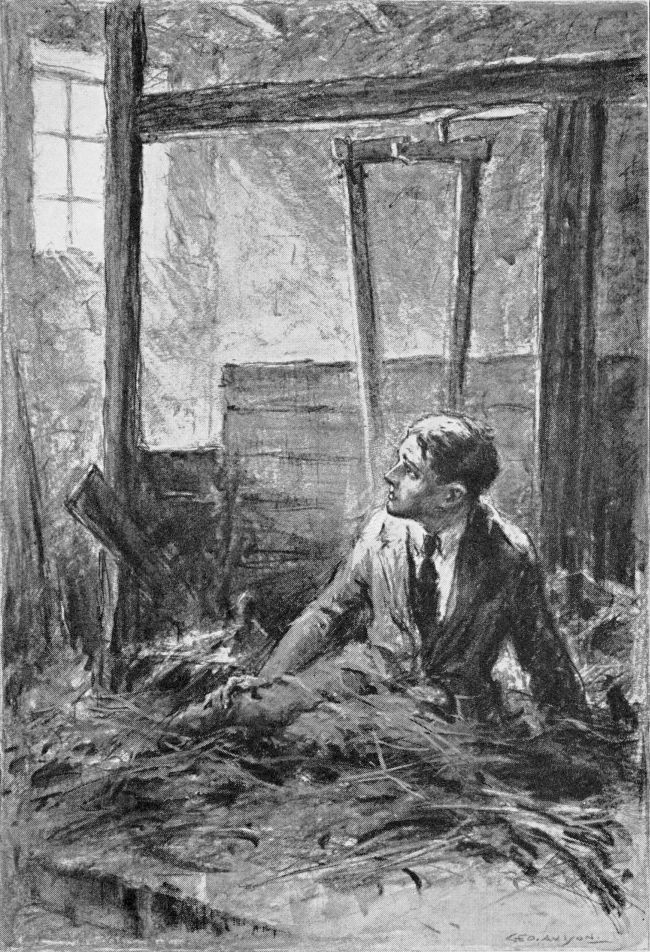
“Turn out! The Sophs are paintin’ one of our fellows
green down in Adams’s field barn! Turn out!”
Dick shut the window and went to get his cap.
“You’re coming, aren’t you, Larry?” he said; adding:
“This is a class job, you know.”
Larry shook his head.
“Might as well begin in one place as another, Dick:
I’m not in on the rah-rah stuff.”
Dick Maxwell’s temper was easy-going, but about once
in a blue moon it got away from him.
“That’s yellow, and you know it!” he flamed out; and
with that he was gone. But he had scarcely reached the
sidewalk before Larry was at his elbow.
“I can’t stand for that—from you, Dick,” was all the
explanation that was offered; and, of course, Dick was
instantly penitent.
“I’m a liar!” he blurted out contritely. “Nobody
knows better than I do that there isn’t a single yellow drop
of blood in you, Larry. There goes a bunch of our fellows
now—let’s run.”
The hazing episode proved to be merely an incident.
Enough Freshmen were rallied to rush the field barn in
Adams’s back forty; the artistic Sophomores were scattered;
and the victim, who proved to be the big, husky
“Aggie,” Welborn, who roomed at Mrs. Grant’s, was
rescued. Of course, Welborn was a sad sight. The artists
had stripped him and he was well daubed with green
paint. Nevertheless, he was cheerfully triumphant. “I
got five of ’em, b’jing! before they got me,” he gloated,
with a grin that the green paint made peculiarly hideous.
“Whadda you reckon’ll take it off?”
“Turpentine,” suggested somebody in the mob of rescuers;
and two of the light-footed ones ran for a drug
store.
With the worst of the paint removed, Larry and Dick
took Welborn home, where they commandeered the bath-room
and worked over him until he was well-nigh
blistered but clean.
“Gosh! talk about Turkish baths!” gurgled the big
victim, as they were sousing him for the final time in the
tub of hot soap-suds. “I’ll say this beats ’em a mile high!
Wait till we got those Soffies at the bridge! I’m goin’ to
take a stick along and notch it every time I put one of ’em
to sleep.”
“Well?” said Dick to Larry, after they had tucked the
cheerful victim into his bed, and were once more in their
own room, “changed your mind any?”
“Not a minute’s worth!” was the gruff reply. “It’s all
tom-foolishness, and I don’t want any of it in mine.”
“But you’ll turn out for the bridge scrap, won’t you?—for
the honor of the class?”
“Not so you could notice it,” Larry refused; and with
that he stuck his face into a book.
For some days the “shaking-down” process which
every college has to go through at the beginning of the
scholastic year went on—with small satisfaction to any
sober-minded member of the faculty, or to fellows who,
like Larry Donovan, were not yet imbued with that
elusive thing called “college spirit.” Hazings, some of
them mild, and some not so mild, went on nightly.
Freshmen, unwarily out after dark in numbers too small
for defense, were paddled, painted, and made to do stunts
ridiculous, and sometimes rather harrowing.
After the Welborn incident, Larry refused to pay any
heed to the nightly call of “Freshmen out” and Dick
forbore to urge him. But at last a night came when the
call—unheeded when it was raised from the sidewalk—was
hurled in at short range by Welborn himself. He
found Larry alone, poring over his mathematics, as was
his usual custom.
“Hey! what the dickens are you hived up here for,
when the Soffies are out in force and murderin’ us?” he
roared. “You’d sit here with your nose in a book while
they’ve got your side-partner, Dick Maxwell, half naked
and chased up a tree back of the athletic field? You
haven’t any red blood in you, Donovan; that’s what’s the
matter with you!”
Larry jumped up so suddenly that his chair went over
with a crash. “Show me!” was all he said; and a minute
later he was racing at Welborn’s heels, down the street and
across an open lot to where half a dozen yelling Sophomores
were doing a scalp dance around a big black-walnut
tree. In the higher branches of the tree to which they
had driven him by throwing clods at him a slender figure
in a close-fitting suit of underwear was picked out by a
light of a small bonfire. And the autumn night was cold.
Welborn spoke for the first time as he and Larry were
hurling themselves over the fence. “B-better get some
more of the fe-fellows!” he gasped. “There are too
many of ’m for just us two!” But Larry acted as if he
hadn’t heard. “Come on!” he said; and, two to six,
they went in.
It was a warm little tussle for a few minutes, with most
of the rules eliminated. Like Larry, Welborn had played
foot-ball; and, again like Larry, he had the weight. Bucking
the dancing ring as one man, they broke the line; and
another tackling rush dissipated it.
Back in their room, Larry once more planted himself
before his book, but as he opened it, he said to Dick,
without looking up: “You may count me in on that
bridge business, if you like. I don’t ‘savvy’ that sort of
thing, as you know; but those fellows need a lesson—and
they’re going to get it. No; don’t make any mistake,” he
went on, as Dick was about to offer congratulations. “I
haven’t any ‘class spirit’ or ‘college spirit,’ or whatever you
call it. But when they hit you, they hit me; that’s all.”
The night of the bridge scrap—which, by Sheddon tradition,
was to end all hazing—came in due course;
a night a bit cloudy, and, by consequence, as dark as
Erebus. Quite early in the evening the class began to
gather, and the cries of “Freshmen out!” “All Sophomores
out!” began to be lifted in the college suburb streets
very shortly after supper.
True to his own traditions, Larry sat down at the study
table and boned his Math. for the next day, resolutely
shutting his ears to Dick’s agonized protests to the effect
that all the fun would be over before they could get in on
it. It was half-past eight before the boner shut his book
and announced his readiness. But while he was getting
into his oldest clothes and overalls, he once more defined
his position.
“Don’t you get ‘hope up’ about me, Dick. I’m going
in on this because it seems to be a job that has to be done
before the Soffies will mind their own business and let us
alone. That’s all there is to it, so far as I’m concerned.”
“Maybe you’ll have another angle on it before we get
through,” was all that Dick said in reply; and they set
out.
As Dick had predicted, they were a little late; when they
reached the streets they found them deserted. But they
knew the location of the bridge, a mile back of the campus;
and the mile was covered at a dog-trot.
Though they had been tardy for the assembling, they
were in time for everything else. While the night was
dark, the battlefield was luridly illuminated by flaring
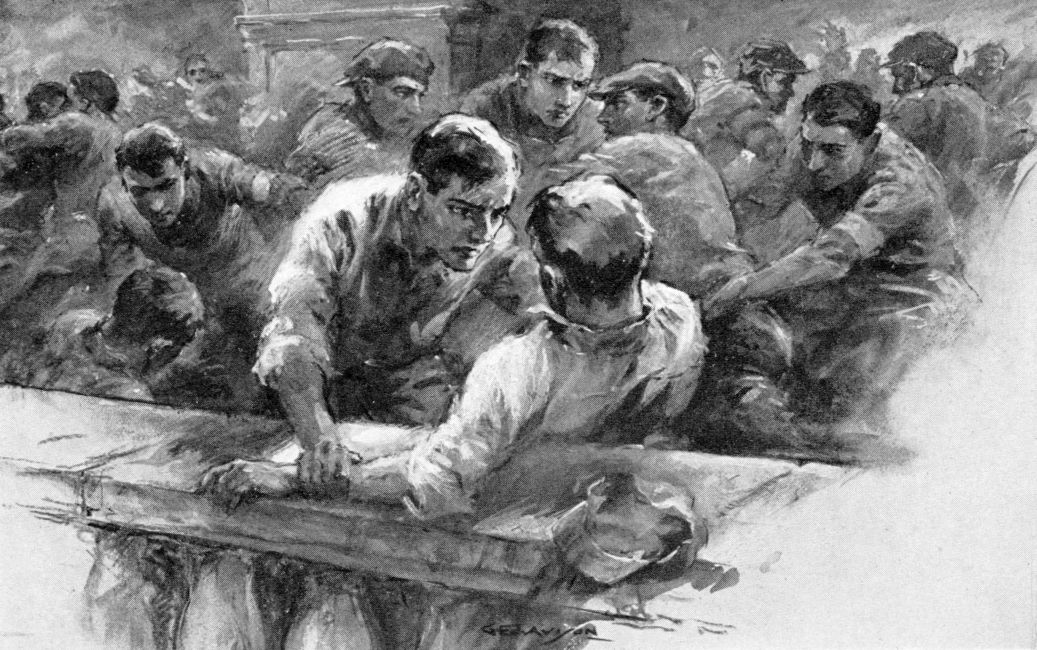
gasoline torches. The bridge was a modern concrete structure
of a single long span over the small river; broad, and
with footways at the sides protected by parapets breast-high.
At either end was an ornamental portal arch, and
it was upon this that the winning class was permitted to
paint its year numerals.
When Larry and Dick arrived upon the scene, the
Sophomores had taken possession of the bridge, and the
Freshmen were massed in the road. Upperclassmen—Seniors
for the Sophomores and Juniors for the Freshmen—were
“frisking” the combatants for weapons. No
fellow with good red blood in him would go into such
a conflict armed; but in a bunch of six or eight hundred
undergraduates there are always a few “yellows,” and
they had to be searched.
As the Juniors in pairs searched the green caps, others
followed with strips of white cloth to be worn on the arm
as a distinguishing mark by the attackers. “Fair play!”
was the oft-repeated caution of the upperclassmen; and
dire punishment was promised to the fellows who should
break this tradition.
Dick plunged into the thick of things as soon as he had
been searched and marked; but Larry stood aside, grimly
sizing up the situation. The first thing he remarked was
the time-immemorial handicap of Freshman classes,
namely, the lack of leadership which is the natural consequence
in a body of fellows getting together for their first
united effort. Wally Dixon, the big-voiced young Mechanical
who had given Larry and Dick their joint nickname
on the day of their arrival, was commanding and
shouting and trying to bring some sort of order out of
the chaos; but he was not making much headway.
The searching and marking finished, the upperclassmen
laid down the iron-clad rules of the game. Slugging was
prohibited, but anything less than a knock-out went.
Prisoners could be taken by either side, but they had the
privilege of escaping and rejoining their own side if they
could. Time would not be called until one side or the
other was clearly victorious.
When all was ready, the Freshmen made their first
charge, with Dixon trying to get team play by forming his
men into a flying wedge. Larry, from the half-back position
into which he had mechanically dropped, saw at once
that it was going to fail. The Sophomores were massed
solidly all the way across the bridge, and the loosely-formed
wedge doubled up like a handful of sand and went
to pieces when it struck the obstacle.
For a shouting, ear-splitting five minutes there was a
hilarious free-for-all, in which a dozen or more of the attackers
were taken prisoner and shoved to the rear under
guard. Then the defenders charged in their turn—good,
old-fashioned mass play, this was—and drove the disorganized
mob of Freshies off the bridge and a hundred
yards or so up the road.
In the little lull which followed the return of the Sophomores
to their stronghold, there was dazed confusion in
the ranks of the defeated, with Dixon trying in vain to
rally them into fighting shape again. Into the midst of
things Dick Maxwell hurled himself like a human bombshell.
“Fellows!” he yelled, “what we’re needing is a leader!
Dixie, here, is doing his best, but it isn’t good enough.
Isn’t that so, Wally?”—appealing to the big voice.
“You said a whole mouthful,” Dixon admitted, with
splendid class spirit. “I’m only pinch-hittin’ for the right
man. Who is he, Maxie?”
“I’ve got him right here!” Dick shouted, dragging
Larry forcibly into the inner circle. “Here’s an old
codger that’s handled grown men on a railroad job!
Climb in, Larry, and tell us what to do!”
Of course, Larry would have backed straight out if he
had been allowed to. But even at this early period a lot
of the men knew Dickie Maxwell, and were perfectly willing
to take his word. “Donovan! Donovan! What’s
the matter with Donovan? There’s nothing the matter
with Donovan! He’s all right, you BET!” the shout
went up; and Larry found himself elected.
“If you will have it that way,” he yielded gruffly.
“What I don’t know about such foolishness as this would
fill a rain-water hogshead. But if the job’s got to be done,
we’ll do it: just get that rubbed into your hides—every
last one of you. We’re going to do it!”
“Bully for the Timanyoni Twin! Tell us how!” yelled
the mob.
“Listen, then: we can’t buck that line solid, and get
anywhere. Those fellows have been together long enough
to know team play, and we haven’t. I want twenty men
who can swim, and who aren’t afraid of getting wet.
Volunteers come over to this side of the road. You other
fellows mass across so they can’t see what we’re doing.”
He had his twenty in a half-second—and forty more
on top of them. Rapidly he made his selection, with
Wally Dixon for a captain. Not knowing more than a
handful of the men, individually, he picked chiefly for size.
Since his plan bulked large on the side of secrecy, he took
the twenty apart and gave them their instructions. After
which, they vanished in the darkness—not in the direction
of the bridge.
“Now for a little drill work!” Larry called out, going
back to the army proper. “Let me show you what a flying
wedge really ought to be,” and for as much as fifteen
minutes he kept them forming and re-forming in the road,
the only shirker being Dickie Maxwell, who stood aside
with his eyes fixed upon a certain point in the woods backgrounding
the farther end of the bridge. And in the
meantime, most naturally, the thus-far-victorious Sophomores
were hurling all sorts of epithets across the dead-line,
singing and shouting like the pack of young barbarians
which, for the moment, they were.
Larry was forming his charging wedge for about the
twentieth time when Dick, straining his eyes, saw a tiny
match-light flare, lasting no longer than an eye-wink, on
the farther bank of the river a few yards above the bridge
approach. Instantly he darted across to Larry. “Six—fourteen—five!”
he yelled, giving the old foot-ball signal;
and Larry leaped to his place at the cutting edge of the
wedge. “This time we GO!” he bellowed: “Now, then—for
all you’re worth, and hang on till the last man of
you is dead!”
Once more the defenders of the bridge met the charge
gamely. Their front line bent, buckled, straightened itself
again, and flying detachments from either flank tried
to cut the splitting point of the wedge off from the tremendous
shoving force behind it. Larry, head down like
that of a butting ram, and his racking elbows boring a
path straight into the crowding mass, seemed to bear a
charmed life. Dragging hands clawed at him, fists beat
upon him. Once a slugger, meanly taking advantage of
the turmoil, kneed him in the stomach; but still he kept
his feet and held on.
It was only a matter of minutes. While the Sophomore
front line was buckling for the second time a wild yell
went up from their rear. The small guard they had left
to hold the northern end of the bridge had given way at
the charge of the twenty huskies Larry had sent to swim
the river, and in another half-minute the yearly class
struggle had passed into history. Larry’s ruse had been
the simplest of tricks, but even a simple trap works if it
has never been tried before. Caught between two fires,
the bridge defenders broke in confusion, and after that, it
was every man for himself and a get-away.
Of course, Larry had his reward—and Dick, too, for
that matter. For an uproarious half-hour the victorious
Freshmen marched back and forth over the bridge, carrying
the “twins” shoulder-high and shouting themselves
hoarse for Donovan and Maxwell, the class, Old Sheddon,
and the epoch-marking scrap which would put Freshmen
numerals on the portal arch for the first time in eight
years.
But after it was all over; after the shouting, singing
mob had made its way back to the college suburb and dispersed,
and Dick, hero-worshipping in proper fashion by
applying the contents of Mother Grant’s arnica bottle to
the handsome array of bruises Larry had acquired in the
battle, ventured to add a little adulation of his own to the
class leader’s triumph, Larry cut him off morosely.
“None of that from you, Dick!” he growled. “I know
just how much and how little all this shouting and yelling
is worth, and so do you. To-morrow morning nine-tenths
of those fellows won’t know me when they meet
me on the campus. For just about that percentage of them
I’ll drop back and be just what I am—a workingman and
the son of a workingman. They wanted a hard-hitter to-night,
and I happened to be it. But that’s all there is to it.
No more rah-rah stuff for me.”
“But you can’t—you simply can’t go through college
with that sort of a slant on things!” Dick protested, almost
tearfully. “It isn’t human! You’re simply batty
on that ‘workingman’ stunt. Why, those fellows you
captained to-night will black your shoes—do anything on
top of earth for you, if you’ll only let ’em!”
But “letting them” was the hitch that Larry Donovan,
in the very beginning of his college career, was allowing
the stubborn part of his own character to knot around
him. There is no variety of pride quite so unreasoning
as poverty-pride; and when Larry tumbled into bed a little
later, it was with the fixed idea that he was going to be
in college without being of it; that he would hoe his own
row and let others do the same; a determination which,
farther along, was to lead to—but of that more in its
proper place.
II THE OFFISH WORM
“Say, Maxie; what the di—hinkle is the matter with
that red-headed room-mate of yours, I’d like to
know?”
It was the beginning of the college year, and Old Sheddon
was settling into its stride. On the campus, between
classes, two first-year men were heading for their rooms
and a study period. Wally Dixon, the bigger of the two,
was the one who asked the disgusted question about
Larry Donovan.
“Larry’s a good old scout,” said Dick Maxwell, dodging
a small problem that he himself was unable to answer.
“He’s a regular fellow, all right, when you come to know
him.”
“Know him?” roared Dixon; “I’d like for you to tell
me how anybody ever gets to know him! Look at the
way he acted after you, or somebody, got him out for the
class scrap at the bridge. He was a pink winner that
night, with the neat little Indian-fighter trick that he
pulled, and everybody on the job knew it. But when
some of us went to him the next day to find out which
of the class offices he’d like to have handed him, he bluffed
us cold!”
“Don’t you go and lay that up against him,” Dick
urged. “It’s—it’s just his way, you know.”
“Well, if anybody should ask me often enough, I’d say
it’s a mighty queer way. Acts as if he had a grouch
against the world.”
Dickie Maxwell, loyalest of chums, hardly knew what
to say. Dixon was the son of a wealthy Kansas City
packer, and Dick felt that it would be next to impossible
to make him understand Larry’s attitude. For that matter,
he, Dick, couldn’t understand it himself. Beginning
with workmanlike contempt for what he called the “boys’-play”
side of college life, Larry’s grouch, or indifference,
or whatever it was, was developing into something a good
bit like antagonism toward everything but the daily study
grind, and what he could get out of that.
“I’ll say he’s heading in to be a worm,” Dixon went
on; “worm” being Sheddon slang for a fellow who scamps
the college “activities” and lives and moves and has his
being in the classrooms and study periods. “He’s ripping
material for the athletic squad, and if he had even a whiff
of college spirit he’d be showing up in the try-outs. You
ought to labor with him, Maxie; he’s needing it.”
The two parted at the campus gate, and when Dick
reached his room at Mrs. Grant’s, he found Larry scowling
over a problem in his trigonometry.
“Chuck the grind and talk to me a few minutes,” was
Dick’s greeting as he came in. Then: “You’re cutting all
the athletic try-outs, Larry. What for?”
Larry’s frown deepened. “I don’t see why I can’t
make you understand,” he broke out half impatiently.
“You, and most of the other fellows, I’d say, are here
mostly to have a good time—or that’s the way it looks to
me. I’m not. I’m here on borrowed money—no, hold
on,” he protested, when Dick would have interrupted, “I
know your father doesn’t look at it that way, but I do.
And because it is borrowed money, I want to get the
worth of it.”
“Well,” Dick retorted, “that’s just what I’m scrapping
about. You won’t get the worth of it if you go on cutting
out a good half of what college ought to mean to a
fellow. I’ll bet you fairly ache to go on the field every
time the bunch takes a try-out.”
“If I do, I take it out in aching,”—glumly.
It was the same old thing. As the son of a workingman,
Larry, as we have seen, had early drawn a line upon
the off side of which he had taken his stand stubbornly.
College, as it appeared to him, was a place where rich
men’s sons came to study as little as possible, and where
a workingman was admitted only upon sufferance, as you
might say.
Now when a fellow goes about with a chip on his
shoulder there are plenty of people who will oblige him
by knocking it off. Larry had already had kindnesses
not a few shown him, and even hilarious adulation when—dragged
into it bodily by Dick—he had taken part in
the class “scrap,” and had led the green-caps to the first
Freshman victory won in eight years. But, on the other
hand, a few snobbish fellows had “shown him his place,”
as he put it, and it is human nature to see the thing you
are looking for, and to miss the things you’ve already
made up your mind don’t exist.
“I don’t think you’re doing yourself, or Old Sheddon,
fair justice,” Dick said at length. “If you were thick-headed
and had to bone hard to keep up, it would be different.
But you’re not—and you don’t.”
“Listen,” said Larry; “those fellows in the athletic
bunch are out after ‘material,’ but that is just as far as it
goes, Dick. They’d take me on as a sort of promising
chunk of bone and muscle—and that’s all. I’m not in
their class.”
Dick flapped his hands in despair.
“You’re the limit, Larry! That ‘class’ notion of yours,
in free-for-all America, is simply bunk!”
“Is it?” Larry queried sharply. “I can prove what I
say. Look at little Purdick—waiting on table in Hassler’s
restaurant to earn his way: does anybody ask him to get
in on any of the try-outs? Not so you could notice it.
Look at Jungman, tending furnaces and wheelbarrowing
ashes: Saturday, when some of the fellows were going
for a hike, one of ’em said: ‘Let’s make Jungman take
time off and go with us.’ Were there any frantic shouts
of approval? Not on your life. Instead, Banker Waldrich
said, ‘Oh, nit! he isn’t our sort.’”
Again Dick made the gesture of despair.
“I guess you’re hopeless!” he gave up; and with that
he went to get his own book.
Though he said this—meaning it at the moment—Dick
didn’t let up on the athletic urgencies; and faithfully, in
season and out of season, he labored with Larry. As
sometimes happens, even in an engineering college, a
Freshman class had entered with rather scanty material
in it for the class teams. And, since the ’Varsity teams
have to grow up out of incoming material, the athletic
“scouts” were digging hard for Freshman candidates.
Unhappily, however, the fellows who approached Larry
always seemed to rub him the wrong way of the grain;
or he thought they did, which amounted to the same thing.
After all, it was less Dick’s urgings than a word spoken
by Mr. Waddell, the pattern-shop instructor, that turned
the tide. It was on an afternoon while the try-outs were
still going on, and Larry was doing a little extra work in
the shop. Passing through, the instructor stopped at
Larry’s lathe, and there was a little talk turning upon
Larry’s absence from the athletic field when everybody
else was there.
Much to Larry’s surprise, the instructor took sides with
Dick and the other urgers: it was a student’s duty to uphold,
not only the honor of his college in class work, but
in the “activities” as well. Larry thought it all over
soberly, and that evening made a large and generous concession
to Dick.
“This athletic business,” he began, without preface;
“I’ve about made up my mind to try out for the foot-ball
squad.”
The sudden shift nearly knocked Dick speechless, but
he caught his breath and pounded the shifter on the back.
“That’s the right old stuff!” he exulted; “Gee-gosh!
but you make me glad all around the block!”
“Hold up,” Larry amended; “I don’t want any more
credit than belongs to me. I’m going in because I guess
I owe it to Old Sheddon. But I’m not kidding myself
any, whatever. If I get in and play a good game, the
bleachers’ll give me the glad hand. But off the field I’ll
still be Larry Donovan, mechanic, and the son of a mechanic.”
“Confound your picture!” said Dick, half laughing and
half provoked, “you ought to have a licking, and if I
were big enough I’d give you one! Why, you poor fish,
don’t you know that your good, sane, ‘workingman’ ancestry
is the thing you ought to be most thankful for? It
is the foundation upon which the real America is built!”
Larry grunted and looked up suspiciously.
“Where’d you get all that flowery stuff?” he demanded.
“I read it in a book,” Dick confessed brazenly. “Just
the same, it’s so.”
The next afternoon Larry reported to Brock, the head
coach, at the gymnasium, offering himself for the try-outs.
“What have you done?” snapped the square-faced,
broad-shouldered man-picker who was filling the Sheddon
teams.
“Little High School baseball and foot-ball.”
“What place in foot-ball?”
“End one year; right half the next two.”
The shrewd gray eyes of the coach swept him up and
down.
“H’m; you were the bridge-scrap leader, weren’t you?
Come in here and strip and let’s have a look at you.”
Larry took his “physical” without a flaw; heart action
perfectly normal, weight within a pound and three ounces
of what his age and height called for, chest expansion
well above normal. In addition, his summer’s work on
the railroad-building job in the Colorado mountains had
made him as hard as nails.
“You’ll do,” said the coach, and sent him to the field.
If he had been twice as finical as he was, he couldn’t
have found any fault with his reception. The memorable
bridge scrap was still fresh in mind, and his subsequent
refusal to turn out for athletics seemed to be forgotten on
the spot. Naturally, he was cast at once for Freshman
foot-ball; and after a hard-working hour in the field he
went to the showers with his blood dancing and with the
feeling that perhaps, after all, he had been overhasty in
jumping to the conclusion that his family’s station in life
had anything to do with the way the fellows were regarding
him.
But the good effect of this first little dip into the bigger
pool was all spoiled while he was dressing in the locker-room.
The steel lockers were arranged in double rows,
with dressing alleys between; and in the next row two of
his fellow classmen, McKnight and Rogers, out of sight
but, unhappily, not out of hearing, were discussing him.
“Well, the offish worm turned out, at last, didn’t he?”
McKnight was saying. “That’s Dickie Maxwell’s doing,
I’ll bet. Don’t see how Maxwell can room with a fellow
like him.”
“He may be a grouch, but he certainly can play ‘feet-ball,’”
Rogers replied. “I’d hate to have him on a team
against me.”
“He’s the rough stuff”—this was McKnight again—“but
that’s about what you’d expect. They say his dad’s
a section-man, or something, on a railroad. Queer how
such fellows break in.”
“Oh, cut that!” said the other voice, in a tone of marked
disapproval. “Can’t you ever forget that you were born
with gold fillings in your teeth, Knighty? My father was
a house carpenter, if it comes to that.”
“But he didn’t stay a house carpenter,” was the quick
retort. “Just now he’s the head of the biggest contracting
firm in the State of Iowa.”
“That doesn’t cut any ice, Knighty. You’ve got to
take a fellow for what he is; not for what his father is
or was.”
“That is exactly what I’m doing with the ‘worm.’ Donovan
may be all right on the team, but I’d hate to see myself
rooming with him.”
Larry was fully dressed by now, and he didn’t wait to
hear any more. And it was only human nature again that
made him remember bitterly what McKnight had said,
and forget the sensible and ameliorating Rogers’ replies.
“Things break all right for you this afternoon?” Dick
asked that evening after he and Larry were hived in their
room.
“Oh, good enough, I guess,” was the morose reply.
“Coachie didn’t turn you down, I don’t think!”
chucked the class recruiter. “Foot-ball squad, of course?”
“Freshman team,” said Larry, without looking up.
“Good! You’ll get inoculated with the real, old, simon-pure
college spirit, after a bit, Larry.”
“Don’t you believe it for one single minute!” Larry
flamed out hotly, in the remembrance of his wrongs. “I’m
in, and I’ll stay in because I’m not a quitter. But I
haven’t changed my mind a single atom!” And he repeated,
for Dick’s benefit, the talk he had overheard in the
locker-room; or rather, to be strictly accurate, he repeated
McKnight’s part of it.
“You see, it’s just as I’ve been telling you,” he wound
up in a burst of contemptuous passion. “They’re glad
enough to use me as a promising bunch of bone and muscle,
and that’s all. I’ll stick, for the sake of what Sheddon’s
going to give me. But when it’s over, I’ll still be
fighting on my side of the fence—which isn’t Ollie McKnight’s
side by a thousand miles!”
True to his determination, Larry “stuck,” and after a
few days of practice the Freshman team found that it
had acquired a prize. Larry played with the same grim
resolution that he put into his classroom work. Playing
first at end, he was presently given his old High School
position at half-back. For this position he was well qualified,
having weight enough to buck the opposing line,
combined with the speed necessary to circle the ends and
slip through tackle.
It was in one of the preliminary practice games with
the ’Varsity that he made his mark. As usually happens,
the big fellows ran away with everything in sight, but
after the game, just as Larry was leaving the locker-room,
Brock, the head coach, stopped him.
“I’ve been watching your play this afternoon, Donovan,”
he said brusquely. “You have the makings of a
good half-back in you. How do you stand in your classroom
work?”
“All right, so far, I guess,” Larry replied.
“We begin playing the schedule next week,” Brock
went on. “How would you like to go along as a sub?
Of course, I couldn’t put you in the Conference games,
but there’ll be others.”
You’d have to be a college Freshman yourself to know
how this hit Larry. It is only about once in an elephant’s
age that a raw Freshie is ever singled out as even a
remotely possible substitute on the big team. But right
there the growing bitterness got in its work. Once more
he was being taken up for his brawn, and maybe a little
for his brain, but not for anything else.
“I guess I’m not available,” he said, and it came out
a lot more bluntly than he had meant to make it.
“All right,” returned the coach. “It’s up to you, of
course.” And that ended it.
After this little talk with Brock, Larry played all the
harder in the practice games—which was the way he was
built. Back in the old life, which now seemed so far
away, he had wiped engines in a locomotive roundhouse;
and because it was a disagreeable, dirty job, he always
did it just a little more than thoroughly. Here was another
engine-wiping job, he told himself; and, since he
had undertaken it, he would go through with it.
Matters and things ran along this way until the foot-ball
season was well started. There were class games
on the home field, in one of which the Freshmen, clinching
their success in the bridge scrap, literally wiped the earth
with the Sophomores in a score of 47 to nothing, and
public acclaim—what there was of it—gave the credit,
or a good share of it, to a certain red-headed, big-boned
half-back, whom nothing seemed to be able to stop.
Meanwhile the ’Varsity was playing around the circle,
and having hard luck. Not once, as yet, had there been
occasion to call out the “snake dance” and “night-shirt
parade” with which Sheddon victories were celebrated.
Through all this, Larry seemed to be the only member of
the student body who remained unmoved. Day after day
he plugged along, religiously giving his afternoons when
his team was called out; but that was all.
“Larry, you’re a fright—simply a fright!” Dick
stormed, one evening when the news had come of another
defeat for the “Blacksmiths.” “How you can go on,
just as if nothing was happening, when——”
“Might say nothing is happening—to me,” put in the
offish one grumpily.
“Of course it’s happening to you!” Dick yelped.
“Aren’t you a part of Old Sheddon, I’d like to know?
Haven’t you any heart at all?”
Larry jumped up and tramped across to the window
which, in daylight, looked out upon Engineering Lab.,
and gave a cornerwise glimpse at the athletic field. When
he turned back to face Dick his lip was shaking.
“It does get me, Dick! I’ve fought it—fought it just
as hard as I could. I know the fellows don’t like me,
and a lot of ’em are calling me a ‘worm.’ Just the same,
it’s breaking my heart to see Sheddon losing this way!
I——” and he turned to the window again, quickly, this
time, as if to hide something that he was ashamed to let
Dick see.
In a second Dick was beside him.
“Larry, you old sorehead—you don’t know how much
good it does me to hear you s-say that!” he stammered.
And then, in a steadier voice: “You’re all wrong about
the fellows not liking you: they’ll like you just as much
as you’ll let them. There isn’t a worth-while fellow in
Old Sheddon that cares a hoot whether you’re rich or
poor. If you’d only loosen up——”
Larry did “loosen up” the next day when he was on
the field with his team; and it was Oliver McKnight, son
of any number of millions of Consolidated Steel, who
applied the loosening twist. In an intermission, McKnight
came and flung himself down beside Larry.
“Say, Donovan,” he began abruptly, “you ought to
push my face in. Four or five weeks ago I said some
things about you to Cal Rogers that gave you a good
right to hate me straight through the four years. Of
course, I didn’t know you were overhearing me; but that
only makes it worse—looks as if I didn’t have the nerve
to say such things to your face. I was a mucker; and
ever since, I’ve been trying to dig up sand enough to
come and tell you so.”
There was more than a drop of good, warm, Irish
blood in Larry Donovan’s veins, as his name would indicate,
and for an impulsive half-second he wanted to throw
his arms around the pampered son of Consolidated Steel.
He didn’t quite do that, but he did say what was fitting.
“That’s all right, Mac—perfectly all right. You just
forget it. I won’t say that it didn’t rub me the wrong
way at the time, but——”
“Thanks, old scout,” McKnight broke in. “I’ve had
that on my chest until I’m sore as a boil. What chance
do you think we’re going to stand to lift the hoodoo to-morrow?”
The morrow was the day set for the “Blacksmiths”
to play Rockford Poly on the home field. Rockford was
not in the Conference, but it had a strong eleven, and
even the best friends of the Sheddon team were saying
that they hadn’t a chance in the world. But at McKnight’s
question Larry scraped around and found a bit
of the newly boosted college loyalty.
“We’ll never say die till we’re dead,” he asserted.
“We’ve got to get in with both feet and put a barrel of
pep behind our fellows to-morrow. We simply can’t let
them lose!”
“Gorry! it sure sounds good to hear you talk that way.
But we’re lame, Donnie. Since Critchett and Johnson
were laid out in that game with the down-State eleven,
we’ve been sewed up. Brock’s put in all of his subs, first
and last, and they’ve fizzled on him, one after another.
Shebbie’s been keeping in wire touch with the team, and
he says we’ll have to have new material here to-morrow
for Brock to draw from.”
It was here that Larry showed that he could be generous.
“You’re the best all-round man on the Freshman, Mac,
and here’s hoping for you,” he said; and he meant it.
“Not on your cabinet photo!” retorted the son of much
money. “If it comes down to us, you’re It. You’ll be
here on the field, won’t you?”
“Sure thing!” said Larry; though, up to that heart-mellowing
moment when McKnight had made the amende
honorable, it had been anything in the world but a sure
thing.
Dickie Maxwell saw a new light in his room-mate’s
eyes that night as they settled themselves on either side
of the study table, but Dickie had a wise streak in him
which came to the surface once in a while, and he forbore
to say anything. But, just before they turned in, Larry
had his say.
“You remember that bleat that I made about Ollie
McKnight four or five weeks ago, Dick?” he asked.
“Yep.”
“I guess I was pretty thin-skinned about that. Mac’s
all right. He came to me to-day and squared things like
a man. I’m telling you because I beefed to you about
what he said; but you’re not to let it go any further.”
The day of the Sheddon-Rockford game was all that
could be desired, weather-wise. A light frost during the
night—not enough to hurt the field—put a keen tang
in the air: but the sun was like the one in Alice in Wonderland—shining
with all its might. A “pep” meeting
of the student body had been held the night before, and
when the game was called there wasn’t a vacant seat on
the bleachers.
The Rockford team, big fellows, to a man, showed up
in fine form, and it was evident from the kick-off that it
was to be a fight for blood. Brock’s men, playing for
the first time in the season on their home field, and with
all Sheddon present to shout encouragement, did their
best; but it wasn’t quite good enough. At the end of the
second quarter the score stood 7 to nothing in favor of
the visitors, Rockford having pushed the ball over for a
touch-down and kicked goal—at which the trainload of
rooters who had come over from Rockford were yelling
their heads off.
“Our offense is pitiful!” Larry told Dick in the intermission.
“Shubrick acts as if he’d been crippled, and
he’s the only back that’s any good. Brock ought to take
him out.”
As he spoke, one of the subs came running up to them,
breathless with excitement.
“Donovan!” he panted, “coach says get on your uniform,
quick! He’s going to put you in Shubrick’s place
next half!”
For a moment Larry stood as if dazed. But the next
instant he was racing for the gymnasium with Dick at
his heels.
While Larry fairly jumped from his “civies” into his
foot-ball togs, Dick talked excitedly. It was a chance—biggest
chance that had ever been given a Sheddon Freshman—Larry
could put it through—he must put it
through; and things like that.
“I’ll be found trying,” was all Larry said; but there
was a “do-or-die” grin to go with the promise as he
jerked his belt tight, grabbed up his headgear, and started
for the field on a run.
A moment later he was reporting to the coach. The
members of the team were stripping their sweaters preparatory
to the dash on the field for the second half.
“I’m not going to start you, Donovan,” said the coach,
putting an arm across Larry’s shoulders. “You sit on
the bench with me and I’ll send you in when you’re
needed.”
Sitting quietly beside the coach, Larry looked on while
Rockford took the ball and, by superior weight and superb
interference, pushed it over for another touch-down just
as the third quarter ended. The goal was missed, and
with just fifteen short minutes left to play, the score stood
Rockford 13, Sheddon nothing.
Suddenly Brock gripped Larry’s arm.
“Now’s the time. You take Shubrick’s place. Remember
to report to the referee. Then, after the first
play, tell Clark to run 43—with you back—that’s you,
just outside tackle on the right; and then to call you back
on the other side and run 44—that’s off tackle on the
other side. Tell him to keep on running you as long as
you can gain. You’re our only chance, boy!—and I believe
you’ll pull us out of the hole!”
Larry didn’t speak; he merely grinned and dashed on
the field with his fists clenched so tight that his finger-nails
were white, and with his teeth set.
“Donovan for Shubrick at right half!” he snapped
at the referee. “Shubrick out!” shouted the referee; and
a moment later blew his whistle for the resumption of
play.
Sheddon had received the kick-off on the thirty-yard
line. On the first down, Shubrick had been thrown for a
loss. Clark, Sheddon’s quarter, did not wait for the
coach’s instructions. He had seen Larry play and knew
his power. As soon as Larry was in position, Clark
barked his signal: “Formation right! Donovan back!
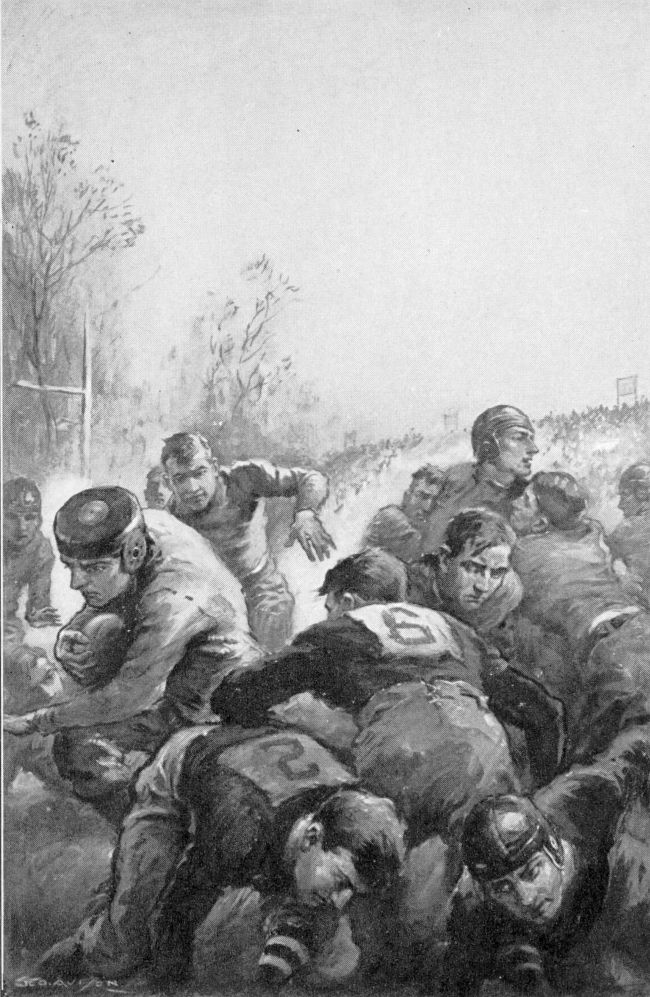
32—43—59!” The ball came to Larry on a direct pass
from the center. Starting toward opponent’s tackle, he
swerved suddenly to the right and found his hole just inside
of the end. Rockford’s full-back got him, but he
had gained five yards.
“Good boy, Larry!” yelled Dugald, the big Sheddon
captain, helping him to his feet. “Do it again!”
“Watch me!” Larry grinned, jumping back to his
position.
And, sure enough, he did do it again, on the same play,
only this time for seven yards and a first down. By this
time the Sheddon bleachers were beginning to realize that
something was happening. There had been little cause
for joy in that section of the stands during the first half.
But now business was certainly picking up.
“Who’s the new man?” the cheer leader called to the
coach.
“Donovan!” the coach shouted back; and then the cheer
leader turned to the stands and held up his hands.
“Everybody get into it!” he yelled. “Fifteen for Donovan!”
and the fifteen might have been heard in the next
county.
Larry heard them just as he got the ball for the straight
third time. The opposing end had crowded in close to
stop him, so Larry simply ran around him, taking the
ball to Rockford’s ten-yard line, where Rockford’s quarter-back
brought him down by a beautiful diving tackle.
Immediately Rockford’s coach sent in several substitutes
in an attempt to stem the tide and prevent a score.
The Rockford captain was walking up and down, slapping
his linemen on the back, and urging them to “get
low,” while the Rockford bleachers answered Sheddon’s
chant of “Touch-down, Sheddon! Touch-down, Sheddon!”
with a prayer to “Hold ’em, Rockford! Hold ’em,
Rockford!”
Sheddon’s full-back shot into the line for a scant yard.
He tried again, but could add only two more. Two more
downs to make seven yards and a touch-down. Sheddon’s
rooters stood up. Something was wrong. First
came cries from individuals: “Give it to Donovan!”
Then the stands roared out, “Give it to Donovan!”
Rockford knew then that it was to be given to Donovan,
and quickly set themselves to stop him. This time
the signal was for a mass on left tackle. But Larry saw
at a glance, as the ball came into his hands, that the Rockford
players were bunched just where the play should go
... and in the same glance he saw that there was a hole
through right guard. Leaving his interference, he shot
through the hole, dodged the full-back, and dived across
the goal line.
Dugald kicked goal, while the Sheddon stands rang
with the name of Donovan, and the Sheddon players
patted him on the back and called him “Good old Larry!”
The score was now 13 to 7, and Sheddon could win with
another touch-down and goal.
“How much time to play?” Dugald asked, as Sheddon
lined up to receive the kick-off—Rockford having chosen
to kick.
“Ten minutes!” answered the timekeeper.
“Come on, fellows—we can do it!” Dugald cried; and
the team answered him in bellowing unison, Larry’s voice
ringing out with a new-found happiness: “Sure we can
do it! Let’s go!”
But it was not so easy, this time. Rockford began to
watch Larry, and every time he took the ball it seemed
as if the whole Rockford team was on top of him. But
steadily Sheddon pushed the ball down to Rockford’s
fifteen-yard line, only to lose it on a fumble. Rockford
kicked out of danger, and Sheddon again started the
march to victory. Then the timekeeper announced four
minutes to play—and the goal was sixty yards away!
Dugald came out of the line and spoke low to Larry.
“Larry, you’re the only one who can gain. Can you
stand to take it every time?”
“Give it to me!” Larry answered, gritting his teeth.
Eight straight times the ball came to him, and eight
straight times he carried it toward Rockford’s goal. He
followed no signals—merely took the ball and bucked,
dodged, fought his way forward. Rockford knew he
was coming, but they came to know that they could not
stop him. The bleachers were now giving forth a continuous
roar; and when, on the eighth try, Larry carried
the ball over for Sheddon’s second touch-down, he knew,
as every man on the field knew, that he had won for
Sheddon—for Dugald made the victory an assured fact
by kicking goal, thus making the final score 14–13.
It was from no lack of college spirit that Larry Donovan
did not turn out that night to join in the song-singing,
cheer-bellowing “snake dance” wherewith Sheddon
celebrated its victory. A bruised ankle—that he
didn’t know was lamed until the game was over—kept
him in his room, and it was here that Dick found him
when the long, noisy parade wriggled its way back to the
campus after having shouted itself hoarse all over town.
“How’s the old foot-knuckle by now?—hurt much?”
inquired the celebrator, peeling off the white night-shirt
which was the regalia for the parade.
“Nothing to weep about,” said Larry. “It’ll be all right
in a day or so. Parade over?”
“Fellows were just coming across the campus when
I skipped out. Going to disband at the gym., I guess,”
he added, stepping to the window to look out. Then:
“No, by jinks! They’re coming this way: Larry, you
old snipe, they’re coming for you!”
Pallid panic leaped into the eyes of the temporarily
crippled substitute half-back.
“Oh, for pity’s sake, Dick—can’t you stop ’em?” he
gasped.
But it was too late to stop them. Already the white-robed
mob was filling the street in front of Mrs. Grant’s.
“Donovan! Donovan!” it yelled; and Larry, with Dick
to help him, had to hobble to the window, which Dick
threw open.
They didn’t demand a speech; all they wanted was to
see him. When he waved awkwardly to the surging mass,
a roar broke forth. Then, with the cheer leader to time
it, they gave him the Sheddon series.
When the crowd broke up, Dick led the cripple back
to his chair, and for quite some little time Larry sat with
his head in his hands, staring down at an open book
which might have been printed in Sanskrit for all that
the words in it meant to him. Dick waited as long as
he thought he ought to. Then he said: “How about that
‘workingman’ class line now, Larry?”
Larry looked up, and the good gray eyes were suspiciously
bright.
“They’ve broken it down for me, individually, Dick;
but it’s here, just the same—you know it is. I had a bit
of good luck this afternoon, and for that they’ve taken
me in. But there are lots of others who won’t be taken
in; little Purdick, and Jungman, and dozens that I could
name.”
“Well?” said Dick, as one who would say, “What are
you going to do about it?”
“I’ll tell you what I’m going to do, Dick,” Larry shot
back, much as if he had read Dick’s unspoken question;
“I’m going to make it my job to break the combination—or
as much of it as can be broken from my side of the
fence. Old Sheddon ought to be one and indivisible, all
through the year, just as it is on the day of a foot-ball
victory. I’m going to do what one fellow can to make
it so.”
Dickie Maxwell started to gasp, but caught himself in
good time. “That’s the right old stuff!” he chanted
heartily. “Go to it, old scout, and when the pinches
come, I’ll be there to help.”
Yet, later, it was Larry who was to do the helping—but
that does not belong to the story of the Offish Worm.
III THE LAME DOGS
Old Sheddon, calling itself pretty strictly an engineering
school, is peculiar in one respect: it has no
dormitories on its campus. Its two thousand (more or
less) undergraduates live in clubs, fraternity houses, and
with the neighbors. Practically everybody in the college
town takes roomers and boarders, and among these private
houses the “Man-o’-War” was popular for two reasons:
Mrs. Grant was a most motherly home body; and
her pies were, as Dickie Maxwell put it, “simply out of
sight.”
Dick and Larry had the largest of the upstairs rooms,
with two windows on the side toward the street and the
campus. While the college year was still in its infancy,
it began to be remarked that these windows were seldom
dark in the evening. Which meant that at least one of
the room’s occupants knew what he wanted and was going
stubbornly after it.
“Great Peter!” Dick complained, one evening after the
Thanksgiving game had closed the foot-ball season,
“aren’t you ever going to take any time off at all, Larry?
See here; I’ve got an ‘invite’ to a blowout at the Omeg
house to-night, and it includes you. Cut out the studious
stuff for a change and surprise yourself by coming along
to mix and mingle for an hour or so.”
“Nix on the social stuff,” grumbled the big, red-headed
fellow at the study table; “I’ve got two English themes
to write.”
“Which means that you don’t want to go,” Dick
charged discontentedly.
“All right; you can put it that way, if you like. You
know what I think about the frats.”
“I know you’re a howling crank about ’em. You
haven’t a single argument against ’em that’ll hold water.”
“Sure I have. But I haven’t time to trot them out for
you now. Got these themes to chew on, and after
that——”
“Yes; and after that, your lame dogs will begin to
string in. You’ve got the wrong slant on the cripples,
Larry; the faculty has the right one. If a fellow can’t
keep up with the parade, out he goes. And he ought
to go.”
“I can’t see it that way—not for the kind of fellows
who have taken to dropping in here. They want to stay
in college—want to make good. And most of ’em only
need a little boosting and jacking up.”
“Well,” said Dick, hustling into his good clothes, “I’m
mighty glad I don’t have to look at it through your spectacles.
I don’t want to be a pack-mule before my time.”
When he was left alone, Larry dug for the themes.
English was his “black beast,” as a Frenchman would put
it, and he had to work like a Turk for it—that is, if
Turks ever do work. In his time—which was only yesterday—managers
of the nation’s great industries were
beginning to say that the technical colleges were paying
too little attention to English; that they were turning out
engineers who couldn’t write an ordinary, every-day business
letter. Hence the technicals, Old Sheddon among
them, were stressing the English course.
Larry’s home surroundings hadn’t been particularly
conducive to the growth of literary English. In the Donovan
home “ain’t” and “he don’t” and “might of” had
their places at the fireside, along with split infinitives,
plural verbs in the wrong places, “let him and I,” telephone
answers like “this is him,” and a lot of other expressions
that the grammar books call “colloquialisms.”
So he had to labor pretty heavily in “English I.”
But in Mathematics it was exactly the other way
around. Here the big, athletic Freshman soon became
known as a “shark,” and a good-natured “shark” is an
institution not to be undervalued in any college. Before
the foot-ball season closed, Larry was acquiring a small
following of “lame dogs”; fellows who had to be helped
over the stile, if they were going to get over at all; hence,
Dickie Maxwell’s wail about pack-mules and such.
Down underneath the good-nature which prompted
these helpings, Larry had a sort of ill-defined motive
which was more or less to his credit. As a son of a
workingman he had entered college with the feeling that
he was going to be looked down upon, and certain fellows
with more money than sense had either thoughtlessly or
maliciously helped the feeling to grow. But in the better
part of him, Larry was too square and man-sized to become
that bitterest of all things, the college grouch, so
he had begun to open out a bit on the side of the helpings,
this though he was still hanging on to the idea that
between the son of an ex-locomotive engineer and, let us
say, a member of the richest Greek-Letter fraternity, there
was a gulf fixed, great and impassable.
Dick had been gone a full hour, and the second of the
English themes was well on its way to completion when
the door opened and little Purdick slid in. At first sight,
anybody would have said that Charles Purdick had certainly
missed the mark by a broad mile in choosing an
engineering course. Undersized, with a thin, eager face
and pale-blue, tired eyes, he looked more like a candidate
for a sanitarium than anything else.
“Hello, old scout!” said Larry in a cheerful growl.
“Thought maybe you’d be showing up. Drag out that
easy-chair and flop. Had a tough day?”
The undersized one tried to laugh his weariness off.
“If you ever have to work any part of your way
through, don’t you take a restaurant for it,” he advised;
adding, “I don’t mind waiting on table and having to refuse
the tips—I’m sort o’ case-hardened to that now. But
the dish-washing sure does get next to me.”
“I’ll bet,” said Larry. “At home I was lucky; have a
sister two years younger than I am. But that’s all that
saved me. Stuck on the trig, again?”
“I’m always stuck on the trig. If I didn’t love machinery
so well, I’d think I’d made the mistake of my
life in coming to Sheddon. Yet the High School Math.
didn’t bother me so much.”
“Pull up your chair and let’s have a crack at it,” said
Larry. “I looked it over just after supper, and it isn’t
so awfully rocky, this time.”
With the trigonometry lesson but fairly begun, another
of the lame ones dropped in; then a third and fourth.
Larry didn’t “baby” the mental mendicants—not any; on
the contrary, with the exception of little Purdick, he was
gruffly sarcastic with them, calling them cripples, and demanding
to know how long it was going to be before
they’d throw the crutches away. It was the wise thing
to do, but Larry didn’t do it because he was wise; it was
chiefly impatience with a bunch of fellows the majority
of whom hadn’t made the most of their preparatory advantages
while they had them.
Purdick, the first to come, was the last to go. After
the others had dropped out one by one, he told Larry why
he was lingering.
“You’ve been rattling good to me, Donovan, and there’s
something I ought to tell you,” was the way he began
the thing that had to be said.
“All right; spill it,” said Larry.
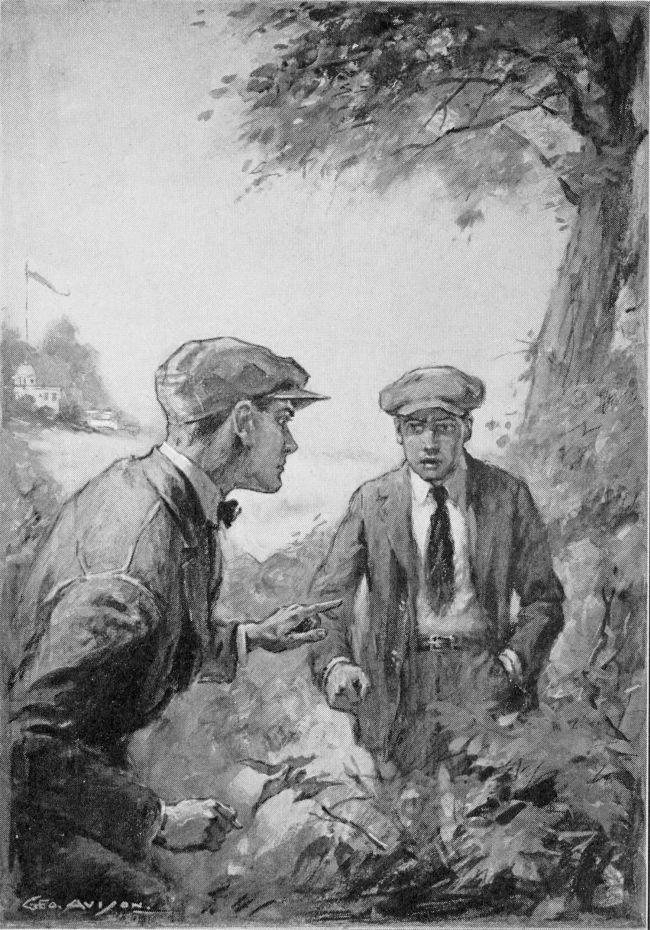
“This fellow Underhill, in your section; you had a
racket with him after the foot-ball game with Rockford
Poly, didn’t you?”
“Not much of a racket. He was standing, with a
bunch of his own kind, on the gym. steps as I came from
the showers, and was busy black-listing the coach for
having put me in: said it was a disgrace to Sheddon to
use a ‘mucker’ on the ’Varsity, and then chucked in some
things about my home folks that I don’t take from anybody.”
“Did you hit him?”
“No; I tried it, but the others got between. Then I
guess I did a fool thing. Underhill’s father is the head
of a firm of railroad contractors. A couple of years back
this firm had a job on our home railroad, and it did so
much crooked work that the contract had to be cancelled.
Dick told me about this one day when Underhill had
gone out of his way to cold-shoulder me.”
“And you slammed that in Undy’s face?”
Larry nodded. “I was hot, and didn’t have any better
sense.”
Little Purdick wriggled uneasily in his chair.
“It’s snitching, in a way, I suppose, but I’ve got to tell
you, Donnie. Underhill and his bunch eat at the restaurant,
pretty often. They talk before me just as if I
wasn’t there—as I guess they would before any ‘menial.’
Underhill’s got it in for you. I overheard him tell the
other fellows of his crowd that he was going to make
Sheddon too hot to hold you; he said the university wasn’t
big enough to hold you and him at the same time.”
“That was just bunk,” said Larry contemptuously.
“I don’t know,” Purdick returned slowly. “He’s got
all the money there is in the world; and a spender always
gets a crowd around him—of the kind that’ll do his dirty
work for him.”
“How come you know so much about it, Purdy?”
“It’s up to me to know. This is my second year in
Sheddon. I was here last year and flunked out—had to
take the work over again. I guess I’m not much good,
anyway.”
Larry had his own opinion about that. What he suspected
was that Purdick had had to do so much outside
work for the money-earning that he hadn’t had time, or
the needed energy, for study—which was the fact.
While Larry was arriving at the fact, Purdick got up
to go. But at the door he turned, and his face was white
and the hand on the door-knob was shaking.
“Donovan, I hope you’ll do that fellow up, cold!” he
snapped, with his pale eyes ablaze.
“Ump!” said Larry. Then: “Why the sudden burst
of fury?”
“You know, perfectly well. He and his kind are always
putting you and me and our kind to the wall—squeezing
the life out of the working classes. They got
my father between the millstones and ground him till he
died! But our time’s coming; and when it does come—look
out!”
“Here, you firebrand—come back here!” Larry called;
but the door had slammed and the lame dog was gone.
For some little time after Purdick had left him, Larry
sat at the table with his square chin propped in his cupped
hands. Class distinctions, as between rich and poor, had
never troubled him very much in his home life. There
hadn’t been any hard-and-fast line drawn in the home
High School, or, if there had been, it was fellows like
himself—sons of workingmen—who drew it.
Naturally, while he was working spare time in the railroad
shop and roundhouse, he had heard more or less
talk about labor and capital, and about the battle that
would one day be fought to a finish between the two;
but most of this had gone in one ear and out the other.
Dick Maxwell’s father, who, besides being general manager
of the railroad, was a fairly wealthy mine owner,
was the only “capitalist” he had ever known, and there
was certainly no fault to be found with him.
But the Underhill tribe—new-crop rich, somebody had
called them—was another matter. Of course, Bryant
Underhill, Sheddon Freshman, wasn’t responsible for
what his father did; but he was evidently willing to have
sins enough of his own to answer for.
Then, on the other side, here was little Purdick, type
of the down-trodden; spiteful and vindictive; the stuff
out of which anarchists are made. Larry drew a long
breath. Even in this early stage of it, college life was
opening up some pretty large fields.
As to the Underhill threat—that he, Larry Donovan,
was to be forced to leave Sheddon—Larry dismissed this
promptly. Quite likely Underhill, helped by his own set,
might try to start something; but, if so, he wouldn’t get
anywhere with it.
That was the way Larry left it when he went to bed
that night; and by morning he had forgotten the threat.
But the morning ushered in a day to be marked in the
calendar with a letter in charcoal black; a day in which
everything seemed to go wrong end to.
It began in “Practical Mechanics.” In Sheddon three
of the engineering courses—Electrical, Mechanical and
Civil—include so many hours a week of shop work. At
that moment Larry’s section was in the blacksmith’s shop;
fifty students at fifty forges doing actual blacksmithing,
under an instructor who was himself a skilled workman.
Having grown up with tools and forges and machinery,
Larry thought of the shop work as an easy walk-over,
and so it had been up to this day of helpless botchings.
But now he couldn’t seem to get anything right. The
hour was given to welding, and the metal simply wouldn’t
weld. Larry cleaned his fire again and again; put it out
once and built it over afresh; and still he made nothing
but botches.
“You’ll have to do better than this, Donovan,” warned
the instructor, at the close of the futile hour. Then he
added something that wasn’t quite deserved. “You fellows
who have had a bit of outside shop experience
mustn’t think you know it all. I can’t give you anything
better than a cipher on this morning’s work.”
With this for a send-off it wasn’t very strange that the
entire day went wrong. Larry blew up in English, went
to pieces in Physics, made a mess of his drawing hour,
and even stumbled in Math.—in the very lesson in which
he had successfully coached his “lame dogs.”
“This sure has been one beautiful day!” he growled
to Dick, when they were settled in their room for the
evening. “I’ve gone bunk on everything I’ve touched!”
“Oh, that’s nothing,” said Dick easily. “Everybody
has a day like that once in a while. You just got up on
the wrong side of the bed this morning; that’s all.”
Very sensibly, Larry tried to let it go at that; but,
oddly enough, it refused to “go.” Day after day the
failures continued, usually beginning with the shop work
and then spreading, like a contagious disease, to everything
else. In the foundry his flasks “fell down,” and
the castings came out looking as if a dog had gnawed
them. In the pattern shop, plane-irons that he had
whetted to a razor-edge nicked and spoiled the job. In
the machine shop it was even worse; every machine tool
he tried to use bucked on him and ruined something.
Of course, there were consequences—mighty unpleasant
ones. With poor markings, or what you might call
no markings, he was called before the chief of the shop
staff, warned once that he would have to pull his standing
up, warned a second time, and then, one morning, a faculty
notice came. He was falling below passing grades
in everything but Mathematics. If he couldn’t do better,
the faculty would reluctantly be obliged to conclude that
he hadn’t sufficient preparation for a college course.
“I don’t know what is the matter with me,” he confessed
to Dick on the day when the faculty notice came.
“I’m just all shot to pieces. Why, Dick, I don’t know
myself any more! Things that used to come as easy as
rolling off a log stump me as if I’d never heard of them
before.”
“Not sick, are you?” Dick queried sympathetically.
“Only in my fool head and hands. I break everything
I touch; and when I get a question in class, I simply blow
up. I don’t blame the professors. Anybody would think
I was solid ivory from the neck up!”
Dick shook his head. “I can’t understand it any better
than you can, Larry. But there’s a reason, if you could
find it. You’re not worrying about anything, are you?”
“Home matters, you mean? There’s nothing to worry
about at home. No; my grief is right here, with myself.”
Then, with a look of wretchedness that was pretty foreign
to the good, wide-set eyes: “It’ll break my heart, Dick,
if I have to flunk out. And I’m headed straight for it
now, sure as a gun!”
Dickie Maxwell got up and began to walk the floor with
his hands in his pockets. Finally he said: “Say, Larry;
how much do you know about Psychology?”
Larry grunted. “Nothing; except that I don’t take
much stock in it. Why?”
“I’ve been messing in it a little lately. There’s a lot
of the stuff that I don’t understand, but there are some
things that I do. For instance, if you get off on the
wrong foot in a sprint, the wrongness is likely to stick
to you through the whole race.”
“Everybody knows that much,” Larry admitted. “But
what has that got to do with my ‘busting’?”
“I was just coming to that. If you blow up in something
in the morning, you’re likely to go on blowing up
all day.”
“All right; that’s exactly what I do.”
“Your section has shop work in the mornings,
doesn’t it?”
“Yes.”
“And it’s in the shops that you begin to go bad, isn’t
it?”
“For two solid weeks I’ve been breaking or spoiling
everything I’ve touched.”
“There you are. With such a send-off, old Doctor
Psychology would say that, unless you should fetch yourself
up with a round turn, you’d be likely to go on
foozling all day. And that’s what you do.”
“You’ve said it. But that doesn’t get me anywhere.”
“Wait: we’ve chased it back to the shop work. Now
let’s take another tack. Have you got any ‘lame dogs’ in
the shops—fellows that follow you around and try to get
helped?”
“Yes, one; fellow named Crawford. He is sticking
to me yet, though goodness knows there isn’t any reason
why he should.”
“Hah!” said Dick, dropping into a chair. “Snitty
Crawford, eh? I don’t much like that big fumbler,
Larry.”
“I don’t either. But he’s such a miserable dub in Prac.
Mechan., that I felt as though somebody ought to give
him a boost.”
“Know him any, outside of the class work?”
Larry shook his head, and Dick went on:
“It just so happens that I do. He’s the worst sort that
ever gets into college; a fawner on some fellow with more
money than brains. Off the campus he’s Bry Underhill’s
shadow.”
Larry jumped as if some one had slapped him. In a
flash little Purdick’s warning, long since forgotten, came
back to him—“a spender always gets a crowd around
him—of the kind that’ll do his dirty work for him.”
Could it be possible——
“Say, Dick,” he broke out savagely; “do you suppose
anybody could have been framing me up to ‘bust’ on this
shop work, right along?”
“Why—if you had an enemy that hated you hard
enough: I’ll admit that’s what I had in mind, Larry; but
it can’t be. A fellow who would do such a thing as that
couldn’t stay twenty-four hours in Old Sheddon.”
“Couldn’t he?” Larry said; but that is all he did say.
And when Dick would have gone on to talk more about
the present-moment sad state of affairs, the “shark” stuck
his nose in a book and seemed to have lost all interest in
the subject of his critical standing—or his no-standing—in
the Registrar’s records.
But the next morning, in the shop-work period, he was
as sharp-eyed as a cornered rat. His job—“exercise,”
they called it—that morning was to turn a piece of round
shafting to fit the hole in a pulley. Lathe work was one
of the things he had learned fairly well in the old home
railroad shop, and he ran the roughing chip in a few
minutes. Setting the tool for the finishing chip, he
stopped the lathe and turned to the bench behind him to
try the gauge in the pulley-hole. As he did so, somebody
passed between him and his lathe, and he looked up
quickly. It was Crawford.
That was enough to make him extra cautious. Before
starting the lathe again he examined the reading of the
micrometer scale on the tool-rest. The mischief had been
done. The tool had been advanced, just the least little
fraction in the world, but it was enough. If he had let
the tool run without resetting, the piece of work would
have been spoiled.
With this for a starter, he not only kept his eye on
Crawford during the entire period; he also put the fellow
next to him on the watch. Three separate times the “lame
dog” set traps for him into which he would have blundered
helplessly if he hadn’t been forewarned. Once, in
a screw-cutting exercise, the gears were changed on his
lathe, and it had been done so deftly that he wouldn’t
have believed it if the gears themselves hadn’t proved it.
Again, it was a sly loosening of the tail-stock clamp,
which would have let the work fall out when the lathe
was started. Lastly, it was a “cut-in” on the wiring of
the lathe motor, which would probably have burned out
the motor if the current had been switched on.
Larry, seething inwardly like a pot ready to boil over,
corrected the sabotage in each case before any harm was
done, held on grimly, and said nothing. Before the shop
period was over, the psychological reaction had begun
to set in. Now that he knew that the fault wasn’t his
own; hadn’t been his own at all; he was able to take a
fresh grip upon himself. Gorman, the shop instructor,
gave him the final little upward boost when he came
around to examine and stamp the work of the period.
“Now, that is something like it, Donovan,” he said, in
warm approval. “Glad to see that you’re getting back
to your old form. You get ‘tens’ all around, this time.
Keep it up and you’ll work off some of the discredits
you’ve been earning.”
It was on the tip of Larry’s tongue to tell the instructor
the real reason for the discredits, but again he held
himself in. The matter, as it stood, lay between himself
and Crawford—and possibly Underhill—and he set his
teeth upon a frowning resolve to make the plotters answer
to him and not to the faculty.
With the mystery of his stumblings thus completely
solved, he went to his other assignments for the day with
the handicap lifted. Straight “A’s” were his grades for
that day, and his various instructors marveled as much
over his sudden “come-back” as they had over his equally
sudden slump.
It was at the close of the gymnasium half-hour, late
in the afternoon, that he caught Crawford. The spoiler
of records was on his way to his room, which was in a
street reached most easily by cutting across a field lying
back of the campus. Larry tried to keep cool; meant to
keep perfectly cool; but his hand shook a little when he
laid it on Crawford’s shoulder. “I’ll walk a piece with
you,” was all he permitted himself to say; and as if some
inner sense was telling him that something was about to
happen, the big-bodied, hulking culprit kept step in
silence.
After they had crossed the stile into the field, and were
thus off the university grounds, Larry wheeled short upon
the sham “lame dog.”
“You’ve been doing me dirt, Crawford, and this is payday,”
he snapped, trying to say it calmly. “Will you
peel your coat?”
A frenzied outburst of denial was the answer to this.
Like any fellow who would stoop to the things he had
been doing, Crawford was a shrinking coward at heart;
this though he would have tipped the scale at twelve or
fifteen pounds more than Larry.
“Oh, good gosh!—hold on—somebody’s been lying to
you!” he protested. “I——”
“Cut it out,” said Larry. “I caught you at it in the
shop this morning, and I’ve got Dowling for a witness.
You did everything you could think of to make me get a
goose-egg marking, and you’ve been doing it right along
for two weeks. What did you put into my fire in the
blacksmith shop so that I couldn’t make a weld? Tell the
truth!”
Crawford hung his head. “It was only a joke,” he
mumbled. “I just put a li’l’ pinch of sulphur in the fire,
to see what you’d do.”
“A joke, was it? And I suppose it was a joke to knock
my flasks down in the foundry, and to nick my planes and
chisels on the pattern bench. Now, one question more:
who put you up to all this?”
For some little while Crawford wouldn’t answer this
direct question, filling the air with shrill protestations of
his innocence of any malicious motive, and the like. But
Larry pinned him down savagely.
“Out with it! I want to know whom you were working
for.”
It came out at last—because it had to.
“Bry Underhill—and some of the other fellows—said
you were a ‘mucker’ and oughtn’t to be allowed to stay,”
was the final hang-dog admission.
“So much for that part of it,” said Larry grittingly.
“Now, I’m going to give you your choice. As I said,
I’ve got a witness to what you did to me in the shop to-day.
I can go before the faculty and get you canned. It’s
up to you to say whether you’ll take that, or pull off your
coat right here and stand up to me like the man you’ll
never be.”
By this time Crawford was snarling—not like a man,
but more like a trapped fox.
“If you make me fight, I—I’ll kill you!” he stormed;
but he did take his coat off and fling it aside.
Then and there, in the dusk of the evening in Farmer
Holdsworth’s stubble field, was staged the historic battle
of the year. It is said that a cornered coward can always
fight if he is driven to it, and Crawford made the saying
good, hurling himself upon Larry in a mad-bull rush that
was meant to end in a clinch in which his superior weight
would give him the advantage. But when the clinch arrived,
Larry was not there; there was nothing there but
a stiff forearm with a fist at the end of it against which
Crawford pushed his right eye vigorously.
In the next rush it was his nose with which he endeavored
to push the hard fist aside. Larry hadn’t much
“science,” but it doesn’t ask for any great amount of skill
to let a frenzied maniac beat himself silly if he is sufficiently
bent upon doing it. One thorough and rather prolonged
round settled it. At the end of the one-sided
boxing match Crawford was down, and either couldn’t
or wouldn’t get up; could—or would—do nothing but
gasp out that he had enough.
Larry did the decent thing—and did it as reluctantly
as he ever did anything in his life—hauled the thrashed
coward to his feet, took him across the field to his boarding-house,
helped him get rid of such of the battle marks
as the bath-room appliances could remove. All this in
grimmest silence. But as he was leaving he claimed the
victor’s privilege of having the last word.
“You go to the fellow whose boots you’ve been licking
and tell him what you got from the ‘mucker.’ And when
you do it, you may tell him from me that he can have
the same, or a little better, any time he’s man enough to
ask for it. And one other thing, Crawford. You stay
out from under my feet from this time on. If you don’t,
you’ll get it again.”
One of the problems that has never been satisfactorily
solved, and perhaps never will be, is how the news of a
thing done in privacy gets wings of the wind to scatter it
abroad. Larry thought that the brief and brittle mix-up,
staged in the growing dusk in Farmer Holdsworth’s
wheat field, had been wholly without witnesses. But that
same evening, after supper, Dickie Maxwell leered knowingly
at him across the study table.
“So you chased up my little hint and whaled the daylights
out of Snitty Crawford, did you?” he laughed.
Larry glanced up frowning.
“Who told you anything about that?” he demanded.
“Gee! everybody knows,” Dick crowed. “I don’t know
who started the little news item on its rounds. But you
ought to have the thanks of every decent fellow in Sheddon.
Crumb-catchers like Snitty make me sick.”
Larry nodded soberly.
“Yes, Crawford got his; but, after all, he was only a
poor tool in Underhill’s hands. It runs in my mind, Dick,
that I’m still in debt—to Underhill and the whole money-rotten
gang that he runs with. After the foot-ball game
I made up my mind that I wasn’t going to draw any
more rich-and-poor lines, or let them be drawn against
me; that I’d stand for Old Sheddon as a whole. But if
these gambling, betting, money-spenders want a fight,
they can have it. It’s the old battle, and I guess it’s got
to be fought out—here and everywhere else.”
For a little while Dick was silent. When he spoke
again it was to say: “I suppose my father is what you’d
call a rich man. Does that mean that you’re against us
all, Larry?”
“Not against you, Dick; but I’ve got to stand with
my kind. And that brings on more talk. In a way, I’m
little better than Crawford; he’s a hanger-on of the rich
fellows, and I’m a pensioner on your father. I know he
has consented to call the money he is advancing me a
loan, but after what’s happened I can’t take it any more.
I’ve got to be consistent. I can’t fight on both sides of
the fence at the same time.”
“Larry!” Dick exclaimed.
“I know. It sounds ungrateful, and all that; but I’ve
made up my mind—made it up this morning. Prof.
Zippert will get me odd jobs of tutoring in Math. if I
want them, and will put in a good word for me with
Waddell and Gorman, so I can help out in the shops. I
may have to live cheaper than I can here at Mrs. Grant’s;
but that’s all right.”
“You—you’d break with me, Larry?”
Larry Donovan looked straight into his room-mate’s
eyes.
“Never, Dick; not until you want me to. But I can’t
hold with the hare and run with the hounds. You’ll have
your friends, and maybe I’ll have mine. And they won’t
be the same.”
Dickie Maxwell threw his head back and laughed—because
it was the saving thing for him to do, just then.
“You’re crazy, Larry; as crazy as a loon! But I’ll not
lay it up against you. To-morrow, after you’ve cooled
down a bit from this run-in with Snitty Crawford, you’ll
see things in a better light. You see, I know you of old.”
But college brings out a good many things that don’t
envision themselves in a High School course; and Dick
Maxwell had yet to learn how stubborn a mule—and how
loyal a friend—Larry Donovan could be in a time of trial.
IV DICK’S DROP-OUT
“You’ve made up your mind then, have you, Dick?”
Larry Donovan had his small drawing-board on
the study table and was working out a tangled problem
in “projections.” Dick Maxwell had just tossed his
books aside and was walking the floor, hands in pockets;
his habit when there was anything to be argued about.
“I don’t know why I shouldn’t fall all over myself to
jump at the chance,” he returned. “Dad was a member
of the Omegs, right here in Old Sheddon, and, as I’ve
said, they’ve given me a bid. I think it’s mighty nice of
the fellows.” Then: “I didn’t expect you’d give me the
glad hand. You’ve been sort of prejudiced against the
frats from the first, haven’t you?”
“Maybe some of it is prejudice,” Larry admitted, wanting
to be perfectly fair; “but to me the whole fraternity
idea seems to take a wrong shoot. If any place in the
world ought to be democratic it’s a college. When little
bunches of the fellows pull off to one side and shut out
the rest ... well, that’s bad enough; but when, on top
of that, they try to run things——”
“The fraternities don’t try to run anything but themselves,”
Dick defended. “That’s only your idea, Larry.”
This was entirely true. When we look through the
battered old telescope called Life, we see mostly what
we are expecting to see; and with his workingman’s eye
Larry wasn’t expecting to see much good in anything as
exclusive as a fraternity.
“Maybe they don’t openly try to run things,” he countered.
“But they stand together and hold themselves as
being a lot better than us fellows on the outside. You
know they do.”
“Well,” said Dick, grinning, “they get the pick of the
fellows from each incoming class, or try to: why
shouldn’t they be better than the leavings?”
Larry’s answering grin was perfectly good-tempered.
They had threshed this matter out a good many times in
the past.
“Present company excepted, I take it,” he put in, adding:
“I’m one of the ‘leavings,’ you know.”
Dick sat down, chuckling delightedly.
“I just wanted to see how you’d take that,” he explained.
“You have the one big necessary qualification—angelic
humility. You’ll do, all right.”
“Do for what?”
Dick got up and put an arm across Larry’s shoulders.
“You hump-backed old greasy grind!” he chanted;
“did you swallow the notion that I was going to duck out
and leave you to wallow all alone in the mire of your own
splendiferous conceit? It’s a dead secret yet, but I’m
allowed to whisper it to you. You’re due to get a bid
to the Omegs yourself!”
For a little time Larry merely stared down at the
demonstration drawing he was making and said nothing.
For a fellow with a good bit of Celtic blood in his veins,
he was a trifle slow in grasping the full significance of a
thing. As we have seen, Dick’s charge that he was prejudiced
against the Greek-Letter fraternities was quite true.
Moreover, he believed that his argument against them
was sound: that they did make for a drawing apart and
the formation of small cliques. And beyond this, there
was that workingman’s grudge. If the fraternities were
not all made up of the sons of rich men and money-spenders,
the one or two that he knew most about seemed
to lean that way; and, quite as certainly, some of their
members looked down as “riff-raff” upon the “leavings,”
which, in Old Sheddon, as in many other universities and
colleges, comprised a good half or more of the student
body.
On the other hand ... well, up to that moment
Larry hadn’t been admitting that there was any “other
hand” worth mentioning; had fully and firmly decided
that there couldn’t be—for him. Yet it takes a pretty
strong resolution to be able to hold out when common
old human vanity is appealed to. In a sort of flashlight
picture Larry saw himself as one of the chosen ones,
ensconced in the big, comfortable, not to say luxurious,
frat house just across the street from the main entrance
to the campus; still Dick’s loyal running mate and chum,
and making good his standing with the other fellows in
the house by winning an “S” for himself and the brotherhood
in athletics.
What if, after all, his ideas about the rich and poor
distinctions were all wrong? It certainly looked that way
when the exclusive Omegs were intending to give him
a bid. So his protest, when he made it, was really no
protest at all.
“If they should take me in, it would be entirely on your
account, Dick; and I couldn’t stand for that.”
“Not by a thousand parasangs! Those things go by
secret ballot; Carey Lansing explained all that. I had
nothing to do with it—couldn’t have, because I’m only a
‘pledge’ myself.”
“Well, then, there’s the money. I’m a lot too poor to
hold up my end with that bunch.”
Dick sat down and squared himself aggressively.
“Now, see here; let’s fight that out, once for all,” he
argued. “Before we left home, my father, acting for the
railroad company, offered to pay your way through college
as a sort of prize for the good work you did last
summer on the Little Ophir Extension. A week ago
you told me you were sore at all the rich people, and were
going to fling the money back in their faces and earn your
own way.
“I hope you’ve thought better of that by this time;
and if you have, I’ve only this to say: Dad expects you
to have all the advantages here that I shall have; he told
me so. He—or the company—will pay your frat dues
just as cheerfully as they will your tuition and board
bills—you know they will.”
Truly, Larry did know it; hence the knees of his continued
protest grew weaker still.
“It’s kind of an honor, I guess,” he admitted soberly.
“Yet I can’t change over all at once. I’m slow; slower
than Christmas, Dick. You know that. I’ll have to have
time to think it out.”
“Sure you will!” Dick agreed, reaching for his cap.
And a moment later he was gone; to one of those social
doings which were by this time cutting pretty deeply into
his evening study hours.
Larry had been alone for some little time when his door
opened to admit Havercamp, a Junior and the editor of
the college paper.
“Hello, Donovan!” he boomed; and as Larry reached
for a chair: “No, I can’t stop—just on my way over
town to put the Micrometer to bed. What college activities
are you in?”
Larry shook his head. “Trying to break into athletics
a little, as you know.”
“Sure I know! Didn’t I see you put the wallop into
the Rockford Poly game? That’s what brings me up
here. I want you on the Micrometer—athletic reporter.”
“But, see here,” Larry objected; “I can’t write for little
sour apples!”
“You’ll never learn any younger. Dig in and try it;
you can begin right away and hash up something snappy
about basket-ball. You know how the athletic frenzy dies
out after foot-ball, and we want to keep the door slamming.
Go to it; good exercise in English One. If you
ball things up at first, we’ll help you out. That’s all.
Good-night!”
Larry turned back to his work with a little prideful
glow; added to that other glow which had come upon
Dick’s announcement as to the intention of the Omegs.
It was the first time he had been asked to take part on
any of the extra-curriculum activities, and though he
doubted his ability to write anything that anybody would
print, he was perfectly willing to try.
Consequently, a little later he went over to the gymnasium
where two of the basket-ball teams were practicing,
got duly interested, and sat up until nearly midnight
wrestling with his first attempt at writing for print,
grinding out a couple of columns, which, by the way,
Havercamp blue-penciled to a short and snappy stickful
in the next issue of the Micrometer.
A couple of evenings after this, Larry found himself
holding a reception—that is, a little bigger reception than
usual—in his room at Mrs. Grant’s. Apart from the
lame dogs, who came pretty regularly, sundry other fellows
had discovered that Dick Maxwell’s red-headed
room-mate was what you might call a heaven-born
mathematician, that he was good-natured, and that an
evening spent in his company was likely to result in
better Math. markings for the spender.
For that reason the evening in-droppings were growing
quite frequent, and when, on the night in question, the
callers included Carey Lansing, a Senior, and Grand
Satrap, or whatever you call it, of the Zeta Omegas,
Larry thought nothing of it.
“Just wanted to see how you looked in action, Donnie,”
Lansing said, explaining his own butt-in. “The fellows
tell me you are a whale in Math. Where did you get it
all?”
“Oh, I don’t know,” said Larry. “I never did have
much trouble with figures.”
“You’re in luck. Freshman Math. is plenty stiff in
Sheddon. I fell down all over it in my first year. I
remember there was one problem—old ‘seven-fifty-four,’
we used to call it—that was a regular bear trap—caught
the last man of us in my year.”
“Seven-fifty-four?” Larry queried. “Why, we have
that in to-morrow’s assignment. Here it is,” and from a
sheaf of demonstration sheets he took one covered handsomely
with figures and illustrative drawings.
“That’s the old boy,” said Lansing, running his eye
over the sheet; and from that he went on, talking easily
of his Freshman days and their trials and tribulations.
As Lansing talked, Larry was watching the clock
rather anxiously, hoping Dick would come in. In his
bones he felt that Lansing was waiting for a chance to
say something about the coming bid for membership in
the Omegs—possibly the bid itself would be made. And
Larry was not yet ready with his answer. Ambition, a
keen hunger and thirst to be one of the particularized,
was pulling one way, and something else—he couldn’t
quite give it a definite name—was nervously putting the
brakes on.
As it turned out, the clock-watching wasn’t needed.
Dick came in before the room was cleared, so Larry had
the excuse he had been waiting for; the chance to plead
his Micrometer assignment and get away to the gymnasium
without leaving his drop-ins with no host.
During the basket-ball practice games through which
he sat making notes for Havercamp’s blue-pencilings,
Problem 754, the one to which Lansing had called attention,
was ambling around in the back part of his brain;
and in the process of recalling it, step by step, it suddenly
occurred to him that in a certain small particular the
demonstration he had shown Lansing was at fault; the
result was all right, but in one place the value of the x
plus y had been assumed and not proved.
“Queer how I came to make such a bonehead crack
as that,” he muttered, as he walked back across the
campus; and when he reached his room and found everybody
gone, and Dick—for a wonder—in bed and sound
asleep, he looked on the study table for the demonstration sheet,
meaning to correct the slip.
Oddly enough, the sheet wasn’t to be found. He had
either misplaced it, or it had disappeared during his absence.
Since it was wrong, anyhow, he did not search
very long or carefully; instead, he sat down and painstakingly
made another sheet, correcting the error that
had appeared in the original; did that, and then went to
bed and forgot the incident.
But the next day in class he was pointedly reminded
of it. Blackboard demonstrations were called for and
Problem 754 was given out. Having the processes at his
finger-ends, Larry got through quickly and returned to
his seat. Once there, it was only natural that he should
look on to see how the other members of the section were
getting along. To his astonishment he saw that three of
the blackboard workers were demonstrating the problem
exactly as he had done it on the sheet of paper that had
disappeared; copying it precisely, with the x plus y error
and all!
On a bit of paper torn from his scratch pad Larry
jotted down the names of the men who were apparently
copying from the lost sheet, and that evening, after supper,
he asked Dick if he knew the names of the Freshmen
who had already been pledged to the Zeta Omegas.
“Sure I do,” was the ready reply. “There are seven
of us. Got a list somewhere. Here she is: I’ll call ’em
off.”
Without explaining anything, Larry took out the list
he had made in class and checked it silently as Dick read
from his list. It came out exactly as he thought it would;
the three men whose names he had written down were
among the pledges to the Omegs. The double mystery
of the disappearance of the faulty demonstration, and its
reappearance in three separate places on the blackboards,
was solved. Lansing had merely pocketed the solution,
which he supposed was the correct one, and had given
it to at least three of the Freshman pledges to his own
fraternity.
It was altogether in keeping with Larry’s make-up that
he did not explain his reason for wishing to know the
names of the Omeg pledges; that Dick’s query as to what
he was driving at should be given a “turn-off” answer.
But the incident revived all those earlier and antagonistic
questionings about the fraternities. Twist and turn it
as he would, he couldn’t make Lansing’s action square
with his own ideas of fairness.
But he was not quite fair himself in charging the act
of one fellow up to a whole fraternity, or rather to fraternities
as a whole—though this he did not realize. As
he summed it up, it amounted to just this: if any member
of a frat was able to “get by,” all the other members could
get good marks without working for them; which, when
you come to look at it, was putting a part for the whole
with a vengeance—arguing a suit of clothes from a small
bunch of wool on the sheep’s back, as you might say.
He did not go so far as to say that the incident would
determine his action when, or if, the bid should be made.
Nevertheless, it did set him balancing again on the fence
of indecision. But, after all, it was little Purdick who
gave him the push in the direction in which he was finally
to fall.
It was two evenings later, and Purdick was the only
drop-in; with Dick gone out somewhere, as was coming
to be his nightly habit. After the séance with the trigonometry,
which was Purdick’s bugbear, the handicapped
one sat back in his chair with his hands clasped behind
his head.
“I’m making the most of you while I can, Donovan,”
he said, with a tight-lipped smile. “When you hitch up
with the Omegs I’ll lose you.”
“Who said I was going to hitch up with the Omegs?”
Larry demanded.
“Oh, I don’t know just who said it; such things always
get around.” Then: “I’m sorry.”
“What makes you sorry?”
“A lot of things that I have no right to say to an Omeg
pledge.”
“I’m not a pledge—not yet.”
“You mean that I’m free to say what I please?”
“Sure you are. That is one of the privileges of this
shop.”
“You’ll say I’m prejudiced, and maybe I am. But you
must remember that I’m a year older in Sheddon than you
are. I don’t condemn the frats as a whole; some fellows
are just naturally joiners, and I suppose they can’t help
it. But this particular frat, or at least the Sheddon chapter
of it, stands for everything that I despise, Donovan.
Two-thirds of the men in it are rich men’s sons, and the
pace they set is pretty swift. Last year they lost four of
their pledges—canned and sent home.”
“Why were they canned?”
“The faculty reason was that they fell short of classwork
requirements. But the reason why they fell short
can be jammed into one word—dissipation. Oh, you
needn’t look so horrified; it was what they, and all their
world, would call ‘gentlemanly’ dissipation; a little card-playing
for money, a little drinking, occasional midnight
suppers over in town—that sort of thing.”
“Do you mean to tell me that the faculty lets things of
that kind go on, in a frat or out of it?” Larry demanded.
Again little Purdick’s smile was thin-lipped.
“Sheddon isn’t a training school for wayward youth,
Donovan; it’s a college for men. Prexy will tell you that
the faculty refuses to assume responsibility for your
morals; that your character is supposed to be established
before you come here. And he’ll probably add that your
behavior off the campus will show up in your class markings,
and that if these fall below the dead line—as they
will if you run with the fast set—you’ll be sent home.”
“Short and sweet,” Larry commented with a grin.
Purdick was silent for a time. Then: “I’m sorry for
another reason, Donovan. I thought you were one of
us.”
“How do you mean?”
“You are a workingman, and the son of a workingman.
You ought to stand with your class.”
“But if I don’t believe in ‘classes’?”
“You’ve got to believe in them, because they are. You
can gloze it over all you want to, but that doesn’t change
the fact. You’ve got to take sides, whether you want to
or not.”
“I don’t see it that way at all,” said Larry stubbornly,
meaning that he was beginning to try mighty hard not to
see it that way.
“You’d better see it. You’re here for the same thing I
am: that’s to get an education. If the doing of it is going
to make you over into the kind of fellow that’s
ashamed of his folks and the way they live and have to
live—”
“That’ll be about enough of that kind of talk, Purdy,”
Larry exploded. “I’m not built that way.”
Little Purdick closed his eyes.
“All right; we won’t argue about it. But I’ll take you
on another tack. You may not know it, but you’ve already
got a following here. I guess it began when you
pulled the ’Varsity out of the hole in the Rockford Poly
game; anyway, you’ve got it. If you really believe what
you say—that there isn’t any such thing as ‘classes,’ or
oughtn’t to be—it’s up to you to do the biggest thing that’s
ever been done for Sheddon. But you’ll lose the chance if
you go into a frat.”
Larry shook his head. “You’ve got me a mile over my
depth, now, Purdy. What are you raving about?”
Purdick went on, still with his eyes closed.
“I can see you getting a bunch of the fellows—regular
fellows—around you in a frat that would be a frat in the
sure-enough meaning of the word; a sort of brotherhood
that wouldn’t know either rich or poor or anything else
but just the college fellowship. I can see the thing growing
and growing, until after a while even the Greek Letters
themselves would see the beauty of it and help it
along. I....” he stopped suddenly and sat up with
a bitter little laugh. “Forget it!” he broke out harshly.
“I take spells like that sometimes when I’m not responsible
for what I say. Good-night,” and he was gone.
For some little time after Purdick went away, Larry
sat with his chin propped in his hands, the good gray
eyes staring at the opposite wall and seeing nothing. Once
more he was stumbling around in the valley of indecision.
What Purdick had said about being loyal to his clan—the
work-for-wages clan to which his father and all of his
people belonged—had stirred up all the old questionings.
Was it true, what Purdick had asserted, that college, or
the fraternity and social side of it, would turn a fellow
against his own people? Larry couldn’t believe it; and
yet....
That was the moment of all moments when he had to
remember Monty Brown, Montmorency Haliburton
Brown—to give him all of his name. Monty was the son
of the Brewster night engine-hostler, and a little money
left by a great-aunt for that particular purpose had taken
Monty to an Eastern college. Larry had a sudden mental
flashlight picture of Monty Brown’s return to the bosom
of his family for the long vacation the summer before; a
be-tailored, be-barbered thing, smelling of pomatum, contemptuous
of his good, honest, workaday family, and holding
himself far too dandified to associate with his old
school-fellows of the Brewster High. Was it possible
that college could do such a thing as that for him—Larry
Donovan? He set his teeth hard upon a resolve to turn
his back squarely upon every influence that even threatened
to lean that way.
Purdick’s little pipe-dream—about the big frat which
shouldn’t be like the exclusive Greek Letters—he dismissed
at once, though not without seeing what a chance
it would offer for some real leader to do a fine thing for
the “left-outs.” But he had the good sense to see that
this was no job for a green Freshman, however popular
he might be. It would need the prestige of an upperclassman—a
Junior, at least—and even then it might have a
hard row to hoe.
Notwithstanding the fact that his decision was now
finally taken, it was a good bit of a trial to convince Dick
that it was his job to tell the Zeta Omegas that, for reasons
that needn’t be gone into, Freshman Larry Donovan
did not wish to be considered as a candidate for fraternal
honors. Of course Dick argued, painstakingly, almost
pathetically. Being fully committed himself, he could see
only one side of the argument, and he was convinced that
Larry was throwing away his one best college chance.
But Larry stood firm.
“It’s your everlasting ‘workingman’ prejudice, Larry!”
Dick flamed out at the last. “You’d rather stand alone
than come in with a bunch of fellows who have nothing
against them except that, perhaps, some of them won’t
have to work with their hands for a living when they get
out of college!”
“Call it that if you want to,” said Larry; and he turned
to his books with a frown and a sigh. He knew, of old,
that it was no use to argue with Dick, and it was costing
him something to realize that they had come to a parting
of the ways; that the time was at hand when they would
no longer be chums in that intimate chumminess which
had held unbroken from the time when they had sat across
the aisle from each other in the grade school at home.
A few days later the fraternity initiations—postponed
that year rather beyond the usual period—began, and
Larry saw numbers of his fellow classmen, Dick among
them, doing all sorts of absurd and ridiculous “stunts” at
all hours of the day and night; saw them and passed by
with a grin in which there was a bit more than a tincture
of good-natured contempt.
Next came the parting, when Dick packed up his belongings
and moved them over to the big frat house opposite
the campus portal on the other street. This was
a sort of sorry business, as it was naturally bound to be,
but of the two, Larry carried off his part of it rather better
than Dick did.
“Have you made up your mind yet what you’re going
to do?” Dick asked, as he was jamming the last of his
things into his trunk and sitting on the lid to make the
hasps catch.
“About the room, you mean? Mrs. Grant says I can
keep it alone, but I know she can’t afford that.”
“I feel like a yellow dog, dropping out on her this way
when it’s too late in the year for her to make other arrangements,”
Dick said, getting up to stand on the trunk
lid.
“It’s all right with her—that part of it,” Larry offered,
“though, of course, she’s sorry to lose you.”
“Not half as sorry as I am to go.”
Larry let out a cheerful bray and called it a laugh.
“Can’t eat your cake and have it too, can you? But I
guess you needn’t worry about Mrs. Grant. I expect
she’s used to having the frats swipe her star boarders, long
before this.”
There was the sputtering chuckle of a motor truck in
the street below, a clumping of heavy boots in the hall,
and then the voice of Mrs. Grant telling the expressman
which room to go to. Dick knelt before his trunk to lock
it—which gave him a chance to turn his back upon his
room-mate.
“I didn’t mean Mrs. Grant, altogether,” he mumbled;
then, twisting about suddenly, with the queerest look on
his face that Larry had ever seen there: “You mustn’t
drop me, Larry—just because I’m going into the Omegs.
I-I don’t believe I could stand for anything like that.”
It was just here, with the expressman tramping along
the upper hall and looking for the door to which he had
been directed, that the warm Irish Donovan blood came
to the fore.
“Don’t you lose a minute’s sleep about that, Dickus!”
he burst out, dropping into the use of the old school-boy
nickname. “They say that blood’s thicker than water, but
there are some other things just about as thick as blood.
We’ve knocked around together too long to let a little
thing like a frat dig a ditch between us now. When you
need me I’ll be right there with both feet. Don’t you
forget that.”
V THE RED-WAGON SCHOLARSHIP
Larry’s parting word to Dick had been altogether
hearty and cheerful, as we have seen; but after the
parting had settled down into a fact accomplished, Larry
spent some pretty lonesome evenings. Not because there
wasn’t company enough; there is always plenty of that in
any college boarding-house, to say nothing—in Larry’s
case—of the lame dogs that came straggling in to get a
boost over the mathematical hill. But an evening roomful
of more or less hilarious and racketing fellows isn’t everything;
and after the crowd broke up there was always
the empty chair on the opposite side of the study table,
and Dick’s bed, made up and never slept in, to remind
Larry of his loss.
Meanwhile, there was Mrs. Grant to be considered.
After a week had gone by without any move having been
made to put anybody in with him, Larry cornered the
motherly person one afternoon in the lower hall and asked
her about it.
“If you could find somebody you’d like to room with,
of course I’d be glad,” said the house-mother. “But I
don’t like to ask you to put up with a stranger.”
“You know of somebody?” Larry asked.
“Yes; there is a young man here taking post-graduate
work for his Master’s degree. He’s in the Chemical, and
he’d like to come.”
Larry had an instantaneous and rather disquieting picture
of himself rooming with something worse than an
upperclassman—a man who had already been graduated,
who was probably working against time, and who would
be likely to object most strenuously to the lame dogs and
other visitors.
“Will you let me look around a little and see if I can
find somebody first?” he asked; and the reply was as
kindly as his own mother could have made it.
“Certainly I will. Mr. Agnew seems to be a very pleasant
gentleman, but he is at least ten years older than you
are, and on that account ... as I say, if you can find
somebody you’d like to room with—anybody you’d pick
out would be all right with me.”
Larry fairly ducked at the mention of the “Chemical’s”
age. That would settle it for fair. Why, good goodness—a
fellow that old would have forgotten all about his
undergraduate days and what he did himself when he was
in the braying stage.
“I’ll look around,” said Larry hastily, and made his
escape.
That evening, when there were half a dozen fellows in
the room, Larry noticed again a thing he had been noticing
for a week or more; which was the fact that little
Purdick had stopped coming to the Man-o’-War—that he
hadn’t shown up since that evening when he had outstayed
the others to say his say about the frats and the classes
and masses.
Also, Larry, trying to hammer the proper method of
working a trig. problem into Ollie McKnight’s not any
too mathematical head, was conscious of a duty unfulfilled.
He had been meaning to look Purdick up and had neglected
doing it.
“Hey, Belcher!” he called to a fellow stretching himself
lazily on the bed that used to be Dick’s, “have you seen
anything of Purdy lately? He’s in your section.”
“Nary a rag,” said the lazy one. “Dried up and blown
away, I guess.”
McKnight looked up from his figuring pad.
“Friend o’ yours, Donnie—this Purdy person?” he
asked.
“Sure,” said Larry.
“Ump. He’s having one fine, large, tough time, so the
fellows tell me. Flunked out last year Freshman and had
to take the work over. Nothing much to him but grit, but
he’s got a peak load o’ that. Works in Hassler’s to keep
going, but I haven’t seen him there for a week or so.
Darned shame a fellow like that can’t get a little boost
over the humps, I’ll say. If Old Sheddon had any heart
she’d have scholarships, or something, for ’em.”
Larry let Purdick drop for the remainder of the session;
but the under-thought, that he’d been neglecting
something, kept trotting along just the same; that, together
with the “flop-around,” as he was calling it, of
one Ollie McKnight. From something that had been
mighty nearly a snob at the beginning of the year, the
son of Consolidated Steel was actually thawing down into
a human person with decencies and sympathies a good
bit like those of other fellows. That word about the
Purdicks just now, for example.
At the half-past-nine-o’clock dispersal, when the roomful
went straggling out by ones and twos, McKnight was
still working on his final trig. problem. When he finished
it he stretched himself luxuriously in his chair and stuck
his hands into his pockets.
“Once more I can face Old Figures without batting an
eye,” he exulted. Then: “You’re all kinds of a decent
chap, Donnie.”
“Don’t I know it?” Larry grinned. “But I’m not as
decent as I might be. If I were, I’d have looked Purdick
up before this time. Maybe he’s sick.”
“Still worrying about that poor little rat, are you? I
don’t wonder at it, if he’s a friend of yours. He needs
somebody to worry for him.”
“I wish I could worry to some good purpose, Ollie.”
“Money?” said McKnight.
“If I had it—yes. I’d like to stake him for his course.
Some of the fellows can romp their way through on the
work-out track and it doesn’t hurt ’em. Purdy’s got the
nerve for it, but that’s about all he has got.”
For a long minute McKnight sat trying to balance his
pencil, end up, on one finger and apparently giving his entire
attention to the accomplishment of the impossible feat.
When he spoke again it was to say: “Donnie, once upon
a time I was low-down enough to call you a ‘mucker’:
you’re not one, but I am.”
“I don’t get you,” said Larry, and he meant it.
“I can mighty nearly put it into words of one syllable.
I’m nineteen years old, Donnie, and up to date I can’t
remember that I’ve ever done one single thing for anybody
but Ollie McKnight—that is, nothing that has cost
me anything.”
“Well, perhaps you haven’t had to.”
“That’s it; I haven’t. It’s been Dad’s money, ever
since I can remember. If I wanted to throw a few dollars
to the birds, I threw ’em—and got some more where they
came from. It didn’t cost me anything.”
“You don’t have to tell me about it,” said Larry, meaning
only to save the confider from possible future embarrassment.
“Don’t you go and trig the wheels,” McKnight put in
quickly. “I’m not often taken this way, and it’ll do me
good to unload and get it out of my system. What you
said about little Purdy a few minutes ago—that you’d
boost him through if you had the money—snagged me
good and hard.”
“How was that?”
McKnight dug into a pocket and fished out a letter. It
was typewritten on a Consolidated Steel letterhead, and
he folded it over until he came to a paragraph near the
end.
“Listen to this, and you’ll see what I mean,” he said;
and then he read from the letter: “‘So you want a new
car to enable you to cut a dash with the college boys and
girls, do you? I was sort of hoping, Son, that your
break into Old Sheddon would make you understand that
there are some other things in the world besides having a
good time, but it seems it hasn’t. But it’s all right with
me. I’ve put two thousand dollars to your account in the
college town bank, and you may buy a car with it—if
that’s what you want more than anything else. But I
should have been a pretty proud Dad if you’d wanted the
money for something besides a plaything that you’ll wear
out in a year.’”
“Well?” said Larry, when McKnight refolded the letter
and put it back in his pocket.
McKnight didn’t answer the implied query. Instead,
he put one of his own.
“How far would two thousand dollars go toward
boosting little Purdy through his four years, Donnie?”
“How far?—Great cats! it would take him all the way
through. It’s as much as, or more than, I expect to spend
in the four years!”
“All right,” said McKnight coolly. “I’ll write you a
check for it when I get back to the house.”
“But see here—good goodness, Ollie, you can’t do anything
like that!” Larry broke out. “In the first place,
Purdy won’t take it—no fellow would; and in the next—”
“Let’s knock the pins down in one alley before they’re
set up in another,” cut in the offhand maker of scholarships.
“Of course, one of the conditions would have to
be that Purdy doesn’t know where it comes from. We’ll
call it the Red-Wagon Scholarship, and let it go at that.”
“But even then, he’d consider it a loan and want to pay
it back.”
“You can’t pay a scholarship back. But that’ll be all
right; if he ever gets fixed so he can, let him pass it along—boost
some other fellow who needs it. You may as
well quit chucking hurdles in the way, Donnie. This is
the first time I’ve ever given anything that’s cost me something,
and you can’t choke me off. Besides, I’d like to
shock Dad—just this one time, you know. I’d give a
hen worth fifty dollars if I could be there to see, when he
gets the news.”
“Then you won’t buy a car?”
“Not so you could notice it—not this year, anyway.
When you come to think of it, it isn’t good form for a
Freshie to be daddlin’ around in a little red wagon anyhow.
Which reminds me that it isn’t good form for me
to stay daddlin’ around here and keeping you out o’ bed.
So I’m gone.”
“Hold on a second and I’ll go with you,” said Larry,
reaching for his cap and overcoat.
“Whichward ho, at this time o’ night?” questioned the
son of much money, as they went out together.
“I’m going to see if I can find out what’s become of
Charlie Purdick,” Larry returned. And at the parting
moment: “Sure you won’t change your mind, Ollie,
after you’ve slept on it?”
“Don’t you worry. I’ve got a lot of weaknesses, Donnie,
but that isn’t one of ’em. You go find Purdy.”
“I’m gone,” said Larry; and he turned down the cross
street, while McKnight swung off in the opposite direction.
VI A NEW ROOM-MATE
Being well used to Colorado mountain winters, Larry
had been finding the Middle-Western variety of the
season rather a joke than a hardship thus far. But on the
night when he parted from the founder of the Red-Wagon
Scholarship at Mrs. Grant’s front gate, old Boreas was
outdoing himself.
Down Maple Avenue, cutting across angling behind the
athletic field, the wind came howling straight out of the
shivery northwest, bringing with it a storm that was half
snow and half a fine sleet to sting like needles on a bare
face, and to make the sidewalk as uncertain underfoot as
the bottom of a soapy bath-tub.
It was only two squares down to the main street of the
college suburb, and then one more to Hassler’s restaurant,
where Larry made his first inquiry about Purdick. Here
he learned nothing except the fact that Purdick hadn’t
shown up for a week and more, and that another student
waiter had been put on in his place. The big, puffy-lipped
German didn’t know where Purdick roomed, but he
thought it was over Heffelfinger’s grocery, two squares
farther down.
Thither Larry posted, slipping and sliding over the
treacherous sidewalks, and was lucky enough to find
Heffelfinger just closing his grocery shop. Yes, Purdick
had a room “oop-shtairs”—two flights up. Larry blundered
into the box hall beside the grocery entrance and
climbed—in darkness so thick that it was almost sticky.
But there was a window in the second floor hall, and
enough light from the street electrics filtered through its
grimy panes to enable him to find the second stair.
Groping along on the third floor, which seemed to be a
sort of junk room, Larry made his way toward a thin
thread of light coming from the crack under a door. The
barn-like third floor was cold with the deadly chill of a
shut-up space that has never been heated, and Larry had
all he could do to keep his teeth from chattering. At the
door with the chink of light under it he rapped, and a
hoarse voice that he hardly recognized said: “Come in.”
Larry wasn’t any more impressionable than he had to
be, and wasn’t at all troubled with the sort of imagination
that adds frills and furbelows to make a thing you remember
grow into a sort of cold horror the more it is
dwelt upon. Yet he thought he should never forget the
desolate cheerlessness of the cubbyhole into which the
opening door admitted him.
It was a bare little place, roughly board-partitioned off
from the storehouse attic and lighted—in daytime—by a
single window which was now rattling in its frame and
letting a thin sifting of fine snow blow through the cracks.
For furniture there was a pine packing box for a table,
another which had been made into a sort of chair, and a
third for a light stand on which stood a guttering candle.
In a corner, with its head beside the light-stand box, was a
cot, and propped up in the narrow bed, with a coat over
his shoulders, the blanket pulled up to his chin, and his
copy of “Hun and MacInnes” held so that the light of
the candle would fall upon the page, was Purdick.
“Hello, Donovan!” he croaked in the same hoarse
voice that had said “Come in.” “Dug me up, did you?
Pull up the easy-chair and sit down”—this last with a grin
that was more than half ghastly.
Larry dragged out the box chair and sat by the cot.
But he didn’t take off his overcoat, or even unbutton it.
“Been meaning to dig you up for a week or more,” he
said. “Why didn’t you let some of us know you were
sick?”
“Didn’t want to be a nuisance. I’m getting over it all
right, now.”
“What was it?”
“Touch of the grippe, I guess. I had it last winter. I
don’t mind it so much, only I’m afraid it’s cost me my
job at Hassler’s.”
Larry looked around at the cheerless, unheated cubbyhole.
“Gee!” he shuddered, “this is no place to be sick in.
Why didn’t you report to the hospital?”
Little Purdick’s smile was another of those half-ghastly
grins.
“I don’t mind telling you, Donovan. Your three-dollar-per-semester
hospital fee, that you have to pay when
you register, entitles you to two days sick-a-bed in a
ward. If you stay over that time it’s a dollar a day extra.
I didn’t have the dollar a day.”
“Well, you’ve got to get out of this,” said Larry; and
he said it gruffly because the pitifulness of Purdick’s case
was getting next to him. “You’re going to room with me
for the rest of the year. Dick’s gone over to the Omeg
house and I’m needing a bunkie.”
Purdick wagged his head on the blanket pillow.
“I know you don’t mean to stick a knife into me and
twist it round, Donnie, but you know very well that I
can’t afford to go to Mother Grant’s. Let it slide and
help me out a bit on this trig.—if you can stand the cold.
I’ve lost a week on the stuff, and if I can’t make it up
I’ll go bust on it.”
“You chuck that book and listen to me,” growled Larry.
“I say you’re going to room with me in the Man-o’-War,
and what’s more, you’re going to begin it to-night—if
I can find a night-owl auto hack anywhere this side of
Chicago.”
“But I tell you I can’t, Donnie. It’s as much out of my
reach as—as—”
“That’s all fixed,” Larry put in brusquely. “Your room
rent’s paid, and your board, too; or they will be.”
“But listen, you good old scout; I can’t take charity
that way—you know I can’t. It—it would break me,
world without end!”
“It isn’t charity; it’s a—scholarship,” Larry stammered.
“Sheddon hasn’t any first-year scholarships, Donnie.
You know that as well as I do.”
“Maybe it hasn’t had; but it’s got one now—just—er—founded.
One of the fellows—er—knew of it so he nailed
it for you.”
“Donnie, you’re lying to me; you know good and well
you are,” protested the sick one. “You’re meaning to put
up for me yourself—out of money that you told me yourself
was borrowed money. Isn’t that the truth?”
Larry managed to force a sort of donkey-bray laugh.
“Much obliged for the compliment, Purdy, but I’m not
so generous as all that amounts to. I told you it wasn’t
charity, and it isn’t. It’s a sure-enough scholarship, and
it runs for four years. After that, if you make a go of
your profession, you’re to pass it on to some other fellow
that needs it. That’s fair enough, isn’t it?”
Purdick turned his face to the wall and for a long minute
there was silence in the freezing little room. When
he spoke again there was something more than the grippy
hoarseness in his voice.
“I—I can’t take it in, Donnie,” he stammered brokenly.
“I’m a perfect fool about this engineering course. I’ve
wanted it ever since I knew what engineering was—wanted
it so bad that I could taste it. The—the home
doctor said I could never stand it to work my way through,
and I guess maybe he was right. And now—” again he
turned his face to the wall, and because it is a shame for
one fellow to see another one cry, Larry jumped up and
went to shiver at the rattling window.
When he thought he had given Purdick time enough to
sort of get a grip on himself, he went on to the business
part of his errand.
“Think you’re not too sick to stand the trip over to the
house if I get a flivver and wrap you up good?”
By this time the little fellow was able to grin again.
“If it’s any colder out doors than it is up here, it must
be going some,” he replied.
“It’s a rough night, just like it listens,” said Larry,
“but we’ll make it, all right.” After which he groped his
way out and down the two pairs of stairs and went to look
for an auto cab.
That proved to be some hunt. There wasn’t a vehicle
of any kind in sight on the college-suburb side of the river,
and he had to go creeping and slipping over the bridge and
into the town proper before he could find one. He discovered
one at last, and had a wrangle with the driver
because the man said he didn’t need tire chains and Larry
insisted that he did; kept on insisting until the hackman
grumblingly consented to put them on—with Larry to
help.
When he got back to the cubbyhole under the Heffelfinger
flat roof he found Purdick dressed and sitting on
the edge of the cot. The sick one got up and wabbled
around as if he were going to strike right out by himself,
but Larry said: “Nothing doing; mamma’s baby hasn’t
learned to walk yet,” and without more ado, wrapped the
invalid in a blanket, stuck the candle in his hand so that
he could light the way, and then gathered him up and
carried him, catching his breath when he found what a
feather-weight Purdick was, either from the sickness or
from not getting enough to eat.
After Larry had bundled his arm-load into the hack,
the short trip was made safely, though the machine
skidded some, even with the chains on. Larry had taken
time, while he was over in town looking for the auto, to
telephone Mrs. Grant what he was meaning to do, so
when he staggered up the steps with his burden, the good
house-mother was at the door to meet him and help him
get Purdick upstairs and into the bed that had been Dick’s.
A few minutes later she came trotting up with a pitcher
of hot milk and made the new room-mate drink two glasses
of it. After she went away, Purdick wanted to talk;
wanted to know more about the scholarship, and who the
fellow was who had grabbed it off for him, and if it was
really true that he didn’t have to work for wages any more
during the three-and-a-half years he hoped to stay in Old
Sheddon. But Larry resolutely squelched him and told
him to go to sleep, threatening to turn the lights off and
run away to Welborn’s room to study if he wasn’t obeyed.
So once more little Purdick turned his face to the wall;
and a half-hour later, when Larry went to bed, the grippe
patient was sleeping peacefully, and Larry, giving him the
once over before he put the lights out, could fancy that a
good half of the strained look had already gone out of
the thin, colorless face.
This was the beginning of Larry’s experience with a
substitute for Dickie Maxwell in the big upper room at
Mrs. Grant’s. With the best of care, and plenty of good
food, Purdick was soon up and around and at work in
his section. Naturally, it took a good bit of boning to
make up for the lost time, but since he didn’t have anything
else to do, didn’t have to worry about rent and
board and such things, he soon worked off the temporary
handicap.
Matters went along quietly for three or four weeks
before anything more was said about the “scholarship.”
On the day following Purdick’s transfer to the Man-o’-War,
Ollie McKnight had given Larry a check for the
two thousand dollars, and with it Larry had opened an
account in the college bank in the name of Charles Purdick,
got a pass-book and a check-book and put both of
them where Purdick could find them.
So far, so good. After Purdick got up and out, he
paid his few debts and his delayed second semester dues,
moved his scanty belongings over to Mrs. Grant’s, and
apparently settled down to the new order of things without
trying to find out anything more about his miraculous
windfall. But Larry knew that the day of reckoning was
only postponed, and it came one evening after the room
had been cleared of the latest stragglers and its two occupants
were left alone together.
“Now, then, Donnie,” Purdick began, “I want to know
something more about this ‘scholarship’ thing. And first
let me say that I know now that it isn’t a scholarship.”
“But it is, in a way,” Larry insisted.
“Not officially,” said Purdick. “There’s no record of
any such thing in the books. I’ve asked the Registrar.”
“Good gracious!” Larry exclaimed, seeing trouble
ahead; “why can’t you let well enough alone?”
“Because, as I said that night when you came to hunt
me up, I can’t take anybody’s charity.”
“Poor but proud, eh?” said Larry, knowing well
enough that he would have felt exactly the same way in
Purdick’s place.
“You can call it that if you want to; I guess it’s the
truth. But I want to know; I’ve got to know.”
“I’ll tell you all I can—which isn’t so very much,”
Larry temporized. “The money was given to one of the
fellows here to—er—do as he pleased with. He didn’t
need it for himself, so he took a notion to give it to you—lend
it to you, if you’d rather have it that way. Only
instead of paying it back to him, he wants you to boost
some other fellow, by and by, when you’re able to do it.”
“That’s all right, as far as it goes. But who is the
fellow?”
“I can’t tell you. I’ve promised.”
Little Purdick twisted himself in his chair and seemed
to be looking out of the window, though the panes presented
nothing but a blank wall of darkness. Finally
he said:
“I guess I’m up against it pretty hard, Donnie.”
“How so?”
“Can’t you see? You know the way I’ve always talked;
what I’ve been thinking and saying about rich people.
Nobody but some one of the rich fellows could do what’s
been done to me. Can I take a bone that’s been thrown
to a dog?”
Larry grinned.
“That depends, doesn’t it? Of course, if you’re calling
yourself a dog——”
“Say it all,” Purdick prompted.
“I don’t know how to say it so as to make anybody
understand it. But this is the way it looks to me. If
you do something for somebody that needs to have it
done for ’em, you get a whole lot of satisfaction out of
it, don’t you? Makes you feel sort of warm and comfortable
all over, doesn’t it?”
“Of course; everybody knows that.”
“Well, if you’re going to be able to jolly yourself over
the giving part of it, somebody else will have to do the
taking, won’t he?”
Purdick took time to think about it. Trying to be
perfectly honest with himself, he had to admit that he
had never looked at it in just that way before. But
poverty pride—especially when it is backed up by a lot
of prejudice—is a pretty stubborn thing.
“If you won’t tell me anything, how am I going to
know that this isn’t rotten money I’m spending?” he
demanded.
“What do you mean by ‘rotten money’?”
“Money that’s been sweated out of a lot of poor people
who couldn’t help themselves.”
Larry shook his head.
“I can’t go back that far, Purdy—and I don’t think
you ought to. The money’s doing a good job now, whatever
it did before it came to you.”
“But I think you might at least tell me who gave it.
Supposing it happens to be somebody that I’d rather die
than take it from? There’s a bunch of just such fellows
here in Sheddon.”
“Don’t you lose any sleep about that. When the thing
was put up to me, I asked myself just one question, and
that was if I’d take it if that same fellow offered it to
me and I needed it. That question sort of answered
itself. I’ve got a lot of that same poverty pride myself,
Purdy, but I’d have done it in a minute, if only for one
reason; I could see that it was going to be the best thing
that ever happened to that fellow to give it.”
“And you won’t tell me his name?”
“I can’t; that was the one thing he made me promise.”
“Am I never going to know it?”
“That’s up to him. And he’s right about that, too.
What you don’t know needn’t worry you, and you don’t
have to feel under any obligations. Now, let’s get to
work on this descrip. It’s pretty stiff for to-morrow.”
It was perhaps a week beyond this talk, one evening
when Larry was putting on his coat to go over to the
Micrometer office with his athletic notes, that Purdick
looked up from his book to say:
“Seeing much of Dickie Maxwell these days, Donnie?”
Larry shook his head. As a matter of fact, he had
been seeing far too little of Dick since the Zeta Omegas
had taken him in. For the first week or two Dick had
dropped in at the Man-o’-War every evening or so. But
the “drop-ins” had grown farther and farther apart as
time went on, until now they had stopped altogether.
“No, I don’t see him very often, except on the campus,”
Larry admitted. “What makes you ask?”
“It’s none of my business,” Purdick went on rather
hesitantly, “but he’s running with a pretty rapid bunch.
Did you ever hear of the ‘Mixers’?”
“No; what is it?”
“It’s a private club, and it meets over in town. That
ought to tell you all you need to know about it.”
“It doesn’t.” Apart from athletics and his job on the
Micrometer, Larry knew little of what went on outside of
his classroom work.
Little Purdick was staring at the darkened window; a
habit he had when he had to say something that he didn’t
want to say. And what he said didn’t explain much—except
by inference.
“We can give the frats credit for one thing, anyway,”
he remarked. “They don’t allow card-playing for money
in the houses.”
“Gee!” said Larry, with a gasp; “are you trying to tell
me that this ‘Mixer’ thing is a gambling club?”
“That’s what you hear whispered about it.”
“And Dick Maxwell belongs to it?”
“I’m afraid he does. Anyway, he runs with that sort
of a crowd.”
“I don’t believe it—I can’t believe it, Purdy!” said
Larry; but when he left the house a few minutes later to
breast his way through a softly falling snow to the newspaper
office on the other side of the river, he knew that
his last word to Purdick had been more of a hope than a
conviction.
VII IN WHICH DICK MIXES IT
March at Old Sheddon, which had come in like a
lion, was promising to go out like a lamb. By the
middle of the month the snow was all gone and the athletic
field was beginning to dry out enough to let the
teams get a little outdoor work.
Keeping up his job as athletic reporter for the student
daily, Larry was always on hand when there was anything
doing on the field, and as soon as Coach Brock began to
organize the teams and squads, he was given a chance to
train for the next year’s ’Varsity foot-ball.
Ordinarily, you’d say, any fellow would jump at a
chance like that, coming while he was still in his Freshman
year, and Larry, who had all along been hoping he
might make the team, was ready enough to jump.
“If you think I’m good enough,” was the way he took
the bid; and after Brock, who never coddled any of his
men, had said he would probably grow to be good enough
if he worked hard, Larry left the field feeling about three
inches taller than any self-respecting measuring machine
would have recorded his stature. One of the ambitions
he had begun to cherish, as soon as he had acquired a little
of the “college spirit” that Dick Maxwell had tried so
hard to hammer into him at the beginning of the year,
was to make the ’Varsity foot-ball, and all through the
year he had been hoping that Coach Brock wouldn’t forget
the November game with Rockford Poly and the part
in it that one Larry Donovan had taken.
Little Purdick, who had an almost uncanny knack of
face-reading, knew instantly what had happened as soon
as Larry entered their joint room in the Man-o’-War.
“So Brock has picked you, has he?” he said, as Larry
flung his cap and dropped into a chair. “Where’s he
playing you?”
“I don’t know,” said Larry; “I guess it will be right
half. That’s the job I know best.”
“Tickled purple, I suppose?” put in Purdick with his
queer little grin.
“You’ve said it, Purdy; hits me right where I live.
It’s going to take a lot of time, but I’d rather sit up nights
than miss it.”
“I’ll help you all I can in the ‘boning,’” Purdick offered,
out of the depths of a loyalty to his big room-mate
which had been steadily growing ever since the night
when Larry had bundled him in blankets and carried him
down two flights of stairs to chuck him into the hired
auto. “You must turn all your copying and problem
drawing over to me. I can do ’em just as well as not.”
“You’re a pretty good little old rat, Purdy, and I’ll
lick the fellow that says you’re not. Has Dick been
over?”
“Not since last night, after you’d gone to the ‘Mike’
office.”
“Did he say he wanted to see me for anything particular?”
“No, he didn’t say much of anything; just asked for
you, and then mooned around a bit with his hands in his
pockets and went away.”
Knowing well Purdick’s peculiar gift for reading faces,
Larry pushed the inquiry farther.
“You’re pretty good at guessing what’s in the back part
of a fellow’s head, Purdy. Was there anything the matter
with Dick?”
“If you ask me, I’ll say there was. He looked mighty
sober—for him.”
Larry hung upon his heel, so to speak. Though he
had had a number of invitations, he had never yet set
foot inside of the Zeta Omega house. Should he go and
look Dick up? At this time in the evening he would
probably be in the frat house. Larry thought he’d better
go over. For old times’ sake, if for nothing else, he
might take that much trouble.
It was just coming on to dusk when he left Mrs.
Grant’s, and as he was unlatching the gate a slender figure
with its head down and its hands in its pockets came
along the sidewalk.
“Dick!” exclaimed Larry; “I was just going over to
the Omegs’ to hunt you up.” Then, as he got his first
good look at Dick’s face: “Great cats!—what under the
sun have you been doing to yourself?”
Dick turned his face away.
“Would you—would you mind taking a little hike with
me, Larry?” he asked.
“Sure I won’t; it’ll seem like old times. Which way?”
Dick set the direction and the pace without saying
anything. The course led out Maple Avenue to the country
road leading to the bridge whose portal arch bore in
figures two feet high the numerals of their class. For
the entire mile they tramped along side by side in silence.
Dick did not speak, and Larry, borrowing something
from that manhood which he was just touching on its
hither side, respected his companion’s silence.
It was quite dark when they came to the bridge, though
there was a slender sickle of a new moon hanging a few
degrees above the western horizon. The bridge approach
was guarded by a low concrete wall, and when they
reached the wall Dick sat down on it.
“You haven’t had your supper yet, I know, and I won’t
keep you very long,” he said in a sort of strained voice.
Then he went on: “I—I’ve brought you out here to tell
you good-bye, Larry. I’m canned—sent home.”
“What!” Larry almost shouted the word.
“It’s so. One of the profs.—Morton, he was kind of
sorry for me, I guess—gave me a hint yesterday. That’s
why I went around to Mother Grant’s last night to try to
find you. I got the faculty letter to-day.”
“But, Dick—what on top of earth have you been doing?”
“The letter says it’s something I haven’t been doing—keeping
up with my classroom work. But that’s only a
part of it, and not the worst part, either. You see, Dad’s
a Sheddon old-grad., and they’re trying to let him down
easy.”
“What is the worst part of it, Dick?”
“Don’t you know?” the canned one asked, in the same
dull monotone.
“No more than the man in the moon.”
“Didn’t you ever hear of ‘The Mixers’?”
“Just the name; that’s all.”
“Well, you might as well know; it’s all out now. There
was a bunch of us, with more money than was good for
us, I guess. We’ve been going over the river to a room
in the Brandon House to play cards. Night before last
the town police raided us. The others all skipped through
a window and down the fire-escape, but I was bonehead
enough to stand my ground and try to bully it out. For
the sake of the college it was kept out of the newspapers,
and the police contented themselves with handing me over
to the faculty.”
“And you’re the only one to be expelled?”
Dick nodded.
“They gave me a chance that I couldn’t take; said
they’d make it suspension to the end of the semester if
I’d tell who the others are. It’ll just about break Dad’s
heart, Larry.”
“Don’t you know it,” said Larry, with a franker emphasis
than he meant to put upon it. Then: “Have you
told it all?”
“No; not quite all. I’ve lost money—lots of it. I owe
pretty nearly everybody in sight. Worse than that, I’ve
used up all my year’s allowance and I’m overdrawn at the
bank. I’ll have to wire Dad for money to get home on.”
For a few minutes Larry was just about as badly
crushed as Dick seemed to be. That Dick, the chum he
loved almost as a brother of his own blood, should make
such a frightful smash of himself and his prospects in
just a few weeks or months seemed utterly unbelievable.
Then there was Dick’s father.... Just here Dick broke
in again.
“You mustn’t charge it up to the Omegs, Larry; that’s
one of the things I got you out here to say to you. I know
some of the fellows in my frat are pretty swift, but I
was the only one that was in the ‘Mixers.’ It’s only fair
to say that Carey Lansing and some of the others have
done all they could to hold me down and keep me from
getting tangled up with fellows of the Underhill sort.
But it didn’t do any good. I was just an easy mark, all
around the block.”
“I could have held you down,” Larry maintained, with
his jaw set.
“Yes, I guess you could have. But I never gave you
a chance to try.”
Larry sat quietly for a few minutes, kicking his heels
against the concrete wall. This was the time of day when,
ordinarily, nothing would have kept him from thinking
of his supper. But now he was not remembering that
there were any such things as suppers.
“What will you do after you get home, Dick?” he
asked, more to be saying something than for any cogent
purpose behind the words.
“I don’t know; get Dad to give me a clerkship or something
on the railroad, so that I can earn money enough to
pay my debts. I’ve had my fling and I’m out of it for the
rest of my life.”
If you are a little older than Dick you may smile at
this, if you like, but it was the end of the world for him,
or he thought it was—which amounts to the same thing.
“Does that mean that the fight’s all out of you?” Larry
asked.
“Golly, I’d fight if I didn’t have just sense enough left
to know that I’m down and out. I’ve taken the count, all
right.”
“Let’s see if you have. What would you do if you had
a chance to stay here and live it down, Dick?”
“What would I do? I’d black the shoes of the fellow
who could tell me how it could be done. But it can’t be
done. I’m fired, I tell you.”
“Wait a minute,” Larry put in. “Supposing the faculty
could be persuaded to reconsider. Whereabouts would
that leave you?”
Dick gave a wry little laugh.
“It would leave me wondering where I was going to
get the next meal. Didn’t you hear me say that I’m broke,
and head over ears in debt besides?”
“How much are you in debt?”
Dick named a figure which wasn’t so crushingly big,
though it doubtless seemed as big as the National debt to
a fellow with only a few silver coins left in his pocket.
Larry made a swift mental calculation. Without intending
to be especially economical, he had lived well
within the amount set apart for his first-year expenses,
and he still had a comfortable balance in the college bank;
in fact, there was something more than enough to pay
Dick’s legitimate debts. But there were three months of
the semester left, with board and lodging for two to be
provided for.
“Supposing you didn’t have to quit and run for it,
Dick,” he suggested, “would you stay on in the Omegs?”
“No; I’ve disgraced the fellows good and plenty, and
the least I can do now is to get out.”
“I’ve just been thinking,” Larry went on, unconsciously
using a phrase that he’d copyrighted the summer before
on the railroad job in the Timanyoni Mountains. “I’ve
money enough in the bank to pull you out of the hole,
but there’ll be nothing left to live on.”
“Oh, good gorry, Larry—do you think I’d let you do a
thing like that?” Dick burst out. “Besides, can’t you get
it into your head that I’m fired, canned, sent home in disgrace?”
“Oh, yes; I’m remembering all that. But I’m still
thinking. You said this thing would break your father’s
heart, and we mustn’t lose sight of that. Here’s what
comes next. Gorman, in Prac. Mechanics, has lost his
assistant, and two weeks ago I was offered the job. So
far as I know, the chance is still open. With that, I could
earn enough money to—”
There was the best reason in the world why the sentence
broke itself short off in the middle of things. Up
to that moment Larry had clean forgotten the great event
of the afternoon, when Coach Brock had backed him into
a corner of the locker-room in the gymnasium to tell him
that if he’d promise to work hard on the practice field
there would be a place for him on the next-year ’Varsity.
If he should become Gorman’s shop assistant for the remainder
of the semester, that would settle foot-ball practice,
and every other outside activity, for good and all.
There would be time only for work, study, eating and
sleeping. If he didn’t hesitate, it was chiefly because he
was afraid to hesitate.
—“Could earn money enough to keep us both,” he finished,
with a little gulp to come between. “We’ll call that
part of it settled.”
“Like a fish we will!” Dick rapped out, jumping down
from his place on the wall. “What do you take me for,
anyway, you soft-hearted old geezer? Do you suppose
I’d let you mortgage yourself that way when you’re
booked for next year’s ’Varsity? Oh, yes; I knew all
about it before it happened. Not in a month of Sundays,
Larry Donovan, and don’t you forget it! Now then,
climb down off that wall and let me walk you back to your
supper. I’ve made my little bleat, and that’s all there is
to it.”
In a silence that was even thicker than the outward-bound
one, they retraced the mile of county road, and at
Mrs. Grant’s gate Dick went straight on down the street
with only a brief “Good-night” for his hike companion.
But a little later that same evening a muscular, square-shouldered
fellow with curly red hair might have been
seen pressing the bell-push rather timidly at the door of
the President’s house on the opposite side of the campus;
pressing the button gently and looking a bit shocked or
awed or something when the door swung suddenly open
to admit him.
Some half-hour later the red-headed one was thinking
most pointedly of this door again, only this time he was
eager to pass through its portal the other way. A middle-aged,
sober-faced gentleman in scholarly black had
risen from behind a huge table littered with books, in a
room that was walled and plastered with more books, to
shake hands with him at parting.
“You’ve made out a strong case, Donovan,” the president
was saying. “It was principally your friend’s stubbornness
that made the faculty take drastic action, but
you are quite right in suggesting that we should recognize
a sense of honor, even when we find it in bad company.
If Maxwell is really in earnest—and after what you have
told me I can hardly doubt it—I think I can promise you
that we shall be willing to review his case—with a recommendation
to mercy. Come and see me again, when
you have time and opportunity. You will always be welcome.”
So, when Larry left the big house in Chestnut Street,
he was walking upon thin air, and the crisp, starlit, late-in-March
night seemed to sing for him as he strode along.
And at the western portal of the campus he did not go
aside to take the short cut across to Mrs. Grant’s. Instead,
he broke another precedent and turned his steps
toward Main Street and the house of the Zeta Omegas.
VIII HOW LARRY CHANGED HIS MIND
When an “outer barbarian” goes to a college fraternity
house the first time, he is quite likely to be
rehashing a lot of weird ideas about the secrecies, grips,
passwords, gauntlets to be run at the door, and things of
that sort. So Larry Donovan, ringing the bell at the door
of the Zeta Omegas, had made up his mind that he
wouldn’t try to break in; he’d just ask whoever might
open the door to send Dick out to him.
But things didn’t break that way at all. It was Wally
Dixon who did the door-opening, and when he saw who
it was standing on the step he stuck out a ham-like hand.
“Donnie, you old knock-’em-out, put ’er there!” he
bellowed. “Had to sneak around and get into a little
good company, after all, didn’t you? Tumble in and be
at home: fellows’ll all be glad to see you.”
“I want to see Dick Maxwell,” Larry began, when he
was once safely within the sacred precincts.
“Private and personal?” Dixon queried; adding: “I
suppose you know poor old Dickie’s in mourning just
now?”
“I know all about it,” said Larry. “That’s why I’m
butting in. I’ve grabbed off a bit of good news for him.”
“What’s it like?” Dixon asked. “The house is all
broke up about Dick.”
“I’ve just been to see Prexy. Dick’s going to have another
chance.”
“Why, you bully old stick-in-the-mud!” roared Dixon.
“We sent a delegation to Prexy this morning, but it didn’t
get anywhere, just because we’re Dick’s frat brothers,
and it was expected that we’d leg for him as a matter of
course. What did Prexy say?”
“Said the faculty would review Dick’s case—with a
recommendation to mercy.”
“Glory be! that means that he won’t have to go home.
Come on and I’ll chase you up to his room. He’s packing
up, right now.”
Dixon was right. When Larry was pushed into an upstairs
room of the fine old country-town mansion that had
been remodeled into a fraternity house he found Dick on
his knees before an open trunk. Dixon merely shoved
Larry into the room and then backed out and disappeared.
Dick squatted back on his heels and said, “So you broke
in, did you? I thought maybe you’d come around to
see me disappear over the horizon.”
“Hold up a minute,” gasped Larry breathlessly. “Have
you wired your father?”
Dick shook his head.
“Not yet; I’ve been putting it off—like a coward.
Wally Dixon has staked me to enough to get home on.
I thought I’d rather tell Dad face to face, but I can’t do
that, either. The faculty letter’ll get there before I do.”
“Dick,” said Larry, and he tried to say it casually, and
couldn’t, “the faculty letter isn’t going to your father.
You’re to have another chance.”
For a time Dick didn’t speak or move; just squatted
there on the floor with his hands locked over his knees and
with queer little twitches coming and going at the corners
of his mouth. After a bit he managed to say: “How do
you mean?—another chance.”
Rapidly, because he couldn’t trust himself to go at it
deliberately, Larry told of his interview with the president,
and of the president’s promise to “review” Dick’s
case.
“You’ll be conditioned, and you’ll have to make up your
classroom work,” he went on, “but we can pull you over
that hill all right. And he told me that the letter hadn’t
been sent to your father. I guess he was just as sorry
about having to send it as you were about having it sent.
They think a lot of your father here in Old Sheddon,
Dick.”
Slowly Dick got upon his feet, crossed the room, and
sat upon the edge of his bed.
“For a minute or so you got me all ‘hope up,’ Larry,”
he said soberly. “Goodness knows, I want to stay bad
enough, but I can’t. I won’t ask Dad for any more money,
and it’s a cinch that I’m not going to let you go to work
in Prac. Mechan. and lose out on foot-ball, just to put
up for me.”
“Now see here,” Larry was beginning; but just then
there was a rap at the door and half a dozen of Dick’s
house brothers, Carey Lansing among them, came stringing
into the room to drape themselves around on the different
pieces of furniture.
“We know all about it, Dick,” said Lansing without
preface. “Wally Dixon has spilled the beans all over the
place. Here’s how—with the Sheddon series for this red-headed
pal of yours.”
Dick rose to the occasion manfully.
“You fellows are all right; you always have been, to
me. But I’ve got to go home, just the same.” And then,
with his jaw set, he made a clean breast of everything,
telling about his debts and winding up with Larry’s offer,—which
he wasn’t going to accept—and with his own
intention of kicking himself out of the Zeta Omegas.
“Like Zeke you will!” said Lansing. “Also like Zeke
you’d let Donnie side-step his chance on the ’Varsity and
take on as an instructor to split with you. What do you
think you’re one of us for, anyhow? The house will organize
a corporation and stake you—you ought to know
that much, little as you know about other things. And
next year you can bone down and save your nickels and
pay it back. What’s the matter with that?”
Dick’s mouth was twitching again.
“There’s nothing the matter with it, except that you’re
a lot of dad-beaned, inforgotten, turkey-trodden easy
marks,” he said, hiding his real feelings under a mask of
brotherly abuse. “I’m not worth saving.”
“Of course you’re not,” said Lansing, retorting in kind.
“We all know that. We’re not doing it for you; we’re
doing it for the sake of getting at least one good man on
the ’Varsity next year. See?”
Larry Donovan’s emotions, as he sat by listening to this
give-and-take, and Lansing’s offer, were considerably
mixed. At first, you see, he had been charging Dick’s
downfall chiefly to his association with the Zeta Omegas,
and when Dick had wiped that charge off the slate, he had
still managed to hang on to some of his old prejudice
against the fraternities. He had even gone so far as to
wonder if the bunch wouldn’t willingly turn its back upon
a member discredited and kicked out of college in disgrace.
But here was a spirit altogether human and beautiful;
good, man-sized loyalty that didn’t seem to care a
rap whether Dick’s father had a million or a mere pittance.
The occasion—and Dick’s evident balance on the raw
edge of a breakdown—seemed to call for a diversion, and
Larry made it.
“See here, Lansing—and the rest of you,” he broke
in, making himself the target, instead of Dick, “I’ve been
holding a pretty savage grudge against you Greek-Letter
fellows all the way along, and I want to take it back.
You’re just white folks, like the rest of us, after all.”
“Much obliged,” returned Lansing gravely; and then,
to Larry’s utter astonishment: “You can’t put one over
on me like that, Donnie, and get away with it. You
know, and I know, why you’re not a member of the
Omegs, right now. The name of the reason is Old Problem
Seven-fifty-four. It was a low-down trick for me to
swipe your demonstration sheet that night back yonder
in January, and I’ve been ashamed of it ever since.”
For a minute Larry was too astounded to answer. That
the head of a fraternity chapter and a Senior should make
such open and frank amends to an outsider and a Freshman
was almost incredible. But he contrived to find his
tongue after a bit.
“I guess maybe I stood up so straight that I leaned
over backwards,” he said. “Besides, I was prejudiced,
and I never was much of a ‘joiner.’ Let’s call it an even
break and let it go at that. I’ve got to hand it to you
fellows for the way you’re standing by Dick, and you can
bet I’ll do my part. Now I must get out; I’ve got a
whole descrip. assignment to work off before I turn in.”
And he went while the going was good.
Partly because he thought Purdick needed it, Larry told
the story of the evening’s happenings, after he got back to
the upper room in the Man-o’-War. But little Purdick’s
prejudices in the matter of the classes and masses were too
deeply ingrained to be removed by a single instance on
the other side of the ledger.
“Of course they’d back him to stay,” he offered. “It
would give them a bad black eye if he had to get out in
disgrace. What they’re going to do is only a matter of
self-preservation.”
“Purdy,” said Larry, as he got out his drawing-board
and settled down to his descriptive geometry, “there are
times when you make my back ache, and this is one of
them. Got your trig.? All right; you go to bed and get
out of my way. I’m due to crowd about two days’ work
into the next hour and a half.”
IX IN TIME OF FLOOD
The spring which was approaching at the time when
Dixie Maxwell so nearly fell over the edge of things
was one which will be long remembered in the river valleys
of the Middle West. During the winter there had been
heavy snows, well distributed over vast areas, and after
the winter was over, the storms continued, only they
turned into soaking rains to patter incessantly upon all
roofs and to flood the ditches on all roads, making each
little ravine and hollow in the land contribute its small
torrent to the rising rivers.
It was at the close of the third day of steady rain that
Larry came back from his reportorial trip to the Micrometer
office dripping like a wet umbrella.
“Woosh! some little old spell of wet weather, I’ll say!”
he exclaimed, stripping off his rain coat, and disappearing
for a moment while he hung it over the tub in the bath-room.
“River still rising?” asked Purdick, when Larry came
back.
“About a mile a minute, you’d say. It’s up within a
few feet of the bridge deck right now. They’re saying,
over town, that the railroad bridge won’t stand it.”
“The Main Street bridge will go first,” Purdick predicted.
“Last year, one time when the water was low,
you could see the bottom of the piers sticking out like toes
out of a broken boot. Looked to me as if they weren’t
founded upon anything but the sand and gravel.”
“If the Main Street bridge goes out it will take the
railroad bridge with it,” said Larry. “In the Chronicle
office they told me the wires are down in every direction
and the whole country’s in trouble.”
“We’ll get it here, too,” asserted Purdick, who seemed
to be full of gloomy forebodings. “This town was
flooded once before, away back in the early days. I’ve
been listening for the bell ever since you went away.”
“To call the fellows out? Most of them are out now.
Fellows who own boats are hard at it, dragging them up
to higher ground. The boat-houses are all afloat and some
of them have been washed away. I’m going out again
as soon as I get my descrip.”
“I’d go with you if I had a raincoat,” said Purdick.
“I’ve got an old one that’s too small for me. Pile in
and get your work up and we’ll take a whirl at it together.”
Following this there was a silent interval of strenuous
study, while the rain, coming in sheets, hissed upon the
windowpanes. At the end of it, when Purdick was pushing
his chair back and Larry was filling in the last few
lines of his demonstration drawings, the big clock bell in
the college tower was booming out its call in the “general
alarm.”
“That means us,” said Larry, jumping up and leaving
his drawing unfinished. “Something’s happening.”
A few minutes later they were “afoot and afloat,” as
Purdick put it. The streets were rivers, and in places the
sidewalks were under water. The college buildings and
suburb, situated upon a reasonably elevated level above the
river, were out of danger, and so was the greater part of
the town proper on the opposite side of the river. But
there were bottom lands on both banks of the stream—protected
in some measure, to be sure, by old levees—which
were pretty sure to go under if the flood should
rise high enough.
As they pushed on toward the river there seemed to be
every indication that the flood had already reached the
danger line. In the darkness—and there were some localities
which the street electrics, which were still going, did
not reach—people were abandoning the lowland houses,
many of them hurrying to higher ground with only such
of their belongings as they could carry in their arms.
Autos were coming and going in the downpour, and in
the threatened area a little army of Sheddon men was at
work, helping the inhabitants to save what they could.
In the lowest part of the district some of the houses
were already surrounded by water which had seeped in
through the old levee; had seeped in and was now coming
in faster than ever as the river rose on the other side of
the embankment. Some of the college men, owning canoes
and row-boats, had dragged them over the levee to
launch them in the flooded bottom, and when Larry and
Purdick got on the ground these makeshift ferries were
doing good work.
“Great Jehu!” Purdick gasped; “if that old levee should
break through it would drown everybody!”
“Work’s the word!” Larry shouted, whereupon they
jumped in with the first group of college men they came
to and went at it.
That was the beginning of a pretty strenuous night for
all concerned. Fortunately, there was a generous supply
of willing workers, and after getting the people out to a
place of safety, the salvagers turned in to save such of
their belongings as could be gotten out of the houses and
carried up to the higher ground. It was along about midnight
that the rising flood put the electric lights out of
commission, but after that, bonfires were built, and by the
light of them the salvaging went on as best it could.
In the confusion Larry soon lost little Purdick, and
about the time the bonfires were getting themselves built,
he found himself working with a gang of the Zeta Omegas
captained by Wally Dixon, whose bull-bellow of a
voice could make itself heard in anything short of a boiler-shop.
Dickie Maxwell was also in this gang, and Larry
collared him at once for a team-mate.
“That house down yonder by the lumber pile,” Larry
said, pointing; “the woman that lives in it told me just
now that she hadn’t saved anything but her children and
the clothes they stood in. Let’s get one of the boats and
see if we can find something that’s worth carrying out.”
“There wouldn’t be much that we could put into one of
these cockleshell canoes,” Dick returned. “But we can
go around on the levee and get to the house easy by wading
a little.”
That seemed perfectly feasible, so long as the levee was
still holding, so they ran stumbling along in the uncertain
light of the fires to the main street, which was on a fill,
and thus reached the wide embankment bordering on the
river. Here they had as good a view as the rain and
darkness permitted of the situation, a view which had
been hitherto cut off by the levee. On the “seaward” side
of the levee, so to speak, the river was running bank-full,
a muddy, tumultuous flood carrying wreckage of every description,
uprooted trees, rafts of fence posts still linked
together by their barbed wire, the gatherings from stream-side
sawmills and lumber yards, and now and then a
chicken coop or some other out-building bobbing up and
down or rolling over as the strong current laid hold of it.
Near at hand was the main bridge connecting the college
suburb with the town, substantial steel trusses resting
upon stone piers. It was still standing, and was apparently
intact, though the water was up to the level of the
floor, and the flood was constantly hurling floating drift
wreckage against it.
“How about it?” said Dick, with awe in his voice.
“Think it’ll hold?”
“Don’t seem as if it could,” Larry doubted. Then:
“We’ll have to hurry. If the bridge should go, we’d be
cut off. It would take the levee with it, sure.”
It was a rather foolhardy thing to do; to risk their
lives for the sake of a trifling property salvage, but in such
times of excitement even a pretty level-headed person is
likely to do things that wouldn’t stand the test of a little
cool reasoning and good judgment. Hurrying along on
the inner edge of the wide embankment, they soon came
opposite the house they had marked from the other side,
but it was only to find that the seepage lake was already
lapping half-way up the window openings, and that there
was no possible chance of saving anything.
“Hard luck for the poor woman,” said Dick, and then,
at a great splash and a shudder that set the solid embankment
trembling under their feet: “Look at that, will
you?”
“That” was a huge landslide on the river side of the
levee; a gigantic bite taken out of the solid earth a short
distance from where they were standing. What it meant
became instantly apparent. With the flood gnawing hungrily
in the gap it would be but a short time until the
levee must be breached and the river would pour through.
It was a trying moment for the two who stood alone
on the threatened barrier. True enough, their way of
escape was still open. All they had to do was to run back
to the Main Street bridge and so gain the street and sprint
to safety up the hill to higher ground. But, on the other
hand, there were people on the lower ground, drenched
groups lingering in the hope of still being able to save
something from their dwellings. And on the rising lake,
paddling to and fro among the slowly submerging houses,
were a number of the Sheddon rescuers, all unconscious
of the fate that was reaching for them.
“Hi, there, you fellows!” shouted Dick, being the first
to find his tongue, “paddle for it and drive those people
up the hill!—the levee’s breaking!”
The shouted-out warning didn’t do a bit of good. What
with the crackling roar of the bonfires, the shouts of the
rescuers, and the growling thunder of the flood, nothing
short of a steam siren could have made itself heard from
the top of the embankment.
“It’s no use!” Larry bawled in Dick’s ear. “They can’t
hear, and we’ve got to get ’em out of there quick. Come
on!”
Running quickly down the inner slope of the levee, they
yelled the warning to the nearest boat-load. “Levee’s
going! Get out—get out and warn the others!” they
shouted, running along close to the water’s edge, and as
they ran they saw the warned ones turning tail and paddling
like mad for the landward shore, spreading the
warning as they went. But even so, the pair who had
started the thing could not have covered the entire area
if they hadn’t had the good luck to find a stranded canoe
that had gotten away from its owner and drifted over to
the levee shore of the flooded district.
“Here’s what we need!” gasped Larry, fairly falling
into the treasure-trove canoe. “Grab that paddle and dig
for it! There are more of the fellows up there among
those shacks just ahead!”
As he spoke, a row-boat, loaded to the gunwales with
refugees and their dunnage and pulled by Welborn and
another of the Aggies, came through an opening between
two of the houses. Welborn and his partner had already
got the warning and were hurrying for all they were
worth, but they backed water long enough to shout to the
two in the canoe.
“All out but a couple o’ the fellows over in that farther
house. Their canoe’s stove. We hadn’t room for ’em:
go get ’em!”
At the word, Larry and Dick dipped the paddles and
sent their light craft spinning toward the outlying house,
a story-and-a-half frame with the water already lapping
over the window sills on the main floor. Approaching it
from the rear, they saw no signs of the marooned ones.
As they backed water at the kitchen door another rumbling
slump and a splash told them that more of the levee had
been carried away by the river. Their time was frightfully
short, and they knew it.
“I don’t hear ’em—they must be around in front,”
Dick jerked out; but when they essayed to paddle around
the house they found the way blocked by a chicken-wire
fence. And the precious seconds of time were racing.
Balked by the fence, they quickly handed the canoe
back to the rear entrance, and tying it to a porch post,
jumped out to wade through the open door into the
kitchen. There was no light save that which came from
the distant bonfires, and this was partly cut off by the
half-drawn window shades. The water was over knee-deep
on the house floor, and Dick stumbled over a floating
chair.
“Queer we don’t see or hear anything of ’em,” he said.
Then: “Maybe they’re up-stairs—sure, that’s where
they’d be, trying to flag somebody from the windows on
the street. I believe that’s them you can hear yelling right
now.”
The answer to that suggestion, of course, was to try to
find the way to the upper story, and to do it swiftly.
Larry laid hold of the knob of the first door that he came
to, hauled it open against the impending drag of the
flood, and plunged blindly ahead, with Dick at his heels.
At the first step both of them lost their footing and found
themselves floundering in utter darkness and in water
over their heads. In his haste and excitement Larry had
opened the door leading to the cellar.
Since both were good swimmers there was nothing
much to the plunge but a sudden ducking, and as they
were both soaked to the skin anyway, this didn’t matter.
But when they groped around and got the cellar stair under
their feet, old Brother Calamity reached out and
grabbed them. By some twist of the rising flood the cellar
door had been swung to, and there must have been a
spring catch on it. For when they braced themselves as
best they could on the steps and tried to open it, it wouldn’t
move.
“Gee!” said Dick, with his teeth chattering, “we’re
trapped right, this time. When the water fills this stairwell
we’ll drown!”
Almost as he spoke they heard thumping footsteps on
the house stair over their heads, followed by a great
splashing in the room beyond the trapping door. Then,
quite distinctly, a voice which they both recognized as
that of the sham “lame dog” who had once taken a
thrashing at Larry’s hands in Farmer Holdsworth’s stubble
field, shouted: “Come on, Bry!—here’s a canoe tied
to the back porch. Bring that sack of swag and hop in.”
And the splashing stopped abruptly with a double tumble
into the boat and a quick dipping of paddles.
“Huh!” Dick shivered; “Bry Underhill and Snitty
Crawford. And neither one of them stopped to think that
there might be somebody else needing that canoe. Besides
that, they were looting!”
“Never mind them,” Larry put in. “We’ve got to get
out of this trap someway. Brace your feet against the
wall and hold me while I shove.”
Dick braced and Larry shoved. There was a tearing
of screws from their holdings and the door swung open.
Wading into the kitchen they made their way to the front
of the house and got to the porch in time to see their
canoe, with two swaying figures in it paddling for dear
life, disappear among the half-submerged houses.
Larry slipped out of his rain coat and began to get rid
of everything down to shirt and trousers, and Dick
quickly followed his example. The flooded area behind
the levee was now completely deserted, and there was little
hope that they would be missed and sought for in time to
do any good.
“What’d we better do?” Dick asked. “Shall we swim
for it? Or would it be safer to take a chance with the
house when it floats off its foundations?”
They were saved the trouble of making the decision.
While they were still stripping to be prepared for the
worst there was an earthquake upheaval somewhere in
the background, followed instantly by the onsweep of a
wall of water that toppled the house sidewise from its underpinning
and heaved it over into a street which had suddenly
become a seething millrace of mud, water and
wreckage, and the catastrophe had climaxed.
Going over it afterward, neither one of them could
give any connected account of the battle for life into
which the breaking of the levee had flung them. With a
thousand chances to one of being overwhelmed in the
watery avalanche, they clung to one of the porch pillars of
the overturned house; choked, climbed and clung again
when the house was dashed against an embankment which
they took to be the Main Street fill at the bridge end;
had a passing glimpse of the bridge itself shuddering to
its fall; were buried and half-drowned once more when
the approach fill gave way before the onrushing flood; and
finally emerged, gasping, in a tangle of trees, broken
buildings and floating débris of all sorts caught against
a barrier which they presently realized was the lower railroad
bridge.
Cautiously, and in darkness that was almost thick
enough to be felt, and also in momentary fear that this
second bridge would go out and leave them struggling
again, they clambered over the floating islands of wreckage,
pulled themselves up to the almost submerged railroad
structure, and groped their way on hands and knees over
the cross-ties until they found that they were crawling in
the mud of the mainland.
Here Dick dropped like a stone, and Larry had to work
over him for quite a little while before he was able to get
up and stumble on. Luckily, they found themselves on
their own side of the river, and by making a long circuit
over the railroad track, they got back to the college suburb.
Soaked, bedraggled and thinly clothed as they were,
they were still unwilling to quit before they had learned
what the broken levee had done to things. Upon reaching
the streets of the devastated area; streets now crowded
with anxious and curious spectators; they found that
while the levee was gone, the big bridge wrecked, and the
property damage was immense, there were no lives lost, so
far as anybody could tell, though there was a spreading
rumor that two of the college men had been last seen going
to a house which had been swept away when the levee
broke.
“That will b-be us,” shivered Dick, who was too cold
and tired to be careful of his English. “They’ll find out
by to-morrow or next week that we didn’t get drowned
after all. Let’s go hunt us a place where there is a fire
and something hot to drink. I’m frozen just about solid.”
That was the wind-up of the night of catastrophes for
the “Timanyoni Twins.” But there were consequences
which were to bear fruit a little farther along. A grateful
citizenry, appreciative of the good work done in the night
of peril by the student body of Old Sheddon, held a town
meeting and voted to erect a much-needed addition to the
college gymnasium as a sort of memorial. On a bronze
plate set in the wall were to be inscribed the names of the
students who had rendered the most signal service, and
Larry, looking over the blue-prints some week or so
later with a bunch of the men of his own section in the
Mechanical, flamed out wrathfully when he saw the names
of Underhill and Crawford included in the list.
Neither he nor Dick had said anything about the discovery
they had made in the last of the deserted houses,
but this inclusion of the two who had taken the canoe
without a thought for what had become of the man or
men who had tied it to the porch was the back-breaking
straw.
“Fellows,” he broke out hotly, “it’s up to us to see to
it that two names are taken off of this thing. Underhill
and Crawford were not helping; they were simply looting!”
If things were always done right end to in this world, a
charge thus openly made would have been investigated,
and the guilty ones, if proved guilty, would have been
punished. But, undergraduate human nature being
what it is, the charge never got itself formally before the
faculty or the student council. What did happen was
only a sort of half-measure. A couple of the fellows who
had heard Larry’s angry accusation were curious enough
to look for evidences of looting in Crawford’s and Underhill’s
rooms.
The evidences were not lacking. Since the dwellings
in the flooded area were those of the poor, there was little
in them to tempt a thief who would steal for the intrinsic
value of the things stolen. But both Underhill and Crawford
had that distorted sense of humor which is sometimes
found in fellows who decorate their rooms with sign-boards
and other property stolen from their rightful owners,
and among the ornaments in Underhill’s room were
several framed mottoes in cheap frames, “God Bless Our
Home,” “What Is Home Without a Mother,” things like
that, the very nature of which in such surroundings sufficiently
betrayed their origin.
So Larry’s indignant charge got itself corroborated in
the gossip of the campus, and Merkle and two or three
other sober-minded upperclassmen took it up, with the
result that the names of the two looters disappeared from
the drawings of the proposed memorial bronze.
But there was also another result. Since the truth can
sometimes bite through the thickest hide, Larry Donovan
was soon to find that he had made an implacable enemy in
Old Sheddon. But of that, however, he remained happily
ignorant for the time being.
X AT THE SIGN OF THE SAMOVAR
As the season advanced, Larry found that he had his
hands full, and then some. Havercamp was unwilling
to let him off from his Micrometer assignment, and
what with that and his studies, and boosting Dick to make
up the lost standing, and going out with the team every
time Coach Brock gave it a work-out, there was little
chance for him to get rusty for the want of something
to do.
It was along in these early spring days that Dick had
to pay for his foolishness—not to call it by any harder
name. True, Uncle Billy Starbuck, his father’s partner in
the “Little Alice” mine, and his uncle only because his
father and Uncle Billy had married sisters, sent him a
birthday check along in April that enabled him to square
things with his frat brothers who were carrying him along
financially, but no check, however generous, could buy
him off on the score of the neglected studies.
So, at a time when every fellow in Old Sheddon who
had a drop of good red blood in him was turning out for
some kind of outdoor activity, and soft skies and budding
trees and greening meadows were calling so that you
could almost hear them in your sleep, Dick was boning
away for dear life, scared stiff more than half of the time
for fear he wouldn’t be able to make his final passing
grades, and learning, incidentally, we may suppose, the
hard lesson that we all have to learn sooner or later, that
he who plays must pay.
“Gosh!” he lamented, one night after Larry had been
putting him through a regular course of sprouts on some
of the back work in Math., “I’d been meaning to try out
for one of the track teams this spring, and now look at
me—handcuffed to a pencil and a pad, and with my nose
glued into a book! Makes me think of old Johnnie Mawker
oiling the train trucks in the Brewster station. Recollect
how he used to grin and show his bad teeth when he’d
jerk open a housing and prod in it with his hook, and
say: ‘Shore enough, b’ys, the way of the train’s greaser
is hard’? How’s the practice coming along? I haven’t
so much as looked over the fence of the field this year.”
“We’re doing fairly well. If there’s anything in hard
work, Brock means to put a good team into the fight next
fall. Wally Dixon’s coming out fine. I’m mighty glad
Brock picked him. He’s got all-star stuff in him if he can
take on a little more swiftness.”
“Wally’s all sorts of a good fellow,” said Dick, half
musingly. “We call him ‘The Butcher’ in the house—I
suppose because his Dad’s in the packing business, but
that, or his Dad’s money, doesn’t hurt him any.”
“No,” Larry agreed. “‘Dad’s money’ doesn’t always
spoil a fellow. There’s Ollie McKnight, for example.”
Dick smiled.
“Getting rid of a few of the old grouches, aren’t you?”
“Trying to,” Larry confessed. “But when I run up
against a fellow like Bryant Underhill it comes pretty
hard.”
“Yes, Underhill,” said Dick, and his eyes darkened.
“He and his bunch of Snitty-Crawford boot-lickers! You
give that gang a wide berth, Larry. They’re all bad medicine,
as you and I both have reason to know.”
Larry sat back in his chair, and the wide-set eyes were
half-closed.
“Do you remember, one time last summer when we
were on the railroad job, I told you I had a bad temper,
Dick? Well, I’ve got it yet, and a sore of the Underhill
sort comes as near to getting my goat as anything can.
You know how he tried to make me ‘bust’ last winter?”
“Sure I do.”
“Well, he’s at it again, in another way. He’s trying
now to get me shoved off the team.”
Dick straightened up hot-eyed.
“That’s because you told the fellows what he and Crawford
were doing the night of the flood,” he snapped. “But
he’d better keep his mouth shut! I could tell things about
him that would get him fired out of college so quick it’d
make his head swim!”
“Easy, you old firebrand,” said Larry; “you’ve got
your own quarrel with Underhill on that ‘Mixer’ business,
but this one is mine, and I’m big enough to fight my own
battles.”
“What’s he doing now?” Dick demanded.
“Telling lies about me, chiefly. Purdy gets onto everything
of that sort”—little Purdick was out somewhere,
and the two had the big room in the Man-o’-War to
themselves.
“What sort of lies?”
“Dirty ones. You remember when the Underhill Contracting
Company had a job on the Short Line a couple
of years ago? Underhill was out there a while that summer,
stopping at the hotel in Brewster most of the time,
I guess, and he claims that he found out a lot about me
and my people. Shubrick had his mother and sister down
here last week on a visit, and Underhill told Shuby he’d
better not introduce me; that I wasn’t the kind of fellow
he’d want his folks to meet.”
Dick got up, and his eyes were blazing out of a face
that was as white as a sheet of paper.
“There’s a limit to all things, Larry!” he broke out
furiously. “Do you suppose I could break into Prexy’s
house at this time of night?”
“Of course you couldn’t,” said Larry calmly. “Why
should you want to?”
“You know good and well why I want to. Underhill’s
smashed every rule and every tradition of Old Sheddon
ever since he first hit the campus last fall. He’s not only
a boozer and a gambler—he’s a cheat. I stood in for him
and his crowd that time when the police caught us, and
mighty nearly got canned for it. But now I’m going to
tell everything I know!”
“You’re not going to do anything you say you will,”
Larry put in, decisively. “As I told you a minute or so
ago, I can fight my own battles.”
“Not with that kind of carrion, you can’t,” Dick denied;
“you’re too open and aboveboard. He’ll do you up
if you don’t let me kill him off.”
Any further talk about the Underhill come-back had to
stop just here, because Welborn came in, wishful to know
at what place in the book the English assignment for the
next day paused; and shortly afterward Dick took his
leave.
Like a regular fellow, Larry tried to forget the Underhill-Shubrick
incident; tried, also, to keep from watching
his team-mates to see if the lies had spread to the extent of
making any difference, so far as he could determine, but
he was wise enough to understand that a practice field
would be exactly the place in which a bunch of fellows
wouldn’t draw any hard-and-fast social lines.
But the dirt-throwing bobbed up again early in May on
a Saturday when the newly organized ’Varsity was to
put on a practice game with the Sophomores, and this
was the way of it.
As everybody knows, visitors are not usually invited to
witness the spring training games, but on this particular
day there were two outsiders, a middle-aged gentleman
and a girl, in the grand stand, guests of a Senior named
MacClay, and at sight of the girl Larry was carried swiftly
back to a day in the year-before summer; to a mountain
canyon scarred and shattered in spots by the ripping of
dynamite blasts, and to the foot-board of a big locomotive
gingerly towing two Pullmans up the heavy grade.
“Remember ’em?” asked Dick, who was by this time
far enough along in his make-up work to take an occasional
Saturday afternoon off on the field.
“Sure,” Larry nodded. “Vice-president Holcombe of
our line and his daughter—the girl who wanted to know
if my last name wasn’t German.”
Dick grinned.
“You’ve got a long memory—for little pin-pricks,” he
laughed. “Mr. Holcombe is MacClay’s uncle. He and
Bess were passing through in the V-P’s private car, and
Mac got ’em to stop over. You haven’t met ’em yet, I
take it?”
Larry shook his head. “No; and I’m not likely to.
I’m out here to play foot-ball.” And, as Coach Brock
put him in just here, he did play foot-ball; played it so
well that the scattering of more or less enthusiastic student
spectators in the stands gave him ear-splitting credit
by name every time he scored.
It was after the practice game that MacClay invited
some of his friends and the members of the ’Varsity to
come around to the little college inn, “At the Sign of the
Samovar,” to meet his uncle and cousin; and Dick, who
was watching things like a hawk hovering over a chicken
yard, noticed that the team invitation was given to the
various members individually, and that MacClay dodged
Larry. Dick’s suspicions were aroused at once, but all
he did at the time was to ask Larry to come over to the
Samovar later in the afternoon; did this without saying
anything about the impromptu reception for MacClay’s
guests—and without saying anything to MacClay.
At the appointed time there was a gathering of the invited
ones in the club room of the little inn, with Dick—who
had naturally been included in the bidding, since his
father was the general manager of the railroad of which
Mr. Holcombe was the vice-president—among them.
Apart from this, however, Dick knew the Holcombes
well from having spent part of a summer with them at a
mountain resort in Colorado.
It was rather early in the reception affair that Bess
Holcombe got Dick aside to ask him a question.
“Tell me, Dickie,” she said; “who was the ‘Donovan’
who was playing at right half and scored so many times.
Surely he isn’t our Donovan, is he?”
Dick knew quite well what she meant by the personal
pronoun possessive. On that never-to-be-forgotten day
in the mountain canyon less than a year before, the Pullman
car, holding only Miss Holcombe, four women and
the porter, had slipped its brakes for a runaway down the
grade, and it was Larry’s quick wit and cool courage in
chasing it with one of the construction engines that had
saved the lives of the imperilled ones.
“He is our Larry, all right,” Dick replied. “Didn’t you
know that he came here to Old Sheddon with me?”
“There are lots of things I don’t know about him,” was
the quick rejoinder. “For one thing, I never could find
out why he ran away that day last summer and wouldn’t
let us even so much as thank him for saving our lives.”
“Bashful,” Dick laughed, though he knew very well
that it was grouchiness and workingman prejudice rather
more than bashfulness that had made Larry take to the
woods on that memorable afternoon.
“Where is he?” the girl asked. “I think I’ve met all
the other members of the team, haven’t I?”
“He’ll be over, after a little,” said Dick; and just then
MacClay butted in and took his cousin away to meet another
group of his classmates.
It was shortly after this that MacClay took his turn at
drawing Dick Maxwell aside.
“You were talking to Bess a few minutes ago: it was
about Donovan, wasn’t it?” he asked.
“Yes.”
“Didn’t I hear you say that he was coming here?”
Dick was beginning to be a trifle nettled.
“You might have, if you ‘listened in’ hard enough.”
“Who invited him?”
“I did.”
“Now see here, Maxie; you’re not a dead one, and you
must have heard the stories that are going around about
Donovan. For that matter, you come from the same
town, and you must know what sort of a fellow he is.”
Dick straightened himself belligerently.
“You’re just the man I’ve been looking for, MacClay;
somebody who can tell me precisely the sort of fellow
Larry Donovan is. It’s just possible that I don’t know;
I haven’t been acquainted with him more than ten or a
dozen years.”
MacClay looked embarrassed. He was a very decent
fellow in the main, though somewhat inclined to take himself
and his own little world a trifle too seriously.
“I’ll just ask you one question, Maxie: have you any
sisters?”
“Yes; two of ’em.”
“Would you be willing to have Donovan meet them?”
“Rats! They’re only kids, but, barring the difference
in ages, he’s known them as long and as well as he has
me.”
“And he’s accepted by your people—in your home?”
“Of course he is. Why shouldn’t he be?”
MacClay looked still more embarrassed.
“There’s a mistake out, somewhere,” he said. “Shubrick
was telling me—”
“Who told Shubrick?” Dick cut in.
“Underhill, I believe. The story goes that Underhill
lived for some time in your home town and knew all
about the Donovans.”
“Exactly,” snapped Dick. “Just after the Rockford
Poly game last fall, Bry Underhill took occasion to black-list
Larry to a bunch of the fellows for no better reason
than that his father was a workingman. Larry happened
to overhear what he said and was going to lick him, but
the other fellows got in and stopped it. Bry bragged then
that he’d run Larry out of Old Sheddon, and he tried to
do it, using Snitty Crawford for a cat’s-paw. Now he
is trying, in another way, to get him shoved off the team.
There isn’t a single word of truth in the stories he’s telling
around about Larry and his people, and I’d be willing
to bet my next year’s allowance that he never so much as
heard of Larry until he came here to Sheddon.”
MacClay spread his hands.
“Of course, I’m taking your word for it, Maxie,
straight from the shoulder,” he said, heartily enough. “I
didn’t want to believe this mess of gossip about Donovan;
but at the same time, Bess is my only girl cousin, and—well,
you know how a fellow feels about such things.”
“Sure I do,” Dick acceded cheerfully. “All I’ll say is
that you owe Larry something for singling him out as the
only man on the team that you didn’t invite here this afternoon;
also, you owe him something for saving Bess’s life
last summer. You can make a payment on both debts by
giving Underhill’s lies a bash in the face every time you
get a chance.”
“I’ll do it,” MacClay promised, and then Dick went to
the door to watch for Larry’s coming, knowing pretty
well the Donovan disposition to break and run at the
most remote first view of anything like a social function.
For the purpose Dick had in mind, it was lucky that he
was waiting at the door when Larry turned in from the
street. Having been so carefully ignored in the invitation-giving,
Larry knew nothing about the small “informal”
at the Samovar. But like the war horse in the
Bible, he scented the battle from afar just about as soon
as he left the sidewalk, and Dick’s unworded prophecy
that he would duck and run would have had its fulfilment
if the watcher at the door hadn’t chased out and grabbed
him.
“No, you don’t,” Dick laughed; “I was laying for
you, you old dodger.”
“But what is it?” Larry wanted to know. “And where
do I come in?”
“By the front door, if you’re asking me. I was afraid
you’d forget and not come at all.”
“If it’s some social doings, I wish I had forgotten.
You know well enough that I’m no earthly good at that
sort of thing.”
“I know you’re going to be good at this one. Come
on in and take your medicine like mamma’s little man.”
And Larry had to go, because Dick had such a firm grip
on him that a frantic wrestling match was about the only
thing that offered any chance of escape.
Now, with Richard Maxwell, junior, a purpose usually
held much more than was suffered to appear on the surface.
From the moment at the close of the foot-ball practice
when he had discovered that Larry was left out of
the invitation list, he had been plotting like the villain in
a play, and thus far there had been no hitch. What was
particularly needed was an audience of sufficient size, and
this he had secured by taking it upon himself to add
handsomely to MacClay’s biddings, telling as many of the
men as he could reach in the time afforded that they owed
it to MacClay to come around and do honor to his guests.
Therefore and wherefore it was a pretty well crowded
club-room that Larry was presently dragged into, and
Dick didn’t give him a moment in which to cool his heels—or
his courage. Almost before he knew what was happening,
Larry found himself shaking hands with a tall,
well-preserved gentleman with a mop of graying hair
which looked as if it might once have belonged to a foot-ball
captain, and the gentleman was saying, evidently
following up something that Dick had said:
“So you’re that Donovan, are you? Well, now—this
is a pleasure that I’ve been promising myself ever since
last summer. Why did you run away without giving
us a chance to thank you for the splendid thing you and
Dick did when our Pullman broke loose?”
Larry said, “I don’t know, Mr. Holcombe,” which was
about as near the fact as he could come without going
into an explanation a mile long, and that probably
wouldn’t be understood after it was made.
“I believe you are right,” smiled the tall man; and then
he was wise enough, or kindly enough, to steer away from
that subject and start another upon which Larry was
much more at home. “I was watching your play this
afternoon with a great deal of interest. We used to play
a sort of game that we called foot-ball in my college
days, and there was a time when I thought I was something
of a dabster at it myself. Do you play on the
’Varsity next year?”
“If I can make good in the practice.”
“I guess there is no fear but what you’ll do that,” and
while the visitor went on talking about foot-ball and the
tremendous improvements—“differences,” he called them—which
the game had taken on since his own time, the
second layer in Dick’s purpose uncovered itself. With a
deft cleverness all his own, he was contriving to get just
as many of those present as possible to observe the cordial
footing upon which the vice-president of the Nevada
Short Line (no inconsiderable railroad, if you please!)
was meeting Larry Donovan. And the cap-sheaf to that
was placed when the great man finally called his daughter
and turned Larry over to her.
“I think it is high time you were letting me say ‘Thank
you,’ Mr. Donovan,” was the way Miss Bessie began on
him; and there was a dog-like plea in his eyes when he
blurted out:
“Oh, say—please don’t ‘Mister’ me; I—I’m just
‘Larry’ to my friends, and—and——”
“And we are your friends; you can certainly count
upon that. But tell me, how did you ever have the nerve
to chase that runaway car?”
“Why-ee, I don’t know. I guess it didn’t take so very
much nerve. You see, it had to be done. The car was
running away.”
“Oh! So things that have to be done don’t require
extra courage. Is that what you’re trying to tell me?
It’ll take more than the bare saying so to convince me.
Let’s go somewhere and sit down.”
Again Dick uncovered that purposeful second layer.
“You see,” he said to one of the fellows who he knew
had been carelessly spreading Underhill’s calumnies; “you
see how people who really know Donnie appreciate him.
Bess Holcombe met him last summer out in Colorado,
you know, and, incidentally, he saved her life on a runaway
car—no, not an auto—a Pullman on the railroad.
You couldn’t tell the Holcombes anything against him,
and get away with it.”
Oddly enough, after the first few minutes, Larry found
himself getting along very well indeed with the daughter
of, perhaps, the richest man he had ever shaken hands
with. Which was something to Miss Holcombe’s credit,
too, for she was rather fond of taking “rises” out of
bashful young fellows. Most naturally, their talk went
back to that day in the Tourmaline Canyon at first, but
it got around to more modern things after a bit.
“You are taking the Mechanical course in Sheddon?”
the girl asked, when things present had been given a
chance.
“Taking at it,” said Larry modestly.
“And Dickie Maxwell’s in Civil?”
“He is. His father is a C. E., you know.”
“Mr. Maxwell is a Sheddon old-grad., isn’t he?”
“Yes; that is how Dick and I come to be here. It’s a
good old dump.”
The girl laughed.
“If you go on playing foot-ball the way you did this
afternoon, you’ll put Sheddon on the map,” she said.
“Where did you learn?”
“Brewster High. We had a corking team for a bunch
of kids. I’ll say that much for it if it did have to count
me in as right half.”
“That is where you’ll play on the ’Varsity, isn’t it?”
“Surest thing you know—if Coach Brock doesn’t find
a better man.”
If any one had told Larry one short hour earlier that at
half-past five that same afternoon he would be talking
thus chummily with a girl—any girl, let alone Miss Elizabeth
Holcombe—he would have taken a chance and called
that person a hopeless pipe-dreamer. More than that,
he went on talking with her, and still more, when the time
came for the guests to go to the eastbound train to which
their private car was to be attached, he made one of a
group of Dick’s and MacClay’s intimates who went to the
station to see them off.
It was while they were walking together back to the
college side of the river over the reconstructed Main
Street bridge that Larry said to Dick: “Did you hear
what Miss Bess said to me as I was putting her on her
car?”
“Asked you to come to see her if you ever came to
New York, didn’t she?”
“That was it. I wonder if you could tell me if she
really meant it.”
“Meant it? Of course she did. Why shouldn’t she?”
Larry’s answer was no answer at all, but what he said
marked a distinct milestone in his changing—and broadening—attitude
toward the moneyed minority.
“The Holcombes seem to be just ‘folks’ like the rest of
us,” was his summing up of the plunge into the social
amenities; and Dick was wise enough to let the remark
stand just as it was made.
That evening Larry went over to the Omeg house to
help Dick “bone” a little more against some tests that
were coming. After the work session was over, Dick
sat back with a quizzical smile and said: “I don’t think
you’ll have any more trouble with the Underhill lies now,
Larry—after what happened this afternoon.”
“Ump,” said Larry. “I’ve been thinking: I guess it
wasn’t so much of a ‘happening’ as it might have been.
Didn’t you know that I was the only member of the team
that wasn’t invited to the Samovar?”
“Maybe I did.”
“And you ‘framed’ it so I’d have to meet the Holcombes
anyway, even if MacClay didn’t want me to?”
Dick’s smile broadened into a mischievous grin.
“What you don’t know won’t ever hurt you one little
bit,” he replied banteringly; adding, as Larry got up to
go: “I owe you more than I can ever pay, anyhow. Let’s
let it go at that. But there’s one other little thing I’d like
to say. I happen to know that Bry Underhill is perfectly
savage about the thing you let out on him—stealing those
mottoes from the flooded house. The next time he takes
a lick at you he’s going to make it count, if he can. Just
thought I’d mention it so you could watch out. Night-night.”
XI IN WHICH LARRY HAS A HEADACHE
Schools of journalism are doubtless excellent
things in their way, but many a bright young newspaperman
has had his start in helping to keep a college
daily “functioning,” so to speak. Beginning with the
athletic reporter’s job on the Micrometer by writing
copious columns which the editor usually cut to paragraphs,
Larry was learning, and Havercamp, who was
slated for editor-in-chief for the next college year, kept a
weighing-and-measuring eye on the big, curly-headed
Freshman who was slowly but surely learning the lesson
of what ought, and what ought not, to be printed in a
college newspaper.
“Ever been in Yellowstone Park, Larry?” Havercamp
asked, one night in May when Larry had stayed over in
town to help put the paper to bed.
“Not yet,” said Larry. “Why?”
“You remind me of one of the geysers—Old Faithful.
Goes off at regular intervals and never misses a lick.
That’s what counts in the long run—even more than the
brilliant intellect you read about—and don’t often see.
You can’t write much yet, but you have the knack of
being able to tell when the other fellow writes right. Do
you get me?”
“I guess so,” Larry laughed. “You’re trying to feed
me up a bit, aren’t you?”
“Something of the sort, yes. In a few weeks we’ll
be electing the editorial staff of the ‘Mike’ for next year.
Some of the fellows think you ought to run for athletic
editor. The ‘Mike’s’ going to need a ‘steady’ or so next
year, and you’d fill the bill.”
“Not good enough,” Larry objected decisively.
“That’s for the other fellows to say. I think you are.”
“You ought to have a frat man,” was Larry’s next
objection. “The fraternities have taken a good deal of
interest in athletics this year and they ought to be encouraged.”
Havercamp grinned. He was one of the most enthusiastic
fraternity men in Sheddon, and it amused him
hugely to have a barbarian pointing out that the fraternities
ought to be “encouraged.”
“Think we need ‘hoping up’ some, do you?” he
laughed. “I like your cheek. Is that the best you can
offer?”
“The best, but not all,” Larry went on. “I’m willing
to do what comes my way to keep any of the Sheddon activities
going. Just the same, though I don’t know where
I’m going to land at the end of my four years, I’m
reasonably sure it won’t be on a newspaper job. Another
thing is, if I don’t fall down, I expect to be on the team
next year.”
“That wouldn’t make any difference,” said Havercamp.
“Anything else?”
Larry looked down.
“Yes. You know it as well as I do, Havvy, that I’m
not ‘popular’ in any big sense. Fellows on the Micrometer
staff ought to be popular.”
The managing editor sat back in his chair with his eyes
half closed.
“That little thing has puzzled me more than a few,
Donnie,” he admitted.
“But you know it’s so,” Larry persisted.
“I know that some of the fellows seem to be always
trying to put you in bad, yes; and I’ve never seen any
reason for it.”
Larry thought he knew the reason, but he was close-mouthed
enough about his own affairs not to wish to talk
about this particular one. He knew he had earned the
enmity of Bryant Underhill and his following, and that
meant the enmity of whatever proportion of the student
body Underhill and his cronies could influence.
“I guess maybe there’s reason enough—for the fellows
who do it,” was all he said in reply to Havercamp’s implied
question; and just then the first copies of the paper
came up, and they both fell to work scanning these preliminary
“pulls” for last-minute correction of errors.
“Bry Underhill is one of the fellows who has it in for
you,” Havercamp resumed, after the “go ahead” order
had been ’phoned down to the press room.
“I know it,” said Larry. “At first he was sore at me
because my father happens to be a railroad man working
for day-pay instead of a salary. And now he’s got a
bigger grudge—since Dick and I caught him and Crawford
looting a house for ‘souvenirs’ on the night of the
flood, and I was brash enough to talk about it.”
Havercamp shook his head.
“Underhill’s a bad actor. But because he flings his
dad’s money around with an open hand and drives a
sporty auto and poses as a ‘free and easy,’ he has a following—such
fellows always do have. What I can’t
understand is how he gets by with the Registrar in his
classroom record. Nobody ever hears of his doing any
real work.”
“There are others, as well,” said Larry; and as he was
leaving the little editorial den on the top floor of the
Chronicle Building to go home: “There are times when
a fellow is tempted to believe that money—enough of it—will
buy most anything in this world, Havvy. So long.
Got to mog over to the shack and get down to brass tacks;
couple of tests coming to-morrow.”
Now, as every one who is familiar with the town of
which Old Sheddon is an over-the-river part knows, the
Chronicle Building is well up the hill on the left-hand side
of the main street, not quite out of the business district,
but well over in the edge of it farthest from the river.
Turning west at the newspaper corner, Larry glanced up
at the clock in the dome of the court-house. Its hands
were pointing to eleven.
At the moment the streets were nearly deserted, though
in the “booze block,” as a certain square well down toward
the river was called, the saloons (now happily a
thing of the past) were all open and doing, or so it seemed
to Larry, an unusual amount of late-hour business.
Since he passed that way nearly every evening on his
way to and from the Micrometer office, he went on toward
the bridge without paying any attention either to
the lighted dives on one hand, or to the groups of late-hour
loafers cluttering the sidewalk on the other. But
just as he was passing the last of the saloons a man
stepped out of a group of three, followed him and touched
him on the shoulder. Larry wheeled quickly, with his
muscles hardening themselves; but the man, a rather burglarish-looking
fellow with a week-old beard blackening
the lower half of his face and a workman’s cap pulled
well down over a pair of beady eyes, spoke him fair, as
they used to say in our grandfathers’ time.
“Name’s Donovan, ain’t it?” said the man, shifting the
stub of his cigar from one corner of his hard mouth to
the other, and talking out of the corner thus vacated.
“It is,” said Larry briefly. Then, quite as briefly,
“What do you want?”
The man ignored the question.
“Young fellow named Maxwell’s a pal o’ yours, ain’t
he?”
“He’s my friend, yes. What about him?”
“Li’l’ too much bug-juice, I reckon,” was the half-leering
reply. “Somebody ought to knock ’im down an’ run
’im off home. Thought mebbe youse’d like to know.”
Most naturally, Larry was just plain horrified. That
Dick, after his one bad slip and narrow escape, should
make another that was infinitely worse, seemed utterly
unbelievable. Then he remembered that for the past few
days Dick had been blue and discouraged for fear that,
after all, he mightn’t be able to make passing grades in
the year-end examinations. Could it be possible that he
had let his discouragement, which, as everybody had told
him, was nothing worse than the nervous scare of a
fellow who has been working his brain a bit too hard,
drive him into another kind of dissipation?
All this, as we may figure, flashed through one half of
Larry’s mind in the few seconds during which he stood
staring at the slouching bearer of bad news and trying,
with the other half of the thinking machinery, to determine
what possible object the man could have in lying to
him—if he were lying.
“You must be mistaken,” he said at last. “The Maxwell
you’re talking about isn’t the Maxwell I know.”
“I guess yes. Anyways, the last I seen o’ him he was
singin’ an’ hollerin’ f’r youse to come an’ steer ’im home.”
Larry’s resolution was taken impulsively. There were
a thousand chances to one that the thing was a hideous
mistake, but where Dick was concerned he was not willing
to take the one chance.
“Pitch out and show me,” he said brusquely; and when
the man turned back toward the noisiest of the saloons,
Larry followed him.
It was at the very door of the noisy place, and just as
he was about to enter it at the heels of his guide, that he
ran squarely into a boisterous crowd of Sheddonians
heading collegeward. Then he remembered suddenly that
this was the night when Sock and Buskin, the college
dramatic society, was giving a performance in the town
opera house. Since, for Dick’s sake, he couldn’t stop to
explain anything, Larry tried to dodge into the noisy
place quickly, hoping that he hadn’t been recognized. But
the hope was a vain one. Welborn, the big-hearted—but
loud-mouthed and not too tactful—Aggie Freshman who
roomed at Mrs. Grant’s, was a member of the bunch of
homing theater-goers, and he saw Larry and bawled out
a half-joking warning.
“Hey, you, Donnie! Come out o’ there! You’re on
the team, and that’s breaking training!”
Being pretty badly flustered anyway, Larry did the
worst thing he could have done—dodged again and made
no answer. And it was not until he was following the
unshaven loafer into the purlieus of the place that he
realized fully what his action must have meant to Welborn
and the others.
Welborn’s bawled-out hail had called the attention of
every Sheddonian in the bunch to the fact that he, Larry
Donovan, was entering a saloon at eleven o’clock at night
in company with a fellow who looked as if he might be a
bank burglar at the very least. And he had ducked as if
he were ashamed to be seen. As certainly as the autumn
would ripen little red apples the story would go from
mouth to mouth, and while a break of that kind might
pass unremarked in the case of a known member of the
fast set, it wouldn’t go that way when the one who made
it happened to be a potential member of next year’s ’Varsity
and was supposed to be in training—at least to the
extent of taking respectable care of himself.
“Show me where Maxwell is, quick,” he snapped at his
guide. “I haven’t any time to waste fooling ’round such
a place as this.”
“I c’n show you where he was a few minutes ago,” said
the hard-faced man, leading the way to a row of box-like
card-rooms in the rear, and at the word he opened the
door of one of the boxes.
Larry looked in and saw that the place was empty. A
single unshaded electric light hung over a round table
which, with a few chairs, completed the furnishings of
the bare cell. The man seemed nonplussed.
“’S queer,” he muttered. “He was in here a li’l’ spell
ago. Wait a minute and I’ll dig ’im up f’r youse.”
Larry’s first impulse was to make a bolt for the street
and the open air. Every clean-living fiber of him was
protesting against the ribald clamor of the place, the
smoke-soaked atmosphere, the sickening, stifling smell of
liquor and stale beer. But the thought of Dick, and that
one chance in a thousand that the whole thing wasn’t
some wretched mistake, held him. Besides, at the command
to “wait,” the man had shoved him into the little
room and shut the door; but for that he was rather
thankful, since it cut him off from the bar-room and its
noisy occupants.
Pulling up one of the chairs, Larry sat down to make
the best of what began to seem like a mighty disagreeable
job. Naturally, all he could think of, at first, was the
awful thing that had happened to Dick, and as he dwelt
upon it, it seemed more and more unbelievable. Surely
Lansing and Dick’s other friends in the Zeta Omegas
wouldn’t let things come to such a pass after they had
seen what a brave fight Dick was making to “come back”
after his nearly fatal run-in with the Underhill bunch and
the “Mixers.” Larry asked himself what a frat was for,
anyway, if it couldn’t lay hold of a fellow who was in the
dumps and jolly him over the rough places.
Thinking so hard about these things, it was perhaps
five minutes or so before he began to realize the breathless,
half-suffocating closeness of the little card-room, and
the stifling alcoholic smell that seemed to be growing
stronger the longer he had to breathe it. When he did
realize it, he found that his head was swimming and his
eyes were smarting strangely. Starting up to go and
open the door, the dizziness half overcame him, and in
trying to sit down again he missed the chair awkwardly
and almost slid under the table.
While he was pulling himself up and wondering
vaguely what had come over him, the door opened a little
way, and the stubble-bearded man stuck his head in to
say: “I’ve found out where yer pally went to. Come on,
an’ we’ll go get him.”
Larry tried again to get up, and again the nauseating
vertigo made him see black. “If I—could have a drink
of—water,” he gasped, and he was dimly conscious of the
disappearance of the hard-visaged man, and of his reappearance
a little later with a glass of water. Little as
he cared for the opinion of this hard-bitted person, he was
ashamed of the way his hands shook when he took the
glass and drained it to the last drop.
For a minute or so the cold drink seemed to revive
him, but the effect was only temporary. When he tried
once more to get upon his feet his legs refused to hold
him up, and an immense desire to sleep came over him
like a smothering pall. Struggling vainly against the
overmastering lethargy, he dropped back into the chair
and, bending over the table, hid his face in the crook of
an arm just to rest for a second or so. And that was
the last he remembered.
When he next opened his eyes, the low-slanting sun
was shining in his face, and he was lying on a forkful
of straw in what appeared to be a deserted cow stable.
Dazed and bewildered, he sat up and tried to make out
where he was and how he came to be there. Dimly and
like the figures of a dream his latest waking recollections
came straggling back; the noisy and noisome saloon; the
stubble-bearded man who talked out of the corner of his
mouth; the stifling atmosphere of the close little room in
which he had been waiting for the man to return, bringing
Dick Maxwell.
When was all this?—how long ago? And was it the
rising sun, or the setting, that was shining in on him
through the open stable door? He pulled out his watch,
the good old reliable timepiece by which his father had
once run trains on the home railroad, and which had been
given to him as a parting gift when he left for college.
Not once since it had been his had he let it run down;
but now it had run down, stopping with its hands pointing
to half-past nine. His jaw dropped. That must have
been half-past nine in the morning!
Larry propped his head in his hands and tried once
more to piece the vaguenesses up into some sort of an
understandable whole. Was it possible that he had slept
through half a night and almost all of a day? Suddenly
it came over him with a shock like a bucketing of cold
water that this was, or had been, the day for the tests in
Math. and Physics—and he had cut not only these, but all
his other classes as well!
That shock brought him to his feet with a bound, and
he was dismayed to find that he was still wobbly and uncertain
when he stood up, and that he had a headache
that was worse than any he had ever experienced in his
healthy, clear-headed life. This started him off on another
line of speculative wondering. What had happened
to him in the close little room where he had waited for
the return of the hard-faced loafer? Was it possible
that the mere reek of the place had made him so drunk
that he could sleep eighteen hours on end, and then wake
up with his head feeling as big as a bushel basket?
Stumbling out of the cow stable he found himself in a
part of the town that he had never visited; the poorer
quarter behind the row of saloons in Main Street. The
stable, which evidently hadn’t been used for a long time,
stood in a neglected back lot fronting upon a dirty alley,
and through the alley he made his way to the street and
so across the bridge to the college suburb.
Dodging aside as soon as he had crossed the river, he
hoped he might be able to reach Mrs. Grant’s and his
room without meeting anybody he knew. But at the very
last, as he was turning the final corner, he ran into Dick
Maxwell and two other members of the Omegs. It was
Dick who blocked the way and said: “Just been up to
your room to see if you’d been heard from yet. Coach
Brock wanted to know where you’d dropped out to.
Where’ve you been, and what makes you look as if you’d
been pulled backwards through a knot-hole?”
Larry steadied himself with a grip on the corner fence
post, and in place of answering the double question, asked
one of his own.
“Where were you at eleven o’clock last night, Dick?”
Dick’s reply was prompt.
“Up to about that time I was in the house lounge with
Cranny and Stillwell here, chewing Physics with them for
the test to-day. After that I was hitting the hay for a
home run in my little downy. Why?”
“Nothing,” said Larry, and he went on to the Man-o’-War
gate with a great light beginning to filter through
the headache clouds. One thing, at least, was clear: the
stubble-faced loafer had told a lie cut out of whole cloth.
There had been no Dick Maxwell to be knocked down
and dragged out and carried home.
In his room Larry found Purdick working over a
demonstration drawing, and the small one nearly jumped
up and flung his arms around the home-comer when he
saw who it was that had opened the door.
“Suffering Jehu! I never was so glad to see anybody
in my life!” he exclaimed, shoving the drawing-board
back on the study table. Then: “They’ve had me fighting
mad all day.”
“Who had?” said Larry, dropping into a chair to get
back to the old trick of holding his head in his hands.
“Markley and Dugger, and that bunch. They’ve been
telling it all over the campus that they saw you last night
in a back room at ‘Pat’s Place’ dead drunk! I tried to
lick Dugger for saying it, but he carried too big a wallop
for me.”
“Huh!” said Larry, looking out between his fingers;
“that’s where you got that black eye, was it? You’re a
mighty loyal little rat, Purdy, and I only wish you’d been
fighting for something worth while. I was in ‘Pat’s
Place’ last night, and if I wasn’t drunk, there was something
else mighty funny the matter with me. I just
waked up a little while ago, and my head feels bigger
than a barrel, right now. But what were Markley and
Dugger doing in Pat’s?”
“The way they’re telling it, they had been to the Sock
and Buskin show, and after it was out they stopped in
the Rookery to get an ice-cream soda. As they were
passing Pat’s on their way over, some fellow out in front
told them that there was one of their college bunkies
drunk in a back room. They say they went in and found
you lying spread out on a table and so far gone that they
thought it would be too much of a job to get you home.
So, with the help of the barkeeper and the fellow who
had told them, they lugged you out to an old barn in a
vacant lot and left you to sleep it off. I didn’t believe
’em, of course. If I had, I’d’ve gone to hunt you up.
It’s all a pack of lies, isn’t it? You didn’t drink anything
in that miserable dog-hole, did you?”
“Nothing but a glass of cold water.”
“Tell me,” Purdick commanded; and Larry told the
whole story, or so much of it as was clear enough to be
recalled. Purdick heard him through without interrupting,
and then, out of an experience that was wider—and
sadder—than any his big-bodied room-mate had ever
gone through, he grappled with the mysteries.
“You say the card-room smelled of alcohol and the
smell grew stronger: I guess it was meant to. Don’t you
know that a person can get drunk just breathing the
fumes of the stuff?”
“I didn’t know it,” Larry admitted.
“Well, it’s so. The sawdust on the floor was probably
soaked for you before you went in. Then, with the door
shut, you’d soon go off your head.”
“But, listen—Markley and Dugger say they carried me
out, and that couldn’t have been very long after I went
off the handle. Just smelling the stuff wouldn’t make a
fellow sleep eighteen hours, would it?”
“No; but the glass of water, or what was in it, probably
did the rest. You were doped.”
For some little time Larry didn’t speak. When he
broke the silence, it was to say: “That brings on a lot
more talk, doesn’t it, Purdy? Why should those plug-uglies
at ‘Pat’s Place’ want to fill me up with lies and
then drug me?”
“Easy,” said little Purdick. “They were paid to do it.”
“What! You mean the Underhill push?”
“It’s beating its way into your head at last, is it? Bry
Underhill’s been telling it around again, as he did a month
or so ago, that you’d never play anything but practice
games on the ’Varsity—never come back to Sheddon
after this year. He’s cooked up the proper scheme, this
time, to knock you out. The story will get around to
Brock—Undy will see to it that it does get around to
him—and you know how strict he is about the booze.”
Again there was a little silence in the big room, and
at the end of it Larry started to his feet with his fists
clenched.
“It was a ‘frame-up,’ just as you say, Purdy,” he said,
speaking slowly as he always did when his temper was
threatening to get out of control. “I’ve tried, all along,
not to be vindictive toward Underhill and his crowd, but
this thing hits the limit. I’m going after that fellow now,
and he’ll be the one who won’t come back to Sheddon next
year instead of me!
“Now, I want you to do me a little favor. I’m as
hungry as a wolf, but I don’t want to face the bunch at
the supper-table to-night. Slip down and see Mother
Grant and ask her if you can’t bring my supper up to me.
You can tell her I’ve got a bad headache, and you won’t
miss the truth by a sixty-fourth of an inch. Skip for it
while I go to the bath-room and hold my head under the
cold-water faucet. I want to be able to think straight
after I get a few calories inside of me.”
XII FRIENDS IN NEED
After little Purdick had seen Larry put away a
trayful of supper, which had to do duty for itself
and two other missed meals, with an appetite that seemed
to make no account of the left-over headache, he hoped
Larry would tell him what plan he had in mind for getting
square with Bryant Underhill and his unprincipled
accomplices.
But there proved to be nothing doing in that line. With
the supper despatched, Larry hurled himself upon his
books after the manner of a fellow who has lost a whole
day out of his calendar and is determined to make it up
in the shortest possible interval of time. And when Purdick
went to bed at half-past ten, his room-mate was still
digging away, and nothing more had been said about the
Underhill square-up.
The next day it was just the same. How Larry explained
things to his professors, made up the lost day’s
class-cuts, and contrived to get credit for the tests he had
missed, were matters upon which Purdick was left uninformed.
But Ollie McKnight, between whom and little
Purdick there had grown up an intimacy which was as
odd as it was comradely, brought in a bit of news that
was calculated to key any friend of Larry’s up to the
fighting pitch. It was to the effect that Brock, the head
coach, had taken Larry off the foot-ball team; had either
suspended or fired him, McKnight didn’t know which.
“That’s simply an outrage!” Purdick burst out, adding:
“I suppose you know what it comes from?”
“Sure,” said the son of Consolidated Steel; “Brock’s
heard the story that’s going around about Larry’s being
off on a bat. How much do you know about it, Purdy?
Is any part of it true?”
Purdick told what he knew, and McKnight gave a low
whistle.
“Larry can’t deny it, eh?—or, at least, can’t deny anything
but the intention? And his explanation, which you
and I take at its face value, of course, won’t look very
good to people who don’t know Larry; in fact, I shouldn’t
wonder if a good many of the fellows wouldn’t call it
a rather clumsy lie. What does Dickie Maxwell say
about it?”
“Dick was up to the room last evening just before
Larry came in. He hadn’t heard the story then. You
couldn’t make him believe that Larry is telling anything
but just the plain straight truth.”
“Of course he’s telling the truth. Trouble is, it’s going
to sound too improbable to be believed. What Larry
ought to do is to go right after this Underhill bunch and
show it up—prove that it was a frame-up.”
“That’s what he said he was going to do, last night,”
said Purdick.
“All right,” McKnight nodded. “You tell him when
he’s ready to start in he can count upon me and all the
fellows in our house. We’re for him, even if it takes
a round robin to the faculty.”
Purdick nursed that little offer of help and held himself
in readiness to spring it when Larry should again
broach the subject of a just vengeance upon the Underhill
plotters. But when another evening had all but passed,
and Larry hadn’t once mentioned the “frame-up,” its
perpetrators, or the humiliating blow that Coach Brock
had dealt him, Purdick could no longer contain himself.
“Ollie McKnight says you’re put off the team,” he said,
stooping to untie his shoes. “Is that so?”
Larry nodded.
“Did you tell Brock what you told me?”
Larry nodded again, adding:
“He didn’t believe what I told him, of course; nobody
would.”
“Well?” Purdick broke out raspily. “Are you going
to take it lying down from this bunch of money-rotten
highbinders? You said last night that you were going
after them for blood.”
Larry sat back in his chair at the study table, and the
good gray eyes were a bit gloomy.
“I know I did, Purdy, and I meant it—then.”
“But you don’t mean it now?”
“No.”
“Why?”
Larry was silent for a moment.
“I don’t know as I could make you understand, though
I guess maybe Dick Maxwell would. I’ve got a horrible
temper, Purdy.”
“Yes you have!”—with what was meant to be scathing
irony. “You’re just too easy for any common kind of
use—chicken-hearted where other people are concerned,
I’d call it!”
“Don’t you make any such mistake as that,” Larry
said quickly, with the gloom in his eyes changing swiftly
to the fighting glow that came into them when he was
struggling for that extra yard on the foot-ball field. “I
could smash every man in that gang and never turn a
hair!”
“Then why don’t you do it?”
“Well, partly because I don’t dare to.”
“Afraid?”—incredulously.
“Yes; afraid of myself.”
“Ump!” said little Purdick; “I wear a six-and-three-quarters
hat. I guess you’ll have to make it plainer than
that for a head the size of mine.”
“I’m just afraid to let go, that’s all. You’ve read in
war stories how men, soldiers, who have been decent,
sober fellows all their lives get to be brutes and devils
when they let the brute-and-devil part of ’em come to the
top. I’ve been holding my brute-and-devil down ever
since I was a little kid, and I don’t dare to let it get up
now. That’s all there is to it, Purdy.”
“So you’ll let this lying story go on spilling itself all
over the place, and lose your chance for the ’Varsity, and
maybe get a call-down from the faculty, all because
you’re afraid you might let go all holds if you went after
the fellows who are trying to do you up?”
“It’s as true as if you were reading it out of a book,”
said Larry, and with that he turned back to his drawing-board,
and Purdick went to bed.
To a man up a tree, that might have seemed to be the
end of it, so far as Larry’s reinstatement on the team
or his vindication on the campus was concerned. But
little Purdick was of the tribe of those who stick and
hang. He was pleased to believe that he owed Larry the
biggest debt that one fellow could possibly owe another,
and he didn’t propose to see his benefactor’s record
smashed by any such vengeful plot as—he made no doubt—the
Underhill conspirators had concocted and carried
out. If Larry wouldn’t fight for himself, then he, Charles
Purdick, would fight for him—and to the last ditch.
But just how to go about it, with Larry unwilling to
say or do anything in his own defense, was a problem.
Purdick waited for a day or two, hoping that Dick Maxwell
would turn up; and on the third day after Larry
had been dropped from the team, Dick did turn up.
“Where’s Larry?” he ripped out, bursting into the big
room just as Purdick was settling down for the evening
grind on his Math.
“He’s gone out somewhere,” said Purdick.
Dick flung himself into a chair.
“That miserable, low-down lie that’s going ’round
about him!” he boiled over. “Did you know he’d been
dropped from the team?”
Purdick nodded. “That was three days ago. I’ve been
hoping you’d come over.”
“Conspiracy of silence!” Dick fumed. “No one of the
fellows in the house wanted to be the first to tell me,
and I haven’t been on the field since last Saturday.
What’s Larry doing about it?”
“Nothing.”
“But, Great Moses, something’s got to be done!”
Purdick shook his head.
“Larry won’t do anything, and it’s just about breaking
his heart. I’ve tried to buck him up and get him to make
a fight and show the Underhill bunch up for what it is,
but he won’t do it; says he’s got such a bad temper that
there won’t be any end to it if he lets himself go.”
“Yes; he and his temper!” Dick snorted. Then: “It
was a put-up job, of course?”
“Not the slightest doubt of it, in my mind. You know
what they told him over there at ‘Pat’s Place’—that you’d
gone off the hooks and were needing somebody to take
you home. Larry fell for it, and then they managed to
get him into one of the little card-rooms that had probably
been ‘fixed’ for him—alcohol spilled around on the
floor. That got him half sick to begin with, and then,
when he asked for a drink of water, they doped him.”
“Huh!” said Dick. “So that’s the straight of it, is it?
Naturally, I hadn’t heard that part of it. It was after
that that Markley and Dugger found him, I suppose?”
“Yes. That part of it is probably true. They found
him asleep and helped carry him out to the old cow barn.
But it sticks in my craw that they didn’t need to have
anybody tell them where to find him.”
“Of course they didn’t. That was part of the plot.
And you say Larry won’t try to do anything to clear
himself?”
“No.”
“Then it’s up to us,” said Dick promptly. “You owe
him something, Purdy, and so do I. We’ll get together
on this thing and show that money-rotten bunch up for
what it really is.”
Purdick’s eyes narrowed.
“Your father is a rich man, too, isn’t he?” he thrust
in quietly.
“What of that?”
“N-nothing; only I thought maybe you might want to
stay on your own side of the fence.”
“Now, see here, Purdy; let’s fight this thing out once
for all. You’ve got the same idea that Larry brought
here with him at first—about the classes and the masses,
and all that. I don’t know where you’ve been living all
your life, but it certainly couldn’t have been in the America
that I know the most about. You come out West with
us next summer and we’ll show you the real America;
a place where people—or most of ’em, anyway—will take
you for what you are, and not for what you’ve got in
the bank. It’s only in the crowded places that you soak up
that ‘class’ stuff.”
Purdick looked away.
“I’d like to believe you, Maxwell; honestly, I would,”
he said. “And you’re right about one thing. I’ve lived
in cities—factory cities—all my life. But to get back to
Larry: this thing is fairly killing him by inches. He
doesn’t say anything to me, but I know. When he’s here
in the room he just grinds and grinds; crawls back into
his shell and pulls the hole in after him. And the minute
he’s got his work up, he pulls his cap over his face and
digs out. Sometimes he doesn’t came back until one or
two o’clock in the morning.”
“I know,” said Dick; “takes to the woods. That’s
what he used to do in the old days when anything went
crossways with him. I know what he’s doing; he’s fighting
that temper he told you about. He isn’t afraid of
anybody but himself. I brayed about that temper thing
when you spoke of it a minute ago, but he’s got it, all
right. If he ever turned loose on Undy, he’d kill him. I
know, because I’ve seen him fighting mad one or two
times when he was just a kid in knee breeches.”
Purdick shoved his books aside.
“There’s no time like the present, Maxie. If we’re
going to try to straighten this mess up for Larry, let’s
go to it.”
“I’m with you,” said Dick, getting upon his feet
quickly. “Only I haven’t any more idea than the man in
the moon where to begin.”
“Perhaps I can help out a little on that end of it,” said
Purdick, with a sort of crooked smile, adding: “I’m about
ten years older than you are, Maxie, in some things.”
And then he got his coat and cap and they went out
together.
Most naturally, when they were in the street, Dick
thought Purdick would head for one of the houses across
the campus where the various members of the faculty
lived. The only possible thing to do, as he saw it, was to
get some one of the professors interested and so start
a faculty investigation. But Purdick seemed to have a
plan of his own, for when they reached the cross-street
corner, he turned short and led the way toward the bridge
and the town.
There was no pause made until they reached “Pat’s
Place,” and none there, save that Purdick glanced up at
the windows in the second story as if to see whether they
were lighted or dark. Following the upward glance, Dick
saw that there was a light in an upper room, and the next
thing he knew he was climbing a narrow stair at Purdick’s
heels. At a door near the stair-head, Purdick
rapped, and a mumbling voice said thickly: “Come in,
then!”
What Dick saw when the door opened under Purdick’s
hand was a rather gaudily furnished room with a thick-piled
carpet on the floor which looked as if it were rarely
swept. There was a desk in the middle of the room, and
in the pivot-chair belonging to it sat a man with a round,
fat face, little pig-like black eyes, black mustaches curled
at the ends, and shiny black hair plastered in a barber’s
curl on his forehead. To keep up the color scheme the
man had a black cigar clamped between his teeth, and on
his feet, which were cocked up on the desk, were shoes
which looked as if they had just escaped from the polishing
attack of a bootblack.
Dick didn’t know the man from Adam, but he read
the papers often enough to be able to guess at once that
the upper room was the private—and unofficial—office of
the most notorious of the little city’s board of aldermen,
Mr. Patrick Clanahan.
“Little college lads, eh?” grunted the man in the chair,
as they filed in and stood before him. “What’d ye be
wantin’ o’ me at this time o’ night?”
Dick couldn’t have told to save his life, but little Purdick
seemed to labor under no handicap whatever.
“It’s about your saloon down-stairs, Mr. Clanahan,” he
said, looking the fat-faced man squarely in the eyes.
“Last Monday night one of our fellows was taken in
there and drugged. We want to know who hired your
people to do it.”
“Lord love us!” chuckled the black-haired boss.
“Would ye listen to the nerve av the little cockerel? ‘We
want to know who hired your people to do it,’ says he!”
“That’s it,” said Purdick coolly. “We know they were
hired, and we want to know who paid them for it.”
The fat alderman took his feet down from the desk
and the little pig-like eyes snapped viciously.
“Ye little fool!” he bit out, “d’ye think f’r wan minute
ye can run a bluff the like o’ that on Pat Clanahan? Get
out o’ here, the both av yez, before I’d be t’rowin’ yez
out!”
But little Purdick stood his ground.
“You’ll find that it isn’t a bluff. We don’t care anything
about your people down-stairs, though it might make
trouble if it was known that your place is one where a
fellow could have knockout drops given to him in a glass
of water. What we want to know—what we’re going to
find out—is who bribed them to do it, Mr. Clanahan.”
It was just here that the real explosion came. Bounding
to his feet and making a move as if he would come
around the desk to throw them out, the fat-faced ward
boss blew up.
“There’s the dure!” he shouted, pointing to it with a
pudgy finger. “Shut it whin ye go out! ’Tis babes in
ar-rms yez are to be comin’ here and talkin’ knockout
drops to Patsy Clanahan! I’d have yez to know——”
Little Purdick led the way out as he had led it in, carefully
closing the door upon the remainder of the explosion.
On the sidewalk Dick drew a long breath.
“You sure had your nerve along with you, Purdy, just
as he said,” he gasped. “Did you think you could do
anything with a man like that?”
“I gave him his chance,” was the cool-voiced rejoinder.
“You remember the story in the old spelling-book, about
the farmer who caught the apple thieves up in his trees
and threw clods at them first before he began to throw
stones. I was just throwing a little clod or two; but now
we’ll go and see if we can’t rustle up a few stones.”
The next place Purdick headed for was the Micrometer
office, on the top floor of the Chronicle Building. Luckily,
they found Havercamp there, and he was alone in the
little editorial den of the college daily.
“Hello, you near-Soffies!” he grinned as they entered.
“What are you doing out at this time o’ night?”
“Time o’ night’s time o’ the early evening,” said Purdick.
Then: “It’s about Larry Donovan. Of course,
you’ve heard the story?”
Havercamp’s grin faded.
“I never was so knocked out in my life. He was here
with me up to eleven o’clock that night, and I remember
when he left he said he had to go home and work on
some test stuff that was still waiting.”
“And you haven’t seen him since?”
“Not a sign of him. He’s chucked the reporting job,
along with everything else. Hacked about being dropped
from the team, I suppose.”
“Listen, Havercamp,” said Purdick; and he briefed
the real facts in the scandal case for the managing editor
in true newsman fashion.
“Oho!” said Havercamp; “so that’s it, is it?—tolled
in with a smooth lie and then drugged. What have you
done about it?”
Again, and in the same crisp speech, Purdick told of
their late call upon Mr. Patrick Clanahan.
“Of course, you knew that wouldn’t get you anywhere,”
said Havercamp. “You have to pull a gun on Pat when
you want to hold him up. Wait a minute.”
He was gone possibly ten minutes instead of one, but
when he came back his eyes were snapping.
“Just been having a little heart-to-heart talk with Mr.
Bolinger, of the Chronicle,” he explained. “The Chronicle
will back us if we want to make it a fight to a finish.
Let’s go.”
Again Dick followed blindly, though this time it was
Havercamp who was leading the way. Still, he wasn’t
very greatly surprised to find that the way led back to the
garishly furnished room over “Pat’s Place.” At the stair-head
landing Havercamp didn’t knock; he opened the
door and walked in. As when Dick and Purdick had presented
themselves, the ward boss had his feet on the
desk, and he was just lighting another of the midnight-black
cigars.
Havercamp was even more brittle than Purdick had
been.
“You know who I am, Mr. Clanahan,” he began, “and
what we’ve come for. I’m only going to add one thing
to what my friend Purdick here has already said to you.
I have Mr. Bolinger’s authority for saying that the Chronicle
will print all the facts in Donovan’s case if you don’t
come across and help us get the man or men higher up.”
Dickie Maxwell, having had less than no experience in
such matters, expected another explosion. But it did not
come. Instead, the ward boss merely chuckled good-naturedly
and tendered Havercamp one of the black cigars—which
Havercamp didn’t take.
“I’m expectin’ ’twas on’y a rough bit av a joke on the
young felly, Misther Havercamp,” he said. “You little
college b’ys are always puttin’ thim up on wan another.”
“Call it whatever you like,” cut in Havercamp
brusquely. “We want the man who did the job, with an
order to him to tell us who put him up to it. We’ll do
the rest.”
The boss pressed the ball of a fat thumb on a bell-push,
and in a minute or two the stubble-bearded fellow who
had led Larry to his undoing came in.
“’Tis the little joke ye played on wan o’ the college
lads last Monday night, Jerky,” Clanahan explained to
his henchman. “’Tis a peck av throuble ye stirred up—widout
m’anin’ to. Ye’ll be going wid Misther Havercamp
and these lads and doin’ what they want ye to do
to take th’ kinks out av it.”
The man nodded as if the order were all in the day’s
work, and with Havercamp for their leader the four
tramped out and down the narrow stair. In the street
Havercamp quickly called an auto hack, and in grim
silence a swift run was made to the college suburb. It
ended in front of the house assigned to Dr. Shotliffe,
Dean of the Mechanical School, and the four passengers
got out and ascended the steps. As he rang the door-bell,
Havercamp gave the Clanahan henchman a final word.
“You’ve got your orders; all we ask of you is that you
tell the straight truth, no matter whom it hits. If you do
that, there won’t be any afterclap—for you.”
What took place in the Dean’s study after the four had
been admitted does not form any part of the Old Sheddon
records. But two days later a faculty meeting was called
and four members of the Freshman class, Bryant Underhill,
Alexander Crawford, John Dugger and Albert
Markley were summarily dropped from the Registrar’s
list of undergraduates, and Old Sheddon knew them no
more.
And on the same day Larry Donovan—a Larry once
more light-hearted and able to look the world and all the
people in it squarely in the eye—took his old place at
right half on the ’Varsity practice field.
XIII THE GREEN CAP BONFIRE
“What are you fellows going to do in the summer
vacation?”
It was Ollie McKnight who wanted to know, and he
had just come in from the gymnasium showers where he
had been cooling off after a lively practice with the
Freshman team; scrimmages which, in the warm afternoon,
were a little like sessions in a Turkish bath.
There were various answers from the half-dozen
Freshmen lounging in the big room at Mother Grant’s
which had been occupied for nearly half of the college
year by Larry and Purdick. Welborn, the big Aggie,
said he was going home to Missouri to work on the farm.
Wally Dixon said his father was building an addition to
his packing plant in Kansas City, and that he’d probably
have a job wheelbarrowing concrete, or something of that
sort. Cal Rogers made a similar response. His father
was a contractor, and he, Cal, supposed there was a
wheelbarrow or a shovel or a pick waiting for him at his
home town in Iowa.
“How about you two Timanyoni Twins?” McKnight
asked, tossing the question to Dick Maxwell and Larry.
“Work for me, too, if I can find anything to do,”
Larry said; and Dick wrinkled his nose at McKnight.
“You’ll have to stay and see Commencement through
for the rest of us, Knighty,” he said. “We’re all too industrious
to hang around here for doings where Freshmen
have to stick on the side lines and don’t get a look-in.”
“That’s the way of it,” little Purdick put in. “Commencement’s
no Freshman game. Do you stay, Knighty?”
“Not on your life. I’ve got a job, too, strange as it
may seem. It’s northern Minnesota and the iron country
for mine. While you fellows are doing your little summer
chores all over the lot you can get a long-distance
snap-shot of me down in some open cut in the Mesaba,
chucking coal into the tummy of a steam shovel, or something
of that sort.”
“Yes, I think I see you with overalls on!” said Rogers
sarcastically. “You’ll be doing a cross-country run in a
million-dollar buzz-wagon, or sailing a brass-mounted
yacht up the Maine coast, or something like that. I know
you, Knighty.”
“Maybe you did know me last summer, or the summer
before,” McKnight got back. “But that isn’t saying that
you know me now. I’ve already asked Dad if I can’t go
to the Mesaba and begin to learn the steel business from
the bottom, and he didn’t write to say ‘yes.’ Not on your
moving-picture. He wired it.”
Wally Dixon shook his head in mock solemnity.
“You shouldn’t ought to do things like that, Ollie;
not unless you’re sure there’s no heart disease in your
family. Think of the terrible shock it must have been
when they got your letter.”
“That’s all right,” laughed the son of the steel magnate
good-naturedly. “I’ll admit I was one of the Willie-boys
when I came here last fall, but it’s only fair to Old
Sheddon to say that I hope she’s done a little something
for me in nine months.”
After a bit more of this good-natured joshing the fellows
began to drop out, one by one, drifting away to their
respective rooming places. The year-end examinations
were on, the outdoor activities were stringing out to a
close, and even the bright stars who had made “A’s” and
“B’s” in the semester tests were cramming a bit for the
final trials.
“You’re going to make the turn all right, this time,
aren’t you, Purdy?” asked Larry, after the others had
gone, referring, for the first time since Purdick had come
to room with him, to the small one’s discouraging flunk-out
of the previous year.
“Easy,” said Purdick; “thanks to you and to that other
fellow whose name you won’t tell me. Can’t you take
the bridle off of that promise now, Larry?”
“Permission not yet given,” Larry grinned.
“Will it ever be given?”
“Maybe—some day.”
Silence for a little while, and then Purdick began again.
“I’ve been leaning hard upon what you said to me—that
freezing cold night in my old room over Heffelfinger’s:
that you’d have taken the money yourself if you’d been
in my place. Can you say it again, Larry?”
“Easier now than I could then. The fellow who built
your scholarship is a man, all the way up and down, Purdy.
I’d bank on him for anything.”
“It wasn’t Dick Maxwell?”
Larry laughed. “No, it wasn’t Dickie. But you
mustn’t begin to worm things out of me by the process
of elimination. Let’s be fair to your ‘good angel.’ All
he asks is to stay unknown. Besides, I shouldn’t wonder
if he’d forgotten all about the scholarship by this time.
It’d be just like him.”
Purdick looked up quickly.
“Do you mean by that he’s got so much money that
two thousand dollars, more or less, don’t mean anything
to him?” he asked.
Larry had a swift jab from that inner sense which is
sometimes called after-wit, realizing that he had said too
much.
“You shut up, Purdy; I’m not going to say another
word about it. You’ve got the boost, and the other fellow’s
got what does him a lot more good than the money
is doing you. That’s all there is to it, and you couldn’t
get any more out of me if you were to give me the third
degree.”
That settled it for the time being, and during the few
remaining days which led up to Commencement Week
everybody was too busy to think or talk about anything
but the year-end job in hand.
It was after the examinations were over, and there was
not much left for a Freshman to do but to burn his green
cap and go home, that Larry and little Purdick took a
farewell evening hike out to the bridge which bore their
class numerals. It had been a perfect June day, and the
evening matched it harmoniously. A light shower the
night before had laid the dust, spring green was waving
from the trees and nodding to them from the fields, and
the song of the cardinal was abroad in the land.
“You didn’t turn out for the bridge scrap, did you,
Purdy?” said Larry, as they hoisted themselves to seats
on the approach parapet where he and Dick Maxwell had
sat through a pretty painful session one evening some
few weeks earlier.
“You know I didn’t. About that time o’ night I was
washing dishes in Hassler’s kitchen.”
“But you’ll be in the next one. We’ll be the defenders
next fall, and we want to keep those old figures up there
for another year.”
“Lot of good I’d be!” scoffed the small one. “If we
should happen to get a few grasshoppers in the next
Freshman class, perhaps I might be able to pull a leg off
of one or two of ’em. But that’s about all.”
“Size isn’t everything,” Larry offered. Having plenty
of it himself, he could easily disregard the lack of it in
others. Then: “Have you always been off weight,
Purdy?”
“Ever since I can remember. My mother was small.”
In all their close association as room-mates Purdick had
rarely talked of himself or his past, and never of his people.
But now, perhaps because the parting for the summer
was so near at hand, he let out a little.
“We were poor folks,” he went on; “poor in the way
you don’t know anything about, because your father had
a trade and a good one. Mine was a day laborer, and
there were seven mouths to fill.”
“Five children?” said Larry. “That’s our number at
home.”
“That was our number, but it isn’t any more; there
are only two of us now—my sister Alice and I.”
“And your father and mother?”
“Both dead. Mother was never very strong, and the
fight was too hard for her. After the other children died,
she sort of lost her—her courage, I guess. That left only
father and two children; and Alice wasn’t big enough to
do much. That’s how I learned to cook and wash dishes.”
“Then your father died?”
“He was killed—in the steel works. It was an open-hearth
furnace, and he was on the puddler’s gang. There
was a loose board in the run-way, and the hand-rail was
broken. The men had complained, time and again, but
nothing was done. One day father slipped.” He stopped
abruptly, and when he spoke again it was to say, “Do
you wonder that things have made sort of an anarchist
of me, Larry?”
“Huh!” said Larry, “you’re not much of an anarchist.”
“Not the long-haired kind, maybe. But I’ve got to
stay on my own side of the fence. There’s a horrible lot
of injustice in this old world, Larry.”
“Sure there is,” Larry agreed. Then, to keep Purdick
from running off on one of his bitter streaks: “Where
is your sister now, Purdy?”
“She’s in Elsmere. You know they have a sort of an
apprentice course there; a girl can work in the kitchen
and have certain hours in the Domestic Economy classes.
And that’s another thing: Allie’s been having just about
as hard a time as I had before you took me in. You never
said there were any strings tied to that scholarship money.
There weren’t any, were there?”
“Not a single string.”
“Well, of course, I split it with Allie right away. That
was one of the things that made me take it without making
you tell me more about it.”
“Um,” said Larry. “Then you’ll have to go to work
this summer to earn some more.”
“That’s all right; I expected to do that, anyway.”
“What kind of a job?”
Purdick shrugged his shoulders. “Beggars mustn’t
be choosers; and little beggars have to take what’s handed
out to them. I haven’t the muscle to tackle any real man-sized
job. I suppose it will be office drudgery of some
kind—if I’m lucky enough to land anything.”
Larry had a swift and rather discomforting picture of
the small one hived in some city office building and running
an adding machine, or something of that sort,
through the hot months.
“You ought to have a real vacation, Purdy; some job
that would keep you outdoors every minute in the day,”
he said.
“Fat chance!” Purdick returned, with a hard little
laugh. “None of the outdoor jobs wants a sawed-off
like me.” Then, after a pause: “Don’t you sweat about
me, Larry. You’ve done enough for me, as it is. Let’s
go to supper.” And he slid down from his place on the
wall.
They had tramped along in comradely silence for possibly
half of the long mile lying between the county bridge
and the university grounds when they crossed a ramshackly
little wooden span over a creek emptying into the
river a few hundred yards to their left. The flimsy structure
shook under them as they walked across it, and Purdick
made gibing comment.
“Isn’t that just like the loose ends that are let go in
all public works!” he criticised. “Here is a fine, hard-surfaced
highway, the main county outlet to the north,
with a concrete bridge over the river that probably cost
the taxpayers thousands of dollars, and right here they’ve
left that old wooden trap that a man wouldn’t dare drive
a ‘Henry’ over faster than a cow could walk!”
Larry turned and looked the “trap” over with a mechanical
eye. It was all that Purdick had said it was.
“I’d hate to put a loaded truck on it,” he remarked; and
then they walked on.
They had gone perhaps a couple of hundred yards beyond
the creek and its ramshackle bridge when they heard
the distant honk of an automobile horn. The machine
was coming along the pike behind them, and they could
see that it was being driven at a good clip. Moreover, it
was approaching the wooden span without showing any
signs of slackening the speed.
“Gee!” Larry exclaimed, “if he hits that scrap heap
going like that—”
He got no farther, for at that precise instant the oncoming
machine did hit the scrap heap. As the two
trampers sprang aside to give a clear road, there was a
ripping crash, a shrill scream from somebody in the auto,
and car and wooden bridge disappeared in a cloud of dust.
“Great Moses!” gasped little Purdick, “I’ll bet the last
one of them’s killed!”
“Come on!” Larry shouted, and they broke all track
records in a flying sprint to the scene of the disaster.
It was a pretty bad smash. The car was a heavy touring
machine. It had turned part way over on its side in
the fall and was tangled hopelessly in the bridge timbers
and planking.
Its occupants—there were three of them, a woman, a
girl and a man—were caught under the crushed top, and
when Larry and Purdick ran up, the girl was crying and
trying to lift the woman, who seemed to be either dead or
in a dead faint. The man, bronzed, middle-aged, and
looking as if he might be a retired cattle king, was pinned
between the bent steering-wheel and the back of the driving
seat, but he did not seem to be badly injured.
“If you two can take a plank and pry me loose,” he
said quite calmly, as Larry and Purdick jumped down
into the chaos and fell frantically at work. In a jiffy the
thing was done, and then the three of them tore the
broken top away and got the woman and the girl out.
With every chance for a fatal accident, or at least a sad
array of broken bones, it proved that no one of the three
was seriously hurt. The woman, a stoutly built lady with
the prettiest silvering hair Larry had ever seen—so he
was saying to himself—came to as they lifted her to the
level of the roadway, and a torn dress seemed to be the
worst of her injuries. The girl had a cut in one round
arm made by a piece of flying glass when the wind-shield
broke, but she tied her handkerchief around it and after
that was done, paid no more attention to it than a boy
would.
When they all reached a point at which they could
draw a long breath and begin to straighten things out,
Larry looked hard at the sunburned gentleman and said:
“Aren’t you Dick Maxwell’s Uncle Billy Starbuck, from
Brewster, Colorado?”
“You’ve guessed it the first time,” said the cattle-kingish
gentleman with a grim little smile. “And you’re
young Donovan, aren’t you?—the fellow who was with
Dick last summer up in the Tourmaline?”
“Yes; I’m Larry, and this is Charles Purdick, my room-mate,”
said Larry, introducing his fellow rescuer. “We’d
been out for a little hike and were going back when we
saw you coming.”
“How far are we from town?” asked “Uncle Billy.”
“Only about half a mile; it’s just over the top of that
hill,” Larry answered. “If you’ll stay here with the
ladies, we’ll run back and find an auto for you. You
were going to stop at Sheddon anyway, weren’t you?”
“Again you’ve guessed it,” said the bronzed man, who
seemed to be taking the smash-up as calmly as if high-priced
cars grew on bushes for anybody to pick. “We
were driving through from Chicago to New York, and
we came around this way to spend a few hours with Dick
before he starts for home.”
Purdick had stood aside while this bit of talk was going
on, and he was wondering who the pretty—though somewhat
pudgy—little girl was. She had apparently forgotten
her cut arm and was standing on the creek bank
looking down at the smashed auto. Purdick moved a
little nearer because he was afraid the bank would cave
in and let her down.
“That bank is pretty soft,” he cautioned. “I wouldn’t
go too near the edge if I were you.”
She turned and looked him over appraisingly.
“What a funny little green cap,” she commented.
“That’s Freshman, isn’t it? Are you a Sheddon Freshman?”
Purdick nodded. “For a few days longer—until the
grade markings are handed out.”
“I’ve got a brother in the Freshman class. I wonder
if you know him. I’m Ruth McKnight.”
“Know Ollie McKnight? I should say I do! He’s one
of the best friends I’ve had this year.”
“That’s nice,” said the girl. “I guess you’re the ‘Purdy’
he’s been writing about in his letters. You’re the Red-Wagon
boy.”
Purdick hadn’t the slightest idea what she meant, but
he was handsomely forgetting the McKnight millions
when he said: “I’m anything Ollie wants to call me.”
That was all there was time for at the moment. Larry
had been down in the wreck getting one of the seat
cushions for the lady to sit on while she waited, and as he
was climbing out, another auto came along headed townward.
The farmer driving it stopped on the farther edge
of things and called across to the “survivors” of the
wreck.
“Hello, neighbors! Trouble to burn, h’ain’t ye? Anybody
hurt?”
“Nothing serious,” said Dick’s uncle-by-marriage.
“Luck was with us.”
“But ye can’t git nowhere without your wagon. Wait
till I drive round by t’other bridge and I’ll give ye a lift to
town,” and he turned his car and started back to make
the detour.
While they waited, Larry and Purdick pulled broken
timbers out of the wrecked bridge and built warning road
barriers on each side of the creek. In a short time the
kindly farmer drove up and the shipwrecked ones were
given places in his car. He told Larry and Dick they
were welcome to standing-room on the running boards,
but they thanked him and said they’d walk—that they
were walking, anyway.
“Did you hear what that girl was telling me?” Purdick
asked, after Dick’s uncle had told them both to be sure
and look him up at the hotel in town, and the auto had
sped away up the hill.
Larry shook his head. “No; I was talking to Mr.
Starbuck.”
“She’s Ollie McKnight’s sister. She didn’t say how
she came to be with Mr. and Mrs. Starbuck, but I suppose
the Starbucks and McKnights are friends. Is Mr. Starbuck
a rich man? But of course he is, or he wouldn’t
ride off and leave a six-thousand-dollar car lying in the
ditch without giving it a second look.”
Larry laughed.
“He can afford to, I guess. He and Dick’s father own
a gold mine together, and he is a director in one of the
Brewster banks.”
“Huh!” said Purdick, and the tone in which he said it
meant that Uncle Billy Starbuck wasn’t, or didn’t appear
to be, at all the kind of rich man that he had been taught
from his infancy to hate and despise.
“Mr. Starbuck is everybody’s ‘Uncle Billy’ in Brewster,”
Larry went on. “He used to be a cowboy, they
say, and after that he was a prospector and had all sorts
of hard times.”
“Huh!” said little Purdick again, and this time he
added: “He doesn’t look or act like a man that any amount
of money would spoil.” Beyond this he was silent until
after they had topped the hill and the university buildings
were in sight. Then he said: “What d’you suppose Ollie’s
sister meant by calling me ‘the Red-Wagon boy’?”
Larry choked for a minute. Here was all sorts of a
chance that, right at the very last moment, the fat of the
Red-Wagon scholarship was going to be spilled in the
fire.
“Did—did she call you that?” he stammered, clawing
desperately to gain time.
“Yes. She said Ollie had been calling me that in his
letters home.”
“Just some of Knighty’s foolishment, I guess,” said
Larry. “He’s taken that way sometimes.”
The reply seemed to satisfy Purdick. Anyway, he
didn’t ask any more ticklish questions, then, or later
when they were together in their room after supper,
hustling into their oldest clothes to take part in the Freshman
cap-burning, which was scheduled for eight o’clock
on the campus.
Purdick had said at first that he wouldn’t go to the
cap-burning; meaning thereby that he was still clinging
to some of the old prejudices and was disposed to hold
aloof from mingling with the class as a body. Though
Larry had had prejudices enough of his own at the beginning
of the year, it was he who had finally persuaded
Purdick not to spoil the whole year by being “stuffy,” as
he phrased it, at the very end of things.
“Reckon the Soffies’ll make any bad breaks?” Purdick
asked, struggling into a shop jumper to take the place of
his cast-off coat.
“They’d better not,” said Larry grimly. “We walloped
them last fall and we can do it again, if we have to.
But the fellows tell me that the Soffie interference at the
cap-burnings has been dying out. I guess they won’t
monkey with us to-night.”
Larry’s prediction proved to be a true one. When they
reached the rendezvous on the campus, the big bonfire
was already blazing, and the men of their class were
gathering in full force for the final ceremony of their
year as Freshmen. Though the cap-burning is strictly a
Freshman rite, the other classes were out to look on, but
there was no attempt made to interfere with the programme.
College songs were sung, the Sheddon series given,
and Wally Dixon, who, besides being a promising full-back,
was pretty generally known as the class joker, made
a speech in which he paid what you might call left-handed
compliments to every fellow in the class whose name he
could remember. After Dixon had worked off every
joke, old or new, that he could think of, the men formed
in line, single file, and marched solemnly around the big
fire. At the third circling the green caps were flung into
the blaze one by one as the procession passed a given
point, and the final event of the Freshman year was over.
It was at the moment of dispersal, after the last cap
had gone up in smoke, that Dick halted Purdick and
Larry.
“Cal Rogers has lent me his car, and I want you two
fellows to go over to the Brandon House with me to meet
Uncle Billy and Aunt Stella. They seem to think, some
way, that you saved their lives, or something, in that auto
accident they had.”
It was quite like both of the two invited ones that they
should try to squirm out, but Dick was insistent, though
he did yield far enough to give them time to go over to
their room and change their clothes.
“All right; chase along and put on the glad rags,” he
said. “I’ll be at the Man-o’-War with the car as soon
as you’re ready.” And so they parted.
XIV “WESTWARD HO!”
Dick picked Larry and Purdick up at Mrs. Grant’s
a few minutes after the cap burning, and the three
drove over to town. Leaving the borrowed Rogers car
parked in front of the hotel, they found Mr. and Mrs.
Starbuck and Ruth McKnight in the mezzanine lounge.
Ollie McKnight, who had promised to bring a bunch of
his frat brothers over after the cap burning, had not yet
shown up, so Dick, Larry and Purdick had the field all to
themselves for the time being.
Much to Larry’s comfort, as well as to little Purdick’s,
the Starbucks passed over the auto accident and the “rescue”
lightly, and when the group of six began to fall apart
into pairs, with Dick’s aunt asking him a lot of things
about his first year’s experience in college, and “Uncle
Billy” cross-questioning Larry about how far he had
gone in geology and the natural sciences in his High
School course, Purdick found himself sort of abandoned
to the tender mercies of the pudgy little girl who had
named herself as one of the prospective heirs to the McKnight
millions.
It was right out of a clear sky, so to speak, and with
perfectly infantile frankness that she said: “I’m awfully
glad you got hold of Ollie and made him give up
something for once in his life. He used to be so tremendously
piggish, you know. How did you do it?”
Purdick swallowed hard once or twice and looked as if
he were going to choke. Finally he contrived to say:
“You must be taking me for somebody else, I guess. I
never made your brother give up anything.”
“But didn’t Larry Donovan call you ‘Purdick’ out there
by the wreck when he was talking to Uncle Billy?”
“That’s my name,” said Purdick, still more or less in
the condition of a person who had stumbled over a wheelbarrow
that he didn’t know was in the way.
“Well, then; maybe you didn’t just make Ollie give up—of
course you didn’t, if it comes to that. But he did
give up, just the same, and that is what really counts.
He says now that he’s going to give up his summer vacation
so as to have money enough to do it again.”
Purdick’s stare had by this time become perfectly vacant.
“If you’ll excuse me,” he said; “I don’t know any more
than a crazy person what you’re talking about.”
“How funny!” she returned. “I mean the Red-Wagon
scholarship, of course. It was the best thing that has
ever happened to Ollie. He is such a terrible spendthrift—for
just foolish things, you know. And when he wrote
Daddy that he had taken the two thousand dollars that
Daddy sent him to buy a new car with to make a scholarship
for you—he called it the Red-Wagon scholarship
because he was going to buy a red automobile—and was
meaning to go to work this summer so that he could have
his vacation money to make another scholarship for somebody
else, we were all just simply petrified, and—Why,
what’s the matter?”
We may suppose that Purdick’s usually pale face was
trying to turn all the colors of the rainbow. So Ollie
McKnight was the one who had given him the two thousand
dollars which was to help him through the Sheddon
course! If Larry had only told him in the beginning!
The rainbow flush was gone and his face was even
paler than usual when he forced himself to say: “Did
you ever live in Steelville, Pennsylvania?”
“Why, yes,” said the girl. “I was born there.”
“So was I,” said little Purdick, and his eyes were narrowing
curiously. Then came the next question: “Was
your father the general manager of the steel works
there?”
“Not at first. But he was before we left to go and live
in Chicago.”
It was all out now. Ollie’s father—and this girl’s—was
the man whom his father’s fellow laborers had said
was responsible for the loose platform and the broken
railing in the open-hearth furnace house, and so, indirectly,
at least, responsible for the death which had left
two orphans to fight their way as best they could with
the bread-winner gone. And it was McKnight money he
had been living on!
Purdick never knew afterward how he managed to keep
on talking to the girl after this horrible revelation had
battered its way into his brain. The thing he remembered
most clearly was the tremendous feeling of relief he had
when Ollie came up with half a dozen of the fellows from
his fraternity house, and he—Purdick—was able to slip
aside and, as you might say, efface himself. One thing,
and only one, was clear in his mind; he must never spend
another penny of the money, and what he had already
spent must be paid back. From the way he looked at it,
it was blood-money—nothing more or less.
Fifteen minutes later Larry found his room-mate at
the stairhead, quietly making his escape.
“Making a sneak, are you?” said Larry, clapping him
on the shoulder. “Well, so am I, if anybody should ask
you. Got to go home and pack in a hurry. It’s ‘Westward
Ho!’ for us on the early morning train.”
“You and Dick, you mean?”
“M-m, yes; for Dick and me.”
“I’ll help you pack,” Purdick offered, and not another
word was said until Larry was turning on the lights in
the room they had been sharing for something like half a
year. Then it was that Purdick, dropping wearily into a
chair, said his say.
“I’m not blaming you any, Larry; I guess you’ve been
doing only what you had to do. But if you had told me
at first that it was Ollie McKnight who was putting up
the money for me, I’d have died before I would have
taken it.”
“She didn’t know that I didn’t know. Neither did she
know that my father was killed in the Steelville Furnace
at the time when her father and Ollie’s was the general
manager.”
“Well?” said Larry, failing to see the connection.
“Don’t you see?” said Purdick harshly. “Wasn’t he
my father’s murderer? Wasn’t that loose plank and
broken railing reported time and again, and nothing was
done about them?”
Now there had been a time, and not so many months
back, at that, when Larry Donovan, taking a leaf out of
the book of his experience as an apprentice and helper in
the railroad shop at home where he had heard some of
the men constantly talking about the greed of the capitalists
and their disregard for the comfort and safety of
their workmen, would have given at least a qualified assent
to little Purdick’s bitter charge. But he was no
longer the one-sided fellow he had been when his college
mates had called him “The Offish Worm.”
“Let’s see a minute,” he temporized. “Was it positively
known that Mr. McKnight had been told about the
loose board?”
“Put yourself in his place,” was Purdick’s retort. “If
you were in charge of a mill or a furnace where men’s
lives were at stake, wouldn’t you consider it a part of your
job to see such reports and act upon them?”
“I know,” Larry countered quickly, “but I’ve worked
in a shop long enough to know that a lot of things that
ought to go to the man higher up never get there. We
had a foreman who was always jumping on the men for
kicking about bad safety appliances. I don’t believe he
ever reported half of ’em to anybody who had the authority
to order them fixed.”
It was just here that the real miracle began to show
itself, like the face of the sun crawling out of the shadow
of a total eclipse. Though he hardly realized it, and
would, perhaps, have refused to admit it, the college year,
so different from the year in which he had worked and
failed, had planted a lot of new things in Charles Purdick.
The timely help that had come at a moment when he was
so sick and discouraged that it seemed as if he must give
up the fight for an education; the way in which Larry
had stood by him; the frank and helpful friendship of
such “rotten rich” fellows as Dick Maxwell, Wally Dixon,
Cal Rogers and Ollie McKnight; recollections of all these
“mollifications,” if you could call them so, came crowding
in when the old class-and-mass hatred tried to get in its
word. And in the end it was the “mollifications” that
won out—at least, in the matter of Ollie McKnight’s generous
gift.
“I—I guess I can’t go back on Ollie, after all,” he
admitted, finally. “I was savage at first—when his sister
told me. I kept telling myself that I’d work my fingers
to the bone to pay that money back, and that I’d starve
before I’d use another penny of it. I—I guess that was
just plain, low-down meanness in me, Larry.”
“Now you’re talking like a sure-enough man!” said
Larry, chuckling as delightedly over the victory as he
would if he had stood in Ollie McKnight’s shoes. “Let’s
call it a locked door, and if I were you, I’d never let Ollie
know that his little scheme for keeping the thing dark has
gone blooey. Seems to me that’s the whitest thing to do.”
“You’re right; you’re mighty nearly always right,
Larry,” said Purdick, jumping up to help Larry get his
trunk out of the closet. “Now if I were only sure of getting
a job this summer—”
“What did you have in mind?” queried Larry, as craftily
as if he were trying to trap somebody into betraying a
secret.
“It’s the big city and a hot office for mine,” said Purdick,
as Larry began to throw his clothes pell mell into
the open trunk.
“Bet you a dollar you never see the inside of an office
this whole summer,” was the joshing reply.
“I wish I didn’t have to. But that’s where I’ll land.
I’m not husky enough for anything else, unless it’s slinging
dishes in a restaurant, or something like that.”
“Well,” Larry went on in the same sort of triumphant
joshing tone, “I’ll bet you another dollar that you do
sling dishes this summer, a part of the time—only they’ll
be tin ones. Take me up?”
“I don’t know what you’re driving at,” said little Purdick;
and he didn’t.
“Of course you don’t, and I shan’t keep you on tenterhooks
another minute. You’re going to Colorado with
Dick and me.”
“Who—who said I was?”
“Mr. William Starbuck said so—and he meant it. Dick
and I are going to put in the whole summer prospecting
in the Hophra Mountains for tungsten, bauxite, and the
chrome-bearing ores. Uncle Billy is financing the job,
and he came down here to-day especially to ask Dick if he
didn’t want to pick out a couple of his classmates for
bunkies and go to it. It will be simply one long picnic;
big woods, big mountains, big game if we want it, and
camping out all summer long.”
“Y-yes,” stammered little Purdick, “but—but where
do I come in?”
Larry laughed uproariously, in a fashion that Old
Sheddon had taught him.
“By the door of the cooking fire, if anybody should ask
you. The minute Uncle Billy said ‘a couple of your classmates’
Dick grabbed for you. So, any time you get sore
at us, you can square things by starving us to death.
Neither Dick nor I could cook a decent meal, not if our
lives depended on it. And, oh, boy! when you come back
after a summer in our good old mountains, your best
friend won’t know you. If we don’t put some meat on
those little old rat’s bones of yours it’ll be the queerest
thing that ever happened, in the Hophras or out of ’em.
Come on and let’s get your trunk out. We catch the five-o’clock
Limited in the morning. For, of course, you are
going with us?”
“Going?” said little Purdick, and his pale blue eyes
were shining; “I’d crawl on my hands and knees all the
way to Colorado to get the chance to go!” Then: “Oh,
gosh, Larry! a whole summer out of doors: you don’t
know what that means to me. If—if you’ll just haul off
and give me a swift kick, so that I’ll know I’m not asleep
and dreaming——”
“I know,” Larry laughed. “That was just the way I
felt when Uncle Billy fired it at Dick and me over yonder
in the hotel. But it’s all wool and a yard wide. We go
and you go. Now get to work on that trunk or it’ll be
midnight before we can begin to cork it orf in our
’ammicks. For it’s Westward Ho! with a rumbelow,
and—and—oh, shucks! I never can remember the rest of
it. Get busy and pack!”
Transcriber’s Notes:
Except for the frontispiece, illustrations have been moved to
follow the text that they illustrate, so the page number of the
illustration may not match the page number in the Illustrations.
Reduced the page numbers in the Table of Contents, for Chapters
VII to XIV, by 1 to match the corresponding chapter beginning
page number in the content.
Punctuation and spelling inaccuracies were silently corrected.
Archaic and variable spelling has been preserved.
Variations in hyphenation and compound words have been preserved.