1. There was once a young hen. She
had led a very quiet life in a village until
she was nearly one year old. Then, all at
once, she found that people began to make
a great fuss about her.
2. You will never guess why, and so, as
I think you may like to hear all about her,
I will begin at once and tell you. Betty,—that
was the name of this hen,—was
one of ten fluffy little yellow chicks.
3. She was dressed in soft bright down
when she first crept out of her egg-shell.
She had a sharp beak and bright clever
black eyes.
4. One morning, as her mother was strutting
about the yard with all her children
behind her, crying "cluck, cluck!" as she
scratched up bits for them among the straw,
Gip, the little pet dog, ran up.
5. He was only a puppy, and he meant
nothing but play. Perhaps he mistook the
small round chicks for a lot of little balls
rolling about. At any rate he snatched up
Betty, who was the finest of them, in his
mouth.
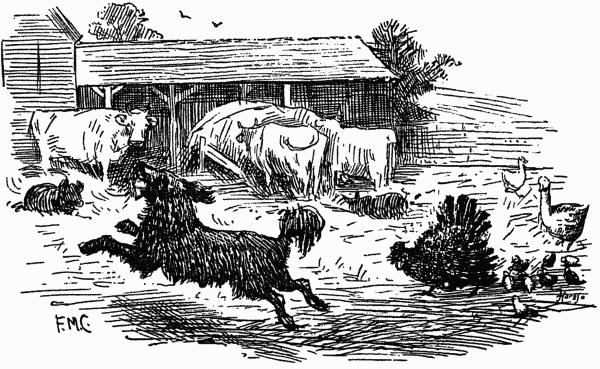 THE FARMYARD.
6. With a roguish look at their fat old
mother, he began to scamper off with her.
"Cackle, cackle!" screamed the old hen.
"Put the baby down this moment, sir!"
And the mother flew at Gip before he had
gone six yards.
7. She jumped upon his back, and began
to flap his head with her wings as hard as
she could, while she made digs at his back
with her beak.
8. The pretty dog, finding himself treated
in this way, soon dropped the chicken out
of his mouth. Little Betty rolled out from
between his white teeth and fell flop! to
the ground.
9. She was not a bit hurt, for she toddled
back to join her brothers and sisters, who
were all crying "peep! peep!" in a great
fright. They were afraid of seeing her
eaten up alive.
10. But though her child was none the
worse, the mother-hen began to batter and
beat poor Gip as if he had maimed it for
life. And she never forgave the little dog
after that day.
11. When she saw him coming, even at
a distance, she pushed out her head, stuck
all her feathers on end, and spread out her
tail like a bush.
12. Perhaps it was the dreadful fright
which Betty felt while she was in the jaws
of Gip, which made her so grave and
thoughtful a chicken as she soon became.
She walked better than the rest.
13. She held herself upright, and her
mother was never heard to say, "heads
up!" as she did to the other chickens.
Her mistress said one morning that Betty
was "the pride of the brood."
14. Her two brothers were very greedy
chickens, I am sorry to say. And as they
grew older, they began to fight sadly for
each worm or grain of corn which they
found.
15. Though Betty and the rest of the
chickens grew up white as snow, one of
these young cocks had a speckled breast,
and the other had two black feathers in his
tail. This spoilt their look.
16. They were both taken away one day
by a strange man, in spite of all that their
mother could say. She bustled up and
tried to rescue her sons. Although they
were both in the habit of eating too much,
she loved them in spite of all.
Write: A little chick was picked up by
a puppy. He did not kill it, but put it
down when the hen came after him. The
chicken was not hurt.
Questions: 1. How many brothers and sisters had Betty?
2. What did the puppy do one day? 3. What did the old hen
do? 4. What did Betty's mistress call her? 5. What sort of
chickens were the two brothers? 6. What became of them?
1. Time passed on, and Betty grew fast
in size and beauty. Her mistress made
up her mind to send her to the Poultry
Show at the Crystal Palace.
2. The cook and all who saw her said
that Betty ought to go, her beauty was
so great. She was quite a perfect pattern
of what a white hen of her sort ought to
be.
3. She would be certain to win a first
prize of the first class, they all thought.
Poor Betty! From the day that it was
settled for her to go to the Poultry Show
her troubles began.
4. When first it was made known in
the yard she became rather vain, in spite
of all that her mother could say. The
fact was that the old hen felt proud of it
herself, and Betty knew it.
5. She would be always pluming the
feathers of her daughter, cackling loudly,
and calling to strange chickens to come
and admire the lovely back and smooth
wings of her child.
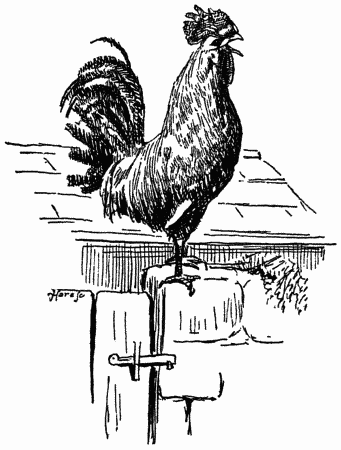 COCK-A-DOODLE-DO!
6. The young cocks from next door
sat on the railings to chatter, and even
forgot to quarrel. They stared at Miss
Betty as she walked with her beak in the
air, and they made rude remarks.
7. "Why don't you grow a pair of spurs
and learn to crow?" they called out. When
Mrs. Dorking, Betty's mother, heard these
speeches from the young cocks she flew
into a great passion.
8. "I will set the dog at you, you young
scamps, if you do not be off this moment,"
cried she. So they dropped off one by
one, for they did not know that the old
hen was not able to carry out her threat.
9. As Betty became vain she became
idle too. Instead of making her mother
and sisters happy with her pretty playful
ways, and making herself useful and
pleasant at home, she grew pettish.
10. And instead of working to help
earn her own living, by catching flies,
scratching up worms, and watching under
the old oak tree for cock-chafers, she
would lose patience, and call loudly to the
cook to bring her food.
11. And, strange to say, the cook would
come too, and, not content with waiting
on Betty, would drive away each fowl and
chick that came up to share what she had
brought.
12. She let none of them have a bit till
Betty had eaten all that she pleased. Was
not this enough to spoil any young hen?
Betty was fast getting pert. All this was
because of her good looks and her five
toes.
13. You will see after a while that she
would have been more happy if she had
been born ugly, or with four toes, like her
sisters.
Write: Betty was to go to a show.
She grew vain when she heard this. And
as she became vain she grew idle too.
She was spoilt.
Questions: 1. Where did Betty's mistress think of sending
her? 2. What did they all think that she would get at the show?
3. What made her grow proud? 4. What did she do instead of
earning her living? 5. What did the young cocks say? 6. What
answer did the old hen make to them?
1. After a little more time had passed,
Betty was taken out of the yard. They
did not let her stay with her sisters and
the other fowls any longer, but she was
placed in a large room by herself.
2. Here she was fed on all sorts of
dainties. She had chestnuts, minced liver,
new milk, and fresh lettuce. Life was
now a feast to Betty, but she found it
rather dull.
3. "I would rather have one worm or a
spider," said she, with a sigh. How she
longed for a good scamper with her
sisters! "I am sure that we should never
squabble now," said the poor, lonely little
thing.
4. But this time alone did not last long.
One morning a worse thing was done to
her. She was taken by the cook and
plunged into a warm bath. It was not
of the least use for her to kick and
scream.
5. The cook did not care. She rubbed
Betty gently with a soaped flannel, talking
to her in a soothing way all the time, and
then set her down before the fire to dry.
6. But Betty's fright was soon over, and
she was not at
all hurt, of
course. Yet
she might have
caught her
death of cold,
and all this because
of the
show! that her
feathers might
look fine.
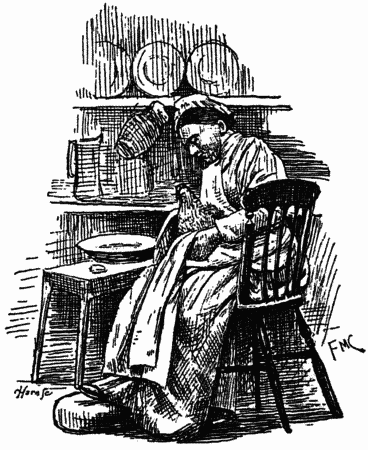 A WARM BATH.
7. If the cook
had let Betty
alone to clean
them, she would have done it better.
The soap was bad for them, so was the
water.
8. Betty felt very pleased when the
cook went to call all the other servants.
She wished them to admire the snowy
whiteness of her feathers. "If she does
not win a first prize I will eat my head!"
said the cook.
9. "You will have a fine big meal, then,"
said the housemaid, "and I should not
wonder if you have not spoilt her feathers
for ever by washing them. You never
ought to have done it, and the poor thing
may get ill."
10. But thanks to the care taken of her,
Betty did not get ill, though the nasty
soap made her feel sick; and the cook
saw that she had made a mistake in washing
Betty.
11. "All creatures can clean themselves,"
said the housemaid, "leastways
all birds can, at any rate, and we do
harm by meddling."
12. "I think we ought to keep her
under a wash-tub or in a basket until the
day for the show," said the cook. "She
will be sure to get dirty again in that
barn."
13. When a nice new hen-coop was
turned over her, Betty began to think
about her mother. "What a horrid time
she must have spent when we were little,
and she had to stay in a coop!" said the
young hen to herself.
14. "And yet I think that I am even
worse off than she was, for I have to stay
here without any little chickens to amuse
me, or to run under my wings."
Write: The young hen was washed.
It was bad for her and made her feathers
rough. She grew tired of being shut up
though she was well fed.
Questions: 1. Where was Betty placed alone? 2. What did
she say to herself about her food? 3. What did the cook do to
her? 4. What did the housemaid tell her? 5. Where was
Betty put next? 6. What did she think about in the coop?
1. "No, I have nothing to amuse me,"
said Betty, "but the thought of how handsome
I am. It is nice to think of that,
and yet I am almost tired of hearing it."
2. Betty would have given one of the
best feathers in her tail for a good race
after a beetle, or for a good scratch for
grubs down by the manure heap, which
was the best place.
3. But she had hardly yet begun her
trials. On the next day, the coachman took
her in a hamper to the show. Betty
screamed as she was put into it, for she
did not like it at all.
4. "I will behave well, no matter what
happens," said poor Betty. But she felt
afraid of the noise, the pushing, and the
crowd of people and poultry at the Palace.
5. There were Spanish cocks and hens,
who were lofty and silent. There were
little silver bantams who chuckled. Some
hens were tiny dwarfs like the bantams,
others were giants like the Cochin China
fowls.
6. There were gamecocks, too, looking
like fierce soldiers. Among all the smart
poultry Betty found herself passed over
and called "only a pullet."
7. All the other fowls were called
"loves" and "dears," while hardly any
people took notice of her plain white dress
and rosy head-dress. But one gentle lady
came by, who stopped near Betty.
8. She pointed Betty out to a child who
was with her, saying that she was one of
the best hens of her kind which she had
ever seen.
9. The lady added, "No fowls lay better
eggs than these pretty Dorkings.
"They make the best mothers, they are
English in their habits, and therefore
stronger than birds from foreign lands."
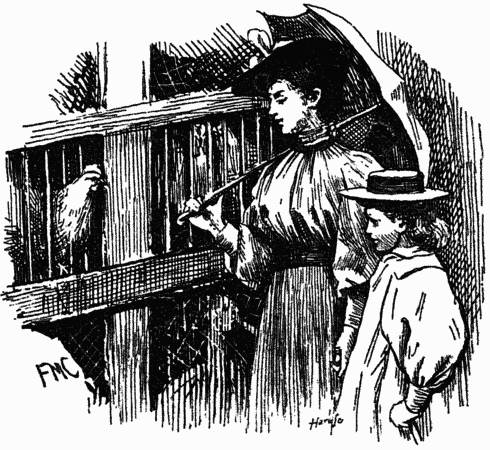 THE PRETTY DORKING.
10. The air at the Crystal Palace was
hot and close. Betty began to wish herself
at home again. She could not eat,
though food was there.
11. And though her feathers were all
ruffled and in a mess, she did not feel able
to put them to rights. Yet she knew that
she ought to tidy herself.
12. One of the hens near began to mock
at her. She said with a pretence of being
polite: "May I put your tail tidy for you,
madam, since it seems too much trouble
for you to do it yourself?"
13. And then the sly thing gave a
tweak and pulled out Betty's longest
feather.
14. A hen near gave a dab with her
beak at Betty's pink comb, and made it
bleed. And though she said after that
she did not mean to hurt her, that did not
heal the sore place.
Write: At the show Betty found it hot
and close. She did not care to eat. The
other hens played tricks with her. She
wished herself at home.
Questions: 1. When Betty was in the coop what did she long
for? 2. When she got to the show what did she see? 3. How
did she feel? 4. How did the other hens behave to Betty? 5.
What did the lady say about her? 6. What happened to her
comb?
1. After a time Betty felt better. The
other fowls left off teasing her. They had
only been in rough play, and did not mean
to worry her too much.
2. She dipped her bill into a dish of
water which was there, picked a bit of
lettuce, and said to herself that she would
make the best of a bad job.
3. Betty was still as vain of having five
toes on each foot as any fine young lady
could be of wearing new shoes. She was
always holding up one foot or else the
other. No doubt she meant to show off.
4. There was a great cackling and noise
in some of the pens after a while, and
Betty heard that the judges were coming.
These were the people who were to give
the prizes, and she felt now more vain than
ever.
5. She made up her mind to present her
foot to the judges, and even to push it out
between the wires of her pen, as far as she
could. "They cannot help giving me a
prize when they see my five toes!" she
said to herself.
6. But just as she had thrust her toe
right out between the wires, after much
trouble, she heard an odd voice from the
next pen say, "Hullo, what's that? Is it a
grub?"
7. A queer big bird with a long neck
had caught sight of the foot, and he gave a
great snap at it as he saw it move. Betty
tried to pull her toes back, but the big bird
would not let go.
8. At last it ended by his pecking off
the nail and first joint of poor Betty's
middle claw. She was in much pain and
screamed loudly.
9. Up rushed a man, the keeper, who
took Betty out in a great hurry. "We
must have no wounded or sick birds here
for the judges to see," he said.
10. And he put poor Betty quickly
away into one of the pens which had been
used for bringing fowls to the show. It
was empty but for two or three poor hens
who were either dead or dying.
11. These were fowls which had been
hurt on the way, by being shaken or
roughly used. They had been put into
baskets too small for them, or had been
badly used in some other way. It is bad
for birds to travel.
12. Here Betty sank down on the
ground. At first she could do nothing
but think of her poor toe; she
pushed it into some soft stuff which lay on
the floor, and this stopped the bleeding.
13. How sad she felt! All her fine
hopes of a prize were gone. She was a
cripple now for life, and no one would care
for her fine looks any more.
14. "I wonder what is the use of
shows?" thought Betty. "Why do people
want other people to tell them that their
cocks and hens are pretty?"
15. After the bustle and fuss of the day
were over, one of the keepers came with a
boy to look after the dead and dying.
16. "She was as great a beauty as ever
I did see," said the man. "A perfect pullet!—that
she was. But, dear me! she is not
perfect now that her toe is gone.
17. "She is good for nothing now but to
lay eggs and bring up chicks. She was
worth a couple of pounds; now she would
only fetch a couple of shillings.
18. "Here, Jack, tie a bit of rag round
the stump, and give her food and water in
that spare box. I cannot bear to wring
her neck, as we are forced to do with
many, to put them out of pain."
Write: Poor Betty had her toe bitten
off. She was put into a place out of sight.
Here she was in great pain, and had lost
all hopes of a prize.
Questions: 1. After a time how did Betty feel? 2. What did
she do with her foot? 3. What happened to one of her toes? 4.
Where was she put after her toe was bitten off? 5. What was
the boy told to do for Betty? 6. What did the man say that she
was fit for now?
1. Poor Betty had plenty of time to
think over all her troubles. But after two
or three days she heard a sound which
made her feel very happy.
2. It was the voice of her old friend the
coachman, who had come to fetch her
away. She cackled to him in a most
loving way; but, alas! the coachman had
nothing to say to her.
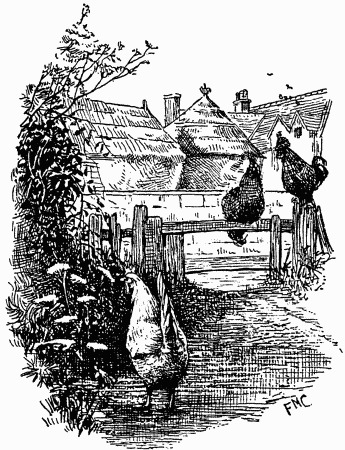 THE NEW HOME.
3. He was cross and sulky because
Betty had not won a prize.
"Poor thing!" said the cook when Betty
got home, "what an object she looks to be
sure! She is as light as a feather.
4. "The mother that hatched her won't
know her again. I declare that I don't
believe this is our Betty at all, but some
old rubbish of a bird they have sent us
instead!"
5. "Oh yes," said her mistress, coming
up to look, "it is our Betty. But I beg
of you to get rid of her at once. I cannot
bear the sight of her after thinking she
would get a prize."
6. "Shall I step out and do it at once?"
said the cook, calmly.
"No, no!" said the mistress. "Do not
kill her. Give her away. She will be a
useful hen to some one else, and is sure to
lay plenty of eggs."
"Very good, ma'am," replied the cook.
7. There was no washing this time before
Betty was sent away. That was one comfort.
She was huddled, just as she was,
into a hamper, and sent as a present to a
friend of the cook.
8. This friend was the wife of a farmer,
and she was such a kind, good, rosy, happy,
pleasant woman, that it was quite a treat
to look at her. She lived about five miles
from Betty's old home.
9. The large farm-yard into which Betty
now stepped from her hamper, was like a
new world to her. She began at once to
dig with those of her sharp claws which
were left.
10. And finding chalk like that which
had been under the soil at home, she
nodded her head and chuckled, for she
was pleased. No hen can be happy without
chalk, after she is old enough to lay
eggs.
11. She knew that the yard in which
she now was, would be a fine place for
her young brood. They would not be
likely to get the cramp or catch colds.
12. The fowl-house was built on a gentle
slope, and below, at some little distance,
was a pond with two or three green islands
in the middle of it. Here some water
birds, such as Betty had never seen before,
were paddling about.
13. She could not think how they did it.
The yard had good shelter from rough,
cold winds, for a fir wood was at the back
of it. And the houses for cattle and horses
stood with their backs to it on two sides.
14. The houses where the hens were to
sit on their eggs, were sprinkled with chalk
laid over dry coal ashes. This was to keep
the floor clean and wholesome.
They were swept out often. The
perches for roosting were not thin sticks,
but nice stout boughs of trees, so that the
feet could clasp them without slipping.
Write: The new home to which Betty
was sent pleased her. She thought that
she should soon forget her sorrows. The
fowl-house was nice and clean.
Questions: 1. To whom was Betty sent? 2. What sort of
woman was the farmer's wife? 3. When Betty stepped out of
her hamper what did she begin to do? 4. What did she find?
5. What was the hen-house like?
1. Her friends at the old home had all
walked on dry land. But here she found
many ducks and drakes, besides odd-looking
fowls with feathers down their legs.
2. Spring came, and Betty paced the
yard with twelve fine chickens behind her.
All of them had five toes on each little
foot, as their mother had when she was
born. So they were all right.
3. Down the velvet back of each chick
were stripes of dark brown, which was the
proper pattern for their first short coats.
After a time they would put off baby-clothes,
and be dressed in pure white like
their mother.
4. As her chicks slept under her wings,
or chirped with their merry little voices,
she forgot all else but her darlings. What
did it matter having one claw too few,
now that she had her dear babies?
5. Betty took care to keep her children
neat, and to teach them good manners.
"You may gobble up a worm, children,
as fast as you like, when you find it, so
that no one else may get it," said she.
6. "But don't let me see two of you
having a fight, or both tugging at the
same worm. You must not ruffle up
your feathers at each other, or fight,
though you may do so if you meet a rat."
7. As Betty was such an anxious and
watchful mother herself, she could not help
feeling quite vexed at the way in which
Snowdrop, one of the ducks, went on.
8. This big white duck did not seem to
mind a bit whether her children were a
credit to her or not. "See!" said this
good hen, pointing to her twelve clean
little chicks. "Where will you find such
children as mine?
9. "I spend all my time in teaching them
how to behave themselves. I show them
how to walk nicely, and how to pick up
their meals in a proper way.
10. "I show them how to keep their
feathers combed and brushed. But you,
bad mother that you are, allow your poor
little yellow ducklings to shuffle in the
mud up to their wings.
11. "And twice I have seen them at the
very edge of the pond. It made me
shudder! It will be a wonder if they
do not get drowned, or catch their death
of cold. How thin and pale they look!"
12. As Betty said these words to Snowdrop,
the old duck shook her bill, and after
a few more quacks turned her back and
waddled off.
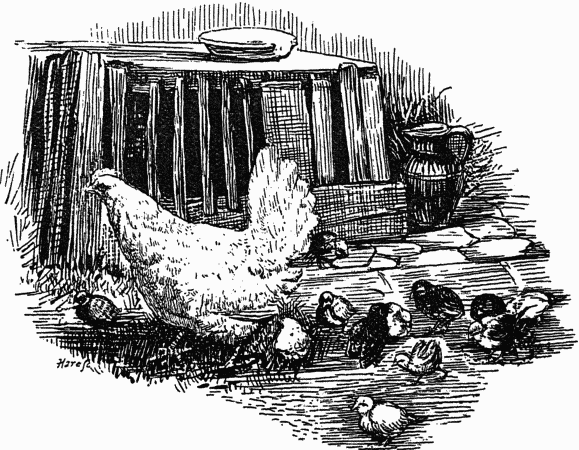 BETTY'S CHICKS.
13. Soon after this, a magpie came down
to tell all the fowls in the yard that one of
Snowdrop's ducklings had been eaten by a
rat, and that a second had been stolen by
a hawk.
14. Two more of them had run away
under the gate and had strayed towards a
tent where some gipsies lived. As they
never came back, it was thought that the
gipsies had taken them off.
15. A fifth of the brood, which had been
weakly from birth, had caught cold in a
bitter wind and died. And the last had
pined away from feeling lonely after
losing all its brothers and sisters.
Write: The hen had now twelve chicks.
She took more care of her children than
the duck did of hers. Betty thought Snowdrop
a bad mother.
Questions: 1. What other creatures did Betty see in the
yard? 2. How many chickens had she? 3. What did she
teach them? 4. What was the name of the duck? 5. What
sort of mother was she? 6. What did Betty say to her?
1. As Betty's brood was now grown
old enough to go into the world, she had
plenty of time to pay Snowdrop a visit.
So she went off one fine morning and
found her near the brink of the pond.
2. Snowdrop was using her orange bill
as a shovel to catch leeches in the mud.
Betty told her that she had come to have
a chat with her. She wished to speak
about the way in which she had brought
up her children.
3. "I am sure, my dear Snowdrop,"
said Betty, "that cold water was the
death of all your lost ducklings, no matter
what you or any other bird may say.
4. "You are a strong duck, and so it
has not hurt you yet. But you see that
your frail little ones are all gone. It is
all through your careless habit of letting
them dabble in the mud all day and get
their feet wet."
5. "Nonsense!" said Snowdrop, as, with
an eye dark and bright as that of Betty,
she glanced at her own orange legs and
webbed feet.
6. "Nonsense! It is all nature, and runs
in the blood," she said. "My mother
before me, and her mother before that,
knew that water never hurts a duck. It
hurts us to be kept dry!
7. "And as for catching cold or getting
fits, or cramp, or the pip—can you do
this?" And as she spoke, Snowdrop
waddled down the steepest part of the
bank.
8. She set her breast for a moment
against the tiny ripples of the pond until
she was in water deep enough to swim in.
Then, all of a sudden, she turned herself
upside down.
9. Her head went below, and nothing
of her could be seen above but a tail, and
two yellow legs. She stayed so long like
this, grubbing for water-snails, that Betty
began to fear she should never see her
head again.
10. But she popped it out again in a few
minutes, and came sailing with a saucy
quack back again to the bank. "Do I
look any the worse?" said she.
11. Betty held her tongue. She still
thought, as she had done before, that no
matter what Snowdrop did, cold water was
bad for ducklings.
12. A young Bantam hen, who was
standing by, said to Betty, "Where can
you have come from, and what sort of egg
did you creep out of, not to have seen a
duck swim before?" said the Bantam.
13. "All the yard knows that they are
the best sailors in the world! But for you
and me, our ruffles are too well starched
for such a way of life."
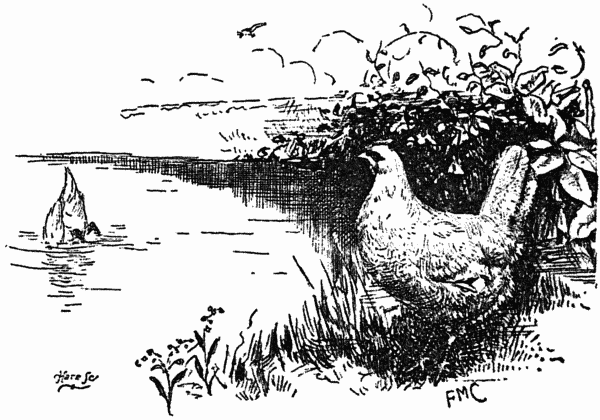 UPSIDE DOWN.
14. Here was a new wonder to Betty.
Though a shower of rain soaked all her fine
feathers through, and made them limp as
old rags, Snowdrop came out of the pond
dry and warm, her plumes crisp and
neat.
15. Not a trace of water was to be seen
on her. Well, to be sure! Betty could
not make it out. After all there must be
a thing or two which even the wisest hen
does not know.
16. "I advise you to carry oil in your
feathers when you learn to swim," said
Snowdrop, as she skimmed off again over
the pond. "That is my plan, but ducks
are too wise to boast about it."
Write: Betty went to see the duck.
She felt much surprise at seeing her swim
and dive. But she still thought that water
was not good for ducklings.
Questions: 1. Where did Betty find Snowdrop? 2. What
did Betty say to her? 3. What did the Bantam hen say?
4. What did Snowdrop do to show Betty? 5. What did Betty
still think about ducklings? 6. How was it that the duck's
feathers were not wet?
1. Weeks went by. Snowdrop thought
that it was time for her to bring some more
little ducklings into the world, instead of
those which she had lost.
2. So, down among the green rushes at
the very brink of the pond, she made a
nest. It was not much more than a
bundle of straws which the wind had
swept into that place but it did very
well.
3. Snowdrop had poked the straws into
a heap with her beak. She trod them
down with her feet, made a round hole
with her breast in the middle, and put a
few feathers inside.
4. In this rough nest she laid seven pale
green eggs, and very pretty they looked.
Betty no sooner heard of this, than she ran
as fast as she could to the spot. She had
a kind thought in her head.
5. She had now no little ones of her
own; and somehow, though she laid an egg
each day in the wicker nest, it was always
gone before night. So she had nothing to
sit on.
6. And so it had come into her good
heart that she would offer to sit on Snowdrop's
eggs for her. "I promise you to
do it well," said she to the duck.
7. "If you trust me with your eggs I
will treat them just as if they were my
own. And when the young are hatched
I will nurse the dear little things, teach
them, and bring them up better than you
could do yourself."
8. The duck, who just then saw her
drake bowing his head to her as he swam
along, thought that she would like to join
him on the pond.
9. Snowdrop loved pleasure. Why
should she sit cooped up on a nest for
four weeks, when she might be having fun
on the pond? Betty was willing to do it
for her.
10. She liked hunting for slugs and
worms, or swimming races with her drake,
better than sitting still. So she said
"yes" to Betty's offer and marched off.
11. The good little hen climbed as well
as she could on to the nest; but she did
not half like the look of it. Why, the eggs
were ready to roll out at the sides! And
her body was not so big as that of Snowdrop,
neither were her wings so wide.
12. It was a great job for her to keep the
large eggs under cover at all, but she shook
out her feathers and spread out her wings
as far as they would go, though it made
them ache.
13. Then she felt nervous because the
pond was so near. "It is bad for eggs to
get damp!" she said to herself. "What
could make that foolish Snowdrop choose
such a place? And I dare say that I shall
get the cramp too."
14. But she sat on bravely for all that.
Betty never left the eggs of which she was
taking care, except for a few moments when
she was forced by hunger to run to the
yard.
15. The good farmer's wife saw her
racing there one day. She watched her
pick up some corn in a great hurry and
then rush off. She went after Betty and
saw her get into the nest of the duck, to
sit there after her hasty meal.
Write: The hen wished to sit on the
eggs of the duck. She did not leave them
except to get food when she was hungry.
The wife of the farmer found the eggs.
Questions: 1. What did Snowdrop make among the rushes?
2. How many eggs did she lay? 3. What did the hen offer to
do? 4. What did Snowdrop say? 5. How did Betty get food?
6. Who saw her running back to the eggs?
1. "Pretty dear!" said the farmer's
wife to Betty, as she saw her climb gently
on to the eggs and spread out her small
wings as far as she could.
2. "This will never do," she went on.
"If you want to hatch them, my pretty,
you had better do it in your own nest."
3. So she stooped down, stroked Betty's
white back softly, and then, with a firm,
gentle hand, pushed her aside while she
took all the seven eggs into her apron.
4. At first Betty did not like it. She
did not know what Snowdrop would say,
and besides, she had a longing inside her
to finish the job. She wanted to see the
dear little things come from the shells.
5. "I shall love them as my own," said
she, "unless the farmer's wife takes them
from me." But she was quite happy when
she saw the eggs placed safely in her own
snug dry nest.
6. Betty sat on the eggs for three long
weeks. She knew that was the proper
time to wait for her own broods. But
still no sign of the young ones was to be
seen.
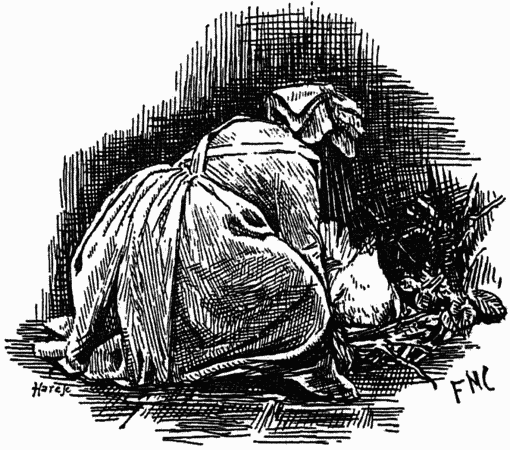 HER OWN SNUG NEST.
7. "I do believe that cold water has
killed them before they are born!" said
poor Betty, "for they never ought to have
been laid so near a pond."
8. She sat on and on, for a fourth week.
And, at the end of that time, she had her
reward. There was a little faint tapping
sound inside the shells.
9. The baby ducks were trying to get
out of prison. She helped them by picking
away bits of the shell as it broke, to let the
light in at their tiny windows.
10. At last seven little yellow things as
soft as satin cried, "peep, peep!" in a
pretty whisper round her feet. Their bills
and their feet were rather flat, it is true,
but what of that? Betty loved them as if
they were her own chicks.
11. "Of course I do not expect that they
will be quite so handsome, so clever, or so
good as if born from my own eggs," said
she.
12. "They will be poor weak little
things. I can see that they are rather
stupid, even now, from their staying in
the shells a week longer than they ought.
13. "But I must take a little extra care
with them!" Very proud was Mother
Betty, but in spite of all her fondness, the
young ducks gave her much trouble.
14. They would not come when they
were called. And they would play in the
gutter. They dabbled with their little
yellow feet in the black mud, as often as
ever they could.
15. They liked digging in a dirty ditch
for worms better than feeding from a nice
clean plate. And they will gobble snails,
shells and all, no matter what Betty said.
Write: It was four weeks before the
eggs were hatched. Betty found that the
young ducks did not like to feed as chicks
did. They loved to dabble in the mud.
Questions: 1. What did the farmer's wife say when she saw
Betty climb into the nest? 2. Where did she put the eggs? 3.
How long did Betty sit on them? 4. Where did the young ducks
want to play? 5. What did they wish to eat? 6. Why did
Betty think them stupid?
1. But Betty was a hopeful hen. She
did not give up trying to teach the young
ducklings and bring them up well. She
kept them with great care from speaking
to any of their own kind.
2. She would not let them play with
other ducklings. They had never seen
that dreadful pond yet. She would not
let them waddle within sight of it.
3. As to their bad manners, their love
of dirt and snails and wet, she could only
think that it came from their having once
laid as eggs in that old straw cradle of theirs,
among the green rushes.
4. "Or else it is because their feet are
the wrong shape," said Betty, as she looked
down at the yellow boots of her foster-sons
and daughters. On the whole they did
not behave so very badly, she thought.
5. They came up with the chickens at
meal times, even if they did go straight
back to that vile gutter the moment they
had gobbled all they could get.
6. "What a clever hen is Betty Dorking!"
the others said. "She has brought
up the duck's brood and will make chickens
of them!" It is true that the wise old
gander laughed at this notion.
7. He said, "You never see a silk purse
made out of any other thing but silk," and
all his wives nodded their heads and
cackled. They said it was witty, though
they had no idea what the speech meant.
8. As the golden ears were taken by
heaps into the rick-yard, the birds felt as
glad as the farmer and his wife did. The
great sheaves were stacked and the fowls
gleaned after them.
9. Betty, as well as the rest, picked up
plenty of loose grains. There was a little
squabbling once, and the turkey-cock trod
on one of Betty's ducklings.
10. The great bird said nothing but
"gobble gobble!" and did not even show
that he was sorry. The peacock was not
too proud to come walking in among the
rest, in a dainty way, holding up his train.
11. He liked wheat as much as any of
them. But he could not bear soiling his
dress. Betty now thought it was time to
take her foster-children into the world,
before winter came.
12. They were grown to a fair size, and
as yet no cold water had ever come near
them, except a few splashes, which their
nurse could not prevent.
13. After a good deal of driving and
shrieking to them, she got her brood into
a small crowd, to see if they were neat.
She smoothed their downy heads, she
plumed their soft wings with loving care.
14. Then she said, "My dears, you are
all as tidy as you can be made. I am now
going to take you on a visit to your own
mother, whom you have never yet seen.
15. "Behave well, and give me no
cause to feel shame when she sees how I
have brought you up. Now, Forward!
March!"
Write: The young ducks had never
seen a pond. Their foster-mother made
them tidy. She wished to take them into
the world and show them their mother.
Questions: 1. What did the other hens say of Betty and her
brood? 2. What did the gander say? 3. What bird came to
pick up wheat with the fowls? 4. What did the turkey-cock
do? 5. What did Betty say to her ducklings before taking them
into the world? 6. To whom did she wish to show them?
1. And where was Snowdrop to be
found? At the pond, of course, swimming
round and round with half-a-dozen other
ducks and drakes as happy and careless as
herself.
2. She swam towards the brink when
she saw Betty coming. The ducklings
waddled as fast as they could lay their flat
feet to the ground, as soon as they caught
sight of the pond.
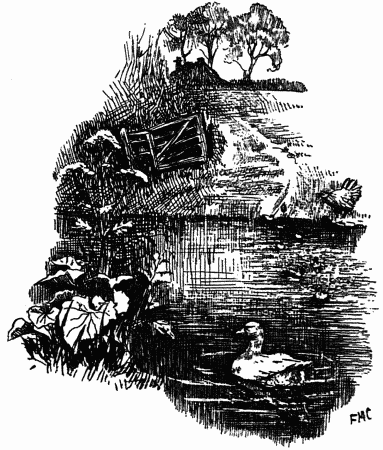 THE FIRST SWIM.
3. Betty could not keep up with them,
for she had never quite lost a limp, after
having her toe bitten off. "See," she said
to Snowdrop, as she hobbled up, "here are
your children.
4. "Look at them well! How unlike
they are to any ducklings you ever brought
up yourself! There are no ducks in the
whole yard that can compare with them.
Just watch how well they behave."
5. "Quack!" said Snowdrop.
"It is all because of the pains I have
taken," said Betty.
"Quack, quack!" said Snowdrop again.
6. "They have never been tempted to
go into horrid cold water. They have never
even seen a pond till now. What do you
say to that?"
7. "Quack, quack, quack!" replied the
snowy sailor, glancing her bright eye upon
her little ones. The next moment the
merry little ducks were sailing after her
round the pond!
8. They dived head foremost, they
grubbed for leeches, they paddled with
their flat feet as if they had done nothing
else since they were out of the shell.
9. Poor Betty with outspread wings
danced round the pond crying at the
top of her shrill voice, "Come back! come
back! You will all be drowned."
10. But it was useless. The little ducks
would obey her no longer. They went on
swimming about after their own lily-white
mother.
11. Snowdrop swam to the edge at last,
and spoke thus to Betty. "I thank you
for the good you meant to me and mine.
But dry land will not give us your sharp
toes to scratch with, any sooner than water
will give you web-feet to swim with.
12. "All that you have taught my children
on dry land, I shall be pleased to repay by
teaching the next brood you have to swim
and dive." At this the gander stretched
out his throat and laughed.
13. "You should allow yourself more time
to think," said old Dame Turkey, the wife
of the turkey-cock, as she stood on one
leg to listen.
14. "You are always in a hurry and a
bustle. Don't mind so much about the
affairs of other people, and take things
calmly, as I do. If you had been more
like me, you would not have made this
mistake about the duck."
15. "We have not all the same habits,—the
same nature," said Mistress Betty,
softly. "And I see that it is of no use
trying to make other folks' children like
our own." Dame Turkey nodded her head
in a very wise manner.
16. She must have been a very clever
old dame, for she knew when to keep
silent. As for Betty, she grew to be a very
modest, useful hen, with no pride or conceit
about her.
17. At the present time, though she is
getting old, she is still a worthy fowl.
She lives at the same farm, and would
divide her last worm with a chicken or a
friend. But she has never tried to turn
ducklings into chicks again.
Write: The little ducks saw the pond.
They ran to it and went in. It was of no
use for the hen to call them back. They
went after their own mother-duck.
Questions: 1. Where was Snowdrop to be found? 2. What
did the ducklings do when they saw the pond? 3. What did the
guinea-hen call out? 4. What did Betty do? 5. What did Dame
Turkey say? 6. What sort of hen did Betty become?