22nd June. A march, and a long and fatiguing one to the northern
extremity of the Wurdwan valley proper, where it narrows to a mere
gorge, the mountains closing in and overhanging the pent up torrent,
frowning down in savage grandeur—the scenery very wild and striking.
We had to cross the river on the snow, and to move over extensive
snow drifts covering the steep slope of the bank: the very precarious
footing, and the torrent roaring below, made this part of the journey
exciting. I was troubled with a badly-fitting sandal which much impeded
my movements, and increased the danger of falling, at the same time
fatiguing me greatly. Subhan did what he could for me, but was unable
altogether to remedy the evil. The river made a sudden turn, coming
from due east at right angles into the valley, (which runs, I imagine,
pretty direct north and south) up which we continued our course, now
very rugged, and at length, to my relief and comfort, halted in a
small, irregular, up and down opening, by a large piece of rock which
afforded us some protection from the sun, now become excessively
hot after ten o'clock. A great but gradual change has taken place as
the season has advanced. The mornings and evenings are now cool, not
cold, and the days very hot, the sun so powerful as to render my small
shuldary tent quite an oven. I try to diminish the temperature by
putting my double blanket on the top; but still I suffer much, and find
a tree, where there is one at hand, better protection by far.
My followers were very long in appearing, and I felt some anxiety for
my servants' safety in so hazardous a path, but was gratified by the
simultaneous presence of all three, as I awoke from a troubled doze.
The coolies also arrived without accident of any sort.
I went in the afternoon up river to reconnoitre, and had the pleasure
of seeing some half-dozen ibex, venerable fellows, with long horns
and beards, but on the opposite side of the river, and in a place the
approach to which made me shudder to look at. But the attempt must be
made to-morrow.
One coolie arrived from Sirinuggur, bringing lead; the other, the
duly deputed one, remaining behind to see the Baboo, and deliver
his credentials, that individual being absent at some devotional
gathering of the pundits at some sacred shrine, most likely devising
roguery—therefore, no letters, papers, or bullet mould. Ibex had been
seen from camp.
23rd June. Off in pursuit of the ibex seen yesterday. We descended to
the river which we crossed on the snow, and up the opposite side,—ibex
seen above us.
We lay down to reconnoitre. Two ibex, male and female, were coming in
our direction from the heights in the rear. Their intention becoming
apparent to continue in our direction, we climbed up to intercept them,
and a rough scramble it was. After raising our hopes to the utmost,
they turned aside and disappeared. On again—crossing a remarkable
place of semicircular form, where the earth appeared to have parted
from the mountain, and slipped sheer down into the river, so that an
extensive indent of semicircular form remained, its surface loose and
smooth, with a harder gravelly ridge forming a ledge, from which it
descended sheer to the river. The mountains were of bare rock, rearing
sharp peaks of every form high into the heavens. In the further angle,
however, of this crescent of desolation, was a knoll covered with
gnarled dwarf birch trees and rough underwood. To this we directed our
course, and, when gained, it was as nice a spot as could be desired for
a hunter's watch stand.
In the course of the day several ibex were seen crossing the slope,
having been alarmed by the fall of some pieces of rock which, detached
from above, came rattling down near them. We watched them anxiously,
hoping they might come our way. But no: they chose the crags. A
bear and two 'wee' cubs also came seeking more secure quarters, and
evidently bound for our trees; but, winding us some five hundred yards
distant, the anxious dam turned about, after several long sniffs, and
went off in a different direction.
But one ibex, a buck, remained on the slope where he employed himself,
I believe, in licking salt, of which the shikarries tell me there is
much in the earth, and which attracts the ibex to this remarkable
spot in numbers. After watching his movements for a long time, and it
appearing pretty sure that he meant to remain there some time, Subhan
and I started on the forlorn hope of stalking him; a feat of great
difficulty, as, though the wind was in our favour, the quantity of
stones and detritus we had to pass over to get to him—there being in
fact no other footing—rendered it impossible to move without sending
some detached fragments from this huge loose mass rattling below. Then,
the difficulty of moving at all on this steep surface was great. We
took advantage of the stunted brushwood to screen our approach, moving
on only when the animal, ever looking around after a bite or two, put
down his head.
This tedious mode of advance under a broiling sun continued some time;
when the animal, being satiated, suddenly descended behind the low
ridge on the top of which he had hitherto held post. Then we pushed
on, Subhan too impetuous, the loose stones talking loudly. However, we
got to fifty yards of the spot, Subhan still going ahead, head down,
when I saw the horns, then the head, of the suspicious chase appear
above the ridge. Checking Subhan, down we lay, the forepart of our
bodies only screened by some dry twigs of brushwood. I took the rifle,
and, raising it, found the ramrod hanging out. Putting my hand to the
muzzle, I drew it in—the ibex now in full view, shewing his breast, a
fine mark. But from the attitude I was in, lying on my right side, with
nothing but loose stones to scratch at, I could not, for the life of
me, find means to poise the gun and take aim. Subhan lying in front of
me on his side, I tried to rest the gun on him, but could only bring
it to bear by pressing on the slope of his shoulder as he lay, which
afforded no rest. The animal's quick eye now detected the convulsive
twitchings of my limbs, and, giving a shrill whistle, he presented his
side at which I pulled trigger as he bounded away. A smack was heard,
which we hoped was the ball telling, and away we went, but saw the ibex
slowly bounding away. He paused at the foot of a rock, wagged his tail
rapidly, and vanished with a dive into a gulley.
Subhan, thinking him wounded, pursued. I had also great hopes from the
sound, notwithstanding the difficulty of my position; but, on examining
the ground whereon the animal stood, I found the spot where the ball
struck at his feet, the rifle having slipped down the slope of Subhan's
shoulder as I hastily pulled trigger on the startled animal. Subhan
returned, discomforted exceedingly. And, repining at the extreme ill
luck at being surprised in such an impracticable position, we rejoined
our equally disappointed comrades who had been eagerly following our
every movement through the telescope. We gained the ground on which the
fine old patriarchal long-beards had been seen yesterday—now, alas!
where? Far beyond our ken. We returned on our steps; had terrific hard
climbing up and down; and I arrived at the bivouac thoroughly done up,
with a pain in the back from straining up hill, which may necessitate
rest.
While lying waiting on the mountain side, I observed a spot on the
river below us, where from the contiguity of certain rocks dividing the
stream, it appeared feasible to throw a bridge over, plenty of wood
being within reach. But I observe that almost close to this spot the
pines and firs cease, and nothing but the dwarf birch appears; and a
mile or two further on even this wood ceases, and only bare rock is
visible. The shikarries promise to have a bridge made, which will then
afford us easy access to some good ibex grounds, now very difficult to
get to.
24th June. Sunday. I was very well inclined to enjoy the repose this
day brings with it: my back stiff, and an occasional sharp twinge in
the lumbar regions, painfully reminded me of my fruitless exertions
yesterday. I took a stroll in the afternoon. The shikarries and coolies
went to build the bridge.
25th June. I started off to the place where the bridge had been
commenced yesterday, but could not be completed owing to the quantity
of water, from the melted snows. It was to be finished this morning,
the coolies first bringing my things here. We saw some fine ibex on the
very crest of the mountain opposite, and resolved to try and get at
them in the evening.
The things arrived, and the coolies set to work at the bridge. I made
a hearty breakfast, and afterwards went to watch the operations. The
rough poles were now across, and the shikarries proposed starting
at once. I did not much relish the thoughts of the climb just after
breakfast, and the sun exceedingly warm, but acquiesced; so off we
went, and crossing this apology for a bridge over the furious torrent
was no easy matter. I had to collect my nerves for the attempt. The
poles were laid first from one bank to a large, high piece of rock,
and from that down to another much lower, and then from that to the
other bank: they were very crooked and loose, and moved about and
sprung under the pressure of the foot. But I crossed safely, and then
breasted the mountain. It was dreadful hard work. After many halts
we reached the upper regions, where we found it quite cold, a strong
sharp wind blowing. The shikarries went to scout, and returned with the
provoking information, that they had watched the ibex which had betaken
themselves to a distant and inaccessible portion of the mountain.
Something must be attempted after such an arduous ascent. I determined
not to go down without an effort at any rate, so proposed to sleep up
on the mountain, sending a coolie to bring some clothes and eatables.
This was decided on. Then, looking for a place to wait in till evening,
I descended a short way towards a tremendous ravine which cleft the
mountain from crest to base, running nearly in a direct line for a
couple of miles, its sides of bare rock, precipitous, and rugged.
Above this I lay down in no very agreeable state of mind at the
prospects before me.
About 3 P.M. I saw the identical five fine ibex emerge, and
file slowly across the opposite hill-side. I watched them eagerly
without a movement, lying on my back, till they disappeared over the
ridge. One was a splendid old fellow, with huge horns, and moved very
leisurely behind the others. How I longed to be within reach of him!
The shikarries, who had occupied other places to watch, soon joined
me, excited by the same sight. We were preparing to move, when two
more ibex were seen following in the track of the others. We had to
wait till they were out of sight: then, off we went, and had hard work
to cross the ravine, and ascend the opposite hill of slate and snow,
steeply scarped. We gained the crest, and found the ibex were down on
a level open slope, far out of reach, and hardly possible to approach.
Here was a disappointment. After a long consultation a plan was formed,
we hunters to make a 'detour,' and then the coolies to descend towards
the game, and let them be aware of his presence.
It being so arranged, up and away: and after further violent exertions
we reached the part of the mountain under which the ibex had been seen
feeding—most difficult ground, being very steep, and either of smooth
slate, or fragments affording no footing. We gained the top of the
ridge. Subhan unfortunately did not reconnoitre, but made a turn to the
left to gain a passage through the much-broken rock, when suddenly he
shrunk to the ground, as the horns and heads of two magnificent ibex
came into view, emerging from a narrow cleft and coming towards us.
They, of course, saw us. We were not thirty-five yards apart. Now, to
record what took place I can hardly undertake, nor do I exactly know
how it happened. The heads, and necks, and ridge of back, of the ibex
were alone visible, a piece of rock screening their bodies. No doubt,
I was discomposed and flurried by their unexpected appearance so near,
and under some unaccountable influence did not at once take aim, from
some undefined notion that they would offer a better mark immediately,
and for fear of frightening them by any movement. I was, moreover, in a
most uncomfortable squatting position on a steep slope. After a second
or two one moved forward, and, unfortunately, instead of the movement
bringing him better into view, it had the opposite effect, for the
ground dipped so that the animal was instantly out of sight; the other
moving on, I fired and missed. I was then obliged to rise up to see
him. He had not dashed off at the discharge, but moved on at a slow
pace, as though quite unconcerned. His whole side was presented as I
rose in much agitation to aim, and just as I raised the rifle he dashed
down hill, my bullet passing harmlessly over his back. I rushed after
him, risking neck or limbs, heedless of every thing but the chase, my
second gun in hand: sighted him—on again, when I was brought up by a
fearful precipice, a huge abrupt chasm severing the mountain: leaning
and peering over, I saw the two ibex below, but was so blown I vainly
tried to take aim, so, as the distance was great, gave it up.
I was still looking after the retreating game, when Subhan signalled
something exciting, and we found he had spied other four ibex in sight,
far off. We assayed to get at them. Our coolie was in sight, and the
ibex, taking fright, after a turn or two, made off in our direction,
but far away below us. Down we dashed in chase to cut them off. But,
ignorant of their point, we failed—with our utmost efforts, and after
many slips and escapes, arriving to see them, having crossed the lower
end of this chasm, canter off up the opposite hill-side. The shikarries
urged me to fire, so putting up sights, hopeless myself, I sent two or
three bullets very close to them—that was all.
It was no use to remain up now, so I decided to return to camp, a
long and difficult step. We saw coolies down below with the things,
descended to them, and found the long absent messenger from Sirinuggur
there.
He had letters, newspapers, and the bullet mould for me. This somewhat
allayed the unpleasant reflections I was a prey to, and broke in upon
my brooding over my mishap; and, on Subhan expressing an intention
to move camp onwards in the morning, I suggested that he and Mooktoo
should instead try and get at these ibex. They did not appear half
inclined for the job, I thought. And no wonder, considering the amount
of work we had done.
All the camp was out in evident expectation of our success, hoping
for meat. Long faces, when the result was known. My mishap did not
prevent my eating my dinner; but it was interrupted oft-times by
melancholy ejaculations, and sighs, and groans. I had confessed all to
the sympathising Abdoolah, and told him my heart was pained at losing
such fine ibex. My Hindostani was not equal to the requisite idiomatic
phraseology, I suppose; for, on my shortly retiring to my tent, he
followed me, and put his head into my tent. On enquiring what he
wanted, "he had come," he said, "to offer to rub my stomach to relieve
the pain I complained of." I know I said 'heart,' and not 'stomach.'
But this circumstance operated beneficially, and I retired to bed
thoroughly knocked up, but mentally serene.
26th June. I was disturbed at an early hour by a rumbling under
my bed: the two hunters were getting out the guns. "Mind you bring
back the big horned one," I said, and again relapsed into peaceful,
strength-restoring slumbers. When up, I set to work to cast bullets,
and found the mould for the Whitworth most ingeniously constructed, but
with a great deal more art than was actually necessary. The bolt was
not true, however, the base of the cylinder being larger than the upper
part; but I thought that this could be remedied by the use of the knife
and file, though at considerable expense of time and trouble. And so it
turned out.
There were letters from Punnoo, Vizier, assuring me the offending
villagers should be punished, and from the Baboo on matters of
business, and lots of newspapers which were most acceptable.
About 2 P.M. I saw Mooktoo returning alone. He immediately
beckoned me. I guessed his object, and called out to the coolies to
bustle up and be off to help the shikarries—that they would now find
lots of meat. There was a general stir and excitement in the bivouac,
all turning out to gaze upon the approaching Mooktoo, still a long way
off on the other side the river. He carried something evidently; and,
on one of the coolies reaching him, he threw down his load which we
then perceived to be the head of an ibex, with fine horns.
He shortly joined us, and proclaimed the welcome news of four fine
ibex being the result of their chase. All the coolies were despatched
to help Subhan who, in the course of three or four hours, made his
appearance with a long train of followers bearing heads and limbs.
There were great rejoicings at this great success, and the prospect
of a general feast of flesh. I looked mournfully on the unfortunate
victims, taking little pleasure in their destruction, as I had not
enjoyed the excitement of the chase which was, by the hunters'
accounts, a most arduous and perilous one. They had been long
traversing the mountains without a sign of game, and were returning,
when an ibex was viewed, and following him they had to climb terrific
crags; to do which they had even to take off their sandals, and,
slinging their guns, climb up on all fours. They became separated, and
were in much apprehension for each other's safety. But all turned out
most happily for their sport; for Subhan was surprised by a fine buck
coming out of a ravine, and presenting him a fair broadside. He knocked
him over; when another took his place. He then disposed of that one,
and others were thus turned down to Mooktoo who floored his brace, and
wounded another. Two or three fell down the precipitous crags, and were
consequently much knocked about, but the horns were luckily uninjured.
I decided to halt tomorrow to prepare the heads, &c.
27th June. All remained busy in camp, stretching skins, and preparing
heads. Rain fell during the day. In the afternoon, it having cleared
up, leaving Phuttoo working at the heads, the other two and I went off
on the chance of seeing something; but heavy rain again set in, and we
returned drenched to camp.
28th June. We struck camp, and set off to next ground. The morning was
heavy and cloudy, and it was an uninteresting march along the river
bed, here very shallow, and broken into many streams. The mountains,
on either hand, were steep and craggy, and their lower slopes, on the
southern side, clothed with underwood, dwarf birch, &c., but, on the
north side, covered with grass, not a tree or shrub to be seen there.
The slopes came right down to the river banks, affording hardly a spot,
here or there, on which to pitch a tent. The valley, running east and
west, is narrow and wild. We arrived at the camp ground, a rough
spot, completely covered with wild leeks or onions, like a cultivated
bed. Rain came on, and we hunters were in a poor plight—no shelter
whatever, and all the wood and herbage so wet we could not raise a
fire for an hour, though every dodge was resorted to: my feet, being
saturated, were miserably cold.
The tent and other things were late arriving: the rain turned to snow,
and it became bitterly cold; and in the afternoon the snow lay three or
four inches deep, even on the low ground.
29th June. I awoke after a bitter cold night, which much interfered
with my sleep and comfort. The snow still lay on the ground; but the
clouds breaking, giving an occasional gleam of sunshine, every thing
was put out to dry.
My dog Sara had been very busy yesterday working, scratching, and
digging, at a marmot's burrow. There are numbers of these quaint
creatures here constantly seen sitting upright, and uttering a shrill
whistle, like the sound of a dog whistle. He continued his operations
in the most indefatigable manner to-day; and, having nothing else to
do, all set to work to help him unearth the 'varmint'—no easy job, as
his earth was under a huge piece of rock. However, at last the poor
little beast was assailed in his citadel, and he fought viciously,
tooth and claw, but was finally secured by nooses passed over his hind
feet, and then dragged ignominiously out to the public gaze. Sara made
a rush on him, and tackled him, but not relishing his teeth withdrew
from the contest, and I put the poor thing out of further pain by two
or three blows on the head.
30th June. We moved on to new ground reported to be frequented by
ibex. Several parties, coming down this path, profess to have seen
them. Phuttoo, who has been ailing some days, I think from rheumatism,
remained to accompany the main body. We, of the light division, came
on ahead, and found the carcase of an ibex fresh killed, and partly
devoured by wild dogs. This is a terrible blow to our hopes, as in all
probability the ibex have been harassed and frightened away from this
place. From the camp ground nothing whatever can be seen in the way of
game, though the hills look very likely.
In the course of the day some excitement was created by Ali Bucks
asserting he saw an ibex. After enquiry and much useless reconnoitring,
it was decided to have been a marmot. Soon afterwards I was examining
the features of the mountains, and laying out plans for our route in
the afternoon with Mooktoo, when we both became aware of real ibex
being visible in the very spot I was pointing out as that we should
make for. The ibex were numerous, and some large horns among them. They
appeared to be excited by something, supposed to be a fight among them.
They soon disappeared. But the knowledge that they were actually on
the mountain was a great relief, as we feared those rascally dogs had
driven them away.
About 2 P.M. we prepared for the chase, and, moving up the
valley, reached the glacier from under and out of which the main
Wurdwan river flows. This enormous mass of ice and snow fills the upper
end of the valley, extending many miles right through the Sooroo Pass,
the path running over it. It was awkward work crossing the chasms and
rents in it; but it was our only means of getting to the other side of
the river. Rain set in, making our anticipated hard labour in ascending
the mountain still more formidable and disagreeable.
We paused at the base of the hill to reconnoitre with the glass, and
after some time had the satisfaction of seeing the ibex emerge from a
hollow, quietly feeding. We counted thirteen. Thus cheered, a plan of
attack was considered and fixed. We had as usual a tremendously heavy
pull up hill, crossing a place in a ravine much frequented by the ibex;
indeed, in smell and appearance like a place where sheep had been
folded. Everything tended to raise our hopes.
We worked steadily on, until we reached a good elevation, when Subhan
went ahead to scout, and returned with the pleasing intelligence that
the ibex were in sight, and undisturbed.
We mounted higher with great caution. Subhan, again scouting, made
signs to us—the game was lying down. On, again—excitement becoming
great, as we neared our intended prey. Subhan peeped over the crest
of the sharp rocky ridge, under shelter of which we were stealthily
advancing, and made unmistakable signs of something unexpected and
exciting. He beckoned me to bring a rifle; so I climbed to his look-out
place, and was gratified by the sight of a single ibex, a large buck,
with a magnificent pair of horns. Taking time for breath—the animal
evidently unconscious of danger—I fired, the ball apparently striking
the shoulder, and breaking the off leg. The animal—wonderful to
relate—hardly noticed the wound or the noise, and, to our infinite
astonishment, began to eat again. I fired another shot, again striking
the shoulder—the animal again shewing little signs of concern, but
shortly, with great deliberation, lay down. Not knowing what to make of
such strange conduct, I fired another shot, which effectually did the
business.
The guns being reloaded, we looked about, and saw a large flock of
ibex startled at the reports, but puzzled to know their meaning.
Following Subhan, I advanced to intercept them, and gained an eminence
overlooking their position which was in a grassy hollow. It was a
stirring sight. I suppose there were thirty or forty of them. And
leading the way was the master of the herd, a very large buck, with
splendid horns.
This one I singled out, but was some time ere I could adjust my rifle,
and get a steady aim, as he moved on, here and there, over the uneven
ground. I was lying down; but, as he was increasing his distance, there
was no time to lose, and I fired, the missile apparently striking him
well behind the shoulder. He started, and recoiled, and made off down
hill; and at the discharge a regular hurry-skurry took place among the
others who, crowding together, took downwards. Two shots brought down
one, and wounded others, and away they all went. I loaded and pursued;
but they had got across a huge ravine, and were about six hundred yards
off. I tried the Enfield; but the bullets struck close to them, and
that was all.
I loaded, and turned back to the victims, and found the first a very
old animal with only one tooth in his head, his horns very long, but
somewhat worn and dilapidated. He was as thin as could be. The other
was a young buck.
I now bethought me of the fine fellow I had taken such pains about,
and had wounded. We found his bloody trail, and sighted him a long
way off, slowly moving on up the mountain. I sent Subhan and a coolie
in pursuit, and returned with Mooktoo to skin the others. Heavy rain
descended, then snow, with loud peals of thunder over head. A coolie
descended the mountain to hail the encampment for assistance. We were
in sight of our tents, though miles away, far above them.
A shot was heard in the direction Subhan had taken; and, just as
the second animal was skinned, he returned, saying he had killed the
wounded ibex, but it was not the big one. This I could not understand,
being sure that we saw was the identical leader of the herd.
We now descended, again crossed the glacier, and were welcomed in camp,
where universal glee prevailed at our success. Poor old Phuttoo was
much delighted, and chattering away gaily, calling to mind how he had
told me that some day I should have great sport with the ibex.
When the ibex that Subhan had finished was brought in—it was brought
in bodily—I exclaimed at once that it was not the one we had seen
retreating, not a doubt of it. Subhan declared it was wounded, however.
That is probable enough: but the animal we saw was the big buck, the
size and colour quite unmistakable—nothing like this little bit of a
creature. Subhan acknowledged that owing to the snow, rain, and dense
clouds, he could not follow the trail; and, seeing this wounded ibex
before him, thought that must be the one he was following, so finished
it, and came back.
This was very unsatisfactory, as I gave up a capital chance at the
main body to try for this big fellow. I told Subhan that I thought it
ought to be retrieved; so he and Mooktoo are going to try and find him
to-morrow. I distributed 'backsheesh,' and this being the Mahomedan
great day, the 'Eed,' I had in the morning given the shikarries a leg
of mutton, tea and sugar, &c.; and now they are singing away merrily.
1st July. Sunday. Much rain fell during the night. Subhan went off to
try and discover the wounded ibex.
Heavy rain set in, in the afternoon, and continued without intermission
until dark. It was very cold.
Subhan returned quite unsuccessful, the rain having obliterated the
tracks. I regret this loss much. It was such a splendid animal, the
pick of the herd.
2nd July. On turning out of my tent, dressed and ready to march, I
found that a hard frost had come on in the night, and much snow had
fallen on the mountains; in consequence of which the glacier was
declared to be too dangerous to attempt to cross, as the numerous rents
and fissures would be thinly coated over with frozen snow, rendering it
impossible to detect and avoid them. I submitted the more patiently to
this delay, as the swelling behind my knee was considerably enlarged by
my struggles over the slippery ground on Saturday; and I, somehow or
other, clung to the forlorn hope of there being a chance of retrieving
the lost ibex, if we remained here; that a flight of vultures,
buzzards, or crows might point out the carcase.
But no such good fortune appears to await me, as I have been scanning
the mountain side till almost blind, but no favourable augury in the
skies. The ibex must now be given up as irretrievable.
3rd July. Although rain had fallen, and at early dawn the weather was
very unsettled, the shikarries roused me up. I had made up my mind that
they would not think it advisable to move, so had composed myself to
another allowance of sleep; but was soon dressed, and on the march.
The glacier, which we now had to cross, has all the disagreeables
of that peculiarity without its redeeming features, its varied and
brilliant tints, such as are renowned in Alpine scenery. This was an
ugly, dull, dirty, stony mass of ice and snow filling up the gorge
in the chain of mountains, forming the pass through its ridge from
the Wurdwan to Sooroo. The ascent was not difficult, except from the
cumbering rocks and stones which, brought down from the heights,
the accumulation of centuries, lie in heaps and masses, huge and
unsightly, nothing picturesque about them. Even their colours are dull
and repulsive. And here and there is a yawning chasm, descending into
depths unknown, very hideous when looked into.
We had barely reached the general level, when a violent snow-storm
burst upon us. The heavens were black, the wind howled in furious
gusts, the weather and accompaniments enabling one to realise one's
fancies and ideas of a mountain pass in a storm. We battled manfully
against it, diverging here and there to avoid danger; and so toiling on
reached the most elevated part, the ascent gradual. Here we were free
from the rocks and stones, there being only the ice and snow, a layer
of fresh-fallen snow having re-carpeted the surface. We crossed many
a gaping fissure, and proved that the precaution of the shikarries in
not starting the other day was reasonable; for our guide, a Wurdwan
peasant, suddenly plunged down, but recovered himself. He had fallen
through a crust of drifted snow concealing one of those ugly rents
which stretch across from side to side of the gorge.
Our path led to the left. The snow-storm had subsided, and the sun was
now shining. The direct course of the pass, hitherto followed, appeared
to be obstructed by insurmountable obstacles in the shape of ice and
snow, ranged in tiers and ridges to a great height. The mountains, on
either side, had been throughout precipitous and extremely rugged—huge
crags without a vestige of vegetation. We had now to ascend, and
laborious work it was, the snow being soft, and the sun now hot; in
addition to which, one's power of breathing was much affected by the
extremely rarefied air at this great elevation. The summit gained,
the descent was tolerably easy to us more practised mountaineers; but
the glare of the snow was terrible. Mooktoo was attacked by severe
pains in the head, and lagged behind. I, after stopping to rest a few
minutes, and watching four ibex which shewed on the left, when I got
up, was almost blind. Luckily we had nearly passed over the snow, and I
recovered immediately on quitting it; and about two miles on we reached
our destined bivouac, when I was glad to breakfast.
We were now in a narrow valley with the usual mountain torrent, fed by
tributaries joining from other like valleys. The mountains were rugged
and almost bare, yielding only patches of brushwood here and there,
and some scanty herbage, but looked likely for ibex, were it not that
a number of tattoos had been brought here to pick up a hard-earned
subsistence. The sun now poured down its vertical rays upon us with
tremendous effect, and I took up a position alongside a piece of rock
to screen myself as well as I could. Of my party the three servants
first appeared. Long afterwards the coolies came straggling in; they
had a hard day's work.
I arranged to hunt in the morning, though predicting a total failure,
tattoos being in all directions.
4th July. A sharp frost during the night, and lots of ice in the
morning. I was only informed, when starting, that three coolies were
missing, supposed to have been obliged to remain on the glacier from
snow-blindness. I ascertained that they had provisions with them, and
assistance had gone. Buddoo, classee, and most of the coolies were more
or less blind from inflamed eyes.
We went up a valley westward, and before we had gone above four miles
found the tracks of numerous dogs—hateful sight—then those of ibex,
also numerous. I despaired of seeing any, but still pushed on to a
decided bend in the valley, whence a scout could obtain a view of the
whole ground. Here we stopped, and the country being reconnoitred
without a sign of animals we retraced our steps to camp. The shikarries
were much put out, as they had been confident of finding much game in
this spot, and had predicted great success. I was the sooner reconciled
to the disappointment from learning that the ibex of this region are a
short horned breed, as are those of Thibet and Ladâk generally, they
tell me.
I found Abdoolah doctoring all the bad eyes, and a most forlorn
spectacle the sufferers presented, their eyes smeared with some
ochre-coloured mixture, groping their way about as in the dark.
5th July. Up early, and off down the valley in an easterly direction,
the valley very narrow, the slopes running down sharp to the river. The
heights after a few miles, gradually receding, opened into a transverse
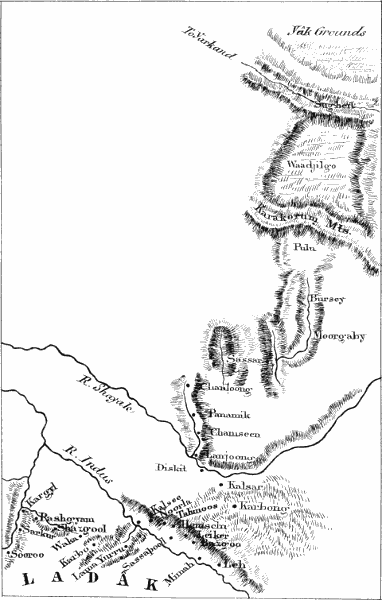
valley in which is situated Sooroo and its fort. A few hamlets are
scattered here and there on the lower and level slopes nearer the river.
The fort is a square with four small corner turrets. Some half-dozen
sepoys hold watch and ward there, I believe.
The sun was very powerful. It was a new atmosphere, country, and
people. The country—but that it is mountains, and mountains only,
except the divisions of the mountains which form the valleys—is bare
and uninteresting, the denizens thereof of small stout frame, and
strongly marked Tartar physiognomy—pukka Thibetans.
I paid off the Wurdwan coolies, and proceed to-morrow on the ordinary
'bunderbus' of coolies from stage to stage, except the five entertained
for the campaign.
Browne. Lith. Norwich.
6th July. We were off soon after daylight, following so followers,
scaled the mountain, and so commanded the fortress below. Then, a few
musket shots being fired, the valiant Bhooties fled manfully.
Under the young trees on an island, gained by stepping stones, I
halted to breakfast. Pleased with the picturesque aspect, the cool
shade, and fresh moist air, I determined to rest till the sun's abated
heat rendered trudging less disagreeable. In the course of the day my
attendants passed on; and in due time we also toiled up the zigzag
path to the old fort, and travelling over a very stony valley, with a
patch of cultivation here and there, reached our quarters, a charming
spot for these barbarous regions, a considerable expanse of richly
cultivated land, the crops now forward and high.
The mountains here receding yield a large space for cultivation, of
which the inhabitants have availed themselves to the utmost, running
their fields and terraces high up the steep slopes, and by means
of conduits, ingeniously and laboriously constructed, contrive to
compel reluctant nature to bring forth abundant vegetation. The whole
landscape is dotted with fine willow trees of large growth, and lines
of them flourish thickly planted along the watercourses. And, greatly
adding to the beauty and charm of these attractive hamlets, are found a
profusion of wild roses, single-blossomed like our red dog-rose, but of
powerful perfume. These delicious shrubs line many of the channels for
irrigation, reminding one of many a village lane in a far distant land.
The houses of these rude people—rude only in their condition,
otherwise personally civil—are rough solid structures of stone,
flat-roofed, with a mere hole for a window which, like the door, is
closed by a wattled shutter. On the roof is stored the highly-valued,
hard-to-be-got supply of fuel, some few fagots, the clippings of the
willows, the only species of tree affording anything like timber, and
of which their entire stock of implements of husbandry and utensils are
formed. Well may they protect and cherish these invaluable trees. They
must have some stringent laws for their preservation, and rules for
their lopping and felling; the latter extreme measure, I believe, being
rarely resorted to, as the branches being lopped, and the very vitals,
as it were, of the trunk pared and scooped out, the frame, just the
cuticle, clings to life, and again does good service, recovering from
its hacking, and putting forth shoots, and putting on branches, times
unreckoned.
My tent was pitched on a patch of beautiful greensward, adjoining a
square stone building of some pretensions in these parts, a sort of
stronghold in days past, and uniting that character with that of a
store for grain in the present day, the Maharajah's dues in the various
produce being gathered in here from the neighbouring districts. There
was but one sepoy here, and a remarkably handsome pleasing-looking
young fellow he was.
If the aspect of the villages at this season is charming, that of
the inhabitants is, and must at all times be, repulsive. Their
features are hideous, excepting an occasional good open forehead, a
redeeming feature, giving a look of intelligence to otherwise brutish
countenances. Their want of attraction is increased by the state of
filth they wallow in. The men are clothed in a sort of loose tunic of
dark brown woollen, felt leggings wound round by garters, and felt
boots with leathern feet. These are large canoe-shaped things, having
no reference to the size or shape of the foot, but are wadded with old
shreds and woollen rags to make them fit. A close-fitting skullcap,
with an upturned rim, crowns their greasy heads. Then, the females—can
they be the fair sex, these hideous specimens of creation human?
They wear, also, a dark woollen tunic reaching to the knees, with
continuations of the same materials. As far as I have seen they have
no head covering, but wear their greasy hair in plaits and tresses,
and actually adorn their chevelure with the wild flowers, roses, &c.,
with all the vanity that might an European beauty. These ill-placed
ornaments are disposed over either temple. They also wear felt boots;
theirs, as the men's, being wide at top, and reaching above the ancle,
giving to both sexes a clumsiness about the feet, which adds to their
uncouth, ungraceful appearance. Both sexes wear a goat skin with the
hair on, as a cloak. They have some rude gewgaws by way of jewellery;
and where are the females found who have not? The Australian aboriginal
ladies, who may be quoted as in the most humble circumstances, wear
a white bone thrust through the cartilage of the nose-bones, shells,
or stones in their ears—and a dab of raw meat fat, by preference, in
their locks, and think it the 'ne plus ultra' of feminine adornment. It
remains only to note, that so valued and valuable are these creatures
here, that one individual is allotted to two or three husbands—one
wife to a family of brothers—which of itself sufficiently establishes
their utter barbarism.
A young official, a Cashmiri, the moonshi of the Sooroo kardar, had
come on with us to make the necessary arrangements for coolies and
tattoos. One of the latter had been provided for me to-day, but looked
such a woe-begone thing that I did not like to entrust it with my
person, somewhat too weighty for such a bit of a steed; so I trudged
it out. But, feeling considerable fatigue and soreness of foot from
the long rough journey, I assented to a tattoo being provided for the
morrow, and several were now paraded for choice, mostly mares with
foals beside them. By the bye, I must note that a mile from Sooroo we
had to cross a torrent—all torrents here—by one of those ingenious
and curious suspension bridges, doubtless the originals from which our
magnificent structures were conceived and framed, made of twigs of
willow woven into ropes, and the ropes into large cables. They are thus
constructed. A pier of stones is built up without mortar, on either
side, close to the water: within the pier are planted two upright stems
of trees about two feet apart, and a transverse one secured on the top,
over which the suspension cables are hauled and strained, and fastened
down by large stones piled on them: the footway is a plait of this
twig work about ten inches wide, suspended from the two side cables
by numerous connecting ropes of like manufacture, of about three feet
depth. One ascends the pile of stones, stooping low, creeps through
the two uprights, and with a hand on each side-cable performs a sort
of acrobatic 'pas' on the slack rope, swinging about uncomfortably.
However, I relished the novelty of the thing, this being the first of
these bridges I had come across. My little dog, Sara, did not relish
it at all, but, having assayed a step or two, retreated in a very
ridiculous, nervous manner, and was then ignominiously carried over,
enveloped in a cloth, on the sepoy's shoulders, whence he anxiously
watched the passage. And how he did skip and jump, when he was safe
over!
I must also remember to note that many birds of European kinds were met
with, some of which I had not found before, as magpies, and the pretty
little goldfinch. There are larks too, which are common enough, and
enliven these regions with their merry notes, warbling until quite dark
at evening, and again, ere coming day, cheering one with their quick
trilling chirp and song. The homely sparrow, too, was present, and
also the solemn old crow. A couple of the former quaint, pert, little
birds attended most familiarly at my dinner, coming fearlessly close to
the table to receive fragments, only temporarily routed by the sudden
desperate onslaughts of Sara at them, who pursued them with relentless
animosity, they just keeping beyond his reach, and again returning when
he, out of breath, was busily occupied with his bone. They were merely
birds attached to the village, quite at large, yet wonderfully tame,
and treating me as an old acquaintance, jumping to catch bits thrown to
them, their bright, little, black eyes glittering and rolling, as they
appeared as though they were saucily winking at me—the jolly old birds!
The name of this village was Sarkur, as near as I can define the sound.