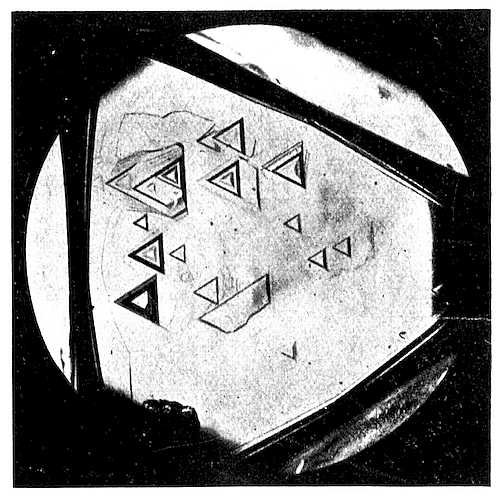
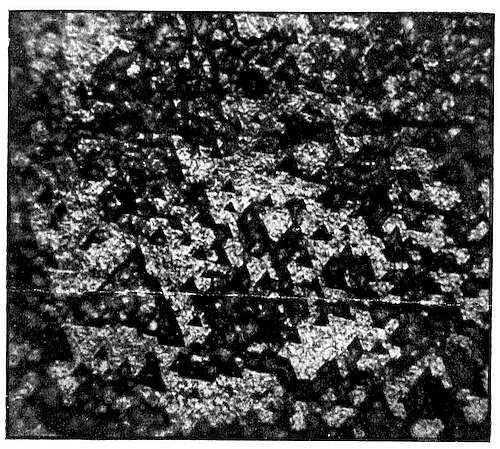
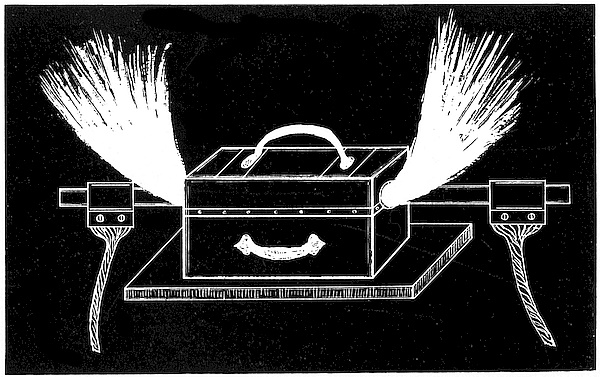
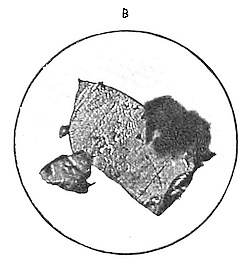
I need scarcely say the diamond is
almost pure carbon, and it is the hardest
substance in nature.
When heated in air or oxygen to a temperature
varying from 760° to 875° C.,
according to its hardness, the diamond
burns with production of carbonic acid.
It leaves an extremely light ash, sometimes
retaining the shape of the crystal, consisting
of iron, lime, magnesia, silica, and titanium.
In boart and carbonado the amount of ash
sometimes rises to 4 per cent, but in clear
crystallised diamonds it is seldom higher
than 0·05 per cent. By far the largest
constituent of the ash is iron.
The following table shows the temperatures
of combustion in oxygen of different
kinds of carbon:
| °C. |
| Condensed vapour of carbon | 650 |
| Carbon from sugar, heated in an electrical furnace | 660 |
| Artificial graphites, generally | 660 |
| Graphite from ordinary cast-iron | 670 |
| Carbon from blue ground, of an ochre colour | 690 |
| Carbon from blue ground, very hard and black | 710 |
| Diamond, soft Brazilian | 760 |
| Diamond, hard Kimberley | 780 |
| Boart from Brazil | 790 |
| Boart from Kimberley | 790 |
| Boart, very hard, almost impossible to cut | 900 |
Diamonds vary considerably in hardness,
and even different parts of the same crystal
differ in their resistance to cutting and
grinding.
Beautifully white diamonds have been
found at Inverel, New South Wales, and
from the rich yield of the mine and the
white colour of the stones great things were
expected. In the first parcel which came to
England the stones were found to be so
much harder than South African diamonds
that it was at first feared they would be
useless except for rock-boring purposes.
The difficulty of cutting them disappeared
with improved appliances, and they now are
highly prized.
The famous Koh-i-noor, when being cut
into its present form, showed a notable
variation in hardness. In cutting one of
the facets near a yellow flaw, the crystal
became harder and harder the further it
was cut, until, after working the mill for six
hours at the usual speed of 2400 revolutions
a minute, little impression was made. The
speed was increased to more than 3000,
when the work slowly proceeded. Other
portions of the stone were found to be comparatively
soft, and became harder as the
outside was cut away.
The intense hardness of the diamond can
be illustrated by the following experiment.
On the flattened apex of a conical block of
steel place a diamond, and upon it bring down
a second cone of steel. On forcing together
the two steel cones by hydraulic pressure
the stone is squeezed into the steel blocks
without injuring it in the slightest degree.
In an experiment I made at Kimberley
the pressure gauge showed 60 atmospheres,
and the piston being 3·2 inches diameter,
the absolute pressure was 3·16 tons, equivalent
on a diamond of 12 square mm. surface
to 170 tons per square inch of diamond.
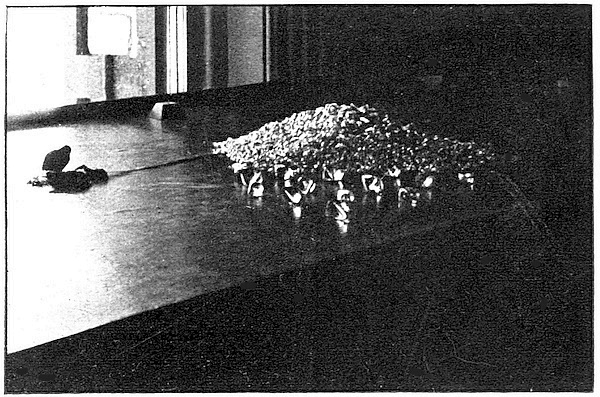
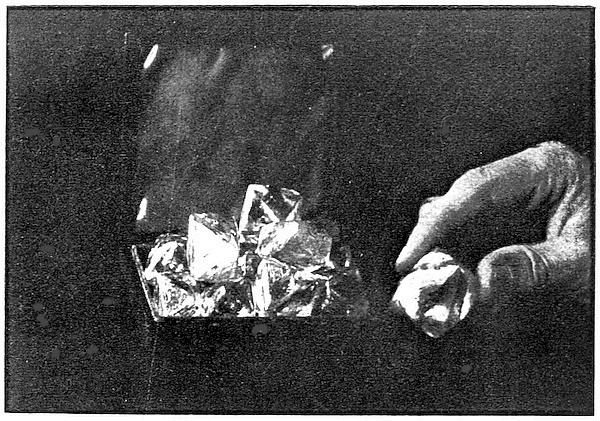
The use of diamond in glass-cutting I
need not dwell on. So hard is diamond in
comparison to glass, that a suitable splinter
of diamond will plane curls off a glass plate
as a carpenter’s tool will plane shavings off
a deal board. The illustration (Fig. 17)
shows a few diamond-cut glass shavings.
The specific gravity of the diamond varies
ordinarily from 3·514 to 3·518. For comparison,
I give in tabular form the specific
gravities of the different varieties of carbon
and of the minerals found on the sorting
tables:
| SPECIFIC |
| GRAVITY. |
| Amorphous carbon | 1·45 – | 1·70 |
| Hard gas coke | | 2·356 |
| Hard graphite | | 2·5 |
| Quartzite and granite | | 2·6 |
| Beryl | | 2·7 |
| Mica | | 2·8 |
| Hornblende | | 3·0 |
| Boart | 3·47 – | 3·49 |
| Carbonado | | 3·50 |
| Diamond | 3·514 – | 3·518 |
| Garnet | | 3·7 |
| Corundum | | 3·8 |
| Zircon | | 4·4 |
| Barytes | | 4·5 |
| Chrome and titanic iron ore | | 4·7 |
| Magnetite | | 5·0 |
There is a substance, the double nitrate
of silver and thallium, which, while solid
at ordinary temperatures, liquefies at 75° C.
and then has a specific gravity of 4·5. Admixture
with water lowers the density to
any desired point.
If a glass cell is taken containing this
liquid diluted to a density of about 3·6, and
in it is thrown pieces of the above-named
minerals, all those whose density is lower
than 3·6 will rise to the surface, while the
denser minerals will sink. If now a little water
is carefully added with constantly stirring
until the density of the liquid is reduced
to that of the diamond, the heterogeneous
collection sorts itself into three parts. The
graphite, quartz, beryl, mica, and hornblende
rise to the surface; the garnet,
corundum, zircons, etc., sink to the bottom,
while the diamonds float in the middle of
the liquid. With a platinum landing-net I
can skim off the swimmers and put them into
one dish; with the same net I can fish out
the diamonds and put them in a second dish,
while by raising a sieve at the bottom I can
remove the heavy minerals and put them
into a third. The accurate separation of
diamonds from the heterogeneous mixture
can be effected in less time than is taken to
describe the experiment.
The table shows that diamonds vary somewhat
in density among themselves, between
narrow limits. Occasionally, however, diamonds
overpass these figures. Here is an
illustration. In a test-tube of the same
dense liquid are three selected diamonds.
One rises to the top, another floats uncertain
where to settle, rising and falling as the
temperature of the sorting liquid is raised
or lowered, whilst the third sinks to the
bottom. Allowing the liquid to cool a
degree or two slightly increases the density
and sends all three to the surface.
After exposure for some time to the sun
many diamonds glow in a dark room.
Some diamonds are fluorescent, appearing
milky in sunlight. In a vacuum, exposed
to a high-tension current of electricity,
diamonds phosphoresce of different colours,
most South African diamonds shining with a
bluish light. Diamonds from other localities
emit bright blue, apricot, pale blue, red,
yellowish green, orange, and pale green
light. The most phosphorescent diamonds
are those which are fluorescent in the sun.
One beautiful green diamond in the writer’s
collection, when phosphorescing in a good
vacuum, gives almost as much light as a
candle, and you can easily read by its rays.
But the time has hardly come when diamonds
can be used as domestic illuminants!
The emitted light is pale green, tending to
white, and in its spectrum, when strong,
can be seen bright lines, one at about
λ 5370 in the green, one at λ 5130 in the
greenish blue, and one at λ 5030 in the blue.
A beautiful collection of diamond crystals
belonging to Professor Maskelyne phosphoresces
with nearly all the colours of the rainbow,
the different faces glowing with different
shades of colour. Diamonds which phosphoresce
red generally show the yellow
sodium line on a continuous spectrum. In
one Brazilian diamond phosphorescing a
reddish-yellow colour I detected in its spectrum
the citron line characteristic of yttrium.
The rays which make the diamond phosphoresce
are high in the ultra-violet. To
illustrate this phosphorescence under the
influence of the ultra-violet rays, arrange a
powerful source of these rays, and in front
expose a design made up of certain minerals,
willemite, franklinite, calcite, etc.—phosphorescing
of different colours. Their brilliant
glow ceases entirely when a thin piece
of glass is interposed between them and the
ultra-violet lamp.
I now draw attention to a strange property
of the diamond, which at first sight
might seem to discount the great permanence
and unalterability of this stone. It has been
ascertained that the cause of phosphorescence
is in some way connected with the
hammering of the electrons, violently driven
from the negative pole on to the surface of
the body under examination, and so great is
the energy of the bombardment, that impinging
on a piece of platinum or even
iridium, the metal will actually melt. When
the diamond is thus bombarded in a radiant
matter tube the result is startling. It not
only phosphoresces, but becomes discoloured,
and in course of time becomes black on the
surface. Some diamonds blacken in the
course of a few minutes, while others require
an hour or more to discolour. This
blackening is only superficial, and although
no ordinary means of cleaning will remove
the discolouration, it goes at once when the
stone is polished with diamond powder.
Ordinary oxidising reagents have little or
no effect in restoring the colour.
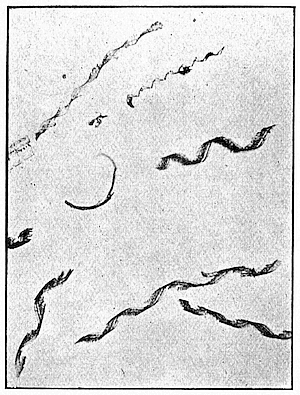
FIG. 17. DIAMOND-CUT GLASS AND SHAVINGS.
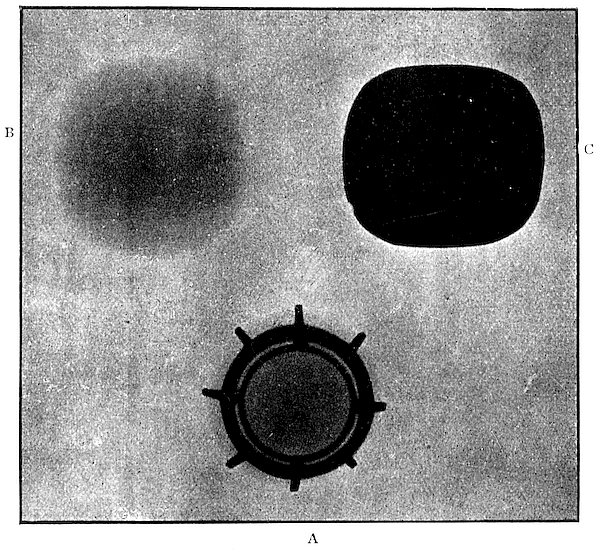
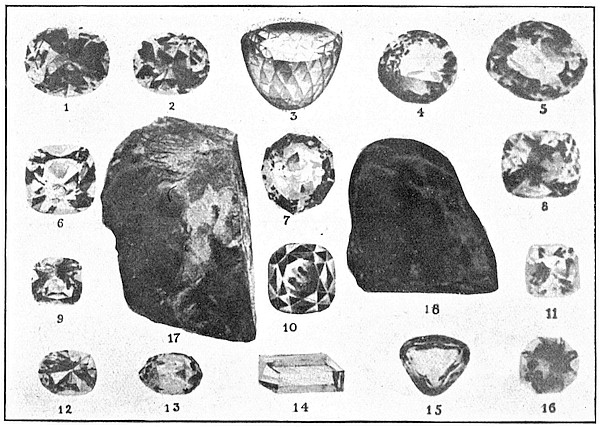
FIG. 18. DIAMONDS IN RÖNTGEN RAYS.
A. BLACK DIAMOND IN GOLD FRAME.
B. PINK DELHI DIAMOND.
C. PASTE IMITATION OF B.
To face p. 98.
The superficial dark coating on a diamond
after exposure to molecular bombardment
I have proved to be graphite. M. Moissan
has shown that this graphite, on account of
its great resistance to oxidising reagents,
cannot have been formed at a lower temperature
than 3600° C.
It is thus manifest that the bombarding
electrons, striking the diamond with enormous
velocity, raise the superficial layer to
the temperature of the electric arc and turn
it into graphite, whilst the mass of diamond
and its conductivity to heat are sufficient to
keep down the general temperature to such
a point that the tube appears scarcely more
than warm to the touch.
A similar action occurs with silver, the
superficial layers of which can be raised to
a red heat without the whole mass becoming
more than warm.
Although we cannot convert graphite
into diamond, we can change the diamond
into graphite. A clear crystal of diamond
is placed between two carbon poles, and
the poles with intervening diamond are
brought together and an arc formed between.
The temperature of the diamond rapidly
rises, and when it approaches 3600° C., the
vaporising point of carbon, it breaks down,
swells, and changes into black and valueless
graphite.
A few minerals give out light when rubbed.
In the year 1663 the Hon. Robert Boyle
read a paper before the Royal Society,
in which he described several experiments
made with a diamond which markedly
showed tribo-luminescence. As specimens
of tribo-luminescent bodies I may instance
sphalerite (sulphide of zinc), and an artificial
sphalerite, which is even more responsive
to friction than the native sulphide.[6]
Mrs. Kunz, wife of the well-known New
York mineralogist, possesses, perhaps, the
most remarkable of all phosphorescing
diamonds. This prodigy diamond will
phosphoresce in the dark for some minutes
after being exposed to a small pocket electric
light, and if rubbed on a piece of cloth a long
streak of phosphorescence appears.
On passing a ray of light through a diamond
and examining it in a spectroscope,
Walter has found in all colourless brilliants
of over 1 carat in weight an absorption
band at wave-length 4155 (violet). He
ascribes this band to an impurity and suggests
it may possibly be due to samarium.
Three other fainter lines were detected in
the ultra-violet by means of photography.
But it is not the hardness of the diamond
so much as its optical qualities that make
it so highly prized. It is one of the most
refracting substances in nature, and it also
has the highest reflecting properties. In
the cutting of diamonds advantage is
taken of these qualities. When cut as a
brilliant the facets on the lower side are
inclined so that light falls on them at an
angle of 24° 13´, at which angle all the
incident light is totally reflected. A well-cut
brilliant should appear opaque by
transmitted light except at a small spot in
the middle where the table and culet are
opposite. All the light falling on the front
of the stone is reflected from the facets, and
the light passing into the diamond is reflected
from the interior surfaces and refracted
into colours when it passes out into
the air, giving rise to the lightnings, the
effulgence, and coruscations for which the
diamond is supreme above all other gems.
The following table gives the refractive
indices of diamonds and other bodies:
| Refractive Indices for the D Line |
| Chromate of lead | 2·50–2·97 |
| Diamond | 2·47–2·75 |
| Phosphorus | 2·22 |
| Sulphur | 2·12 |
| Ruby | 1·78 |
| Thallium glass | 1·75 |
| Iceland spar | 1·65 |
| Topaz | 1·61 |
| Beryl | 1·60 |
| Emerald | 1·59 |
| Flint glass | 1·58 |
| Quartz | 1·55 |
| Canada balsam | 1·53 |
| Crown glass | 1·53 |
| Fluor-spar | 1·44 |
| Ice | 1·31 |
In vain I have searched for a liquid of the
same refraction as diamond. Such a liquid
would be invaluable to the merchant, as on
immersing a stone the clear body would
absolutely disappear, leaving in all their
ugliness the flaws and black specks so frequently
seen even in the best stones.
Having no double refraction, the diamond
should not act on polarised light. But as is
well known, if a transparent body which
does not so act is submitted to strain of an
irregular character it becomes doubly refracting,
and in the polariscope reveals the
existence of the strain by brilliant colours
arranged in a more or less defined pattern,
according to the state of tension in which
the crystal exists. I have examined many
hundred diamond crystals under polarised
light, and with few exceptions the colours
show how great is the strain to which some
of them are exposed. On rotating the
polariser, the black cross most frequently
seen revolves round a particular point in
the inside of the crystal; on examining
this point with a high power we sometimes
see a slight flaw, more rarely a minute
cavity. The cavity is filled with gas at
enormous pressure, and the strain is set up
in the stone by the effort of the gas to
escape. I have already said that the great
Cullinan diamond by this means revealed a
state of considerable internal stress and
strain.
So great is this strain of internal tension
that it is not uncommon for a diamond to
explode soon after it reaches the surface,
and some have been known to burst in the
pockets of the miners or when held in the
warm hand. Large crystals are more liable
to burst than smaller pieces. Valuable
stones have been destroyed in this way, and
it is whispered that cunning dealers are not
averse to allowing responsible clients to
handle or carry in their warm pockets
large crystals fresh from the mine. By
way of safeguard against explosion some
dealers imbed large diamonds in raw potato
to ensure safe transit to England.
The anomalous action which many diamonds
exert on polarised light is not such as
can be induced by heat, but it can easily be
conferred on diamonds by pressure, showing
that the strain has not been produced by
sudden cooling, but by sudden lowering of
pressure.
The illustration of this peculiarity is not
only difficult, but sometimes exceedingly
costly—difficult because it is necessary to
arrange for projecting on the screen the
image of a diamond crystal between the
jaws of a hydraulic press, the illuminating
light having to pass through delicate optical
polarising apparatus—and costly because
only perfectly clear crystals can be used, and
crystals of this character sometimes fly
to pieces as the pressure rises. At first no
colour is seen on the screen, the crystal not
being birefringent. A movement of the
handle of the press, however, gives the
crystal a pinch, instantly responded to by
the colours on the screen, showing the production
of double refraction. Another
movement of the handle brightens the
colours, and a third may strain the crystal
beyond its power of resistance, when the
crystal flies to pieces.
The diamond is remarkable in another
respect. It is extremely transparent to the
Röntgen rays, whereas highly refracting
glass, used in imitation diamonds, is almost
perfectly opaque to the rays. I exposed
for a few seconds over a photographic plate
to the X-rays the large Delhi diamond of
a rose-pink colour weighing 31½ carats, a
black diamond weighing 23 carats, and a
glass imitation of the pink diamond (Fig. 18).
On development the impression where the
diamond obscured the rays was found to be
strong, showing that most rays passed
through, while the glass was practically
opaque. By this means imitation diamonds
can readily be distinguished from true gems.
The β-rays from radium having like
properties to the stream of negative electrons
in a radiant matter tube, it was of
interest to ascertain if they would exert a
like difference on diamond. The diamond
glows under the influence of the β-radiations,
and crushed diamond cemented to a piece
of card or metal makes an excellent screen
in a spinthariscope—almost as good as zinc
sulphide. Some colourless crystals of diamond
were imbedded in radium bromide
and kept undisturbed for more than twelve
months. At the end of that time they were
examined. The radium had caused them
to assume a bluish-green colour, and their
value as “fancy stones” had been increased.
This colour is persistent and penetrates
below the surface. It is unaffected by long-continued
heating in strong nitric acid and
potassium chlorate, and is not discharged
by heating to redness.
To find out if this prolonged contact with
radium had communicated to the diamond
any radio-active properties, six diamonds
were put on a photographic plate and kept
in the dark for a few hours. All showed
radio-activity by darkening the sensitive
plate, some being more-active than others.
Like the green tint, the radio-activity persists
after drastic treatment. To me this proves
that radio-activity does not merely consist
in the adhesion of electrons or emanations
given off by radium to the surface of an
adjacent body, but the property is one
involving layers below the surface, and like
the alteration of tint, is probably closely
connected with the intense molecular excitement
the stone had experienced during its
twelve months’ burial in radium bromide.
A diamond that had been coloured by
radium, and had acquired strong radio-active
properties, was slowly heated to dull
redness in a dark room. Just before visibility
a faint phosphorescence spread over the
stone. On cooling and examining the diamond
it was found that neither the colour nor the
radio-activity had suffered appreciably.
On the average the critical point of a
substance is 1·5 times its absolute boiling-point.
Therefore the critical point of carbon
should be about 5800° Ab. But the absolute
critical temperature divided by the critical
pressure is for all the elements so far examined
never less than 2·5; this being
about the value Sir James Dewar finds for
hydrogen. So that, accepting this, we get
the maximum critical pressure as follows,
viz. 2320 atmospheres:
5800° Ab.
CrP
= 2.5, or CrP =
5800° Ab.
2.5
,
or 2320 atmospheres.
Carbon and arsenic are the only two
elements that have a melting-point above
the boiling-point; and among compounds
carbonic acid and fluoride of silicium are the
only other bodies with similar properties.
Now the melting-point of arsenic is about
1·2 times its absolute boiling-point. With
carbonic acid and fluoride of silicium the
melting-points are about 1·1 times their
boiling-points. Applying these ratios to
carbon, we find that its melting-point would
be about 4400°.
Therefore, assuming the following data:
| Boiling-point | 3870° Ab. |
| Melting-point | 4400° |
| Critical temperature | 5800° |
| Critical pressure | 2320 Ats. |
the Rankine or Van der Waals formula,
calculated from the boiling-point and critical
data, would be as follows:
log. P = 10·11 - 39120/T,
and this gives for a temperature of 4400° Ab.
a pressure of 16·6 Ats. as the melting-point
pressure. The results of the formula are
given in the form of a table:
| Temperature | Pressure |
| Ab. | Ats. |
| 3870° | 1·00 | Boiling-point. |
| 4000° | 2·14 |
| 4200° | 6·25 |
| 4400° | 16·6 | Melting-point. |
| 4600° | 40·4 |
| 4800° | 91·2 |
| 5000° | 193 |
| 5200° | 386 |
| 5400° | 735 |
| 5600° | 1330 |
| 5800° | 2320 | Critical point (15 tons per square inch). |
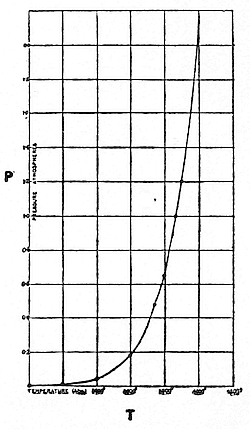
Fig. 19. Curve of Vapour Pressure of Carbon
If, then, we may reason from these rough
estimates, above a temperature of 5800° Ab.
no amount of pressure will cause carbon
vapour to assume liquid form, whilst at
4400° Ab. a pressure of above 17 atmospheres
would suffice to liquefy some of it.
Between these extremes the curve of vapour
pressure is assumed to be logarithmic, as
represented in the accompanying diagram.
The constant 39120 which occurs in the
logarithmic formula enables us to calculate
the latent heat of evaporation. If we assume
the vapour density to be normal, or the
molecule in vapour as C2, then the heat of
volatilisation of 12 grms. of carbon would be
90,000 calories; or, if the vapour is a condensed
molecule like C6, then the 12 grms.
would need 30,000 calories. In the latter
case the evaporation of 1 grm. of carbon
would require 2500 calories, whereas a substance
like zinc needs only about 400
calories.