Obvious typographical errors have been silently corrected. Variations
in hyphenation have been standardised but all other spelling and
punctuation remains unchanged.
Duplication of each chapter heading on a full page before each chapter
has been removed.
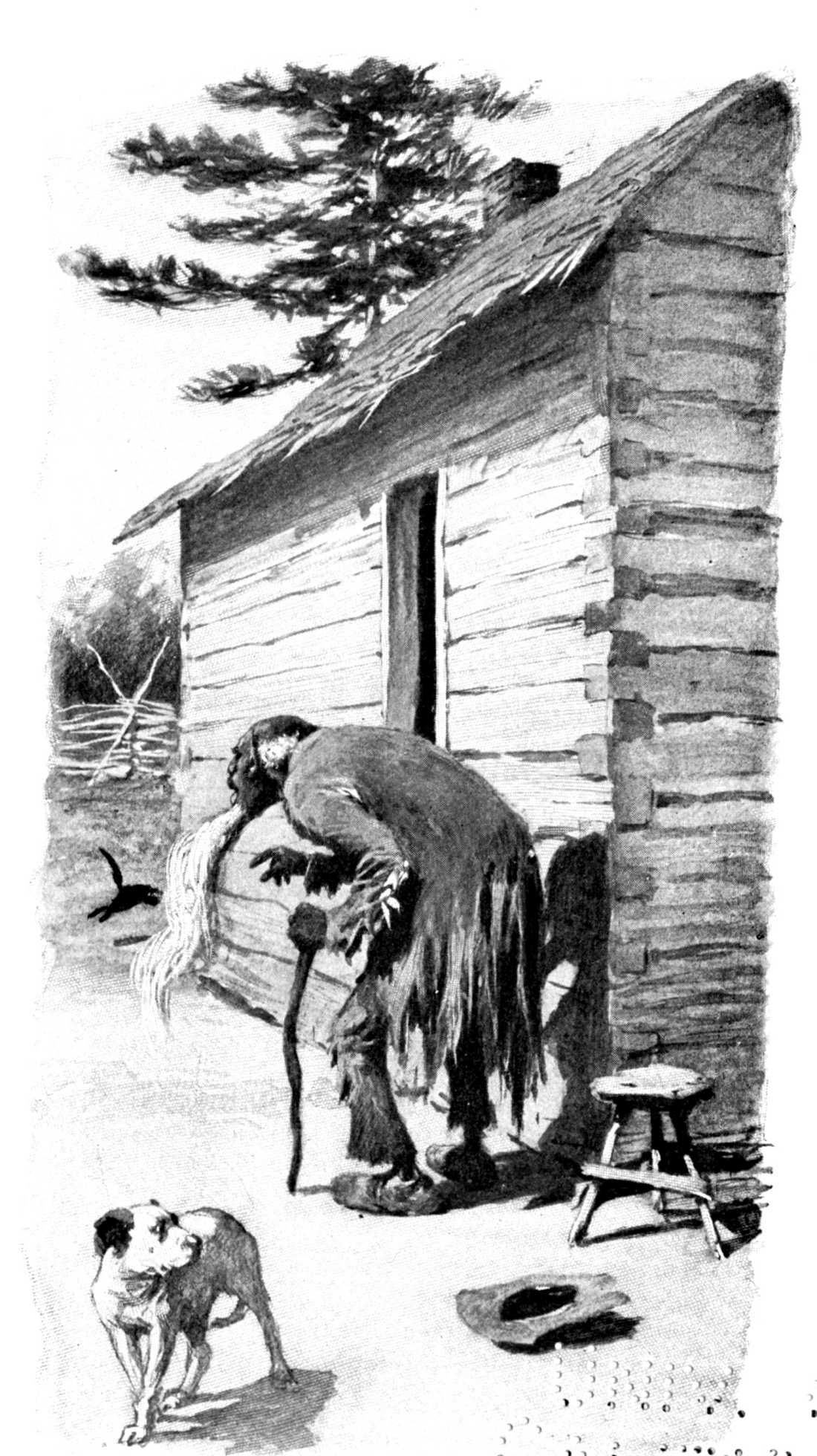
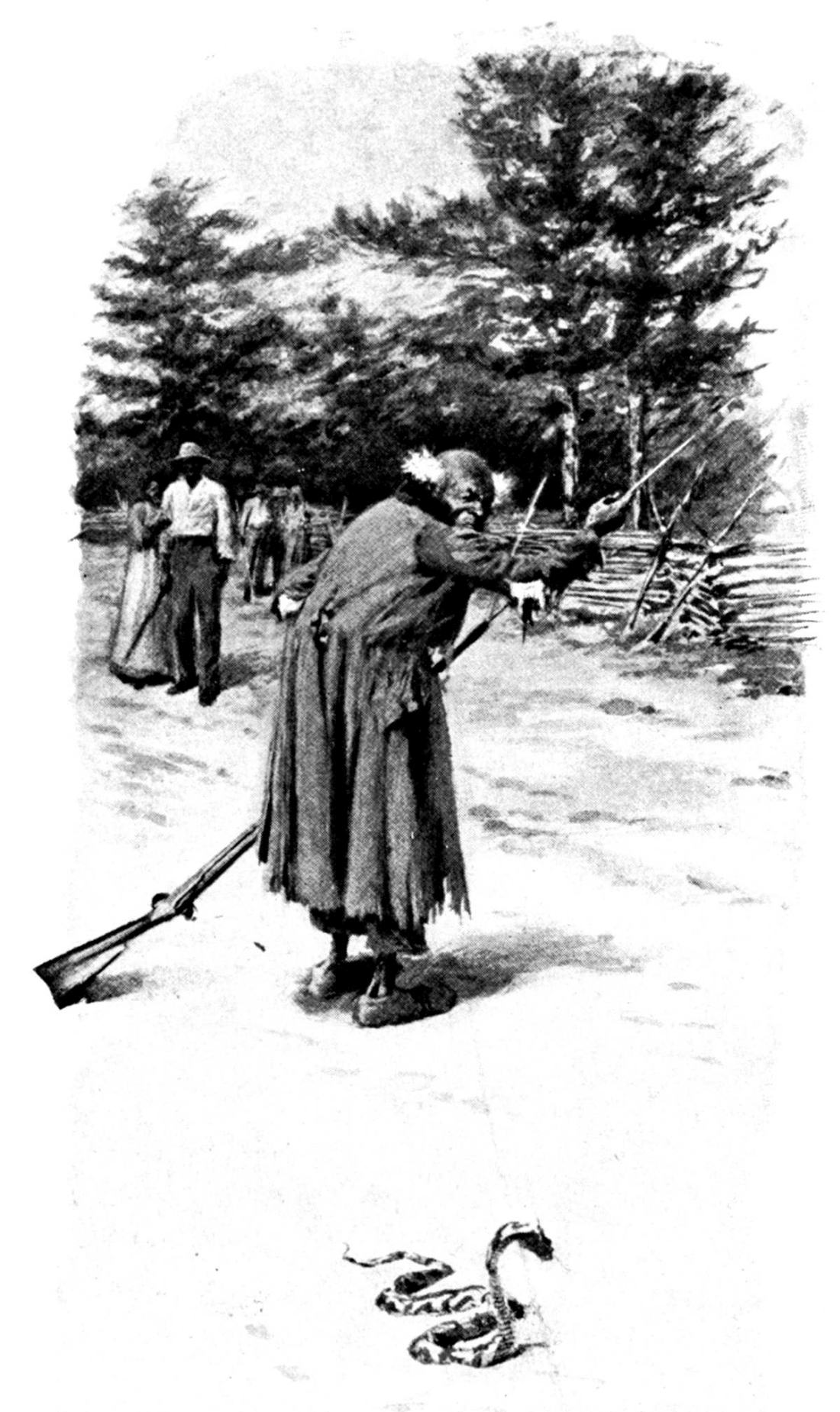
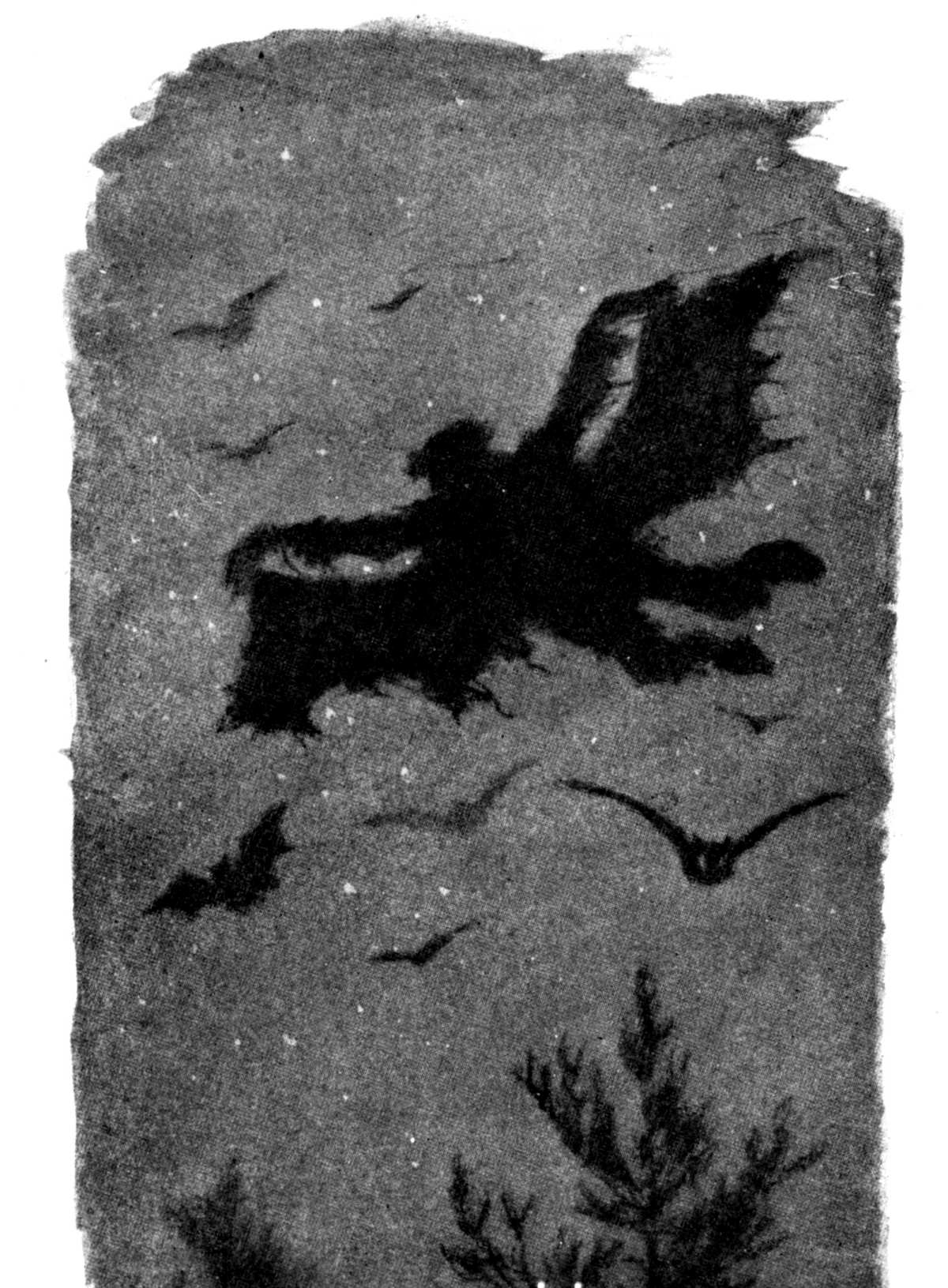
“HE HEAR ALL DE SECRETS ER DER CREEPIN’ THINGS”
[p. 8]
BY Virginia Frazer Boyle
ILLUSTRATED BY
A. B. FROST
NEW YORK AND LONDON
HARPER & BROTHERS
PUBLISHERS MCM
Copyright, 1900, by Harper & Brothers: All rights reserved.
The sunlight drifting through an avenue
of live-oaks sifts dappled gold
upon the well-known gig that has
splashed through miles and miles of the waxy
“buckshot” mud, and now winds slowly up
the driveway to stop before the broad white
pillars of the “Big House.”
A dozen little negroes clamor for the lines,
and with a friendly nod to them the autocrat
of autocrats gives his hand to “Ole Miss,” who
is standing at the open door.
“Ole Marse” sits with him in the library below,
talking in subdued tones and joining now
and again in a familiar julep, brought, at regular
intervals, cold and dewy, by the serving
man, Cæsar. And “Young Marse,” with his
head upon his hand, every nerve strained to
its tension, looks idly through the window
upon the pulsing life without.
Then a feeble wail sets a pace to hurrying
feet and smiling faces as the great bell clangs
in the “Quarters” the coming of “Little Marse.”
But hardly second in importance to the arrival
of the little lord of the domain is the advent
of the Queen of the Nursery, who had been
installed from the “Quarters” many days before;
for on her capacious bosom the baby head
of “Young Marse” had rested, and this, more
than likely, is the third generation of her subjects.
The turbaned head is held high and her
sway is supreme, for no one can do quite so
well for “Baby” when his enemies attack him;
her cup and spoon can usually rout the most
persistent, and hives and whooping-cough fly
ignominiously before her catnip and calimus
tea.
The older children, turned over some time
ago to the good graces of the second nurse,
that “Mammy” might have time to rest, cling
about her chair and pull at her skirts, looking
with jealous eyes upon the tiny bundle that
has usurped the warm nest of her arms, and
when at last the little lord consents to sleep,
and “Mammy” shoos the flies and draws the
bar, the young deposed, of flaxen locks and
blue-checked apron, with sleepy eyes borrows
the nest a while, regardless of the clamor of
the others. “Mammy, tell a tale!”
And “Mammy” tells it; day after day she
pours out the wealth of her inheritance, as her
kindred, the “Mammies” before her, have
done, and these children of children’s children
listen with the same unfeigned delight.
But “Baby” is wearing trousers now—has
attained to the dignity of being called by his
own name, and “Mammy” is back in her
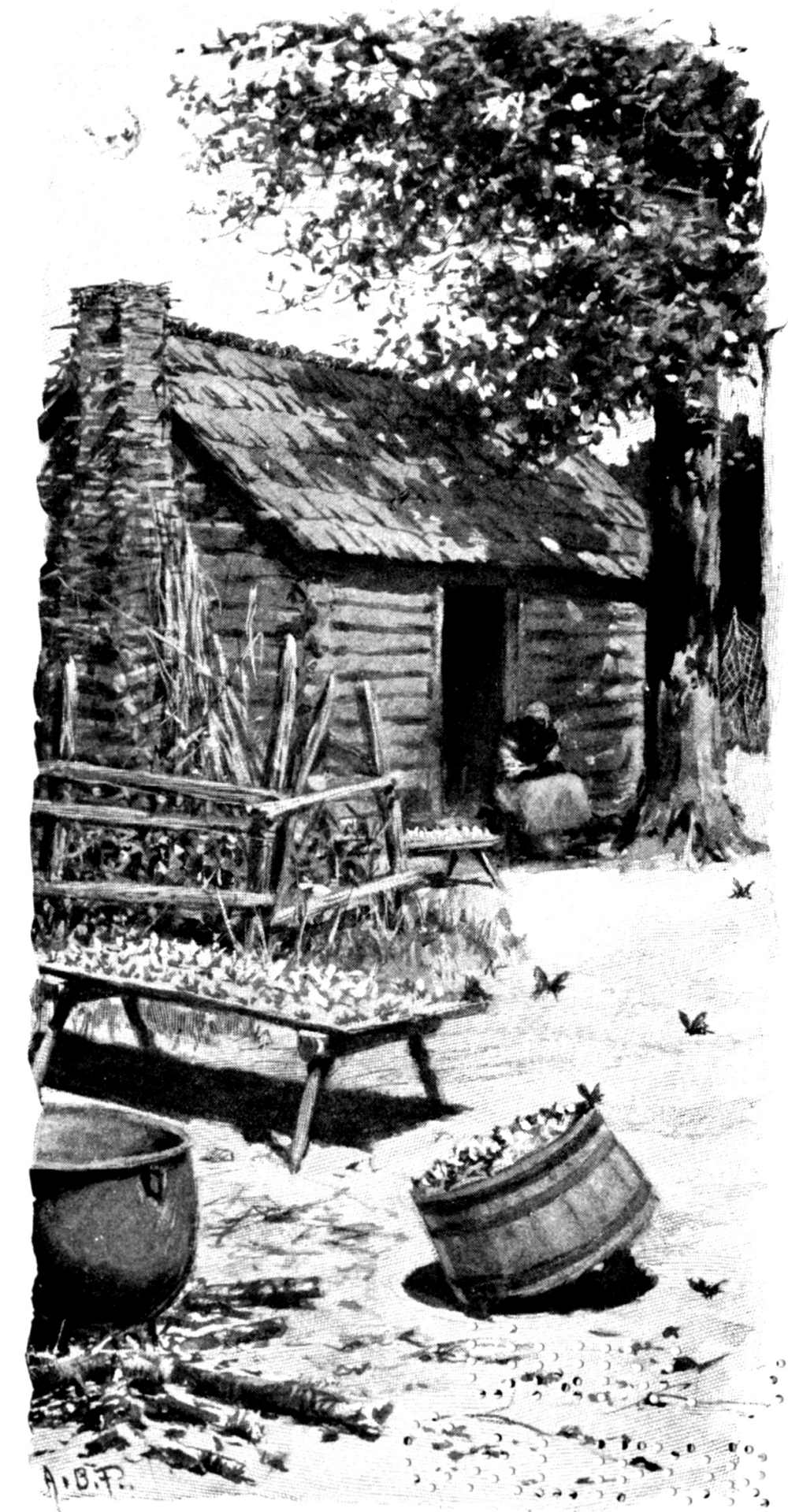
cabin again, that Mecca of childish desire, between
which and the “Big House” a path is
worn by little pilgrims; for if “Mammy” is
ailing there are flannels and loaf-sugar to be
brought, and there are always ash-cakes to
be baked, sweet-potatoes, goobers, chestnuts,
or apples to be roasted by “Mammy’s” hearth,
and, if nothing else offers, even plain buttermilk
off her deal table, drunk from her cracked
blue china bowl, tastes better than any other.
Then, after a season, the stone-bruises, stubbed
toes, and little cut fingers are gone, and
“Mammy’s” roll of old linen, with its familiar
turpentine and sugar, are never now disturbed.
The bewildering mass of curls that only “Mammy’s”
hand could comb without a shower of
tears, together with the dainty buttoned pinafores,
have faded too, somewhere, for the college
days have come and the first love affairs—those
strange, all-absorbing passions—and as
“Mammy’s” lap, with its smooth white apron
and comfortable knees had been the receptacle
of all broken dolls and toys, so “Mammy’s”
ear is the haven of youthful broken hearts, and
the same old stories are tenderly applied for the
mending.
But time ripens, and the roof-tree is shaken
of its fruit. First in joy and first in sorrow, it
is “Mammy” who shrouds the form of “Ole
Miss,” and now she looks longingly into the
past.
A few short years that seem as days, and
“Little Miss” smoothes the folds of “Mammy’s”
black silk, “saved against her burying,”
and pins, through blinding tears, a white
rose above the still heart, and “Mammy’s”
daughter, fat and gentle, with “Mammy’s”
own soft, crooning voice, takes up the cradle
song.
They romped together, these two, beneath
the self-same oaks—“Little Miss” and “Mammy’s”
daughter—but “Little Miss” now wears
a cap (she is “Ole Miss,” too, to some down in
the “Quarters”), and the folds of the other’s
turban are as full of comfortable dignity as the
dusky mother’s were.
“Little Miss,” still sweet and dainty in her
dimity, smiles over her netting and slips the
beads upon the scarlet threads or sorts her
crewels in the shady porch, for at the other
end, just out of sight, the old split-bottomed
hickory chair resumes its familiar “thump”
to the music of a negro voice.
Again it is “the dark of the moon,” and
Satan is abroad in the “Quarters,” and the
good hoodoo who must beat the devil at his
own game is working wonders against him as
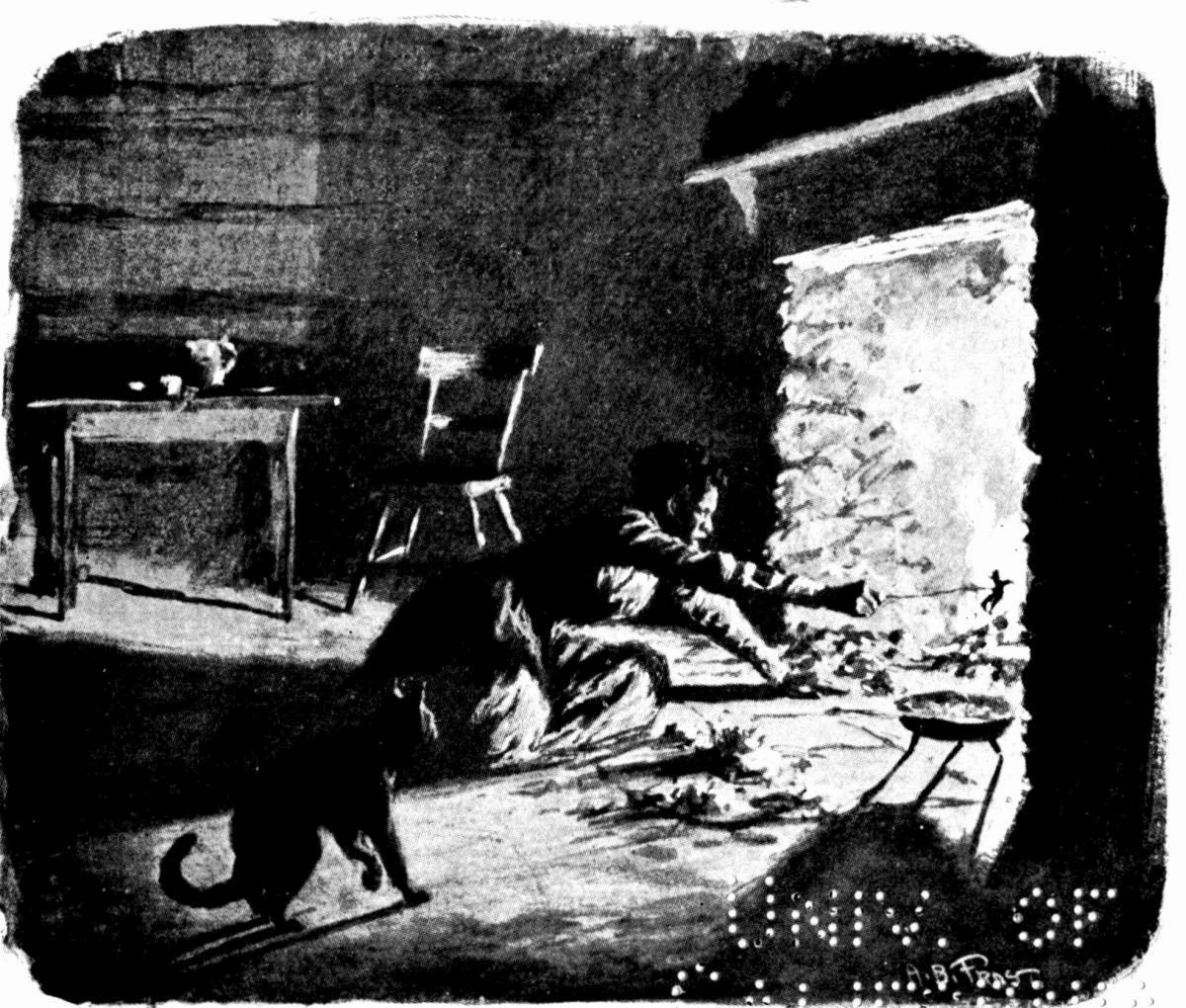
he “splits the wind.” “Ole Cinder Cat” sits
by the hearth nightly, and the “devil’s little
fly” buzzes audibly in wondering childish ears.
The same old stories, ever witching, ever
new, to the same old chorus—“Tell another,
Mammy!”
Another chorus calls to answering silence,
for she is gone. The swaying form, crooning
in low rich voice, like some bronze Homer blind
to letters, a weird primeval lore into the ears
of future orators, is shut within the feudal past
of the old plantation days, for the brown breast
that pillowed its brain and beauty is still forever,
and that South too is dead.
The worn split-bottomed chair is empty, filled
with dust and years, for it is we who seek
to conjure with it now—we who have heard
unwitting at that shrine a classic that America
may call her own.
OLD CINDER CAT
Solon and Juno had quarrelled. Now
a quarrel was not an unusual occurrence
in the Quarters, but Solon and
Juno had been exemplars of conjugal felicity
for nearly eighteen years, and had been held
up to their dusky world as patterns to be zealously
copied.
This unpleasantness, however, had been
brewing for a long time; but hitherto, if one
had lost temper, the other had always prudently
remembered that they were in the fierce light
that beats upon all paragons, and wisely refrained
from adding to the flame. But at last
there was a culmination behind closed doors,
and when Solon and Juno arose at daylight
neither had yielded a single point.
The most mortifying part of the whole proceeding
to Solon was the fact that he had just
“experienced religion,” and this disgraceful
thing coming close upon the second week was
certainly a most painful “falling from grace,”
and he groaned in spirit lest the news should
be noised abroad.
Juno, however, had no such qualms of conscience,
for, though she went to “meeting”
persistently, her service was of the even, regular
variety, and as she was never known to
shout, and had never “come under conviction,”
’Zorter Blalock, newly come into that
fold, took her under especial consideration,
and prayed nightly for “dem needer hot, needer
cole, les’ dey be spit outen de mouf, O Lord!”
Juno raised no question as to the genuineness
of Solon’s religion; but she had her own
grievance against him; for in her old age
Juno had grown jealous; and at last, from
much dwelling upon some recent occurrences
simultaneous with Solon’s profession, Juno
had become suspicious.
Twice of late Solon had asked for a pass to
the adjoining plantation; the last time she
knew he had to swim the creek, for the water
was up, there was no one at the ferry that time
of night, and he couldn’t have taken a mule
without waking John, who was most unobliging
in such matters. Then, more positive proof
than anything else, Solon’s head was very wet
when he came in, along towards day, and he
was very surly when questioned about it.
“Gittin’ ’ligion go mighty hard wid you,
Solon,” said Juno. “Hit keep you outen you’
bed when hones’ folks is all ersleep. You does
lack you tryin’ ter lay er ghos’, ’steader gittin’
peace.”
Juno, typical of her race, and particularly
of her sex, though possessing no occult gifts
of her own, was very superstitious, and, goaded
by her suspicions, resolved to make use of
the simple means within her reach; so, begging
some coffee-grounds of Aunt Susan, the
cook at the Big House, she “turned the three
cups of her fortune,” for she felt that something
was going wrong.
The first and second cups were barren of information,
they represented youth, and the
grounds did not even “wash.” But the third—ah!
she knew it—Solon was deep in mischief,
for this was the way it read:
That spot represented herself. There was
a cross by it; that represented trouble—no,
it did not mean death. That clear space represented
water—the cross pointed that way,
towards the north. Bowen’s plantation was
north: that was where Solon went. Across
the water was another cross—trouble again.
Beyond the cross was an eagle—that meant
luck; but between the cross and the eagle,
close to the cross—in fact, an arm of the cross
pointed right to it—was a (Juno rubbed her
eyes and looked again, then she pulled her
brass specs, which she seldom used, down upon
her nose and took the cup to the window)—was
a woman!
Her hand trembled a little with indecision,
then, forgetful of the borrowed cup, she threw
it into the grove. So the quarrel had come
about without a happy solution of the difficulty,
for Solon sullenly but persistently declared
his innocence of offence, while Juno as persistently
put the question.
Next morning saw the beginning of a series
of omens and disasters, showing that some
dark power was at work, for, without cause
or warning, Juno’s skillet cracked right in
two on the fire before the hoe-cake was done;
Solon’s rooster stood in the doorway and crowed
three times before he could shoo him away;
and a chimney-swallow got into the cabin and
beat its wings bloody against the wall in its
efforts to get out.
A very thoughtful, silent pair joined the
hands in the field that morning, for everything
seemed to be going wrong. Juno got
a “miz’ry in her side” long before noon, and
just as the most unsatisfactory day that they
had ever spent together was closing, a “cotton-mouth”
bit Solon on the heel. Juno ran
to kill a chicken to apply to the wound to draw
out the poison, for she had more faith in the
warm chicken than in Ole Marse’s whiskey,
which was plentifully supplied. She did not
want to see Solon die with, as she said, “a lie
in de mouf”; and, hoping to avert evil, she
killed the very rooster that had crowed so inauspiciously
early in the morning, thus opening
upon her head the vials of Solon’s wrath
when he had recovered from his fright.
“Ju! you done los’ you’ head-piece sho’,
you fool! Hain’t I done gib up all I got ter
git dat dominicker, an’ hain’t got but one, an’
here you go an’ split him up fur er snake-bite
lack any common chick’n! I lay I larn you,
ole ’oman, if I hatter frail you ever’ day ’twix’
now an’ Chris’mus!”
“An’ I lay, if you does, I’ll up an’ tell ’em
in de meetin’ how you done git dat rooster,
Solon!”
Then, to the amazement of both, the story
of the quarrel got out; the faintest whisper
of the midnight was exploited, as it were, upon
the house-tops; wagging heads were turned
and loosened tongues clattered; and at night
Juno quilted in silence, and Solon sought his
religious counsellors without comfort.
So the days passed, and Juno could see that
Solon was perfectly miserable; but he kept
his own counsel, and, despite his vehement
protestations, the visits over the creek continued.
Then Solon fell ill of fever and ague. The
overseer said that the trouble was malarial,
caused by the weekly trips across the bottom,
and refused to grant further passes; but it
was to Parson Blalock that Solon poured out
the burden of his woes.
“I done come ter gib up dat ’ligion. Parson
Blalock”; and Solon yawned and shivered in
the sunshine, for his chill-time was coming on.
“Nebber hab no trouble ner nuffin ail me twel
I git hit, an’ here I gwine chillin’ ever’ udder
day lack er po’ mizerbul lam’ dat done been
drapped too soon. Hit done go too hard wid
me, Parson Blalock, an’ I come ter gib hit
up!”
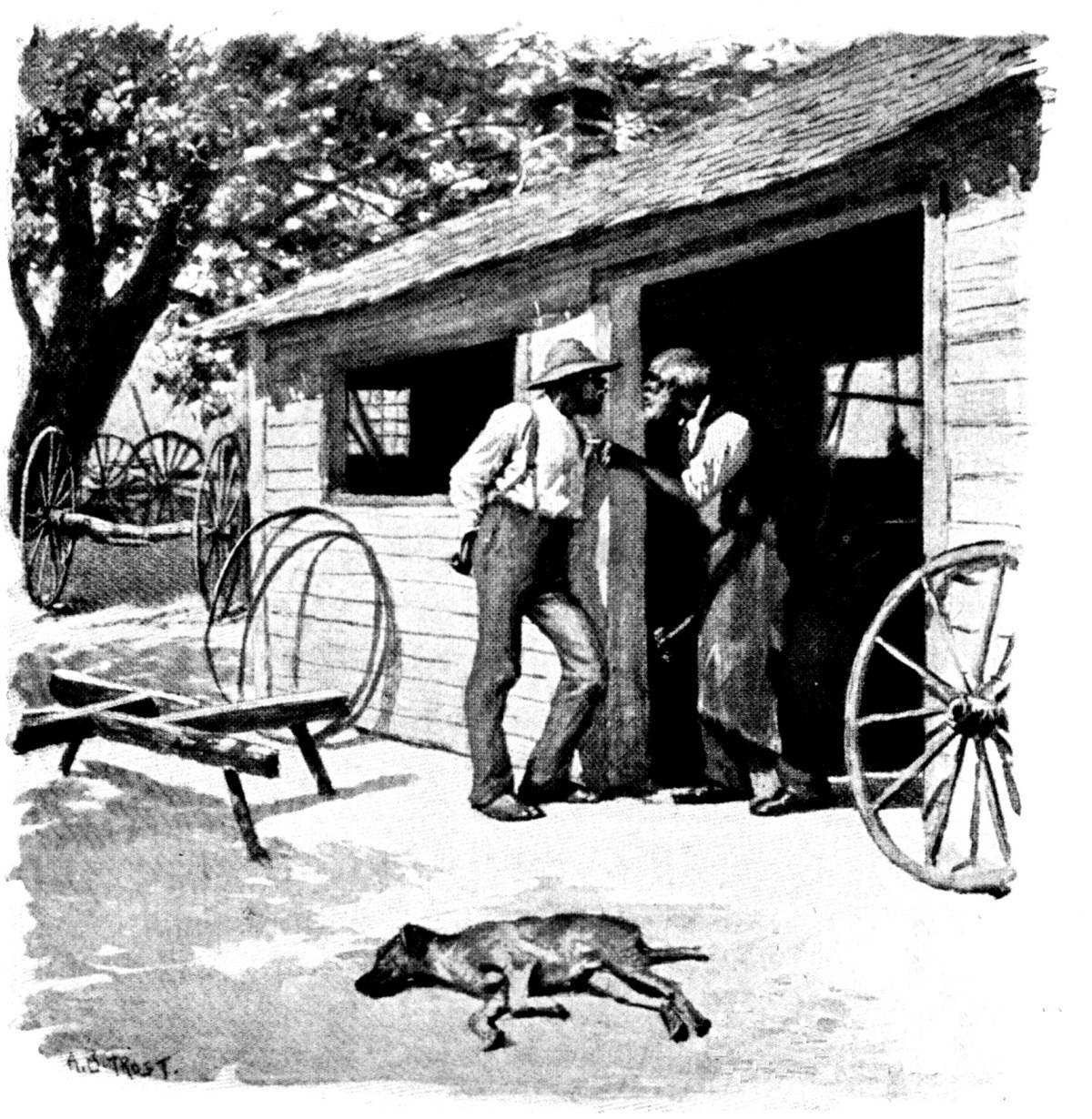
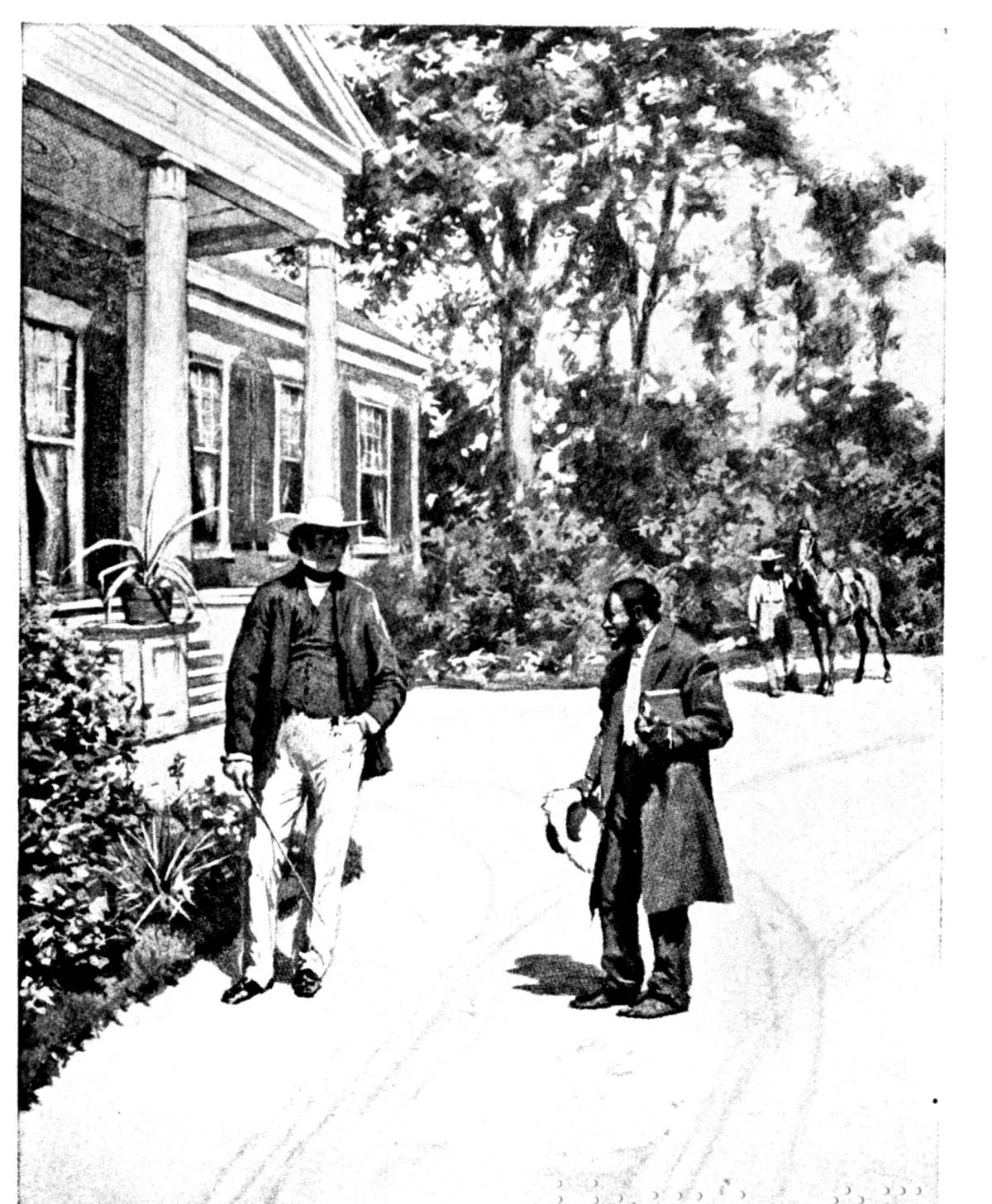
“‘’CASE DE HOODOO AM ’ER ’OMAN’”
The ’zorter and ’spounder scratched his head
thoughtfully, then laid a bar on the anvil—for
Parson Blalock was a blacksmith on weekdays.
“Ter my min’, Brer Solon, you cain’t gib hit
up. Once in de fol’, you b’long ter de fol’; you
cain’t git out; an’ er-doin’ lack you is now, is
how ever’ fol’ done git er black sheep in
hit!”
“Hit hain’t struck in deep yit, an’ I hain’t
got no use fur dat ’ligion, an’ I want ter let
hit go!” moaned Solon.
Parson Blalock had let the iron cool, and,
drawing close to Solon, he whispered: “Hit
hain’t no ’ligion dat wukin’ on you, Brer Solon;
you’s right; you hain’t neber got ernough fur
dat! ’Cordin’ ter de signs er de times, ter my
min’, hit er hoodoo, an’ you better look out fur
her, ’case de hoodoo am er ’oman!”
Solon smiled in a sickly, hopeless way, for
the ague was upon him, and turned away in the
direction of his cabin. But Juno was not there.
Crouching low before the witch-fire of Maum
Ysbel, there had been poured into her ears
enough of misery to last through a whole cycle,
the price of barter having been a coveted china
cup.
There was no light in the cabin, save from
the blue and green flames that were now dying
out, lighting fitfully the features of the toothless,
weazened negress who knelt before it, for
the only opening was barred by a roughhewn
hickory log. On the red coals snake fat and
lizard skin, mixed with some strange, ill-odored
stuff, were merrily bubbling; and the oracle
continued:
“‘Tain’t no use ter try dat cat; hain’t nuffin
but Ole Cinder Cat; you’ll fin’ her bloody bones
hid out somers. Hain’t nuffin but er hoodoo
dat er ridin’ dat cat, des ter ’do’ you wid Solon;
but if yo’ wants ter mek sho’, jes ketch her when
she dozin’ in de ashes an’ put her in de tar bar’l
dar by you’ do’ wid de head druv in, an’ set fire
ter hit. If hit Ole Cinder, you’ll fin’ her, ’dout
eben her tail scotched, er-grinnin’ in de hot
ashes when de fire done die out. If dat happin,
den you gotter ketch her ergin—an’ she’s
gwinter gib you er putty hard run—an’ ’n’int
her hin’ de years wid dis grease; den foller uv
her, an’ tek dis bone wid you—whatebber you
does, don’ lose dis. If she cross de creek, she
gwinter cross by de dry bed, ’case she hain’t
gwinter wet her foots lessen she kin hope hit;
an’ she gotter go mighty fur way up fur ter git
ober dry, so you mought tek sumpen ter eat wid
you. Don’ matter how tired you gits, keep er-foll’in’
de cat, an’ es soon es yo’ git on t’uther
side, mek er cross an’ spit in hit, den rub you’
eyes wid dis bone, an’ tu’n roun’ free times.
Dat ’ll mek de hoodoo gib up de Cinder Cat’s
skin, an’ right dar es you tu’n you’ll see de pusson
dat been mekin’ all dis here trouble ’twix’
you an’ Solon. You’ll know her when yo’ sees
her, but don’ say nuffin ter her but ’Howdy?’
an’ don’ eat nuffin she gib yo’, ’case she mout
’fix’ yo’ lack she do Solon, an’ yo’ cain’t do
nuffin yit. Yo’ gotter wait twel de spring,
when de sap ’ll git up. Don’ yo’ quoil wid
Solon ’twix’ now an’ den; Solon’s er good
man; he wouldn’ be no kin ter me if he wa’n’t!—fur
he’s des hoodooed an’ hain’t ’sponsible.
But soon’s de sap’s riz you git yo’ er good big
piece er green grape-vine an’ lay fur de ’oman,
an’ hit her wid hit unbeknownst; ’case if she
know yo’ arter her, she’ll go er mighty long
piece outen her way ter git shet er yo’, fur de
grape-vine sho’ brek de charm—hain’t no hoodoo
kin mek er stan’ ’gin yo’ if you hit ’em wid
er grape-vine when de sap’s up; but be
mighty sho’ she’s stan’in’ on her own groun’
when yo’ hits her. If yo’ does what I tells
you, gal, dat Solon ’ll come back ter yo’ in er
herry, des es meek an’ peaceable es er lam’.”
Be it far from the chronicler of the Scheherazade
of the nursery to narrate the marital infelicities
of Solon and Juno for the space of nearly
a year, but Mammy solemnly declares that
the Cinder Cat bore the test of the fiery tar, and
sat calmly grinning in the ashes when the flame
had died away; and Juno, remembering the
admonition, anointed the ears of the cat with
Maum Ysbel’s ointment, pleaded illness to the
overseer, and, putting the wonderful bone that
was to give her superhuman sight into her basket,
together with a hoe-cake, she followed Old
Cinder Cat.
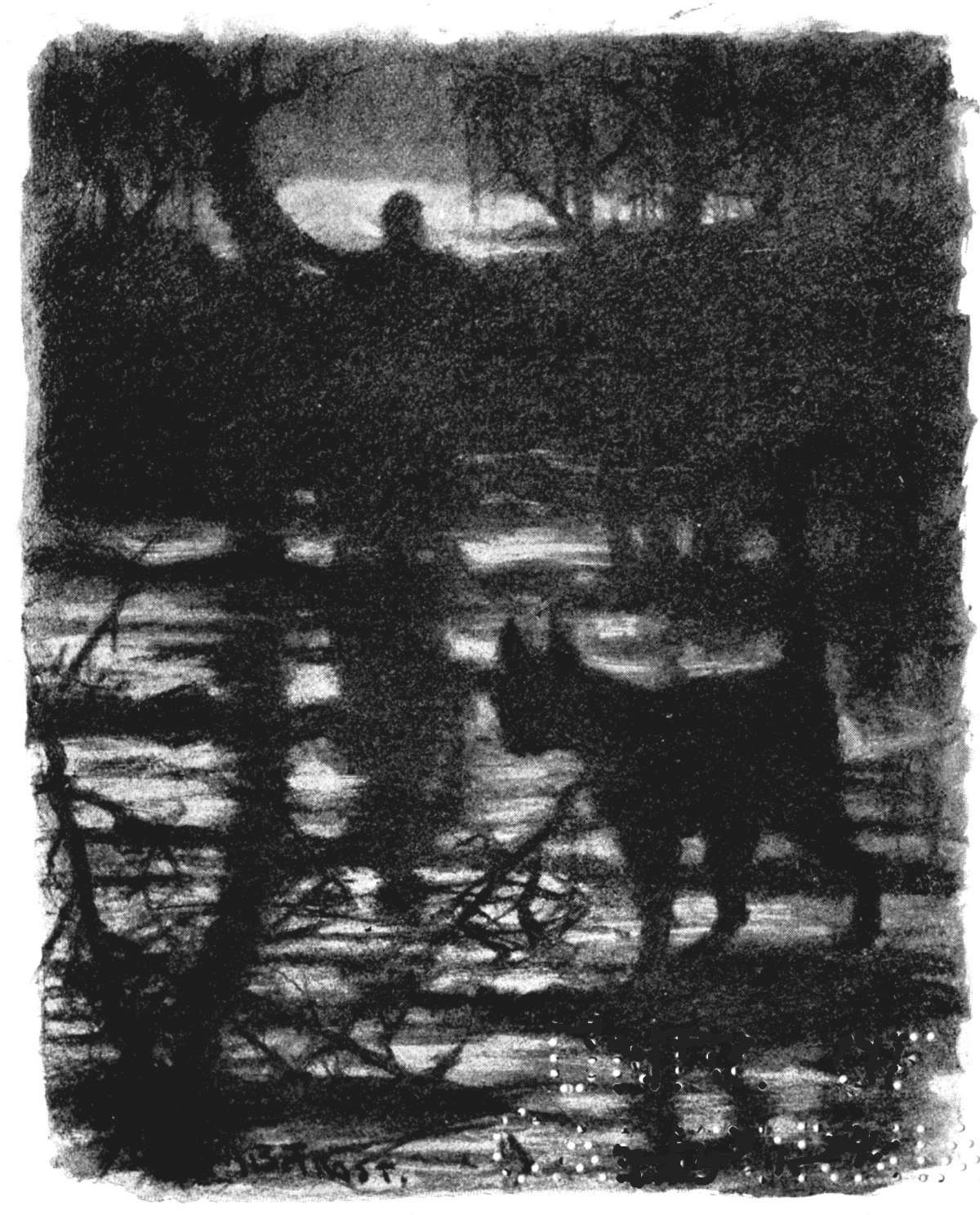
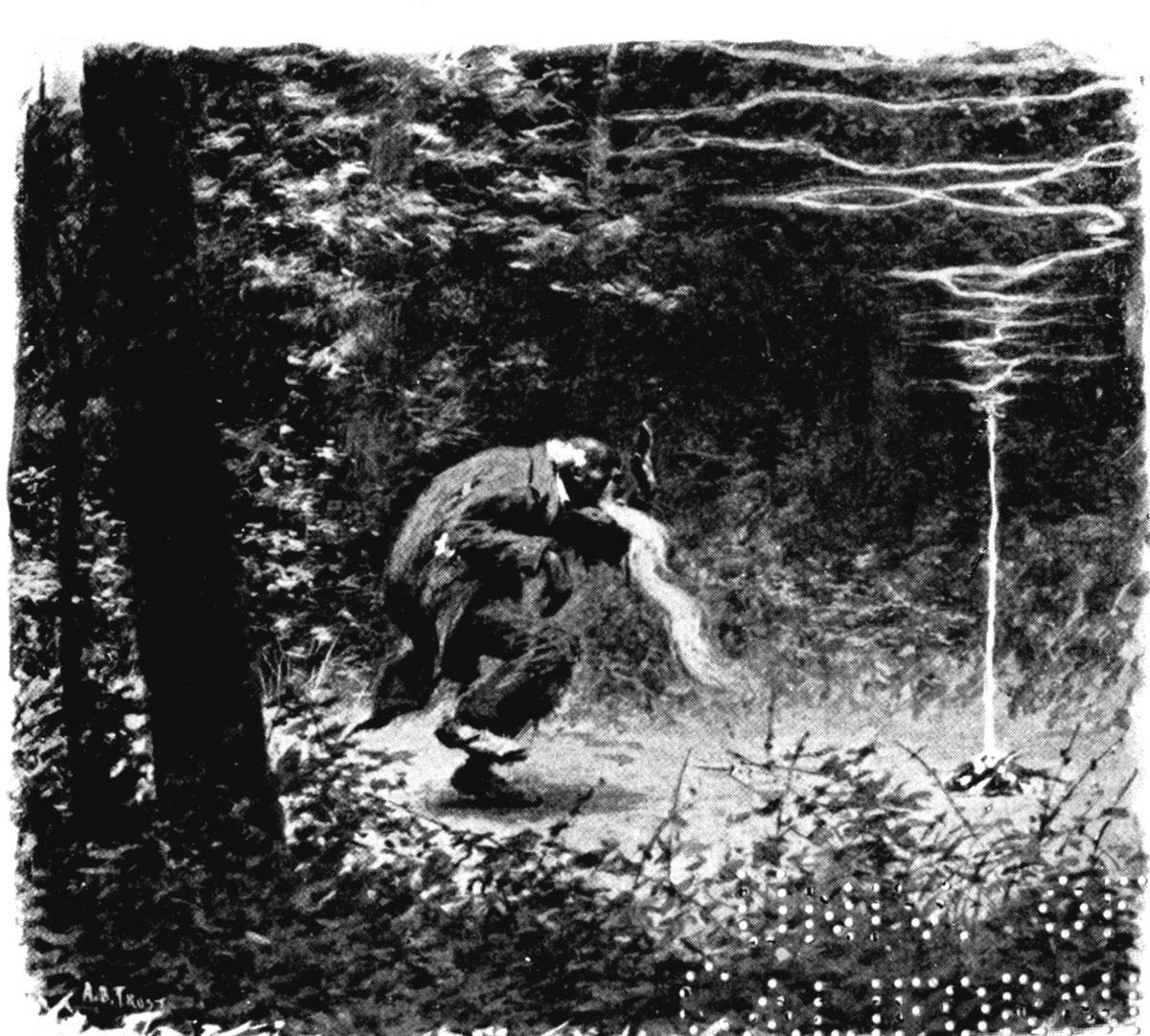
The cat progressed by many devious ways,
giving many an unusual twinge to the rheumatic
limbs, for often Juno had to go on hands
and knees, scratching and tearing her face
as she heard most unholy conversations between
the cat and the cold-blooded things
that creep and thrive in darkness.
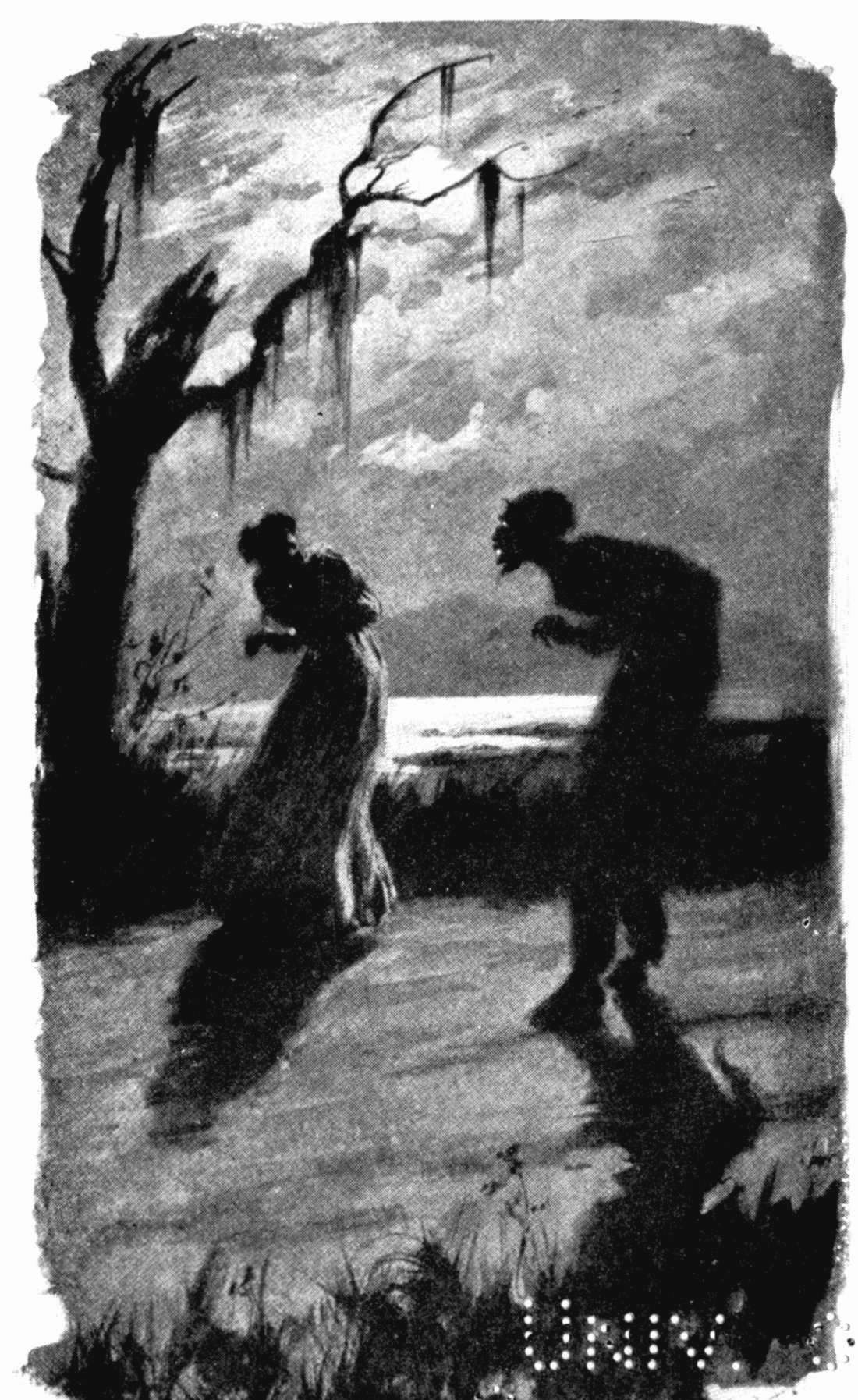
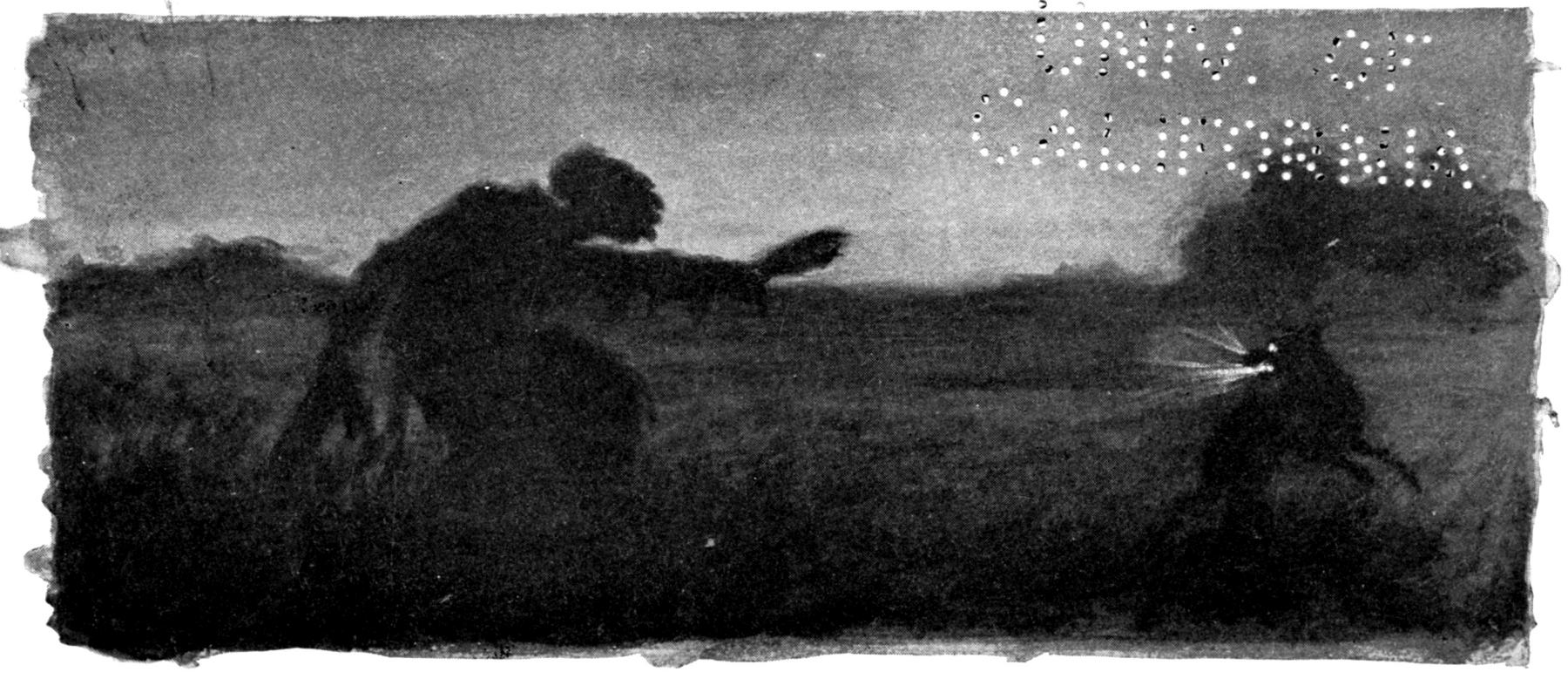
“SHE FOLLOWED OLD CINDER CAT”
But at last the dry bed of the creek was crossed,
and, doing as Maum Ysbel had bidden, Juno
met face to face the comeliest of yellow girls
coming from milking, with her pail upon her
head.
“Howdy?” said Juno.
“Howdy?” rejoined the girl, smiling, as she
offered Juno a tin cup of the milk.
The temptation was sore, for the rough hoe-cake,
eaten in haste without water, had parched
her throat; but, remembering the warning,
Juno swallowed hard.
“Much obleeged, lady, but I hain’t got
time”; and, breathless and bleeding from her
scratches, Juno hurried back to report to Maum
Ysbel.
But the depth of winter was upon the land;
it would be many a day before vegetation would
wake; and Juno, with consuming patience,
bore the vagaries of Solon until the leaves were
born. Twice, in despair, Juno had tapped the
grape-vine, and twice the sap had failed to flow,
but the last straw was broken in this wise:
There was to be a break-down in the Quarters,
to celebrate the breaking of some new
ground on the river-side, that had been deadened
some two years before, and, in accordance
with Ole Marse’s custom, the laborers
were permitted to invite the negroes upon the
adjoining plantation. It was to be a great
event, and Juno was preparing for the same
with great interest, for even flesh and age
could not bare as neat a pair of heels as hers
for certain intricate shuffles, when, all of a sudden,
Solon declared his intention of not attending.
Such a thing had not been known to
happen in the whole course of Solon’s existence.
For two days before the break-down he
claimed that he was sick, and took all of Juno’s
nauseous concoctions without a murmur. Then
he besought Juno not to go to the dance. It
was devil trickery, he said, and it was very
hard on him, as he was trying to keep his religion
that he had gotten so painfully, and the
devil would be sure to follow her home. He proposed
that Juno should remain quietly in the
cabin as usual on the night of the break-down,
as an example to the weaker “professors,” while
he thought it might do him good to pay a dutiful
visit to his old “daddy” across the river—for
Old Marse owned on both sides.
But though Juno physicked her spouse faithfully,
she rebelled against such imposition.
“Um! Ober de ribber you gwine? I lay
you’ daddy hain’t gwine lay eyes on yo’ fur
dis day two weeks. Gittin’ mighty anxious
’bout you’ daddy all uv er suddent! I’se gwine
ter de bre’k-down. I hain’t pestered wid you’
’ligion. Hain’t nuffin de matter wid Juno’s
head ner her heels, sho’ mun!”
But Juno’s heart was not as light as she
made it appear, for she had fretted through a
whole winter and a late spring, and after a restless
night she again invoked the aid of Maum
Ysbel.
“I hain’t got nuffin ter pay yo’ wid, Maumer,
but I’se dat miserbul I hatter come,” said
Juno with a sigh.
The hag ceased stirring the contents of the
little pot, and setting it off on the hearth to cool,
she drew her wrinkled face into many more
wrinkles, and took an inventory of Juno from
head to foot.
“Yas, yo’ is, honey—yas, yo’ is!” and as
she grinned, her solitary tooth was visible in
her glee. “De coat yo’ got on am powerful
ole an’ fady, an’ dat ap’un hain’t no ’count;
yo’ gotter wash hit mighty easy fur ter w’ar hit
one mo’ time; but yo’ got you’ moon year-bobs!”
Juno winced, for those big brass ear-rings
were the pride of her heart; twice her lobes
had been pulled through with the weight of
them, but there was always room for another
piercing.
The old woman leered and nodded. “Yo’
got you’ moon year-bobs, an’ my Becky’s Sairey
been cryin’ uv her eyes out fur ’em ebber sence
she seed ’em!”
“But, Maumer—” expostulated Juno.
“Don’ yo’ ’Maumer’ me!” said the old woman,
crossly. “What you come here ter me
fur if hit hain’t ter fetch dem bobs ter Sairey?
Hain’t I seed yo’ in de coals, ’way ’cross de
fiel’, ’fore yo’ lef’ de cabin, mek up you’ min’
ter fotch dem year-bobs ter Sairey fur what I
gwine tole yo’? What I tells yo’ worf er heap
ter yo’, but hit nuffin ter me. Solon hain’t
my ole man!”
Juno was sick at heart. She had given up
the blue-edged china cup to save Solon, but the
big moon ear-rings were the wealth of her
whole life.
The hoodoo threw a chip at a great toad that
was napping in an old shoe beside the hearth,
and, shaking the ashes from her pipe, she refilled
it from her pocket. “Hain’t nuffin ter ole
Ysbel, gal—her day done ober; she don’ claim
no man, dead ner libin’! But I done tole yo’
’bout dat yaller gal, hain’t I? Yo’ done seed
her wid you’ own eyes, hain’t yo’? An’ I
done tole yo’ how ter git shet uv her. Hain’t
my keerin’, but if yo’ don’ wanter know no mo’
’bout her, yo’ des tote dem moon year-bobs
back home wid yo’!”
Slowly the rings were removed from Juno’s
ears, and the old woman, with a leer, popped
them into her capacious pocket before resuming
her professional attitude.
“Um! um! wall, de sap be up by ter-night,
an’ ter-morrer yo’ play sick an’ cross de ribber,
’case yo’ gotter whup her on her own groun’.
Yo’ cain’t tech her on you’ own, no matter what
happin, ’case she kin ’do’ yo’ den, an’ she’s
de bestes’ hoodoo in dis kentry, ’ceptin’ ole
Ysbel, fur all dat she’s on’y er gal. Don’ yo’
say nuffin ter-night at de bre’k-down, ner do
nuffin, but yo’ gwine ter see sights, if you
does what I tells yo’. Mek lack ter Solon dat
yo’ hain’t gwine sho’ ’nough, dat yo’ ailin’
er sumpen, an’ let him gin out dat he gwine
ter see his daddy. Yo’ lay low twel yo’ hears
dem fiddles des er-talkin’ in de middle er de
night, des ’fore dey sarve de supper; den yo’
tek you’ foot in you’ han’ an’ git down dar;
but don’ yo’ go in, an’ don’ yo’ do nuffin den,
fur hoodoo ’oman hain’t lack odder ’oman, an’
you cain’t git eben wid ’em de same way; but
wait twel hit bre’k up, den cut you’ grape-vine,
an’ den yo’ ’ll run ’gin sumpen in de dark; hit
Ole Cinder Cat. All yo’ hatter do is ter foller
uv her, ’case I’se fixed her so’s she gotter sarve
yo’; an’ den when yo’ sees what yo’ lookin’
fur, lay de grape-vine on, quick an’ fas’, ’case
hain’t nuffin ail Solon but dat yaller hoodoo!”
It was turning twelve when Old Cinder Cat
rose from the hearth, and, stretching herself,
bounded through the doorway. Juno woke
with a start.
“Um! Juno better be gwine too. Mighty
fine business fur her ter be in, long er hoodoos
an’ Ole Cinder, but she sho’ gwine wid ’em dis
time, mun!”
The squeak of the old fiddle under Pompey’s
fingers, mingled with the even patting, was
wafted through the open door. Juno looked
at the height of the moon.
“Hit’s turned midnight now, an’ I’m erg-wine.”
But she first sought the grape-vine by the
spring. The bright moonlight flooded everything
as with the light of day, and, carefully
cutting the vine between certain joints, according
to the formula of Maum Ysbel, Juno hid it
beneath her skirt, and took the little path
towards the sounds of midnight gayety.
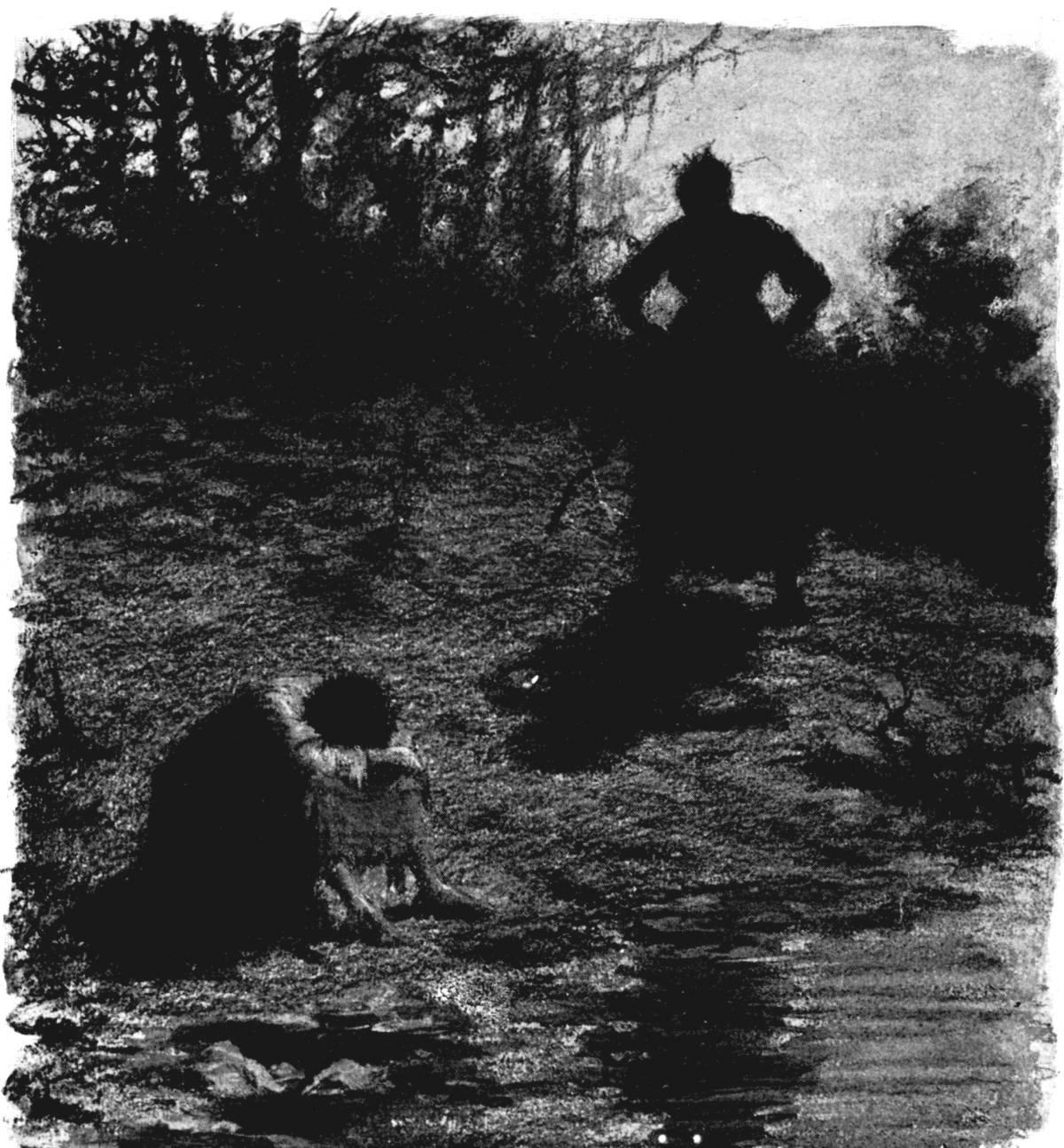
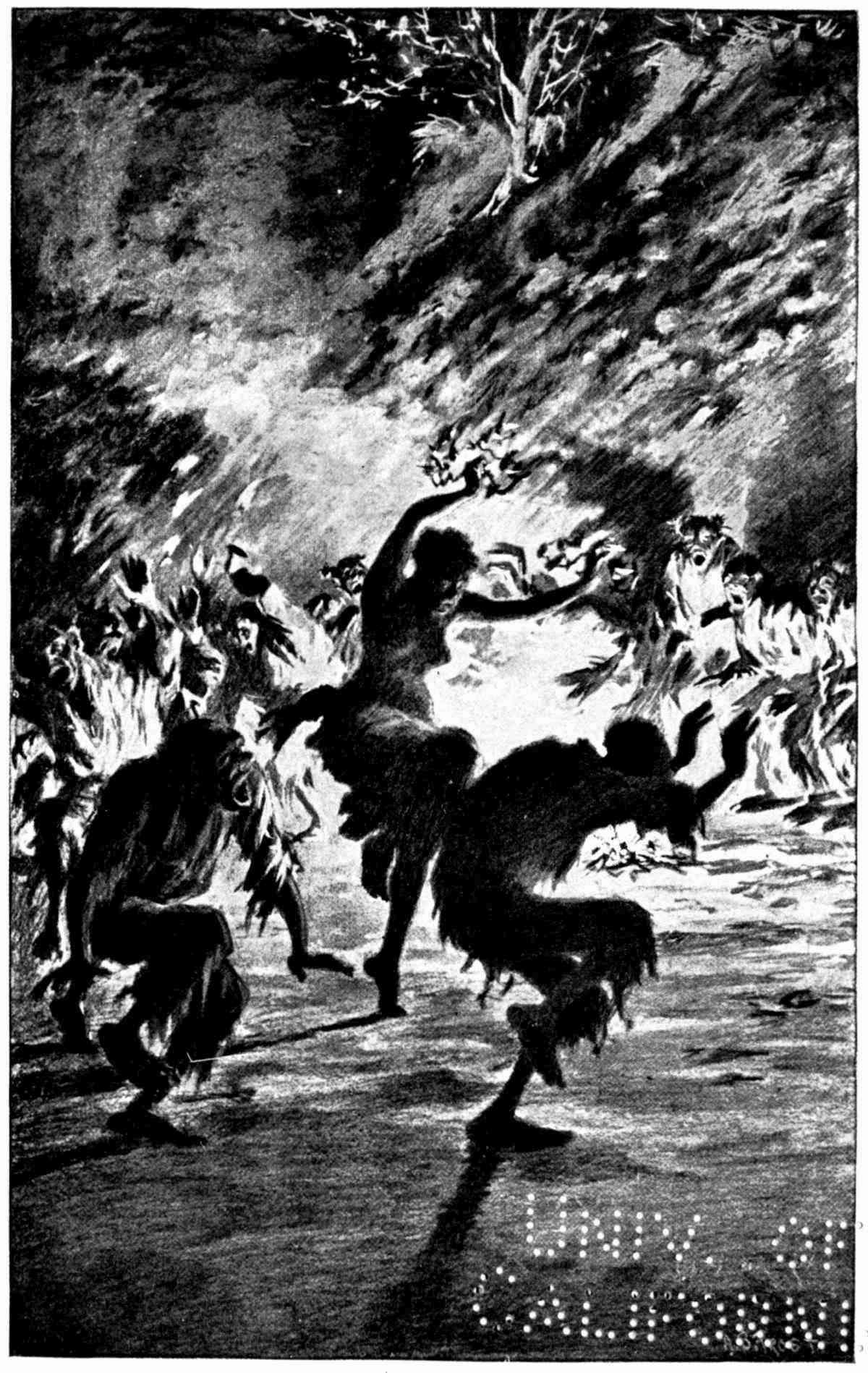
“THE CHARM WAS FOREVER BROKEN, AND THE COMELY HOODOO KNEW IT”
The barn was radiant with tallow dips that
winked and sputtered through the decorations
of pine boughs like gorgeous fire-flies. A
dance was in progress. The men were ranged
in one line, the women in another; at a certain
point they met and joined hands. But, arrayed
in gorgeous apparel different from the others,
a great red paper flower nodding in her hair, her
white teeth shining between parted lips, the
leader of the dance was the comely yellow girl
whom Juno had seen before, and her delighted
partner was none other than the prodigal Solon
himself. Juno’s fingers instinctively sought
the grape-vine for another purpose than that
indicated by Maum Ysbel, but, clinching her
hands, she withdrew into the outside shadows
again, and the Cinder Cat suddenly rubbed
against her dress and purred.
Solon danced like one possessed, regardless
of time or tune, always keeping his eyes fixed
upon the nodding crimson flower; and the
yellow girl, with lips drawn tight over the
white teeth, watched him with the eyes of
possession.
Then, as he sank upon a bench, exhausted,
for Solon was none of the youngest, the voice
of an elder whispered in his ear: “Better
g’long home ter de ole ’oman! We’ll hab you
up in de chu’ch fur dis!”
The watching eyes in the darkness were
burning like coals of fire, but Solon pulled
loose from the detaining hand. “What I keer
’bout gwine home ter de ole ’oman? What I
keer ’bout bein’ fotched up? I ’ain’ bothered!”
And, despite his age, in every dance Solon
led, with the smiling face and crimson flower
beside him. Others changed partners, but
Solon’s was always the same.
Now the candles had burned out, the few
that remained were guttering and flickering,
and then there was one last dance, in which a
madness seemed to seize Solon, and as he
whirled he drew from his pocket a long string
of blue glass beads and threw them around
the yellow hoodoo’s neck. The watching eyes
in the darkness glowed with passion, for
Solon’s gift was Juno’s sole remaining ornament,
now that the moon ear-rings had been
bartered.
“Lemme hol’ on ter myse’f tight, O Lord!”
she groaned. “Des fur er little while!” And
again the Cinder Cat brushed her skirts and
purred.
“I gwine foller you in er minit, Cinder! I
gwine follow you!”
The silence that was golden lay upon Juno’s
lips, and it was a repentant Solon who came to
her next night, for the Cinder Cat was gone
forever from the hearth, the charm was forever
broken, and the comely hoodoo knew it.
Shamefacedly and ill at ease, Solon lolled
and smoked, but, still preserving her silence,
Juno prepared a sumptuous supper for her
prodigal.
After they had eaten she threw a crimson
paper flower, ragged and dirty, upon his knee,
and, drawing her chair close, she lighted her
pipe from his, for she knew that her woes were
ended.
“A KINGDOM FOR MICAJAH”
“So you want your freedom, Micajah?”
The negro who had shambled up to
the broad veranda dropped his eyes and
shuffled uneasily, for there was a world of
wonderment and kindliness in the master’s
tone.
“And this is the meaning of all the devilment
I’ve heard of lately—all this talking
among the negroes?”
“I reckon so, sar.”
“At your age, Micajah, when you’ve been
a self-respecting negro all your life, to go cutting
up and making mischief among the other
negroes because you want your freedom—that’s
a fine way to get it! Haven’t you always gotten
all you asked for? If you wanted freedom,
why didn’t you come and ask for it?”
The master lifted his glasses to his forehead
and looked reproachfully into the queer black
face before him.
“Didn’t ’low, Ole Marse, as how you’d gib
hit ter me,” said the negro, humbly, but persistently.
Judge Naylor looked from the rose-twined
piazza across the spacious lawn, under whose
oaks his own father had romped, and beyond
whose limits had joyously hunted with another
Micajah, as small and as black as the one before
him. He had never dreamed of freedom.
Was this the innate craving of the human for
something higher, or only a reflection of an
external picture? The Judge resolved upon
an experiment.
“You are mistaken,” said the Judge, gravely,
as he knocked the ash from his pipe. “I
will give it to you. And what sort of freedom
is it that you want, Micajah?”
The old slave scratched his head and swayed
uncomfortably.
“Why, des freedom, Ole Marse.”
“What kind of freedom, Micajah? What
is it that you want? Speak out, for I am going
to give you your freedom for a whole month,
and you shall have all that you want to go
with it,” added the Judge.
Uncle Cage gasped. The enormity of the
idea was too much for him.
“And here were Ole Marse des er-talkin’
’bout hit lack hit were er chaw er terbaccy—des
es easy an’ quiet lack,” said Micajah, afterwards,
in confidence.
“Well,” queried the Judge, “what do you
want as a free nigger, Micajah?”
Micajah scraped the dust with his foot;
twice he made a little mound of it with his toes
and twice smoothed it out.
“I don’t wanter be no ’free nigger,’ Ole
Marse. I des wants freedom.”
“Well, go on; don’t be afraid; you shall
have what you want.”
Cage’s eyes sparkled, and at last his tongue
was loosened.
“I don’ wanter work none, Ole Marse. I
wants ter hear dat horn blow at five in de mornin’,
an’ I wants ter git up, mad lack, an’ holler
outen de winder, ’You derned ole raskil, what
you wake me up dis time er day fur?’ Den I
wants ter fling my boot-jack at him, an’ go on
back ter sleep, I does. Um, um—an’ when
de ole ’oman ’low, ’Cage, yo’ git up an’ make
dat fire,’ I wants ter ’low back ter her, ’I hain’t
er-makin’ fires fur niggers,’ an’ I wants ter
go back ter sleep, I does—fur, Ole Marse”—here
Cage bent closer and almost whispered—“I
wants my freedom fum de ole ’oman too,
den, an’ I don’t want her ter git freedom, nohow.”
“All right. Anything else to go with your
freedom, Micajah?”
All timidity and sullenness were forgotten,
and Micajah’s face was radiant.
“I don’ wanter hope do dat cl’arin’, Ole
Marse, down by de ribber, an’ when de niggers
is er-sweatin’ an’ er-workin’, I wants ter be
takin’ er my ease. Um, um—an’ I wants
some clo’se, white folks’ clo’se; an’, Ole Marse,
I wants er book lack yo’ got in de house.”
“A book? When did you learn to read,
Micajah?”
“Lord! Ole Marse, ole Cage cain’t read;
he des want ter tote hit roun’ lack yo’ does.”
“You shall have it,” said the master, heartily.
“Now what else?”
“I wants er little nigger, er little nigger, Ole
Marse.” Here Micajah scratched his head
thoughtfully. “None er mine, ner none on dis
side er de ribber, but er little nigger dat ain’
know me ’fore I git freedom—dat ain’ see me
work. An’ I wants dat little nigger ter foller
me ever’whar I goes, er-totin’ er palm-leaf fan,
an’ I wants him ter fan dese foots when I sets
down er lays down, an’ I wants ter holler at
him when he ain’ move fas’ ernough, an’ cuss
him when he move too fas’, but I wants him
ter keep er-foll’in’ wid de palm-leaf fan.”
Micajah, from sheer ecstasy of contemplation,
paused.
“But I don’ wanter be no ’free nigger,’ Ole
Marse, lack Free Joe and Yaller Pete, ’case
they hain’t nuffin but des niggers, ’douten er
marster, errer home, ner nuffin; dey don’ eben
know whar dey git dey nex’ sumpen ter eat
fum; but I des wants ter taste freedom.”
“Very well, Micajah; you shall begin to
taste it at once, and I hope that it will do you
good. You need not go to the field to-morrow,
and you can pick out your little negro from
over the river this afternoon. Cindy will give
you my old broadcloth—you can roll up the
legs and sleeves if they are too long—and I
will not forget the book; and, mind, if anybody
asks you to do a lick of work for a whole
month, you send them to me.”
The plantation work went on smoothly without
Micajah’s presence, much to the disgust of
Milly, his wife, who had been reprimanded
more than once for berating Cage about his
trifling ways. Micajah got his little nigger
from over the river—one who had never seen
him before, and who was as thoroughly abject
and respectful as even Cage could wish; so
the latter’s joy knew no bounds, and he was
rapidly demonstrating, to his master’s great
amusement, the close kinship of the tyrant
and the slave.
Micajah’s freedom was a matter of wonderment
to the negroes as he looked upon them at
their work for a moment with a supercilious
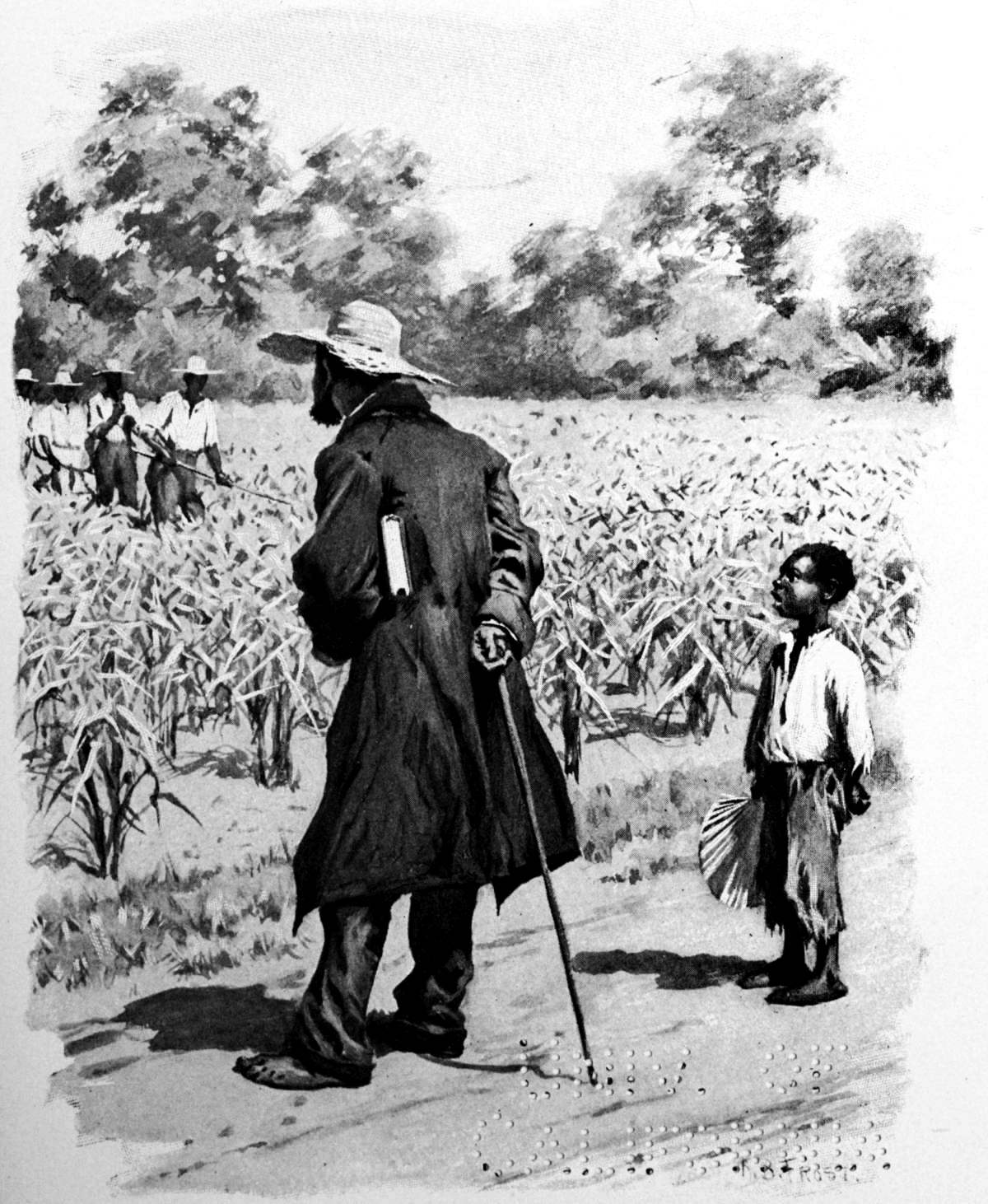
air, and made some dignified remark, with his
book held carelessly under his arm, “perzackly
lack Ole Marse,” Cage gleefully congratulated
himself—for Cage was wonderfully changed,
changed to befit his new condition; and as
he turned, followed by the bearer of the palm-leaf
fan, many were the envious glances cast.
Such ease, such glory, such a blended dream
of shade, watermelons, and cob pipes smoked
undisturbed, varied by the unspeakable delight
of “cussin’” and yelling at the little
negro!
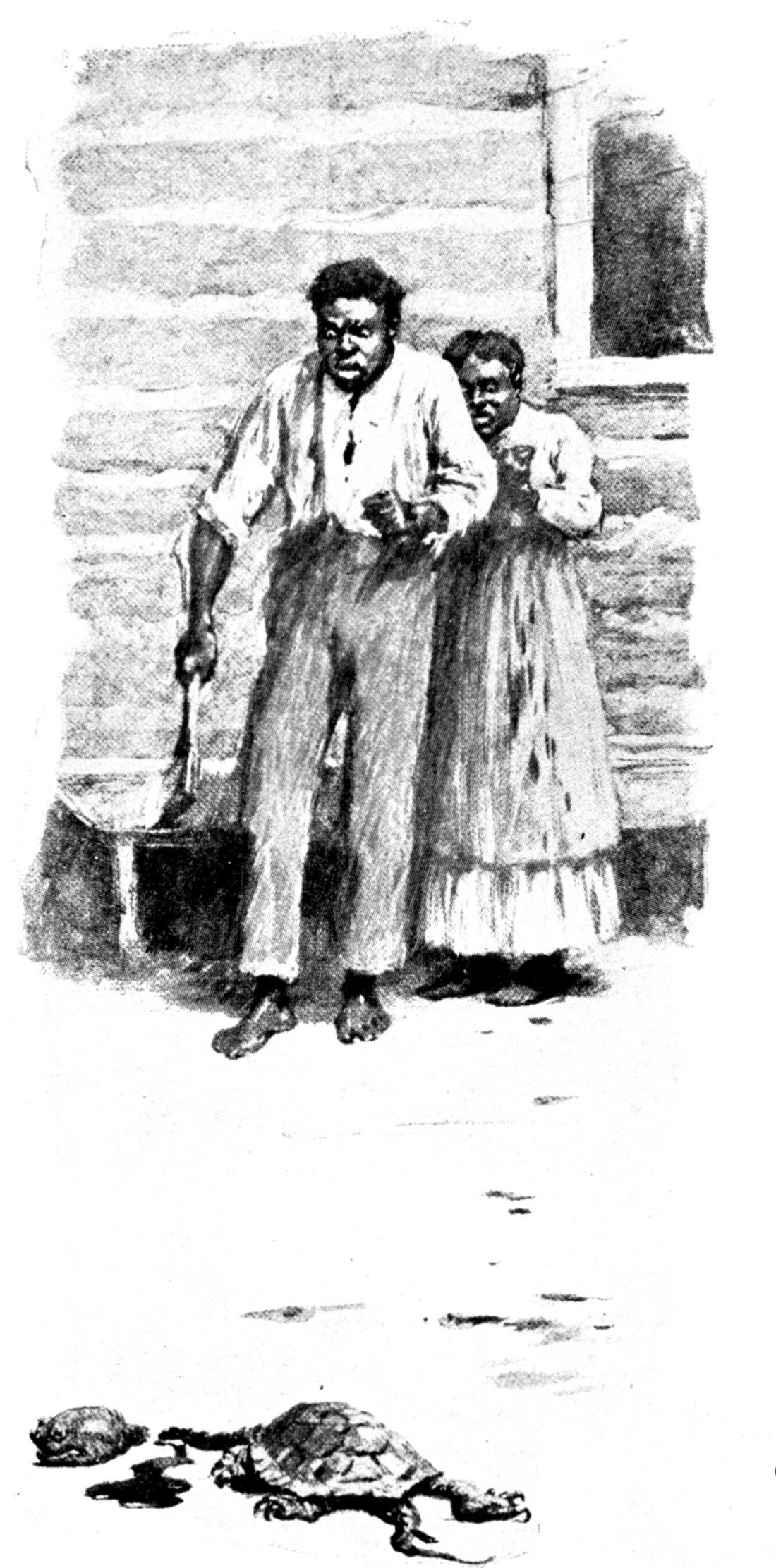
“PERZACKLY LIKE OLE MARSE”
But even this Arcadia had its shadow, for
Cage had never had the ecstasy of flinging a
boot-jack at his little slave. Boots and their
accompaniment had been part of the requirements
which his master had provided, with
the promise that the jack could be flung if the
boots were worn; but Cage had been an unshod
child of nature, for in that equable climate
a foot-covering at any season of the year
was only a matter of effect, and the exquisite
agony of the pegged cowskins was more than
he could bear, even with his freedom; so, by
her master’s direction, boots and jack were
carried triumphantly back to the plantation
store by Milly, who was more than happy to
thus pluck one feather from the wing of freedom.
Milly in these last few days seriously questioned
within herself the wisdom of Old Marse’s
experiment, for it had very much upset the
domestic equilibrium; but Milly was a philosopher
too, in an humble way, and under the
existing circumstances she resolved to make
an experiment also, the issue of which she
was more certain of than Ole Marse was of
his.
“Think I gwine hab Cage layin’ roun’ here
in de shade er w’arin’ er broadclorf ever’ day—an’
Ole Marse ain’ do dat—an’ er-settin’ up
he ole foots ter be fanned lack dey was sumpen,
an’ dey es big es all out-doo’s, an’ he er-pesterin’
me ’bout he fried chicken fur dinner lack
he were white—an’ dey sen’ hit ter him, too.
My Lord! Um—Ole Marse done los’ he head
ter ’low dat; but I hain’t los’ mine, sho mun,
and I gwine git eben wid Cage. Talkin’ ’bout
freedom dis an’ freedom dat, an’ erlowin’ dat
hit sumpen dat Milly cain’t git. Um—if hit
make er body es low-down an’ es triflin’ es
Cage be, I lay I don’ want hit!”
But it was glorious to be envied—a field-hand
envied even by the house-negroes. So
Micajah buried his bare feet in the dust when
impressing a crowd, and rose in the dignity
of his broadcloth. He was a king, though
even for a day, and no ancestor by the far banks
of the Congo ever ruled more royally.
He was abused behind his back, but the
fruits of the earth were brought to his cabin.
The horn blew in the morning, but Micajah
turned over for another nap. Milly put the
buttermilk on the table, but Cage had coffee
from the big house; and at last freedom had
grown so great that Micajah declared that Milly
should stand while he was served—that a free
man could not sit at table with a slave, even
though she was his wife.
Then Milly rose in wrath, and laid two
crossed sticks tied with hair in the chimney
lock, but held her peace. Micajah shivered;
ruefully he regretted his boldness, for the
dignity of the free man could not overcome the
superstition of the slave, and he had known
Milly’s work of old. Alas for Micajah! In
the splendor of his broadcloth and the deliciousness
of freedom he had forgotten to transfer
his own hoodoo—it was even then reposing in
the pocket of the discarded blue-check trousers—and
Milly’s charm would work!
The clearing down by the river was progressing.
It was a kind of extra work, and a barn
dance and barbecue had been promised in the
Quarters when the task should be completed.
So it was even pleasure, this sweating and
hard labor, with the pot of gold, as it were, at
the end; and, with the “whoraw” in the Quarters
attending each morning’s departure, the
spirit of habit even tempted Uncle Cage to join,
for it was getting lonesome with nobody but
the little nigger—not even Milly in the cabin to
lord it over—and the laborers were too busy to
listen to him if he went idle-handed to the clearing;
but he was a free man, and freedom did
not stoop to such without necessity.
But latterly the monarchy was not nearly
so absolute as it had been; the negroes were
not half so envious. Too much familiarity
and boasting were breeding contempt, and
though Milly was more than welcome among
them, they looked at him askance whenever
he sought to join in their recreations.
Growing bolder, they quizzed his little “nig”
about him, to the former’s utter demoralization,
poking fun at the bare feet and broadcloth;
and one of the smart house-negroes disrespectfully
propounded a conundrum, in effect, “If
all work an’ no play make Cage er dull nigger,
what do all play make him?” Milly’s brother,
a field-hand, had actually shouted out, “A big
fool nigger!” at which Cage and his fan-bearer
walked away in dignified silence. But the fan-bearer
was far from satisfactory; there was
that in his manner which betokened sullenness
rather than the awe with which he was
at first infused; and though he habitually
dodged, it was rather from the fear of the missile
than of the man. There was even a symptom
of rebellion, which Micajah, finding the arts
of civilization deficient, promptly put down by
threatening to hoodoo him with a ’gater.
The imp was quelled for a few days, and during
that time he spent all the spare moments
when Cage was asleep in the careful examination
of his legs and arms for the first indication
of the ’gater, guardedly holding his breath to
feel an internal or external wiggle; but, as no
signs appeared, he turned a pirouette on his
great toe and whispered to the watermelons in
the patch that “Marse ’Cajah wa’n’t nuffin but
er nigger man, arter all.”
But something had surely gone wrong with
Micajah’s fortunes. Was Milly’s charm working?
There it lay in the chimney lock, and
Cage dared not touch it. “I knows she put hit
dar fur me ’case I mek her so mad ’bout stan’in’
when I eats, an’ now she won’t set down when
I axes her; an’ if hit air workin’—my Lord!
den I’m done fur!” moaned Cage.
So the Big-house coffee was not half as delicious
as it had been, and Cage took to praising
Milly’s buttermilk, sharing her side meat, and
he courteously left her a piece of fried chicken
on one occasion; but Milly would not touch it.
Then, after one sleepless night in which the
crown of freedom pressed more heavily upon
the monarch’s brow, Micajah sought his master,
leaving the bearer of the fan sobbing in the
cabin from a reprimand more vigorous than
pleasant. The Judge was preparing to ride,
and he smiled upon the forlorn figure of Micajah.
“Well, Micajah,” said he, flecking the head
of a zinnia with his whip, “have you thought
of something else to go with freedom?” Micajah
studied his bare toes sheepishly, then
covered them with dust.
“Naw, Ole Marse.”
The Judge drew nearer. “Are you sick,
Micajah?”
“Naw, Ole Marse.”
“Then what do you want? Don’t stand
there all day like a dolt.”
Micajah hesitated; something seemed to
clog his throat, and he cleared it.
“I thought maybe, Ole Marse—I thought
es how de time mought be up, an’ I come ter
gib up de freedom and de book.”
“What? Are you tired already? Why,
it is not half up. Go on and have a good time,
Micajah.”
“‘GO ON AND HAVE A GOOD TIME, MICAJAH’”
Micajah looked crestfallen, and ambled off
as the Judge rode away. “Er whole mont’,
an’ hit hain’t half up! Well, dar’s dis erbout
hit, dat’s one comfort—dem niggers kin ’buse
me lack dey pleases, an’ dey gwine sweat an’
groan fur dey fun; but dis freedom gwine ter
fotch hit ter me lack I were white, ef I des set an’
wait. Dey don’ git tired er settin’ an’ waitin’
fur hit ter come ter ’em, an’ I des bardaciously
gwine steddy some more white folks’ ways
’sides totin’ de book.”
But the blissful contemplation ended as he
neared his own cabin. In the doorway sat the
fan-bearer, his tears having been wiped away
by Cage’s good dinner, which had arrived from
the Big House during the consultation with his
master, and to which the imp had bountifully
helped himself. Micajah’s heart was sore, but
he smothered his wrath until he had made his
meal, while the fan-bearer, with a fragment of
belief still in Micajah’s powers, employed the
time in feeling again for the incipient ’gater.
Then Micajah rapped imperiously upon the
table.
“You Amaziah!” The little negro dodged.
“You infernal lazy black raskil, Amaziah!”
“Huh!” whimpered the boy.
“You lim’ er Satan, you lizard-eyed nigger,
don’ you say ’huh’ ter me! You git me er
coal and light my pipe quick! Fill up dat
pipe fust, you lazy purp! What you got holes
in yo’ head fur, hah? Um, um. Now git dat
fan an’ fan dese here foots twel I tells you ter
quit. You heah me!”
The man of freedom was stretched at full
length, with a wreath of smoke about his head
and his eyes closed to the world; the little
black piece of misery was crouched beside him;
and so daylight waned and the twilight came
on; then the fan dropped from the bearer’s
hand; he was fast asleep, and so was Micajah.
There was great excitement on the plantation,
for Susanne, the Madame’s maid, was
to marry Henry, Major Stone’s man-in-waiting.
Susanne had told the Judge of her desire,
and, not wishing to sell Susanne, or to
separate her from the husband of her choice,
the Judge had promptly bought him for a good
round sum. The Madame herself had looked
to the details of Susanne’s wedding-gown,
for the Madame set great store by Susanne,
and the ceremony was to be performed in the
dining-room. Then afterwards would come
the feast and dance in the Quarters until daylight,
in which the inmates of every cabin, by
invitation of the bride, might join.
Micajah’s cabin felt the unwonted influence,
and even the little fan-bearer was in a flutter
about the wedding. Milly had been bidden;
carefully she laid her small store of finery upon
the bed, and was softly singing to herself before
going to the field. Milly believed in feasting,
though, unlike Micajah, who loved to
scrape his foot to anybody’s fiddle, she only
believed in a certain kind of terpsichorean exercise,
which she called “de ’ligious dance.”
Hers was only executed upon solemn occasions,
or commemorated special emotions, but
Milly was indulgent to the general fault in
others.
These fair days of freedom were losing more
and more of their beauty to Uncle Cage; the
song of the mocking-bird was far less sweet,
and even the crimson-and-black beauty of the
watermelon had almost lost its lusciousness
to the idle slave of freedom. But, most of all,
the impudence of the jay-birds maddened him
when they came to gather from the remnant of
his meals.
Many an unpicked bone and half-finished
biscuit was flung at them in the abundance,
to be regretted in the after-time.
“I lay I gwine larn ’em,” muttered Cage, as
he resumed his solitary dinner after a vigorous
onslaught, which was about the only exercise
the monarch would allow himself; and the
fact was that Uncle Cage might be suspected
of a first-class case of dyspepsia, for the life of
irregularity and idleness was telling hardly
upon his astonished organs and his temper.
“I lay I gwine larn ’em—er-eatin’ er my vittles
an’ er-callin’ me ’Cage! Cage!’ des es pat,
’dout eben er handle ter hit, an’ erlowin’ ’He
got hit! he got hit!’ lack hit any business
er thern ef I is got freedom. I lay I larn
’em!”
As he grew more and more irascible the negroes
drew entirely away from him, even his
chosen few, and freely let him know that they
could get along without him. But now the
crowning insult had been offered—he had not
been bidden to the wedding. It was Milly’s
charm—he knew that it was Milly; the fact
of his freedom could not alone have worked
that change in his fellows; and Milly, finding
her spouse exceedingly cross upon this particular
morning, wisely refrained from any but
necessary conversation.
Micajah was stung to the quick, and dwelt
upon his sorrow. At a wedding he was in his
own particular province, and everybody knew
it—that was where it wounded. They had
even invited Milly before his eyes, and the messenger
had sarcastically “‘lowed dat es Cage
were erbove workin’ wid common niggers, he
reckoned he were erbove playin’ an’ eatin’ wid
’em.” And the little fan-bearer suffered that
day, for Micajah’s feet were very hot.
At last the momentous hour arrived, and
there was much hurrying to and fro in the
Quarters. Here and there Susanne was swishing
her wedding-skirts and bandying saucy
words with the older negroes, but she did not
even pause at Micajah’s cabin.
But Ole Marse would permit him to witness
the ceremony with the house-negroes because
of his freedom, an honor which was never
shared by the field-hands, and Micajah was
secretly glorying, though the glory would be
short-lived, for there was the long night before
him with its bedlam of joy let loose in the Quarters,
and he was not to be of it.
So he stood in the doorway a shiftless figure,
an alien, as it were, for he was unused to the
manner of the house-negroes and was abashed
before them, and for the present he was not a
field-hand, because of his freedom.
For a moment he lost himself; then the
ceremony was over; Ole Mis’s said something
high and grand, and Ole Marse said something
funny, and the little procession filed out.
The night was close and sultry, and as he
sat alone in his cabin door Micajah could hear
the strains of fiddle and banjo—he was even
near enough to hear the shuffling of feet. The
fan-bearer was soundly snoring, after having
sobbed himself to sleep, for Micajah had sternly
declared “dat de slabe cain’t go whar he
marster hain’t axed—you heah me, Amaziah?”
As the night wore on the fun waxed louder
and louder, the spell was irresistible, and Uncle
Cage was almost beside himself. He had
never been left out before—and this was freedom!
At last the cake-walk was begun, and Micajah,
forgetting his injured dignity, his position,
and his broadcloth, slipped stealthily out to
peep at the revellers through a chink; and
there was Milly—his Milly—leading the walk
with Cross-eyed Pete. Micajah dug his toes
into the dust. Oh, how peacefully Milly
smiled!
“Dat cross-eyed houn’ is er-callin’ me outen
my name,” he muttered.
His Milly laughed slyly—and this was freedom!
“How I ebber gwine make dat nigger know
her place ergin?” he groaned. “I gwine git
back an’ know mine—dat I is. I gwine gib up
dis fool freedom if I libs ter see ter-morrer,
sho I is; an’ I gwine meet dem niggers on ekil
groun’s, an’ I gwine split dat cross-eyed nigger
inter kindlin’ wood—sho I is—if I libs. An’
I gwine ter make de high an’ mighty niggers
ter-night ter eat dirt ter-morrer—dat I is—yo’
heah me! I larn dat Milly ter laugh at her
betters ’hine dey backs, if I peels ever’ hick’ry
on de place—dat I is! O Lord, pity dis heah
big fool nigger dat hain’t got no mo’ sense ’n ter
lis’en ter de word er Satan, an’ up an’ ax Ole
Marse fur dis heah freedom! I’s done wid hit—I
spits hit out. Des lemme git shet uv hit,
an’ I wouldn’ wipe dese ole foots on hit!”
There was a movement at the door, and, fearing
detection, Uncle Cage slipped away to seek
uneasy dreams.
Through the long hot days the work had
gone on cheerfully in the new land, and now
it was so nearly accomplished that the frolic
was joyfully discussed.
Micajah had all along secretly resolved that
he would attend the frolic, with or without a
welcome, on the ground of primeval right;
but the negroes, informed by Milly, or more
probably by the fan-bearer, who was a most
untiring carrier of tales, openly resented his
intention, and now passed his cabin without
a recognition, sarcastic or otherwise.
Even the fan-bearer was growing unbearably
sullen; no kick or cuff could bring him
out of it; his biggest flow of words failed to
intimidate, and Micajah felt that his position
was perilous. He more than once approached
his master, with the same result—he must
wait until the time was up.
It wanted but four days more to the barn
dance, and here was one whole miserable week
of freedom, and, alas! his freedom from freedom
would come too late to save the day, so he
resolved to make one more effort, and, shame-faced
and miserable, Micajah once more sought
his master.
The Judge knitted his brows forbiddingly.
“What is the matter, Micajah, that you want
to give it up? Haven’t you got all to go with
it that you wanted?”
“Yas, Ole Marse.”
“Then what the devil is the matter?”
“Ole Marse”—Micajah’s voice was very
low, and his humbleness was as the dust—“I
done fotch back de book, an’ I done fotch back
de freedom. One hain’t no betterer dan tuther
ter er nigger. Dey bofe on ’em lies ter er nigger,
an’ hit hain’t nuffin but miz’ry. Dey don’
’spec’ me no mo’; dey don’ lis’en ter me talk
no mo’. Eben Milly, my ole ’oman—dat I
gwine frail ’din er inch uv her life when I gits
shet er freedom—done lay er spell on me: I
kin feel hit in my bones. Eben de little nigger
what tote de palm-leaf fan done talk sass ter
me, an’ I ’low I cain’t stan’ hit!”
His master smiled, then bit his mustache
gravely.
“But, Micajah, you must command respect—command
it, and you will get it.”
“I done ’mand hit, Ole Marse,” said Micajah,
pitifully, “but I ’mands hit lack er nigger,
er big fool nigger, an’ hit hain’t done no good.
Gittin’ freedom on de outside don’ make freedom
on de inside, Ole Marse. I’s ’bleeged ter
you, Ole Marse, ’deed I is, but I wants you ter
take hit back. I’s nuffin but er fool nigger,
Ole Marse, an’ ’fore Gord I hain’t gwine cut
up no mo’! I’se got all I want ’dout freedom,
an’ I gwine be thankful fur hit!”
Micajah paused expectantly; there was a
silence, which was broken by the master’s firm
voice.
“I am a man of my word, Micajah. I have
promised you a month of freedom, and you
have accepted it; I cannot take it back until
the time is out. Stop your foolishness, and
go and make the best of it.” And Ole Marse
rode away.
Micajah looked long and earnestly into the
cloud of dust he left behind. The condition
was desperate; something must be
done.
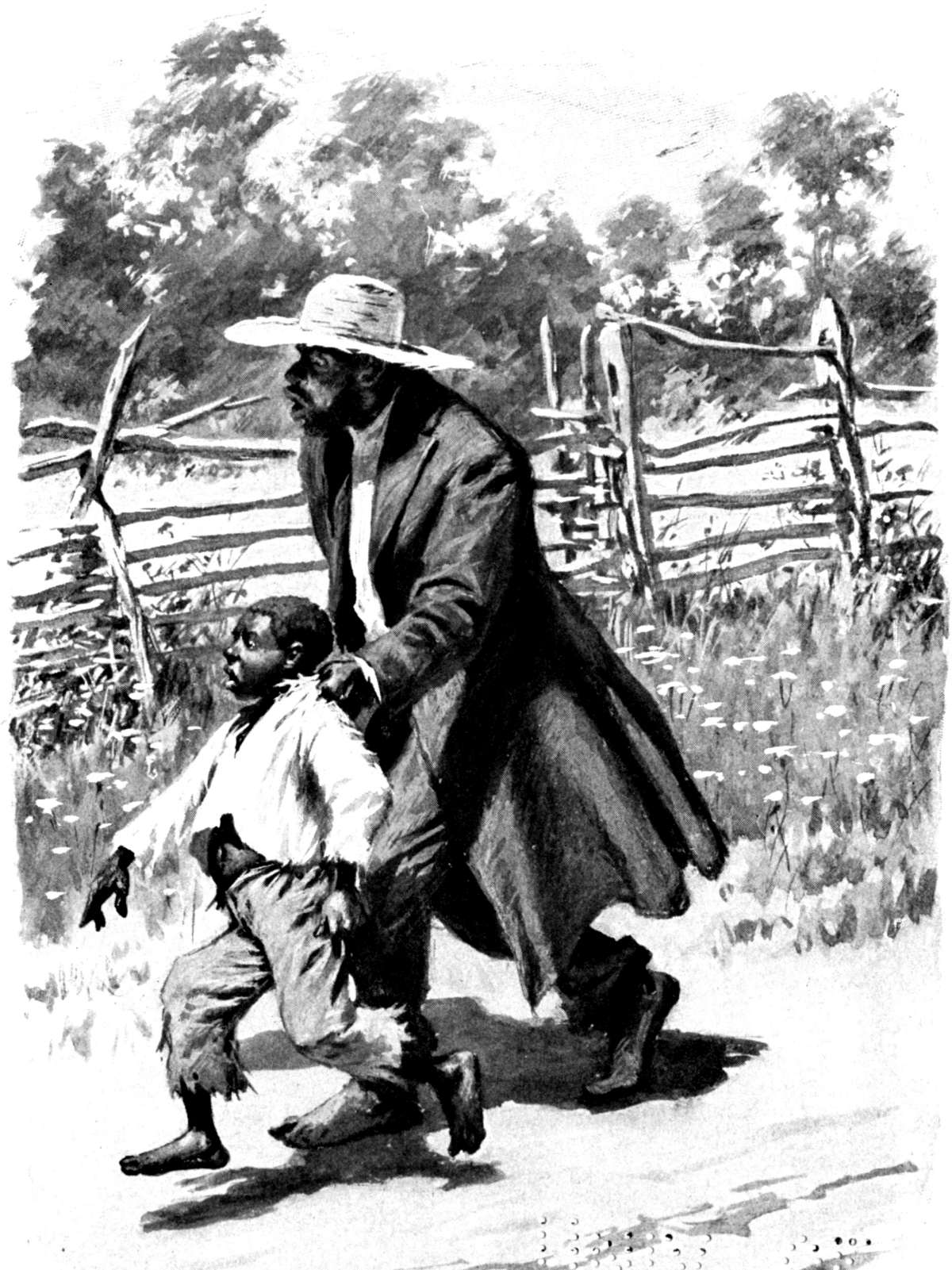
“HE COLLARED HIS ASTONISHED LITTLE NIGGER”
Between the gate and the Quarters he collared
his astonished little nigger with no uncertain
gesture, and led him across the field
towards the river, and when Micajah returned
he was alone. Spying the palm-leaf fan, the
emblem of his freedom and his misery, on the
floor of the cabin, where it had dropped from
the hand of the rebellious Amaziah, he silently
tore it into shreds and tossed them from him
with a contemptuous grunt.
That night a theft was committed on the
plantation—a very small one, it is true, but
made memorable because it was the very night
that Micajah sent the little negro home. Such
a thing was almost unheard of, and the overseer,
a black Hercules, was very indignant.
The next night a similar depredation was
discovered, and the negroes were at fever-heat.
“Reckon Ole Marse ’bout ter lose he min’, ter
set still an’ see things erg-wine on diserway an’
hain’t raise his han’; but I gwine raise mine,
sho mun!” declared the overseer.
So a cordon of guards was formed, with
regular reliefs, and the night-watch began.
The midnight wore away, the stars winked
out, and the last guard slept peacefully before
the rising sun, and no marauder disturbed
the stillness of the smoke-house. But something
had happened. The house, the Quarters,
the very air, was full of it. A runaway
nigger had been caught on Major Stone’s plantation,
was caught stealing, and was even now
being carried in handcuffs to the court-house
to await his owner.
The summer season was dull enough in the
little village which had the honor of being the
county-seat, and the passing of the Judge’s
carriage was of sufficient moment to attract a
knot of idlers. So, too, the little court-room
was filled with the same material, even before
the Judge had leisurely alighted, after his
usual custom; for, as the negroes said, “Eben
de toot er Gabrul moughten pester Ole Marse;
he gwine ’bout he business, an’ hain’t gwine
herry fur nobody!”
The runaway was secreted in an inner chamber;
nobody had even seen him, and speculation
ran high; but the Judge, in the most exasperating
manner possible, calmly disposed of
some minor matters, leisurely joking his constituents,
as was his wont, utterly oblivious of
the throng of eager faces.
At last every joke had been turned and every
paper signed, when the Judge relapsed into
sternness.
“Bring in the prisoner!”
The mysterious door opened, and Major
Stone preceded the little procession, stroking
his beard in a peculiar manner, but as grave
as a chief mourner.
“I’ve got a good one on him now,” he whispered
to Attorney Allen as he passed up the
aisle.
Then followed the culprit, his crossed wrists
in the little steel cuffs, his head bent low upon
his breast. There was something painfully
familiar in the figure. The now soiled and
torn broadcloth, even upon its spare ebon rack,
still held the Judge’s outline in its creases.
Ludicrously pitiful the picture, and the crowd
swayed and murmured.
The Judge rose to his feet. He was thinking
of green fields and boyish days, of the
clear brook beyond the pasture, of the pair of
honest black feet that had timed their pace to
his.
“Micajah!”
There was a world of pathos in the tone. It
mattered not if the whole of his little world was
there to hear it—attorneys, clients, negroes,
and all.
“I’se comin’, Ole Marse!” The pitiful wail
rang through the court-room, and the old slave,
oblivious of any other presence, fell prone at
his master’s feet.
“Take de cuss offen me, Ole Marse, an’ lemme
die, fur dat freedom hit ride me lack er hant,
an’ let loose de debil in ole Cage! Take hit
back, Ole Marse, fur I got er whole week er dat
mizerbul freedom lef’, an’ you wouldn’ take hit
back! Dat what mek me brek in yo’ smoke-house
fur, an’—oh, Lord! I’s er mizerbul sinnin’
nigger, all on ercount er dis heah freedom;
an’ you nebber sont de oberseer ter whup me;
but I were willin’—de Lord He know how willin’
I were—if I mought git shet er dis heah
freedom!”
There was a pause, broken by Micajah’s sobs.
“Tell it all, Micajah,” said the Judge.
“Dat what I taken Marse Harry Stone’s
tuckeys fur. I ain’ want dem tuckeys, Ole
Marse—dey done tied out dar in de fiel’ now—but
I wants ter get shet er dis heah freedom!
I hain’t nuffin but des er po’ fool nigger, Ole
Marse. I hain’t gwine ter ax fur nuffin ebber
no mo’—nuffin but sumpen ter eat, an’ mighty
little er dat! Yo’ knows what’s the bestes’
fur me, Ole Marse, an’ yo’ knows I hain’t fitten
ter breave de bref er life! Kill me, Ole
Marse, kill me; but ’fore yo’ does hit take de
cuss er freedom offen my soul!”
A sudden gust must have blown dust in the
Judge’s eyes, for he winked them hard, then
blew his nose vociferously.
A whispered consultation was held with Major
Stone.
“That’s entirely satisfactory to me, Judge”—the
Major was smiling.
“The case is dismissed!” roared the Judge.
THE DEVIL’S LITTLE FLY
In the long ago, when the nether world was
not so densely populated as it now is, and
the days were not so full of interest, never
having forgotten an early experience with a
most beautiful woman, and often feeling the
spirit of adventure strong upon him, the lord
of that domain used to walk abroad upon the
earth in the cool of the evening.
Many of these excursions were full of excitement
and variety, and sometimes of great daring
upon the part of Satan, as there was no
need of the slightest disguise, for the world was
not so wise as it is now, and those simple folk,
both fine and poor, white and black, dallied
with Satan without question.
But the subjugation of an entire plantation,
from the “Quality” to the “Quarters,” required
time—more time, often, than Satan could give
consecutively—so there were certain emissaries
to be employed during enforced absences.
Now, by way of practice, the devil had conquered
the “Quarters” of a great plantation,
even to every soul, with the exception of an old
mammy and a certain Zacheus who was very
cautious, and was preparing plans for the “Big
House,” when something went wrong with the
eternal fire below, and the devil was besought
to depart in haste.
His old courier, the jay-bird, brought the
message from the under world, whither he had
gone to deposit his usual load of firewood; and
he was in no fine humor, for every Friday he
bitterly remembered the day he had sold himself,
in an unguarded moment, to the devil, for
a worm-eaten, half-filled ear of corn—“sight
unseen,” complained the jay to Mrs. Jay, when
he sometimes filled the air with vain regrets.
“Dey says dat dey want you mighty bad
down dar; de fire hain’t half hot, an’ dar’s
sumpen de matter wid de furnace,” said the jay.
“You right sho dey needs me?” asked the
devil, for he had other fish to fry that Friday
morning,
“Course I is,” said the jay, crossly, for he
was very tired, and had carelessly gotten his
feathers scorched in the lower regions. “Think
I gwine come all de way back ter tell you er
lie? Ax my cousin, de crow; he went wid
me ter de do’ an’ heared ’em gib hit out!”
“Go back,” said the devil, getting angry,
“an’ tell ’em I hain’ gwine come twel dis day
week, an’ ter keep dat fire hot, if dey knows
what’s good fur deyse’fs! I got er job er my
own ter ’ten’ ter, ’dout any partnerships!”
“Go ter hell yo’se’f! I hain’t due dar twel
nex’ Friday, an’ I hain’t gwine budge twel
den,” said the jay-bird as he preened his scorched
wing and flew away.
Now the devil had a love-affair on hand, one
of those strange, inexplicable things that require
very careful handling, and it was the
same old cry down below—any ordinary devil
who knew his business could attend to that.
So the devil importuned the crow to take the
message; but Squire Billups had just planted
a large field of corn; there was work enough
in that for Mister Crow to do for a whole week;
he was not compelled to serve the devil but a
single day out of the week, and he had already
given that service; besides, Mrs. Crow was just
beginning to hatch, and no self-respecting
paterfamilias could fail to be within call during
such an important event. The owl was
too blind to go, for the journey had to be made
by daylight; the black-snake was too sleepy,
for his season was not yet fully arrived; the
terrapin was too slow; and there was nothing
left except the little fly; but the little fly was
always ready, though his work must always
be rendered upon the earth.
So, with many impatient stampings of his
foot, the devil set about to take his departure.
He got down upon his knees and blew his
breath into a dandelion puff, and whispered to
the seed, and a wind rose, and the seed scattered,
and the down floated through an open
window of the Big House and tickled Marse
Charles’s ear as he lay asleep.
Now Marse Charles was come to attend the
house-party of Marse Beverly Baillie, and was
mad with love of Miss Demetria, Marse Beverly’s
youngest daughter, who looked above
the highest, and had no mind to marry any
man. But Marse Charles, in his cloak of green-and-gold
lace, swore upon his jewelled sword
that he would win. Even now, as he slept, he
held between his moist fingers a withered rose
that had nestled upon the bosom of the cold
Demetria.
It was such as this that the devil was loath
to leave, and as he blew the seeds of the dandelion
ball he sowed the seeds of jealousy in Marse
Charles’s heart. Marse Charles sighed in his
sleep, and clutched the withered rose; then
the night became as daylight to him, and his
eyes were wide open.
Biding his time, so that jealousy might breed
the mushroom hate, the devil lingered, leaving
the doubtful hours of the night to pass away;
but between midnight and day, when the young
man was wellnigh crazed with evil passions,
the devil threw off all disguise and stood before
him.
“Who are you?” cried Marse Charles, springing
from his bed and stretching his swollen
eyelids in the dusky light as his hand sought
his sword.
“One who can do you a service,” said the
devil, talking fine, for he always chose his language
according to his surroundings.
Marse Charles’s brain was full of fever,
and he put up his sword and listened, while
he crushed nervously the rose within his
palm.
“You are young, you are noble, you have
the treasures of the earth before you,” said the
devil, soothingly, “and yet you are the most
miserable man in all creation.”
“What do you know about my misery?”
cried Marse Charles, angrily.
“What do I not know?” asked the devil,
sagely. “ I know that you love Demetria,
that she disdains you, that you have a
rival.”
“Ah!” sighed Marse Charles, “that is it—I
have a rival! Whoever, whatever you are,
aid me if you can, for I am mad with love. I
have written a challenge to my rival, that we
may settle this at daylight. I was about to
send it when you called.”
“Not so fast,” said the devil, lifting a warning
finger and drawing nearer. “Hot blood
is the father of many regrets. Your rival is
a better swordsman.”
“But ’tis honor! I do this for my honor!”
said Marse Charles, loudly, puffing out his
breast, frog fashion.
“Hush! not so loud! Your honor will do
you much credit when you rot in the ground,
run through with your rival’s sword,” sneered
the devil, “leaving him in possession of Demetria’s
favor. My plan is better than that.”
“What is your plan, and who the devil are
you?” cried Marse Charles, writhing at the
possibility of losing Demetria.
“That’s just it—I am he,” said the devil,
chuckling; and, stretching out his arm, he
touched Marse Charles with a hand as soft as
velvet. “The world is mine, and I would sit
upon a throne, my rightful seat, if it were not
for this!” and he kicked out his hoof foot petulantly.
“Well, what is your plan? I haven’t time to
listen to your miserable troubles; I’ve enough
of my own,” said Marse Charles, impatiently.
“That’s so; I was talking to no purpose
then,” said the devil, fingering Marse Charles’s
ruffles. “But this, briefly, is to the point.
Upon a certain condition, if you will do as I
bid you, Demetria shall detest the very presence
of your rival, disasters shall come upon
him, and, lastly, Demetria shall smile upon
your suit.”
“Words are cheap,” said Marse Charles,
languidly. “What proof can you give me
that you can do all of these things?”
“Look upon the occurrences of every day—look
out upon the world—what better proof
need I give?” said the devil, archly. “Moreover,
if you wish, you shall know the innermost
life of your lady as though you held a
mirror ever before her face; her every act,
her every sigh, nothing shall be hidden from
you that you may have the desire to hear or
know.”
Marse Charles pondered awhile, but the devil
and the moonlight, together with his old-fashioned
frenzy of love, had turned his head.
“Name your condition!” he cried, tearing
the challenge into little bits; and there, in the
beginning of the gray dawn, Marse Charles
did what many a man, both before and since,
has done.
It matters little to the story to give the exact
specifications of the bargain, though Mammy,
in the telling of it, was always very particular
to describe minutely all of the virtues that go
to make up the best part of a man—in other
words, his soul. The awfulness of the bargain
was duly impressed upon Mammy’s small
listeners; how Marse Charles, for the love of
a woman, had given up happiness forever and
forever; how the eternal fires of hell were to
be kept at white heat with fiendish delight by
those who had made similar bargains; how
the days of his coming were written in fiery
letters upon the walls, and there would be no
water in all hell for Marse Charles to drink,
save the tears of the lost, which flowed forever,
and they were exceedingly bitter and full of
regret.
“Can’t he ever, ever get out, Mammy?”
asked the little maid, whose lips were quivering,
and whose great eyes were full of unshed
tears.
“Yas, honey,” said Mammy, hastily, “if er
good hoodoo kim erlong ’fore de bref leabe
Marse Charles, er ’pentance kim ’fore de wo’ms
’stroy de body—an’ er good hoodoo sho gwine
kim!—so don’ you cry, honey!”
But now, said Mammy, the devil had his
man hard and fast, heart and hand, and when
it became his time to leave the earth for a season
he took Marse Charles out into a lonely
place, and put into his hand a tiny snuff-box
made of gold, curiously wrought upon the
top.
“I will leave you now,” said the devil, “for
the rest will be fair sailing. I have jaundiced
your Demetria’s eyes to your rival. She sees
that he has a squint, and talks with a drawl,
and that he drags one foot in dancing. Misery
is entering her soul, and she is very unhappy,
for she believes that the squint is due to the
hard counting of her father’s acres and slaves.
“In this box,” continued the devil, “I leave
you my most useful possession, one that will
never slumber and never sleep. You can keep
watch upon Demetria when she goes abroad;
but when the doors are closed between you,
when you would know her every word and every
act, just open the box, for nothing can be hid
from the little fly. In two weeks I will come
again, and in the meantime I wish you joy.”
So the devil went back to hell, chuckling as
he went, for he carried Marse Charles’s conscience,
fluttering like a wounded bird, in his
hand, and Marse Charles put the little gold
box beneath his lace ruffles and went on his
way rejoicing.
Now it chanced soon after that there was a
great meet, and the ladies and their gallants
rode into the far woods. It was a fine company,
for Marse Beverly Baillie had scattered
his invitations broadcast, that the world might
see the young Demetria. Marse Charles, on
his great bay, rode sulkily alone, for his rival
was in a high humor, having been paired to
ride with the fair Demetria.
As he rode, Marse Charles was ready to question
the efficacy of his bargain, when, just in
the second mile, his rival’s horse went lame—so
lame that he was forced to turn back, and
Marse Charles, with much bantering and light
laughter, gallantly rode forward with a dozen
others to take his place. But the sun shone
for Marse Charles and the world was fair, for
Demetria gave him her sweetest smile.
Late in the day the rival came, upon a fresher
horse; but Demetria had no eyes for him, all
of her favors were reserved for Marse Charles;
and as they rested upon a shady knoll after
dinner, beside a bubbling spring, Marse Charles
lost no time, and told his love in most vehement
fashion.
But perplexities will creep in, even into the
best-planned schemes, for as Marse Charles
talked he thoughtlessly drew from his bosom
the devil’s snuff-box, and as he toyed idly with
the lid the sharp eyes of Demetria remarked
its curious workmanship.
“A trophy!—a memento to mark the day!”
she cried, throwing down a jewelled medallion,
into which she had deftly slipped a ring of her
own bright hair.
“A pawn of love as precious as heart’s blood!”
cried Marse Charles, twirling his mustache
and gallantly kissing the golden curl as he
threw upon the grass an Egyptian bracelet,
which he always wore concealed from view,
and which held a tiny needle and a poisoned
drop, forgotten by Marse Charles.
“No!” pouted the spoiled Demetria. “A
manlier trophy—I would have the box—the
little box you toyed with just now!”
The blood of poor Marse Charles ran cold.
What would he not give to please the sweet
Demetria? He almost reached his hand to
yield it, but the little fly buzzed hard within,
and, starting with a shock, he hid it in his
bosom.
“A princess wore the bracelet once,” began
Marse Charles. “It has a wonderful history.
Make it more wonderful and wear it for me,
sweet!”
“But I would have the box!”
“But it will make thee sneeze!”
“Then I will sneeze! Your love means less
than any bubble here if you shall hold so fast
to such a trifling thing!”
Then Demetria shed tears, and more reproaches
followed, and Marse Charles, cold
even to the marrow’s centre from fear, let loose
the devil’s little fly and threw the box upon the
grass.
“How beautiful!” said Demetria, snatching
it up; “but, Charles, you played me false; it
holds no snuff, and cannot make me sneeze. I
only thought to try you, but now I will not give
it back again, to punish you for the teasing!”
So Charles, restored, basked in the light of
love, and comforted himself with the thought
that Demetria soon would tire of the box.
There was fine sport and much merriment
in the far wood, and such ado to make shelter
when a thunder-storm came on. But the rain
would not cease, and, in the cold drizzle which
followed, the gay company, with limp gauderies
and feathers, mounted for the return. But
nothing damped the ardor of Marse Charles,
and, as they rode, his hearty laughter, mingled
with Demetria’s, fell upon the ears of the cavalcade.
Marse Charles had made a scoop at something
with his hand, and Demetria laughed
again. “On my word, Mr. Charles, such grace
it has seldom been my good fortune to see!”
“A most persistent fly,” said Marse Charles,
catching at it again, as he felt the cold clinging
feet upon his forehead. Then, suddenly remembering,
he was silent, and with reddening
cheek he caught the little fly out of the rain
into the folds of his cloak.
The days wore on, and, as the devil had promised,
disasters, one close upon the heels of another,
overtook the rival of Marse Charles.
Now it was an ague, now a broken limb, now
a fever—so fast they came, indeed, that he
dared not try to reach his home between his
woes; and, courteous to all men, Demetria
salted his gruel, but made sweet eyes at Marse
Charles.
But all this time Marse Charles was troubled
about the little fly. Demetria still treasured
the box, and there was no spot in which to keep
the little fly in safety. Marse Charles felt that
it was a precious trust, and faith must be kept
by a man of honor, though even with the devil.
And sometimes, but for an opportune buzz,
Marse Charles would have killed it for a common
house pest, which always made him very
serious.
Every day and every night the little fly
brought in a full report, over which Marse
Charles gloated as a miser over gold; but at
last even the devil’s emissary grew weary of
roosting in precarious places, and considering
that Marse Charles had broken faith by disposing
of the box, was less and less vigilant, and
finally cultivated a spirit of rebellion.
Now Demetria was blessed with an old mammy,
as fine a blending of mother-wit and shrewdness
as ever wore a Madras kerchief, and who
was married to that Zacheus who dealt in
charms and “cungers.”
Every night since Demetria’s babyhood
Mammy had drawn the bed-curtains for her
mistress, and sitting in the same old chair,
had fanned and told her stories until she fell
asleep; but of late Demetria was restless, and
the stories did not soothe. In vain Mammy
shook the curtains and drew them farther back,
then opened the French windows wide upon the
broad veranda. In vain she brushed out the
long yellow locks; Demetria still sighed, and
would not close her eyes.
“What ail my chile?” crooned Mammy, softly
wielding her great palm-leaf, and forgetful
that she was speaking to other than a child.
“I’m miserable, Mammy, miserable, ever
since the day of the meet. Something seems
to be taking my strength. See how I have
fallen away!” And the little figure in its white
robes was small enough indeed.
“Um!” crooned Mammy. “I gwine mek my
chile some sassafac tea—dat mek her better!
Hi! dar dat mizerbul fly ergin! I sho gwine
git hit out ’fore I lets down de bar dis night.
Don’ be ’feared, honey!”
“It’s no use. I can’t sleep, Mammy!” said
Demetria, fretfully.
“Nebber min’,” said Mammy, as soft as a
cradle-song; “yo’ be all right bimeby. Hain’t
yo’ tell Marse Charles yo’ lub him? Hain’t
yo’ done promus ter marry wid him whedder
Marse Avery die or no? An’ hain’t Marse
Charles des plum crazy ’bout yo’, an’ cain’t
say ’good-bye’ ’fore he say ’howdy,’ fur de
lub er yo’?”
“Yes, yes,” said Demetria, wearily, “and
yet I am not happy, Mammy.”
“My Lord!—wid all dem di’munts an’
things? Yo’ is er mighty sp’ilt chile, honey!
But I hope do it,” added Mammy, complacently.
“Nebber min’, baby, yo’ be all right arter
while; yo’ des narvous.”
“Cuss dat fly!” said Mammy, under her
breath, for the little thing eluded her at every
turn, and, giving it up, Mammy softly fanned
until Demetria moaned in uneasy slumber.
“I gwine git ter de bottom er dis. Hain’t all
right, sho ’nough. I been er-tryin’ nigh onter
two weeks now, an’ I cain’t ketch dat fly nary
time!”
Demetria’s hand was under her pillow, as it
had been on all of these restless nights.
“Won’er what she got unner dar, po’ little
gal!”
Mammy tenderly drew the little hand from
its hiding, and in its palm the devil’s snuff-box
lay. Mammy eyed it curiously.
“Mighty quare thing fur my chile ter hug
up so close, fur she des hate snuff! Um! dat
ole fly sho think dat box got sugar in it—Shoo!”
But curiosity was too much for Mammy, and
she opened the lid, and the fly dropped down
and nestled in the corner of the box. Mammy
closed the lid with a snap, shutting the little
fly in.
“Sumpen mighty quare ’bout dis. I gwine
tek dis ter Zacheus!”
The whole plantation rang next day with
the loss of the curious box, an heirloom and a
token from Marse Charles to Demetria; but
the box was not found, and Marse Charles
wandered about, pale and ill at ease, for the
little fly did not return.
The narrative of the dusky story-teller does
not falter at this juncture, for there were always
three pairs of eager eyes that were burning
into hers. “Zacheus was the hoodoo—the
good hoodoo who could steal souls back from
the devil!” sang the chorus.
“Um—and when de ole mammy what were
his wife lay de gole-worked box in Zacheus’s
han’, Zacheus gib er great big laugh, ’case es
soon es hit tech his han’ hit turn ter nuffin but
er debil’s snuff-box—you know, chillen—one
er dem brown spongy things wid dus’ in ’em
dat you fin’ in de woods; an’ den de little fly
fly up mighty survigrous an’ try ter bite Zacheus
on de mouf.”
“An’ dat what de little miss been sleepin’ wid
unner her head?” said Zacheus. “De charm
Marse Charles gib her? Um, dar’s work for
Zacheus!”
Of course the gold snuff-box was never found,
though the plantation was searched far and
near, and to Demetria no one bemoaned its loss
louder than Mammy; but down in the Quarters,
when she could steal away, she was watching
Zacheus mix his pot of sweet ointment with
which to kill the fly, for the fly would not
eat.
“I kin kill de fly,” growled Zacheus, “but I
don’ wanter ’do’ Marse Charles, so I gotter
change de charm.”
Marse Charles, whiter and thinner by reason
of sleeplessness, listened to Demetria’s songs
with a ringing in his ears, and gorged every
common house-fly that he could coax, on sugar,
in the vain hope of finding again the devil’s
little fly; but the little fly was lying with stiff
wings outside of Zacheus’s pot of ointment,
and James, the barber, had given Zacheus a
lock of Marse Charles’s hair.
The time was up. The devil would return.
What then?
Marse Charles hardly remembered how it
was, but once again, after a night when sleep
would not come, he found himself sitting opposite,
in the hazy light, as once before.
“How dare you”—said the devil—“part
with my box, to give it as a token, a lover’s
toy? You have forfeited your bargain, and
I am undone; but the girl is mine!”
“No!” cried Marse Charles, his eyes starting
from their sockets.
“I tell you that I love her—that I am mad
with love for her—and by the token that she
keeps she is lost!”
“The token cannot be found,” said Marse
Charles.
“What does it matter? She is mine. She
is mine!” cried the devil, tremulous with passion,
for the hoodoo had given him a human
heart in order to torment him and to change
the charm. “Do you think that I would yield
her now, to such dirty scum as you?”
“I will protect her with my life, even if I
cannot win her,” said Marse Charles, hotly,
for the devil in his rage had let loose Marse
Charles’s conscience.
“Choose your weapons,” said the other, mockingly,
“for the sword of the devil is a double-pointed
sword; it wounds the soul, not the
flesh—the spirit, not the body.”
And back of the orchard, said Mammy, while
the whole world was asleep, was fought grimly
and silently the bitterest duel of the earth.
There were no witnesses save Zacheus, and
though he rendered yeoman service to his mistress
and to her lover’s bartered soul, he looked
upon the duel, and Mammy solemnly declared
that the sight of it made him blind.
Through and through, the devil thrust Marse
Charles, but the blade came out dry and bright;
not a drop of blood was spilled; and after
Marse Charles’s lunges, Zacheus swore that
he could see the light through the body of the
devil.
Marse Charles was almost sinking to his
knees, and the devil raised his arms exulting,
when on a sudden impulse Marse Charles rose
with a mighty effort and made a double cut
in the shape of a cross on the breast of his opponent.
That was what he should have done
long ago, said Mammy; even if he had only
worn a little gold cross on his watch-guard it
would have been a protection, for at Marse
Charles’s new movement the devil gave one
hoarse cry and fled into the shadows of the
breaking day.
Of course the “Quality” at the Big House
did not know of the plotting that had been going
on, or of the fearful duel that had ended it.
They were not the privileged beings of the
earth, and so they only knew it was with pale
brow and downcast eyes that Marse Charles
came to say farewell, and that Marse Beverly
Baillie clapped him on the shoulder, like the
good soul that he was, by way of comfort—
“To think my minx Demetria should flirt
you!” cried Marse Beverly; “for she marries
Avery in the fall. But cheer up, lad, cheer
up! there ’re as good fish yet to catch as ever
have been caught.”
ASMODEUS IN THE QUARTERS
Mammy did not tell this story very often;
it was held in reserve as an especial
reward. Whether it was of African
origin, and by one of those strange coincidences
bore a resemblance to the classic, or was a garbled
negro version of it, is lost in conjecture;
but certain it is, that almost within ear-shot
of a doting but unknowing mother, many a
childish ambition has been fired “ter rise wid
Satan.”
And this is the way Mammy told it to the
little night-gowned cherubs whom she wanted
to get to sleep:
“Shadrach were de very ol’es’ nigger on de
place; he ’lowed he were er hundud an’ fifty,
an’ I reckon he were, ’case he back were doubled
up twel he wa’n’t no tallerer ’n Charlie dar;
he face were es black an’ es wrinkledy es er
warnut, he hair were es white es cotton, an’
de long white beard kim ’mos’ ter he knees,
dat tu’n in kinder bow-legged when he walk.
“He so ole he hain’t fitten ter work none,
but he hab er little couterin’ roun’ ter do
ever’day, lack feedin’ de tuckies, shuckin’ corn,
er makin’ nets, er sumpen, ’case he ’Ole Miss’
’low dat Satan sho gwine fin’ some debilment
fur idle han’s ter do, an’ she plum right.
“Shadrach hab plenty er clo’es, plenty ter
eat, plenty er ’baccy ter chaw an’ ter smoke,
an’ er good warm cabin; but he ain’ happy
yit, ’case hit ’pear lack de debil gib us sumpen
ter hone fur, no matter what we got. Shadrach
des wanter know ever’thing dat happin;
but he des es deef es er pos’, an’ dey hain’t nobody
wanter tell him no secrets, ’case if yo’
gotter holler hit all ober de place, hit no secret
ertall; so he go erbout putty nigh all de time
wid one han’ up ter he year. I reckon hit
were mighty painful ter ’im, but ever’body
oughter min’ dey own business, specuil if
dey cain’t hear good.
“But hit go mighty hard wid Shadrach,
’case he git deefer an’ deefer, an’ cuissomer
an’ cuissomer; an’ when he do hear ’em he
git ’em so cross-eyed ’mos’ all de time, ’case he
hear so bad, dat he git inter er heap er trouble,
fur dey ’low dat Shadrach were er power ter
talk.
“UNDER THE TREES IN THE WOOD-LOT”
“Hit er mighty bad thing fur ter git inter
de fix dat Shadrach done in, ’case hit lack gittin’
bofe foots inter tar—while you’s er-pullin’
one foot out, de odder gwine sho sink furder
in; dey hain’t nuffin but er good strong pull
on de outside dat gwine git yo’ shet uv hit.
“Now yo’ knows, honey, dat dar’s some
times er de year dat de debil plum loose—done
free ter go anywhar er ter do anything, an’ he
all de time er-layin’ fur des sech er sof’, mizerbul
creetur es Shadrach were.
“Shadrach meet him ’way off unner de trees
in de woods-lot, an’ were powerful glad ter see
him when he kim; an’ he git outen he skin,
an’ len’ he body ter de debil ter go erbout in,
two er free times, ’case er lot er de niggers seed
Shadrach in some mighty quare places fur er
Christiun an’ er shouter. But dat wa’n’t pleasurin’
Shadrach ’bout hearin’ things, fur de
debil cain’t gib er man er pa’r er new years,
an’ he cain’t eben hope him, lessen he gib up
he soul. Hit pester Shadrach mightily, ’case
he know he cain’t sarve two marsters, an’ he
mighty feared er de fire down dar; but bimeby,
’fore de debil go back, he git so cuis ’bout hearin’
an’ knowin’ things dat he done furgit all
he larnin’ an’ he ’ligion, an’ he bargains wid
de debil fur he soul. Better folks an’ whiter
folks ’n Shadrach done gone an’ done hit, an’
er-doin’ uv hit yit, ’case de debil he kim ter folks
in de ways dey wants him in dey min’s, but hit
hain’t gwine ter pay in de long run; hit gwine
ter peter out mighty painful.
“Well, ole Shadrach he done sell he soul ter
de debil fur good, an’ he mighty lively an’
peart erbout hit, an’ dance all unbeknownst—ole
mizerbul Shadrach dance, an’ he er-lookin’
lack he do!—but hit de debil’s dance, an’ dar
hain’t nobody know nuffin ’bout hit but er hoodoo.
Er good hoodoo all de time on de lookout
fur de debil, an’ hit ’pear lack de hoodoo hear
de debil gib he promus ter Shadrach, if he sell
him he soul, dat he take him wid him ever’
night, when he fly ober de roofs an’ look down
de chimblies, an’ he gwine see ever’thing an’
hear ever’thing—an’ ole Shadrach des couldn’t
keep still fur de joy er thinkin’ ’bout hit.
“HE DES FOLLER UV ’EM EVER’ NIGHT”
“Sho ’nough, de debil were es good es he
word, an’ de hoodoo fin’ de body er Shadrach
in he bed, layin’ lack he sleepin’; but he were
des es cole es def, fur dar wa’n’t no bref in de
body, ’case de debil done taken de sperit out, an’
de hoodoo, while he lookin’, hear two screech-owls
holler an’ laugh, den flop an’ fly erway.
Dey taken de owls’ skins, ’case owls got de
bigges’ eyes an’ de bigges’ years er anything
dat b’long ter de debil, an’ kin see in de dark.
De jackass got de longes’ years uv all uv ’em,
but de debil hain’t got no holt on him sence
de Lord let him talk ter de man dat try ter make
him tromp on er angil, an’ I reckon dat why
de Lord rid on one uv ’em inter de New Jerusalem.
“Well, de hoodoo he see how things were
er-gwine when he hear dem owls, an’ he hain’t
got no call but ter foller uv ’em, ’case if he let
de debil go one single blessed time, he lose dat
much uv he power fur good, so he riz an’ foller.
“At fust, de debil des take Shadrach ober
niggerdom in de quarters, an’ oh! how dat
littles’ squinchup owl holler an’ laugh when
he hear Pomp an’ Dinah des er-quoilin’ an’
er-quoilin’ in de cabin, an’ dey bofe so mighty
sanctified an’ shout so loud on er Sunday;
an’ when he see Lush—dat he Ole Marse
trus’ lack he white—des er-stealin’ sugar fum
de pantry, an’ ole Cindy, ernudder sanctified
sister, kerhootin’ roun’ in de smoke-house
widout er light, er-huntin’ fur er ham, he laugh
so loud dat de odder owl hatter shake ’im.
“Hit were er lot er fun ter ole Shadrach, an’
he git so full er dem things dat he ’mos’ fittin
ter bus’ wid hit, ’case he cain’t tell nobody what
he see an’ hear, fur he feared er de debil. He
hear all de secrets er de creepin’ things, an’
larn whar de snakes an’ things hides in de
daytime, an’ es dey riz in de air, de secrets er
de things dat flies in de dark.
“He seed folks er-dancin’ an’ er-mournin’,
er-laughin’ an’ er-cryin’, er-cotin’ an’ er-gamblin’,
er-stealin’ an’ er-lyin’, er-sleepin’ de
hones’ sleep er de Christiun, an’ er-groanin’
on dey beds er suff’rin’—de people dat he see
an’ know ever’ day—lack dar wa’n’t no tops
ter de houses, ner walls ter ’em nuther. He
hear de debil temp’ de weak, an’ dey fall, an’
de strong, an’ dey hain’t gib in, an’ de debil
kim roun’ ter ’em ergin de nex’ night; an’ all
day long ole Shadrach des er-laughin’ an’ er-chucklin’
an’ er-waitin’ fur night ter come.
“Hit go on dat way fur er long time, but de
hoodoo don’ say nuffin; he des foller uv ’em
ever’ night, an’ he putty nigh plum wore out;
but he know dat de debil hain’t got much longer
ter tarry, so he bide he time, fur he gwine
fur ter try ter git back ole Shadrach’s soul,
’case er burnin’, wand’rin’, los’ soul is er mighty
hard thing ter steddy on, an’ de hoodoo were
er ’zorter, too.
“HE HEAR MISSAR JONES’S SAMBO FIVE MILE ERWAY”
“At de fust, Shadrach were mighty happy
an’ mighty ’umble ter de debil, ’case he hear
more ’n anybody dat got two good years kin
hear, an’ see ten times es much. But arter
while he git manish, an’ sot in ter grumblin’,
an’ talk back ter de debil some. He done tired
er des seein’ niggers; he wanter see what de
white folks er-doin’.
“De debil he tell him he better take keer,
dat hit hain’t gwine ter be good fur hese’f fur
him ter see an’ hear dat, an’ ’fuse ter rise dat
high wid him; but Shadrach keep er-teasin’
an’ er-teasin’, twel one dark night de debil he
borry two pa’r er buzzards’ wings so’s ter fly
high (dat all he kin git, ’case de eagle hain’t
gwine len’ his’n), an’ dey riz ober de top er de
talles’ house.
“Hain’t no tellin’ what Shadrach see dat
night, an’ arter dat, dar wa’n’t no doin’ nuffin
wid him—he des er-gallopin’ ter ’struction es
fas’ es he kin trabble.
“Es ole es Shadrach were, an’ es doubled up,
de oberseer hatter lay de whup on him two er
free times, an’ hit make de Ole Marster feel
mighty bad; an’ all de time de debil des er-aggin’
uv hit on, an’ er-showin’ him down de
white folks’ chimblies ever’ night, ’case Shadrach
done git too uppish ter wanter know nuffin
’bout niggers.
“But bimeby he retch de eend uv he rope,
an’ he retch hit so powerful suddent dat hit
putty nigh fling him outen he senses.
“He git manisher an’ manisher wid de debil;
he done furgit all erbout de bargain, an’ who
de debil were, an’ ’low he hain’t gotter borry
no wings ner nuffin ter rise wid, if de debil do.
Dat he gwine rise wid he own coat-tails—dat
any hoodoo kin, an’ he gwine do hit. Po’
fool Shadrach!—he done furgit he hain’t no
hoodoo ner nuffin—nuffin but er po’ ole sarvent
er de debil, an’ hit all fru he power!
“SHADRACH HE RIZ WID HE OWN COAT-TAILS”
“But de debil do he pleasurin’ an’ hain’t say
nuffin; so dat night when dey riz, de debil he
borry de buzzard’s wings ergin fur hese’f; but
Shadrach he riz wid he own coat-tails, an’ de
debil he do mighty ’umble, an’ make lack Shadrach
doin’ all dis here by hese’f. De debil
gwine let him git mixed an’ tangled up lack
er fly in er spider’s web, an’ Shadrach he sho
boun’ ter do hit; fur dat night he hear things
dat sot him putty nigh plum crazy, ’case he
done hear too much at las’; an’ de nex’ day
de debil hatter leabe de quarters an’ go back
inter de bad place. He taken Shadrach’s soul
wid him, an’ sumpen else dat oughter b’long
ter er good man, ’case Shadrach hain’t eben
passable no mo’.
“Arter de debil go ’way, Shadrach’s years
taken ter growin’, an’ dey grows long an’ high
an’ thin, an’ hit ’pear lack Shadrach hear ever’thing
at oncet, lack er big roarin’ er waters,
so’s he cain’t make out nuffin.
“He cry out, when nobody ain’ hearin’ nuffin,
dat he hear Cindy ’way down in de cotton-fiel’
er-talkin’ ter herself, an’ he cain’t make
out what she say. Den he hear Missar Jones’s
Sambo, five mile erway, er-yellin’ out sumpen,
but he cain’t make hit out; an’ he
sot in ter cryin’ an’ er-moanin’ wid de
pain an’ de noises dat ’mos’ bustin’ he head
opin.
“He Ole Marse say he plum crazy, ’case he
so mighty ole; but he Ole Miss ’low he need
quinine; an’ dat quinine des de stuff dat de
debil want him ter hab, ’case hit kin work mo’
’fusion in one hour ’n de debil kin in er whole
day, an’ hit hope de debil mightily, es he couldn’
be on de groun’ fur ter make Shadrach mo’
painful hese’f.
“An’ Shadrach git ter be so painful wid de
hearin’ uv ever’thing plum mixed up, dat he
taken ter w’arin’ big wads er cotton in he years
fur ter shet hit out er de years, dat keeps er-growin’
longer an’ longer, narrerer an’ narrerer;
but de cotton cain’t shet hit out, ’case
half uv hit kim fum de inside, an’ was de wakin’
up uv all dat de debil lef’ Shadrach dat
b’long ter er good man.
“De hoodoo he see what were er-ailin’ Shadrach,
an’ he mighty sorry fur him; but he
cain’t go ter Shadrach; Shadrach gotter kim
ter him ter git he soul back, an’ hit hatter be er
mighty good hoodoo ter do hit den, so de hoodoo
he sot an’ wait.
“Bimeby Shadrach des couldn’ stan’ hit no
longer, an’ he des kim er-rinnin’ ter de hoodoo,
all doubled up, wid de long white beard
des er-draggin’ on de groun’, an’ he fingers in
he years—dem big years dat des er-settin’ up
on bofe sides he head.
“‘Pear lack Shadrach sho gwine plum crazy
’twixt de mizry an’ de noises, an’ de hoodoo git
ter work quick, fur ter pull de debil outen Shadrach,
so’s Shadrach mought git he soul back.
“IN DE SHAPE UV ER BIG JACK-RABBIT”
“Shadrach lay on de flo’ er de cabin, des er-rollin’
an’ er-groanin’. Dey done pour hot lard
an’ er whole bottle er laud’num in he years widout
doin’ any good, an’ de hoodoo try ter fling
de debil out in de name er de jackass, de el’phunt,
de owl—ever’thing dat he kin think uv
dat got big years; but de debil hain’t come
outen him yit.
“Den de hoodoo taken him inter de woods
an’ call de name uv er long-yeared houn’ dat
passin’ by, but hit hain’t dat.
“De hoodoo workin’ mighty hard, an’ he
stop an’ steddy erwhile, an’ den he lead Shadrach,
wid de thorns des er-t’arin’ uv he beard
an’ he knees an’ he han’s, ober inter er thicket
er blackberry-bushes, ter gib de debil er good
chance ter kim out, ’case he sho arter him.
“He make de passes wid he han’s, an’ say de
charm, an’ wait erwhile. De debil he see he
chances done plum gone, an’ he hatter gib up de
soul, ’case de hoodoo got him in er corner, an’
when he see dat, he des kim er-lopin’ outen
Shadrach inter de blackberry-bushes, in de
shape uv er big jack-rabbit wid great long
years.
“Dey say dat ole Shadrach lib ter be er hundud
an’ fifty year ol’er ’n he were, stone-blin’
an’ ’mos’ stone-deef; but he go ’bout powerful
happy twel he die, an’ hain’t nebber git
cuissome ’bout hearin’ things no mo’, ’case he
done heared ernough ter las’ him.”
THE TAMING OF JEZRUL
It was a nine days’ wonder that Jezrul had
ever taken a fancy to Lemuel’s Crecy, for
Jezrul was Colonel Greene’s butler, as
pompous, if not so rotund, as the Colonel himself,
and Lemuel’s Crecy, as every one knew,
had never done anything but pick cotton in
her life.
But the fancy grew, and so did the stories,
when Jezrul asked that she might be brought
from the field and taken on trial as a house-maid.
When Madame demurred, Jezrul promised
to assist in the training himself, and he
begged so hard that Madame finally agreed,
first stipulating, however, that Crecy should
learn to wear shoes; and this was how Jezrul’s
trouble began, for Crecy could not be fired with
ambition even by the most ardent lover, and
did not even appreciate the honor conferred.
Moreover, it was impossible to keep the shoes
on her feet, though Jezrul tied them hard
and fast every morning, with a warning; but
they turned up mysteriously in every corner
of the house, once even—oh! the horror of the
thing!—behind the door in Madame’s drawing-room,
and were discovered just in time to
save Jezrul from overwhelming mortification.
In view of his contract with Ole Miss, Jezrul
groaned helplessly in secret, as Crecy plodded
plantigrade about the house, slipping nervously
into the little black prisons and opening her
mouth wide whenever she was called; but he
was loving Crecy, and even these thorns, as
sharp as they were, were blunted by love’s
power.
The hardest trial came about through the
conventionalities of high life in the Quarters,
for Jezrul was a born gallant, and used to the
making of pretty compliments, copied studiously
from the “Big House,” but which “language
of the court” was as Greek to Crecy’s
ears.
Then there had been a little feeling when
Madame had given a great ball and Crecy had
been ignominiously set aside as too awkward
and ungainly to serve upon the occasion, though
that pain had been soothed by the policy of
Jezrul, and the culmination came at the time
of the Christmas “break-down.”
“OH! THE HORROR OF THE THING”
Ole Marse had just been to New Orleans,
and as a Christmas gift to the Madame had
brought Susanne, whose “Cagion” French
and cunningly arched head-handkerchief bow
had proved too much for Jezrul’s peace of mind,
for he was an ardent believer in feminine accomplishments.
And how she could dance!
Her very feet seemed to be made of a
different material from those of the others.
Louisiana was giving Mississippi points, and,
alas! the star of Mississippi was on the
wane.
In her humble blue cotton gown, at first
Crecy was awed and dazzled by the unfamiliar
gorgeousness of the new-comer, with her flashing
eyes and sallies of wit, until she saw the
all-devouring gaze of Jezrul; then the reality
fell like a leaden weight, and the fires of jealousy
burned briskly, fanned, too, it is to be
feared, by meddlesome observers, for in all of
the gayeties Jezrul had not even seemed to
see her. At first she sat apart, aimless and
listless, watching the pair through half-closed
eyes; it was a new experience, and thought
travelled slowly. Then she threw herself
wildly into the dance.
“I lay I l’arn him ter go kerhootin’ arter
er strange gal!”
Faster and faster flew her feet; now she
curtsied, now coquetted with a shuffling would-be
partner, always keeping within the circle,
but always dancing alone, with her eyes fixed
upon the object of her jealousy.
“Go it, Crecy!” shouted the fiddler, and the
music and patting grew louder and faster—“Pea-patch
Ladies,” “Chicken in the Bread-Tray,”
“Buzzard Lope,” and a score of others;
then a medley of wild, half-savage fiddling
and chanting followed, and the dancers were
tiring out; but still Crecy whirled, her body
swaying almost to the floor as she spread the
folds of her swelling skirts. She was dancing
to the pair, but Susanne and Jezrul were oblivious.
Susanne was teaching him a shuffle
that he had never seen before, and he was beating
time for her, independent of the chanters.
There was a strange light in Crecy’s eyes,
and then Lemuel tried to drag his daughter
from the floor, for the fiddler had stopped to
rest, and the singers had quit from sheer exhaustion.
But with a high, resonant note
she struck into a wilder chant alone, wheeling
and veering like a wounded bird.
“Look!” came the awe-struck whisper.
Still swaying and singing, every movement
consorting with the rhythm of the chant, she
bared her shapely body to the waist, whirling
now above her head and now about her knees
a cluster of rude castanets swung by a leather
thong.
At each revolution, accompanied by a high
note in the wail, the rough edges of the shells
cut sharply into the steaming flesh.
The space was clear; every dancer had given
way: they had been dancing for a jubilee,
but this dance was another thing. The spell
was irresistible; one by one the hoodoos who
had been hanging on the outskirts moved forward,
first with a vibrating finger, then with
a waving arm, like the great claw of a sand-fiddler
signalling from his hole, and then the
entire figures, rags and all, reeled with the
horrid song.
Only the hoodoos joined in it; the rest were
dumb; and at last even Jezrul and Susanne
were conscious of the mysterious thing, and Jezrul
touched the charm he wore around his neck,
and Susanne laughed softly and nervously.
Out and in, the figures of the hoodoos turned,
weaving a cabalistic sign with that of Crecy,
from whose breast and shoulders the blood was
fast trickling.
The chant and dance, if such it could be called,
continued for nearly three-quarters of an hour,
when suddenly the girl raised both arms, with
a yell like that of a crazed animal, and fell upon
her clattering castanets; and the hoodoos carried
her out, for Lemuel was afraid to touch her.
A red glow lighted the cabin faintly. Goobers
and sweet-potatoes were roasting on the
hearth, but Crecy let them burn.
Mumbling and moaning, she was busying
herself with rags and sticks and thread, for out
of her rude material she was fashioning a man.
“I gwine tame him—I gwine tame Jezrul!
He gwine feel de toof er de big green sarpint.
He gwine be hot in de mouf an’ cole in de belly.
I lay I gwine l’arn him!”
Slowly the work grew under the clumsy,
eager fingers, and the sunbeams were shining
through the chinks before she hid the little image
of Jezrul in a crevice by the chimney.
“‘BURN! BURN!’”
All that day Crecy moped alone in the cabin;
she had been dismissed from the “Big House”
for nodding over her work, and Jezrul had not
even interceded; but there was some comfort
in it all, for she was freed from the humiliating
comment of the house negroes and the despised
shoes had been left behind, though the loneliness
was oppressive, for the Christmas festivities
were at their height. Still keeping her
fast, for she had eaten nothing since the day
before, she stirred the coals upon the hearth,
whipping her wrath into a frenzy; and as she
heard the voice of Susanne in the quarters and
Jezrul’s laugh that followed, she thrust the
image through with a toasting-fork and held
it over the flame.
“Burn! burn!” she hissed. “Burn wid de
fires dat’s er-eatin’ out dese in’ards,—’case I
gwine ter tame you, Jezrul! Burn, I say!”
And putting out the blaze that started, she held
the thing over the coals again. “Hit ’ll retch
yo’ heart, an’ sizzle hit lack de fires er de debil,
’case you gwine ter be mine, Jezrul!”
Day after day Crecy tortured the little image,
now sticking it full of pins, now scorching it
again, but always taking the precaution not
to utterly destroy it—“’case he cain’t die—’case
he’s mine,” she muttered.
Though night after night the festivities went
on, Susanne coquetted and Jezrul laughed,
and Crecy was forgotten.
But New-Year’s Day had filled the quarters
with sensation, and dozens of ears were tingling
with the news.
Old Marse had been giving a stag dinner to
the judge of the circuit and the attorney-general.
They had been sitting at table for nearly
three hours, and Jezrul, who adored such great
personages, was in his glory; but just as he
was bringing in the cigars and liqueurs with
his usual flourish upon such occasions, he fell
in a fit at Old Marse’s feet. Such a thing as
a ripple in the course of one of Old Marse’s
dinner-parties had never occurred before; the
Colonel was beside himself, for he was helpless
without Jezrul.
Jezrul was a long time in coming round,
and in the confusion Susanne threw her apron
over her head and went into hysterics, as the
knowing ones whispered; while down in her
cabin alone, with the little image stuck full of
pins and pressed close against her breast, Crecy
gave a fiendish yell, for she believed that the
spell she had set, was working at last. With
ghoulish delight she tortured the miserable
doll; and day after day, fearful and livid with
superstition, but still unwilling to give up Susanne,
Jezrul fell to the floor under the strange
delusion; and at last, too ill even to creep up
to the house, he begged so piteously for the
curse to be removed, that the Colonel thought
that he was wandering in a fever, and alternately
bled him to remove the engorgement
and stimulated to remedy the depletion, until
he dragged about, dodging and starting at
the casting of his own shadow.
Susanne was comforting in these dark days,
and he could not give her up, for her long slender
hands were as ready as her nimble feet;
and the wiseacres said that Susanne would
marry Jezrul if he ever got well, which now
seemed very unlikely. But a pair of great
wide eyes were watching the ministrations
furtively and jealously, and another little image,
a smaller one in petticoats, appeared in
the cabin.
There was plenty of gossip in the Quarters,
beside the blazing pine knots, over the sweet-potatoes
and chestnuts roasting in the ashes,
for though the fits were coming upon Jezrul
harder than ever, he had suddenly refused to
let Susanne even come near him, and Maumer
Belle touched her cunger knowingly, and said
that she had seen Jezrul turn away from Susanne
in positive loathing, for all that he had
loved her so; and Susanne, in mortification,
finding no sympathy among the negroes, had
gone to the Madame, but Ole Miss calmly told
Susanne that Jezrul was crazy—“as crazy as
a loon,” said Ole Miss.
“Dat’s nuffin,” said Unc Ephraim, throwing
his blazing cob into the fire and adjusting another.
“Dat’s on’y what we gotter ’spec’,
’case hit’s de dark er de moon now, an’ hit’s
nuffin but er hoodoo dat ail Jezrul, an’ Crecy
she sho at de bottom uv hit all. Maumer
Belle, yo’ knows yo’ tole Lemuel dat Crecy
gwine ter be er hoodoo, ’fore she were free
day ole.”
“AN’ CRECY WERE WID ’EM”
“Um, um,” grunted Maumer. “An’ las’
night my Sam he rid fru de parster, er-sarchin’
fur de muel colt dat git out somers, an’ he say
dat de hoodoos was er-dancin’ ergin in de big
ditch; an’ sech er dance! an’ Crecy were wid
’em. Crecy was er-swingin’ dem shells ergin,
an’, Sam say, were er-scatterin’ ashes ober her
head, too, an’ putty nigh start naked, lack she
were de odder night, an’ I sho dun’no’ what Lem
mean fur ter let dat gal take on so; but yo’
min’ my words, ’case I knows what I’s er-tellin’
yo’, dat mean dat Jezrul gwine ter take Crecy
back ’fore he git outen dis. Hain’t no common
yarb truck ner teas gwine ter do Jezrul any
good, ’case Crecy sho tamin’ uv him.”
There was a thoughtful silence and a steady
gazing into the fire, when a hoarse scream
brought the gossipers to their feet.
The night was very dark, and the sick man
had fallen in front of his cabin, but by the
uncertain flare of the hastily lighted torches
the watchers could see Crecy down upon her
knees beside him, and the willowy form of
Susanne scurrying away into the shadow.
“Take hit off! take hit off!” he moaned.
“I’s er dyin’ man, but I lubs on’y you, Crecy!”
The teeth of the girl glistened in the torchlight.
“Fur good?”
“Fur good.” It was only a whisper, but it
was an earnest, solemn truth.
Her right arm was around his neck, but her
left hand was pressing into his the little images
of Susanne and himself.
“Come inter de cabin an’ burn ’em wid you’
own han’, honey, ’case dat ’ll make yo’ well!”
Crecy rose and led the way, and Jezrul meekly
followed, for Jezrul was “tamed.”
DARK ER DE MOON
Abijah was a hoodoo; moreover, he had
the reputation, over a wide stretch of
territory, of having the evil or Judas
eye, as it was called among the negroes,
which gave him a power over them all the
year round, which was only claimed by the
first exhorter during “Big Meetin’.”
No journey was ever undertaken, no new
work begun, in fact, nothing of importance
was ever planned by the negroes without first
consulting Uncle ’Jah, who spoke as an oracle.
His fame extended even to the poor whites
of the section who had never owned a slave,
and many were the potions for healing and
philters for unrequited love, that passed from
Uncle ’Jah’s hands for a small consideration.
Uncle ’Jah also told the stars, and blended
the inherited African rites most unreservedly
with the Indian traditions and his idea of the
white man’s religious ceremonials.
Of course there were other hoodoos on the
place, for what plantation had them not? but
they were all lesser lights whose radiance
paled before the effulgence of the leading spirit.
Uncle ’Jah added to his dignities and honors
the fact of having been born free. The story
ran, that his mother was a princess in her own
country, having been stolen by traders at an
early age, and in the home of her adoption her
faithfulness and tender care won the sympathy
of her invalid mistress, who was pleased
to give her freedom as a reward.
She had never left the plantation, for a
humble romance followed, and the free woman
became the wife of a slave.
By “Ole Miss’s” will in the olden time her
children were to be free from their birth, and
Abijah, the seventh son of the seventh son,
though living, as his father had done, on the
plantation, was free to come and go, and received
wages for his labor when he chose to
work.
But Abijah was gathered to his fathers long
ago, and many were the lamentations when he
passed away. As the passing of a dusky
Mohammed, marvels were expected, and great
were the wonders and happenings on his burial
night, for, like his aforesaid predecessor, he
planned his own funeral, and he decreed that
the burial should occur at night.
It was said that everything had come to him
in the dark of the moon; it was dark when
he was born, and dark when he died; so they
buried him in the midst of the tall bracken,
whose swaying plumes cast weird and grotesque
shadows by the light of the flickering
pine torches.
The exhorters were holding their services at
the meeting-ground, and would not officiate,
as they deemed the burial unholy; but the
mass of negroes, who knew the work of Abijah,
were afraid that his ghost would walk, and attended
for the laying of his spirit; and all but
the torch-bearers prostrated themselves low
upon the ground, while the hoodoos waved
their arms, as the coffin was lowered, and forbade
the spirit’s return to earthly habitations;
then bitter herbs and Abijah’s drinking-cup
were thrown in before the grave was filled.
As has been said, the passing of Abijah happened
many years ago, and now in the third
and fourth generations his fame had grown
even to that of a dusky god.
So there were not wanting those who,
through the mists of time and forgetfulness,
attributed to him supernatural powers, a fearless
handling of the forces of good and evil,
even a personal exorcism of the devil—that
old-fashioned devil who donned such familiar
forms upon occasion.
Of course such a devil is entirely out of date,
but in that long ago there was a certain little
maid to whom these devil stories, forbidden
fruit though they were, gave the most unalloyed
delight.
They were told at night when the trundle-bed
was rolled out and the little toes were
toasting by the fire, and sometimes even, it is
to be feared, the “Now I lay me” was rather
hastily said, that the story might be resumed;
later, perhaps, an anxious mother wondered
why the little one tossed so restlessly, but every
genuine child has been duly “scared to death
once upon a time,” and so had the little maid.
Through the tangles of the past a picture
rises, though the Scheherazade of the nursery
has passed away, the voice comes no more to
the childish ears, for the little maid too is gone;
perhaps the stories are half forgotten, but a
word, a thought, stirs the pulse of memory.
“Tell a devil tale, Ellen.”
“Naw, I hain’t gwine tell you ’n’ Charlie
no mo’ devil tales.”
“Please, Ellen, we’ll go to sleep in two
minutes if you will.”
“Tell about Uncle ’Jah, the devil, and the
dark of the moon.”
“I hain’t gwine tell hit—Miss ’Tishy say
you git skeered an’ don’ go ter sleep, an’ I
hain’t gwine tell ’em ter yo’ no mo’.”
“Oh, Ellen, yes, we will; they don’t scare
us. We’ll get right in bed and listen, and by
the time you are through we’ll be asleep.
Mamma won’t care.”
“But she do keer; she say you mustn’t
heah ’em no mo’. Dey gibs her de horrors.”
“Go on, Ellen. She was just afraid that
we’d be scared in the night, but we are too big
for that now. Go on about the devil and
Uncle ’Jah.”
“Miss ’Tishy be mighty mad!”
“But we won’t tell her. Her mammy used
to tell her those tales when she was little;
she said so.”
“An’ yo’ won’t tell yo’ maw?”
“No, we won’t tell her.”
“Yo’ sho’ yo’ won’t tell?”
“Cross my heart and body, we won’t, Ellen!”
“Well, one time dey hab er powerful Big
Meetin’ on de place whar Unc’ ’Jah lib, an’ dar
was er mighty prophesyin’ an’ ’zortin’ ’count
er hit.
“Dey was er-prophesyin’ ’bout dis an’
prophesyin’ ’bout dat, but dar wa’n’t many
sinners got up twel er stranger kim up an’ sot
inter prophesyin’, an’ den sech er gittin’ erbout
yo’ nebber did see; dar wa’n’t ’nough benches
fur de mo’ners, an’ dey des laid down in de
straw.
“Some uv ’em ’low de stars gwine fall ergin;
an’ some uv ’em ’low de stars hain’t gwine fall,
but de pest’lence er kimmin’; an’ some ’low
de pest’lence ain’ kimmin’, but dey gwine hab
er rain er sarpents; but de stranger he ’zort
an’ prophesy louder an’ longer, an’ he ’low
dat arter de Big Meetin’, de debil gwine be
loose on de place an’ gwine take de form uv er
sarpent, er tarrypin, er man, an’ er fly, an’
he gwine pester mightily de chillen er de
promus; but de sarpent dey kin shoot, de
tarrypin dey kin kill, an’ de man dey kin see,
but hit gwine ter be mighty hard ter ketch up
wid de fly, specuil in fly-time, ’case de debil
choose de innercentest house-fly he kin fin’.
“But de stranger say de debil do de mos’
tore-down things es er fly, ’case he kin go
ever’whar, an’ walk on de ceiling top side
down des er-seein’ things dat’s hid, an’ he
kin git erroun’ faster ’n de man, an’ fas’ ergin
es de sarpent, an’ er hundred times es fas’ es
de tarrypin. He taken de tarrypin so’s ter
git de ’scusin’ er movin’ slow. Well, Unc’ ’Jah
he don’ pay no ’tention ter de prophesyin’
an’ de churchin’, ’case he do he own prophesyin’
an’ workin’, so he des lay low an’ keep still.
“‘Bout dat time Unc’ ’Jah’s boy Rube he go
co’tin’ de putties’ nigger gal dat ebber were
borned; but she were unner conviction at de
Big Meetin’, an’ don’ ’pear ter take no notice
er Rube, but she like him powerful, unbeknownst.
“Oh, but she were putty! an’ she were er
house-nigger, an’ w’ar finer close dan t’others,
an’ sot an’ sew right by her Ole Miss.
“Well, Rube he savin’ uv he wedges, an’
he think he ax Ole Marse mought he buy her,
arter dey marries, fur hit ’pear lack dey gwine
ter marry arter de Big Meetin’, ’case Rube he
were mighty lack he Mammy, an’ all de gals
was plum sot on him. Well, Unc’ ’Jah don’
’pear ter take no notice, ’case he were er-workin’
on he Mammy, who were mighty po’ly, des er-draggin’
one foot an’ totin’ t’other, twel sumpen
’pear ter happen ter Rube’s gal, an’ den
Unc’ ’Jah he ’pear ter des wake up.
“Hit happin dis way: ’Bout de time de Big
Meetin’ ober dar kim er stranger in de Quarters
dat taken er powerful shine ter de gal, an’ he
allus kim in de night, an’ walk an’ talk wid de
gal er little erway fum t’others.
“Well, dat gal she show him her putty teef,
an’ laugh an’ jeck her putty head erbout, but
she thinkin’ ’bout Rube.
“Den he fotch some big gole year-rings an’
er brooch—powerful fine fur er nigger, ’case
dey mos’ es fine es her Ole Miss wear ever’
day; an’ dat nigger w’ar broadclof lack er
gemmen; an’ Rube he were powerful low in he
min’, ’case de stranger talk mighty putty, an’
he ’low dat ’omens lub putty talkin’; but dat
stranger ain’ say whar he fum, an’ he ain’t
call he name ter any er de niggers, not eben ter
de gal.
“‘I GWINE WARM YO’ BIMEBY’”
“An’ sing! Lord, how dat stray nigger
sing, an’ pick de banjo, an’ mek de fiddle fa’rly
dance! Eben de ’zorters, hearin’ uv hit ’way
off, couldn’ keep dey foots fum shufflin’ an’ dey
han’s fum pattin’ when dey hears dat nigger
play de fiddle. But es fine es he were, wid he
mustache an’ de b’ar’s grease on he hair, he
allus wanter set down; an’ Unc’ ’Jah, ’case
Rube were so po’ly, he pull he eye, lack er
lizard, down on him, an’ he see dat he got
sumpen de matter wid de right foot, an’ he try
ter hide hit all he kin.
“But Unc’ ’Jah don’ say nuffin; he des er-workin’.
An’ de stray nigger he promus de
gal fine close an’ fine house lack her Ole Miss
got; an’ de gal she show him her teef ergin,
but she still er-thinkin’ ’bout Rube.
“Den de stranger he chink de gole money
in he pocket an’ show hit ter de gal; she ’ain’t
nebber see er nigger tote gole money erfore,
an’ she op’n ’er eyes wide, an’ ain’ think ’bout
Rube no more.
“Dat Rube he were er cuissome nigger, an’
he git ter be mighty painful, an’ he ain’ wanter
eat ’count er de gal, an’ ain’ look at t’others
des er-rinnin’ arter him; an’ Unc’ ’Jah he
ain’ say nuffin, but he sot er charm fur de gal
dat done promus ter marry de stray nigger an’
shakes her big gole hoops in de face er Rube.
Dat gal mout er-knowed de stray nigger ’ain’
git ’em hones’.
“Den he gib her er ring wid two hearts on
hit dat ud come in two, perzackly lack white
folks, an’ dat rin Rube putty nigh crazy, ’case
he done gib her he gran’maw’s gole ring; an’
de gal gib out dat she gwine marry de stranger,
an’ er-gwine ter er far country. Unc’ ’Jah
were mighty pestered, an’ he casts erbout;
den he ups an’ ax de gal fur er lock uv her
hair ter ’member her by.
“Hit please de gal powerful, ’case she were
mighty uppish—uppish lack white folks—an’
she gib hit ter ’im; an’ Unc’ ’Jah chuckle
powerful, ’case he got all he want fur ter mek
he charm work.
“DEY RETCH AN’ STRETCH TODES ONE NUTHER”
“An’ dat night when de gal was er-walkin’
wid de stranger in de moonlight, she see sumpen
dat skeer her mos’ ter def; but she ’feared
ter holler; fur de stranger he taken he hat off
fur ter cool he head, des er-talkin’ sweet’s sugar
all de time; an’ dat gal, sho’s you born, see
two little horns des er-growin’ in de moonlight,
er-sproutin’ outer he forud; an’ she skeered so
she look down, an’, my Lord! she see de lame
foot des nuffin but er hoof! Den dat gal she
know she done gib her promus ter marry wid
de debil, ’case Unc’ ’Jah’s charm hit taken de
scales fum her eyes; an’ she think ’bout Rube
ergin, an’ she shuck an’ shuck, an’ tell de debil
she cole; but he laugh, an’ show he teef, an’
’low, ’You’s done mine now; I gwine warm
yo’ bimeby.’ An’ she sweat cole, and ’low
she gwine gib back de ring an’ de gole year-rings,
an’ de promus; dat she ain’ lub nobody
but Rube; but hit de debil, an’ he ain’ let her
go, an’ he say she gotter marry him; but she
say she ain’, dat she hate him.
“Unc’ ’Jah workin’ yit, an’ bimeby de
stranger ain’ kim ter see de gal no mo’; but er
tarrypin foller her, an’ stay by her when she
work, an’ listen when she talk, an’ hit ’ten’ ter
be ersleep; but when she ain’ look at hit, hit
snap at her toes wid hits ugly mouf, an’ she
cain’t dribe hit off. An’ bimeby she shivers,
den taken hit up in her lap, ’case hit de debil
an’ he mek her do hit; an’ dat tarrypin hit bite
de blood outen her arm, ’case she b’long ter
him an’ he got her promus; an’ she were so
po’ly dat she gitten right scrawny.
“Den Rube ain’ know what ter do, ’case de
gal cry, an’ he taken he axe an’ cut de tarrypin’s
head off, while de gal hold hit ter keep hit
fum drawin’ back; but he wa’n’t no hoodoo
lack he daddy—he des er common nigger—an’
he mek er miss an’ cut de gal’s thumb off wid
hit.
“But de cut neck er de head an’ de cut neck
er de body dey retch an’ stretch todes one
nuther, an’ retch an’ stretch twel dey tech, an’
den dey des jines right erfore dey eyes, an’ dat
ole tarrypin he lif’ he head an’ blink dem ole
eyes at bofe uv ’em. Hit go on dat way twel
de gal ’mos’ cry her eyes out ter git shet er de
tarrypin, when Unc’ ’Jah he kim erlong swingin’
he axe keerless lack, an’ he hear de commotion
lack he nebber hear hit erfore, an’
taken sumpen lack grease outen er box in he
pocket, an’ smear hit on de sharp aige, an’
blip! down he kim on de tarrypin’s neck, an’
de head an’ de body part, don’t jine no mo’.
“Well, dat gal done git shet er de tarrypin,
an’ dough she mighty po’ an’ sickly lookin’,
lack she hab de swamp-fever, she say she
gwine marry Rube soon; but Unc’ ’Jah he
know what were kimmin’, an’ she ain’ gwine
marry Rube yit.
“Dat gal git ter be so po’ an’ droopy dat her
Ole Miss ’low she let her work in de fiel’, dat
de fresh air gwine do her good.
“So she sot inter choppin’ out cotton, ’case
hit de spring er de year, but she sorter skeered
dat de tarrypin kim back.
“UNC’ ’JAH AND THE DEVIL SNAKE”
“He ain’ gwine kim back, but one day in de
row she feel sumpen ticklin’ uv her bare foot
mighty sof’, an’ she look an’ see hit were er
long wigglin’ sarpent, an’ hit w’ar de face er de
stray nigger she done promus ter marry, an’
hit smile an’ smile at dat gal in de row, an’ hit
foller her down de row an’ back ergin, an’
when she ain’ look at hit, hit bite her foots an’
strike wid hits fangs, ’case hit gwine ter be
noticed. Ever’ day hit meet her in de row, an’
ever’ day hit bite her, drawin’ de blood, an’
bimeby hit say it cole, an’ she hatter take it
up in her arms ter warm hit, ’case hit de debil
an’ he done git de promus.
“Well, dar ain’ nobody kin kill dat snake
wid er stick, an’ dar ain’ nobody dat kin shoot
hit wid er gun, ’case dey done try, an’ all de
time dat sarpent des er-thinnin’ dat gal’s blood
lack er man-eatin’ bat, when here kim Unc’
’Jah down in de fiel’, an’ he taken de gun fum
he shoulder an’ wipe de sweat offen him, ’case
hit were hot. Den he kinder keerless lack
’n’int de bullets wid de sumpen dat he ’n’int de
axe wid, an’ load up. Den he say sumpen ter
hese’f an’ p’int de gun at dat streaked snake,
an’ he were sho’ dead dat time.
“Dat gal she fall down and hug Unc’ ’Jah’s
knees; but de debil he wa’n’t fru wid de gal
yit; he ain’ wanter let her git erway fum him.
“Hit were summer-time good now, an’ de
gnats dey pesterin’ de hosses an’ de cattle, an’
hit were fly-time ’mongst de people.
“Well, hit were de debil’s chance ergin, fur
de gal say she ain’ marry de man, an’ de sarpent
an’ de tarrypin bofe dead.
“Well, de debil he gwine mek dat gal see
sights, fur he sot an’ think an’ think; den he
finds out de innercentest house-fly dat ebber
was hatched, an’ put hit in he pocket, an’ day
arter day he trainin’ dat fly; den on de dark
er de moon he set facin’ er de fly, an’ mek hese’f
mighty small an’ git inter de fly, an’ fly up ter
whar dat gal was er-settin’, an’ buzz an’ buzz.
“He light on her han’, an’ she bresh him off;
he light on her year, an’ she mek dem gole
year-rings ring; an’ he tickle her nose, an’
stick he cole clammy foots on her chin lack
’twere gwine ter rain; den he lit on her mouf
an’ rin her putty nigh plum crazy.
“UNC’ ’JAH AIN’T TALKIN’”
“When her an’ Rube was co’tin’ ’unbeknownst,
he buzz an’ buzz, an’ fly ertwixt ’em
an’ listen ter all dey say, an’ he hears ’em say
when dey gwine marry, an’ he buzz so hard
he mos’ skeer hese’f.
“Den when de gal go ter bed he draw de
blood ’mos’ es bad es de sarpent, an’ pester her
so she hatter kiver up her head wid er quilt,
dough hit were so mighty hot. Bimeby hit
’pear lack dat gal she know hit were de debil,
an’ she git ashy an’ ashy, an’ dat fly pester
her so dat de folks say she gone crazy erbout
er little house-fly; but dat Rube hain’t gib her
up, an’ de debil hain’t nuther.
“Well, Unc’ ’Jah ain’t talkin’; he des er-watchin’,
an’ hi were de dark er de moon ergin,
an’ he were plum ready ter meet de debil now.
“So whilst dey was er-prayin’ an’ ’zortin’
ober de gal fur ter mek her min’ kim back, he
was er-workin’ wid er ’intment ter kill dat fly,
an’ er-’sortin’ ter ’spedients fur ter keep de
debil’s sperit fum gittin’ back inter he body
when he kim outer de fly.
“‘Mos’ ever’ hoodoo kin do dat. I’s heard
’bout hit many er time; dar whar de debil
larn hit. Dar allus two uv ’em, an’ dey set
facin’, an’ spits deyse’fs inter anything dey
wants ter go inter.
“Course Unc’ ’Jah could do hit hese’f;
dey cotch him er-doin’ uv hit; an’ course he
ain’t gwine ter let de debil beat him at he best
game.
“Well, Unc’ ’Jah he sot erbout fur ter mek er
’intment fur ter cotch dat fly, so he mek er
’intment dat smells powerful sweet, an’ he sot
de pot down by de side er de gal, an’ bimeby de
fly buzz round an’ smell hit, an’ he fin’ hit
sweeter ter him ’n de gal, an’ furgit all ’bout
her, an’ eat twel he fitten ter bus’; den he
drap offen de aidge an’ buzz his wings twel
he die.
“Den Unc’ ’Jah he know de debil’s sperit
loose fum de fly, an’ he ain’ gwine ter let de
debil git back inter he body dis time if he kin
hope hit, so he ’gin ter work he charm hard es
he kin.
“De debil mek er win’ blow de fly out de do’;
but Unc’ ’Jah follers hit. Den de debil blow
dus’ in Unc’ ’Jah’s eyes; but he rubs hit out,
an’ follers de fly.
“Den de debil blow er strong smoke in Unc’
’Jah’s eyes fur ter keep him fum follerin’;
an’ hit burn an’ hit smart, but Unc’ ’Jah he
foller whar de win’ er-totin’ dat fly.
“AN’ SPLIT DE WIN’ DES ’HINE DE FLY”
“Den de debil gib Unc’ ’Jah er miz’ry in de
knee: he were ole, Unc’ ’Jah were, an’ ’twere
mighty easy ter mek him painful: but Unc’
’Jah des limp on an’ keep de dead fly in de
win’ des erfore him, ’case he wanter hope set
de gal free, ’count er his son Rube.
“Well, de debil play all kinds er capers wid
Unc’ ’Jah ’dout techin’ him, ’case he were de
bestes’ hoodoo dat ebber were, dead er libin’, an’
de debil were mighty put ter hit, ’case de power
er de debil stops short somers, ’n’ he were
putty nigh rin ter de eend uv he rope.
“So dey rin an’ rin an’ rin, Unc’ ’Jah allus
keepin’ de fly in de win’ des erhead uv him,
dough his tongue was hangin’ out.
“Den de debil he mek de win’ blow harder,
an’ de fly in de win’ des fa’r flew; but Unc’
’Jah he hol’ up he charm erfore him an’ split
de win’ des ’hine de fly.
“Hit were sho’ cuissome ter see dat dead fly
scootin’ on de win’, an’ Unc’ ’Jah des er-ridin’
hard, an’ er-ridin’ on nuffin; but dey say dat
he sho’ done hit, an’ hit ’pear lack arter while
de debil ’stonished ’case he see sech er powerful
hoodoo, an’ he let dat win’ die back an’ dat fly
flop down so suddent dat hit ’mos’ take Unc’
’Jah’s bref erway.
“Den Unc’ ’Jah he see dat de debil sperit
done gone inter er debil hoss dat was waitin’ fur
he marster close by ter whar de fly fall; an’ hit
were powe’ful hard ter keep up wid de debil
hoss, ’case he mek he time by jumps es well
es by flyin’; but Unc’ ’Jah’s charm was es
good es de debil hoss, an’ when he fly, Unc’
’Jah fly, an’ when he jump, Unc’ ’Jah jump,
an’ he keep ’im plum in sight.
“Den de debil he w’ar out he hoss, an’ goes
inter er grasshopper. Unc’ ’Jah groans at
dat, fur he was mighty ole ter go so high an’
drap so low ever’ time wid de grasshopper, but
dey say dat he done hit, an’ sho’ beat de
grasshopper er-hoppin’.
“Dar was er squinch-eyed toad er settin’ by
er rock, de debilishest-lookin’ toad dat ebber you
see, an’ when de grasshopper wore out, de debil
flings his ole laigs erway an’ goes inter de toad.
“Unc’ ’Jah he know hit wa’n’t no use ter kill
de toad, ’case de debil gwine fin’ sumpen harder
ter git ter he body in, so Unc’ ’Jah he hol’ he
charm fas’ an’ des hop ’longsider de toad.
“AN’ SHO’ BEAT DE GRASSHOPPER”
“Hit were mighty low-down work fur Unc’
’Jah, but he were workin’ ter git eben wid de
debil, an’ we has ter squat low ter rise high
sometimes, an’ dat gal an’ dat Rube was bofe
er-pinin’ unner de cuss.
“Well, dat toad wa’n’t any good company
ter Unc’ ’Jah, an’ his belly wa’n’t useter stayin’
so clost ter de groun’, so he were powerful glad
when dat toad ’low he was mighty tired an’
sleepy too.
“So Unc’ ’Jah were on de watch, an’ all uv er
sudden dat toad flop down an’ open he mouf
fur bref, fur de debil rid him hard, an’ fum de
flutterin’ an’ hollerin’, Unc’ ’Jah know de
debil done fin’ he nigger, de jay; but de jay
cain’t bre’k he word ter Ole Mammy Natur’, an’
cain’t fly at night, an’ he hol’ so fas’ de debil
cain’t shake him outen de tree.
“Hit were de same way wid de jay’s cousin,
de crow; dar wa’n’t no corn dat de debil mout
coax him wid in de night.
“An’ dat whar birds an’ beastes is better’n
men; if you offers er man ernough, he’ll
’low ter do anything, but t’others cain’t go
’gin Natur’; an’ hit ain’t natchel fur er jay er
er crow ter go kerhootin’ in de night-time.
“Dar wa’n’t nuffin lef’ fur de debil ter tek
fur ter retch his body in but er bat, an’ Unc’
’Jah hain’t got no wings; but Unc’ ’Jah he
spread he arms an’ he ragged coat, an’ riz wid
de bat.
“Hit were de dark er de moon, an’ dar wa’n’t
many bugs er-flyin’, an’ hit ’pear lack dat bat
wa’n’t so powerful anxious ter go; an’ de way
he skimmed in de space an’ bumped ergin de
trees fur ter spite de debil in him was er caution.
“But ever’ time de bat skim, Unc’ ’Jah skum,
an’ ever’ time de bat bumped, Unc’ ’Jah bumped,
twel hit ’mos’ knock de bref plum outen
him, an’ his ole bald head were es full er
goose aigs es er nut is er meat; but Unc’
’Jah were des er-keepin’ up wid de debil.
“Well, dat body er de debil were er long way
off, fur dey flewed an’ dey flewed, an’ rin ergin
mo’ quare critters in de air dat ’pear ter be
some ’quaintance er de bat, an’ he stop ter say
’howdy’ ter. Dey rin ergin all kinds er owls,
an’ de bat ’pear ter be mighty thick wid ’em,
an’ fum de things dey talks ter one nuther in
de dark, Unc’ ’Jah think they mout be kin.
“Well, dey flewed an’ dey flewed, an’ es
Unc’ ’Jah were in mighty close comp’ny wid
de bat, de owls dey think Unc’ ’Jah er mighty
big un, an’ dey mek dey compliments ter him.
Bein’ es how Unc’ ’Jah he w’ar de charm an’
were er high-toned hoodoo, he know de language,
an’ mek ’em back mighty perlight,
des lack de owls, an’ de owls an’ de bat an’
Unc’ ’Jah dey ’pear ter be des lack brudders.
“DEY FLEWED AN’ DEY FLEWED”
“Unc’ ’Jah he lack mighty well ter be back
in he cabin, ’sleep, but hit wa’n’t ever’ hoodoo
dat git de chances er gittin’ eben wid de debil
ever’ day, so he keep er spreadin’ he coat an’
stretchin’ he arms lack de bat.
“Dey flewed so high dat dey could see down
folks’ chimblies; an’ ’pear lack dar wa’n’t no
tops on de houses, fur de debil were ’long an’
he onkiver ’em, lack he do ever’ night, an’ Unc’
’Jah see de white folks, des what dey doin’,
some uv ’em ’sleep, some uv ’em drinkin’, some
uv ’em dancin’, an’ some uv ’em playing cards,
an’ er-doin’ all kinds er devilment dey think
nobody kin see—stranglin’ wid ropes, an’
killin’ in de dark, an’ sech lack; but Unc’ ’Jah
he ain’t say nuffin, ’case hit wa’n’t none er his
business. De debil he were mighty peart, an’
ever’ time dey kim ter rinnin’ water he try ter
shoot dat bat er-crost hit, ’case he know er
hoodoo cain’t cross er rinnin’ branch; but
ever’ time dat bat dive, Unc’ ’Jah he spread
he coat-tails wider an’ head ’im off, ’case he
know what bre’k he charm, an’ de way dey
kep’ er-duckin’ an’ er-divin’ when all hones’
folks was in dey beds was des fa’rly scand’lous;
but Unc’ ’Jah were tryin’ ter set dat gal free
fum de cuss er de debil.
“Well, Unc’ ’Jah he do so lack de bat dat he
most furgit whedder he er bat er no, ’case he
do dey ways an’ know dey talk ’dout steddyin’
uv hit; but bimeby de debil he git tired er
dodgin’ Unc’ ’Jah, ’case he done lef’ dat body
so long already dat he know hit dry up an’
crack, lack clay in de sun, an’ he know he
gwine hab er power er trouble ter git back inter
hit; an’ he see de dodgin’ ain’t do no good, an’
’pear lack he lef’ dat body ’cross de branch, so
he mek de kin’ er breeze blow up dat allus mek
Unc’ ’Jah powerful sleepy. Unc’ ’Jah fit hit
mighty hard, an’ he op’n he eyes wide an’
cl’ar he throat fur ter wake him up when he
feels ’em shet, but Unc’ ’Jah des couldn’ mek
er stan’ ’gin dat breeze, an’ es he fly erlong
he op’n he mouf an’ ’gin ter snore. Dat were
enough fur de debil, an’ de way he mek dat bat
duck an’ dive an’ git ’cross dat branch whilst
Unc’ ’Jah were nappin’ would er mek yo’ head
fa’r swim. Well, when Unc’ ’Jah wake up an’
fin’ hese’f on de groun’, an’ de bat lyin’ dead
an’ de debil ’cross de branch, he sho’ were plum
mad, an’ he rub an’ rub he charm fur ter mek
hit work.
“AN’ GIB ONE LAS’ AWFUL HOWL”
“Dar sot Unc’ ’Jah on one side de branch, an’
dar sot de debil on t’other, an’ Unc’ ’Jah couldn’
cross hit, ’case he er hoodoo, an’ dar hain’t no
hoodoo kin cross rinnin’ water ’dout bre’kin’
de spell. De debil he drag de body fum unner
de trees, but hit were des es dry es clay, an’ de
debil tryin’ es hard es he could ter git back inter
hit, an’ Unc’ ’Jah des er tryin’ fur ter keep
him fum hit.
“But de charm ain’ workin’ good, ’count er de
rinnin’ water, dough de debil hab er mighty
hard time.
“De debil sot de body up ’gin er tree, an’ he
sot down er facin’ uv hit, an’ he try ter spit
hese’f back inter de body; an’ he spit an’ spit
twel he mouf plum dry, but dat body ain’ move,
’case de debil done been gone too long, an’ hit
done git too dry.
“De debil hatter borry er body, ’case he cain’t
mek one, an’ hit b’long ter some low-down man
dat wand’rin’ roun’ outen he skin; an’ de
debil he hatter gib hit back, an’ he kinder in
er herry too, ’case dat man gotter go ter work
in de mornin’.
“Well, de debil he spit an’ he spit, an’ ’cross
de branch Unc’ ’Jah he work an’ he work—he
tryin’ fur ter dry up de water so’s his charm
kin work on de debil.
“Hit ’pear lack de debil gwine win, ’case he
done spit hese’f ’mos’ half inter de body; an’
de body lif’ he arm an’ chuckle an’ laugh—course
hit were de debil chucklin’ an’ laughin’
in him; but dat branch were er dryin’ up too,
mighty fas’, an’ dey bofe uv ’em herry, fur hit
done ’most day.
“De body lif’ t’other arm; but de branch
done plum dry now; an’ Unc’ ’Jah he riz wid
he charm an’ jump ’cross an’ lay he han’s on
de body; an’ de debil he pull, an’ Unc’ ’Jah
he pull; but de debil cain’t work ’gin’ Unc’
’Jah’s charm; an’ he howls lack er dog fur
ter skeer Unc’ ’Jah off, but Unc’ ’Jah ain’t
skeered; an’ he bark lack er wolf, but Unc’
’Jah know him; an’ he roar lack er lion an’
holler lack er mad bull, but Unc’ ’Jah keep
he han’ wid de charm in hit on de body.
“Den de debil shine he eyes at Unc’ ’Jah
lack er tiger-cat, an’ r’ar an’ t’ar an’ chaw de
ole coat plum offen Unc’ ’Jah, but Unc’ ’Jah
got holt er de body yit. Den de debil he gin
hit up, ’case he cain’t work ’gin sech er powerful
hoodoo, an’ draw de res’ uv he sperit outen
de body, an’ gib one las’ awful howl, ’case de
day was bre’kin’ now, an’ go des er-limpin’
an’ er-yellin’ inter de wood in de shape uv er
lame yaller dorg dat was er-sniffin’ close by.
“Den Unc’ ’Jah go up ter de house an’ git
some salt, fur salt hit mek de debil plum miserbul,
an’ he fill up dat ole body wid hit lack er
sack, an’ tie hit up, an’ fling hit inter de bayou.
“De debil he go erbout er-seekin’ fresh
parsturs an’ er-feedin’ on new grass, fur he
ain’ nebber kim on dat place no mo’; an’ he
ain’ pester de gal no mo’ arter Rube done
marry her; fur dat de way Unc’ ’Jah git shet
uv him, an’ dat de way ter git even wid him
when he pesters yo’, if yo’ does hit lack Unc’
’Jah do, in de dark er de moon.”
THE OTHER MAUMER
The great bell was sounding the dinner
hour, for it was twelve o’clock, and
the long line of negroes threw aside
the gunny-sacks as they came from the field
and wiped their perspiring faces, for it was yet
warm, even though October had already touched
the trees upon the hill.
The ringing of the bell was a welcome sound
to Cely, one that she had been longing to hear
for a whole hour, as her fingers fluttered restlessly
over the bolls. She had not been working
well; Susan and Rachel, reckoned with
Cely the fastest pickers on the place, were
many pounds ahead; but Cely did not care;
her heart was not in her work to-day.
Silently she made her way by the side of the
hill to the long cabin called the “Nursery,”
where Maumer, weazen and bent, and long
emeritus as to field duties, tended the twenty
little wooden cradles.
Maumer was sitting on the doorstep holding
one of her little charges. “My Cindy’s Paul
got dat thrash ergin mighty bad. Calamus,
catnip, and groun’-ivy hain’t no good fur hit
sometimes,” said Maumer, as Cely drew nearer.
“I tole Cindy dat, but she des want ’em, ’case
Ole Miss gib ’em ter Little Miss when she er
baby. Cindy want Paul lack whi’ chillen,
but Ole Miss don’ tek no notice uv ’im, when
she see yo’ baby, Cely,” said Maumer, with
a frown. “Allus sayin’ what er fine chile he
am, an’ nebber gib Cindy’s chile nuffin but er
blue chany mug.”
Cely was not listening; swiftly she glided
by nineteen of the little cradles, and lifted,
with many soft tones and caresses, a tiny
brown and blue bundle from the twentieth, for
Cely’s was the very newest baby in the Nursery.
“Mammy little pickaninny! Mammy putty
nigger!” cooed Cely, tossing up the little
bundle.
“HER HEART WAS NOT IN HER WORK”
Maumer still mumbled on the doorstep.
“You looks lack er Mammy!—an’ hain’t got
yo’ coat ter yo’ ankles yit! Er settled man
lack Henry in mighty po’ business takin’ er
chile lack yo’ is. Yo’s er nice Mammy!”
But Cely was used to Maumer’s moods, for
she had been cross ever since Henry married
Cely instead of Cindy, Maumer’s stupid daughter,
and had grumbled continuously from the
day the little new baby was put under her
charge.
“Wake up! wake up! hit yo’ Mammy, boy!”
and the girl lifted the tiny lids with her long
slender fingers, but the baby only pressed his
lips lazily against the mother’s breast.
“What de matter wid him, Maumer? He
hain’t eben hongry! He allus wake up an’
play wid me!”
“Hush, yo’ fool; yo’ wake ’em all up!
Hain’t nuffin de matter wid him. He been
yellin’ er hour, an’ dey hatter sleep some time.”
The other mothers were now coming in;
for they had regular times to go to the Nursery,
especially those with very young infants.
“Hi, Judy!” said Maumer to a comfortable,
rather elderly mother, who had just taken her
latest born, her fifteenth, from the cradle,
“Cely think dar sumpen de matter wid her
baby, and ready ter ’cuse me wid hit, ’case hit
want ter go ter sleep. Think she got one er
dem jumpin’ dolls lack Little Miss. Her an’
Henry keep hit wake all night er playin’ wid
hit, an’ hit gotter sleep some. Here, gimme
dat chile, gal! Yo’ dun’no’ nuffin ’bout
babies!” There was a general laugh at Cely’s
expense. “Nuffin de matter wid de chile!”
and Maumer tossed and tickled him until he
crowed.
But Cely looked at Maumer distrustfully.
“Yo’ sho’ dar hain’t nuffin de matter wid
my baby, Judy?” Cely asked, wistfully, as
she put her forefinger into the brown, waxen
fist that belonged to the tiny bundle Maumer
held.
“Naw, gal, naw!” laughed Judy, putting
number fifteen, who began to yell vigorously,
back into its cradle. “Hain’t nuffin de matter
wid him, ’cep’in’ he so mighty little; fur
yo’ sho’ does look lack er gal er-totin’ er doll.
Dar hain’t nuffin de matter wid him; he des
sleepy.”
“Do er baby allus breave dat way?” Cely
was twisting her apron nervously. “Does dey
allus ’beat, beat,’ in de top er de head an’ in
de chist dat er way? Tek off his clo’es an’
look, Judy.”
Maumer frowned and turned on her heel
when Judy good-naturedly took the little
bundle from her arms and stripped the blue
checked slip from Cely’s latest doll.
“Hain’t he putty ’dout any clo’es?” cried
Cely, beguiled from her fear by her admiration
of the brown, bow-legged Cupid squirming on
Judy’s knee.
“Cely proud fitten ter bus’; she des wanter
show her baby off,” said the mother of the
ugliest baby in the Nursery.
“Hain’t nuffin wrong wid him, Cely, ’cep’in’
he little, an’ if he lib, he’ll grow,” said Judy,
oracularly, as she relinquished the child. “All
de young things—birds, an’ rabbits, an’ babies—beat
dat er way in de head an’ in de chist.
Dar de bell now!” and Judy folded her sun-bonnet
and laid it, slats sidewise, on the top of
her head.
Cely sighed as the teasing laugh of the
women rang back to her; then, with a parting
caress, she laid her baby in the cradle
and followed.
Old Maumer, bent and sullen, stood in the
doorway until the last figure had turned the
hill-path.
“Think I dun’no’ nuffin ’bout babies, when
I nussed dat berry Cely, wid all de airs she gibs
herse’f, right here in dis cradle. Heap er use
she got wid er baby, an’ she hain’t hardly er
’oman yit, an’ Ole Miss an’ Little Miss myratin’
so.
“Cely got some putty whi’ clo’es wid lace
on, an’ some blue beads too, dat Little Miss tek
offen her big doll fur de baby; an’ Cindy got
nuffin but er blue chany mug, an’ sumpen ter
eat fum de Big House. Cindy sech er hog;
allus ax Ole Miss fur sumpen ter eat when she
down. If hit wa’n’t fur Cely, Cindy’d er got
all dem beads an’ things, ’case dey’s de two
littlest babies, but dey’s des lack es two peas.”
Maumer had taken Cindy’s feverish child in
her arms again; then moving with a sudden
impulse, she laid it in the cradle beside Cely’s
baby. “Es lack es peas in one pod,” she whispered.
“If hit wa’n’t fur Cely’s, Ole Miss
would mighty much dis’n, ’case he de putties’
in de Nursery, ’cep’in’ Cely’s, an’ he de onlies’
gran’chile dat I got.” Cindy’s baby moaned
as if in pain, and Maumer took him up again.
“I dun’no’ what ail him—hain’t time fur ’is
teef ter mek trouble, but his mouf pester me
mightily. I’s tired er de whi’ folkses’ physic;
I gwine fix my own truck. If he do git worser—if
he do—” Maumer looked at the blue
beads around the neck of Cely’s sleeping baby,
and then into the face of the little sufferer before
her, with a leer of latent cunning.
In the olden time of slavery days, the mother
of a new baby was the subject of especial envy.
As a consequence, there were many privileges
that attached, many immunities, both
before and after it came. Ole Miss always
went to the Quarters personally upon such
occasions; the children followed with gifts,
and put in their claims to the little black baby
with many excited arguments.
Upon the self-same day, the two little new
faces peeped into the Quarters; the one, the
child of stalwart Henry’s girl-wife, had been
chosen to be fought over and cried over; the
other had been accorded only ordinary honors,
for Cindy was not a favorite among the children,
and hence old Maumer’s jealousy was
aroused.
Through the long day Maumer sat and
brooded, neglecting the toddlers who had
strayed onto forbidden ground; and stirring
the cradles roughly with her foot,—Old Maumer,
who had been trusted and revered for so
long,—but she had not a grandchild then.
Ma’y Ann, the young assistant, played with
acorn cups and bits of china under the old oak,
unmolested, for Maumer was wrestling with a
problem, and all of the latent, unsuspected
savagery was rising.
Then by-and-by the little wooden cradles
were empty, for the work-day was done; the
mothers had taken their babies to their own
cabins, and Maumer laid Cindy’s child on her
shoulder and closed the door.
All night the candle glimmered through the
cracks in Maumer’s cabin; all night she
physicked and the baby cried; while Cindy,
heavy-eyed and stupid, slept soundly until
day. The door was closed; Maumer knew
that she was disobeying orders, for Ole Miss
had peremptorily commanded that she was to
be notified in case of serious illness. But
Maumer was sly and cunning; Ole Miss
should not be told.
Convulsion after convulsion shook the tiny
frame, all of the remedies were used without
effect, and towards daybreak she tried the
baby’s fortune, “come life er come death”;
then Maumer made up her mind.
The old oak was casting its soft shade across
the lawn, where the Nursery toddlers sat sedately
munching the sweet corn pone that it
was one of old Maumer’s duties to provide,
while Ma’y Ann was just starting to the spring
for a bucket of cool water.
“SHOULD SHE DO IT?”
“An’ min’, yo’ fetch me my gourd yo’ lef’
on de battlin’-bench ’side de branch, an’ min’
yo’ herries, ’fore I beat de life outen yo’!”
Ma’y Ann’s eyes widened and “bucked” at
Maumer’s unwonted proposition, as she idly
swung the bucket along the hill-path, singing
an irrelevant, foolish little song.
The great bell would ring in a moment;
Maumer knew it by the shadow of the oak, as
well as by the old dial just across the lawn.
Should she do it? Up and down, both ways
she looked; there was nobody even in sight,
save Ma’y Ann, dawdling far down the spring-path;
then the great bell clanged through the
Quarters. A spasm stiffened the form of
Cindy’s baby, and Maumer, with a stern face
and trembling hands, stripped the long shirt
and blue beads from Cely’s boy, and throwing
them hastily upon her daughter’s child, she
laid it in the twentieth cradle, changing Cely’s
baby to the cradle just vacated.
Old Maumer, with shaking limbs, was raking
up the smouldering coals upon the hearth
when the lively throng of mothers came filing
in to nurse their little ones.
“Hi! What ail Maumer? What de matter?”
asked Judy, always foremost.
“Chill,” grunted Maumer, as she knelt to
woo the fickle blaze. “Go fetch in some chips,
Ma’y Ann!” for Ma’y Ann had returned.
Dancing, skipping, like a child let loose for
a holiday, came Cely; she had even “hop-scotched”
with Ma’y Ann that very morning.
Nothing was the matter with her baby—Judy
said so, Maumer said so—even old Maumer,
who was so jealous; he was still her doll, and
how he cooed and kicked for her just before
she left him!
Down the long row of cradles she leaped
rather than walked, in the fulness and exuberance
of life.
“Yo’ Mammy’s comin’, boy, yo’ Mammy’s
comin’!” and snatching the baby from the
cradle, she tossed it gleefully above her
head.
Then a shriek, that startled even the laborers
who had not left the field—a shriek of agony,
of fear, of a wild thing wounded in the heart,
for the little cold mouth turned away from the
warm breast so full of life and strength, and
the tiny limbs convulsed, and then relaxed
forever with the breathing of a sigh.
Holding the dead baby close, and rocking in
her woe, the face of Cely seemed hardened
and ashened in a moment, like that of an old
woman, while, shrill and high, her voice carried
even to the clearing.
“Maumer! yo’ pizened my boy! Yo’ kilt
him, Maumer!”
But Maumer, with closed eyes, only mumbled
over the coals and shivered, though the
noon was warm.
Smiles came through Cely’s tears, smiles of
gratification when Little Miss, with eyes and
nose all red, refused to be comforted for the loss
of her “little nigger,” and brought from the
Big House more pretty baby things than Cely
had ever seen; while Ole Miss put them on
with her own hands; and smoothing down
the dainty folds, laid in the brown, doll-like
fingers the tiniest, whitest rose-bud that the
early frost had spared. Then emotion was
stirred to its depths again, and the wild blood
of two continents ran riot in her veins, even to
the verge of madness, when Cely came to know
the meaning of a grave. And Ole Miss had
her brought to the Big House, by way of comfort
to Henry, who was Ole Marse’s foreman
at that time.
Ole Miss tried to teach her to sew and to spin,
but restraint was galling, the Big House with
its civilization had no attraction after the
novelty had worn off, and suddenly the wheel
burred, the thread snapped, and Cely would
leap like a tiger-cat through the doorway and
beyond the wood-lot, where later they would
find her, tenderly nursing in her arms a doll
made of a folded towel.
But time was kinder even than Ole Miss, and
after a while the laugh and smile came back,
Henry’s cabin was cheery again, and before
the picking was over, Cely was rivalling Susan
and Rachel in the field.
Down in a little cabin by the cane-brake,
old Maumer, now “the Other Maumer,” lived
alone, weaving shuck mats, mending nets for
the fishermen, and “hooking” mittens for the
negroes against the coming of the winter;
for Maumer was deposed, another Maumer
reigned over the little wooden cradles, and her
foot was not permitted to cross the threshold;
for Maumer had been tried and convicted of
murder by a jury of her peers.
Ole Marse, upon careful investigation, could
find nothing culpable in Maumer save the failure
to report the illness, which was made the
cause of removal. The charge, made by Cely
and the other negroes, of poisoning could not
be substantiated; though the attack appeared
to have been very sudden, it could not be proved
that the child had died from other than a dreaded
infantile trouble.
Throughout the trial and investigation Maumer
preserved a sullen silence. She neither
appealed to Ole Marse nor to any of the negroes.
She did not plead her long life of usefulness,
and she denied none of the charges, that grew
each day with the rapidity of Jonah’s gourd.
Now and again she smiled grimly as she
looked upon the thriving child in sleepy Cindy’s
arms and heard that Little Miss had taken him
for her own. That was glory enough; that
was honor, immortality. He would grow up
a house nigger—“high quality”—her grandchild,
in the eyes of the world, in the eyes of
even Cindy, for she could not trust Cindy with
her secret, and Cindy was too stupid to know
the difference.
Her eyes greedily took in the splendor of
Little Miss’s gifts on each successive visit, carefully
looking them over, clothes and beads
and toys, like a miser counting gold, and it
was enough. This sufficed for days alone in
the cane-brake, for nights when the wind was
high, even though she was now the Other
Maumer and had been set apart.
The spring-time came around, but weeks
and months were long, and the winter of loneliness
was telling upon the Other Maumer.
She missed the spring-time crop of babies,
the wooden cradles with their worn rockers—worn
by her foot; she missed the little toddlers
that had outgrown the cradles, but more than
all, she missed her dignity of position. In the
brief time, so long to youth and age, the old
back became more bowed, and childishness
grew apace.
The butterflies possessed a wonderful fascination—the
white and yellow—and the reed mats
would drop from her hands in forgetful admiration.
But when the brown ones hovered
near her, poising on gorgeous velvety wings,
the Other Maumer would shiver and cover up
her head—“De soul er Cindy’s baby, oh, my
Gord! kim back ter claim his place, er ’cusin’
me er de lie! Oh, my Gord!”
“‘FLY, FLY,’ SHE WHISPERED”
How she would fight the brown butterflies
away, if they alighted on her doorstep! And
carefully she gathered and crushed every wild
flower that grew around her cabin, fearful lest
they should prove to be an attraction. But the
brown butterflies came and came; in swarms
they filled and circled the Other Maumer’s
cabin, by morning, noon, and evening. Then
the nets hung on the racks unmended, the
reeds dried unwoven, and the hands of the
Other Maumer fluttered over the little heaps
of red clay that she brought from beside the
new well, to fashion into rude butterflies with
outstretched wings. Scores and scores were
drying in the sun, and yet the busy fingers
worked nervously.
“Fly, fly,” she whispered, “an’ fetch de soul
er Cindy’s baby!”
The cold moon shone through the cracks
of the Other Maumer’s cabin; the Other
Maumer did not like the moon; even in her
sleep she was always hiding something from
it, deep and dark, but the moon could always
find it.
To-night it was the clay butterflies, and she
woke with a start to search for them.
Not one could she find in the cabin, and
with a cry of rage she wrung her hands; “Dey
tryin’ ter steal de soul er Cindy’s baby! Dey
done stole ’em fum me; dey done stole ’em!”
Then she remembered that she had carried
her apron full to the river-bank, and had left
them on the cotton bales to dry. “Lef’ ’em ter
fetch de soul er Cindy’s baby!” she assured
herself; “but I cain’t lose none uv ’em!” and
with her knotted hickory stick in one hand and
a bunch of river reeds in the other, the Other
Maumer hobbled slowly down the road.
It wanted but little to the holiday season,
though Ole Marse had held his cotton back for
a great “deal.” But now that he had sent
word from New Orleans to ship it on, the old
storehouse was full to overflowing, and it was
piled all along the levee waiting for the boat,
for Ole Marse had never made a better crop.
Perched upon one of the bales that lined the
levee, conjuring with the recovered butterflies
in the full of the moon sat the Other Maumer,
happy in the abandonment of the moment.
“SHE CAME ON BAT’S WINGS”
All her world was asleep; even the guards
stationed around the storehouse had gone off
duty; and where was the need of them?
People did not steal cotton, and then the boat
was coming in the morning.
Tenderly the Other Maumer nursed her
butterflies, careful of their frail, sun-baked
wings—hiding them in her apron, her bosom,
and now in her faded turban.
“Gwine ter fetch de soul er Cindy’s baby;
yas, Lord, gwine ter fetch hit back—hain’t
yo’, honey? Gwine ter lif’ dem putty wings
an’ fly away!” The moon rose high and
waned, but still the Other Maumer, shivering
with the cold and damp, sat on the river-bank.
The big brown butterflies had been gone so
long; she was waiting for them to return.
She had fought them and driven them away,
but now she wanted them to come back and
bring the soul of Cindy’s baby.
The cry of a child or a cat somewhere in
the Quarters startled her, and she raised her
head; suddenly she was conscious of the smell
of something burning, and a tiny spark leaped
through a crack in the storehouse. Then a
shower of little sparks came through, and the
Other Maumer rubbed her cold hands together
gleefully. “Dey’s done come back—dey’s
done come back; fly an’ fetch de soul er
Cindy’s baby!”
But the odor of the burning cotton was
stirring something else in the disordered brain.
Away back in the Other Maumer’s girlhood
there had been a great conflagration. Big
House, gin-house, cotton, everything was
destroyed, and horror had fallen upon the
plantation, for there had been loss of life as
well. The Other Maumer was trying to remember.
Slowly she drew her hand across
her eyes, then shook her head.
“Ole Marse?” she queried; then, as the
scorching smell grew stronger, she shouted,
“De soul er Cindy’s baby!” and crushing her
butterflies in her palm, she leaped on her
knotted stick into the narrow road leading
to the Quarters.
No one knew exactly how the Other Maumer
roused the Quarters that night. Some said
that she came on bat wings and fluttered
against the chimney as she cried. Others said
that she came on a great horse that struck fire
with his hoofs as she beat upon each door with
her hickory stick. Though to all the message
was the same: “Fly, fly ter de ribber an’ fetch
de soul er Cindy’s baby!” But the latter part
of the admonition was lost in the weirdness
of the command, and the frightened negroes
tumbled out of their warm beds, wide awake
for once.
“‘DE BUTTERFLIES DONE COME BACK’”
Under the guidance of Henry, in the dark
hour before the dawn, full fifty negroes had
been rolling the outside cotton to a place of
safety; and now the overseer, in the absence
of Ole Marse, hesitated, for the opening of the
storehouse would result in a bursting out of
the flames; that moment would require coolness,
courage, and rapid handling; and the
negro, always obedient, shrank from taking
the responsibility alone.
Then a peremptory command came from
somewhere, and twenty strong men leaped
back as the flames licked through the open
doors like tongues.
“Strip, men! Git ter wuk lack debils!”
called the impelling voice. “Roll ’em out!
Roll ’em out! H— is hotter’n dis! Roll ’em
out!” and Henry, awe-struck and thrilled, following
the leading, dropped into line with the
others.
Swiftly the work went on, and higher and
higher rose the mysterious voice, urging to
quicker action by prayer and execration, until
the negroes, nerved to the limits of human endurance
by superstitious fear, pushed forward
until they felt their sinews crack.
“One mo’ time, heave ahead, boys!” continued
the voice; then the work was discontinued,
for the white flame leaped up like a living
torch, lighting even the river with its weird
splendor.
“Wuk, men, wuk, fur de soul er Cindy’s
baby!” cried the voice, now rising in a wail.
Then a horror seized upon the negroes, and the
men rushed forward to the rescue, for on the
roof of the burning storehouse, now revealed
through the sickening glare, stood the Other
Maumer, waving a bunch of river reeds.
“Look! look!” she shouted, reaching for the
scurrying sparks; “de butterflies done come
back—dey done come back!” Then folding
her arms and smiling, as though she held a
child, “De soul er Cindy’s baby!” The picture
of the past had been photographed for an instant
upon the disordered brain.
It was useless to try to save her; again
and again the willing hands were driven back
by the heat. Higher and higher crept the
flames around her, but, oblivious of life or
death, the bent figure swayed and hugged in
ecstasy the dream of the recovered soul.
Then a gust swept through the rifled storehouse,
the beams quivered, and the cumbersome
roof fell in, smothering the flame, and
leaving the levee in utter darkness.
It was from Henry’s throat, deep and tremulous,
that the death-song rose, joined in by the
treble of the women. The wondering Cindy
knelt in the sand and hid her face. Then,
as the truth broke in upon her consciousness,
Cely snatched a sleeping child from the arms
of the kneeling Cindy, and a wild note of joy
rose high above the dirge.
STOLEN FIRE
“Dey done got hit all wrong!”
Mammy looked across the room to
where the children were quietly playing,
then knitted her brows and tenderly caressed
the bosom of the Colonel’s shirt with
her iron.
“Brer Bailey hain’t got no call ter ’low dat
niggers is ’v’luted fum Afiker monkeys, fur
dey ’v’lutes back inter monkeys, sho’ mun!”
“What did you say, Mammy?” asked Fred,
who had been playing in the fire, holding his
stick aloft, and eagerly scanning the shining
face for a possible story.
“Tell me and Fred a tale,” lisped Margie,
outlining her toe upon the spotless kitchen
floor with the end of her charred stick.
“If yo’ chillens don’ quit playin’ in de fire,
I lay I gwine mek Miss Margret whup yo’
bofe when she come fum up-town—see if I
don’t!” and Mammy rolled her eyes ferociously
behind her brass specs, at which the children
laughed and teased the more.
“What about monkeys, Mammy? Go on!”
said Fred.
“Back into monkeys!” echoed Margie. “Go
on!”
But Mammy deliberately tested an iron, as
the children waited anxiously, then she lifted
the expectant Margie upon one end of her board.
“Now, honey, mek yo’ han’s min’ dey own
business, or dey’ll git burnt,” said Mammy;
“an’ Fred, you set right still dar on dat ar
cheer!”
“Well, long time ergo de debil he kim up
ter de yeth, he did, an’ went courtin’ er gal.”
“What’s courtin’?” asked Fred.
“Talkin’ putty, lack yo’ Paw talk ter yo’
Maw ’fore dey was married,” said Mammy.
“An’ de gal was er mighty fine gal, wid long
straight hair an’ blue eyes, an’ she could sing—laws
er mussy! how dat gal could sing!
“Well, de debil ain’t heared no singin’ sence
he was drapped in de bad place, an’ dey guv
’im de keys, an’ he was dat hongry fur singin’,
he mek dat gal sing all de time, an’ he stan’ by
de pianny, he did, an’ hide de foot dat got de
hoof on hit. Yo’ know by dis time, he done
los’ he tail, an’ w’ar er tall stovepipe, ’case he
hatter keep up wid whi’ folks.”
“How did he lose his tail?” asked both of
the children at once.
“Mammy cain’t tell yo’ now ’bout dat, but
he done los’ hit. Anyway, he mek dat gal
sing all day ter ’im, an’ de gal she was peart
an’ lackly, an’ she sing twel her throat done
plum dry, an’ de debil he see hit were gittin’
dark, an’ he say hit were time fur him ter go
home. He was ’feared ’case hit were so late, an’
he herry, an’ herry, clop-flop, clop-flop—de
man’s foot an’ de hoof foot keep him back, fur
de hoof foot mek two steps ter de man’s one,
an’ when he git home, he find dat his fire were
done plum out.
“Hit were er mighty sorry time fur de debil,
’case dar hain’t nobody gwine give him none
nor len’ him none, an’ he cain’t steal hit hisse’f,
on account er de hoof foot.”
“Why didn’t he buy some matches in town?”
asked Fred.
“Didn’t hab no matches den, honey, an’
folkes hatter tote coals kivered wid ashes,
fur miles an’ miles, if dey let de fire go out.”
“’Count of the hoof foot,” repeated Margie,
coming back to the story.
“’Count er de hoof foot,” said Mammy, “so
de debil castes ’roun’ who he gwine git fur ter
steal hit fur him.
“Fust he went ter de b’ar, an’ stan’ er long
way off, ’case anybody kin beat de debil when
his fire done out, an’ he say: ’Please, Mister
B’ar, won’t yo’ fetch me er coal fur ter light
my pipe?’ But de b’ar he growl, ’My hair’s
too thick, an’ de fire’s too hot, an’ de road’s too
long, an’ I ’feared I git het up, an’ die.’
“Kimmin’ back, he meet wid de rabbit, wid
his mouf full er green, an’ de debil he say:
’Hello, Mister Rabbit! won’t yo’ fetch me er
coal fur ter light my pipe?’ De rabbit he look
meek an’ sad, an’ he ’low, ’I sorry, Mister
Debil, but my baby chile’s done got er awful
cramp, an’ I gwine fur ter mek him some catnip
tea. Good-day, Mister Debil!’ an’ he lope right
on, an’ de debil mek er mark whar de rabbit
cross his path, an’ spit in hit.
“Den he kim an’ knock at de tarrypin’s door,
but de tarrypin don’t put more’n his nose outside,
an’ de debil he ’low, ’Please Mister Tarrypin,
won’t yo’ fetch me er coal fur ter light my
pipe?’
“De tarrypin he draw in his door er little
more, an’ ’low, ’Yo’ knows I’d ’bleege yo’,
Mister Debil, but I goes so slow ’count er de
mis’ry in de heart, dat de spark ’ud be
out ’fore I could fetch hit! Good-day, Mister
Debil!’
“De debil he ’low he must git dat fire somers,
’case dey was er needin’ uv hit down dar, an’
he ’pear ter meet up wid de fox, unbeknownst,
an’ he ’low ter be mighty cute, an’ he say,
’Good-evenin’, Mister Fox!’ an’ walk ’long
side er him, lack dey was thick es peas in er
pod, but Mister Fox he keep er poppin’ uv his
tail. Bimeby, Mister Debil he ’low, ’I got
two fine segars in my ves’ pocket—tek er
smoke, Mister Fox?’
“But de fox he see de debil ain’ got no light,
an’ he ’low, ’I sorry ter lose such good comp’ny
es yo’ is, but I gwine tek tea wid Misser Dominick
Rooster. Good-evenin’, Mister Debil!’
“So de debil he were hard up now, ’case dey
keep er hollerin’ fur fire down dar, so he ups
an’ goes ter de ole blue jay; de jay don’ eben
tek he head fum unner his wing. ’Go ’way,
an’ lemme ’lone,’ say de jay—’I done been totin’
wood fur yo’ all dis Friday long, an’ I’se tired
an’ I’se sleepy,’ say de jay.
“‘Better kim down fum dar er I’ll roas’ yo!’
say de debil, gittin’ mad.
“‘Hain’t got no fire,’ laugh de jay, an’ he
go back ter sleep ergin.
“Den de debil he go ter his nigger, de crow,
an’ he ’low, ’Go git me er coal er fire dis minute,
’fore I w’ar yo des plum out!’
“De crow he git mighty sassy, ’case he
know de debil cain’t do nuffin’ lessen he got er
fire, an’ he say: ’I done toted corn fur yo’,
Mister Debil, twel I’se got my wing des plum
full er bird-shot; I cain’t fetch yo’ no fire!’
“Den de debil he ’low he ’bout ter gib hit
up, twel he spy er worfless town nigger, er
chawin’ an’ er spittin’ at er chip in de moon-shine,
an’ de debil he know he ain’ got no call
ter be keerful here, an’ he up an’ ’low, ’Say,
boy! you want ter mek some money?’
“De town nigger plum keen, he don’ keer
how he git de money, so he git hit, an’ de debil
he say: ’Go git me er coal er fire—quick
now—an’ I’ll gib yo’ er dollar!’
“Well, de town nigger he light out an’ ax
two er three folks, but dey ain’ got no fire ter
spar’, an’ he go ’long twel he kim ter er po’
widder ’oman, er blowin’ on one po’ little coal
er fire ter mek er bed fur ter cook her
hoe-cake, an’ de nigger he ’low—’Lady, I’se
hongry!’
“An’ she say: ’I ’ain’t cook supper yit—wait
er while, an’ I’ll gib yo’ er hoe-cake.’ Den de
nigger he move up closter, an’ tell de ’oman
how good she is, an’ he stretch out his han’s
lack ter warm ’em, den all uv er suddent he
retch an’ snatch dat coal, an’ go skootin’ wid
hit ter de debil.”
Mammy paused to lay the last piece in the
basket, but the children were too eager to wait.
“What did the devil do with him?” asked
Fred.
“Skootin’ to de devil,” repeated Margie.
“Well,” said Mammy, “de debil gib him de
dollar in two halves so’s de nigger could chink
’em; an’ de nigger went ’long, chinkin’ ’em,
laughin’ at how smart he were ter steal de coal
fum de po’ widder ’oman, an’ it nebber cost him
nuffin—when his lef’ arm itch him, an’ he feel
dat hit were sproutin’ hair, an’ he fin’ dat he
were sproutin’ hair all ober, an’ he git skeered
an’ run, but de hair keep er sproutin’ an’ er
sproutin’, an’ he keep er changin’, an’ er
changin’ so bimeby he des couldn’t talk, an’,
bress goodness, honey! ’fore dat nigger git
half-way home, he was er walkin’ half on his
han’s an’ half on his feet, an’ wa’n’t nuffin but
er plum Afika monkey!”
Both blue eyes and brown were wide and
shining. “What did they do with him?”
asked Fred. “Go on! go on!” urged Margie.
“Dar kim yo’ Maw, chillen! dar she kim!”
cried Mammy, clapping her hands—“Run, go
see what she fotch yo’!”
THE BLACK CAT
Daddy Mose had been counsellor,
soothsayer, and leading exhorter to
the whole of the dusky population of
Piney ever since the close of the war. It was
said that in emergencies the white people themselves
could not do without him; for the year
that the worms were so bad in the bolls even
Colonel Preston had sent for Daddy Mose and
had a private consultation with him, and the
result was that the Colonel’s was the only cotton
in the Bend that was worth picking in the
fall. Then, on another occasion, the old cherry-tree
in the Colonel’s orchard, that had never
even blossomed before, had to be propped to
keep it from breaking with the fruit, the
spring after Daddy Mose drove five rusty nails
into its heart and buried something tied up in
a rag at its roots.
But it was the rising generation, in his own
country and in his own house, that troubled
Daddy Mose, and he leaned on his hoe and
looked with evident dissatisfaction at the little
black figure pirouetting defiantly before him.
“Don’ yo’ do hit, Solly—don’ yo’ do hit!”
“But Misser Lingum say he gimme er quarter,
Daddy!”
“What good dat pitiful little quarter gwine
do yo’ if yo’ kills er black cat?” There was a
withering contempt in the tone which made the
little imp squirm and twist uneasily.
“Er black cat es wuth es much es ernuther
cat, if hit’s good fur er quarter, Daddy!” grunted
the imp, plucking up courage and making,
a circle in the dust with his great toe.
Daddy Mose hoed two or three turns vigorously,
and then looked the little imp straight
in the face.
“Dat des lack dese free-born-sence-de-war
niggers! Yo’ po’ little mizerbul fool, does yo’
know who er black cat am?”
Solly winced. “He’s wuth er quarter, fur
Misser Lingum at de sto’ he ’low he gimme one
if I kills hit an’ fotch de cat ter him. He say
he done pay fur de killin’ er dat cat free times,
but hit allus turns up ergin.”
“’Cou’se hit gwine kim back; er black cat
allus do,” said Daddy Mose. “Hain’t no tree
ebber sprouted er chunk dat’ll kill er black cat,
lessen you does hit nine times, an’ I lay yo’
gwine be powerful sorry if you does hit den.”
“But I’se gwine hang him wid er rope!” retorted
the imp, with a grin.
“Yo’ Sol’mun Hightower Dewberry!—Yo’
little black rapscallion!—Hain’t got de fear er
debil er man! What you’ Mammy been er
doin’ dat she hain’t larn yo’ better? Des er
gwine out in de worl’ an’ er fetching in bad
luck lack de mud on you’ foots! I lay I larn
yo’ how ter hang er black cat—I larn yo’!”
There was a fruitless plunge and a wild yell,
with very spicy punctuations. Solly’s mother,
from the tree where she was washing, grunted
her endorsement, and, his wrath being appeased
and his audience increased by two or three, for
it was the noon hour, Daddy Mose took his
seat on the washbench and fanned himself
with his hat.
“De free niggers is mighty big fools,” he
mused, “des er flingin’ out de sense er dey
daddies and mammies es fas’ es dey put book
larnin’ in; an’ de chillen—de po’, impident
free chillen!—dey hain’t lack white folks, an’
dey hain’t lack de niggers uster was—dey des
hain’t nuffin!”
There was hardly a unanimous endorsement
of the assertion, but it was accorded a respectful
hearing, and the quiescent state of his listeners
and his “chaw er stingy green” at last
rendered Daddy Mose pleasantly reminiscent.
“Ebber telled yo’ all how ’Lish Stone fetched
de ten-year bad luck on hisse’f?” he queried,
thoughtfully.
“No, yo’ hain’t ebber tole we all, Daddy
Mose.”
“An’ he couldn’ git shet uv hit twel dey burn
up de cabin an’ de kivers?”
“Po’ creetur!—Um, um.”
“Yas, dey hatter burn up de cabin an’ de
kivers,” repeated Daddy Mose, reflectively.
“Tell erbout hit, Daddy—tell erbout hit!”
came in chorus.
“Well,” said Daddy Mose, “hit were ’bout
dis way: ’Lish Stone wa’n’t much ’count no
how, but he hab er mighty fine, peart ’oman,
an’ dat how come Daddy Mose ’member hit
ter dis day.
“‘Lish hadn’ been pleasin’ er Ole Marse in de
way he been er gwine, an’ Ole Marse gib him
one mighty straight talk ’fore he put de oberseer’s
whup arter him, ’case one nigger is
mighty hard on ernuther nigger, bond er free—you
knows dat—an’ Ole Marse’s oberseers
was allus niggers.
“‘Lish he wa’n’t no survigrous nigger, an’
he feel mighty sorry now ’bout de way he berhave
hisse’f, an’ Ole Marse gib him so many
chances, an’ he lack mighty well ter please Ole
Marse now, an’ he mek hisse’f anxious waitin’
fur de time.
“Well, Dinah an’ Marthy ’ten’ ter de dairy
den, an’ bimeby dey gin out dat some un
des bardaciously stealin’ de cream off en de
pans in de spring-house ever’ night. Nobody
know who hit were ner whar dey kim fum, but
hit go on, an’ dey git so bol’ dat dar wa’n’t
hardly cream ernough fur de Big House coffee,
let ’lone fur churnin’ an’ things, an’ Ole
Miss she say she gwine mek ’em set er watch,
fur Dinah an’ Marthy ’spected some er de fiel’
han’s an’ tole tales on ’em.
“Dar was allus war ’twixt de house niggers
an’ de fiel’ han’s, lack de quality white folks
an’ po’ buckra. Not dat Ole Marse would er
let ’em fi’t—no, my Lord—’case we hatter be
peaceable an’ Christiun ’roun’ Ole Marse. But
de house niggers an’ de fiel’ han’s kinder swap
words, quiet lack, when dey passes, an’ when
Ole Miss sont fur er little fiel’ nigger ter foller
arter de chillen er ter swing de pea-fowl bresh
ober de table, um!—you think dat little nigger
done gone up ter heaben!
“So dey sets er watch down by de spring-house
door, an’ Pomp an’ Dave do de watchin’.
Pomp he were er mighty young un, an’ don’
know nuffin but pickin’ down de row an’ er-shakin’
uv he foots arter he done; but Dave
he were er hard ole sinner, done cotch in ole
age wid conviction, an’ he tryin’ his bestest ter
git ’ligion. He done sot on de mourners’ bench
fur two weeks, an’ de ’stracted meetin’ mos’
ober; done been prayed fur by ever’ ’zorter
in de straw, er-groanin’ all de time lack er ox er-dyin’,
but hit ’pear lack he des couldn’ git hit.
“Well, ’bout dat time dey put Dave on de
watch, an’ de brederin’ dey tell him dat dey
gwine pray on des de same, an’ Brer Jonas,
de prophesyin’ ’zorter, he promise Dave dat if
he wrastle mightily wid de sperit, he gwine ter
see er sign.
“So ever’ night dey watch, but ever’ night
de cream done off de pans lack hit were erfore,
dough we knows dat Dave hain’t taken hit,
’case if er nigger ebber gwine ter be hones’,
hit would be unner hard conviction lack dat
Dave was er-wrastlin’ wid.
“Ole Miss she ain’ lack de way things is
gwine on, an’ she ’low one day dat we all was
mighty po’ niggers, dat cain’t ketch sech er
low-down t’ief, an’ Dave he was so mizerbul
an’ po’ly, ’case he’s feared de big meetin’ close
’dout he gittin’ ’ligion, dat Brer Jonas he say
fur Dave ter leabe Pomp in de Quarters, so’s
he kin wrastle erlone wid de sperit down by
de spring-house.
“When Brer Jonas gib dat out, Dave he see
dat Ole Marse’s two boys, Johnny an’ Jeems,
es fine er pa’r er rascals es ebber toted er stone-bruise,
been lis’enin’ fru hit all, an’ he see ’em
fetchin’ in some green watermillions fum de
garden ’dout yellin’ fur er nigger ter kim an’
tote ’em in, but he were so mizerbul he don’
tek no notice.
“Hit were er mighty dark night de fust time
dat Dave watch by hese’f, an’ dough hit hain’t
gwine rain, de heat light’nin’ streck er match
now an’ den, an’ hit mek hit ’pear lonesomer
ter Dave; but dar hain’t nuffin kin pester him,
’case he’s unner conviction, an’ he hain’t
gwine be erfeared if he see de sign, ’case, ’cordin’
ter Brer Jonas, hit gwine ter be de sign er
de promise, an’ if he des kin see hit, he sho’
gwine know he got ’ligion at las’.
“So Dave he sot on de steps an’ wait. Hit
were er mighty solumn, furgitable place whar
de spring-house were, an’ bimeby de whup’-wills
’gin ter call ’way ober yander, an’ Dave
he ’low ter hisse’f dey allus do dat way ter mek
lonesome folks feel mo’ lonesomer; den er frog
in de spring branch right ’longsider Dave opin
he mouf an’ say sumpen mighty short an’ den
shet up, but hit mek dat Dave jump putty nigh
outen he skin.
“Dave sot an’ steddy an’ steddy ’bout he
sins twel he see sumpen ’way off yander lack
er star, but Dave he hain’t skeered ertall, ’case
he been waitin’ all erlong fur de sign. Den
he sees supen er-shinin’ lack two stars, an’ den
sumpen white riz up berhin’ ’em, an’ Dave he
fall ter stribin’ lack Brer Jonas tell him ’bout,
an’ de two sumpens kim er nigher.
“Dave he keep on stribin’, but he stribe wid
one eye opin now, an’ de two sumpens an’ de
white thing kim er nigh an’ er nigher. Den he
fall to stribin’ wid bofe eyes opin now, an’ opin
wide, when one er de ghostes fotch er groan,
an’ de white fire kim outen he nose an’ mouf.
“Now Brer Jonas he say fur Dave ter ’spute
wid de sign when he see hit, dat he mout know
hit were de true sign, but when Dave see dat
fire—de berry fire er de debil, he say after’ards,
des er burnin’ on de inside—he ain’ wait fur ter
’spute, but des tek ’em es dey looks, an’ light
out fum dar an’ mek tracks. Dat fool nigger he
shake lack he got de agur de res’ er dat night,
an’ when mornin’ kim he done got ’ligion good
an’ fas’—plum skeered inter hit—an’ Brer Jonas
he ’low, sorter private lack ’mongst de bredrin’,
but mighty solumn, dough, dat hit hain’t de fust
time dat he see ’ligion kim outen er green watermillion.
Fur hit git out somers, ’case Marthy
she say dat Ole Marse hab Johnny an’ Jeems
sont up ter his office one day, when she were
dustin’ ’roun’, an’ she ’low she hear Ole Marse
say he hain’t gwine hab no sech carryin’s on
on his place, er-skeerin’ de niggers inter fits,
an’ she ’low hones’ dat he whup ’em bofe, an’
I reckon he did hit, ’case Ole Marse wa’n’t no
han’ ter tek any foolishness.
“But dey ain’ git Dave back ter watch at de
spring-house no mo’, an’ de cream goes off de
pans worser ’n ebber.
“Well, dat triflin’ ’Lish he been er-lis’enin’
’roun’, an’ he wanter pleasure Ole Miss, ’case he
know she tell Ole Marse ’bout hit, an’ he ups
an’ ’low dat he gwine watch at de spring-house,
an’ cotch de t’ief, an’ he struts ’roun’ mighty
mannish ’bout hit.
“So ’Lish he taken Dave’s place on de watch,
an’ lock de door er de spring-house an’ gorm
up de key-hole wid beeswax, but dat cream was
gone in de mornin’ des lack hit were erfore.
Den ’Lish he ’low dat hit hain’t man ner beast
dat taken de cream, but sumpen dat’ll go fru
de door dout opinin’ uv hit; but he ’low he
hain’t ’feared er nuffin.
“So he goes down ter de branch in de night-time
(hit were de dark er de moon), an’ gadder
some he fern seed an’ put ’em in he Sunday
shoes (fiel’ han’s don’ w’ar shoes ever’ day),
an’ he taken de veil what he were borned wid
an’ put hit in he pocket, ’case if hit er sperit
dat hone fur de cream, ’Lish know dat he kin
view hit now, fur de veil hit work er charm
so’s he kin see de ghostes good, an’ de sperits
hain’t gwine ter fly fum de foots what got de
he fern seed in de holler.
“Well, ’Lish he des sot an’ wait, an’ ever’thing
plum cl’ar ter he eye, an’ bimeby he sees
er shinin’, an’ sumpen black kim er-sneakin’
an’ er-sneakin’, an’ hit slips right clost ter de
door, an’ ’Lish he look twel hit ’pear dat de eyes
des pop plum outen he head, ’case dat black
cat des stan’ dar an’ wave he tail free times,
den go right fru dat door dat done shet an’
locked, des lack dar wa’n’t no door dar.”
“Den ’Lish he git clost up an’ put he year
right ’gin de wall an’ hear de water tricklin’ in
de trough, but he hear dat cat too, des er-lappin’
de cream. He done fin’ de t’ief, but hit
wa’n’t no rale cat ertall, but de debil dat been
er-gittin’ dat cream.
“Bimeby de cat git ernough an’ sneak out
ergin, an’ look ’Lish plum in de eyes an’ grin
es he passes.
“In de mornin’ ’Lish he go up ter de Big
House, an’ Ole Miss brag on him fur bein’
smart ernough to fin’ de t’ief, an’ she say dat
some un gotter kill de black cat.
“Now, white folks ain’ lack niggers—I mean
de ole-time niggers. Dey hain’t got de ole ’he
sense’ dat de niggers is got, an’ wid dey book-larnin’
an’ dey fine clo’se an’ things, hit ’pear
lack dey done furgit what folks kin do an’ what
dey cain’t, ’case nobody kin do des what dey
pleases; fur dar’s sumpin des er little bit higher
’n ever’body, dat got er rope on em, an’ dey gotter
kim when dey feels hit pull. But, howsomebber,
I’se seen wid my own eyes de white folks
cuttin’ uv er baby’s finger-nails wid de scissors
’stead er bitin’ uv ’em off, lack ’spectable folks,
des er makin’ er t’ief fur de jail ter cotch, an’
er-laffin’ ’bout hit, too. Dey sees er rabbit
cross de road an’ nebber eben think ’bout makin’
uv er cross an’ spittin’ in hit. Dey’ll look at
de new moon ober de lef’ shoulder th’u’ de trees
an’ nebber eben tek time ter say er pra’r back’ards;
whilst dey puts on de right shoe fust, an’
wonder what’s de matter wid dey business when
hit go wrong; an’ dey eben taken dese days ter
cuttin’ winders in de house, right whilst dey
libin’ in hit an’ dey’s ’sprised when some er
dey folks dies soon, an’ dey calls hit de ’wuk
er Prov’dence.’ White folks sho’ is cuis.
“Well, ’Lish he know better; ’cordin’ ter de
knowledgments er ever’ sensible nigger, he
know hit, an’ he know dat stealin’ de cream
was des er trick er de debil an’ he sarchin’ fur
er humin soul; but ’Lish so proud ’counter Ole
Miss praisin’ uv him dat he done turn fool, an’
he promise Ole Miss dat he kill dat cat.
“He steddy ’bout hit powerful arter de proud
cool off an’ he go ter de cabin; but he done gib
he promise ter Ole Miss, an’ he cain’t back out.
He know dar hain’t nuffin but er rope ’ll git yo’
shet uv er black cat, leastways he’d er knowed
hit if he’d er thunk; but he knowed de bad luck
hit ’ud fotch, so he ’low fur ter lay fur de cat
an’ hit him wid er chunk fust.
“So dat night de cat kim sho’ ’nough ergin,
an’ es he crope clost by ’Lish, he nail him wid
de chunk, an’ leabe him kickin’, an’ ’low ter
show him ter Ole Miss in de mornin’. But
when de mornin’ kim dar wa’n’t no cat dar,
dead er ’live, an’ Ole Marse laff an’ say dat ’Lish
been er-dreamin’, but Ole Miss she git sorter
mad an’ r’ar ’counter de tale dat ’Lish tell dat
he kill de cat.
“Well, ’Lish, he hain’t no skeery nigger, he
gittin’ smart lack de white folks; so next night
he sets er dead-fall fur de cat, made outen heaby
timber, an’ he sees de trigger spring an’ de
dead-fall drap, ’bang!’ plum on de cat, ’fore
he leabe dar. But in de mornin’ dar wa’n’t no
cat ner dead-fall nuther dar, an’ de cream done
gone ergin.
“De nex’ night but one ’Lish steddy an’
steddy, an’ set er steel trap fur him. Now er
steel trap’s er mighty good trap fur ever’ kin’
er cat ’ceptin’ er black cat, an’ dat nigger ’Lish
mout er knowed dat he wastin’ he time, ’case
er steel trap cain’t ebber hol ’er black cat; but,
anyhow, he sot de steel trap fur him, an’ arter
hit snap an’ he hear de cat yowl, he go off
inter de cabin ter sleep. Me an’ Marthy an’
Dinah heard dat cat er yowlin’, too, but when
mornin’ kim dar wa’n’t no cat by de spring-house,
an’ no cream nuther.
“Den Ole Miss she gib ’Lish er gun, an’ he tote
de gun so proud dat de fiel’ han’s des couldn’
speak ter him. Well, night kim at las’, an’
wid hit kim de cat, an’ he look at ’Lish an’ grin
des er darin’ uv him ter shoot him, ’case he see
he got de gun. But de fool nigger ain’ see dat,
an’ he tek aim at de shinin’ green eyes an’ fire,
’bang!’ an’ ober went de cat an’ ober go ’Lish,
’case de gun done kick him bad. Well, dar
sot ’Lish, an’ dar sot de cat er-grinnin’ an’ wid
his eyes er-shinin’ des er-waitin’ fur ’Lish ter
shoot ergin. Den de debil tech him wid de
fire uv he sperit, an’ ’Lish git blin’ mad, an’ he
pull de trigger, an’ dis time he git him, fur de
cat keel ober an’ ’pear ter die, an’ ’Lish taken
him by de tail an’ fling him in de bayou.
“In de mornin’ dar was blood all ’bout de
spring-house door, but Ole Miss she sho’ r’ar
dat day, ’case not on’y de cream on top was
gone but half de milk in de pans, an’ Ole Miss
’low some mighty hard things.
“Hit pester ’Lish mightily, ’case he done
’memb’rin’ what he Mammy larn him mighty
fas’, but Ole Miss she got her dander up now,
an’ she say she hain’t gwine ter stan’ all dis
foolishness des ’bout de killin’ uv er little black
cat, an’ ’Lish, he were sech er big plum fool
nigger, he gwine ter gib up he knowledgments
des fur de pleasurin’ uv Ole Miss. But if he
think bad luck gwine skip anybody dat hunt
fur hit wid bofe eyes opin he reckon mighty po’
’bout luck. So he p’intedly wrastled wid hit,
twel he ’low ter hisse’f dat he allus been lucky
an’ allus gwine ter be, an’ den he des gits down
ter business, an’ greases a rope fur ter mek
hit slick, an’ hides hit unbeknownst in de cabin
ter wait fur night, ’case he know de niggers be
all plum ergin him if dey know he gwine hang
er black cat.
“Late in de ebenin’ he go whistlin’ down ter
de spring-house, arter Dinah an’ Marthy done
put erway de milk, an’ he ben’ down er
limb uv er little hick’ry saplin’ an’ cut hit
twel he git er swingin’ fork fur ter noose de
rope in.
“I’se heared ’Lish tell erbout hit many’s de
time. Well, he ’low dat es he work sumpen
des ’pear ter git inter him, an’ he whistle an’
whistle, an’ den he couldn’t keep his ole feets
still, but des lit inter dancing in front er de
spring-house lack mad, an’ all de time, unbeknownst,
dat black cat des er-watchin’ uv him
up er tree.
“Bimeby he des hatter set down, ’case he
done danced all de bref outen him, an’ he feels
mighty cuis, ’case es he set dar in de dark hit
’pear lack all he ebber done—all de little good,
an’ all de whole heap er low down, sneakin’
things dat he done furgit erbout—kim er-swimmin’
erfore his eyes, des ter mek him tek notice
uv ’em. Hit were er warnin’, sho’, ’case hit
were de sperit er ’Lish, prophesyin’ ter de po’
weak flesh er de man ’Lish, but de man ’Lish
cain’t unnerstan’ what de sperit ’Lish mean,
an’ hit mek him plum mizerbul.
“But arter while de cat kim er-sneakin’ erlong,
wid he eyes des er-shinin’ white an’ red
an’ green, lack de fox-fire in de swamp. When
he sees ’Lish, he quoil he tail keerful lack an’
sot down an’ look at him erwhile, an’ he look
an’ look, so knowin’, twel hit mek de goose
bumps fa’r riz up on ’Lish’s back; den he git
tired er settin’, an’ whisk dat ole long tail er
his’n at ’Lish an’ go on inter de spring-house,
des er darin’ ’Lish ter foller.
“Den ’Lish ’pear ter git sorter flustered, ’case
he done furgit ter work de charm ’gin de debil,
but go right inter de spring-house an’ cornder
de cat an’ fling de greased rope ober he head.
De cat he ’ain’ show no fight now, but des grin
an’ sink he ole long white teef plum inter ’Lish’s
han’, but dar hain’t no blood drawed, ’case
black cat nebber draws blood, but des sink
p’is’n deep down on de eends er dey teef. ’Lish
think ’bout dat, an’ he feared ter put he han’
in he mouf fur ter suck de p’is’n outen hit;
but he know he in fur hit now, an’ so he draw
dat noose tighter an’ tighter.
“Now er black cat won’t holler when yo’
hangs him, if hit er rale black cat, ’case hit’s
mostly de debil dat is er-w’arin’ uv er black
cat’s skin when he wanter ’do erbout,’ ’case
he know no hones’-minded pusson is gwine
ter dribe erway er cat. So de debil he set by
de warm hearth, in de skin er de black cat, an’
purr an’ purr, an’ hear all de secrets er de fambly,
an’ things dat passes twixt man an’ man
an’ man an’ wife, ’dout anybody tekin’ notice;
an’ dat how things go singin’ roun’ an’ dar
hain’t nobody tole ’em.
“But dar’s one thing dat yo’ kin put in yo’
pipe an’ smoke; we’s all got our match somers,
dar’s sumpen gwine ter ketch up wid de fastes’,
an’ dat why de black cat ’ain’ show no fight
’gin er rope.
“Well, ’Lish he tightens de noose an’ fling
de eend er de rope ober de swingin’ fork, an’ tie
hit dar, an’ sot an’ wait. De cat he grin an’
grin at ’Lish; he kin see de teef by de light er
de eyes dat des shoot sparks, an’ hit ’pear lack
dem eyes des charm ’Lish lack er snake, fur his’n
plum sot on de cat’s, an’ he cain’t tek ’em off.
“Den sumpen happin dat mek ’Lish’s blood
fa’r rin cole an’ he hair ter stan’ right up an’
straighten out, es kinky es hit were; fur ’Lish
he hear er voice ’hine de cat somers, an’ he
know hit were de cat, dough de ole cat’s tongue
was des er hangin’ out. Den hit ’pear lack dar
were two cats, den free cats, den de air hit ’pear
ter be plum full er cats, an’ dey all opin dey
moufs an’ says de same thing all at de same
time; ’Lish say hit were des lack thunder. He
hain’t nebber, nebber tole what de cats gib out—he
allus shiver an’ ’low he cain’t, so we all
hain’t ebber know. But all dis time de hung
cat was des er-grinnin’ at ’Lish.
“Dat cat sho’ dead dis time—dar wa’n’t no
’sputin’ ’bout dat, dough dat wa’n’t no sign dat
de debil done gone back ter his own. But arter
de air git cl’ar fum de odder cats, ’Lish taken de
hung cat down an’ hide de rope in de bayou,
’case he don’ want de niggers ter know he
hang er black cat, an’ es he lock de door, he
know de cream done safe now, an’ dar hain’t
nuffin gwine ter pester hit no mo’.
“Ole Miss mek mighty much er ’Lish, an’
Ole Marse brags on him, but it don’ ’pear ter
do ’Lish much good; fur we cain’t hide nuffin
fum de truf, an’ what er nigger do wrong in de
dark, gwine ter be onkivered in de daylight, an’
hit hain’t gwin ter be er cloudy day, sho’s yo’
born. Er sin is one er de bes’ keepin’ things
on dis here yeth; hit hain’t er gwine ter spile
in de keepin’, an’ when dey onkiver hit, hit ’ll be
des es safe an’ soun’ de day arter de Jedgment
es you kin fin’ hit ter-day; an’ dat nigger he
know he ’mittin’ er sin ’gin de ’ligion er he
Mammy when he kill dat cat.
“But de bad luck dat he hunted fur kim on
him putty fas’ arter dat; fur de day lackin’ one
arter he hang de cat, er muel he were ridin’ ter
de fiel’—er ole, slow, jog-trottin’, sleepy muel—git
de debil in her an’ frow him an’ break he leg.
“Den he taken wid de browncreeturs in he
thote ’fore he git fru dat, an’ hab er powerful
hard time. Ole Miss think he gwinter die, but
de debil hain’t gwinter let him die, he gwinter
mek him mo’ painful yit. Den he taken wid
de arysipulous in de lame leg, an’ some call hit
scrofulow an’ some call hit des arysipulous; but,
anyhow, he seed sights wid hit, dough Ole Miss
doctors on him so hard dat he git shet uv hit.
“Den de new wife she leabe him, ’case when
he able ter set up she pick hit outen him dat he
kill de black cat des ter pleasure Ole Miss, an’
Keziah don’ want de bad luck, ’case hit de ten-year
luck, an’ de Lord on’y know whar hit
gwinter stop. An’ las’ly ’Lish were taken wid
de miz’ry in de chist. Well, dat las’ pester Ole
Miss mightily, an’ she do what she kin fur bofe
de ailments. She try ter git dat gal ter go back
ter ’Lish—she try ter ’suade her an’ ter buy her,
an’ she mek plarsters fur ’Lish’s chist all de
time ’dout doin’ any good—fur dat Keziah she
lub good luck better ’n she lub ’Lish, an’ de
plarsters uv er good ’oman lack Ole Miss cain’t
work ’gin de debil.
“Well, twixt all de things dat ’Lish is got an’
ain’ got, he w’ar so po’ly dat he git rale ashy,
an’ hit ’pear lack de skin des sticks ter de bones,
an’ he set by hisse’f, ’case he hain’t stout ernough
ter work none now, an’ talk ter somebody
we cain’t see, all de time. He ’low hit follers
uv him, an’ set down by him when he goes
ter sleep uv nights, an’ ain’ let him git shet uv
hit er minute.
“Ole Miss she git de fambly doctor now ter
come an’ physic on ’Lish, fur she hear de singin’
’roun’ ’mongst de niggers, an’ she know
what dey think, an’ she feel ’sponsible.
“But hit ’pear lack de doctor mek ’Lish
worser, an’ Ole Miss she ’low she ain’ know
what ter do.
“Den ’Lish he w’ar so low dat Abe, what
were de carpenter, he gib out dat he gwine mek
er coffin fur ’Lish, so’s ter be ready fur him when
he die, an’ Ole Miss she feel mighty bad, ’case
she ’member now de tales her black Mammy
usen ter tole her when she were little. Fur er
white chile ain’ ebber gwine ter furgit ’em if
dey lis’ens ter ’em right an’ dey got er good
black Mammy.
“So when Ole Miss an’ de white folks’ doctor
des plum gib hit up, Unc’ Cæsar he limp
up ter de Big House, wid his white head bare,
an’ ax Ole Miss mout he work on ’Lish.
“Ole Miss know Unc’ Cæsar ’sponsible’ an’
she say he mout, an’ he limp off inter he cabin
’dout sayin’ er word, eben ter Ole Miss, an’
shot to de door, an’ button hit on de inside.
“Er mighty cuis smoke kim outen Unc’
Cæsar’s chimbly dat ebenin’, an’ all de niggers
say he fixin’ sumpen; but we ain’ know
what, ’case Unc’ Cæsar were er hoodoo an’
work wid charms. But he go inter ’Lish cabin,
an’ shot de door to an’ button hit on de inside,
an’ do sumpen ter ’Lish.
“Dat night he taken ’Lish an’ set him in er
cheer outside de cabin, an’ ’Lish fetch his kivers
outside, ’case he ain’ know what Unc’ Cæsar
gwine do.
“Unc’ Cæsar ain’ say er word, but he taken
er live chunk fum de hearth an’ sot fire ter de
cabin, an’ es she blaze up high he mek passes
wid his long arms an’ say sumpen low, mumblin’
lack. Den when de blaze ’gin ter die
down he taken ’Lish’s kivers an’ flings’ em on,
an’ es de fire clomb high ergin he snatch ever’
rag dat ’Lish got on him an’ flings ’em on, an’
swing he long arms ober he head; den, des es
de flames lick de highes’, he taken de rope dat
he mek ’Lish creep down ter de bayou ter fin’
an’ fling hit on, an’ dar were er power er quare-lookin’
smoke in de Quarters, an’ all de niggers
kim er runnin’ an’ b’ar witness.
“Den ’Lish, des es naked as er new-borned
baby, fall down an’ foam an’ foam at de mouf,
but Unc’ Cæsar won’ let nobody tech him.
“Dey all stan’ an’ wait, des er hol’in’ dey
brefs ter see what gwine happin, an’ bimeby
de blaze hit die an’ de smoke cl’ar ’way, an’
dar wa’n’t nuffin lef’ but er little pile er ashes,
an’ de niggers falls ter whisperin’, ercusin’
Unc’ Cæsar fur burnin’ up po’ sick ’Lish’s cabin
an’ his kivers; when Unc’ Cæsar he p’int one
long arm wid er long, shakin’ finger, an’ say:
’Look!’—an’, bless goodness! right dar in de
middle er de pile er hot ashes dat des still er-smould’rin’,
sot de berry same ole black cat,
des er-grinnin’ fitten ter bust.
“De niggers dey was skeered, an’ dey ain’
know what ter do, but dey fotch one shout fur
’glory!’ an’ dat nigger ’Lish he fall ter prayin’
good, ’case he know dat de cuss er de debil was
offen him now, an’ de soul an’ de body was
free.”
’LIZA
“Dar wa’n’t no tickler pusson nowhar
’n ’Liza’s Maw, Bithie,” said Mammy,
as she drew the basket of wool
within reach and took up her cards.
“Dar wa’n’t no ’tickler pusson ’n Bithie, slave
time ner free; but de way dat ’Liza git ’way
wid her one time were er caution.
“‘Liza hain’t nebber been seed but oncet
sence, nuther, an’ den hit were only fur er minute,
an’ she didn’ speak ter nobody, ner gib
out nuffin, but des look plum mizerbul an’ po’ly.
Mus’ be mighty ole now, if she’s libin’, which
I ’specs she am, fur Unc’ ’Jah say dat bein’ de
way dat ’Liza git ter be by her own sinnin’,
dey cain’t ebber die, much es dey wanter, an’
I knows dat wharebber ’Liza am, dat she shore
wanter die,” added Mammy, mysteriously, as
the long soft roll grew under her manipulation.
There was a chorus of questions from the quilters
who bent over the frame, but Mammy freed
the roll and laid fresh wool between her cards
before she spoke again.
“A-a-h, lawsy!—dis ole worl’ hain’t no
better ’n hit uster was, but I don’ spec’ de Lord
gwine let hit git no wusser—he des gwine min’
his own bus’ness, an’ let hit clean hitself lack
mos’ t’ings in natur’ does!”
“Tell us about ’Liza, Mammy!” came in
chorus from the quilt.
“Well well—arter while,” said Mammy.
“Wait twel de chillen git ter bed, fur de tale
er what ’Liza do, hain’t fitten fur de years er
chillen, es powerful knowin’ es dey is,” and
Mammy sighed again, then worked in silence,
wrapped in deepest contemplation.
So the quilters told their own tales, merry
and bright at first, but as the evening wore
away they were ghostly and more mysterious,
until the last row of shells in the frame were
being rolled—then the quilt was taken out, and
cider and gingerbread was set upon the table.
Fresh wood was piled upon the smouldering
back log, as the quilters drew up to the fire with
laden hands, and Mammy, waking from her
reverie, laid aside her cards and smoothed her
apron down, preparatory. There was always
a great deal of ceremony about Mammy’s preparations,
for her art was not hackneyed by
frequent repetition, and this was the story she
told to the quilters:
Bithie was the only child of Marse Dick’s
’Riah, and Bithie’s ’Liza, a seventh daughter,
was born with a veil, besides coming at a time
when Bithie had long ceased to look for any
more children; so when they brought her to
Unc’ Caspar, who was a hoodoo and was given
to prophesying, Unc’ Caspar took her in his
arms and looked long and earnestly into her
face.
Now most babies, even from the day of their
birth, would have been awed by the eye of Unc’
Caspar, for children can see the truth easier
than grown people; but as young as ’Liza was,
she caught his long white beard in her fists and
crowed. Then Unc’ Caspar laid her down
and shook his head ominously at such early
disrespect. Some were bold enough to assert
that he put a curse upon ’Liza, then and there;
but certain it is that Bithie took a chill while
he spoke, for, instead of giving the baby his
blessing, Unc’ Caspar was fretting over the
tweaking of his beard.
“Dis chile,” he said, pointing with his long
finger at the new moon shining through the
clearing, “am born fur powerful good er powerful
ebil—but I seed dis fru de trees, an’ I’se
feared uv her—I’se feared!”
Bithie was Ole Miss’s seamstress, and the
seventh daughter was made much of at the
“Big House,” but Bithie was troubled about
Unc’ Caspar’s curse upon her child, and at
night she lay awake thinking about it—though
’Liza throve and grew strong, in spite of Bithie’s
misgivings and Unc’ Caspar’s curse, and was
as likely a little pickaninny as Ole Marse ever
owned, and as Ole Miss told Bithie, when she
had sobbed out her tale of woe.
“But she got the beatenest temper, Ole Miss,”
moaned Bithie, “an’ I cain’t git de upper han’
uv her, whup her hard’s ebber I kin, twel I’se
plum wore out. Nebber seed sech er muel uv
er nigger, an’, little es she am, she see t’ings
dat I hain’t see, in de light an’ in de dark, an’
she hollers out an’ talk ter ’em, an’ hit mek my
blood fa’r rin cole—hit do, Ole Miss!”
“Hush! that’s all stuff and nonsense,
Bithie!” said Ole Miss; “but never mind the
temper, it will all come right by-and-by.”
But it did not come right, according to Bithie’s
standard; and when ’Liza was about a
year old Bithie could stand it no longer, so she
consulted old Maumer, who dealt in charms and
cungers, about the taking away of Unc’ Caspar’s
curse, for ’Liza had had a fit and frothed
at the mouth. Every one, even Ole Miss, said
that it was ’Liza’s teeth; but Bithie knew better,
and on her knees she swore to barter to
Maumer everything of value that she possessed
if Maumer would but work upon the curse.
Then Maumer brewed a mysterious, greasy
compound to rub on ’Liza’s gums, and made
a necklace of the small twigs of the prickly
ash, and, stringing an alligator’s tooth with it,
she wound it around the child’s neck three
times.
’Liza had no more fits, but in spite of the
charm her temper showed no signs of mending,
and Maumer, though she kept all of Bithie’s
treasures, gave up the case in despair.
“I cain’t wuk ’gin Unc’ Caspar,” she acknowledged,
“fur he’s too strong. Unc’ Caspar
er powerful hoodoo, but I is, too, an’ I wuk
an’ he wuk, an’ de charm ole Maumer wuk des
lock ho’ns wid his’n an’ stan’ dar grinnin’ at
one nudder. I cain’t tek hit off, but es long es
I wuks, Unc’ Caspar’s charm cain’t kill her;
but you better let dat chile ’lone, Bithie, lessen
you kin git Unc’ Caspar ter call back de cuss.”
So Bithie stifled her sorrow and tried to believe
Ole Miss, and all of her spare time she
spent in making dainty clothes for her seventh
daughter, out of the things that Ole Miss had
given her. The other six might go ragged,
half clothed, and dirty, as far as she was concerned,
but the child under the curse must be
dressed like a “lady.”
The day that Ole Miss sent for ’Liza to come
to the “Big House” was an event in Bithie’s
cabin, for none of Bithie’s children had been so
honored before, and ’Liza was now old enough
to play with Ole Miss’s little ones.
’Liza’s round, black face shone with all the
polish that hot water and soft-soap could give;
her blue-checked pinafore was spotlessly neat,
and the tight “wraps” of woolly hair that latticed
the little round head actually bore a scarlet
ribbon where they joined.
“Min’, ’Liza, dat you says ’Ma’am’ an’
’Yas, Sar’ ter dem chillen, if dey is littler ’n
you, ’case dey’s you’ little marster and mistiss,”
said Bithie, bridling with importance.
But Bithie’s pride was short-lived, for ’Liza
proved to be a marplot among the children,
and, after less than half an hour of service, she
was whisked away to the Quarters by Betty, the
second nurse, who “’clared ter gracious, dat I’d
druther tame er rattler ’n tame Bithie’s ’Liza!”
With the pickaninnies it was the same; bolder
with those of her own color, there was always
a wail when ’Liza was about, and at last old
Maumer boxed her ears and sent her away from
the nursery, so, as little as she was, there was
nothing left for ’Liza but to go to the field. There
she brewed mischief afresh, and the threat and
whip of the overseer were as nothing to her, for
toads and lizards would leap from her sack
when the cotton came to be weighed, and she
kept the Quarters always on the alert for some
of her uglier pranks. It was even said that
the lash of the overseer upon her back produced
no welt, but that she laughed in his face while
he sweated, for she was under a charm.
As the time passed, a comelier negro girl
than ’Liza would have been hard to find, and
Bithie, proud, though mourning, lavished her
little all upon her; but her child was nobody’s
friend, saving perhaps Unc’ Caspar’s and his
son’s. To them alone she told her joys and
her sorrows, and Bithie looked aghast at the
duckling she had hovered.
“Hit wouldn’ erbeen so bad,” she confided
to Maumer, whose charm had long ceased to
even “lock horns” with Unc’ Caspar’s, “if she
hadn’ er taken right ter dem what sot de cuss—an’—Unc’
Caspar des stan’ up an’ ’nies de truf,
an’ say he nebber sot er cuss, an’ ax my ole
man fur ’Liza fur his boy, ter probe hit,” said
Bithie, with a sigh. “Do sumpen, Maumer, fur
de lub er Gord—do sumpen, fur I des es lief dat
’Liza ’d mairey wid de debil!”
“Hit were des dem words dat Bithie oughter
et,” said Mammy, moving closer to the fire;
“she oughter bit her tongue out ’fore she let
dat loose, fur she sot de cuss er-gwine, an’ flung
de bid ter de debil, an’ de debil tuk hit up, an’
now hit were hoodoo ’gin debil, an’ debil ’gin
hoodoo, an’ ’Liza were de bone!”
It was about the season, according to the
thoughtful, that the devil was loose upon the
earth for his yearly recreation, and, what with
love affairs of white and black, and “misery
charms” in the Quarters, he had enough on
the one plantation to have kept him leisurely
working for six months; but he was resolved
to hasten matters, for there were other pleasures
awaiting him.
All this time Unc’ Caspar was asking for ’Liza
for his boy; sometimes threatening, sometimes
pleading; so when the devil came and
Unc’ Caspar had “gotten out of his skin” more
than once to oblige him, the hoodoo made mention
of the affair, and told also of the curse
which Bithie believed that he had set upon
’Liza.
This made the devil look about, and when he
had seen ’Liza and Unc’ Caspar pressed him
for a comment, he cleared his throat and said,
cautiously, “We’ll see about it.”
Just about that time, came the dance of the
hoodoos at the dark of the moon, and in the
flare of the torches the devil and Unc’ Caspar
stood disguised, in the doorway of a cabin, and
looked on; and as ’Liza led the dance, with her
face distorted with ecstatic passion and swaying
her body almost to the ground, Unc’ Caspar
again pressed the devil for a comment; but
again the devil cleared his throat, and said,
“We’ll see.”
That night Unc’ Caspar dreamed a dream,
and in it he saw the world split in half, and
his boy Amaziah stood with him on one side
and the devil and ’Liza on the other. There
was a bottomless pit between, and lo! in the
dream, the devil’s eyes were fixed upon him,
and the flame burned into Unc’ Caspar’s sockets.
Then Unc’ Caspar minded him of the
graveyard sand that he wore in his pocket,
and, catching it up, he threw it into the devil’s
eyes, so that he was blinded and writhed with
pain.
Then Unc’ Caspar, in his dream, fixed his
gaze on ’Liza, and drew her with his eye; and,
swinging her arms around her head three
times, she stooped and reaching across the pit,
plucked three white hairs from Unc’ Caspar’s
beard; then, catching the long end of the beard
with both hands, she swung across to the other
side and laid her hand upon his arm. Amaziah
looked, then howled three times, and loped
away in the form of a yellow dog.
Well, said Mammy, after the dream, Unc’
Caspar talked no more of the wedding of ’Liza
and Amaziah, but sat and rolled his white
beard in his palm and looked at ’Liza.
And Amaziah pressed his own suit, and
urged Bithie to let him marry ’Liza; but Bithie
was afraid to promise on account of Unc’ Caspar’s
curse and afraid not to promise, and grew
so thin over thinking about it at night that Ole
Miss gave her a tonic of vinegar and rusty
nails.
The dark of the moon again was near, and
this was the time for shadowy work; so Unc’
Caspar sat and plucked his beard, and, forgetful
of his duty to his son, dreamed that he had
married ’Liza. All through the day he dreamed,
while the negroes were in the field, while they
harrowed, ploughed, and sowed, for Unc’ Caspar
was manumitted and his time was his own;
and the devil, stirring the green water of the
bayou, laughed aloud that Unc’ Caspar had
changed his mind.
But the passion grew and grew, and one dark
night, when the wind in the swamp-willows was
still and there was scarce a ripple, even out
to the middle of the river, Unc’ Caspar took
’Liza down to the bank, and, making a mist to
rise, showed ’Liza, through the mist, the treasures
of the earth.
Up from the bed of the river rose a great
white house, with its massive pillars shadowy
but true, and its white curtains swinging outward
to the mist.
Then around her form Unc’ Caspar wound a
cloth of silk and pearls; and on her ankles and
wrists golden bands gleamed even through the
dark night and the mist; in her ears were the
great gold rings of an African princess, and
round and round her neck Unc’ Caspar wound
the beads that shone like stars.
For a moment the hoodoo paused, that ’Liza
might look well; then, without breaking the
silence, he stood behind the girl, waving for
the mystery to disappear, and the great white
house slipped into the bed of the river, the
cloth of pearl and gold dropped away, the
beads that shone like stars faded, and there
was only a broken fish-net around ’Liza’s shoulders
and wisps of river reeds on her wrists.
Through the dark came the voice of the hoodoo:
“Ole Caspar rich—ole Caspar free—all dis
gwine be yourn if yo’ des mairey Caspar.”
But ’Liza shivered under the damp fish-net,
and asked Unc’ Caspar to give her time.
In the long night she alternately laughed
and wept and wrung her hands.
“Which I gwine ter do? Which I gwine ter
tek—de ole un er de young un?” she cried.
“Dat,” said Mammy, “were de sperrits er
good an’ ebil stribin’ in her, but she nebber
eben call de name er de Lord, so she needn’
’spec’ no he’p.”
The glitter of the gorgeous thing was still
in ’Liza’s mind, but through it all would rise
the ugly, wrinkled face of Unc’ Caspar; but Unc’
Caspar was rich—Unc’ Caspar had houses and
gold. Then out of the dark would leap the form
of the young Amaziah, stretching his great,
strong arms towards her, even though the veil
of the white beard floated between them.
But by daybreak ’Liza had made up her
mind, and Bithie, pale and ashen, bound a
plantain leaf to her own forehead and chanted
a death song from her cabin.
All day Ole Miss waited for Bithie, but Bithie
had forgotten the world. In vain old Maumer
anointed her with salves to break the spell of
frenzy, still the death chant wailed from the
cabin, and Bithie would not be comforted.
The plantation thrilled with the news of
’Liza’s coming marriage to the hoodoo, who
was old enough to be her grandfather. The
gossips wagged it, and the old men smoked it
in their pipes. Even the pickaninnies drew
it into their play, and sang, with a newly invented
shuffle:
“Lawsy mussy, what ’Liza hab done,
Maired de ole man instid uv he son.”
And Unc’ Caspar, leaning on his stick, hastened
’Liza for the wedding, and for bridal trickery
bored the pearly shells of the river mussel
and strung them on his beard; and every night,
to make ’Liza surer in her mind, he would make
the mist to rise and show her the treasures that
were to be hers on her wedding-day.
By-and-by, under the spell that Unc’ Caspar
wrought, Bithie ceased from the death song,
and, rising from her bed, she stole from Ole
Miss’s armoire a bolt of sheeny satin to make
into a wonderful gown for ’Liza, and Unc’
Caspar bored shells again, and Bithie sat up
all night to border the hem of ’Liza’s wedding-dress
with them.
These days Unc’ Caspar was busy too, for
down in the swamp-willows Amaziah lay in a
trance, and no one came to help him. He was
to lie in the trance until after the wedding,
when the hoodoo dance would waken him; and
so Unc’ Caspar cut down with his charms everything
that might come between him and ’Liza.
The new moon, said Mammy, was nearly
born, and the devil’s time on earth was short.
Again he sat by the sluggish water of the
bayou and stirred it with a stick, and out of it
came the moccasins, the eels, and the toads to
do his bidding. He whistled low, and from the
trees the bat, the owl, the jay-bird, and the crow
answered the call of their master; and there, in
his heart, the devil envied Unc’ Caspar and
wanted ’Liza.
In the form of a bat he flew down Unc’ Caspar’s
chimney, and borrowing Unc’ Caspar’s
skin as he slept, he hid the naked body in the
hollow of a tree and went back into the hoodoo’s
cabin to sleep.
When morning came he stood beside ’Liza as
she worked, and hastened her for the wedding;
and ’Liza, looking at the wrinkled face and
white beard, believed that she was looking at
Unc’ Caspar.
So they set the wedding-night, and Bithie’s
old man, under the spell of the devil in Unc’
Caspar’s skin, stole four hogs and three sheep
from Ole Marse, and made a great barbecue
for the wedding-supper.
But ’Liza wept that the time was drawing
near, for in her heart she loved Amaziah.
Then the devil, in Unc’ Caspar’s skin, raised a
heavier mist and showed her greater treasures
than Unc’ Caspar had done, until her tears
were dried, for ’Liza was part covetous and
part hoodoo, said Mammy.
The devil was overstaying his limit by this
time, waiting for the wedding. But at last the
night came, and there was a gathering from
far and near to see the marriage.
Bithie rose as in a dream, and dressed ’Liza
in the long satin gown, and the tears gleamed
like pearls upon it as they fell from her eyes,
for Bithie was sure that something was wrong.
Outside the voice of the parson was calling
to ’Liza, and ’Liza passed through the doorway
and stood up with the devil in Unc’ Caspar’s
skin to be married.
The gathered people held their breath, and
the parson raised his hand and spoke. The
devil made as if he would answer, but the
skin of Unc’ Caspar cried out.
“What’s dat?” asked ’Liza, opening her eyes
wide.
“Nuffin’ but er little bird cryin’ in de nes’,
my darlin’,” whispered the devil.
Again the parson spoke, and again the devil
made as if to answer him, but the skin of Unc’
Caspar stretched and cracked, and all the people
heard it.
“What’s dat?” cried ’Liza, trembling and
taking hold of the devil’s arm in her fright.
“Nuffin’ but er coon trampin’ in de cane-brake,”
whispered the devil.
“Who teks dis ’oman?” said the parson, impatient
to go on, for he smelled the barbecue,
and knew that the supper was ready, waiting.
“I do,” said the devil, growing bold, as
the skin of Unc’ Caspar cried and cracked
and burst—and the hoof and the horns came
through, and there stood the devil grinning
at ’Liza through Unc’ Caspar’s skin, until the
lights were thrown down.
Then, said Mammy, all was dark; nobody
raised a hand. ’Liza’s screams grew fainter
and fainter, and then all was still.
A sleet fell in the Quarters and pelted the
people like stones, but ’Liza and the devil were
gone, and there was nothing left of the wedding-feast
but a pitiful pile of ashes.
A cricket chirruped in the pause; the back
log had burned through and the cider jug was
empty. The idle quilters, awed to whispers,
yawned at last, for the thread was broken—the
story was done, and gathering up her rolls,
as she put her cards in her basket, Mammy
said, “Good-night.”
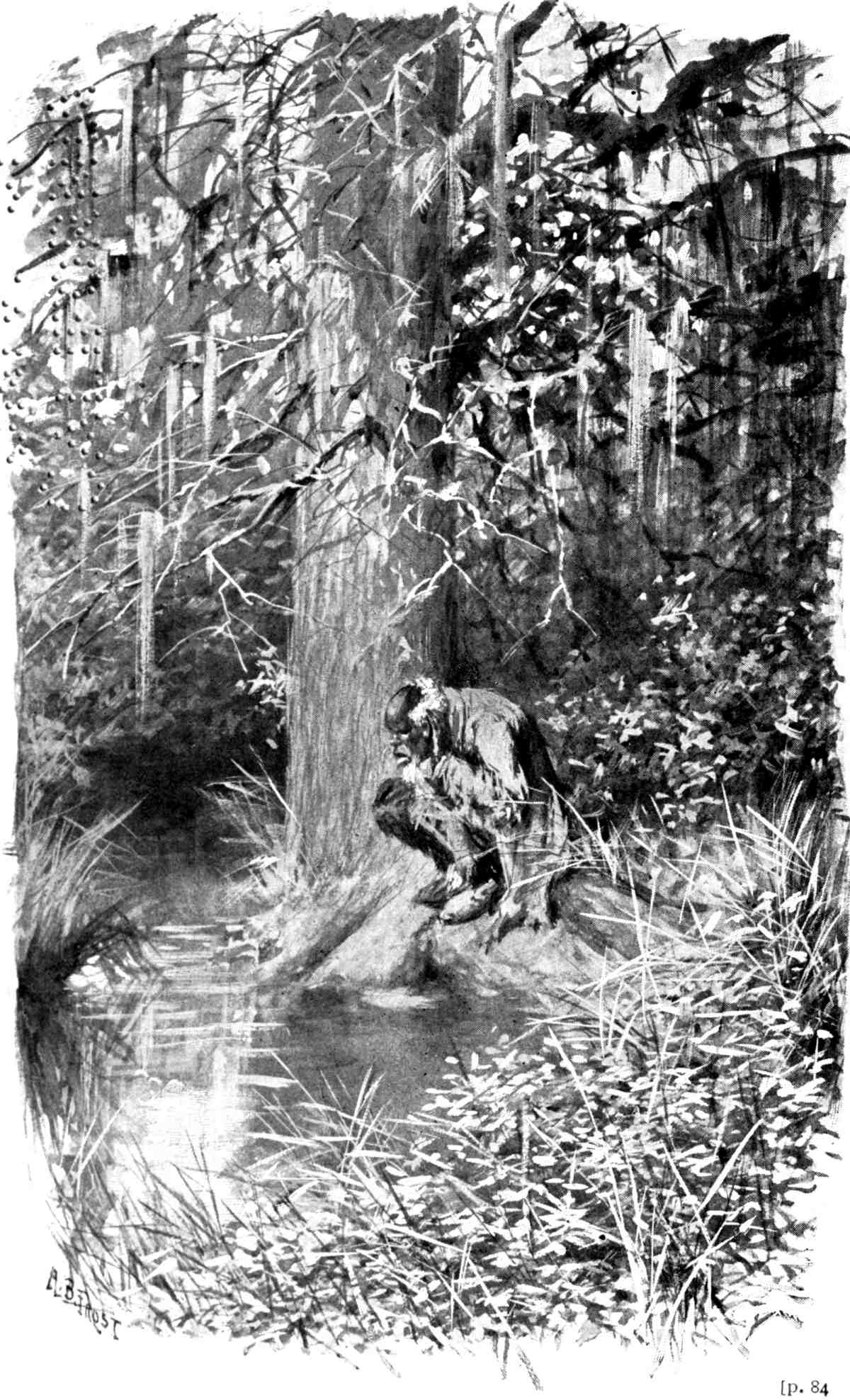

 MCM