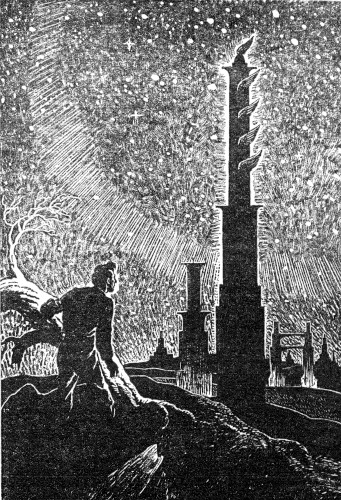
Three roots there are that three ways run
'Neath the ash-tree Yggdrasil;
'Neath the first lives Hel, 'neath the second the frost giants,
'Neath the last are the lands of men.
Thorn did not ask himself why his resting place was dark and stuffy,
rocky and dry, or where the stale, sour smell of woodsmoke came from.
He was content to lie there and let his mind snuggle down into his
body, lull itself with simple sensations, forget the reverberations of
its terrible journey. World II still clung to him sluggishly. But like
a nightmare from which one has wakened, it could be disregarded.
In a moment he would rouse himself and do what must be done. In a
moment, he knew, he would know no peace until the warning had been
given and all essential steps taken, until the invasion had been met
and decisively thrown back. He would be a creature of tension, of
duty, of war.
But for the moment nothing mattered, nothing could break his sense of
peace.
Odd, though, that the heavy woodsmoke did not make him cough, and that
his body was not aching from its cramped position and rocky crouch.
Muffledly, as if its source were underground, came a distant howling,
melancholy and long-drawn-out, ending on a low note of menace.
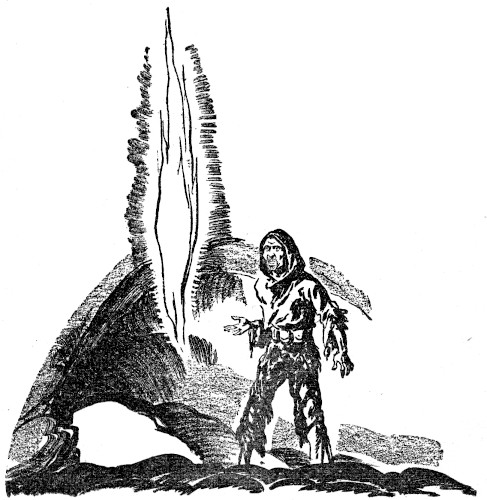
He started up. His shielding hand encountered a low ceiling of rock,
hurriedly traced it to jagged, sloping walls on either side.
It was he that was underground, not the howling.
What the devil had Thorn II been doing in a cave in World I? Why was
he wearing this odd jumble of heavy clothing, that seemed to include
thick, stiff boots and furs? Where had he gotten the long knife that
was stuck in his belt?
The cramping darkness was suddenly full of threats. In panicky haste he
continued his feeling-out of the walls, found that he was in a small
domed chamber, high enough in the center so that he could almost stand
upright. On three sides the walls extended down to the uneven floor, or
to the mouths of horizontal crevices too narrow to stick more than an
arm in.
On the fourth side was a low opening. By getting down on hands and
knees he could wriggle in.
It led slightly upward. The smell of woodsmoke grew heavier. After
two sharp turns, where jagged edges caught but did not tear his heavy
clothing, he began to see the gray gleam of daylight.
The roof of the passageway grew higher, so that he could almost walk
upright. Then it suddenly opened into a larger chamber, the other end
of which was completely open to a gloomy landscape.
This landscape consisted of a steep hillside of granite boulders and
wind-warped pines, all patched with snow, at a middle distance, as if
across a ravine.
But Thorn did not inspect it closely, for he was looking chiefly at the
fire blocking the mouth of the narrow passageway, sending up smoke that
billowed back from the ceiling, making the day even more gloomy and dim.
It immediately struck him as being a very remarkable fire, though he
couldn't say why. After a while he decided that it was because it had
been very cleverly constructed to burn steadily for a long time, some
of the logs and branches being so placed that they would not fall into
the fire until others had been consumed. Whoever had built that fire
must have painstakingly visualized just how it was going to burn over a
period of several hours.
But why should he waste time admiring a fire? He kicked it aside with
the clumsy boots Thorn II had dug up God knows where, and strode to the
mouth of the cave.
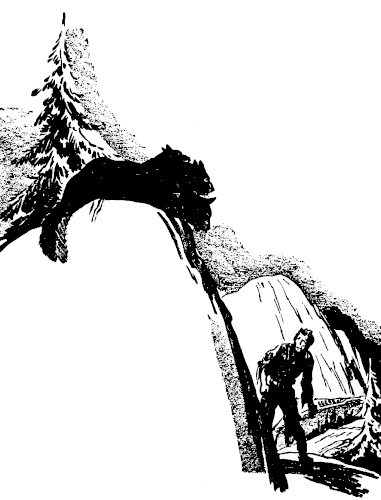
Claws skirred on rock, and he had the impression of a lithe furry
animal whisking off to one side.
The cave opened on a hillside, similar to the one opposite and
slanting down to a twisting, ice-choked stream. Overhead a gray, dreary
sky seemed to be trending toward nightfall. The walls of the ravine
shut off any more distant horizon. It was very cold.
The scene was hauntingly familiar.
Had Thorn II been insane, or gone insane? Why else should he have
hidden himself in a cave in a near-arctic wild-life reserve? For that
certainly seemed to be what he had done, despite the difficulty in
picturing just how he had managed to do it in so short a time.
A fine thing if, after getting back to his rightful world, he should
starve to death in a reserve, or be killed by some of the formidable
animals with which they were stocked.
He must climb the hill behind him. Wherever he was, he'd be able to
sight a beacon or skylon from its top.
It suddenly occurred to him that this ravine was devilishly like one in
the woodland near the symchromy amphitheater, a ravine in which he and
Clawly used to go exploring when they were boys. There was something
unforgettably distinctive about the pattern of the streambed.
But that couldn't be. The weather was all wrong. And that ravine
was much more thickly wooded. Besides, erosion patterns were always
repeating themselves.
He started to examine the queer, bulky clothing Thorn II had been
wearing. In doing so, he got one good look at his hands—and stopped.
He stood for a long moment with his eyes closed. Even when soft paws
pattered warily somewhere over his head and a bit of gravel came
trickling down, he did not jerk.
Rapidly the determination grew in his mind that he must get to the
hilltop and establish his position before he did anything else, before
he thought anything else, certainly before he examined his hands or
his face more closely. It was more a terror-inspired compulsion than a
determination. He stepped to the rocky lip in front of the cave, and
looked back. Again there was the impression of a gray, furry animal
streaking for cover. Something about the size of a cat. He hurriedly
surveyed the routes leading upward, picked one that seemed to slope
more gradually and avoid the steeper barren stretches, and immediately
started up it at a scrambling trot, his eyes fixed resolutely ahead.
But after he had gone a little way, he saw something that made him stop
and stare despite the compulsion driving him.
On a pine-framed boulder about a dozen yards ahead, to one side of the
route he was taking, three cats sat watching him.
They were cats, all right, house cats, though they seemed to be of a
particularly thick-furred breed.
But one wouldn't normally find house cats on a wild-life reserve. Their
presence argued the nearness of human habitation. Moreover, they
were eying him with a poised intentness that indicated some kind of
familiarity, and did not fit with their earlier racing for cover—if
those had been the same animals.
He called, "Kitty!" His voice cracked a little. "Kitty!"
The sound drifted thinly across the hillside, as if congealed by the
cold.
And then the sound was answered, or rather echoed, by the cat to the
right, a black and gray.
It was not exactly the word "Kitty" that the cat miowed, but it was a
sound so like it, so faithful to his exact intonations, that his flesh
crawled.
"Kii ... eee." Again the eerily mocking, mimicking challenge rang out.
He was afraid.
He started forward again. At the first scrape of his boots on gravel,
the cats vanished.
For some time he made fast, steady progress, although the going was
by no means easy, sometimes leading along the rims of landslides,
sometimes forcing him to fight his way through thick clumps of scrub
trees. The last "Kii ... eee" stuck in his ears, and at times he was
pretty sure he glimpsed furry bodies slipping along to one side,
paralleling his progress. His thoughts went off on unpleasant tacks,
chiefly about the degree to which careful breeding had increased the
intelligence of house cats, the way in which they had always maintained
their aloof and independent life in the midst of man's civilization,
and other less concrete speculations.
Once he heard another sound, a repetition of the melancholy howling
that had first startled him in the cave. It might have been wolves, or
dogs, and seemed to come from somewhere low in the ravine and quite a
distance away.
The sky was growing darker.
The rapid ascent was taking less out of him than he would have
imagined. He was panting, but in a steady, easy way. He felt he could
keep up this pace for a considerable distance.
The pines began to thin on the uphill side. He emerged onto a long,
wide slope that stretched, ever-steepening, boulder-strewn but almost
barren of vegetation, to the ravine's horizon. His easiest way lay
along its base, past tangled underbrush.
A little distance ahead and up the slope, a large chunk of granite
jutted out. On its rim sat three cats, again regarding him. Something
about the way they were turned toward each other, the little movements
they made, suggested that they were holding a conference and that the
topic of the conference was—he.
From behind and below the howling came again. The cats pricked up their
ears. There were more movements, more glances in his direction. Then as
he began jogging along again, one of the cats—the tiger—leaped down
and streaked away past him, downhill. While the black-and-gray and the
black dropped off the granite rim more leisurely and began to trot
along in the direction he was taking, with frequent sidewise glances.
He quickened his pace, grateful for the reserve energy.
The going was good. There were no eroded chutes to be edged around, no
pines to fight.
Once the howling was repeated faintly.
The shadowy bodies of the cats slipped between the boulders, in and
out. Gradually he began to draw ahead of them.
For some reason everything felt very natural, as if he had been created
for this running through the dusk.
He sprinted up the last stretch, came out on top.
For a long time he just looked and turned, and turned and looked.
Everything else—emotions, thought—was subordinated to the act of
seeing.
Up here it was still pretty light. And there were no hills to shut out
the view. It stretched, snow-streaked, lightless, lifeless, achingly
drear, to black horizons in three directions and a distant glittering
ice-wall in the fourth.
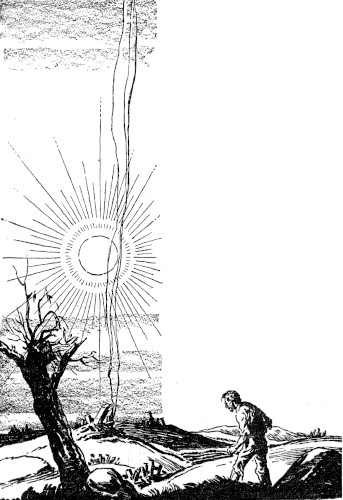
The only suggestion of habitation was a thin pencil of smoke rising
some distance across the plateau he faced.
For as long as he could, he pretended not to recognize the ruins
sparsely dotting the landscape—vast mountainous stumps of structures,
buckled and tortured things, blackened and ice-streaked, surrounded by
strange formations of rock that suggested lava ridges, as if the very
ground had melted and churned and boiled when those ruins were made.
A ruined world, from which the last rays of a setting sun, piercing for
a moment the smoky ruins, struck dismal yellow highlights.
But recognition could only be held at bay for a few minutes. His guess
about the ravine had been correct. That snow-shrouded, mile-long mound
ahead of him was the grave of the Opal Cross. That dark monolith far to
the left was the stump of the Gray H. Those two lopped towers, crazily
buckled and leaning toward each other as if for support, were the Gray
Twins. That split and jagged mass the other side of the ravine, black
against the encroaching ice, up-thrust like the hand of a buried man,
was the Rusty T.
It could hardly be World I, no matter after what catastrophe or lapse
of years. For there was no sign, not even a suggestive hump, of the
Blue Lorraine, the Mauve Z, or the Myrtle Y. Nor World II, for the
Black Star's ruins would have bulked monstrously on the immediate left.
He looked at his hands.
They were thickened and calloused, ridged and darkened by scars of
wounds and frostbite, the nails grained and uneven. And yet they were
Thorn's hands.
He lifted them and touched his chapped, scaly face, with its
high-growing, uncombed beard and long hair matted against his neck
under the fur hood.
His clothes were a miscellany of stiff, inexpertly-tanned furs,
portions of a worn and dirty suit of flying togs, and improvised
bits of stuff, such as the hacked-out sections of elastoid flooring
constituting the soles of his boots.
His heavy belt, which was reinforced with reading-tape, supported two
pouches, besides the knife, which seemed to be a crudely-hilted cutter
from a hyperlathe.
One of the pouches contained a sling shot powered by strips of
elastoid, several large pebbles, and three dark, dubious chunks of meat.
In the other were two small containers of nutriment-concentrate with
packaging-insignia of twenty-five years ago, a stimulol cannister
with one pellet left, two bits of sharp metal, a jagged fragment of
flint, three more pieces of elastoid, more reading-tape, a cord made
of sinew, a glastic lens, a wood carver's handsaw, a small, dismantled
heat-projector showing signs of much readaptive tinkering, several
unidentifiable objects, and—the smooth gray sphere he had stolen at
the Yggdrasil.
Even as he was telling himself it could not be the same one, his blunt
fingers were recognizing its unforgettable smoothness, its oblate
form, its queerly exaggerated inertia. His mind was remembering he had
fancied it a single supergiant molecule, a key—if one knew how to use
it—to the doors of unseen worlds.
But there was only time to guess that the thing must be linked to his
mind rather than to any of the bodies his mind had occupied, and to
wonder how it had escaped the thorough search to which he had been
subjected in the Black Star, when his attention was diverted by a faint
eager yapping that burst out suddenly and was as suddenly choked off.
He turned around. Up the boulder-studded slope he had just ascended,
streaming out of the underbrush at its base, came a pack of wolves, or
dogs—at least thirty of them. They took the same sloping course that
he had taken. There was a strange suggestion of discipline about their
silent running. He could not be sure—the light was very bad—but he
fancied he saw smaller furry shapes clinging to the backs of one or two
of them.
He knew now why he had spent time admiring a fire.
But the pack was between him and that fire, so he turned and ran across
the plateau toward where he had glimpsed the rising wisp of smoke.
As he ran he broke out and chewed the lone stimulol pellet, breathing
thanks to that Thorn—he would call him Thorn III—who had hoarded the
pellet for so many years, against some ultimate emergency.
He ran well. His clumsily-booted feet avoided rocks and ruts, hit
firmly on icy patches, with a sureness that made him wonder if they
did not know the route. And when the stimulol hit his blood-stream, he
was able to increase speed slightly. But risking a look back, he saw
the pack pouring up over the crest. A steady baying began, eager and
mournful.
In the growing darkness ahead a low, ruddy, winking light showed. He
studied its slow increase in size, intent on gauging the exact moment
when he would dare to sprint.
The way became rougher. It was a marvel how his feet carried him. The
ruddy light became a patch, illumining a semicircular opening behind
it. The baying drew near. He could hear the scuff of clawed feet. He
started to sprint.
And just in time. There was a great brown hound springing higher than
his shoulder, snapping in at his neck, splashing it with slaver, as he
jumped the fire, turned with his whipped-out knife, and took his stand
beside the gnarled man with the spear, in front of the doorless doorway
of the half-buried room, or large crate, of weathered plastoid.
Then for a moment it was chaotic battle—gaunt-bellied forms rearing
above the flames—red eyes and clashing yellow fangs—spear and cutter
licking out—reek of singed hair—snarls, squeals, grunts, gasps—and,
dominating it all, making it hellish, those three spitting, mewing
cat-faces peering over the shoulders of three dogs that hung in the
rear.
Then, as if at a note of command, the dogs all retreated and it was
suddenly over. Without a word, Thorn and the other man began to repair
and restock with fuel the scattered fire. When it was finished, the
other man asked, "Did they get you anywhere? I may be crazy, but I
think the devils are starting to poison the teeth of some of the
hounds."
Thorn said, "I don't think so," and began to examine his hands and arms.
The other man nodded. "What food you got?" he asked suddenly.
Thorn told him. The other man seemed impressed by the
nutriment-concentrate. He said, "We could hunt together for a while,
I guess. Ought to work out good—having one watching while the other
sleeps." He spoke rapidly, jumbling the words together. His voice
sounded disused. He studied Thorn uneasily.
Thorn studied him. He was smaller and moved with a limp, but beard,
skin, and clothing were like Thorn's. The screwed-up face was not
familiar. The darting, red-rimmed eyes below the jutting brows were
not altogether sane. Thorn's presence seemed to put him on edge, to
shake his emotions to the core. Every time he snapped shut his cracked,
nervous lips, Thorn felt that he dammed up a torrent of babblingly
eager talk.
He asked Thorn, "Where did you come from?"
"A cave in the ravine," Thorn replied, wondering how much to tell.
"What's your story?"
The man looked at him queerly. He trembled. Then the cracked lips
opened.
To Thorn, squatting there behind the crackling fence of flame, staring
out into a night that was black except for the occasional red hint of
eyes, it seemed that what he heard was what he had always known.
"My name was Darkington. I was a geology student. What saved me was
that I was in the mountains when the power broke loose. I guess we
all knew about the power, didn't we? It was in the air. We'd always
known that some day someone would find out what it was behind gravity
and electricity and magnetism"—he stumbled over the long words—"and
the more they tried to hush it up, the surer we were that someone had
found out. I guess they shouldn't have tried to hush it up. I guess
intelligent creatures can't back out of their destiny like that.
"But anyway I was in the mountains when the power broke loose and ate
up all the metal it could reach. Our party was laid up by the fumes,
and two of them died. Afterwards some of us started out to try to
contact other survivors, but the fumes were worse where we went and
some more died and the rest broke up. I got in with a gang that was
trying to make a go of farming just north of the volcano belt, but we
made a lot of mistakes and then came the first of the long winters and
finished off all our plans and made us realize that the weather had all
gone different, what with the exposed raw rock taking all the carbon
dioxide out of the air, and not enough green stuff left to replace
it. After that I drifted around and took up with different scavenging
gangs, but when the cannibalism started and the cats and dogs began to
get really dangerous, I headed north and made it to the glaciers. Since
then I've just hung on, like you see me."
He turned to Thorn. Already his voice was hoarse. Like nervous hunger,
his eagerness to talk had not carried him far.
Thorn shook his head, peering beyond the fire. "There must be a way,"
he said slowly. "Admittedly it would be difficult and we'd risk our
lives, but still there must be a way."
"A way?" the other asked blankly.
"Yes, back to wherever men are beginning to band together and rebuild.
South, I suppose. We might have to hunt for a long time, but we'd find
it."
There was a long silence. A curious look of sympathy came into the
other man's face.
"You've got the dreams," he told Thorn, making his croaking voice
gentle. "I get them myself, so strong that I can make myself believe
for a while that everything's the way it was. But it's just the dreams.
Nobody's banding together. Nobody's going to rebuild civilization,
unless"—his hand indicated something beyond the fire—"unless it's
those devils out there."