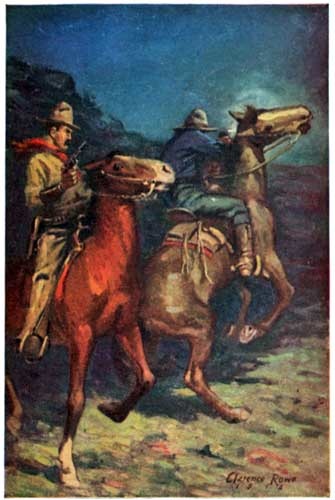
"And so you're going to marry this Casey Dunne," said old Jim Hess. He
and Clyde sat on the veranda at Chakchak, and they had been discussing
the ranch, its owner, and the events that had led up to his absence.
"Yes, Uncle Jim, I'm going to marry him."
"Well," said the big railway man, "making allowance for your natural
partiality, his stock seems to be worth about par. I'll know better
when I've had a look at him. I tell you one thing, I'm glad he isn't a
foreigner. I never liked those fellows who tagged about after you. This
country can produce as good men as you'll find. The others weren't my
sort. All right in their way, perhaps, but they seemed to go too much
on family and ancestry. That's good enough, too, but it seems to me
that the ancestors of some of them must have been a blamed sight better
men than they were. After all, a girl doesn't marry the ancestor. Dunne
seems to have hoed his own row. That's what I did. I'm prepared to like
him. Only I don't want you to make any mistake."
"There's no mistake, Uncle Jim," she said, patting his big hand.
"Casey's a man. You will like him. Look away out there
where the dust is rising! Aren't those men on horseback? Yes, they are.
It must be Casey coming home." Her pleasure was apparent in her voice.
The dust cloud resolved itself into four mounted men and three pack
animals. They moved slowly, at a walk almost, the dust puffing up from
the hoofs drifting over and enveloping them.
"Which is your Casey Dunne?" asked Hess.
Clyde stared with troubled eyes.
"I—I don't see him. There's Tom McHale, and the sheriff, and Sandy
McCrae, and the old Indian. Why, Tom McHale has been hurt. His arm is
in a sling. How slowly they ride! It's—it's like a funeral. Surely
nothing can have happened. Oh, surely——" She caught her breath
sharply, her eyes dilating. "Look!" she cried. "The last pack horse!"
The load on the last horse was a shapeless thing, not compact and built
up like a pack, but hanging low on either side, shrouded by a canvas.
From under this cover a hand and arm dangled, swinging to and fro with
each motion of the animal.
Clyde felt a great fear, cold as the clutch of a dead hand itself,
close on her heart, driving the young blood from her cheeks. "It can't
be!" she said to herself. "Oh—it can't be."
Hess swore beneath his breath. If it were Casey Dunne lying across that
pack horse——He put a huge protective arm around Clyde's shoulders, as
if to shield her from the evil they both feared.
But she slipped from beneath his arm and fled down the steps toward the
party who would have passed in the direction of the stables without
halting. The sheriff, seeing her, pulled up. She caught McHale's
hardened paw in both her hands, searching his eyes for the truth. But
McHale's face, though weary and lined with pain, and, moreover,
rendered decidedly unprepossessing by a growth of stubble, contained no
signs of disaster.
"Where's Casey, Tom?"
"Casey?" McHale replied. "Why, he hiked on ahead to git a medicine man
to fix up this arm of mine. Arm's done busted. He ought to be here most
any time now."
To Clyde it was as if the sun had shot through a lowering, ominous
cloud. She was faint with the joy of relief. "Thank God! Thank God!"
she murmured.
"You seem to be upset about something, ma'am," said the sheriff gently.
"Has anything went wrong?"
Hess answered for her. "What have you got on that last pack horse,
sheriff?"
Jim Dove looked around and muttered an oath. "If that ain't plumb
careless of me! I thought I had him all covered up. Rope must have
slipped. That's Jake Betts, holdup and bad man, that's been callin'
himself Dade around here. There's five hundred reward for him, and to
collect the money I had to pack him in. I sure didn't allow to scare
any women by lettin' an arm hang loose. And the little lady thought it
was Dunne? Dunne's all safe and rugged. We thought he'd be here ahead
of us."
Hess followed the sheriff to the stable and introduced himself, going
directly to the point, as was his custom.
"Sheriff," he said, "I've just come, and naturally I don't know all
that has happened, but there are two or three things I want you to
know. In the first place, my niece, Miss Burnaby, is going to marry
this man Dunne. And, in the second place, I'm now running this
irrigation company and the railway that owns it, and so far as any
prosecutions are concerned I won't have anything to do with them. Does
that make any difference to you?"
"Some," said the sheriff. "It lets young McCrae out, I reckon."
"How about McHale?"
"That's a killin'. You got nothin' to do with that. Anyway, he's got a
good defence."
"I'll sign his bail bond to any amount."
"I reckon there won't be no trouble about that," said the sheriff. "I
know a man when I see him. McHale's all right. You won't find me makin'
things hard for anybody around here, Mr. Hess."
In half an hour Casey rode up, bringing with him a man of medicine in
the person of Doctor Billy Swift. And Billy Swift, whose chronic
grievance was that Coldstream was altogether too healthy for a
physician to live in, greeted his patients with enthusiasm and got busy
at once.
Hess, strolling up from a confidential talk with Sheriff Dove, ran into
Clyde and Casey snugly ensconced in a corner of the veranda, where
thick hop vines shaded them from the public gaze.
"Excuse me!" said Hess, with little originality, but much
embarrassment.
"Not at all," Casey replied, under the impression that he was carrying
off matters very nonchalantly. Clyde laughed at both of them.
"We don't mind you, Uncle Jim, do we, Casey?"
"Look here," said Hess, "if this is the young man who has been raisin'
Cain around here, and destroying my property before I owned it, suppose
you introduce me?"
The two men shook hands, gripping hard, measuring each other with their
eyes. And Clyde was tactful enough to leave them to develop their
acquaintance alone.
"I want to thank you for your wire to Clyde," said Casey. "You can
guess what it meant to all of us here."
"I've a fair notion," said Hess. "Of course, I only know what Clyde has
told me, but I can see that you people have been up against a hard
proposition. After this I hope you won't have much to kick at. We won't
take advantage of that clause in the old railway charter—at least not
enough to interfere with men who are actually using water now. But I
want you to be satisfied with enough to irrigate, used economically."
"That's all we ever wanted."
"I'm glad to hear it. Now I've fixed up this matter of young McCrae's.
That's settled. No more trouble about it. As to your man, McHale, I'm
told that his trial will be a mere matter of form. Wade will look after
that. Now, about Clyde."
"Yes," said Casey.
"She's her own mistress—you understand that. You have a good property
here—not as much money as she has, but enough to get along on if she
hadn't anything. That's all right. I suppose her money's no drawback,
eh? Don't look mad about it, young man. You're fond of her, of course.
I understand you made what you've got yourself?"
"Every cent. I've been out for myself since I was about fifteen. This
is what I've got to show for it."
"And it's a good little stake," said Hess heartily. "I made my own
pile, too. That's what I like. Now, I'm going to ask you a personal
question: What sort of life have you behind you? You understand me.
There must be no comeback where Clyde is concerned. I want a straight
answer."
"You'll get it. I've always been too busy to be foolish. My habits are
about average—possibly better than average. I'm absolutely healthy.
I've not had a day's sickness—bar accidents—since I grew up. There's
absolutely no reason why I shouldn't marry Clyde."
"That's the boy!" said old Jim Hess, with satisfaction, gripping his
hand again. "Your stock's par with me, remember, and I want you to
consider me your friend, even if I am to be a relation by marriage."
Shortly afterward Sheila and Farwell arrived on hard-ridden horses.
"She hustled me right over here," said the latter. "Didn't even give me
time to shave. I told her McHale and Sandy were all right, but she had
to come to see for herself."
"Seeing that Sandy has eaten six fried eggs with bacon and bread buns
to match, I imagine he may be regarded as convalescent," laughed Casey.
"Tom has the tobacco trust half broken already."
Sandy McCrae squirmed uneasily in his sister's embrace, finding it
embarrassing.
"That's plenty, that's plenty!" he growled. "You'd think I was a sole
survivor or something. Say, what are you trying to do—choke me? There,
you've kissed me three times already. Ouch! Darn it, don't hug me. My
side's sore. Try that hold on Farwell. He looks as if he wouldn't
mind."
Casey laughed. Sheila and Farwell reddened. A smothered chuckle from
McHale showed that he was enjoying himself. He grinned over Sandy's
shoulder.
"Howdy, Miss Sheila? Brothers don't know their own luck. Wisht I had a
sister about your size."
"I'll adopt you right now!" she declared, and proceeded to give
practical proof of it, somewhat to his confusion.
"You're an awful bluff, Tom," she accused him. "Really, I believe
you're bashful with girls. I never suspected it before."
"It's just want of practice," grinned McHale. "Some day when I have
time I'm going out to get me a girl like you. There was one down
at——"
But Clyde's appearance interrupted McHale's reminiscences. She and
Sheila, arms about each other, strolled away to exchange confidences.
Casey and Farwell followed.
"We ain't in it," said McHale.
"Well, who wants to be?" said Sandy.
"A few weeks ago," McHale mused, "them two girls warmed up to each
other about as much as two wet sticks of wood; and them two sports
would have locked horns at the bat of an eye. Look at 'em now! What
done it?"
"Does your arm hurt you much?" Sandy asked.
"Sortin' out the hand done it," McHale continued, unheeding. "Each girl
finds out that the other ain't organizin' to be hostile. And the men
find out that they're playin' different systems; likewise, that each
has a good point or two."
"She sure must have been a hard trip for you down from the hills,"
Sandy commented, with much sarcasm.
"Love," said McHale sentimentally, "is a durn funny thing."
Sandy's disgusted comment consisted of but one word not usually
associated with the tender passion. "Well, may be—sometimes," McHale
admitted.
It was a merry party that sat down to the best supper Feng could
prepare on short notice. Wade was in great form. He outdid himself,
keeping up a rapid fire of jokes and conversation. The sheriff,
infected by his example, uncovered a vein of unsuspected humour.
McHale, who referred to himself as "a temp'rary southpaw," contributed
his quota. Sandy was silent and dour, as usual. Jim Hess said little,
but he beamed on everybody, enjoying their happiness.
When Sheila insisted that she must go, Casey saddled Dolly for Clyde
and Shiner for himself. He rode with Sheila, temporarily relinquishing
Clyde to Farwell. A couple of hundred yards behind the others, just
free of their dust, they jogged easily side by side.
"Our rides together are about over, Casey," she said, with a little
sigh.
"How is that?"
"You know as well as I do. The blessed proprieties are butting in here
nowadays; and, besides, we both belong to other people. Dick wants to
be married soon. Of course, I'll have to go where he goes. Thank
goodness, he hasn't got any people to be my people, and to pass
judgment on me."
"I'll be sorry to lose you, Sheila; and I think you'll be sorry to go."
"Yes. I'll miss the rolling country, and the hills to the west, and the
long days outdoors. Oh, heavens, how I'll miss them! And yet it's worth
while, Casey!"
"I'm awfully glad, for your sake, that you think so much of him, old
girl. He's a fine chap—when you get to know him. But I'll miss you.
How long is it since we had our first ride together?"
"Seven years—no, eight. I was riding a bad pinto. Dad traded him
afterward. You wouldn't let me go home alone. Remember?"
"Of course. Awful brute for a girl to ride!"
"He never set me afoot," she said proudly. "But you'll be leaving here,
too, Casey."
"I don't think so."
"Oh, yes, you will. Clyde's money——"
"Hang her money! Don't throw that up to me."
"Nonsense! Don't be so touchy. I wish I had it. You'll go where
there are people and things happening. You'll keep the ranch, but Tom
will look after it."
"No, no."
"Yes, yes. You won't be idle—you're not that kind—but you'll find
other interests, and the money may be a stepping-stone. She's a dear
girl, Casey. Be good to her."
"I couldn't be anything else. You needn't tell me I'm not worthy of
her; I know it."
"You're worthy of any girl," she said firmly. "Not a bit of hot air,
either, old boy. I almost fell in love with you myself."
"By George!" he exclaimed, "there were times when I wondered how much I
thought of you."
She laughed, well pleased. "We know the difference now, don't we? What
a mistake it would have been! I'm glad we kept these thoughts to
ourselves—glad we never played at being in love. Now we can talk
without fear of misunderstanding. Somehow, now, the years here seem
like a dream to me. Yes, I know they've been busy years, crowded with
work for both of us; but just now they don't seem real. We seem—I
seem—to be standing at the boundary of a new life. All that is over
was just preparation for it—the long days in the sun and the wind, the
quiet nights beneath the stars, the big, lonely, brown land, and the
hazy blue of the hills. The girl that lived among them seems like a
little, dead sister. And yet I love these things. Wherever I go,
whatever happens to me, I shall think of them always."
"That's absolutely true. They are in your heart—a part of you. I
understand. The little boy that lay on a lake shore years ago and
watched the old stone hookers wallowing through the long swells doesn't
seem to be Casey Dunne. And yet I can smell the wet sand and the clean
lake breezes now. These are the things that keep our hearts young. You
were born in the West, Sheila, and I in the East; but the roots of our
beings fed on the clean things of the earth that mothered us some
thousands of miles apart, and the taste will never be forgotten. In the
years to come we will think of the years here as to-night we think of
our childhood."
She held out her hand. Gauntlet met gauntlet in the hard grip of
comradeship.
"Good-bye, Casey. It's not likely we'll ever talk of these things
again. I'm glad you've been a part of my life."
"Good luck to you always, Sheila."
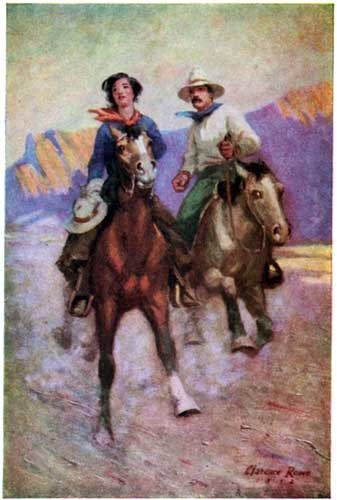
"They've left us behind," she said. "Come on! One last good run,
Casey!"
Clyde and Farwell, riding decorously at an easy jog trot, heard the
thunder of hoofs behind them, and turned to see the bay and the
buckskin sweep past, encouraged by voice and heel.
"She'll kill herself some day," Farwell ejaculated, and he scolded her
roundly when they rode up to where she and Casey had finally halted
their blown steeds.
"Listen to him!" cried Sheila, in derision. "As if I didn't savvy a
horse! All right, my lord, I won't do it again till next time. And now,
Casey, you and Clyde must not come any farther. It will be dark before
you get back."
"If you want to be rid of us——" he suggested.
"You've been sorry for yourself for the last hour, and you needn't deny
it," she retorted.
Clyde and Casey rode slowly homeward through the falling dusk. For the
first time since his return they were really alone together. She made
him tell her all that had occurred, down to the minutest detail.
"But now there will be no more trouble of any kind," she predicted.
"Thanks to you."
"Thanks to Uncle Jim."
"Both of you. He's a big man—a nation builder—but if his niece hadn't
had the good taste to fall in love with me his interest would have been
less personal. He wouldn't have got around to a little matter like this
for months. Anyway, we bracket you together. Do you know that some of
the kids are being taught to pray for you?"
"Not really?"
"Fact. Doctor Swift told me. 'God bless pa, and ma, and Mister Jim
Hess, and Miss Burnaby.' That's the formula. Swift predicts that the
next batch of christenings will include a 'Yim Hess' Swanson and a
'Clyde Burnaby' Brulé. Such is fame! Think you can stand the dizzy
popularity?"
"Lovely!" cried Clyde. "I'll order silver mugs to-morrow, and start a
savings account for each baby."
"Go slow!" he laughed. "You'll have 'em all named after you at that
rate."
"I'll get the mugs and a spoon, anyway. I never was so flattered
before. I've just begun to live since I came out here. Why,
Casey, my life was absolutely empty. You can't imagine how lonely and
bored I was."
"What a shame! We'll see that it doesn't occur again. Which opens an
interesting question: When are you going to marry me?"
"Why—I hadn't thought. I suppose we should think of it."
"Well, it's usual, under the circumstances."
"Next June? I think I should like to be a June bride."
"See here, young lady," said Casey severely, "what sort of a gold brick
is this? Are you aware that we are in the fag end of July?"
"It's really not a long engagement. A year soon passes."
"And the years soon pass. I'm not going to be defrauded of a year's
happiness. I'll stand for any time in September, but not a day later."
"September! But, my dearest boy, that's only a few weeks."
"That's why I said September."
She laughed happily. "Very well, September. But I'll have a thousand
things to do. I'll have to go back with Uncle Jim."
"What's the use? Stay here. Kitty Wade will stay, too. I'll coax her."
"But I've all sorts of things to buy?"
"Order 'em by mail."
"My trousseau by mail!" she exclaimed, in horror. "It would be
sacrilege."
"Oh, well, suit yourself," said Casey, with a sigh of resignation.
"Thank the Lord it only happens once."
She laughed. "And then there's our honeymoon to plan. Where shall we
spend it?"
"It's up to you. Wherever you say."
"You've never been to Europe?"
"No. But I'd rather do my honeymooning where I can ask for what I want
with some chance of getting it."
"But I speak French, German, and Italian—not fluently, but well enough
to get along on."
"And I talk United States, Chinook, and some Cree—we ought to get
along almost anywhere," he laughed. "Let's leave this Europe business
open. Now here's a really serious question: When our honeymoon is
over—what?"
"I don't understand."
"Where shall we live? I can sell out here, if you like."
"But you wouldn't like?"
"I'd hate to," he admitted.
"I know. So should I. We'll live here, at Chakchak. It shall be our
home."
"Would you be contented? It's lonely at times. The winters are long.
You'd miss your friends and your old life."
"I ran away from both. I love your country because it's yours. It shall
be mine, too. Look!" Away in the distance a tiny point of light
twinkled. "There are the lights of Chakchak—our home lights, dear!"
Her hand sought his in the darkness, met, and clasped it. A star shot
in a blazing trail across the velvet blackness of the sky. The first
breath of the night breeze, cold from the mountain passes, brushed
their cheeks. Save for the distant light the world was dark, the land
lonely, silent, devoid of life. The great spaces enfolded them, wrapped
them in silence as in a vast robe. But the old, sweet song was in their
hearts as they rode slowly forward—to the Light!
STORIES OF RARE CHARM BY
GENE STRATTON-PORTER
May be had wherever books are sold. Ask for Grosset and Dunlap's list
LADDIE. Illustrated by Herman Pfeifer.
This is a bright, cheery tale with the scenes laid in Indiana. The
story is told by Little Sister, the youngest member of a large family,
but it is concerned not so much with childish doings as with the love
affairs of older members of the family. Chief among them is that of
Laddie, the older brother whom Little Sister adores, and the Princess,
an English girl who has come to live in the neighborhood and about
whose family there hangs a mystery. There is a wedding midway in the
book and a double wedding at the close.
THE HARVESTER. Illustrated by W. L. Jacobs.
"The Harvester," David Langston, is a man of the woods and fields, who
draws his living from the prodigal hand of Mother Nature herself. If
the book had nothing in it but the splendid figure of this man it would
be notable. But when the Girl comes to his "Medicine Woods," and the
Harvester's whole being realizes that this is the highest point of life
which has come to him—there begins a romance of the rarest idyllic
quality.
FRECKLES. Decorations by E. Stetson Crawford.
Freckles is a nameless waif when the tale opens, but the way in which
he takes hold of life; the nature friendships he forms in the great
Limberlost Swamp; the manner in which everyone who meets him succumbs
to the charm of his engaging personality; and his love-story with "The
Angel" are full of real sentiment.
A GIRL OF THE LIMBERLOST. Illustrated by Wladyslaw T. Brenda.
The story of a girl of the Michigan woods; a buoyant, lovable type of
the self-reliant American. Her philosophy is one of love and kindness
towards all things; her hope is never dimmed. And by the sheer beauty
of her soul, and the purity of her vision, she wins from barren and
unpromising surroundings those rewards of high courage.
AT THE FOOT OF THE RAINBOW. Illustrations in colors by Oliver Kemp.
The scene of this charming love story is laid in Central Indiana. The
story is one of devoted friendship, and tender self-sacrificing love.
The novel is brimful of the most beautiful word painting of nature, and
its pathos and tender sentiment will endear it to all.
Grosset & Dunlap, Publishers, New York
MYRTLE REED'S NOVELS
May be had wherever books are sold. Ask for Grosset & Dunlap's list
LAVENDER AND OLD LACE.
A charming story of a quaint corner of New England where bygone romance
finds a modern parallel. The story centers round the coming of love to
the young people on the staff of a newspaper—and it is one of the
prettiest, sweetest and quaintest of old fashioned love stories, * * *
a rare book, exquisite in spirit and conception, full of delicate
fancy, of tenderness, of delightful humor and spontaneity.
A SPINNER IN THE SUN.
Miss Myrtle Reed may always be depended upon to write a story in which
poetry, charm, tenderness and humor are combined into a clever and
entertaining book. Her characters are delightful and she always
displays a quaint humor of expression and a quiet feeling of pathos
which give a touch of active realism to all her writings. In "A Spinner
in the Sun" she tells an old-fashioned love story, of a veiled lady who
lives in solitude and whose features her neighbors have never seen.
There is a mystery at the heart of the book that throws over it the
glamour of romance.
THE MASTER'S VIOLIN.
A love story in a musical atmosphere. A picturesque, old German
virtuoso is the reverent possessor of a genuine "Cremona." He consents
to take for his pupil a handsome youth who proves to have an aptitude
for technique, but not the soul of an artist. The youth has led the
happy, careless life of a modern, well-to-do young American and he
cannot, with his meagre past, express the love, the passion and the
tragedies of life and all its happy phases as can the master who has
lived life in all its fulness. But a girl comes into his life—a
beautiful bit of human driftwood that his aunt had taken into her heart
and home, and through his passionate love for her, he learns the
lessons that life has to give—and his soul awakes.
Founded on a fact that all artists realize.
Ask for a complete free list of G. & D. Popular Copyrighted
Fiction
Grosset & Dunlap, 526 West 26th St., New York
AMELIA E. BARR'S STORIES
DELIGHTFUL TALES OF OLD NEW YORK
May be had wherever books are sold. Ask for Grosset and Dunlap's list.
THE BOW OF ORANGE RIBBON. With Frontispiece.
This exquisite little romance opens in New York City in "the tender
grace" of a May day long past, when the old Dutch families clustered
around Bowling Green. It is the beginning of the romance of Katherine,
a young Dutch girl who has sent, as a love token, to a young English
officer, the bow of orange ribbon which she has worn for years as a
sacred emblem on the day of St. Nicholas. After the bow of ribbon
Katherine's heart soon flies. Unlike her sister, whose heart has found
a safe resting place among her own people, Katherine's heart must rove
from home—must know to the utmost all that life holds of both joy and
sorrow. And so she goes beyond the seas, leaving her parents as
desolate as were Isaac and Rebecca of old.
THE MAID OF MAIDEN LANE; A Love Story. With Illustrations by S. M.
Arthur.
A sequel to "The Bow of Orange Ribbon." The time is the gracious days
of Seventeen-hundred and ninety-one, when "The Marseillaise" was sung
with the American national airs, and the spirit affected commerce,
politics and conversation. In the midst of this period the romance of
"The Sweetest Maid in Maiden Lane" unfolds. Its chief charm lies in its
historic and local color.
SHEILA VEDDER. Frontispiece in colors by Harrison Fisher.
A love story set in the Shetland Islands.
Among the simple, homely folk who dwelt there Jan Vedder was raised;
and to this island came lovely Sheila Jarrow. Jan knew, when first he
beheld her, that she was the one woman in all the world for him, and to
the winning of her love he set himself. The long days of summer by the
sea, the nights under the marvelously soft radiance of Shetland
moonlight passed in love-making, while with wonderment the man and
woman, alien in traditions, adjusted themselves to each other. And the
day came when Jan and Sheila wed, and then a sweeter love story is
told.
TRINITY BELLS. With eight Illustrations by C. M. Relyea.
The story centers around the life of little Katryntje Van Clyffe, who,
on her return home from a fashionable boarding school, faces poverty
and heartache. Stout of heart, she does not permit herself to become
discouraged even at the news of the loss of her father and his ship
"The Golden Victory." The story of Katryntje's life was interwoven with
the music of the Trinity Bells which eventually heralded her wedding
day.
Ask for complete free list of G. & D. Popular Copyrighted
Fiction
Grosset & Dunlap, 526 West 26th St., New York
CHARMING BOOKS FOR GIRLS
May be had wherever books are sold. Ask for Grosset & Dunlap's list
WHEN PATTY WENT TO COLLEGE, By Jean Webster.
Illustrated by C. D. Williams.
One of the best stories of life in a girl's college that has ever been
written. It is bright, whimsical and entertaining, lifelike, laughable
and thoroughly human.
JUST PATTY, By Jean Webster.
Illustrated by C. M. Relyea.
Patty is full of the joy of living, fun-loving, given to ingenious
mischief for its own sake, with a disregard for petty convention which
is an unfailing source of joy to her fellows.
THE POOR LITTLE RICH GIRL, By Eleanor Gates.
With four full page illustrations.
This story relates the experience of one of those unfortunate children
whose early days are passed in the companionship of a governess, seldom
seeing either parent, and famishing for natural love and tenderness. A
charming play as dramatized by the author.
REBECCA OF SUNNYBROOK FARM, By Kate Douglas Wiggin.
One of the most beautiful studies of childhood—Rebecca's artistic,
unusual and quaintly charming qualities stand out midst a circle of
austere New Englanders. The stage version is making a phenomenal
dramatic record.
NEW CHRONICLES OF REBECCA, By Kate Douglas Wiggin.
Illustrated by F. C. Yohn.
Additional episodes in the girlhood of this delightful heroine that
carry Rebecca through various stages to her eighteenth birthday.
REBECCA MARY, By Annie Hamilton Donnell.
Illustrated by Elizabeth Shippen Green.
This author possesses the rare gift of portraying all the grotesque
little joys and sorrows and scruples of this very small girl with a
pathos that is peculiarly genuine and appealing.
EMMY LOU: Her Book and Heart, By George Madden Martin.
Illustrated by Charles Louis Hinton.
Emmy Lou is irresistibly lovable, because she is so absolutely real.
She is just a bewitchingly innocent, huggable little maid. The book is
wonderfully human.
Ask for complete free list of G. & D. Popular Copyrighted Fiction
Grosset & Dunlap, 526 West 26th St., New York
TITLES SELECTED FROM
GROSSET & DUNLAP'S LIST
RE-ISSUES OF THE GREAT LITERARY SUCCESSES OF THE TIME
May be had wherever books are sold. Ask for Grosset & Dunlap's list
BEN HUR. A Tale of the Christ. By General Lew Wallace.
This famous Religious-Historical Romance with its mighty story,
brilliant pageantry, thrilling action and deep religious reverence,
hardly requires an outline. The whole world has placed "Ben-Hur" on a
height of pre-eminence which no other novel of its time has reached.
The clashing of rivalry and the deepest human passions, the perfect
reproduction of brilliant Roman life, and the tense, fierce atmosphere
of the arena have kept their deep fascination.
THE PRINCE OF INDIA. By General Lew Wallace.
A glowing romance of the Byzantine Empire, showing, with vivid
imagination, the possible forces behind the internal decay of the
Empire that hastened the fall of Constantinople.
The foreground figure is the person known to all as the Wandering Jew,
at this time appearing as the Prince of India, with vast stores of
wealth, and is supposed to have instigated many wars and fomented the
Crusades.
Mohammed's love for the Princess Irene is beautifully wrought into the
story, and the book as a whole is a marvelous work both historically
and romantically.
THE FAIR GOD. By General Lew Wallace. A Tale of the Conquest of Mexico.
With Eight Illustrations by Eric Pape.
All the annals of conquest have nothing more brilliantly daring and
dramatic than the drama played in Mexico by Cortes. As a dazzling
picture of Mexico and the Montezumas it leaves nothing to be desired.
The artist has caught with rare enthusiasm the spirit of the Spanish
conquerors of Mexico, its beauty and glory and romance.
TARRY THOU TILL I COME or, Salathiel, the Wandering Jew. By George
Croly. With twenty illustrations by T. de Thulstrup.
A historical novel, dealing with the momentous events that occurred,
chiefly in Palestine, from the time of the Crucifixion to the
destruction of Jerusalem.
The book, as a story, is replete with Oriental charm and richness, and
the character drawing is marvelous. No other novel ever written has
portrayed with such vividness the events that convulsed Rome and
destroyed Jerusalem in the early days of Christianity.
Ask for complete free list of G. & D. Popular Copyrighted Fiction
Grosset & Dunlap, 526 West 26th St., New York
NOVELS OF SOUTHERN LIFE
By THOMAS DIXON, JR.
May be had wherever books are sold. Ask for Grosset & Dunlap's list
THE LEOPARD'S SPOTS: A Story of the White Man's Burden, 1865-1900. With
illustrations by C. D. Williams.
A tale of the South about the dramatic events of Destruction,
Reconstruction and Upbuilding. The work is able and eloquent and the
verifiable events of history are followed closely in the development of
a story full of struggle.
THE CLANSMAN. With illustrations by Arthur I. Keller.
While not connected with it in any way, this is a companion volume to
the author's "epoch-making" story The Leopard's Spots. It is a
novel with a great deal to it, and which very properly is going to
interest many thousands of readers. * * * It is, first of all, a
forceful, dramatic, absorbing love story, with a sequence of events so
surprising that one is prepared for the fact that much of it is founded
on actual happenings; but Mr. Dixon has, as before, a deeper
purpose—he has aimed to show that the original formers of the Ku Klux
Klan were modern knights errant taking the only means at hand to right
intolerable wrongs.
THE TRAITOR. A Story of the Fall of the Invisible Empire. Illustrations
by C. D. Williams.
The third and last book in this remarkable trilogy of novels relating
to Southern Reconstruction. It is a thrilling story of love, adventure,
treason, and the United States Secret Service dealing with the decline
and fall of the Ku Klux Klan.
COMRADES. Illustrations by C. D. Williams.
A novel dealing with the establishment of a Socialistic Colony upon a
deserted island off the coast of California. The way of disillusionment
is the course over which Mr. Dixon conducts the reader.
THE ONE WOMAN. A Story of Modern Utopia.
A love story and character study of three strong men and two
fascinating women. In swift, unified, and dramatic action, we see
Socialism a deadly force, in the hour of the eclipse of Faith,
destroying the home life and weakening the fiber of Anglo Saxon
manhood.
Ask for a complete free list of G. & D. Popular Copyrighted Fiction
Grosset & Dunlap, 526 West 26th St., New York