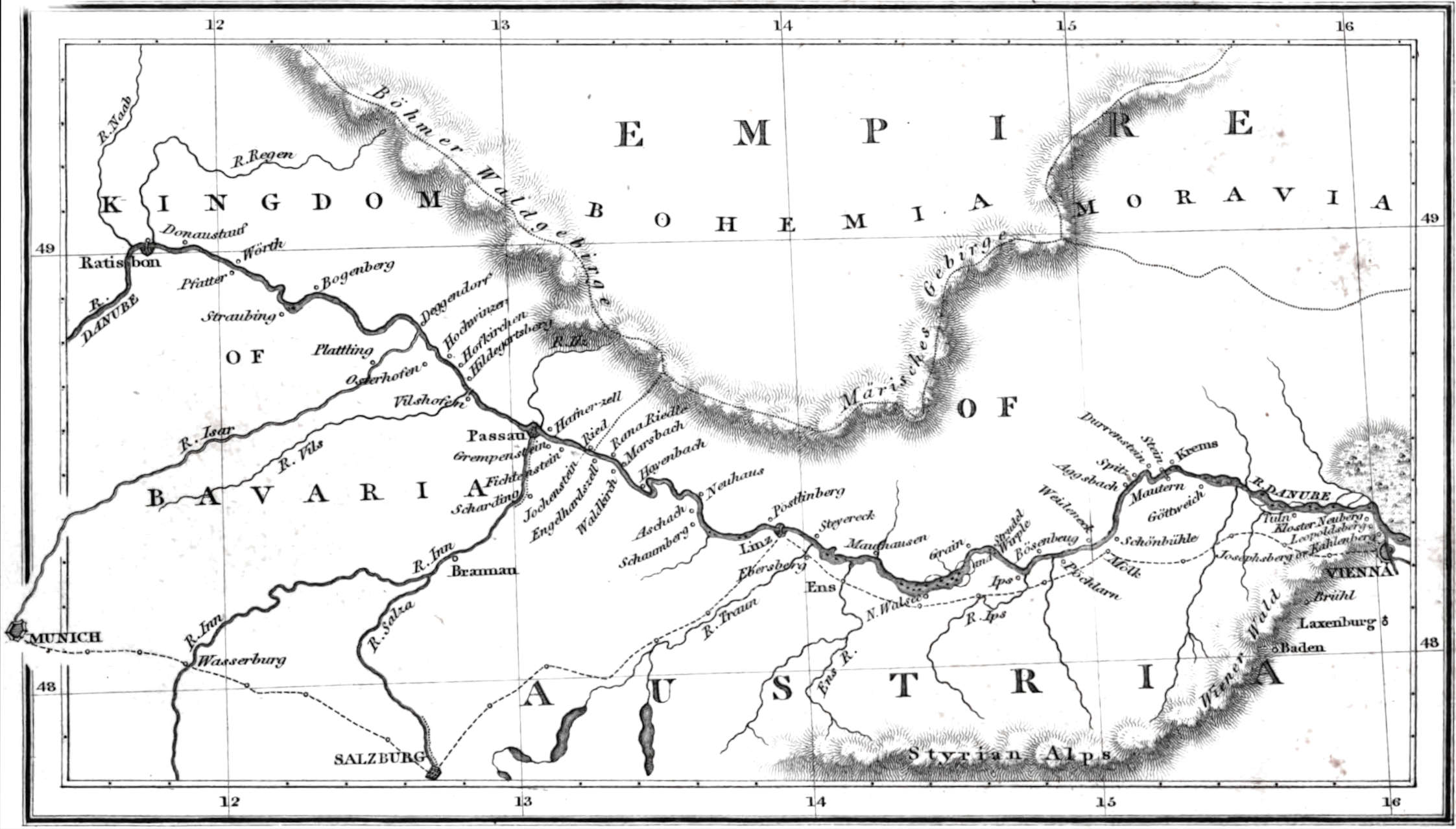
Marbach. — Maria-Taferl. — Pechlarn. — Wiedeneck. — Mölk. — Lubereck. — The
Valley of the Wachau. — Schönbühel. — Aggstein. — The Teufel’s-Mauer. — Spitz,
and the Ruin of Hinterhaus. — Church and Village of St. Michel. — Castle of
Dürrenstein. — Narrow escape of Marshal Mortier during the Campaign of
1805. — Mautern. — Stein. — Krems. — Kloster Göttweih. — Trasenmauer. — Arrival at
Tuln.
We had now been three days upon the water, during which time
scarcely a cloud had speckled the deep blue of the sky. As the first
light of morning, however, struggled through the little dingy casement
of our humble hotel, we were disagreeably surprised at finding that the
fog, which had risen the previous evening after sunset, still rolled
heavily along the river, and threatened to continue the greater part,
if not the whole of the day. We were still nearly two days’ journey
from Vienna, and a change of weather, which might be portended by this
unwelcome visitant, would probably make it four, five, or even six,
before we could reach the capital, to say nothing of the disagreeables
it would bring
in its train. At the
risk of losing the beauty of the prospect, therefore, we urged our
immediate departure, but here we were met by a new difficulty. Our
drunken steersman, who had lain all night in the boat, was now ill in
sober sadness, and quite incapable of steering us. A new pilot
was to be found, and, after much parley and delay, our host of the
gasthaus signified his consent to take the helm; but the fog, instead
of dispersing, as we had faintly hoped, with the rising sun, appeared
to increase in density; and not one of our boatmen could be prevailed
on to trust himself afloat in it. After at least another hour’s delay,
and considerable altercation, by dint of a little money, and promise
of more, we induced three out of the four to venture on board, and,
about eight o’clock, pushed off into the fog, by this time quite as
thick, though not so yellow, as that which pervades Lombard Street
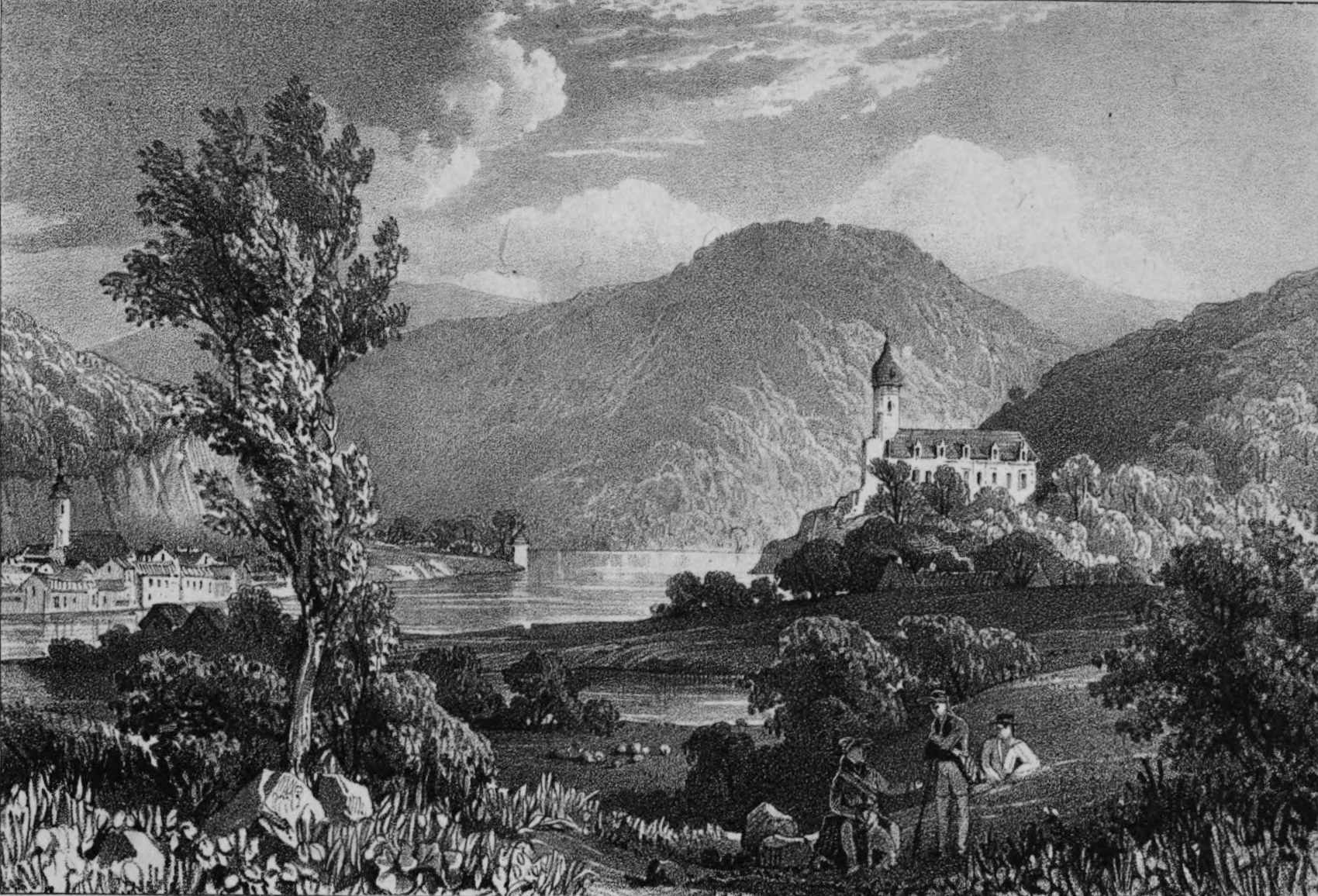
on a November afternoon. Fortunately this part of the Danube is not
fertile in fine views. The small village of Barthub and Mössling,
on the left, and Hinterhaus, and the two Agens, on the right, have
nothing to recommend
them, either in
a picturesque or historical point of view; and the distant prospect
of Maria-Taferl we had afterwards an opportunity of enjoying. The
river, from Bösenbeug and Ips, makes a bold sweep to the south as far
as Säusenstein, that stands on a small promontory on the right bank,
round which its waters boil and foam, and form what, in earlier times,
was called the Charybdis Pogica. The ruin here is of a very late date.
It was a mansion belonging to some ecclesiastic, and burned by the
French in the last war. The Cistercian convent near it, called St.
Lorenz in the Gottesthal, was founded by Eberhard von Walsee, in 1336.
In the fifteenth century, it was attacked and plundered by some of the
knightly robbers who infested the neighbourhood, and who are termed
“fratres hostiles” in the old chronicles. The tombs of the
family of Walsee, which became extinct in 1483, are still in existence
here. On that of Reinprecht, the last of his race, is simply his motto,
“Thue Recht,” with the words beneath it, “periisti amor,” in allusion
to the termination of the feud between the Houses of Walsee and Schaumberg. All this; at least, says
Herr Schultes, who had the advantage of visiting this spot in clearer
weather—we saw neither ruin nor convent, nor tombs; but what we did
see near this place was equally picturesque and striking. The sound of
voices chaunting a kind of hymn, stole faintly on our ears, and, as
it became more distinct, a boat appeared, like a phantom, in the fog,
crowded with pilgrims, on their way to Marbach and Maria-Taferl. They
were principally women, and sat huddled together round a priest, who,
bare-headed, supported a crucifix, and occasionally chimed in, in a
deep bass voice, with the quavering trebles of his companions. For a
few minutes, they floated beside us, and then gradually melted again
into the mist, as though they had been creatures of it, the hymn dying
away in the distance.
Before we reached Marbach, the fog, to our great gratification, had
evidently begun to disperse. It still covered the face of the water,
but the blue sky was visible above it; and the sun, occasionally
breaking through it, gave us a glimpse of this or that bank, according
to the situation of the boat. The
Markt of Marbach existed as early, at least, as the thirteenth century,
as, in 1208, we hear of the Knights of Marbach. Almost every house
in the place is an inn, as, lying under the lofty mountain, on which
stands the most celebrated place of pilgrimage in Lower Austria—the
church of Maria-Taferl, it is of course the place of rendezvous for the
countless devotees who swarm from all parts of the empire to that holy
shrine. The inhabitants of Vienna, in the middle of September, come on
horseback, in every kind of vehicle, and even on foot, hundreds in a
day, and return by the Danube. A great traffic is also carried on with
these pious personages in crosses, amulets, rosaries, and holy images,
pictures and books of all descriptions, by the inhabitants of Marbach;
besides which, a number of beggars reside here, each of whom has his
or her regular standing upon the path winding up the hill to the
Maria-Taferl; and spend duly every evening, in eating and drinking, the
large sums they have collected during the day. It has been calculated
that upwards of a million and a half of florins are annually expended
here;
and the minister of the place
told Herr Schultes that one year he himself had counted 135,000
pilgrims. A proverbial rhyme tends also much to the well doing of the
inhabitants of Marbach:
“Wer nach Maria Taferl ein Wallfahrt maken thut
Diess ihm Maria Taferl macht aller wiedergut:”
which may be rendered,—
Who to Maria Taferl a pilgrimage hath ta’en,
To him Maria Taferl shall make all good again.
Expense, therefore, is the last thing considered; and the spirit of
extravagance extends itself even to the townspeople, who lavish, in the
pride of their well-filled purses, ridiculous sums upon the decoration
of their houses, so that, according to another German proverb, says
Schultes,—
“Was durch das Pfeifchen kommt, geht durch die Trommel davon.”
What comes through the fife goes away through the drum.
Our new steersman put into this little markt to buy some beer and
bread; and the fog now rolling off in broken masses, enabled us to get
a peep at the town, which seemed a strange jumble of alehouses and
chapels,
signs and crucifixes, all
very gaily and fantastically painted, and forming, in short, a most
consistent trysting-place for “publicans and sinners.”
Maria-Taferl is to the pious Austrian what Maria-Einsiedel is to
the Roman Catholic Swabian, and Maria-Oetting to the Bavarian of the
same persuasion. The lovers of an extensive and beautiful prospect
may, for an hour’s climbing, enjoy, from the summit of the mountain
on which it stands, a splendid panorama of the Danube and great part
of Lower Austria, the Alps of the Steyermark, and the whole chain of
mountains from the lofty Schneeberg in the Wiener-Wald, to the frontier
of Bavaria. The history of this celebrated place of pilgrimage may be
bought for two kreutzers, a great deal more than it is worth, but that
it is amusing and instructive to see how grossly the Roman Catholic
priesthood are yet permitted to gull an ignorant, and consequently
superstitious people.
The precious document sets forth with stating the well-known
fact of the existence, from time immemorial, of a venerable oak-tree on the top of the mountain, in
which was placed a figure of the crucified Redeemer. To this spot the
inhabitants of Klein-Pechlarn, a small village in the neighbourhood,
used to repair every Easter Monday to put up their petitions for a fine
harvest, and, after hearing the service chaunted, sat down at a stone
table before the church-door, and ate, drank, and were merry; from
whence arose the name of Maria-Taferl, or Mary of the Table.
In 1662, a herdsman, either from ignorance or wantonness, attempted
to hew down the sacred tree, on which age had already heavily laid
its withering and deforming hand. At the first blow, however, the axe
recoiled so violently, that it sprung from his grasp and wounded one of
his feet severely. Unchecked by this warning, however, he
made a second blow, when it again recoiled with still more
violence, and desperately wounded his other foot[65]. The profane herdman, now lifting up his eyes in agony,
observed the crucifix, and struck with remorse, craved pardon of God
for his impiety; upon which the blood stopped of its own accord,
and his wounds healed immediately, without surgical or any human
assistance! Ten years after this miraculous occurrence, a man named
Alexander Schinnagel, who suffered under a deep and distressing
melancholy, which he could not shake off, came, by heaven directed, to
the house of a schoolmaster, who had in his chamber an image of the
Virgin, called a Vesperbild. Schinnagel bought the image, and carried
it home. In the middle of the night, he heard “a still small voice,”
saying, “Wouldst thou be cured, take the image, and place it in the
oak at Maria-Taferl.” Accordingly, at day-break, up rose Alexander,
and proceeded with his purchase to the mountain-top, where he placed
it as directed, taking down at the same time the crucifix, which age
and exposure to the weather had nearly destroyed.. Immediately his
melancholy left him, and he returned home a merry, and, we hope, a
grateful man. Since that
period the
angels themselves have frequently visited the sacred spot. On the 17th
of June, 1658, a most credible (credulous?) personage saw a snow white
and luminous apparition, in mid-day, before the holy effigy. In 1659,
three persons, equally worthy of belief, saw a whole troop of angels,
in white garments, and in processional order, on their way to the
Vesperbild. Another time, when forty people were collected together in
its neighbourhood, three of them saw an angelical procession in the
air, and three bright stars of remarkable magnitude immediately above
the figure. Again, a procession of white-clothed personages was seen by
eight or ten people, the leading apparition bearing a red cross; and
shortly afterwards a wax taper was suddenly observed burning before
the Vesperbild. In 1661, many other angelical phantoms were seen by
sometimes thirty, and once by a hundred people at a time, all of
them most respectable and credible witnesses, whose testimonies were
registered, signed, and sworn to before the competent authorities! [66]
As the vapours, which had till now
enveloped us, began rapidly to yield to the power of the sun, and
were swept in masses by the fresh breeze of morning from the bright
face of the river and the fair hills beside it, disclosing the rich
and beautiful prospect that opened upon us with the widening valley,
smiling in warmth and light; it was impossible to suppress the remark,
commonplace as it may be considered, that, thus, at no very distant
period, would the mists of error and superstition fly before the
increasing influence of knowledge and truth, and man, awaking to the
contemplation of the sublime paths they enlighten, “Look,” full of
hope, joy, and gratitude, “through Nature, up to nature’s God!”
Albert IV., Duke of Austria, whose journey to the Holy Land gave
rise to so many romantic stories, that he obtained the appellation
of the “wonder of the world,” resided for some time at Marbach, in
the valley of All Saints, with the Carthusians: “with them,” says a
contemporary, “he
attends matins,
reads the lessons, makes inclinations, genuflexions, observes
ceremonies, confessions and prayers. He not only joins them in the
performance of divine service in the choir, but affords an example of
humility by frequenting the Chapter-house. In a word, he calls himself
brother Albert, and considers himself in every respect as one of the
order[67].”
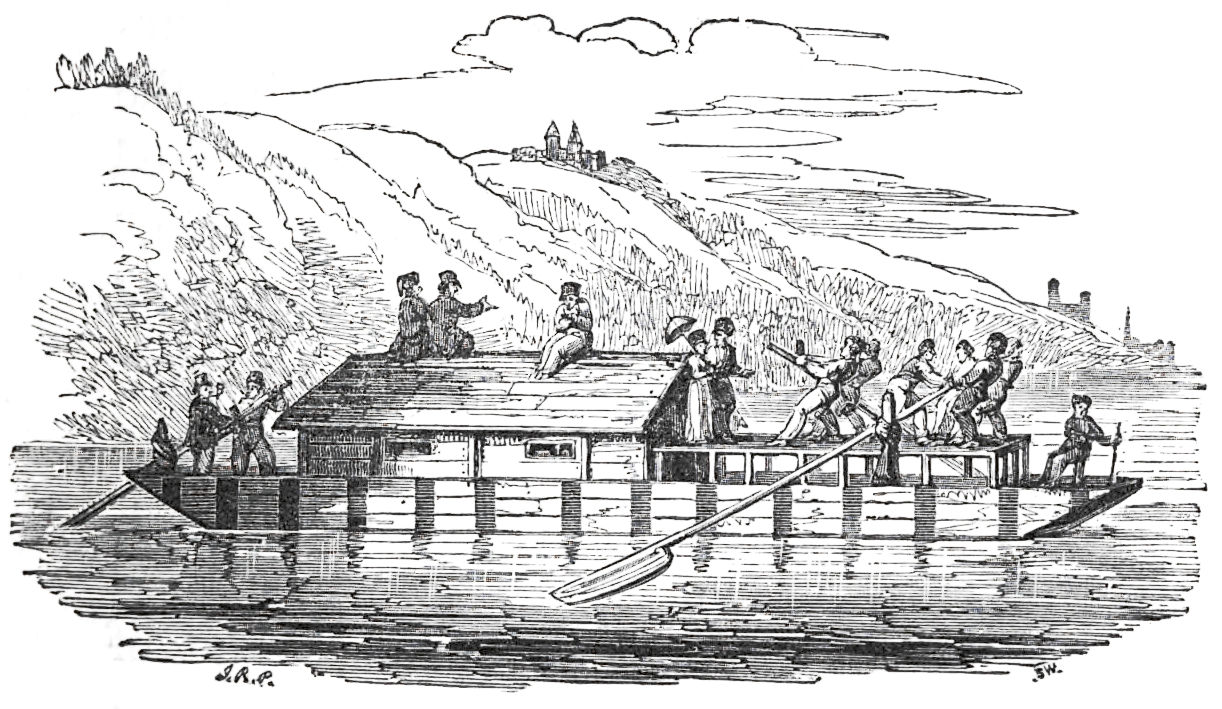
So few travellers ever think of taking a boat to themselves,
that we were hailed at Marbach, as an ordinari-schiff[68], by three poor
women who wanted to go to Vienna. Having plenty of room to spare, we
consented to their coming on board, which they accordingly did with
their baskets and bundles sans cérémonie, imagining that they should
have to pay the usual fare for their passage; and with this accession
of company and cargo we again set forward. Below Schelmenbach and
Krumpen-Nussbaum falls the mountain-stream called the Erlaf, into the
Danube, named in deeds of the time of Charlemagne, and long the boundary between Bavaria and the Land of
the Huns. At the mouth of the Erlaf, is a Rechen or Grate, where the
wood collects that is floated down this stream from the forests in the
neighbourhood of Maria-Zell, in the Steyermark, near which it takes its
rise. It is customary in Germany to place one of these gratings at the
mouth of any tributary stream, or in the bed of any river where a line
of demarcation is drawn naturally or artificially between two kingdoms,
two provinces or even two parishes. So that the branches and trunks of
trees blown down by high winds, and swept away by inundations into the
current, should not be carried beyond the frontiers or boundaries of
the state or property to which they belong, and which derives from them
no inconsiderable portion of its revenue.
The timber, also, regularly felled by the wood-cutters, is thrown
thus carelessly on the mountain-streams of Germany, and floats down to
the Rechen or Grate, where it is afterwards collected by its owners,
who are thus saved the trouble and expense of land carriage; and the
drifting property is
protected from
plunder by the severity of the laws relating to it.
Before us now lay the two Pechlarns; Great Pechlarn on the right,
and Little Pechlarn on the left bank. At the first we determined to
breakfast, were it only to feast where the fair Chrimhilt had feasted,
in
“Die Burg zu Bechelaren.”
No relics of the “Burg” itself, however, exist; but an old gateway,
some round towers, and here and there a few feet of crumbling wall,
attest the early grandeur of the place, and fancy fills up the chasms
which time has made, with court and keep, buttress and battlement,
crowded with fair damsels and fierce soldiery, “all, all abroad to
gaze” at the advancing pageant.
There, round that point of land, comes the royal fleet, the banners
of Hungary, Burgundy, Bavaria, Pechlarn, and Passau, flinging their
blazoned glories on the breeze, and proudly announcing to the admiring
burghers the rich freight of rank and beauty which the swelling Danube
is wafting to their port. Five hundred “Kemps of Hungary,” their bright
hauberks glittering in the sun,
crowd
the decks of the first vessels. On the prow of the foremost stands the
valiant Markgraf, Rudiger of Pechlarn, than whom
“A truer soldier never
Was in this world yborn,
[69]”
bending eagerly forward to distinguish, amongst the bevy of
beauties at “the open windows[70]” of the castle, the fair forms of his
beloved wife and daughter. Beneath the rich canopy that shades the
deck of yonder bark, with the gilded oars, now doubling the little
promontory, sits the peerless bride of the mighty Etzel, but she hears
not the shout of welcome that rises on the shore; she marks not the
gay multitudes that crowd to pay her homage. Her brow is clouded, her
ruby lip quivers, tears like liquid diamonds tremble upon the long dark
silken lashes of her downcast eyes; the form of the noble Siegfried
is constantly before her. She hears but the voice of her murdered
champion calling for vengeance; she sees but the ghastly wound which
treachery dealt, bleeding afresh at
the approach of the dark and deadly Haghen. Yet, passing beautiful is
she even in sorrow, and still warrants the glowing description of the
old minnesænger, Henry of Ofterdingen. [71]
“From out her broidered
garments
Full many a jewel shone,
The rosy red bloomed sweetly
Her lovely cheek upon.
He who would in fancy
Paint that lady fair,
In this world has never
Seen such beauty rare.
As the moon outshineth
Every twinkling star,
Shedding careless splendour
From out her cloudy car;
So, before her maidens,
Stood that lady bright,
And higher swelled the spirit
Of every gazing knight. [72]”
By her side stands a venerable figure, clad in the gorgeous and
sacred vestments of his office. The flowing stole of embroidered silk,
the pallium of cloth of gold, the jewelled mitre, the “gilt shoon,” and
the massive but richly wrought cross and crosier, borne by two of his
attendants, distinguish
him as the
holy Pilgerin, the wealthy and powerful Bishop of Passau, uncle to the
queen, and related also to the noble Rudiger. The pale youth near him,
his hands reverently crossed upon his bosom, is his clerk Conrad, who
afterwards assisted him to write, in “the Latin tongue,” the adventures
of the Nibelungen. On the other hand of the lovely Chrimhilt, stands
the faithful Duke Eckewart, who has sworn to escort his liege lady
to Hungary; and the remainder of the flotilla bears the five hundred
chosen Knights of Burgundy, who follow his standard. The vision is
over, the airy castle has vanished—
“The knights are dust,
Their good swords are rust,
Their souls are with the saints we trust.”
And a rude and solitary boat is rocking under the windows of a poor
white-washed wirthshaus, which, with half a dozen humble cottages and
some mouldering walls, now marks the site of the once strong and gay
burg of Pechlarn!
Rudiger of Pechlarn, as well as his kinsman, the Bishop of Passau,
is an historical personage. He was Count of the frontier during the reign of Arnulph, Duke of
Bavaria, and died in 916. His son, Markgraf Rudiger II., died in 943,
and with him the direct male line became extinct. The little town of
Pechlarn is now principally inhabited by potters.
Beyond Pechlarn, the river keeps still widening, till, on the left
bank, rises the fine old Castle of Weideneck, which receives its name
from a neighbouring rivulet, and is supposed to have been built by
the elder Rudiger of Pechlarn. The Emperor Frederick IV., and the
famous Matthias Corvinus, King of Hungary, both beleaguered Weideneck.
The former twice won and lost it. But the eye has scarcely caught
sight of Weideneck, before it is attracted by the distant domes of
the magnificent Convent of Mölk, that appear over the willows of an
island, in the centre of the river. Gradually, the entire façade of the
convent, upon its granite rock, and the little market-town beneath it,
glide from behind the island, and complete one of the most imposing and
beautiful pictures upon the river. The present splendid structure was
built in 1720-32, by an architect,
named Prandauer; but the rock on which it stands, once supported, not
only a more ancient convent, but also a Roman fortress. Under the name
of Medilke, it appears in the Nibelungen-lied,
“At Medilke were the goblets
Of costly gold, filled high,
And the wine went gaily round
Mid that noble company.”
But the authentic history of Mölk commences apparently in the
sixteenth century, when the Markgraf Leopold I., surnamed the
Illustrious, made it his residence after wresting it from the power
of the Hungarians. This valiant prince founded here a kloster, and
was here interred after his murder at Wurzburg, as were likewise
his wife, Richarde, his sons Henry and Albrecht, and their wives,
Mechthilde and Frowiza, Adelheid, Countess of Leopold the Strong, the
Margraf Ernest III., surnamed the Valiant, and his lady Schwanehild,
Leopold III., surnamed the Handsome, and many other noble Austrian
and Bavarian knights and ladies. Saint Colomanus, or Saint Colman,
descended, according to the story, from the early Kings of Scotland, was also buried at Mölk.
This saint, travelling through Austria to Jerusalem, was seized, at
Stockerau, by some rebellious peasants, A.D. 1012, who, taking him for
a spy, hung him upon a tree, where his body remained a year and a half
without putrefaction, and afterwards worked many miracles! Leopold
III., in the year 1089, established some Benedictines from Lambach in
this Kloster; and his son, Leopold IV., who was born here in 1073, and
here celebrated his marriage with Agnes, daughter of the Emperor Henry
IV., and widow of Frederick of Hohenstaufen, gave up his palace to
them, and retired to the Khalenberg, near Vienna. The Kloster of Mölk
soon became proverbial for its wealth, and its superior was the Primate
of Lower Austria. In 1619, the insurgents of Upper Austria besieged
Mölk for upwards of a month, as did also the Turks in 1684. Napoleon
had his headquarters here in 1805, and again in 1809; and a mark is
shown upon the floor of one of the apartments in the Kloster, which
he is said to have made in a passion. While a few monks inhabit this
splendid palace,
their sovereign, one
of the most powerful monarchs in Europe, passes a considerable portion
of his time in an humble wooden building, upon the opposite bank of
the Danube. At Lubereck, a little below the Castle of Weideneck,
beside a romantic waterfall, is a small edifice, built entirely of
wood, and formerly the country residence of the Baron von Führenberg,
postmaster of Mölk. Between this place and Bösenbeug, Francis I.
divides nearly all the hours which, during summer, he snatches from the
cares of empire. In his plain, domestic habits, and in the kindness
and affability with which, in such moments of relaxation, he listens
or chats to his humble neighbours, the present Sovereign of Austria
greatly resembles our own late venerable monarch, King George III.,
and, like him, has compelled his bitterest political enemies to
acknowledge that, in all the private virtues of life, as a husband, a
father, and a master, he is an example, not only to his own subjects,
but to mankind.
On the left bank, beyond Lubereck, is the markt of Emmersdorf, at
the point of a narrow neck of land, round which the Danube wheels to the north-east, and enters the
romantic valley of the Wachau. Emmersdorf, like so many other places
on the Danube, was formerly the seat of some powerful robbers, who
levied contributions upon the passing vessels, and blotted the page of
history with such bloody deeds that, to use the expression of a modern
German writer, the hand of a common executioner alone could steadily
transcribe them. At the mouth of the Bielach, a little river that
empties itself into the Danube nearly facing Emmersdorf, and over which
there is a ferry, the celebrated district called the Wachau commences,
and extends itself as far as the castle of Dürrenstein, some say as
far as Mautern and Krems. The view from this point, either looking up
or down the river, is exceedingly beautiful. The western prospect is
enriched with the castle of Weideneck, the Palace-convent and markt
of Mölk, and the noble mountains of Upper Austria, which here you
gaze on for the last time. Turning and looking into the mouth of the
yawning gorge, the eye is first attracted by the castle and kloster of
Schönbühel, picturesquely situated
on the brink of the precipitous right bank, behind which rise some
gigantic mountains. On the left, a crescent of bold craggy hills,
towering one over the other, checks the northerly inclination of the
mighty flood, and bends it again eastward, while upon one of them the
fine ruin of Aggstein glimmers white in the distance.
Charlemagne, in the year 803, gave the whole valley of the Wachau
(in terra Avarorum) from the Bielach as far as Tuln, Zeizelmauer
and Perschling, (Tulna, Zysenmurus et Bierstlinga,) to the Bishop
of Passau, and it belonged to Bavaria, at least “in spiritualibus,”
till 1805. Schloss Schönbühel stands, as I have before said, at the
entrance to the valley, upon a wall of granite, from which its own
walls are scarcely distinguishable. Schultes calls it a ruin, but
to me it had the appearance of an inhabited château in excellent
repair. It is a singular-looking building, with a tall, square, but
narrow tower, shooting up from the centre of its western front, more
like a chimney than a turret. Its situation, however, is exceedingly
fine and commanding, and it has the reputation of being haunted by no less a spirit than Lucifer
himself, a circumstance which would alone render it interesting to the
romantic tourist. A little beyond it stands an old chapel or kloster,
belonging to the Schloss. In the fourteenth century this place belonged
to the family of Starrhemberg. Having now fairly entered the valley,
we perceived the markt of Aggsbach on the left bank, and facing it,
Klein, or little Aggsbach. In a chasm behind the latter, Haderich von
Meissau, the Kuenringer and marshal of Lower Austria, founded, in 1386,
a convent for thirteen Carthusian Monks, which was suppressed by Joseph
II. in 1782; and on the mountain top, a little beyond the former,
stand the before-mentioned ruins of the Castle of Aggstein. There is
a tradition respecting this castle, of a peculiarly German cast, and
which would work up well in “a tale of terror.” It is said that it was
anciently the hold of a robber knight named Schrekenwald, who, after
seizing and plundering the unfortunate travellers on the Danube, thrust
his wretched captives through an iron door over the rocks into a deep
abyss behind the castle, which
he
called his “Little Rose Garden,” and from which (even if by a miracle
they were not dashed to pieces in their fall) the chance of escape
was next to impossible. The tradition is preserved in an Austrian
proverb; when any one is in such a strait as to preclude all hope of
extrication, he is said to be “in Schreckenwald’s Rose-garden.” The
story, however, goes on to say, that, by some extraordinary chance, one
of his intended victims did effect his escape, and with the help of his
friends, who returned with him in arms, surprised, made prisoner, and
hung the monster.
In the year 1232, Hadmar, the Kuenringer, who was also lord of
Dürrenstein, possessed this castle, and ravaged, in company with
his brother Heinrich von Weitra, the whole country as far as Stein
and Krems. The trembling inhabitants called them “the Hounds,” and
Frederick, the last of the Babenbergers, in vain endeavoured to subdue
and destroy them. A merchant, named Rudiger, at length suggested a
ruse de guerre to the Emperor. “I will freight,” said he, “a vessel
at Regensburg, laden with the most costly merchandise: the tidings will soon reach the robbers at
Aggstein. Thirty stout knights shall lie concealed in the vessel, and
when Hadmar rushes down from his castle, and boards us with a few of
his vassals, thinking to plunder some peaceable merchants, the knights
shall rush out upon and overpower him, while I push off from the
shore.” The plan was adopted, and succeeded. The vessel was freighted
at Regensburg, and stopped at Aggstein. Hadmar flung himself into the
snare set for him, and Rudiger and his people, rowing off at the same
moment, brought the robber prisoner to the feet of Frederick.
In 1277, Luitold Kuenring possessed the castles of Aggstein and
Dürrenstein, but lost them both, with many others, in rebellion against
Albert I., and was banished the country in 1291. From that period its
history is a mere record of bargains and sales, which terminates with
its purchase by a Count of Beroldingen, in 1819.
The castle is finely situated on the crest of a conical hill, and
the path up to it lies through a thick forest which affords a pleasing
shelter to the noontide traveller,
whom curiosity leads to inspect the ruins. The keys are kept in the
little wirthshaus on the bank below it. Great part of the castle is in
tolerable preservation, at least as far as regards the bare walls; and
the date over the gateway, if Prof. Schultes have rightly copied it,
(for I did not see it myself,) appears to me rather apocryphal. The
inscription runs thus:—
“Das Purkstall hat ange
vangen tze pauen her Jo
rig der Schektvon w
ald der nachten montag
nach unser Frauventag
nativitatis, da von Crist
gpurd waren ergangen
MCCXXVIII Jar.
[73]”
Below Schwallenbach, a small markt on the left bank, a rude mass of
barren crags
has received the name of
the Teufel’s mauer (Devil’s wall.) This busy “old gentleman” is said
to have taken it into his head to block up the Danube at this spot,
but, through some special intervention of Providence, a sudden stop was
put to the infernal masonry. An echo slumbers here, which, waked by a
pistol-shot, resents the impertinence in a voice of thunder. Having
passed the villages of Ober or Schloss-Arnsdorf, and Mitter-Arnsdorf,
we at length arrived before the markt and castle of Spitz, the towers
of which had been visible from Schwallenbach. Both town and castle
belonged anciently to Bavaria, and they have been in turn the property
of most of the ecclesiastical and lay robbers we have already heard
so much of—the bishops of Passau and Salzburg, the monks of Nieder
Altaich, the Margraves Burkhard and Leopold, Hansen the Kapeller,
Hadmar the Kuenringer, etc. etc. In 1805, Marshal Mortier, who had
narrowly escaped destruction near Dürrenstein, was glad to cross the
Danube at this place by means of a bridge of boats. The old castle
above the little
markt is called the
Hinterhaus, and is one of the most picturesque ruins on the river. The
rock it stands upon is of an extraordinary form, black, rugged, and
bare, a gigantic pedestal, worthy of supporting this fine monument of
the middle ages. The church and village of St. Michel, with their old
round towers and crumbling walls, are the next interesting objects. The
precipices upon both banks now assume the most fantastic forms. The
vine has here again made its appearance. Its light green is beautifully
contrasted with the dark firs and pines, and the white barren peaks
that Nature seems to have fashioned in her most eccentric moods.
As the valley narrows, the rocks rise higher and higher, and the
wild scenery of the Schlägen is for the last time repeated. This savage
glen has long been considered by the peasantry of the neighbourhood
as the haunt of witches and evil spirits; and about thirty years
ago a poor little old woman, who was feeding her goat upon one of
these precipices, was absolutely shot with a glass bullet, for a
wetter-hexe (weather-witch,) a violent thunder-storm which had unfortunately arisen being “charged to
her account,” by the superstitious marksman. On emerging from this
gorge—the crowning glory of the romantic scene—the magnificent ruin of
Dürrenstein presents itself on its stupendous rock. Language cannot
do justice to the sublimity of this view, which might task the united
pencils of a Claude and a Salvator Rosa. Independently of its beauty
and grandeur, what recollections crowd upon the mind, as the splendid
picture dawns upon the sight,—Richard Cœur de Lion!—Six hundred years
have past, and the name is still a spell-word to conjure up all the
brightest and noblest visions of the age of chivalry. What glorious
phantoms rise at the sound! Saladin—the great, the valiant, the
generous Saladin, again wheels at the head of his Cavalry—Frederick
Barbarossa, the conqueror of Iconium—the brave but politic Philip of
France—the gallant but unfortunate Marquis of Montferrat! The whole
host of red-cross warriors—the knights of the Temple and St. John—start
again into existence from their graves in the Syrian Deserts, and
their tombs in Christian Europe,
where still their recumbent effigies grasp the sword in stone. The
Lion-hearted Plantagenet once more flourishes with a giant’s strength;
the tremendous battle-axe, whereon “were twenty pounds of steel[74],” around the
nodding broom-plant in his cylindrical helmet, while his implacable
foe, Leopold of Austria, leans frowning on his azure shield; his
surcoat of cloth of silver “dabbled in blood,” that terrible token of
his valour at Ptolemais, which is to this day the blazon of his ancient
house[75]. Yonder
walls have echoed to the clank of the fetters with which his unknightly
vengeance loaded Richard of England—to the minstrel-moan of “the Lord
of Oc and No[76],”
and (for who can coldly
pause to
separate such romantic facts from the romance they have inspired) to
the lay of the faithful Blondel, which, wafted by the pitying winds to
his Royal Master’s ear, soothed his captivity, and brightened his hopes
of freedom. Many are the castles on the banks of the Danube pointed
out to the traveller as the prison of Cœur de Lion. Aggstein, which
we have not long passed, Greifenstein, which we are approaching, both
assert a similar claim to our interest, our veneration; and it has
been not improbably conjectured, that Richard was in turn the resident
of each, being secretly removed from fortress to fortress, by his
subtle and malignant captor, in order to baffle the researches of his
friends and followers. Notwithstanding this dispute, Dürrenstein has by
general consent, and long tradition, been established as the principal
place of his confinement; and no one who, with that impression, has
gazed upon its majestic ruins, would thank the sceptic who should
endeavour to disturb his belief. They stand upon a colossal rock,
which rising from a promontory picturesquely terminated by the little
town of Dürrenstein, is
singularly
ribbed from top to bottom by a rugged mass of granite indented like a
saw. On each side of this natural barrier, a strip of low wall, with
small towers at equal distances, straggles down the rock, which, thus
divided, is here and there cut towards its base into cross terraces
planted with vines, and in the ruder parts left bare, or patched with
lichens and shrubs of various descriptions. On its naked and conical
crest, as though a piece of the crag itself, rises the keep of the
castle, square, with four square towers at its angles, and not unlike
the fine ruin at Rochester. Had the accomplished Hemans beheld the
scene, her muse could scarcely have better described it.
“He hath reached a mountain hung with vine,
* * * * * * * * * *
The feudal towers that crest its height
Frown in unconquerable might;
Dark is their aspect of sullen state,
No helmet hangs o’er the massy gate,
To bid the wearied pilgrim rest,
At the chieftain’s board a welcome guest;
Vainly rich evening’s parting smile
Would chase the gloom of the haughty pile,
That midst bright sunshine lowers on high,
Like a thunder-cloud in a summer sky.
* * * * * * * * * *
Lingering he gazed—the rocks around
Sublime in savage grandeur frowned;
Proud guardians of the regal flood,
In giant strength the mountains stood;
By torrents cleft, by tempests riven,
Yet mingling still with the calm blue heaven
[77].”
The celebrated Denon had a sketch made of this castle and rock,
and sent to Paris expressly for a scene in Gretry’s well-known opera,
“Richard Cœur de Lion.”
The circumstances of Richard’s quarrel with the Duke of Austria,
and his subsequent arrest and captivity, are too well known to require
insertion here; but, in the Chronicon Zwetlense, t. 1, s. 531, it
is expressly stated that Richard was seized at Erpuch, near Vienna,
(this Erpuch being the present Erdberg, one of the largest of its
many suburbs,) and given, by Leopold, into the custody of Hadmar,
the Kuenringer at Tyernstain (Dürrenstein). The old chronicler,
Haselbach, also says that
Richard
came to Vienna as a pilgrim, in a company of cooks, and acted as
turnspit one evening in the kitchen of the Duke of Austria. But a
cook, recognizing his features, informed Leopold, who immediately
commanded Richard to be brought before him, and addressed him in these
words, “Domine Rex Anglorum, nimis nobilis estis, ut sitis assator in
coquina ducis;” after which he delivered him into “Honesta Custodia.”
According to the Chronicon Conradi Cœnobitæ Schyrensis, Richard, after
suffering shipwreck at Aquileia, was betrayed to Leopold by the Duke
of Carinthia. The story of his having betrayed himself, in his passage
through Austria, by his expenses and liberalities, is, however, the
most probable, as well as the best authenticated.
Dürrenstein is first mentioned about the year 1170, when, in some
deeds, are found the names of Göttschalk and Regenbert von Tirnstain.
In 1192, the year in which Richard was made prisoner, the castle is
known to have belonged to Hadmar, the Kuenringer, who was likewise
the possessor of Aggstein; and, in 1231, it was taken, and partially destroyed by Frederick, the
last of the Babenbergers. No events of consequence are recorded to have
taken place in it from that time to the year 1645, when the Swedes
are supposed to have reduced it to its present ruinous condition. The
little town at its foot, with its handsome church[78], is prettily situated; and
when, in 1741, a party of French and Bavarian cavalry forded the
Danube, in hopes to surprise it, the citizens hit upon a plan as novel
as ingenious. They barred up their gates as well as they could, laid
logs of firewood on the walls, in imitation of cannon, chalked the
rims of their hats, to give them the appearance of being bound with
white lace, according to the uniform of their troops at that time, and
parading up and down the ramparts with much drumming and bustle, taking
care that their hats only should be seen above the walls, absolutely
induced the enemy to believe that the place was strongly garrisoned;
and they accordingly wheeled to
the
right about without firing a shot, to the infinite joy and amusement of
the cunning inhabitants, who certainly well deserved their escape.
On the 11th of November, 1805, the defiles behind Dürrenstein were
the scene of a murderous conflict between the French, under Mortier
and Dupont, and the Russians, under Doctorof and the Austrian general,
Schmidt. Mortier, who had instructions from Napoleon to march upon
Krems, and was anxious to prevent the Russians passing into Moravia,
hurried forwards with Gazan’s division, and a brigade of dragoons,
being followed, at some distance, by Dupont’s division, and some Dutch
regiments. Below Dürrenstein, he encountered the advance guard of
Miloradowich, which he drove back to the gates of Stein, making a few
prisoners: but this slight success had nearly led to his ruin, for, at
the same instant, another strong corps of Russians, led by Generals
Schmidt and Doctorof, descended the mountains in his rear; and General
Essen, having reinforced Miloradowich, and thrown himself before
Loiben, the French were between
two
fires. Mortier had no remedy but to cut his way, if possible, through
the column in his rear, and so effect a junction with Dupont, to whom
he had, fortunately for himself, sent orders to quicken his march.
Major Henriod, at the head of the 100th regiment, charged the Russians,
and a horrible carnage ensued in the narrow defiles, crowded with
infuriated soldiery. Two pieces of artillery, which Mortier had with
him, decided the issue of the combat in his favour, his adversaries
being destitute of cannon. The brave Austrian, Schmidt, fell at the
first discharge; and Doctorof, endeavouring to withdraw his troops
from the ravine, was suddenly attacked, in the rear, by the division
of Dupont, and thus found himself, in his turn, between two fires.
With much difficulty he effected his retreat over the mountain he had
just descended; and the desperate troops of Mortier rushing into the
defile, as they imagined, on the bayonets of their enemies, found
themselves, before they were aware, in the arms of their friends and
countrymen. From twelve to fifteen hundred men were lost on each
side, and the allies received a
terrible blow in the death of General Schmidt, the friend and companion
in arms of the Archduke Charles[79].
Below Dürrenstein, the river widens, and a new and cheerful prospect
dawns upon the sight. Three small towns, Stein, Mautern, and Krems, the
two first connected by a bridge, about six hundred and thirty paces
long, across the Danube, present themselves at once to the eye; and
over Mautern, on the right bank, upon a finely-wooded mountain, rise
the towers and cupolas of Kloster Göttweih.
Mautern was known as early as the time of Charlemagne, and in
898 was called the town of Mutarum, and fortified by Isanrich, the
son of the Markgraf Arbo, when he rose against the Emperor Arnulf.
Arnulf, though in the last stage of illness, laid seige to Mautern,
and took it in the following year, a few months before his death;
but Isanrich succeeded in eluding his conqueror, and sought refuge
in Moravia. Rudolph of Hapsburg gave the same rights and privileges
to Mautern as
were enjoyed by
Stein and Krems in reward for its early declaration in his favour.
In 1347, the burghers, having joined their neighbours of Krems in a
cruel persecution of the Jews, were severely punished by Albert II.,
and their Lord, the Bishop of Passau, whose Christian zeal had
been rather exuberant, was condemned to pay a fine to the Duke of
six hundred pounds. Matthias Corvinus, the gallant King of Hungary,
gained a victory here over the Austrians in 1484. In 1805, the Russians
under Kutusof retreated before Murat, Lannes, and Soult, over the
bridge at Mautern, and immediately burnt it. It was destroyed again by
the Austrian Field-marshal Hiller in 1809, on the second advance of
Napoleon to Vienna. With the exception of the old gate, through which
the road leads to St. Pölten and Göttweih, little remains to vouch
for the antiquity of the town; and the same may be said of Stein,
under the walls of which we landed,—the gate facing the water, and the
ruins of some old building near the bridge, being all the relics that
“Goth and Time and Turk have spared”—I might add, Hungarian and Swede, as Matthias Corvinus stormed it in
1486, and Torstenson in 1645. So exasperated was the latter by the
opposition he met with, that when he at length entered the place, he
took most sanguinary vengeance upon the brave citizens. Stein is little
more than one long, rambling street, over the vile flints of which, as
we entered it, half a dozen poor old women, nearly all upon crutches,
were hobbling in ludicrous haste after a dirty little ragamuffin, who,
bearing the banner of some Saint, very like a red pocket handkerchief,
appeared to enjoy the fruitless attempts of the unfortunate cripples to
keep pace with him. On the young rascal went, at a sort of hand gallop,
while they, like Johnson’s “Panting Time,”
“Toiled after him in vain.”
Quitting Stein at the eastern extremity of this long street, a
walk of about ten minutes conducts you through a pretty promenade,
planted with trees, and called the little Präter, to the gates of
Krems, the most considerable of these three small towns. It is first
mentioned in the reign of Otto III. In the year 1347, its kennels
ran with Hebrew blood. It was
pretended that the Jews had poisoned the wells of the town; and as
any report, however ridiculous, provided it afforded a pretext to
insult and plunder that unfortunate people, was eagerly and implicitly
believed by the brutal populace, an immediate slaughter took place of
all who refused to acknowledge the divinity of Christ. Many wealthy
Israelites being aware of the real motive of their persecutors,
made their despair minister to their vengeance, and barring up
themselves, their family, and their riches together, set fire to the
building, and perished exultingly in the flames that anticipated the
spoiler. The horrid frenzy extended to Stein, Mautern, and many other
places in the vicinity, and was only allayed by the arrival of the
brave Erbschenk von Meissau who, by command of Albert II., hurried
with a considerable force into the disturbed districts. Krems and
Stein were heavily mulcted, and the neighbouring villages, Loiben,
Strassing, Rattendorf and Weinzierl, plundered by the soldiery of
the blood-stained booty they had acquired. In the fifteenth century,
Krems was twice besieged
by Matthias
Corvinus, the last time successfully. On the invasion of Austria by the
Bohemian Protestants in 1619, a corps of the insurgents under their
Colonel, Carpizan, having cut off the garrison of Krems, which had
made a desperate sally from the town, immediately advanced to scale
the now defenceless walls; but the women with one consent, seizing
the first weapons they could find, rushed to the ramparts, and fought
with such steady bravery, that the enemy were at length obliged to
abandon the attempt. To this memorable achievement Ferdinand II. was
in great measure indebted for the preservation of his empire; for
Krems being thus relieved, General Dampierre detached a body of five
hundred horse to Vienna, at that time closely invested by Count Thurn.
The Emperor, reduced to the last extremity, the walls of his palace
battered by the Bohemian cannon, and echoing the reproachful shouts
of his disaffected subjects, had resigned himself to his fate, when
the sudden blast of a trumpet announced the arrival of succour. The
little squadron of horse having secretly descended the Danube, and
entered the
capital by the only gate
unguarded by the enemy, was magnified into a mighty host by the fears
of the malcontents, who dispersed in every direction. The friends of
the Emperor took courage, six hundred students flew to arms; their
example was followed by fifteen hundred citizens; additional succours
arrived, and in a few hours all appearance of danger and discontent had
subsided.
Krems is the seat of what is termed in Austria a kreis-amtes, or
council, having the government of one of the circles of the empire.
Its jurisdiction extends over a fourth of Lower Austria, called
the Viertel, or quarter of Ober-Manhardsberg. The principal public
buildings are the Pfarrekirche, built in 1464, the church of St.
Katharine, remarkable as having been originally a residence of the
knights-templars, a theatre, a gymnasium, and a cassino. The Austrian
epicure is indebted to Krems for excellent mustard, and the sportsman
for superior gunpowder; upwards of forty thousand florins worth of
the former article is yearly made and sold in this town. The mustard
is sent in its natural state from
Znaym, Rausenbruck, and various other parts of Moravia, and boiled
at Krems with unfermented wine, which gives it its peculiar flavour.
In a vineyard near Krems was formerly a well, the water of which was
believed a sovereign specific for all disorders. The neighbouring
capuchins of Und, who were the respectable vouchers for its efficacy,
sold the pure element at a so large a price, that the Emperor
Maximilian I. suddenly discovered the necessity for enacting a law,
whereby the revenue arising from this traffic was transferred from
the coffers of the church into those of the state, which, at the
commencement of his reign, were not so likely to overflow from the
addition.
Wandering beneath the walls of Krems and Stein, we gazed with
delight upon the beautifully situated monastery of Göttweih. A short
distance from the right bank behind Mautern, this immense building
stretched itself along the brow of a lofty, isolated mountain, clothed
with waving woods, in the rich liveries of autumn, its countless
windows splendidly illuminated by the descending sun. It dates no further back than the commencement
of the eighteenth century, when it was built upon the site of an
ancient kloster, originally founded by Altmann, Bishop of Passau,
in 1083. There is a spring shown at the foot of the mountain, where
this turbulent prelate, then only a student in theology, entered
into a compact with Adalbert, afterwards Bishop of Wurzburg, and
Gebhard, afterwards Bishop of Salzburg, by which they bound themselves
to rise against the Emperor Henry IV., so soon as they should be
appointed to their several sees!—an extraordinary agreement which they
religiously fulfilled; and having succeeded in stirring up his own son
to rebellion, compelled the unfortunate monarch, after a desperate
struggle, to resign his crown at Ratisbon. Altmann, however, was not
permitted to witness the triumph of his party; the enraged Emperor
deprived him of his bishopric in 1085, and he died six years afterwards
in exile at Zieselmauer.
Below Stein the Danube forms another archipelago, and during
the remainder of a lovely evening, we glided between the thickly-wooded islands, catching at long
intervals a momentary glimpse of the red-tipped steeple of one of the
many insignificant villages which here line the main banks of the
river, now as flat and uninteresting as they were between Aschach and
Ottensheim. The current at length leading us near the right bank,
we passed the markt and ruin of Holenburg; the latter, during the
fifteenth century, the stronghold of two redoubted pirates, named
Frohnauer and Vettau,—Wagram, (not the famous Wagram, there are six
Wagrams in Austria,) St. Georgen, where Ulrich, Bishop of Passau, in
1109-12, built a celebrated kloster called St. Georg auf der Insel and
Trasenmauer, at the mouth of the river Trasen, where, according to the
Nibelungen-lied, Etzel,
“—— The King of Hunnen-land
Had a Castle wide
Y called Traisenmauer
[80].”
Nearly facing the mouth of the Trasen, the little river Kamp
discharges itself into the Danube, and, on doubling a small point of
land, the village of Zwentendorf
appeared on the right bank, and the mountains of the Wiener-Wald,
arising in the distance, announced the vicinity of the capital. It
was impossible, however, to reach it that evening, and therefore
making for the little town of Tuln that lay directly before us in a
sort of bay, we landed under the walls of a spacious building, the
mutilated colossal statues of saints, prelates, and monarchs, in front
of which, bore testimony to its former grandeur, and groping our way
through a narrow passage, emerged into the court-yard behind it,
where stood the wretched auberge, in which our steersman informed us
we must pass the night. To our great relief, however, a red-elbowed,
yellow-haired, blue-stockinged, round-about mädchen, seizing
a candle and a huge bunch of keys, recrossed the court with us
towards the great building, and opening a postern door, which Mrs.
Radcliffe would have worshipped, led the way up a winding staircase
into a long gallery, hung with paintings of martyrdoms and miracles,
fubsy virgins, and chubby cherubs, fat abbots, and fair nuns; and
ushered us into a wilderness of a chamber, furnished with one table and sixteen beds! The astonishment
of our guide must be imagined when my companion requested yet another
room. The idea of separate chambers never entering her head, she
naturally enough supposed that sixteen beds would surely be sufficient
for two persons. However, as there was no accounting for the whims
of foreigners, and as no other travellers were likely to arrive, she
found another apartment for my friend, containing nine beds, and, with
a stare of amazement I shall not speedily forget, after furnishing us
with some coffee and another candle, left us to sleep in any or all of
our twenty-five beds, as we might eventually determine. On mentioning
this circumstance afterwards to a Viennese, I was assured that, had a
larger company arrived, the remaining fifteen beds in my chamber would
have been unceremoniously occupied by men or women, as it might have
happened; for, as he remarked to me, with the greatest coolness, “how
would the poor people, who possess but two or three good rooms, be
otherwise enabled to accommodate forty or fifty persons of both sexes,
as they are
frequently called upon
to do?” Whether the building itself was the Nonnen-Kloster founded by
Rudolph of Hapsburg, in gratitude for his victory over Ottocar, or
the old Schloss, in which, every Monday, at midnight, the ghosts of
a lady and her maid are in the habit of promenading[81], I am to this moment ignorant.
If the latter, it being Thursday, the ghosts were not on duty. The
Lady-Moon alone peeped through the long narrow casements; the murmur
of the stream that ran rapidly beneath them, was the only sound that
mingled with my dreams.