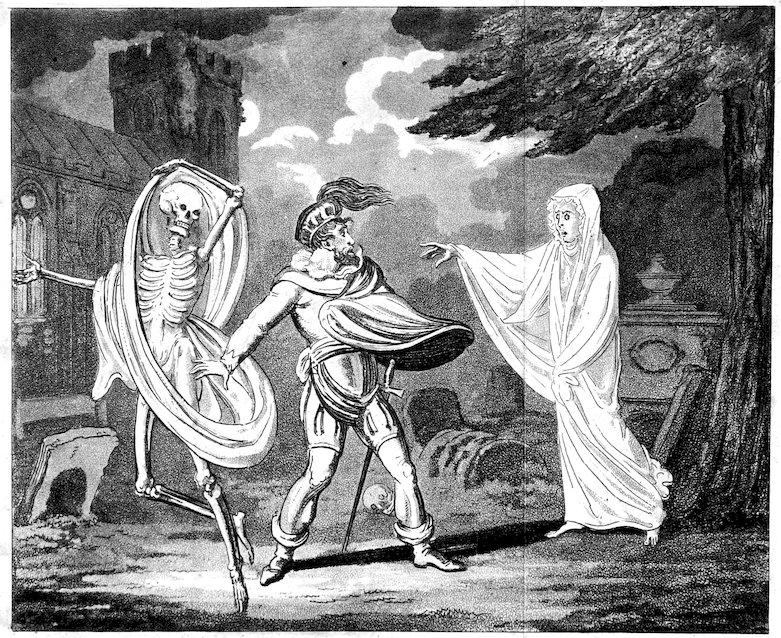
The Confessions of certain Scotch Witches, taken out of an authentic copy of their Trial at the Assizes held at Paisley, in Scotland, Feb. 15, 1678, touching the bewitching of Sir George Maxwell
Among the multifarious absurdities and
chicaneries, which at different epocha of
society have clung to, and engaged the
attention of man, absorbing, as it were,
his more active intelligence, the marvellous
and the ridiculous have alternately and
conjointly had to contend for pre-eminence;
that, whether it were a mountain in
the moon or a bottle conjuror; a live lion
stuffed with straw or a mermaid; a Cocklane
ghost or a living skeleton; a giant or a
pigmy; the delusive bait has invariably been
swallowed with avidity, and credited with all
the solemnity of absolute devotion.
If we look back towards what are called
the dark ages of the worlds that is, at times
when men were mere yokels, and when the
reins of tyranny, superstition and idolatry,
were controlled by a few knowing ones, we
shall see the human mind at its lowest ebb of
debasement, grovelling either under the lash
xof despotism, or sunk beneath the scale of human
nature by the influence of priestcraft,—a
time, when the feelings of men were galloped
over, rough shod, and the dignity of the
creation trampled under foot with impunity
and exultation, by a state of the most passive
and degenerate servility: how much must
it now excite our wonder and admiration of
that supreme Providence, who, in his merciful
consideration for the frailest of mortals,
by a variety of ways and means best suited
to his omnipotent ends, has dragged us gradually,
and, as it were, reluctantly to ourselves,
from darkness to daylight, by extinguishing
the stench and vapour of the
train oil of ignorance and superstition,
lighting us up with the brilliant gas of reason
and comparative understanding, while,
under less despotic and more tolerant times,
we are permitted the rational exercise of
those faculties which formerly were rivetted
to the floor of tyranny by the most humiliating
oppression!
The pranks of popes and priests, conjurors
and fire-eaters, have comparatively
fled before the piercings of the intellectual
ray. Witches no longer untie the winds to
xicapsise church-steeples, and “topple” down
castles,—they no longer dance round the enchanted
cauldron, invoking the “ould one”
to propitiate their cantrip vows:—Beelzebub
himself with his cloven foot is seldom if
ever seen above the “bottom of the bottomless
pit;” ghosts and apparitions are “jammed
hard and fast” in the Red sea; demons of
every cast and colour are eternally spellbound;
legends are consigned to the chimney-corner
of long winter-nights; miracles
to the “presto, quick, change and begone!” of
the nimble-fingered conjuror; and holy relics
to the rosary of the bigot. Amulets and
charms have lost their influence; saints are
uncanonized, and St. Patrick, St. Dennis,
& Co. are flesh and blood like ourselves;
monks and holy friars no longer revel in
the debauches of the cloister; the hermit returns
unsolicited from the solitude of the desert,
to encounter with his fellow-men; the
pilgrim lays by his staff, leaves the Holy
Land to its legitimate possessors, and the
tomb of St. Thomas-à-Becket, to enjoy, unmolested,
the sombre tranquillity of the grave.
Quacks and mountebanks begin also to caper
within a narrower sphere; to be brief, the
word of command, to use a nautical phrase,
xiihas long been given, “every man to his station,
and the cook to the fore-sheet,”—worldly
occupations have superseded ultramundane
speculations. Astrologers themselves, who
once ruled the physical world, have long ago
been virtually consigned to the grave of the
Partridges; and floods and storms are found
to be phenomena perfectly consistent with the
natural world. We also know that the sun is
stationary, that the moon is not made of green
cheese, and that there are stars yet in the firmament
which the centifold powers of the
telescope of a Herschell will never be able to
explore.
The Reformation, which originated in
the trammels of vice itself, gave the Devil in
hell and his agents on earth, such a “belly-go-fister,”
that they have never since been
able to come to the scratch, but in such a petty
larceny-like manner, as to set all their demonological
efforts at defiance. This is the first
time “old Nick” was ever completely floored;
though, it would appear, from the recent
number of new churches, built no doubt with
the pious intention of keeping him in abeyance,
that he has latterly been making a
little head-way;—these, however, with the
“Holy alliance,” like stern-chasers on a new
xiiiconstruction, should the “ould one” attempt to
board us again in the smoke of superstition,
will, without much injury to the hull of the
church, pitch him back to Pandemonium, there
to exhaust his demonological rage in the sulphuretted
hydrogen of his own hell; while the
lights of revealed religion, emanating from
these soul-saving foundations, like Sir Humphrey
Davy’s safety-lamp, will give us timely
warning of the choke-damp of damnation before
it have time to explode about our ears.
It behoves us, nevertheless, to pray that
we may merit this protection, and to watch,
for we know not at what hour the cracksman
may pay us an unwelcome visit; for, whatever
pampered hypocrites and mercenary
prayer-mongers may pretend to the contrary,
our worldly goods, although but of a temporary
and perishable nature, are as essential
to our existence and respectability here below,
as our spiritual faith is necessary to our
heavenly and eternal happiness above, however
unequal the comparison.
Among the creatures of the Devil, no one
has a more decent claim to his clemency, than
the caterwauling canting hypocrite. The hypocrite
is a genus to which a variety of species
belong, the subdivisions of which are too numerous
xivfor our present purpose; we shall only
therefore offer a few remarks on one kind
of these vampyres, drawn from daily observation.
If not absolutely gluttons, although
many of them are gourmands in excess,
hypocrites are invariably fond of their ungodly
guts, for which they are at all times
ready to sacrifice their God, their King, their
country and their friends. They have a
stomach like a horse, and a reservoir like a
brewer’s vat. The hypocrite of circumstances
prays, or pretends to pray, in adversity, and
swears in good earnest, like a trooper, in prosperity,—he
is either a roaring bedlamite or a
whining calf, a peevish idiot, a buffoon, or a disgusting
bacchanal;—in short, he is capable of
such derogatory pranks and extremes, that, as
the occasion serves, he with equal facility rises
from the bended knee of supplication to extend
the hand of venality, aye, and of sensuality
too, to the object of his latent and ungovernable
concupiscence. His bloated chops,
at one time, resemble a passive pair of bagpipes,
while, at another, they are inflated with
all the arrogance of beggarly pride and momentary
superfluity. He is never ashamed
to beg, and only afraid to steal—although
equally adapted for the one as the other.
xvA consummate, a brawling, and a suspicious
egotist—he will hear no one but
himself, no opinion but his own. In his
own house he is a bear; in the house of
another, a nuisance; and every where a nil
desideratum. Self-eulogy is his most constant
theme; and his loathsome flattery,
either applied to himself or others, is invariably
bespattered with the most impious invocations
of the Deity, to witness his rebellious
professions of patience, submission, abstinence,
and every other exotic virtue, which
he knows only by name. His cant is of the
basest and most servile description; and for
the attainment of some object, however pitiful
or paltry, important or consequential, he is
the same venal wretch all over. Where his
expectations are defeated, and the yearnings
of his bowels unappeased, his sycophancy is
succeeded by slander, impertinence, insult,
and the most unfounded suspicion. The
cringing, wriggling wretch, at length,
having wormed himself through a world of
unpitied degradation, filth, and obscenity, attempts,
at the end of his career, to offer up
to his God, what has been indignantly rejected
by the Devil—he dies as he lived, a
xvipauper, equally to fortune and fame—without
one redeeming qualification to keep
alive even his name, which is never mentioned
unless mingled with that kindred contempt
and insignificance to which it was by
nature and existence so closely allied.
Popular traditions are always worth recording;
they illustrate traditions and exemplify
manners: they tend to throw off the
thraldom of the intellect of man, and stimulate
him to exertions compatible with the
intentions of his existence. It is with this
view that the materials of which the following
pages are composed, have been collected.
Priestcraft, the foster-mother of superstition,
is now sunk too far below the horizon ever
to set again in our illumined hemisphere.
The history of their former influence may,
nevertheless, enlighten and amuse, as well
as guard the tender ideas from receiving impressions
calculated to stupify the reason and
riper judgment; thus withdrawing the flimsy
veil of error and credulity, by an exposure of
those fallacies too often credited, because
frequently passed over without the aid of investigation
through the more refined medium
of moral and physical research.
Demonologia.
1
MODERN SUPERSTITIONS, &c.
The mind of man is naturally so addicted to the
marvellous, that, notwithstanding the brilliant
eructations of knowledge that have been elicited
and diffused out of chaotic darkness since the
establishment of the Christian religion, and the
revival of learning and the arts, the influence still
of ancient superstition is by no means entirely
annihilated. At the present period, however, it
is principally confined to the uneducated portion
of the community; although, at a more remote
period, its limits were by no means so circumscribed.
A belief in the existence of apparitions,
witches, sorcerers, and magicians, is still credulously
supported in many parts of the world, though
less so in civilized Europe than in other countries,
Lapland and some parts of Sweden and Norway
excepted. But how much must it astonish us
when we look back to the distant ages of Greece
and Rome, the nurseries of the sciences and the
arts, to find the greatest heroes and statesmen
imbibing and fostering the same ridiculous prejudices,
and strenuously cultivating the same belief,
paying obedience to augurs, oracles, and soothsayers,
2on whose contradictory and equivocal
inferences their prosperity or adversity was made
to depend. In fact, little more than a century
ago, do we not behold things still more extravagantly
credulous and ferocious; namely, the burning
of women for the imaginary crime of witchcraft,
incidents of which we have given in the body of
this work, a crime much more innocent than that
of priestcraft, which triumphantly prevailed at the
very same period, and which still holds the minds
of thousands in subjection?
A belief in judicial astrology was supported and
cultivated by men remarkable for their extraordinary
genius and talents.
Legends, miracles, prophecies, &c. are relics of
superstitious ages. What also is extraordinary, is,
that few species of superstition, if any, originated
with the populace. They were the inventions of
barbarous ages before the dawn of reason—afterwards
the fabrications of men actuated by ambition,
and a desire to servilize the human mind.
As regards the Romans only, a people whom
we are taught from our infancy to respect, and
who, indeed, in their better days, were truly venerable
for their virtue and valour, what is there in
their history more astonishing than their implicit
belief in augury[1]? Their belief in omens or preternatural
3appearances of the heavenly bodies, in
eclipses, comets, and dreadful thunder-storms,
may be forgiven. They had made small progress
in astronomy; they had not learnt that an eclipse
is a matter of common calculation; and that storms
are, in most cases, highly beneficial to the earth,
and nowise connected with past or future events.
But when we find them giving implicit credit to
their priests, who thought proper to predict good
or evil, merely from the appearance of the entrails
of sacrificed animals, from the flight of birds, from
chickens, foxes, &c. we are at a loss to conceive
how a deception of this kind could have prevailed,
without being detected and exposed by the good
sense of the people. The mob alone, or the common
soldiers and sailors, were not merely influenced
by the reports of the augurs[2]; their kings
or commanders undertook no expedition without
consulting these oracles, and were always unsuccessful,
if they confided so much in themselves as
to disregard their opinions. In some cases, it is
easy to suppose that they might have been in concert
with the augurs, to promote some favourite
point, to raise an enthusiasm in the people in their
favour, or to inspire the soldiers with fortitude in
some dangerous enterprise. But it is not so easy
to suppose that this was always the case, because,
upon the evidence of their historians, it appears
that there was generally but little connexion between
4them; and that, although the people looked
to the commander for orders, they regarded the
augurs as superior beings who were to grant
success.
The art of augury the Romans had from the
Tuscans, and the Tuscans from the Greeks, who
probably derived it from the Chaldeans; but the
progress of the art is as absurd as the origin of it
is obscure. The only wonder is, that it had so
much influence upon a people, in the whole of
whose history we find so many brilliant examples
of solid sense, of learning, and of eloquence.
Their historians, who rank among the most learned
of their writers, and of whose abilities we can even
now be judges, gravely relate the process of consulting
augury, and the success of it. Yet the
augurs were men following one another in regular
succession. Was there none to betray the secret?
Was the art of juggling an hereditary secret without
one interruption? Tyranny first broke the
chain. When Rome was governed by tyrants,
these despised augury, and prosecuted their wicked
purposes, whatever might be the appearance of
the entrails of an ox; and as they, no doubt, often
succeeded in their enterprises, augury would naturally
fall into disrepute. These circumstances,
in the great chain of causes and events, would
naturally pave the way for a more rational religion.
We are indebted to Henry VIII. for the commencement
of the reformation; but, if the pope
would have sanctioned his lust and his extortion,
that advantage would have probably been derived
from a better sovereign.
5It is a circumstance no less remarkable, that,
notwithstanding we read of the superstitions of
the Greeks and Romans with wonder and some
degree of contempt, we cannot acquit ourselves
of having yet retained a very considerable portion
Of the same superstitious spirit. We are even
indebted to them for almost all our popular whims.
A hare crossing the way—a person sneezing—stumbling—hearing
strange voices—and the falling
of salt upon the table, were all with them
omens of good or evil, according to circumstances,
and remain so with thousands at the present time,
and in this enlightened country. Persons of otherwise
no mean understanding have been greatly
perplexed, and have even turned pale at such
occurrences. To the above may be added, a coal
starting from the fire[3]—the death-watch—the sediment
of the sugar rising to the top of the tea-cup,
and many others. We may also mention the success
of those impostors, who pretend to calculate
nativities (seeAstrology) and predict events;
and the many foolish instances for belief in the
success of lottery-tickets.
Ignorant as the Romans were of a superintending
6Providence, and of the revealed will of the
Divine Majesty, their trust in such omens was
pardonable, and deceived as they were by the artifices
of their soothsayers, who could contrive to
time their prophecies, and express them in such
a manner that they should appear to be punctually
fulfilled, we cannot wonder if the wisest among
them were induced to place confidence in imposture.
But that we should be as much attached to
this species of divination is a weakness, than which
there is none we ought more to blush at. Although
we boast of our superior understanding, improved
as it is by the knowledge of eighteen centuries,
we are guilty of a weakness which is excusable
only in an unenlightened heathen. This subject
might, perhaps, be treated with the ridicule of
satire, or the silence of contempt, but the more
we consider it, the more we should be inclined to
doubt the fact, that there can exist a human and
reasonable being so weak, as to believe that futurity
can be revealed by trifling events, or by the
lowest of mankind, under the name of conjurors.
But the fact cannot be doubted: cases of the kind
occur every day; and the happiness of individuals
and families often lies at the mercy of such impostors.
Those who are addicted to this species of superstitious
credulity are no doubt of that class of
people who are called well-meaning, and would be
greatly incensed were we to ask them whether they
believed in the superintendence of a Divine Providence.
They would answer, “Surely—God
forbid we did not!” And yet, is it consistent with
7our received ideas, or with the revealed wisdom
and perfections of the Deity, to suppose that he
should declare that futurity is locked up from the
penetration of mankind, and yet should reveal the
events of it by the sediments of a cup of coffee,
the flame of a candle, or the starting of a sulphureous
coal? Is not this offering the greatest
insult to him? A step farther, we have, indeed,
gone, and but a step towards the very highest insult;
we have supposed that he makes known the
secrets of futurity to the meanest vagrants and
impostors, to the men and women whom the magistrate
very properly punishes as much against
their foreknowledge as against their inclination.
The impossibility of our acquiring by any means
a knowledge of future events, and the miserable
condition of human life if we had that knowledge,
might be here insisted on; but they must be obvious
to every thinking man. A better dissuasive from
the credulity which is the subject of this discourse,
would be to insist upon the gross and insulting
impiety of endeavouring to pry into what the Deity
has pronounced hidden and concealed, and that by
agents the most mean and contemptible. Let those
who are still credulous in the appearance of their
coffee grounds, their spilling of salt, their passing
under a ladder or scaffolding[4], and all the paraphernalia
8of the impostures of pretended divines,
consider with what propriety, decency and respect,
they can hereafter appeal to the Deity by the epithets
of all-seeing and omniscient; and when they
have done that, let them reflect upon the dignity
and importance of those agents, in whose revelations
they confide, in preference to his decrees.
Under the head of superstition may be ranked
fatalism; for it follows from this dogma of faith,
that all means of averting predestined events, that
is, all future events whatever, are not only unavailing,
but impious. It is manifest, that if this were
consistently adhered to, every effort conducive to
self-preservation, or even the common comforts
and accommodations of life, would be paralysed;
there would be no end to all the duties of social
life; nay, to the very existence of the human species.
Though this speculative principle, however,
has never been able entirely to overpower and extinguish
the feelings and dictates of nature to this
extent, except among a few fantastical maniacs,
there are proofs enough in the history of mankind
of its pernicious practical effects. One of the
most conspicuous examples of this, is found among
the professors of the Mahomedan faith, in their
abstaining from the means of stopping the progress
9of the plague. Among Christian sects, professing
this doctrine, the like evils have arisen in an inferior
degree, as exemplified in the opposition
which the inoculation of the small-pox met with
from this religious prejudice. See Sir Gilbert
Blane’s Elements of Medical Logic, page 208.
PROOFS AND TRIALS OF GUILT IN SUPERSTITIOUS AGES.
It were well, perhaps, did the cruelties practised in
former ages lay generally at the door of superstition.
The extraordinary trials to which those suspected
of any guilty action were conducted with many
devout ceremonies, by the ministers of religion,
were declared to be the judgments of God. The
kinds of ordeal were various, e. g. holding in the
hand a red hot bar; plunging the arm into boiling
water; walking blindfold amidst burning ploughshares;
passing through fires; challenging the
accuser to single combat, when frequently the ablest
champion was permitted to supply his place; swallowing
a morsel of consecrated bread; swimming
or sinking in a river for witchcraft, or, as it was
called, weighing a witch; stretching out the arms
before the cross, till the soonest wearied dropped
his arms, and lost his estate, which was decided by
this very short process, called juidcium crucis, &c.
A dispute occurred between the Bishop of Paris
and the Abbot of St. Denis, about the patronage of
a monastery, and Pepin, surnamed the Short, not
being able to pronounce upon their confused claims,
10decreed that it should be settled by one of these
judgments of God: viz. The judgment of the
cross. Each of the disputants chose a man, and
both of the men appeared in the chapel, where they
extended their arms in the form of a cross. The
spectators, more orderly than those of the present
day; still, although they watched every motion of
the combatants with the most pious attention, the
old English spirit, which rules so prevalently at the
present period, was proof against every other consideration—they
betted on the feat, first on one
side, then on the other, according as the odds seemed
to run in favour or against. The Bishop’s man
was first tried; he let his arms drop and ruined his
patron for ever. Though these trials might sometimes
be evaded by the artifice of the priest, numerous,
nevertheless, were the innocent victims
who suffered from these superstitious practices.
They were very frequent between the tenth and
twelfth century. William Rufus, having accused
Hildebert, the Bishop of Mans, of high treason,
was on the verge of submitting to one of these
trials, when he was convinced by Ives, Bishop of
Chartres, that they were against the canons of the
constitution of the church, and adds, that in this
manner “Innocentiam defendere, est innocentiam
perdere.” In 1066 an abbot of St. Aubin of Angers,
having refused to present a horse to the viscount
of Tours, which the viscount claimed in right
of his lordship, whenever an abbot first took possession
of that abbey; the ecclesiastic offered to
justify himself by the trial of the ordeal, or by
duel, for which purpose he proposed to find a substitute.
11The duel was first agreed to by the viscount;
but, reflecting that these combatants, though
sanctioned by the church, depended solely on the
address or vigour of the adversary, and consequently
could afford no substantial proof of the
equity of his claim, he proposed to compromise the
matter in a manner which strongly characterised
these times: he surrendered his claim, on condition
that the abbot should not forget to mention him,
his wife, and his brothers, in his prayers! As the
orisons appeared to the abbot of comparatively
little value with the horse, the proposal was accepted.
In the tenth century the right of representation
was not settled: it was a question whether a son’s
sons ought to be accounted among the children of
the family, and succeed equally with their uncles,
if their fathers happened to die while their grandfathers
survived. This point was decided by one
of these combats. The champion in behalf of
the right of children to represent their deceased
father, proved victorious. It was then established
by a perpetual decree, that they should from that
time forward share in the inheritance along with
their uncles.
In the eleventh century, the same mode was
adopted, to decide between two rival liturgies! A
couple of knights, clad in complete armour, were
the tests to decide which was the true and authentic
liturgy.
The capitularies of Dagobert say, that if two
neighbours dispute respecting the boundaries of
their possessions, let a piece of turf of the contested
12land be dug up by the judge, and brought
by him into the court, and the two parties shall
touch it with the points of their swords, calling on
God to witness their claims: after this, let them
combat, and let victory prove who is right or who
is wrong. In these combats in Germany, a solemn
circumstance was practised in these judicial combats.
In the midst of the lists they placed a bier;
by the side of which stood the accuser and the
accused, one at the head and the other at the foot,
where they leaned in profound silence for some
time before the combat commenced. In his preface
to Way’s Fableaux, Mr. Ellis shews how
faithfully the manners of the age are painted in
these ancient tales, by observing the judicial
combat introduced by a writer of the 14th century,
who, in his poem, represents Pilate as
challenging Jesus Christ to single combat; and
another, who describes the person who pierced
the side of Christ as a knight who jousted with
Jesus.
It appears that judicial combat was practised
by the Jews. Whenever the Rabbins had to decide
on a dispute about property between two parties,
neither of which could produce evidence to
substantiate the claim, it was terminated by single
combat. The Rabbins were impressed with a
notion that consciousness of right would give additional
confidence and strength to the rightful
possessor. It may, however, be more philosophical
to observe, that such judicial combats were more
frequently favourable to the criminal than to the
innocent, because the bold wicked man is usually
13more ferocious and hardy than he whom he singles
out as his victim, and who only wishes to preserve
his own quiet enjoyments: in this case the assailant
is the most terrific opponent.
Those who were accused of robbery in these
times were put to trial by a piece of barley bread,
on which the mass had been performed; and if the
accused could not swallow it, they were declared
guilty. This mode of trial was improved by adding
to the bread a slice of cheese; and such was their
credulity and dependance on heaven in these ridiculous
trials, that they were very particular in this
holy bread and cheese, called the corsned. The
bread was to be of unleavened barley, and the
cheese made of ewes milk in the month of May[5].
The bleeding of a corpse was another proof of
guilt in superstitious ages; nor is the custom yet
entirely abolished. If a person were murdered,
it was believed, that at the touch or approach of
the murderer, the blood gushed out from various
parts of the body. By the side of the bier, if the
smallest change was perceptible in the eyes, mouth,
feet or hands of the corpse, the murderer was conjectured
to be present, and many innocent persons
doubtless must have suffered death from this idle
chimera; for when a body is full of blood, warmed
by a sudden external heat and symptoms of ensuing
putrefaction, some of the blood vessels will
14burst, as they will all in time. This practice was
once allowed in England, and is still looked on in
some of the uncivilized parts of these kingdoms as
a means of detecting the criminal. It forms a rich
picture in the imagination of our old writers; and
their histories and ballads are laboured into pathos
by dwelling on the suppositious phenomenon.
All these absurd institutions, Robertson observes,
cherished and inculcated, form the superstitions of
the age believing the legendary histories of those
saints who crowd and disgrace the Roman calendar.
These fabulous miracles had been declared authentic
by the bulls of the Popes, and the decrees of
Councils—they were greedily swallowed by the
populace; and whoever believed that the Supreme
Being had interposed miraculously on those trivial
occasions mentioned in legends, could not but expect
his intervention in matters of greater importance
when solemnly referred to his decision. Besides
this ingenious remark, the fact is, that these
customs were a substitute for written laws, which
that barbarous period had not; and as it is impossible
for any society to exist without laws, the ignorance
of the people had recourse to these customs,
which bad and absurd as they were, served to
terminate controversies which might have given
birth to more destructive practices. Ordeals are,
in fact, the rude laws of a barbarous people, who
have not obtained a written code, and not advanced
enough in civilization, to embrace the refined investigations,
the subtle distinctions, and elaborate
inquiries, which are exacted by a Court of Law.
It may be presumed, that these ordeals owe their
15origin to that one of Moses, called the “Waters
of Jealousy.” The Greeks also had ordeals, for
we read in the Antigonus of Sophocles, that the
soldiers offer to prove their innocence by handling
red hot iron, and walking between fires.
One cannot but smile at the whimsical ordeals
of the Siamese. Among other practices to discover
the justice of a cause, civil or criminal, they
are particularly attached to the use of certain consecrated
purgative pills, which the contending parties
are made to swallow. He who retains them
longest, gains his cause! The practice of giving
Indians a consecrated grain of rice to swallow, is
known to discover the thief in any company, by
the contortions and dismay evident on the countenance
of the real thief.
In the middle ages they were acquainted with
secrets to pass unhurt these secret trials: one is
mentioned by Voltaire for undergoing the ordeal
of boiling water; and this statement is confirmed
by some of our late travellers in the East. The
Mevleheh dervises can hold red hot iron between
their teeth. Such artifices have been often publicly
exhibited at Paris and London. On the
ordeal of the Anglo-Saxons, Mr. Sharon Turner
observes, that the hand was not to be immediately
inspected, and was left to the chance of a
good constitution to be so far healed during three
days (the time they required to be bound up and
sealed, before it was examined) as to discover
those appearances when inspected, which were
allowed to be satisfactory. There was also much
preparatory training, suggested by the more experienced:
16besides, the accused had an opportunity
of going alone into the church, and making
terms with the priest. The few spectators were
always at a distance; and cold iron or any other
inoffensive substance might be substituted, and the
fire diminished at the moment. There can be no
doubt they possessed these secrets and medicaments,
which they always took care to have ready
at hand, that they might pass through these trials
in perfect security.
There is an anecdote of these times given by
Camerarius, in his “Horæ Subscecivæ,” which
may serve to show the readiness of this apparatus.
A rivalship existed between the Austin Friars and
the Jesuits. The Father-general of the Austin
Friars was dining with the Jesuits; and on the
table being removed, he entered into a formal discourse
of the superiority of the monastic order,
and charged the Jesuits, in unqualified terms, with
assuming the title of “Fratres,” while they held
not the three vows, which other monks were obliged
to consider as sacred and binding. The
general of the Austin Friars was very eloquent
and very authoritative: and the superior of the
Jesuits was very unlearned, but not quite half a
fool. He was rather careless about entering the
list of controversy with the Austin Friar, but
arrested his triumph by asking him if he would see
one of his Friars who pretended to be nothing
more than a Jesuit, and one of the Austin Friar’s
who religiously performed the above-mentioned
three vows, show instantly which of them would be
the readiest to obey his superiors? The Austin
17Friar consented. The Jesuit then turning to one
of his brothers, the Holy Friar Mark, who was
waiting on them, said, “Brother Mark, our companions
are cold; I command you, in virtue of the
holy obedience you have sworn to me, to bring here
instantly out of the kitchen fire, and in your hands,
some burning coals, that they may warm themselves
over your hands.” Father Mark instantly
obeys, and to the astonishment of the Austin
Friars, brought in his hands a supply of red burning
coals, and held them to whoever thought proper
to warm himself; and at the command of his
superior, returned them to the kitchen hearth.
The general of the Austin Friars, with the rest of
his brethren, stood amazed; he looked wistfully on
one of his monks, as if he wished to command him
to do the like; but the Austin Monk, who perfectly
understood him, and saw this was not a time
to hesitate, observed,—“Reverend Father, forbear,
and do not command me to tempt God! I
am ready to fetch you fire in a chafing dish, but
not in my bare hands.” The triumph of the Jesuits
was complete; and it is not necessary to add, that
the miracle was noised about, and that the Austin
Friars could never account for it, notwithstanding
their strict performance of the three vows.
ASTROLOGY, &c.
18
“This is the excellent foppery of the world, that when we are
sick in fortune (often the surfeit of our own behaviour)
we make guilt of our disasters, the sun, the moon, and the
stars; as if we were villains by necessity; fools by heavenly
compulsion; knaves, thieves, and treachers (traitors), by
spherical predominance; drunkards, liars, and adulterers, by
an inforced obedience of planetary influence; and all that we
are evil in by a Divine thrusting on; an admirable evasion of
whoremaster to lay his goatish disposition to the charge of a
star! My father compounded with my mother under the Dragon’s
tail; and my nativity was under Ursa Major; so that it
follows, I am rough and lecherous.—Tut, I should have been
that I am, had the maidenliest star in the firmament twinkled
at my bastardizing.”—Shakspeare.
It is a singular fact, that men the most eminent
for their learning were those who indulged most in
the favourite superstition of judicial Astrology;
and as the ingenious Tenhove observes, whenever
an idea germinates in a learned head, it shoots with
additional luxuriance. At the present time, however,
a belief in judicial Astrology can only exist
in the people, who may be said to have no belief
at all; for mere traditional sentiments can hardly
be said to amount to a belief.
It is said that Dr. Fludd[6] was in possession of
19the MSS. of Simon Forman, the Astrologer. We
have seen that the studies of Mathematics, Astronomy,
and Medicine, were early united in several
persons connected with the faculty of medicine.
Real Astronomy gave birth to judicial Astrology;
which offering an ample field to enthusiasm and
imposture, was eagerly pursued by many who had
no scientific purpose in view. It was connected
with various juggling tricks and deceptions, affected
an obscure jargon of language, and insinuated
itself into every thing in which the hopes and
fears of mankind were concerned. The professors
of this pretended science were at first generally
persons of mean education, in whom low cunning
supplied the place of knowledge. Most of them
engaged in the empirical practice of physic, and
some, through the credulity of the times, even
arrived at a degree of eminence in it; yet since
the whole foundation of their art was folly and
deceit, they nevertheless gained many proselytes
and dupes, both among the well-informed and the
ignorant.
When Charles the First was confined, Lilly, the
famous Astrologer, was consulted for the hour that
should favour his escape.
A story, which strongly proves how much
Charles II. was bigoted to judicial astrology, and
whose mind was certainly not unenlightened, is
recorded in Burnet’s History of his own times.
The most respectable characters of the age, Sir
William Dugdale, Elias Ashmole, Dr. Grew, and
others, were members of an astrological club[7].
20Congreve’s character of Foresight, in Love for
Love, was then no uncommon person, though the
humour now is scarcely intelligible. Dryden cast
the nativities of his sons; and, what is remarkable,
his prediction relating to his son Charles, was accomplished.
This incident is of so late a date,
one might hope it would have been cleared up;
but, if it be a fact, it must be allowed that it forms
a rational exultation for its irrational adepts.
In 1670, the passion for horoscopes and expounding
the stars, prevailed in France among the
first rank. The new-born child was usually presented
naked to the astrologer, who read the first
lineaments in its forehead, and the transverse lines
in its hands, and thence wrote down its future
destiny. Catherine de Medicis brought Henry IV.
then a child, to old Nostradamus, whom antiquaries
esteem more for his Chronicle of Provence than for
his vaticinating powers. The sight of the reverend
seer, with a beard which “streamed like a meteor
in the air,” terrified the future hero, who dreaded
a whipping from so grave a personage. Will it
be credited, that one of these magicians, having
assured Charles IX. that he would live as many
days as he should turn about on his heels in an
hour, standing on one leg, that his Majesty every
morning performed that solemn exercise for an
hour; the principal officers of the court, the judges,
21the chancellors, and generals, likewise, in compliment,
standing on one leg, and turning round!
It has been reported of several famous for their
astrological skill, that they have suffered a voluntary
death merely to verify their own predictions:
this has been said of Cardan, and Burton the author
of the Anatomy of Melancholy.
It is curious to observe the shifts to which astrologers
are put when their predictions are not verified.
Great winds were predicted, by a famous adept,
about the year 1586. No unusual storms, however,
happened. Bodin, to save the reputation of
the art, applied it as a figure to some revolutions
in the state, and of which there were instances
enough at that moment. Among their lucky and
unlucky days, they pretend to give those of various
illustrious persons and of families. One is very
striking:—Thursday was the unlucky day of our
Henry VIII. He, his son Edward VI. Queen
Mary, and Queen Elizabeth, all died on a Thursday!
This fact had, no doubt, great weight in this controversy
of the astrologers with their adversaries.
The life of Lilly, the astrologer, written by himself,
is a curious work. He is the Sidrophel of
Butler. It contains so much artless narrative,
and at the same time so much palpable imposture,
that it is difficult to know when he is speaking
what he really believes to be the truth. In a sketch
of the state of astrology in his day, those adepts,
whose characters he has drawn, were the lowest
miscreants of the town. They all speak of each
other as rogues and impostors. Such were Booker,
George Wharton, Gadbury, who gained a livelihood
22by practising on the credulity of even men of
learning so late as in 1650, to the 18th century.
In Ashmole’s life an account of these artful impostors
may be found. Most of them had taken the
air in the pillory, and others had conjured themselves
up to the gallows. This seems a true statement
of facts. But Lilly informs us, that in his
various conferences with angels, their voice resembled
that of the Irish! The work is certainly
curious for the anecdotes of the times it contains.
The amours of Lilly with his mistress are characteristic.
By his own accounts, he was a very
artful man; and managed matters admirably which
required deception and invention.
In the time of the civil wars, astrology was in
high repute. The royalists and the rebels had
their astrologers as well as their soldiers! and the
predictions of the former had a great influence
over the latter. On this subject, it may gratify
curiosity to notice three or four works which bear
an excessive price; a circumstance which cannot
entirely be occasioned by their rarity; and we are
induced to suppose, that we still have adepts in
this science, whose faith must be strong, or whose
scepticism weak.
The Chaldean sages were nearly put to the route
by a quarto park of artillery, fired on them by
Mr. John Chamber, in 1691. Apollo did not use
Marsyas more inhumanly than his scourging pen
this mystical race, and his personalities made them
feel more sore. However, a Norwich knight, the
very Quixote of astrology, arrayed in the enchanted
armour of his occult authors, encountered this
23pagan in a most stately carousal. He came forth
with “A defence of Judiciall Astrologye, in answer
to a treatise lately published by Mr. John
Chamber. By Christopher Knight. Printed at
Cambridge, 1603.” This is a handsome quarto of
about 500 pages. Sir Christopher is a learned
and lively writer, and a knight worthy to defend a
better cause. But his Dulcinea had wrought most
wonderfully on his imagination. This defence of
this fanciful science, if science it may be called,
demonstrates nothing, while it defends every thing.
It confutes, according to the Knight’s own ideas:
it alleges a few scattered facts in favour of astrological
predictions, which may be picked up in that
immensity of fabling which disgraces history. He
strenuously denies, or ridicules, what the greatest
writers have said against this fanciful art, while
he lays great stress on some passages from obscure
authors, or what is worse, from authors of no
authority. The most pleasant part is at the close,
where he defends the art from the objections of
Mr. Chamber, by recrimination. Chamber had
enriched himself by medical practice, and when
he charges the astrologers by merely aiming to
gain a few beggarly pence, Sir Christopher catches
fire, and shews by his quotations, that if we are to
despise an art by its professors attempting to subsist
on it, or for the objections which may be raised
against its vital principles, we ought by this argument
most heartily to despise the medical science
and medical men! He gives here all he can collect
against physic and physicians, and from the
confessions of Hippocrates and Galen, Avicenna
24and Agrippa, medicine appears to be a vainer
science than even astrology! Sir Christopher is a
shrewd and ingenious adversary; but when he says
he only means to give Mr. Chamber oil for his
vinegar, he has totally mistaken its quality.
The defence was answered by Thomas Vicars,
in his “Madnesse of Astrologers.”
But the great work is by Lilly; and entirely
devoted to the adepts. He defends nothing; for
this oracle delivers his dictum, and details every
event as matters not questionable. He sits on the
tripod; and every page is embellished by a horoscope,
which he explains with the utmost facility.
This voluminous monument of the folly of the age,
is a quarto, valued at some guineas! It is entitled,
“Christian Astrology, modestly treated of
in three Books, by William Lilly, student in Astrology,
2nd edition, 1659.” There is also a
portrait of this arch rogue, and astrologer! an
admirable illustration for Lavater!
Lilly’s opinions, and his pretended science, were
such favourites of the age, that the learned Gataker
wrote professedly against this popular delusion.
Lilly, at the head of his star-expounding friends,
not only formally replied to, but persecuted Gataker
annually in his predictions, and even struck at
his ghost, when beyond the grave. Gataker died
in July 1654, and Lilly having written in his
Almanack of that year, for the month of August,
this barbarous Latin verse:—
Hoc in tumbo, jacet presbyter et nebulo!
Here in this tomb lies a presbyter and a knave!
He had the impudence to assert, that he had predicted
25Gataker’s death! But the truth is, it was an
epitaph to the “lodgings to let:” it stood empty,
ready for the first passenger to inhabit. Had any
other of that party of any eminence died in that
month, it would have been as appositely applied
to him. But Lilly was an exquisite rogue, and
never at a fault. Having prophesied, in his Almanack
for 1650, that the parliament stood upon a
tottering foundation, when taken up by a messenger
during the night, he contrived to cancel the
page, printed off another, and shewed his copies
before the committee, assuring them that the
others were none of his own, but forged by his
enemies.
PRACTICAL ASTROLOGY, &c.
By the word Astrology (derived from the Greek αστηρ, a star, and λογος, a discourse,) is meant
the art of prognosticating or foretelling events[8] by
the Aspects, Positions, and Influence of
the HEAVENLY BODIES.
By Aspect is to be understood an angle formed
by the rays of two planets meeting on earth, able
to execute some natural power or influence; which
may be better explained by the following table.
26
CHARACTERS OF THE
Six Northern Signs.
Six Southern Signs.
Planets.
Aspects.
♈︎ Aries.
♎︎ Libra.
♄ Saturn.
☌ Conjunction.
♉︎ Taurus.
♏︎ Scorpio.
♃ Jupiter.
⚹ Sextile.
♊︎ Gemini.
♐︎ Sagittarius.
♂ Mars.
Δ Trine.
♋︎ Cancer.
♑︎ Capricorn.
☉ Sun.
☐ Quartile.
♌︎ Leo.
♒︎ Aquarius.
⦵ Earth.
☍ Opposition.
♍︎ Virgo.
♓︎ Pisces.
♀ Venus.
☿ Mercury.
☽ Luna.
This art, or rather this conjectural science, is
principally divided into Natural and Judiciary.
NATURAL ASTROLOGY
Is confined to the study of exploring natural effects,
as CHANGE OF WEATHER, WINDS, STORMS,
HURRICANES, THUNDER, FLOODS, EARTHQUAKES,
and the like. In this sense it is admitted
to be a part of natural philosophy. It was
under this view that Mr. Goad, Mr. Boyle, and
Dr. Mead, pleaded for its use. The first endeavours
to account for the diversity of seasons from
the situations, habitudes, and motions of the planets;
and to explain an infinity of phenomena by
the contemplation of the stars. The Honourable
Mr. Boyle admitted, that all physical bodies are
influenced by the heavenly bodies; and the
27Doctor’s opinion, in his treatise concerning the
Power of the Sun and Moon, &c. is in favour
of the doctrine. But these predictions and
influences are ridiculed and entirely exploded by
the most esteemed modern philosophers, of which
the reader may have a learned specimen in Rohault’sTract. Physic. pt. ii. c. 27.
JUDICIAL OR JUDICIARY ASTROLOGY — Origin of Astrology. — Astrological Schemes, &c. — Table of the Twelve Houses. — Signs to the Houses of the Planets. — Angles or Aspects of the Planets. — The Application of Planets. — Prohibition , — Separation , — Translation of Light and Virtue , — Refrenation , — Combustion. — Reception , — Retrogradation , — Frustration , — The Dragon’s Head and Tail. — Climacteric. — Lucky and Unlucky Days. — Genethliaci. — Barclay’s Refutation of Astrology.
Is a further pretence to discover or foretel MORAL
EVENTS, or such as have a dependence on the
FREEDOM OF THE WILL. In this department of
astrology we meet with all the idle conceits about
the HORARY REIGN of planets, the DOCTRINE OF
HOROSCOPES, the DISTRIBUTION OF THE HOUSES,
the CALCULATION OF NATIVITIES, FORTUNES,
LUCKY and UNLUCKY HOURS, and other ominous
fatalities.
The professors of this conjectural science maintain
“that the Heavens are one great book,
wherein God has written the history of the world;
and in which every man may read his own fortune
and the transactions of his time. This art, say
they, had its rise from the same hands as Astronomy
itself: while the ancient Assyrians, whose
serene unclouded sky favoured their celestial observations,
were intent on tracing the paths and
periods of the heavenly bodies; they discovered
a constant settled relation or analogy between them
and things below; and hence were led to conclude
these to be the parcæ, or fates or destinies, so much
talked of, which preside at our birth, and dispose
of our future fate.”
28The study of Astrology, so flattering to human
curiosity, got early admission into the favour of
mankind, especially of the weak, ignorant, and
effeminate, whose follies induced the avaricious,
crafty, and designing knaves, to recommend and
promote it for their own private interest and advantage.
We meet with the first accounts of Astrology
in Chaldea; and at Rome it was known by the
name of the Babylonish calculation; against
which Horace very wisely cautioned his readers—
—— nec Babylonios
Tentaris numeros.—Lib. l. od. xi.
that is, consult not the tables or planetary calculations
used by Astrologers of Babylonish origin.
This therefore was the opinion of the Romans
on the subject of Astrology. Others have ascribed
the invention of this deception to the Arabs: be
this as it may, judicial Astrology has been too
much used by the priests of all nations to increase
their own power and emoluments.
The Egyptians, the Chaldeans, the Greeks and
Romans, furnish us with innumerable instances of
the extent to which Astrology was carried for interested
purposes. Brahmins in India, who take
upon themselves to be the arbiters of good and
evil hours, and who set an extravagant price
upon their pretended knowledge of planetary influence
and predictions, maintain their authority
at the present day by similar means. Nor among
the Christians, notwithstanding the enlightened
29era in which we live, are we without our Astrologers,
as well as its admirers and advocates; for
though they may not have all pursued and adopted
the same technical method, still it is certain, that
whoever pretends to discover future events by other
means than through the light of Divine revelation,
may be properly classed under the species of judicial
Astrologers.
Those who pretend to reduce the practice of
Astrology to a system, present the world with certain
schemes formed upon the Aspects of the
planets, and attribute certain qualities or powers
to each sign. Thus, to discover the influence of
the heavens over the life of a person, they erect
a THEME, at the given time of the moment the
person was born, by which the Astrologers pretend
to discover the star that presided, or in what part
of the hemisphere it was placed, when the individual
came into the world. The erection of this
THEME they perform, or at least pretend to reform,
with the assistance of the celestial globe, or planisphere,
with regard to the fixed stars; but with
respect to the planets, they do it with Astronomical
tables. To accomplish these, they have recourse
to a semi-circle, which they call POSITION, by
which they represent the six great circles passing through
the intersection of the Meridian and Horizon,
and dividing the Equator into twelve equal
parts. The spaces included between these circles,
are what they call the twelve HOUSES; which they
refer to the twelve triangles marked in their
30theme; placing six of those HOUSES above and
six underneath the horizon.
The first of the HOUSES under the horizon toward
the East, they call the Horoscope, or
House of Life; the second, the House of
Wealth; the third, the House of Brothers;
the fourth, the House of Parents, &c.; as is
clearly expressed in the following lines:
Vita, lucrum, fratres, genitor, natique Valetud,
Uxor, Mors, pietas, et munia, amici inimici.
Which, translated by some English students in
Astrology, runs thus:
The first house shews life, the second wealth doth give;
The third how brethren, fourth how parents live;
Issue the fifth; the sixth diseases bring;
The seventh wedlock, and the eighth death’s sting;
The ninth religion; the tenth honour shews;
Friendship the eleventh, and twelfth our woes.
Astrologers draw their table of the TWELVE
HOUSES into a triple quadrangle prepared for the
purpose, of which there are four principal angles,
two of them falling equally upon the horizon, and
the other two upon the meridian, which angles are
sudivided into 12 triangles for the 12 houses, in
which they place the 12 signs of the Zodiac, to
each of which is attributed a particular quality,—viz.
1.—
Aries, denoted by the sign ♈︎, is, in their extravagant opinion,
a masculine, diurnal, cardinal, equinoctial, easterly sign, hot and dry,—the day house of
Mars.
31
2.—
Taurus, ♉︎, is a feminine, nocturnal, melancholy, bestial,
furious sign—cold and dry.
3.—
Gemini, ♊︎, is a masculine sign, hot and moist, diurnal, aërial,
human, double-bodied, &c.
4.—
Cancer, ♋︎, is a feminine, nocturnal, phlegmatic sign, by nature
cold and moist, the only house of Luna.
5.—
Leo, ♌︎, is a sign, masculine, diurnal, bestial, choleric and
barren; a commanding, kingly sign—hot and dry, the only house of the sun.
6.—
Virgo, ♍︎, is a feminine, nocturnal, melancholy, and barren sign.
7.—
Libra, ♎︎, is a sign masculine, cardinal, equinoctial, diurnal,
sanguine and human, hot and moist.
8.—
Scorpio, ♏︎, is a feminine, nocturnal, cold and phlegmatic
northern sign.
9.—
Sagittarius, ♐︎, is a sign masculine, choleric, and diurnal, by
nature hot and dry.
10.—
Capricorn, ♑︎, is a feminine, nocturnal, melancholy, solstitial,
moveable, cardinal, and southern sign.
11.—
Aquarius, ♒︎, is a masculine, diurnal, fixed, sanguine, and human
sign.
12.—
Pisces, ♓︎, is a feminine, nocturnal, phlegmatic, northerly
double-bodied sign, the last of the twelve.
32Having thus housed their signs and directed
them in their operations, they afterwards come to
enquire of their tenants, what planet and fixed
stars they have for LODGERS, at the moment of
the nativity of such person; from whence they
draw conclusions with regard to the future incident
of that person’s life. For if at the time of that
person’s nativity they find Mercury in 27° 52 min.
of Aquarius, and in the sextile aspect of the horoscope,
they pretend to foretel that that infant
will be a person of great sagacity, genius, and
understanding; and therefore capable of learning
the most sublime sciences.
Astrologers have also imagined, for the same
ridiculous purpose, to be in the same houses different
positions of the signs and planets, and from
their different aspects, opposition and conjunction,
and according to the rules and axioms they
have prescribed to themselves and invented, have
the sacrilegious presumption to judge, in dernier
resort, of the fate of mankind, though their pretended
art or science is quite barren either of
proofs or demonstrations.
The planets have allowed themselves each, except
Sol and Luna, two signs for their houses;
to Saturn, Capricorn and Aquarius; to Jupiter,
Sagittarius and Pisces; to Mars, Aries and Scorpio;
to Sol, Leo; to Venus, Taurus and Libra;
to Mercury, Gemini and Virgo; and to Luna,
Cancer.
33
By their continual mutations among the twelve
signs, the planets make several angles or aspects;
the most remarkable of which are the five following,
viz.—
A Conjunction is when two planets are in
one and the same degree and minute of a sign;
and this, according to Astrological cant, either
good or bad, as the planets are either friends or
enemies.
A Trine is when two planets are four signs, or
120 degrees distant, as Mars in twelve degrees
of Aries, and Sol in twelve degrees of Leo.
Here Sol and Mars are said to be in Trine Aspect.
And this is an aspect of perfect love and
friendship.
A Quadrate Aspect is when two planets are
three signs, or 90 degrees distant, as Mars in
10 degrees, and Venus in 10 degrees of Leo.
This particular aspect is of imperfect enmity, and
Astrologers say, that persons thereby signified,
may have jars at sometime, but of such a nature
as may be perfectly reconciled.
A Sextile Aspect, is when two planets are
two signs, or 60 degrees distant, as Jupiter in
15 degrees of Aries; and Saturn in 15 degrees
of Gemini; here Jupiter is in a sextile aspect
to Saturn. This is an aspect of friendship.
An Opposition is, when two planets are diametrically
opposite, which happens when they are
346 signs, or 180 degrees (which is one half of the
circle) asunder; and this is an aspect of perfect
hatred.
A Partile Aspect, is when two planets are in
a perfect aspect to the very same degree and
minute.
Dexter Aspects, are those which are contrary
to the succession of signs; as a planet, for
instance, in Aries, casts its sextile dexter to
Aquarius.
Sinister Aspect, is with the succession of
signs, as a planet in Aries, for example, casts its
sextile sinister in Gemini.
In addition to these, Astrologers play a number
of other diverting tricks; hence we read of the
Application—Prohibition—Translation—Refrenation—Combustion—Exception—Retrogradation,
&c. of planets.
Application of the planets is performed by Astrologers
in three different ways.
1. When a light planet, direct and swift in its
motion, applies to a planet more ponderous and
slow in motion; as Mercury in 8° of Aries, and
Jupiter in 12° of Gemini, and both direct; here
Mercury applies to a sextile of Jupiter, by direct
application.
2. When they are both retrograde, as Mercury
in 20° of Aries, and Jupiter in 15° of Gemini;
here Mercury, the lighter planet, applies to the
sextile aspect of Jupiter; and this is by retrogradation.
3. When one of the planets is direct, and
35the other retrograde; for example, if Mercury
were retrograde in 18° of Aries, and Jupiter
direct in 14° of Gemini; in this case Mercury applies
to a sextile of Jupiter, by a retrograde
motion.
is when two planets are applying either by body or
aspect; and before they come to their partile aspect,
another planet meets with the aspect of the
former and prohibits it.
is when two planets have been lately in conjunction,
or aspect, and are separated from it.
is when a lighter planet separates from the body
or aspect of a heavier one, and immediately applies
to another superior planet, and so translates
the light and virtue of the first planet to that
which it applies to.
is when a planet is applied to the body or aspect
of another; and, before it comes to it, falls retrograde,
and so refrains by its retrograde motion.
A planet is said to be combust of Sol, when it
is within 8° 30″ of his body, either before or after
his conjunction: but Astrologers complain, that a
planet is more afflicted when it is applying to the
body of Sol, than when it is separating from combustion.
36
is when two planets are in each other’s dignities,
and it may either be by house, exultation, triplicity,
or term.
is when a planet moves backward from 20° to 9°,
8°, 7°, and so out of Taurus into Aries.
is when a swift planet applies to the body or aspect
of a superior planet; and before it comes to
it, the superior planet meets with the body or
aspect of some other planet.
To the seven planets, viz. Saturn, Jupiter,
Mars, Sol, Venus, Mercury, and Luna;
Astrologers add, two certain nodes or points,
called the Dragon’s head, distinguished by this
sign ☋, and the Dragon’s tail by ☊. In those
two extremities of the beast, our students in Astrology
place such virtues, that they can draw from
thence wealth, honour, preferments, &c. enough
to flatter the avarice, ambition, vanity, &c. of the
fools who follow them. Sensible, however, that
the admirers of this art support their principles
and defend their doctrines by examples founded
on their own experience and on the authority
of history; there is no necessity for us here to expose
the weakness and futility of their arguments.
37Tully’s proof will suffice; who, amidst the darkest
clouds of superstition and ignorance, and in the
very heyday of paganism and idolatry, and whilst
religion itself seemed to countenance Astrology,
inveighs severely against it in Lib. 2, de devinat.
“Quam multa ego Pompeis, quam multa Crasso,
quam multa huic ipsi Cæsari a Chaldæis dicta
memini, neminem eorum nisi senectute, nisi domi,
nisi cum clantate esse moriturum? ut mihi per
Mirum videatur quem quam extare, qui etiam nunc
credastis, quorum predicta quotidie videat re et
eventis refelli[9].”
Astrologers have used their best artifices, and employed
all the rules of their art, to render those
years of our age, which they call climacterics,
dangerous and formidable.
Climacterick from the Greek, κλιμακτης, which
means by a scale or ladder, is a critical year, or a
period in a man’s age, wherein, according to Astrological
juggling, there is some notable alteration
to arise in the body; and a person stands in
great danger of death. The first climacterick, say
they, is the seventh year of a man’s life; the rest
are multiples of the first, as 21, 49, 56, 63, and
84; which two last are called the grand climactericks,
and the danger more certain.
Marc Ficinus accounts for the foundation of
38this opinion: he tells us there is a year assigned
for each planet to rule over the body of a man,
each in his turn; now Saturn being the most
maleficent (malignant) planet of all, every seventh
year, which falls to its lot, becomes very dangerous;
especially those of 63 and 84, when the person is
already advanced in years. According to this
doctrine, some hold every seventh year an established
climacteric; but others only allow the title
to those produced by the multiplication of the
climacterical space by an odd number, 3, 5, 7, 9,
&c. Others observe every ninth year as a climacterick.
There is a work extant, though rather scarce,
by Hevelius, under the title of Annus Climactericus,
wherein he describes the loss he sustained
by his observatory, &c. being burnt; which, it
would appear, happened in his grand climacterick.
Suetonius says, that Augustus congratulated his
nephew upon his having passed his first grand
climacterick, of which he was very apprehensive.
Some pretend that the climacterick years are
fatal to political bodies, which perhaps may be
granted, when they are proved to be so to natural
ones; for it must be obvious that the reason of
such danger can by no means be discovered, nor
what relation it can have with any of the numbers
above-mentioned. Though this opinion has a great
deal of antiquity on its side; Aulus Gellius says,
it was borrowed from the Chaldeans, who, possibly,
might receive it from Pythagoras, whose philosophy
turned much on numbers, and who imagined
an extraordinary virtue in the number 7.
39The principal authors on the subject of climactericks,
are Plato, Cicero, Macrobius, Aulus
Gellius, among the ancients; Argol, Magirus,
and Salmatius, among the moderns.
St. Augustine, St. Ambrose, Beda, and
Bœtius, all countenance the opinion.
Astrologers have also brought under their inspection
and controul the days of the year, which
they have presumed to divide into lucky and unlucky
days; calling even the sacred scriptures, and
the common belief of Christians, in former ages, to
their assistance for this purpose. They pretend
that the 14th day of the first month was a blessed
day among the Israelites, authorised therein, as
they pretend, by the several following passages out
of Exodus, c. xii. v. 18, 40, 41, 42, 51. Leviticus,
c. xxiii. v. 5. Numbers, c. xxviii. v. 16. “Four
hundred and thirty years being expired of their
dwelling in Egypt, even in the self same day departed
they thence.”
With regard to evil days and times, Astrologers
refer to Amos, c. 5, v. 13, and c. vi. v. 3. Ecclesiasticus,
c. ix. v. 12. Psalm, xxxvii. v. 19. Obadiah,
c. xii. Jeremiah, c. xlvi. v. 21, and to Job
cursing his birth day, chap. iii. v. 1 to 11. In confirmation
of which they also quote a calendar, extracted
out of several ancient Roman catholic
prayer books, written on vellum, before printing
was invented, in which were inserted the unfortunate
40days of each month, as in the following
verses;—
January.—Prima dies mensis, et septima truncat ensis.
February.—Quarta subit mortem, prosternit tertia fortem.
April.—Denus et undenus est mortis vulnere plenus.
May.—Tertius occidit, et Septimus ora relidit.
June.—Denus Pallescit, quindenus fædera nescit.
July.—Ter denus mactat, Julii denus labefactat.
August.—Prima necat fortem, perditque secunda cohortem.
September.—Tertia Septembris, et denus fert mala membris.
October.—Tertius et denus, est sicut mors alienus.
November.—Scorpius est quintus, et tertius est vita tinctus.
December.—Septimus exanguis, virosus denus ut Anguis.
This poetry is a specimen of the rusticity and
ignorance at least of the times; and is a convincing
proof that Christianity had yet a very strong tincture
of the Pagan superstitions attached to it, and
which all the purity of the gospel itself, to this very
day, has not been able entirely to obliterate.
That the notion of lucky and unlucky days owes
its origin to paganism, may be proved from Roman
history, where it is mentioned that that very day
four years, the civil wars were begun by Pompey
the father; Cæsar made an end of them with his
son, Cneius Pompeius being then slain; and that
the Romans accounted the 13th of February an
unlucky day, because on that day they were overthrown
by the Gauls at Allia; and the Fabii attacking
the city of the Recii, were all slain with
the exception of one man: from the calendar of
Ovid’s “Fastorum,” Aprilis erat mensis Græcis
auspicatissimus; and from Horace, lib. 2, ode 13,
cursing the tree that had nearly fallen upon it;
ille nefasto posuit die.
41The number of remarkable events that happened
on some particular days have been the principal
means of confirming both Pagans and Christians
in their opinion on this subject. For example,
Alexander the Great, who was born on the 6th of
April, conquered Darius and died on the same day.
The Emperor Bassianus Caracalla was born and
died on a sixth day of April. Augustus was
adopted on the 19th of August, began his Consulate,
conquered the Triumviri, and died the same day.
The Christians have observed that the 24th of
February was four times fortunate to Charles the
Fifth. That Wednesday was a fortunate day to
Pope Sixtus V. for on a Wednesday he was born,
on that day made a Monk, on the same day made
a General of his order, on that day created a Cardinal,
on that day elected Pope, and also on that
day inaugurated. That Thursday was a fatal day
to Henry VIII. King of England, and his posterity,
for he died on a Thursday; King Edward
VI. on a Thursday; Queen Mary on a Thursday;
and Queen Elizabeth on a Thursday. The French
have observed that the feast of Pentecost had been
lucky to Henry III. King of France, for on that
day he was born, on that day elected king of Poland,
and on that day he succeeded his brother
Charles IX. on the throne of France.
(From γενεθλη, origin, generation, nativity.)
These, so called in Astrology, are persons who
erect Horoscopes; or pretend what shall befal a
42man, by means of the stars which presided at his
nativity[10]. The ancients called them Chaldæi,
and by the general name mathematici: accordingly
the several civil and canon laws, which we find
made against the mathematicians, only respect the
Genethliaci, or Astrologers; who were expelled
Rome by a formal decree of the senate, and yet
found so much protection from the credulity of the
people, that they remained unmolested. Hence
an ancient author speaks of them as hominum
genus, quod in civitate nostra sempe et vetabitur,
et retinebitur.
Genethliacum, (Genethliac poem,)
Is a composition in verse, on the birth of some
prince, or other illustrious person; in which the
poet promises him great honours, advantages,
successes, victories, &c. by a kind of prophecy or
prediction. Such, for instance, is the eclogue of
Virgil to Pollio, beginning
Sicelides Musæ, paulo majora Canamus.
There are also Genethliac speeches or orations,
made to celebrate a person’s birth day.
Astrological superstition, it is said, transcended
from the Chaldeans, who transmitted it to the
Egyptians, from whom the Greeks derived it,
whence it passed to the Romans, who, doubtless,
43were the first to disseminate it over Europe, though
some will have it to be of Egyptian origin, and
ascribe the invention to Cham; but it is to the
Arabs that we owe it. At Rome, the people were
so infatuated with it, the Astrologers, or, as they
are called, the mathematicians, maintained their
ground in spite of all the edicts to expel them out
of the city[11].
The Brahmins introduced and practised this art
among the Indians, and thereby constituted themselves
the arbiters of good and evil hours, which
gives them vast authority, and in consequence of
this supererogation, they are consulted as Oracles,
and take good care they never sell their answers
but at a good price.
The same superstition, as we have already
shewn, has prevailed in more modern ages and
nations. The French historians remark, that, in
the time of Queen Catherine of Medicis, Astrology
was in so great repute, that the most inconsiderable
thing was not undertaken or done without
consulting the stars. And in the reigns of king
Henry III. and IV. of France, the predictions of
Astrologers were the common theme of the court
conversation.
This predominant humour in the French court
was well rallied by Barclay in his Argenis, lib. ii,
on account of an Astrologer who had undertaken
to instruct king Henry in the event of a war then
threatened by the faction of the Guises.
“You maintain,” says Barclay, “that the circumstances
44of life and death depend on the place
and influence of the celestial bodies, at the time
when the child first comes to light; and yet you
own, that the heavens revolve with such vast rapidity
that the situation of the stars is considerably
changed in the least moment of time. What certainty
then can be in your art, unless you suppose
the midwives constantly careful to observe the
clock, that the minute of time may be conveyed
to the infant, as we do his patrimony? How often
does the mother’s danger prevent this care? And
how many are there who are not touched with this
superstition? But suppose them watchful to your
wish; if the child be long in delivery; if, as is
often the case, a hand or the head come first, and
be not immediately followed by the rest of the
body; which state of the stars is to determine for
him; that, when the head made its appearance, or
when the whole body was disengaged? I say
nothing of the common errors of clocks, and other
time-keepers, sufficient to elude all your cares.
“Again, why are we to regard only the stars at
his nativity, and not those rather which shone when
the fœtus was animated in the womb? and why
must those others be excluded, which presided
while the body remained tender, and susceptible of
the weakest impression, during gestation?
“But setting this aside, and supposing, withal,
the face of the heavens accurately known, whence
arises this dominion of the stars over our bodies
and minds, that they must be the arbiters of our
happiness, our manner of life, and death? Were
all those who went to battle, and died together,
45born under the same position of the heavens? and
when a ship is to be cast away, shall it admit no
passengers but those doomed by the stars to suffer
shipwreck? or rather, do not persons born under
every planet go into the combat, or aboard the
vessel; and thus, notwithstanding the disparity of
their birth, perish alike? Again, all who were
born under the same configuration of the stars do
not live or die in the same manner. All, who were
born at the same time with the king, monarchs?
Or are all even alive at this day? I saw M.
Villeroy here; nay, I saw yourself: were all that
came into the world with him as wise and virtuous
as he; or all born under your own stars, astrologers
like you? If a man meet a robber, you will
say he was doomed to perish by a robber’s hand;
but did the same stars, which, when the traveller
was born, subjected him to the robber’s sword, did
they likewise give the robber, who perhaps was
born long before, a power and inclination to kill
him? For you will allow that it is as much owing
to the stars that the one kills, as that the other is
killed. And when a man is overwhelmed by the
fall of a house, did the walls become faulty, because
the stars had doomed him to perish thereby;
or rather, was his death not owing to this, that
the walls were faulty? The same may be said
with regard to honours or employ: because the
stars which shone at a man’s nativity, promised
him preferment; could those have an influence
over other persons not born under them, by whose
suffrages he was to rise? or how do the stars at
one man’s birth annul, or set aside, the contrary
46influences of other stars, which shone at the birth
of another?
“The truth is, supposing the reality of all the
planetary powers; as the sun which visits an infinity
of bodies with the same rays, has not the same
effect on all, as some things are hardened thereby,
as clay; others softened, as wax; some seeds cherished,
others destroyed; the tender herbs scorched
up, others secured by their coarser juice: so,
where so many children are born together, like a
field tilled so many different ways, according to
the various health, habitude, and temperament of
the parents, the same celestial influx must operate
differently. If the genius be suitable and towardly,
it must predominate therein: if contrary, it will
only correct it. So that to foretel the life and
manners of a child, you are not only to look into
the heavens, but into the parents, into the fortune
which attended the pregnant mother, and a thousand
other circumstances utterly inaccessible.
“Further, does the power that portends the
new-born infant a life, for instance of forty years;
or perhaps a violent death at thirty; does that
power I say, endure and reside still in the heavens,
waiting the destined time, when, descending upon
earth, it may produce such an effect? Or is it
infused into the infant himself; so that being cherished,
and gradually growing up together with
him, it bursts forth at the appointed time, and
fulfils what the stars had given it in charge? Exist
in the heavens it cannot; in that depending
immediately on a certain configuration of the stars;
when that is changed the effect connected with it
47must cease, and a new, perhaps a contrary one,
takes place. What repository have you for the
former power to remain in, till the time comes for
its delivery? If you say it inherits or resides in
the infant, not to operate on him till he be grown
to manhood; the answer is more preposterous than
the former; for this, in the instance of a shipwreck,
you must suppose the cause why the winds arise,
and the ship is leaky, or the pilot, through ignorance
of the place, runs on a shoal or a rock. So
the farmer is the cause of the war that impoverishes
him; or of the favourable season, which
brings him a plenteous harvest.
“You boast much of the event of a few predictions,
which, considering the multitude of those
your art has produced, plainly confess its impertinency.
A million of deceptions are industriously
hidden and forgot, in favour of some eight or ten
things which have succeeded[12]. Out of so many
conjectures, it must be preternatural if some do
not hit; and it is certain, that, by considering you
only as guessers, there is no room to boast you
have been successful therein. Do you know what
fate awaits France in this war; and yet are not
apprehensive what shall befal yourself? Did you
not foresee the opposition I was this day to make
you? If you can say whether the king will vanquish
48his enemies, find out first whether he will
believe you.
Des Cartes and Agrippa, as they inveigh
much against some other sciences, especially
Agrippa, so the latter of them does not favour or
spare astronomy, but particularly astrology, which
he says, is an art altogether fallacious, and that
all vanities and superstitions flow out of the bosom
of astrology, their whole foundation being upon
conjectures, and comparing future occurrences
by past events, which they have no pretence for,
since they allow that the heavens never have been,
nor ever will be, in one exact position since the
world commenced, and yet they borrow the effects
and influence of the stars from the most remote
ages in the world, beyond the memory of things,
pretending themselves able to display the hidden
natures, qualities, &c. of all sorts of animals,
stones, metals, and plants, and to shew how the
same does depend on the skies, and flow from the
stars. Still Eudoxus, Archelaus, Cassandrus,
Halicarnassus, and others, confess it is impossible,
that any thing of certainty should be discovered
by the art of judicial astrology, in consequence of
the innumerable co-operating causes that attend
the heavenly influences; and Ptolemy is also of
this opinion. In like manner those who have
prescribed the rules of judgments, set down their
maxims so various and contradictory, that it is
impossible for a prognosticator out of so many
various and disagreeable opinions, to be able to
pronounce any thing certain, unless he is inwardly
inspired with some hidden instinct and sense of
49future things, or unless by some occult and latent
communication with the devil. And antiquity
witnesseth that Zoroaster, Pharaoh, Nebuchadnezzar,
Cæsar, Crassus, Pompey, Diatharus, Nero,
Julian the Apostate, and several others most
addicted to astrologers’ predictions, perished unfortunately,
though they were promised all things
favourable and auspicious. And who can believe
that any person happily placed under Mars, being
in the ninth, shall be able to cast out devils by his
presence only; or he who hath Saturn happily
constituted with Leo at his nativity, shall, when
he departs this life, immediately return to heaven,
yet are the heresies maintained by Petrus Aponensis,
Roger Bacon, Guido, Bonatus, Arnoldus
de Villanova, philosophers; Aliacensis, cardinal
and divine, and many other famous Christian doctors,
against which astrologers the most learned
Picus Mirandola wrote twelve books, so fully as
scarcely one argument is omitted against it, and
gave the death blow to astrology! Amongst the
ancient Romans it was prohibited, and most of
the holy fathers condemned, and utterly banished
it out of the territories of Christianity, and in the
synod of Martinus it was anathematized. As to
the predictions of Thales, who is said to have
foretold a scarcity of olives and a dearth of oil,
so commonly avouched by astrologers to maintain
the glory of their science, Des Cartes answers
with an easy reason and probable truth, that Thales
being a great natural philosopher, and thereby
well acquainted with the virtue of water, (which
he maintained was the principle of all things,) he
50could not be ignorant of the fruits that stood the
most in need of moisture, and how much they
were beholden to rain for their growth, which
then being wanting, he might easily know there
would be a scarcity without the help of astrology;
yet if they will have it that Thales foreknew it
only by the science of this art, why are not others
who pretend to be so well skilled in its precepts,
as able to have the same opportunities of enriching
themselves? As for the foretelling the deaths
of emperors and others, it was but conjectures,
knowing most of them to be tyrants, and hated,
and thereupon would they pretend to promise to
others the empires and dignities, which sometimes
spurring up ambitious minds, they neglected no
attempts to gain the crown, the astrologers thereby
occasioning murders, add advancements by secret
instructions, rather than by any rules of art, which
they publicly pretended to, to gloss their actions
and advance the honour of their conjecturing
science: by the same manner might Ascletarion
have foretold the death of Domitian, and as for
himself being torn to pieces by dogs, it was but a
mere guess, for astrologers do not extend their
predictions beyond death, and therefore he did
not suppose his body would be torn to pieces after
his death, as it proved, but alive as a punishment
for his boldness in foretelling the death of the
emperor, which being a common punishment, had
it proved so, it had been by probability from
custom, but not of the rules of astrology.—See
Blome’s Body of Philosophy, pt. iii. chap. 14,
in the history of Nature.
ON THE ORIGIN AND IMAGINARY EFFICACY OF AMULETS & CHARMS, — Definition of Amulets, &c. — Effect of the Imagination on the Mind, &c.
51
In the Cure of Diseases, Protection from Evil Spirits, &c.
Amulets are certain substances to which the
peculiar virtue of curing, removing, or preventing
diseases, was attached by the superstitious and
credulous; for which purpose they were usually
worn about the neck or other parts of the body.
The council of Laodicea prohibited ecclesiastics
from wearing amulets and phylacteries, under
pain of degradation. St. Chrysostome and Jerome
were likewise zealous against the same practice.
“Hoc apud nos,” says the latter, “superstitiosæ
mulierculæ in parvulis evangeliis, et in crucis
ligno, et istiusmodi rebus, quæ habent quidam
zelum Dei, sed non juxta scientiam usque hodie
factitant.”—Vide Kirch. Oedip. Egypt.
At the present day, although by no means entirely
extinct, amulets have fallen into disrepute;
the learned Boyle nevertheless considered them
as an instance of the ingress of external effluvia
into the habit, in order to shew the great porosity
of the human body. He moreover adds, that he
is persuaded “some of these external medicaments
do answer;” for that he was himself subject to a
bleeding from the nose; and being obliged to use
several remedies to check this discharge, he found
the moss of a dead man’s skull, though only applied
so as to touch the skin until the moss became
warm from being in contact with it, to be the most
52efficacious remedy. A remarkable instance of
this nature was communicated to Zwelfer, by the
chief physician to the states of Moravia, who,
having prepared some troches, or lozenges of toads,
after the manner of Van Helmont, not only found
that being worn, as amulets, they preserved him,
his domestics, and friends, from the plague, but
when applied to the carbuncles or buboes, a consequence
of this disease, in others, they found
themselves greatly relieved, and many even saved
by them. Mr. Boyle also shews how the effluvia,
even of cold amulets, may, in the course of time,
pervade the pores of the living animal, by supposing
an agreement between the pores of the
skin and the figure of the corpuscules. Bellini
has demonstrated the possibility of this occurrence,
in his last proposition de febribus; the same has
also been shewn by Dr. Wainwright, Dr. Keil,
and others. There were also verbal or lettered
charms, which were frequently sung or chaunted,
and to which a greater degree of efficacy was
ascribed; and a belief in the curative powers of
music has even extended to later times. In the
last century, Orazio Benevoli composed a mass
for the cessation of the plague at Rome. It was
performed in St. Peter’s church, of which he was
maestro di capella, and the singers, amounting to
more than two hundred, were arranged in different
circles of the dome; the sixth choir occupying the
summit of the cupola.
The origin of amulets may be traced to the
most remote ages of mankind. In our researches
to discover and fix the period when remedies were
53first employed for the alleviation of bodily suffering,
we are soon lost in conjecture, or involved in
fable; we are unable to reach the period in any
country, when the inhabitants were destitute of medical
resources, and we find among the most uncultivated
tribes, that medicine is cherished as a blessing,
and practised as an art, as by the inhabitants
of New Holland and New Zealand, by those of
Lapland and Greenland, of North America and
the interior of Africa. The personal feelings of
the sufferer, and the anxiety of those about him,
must, in the rudest state of society, have incited a
spirit of industry and research to procure alleviation,
the modification of heat and cold, of moisture
and dryness; and the regulation and change of
diet and habit, must intuitively have suggested
themselves for the relief of pain, and when these
resources failed, charms, amulets, and incantations,
were the natural expedients of the barbarians,
ever more inclined to indulge the delusive
hope of superstition than to listen to the voice of
sober reason. Traces of amulets may be discovered
in very early history. The learned Dr.
Warburton is evidently wrong, when he assigns
the origin of these magical instruments to the age
of the Ptolemies, which was not more than 300
years before Christ; this is at once refuted by the
testimony of Galen, who tells us that the Egyptian
king, Nechepsus, who lived 630 years before the
Christian era, had written, that a green jasper cut
into the form of a dragon surrounded with rays,
if applied externally, would strengthen the stomach
and organs of digestion. We have moreover the
54authority of the Scriptures in support of this opinion:
for what were the ear-rings which Jacob
buried under the oak of Sechem, as related in
Genesis, but amulets? and we are informed by
Josephus, in his Antiquities of the Jews, (lib. viii.
c. 2, 5,) that Solomon discovered a plant efficacious
in the cure of epilepsy, and that he employed the
aid of a charm or spell for the purpose of assisting
its virtues; the root of the herb was concealed in
a ring[13], which was applied to the nostrils of the
demoniac; and Josephus himself remarks, that he
himself saw a Jewish priest practise the art of
Solomon with complete success in the presence of
Vespasian, his sons, and the tribunes of the Roman
army. Nor were such means confined to dark
and barbarous ages; Theophrastus pronounced
Pericles to be insane, because he discovered that
he wore an amulet about his neck; and in the
declining era of the Roman empire, we find that
this superstitious custom was so general, that the
Emperor Caracalla was induced to make a public
edict, ordaining, that no man should wear any
superstitious amulets about his person.
In the progress of civilization, various fortuitous
incidents[14], and even errors in the choice and preparation
55of aliments, must gradually have unfolded
the remedial powers of many natural substances:
these were recorded, and the authentic history of
medicine may date its commencement from the
period when such records began.
We are told by Herodotus, that the Chaldeans
and Babylonians carried their sick to the public
roads and markets, that travellers might converse
with them, and communicate any remedies
which had been successfully used in similar
cases; this custom continued during many ages in
Assyria: Strabo states that it also prevailed among
the ancient Lusitanians, or Portuguese: in this
manner, however, the results of experience descended
only by oral tradition. It was in the
temple of Æsculapius in Greece, that medical
information was first recorded; diseases and cures
were then registered on durable tablets of marble;
the priests and priestesses, who were the guardians
of the temple, prepared the remedies and directed
their application; and as these persons were ambitious
to pass for the descendants of Æsculapius,
they assumed the name of the Asclepiades. The
writings of Pausanias, Philostratus, and Plutarch,
abound with the artifices of those early physicians.
Aristophanes describes in a truly comic manner,
the craft and pious avarice of these godly men,
and mentions the dexterity and promptitude with
which they collected and put into bags the offerings
on the altar. The patients, during this period,
reposed on the skins of sacrificed rams, in order
56that they might procure celestial visions. As soon
as they were believed to be asleep, a priest, clothed
in the dress of Æsculapius, imitating his manners,
and accompanied by the daughters of the God,
that is, by young actresses, thoroughly instructed in
their parts, entered and delivered a medical opinion.
All remedies working as it were sympathetically,
and plainly unequal to the effect, may be termed
Amulets; whether used at a distance by another
person, or immediately about the patient: of
these various are related. By the Jews, they were
called Kamea; by the Greeks, Phylacteries, as
already mentioned; and by the Latins, Amuleta
or Ligatura; by the Catholics, Agnus Dei, or
consecrated relicts, and by the natives of Guinea,
where they are still held in great veneration,
Fetishes. Different kinds of materials by these
different people, have been venerated and supposed
capable of preserving from danger and infection,
as well as to remove diseases when actually present.
Plutarch relates of Pericles, an Athenian general,
that when a friend came to see him, and inquiring
after his health, he reached out his hand
and shewed him his Amulet; by which he meant to
intimate the truth of his illness, and, at the same
time, the confidence he placed in these ordinary
remedies.
Amulets still continue among us to the present
day, indeed there are few instances of ancient
superstition some parcel of which has not been preserved,
and not unfrequently they have been adapted
by men of otherwise good understanding, who
57plead in excuse, that they are not nauseous, cost
little, and if they can do no good they can do no
harm. Lord Bacon, whom no one can suspect of
being an ignorant man, says, that if a man wear
a bone ring or a planet seal, strongly believing, by
that means, that he might obtain his mistress,
or that it would preserve him unhurt at sea, or in
battle, it would probably make him more active
and less timid; as the audacity they might inspire
would conquer and bind weaker minds in the execution
of a perilous duty.
There are a variety of Amulets used by the
common people for the cure of ague; and however
this may be accounted for, whether by the imagination
or the disease subsiding of its own accord,
many have been apparently cured by them, when
the Peruvian bark had previously failed. Agues,
says Dr. Willis, resisting Amulets have often been
applied to the wrist with success. Abracadabra
written in a conical form, i. e. in the shape of an
Isoceles triangle, beginning with A, then A B,
A B R, and so on, and placed under each other,
will have a good effect. The herb Lunaria, gathered
by moonlight, we are assured by very respectable
authorities, has performed some surprising
cures. Naaman, we are told (numero deus
impare gaudet) was cured by dipping seven times
in the river Jordan. An old gentleman, of eighty
years of age, who had nearly exhausted his substance
upon physicians, was cured of a strangury,
by a new glass bottle that had never been wet inside,
only by making water in it, and burying it
in the earth. There were also certain formalities
58performed at the pool of Bethseda for the cure of
diseases. Dr. Chamberlayne’s Anodyne necklace
for a long time was the sina qua non of mothers
and nurses, until its virtue was lost by its reverence
being destroyed; and those which have succeeded
it have nearly run their race. The Grey
Liverwort was at one time thought not only to have
cured hydrophobia, but, by having it about the person,
to have prevented mad dogs from biting them.
Calvert paid devotions to St. Hubert for the recovery
of his son, who was cured by this means.
The son also performed the necessary rites at the
shrine, and was cured not only of the hydrophobia,
“but of the worser phrensy with which his father had
instilled him.” Cramp rings were also used, and eel
skins tied round the limbs, to prevent this spasmodic
affection; and also by laying the sticks across
on the floor in going to bed, have also performed
cures this way. Numerous are the charms, amulets,
and incantations, used even in the present day
for the removal of warts. We are told by Lord
Verulam (vol. iii. p. 234,) that when he was at
Paris he had above an hundred warts on his hands;
and that the English Ambassador’s lady, then at
court, and a woman far above all superstition, removed
them all only by rubbing them with the fat
side of the rind of a piece of bacon, which they
afterwards nailed to a post, with the fat side towards
the south. In five weeks, says my Lord, they were
all removed.
As Lord Verulam is allowed to have been as
great a genius as this country ever produced, it
may not be irrelevant to the present subject, to
59give, in his own words, what he has observed relative
to the power of Amulets. After deep metaphysical
observations in nature, and arguing in
mitigation of sorcery, witchcraft, and divination,
effects that far outstrip the belief in Amulets, he
observes “we should not reject all of this kind,
because it is not known how far those contributing
to superstition depend on natural causes. Charms
have not their power from contracts with evil
spirits, but proceed wholly from strengthening the
imagination; in the same manner that images and
their influence, have prevailed in religion; being
called from a different way of use and application,
sigils, incantations, and spells.
Imagination, indubitably, has a powerful effect
on the mind, and in all these miraculous cures is
by far the strongest ingredient. Dr. Strother says,
the influence of the mind and passions works upon
the body in sensible operations like a medicine, and
is of far the greater force upon the juices than exercise.
The countenance, he observes, betrays a
good or wicked intention; and that good or wicked
intention will produce in different persons a strength
to encounter, or a weakness to yield to the preponderating
side. “Our looks discover our passions;
there being mystically in our faces, says Dr. Brown,
certain characters, which carry in them the motto of
our souls, and therefore probably work secret
effects in other parts,” or, as Garth, in his “Dispensatory,”
so beautifully illustrates the idea:
60“Thus paler looks impetuous rage proclaim,
And chilly virgins redden into flame:
See envy oft transformed in wan disguise,
And mirth sits gay and smiling in the eyes:
Oft our complexions do the soul declare,
And tell what passions in the features are.
Hence ’tis we look, the wond’rous cause to find,
How body acts upon impassive mind.”
Addison, on the power and pleasure of the imagination
(Spect. vol. vi.) concludes, from the pleasure
and pain it administers here below, that God, who
knows all the ways of afflicting us, may so transport
us hereafter with such beautiful and glorious
visions, or torment us with such hideous and
ghastly spectres, as might even of themselves suffice
to make up the entire of Heaven or Hell of
any future being.
St. Vitus’ dance was cured by visiting the tomb
of the saint, near Ulm, every May. Indeed, there
is some reason in this assertion; for exercise and
change of scene and air will cure many obstinate
diseases. The bite of the Tarantula is cured by
music; and what is more wonderful still, persons
bitten by this noxious animal are only to be cured
by certain tunes; thus, for instance, one might be
cured with “Nancy Dawson,” while another could
only reap a similar benefit from “Moll in the
wood,” or “Off she goes.”
The learned Dr. Willis, whom we have already
mentioned, in his treatise on Nervous diseases,
does not hesitate to recommend Amulets in epileptic
disorders. “Take,” says he, “some fresh Pæony
roots, cut them into square bits, and hang them
round the neck, changing them as often as they
dry. In all probability the hint from this circumstance
61was taken for the Anodyne necklaces, which
was in such strong requisition some time ago, and
which produced so much benefit to the proprietors;
as the doctor, a little further on, prescribes the
same root for the looseness, fevers, and convulsions
of children during the time of dentition, mixed,
to make it appear more miraculous, with some
elk’s hoof.
Turner, whose ideas on hydrophobia are so absurd,
where he asserts, that the symptoms may not
appear for forty years after the bite; and who
asserts, “that the slaver or breath of such a dog
is infectious; and that men bit, will bite like dogs
again, and die mad; although he laughs at the
Anodyne necklace, argues much in the same
manner. It is not so very strange that the effluvia
from external medicines entering our bodies,
should effect such considerable changes, when we
see the efficient cause of apoplexy, epilepsy, hysterics,
plague, and a number of other disorders,
consists, as it were in imperceptible vapours.
Lapis Ætites (blood stone) hung about the arm,
by some similar secret means is said to prevent
abortion, and to facilitate delivery, when worn
round the thigh. Dr. Sydenham, in the iliac
passion, orders a live kitten to be laid constantly
on the abdomen; others have used pigeons split
alive, and applied to the soles of the feet with success,
in pestilential fevers and convulsions. The
court of king David thought that relief might be
obtained by external agents; otherwise they would
not have advised him to seek a young virgin;
doubtless thereby imagining that the virgin of
youth would impart a portion of its warmth and
62strength to the decay of age. “Take the heart
and liver of the fish and make a smoke, and the
devil shall smell it and flee away.” (Tobit, c. vi.)
During the plague of London, arsenic was worn
as an amulet against infection. During this melancholy
period, Bradley says, that Bucklersbury
was not visited with this scourge, which was attributed
to the number of druggists and apothecaries
living there.
During the plague at Marseilles, which Belort
attributed to the larvæ of worms infecting the
saliva, food, and chyle; and which, he says, were
hatched by the stomach, took their passage into
the blood, at a certain size, hindering the circulation,
affecting the juices and solid parts, advised
amulets of mercury to be worn in bags suspended
at the chest and nostrils, either as a safeguard or
as a means of cure; by which method, through
the admissiveness of the pores, effluvia specially
destructive of all venemous insects, were received
into the blood. “An illustrious prince,” continues
Belort, “by wearing such an amulet, escaped
the small-pox.”
An Italian physician (Clognini) ordered two or
three drachms of crude mercury to be worn as a
defensive against the jaundice; and also as a preservative
against the noxious vapours of inclement
seasons: “it breaks,” he observes, “and conquers
the different figured seeds of pestilential distempers
floating in the air; or else, mixing with the
air, kills them where hatched.”
Other philosophers have ascribed the power of
mercury in these cases, to an elective faculty given
out by the warmth of the body; which attracts the
63infectious particles outwards. For, say they, all
bodies are continually emitting effluvia more or
less around them, and some whether they be external
or internal. The Bath waters change the
colour of silver in the pockets of those who use
them; mercury the same; cantharides applied
externally (or taken inwardly) affects the urinary
organ; and camphor, in the same manner, is said
to be an antiphrodesiac. Quincey informs us,
that by only walking in a newly-painted room, a
whole company had the smell of turpentine in their
urine. Yawning and laughing are infectious; so
is fear and shame. The sight of sour things, or
even the idea of them, will set the teeth on edge.
Small-pox, itch, and other diseases, are infectious;
if so, mercurial amulets bid fair to destroy the
germ of some complaints when used only as an
external application, either by manual attrition or
worn as an amulet, or inhaled by the nose. One
word for all; amulets, medicated or not, are precarious
and uncertain; and, now a-day, are seldom
resorted to, much less confided in.
Baglivi refines on the doctrine of effluvia, by
ascribing his cures of the bite of the tarantula to
the peculiar undulation any instrument or tune
makes by its strokes in the air; which, vibrating
upon the external parts of the patient, is communicated
to the whole nervous system, and produces
that happy alteration in the solids and fluids which
so effectually contributes to the cure. The contraction
of the solids, he says, impresses new
mathematical motions and directions to the fluids;
in one or both of which, is seated all distempers,
64and without any other help than a continuance of
faith, will alter their quality, a philosophy as wonderful
and intricate as the nature of the poison
it is intended to expel; but which, however,
supplies this observation, that, if the particles of
sound can do so much, the effluvia of amulets may
do more.
The Moors of Barbary, and generally throughout
the Mahomedan dominions, the people are
remarkably attached to charms, to which and
nature they leave the cure of almost every distemper;
and this is the more strongly impressed on
them from the belief in predestination; which,
according to this sect, stipulates the evils a man
is to suffer, as well as the length of time it is
ordained he should live upon the land of his
forefathers: consequently, they conceive that the
interference of secondary means would avail them
nothing, an opinion said to have been entertained
by King William, but by no means calculated for
nations, liberty, and commerce; upon the principle,
that when the one was entrenched upon, men
would probably be more sudden in their revenge
and dislike physic and its occupation, and when
actuated with religious enthusiasm, nothing could
stand them in any service.
“A long and intense passion on one object,”
observes an old navy surgeon[15], “whether of
pride, love, anger, fear, or envy, we see have
brought on some universal tremors; on others,
convulsions, madness, melancholy, consumption,
hecticks, or such a chronical disorder,
65as has wasted their flesh or their strength,
as certainly as the taking in of any poisonous
drugs would have done. Any thing frightful,
sudden, and surprising, upon soft, timorous natures,
not only shews itself in the countenance,
but produces sometimes very troublesome consequences;
for instance, a parliamentary fright
will make even grown men sh-t themselves,
scare them out of their wits, turn the hair grey.
Surprise removes the hooping-cough; looking
from precipices, or seeing wheels turn swiftly,
gives giddiness, &c. Shall then these little accidents
or the passions, (from caprice or humour
perhaps,) produce those effects, and not be able
to do any thing by amulets? No, as the spirits
in many cases resort in plenty, we find where
the fancy determines, giving joy and gladness to
the heart, strength and fleetness to the limbs,
lust a flagrancy to the eyes, palpitation, and
priapism; so amulets, under strong imagination,
is carried with more force to a distempered part;
and, under these circumstances, its natural
powers exert better to a discussion.
“The cures compassed in this manner are not
more admirable than many of the distempers
themselves. Who can apprehend by what impenetrable
method the bite of a mad dog[16] or
tarantula should produce their symptoms? The
66touch of a torpedo, numbness? or a woman
impress the marks of her longings and her frights
on her fœtus? If they are allowed to do these,
doubtless they may the other; and not by miracles,
which Spinoza denies the possibility of,
but by natural and regular causes, though inscrutable
to us.
“The best way, therefore, in using amulets,
must be in squaring them to the imagination of
patients: let the newness and the surprise exceed
the invention, and keep up the humour by
a long roll of cures and vouchers: by these and
such means many distempers, especially of
women, that are ill all over, or know not what
they ail, have been cured, I am apt to think,
more by a fancy to the physician than his prescription;
which hangs on the file like an amulet.
Quacks again, according to their boldness and
way of addressing (velvet and infallibility particularly)
command success by striking the fancies
of an audience. If a few, more sensible than
the rest, see the doctor’s miscarriages, and are
not easily gulled at first sight, yet when they
see a man is never ashamed, in time jump in
to his assistance.”
Our inability upon all occasions to appreciate
the efforts of nature in the cure of disease, must
always render our notions, with respect to the
powers of art, liable to numerous errors and multiplied
deceptions. Nothing is more natural, and
at the same time more erroneous, than to attribute
the cure of a disease to the last medicine that had
67been employed; the advocates of amulets and
charms[17] have ever been thus enabled to appeal
to the testimony of what they are pleased to call
experience, in justification of their superstitions;
and cases which in truth ought to have been considered
lucky escapes, have been triumphantly
puffed off as skilful cures; and thus have medicines
and practitioners alike acquired unmerited
praise or unjust censure.
HISTORY OF POPULAR MEDICINES, ETC.—HOW INFLUENCED BY SUPERSTITION.
“Did Marcus say ’twas fact? then fact it is.
No proof so valid as a word of his.”
Devotion to authority and established routine
has always been the means of opposing the progress
of reason, the advancement of natural truths,
and the prosecution of new discoveries; whilst,
with effects no less baneful, has it perpetuated
many of the stupendous errors which have been
already enumerated, as well as others no less
weighty, and which are reserved for future discussion.
To give currency to some inactive substance as
68possessing extraordinary, nay wonderful medicinal
properties, requires only the sanction of a few
great names; and when established upon such a
basis, ingenuity, argument, and even experiment,
may open their impotent batteries. In this manner
have all the nostra and patent medicines got
into repute that ever were held in any estimation.
And the same devotion to authority which induces
us to retain an accustomed remedy upon the bare
assertion and presumption either of ignorance or
partiality, will, in like manner, oppose the introduction
of a novel practice with asperity, unless
indeed it be supported by authorities of still greater
weight and consideration.
The history of various articles of diet and medicine,
will amply prove how much their reputation and
fate have depended upon authority. For instance,
it was not until many years after ipecacuanha had
been imported into England, that Helvetius, under
the patronage of Louis XIV. succeeded in
introducing it into practice: and to the praise of
Katherine, queen of Charles II. we are indebted
for the general introduction of tea into England.
Tobacco, notwithstanding its fascinating powers,
has suffered romantic vicissitudes in its fame and
character; it has been successively opposed and
commended by physicians, condemned and eulogized
by priests and kings[18], and proscribed and
69protected by governments, whilst, at length, this
once insignificant production of a little island, or
an obscure district, has succeeded in diffusing
itself through every climate, and in subjecting the
inhabitants of every country to its dominion. The
Arab cultivates it in the burning desert;—the
Laplander and Esquimaux risk their lives to procure
a refreshment so delicious in their wintry
solitude;—the seaman, grant him but this luxury,
and he will endure with cheerfulness every other
privation, and defy the fury of the raging elements;—and,
in the higher walk of civilized society, at
the shrine of fashion, in the palace and in the cottage,
the fascinating influence of this singular
plant, commands an equal tribute of devotion and
attachment. Nor is the history of the potatoe less
extraordinary or less strikingly illustrative of the
imperious influence of authority. In fact, the introduction
of this valuable plant received, for more
than two centuries, an unprecedented opposition
from vulgar prejudice, which all the philosophy of
the age was unable to dissipate, until Louis XV.
wore a bunch of the flowers of the potatoe in the
midst of his court, on a day of mirth and festivity.
The people then, for the first time, obsequiously
acknowledged its utility, and began to express
their astonishment at the apathy which had so long
prevailed with regard to its general cultivation.
The history of the warm bath furnishes us with
another curious instance of the vicissitudes to
which the reputation of our valuable resources are
70so uniformly exposed. That, in short, which for
so many ages was esteemed the greatest luxury in
health, and the most efficacious remedy in disease,
fell into total disrepute in the reign of Augustus,
for no other reason than because Antonius Musa
had cured the emperor of a dangerous malady by
the use of the cold bath. The coldest water,
therefore, was recommended on every occasion.
This practice, however, was but of short duration.
The popularity of the warm bath soon lost all its
premature and precocious popularity; for, though
it had restored the emperor to health, it shortly
afterwards killed his nephew and son-in-law Marcellus;
an event which at once deprived the remedy
of its credit, and the physician of his popularity.[19]
An illustration of the overbearing influence of
authority, in giving celebrity to a medicine, or in
depriving it of that reputation to which its virtues
entitle it, might be furnished in the history of the
Peruvian bark. This heroic remedy was first
brought to Spain in the year 1632, where it remained
seven years before any trial was made of its
powers. An ecclesiastic of Alcala was the first to
whom it was administered, in the year 1639; but
even at this period, its use was limited, and it
would have sunk into oblivion, but for the supreme
power of the Roman church, by whose protecting
auspices it was enabled to gain a temporary triumph
over the passions and prejudices which
opposed its introduction. Innocent the Tenth, at
71the intercession of Cardinal de Lugo, who was
formerly a Spanish jesuit, ordered that its nature
and effects should be duly examined, and on its
being reported both innocent and salutary, it immediately
rose into public notice. Its career, however,
was suddenly arrested by its having unfortunately
failed in the autumn 1652 to cure Leopold,
Archduke of Austria, of a quartan intermittent:
from this circumstance it had nearly fallen into
disrepute.
As years and fashion revolve, so have these
neglected remedies, each in its turn, risen again
into favour and notice; whilst old receipts, like
old almanacks, are abandoned, until the period
may arrive that will once more adapt them to the
spirit and fashion of the times. Thus it happens,
that most of the new discoveries in medicine have
turned out to be no more than the revival and readoption
of ancient practices.
During the last century, the root of the male
fern was retailed as a secret nostrum, by Madame
Nouffleur, a French empiric, for the cure of the
tapeworm: the secret was purchased for a considerable
sum of money by Lewis XV. The
physicians then discovered, that the same remedy
had been administered in that complaint by
Galen.
The history of popular remedies for the cure of
gout, also furnishes ample matter for the elucidation
of this subject.
The celebrated powder of the Duke of Portland,
was no other than the diacentaureon of Cœlius
Aurelianus, or the antidotos ex duobus centaureæ
72generibus of Ætius, the receipt for which a friend
of his Grace brought with him from Switzerland;
into which country, in all probability, it had been
introduced by the early medical writers, who had
transcribed it from the Greek volumes, soon after
their arrival into the western parts of Europe.
The active ingredient of a no less celebrated
remedy for the same disease, the eau médicinale, a
medicine brought into fashion by M. Husson,
whose name it bears, a military officer in the service
of the King of France, about fifty years ago,
has been discovered to be the colchicum autumnale,
or meadow saffron. Upon investigating the virtues
of this medicine, it was observed that similar
effects in the cure of the gout were ascribed to a
certain plant, called Hermodactyllus, by Oribasius[20]
and Ætius[21], but more particularly by Alexander
of Tralles, a physician of Asia Minor, whose
prescription consisted of hermodactyllus, ginger,
pepper, cummin-seed, aniseed, and scammony,
which, he says, will enable those who take it, to
walk immediately. An inquiry was immediately
instituted after this unknown plant, and upon procuring
a specimen of it from Constantinople, it
was actually found to be a species of colchicum.
The use of Prussic acid in the cure of consumptions,
lately proposed by Dr. Majendie, a
French physiologist, is little else than the revival
73of the Dutch practice in this complaint; for we
are informed by Lumæus, in the fourth volume of
his “Amenitates Acadamicæ,” that distilled laurel
water was frequently used in Holland in the cure
of pulmonary consumption. The celebrated Dr.
James’s fever powder was evidently not his original
composition, but an Italian nostrum, invented by
a person of the name of Lisle, a receipt for the
preparation of which is to be found at length in
Colborne’s complete English Dispensary for the
year 1756. The various secret preparations of
opium which have been lauded as the discovery of
modern times, may be recognised in the works of
ancient authors.
ALCHYMY [22] . — Origin, Objects, and Practice of Alchymy, &c.
The science, if it deserves to be distinguished
by the name of Alchymy, or the transmutation of
metals into gold, has doubtless been an imposition,
which, striking on the feeblest part of the human
mind, has so frequently been successful in carrying
on its delusions.
The Corrina of Dryden (Mrs. Thomas) during
her life, has recorded one of these delusions of
74Alchymy. From the circumstances, it is very probable
the sage was not less deceived than his patroness.
An infatuated lover of this delusive art met
one who pretended to have the power of transmuting
lead to gold; that is, in their language, the
imperfect metals to the perfect one. This Hermetic
philosopher required only the materials and
time, to perform his golden operations. He was
taken to the country residence of his patroness,
a long laboratory was built, and that his labours
might not be impeded by any disturbance, no one
was permitted to enter into it. His door was contrived
to turn on a pivot; so that, unseen and unseeing,
his meals were conveyed to him without
distracting the sublime contemplations of the
sage.
During a residence of two years he never condescended
to speak but two or three times in the
year to his infatuated patroness. When she was
admitted into the laboratory, she saw with pleasing
astonishment, stills, immense cauldrons, long flues,
and three or four Vulcanian fires, blazing at different
corners of this magical mine: nor did she behold
with less reverence the venerable figure of the
dusty philosopher. Pale and emaciated with daily
operations and nightly vigils, he revealed to her,
in unintelligible jargon, his progress; and having
sometimes condescended to explain the mysteries
of the Arcana, she beheld or seemed to behold,
streams of fluid, and heaps of solid ore, scattered
around the laboratory. Sometimes he required a
new still, and sometimes vast quantities of lead.
She began now to lower her imagination to the
75standard of reason. Two years had now elapsed,
vast quantities of lead had gone in, and nothing
but lead had come out. She disclosed her sentiments
to the philosopher; he candidly confessed
he was himself surprised at his tardy processes;
but that now he would exert himself to the utmost,
and that he would venture to perform a laborious
operation, which hitherto he had hoped not to have
been necessitated to employ. His patroness retired,
and the golden visions of expectation resumed
all their lustre.
One day as they sat at dinner, a terrible shriek,
and one crack followed by another loud as the report
of cannon, assailed their ears. They hastened
to the laboratory; two of the greatest stills had
burst, and one part of the laboratory and the house
were in flames. We are told that after another
adventure of this kind, this victim to Alchymy,
after ruining another patron, in despair swallowed
poison.
Even more recently we have a history of an Alchymist
in the life of Romney, the painter. This
Alchymist, after bestowing much time and money
on preparations for the grand projection, and
being near the decisive hour, was induced, by the
too earnest request of his wife, to quit his furnace
one evening, to attend some of her company at the
tea-table. While the projector was attending the
ladies, his furnace blew up! In consequence of
this event, he conceived such an antipathy against
his wife, that he could not endure the idea of living
with her again.
76Henry IV. was so reduced by his extravagancies,
that Evelyn observes in his Numismata, he endeavoured
to recruit his empty coffers by an Alchymical
speculation. The record of this singular
proposition, contains “the most solemn and serious
account of the feasibility and virtues of the
philosopher’s stone, encouraging the search after
it, and dispensing with all statutes and prohibitions
to the contrary.” This record was very probably
communicated (says an ingenious antiquary) by
Mr. Selden to his beloved friend Ben Jonson,
when he was writing his comedy of the Alchymist.
After this patent was published, many promised
to answer the King’s expectations so effectually
(adds the same writer) that the next year he published
another patent; wherein he tells his subjects,
that the happy hour was drawing nigh, and
by means of the STONE, which he should be master
of, he would pay all the debts of the nation in real
gold and silver. The persons picked out for his
new operations were as remarkable as the patent
itself, being a most “miscellaneous rabble” of
friars, grocers, mercers, and fishmongers!
This patent was likewise granted authoritate
parliamenti.
Prynne, who has given this patent in his Aurum
Reginæ, p. 135, concludes with this sarcastic observation:—“A
project never so seasonable and
necessary as now!” And this we repeat, and our
successors will no doubt imitate us!
Alchymists were formerly called multipliers; as
appears from a statute of Henry IV. repealed
77in the preceding record. The statute being extremely
short, we shall give it for the reader’s
satisfaction.
“None from henceforth shall use to multiply
gold or silver, or use the craft of multiplication;
and if any the same do, he shall incur the pain of
felony.”
Every philosophical mind must be convinced
that Alchymy is not an art, which some have fancifully
traced to the remotest times; it may rather
be regarded, when opposed to such a distance of
time, as a modern imposture. Cæsar commanded
the treatises of Alchymy to be burnt throughout
the Roman dominions—Cæsar, who is not less to
be admired as a philosopher than as a monarch.
Mr. Gibbon has the following succinct passage
relative to Alchymy: “The ancient books of Alchymy,
so liberally ascribed to Pythagoras, to Solomon,
or to Hermes, were the pious frauds of
more recent adepts. The Greeks were inattentive
either to the use or abuse of chemistry. In that
immense register, where Pliny has deposited the
discoveries, the arts and the errors of mankind,
there is not the least mention of the transmutation
of metals; and the persecution of Dioclesian is the
first authentic event in the history of Alchymy.
The conquest of Egypt by the Arabs diffused that
vain science over the globe. Congenial to the
avarice of the human heart, it was studied in
China as in Europe, with equal eagerness and
equal success. The darkness of the middle ages
ensured a favourable reception to every tale of
wonder; and the revival of learning gave new
78vigour to hope, and suggested more specious arts to
deception. Philosophy, with the aid of experience,
has at length banished the study of Alchymy; and
the present age, however desirous of riches, is
content to seek them by the humbler means of
commerce and industry.”
Elias Ashmole writes in his diary—“May 13,
1653. My father Backhouse (an Astrologer who
had adopted him for his son—a common practice
with these men) lying sick in Fleet Ditch, over
against St. Dunstan’s church, and not knowing
whether he should live or die, about eleven of the
clock told me in Syllables the true matter of the
Philosopher’s Stone, which he bequeathed to me
as a legacy.” By this we learn that a miserable
wretch knew the art of making gold, yet always
lived a beggar; and that Ashmole really imagined
he was in possession of the Syllables of a secret!
he has however built a curious monument of the
learned follies of the last century, in his “Theatrum
Chemicum Britannicum.” Though Ashmole
is rather the historian of this vain science than an
adept, it may amuse literary leisure to turn over
his quarto volume, in which he has collected the
works of several English Alchymists, to which
he has subjoined his Commentary. It affords a
curious specimen of Rosicrucian Mysteries; and
Ashmole relates stories, which vie for the miraculous,
with the wildest fancies of Arabian invention.
Of the Philosopher’s Stone, he says, he knows
enough to hold his tongue, but not enough to
speak. This Stone has not only the power of
transmuting any imperfect earthy matter into its
79utmost degree of perfection, and can convert the
basest metals into gold, flints into stones, &c. but
it has still more occult virtues, when the arcana
have been entered into, by the choice fathers of
hermetic mysteries. The vegetable stone has
power over the natures of man, beast, fowls, fishes,
and all kinds of trees and plants, to make them
flourish and bear fruit at any time. The magical
stone discovers any person wherever he is concealed;
while the angelical stone gives the apparitions
of angels, and a power of conversing with
them. These great mysteries are supported by
occasional facts, and illustrated by prints of the
most divine and incomprehensible designs, which
we would hope were intelligible to the initiated.
It may be worth shewing, however, how liable even
the latter were to blunder on these Mysterious
Hieroglyphics. Ashmole, in one of his chemical
works, prefixed a frontispiece, which, in several
compartments, exhibited Phœbus on a lion, and
opposite to him a lady, who represented Diana,
with the moon in one hand and an arrow in the
other, sitting on a crab; Mercury on a tripod, with
the scheme of the heavens in one hand, and his
caduceus in the other. They were intended to
express the materials of the Stone, and the season
for the process. Upon the altar is the bust of a
man, his head covered by an astrological scheme
dropped from the clouds; and on the altar are
these words, Mercuriophilus Anglicus, i. e.
the English lover of hermetic philosophy. There
is a tree and a little creature gnawing the root, a
pillar adorned with musical and mathematical instruments,
80and another with military ensigns. This
strange composition created great inquiry among
the chemical sages. Deep mysteries were conjectured
to be veiled by it. Verses were written in
the highest strain of the Rosicrucian language.
Ashmole confessed he meant nothing more than a
kind of pun on his own name, for the tree was the
ash, and the creature was a mole. One pillar tells
his love of music and freemasonry, and the other
his military preferment and astrological studies!
He afterwards regretted that no one added a second
volume to his work, from which he himself
had been hindered, for the honour of the family of
Hermes, and “to shew the world what excellent
men we had once of our nation, famous for this
kind of philosophy, and masters of so transcendant
a secret.”
Modern chemistry is not without a hope, not to
say a certainty, of verifying the golden visions of
the Alchymists. Dr. Gertänner, of Gottingen, has
lately adventured the following prophecy: “In
the nineteenth century the transmutation of metals
will be generally known and practised. Every
chemist and every artist will make gold; kitchen
materials will be of silver, and even gold, which will
contribute more than any thing else to prolong life,
poisoned at present by the oxyds of copper, lead,
and iron, which we daily swallow with our food[23].”
This sublime chemist, though he does not venture
to predict that universal Elixir[24], which is to prolong
81life at pleasure, yet approximates to it. A
chemical friend observed, that “the metals seem
to be composite bodies, which nature is perpetually
preparing; and it may be reserved for the
future researches of Science to trace, and perhaps
to imitate, some of these curious operations.”
We find the word Alchymy occurring, for the
first time, in Julius Firmicus Maternus, an
author who lived under Constantine the Great,
who in his Mathesis, iii. 35, speaking of the
influence of the heavenly bodies, affirms, “that
if the Moon be in the house of Saturn, at the time
a child is born, he shall be skilled in Alchymy.”
The great objects or ends pursued by Alchymy,
are, 1st, To make gold; which is attempted by
separation, maturation; and by transmutation,
which is to be effected by means of the Philosopher’s
stone. With a view to this end, Alchymy,
in some writers, is also called ποιητκη, poetice, and
χρυσοποιητικη, chryso poetice, i. e. the art of making
gold; and hence also, by a similar derivation, the
artists themselves are called gold-makers.
2d. An universal medicine, adequate to all diseases.
3d. An universal dissolvent or alkahest. (See
Alkahest.)
4. An universal ferment, or a matter, which
being applied to any seed, shall increase its fecundity
to infinity. If, for example, it be applied
82to gold, it shall change the gold into the philosopher’s
stone of gold,—if to silver, into the philosopher’s
stone of silver,—and if to a tree, the result
is, the philosopher’s stone of the tree; which
transmutes every thing it is applied to, into trees.
The origin and antiquity of Alchymy have been
much controverted. If we may credit legend
and tradition, it must be as old as the flood; nay,
Adam himself, is represented by the Alchymist,
as an adept. A great part, not only of the heathen
mythology, but of the Jewish and Christian
Revelations, are supposed to refer to it. Thus
Suidas will have the fable of the Philosopher’s
Stone, to be alluded to in the fable of the Argonauts;
and others find it in the book of Moses,
&c. But if the æra of the art be examined by the
monument of history, it will lose much of this fancied
antiquity. The learned Dane, Borrichius,
has taken immense pains to prove that it was not
unknown to the ancient Greeks and Egyptians.
Crounguis, on the contrary, with equal address,
undertakes to show its novelty. Still not one of
the ancient poets, philosophers, or physicians, from
the time of Homer till four hundred years after
the birth of Christ, mention any thing about it.
The first author who speaks of making gold, is
Zosimus the Pomopolite, who lived about the beginning
of the fifth century, and who has a treatise
express upon it, called, “the divine art of
making gold and silver,” in manuscript, and is, as
formerly, in the King of France’s library. The
next is Æneas Gazeus, another Greek writer,
towards the close of the same century, in whom
83we find the following passage:—“Such as are
skilled in the ways of nature, can take silver and
tin, and changing their nature, can turn them
into gold.” The same writer tells us, that he was
“wont to call himself χρυσοχοος, gold melter, and
χημευτης, chemist.” Hence we may conclude,
that a notion of some such art as Alchymy was in
being at that age; but as neither of these artists
inform us how long it had been previously known,
their testimony will not carry us back beyond the
age in which they lived.
In fact, we find no earlier or plainer traces of
the universal medicine mentioned any where else;
nor among the physicians and naturalists, from
Moses to Geber the Arab, who is supposed to
have lived in the seventh century. In that author’s
work, entitled the “Philosopher’s Stone,” mention
is made of a medicine that cures all leprous
diseases. This passage, some authors suppose,
to have given the first hint of the matter; though
Geber himself, perhaps, meant no such thing; for
by attending to the Arabic style and diction of this
author, which abounds in allegory, it is highly probable,
that by man he means gold; and by leprous,
or other diseases, the other metals; which, with relation
to gold, are all impure.
The manner in which Suidas accounts for this
total silence of old authors with regard to Alchymy,
is, that Dioclesian procured all the books of
the ancient Egyptians to be burnt; and that it was
in these that the great mysteries of chymistry
were contained. Corringius calls this statement
in question, and asks how Suidas, who lived but
84five hundred years before us, should know what
happened eight hundred years before him? To
which Borrichius answers, that he had learnt it of
Eudemus, Helladius, Zosimus, Pamphilius, &c. as
Suidas himself relates.
Kercher asserts, that the theory of the Philosopher’s
Stone, is delivered at large in the table of
Hermes, and that the ancient Egyptians were
not ignorant of the art, but declined to prosecute
it. They did not appear to transmute gold; they
had ways of separating it from all kinds of bodies,
from the very mud of the Nile, and stones of all
kinds: but, he adds, these secrets were never written
down, or made public, but confined to the
royal family, and handed down traditionally from
father to son.
The chief point advanced by Borrichius, and in
which he seems to lay the principal stress, is, the
attempt of Caligula, mentioned by Pliny, for procuring
gold from Orpiment, (Hist. Nat. 1. xxxiii.
c. 4.) But this, it may be observed, makes very
little for that author’s pretensions; there being no
transmutations, no hint of any Philosopher’s Stone,
but only a little gold was extracted or separated
from the mineral.
The principal authors on Alchymy are, Geber,
Friar Bacon, Sully, John and Isaac Hallandus,
Basil Valentine, Paracelsus, Van Zuchter, and
Sendirogius.
ALKAHEST, OR ALCAHEST,
85
In Chemistry, means a most pure and universal
menstruum or dissolvent, with which some chemists
have pretended to resolve all bodies into their first
matter, and perform other extraordinary and unaccountable
operations.
Paracelsus and Van Helmont, expressly declare,
that there is a certain fluid in nature, capable of
reducing all sublunary bodies, as well hemogeneous
as mixed, into their ens primum, or original
matter of which they are composed; or into an
uniform equable and potable liquor, that will unite
with water, and the juices of our bodies, yet will
retain its radical virtues; and if mixed with itself
again, will thereby be converted into pure elementary
water. This declaration, seconded by the
asseveration of Van Helmont, who solemnly declared
himself possessed of the secret, excited
succeeding Chemists and Alchymists to the pursuit
of so noble a menstruum. Mr. Boyle was so
much attracted with it, that he frankly acknowledged
he had rather been master of it, than of
the Philosopher’s Stone. In short, it is not difficult
to conceive, that bodies might originally arise
from some first matter, which was once in a fluid
form. Thus, the primitive matter of gold is, perhaps,
nothing more than a ponderous fluid, which,
from its own nature, or a strong cohesion or attraction
between its particles, acquires afterwards
a solid form. And hence there does not appear
86any absurdity in the notion of an universal ens,
that resolves all bodies into their Ens Genitate.
The Alcahest is a subject that has been embraced
by many anthers; e. g. Pantatem, Philalettes,
Tachenius, Ludovicus, &c. Boerhaave
says, a library of them might be collected;
and Werdenfelt, in his treatise de Secretis
Adeptorum, has given all the opinions that have
been entertained concerning it.
The term Alcahest is not peculiarly found in
any language: Helmont declares, he first observed
it in Paracelsus, as a word that was unknown
before the time of that author, who in his second
book, De Viribus Membrorum, treating of the
liver, has these rather remarkable words: Est
etiam alkahest liquor, magnam sepates conservandi
et confortandi, &c. “There is also the
liquor Alkerhest, of great efficacy in preserving
the liver; as also in curing hydropsical and all
other diseases arising from disorders of that
part. If it have once conquered its like, it becomes
superior to all other hepatic medicines;
and though the liver itself was broken and
dissolved, this medicine should supply its place.”
It was this passage alone, quoted from Paracelsus,
that stimulated succeeding chemists to an enquiry
after the Alkahest; there being only another
indirect expression, in all his work, relating
to it.
As it was a frequent practice with Paracelsus
to transpose the letters of his words, and to abbreviate
or otherwise conceal them; e. g. for tartar,
he would write Sutratur; for Nitrum, Mutrin,
87&c. it is supposed that Alcahest must be a
word disguised in the same manner. Hence some
imagine it, and with much probability, to be formed
of alkali est; consequently that it was the Alkaline
salt of tartar salatilized. This appears to have
been Glauber’s opinion; who, in fact, performed
surprising things with such a menstruum, upon
subjects of all the three kingdoms. Others will
have it derived from the German word algeist,
that is, wholly spirituous or volatile; others are
of opinion, that the word Alcahest is taken from
saltz-geist, which signifies spirit of salt; for the
universal menstruum, it is said, is to be wrought
from water: and Paracelsus himself calls salt the
centre of water, wherein metals ought to die, &c.
In fact, spirit of salt was the great menstruum he
used on most occasions.
The Commentator on Paracelsus, who gave a
Latin edition of his works at Delft, assures us
that the alcahest was mercury, converted into a spirit.
Zwelfer judged it to be a spirit of vinegar
rectified from verdigris, and Starkey thought
he discovered it in his soap.
There have nevertheless been some synonimous
and more significant words used for the Alkahest.
Van Helmont, the elder, mentions it by the compound
name of ignis-aqua, fire-water: but he
here seems to allude to the circulated liquor of Paracelsus,
which he terms fire, from its property of
consuming all things; and water, on account of its
liquid form. The same author calls it liqoer Gehennæ,
infernal fire; a word also used by Paracelsus.
He also entitles it, “Summun et felicismum
88omnium salium,” “the highest and most
successful of all salts; which having obtained the
supreme degree of simplicity, purity, and subtilty,
enjoys alone the faculty of remaining unchanged
and unimpaired by the subjects it
works upon, and of dissolving the most stubborn
and untractable bodies; as stones, gems,
glass, earth, sulphur, metals, &c. into real salt,
equal in weight to the matter dissolved; and
this with as much ease as hot water melts down
snow.”—“This salt,” continues he, “by being
several times cohabited with Paracelsus’, Sal
circulatum, loses all its fixedness, and at length
becomes an insipid water, equal in quantity to
the salt it was made from.”
Van Helmont positively expresses that this salt
is the product of art and not of nature. “Though,
says he, a homogeneal part of elementary earth may
be artfully converted into water, yet I deny that
the same can be done by nature alone; for no natural
agent is able to transmute one element into
another.” And this he offers as a reason why the
Elements always remain the same.
It may throw some light into this affair, to observe,
that Van Helmont, as well as Paracelsus,
took water for the universal instrument of chymistry
and natural philosophy; and earth for the unchangeable
basis of all things—that fire was assigned
as the sufficient cause of all things—that seminal
impressions were lodged in the mechanism of
the earth—that water, by dissolving and fermenting
with this earth, as it does by means of fire,
brings forth every thing; whence originally proceeded
89the animal, vegetable, and mineral kingdoms:
even man himself, according to Moses, was
thus at first created.
The great characteristic or property of the Alkahest,
as has already been observed, is to dissolve
and change all sublunary bodies—water alone excepted.——The
changes it induces proceed in the
following manner, viz.
1. The subject exposed to its operation, is converted
into its three principles, salt, sulphur, and
mercury; and afterwards into salt alone, which
then becomes volatile; and, at length, is wholly
turned into insipid water.—The manner in which
it is applied, is by touching the body proposed to
be dissolved; e. g. gold, mercury, sand, glass, or
the like, once or twice with the pretended alkahest;
and if the liquor be genuine, the body will on this
application be converted into its own quality of
salt.
2. It does not destroy the seminal virtues of the
bodies thereby dissolved.—For instance,—gold,
by its action, is reduced to a salt of gold; antimony,
to a salt of antimony; saffron, to a salt of saffron,
&c. of the same seminal virtues, or characters with
the original concrete. By seminal virtues, Van
Helmont means those virtues which depend upon
the structure or mechanism of a body, and which
constitutes it what it actually is. Hence an actual
and general aurum potabile might readily be
gained by the alkahest, as converting the whole
body of gold into salt, retaining its seminal virtues,
and being withal soluble in water.
3. Whatever it dissolves may be rendered volatile
90by a sand-heat; and if, after volatilizing the
solvent, it be distilled therefrom, the body is
left pure insipid water, equal in quantity to its original
self, but deprived of its seminal virtues.
Then, if gold be dissolved by the Alkahest, the
metal first becomes salt, which is potable gold;
but when the menstruum, by a further application
of fire, is distilled therefrom, it is left mere elementary
water. Whence it appears, that pure water is
the last production or effect of the alkahest.
4. It suffers no change or diminution of force by
dissolving the bodies it works in; consequently
sustains no reaction from them; being the only
immutable menstruum in nature.
5. It is incapable of mixture, and therefore remains
free from fermentation and putrefaction;
coming off as pure from the body it has dissolved,
as when first applied to it; without leaving the
least foulness behind.
MAGICIAN.
91
One who practises the art of Magic. (Vide Divination,
Sorcery, and Magic.)
The ancient magicians pretended to extraordinary
powers of interpreting dreams, foretelling future
events, and accomplishing many wonderful things,
by their superior knowledge of the secret powers
of nature, of the virtues of plants and minerals,
and of the motions and influences of the stars. And
as the art of magic among Pagan nations was
founded on their system of theology, and the magi
who first exercised it were the priests of the gods,
they pretended to derive these extraordinary powers
from the assistance of the gods, which assistance
they sought by a variety of rites and sacrifices,
adapted to their respective natures, by the
use of charms and superstitious words, and also by
ceremonies and supplications: they pretended,
likewise, in the proper use of their art, to a power
of compelling the gods to execute their desires and
commands. An excellent writer has shewn, that
the Scripture brands all these powers as a shameless
imposture, and reproaches those who assumed
them with an utter inability of discovering, or accomplishing,
any thing supernatural. (See Isaiah,
xlvii. 11, 12, 13. chap. xli. 23, 24. chap. xliv. 25.
Jeremiah, x. 2, 3, 8, 14. chap xiv. 14. chap, xxvii.
9, 10. chap. i. 36. Ps. xxi. 6. Jonah, ii. 8.)
Nevertheless, many of the Christian fathers, as
92well as some of the heathen philosophers, ascribed
the efficacy of magic to evil dæmons; and it was
a very prevailing opinion in the primitive, that
magicians and necromancers, both among the
Gentiles and heretical Christians, had each their
particular dæmons perpetually attending on their
persons, and obsequious to their commands, by
whose help they could call up the souls of the dead,
foretel future events, and perform miracles. In
support of this opinion, it has been alleged that the
names by which the several sorts of diviners are described
in scripture, imply a communication with
spiritual beings; that the laws of Moses (Exod.
xxii. 18. Lev. xix. 26, 31. chap. xx. 27. Deut.
xviii. 10, 11.) against divination and witchcraft,
prove the efficacy of these arts, though in reality
they prove nothing more than their execrable
wickedness and impiety; and that pretensions to
divination could not have supported their credit in
all the heathen nations, and through all ages, if
some instances of true divination had not occurred.
But the strongest argument is derived from the
scripture history of the Egyptian magicians who
opposed Moses. With regard to the works performed
by these magicians, some have supposed
that God himself empowered them to perform true
miracles, and gave them an unexpected success;
but the history expressly ascribes the effects they
produced, not to God, but to their own enchantments.
Others imagine, that the devil assisted the
magicians, not in performing true miracles, but in
deceiving the senses of the spectators, or in presenting
before them delusive appearances of true
93miracles: against which opinion it has been urged,
that it tends to disparage the credit of the works
of Moses. The most common opinion, since the
time of St. Austin, has been, that they were not
only performed by the power of the devil, but were
genuine miracles, and real imitations of those of
Moses. In a late elaborate enquiry into the true
sense and design of this part of scripture history,
it has been shewn that the names given to magicians
seem to express their profession, their affectation
of superior knowledge, and their pretensions
both to explain and effect signs and wonders, by
observing the rules of their art; and therefore, that
they are the persons, whose ability of discovering
or effecting any thing supernatural, the scripture
expressly denies. The learned author farther investigates
the design for which Pharaoh employed
them on this occasion: which, he apprehends, was
to learn from them, whether the sign given by Moses
was truly supernatural, or only such as their art
was able to accomplish. Accordingly it is observed,
that they did not undertake to outdo Moses, or
to controul him, by superior or opposite arts of
power, but merely to imitate him, or to do the
same works with his, with a view of invalidating
the argument which he drew from his miracles, in
support of the sole divinity of Jehovah, and of his
own mission. The question on this was not, are
the gods of Egypt superior to the gods of Israel, or
can any evil spirits perform greater miracles than
those which Moses performed by the assistance of
Jehovah? but the question is, are the works of
Moses proper proofs, that the god of Israel is
94Jehovah, the only sovereign of nature, and consequently
that Moses acts by his commission; or,
are they merely the wonders of nature, and the
effects of magic? In this light Philo, (de Vita
Mosis, lib. i. p. 616.) and Josephus, (Antiq. Jud.
lib. ii. cap. 13.) place the subject. Moreover, it
appears from the principles and conduct of Moses,
that he could not have allowed the magicians to
have performed real miracles; because the scripture
represents the whole body of magicians as
impostors; the sacred writers, Moses in particular,
describe all the heathen deities, in the belief
of whose existence and influence the magic art was
founded, as unsupported by any invisible spirit,
and utterly impotent and senseless: the religion
of Moses was built on the unity and sole dominion
of God, and the sole divinity of Jehovah was the
point which Moses was now about to establish,
in direct opposition to the principles of idolatry;
so that if he had allowed that the heathen idols, or
any evil spirit supporting their cause, enabled the
magicians to turn rods into serpents, and water
into blood, and to create frogs, he would have
contradicted the great design of his mission, and
overthrown the whole fabric of his religion; besides,
Moses appropriates all Miracles to God, and urges
his own, both in general and separately, as an absolute
and authentic proof, both of the sole divinity
of Jehovah, and of his own mission; which he
could not justly have done, if his opposers performed
miracles, and even the same with his. On the
other hand, it has been urged, that Moses describes
the works of the magicians in the very
95same language as he does his own, (Exod. vii. 11, 12.
chap. v. 22. chap. viii. 7.) and hence it is concluded,
that they were equally miraculous. To this
objection it is replied, that it is common to speak of
professed Jugglers, as doing what they pretend
and appear to do; but that Moses does not affirm
that there was a perfect conformity between his
works and those of the magicians, but they did so,
or in like manner, using a word which expresses
merely a general similitude; and he expressly refers
all they did, or attempted in imitation of himself,
not to the invocation of the power of dæmons,
or of any superior beings, but to human artifice and
imposture. The original words, translated enchantments,
(Exod. vii. 11, 22. and chap. viii. 7,
18.) import deception and concealment, and ought
to have been rendered, secret slights or jugglings.
Our learned writer farther shews, that the works
performed by the magicians did not exceed the
cause, or human artifice, to which they are ascribed.
Farmer’s Diss. on Miracles, 1771, chap.
3. § 3. chap. 4. § 1. (See Magii.)
MAGI, OR MAGEANS,
96
A title which the ancient Persians gave to their
wise men or philosophers.
The learned are in great perplexity about the
word magus, μαγ ος. Plato, Xenophon, Herodotus,
Strabo, &c. derive it from the Persian language,
in which it signifies a priest, or person appointed
to officiate in holy things; as druid among the
Gauls; gymnosophist among the Indians; and
Levite, among the Hebrews. Others derive it
from the Greek μεγας, great; which they say, being
borrowed of the Greeks, by the Persians, was
returned in the form μαγος; but Vossius, with more
probability, brings it from the Hebrew הגהhaga,
to meditate; whence מהגים, maaghim, in Latin,
meditabundi, q. d. people addicted to meditation.
Magi, among the Persians, answers to σοφοι, or
φιλοσοφοι, among the Greeks; sapientes, among
the Latins; druids, among the Gauls; gymnosophists,
among the Indians; and prophets or priests
among the Egyptians.
The ancient magi, according to Aristotle and
Laertius, were the sole authors and conservators
of the Persian philosophy; and the philosophy
principally cultivated by them, was theology and
politics; they being always esteemed as the interpreters
of all law, both divine and human; on
which account they were wonderfully revered by
the people. Hence, Cicero observes, that none
97were admitted to the crown of Persia, but such as
were well instructed in the discipline of the magi;
who taught τα βασιλικα, and showed princes how
to govern.
Plato, Apuleius, Laertius, and others, agree,
that the philosophy of the magi related principally
to the worship of the gods: they were the
persons who were to offer prayers, supplications,
and sacrifices, as if the gods would be heard by
them alone. But according to Lucian, Suidas,
&c. this theology, or worship of the gods, as it was
called, about which the magi were employed, was
little more than the diabolical art of divination;
for that μαγεια, strictly taken, was the art of divination.
Porphyry defines the magi well; Cicero calls
them divina sapientes, &c. in iisdem ministrantes;
adding, that the word magus implied as much in
the Persian tongue. These people, he says, are held
in such veneration among the Persians, that Darius,
the son of Hystaspes, among other things, had
it engraved on his monument, that he was master
of the magi.
Philo Judas describe the magi to be diligent
enquirers into nature, out of the love they bear to
truth; and who, setting themselves apart from
other things, contemplate the divine virtues the
more clearly, and initiate others in the same mysteries.
Their descendants, the modern magi, or fire
worshippers, are divided into three classes;
whereof the first and most learned, neither ate
nor kill animals; but adhere to the old institution
98of abstaining from living creatures. The magi
of the second class, refrain only from tame animals;
nor do the last kill all indifferently, it being
the firm distinguishing dogma of them all, τκν
μετεμχυωσιυ ειναι, that there is a transmigration of
souls.
To intimate the similitude between animals and
men, they used to call the latter by the name of
the former; thus, their fellow priests they called
lions; the priestesses, lionesses; the servants,
cows, &c.
MAGIC, MAGIA, MATEIA, — Magic of the Eastern nations,—a brief view of the origin and progress of Magic, &c.
99
In its ancient sense, implies the science, or discipline,
or doctrine, of the magi, or wise men of Persia.
The origin of magic, and the magi, is ascribed to
Zoroaster; Salmasius derives the very name from
Zoroaster, who, he says, was surnamed Mog,
whence magus. Others, instead of making him the
author of the Persian philosophy, make him only
the restorer and improver thereof; alleging, that
many of the Persian rites in use among the magi,
were borrowed from the Zabii, among the Chaldeans,
who agreed in many things with the magi
of the Persians; whence some make the name
magus common to both the Chaldeans and Persians.
Thus Plutarch mentions, that Zoroaster
instituted magi among the Chaldeans; in imitation
whereof the Persians had theirs too.
Magic, in a more modern sense, is a science
which teaches to perform wonderful and surprising
effects.
The word magic originally carried along with it
a very innocent, nay, a very laudable meaning;
being used purely to signify the study of wisdom,
and the more sublime parts of knowledge; but in
regard to the ancient magi, engaged themselves in
astrology, divination, sorcery, &c. the term magic
in time became odious, and was only used to
signify an unlawful and diabolical kind of science,
depending on the devil and departed souls.
If any wonder how vain and deceitful a science
100should gain so much credit and authority over
men’s minds, Pliny gives the reason of it. ’Tis,
says he, because it has possessed itself of three
sciences of the most esteem among men, taking
from each all that is great and marvellous in it.
Nobody doubts but that it had its first origin in
medicine, and that it insinuated itself into the
minds of the people, under pretence of affording
extraordinary remedies. To these fine promises
it added every thing in religion that is pompous
and splendid, and that appears calculated to blind
and captivate mankind. And, lastly, it mingled
judiciary astrology with the rest, persuading people
curious of futurity, that it saw every thing to
come in the heavens. Agrippa divided magic
into three kinds, natural, celestial, and ceremonial
or superstitious.
Natural Magic, is no more than the application
of natural active causes to passive things,
or subjects; by means whereof many surprising,
but yet natural effects are produced.
Baptista Porta has a treatise of natural magic,
or of secrets for performing very extraordinary
things by natural causes. The natural magic of
the Chaldæans was nothing but the knowledge of
the powers of simples and minerals. The magic
which they call theurgia, consisted wholly in the
knowledge of the ceremonies to be observed in
the worship of the gods, in order to be acceptable
to them. By the virtue of these ceremonies, they
believed they could converse with spiritual beings
and cure diseases.
Celestial Magic borders nearly on judiciary
101astrology; it attributes to spirits a kind of rule or
dominion over the planets; and to the planets, a
dominion over men; and, on these principles,
builds a ridiculous kind of system.
Superstitious, or geotic Magic, consists
in the invocation of devils: its effects are usually
evil and wicked, though very strange, and seemingly
surpassing the powers of nature: they are
supposed to be produced by virtue of some compact,
either tacit or express, with evil spirits;
but the truth is, these supposed compacts have
not the power that is usually imagined; nor do
they produce half those effects ordinarily ascribed
to them.
Naude has published an apology for all the
great men suspected of magic. Agrippa says,
that the words used by those in compact with the
devil, to invoke him, and to succeed in what they
undertake, are, dies, mies, jesquet, benedoefet,
douvima, enitemaus. There are a hundred
other superstitious formulæ of words prescribed
for the same occasion, composed of pleasure,
or gathered from several different languages; or
patched from the Hebrew, or framed in imitation
of it.
Chaldeans and Persians.—The origin of
almost all our knowledge may be traced to the
earlier periods of antiquity. This is peculiarly
the case with respect to the acts denominated magical.
102There were few ancient nations, however
barbarous, which could not furnish many individuals
to whose spells and enchantments the powers
of nature and the immaterial world were supposed
to be subjected. The Chaldeans, the Egyptians,
and, indeed, all the oriental nations, were accustomed
to refer all natural effects for which they
could not account, to the agency of Demons. Demons
were believed (See Demonology,) to
preside over herbs, trees, rivers, mountains, and
animals; every member of the human body was
under their power, and all corporeal diseases were
produced by their malignity. For instance, if any
happened to be afflicted with a fever, little anxiety
was manifested to discover its cause, or to adopt
rational measures for its cure; it must no doubt
have been occasioned by some evil spirit residing
in the body, or influencing in some mysterious way
the fortunes of the sufferer. That influence could
be counteracted only by certain magical rites,—hence
the observance of those rites soon obtained
a permanent establishment in the East.
Even at the present day many uncivilized people
hold that all nature is filled with genii, of
which some exercise a beneficent, and others a
destructive power. All the evils with which man
is afflicted, are considered the work of these imaginary
beings, whose favour must be propitiated
by sacrifices, incantations, songs. If the Greenlander
be unsuccessful in fishing, the Huron in
hunting, or in war; if even the scarcely half-reasoning
Hottentot finds every thing is not right in
his mind, body, or fortune, no time must be lost
103before the spirit be invoked. After the removal
of some present evil, the next strongest desire in
the human mind is the attainment of some future
good. This good is often beyond the power, and
still oftener beyond the inclination of man, to
bestow; it must therefore be sought from beings
which are supposed to possess considerable influence
over human affairs, and which being elevated
above the baser passions of our nature, were
thought to regard with peculiar favour all who
acknowledged their power, or invoked their aid;
hence the numerous rites which have in all ages
and countries been observed in consulting superior
intelligences, and the equally numerous modes
in which their pleasure has been communicated to
mortals.
The Chaldeans were more celebrated for their
skill in Astrology than Magic; of the former, they
were beyond doubt the inventors: so famous did
they become in divining from aspects, positions,
and influences of the stars, that all Astrologers
were termed Chaldeans, particularly by the Jews
and Romans.
Of all species of idolatry, the worship of the
heavenly bodies appears to have been among the
most ancient. The Babylonians soon perceived
that these bodies continually changed their places,
and that some of them moved in regular orbits;
they concluded, therefore, that this regularity of
motion must necessarily imply some designing
cause—something superior to mere inert matter:
but the primeval notion of one supreme being presiding
over the universe, was almost extinct, from
104a period little subsequent to the deluge, to the
vocation of Abraham. Hence arose the belief that
the stars were genii, of which some were the
friends, and others the enemies of men; that they
possessed an incontrollable power over human
affairs; and that to their dominion were subjected,
not only the vicissitudes of the seasons, of the atmosphere,
and the productions of the earth, but
also the dispositions and thoughts of mortals. They
were supposed to delight in sacrifices and prayers.
Hence a species of worship, subordinate to that of
the gods, was established in their honour. It was
believed that no event could be foreknown, no magical
operation performed, without their aid; and
they conferred extraordinary and supernatural
powers on all who sought their favour. Men eminent
for authority or wisdom, were thought, after
their decease, to be incorporated with the race
of genii, and sometimes even of gods.
There is little doubt that the Baal of the Scriptures,
is the same with the Belus of profane
historians. Like Atlas, king of Mauritania, he
excelled in the knowledge of Astronomy; but
superstition has assigned to the celebrated founder
of the Babylonian monarchy a greater dignity than
to his western rival; the former was long worshipped
by the Assyrians as one of their chief gods,
while to the latter was committed the laborious and
no very enviable task of supporting the earth
on his shoulders. Indeed all the successors of
Belus enjoyed the rare felicity of being honoured
both living and dead. On leaving the globe, their
souls being transformed into genii, were distributed
105through the immensity of space, to superintend
the nations, and to direct the influence of the heavenly
orbs. The Chaldean magii was chiefly founded
on Astrology, and was much conversant with
certain animals, metals and plants, which were
employed in all their incantations, and the virtue
of which was derived from Stellar influence. Great
attention was always paid to the positions and
configurations presented by the celestial sphere;
and it was only at favourable seasons that the solemn
rites were celebrated. Those rites were accompanied
with many peculiar and fantastic gestures,
by leaping, clapping of hands, prostrations,
loud cries, and not unfrequently unintelligible exclamations[25].
Sacrifices and burnt-offerings were
used to propitiate superior powers; but our knowledge
of the magical rites exercised by certain
Oriental nations, the Jews only excepted, is extremely
limited. All the books professedly written
on the subject, have been swept away by the
torrent of time. We learn, however, that the professors
among the Chaldeans were generally divided
into three classes; the Ascaphim, or charmers,
whose office it was to remove present, and to
106avert future contingent evils; to construct talismans,
&c.; the Mecaschephim, or magicians properly
so called, who were conversant with the
occult powers of nature, and the supernatural
world; and the Chasdim, or astrologers, who
constituted by far the most numerous and respectable
class. And from the assembling of the
wise men on the occasion of the extraordinary
dream of Nebuchadnezzar, it would appear that
Babylon had also her Oneicrotici, or interpreters
of dreams—a species of diviners indeed to which
almost every nation of antiquity gave birth.
The talisman is probably a Chaldean invention.
It was generally a small image of stone, or of any
metallic substance, and was of various forms. On
it were several mysterious characters, which were
cut under a certain configuration of the planets,
and some believed to be powerfully efficacious,
not only in averting evils, but in unfolding the
dark and distant picture. Some learned men have
lately expressed their doubts as to the antiquity
of the talisman, and have even contended that it
is not older than the Egyptian Amulet, which was
probably invented but a short time before the
Christian era; but we have the authority of the
sacred writings for asserting that the Seraphim,
which, according to the Jewish Doctors, gave
oracular answers, and which, both in form and use,
bore a great resemblance to the talisman, was
known at an early period. There is no slight
reason for concluding that the latter is either an
imitation of the former, or that both are one and
the same device.—Like the Chaldean Astrologers,
107the Persian Magi, from whom our word Magic is
derived, belongs to the priesthood. But the worship
of the gods, was not their chief occupation;
they were great proficients in the arts of which we
are now treating. At first they were distinguished
for their ardour in the pursuit of knowledge; they
endeavoured to penetrate the secrets of nature by
the only way in which those secrets can be discovered—experiment
and reason. The former
furnished them with facts; the latter taught them
how these facts might be made the foundation of
higher researches, and rendered subservient to the
public utility. While they continued in this innocent
and laudable career, devoting, like the druids,
no inconsiderable portion of their time to the cure
of diseases, by means of herbs and other natural
productions, they deserved and obtained the gratitude
of their countrymen; but in process of time
they became desirous of increasing the reverence
with which they were regarded by all ranks: they
grew ambitious of higher honours, to direct the
counsels of the state, and to render even their
sovereigns subject to their sway. They joined
therefore to the worship of the gods, and to the
profession of medicine and natural magic, a pretended
familiarity with superior powers, from which
they boasted of deriving all their knowledge. Like
Plato, who probably imbibed many of their notions,
they taught that Demons hold a middle rank between
gods and men; that they (the Demons) presided
not only over divinations, auguries, conjurations,
oracles, and every species of magic, but
also over sacrifices and prayer, which in behalf
108of men they presented, and rendered acceptable
to the gods. Hence they were mediators, whose
ministry was thought indispensable in all magical
and religious rites. The magi constantly persuaded
their credulous countrymen, that to them alone
was conceded the high privilege of communicating
with gods and demons, and of being thereby
enabled to foretel future events; they even went so
far as to assert that by means of their incantations,
they obliged the latter to execute all their commands,
and to serve them with the same deference
as servants do their masters. The austerity of
their lives was well calculated to strengthen
the impression which their cunning had already
made on the multitude, and to prepare the way for
whatever impositions they might afterwards wish
to practise.
All the three order of Magi enumerated by Porphyry,
abstained from wine and women, and the
first of these orders from animal food. These were
indulgences which they considered too vulgar for
men who were the favourites of Orosmades, Aremanius,
and of the inferior Deities, and who were
so intimately connected with the offspring of those
Deities, the numerous hosts of Genii and Demon.
Three kinds of divination were chiefly cultivated
by the Magi; necromancy, which appears to have
been twofold; the predicting of future events by
the inspection of dead bodies, and the invoking
of departed spirits, which were forced to unfold
the dark decrees of fate—a science which has
in all ages been almost universally diffused over
the earth; lecanomancy, by which demons, in
109obedience to certain powerful songs, were obliged
to enter a vessel filled with water, and to answer
whatever questions were put to them; and hydromancy,
which differs from lecanomancy in this, that
the voice of the demon was not heard, but his form
was perceptible in the water, in which he represented,
either by means of his satellites, or by
written verses, the cause and issue of any particular
event. Whether the celebrated Zoroaster was
acquainted with these three species, cannot be well
determined. He has been called the inventor of
magic; with what justice, is quite as doubtful. It
has been inferred, and perhaps with greater plausibility,
that he did not as much invent as methodize
the art. He may likewise have so extended
its bounds as to eclipse the fame of his predecessors;
and from that, as well as from the other consideration,
the honour of the invention may have
been assigned him.
Indians.—Of Indian magic we know even less
than we do of that exercised by any other ancient
nation. We have however reason to conclude
that much of it was similar to that for which the
magi, from whom it was probably derived, were
held in so high estimation. But the divination of
the Indians differed in one respect from that of all
other people; they admitted in it affairs of public
moment, but rigorously excluded it from all private
concerns. The reason of this prohibition
probably was, that the science was esteemed
too sacred to be employed on the ordinary
occurrences of life. Their Gymnosophists, or
Brachmans, (it is not clear that there was any distinction
110between them) were regarded with as much
reverence as the magi, and were probably more
worthy of it. Some of them dwelt in woods, and
others in the immediate vicinity of cities. They
performed the ceremonies of religion; by them indeed
kings worshipped the deities of the country;
not a few pretended to superior powers, to cure
diseases by enchantments, and to foretel future
events by the stars; but generally speaking,
they were a useful and honourable body of men.
Their skill in medicine was great: the care which
they took in educating youth, in familiarizing it
with generous and virtuous sentiments, did them
peculiar honour; and their maxims and discourses,
as recorded by historians, (if indeed those historians
be deserving of full credit) prove that they
were much accustomed to profound reflection on
the principles of civil polity, morality, religion,
and philosophy. They preserved their dignity
under the sway of the most powerful princes, whom
they would not condescend to visit, or to trouble
for the slightest favour. If the latter desired the
advice or the prayers of the former, they were
obliged either to go themselves, or to send messengers.
Egyptians.—The Egyptians also had their
magicians from the remotest antiquity. Though
these magicians were unable to contend with Moses,
they were greatly superior to the Chaldean Astrologers,
the Persian Magi, and the Indian Gymnosophists;
they appear to have possessed a deeper
insight into the arcana of nature than any other
professors of the art. By what extraordinary
111powers their rods were changed into serpents,
the waters of the Nile into blood, and the land of
Egypt covered with frogs, has much perplexed
wise and good men. Of all the methods of solution
which the learning and piety of either Jewish
or Christian commentators have applied to this
difficult problem, none appears so consonant with
the meaning of the sacred text, and at the same
time liable to so few objections, as this; that the
magicians were not, in the present case, impostors,
and that they really accomplished, by means of supernatural
agents, the wonders recorded by the
inspired penman[26]. Earth, air, and ocean, may
contain many things of which our philosophy has
never dreamt. If this consideration should humble
the pride of learning, it may remind the Christian
that secret things belong not to him, but to a
higher power.
It was maintained by the Egyptians that besides
the Gods, there were many demons which communicated
with mortals, and which were often rendered
visible by certain ceremonies and songs; that
genii exercised an habitual and powerful influence
over every particle of matter; that thirty-six of
these beings presided over the various members of
the human body; and that by magical incantations
it might be strengthened, or debilitated[27], afflicted
with, or delivered from diseases. Thus, in every
case of sickness, the spirit of presiding over the
112afflicted part, was first duly invoked. But the magicians
did not trust solely to their vain invocations;
they were well acquainted with the virtues
of certain herbs, which they wisely employed in
their attempts at healing. These herbs were
greatly esteemed: thus the cynocephalia, or as
the Egyptians themselves termed the asyrites,
which was used as a preventive against witchcraft;
and the nepenthes, which Helen presented
in a potion to Menelaus, and which was believed
to be powerful in banishing sadness, and in restoring
the mind to its accustomed, or even to greater
cheerfulness, were of Egyptian growth[28]. But
113whatever might be the virtues of such herbs, they
were used rather for their magical than for their
medicinal qualities; every cure was cunningly
ascribed to the presiding demons, with which not
a few boasted that they were, by means of their
art, intimately connected.
The Egyptian amulets are certainly not so ancient
as the Babylonian Talisman, but in their
uses they were exactly similar. Some little figures,
supposed to have been intended as charms, have
been formed on several mummies, which have at
various times been brought into Europe. Plutarch
informs us, that the soldiers wore rings, on
which the representation of an insect, resembling
114our beetle, was inscribed; and we learn from Ælian,
that the judges had always suspended round their
necks a small image of truth formed of emeralds[29].
The superstitious belief in the virtues of Amulets
is far from extinct in the present age; the Cophts,
the Arabians, and Syrians, and, indeed, almost all
the inhabitants of Asia, west of the Ganges, whether
Christians or Mahometans, still use them
against possible evils.
The descendants of the Pharaohs, like the Chaldean
kings, were always great encouragers of Astronomy;
and though the subjects of the latter
were not so eminent as those of the former in the
sister science, we have good reason to conclude
that they made no inconsiderable progress in it.
Herodotus, and other ancient historians, assert that
Astrology was, from the remotest times, cultivated
by that people. They usually, indeed, prognosticated
the general course of life, the disposition,
and even the manner of death, of any one, by reference
to the deity presiding over the day on
which he was born; and not unfrequently by
their eastern neighbours, by determining the position
of the stars at the moment of delivery.
As Moses passed the greatest part of his life in
Egypt, and as he could know little by personal experience
of other nations, it may perhaps be inferred
that generally when he warns the Israelites against
prevailing superstitions, he has a particular eye
to those observed in the country in which the posterity
115of Adam had so long resided. He makes
frequent allusion, indeed, to the magical rites and
idolatrous practices of the Canaanites; but in this
case he appears to speak rather from the information
he had acquired from others than from his own
experience. Should this inference be admitted,
we shall have reason for believing that both Witchcraft
and Necromancy were known to the Egyptians;
and that some days were considered lucky,
and others unfavorable, for the prosecution of any
important affair. A careful perusal of the Pentateuch,
and a reference to the Greek Historians
who have written on the affairs of Egypt, and
whose works are necessary to elucidate many obscure
allusions in the sacred text, will furnish the
more curious reader with information on some minor
points, which our limits, as a miscellaneous
work, necessarily oblige us to omit.
Jews[30].—We have hitherto had too much reason
to complain of the paucity of information afforded
by ancient writers on the magic of the
Eastern nations; but when we come to consider
that of the Jews, we no longer labour under so
heavy a disadvantage. The Holy Scriptures, the
works of native writers, and above all, the laborious
researches of learned Christian commentators,
furnish us with abundant materials, from
which we shall select such as appear best adapted
to give an intelligible, but necessarily brief, view
of the subject.—Many Jewish Doctors assign to
their magic a preposterous antiquity. They assert
116that it is of divine origin; that it was known to
Adam and Abraham, both of whom were animated
by the same soul; that the latter taught it by
means of his concubines to his children; and that
he wore round his neck a precious stone, the bare
sight of which cured every disease, and which,
after his death, God hung on the sun! But leaving
these wild fables, we have sufficient authority
for saying, that the Jews were at a very early
period addicted to the magical arts. This propensity,
which first originated in Egypt, was much
increased by their subsequent intercourse with
the inhabitants of Syria, and above all, with their
Chaldean conquerors. Thus we read in the Book
of Kings, that they used divination, and observed
the cry of birds. Hence the frequent and awful
denunciations employed by the inspired writers
against the practisers of their forbidden arts.
Lightfoot has proved, that the Jews, after their
return from Babylon, having entirely forsaken
idolatry, and being no longer favoured with the
gift of prophecy, gradually abandoned themselves,
before the coming of our Saviour, to sorcery and
divination. The Talmud, which they still regard
with a reverence bordering on idolatry, abounds
with instructions for the due observance of superstitious
rites. After the destruction of their city
and temple, many Israelitish impostors were
highly esteemed for their pretended skill in magic.
Under pretence of interpreting dreams, they met
with daily opportunities of practising the most
shameful frauds. Many Rabbins were quite as
well versed in the school of Zoroaster as in that
117of Moses. They prescribed all kinds of conjuration,
some for the cure of wounds, some against the dreaded
bite of serpents, and others against thefts and
enchantments. Like the Magi, they boasted that
by means of their art they held an intercourse with
superior beings. Thus Bath-kool, daughter of the
voice, is the name given by them to the echo:
they regarded it as an oracle, which in the second
temple, was destined to supply the defect of the
Urim and Thummim, the mysterious oracles of the
first. Of Bath-kool many absurd stories are related.
Thus when two Rabbins went to consult her concerning
the fate of another Rabbin, Samuel, the
Babylonian, they passed before a school, in which
they heard a boy reading aloud, and Samuel died.
(Sam. ch. xxv. v. 1.) On enquiry they subsequently
found that the object of their anxiety was
no longer an inhabitant of the earth; and thus a
casual coincidence, of which no reasonable man
would have been surprised, was confidently ascribed
to the oracular powers of Bath-kool. Two
other Rabbins, Jona and Josa, went to visit Acha
in his sickness; as they proceeded on their way
they said, “let us hear what sentence Bath-kool
will pronounce on the fate of our brother.” Immediately
they heard a voice, as if addressed by
a woman to her neighbour—“the candle is going
out; let not the light be extinguished in Israel.”
(Lightfoot, vol. II. p. 267.) No more doubt was
entertained that these words proceeded from Bath-kool,
than that Elias now assists at the circumcision
of every Jewish child.
The divinations of the Israelites were founded
118on the influence of the stars, and on the operations
of spirits: that singular people did not, indeed, like
the Chaldeans and Magi, regard the heavenly
bodies as gods and genii; but they ascribed to
them a great power over the actions and opinions
of men. Hence the common proverb, ‘such a one
may be thankful to his stars,’ when spoken of any
person distinguished for his wealth, power, or
wisdom. The mazzal-tool was the happy, and the
mazzal-ra the malignant influence; and the fate
of every one was supposed to be regulated by
either one or the other. Like the notions from
which their superstitious opinions were derived,
the Jews constructed horoscopes, and predicted
the fate of every one from his birth. Thus if any
one were born under the dominion of the sun, it
was prognosticated that he would be fair, generous,
open-hearted, and capricious; under Venus,
rich and wanton; under Mercury, witty, and of a
retentive memory; under the Moon, sickly, and
inconstant; under Saturn, unfortunate; under
Jupiter, just, and under Mars, successful.
As to the spirits whose agency was so often
employed in divination, we have full information
from Manasseh, Ben Israel, and others. “Of
wicked spirits,” says the author, “there are several
varieties, of which some are intelligent and
cunning, others ignorant and stupid. The former
flying from one extent of the earth to the other,
become acquainted with the general cause of human
events, both past and present, and sometimes
with those of the future. Hence many
mortals conjure these spirits, by whose assistance
119they effect wonderful things. The books of the
cabalists, and of some other writers, contain the
names of the spirits usually invoked, and a particular
account of the ceremonies are accompanied.
If (continues the same author,) these spirits appear
to one man alone, they portend no good; if
to two persons together, they presage no evil: they
were never known to appear to three mortals assembled
together.”
The magical rites of the Jews were, and indeed
are still, chiefly performed on various important
occasions, as on the birth of a child, a marriage,
&c. On such occasions the evil spirits are believed
to be peculiarly active in their malignity,
which can only be counteracted by certain enchantments[31].
Thus Tobit, according to the directions
of the angel Raphael, exorcised the
demon Asmodeus, whom he compelled, by means
of the perfume of the heart and liver of a fish, to
fly into upper Egypt. (Tobit, ch. viii. v. 2 and 3.)
Josephus does not think magic so ancient as
many writers of this nation do; he makes Solomon
the first who practised an art which is so
powerful against demons; and the knowledge
120of which, he asserts, was communicated to that
prince by immediate inspiration. The latter, continues
the weakly credulous historian, invented and
transmitted to posterity in his writings, certain
incantations, for the cure of diseases, and for the
expulsion and perpetual banishment of wicked
spirits from the bodies of the possessed. This mode
of cure, he further observes, is very prevalent in our
nation. It consisted, according to his description,
in the use of a certain root, which was sealed
up, and held under the nose of the person possessed;
the name of Solomon, with the words
prescribed by him, was then pronounced, and the
demon forced immediately to retire. He does not
even hesitate to assert, that he himself has been
an eye-witness of such an effect produced on a
person named Eleazar, in presence of the emperor
Vespasian and his sons. Nor will this relation
surprise us, when we consider the deep
malignity entertained by a Jew to the Christian
religion, and his ceaseless attempts to depreciate
the miracles of our Saviour, by ascribing them to
magical influence, and by representing them as
easy of accomplishment to all acquainted with the
occult sciences.
We should scarcely credit the account, were it
not founded on unquestionable authority, that on
the great day of propitiations, the Jews of the
sixteenth century, in order to avert the angel of
Samuel, endeavoured to appease him by presents.
On that day, and on no other throughout
the year, they believed that power was given him
to accuse them before the judgment-seat of God.
121They aimed, therefore, to prevent their grand
enemy from carrying accusations against them, by
rendering it impossible for him to know the appointed
day. For this purpose they used a somewhat
singular stratagem; in reading the usual
portion of the law, they were careful to leave out
the beginning and the end,—an omission which
the devil was by no means prepared to expect on so
important an occasion. They entertained no
doubt that their cunning, in this instance, had
been more than a match for him.
The cabal is chiefly conversant with enchantments,
which are effected by a certain number of
characters. It gives directions how to select and
combine some passages and proper names of
Scripture, which are believed both to render
supernatural beings visible, and to produce many
wonderful and surprising effects. In this manner
the Malcha-sheva, (the queen of Sheba who visited
Solomon,) who has often been invoked, and
as often made to appear. But the most famous
wonders have been effected by the name of God.
The sacred word Jehovah, is, when read with
points, multiplied by the Jewish doctors into
twelve, forty-two, and seventy-two letters, of
which words are composed that are thought to
possess miraculous energy. By these Moses slew
the Egyptians; by these Israel was preserved from
the destroying angel of the Wilderness; by these
Elijah separated the waters of the river, to open a
passage for himself and Elisha; and by these it
has been daring and impiously asserted, that the
Eternal Son of God cast out evil spirits. The
122name of the devil is likewise used in magical devices.
The five Hebrew letters of which that name
is composed, exactly constitute the number 364,
one less than the days in the whole year. Now
the Jews pretended, that owing to the wonderful
virtue of the number comprised in the name of
satan, he is prevented from accusing them for an
equal number of days: hence the stratagem of
which we have before spoken, for depriving him
of the power to injure them on the only day in
which that power is granted him.
Innumerable are the devices contained in the
Cabal for averting possible evils, as the plague,
disease, and sudden death. But we see no necessity,
nor even utility, in prosecuting the subject
further. We have said enough to convince the
reader of the gross superstition and abominable
practice of those who, even in their present state
of degradation and infamy, have the arrogance to
style themselves God’s peculiar people,—as so many
lights to enlighten the Gentiles.
PREDICTION.
123
Prophecy, Divination, or foretelling future events, either by
divine Revelation, by art and human invention, or by conjecture.—See
Divination, page 142.
Few great moral or political revolutions have
occurred which have not had their accompanying
prognostic; and men of a philosophic cast of
mind, in the midst of their retirement, freed from
the delusions of parties and of sects, while they
are withdrawn from their conflicting interests,
have rarely been confounded by the astonishment
which overwhelms those who, absorbed in active
life, are the mere creatures of sensation, agitated
by the shadows of truth, the unsubstantial appearances
of things. Intellectual nations are advancing
in an eternal circle of events and passions
which succeed each other, and the last is necessarily
connected with its antecedent: the solitary
force of some fortuitous incident only can interrupt
this concatinated progress of human affairs.
That every great event has been accompanied by
a presage or prognostic, has been observed by
Lord Bacon. “The shepherds of the people should
understand the prognostics of state tempests;
hollow blasts of wind, seemingly at a distance, and
secret swellings of the sea, often precede a storm.”
Such were the prognostics discerned by the politic
Bishop Williams, in Charles the First’s time,
who clearly foresaw and predicted the final success
of the puritanic party in our country: attentive to
124his own security, he abandoned the government
and sided with the rising opposition, at a moment
when such a change in the public administration
was by no means apparent. (See Rushworth, vol. i.
p. 420.)
Dugdale, our contemplative antiquary, in the
spirit of foresight, must have anticipated the scene
which was approaching in 1641, in the destruction
of our ancient monuments in cathedral churches.
He hurried on his itinerant labours of taking
draughts and transcribing inscriptions, as he says,
“to preserve them for future and better times.”
It is to the prescient spirit of Dugdale that posterity
is indebted for the ancient monuments of England,
which bear the marks of the haste, as well as the
zeal, which have perpetuated them. Sir Thomas
More was no less prescient in his views; for when
his son Roper was observing to him that the
Catholic religion, under the “Defender of the
Faith,” was in a most flourishing state, the answer
of More was an evidence of political foresight:—“True
it is, son Roper! and yet I pray God
that we may not live to see the day that we would
gladly be at league and competition with heretics,
to let them have their churches quietly to themselves,
so that they would be contented to let us
have ours quietly to ourselves.” The minds of
men of great political sagacity were at that moment,
unquestionably, full of obscure indications
of the approaching change. Erasmus, when before
the tomb of Becket, at Canterbury, observing it
loaded with a vast profusion of jewels, wished that
those had been distributed among the poor, and
125that the shrine had only been adorned with boughs
and flowers:—“For,” said he, “those who have
heaped up all this mass of treasure, will one
day be plundered, and fall a prey to those who
are in power.” A prediction literally fulfilled
about twenty years after it was made. The fall
of the religious houses was predicted by an unknown
author, (see Visions of Pier’s Ploughman,)
who wrote in the reign of Edward the Third.
The event, in fact, with which we are all well acquainted,
was realized two hundred years afterwards,
by our Henry VIII. Sir Walter Raleigh
foresaw the consequences of the separatists and the
sectaries in the National Church, which occurred
about the year 1530. His memorable words are,
“Time will even bring it to pass, if it were not
resisted, that God would be turned out of churches
into barns, and from thence again into the fields and
mountains, and under hedges. All order of discipline
and church government, left to newness of
opinion, and men’s fancies, and as many kinds of
religion spring up as there are parish churches
within England.” Tacitus also foresaw the calamities
which so long desolated Europe on the fall
of the Roman empire, in a work written five hundred
years before the event! In that sublime anticipation
of the future, he observed, “When the
Romans shall be hunted out from those countries
which they have conquered, what will then happen?
The revolted people, freed from their master-oppressor,
will not be able to subsist without destroying
their neighbours, and the most cruel wars will
exist among all these nations.” Solon, at Athens,
126contemplating on the port and citadel of Munychia,
suddenly exclaimed, “how blind is man to
futurity! could the Athenians foresee what mischief
this will do, they would even eat it with their own
teeth, to get rid of it.” A prediction verified more
than two hundred years afterwards! Thales desired
to be buried in an obscure quarter of Milesia,
observing that that very spot would in time be
the forum. Charlemagne, in his old age, observing
from the window of a castle a Norman descent
on his coast, tears started in the eyes of the aged
monarch. He predicted, that since they dared to
threaten his dominions while he was yet living,
what would they do when he should be no more!
A melancholy prediction of their subsequent incursions,
and of the protracted calamities of the French
nation during a whole century.
In a curious treatise on “Divination,” or the
knowledge of future events, Cicero has preserved
a complete account of the state contrivances practised
by the Roman government, to instil among
the people those hopes and fears by which they
regulated public opinion. The Pagan creed, now
become obsolete and ridiculous, has occasioned
this treatise to be rarely consulted; it remains,
however, as a chapter in the history of man!
There appears to be something in minds which
take in extensive views of human nature, which
serves them as a kind of Divination, and the consciousness
of this faculty has been asserted by some.
Cicero appeals to Atticus how he had always
judged of the affairs of the republic as a good diviner;
and that its overthrow had happened, as
127he had foreseen, fourteen years before. (Ep. ad
Att. lib. 10, ep. 4.)
Cicero had not only predicted what had happened
in his own times, but also what occurred long
after, according to Cornelius Nepos. The philosopher,
indeed, affects no secret revelation, nor
visionary second-sight;—he honestly tells us,
that that art had been acquired merely by study,
and the administration of public affairs, while he
reminds his friend of several remarkable instances
of his successful predictions. “I do not,” says
Cicero, “divine human events by the arts practised
by the augurs; but I use other signs.” Cicero
then expresses himself with the guarded obscurity
of a philosopher who could not openly
ridicule the prevailing superstitions, although the
nature of his “signs” are perfectly comprehensible,
when in the great pending events of the rival
conflicts of Pompey and Cæsar, he shewed the
means he used for his purpose: “On one side I
consider the humour and genius of Cæsar, and on
the other, the condition and manner of civil wars.”
(Ep. ad. Att. lib. 6, ep. 6.) In a word, the political
diviner, by his experience of the personal
character, anticipated the actions of the individual.
Others, too, have asserted the possession of
this faculty. Du Vard, an eminent chancellor of
France, imagined the faculty to be intuitive with
him; from observations made by his own experience.
“Born,” says he, “with constitutional
infirmity, a mind and body but ill adapted to be
laborious, with a most treacherous memory, enjoying
no gift of nature, yet able at all times to exercise
128a sagacity so great that I do not know, since
I have reached manhood, that any thing of importance
has happened to the state, to the public,
or to myself in particular, which I had not foreseen[32].”
The same faculty appears to be described
by a remarkable expression employed by
Thucidides, in his character of Themistocles, of
which the following is a close translation. “By a
species of sagacity peculiarly his own, for which
he was in no degree indebted either to early education
or after study, he was supereminently happy in
forming a prompt judgment in matters that admitted
but little time for deliberation; at the same time
that he far surpassed all his deductions of the future
from thePAST; or was the best guesser of
the future from the past.”
Should this faculty of moral and political prediction
be ever considered as a science, it may be
furnished with a denomination, for the writer of
the life of Thomas Brown, prefixed to his works,
in claiming the honour for that philosopher,
calls it the “Stochastic,” a term derived from
the Greek and from Archery, meaning to “shoot
at the mark.”
Aristotle, who collected all the curious knowledge
of his times, has preserved some remarkable
opinions on the art of divination. In detailing
the various subterfuges practised by the pretended
diviners of the present day, he reveals the secret
principle by which one of them regulated his predictions.
129He frankly declared that the FUTURE
being always very obscure, while the PAST was
easy to know, his predictions had never the future
view; for he decided from the PAST, as it appeared
in human affairs, which, however, he concealed
from the multitude. (Arist. Rhetoric, lib. vii. c. 5.)
With regard to moral predictions on individuals,
many have discovered the future character. The
revolutionary predisposition of Cardinal Retz, even
in his youth, was detected by the sagacity of Cardinal
Mazarine. He then wrote a history of the
conspiracy of Fresco, with such vehement admiration
of his hero, that the Italian politician, after
its perusal, predicted that the young author would
be one of the most turbulent spirits of the age!
The father of Marshal Biron, even amid the glory
of his son, discovered the cloud which, invisible to
others, was to obscure it. The father, indeed,
well knew the fiery passions of his son. “Biron,”
said the domestic Seer, “I advise thee, when
peace takes place, to go and plant cabbages in thy
garden, otherwise I warn thee thou wilt lose thy
head upon the scaffold!”
Lorenzo de Medici had studied the temper of
his son Piero; for we are informed by Guicciardini
that he had often complained to his most intimate
friends that “he foresaw the imprudence and arrogance
of his son would occasion the ruin of his
family.”
There is a singular prediction of James the first,
of the evils likely to ensue from Laud’s violence,
in a conversation given by Hacket, which the
King held with Archbishop Williams. When the
130King was hard pressed to promote Laud, he gave
his reasons why he intended to “keep Laud back
from all place of rule and authority, because I find
he hath a restless spirit, and cannot see when matters
are well, but loves to toss and change, and to
bring things to a pitch of reformation floating in
his own brain, which endangers the stedfastness
of that which is in a good pass. I speak not at
random; he hath made himself known to me to be
such a one.” James then relates the circumstances
to which he alludes; and at length, when still pursued
by the Archbishop, then the organ of Buckingham,
as usual, this King’s good nature too easily
yielded; he did not, however, without closing
with this prediction: “Then take him to you!
but on my soul you will repent it!”
The future character of Cromwell was apparent
to two of our great politicians. “This coarse,
unpromising man,” observed Lord Falkland, pointing
to Cromwell, “will be the first person in the
kingdom if the nation comes to blows!” And
Archbishop Williams told Charles the First confidentially,
that “There was that in Cromwell
which foreboded something dangerous, and wished
his Majesty would either win him over to him, or
get him taken off!”
The incomparable character of Buonaparte,
given by the Marquis of Wellesley, predicted his
fall when highest in his power. “His eagerness
of power,” says this great Statesman, “is so inordinate;
his jealousy of independence so fierce; his
keenness of appetite so feverish, in all that touches
his ambition, even in the most trifling things, that
131he must plunge into dreadful difficulties. He is
one of an order of minds that by nature make for
themselves great reverses.”
After the commencement of the French Revolution,
Lord Mansfield was once asked when it
would end? His Lordship replied, “It is an
event without precedent, and therefore without
prognostic.” The fact is, however, that it had
both; as our own history, in the reign of Charles
the First, had furnished us with a precedent; and
the prognostics were so plentiful, that a volume
of passages might be collected from various writers
who had foretold it.
There is a production, which does honour to
the political sagacity, as well as to his knowledge
of human nature, thrown out by Bishop Butler in
a Sermon before the House of Lords, in 1741;
he calculated that the unreligious spirit would
produce, some time or other, political disorders,
similar to those which, in the 17th century, had
arisen from religious fanaticism. “Is there no
danger,” he observed, “that all this may raise
somewhat like that levelling spirit, upon Atheistical
principles, which in the last age prevailed
upon enthusiastic ones? Not to speak of the possibility
that different sorts of people may unite in
it upon these contrary principles!” All this has
literally been accomplished!
If a prediction be raised on facts which our own
prejudice induce us to infer will exist, it must be
chimerical. The Monk Carron announces in his
Chronicle, printed in 1532, that the world was
about ending, as well as his Chronicle of it; that
132the Turkish Empire would not last many years;
that after the death of Charles V. the Empire of
Germany would be torn to pieces by the Germans
themselves. This Monk will no longer pass for a
prophet; he belongs to that class of Chroniclers
who write to humour their own prejudices, like a
certain Lady-prophetess who, in 1811, predicted
that grass was to grow in Cheapside about this
time!
Even when the event does not always justify the
prediction, the predictor may not have been the
less correct in his principles of divination. The
catastrophe of human life, and the turn of great
events, often turn out accidental. Marshal Biron,
whom we have noticed, might have ascended the
throne instead of the scaffold; Cromwell and De
Retz might have become only the favourite generals,
or the ministers of their Sovereigns. Fortuitous
events are not included within the reach of
human prescience; such must be consigned
to those vulgar superstitions which presume to
discover the issue of human events, without pretending
to any human knowledge. In the science
of the Philosopher there is nothing supernatural.
Predictions have sometimes been condemned
as false ones, which, when scrutinize may
scarcely be deemed to have failed: they may have
been accomplished, and they may again revolve on
us. In 1749, Dr. Hartley published his “Observations
on Man;” and predicted the fall of the
existing governments and hierarchies, in two simple
propositions; among others—
133Prop. 81. It is probable that all the civil governments
will be overturned.
Prop. 82. It is probable that the present
forms of Church government will be dissolved.
Many indeed were terribly alarmed at these predicted
falls of Church and State. Lady Charlotte
Wentworth asked Hartley when these terrible
things would happen? The answer of the predictor
was not less awful: “I am an old man, and shall
not live to see them.” In the subsequent revolutions
of America and France, and perhaps latterly
that of Spain, it can hardly be denied that these
predictions have failed.
The philosophical predictor, in foretelling some
important crisis, from the appearances of things,
will not rashly assign the period of time; for the
crisis he anticipates is calculated on by that inevitable
march of events which generate each other in
human affairs; but the period is always dubious,
being either retarded or accelerated by circumstances
of a nature incapable of entering into his
moral arithmetic. There is, however, a spirit of
political vaccination which presumes to pass beyond
the boundaries of human prescience, which,
by enthusiasts, has often been ascribed to the
highest source of inspiration; but since “the language
of prophecy” has ceased, such pretensions are
not less impious than they are unphilosophical. No
one possessed a more extraordinary portion of this
awful prophetic confidence than Knox the reformer:
he appears to have predicted several remarkable
events, and the fates of some persons. We
are informed that when condemned to a galley in
134Rochelle, he predicted that “within two or three
years, he should preach the Gospel at St. Giles’s,
in Edinburgh,” an improbable event, which nevertheless
happened as he had foretold. Of Mary and
Darnley, he pronounced that, “as the King, for
the Queen’s pleasure, had gone to mass, the Lord,
in his justice, would make her the instrument of
his overthrow.” Other striking predictions of
the deaths of Thomas Maitland, and of Kirkaldly
of Grange, and the warning he solemnly gave to
the Regent Murray, not to go to Linlithgow, where
he was assassinated, occasioned a barbarous people
to imagine that the prophet Knox had received
an immediate communication from heaven.
An Almanack-maker, a Spanish friar, predicted,
in clear and precise words, the death of Henry
the Fourth of France; and Pierese, though he had
no faith in the vain science of Astrology, yet,
alarmed at whatever menaced the life of a beloved
Sovereign, consulted with some of the King’s
friends, and had the Spanish almanack before his
Majesty, who courteously thanked them for their
solicitude, but utterly slighted the prediction: the
event occurred, and in the following year the
Spanish friar spread his own fame in a new almanack.
This prediction of the Spanish friar was
the result either of his being acquainted with the
plot, or from his being made an instrument for the
purposes of those who were. It appears that
Henry’s assassination was rife in Spain and Italy
before the event occurred.
Separating human prediction from inspired
prophecy, we can only ascribe to the faculties of
135man that acquired prescience which we have demonstrated,
that some great minds have unquestionably
exercised. Its principles have been discovered
in the necessary dependance of effects on
general causes, and we have shewn that, impelled
by the same motives, and circumscribed by the
same passions, all human affairs revolve in a circle;
and we have opened the true source of this yet imperfect
science of moral and political prediction,
in an intimate, but a discriminative, knowledge of
the past. Authority is sacred when experience
affords parallels and analogies. If much which
may overwhelm, when it shall happen, can be
foreseen, the prescient Statesman and Moralist
may provide defensive measures to break the
waters, whose streams they cannot always direct;
and the venerable Hooker has profoundly observed,
that “the best things have been overthrown,
not so much by puissance and might of adversaries,
as through defect of council in those that should
have upheld and defended the same[33].”
“The philosophy of history,” observes a late
writer and excellent observer, “blends the past
with the present, and combines the present with
the future; each is but a portion of the other.
The actual state of a thing is necessarily determined
by its antecedent, and thus progressively
through the chain of human existence, while, as
Leibnitz has happily expressed the idea, the
present is always full of the future. A new and beautiful
136light is thus thrown over the annals of mankind,
by the analogies and the parallels of different
ages in succession. How the seventeenth century
has influenced the eighteenth, and the results of
the nineteenth, as they shall appear in the twentieth,
might open a source of PREDICTIONS, to
which, however difficult it might be to affix their
dates, there would be none in exploring into causes,
and tracing their inevitable effects. The multitude
live only among the shadows of things in the
appearance of the PRESENT; the learned, busied
with the PAST, can only trace whence, and how,
all comes; but he who is one of the people and one
of the learned, the true philosopher, views the
natural tendency and terminations which are preparing
for the FUTURE.”
FATALISM, OR PREDESTINATION.
Under the name of materialism things very different
from those generally understood are designated:
it is the same with respect to fatalism. If it be maintained
that every thing in the world, and the world
itself, are necessary; that all that takes place is
the effect of chance or of blind necessity, and that
no supreme intelligence is mixed with, nor in fact
mixes with existing objects; this doctrine is a kind
of fatalism, differing very little from atheism. But
this fatalism has nothing in common with the doctrine
which establishes the innateness of the faculties
of the soul and mind, and their independence
upon organization. We cannot, then, under the
first consideration, be accused of fatalism.
137Another species of fatalism is that which teaches
that in truth there exists a Supreme Being, creator
of the universe, as well as of all the laws and
properties connected with it; but that he has fixed
those laws in so immutable a manner, that every
thing that happens could not happen otherwise.
In this system, man is necessarily carried away by
the causes that compel him to act, without any participation
whatever of the will. His actions are
always a necessary result, without voluntary choice
or moral liberty; they are neither punishable or
meritorious, and the hope of future rewards
vanishes, as well as the fear of future punishment.
This is the fatalism with which superstitious
ignorance accuse the physiology of the brain[34],
that is the doctrine relative to the functions
of the most noble organization in the world.
“I have effectually proved,” says Dr. Gall,
“that all our moral and intellectual dispositions
are innate; that none of our propensities
or talents, not even the understanding and will,
can manifest themselves independent of this organization.
To which also may be added, that it
does not depend upon man to be gifted with organs
peculiar to his species, consequently with such or
such propensities or faculties. Must it now be
inferred that man is not the master of his actions,
that there exists no free will, consequently neither
a meritorious nor an unworthy act?”
Before this conclusion is refuted, let us examine
with the frankness worthy of true philosophy, how
138far man is submitted to the immutable laws of his
Creator, how far we ought to acknowledge an inevitable
necessity, a destiny, or fatalism. To unravel
confused ideas, is the best method of placing
truth in its clearest point of view.
Man is obliged to acknowledge the most powerful
and determined influence of a multitude
of things relative to his happiness or
misery, and even over his whole conduct, without
of himself being able either to add to, or subtract
from that influence. No one can call himself to
life; no one can choose the time, the climate, or
the nation in which he shall be born; no one can
fix the manners, laws, customs, form of government,
religious prejudices, or the superstitions
with which he shall be surrounded from the moment
of his birth; no one can say, I will be master
or servant, the eldest son or the youngest son; I
will have a robust or a debilitated state of health;
I will be a man or a woman; I will have such or
such a constitution: I will be a fool, an idiot, a
simpleton, a man of understanding, or a man of
genius, passionate or calm, of a mild or cross nature,
modest or proud, stupid or circumspect,
cowardly or prone to voluptuousness, humble or
independent: no one can determine the degree of
prudence or the foolishness of his superiors, the
noxious or useful example he shall meet with, the
result of his connexions, the fortuitous events, the
influence of external things over him, the condition
of his father and mother, or his own, or the source
of irritation that his desires or passions will experience.
The relations of the five senses with external
139things, and the number and functions of the
viscera and members, have been fixed in the same
invariable manner; so nature is the source of our
propensities, sentiments, and faculties. Their reciprocal
influence, and their relations with external
objects, have been irrevocably determined by the
laws of our organization.
As it does not depend upon ourselves to have or
see when objects strikes our ears or our eyes, in
the same manner our judgments are necessarily the
results of the laws of thought. “Judgment, very
rightly,” says Mr. Tracy, “in this sense is independent
of the will; it is not under our controul, when
we perceive a real relation betwixt two of our perceptions,
not to feel it as it actually is, that is, such
as should appear to every being organized as ourselves,
if they were precisely in the same situation.
It is this necessity which constitutes the
certainty and reality of every thing we are acquainted
with. For if it only depended upon our
fancy to be affected with a great thing as if it were
a small one, with a good as if it were a bad one,
with one that is true as if it were false, there would
no longer exist any thing real in the world, at least
for us. There would neither be greatness nor smallness,
good nor evil, falsehood nor truth; our fancy
alone would be every thing. Such an order of
things cannot even be conceived; it implies contradiction.
Since primitive organization, sex, age, constitution,
education, climate, form of government, religion,
prejudices, superstitions, &c. exercise the
most decided influence over our sensations and
140ideas, our judgments and the determination of our
will, the nature and force of our propensities and
talents, consequently over the first motives of our
actions, it must be confessed that man, in several
of the most important moments of his life, is under
the empire of a destiny, which sometimes fixes him
like the inert shell against a rock; at others, it
carries him away in a whirlwind, like the dust.
It is not then surprising that the sages of Greece,
of the Indies, China and Japan, the Christians of
the east and west, and the Mahomedans, have
worked up this species of fatalism with their different
doctrines. In all times our moral and intellectual
faculties have been made to take their
origin from God; and in all times it has been
taught that all the gifts of men came from heaven;
that God has, from all eternity, chosen the elect;
that man of himself is incapable of any good
thought; that every difference between men, relative
to their faculties, comes from God; that there
are only those to whom it has been given by a superior
power who are capable of certain actions;
that every one acts after his own innate character,
the same as the fig tree does not bear grapes, nor
the vine figs, and the same that a salt spring does
not run in fresh water; lastly, that all cannot dive
into the mysteries of nature, nor the decrees of
Providence.
It is this same kind of fatalism, this same
inevitable influence of superior powers, that
has been taught by the fathers of the church.
St. Augustine wished this very same doctrine to be
preached, to profess loudly in the belief of the infallibility
141of Providence, and our entire dependence
upon God. “In the same manner, he says, no one
can give himself life, no one can give himself understanding.”
If some are unacquainted with the
truth, it is, according to his doctrine, because they
have not received the necessary capacity to know
it. He refutes the objections that might be urged
against the justice of God: he remarks that neither
has the grace of God distributed equally to every
one the temporal goods, such as address, strength,
health, beauty, wit, and the disposition for the arts
and sciences, riches, honors, &c. St. Cyprian at
that time had already said, that we ought not to be
proud of our qualities, for we possess nothing from
ourselves.
If people had not always been convinced of the
influence of external and internal conditions relative
to the determination of our will, upon our
actions, why, in all times and among every people,
have civil and religious laws been made to subdue
and direct the desires of men? There is no religion
that has not ordained abstinence from certain
meats and drinks, fasting and mortification of the
body. From the time of Solomon the wise down
to our own time, we know of no observer of human
nature that has not acknowledged that the
physical and moral man is entirely dependant on
the laws of the creation.
Is the art or act of foretelling future events, and
is divided by the ancients into artificial and natural.
Is that which proceeds by reasoning upon certain
external signs, considered as indications of futurity.
Is that which presages things from a mere internal
sense, and persuasion of the mind, without
any assistance of signs; and is of two kinds, the one
from nature, and the other by influx. The first is
the supposition that the soul, collected within itself,
and not diffused, or divided among the organs
of the body, has, from its own nature and essence,
some foreknowledge of future things: witness
what is seen in dreams, ecstasies, the confines of
death, &c. The second supposes that the soul,
after the manner of a minor, receives some secondary
illumination from the presence of God and
other spirits.
Artificial divination is also of two kinds; the one
argues from natural causes; e. g. the predictions
of physicians about the event of diseases, from the
pulse, tongue, urine, &c. Such also are those of
the politician, O venalem urbem, et mox peuturam,
si emptorem inveneris! The second proceeds
from experiments and observations arbitrarily instituted,
and is mostly superstitious.
143The systems of divination reducible under this
head, are almost incalculable, e. g. by birds, the
entrails of birds, lines of the hand, points marked
at random, numbers, names, the motion of a sieve,
the air, fire, the Sortes Prænestinæ, Virgilianæ,
and Homericæ; with numerous others, the principal
species and names of which are as follows:—
Was an ancient species of divination or method
of foretelling future events by means of an axe
or hatchet. The word is derived from the
Greek, αξινη, securis; μαντεια, divinatio. This art
was in considerable repute among the ancients;
and was performed, according to some, by laying
an agate stone upon a red hot hatchet.
Is an ancient kind of divination, performed by
means of a cock, which was used among the
Greeks, in the following manner.—A circle was
made on the ground, and divided into 24 equal
portions or spaces: in each space was written one
of the letters of the alphabet, and upon each of
these letters was laid a grain of wheat. This
being done, a cock was placed within the circle,
and careful observation was made of the grains he
picked. The letters corresponding to these grains
were afterwards formed into a word, which word
was the answer decreed. It was thus that Libanius
and Jamblicus sought who should succeed the
Emperor Valens; and the cock answering to the
144spaces ΘΕΟΔ, they concluded upon Theodore, but
by a mistake, instead of Theodosius.
Is a kind of divination or method of foretelling future
events, by means of numbers. The Gematria,
which makes the first species of the Jewish
Cabala, is a kind of Arithmomancy.
Is a method of divination by means of arrows,
practised in the East, but chiefly among the Arabians.
Belomancy has been performed in different manners:
one was to mark a parcel of arrows, and to
put eleven or more of them into a bag; these were
afterwards drawn out, and according as they were
marked, or otherwise, they judged of future events.
Another way was, to have three arrows, upon one
of which was written, God forbids it me; upon
another, God orders it me; and upon the third
nothing at all. These were put into a quiver, out
of which one of the three was drawn at random; if
it happened to be that with the second inscription,
the thing they consulted about was to be done; if
it chanced to be that with the first inscription, the
thing was let alone; and if it proved to be that
without any inscription, they drew over again.
Belomancy is an ancient practice, and is probably
that which Ezekiel mentions, chap. xxi. v. 21.
At least St. Jerome understands it so, and observes
that the practice was frequent among the Assyrians
and Babylonians. Something like it is also
145mentioned in Hosea, chap. vi. only that staves are
mentioned there instead of arrows, which is rather
Rhabdomancy than Belomancy. Grotius, as well
as Jerome, confounds the two together, and shews
that they prevailed much among the Magi, Chaldeans,
and Scythians, from whom they passed to
the Sclavonians, and thence to the Germans, whom
Tacitus observes to make use of Belomancy.
Is a kind of divination performed by the throwing
of dice or little bones; and observing the points
or marks turned up.
At Bura, a city of Achaia, was a temple, and a
celebrated Temple of Hercules; where such as
consulted the oracle, after praying to the idol,
threw four dice, the points of which being well
scanned by the priests, he was supposed to draw
an answer from them.
This word is derived from the Greek κληδων, which
signifies two things; viz. rumour, a report, and
avis, a bird; in the first sense, Cledonism should
denote a kind of divination drawn from words occasionally
uttered. Cicero observes, that the Pythagoreans
made observations not only of the words
of the gods, but of those of men; and accordingly
believed the pronouncing of certain words, e. g.incendium, at a meal, very unlucky. Thus, instead
of prison, they used the words domicilium; and to
avoid erinnyes, said Eumenides. In the second
146sense, Cledonism should seem a divination drawn
from birds; the same with ornithomantia.
As the word implies, is the art of divination by
means of a sieve.
The sieve being suspended, after repeating a
certain form of words, it is taken between two
fingers only; and the names of the parties suspected,
repeated: he at whose name the sieve turns,
trembles or shakes, is reputed guilty of the evil in
question. This doubtless must be a very ancient
practice. Theocritus, in his third Idyllion, mentions
a woman who was very skilful in it. It was
sometimes also practised by suspending the sieve
by a thread, or fixing it to the points of a pair of
scissars, giving it room to turn, and naming as
before the parties suspected: in this manner Coscinomancy
is still practised in some parts of England.
From Theocritus it appears, that it was
not only used to find out persons unknown, but also
to discover the secrets of those who were.
Is a kind of divination by means of smoke, used
by the ancients in their sacrifices. The general
rule was—when the smoke was thin and light, and
ascended straight up, it was a good omen; if on the
contrary, it was an ill one.
There was another species of Capnomancy which
consisted in observing the smoke arising from poppy
and jessamin seed, cast upon burning coals.
147
Is another species of divination used by the ancients,
performed by means of a mirror.
Pausanias says, that this method of divination
was in use among the Achaians; where those who
were sick, and in danger of death, let down a
mirror, or looking-glass, fastened by a thread, into
a fountain before the temple of Ceres; then looking
in the glass, if they saw a ghastly disfigured
face, they took it as a sure sign of death; but, on
the contrary, if the face appeared fresh and healthy,
it was a token of recovery. Sometimes glasses
were used without water, and the images of future
things, it is said, were represented in them.
Is the art of divining the fate, temperament, and
disposition of a person by the lines and lineaments
of the hands.
There are a great many authors on this vain and
trifling art, viz. Artemidorus, Fludd, Johannes De
Indagine, Taconerus, and M. De le Chambre, who
are among the best.
M. De le Chambre insists upon it that the inclinations
of people may be known from consulting the
lines on the hands; there being a very near correspondence
between the parts of the hand and the internal
parts of the body, the heart, liver, &c. “whereon
the passions and inclinations much depend.” He
adds, however, that the rules and precepts of Chiromancy
are not sufficiently warranted; the experiments
on which they stand not being well verified.
148He concludes by observing, that there should
be a new set of observations, made with justness
and exactitude, in order to give to Chiromancy
that form and solidity which an art of science demands.
This is a sort of divination performed by means of
a ring. It was done as follows, viz. by holding a
ring, suspended by a fine thread, over a round
table, on the edge of which were made a number
of marks with the 24 letters of the alphabet. The
ring in shaking or vibrating over the table, stopped
over certain of the letters, which, being joined
together, composed the required answer. But
this operation was preceded and accompanied by
several superstitious ceremonies; for, in the first
place, the ring was to be consecrated with a great
deal of mystery; the person holding it was to be
clad in linen garments, to the very shoes; his head
was to be shaven all round, and he was to hold
vervein in his hand. And before he proceeded on
any thing the gods were first to be appeased by a
formulary of prayers, &c.
The whole process of this mysterious rite is given
in the 29th book of Ammianus Marcellinus.
(From exta and spicere, to view, consider.)
The name of the officer who shewed and examined
the entrails of the victims was Extispex.
This method of divination, or of drawing presages
relative to futurity, was much practised
throughout Greece, where there were two families,
149the Jamidæ and Clytidæ, consecrated or set apart
particularly for the exercise of it.
The Hetrurians, in Italy, were the first Extispices,
among whom likewise the art was in great
repute. Lucan gives us a fine description of one
of these operations in his first book.
This species of divination, practised among the
ancients, was performed by means of words coming
or appearing to come out of the belly.
There is another kind of divination called by the
same name, which is performed by means of glasses,
or other round transparent vessels, within which
certain figures appear by magic art. Hence its
name, in consequence of the figures appearing as
if in the belly of the vessels.
Was performed by means of a number of little
points or dots, made at random on paper; and afterwards
considering the various lines and figures,
which those points present; thereby forming a
pretended judgment of futurity, and deciding a
proposed question.
Polydore Virgil defines Geomancy a kind of
divination performed by means of clefts or chinks
made in the ground; and he takes the Persian
magi to have been the inventors of it. De invent.
rer. lib. 1, c. 23.
⁂ Geomancy is formed of the Greek γηterra,
earth; and μαντεια, divination; it being the ancien
150custom to cast little pebbles on the ground, and
thence to form their conjecture, instead of the
points above-mentioned.
The art of divining or foretelling future events by
means of water; and is one of the four general
kinds of divination: the other three, as regarding
the other elements, viz. fire and earth, are
denominated Pyromancy, Aeromancy, and Geomancy
already mentioned.
The Persians are said by Varro to have been the
first inventors of Hydromancy; observing also that
Numa Pompilius, and Pythagoras, made use of it.
There are various Hydromantic machines and
vessels, which are of a singularly curious nature.
Is the art of communicating with devils, and doing
surprising things by means of their aid; particularly
that of calling up the dead and extorting answers
from them. (See Magic.)
Is the art of interpreting dreams; or a method of
foretelling future events by means of dreams.
From several passages of Scripture, it appears
that, under the Jewish dispensation, there was
such a thing as foretelling future events by dreams;
but there was a particular gift or revelation required
151for that purpose. Hence it would appear
that dreams are actually significative of something
to come; and all that is wanting among us is, the
Oneirocritica, or the art of knowing what: still it
is the general opinion of the present day that
dreams are mere chimera, induced by various
causes, have no affinity with the realization of future
events; but having, at the same time, indeed,
some relation to what has already transpired.
With respect to Joseph’s dream, “it was possible,”
says an old author, “for God, who knew
all things, to discover to him what was in the womb
of fate; and to introduce that, he might avail himself
of a dream; not but that he might as well have
foretold it from any other accident or circumstance
whatever; unless God, to give the business
more importance, should purposely communicate
such a dream to Pharoah, in order to fall in with
the popular notion of dreams and divination, which
at that time was so prevalent among the Egyptians.”
The name given to the interpreters of dreams,
or those who judge of events from the circumstances
of dreams, was Oneirocritics. There is
not much confidence to be placed in those Greek
books called Oneirocritics; they are replete with
superstition of the times. Rigault has given us a
collection of the Greek and Latin works of this
kind; one of which is attributed to Astrampsichus;
another to Nicephorus, the patriarch of
Constantinople; to which are added the treatises
of Artimedorus and Achmet. But the books
152themselves are little else than reveries or waking
dreams, to explain and account for sleeping
ones.
The secret of Oneirocritism, according to all
these authors, consists in the relations supposed
to exist between the dream and the thing signified;
but they are far from keeping to the relations of
agreement and similitudes; and frequently they
have recourse to others of dissimilitude and contrariety.
Is the art of divining the good or bad fortune
which will befall a man from the letters of his
name. This mode of divination was a very popular
and reputable practice among the ancients.
The Pythagoreans taught that the minds, actions,
and successes of mankind, were according
to their fate, genius, and name; and Plato himself
inclines somewhat to the same opinion.—Ausonius
to Probus expresses it in the following manner:—
Qualem creavit moribus,
Jussit vocari NOMINE
Mundi supremus arbiter.
In this manner he sports with tippling Meroe, as
153if her name told she would drink pure wine without
water; or as he calls it, merum mereim. Thus
Hippolytus was observed to be torn to pieces by
his own coach horses, as his name imported; and
thus Agamemnon signified that he should linger
long before Troy; Priam, that he should be redeemed
out of bondage in his childhood. To this
also may be referred that of Claudius Rutilius:—
Nominibus certis credam decurrere mores?
Moribus aut Potius nomina certa dari?
It is a frequent and no less just observation in
history, that the greatest Empires and States have
been founded and destroyed by men of the same
name. Thus, for instance, Cyrus, the son of Cambyses,
began the Persian monarchy; and Cyrus,
the son of Darius, ruined it; Darius, son of Hystaspes,
restored it; and, again, Darius, son of
Asamis, utterly overthrew it. Phillip, son of
Amyntas, exceedingly enlarged the kingdom of
Macedonia; and Phillip, son of Antigonus, wholly
lost it. Augustus was the first Emperor of Rome;
Augustulus the last. Constantine first settled the
empire of Constantinople, and Constantine lost it
wholly to the Turks.
There is a similar observation that some names
are constantly unfortunate to princes: e. g. Caius,
among the Romans; John, in France, England
and Scotland; and Henry, in France.
One of the principal rules of Onomancy, among
the Pythagoreans, was, that an even number of
vowels in a name signified an imperfection in the
154left side of a man; and an odd number in the right.—Another
rule, about as good as this, was, that
those persons were the most happy, in whose
names the numeral letters, added together, made
the greatest sum; for which reason, say they, it
was, that Achilles vanquished Hector; the numeral
letters, in the former name, amounting to a
greater number than the latter. And doubtless
it was from a like principle that the young Romans
toasted their mistresses at their meetings as often
as their names contained letters.
“Nævia sex cyathis, septem Justina bibatur!”
Rhodingius describes a singular kind of Onomantia.—Theodotus,
King of the Goths, being
curious to learn the success of his wars against
the Romans, an Onomantical Jew ordered him to
shut up a number of swine in little stys, and to
give some of them Roman, and others Gothic
names, with different marks to distinguish them,
and there to keep them till a certain day; which
day having come, upon inspecting the stys they
found those dead to whom the Gothic names had
been given, and those alive to whom the Roman
names were assigned.—Upon which the Jew foretold
the defeat of the Goths.
This kind of divination is performed by means
of the finger nails. The ancient practice was, to
rub the nails of a youth with oil and soot, or wax,
155and to hold up the nails, thus prepared, against the
sun; upon which there were supposed to appear
figures or characters, which shewed the thing required.
Hence also modern Chiromancers call
that branch of their art which relates to the inspection
of nails, Onycomancy.
Is a kind of divination, or method of arriving at
the knowledge of futurity, by means of birds; it
was among the Greeks what Augury was among
the Romans.
A species of divination performed by means of
fire.
The ancients imagined they could foretel futurity
by inspecting fire and flame; for this purpose
they considered its direction, or which way it
turned. Sometimes they added other matters to
the fire, e. g. a vessel full of urine, with its neck
bound round with wool; and narrowly watched the
side in which it would burst, and thence took their
prognostic. Sometimes they threw pitch in it, and
if it took fire instantly, they considered it a favourable
omen.
An art among the ancients of raising or calling
up the manes or souls of deceased persons, to give
intelligence of things to come. The witch who
conjured up the soul of Samuel, to foretel Saul the
event of the battle he was about to give, did so
by Sciomancy.
156
Was an ancient method of divination, performed
by means of rods or staves. St. Jerome mentions
this kind of divination in his Commentary on Hosea,
chap. vi. 12.; where the prophet says, in the
name of God: My people ask counsel at their
stocks; and their staff declareth unto them: which
passage that father understands of the Grecian
Rhabdomancy.
The same is met with again in Ezekiel, xxi. 21,
22. where the prophet says: For the king of Babylon
stood at the parting of the way, at the head of
the two ways, to use divination; he made his arrows
bright; or, as St. Jerome renders it, he mixed
his arrows; he consulted with images; he looked
in the liver.
If it be the same kind of divination that is alluded
to in these two passages, Rhabdomancy must
be the same kind of superstition with Belomancy.
These two, in fact, are generally confounded. The
Septuagint themselves translate חצים of Ezekiel,
by ῥαβδος, a rod; though in strictness it signifies
an arrow. So much however is certain, that the
instruments of divination mentioned by Hosea are
different from those of Ezekiel. In the former it
is עצוetso, מקלוmaklo, his wood, his staff: in the
latter חציםhhitism, arrows. Though it is possible
they might use rods or arrows indifferently; or
the military men might use arrows and the rest
rods.
By the laws of the Frisones, it appears that the
ancient inhabitants of Germany practised Rhabdomancy.
157The Scythians were likewise acquainted
with the use of it: and Herodotus observes,
lib. vi. that the women among the Alani sought
and gathered together fine straight wands or rods,
and used them for the same superstitious purposes.
Among the various other kinds of divination,
not here mentioned, may be enumerated: Chiromancy,
performed with keys; Alphitomancy or
Aleuromancy, by flour; Keraunoscopia, by the
consideration of thunder; Alectromancy, by cocks;
Lithomancy, by stones; Eychnomancy, by lamps;
Ooscopy, by eggs; Lecanomancy, by a basin of
water; Palpitatim, Salisatio, παλμος, by the pulsation
or motion of some member, &c. &c. &c.
All these kinds of divination have been condemned
by the fathers of the Church, and Councils,
as supposing some compact with the devil. Fludd
has written several treatises on divination, and its
different species; and Cicero has two books of
the divination of the ancients, in which he confutes
the whole system. Cardan also, in his 4th Book
de Sapientia, describes every species of them.
ORACLE.
The word oracle admits, under this head, of two
significations: first, it is intended to express an
answer, usually couched in very dark and ambiguous
terms, supposed to be given by demons of old,
either by the mouths of their idols, or by those of
their priests, to those who consulted them on things
158to come. The Pythian[36] was always in a rage
when she gave oracles.
Ablancourt observes that the study or research
of the meaning of Oracles was but a fruitless thing;
and they were never understood until they were
accomplished. It is related by Historians, that
Crœsus was tricked by the ambiguity and equivocation
of the oracle.
Κροισος Άλυν διαβας μεγαλην αρχην καταλνσει.
rendered thus in Latin:—
Crœsus Halym superans magnam pervertet
opum vim.
Oracle is also used for the Demon who gave the
answer, and the place where it was given. (Vide
Demon.)
The principal oracles of antiquity are that of
Abæ, mentioned by Herodotus; that of Amphiarus;
that of the Branchidæ, at Didymus; that of
159the Camps, at Lacedemon; that of Dodona; that
of Jupiter Ammon; that of Nabarca, in the Country
of the Anariaci, near the Caspian sea; that of
Trophonius, mentioned by Herodotus; that of
Chrysopolis; that of Claros, in Ionia; that of
Mallos; that of Patarea; that of Pella, in Macedonia;
that of Phaselides, in Cilicia; that of Sinope,
in Paphlagonia; that of Orpheus’s head,
mentioned by Philostratus in his life of Appolonius,
&c. But, of all others, the oracle of Apollo
Pythius, at Delphi, was the most celebrated; it
was, in short, consulted always as a dernier ressort,
in cases of emergency, by most of the princes of
those ages.—Mr. Bayle observes, that at first, it
gave its answers in verse; and that at length it
fell to prose, in consequence of the people beginning
to laugh at the poorness of its versification.
Among the more learned, it is a pretty general
opinion that all the oracles were mere cheats and
impostures; calculated either to serve the avaricious
ends of the heathen priests, or the political
views of the princes. Bayle positively asserts,
they were mere human artifices, in which the devil
had no hand. In this opinion he is strongly supported
by Van Dale, a Dutch physician, and M.
Fontenelle, who have expressly written on the
subject.
There are two points at issue on the subject of
oracles; viz. whether they were human or diabolical
machines; and whether or not they ceased upon
the publication and preaching of the Gospel?
Plutarch wrote a treatise on the ceasing of some
oracles: and Van Dale has a volume to prove that
160they did not cease at the coming of Christ; but
that many of them had ceased long before the
coming of that time, and that others held out till
the fall of Paganism, under the Empire of Theodosius
the Great, and when it was dissipated, these
institutions could no longer resist.
Van Dale was answered by a German, one Mœbius,
professor of Theology, at Leipsic, in 1685.
Fontenelle espoused Van Dale’s system, and improved
upon it in his history of oracles; wherein
he exposed the weakness of the argument used by
many writers in behalf of Christianity, drawn from
the ceasing of oracles.
Balthus, a learned Jesuit, answered both Van
Dale and Fontenelle. He labours to prove, that
there were real oracles, and such as can never be
attributed to any artifices of the Priests or Priestesses;
and that several of these became silent in
the first ages of the Church, either by the coming
of Jesus Christ, or by the prayers of the Saints.
This doctrine is confirmed by a letter from Father
Bouchet, missionary to Father Balthus; wherein
it is declared, that what Father Balthus declares
of the ancient oracles, is experimented every day
in the Indies.
It appears, according to Bouchet, that the devil
still delivers oracles in the Indies; and that, not by
idols, which would be liable to imposture, but by
the mouths of the priests, and sometimes of the
bye-standers; it is added that these oracles, too,
cease, and the devil becomes mute in proportion as
the Gospel is preached among them.
It was Eusebius who first endeavoured to persuade
161the christians that the coming of Jesus Christ
had struck the oracles dumb; though it appears
from the laws of Theodosius, Gratian, and Valentinian,
that the oracles were still consulted as far
back as the year 358. Cicero says the oracles became
dumb, in proportion as people, growing less
credulous, began to suspect them for cheats.
Two reasons are alleged by Plutarch for the
ceasing of oracles: the one was Apollo’s chagrin,
who, it seems, “took it in dudgeon,” to be interrogated
about so many trifles. The other was,
that in proportion as the genii, or demons, who
had the management of the oracles, died and became
extinct, the oracles must necessarily cease.
He adds a third and more natural cause for the
ceasing of oracles, viz. the forlorn state of Greece,
ruined and desolated by wars. For, in consequence
of this calamity, the smallness of the gains
suffered the priests to sink into a poverty and contempt
too bare to cover the fraud.
Most of the fathers of the church imagined it to
be the devil that gave oracles, and considered it as
a pleasure he took to give dubious and equivocal
answers, in order to have a handle to laugh at
them. Vossius allows that it was the devil who
spoke in oracles; but thinks that the obscurity of
his answers was owing to his ignorance as to the
precise circumstances of events. That artful and
studied obscurity, wherein, says he, answers were
couched, shew the embarrassment the devil was
under; as those double meanings they usually bore
provided for the accomplishment. When the thing
162foretold did not happen accordingly, the oracle,
forsooth, was always misunderstood.
Eusebius has preserved some fragments of a
Philosopher, called Oenomaus, who, out of resentment
for having been so often fooled by the oracles,
wrote an ample confutation of all their impertinences,
in the following strain: “When we come
to consult thee,” says he to Apollo, “if thou seest
what is in the womb of futurity, why dost thou use
expressions that will not be understood? if thou
dost, thou takest pleasure in abusing us: if thou
dost not, be informed of us, and learn to speak more
clearly. I tell thee, that if thou intendest an equivoque,
the Greek word whereby thou affirmedst
that Crœsus should overthrow a great Empire, was
ill-chosen; and that it could signify nothing but
Crœsus’ conquering Cyrus. If things must necessarily
come to pass, why dost thou amuse us with
thy ambiguities? What dost thou, wretch as thou
art, at Delphi; employed in muttering idle prophesies!”
But Oenamaus is still more out of humour with
the oracle for the answer which Apollo gave the
Athenians, when Xerxes was about to attack
Greece with all the strength of Asia. The Pythian
declared, that Minerva, the protectress of Athens,
had endeavoured in vain to appease the wrath of
Jupiter; yet that Jupiter, in complaisance to his
daughter, was willing the Athenians should save
themselves within wooden walls; and that Salamis
should behold the loss of a great many children,
dead to their mothers, either when Ceres was
spread abroad, or gathered together. At this
163Oenamaus loses all patience with the Delphian god:
“This contest,” says he, “between father and
daughter, is very becoming the deities! It is excellent,
that there should be contrary inclinations
and interests in heaven! Poor wizard, thou art
ignorant who the children are that shall see Salamis
perish; whether Greeks or Persians. It is certain
they must be either one or the other; but thou
needest not have told so openly that thou knewest
not which. Thou concealest the time of the battle
under these fine poetical expressions, either when
Ceres is spread abroad, or gathered together: and
thou wouldst cajole us with such pompous language!
who knows not, that if there be a seafight,
it must either be in seed-time or harvest? It
is certain it cannot be in winter. Let things go
how they will, thou wilt secure thyself by this Jupiter,
whom Minerva is endeavouring to appease.
If the Greeks lose the battle, Jupiter proved inexorable
to the last; if they gain it, why then Minerva
at length prevailed.”
OURAN, OR URAN, SOANGUS,
The name of an imaginary set of magicians in the
island Gromboccanore, in the East Indies.
The word implies men-devils; these people, it
seems, having the art of rendering themselves invisible,
and passing where they please, and, by
these means, doing infinite mischief; for which
reason the people hate and fear them mortally, and
always kill them on the spot when they can take
them.
164In the Portuguese history, printed 1581, folio,
there is mention of a present made by the king of
the island to a Portuguese officer, named Brittio,
ourans, with whom, it is pretended, he made
incursions on the people of Tidore, killed great
numbers, &c.
To try whether in effect they had the faculty
ascribed to them, one of them was tied by the neck
with a rope, without any possibility of disengaging
himself by natural means; yet in the morning
it was found he had slipped his collar. But
that the king of Tidore might not complain that
Brittio made war on him with devils, it is said he
dismissed them at length, in their own island.
DREAMS, &c. — Brizomancy. — Origin of Interpreting Dreams. — Opinions on the cause of dreams.
The art of foretelling future events by dreams, is
called
Macrobius mentions five sorts of dreams, viz.
1st, vision; 2d, a discovery of something between
sleep and waking; 3d, a suggestion cast into our
fancy, called by Cicero, Vesum; 4th, an ordinary
dream; and 5th, a divine apparition or revelation
in our sleep; such as were the dreams of the prophets,
and of Joseph, as also of the magi of the
East.
The fictitious art of interpreting dreams, had
165its origin among the Egyptians and Chaldeans;
countries fertile in superstitions of all kinds. It
was propagated from them to the Romans, who
judging some dreams worthy of observation, appointed
persons on purpose to interpret them.
The believers in dreams as prognostics of future
events, bring forward in confirmation of this
opinion, a great variety of dreams, which have
been the forerunners of very singular events:—among
these are that of Calphurnia, the wife of
Julius Cæsar, dreaming the night before his death,
that she saw him stabbed in the capitol: that of
Artorius, Augustus’s physician, dreaming before
the battle of Philippi, that his master’s camp was
pillaged; that of the Emperor Vespasian dreaming
an old woman told him, that his good fortune
would begin when Nero should have a tooth drawn,
which happened accordingly.
Cæsar dreaming that he was committing incest
with his mother, was crowned Emperor of Rome;
and Hippias the Athenian Tyrant, dreaming the
same, died shortly after, and was interred in his
mother earth. Mauritius the Emperor, who was
slain by Phocas, dreamed a short time previous to
this event, that an image of Christ that was fixed
over the brazen gate of his palace, called him and
reproached him with his sins, and at length demanded
of him whether he would receive the
punishment due to them in this world or the next;
and Mauritius answering in this, the image commanded
that he should be given, with his wife and
children, into the hands of Phocas. Whereupon
Mauritius, awakening in great fear, asked Phillipus,
166his son-in-law, whether he knew any soldier
in the army called Phocas, he answered that there
was a commissary so called; and Phocas became
his successor, having killed his wife and five children.
Arlet, during her pregnancy by William
the Conqueror, dreamed that a light shone from
her womb, that illumined all England. Maca,
Virgil’s mother, dreamed that she was delivered of
a laurel branch.
The ridiculous infatuation of dreams is still so
prominent, even among persons whose education
should inform them better, and particularly among
the fair sex, that a conversation seldom passes
among them, that the subject of some foolish inconsistent
dream or other, does not form a leading
feature of their gossip. “I dreamed last night,”
says one, “that one of my teeth dropped out.”—“That’s
a sign,” replies another, “that you will
lose a friend or some of your relations.”—“I’m
afraid I shall,” returns the dreamer, “for my
cousin (brother, or some other person connected
with the family or its interests,) is very ill,” &c.
Avicen makes the cause of dreams to be an
ultimate intelligence moving the moon in the midst
of that light with which the fancies of men are
illuminated while they sleep. Aristotle refers the
cause of them to common sense, but placed in the
fancy. Averroes places it in the imagination. Democritus
ascribes it to little images, or representations,
separated from the things themselves.
Plato, among the specific and concrete notions of
167the soul. Albertus to the superior influences
which continually flow from the sky, through many
specific mediums. And some physicians attribute
the cause of them to vapours and humours, and the
affections and cares of persons predominant when
awake; for, say they, by reason of the abundance
of vapours, which are exhaled in consequence
of immoderate feeding, the brain is so
stuffed by it, that monsters and strange chimera
are formed, of which the most inordinate eaters
and drinkers furnish us with sufficient instances.
Some dreams, they assert, are governed partly by
the temperature of the body, and partly by the
humour which mostly abounds in it; to which may
be added, the apprehensions which have preceded
the day before; which are often remarked in dogs,
and other animals, which bark and make a noise
in their sleep. Dreams, they observe, proceeding
from the humours and temperature of the body,
we see the choleric dreams of fire, combats, yellow
colours, &c.; the phlegmatic, of water, baths,
of sailing on the sea, &c.; the melancholics, of
thick fumes, deserts, fantasies, hideous faces, &c.;
the sanguines, of merry feasts, dances, &c. They
that have the hinder part of their brain clogged
with viscous humours, called by physicians ephialtes
incubus, or, as it is termed, night-mare, imagine,
in dreaming, that they are suffocated. And
those who have the orifice of their stomach loaded
with malignant humours, are affrighted with strange
visions, by reason of those venemous vapours that
mount to the brain and distemper it.
Cicero tells a story of two Arcadians, who, travelling
168together, came to Megara, a city of Greece,
between Athens and Corinth, where one of them
lodged in a friend’s house, and the other at an
inn. After supper the person who lodged at the
private house went to bed, and falling asleep,
dreamed that his friend at the inn appeared to
him, and begged his assistance, because the innkeeper
was going to kill him. The man immediately
got out of bed much frightened at the
dream but recovering himself and falling asleep
again, his friend appeared to him a second time,
and desired, that as he would not assist him in
time, he would take care at least not to let his
death go unpunished; that the innkeeper having
murdered him, had thrown his body into a cart
and covered it with dung; he therefore begged
that he would be at the city gate in the morning,
before the cart was out. Struck with this new
dream, he went early to the gate, saw the cart, and
asked the driver what was in it; the driver immediately
fled, the dead body was taken out of the
cart, and the innkeeper apprehended and executed.
FATE.
Fate, in a general sense, denotes an inevitable
necessity, depending on some superior cause.
It is a term much used among the ancient philosophers.
It is formed a fando, from speaking;
and primarily implies the same with effatum, i. e.169a word or decree pronounced by God; or a fixed
sentence, whereby the deity has prescribed the
order of things, and allotted every person what
shall befal him. The Greeks called θμαρμενη, quasi,
θρμος, nexus, a change, or necessary series of
things, indissolubly linked together; and the moderns
call it Providence. But independent of
this sense of the word, in which it is used sometimes
to denote the causes in nature, and sometimes
the divine appointment, the word Fate has a
farther meaning, being used to express some kind
of necessity or other, or eternal designation of
things, whereby all agents, necessary as well as
voluntary, are swayed and directed to their ends.
Some authors have divided Fate into Astrological
and Stoical.
Astrological fate, denotes a necessity of
things and events, arising, as is supposed, from
the influence and positions of the heavenly bodies,
which give law to the elements and mixed bodies,
as well as to the wills of men.
Stoical fate, or FATALITY, or FATALISM,
is defined by Cicero, an order or series of causes,
in which cause is linked to cause, each producing
others; and in this manner all things flow from
the one prime cause. Chrysippus defines it a natural
invariable succession of all things, ab eterno,
each involving the other. To this fate they subject
the very gods themselves. Thus the poet
observes, that the “parent of all things made
laws at the beginning, by which he not only binds
other things, but himself.” Seneca also remarks,
Eadem necessitas et deos alligat. Irrevocabilis
170divina pariter et humana cursit vehit. Ipse ille
omnium conditor et rector scripsit quidam fata,
sed sequitur; semel scripsit, semper paret. This
eternal series of causes, the poets call μοιραι, and
parcæ, or destinies.
By some later authors Fate is divided into Physical
and divine.
The first, or Physical fate, is an order and series of
physical causes, appropriated to their effects. This
series is necessary, and the necessity is natural.
The principal or foundation of this Fate is nature,
or the power and manner of acting which God
originally gave to the several bodies, elements,
&c. By this Fate it is that fire warms; bodies
communicate motion to each other; the rising
and falling of the tides, &c. And the effects of
this Fate are all the events and phenomena in the
universe, except such as arise from the human.
The second, or divine Fate, is what is more commonly
called Providence. Plato, in his Phædo,
includes both these in one definition; as intimating,
that they were one and the same thing, actively
and passively considered. Thus, Fatum
Est ratio quædam divina, lexque naturæ comes,
quæ transiri nequeat, quippe a causa pendens,
quæ superior sit quibusvis impedimentis. Though
that of Bœtius seems the clearer of the two:—Fatum,
says he, est inhærens rebus molilibus despositio
per quam providentia suis quæque nectet
ordinibus.
PHYSIOGNOMY [37] , ΦΥΣΙΟΓΝΩΜΙΑ .
171
There seems to be something in Physiognomy,
and it may perhaps bear a much purer philosophy
than these authors (see Note,) were acquainted
with. This, at least, we dare say, that of all the
fanciful arts of the ancients, fallen into disuse by
the moderns, there is none has so much foundation
in nature as this. There is an apparent correspondence,
or analogy between the countenance
and the mind; the features and lineaments of the
one are directed by the motions and affections of
the other: there is even a peculiar arrangement
in the members of the face, and a peculiar disposition
of the countenance, to each particular affection;
and perhaps to each particular idea of the
mind. In fact, the language of the face (physiognomy,)
is as copious, nay, perhaps, as distinct
and intelligible, as that of the tongue, (speech.)
Thanks to bounteous nature, she has not confined
us to one only method of conversing with each
other, and of learning each other’s thoughts; we
have several:—We do not wholly depend on the
tongue, which may happen to be bound; and the
ear, which may be deaf:—but in those cases we
172have another resource, viz. the Countenance and
the Eye, which afford us this further advantage,
that by comparing the reports of the tongue, (a
member exceedingly liable to deceive,) with
those of the face, the prevarications of the former
may be detected.
The foundation of Physiognomy is the different
objects that present themselves to the senses, nay,
the different ideas that arise on the mind, do
make some impression on the spirits; and each
an impression correspondent or adequate to its
cause,—each, therefore, makes a different impression.
If it be asked how such an impression
could be effected, it is easy to answer; in short, it is
a consequence of the economy of the Creator, who
has fixed such a relation between the several parts of
the creation, to the end that we may be apprized
of the approach or recess of things hurtful or useful
to us. Should this not be philosophical enough
for our purpose, take the manner of the Cartesian
language, thus: the animal spirits moved in the
organ by an object, continue their motion to the
brain; from whence that motion is propagated to
this or that particular part of the body, as is most
suitable to the design of nature; having first made
a proper alteration in the face by means of its
nerves, especially thePatheticiandMotores
Occulorum. See Dr. Gurther’s work, anno
1604.
The face here does the office of a dial-plate,
and the wheels and springs, inside the machine,
putting its muscles in motion, shew what is next to
be expected from the striking part. Not that the
173motion of the spirits is continued all the way by
the impression of the object, as the impression may
terminate in the substance of the brain, the common
fund of the spirits; the rest Dr. Gurther imagines,
may be effected much after the same manner as
air is conveyed into the pipes of an organ, which
being uncovered, the air rushes in; and when the
keys are let go, is stopped again.
Now, if by repeated acts, or the frequent entertaining
of a private passion or vice, which natural
temperament has hurried, or custom dragged on
to, the face is often put in that posture which
attends such acts; the animal spirits will make
such passages through the nerves, (in which the
essence of a habit consists,) that the face is
sometimes unalterably set in that posture, (as the
Indian religious are by a long continued sitting in
strange postures in their pagods,) or, at least, it
falls, insensibly and mechanically, into that posture,
unless some present object distort it therefrom,
or some dissimulation hide it. This reason
is confirmed by observation: thus we see great
drinkers with eyes generally set towards the nose;
the abducent muscles (by some called bibatorii, or
bibatory muscles,) being often employed to put
them in that posture, in order to view their beloved
liquor in the glass, at the time of drinking. Thus,
also, lascivious persons are remarkable for the
oculorum mobilis petulantia, as Petronius calls it.
Hence also we may account for the Quaker’s expecting
face, waiting the spirit to move him; the
melancholy face of most sectaries; the studious
face of men of great application of mind; revengeful
174and bloody men, like executioners in the act;
and though silence in a sort may awhile pass for
wisdom, yet sooner or later, St. Martin peeps
through the disguise to undo all. “A changeable
face,” continues Dr. Gurther, “I have observed to
show a changeable mind, but I would by no means
have what has been said be understood as without
exception; for I doubt not but sometimes there
are found men with great and virtuous souls under
very unpromising outsides.”
“Were our observations a little more strict and
delicate, we might, doubtless, not only distinguish
habits and tempers, but also professions. In
effect, does there need much penetration to distinguish
the fierce looks of the veteran soldier,
the contentious look of the practised pleader, the
solemn look of the minister of state, or many others
of the like kind?”
A very remarkable physiological anecdote has
been given by De La Place, in his “Pièces Interrestantes
et peu connues.” Vol. iv. p. 8.
He was assured by a friend that he had seen a
voluminous and secret correspondence which had
been carried on between Louis XIV. and his favourite
physician De la Chambre on this science:
the faith of the monarch seems to have been great,
and the purpose to which this correspondence
tended was extraordinary indeed, and perhaps
scarcely credible. Who will believe that Louis
XIV. was so convinced of that talent, which De
la Chambre attributed to himself, of deciding
merely by the physiognomy of persons, not only
175on the real bent of their character, but to what
employment they were adapted, that the king entered
into a secret correspondence to obtain the
critical notices of his physiognomist. That
Louis XIV. should have pursued this system,
undetected by his own courtiers, is also singular;
but it appears by this correspondence, that this
art positively swayed him in his choice of officers
and favourites. On one of the backs of these letters
De la Chambre had written, “If I die before
his majesty, he will incur great risk of making
many an unfortunate choice.”
This collection of Physiological correspondence,
if it does really exist, would form a curious publication.
We, however, have heard nothing of it.
De la Chambre was an enthusiastic physiognomist,
as appears by his works: “The Characters
of the Passions,” four volumes in quarto; “The
art of Knowing Mankind;” and “the Knowledge
of Animals.”
Lavater quotes his “vote and interest” in behalf
of his favourite science. It is no less curious,
however, to add, that Phillip Earl of Pembroke,
under James I., had formed a particular
collection of portraits, with a view to physiognomonical
studies.
The great Prince of Condé was very expert in
a sort of Physiognomy which shewed the peculiar
habits, motions, and positions of familiar
life, and mechanical employments. He would
sometimes lay wagers with his friends, that he
would guess, upon the Pont Neuf, what trade
176persons were of that passed by, from their walk
and air.
The celebrated Marshal Laudohn would have
entered when young, into the service of the
great Frederick, King of Prussia; but that monarch,
with all his penetration, formed a very erroneous
judgment of the young officer, (as he himself
found in the sequel,) and pronounced that he would
never do; in consequence of which Laudohn entered
into the service of the Empress-Queen,
Maria Theresa, and became one of the most formidable
opponents of his Prussian Majesty. Marshal
Turrene was much more accurate in his
opinion of our illustrious John Duke of Marlborough,
whose future greatness he predicted, when
he was serving in the French army as Ensign
Churchill, and known by the unmilitary name of
the “handsome Englishman.”
In the fine arts, moreover, we have seen no
less accurate predictions of future eminence. As
the scholars of Rubens were playing and jesting
with each other, in the absence of their master,
one of them was accidentally thrown against a
piece on which Rubens had just been working,
and a considerable part of it was entirely disfigured.
Another of the pupils set himself immediately
to repair it, and completed the design
before his master returned. Rubens, on reviewing
his work, observed a change, and a difference that
surprised and embarrassed him. At last, suspecting
that some one had been busy, he demanded
an explanation; adding, that the execution was in
177so masterly a manner, that he would pardon the
impertinence on account of its merit. Encouraged
by this declaration, the young artist confessed,
and explained the whole, pleading, that
his officiousness was merely to screen a comrade
from his master’s anger. Rubens answered, “if
any one of my scholars shall excel me, it will be
yourself.” This pupil was the great Vandyck.
Lavater, who revived physiognomy, has, unquestionably,
brought it to great perfection. But
it may justly be doubted whether he is not deceived
in thinking that it may be taught like other
sciences, and whether there is not much in his system
that is whimsical and unfounded. Every man,
however, has by nature, something of the science,
and nothing is more common than to suspect the
man who never looks his neighbour in the face.
There is a degree of cunning in such characters,
which is always dangerous, but by no means new.
“There is a wicked man that hangeth down his
head sadly; but inwardly he is full of deceit.
Casting down his countenance, and making as if
he heard not. A man may be known by his look,
and one that hath understanding, by his countenance,
when thou meetest him.”—In several of
Lavater’s aphorisms, something like the following
occurs: “A man’s attire, and excessive laughter,
and gait, shew what he is.”
APPARITIONS.
178
Partial darkness, or obscurity, are the most
powerful means by which the sight is deceived:
night is therefore the proper season for apparitions.
Indeed the state of the mind, at that time, prepares
it for the admission of these delusions of the imagination.
The fear and caution which must be
observed in the night; the opportunity it affords
for ambuscades and assassinations; depriving us
of society, and cutting off many pleasing trains of
ideas, which objects in the light never fail to introduce,
are all circumstances of terror: and perhaps,
on the whole, so much of our happiness depends
upon our senses, that the deprivation of any one
may be attended with a proportionate degree of
horror and uneasiness. The notions entertained
by the ancients respecting the soul, may receive
some illustrations from these principles. In dark,
or twilight, the imagination frequently transforms
an inanimate body into a human figure; on approaching
the same appearance is not to be found:
hence they sometimes fancied they saw their ancestors;
but not finding the reality, distinguished
these illusions by the name of shades.
Many of these fabulous narrations might originate
from dreams. There are times of slumber,
when we are sensible of being asleep[38]. On this
principle, Hobbes has so ingeniously accounted for
the spectre which is said to have appeared to Brutus,
179that we cannot resist the temptation of inserting
it in his own words. “We read,” says he, “of
M. Brutus, (one that had his life given him by Julius
Cæsar, and was also his favourite, and notwithstanding
murdered him) that at Philippi, the night
before he gave battle to Augustus Cæsar, he saw
a fearful apparition, which is commonly related by
historians as a vision; but considering the circumstances,
one may easily judge it to have been but a
short dream. For, sitting in his tent, pensive and
troubled with the horror of his rash act, it was not
hard for him, slumbering in the cold, to dream of
that which most affrighted him; which fear, as by
degrees it made him wake, so it must needs make
the apparition by degrees to vanish: and having
no assurance that he slept, he could have no cause
to think it a dream, or any thing but a vision.”—The
well-known story told by Clarendon, of the apparition
of the Duke of Buckingham’s father, will
admit of a similar solution. There was no man in
the kingdom so much the subject of conversation as
the Duke; and, from the corruptness of his character,
he was very likely to fall a sacrifice to the
enthusiasm of the times. Sir George Viliers is
said to have appeared to the man at midnight—there
is therefore the greatest probability that the
man was asleep; and the dream affrighting him,
made a strong impression, and was likely to be repeated.
It must be confessed, that the popular belief of
180departed spirits occasionally holding a communication
with the human race, is replete with matter
of curious speculation. Some Christian divines,
with every just reason, acknowledge no authentic
source whence the impression of a future state
could ever have been communicated to man, but
from the Jewish prophets or from our Saviour himself.
Yet it is certain, that a belief in our existence
after death has, from time immemorial, prevailed
in countries, to which the knowledge of the
gospel could never have extended, as among certain
tribes of America. Can then this notion have
been intuitively suggested? Or is it an extravagant
supposition, that the belief might often have arisen
from those spectral illusions, to which men in every
age, from the occasional influence of morbific
causes, must have been subject? And what would
have been the natural self-persuasion, if a savage
saw before him the apparition of a departed friend
or acquaintance, endowed with the semblance of
life, with motion, and with signs of mental intelligence,
perhaps even holding a converse with him?
Assuredly, the conviction would scarcely fail to
arise of an existence after death. The pages of
history attest the fact that:—
“If ancestry can be in aught believ’d,
Descending spirits have convers’d with man,
And told him secrets of the world unknown.”
But if this opinion of a life hereafter, had ever
among heathen nations their origin, it must necessarily
be imbued with the grossest absurdities, incidental
to so fallacious a source of intelligence.
Yet still the mind has clung to such extravagancies
with avidity; “for,” as Sir Thomas Brown has
181remarked, “it is the heaviest stone that melancholy
can throw at a man, to tell him that he is at the
end of his nature; or that there is no future state
to come, unto which this seems progressively and
otherwise made in vain.” It has remained therefore
for the light of revelation alone, to impart to
this belief the consistency and conformation of divine
truth, and to connect it with a rational system
of rewards and punishments.
From the foregoing remarks, we need not be
surprised that a conviction of the occasional
appearance of ghosts or departed spirits, should,
from the remotest antiquity, have been a popular
creed, not confined to any distinct tribe or race of
people. In Europe, it was the opinion of the
Greeks and Romans, that, after the dissolution of
the body, every man was possessed of three different
kinds of ghosts, which were distinguished by
the names of Manes, Anima, and Umbra. These
were disposed of after the following manner: the
Manes descended into the infernal regions, the
Anima ascended to the skies, and the Umbra hovered
about the tomb, as being unwilling to quit
its connexion with the body. Dido, for instance,
when about to die, threatens to haunt Æneas with
her umbra; at the same time, she expects that the
tidings of his punishment will rejoin her manes
below[39].
182The opinions regarding ghosts which were entertained
during the Christian era, but more particularly
during the middle ages, are very multifarious;
yet these, with the authorities annexed to
them, have been most industriously collected by
Reginald Scot. His researches are replete with
amusement and instruction. “And, first,” says he,
“you shall understand, that they hold, that all the
soules in heaven may come downe and appeare
to us when they list, and assume anie bodie saving
their owne: otherwise (saie they) such soules should
not be perfectlie happie. They saie that you may
know the good soules from the bad very easilie.
For a damned soule hath a very heavie and soure
looke; but a saint’s soule hath a cheerful and merrie
countenance: these also are white and shining,
the other cole black. And these damned soules
also may come up out of hell at their pleasure, although
Abraham made Dives believe the contrarie.
They affirme, that damned soules walke oftenest:
next unto them, the soules of purgatorie; and most
seldom the soules of saints. Also they saie, that
in the old lawe soules did appeare seldom; and
after doomsdaie they shall never be seene more: in
the time of grace they shall be most frequent. The
walking of these soules (saith Michael Andræas) is
a moste excellent argument for the proofe of purgatorie;
for (saith he) those soules have testified
that which the popes have affirmed in that behalfe;
to wit, that there is not onelie such a place of punishment,
but that they are released from thence by
masses, and such other satisfactorie works, whereby
the goodness of the masse is also ratified and
confirmed.
183“These heavenlie or purgatorie soules (saie
they) appeare most commonlie to them that are
borne upon Ember daies; because we are in best
date at that time to praie for the one, and to keepe
companie with the other. Also, they saie, that
soules appeare oftenest by night; because men may
then be at best leisure, and most quiet. Also they
never appeare to the whole multitude, seldome to
a few, and commonlie to one alone; for so one
may tell a lie without controlment. Also, they are
oftenest seene by them that are readie to die: as
Thrasella saw Pope Fœlix; Ursine, Peter and
Paule; Galla Romana, S. Peter; and as Musa
the maide sawe our Ladie: which are the most
certaine appearances, credited and allowed in
the church of Rome; also, they may be seene
of some, and of some other in that presence not
seene at all; as Ursine saw Peter and Paule, and
yet manie at that instant being present could not
see anie such sight, but thought it a lie, as I
do. Michael Andræas confesseth that papists see
more visions than Protestants: he saith also, that
a good soule can take none other shape than a
man; manie a damned soule may and doth take
the shape of a blackmore, or of a beaste, or
of a serpent, or speciallie of an heretike.”
Such is the accounts which Scot has given regarding
the Popish opinion of departed spirits. In
another part of his work, he triumphantly
asks, “Where are the soules that swarmed
in time past? Where are the spirits? Who
heareth their noises? Who seeth their visions?
Where are the soules that made such mone
184for trentals, whereby to be eased of their pains in
purgatorie? Are they all gone to Italie, because
masse are growne deere here in England?—The
whole course may be perceived to be a false practice,
and a counterfeit vision, or rather a lewd invention.
For in heaven men’s soules remaine not
in sorrow and care, neither studie they there how to
compasse and get a worshipfull burial here in
earth. If they did they would not have foreslowed
so long. Now, therefore, let us not suffer ourselves
to be abused anie longer, either with conjuring
priests, or meloncholicall witches; but be thankfull
to God that hath delivered us from such blindness
and error[40].” This is the congratulation of a true
Protestant at an early period of the reformation;
and it is certain, that with the disbelief of that
future state of purgatory, taught by the Romish
church, the communication of the living with the
dead became less frequent. Still, however, some
belief of the kind prevailed, though less tinctured
with superstition. An author, styling himself Theophilus
Insulanus, who, half a century ago, wrote
on the second-sight of Scotland, affixes the term
irreligious to those who should entertain a doubt
on the reality of apparitions of departed souls.
“Such ghostly visitants,” he gravely affirms, “are
not employed on an errand of a frivolous concern to
lead us into error, but are employed as so many
heralds by the great Creator, for the more ample
demonstration of his power, to proclaim tidings for
our instruction; and, as we are prone to despond
185in religious matter, to confirm our faith of the existence
of spirits, (the foundation of all religions,)
and the dignity of human nature.” With due deference,
however, to this anonymous writer, whom
we should scarcely have noticed, if he had not
echoed in this assertion an opinion which was long
popular, we shall advert to the opposite sentiments
expressed on the subject by a far more acute, though
less serious author. The notion, for instance, of
the solemn character of ghosts, and that they are
never employed on frivolous errands, is but too successfully
ridiculed by Grose[41]. “In most of the
relations of ghosts,” says this pleasant writer,
“they are supposed to be mere aërial beings without
substance, and that they can pass through walls
and other solid bodies at pleasure. The usual time
at which ghosts make their appearance is midnight,
and seldom before it is dark; though some audacious
spirits have been said to appear even by daylight.
Ghosts commonly appear in the same dress
they usually wore when living: though they are
sometimes clothed all in white; but that is chiefly
the church-yard ghosts, who have no particular
business, but seem to appear pro bono publico, or
to scare drunken rustics from tumbling over their
graves. I cannot learn that ghosts carry tapers in
their hands, as they are sometimes depicted, though
the room in which they appear, if without fire or
candle, is frequently said to be as light as day.
Dragging chains is not the fashion of English
186ghosts; chains and black vestments being chiefly
the accoutrements of foreign spectres, seen in arbitrary
governments: dead or alive, English spirits
are free. If, during the time of an apparition,
there is a lighted candle in the room, it will burn
extremely blue: this is so universally acknowledged,
that many eminent philosophers have
busied themselves in accounting for it, without ever
doubting the truth of the fact. Dogs too have the
faculty of seeing spirits[42].”
There are several other minute particulars respecting
ghosts given by this author, for the insertion
of which we have not room; yet it would be
inexcusable to omit noticing the account which he
has subjoined, of the awfully momentous errands
upon which spirits are sent. “It is somewhat remarkable,”
he adds, “that ghosts do not go about
their business like the persons of this world. In
cases of murder, a ghost, instead of going to the
next justice of peace, and laying its information,
or to the nearest relation of the person murdered,
appears to some poor labourer who knows none of
the parties; draws the curtain of some decrepit
nurse, or alms-woman; or hovers about the place
where the body is deposited. The same circuitous
road is pursued with respect to redressing
injured orphans or widows; when it seems as if
the most certain way would be to go to the person
187guilty of the injustice, and haunt him continually
till he be terrified into a restitution. Nor are the
pointing out lost writings generally managed in a
more summary way; the ghost commonly applying
to a third person, ignorant of the whole affair, and a
stranger to all concerned. But it is presumptuous
to scrutinize far into these matters: ghosts have
undoubtedly forms and customs peculiar to themselves.”
The view which Grose has taken of the character
of departed spirits is pretty correct, although I
have certainly read of some spirits whose errands
to the earth have been much more direct. One
ghost, for instance, has terrified a man into the restitution
of lands, which had been bequeathed to the
poor of a village. A second spirit has adopted the
same plan for recovering property of which a nephew
had been wronged; but a third has haunted
a house for no other purpose than to kick up a row
in it—to knock about chairs, tables, and other furniture.
Glanville relates a story, of the date of
1632, in which a man, upon the alleged information
of a female spirit, who came by her death foully,
led the officers of justice to a pit, where a mangled
corpse was concealed, charged two individuals with
her murder; and upon this fictitious story, the poor
fellows were condemned and executed, although
they solemnly persevered to the last in maintaining
their innocence. It is but too evident, in this case,
by whom the atrocious deed had been committed.
Other apparitions of this kind may be considered
as the illusions of well-known diseases. Thus
there can be no difficulty in considering the following
188apparition, given on the authority of Aubery
and Turner, as having had its origin in the Delirium
Tremens of drunkenness. “Mr. Cassio Burroughs,”
says the narrator of this very choice, yet,
we believe, authentic story, “was one of the most
beautiful men in England, and very valiant, but
very proud and blood thirsty. There was in London
a very beautiful Italian lady,” (whom he seduced.)
“The gentlewoman died; and afterwards,
in a tavern in London, he spake of it,
(contrary to his sacred promise,) “and then going”
(out of doors) the ghost of the gentlewoman did
appear to him. He was afterwards troubled with
the apparition of her, even sometimes in company
when he was drinking. Before she did appear,
he did find a kind of chilness upon his spirits. She
did appear to him in the morning before he was
killed in a duel.”
Of the causes of many apparitions which have
been recorded, it is not so easy as the foregoing
narrative, to obtain a satisfactory explanation.
Such is the case of the story related of Viscount
Dundee, whose ghost about the time he fell at the
battle of Killicranky, appeared to Lord Balcarras,
then under confinement, upon the suspicion of Jacobitism,
at the Castle of Edinburgh. The spectre
drew aside the curtain of his friend’s bed, looked
stedfastly at him, leaned for some time on the
mantlepiece, and then walked out of the room.
The Earl, not aware at the time that he was gazing
on a phantom, called upon Dundee to stop. News
soon arrived of the unfortunate hero’s fate. Now,
regarding this, and other stories of the kind, however
189authentic they may be, the most interesting
particulars are suppressed. Of the state of Lord
Balcarras’s health at the time, it has not been
deemed necessary that a syllable should transpire.
No argument, therefore, either in support of, or in
opposition to, the popular belief in apparitions,
can be gathered from an anecdote so deficient in
any notice of the most important circumstances
upon which the developement of truth depends.
With regard to the spectre of Dundee appearing
just at the time he fell in battle, it must be considered,
that agreeable to the well-known doctrine
of chances, which mathematicians have so well investigated,
the event might as well occur then as
at any other time, while a far greater proportion of
other apparitions, less fortunate in such a supposed
confirmation of their supernatural origin, are quietly
allowed to sink into oblivion. Thus, it is the
office of superstition to carefully select all successful
coincidences of this kind, and register them in
her marvellous volumes, where for ages they have
served to delude and mislead the world.
To this story we shall add another, from Beaumont’s
World of Spirits, for no other reason, than
because it is told better than most ghost stories
with which I am acquainted. It is dated in the
year 1662, and it relates to an apparition seen by
the daughter of Sir Charles Lee, immediately preceding
her death. No reasonable doubt can be
placed on the authenticity of the narrative, as it
was drawn up by the Bishop of Gloucester, from
the recital of the young lady’s father.
“Sir Charles Lee, by his first lady, had only one
190daughter, of which she died in child-birth; and
when she was dead, her sister, the Lady Everard,
desired to have the education of the child, and she
was by her very well educated, till she was marriageable,
and a match was concluded for her with
Sir William Perkins, but was then prevented in
an extraordinary manner. Upon a Thursday night,
she, thinking she saw a light in her chamber, after
she was in bed, knocked for her maid, who presently
came to her; and she asked, ‘Why she
left a candle burning in her chamber?’ The maid
said, ‘She left none, and there was none but what
she brought with her at that time.’ Then she said it
was the fire, but that, her maid told her, was quite
out; and said she believed it was only a dream.
Whereupon she said, it might be so, and composed
herself again to sleep. But about two of the clock
she was awakened again, and saw the apparition
of a little woman between her curtain and her pillow,
who told her she was her mother, that she
was happy, and that by twelve of the clock that
day she should be with her. Whereupon she
knocked again for her maid, called for her clothes,
and when she was dressed, went into her closet,
and came not out again till nine, and then brought
out with her a letter sealed by her father; brought
it to her aunt, the Lady Everard, told her what
had happened, and declared, that as soon as she
was dead, it might be sent to him. The lady
thought she was suddenly fallen mad, and thereupon
sent presently away to Chelmsford for a physician
and surgeon, who both came immediately;
but the physician could discern no indication of
191what the lady imagined, or of any indisposition of
her body: notwithstanding the lady would needs
have her let blood, which was done accordingly.
And when the young woman had patiently let them
do what they would with her, she desired that the
chaplain might be sent to read prayers; and when
prayers were ended, she took her guitar and
psalm-book, and sat down upon a chair without
arms, and played and sung so melodiously and
admirably, that her music-master, who was then
there, admired at it. And near the stroke of
twelve, she rose and sat herself down in a great
chair with arms, and presently fetching a strong
breathing or two, immediately expired, and was
so suddenly cold, as was much wondered at by the
physician and surgeon. She died at Waltham, in
Essex, three miles from Chelmsford, and the letter
was sent to Sir Charles, at his house in Warwickshire;
but he was so afflicted with the death of his
daughter, that he came not till she was buried, but
when he came he caused her to be taken up, and
to be buried with her mother, at Edmonton, as she
desired in her letter.”
This is one of the most interesting ghost-stories
on record. Yet, when strictly examined, the
manner in which a leading circumstance in the case
is reported, affects but too much the supernatural
air imparted to other of its incidents. For whatever
might have been averred by a physician of
the olden time, with regard to the young lady’s
sound state of health during the period she saw her
mother’s ghost, it may be asked—if any practitioner
of the present day would have been proud
192of such an opinion, especially when death followed
so promptly after the spectral impression.
——“There’s bloom upon her cheek;
But now I see it is no living hue,
But a strange hectic—like the unnatural red
Which autumn plants upon the perish’d leaf.”
Probably the languishing female herself might
have unintentionally contributed to the more strict
verification of the ghost’s prediction. It was an
extraordinary exertion which her tender frame underwent,
near the expected hour of dissolution,
in order that she might retire from all her scenes
of earthly enjoyment, with the dignity of a resigned
christian. And what subject can be conceived
more worthy the masterly skill of a painter, than
to depict a young and lovely saint cheered with the
bright prospect of futurity before her, and ere the
quivering flame of life which for a moment was
kindled up into a glow of holy ardour, had expired
for ever, sweeping the strings of her guitar with
her trembling fingers, and melodiously accompanying
the notes with her voice, in a hymn of
praise to her heavenly Maker? Entranced with
such a sight, the philosopher himself would dismiss
for the time his usual cold and cavelling scepticism,
and giving way to the superstitious impressions
of less deliberating bye-standers, partake with
them in the most grateful of religious solaces, which
the spectacle must have irresistibly inspired.
Regarding the confirmation, which the ghost’s
mission is, in the same narrative, supposed to have
received from the completion of a foreboded death,
193all that can be said of it is, that the coincidence
was a fortunate one; for, without it, the story
would, probably, never have met with a recorder,
and we should have lost one of the sweetest anecdotes
that private life has ever afforded. But, on
the other hand, a majority of popular ghost-stories
might be adduced, wherein apparitions have either
visited our world, without any ostensible purpose
and errand whatever, or, in the circumstances of
their mission, have exhibited all the inconsistency
of conduct so well exposed in the quotation which
I have given from Grose, respecting departed spirits.
“Seldom as it may happen,” says Nicolai,
in the memoir which he read to the Society of Berlin,
on the appearance of spectres occasioned by
disease, “that persons believe they see human
forms, yet examples of the case are not wanting.
A respectable member of this academy, distinguished
by his merit in the science of Botany,
whose truth and credulity are unexceptionable,
once saw in this very room in which we are now
assembled, the phantom of the late president Maupertius.”
But it appears that this ghost was seen
by a philosopher, and, consequently, no attempt
was made to connect it with superstitious speculations.
The uncertainty, however, of ghostly predictions,
is not unaptly illustrated in the table-talk
of Johnson. “An acquaintance,” remarks Boswell,
“on whose veracity I can depend, told me,
that walking home one evening at Kilmarnock, he
heard himself called from a wood, by the voice of
a brother, who had gone to America; and the next
packet brought an account of that brother’s death.
194Mackbean asserted that this inexplicable calling
was a thing very well known. Dr. Johnson said
that one day at Oxford, as he was turning the key
of his chamber, he heard his mother distinctly calling
Sam. She was then at Litchfield; but nothing
ensued.” This casual admission, which, in the
course of conversation, transpired from a man,
himself strongly tainted with superstition, precludes
any farther remarks on the alleged nature
and errand of ghosts, which would now, indeed, be
highly superfluous. “A lady once asked me,”
says Mr. Coleridge, “if I believed in ghosts and
apparitions? I answered with truth and simplicity,
No, Madam! I have seen far too many myself[43].”
DEUTEROSCOPIA, OR SECOND-SIGHT.
The nearer we approach to times when superstition
shall be universally exploded, the more we
consign to oblivion the antiquated notions of former
days, respecting every degree of supernatural
agency or communication. It is not long ago,
however, since the second sight, as it is called,
peculiar to the Scotch Highlanders, was a subject
of dispute, and although it be true, as some assert,
‘that all argument is against it,’ yet it is equally
certain that we have many well attested facts for it.
We think upon the whole that the question is placed
in its true light, in the following communication
from a gentleman in Scotland, who had opportunities
195to know the facts he relates, and who has
evidently sense enough not to carry them farther
than they will bear. What is called in this part of
the island by the French word presentiment, appears
to me to be a species of second sight, and it
is by no means uncommon: why it is less attended
to in the ‘busy haunts of men,’ than in the
sequestered habitations of the Highlanders, is
accounted for by the following detail, and we
apprehend upon very just grounds.
“Of all the subjects which philosophers have
chosen for exercising their faculty of reasoning,
there is not one more worthy of their attention,
than the contemplation of the human mind. There
they will find an ample field wherein they may
range at large, and display their powers; but at
the same time it must be observed, that here, unless
the philosopher calls in religion to his aid, he
will be lost in a labyrinth of fruitless conjectures,
and here, in particular, he will be obliged to have
a reference to a great first cause; as the mind of
man (whatever may be asserted of material substances,)
could never be formed by chance; and
he will find its affections so infinitely various, that
instead of endeavouring to investigate, he will be
lost in admiration.
“The faculty or affections of the mind, attributed
to our neighbours of the Highlands of Scotland,
of having a foreknowledge of future events,
or, as it is commonly expressed, having the second
sight, is perhaps one of the most singular. Many
have been the arguments both for and against the
real existence of this wonderful gift. I shall not
196be an advocate on either side, but shall presume
to give you a fact or two, which I know to be well
authenticated, and from which every one is at
liberty to infer what they please.
“The late Rev. D. M’Sween was minister of
a parish in the high parts of Aberdeenshire, and
was a native of Sky Island, where his mother continued
to reside. On the 4th of May, 1738,
Mr. M’Sween, with his brother, who often came
to visit him from Sky, were walking in the fields.
After some interval in their discourse, during
which the minister seemed to be lost in thought,
his brother asked him what was the matter with
him; he made answer, he hardly could tell, but he
was certain their mother was dead. His brother
endeavoured to reason him out of this opinion,
but in vain. And upon the brother’s return home,
he found that his mother had really died on that
very day on which he was walking with the minister.
“In April, 1744, a man of the name of Forbes,
walking over Culloden Muir, with two or three
others, was suddenly, as it were, lost in thought,
and when in some short time after he was interrupted
by his companions, he very accurately described
the battle, which was fought on that very
spot two years afterwards, at which description
his companions laughed heartily, as there was no
expectation of the pretender’s coming to Britain
at that time.”
Many such instances might be produced, but
I am afraid these are sufficient to stagger the credulity
of most people. But to the incredulous, I
197shall only say, that I am very far from attributing’
the second sight to the Scotch Highlanders more
than to ourselves. I am pretty certain there is no
man whatever, who is not sometimes seized with a
foreboding in his mind, or, as it may be termed, a
kind of reflection which it is not in his power to
prevent; and although his thoughts may not perhaps
be employed on any particular exigency, yet
he is apt to dread from that quarter, where he
is more immediately concerned. This opinion is
agreeable to all the heathen mythologists, particularly
Homer and Virgil, where numerous instances
might be produced, and these justified in the
event; but there is an authority which I hold in
more veneration than all the others put together, I
mean that now much disused book called the Bible,
where we meet with many examples, which may
corroborate the existence of such an affection in
the mind; and that too in persons who were not
ranked among prophets. I shall instance one or
two. The first is the 14th chapter of 1 Samuel,
where it is next to impossible to imagine, that had
not Jonathan been convinced of some foreboding
in his mind, that he would certainly be successful,
he and his armour-bearer, being only two in number,
would never have encountered a whole garrison
of the enemy. Another instance is in the
6th chapter of Esther, where the king of Persia,
(who was no prophet,) was so much troubled in
his mind, that he could not sleep, neither could he
assign any reason for his being so, till the very
reason was discovered from the means that were
used to divert his melancholy, viz. the reading of
198the records, where he found he had forgot to do a
thing which he was under an obligation to perform.
Many of the most judicious modern authors also
favour this opinion. Addison makes his Cato,
sometime before his fatal exit, express himself
thus, “What means this heaviness that hangs upon
me?” Shakspeare also makes Banquo exclaim,
when he is about to set out on his journey, “A
heavy summons hangs like lead upon me.” De
Foe makes an instance of this kind the means of
saving the life of Crusoe, at the same time admonishing
his readers not to make light of these emotions
of the mind, but to be upon their guard, and
pray to God to assist them and bear them through,
and direct them in what may happen to their prejudice
in consequence thereof.
“To what, then, are we to attribute these singular
emotions? Shall we impute them to the
agency of spiritual beings called guardian Angels,
or more properly to the “Divinity that stirs within
us, and points out an hereafter?” However
it may be, it is our business to make the best of
such hints, which I am confident every man has
experienced, perhaps more frequently than he is
aware of.
“In great towns the hurry and dissipation that
attend the opulent, and the little leisure that the
poor have, from following the avocations which
necessity drives them to, prevent them from taking
any notice of similar instances to the foregoing,
which may happen to themselves. But the case is
quite different in the Highlands of Scotland, where
they live solitary, and have little to do, or see
199done, and consequently, comparatively have but
few ideas. When any thing of the above nature
occurs, they have leisure to brood over it, and
cannot get it banished from their minds, by which
means it gains a deep and lasting impression, and
often various circumstances may happen by which
it may be interpreted, just like the ancient oracles
by the priests of the heathen deities. This solitary
situation of our neighbours is also productive of an
opinion of a worse tendency—I mean the belief in
spirits and apparitions, to which no people on
earth are more addicted than the Scotch Highlanders:
this opinion they suck in with their mother’s
milk, and it increases with their years and
stature. Not a glen or strath, but is haunted by
its particular goblins and fairies. And, indeed,
the face of the country is in some places such, that
it wears a very solemn appearance, even to a philosophic
eye. The fall of cataracts of water down
steep declivities, the whistling of the wind among
heath, rocks and caverns, a loose fragment of a
rock falling from its top, and in its course downward
bringing a hundred more with it, so that it
appears like the wreck of nature; the hooting of
the night-owl, the chattering of the heath-cock,
the pale light of the moon on the dreary prospect,
with here and there a solitary tree on an eminence,
which fear magnifies to an unusual size; all these
considered, it is not to be wondered at, that even
an enlightened mind should be struck with awe:
what then must be the emotion of a person prejudiced
from his infancy, when left alone in such
a situation?”
200Until the last century the spirit Brownie, in the
Highlands of Scotland, was another subject of
second sight, as the following story will shew.—“Sir
Normand Macleod, and some others, playing
at tables, at a game called by the Irish Falmer-more,
wherein there are three of a side and
each of them threw dice by turns; there happened
to be one difficult point in the disposing of
the table-men; this obliged the gamester, before
he changed his man, since upon the disposing of it
the winning or losing of the game depended. At
last the butler, who stood behind, advised the
player where to place his man; with which he
complied, and won the game. This being thought
extraordinary, and Sir Normand hearing one whisper
him in the ear, asked who advised him so skilfully?
He answered, it was the butler; but
this seemed more strange, for he could not play at
tables. Upon this, Sir Normand asked him how
long it was since he had learned to play? and the
fellow owned that he never played in his life; but
that he saw the spirit Brownie reaching his arm
over the player’s head, and touching the part with
his finger on the point where the table-man was to
be placed[44].”
201The circumstance, however, deserving most
notice, is the reference which the objects of second-sight
are supposed to bear to the seer’s assumed
gift of prophecy. It is said, in one of the numerous
illustrations which have been given of this faculty,
that “Sir Normand Mac Leod, who has his
residence in the isle of Bernera, which lies between
the Isle of North-Uist and Harries, went to the
Isle of Skye about business, without appointing
any time for his return: his servants, in his absence,
being altogether in the large hall at night,
one of them, who had been accustomed to see the
second-sight, told the rest they must remove, for
they would have abundance of company that night.
One of his fellow-servants answered that there was
very little appearance of that, and if he had any
vision of company, it was not like to be accomplished
this night; but the seer insisted upon it that it
was. They continued to argue the improbability
of it, because of the darkness of the night, and
the danger of coming through the rocks that lie
round the isle; but within an hour after, one, of
Sir Normand’s men came to the house, bidding
them to provide lights, &c. for his master had
newly landed.
The following illustrations of the second-sight
are given by Dr. Ferriar, in his “Theory of Apparitions.”
“A gentleman connected with my family, an
officer in the army, and certainly addicted to no
superstition, was quartered early in life, in the
middle of the last century, near the castle of a
202gentleman in the north of Scotland, who was supposed
to possess the second-sight. Strange rumours
were afloat respecting the old chieftain. He
had spoken to an apparition, which ran along the
battlements of the house, and had never been
cheerful afterwards. His prophetic visions surprise
even in the region of credulity; and his retired
habits favoured the popular opinions. My
friend assured me, that one day, while he was
reading a play to the ladies of the family, the
chief, who had been walking across the room,
stopped suddenly, and assumed the look of a seer.
He rang the bell, and ordered a groom to saddle a
horse; to proceed immediately to a seat in the
neighbourhood, and enquire after the health of
Lady ——. If the account was favourable, he
then directed him to call at another castle, to ask
after another lady whom he named.
“The reader immediately closed his book, and
declared he would not proceed till those abrupt
orders were explained, as he was confident they
were produced by the second-sight. The chief
was very unwilling to explain himself; but at
length the door had appeared to open, and that a
little woman without a head, had entered the room;
that the apparition indicated the death of some
person of his acquaintance; and the only two persons
who resembled the figure, were those ladies
after whose health he had sent to enquire.
“A few hours afterwards, the servant returned
with an account that one of the ladies had died of
an apoplectic fit, about the time when the vision
appeared.
203“At another time the chief was confined to his
bed by indisposition, and my friend was reading
to him, in a stormy winter-night, while the fishing-boat
belonging to the castle was at sea.” The old
gentleman repeatedly expressed much anxiety
respecting his people; and at last exclaimed, “my
boat is lost!” The Colonel replied, “how do you
know it, sir?” He was answered, “I see two of
the boatmen bringing in the third drowned, all
dripping wet, and laying him down close beside
your chair. The chair was shifted with great precipitation;
in the course of the night the fishermen
returned with the corpse of one of the boatmen!”
It is perhaps to be lamented, that such narratives
as these should be quoted in Dr. Ferriar’s
philosophic work on Apparitions. We have lately
seen them advanced, on the doctor’s authority, as
favouring the vulgar belief in Apparitions, and introduced
in the same volume with the story of
Mrs. Veal.
WITCHES, WITCHCRAFT, WIZARDS, &c. — Witchcraft proved by the following texts of Scripture. — Dr. More’s Postscript. — The Confessions of certain Scotch Witches , taken out of an authentic copy of their trial at the Assizes held at Paisley, in Scotland, Feb. 15, 1678, touching the bewitching of Sir George Maxwel . — Then follows the depositions of certain persons, agreeing with confessions of the above-said witches. — The Confession of Agnes Sympson to King James. — The White Pater-noster runs thus:— — The Black Pater-noster.
204
“What are these,
So withered and so wild in their attire,
That look not like the inhabitants o’ the Earth,
And yet are on’t? Live you? or are you aught
That men may question? * * * *
* * * * * * *
* * * * You should be women,
And yet your beards forbid me to interpret
That you are so.”—Macbeth.
Witchcraft implies a kind of sorcery, more
especially prevalent, and, as supposed, among
old women, who, by entering into a social compact
with the devil, if such an august personage
there be as commonly represented, were enabled,
in many instances, to alter the course of nature’s
immutable laws;—to raise winds and storms,—to
perform actions that require more than human
strength,—to ride through the air upon broomsticks,—to
transform themselves into various
shapes,—to afflict and torment those who might
have rendered themselves obnoxious to them, with
acute pains and lingering diseases,—in fact, to do
whatsoever they wished, through the agency of the
devil, who was always supposed to be at their
beck and call.
All countries can boast of their witches, sorcerers,
&c. they have been genial with every soil,
and peculiar with every age. We have the earliest
account of them in holy writ, which contains
irrefutable proofs, that whether they existed or not,
205the same superstitious ideas prevailed, and continued
to prevail until within the last century. The
age of reason has now, however, penetrated the
recesses of ignorance, and diffused the lights of
the Gospel with good effect among the credulous
and uninformed, to the great discomfit of witches
and evil spirits.
During the height of this kind of ignorance and
superstition, many cruel laws were framed against
witchcraft; in consequence of which, numbers
of innocent persons, male and female[45], many
of them no doubt friendless, and oppressed with
age and penury, and disease, were condemned and
burnt for powers they never possessed, for crimes
they neither premeditated nor committed. Happily
for humanity these terrific laws have long
since been repealed. An enlightened age viewed
with horror the fanaticism of Pagans, and gave
proof of its emancipation from the dark and murderous
trammels of ignorance and barbarity, by a
recantation of creeds that had no other object in
view than to stain the dignity of the creation by
binding down the human mind to the most abject
state of degeneracy and servility.
The deceptions of jugglers, founded on optical
illusions, electrical force, and magnetical attraction,
have fortunately, in a great measure, gone a great
way to remove the veil of pretended supernatural
agency. The oracles of old have been detected as
206mere machinery; the popish miracles, slights of hand;
every other supernatural farce has shared the same
fate. We hear no more of witches, ghosts, &c.
little children go to bed without alarm, and people
traverse unfrequented paths at all hours and seasons,
without dread of spells or incantations.
In support, however, of the existence of witches,
magicians, &c. many advocates have been found;
and it is but justice to say, that all who have argued
for, have used stronger and more forcible and appropriate
reasoning than those who have argued
against them. If the bible be the standard of our
holy religion, and few there are who doubt it; it must
also be the basis of our belief; for whatever is therein
written is the WORD OF GOD, and not a parcel
of jeux d’esprits, conundrums, or quidproquos,
to puzzle and defeat those who consult that
sacred volume for information or instruction. Nor
do we believe all the jargon and orthodox canting
of priests, who lay constructions on certain passages
beyond the comprehension of men more enlightened
than themselves, especially when they
presume to tell us that such and such a word or
sentence must be construed such and such a way,
and not another. This party purpose will never
effect any good for the cause of religion and truth.
In the course of this article we shall quote the
texts of Scripture where witches are mentioned in
the same manner as we have done those that allude
to apparitions, &c. without offering any very decided
comment one way or the other, farther than we shall
also in this case give precedence to the standard of
the Christian religion, which forms a part of the law
207of the land; still maintaining our former opinion,
that, doubtless, there have at one time been negotiations
carried on between human beings and
spirits; and for this assertion we refer to the Bible
itself, for proof that there have been witches, sorcerers,
magicians, who had the power of doing many
wonderful things by means of demoniac agency, but
what has become of, or at what precise time, this
power or communication became extinct, we may
not able to inform our readers, although we can venture
to assure them that no such diabolical ascendancy
prevails at the present period among the inhabitants
of the earth.
That this superstitious dread led to the persecution
of many innocent beings, who were supposed
to be guilty of witchcraft, there can be no
question; our own statute books are loaded with
penalties against sorcery; and, as already cited, at
no very distant period, our courts of law have been
disgraced by criminal trials of that nature, and judges,
who are still quoted as models of legal knowledge
and discernment, not only permitted such cases
to go to a jury, but allowed sentences to be recorded
which consigned reputed wizards to capital
punishment. In Poland, even so late as the
year 1739, a juggler was exposed to the torture,
until a confession was extracted from him that he
was a sorcerer; upon which, without further proof,
he was hanged; and instances in other countries
might be multiplied without end. But this, although
it exceeds in atrocity, does not equal in
absurdity the sanguinary and bigoted infatuation
of the Inquisition in Portugal, which actually condemned
208to the flames, as being possessed of the
devil, a horse belonging to an Englishman who
had taught it perform some uncommon tricks; and
the poor animal is confidently said to have been
publicly burned at Lisbon, in conformity with his
sentence, in the year 1601.
The only part of Europe in which the acts of
sorcery obtain any great credit, where, in fact, supposed
wizards will practice incantations, by which
they pretend to obtain the knowledge of future
events, and in which the credulity of the people
induced them to place the most implicit confidence.
On such occasions a magical drum is usually employed.
This instrument is formed of a piece of
wood of a semi-oval form, hollow on the flat side,
and there covered with a skin, on which various
uncouth figures are depicted; among which, since
the introduction of Christianity into that country,
an attempt is usually made to represent the acts
of our Saviour and the apostles. On this covering
several brass rings of different sizes are laid,
while the attendants dispose themselves in many
antic postures, in order to facilitate the charm;
the drum is then beat with the horn of a rein-deer,
which occasioning the skin to vibrate, puts the
rings in motion round the figures, and, according
to the position which they occupy, the officiating
seer pronounces his prediction[46].
209“The remedy,” says a late writer[47], “specifically
appropriated for these maladies of the mind,
is the cultivation of natural knowledge; and it is
equally curious and gratifying to observe, that
though the lights of science are attained by only a
small proportion of the community, the benefits of
it diffuse themselves universally; for the belief of
ghosts and witches, and judicial astrology, hardly
exists, in these days, even amongst the lowest vulgar.
This effect of knowledge, in banishing the
vain fears of superstition, is finely alluded to in
the last words of the following admirable lines
quoted from Virgil, e. g.—
Felix qui potuit rerum cognoscere causas,
Atque metus omnes et inexorable fatum,
Subjicit pedibus, Strepitumque Acherontes avari.
But in order to shew with what fervour the belief
in witches and apparitions was maintained
about a century and a half ago, we lay before
our readers, as it is scarce, “Doctor Henry More,
his letter, with the postscript to Mr. J. Glanvil[48],
minding him of the great expedience and usefulness
of his new intended edition of the Dæmon of
Tedworth, and briefly representing to him the
210marvellous weakness and gullerie of Mr. Webster’s[49]
display of Witchcraft.”
“Sir,
“When I was at London, I called on your
bookseller, to know in what forwardness this new
intended impression of the story of the Dæmon of
Tedworth (see p. 223) was, which will undeceive
the world touching that fame spread abroad, as if
Mr. Mompesson and yourself had acknowledged
the business to have been a meer trick or imposture.
But the story, with your ingenious considerations
about witchcraft, being so often printed already,
he said it behoved him to take care how
he ventured on a new impression, unless he had
some new matter of that kind to add, which might
make this edition the more certainly saleable; and
therefore he expected the issue of that noised story
of the spectre at Exeter, seen so oft for the discovery
of a murther committed some thirty years
ago. But the event of this business, as to juridical
process, not answering expectation, he was
discouraged from making use of it, many things
being reported to him from thence in favour of the
party most concerned. But I am told of one Mrs.
Britton, her appearing to her maid after her
death, very well attested, though not of such a
tragical event as that of Exeter, which he thought
considerable. But of discoveries of murther I
never met with any story more plain and unexceptionable
than that in Mr. John Webster his display
of supposed Witchcraft: the book indeed itself, I
211confess, is but a weak and impertinent piece; but
that story weighty and convincing, and such as
himself, (though otherwise an affected caviller
against almost all stories of witchcraft and apparitions,)
is constrained to assent to, as you shall see
from his own confession. I shall, for your better
ease, or because you may not haply have the book,
transcribe it out of the writer himself, though it be
something, chap. 16, page 298, about the year of our
Lord 1632, (as near as I can remember, having
lost my notes and the copy of the letters to Serjeant
Hutton, but I am sure that I do most perfectly
remember the substance of the story.)
“Near unto Chester-le-Street, there lived
one Walker, a yeoman of good estate, and a
widower, who had a young woman to his kinswoman,
that kept his house, who was by the neighbours
suspected to be with child, and was towards
the dark of the evening one night sent away with
one Mark Sharp, who was a collier, or one that
digged coals underground, and one that had been
born in Blakeburn hundred, in Lancashire; and so
she was not heard of a long time, and no noise or
tittle was made about it. In the winter time after,
one James Graham, or Grime, (for so in that
country they call them) being a miller, and living
about 2 miles from the place where Walker lived,
was one night alone in the mill very late grinding
corn, and about 12 or 1 a clock at night, he came
down stairs from having been putting corn in the
hopper: the mill doors being shut, there stood a
woman upon the midst of the floor with her hair
about her head hanging down and all bloody, with
212five large wounds on her head. He being much
affrighted and amazed, began to bless himself, and
at last asked her who she was and what she wanted?
To which she said, I am the spirit of such a woman
who lived with Walker, and being got with
child by him, he promised to send me to a private
place, where I should be well lookt too till I was
brought in bed and well again, and then I should
come again and keep his house. And accordingly,
said the apparition, I was one night late sent away
with one Mark Sharp, who upon a moor, naming a
place that the miller knew, slew me with a pick,
such as men dig coals withal, and gave me these
five wounds, and after threw my body into a coal
pit hard by, and hid the pick under a bank; and
his shoes and stockings being bloody, he endeavoured
to wash ’em; but seeing the blood would not
forth, he hid them there. And the apparition
further told the miller, that he must be the man to
reveal it, or else that she must still appear and
haunt him. The miller returned home very sad
and heavy, but spoke not one word of what he had
seen, but eschewed as much as he could to stay in
the mill within night without company, thinking
thereby to escape the seeing again of that frightful
apparition. But notwithstanding, one night when it
began to be dark, the apparition met him again,
and seemed very fierce and cruel, and threatened
him, that if he did not reveal the murder she would
continually pursue and haunt him; yet for all this,
he still concealed it until St. Thomas’s Eve, before
Christmas, when being soon after sun-set in his
garden, she appeared again, and then so threatened
213him, and affrighted him, that he faithfully promised
to reveal it next morning. In the morning
he went to a magistrate and made the whole matter
known with all the circumstances; and diligent
search being made, the body was found in a coal
pit, with five wounds in the head, and the pick,
and shoes and stockings yet bloody, in every circumstance
as the apparition had related to the
miller; whereupon Walker and Mark Sharp were
both apprehended, but would confess nothing. At
the assizes following, I think it was at Durham,
they were arraigned, found guilty, condemned,
and executed; but I could never hear they confest
the fact. There were some that reported the apparition
did appear to the judge or the foreman
of the jury, who was alive in Chester-le-Street
about ten years ago, as I have been credibly informed,
but of that I know no certainty: there are
many persons yet alive that can remember this
strange murder and the discovery of it; for it was,
and sometimes yet is, as much discoursed of in the
North Country as any that almost has ever been
heard of, and the relation printed, though now not
to be gotten. I relate this with great confidence,
(though I may fail in some of the circumstances)
because I saw and read the letter that was sent to
sergeant Hutton, who then lived at Goldsbrugh, in
Yorkshire, from the judge before whom Walker and
Mark Sharp were tried, and by whom they were
condemned, and had a copy of it until about the
year 1658, when I had it, and many other books
and papers taken from me; and this I confess to
be one of the most convincing stories, being of
214undoubted verity, that ever I read, heard, or knew
of, and carrieth with it the most evident force to
make the most incredulous to be satisfied that there
are really sometimes such things as apparitions.”
Thus far he.
“This story is so considerable that I make mention
of it in my Scholea, on the Immortality of the
Soul, in my Volumen Philosophicum, tom. 2,
which I acquainting a friend of mine with, a prudent,
intelligent person, Dr. J. D. he of his own
accord offered me, it being a thing of much consequence,
to send to a friend of his in the north
for greater assurance of the truth of the narrative,
which motion I willingly embracing, he did accordingly.
The answer to this letter from his friend
Mr. Sheperdson, is this: I have done what I can
to inform myself of the passage of Sharpe and
Walker; there are very few men that I could
meet that were then men, or at the tryal, saving
these two in the inclosed paper, both men at that
time, and both at the trial; and for Mr. Lumley,
he lived next door to Walker, and what he hath
given under his hand, can depose if there were
occasion. The other gentleman writ his attestation
with his own hand; but I being not there got
not his name to it. I could have sent you twenty
hands that could have said thus much and more
by hearsay, but I thought those most proper that
could speak from their own eyes and ears. Thus
far (continues Dr. More,) Mr. Sheperdson, the
Doctor’s discreet and faithful intelligencer. Now
for Mr. Lumly, or Mr. Lumley. Being an ancient
gentleman, and at the trial of Walker and Sharp215upon the murder of Anne Walker, saith, That he
doth very well remember that the said Anne was
servant to Walker, and that she was supposed to
be with child, but would not disclose by whom;
but being removed to her aunt’s in the same town
called Dame Caire, told her aunt (Dame Caire)
that he that got her with child, would take care
both of her and it, and bid her not trouble herself.
After some time she had been at her aunt’s, it was
observed that Sharp came to Lumley one night,
being a sworn brother of the said Walker’s; and
they two that night called her forth from her aunt’s
house, which night she was murdered; about fourteen
days after the murder, there appeared to one
Graime, a fuller, at his mill, six miles from Lumley,
the likeness of a woman with her hair about
her head, and the appearance of five wounds in
her head, as the said Graime gave it in evidence;
that that appearance bid him go to a justice of
peace, and relate to him, how that Walker and
Sharp had murthered her in such a place as she
was murthered; but he, fearing to disclose a thing
of that nature against a person of credit as Walker
was, would not have done it; upon which the said
Graime did go to a justice of peace and related
the whole matter[50]. Whereupon the justice of
216peace granted warrants against Walker and Sharp,
217and committed them to a prison; but they found
bail to appear at the next assizes, at which they
came to their trial, and upon evidence of the circumstances,
with that of Graime of the appearance,
they were both found guilty and executed.
“The other testimony is that of Mr. James Smart
and William Lumley, of the city of Durham, who
saith, that the trial of Sharp and Walker was in
the month of August 1631, before judge Davenport.
One Mr. Fanhair gave it in evidence upon
oath, that he saw the likeness of a child stand upon
Walker’s shoulders during the time of the trial, at
which time the judge was very much troubled,
and gave sentence that night the trial was, which
was a thing never used in Durham before nor
after; out of which two testimonies several things
may be counted or supplied in Mr. Webster’s
story, though it be evident enough that in the main
they agree; for that is but a small disagreement
as to the years, when Mr. Webster says about the
year of our Lord 1632, and Mr. Fanhair, 1631.
But unless at Durham they have assizes but once
in the year, I understand not so well how Sharp
and Walker should be apprehended some little
time after St. Thomas’s day, as Mr. Webster has,
and be tried the next assizes at Durham, and yet
that be in August, according to Mr. Smart’s testimony.
Out of Mr. Lumley’s testimony the christian
name of the young woman is supplied, as also
the name of the town near Chester-le-Street,
namely, Lumley: the circumstance also of Walker’s
sending away his kinswoman with Mark Sharp are
supplied out of Mr. Lumley’s narrative, and the
218time rectified, by telling it was about fourteen days
till the spectre after the murder, when as Mr.
Webster makes it a long time.”
We shall not follow the learned Doctor through
the whole of his letter, which principally now consists
in rectifying some little discrepancies in the
account of the murder of Anne Walker, and the
execution of the murderers, upon circumstantial
evidence, supported by the miller’s story of the
apparition, between the account given by Mr.
Webster, and that here related by Lumley and
Sharp. Mr. Webster’s account, it would appear,
was taken from a letter written by Judge Davenport
to Sergeant Hutton, giving a detailed narrative
of the whole proceeding as far as came within
his judicial observation, and the exercise of his
functions; which it also appears Dr. More likewise
saw; a copy of which, he states, he had in
fact by him for some considerable time, but which
he unfortunately lost: his account, therefore, is
from sheer recollection of the contents of this letter,
but as there is very little difference in the
material points, unless with respect to the date of
the year, between the account given by Webster,
and that related from the Doctor’s memory, we
shall offer no further observation than that the
whole savours so much of other similar stories, the
result of superstition and ignorance, that it claims
an equal proportion of credit: for if, at the time
we allude to, they would hang, burn, or drown a
woman for a witch, either upon her own evidence,
or that of some of her malignant and less peaceably
disposed neighbours, it cannot be matter of surprise,
219that two individuals, for a crime really committed,
should be hanged as murderers upon the
testimony of the apparition of a murdered person,
given through the organ of a miller, who resided
only six miles from the spot.
That Dr. Henry More was not only an enthusiast
and a visionary, (both of which united in the
same person, constitute a canting madman) but
also a humorous kind of fellow when he chose to be
jocular, and it would appear he was by no means
incapable of relaxing the gravity of his countenance
as occasion served him, may be still further
inferred from the following extracts of the
sequel of his letter to the Reverend Joseph Glanvil:—
“This story of Anne Walker, (says Dr. M.)
I think you will do well to put amongst your additions
in the new impression of your new edition of
your Dæmon of Tedworth, it being so excellently
well attested, AND SO UNEXCEPTIONABLE IN
EVERY RESPECT; and hasten as fast as you can
that impression, to undeceive the half-witted world,
who so much exult and triumph in the extinguishing
the belief of that narration, as if the crying
down the truth of that of the Dæmon of Tedworth,
were indeed the very slaying of the devil, and that
they may now, with more gaiety and security than
ever, sing in a loud note, that mad drunken catch—
Hay ho! the Devil is dead, &c.
Which wild song, though it may seem a piece of
levity to mention, yet, believe me, the application
thereof bears a sober and weighty intimation along
220with it, viz. that these sort of people are very horribly
afraid that there should be any spirit, lest
there should be a devil, and an account after this
life; and therefore they are impatient of any thing
that implies it, that they may with a more full
swing, and with all security from an after reckoning,
indulge their own lusts and humours; and I
know by long experience that nothing rouses them
so much out of that dull lethargy of atheism and
sadducism, as narrations of this kind, for they being
of a thick and gross spirit, the most subtle and
solid deductions of reason does little execution
upon them; but this sort of sensible experiments
cuts them and stings them very sore, and so startles
them, that a less considerable story by far than this
of the drummer of Tedworth, or of Ann Walker,
a Doctor of Physic cryed out presently, if this be
true I have been in a wrong box all this time, and
must begin my account anew.
“And I remember an old gentleman, in the
country, of my acquaintance, an excellent justice
of peace, and a piece of a mathematician, but what
kind of a philosopher he was you may understand
from a rhyme of his own making, which he commended
to me at my taking horse in his yard;
which rhyme is this:—
Ens is nothing till sense finds out;
Sense ends in nothing, so naught goes about.
Which rhyme of his was so rapturous to himself,
that at the reciting of the second verse the old man
turned himself about upon his toe as nimbly as one
may observe a dry leaf whisked round in the corner
221of an orchard walk, by some little whirlwind.
With this philosopher I have had many discourses
concerning the immortality of the soul and its
destruction: when I have run him quite down by
reason, he would but laugh at me, and say, this is
logic, H., calling me by my christian name; to
which I replied, this is reason, Father L., (for I
used and some others to call him) but it seems
you are for the new lights and the immediate inspirations,
which I confess he was as little for as
for the other; but I said so only in the way of
drollery to him in those times, but truth is, nothing
but palpable experience would move him, and
being a bold man, and fearing nothing, he told me
he had used all the magical ceremonies of conjuration
he could to raise the devil or a spirit, and
had a most earnest desire to meet with one, but
never could do it. But this he told me, when he
did not so much as think of it, while his servant
was pulling off his boots in the hall, some invisible
hand gave him such a clap upon the back that it
made all ring again; so, thought he, I am invited
to converse with a spirit; and therefore so soon as
his boots were off and his shoes on, out he goes
into the yard and next field to find out the spirit
that had given him this familiar slap on the back,
but found him neither in the yard nor the next
field to it.
“But though he did not feel this stroke, albeit
he thought it afterwards (finding nothing came of
it) a mere delusion; yet not long before his death
it had more force with him than all the philosophical
arguments I could use to him, though I could
222wind him and non-plus him as I pleased; but yet
all my arguments, how solid soever, made no impression
upon him, wherefore after several reflections
of this nature, whereby I would prove to him
the soul’s distinction from the body, and its immortality,
when nothing of such subtile considerations
did any more execution in his mind, than some
lightening is said to do, though it melts the sword
on the fuzzy consistency of the scabbard: Well,
said I, Father L., though none of these things
move you, I have something still behind, and what
yourself has acknowledged to me to be true, that
may do the business: do you remember the clap on
your back, when your servant was pulling off your
boots in the hall? Assure yourself, said I, Father
L., that goblin will be the first that will bid you
welcome in the other world. Upon that his countenance
changed most sensibly, and he was more
confounded with rubbing up of his memory than
with all the rational and philosophical argumentations
that I could produce.”
How the various commentators on holy writ
have reconciled to their minds the existence of
spirits, witches, hobgoblins, devils, &c. we are
unable to decide, for the want of a folio before
us; but, if there are none of this evil-boding fraternity
“wandering in air” at the present day,
they must be all swamped in the Red sea, ready to
be conjured up from the “vasty deep,” by the
king of spirits alone; for as sure as the Bible is the
word of truth, we find therein such descriptions of
spirits, apparitions, witches, and devils, as would
make an ordinary man’s hair stand on end. And
223it is from this source alone that Dr. More argues
for their existence, and which he has fully corroborated
by his old hobby, “The Dæmon of Tedworth,”
and the unfortunate Anne Walker.
“Indeed (says the learned divine) if there were
any modesty left in mankind, the histories of the
Bible might abundantly assure men of the existence
of angels and spirits.”
In another place he observes, “I look upon it
as a special piece of providence that there are ever
and anon such fresh examples of apparitions and
witchcraft, as may rub up and awaken their benumbed
and lethargic minds into a suspicion at
least, if not assurance, that there are other intelligent
beings besides those that are clothed in heavy
earth or clay; in this I say, methinks the divine
providence does plainly interest the powers of the
dark kingdom, permitting wicked men and women,
and vagrant spirits of that kingdom, to make
leagues or covenant one with another, the confession
of witches against their own lives being
so palpable an evidence, besides the miraculous
feats they play, that there are bad spirits,
which will necessarily open a door to the belief
that there are good ones, and lastly that there is
a God.” There is beyond a doubt much plausibility,
supported by strong and appropriate argument,
in this declaration of the Doctor’s. But as it is not
our province to confute or explain texts or passages
of Scripture, much less to warp them round
to particular purposes, we shall reply by observing
that, although we do not entirely concur in
the belief of the non-existence of witches, apparitions,
224&c. at an earlier period of the world; we do,
from our very souls, sincerely believe that there
are no guests of this description, at the present
day, either in the water or roaming about at large
and invisible, on terra firma; or floating abroad in
ether, holding, or capable of holding, converse or
communion, either by word, deed, or sign, with
the beings of this earth, civilized or uncivilized,
beyond those destined by the God of heaven to
constitute the different orders, classes, and genera
of its accustomed and intended inhabitants. However,
as we live in a tolerant mixed age, we have
no fault to find with those who may attach faith to
the opposite side of our creed.
We shall now, previous to laying before our
readers some of those dismal stories of witches,
wizards, apparitions, &c. of the days of yore, give
the postscript to Dr. More’s letter to the author of
“Saducismus Triumphatus;” a postscript, in fact,
that might with more propriety be styled a treatise
on the subject it relates to; but the rarity of the
document, as well as its curiosity and the great
learning and ingenuity it betrays, will, we feel assured,
be received as an apology for bringing it
under their view in this part of our paper, on the
subject matter it bears so strongly upon. We give
it the more cheerfully as it exemplifies certain passages
of Scripture that have never been handled,
at least so well, by after-writers who have attempted
the illustration.
225
Exodus, c. xxii, v. 18. Thou shalt not suffer aWITCHto live.
2 Chronicles, c. xxxiii, v. 6. And he caused his
children to pass through the fire in the Valley of
the Son of Hinnom; also he observed times, and
usedENCHANTMENTS, and usedWITCHCRAFT,
and dealt with aFAMILIAR SPIRIT, and withWIZARDS: he wrought much evil in the sight of
the Lord, to provoke him to anger.
Galatians, c. v, v. 20. Idolatry, WITCHCRAFT,
hatred, variance, emulations, wrath, strife, seditions,
heresies.
Micah, c. v, v. 12. I will cut off WITCHCRAFTS
out of thine hand; and thou shalt have no more
soothsayers.
Acts, c. xiii, v. 6, 8. ¶ And when they had gone
through the isle unto Paphos, they found a certain
Sorcerer, a false prophet, a Jew, whose name was
Bar-jesus.
But Elymas the Sorcerer, (for so is his name by
interpretation,) withstood them, seeking to turn
away the deputy from the faith.
Acts, c. viii, v. 9. ¶ But there was a certain man
called Simon, which before time in the same city
used Sorcery, and bewitched the people of Samaria,
giving out that himself was some great one.
Deuteronomy, c. xviii, v. 10, 11. There shall
not be found among you any one, that maketh his
son or his daughter to pass through the fire, or
that useth divination, or an observer of times, or
an enchanter, or a witch.
226Or a charmer, or a consulter with familiar spirits,
or a necromancer.
12. For all that do these things are an abomination:
and because of these abominations, the
Lord thy God doth drive them from before thee.
The following scarce, curious, and learned document,
long since out of print, forms a postscript
written by Dr. More, who, it appears, strenuously
advocated the existence of preternatural agencies,
against the opinion of many eminent men,
who wrote, at that time, on the same subject; and
however much the belief in witches, &c. may have
been depreciated of later years, we will venture to
say that few of the present day, layman or divine,
could take up his pen, and offer so learned a refutation
against, as Dr. More has here done in support
of his opinions founded on Scripture.
“This letter lying by me some time before I
thought it opportune to convey it, and in the meanwhile
meeting more than once with those that
seemed to have some opinion of Mr. Webster’s
criticisms and interpretations of Scripture, as if he
had quitted himself so well there, that no proof
thence can hereafter be expected of the being of a
witch, which is the scope that he earnestly aims
at; and I reflecting upon that passage in my letter,
which does not stick to condemn Webster’s
whole book for a weak and impertinent piece,
presently thought fit, (that you might not think that
censure over-rash or unjust) it being an endless
task to shew all the weakness and impertinencies
227of his discourse, briefly by way of Postscript, to
hint the weakness and impertinency of this part
which is counted the master-piece of the work,
that thereby you may perceive that my judgment
has not been at all rash touching the whole.
“And in order to this, we are first to take
notice what is the real scope of his book; which
if you peruse, you shall certainly find to be this:
That the parties ordinarily deemed witches and
wizzards, are only knaves and queans, to use his
phrase, and arrant cheats, or deep melancholists;
but have no more to do with any evil spirit or
devil, or the devil with them, than he has with
other sinners or wicked men, or they with the
devil. And secondly, we are impartially to define
what is the true notion of a witch or wizzard,
which is necessary for the detecting of Webster’s
impertinencies.
“As for the words witch and wizzard, from
the notation of them, they signify no more than
a wise man or a wise woman. In the word
wizzard, it is plain at the very first sight. And
I think the most plain and least operose deduction
of the name witch, is from wit, whose derived
adjective might be wittigh or wittich, and by
contraction afterwards witch; as the noun wit
is from the verb to weet, which is, to know. So
that a witch, thus far, is no more than a knowing
woman; which answers exactly to the Latin word
saga, according to that of Festus, Sagæ dictæ anus
quæ multa sciunt. Thus in general: but use questionless
had appropriated the word to such a kind
of skill and knowledge, as was out of the common
228road, or extraordinary. Nor did this peculiarity
imply in it any unlawfulness. But there was after
a further restriction and most proper of all, and in
which alone now-a-days the words witch and wizzard
are used. And that is, for one that has the
knowledge or skill of doing or telling things in
an extraordinary way, and that in virtue of either
an express or implicit sociation or confederacy
with some evil spirit. This is a true and adequate
definition of a witch or wizzard, which to whomsoever
it belongs, is such, et vice versâ. But to
prove or defend that there neither are, nor ever
were any such, is, as I said, the main scope of
Webster’s book: in order to which, he endeavours
in his sixth and eighth chapters to evacuate all the
testimonies of Scripture; which how weakly and
impertinently he has done, I shall now shew with
all possible brevity and perspicuity.
“The words that he descants upon are Deut.
c. xviii. v. 10, 11: ‘There shall not be found
among you any one that useth divination, or an
observer of times, or an enchanter, or a witch, or a
charmer, or a consulter with familiar spirits, or a
wizzard, or a necromancer.’ The first word in
the Hebrew is קוסם קסמים, kosem kesamim, a diviner.
Here because קסםkasam, sometimes has
an indifferent sense, and signifies to divine by natural
knowledge or human prudence or sagacity;
therefore nothing of such a witch as is imagined
to make a visible league with the devil, or to have
her body sucked by him, or have carnal copulation
with him, or is really turned into a cat, hare, wolf
or dog, can be deduced from this word. A goodly
229inference indeed, and hugely to the purpose, as
is apparent from the foregoing definition. But
though that cannot be deduced, yet in that, this
divination that is here forbidden, is plainly declared
abominable and execrable, as it is v. 12, it
is manifest that such a divination is understood
that really is so; which cannot well be conceived
to be, unless it imply either an express or implicite
inveaglement with some evil invisible powers
who assist any kind of those divinations that may
be comprehended under this general term. So
that this is plainly one name of witchcraft, according
to the genuine definition thereof. And the
very words of Saul to the witch of Endor, are,
קסומי נא לי באוב; that is to say, ‘Divine to me, I
pray thee, by thy familiar spirit.’ Which is more
than by natural knowledge or human sagacity.
“The next word is מעונןmegnonen, which,
though our English translation renders [gnon]
(tempus,) ‘an observer of times;’ which should
rather be a declarer of the seasonableness of
the time, or unseasonableness of the time, or
unseasonableness as to success; a thing which is
inquired of also from witches, yet the usual sense,
rendered by the learned in the language, is præstigiatur,
an imposer on the sight, Sapientes prisci,
says Buxtorf, a עין [gnajin, oculus] deduxerunt etמעונן [megnonen] esse eum dixerunt, qui tenet et
præstringit oculos, ut falsum pro vero videant. Lo,
another word that signifies a witch or a wizzard,
which has its name properly from imposing on the
sight, and making the by-stander believe he sees
forms or transformations of things he sees not! As
230when Anne Bodenham transformed herself before
Anne Styles in the shape of a great cat; Anne
Styles’s sight was so imposed upon, that the
thing to her seemed to be done, though her eyes
were only deluded. But such a delusion certainly
cannot be performed without confederacy with evil
spirits. For to think the word signifies præstigiator,
in that sense we translate in English, juggler,
or a hocus-pocus, is so fond a conceit, that no
man of any depth of wit can endure it. As if a
merry juggler that plays tricks of legerdemain at a
fair or market, were such an abomination to either
the God of Israel, or to his law-giver Moses; or
as if a hocus-pocus were so wise a wight as to
be consulted as an oracle: for it is said, v. 14,
‘For the nations which thou shalt possess, they
consult,’ מעונניםmegnonenim. What, do they consult
jugglers and hocus-pocusses? No, certainly,
they consult witches or wizzards, and diviners, as
Anne Styles did Anne Bodenham.’ Wherefore
here is evidently a second name of a witch.
“The third word in the text is מנחשmenachesh,
which our English translation renders, an
enchanter. And, with Mr. Webster’s leave, (who
insulteth so over their supposed ignorance) I
think they have translated it very learnedly and
judiciously; for charming and enchanting, as
Webster himself acknowledges, and the words intimate,
being all one, the word, מנחשmenachesh,
here, may very well signify enchanters, or charmers;
but such properly as kill serpents by their
charming, from נחשnachash, which signifies a
serpent, from whence comes נחשnichesh, to kill
231serpents, or make away with them. For a verb in
pihel, sometimes (especially when it is formed
from a noun) has a contrary signification. Thus
from שרשradix is שרשradices evulsit, from דשןcinisדשןremovit cineres, from חטאpeccavitחטאexpiavit à peccato; and so lastly from נחשserpens,
is made נחשliberavit â serpentibus, nempe occidendo
vel fugando per incantationem. And therefore
there seems to have been a great deal of skill and
depth of judgment in our English translators that
rendered מנחשmenachesh, an enchanter, especially
when that of augur or soothsayer, which the
Septuagint call Ὀιωνιζόμενον (there being so many
harmless kinds of it) might seem less suitable with
this black list: for there is no such abomination in
adventuring to tell, when the wild geese fly high
in great companies, and cackle much, that hard
weather is at hand, but to rid serpents by a charm
is above the power of nature; and therefore an
indication of one that has the assistance of some
invisible spirit to help him in this exploit, as it
happens in several others; and therefore this is
another name of one that is really a witch.
“The fourth word is מכשףmecasseph, which
our English translators render, a witch; for which
I have no quarrel with them, unless they should so
understand it that it must exclude others from
being so in that sense I have defined, which is impossible
they should. But this, as the foregoing,
is but another term of the same thing; that is, of
a witch in general, but so called here from the
prestigious imposing on the sight of beholders.
Buxtorf tells us, that Aben Ezra defines those to
232be מכשפים [mecassephim] qui mutant et transformant
res naturales ad aspectum oculi. Not as
jugglers and hocus-pocusses, as Webster would
ridiculously insinuate, but so as I understood the
thing in the second name; for these are but several
names of a witch, who may have several more
properties than one name intimates. Whence it
is no wonder that translators render not them
always alike. But so many names are reckoned
up here in this clause of the law of Moses, that, as
in our common law, the sense may be more sure,
and leave no room to evasion. And that here this
name is not from any tricks of legerdemain as in
common jugglers that delude the sight of the
people at a market or fair, but that it is the name
of such as raise magical spectres to deceive men’s
sight, and so are most certainly witches, is plain
from Exod. chap. xxii, v. 18, ‘Thou shalt not
suffer,’ מכשפהmecassephah, that is, ‘a witch, to
live.’ Which would be a law of extreme severity,
or rather cruelty, against a poor hocus-pocus for
his tricks of legerdemain.
“The fifth name is חובר חברchobher chebher,
which our English translators render charmer,
which is the same with enchanter. Webster upon
this name is very tedious and flat, a many words
and small weight in them. I shall dispatch the
meaning briefly thus: this חובר חבר, chobher
chebher, that is to say, socians societatem, is another
name of a witch, so called specially either
from the consociating together serpents by a
charm, which has made men usually turn it (from
the example of the Septuagint, ἐπάδων ἐπαοιδὴν,) a
233charmer, or an enchanter, or else from the society
or compact of the witch with some evil spirits;
which Webster acknowledges to have been the
opinion of two very learned men, Martin Luther
and Perkins, and I will add a third, Aben Ezra,
(as Martinius hath noted,) who gives this reason
of the word חוברchobher, an enchanter, which
signifies socians or jungens, viz. Quòd malignos spiritus
sibi associat. And certainly one may charm
long enough, even till his heart aches, ere he make
one serpent assemble near him, unless helped by
this confederacy of spirits that drive them to the
charmer. He keeps a pudder with the sixth verse
of the fifty-eighth Psalm to no purpose; whereas
from the Hebrew, אשר לא־ישמע לקול מלחשים חובר חברים מחכם,
if you repeat ἀπὸ κοινoῦ לקול before
חובר, you may with ease and exactness render it
thus: ‘That hears not the voice of muttering
charmers, no not the voice of a confederate wizzard,
or charmer that is skilful.’ But seeing charms,
unless with them that are very shallow and sillily
credulous, can have no such effects of themselves,
there is all the reason in the world (according as
the very word intimates, and as Aben Ezra has declared,)
to ascribe the effect to the assistance, confederacy,
and co-operation of evil spirits, and so
חובר חברים, chobher chabharim, or חובר חברchobher
chebher, will plainly signify a witch or wizzard
according to the true definition of them. But for
J. Webster’s rendering this verse, p. 119, thus, Quæ
non audiet vocem mussitantium incantationes docti
incantantis, (which he saith is doubtless the most
genuine rendering of the place) let any skilful man
234apply it to the Hebrew text, and he will presently
find it grammatical nonsense. If that had been
the sense, it should have been חברי חובר מחכם.
“The sixth word is שואל אוב,shoel obh, which
our English translation renders, ‘a consulter with
familiar spirits;’ but the Septuagint Ἐγγαστρίμυθος.
Which therefore must needs signifie him that has
this familiar spirit: and therefore שואל אובshoel
obh, I conceive, (considering the rest of the words
are so to be understood) is to be understood of the
witch or wizzard himself that asks counsel of his
familiar, and does by virtue of him give answers
unto others. The reason of the name of אובobh, it is
likely was taken first from that spirit that was in the
body of the party, and swelled it to a protuberancy
like the side of a bottle. But after, without any
relation to that circumstance, OBH signifies as much
as pytho; as pytho also, though at first it took its
name from the pythii vates, signifies no more than
spiritum divinationis, in general, a spirit that tells
hidden things, or things to come. And OBH and
pytho also agree in this, that they both signify
either the divinatory spirit itself, or the party
that has that spirit. But here in שואל אוב, shoel obh,
it being rendered by the Septuagint Ἐγγαςείμυθος,
OBH is necessarily understood of the spirit itself,
as pytho is, Acts xvi. 16, if you read πνεῦμα
πύδωνα, with Isaac Casaubon; but if πύθωνος, it
may be understood either way. Of this πνεύμα
πύθων, it is recorded in that place, that ‘Paul
being grieved, turned and said to that spirit, I
command thee, in the name of Jesus Christ, to
come out of her, and he came out at the same hour;’
235which signifies as plainly as any thing can be signified,
that this pytho or spirit of divination, that
this OBH was in her: for nothing can come out
of the sack that was not in the sack, as the Spanish
proverb has it; nor could this pytho come
out of her unless it was a spirit distinct from her;
wherefore I am amazed at the profane impudence
of J. Webster, that makes this pytho in the maid
there mentioned, nothing but a wicked humour of
cheating and cozening divination: and adds, that
this spirit was no more cast out of that maid than
the seven devils out of Mary Magdalene, which he
would have understood only of her several vices;
which foolish familistical conceit he puts upon
Beza as well as Adie. Wherein as he is most
unjust to Beza, so he is most grossly impious and
blasphemous against the spirit of Christ in St.
Paul and St. Luke, who makes them both such fools
as to believe that there was a spirit or divining
devil in the maid, when according to him there is
no such thing. Can any thing be more frantic
or ridiculous than this passage of St. Paul, if there
was no spirit or devil in the damsel? But what
will this profane shuffler stick to do in a dear regard
to his beloved hags, of whom he is sworn
advocate, and resolved patron right or wrong?
“But to proceed, that אוב, obh, signifies the
spirit itself that divines, not only he that has it, is
manifest from Levit. xx. 27, Vir autem sive mulier
cùm fuerit [בהם אוב]in eis pytho. And 1 Sam.
xxviii. 8, Divina quæso mihi [באוב] per pythonem.
In the Septuagint it is ἐν τῶν Ἐγγαστρίμυθῳ,
that is, by that spirit that sometimes goes into the
236body of the party, and thence gives answers; but
here it only signifies a familiar spirit. And lastly,
בעלת אוב,bagnalath obh, 1 Sam. xxviii. 7, Quæ
habit pythonem; there OBH must needs signify
the spirit itself, of which she of Endor was the
owner or possessor; that is to say, it was her familiar
spirit. But see what brazen and stupid impudence
will do here, בעלת אוב, bagnalath obh,
with Webster must not signify one that has a familiar
spirit, but the mistress of the bottle. Who
but the master of the bottle, or rather of whom the
bottle had become master, and by guzzling had
made his wits excessively muddy and frothy, could
ever stumble upon such a foolish interpretation?
But because אובobh, in one place of the Scripture
signifies a bottle, it must signify so here, and it
must be the instrument forsooth, out of which this
cheating quean of Endor does ‘whisper, peep, or
chirp like a chicken coming out of the shell,’
p. 129, 165. And does she not, I beseech you,
put her nib also into it sometimes, as into a reed,
as it is said of that bird, and cries like a butter-bump?
certainly he might as well have interpreted
בעלת אובbagnalath obh, of the great tun of
Heidelberg, that Tom. Coriat takes such special
notice of, as of the bottle.
“And truly so far as I see, it must be some
such huge tun at length rather than the bottle, that
is, such a spacious tub as he in his deviceful imagination
fancies Manasses to have built; a μανείον
forsooth, or oracular edifice for ‘cheating rogues
and queans to play their cozening tricks in;’ from
that place 2 Chron. xxxiii. 6, ועשה אוב, Et fecit
237pythonem. Now, says he, how could Manasses
make a familiar spirit? or make one that had a familiar
spirit? Therefore he made a bottle a tun,
or a large tub, a μαντεῖον, or oracular edifice ‘for
cheating rogues or queans to play their cozening
tricks in.’ Very wisely argued, and out of the
very depth of his ignorance of the Hebrew tongue,
whereas if he had looked into Buxtorf’s Dictionary
he might have understood that עשה signifies not
only fecit but also paravit, comparavit, acquisivit,
magni fecit, none of which words imply the making
of OBH in his sense, but the only appointing them
to be got, and countenancing them. For in Webster’s
sense he did not make ידעניjidegnoni neither,
that is wizzards, and yet Manasses is said to make
them both alike. יעשה אוב וידעני, Et fecit pythonem
et magos. So plain is it that אוב, obh, signifies
pytho, and that adequately in the same sense that
pytho does, either a familiar spirit, or him that has
that spirit of divination. But in בעלת אוב, bagnalath
obh, it necessarily signifies the familiar spirit
itself, which assisted the witch of Endor; whereby
it is manifest she is rightly called a witch. As for
his stories of counterfeit ventriloquists, (and who
knows but some of his counterfeit ventriloquists
may prove true ones,) that is but the threadbare
sophistry of Sadducees and Atheists to elude the
faith of all true stories by those that are of counterfeits
or feigned.
“The seventh word is ידעוני, jidegnoni, which
our English translators render a wizzard. And
Webster is so kind as to allow them to have translated
this word aright. Wizzards, then, Webster
238will allow, that is to say, he-witches, but not she-witches.
How tender the man is of that sex! But
the word invites him to it ידעוני, jidegnoni, coming
from scire, and answering exactly to wizzard
or wise man. And does not witch from wit and
weet signify as well a wise woman, as I noted
above? And as to the sense of those words from
whence they are derived, there is no hurt herein;
and therefore if that were all, ידעוני, jidegnoni, had
not been in this black list. Wherefore it is here
understood in that more restrict and worse sense:
so as we understand usually now-a-days witch and
wizzard, such wise men and women whose skill is
from the confederacy of evil spirits, and therefore
are real wizzards and witches. In what a bad
sense ידעוני, jidegnoni, is understood, we may learn,
from Levit. xx. 27, ‘A man also or woman that
hath a familiar spirit, or that is a wizzard, jidegnoni,
shall be put to death, they shall stone them with
stones,’ &c.
“The last word is דורש המתים, doresh hammethim,
which our translators rightly render necromancers;
that is, those that either upon their own
account, or desired by others, do raise the ghosts
of the deceased to consult with; which is a more
particular term than בעל אוב, bagnal obh: but he that
is bagnal obh, may be also doresh hammethim, a
necromancer, as appears in the witch of Endor.
Here Webster by המתים, hammethim, the dead,
would understand dead statues; but let him, if he
can, any where shew in all the Scripture where
the word המתים, hammethim, is used of what was
not once alive. He thinks he hits the nail on the
239head in that place of Isaiah, viii. 19, ‘And when
they say unto you, seek unto [האבות, that is, to בעליה אוב,
such as the witch of Endor was,] them that
have familiar spirits, and to wizzards that peep
and that mutter; [the Hebrew has it המהגים and
המצפצפים; that is, speak with a querulous murmurant
or mussitant voice, when they either
conjure up the spirit, or give responses. If this be
to ‘peep like a chicken,’ Isaiah himself peeped like
a chicken, xxxviii. 14,] should not a people seek
unto their God? for the living, (אל המתים,) to the
dead?’ Where hammethim is so far from signifying
dead statues, that it must needs be understood
of the ghosts of dead men, as here in Deuteronomy.
None but one that had either stupidly
or wilfully forgot the story of Samuel’s
being raised by that בעלת אוב, bagnalath obh, the
witch of Endor, could ever have the face to affirm
that המתים, hammethim, here in Isaiah, is to be
understood of dead statues, when wizzards or necromancers
were so immediately mentioned before,
especially not Webster, who acknowledges that
שואל אוב, shoel obh, signifies a necromancer in
this Deuteronomical list of names. And therefore,
forsooth, would have it a tautology that doresh
hammethim should signify so too. But I say
it is no tautology, this last being more express
and restrict. And besides, this enumeration is not
intended as an accurate logical division of witches
or witchcraft, into so many distinct kinds, but a
reciting of several names of that ill trade, though
they will interfere one with another, and have no
significations so precisely distinct. But as I said
240before, this fuller recounting of them is made that
the prohibition in this form might be the surer
fence against the sin. And now therefore what
will J. Webster get by this, if doresh hammethim
will not signify a witch of Endor, when it must necessarily
signify a necromancer, which is as much
against his tooth as the other? Nay indeed this
necromancer is also a witch or wizzard, according
to the definition produced above.
“The rest of the chapter being so inconsiderable,
and I having been so long already upon it, I shall
pass to the next, after I have desired you to take
notice how weak and childish, or wild and impudent,
Mr. Webster has been in the interpretation
of Scripture hitherto, in the belief of his sage
dames, to fence off the reproach of being termed
witches; whereas there is scarce one word
in this place of Deuteronomy that does not
imply a witch or wizzard, according to the real definition
thereof. And truly he seems himself to be
conscious of the weakness of his own performance,
when after all this ado, the sum at last amounts
but to this, that there are no names in all the Old
Testament that signifies such a witch that destroy
men or beasts, that make a visible compact with
the devil, or on whose body he sucketh, or with
whom he hath carnal copulation, or that is really
changed into a cat, hare, dog, or such like. And
to shew it amounts to no more than so, was the
task we undertook in this chapter.
“But assure yourself, if you peruse his book
carefully, you shall plainly find that the main drift
thereof is to prove, as I above noted, that there is
241no such witch as with whom the devil has any
thing more to do than with any other sinner,
which, notwithstanding this conclusion of his a
little before recited, comes infinitely short of: and
therefore this sixth chapter, consisting of about
thirty pages in folio, is a meer piece of impertinency.
And there will be witches for all this,
whether these particulars be noted in them or no;
for it was sufficient for Moses to name those ill
sounding terms in general, which imply a witch
according to that general notion I have above delivered;
which if it be prohibited, namely, the
having any thing to do with evil spirits, their being
suckt by them, or their having any lustful or venerous
transactions with them, is much more prohibited.
“But for some of these particularities also they
may seem to be in some manner hinted at in some
of the words, especially as they are rendered sometimes
by skilful interpreters: for מכשף (Mecasseph,)
is translated by Vatablus, and the vulgar Latin
Maleficus, by the Septuagintφαρμακός, that is Veneficus:
which word signifies mischievously enough
both to man and beast. Besides that Mecasseph
carries along with it the signification of transformation
also; and haply this may be the difference
betwixt מכשףMecasseph, and מעונןMegnonen,
that the former uses prestigious transformations to
some great mischief, as where Olaus Magnus tells
of those that have transformed themselves into
wolves, to men’s thinking, and have presently fallen
upon worrying of sheep. Others transformed in
their astral spirit, into various shapes, get into
242houses and do mischief to men and children, as I
remember Remegius reports. And therefore it is
less wonder that that sharp law of Moses is against
the מכשפהMecassephah; such a witch as this is,
‘Thou shalt not suffer a witch to live;’ this may
be a more peculiar signification of that word. And
now for making a compact with the devil, how
naturally does that name חובר חברChobber Chebber,
signifie that feat also? But for sucking and
copulation, though rightly stated it may be true,
yet I confess there is nothing hinted towards that
so far as I see, as indeed it was neither necessary
that the other should be. But these are the very
dregs, the fex magorum et sagarum, that sink in
those abominations, against which a sufficient
bar is put already by this prohibition in general by
so many names. And the other is filthy, base, and
nasty, that the mention thereof was neither fit for
the sacred style of Moses’s law, nor for the years
of the people.
In my passing to the eight chapter I will only
take notice by the way of the shameless impudence
of J. Webster, who in favour to his beloved hags,
that they may be never thought to do any thing
by the assistance of the devil, makes the victory of
Moses, with whom the mighty hand of God was,
or of Christ, (who was the angel that appeared
first to Moses in the bush, and conducted the
children of Israel out of Egypt to the promised
land) to be the victory only over so many hocus-pocusses,
so many jugglers that were, as it seems,
old and excellent at the tricks of Legerdemain;
which is the basest derogation to the glory of that
243victory, and the vilest reproach against the God of
Israel, and the person of Moses, that either the
malicious wit of any devil can invent, or the dulness
of any sunk soul can stumble upon. Assuredly
there was a real conflict here betwixt the kingdom
of light and the kingdom of darkness and the evil
spirits thereof, which assisted the חרטמיםHartummim,
the Magicians of Egypt; who before that
name is named, that no man may mistake, are called
מכשפים, Mecassaphim, such kind of magicians
as can exhibit to the sight manifold prestigious
transformations through diabolical assistance, and
are rendered Malificia by good interpreters, as I
noted above; that is, they were wizzards, or he-witches.
The self same word being used in that
severe law of Moses, ‘Thou shalt not suffer a witch
to live.’ Are not these magicians then examples
plain enough that there are witches; that is to say,
such wretched wights as do strange miraculous
things by the assistance or consociation of the
evil spirits?
“O no, says Mr. Webster, these are only
חכמיםChacamim, wise men and great naturalists,
who all what they did, they did בלהטיהם, by their
bright glittering laminæ, for so להטם forsooth
must signifie. But what necessity thereof that
להט should signifie lamina? there is only the presence
of that one place, Gen. iii, 24. להט חרב,
where it is חרב only that signifies the lamina, and
that of a long form, scarce usual in those magical
laminæ with signatures celestial upon them, which
J. Webster would be at; but הטם signifies merely
flamma; so that בלהטיהם by this account must
244signifie by their flames, if it be from להטardere,
flammare: and therefore Buxtorfius judiciously
places the word under בלהטיהםabscondit, obvolvit,
reading not בלאטיהם but בלאטיהם, which is as
much as to say, occultis suis rationibus Magicis,
which is briefly rendered in English, ‘by their enchantments;’
which agrees marvellously well with
מכשפיםMecassephim, which is as much as Præstigiatores
Magici, or such as do strange wonderous
things in an hidden way, by the help of evil
spirits. But that the Egyptian magicians should do
those things that are there recorded of them in Exodus,
by virtue of any lamels, or plates of metals,
with certain sculptures or figures, under such or
such a constellation, is a thing so sottish and foolish
that no man that is not himself bewitched by some
old hag or hobgobling, can ever take sanctuary
here to save himself or his old dames from being in
a capacity, from this history in Exodus, of being
accounted witches. For if there may be he-witches,
that is magicians, such as these of Egypt were, I
leave J. Webster to scratch his head to find out
any reason why there may not be she-witches also.
“And indeed that of the witch of Endor, to pass
at length to the eighth chapter, is as plain a proof
thereof as can be desired by any man whose mind
is not blinded with prejudices. But here J. Webster,
not impertinently, I confess, for the general,
(abating him the many tedious particular impertinences
that he has clogg’d his discourse with) betakes
himself to these two ways, to shew there was
nothing of a witch in all that whole narration.
First, by pretending that all the transaction on the
245woman of Endor’s part was nothing but collusion
and a cheat, Saul not being in the same room with
her, or at least seeing nothing if he was. And then
in the next place, that Samuel that is said to appear,
could neither be Samuel appearing in his
body out of the grave, nor in his soul; nor that it
was a devil that appeared; and therefore it must
be some colluding knave, suborned by the witch.
For the discovering the weakness of his former allegation,
we need but appeal to the text, which is
this, 1 Sam. xxviii, v. 8.
‘And Saul said, I pray thee, divine unto me
by the familiar spirit, and bring me up whom I
shall name unto thee,’ קסומי־נא לי that is, do the office
of a divineress, or a wise woman, ‘I pray thee unto
me, באובBeobh, by virtue of the familiar spirit,
whose assistance thou hast, not by virtue of the
bottle, as Mr. Webster would have it. Does he think
that damsel in the Acts, which is said to have
had πνεῦμα πύθωνος, that is to have had אובObh,
carried an aqua-vitæ bottle about with her, hung
at her girdle, whereby she might divine and mutter,
chirp, or peep out of it, as a chicken out of an
egg-shell, or put her neb into it to cry like a bittern,
or take a dram of the bottle, to make her wits more
quick and divinatory. Who but one who had taken
too many drams of the bottle could ever fall into
such a fond conceit? Wherefore אובObh, in this
place does not, as indeed no where else, signifie
an oracular bottle, or μαντεῖον, into which Saul
might desire the woman of Endor to retire into,
and himself expect answers in the next room; but
signifies that familiar spirits by virtue of whose
246assistance she was conceived to perform all those
wond’rous offices of a wise woman. But we proceed
to verse 11.
“‘Then said the woman, whom shall I bring
up unto thee? And he said, bring me up Samuel.’
Surely as yet Saul and the woman are in the same
room, seeing the woman askt, ‘Whom shall I bring
up unto thee?’ and he answering, ‘Bring up unto
me Samuel,’ it implies, that Samuel was so brought
up that Saul might see him, and not the witch
only. But we go on, verse 12.
“‘And when the woman saw Samuel, she cryed
with a loud voice; and the woman spake to Saul,
saying, why hast thou deceived, for thou art Saul?
Tho’ the woman might have some suspicions before
that it was Saul, yet she now seeing Samuel did
appear, and in another kind of way than her spirits
used to do, and in another hue, as it is most
likely so holy a soul did, she presently cryed out
with a loud voice, ‘not muttered, chirpt, and peept
as a chicken coming out of the shell,’ that now she
was sure it was Saul, for she was not such a fool, as
to think her art could call up real Samuel, but
that the presence of Saul was the cause thereof:
and Josephus writes expressly,
Ὅτι θεασάμενον τὸ γύναιον ἄνδρα σεμνὸν καὶ θεοπρεπῆ ταράττεται, καὶ
πρὸς την ὄψίν οὐπλαγέν, οὐ σύ, φησὶν, ὁ Βασιλεὺς Σαοῦλος;i. e.
‘The woman seeing a grave god-like man is startled
at it, and thus astonished at the vision, turned herself
to the king, and said, art not thou king Saul?’
Verse 13.
“‘And the king said unto her, be not afraid;
for what sawest thou? And the woman said unto
247Saul, I saw Gods ascending out of the earth.’
The king here assures the woman, that tho’ he was
Saul, yet no hurt should come to her, and therefore
bids her not be afraid. But she turning her face
to Saul as she spake to him, and he to her, and so
her sight being off from the object, Saul asked
her, ‘What sawest thou?’ and she in like manner
answered, ‘I saw Gods,’ &c. For Gods, I suppose
any free translator in Greek, Latin, and
English, would say, δαίμονας, genios, spirits. And
אלהים signifies Angels as well as Gods; and it is
likely these wise women take the spirits they converse
with to be good angels, as Ann Bodenham
the witch told a worthy and learned friend of mine,
that these spirits, such as she had, were good spirits,
and would do a man all good offices all the
days of his life; and ’tis likely this woman of Endor
had the same opinion of hers, and therefore
we need not wonder that she calls them אלהיםElohim, especially Samuel appearing among them,
to say nothing of the presence of Saul. And that
more than one spirit appears at a time, there are
repeated examples in Ann Bodenham’s magical
evocations of them, whose history, I must confess,
I take to be very true.
“The case stands therefore thus: The woman
and Saul being in the same room, she turning her
face from Saul, mutters to herself some magical
form of evocation of spirits; where upon
they beginning to appear and rise up, seemingly
out of the earth, upon the sight of Samuel’s
countenance, she cryed out to Saul, and turning
her face towards him, spoke to him. Now that
248Saul hitherto saw nothing, though in the same
room, might be either because the body of the
woman was interposed betwixt his eyes and them,
or the vehicles of those spirits were not yet attempered
to that conspissation that they would strike
the eyes of Saul, tho’ they did of the witch. And
that some may see an object, others not seeing it,
you have an instance in the child upon Walker’s
shoulders, appearing to Mr. Fairhair, and it may
be to the judge, but invisible to the rest of the
Court; and many such examples there are. But
I proceed to verse 14.
“‘And he said unto her, what form is he of?
and she said, an old man cometh up, and is covered
with a mantle.’ He asks here in the singular
number, because, his mind was only fixt
on Samuel. And the woman’s answer is exactly
according to what the spirit appeared to her, when
her eye was upon it, viz.איש זקן עלה ‘an old man
coming up;’ for he was but coming up when she
looked upon him, and accordingly describes him:
For עלה there, is a particle of the present tense,
and the woman describes Saul from his age, habit,
and motion he was in, while her eye was upon him.
So that the genuine and grammatical sense in this
answer to ‘what form is he of?’ is this, an old man
coming up, and the same covered with a mantle,
this is his form and condition I saw him in.
Wherefore Saul being so much concerned herein,
either the woman or he changing their postures or
standings, or Samuel by this having sufficiently
conspissated his vehicle, and fitted it to Saul’s
sight also, it follows in the text: ‘And Saul perceived
249it was Samuel, and he stooped with his face
to the ground and bowed himself.’
“O the impudent profaneness and sottishness of
perverse shufflers and whifflers! that upon the
hearing of this passage can have the face to deny
that Saul saw any thing, and meerly because the
word ‘perceived’ is used, and not ‘saw,’ when
the word ‘perceived,’ plainly implies that he saw
Samuel, and something more, namely, that by his
former familiar converse with him, he was assured
it was he. So exquisitely did he appear, and
over-comingly to his senses, that he could not but
acknowledge (for so the Hebrew word ידע signifies)
that it was he, or else why did he stoop with
his face to the very ground to do him honour?
“No, no, says J. Webster, he saw nothing himself,
but stood waiting like a drowned puppet (see
of what a base rude spirit this squire of hags is,
to use such language of a prince in his distress,)
in another room to hear what would be the issue;
for all that he understood, was from her cunning
and lying relations. That this gallant of witches
should dare to abuse a prince thus, and feign him
as much foolisher and sottisher in his intellectuals,
as he was taller in stature than the rest of the people,
even by head and shoulders, and merely forsooth,
to secure his old wives from being so much
as in a capacity of ever being suspected for
witches, is a thing extremely coarse and intolerably
sordid. And indeed, upon the consideration
of Saul’s being said to bow himself to Samuel,
(which plainly implies, that there was there a Samuel
that was the object of his sight, and of the
250reverence he made) his own heart misgives him
in this mad adventure, and he shifts off from thence
to a conceit that it was a confederate knave, that
the woman of Endor turned out into the room
where Saul was, to act the part of Samuel, having
first put on him her own short cloak, which she
used with her maund under her arm to ride to
fairs or markets in. To this countryslouch in the
woman’s mantle, must king Saul, stooping with his
face to the very ground, make his profound obeysance.
What was a market-woman’s cloak and
Samuel’s mantle, which Josephus calls διπλοΐδαἱερατικήν, a ‘sacerdotal habit,’ so like one another?
Or if not, how came this woman, being so surpriz’d
of a sudden, to provide herself of such a sacerdotal
habit to cloak her confederate knave in?
Was Saul as well a blind as a drowned puppet,
that he could not discern so gross and bold an impostor
as this? Was it possible that he should
not perceive that it was not Samuel, when they
came to confer together, as they did? How could
that confederate knave change his own face into
the same figure, look, and mien that Samuel had,
which was exactly known to Saul? How could
he imitate his voice thus of a sudden, and they
discoursed a very considerable time together?
“Besides, knaves do not use to speak what
things are true, but what things are pleasing. And
moreover, this woman of Endor, though a Pythoness,
yet she was of a very good nature and benign,
which Josephus takes notice of, and extols her
mightily for it, and therefore she could take no
delight to lay further weight on the oppressed spirit
251of distressed king Saul; which is another sign
that this scene was acted bonâ fide, and that there
was no cozening in it. As also that it is another,
that she spoke so magnificently of what appeared
to her, that she saw Gods ascending. Could she
then possibly adventure to turn out a countryslouch
with a maund-woman’s cloak to act the part
of so God-like and divine a personage of Samuel,
who was Θεῷ τὴν μορφὴν ὅμοιος, as the woman describes
him in Josephus Antiq. Judaic. lib. vii. c. 15,
unto all which you may add, that the Scripture itself,
which was written by inspiration, says expressly,
verse 20, that it was Samuel. And the
son of Sirach, chap xlvi. that Samuel himself prophesied
after his death, referring to this story of
the woman of Endor. But for our new inspired
seers, or saints, S. Scot, S. Adie, and if you will,
S. Webster, sworn advocate of the witches, who
thus madly and boldly, against all sense and reason,
against all antiquity, all interpreters, and against
the inspired scripture itself, will have no Samuel
in this scene, but a cunning confederate knave,
whether the inspired scripture, or these inblown
buffoons, puffed up with nothing but ignorance,
vanity and stupid infidelity, are to be believed, let
any one judge.
“We come now to his other allegation, wherein
we shall be brief, we having exceeded the measure
of a postscript already. ‘It was neither Samuel’s
soul,’ says he, ‘joined with his body, nor
his soul out of his body, nor the devil; and therefore
it must be some confederate knave suborned
by that cunning, cheating quean of Endor.’ But
252I briefly answer, it was the soul of Samuel himself;
and that it is the fruitfulness of the great
ignorance of J. Webster in the sound principles
of theosophy and true divinity, that has enabled
him to heap together no less than ten arguments to
disprove this assertion, and all little to the purpose:
so little indeed, that I think it little to the
purpose particularly to answer them, but shall hint
only some few truths which will rout the whole
band of them.
“I say therefore that departed souls, as other
spirits, have an ἀυτεξούσιον in them, such as souls
have in this life; and have both a faculty and a
right to move of themselves, provided there be no
express law against such or such a design to which
their motion tends.
“Again, that they have a power of appearing in
their own personal shapes to whom there is occasion,
as Anne Walker’s soul did to the miller; and
that this being a faculty of theirs either natural or
acquirable, the doing so is no miracle. And,
“Thirdly, That it was the strong piercing desire,
and deep distress and agony of mind in Saul,
in his perplexed circumstances, and the great
compassion and goodness of spirit in the holy soul
of Samuel, that was the effectual magick that
drew him to condescend to converse with Saul
in the woman’s house at Endor, as a keen sense
of justice and revenge made Anne Walker’s soul
appear to the miller with her five wounds in her
head.
“The ridged and harsh severity that Webster
fancies Samuel’s ghost would have used against
253the woman, or sharp reproofs to Saul; as for the
latter, it is somewhat expressed in the text, and
Saul had his excuse in readiness, and the good
soul of Samuel was sensible of his perplexed condition.
And as for the former, sith the soul of
Samuel might indeed have terrified the poor
woman, and so unhinging her, that she had been
fit for nothing after it, but not converted her, it is
no wonder if he passed her by; goodness and forbearance
more befitting an holy angelical soul than
bluster and fury, such as is fancied by that rude
goblin that actuates the body and pen of Webster.
“As for departed souls, that they never have
any care or regard to any of their fellow souls here
upon earth, is expressly against the known example
of that great soul, and universal pastor of all
good souls, who appeared to Stephen at his stoning,
and to St. Paul before his conversion, though then
in his glorified body; which is a greater condescension
than this of the soul of Samuel, which was
also to a prince, upon whose shoulders lay the
great affairs of the people of Israel: To omit that
other notable example of the angel Raphael so
called (from his office at that time, or from the angelical
order he was adopted into after his death)
but was indeed the soul of Azarias, the son of
Ananias the Great, and of Tobit’s brethren, Tobit,
v. 12. Nor does that which occurs, Tob. xii. 15,
at all clash with what we have said, if rightly understood:
for his saying, ‘I am Raphael one of
the seven holy angels which present the prayers
of the saints, and which go in and out before the
glory of the holy one,’ in the Cabbalistical sense
254signifies no more than thus, that he was one of the
universal society of the holy angels, (and a Raphael
in the order of the Raphaels) which minister to
the saints, and reinforce the prayers of good and
holy men by joining thereto their own; and as they
are moved by God, minister to their necessities,
unprayed to themselves, which would be an abomination
to them, but extreme prone to second
the petitions of holy sincere souls, and forward to
engage in the accomplishing of them, as a truly
good man would sooner relieve an indigent creature,
over-hearing him making his moan to God
in prayer, than if he begged alms of himself,
though he might do that without sin. This Cabbalistical
account, I think, is infinitely more probable,
than that Raphael told a downright lye to
Tobit, in saying he was the son of Ananias when
he was not. And be it so, will J. Webster say,
what is all this to the purpose, when the book of
Tobit is apocryphal, and consequently of no
authority? What of no authority? Certainly of
infinitely more authority than Mr. Wagstaff, Mr.
Scot, and Mr. Adie, that Mr. Webster so frequently
and reverently quoteth.
“I but, will he farther add, these apparitions
were made to good and holy men, or to elect vessels;
but King Saul was a wretched reprobate.
This is the third liberal badge of honour that this
ill-bred advocate of the witches has bestowed on
a distressed prince. First, a ‘drowned puppet,’
p. 170, then a ‘distracted bedlam,’ in the same
page, which I passed by before; and now a
‘wretched reprobate.’ But assuredly Saul was a
255brave prince and commander, as Josephus justly
describes him, and reprobate only in type, as
Ismael and Esau; which is a mystery it seems,
that J. Webster was not aware of. And therefore
no such wonder that the soul of Samuel had such
a kindness for him, as to appear to him in the
depth of his distress, to settle his mind, by telling
him plainly the upshot of the whole business, that
he should lose the battel, and he and his sons be
slain, that so he might give a specimen of the
bravest valour that ever was atchieved by any
commander, in that he would not suffer his country
to be overrun by the enemy while he was alive
without resistance; but though he knew certainly
he should fail of success, and he and his sons dye
in the fight, yet in so just and honourable a cause
as the defence of his crown and his country, would
give the enemy battel in the field, and sacrifice
his own life for the safety of his people. Out of
the knowledge of which noble spirit in Saul, and
his resolved valour in this point, those words haply
may come from Samuel, ‘To morrow shalt thou
and thy sons be with me,’ (as an auspicious insinuation
of their favourable reception into the other
world,) in סחיצחצדקימ, in thalamo justorum, as
Munster has noted out of the Rabbins.
“Lastly, as for that weak imputation, that this
opinion of its being Samuel’s soul that appeared
is Popish, that is very plebeianly and idiotically
spoken, as if every thing that the Popish party are
for, were Popish. We divide our zeal against so
many things that we fancy Popish, that we scarce
reserve a just share of detestation against what is
256truly so: Such as are that gross, rank and scandalous
impossibility of ‘transubstantiation,’ the
various modes of fulsome idolatry and lying impostures,
the uncertainty of their loyalty to their
lawful sovereigns by their superstitious adhesion
to the spiritual tyranny of the Pope, and that barbarous
and ferine cruelty against those that are
not either such fools as to be persuaded to believe
such things as they would obtrude upon men, or
are not so false to God and their own consciences,
as knowing better, yet to profess them.
“As for that other opinion, that the greater
part of the reformed divines hold, that it was the
devil that appeared in Samuel’s shape; and though
Grotius also seems to be inclined thereto, alleging
that passage of Porphyrius de abstinentia
Animalium, where he describes one kind of spirit
to be Γένος ἀπατηλῆς φύσεως, παντόμορφόν τε καὶ πολύτροπον,
ὑποκρινόμενον καὶ θεοὺς καὶ δαίμονας καὶ ψυχὰς
τεθνηκότων. (which is, I confess, very apposite to
this story; nor do I doubt but that in many of
these necromantick apparitions, they are ludicrous
spirits, not the souls of the deceased that appear,)
yet I am clear for the appearing of the soul of Samuel
in this story, from the reasons above alleged,
and as clear that in other necromancies, it may be
the devil or such kind of spirits, as Porphyrius
above describes, ‘that change themselves into
omnifarious forms and shapes, and one while act
the parts of dæmons, another while of angels or
gods, and another while of the souls of the deceased.’
And I confess such a spirit as this might
personate Samuel here, for any thing Webster has
257alleged to the contrary, for his arguments indeed
are wonderfully weak and wooden, as may be understood
out of what I have hinted concerning the
former opinion, but I cannot further particularize
now.
“For I have made my postscript much longer
than my letter, before I was aware; and I need
not enlarge to you, who are so well versed in these
things already, and can by the quickness of your
parts presently collect the whole measures of Hercules
by his foot, and sufficiently understand by this
time it is no rash censure of mine in my letter, that
Webster’s book is but a weak impertinent piece of
work, the very master-piece thereof being so weak
and impertinent, and falling so short of the scope
he aims at, which was really to prove that there
was no such thing as a witch or wizard, that is
not any mention thereof in Scripture, by any name
‘of one that had more to do with the devil, or the
devil with him, than with other wicked men;’
that is to say, of one who in virtue of covenant,
either implicit or explicit, did strange things by the
help of evil spirits, but that ‘there are many sorts
of deceivers and impostures, and divers persons
under a passive delusion of melancholy and fancy,’
which is part of his very title-page.
“Whereby he does plainly insinuate, that there
is nothing but couzenage or melancholy in the
whole business of the fears of witches. But a little
to mitigate or smother the greatness of this false
assertion, he adds, ‘And that there is no corporeal
league betwixt the devil and the witch; and that he
does not suck on the witches body, nor has carnal
258copulation with her, nor the witches turned into dogs
or cats,’ &c. All which things as you may see in
his book, he understands in the grossest imaginable,
as if the imps of witches had mouths of flesh
to suck them, and bodies of flesh to lie with them,
and at this rate he may understand a corporeal
league, as if it were no league or covenant, unless
some lawyer drew the instrument, and engrossed
it in vellum or thick parchment, and there were so
many witnesses with the hand and seal of the party.
Nor any transformation into dogs or cats, unless
it were real and corporeal, or grossly carnal;
which none of his witch-mongers, as he rudely and
slovenly calls that learned and serious person, Dr.
Casaubon and the rest, do believe. Only it is a
disputable case of their bodily transformation,
betwixt bodinus and remigius; of which more in
my Scholia. But that without this carnal transmutation,
a woman might not be accounted a witch,
is so foolish a supposition, that Webster himself
certainly must be ashamed of it.
“Wherefore if his book be writ only to prove
there is no such thing as a witch that covenants in
parchment with the Devil by the advice of a lawyer,
and is really and carnally turned into a dog,
cat, or hare, &c. and with carnal lips sucked by
the devil, and is one with whom the devil lies
carnally; the scope thereof is manifestly impertinent,
when neither Dr. Casaubon, nor any one
else holds any such thing. But as for the true
and adequate notion of a witch or wizard, such as
at first I described, his arguments all of them are
too weak and impertinent, as to the disproving
259the existence of such a witch as this, who betwixt
his deceivers, impostors, and melancholists on one
hand, and those gross witches he describes on the
other hand, goes away sheer as a hair in a green
balk betwixt two lands of corn, none of his arguments
reaching her, or getting the sight of her,
himself in the mean time standing on one side
amongst the deceivers and impostors, his book, as
to the main design he drives at, being a meer
cheat and impostor.
“C. C. C. May, 25, 1678.”
The tenour of the confessions as taken before
justices. As first of Annabil Stuart, of the age
of 14 years, or thereby; who declared that she
was brought in the presence of the justices for the
crime of witchcraft; and declared, that one harvest
last, the devil, in the shape of a black man,
came to her mother’s house, and required the declarant
to give herself up to him; and that the
devil promised her she should not want any thing
that was good.—Declares that she, being enticed
by her mother, Jennet Mathie, and Bessie Wen,
who was officer to their several meetings, she put
her hand to the crown of her head, and the other
to the sole of her foot, and did give herself up to
260the devil. Declares that her mother promised her
a new coat for doing it. Declares that her spirit’s
name was Ennipa, and that the devil took her by
the hand and nipt her arm, which continued to be
sore for half an hour. Declares that the devil, in
the shape of a black man, lay with her in the bed,
under the clothes, and that she found him cold.
Declares, that thereafter, he placed her nearest
himself, and declares she was present in her
mother’s house when the effigy of wax was made,
and that it was made to represent Sir George
Maxwel. Declares, that the black man, Jannet
Mathie, the declarant’s mother, (whose spirit’s
name was Lemdlady; Bessie Weir, whose spirit’s
name was Sopha; Margaret Craige, whose spirit’s
name is Regerum, and Margaret Jackson, whose
spirit’s name is Locas) were all present at the making
of the said effigy; and that they bound it on a
spit, and turned it before the fire; and that it was
turned by Bessie Weir, saying, as they turned it,
Sir George Maxwel, Sir George Maxwel, and
that this was expressed by all of them, and by the
declarant. Declares that this picture was made
in October last. And further declares that upon
the third day of January instant, Bessie Weir
came to her mother’s house, and advertised her to
come to her brother John Stuart’s upon the night
following; and that accordingly she came to the
place, where she found Bessie Weir, Margery
Craige, Margaret Jackson, and her brother John
Stuart, and a man with black cloaths, and a blue
band, and white handcuffs, with hogers, and that
his feet were cloven: that declarant sat down by
261the fire with them when they made a picture of
clay, in which they placed pins in the breasts and
sides; that they placed one in every side, and one
in the breast; that the black man did put the pins
in the picture of wax; but is not sure who put the
pins in the picture of clay; that the effigies produced
are those she saw made; that the black man’s
name is Ejsal.
This declaration was emitted before James Dunlop,
of Husil, and William Gremlage, &c. Jan. 27,
1677, ita est Robertus Park, Notarius Publicus.
“The second confession is of John Stuart,
who being interrogate anent the crime of witchcraft,
declared that upon Wednesday, the third
day of January instant, Bessie Weir, in Pollocton,
came to the declarant late at night, who being
without doors near to his own house, the said Bessie
Weir did intimate to him that there was a meeting
to be at his house, the next day; and that the
devil under the shape of a black man, Margaret
Jackson, Margery Craige, and the said Bessie
Weir were to be present; and that Bessie Weir
required declarant to be there, which he promised;
and that the next night, after declarant had gone
to bed, the black man came in, and called the declarant
quietly by his name, upon which he arose
from his bed, put on his clothes and lighted a candle.
Declare, that Margaret Jackson, Bessie
Weir, and Margery Craige, did enter in at a
window in the cavil of declarant’s house; and that
the first thing the black man required, was, that
the declarant should renounce his baptism, and
deliver himself wholly to him; which the declarant
262did, by putting one hand on the crown of his head,
and the other on the sole of his foot; and that he
was tempted to it by the devil promising him that
he should not want any pleasure, and that he
should get his heart filled on all that should do him
wrong. Declares, that he gave him the name of
Jonat for his spirit’s name; that thereafter the
devil required every one of their consents for the
making of the effigies of clay, for the taking away
the life of Sir George Maxwel, of Pollock, to revenge
the taking of declarant’s mother, Jannet
Mathie, that every one of the persons above
named, gave their consent to the making of the
said effigy, and that they wrought the clay; that
the black man did make the figure of the head
and face, and two arms, to the said effigy; that the
devil set three pins in the same, on one each side and
one in the breast; and that the declarant did hold
the candle to them, all the time the picture was
making. And that he observed one of the black
man’s feet to be cloven—that his apparel was black—that
he had a blueish band and handcuffs—that
he had hogers on his legs, without shoes; and that
the black man’s voice was hough and goustie: and
farther declares that after they had begun the framing
of the effigies, his sister, Annabil Stuart, a child
of 13 or 14 years of age, came knocking at the
door, and being let in by the declarant, she staid
with them a considerable time, but that she went
away before the rest, he having opened the door for
her—that the rest went out at the window at which
they entered—that the effigies was placed by Bessie
Weir in his bed-straw. He farther declares
263he himself did envy against Sir George Maxwel,
for apprehending Jannet Mathie, his mother; and
that Bessie Weir had great malice against this Sir
George Maxwel, and that her quarrel was, as the
declarant conceived, because the said Sir George
had not entered her husband to his harvest service;
also that the said effigies was made upon the fourth
day of January instant, and that the devil’s name
was Ejoal; that declarant’s spirit’s name was
Jonas, and Bessie Weir’s spirit’s name, who was
officer, was Sopha; and that Margaret Jackson’s
spirit’s name was Locas; and that Annabil Stuart’s
spirit’s name, the declarant’s sister, was Enippa;
but does not remember what Margery Craige’s
spirit’s name was. Declares that he cannot write.
This confession was emitted in the presence of
the witnesses to the other confession, and on the
same day.—Ita est. Robertus Park, Notarius
Publicus.
The next confession is that of Margaret, relict
of Thomas Shaws, who being examined by the
justices, anent her being guilty of witchcraft, declares
that she was present at the making of the
first effigies and picture that were made in Jannet
Mathie’s house, in October; and that the devil, in
the shape of a black man, Jannet Mathie, Bessie
Weir, Margery Craige, and Annabil Stuart, were
present at the making of them, and that they were
made to represent Sir George Maxwel, of Pollock,
for the taking away his life. Declares, that 40
years ago, or thereabout, she was at Pollockshaw
Croft, with some few sticks on her back, that the
black man came to her, and that she did give up
264herself unto him, from the top of her head to the sole
of her foot; and that this was after declarant had
renounced her baptism, and that the spirit’s name
which he designed her was Locas: and that about
the third or fourth of January instant, or thereby,
in the night-time, when she awaked, she found
a man to be in bed with her, whom she supposed
to be her husband, though her husband had
been dead twenty years or thereby, and that the
said man immediately disappeared; that this man
who disappeared was the devil. Declares, that
upon Thursday the fourth of January instant, she
was present in the house of John Stuart, at night,
when the effigies of clay was made, and that she
saw the black man there, sometimes sitting,
sometimes standing with John Stuart; and
that the black man’s cloaths were black, and
that he had white handcuffs; and that Bessie
Weir, in Pollocton, and Annabil Stuart, in Shaws,
and Margery Craigie, were at the aforesaid time
and place at making the said effigies of clay; and
declares that she gave her consent to the making
of the same, and that the devil’s name who compeered
in the black man’s shape was Ejoll.
Sic Subscribitur, ita est, Robertus Park, Notatius
Publicus, &c.
“Andr. Martin, Servitour to the Lord of Pollock,
of the age of thirty years, or thereby, deposes,
265that he was present in the house of Jannet
Mathie, Pannel, when the picture of wax produced
was found in a little hole in the wall at the back of
the fire—that Sir George, his sickness did fall
upon him about the eighteenth of October, or
thereby—that the picture of wax was found on the
—— of December, and that Sir George his
sickness did abate and relent about the time the
picture of wax was found and discovered in Jannet
Mathie’s house—that the pins were placed in the
right and left sides; and that Sir George Maxwel,
of Pollock, his pains, lay most in his right and
left sides. Depones, that Sir George’s pains did
abate and relent after the finding of the said picture
of wax, and taking out the pins as is said—that
the pannel, Jannet Mathie, has been by fame
and bruite a reputed witch these several years
past. And this is the truth, as he shall answer to
God.—Sic Subscribitur, Andr. Martin.”
“Lawrence Pollock, Secretary to the Lord of
Pollock, sworn and purged of partial counsel, depones
that on the —— day of December he was
in the Pannel Jannet Mathie’s house when the
picture was found; and that he did not see it before
it was brought to the Pannel’s door—that Sir
George Maxwel of Pollock’s sickness did seize
upon him about the 14th of October, or thereabouts,
and he did continue in his sickness or distemper
for six weeks, or thereby—that Sir George’s
sickness did abate and relent after the finding of
the said picture of wax, and taking out of the pins
that were in the effigies—that by open bruit and
common fame, Jannet Mathie, and Bessie Weir,
266and Margery Craige, are brandit to be witches.
Depones, that the truth is this, as he shall answer
to God.—Sic Subscrib. Lawrence Pollock.”
“Lodawic’ Stuart, of Auckenhead, being
sworn and purged of partial counsel, depones, that
Sir George’s sickness fell upon him the 14th or
13th day of October—that he was not present at
the finding of the picture of wax; but that he had
seen Sir George Maxwel, of Pollock, after it was
found; and having seen him in his sickness oftentimes
before, he did perceive that Sir George had
sensibly recovered after the time that the said picture
was said to have been found, which was
upon the 11th or 12th of December—that Jannet
Mathie and Margery Craigie, two of the Pannel,
are by report of the country said to be witches—that
he having come to Pollock, he did see Sir
George Maxwel, whose pains did recur, and that
his pains and torments were greatly increased in
respect of what they were before the finding of the
picture of wax—that upon the eighth of January,
when they left the said Sir George Maxwel, of
Pollock, the deponent James Dunlop, of Housil,
Allan Douglass, and several others, did go to the
house of John Stuart, Warlock, on Pollockshaw,
and there he found a picture of clay in the said
John Stuart’s bed-straw—that there were three
pins in the said picture of clay, and that there was
one on each side, and one in the breast—and further
depones, that being returned to Sir George’s
house, Sir George told the deponent that he found
great ease of his pains, and that it was before the
deponent Hounsil, and the rest, did reveal to him
267that they had found the said picture of clay, and
further, that this is the truth, as he shall answer to
God.—Sic. Subscrib. Lodowick Stuart.”
There are more depositions of a similar nature
whence these were extracted, but these are enough
to discover that the confession of those witches are
neither fables nor dreams. It belongs us, therefore,
in this enlightened age, when superstition has
fled before the rays of science and the influence of
religion, to account for the then prevalent notion,
which appears so far to be authenticated, of the
existence of witches. It is not enough to say that
people are barbarous, ignorant, or unenlightened,
to exculpate them from charges involving such
strong points as supernatural with human agency.
In this stage of investigation, nothing is more natural
than to ask, did witches ever exist? Yes.—Upon
what authority? Sacred Writ.—Are there
such beings as witches now? We hear of none.—Then
the last grand question, to which a secret of
some importance is attached—What has become
of them? have they vanished into viewless air,
without leaving a wreck behind; or are they consigned
to the “bottom of the bottomless pit?” Of
this we may say something hereafter; while in the
meantime we lay before our readers
“Item.—Fyled and convict for samecle, as she
confest before his Majesty that the devil in man’s
likeness met her going out in the fields, from her own
268house a Keith, betwixt five and six at even, being
alone, and commendit her to be at Northborrick
Kirk the next night. And she passed then on
horseback, conveyed by her good-son called John
Cooper, and lighted at the Kirk-yard, or a little
before she came to it, about eleven hours at even.
They danced along the Kirk-yard, Geilie Duncan
plaid to them on a trump, John Fien, mussiled,
led all the rest; the said Agnes and her daughter
followed next. Besides there were Kate Grey,
George Moile’s wife, Robert Guerson, Catherine
Duncan Buchanan, Thomas Barnhill and his
wife, Gilbert Macgil, John Macgil, Catherine
Macgil, with the rest of their complices, above
an hundred persons, whereof there were six men,
and all the rest women. The women made first
their homage and then the men. The men were
turned nine times Widdershins about, and the
women six times. John Fien blew up the doors
and in the lights, which were like mickle black
candles sticking round about the pulpit. The
devil started up himself in the pulpit, like a mickle
black man, and every one answered here. Mr.
Robert Guerson being named, they all ran hirdie
girdie, and were angry; for it was promised he
should be called Robert the Comptroller, alias Rob
the Rowar, for expriming of his name. The first
thing he demandit was, as they kept all promise,
and been good servants, and what they had done
since the last time they convened. At his command
they opened up three graves, two within, and
one without the Kirk, and took off the joints of
their fingers, toes, and neise, and parted them
269amongst them: and the said Agnes Sympson got
for her part a winding-sheet and two joints. The
devil commandit them to keep the joints upon them
while they were dry, and then to make a powder of
them to do evil withal. Then he commandit them
to keep his commandments, which were to do all
the evil they could. Before they departed they
kissed his breech [the record speaks more broad.]
He [meaning the devil] had on him ane gown and
ane hat, which were both black: and they that
were assembled, part stood and part sate: John
Fien was ever nearest the devil, at his left elbock;
Graymarcal keeped the door.”
The Scotch accent has been here retained for
the better authenticity of the matter; the confession
here given being, in all probability, a principal
reason why King James changed his opinion
relative to the existence of witches; which, it was
reported, he was inclined to think were mere conceits;
as he was then but young (not above five or
six and twenty years of age) when this examination
took place before him; and part of the third
chapter of his Demonologie appears to be a transcript
of this very confession.
Agnes Sympson was remarkable for her skill in
diseases, and frequently, it is said, took the pains
and sickness of the afflicted upon herself to relieve
them, and afterwards translated them to a third
person: she made use of long Scriptural rhymes
and prayers, containing the principal points of
Christianity, so that she seemed not so much a
white witch as a holy woman. She also used nonsensical
rhymes in the instruction of ignorant
270people, and taught them to say the white and black
Pater-noster in metre, in set forms, to be used
morning and evening; and at other times, as occasion
might require.
God was my foster,
He fostered me
Under the book of Palm tree.
St. Michael was my dame,
He was born at Bethlehem.
He was made of flesh and blood,
God send me my right food;
My right food, and dyne too,
That I may too yon kirk go,
To read upon yon sweet book,
Which the mighty God of heaven shook.
Open, open, heaven’s yaits,
Steik, steik, hell’s yaits,
All saints be the better,
That hear the white prayer, Pater-noster.
Four neuks in this house for holy angels,
A post in the midst, that Christ Jesus,
Lucas, Marcus, Mathew, Joannes,
God be unto this house, and all that belong us.
Whenever she required an answer from the
devil, on any occasion, he always appeared to her
in the shape of a dog. And when she wished him
to depart, she conjured him in the following manner,
namely: “I charge thee to depart on the law
thou livest on:” this it is said was the language
with which she dismissed him, after consulting with
him on old Lady Edmiston’s sickness. The manner
in which she raised the devil was with these
words: “Elia come and speak to me;” when he
271never failed to appear to her in the shape of a dog,
as usual. Her sailing with her Kemmers and fellow
witches in a boat is related as a very remarkable
story, where the devil caused them all to
drink good wine and beer without money; and of
her neither seeing the sailors nor they her;
and of the storm which the devil raised, whereby
the ship perished; also her baptizing, and using
other ceremonies upon a cat, in the company of
other witches, to prevent Queen Anne from coming
to Scotland.
That which is most remarkable in John Fein, is
the devil appearing to him, not in black, but white
raiment, although he proposed as hellish a covenant
to him as any in the black costume. His
skimming along the surface of the sea with his
companions—his foretelling the leak in the Queen’s
ship—his raising a storm by throwing a cat into the
sea, during the King’s voyage to Denmark—his
raising a mist on the King’s return, by getting
Satan to cast a thing like a foot-ball into the sea,
which caused such a smoke, as to endanger his
Majesty being driven on the coast of England—his
opening locks by means of sorcery, by merely
blowing into a woman’s hand while she sat by the
fire—his embarking in a boat with other witches,
sailing over the sea, getting on board of a ship,
drinking wine and ale there, and afterwards sinking
the vessel with all on board—his kissing
Satan’s —e again, at another conventicle—his
being carried into the air, in chasing a cat, for the
purpose of raising a storm, according to Satan’s
prescription. He pretended also to tell any man
272how long he would live, provided he told him the
day of his birth.
SORCERY.
The crime of witchcraft, or divination, by the assistance
of evil spirits.
Sorcery is held by some to be properly what the
ancients called Sortilegium, or divination by means
of Sortes or lots.
Lord Coke (3 Instit. fol. 44,) describes a Sorcerer,
qui utitur sortibus, et incantationibus dæmonium.
Sorcery, by Stat. 1o.Jac. is felony. In
another book it is said to be a branch of heresy;
and by Stat. 12, Carolus II. it is excepted out of
the general pardons.
Sorcery is pretended to have been a very common
thing formerly; the credulity, at least, of
those ages made it pass for such; people frequently
suffered for it. In a more enlightened
and less believing age, sorcery has fled before the
penetrating rays of science, like every other species
of human superstition and complicated diablerie.
For, indeed, it is a very probable opinion,
that the several glaring instances of sorcery we
meet, in our old law books and historians, if well
inquired into, would be found at bottom, to have
more human art and desperate malignity and vindictive
cunning about them, than of demoniacal
and preternatural agency. Were it not for a wellregulated
273police acting under wise regulations for
the safety and harmony of society, sorcerers and
evil spirits would be equally as prevalent and destructive
at the present day, as they were some
two or three hundred years ago.
SORTES.—SORTILEGIUM.
The ancients had a method of deciding dubious
cases, where there appeared no ground for a preference,
by Sortes or lots, as in casting of dice,
drawing tickets, and various other ways, many
of which are still adopted.
The ancient sortes or lots, were instituted by
God himself; and in the Old Testament we meet
with many standing and perpetual laws, and a
number of particular commands, prescribing and
regulating the use of them. Thus Scripture informs
us that the lot fell on St. Matthias, when a
successor to Judas in the apostolate was to be
chosen. Our Saviour’s garment itself was cast
lots for. Sortiti sunt Christo vestem.
The SortesPrænestinæ were famous among
the Greeks. The method of these was to put a
great number of letters, or even whole words,
into an urn; to shake them together, and throw
them out; and whatever should chance to be made
out in the arrangement of the letters, &c. composed
the answer of this oracle.
In what repute soever this mode of divination
274formerly might have been, M. Dacier observes,
that, in Cicero’s time, its credit was but low; so
much so, that none but the most credulous part of
the populace had recourse to it. Instead of this
another kind of sortes was introduced into Greece
and Italy; which was, to take some celebrated
poet, as for instance Homer, Euripides, Virgil,
&c., to open the book, and whatever first presented
itself to the eye on opening, it thus was
taken for the ordinance of heaven. This made
what was called the Sortes Homericæ and Sortes
Virgilianæ, which succeeded the use of the Sortes
Prænestinæ.
This superstition passed hence into Christianity;
and the Christians took their sortes out of the
Old and New Testament. The first passage that
presented itself on opening a book of Scripture, was
esteemed the answer of God himself. If the first
passage that was opened did not happen to be any
thing to the purpose for which the sortes were
consulted, another book was opened, and so on
until something was met with that might, one way
or the other, be taken for an answer. This was
called Sortes Sanctorum.
St. Augustine does not disapprove of this method
of learning futurity, provided it be not used
for worldly purposes; and, in fact, he owns having
practised it himself.
Gregory of Tours adds, that the custom was to
lay the Bible on the altar, and to pray the Lord
that he would discover by it what was to come to
pass. Indeed, instances of the use of the Sanctum
Sanctorum are very frequent in history.
275Mr. Fleury tells us that Heraclius, in his war
against Cossoes, to learn where he should take up
his winter quarters, purified his army for three
days, and then opened the Gospels, and discovered
thereby that the place appointed for them was in
Albania.
Gilbert of Nogent informs us, that, in his time,
viz. about the beginning of the twelfth century,
the custom was, at the consecration of bishops, to
consult the Sortes Sanctorum, to learn the success,
fate, and other particulars of their episcopate.
This practice is founded on a supposition
that God presides over the Sortes, and this is
strengthened by Prov. chap. xvi. verse 33, where
it is said, “The lot is cast into the lap, but the
whole disposing thereof is of the Lord.”
In fact, many divines have held, and even now
many of them still hold, that the lot is conducted
in a particular manner by Providence; that it is
an extraordinary manner, in which God declares
his will by a kind of immediate revelation. The
Sortes Sanctorum, however, were condemned by
the council of Agda, in 506, at the time they were
beginning to take footing in France.
This practice crept in among the Christians, of
casually opening the sacred books for directions
in important circumstances; to know the consequences
of events; and what they had to fear from
their rulers.
This consultation of the divine will from the
Scriptures, was of two kinds:—The first consisted,
as I have said, in casually opening those writings,
but not before the guidance of heaven had been
276implored with prayer, fasting, and other acts of
religion. The second was much more simple:
the first words of the Scripture, which were singing
or reading, at the very instant when the person,
who came to know the disposition of heaven,
entered the church, being considered either an advice,
or a prognostic.
St. Austin, in his epistle to Januarius, justly
condemns the practice; but St. Gregory of Tours,
by the following instance, which he relates as having
happened to himself, shows that he entertained
a better opinion of it:—“Leudastus, Earl of
Tours,” says he, “who was for ruining me with
Queen Fredegonde, coming to Tours, big with
evil designs against me, I withdrew to my oratory
under a deep concern, where I took the Psalms,
to try if, at opening them, I should light upon
some consoling verse. My heart revived within
me, when I cast my eyes on this of the 77th Psalm,
‘He caused them to go on with confidence, whilst
the sea swallowed up their enemies.’ Accordingly,
the Count spoke not a word to my prejudice; and
leaving Tours that very day, the boat in which he
was, sunk in a storm, but his skill in swimming
saved him.”
The following is also from the same author.
“Chranmes having revolted against Clotaire, his
brother, and being at Dijon, the ecclesiastics of
the place, in order to foreknow the success of this
procedure, consulted the sacred books; but instead
of the Psalms, they made use of St. Paul’s Epistles,
and the Prophet Isaiah. Opening the latter
they read these words: ‘I will pluck up the fence
277of my vineyard, and it shall be destroyed, because
instead of good, it has brought forth bad grapes.’
The Epistles agreeing with the prophecy, it was
concluded to be a sure presage of the tragical end
of Cranmes.”
St. Consortia, in her youth, was passionately
courted by a young man of a very powerful family,
though she had formed a design of taking
the veil. Knowing that a refusal would expose
her parents to many inconveniences, and perhaps
to danger, she desired a week’s time to determine
her choice. At the expiration of this time, which
she had employed in devout exercises, her lover,
accompanied by the most distinguished matrons
of the city, came to know her answer. “I can
neither accept of you nor refuse you,” said she,
“every thing is in the hand of God: but if you
will agree to it, let us go to the church, and have a
mass said; afterwards, let us lay the holy gospel
on the altar, and say a joint prayer; then we will
open the book, to be certainly informed of the divine
will in this affair.” This proposal could not
with propriety be refused; and the first verse
which met the eyes of both, was the following:
“Whosoever loveth father or mother better than
me, is not worthy of me.” Upon this, Consortia
said, “You see God claims me as his own;” and
the lover acquiesced.
But about the eighth century, this practice began
to lose ground, as soon or late, reason and
authority will get the better of that which is
founded on neither. It was proscribed by several
popes and councils, and in terms which rank it
278among Pagan superstitions. However, some
traces of this custom are found for several ages
after, both in the Greek and the Latin church.
Upon the consecration of a bishop, after laying
the bible upon his head, a ceremony still subsisted,
that the first verse which offered itself, was accounted
an omen of his future behaviour, and of
the good or evil which was reserved for him in the
course of his episcopacy. Thus, a Bishop of Rochester,
at his consecration by Lanfranc, Archbishop
of Canterbury, had a very happy presage
in these words: “Bring hither the best robe, and
put it on him.” But the answer of the Scripture,
at the consecration of St. Lietbert, Bishop of
Cambray, was still more grateful: “This is my
beloved son, in whom I am well pleased.” The
death of Albert, Bishop of Liege, is said to have
been intimated to him by these words, which the
Archbishop, who consecrated him, found at the
opening of the New Testament, “And the king
sent an executioner, and commanded his head to
be brought; and he went and beheaded him in
the prison.” Upon this the primate tenderly embracing
the new bishop, said to him with tears,
“My son, having given yourself up to the service
of God, carry yourself righteously and devoutly,
and prepare yourself for the trial of martyrdom.”
The Bishop was afterwards murdered by the
treacherous connivance of the Emperor Henry VI.
These prognostics were alleged upon the most
important occasions. De Garlande, Bishop of
Orleans, became so odious to his clergy, that they
sent a complaint against him to Pope Alexander
279III. concluding in this manner: “Let your
apostolical hands put on strength to strip naked
the iniquity of this man; that the curse prognosticated
on the day of his consecration, may overtake
him; for the gospels being opened, according
to custom, the first words were, And the
young man, leaving his linen cloth, fled from them
naked.”
William of Malmsbury relates, that Hugh de
Montaigne, Bishop of Auxerre, was obliged to
go to Rome, to answer different charges brought
against the purity of his morals, by some of his
chapter; but they who held with the bishop, as
an irrefragable proof of his spotless chastity, insisted
that the prognostic on the day of his consecration
was, “Hail, Mary, full of grace.”
I proceed to the second manner of this consultation,
which was to go into a church with the
intention of receiving, as a declaration of the will
of Heaven, any words of the Scripture which
might chance to be sung or read, at the moment
of the person’s entrance. Thus, it is said, St. Anthony,
to put an end to his irresolution about retirement,
went to a church, where immediately
hearing the deacon pronounce these words, “Go
sell all thou hast, and give it to the poor, then
come and follow me;” he applied them to himself,
as a direct injunction from God, and withdrew to
that solitude for which he is so celebrated among
the Catholics.
The following passage from Gregory of Tours,
is too remarkable to be omitted. He relates that
Clovis, the first Christian king of France, marching
280against Alaric, King of the Visgoths, and
being near the city of Tours, where the body of
St. Martin was deposited, he sent some of his nobles,
with presents to be offered at the saint’s
tomb, to see if they could not bring him a promising
augury, while he himself uttered this prayer
“Lord, if thou wouldest have me punish this impious
people, the savage enemy of thy holy name, give
me some signal token, by which I may be assured
that such is thy will.” Accordingly, his messengers
had no sooner set foot within the cathedral,
than they heard the priest chaunt forth this verse
of the eighteenth Psalm, “Thou hast girded me
with strength for war, thou hast subdued under
me those that rose up against me.” Transported
at these words, after laying the presents at the
tomb of the saint, they hastened to the King
with this favourable prognostic; Clovis joyfully
accepted it, and engaging Alaric, gained a complete
victory.
Here also may be subjoined a passage in the
history of St. Louis IX. In the first emotions of
his clemency, he had granted a pardon to a criminal
under sentence of death; but some minutes
after, happening to alight upon this verse of the
Psalms, “Blessed is he that doth righteousness
at all times;” he recalled his pardon, saying, “The
King who has power to punish a crime, and does
not do it, is, in the sight of God, no less guilty than
if he had committed it himself.”
The Sortes Sanctorum were fulminated against
by various councils. The council of Varres
“forbade all ecclesiastics, under pain of excommunication,
281to perform that kind of divination, or
to pry into futurity, by looking into any book, or
writing, whatsoever.” The council of Ayde,
in 506, expressed itself to the same effect; as
did those of Orleans, in 511; and Auxerre, in
595. It appears, however, to have continued
very common, at least in England, so late
as the twelfth century: the council of Aenham,
which met there in 1110, condemned jointly, sorcerers,
witches, diviners, such as occasioned death
by magical operations, and who practised fortune-telling
by the holy book-lots.
Peter de Blois, who wrote at the close of the
twelfth century, places among the sorcerers, those
who, under the veil of religion, promised, by certain
superstitious practices, such as the lots of the
Apostles and Prophets, to discover hidden and
future events: yet this same Peter de Blois, one
of the most learned and pious men of his age, in a
letter to Reginald, whose election to the see of
Bath had a long time been violently opposed, tells
him, that he hopes he has overcome all difficulties;
and further, that he believes he is, or soon will be,
established in his diocese. “This belief,” says
he, “I ground on a dream I lately had two nights
successively, of being at your consecration; and
also, that being desirous of knowing its certain
meaning, by lots of human curiosity, and the
Psalter, the first which occurred to me were, ‘Moses
and Aaron among his priests.’”
Thus, though the ancient fathers, and, since
them, others have in general agreed, that the
Sortes Sanctorum cannot be cleared of superstition,
282though they assert that it was tempting God,
to expect that he would inform us of futurity, and
reveal to us the secrets of his will, whenever the
sacred book is opened for such a purpose, though
it contain nothing which looks like a promise of
that kind from God; though so far from being
warranted by any ecclesiastical law, it has been
condemned by several, and, at last, in more enlightened
times, has been altogether abolished, yet
they do not deny, that there have been occasions,
when discreet and pious persons have opened
the sacred book, not to discover futurity, but to
meet with some passage to support them in times
of distress and persecution.
SIBYLS.
This word is supposed to be formed of the two
Greek words σιου for ΘεουDei, and βουλη counsel.
The Sibyllæ of antiquity were virgin-prophetesses,
or maids supposed to be divinely inspired;
who, in the height of their enthusiasm, gave oracles,
and foretold things to come.
Authors are at variance with respect to the number
of sibyls. Capella reckons but two; viz.
Erophyte of Troy, called Sibylla Phrygia; and
Sinuachia of Erythræa. Solinus mentions three,
viz. Cumæa, Delphica, and Erythræa. Ælian
makes their number four, and Varro increases it
to ten, denominating them from the places of their
birth; the Persian, Delphic, Cumæan, Erythræan,
283Samian, Cuman, Hellespontic or Troiad, Phrygian,
and Tiburtine. Of these the most celebrated
are, the Erythræan, Delphic, and Cumæan
Sibyls.
The sibylline oracles were held in great veneration
by the more credulous among the ancients;
but they were much suspected by the better informed.
The books wherein they were written,
were kept by the Romans with infinite care; and
nothing of moment was undertaken without consulting
them. Tarquin first committed them to
the custody of two patrician priests for that purpose.
TALISMANS.
Magical figures, engraven or cut under superstitious
observances of the characterisms and configurations
of the heavens, are called talismans; to
which some astrologers, hermetical philosophers,
and other adepts, attribute wonderful virtues,
particularly that of calling down celestial influences.
The author of a book, intituled Talismans Justifies,
pronounces a talisman is the seal, figure,
character, or image of a heavenly sign, constellation,
or planet, engraven on a sympathetic stone,
or on a metal corresponding to the star, &c. in
order to receive its influences.
The talismans of the Samothracians, so famous
of old, were pieces of iron formed into certain
284images, and set in rings, &c. They were held
as preservatives against all kinds of evils. There
were other talismans taken from vegetables, and
others from minerals.
Three kinds of Talismans were usually distinguished,
viz.Astronomical, which are known by
the signs or constellations of the heavens engraven
upon them, with other figures, and some unintelligible
characters. Magical, which bear very extraordinary
figures, with superstitious words and
names of angels unheard of. And mixt, which
consist of signs and barbarous words; but have no
superstitious ones, or names of angels.
It is maintained by some rabbins, that the
brazen serpent raised by Moses in the Wilderness,
for the destruction of the serpents that annoyed
the Israelites, was properly a Talisman.
All the miraculous things wrought by Apollonius
Tyanæus are attributed to the virtue and influence
of Talismans; and that wizard, as he is
called, is even said to have been the inventor of
them.
Some authors take several Runic medals,—medals,
at least, whose inscriptions are in the Runic
characters,—for talismans, it being notorious, that
the northern nations, in their heathen state, were
much devoted to them. M. Keder, however, has
shewn, that the medals here spoken of are quite
other things than talismans.
PHILTERS, CHARMS, &c.
285
A drug, or other preparation, used as a pretended
charm to excite love. These are distinguished
into true and spurious: the spurious are spells or
charms supposed to have an effect beyond the ordinary
law of nature, by some inherent magic
virtue; such are those said to be possessed formerly
by old women, witches, &c.—The true
Philters were supposed to operate by some natural
and magnetical power. There are many enthusiastic
and equally credulous authors, who have encouraged
the belief in the reality of these Philters;
and adduce matter in fact in confirmation of their
opinions, as in all doubtful cases. Among these
may be quoted Van Helmont, who says, that by
holding a certain herb in his hand, and afterwards
taking a little dog by the foot with the same hand,
the animal followed him wherever he went, and
quite deserted his former master. He also adds,
that Philters only require a confirmation of Mumia[51];
and on this principle he accounts for the
phenomena of love transplanted by the touch of an
herb; for, says he, the heat communicated to the
herb, not coming alone, but animated by the emanations
of the natural spirits, determines the herb
towards the man, and identifies it to him. Having
286then received this ferment, it attracts the spirit
of the other object magnetically, and gives it an
amorous motion. But all this is mere absurdity,
and has fallen to the ground with the other irrational
hypothesis from the same source.
HELL,
A place of punishment, where, we are told in
Scripture, the wicked are to receive the reward of
their evil deeds, after this life. In this sense,
hell is the antithesis of HEAVEN.
Among the ancients hell was called by various
names, Ταρταρος, Ταρταρᾶ, Tartarus, Tartara; Ἁδης,
Hades, Infernus, Inferna, Inferi, &c.—The Jews,
wanting a proper name for it, called it Gehenna,
or Gehinnon, from a valley near Jerusalem, wherein
was Tophet, or place where a fire was perpetually
kept.
Divines reduce the torments of hell to two kinds,
pœna damni, the loss and privation of the beatific
vision; and pœna sensus, the horrors of darkness,
with the continual pains of fire inextinguishable.
Most nations and religions have a notion of a
hell. The hell of the poets is terrible enough:
witness the punishment of Tityus, Prometheus, the
Danæids, Lapithæ, Phlegyas, &c. described by
Ovid, in his Metamorphosis. Virgil, after a survey
of Hell, Æneid, lib. vi. declares, that if he had a
hundred mouths and tongues, they would not suffice
to recount all the plagues of the tortured.
The New Testament represents hell as a lake of
287fire and brimstone; and a worm which dies not, &c.
Rev. xx. 10, 14, &c. Mark ix. 43, &c. Luke xvi.
23, &c.
The Caffres are said to admit thirteen hells, and
twenty-seven paradises; where every person finds
a place suited to the degree of good or evil he has
done.
There are two great points of controversy among
writers, touching hell: the first, whether there be
any local hell, any proper and specific place of
torment by fire? the second, whether the torments
of hell are to be eternal?
I. The locality of hell, and the reality of the fire
thereof, have been controverted from the time of
Origen. That father, in his treatise Περι Αρχαν, interpreting
the scripture account metaphorically, makes
hell to consist not in eternal punishments, but in
the conscience of sinners, the sense of their guilt,
and the remembrance of their past pleasures. St.
Augustine mentions several of the same opinion in
his time; and Calvin, and many of his followers,
have embraced it in ours.
The retainers to the contrary opinion, who are
much the greatest part of mankind, are divided as
to situation, and other circumstances of this
horrible scene. The Greeks, after Homer, Hesiod,
&c. conceived hell, τοπον τινα ὐπο την γην
μεγσν, &c. a large and dark place under the
earth.—Lucian, de Luctu; and Eustathius, on
Homer.
Some of the Romans lodged in the subterranean
regions directly under the lake Avernus, in Campania,
which they were led to from the consideration
288of the poisonous vapours emitted by that lake.
Through a dark cave, near this lake, Virgil makes
Æneas descend to hell.
Others placed hell under Tenarus, a promontory
of Laconia; as being a dark frightful place,
beset with thick woods, out of which there was no
finding a passage. This way, Ovid says, Orpheus
descended to hell. Others fancied the river or
fountain of Styx, in Arcadia, the spring-head of
hell, by reason the waters thereof were mortal.
But these are all to be considered as only fables
of poets; who, according to the genius of their art,
allegorizing and personifying every thing, from the
certain death met withal in those places, took occasion
to represent them as so many gates, or entering-places
into the other world.
The primitive Christians conceiving the earth a
large extended plain, and the heavens an arch
drawn over the same, took hell to be a place in
the earth, the farthest distant from the heavens;
so that their hell was our antipodes.
Tertullian, De Anima, represents the Christians
of his time, as believing hell to be an abyss in the
centre of the earth: which opinion was chiefly
founded on the belief of Christ’s descent into hades,
hell, Matt. xii. 40.
Mr. Wiston has lately advanced a new opinion.
According to him, the comets are to be conceived
as so many hells, appointed in the course of their
trajectories, or orbits, alternately to carry the
damned into the confines of the sun, there to be
scorched by his flames, and then to return them to
starve in the cold, dreary, dark regions, beyond
the orb of Saturn.
289The reverend and orthodox Mr. T. Surnden, in
an express Inquiry into the nature and place of
Hell, not contented with any of the places hitherto
assigned, contends for a new one. According to
him, the sun itself is the local hell.
This does not seem to be his own discovery:
it is probable he was led into it by that passage
in Rev. xvi. 8, 9. Though it must be added,
that Pythagoras seems to have the like view,
in that he places hell in the sphere of fire; and that
sphere in the middle of the universe. Add, that
Aristotle mentions some of the Italic or Pythagoric
school, who placed the sphere of fire in the sun,
and even called it Jupiter’s Prison.—De Cælo,
lib. ii.
To make way for his own system, Mr. Swinden
undertakes to remove hell out of the centre of the
earth, from these two considerations:—1. That a
fund of fuel or sulphur, sufficient to maintain so
furious and constant a fire, cannot be there supposed;
and, 2. That it must want the nitrous particles
in the air, to sustain and keep it alive. And
how, says he, can such fire be eternal, when by
degrees the whole substance of the earth must be
consumed thereby?
It must not be forgot, however, that Tertullian
had long ago obviated the former of these difficulties,
by making a difference between arcanus and
publicus ignis, secret and open fire: the nature
of the first, according to him, is such, as that it
not only consumes, but repairs what it preys upon.
The latter difficulty is solved by St. Augustine,
290who alleges, that God supplies the central fire with
air, by a miracle.
Mr. Swinden, however, proceeds to shew, that
the central parts of the earth are possessed by
water rather than fire; which he confirms by what
Moses says of water under the earth, Exod. xx.
from Psalm xxiv. 2, &c.
As a further proof, he alleges, that there would
want room in the centre of the earth, for such an
infinite host of inhabitants as the fallen angels
and wicked men.
Drexelius, we know, has fixed the dimensions of
hell to a German cubic mile, and the number of the
damned to an hundred thousand millions: De
Damnator, Carcer, &c. Rogo. But Mr. Swinden
thinks he need not to have been so sparing in
his number, for that there might be found an hundred
times as many; and that they must be insufferably
crowded in any space he could allow them
on our earth. It is impossible, he concludes, to
stow such a multitude of spirits in such a scanty
apartment, without a penetration of dimensions,
which, he doubts, in good philosophy, even in respect
of spirits: “If it be (he adds,) why God should
prepare, i. e. make, a prison for them, when they
might all have been crowded together into a
baker’s oven.” p. 206.
His arguments for the sun’s being the local hell
are: 1. Its capacity. Nobody will deny the sun
spacious enough to receive all the damned conveniently;
so that there will be no want of room.
Nor will fire be wanting, if we admit of Mr. Swinden’s
291argument against Aristotle, whereby he demonstrates,
that the sun is hot, p. 208, et seq.
The good man is “filled with amazement to think
what Pyrenian mountains of sulphur, how many
Atlantic oceans of scalding bitumen, must go to
maintain such mighty flames as those of the sun;
to which our Ætna and Vesuvius are mere glow-worms.”
p. 137.
2. Its distance and opposition to the empyreum,
which has usually been looked upon as the
local heaven: such opposition is perfectly answerable
to that opposition in the nature and office of a
place of angels and devils, of elect and reprobate,
of glory and horror, of hallelujahs and cursings;
and the distance quadrates well with Dives seeing
Abraham afar off, and the great gulph between
them; which this author takes to be the solar
vortex.
3. That the empyreum is the highest, and the
sun the lowest place of the creation; considering it
as the centre of our system; and that the sun was the
first part of the visible world created; which agrees
with the notion of its being primarily intended or
prepared to receive the angels, whose fall he supposes
to have immediately preceded the creation.
4. The early and almost universal idolatry paid
to the sun; which suits well with the great subtilty
of that spirit, to entice mankind to worship his
throne.
II. As to the eternity of hell torments, we have
Origen again at the head of those who deny it; it
being the doctrine of that writer, that not only
men, but devils themselves, after a suitable course
292of punishment, answerable to their respective
crimes, shall be pardoned and restored to heaven.—De
civit. Dei. l. xxi. c. 17. The chief principle
Origen went upon was this, that all punishments
was emendatory; applied only to painful medicines,
for the recovery of the patient’s health. And
other objections, insisted on by modern authors,
are the disproportion between temporary crimes
and eternal punishments, &c.
The scripture phrases for eternity, as is observed
by Archbishop Tillotson, do not always import an
infinite duration: thus, in the Old Testament, for
ever often signifies only for a long time; particularly
till the end of the Jewish dispensation:
thus in the epistle of Jude, ver. 7, the cities of
Sodom and Gomorrah are said to be set forth for
an example, suffering the vengeance of eternal fire;
that is, of a fire that was not extinguished till those
cities were utterly consumed. So one generation
is said to come, &c. but the earth endureth for
ever.
In effect, Mr. Le Clerc notes, that there is no
Hebrew word which properly expresses eternity:
עולםgnolam, only imports a time whose beginning
or end is not known; and is accordingly used in a
more or less extensive sense, according to the
thing treated of.
Thus when God says, concerning the Jewish
laws, that they must be observed לעולםlegnolam, for
ever, we are to understand as long a space as we
should think fit; or a space whose end was unknown
to the Jews before the coming of the Messiah.
All general laws, and such as do not regard
293particular occasions, are made for ever, whether
it be expressed in those laws, or not; which yet is
to be understood in such a manner, as if the sovereign
power could no way change them.
Archbishop Tillotson, however, argues very
strenuously, that where hell torments are spoken of,
the words are to be understood in the strict sense
of infinite duration; and what he esteems a peremptory
decision of the point is, that the duration of
the punishment of the wicked is in the very same
sentence expressed by the very same word which
is used for the duration of the happiness of the
righteous, which all agree to be eternal. “These,
speaking of the wicked, shall go away εις ηολασιν
ονεωνιον, into eternal punishment; but the righteous,
εις ζωην αιωνι, into life eternal.”
Oldham, in his “Satires upon the Jesuits,” alludes
to their “lying legends,” and the numerous
impositions they practised on the credulous. The
following lines are quoted from these legendary
miracles, noticed under the article Legend, and
the amours of the Virgin Mary are narrated in
vol. ii. under the article Religious Nouvellete:—
Tell, how blessed Virgin to come down was seen,
Like playhouse punk descending in machine,
How she writ billet-doux and love discourse,
Made assignations, visits, and amours;
How hosts distrest, her smock for banner wore,
Which vanquished foes!
——How fish in conventicles met,
And mackerel were the bait of doctrine caught;
How cattle have judicious hearers been!
How consecrated hives with bells were hung,
And bees kept mass, and holy anthems sung!
How pigs to the rosary kneel’d, and sheep were taught
To bleat Te Deum and Magnificat;
294How fly-flap, of church-censure houses rid
Of insects, which at curse of fryar died.
How ferrying cowls religious pilgrims bore
O’er waves, without the help of sail or oar;
How zealous crab the sacred image bore,
And swam a catholic to the distant shore.
With shams like these the giddy rout mislead,
Their folly and their superstition feed.
These are all extravagant fictions in the “Golden
legend.” Among other gross and equally
absurd impositions to deceive the mob, Oldham
also attacks them for certain publications on topics
not less singular. The tales he has recounted,
says Oldham, are only baits for children like toys
at a fair; but they have their profounder and
higher matters for the learned and the inquisitive.
One undertakes by scales of miles to tell
The bounds, dimensions, and extent of hell;
How many German leagues that realm contains!
How many hell each year expends
In coals, for roasting Hugonots and friends!
Another frights the rout with useful stories
Of wild chimeras, limbos, Purgatories!
Where bloated souls in smoky durance hung
Like a Westphalia gammon or neat’s tongue,
To be redeemed with masses and a song.
Topographical descriptions of Hell, Purgatory,
and even Heaven, were once favourite
researches among certain orthodox and zealous
defenders of the papish church, who exhausted
their materials in fabricating a hell to their own
ideas, or for their particular purpose. There is a
treatise of Cardinal Bellarmin, a jesuit, on Purgatory,
wherein he appears to possess all the knowledge
of a land-measurer among the secret tracts
295and formidable divisions of “the bottomless pit.”
This jesuit informs us that there are beneath the
earth four different places, or a place divided into
four parts; the deepest of which is hell: it contains
all the souls of the damned, where will be
also their bodies after the resurrection, and likewise
all the demons. The place nearest hell is
purgatory, where souls are purged, or rather
where they appease the anger of God by their
sufferings. The same fires and the same torments,
he says, are alike in both places, the only difference
between hell and purgatory consisting in
their duration. Next to purgatory is the limbo
of those infants who die without having received
the sacrament; and the fourth place is the limbo
of the Fathers; that is to say, of those just men
who died before the death of Christ. But since
the days of the Redeemer this last division is
empty, like an apartment to let. A later Catholic
theologist, the famous Tillemont, condemns all
the illustrious pagans to the eternal torments
of hell! because they lived before the time of
Jesus, and, therefore, could not be benefited by
the redemption! Speaking of young Tiberius,
who was compelled to fall on his own sword,
Tillemont adds, “Thus by his own hand he ended
his miserable life, to begin another, the misery of
which will never end!” Yet history records nothing
bad of this prince. Jortin observes, that
he added this reflection in his later edition, so that
the good man as he grew older grew more uncharitable
in his religious notions. It is in this matter
too that the Benedictine editor of Justin Martyr
296speaks of the illustrious pagans. This father,
after highly applauding Socrates, and a few more
who resembled him, inclines to think that they are
not fixed in hell. But the Benedictine editor
takes infinite pains to clear the good father from
the shameful imputation of supposing that a virtuous
pagan might be saved as well as a Benedictine
monk[52]!
The adverse party, who were either philosophers
or reformers, received all such information with
great suspicion. Anthony Cornelius, a lawyer in
the 16th century, wrote a small tract, which was
so effectually suppressed, as a monster of atheism,
that a copy is now only to be found in the hands
of the curious. This author ridiculed the absurd
and horrid doctrine of infant damnation, and was
instantly decried as an atheist, and the printer
prosecuted to his ruin! Cœlius Secundus Curio,
a noble Italian, published a treatise De Amplitudine
beati regno Dei, to prove that heaven has more
inhabitants than hell, or in his own phrase, that the
elect are more numerous than the reprobate. However
we may incline to smile at these works, their
design was benevolent. They were the first streaks
of the morning-light of the Reformation. Even
such works assisted mankind to examine more
closely, and hold in greater contempt, the extravagant
and pernicious doctrines of the domineering
papistical church.
INQUISITION. — Inquisition, or the Holy Office ,
297
In the civil and canon law, inquisition implies a
manner of proceeding for the discovery of some
crime by the sole office of the judge, in the way
of search, examination, or even torture. It is
also used in common law for a like process in the
king’s behalf, for the discovery of lands, profits,
and the like; in which sense it is often confounded
with the office of the
Which denotes an ecclesiastical jurisdiction established
in Spain, Portugal, and Italy, for the trial
and examination of such persons as are suspected
to entertain any religious opinions contrary to
those professed in the church of Rome. It is
called inquisition because the judges of their office
take cognizances of crime or common report,
without any legal evidence, except what they themselves
fish out.
Some people fancy they see the original inquisition,
in a constitution made by Pope Lucius, at
the council of Verona, in 1184, where he orders
the bishops to get information, either by themselves
or by their commissaries, of all such persons
as were suspected of heresy; and distinguishes
the several degrees of suspected, convicted, penitent,
relapsed, &c. However this may be, it is generally
allowed, that Pope Innocent III., laid the
first foundation of the holy office; and that the
Vaudois and Albigenses were what gave the occasion
298to it. The pontiff sent several priests, with
St. Dominic at their head, to Tholouse, in order
to blow up a spirit of zeal and persecution amongst
the prelates and princes. These missionaries were
to give an account of the number of heretics in
those parts, and the behaviour of the princes and
persons in authority to them; and thence they
acquired the names of inquisitors: but these original
inquisitors had not any court, or any authority;
they were only a kind of spiritual spies, who
were to make report of their discoveries to the
Pope.
The Emperor Frederick II. at the beginning of
the 13th century, extended their power very considerably:
he committed the taking cognizances
of the crime of heresy, to a set of ecclesiastical
judges; and as fire was the punishment decreed
to the obstinate, the inquisitors determined indirectly,
with regard both to the persons and the
crimes; by which means the laity was cut off from
its own jurisdiction, and abandoned to the devout
madness and zeal of the ecclesiastics.
After the death of Frederick, who had long
before repented the power he had given the churchmen,
as having seen some of the fruits of it;
Pope Innocent IV. erected a perpetual tribunal
of inquisitors, and deprived the bishops and secular
judges of the little power the Emperor Frederick
had left them. And this jurisdiction, which
depended immediately on himself, he took care to
introduce into most of the states of Europe. But
the inquisitors were so fiery hot, and made such
horrid butchery among the reputed heretics, that
299they raised an universal detestation, even in some
Catholic countries themselves. Hence it was that
their reign proved very short both in France and
Germany; nor was even Spain entirely subject to
them till the time of Ferdinand and Isabella, in 1448,
when their power was increased, under the pretence
of clearing the country of Judaism and Mahometanism.
The power of the inquisition is very
much limited in some countries, particularly at
Venice, where it is received under such modifications
as prove a great check on its authority. Indeed
at Venice it seems rather a political than a
religious contrivance, and serves rather for the
security of the state, than that of the church.
There are appeals from the subaltern inquisitions
in Italy, to the congregation of the holy office at
Rome.
It is the constant practice of the inquisition to
affect, in all their procedures, to inspire as much
terror as possible; every thing is done with the
most profound silence and secrecy, and with the
greatest rigour and pretended impartiality. When
a person is seized all the world abandons him;
not the nearest friend dares to speak a word in his
defence; that alone would be enough to render
them suspected of heresy, and would bring them
within the claws of the inquisition. The criminals
are seized, examined, tried, tortured, and unless
they recant, are even condemned and executed,
without ever seeing or knowing their accusers;
whence the revengeful have a fair opportunity of
wreaking their malice on their enemies. When
the inquisition has done with them, and condemned
300them to death, they are turned over to the secular
arm, with a world of prayer, and pious entreaty,
that their lives may not be touched.
Time is no manner of security in point of heresy,
nor does the grave itself shelter the accused
from the pursuits of the inquisition; even the deceased
have their trials, and they proceed in all
their form and solemnity against the dead carcases.
The execution is always deferred till the
number of condemned is very great, that the
multitude of sufferers may strike the deeper
horror, and make the scene more terrible and
shocking.
The inquisition of Rome is a congregation of
twelve cardinals and some other officers, where
the Pope presides in person. This is accounted
the highest tribunal in Rome; it began in the time
of Pope Paul IV. on occasion of the Lutheranism.
The inquisition is very severe in the Indies. It
is true, there must there be the oaths of seven witnesses
to condemn a man; but the deposition of
slaves or children are taken. The person is tortured
till he condemns himself; for his accusers
are never brought to confront him. Persons are
accused for the most slender expression against the
church; or even for a disrespectful word against
the inquisitors.
The standard of the inquisition is a piece of red
damask, on which is painted a cross, with an olive
branch on one side and a sword on the other; with
these words of the Psalm, Exurge, Domine, et judica
causam meam.
This infernal engine of tyranny, bigotry, and
301superstition, did not become known in Spain before
the year 1484. The court of Rome owed
this obligation to another Dominican, John de
Torquemada. As he was the confessor of Queen
Isabella, he had extorted from her a promise that
if ever she ascended the throne, she would use
every means to extirpate heresy and heretics.
Ferdinand had conquered Grenada, and had expelled
from the Spanish realms multitudes of unfortunate
Moors. A few remained, who, with
the Jews, he compelled to become Christians:
they at least assumed the name, but it was well
known that both these nations naturally respected
their own faith, rather than that of the Christians.
This race was afterwards distinguished as Christianos
novos; and in marriages, the blood of the
Hidalgo was considered to lose its purity by
mingling with such a suspicious source.
It was pretended by Torquemada, that this dissimulation
would greatly hurt the holy religion.
The Queen listened with respectful diffidence to
her confessor; and at length gained over the king
to consent to the establishment of the unrelenting
tribunal. Torquemada, indefatigable in his zeal
for the holy see, in the space of fourteen years
that he exercised the office of chief inquisitor, is
said to have prosecuted near eighty thousand persons,
of whom six thousand were condemned to
the flames.
Voltaire attributes the taciturnity of the Spaniards
to the universal horror such proceedings
spread. “A jealousy and suspicion took possession
of all ranks of people: friendship and sociability
302were at an end! Brothers were afraid of
brothers, fathers of their children.”
The situation and feelings of one imprisoned in
the cells of the inquisition are forcibly painted by
Orobio, a mild, and meek, and learned man, whose
controversy with Limborch is well known. When
he escaped from Spain he took refuge in Holland,
was circumcised, and died a philosophical Jew.
He has left this admirable description of himself
in the cell of the inquisition:—“Inclosed in this
dungeon I could not even find space enough to turn
myself about; I suffered so much that I found my
brain disordered. I frequently asked myself, am
I really Don Bathazaar Orobio, who used to walk
about Seville at my pleasure, who so much enjoyed
myself with my wife and children? I often
imagined that all my life had only been a dream, and
that I really had been born in this dungeon! The
only amusement I could invent was metaphysical
disputations. I was at once opponent, respondent,
and phæses!” In the cathedral at Saragossa is
the tomb of a famous inquisitor; six pillars surround
the tomb; to each is chained a Moor, as
preparatory to his being burnt. On this St. Foix
ingeniously observes, “If ever the jack-ketch of
any country should be rich enough to have a
splendid tomb, this might serve as an excellent
model.”
Bayle informs us, that the inquisition punished
heretics by fire, to elude the maxim, Ecclesia non
novit sanguinem; for burning a man, say they,
does not shed his blood! Otho, the bishop at the
Norman invasion, in the tapestry worked by Matilda,
303the queen of William the Conqueror, is
represented with a mace in his hand, for the purpose,
that when he dispatched his antagonist, he
might not spill blood, but only break bones! Religion
has had her quibbles as well as law.
The establishment of this despotic order was
resisted in France; but it may perhaps surprise
the reader that a recorder of London, in a speech,
urged the necessity of setting up an inquisition in
England! It was on the trial of Penn the Quaker,
in 1670, who was acquitted by the jury, which
seems highly to have provoked the said recorder.
“Magna Charta,” says the preface to the trial,
“with the recorder of London, is nothing more
than Magna F——!” It appears that the jury
after being kept two days and two nights to change
their verdict, were in the end both fined and
imprisoned. Sir John Howell, the recorder, said,
“Till now I never understood the reason of the
policy and prudence of the Spaniards, in suffering
the inquisition among them; and certainly it will
not be well with us, till something like unto the
Spanish inquisition be in England.” Thus it
will ever be, while both parties, struggling for pre-eminence,
rush to the sharp extremity of things,
and annihilate the trembling balance of the constitution.
But the adopted motto of Lord Erskine
must ever be that of every Briton, “Trial by
Jury.”
Gabriel Malagrida, an old man of seventy, so
late as the year 1761, was burnt by these evangelical
executioners. His trial was printed at Amsterdam,
3041762, from the Lisbon copy. And for
what was this unhappy Jesuit condemned? Not,
as some imagined, for his having been concerned
in a conspiracy against the King of Portugal. No
other charge is laid to him in his trial, but that of
having indulged certain heretical notions, which
any other tribunal but that of the inquisition,
would have looked upon as the deleterious fancies
of a fanatical old man. Will posterity believe,
that in the eighteenth century an aged visionary was
led to the stake for having said, amongst other
extravagances, “that the Virgin having commanded
him to write the life of Antichrist, told
him, that he, Malagrida, was a second John, but
more clear than John the Evangelist; that there
were to be three Antichrists, and that the last
should be born at Milan, of a monk and a nun,
in the year 1920; that he would marry Proserpine,
one of the infernal furies.”
For such ravings as these the unhappy old man
was burnt in recent times. Granger assures us,
that a horse, in his remembrance, who had been
taught to tell the spots upon cards, the hour of the
day, &c. by significant tokens, was, together with
his owner, put into the inquisition, for both of
them dealing with the devil! A man of letters
declared that, having fallen into their hands, nothing
perplexed him so much as the ignorance of
the inquisitor and his council; and it seemed very
doubtful whether they had read even the Scriptures.
The following most interesting anecdote relating
to the terrible inquisition, exemplifying how
305the use of the diabolical engines of torture forces
men to confess crimes they have not been guilty
of, was related to Mr. D’Israeli by a Portuguese
gentleman.
A nobleman in Lisbon having heard that his
physician and friend was imprisoned by the inquisition,
under the stale pretext of Judaism, addressed
a letter to one of them, to request his
freedom, assuring the inquisitor, that his friend
was as orthodox a Christian as himself. The
physician, notwithstanding this high recommendation,
was put to the torture; and, as was usually
the case, at the height of his sufferings, confessed
every thing they wished. This enraged the nobleman,
and feigning a dangerous illness, he begged
the inquisitor would come to give him his last spiritual
aid.
As soon as the Dominican arrived, the lord,
who had prepared his confidential servants, commanded
the inquisitor, in their presence, to acknowledge
himself a Jew; to write his confession
and to sign it. On the refusal of the inquisitor,
the nobleman ordered his people to put on the inquisitor’s
head a red hot helmet, which to his astonishment,
in drawing aside a screen, he beheld
glowing in a small furnace. At the sight of this
new instrument of torture, “Luke’s iron crown,”
the monk wrote and subscribed this abhorred confession.
The nobleman then observed, “See now
the enormity of your manner of proceeding with
unhappy men! My poor physician, like you, has
confessed Judaism; but with this difference, only
306torments have forced that from him, which fear
alone has drawn from you!”
The inquisition has not failed of receiving its
due praises. Macedo, a Portuguese Jesuit, has
discovered the “Origin of the Inquisition,” in
the terrestrial Paradise, and presumes to allege,
that God was the first who began the functions of
an inquisitor over Cain and the workmen of Babel!
Macedo, however, is not so dreaming a personage
as he appears; for he obtained a professor’s chair
at Padua, for the arguments he delivered at Venice,
against the Pope, which were published by
the title of “The Literary Roarings of the Lion of
St. Mark;” besides, he is the author of 109 different
works; but it is curious how far our interest
is apt to prevail over conscience,—Macedo praised
the inquisition up to heaven, while he sank the
Pope to nothing.
Among the great revolutions of this age, the
inquisition of Spain and Portugal is abolished,
but its history enters into that of the human mind;
and the history of the inquisition by Limborch,
translated by Chandler, with a very curious “Introduction,”
loses none of its value with the philosophical
mind. This monstrous tribunal of human
opinions, aimed at the sovereignty of the intellectual
world, without intellect. It may again
be restored, to keep Spain stationary at the middle
ages!
DEMON,
307
A name the ancients gave to certain spirits, or
genii, which, they say, appeared to men, either to
do them service, or to hurt them.
The first notion of demons was brought from Chaldea;
whence it spread itself among the Persians,
Egyptians, and Greeks. Pythagoras and Thales
were the first who introduced demons into Greece.
Plato fell in with the notion, and explained it more
distinctly and fully, than any of the former philosophers
had done. By demons, he understood
spirits, inferior to gods, and yet superior to men;
which inhabited the middle region of the air, kept
up the communication between gods and men, carrying
the offerings and prayers of men to the gods,
and bringing down the will of the gods to men.
But he allowed of none but good and beneficent
ones: though his disciples afterwards, finding
themselves at a loss how to account for the origin
of evil, adopted another sort of demons, who were
enemies to men.
There is nothing more common in the heathen
theology, than these good and evil genii. And the
same superstitious notion we find got footing among
the Israelites, by their commerce with the Chaldeans.
But by demons, they did not mean the
devil, or a wicked spirit: they never took the word
demon in that sense, nor was it ever used in such
signification, till by the evangelists and some
modern Jews. The word is Greek, θαιμων.
Gale endeavours to shew, that the origin and intitution
308of demons was an imitation of the Messiah.
The Phœnicians called them בעליםBaalim. For
they had one supreme being, whom they called
Baal, (and Moloch, and various inferior deities
called Baalim,) whereof we find frequent mention
in the Old Testament. The first demon of the
Egyptians was Mercury, or Thuet. The same
author finds some resemblance between the several
offices ascribed to the demons and those of the
Messiah.
Demoniac, is applied to a person possessed with
a spirit, or demon. In the Roman church, there
is a particular office for the exorcism of demoniacs.
Demoniacs are also a party or branch of the
Anabaptists, whose distinguishing tenet it is, that
the devil shall be saved at the end of the world.—See
Demonology.
DEMONOLOGY. — Derivation of the strange and hideous forms of Devils, &c. — “ The Narrative of the Demon of Tedworth , or the disturbances at Mr. Monpesson’s house, caused by Witchcraft and Villainy of the Drummer .”
——“Spirits, when they please,
Can either sex assume, or both; so soft
And uncompounded is their essence pure,
Not ty’d or manacled with joint or limb,
Nor founded on the brittle strength of bones,
Like cumbrous flesh; but in what shape they chuse,
Dilated οr condens’d, bright or obscure,
Can execute their airy purposes.”
Milton.
Diabolus, a devil, or evil angel, is one of those
celestial spirits cast down from heaven for pretending
to equal himself with God.
309The Ethiopians paint the devil white, to be even
with the Europeans, who paint him black.
We find no mention made of the word devil in
the Old Testament, but only of Satan: nor in any
heathen authors do we meet with the word devil,
in the signification attached to it among the Christians;
that is, as a creature revolted from God:
their theology went no farther than to evil genii, or
demons, who harassed and persecuted mankind,
though we are well aware many names are given
to the devil both in holy writ and elsewhere.
“O thou! whatever title suit thee,
Auld Hornie, Satan, Nick, or Clootie,
Wha in yon cavern grim an’ sootie
Closed under hatches,
Spairges about the brimstane clootie,
To scaud poor wretches.”—Burns.
Demon was the name given by the Greeks and
Romans to certain genii or spirits, who made
themselves visible to men with the intention of
doing them either good or harm.
The Platonists made a distinction between their
gods, or dei majorum gentium; their demons, or
those beings which were not dissimilar in their general
character to the good and evil angels of
Christian belief; and their heroes. The Jews and
the early Christians restricted the appellation of
demons to beings of a malignant nature, or to
devils; and it is to the early opinions entertained by
this people, that the outlines of later systems of
Demonology are to be traced.
“The tradition of the Jews concerning evil
spirits are various; some of them are founded on
310Scripture; some borrowed from the notions of the
pagans; some are fables of their own invention;
and some are allegories.” The demons of the Jews
were considered either as the distant progeny of
Adam or of Eve, which had resulted from an improper
intercourse with supernatural beings, or of
Cain. As this doctrine, however, was extremely
revolting to some few of the early Christians, they
maintained that demons were the souls of departed
human beings, who were still permitted to interfere
in the affairs of the earth, either to assist their
friends or to persecute their enemies. This doctrine,
however, did not prevail.
An attempt was made about two centuries and a
half ago to give, in a condensed form, the various
opinions entertained at an early period of the Christian
era, and during the middle ages, of the nature
of the demons of popular belief. We shall therefore
lay this chapter before our readers, which,
being so comprehensive, and at the same time so
concise, requires no abridgment;—“I, for my own
part, do also thinke this argument about the nature
and substance of devels and spirits to be difficult,
as I am persuaded that no one author hath in anie
certaine or perfect sort hitherto written thereof.
In which respect I can neither allow the ungodly
and profane sects and doctrines of the Sadduces
and Perepateticks, who denie that there are any
spirits and devils at all; nor the fond and superstitious
treatises of Plato, Proctics, Plotenus, Porphyrie;
nor yet the vaine and absurd opinions of
Psellus, Nider, Sprenger, Cumanus, Bodin, Michæl,
Andæas, James Mathæus, Laurentius, Ananias,
311Jamblicus, &c.; who, with manie others, write
so ridiculous lies in these matters, as if they were
babes fraied with bugges; some affirming that the
souls of the dead become spirits, the good to be
angels, the bad to be divels; some, that spirits or
divels are onelie in this life; some, that they are
men; some that they are women; some that divels
are of such gender that they list themselves; some
that they had no beginning, nor shall have ending,
as the Manechies maintain; some that they are
mortal and die, as Plutarch affirmeth of Pan; some
that they have no bodies at all, but receive bodies
according to their fantasies and imaginations; some
that their bodies are given unto them; some, that
they make themselves. Some saie they are wind;
some that one of them begat another; some, that
they were created of the least part of the masse,
whereof the earth was made; and some, that they
are substances between God and man, and that
some of them are terrestrial, some celestial, some
waterie, some airie, some fierie, some starrie, and
some of each and every part of the elements; and
that they know our thoughts, and carrie our good
works to God, and praiers to God, and return his
benefits back unto us, and that they are to be worshipped;
wherein they meete and agree jumpe
with the papists.”—“Againe, some saie, that they
are meane between terrestrial and celestial bodies,
communicating part of each nature; and that, although
they be eternal, yet they are moved with
affections; and as there are birds in the aire, fishes
in the water, and worms in the earth, so in the
fourth element, which is the fire, is the habitation
of spirits and devils.”—“Some saie they are onelie
312imaginations in the mind of man. Tertullian saith
they are birds, and flie faster than anie fowle in
the aire. Some saie that divels are not, but when
they are sent; and therefore are called evil angels.
Some think that the devil sendeth his angels abrode,
and he himself maketh his continual abode in hell,
his mansion-place.”
In allusion to this subject a late writer remarks
that “It was not, however, until a much later period
of Christianity, that more decided doctrines
relative to the origin and nature of demons
was established. These tenets involved certain
very knotty points relative to the fall of those angels,
who, for disobedience, had forfeited their
high abode in heaven. The Gnostics, of early
Christian times, in imitation of a classification of
the different orders of spirits by Plato had attempted
a similar arrangement with respect to an
hierarchy of angels, the gradation of which stood
as follows:—The first, and highest order, was
named seraphim; the second, cherubim; the third
was the order of thrones; the fourth, of dominions;
the fifth, of virtues; the sixth, of powers; the
seventh, of principalities; the eighth, of archangels;
the ninth, and lowest, of angels. This
fable was, in a pointed manner, censured by the
apostles; yet still, strange to say, it almost outlived
the Pneumatologists of the middle ages. These
schoolmen, in reference to the account that Lucifer
rebelled against heaven, and that Michael the
Archangel warred against him, long agitated the
momentous question, what orders of angels fell on
this occasion? At length it became the prevailing
313opinion that Lucifer was of the order of seraphim.
It was also proved, after infinite research, that
Agares, Belial, and Barbatos, each of them deposed
angels of great rank, had been of the order
of virtues; that Bileth, Focalor, and Phœnix,
had been of the order of thrones; that Gaap had
been of the order of powers; and that Pinson had
been both of the order of virtues and powers; and
Murmur of thrones and angels. The pretensions
of many other noble devils were, likewise, canvassed,
and in an equally satisfactory manner, determined.
Afterwards, it became an object of
enquiry to learn, how many fallen angels had been
engaged in the contest. This was a question of
vital importance, which gave rise to the most laborious
research, and to a variety of discordant
opinions.—It was next agitated—where the battle
was fought? in the inferior heaven,—in the
highest region of the air, in the firmament, or in
paradise? how long it lasted? whether, during
one second, or moment of time, (punctum temporis)
two, three, or four seconds? These were queries
of very difficult solution; but the notion which
ultimately prevailed was, that the engagement was
concluded in exactly three seconds from the date
of its commencement; and that while Lucifer,
with a number of his followers, fell into hell, the
rest were left in the air to tempt man. A still
newer question arose out of all these investigations,
whether more angels fell with Lucifer, or remained
in heaven with Michael? Learned clerks, however,
were inclined to think, that the rebel chief
had been beaten by a superior force, and that,
314consequently, devils of darkness were fewer in
number than angels of light.
“These discussions, which, during a number of
successive centuries, interested the whole of
Christendom, too frequently exercised the talents
of the most erudite characters in Europe. The
last object of demonologists was to collect, in
some degree of order, Lucifer’s routed forces,
and to re-organise them under a decided form of
subordination or government. Hence, extensive
districts were given to certain chiefs that fought
under this general. There was Zemimar, “the
lordly monarch of the North,” as Shakspeare styles
him[53], who had this distinct province of devils;
there was Gorson, the king of the South; Amaymon,
the king of the East; and Goap, the prince
of the West. These sovereigns had many noble
spirits subordinate to them, whose various ranks
were settled with all the preciseness of heraldic
distinction; there were devil dukes, devil marquises,
devil earls, devil knights, devil presidents,
and devil prelates. The armed force under Lucifer
seems to have comprised nearly 2,400 legions,
of which each demon of rank commanded a certain
number. Thus, Beleth, whom Scott has described
as a “great king and terrible, riding on
a pale horse, before whom go trumpets and all
melodious music,” commanded 85 legions; Agarer,
315the first duke under the power of the East, commanded
31 legions; Leraie, a great marquis,
30 legions; Morax, a great earl and president,
36 legions; Furcas, a knight, 20 legions; and
after the same manner, the forces of the other devil
chieftains were enumerated.”
In the middle ages, when conjuration was regularly
practised in Europe, devils of rank were
supposed to appear under decided forms, by which
they were as well recognised, as the head of any
ancient family would be by his crest and armorial
bearings. The shapes they were accustomed to
adopt were registered along with their names
and characters. A devil would appear, either like
an angel seated in a fiery chariot, or riding on an
infernal dragon; and carrying in his right hand a
viper, or assuming a lion’s head, a goose’s feet, and
a hare’s tail, or putting on a raven’s head, and
mounted on a strong wolf. Other forms made use
of by demons, were those of a fierce warrior, or
an old man riding upon a crocodile with a hawk
in his hand. A human figure would arise having
the wings of a griffin; or sporting three heads,
two of them like those of a toad and of a cat; or
defended with huge teeth and horns, and armed
with a sword; or displaying a dog’s teeth, and a
large raven’s head; or mounted upon a pale horse,
and exhibiting a serpent’s tail; or gloriously
crowned, and riding upon a dromedary; or presenting
316the face of a lion; or bestriding a bear,
and grasping a viper. There were also such
shapes as those of an archer, or of a Zenophilus.
A demoniacal king would ride upon a pale horse;
or would assume a leopard’s face and griffin’s wings;
or put on the three heads of a bull, of a man, and
a ram with a serpent’s tail, and the feet of a goose;
and, in this attire, sit on a dragon, and bear in his
hand a lance and a flag; or, instead of being thus
employed, goad the flanks of a furious bear, and
carry in his fist a hawk. Other forms were those
of a goodly knight; or of one who bore lance,
ensigns, and even sceptre; or, of a soldier, either
riding on a black horse, and surrounded with a
flame of fire; or wearing on his head a Duke’s
crown, and mounted on a crocodile; or assuming
a lion’s face, and with fiery eyes, spurring on a
gigantic charger, or, with the same frightful aspect,
appearing in all the pomp of family distinction,
on a pale horse; or clad from head to foot in
crimson raiment, wearing on his bold front a
crown, and sallying forth on a red steed.
Some infernal Duke would appear in his proper
character, quietly seated on a griffin; another
spirit of a similar rank would display the three
heads of a serpent, a man, and a cat; he would also
bestride a viper, and carry in his hand a firebrand;
another of the same stamp, would appear like a
duchess, encircled with a fiery zone, and mounted
on a camel; a fourth would wear the aspect of a
boy, and amuse himself on the back of a two-headed
dragon. A few spirits, however, would
be content with the simple garbs of a horse, a leopard,
317a lion, an unicorn, a night-raven, a stork, a
peacock, or a dromedary; the latter animal speaking
fluently the Egyptian language. Others
would assume the more complex forms of a lion
or of a dog, with a griffin’s wings attached to each
of their shoulders; or of a bull equally well gifted;
or of the same animal, distinguished by the singular
appendage of a man’s face; or of a crow
clothed with human flesh; or of a hart with a fiery
tail. To certain other noble devils were assigned
such shapes as those of a dragon with three heads,
one of these being human; of a wolf with a serpent’s
tail, breathing forth flames of fire; of a she wolf
exhibiting the same caudal appendage, together
with a griffin’s wings, and ejecting hideous matter
from the mouth. A lion would appear either with
the head of a branded thief, or astride upon a
black horse, and playing with a viper, or adorned
with the tail of a snake, and grasping in his paws
two hissing serpents. These were the varied shapes
assumed by devils of rank. To those of an inferior
order were consigned upon earth, the duty of carrying
away condemned souls. These were described
as blacker than pitch: as having teeth like
lions, nails on their fingers like those of the wild
boar, on their forehead horns, through the extremities
of which, poison was emitted, having
wide ears flowing with corruption, and discharging
serpents from their nostrils, and having cloven
feet[54]. But this last appendage, as Sir Thomas
318Brown has learnedly proved, is a mistake, which
has arisen from the devil frequently appearing to
the Jews in the shape of a rough and hairy goat,
this animal being the emblem of sin-offerings[55].
It is worthy of farther remark, says Dr. Hibbert,
that the forms of the demons described by St. Bernard,
differs little from that which is no less carefully
pourtrayed by Reginald Scott, 350 years
later, and, perhaps, by the Demonologists of the
present day. “In our childhood,” says he, “our
mothers’ maids have so terrified us with an ouglie
devell having hornes on his head, fier in his mouth,
and a taile in his breech, eies like a bason, fangs
like a dog, clawes like a bear, a skin like a tiger,
and a voice roaring like a lion,—whereby we start
and are afraid when we heare one cry bough.”
It is still an interesting matter of speculation
worth noticing—why, after the decay of the regular
systems of demonology taught in the middle
ages, the same hideous form should still be attached
to the devil? The learned Mede has remarked,
“that the devil could not appear in
human shape while man was in his integrity; because
he was a spirit fallen from his first glorious
perfection; and, therefore, must appear in such a
shape which might argue his imperfection and
abasement, which was the shape of a beast; otherwise,
no reason can be given, why he should not
319rather have appeared to Eve in the shape of a
woman than of a serpent. But since the fall of
man, the case is altered: now we know he can
take upon him the shape of man. He appears, it
seems, in the shape of man’s imperfection, either for
age or deformity, as like an old man (for so the
witches say); and perhaps it is not altogether false,
which is vulgarly affirmed, that the devil appearing
in human shape, has always a deformity of some
uncouth member or other, as though he could not
yet take upon him human shape entirely, for that
man himself is not entirely and utterly fallen as he
is.” Grose, with considerable less seriousness, observes,
that “although the devil can partly transform
himself into a variety of shapes, he cannot
change his cloven feet, which will always mark
him under every appearance.
The late Dr. Ferriar took some trouble to trace
to their real source spectral figures, which have
been attributed to demoniacal visits. In his observations
on the works of Remy, the commissioner
in Lorraine, for the trial of witches, he makes the
following remark:—“My edition of this book was
printed by Vincente, at Lyons, in 1595; it is entitled
Dæmonolatria. The trials appear to have
begun in 1583. Mr. Remy seems to have felt
great anxiety to ascertain the exact features and
dress of the demons, with whom many people supposed
themselves to be familiar. Yet nothing
transpired in his examinations, which varied from
the usual figures exhibited by the gross sculptures
and paintings of the middle age. They are said
to be black faced, with sunk but fiery eyes, their
320mouths wide and swelling of sulphur, their hands
hairy, with claws, their feet horny and cloven.”
In another part of Dr. Ferriar’s, the following
account is also given of a case which passed under
his own observation:—“I had occasion,” he observes,
“to see a young married woman, whose
first indication of illness was a spectral delusion.
She told me that her apartment appeared to be
suddenly filled with devils, and that her terror
impelled her to quit the house with great precipitation.
When she was brought back, she saw the
whole staircase filled with diabolical forms, and
was in agonies of fear for several days. After the
first impression wore off, she heard a voice tempting
her to self destruction, and prohibiting her
from all exercises of piety. Such was the account
given by her when she was sensible of the delusion,
yet unable to resist the horror of the impression.
When she was newly recovered, I had the
curiosity to question her, as I have interrogated
others, respecting the forms of the demons with
which she had been claimed; but I never could
obtain any other account, than that they were very
small, very much deformed, and had horns and
claws like the imps of our terrific modern romances.”
To this illustration of the general origin
of the figures of demoniacal illusions, I might observe,
that, in the case of a patient suffering under
delirium tremens, which came under my notice,
the devils who flitted around his bed were described
to me as exactly like the forms that he
had recently seen exhibited on the stage in the
popular drama of Don Giovanni.
321With the view of illustrating other accounts of
apparitions, I shall now return to the doctrine of
demonology which was once taught. Although
the leading tenets of this occult science may be
traced to the Jews and early Christians, yet they
were matured by our early communication with the
Moors of Spain, who were the chief philosophers
of the dark ages, and between whom and the natives
of France and Italy, a great communication
subsisted. Toledo, Seville, and Salamanca, became
the greatest schools of magic. At the latter
city, prelections on the black art were, from a
consistent regard to the solemnity of the subject,
delivered within the walls of a vast and gloomy
cavern. The schoolmen taught, that all knowledge
might be obtained from the assistance of the
fallen angels. They were skilled in the abstract
sciences, in the knowledge of precious stones, in
alchymy, in the various languages of mankind
and of the lower animals, in the belles lettres, in
moral philosophy, pneumatology, divinity, magic,
history, and prophecy. They could controul the
winds, the waters, and the influence of the stars;
they could raise earthquakes, induce diseases, or
cure them, accomplish all vast mechanical undertakings,
and release souls out of purgatory. They
could influence the passions of the mind—procure
the reconciliation of friends or foes—engender
mutual discord—induce mania and melancholy—or
direct the force and objects of the sexual
affections.
Such was the object of demonology, as taught
by its most orthodox professors. Yet other systems
322of it were devised, which had their origin in
causes attending the propagation of Christianity.
For it must have been a work of much time to
eradicate the universal belief, that the Pagan
deities, who had become so numerous as to fill
every part of the universe, were fabulous beings.
Even many learned men were induced to side
with the popular opinion on the subject, and did
nothing more than endeavour to reconcile it with
their acknowledged systems of demonology. They
taught that such heathen objects of reverence were
fallen angels in league with the prince of darkness,
who, until the appearance of our Saviour, had been
allowed to range on the earth uncontrolled, and
to involve the world in spiritual darkness and
delusion. According to the various ranks which
these spirits held in the vast kingdom of Lucifer,
they were suffered, in their degraded state, to take
up their abode in the air, in mountains, in springs,
or in seas. But, although the various attributes
ascribed to the Greek and Roman deities, were,
by the early teachers of Christianity, considered
in the humble light of demoniacal delusions, yet
for many centuries they possessed great influence
over the minds of the vulgar. In the reign of
Adrian, Evreux, in Normandy, was not converted
to the Christian faith, until the devil, who
had caused the obstinacy of the inhabitants, was
finally expelled from the temple of Diana. To
this goddess, during the persecution of Dioclesian,
oblations were rendered by the inhabitants of
London. In the 5th century, the worship of her
existed at Turin, and incurred the rebuke of
323St. Maximus. From the ninth to the fifteenth
century, several denunciations took place of the
women who, in France and Germany, travelled
over immense spaces of the earth, acknowledging
Diana as their mistress and conductor. In rebuilding
St. Paul’s cathedral, in London, remains
of several of the animals used in her sacrifices
were found; for slight traces of this description of
reverence, subsisted so late as the reign of Edward
the First, and of Mary. Apollo, also, in an early
period of Christianity, had some influence at
Thorney, now Westminster. About the 11th century,
Venus formed the subject of a monstrous
apparition, which could only have been credited
from the influence which she was still supposed to
possess. A young man had thoughtlessly put his
ring around the marble finger of her image. This
was construed by the Cyprian goddess as a plighted
token of marriage; she accordingly paid a visit to
her bridegroom’s bed at night, nor could he get
rid of his bed-fellow until the spells of an exorcist
had been invoked for his relief. In the year 1536,
just before the volcanic eruption of Mount Etna,
a Spanish merchant, while travelling in Sicily,
saw the apparition of Vulcan attended by twenty
of his Cyclops, as they were escaping from the
effects which the over heating of his furnace foreboded[56].
To the superstitions of Greece and Rome, we
are also indebted for those subordinate evil
324spirits called genii, who for many centuries were
the subject of numerous spectral illusions. A
phantasm of this kind appeared to Brutus in his
tent, prophesying that he should be again seen at
Philippi. Cornelius Sylla had the first intimation
of the sudden febrile attack with which he was
seized, from an apparition who addressed him by
his name; concluding, therefore, that his death was
at hand, he prepared himself for the event, which
took place the following evening. The poet Cassius
Severus, a short time before he was slain by
order of Augustus, saw, during the night, a human
form of gigantic size,—his skin black, his beard
squalid, and his hair dishevelled. The phantasm
was, perhaps, not unlike the evil genius of Lord
Byron’s Manfred:—
“I see a dusk and awful figure rise
Like an infernal god from out the earth;
His face wrapt in a mantle, and his form
Robed as with angry clouds; he stands between
Thyself and me—but I do fear him not.”
The emperor Julian was struck with a spectre
clad in rags, yet bearing in his hands a horn of
plenty, which was covered with a linen cloth.
Thus emblematically attired, the spirit walked
mournfully past the hangings of the apostate’s
tent[57].
We may now advert to the superstitious narratives
of the middle ages, which are replete with
the notices of similar marvellous apparitions.
325When Bruno, the Archbishop of Wirtzburg, a short
period before his sudden death, was sailing with
Henry the Third, he descried a terrific spectre
standing upon a rock which overhung the foaming
waters, by whom he was hailed in the following
words:—“Ho! Bishop, I am thy evil genius.
Go whether thou choosest, thou art and shalt be
mine. I am not now sent for thee, but soon thou
shalt see me again.” To a spirit commissioned
on a similar errand, the prophetic voice may be
probably referred, which was said to have been
heard by John Cameron, the Bishop of Glasgow,
immediately before his decease. He was summoned
by it, says Spottiswood, “to appear before
the tribunal of Christ, there to atone for his violence
and oppressions.”
“I shall not pursue the subject of Genii much
farther. The notion of every man being attended
by an evil genius, was abandoned much earlier
than the far more agreeable part of the same doctrine,
which taught that, as an antidote to this influence,
each individual was also accompanied by
a benignant spirit. “The ministration of angels,”
says a writer in the Athenian oracle, “is certain,
but the manner how, is the knot to be untied.”
’Twas generally thought by the ancient philosophers,
that not only kingdoms had their tutelary guardians,
but that every person had his particular genius, or
good angel, to protect and admonish him by
dreams, visions, &c. We read that Origin, Hierome,
Plato, and Empedocles, in Plutarch, were
also of this opinion; and the Jews themselves, as
appears by that instance of Peter’s deliverance out
326of prison. They believed it could not be Peter,
but his angel. But for the particular attendance
of bad angels, we believe it not; and we must
deny it, till it finds better proof than conjecture.”
Such were the objects of superstitious reverence,
derived from the Pantheon of Greece and Rome,
the whole synod of which was supposed to consist
of demons, who were still actively bestirring themselves
to delude mankind. But in the West of
Europe, a host of other demons, far more formidable,
were brought into play, who had their origin
in Celtic, Teutonic, and even Eastern fables; and
as their existence, as well as influence, was not
only by the early Christians, but even by the reformers,
boldly asserted, it was long before the rites
to which they had been accustomed were totally
eradicated. Thus in Orkney, for instance, it was
customary, even during the last century, for lovers
to meet within the pale of a large circle of stones,
which had been dedicated to the chief of the ancient
Scandinavian deities. Through a hole in
one of the pillars, the hands of contracting parties
were joined, and the faith they plighted, was
named the promise of Odin, to violate which was
infamous. But the influence of the Dii Majores
of the Edda was slight and transient, in comparison
with that of the duergar or dwarfs, who figure
away in the same mythology, and whose origin is
thus recited. Odin and his brothers killed the
giant Ymor, from whose wound ran so much blood
that all the families of the earth were drowned, except
one that saved himself on board a bark.
These gods then made, of the giant’s bones of his
327flesh and his blood, the earth, the waters, and the
heavens. But in the body of the monster, several
worms had in the course of putrefaction been engendered,
which, by order of the gods, partook of
both human shape and reason. These little beings
possessed the most delicate figures, and always
dwelt in subterraneous caverns or clefts in the
rocks. They were remarkable for their riches,
their activity, and their malevolence[58]. This is the
origin of our modern faries, who, at the present
day, are described as a people of small stature,
gaily drest in habiliments of green[59]. They possess
material shapes, with the means, however, of
making themselves invisible. They multiply their
species; they have a relish for the same kind of
food that affords sustenance to the human race,
and when, for some festal occasion, they would
regale themselves with good beef or mutton, they
employ elf arrows to bring down their victims.
At the same time, they delude the shepherds with
the substitution of some vile substance, or illusory
328image, possessing the same form as that of the
animal they had taken away. These spirits are
much addicted to music, and when they make their
excursions, a most exquisite band of music never
fails to accompany them in their course. They
are addicted to the abstraction of the human species,
in whose place they leave substitutes for living
beings, named Changelings, the unearthly origin
of whom is known by their mortal imbecility, or
some wasting disease. When a limb is touched
with paralysis, a suspicion often arises that it has
been touched by these spirits, or that, instead of
the sound member, an insensible mass of matter
has been substituted in its place.
In England, the opinions originally entertained
relative to the duergar or dwarfs, have sustained
considerable modifications, from the same attributes
being assigned to them as to the Persian
peris, an imaginary race of intelligences, whose
offices of benevolence were opposed to the spightful
interference of evil spirits. Whence this confusion
in proper Teutonic mythology has originated,
is doubtful; conjectures have been advanced,
that it may be traced to the intercourse the Crusaders
had with the Saracens; and that from Palestine
was imported the corrupted name, derived
from the peris, of faries; for under such a title the
duegar of the Edda are now generally recognized;
the malevolent character of the dwarfs being thus
sunk in the opposite qualities of the peris, the
fairies. Blessing became in England, proverbial:
“Grant that the sweet fairies may nightly put
329money in your shoes, and sweep your house clean.”
In more general terms, the wish denoted, “Peace
be to the house[60].
Fairies, for many centuries, have been the objects
of spectral impressions. In the case of a
poor woman of Scotland, Alison Pearson, who
suffered for witchcraft in the year 1586, they
probably resulted from some plethoric state of the
system, which was followed by paralysis. Yet,
for these illusive images, to which the popular
superstition of the times had given rise, the poor
creature was indicted for holding communication
with demons, under which light fairies were then
considered, and burnt at a stake. During her
illness, she was not unfrequently impressed with
sleeping and waking visions, in which she held an
intercourse with the queen of the Elfland and the
good neighbours. Occasionally, these capricious
spirits would condescend to afford her bodily relief;
at other times, they would add to the severity
of her pains. In such trances or dreams, she
would observe her cousin, Mr. William Sympsoune,
of Stirling, who had been conveyed away to the
hills by the fairies, from whom she received a salve
that would cure every disease, and of which the
Archbishop of St. Andrews deigned himself to
reap the benefit. It is said in the indictment
against her, that “being in Grange Muir with
some other folke, she, being sick, lay downe; and,
330when alone, there came a man to her clad in green,
who said to her, if she would be faithful, he would
do her good; but she being feared, cried out; but
nae bodie came to her, so she said, if he came in
God’s name, and for the gude of her soul, it was
all well; but he gaed away; he appeared another
tyme like a lustie man, and many men and women
with him—at seeing him she signed herself, and
pray and past with them, and saw them making
merrie with pypes, and gude cheir and wine;—she
was carried with them, and when she telled
any of these things, she was sairlie tormented by
them, and the first time she gaid with them, she
gat a sair straike frae one of them, which took all
the poustie (power) of her side frae her, and left
an ill-far’d mark on her side.
“She saw the gude neighbours make their saws
(salves) with panns and fyres, and they gathered
the herbs before the sun was up, and they cam
verie fearful sometimes to her, and flaire (scared)
her very sair, which made her cry, and threatened
they would use her worse than before; and at last,
they tuck away the power of her haile syde frae
her, and made her lye many weeks. Sometimes
they would come and sit by her, and promise that
she should never want if she would be faithful,
but if she would speak and telle of them, they
would murther her. Mr. William Sympsoune is
with them who healed her, and telt her all things;—he
is a young man, not six yeares older than herself,
and he will appear to her before the court
comes;—he told her he was taken away by them;
and he bid her sign herself that she be not taken
331away, for the teind of them are tane to hell every
yeare[61].”
Another apparition of a similar kind may be
found on the pamphlet which was published A. D.
1696, under the patronage of Dr. Fowler, Bishop
of Glocester, relative to Ann Jefferies, “who was
fed for six months by a small sort of airy people,
called fairies.” There is every reason to suppose,
that this female was either affected with hysteria,
or with that highly excited state of nervous irritability,
which, as I have shewn, gives rise to ecstatic
illusions. The account of her first fit is the only
one which relates to the present subject. In the
year 1695, says her historian, “she then being
nineteen years of age, and one day knitting in an
arbour in the garden, there came over the hedges
to her (as she affirmed) six persons of small stature,
all clothed in green, and which she called fairies:
upon which she was so frightened, that she fell
into a kind of convulsive fit: but when we found
her in this condition, we brought her into the
house, and put her to bed, and took great care of
her. As soon as she was recovered out of the fit,
she cries out, ‘they are just gone out of the window;
they are just gone out of the window. Do
you not see them?’ And thus, in the height of
her sickness, she would often cry out, and that
with eagerness; which expressions we attributed
to her distemper, supposing her light-headed.”
This narrative of the girl seemed highly interesting
to her superstitious neighbours, and she was
332induced to relate far more wonderful stories, upon
which not the least dependance can be placed, as
the sympathy she excited eventually induced her
to become a rank impostor[62].
But besides fairies, or elves, which formed the
subject of many spectral illusions, a domestic spirit
deserves to be mentioned, who was once held in
no small degree of reverence. In most northern
countries of Europe there were few families that
were without a shrewd and knavish sprite, who,
in return for the attention or neglect which he experienced,
was known to
——“sometimes labour in the quern,
And bootless make the breathless housewife churn;
And sometimes make the drink to bear no barm!”
Mr. Douce, in his Illustrations of Shakspeare,
has shewn, that the Samogitæ, a people formerly inhabiting
the shores of the Baltic, who remained idolatrous
so late as the 15th century, had a deity named
Putseet, whom they invoked to live with them, by
placing in the barn, every night, a table covered
with bread, butter, cheese, and ale. If these were
taken away, good fortune was to be expected; but if
they were left, nothing but bad luck. This spirit
is the same as the goblin-groom, Puck, or Robin
333Good-fellow of the English, whose face and
hands were either of a russet or green colour,
who was attired in a suit of leather, and armed
with a flail. For a much lesser fee than was
originally given him, he would assist in threshing,
churning, grinding malt or mustard, and
sweeping the house at midnight[63]. A similar tall
“lubbar fiend,” habited in a brown garb, was
known in Scotland. Upon the condition of a little
wort being laid by for him, or the occasional
sprinkling, upon a sacrificial stone, of a small
quantity of milk, he would ensure the success
of many domestic operations. According to Olaus
Magnus, the northern nations regarded domestic
spirits of this description, as the souls of men
who had given themselves up during life to illicit
pleasures, and were doomed, as a punishment,
to wander about the earth, for a certain
time, in the peculiar shape which they assumed,
and to be bound to mortals in a sort of servitude.
It is natural, therefore, to expect, that these
familiar spirits would be the subjects of many
apparitions, of which a few relations are given
in Martin’s Account of the Second Sight in Scotland.
“A spirit,” says this writer, “called
Browny, was frequently seen in all the most considerable
families in the isles and the north of
Scotland, in the shape of a tall man; but within
334these twenty or thirty years, he is seen but
rarely.”
It is useless to pursue this subject much farther:
in the course of a few centuries, the realms
of superstition were increased to almost an immeasurable
extent; the consequence was, that
the air, the rocks, the seas, the rivers, nay, every
lake, pool, brook, or spring, were so filled with
spirits, both good and evil, that of each province
it might be said, in the words of the Roman
satirist, “Nosiba regio tam plena est numinibus,
ut facilius possis deum quam hominem invenire.”
Hence the modification which took place of systems
of demonology, so as to admit of the classification
of all descriptions of devils, whether
Teutonic, Celtic, or Eastern systems of mythology.
“Our schoolmen and other divines,” says
Burton in his Anatomy of Melancholy, “make
nine kinds of bad devils, as Dionysius hath of
angels. In the first rank, are those false gods of
the Gentiles, which were adored heretofore in
several idols, and gave oracles at Delphos and
elsewhere, whose prince is Beelzebub. The second
rank is of liars and equivocators, as Apollo,
Pythias, and the like. The third are those vessels
of anger, inventors of all mischief, as that of
Theutus in Plato. Esay calls them vessels of
fury: their prince is Belial. The fourth are malicious,
revengeful devils, and their prince is
Asmodeus. The fifth kind are coseners, such
as belong to magicians and witches; their prince
is Satan. The sixth are those aërial devils that
corrupt the air, and cause plagues, thunders,
335fires, &c. spoken of in Apocalypse and Paule; the
Ephesians name them the prince of the air:
Meresin is their prince. The seventh is a destroyer,
captaine of the furies, causing wars, tumults,
combustions, uproares, mentioned in the
Apocalypse, and called Abaddon. The eighth is
that accusing or calumniating devil, whom the
Greeks call Διάβολος, that drives us to despair.
The ninth are those tempters in several kindes,
and their prince is Mammon.”
But this arrangement was not comprehensive
enough; for, as Burton adds, “no place was
void, but all full of spirits, devils, or other inhabitants;
not so much as an haire-breadth was
empty in heaven, earth, or waters, above or under
the earth; the earth was not so full of flies in summer
as it was at all times of invisible devils.”
Pneumatologists, therefore, made two grand distinctions
of demons; there were celestial demons,
who inhabited the regions higher than the moon;
while those of an inferior rank, as the Manes or
Lemures, were either nearer the earth, or grovelled
on the ground. Psellus, however, “a great
observer of the nature of devils,” seems to have
thought, that such a classification destroyed all
distinction between good and evil spirits: he,
therefore, denied that the latter ever ascended the
regions above the moon, and contending for this
principle, founded a system of demonology, which
had for its basis the natural history and habitations
of all demons. He named his first class
fiery devils. They wandered in the region near
the moon, but were restrained from entering into
336that luminary; they displayed their power in
blazing stars, in fire-drakes, in counterfeit suns
and moons, and in the euerpo santo, or meteoric
lights, which, in vessels at sea, flit from mast to
mast, and forebode foul weather. It was supposed
that these demons occasionally resided in
the furnaces of Hecla, Etna, or Vesuvius. The
second class consisted of aërial devils. They
inhabited the atmosphere, causing tempests,
thunder and lightning; rending asunder oaks,
firing steeples and houses, smiting men and beasts,
showering down from the skies, stones[64], wool,
and even frogs; counterfeiting in the clouds the
battles of armies, raising whirlwinds, fires, and
corrupting the air, so as to induce plagues. The
third class was terrestrial devils, such as lares,
genii, fawns, satyrs, wood-nymphs, foliots, Robin
good-fellows, or trulli. The fourth class were
aqueous devils; as the various description of water-nymph,
or mermen, or of merwomen. The fifth
were subterranean devils, better known by the
name dæmones itallici, metal-men, Getuli or
Cobals. They preserved treasure in the earth,
and prevented it from being suddenly revealed;
they were also the cause of horrible earthquakes.
Psellus’s sixth class of devils were named lucifugi;
they delighted in darkness; they entered
into the bowels of men, and tormented those
337whom they possessed with phrenzy and the falling
sickness. By this power they were distinguished
from earthly and aërial devils; they could only
enter into the human mind, which they either
deceived or provoked with unlawful affections.
Nor were speculations wanting with regard to
the common nature of these demons. Psellus
conceived that their bodies did not consist merely
of one element, although he was far from denying
that this might have been the case before the fall
of Lucifer. It was his opinion, that devils possessed
corporeal frames capable of sensation;
that they could both feel and be felt; they could
injure and be hurt; that they lamented when they
were beaten, and that if struck into the fire,
they even left behind them ashes,—a fact which
was demonstrated in a very satisfactory experiment
made by some philosophers upon the borders
of Italy; that they were nourished with
food peculiar to themselves, not receiving the aliment
through the gullet, but absorbing it from the
exterior surface of their bodies, after the manner
of a sponge; that they did not hurt cattle from
malevolence, but from mere love of the natural
and temperate heat and moisture of these animals;
that they disliked the heat of the sun,
because it dried too fast; and, lastly, that they
attained a great age. Thus, Cardan had a fiend
bound to him twenty-eight years, who was forty-two
years old, and yet considered very young.
He was informed, from this very authentic source
of intelligence, that devils lived from two to
three hundred years, and that their souls died
338with their bodies. The very philosophical statement
was, nevertheless, combated by other observers.
“Manie,” says Scot, “affirmed that
spirits were of aier, because they had been cut in
sunder and closed presentlie againe, and also
because they vanished away so suddenlie.”
“In winter’s tedious nights, sit by the fire
With good old folks; and let them tell the tales
Of woeful ages long ago betid.”
“Mr. John Monpesson of Tedworth, in the
County of Wilts, being about the middle of
March, in the year 1661, at a neighbouring town
called Ludlow, and hearing a drummer beat there,
he enquired of the bailiff of the town at whose
house he then was, what it meant. The bailiff
told him, that they had for some days past been
annoyed by an idle drummer, who demanded
money of the constable by virtue of a pretended
pass, which he thought was counterfeited. On
hearing this, Mr. Monpesson sent for the fellow,
and asked him by what authority he went up and
down the country in that manner with his drum.
The drummer answered, that he had good authority,
and produced his pass, with a warrant
under the hands of Sir William Cawley, and
Colonel Ayliff, of Gretenham. Mr. Monpesson,
however, being acquainted with the hand-writing
339of these gentlemen, discovered that the pass and
warrant were counterfeit, upon which he commanded
the vagrant to lay down his drum, and at
the same time gave him in charge to a constable,
to carry him before the next justice of the peace,
to be farther examined and punished. The fellow
then confessed that the pass and warrant were
forged, and begged earnestly to be forgiven and
to have his drum restored: upon this Mr. Monpesson
told him, that if, upon enquiry from Colonel
Ayliff, whose drummer he represented himself
to be, he should turn out to be an honest
man, he should listen to his entreaty and have
the drum back again; but that, in the mean
time, he would take care of it. The drum, therefore,
was left in the bailiff’s hand; and the drummer
went off in charge of the constable, who, it
appears, was prevailed upon, by the fellow’s entreaties,
to allow him to escape.
About the middle of April following, at a time
when Mr. Monpesson was preparing for a journey
to London, the bailiff sent the drum to his house.
On his return from his journey, his wife informed
him that they had been very much alarmed in the
night by thieves, and that the house had like to
have been torn down. In confirmation of this
alarm, Mr. Monpesson had not been above three
nights at home, when the same noise was again
heard which had disturbed the family in his absence.
It consisted of a tremendous knocking at
the doors, and thumping on the walls of the house;
upon which Mr. M. got out of bed, armed himself
with a brace of pistols, opened the street door to
340ascertain the cause, which he had no sooner done,
than the noise removed to another door, which he
also opened, went out, and walked round the
house; but could discover nothing, although he
heard a strange noise and hollow sound. He had
no sooner returned and got into bed, than he was
again disturbed by a noise and drumming on the
top of the house, which continued for a length of
time, and then gradually subsided, as if it went off
into the air.
The noise of thumping and drumming, after
this, was very frequent; usually for five nights
together, when there would be an intermission of
three. The noise was on the outside of the house,
which principally consisted of board; and usually
came on just as the family was going to bed,
whether that happened early or late. After continuing
these annoyances for a month on the outside
of the house, it at length made bold to come
into the room where the drum lay, four or five
nights in every seven; coming always on after
they had got into bed, and continuing for two
hours after. The signal for the appearance of the
noise was the hearing of a hurling of the air over
the house; and when it was about to retire, the
drum would beat the same as if a guard were
being relieved. It continued in this room for the
space of two months, during which time Mr. Monpesson
lay there to observe it. In the early part
of the night, it used to be very troublesome, but
after it had continued two hours, all would be
quiet again.
During the prevalence of this disturbance,
341Mrs. Monpesson was brought to bed, and the
night on which this occurrence took place, there
was but very little noise made, nor any at all for
the three subsequent weeks of her confinement.
After this polite and well-timed cessation, it returned
in a sudden and more violent manner than
before; it followed and teased their youngest children,
and beat against their bedstead so violently
that every moment they were expected to be
broken to pieces. On placing their hands upon
them at this time, no blows were felt, although
they were perceived to shake exceedingly. For
an hour together the drum would beat roundheads
and cuckold, the tat-too, and several other martial
pieces, as well as any drummer could possibly
execute them. After this, a scratching would be
heard under the children’s beds, as if something
that had iron claws were at work. It would lift
the children up in their beds, follow them from one
room to another, and for a while only haunted
them, without playing any other pranks.
There was a cockloft in the house, which had
not been observed to be troubled; and to this
place the children were removed; and were always
put to bed before daylight disappeared, but
here they were no sooner laid, than their disturber
was at his work again with them.
On the fifth of November, 1661, a terrible noise
was kept up; and one of Mr. Monpesson’s servants
observing two boards moving in the children’s
room, asked that one might be given to him; upon
which a board came (nothing moving it that he
saw) within a yard of him; the man said again,
342let me have it in my hand; when it was brought
quite close to him, and in this manner it was continued
moving up and down, to and fro, for at
least twenty minutes together. Mr. Monpesson,
however, forbade his servant to take liberties with
the invisible and troublesome guest in future.
This circumstance took place in the day-time, and
was witnessed by a whole room full of people.
The morning this occurred, it left a very offensive
sulphureous smell behind it. At night, the minister
of the parish, one Mr. Cragg, and several
of the neighbours, paid Mr. M. a visit. The minister
prayed at the children’s bedside, when the
demon was then extremely troublesome and boisterous.
During time of prayer it retired into the
cockloft, but as soon as prayers were over it
returned; when in the presence and sight of the
company, the chairs began to walk and strut about
the room of their own accord, the children’s shoes
were thrown over their heads, and every thing
loose moved about the room. At the same time,
a bedpost was thrown at the minister, which
struck him on the leg, but so gently that a lock of
wool could not have fallen more gently; and it
was observed, that it stopped just where it fell,
without rolling or otherwise moving from the
place.
In consequence of the demon tormenting the
children so incessantly, he had them removed to a
neighbour’s house, taking his eldest daughter,
who was about ten years of age, into his own chamber,
where it had not been for a month before;
but, as soon as she was in bed, the noise began
343there again, and the drumming continued for
three weeks with other noises; and if any particular
thing was called for to be beaten on the
drum, it would perform it. The children were
brought home again, in consequence of the house
where they were placed being crowded with strangers.
They were now placed in the parlour,
which, it was remarked, had hitherto not been
disturbed; but no sooner were they here, than
their tormentor, while they were in bed, amused
himself with pulling their hair and bedgowns,
without offering any other violence.
It was remarked, that when the noise was loudest,
and when it came with the most sudden and
surprising violence, no dog about the house would
move or bark, though the knocking and thumping
were often so boisterous and rude, that they were
heard at a considerable distance in the fields, and
awakened the neighbours in the village, some of
whom lived very near this house. Not unfrequently
the servants would be lifted up, with their bed, to
a considerable height, and then let gently down
again without harm; at other times it would lie
like a great weight upon their feet.
About the end of December, 1661, the drumming
was less frequent, but then a noise like the
chinking of money was substituted for it, occasioned,
as it was thought, in consequence of something
Mr. Monpesson’s mother had said the day
before to a neighbour, who spoke about fairies
leaving money behind them; viz. that she should
like it well, if it would leave them some to make
them amends for the trouble it had caused them.
344The following night, a great chinking and jingling
of money was heard all over the house. After
this it left off its ruder pranks, and amused itself
in little apish and less troublesome tricks. On
Christmas morning, a little before daylight, one of
the little boys was hit, as he was getting out of
bed, upon a sore place on his heel, with the latch
of the door, the pin of which, that fastened it to
the door, was so small, that it was a matter of no
little difficulty for any one else to pick it. The
night after Christmas, it threw the old gentlewoman’s
clothes about the room, and hid her bible
in the ashes; with a number of other mischievous
tricks of the same kind.
After this, it became very troublesome to one
of Mr. Monpesson’s servant men, a stout fellow,
and of sober conversation. This man slept in
the house during the greater part of the disturbance;
and for several nights something would
attempt to pull the bedclothes off him, which he
often, though not always, prevented by main force;
his shoes were frequently thrown at his head, and
sometimes he would find himself forcibly held, as
it were, hand and feet; but he found that when he
could use a sword which he had by him, and
struck with it, the spirit let go his hold.
Some short time after these contests, a son of
Mr. Thomas Bennet, for whom the drummer had
sometimes worked, came to the house, and mentioned
some words to Mr. Monpesson that the
drummer had spoken, which it seems were not
well taken; for they were no sooner in bed, than
the drum began to beat in a most violent manner:
345the gentleman got up and called his man, who was
lying with Mr. Monpesson’s servant just mentioned,
whose name was John. As soon as Mr.
Bennet’s man was gone, John heard a rustling
noise in his chamber, as if a person in silks were
moving up and down; he immediately put out his
hand for his sword, which he felt was withheld by
some one, and it was with difficulty and much tugging,
that he got it again into his possession,
which he had no sooner done, than the spectre left
him; and it was always remarked it avoided a
sword. About the beginning of January, 1662,
they used to hear a singing in the chimney before
it descended; and one night, about this time,
lights were seen in the house. One of them came
into Mr. Monpesson’s chamber, which appeared
blue and glimmering, and caused a great stiffness
in the eyes of those who beheld it. After the light
disappeared, something was heard walking or
creeping up stairs, as if without shoes. The light
was seen four or five times in the children’s chamber;
and the maids confidently affirm, that the
doors were at least ten times opened or shut in
their presence; and that, when they were opened,
they heard a noise as if half a dozen had entered
together; some of which were afterwards heard to
walk about the room, and one rustled about as if
it had been dressed in silk, similar to that Mr.
Monpesson himself heard.
While the demon was in one of his knocking
moods, and at a time when many were present,
a gentleman of the company said, “Satan, if the
drummer set thee to work, give three knocks and
346no more;” which it did very distinctly, and stopped.
The same gentleman then knocked to hear if it
would answer him as it was accustomed to do.
For further proof, he required it, if it actually
were the drummer that employed him as the agent
of his malice, to give five knocks and no more
that night; which it did, and quietly left the house
for the remainder of the night. This was done in
the presence of Sir Thomas Chamberlaine of Oxfordshire,
and many other creditable persons.
On Saturday morning, an hour before daylight,
January 10, a drum was heard beating upon the
outside of Mr. Monpesson’s chamber, from whence
it went to the other end of the house, where some
gentlemen strangers lay, and commenced playing
at their door four or five different tunes; and at
length flew off in the air. The next night, a
blacksmith in the village, and Mr. Monpesson’s
man John, who was lying with him, heard a noise
in the room, as if somebody were shoeing a horse;
and something came with something like a pair of
pincers, and nipped at the blacksmith’s nose the
whole of the night.
Getting up one morning to go a journey, Mr.
Monpesson heard a great noise below, where the
children lay; and on running down instantly with
a pistol in his hand, he heard a voice cry out, a
witch! a witch! similar to one they had heard on a
former occasion. On his entering the apartment,
all became quiet again.
The demon having one night played some little
pranks at the foot of Mr. Monpesson’s bed, it
went into another bed, where one of his daughters
347lay, and passed from one side to the other, lifting
her up as it passed under her. At that time there
were three kinds of noises in the bed. They attempted
to thrust at it with a sword, but it continually
evaded them. The following night it
came panting like a dog out of breath, when some
one present took a bedpost to strike at it, when it
was immediately snatched out of her hand; and
company coming up stairs at the same time, the
room was filled with a nauseous stench, and very
hot, although there was no fire on, and during a
very sharp winter’s night. It continued panting
an hour and a half, panting and scratching; and
afterwards went into the adjoining chamber,
where it began to knock a little, and seemed to
rattle a chair; thus it continued for two or three
nights in succession. The old lady’s bible after
this was found again among the ashes, with the
leaves downwards. It was taken up by Mr.
Monpesson, who observed that it lay open at the
third chapter of St. Mark, where mention is made
of the unclean spirits falling down before our
Saviour, and of his giving power to the twelve
Apostles to cast out devils, and of the Scribes’
opinion, and that he cast them out through Beelzebub.
The following morning ashes were scattered
over the chamber floor, to see what impressions
would be left upon it; in the morning, in one
place they found the resemblance of a great claw
in another that of a smaller one, some letters in
another, which could not be decyphered, besides a
348number of circles and scratches in the ashes, which
no one understood except the demon itself.
About this time, the author of the narration went
to the house to enquire after the truth of the circumstances
which made so much noise in that
part of the country. The demon had left off drumming,
and the terrible noises it was in the habit of
making before he arrived; but most of the remarkable
facts already related, were confirmed to him
there by several of the neighbours, on whose veracity
he could depend, who had witnessed them.
It now used to haunt the children after they were
gone to bed. On the night he was there, the
children went to bed about 8 o’clock; a maid
servant immediately came down and informed us
that the spirit was come. The neighbours then
present went away, as well as two ministers who
had previously been some time in the house, but
Mr. Monpesson the author, and another gentleman
who came with him, went up to the room
where the children were in bed. A scratching
was heard as they went up stairs, and just as they
got into the room, it was perceived just behind
the bolster of the bed in which the children lay,
and appeared to be lying against the tick. The
noise it made was like that made with long nails
upon the bolster. There were two little girls,
about seven or eight years of age, in the bed.
Their hands were outside the bedclothes, so that
it was perfectly visible the noise was not made by
them which was behind their heads: they had been
so used to it of late, and always with some present
349in the chamber, that they seemed to take very
little notice of it. The narrator, who was standing
at the head of the bed, thrust his hand behind the
bolster from whence the noise proceeded, when it
was immediately heard in another part of the
bed; but as soon as his hand was taken away, it
returned to the same place as before. On being
told that it would imitate noises, he made trial by
scratching several times upon the sheet, as five,
seven, and ten times: it exactly replied to them by
equal numbers. He looked under and behind the
bed, grasped the bolster, sounded the wall, and
made every possible search to find out any trick, contrivance,
or other cause, as well as his friend, but
could discover nothing. So that in truth he concluded,
that the noise was made by some spirit
or demon. After it had scratched about for half
an hour or more, it got into the middle of the bed
under the children, where it lay panting loudly,
like a dog out of breath. The author then put
his hand upon the place, and plainly felt the bed
bearing up against it, as if it contained something
within thrusting it up. He grasped the feather
to feel if he could distinguish any thing alive;
then looked every where about to see if there were
any dog or cat, or other creature, in the room;
every one present followed his example, but still
they discovered nothing. The motion it caused by
its panting was so violent, that it had a visible
effect on the room and windows. In this manner it
continued for half an hour, the time the author was
present. During this panting, something was
seen in a linen bag that was hung up against
350another bed, that was taken for a mouse or rat,
but upon the closest examination of it, nothing
was found in it of any description.
The author and his friend afterwards slept in
the very identical chamber where the principal
disturbance had been first made. He was awakened
by a terrible noise made on the outside of
the chamber door. He awoke his friend, and
asked three distinct times who was there, but
received no answer. At last he exclaimed, “in
the name of God who is it, and what would you
have? To which a voice answered, nothing with
you. Thinking it was some of the servants of the
house, they went to sleep again. Mentioning,
however, the circumstance the next morning to
Mr. Monpesson, he declared that no one of the
house lay that way, or had any business thereabouts,
and that none of his servants had got up
until they were called by him some time after
daylight. This the servants confirmed, and protested
that the noise was not made by them.
Previous to this, Mr. Monpesson had told us,
that it would go away in the middle of the night,
and return at different times about four o’clock,
which was supposed to be about the hour it was
heard by the author and his friend.
Another circumstance connected with this seemingly
mysterious business was, that the author’s servant
coming up to him in the morning, told him,
that one of his horses, the one which he had rode,
was all in a sweat, and appeared in every other
respect as if it had been out all night. His friend
and him went down to the stable, and actually
351found him in the state he was represented to be.
On inquiry how the horse had been treated, he
was assured that the animal had been well fed,
and taken care of as he used to be; his servant
besides was extremely careful of his horses. “The
horse,” says the author, “I had had a good time,
and never knew but he was very sound. But
after I had rid him a mile or two very gently
over a plain down from Mr. Monpesson’s house,
he fell lame, and having made a hard shift to
bring me home, died in two or three days, no one
being able to imagine what he ailed. This, I confess,
might be the consequence of an accident, or
some unusual distemper, but all things put together,
it seems very probable that it was somewhat
else.”
Mr. Monpesson then stated, that one morning
a light appeared in the children’s chamber,
and a voice was heard crying—a witch! a witch!
for at least an hundred times together. At another
time, seeing some wood move on the chimney
of a room where he was, he fired a pistol among
it; and on examining the place afterwards, several
drops of blood were discovered on the hearth, and
on several parts of the stairs. For two or three
nights after the discharge of the pistol nothing was
heard, but it returned, and so persecuted a little
child newly taken from the nurse, that the poor
infant was not suffered to rest either day or night;
nor would the mischievous demon suffer a candle
to burn in the room, but either ran up the chimney
with them alight, or threw them under the bed.
It so frightened this child by leaping upon it, that
352it continued in fits for several hours; and ultimately
they were obliged to remove the children
out of the house. Something was heard the
next night, about the hour of midnight, coming up
stairs; it knocked at Mr. Monpesson’s door, but he
not answering, it went up another pair of stairs to
his man’s chamber, and appeared to him at his
bed foot. The exact shape and proportion of the
demon he could not discover; all he saw was a
great body, with two red and glaring eyes, which
for some time were steadily fixed upon him; and
at length they disappeared.
On another occasion, in the presence of strangers,
it purred in the children’s bed like a cat, and
lifted the children up so forcibly, that six men
could not keep them down; upon which they
removed the children to another bed, but no
sooner were they laid here than this became more
troubled than the first. In this manner it continued
for four hours, and so unmercifully beat the
poor children’s legs against the posts, that they
were obliged to sit up all night. It then emptied
chamber-pots, and threw ashes into the beds, and
placed a long iron pike in Mr. Monpesson’s, and
a knife into his mother’s. It would fill porringers
with ashes, throw every thing about, and kick up
the devil’s diversion from morning till night, and
from night till morning.
About the beginning of April, 1663, a gentleman
that lay in the house, had all his money turned
black in his pockets; and one morning Mr. Monpesson
going into his stable, found the horse he
was accustomed to ride upon, lying on the ground
353with one of its hind legs in its mouth, and fastened
there in such a manner, that several men with a
leaver, had the greatest difficulty in getting it out.
After this there were a number of other remarkable
things occurred, but the author’s account extends
no farther; with the exception that Mr. Monpesson
wrote him word, that the house was afterwards,
for several nights, beset with seven or eight
beings in the shape of men, who, as soon as a gun
was discharged, would scud away into an adjoining
arbour.
The drummer, however, it appears, was apprehended
in consequence of these strange and mysterious
occurrences. He was first, it seems,
committed to Gloucester jail for stealing, where a
Wiltshire man going to see him, the drummer
enquired the news in Wiltshire: the reply was,
none: No, returned he, do you not hear of the
drumming at a gentleman’s house at Tedworth?
That I do, said the other, enough: “I, quoth the
drummer, I have plagued him (or something to
that purpose) and he never shall be quiet until he
has made me satisfaction for taking away my
drum. Upon information made to this effect, the
drummer was tried for a wizzard at Sarum, and all
the main circumstances here related being sworn
to at the assizes, by the minister of the parish, and
several others of the most intelligent and substantial
inhabitants, who had been eye and earwitnesses
of them, from time to time, for many
years past; the drummer was sentenced to transportation,
and accordingly sent away; and as the
story runs, ’tis said, that by raising storms, and
354terrifying the seamen, he contrived, some how or
other, to get back again. And what is still as
remarkable, is, that during his restraint and absence,
Mr. Monpesson’s house remained undisturbed;
but as soon as the demon of his quiet returned,
he fell to his old tricks again as bad as ever.”
The drummer had been a soldier under Cromwell,
and used to talk much of “gallant books”
which he had of an old fellow, who was counted a
wizzard.
On the authority of Mr. Glanvil, who had it
from Mr. Monpesson, we have the following story.
“The gentleman, Mr. Hill, who was with me,
being in company with one Compton of Somersetshire,
who practised physic, and pretends to
strange matters, related to him this story of Mr.
Monpesson’s disturbance. The physician told
him, he was sure it was nothing but a rendezvous
of witches, and that for an hundred pounds
he would undertake to rid the house of all disturbance.
In pursuit of this discourse, he talkt of
many high things, and having drawn my friend
into another room, apart from the rest of the
company, said, he would make him sensible that
he could do something more than ordinary, and
asked him who he desired to see; Mr. Hill had
no great confidence in his talk, but yet being earnestly
pressed to name some one, he said he desired
to see no one so much as his wife, who was
then many miles distant from them at her home.
Upon this, Compton took up a looking-glass that
was in the room, and setting it down again, bid my
friend look into it, which he did, and then, as he
355most solemnly and seriously professeth, he saw the
exact image of his wife, in that habit which she then
wore, and working at her needle in such a part of
the room, there also represented, in which and
about which time she really was, as he found upon
enquiring upon his return home. The gentleman
himself averred this to me, and he is a sober, intelligent,
and credible person. Compton had no knowledge
of him before, and was an utter stranger to
the person of his wife. The same man is again
alluded to, in the story of the witchcrafts of Elizabeth
Styles, whom he discovered to be a witch, by
foretelling her coming into a house, and going out
again without speaking. He was by all accounted
a very odd person.”
THE DEMON OF JEDBURGH.
In 1752, when Captain Archibald Douglass, who
was then on a recruiting party in the South
of Scotland, his native country, lay in the town of
Jedburgh, his serjeant complained to him that the
house in which he was quartered was haunted by
a spirit, which had several times appeared to him
by candle light in a very frightful form. The captain,
who was a man of sense and far from being
superstitious, treated the serjeant as a person who
had lost his reason, threatened to cane him as a
coward, and told him that goblins and spirits were
beneath the notice of a soldier. The captain the
356night following had a strange dream, in which he
saw the landlady of the inn, where the serjeant lay,
in company with a great number of other females,
ascending in the air, some riding on brooms, some
on asses, and others on cats, &c. The landlady
invited him to accompany them in their aërial excursion,
to which consenting, he got upon a goat
behind one of the women, and was carried with
great velocity to a large heath near London, which
he well knew on their arrival.
When all the females had alighted, his ears were
suddenly alarmed with a thousand yells the most
hideous that could be conceived, to the sound of
which they all danced in a circle. The captain
was placed in the centre; beholding all the wild
vagaries with wonder and horror. When the
music had ceased and the dancing closed, suddenly
he found himself by a phalanx of infernal furies,
whose forks were all aimed at his breast. The
horror of this scene suddenly awaked the captain,
who was glad to find himself safe and in a sound
skin at his mother’s house, where he lay that night.
The next morning the serjeant, like the knight
of the sorrowful countenance, waited on the captain
for fresh orders, again declaring that he had
seen the apparition which had threatened his life.
The captain heard him with less impatience and
inattention than he had the preceding day, saying,
I myself have had a restless night and a terrible
dream, but these things, I tell you again, are beneath
the notice of a soldier. However, continued
the captain, I am resolved to sift this matter till I
discover the ground of your complaint. I have a
357notion that you, like myself, have been making too
free with the bottle. The serjeant replied, most
solemnly declaring that he was most perfectly in
his senses when he saw a frightful spectre standing
at the side of his bed, and which changing its appearance,
retired in the shape of a great black cat,
jumping from the window over the church steeple.
Now to let your honour into a secret, continued the
soldier, I was informed this morning, that the landlady
is neither more nor less than a witch, and
her goodman is second-sighted, and can tell,
awake him from his sleep when you please, the
precise hour of the night, and the exact minute.
To cut short our story, the captain at night accompanied
the serjeant, well provided with fire
arms, and a sword, to the chamber alluded to.
Having placed the arms upon the table, he lay
down by the soldier’s side in a bed without curtains,
but enclosed with a frame of wainscoting with
sliding doors. At midnight, they heard three
knocks on one of the pannels, when the captain
arose, ran to the door, which he found fast locked,
and having a candle, searched every corner of the
room without making any discovery. He lay down
a second time, and about an hour after again heard
the knocking three distinct times as before. Attempting
to get up, the whole wainscoting tumbled
down upon the bed, the violent noise of which
alarmed the serjeant, who cried out, the witch!
the witch is within! It was a considerable time before
they could extricate themselves from the
boarding, but so sooner was the captain disentangled
than he saw a prodigious large sable cat
358flying to the window, at which he fired a pistol, and
shot off one of its ears.
Next morning the captain called the landlord,
and enquired how long his house had been haunted.
The landlord replied, you must ask my wife, when
she returns home, for she is seldom in bed after
midnight. Just as the husband was so saying, the
wife came into the kitchen, and falling into a
swoon upon seeing the captain, fell down prostrate
on the floor, discomposed her head-dress, and
discovered a terrible wound on the left side of her
head and the want of an ear. The captain swore
that he would take her before the provost, in order
that she might be committed for trial, but the husband
interfering, and the captain well knowing
that he could not continue in the country till the
next circuit, contented himself with telling the
story among the circle of his friends, none of whom
had the least reason to doubt his veracity, as he
was a gentleman of strict honour, undaunted courage,
and tried integrity.—It may be inferred from
this that witches have a capacity of changing their
outward form, and appearing in the shape of a cat,
or the like, at the will; but this might only be in
the imagination of the captain and the serjeant,
for it would be hard to account for the loss of this
witch’s real ear, had she changed her body to that
of the animal upon which the captain supposed he
had fired.
How to reconcile these and various similar
stories to the standard of common credence, is a
task no less difficult than problematical; and to
ascertain the real cause of the scarcity, now-a-days,
359of such mysterious and unaccountable occurrences,
is at least a proof that the devil has been losing
latterly, from some cause or other, much of his
ascendancy over the human mind. To attempt
to explain, or do away with the supposition, that
spirits, apparitions, demons, or other preternatural
agents, “hobgoblins damned,” or undamned,
would be to attack the fundamental parts of the
christian religion, which we are told and taught to
believe constitutes a part of the law of the land.
The wisest philosophers, heroes, and vagrants, have
all, from the remotest antiquity downwards, testified
to their appearance; and divines themselves
have been equally orthodox, and active in promulgating
the force of their testimony in support
of the doctrine of preternatural agency; which
neither the supposition of a morbid imagination,
“contained in tabular views[65] of the various comparative
degrees of faintness, vividness, or intensity,
supposed to exist between sensations and
ideas, when conjointly excited or depressed,” can
account for on rational principles, when the mind
is curious to be divested of all these presumed
causes. That there are states and conditions of
the mind, when, from intensity of excitement, the
imagination may be played upon no one will deny;
but that such causes should always have existed,
is equally as preposterous and absurd—still between
these and imposture, perhaps truth may lie;
and then it is a point of scepticism that does little
honour to the social compact, to cast even a shade
of doubt on the moral character of a man, whose
360veracity was never before impeached on any other
subject.
THE GHOST OF JULIUS CÆSAR. — The ghosts of the slain at the battle of Marathon. — Familiar spirit or ancient Brownie.
Marcus Brutus, one of the murderers of Julius
Cæsar, being one night in his tent, saw a monstrous
figure come in about the third hour of the
night. Brutus immediately cried out, what art
thou, a man or a god? and why art thou come
hither? The spectre answered, I am thy evil
genius; thou shalt see me at Philippi. Brutus
calmly answered, I will meet thee there. However,
he did not go, but relating the affair to Cassius,
who being of the sect of Epicurus, and believing
nothing of these matters, told him it was a
mere fancy; that there was no such thing as genii
or other spirits, which could appear to men; that
even if they should appear, they could not assume
a human shape or voice, and had no power over
men. Though Brutus was somewhat encouraged
by those reasons, he could not entirely get the
better of his uneasiness: but this very Cassius, in
the midst of the battle of Philippi, saw Julius
Cæsar, whom he had assassinated, riding up to him
full speed, which terrified him so much, that he fell
upon his own sword.
Pausanias writes, that four hundred years after
the battle of Marathon, there were still heard in
361the place where it was fought, the neighing of
horses, and the shouts of soldiers, animating one
another to the fight. Plutarch also speaks of
spectres seen, and dreadful howlings heard in the
public baths, where several citizens of Chœronea,
his native town, had been murdered. He says, that
the inhabitants had been obliged to shut up these
baths, but that, notwithstanding the precaution,
great noises were still heard, and dreadful spectres
frequently seen by the neighbours. Plutarch,
who is an author of acknowledged gravity and
good sense, frequently makes mention of spectres
and apparitions; particularly he says, that in the
famous battle above alluded to, several soldiers
saw the apparition of Theseus fighting for the
Greeks and against the Persians.
It is recorded in Socrates, that after the defeat
of the Athenian army under the prætor Laches, as
he was flying in company with the Athenian general,
and came to a place where several roads met, he
refused to go the same road that the others took,
and the reason being asked him, he answered that
his genus, or familiar spirit, who frequently attended
him, dissuaded him from it; and the event
justified the precaution, for all those who went a
different way, were killed, or made prisoners by
the enemy’s cavalry.
GIPSIES—EGYPTIANS.
362
In most parts of the continent the gipsies are
called Cingari, or Zingari; the Spaniards call
them Gitanos, the French Bohemiens or Bohemiennes.
It is not certain when the Gipsies, as they are
now termed, first appeared in Europe; but mention
is made of them in Hungary and Germany,
so early as the year 1417. Within 10 years afterwards
we hear of them in France, Switzerland
and Italy. The date of their arrival in England
is more uncertain; it is most probable that it was
not until near a century afterward. In the year
1530, they are spoken of in the following manner,
in the penal statutes.
“Forasmuch as before this time, divers and many outlandish
people calling themselves Egyptians, using no craft nor feat of
merchandize, have come into this realm, and gone from shire to
shire, and place to place, in great company, and used great
subtil and crafty means to deceive the people; bearing them in
mind that they, by palmistry, could tell men’s and women’s fortunes;
and so many times, by craft and subtilty, have deceived
the people of their money; and also have committed many
heinous felonies and robberies, to the great hurt and deceit of
the people they have come among,” &c.
This is the preamble to an act, by which the
Gipsies were ordered to quit the realm under
heavy penalties. Two subsequent acts, passed in
1555 and 1565, made it death for them to remain
in the kingdom; and it is still on record, that
thirteen were executed under these acts, in the
county of Suffolk, a few years before the restoration.
363It was not till about the year 1783, that they were
repealed.
The Gipsies were expelled France in 1560, and
Spain in 1591: but it does not appear they have
been extirpated in any country. Their collective
numbers, in every quarter of the globe, have been
calculated at 7 or 800,000[66]. They are most numerous
in Asia, and in the northern parts of Europe.
Various have been the opinion relative to their
origin. That they came from Egypt, has been
the most prevalent. This opinion (which has procured
them here the name of Gipsies, and in
Spain that of Gittanos) arose from some of the
first who arrived in Europe, pretending that they
came from that country; which they did, perhaps,
to heighten their reputation for skill in palmistry
and the occult sciences. It is now we believe
pretty generally agreed, that they came originally
from Hindostan; since their language so far coincides
with the Hindostanic, that even now, after a
lapse of nearly four centuries, during which they
have been dispersed in various foreign countries,
nearly one half of their words are precisely those
of Hindostan[67]; and scarcely any variation is to
be found in vocabularies procured from the Gipsies
in Turkey, Hungary, Germany, and those in England[68].
Their manners, for the most part, coincide,
as well as the language, in every quarter of the
364globe where they are found; being the same idle
wandering set of beings, and seldom professing
any mode of acquiring a livelihood, except that of
fortune-telling[69]. Their religion is always that of
365the country in which they reside; and though they
are no great frequenters either of mosques or
churches, they generally conform to rites and
ceremonies as they find them established.
Grellman says that, in Germany, they seldom
think of any marriage ceremony; but their children
are baptized and the mothers churched. In
England their children are baptized, and their
dead buried, according to the rites of the church;
perhaps the marriage ceremony is not more regarded
than in Germany; but it is certain they
are sometimes married in churches. Upon the
whole, as Grellman observes, we may certainly
regard the Gipsies as a singular phenomenon in
Europe. For the space of between three and four
hundred years they have gone wandering about
like pilgrims and strangers, yet neither time nor
example has made in them any alteration: they
remain ever and every where what their fathers
were: Africa makes them no blacker, nor does
Europe make them whiter.
Few of the descendants of the aboriginal
Gipsies are to be found any where in Europe,
and in England less than any where else. The
severity of the police against this description of
the degenerate vagabonds existing at the present
day, have considerably thinned their phalanxes,
and brought them to something like a due
sense of the laws and expectations of civilized
society. What remains of them, nevertheless,
contrive one way or other to elude the vigilance
of the laws by different masked callings, under
366which they ostensibly appear to carry on their
usual traffic.
The modern Gipsies pretend that they derive
their origin from the ancient Egyptians, who
were famous for their knowledge in astronomy
and other sciences; and, under the pretence of
fortune-telling, find means to rob or defraud the
ignorant and superstitious. To colour their impostures,
they artificially discolour their faces,
and speak a kind of gibberish or cant peculiar to
themselves. They rove up and down the country
in large companies, to the great terror of the
farmers, from whose geese, turkeys, and fowls,
they take considerable contributions.
When a fresh recruit is admitted into the fraternity,
he is to take the following oath, administered
by the principal marauder, after going
through the annexed forms:—
First, a new name is given to him, by which
he is ever after to be called; then standing up
in the middle of the assembly, and directing his
face to the dimber damber, or principal man of the
gang, he repeats the following oath, which is dictated
to him by some experienced member of
the fraternity; namely, “I, Crank Cuffin, do
swear to be a true brother, and that I will, in
all things, obey the commands of the great tawny
prince, and keep his counsel, and not divulge
the secrets of my brethren.
“I will never leave nor forsake the company,
but observe and keep all the times of appointment,
either by day or by night, in every place
whatever.
367“I will not teach any one to cant, nor will I
disclose any of our mysteries to them.
“I will take my prince’s part against all that
shall oppose him, or any of us, according to the
utmost of my ability; nor will I suffer him, or any
one belonging to us, to be abused by any strange
Abrams, Rufflers, Hookers, Paillards, Swaddlers,
Irish Toyles, Swigmen, Whip Jacks, Jackmen,
Bawdy Baskets, Dommerars, Clapper Dogeons,
Patricoes, or Curtals; but will defend him,
or them, as much as I can, against all other outliers
whatever. I will not conceal aught I win
out of Libkins[70], or pun the Ruffmans[71], but will
preserve it for the use of the company. Lastly,
I will cleave to my Doxy-wap[72], stifly, and will
bring her Duds[73], Margery Prators[74], Goblers[75],
Grunting Cheats[76], or Tibs of the Buttery[77],
or any thing else I can come at, as winning[78] for
her wappings.”
The canters, it would appear, have a tradition,
that from the three first articles of this oath,
the first founders of a certain boastful, worshipful
fraternity, (who pretend to derive their origin
from the earliest times) borrowed both the hint
and the form of their establishment; and that
their pretended derivation of the first word Adam
is a forgery, it being only from the first Adam
Tyler[70]. At the admission of a new brother, a
general stock is raised for booze or drink, to
368make themselves merry on the occasion. As for
peckage or eatables, this they can procure without
money, for while some are sent to break
the ruffmans, or woods and bushes, for firing,
others are detached to filch geese, chickens, hens,
ducks, or mallards, and pigs. Their morts, or
women, are their butchers, who presently make
bloody work with what living things are brought
to them; and having made holes in the ground
under some remote hedge, in an obscure place,
they make a fire, and boil or broil their food;
and when it is done enough, fall to work tooth and
nail; and having eaten more like beasts than
human beings, they drink more like swine than
men, entertaining each other during the time with
songs in the canting dialect. As they live, so they
lie together, promiscuously, and know not how to
claim a property either in their goods or children;
and this general interest ties them more firmly
together, than if all their rags were twisted into
ropes, to bind them indissolubly from a separation,
which detestable union is farther consolidated
by the preceding oath.
They stroll up and down all summer-time in
droves, and dexterously pick pockets while they
are telling fortunes; and the money, rings, silver
thimbles, &c. which they get, are instantly conveyed
from one hand to another, till the remotest
person of the gang (who is not suspected, because
they come not near the person robbed) gets possession
of it; so that in the strictest search, it is
impossible to recover it, while the wretches, with
369imprecations, oaths, and protestations, disclaim
the thievery.
That by which they were said to get the most
money, was, when young gentlewomen of good
families and reputation, have happened to be with
child before marriage, a round sum is often bestowed
among Gipsies, for some mort to take the
child; and, as in these cases it was never heard of
more by the true mother and family, so the disgrace
was kept concealed from the world; and,
in the event of the child surviving, its parents
are never known.
The following account of these wandering beings,
is taken from Evelyn’s Journal, which throws some
light on their degeneracy from the primitive
tribes.
“In our statutes they are called Egyptians,
which implies a counterfeit kind of rogues, who
‘being English or Welsh people,’ disguise themselves
in uncouth habits, smearing their faces
and bodies, and framing to themselves an unknown,
canting language, wander up and down;
and under pretence of telling fortunes, curing
diseases, &c. abuse the common people, trick
them of their money, and steal all that is not too
hot or too heavy for them. See several statutes
made against them, 28 Henry VIII. c. 10. 1 & 2.
Philip and Mary, c. 4 & 5. Eliz. c. 20.
“The origin of this tribe of vagabonds called
Egyptians, and popularly Gipsies, is somewhat
obscure; at least the reason of the denomination is
so. It is certain, the ancient Egyptians had the
name of great cheats, and were famous for the
370subtilty of their impostures, whence the name
might afterwards pass proverbially into other
languages, as is pretty certain it did into the
Greek and Latin, or else the ancient Egyptians,
being much versed in astronomy, which in those
days was little better than Astrology, the name was
on that score assumed by these diseurs de bonne
avanture, as the French call them, or tellers of
good fortune. Be this as it may, there is scarce
any country in Europe, even at the present day,
but has its Egyptians, though not all of them under
this denomination: the Latins called them Egyptii;
the Italians, Cingani, and Cingari; the Germans,
Zigeuna; the French, Bohemiens; others Saracens,
and others Tartars, &c.
Munster, Geogr. L. III. c. 5. relates, that they
made their first appearance in Germany, in 1417,
exceedingly tawny and sun-burnt, and in pitiful
array, though they affected quality, and travelled
with a train of hunting dogs after them, like nobles.
He adds, that they had passports from King Sigismund
of Bohemia, and other princes. Ten
years afterwards they came into France, and
thence passed into England.
Pasquier, in his Recherches, L. IV. c. 19,
relates the origin of the Gipsies thus: On the 17th
of April, 1427, there came to Paris twelve penitents,
or persons, as they said, adjudged to
penance; viz. one duke, one count, and ten cavaliers,
or persons on horseback; they took on
themselves the characters of Christians of the
Lower Egypt, expelled by the Saracens; who
having made application to the Pope, and confessed
371their sins, received for penance, that they
should travel through the world for seven years,
without ever lying in a bed. Their train consisted
of 120 persons, men, women, and children, which
were all that were left of 1200, who came together
out of Egypt. They had lodgings assigned them
in the chapel, and people went in crowds to see
them. Their ears were perforated, and silver
buckles hung to them. Their hair was exceedingly
black and frizzled; their women were ugly,
thieves, and pretenders to telling of fortunes.
The bishop soon after obliged them to retire, and
excommunicated such as had shewn them their
hands.
By an ordinance of the estates of Orleans, in the
year 1560, it was enjoined, that all these impostors
under the name of Bohemians and Egyptians, do
quit the kingdom on the penalty of the gallies.
Upon this they dispersed into lesser companies,
and spread themselves over Europe. The first
time we hear of them in England was three years
afterwards, viz. anno 1563.
Ralph Volaterranus, making mention of them,
affirms, that they first proceeded or strolled from
among the Uxii, a people of Persis or Persia.
(See Gipsies.)
The following characteristic sketch of one of
the primitive gipsies, is ably delineated in the popular
novel of Quentin Durward; with which we
shall close this article:
Orleans, who could not love the match provided
for him by the King, could love Isabelle, and follows
her escort. Quentin, however, unhorses
372him, and sustains a noble combat with his companion
the renowned Dunais; till a body of the
archers ride up to his relief. The assailants are
carried off prisoners, and our victorious Scot
pursues his dangerous way, under uncertain guidance,
as the following extract will shew:
“While he hesitated whether it would be better
to send back one of his followers, he heard the
blast of a horn, and looking in the direction from
which the sound came, beheld a horseman riding
very fast towards them. The low size, and wild,
shaggy, untrained state of the animal, reminded
Quentin of the mountain breed of horses in his own
country; but this was much more finely limbed,
and, with the same appearance of hardness, was
more rapid in its movements. The head particularly,
which, in the Scottish poney, is often
lumpish and heavy, was small and well placed in
the neck of this animal, with thin jaws, full sparkling
eyes, and expanded nostrils.
“The rider was even more singular in his appearance
than the horse which he rode, though
that was extremely unlike the horses of France.
Although he managed his palfrey with great dexterity,
he sat with his feet in broad stirrups, something
resembling a shovel, so short, that his knees
were well nigh as high as the pommel of his saddle.
His dress was a red turban of small size, in
which he wore a sullied plume, secured by a clasp
of silver; his tunic, which was shaped like those of
the Estradiots, a sort of troops whom the Venetians
at that time levied in the provinces, on the
eastern side of their gulf, was green in colour,
373and tawdrily laced with gold; he wore very wide
drawers or trowsers of white, though none of the
cleanest, which gathered beneath the knee, and
his swarthy legs were quite bare, unless for the
complicated laces which bound a pair of sandals
on his feet; he had no spurs, the edge of his large
stirrups being so sharp as to serve to goad the
horse in a very severe manner. In a crimson sash
this singular horseman wore a dagger on the right
side, and on the left a short crooked Moorish
sword, and by a tarnished baldrick over the shoulder
hung the horn which announced his approach.
He had a swarthy and sun-burnt visage, with a
thin beard, and piercing dark eyes, a well-formed
mouth and nose, and other features which might
have been pronounced handsome, but for the
black elf-locks which hung around his face, and
the air of wildness and emaciation, which rather
seemed to indicate a savage than a civilized man.
“Quentin rode up to the Bohemian, and said
to him, as he suddenly assumed his proper position
on the horse, ‘Methinks, friend, you will
prove but a blind guide, if you look at the tail of
your horse rather than his ears.’
“‘And if I were actually blind,’ answered the
Bohemian, ‘I could guide you through any county
in this realm of France, or in those adjoining
to it.’
“‘Yet you are no Frenchman born,’ said the
Scot.
“‘I am not,’ answered the guide.
“‘What countryman, then, are you?’ demanded
Quentin.
374“‘I am of no country,’ answered the guide.
“‘How! of no country?’ repeated the Scot.
“‘No!’ answered the Bohemian, ‘of none.
I am a Zingaro, a Bohemian, an Egyptian, or
whatever the Europeans, in their different languages,
may chuse to call our people; but I have
no country.’
“‘Are you a Christian?’ asked the Scotchman.
“The Bohemian shook his head.
“‘Dog,’ said Quentin, (for there was little
toleration in the spirit of Catholicism in those
days,) ‘dost thou worship Mahoun?’
“‘No,’ was the indifferent and concise answer
of the guide, who neither seemed offended nor
surprised at the young man’s violence of manner.
“‘Are you a Pagan then, or what are you?’
“‘I have no religion,’ answered the Bohemian.
“Durward started back; for, though he had
heard of Saracens and idolaters, it had never
entered into his ideas or belief, that any body of
men could exist who practised no mode of worship
whatsoever. He recovered from his astonishment,
to ask where his guide usually dwelt.
“‘Wherever I chance to be for the time,’ replied
the Bohemian. ‘I have no home.’
“‘How do you guard your property?’
“‘Excepting the clothes which I wear, and the
horse I ride on, I have no property.’
“‘Yet you dress gaily, and ride gallantly,’
said Durward. ‘What are your means of subsistence?’
375“‘I eat when I am hungry, drink when I am
thirsty, and have no other means of subsistence
than chance throws in my way,’ replied the vagabond.
“‘Under whose laws do you live?’
“‘I acknowledge obedience to none, but as it
suits my pleasure,’ said the Bohemian.
“‘Who is your leader, and commands you?’
“‘The father of our tribe—if I chuse to obey
him,’ said the guide—‘otherwise I have no commander.’
“‘You are then,’ said the wondering querist,
‘destitute of all that other men are combined by—you
have no law, no leader, no settled means of
subsistence, no house, or home. You have, may
Heaven compassionate you, no country—and,
may Heaven enlighten and forgive you, you have
no God! What is it that remains to you, deprived
of government, domestic happiness, and
religion?’
“‘I have liberty,’ said the Bohemian—‘I
crouch to no one—obey no one—respect no one.—I
go where I will—live as I can—and die when
my day comes.’
“‘But you are subject to instant execution, at
the pleasure of the Judge.’
“‘Be it so,’ returned the Bohemian; ‘I can
but die so much the sooner.’
“‘And to imprisonment also,’ said the Scot;
‘and where, then, is your boasted freedom?’
“‘In my thoughts,’ said the Bohemian, ‘which
no chains can bind; while yours, even when your
limbs are free, remain fettered by your laws and
376your superstitions, your dreams of local attachment,
and your fantastic visions of civil policy.
Such as I are free in spirit when our limbs are
chained—You are imprisoned in mind, even when
your limbs are most at freedom.’
“‘Yet the freedom of your thoughts,’ said the
Scot, ‘relieves not the pressure of the gyves on
your limbs.’
“‘For a brief time that may be endured; and
if within that period I cannot extricate myself,
and fail of relief from my comrades, I can always
die, and death is the most perfect freedom of all.’
There was a deep pause of some duration,
which Quentin at length broke, by resuming his
queries.
“‘Yours is a wandering race, unknown to
the nations of Europe—Whence do they derive
their origin?’
“‘I may not tell you,’ answered the Bohemian.
“‘When will they relieve this kingdom from
their presence, and return to the land from whence
they came?’ said the Scot.
“‘When the day of their pilgrimage shall be
accomplished,’ replied his vagrant guide.
“‘Are you not sprung from those tribes of
Israel which were carried into captivity beyond
the great river Euphrates?’ said Quentin, who had
not forgotten the lore which had been taught him
at Aberbrothock.
“‘Had we been so,’ answered the Bohemian,
‘we had followed their faith, and practised their
rites.’
“‘What is thine own name?’ said Durward.
377“‘My proper name is only known to my
brethren—The men beyond our tents call me
Hayraddin Maugrabin, that is, Hayraddin the
African Moor.’
“‘Thou speakest too well for one who hath
lived always in thy filthy horde,’ said the Scot.
“‘I have learned some of the knowledge of
this land,’ said Heyraddin.—‘When I was a little
boy, our tribe was chased by the hunters after
human flesh. An arrow went through my mother’s
head, and she died. I was entangled in the
blanket on her shoulders, and was taken by the
pursuers. A priest begged me from the Provost’s
archers, and trained me up in Frankish learning
for two or three years.’
“‘How came you to part with him?’ demanded
Durward.
“‘I stole money from him—even the God
which he worshipped,’ answered Hayraddin, with
perfect composure; ‘he detected me, and beat
me—I stabbed him with my knife, fled to the
woods, and was again united to my people.’
“‘Wretch!’ said Durward, ‘did you murder
your benefactor?’
“‘What had he to do to burden me with his
benefits?—The Zingaro boy was no house-bred
cur to dog the heels of his master and crouch
beneath his blows, for scraps of food—He was the
imprisoned wolf-whelp, which at the first opportunity
broke his chain, rended his master, and returned
to his wilderness.’
“There was another pause, when the young
Scot, with a view of still farther investigating the
378character and purpose of this suspicious guide,
asked Hayraddin, ‘Whether it was not true that
his people, amid their ignorance, pretended to a
knowledge of futurity, which was not given to the
sages, philosophers, and divines, of more polished
society?’
“‘We pretend to it,’ said Hayraddin, ‘and it
is with justice.’
“‘How can it be that so high a gift is bestowed
on so abject a race?’ said Quentin.
“‘Can I tell you?’ answered Hayraddin—‘Yes,
I may indeed; but it is when you shall
explain to me why the dog can trace the footsteps
of a man, while man, the noble animal,
hath no power to trace those of the dog. These
powers, which seem to you so wonderful, are
instinctive in our race. From the lines on the
face and on the hand, we can tell the future fate
of those who consult us, even as surely as you
know from the blossom of the tree in spring, what
fruit it will bear in the harvest.’”
JUGGLERS, THEIR ORIGIN, EXPLOITS, &c.
Those occupations which were of the most absolute
necessity to the support of existence, were,
doubtless, the earliest, and, in the infancy of society,
the sole employments that engaged attention.
But when the art and industry of a few
379were found sufficient for the maintenance of many,
property began to accumulate in the hands of individuals,
and as all could no longer be engaged
in the productions of the necessaries of life, those
who were excluded applied their ingenuity to those
arts which, by contributing to the convenience of
the former, might enable them to participate in the
fruits of their labour; and several of these have
acquired a pre-eminence over the more useful avocations.
A taste for the wonderful seems to be
natural to man in every stage of society, and at
almost every period of life; we, therefore, cannot
wonder that, from the earliest ages, persons have
been found, who, more idle or more ingenious than
others, have availed themselves of this propensity,
to obtain an easy livelihood by levying contributions
on the curiosity of the public. Whether this
taste is to be considered as a proof of the weakness
of our judgment, or of innate inquisitiveness, which
stimulates us to enlarge the sphere of our knowledge,
must be left to the decision of metaphysicians;
it is sufficient for our present purpose to
know that it gave rise to a numerous class of persons,
whom, whether performers of sleight of hand,
rope-dancers, mountebanks, teachers of animals
to perform extraordinary tricks, or, in short, who
delude the senses, and practice harmless deception
on spectators, we include under the common title
of Jugglers.
If these arts served no other purpose than that
of mere amusement, they yet merit a certain degree
of encouragement, as affording at once a
cheap and innocent diversion: but Jugglers frequently
380exhibit instructive experiments in natural
philosophy, chemistry, and mechanics; thus, the
solar microscope was invented from an instrument
to reflect shadows, with which a Savoyard
amused a German populace; and the celebrated
Sir Richard Arkwright is said to have conceived
the idea of the spinning machines, which have so
largely contributed to the prosperity of the cotton
manufacture in this country, from a toy which he
purchased for his child of an itinerant showman.
These deceptions have, besides, acted as an agreeable
and most powerful antidote to superstition,
and to that popular belief in miracles, conjuration,
sorcery, and witchcraft, which preyed upon the
minds of our ancestors; and the effects of shadows,
electricity, mirrors, and the magnet, once formidable
instruments in the hands of interested persons
for keeping the vulgar in awe, have been stripped
of their terrors, and are no longer frightful in their
most terrific forms.
That this superstitious dread led to the persecution
of many innocent beings, who were supposed
to be guilty of witchcraft, is too well known
to require illustration: our own statute books are
loaded with penalties against sorcery; at no very
distant period our courts of law have been disgraced
by criminal trials of that nature; and
judges who are still cited as models of legal knowledge
and discernment, not only permitted such
cases to go to a jury, but allowed sentences to be
recorded which consigned reputed wizards to
capital punishment. In Poland, even so late as
the year 1739, a Juggler was exposed to the torture,
381until a confession was extracted from him
that he was a sorcerer, upon which, without further
proof, he was immediately hanged; and instances
in other countries might be multiplied without end.
But this, although it exceeds in atrocity, does not
equal in absurdity, the infatuation of the tribunal of
the inquisition in Portugal, which actually condemned
to the flames, as being possessed with the
devil, a horse belonging to an Englishman, who
had taught it to perform some uncommon tricks;
and the poor animal is confidently said to have
been publicly burned at Lisbon, in conformity with
his sentence, in the year 1601.
The only parts of Europe in which the arts of
sorcery now obtain any credit, is Lapland; where,
indeed, supposed wizards still practise incantations,
by which they pretend to obtain the knowledge of
future events, and in which the credulity of the
people induces them to place the most implicit
confidence. On such occasions a magic drum is
usually employed. This instrument is formed of a
piece of wood of a semi-oval form, hollow on the
flat side, and there covered with a skin, in which
various uncouth figures are depicted; among which,
since the introduction of Christianity into that country,
an attempt is usually made to represent the acts
of our Saviour and the Apostles. On this covering
several brass rings of different sizes are laid,
while the attendants dispose themselves in many
antic postures, in order to facilitate the charm; the
drum is then beat with the horn of a rein-deer,
which occasioning the skin to vibrate, puts the
rings in motion round the figures, and, according
382to the positions which they occupy, the officiating
seer pronounces his prediction.
It is unfortunate that of all the books (and there
were several) which treated of the arts of conjuration,
as they were practised among the ancients,
not one is now extant, and all that we know upon
the subject is collected from isolated facts which
have been incidentally mentioned in other writings.
From these it would, however, appear, that many
of the deceptions which still continue to excite astonishment,
were then common.
A century and a half before our æra, during the
revolt of the slaves in Sicily, a Syrian of their
number, named Eunus, a man of considerable
talent, who after having witnessed many vicissitudes,
was reduced to that state, became the
leader of his companions by pretending to an inspiration
from the gods; and in order to confirm
the divinity of his mission by miracles, he used
to breath flames from his mouth when addressing
his followers. By this art the Rabbi Barchschebas
also made the credulous Jews believe that he was
the Messiah, during the sedition which he excited
among them in the reign of Adrian; and, two
centuries afterwards, the Emperor Constantius was
impressed with great dread, when informed that
one of the body-guards had been seen to breathe
out fire. Historians tell us that these deceptions
were performed by putting inflammable substances
into a nut-shell pierced at both ends, which was
then secretly conveyed into the mouth and breathed
through. Our own fire-eaters content themselves
with rolling a little flax, so as to form a small ball,
383which is suffered to burn until nearly consumed;
more flax is then tightly rolled round it, and the
fire will thus remain within for a long time, and
sparks may be blown from it without injury, provided
the air be inspired, not by the mouth but
through the nostrils. The ancients also performed
some curious experiments with that inflammable
mineral oil called Naphtha, which kindles on merely
exposing near a fire. Allusion is supposed to have
been made to this in the story of the dress of
Herculus, when it is said to have been dipped in
the blood of Nessus. Many assert that it was
with this substance Medea destroyed Creusa, by
sending to her a dress impregnated with it, which
burst into flames when she drew near the fire of
the altar; and there can be no doubt that it was
used by the priests on those occasions when the
sacrificial offerings took fire imperceptibly.
The trial by Ordeal, in the middle ages, in which
persons accused of certain crimes were forced to
prove their innocence by walking blindfold among
burning ploughshares, or by holding heated iron in
their hands, was probably little else than a juggling
trick, which the priests conducted as best suited
their views. The accused was committed to their
care during three entire days previous to the trial,
and remained in their custody for the same space
after it was over; the Ordeal took place in the
church under their own immediate inspection; they
not only consecrated, but heated, the iron themselves;
mass was then said, and various ceremonies
were performed, all calculated to divert the attention
of the spectators; and when the operation
was over, the part which had been exposed to the
384fire was carefully bound up and sealed, not to be
opened until the end of the third day; doubtless,
therefore, the time before the trial was occupied in
preparing the skin to resist the effects of the heat,
and that afterwards in obliterating the marks of
any injury it might have sustained. That such was
the fact has, indeed, been acknowledged in the
works of Albertus Magnus, a Dominican friar,
who, after the trial by Ordeal had been abolished,
published the secret of the art, which, if his account
be correct, consisted in nothing more than
covering the hands and feet at repeated intervals
with a paste made of the sap of certain herbs
mixed together with the white of an egg.
This deception was, however, practised in times
more remote than the period to which we have
alluded. There was anciently an annual festival
held on Mount Soracte, in Etruria, at which certain
people called Hirpi, used to walk over live
embers, for which performance they were allowed
some peculiar privileges by the Roman senate;
the same feat was achieved by women at the temple
of Diana, at Castabala, in Cappadocia; and
allusion is even made, in the Antigone of the Grecian
poet Sophocles, who wrote nearly five centuries
anterior to our æra, to the very species of
Ordeal which has been just noticed.
In modern times, much notice has been excited
by jugglers, who practised deceptions by fire.
Towards the end of the seventeenth century, one
Richardson, an Englishman, excited great astonishment
at Paris, by pretending to chew burning
coals and to swallow melted lead, with many other
385equally extraordinary feats; some of which are
thus recorded in Evelyn’s diary:—“October the
8th, 1672, took leave of my Lady Sunderland,
who was going to the Hague to my Lord, now
ambassador there. She made me stay dinner at
Leicester House, and afterwards sent for Richardson,
the famous fire-eater. He, before us, devoured
brimstone on glowing coals, chewing and
swallowing them. He melted a beere glasse and
eate it quite up; then taking a live coal on his
tongue, he put on it a raw oyster; the coal was
blowne on with bellows till it flamed and sparkled
in his mouth, and so remained until the oyster was
quite boiled; then he melted pitch and wax with
sulphur, which he dranke down as it flamed.”
Many of our readers must recollect Signora Girardelli;
and Miss Rogers, the American fire-eater,
who was announced as having entered a heated
oven with a leg of mutton in her hand, and having
remained there until it was baked! This young lady
exhibited all the tricks usually performed by such
persons; she washed her hands in boiling oil, and
then suffered aquafortis to be poured over them;
but below the oil, there, no doubt, was a quantity
of water, the air from which, when heated, forcing
itself through the supernatant oil, gave it the appearance
of boiling, when in reality its temperature
probably did not exceed a hundred degrees of
Fahrenheit; and when the hands were once well
coated with oil, there was no danger from the aquafortis.
She had also a ladle of melted lead, out of
which she appeared to take a little with a spoon
and pour into her mouth, and then to return in the
386shape of a solid lump; but in pretending to take
the lead into the spoon, it was, in fact, quicksilver
that was received, through a dexterous contrivance
in the ladle, and this she swallowed, the
solid lead having been previously placed in her
mouth. She, besides, repeatedly placed her foot
on a bar of hot iron; but the rapidity with which
she removed it scarcely allowed time to injure the
most delicate skin, even had it not been previously
prepared: the cuticle of the hands and of the soles
of the feet may, however, be easily rendered sufficiently
callous to support a longer experiment.
This effect will be produced if it be frequently
punctured, or injured by being in continual contact
with hard substances; repeatedly moistening
it with spirit of vitriol will also at length render it
horny and insensible; and thus it is not uncommon
to see the labourers at copper-works take the
melted ore into their hands.
The exhibition of cups and balls is of great antiquity,
and depends entirely on manual dexterity.
It is mentioned in the works of various ancient
authors, one of whom relates the astonishment of a
countryman, who, on first witnessing the performance,
exclaimed, “that it was well he had no
such animal on his farm, for under such hands no
doubt all his property would soon disappear.”
Feats of strength have been common to all
countries in every age. More than fifteen hundred
years ago, there were persons who excited
astonishment by the since ordinary exhibition of
supporting vast weights upon the breast, and of
even suffering iron to be forged on an anvil placed
387upon it. But these were mere tricks: to support
the former, it is only necessary to place the body
in such a position, with the shoulders and feet
resting against some support, as that it shall form
an arch; and as for the latter, if the anvil be large
and the hammer small, the stroke will scarcely be
felt; for the action and reaction being equal and
reciprocal, an anvil of two hundred pounds weight
will resist the stroke of a hammer of two pounds,
wielded with the force of one hundred pounds, or
of four pounds with the impetus of fifty, without
injury to the body.
In the beginning of the seventeenth century,
there was a German, who travelled over Europe
under the appropriate name of Sampson, and who
rendered himself celebrated by the uncommon
strength which he displayed: among many other
extraordinary feats, it is said, that he could so fix
himself between two posts, as that two or even
more horses, could not draw him from his position.
The same exploit was attempted not many years
back, in this country, by a person who placed himself
with his feet resting in a horizontal posture
against a strong bar; only one horse was employed,
and the man was enabled to resist the entire force
of the animal, until both his thigh bones suddenly
snapped asunder. Another had the temerity to
try the same experiment, and, in like manner,
broke both his legs. These instances clearly show,
that apparent strength is often nothing more than
a judicious application of the mechanical powers
to the human frame; and from the catastrophe
attending the two latter may be deduced the anatomical
388fact, that the sinews of the arms possess a
greater power of resistance than the largest bones
of the body.
Feats of tumbling, rope dancing, and horsemanship,
were practised at very early periods.
Xenophon mentions a female dancer at Athens,
who wrote and read while standing on a wheel
which revolved with the greatest velocity; but the
manner in which this was performed is not explained.
Juvenal seems also to have alluded to a
similar performance at Rome, in that passage
where he says:
“An magis oblectant animum jactata petauro,
Corpora quique solent rectum descendere funem,
Quam tu.” Sat. xiv. v. 265.
which, however, also wants explanation, although
one of his most judicious translators has rendered it
——“The man who springs
Light through the hoop, and on the tight-rope swings.”
Gifford.
Addison tells us, that, in his travels through
Italy, he witnessed an annual exhibition that is
peculiar to the Venetians. “A set of artisans,
by the help of poles, which they laid across each
others’ shoulders, built themselves up in a kind of
pyramid; so that you saw a pile of men in the air,
of four or five rows, rising one above another.
The weight was so equally distributed that every
man was well able to bear his part of it; the
stories, if they might be so called, growing less
and less as they advanced higher and higher. A
389little boy presented the top of the pyramid, who,
after a short space, leaped off, with a great deal
of dexterity, into the arms of one who caught him
at the bottom.” But this was only the revival of
an ancient feat, which, as we learn from the following
verses of the poet Claudian, was formerly
practised among the Romans:—
“Vel qui mare arrum sese jaculantur in auras,
Corporaque adificant celeri cressentia nexu,
Queram compositam puer augmentatus in arcem
Emicat, et vinctas plantæ, vel eruribus hærens,
Pendulo librato figit vestigia sulta.”
De Pr. et Obyb. Cono.
“Men pil’d on men, with active leaps arise,
And build the breathing fabric to the skies;
A sprightly youth above the topmast row
Paints the tall pyramid, and crowns the show.”
Addison.
In the thirteenth century, these performances
were introduced at Constantinople, by a strolling
company from Egypt, who afterwards travelled to
Rome, and thence through great part of Europe.
They could stand in various postures on horses
while at full speed, and both mount and dismount
without stopping them; and their rope-dancers
sometimes extended the rope on which they poised
themselves between the masts of ships.
It appears also that the ancients taught animals
to perform many tricks that are still exhibited, and
some even yet more extraordinary. In the year
543, a learned dog was shown at the Byzantine
court, which not only selected, and returned to the
several owners, the rings and ornaments of the
390spectators, which were thrown together before
him, but on being asked his opinion respecting
the character of some of the females who were
present, he expressed it by signs at once so significant
and correct, that the people were persuaded
he possessed the spirit of divination. In
the reign of Galba, an elephant was exhibited at
Rome which walked upon a rope stretched across
the theatre; and such was the confidence reposed
in his dexterity, that a person was mounted on
him while he performed the feat.
It must require the exercise not alone of vast
patience, but also of extraordinary cruelty, mingled
perhaps with much kindness, to train animals
to exhibit a degree of intelligence approaching to
that of human beings. It is said that bears are
taught to dance by being placed in a den with a
floor of heated iron: the animal, endeavouring to
avoid the smart to which his paws are thus exposed,
rears himself on his hind legs, and alternately
raises them with the utmost rapidity, during
all which time a flageolet is played to him; and
after this lesson has been frequently repeated, he
becomes so impressed with the associated recollection
of the music and the pain, that, whenever he
hears the same tune, he instinctively recurs to the
same efforts, in order to escape the fancied danger.
In the middle of the last century, there was an
Englishman, named Wildman, who excited great
attention by the possession of a secret through the
means of which he enticed bees to follow him, and
to settle on his person without stinging him. A
similar circumstance is related in Francis Bruce’s
391voyage to Africa in 1698, in which mention is
made of a man who was constantly surrounded by
a swarm of these insects, and who had thence obtained
the title of “King of the bees.”
Only one instance is recorded in ancient history
of the art of supplying the deficiency of hands
by the use of toes; and that is of an Indian slave
belonging to the emperor Augustus, who, being
without arms, could, notwithstanding, wield a bow
and arrows and put a trumpet to his mouth with
his feet.
Of late years some persons have exhibited themselves
in the character of stone-eaters; but although
these are to be considered as mere jugglers,
yet it would appear that there have been others
who actually possessed the faculty of digesting
similar substances. Of the instances on record
we shall merely select one, from the “Dictionnaire
Physique,” of father Paulian:—“The beginning
of May 1760, there was brought to Avignon a
true lithophagus, or stone-eater, who had been
found, about three years before that time, in a
northern island, by the crew of a Dutch ship.
He not only swallowed flints of an inch and a half
long, a full inch broad, and half an inch thick,
but such stones as he could reduce to powder, such
as marble, pebbles, &c., he made up into paste,
which was to him a most agreeable and wholesome
food. I examined this man with all the attention
I possibly could; I found his gullet very large, his
teeth exceedingly strong, his saliva very corrosive,
and his stomach lower than ordinary, which I imputed
to the vast quantity of flints he had swallowed,
392being about five and twenty, one day with
another. His keeper made him eat raw flesh with
the stones, but could never induce him to swallow
bread; he would, however, drink water, wine, and
brandy, which last liquor appeared to afford him
infinite pleasure. He usually slept twelve hours
a day, sitting on the ground, with one knee over
the other, and his chin resting on it; and when not
asleep he passed the greater part of his time in
smoking.” In the year 1802, there was a Frenchman,
who, indeed, did not profess to eat stones,
but who publicly devoured at the amphitheatre, in
the city of Lisbon, a side of raw mutton, with a
rabbit and a fowl, both alive: he advertised a repetition
of the experiment, with the addition of a live
cat; but the magistrates, deeming the exhibition
too brutal for the public eye, would not again allow
its performance. Notwithstanding the public display
of this man, and the extraordinary fact of his
having appeared to swallow living animals, may
rank him in the class of jugglers, it is still probable
that he was no impostor; for instances of such
uncommon powers of the stomach are by no means
rare, and among others we read of another Frenchman
who was in the constant habit, as an amateur,
of eating cats alive, and was even strongly suspected
of having devoured a child.
LEGENDS, &c. MIRACLES, &c.
393
A Legend[79] was originally a book used in the
old Romish churches, containing the lessons that
were to be read in divine service. Hence also
the lives of saints and martyrs came to be called
legends, because chapters were read out of them at
matins, and in the refectories of the religious houses.
The Golden Legend is a collection of the lives of
the Saints, compiled by James De Varasse, better
known by the Latin name of J. De Veragine,
Vicar-General of the Dominicans, and afterwards
Bishop of Genoa, who died in 1298. It was received
into the church with the most enthusiastic
applause, which it maintained for 200 years; but, in
fact, it is so full of ridiculous and absurd romantic
monstrosities, that the Romanists themselves are
now generally ashamed of it. On this very account
alone the word Legend got into general disrepute.
The following is stated to be the origin of those
ecclesiastical histories entitled Legends:—The
professors in rhetoric, before colleges were established
in the monasteries where the schools were
held, frequently gave their pupils the life of some
saint for a trial of their talent at amplification.
The students, being constantly at a loss to furnish
out their pages, invented most of these wonderful
adventures. Jortin observes, that the Christians
394used to collect out of Ovid, Livy, and other pagan
poets and historians, the miracles and portents, so
found there, and accommodated them to their own
monks and saints. The good fathers of that age,
whose simplicity was not inferior to their devotion,
were so delighted with these flowers of rhetoric,
that they were induced to make a collection of
these miraculous compositions; not imagining
that, at some distant period, they would become
matters of faith. Yet when James De Veragine,
Peter Nadal, and Peter Ribadeneira, wrote the
Lives of the Saints, they sought for the materials
in the libraries of these monasteries; and, awakening
from the dust the manuscripts of amplification,
imagined they made an invaluable present to the
world, by laying before them these voluminous absurdities.
The people received these pious fictions
with all imaginable simplicity; and as the book is
adorned with a number of cuts, these miracles
were perfectly intelligible to their eyes. Fleury,
Tillemont, Baillet, Launoi, and Ballendus, cleared
away much of the rubbish. The enviable title of
Golden Legend, by which James De Veragine
called his work, has been disputed; iron or lead
might more aptly express the character of this folio.
The monks, when the world became more critical
in their reading, gave a graver turn to their narratives,
and became more penurious of their absurdities.
The faithful Catholic contends that the line
of tradition has been preserved unbroken; notwithstanding
that the originals were lost in the general
wreck of literature from the barbarians, or
came down in a most imperfect state. Baronius
395has given the lives of many apocryphal saints;
for instance, of a Saint Xenoris, whom he calls a
Martyr of Antioch; but it appears that Baronius
having read this work in Chrysostom, which signifies
a couple or pair, he mistook it for the name
of a saint, and continued to give the most authentic
biography of a saint who never existed! The
Catholics confess this sort of blunder is not uncommon,
but then it is only fools who laugh!
As a specimen of the happier inventions, one is
given, embellished by the diction of Gibbon the
historian.
“Among the insipid legends of ecclesiastical
history, I am tempted to distinguish the memorable
fable of the Seven Sleepers, whose imaginary
date corresponds with the reign of the younger
Theodosius, and the conquest of Africa by the
Vandals. When the emperor Decius persecuted
the Christians, seven noble youths of Ephesus concealed
themselves in a spacious cavern on the side
of an adjacent mountain, where they were doomed
to perish by the tyrant, who gave orders that the
entrance should be firmly secured by a pile of
stones. They immediately fell into a deep slumber,
which was miraculously prolonged without
injuring the powers of life, during a period of one
hundred and eighty-seven years. At the end of
that time the slaves of Adolius, to whom the inheritance
of the mountain had descended, removed
the stones, to supply materials for some
rustic edifice. The light of the sun darted into
the cavern, and the Seven Sleepers were permitted
to awake: after a slumber, as they thought, of a
396few hours, they were pressed by the calls of hunger;
and resolved that Jamblichus, one of their number,
should secretly return to the city to purchase bread
for the use of his companions. The youth, if we
may still employ that appellation, could no longer
recognise the once familiar aspect of his native
country; and his surprise was increased by
the appearance of a large cross, triumphantly
erected over the principal gate of Ephesus. His
singular dress, and obsolete language, confounded
the baker, to whom he offered an ancient medal of
Decius as the current coin of the empire; and
Jamblichus, on suspicion of a secret treasure,
was dragged before the judge. Their mutual inquiries
produced the amazing discovery that two
centuries were almost elapsed since Jamblichus and
his friends had escaped from the rage of a pagan
tyrant. The bishop of Ephesus, the clergy, the
magistrates, the people, and, it is said, the emperor
Theodosius himself, hastened to visit the cavern of
the Seven Sleepers; who bestowed their benediction,
related their story, and at the same instant
peaceably expired.
“This popular tale Mahomet learned when he
drove his camels to the fairs of Syria; and he has
introduced it, as a divine revelation, into the
Koran.” The same story has been adopted and
adorned, by the natives from Bengal to Africa,
who profess the Mahometan religion.
These monks imagined that holiness was often
proportioned to a saint’s filthiness. St. Ignatius
delighted, say they, to appear abroad with old
dirty shoes; he never used a comb, but suffered
397his hair to run into clots, and religiously abstained
from paring his nails. One saint attained to such
a pitch of piety as to have near three hundred
patches on his breeches; which, after his death,
were exhibited in public as a stimulus to imitate
such a holy life. St. Francis discovered, by certain
experience, that the devil was frightened away
by similar kinds of unmentionables; but was animated
by clean clothing to tempt and seduce the
wearers; and one of their heroes declares that the
purest souls are in the dirtiest bodies. On this
subject a story is told by them which may not be
very agreeable to fastidious delicacy. Brother
Juniper was a gentleman perfectly pious in this
principle; indeed so great was his merit in this
species of mortification, that a brother declared he
could always nose Brother Juniper when within a
mile of the monastery, provided he was at the due
point. Once, when the blessed Juniper, for he
was no saint, was a guest, his host, proud of the
honour of entertaining so pious a personage, the
intimate friend of St. Francis, provided an excellent
bed and the finest sheets. Brother abhorred
such luxury; and this too evidently appeared
after his sudden departure in the morning, unknown
to his kind host. The great Juniper did this, says
his biographer, (having told us what he did) not so
much from his habitual inclinations for which he
was so justly celebrated, as from his excessive
piety, and as much as he could to mortify worldly
pride, and to shew how a true saint despised clean
sheets.
Among other grotesque miracles we find, in the
398life of St. Francis, that he preached a sermon in a
desert, but he soon collected an immense audience.
The birds shrilly warbled to every sentence, and
stretched out their necks, opened their beaks, and
when he finished, dispersed with a holy rapture
into four companies, to report his sermon to all the
birds of the universe. A grasshopper remained a
week with St. Francis during the absence of the
Virgin Mary, and fastened on his head. He grew
so companionable with a nightingale, that when a
nest of swallows began to twitter, he hushed them,
by desiring them not to tittle tattle of his sister the
nightingale. Attacked by a wolf, with only the
sign manual of the cross, he held a long dialogue
with his rabid assailant, till the wolf, meek as a
lap-dog, stretched his paws in the hands of the
saint, followed him through towns, and became
half a Christian. This same St. Francis had such
a detestation of the good things of this world, that
he would never suffer his followers to touch money.
A friar having placed some money in a window
collected at the altar, he observed him to take it
in his mouth and throw it on the dung of an ass!
St. Phillip Nerius was such an admirer of poverty
that he frequently prayed God would bring him to
that state as to stand in need of a penny, and find
none that would give him one! But St. Macaire
was so shocked at having killed a louse that he endured
seven years of penitence among the thorns
and briars of a forest.
The following miraculous incident is given respecting
two pious maidens. The night of the
Nativity of Christ, after the first mass, they both
399retired into a solitary spot of their nunnery till the
second mass was rung. One asked the other,
“why do you want two cushions, when I have
only one?” The other replied, “I would place it
between us, for the child Jesus; as the Evangelist
says, “Where there are two or three persons assembled
I am in the midst of them.”—This being done,
they sat down, feeling a most lively pleasure at
their fancy; and there they remained from the nativity
of Christ to that of John the Baptist; but
this great interval of time passed with these saintly
maidens, as two hours would appear to others.
The abbess and her nuns were alarmed at their
absence, for no one could give any account of
them. On the eve of St. John, a cowherd passing
by them, beheld a beautiful child seated on a
cushion between this pair of run-away nuns. He
hastened to the abbess with news of this stray
sheep, who saw this lovely child playfully seated
between these nymphs, who, with blushing countenances,
enquired if the second bell had already
rung? Both parties were equally astonished to find
our young devotees had been there since the birth
of Christ to that of John the Baptist. The abbess
inquired after the child who sat between them:
they solemnly declared they saw no child between
them, and persisted in their story.”
“Such,” observes a late writer on this subject,
“is one of the miracles of the ‘Golden Legend,’
which a wicked wit might comment on, and see
nothing extraordinary in the whole story. The
two nuns might be missing between the nativities,
and be found at last with a child seated between
400them. They might not choose to account either
for their absence or their child: the only touch of
miracle is, that they asseverated they saw no child,
that I confess is a little (child) too much.
Ribadeneira’s Lives of the Saints exhibit more
of the legendary spirit than Alban Butler’s work
on the same subject, (which, by the bye, is the
most sensible history of these legends;) for wanting
judgment and not faith, the former is more voluminous
in his details, and more ridiculous in his
narratives.
Alban Butler affirms that St. Genevieve, the
patron of Paris, was born in 422, at Nanterre,
four miles from Paris, near the present Calvary
there, and that she died a virgin on this day in
512, and was buried in 545, near the steps of the
high altar, in a magnificent church, dedicated to
St. Peter and St. Paul, began by Clovis, where he
also was interred. Her relics were afterwards
taken up and put into a costly shrine about 630.
Of course they worked miracles. Her shrine of
gold and silver, covered with precious stones, the
presents of kings and queens, and with a cluster of
diamonds on the top, presented by the intriguing
Mary de Medicis, is, on calamitous occasions, carried
about Paris in procession, accompanied by
shrines equally miraculous, and by the canons of
St. Genevieve walking barefoot.
The miracles of St. Genevieve, as related in the
Golden Legend, were equally numerous and equally
credible. It relates that when she was a child,
St. Germaine said to her mother, “Know ye for
certain that on the day of Genevieve’s nativity the
401angels sung with joy and gladness,” and looking on
the ground he saw a penny signed with the cross,
which came there by the will of God; he took
it up, and gave it to Genevieve, requiring her to
bear in mind that she was the spouse of Christ.
She promised him accordingly, and often went to
the minister, that she might be worthy of her
espousals. “Then,” says the Legend, “the
mother was angry, and smote her on the cheek—God
avenged the child, so that the mother became
blind,” and so remained for one and twenty months,
when Genevieve fetched her some holy water,
signed her with the sign of the cross, washed her
eyes, and she recovered her sight. It further relates,
that by the Holy Ghost she showed many
people their secret thoughts, and that from fifteen
years to fifty, she fasted every day except Sunday
and Thursday, when she ate beans, and barley bread
of three weeks old. Desiring to build a
church, and dedicate it to St. Denis and other
martyrs, she required materials of the priests for
that purpose. “Dame,” answered the priests,
“we would; but we can get no chalk nor lime.”
She desired them to go to the bridge of Paris, and
bring what they found there. They did so till
two swineherds came by, one of whom said to the
other, ‘I went yesterday after one of my sows
and found a bed of lime;’ the other replied that
he had also found one under the root of a tree
that the wind had blown down. St. Genevieve’s
priests of course inquired where these discoveries
were made, and bearing the tidings to Genevieve,
the church of St. Denis was began. During its
402progress the workmen wanted drink, whereupon
Genevieve called for a vessel, prayed over it,
signed it with the cross, and the vessel was immediately
filled; “so,” says the Legend, “the
workmen drank their belly full,” and the vessel
continued to be supplied in the same way with
“drink” for the workmen till the church was finished.
At another time a woman stole St. Genevieve’s
shoes, but as soon as she got home lost her sight
for the theft, and remained blind, till, having restored
the shoes, St. Genevieve restored the woman’s
sight. Desiring the liberation of certain
prisoners condemned to death at Paris, she went
thither and found the city gates were shut against
her, but they opened without any other key than
her own presence. She prayed over twelve men
in that city possessed with devils, till the men
were suspended in the air, and the devils were
expelled. A child of four years old fell into a pit,
and was killed; St. Genevieve only covered her with
her mantle and prayed over her, and the child came
to life, and was baptised at Easter. On a voyage
to Spain she arrived at a port “where, as of custom,
ships were wont to perish.” Her own vessel
was likely to strike on a tree in the water, which
seems to have caused the wrecks; she commanded
the tree to be cut down, and began to pray; when
lo, just as the tree began to fall, “two wild
heads, grey and horrible, issued thereout, which
stank so sore, that the people there were envenomed
by the space of two hours, and never after
perished ship there; thanks be to God and this
holy saint.”
403At Meaux, a master not forgiving his servant
his faults, though St. Genevieve prayed him, she
prayed against him. He was immediately seized
with a hot ague: “on the morrow he came to the
holy virgin, running with open mouth like a German
bear, his tongue hanging out like a boar, and
requiring pardon.” She then blessed him, the fever
left him, and the servant was pardoned. A girl
going out with a bottle, St. Genevieve called to
her, and asked what she carried: she answered
oil, which she had bought; but St. Genevieve
seeing the devil sitting on the bottle, blew upon it,
and the bottle broke, but the saint blessed the oil,
and caused her to bear it home safely notwithstanding.
The Golden Legend says, that the people
who saw this, marvelled that the saint could
see the devil, and were greatly edified.
It was to be expected that a saint of such miraculous
powers in her lifetime should possess them
after her death, and accordingly the reputation of
her relics is very high.
Several stories of St. Genevieve’s miraculous
faculties, represent them as very convenient in
vexatious cases of ordinary occurrence; one of
these will serve as a specimen. On a dark wet
night she was going to church with her maidens,
with a candle borne before her, which the wind
and rain put out; the saint merely called for the
candle, and as soon as she took it in her hand
it was lighted again, “without any fire of this
world.”
Other stories of her lighting candles in this
way, call to mind a candle, greatly venerated by
404E. Worsley, in a “Discourse of Miracles wrought
in the Roman Catholic Church, or, a full refutation
of Dr. Stillingfleet’s unjust Exceptions against
Miracles,” octavo, 1676. At p. 64, he says,
“that the miraculous wax candle, yet seen at
Arras, the chief city of Artois, may give the reader
entertainment, being most certain, and never
doubted of by any. In 1105, that is, much above
720 years ago, (of so great antiquity the candle is,)
a merciless plague reigned in Arras. The whole
city, ever devout to the Mother of God, experienced
her, in this their necessity, to be a true mother
of mercy; the manner was thus: The Virgin
Mary appeared to two men, and enjoined them to
tell the bishop of Arras, that on the next Saturday
towards morning she would appear in the great
church, and put into his hands a wax candle burning;
from whence drops of wax should fall into a
vessel of water prepared by the bishop. She said,
moreover, that all the diseased that drank of this
water, should forthwith be cured. This truly promised,
truly happened. Our blessed Lady appeared
all beautiful, having in her hands a wax candle
burning, which diffused light over the whole
church; this she presented to the bishop; he
blessing it with the sign of the cross, set it in the
urn of water; when drops of wax plentifully fell
down into the vessel. The diseased drank of it;
all were cured; the contagion ceased; and the candle
to this day, preserved with great veneration,
spends itself, yet loses nothing; and therefore remains
still of the same length and greatness it did
720 years ago. A vast quantity of wax, made up
405of the many drops which fall into the water upon
those festival days, when the candle burns, may be
justly called a standing indeficient miracle.”
This candle story, though gravely related by a
catholic writer, as “not doubted of by any,” and
as therefore not to be doubted, miraculously failed
in convincing the protestant Stillingfleet, that
“miracles wrought in the Roman catholic church,”
ought to be believed.
MONKS AND FRIARS.—SAINTS AND HERMITS. — The Hermit of the Pillar. ( St. Simeon Stylites, St. Telesephorus, St. Syncletia. )
The early monks attracted the notice of the
people by the rigid exercise of their devotions.
The greater part of them passed their time in deserted
places, in divine contemplation, and in the
acquisition of useful knowledge; in consequence
of which, they began to be venerated and considered
as heavenly-minded men, approaching to the
perfection of angels; but in the course of time,
and on this very account, their reclusion, and the
regard in which they were held, soon induced
multitudes to betake themselves to the same
courses of life, though not with the same views; as
being more profitable than the remuneration resulting
from their own homely and industrious
avocations. The numbers that embraced this profession
became at length so overwhelming and intolerant,
that factions burst out amongst them, to
which the spirit of the people soon became subject,
and to cause grievous disturbances thereby,
both to church and state. Many of the wandering
hordes, under the denomination of monks, are
406represented by Gregory Nazianzen, as crews of
ruffians and banditti, rather than as sober-minded
men, professing a scrupulous morality, with a view
to the amelioration of society and the welfare of
mankind in general. They were cruel, rapacious,
insinuating, cunning, and not unfrequently malignant
in the extreme, indulging in the vilest propensities
that shock and disgust human nature;
and if we may believe their contemporaries, no
species of vice was unknown to, or left unpractised
by them.
The first dawn of monkish influence and power
in the western world, was ushered in by St. Jerome,
who, though represented as a very pious
and good man, but having some passions the world
had not yet gratified, grew wroth with and retired
into the east, where he turned monk; and,
as if to be revenged of the ungrateful world, he
openly professed, that it were hardly possible to
receive salvation in it without adopting the same
course as he had done, that was, to become a
monk. And although thus far monkery had its
way paved in the west by the resolutions of Jerome,
it was many years after his death, before any
order of monkhood was instituted in that quarter.
Benedict, who lived about an hundred years after
St. Jerome, being reckoned the father of the
order in the western parts, and although it does
not appear that he formed any order of monks,
with the three vows, yet since the oldest monkish
order in the Roman church is called by his name,
we shall give first a short sketch of him and his
order; leaving the reader to take, as well in this instance
407as in those that follow, as much for granted
as he can well swallow, without danger of being
choked.
Of the birth, parentage, and education of the
Blessed Benedict, all we can state is, that his holiness
drew his first pious and miraculous breath in
Rome, about the year 480; and that having,
whilst a boy, become weary of a wicked world, he
retired to the Desert of Sabulea in Italy, where
he was kindly received and hospitably entertained
by a monk, whose name was Roman, who lived
retired from man, in the cleft of an immense high
rock, of difficult and hazardous access. The generous
and christianlike Roman supplied his young
guest with a portion of all he begged, borrowed,
or stole, or could possibly spare out of his own all
devouring paunch. But it would appear, that getting
tired of his protegé, whose appetite, perhaps, might
be too great a drawback upon his fortuitous resources,
or whether in the midst of an accidental and unexpected
blow out that he met with, somewhere or
other, on an Easter-eve, he forgot to supply his guest
in the cranny with his usual fare; be this as it
may, all protecting Providence, that “feeds the
young ravens,” and who “tempers the wind to
the shorn lamb,” was not on this occasion unmindful
of young Benedict; for it turned out that a
certain priest, whose name we are not favoured
with, and who it appears had been on a similar
foraging expedition as Roman, against Eastertide,
was hailed by a voice from heaven, and bid
“not to take so much care of his own gut, but to
carry that he had provided to the place where Benedict
408was.” The priest obeyed; gave Benedict
the contents of his market basket, and also told
him that it was Easter-day, an event that was unknown
to him previous to this unexpected visit.
Having, however, been subsequently forced out
of his den to procure food, for it does not appear
that either Roman or the priest ever returned,
some shepherds discovered him crawling among
the bushes covered with “beasts’ hair;” at which
they became so terrified, that taking him for some
savage monster, they were about to depart, when
they had a glimpse of his physog, which certainly
formed an encouraging contrast when compared
with the preter human developement of his body;
the result was, the shepherds took courage and approached
him; and having, as the story goes, been
much edified with his discourse, they informed the
neighbourhood of the affair, which was the means
of young Benedict being well supplied with every
thing he stood in need of; in return for which,
they were as well repaid with godly exhortations.
But the devil, who, no doubt, is always
on the que vive when any of his opponents are
getting a-head of him, was resolved to put young
’Dict’s chastity to the test, appeared to him in the
shape of a blackbird, and approached so near to
his mouth that ’dict might, had he thought proper,
have grabbed him; but, instead of availing
himself of this opportunity to crush old Beelzebub,
he heroically suffered him to escape, although he,
the devil, left behind him “so terrible a dishonest
carnal temptation,” that Benedict never before
nor after this time, felt such queer and indescribable
409sensations; in short, he was in such a
quandary, that he hesitated and doubted whether
it would not be better for him to return once
more to the world, the flesh, sin and the devil;
yet, having recovered himself a little from the paroxysm
with which the devil had contrived to possess
him, he threw off his clothes and rolled among
thorns. But whereas Benedict, for sundry causes
and reasons moving him thereunto, did keep a
raven, which said raven the aforesaid Benedict
did constantly every day feed with his own hand,
which raven, Benedict, whether from similarity
of appetite or other latent and peculiar passion,
always addressed by the familiar and consanguineous
appellation of brother; on this occasion,
having offered him a part of the poisoned loaf,
the sagacious raven rejected it with indignation,
and commenced flying and croaking about his
master, pointing out to him, in the most ravenous
manner, the evil intended him. Alarmed at such
conduct, Benedict said, Brother, I did not offer
you this loaf that you should eat it, but that you
might carry it and hide it somewhere, that it
may never do any hurt. This was done, the raven
disposed of the poisoned loaf, returned, and had his
dinner as usual[80].
Notwithstanding this disappointment, Florentino
did not cease to persecute Benedict. He got
together, for this purpose, a number of common
strumpets, whom he sent to dance naked before
the holy Friar; this ordinance, to the great joy of
Florentino, they correctly performed to the letter,
410which compelled Benedict to leave the place, lest
peradventure he might be tempted di novo to sin
against the flesh, as he was in the wilderness, by the
Devil in the shape of a blackbird. But that joy
was not of long duration, for soon after Florentino’s
house fell down upon him and killed him.
When Benedict heard of his death, he was exceedingly
troubled, not because he died during his
wicked courses, but because he had, he said, lost
an enemy, who, if he had lived, would have increased
his merits much. After this great loss, Benedict
was informed, that Apollo still had a temple on the
mountain of Callino, and was worshipped in it
with sacrifices; he accordingly mustered together
some of his brethren, and went and pulled it down
to the ground, set fire to all the groves that surrounded
it, and having built a monastery on the
same spot, he converted the whole country round
to christianity.
The Devil, as may easily be supposed, got very
angry with Benedict for having deprived him of
that mountain, called out Benedict, Benedict, for
the purpose of speaking to him, but Benedict, it
appears, did not vouchsafe to answer him; in consequence
of which, the Devil left him, ejaculating,
as he fled away, Maledict, Maledict, what hast
thou to do with me? Why do you persecute me
so much? And, in the height of his diabolical
passion and despair, threw down a wall that was
building, which unfortunately fell upon a boy and
killed him; but Benedict, to be revenged of the
Devil, soon brought him to life again. Brother
Plaudo had been drowned, if brother Mauro had
not been sent by Benedict to draw him out of the
411water. There was a great fuss made to know who
was the author of that miracle; Benedict conferring
the merit on Mauro, and Mauro, equally
courteous and condescending, attributing it to
Benedict.
The order styled the Benedictine, was not only
the oldest but the richest in the Roman church.
The costume was black, in compliment, no doubt,
to the Raven, who had the honour of being Benedict’s
first brother; and the leather belt which they
wore, was believed to possess so much virtue, that
it was kissed kneeling by all who visited them, if
they wished to be well received.
The second order of monks, and which, similar
to the others, arose out of the relaxations
of the Benedictines, was that of Cluny in France,
instituted about the year 900, by Abbot Odo.
This order differed very little from the Benedictine.
When Odo was a boy he was much delighted
with Virgil: “he was cured of that dangerous
appetite by a vessel, which was very curious,
being shewn to him, but which was within full
of deadly serpents; and lest Odo should, by his
great fondness for Virgil, have been hindered from
applying that vision right, the application was
made by a voice from Heaven; and which Odo
having heard, he flung away his Virgil and all his
serpents with it. And having been after that
much devoted to St. Martin, though he met with
no serpents in his way, as he went by night to St.
Martin’s church to pray to him, he met with herds
of foxes, which so pestered him, that he scarcely
knew what to do; this plague continued until a
412kind wolf came, and did offer Odo his assistance,
and of which Odo having accepted, that wolf,
when he travelled, was such a guard to him, and
when he was within doors such a porter, that the
foxes never molested him any more.”
The third order of monks in the Roman church
was the Camalduman in Italy, instituted by Romualdus
about the year 970. He was born at
Ravenna, and had been sentenced to live 40 days
in a monastery, for having been concerned in a
duel, in which his father, who was a duke, had
killed his adversary; and it was from this circumstance
that he was miraculously converted into a
monk, an honour which he had previously frequently
refused, at the solicitation of a brother of
the order with whom he had contracted an acquaintance.
The monk at length asked whether
he would consent to be one of them, if St. Apolonar
appeared to him, to which he replied he would.
It was therefore contrived that St. Apolonar, or his
representative, should actually appear; and in
order to receive this visit, his friend, the monk and
himself, spent the night in prayer before an altar.
Just as the cock crowed, St. Apolonar emerged
from under the identical altar, where, no doubt,
his proxy had previously been concealed, “clothed
with light and having a golden censor in his hand: he
went about in his pontificalibus, and incensed all
the altars in the church, and after he had done
that, went back by the same way that he came.
And though it is not said that Apolonar did speak
a word to Romualdus of turning monk, he did
nevertheless, upon that vision, take the habit upon
413him; and not having learnt to read and sing his
psalter, he was taught it by a monk whose name
was Marinus, and who switched him so severely
on the left-side of his head, that his left ear lost
its hearing; and which was borne with that cheerfulness,
that he spoke to Marinus to switch him
on the other side of the head, when he deserved
to be corrected.”
Never was monk so kicked and cuffed about,
persecuted and tormented by the Devil, as poor
Romualdus. At first the Devil knocked such a
dust at the door of his cell whenever he went to
bed, that he could not get a wink of sleep for the
noise. Being at length so much exhausted for
want of a nap, he began, notwithstanding the
horrid noise, to snooze a little, when the Devil
turned himself into some heavy body and laid so
heavy upon his thighs and legs, that he severely
bruised them, and broke some of the bones. And
though monk Romualdus often made his tormentor
slink out of his cell, ashamed of his evil doings, he
would, nevertheless, not cease to molest him. So
frequently, in fact, was he visited by Armadeus,
and so numerous were their conflicts, that a brother
monk could not approach the cell of Romualdus
without being mistaken for the Devil by him: and
believing this to be the case, he would cry out as
loud as his lungs would permit—“Accursed, what
would’st thou have? Bold dog, I forbid thee to
come here; thou poisonous serpent, that was thrown
down from Heaven, I do forbid thee!” These
were the weapons with which this miraculously
converted monk had always ready to meet the
414Devil whenever he made his appearance. One
evening, however, as he was muttering over his
Completus, a whole squadron of Devils rushed in
upon him, knocked him down, kicked him for falling,
and inflicted several very severe wounds
upon his precious body; and although he was
weary and faint with loss of blood, he continued
saying all the while his Completus till he completed,
when by a short prayer he dispersed the
whole battalion.
After this great and glorious victory, the Devil
would never grapple with him again; but would,
sometimes, in the shape of a Raven, a Bustard,
an Ethiopian, or some savage beast, stand at a distance,
loll out his tongue, and make wry faces at
him. And although Romualdus was a bit of a
duellist, as we have already shewn, would challenge
and dare the Devil to come up to the mark,
his devilship was too good a judge to venture near
him; and finding at length that he was no match
for Romualdus, he stirred up divers monks to persecute
him, which, in fact, they did with great
fury, but with as ill success as he who prompted
them.
The fourth order of monks is that of the Valle
Umbrosa, instituted by one Gilbert, from whom his
fraternity assumed the name of Gilbertines. The
reader will at once know enough of this Mr. Gilbert
when we inform him, at once, that he was
the pupil of Romualdus, and that he was called to
be a monk by a crucifix, which, when he was in
the act of worshipping it, nodded its head and
smiled at him.
The fifth order is the Carthusian, instituted towards
415the end of the eleventh century; it is governed
by institutions of its own making, and is
the strictest order in the Roman church. This
monastery was generally the last refuge of the discontented,
rather than the retreat of unfeigned
piety and devotion, who threw themselves into this
solitary state of life, to which they fettered themselves,
by indissoluble vows, for the remainder of
their days. They were allowed enough of good
bread and wine, and although they abstained from
flesh, and every thing that had touched it, they
had a plentiful supply of good fish and fruit.
This inhuman order was instituted by one Bruno,
a German, but who was a canon of the church of
Rheims; of whom the reader will learn enough,
when we inform him that he was driven to this
determination by a Parisian doctor, with whom he
had been intimately acquainted, and of whose piety
as well as learning, he entertained a very high
opinion, and who for three days following after
his death, when he was on the point of being committed
to the grave, sate up, and loudly declared,
that by the just judgment of God he was damned;
which, as soon as he had pronounced, he lay down
again.[81]
There is another story that the bishop of Grenoble,
the night before Bruno and his six companions
came to him, in quest of a solitary place to
live in, had a vision, in which he saw Christ come
down from Heaven, and in a desert place of his
diocese, called the Chartreuse, built a palace.
He likewise beheld seven stars of the colour of
416gold, which having joined themselves together,
they made a crown, which by degrees raised itself
from the earth, and ascended up into heaven.
The bishop at first sight knew Bruno and his companions
to be the seven stars he had seen;
and in consequence of this recognition, he bestowed
upon them all the lands called the Chartreuse.
In order, also, that Bruno should be as
little remiss in his duty and gratitude, he erected
the monastery as conformable to the vision of the
bishop as means and materials would allow.
The sixth order of monks in the Roman church
is the Cistertian, said to have been instituted by
Abbot Robert; but whether it was so or otherwise,
Bernard has always been named as the
founder.
Bernard was born in France in the 12th century;
and to do him justice, he seems to have had
the best natural parts, and the most learning of
any of the monastic founders; and had it not
been for the tragical fraud he adopted to promote
a very unfortunate cruzado, and the other frauds
he used in favour of the Pope, to whom he adhered
during the time of a schism, his sincerity and piety
might have been judged equal to his other talents.
His mother, during the time she was pregnant
with him, dreamed she had a white dog in her
womb, which in all probability was the reason the
Cistertian monks dressed in white, in the same
manner as Benedict’s raven might have suggested
the colour to the vestments of the Benedictines.
During his infancy Bernard was much troubled
with head-ach; and an old woman having been
417sent for to cure him, he would not suffer her to
come near him, from the belief that she made use
of charms. One Christmas-day, when he was
at church, during his boyhood, he prayed that the
very hour in which Christ was born might be revealed
to him; and when that hour came, he saw a
new-born infant. What a pity it is that Bernard,
who has written so much, did not record that hour,
the day, the month, and the year, about which
chronologers are still so much divided.
During a hard frosty night, Bernard was seized
with a violent paroxysm of satyriasis, or strong
carnal inclination: he precipitated himself into a
pond of water, and remained there until he was
almost frozen to death.
On another occasion, during the time he was
preaching to a very numerous congregation, who
were listening to him, a temptation of vain glory
invaded him, and he heard a voice within him saying,
see, how all the people do attend unto your
words. He was just going to leave off preaching to
mortify this temptation, but perceiving it was the
Devil who had addressed him, for the purpose of
interrupting his sermon, he turned about his head
to the tempter, and thus coolly spoke to him—As I
did not begin this sermon for thee, so neither will
I end it for thee, and so went on preaching as
before. He was always very sickly, and not only
rejoiced that he was so himself, but he judged it
fit that all monks ought to be so: for which reason
he built Claraval, and all his other monasteries, in
low damp places.
Bernard laboured hard to bring all his monks to
418an uninterrupted attention to their devotions; and
having one day, as he was riding, been told by a
peasant, “that he found that to be an easy thing;”
he promised him the mule he rode upon, if he
would but say the Lord’s prayer without any distraction
of thought. The peasant began the
prayer, but before he got half through it, he confessed
that “it came into his mind, whether with
the mule he was to have the saddle and bridle
also.”
Being at Pavia, a woman possessed of a devil was
brought before him; but before Bernard had time
to utter a word to the woman, the devil cried out,
“do you think that such an onion and leek carrier
as this, is able to throw me out of possession?”
Upon which Bernard ordered the woman to be carried
to St. Sirus’ church, in which, though Sirus had
previously dispossessed all that had ever come before
him, he would not do it at this time, that Bernard
might have the honour of it himself. The
devil, however, set them both at defiance, and in a
scoffing manner told them, that neither little Siry
nor little Barny should turn him out. But the
devil was mistaken for once in his life; little
Barny, as he styled him, soon served an ejectment
upon him. To another woman in the same
city, on whom the devil had lain in a very dishonest
manner, he gave a stick, with which she so
belaboured him, that he never troubled her any
more.
After Bernard had persuaded the kings of England
and France to submit to the Pope; but not
being able to prevail upon the Duke of Aquitaine,
419he went one day to him with the sacrament in his
hand, when the Duke threw himself down at his
feet; on which Bernard gave him a lusty kick,
and bade him rise and acknowledge the true Pope.
The Duke rose immediately, and being thus
kicked into it, made his submission, and acknowledged
the Vicegerent of Heaven.
The seventh order of monks is the Cælestine,
instituted by Petrus Moronus, who having afterwards
become Pope, took the name of Cælestine.
This poor monk was persuaded by Cardinal Cagestan,
who took the name of Boniface the 8th, to abdicate
the Roman chair, that he might spend his
whole time in devotion. But his successor, Boniface,
fearing that were he at liberty in his monastery,
it might come into his head to return to the
pontifical chair, kept him a close prisoner as long
as he lived.
The eighth order of monks is the Williamite,
called also the order of Montes Virginis, and of
Montis Oliveti, instituted by one William, a noble
Italian, which at one time possessed 47 monasteries.
There were Hermits who were likewise
called Williamites, from William, Duke of Aquitaine,
but they were amalgamated with the mendicant
order of the monks of St. Austin.
The ninth order was the Sylvestern. There
was also another instituted by the nobles of Milan,
called the Humiliate, who having quarrelled with
Cardinal Borromeus, Archbishop of Milan, dissolved
the order and seized all their revenues,
which were immense.
All the preceding orders, besides the Carthusians,
420were all under the Benedictine rule, whose
monks were both the oldest and richest pertaining
to the Roman church, in which the monastic
rules are four in number—namely, the rule of St.
Bazil, St. Austin, and St. Benedict.
The order of monks under St. Austin’s rule, as it
was called, were the canons regular, the Premonstratenses;
the Dominicans; the Hieronomites, in
various shapes; the Servites; the Jesuits; the Crucigeri;
the Boni Jesu; the Trinitarians; the Eremites
of St. Augustin; the Theatines; the Pautestæ;
the military orders of St. John of Jerusalem,
of St. James of Compostella, of the Teutonick
order, of St. Lazarus, and of St. Mauritius.
The Dominican order, of which only we shall
here allude, is the third under the rule of St.
Austin, was instituted about the beginning of the
13th century, and is both the first mendicant order
and the first order that had a solemn confirmation
from the Pope. They are very numerous, and
have still many convents in Spain and Portugal.
Dominick, the founder of this order, was born
in Spain, in 1170. His mother, when she was
with child with him, dreamed that she was delivered
of a hog, with a flaming torch in his mouth,
an emblem appropriate enough for an inquisitor;
and when he was baptized, his god mother, although
it was visible to no one else, saw a star that
illuminated all the world; and as he lay in his
cradle, a swarm of bees pitched upon his lips.
And, although from the day of his baptism to the
day of his death, he is said never to have committed
one mortal sin, he would, nevertheless, before
421he was seven years old, rise out of his costly
bed, for his parents were said to have been very
rich, and lie upon the ground. When he was a
boy he would never play or use any pastimes; and
when he arrived at man’s estate, he gave all that
had been left him by his father, with the exception
of his books, among the poor; and having nothing
else left to give, he gave them his books also.
Seeing a woman one day weeping bitterly for
the loss of her brother, who had been taken captive
by the Moors, he begged her to take him, and
to sell him to those infidels, and with the money he
should fetch, redeem her brother; but, to his extreme
mortification, the woman refused to comply
with his desire.
One day, when Dominick was in his study, the
devil so pestered him in the shape of a flea, leaping
and frisking about on the leaves of his book,
that he found it impossible to continue his reading:
irritated at length by such unhandsome treatment,
he fixed him on the very spot where he finished
reading, and in this shape made use of him to find
the place again. Having at last, however, released
old nick from this demonological dilemma,
he appeared to him again in his study in the
guise of a monkey, and grinned so “horribly a
ghastly grin,” and skipped about so, that he was
more annoyed now than before. To put a stop
to these monkey tricks, Dominick forthwith commanded
him, the said monkey, to take the candlestick
and hold it for him; this the monkey did,
and Dominick made him continue holding it,
422until it was burnt down to the bottom of the wick,
and although the monkey made a horrid noise
at burning his fingers, he was forced to hold it
until it was burnt out, which it did until it had
burnt the devil’s monkey fingers to the bone.
Having gone into France with the bishop of
Osma, of whose church Dominick was a canon,
though by preaching and working miracles he
converted the Albigenses about Toulouse by thousands
in a day, he, nevertheless, so roused Simon
de Montford, who was general of the Pope’s cruzado
against those christians, by which Montfort,
and his cruzado, to which Dominick was the chief
chaplain, that many thousands of those poor
christians were butchered.
That part of France must necessarily, at that
time, have been very populous, otherwise there
could not have been so many of those christians
left for Montfort to murder, after Dominick had
made such extensive conversions among them, for
assuredly Montfort would not lay violent hands
on any of his proselytes. The greatest conversion
ever made by Dominick was after he had the
rosary given him by the blessed virgin, whose virtues
Dominick successfully eulogized with all the
eloquence he was master of. There was one,
however, desperate enough to ridicule both the
rosary and the mountebank oratory upon its virtues;
but he was soon punished for his audacity,
by a great number of devils getting into him;
but Dominick relenting at the sufferings of the
demoniac, although he did not deserve such commiseration
423at his hands, called the devils to an
account for the uproarious noise they made; when
the following colloquy passed between them.
Dominick.—How came you to enter this man,
and how many are you in number?
Devils.—(After tremendous howlings.) We
came into him for having spoken disrespectfully of
the rosary; and for his having laughed and made
“merry game” of your sermons. We are 15,000
in number, and have been forced much against our
inclination to enter one who might have done us
infinite services.
Dom.—Why did so many as 15,000 of you enter
him?
Dev.—Because there are 15 decads in the
rosary which he derided.
Dom.—Why did you suffer this man to be
brought to me?
Dev.—(All together roaring out.) It was done
to our great confusion: we could not prevent it.
Dom.—Is not all true I have said of the virtues
of the rosary?
Dev.—(After the most hideous bellowing.) Cursed
be the hour in which we entered into this
statue? Woe be unto us for ever! Why did we not
suffocate him before he was brought hither? But
it is now too late and we cannot do it, for thou
holdest us in burning flames and chains of fire, so
that we are forced to declare the truth to thee, to
our great prejudice. O yes! O yes! Know all
christian men and women, that this cruel Dominick,
this implacable enemy of ours, has never
said one word concerning the virtues of the rosary
424that is not most true; and know ye further, that
if you do not believe him, great calamities will befall
you.
Dom.—Who was the man in the world the devil
hated the most?
Dev. (All of them.) Thou art the very man,
who, by thy prayers, and by thy severe ways of
penance, and by thy sermons, hast shown the way
to Paradise to every one, and hast snatched our
prey. But know thou, that our dark congregation
and infernal troop are so enraged against
thee, that a brigade of the strongest and most mischievous
spirits have a commission to fall upon
thee and them.
Dom. (turning to the people.) God forbid,
O Christians! that you should believe all that is
said by the devils, who are liars, and inventors of
lies. Not but that the Almighty is able to communicate
so much strength to the vilest and most
miserable sinner, as will overcome all infernal
hosts, as you see I do at this time, who am the
greatest of sinners.
Dev.—Cursed be so great humility as this,
which tears and torments us so much.
Dom. (Throwing his stole, for he had not
his scapulary yet, which has much more virtue,
about the neck of the Demoniac.) Of which state
of men among Christians are there the most
damned?
Here an extraordinary circumstance took place,
for no sooner had Dominick’s stole touched the
neck of the demoniac than a great quantity of
thick gory blood burst out at his nose, and a poisonous
425clay from his ears. At this sight, Dominick
commanded the rebellious devils to desist
from tormenting the poor sinner.
Dev. We will with all our heart, if ye will suffer
us to depart.
Dom. Ye shall not stir until ye have answered
the question put you.
Dev. In hell there are a great many bishops
and princes, but not many country people, who,
though not perfect, are not very great sinners.
There are also a great many merchants, and townspeople,
such as pawnbrokers, fraudulent bakers,
grocers, Jews, apothecaries, gamblers, rakes, &c.
who were sent there for covetousness, cheating,
voluptuousness, &c.
Dom. Are there any priests or monks in Hell?
Dev. There are a great number of priests, but
no monks, with the exception of such as had transgressed
the rule of their order.
Dom. How are you off for Franciscans?
Dev. Alas! alas! we have not one yet, but we
expect a great number of them after their devotion
is a little cooled.
Dom. What saint in heaven does the devil fear
most?
Instead of returning any answer to this question,
the devils begged Dominick by all that was
sacred to be satisfied with the torments he had already
inflicted upon them, and with those to which
they were condemned in hell, begging he would
not insist upon a true answer to that question before
so great a congregation, to the ruin of their
kingdom; telling him, that if he would ask the
426angels they would tell him who it was. This,
however, would not satisfy Dominick, who, whatever
virtues he might have, had little mercy in his
composition, especially, it would appear, towards
devils. He persisted upon their telling; and,
perceiving how reluctant the demons were to comply
with his wishes, he threw himself upon the
ground, and went to work, hammer and tongs,
with his rosary; upon which sulphureous flames
of fire burst forth from his nose, mouth, eyes and
ears; after this above an hundred angels, clad in
golden armour, appeared with the blessed virgin
in the midst of them, holding a golden rod in her
hand, with which she gave the demoniac a switch
on the back, commanding, at the same time, the
devils to return true answers to Dominick’s questions;
at this they all roared out lustily, O our
enemy! O our damner! O our confusion! Why
didst thou come down from heaven to torment us
here? Why art thou so powerful an intercessor
for sinners? O thou most certain and secure way
to heaven; but since thou commandest it, we must
tell the truth, though it will confound us, and bring
woe and misery on our princes of darkness for ever.
Hear, O Christians, continued the devils, this mother
of Christ is too powerful in preserving all her
servants from hell; it is she that, as a sun, dissipates
all our darkness, and enervates and brings to nought
all our machinations. We are forced to confess
that nobody is damned who perseveres in her holy
worship, and is devoted to her. One sigh from her
has more power than the prayers of all the saints;
and we fear her more than all the citizens of Paradise;
427and you must all know, that vast numbers of
Christians are, contrary to right, saved by calling
upon her at the time of their death; and that we
should long ago have destroyed the church, if it had
not been for this little Mary; and being now forced
to it, we must own, that none who persevere in the
exercise of the rosary, can undergo the eternal torments
of hell, for she obtains contrition for all
her devout servants.
Here the confab ended between 15,000 cowardly
devils, and Dominick, who exhorted the congregation
to join with him in reciting the rosary:
and behold a great miracle: at every angelical
salutation, a multitude of devils rushed out of the
demoniac in the shape of burning coals, and the
blessed virgin having given the congregation her
benediction, disappeared, leaving Dominick in
quest of fresh enterprises against the devil and his
horde.
Dominick was a proud designing man, and of a
very ferocious disposition. The stories related of
the St. Franciscan order, are equally absurd and
ridiculous.
Similar stories are too numerous: we shall therefore
close this subject with
We are informed by Alban Butler, that St.
Simeon Stylites, the ycleped hermit of the pillar,
astonished the whole Roman Empire by his mortifications.
In the monastery of Heliodorus, a
428man 65 years of age, who had spent 62 years so
abstracted from the world that he was ignorant of
the most obvious things in it; the monks ate but
once a day; Simeon joined the communities, and
ate but once a week. Heliodorus required Simeon
to be more private in his mortifications:
“with this view,” says Butler, “judging the
rough rope of the well, made of twisted palm tree
leaves, a proper instrument of penance; Simeon
tied it close about his naked body, where it remained
unknown both to the community and his
superior, till such time as it having ate into his
flesh, what he had privately done was discovered
by the effluvia proceeding from the wound.” Butler
says, that it took three days to disengage the
saint’s clothes, and that “the incisions of the physician,
to cut the cord out of his body, were attended
with such anguish and pain, that he lay for
some time as dead.” After this he determined to
pass the whole forty days of Lent in total abstinence,
and retired to a hermitage for that purpose.
Bassus, an abbot, left with him ten loaves and water,
and coming to visit him at the end of the forty
days, found both loaves and water untouched, and
the saint stretched on the ground without signs of
life. Bassus dipped a sponge in water, moistened
his lips, gave him the eucharist, and Simeon by
degrees swallowed a few lettuce leaves and other
herbs. He passed twenty-six Lents in the same
manner. In the first part of a Lent he prayed
standing: growing weaker, he prayed sitting; and
towards the end, being almost exhausted, he prayed
lying on the ground. At the end of three years
429he left his hermitage for the top of a mountain,
made an inclosure of loose stones, without a roof,
and having resolved to live exposed to the inclemencies
of the weather, he fixed his resolution by
fastening his right leg to a rock with a great iron
chain. Multitudes thronged to the mountain to
receive his benediction, and many of the sick recovered
their health. But as some were not satisfied
unless they touched him in his enclosure, and
Simeon desired retirement from the daily concourse,
he projected a new and unprecedented
manner of life. He erected a pillar six cubits high,
(each cubit being eighteen inches,) and dwelt on
it four years; on a second of twelve cubits high,
he lived three years; on a third of twenty-two cubits
high, ten years; and on a fourth, of forty
cubits, or sixty feet high, which the people built
for him, he spent the last twenty years of his life.
This occasioned him to be called Stylites, from
the Greek word stylos, a pillar. This pillar did
not exceed three feet in diameter at the top, so
that he could not lie extended on it; he had no
seat with him; he only stooped or leaned to take a
little rest, and bowed his body in prayer so often,
that a certain person who counted these positions,
found that he made one thousand two hundred
and forty-four reverences in one day, which if he
began at four o’clock in the morning, and finished
at eight o’clock at night, gives a bow to every
three quarters of a minute; besides which, he exhorted
the people twice a day. His garments
were the skins of beasts; he wore an iron collar
round his neck, and had a horrible ulcer in his
430foot. During his forty days’ abstinence throughout
Lent, he tied himself to a pole. He treated
himself as the outcast of the world and the worst
of sinners, worked miracles, delivered prophecies,
had the sacrament delivered to him on the pillar,
and died bowing upon it, in the sixty-ninth of his
age, after having lived upon pillars for six and
thirty years. His corpse was carried to Antioch
attended by the bishops and the whole country,
and worked miracles on its way. So far this account
is from Alban Butler.
Without mentioning circumstances and miracles
in the Golden Legend, which are too numerous,
and some not fit to be related; it may be
observed, that it is there affirmed of him, that
after his residence on the pillars, one of his thighs
rotted a whole year, during which time he stood
on one leg only. Near Simeon’s pillar was the
dwelling of a dragon, so very venemous that nothing
grew near his cave. This dragon met with
an accident; he had a stake in his eye, and coming
all blind to the saint’s pillar, and placing his
eye upon it for three days, without doing harm to
any one, Simeon ordered earth and water to be
placed on the dragon’s eye, which being done, out
came the stake, a cubit in length; when the people
saw this miracle, they glorified God, and ran
away for fear of the dragon, who arose and
adored for two hours, and returned to his cave.
A woman swallowed a little serpent, which tormented
her for many years, till she came to Simeon,
who causing earth and water to be laid on
her mouth, the little serpent came out four feet
431and a half long. It is affirmed by the Golden Legend,
that when Simeon died, Anthony smelt a
precious odour proceeding from his body; that the
birds cried so much, that both men and beasts
cried; that an angel came down in a cloud; that
the Patriarch of Antioch, taking Simeon’s beard
to put among his relics, his hand withered, and
remained so, till multitudes of prayers were said
for him, and it was healed; and that more miracles
were worked at and after Simeon’s sepulture,
than he had wrought all his life.
HOLY RELIQUE-MANIA.
On the first introduction of the relics of saints,
the mania became universal; they were bought
and sold, and, like other collectors, made no scruple
to steal them. It is not a little amusing to
remark the singular ardour and grasping avidity
of some to enrich themselves with religious morsels;
their little discernment, the curious impositions
and resources of the vender to impose on
the good faith and sincerity of the purchaser. It
was not uncommon for the prelate of the place to
ordain a fast, in order to implore God that they
might not be cheated with the relics of saints,
which he sometimes purchased for the holy benefit
of the village or town. Guibert de Nogen wrote
a treatise on the relics of saints: acknowledging
that there were many false ones, as well as false
legends, he reprobates the inventors of those
lying miracles. It was on the occasion of one of
our Saviour’s teeth, that De Nogen took up his
432pen on this subject, by which the monks of St. Medard
de Soissons pretended to work miracles; a
pretension which he asserted to be as chimerical
as that of several persons who believed they possessed
the navel, and other parts less comely, of
the body of Christ.
There is a history of the translation of Saint
Lewin, a virgin and a martyr, by a monk of Bergavinck;
her relics were brought from England to
Bergs. The facts were collected from her brethren
with religious care, especially from the conductor
of these relics from England. After the
history of the translation, and a panegyric on the
saint, he relates the miracles performed in Flanders
since the arrival of her relics. The prevailing
passion of the times to possess fragments of
saints is well marked, when the author particularises,
with a certain complacency, all the knavish
modes they resorted to, to carry off those in question.
None then objected to this sort of robbery,
because the gratification of the ruling passion had
made it worth while to supply the market.
There is a history, by a monk of Cluny, of the
translation of the body of St. Indalece, one of the
earliest Spanish bishops; written by order of
the Abbot of St. Juan de la Penna; wherein the
author protests to advance nothing but facts; having
himself seen, or learnt from other witnesses,
all he relates. It was not difficult for him to gain
his information, since it was to the monastery of
St. Juan de la Penna that the holy relics were
transported, and those who brought them were
two monks of that house. His minute detail of
433circumstances, he has authenticated by giving the
names of persons and places; and the account was
written for the great festival immediately instituted
in honour of this translation. He informs us
of the miraculous manner by which they were so
fortunate as to discover the body of this bishop, and
the different plans that were concerted to carry it
off; with the itinerary of the two monks who accompanied
the holy remains; during which they
were not a little cheered in their long and hazardous
journey by visions and miracles.
Another has written a history of what he terms
the translation of the relics of St. Majean to the
monastery of Villemagne. Translation is, in fact,
only a softened expression for the robbery committed
on the relics of the saints, by two monks
who carried them off secretly, to enrich their monastery;
and they did not stick at any artifice, or
lie, to achieve their undertaking. They imagined
every thing was permitted to get possession of
these fragments of mortality, which now had become
such an important branch of commerce.
They even regarded their possessors with a hostile
eye. Such was the religious opinion from the
ninth to the twelfth century. Our Canute commissioned
his agent at Rome to purchase St. Augustine’s
arm for one hundred talents of silver and
one of gold! a much greater sum, observes Granger,
than the finest statue of antiquity would then
have sold for. Another monk describes a strange
act of devotion, attested by several contemporary
writers. When the saints did not readily comply
434with the prayers of their votaries, they flogged
their relics with rods, in a spirit of impatience,
which they conceived necessary to enforce obedience.
To raise our admiration, Theofroy, abbot
of Epternac, relates the daily miracles performed
by the relics of saints—their ashes, their clothes,
or other mortal spoils, and even by the instruments
of their martyrdom. He inveighs against that
luxury of ornaments which was indulged in under
a religious pretext. “It is not to be supposed
that the saints are desirous of such a profusion of
gold and silver. They wish not that we should
raise to them magnificent churches, to exhibit that
ingenious order of pillars, which shine with gold;
nor those rich ceilings, nor those altars sparkling
with jewels. They desire not the purple
parchment for their writings, the liquid gold to
decorate the letters, nor the precious stones to
embellish their covers, while you have such little
care for the ministers.” The pious writer has not
forgotten himself, in his partnership-account with
the saints.
Bayle observes, the Roman church not being
able to deny that there have been false relics which
have wrought miracles, they reply that the good
intentions of those believers who have recourse to
them, obtained from God the reward for their good
faith! In the same spirit, when it was shown that
three bodies of the same saint are said to exist
in several places, and that therefore they could not
all be authentic, it was answered, that they were
all genuine! for God had multiplied and miraculously
435reproduced them, for the comfort of the
faithful! A curious specimen of the intolerance of
good sense.
Prince Radzivil was so much affected by the
Reformation being spread in Lithuania, that he
went in person to pay the Pope all personal honours.
On this occasion his holiness presented
him with a precious box of relics. On his return
home, some monks entreated the prince’s permission
to try the effects of them on a demoniac, who
hitherto had resisted every exorcism. They were
brought into the church with solemn pomp, accompanied
by an innumerable crowd, and deposited
on the altar. After the usual conjurations,
which were unsuccessful, the relics were applied.
The demoniac instantly recovered. The people
called out a miracle! and the Prince raising his
hands and eyes to heaven, felt his faith confirmed.
During this transport of pious joy, he observed
that a young gentleman, who was keeper of his
treasure of relics, smiled, and by his motions ridiculed
the miracle. The Prince, indignantly, took
the young keeper of the relics to task; who,
on promise of pardon, gave the following secret
intelligence concerning them. In travelling from
Rome he had lost the box of relics; and not daring
to mention it, he had procured a similar one,
which he had filled with the small bones of dogs
and cats, and other trifles similar to those that
were lost. He hoped he might be forgiven for
smiling, when he found that such a collection of
rubbish was eulogized with such pomp, and had
even the virtue of expelling demons. It was by
436the assistance of this box that the Prince discovered
the gross impositions of the monks and demoniacs,
and Radzivil afterwards became a zealous
Lutheran.
Frederick the Elector, surnamed the Wise, was
an indefatigable collector of relics. After his
death, one of the monks employed by him, solicited
payment for several parcels he had purchased
for our wise Elector; but the times had
changed! He was advised to resign this business;
the relics for which he desired payment they were
willing to return; that since the Reformation of
Luther, the price of such ware had considerably
fallen; and that they would be more esteemed,
and find a better market in Italy than in Germany!
In his “Traité preparatif à l’Apologie pour
Herodote,” c. 39, Stephens says, “A monk of
St. Anthony, having been at Jerusalem, saw there
several relics, among which was a bit of the finger
of the Holy Ghost, as sound and entire as it had
ever been; the snout of the seraphim that appeared
to St. Francis; one of the nails of a cherubim;
one of the ribs of the Verbum caro factum, (the
Word was made flesh,) some rays of the star that
appeared to the three kings of the east; a phial
of St. Michael’s sweat, when he was fighting
against the devil; a hem of Joseph’s garment,
which he wore when he cleaved wood, &c. All
which things,” observes our treasurer of relics,
“I have brought with me home very devoutly.”
Henry III. who was deeply tainted with the superstition
of the age, summoned all the great in the
kingdom to meet in London. This summons excited
437the most general curiosity, and multitudes
appeared. The king then acquainted them that
the great master of the knights templars had sent
him a phial containing a small portion of the sacred
blood of Christ, which he had shed upon the
cross! and attested to be genuine by the seals of
the patriarch of Jerusalem, and others. He commanded
a procession on the following day, and,
adds the historian, that though the road between
St. Paul’s and Westminster Abbey was very deep
and miry, the king kept his eyes constantly fixed
on the phial. Two monks received it, and deposited
the phial in the abbey, “which made all
England shine with glory, dedicating it to God
and St. Edward.”
In his life of Henry VIII. Lord Herbert notices
the great fall of the price of relics at the dissolution
of the monasteries. “The respect given
to relics, and some pretended miracles, fell, insomuch
as I find by our records, that a piece of St.
Andrew’s finger, (covered only with an ounce of
silver,) being laid to pledge by a monastery for
forty pounds, was left unredeemed at the dissolution
of the house; the king’s commissioners, who,
upon surrender of any foundation, undertook to
pay the debts, refusing to pay the price again;”
that is, they did not choose to repay the forty
pounds, to receive a piece of the finger of St. Andrew.
About this time the property of relics suddenly
sunk to a South-Sea bubble; for shortly
after the artifice of the Road of Grace, at Boxley,
in Kent, was fully opened to the eye of the populace,
and a far-famed relic at Hales in Gloucestershire,
438of the blood of Christ, was at the same time
exhibited. It was showed in a phial, and it was
believed that none could see it who were in mortal
sin: and after many trials usually repeated to the
same person, the deluded pilgrim at length went
away fully satisfied. This relic was the blood of
a duck, renewed every week, and put into a phial;
one side of which was opaque, and the other transparent;
either side of which was turned to the
pilgrim which the monk thought proper. The
success of the pilgrim depended on the oblations
he had made. Those who were scanty in their
offerings, were the longest in getting a sight of
the blood. When a man was in despair he usually
became generous.
THE END.
W. WILSON, PRINTER, 57, SKINNER-STREET, LONDON.
1. The discipline of the augurs is of very ancient date,
having been prohibited by Moses, in Leviticus. The cup put
in Joseph’s sack, was that used by Joseph to take auguries by.
In its more general signification, augury comprises all the
different kinds of divination, which Varrow distinguishes into
four species of augury, according to the four elements; namely,
pyromancy, or augury by fire; aeromancy, or augury by the air;
hydromancy, or augury by the water; and geomancy, or augury
by the earth.—See Divination. The Roman augurs took their
presages concerning futurity from birds, beasts, and the appearances
of the heavens, &c.
3. A coal starting out of the fire prognosticates either a purse
or a coffin, as the imagination may figure either one or the other
represented upon it: the death-watch, a species of ticking spider,
the inseparable companion of old houses and old furniture, is,
when heard, a sure prognostic of a death in the family: the
sediment of the sugar, in the form of froth, rising to the top of a
cup of tea, is an infallible presage of the person going to receive
money: the itching of the palm of the hand, which is to be immediately
rubbed on wood, “that it may come to good,” or on
brass, “that it may come to pass,” &c. is the certain foreboding
of being about to have money paid or otherwise transferred.
4. These are but a very small proportion of the minor species
of superstitions which influence weak and uninstructed minds
in all countries. The vulgar, even in the most enlightened
periods, are not entirely exempt from belief in the powers of
sorcery and magic, and other fantastical and imaginary agencies,
such as Exorcisms, Charms, and Amulets. It is pleasing,
however, to contrast the present times, in which there is almost
an extinction of these delusions, with ages not very remote. It
is only 182 years, (counting from 1819) since great numbers
of persons were condemned to death, in the ordinary course of
law, and executed for witchcraft, in England; and only 119
years (from the same date) since the like disgraceful proceedings
took place in Scotland. The like trials, convictions, and
executions, took place in New England, in the end of the 17th
century. See Evelyn’s Memoirs, vol. xi. p. 35.
5. Du Cange has remarked, that the common expression,
“May this piece of bread choke me!” originates with this custom.
The anecdote of Earl Godwin’s death by swallowing a piece of
bread, in making this asseveration, is recorded in our history.
If it be true, it was a singular misfortune.
6. Dr. Fludd, or, as he stated himself in Latin, De Fluctibus,
was the second son of Sir Thomas Fludd, Treasurer of War to
Queen Elizabeth, was born at Milgate in Kent; and died at his
own house in Coleman-Street, September 8, 1637. He was a
strenuous supporter of the Rosicrucian philosophy; was considered
a man of some eminence in his profession, and by no
means an insignificant writer.
7. Melancthon was also a believer in judicial astrology, and
an interpreter of dreams. Richelieu and Mazarine were so
superstitious as to employ and pension Morin, another pretender
to astrology, who cast the nativities of these two able politicians.
Nor was Tacitus himself, who generally appears superior to
superstition, untainted with this folly, as may appear from the
twenty-second chapter of the sixth book of his Annals.
8. The noted Thumersen, in the seventeenth century, was invested
at Berlin with the respective offices of printer to the court,
bookseller, almanack-maker, astrologer, chemist, and first physician.
Messengers daily arrived from the most respectable
houses in Germany, Poland, Hungary, Denmark, and even from
England, for the purpose of consulting him respecting the future
fortunes of new-born infants, acquainting him with the hour of
their nativity, and soliciting his advice and directions as to their
management. Many volumes of this singular correspondence
are still preserved in the Royal library at Berlin. He
died in high reputation and favour with his superstitious contemporaries;
and his astrological Almanack is still published
in some of the less enlightened provinces of Germany.
9. I so well remember the Chaldean predictions to Pompey,
to Crassus, and to this same Cæsar, that none of them should die,
but full of years and glory, and in his house, that I am surprised
that there are yet some persons capable to believe those, whose
predictions are every day contradicted and refuted by the court.
10. Antipater and Achinapolus have shewn, that Genethliology
should rather be founded on the time of the conception than on
that of the birth.
11. Astrologers and wise men of the present day, thanks to a
statute or two in the civil code, limit their star-gazing faculties
to the making of calendars or almanacks.
12. In 1523, the astrologers having prophesied incessant rains
and fearful floods, the abbot of St. Bartholomew, in Smithfield,
built a house on Harrow-the-Hill, and stored it with provisions.
Many persons followed his example and repaired to high places.
However, no extraordinary floods appearing, the disappointed
soothsayers pacified the people by owning themselves mistaken
just one hundred years in their calculation.—Hall.
13. From this art of Solomon, exhibited through the medium of
a ring or seal, we have the eastern stories which celebrate the
seal of Solomon, and record the potency of its sway over the
various orders of demons, or of genii, who are supposed to be
the invincible tormentors or benefactors of the human race.
14. The discovery of the virtues of the Peruvian bark may
here serve as an instance. The story goes, that an Indian (some
say a monkey) being ill of a fever, quenched his thirst at a
pool of water, strongly impregnated with the bark from some
trees having accidentally fallen into it, and that he was in consequence
cured.
15. John Atkins, author of the Navy Surgeon: 1742.
16. Turner, in his collection of Cases, p. 406, gives one of a
woman who died hydrophobical, from a mad dog biting her gown;
and of a young man who died raving mad, from the scratch of a
cat, four years after the accident.
17. This species of delusion reminds us of the Florentine quack,
who gave the countryman his pills, which were to enable him to
find his lost ass. The pills beginning to operate on his road home,
obliged him to retire into a wood, where he actually did find his
ass. The clown, as a matter of course, soon spread the report
of the wonderful success of the empiric, who, no doubt, in consequence
of this circumstance, reaped an ample reward from
the proprietors of strayed cattle.
18. James the First wrote a philippic against it, entitled a
“Counterblaste to Tobacco,” in which the royal author,
with more prejudice than dignity, informs his loving subjects,
that “it is a custome loathsome to the eye, hatefull to the nose, painfull
to the braine, dangerous to the lungs; and in the black stinking
fume thereof, nearest resembling the horrible stygian smoke of the
pit that is bottomlesse.”
19. The prohibition of the bath was numbered among the restrictions
to which certain priestesses were bound by the rigid
rules of their order.
20. An eminent physician of the fourth century, born at Pergamus,
or, according to others, at Sardis, where he resided for
some time.
21. Called Amidenus, from the place of his birth, flourished at
Alexandria, about the end of the fifth century.
22. The word Alchymy seems to be compounded of the Arabic
augmentative particle al, and the Latin Kemia or Greek χημια,
chemistry. This etymology, however, is objected to by some,
who deny the Arabians any share in the composition of the
word; urging that alchemia occurs in an author who wrote before
the Europeans had any commerce with the Arabians, or the
Arabians any learning, i. e. before the time of Mahomet.
24. Descartes imagined that he had found out a diet that would
prolong his life five hundred years.
25. Quædam opera magica mulieribus perfecta fuère, sicut de
productione aquarum reperimus apud Chaldæos; si decem
Virgines se ornent, vestimenta rubra inducant, saltent ita ut una
altera impellat, idque progrediendo et retrogrediendo, digitos
denique versus solem certis signis extendant, ad finem perducta
illâ actione, aquas illici et prodire dicunt. Sic scribunt, si quatuor
mulieres in terga jaceant, et pedes suas cum composione
versus cœlum extendant, certa verba, certos item gestus, adhibeat
illas turpi hac actione grandinem decidentem avertere.—Tiedman’s
“Disputatio de quæstione, quæ fuerit artium magicarum
origo.”
26. This method of solving the above problem is supported by
the authority of many fathers of the church.
27. Amasis cum frui Amplexibus Ladices nequiret impotentem
sese ab ea redditum contendebat pertinacissime. Vide
Herodotum, lib. 2.
28. It is clearly shewn by the earliest records, that the ancients
were in the possession of many powerful remedies; thus Melampus
of Argos, the most ancient Greek physician with whom we are
acquainted, is said to have cured one of the Argonauts of sterility,
by administering the rust of iron in wine for ten days; and the
same physician used Hellebore as a purge, on the daughters of
King Prœtus, who were afflicted with melancholy. Venesection
was also a remedy of very early origin, for Podalerius,
on his return from the Trojan war, cured the daughter of Damethus,
who had fallen from a height, by bleeding her in both arms.
Opium, or a preparation of the poppy, was certainly known in
the earliest ages; and it was probably opium that Helen mixed
with wine, and gave to the guests of Menelaus, under the expressive
name of nepenthe, (Odyss. Δ,) to drive away their cares,
and increase their hilarity; and this conjecture receives much
support from the fact, that the nepenthe of Homer was obtained
from the Egyptian Thebes, (whence the Tincture of Opium has
been called Thebaic Tincture;) and if the opinion of Dr. Darwin
may be credited, the Cumæan Sibyll never sat on the portending
tripod without first swallowing a few drops of the juice
of the cherry-laurel.
“At Phœbi nondum Patiens, immanis in antro,
Bacchatur vates, magnum si pectore possit
Excussisse deum: tanto magis ille fategat
Os rabidum, fera corda domans, fingitque premendo.”
Æneid, l. vi. v. 78.
There is reason to believe that the Pagan priesthood were under
the influence of some narcotic during the display of their oracular
powers, but the effects produced would seem rather to resemble
those of opium, or perhaps of stramonium, than of
Prussic acid. Monardus tells us, that the priests of the American
Indians, whenever they were consulted by the chief gentlemen,
or caciques, as they are called, took certain leaves of the
tobacco, and cast them into the fire, and then received the
smoke which they thus produced in their mouths, in consequence
of which they fell down upon the ground; and that after having
remained for some time in a stupor, they recovered, and delivered
the answers, which they pretended to have received
during their supposed intercourse with the world of spirits. The
sedative powers of the garden lettuce were known in the earliest
times. Among the fables of antiquity we read, that after the
death of Adonis, Venus threw herself upon a bed of lettuces, to
lull her grief and repress her desires. The sea onion, or squill,
was administered by the Egyptians in cases of dropsy, under the
mystic title of the Eye of Typhon. The practices of incision
and scarification, were employed in the camp of the Greeks
before Troy, and the application of spirit to wounds, was also
understood, for we find the experienced Nestor applying a
cataplasm, composed of cheese, onion, and meal, mixed up
with the wine of Pramnos, to the wounds of Machaon.
29. Æis addatur quod scripsit Necepsos, draconem radios habentem
insculptum, collo suspensum, ita ut contingeret ventriculum,
mire ei prodesse.—Tiedman.
30. On the subject of the Jewish magii, the works of Buxtorf,
Lightfoot, Bekker, and others, have been consulted.
31. Les Juifs croient que Lilis veut faire mourir les garçons
dans le huitième jour après leur naissance, et les filles dans le
vingt-unième. Voici le remède des Juifs Allemans pour se
préserver de ce danger. Ils tirent des traits en ronde avec de
la craϊe, ou avec des charbons de bois, sur les quatre murs de
la chambre oû est l’accouchée, et ils écrivent sur chaque trait:
Adam! Eve! qui Lilis se retire. Ils écrivent aussi sur le parti
de chambre les noms des trois anges qui président à la médicine,
Senai, Sansenai, et Sanmangelof, ainsi que Lilis elle-même leur
apprit qu’il falloit faire lorsqu’elle espéroit de les faire tout
tous noyer dans la mer. Elias, as quoted by Becker.
32. This remarkable confession may be found in Menange’s.
Observations sur la langue Françoise, Part II. p. 110.
33. This was written in 1560, and before the era of revolutions
had commenced even among ourselves. He penetrated into
the important principle merely by the force of his own meditation.
34. Vide Lectures on Phrenology, by Drs. Gall and Spurtzheim.
35. This word is supposed to be formed from the Greek ονομα,
name; and μαντεια, divination. There is in fact something rather
singular in the etymology; for, in strictness, Onomancy should
rather signify divination by asses, being formed from oνos,
asinus and μαντεια. To signify divination by names it should be
Onomatomancy.
36. Pythian or Pythia, in antiquity, the priestess of Apollo,
by whom he delivered oracles. She was thus called from the
god himself, who was styled Apollo Pythius, from his slaying the
serpent Python; or as others will have it, αποτου ποδεσδαι, because
Apollo, the sun, is the cause of rottenness; or, according
to others, from πυνδανομαι, I hear, because people went to hear
and consult his oracles.—The priestess was to be a pure virgin.
She sat on the covercle, or lid, of a brazen vessel, mounted on a
tripod; and thence, after a violent enthusiasm, she delivered her
oracles; i. e. she rehearsed a few ambiguous and obscure verses,
which were taken for oracles.
All the Pythiæ did not seem to have had the same talent at
poetry, or to have memory enough to retain their lesson.—Plutarch
and Strabo make mention of poets, who were kept in by
Jupiter, as interpreters.
The solemn games instituted in honor of Apollo, and in memory
of his killing the serpent Python with his arrows, were called
Pythia or Pythian games.
37. The art of knowing the humour, temperament, or disposition
of a person, from observation of the lines of the face, and
the character of its members or features, is called Physiognomy.
Baptist Porta and Robert Fludd, are among the top modern
authors, and it has since been revived by Lavater, on this subject.
The ancient authors are the Sophist Adamantius, and
Aristotle, whose treatise on Physiognomy is translated into Latin
by de Lacuna.
38. When the thoughts are much troubled, and when a person
sleeps without the circumstance of going to bed, or putting off
his clothes, as when he nods in his chair; it is very difficult, as
Hobbes remarks, to distinguish a dream from a reality. On
the contrary, he that composes himself to sleep, in case of any
uncouth or absurd fancy, easily suspects it to have been a
dream.—Leviathan, par. i. c. 1.
39. For the notion of this threefold soul, read the following
verses attributed to Ovid:—
Bis duo sunt nomini: Manes, Caro, Spiritus, Umbra:
Quatuor ista loci bis duo suscipiunt,
Terra legit Carnem, tumulum circumvolat Umbra
Orcus habet Manes, Spiritus astra petit.
40. Scot’s Discoverie of Witchcraft, book xv. chap. 39; also
Discourse on Devils and Spirits, chap. 28.
42. “As I sat in the pantry last night counting my spoons,”
says the butler, in the Comedy of the Drummer, “the candle,
methought, burnt blue, and the spay’d bitch look’d as if she saw
something.”
43. The Friend, a series of Essays, by S. T. Coleridge, Esq.
vol. I, page 248.
44. “There is a species to whom, in the Highlands, is ascribed
the guardianship or superintendence of a particular clan, or
family of distinction. Thus the family of Gurlinbeg was haunted
by a spirit called Garlen Bodachar; that of the Baron of Kilcharden
by Sandear or Red Hand, a spectre, one of whose
hands is as red as blood; that of Tullochgorum by May Moulach,
a female figure, whose left hand and arm were covered
with hair, who is also mentioned as a familiar attendant upon
the clan Grant.” SirWalter Scott’s Border Minstrelsy.
45. In the year 1646 two hundred persons were tried, condemned,
and executed for witchcraft, at the Suffolk and Essex
assizes; and in 1699 five persons were tried by special commission,
at Paisley, in Scotland, condemned and burnt alive,
for the same imaginary crime.—(See Howell’s Letters.)
46. It is rather an unfortunate circumstance that all the books,
(and there were several,) which treated of the arts of conjuration,
as they were practised among the ancients, not one is
now extant, and all that we know upon that subject has been
collected from isolated facts which have been incidentally mentioned
in other writings. From these, however, it would appear,
that many of the deceptions which still continue to excite astonishment,
were then generally known.
48. Glanvil was chaplain to his Majesty, and a fellow of the
Royal Society, and author of the work in question, entitled
“Saducesmus Triumphatus, or a full and plain evidence concerning
witches and apparitions,” in two parts, “proving partly
by holy Scripture, and partly by a choice collection of modern
relations, the real existence of apparitions, spirits, and
witches.” Printed 1700.
49. Webster, another divine, wrote “Criticisms and interpretations
of Scripture,” against the existence of witches, &c.
50. This story must be accounted for some way or other; or belief
in the appearance of the apparitions must be credited. Either the
miller himself was the murderer, or he was privy to it, unperceived
by the actual perpetrators; or he might be an accomplice before
the fact, or at the time it was committed, but without having
inflicted any of the wounds. The compunctious visitings of his
troubled conscience, the dread of the law in the event of the
disclosure, coming from any one but himself, doubtless made
him resolve to disburthen his guilty mind; and pretended supernatural
agency was the fittest channel that presented itself for the
occasion. That Walker and Sharp never confessed any thing,
ought not to be matter of wonder. There was no evidence against
them but the miller’s apparition, which, they were well assured,
would not be likely to appear against them; they were determined
therefore not to implicate themselves; well knowing, that
however the case stood, Graime the miller could not be convicted,
because, in the event of his story of the apparition being
rejected, they must be acquitted, although suspicion and the
circumstances of the pregnancy, &c. were against them; and
again, if the miller had declared himself, after this, as evidence
for the crown, his testimony, if taken at all, would be received
with the greatest caution and distrust; the result might, in fact,
have been, that the strongest suspicions would have fallen upon
him as the real murderer of Anne Clarke; for which, under
every consideration of the case, he might not unjustly have been
tried, condemned, and executed. The statement of Lumley
proves nothing that was not generally known. That Anne
Clarke was murdered was well known, but by whom nobody
ever knew. She afterwards appeared to the miller; and why
to the miller in preference to any one else, unless he had had
the least hand in it? and with the exception of Sharp and
Walker, the only living being who was thoroughly acquainted
with the catastrophe, but who himself was, in fact, as guilty as
either of the other two.
The Mr. Fanhair, who swore he saw “the likeness of a child
standing upon Walker’s shoulders” during the trial, ought to
have been freely blooded, cupped, purged, and dieted, for a
month or two, until the vapours of his infantile imagination had
learned to condense themselves within their proper focus: then,
and then only, might his oath have been listened to. Besides, the
child could only be a fœtus, at what period of gestation we are not
told, and to have appeared in proper form, it ought to have had its
principal appendage with it—the mother. The two, however,
might have been two heavy for Walker’s shoulders: nevertheless,
the gallantry of the times, certainly, would not have refused
her a seat in the dock alongside her guilty paramour; or a chair
in the witness’-box, if she came to appear as evidence against
him.
51. By Mumia is here understood, that which was used by some
ancient physicians for some kind of implanted spirit, found
chiefly in carcases, when the infused spirit is fled; or kind of
sympathetic influence, communicated from one body to another,
by which magnetic cures, &c. were said to be performed. Now,
however, deservedly exploded.
52. For a curious specimen of this odium theologicum, see the
“Censure” of the Sorbonne on Marmontel’s Belisarius.
53. This king is invoked in the first part of Shakspeare’s play
of Henry the Sixth, after the following manner:—
“You speedy helpers that are substitutes
Under the lordly monarch of the North—
Appear!”
54. This description is taken from an ancient Latin poem, describing
the lamentable vision of a devoted hermit, and supposed
to have been written by St. Bernard, in the year 1238;
a translation of which was printed for private distribution by
William Yates, Esq. of Manchester.
55. Sir Thomas Brown, who thinks that this view may be confirmed
by expositions of Holy Scripture, remarks, that, “whereas
it is said, thou shalt not offer unto devils; (the original word
is seghuirim), that is, rough and hairy goats, because in that
shape the devil must have often appeared, as is expounded by
the Rabin; as Tremellius hath also explained; and as the
word Ascemah, the god of Emath, is by some conceived.”
56. See an interesting dissertation on this subject, in Douce’s
Illustrations of Shakspeare, Vol. i. p. 382. It is also noticed
in the Border Minstrelsy, Vol. ii. p. 197.
57. Dio of Syracuse was visited by one of the furies in person,
whose appearance the soothsayers regarded as indicative of the
death which occurred of his son, as well as his own dissolution.
58. Sir Walter Scott has supposed that this mythological account
of the duergar bears a remote allusion to real history,
having an ultimate reference to the oppressed Fins, who, before
the arrival of the invaders, under the conduct of Odin, were
the prior possessors of Scandinavia. The followers of this hero
saw a people, who knew how to work the mines of the country
better than they did; and, therefore, from a superstitious regard,
transformed them into spirits of an unfavourable character,
dwelling in the interior of rocks, and surrounded with
immense riches.—Border Minstrelsy, v. ii. p. 179.
59. It is said that, in Orkney, they were often seen clad in complete
armour.—Brand’s description of Orkney. 8vo. Edinburgh,
1701. p. 63.
60. In Germany, probably for similar reasons, the dwarfs have
acquired the name of elves—a word, observes Mr. Douce, derived
from the Teutonic of helfin, which etymologists have
translated juvare.
61. Minstrelsy of the Scottish border, vol. ii. page 215.
62. Before dismissing this subject of fairies, I shall slightly
advert to the strange blending which took place of Grecian and
Teutonic fables. “We find,” says Sir Walter Scott, “the
elves accordingly arrayed in the costume of Greece and Rome,
and the fairy queen and her attendants transformed into Diana
and her nymphs, and invested with their attributes and appropriate
insignia.” Mercury was also named by Harsenet, in the
year 1602, the prince of the fairies.
63. “He would chafe exceedingly,” says Scot, “if the maid
or good wife of the house, having compassion of his nakedness,
laid ani cloths for him besides his messe of white bread and
milke, which was his standing fee. For in that case he saith,
what have we here? Hempton hamten, here will I never
more tread nor stampen.”
64. Bellus speaks with contempt of this petty instance of malevolence
to the human race: “stones are thrown down from
the air,” he remarks, “which do no harm, the devils having
little strength, and being mere scarecrows.” So much for the
origin of meteoric stones.
67. Grellman’s opinion seems extremely plausible, that they are
of the lowest class of Indians, called suders, and that they left
India when Timur Bag ravaged that country in 1408 and 1409,
putting to death immense numbers of all ranks of people.
68. Mr. Marsden first made inquiries among the English Gipsies
concerning their language.—Vide Archæologia, vol. ii.
p. 382–386. Mr. Coxe communicated a vocabulary of words
used by those of Hungary.—See the same vol. of the Archæologia,
p. 387. Vocabularies of the German Gipsies may be seen
in Grellman’s Book. Any person wishing to be convinced of
this similarity of language, and being possessed of a vocabulary
of words used in Hindostan, may be satisfied of its truth by conversing
with the first Gipsey he meets.
69. Margaret Finch, a celebrated modern adventuress, was
buried October 24, 1740, at Beckenham, in Kent. This remarkable
person lived to the age of 109 years. She was one
of the people called Gipsies, and had the title of their queen.
After travelling over various parts of the kingdom, during the
greater part of a century, she settled at Norwood, a place
notorious for vagrants of this description, whither her great
age and the fame of her fortune-telling, attracted numerous
visitors. From a habit of sitting on the ground, with her chin
resting on her knees, the sinews at length became so contracted,
that she could not rise from that posture. After her death they
were obliged to inclose her body in a deep square box. Her
funeral was attended by two mourning coaches, a sermon was
preached on the occasion; and a great concourse of people attended
the ceremony.
There is an engraved portrait of Margaret Finch, from
a drawing made in 1739. Her picture adorned the sign of a
house of public entertainment in Norwood, called the Gipsey
house, which was situated in a small green, in a valley, surrounded
by woods. On this green, a few families of Gipsies
used to pitch their tents, during the summer season. In winter
they either procure lodgings in London, or take up their abode
in barns, in some of the more distant counties. In a cottage
that adjoined the Gipsey house, lived an old woman, granddaughter
of Queen Margaret, who inherited her title. She was
niece of Queen Budget, who was buried (see Lysons, vol i.
p. 107.) at Dulwich, in 1768. Her rank seemed, however, to
be merely titular; nor do we find that the gipsies paid her any
particular respect, or that she differed in any other manner
than that of being a householder, from the rest of her tribe.—
79. Legend is also used by authors to signify the words or
letters engraven about the margins, &c. of coins. It is also applied
to the inscription of medals, of which it serves to explain
the figures or devices. In point of strictness the legend differs
from the inscription, the latter properly signifying words instead
of figures placed on the reverse of a medal.