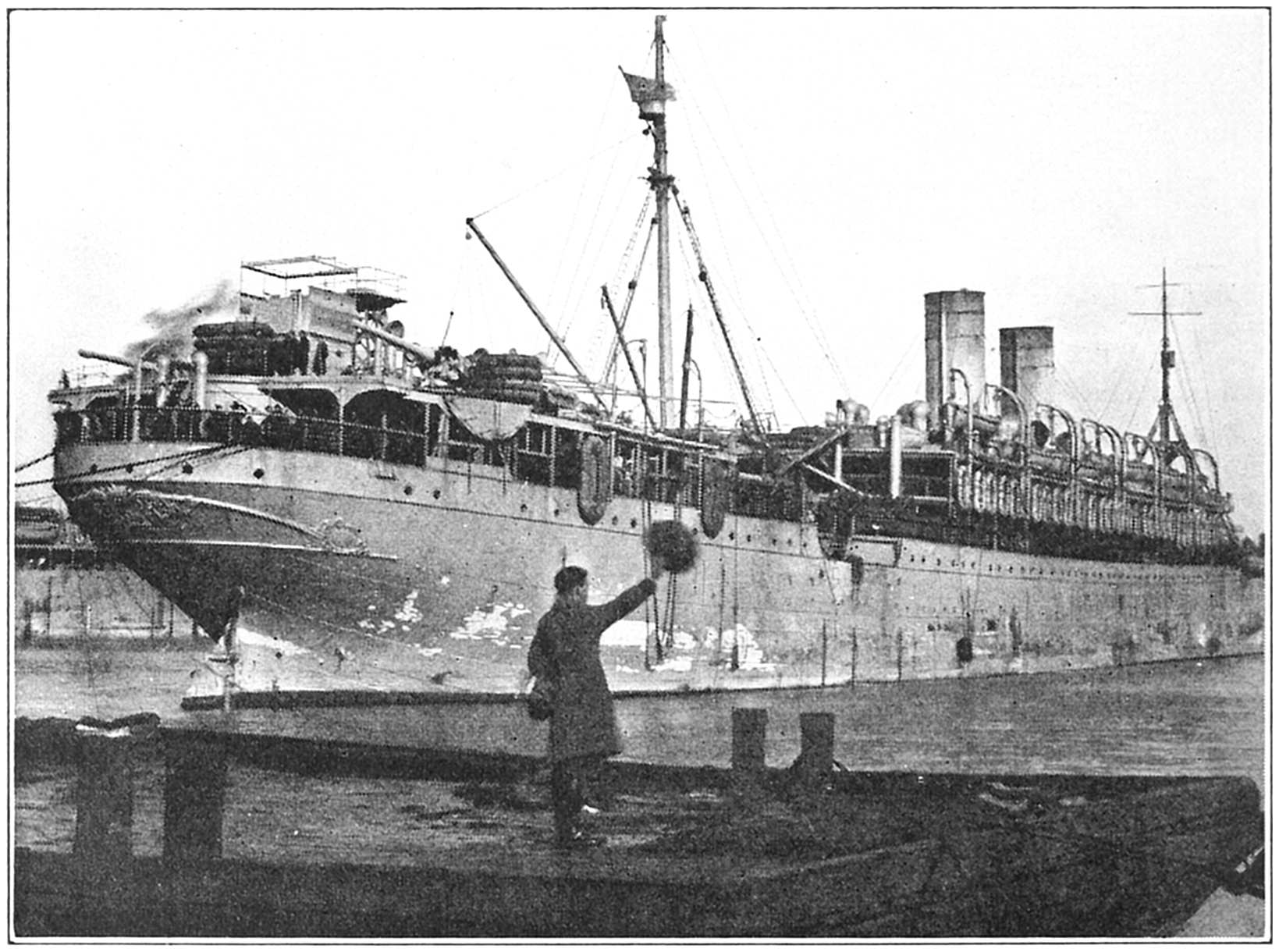
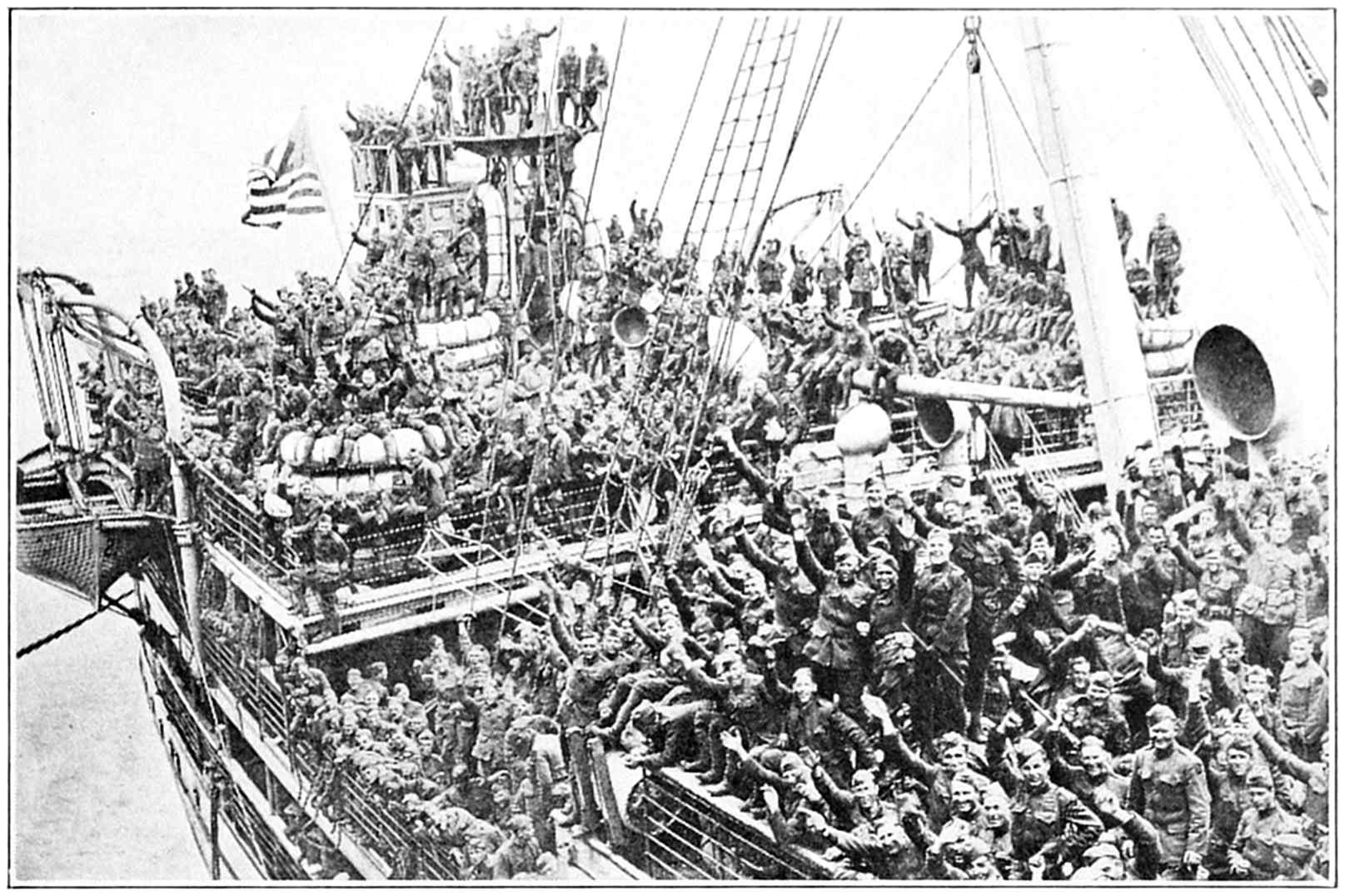
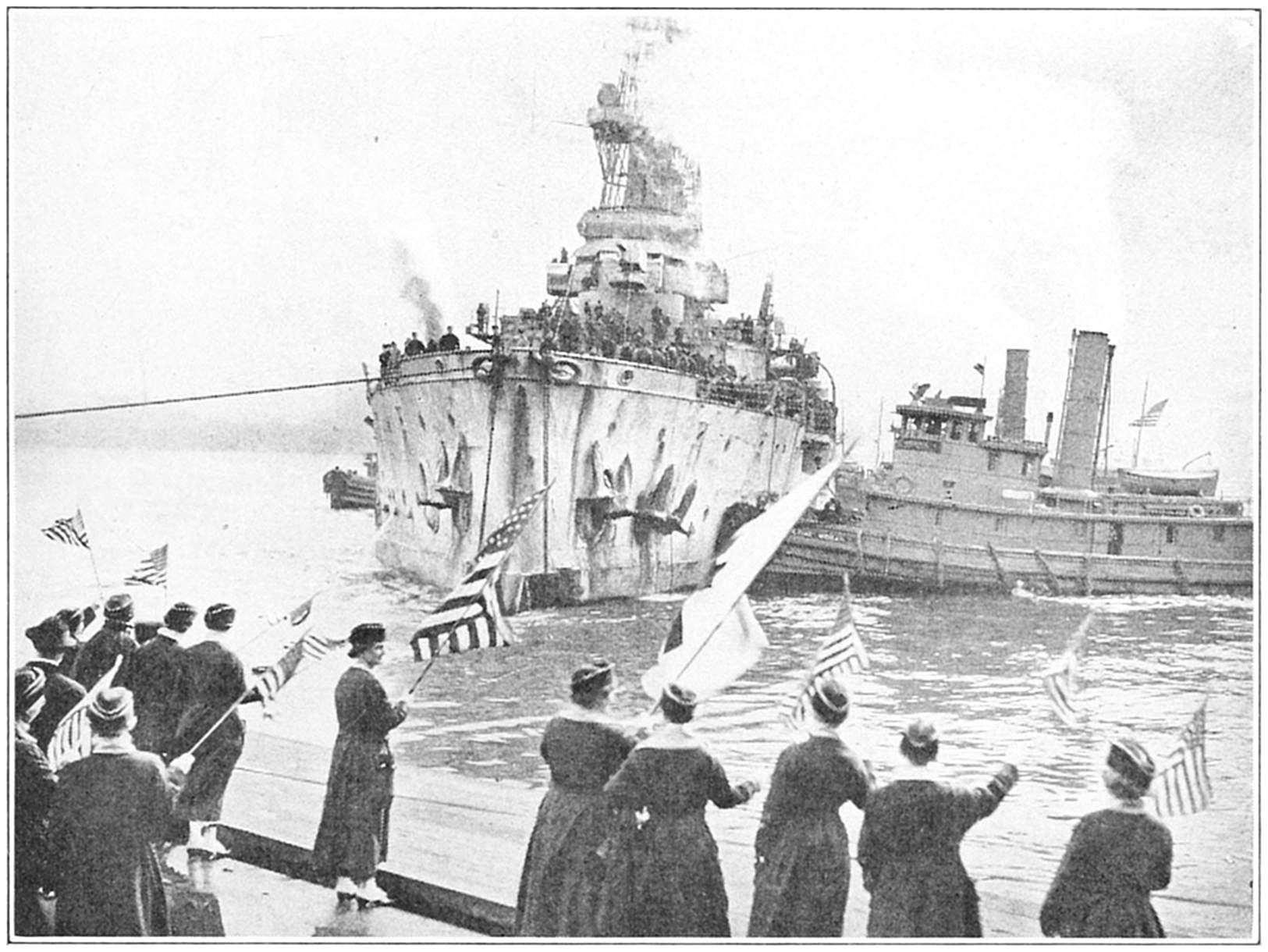
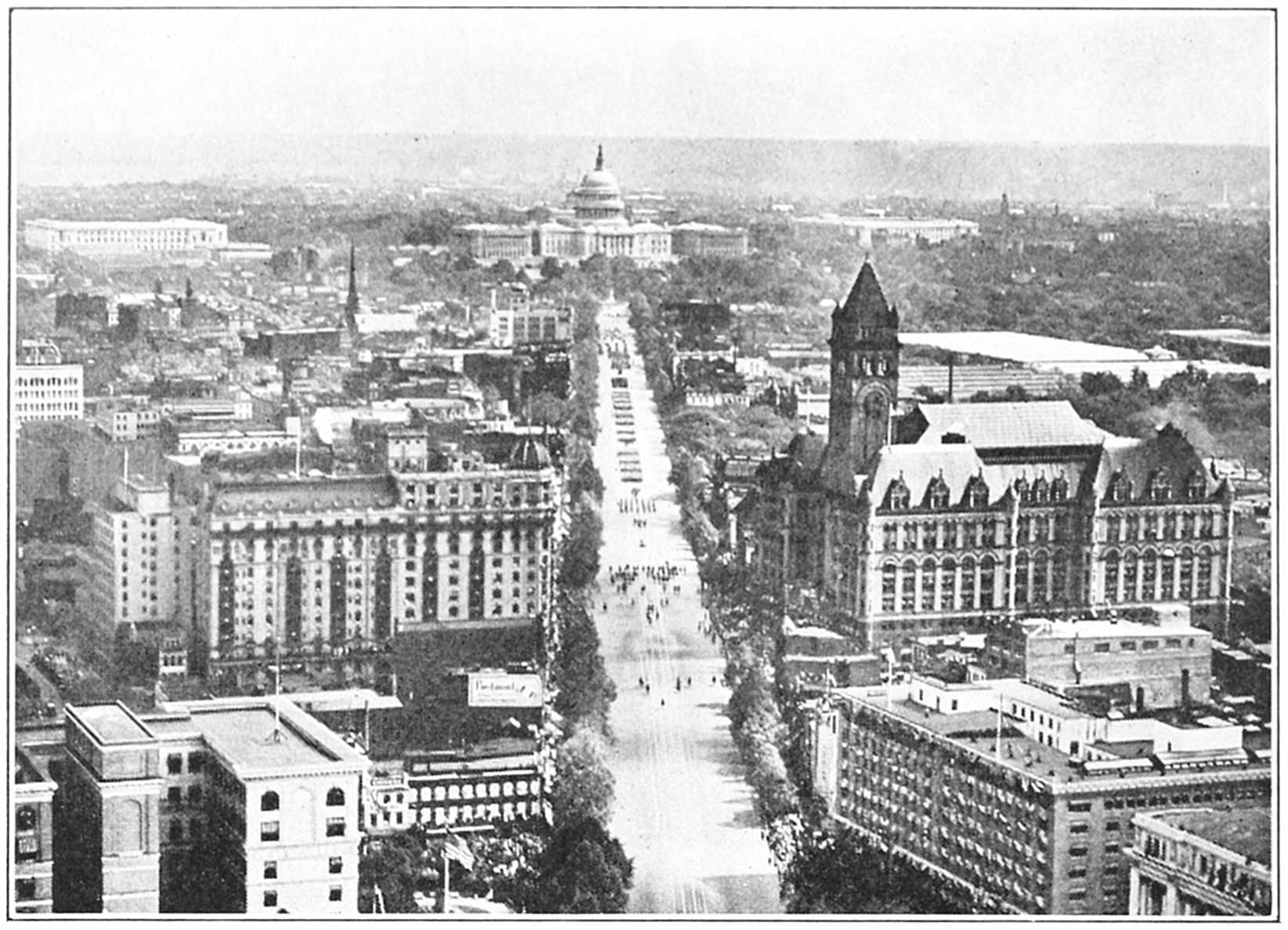
DEMOBILIZATION OUR INDUSTRIAL AND MILITARY DEMOBILIZATION AFTER THE ARMISTICE 1918–1920
Transcriber’s Note
Larger versions of most illustrations may be seen by right-clicking them
and selecting an option to view them separately, or by double-tapping and/or
stretching them.
IN COMMEMORATION OF THE WORK OF
THE EIGHT THOUSAND YALE MEN
WHO TOOK PART IN THE WORLD WAR
1914–1918
HOW AMERICA WENT TO WAR ⁂
THE GIANT HAND
THE ROAD TO FRANCE I.
THE ROAD TO FRANCE II.
THE ARMIES OF INDUSTRY I.
THE ARMIES OF INDUSTRY II.
DEMOBILIZATION
HOW AMERICA WENT
TO WAR
AN ACCOUNT FROM OFFICIAL SOURCES OF
THE NATION’S WAR ACTIVITIES 1917–1920
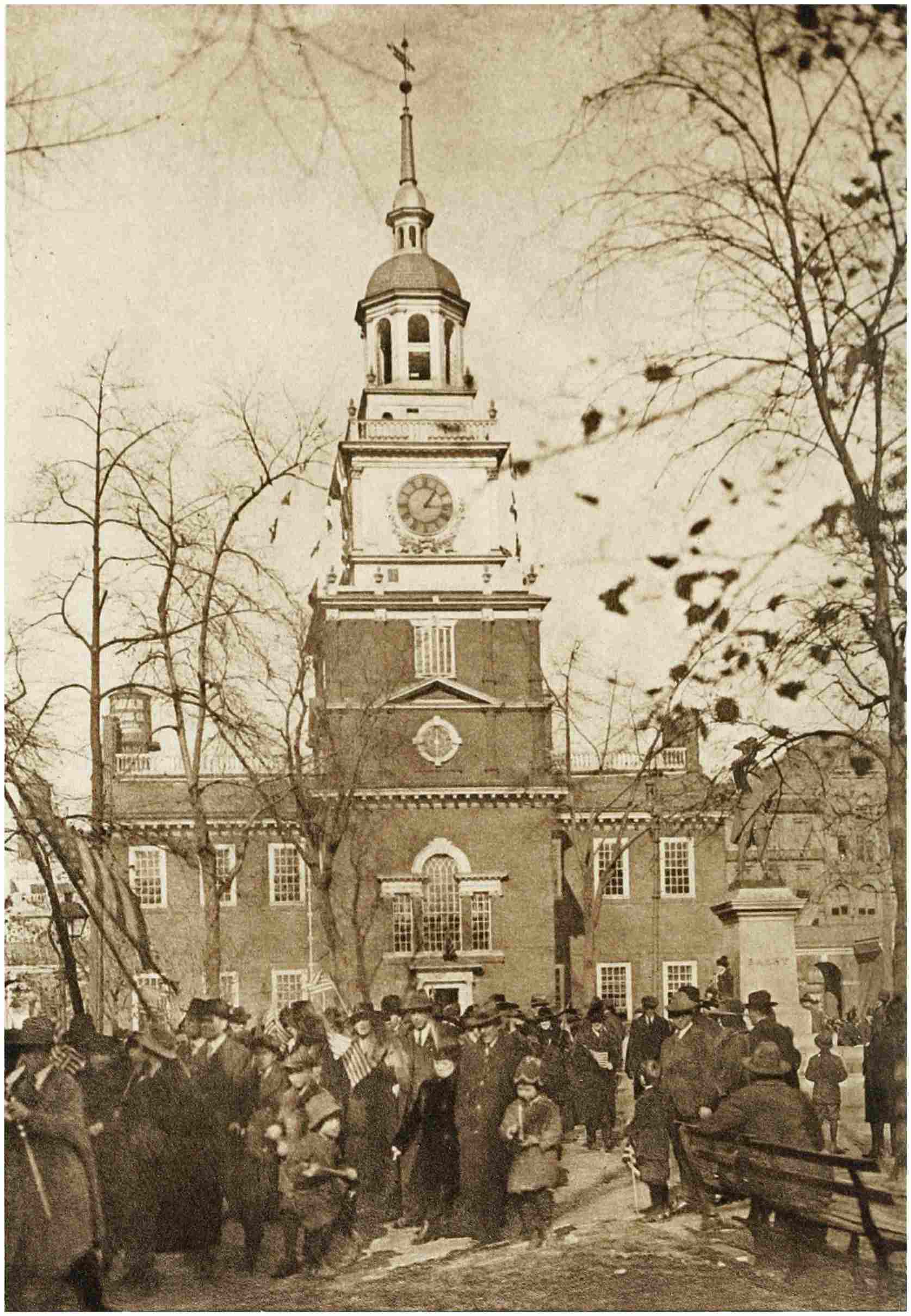
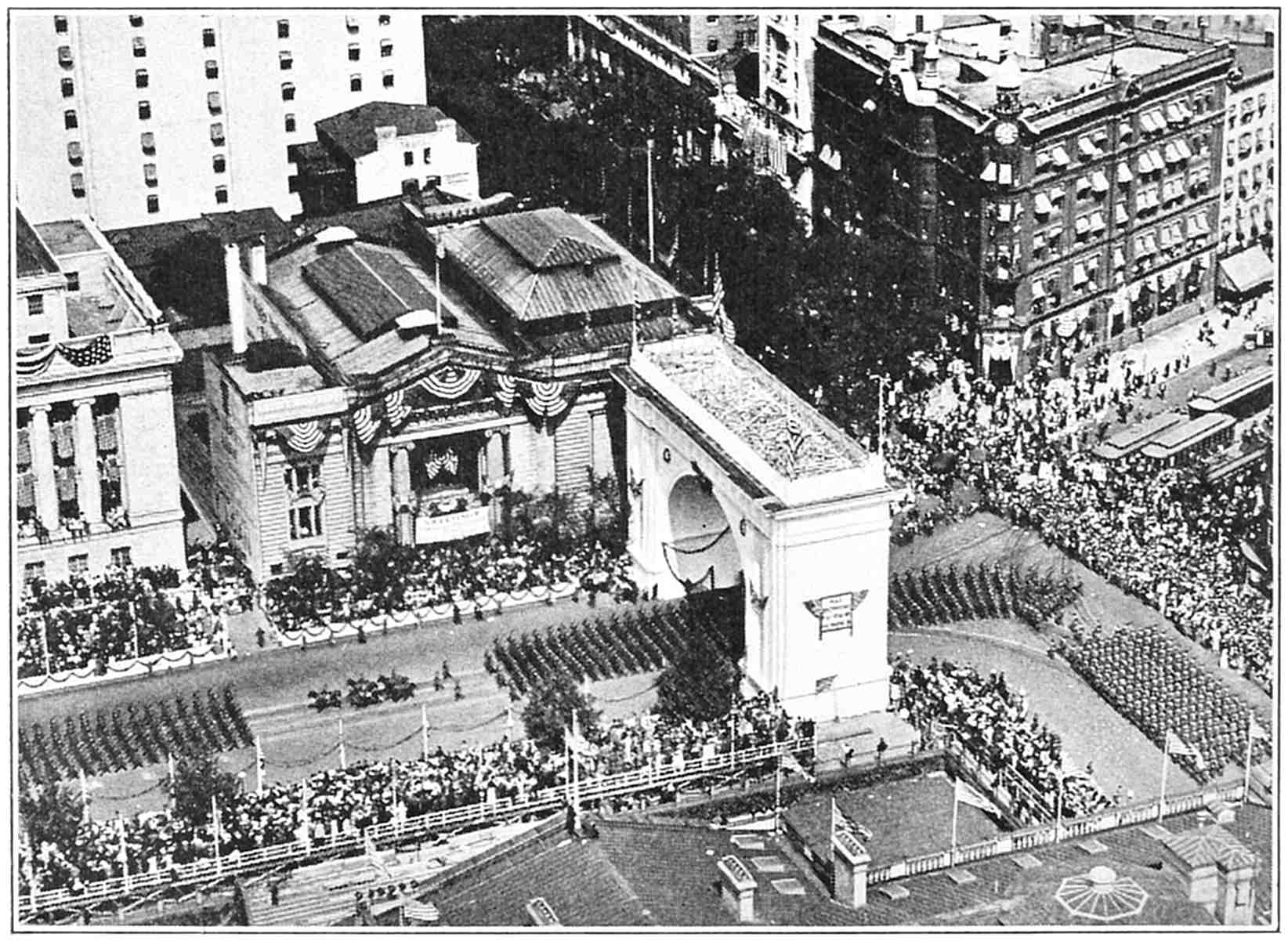
Armistice Day at Independence Hall
From a photograph by the Signal Corps
⁂
BY BENEDICT CROWELL THE ASSISTANT SECRETARY OF WAR AND
DIRECTOR OF MUNITIONS 1917–1920
AND ROBERT FORREST WILSON FORMERLY CAPTAIN, UNITED STATES ARMY
ILLUSTRATED WITH PHOTOGRAPHS FROM THE COLLECTIONS OF THE WAR AND NAVY DEPARTMENTS
NEW HAVEN
YALE UNIVERSITY PRESS
LONDON · HUMPHREY MILFORD · OXFORD UNIVERSITY PRESS
MDCCCCXXI
The authors acknowledge their indebtedness to Major Robert
H. Fletcher, Jr., General Staff, who collected from the various
war department bureaus concerned most of the material on
which this book is based. Also their thanks are due to the
numerous former and present officials of the War Department
and officers of the Army who read the manuscript and criticized
it constructively.
B. C. & R. F. W.
Washington, D. C., September, 1921.
DEMOBILIZATION
CHAPTER I HALT!
At a few minutes past ten o’clock of the morning of November
11, 1918, the Secretary of War in Washington
received from General Pershing a communication
informing the Government that eleven o’clock a.m. that day,
French time, an armistice with Germany had gone into effect.
No message more momentous had ever come to the American
War Department. The World War was at an end. It was
peace. It was victory.
Over there on that American front which had penetrated
the supposedly impregnable Argonne and now commanded
the enemy’s main line of communications at Sedan, boys in
our own khaki wriggled, charged, fought, plunged ahead all
the morning, like the players of some mighty football team
gaining every inch of advance possible before an intermission;
and finally, as the whistles shrilled and the great silence fell
at last upon a theatre that had shaken and roared with the
thunder of war for more than four years, they set their heels
into the turf of a line that was to be held as a starting-off place
if the armistice, too, should prove to be only an intermission
and a period of recuperation.
Behind these outpost men were the American Expeditionary
Forces, two million strong. Behind the A. E. F. in America
was a training and maintenance army nearly as numerous.
Behind the uniformed and organized Army as it existed
on the eleventh day of November was another force of a
quarter of a million men, technically under arms. These were
Selective Service men, drafted men, entraining that day and
adding themselves to the human flood sweeping on toward
Germany. In number this force alone was larger than any
ever previously enrolled at one time in the American military
service, except the forces called to the colors during the Civil
War; yet so expanded had become our values that they
attracted only passing attention in the midst of larger war
activities. These inductives were one more increment—that
was all.
And behind the Army itself were twenty-five million American
men between the ages of eighteen and forty-five, registered,
classified, and numbered in the order in which they too in turn
should join the current that led, if necessary, to the supreme
sacrifice.
The foundation on which rested this human edifice was
industrial. Nothing less than the whole of America’s material
resources had been pledged to the end of victory. The whole
of America’s resources! How inadequately could pigmy man
realize their might before he took them all and formed and
molded them into one single-purpose machine! That machine
was born in travail that broke men’s bodies and reputations,
that threw down the mighty from their seats and exalted those
of low degree, that moved inexorably but surely. And when
the machine was built it released forces terrifying even to men
accustomed to administering the greatest of human activities,
forces well-nigh ungovernable.
It took seven million workers, men and women, to operate
the war industrial machine—seven million Americans delving
in the earth for ores, chemicals, and fuels, felling the forests,
quarrying the rocks, carrying the raw materials to the mills,
tending the fires and the furnaces, operating the cranes, guiding
the finishing machinery with a precision never before demanded,
slaughtering the beeves, curing the meat, packing
the vegetables, weaving the fabrics, fashioning the garments,
transporting all, and accomplishing the million separate tasks
necessary to the munitioning of the Army.
And as a background to all this, behind both the military
and the industrial armies, was another force, perhaps the
greatest force of all—the will of the people themselves, of
one hundred million Americans who, without the coercion and
duress of law and as a purely voluntary act, denied their appetites,
their pleasures, and their vanities, contributed their
utmost to the war finances, made war gardens to add to the
food supply, produced millions of articles for the comfort of
the soldiers both well and wounded, and in one way or another
put forth effort that did not flag until victory came.
Such was America in a war that truly threatened her existence—America
invincible.
The armistice put an end to all this enterprise and effort.
It did more—the armistice was a command to the Government
to scrap the war machine and restore its parts to the peaceful
order in which they had been found. In military law, an armistice
denotes the temporary cessation of hostilities; but the
armistice of 1918 was a finality. Its terms destroyed the German
military power. Those in authority, aware that the armistice
was to be no period of waiting with collected forces for
the outcome of negotiations, did not pause even to survey the
magnitude of the thing they had built: they turned immediately
to the task of dismantling it. Some of the processes of
demobilization began before the guns ceased to fire. Five days
before the armistice the A. E. F. canceled many of the foreign
orders for important supplies. On November 1 we
stopped sending combatant troops to France. In late October
the Ordnance Department created an organization for demobilizing
war industry.
However, before the machine could be knocked down and
its parts distributed, it had to be stopped. There are two ways
of stopping the limited express. One is to throw a switch
ahead of it—effective, but disastrous to the train. The other
way is to put on the brakes.
The war-industry machine had attained a momentum almost
beyond mundane comparisons. Slow in gaining headway, like
any other great mass, as thousands added their brains and their
muscles to its progress it gathered speed until, at the first day
of the armistice, it was nearing the point at which it could
consume the material resources and turn them out as finished
war products up to the capacity of American mechanical skill
and machinery to handle them. It had not quite reached that
point. Many of the vital but easily manufactured supplies had
long since reached the pinnacles of their production curves,
but some of the more difficult ones were not yet in full manufacture.
On Armistice Day, however, the industry was not more
than six months away from the planned limit of its fecundity.
For the administration of the industrial enterprise the task
ahead was first to bring that momentum to a halt and then to
break up the machine. The easiest way was to throw a switch
ahead of it—in other words, to issue a blanket stop-order on
all military manufacturing projects. But to have done that
would have been to court consequences as disastrous as those
of war itself. Business and industry would have fallen into
chaos and the country would have been filled with jobless
men. The other way, the way chosen, was to apply the brakes
to the thousands of wheels.
The magnitude of the task ahead was appalling. The liquidation
of the war industry was seen to be a matter as complex,
as intricate, as full of the possibilities of error and failure as
the mobilization itself. In only one respect did demobilization
begin with an advantage: there was at hand an organization,
the organization which had administered the creation of the
Army and the manufacture of its supplies, ready to be turned
into a wrecking crew.
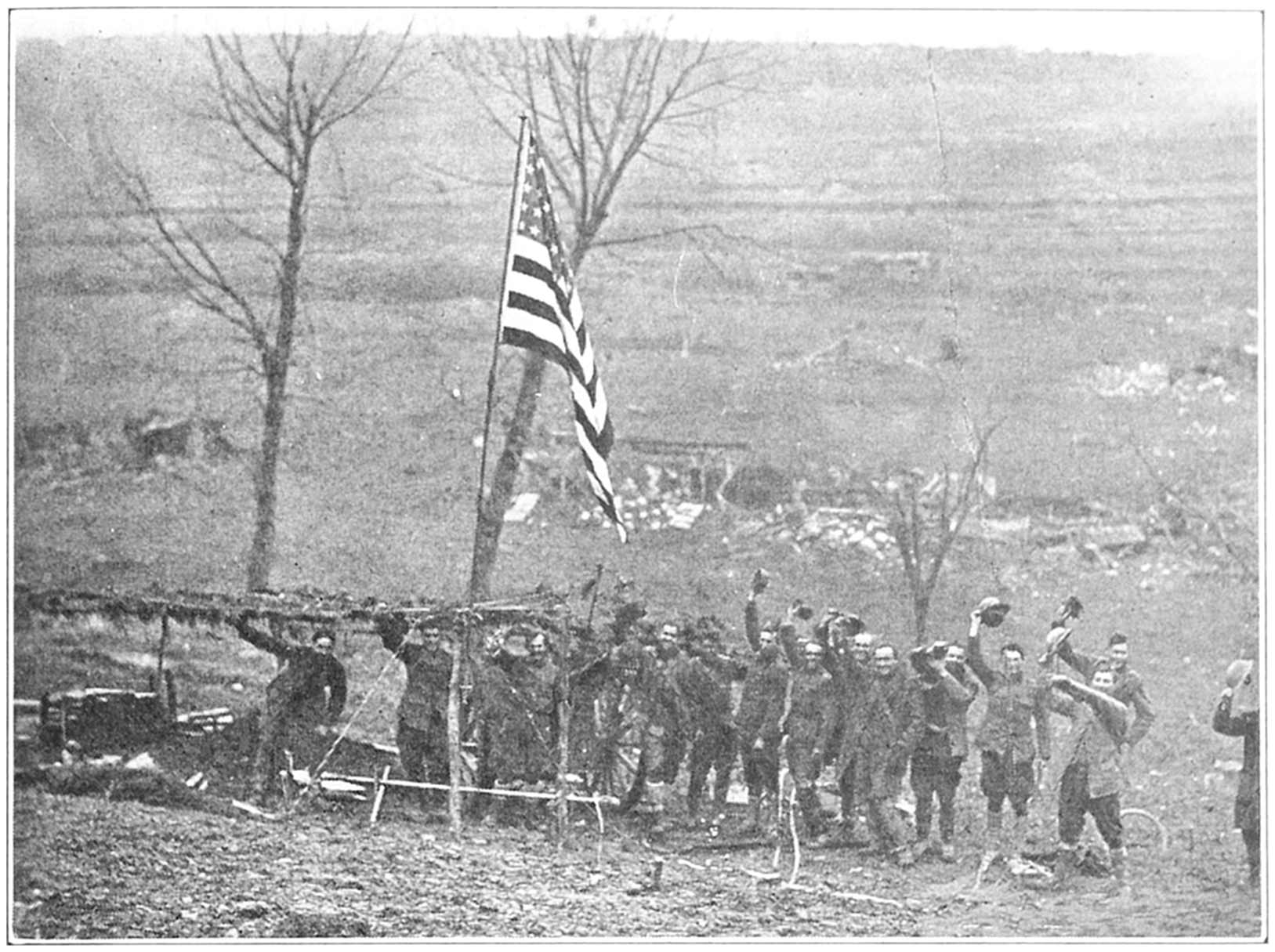
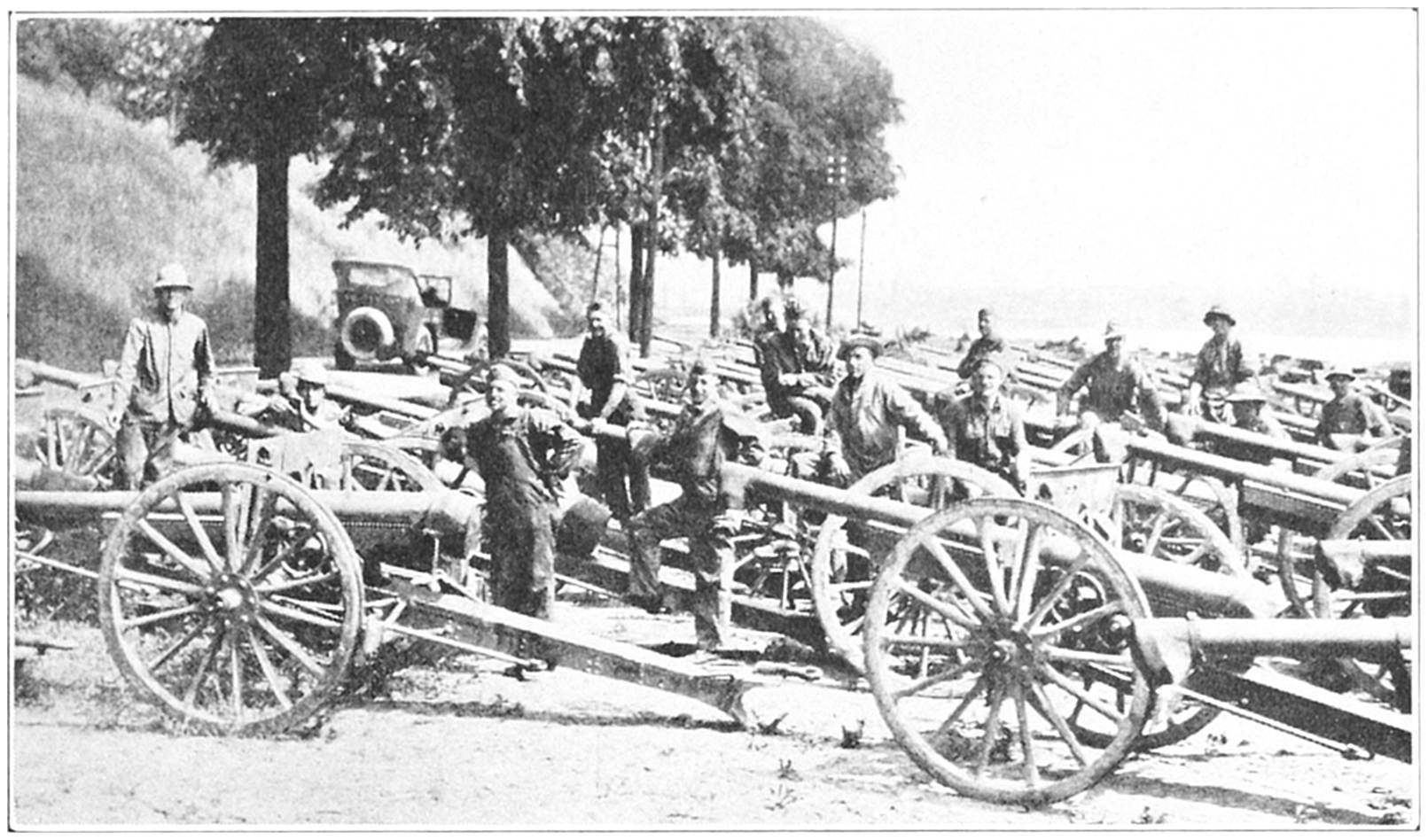
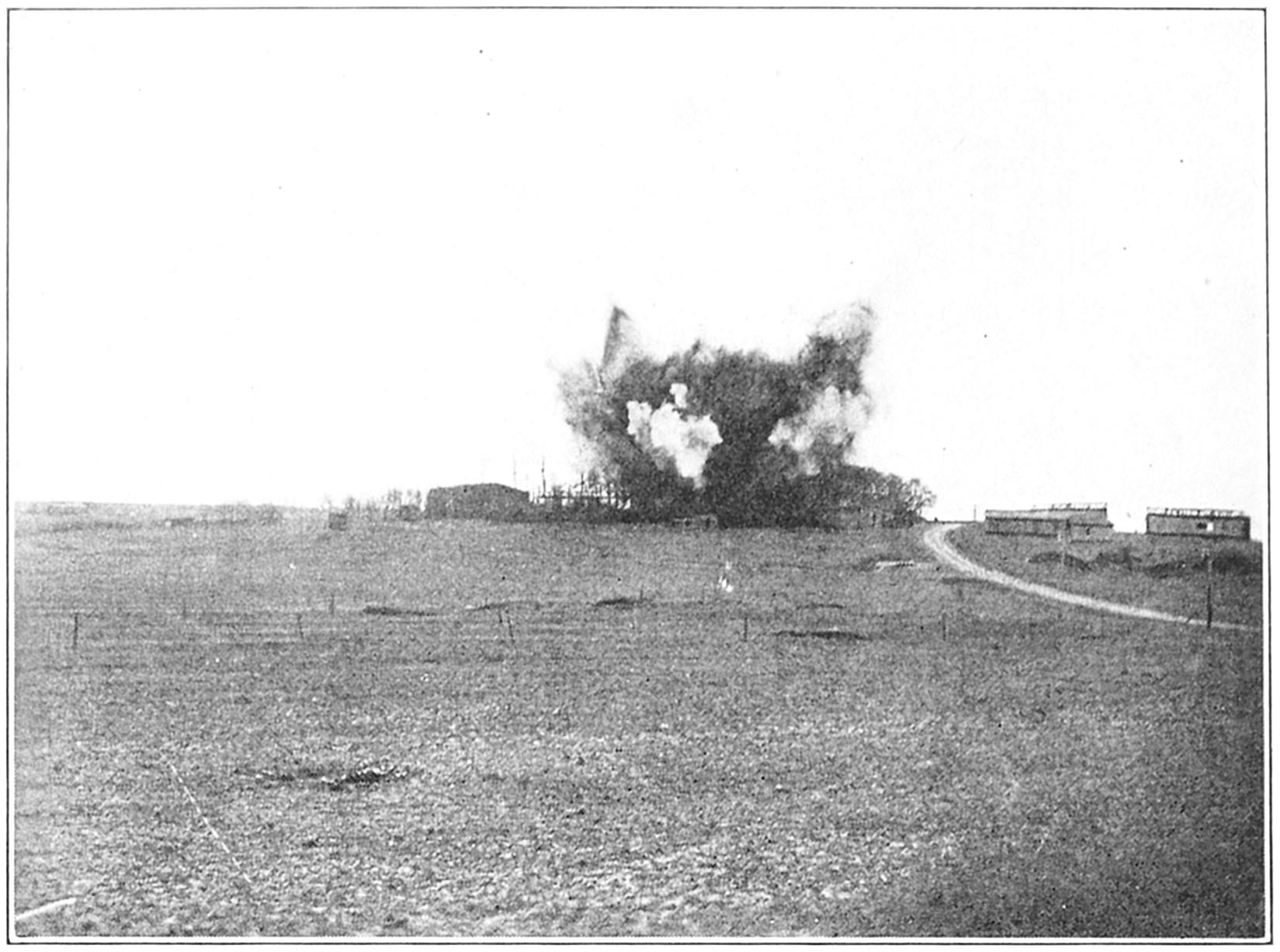
Photo by Signal Corps
THE LAST SHOT
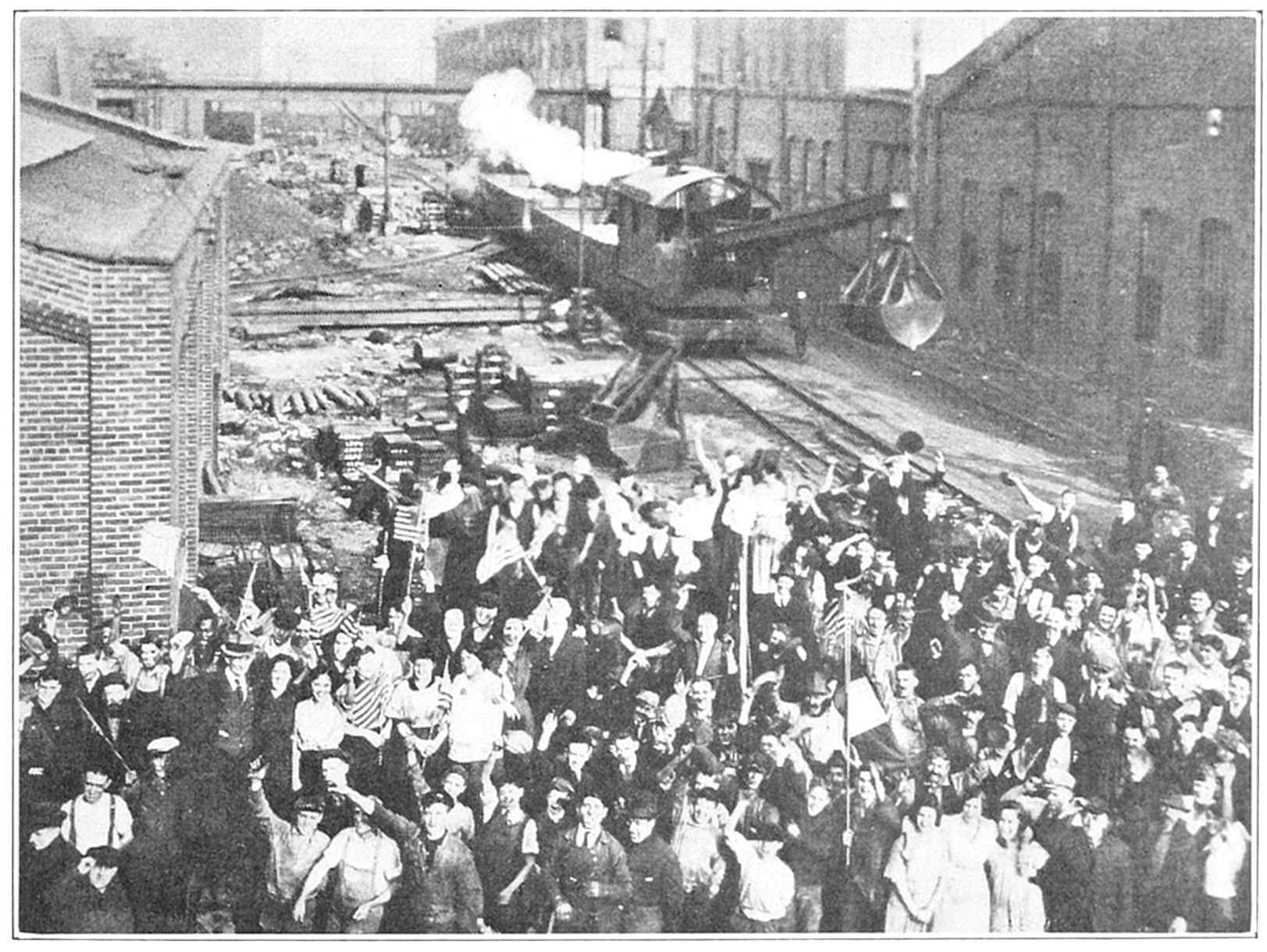
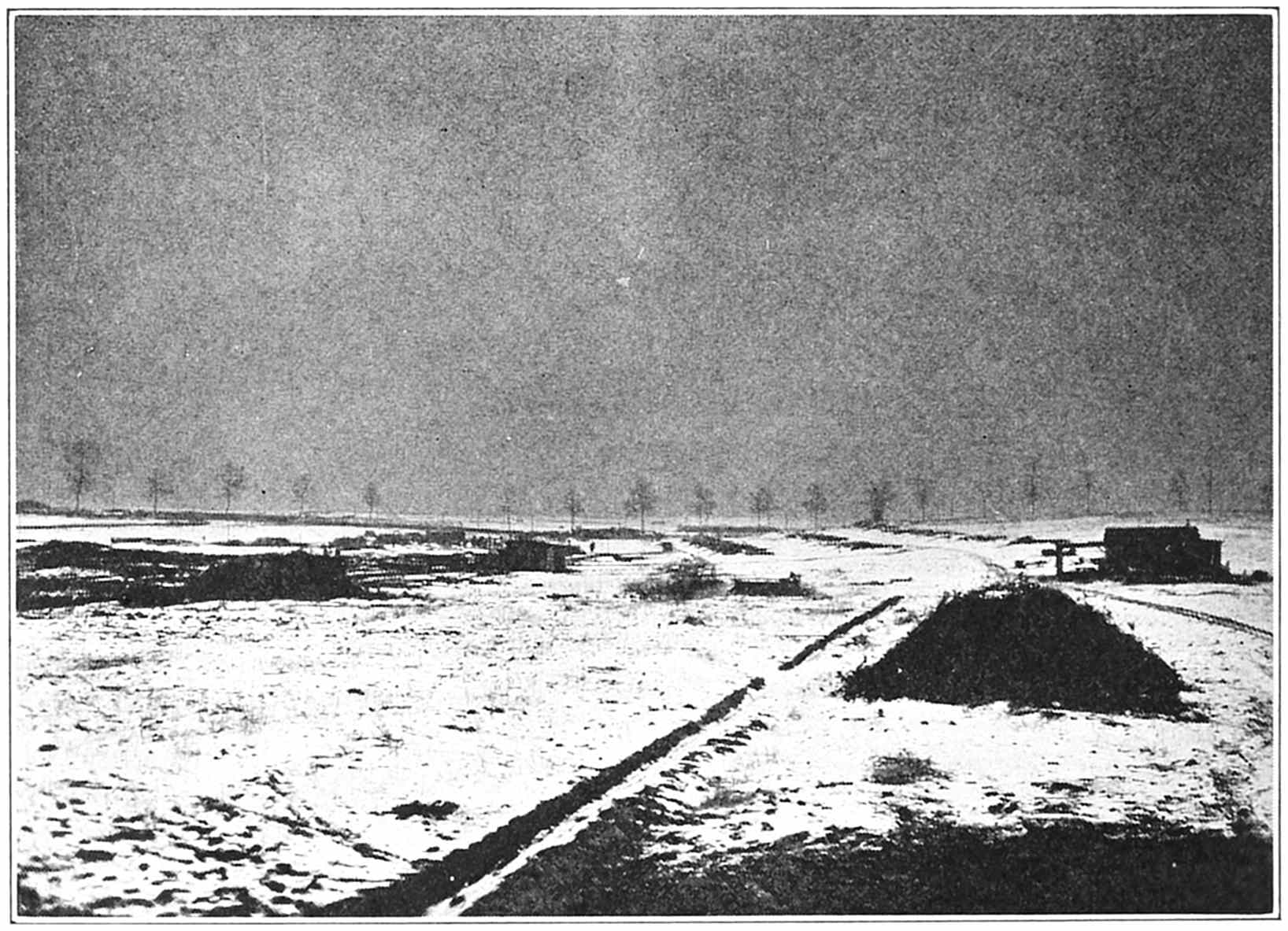
Photo by Signal Corps
THE ARMISTICE AT A MUNITIONS FACTORY
Balanced against this situation was the countering fact
that the men of this organization were war weary. Ahead of
them were none of the conspicuous rewards that follow conspicuous
war service. The nation does not award medals and
other honors to those who restore the conditions of peace. The
people themselves were satiated with war and desired nothing
so much as a space in which they could forget battles and campaigns.
At best, demobilization was to be a thankless job.
Moreover, many of the executives, particularly those in the
industrial organization, were men of large personal affairs,
serving their country at a sacrifice. For the most part they were
disheartened men, denied the satisfaction of seeing the full
fruition of their plans have its effect against a hateful enemy.
Every interest of personal gain called to them after the armistice
to desert their official posts and return to the satisfactions
of private endeavor, and only the righteous sense of their duty
to the nation held them in the organization.
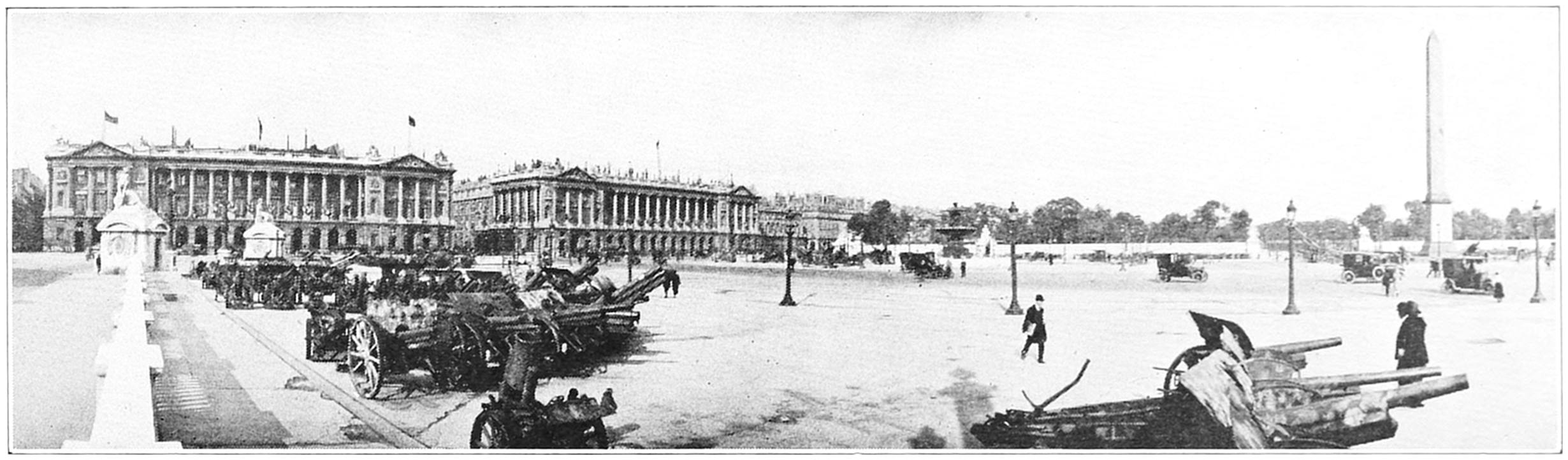
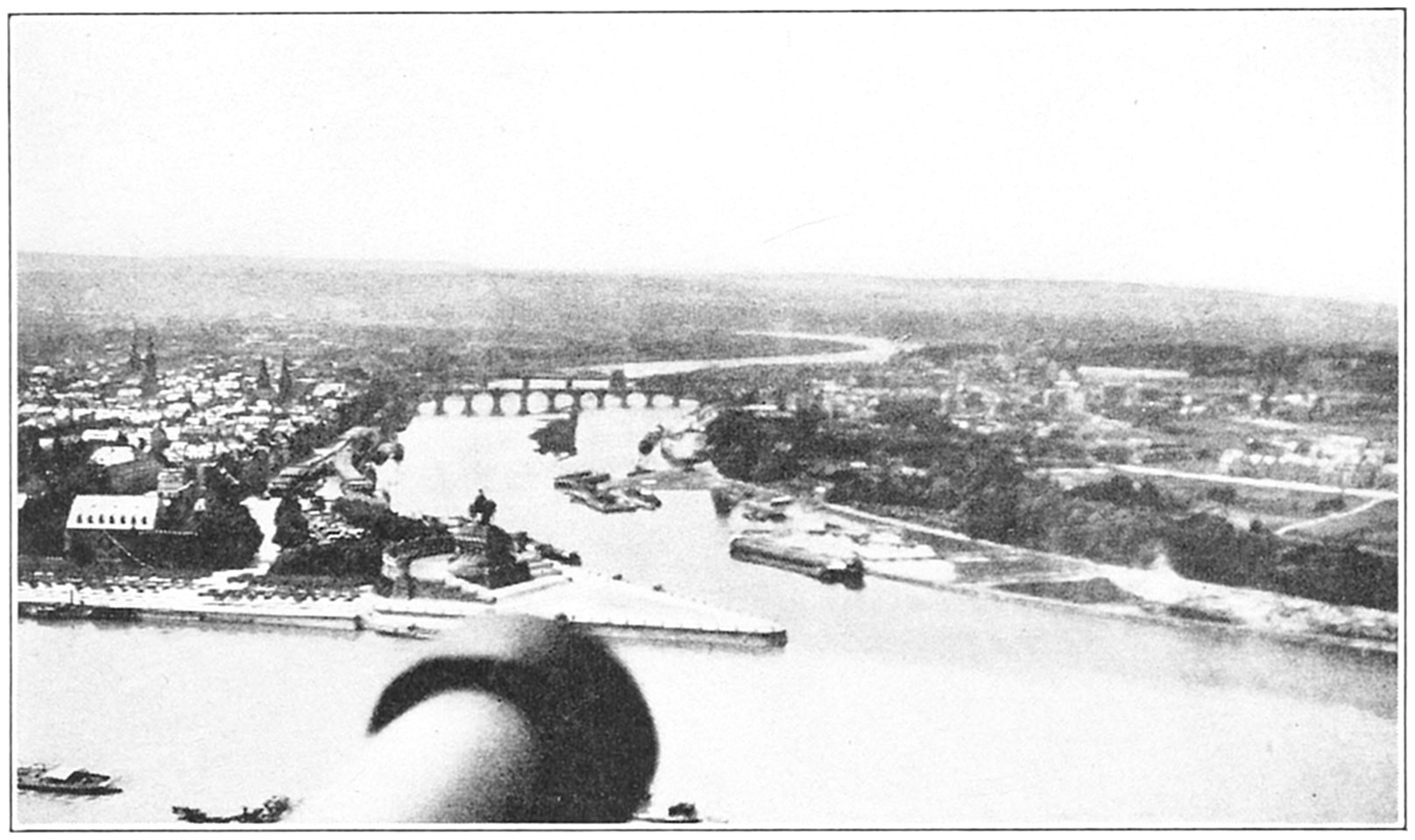
Photo by Howard E. Coffin
VICTORY
WAR TROPHIES IN PLACE DE LA CONCORDE, PARIS
Photo by Howard E. Coffin
RECONSTRUCTION
BRITISH SOLDIER’S GRAVE IN FIELD NEAR MEAUX
It was necessary for the organization not only to remain
intact, but to speed the activities of demobilization as it had
sped those of mobilization. The pre-armistice spirit had in
some way to be maintained. On November 11 the war was
costing the United States about $50,000,000 a day. Every
day of indecision in adopting the plan of demobilization and
every day’s delay in carrying out the plan added tremendously
to the burden of taxation that would rest upon the nation for
generations to come.
Demobilization meant, first of all, the disbanding of the
American Army. Whatever economic considerations might
graduate the termination of war industry, no such considerations
were to be permitted to retard the homeward progress of
the troops. Four million American homes demanded their men
at once; and whether the immediate return of the troops meant
unemployment and distress or not, the Government was determined
to comply with the demand.
The creation of the Army and its movement toward France
had involved the rail transportation of about 8,000,000 soldiers
in special cars and trains. The home movement would
require an operation almost as great. Of the 2,000,000 men of
the American Expeditionary Forces, more than half had
crossed the ocean in foreign ships, all of which, of course, were
withdrawn from our service immediately after the armistice.
The unbroken eastward transatlantic procession of troopships
had continued for about fourteen months. On the first day of
the armistice the transatlantic ferrying capacity of the
American-flag troopships was not much in excess of 100,000
men a month. Moreover, practically all our troop transports
had reached the point of having to be laid up for reconditioning.
Assuming, however, that they could be kept in continuous
operation, they could not bring back to America more than
two-thirds of the troops in the time it had taken the whole
A. E. F. to cross to France. Yet the problem of demobilization
was to repatriate the A. E. F. in that time at most.
Demobilization involved a final cash settlement with everyone
of the four million men under arms; computations of back
pay, complicated as they were with allotments and payments
for government war bonds and the war risk insurance; and,
finally, the payment to each soldier of the sixty-dollar bonus
voted by the Congress. Demobilization also included the care
of the wounded for many months after the fighting ceased,
their physical and mental reconstruction, and their reëducation
to enable them to take useful places in the world.
On the industrial side demobilization was the liquidation
of a business whose commitments had reached the staggering
total of $35,000,000,000. Demobilization meant taking practically
the entire industrial structure of the United States,
which had become one vast munitions plant, and converting
it again into an instrumentality for producing the commodities
of peaceful commerce. This without stopping an essential
wheel, and also in the briefest possible time, for the world was
in sore need of these products. Efficient demobilization, it
follows, would permit the 7,000,000 industrial war workers to
turn without a break in employment from the production of
war supplies to that of peace supplies.
At the base of modern business stability lies the inviolability
of contracts. He who breaches a contract must expect to
pay indemnity, and the Government cannot except itself from
this rule. Demobilization meant the suspension and termination
of war contracts running into billions in value, many of
them without a scrap of paper to show as a written instrument;
it meant termination without laying the Government
open to the payment of damages, and therefore it implied the
honorable adjustment of the claims of the contractors.
One of the conditions on which complete demobilization
depended was the adoption of a future military policy for the
United States. But this was in the hands, not of the military
organization, but of Congress. The whole program, therefore,
could not be put through until Congress had acted. After the
policy was defined, then it became the duty of the demobilization
forces to choose and store safely the reserve equipment
for the permanent establishment and for the field use of a
possible future combatant force until another war industry
could be brought into existence.
When that had been done there would remain a surplus of
military property. It thereupon became the function of demobilization
to dispose of this property through a sales organization
that would have in its stocks goods of a greater variety
and value than those at the disposal of any private sales agency
in the United States. This branch of the work also included
the sale of great quantities of A. E. F. supplies in Europe,
which was already glutted with the surpluses of its own
armies. The sales at home must include the sale of hundreds
of buildings put up for the war establishment.
Paradoxically, demobilization included the acquirement of
large quantities of real estate—for the storage of reserve supplies
and the creation of a physical plant for the permanent
military establishment.
Finally, demobilization meant the delicate business of
striking a cash balance that would terminate our relations with
the Allies, meeting their claims against us for the supply of
materials and for the use and destruction of private property
abroad, and pressing our own claims against them for materials
sold to them.
The astonishing thing was the swiftness with which this
great program was carried through. Within a year after the
last gun was fired America had returned to the normal. The
whole A. E. F. had been brought back in American vessels in
ten months. In that time practically the entire Army had been
paid off, disbanded, and transported to its homes. War businesses
were braked to a standstill in an average time of three
months, without a single industrial disturbance of any consequence.
At the end of the year the greater part of the manufacturers’
claims had been satisfied with compromises fair
both to the contractors and to the Government. The savings in
contract terminations and adjustments had run into billions of
dollars. A blanket settlement had been made with the Allies,
thus virtually closing up our business in Europe. A permanent
military policy had been written into law. The storage buildings
and spaces were filled with reserve materials inventoried,
catalogued, and protected against deterioration. Packed away
compactly were the tools and machinery of an embryonic
war industry ready to be expanded at will in the event of
another war. Materials, largely of special war value and therefore
normally to be regarded as scrap and junk, had been sold
to the tune of billions, the exercise of ingenuity in the sales
department producing a recovery that was remarkably large,
averaging 64 per cent of the war cost.
Such was our war demobilization. No other single business
enterprise in all human history compared with it in magnitude;
yet, in the midst of the peace negotiations and amid the
economic crises fretting the earth, it attracted scant notice.
To-day, only the continuing sale of surplus war materials and
the adjudication of the last and most difficult of the industrial
claims give evidence of the enterprise which engaged the
efforts of the whole nation so short a time ago.
CHAPTER II THE A. E. F. EMBARKS
The American Expeditionary Forces, on November 11,
1918, were ill prepared to conduct the manifold
activities leading to their demobilization. Up to that
day the expedition had been too busy going ahead to think
much about how it was to get home. But now had come the
armistice, the end. The great adventure was over. The guerre
was fini.
At once a great wave of homesickness spread over the
A. E. F. That song of careless valor, “Where do we go from
here?” to the swinging beat of which a million men had
marched forward over the French roads, became a querulous
“When do we go home?” When indeed? It had taken nearly
a year and a half to transport the A. E. F. to France. Disregarding
the fact that the Army overseas had at its disposal
less than half as many troopships as had supported it up to
November 11, before the men could start home in great numbers
there had first to be created in France an embarkation
system with a capacious equipment of camps and port buildings,
if the expedition were to return in good order and not as
a disorganized mob.
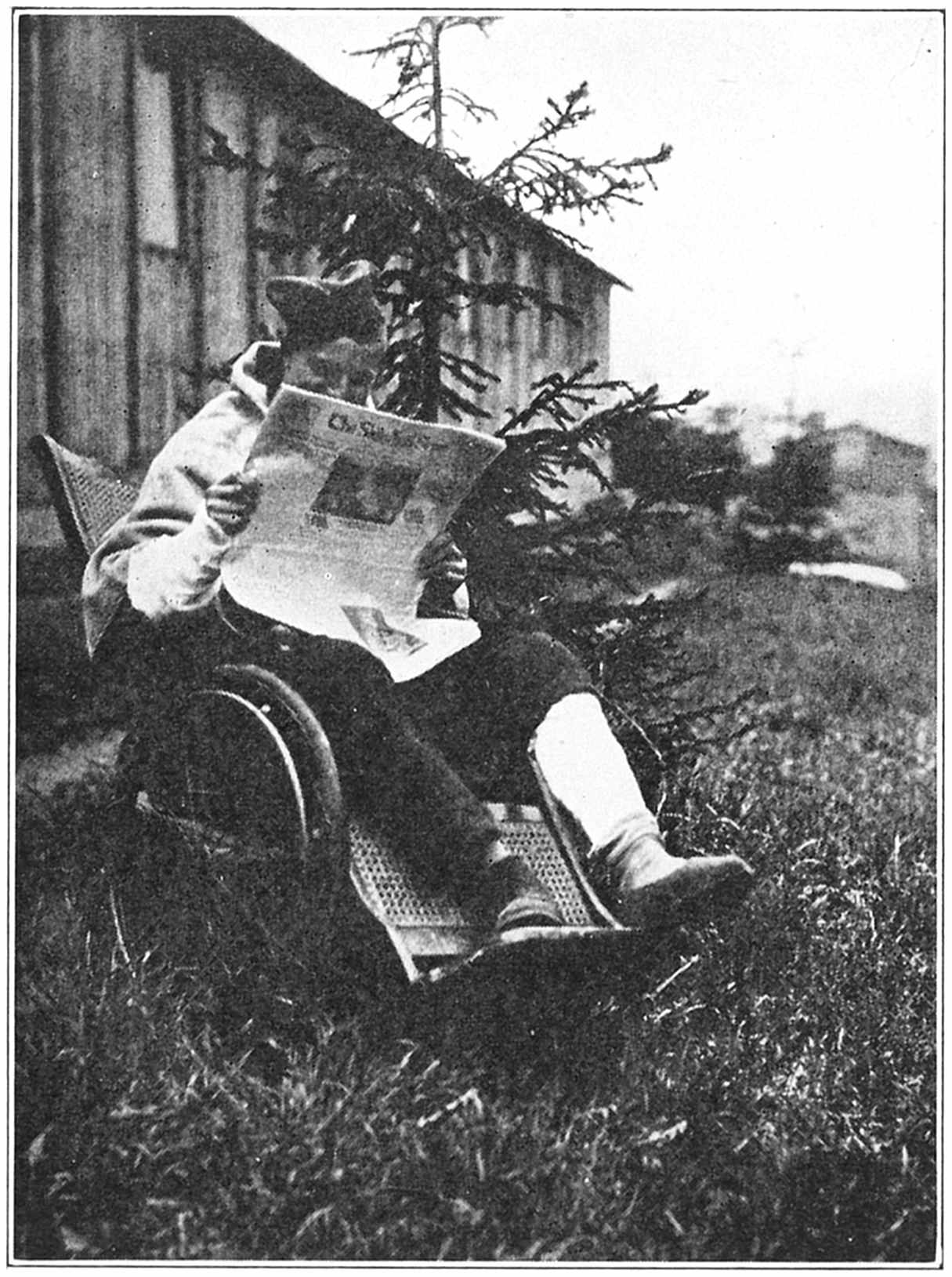
Never was a daily journal scanned with such emotion as
was the Stars and Stripes by its readers during this period of
waiting. The Stars and Stripes was the official newspaper of
the enlisted men of the A. E. F. After the armistice anything
pertaining to the return of the troops to America was the most
important news which the publication could possibly print.
The Stars and Stripes published the monthly schedules of
transport sailings, told of the extraordinary expansion of the
Yankee transport fleet, noted the continual improvement in
the shipping efficiency of that fleet, rejoiced in black-face type
when some ocean flyer broke the record for the turn-around,
as the round trip to America and back was called, and in general
kept the personnel of the expedition informed of the
movement homeward. But, although the return of the A. E. F.
was a transportation feat actually more astonishing than that
which had placed the forces in Europe, yet to the hundreds of
thousands of homesick boys who watched the brown fields of
France turn green in the spring of 1919, the pace of the snail
and the turtle seemed speed itself in comparison to the progress
made by the demobilization machine.
The A. E. F. in November, 1918, possessed no port equipment
capable of quick conversion into a plant for embarking
the expedition. There had been no need of large port installations
in France for the use of debarking troops. The A. E. F.
had crossed to France under a scheme of identification that was
a marvel of system and organization. Once the system was
perfected, every military unit bore as part of its name a so-called
item number that told the debarkation officers (by
reference to the shipping schedules) exactly where each unit
should go upon arrival. So it was with individuals and small
detachments traveling as casuals. Their item numbers placed
them instantly in the great structure of the A. E. F. No need
for vast port rest camps in which thousands must wait until
G. H. Q. disposed of them. They were placed before they
sailed from America. Expense and confusion saved by the art
of management!
The armistice changed all about. Our military ports in
France had to become ports for the embarkation of troops with
an equipment vastly expanded. America had sent to France an
Army perfectly clothed and accoutered. For the sake of uniformity
the home ports of embarkation had prepared the
2,000,000 troops for the voyage, and this meant issuing
smaller or larger quantities of clothing and other personal
articles to practically every man who sailed. The A. E. F.
proposed to return its men to their homes well dressed, clean,
and self-respecting, and it was logical, too, to accomplish this
purpose in France in the process of embarking the troops. To
carry out the plan, however, required an extensive plant,
something not to be materialized by a wave of the hand.
France after the armistice was to witness an extensive military
construction carried on by the Americans at their ports.
Brest, Bordeaux, and St. Nazaire had been the three principal
landing places for our troops sent to France directly from
the United States. Brest, near the northeasternmost extremity
of France, possessed a harbor with water that could accommodate
the largest ships afloat, but the water near shore was too
shallow for docks at which large ships could berth. Consequently
the troops rode in lighters between ships and shore.
This was Brest’s chief disadvantage as a military port, but it
was not a serious disadvantage.
Next southward came St. Nazaire, on the Loire River a
few miles inland. The first of the expeditionary troops landed
at St. Nazaire, in July, 1917. The port boasted of docks with
berths for troopships, but the waters of the river were too
shallow for the largest transports.
Still farther south was Bordeaux, fifty-two miles from the
ocean on the Gironde River. What few troops landed at Bordeaux
were incidental, for the port construction at Bordeaux
and other great developments at Bassens and Pauillac nearer
the mouth of the river were conducted by the A. E. F. with the
view of making the Gironde the chief ocean terminal for the
reception of army supplies shipped from the United States.
Troopships could tie up to the docks at Bordeaux, but the
Gironde was so narrow and its tidal currents were so swift
that the military administration of the port had to manage
the stream on a schedule as it might operate a single-track
railroad. There were several places in the river where vessels
could not pass each other.
After November 11 followed a few days of indecision and
bewilderment in the A. E. F. No one in Europe knew precisely
what the armistice meant or what the victorious armies could
expect. Quickly, however, it transpired that the armistice was
permanent; it was peace itself for all practical purposes, and
the only forces we should need to maintain in France would be
those chosen to conduct the measured advance into Germany
and to garrison the occupied territory. Within a week General
Pershing designated the troops for the Army of Occupation
and released the rest of the American Expeditionary Forces
(more than half its total numerical strength) for return to
the United States as soon as transportation facilities were
available. He charged the Chief Quartermaster of the expedition
with the duty of embarking the returning forces.1
The Chief Quartermaster of the A. E. F. at once designated
Brest, St. Nazaire, and Bordeaux as the ports of embarkation.
The early plan was to send 20 per cent of the expedition
home via Bordeaux and the rest in equal numbers through
St. Nazaire and Brest. As it worked out, practically all the
overseas soldiers returned through these three ports, although
a few sailed from Marseilles, Le Havre, and La Pallice. The
division of work, however, did not materialize as planned.
Bordeaux handled less than its fifth of the forces, and the
embarkations at St. Nazaire were not much larger than those
at Bordeaux. The great mass of the A. E. F. came back via
Brest, and at Brest was set up the largest installation for the
embarkation of passengers the world had ever seen.
Photo by Signal Corps
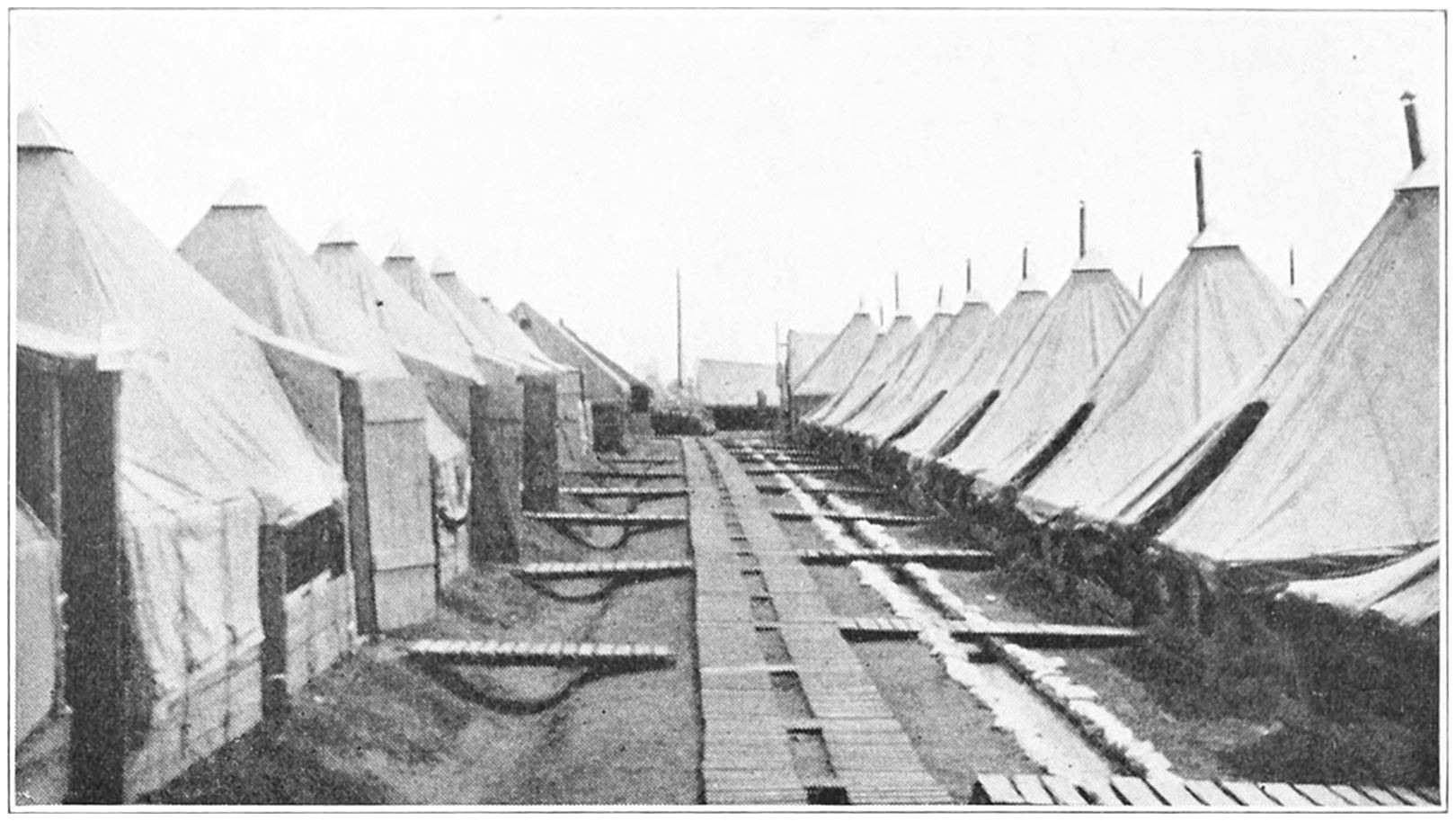
CAMP STREET IN LE MANS AREA
Photo by Signal Corps
BATH HOUSE AT BREST
The troops of the A. E. F. were of two general sorts—those
of the line organized by divisions, corps, and armies, also
known as combat troops, and those of supply, who conducted
the thousand and one enterprises necessary to the maintenance
of a force as large as the A. E. F. three thousand miles away
from home. The two sorts of troops were not evenly balanced
in number, the combat troops being considerably the more
numerous. It was evident that their embarkation offered
separate problems.
Photo by Howard E. Coffin
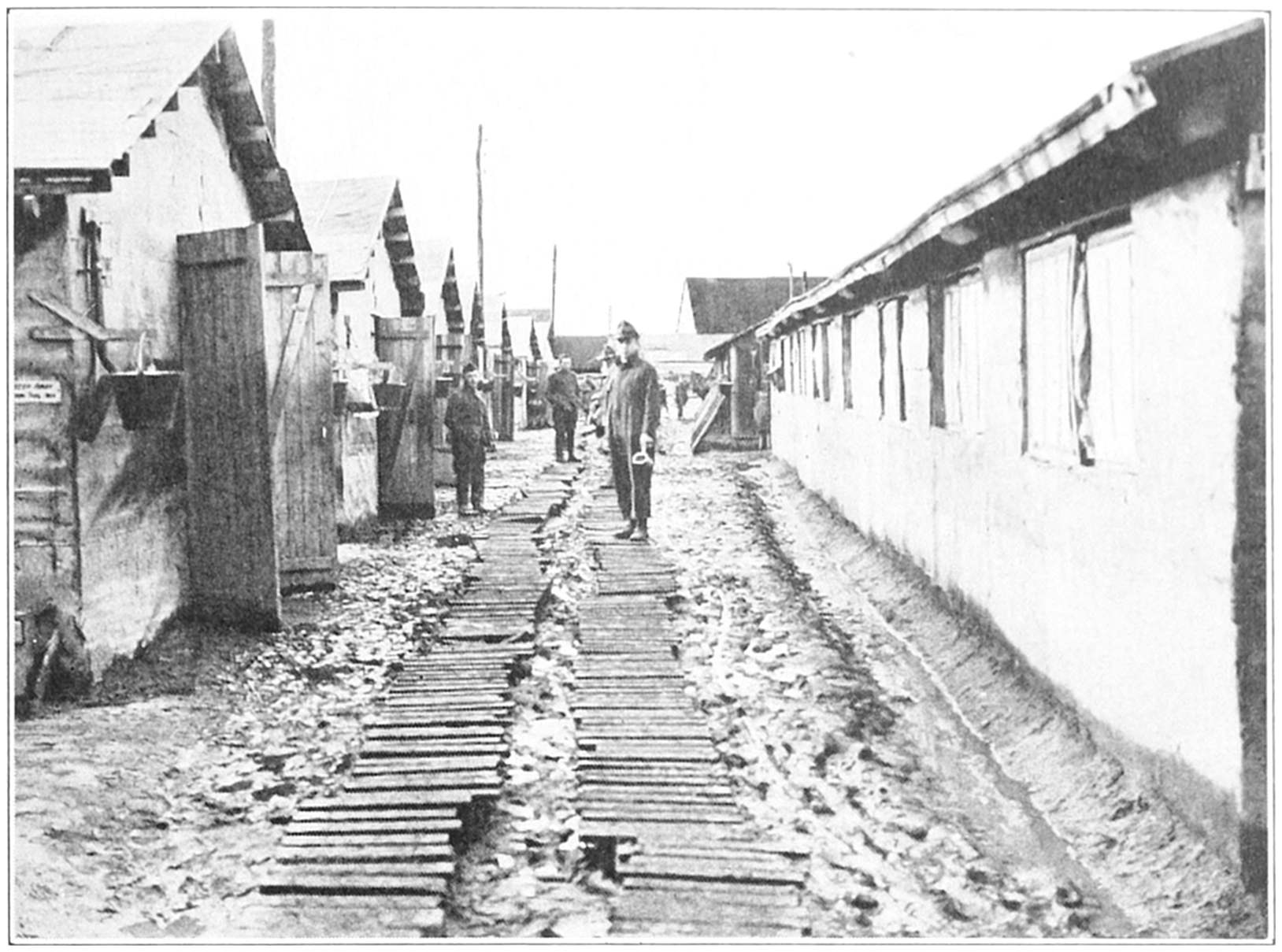
IN CAMP PONTANEZEN
Photo by Signal Corps
COMPANY STREET IN PONTANEZEN
With the combat troops mass travel could be conducted at
its greatest efficiency. The divisional troops were homogeneous,
their transportation needs were essentially alike, and a single
order could control the movements of tens of thousands of
them at once. The supply troops, on the other hand, were
heterogeneous. They were organized in thousands of units of
varying sizes and kinds. Many of them, particularly officers,
were serving in the organization as individuals attached to no
particular units. The travel problems of these various elements
differed widely. Therefore it was decided to handle the embarkation
of divisional troops and supply troops separately. The
general demobilization plan adopted about the middle of
December, 1918, provided for the establishment of a great
embarkation center for the divisional troops—an area which
should be convenient to all three ports of embarkation, in
which area the combat troops in their large units could be prepared
for the overseas voyage, and from which they could go
directly to the ships without pausing in the embarkation cities.
The installations at the ports themselves were to be used
especially in the embarkation of supply troops.
At Le Mans, a spot about midway between Paris and the
Biscay coast, the A. E. F. possessed a plant that might be
expanded quickly to serve as the divisional embarkation
center. When the great flood of American troops began debouching
upon French soil in the early summer of 1918 it
became evident to the command of the expedition that it
needed an area in which the incoming divisions might assemble
as their units debarked from the transports and where they
might rest while their ranks were being built up to prescribed
strength by the addition of replacements. By this time, too, the
system of supplying replacement troops to the A. E. F. had
become automatic. The replacements were the only American
soldiers who crossed to France without definite objective.
They were to be used in France as the A. E. F. needed them to
fill up its divisional ranks. It was necessary, therefore, to provide
a reservoir upon which the depleted combat divisions
could draw for replacements. Le Mans was selected as the site
of this reservoir and also as the assembling point for the debarking
organized divisions. The Le Mans area before the
armistice was known as the A. E. F.’s classification and replacement
camp.
The reasons which brought about the selection of Le Mans
as the site for the replacement and divisional depot served
also to make the place the ideal location for the expedition’s
embarkation center. Le Mans was at the junction of trunk-line
railroads leading to Brest, St. Nazaire, and Bordeaux.
It also possessed good railroad connections with Paris and with
the front, which in the summer of 1918 had been advanced
by the Germans until it was close to the metropolitan limits
of Paris and was therefore not far from Le Mans. The depot
was established in July, 1918, when the Eighty-third Division
occupied the area as its depot division. At that time the depot
as projected contemplated the construction of eight divisional
camps, each to accommodate 26,000 men, and two forwarding
camps, one with accommodations for 25,000 men and the
other for 15,000. In other words, the camp eventually was to
accommodate a quarter of a million troops. No military center
in the United States compared in size with this project.
At the time of the armistice the development of Le Mans
had made good progress. It could then maintain about 120,000
troops. On December 14, when Le Mans was officially
designated as the embarkation center, its capacity had been
increased to 200,000. Shortly after the armistice began, its
transient population jumped to 100,000, and it never fell
below this mark until the late spring of 1919, when the greater
part of the combat divisions of the A. E. F. had embarked for
the United States.
The Le Mans center had the duty of completely preparing
for embarkation all troops received in the area. Theoretically
every man who passed through Le Mans was prepared to go
directly to a transport. This meant bathing and delousing for
every man who came to the camp, inspecting his equipment
and supplying new clothing and other personal articles if he
needed them, and perfecting his service records so that he
might encounter no difficulty in securing his final pay and
discharge in the United States. To do this important work
quickly and well, it was necessary to operate an institution
of impressive size.
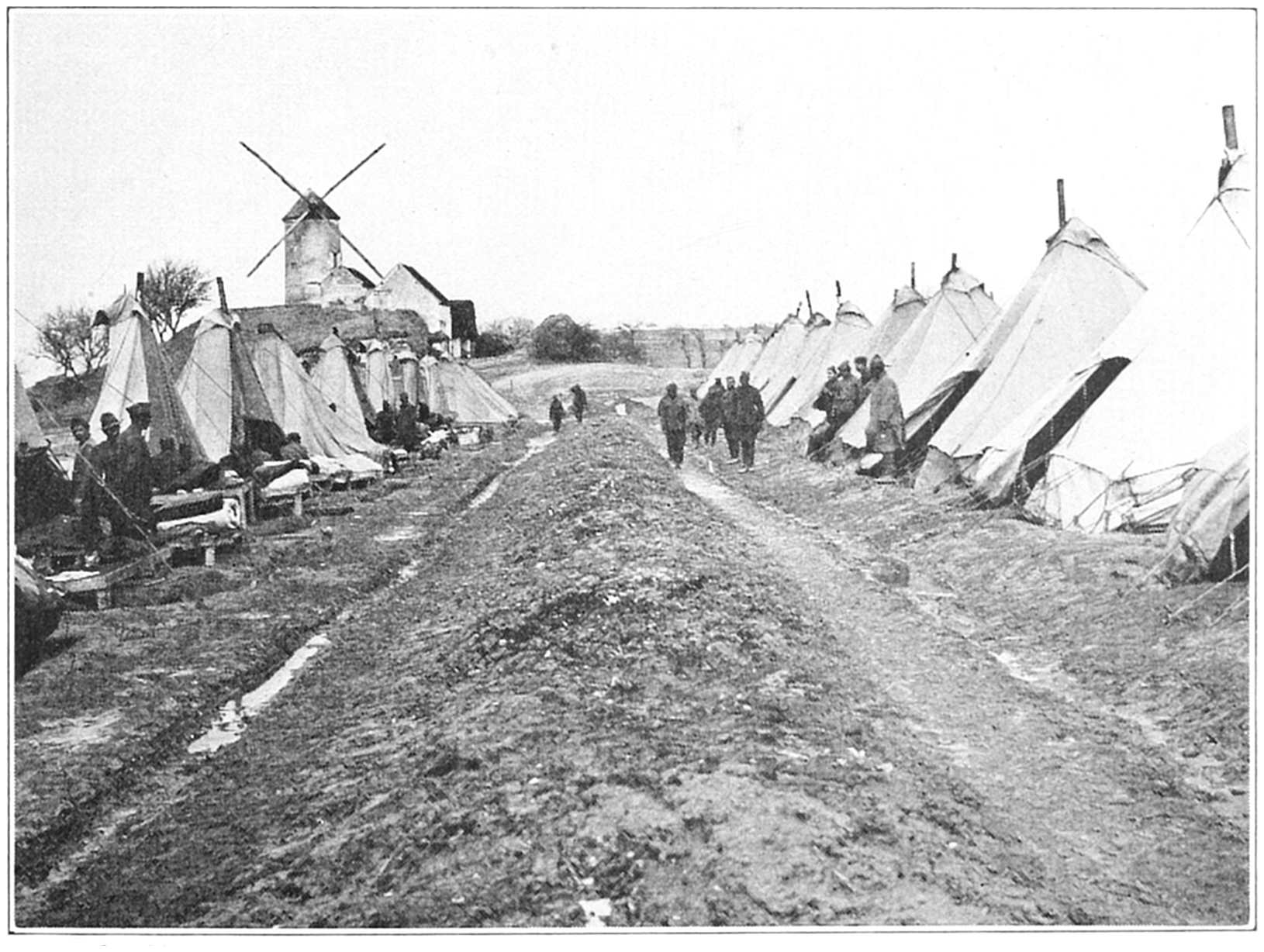
The dimensions of the whole camp were tremendous. There
was nothing like it in the United States. A man could walk
briskly for an hour in a single direction at Le Mans and see
nothing but tents, barracks, drill fields, and troops lined up
for preliminary or final inspections. The task of feeding this
city full of guests was so great that the camp administration
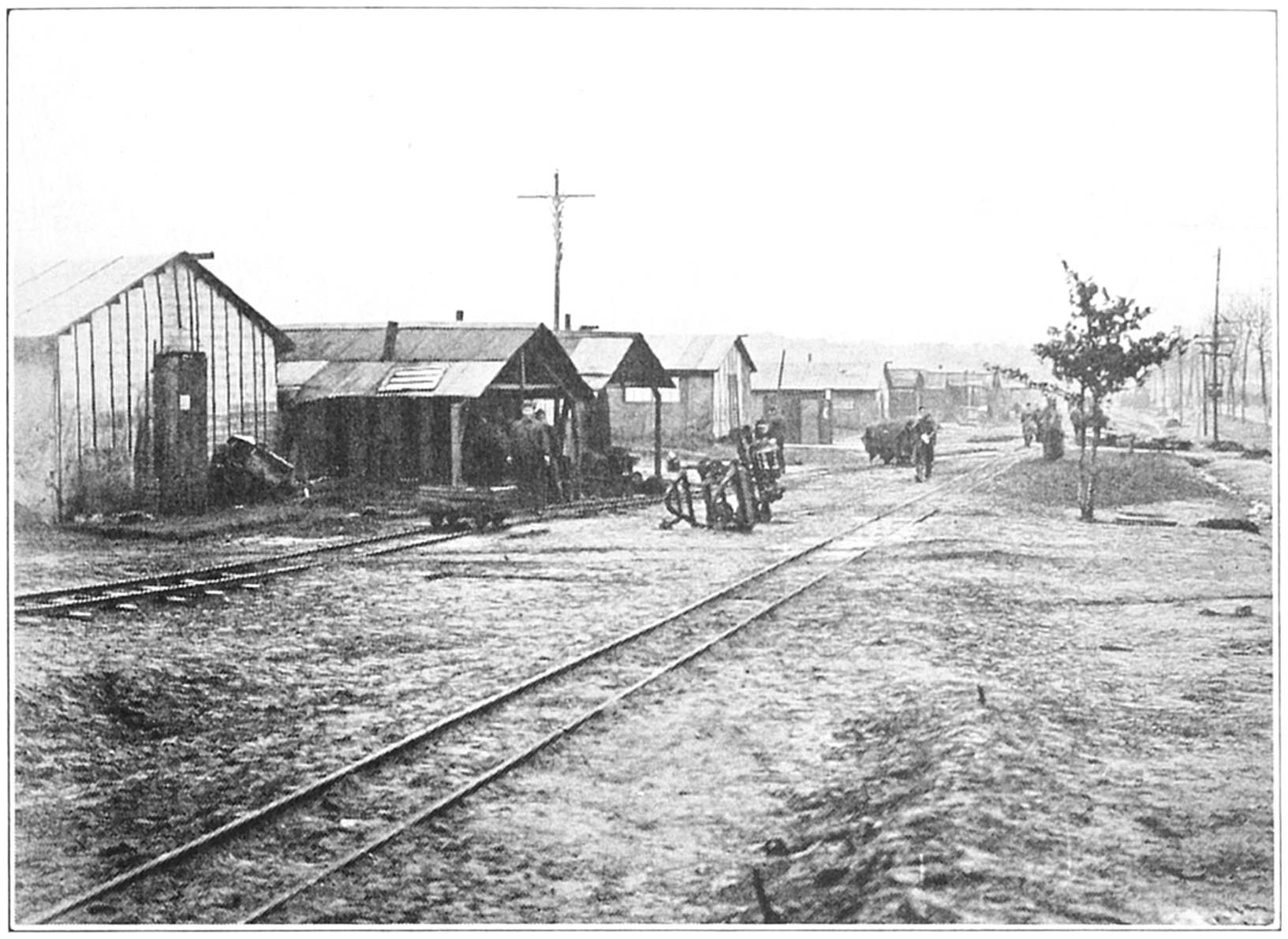
found it economical to build a narrow-gauge railroad system
connecting the kitchens with the warehouses. Food moved up
to the camp cookstoves by the trainload, and the same locomotives
that brought the supplies hauled away the refuse. A
whole adjacent forest was cut down to supply firewood. When
the Americans occupied the section there were no adequate
switching facilities, nor were there storage accommodations.
The Quartermaster Corps, which operated the storage project,
cleared a field in the midst of a wood and used the clearing
for an open storage space (the surrounding trees giving a
degree of shelter), connecting the place with the railroad by
constructing a spur track. Thereafter, even after great warehouses
had been built in the clearing and it had become the
supply depot for the entire camp, requiring the services of
6,000 troops in its operation, the place was known to the camp
as “The Spur.” As an addition to this storage, smaller covered
warehouses were provided at all the divisional sub-depots. At
one time the corrals of the camp contained 10,000 horses and
mules. In one week in February, 1919, nearly 32,000 troops
arrived in camp, a fact indicating the rate at which troops
passed through to embarkation. The Quartermaster Corps
opened two great central commissaries that were in effect department
stores. The camp operated a large laundry, a shoe
repair shop, a clothing repair shop, and numerous other industrial
plants.
The equipment installed at Le Mans was duplicated in
smaller scale at the three embarkation ports. Yet even these
port installations could not be called small. Camp Pontanezen
at Brest could give accommodations to 80,000 men at once.
The largest embarkation camps in the United States were
smaller than this. There were thirteen smaller camps and military
posts at Brest. The two embarkation camps at Bordeaux
could house 22,000 men, but there were billeting accommodations
in the district for thousands of others. The construction at
St. Nazaire was considerably larger than that at Bordeaux, but
not so extensive as that at Brest.
Most of these camps were built after the armistice, and the
engineer constructors and the embarking troops elbowed each
other as embarkation and construction proceeded simultaneously.
Some of the camps had served as rest camps prior to the
armistice, but these had to be greatly enlarged and improved
in equipment before they could give adequate service as embarkation
camps. The weather along the northwestern coast
of France is intensely uncomfortable and disagreeable to
Americans. In the winter and spring especially, the rains and
mists are almost incessant. It was not always possible to choose
ideal sites for the embarkation camps in France. The sites had
to be near the ports, and in the thickly inhabited countryside
the American authorities were forced to accept whatsoever
areas they could get, without being too insistent upon such fine
points as natural drainage and pleasant surroundings.
This statement is particularly applicable to Pontanezen,
which was pitched on high but poorly drained ground. Ordinarily
the Army would not have occupied such a location
without first making permanent improvements. The continual
rains, the lack of strong drainage, and the heavy traffic of men,
animals, and trucks combined to make the Pontanezen site in
1919 a morass of quaking mud. Only the strongest of emergencies
justified its use. Because of the daily cost of maintaining
the A. E. F. and because the expeditionary soldiers themselves
wished to return home as soon as possible, regardless of
the conditions of their travel, it was decided to make use of
these port camps even while they were being constructed,
instead of holding up the whole movement until the camp
arrangements could be made perfect.
Tales of suffering among our soldiers at Pontanezen came
to the United States and were even aired on the floors of Congress,
but the suffering alleged was more apparent than real.
Those who went through the experience of residence in Pontanezen,
even at its worst, were not injured in health. Despite
appearances, the camp’s sanitary arrangements were of high
merit. The medical records of Camp Pontanezen show that its
sickness and death rates, leaving the domestic epidemic of
influenza altogether out of the comparison, were as low as
those of the best camps in the United States.
In the spring of 1919 most of the construction work at the
embarkation camps was complete, and they became more comfortable.
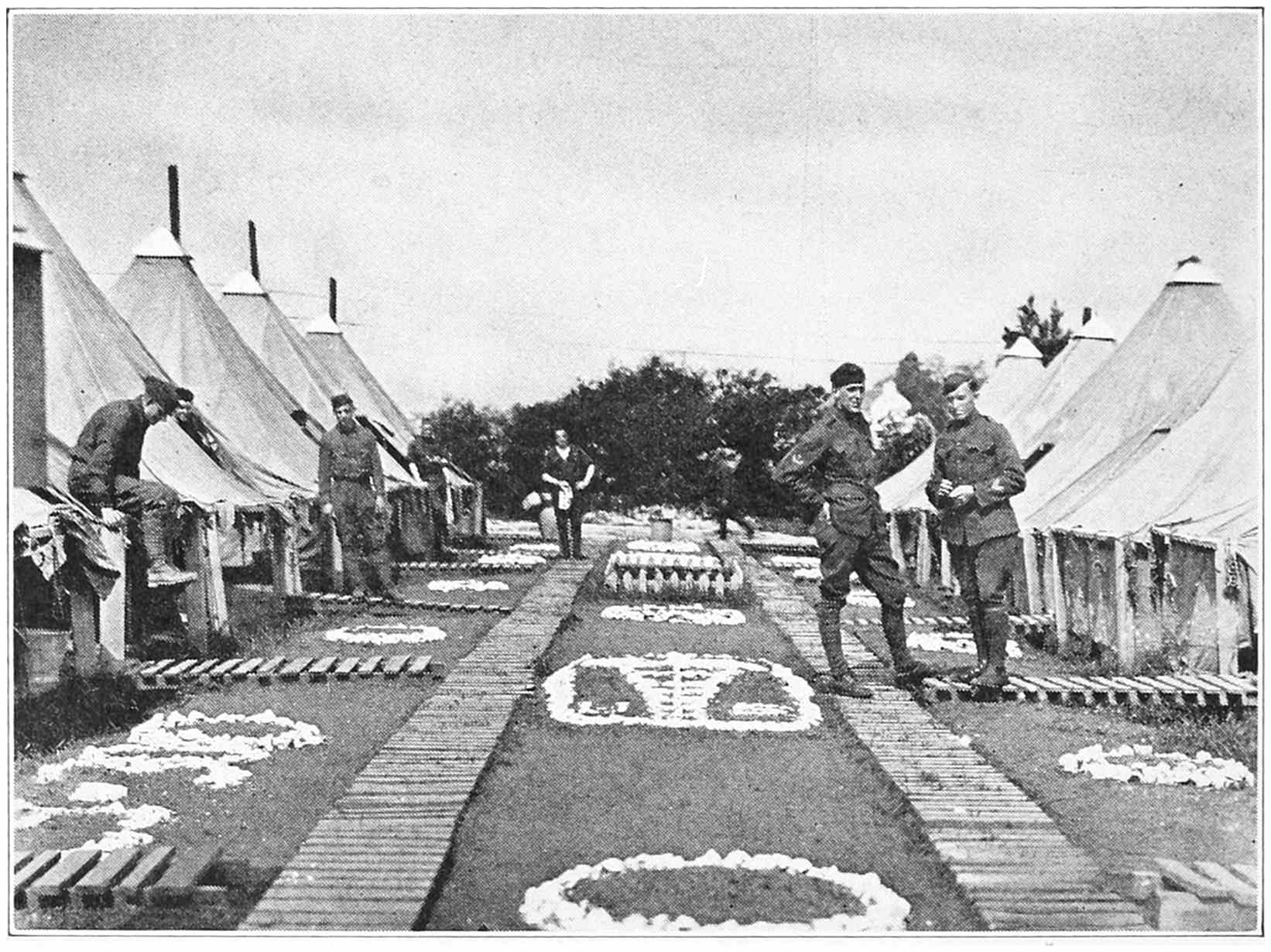
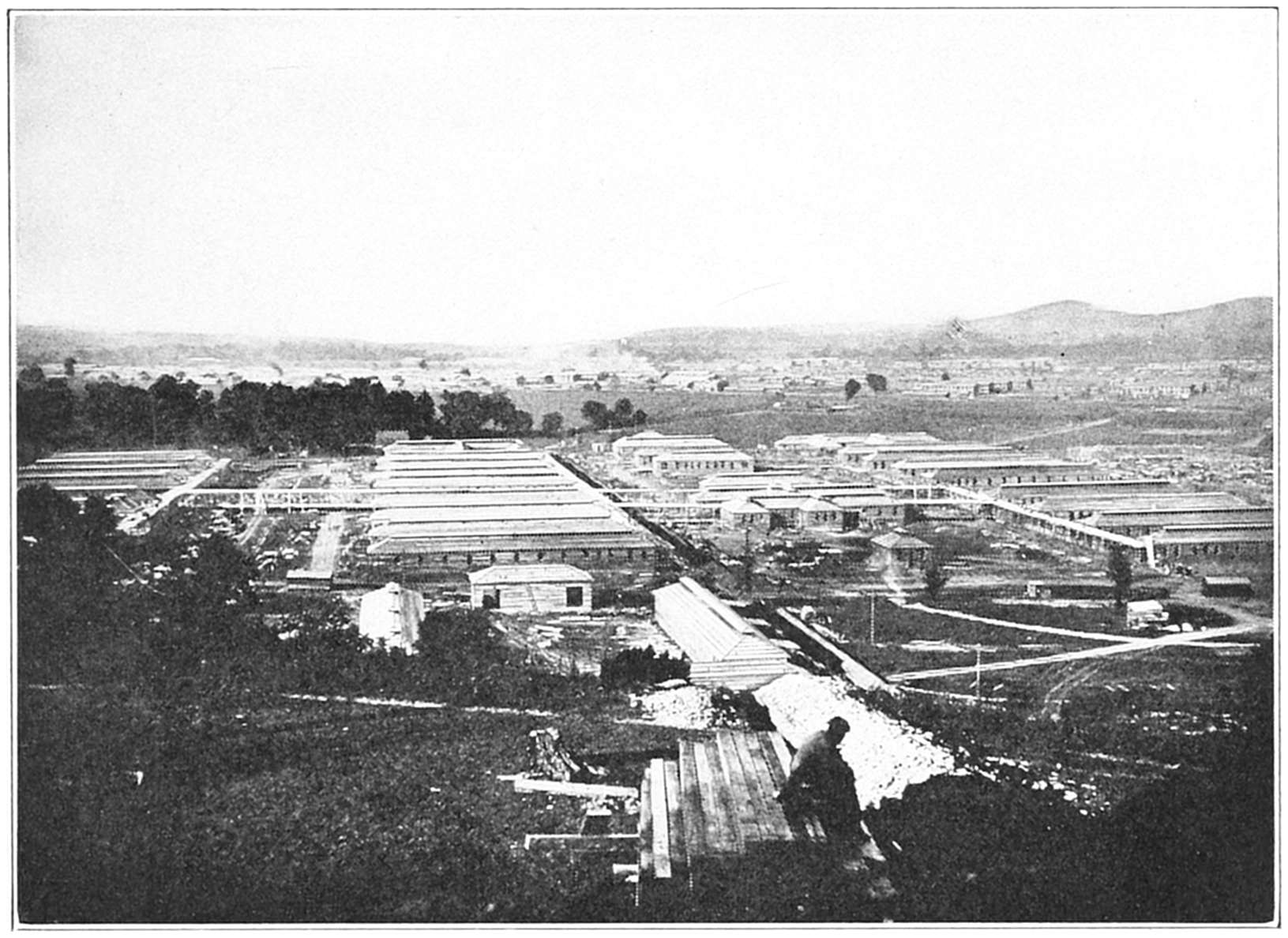
The camps consisted of miles of one-story, tar-papered,
rough-board buildings connected with wooden sidewalks
of duck-boards. Pontanezen was a complete American
city set down amid the quaint roads of old Brittany. It had
newspapers, banks, theatres, stores, public libraries, restaurants,
hospitals, churches, telephones, and electric lights, and
even a narrow-gauge railway for freighting about its supplies.
The entire American military population in the camps at Brest
quite outnumbered the French inhabitants of the region. The
water system installed by the Engineers to serve all the American
establishments at the port was sufficient for the city of
150,000 people. There was a special camp for casual officers.
A section of this camp was set aside for the French, English,
Belgian, and Italian wives that American soldiers had married
abroad. There was a hospital camp, a camp for the white
troops on permanent duty at the port, and another for colored
troops so assigned. There were numerous small camps for labor
battalions, and a special camp for engineer and motor transport
organizations. Not far away was a large German prison
camp.
In one important respect embarkation in France differed
from what it had been in the United States. It was extremely
necessary to rid the home-coming troops of body vermin before
placing them on the ships. The delousing process at our French
ports of embarkation was the most thorough experienced by
the doughboy during his foreign service, and this process
chiefly distinguished embarkation abroad from that which the
soldier had known at Hoboken and Newport News.
Our forebears shared none of the modern aversion to discussion
of the louse. One of the great monarchs of France set
the stamp of his royal approval upon scratching publicly when
one itched, and Robert Burns once addressed a poem to a
louse. The louse, however, cannot survive American habits of
personal cleanliness; and, justly enough, the insect has become
associated with filth and has dropped out of polite conversation.
The war revived the fame of this parasite. An inspection
at one time revealed the fact that 90 per cent of the American
troops at the front were infested. These men naturally wrote
home about it, and then the louse, euphemized as “cootie,”
became a national figure.
There was a serious aspect to the situation, however, that
the military authorities could not overlook. Besides being a
source of discomfort, the louse is the sole carrier of one of the
most dread diseases that afflict mankind—typhus fever. In
bygone times typhus was known variously as army fever, camp
fever, or jail fever. It was particularly prevalent in this
country at the time of the Revolution, and it existed to some
extent here during the Civil War—an indication of what must
have been the condition of individual American soldiers in
those days. Typhus exists to-day practically as an endemic on
the central plateau of Mexico, the range of the disease touching
the border of the United States. The disease cannot invade
this country, however, because of the lack of carriers. But if
the A. E. F. had returned to the United States with its
2,000,000 men lice-infested, the demobilized soldiers might
have distributed typhus carriers from one end of the country
to the other and exposed the nation to a terrible menace.
The sanitary regulations of the A. E. F. kept typhus away
from the troops by controlling the lice. The Quartermaster
Corps operated a number of mobile delousing plants just behind
the front lines and in the billeting areas to the rear. It
is interesting to note that these plants had to be camouflaged
because the airmen of the enemy sometimes mistook them for
batteries of artillery and directed gunfire upon them. As these
plants increased in number and efficiency they reduced the
lousiness of the combat troops to a scant 3 per cent.
As long as our troops remained in France largely billeted on
the French population, it was unlikely that the field sanitary
measures could extinguish the louse altogether; but the command
of the expedition determined that at the ports of embarkation
the American doughboy should bid good-bye to P. vestimenti
forever. The importance of completely delousing
the troops was emphasized in the same G. H. Q. memorandum
that had set up the embarkation system.
In pursuance of this policy every embarkation camp in
France was established in two isolated sections. One section
was known as the “dirty” camp and the other as the “clean”
camp. Upon arrival from the front the troops first took quarters
in the “dirty” camp. Between the two sections lay the
buildings in which the camp administration conducted all the
various processes of preparing soldiers for embarkation for
the United States. One of the most important of these activities
was bathing and delousing the troops. As far as scientific
measures could prevent it, not a louse was permitted to cross
from the “dirty” camp to the “clean” camp. The measures
were highly effective. Only a few men were found to be infested
upon arrival in America. For these there were final
delousing facilities at all our debarkation camps. When the
overseas veterans took trains for home at the Atlantic ports
they were completely verminless. The medical officers at the
demobilization centers in this country failed to discover a
single exception.
The embarkation plant at Bordeaux was known to returning
soldiers as “The Mill.” Its processes were typical of those
at all the embarkation camps in France. The Bordeaux mill
ground swiftly, yet ground exceeding fine. To it came the
raw material—dirty, ragged, weary humanity. It reached out
for this material, whirled it into its machinery, and a little
while later delivered from the other end its finished product—clean,
well-clothed, deloused, and comfortable American soldiers,
their service records compiled up to the minute, American
money in their pockets, and a mighty self-respect swelling
their chests.
To France America sent the best clothed and best equipped
army that had ever stepped on European soil. The two million
men arrived in France outfitted almost completely in new
clothing and equipment which they had received in the American
embarkation camps just before they boarded the transports.
In 1919 we brought home the first American army that
had ever fought in a great war and returned in anything but
rags. By special act Congress gave permission to each discharged
soldier to keep his uniform and certain other equipment
when he returned to civilian life. Even though, for most
of the men coming up into the embarkation ports in France,
their final discharge was only a few weeks away, nevertheless
the military organization there saw to it that every man was
decently clad before he began the return voyage, and this often
meant the issue of entirely new articles. The Quartermaster
Corps abroad wanted to win from the folks at home the verdict,
when they had looked over their restored boys—“Guess
they took pretty good care of you over there, after all.”
The “mill” at Bordeaux was housed in a long, low hut with
separate departments for the chief operations necessary to the
preparation of troops for embarkation, the steps being arranged
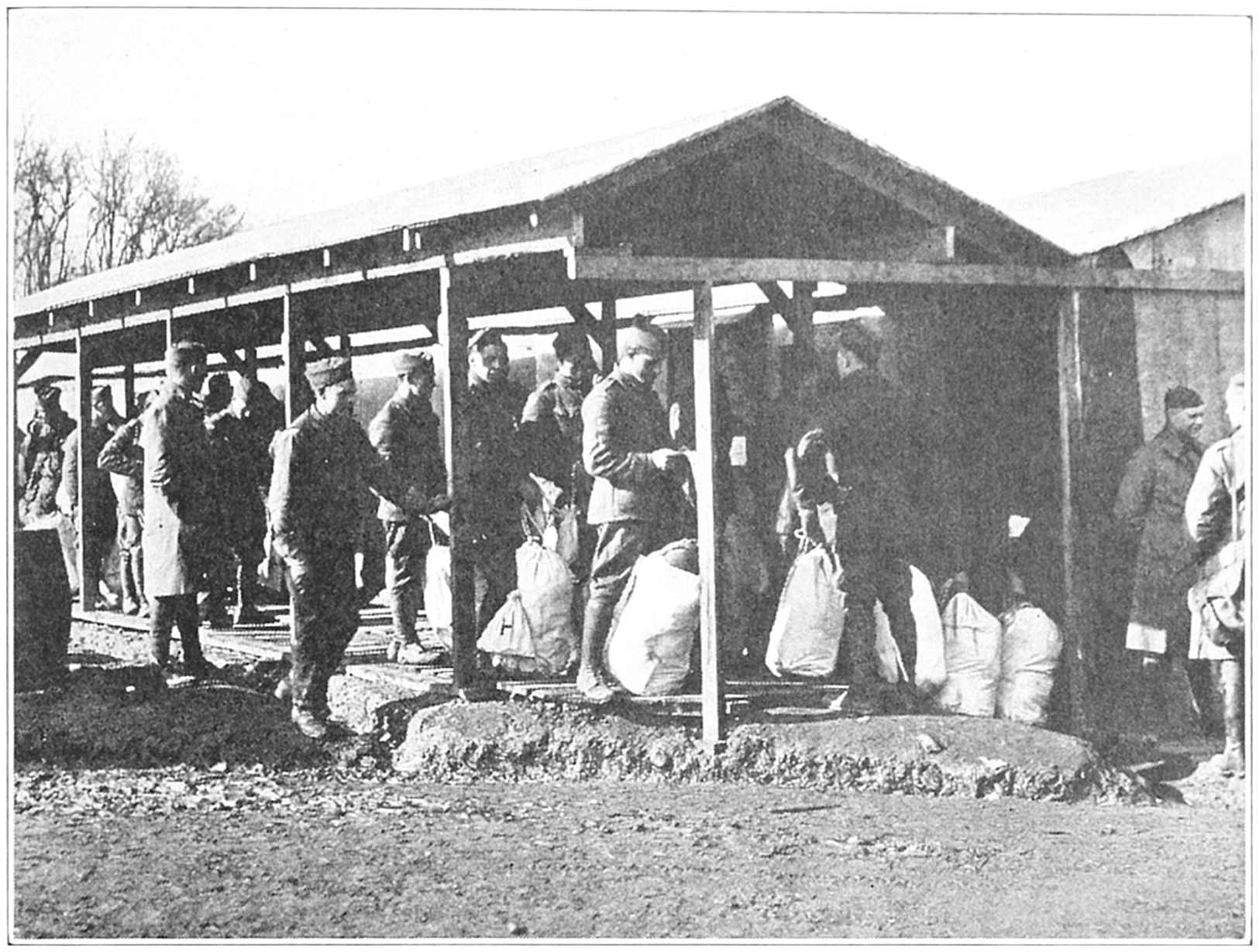
progressively. At the entrance end were the executive
offices. Here the soldier, as he passed through, received his
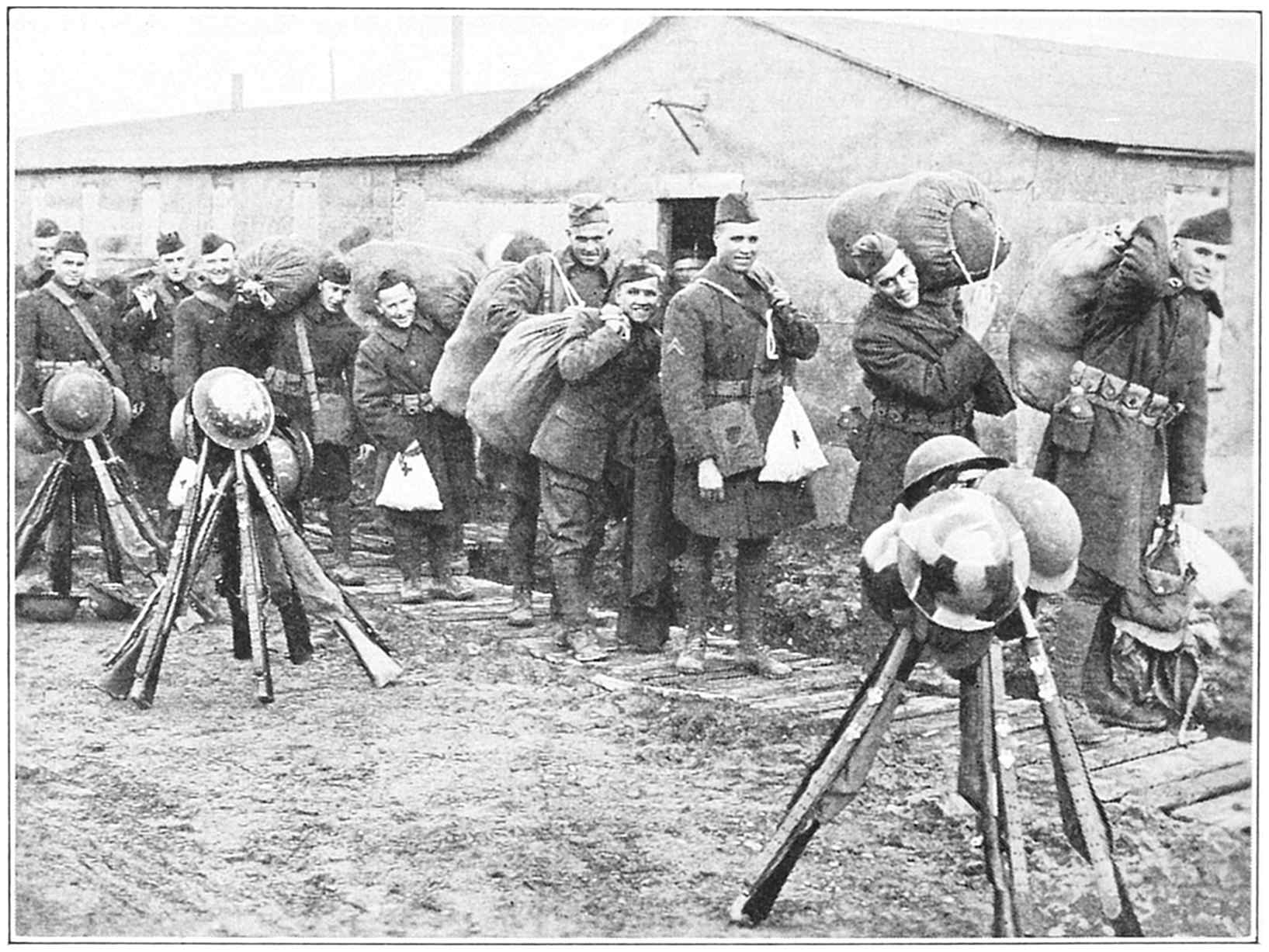
service records, withdrawn from his company’s files, and also
a Red Cross bag in which to carry his personal trinkets and his
record cards and papers on the journey through the “mill.”
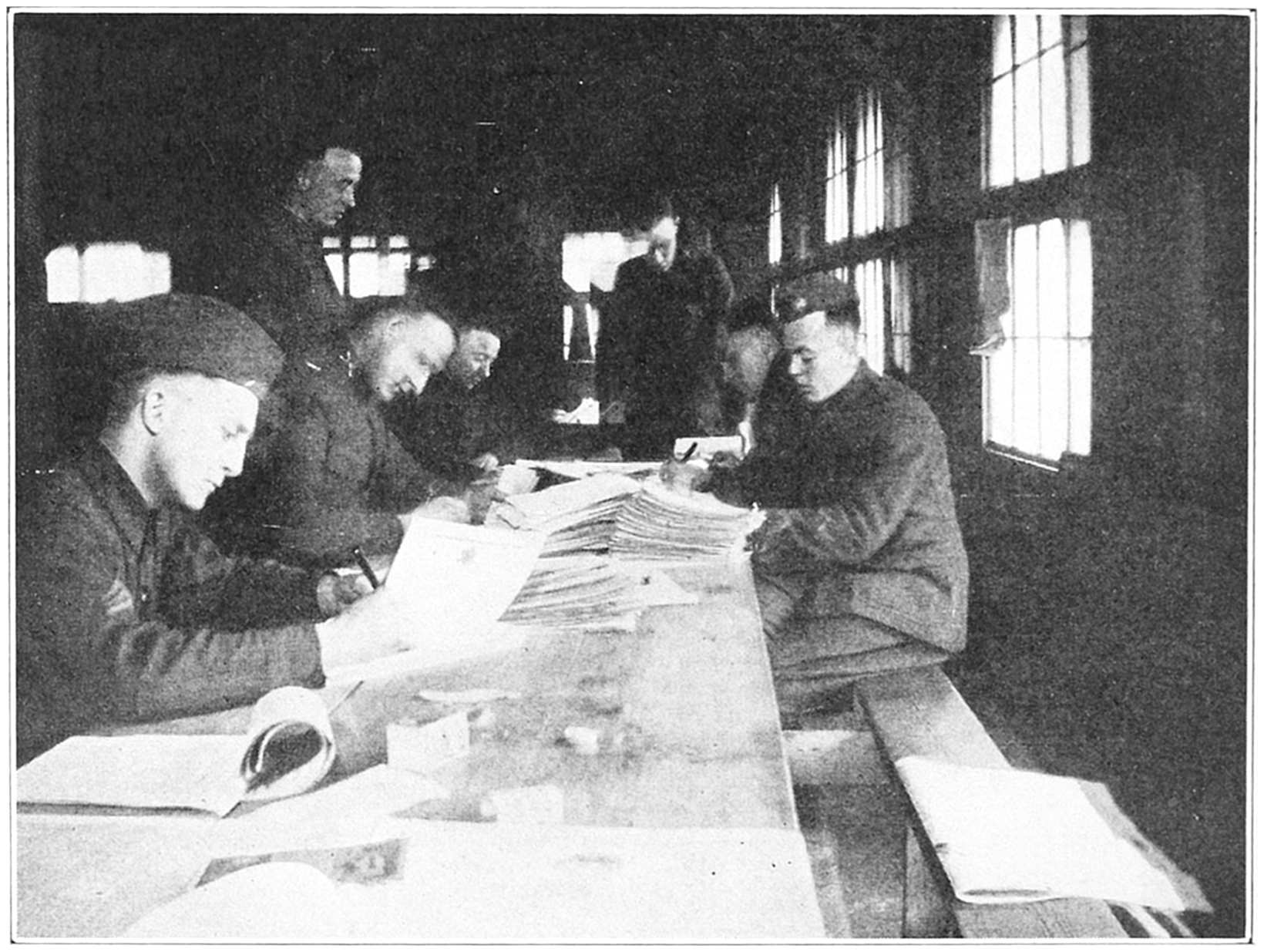
Next he came to the records inspection section, where officers
perfected the entries in his record. Here he also received a
copy of the orders under which his unit was traveling, his pay
card, and a card known as the individual equipment record. On
the equipment card appeared the printed names of all articles
which a completely outfitted American soldier should wear or
carry wherever he went. Next the soldier stood before an
inspector who examined the worn equipment, noted wherein
it was incomplete, labeled any damaged or worn-out articles
for discard and salvage, and checked on the equipment card
such new articles as should be issued to the soldier later on.
The standard equipment of each returning soldier was as
follows:
1
Barrack Bag
2
Undershirts
2
Pairs of Drawers
2
Pairs of Socks
1
Pair of O. D. Gloves
2
O. D. Shirts
1
Pair of Shoes
1
Pair of Laces
1
Pair of Breeches
1
O. D. Coat
1
Overseas Cap
1
Pair of Leggins
1
Chevron (for noncommissioned officers)
1
Shelter Half
3
Blankets
1
Overcoat
1
Slicker
1
Shaving Brush
1
Toothbrush
1
Tube Tooth Paste
1
Comb
1
Piece of Shaving Soap
1
Towel
1
Cake of Soap
2
Identification Tags
1
Belt
1
Razor
1
Ammunition Belt
1
Pack Carrier
1
Haversack
1
Canteen
1
Canteen Cover
1
Condiment Can
1
Meat Can
1
Cup
1
Knife
1
Fork
1
Spoon
1
First Aid Pouch
1
First Aid Packet
The soldier next went to the disrobing room, where he
divested himself of all clothing except his shoes, which he
was to carry through with him. The cootie would not cling to
leather. Then he passed on to a medical examination for infectious
disease. If he passed this safely, he proceeded to the
bathing department, where, under the watchful eyes of a sergeant,
he soaped and scrubbed himself thoroughly, first in a
hot shower bath and then in a cold one. Experience had taught
that the greatest enemy of the louse was plain soap and water
and plenty of it. Meanwhile certain of his discarded garments,
if they were in good condition or if they could be repaired for
future wear, had been sent from the disrobing room to the
steam sterilizer in another part of the building. The sterilization
process took thirty minutes, which was just about the
time it took the soldier to go through the “mill.”
Scrubbed and clean, the soldier went from the bath into
another room where doctors examined him for diseases of the
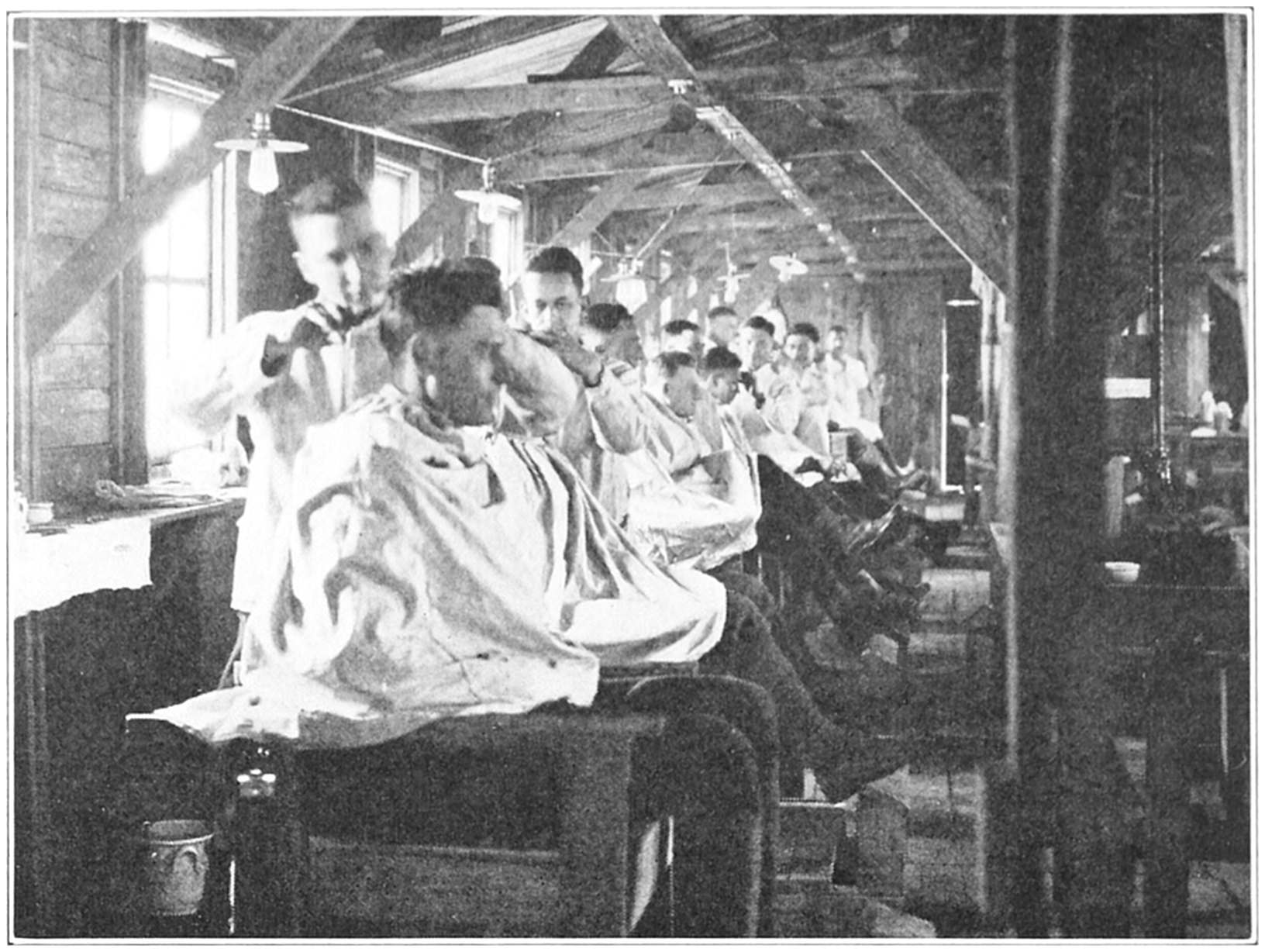
throat, lungs, and skin. After that, the barber shop and a hair
cut. The barber shop at the “mill” was equipped with fifty
chairs.
At last the object of these official attentions reached his
goal, the equipment room. What he had feared in the process
were the two medical inspections, either of which might stop
his progress instanter and send him scurrying to a camp hospital
for observation or treatment. In either circumstance, his
embarkation would be deferred indefinitely. But if he were
allowed to reach the equipment room, he knew he was safe.
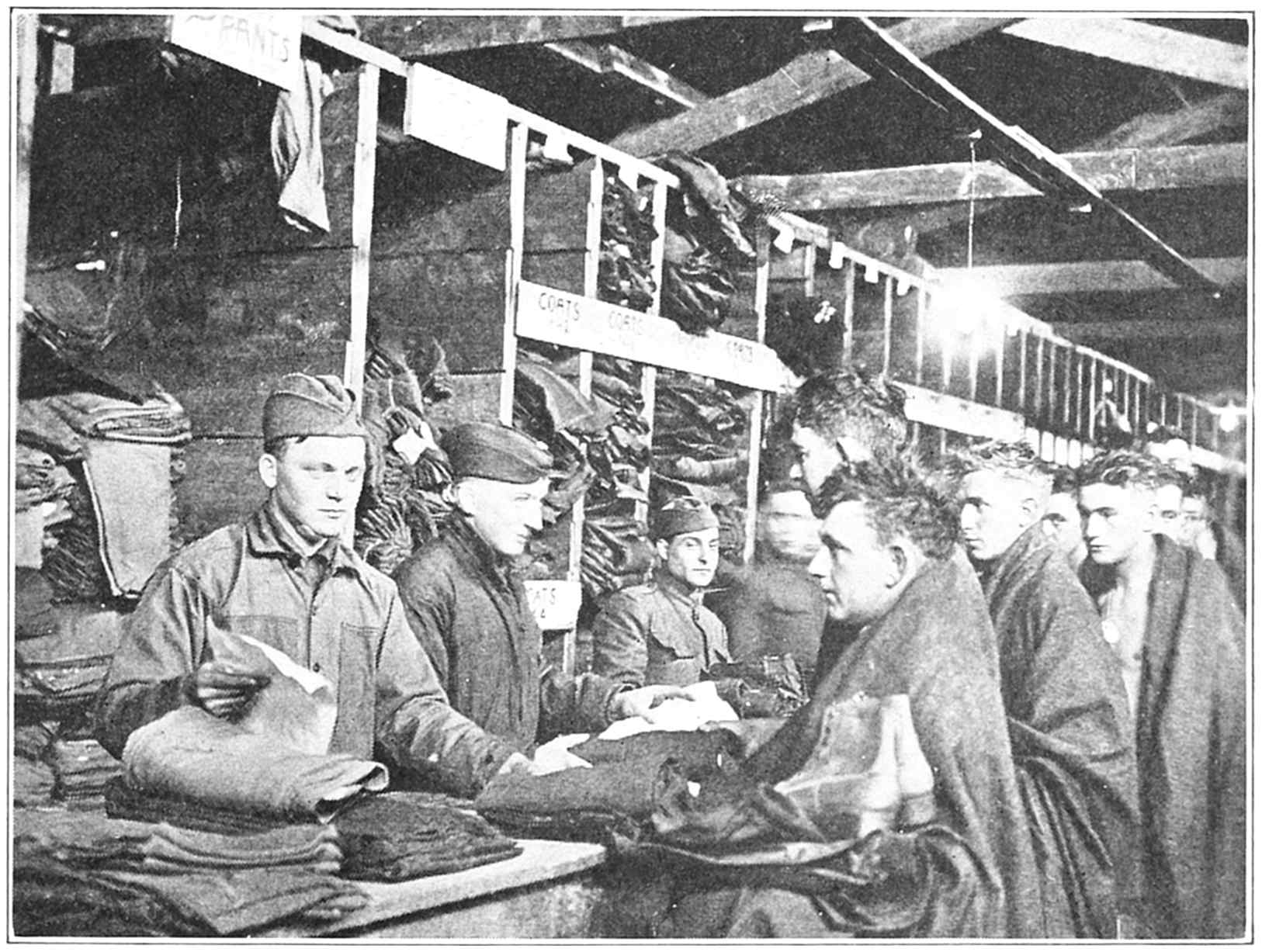
Here he found great bins containing large quantities of the
articles named on the equipment card. As he passed the bins
every soldier received clean socks and underclothing, new tape
for his identification tags and a clean shelter half in which to
carry his equipment. He also received such new articles as
were checked on his equipment card.
Photo by Signal Corps
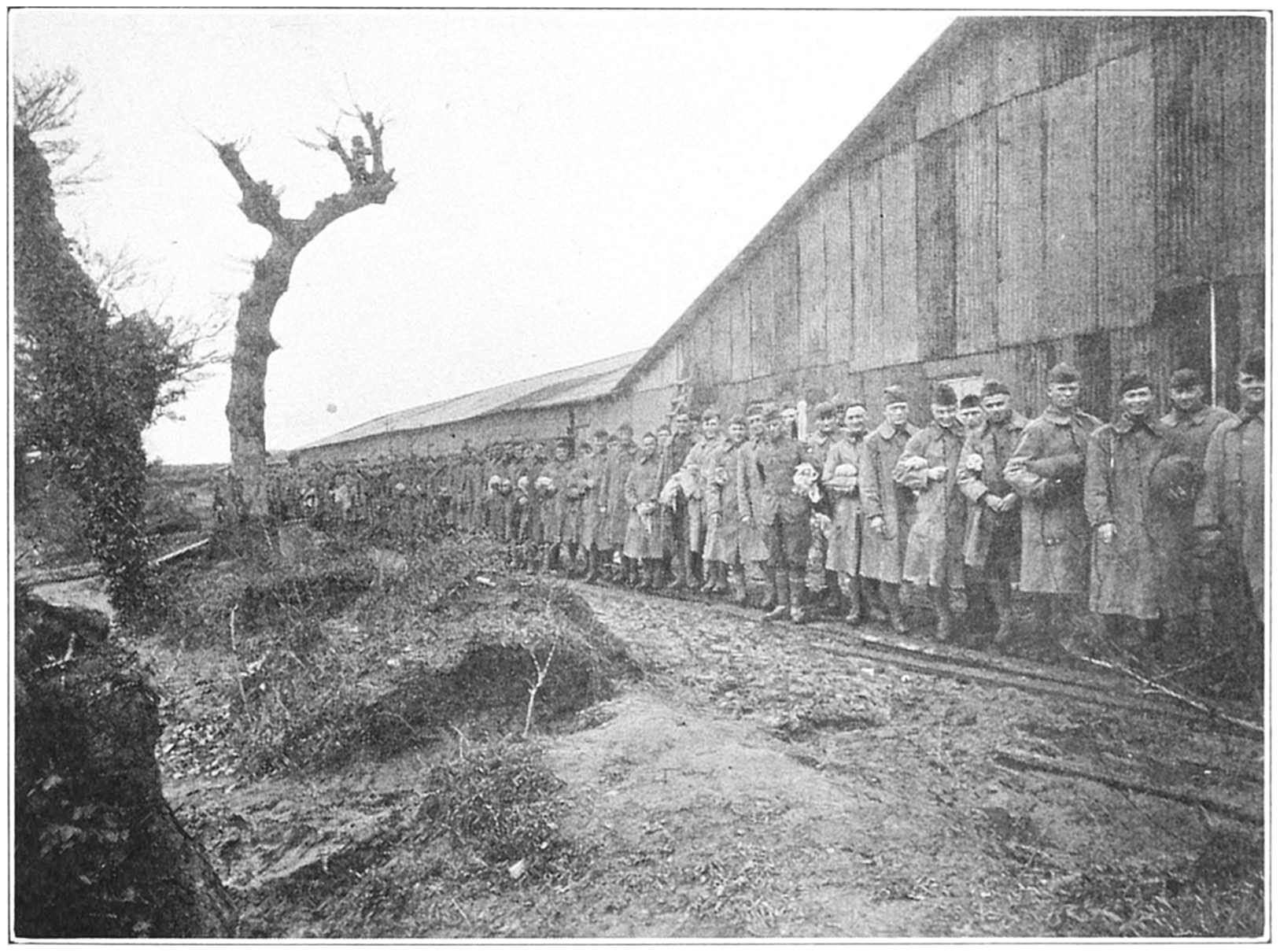
1. ENTERING “MILL” AT BORDEAUX
Photo by Signal Corps
2. RECEIVING CLEAN CLOTHING IN “MILL”
In the dressing room beyond, he found waiting for him a
uniform and the serviceable portions of the outfit he had
brought with him to the “mill,” all the textile articles having
been thoroughly deloused and sterilized. He found his old
uniform, if that had been in good condition; otherwise, a new
one or a respectable one from the repair factory. Sometimes his
old uniform came back shrunken and faded by the hot steam
of the delousing plant. In that event a serviceable uniform was
substituted for it.
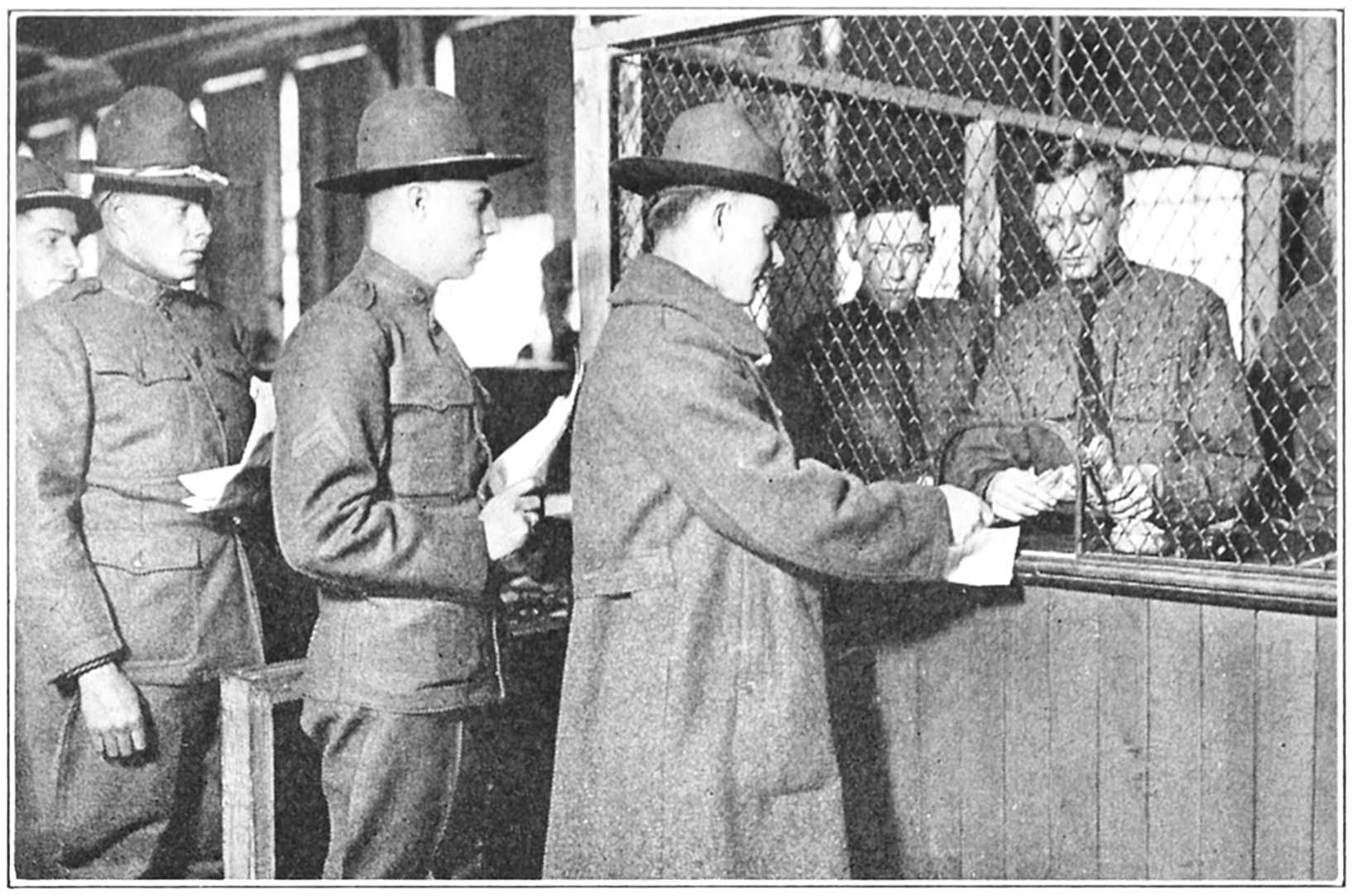
The final station in the “mill” was the pay office. It sometimes
happened that troops came up for embarkation with
their pay months in arrears. Now, with his records perfected,
the soldier received all his back pay. Thanks to the exchange
system set up by the A. E. F. in the embarkation camps, he
received his pay in American money, perhaps the first he had
seen in many months. The “feel” of the familiar bills and the
jingle of the silver were like a taste of home. Clean, neatly
clothed, restored once more to man’s estate, the soldier emerged
from the “mill” and made his way to quarters in the “clean”
camp, his heart light because he knew now that he was going
home “toot sweet.” The sense of well-being moved one soldier-poet
to praise of the “mill” as follows:
“Ye go in one end dirty, broke,
So dog tired ye can’t see a joke.
Ye come out paid, an’ plum’ remade,
A self-respectin’ soldier.”
The embarkation plant at Bordeaux, if pressed, could
cleanse, delouse, equip, and otherwise prepare for the home
voyage 180,000 men in a month. During the busy times in
1919 a continuous column of men filed through the departments.
They went through in blocks of twelve. In each of the
various departments were ten booths, each accommodating
twelve men.
Photo by Signal Corps
3. THE “MILL” BARBERSHOP
Photo by Signal Corps
4. THROUGH “MILL” AND READY FOR HOME
The processes at the other embarkation camps were essentially
the same. In each of the Le Mans divisional camps was
installed a bathing and delousing plant with a capacity of
1,200 men an hour. For the sterilization of clothing in the
area there were three large central “disinfesting” plants, five
smaller stationary steam sterilizers, and more than a dozen
mobile sterilizers.
The two port camps at Bordeaux were known as Camp
Neuve and Camp Genicart. After the armistice these two
camps were reorganized and enlarged. Camp Neuve became
the “dirty” or entrance camp. It accommodated 5,400 men.
Camp Genicart was designated as the “clean” or evacuation
camp, and its barracks could house nearly 17,000 men. The
busiest day for Bordeaux was Sunday, May 11, 1919, when
6,399 men passed through the “mill” and made ready to embark.
St. Nazaire handled 15,306 embarkations on June 17,
1919, its record day.
Salvage was an important operation at all the embarkation
points in France. Thousands of articles of apparel discarded
by the returning troops were not so worn but that they could
be made serviceable again. The salvage plant at Le Mans
could repair 1,700 pairs of shoes, dry-clean, sterilize, and repair
4,000 pieces of clothing, wash 10,000 garments in the
laundry, and disinfect 10,000 blankets every day. The plant
occupied eight buildings, and the average value of clothing
repaired monthly was over $150,000. There were salvage
plants also at Brest, St. Nazaire, and Bordeaux, the one at
Brest being of great size.
The task of feeding men at the embarkation camps gave the
Quartermaster Corps one of its chief problems. Each divisional
sub-depot at Le Mans carried at all times sufficient food to
supply the appetites of 25,000 men for fifteen days, and in
addition the central warehouses contained 500,000 emergency
rations to substitute for the garrison rations if anything went
wrong with the food supply. In December, 1918, the subsistence
services in the area had been built up to the capacity of
500,000 rations cooked and served each day.
At Brest also the feeding arrangements were laid out on an
immense scale. The men ate food prepared in standard
kitchens, each capable of providing subsistence for thousands.
The cold-storage and other storage spaces of one of the standard
kitchens were large enough to hold such items as 10,000
pounds of beef and 6,000 pounds of bread. The kitchen facilities
included a meat cutting room, a tool room, a scullery, a
garbage incinerator, a great mess hall, and finally the galleys,
each of which contained four large hotel ranges with work-tables,
serving tables, and all necessary cooking utensils. Ten
men did the cooking in each galley. Each mess hall was 280
feet long. End to end, its metal topped tables measured 495
feet in length. Galleys, storage rooms, and mess halls had
cement floors. The whole plant was illuminated by electricity.
Each mess hall at Brest was operated on the cafeteria plan.
Each was equipped to feed 20,000 soldiers. The men entered
the hall marching in column of squads. They passed through
the galleys, filling their kits with hot food, then secured places
at the tables, ate, and left the hall at the opposite end, where
there were refuse cans in which to scrape off their dishes and
also tanks of boiling, soapy water and hot rinsing water. Here
they cleaned their equipment. The facilities were such that
each kitchen could serve a brigade of troops entering the building
at the ordinary marching pace. Frequent inspections kept
the food up to standard. The camps at Brest also maintained
night soup stands at which any soldier could get bread and hot
soup between the hours of 8:30 p.m. and 2:30 a.m. The force
that operated the messing facilities at Brest numbered 1,600
officers and men.
At Bordeaux the troops temporarily occupying the embarkation
camps cooked their own meals at the mess halls, drawing
their supplies from the camp organization. At St. Nazaire the
messes were similar to those at Brest. The old army transport
McClellan, which had crossed to France in the first American
convoy in 1917, was stationed at St. Nazaire, where it served
the subsistence organization as a floating refrigerator with
capacity for 3,000,000 pounds of food. The McClellan was
too old to stand the buffeting of the North Atlantic, and the
Embarkation Service, unwilling to risk bringing her home,
turned the ship over to the A. E. F. After the expedition had
returned to the United States the Government sold the McClellan
to France.
To the individual soldier, quite the most important branch
of the embarkation organization was that one which paid the
money due him from the Government. It paid him his money
in francs, either in the currency itself or by check, and then saw
to it that he exchanged his French money for its equivalent in
American currency. Both of these enterprises in finance—disbursement
and exchange—were in the hands of the A. E. F.
Quartermaster Corps. The disbursement offered little difficulty,
although the monthly pay roll at Brest sometimes contained
as many as 100,000 names, while those at St. Nazaire
and Bordeaux were proportionately large. The question of
foreign exchange presented more of a problem.
Soon after the van of the A. E. F. reached France the Treasury
Department at Washington requested the War Department
to pay all its troops on foreign soil in the money of the
country in which they chanced to be stationed. This meant that
most of the men of the expedition received their pay in francs.
Before the armistice, questions of currency exchange were of
slight concern to the overseas soldier. After the Government
had deducted his allotment to his dependents, his monthly
premium payment for war risk insurance, and his partial
payment for any Liberty Bonds he might have purchased
through the Army, there was not much left for him, anyhow.
When francs were cheaper he received more of them from the
pay officer than he had expected, but as long as he stayed in
France and spent his money there the rate of exchange made
little difference to him.
French exchange continually strengthened during the sojourn
of the expedition in France—until after the armistice
began. The normal value of francs is 5.18 to the dollar. In
July, 1917, the rate was 5.70. This rate gradually improved
until at its strongest point it stood at 5.45. The few wounded
men and casuals returning to the United States during this
period were thus able to benefit financially by exchanging
their French savings for American currency.
After the armistice, however, and during the very time the
expeditionary troops were returning to the United States in
greatest numbers, the exchange value of the franc slumped
badly. Shortly after November 11, 1918, the rate was 5.80
to 1. It continued to fall steadily until in the autumn of 1919
it took 9.70 francs to purchase one dollar. It follows that the
provident soldier who had saved the francs paid to him on a
basis of less than six to the dollar lost heavily when he was
forced to convert his savings back into dollars again on a basis
of nearly ten francs to the dollar. The loss was particularly
heavy upon officers who maintained drawing and savings accounts
in French banks or who had not cashed their pay checks.
Sometimes, too, officers lost their checks. Later they obtained
duplicates, which the declining exchange had made less valuable.
The War Department considered itself bound to protect
soldiers from losses on this account. Congress is now considering
a war department bill which, if enacted into law, will provide
for the reimbursement of losses incurred by soldiers because
of variations in foreign exchange.
It was good financial policy for the A. E. F. to leave all
its French currency behind as it embarked for the United
States, and to bring home only American money. Yet it would
have resulted in confusion in the A. E. F. finances to have
changed the pay system at the ports of embarkation. Therefore
the Quartermaster Corps did the next best thing: it paid off the
embarking troops in francs as usual and then immediately
converted their francs into American currency. Since both payment
and exchange were at the same rate of exchange, there
was no loss to the troops in this transaction.
In order to provide the American money for this exchange
it was necessary for the Treasury to ship to France great quantities
of currency. It took the A. E. F. some time to convince
the Treasury Department of the necessity for such shipments.
The day after the armistice began, the command of the A. E. F.
cabled to the Treasury requesting the immediate shipment
of $500,000 in currency, an order afterwards increased to
$2,000,000. This money did not actually reach the A. E. F.
until the last day of January, 1919. By that date the expedition
was beginning to embark rapidly. There was not enough
American currency in Europe to buy all the French money of
the expeditionary troops, and only by the most strenuous
efforts could the Quartermaster Corps provide money for exchange
until the first shipment of currency arrived from the
United States. Finance officers were stationed in Paris, London,
and at the principal seaports with orders to buy all the
American money they could secure. By combing the banks and
the countingrooms of brokers and by maintaining in Paris a
fund from which shipments were rushed by motor convoys to
the ports as these exhausted their supplies of currency, the
Corps managed to keep the exchange system running. After
the January shipment of $2,000,000 the Treasury Department
arranged for an automatic supply of $10,000,000 every
month.
Meanwhile, at the ports the Corps had built up the exchange
plan. Booths were set up on all docks, and a force of disbursing
quartermasters was organized to go on board all transports and
exchange the money of soldiers who had failed to make the
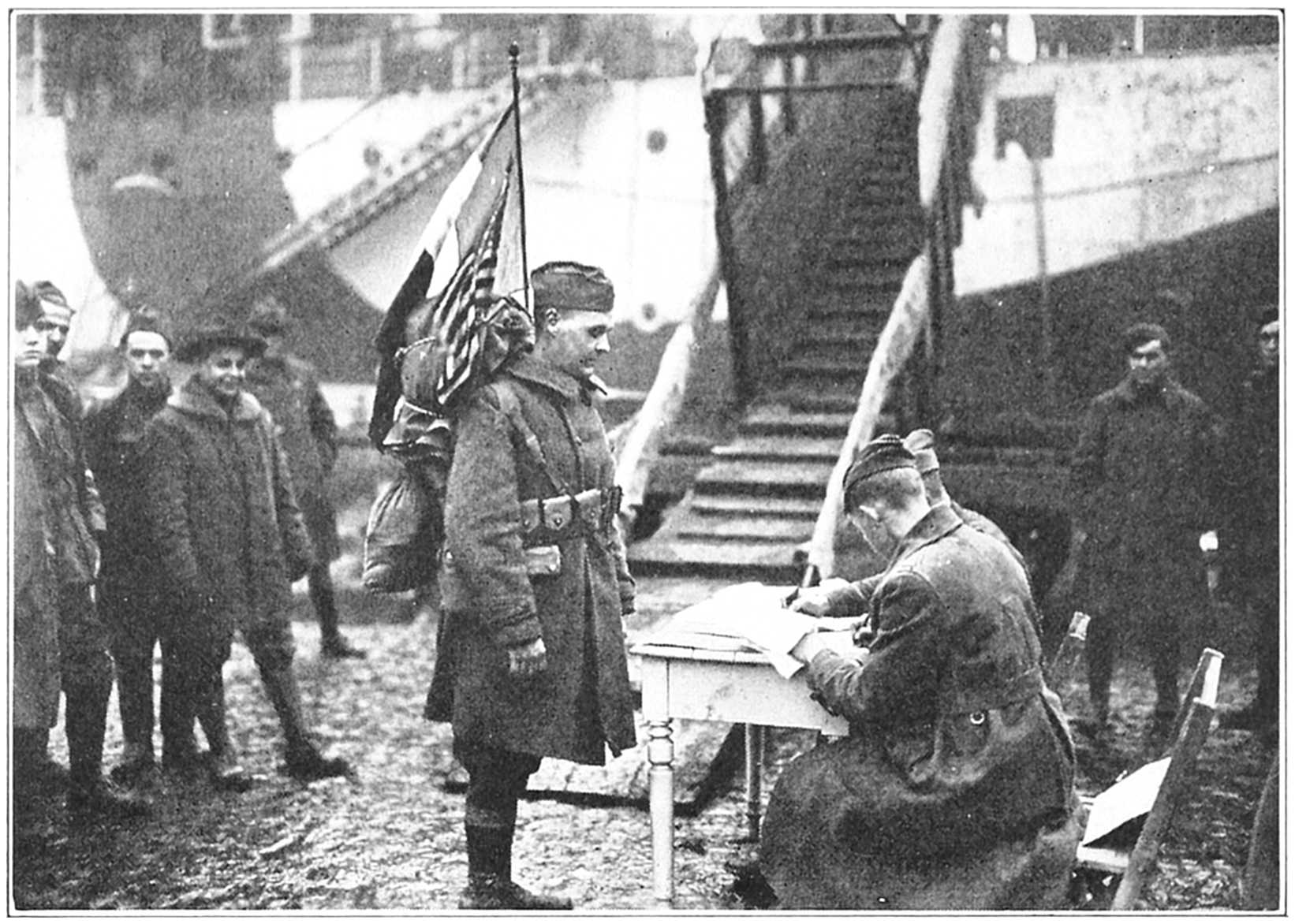
exchange on shore. The A. E. F. passed an order making it
compulsory for all soldiers to exchange their cash before sailing.
Notices to this effect were posted conspicuously in all
the embarkation camps. In the larger units the officers attended
to the matter, collecting the French money from their men,
receiving American money for it from the exchange officers,
and then distributing the familiar currency among the troops.
Individuals and men traveling in small units attended to their
own exchange. The quartermasters at Brest distributed as
much as $400,000 in American currency in a single day. Up
to July 1 Brest had paid out $60,000,000 in American money
to troops boarding ship there.
By the late spring of 1919 most of the combat divisions,
except those on active duty with the Army of Occupation, had
crossed the ocean or had started for home. By that time the
facilities at the base ports had been developed to a capacity
that enabled them to handle all further embarkations, and the
command of the expedition closed and abandoned the embarkation
center at Le Mans. All of the physical equipment there
went to the French Government under the terms of the general
sale consummated in August of that year. On June 30 Bordeaux
was closed as a port of embarkation. It had embarked
258,000 troops. St. Nazaire officially ceased to exist as a port
of embarkation on July 26, although thereafter it embarked
a few casuals. Approximately 500,000 American soldiers said
farewell to France at St. Nazaire.
A million and a quarter American expeditionary soldiers
departed from Brest for the United States. Brest was the last
of the ports to close. The embarkation of the millionth American
at Brest seemed almost as momentous as the arrival of the
millionth American in France a year earlier. In August General
Pershing and the historic First Division sailed from Brest,
and the last of the combat troops had gone. On October 1
American troops were stationed in France only at Brest and
in Paris, but Brest continued in operation as the port of embarkation
until the last American had departed. On October
1 there were a few thousand men still to sail, but the A. E. F.
no longer existed in France. Its headquarters had moved to
Washington. The great task was done.
CHAPTER III THE TRANSATLANTIC FERRY
On the first day of the armistice, before Washington
knew its exact terms or could form an estimate of
how great a force we should have to maintain in
France pending the conclusion of permanent peace, General
Frank T. Hines, the Chief of the Embarkation Service, which
had administered the great work of transporting the 2,000,000
men of the A. E. F. to France and had carried nearly half
of them across the ocean in its own ships, placed before the
Secretary of War a plan for the return of the troops.
It can be said that the outlook for the speedy repatriation
of the overseas soldiers was not bright. It had taken nearly
seventeen months to transport the expedition to Europe, and
more than half of the men had crossed in the ships of other
nations. England had been the chief contributor of tonnage to
our overseas movement prior to November 11. To build up on
the western front the numerical superiority that was the chief
factor in the victory, the British Empire combed the seas for
suitable passenger ships, cut her own civilian requirements to
the minimum, and devoted to our transport service every ton
of troop-carrying capacity she could procure. France and Italy
had each supplied a few vessels.
Photo by Signal Corps
KITCHENS AT LE MANS
Photo by Signal Corps
STREET IN LE MANS AREA NO. 5
With the immense fleet thus assembled the War Department
transported men across the Atlantic with an intense concentration
of effort never before known. First in the determination
that the Germans should not conquer, later in the
assurance that we ourselves should win, the Department
shipped the troops over with scarcely a thought of how they
were going to get back again. Future events were to be allowed
to take care of themselves.
Now such events had come to pass. England, faced with the
sudden necessity of returning her own colonial soldiers to their
native lands, and looking ahead, too, to the restoration of her
all-important foreign commerce, immediately withdrew her
tonnage from our service. France and Italy did likewise. The
magnificent “bridge of ships” on which the American Expedition
had crossed the Atlantic melted away, and 2,000,000
Americans found themselves partially marooned in a strange
land.
Photo by Signal Corps
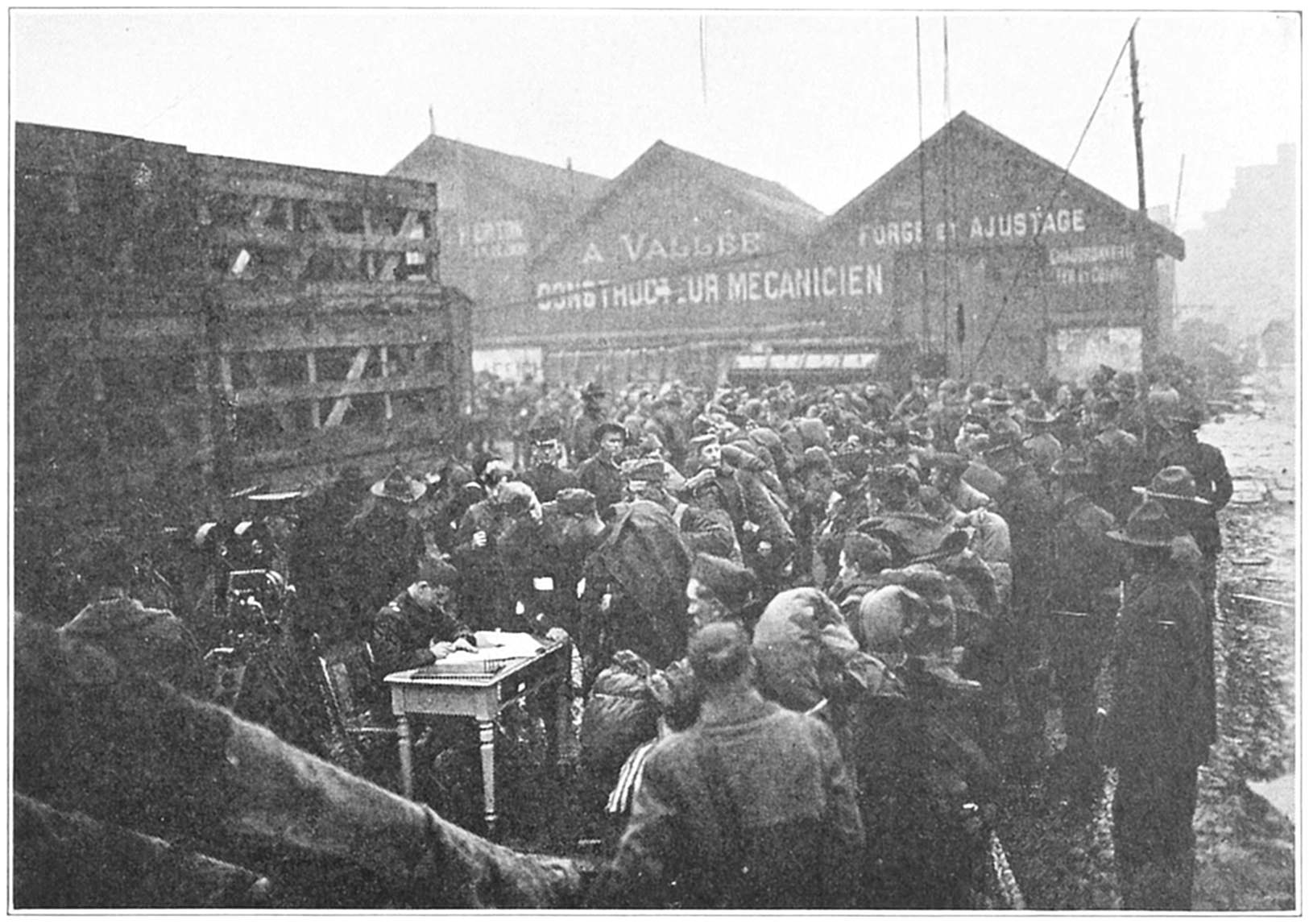
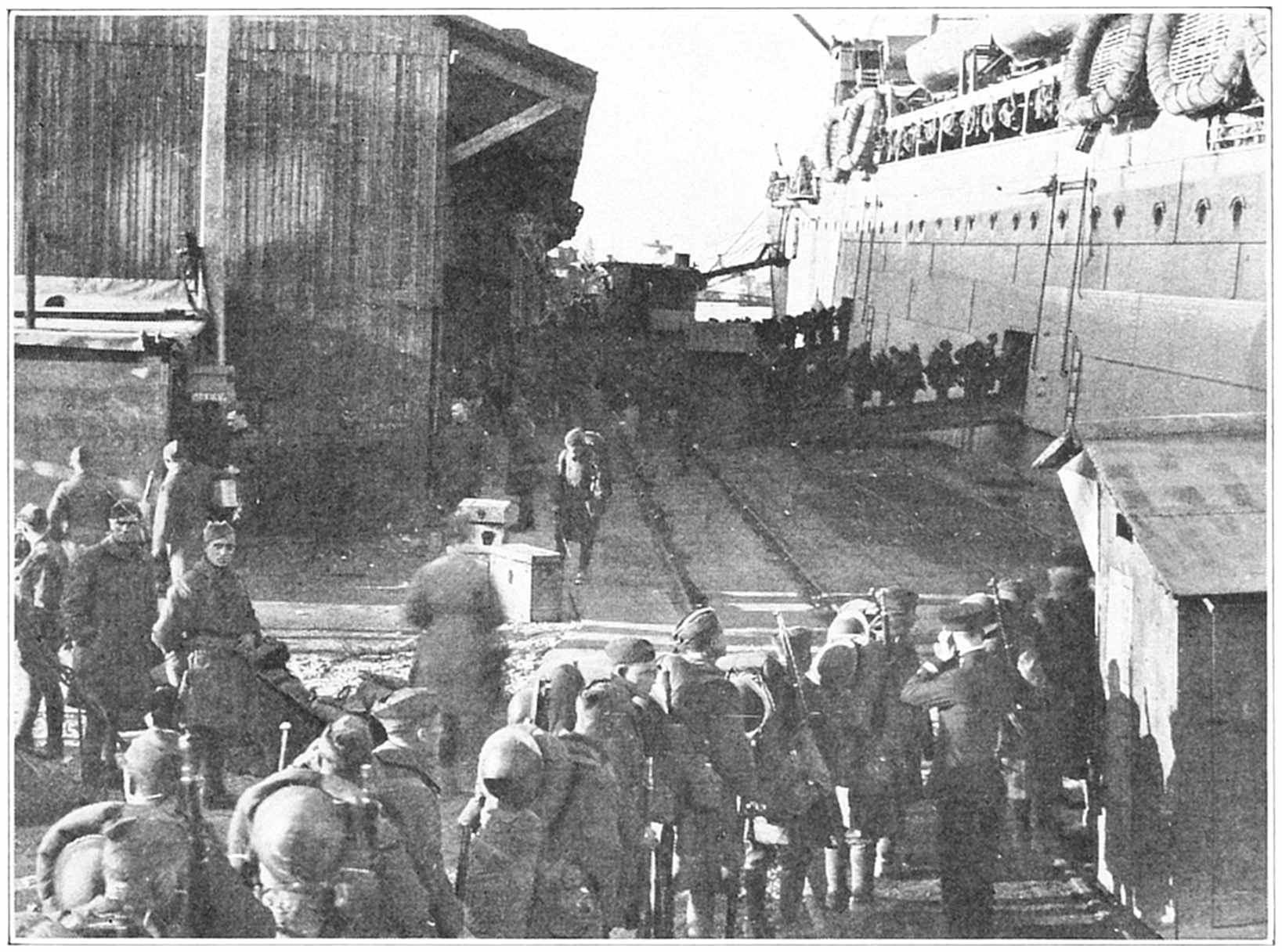
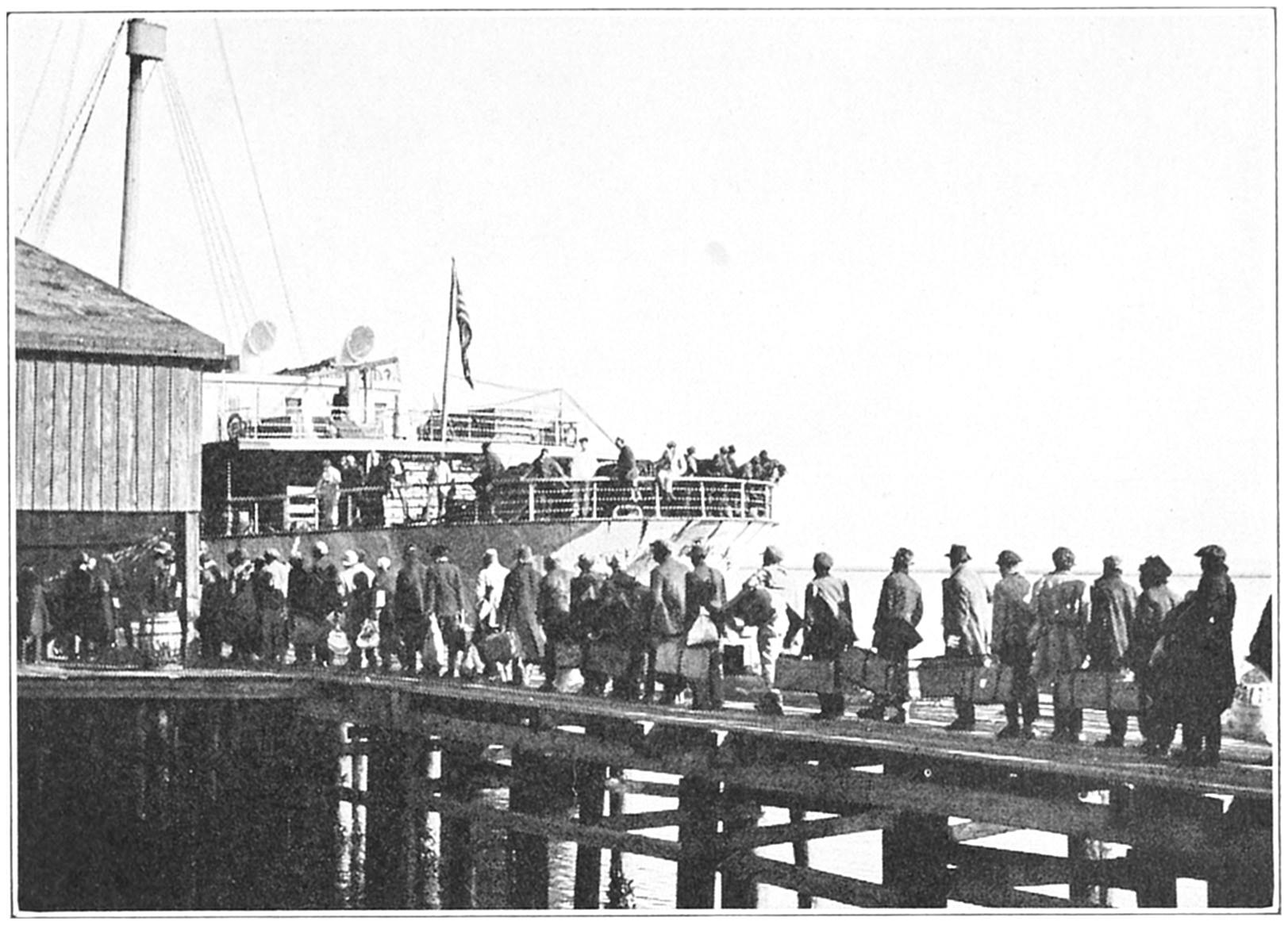
CASUALS ON TRANSPORT LEAVING BREST
Photo by Signal Corps
BOARDING TRANSPORT FROM LIGHTERS, BREST
Yet not completely marooned. The fleet of American-flag
troopships assembled during the war had on the day of the
armistice a one-trip capacity of 112,000 military passengers.
Operated in armed and guarded convoys, this shipping could
not quite average one round-trip transatlantic voyage a month;
its transporting capacity under war conditions was somewhere
in the neighborhood of 100,000 troops a month. The armistice
did away with the need of steaming in convoy and allowed
the transports to be operated by the much more efficient system
of individual sailings. Under such conditions the monthly
capacity of the American-flag fleet was about 150,000 men.
This capacity was to be discounted somewhat by the fact that
practically all of the vessels had reached a point of having to
be retired for a season of reconditioning and repair. It was
evident that, unless this fleet were aided, it would take it,
under the most favorable conditions, over a year to bring home
the A. E. F.; and it was likelier that, actually, the spring of
1920 would be at hand before the last of the overseas soldiers
set foot once more on their native soil. General Hines’s plan
provided for such aid. It discounted in advance the subsequent
fact that the Allies withdrew their passenger ships, and turned
to our own resources for increased transport capacity.
It appeared that we should have considerable tonnage available
for such use—tonnage released by the armistice from
other service. For one source, there was the Navy. Its battleships
and cruisers variously had been protecting the coast,
convoying transports, and holding themselves ready in the
combined Grand Fleet to meet the expected German naval
attack in force. These duties had come to an end. The Hines
plan contemplated the temporary conversion of a number of
war vessels into troop carriers by the installation of berths and
messing accommodations. Although all foreign tonnage was
to be withdrawn at once, the Transportation Service hoped to
secure some additional capacity by chartering passenger vessels
from foreign owners under new arrangements.
The most promising source of new capacity, however, lay
in the fleet of army cargo transports which, on the day of the
armistice, represented about 2,500,000 deadweight tonnage2
in the aggregate. The armistice immediately rendered a great
part of this tonnage no longer necessary to the Government in
the maintenance of a vast overseas supply service. The A. E. F.
was thereafter to exist on a garrison basis, requiring only the
ordinary garrison supplies of food and clothing. The great
cargoes of ordnance and aircraft, of raw steel and semi-finished
materials for the French and English munitions plants,
of horses and mules, of railway and engineering supplies—the
tonnage which had laden the cargo fleet in the past and had
heaped up at the Atlantic terminals—were to cross the ocean
no more. It was proposed to take the best of the cargo transports
and convert them immediately into troopships.
The War Department adopted the entire plan, and the first
act of the Transportation Service was to begin a survey of the
cargo fleet to determine what vessels were most suitable for
conversion. Only the larger and faster boats would serve, and
of course they had to be ships with holds adapted to the installation
of troop quarters. Specialized vessels, such as tankers
and ore carriers, would not do.
For the Transportation Service the armistice was but an
episode. It merely changed the character of its work and added
to the volume of it. The peak of the operations curve, so far as
troop transportation was concerned, was not reached until
eight months after the armistice had been in effect. The thousands
of troops in the Transportation Service yearned for discharge
and home as ardently as did the rest of the Army; yet
these men realized that it would be months before their work
could end. Meanwhile they would have to see hundreds of
thousands proceeding to demobilization camps as rapidly as
steamships and trains could carry them, with never a thought
of the transportation men who had made their early discharge
possible.
The resulting drop in morale was one difficulty which the
Transportation Service faced at the outset of its labors in
demobilization, but one which it met and solved successfully.
Another more concrete one had to do with the operation of
troopships. Early in the war the Army had turned over to the
Navy the task of operating most of the troopships at sea, principally
because the military authorities found themselves unable
to compete with the high wages of the munitions industries in
securing civilian crews for vessels. The Navy, with the uniform
it offered and its appeal to patriotism, had no such trouble; and
consequently it assumed the operation of the troop transports
and manned them with bluejackets. These young Americans
enlisted for danger and adventure and had no stomach for the
work of operating a collection of prosaic ferry-boats across the
now safe Atlantic. The Navy Department, seeing that it could
not hold them in service, notified the War Department to take
back its ships. This the Transportation Service did, hiring
civilian crews and placing them aboard the troop transports at
a rate that relieved the Navy of the work entirely by the summer
of 1919, except that the Navy continued to operate three
or four troopships with crews made up of men serving under
term enlistments.
While the Transportation Service was contemplating the
conversion of many of its cargo carriers into troopships and
the consequent use of the vessels for a number of months to
come, it was subjected to pressure from the owners of some of
these same ships, who demanded that the Government give
them up. Practically all of its cargo tonnage the Army held
under charter from private ownership, the charters running
during the emergency. After the armistice the vessel owners
naturally desired to get back into the race for foreign commerce.
It was to the interest of the United States that the military
tonnage be so employed at the earliest possible time, but
the early return of the overseas expedition was even more
important, and it received the priority.
Another obstacle in the way of carrying out the Service’s
demobilization plan swiftly and efficiently was the congested
condition of the American shipyards, practically all of which
were engaged to the limits of their capacities in new construction
for the Emergency Fleet Corporation. This congestion not
only hampered the project to convert the cargo vessels into
troop carriers, but it also strung out the necessary work of
overhauling the regular troop transports already in commission.
For over a year these vessels had been driven mercilessly
through fair weather and foul, with never a let-up for the
general repairing and reconditioning which every ship needs
at intervals. Large forces had been carried on all of them as
part of the crews to keep the vessels going somehow by making
emergency repairs whenever needed. Only conditions as they
existed before the armistice warranted such abuse. The armistice
occurred opportunely for most of these vessels, and particularly
for the ex-German liners. War or no war, they had
about reached the point where they had to be drydocked, regardless
of the effect upon the overseas movement. After the
armistice it would have been folly to set this tonnage at
another great task without first putting it in good condition.
To do the work the Transportation Service had at its disposal
only its own repair yards at New York and the drydock and
ship repair yard of the Newport News Shipbuilding Company.
Because of this limitation the shipping was tied up longer than
would normally have been necessary.
The survey conducted by the Transportation Service immediately
after the armistice designated fifty-eight cargo transports
for conversion. They were the largest vessels of the
cargo fleet, and conversion equipped them to carry, on the
average, 2,500 troops on each. Thus the project added 125,000
accommodations to the trip capacity of the troop-carrying fleet
as it existed on the day of the armistice—more than doubling
it in size. By December 13 the survey was complete and the
marine architects were drawing the conversion specifications
for the individual vessels; and on that day the Service awarded
the first of the contracts, that for converting the Buford (which
later carried the exported radicals to Russia and gained fame
as the “Soviet Ark”). The cost of remodeling the Buford was
$70,000, and the contractor completed the work in twenty-eight
days. By the end of the year twenty conversion contracts
had been placed. Others followed at intervals until April 29,
1919, when the last of them was signed. Before June 1 all
fifty-eight ships were in service as troopships.
In spite of adverse conditions in industry the ship contractors
made extraordinarily good time in remodeling these
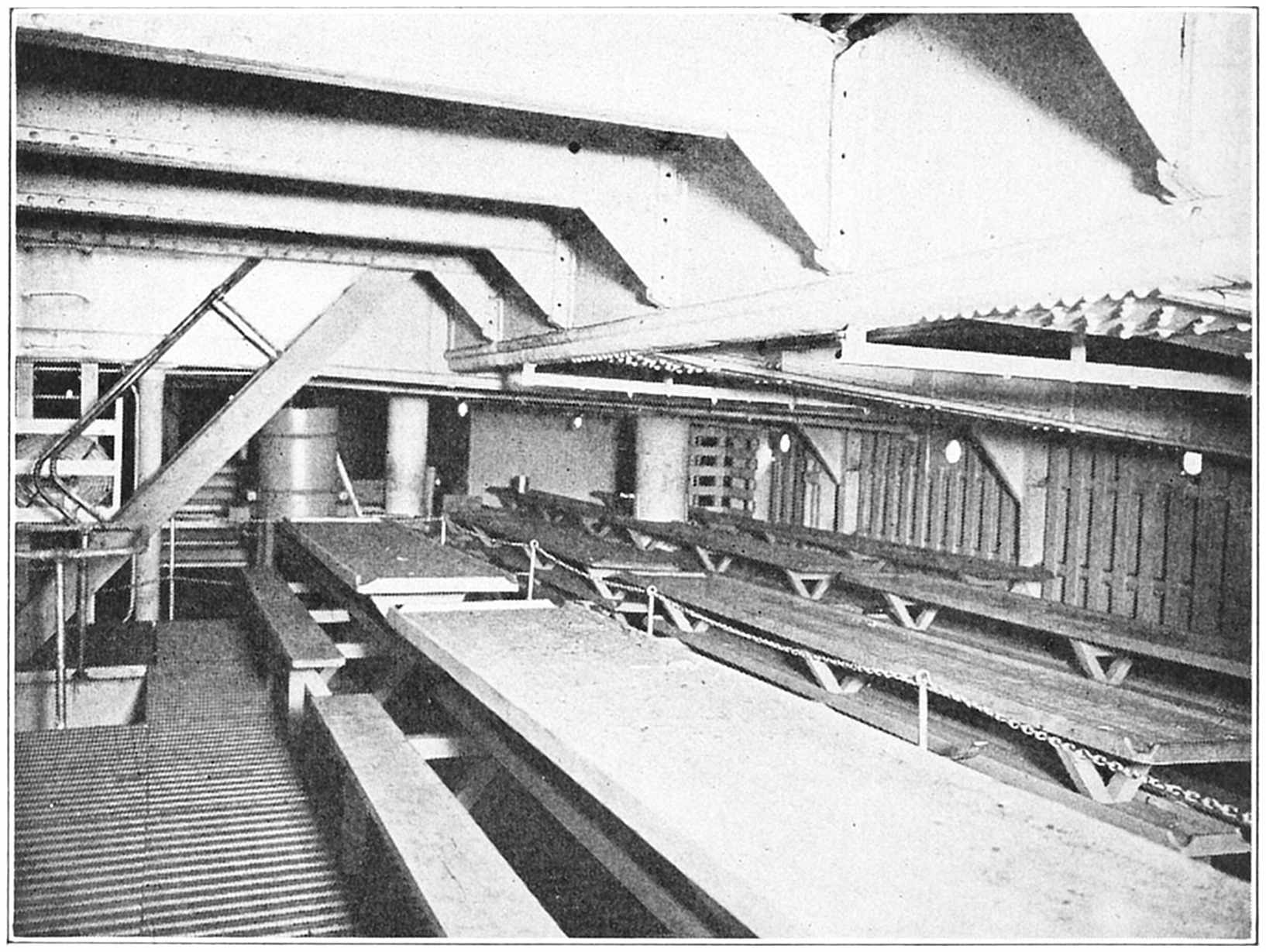
vessels. Such conversion was practically a rebuilding job. It
meant tearing out practically the entire interiors of the hulls
and rebuilding to provide troop quarters, galleys, mess rooms,
and sanitary facilities. The average time for completing this
work was forty-one days and the average cost was more than
$161,000. The total cost was about $9,000,000.
It will be seen that the project, because of its expense if on
no other account, was a bold step for the Transportation Service
to take. The cost of conversion per passenger accommodated
was about $72—more than the cost of a single steerage
passage across the Atlantic on a commercial liner. Looked at
in a broader way, however, the expenditure of the $9,000,000
was really an economy, for it enabled the Government to bring
home and discharge several hundred thousand soldiers weeks
and even months sooner than would otherwise have been
possible.
This single act of converting the cargo transports into troop
carriers did more than any other one thing to expedite the
return of the A. E. F.; yet the aggressiveness of the Transportation
Service did not end there. Under the terms of the
peace treaty Germany agreed to turn over to the Allies under
charter most of the remnant of her formerly great passenger-carrying
merchant fleet. For nearly five years these vessels
had swung at their moorings in German harbors and rivers.
At her pier in the river Elbe was the Imperator, the largest
ship in the world, exceeding in size her sister ship Vaterland,
which had become the U. S. Transport Leviathan. The Allied
Maritime Transport Council, which had allocated world tonnage
in the struggle against the submarine, decided to divide
this fresh German tonnage equally between Great Britain and
the United States, giving us all the larger vessels because we
possessed harbors that could accommodate them. The smaller
ships England was to use in repatriating her Australian troops.
General Hines, the chief of our Transportation Service,
took part in the proceedings in London, securing from the
Council ten large German vessels. At once a U. S. navy board,
headed by Admiral Benson, chief of the Bureau of Operations
during the great struggle, went to Germany to put the
allotted ships in condition for service. Repairs were quickly
made, and presently all ten ships, propelled by machinery
unfamiliar to American sailors, sailed out of the German harbors
and into the harbor at Brest, manned from bridges to
firing rooms by Yankee bluejackets and their officers.
From the London conference General Hines went to see
various shipping concerns in European Allied and neutral
countries and secured by charter thirty-three passenger ships
in all—thirteen from Italian owners, twelve from Spanish
and Dutch ownership, and eight from French interests.
Long before this event the Navy had taken fourteen of its
battleships and ten armored cruisers and by the installation
of berths and other accommodations had turned them into
passenger boats capable of carrying 28,600 troops at once.
These vessels added to the homeward movement more than a
division of troops a month.
Photo by Signal Corps
TROOPS ON BATTLESHIP READY FOR MESS
Photo by Signal Corps
WARSHIPS WITH TROOPS DOCKING AT HOBOKEN
Thus was the Atlantic rebridged after the armistice and
with a structure even broader and more capacious than the one
on which the expedition had crossed to France. On June 23,
1919, the troopship fleet reached its greatest expansion. On
that day it consisted of 174 vessels with trip accommodations
for 419,000 troops. It could have transported the entire
A. E. F. in five trips, with room to spare. It was greater in
capacity than the combined facilities at our disposal before the
armistice, yet practically all of it sailed under the Stars and
Stripes. In number of ships it was four times as large as the
troop fleet which the Army held in charter and ownership on
November 11. It outnumbered by forty vessels the combined
fleet both of American and of Allied troopships at our disposal
before the armistice. Yet on the day of the armistice we seemed
to have exhausted the possibilities of ocean shipping!
Photo by Signal Corps
EMBARKING FOR UNITED STATES
Photo by Signal Corps
MESS ROOM ON CONVERTED CARGO TRANSPORT OHIOAN
Always courageous and swift in action, the Transportation
Service was one of the first of the war department bureaus to
anticipate the armistice and the consequent demobilization. On
November 1, ten days ahead of the armistice, upon the confidential
intelligence that the German Government had ordered
its fleet out to give battle to the Grand Fleet of the Allies, and
further assured that the defeat of Germany on land was in
sight, the Transportation Service stopped the overseas movement
of all combat troops. Primarily this action was taken to
avoid a disaster to our troop transports, a disaster almost
bound to occur if in the expected forthcoming naval engagement
any of the German warships were by chance able to slip
through the Allied cordon and reach the Atlantic. After the
armistice the anticipatory act of the Transportation Service
proved to be of material benefit in demobilization, for it had
kept away from France at least four divisions of troops,
diminishing by so much the work of bringing back the expedition.
On the fifth day of the armistice General Pershing named
thirty divisions that were to conduct the advance of the Army
of Occupation to the Rhine and hold open the communications,
designated the supply troops to support the divisions,
and released the rest of the Expeditionary Forces for return
to the United States as soon as transportation facilities could
be provided. This order freed nearly half the expedition for
demobilization. A million men were thus ready to return home
at once.
While the authorities in France were preparing for the embarkation
to come, there was at hand a job in overseas transportation
to which the Transportation Service could turn with
such troopships as were available for immediate use. In England
on the day of the armistice there were stationed more than
70,000 American soldiers, most of them members of the air
service squadrons undergoing training in the British aviation
camps. Their embarkation through the large British seaports
offered no particular difficulty. On our own regular transports
and in such space as the Army could secure on British commercial
liners, this whole force was set down in the United States
within six weeks after the armistice began.
The embarkation of the A. E. F. in France may be said to
have started about the middle of December, simultaneously
with the appearance of the order establishing the three embarkation
ports and the embarkation area at Le Mans. From
then on week by week the embarkations of home-coming troops
steadily increased in number. In January the first of the converted
cargo transports joined the troopship fleet. A little later
some of the chartered foreign tonnage appeared in the service.
About that time, too, the Navy began adding its increment of
war vessels fitted out as troop carriers. In the late spring we
secured the German tonnage. In June, 1919, the American
troop sailings reached a maximum never before attained in
any military or civilian movement. In that month 368,300
American soldiers embarked on transports in France, and
343,600 landed on American soil. The movement exceeded by
60,000 men that of the greatest month in the transport of the
A. E. F. to France. In taking the forces to France we had been
assisted by the merchant marines of the principal Allies to the
limit of their combined capacities, but we brought back the
expedition single-handed.
This great record was made possible not only by the utilization
of all tonnage that could be adapted to such service, but
also by the operation of the shipping at its highest efficiency.
The drop in morale among the personnel of the Transportation
Service in the first disheartening weeks of the armistice
was soon offset by the spirit of the transportation men in early
1919 when they realized the great value of the service they
were rendering to their comrades of the expedition and to the
country at large. When it bore into their consciousness that
they were exceeding all expectations in delivering troops from
France to the United States, they fell to with a spirit unexcelled
even in the days when every soldier set down in France
was so much added insurance of a speedy end to the war. Ship
vied with ship to cut down steaming time, and the ports competed
with each other in dispatching vessels to sea.
Under such circumstances all records for shipping efficiency
fell. In 1918, with every energy bent upon the attainment of
maximum efficiency, the average turn-around, or round voyage
across the ocean and back, of the American troop transports
was something over 36 days. In 1919 during the return movement
it dropped to 32.6 days.
The oil-burning transport Great Northern, which was
bought outright by the War Department in the spring of 1918,
proved to be the fleetest thing that ever plied the Atlantic.
Leaving Hoboken on June 24, 1919, with a few passengers, a
few days later she landed them at Brest, took on 2,999 troops
by moonlight, and recrossed to Hoboken—all within twelve
days, five hours, and thirty minutes. No other vessel, military
or commercial, ever equaled this speed. The Great Northern
also established the record of eighteen transatlantic cycles at
the average rate of twenty-three days for each; and in the
whole war enterprise she transported more troops per ton of
capacity than did any other troopship. She was closely crowded
for honors, however, by her sister ship Northern Pacific.
The vessels alone could not write such records except
through the coöperation of the port organizations on both
sides of the Atlantic. Before the armistice the capacities of the
ports, especially of those in France, were a sharper limitation
upon the expansion of American power at the front than was
the shortage in ocean shipping. After the armistice the improvement
in shipping efficiency was attained largely by speeding
up the loading and unloading of transports in port. On
May 17 the transport Maui at Brest took aboard 3,612 troops
and sailed for America in three hours and thirty-five minutes
after arriving. These soldiers had to be carried out to her in
lighters, and they boarded her at the rate of sixty-five a minute.
On the same day the transport Cape May, one of the converted
cargo vessels, arrived at Bordeaux and sailed on the
same tide with a load of 1,928 troops, having been dispatched
in one hour and nineteen minutes. These were extreme instances,
but they were indicative of the efficiency of the port
machinery.
At first the Transportation Service would fix no schedule
for the return of the expedition, except the general one that it
hoped to bring back the last man before January 1, 1920. By
the beginning of spring, 1919, the situation looked so much
better that the Service brought out a schedule showing the
probable troop-carrying capacity available in the French ports
by months, and estimating this capacity for several months
ahead. The schedule promised a gradual increase until the
shipping reached a goal of 250,000 embarkations a month. On
the basis of this schedule the command of the A. E. F. fixed
priorities for embarkation and published both the schedule and
priority dates, to the excitement of the men of the expedition,
most of whom were then still in France. To be sure, the authorities
promised nothing definitely and informed the soldiers that
the schedule would be met “if practicable”; yet the men of the
A. E. F. banked on the Transportation Service to fulfill its
predictions.
The goal of 250,000 embarkations a month was the extreme
maximum which the Service thought it might attain if everything
went right. Yet three months later, when embarkations
approached 400,000, the goal had been passed by 50 per cent.
The actual performance brought 300,000 overseas soldiers
home two months ahead of schedule, and 300,000 others beat
the schedule by one month. Here was the equivalent of
900,000 men returned and discharged from service one month
earlier than the nation had any reason to expect. The cost of
maintaining such a force in arms for one month is approximately
$66,000,000, a saving which must be set down to the
credit of the administration that made it possible.
The days spent at sea by the returning troops were not time
wasted. Although the embarkation officers in France did their
best to send out with each soldier a complete record of his
service, in the press of the work it was not always possible to
attain this ideal. It was unjust to hold back a soldier from embarkation
because his records were incomplete; yet before he
could secure his discharge his papers had to be in perfect shape.
The Transportation Service, through its debarkation camps in
the United States, took it upon itself to perfect the individual
records of the soldiers, and it did most of this work on the
ships at sea. In special schools at Hoboken and Newport News
the Service trained a force of traveling personnel adjutants for
assignment to the transports. As soon as a troopship started
out from France the personnel adjutant aboard opened an
office, and from that moment until the ship docked he was busy
from morning to night smoothing up the service records. He
also compiled the papers which the debarkation camps would
need and instructed the troops in the procedure to be followed
after landing.
Unexpectedly, the Transportation Service found itself
obliged to bring home in first-class accommodations many more
persons than it had carried to Europe in that style. Thousands
of officers had crossed before the armistice in commercial liners,
and so had crowds of red cross and other welfare workers.
Numerous soldiers had acquired wives in Europe. Military
regulation gave these women and their husbands accompanying
them the right to occupy first-class quarters on transports.
After the armistice several congressional committees and
hundreds of experts employed by the Government in the peace
negotiations traveled first-class on the transports in both directions.
The result was that on July 1, 1919, at the ports in
France awaiting first-class transportation to America there
were 32,000 persons over and above the capacity of such
accommodations in sight for several months to come. To have
brought them all back in the state to which they were entitled
would have made necessary the full operation of the entire
transport fleet for three months beyond the time when the
return movement actually ceased. To settle the matter the
Service adopted the expedient of bringing home several thousand
junior officers quartered in the troop spaces of certain of
the larger and faster vessels. Although some outcry arose over
this treatment, the majority of the officers were too glad to get
home at all to be critical of the mode of their transportation.
Not a man of the 2,000,000 passengers lost his life as the
result of marine disaster after the armistice. The worst accident
occurred shortly after midnight on January 1, 1919,
when, during a blinding rainstorm, the great transport Northern
Pacific, with a load of 2,500 troops, two-thirds of whom
were sick and wounded men, went aground on the Long Island
shore near the entrance to New York harbor. The sea was
rough, the wind making, and as the ship turned port side to the
beach and worked up on the sand, pounding heavily, rescue
for the time was impossible. The weather was cold, the ship’s
machinery was out of commission, and she was lightless and
unheated. It took three days to rescue the passengers; yet, despite
the severity of the experience, no person on board suffered
seriously from it. The pounding had so damaged the
ship’s hull that many of the plates had to be renewed. A more
serious injury was a broken stern-post. In former marine practice
such an injury meant the casting of a new post in steel.
The Navy, as in the instance of the broken machinery in the
interned German ships, resorted to the electric welding torch
for repairing the broken stern-post, saving several months in
time and perhaps $50,000 in money.
Photo by Signal Corps
SAILING DAY AT ST. NAZAIRE
Photo by Signal Corps
TRANSPORT MAUI LOADING AT ST. NAZAIRE
The A. E. F. sold most of its property in Europe. The cargo
transports brought home about 850,000 tons of military
freight—a small fraction of the property held by the expedition
at the time of the armistice. The goods were sold abroad at
a loss, the average recovery being considerably under that received
from the sale of similar goods in the United States. Yet
it was good policy to do what was done. Europe needed the
supplies and we needed the ship-space for other purposes. If
the materials had been returned to the United States for sale,
out of the proceeds would have had to be deducted the transportation
cost; and the Government was little, if anything,
out of pocket by the transaction.
Photo by Signal Corps
SOUVENIRS OF HIS SERVICE
Photo by Signal Corps
EMBARKING AT ST. NAZAIRE
Among the materials freighted home were 100,000 tons of
road-making machinery. This the War Department turned
over to the Department of Agriculture to be used in the construction
of highways in the United States. The cargo transports
also brought back large ordnance stores, principally
artillery, much of it of British and French manufacture. The
shipments included a large number of captured German
cannon, brought back for distribution among American communities
as war trophies.
While the returning troop movement was at its height the
Transportation Service was winding up its war business and
returning to a permanent peace footing. This program consisted
principally of disposing of its vessels and its shore
establishments. On November 11, 1918, the Service was operating
580 vessels with a total deadweight of nearly 4,000,000
tons. At the end of 1919 the army fleet consisted of only the
few transports actually owned by the Government through
purchase, construction, or seizure from Germany or Austria.
Most of its vessels the Army held under charter from private
owners. The best interests of the United States required
the return of these ships to their ownership just as soon as the
Army could do without them. The cargo boats were first to go.
In February, 1919, the Transportation Service began turning
them back—redelivering them, it was called—at the rate
of three ships a day. In July, when the peak of the overseas
troop movement had passed, the Service began disposing of its
chartered troopships (including the converted cargo transports),
redelivering the last of them in December.
The Government faced tremendous costs in these transactions.
The charters provided that the Army must restore the
shipping to its owners in its original condition, ordinary wear
and tear excepted. Nearly every ship had been remodeled to a
greater or less extent to make it more serviceable to the Army.
All the domestic shipyards and repair yards were glutted with
work, and it was evident that it would be a long time before
the Transportation Service could recondition the vessels.
Meanwhile the Service would have to maintain all of this idle
shipping at a heavy continuing expense.
Instead of reconditioning the ships, therefore, the Transportation
Service adopted the policy of returning vessels as
they were, at the same time compensating the owners with
lump-sum settlements for damage done by war service. In
most instances the owners were glad enough to accept such an
arrangement. To protect the Government in the settlements,
joint boards of vessel survey, each consisting of an army, a
navy, and a United States shipping board official, were set
up at all the ports where ships were to be redelivered. Expert
marine surveyors under their direction made detailed examinations
of all the ships. With these surveys in hand, and with
the complete history of each ship and of the service it had
undergone while in the War Department’s possession, the survey
boards were able to arrive at a close estimate of the
amount of the Government’s financial liability in each case.
The owners also employed their expert surveyors, and out of
the two examinations grew negotiations which arrived at
compromise settlements.
In December, 1918, the Service redelivered ships of approximately
189,000 deadweight tons. In January the redelivered
ships aggregated 461,000 deadweight tons; in February,
470,000; and in March occurred the heaviest redelivery,
amounting to approximately 532,000 deadweight tons. Redeliveries
crossed the two-million-deadweight-ton mark shortly
after the middle of April. By June most of the cargo transports
had been restored to their owners, except those which had been
converted into troop carriers. On June 15 the Army began dispensing
with the use of battleships and cruisers, the last of
the twenty-four being withdrawn on August 1. The break-up
of the troop fleet began in earnest on August 1, and by the
first anniversary of the armistice most of the chartered troopships
had gone back to commercial work.
Many questions of admiralty law arose in connection with
the restoration of the transports to the merchant marine. The
legal branch of the Transportation Service on the day of the
armistice consisted of but two lawyers. By that time a large
number of maritime claims awaiting adjudication had accumulated,
and it was recognized that such claims would multiply
during the progress of negotiations leading to the redelivery of
the vessels. With much difficulty the Service built up a force
of twenty admiralty lawyers. In fact, the War Department,
after the armistice, was so badly in need of lawyers for use in
the liquidation of war business, that for several months it was
forced to maintain the rule that no man of legal training
should be discharged from the military service.
In breaking up the fleet of troop transports the Transportation
Service found opportunity to create for the War Department
a large permanent reserve of troopships without expense
to the Government for their maintenance. The German and
Austrian ships seized by the Government at the outset of the
war became in large part the property of the Army. Most of
these vessels were admirably adapted to war service, but they
were too large and too costly in operation to justify their
continuance in the transport service of the peace-time establishment.
Consequently the Transportation Service turned
thirteen of them over to the Shipping Board under an agreement
providing for their charter to private operators, subject
to their recall by the Army in the event of another war. These
ships can accommodate approximately 50,000 troops at once.
All of the special military fittings have been classified and
stored away ready for use again, if it ever becomes necessary.
When the war traffic ended, the Transportation Service
found itself in possession of enormous port facilities. Prior to
the armistice the Government had seized or leased over seventy
steamship piers at various Atlantic and Gulf ports; but even
such facilities being entirely inadequate to the vast amount of
shipping contemplated, the Government began the construction
of seven great port bases located at Boston, Brooklyn,
Port Newark, Philadelphia, Norfolk, Charleston, and New
Orleans. Not one of these projects was complete on November
11. One of the early demobilization questions to be settled was
what to do with these installations. Should the Government
abandon them and set down as loss the millions spent, or go
ahead with their erection and perhaps make the whole enterprise
profitable by leasing the facilities to American commerce?
The latter course was chosen. The contractors completed
the construction at a total cost of $143,000,000. As the
new piers became ready for use the Transportation Service
turned back its leased piers to their owners. Then, as the military
traffic dwindled, the space in the base terminals was
leased to private ship operators. These terminals, among the
largest and finest in the United States, are now rendering an
important service to our foreign trade, but on terms ensuring
their instant availability to the Government in the event of a
future emergency.3
CHAPTER IV EBB TIDE
Before the American Expeditionary Forces could be
disbanded in this country it was necessary for the
training camps, most of which were to become demobilization
centers after the armistice, to be evacuated by the
home forces occupying them. The fluvial system leading into
that sea of humanity which we knew as the A. E. F.—main
river crossing the ocean, chief tributaries leading up to the
ports in this country, beyond them their branch creeks and
brooks, and the rills at the sources—was running bank-full on
the day of the armistice. Demobilization, which inverted many
of the processes of war and changed familiar names into their
antonyms, abruptly reversed the direction of troop-flow, as if
some tremendous power had uplifted the reservoir and the
mouth of the main stream in France above the ultimate sources
in this country. Before the expeditionary sea could drain out,
the home channels of troop supply had to discharge their
contents into the nimbus of civilian life.
The process of dissolution began within the hour in which
the news of peace came to Washington. It happened that
November 11 was the first of five days during which the Army
planned to absorb 250,000 soldiers inducted into service under
the terms of the Selective Service Act. Although it was evident
that an armistice was at hand, the Railroad Administration
went ahead with preparations for the transportation of these
men to the training camps, and even dispatched the draft
trains on the morning of November 11 to pick up the selectives,
although the morning newspapers had announced that
the armistice was indisputably to begin at eleven o’clock in
France. The only preparation looking toward demobilization
had been to set up telephone and telegraph circuits over which
the officials in Washington could stop and turn back the troop
trains in a minimum of time. Immediately after receiving General
Pershing’s message announcing the start of the armistice,
the Secretary of War notified the Troop-Movement Section
of the Railroad Administration to stop the draft trains. This
was done within an hour, although the trains were then in
operation in every section of the United States. Some thousands
of young men who had taken the oath of allegiance that
morning, and who at the approach of noon were on troop
trains proceeding to military camps, found themselves back at
home, civilians once more, before the embers of the celebrating
bonfires had died out that night.
Hard on their heels came the hundreds of thousands of soldiers
who made up the combat divisions in training in the
United States. These were the men last to don the uniform—men
who were only partially trained, and who could be of no
service to the War Department in the activities of demobilization.
Their disbandment was not a difficult undertaking. They
had been in the service so short a time that there were no complications
of back pay and incomplete records to hinder their
discharge. Moreover, they were geographically homogeneous—i.e.,
their homes were generally in the regions surrounding the
training camps—and therefore their demobilization brought
about no problem in transportation. As a rule they were paid
off and discharged at their training camps and allowed to make
their way to their homes.
Quite apart from the divisional troops, there was another
great body of soldiers in the United States on the day of the
armistice. These were men undergoing training in special
camps, such as those of the Air Service and the Quartermaster
Corps, and also the troops engaged in maintaining the great
war establishment in the United States. The demobilization
of these men was more difficult. It was for them in the first
place that the War Department set up the demobilization
system which was to be seen in the perfection of operation
later on when the A. E. F. began reaching the United States
en masse.
Soon after the armistice the War Department established
by order a system of thirty-three demobilization camps, or
centers, as they were called. In large part these centers were
former training camps. Practically all the National Army
cantonments and some of the National Guard camps were so
used. Other military posts and stations were added so as to
distribute the demobilization centers evenly throughout the
country according to the distribution of population. The War
Department’s policy was to discharge soldiers in as close
proximity as possible to their former places of residence.
The special troops on duty in this country lacked homogeneity
in the regional origin of the members of the various
units. Many of the organizations were composed entirely of
men chosen because of special aptitude for special service.
Single units were therefore made up of men from widely
separated parts of the United States. When the time came to
disperse these troops it was found impossible to send the units
intact to demobilization centers and there to disband them,
except at a great waste of transportation. Throughout the
whole activity the War Department husbanded transportation.
Before the armistice it had been the general policy to
move men always to the eastward, since east was forward.
The armistice inverted the policy; and in order to avoid expensive
duplication of travel, the Army in assembling its demobilization
units moved its men always essentially westward
until at length they reached the camps where they were to be
discharged.
Throughout the winter of 1918–1919 the disintegration of
the home forces proceeded rapidly, as the great subordinate
services of the Army tapered off their war activities and released
their men. One or two of the services, such as the Medical
Department and the Motor Transport Corps, held on to
their troops for a few months in order to carry out necessary
duties connected with the disbanding of the Army and the
restoration of the military establishment to a peace footing;
but the others, such as the Air Service, the Signal Corps, the
Corps of Engineers, and the Quartermaster Corps, reduced
strength as rapidly as the country could absorb the men. These
men lost their unit identity as they proceeded toward the demobilization
centers and finally found themselves once more
grouped with their neighbors, regardless of what service any
of them had performed.
By the end of February, 1919, more than 1,600,000 officers
and enlisted men had been discharged from the Army. At that
time only about 300,000 of the expeditionary troops had
reached the United States. The great body of the A. E. F. was
still to come, but the demobilization centers in the United
States were empty and ready for it.
The policy of discharging troops at centers adjacent to their
homes rested upon a sound foundation. As the country faced
the demobilization of 4,000,000 troops, young men most of
whom had been held for many months under the rigid restraints
of army discipline, there was a widespread apprehension
that the discharged soldiers might congregate in the larger
cities and create profound economic disturbances. Upon the
War Department there was no compulsion of law to transport
the troops to their own neighborhoods before discharging them.
Obviously the easy and convenient thing was to discharge
them wherever they happened to be—at the thousand and one
camps in the United States, or at the Atlantic ports upon their
arrival from France—discharge them there, pay them off, and
so farewell to them. Such, in fact, had been army procedure before
the World War. The Army discharged its men at the posts
where they were serving and paid to them the travel allowances
granted by law. Whether they used their money to pay
for actual transportation home was no concern of the Army’s.
They were all free, and most of them white and twenty-one.
As long as discharges were relatively few this procedure had
no effect upon the economic life of the nation. But what
would have been the result if the War Department had continued
this practice when disbanding the 4,000,000 troops in
uniform on the day of the armistice? Most of them would
have been turned loose in the vicinity of the large cities of the
United States—more than 1,000,000 of them at New York
alone. Their pockets would have been crammed with money.
Congress by special enactment raised the travel allowance for
discharged soldiers to five cents a mile, payable for the distance
between the place of discharge and the soldier’s home,
whether the entire journey could be accomplished by railroad
or not. Congress also granted a bonus of $60 to every soldier—payable
also at discharge. Thousands of soldiers, when they
came up for discharge, were entitled to back pay. Thus every
man received a considerable sum of money with his discharge
certificate, and for the overseas soldier this sum probably
averaged more than $100. The streets of our cities would have
been thronged with such men during the first six months of
1919. After their hardships the temptation to have a fling at
metropolitan entertainments would have been well-nigh irresistible.
They would have been fair game for gamblers and
sharp practitioners. The rare individual might have bought
his ticket and gone soberly home, but the majority could
scarcely have been expected to show such restraint. In a little
while, pockets that had jingled with money would have been
empty, the streets would have been crowded with stranded
soldiers, and the burdened municipalities would have had to
face a severe civic problem.
This was what the War Department sought to avoid, and
what it did avoid, by its demobilization policy. There was
also another consideration—that of financial economy. The
War Department could carry troops at a cost of much less
than five cents a mile per capita. Therefore, by distributing
the Army about the country and discharging every man within
his own native section the War Department was able to save
millions of dollars which otherwise would have been paid out
in mileage allowances.
The good offices of the Government to the demobilized soldier
did not end when the War Department had paid him his
money and discharged him. As a special inducement to demobilized
soldiers not to linger in the communities near the
demobilization centers, the United States Railroad Administration
made a special travel rate to them of two cents a mile.
In order to secure the cut rate, however, the soldier had to buy
his ticket within twenty-four hours after receiving his discharge.
Thus it was to his direct financial advantage to go
home at once. Nor did the Railroad Administration permit
him to overlook the opportunity. All the principal demobilization
centers had their own railway terminals, from which special
trains for discharged soldiers departed at intervals. The
Railroad Administration set up railway ticket booths in the
offices of the camp finance officers, so that each newly discharged
man, as he turned away from the disbursing window
with his money in his hand, faced the railway ticket booth.
At his elbow were Red Cross, Y. M. C. A., and other camp
welfare workers to urge him to buy his railway ticket at once
and leave on the first train. The path of least resistance led
straight home, and he was indeed a headstrong individual who
did not follow it. As a result of the whole system the demobilization
of the Army went through without any trouble at all.
The policy had an effect upon the mode of troop travel that
was to be observed even beyond the ports of embarkation in
France. The original plan had been to bring all the expeditionary
divisions back to the camps in which they had been
organized and trained, and there to disband them. There
seemed to be nothing in the way of so simple a solution of the
problem. In organizing the divisions in the first place, it had
been the policy, to which there were but few exceptions, to
create divisions of men originating in the territory contiguous
to each training camp. As the divisions started for France they
possessed definite territorial identity; and the divisional names
which they commonly adopted for themselves—the New England
Division, the Sunset Division, the Buckeye Division, the
Keystone Division, and so on—usually indicated the geographical
origin of the men of the organizations. It was thought that,
by transporting the overseas divisions back to their original
training camps in this country, each would be placed in the
demobilization center most convenient to the respective homes
of its soldiers.
The attempt to put this policy into practice quickly showed
the fallacy of it. Immediately it was discovered that the composition
of the divisions had radically changed during the service
in France. Men had died in battle, fallen sick, been transferred
to other organizations, and their places had been taken
by replacement troops shipped from the United States. Whole
divisions had been rearranged. In the autumn of 1918 the
expeditionary divisions were no longer representative of separate
districts of the United States; each was in effect a cross
section of the whole of America.
One of the first organizations to come back from France was
a minor unit, a company, which had received its training at
Camp Cody, Texas. The unit was sent to Camp Cody for
demobilization and discharge. There it was discovered that,
of every ten men who had joined the unit when it was in training,
only four remained. The other six were newcomers, and
to reach their homes they had to travel to points scattered
from Oregon to the Atlantic coast.
Had this system been followed throughout the disbanding
of the expeditionary units, it is evident that it would have
cost the Government heavily in travel allowances paid to discharged
soldiers, without saying anything about the tremendous
traffic burden upon the railroads of the country. There
was nothing to do but to break up the whole organization of
the A. E. F. before sending it to the demobilization centers,
and to assemble the men once more in units that possessed
geographical identity.
The A. E. F. received instructions to attempt this break-up
in France—at least to begin it there. It was found impossible
to regroup the services of supply troops to any extent, because
the embarkation ports in France, at which the supply troops
were prepared for embarkation, were neither organized nor
equipped to handle such a difficult work. More could be done
with the divisional troops at Le Mans. Thereafter, whenever
a division came into the area of Le Mans those soldiers who
had joined the division after its training had been complete,
and who did not live in the district centering in the original
training camp in America, were detached and assembled with
neighbors of theirs into territorial demobilization units, which
became known as overseas casual companies. When the division
itself went on from Le Mans to the ports it consisted only
of the remnant of charter members who had been with it from
the outset.
The prescribed size of an overseas casual company was two
officers and 150 men, but it was seldom convenient to send
forth companies uniformly organized. Men were not held
waiting in France until casual companies could be built up to
the prescribed size. One company might consist of fifty soldiers
and the next 250, according to circumstances in the
embarkation camp.
The principal ports of embarkation in the United States
before the armistice had been New York (Hoboken), Newport
News, and Boston. To these, in the system for receiving the
overseas troops, was added Charleston, South Carolina.
Charleston was opened as a port of debarkation principally
for soldiers who were proceeding to the southern demobilization
centers. The entire fleet of troop transports was divided
proportionately among these ports, the greatest number operating
between New York and the ports in France and the next
greatest between Newport News and France. In the main each
port kept its own fleet, but sometimes it became necessary to
divert a vessel at sea from her usual course.
Only in a general way did the embarkation authorities in
France pay attention to the destinations of the ships. After
each loaded transport left a French port the embarkation officials
there cabled to the Transportation Service in the United
States a full description of the troops on board. If, for example,
a vessel bound for Boston were carrying a preponderant
number of soldiers from the South, the Transportation Service
used the wireless to divert the transport to Newport News or
Charleston.
Photo by Signal Corps
CASUALS WAITING TO BOARD SHIP AT ST. NAZAIRE
Photo by Signal Corps
BOARDING EDWARD LUCKENBACH, CONVERTED CARGO
TRANSPORT
The passenger lists cabled to the United States often contained
the first information received in this country about the
departure of units from France. There was no news more
eagerly awaited by the people. Cities and states had often
made elaborate preparations for the reception of their overseas
soldiers. A number of states and cities sent representatives to
the ports to welcome the troops home at the gates of America.
The harbor boat of the New York Mayor’s Committee of
Welcome was busy almost every day taking visiting delegations
down the bay to meet the incoming transports. In the
times when from 150,000 to 200,000 soldiers were on the
ocean at once in transports bound for the United States, keeping
track of each unit became difficult. The Transportation
Service set up a news and information bureau through which
the press and the public kept in touch with the movements of
organizations crossing from France.
Photo by Signal Corps
EMBARKATION AT BORDEAUX
Photo by Signal Corps
LEFT BEHIND
Upon the debarkation camps at the Atlantic ports fell the
chief work of splitting up the returning expedition into demobilization
units. There were five major debarkation camps—Merritt,
Mills, and Upton at New York, and Stuart and Hill
at Newport News—besides numerous smaller centers at both
ports. At the height of the return movement these camps were
insufficient to accommodate the incoming thousands, and the
Transportation Service used former training camps as debarkation
camps, in both the Hoboken and Chesapeake districts.
As long as Boston and Charleston acted as ports of debarkation
they, too, made use of neighboring training camps.
Of all of the debarkation camps, Camp Merritt was the
largest. In it were to be observed some of the most interesting
processes of troop demobilization. It was the principal
camp both for reception of overseas casual companies and for
the breaking-up of organized units and the formation of casual
detachments for distribution among the thirty-three demobilization
centers.
During demobilization Camp Merritt was like a great terminal
post office. The mail consisted of bulk consignments of soldier
members of the disintegrating American Expeditionary
Forces. It was the task of the post office to sort the mail for
thirty-three principal destinations. The individual soldiers
were thrown into receptacles called Hoboken Casual Companies,
each, when filled up, consisting of two officers and 150
men, and each addressed to one or another of the demobilization
centers. Each bore an identifying number, and the numbers
ran consecutively, reaching well into four figures before
the work came to an end.
Special trains frequently left the two railroad stations which
served Camp Merritt. Sometimes an entire train would be
loaded with casual companies bound for the same center. Other
trains were made up of special cars destined for different
terminals. In the camp new casual companies in skeletal form
were constantly being organized. Those scheduled to travel to
the less populous sections of the country might be several days
in filling up to standard strength. Others reached full size in
a few hours. As soon as a casual company was complete, it was
dispatched immediately to its proper demobilization camp. For
several months in the spring and summer of 1919 the average
interval between the time a skeleton company was formed and
the time it was dispatched from camp was less than twenty-four
hours.
Before the armistice, troops which had been inspected,
equipped for the overseas voyage, and otherwise prepared at
Camp Merritt, marched east from the camp over three miles
of macadamized highway and then down the old Cornwallis
trail descending the Palisades, until they reached the little
landing on the Hudson River known as Alpine, several miles
north of the metropolitan limits of New York. There they
boarded ferry-boats and rode on them directly to the transport
piers in the North River. After the armistice, soldiers debarking
at the piers boarded ferry-boats at the pier ends, rode up
the river to Alpine, climbed the Palisades, and marched to
Camp Merritt. Those bound for Camp Mills or Camp Upton
took ferry to the Long Island Railroad terminal at Long Island
City on the East River. Those ticketed for Camp Dix boarded
trains which had been run into the Hoboken yard on the spur
track constructed there by the Government after it seized the
pier property from Germany.
At the debarkation camps the Army applied its final precautions
against the importation of European diseases and
insect pests. There was a thorough disinfection of all clothing
and equipment, and each principal camp maintained a delousing
plant. However clean the soldiers might have been when
they embarked in France, it was always possible for a few of
them to become infested on the transports. So far as is known,
not a cootie got through the barrage of steam, superheated air,
soap, and hot water laid down by the Army at both ends of
the transatlantic ferry route.
Before the return of the A. E. F. was well under way an
important change took place in the organization of the official
military travel bureau. Before the armistice, military transportation
had been in the hands of two independent war department
agencies. The Inland Traffic Service had charge of
the movements of men and supplies by rail within the United
States and up to the ports of embarkation. There the Embarkation
Service received both, loaded them on the ships, and delivered
them to the ports in France. Beyond those points the
Quartermaster Service of the A. E. F. was in charge of military
traffic. Both the Inland Traffic Service and the Embarkation
Service were branches of the General Staff Division of
Purchase, Storage, and Traffic.
In December, 1918, the Inland Traffic Service and the Embarkation
Service joined to form a new branch called the
Transportation Service, and for the first time the Army had a
single organization in charge of all military travel, both freight
and passenger, on this side of the piers in Europe. General
Hines of the Embarkation Service became chief of the Transportation
Service. The union brought about a coördination
which made it possible for a limited equipment of railway
coaches to carry troops away from the ports of debarkation as
fast as the ships delivered them there.
As a rule, the overseas men did not travel so comfortably
from the ports of debarkation to the demobilization centers as
they had ridden when, months earlier, they had traveled from
those same centers up to the ports to board the ships for France.
The conditions of military transportation were different. The
equipment of railway cars at the Army’s disposal was limited.
It had never consisted of more than 1,500 sleeping cars—tourist
sleepers they were, made by removing the rugs and hangings
from first-class Pullman coaches. These 1,500 cars, in full
operation, could carry less than 50,000 men at one time.
Nevertheless, although before the armistice the Army supplied
railroad transportation to over 8,000,000 men, nearly every
one who traveled at night slept in a comfortable berth. During
that period practically all the long-haul travel was between
the training camps and the ports of embarkation. The forces in
America proceeded to embarkation by divisions—camp by
camp. Thus it was possible to arrange the shipping schedules
to allow for the most convenient operation of the military
rolling stock. But no such arrangement was possible during
demobilization. The system of splitting up the overseas units
at the ports in this country and distributing their men according
to residential origin made it necessary to maintain practically
continuous train service between the various Atlantic
ports and the thirty-three demobilization centers. The sleeping-car
equipment was not nearly large enough to serve in such
an operation, and a great many soldiers rode in day coaches
halfway across the continent. They did not grumble too much
at the treatment. It was better than riding in French box cars,
at any rate, and after all they were getting home.
One of the finest accomplishments of military transportation
after the armistice was the distribution of 150,000 sick and
wounded soldiers of the A. E. F. among the many military
hospitals of the United States. The Transportation Service
operated six hospital ships at New York. These vessels took
the patients from the general debarkation hospital on Ellis
Island and carried them on their way to various special evacuation
hospitals in the New York metropolitan district. From
there they were sent to general hospitals throughout the country.
The Service kept six hospital trains in continuous operation, as
well as about 250 hospital cars. No such movement of invalids
was ever before known in the United States.
The records of the Transportation Service show that in disbanding
the Army it carried over 7,000,000 military passengers
in special cars and trains. The average journey was 500 miles.
Train accidents cost the lives of only two soldiers and injured
only seventeen. This high degree of safety was largely due to
the fact that troop trains were held down to a running schedule
of twenty miles an hour.
The whole system of distribution and travel would have
worked almost automatically except for one thing—the victory
parades. Whenever it could do so without too great disruption
of the system, the War Department yielded to the desire of
communities to celebrate with parades the return of their overseas
sons. Nearly 200,000 troops in all marched in more than
450 parades, which ranged from the brief processions of single
companies to such great demonstrations as those of the First
Division in New York and Washington in September, 1919.
Six parades of returning overseas troops passed under the
triumphal arch over Fifth Avenue at Madison Square, New
York. Of these, the parades of the Twenty-seventh and
Seventy-seventh Divisions, both originally composed almost
exclusively of New York men, were closest to the metropolitan
heart. Part of the Twenty-eighth Division paraded in Philadelphia
on May 15, 1919. The Thirty-third Division paraded
in Chicago in three sections in late May and early June.
These processions were but preliminary to the greatest celebration
of all—the one which occurred when the First Division,
first to go to France, last to come back, returned, with
General John J. Pershing, the Commander-in-Chief of the
American Expeditionary Forces, at its head. In arranging for
the parades of the First Division, the War Department determined
to show the spectators a combat division in full field
panoply—and that meant equipping it with its transport animals.
All divisions had left their animals in France, and solely
for these spectacles the Transportation Service assembled in
New York before the day of the first parade several thousand
horses and mules secured from army posts as far west as Texas
and then transported to New York.
The First Division gathered in the debarkation camps at
New York. It included as an attached unit the specially trained
drill regiment of the Third Army Corps. So augmented, it consisted
of nearly 24,000 men and their wheeled equipment of
artillery, service trains, repair shops, bakeries, kitchens, and
so on, the motorized equipment alone numbering five hundred
trucks and sixty motorcycles. The transportation of this great
unit to Washington afforded a special problem that would
have been impossible of solution by any organization less expert
than the one which had administered military travel for
so many months past. There were no facilities at Washington
for the accommodation of such a number of troops, and therefore
it was necessary to hold them in the New York camps and
take them to Washington on the eve of the parade itself. After
the New York appearance of the Division its motor fleet was
sent over the highways to Washington, the vehicles incidentally
carrying 1,770 men with them. The freighting to Washington
of the animals and horse-drawn vehicles, including the
artillery, began immediately after the New York parade disbanded
and continued for several days. The twenty-two trains
carrying the foot soldiers all arrived in Washington during the
night before the parade, the last ones just in time to allow
their passengers to find their places in the procession.
Photo by Signal Corps
HOME AGAIN
Photo by Signal Corps
WELCOMING RETURNING TROOPS AT HOBOKEN
The moving spectacle which followed gave the national
capital and, through the newspaper accounts, the country, an
approximation of the Grand Review that occurred in Washington
at the close of the Civil War. For four hours the Division
marched between throngs such as Washington ordinarily
knows only when a President is inaugurated, down Pennsylvania
Avenue, past the Treasury and the White House and
the reviewing stand, in which were some of the chief uniformed
and civilian dignitaries of the Government, including General
Pershing. A roaring squadron of airplanes skimmed the tree-tops
between the capitol and the war department building;
an observation balloon swayed in air above the White House;
and as the steady procession passed—mile after mile of trig
ranks, bronzed faces, showy war medals and regimental decorations,
burnished caparisons, regimental bands, field guns,
limbers and caissons, ammunition trucks, quartermaster supply
trains, ambulance trains, engineering trains with strange implements
mounted upon motor trucks, horse-drawn carts for many
purposes, rolling field kitchens, and finally the jarring tanks,
their caterpillar treads leaving indelible matrices in the sun-warmed
asphalt—with emotion the spectator beheld this living
presentment of the power which America had exerted in the
great war.
Photo by Air Service
FIRST DIVISION PARADING ON PENNSYLVANIA AVENUE
Photo by Air Service
VICTORY ARCH IN WASHINGTON
CHAPTER V THE PROCESS OF DISCHARGING SOLDIERS
Four hours after the First Division finished parading in
Washington, its troops were in Camp Meade, thirty
miles away, where the “emergency” soldiers in the division’s
ranks were to be discharged. There, like the millions who
had preceded them into the demobilization centers, they fell
into the hands of two expert crews, each competing with the
other in speeding up the processes of discharge from the Army.
The two principal operations in the discharge of a soldier
were (1) examining him physically and (2) computing how
much the Government owed him and paying over to him the
amount determined. These two activities were in the hands of
central organizations functioning at the demobilization centers.
The preparation of the soldier’s certificate of discharge
and of the papers for his permanent record, to be retained in
the government files, was in the hands of his company officers.
For the first time after a great war the American Army
retained a complete record of the exact physical condition of
every soldier at the time of his discharge. Had the Army done
this in the past, doubtless it would have saved the Government
much trouble and expense arising from fraudulent claims for
alleged physical disability arising from military service. The
purpose of the final physical examinations at the camps was
not only to give the Government this record, but also to discover
any men who might be suffering from contagious diseases
or from infirmities susceptible of cure under further treatment
in the army hospitals. The Army would not let men go until
the Medical Department had done all it could for them.
The boards of physicians and surgeons which conducted the
examinations were made up of specialists in seven branches of
medicine, including dentistry. As each soldier entered the
examination building, he was first taken in hand by officers
who explained to him what the Government would do in the
way of compensation for disabilities incurred in the Service
and who urged him to make claim for any disability from
which he knew he was suffering. For this purpose he received
a claim form to fill out. He then passed through the seven
sections of the examination; and if this scrutiny disclosed no
disability, and if he had claimed none, he was granted a clean
bill of health and passed on to the pay officers.
The degree of disability was expressed in percentage. A
rated disability of 50 per cent meant that in the opinion of the
examiners the soldier’s earning power in his former occupation
had been decreased by half by reason of injury or infirmity
incurred in the military service. Under the law the Bureau of
War Risk Insurance automatically granted compensation to
disabled veterans of the war up to eighty dollars a month (for
total disability), requiring only that the disabled soldier prepare
his claim on a form sent to him by the Bureau upon its
receipt of the report of the examining board at the demobilization
center. Disability of less than 10 per cent was not compensatable
under the law, and so the examining boards certified
to the Bureau of War Risk Insurance only the records of
disability amounting to 10 per cent or more.4
At first it took the medical boards a considerable time to
give examinations to large units of troops awaiting discharge;
but Washington kept putting more and more pressure upon
the demobilization centers to speed up, until finally the flat
order went forth that all troops arriving at a camp must be
put through to discharge within forty-eight hours thereafter.
Since sometimes the greater part of a division of troops, or
even a whole division, reached a demobilization camp practically
at once, the order meant day and night work for the
examiners, until they had cleared away the accumulations of
men. At such times the boards raced with the finance crews,
the doctors exulting if they passed men faster than the disbursing
officers could make out the pay rolls, and the latter
crowing when they could twiddle their thumbs and wait for
men to come from the examination rooms.
The cash settlement between Uncle Sam the employer and
his four million soldier employees was a transaction much
more complicated than would appear at first glance. There
were many elements to be considered in computing the final
pay of a soldier, and to determine these elements for each
man of the four million the pay officers had to make a complete
search of the records each time.
The records were often voluminous. The private soldier’s
base pay was $30 a month. His records showed when he was
last paid, and the Government owed him for the interval
between his last pay day and the date of his discharge, at the
rate of $30 a month. But perhaps he had been deducting a
certain amount of his pay each month as an allotment to his
dependents. He could deduct up to $15 a month, and the
Government would match him dollar for dollar when it paid
the allotment to his dependents. At any rate, any allotment
was deducted from his final pay, too. Was he insured with the
War Risk Insurance Bureau? If so, the pay officer deducted
a premium from each month’s pay due him, and the premium
varied with each man’s age. Perhaps he had purchased a
Liberty Bond through the War Department. In that event the
monthly partial payment was deducted. Deductions had to
be made for sickness incurred not in line of duty, or to fulfill
penalties imposed by courts-martial. After March 1, 1919,
every soldier was entitled to draw a bonus of $60, and this was
included in his final pay. Finally the law granted him a mileage
allowance at the rate of five cents a mile for the distance
between his place of discharge and his home. And this did not
mean the distance to the railroad station nearest his home, but
the distance clear home, to his front door, even though he
lived off in the back country forty miles from the railroad.
The pay officer had to have at his elbow, not only the tables
of railroad distances, but also complete road maps of the district
served by the demobilization center.
It should be remembered that pay officers were personally
responsible for errors in their work, and if the Government
chanced to lose money as the result of error, the unfortunate
disbursing officer or his bondsmen had to make it good. In
spite of the many elements entering into the pay computations,
the finance crews at the centers grew astonishingly expert
in making out the pay rolls. It became so that a team of two
pay officers could enroll names on the pay sheet at the rate of
two names a minute.
To accomplish such a result the Director of Finance, in
whose hands eventually centered all the finance activities of
the War Department, swept aside hampering regulations and
precedents and adopted the direct methods of business. This
impatience of red tape was not better shown than in the treatment
of wounded men in the American hospitals. The regulations
were hard and fast in adherence to the rule that a soldier
could be paid only upon the representations of facts as written
into his service records. Wounded men, however, picked up
unconscious on the battle field, often too sick for months thereafter
to look out for their personal affairs, in thousands of
instances had lost their service records altogether. The matter
came to a focus in early 1919 when the finance officer at
Walter Reed Hospital at Washington reported that there were
nearly a thousand patients in that institution who possessed
no records at all to show what the Government owed them.
The Director of Finance thereupon issued instructions that
they and all other wounded men in the domestic hospitals
should be paid off on the basis of their sworn affidavits setting
forth the amounts owed to them by the Government.
The finance officer at Walter Reed Hospital collected the
affidavits, but, feeling his personal responsibility, hesitated
to certify the pay roll; whereupon the Director of Finance
showed his courage by certifying it himself, thus setting a
precedent which the hospital officers were willing to follow.
That was one departure from tradition. A more important
one, because it concerned more men, did away with the individual
final statements which all soldiers in the past had been
required to make when coming up for discharge. The final
statement was an elaborate form which each soldier filled out,
at the cost of considerable time and effort. Moreover, the pay
officers could not work rapidly from these forms. For them
was substituted the final-payment roll which served for an
entire company of men and which could be made up quickly
by the company officers. Working with individual final statements,
a certain demobilization center had been able to discharge
four hundred men a day. As soon as the final-payment
roll was adopted the same crew at the same camp was able to
discharge men at the rate of fifteen hundred a day.
The men who paid off the demobilized troops at the camps
were trained for the work in a finance service school established
immediately after the armistice at Camp Meigs, in the
District of Columbia. The school graduated some 250 experts
in army camp finance. These men were distributed among the
demobilization centers, working in teams of two men each. For
a long time the work of discharging the Army kept these teams
at work from dawn until late at night, with never even a
Sunday as holiday.
Photo by Signal Corps
OVERSEAS TROOPS ENTRAINING AT HOBOKEN
Felix J. Koch Photo
VETERANS DETRAINING AT CAMP SHERMAN
From the pay-roll teams the certified sheets went to another
set of finance teams for “change-listing.” The final payments
to soldiers were made in cash. The “change-listers” took the
pay rolls and computed precisely how many bills of each
denomination, how many half-dollars, how many quarters and
dimes and nickels and pennies, it would require to pay off all
the men without requiring one of them to make change at the
window. The aggregate change lists went to the camp disbursing
officer, and he procured the cash from the nearest
bank. The banks nearest to some of the camps were miles away
through desolate country, and sometimes a disbursing officer
had to bring back in his automobile as much as a million
dollars in currency. He rode under the escort of a heavy guard
and was further protected by armed men in his camp office.
Losses incurred through robbery were insignificant.
Photo by Signal Corps
DISCHARGED SOLDIERS RECEIVING FINAL PAY
Felix J. Koch Photo
MAKING OUT DISCHARGE CERTIFICATES
Every morning the disbursing officer turned over to his
assistants the exact quantity of bills and small change needed
to cover the payments to be made that day. The men reported
to the pay office in companies. Their officers called out their
names one by one, and when each man had verified his cash
he received his discharge certificate, on the back of which was
endorsed the amount of money just paid to him in final settlement.
At that moment he was no longer a soldier. He could
do as he pleased from that time on, but he usually yielded
to the good influences of those urging him to proceed directly
to his home.
The Seventy-seventh Division was paid off and discharged
at Camp Upton in two days. There were 27,000 men in the
division as it reached the demobilization camp. The problem
of the finance officers was simplified by the fact that practically
all of the men resided in New York City, which made
it easy to compute mileage. Each man received an average of
$100, including the bonus, an amount which is probably a fair
approximation of what was paid to the average overseas soldier
upon discharge. The advantage of speed in demobilization was
not all to the soldier. It cost about two dollars a day to maintain
a private soldier in the Service. Each day’s delay, therefore,
in demobilizing the Seventy-seventh Division cost the
Government $54,000.
A further simplification of methods resulted in promptness
in discharging commissioned officers. The disbursing officer at
a demobilization camp saw all officers in three classes—those
who in service had been accountable for neither government
property nor money; those who had been accountable for property
only; and those who had been in possession of government
funds. The officers of Class 1 could be paid off finally at
discharge; but the accounts of accountable officers were subject
to audit, and their final pay was withheld until these
audits were made. Inasmuch as officers often came up for discharge
with two or three months’ back pay due them, the withholding
of such considerable amounts of money for an extended
period imposed a hardship upon them. Under the old
system it would have been a long time before all of the discharged
officers could have received their final pay. In fact,
after the termination of every previous war in which American
emergency troops had ever engaged it was a long time before
the Government finally settled the pay claims of the accountable
officers. The accumulation of officers’ accounts in the
spring of 1919 became so great as to make it evident that
under the existing plan the War Department would be a dozen
years at least in auditing all of them; which meant—if the
old audit system were to be continued—that it would be 1931
before some of the World War officers received their final pay
for their services.
The Director of Finance determined to do better than that.
To be sure, the audit of the property accounts was required by
law; but instead of continuing the system of auditing them
in Washington, the Director of Finance arranged for a force
of field auditors to go to the demobilization centers and audit
the property accounts as they were presented. The result was
that the officers responsible for property were enabled to draw
their final pay with their discharge certificates.
Officers responsible for government money occupied a different
status, but such officers were relatively few in number.
The former plan in use required the audit of their accounts by
the Treasury Department, and it was evident that the Treasury
Department would be a year or more in making these
audits. Meanwhile none of the discharged officers would be
able to draw their final pay. This auditing arrangement was a
requirement, not of law, but of military regulation, which the
Director of Finance was able to sweep aside, paying off such
officers finally upon the receipt of statements from them
accounting in detail for the money which they had handled.
The Government risked nothing by this innovation, because
officers accountable for money were required to give bond to
indemnify the Government against losses. On the other hand
the change made it possible for discharged accountable officers
to receive their final pay within a month after discharge.
On February 24, 1919, the President signed a bill granting
a cash bonus of sixty dollars to every soldier who had been in
uniform before November 11, 1918. The payment of the
bonus to soldiers still to be discharged after the bonus law was
in effect offered no difficulty at all, since the camp disbursing
officers needed only to add the bonus to the final pay of each
man coming up for discharge. But on February 24 approximately
1,600,000 troops had already been discharged. The
payment of the bonus to these men added measurably to the
burden of work upon the Finance Service.
The Director of Finance announced that he would begin
paying the bonus on March 1. The Zone Finance Officer at
Washington was designated as the official to pay the bonus to
officers and enlisted men who had already been discharged. He
hastily organized an office with about sixty new and inexperienced
clerks. Meanwhile the newspapers, the Red Cross, the
American Legion, and all other organizations concerned with
the welfare of discharged soldiers spread the tidings of the
bonus payment and urged all discharged men to present their
claims for it at once. It is doubtful if ever before a national
publicity campaign reached its mark with such thoroughness
in such a brief period of time. Claims for the bonus snowed
upon Washington at the rate of 100,000 a day, and within two
weeks practically all of the discharged 1,600,000 had filed
their claims. The pay office grew until it numbered more than
a thousand clerks. With this force it cleaned up the whole job
in two months’ time.
Never before had government checks been issued at such a
rapid rate. It was necessary to make use of the most modern
labor-saving appliances in accomplishing this record of payment.
The Bureau of Engraving, which prints the paper money
for the Government, engraved a special check with the sixty-dollar
amount printed in, so that it was necessary for the
clerical force only to date the checks, fill in the names of
payees, and then sign the instruments. The Zone Finance
Officer himself was the only person in his department authorized
to sign checks on the Treasury. However, upon his request
the Treasury Department authorized five clerks whom he
designated to sign his name for him. The Treasury further
authorized the use of the pantograph or multiple signing device,
which enabled each designated clerk to sign five checks
with one writing of the signature. On the name line of each
check was typed in the payee’s name, his address, and his
army serial number. The Zone Finance Officer adopted a
window envelope through which could be seen the recipient’s
name and address as written on the check inside, and this measure
saved the great labor of addressing the envelopes. All
checks were typed in triplicate—one original and two carbon
copies. Both copies were filed away to be the Government’s
record of the transaction. The cases in which the duplicates
were filed filled a large room.
Soldiers of the surname of Smith received 15,200 of these
bonus checks, and these were only the Smiths among the
1,600,000 troops discharged before March 1, 1919. If the same
percentage carried through the rest of the Army, it is evident
that there were enough Smiths in uniform to make up an
entire combat division with a sufficient residue over to provide
the necessary accompaniment of supply troops. If pushed to it,
the Smith family could fight a respectable war on its own
account. But the balance of power is maintained by the Brown
army. The Brown family collected 9,000 of the 1,600,000
bonus checks issued from Washington in the spring of 1919.
Although every effort was made to pay off all troops in full
at the time of their discharge, there were many men who,
through their own fault or the fault of those in command of
them, or else because of conditions over which there was no
control, failed to receive all of the money rightfully theirs
when they left the military service. For such men the remedy
was the claim. A financial claim against the Government is
notoriously a static thing. At the present day there are Civil
War claims still outstanding and unsettled. The Director of
Finance determined that the World War should leave behind
it no great body of soldier claimants to haunt Washington and
nurse their grievances for years to come. Under the ordinary
procedure the claims of soldiers for arrears of pay had to go
through the channels of both the War Department and the
Treasury Department before final payments could be made.
The Director of Finance sought and, on January 30, 1919,
received a decision of the Comptroller of the Treasury which
permitted the former to settle back-pay claims without reference
to the Treasury Department when there was no construction
of law involved and the rights of the claimants were
evident.
Although the claimants numbered many thousands, the
number was relatively small compared to the total number of
men in uniform. At the end of the calendar year 1919, less
than 5 per cent of the nearly 4,000,000 men who were
under arms on the first day of the armistice had filed claims
with the War Department. Three-fourths of the claims were
for the refund of allotments deducted from pay but for one
reason or another never paid by the Government to the allottees;
so that only a little more than 1 per cent of the Army
left the service with claims resulting from errors in soldiers’
pay accounts. Because of the more intricate financial relations
between officers and the War Department, the claims of officers
were greater in proportion, but the officers’ claims submitted
up to the end of the year 1919 amounted in number
to only 10 per cent of the total number of officers commissioned.
The failure of the Government in many instances to pay
over allotments to soldiers’ dependents arose from a multiplicity
of causes. In the first place, the legal method of paying
allotments changed in the midst of the active part of the war.
The War Risk Insurance Bureau for many months paid to
soldiers’ dependents the allotments granted by the soldiers,
plus the amount which the Government added to each allotment.
In June, 1918, Congress enacted a law requiring that
all allotments of this form be paid directly by the War Department,
leaving the War Risk Insurance Bureau to pay only
those allotments which did not carry government allowances
with them. The troops were at once apprised of this change;
but because of the failure of individuals to discontinue their
deductions to the War Risk Insurance Bureau, or because
officers, busy with other things, neglected to do it for men
under their command, or because of the loss of papers in the
mails, thousands of pay deductions continued to go in to the
Bureau of War Risk Insurance long after that bureau had
discontinued paying the allotments to dependents. Out of this
situation arose thousands of claims from discharged soldiers.
In other instances allotments were made to persons residing
in enemy countries or in countries cut off from mail communication,
Russia being the principal one of the latter class.
Failures to deliver allotments for this reason resulted in
claims.
As to soldiers’ pay, there were many reasons why payment
was not always accurate. Sometimes amounts were withheld
by the Government erroneously as court-martial forfeitures or
because of alleged losses of government property. Men upon
promotion often failed to note on their pay vouchers that they
were entitled to the advanced pay, and so failed for a time to
receive their increases. Some failed to receive the increase in
pay due for foreign service, and some did not get their cash
commutations of rations and quarters while on leave at the
recreational areas in France. In all there were fourteen major
classes of claims for back pay.
There were claims of still another class—claims for personal
baggage lost by the Government in transporting the Army.
Although the individual soldier’s affidavit was largely used
in the settlement of claims, still such a short-cut method of
arriving at a judgment was permissible only when the official
records were missing. The gradual concentration of records
after the armistice, and sometimes the discovery of lost records
as the disbanding Army cleared up its quarters, often brought
to light papers that had been missing when the troops were
discharged. Every claim submitted involved on the part of
the Finance Service a search of the records. Since many of the
records on which the claim depended were in the possession of
the A. E. F. in France, it was impossible for a long time to
do much in Washington with such claims. The A. E. F. records
returned to the United States in the early autumn of
1919, but it was several months thereafter before they were
properly sorted, filed, and made available for research.
During the first fifteen months after the armistice, the
claims submitted to the War Department by former enlisted
men totaled 184,256. Of these, about 64,000 were paid in that
period, 33,000 declined, and 6,400 transferred to some other
branch of the Government for settlement—103,000 claims
disposed of and 81,000 still in process of adjudication and
settlement.
CHAPTER VI PICKING UP AFTER THE ARMY
Even in the United States, with its well-developed
trunk-checking and baggage-transfer systems, the management
of any considerable amount of personal luggage
gives concern to the traveler. In a foreign land, travel
with baggage is nothing less than an ordeal; and the man who
can convoy a fleet of trunks over a foreign tour and bring them
all back without loss to the home port, may safely regard himself
as an expert globe-trotter. What, then, of the A. E. F.?
It was on foreign soil, in a land where military traffic had
almost altogether superseded civilian, and the troops had little
benefit of the services which ordinarily look out for civilians.
The soldiers, by the nature of things, could not give personal
attention to their baggage. You might multiply the troubles
of the individual traveler by the two million men of the
A. E. F., and still fall short of even half of the baggage
problem of that organization.
The baggage problem was one of those unforeseen complications
which arose to make the task of maintaining the expedition
harder than it had at first seemed to be. It was by no
means entirely a transportation problem, although whole
organizations, when advancing toward France, often had to
leave their baggage behind them to follow by train or ship,
and this baggage, entrusted to unfamiliar hands, sometimes
went astray. But the greatest losses occurred in France itself,
where the troops were quartered. Units were often moved on
short notice. Expecting eventually to return to the same billets,
the soldiers left their effects where they were and traveled
light; but seldom did it happen that they returned to that area
again. Other organizations moved into the places thus vacated,
themselves later on to move forward and leave baggage behind.
In the course of time, literally millions of pieces of American
military baggage in France became beautifully and thoroughly
lost.
This state of affairs called into being a military unit strange
to our army structure—the Lost Baggage Bureau of the
A. E. F., established as a branch of the Quartermaster Department.
Before the armistice the Lost Baggage Bureau had
attempted to do little more than set up certain facilities,
notably a central baggage depot at Gievres, the Q. M. headquarters
of the A. E. F., in which divisions ordered up to the
trenches could store their excess baggage. This arrangement
did well enough until the fighting ended, and then for the
first time the lost-baggage problem began to make its magnitude
manifest. After the armistice tens of thousands of
enquiries about lost baggage began to shower down upon the
Services of Supply, making it evident that great quantities of
American property must be scattered throughout the area occupied
by the Yankee troops in France. The little one-horse Lost
Baggage Bureau gave way to an extensive organization,
known as the Baggage Service of the A. E. F. The function of
the new Service thereafter was to manage the transportation
of all troop baggage during the exodus from France and to
locate, collect, and if possible restore to its ownership, all baggage
lost by the soldiers of the expedition.
The Baggage Service went at the problem with a plan drawn
true to scale. American troops had been quartered at one time
or another in fifty-nine departments of the Republic of France.
This great territory the Baggage Service divided for its purposes
into twenty-one zones. In each zone it placed a local
organization in charge of an officer whose instructions were
to go over his district with a fine-tooth comb and collect and
forward to the central office at Gievres all lost articles belonging
to individual American soldiers or to the Army as a whole.
The search which then ensued not only took in hotels, railroad
stations, police headquarters, and other obvious places
in which lost property might be expected to collect, but it
involved also a house-to-house search of all areas in which
American troops had been billeted upon the French population.
Each day the zone officers sent to headquarters reports
which contained the descriptions of the articles found. The
central baggage office took this information and indexed it,
together with the descriptions of the 90,000 pieces of baggage
which had accumulated in the Gievres warehouse up to the
time the armistice began. By May 1, 1919, all of the territory
occupied by the Americans had been thoroughly searched over
and cleaned up, and hundreds of thousands of pieces of baggage,
once lost, had been catalogued and stored at the headquarters
of the various base sections or in the central warehouse
at Gievres.
Although most of this baggage was obviously the property
of individual soldiers, the search also turned up a great deal
of government property. This included some twenty rolling
kitchens in good condition, abandoned for one reason or another,
hundreds of rifles and pistols, numerous helmets, many
uniforms still wearable, and even bags of mail which had never
reached destination. The searching parties came upon a lone
army mule resigned to its apparent fate of ending its days
as an adjunct to an impressive manure pile in a French
peasant’s dooryard.
By the time the search was complete and the baggage had
been collected, the troops were then moving in such numbers
up to the French ports of embarkation for their passage home
to the United States that it was found to be impossible to
restore their lost property to them en route. The Baggage Service
in France was able to hand over to their owners only about
50,000 pieces of baggage. In early June, 1919, it was decided
to ship all the remaining unclaimed baggage to Hoboken,
where the owners could obtain it after their return to the
United States. The baggage thus shipped filled sixty-three
baggage cars and provided a large part of the lading of an
entire cargo transport. With the baggage to Hoboken went
the records from Gievres, to be used by the Lost Baggage
Service at Hoboken in restoring property to overseas soldiers
returned to the United States.
The A. E. F.’s Baggage Service, besides finding and caring
for lost baggage, was charged with the important duty of
acting as the baggage agent for the returning expedition.
There was no counterpart to such an organization before the
armistice. Had there been, the Expeditionary Forces would
have had practically no baggage problem at all, so far as the
loss of baggage en route was concerned; for, on the way home,
thanks to the new Service, the troops lost scarcely any baggage.
Here, then, was another new military organization called into
existence by our experience in the World War; one which
proved its usefulness and thereby won a place for itself in any
plans for large military operations in the future. The Baggage
Service saved its own cost over and over again, for the Government
itself is often responsible for the loss of the personal
baggage of soldiers and expects to pay in cash the claims presented.
Indeed, many claims for lost baggage which had
accrued at A. E. F. headquarters were settled by the restoration
of the baggage itself to its owners.
In handling baggage for the traveling expedition, the Baggage
Service set up branches at all the important A. E. F.
troop centers and at all the American embarkation ports in
France. The function of the baggage men at the troop centers
was to see to it that when units departed their baggage went
forward with them, properly marked and routed. The Service
took charge, not only of organization baggage, but of the
baggage of individual soldiers as well. At the ports its branches
acted as checking, storing, and forwarding agents. Brest was
the largest of our embarkation ports in France, and at Brest
the official baggage office was operated by five officers and one
hundred enlisted men. The official “baggage room” at Brest
was a whole huge warehouse located on one of the jetties. The
military passengers awaiting embarkation at Brest usually
numbered well over 100,000, and it took an immense storage
space to contain all their baggage.
Officers of the baggage organization met all troop trains
arriving in the Brest area. On these trains were thousands of
officers and enlisted men traveling alone or in small groups as
casuals. From these the military baggage agents secured their
railroad baggage checks, together with cards on which the
travelers wrote identifying descriptions of their baggage.
Thereafter the individual traveler had no further baggage
worries. The Baggage Service secured the pieces from the railroad
stations, loaded them on trucks and took them to the
central warehouse, and then made out index cards identifying
them and showing their location in storage. These cards were
made out in the owners’ names and filed alphabetically. Whenever
a transport was preparing to sail, the embarkation authorities
sent to the Baggage Service a copy of the passenger list.
The baggage people checked over this list against the record
cards, and were thus able easily to assemble the baggage belonging
to the passengers to sail on that ship. The baggage was
taken out to the transport on lighters, and the canceled identification
cards were thereupon stamped with the name of the
transport and the date of sailing and then filed away in the
dead file. The baggage of organizations was handled in the
same way, except that the troop units did not abandon the
practice of sending their own baggage details along with their
baggage to watch it. These detachments of soldiers remained
with the baggage at all times, even when it was stored in the
warehouse.
The military organization in the United States had nothing
comparable to the A. E. F.’s Baggage Service to take charge
of the baggage of traveling troops, but it did have an organization
to handle lost baggage. This was not a branch of the
Quartermaster Department, as it was in France, but an agency
set up by the Transportation Service, an independent bureau
of the General Staff’s Division of Purchase, Storage, and
Traffic. It was called the Lost Baggage Section, and it operated
exclusively at Hoboken. Although we had several other
ports of debarkation for the returning expedition, Hoboken
was designated to receive all the lost baggage from France.
When, in late June, Hoboken received the vast accumulation
of lost baggage which had been stored at Gievres and at the
base headquarters of the A. E. F., the work of the Lost Baggage
Section began in earnest. One of the great Hoboken pier-heads,
with its echoing, barnlike storage room and adjoining
offices, was given over exclusively to the Lost Baggage Section,
which put to work more than two hundred clerks to
handle the voluminous correspondence which sprang up immediately.
Individual owners, their relatives, various soldier-relief
organizations, and even members of Congress who had
interested themselves in soldiers, deluged the Lost Baggage
Section with enquiries. When the armistice was a year old the
Section had handled 2,000,000 pieces of miscellaneous baggage,
and had succeeded in delivering eleven pieces of every
dozen received from France.
Photo by Signal Corps
PREPARING CEMETERY AT BEAUMONT
Photo by Signal Corps
LOADING COFFINS ON COLLECTION TRUCKS
In the United States, among the troops quartered at the
cantonments, camps, posts, and stations of the war-time establishment
and traveling over the American railroads, there was
no such baggage problem as had fretted the A. E. F., but nevertheless
there was one of considerable size. Shortly after the
armistice the Transportation Service took cognizance of an
accumulation of reports which it had received telling of baggage,
ostensibly the property of soldiers, which was remaining
unclaimed at railroad stations and at posts formerly occupied
by troops. It happened that about that time the general baggage
agents of the principal American trunk lines held a convention
in Washington. The Transportation Service seized
the opportunity of this meeting to request the coöperation of
the railroads in returning lost baggage to soldiers. The baggage
agents agreed to secure a complete report from the whole
United States of all military baggage on hand at parcel rooms,
express rooms, and baggage rooms. At the same time the
Transportation Service ordered the commanders of all the military
camps in the United States to send to Washington inventories
of unclaimed baggage at the camps. The next step was
to find out what soldiers had lost any baggage. Newspapers
and service journals gave publicity to the project of the Transportation
Service, and the various welfare societies added their
assistance, with the result that the Service was able to restore
hundreds of pieces of lost baggage to their rightful owners.
Again the United States was saved a considerable sum of
money which otherwise it would have had to pay out in settlement
of claims.
One task of the military authorities, similar to the restoration
of lost baggage, but much more delicate and requiring a
high degree of tact and sympathy in its administration, was
that of returning to bereaved relatives the baggage of soldiers
who had been killed in battle or who had died on foreign soil.
This was so obviously a work of its own kind, requiring men
peculiarly adapted to the handling of it, that it was placed in
charge of a special service, both in France and in the United
States. In France the Effects Bureau, as the organization was
called, was part of the Quartermaster Department; in the
United States a bureau of the same name, and virtually the
successor of the overseas organization, was attached to the
Transportation Service, and, like the Lost Baggage Section,
operated exclusively at Hoboken.
As long as the A. E. F. was in France in force the overseas
Effects Bureau handled most of this work. It set up headquarters
at the embarkation port at St. Nazaire, and there it
checked up all the baggage it could find which was the property
of deceased soldiers and forwarded it to the United States.
Many of these effects were found in the general search of
France for lost baggage, but thousands of pieces were stored
at military hospitals and with troop organizations.
The work of restoring the effects to heirs in the United
States and elsewhere did not attain any great size until after
the armistice, and then it was handled almost entirely by the
Effects Bureau at Hoboken. In July and August, 1918, for
instance, the shipments of deceased soldiers’ effects received in
the United States were fewer than one hundred in number:
in the month of May, 1919, alone, Hoboken received more
than 15,000 packages of such effects. By that date the work of
disposing of this property was engaging the attention of one of
the largest individual offices connected with the Port of Embarkation
of New York. All through the summer of 1919 the
Effects Bureau handled a correspondence that averaged 1,000
letters a day.
It was not enough for an officer in the Effects Bureau to be
well meaning and kindly intentioned—to fit his place, he had
to possess a rare tact, an instinctive knowledge of what to do
in circumstances that constantly varied. Early in the episode
the Bureau witnessed a striking example of how not to deal
with a bereaved family. One of our aviators had been killed in
France when his plane crashed to the ground. At the time he
had in his pocket six 100-franc notes. These were badly
charred in the flames that had nearly incinerated the airman.
The misguided effects officer who took charge of the dead
aviator’s baggage, thinking he was doing a kindness, replaced
the mutilated notes with six new ones and forwarded these
to the aviator’s family, telling in a letter what he had done.
The family promptly returned the new notes with the request
that the charred currency be sent instead, because they would
prize the burned money as a keepsake more highly than they
would any amount of new money.
This incident apprised the Effects Bureau, at the outset, of
the extraordinary value which the relatives of deceased soldiers
were likely to attach to the most apparently trifling possessions.
The men of the Bureau had to understand this fact.
Moreover, they had to be men of scrupulous honesty. In the
effects of men who had died abroad was a great deal of money
in cash, and under the circumstances there could be no check
upon the people handling this cash. The opportunities of pilfering
from the dead were wide open. Consequently the Army
picked only men of the highest quality to serve in the Effects
Bureau.
The Bureau at Hoboken was compelled to accept responsibility
for many unfortunate occurrences in which it was not
at fault. The procedure behind a letter telling relatives in this
country of the existence of property which they had inherited
upon the death of a soldier was approximately as follows:
after the man died the officers of his immediate organization
made up an inventory of his property; and this inventory,
together with the baggage itself, eventually reached the Effects
Bureau. It was usually this original inventory which went to
the relatives. Often enough, however, the dead man’s property
was not all in his possession when he died. Perhaps he had been
billeted in villages where he had left souvenirs and other
cherished but not easily portable trinkets, intending to go back
some time and secure his property before he started back for
the United States. He was unlikely to have left among his
effects any record of these articles; and yet his relatives were
quite likely to know of the existence of the property from the
soldier’s letters home. The baggage search in France raked
together a considerable quantity of this property, the ownership
of much of which could not be determined by any identifying
marks. Consequently, when relatives wrote to the
Effects Bureau to reproach that service with not having returned
all of the deceased soldier’s property the Bureau was
often able to find the articles among the lost baggage at
Hoboken. Frequently, however, the Bureau had to confess
itself unable to locate the lost articles and to bear the brunt of
any displeasure that followed such an admission.
After the Tuscania disaster the British authorities shipped
to Hoboken a miscellaneous collection of unidentified articles
of value, such as watches and finger rings taken from the bodies
of drowned American soldiers. It seemed to be an impossible
task to restore these trinkets to the relatives of the rightful
owners, but the Effects Bureau nevertheless made the attempt
to do it. The Bureau wrote letters to all the next of kin to the
soldiers who went down with the Tuscania, asking them to
send in descriptions of any articles known to have been in the
possession of the soldiers when they boarded the ship. The
replies brought back duplicate prints of photographs carried
in watch cases, dimensions of finger rings, descriptions, and
other identifications, which enabled the Bureau to restore
many of the articles to the proper heirs in this country.
After an arrival of identified effects in Hoboken, the Effects
Bureau wrote letters to the immediate relatives or other heirs
of the deceased soldiers describing the property on hand. With
each letter went a legal form, to be filled out and executed
before a notary public, establishing the right of the proper
heirs to receive the effects. Upon the receipt of executed forms,
the Bureau sent forward the effects at the expense of the
Government.
The effects piled up in the Hoboken pier contained many a
pathetic reminder of the invincible curiosity and enterprise of
the American boys in France and of their passion for souvenirs
of the war. The dead men had collected from almost every
part of Europe thousands of keepsakes of every description.
In the baggage of one deceased soldier was found a German
machine gun which he had acquired in some manner and had
succeeded in identifying as his personal property. Occasionally
those going over the effects found the contraband loaded
shell and grenades. These were confiscated and destroyed, because
of their dangerousness, but all other property was reverently
handled and protected. Because of the complete lack of
identification for some thousands of parcels, it was impossible
to make complete restoration of the effects to the heirs of the
American dead. Nevertheless, by the end of 1919 the Effects
Bureau had delivered more than 35,000 sets of personal
effects of deceased soldiers to their families.
In winding up the affairs of the American Expeditionary
Forces in France, there was a final, mournful task for the
Quartermaster Service; one of large proportions and unusual
difficulty—that of disposing of the soldier dead. During the
fighting it had been taken for granted by many that the Americans
who fell would be interred in great American cemeteries
in France, to be maintained and kept beautiful forever by the
American Government; but after the armistice there developed
in this country, among those bereft of their sons and
brothers, a powerful feeling that the bodies of these boys
should be returned to final resting places within the United
States. The country, or that part of it immediately interested
in the question, divided into two opposite camps and attempted
to force the War Department into a definite policy one way
or the other.
When the aviator Quentin Roosevelt was killed, his father,
the late Theodore Roosevelt, quoted the words of the rugged
Old Testament Preacher: “In the place where the tree falleth,
there it shall be.” This was perhaps the strong attitude, and
a considerable number of bereaved relatives of soldiers felt as
did Roosevelt; but they were, after all, the minority. Thousands
of mothers, sisters, and sweethearts on the farms and
in the hamlets, towns, and cities of the United States held
rather with the poet, Theodore O’Hara:
“Your own proud land’s heroic soil
Shall be your fitter grave.”
In this contention the War Department took no sides. It did
not adopt the wishes of the majority as a government policy,
nor yet those of the minority; but it allowed each bereaved
family to have its own way. If the family asked for the return
of the body, that the War Department agreed to. If the family
were willing to have the body remain buried in France, the
War Department guaranteed that the grave should always be
a hallowed and beautiful spot.
As soon as the A. E. F. began reaching France in force and
its command realized that American troops were to bear their
full share of the future fighting, the importance of identifying
the slain and their graves asserted itself as a major problem.
The experiences of the other armies had not been pleasant
in this respect, and the command of the expedition did not
underestimate the difficulties. The British Army, for instance,
had lost the identification of fully 40 per cent of its dead.
This was not due to the lack of identification of the dead at the
time of burial so much as it was to the obliteration of cemeteries
by shell fire as the battle front surged back and forth
over many kilometers of ground. After the American Army
reached the front in force in the summer of 1918, it never
knew a major retreating action; its movement was always forward,
and its cemeteries, always in the rear, were never destroyed.
The result was that the A. E. F. maintained an
extraordinarily high percentage of identification. Less than
2 per cent of its graves, after all the evidence was in, housed
unknown dead.
The first step taken by the A. E. F. to accomplish this result
was to establish, in the summer of 1917, a Graves Registration
Service in the Quartermaster Department. The original plan
was for this Service to send out field units to take complete
charge of the disposition of remains—burying the dead on
the battle fields and elsewhere, acquiring land for cemeteries,
keeping the records of burials, and maintaining the cemeteries
in the future. Sentiment among the troops themselves brought
about a change in this arrangement. As soon as the divisions
suffered their first casualties, the comrades of the dead men
could not bear to have their friends buried by strangers, even
though the strangers were Americans in the American uniform.
Consequently G. H. Q. modified the original order, saying that
“the dead must necessarily be buried by the units themselves.
These units perform this duty as tribute to their dead.”
Thereafter the Graves Registration Service merely recorded
all burials and grave locations and looked after the graves.
Such a system was maintained until the early autumn of
1918. Then the fighting reached its most intense stage, and
our advancing forces could spare neither time nor energy for
the proper burial of the slain. At this juncture the field units
of the Graves Registration Service stepped in voluntarily,
without waiting for special orders, and assisted in searching
the ground for dead men and in burying them, enlisting such
aid in the work as they could find on the spot. This was the
time of the heaviest American casualties, and the units of the
Graves Registration Service buried in all some 10,000 dead
American soldiers.
The work of the Graves Registration Service was rendered
particularly difficult by the width and the separation of the
areas over which the American troops fought. It was not as if
the front had been a continuous line. Some Americans had
fallen in Belgium, others with the British at the Franco-Belgium
border, and still others at the southern extremity of
the line, where it entered Alsace-Lorraine; but most of the
American casualties had occurred in the Argonne when, during
the final weeks of the war, the A. E. F. had forced a passage
of that rough, forested, and traditionally impenetrable terrain.
In those last weeks in the Argonne the advancing troops had
been too exhausted to make any thorough search of the battle
areas for the bodies of their slain comrades. Consequently one
of the first acts of the command of the A. E. F. after the armistice
was to order an immediate, thorough search of all ground
where our troops had been in action. Large numbers of divisional
soldiers were assigned to help the Graves Registration
Service in this work. Through the wreckage and débris of
the Argonne went the search parties, sometimes finding unburied
bodies and frequently bodies poorly and even only partially
buried. To these the Graves Registration Service gave
proper interment, marking all these temporary graves so that
the identity of their occupants would not be lost. While this
was going on, similar searching parties were at work in all
the other battle areas in which American troops had been in
action, and still other units of the Service followed up behind
the Army of Occupation which was advancing through Luxembourg
to the Rhine, in order to discover and identify the graves
of any Americans who might have died, as prisoners or otherwise,
behind the former German front. And the searchers were
not content with a single examination of the ground: they
went over every square yard of it three times, the final search
being a check of the accuracy of the preceding two. Largely to
the thoroughness of this work was due the completeness of the
identification of the A. E. F. dead.
Photo by Signal Corps
1. OVERFLOWED AMERICAN CEMETERY AT FLEVILLE
Photo by Signal Corps
2. TWO MONTHS LATER—BODIES ALL REMOVED
After the widely scattered graves were located, it was next
the task of the Graves Registration Service to concentrate the
bodies of the slain into as few cemeteries as possible. The
American dead had been buried in approximately two thousand
principal places. The concentration of the bodies was
able to reduce the number of American cemeteries to about
seven hundred. Not only were the bodies in isolated graves
brought in to the concentration cemeteries, but sometimes
entire cemeteries were abandoned and all the bodies in them
removed. This was particularly true when the emergency
cemeteries had been poorly located. The Graves Registration
Service would not allow even the elements to be unkind to
the bodies of our fallen soldiers. At Fleville the divisional
troops had buried a number of their comrades in an emergency
cemetery located between a small stream and an embanked
road. During the first winter of the armistice the stream overflowed
its banks and flooded the little cemetery, leaving only
a few crosses sticking up out of the water. The Graves Registration
Service sent a force of two hundred men to the place.
In three weeks they had built a dam around the entire cemetery
and had pumped out the water, after which the bodies of
eighty-seven Americans were disinterred and removed to a
better burial ground.
Photo by Signal Corps
1. ROMAGNE CEMETERY, APRIL 10, 1919
Photo by Signal Corps
2. ROMAGNE CEMETERY, MAY 30, 1919
The sites of the American concentration cemeteries were
carefully selected by the French Government itself, which set
up special commissions for that work. Each commission included
within its membership various engineers and sanitary
experts, as well as officers of the American Graves Registration
Service. The first of the American concentration cemeteries
was established soon after the action at Château-Thierry.
Most of them, however, were created after the armistice. As
soon as the site for a permanent cemetery had been secured by
the A. E. F. and a few of its sections plotted and marked off,
the Graves Registration Service set labor troops to work digging
rows of graves, each five feet deep, and at the same time
started out collection parties to bring in bodies. The concentration
cemeteries gathered bodies in from distances as great
as fifty miles. While the bodies were being brought in and
reburied, engineers were at work laying out roads in the cemetery,
grading, and perfecting the drainage, surveyors marked
off new sections, and landscape gardeners planted shrubbery
and prepared lawns.
The work of gathering the bodies fell into a dreary routine.
Each collection party consisted of an officer and eight or nine
men, and its principal piece of equipment was a motor truck.
From each cemetery the collection parties ordinarily started
out each morning before daybreak,5 each party taking half a
dozen empty coffins on its truck. The officer in command had
with him cards showing the location of the bodies to be disinterred
and transferred. Sometimes the party could obtain all
six bodies from a single place, but more often it was necessary
to visit four, five, or even six places to get the whole
gruesome load. It was an experience common enough for a
collection party which had started out before daybreak not to
get back to the concentration cemetery until after midnight.
In this way, 20,000 officers and enlisted men, operating 2,000
trucks, worked for months, until at the end they had visited
40,000 graves, scattered over 90,000 square kilometers of
ground, and had removed all the bodies to new graves in
concentration cemeteries.
The American concentration cemeteries designed to be permanent
resting places for the bodies of such American soldiers
as are to remain where they fell, are hundreds in number. The
principal ones, their locations, and the number of American
soldiers buried in each (December 31, 1919), are as follows:
Name
Location
Number of burials
Argonne
Romagne
23,061
St. Mihiel
Thiaucourt
4,233
Sedan
Letanne
774
Seringes-et-Nesles
Seringes-et-Nesles (Aisne)
3,792
Belleau
Belleau (Aisne)
2,045
Ploisy
Ploisy (Aisne)
1,954
Fismes
Fismes (Aisne)
1,712
Juvigny
Juvigny (Aisne)
411
Bony
Bony (Aisne)
1,766
Waereghem
Waereghem (Belgium)
689
Villers-Tournelle
Villers-Tournelle (Somme)
549
Bouvillers
Bouvillers (Oise)
297
Vaux-sur-Somme
Vaux (Somme)
234
In addition, 357 Americans were buried in the British military
cemetery at St. Souplet, Nord, and 122 others in the
British military cemetery at Poperinghe, Belgium.
All of the cemeteries named above were carefully located
in the first place and carefully planned thereafter, art aiding
nature in making them fit places for the permanent interment
of American soldiers. In addition to them there were hundreds
of others, laid out on a smaller scale, but no less carefully
planned. When the concentration cemeteries were filled,
American soldier dead lay sleeping in many American national
cemeteries on foreign soil—in rugged Scotland, on the Irish
coast, in peaceful English villages, in sunny Italian fields,
under the snows of North Russia and of Siberia, in Germany
and in Austria, and along the whole battle front in France
and Belgium.
In its search for bodies the Graves Registration Service came
upon one common grave at Cirey, a village which had been
held by the Germans. This grave was marked with a wooden
cross bearing the legend in German: “15 tapfere Amerikaner”
(15 brave Americans). The French inhabitants of Cirey swore
under oath that these men had been prisoners massacred in cold
blood by machine-gun fire. A complete investigation, however,
made it seem likely that the villagers were merely repeating
rumors, and led to the conclusion that the Americans had been
members of a raiding party which, being surrounded, had preferred
death to surrender. After a long investigation the
Graves Registration Service succeeded in identifying all the
bodies in the common grave. All fifteen were given separate
burials.
Upon the Graves Registration Service fell the duty of identifying
the unknown dead, and in this work it rendered one of
its most valuable services. The work was essentially detective
work, the following up of clues and the assembling of circumstantial
evidence. The case of L——, an aviator, demonstrates
the methods used. The men of the Service found behind the
former German lines a grave containing a body which had
apparently been stripped of every identifying mark. The cross
on the grave designated the occupant thereof merely as “A
brave American.” The graves registration officers, examining
the body minutely, found, pushed up so high on one arm that
it had evidently not been seen by the Germans, a wrist watch
engraved with the name L——. A subsequent investigation
showed that one L——, an American aviator, had fallen to the
ground within the German lines at about that spot; and thus
the identification was made certain.
A much more remarkable feat was the identification of the
body of Private Walter L——, a former member of one of the
infantry regiments of the First Division. Near the isolated
grave of an unknown American at Ploisy one of the graves
registration men found on the ground an old, faded, water-soaked,
and nearly illegible letter addressed to the single name
“Walter” by one who was evidently a sister living in California.
The Graves Registration Service communicated with
this woman and learned that her brother was Private L——, of
the —— Infantry. The chaplain of that regiment offered evidence
that L—— had been killed in action near the place of the
unknown grave. Thus another grave was identified.
Second Lieutenant T——, an aviator, was killed in action
early in November, 1918. The Graves Registration Service
found a lonely grave in the commune of Letanne marked
“Unknown First Lieutenant, A. S., U. S. A.” The body was
examined. The uniform bore the mark of a manufacturing
tailor at Rochester, New York. A letter to this tailor from the
Graves Registration Service induced him to make an independent
investigation among the retailers who had sold his
uniforms during the war. About three hundred retail clothing
establishments answered to his enquiry. Several dealers, judging
from the description of the dead man, thought they might
have sold him the uniform; but one retailer in Texas said he
had sold a uniform to a man answering the description, who
was then an aviation cadet in training. His name was T——.
This seemed to the Graves Registration Service to be a good
clue. Pursuing the line of enquiry in the Air Service, the Service
established that T—— had been last seen alive flying toward
Letanne, and, since he never returned from that flight, he
might have been shot down at Letanne. This circumstantial
evidence together with other corroboratory details, justified
the Graves Registration Service in identifying the unknown
dead man as T——.
Upon the Graves Registration Service fell the duty of communicating
with the kinsfolk of fallen American soldiers to
learn their wishes as to the final disposition of the remains.
The Service sent out nearly 75,000 letters to the relatives of
deceased soldiers. In reply 44,000 asked for the return of
bodies to the United States; 19,000 expressed willingness to
leave the bodies in Europe; and some 300 others requested the
removal of bodies to cemeteries in countries other than the
United States. The rest did not reply.
On the first anniversary of the signing of the armistice a
transport reached New York bringing the bodies of 115
American soldiers who had died on foreign soil. These bodies,
the remains of men who had died in northern Russia, were the
first to come home. The French law prohibited the disinterment
and shipment of bodies until after the expiration of a
considerable period of time after burial, and for that reason
the return of remains to the United States did not begin immediately.
At present (1921) frequent shiploads of bodies are
arriving in the United States. They are received at New York
and from there they are transported under military guard to
the cemeteries chosen for their final resting places.
CHAPTER VII SOLDIER WELFARE
The World War brought to America a new and enlightened
discernment of the Government’s responsibility
toward the men whom it had called to the
uniform. In former wars the military hierarchies had, in effect,
regarded the individual soldier as a piece of cannon bait; and
when he was no longer able to serve this purpose, they were
done with him. In the World War the attitude of the Government
toward its four million soldiers was much less impersonal,
much more paternalistic. Its first solicitude was, to be
sure, the soldier’s expertness as a soldier, but after that came
a real and helpful regard for his physical, mental, moral, and
economic well-being.
Particularly was this true after the armistice. Before that
day the various welfare activities conducted by the Army and
its auxiliaries had been mainly directed to the end that the
soldier might be made physically and morally fit as a fighter.
After the armistice the undertakings in soldier welfare began
looking to the time when the troops would resume their places
in the workaday world once more.
When the fighting stopped, the American Expeditionary
Forces faced a long interval which was bound to elapse before
the shipping of the United States could possibly repatriate
the two million Americans in France. This might easily have
been a period of stagnation for the temporary exiles. Those
in command, however, seized the opportunity to establish
within the A. E. F. a vast school system. Wherever American
soldiers were quartered in any numbers, classes were organized
and instruction proceeded, the curriculum including practically
the entire range of subjects taught in the public schools of the
United States, from the three elementary R’s to the Latin and
algebra of the high schools. Those who desired it could receive
instruction in trade and business subjects. As an auxiliary
to this system the Young Men’s Christian Association conducted
at its huts courses similar to those given by that organization
in its buildings in this country. A surprising amount
of illiteracy was discovered among the troops raised in 1917
and 1918, foreign-born soldiers being classed as illiterates if
they could not read and write the English language, even
though they might be proficient in reading and writing their
own. It is estimated that, during this period when the expedition
was waiting for the ships to take it home, 100,000 men
of the A. E. F. were taught to read and write English.
The public school system of the A. E. F., to call it that, was
rounded out by a great soldiers’ university established after
the armistice at Beaune. In the ranks of the expedition were
thousands of young men who, in order to join the Army, had
interrupted their studies in colleges and other institutions of
higher education in America. For these and for others to whom
it was practicable to give such training, the General Headquarters
of the expedition organized the A. E. F. University,
occupying French army barracks, schools, and other public
and private buildings at the town of Beaune. A large faculty
was recruited almost entirely from the men in uniform, although
a few college professors came from the United States
to assist in the work. The faculty organized a curriculum which
in scope would do credit to any large university in the United
States. About 10,000 soldiers registered as students. Distinctions
of rank ended at the classroom doors, and it was not
uncommon to see private soldiers conducting classes in which
sat officers of as high rank as lieutenant colonel. The university’s
brief career ended with the advent of the summer of
1919. Colonel Ira L. Reeves was president of the university.
Besides these educational advantages, the A. E. F. arranged
for scholarships for some of its men at various French
and English universities. Practically every university in
France, including the Sorbonne, admitted designated A. E. F.
soldiers to its classes during that winter and spring, as did also
Oxford and other famous educational institutions in England.
Brigadier General Robert I. Rees was in charge of all educational
activities of the A. E. F.
Yet it was not all study and work and no play for the men
of the A. E. F. during the waiting time after the armistice.
Athletics were organized on a tremendous scale. Near Paris
the expedition established a great athletic field, called the
Pershing Stadium. There, in the spring of 1919, were held the
military athletic championship contests, to which the British,
French, and other armies of the Allies sent their competing
teams. Military drilling after the armistice became competitive
in spirit, and out of such competition came the crack drill
regiment of the Third Army Corps, known as “Pershing’s
Own Regiment,” which paraded with the First Division in
New York and Washington in September, 1919. The drill
regiment was organized and trained by Colonel Conrad S.
Babcock. Nearly every division in France conducted a horse
show after the armistice. The expedition numbered among its
members men of high talent in almost all callings, including
that of the stage. At Tours the A. E. F. organized an expert
theatrical producing company, the performances of which
equaled in merit the productions seen on the American stage.
This central troupe also conducted a training school for amateur
actors of the expedition. The various areas in which the
American soldiers were concentrated sent their local Thespians
to Tours for training, after which they returned to their stations
to organize and produce plays. It was a small community
indeed which did not have its theatrical performances at regular
intervals. The taste of producers and audiences alike ran
strongly to musical comedies.
Photo by Signal Corps
COLONEL IRA L. REEVES, PRESIDENT OF BEAUNE
UNIVERSITY
Photo by Signal Corps
STUDENTS AT BEAUNE UNIVERSITY
There was nothing which contributed more to the welfare
of the men of the American Expeditionary Forces, or to their
spirit and morale, than the Stars and Stripes, the service newspaper
of the A. E. F. This unique adjunct to a modern army
originated in the ranks, was written, edited, and published by
men from the ranks, and to the end of its famous existence was
primarily and always the organ of the enlisted man, with the
enlisted man’s point of view. No other army in Europe possessed
an expeditionary newspaper, but it is unlikely that any
great American army of the future will ever be without one.
The value of the Stars and Stripes was beyond dispute.
Photo by Signal Corps
ART STUDENTS IN A. E. F. TRAINING CENTER, PARIS
Photo by Signal Corps
A. E. F. STUDENTS IN UNIVERSITY OF LYON
Three men—Private Hudson Hawley, Field Clerk James
A. Britt, and Corporal John T. Winterich—were the founders
of the Stars and Stripes. All three had had training in the
making of newspapers—Winterich had been one of the editors
of the Springfield Republican. At Neufchâteau one winter
night early in 1918 these three foregathered to descant upon
the growing American Expeditionary Forces and—like the
fraternity of reporters the world over—to talk shop; and these
men agreed that the chief need of the expedition was an agency
which might put the various American military elements in
France in touch with each other, tell every man what the
expanding force was like and what it was trying to do, and
build homogeneity and singleness of purpose within the expedition
such as no other agency could evoke—in short, the
A. E. F. needed a newspaper. The idea was communicated to
General Pershing, who promptly approved it. Thus was the
Stars and Stripes officially born.
The first number was published in Paris on February 8,
1918, and regularly every Friday thereafter the paper appeared
until June 13, 1919, when it was discontinued, and the
editorial staff joined the homeward migration. At its summit
of popularity the Stars and Stripes attained to a circulation of
526,000, which was close to the permitted limit of one copy
for every three soldiers in the expedition, a stricture made
necessary by the shortage of paper in Europe. This was all
paid circulation, obtained without direct solicitation other
than the advertising appearing in the paper itself. The Stars
and Stripes was printed in the Paris plant of the London Daily
Mail. The total net profit earned by the newspaper was about
$700,000, a sum which went to the credit of the Quartermaster
Department. After the armistice the collectors in America
awoke to the historical value of this publication and offered
large sums for the few complete files which had been saved.
At about the third issue of the Stars and Stripes Private
Harold W. Ross, who had had an extensive experience as an
executive in newspaper offices of the Pacific coast, became the
editor-in-chief. The three originators of the newspaper were
on its staff until the end. Sergeant Alexander Woollcott, who
before and after his army experience was the dramatic critic
of the New York Times, became the battle correspondent of
the paper. His accounts of the engagements in which the
American troops appeared were not excelled by those of any
correspondent with the Army. After the armistice Sergeant
John W. Rixey Smith joined the staff. These names all became
well known to the men of the A. E. F. Nor should the
two artists, C. LeRoy Baldridge and A. B. Wallgren, both
private soldiers, be forgotten. Their work on the Stars and
Stripes resulted in fame and fortune for both of them. The
latter, as “Wally,” made himself, with his whimsical nonsense,
about the most popular figure in the American Expeditionary
Forces. Baldridge was the possessor of a delicate and subtle
talent. Practically unknown in his own country before the
war, he returned after it to take his place among the foremost
American illustrators.
These and other men connected with the publication were
formally organized as a unit of the A. E. F., bearing the name
1st Censor and Press Company. The officers in charge were
Major Mark Watson and Captain Stephen T. Early, both of
them experienced in newspaper work.
The military authorities granted an extraordinary editorial
freedom to the Stars and Stripes. At one time the paper was
making a satirical onslaught against the army practice of
fencing off the rank and file from the more desirable cafés
and other gathering places with the placard “Officers Only.”
A high general of the expedition took umbrage at this campaign
and sent to the publication office a peremptory order for
the attack to cease. The editorial staff at once appealed to
General Pershing, who replied with a written order that there
was to be no interference with the editorial direction of the
Stars and Stripes. With such a charter the Stars and Stripes
threw itself whole-heartedly into various projects for the good
of the A. E. F. and its personnel. Its chief military contribution
was its “Berlin or Bust” campaign, undertaken in the
summer and autumn of 1918. In this it directed its energies
chiefly to the improvement of the unloading efficiency at the
American ports in France. By citing publicly the labor units
which made good records in the unloading of vessels, the newspaper
created, among the stevedore troops, a spirit of competition
which had a marked effect upon the efficiency of the
ports. The newspaper induced American troop units in France
to “adopt” for one year more than 3,000 orphans of deceased
French soldiers, and many of the units continued their guardianship
after they returned to America. In this campaign the
Stars and Stripes raised over 500,000 francs for the care of
French war orphans, and most of this money was contributed
by men in the trenches. The newspaper also conducted a service
department in which it answered more than 500,000 enquiries
coming from American soldiers. After the armistice it coöperated
in the expedition’s educational enterprise.
In this volume, however, we are not so much interested in
welfare activities within the Army as we are with those which
bore directly upon the difficult business of demobilizing the
troops without shock to the economic organization of the
country. The activities in soldier welfare directly connected
with demobilization were of two classes—those benefiting the
sick and wounded and those helpful to the able-bodied.
To the officers and enlisted men of the Medical Corps in
this country the armistice meant only an increase of work.
Therefore, in common with the other military departments
the personnel of which after the armistice could see no immediate
prospects of discharge, the Medical Department experienced
a sharp drop in corps morale. Many of the officers and
enlisted men attempted to get out at once, and some of them
succeeded, but for the most part they were held in uniform;
and later, when the men realized how badly their services were
needed and what good they were accomplishing, they became
contented and worked with good spirit until the corps could be
placed on its permanent peace footing.
While the Army was expanding, the most noticeable work
of the Medical Corps in this country had been that of examining
the men who sought entrance to the training camps, sorting
out the physically fit from the unfit. The care of military
patients did not become a predominant medical activity in the
United States until the late summer of 1918, when, simultaneously,
the A. E. F. began sending home its first shiploads of
wounded men and the influenza epidemic invaded the training
camps. Meanwhile the care of war’s disabled had taken on
a new meaning for the American military medical authorities.
In former wars, as soon as a sick man or a wounded man had
gained strength enough to travel, he was usually furloughed to
his home, there to win his own way back to health if he could.
In the summer of 1918 the War Department adopted the policy
of not discharging disabled men from the Service until they
were as nearly rehabilitated physically as medical science could
make them; and even then a patient was not turned adrift,
but might seek the services of other governmental agencies for
specialized treatment and for reëducation that should enable
him to take a place in civilian life at least as useful as the one
he had left in order to join the military service. This policy
had a marked effect upon the layout of the machinery which
conducted the demobilization of the Army. It not only resulted
in maintaining the Medical Corps, equipment and personnel,
at war strength for many months after the armistice,
but it also set up within the Government great new agencies
for carrying out the Government’s beneficent purposes toward
the ex-service men.
On the day of the armistice there were 200,000 patients in
the A. E. F. hospitals in France. It was at once realized that
the best interests of these men demanded their prompt return
to the United States; for nowhere else could they secure the
treatment most certain to restore them to complete health.
The Medical Corps at home was ready for them. For months
it had been constructing throughout the United States a great
chain of specialized hospitals in anticipation of a heavy
American casualty list in France.
Many of the 200,000 hospitalized members of the A. E. F.
recovered in time to recross the ocean as members of regular
military units, but more than half of them returned
as patients needing more or less extended treatment in
the military hospitals in this country. The policy in France
was to move these men either in ambulances or in hospital
trains from the interior hospitals up to hospitals near
the ports of embarkation. There they were placed aboard the
special hospital ships or given accommodations on the regular
transports. Practically all of them debarked either at New
York or at Newport News. New York could accommodate
24,000 patients at once in its regular and special debarkation
hospitals. The two regular debarkation hospitals in New
York—one located in the Greenhut Building and the other in
the Grand Central Palace—each had beds for over 3,000
patients, and in addition the Army could call upon thirteen
additional hospitals in New York in an emergency. At Newport
News there was a regular and emergency equipment of
10,000 hospital beds for incoming overseas patients.
Harbor hospital boats and ambulances distributed the
patients from the ships to the debarkation hospitals. There
they were classified according to the sort of treatment they
required. There were eighty interior hospitals which received
overseas patients. The policy of the Army was to send patients
whenever practicable to the hospitals nearest their homes. In
the distribution of patients from the ports to the interior hospitals,
the Medical Corps operated four hospital trains—three
out of Hoboken and one out of Newport News—and twenty
unit cars, one of which, attached to a train of regular Pullman
or tourist sleepers, enabled such a train to serve as a moving
hospital. Each of the regular hospital trains was made up of
seven hospital cars, and carried comfortably 141 patients and
31 doctors, nurses, and orderlies. The unit cars were equipped
with diet kitchens, in which could be cooked food enough for
250 patients. With this equipment 139,000 overseas patients
were handled up to the end of the year 1919, and of these,
103,000 entered the country through the port of New York.
On the first anniversary of the armistice thirty-six of the eighty
general hospitals had been closed, an indication of the rate of
convalescence among the military patients.
Photo from Engineer Department
AIR VIEW OF PERSHING STADIUM, PARIS
Photo by Signal Corps
AMERICAN SOLDIERS AT UNIVERSITY OF GRENOBLE
In its treatment of patients in the military hospitals, the
Medical Department of the Army went beyond the realm of
pure surgery and medication in order to reconstruct physically
and mentally, when necessary, the men left disabled by the
war. To this end it enlarged its Sanitary Corps to include
persons skilled in physical and occupational reconstruction.
The plan permitted the employment by the Corps of civilian
women, who, after putting on the distinctive blue uniform
adopted for them, were known as reconstruction aides. These
women were skilled in two branches of therapy—occupational
therapy (the teaching of new occupations to invalids as a curative
measure) and physiotherapy (including baths of various
sorts, massage, heat and electric treatments, and gymnastics).
Most of the general hospitals were fitted with workshops,
gymnasiums, physiotherapy departments, and educational
buildings. An elementary school system was inaugurated at
the general hospitals, and several thousand illiterate patients
were taught to read and write during their convalescence.
Organized recreational activities were conducted at each general
hospital engaging in reconstruction. Outdoor games, setting-up
exercises and other gymnastic exercises, military drills,
and organized play of many sorts vied with concerts, plays,
boxing matches, and other amusements for the interest of the
convalescents. One important work of the physiotherapists was
to teach men with amputated limbs how to dress, feed, and
otherwise care for themselves, and how to use the artificial legs
or arms which the Government supplied to them. Nineteen
former training camps were converted into convalescent centers
operated by the Medical Department. To these places the
general hospitals sent 50,000 convalescent soldiers to be
finally hardened by curative work and play for their reëntrance
into civilian life.
Photo by Signal Corps
A. E. F. SOLDIERS AS COMEDIANS
Photo by Signal Corps
JUDGING COMEDY HORSE AT 4TH ARMY HORSE SHOW
After patients were finally discharged from the Army and
from the army hospitals, the Government by no means washed
its hands of them. Congress had set up three great new federal
agencies looking to the welfare of the discharged soldier. One
of these was the Bureau of War Risk Insurance, which, in
addition to offering low-priced life insurance policies of the
standard sorts to all ex-service men, determined, granted, and
paid the monthly allowances given by the Government to all
Americans disabled by service in the uniform during the World
War. Then, too, Congress had greatly enlarged the function
of the old Public Health Service by making it responsible for
the medical care of all ex-service men discharged from the
Army or Navy and from the military hospitals but still needing
attention on account of disabilities incurred during the
war. Finally, Congress established by law the Federal Board
for Vocational Education, an act which outdid in gratitude
and generosity anything which the American Government had
ever before offered to disabled war veterans.
After the Public Health Service began expanding its facilities
for the care of disabled veterans, the Medical Department
adopted the policy of discharging its patients rapidly and turning
them over to the Public Health Service. Not only were
those two classes of war victims requiring extended medical
treatment—the mental and nervous cases and those suffering
with tuberculosis—so treated, but men still suffering from
wounds and sometimes requiring major operations and long
periods for convalescence thereafter were released from the
Army and committed to the ministrations of the Public Health
Service. The immediate result of such a transfer was to entitle
the disabled soldier to receive from the Government his disability
allowance, which could be paid only after a man’s discharge
from the military service, and it often allowed him
to secure medical care in the vicinity of his own home.
Another important result was that, during 1920, although
thousands of the victims of the war still required constant
medical attention, the Medical Service of the Army rapidly
contracted toward its prewar proportions, with a consequent
expansion of the branch of the Public Health Service which
dealt with disabled veterans.
There was not nearly so much tuberculosis in the Army as
the medical authorities had anticipated. In the expectation of
a wide prevalence of the disease resulting from the severity of
field conditions in France, the Medical Corps established nine
tuberculosis hospitals in the United States. Afterwards, although
100,000 of the 4,000,000 men were sent to hospitals
as tuberculosis suspects, the positive diagnosis of pulmonary
tuberculosis was confirmed in less than 15,000 cases. The
result was that at no time did the Army use more than seven
of its tuberculosis hospitals, and after it adopted the policy
of discharging tubercular patients on certificates of disability
it maintained only two of these hospitals. Discontent and
homesickness are deterrents to the cure of tuberculosis, and
the Medical Corps generally allowed sufferers from the disease
to continue their own cures at home under instructions or to
enter the hospitals and sanitariums of the Public Health
Service near their own homes.
The other class of disabled ex-service men in need of extended
medical treatment were the nervous and mental cases.
Such victims were turned over to the Public Health Service,
and they constituted the largest class of cases treated by that
agency after the armistice.
After a disabled man was discharged from the Service, he
automatically became eligible for vocational rehabilitation
under the direction of the Federal Board for Vocational Education.
The only four conditions were that the man must have
been honorably discharged after April 7, 1917, that he must
have a disability incurred in, aggravated by, or traceable to,
the military service, that the disability must be, in the opinion
of the Federal Board, an actual vocational handicap to him,
and, lastly, that vocational training was a feasible thing for
him. In other words—to clarify the final condition—the Vocational
Board would not give training to a lunatic or give training
of any sort beyond a man’s mental capabilities. Within
these necessary restrictions, however, there was practically no
limit to which the Federal Board could not go. Most of its beneficiaries,
to be sure, received training in the purely mechanical
vocations in shops and factories; but the Board could and did
send men to colleges and even to the postgraduate schools of
universities. The objective of the Board was not only to overcome
by training the man’s physical handicap, but also to carry
him forward in training as long as his progress and his mentality
warranted it. More than one war veteran found that his
disability brought to him educational opportunities which
might otherwise never have come his way. The Board possessed
funds to pay not only for tuition, textbooks, and incidental
expenses, but also for the maintenance of the student and his
family, if he had one, while he was in training. According to
the number of persons dependent upon the student, the Board
was authorized to pay for maintenance as much as $150 a
month. At first the disabled men were slow to make application
for vocational training; but, once they understood the advantages
which were theirs for the asking, there was a great rush
to avail themselves of the opportunities thus freely offered by
the Government.
The three rehabilitation services, though interdependent in
their operation, were independent of each other in their management
and control. The Public Health Service conducted
the physical examinations on which the War Risk Bureau
rated men for their disability allowances. The War Risk
Bureau certified men to the Public Health Service for medical
treatment, and for vocational training to the Federal Board for
Vocational Education. A man could not legally receive his
disability allowance from the War Risk Bureau while receiving
a training maintenance allowance from the Federal
Board. While in effect, therefore, conducting three branches in
the single main enterprise of caring for the men left disabled
by the war, the three federal agencies were independent in their
executive managements. This anomalous arrangement resulted
in such distressing delays and stirred up so much discontent
among the ex-service men that in the spring of 1921, upon the
insistence largely of the American Legion, the veterans’ own
organization, the three services were brought together under
a single direction.
The agitation which led to the amalgamation of the three
welfare services undoubtedly created a wide impression that
the Government had neglected the ex-service men. Nothing
could have been farther from the truth. The complaint was
not against the generosity of the Government, but against the
method of administering that generosity. It was often difficult
for the ex-service man to obtain the benefits which Congress
had provided for him. The lavishness of the hand of Congress
is shown by the fact that up to the present (June, 1921) its
appropriations of money for ex-service men have amounted in
sum to about $800,000,000. This is more money than the Government
provided for veterans of the Civil War during the first
thirty years after the conclusion of that conflict. The appropriations
to date include the money for the physical and vocational
rehabilitation of disabled World War veterans, for
death claims paid by the Bureau of War Risk Insurance, and
for allowances paid by the War Risk Bureau to disabled ex-soldiers,
but they do not include the sixty-dollar bonus paid
to all ex-service men in 1919. This bonus accounted for about
$200,000,000 of the Government’s money. Altogether, therefore,
the Government has either paid out or obligated itself to
pay out about one billion dollars for the benefit of men who
served in the American forces during the World War.
So much for the post-armistice care of the wounded and
otherwise disabled. The other principal phase of welfare work
for the Army after the armistice had to do with the able-bodied
soldiers; and, concretely, it meant getting jobs for them.
The War Department did not regard a soldier as completely
demobilized until he was once more placed in an occupation in
civilian life. The Department could exercise no authority over
the veteran once he had received his discharge, but it could and
did exercise a friendly solicitude as to his economic future.
Therefore the War Department led a nation-wide movement
under the slogan, “Jobs for Soldiers”—and that meant jobs
for approximately 4,000,000 men thrown suddenly into the
labor market just at the time when industry was going through
the critical transition from war to peace.
In demobilizing the men of the Army, the War Department
adopted a policy the diametric opposite of the British policy
of discharging soldiers by trades as they were needed in industry.
With our enormous and varied industry, we had everything
in our favor to make a success of the industrial plan of
troop demobilization; but, nevertheless, the War Department
settled upon the questionable policy of discharging the troops
by military units, regardless of the effect such a policy might
have upon general industrial conditions. As it was, the United
States faced an economic crisis in the transition of its war
industry, and to inundate the country with unemployed ex-soldiers
was only to add to the difficulties of those who were
trying to bring industry safely through the readjustment.
Later on, the War Department modified its policy by providing
that any soldier who faced unemployment after discharge
might, upon his own request, be held in the service for a reasonable
time while he tried to locate a job for himself in
civilian life, and that, on the other hand, if work were waiting
for any man not yet in line for immediate discharge, such a
man might, upon submitting proper proof that there was a
civilian demand for his services, receive his discharge forthwith.
The Department permitted officers to take thirty-day
leaves of absence with pay while they sought work.
There was, of course, danger that the wholesale outpouring
of ex-soldiers upon an industrial field already complaining
of a labor surplus would precipitate a business crisis; yet it
seemed certain that a wise guidance of the internal affairs of
the nation could avert such a calamity. The world was short
of almost everything which man consumes, and it seemed
evident that it would take several years of brisk production in
every field to build up the reserves wasted by war and overtake
industrially the demands of the consuming public. It was
evident, in short, that there was plenty of work for all, if business
did not become hysterical in the face of a difficult transition.
The part for the Government to play was to conduct a
skillful graduation of war industry into the pursuits of peace
and at the same time to take the lead with its own agencies
in infiltrating the demobilized troops into the ranks of trade
and industry.
Fortunately, for this latter purpose, the Government possessed
an agency at hand—the United States Employment
Service, a branch of the Department of Labor. The war had
built up this organization to great size and usefulness. Its
branches covered the United States. Before the armistice it
had been instrumental in staffing some of the more important
war industrial establishments, particularly the new shipyards
and the government powder plants. This agency would have
been competent alone to secure employment for all discharged
soldiers, but for the circumstance that, in the spring of 1919,
there came into office a Congress of a political complexion the
opposite to that of the administration. This Congress at once
adopted a program of economy, but it was a spurious economy
to the extent (which was considerable) that it arbitrarily cut
down appropriations needed for important projects. The
United States Employment Service received a scant $5,000,000
with which to finance the work of securing civilian employment
for 4,000,000 men, when twice that sum would
not have been overabundant. The result was that in this final
scene of the war the Government was forced to call upon outside
and volunteer aid in the conduct of an essential war
activity.
At this point the semi-governmental Council of National
Defense stepped into the breach. Shorn of most of its purely
industrial functions, the Council of National Defense had become
largely an organ consolidating and directing all volunteer
civilian effort in aid of the Government in its war and
demobilization problems. It had built up a field service covering
the entire United States, consisting principally of the state
and local councils of national defense. Meanwhile, with the
expansion of the United States Employment Service restricted
by lack of money, the Secretary of War made plans to use
some of the emergency war funds in the soldier-employment
project and called to Washington Colonel Arthur Woods, the
former police commissioner of New York City, making him an
assistant to the Secretary of War in charge of all war department
activities in reëstablishing service men in civil life. The
Director of the Council of National Defense created, in March,
1919, its emergency committee on employment of soldiers and
sailors, with Colonel Woods as chairman. The membership of
the committee linked up the United States Employment Service
and other interested governmental bodies in an emergency
organization for Colonel Woods to command. The committee
also tied in all state and municipal employment agencies, welfare
societies everywhere that were taking part in the solution
of the employment problem, and also the thousands of community
councils of national defense. Thus was evolved in
brief time a fairly efficient employment service of national
scope.
The success of the project was beyond question. The so-called
bureaus for discharged soldiers, sailors, and marines
were set up in practically every community in the United
States. Since the work was so largely voluntary work, no
strict system of reports was ever put in force, but the figures
from 500 principal American cities and towns showed that
when the year 1919 ended, 1,326,000 discharged service men
had applied to the employment agencies, and more than 927,000
had been placed in jobs by the organization. A general
survey in the autumn of 1919 disclosed only about 20,000
ex-service men out of work.
The men of the A. E. F. came in contact with the Government’s
employment organization before they left foreign soil.
The United States Employment Service sent several representatives
to France soon after the armistice. These advance
agents carried cards, which were distributed to the troops of
the expedition as they came to the embarkation ports in
France. With the cards went the Government’s assurance that
it would use every effort to restore every soldier to a useful
place in civil life. Any soldier who desired to avail himself
of these good offices was instructed to fill in a card during his
voyage home, telling his qualifications, what sort of job he
desired, and where he wished to be employed. Hundreds of
thousands of these cards were collected by the federal employment
agents at the ports of debarkation in this country.
The cards were sorted and sent to the proper local employment
bureaus throughout the United States. Thousands of men were
engaged for work before they received their discharges. The
fact that jobs were waiting for them undoubtedly helped to
avert the congregating of idle service men in cities after they
had been turned off at the demobilization centers.
The overseas soldier had been serving his country for a
dollar a day while others had stayed at home in bomb-proof
jobs and drawn the highest wages ever paid in America. The
returning veteran often felt, and felt justly, that it was his
turn now to reap some of the financial rewards. Travel had
broadened these boys; the harsh experiences of war had sobered
them and often quickened their ambition. Such men were not
content to go back to the jobs they had left in 1917 and 1918.
They demanded something better, and often they got it, because
employers were prone to accept their point of view.
Events justified this attitude, too, as was testified to in hundreds
of letters received by the employment bureaus from satisfied
employers, who wrote that the demobilized soldiers were
better and more ambitious workmen for their war experiences.
Photo from Federal Board for Vocational Education
DISABLED VETERANS TAKING FEDERAL TRAINING
Photo by Signal Corps
EDITORIAL CONFERENCE OF STARS AND STRIPES
The success of the reëmployment campaign was largely an
achievement for publicity. The publicity was directed both to
the soldier and to the employer. For reaching the soldier one
of the most valuable devices proved to be a booklet entitled
Where Do We Go from Here?, written by Major William
Brown Meloney. This pamphlet was filled with good advice
for the demobilized soldier. It took into account his stirred
ambition, but showed how impossible it was for every man to
get the place in civil life he desired, and therefore urged each
man to take what job he could get and make the most of it.
The War Camp Community Service printed and distributed
3,000,000 copies of this booklet.
Photo by Signal Corps
POSTER USED IN REËMPLOYMENT CAMPAIGN
Felix J. Koch Photo
EMPLOYMENT OFFICE AT CAMP SHERMAN
The American Red Cross sponsored a poster by Dan Smith,
the artist, bearing to employers the slogan: “Put Fighting
Blood in your Business!” A file of helmeted Yanks obliquely
below a shield on which were inscribed the names of the principal
engagements in which the A. E. F. participated; below
that, the lines: “Here’s his record. Does he get a job?”—such
was the display.
Publications of every sort, motion picture theatres, ministers
in their pulpits, and school-teachers in their classrooms
joined in the effort to make the whole United States think of
its obligations to the returning troops. The War Department
conferred a so-called citation upon employers who agreed to
take back all of their former employees who had joined the
Army or Navy. The leading business organizations of the
country worked with their members to secure a complete reëmployment
of former service men. The thoroughness of the
effort accounts for the large degree of its success.
At the same time the War Department constituted itself
an employment agency for placing soldiers with technical
training in the best positions that could be obtained for them.
Such soldiers were usually commissioned officers. The Department
asked these men to send to Washington statements of
their qualifications and their wishes as to employment. The
Department then circularized some 25,000 business firms of
the United States as to their needs for men with technical
training. By this method about 8,000 men were placed in
responsible positions at good salaries.
The employment organization encountered and overcame
an abuse of the army uniform that was particularly flagrant
for the first few months after the armistice. On the streets of
most large cities were men in uniform, wearing the red chevron
indicating their honorable discharge from the service, selling
cheap or worthless articles or begging outright. There may
have been a shadow of excuse for this during the early weeks
of the winter of 1918–1919; but as industry recovered and
revived it became possible for every ex-service man who desired
a respectable job to secure one. Street solicitation, however,
was highly profitable, and many professional beggars
and sharpers, who had never been in the Service at all, secured
uniforms and posed as discharged soldiers. The American
Legion instituted a campaign against these men, urging the
public not to give money to them. The reëmployment forces
persuaded local authorities to refuse peddling licenses to men
in uniform. Thus the evil was largely stamped out after a
few months.
Not even the assurance of an immediate job and the other
official inducements which made the road home the path of
least resistance could always induce the discharged soldier
to go home directly, particularly if he left the demobilization
camp with his pockets full of money. Around some of the
demobilization centers ranged bands of thieves and outlaws
who, having evaded military service, now during the demobilization
wore the army uniform and posed as discharged soldiers
in order to prey upon the ex-service men. If a soldier leaving
the camp listened to their fraternal “Hello, Buddy!” and fell
in with them, he usually later found himself fleeced to his last
penny. To offset this evil the American Red Cross established
a chain of soldiers’ banks at the principal demobilization centers.
In these banks the discharged men could deposit their
money, drawing it out by check after they reached their homes.
The deposits in the camp banks passed $4,000,000 in amount.
In one respect only was the reëmployment campaign unsuccessful.
The War Department had hoped to use the demobilization
of troops as an offset to some extent to the steady drift
of population from American farms to the cities. In pursuance
of this ambition the Government distributed among the troops
at the demobilization centers nearly 1,000,000 copies of a
booklet entitled Forward to the Farm! Why Not? Yet, although
most country boys in the Army were willing to return
to the farms, the Government could not induce the city dwellers
to take up country life. However, it is noteworthy that in
June, 1919, when the Kansas wheat crop was in danger for
want of labor to harvest it, the reëmployment organization
was able to send nearly 50,000 ex-service men into the Kansas
wheat country during the harvest at wages of $5 to $7 a day,
lodging and board thrown in.
CHAPTER VIII WAR CONTRACTS
Of all the business activities of the American Government
in the World War, none aroused in the business
men of America more interest or more concern than
the Government’s employment of its function of making contracts
with industry for the production and delivery of war
supplies. There is little danger of putting too much emphasis
upon the importance of the war contract. After the declaration
of war, the Government rapidly assumed unprecedented
powers over business, until in the heavy productive months of
1918 it occupied a supreme position. The War Industries
Board had virtually commandeered all important raw materials
and was distributing them at fixed prices. The Government
had become the sole dealer in wool; it was closely regulating
the prices of, and determining priorities in the use of,
such commodities as copper and steel; through the United
States Fuel Administration it was in full control of the production,
distribution, and use of fuels; and its position was
equally monopolistic toward all other important basic materials.
Of the labor, the machinery, and the processes which
normally manufactured these materials into the commodities
of American commerce, the Government had become almost
the only employer; only now it had woven these facilities, the
industrial facilities of the largest of industrial nations, into the
intricate texture of an arsenal. Mechanical industry for private
enterprise had almost disappeared. On the day of the
armistice the factories of the United States were working practically
as a unit in the production of munitions. While the
Navy, the United States Shipping Board, and the military
missions of the principal Allies were also prosecuting extensive
war industrial projects in America, the War Department alone
had entered into some 30,000 contracts directly with builders
and producers, these contracts upon their consummation obligating
the Government to pay out a sum in excess of $7,500,000,000.
Of this production, less than half (reckoning it in
money value) had been completed on the day of the armistice.
It follows that the instrument which commanded and set
in motion all this effort—the war contract—must have been
a thing exceedingly important to America. The 30,000 war
department contracts, as a body, constituted in themselves
the charter under which the preponderant part of American
industry existed for nearly two years. As wisdom or unwisdom
appeared written into the provisions of the war contracts, so
fared well or badly not only the half of the population directly
associated with industry, but the other half as well, and the
Government, too. As an example, it was charged with some
degree of justice that one great class of war department contracts,
the so-called cost-plus contracts, was the chief factor
in the rapidly mounting cost of living during the war. In other
ways also these writings, which defined the terms of existence
for American industry, profoundly affected every person in
the United States. We may leave to lawyers and economists
the discussion of the academic legal questions involved in the
war contracts and still find in them plenty of interest common
to all.
When an individual person goes out to buy anything, he
normally procures it by paying the price fixed by the seller.
Business houses, too, commonly follow this custom in procuring
their usual supplies. If, however, the individual person or
business house is going into some relatively large operation
in which he will require goods and services in extensive quantity,
then it is customary to ask for bids from those in a position
to supply the needs, and to contract thereafter with the
concern which offers to supply the goods and services at the
best price. The law requires the Government to follow this
procedure in procuring practically all its supplies. Each federal
department must advertise its needs publicly, giving complete
specifications, must call publicly for bids to supply the
materials specified, and must allot the business to the one
tendering the best bid; provided only that the bidder is responsible
and is known to have the ability to produce goods of the
quality desired. The courts have held that a contract written
under any other conditions is void.
The law, however, permits certain exceptions. The War
Department, for instance, is permitted by law to increase the
size of a contract already properly made. It can deal directly,
without advertising, with a manufacturer who is a sole source
of supply, provided that previous advertising has elicited no
bids. These exceptions are the reflection of experience in governing,
exceptions granted by Congress to the end that the
Government’s necessary business may not be impeded by the
operation of the legal checks and balances.
Now there was to the federal contracting rule one other
exception which was, for our purposes here, the most important
of all. The law authorized the Secretary of War to enter into
contracts without the formality of advertising and soliciting
bids, in the event of a national emergency. We had not yet
been a week at war with Germany when the Secretary of War
issued proclamation declaring such an emergency to exist. His
signature to this document swept away the most serious legal
restrictions which circumscribed the War Department’s contracting
powers. The hand of the Department had been further
strengthened by the National Defense Act (passed in
1916), which empowered the Secretary of War, “in time of
war, or when war is imminent,” to command a manufacturer
to produce supplies for the United States at prices fixed by
the War Department itself; and if the producer refused this
arrangement, then the Act empowered the Secretary to commandeer
and take over the producer’s business, paying the
producer, however, a fair and just compensation.
Competition for the Government’s contracts under the
normal procedure would have been fatal to both speed and
secrecy in the procurement of war supplies, and therefore the
law wisely permitted the War Department to abandon competition
in the emergency of war. But, with the safeguard of
the competitive bid abandoned, it is reasonable to suppose that
the officers of the War Department, if they were faithful servants
of the public, would seek to protect the Government
against the extortioner by the substitution of other devices not
open to the objection either of delaying the war manufacturing
program or of betraying its nature and extent. And so they
did. And although the methods of applying the protection were
numerous, the essence of it was that the contractor was required
by the terms of his contract to produce war supplies at
cost, plus a profit for himself, the profit being reckoned in
various ways. A contract of this sort was known as a cost-plus
contract. Contracts of the normal, older sort, in which the
Government dealt with the lowest bidder or with a producer
with whom the law empowered the federal purchasers to deal
directly without competition, were known as fixed-price or
lump-sum contracts.
The cost-plus contract was not entirely unknown to American
business before the war, but it had been employed only
sparingly. The war brought the form into great prominence,
since much of the most important war business was conducted
on the cost-plus plan. It is noteworthy that the form has persisted
to some extent in American private business, and particularly
in the building industry, since the armistice.
Although under the circumstances the cost-plus contract was
a necessity and its advantages were many, nevertheless the
form was endowed with an inherent weakness (from the Government’s
standpoint) most difficult to overcome. In a lump-sum
contract the profit of the contractor increased according
as he was able to keep down his costs. If his costs ran too high,
he faced actual loss. In the cost-plus contract of the simplest
form—cost of production, plus a percentage of the cost as
profit—it was just the other way. The higher a producer’s
costs, the greater his profit; and though a producer might not
deliberately seek to augment his costs, yet if he were relieved
of the necessity of maintaining a normal business wariness,
bargaining for his raw materials, and resisting wage advances,
the best interests of the Government might not be served.
There is no question that the elementary form of cost-plus war
contract in the early months of the war added considerable
impetus to the procession of higher costs of living, higher
wages, and higher costs again in the vicious circle. It was to
retard this tendency, to add an inducement to the producer to
control and keep down his costs, that the Government evolved
the many modifications and refinements of the cost-plus contract.
At several points in these narratives we have called attention
to the train of evils which followed the attempt of the
War Department in 1917 to conduct its enterprise in the production
of munitions with an organization feudal in character
and, one might almost say, in antiquity. Five virtually independent
bureaus—the Ordnance Department, the Quartermaster
Department, the Corps of Engineers, the Signal Corps,
and the Medical Department—and, later, after the creation
of the Construction Division, the Air Service, and the Chemical
Warfare Service, eight, set forth to procure their own war
supplies as competitors, each determined to attain its own
ends at the expense, if necessary, of the others. This plan of
operation soon drew up near the edge of disaster, as factories
and the more accessible industrial districts were overloaded
with war contracts by the undirected distribution of the Government’s
business, and transportation both on rail and ocean
was nearly throttled by the congestions of freight at various
seaboard and inland terminals.
Here again, in considering the war contracts, we stumble
once more across the trail of this faulty organization. The war
contracts were practically as diverse in their provisions and
types as the Government’s contracting agencies were numerous;
and here it should be noted that some of the main
procurement bureaus were in turn subdivided into smaller
purchasing agencies, each of which drew its war contracts
according to its own lights. About all the early war contracts
had in common were the legal provisions protecting the Government
against fraud and graft. There was no such thing as
a standard contract, and no uniformity anywhere. The Government
was being obligated in contracts to the tune of billions
by contracting officers almost out of touch with the
responsible heads of the administration.
The Government was soon forced to take cognizance of this
state of affairs. In the spring of 1917 the Secretary of Commerce
convened the so-called Interdepartmental Conference to
consider the war contracts—the first attempt to bring harmony
into the confused business situation. To the conference
came the representatives of the various departments, boards,
and administrations interested in contracts, and to the sessions
of the conference also the opponents of the cost-plus contract
brought their objections to it. There were those who held it
almost solely responsible for the great increase in costs of all
sorts during 1917.
It was soon evident to the conferees, however, that the cost-plus
contract had come to stay in the war business, regardless
of its obvious dangers and disadvantages. If an evil, it was
a necessary one. True, the Government could still go into
fixed-price contracts for the procurement of many important
war supplies. These were such supplies as food, clothing, and
tools—commodities essentially like those produced and consumed
in time of peace. The producers of these commodities
were not perplexed by costs; their facilities and processes were
ready to begin production; and therefore the War Department
could, and did until the end of hostilities (except when shortages
made it necessary to deal with single responsible manufacturers
in order to gain early deliveries), procure such supplies
on fixed-price contracts let after competitive bidding.
But such supplies, although they bulked large in the cash
balance, contributed little to the solution of the main munitions
problem. It was in the production of artillery, of airplanes
and airplane engines, of ammunition, of explosives,
even of buildings in which to house the war department enterprises,
that the cost-plus contract had become a necessity.
There was no way of telling in advance what would be the
costs of producing these more important supplies. Many of
them were of types and designs entirely new to American
manufacturing experience. It was hard enough for the government
agents to induce manufacturers to undertake these
contracts even on a cost-plus basis. Had the War Department
attempted to advertise the specifications of such a mechanism
as the French hydropneumatic recuperator, it would never
have received a bid. The only possible terms on which any
sane manufacturer would take such a contract would be the
payment of his costs, plus a profit.
Many of the contracts for the more difficult sorts of supplies
were bound to continue over an extended period before all the
deliveries could be made. It was often impossible for such
contractors to make commitments in advance for all their raw
materials. Therefore they faced a rising market and prices
which they could not predetermine. They also faced almost
certain increases in the wages paid to their employees; yet here
again they could not anticipate what these increases would be.
The costs of a maker of optical instruments for the Army depended
partially upon what he should have to pay for optical
glass, but the glass was to come from a new war industry which
had not yet begun production and therefore could not estimate
what it would charge for glass. With its designs for war implements
the War Department did the best it could, founding
its specifications upon the latest and best information at its
command. Yet so rapid was the evolution of war materials
resulting from their intensive use that sometimes the Department
found a design obsolete before its production was fairly
begun. Its designers therefore made changes in the specifications
at the factory, and these changes involved heavy manufacturing
costs. Every contractor knew that his work was to be
subject to such changes in the specifications; yet no one could
foretell whether changes would be made or what they would
cost.
These purely manufacturing considerations were enough in
themselves to explain the prevalence of the cost-plus contracts.
Another element was the time required to prepare specifications
and advertise for bids—time not to be spared in war.
But there was still another reason to account for the cost-plus
contract, a reason in war finance, even more cogent. The
successful prosecution of the war meant that practically the
entire industrial equipment of the United States would have
to be devoted to the production of war supplies. Before the
war only large concerns with great financial resources were able
to put through great government projects in which the delivery
dates were far removed from the dates of starting the work. A
war contract often involved a tremendous preliminary expenditure
of money in factory expansion and in commitments for
raw materials. The Government’s practice was to pay for supplies
only upon their delivery. Under such conditions the small
manufacturer could not work for the Government. In normal
times, perhaps, the possession of a government contract might
have enabled him to finance his operation through the banks
in the usual way, but with every manufacturer needing special
financing, the effect upon the banks was to make them less
liberal in their commercial loans. The banks had their own
solvency to look out for first.
The cost-plus contract proved to be one of the solutions of
this problem. Most of the cost-plus contracts provided that the
War Department could pay the manufacturing costs as they
accrued, in installments. Thus, by securing partial advance
payments from the Government, the small producers, and the
large, too, were able to finance their projects and even to take
advantage of the cash discounts in their purchases of raw materials.
Naturally, the War Department was careful to make
such arrangements only with contractors of recognized probity,
men who were deserving of confidence, but who often
lacked working capital to enable them to become successful
producers of war supplies.6
The Interdepartmental Conference, far from disapproving
or attempting to abolish the cost-plus contract, recognized its
necessity, but registered a preference for forms of it which best
protected the interests of the people and of the Government.
The elemental cost-plus contract obligated the Government to
pay manufacturing costs, plus an agreed-upon percentage of
the costs as profit. Costs included not only the charges for
labor and materials, but also certain overhead and depreciation
charges. This contract form was vicious in principle, and
the Conference did not approve it. Meanwhile various contracting
officers of the Government had been improving the
cost-plus contract with provisions which either removed the
tendency for the contractor to increase his costs or added
inducements to him to keep his costs down. One of these
improvements was a cost-plus form providing for a fixed profit
to the contractor, regardless of what his costs might be. This
form removed the incentive to increase costs. A still further
refinement made it of material advantage to a contractor to
keep down his costs and penalized the man who was careless
about costs. In this form the Government agreed to pay all
costs and a fixed profit, but the contract also fixed in advance
an estimated unit price for the product, this price being known
as “bogey,” a term borrowed from the ancient and honorable
game of golf. If the contractor succeeded in holding his costs,
plus his fixed profit, under the unit bogey price, he was paid a
share of the saving. If, however, his costs and profits ran above
bogey, then he was penalized a percentage of the excess, the
penalty being subtracted from his fixed profit when the War
Department came to pay for the supplies. This form not only
put a premium upon plant efficiency, but it stimulated the
speed of production; for the briefer the factory processes, the
smaller the costs, as a rule, and the sooner the contractor would
get his money. The Interdepartmental Conference approved
both these forms.
This was not yet the desideratum of standardization in contracts,
but it was a step in that direction and perhaps as much
as could be done in an organization as ill-articulated as that of
the War Department then was. The Interdepartmental Conference
possessed only advisory powers, but it was able to
establish a policy for the Government in its contracting function.
By pointing to the more desirable forms of contracts, its
report was at least a moral force in securing greater uniformity
in war contracts. It must be remembered, too, that most of
the contracting officers were men of considerable business
experience and ability. Many of the leading business men of
the country were serving the United States either in uniform
or as officers of such agencies as the Council of National Defense
and the War Industries Board, and the procurement
bureaus had the benefit of their study and advice in the making
of contracts.
Under such conditions a great volume of war department
business was placed in the latter part of 1917 and during the
early months of 1918. Then the conditions of war industry
finally forced a reorganization of the War Department, bringing
all of its supply activities (with one or two important
exceptions) under the single direction of the Division of Purchase,
Storage, and Traffic, of the General Staff. The Division
of P., S., and T., as it was called, was created early in 1918.
One of the first acts of its director was to appoint a committee
to study the various forms of war department contracts in use
and to recommend standard forms which should keep errors
at a minimum and make the War Department certain at all
times as to its rights under its contracts.
Simultaneously the new Division was assuming a centralized
control of war department contracts. Early in June the
Secretary of War appointed a Surveyor of Contracts, who in
turn appointed a board of contract review within each procurement
bureau. A bureau board was to pass upon all proposed
contracts drawn by contracting officers, except the few
contracts which involved the Government for trivial amounts
of money. This system, with the Surveyor of Contracts dictating
policies and passing them on down through the bureau
boards, was effective control of the contracting function under
a single direction; but in late July the Secretary of War still
further strengthened the scheme by appointing the Superior
Board of Contract Review. The Director of Purchases and
Supplies and the Surveyor of Contracts were the general members
of this Board, and each procurement bureau sent to it a
member, who was either the chief procurement officer of the
bureau or a member of the bureau’s board of contract review.
This Superior Board of Contract Review became the great
policy-forming agency of the War Department in respect of
its contracting activities.
Note, however, that not yet had there been any standardization
of contracts. In early August the committee appointed
by the Director of Purchase, Storage, and Traffic to study war
contracts and recommend standards, made its report. The
Superior Board of Contract Review received this report, and
early in September promulgated, on the basis of the report, a
series of twenty-four standard contract provisions, nineteen of
them to be included in all war department fixed-price and cost-plus
contracts, and five particular provisions pertaining either
to cost-plus or fixed-price contracts, but not to both. Most
of the standard provisions, except perhaps in their phraseology,
were not new, but had been used in substance variously by the
contracting officers. The importance of standardization was
that it required the use of all of them in the war contracts and
also dictated the phraseology. One or two of the standard
clauses, particularly those which anticipated the end of the
war and the termination of the war industry, were new and
most important.
The first six provisions dealt with the Government’s obligations
to furnish raw materials and component parts to the
manufacturer, with the packing and marking of supplies, with
the changing of specifications and the Government’s assumption
of increased costs or savings wrought thereby, with
inspection, with the storage of finished products at plants, and
with extensions of the time of the contract under certain
conditions.
Photo by Signal Corps
SENDING OUT THE STARS AND STRIPES
Photo by Signal Corps
GRADUATE A. E. F. STUDENTS AT EDINBURGH
UNIVERSITY
The seventh provision anticipated the end of the war by
providing for the cancellation of contracts under certain circumstances,
one of which was if the public interest required it.
This was a new thing in war contracts. The provision set forth
the reimbursements which the contractor should receive in the
event of cancellation.
Photo by Howard E. Coffin
REVIEW OF “PERSHING’S OWN REGIMENT” AT COBLENZ
Photo by Signal Corps
GAMES IN LE MANS EMBARKATION AREA
The eighth forbade contractors receiving advance payments
from the Government to mortgage or otherwise pledge articles
partially completed. Thus, if the contract were canceled, the
Government could take over the unfinished work without
involving itself in a mesh of legal complications. The next
provision dealt with protection of war plants. The next was
the statutory one forbidding the transfer of contracts.
The eleventh provision dealt with subcontractors, normally
not of any interest to the Government, but in war of vital
interest, since the failure of a subcontractor might greatly
delay an entire project, and since also a cost-plus contract
offered an opportunity to a prime contractor to conspire with
a subcontractor to increase costs. The provision gave the Government
full control over the subcontracting and extended to
the subcontractors the Government’s rights of cancellation.
The twelfth was the statutory one forbidding any member
of Congress from sharing in the benefits of a contract, except
that a congressman was permitted to own stock in a corporation
accepting war contracts.
The next provision wiped out the horde of fly-by-night commission
brokers who had flocked to Washington to grow rich
on commissions paid by gullible producers who accepted the
theory that it took pull and influence to secure a war contract.
Since these commissions went into the manufacturer’s costs
and therefore were paid eventually by the Government, the
Attorney General had issued a ruling forbidding the government
departments to pay manufacturing costs that included
brokers’ commissions. Established selling agencies, however,
were exempted from this rule. The thirteenth standard contract
provision wrote this prohibition into the contracts themselves.
The next provision dealt with indemnifications for the invasion
of patent rights. The fifteenth provided for the settlement
of disputes and claims arising out of questions of performance
or nonperformance under contracts. Later the Board of Contract
Adjustment was organized to fulfill this function. The
next three provisions dealt with hours of labor, the settlement
of wage disputes, and the conditions of labor at war plants.
Then came a provision requiring the producer to make periodic
reports of the progress of his work, one defining what costs
would be allowed in a cost-plus contract, one allowing the
contractor to appeal to the Board of Contract Adjustment in
the event that a contracting officer of the Department disallowed
costs in excess of $5,000, one providing for uniformity
in contractors’ cost accounting, one forbidding the payment of
wages above current local rates, and a final provision vesting
in the United States the title to all materials in course of
manufacture under a cost-plus contract.
Such were the standard contract provisions, protective and
fair to the Government and the producers alike. They were
not adopted until the end of the summer of 1918, and therefore
no important amount of government business was placed
on their identical terms. As stated, however, most of their
requirements in substance had been written into the war department
contracts previously drawn.
The cost-plus contract under which the immense building
construction program of the War Department was carried
through was of a peculiar form, not used elsewhere. It was
known as the cost-plus-with-sliding-scale-and-fixed-maximum-fee
contract. The distinguishing feature of it was that each
contractor was paid a percentage of the cost as profit up to the
extent of a fixed maximum profit, and he could not be paid
more than this profit whatever the cost of the job. The profit
percentage diminished on a sliding scale as the cost mounted.
In its latest form this contract paid a profit of 7 per cent to
contractors on jobs costing less than $100,000, and the profit
declined gradually in percentage until it reached the low mark
of 2½ per cent paid as profit for work costing more than
$9,650,000. No building contractor, however, could be paid
more than $250,000 profit on a job, whatever its cost; and
out of his “profit” he still had to pay his overhead operating
expenses.
In its building program the War Department became one
of the largest employers of labor in the country, and its building
contract was roundly attacked as a chief element in the
swift rise in wages. To meet this attack the Department convened
a board of construction engineers and other experts to
study the contract. Instead of condemning the form of contract,
the report of this board endorsed it in unqualified terms
and declared that, if anything, the contract tended to check
extravagances in the work.
While the tendency was all toward the cost-plus-fixed-profit
form of contract, when it came to the production of materials
entirely new and strange to our industry the War Department
could not escape the cost-plus-percentage form. The Government’s
powder-bag-loading plants were operating on the basis
of the payment of operating costs, plus 14 per cent. Several of
the shell-loading plants worked under contracts providing for
the payment of costs, plus 10 per cent. Silk cartridge cloth was
manufactured at cost, plus 10 per cent as profit. This profit,
as the skill of the cloth weavers increased, was gradually
stepped down to 3 per cent. The Modified Enfield rifles were
made at cost, plus 10 per cent. When the War Department
commandeered plants, it engaged operating companies to run
them on a basis of costs paid, plus a fixed monthly remuneration.
Certain patriotic contractors built large munitions plants
for the Government at cost, plus the statutory $1 as profit.
Then there was the combination contract, adopted for work
new to our industrial experience—a cost-plus form graduating
into a fixed-profit form as the actual work developed what the
costs would be. The Browning machine guns were produced
under contracts of this sort.
Contracts for the production of aircraft were not brought
under the centralized administration of war department contracts.
The aircraft contracts provided for the payment of
costs by the Government, plus fixed profits, with bonuses for
the producers if they kept under the estimated costs.
CHAPTER IX THE SETTLEMENT OF THE WAR CONTRACTS
In the preceding chapter we have been discussing chiefly the
written, formal contract, the tangible, visible document,
duly signed and witnessed, which could be submitted to
any court as prima-facie evidence of the obligations of both
the producer and the Government. If, however, the impression
has been given that all the war business was conducted
under the authority of such instruments, let it now be dispelled;
because thousands of manufacturers did war work for
the Government, and the Government itself became involved
for hundreds of millions of dollars, under another set of arrangements,
which became known, after the armistice, as the
informal, or “Bevo,” contracts. These agreements, while embodying
the same terms as those of the formal contracts, were
drawn with no such attention to the niceties of federal procedure,
without which the law says that a government contract
is not enforcible. The informal contracts were a product
of the hurry and rush to get things done. There were several
sorts of them, some being formal in type but defective in
detail, others existing in written records, such as correspondence,
but not in formal contracts, and still others being merely
oral agreements between the producers and the agents of the
Government as to what work had to be done.
The law, in theory, assumes that the Secretary of War himself
makes and signs contracts for the production of army
supplies. He is permitted by law, however, to delegate his
contracting function to accredited deputies, who are called
contracting officers. In normal times these contracting officers
are able to make all the necessary contracts; but during the
war, with all industry aligning itself in the munitions organization,
it became physically impossible for the regular contracting
officers to handle all the business, and they in turn
appointed deputies or proxies, and conferred on them (quite
illegally, as it afterwards appeared) the right to sign contracts.
Then, in the urgency of the occasion, the procurement
officers, who were frequently business men commissioned in
the military service, adopted the common business expedient
of allowing correspondence to stand as evidence of contractual
engagements, expecting to follow up this correspondence with
formal contracts when the ponderous executive machinery of
the Department could get around to it. Sometimes the producer
did not even have the protection of correspondence, but,
after coming to an oral understanding with the contracting
officer as to what was to be done and on what terms, hurried
back to his factory to spend, it might be, hundreds of thousands
of dollars in preparation for some large manufacturing
effort, without a scrap of writing to secure him in these investments.
Finally, there was an extensive class of contracts which
lacked correct form. New officers, unfamiliar with the restrictions
which hedge about the governmental administrative acts,
restrictions which the public calls red tape, took the short cut
of making out direct purchase orders, which stipulated quality,
quantity, price, method of payment, time of delivery, and
so on; and the producers accepted such orders in good faith as
binding agreements.
All went well with this informal procedure until the armistice
brought the necessity of terminating the war business.
The question was, How might the oral and other informal
contracts be settled? And then the Comptroller of the Treasury
rendered the absolutely stunning decision that all these
informal arrangements, including the formal contracts which
had been signed by proxies of the constituted contracting officers,
were illegal and without standing before the Treasury,
and that not a penny of government money could be paid out
in settlement of the obligations of the Government under the
terms of these agreements, except that the Government could
pay for goods actually delivered. At that time the outstanding
contracts and agreements of all sorts involved the Government
in the sum of approximately $7,500,000,000. The informal
contracts, thus declared void, accounted for $1,500,000,000
of this sum. The Government, if it chose, could refuse to reimburse
a dollar of hundreds of millions expended freely by
patriotic manufacturers, careless of their own interests in their
eagerness to give their utmost service to the prosecution of the
war.
Of course, repudiation of these agreements was unthinkable,
if only for the reason that such action would have brought on
an unprecedented business panic and sent many concerns crashing
down into bankruptcy. Yet the only remedy was legislation
to permit the Government to settle up its obligations under
these contracts just as if they had been properly drawn in the
first place. Such legislation, known as the Dent Act, was eventually
passed by Congress, the law being approved by the
President on March 2, 1919. In the interim between the armistice
and that date, the holders of informal and irregular contracts
were subjected to an unavoidable injustice, the nature
of which will be plain when we have somewhat examined the
War Department’s method of terminating its war industry.
The modern contract is the foundation stone of industry and
commerce. If the integrity of that foundation be impaired, we
come into a condition of anarchy of which Anglo-Saxon civilization
knows nothing. The man who breaches a contract can
be held in court to indemnify the other party to it, and the
Government itself cannot escape such liability. On the first
day of the armistice there were 30,000 outstanding war department
contracts. Three thousand of these, involving a
government expenditure of over $1,500,000,000, either were
so near completion or called for the production of materials
so necessary to the maintenance of the demobilizing Army or
for the future preparedness of the United States that they were
allowed to go through undisturbed. The other 27,000 contracts
bore a face value of $6,000,000,000. Under many of
them there had been extensive deliveries of finished supplies
to the Government, these deliveries (including the deliveries
made while the industries were tapering off their production
and adjusting themselves to peace conditions) amounting to
approximately $2,000,000,000 in value. Thus there was left
to the War Department a contractual obligation amounting to
$4,000,000,000, which huge sum would go to pay for a great
mass of materials for which the Government could have no
possible use. It was highly desirable to terminate the unfulfilled
portions of these contracts; yet few of the contracts contained
termination clauses. It will be remembered that the
standard termination clause did not appear as a common feature
of the war contracts until the final six weeks of hostilities.
Thus the majority of the 27,000 contractors possessed the
plain legal right to go through with the performance of their
contracts, even though the war had ended, and thereafter to
hold the Government to the full payment of the face value of
the contracts. The sum of such determination, had it been
unanimous, would have cost the United States $4,000,000,000
with nothing to show for it except a great collection of
useless munitions which could be sold to the junk dealers.
Upon the administration of the War Department rested the
responsibility to save for the people as much of this sum as
could be saved. Not all of it could be saved. Millions had
been spent by the contractors for machinery and other equipment,
for materials, and to pay manufacturing costs during the
early stages of production. These millions the Government was
bound to reimburse in any event, together with a reasonable
profit upon work already done. The closer the administration
could come to paying these legitimate costs and nothing else,
the more successful would be its conduct of the industrial
demobilization. The question was, what procedure to adopt.
To be sure, the departmental heads might have adopted the
policy of canceling the contracts outright; but such a course
would have meant ruin for many manufacturers, it would have
thrown into the courts a mass of litigation that would have
congested them for the next two generations, and it would
have shattered the faith of business in the Government and
rendered difficult all governmental contracting in the future.
Instead of that, the war department heads adopted the shrewd
measure of requesting the producers to suspend work on their
contracts. They made termination a voluntary act on the part
of the contractor. It is obvious that it was fully as much to the
interest of the producers as to that of the Government to
liquidate the war business amicably and, it may be said, inexpensively,
since these very men would be the ones called upon
to contribute most heavily in taxes to the payment of the war
debt. Nevertheless, it was greatly to the credit of American
business men that their response to the general request to terminate
war contracts was nearly unanimous. There was scarcely
one who stood on his full legal rights. The business of industrial
demobilization was largely that of negotiating with the
individual producers as to the terms under which they would
consent to terminate their contracts. When the terms were
adopted, they were written into the original contracts as supplemental
agreements and thus given legal force. The decision
which resulted in this procedure was one of the great administrative
acts of the War Government. It saved billions of dollars
to the Government and it sent the war producers away
fairly well content with the treatment they had received.
The preliminary steps in industrial demobilization were
taken before the armistice. For one thing, in those final days
when it was apparent that the end was close at hand, the War
Department adopted the policy of terminating the war contracts
by agreement. For that purpose, the war department
administration added to the standard contract provisions already
adopted standard forms of supplemental agreements, to
the end that the liquidation of war industry might be carried
out uniformly. On November 9 all production bureaus of the
Department were notified to be ready to enforce the termination
clauses of contracts when the fighting ended. This order,
of course, applied only to those contracts containing termination
clauses; but at the same time provision was made for the
suspension of war work when the public interest required it.
This suspension was to be preliminary to the adoption of arrangements
whereby war industry could be gradually stopped
down and readjusted by easy stages. On this date, too, the
Department adopted a policy from which it never afterwards
deviated: not to pay to a producer any profits on prospective
production under his contract, but to allow a profit as high as
10 per cent of the cost on work that had actually been done
but from which no actual production might have resulted.
Thus from the very first the Government showed a spirit of
conciliation that promised well for the producers of war
supplies.
On the morning of November 11, after the receipt of the
official news of the armistice, the Secretary of War, the Secretary
of the Navy, and the Director of the United States
Shipping Board announced after a conference that all Sunday
work and overtime work on government contracts would cease
at once, and that war industry would be tapered off by the
various procurement agencies in consultation with the Department
of Labor and the War Industries Board. These two organizations,
the one in contact with employers and the other
with labor, were in a position to guard the interests both of
labor and of industry. Meanwhile the procurement bureaus
of the War Department, following the recent instructions,
had sent out generally requests to suspend the manufacture of
munitions. These orders were soon modified to allow production
to continue at most of the war plants, but the brief
interim of idleness gave the procurement officers time to survey
the situation and also served as a notice to the manufacturers
that the war was over and that they were to incur no further
obligations in pursuance of their contracts.
Simultaneously with issuing the suspension requests, the
procurement bureaus in Washington began making out what
were known as termination schedules. These were detailed
statements of proposed reductions in war work compiled by
individual contracts, by manufacturing projects, by entire
commodities that were being consumed by the Army, and by
entire production programs. These schedules were first sent for
approval to the Director of Purchase, Storage, and Traffic,
who also secured the approval of the War Industries Board
and the Department of Labor. The approved schedules were
then sent back to the bureaus for action, except that the
bureaus were instructed to terminate the production gradually
so as not to disturb industry in any particular localities. The
terminations, of course, were made by agreement with the producers,
the agreements embodying the terms under which the
manufacturing ceased.
So expeditiously was this work started that the first termination
schedules reached the Director of Purchase, Storage,
and Traffic on November 12, and the schedules poured in upon
him every day thereafter. Within a few days the prepared
schedules involved the termination of a billion dollars’ worth
of work. Each schedule was the product of a comprehensive
study of the industries affected, made by the production
bureaus, which were in intimate touch with those industries.
On December 5 the terminations and reductions reached a
total of $2,500,000,000. A large part of the war industry had
been reduced or terminated without serious detriment to the
condition of business and employment. Consequently, it was
decided that no such precautions as were being taken were
longer necessary, and a change in the liquidation system went
into effect. Thereafter the stoppage of war industry was placed
entirely in the hands of the district production officers of the
War Department. These men were to consult with the local
officers of the Department of Labor as to the effect of terminations
upon employment, and were also to make frequent
regular reports to the Director of Purchase, Storage, and
Traffic. For the rest, they were free to act according to their
own best judgment.
The various supply bureaus were well organized to conduct
the demobilization in this way. Before 1917 the bureaus
had administered the production of supplies directly from
their headquarters in Washington. After the war came, the
volume of business grew beyond the capacity of such a system
to handle it efficiently; and the principal production bureaus
thereupon divided the country into manufacturing districts
and placed district organizations, subsidiary to the bureau
headquarters in Washington, in charge of them. The bureaus
in Washington continued to execute contracts, but the work
of superintending manufacture, inspecting products, and paying
for supplies was placed in the hands of the district organizations.
The Ordnance Department, for instance, established
twelve manufacturing districts in the United States and one
in Canada. The Director of Purchase, in charge of the production
of quartermaster supplies, established fourteen such districts,
which were called zones. The Air Service had eight districts
and the Chemical Warfare Service four. All production
for the Signal Corps, Engineers, Construction Division, and
Medical Department was administered directly from Washington.
This decentralization of the field administration of war
industry had a marked effect upon its efficiency. The administrative
officers in charge of a manufacturing district were men
of high standing in the business and industry of their respective
regions. They knew the manufacturers in those regions.
They were always right at the spot when difficulties arose in
securing raw materials and fuel and shipping priorities. Even
more important, each district organization had within it a
representative of the Finance Service of the Army. The War
Department was empowered to make advance payments on
contracts up to a considerable percentage of the value of work
done or supplies actually delivered. These advances, as we
have said before, enabled the munitions producers to finance
their projects. The district organizations, maintaining finance
officers in the field as they did, enabled the producers to obtain
these advances in a minimum of time.
Frequently the chief executive officers of the manufacturing
districts were civilians. Each district board maintained a
strong legal department and also numerous technical assistants,
not the least among which were the cost accountants. Since a
great portion of the war supplies were produced on the cost-plus
plan, the war brought the cost accountant into great
prominence, during both the period of production and the
period of liquidation afterwards.
These district organizations, in immediate contact as they
were with the producers, comprised an organization ready
built for the delicate work of terminating war industry. Washington
might fix policies and specify the classes of supplies the
production of which was to be stopped and the sorts which
were to be produced after the armistice in full or curtailed
quantities. It was for the district administrations to say how
the terminations and reductions should be carried out. Consequently,
after the armistice the organizations in charge of the
manufacturing districts were changed over into what were
variously known as district claims boards and district boards
of review. Whatever they were called by the bureaus creating
them, their duties were essentially the same—to terminate contracts
by mutual consent, to agree with the producers upon the
terms of settlement, to take over in the name of the War Department
such finished products, raw and semi-finished materials,
machinery, buildings, and other equipment as became
government property under the terms of the settlements, and
to dispose of the materials thus taken over, some being
selected for permanent retention among the nation’s war assets,
some being turned over to other branches of the Government
which could make use of them, and others being disposed of
by sale. To assist it in this work, each district board maintained
a subsidiary organization known as the district salvage board,
which collected the government property and disposed of it.
To supervise this field activity, each procurement bureau of
the War Department established at headquarters in Washington
a superior board known as the bureau claims board. Each
of these supervisory boards, in turn, created as an adjunct to
itself a bureau salvage board, which maintained executive control
over the district salvage boards. For several weeks there
was no specific executive agency to direct the work of this
organization, except that all the bureau and district boards
were under the general authority of the Director of Purchase,
Storage, and Traffic. He unified and controlled their work
through what were known as supply circulars, a medium of
administration which had come into great importance after
the creation of the Division of Purchase, Storage, and Traffic.
Through the supply circulars the administration of war industry
issued its general and class directions to the production
bureaus. The standard contract provisions, for instance, had
been brought to the attention of the contracting officers by
publication in the supply circulars. The series of supply circulars
thus came to be the code of unified army supply.
The Director of Purchase, Storage, and Traffic, however,
had many duties other than those of directing the demobilization,
though none more important. It was realized that the
system needed a controlling head, the sole function of which
would be to administer the entire liquidation of war industry.
Therefore, late in January, 1919, the Secretary of War
created the War Department Claims Board, into which were
to focus, through the bureau boards, all the field activities in
industrial demobilization. The Assistant Secretary of War
became the president of this board. Mr. G. H. Dorr, who was
also the assistant Director of Munitions, and Brigadier General
(later Major General) George W. Burr, who had succeeded
General G. W. Goethals as Director of Purchase,
Storage, and Traffic, were the first regular members of the
War Department Claims Board. There were also three special
members and a recorder, and as time went on the Board was
expanded by the creation of subcommittees of experts in
various legal and industrial subjects.
The process of liquidation, therefore, originated with the
district boards. In settling with a contractor, the district board
appraised all the articles completed under the contract. It
examined the expenditures which the contractor had made and
the obligations he had incurred looking toward the finished
production. Under the demobilization policy adopted, the
Government was responsible for both of these costs. It paid for
completed supplies (the price including the contractor’s
profit), for raw materials purchased for the contract but not
used, for semi-finished materials, for the contractor’s obligations
to his subcontractors (including the costs of canceling
the subcontracts), and, finally, for all general operating costs,
including the contractor’s “overhead” expenses, factory and
machine depreciation costs, and the amortization of new facilities
built at the Government’s behest. To the most important
production costs (but not including depreciation or amortization
costs or interest on money invested in materials) the
claims boards were authorized to add 10 per cent of the sum
as the contractor’s profit. The Government paid no prospective
profits, but only a fair remuneration for work actually done.
This was the proposition extended to the manufacturer
when the Government proposed to him the voluntary termination
of his contract. Most of the contractors received the terms
favorably: they did not wish to collect money for work not
done, even though theirs was the technically legal right to do
so. If any producer balked at the policy, he always had the
remedy of seeking his full pound of flesh in the Court of
Claims. However, the slowness of procedure in the Court
of Claims made this a weak remedy; and even if the Court of
Claims finally granted him his exactions, then he must wait
for his money until Congress passed an act appropriating it
from the Treasury. Only recently Congress passed a bill to
reimburse the estate of a long-deceased individual who was
wrongfully deprived of a horse during the Civil War. Such
was the prospect which faced the contractor unwilling to
accept the War Department’s terms of settlement. With this
coercive potentiality in the Government’s position, the Government
itself fixed the terms of settlement, at least in broad
outline; but the terms were, in the main, fair to all concerned.
The district boards proved to be able to liquidate most of
the contracts without dispute. From these boards the settlement
agreements went up for approval first to the bureau
claims boards and finally to the War Department Claims
Board, with certain exceptions to be noted later. If agreements
could not be reached by the district boards, appeals could be
taken to the bureau boards and, after them, to the War Department
Claims Board. The last-named body designated one
of its members to sit with each bureau board and to exercise
the authority of the War Department Claims Board in approving
all settlements after action by the bureau board. The
approval of the special member, acting in the name of the
Secretary of War, constituted the final step in the settlement,
which then passed to the finance officers for payment. Thus
only a few of the 27,000 suspended contracts reached the War
Department Claims Board for detailed consideration. Nearly
all of them came up to the highest authority as agreed-upon
settlements, needing only the approval of the proper special
member of the War Department Claims Board before being
embodied within the original contracts as supplementary agreements.
Occasionally questions of fact arose as to the fidelity of
a contractor’s performance under the terms of his contract.
Such questions were carried by appeal, not to the War Department
Claims Board, but to the Department’s Board of Contract
Adjustment, which, it will be remembered, was, by inference,
set up as arbiter of such questions by one of the standard
contract provisions. The Board of Contract Adjustment had
other and more important duties in connection with the industrial
liquidation, as will be shown later.
Now this settlement system was able to render an important
service to American industry during the demobilization.
Many of the contractors had gone to the limit of their resources
in procuring buildings, machinery, materials, and work
in the prosecution of their contracts. As long as production
was continuing, the Government could finance the expansion
by making advance payments to the cost-plus contractors and
by advancing money to others through the War Credits
Board. But when the contracts were terminated, the Government
could no longer follow this financing system, and the contractors
faced a period of months or even years before they
could conclude their settlements with the Government. During
all that time their invested money would be tied up. Some
of the more deeply involved—and large concerns they were,
too—were perilously near actual bankruptcy as a result.
For the relief of such producers the War Department continued
in demobilization its plan of advance payments, with,
of course, a difference. Before the armistice the Government,
in making advance payments, paid a percentage of the cost of
work actually done. After the armistice no work to speak of
was being done; yet in practically all the settlements there
were numerous items of cost admittedly legitimate and about
which there was no dispute. These were such items as materials
in sight, appraised, and invoiced to the War Department, and
such items as the contractor’s obligations to his subcontractors.
The War Department adopted the policy of making payments
in advance of final settlement up to 75 per cent of its admitted
obligations. These payments, amounting in all to more than
$143,000,000, enabled the producers to tide over the period
between the termination of work and the final settlement with
the Government. The practice of maintaining officers of the
Finance Service as members of the district claims boards facilitated
the prompt payment of these advances. In the final settlements,
of course, the Government subtracted from the
amounts due from it to the producers all advances made to
them.
From this outline it will be seen that the War Department,
in striking a balance with war industry, set up within itself
what was essentially a system of courts, with a regular procedure
and process of appeal and—for such the decisions of
the War Department Claims Board came to be—a body of
laws and precedents. The court system, however, had the advantage
of flexibility, simplicity, and rapidity of action, being
hampered by none of the rules and customs that circumscribe
the regular courts. The war department courts, if we may call
the claims boards that, were courts of conciliation. The claimants
partook of their benefits voluntarily. They might, under
certain conditions, at any time appeal to the regular federal
courts; but there they faced years of litigation before they
could reach final settlement. This gave the war department
system a great advantage, which the Department utilized to
obtain advantageous terms for itself; yet it must be said that
the entire liquidation was conducted in a spirit of desire to make
the contractors whole for all their expenditures.
We are now in a position to understand the unavoidable
injury done to the holders of the informal contracts during
the first months after the armistice. When the Comptroller of
the Treasury ruled that the informal contracts were invalid,
he foreclosed the War Department from making any advance
settlement payments to these victims of patriotism and haste.
Many of them were as heavily obligated financially as the
holders of the valid contracts, and their solvency was equally
precarious. Yet not a dollar of government money could they
receive until the wheels of legislation had ground out authority
for the settlement of their claims. Some of their circumstances
were particularly distressing.
Early in October, 1918, one of the war department bureaus
ordered a certain manufacturer to produce 5,000 frames for
army trucks on the security that “formal contract will follow.”
He was awaiting the arrival of this document to justify him in
making commitments for materials when he received an urgent
message from Washington beseeching him to make early delivery
of the frames. He yielded, and without waiting for
the formal contract spent over $500,000 for machinery and
materials. The armistice was signed before his formal contract
was executed, and then, with his production stopped, he was
unable to collect a penny of the money due him. Another man
spent $400,000 in the prosecution of a contract, only to find
after the armistice that his apparently valid contract had been
improperly signed and therefore was classed among the
invalid contracts.
The Dent Law gave all such claims a legal footing, but that
act was not in force until March 2, 1919. Meanwhile, however,
the War Department’s liquidation machinery had taken
up the settlement of the informal contracts along with the
others. The district boards had determined for many of them
what part of the work had been completed, what amounts the
Government should pay for materials delivered, what reimbursements
the producers should receive for expenditures made
in preparation for production, and in many instances had
reached complete agreements as to final lump-sum settlements.
When the Dent Law went on the statute books, these agreements
needed only final approval to become operative; and
therefore the settlement of the informal claims proceeded with
great rapidity after the passage of the enabling act.
The Dent Law conferred upon the Secretary of War power
to adjust the informal contracts on equitable terms, with the
proviso (already adopted as policy in the settlement of the
valid contracts) that no prospective profits should be paid.
This power the Secretary delegated to the War Department
Claims Board, with two exceptions. Invalid contracts made
with Canadian producers were to be adjusted by the Imperial
Munitions Board, a branch of the British Ministry of Munitions,
which had acted as the agent of the War Department
in procuring army supplies in Canada. All contracts with other
foreign producers—they were principally French and British
producers—were to be settled by various foreign agencies and
representatives of the War Department.
The informal contracts with American producers were of
two sorts—those of which there was written evidence and
those of which there was no written evidence. The former were
known as Class A contracts and the latter as Class B. The
Class A contracts were contracts apparently formal but improperly
executed, or procurement orders, or correspondence
setting forth the contract terms. The Class B contracts were
agreements wholly or in part oral. The Class A contracts presented
no difficulty to the War Department Claims Board,
and they were put through to settlement by the regular procedure.
It required the taking of testimony to establish the
terms of Class B contracts, and the War Department Claims
Board, with its subsidiary boards, had its hands too full with
the regular routine of liquidation to add to its business this
new, voluminous work; and therefore it in turn delegated the
duty of establishing the terms of the Class B contracts to the
Board of Contract Adjustment, the creation of which was
noted above.
The Board of Contract Adjustment heard witnesses and
then rendered a decision as to the terms of a Class B contract.
After that it did one of two things: it referred the now established
contract to the proper district board for settlement, or
else it determined itself the financial obligation of the Government
and issued an award to the producer. In addition to this
work the War Department Board of Contract Adjustment, as
a convenient agency, also settled contracts of all sorts made
by such presidential agencies as the War Industries Board and
the United States Food Administration.
After the Dent Act was in operation, the War Department
extended to the informal contractors also the privilege of receiving
partial payments in advance of final settlement.
Such, in outline, was the system which liquidated the war
industry and struck the balance between the War Department
and the munitions producers. A few details of organization
should be noted. The War Department Claims Board greatly
expanded its own organization during the episode by creating
various subsidiary bodies. One of these was its Standing Committee
(composed of members of the Board), which did most
of the actual work for the Board and presented its acts for the
consideration of the entire Board in the form of resolutions.
These resolutions in time became a body of precedents to
standardize the whole procedure. To handle engineering and
other technical questions, the War Department Claims Board
created its Technical Section, which, in turn, established
within itself its Plant Valuation Group, made up of men specially
qualified to appraise the contemporary value of plants
erected for the War Department by producers with the understanding
that the Department would pay for these plants, or
an agreed-upon portion of their cost. The Special Auditing
Committee of the Board also conducted a work of great importance.
During the war numerous manufacturers held contracts
with two or more production bureaus of the War Department.
After the armistice they filed separate claims for
the settlement of such contracts. There was always danger that
in these claims there would be duplicate items of such costs as
overhead expense and plant deterioration. The Auditing Committee
consolidated the claims of individual producers and
thus enabled the War Department Claims Board to strike out
duplicate items of cost. Numerous contractors followed the
old peace-time procedure of filing claims with the auditor of
the War Department. So many claims originated from this
source that the War Department Claims Board established
in the office of the Director of Finance a Classification Board
to separate all claims coming to the auditor and to refer them
to the proper bureau boards.
This system had nothing to do with the settlement of claims
arising out of the War Department’s operations in real estate
during the war. There were thousands of claims for damage
done to property incidental to the training of the Army. To
settle such claims the Secretary of War utilized the existing
War Department Board of Appraisers, which had been created
to establish the values of commandeered property. The commanders
of military posts investigated the validity of real
estate claims and recommended awards. These, after approval
by the Board of Appraisers and the Secretary of War, were
paid by the auditor of the War Department. Numerous real
estate claims arose under informal and invalid agreements,
and the condition of such claimants was usually particularly
helpless. When the War Department started to build its great
trinitrotoluol plant at Racine, Wisconsin, a large number of
persons, home owners and renters, moved off the site without
the formality of written contracts. Many of these individuals
sold their farm animals and household goods. The armistice
cut short the construction of the plant, and then the property
owners discovered that they were without legal standing before
the Government. The Dent Law enabled the Department
to settle these and other real estate claims arising under informal
contracts, and the Board of Appraisers made the settlements.
The Canadian contracts, both formal and informal, were
adjusted by the Imperial Munitions Board, acting in conjunction
with two American officers called assessors, one of whom
was a special member of the War Department Claims Board.
Mr. D. C. Jackling, the director of United States Government
Explosives Plants, adjusted all the outstanding contracts and
orders in connection with the construction of the Nitro (West
Virginia) Powder Plant. More than 3,200 firms and individuals
had received orders for materials for the plant, and a fire
at the plant immediately after the armistice destroyed the
records of all open orders. The terms of these orders were
reëstablished by correspondence with the contractors. A special
settlement board within the Ordnance Department adjusted
the terminated contracts for the construction of nitrogen fixation
plants authorized as a war measure. The Spruce Production
Corporation of the Air Service terminated and settled its
own contracts with the spruce lumber interests in the Northwest.
On July 1, 1920, the War Department Claims Board, which
had conducted the liquidation of the Department’s war business
(with the small exceptions noted above) ended its work
and disbanded, turning over to the regular military organization
of the War Department the residue and remnant of work
still left. Of the 27,000 war contracts, 26,000 had been terminated
and settled by the Department. There were still 995
claims pending, or less than 4 per cent of the original number;
but more than half the auditing and other preliminary work
on these 995 claims was done. The liquidation was therefore
more than 98 per cent complete, and this in little more than a
year and a half after the Government halted the mightiest
industrial undertaking upon which any people ever embarked.
The promptness and wisdom shown in that settlement had
allowed war industry to taper off and stop without shock to the
economic structure of the country, had stabilized business,
relieved the banks of the country of a vast load of debt which
they were carrying for the war producers, and thus had
brought the nation safely and easily through what might
otherwise have been the sharpest business crisis it had ever
known. Concretely, in dollars and cents, this work was of
great material benefit to the Government and people of the
United States. The rate of liquidation of the unfinished portions
of the war contracts averaged fourteen cents to the
dollar—that is, the payment of fourteen cents by the Government
satisfied and wiped out a contractual obligation of one
dollar. At this ratio, the settlements effected by the War
Department Claims Board saved the people of this country
from having to pay out well over $3,300,000,000.
Photo by Harris & Ewing
THE WAR DEPARTMENT CLAIMS BOARD
Photo by Signal Corps
CONVALESCENT READING
STARS AND STRIPES
Photo by Signal Corps
HOSPITAL TRAIN IN UNITED STATES
CHAPTER X ORDNANCE DEMOBILIZATION
When the average man speaks of munitions, he
means ordnance and, even more specifically, guns
and ammunition. In this he is nearly half right.
Technically, the word “munitions” includes army supplies of
all sorts, even to candy and cigarettes, and in this sense the
word is used in these volumes; but of the total war business
transacted for the Army, the procurement of ordnance supplies
constituted 42 per cent. Ordnance was by far the largest
class of munitions. Four thousand American manufacturing
plants worked on ordnance contracts during the war. Nearly
3,000,000 men labored in these mills.
The mere size of the war ordnance industry would have
made the problem of its demobilization a great one, but it was
also complicated with peculiar difficulties. The production of
most ordnance materials differed radically from that of any
articles known in normal American industry. The Quartermaster
Department procured for the Army food, clothing,
shoes, hand tools, and many other supplies which, though they
were frequently of special design, nevertheless were not much
unlike the sorts of commodities with which the contractors
were already familiar. The Engineer Corps used many materials
commonly employed in the peaceful pursuits. Outside
of ordnance, the manufacture of aircraft alone took our
industries into virgin fields of endeavor.
Therefore, those factories which were making for the Army
products essentially similar to products consumed by the
civilian population, were ready after the armistice to resume
their places in normal commerce with slight internal adjustment.
But the ordnance factories—they were a different story.
In ordnance production the war had witnessed some factory
conversions of the most violent sort. Manufacturers of printing
presses built gun carriages of new and difficult design;
makers of sewing machines and automobiles undertook the
difficult task of producing hydropneumatic recuperators for
absorbing the recoil of field guns; producers of typewriters
and water meters manufactured time fuses for shell; women’s
cloak factories sewed silk powder bags; a phonograph maker
produced aërial bomb sights; and one producer turned from
the modern business of making corsets and took up the ancient
occupation of tentmaker. For nearly all these factories the
ordnance contracts virtually implied the physical reëquipment
of their plants for quite different manufacturing processes. For
them, too, demobilization meant a not less severe dislocation
of equipment and processes in changing back again to their
former work.
It was the problem of the Ordnance Department after the
armistice to manage the liquidation of its great war business—to
halt the work, to dispose of raw materials and materials left
half completed when the wheels stopped, to do something with
the special factories and even the complete towns built by the
Government or for the Government in the prosecution of the
war enterprise, to recoup the millions advanced to finance the
ordnance producers, and finally to settle with cash the obligations
of the Government to the producers incurred when the
contracts were terminated.
Although in size and intricacy this problem was appalling,
there was no hesitation in setting about solving it, no period
when the enterprise hung in neutral, going neither forward
nor backward. Ordnance work was reaching new peaks of production
when the Ordnance Department in Washington took
the first steps toward its dismemberment. In late October,
1918, when the Argonne-Meuse offensive was striking home
and it was becoming evident that the curtain might at any
time fall in the theatre of war, the chief ordnance officers held
a secret meeting one Sunday afternoon in Washington and
for the first time considered the possible demobilization. At
this meeting the Chief of Ordnance appointed a commission
to make a rapid study of the organization of the Ordnance
Department to determine whether that organization was fitted
to turn without change to the stoppage of work and the restoration
of the industry to its former basis. This same commission
later became the Ordnance Claims Board, the agency
which supervised the entire demobilization of ordnance industry.
It was, of course, like all the other bureau claims boards,
subsidiary to the War Department Claims Board. The Ordnance
Claims Board was formally created by order on November
2, and thus had been in existence for nine days when the
armistice was signed. Its chief was Brigadier General W. S.
Peirce. Its members were Colonel R. P. Lamont, who was
president of the American Steel Foundries Corporation before
and after his military service in the World War; Colonel
G. H. Stewart, an ordnance officer of the Regular Army;
Lieutenant Colonel M. F. Briggs, counselor at law, New
York; Lieutenant Colonel F. R. Ayer, recorder of the Eastern
Manufacturing Company, of Bangor, Maine; and Mr. Waldo
H. Marshall, president of the American Locomotive Company,
New York.
This board found an existing organization—the field administrations
of the thirteen ordnance manufacturing districts—admirably
adapted to the work of closing up the war business.
The district organizations had been created to give the Ordnance
Department a mechanism by which it could keep in
immediate contact with the process of manufacture without
congesting the headquarters in Washington to the point where
competent management became impossible. They had been
likened roughly to the fire exits of a theatre, distributed to
prevent crowding at the front doors. In the district organizations
were employed 33,000 civilians, uniformed officers, and
enlisted men, and through this great force the office in Washington
kept in as intimate touch with the work, the trials, and
the accomplishments of its producers as if it had been employing
the services of but a single factory. The ordnance field
men knew the war factories as they knew their own offices.
They were acquainted with the contractors, with the subcontractors,
with the shop superintendents and foremen, and
often with the workmen themselves. Obviously they were
qualified to judge at what rate production could be stopped
without injury to the industry or its workmen and to determine
the settlement adjustments that would be fair to both
sides.
It is worth while pausing a moment to examine the thirteen
ordnance districts and to note their headquarters cities, their
extent, the characteristic sorts of ordnance supplies produced
in each, and the chief production officer of each.
Toronto. Embraced the whole of Canada. Produced principally
shell machined and ready for loading, particularly
75-millimeter shell. As noted in the preceding chapter, all
industrial demobilization in Canada was carried out by the
Imperial Munitions Board, two of the members of which
were special representatives of the War Department Claims
Board, sent to Canada after the armistice for this purpose.
Bridgeport. Included Connecticut and four Massachusetts
counties. Primarily the small-arms district, producing all the
pistols and revolvers, all the bayonets, all the automatic rifles,
more than a million of the service rifles, most of the heavy
machine guns, and almost all the small-arms ammunition
delivered under war contracts. Mr. Waldo C. Bryant of
Bridgeport was chief of the district.
Boston. Included the rest of New England. The chief producer
of soldiers’ belts, haversacks, mess kits, and other personal
ordnance equipment; produced small-arms ammunition
heavily, and produced also boosters and adapters (for shell)
and carriages for 155-millimeter howitzers. Mr. Levi H.
Greenwood, chief of district.
New York. Included New York City, Long Island, and
nine other New York and twelve New Jersey counties. The
prime producer of trench-warfare ordnance. Produced much
toluol and was a finisher of shell, fuses, and cartridge cases.
Loaded more than one-third of all artillery ammunition
shipped abroad. Chief, Mr. George J. Roberts, vice-president
of the Public Service Corporation of New Jersey.
Philadelphia. Included eastern Pennsylvania, part of New
Jersey, and all of Delaware. The chief service-rifle producer
and a chief producer of high explosives. Immense shell-loading
activities. Chief, Mr. John C. Jones, president of the
Harrison Safety Boiler Works.
Baltimore. Included all of Maryland but two western counties,
and all of the District of Columbia and the states of
Virginia and North and South Carolina. The leading shrapnel-loading
district and a great shell-loading area. Contained the
largest of the ammonium nitrate plants. Produced all the
37-millimeter guns. Chief, Lieutenant Colonel A. V. Barnes,
formerly president of the American Book Company.
Rochester. Embraced all the state of New York not in the
New York City district. Chief production was in Lewis
machine guns, Enfield rifles, 75-millimeter field guns, shrapnel,
picric acid, and optical glass. Chief, Mr. Frank S. Noble,
executive officer of the Eastman Kodak Company.
Cleveland. Northern Ohio and three northwestern counties
of Pennsylvania. Produced completed big guns, shell fuses,
75-millimeter gun carriages, mounts for railway artillery, and
6-ton tanks. Chief, Mr. Samuel Scovil, former president of
the Cleveland Electric Illuminating Company.
Detroit. Included the state of Michigan. Produced gun recoil
recuperators, artillery vehicles, large-caliber shell, and
trench-mortar shell. Chief, Mr. Fred J. Robinson, president
of the Lowery-Robinson Lumber Company.
Chicago. Included northern Illinois and the band of states
to the northwest as far as Montana. Produced caterpillar
traction for the tanks and artillery, guns, carriages, recuperators,
projectiles, and grenades; the district was also saturated
with contracts for machinery for the eastern munitions plants.
Chief, Mr. E. A. Russell, vice-president of the Otis Elevator
Company.
Pittsburg. Included western Pennsylvania except three
counties, two counties of western Maryland, two counties of
Ohio, and all of West Virginia. The prime subcontract district
for the production of raw steel and steel forgings. Herein
was located the Neville Island ordnance plant project. Produced
optical glass in quantity. Chief, Mr. Ralph M. Dravo,
of Dravo Brothers, contractors, Pittsburg.
Cincinnati. Southern Ohio, Indiana, and the South. Was
the chief nitrogen-fixation district and the chief producer of
smokeless powder. Included Dayton, with 200 factories exclusively
engaged in munitions production. Produced tanks,
shell, fuses, optical instruments, and machine tools for war
factories. District chief, Mr. C. L. Harrison, a Cincinnati
capitalist.
St. Louis. Included southern Indiana and sixteen western
states. Produced black walnut, toluol, and picric acid. Chief,
Mr. Marvin E. Singleton, former president of the East St.
Louis Cotton Oil Company.
After the armistice the manufacturing committees in charge
of the twelve American ordnance districts became, without
essential change in their organization, the ordnance district
claims boards. Each board consisted of seven members—business
men and at least one lawyer—with such technical assistants
as they needed. The first executive act in demobilization
for these boards to make was to determine what war contracts
were to be terminated immediately, what ones were to be
tapered off with a minimum expense to the Government and a
minimum disturbance to industry and labor, and what ones
were to be carried through to completion.
It was often advantageous to allow the contractors to proceed
undisturbed. Some of these ordnance supplies, which
would be valuable and essential items of our military equipment
for years to come, were only just reaching the stage of
production in the factories, after many months of costly experiment
and preparation. It was obviously unwise to interrupt
these projects with nothing to show for them except
heavy bills of expenses. Then, too, it was sometimes of financial
advantage to the Government to allow a contract to go
through to completion. A contractor in the Chicago district,
for example, had nearly completed the manufacture of several
large machines for installation in an eastern munitions plant.
To cancel the contract would have cost the Government
$90,000 in a settlement and left on its hands a quantity of
semi-finished materials having only junk value. The Government
no longer had use for the finished machines; yet it would
cost only $14,000 more to go on and complete them. This was
done, and the Ordnance Department was later able to sell the
machines to a private buyer for more than $100,000, thus
recovering practically all the money it paid to the contractor.
To provide a basis of fact for all such acts of administration
in the demobilization, the district boards first took a rapid
but thorough inventory of the ordnance industrial situation.
This they did by means of questionnaires sent to all the contractors.
Each questionnaire, when returned to the district
board, showed the status of the contract at the time and how
the contractor’s business and his employees would be affected
by a termination. The general ordnance policy was to permit
contractors (after the first emergency suspension which, it will
be remembered, had been requested immediately after the
armistice was signed) to continue their work on a diminishing
scale for a few weeks, while they made their arrangements to
engage once more in commercial work. Some of the contracts,
including all the late, standardized ones, provided for the
termination of work upon thirty days’ notice. If, however,
the enforcement of this provision would create any considerable
amount of unemployment, the district boards allowed
such contractors to complete an average thirty days’ production,
but to spread out the work over a longer period of time.
There were variations of the general policy when it was
applied to special classes of ordnance industry. For instance,
the many contractors who were machine-finishing the artillery
shell were permitted to keep their plants in full operation until
January 31, 1919, when the work had to cease abruptly. All
source industries—industries, that is, producing rough forgings
and other raw and semi-finished materials for ordnance
manufacture—were taken from war work forthwith. Then,
too, as noted, in various classes of large ordnance, or ordnance
of exceedingly difficult manufacture, the orders were greatly
reduced and the contractors permitted to go ahead and complete
the residue, no matter how long it might take. Such ordnance
included gun carriages, recuperators, tanks, optical
instruments, and other supplies of the sort. This reduced production
continued for more than a year after the general stoppage
of war industry. Some of the Mark VIII tanks (the
Anglo-American design) were delivered to the Army as late
as June 1, 1920.
So expeditiously was the work of termination carried on in
the other classes of manufacture (and these made up the
greater part of the ordnance industry) that by January 1,
1919, nearly all war ordnance production had either been
terminated altogether or was dwindling to the vanishing point
under specific agreements. After February 1 the only war
ordnance factories in operation were the exceptional plants
noted in the preceding paragraph.
Even as the ordnance industry was being stopped, the Government
was coming to an understanding with the ordnance
contractors as to the settlement of their claims. To this end,
in most of the manufacturing districts the board members
traveled from city to city, addressing large meetings of the
contractors and explaining to them the general liquidation
policy adopted by the War Department. In its broad outlines,
this policy was as follows: The Government would take off
the contractor’s hands at cost all materials which he had specifically
purchased for his contract, but which he had not
used. The Government would reimburse him for all work done
on his contract, for all materials used, for all money paid out
in wages, and for all legitimate overhead expense, the Government
in return taking over all materials in the various
stages of their completion. Further, the Government would
regard as proper costs whatever it cost the contractor to terminate
and settle his subcontracts, and would pay these costs.
Finally, in specific instances the Government would pay
money in amortization of the cost of machinery and tools
bought especially for war use, the sum to be proportioned to
the amount of work completed. And whatever else the contractor
was out of pocket legitimately, the Government would
pay. When the various costs were brought together as a lump,
to this sum the Government would add 10 per cent as profit.
It would, moreover, allow 6 per cent interest on money which
the contractor had invested in materials, reckoning from the
average time of purchase to the date of the settlement; but it
would not allow 10 per cent profit on this investment in addition.
These terms received widespread acceptance, although they
allowed no prospective profits, and thereupon the various districts
became scenes of great activity as the ordnance officers
worked with the contractors to expedite the presentation of
settlement claims by the latter. Inspectors and agents employed
by the district boards checked manufacturers’ inventories,
and boxed and set aside materials to be delivered to
the Government, while district accountants audited the costs
statements. Each field agent of a district board was made
responsible for a few specific claims. He stood at the contractor’s
elbow and helped him rough out his claim into proper
form. A spirit of amiability prevailed. For many reasons the
contractor wished to make his settlement as quickly as possible,
and the district agent was there to tell him what items in his
claim were indisputable, and what ones were likely to be contested,
thereby holding up the final settlement. When the district
agent and the contractor had agreed as to a claim, they
submitted it informally to one of the members of the district
claims board for his opinion. If he thought his board would
be unlikely to allow certain items, the contractor could usually
be persuaded to omit such items. Claims prepared under such
conditions presented little difficulty to the various claims
boards, and most of them went through to settlement without
a hitch in the proceedings.
Most contractors were willing to forego their technical
rights in order to save the Government from paying for useless
production, but a few were obdurate. One man, working
under a contract with a thirty-day termination clause, deliberately
increased his rate of production five times in order to
collect a maximum amount from the Government. When the
Ordnance Department discovered his plan, it breached the contract
outright and allowed the producer to take his grievance,
if he continued to nurse one, into the courts. A rare instance
of this sort, however, is cited only to show by contrast the
prevalent attitude of industrial coöperation with the Government.
Numerous producers omitted from their claims many
items the validity of which could probably have been sustained
in the future negotiations, but which were, however,
subject to close scrutiny and therefore a factor of delay in the
settlements.
The wheels of war industry had not ceased to turn before
the Government began to make advance payments in settlement
of the industrial claims. If the contractors were generous,
so was the Government. The first settlement made illustrated
the War Department’s attitude right through. A New York
contractor had submitted a claim for about $15,000. On January
20, 1919, he informed the New York District Claims
Board that two days later he had to meet a note for $10,000,
a debt incurred in prosecution of his war contract. A member
of the New York Claims Board took this claim in person to
Washington and next day secured its approval by the Ordnance
Claims Board, together with an authorization to advance
$10,000 to the contractor pending the final approval
and settlement by the War Department Claims Board. The
New York district finance officer paid over the $10,000 in
time to save the note from going to protest.
As the weeks went on the New York manufacturer’s plight
was duplicated over and over again. The producers of ordnance
supplies, after the termination of their contracts, faced
enormous financial obligations which they would have to meet
long before the machinery of liquidation could act upon their
claims. To such producers the system of advance partial payments
afforded great relief. The policy of advance payments
not only saved numerous concerns from financial ruin, but it
stimulated the general commercial reconstruction and resumption
of normal business by releasing large sums of money and
putting it again into circulation. And, it should not be forgotten,
the system greatly aided the Government to secure
favorable settlement terms from the contractors by offering
the reward of early payments to those whose war business was
quickly liquidated.
Since the prime contractors’ subcontract settlements were
acknowledged costs which the Government was bound to pay
in the prime settlements, it was vitally important that the
Ordnance Department intervene to obtain for the prime contractors
the most favorable terms possible in the settlement of
their subcontracts. Every subcontractor, of course, had the
legal right to insist upon the full performance of his contract,
and he was not to be coerced by the bogey of the Court of
Claims and its long-drawn-out procedure. He could go into
the state courts and enforce his rights within reasonable time.
Therefore, it is indicative of the spirit of war industry that the
ordnance district claims boards found little difficulty in settling
with the subcontractors on favorable terms. The prime
contractors had no such interest in these terms as did the Government,
since, whatever the subcontract settlement costs might
be, the Government would have to pay them. The agents of
the district boards readily persuaded the subcontractors, as a
sporting proposition, to surrender their prospective profits
voluntarily and accept the profit of 10 per cent on work
actually done, even as the prime contractors, who had assumed
the chief risk in the first place, had been willing to do. The
efforts of the ordnance field agents in this direction saved the
Government many millions.
The first complete claim received by the Ordnance Claims
Board came from the Detroit district on January 10, 1919.
The first claim to go through to final settlement by the Ordnance
Claims Board was passed on February 20. The district
claims boards sent the bulky and valuable settlement papers to
Washington by courier rather than entrust them to the mails.
When the system settled into its routine the Ordnance Claims
Board passed upon the average claim within a week after its
arrival in Washington. On the average the Government paid
in the settlement of ordnance contractors’ claims an amount
equal to about 12 per cent of the face value of the uncompleted
portions of the contracts. The average ordnance contract
entailed a government obligation somewhere between
$100,000 and $250,000 in amount, but many were much
larger. The Marlin-Rockwell Corporation of New Haven,
Connecticut, one of the chief producers of machine guns and
small arms, presented a claim for nearly $14,000,000. One
of the largest war contracts was that with the American Car &
Foundry Company, of a face value of over $100,000,000. In
contrast, the New York Ordnance District Claims Board,
which settled that contract, settled another (a subcontract) for
$1.50. The claim of the DuPont Powder Company against the
Ordnance Department was for about $3,280,000—this in
settlement of contracts with a value of $50,000,000. The New
York Air Brake Company presented to the Rochester Ordnance
Claims Board claims aggregating $9,000,000. The New York
District board settled 206 claims for $1.00 each, the contractors
voluntarily refraining from presenting any claims
above the statutory dollar which had to be paid to make the
settlement legal.
Many were the interesting episodes which occurred during
the ordnance liquidation. The St. Louis district was the chief
source of black walnut timber secured during the war. Walnut
was used in making gunstocks and airplane propellers. In hunting
for walnut in this district we discovered that we were
gleaning where Germany had reaped before us. The former
solid stands of walnut in this district had been cleaned out
in recent years, much of the timber having been shipped to
Germany via the Gulf ports. Yet our gleaning was successful.
Walnut trees, growing as individuals or in small groups, were
still to be found along the country lanes, in farm lots, at the
edges of orchards, and shading the grounds of the farmsteads.
Nowhere were more than thirty trees in a group discovered.
Consequently an adequate supply of walnut for the munitions
plants depended upon a foot-by-foot search of the entire
American countryside in the walnut regions. In this work the
Government was assisted by tens of thousands of volunteers
aroused to the need by the widespread publicity. The Boy
Scouts turned their hikes into walnut-hunting expeditions.
The country doctor, the circuit-riding clergyman, the bee
hunter, and the muskrat trapper all made it their business to
locate and report stands of walnut timber. As a result unexpectedly
ample quantities of the wood were secured from
regions supposedly denuded of it. On the day of the armistice
the timber dealers found themselves stocked up with enough
black walnut to meet all commercial demands for five years
ahead.
One of the Ordnance Department’s timber cruisers located
a grove of black walnut trees shading the farm home of a
woman living in Missouri. She hated to sacrifice her trees, but
listened to the appeal of patriotism and accepted an offer of
$1,100 for them. Then, when the agent had left with her
signed agreement in his pocket, she repented of her bargain
and grieved so much at her forthcoming loss that the village
minister suggested a remedy. He told her that the anticipated
proceeds of the sale would pay for an automobile in which
she could ride about the country and, amid the pleasant rural
scenes, forget about the devastation soon to be staged in her
own front yard. She acted on this suggestion, bought a car
for $1,080, and in payment gave a note which she agreed to
lift when the Government took the trees and paid her the
money. The armistice intervened before the timber cutters
appeared, and the Ordnance Department canceled the contract
with the timber dealer. That left the woman with a half-used
car, a note maturing in the bank to meet which she had
no funds, and a clump of walnut trees for which the Government
had no use. The St. Louis District Claims Board could
not relieve her distress, but a member of the board brought the
case to the attention of a meeting of war contractors; and it
was arranged for the Missouri lady to keep both her automobile
and her walnut trees.
The New York District Claims Board settled for $275,000
the claim of the Wah Chang Trading Corporation, of China,
which supplied a large amount of antimony used in making
shrapnel bullets. In the New York district also there had been
a contract with the Japan Paper Company to supply paper
parachutes for carrying floating signal lights. The contract
was not a large one; yet in its settlement it was disclosed that
there were about 10,000 subcontractors—individual Japanese
families working in their own homes in Japan. Under the circumstances
the board waived the usual rule that with every
prime contract claim must be filed statements of settlement
certified by every subcontractor.
Each of the district claims boards maintained in its quarters
a progress chart which showed graphically each day the
amount of industrial liquidation accomplished and the amount
remaining to be done. In eleven of the districts this chart took
the form of a thermometer, the rising mercury showing the
amount of completed work. In the twelfth—at Cleveland—the
chart was a representation of a bottle containing a celebrated
beverage that does duty in these dry days for beer,
and the task of the board was to empty this container.
On the first anniversary of the armistice the Ordnance Department’s
system of industrial demobilization had cleared up
a large part of the war business. The district boards had passed
upon 94 per cent of all contractors’ claims presented, and the
Ordnance Claims Board in Washington had disposed of 73
per cent of the ordnance claims. The settlements at this time
had cost the United States nearly $131,000,000, but that sum
had settled uncompleted portions of contracts to the value of
approximately $1,000,000,000; and, in finding the net cost of
the liquidation to the United States, from the sum paid out
in these settlements there was still to be subtracted the receipts
from the sale of materials taken over in the settlements. By
the end of 1919 the district boards had passed 97 per cent of
all claims and the Ordnance Claims Board 81 per cent. By
that time the total amount approved for payment in adjusting
the claims was more than $166,000,000.
In the latter part of 1919, however, a different system of
settlement went into effect. By that time about three-fourths
of the ordnance claims had been settled, in a spirit essentially
of bargain and compromise, the Government yielding points
and the contractors yielding them in order to reach swift
agreements. Those who did the bargaining for the Government
were for the most part the original members of the district
organizations, the men who had been in touch with the industry
from the start. As the unfinished business diminished in
quantity, however, the members of the district claims boards
one by one left the government service and returned to their
own affairs, until by the autumn of 1919 the boards were
made up largely of new members, most of them uniformed
army officers who bore no such intimate relationship to the
contractors. Within the Government, too, there was a growing
spirit of criticism of the bargaining method of settling the
contracts, even though the bargains had been highly advantageous
to the Government. It was felt that more conventional
methods should be employed. The result was a marked slowing
down in the rate of industrial demobilization in the Ordnance
Department.
It seems fitting here to say a word for the men who manufactured
our ordnance during the war. The popular picture of
a war contractor is that of a man swollen with new wealth and
spending his money in riotous extravagances. This indictment,
at any rate, cannot hold against the ordnance maker. Instead
of profiting, the average ordnance contractor was glad enough
to get out of the enterprise with a whole financial skin. Many
were not so fortunate. An impartial investigation made by the
Ordnance Department over its entire war manufacturing field
showed that not more than one contractor in three or four,
when the business was closed up, had anything to show for his
war experience except the self-satisfying sense of having
served his country.
In the light of the fact that so few of them profited at all
and so many incurred actual loss, it is remarkable that they
were not more grasping in the demobilization settlements; but
the eternal fact remains that they were inclined to ask for
less, rather than more, than was coming to them under their
legal rights. This attitude was consistent with their whole
attitude during the war. In the history of American industry
there is no chapter more creditable to it than that of the attitude
and accomplishments of the producers of ordnance during
the World War. These men entered the undertaking with
a zeal unsurpassed in any other part of the war organization.
Working under an urgency such as American industry had
never before experienced, they accepted the handicaps that
had been placed upon the nation by its own peace-loving
traditions and worked together as a unit to overcome the
handicaps. They transformed their manufacturing plants with
never a thought for the business they would one day have to
resume. They undertook to produce, in quantities never before
even projected, intricate materials of warfare the very names
of which were unfamiliar to them. Despite the mounting costs
of materials and labor, they managed to hammer down the
prices of rifles, machine guns, explosives, shrapnel, and other
important commodities, delivering to the Government not
only a superior product, but a product costing the Government
less than other nations at war paid for the same things.
To accomplish this result they threw their normal rivalries on
the scrap heap, opened up their trade secrets to each other, and
virtually became partners in the single enterprise of supplying
the American troops with the best munitions which American
industry could produce.
As a rule, the profit-making war contractor was one who
supplied commodities essentially like those produced in normal
times. But supplies of this sort were almost unknown in
the whole range of ordnance. The typical thing was to find on
the day of the armistice the ordnance plant which had not yet
come into full production under the original contract. This
was because of the difficulties encountered in producing the
more important items of ordnance. The months of the war
had been marked by the heavy expenditure of money in the
expansion of plants and the development of processes, and
the armistice cut off the development before it had reached
the profitable stage.
The producers did not attempt to recoup in the business
liquidation that followed. These sentences are not intended to
give a clean bill of health to the whole body of ordnance
producers—some few of them sought to get more than they
were morally entitled to get; some few, like the country horse
trader, adopted the age-old procedure of barter by asking more
than they expected to get. But where one man held out for
the last penny of his rights, there could be found half a dozen
others who put in no claims at all for money to which they
were justly entitled. The great steel-producing industry, in
particular, showed an aristocratic contempt of requiring its
full due. Many steel producers pocketed their losses without
a word: in fact, the Government settled a surprising number
of ordnance contracts for the statutory one dollar apiece and
thus saved itself millions for which it was legally liable. When
the curious ordnance officers asked some of these contractors
why they did not claim their full rights, they responded that
the victory over Germany was compensation enough for
them. As one of them expressed it, the achievements of the
American boys in France had given him his run for his money.
In the Pittsburg district two steel producers had been engaged
on contracts for essentially the same sort of material
and on about the same scale. One was a small concern which
had been kept at its wits’ end most of the time to finance its
war enterprise. The other was one of the largest corporations
in the United States, with ample financial resources. Into the
Ordnance Claims Board came two claims terminating contracts
of approximately identical characteristics. One of the
claims was several times larger than the other, and naturally
the Washington authorities questioned the larger claim. They
found that the latter was a just claim in every particular. The
discovery was made that the smaller of the two claims had
asked for an amount in settlement much below what the producer
was entitled to receive. The larger claim had been submitted
by the producer whose finances could not stand any
loss; the smaller by the great corporation referred to above.
Both were allowed in full.
Of the 317 large ordnance contracts in the Pittsburg district,
the Government settled 149, involving a total obligation
of more than $23,000,000, for $1.00 each. In this and
other districts thousands of subcontractors forgave the prime
contractors their legal obligations without the transfer of a
penny. In the Philadelphia district the prime contractors
cleared up thousands of their subcontracts and said nothing
about them in their liquidation claims. These instances of
generosity were discovered only when the Ordnance Department
checked up to find out why the final settlement costs
were so much lower than the preliminary estimate of those
costs, made in the first hurried days after the armistice.
The record of American ordnance production was not a
flawless one—it was too large to be that—but in view of the
general attitude of the producers, it is submitted that to have
participated in that war industry was a distinguished honor.
CHAPTER XI ARTILLERY
There was a great deal more to the demobilization of
the war ordnance industry than the mere office operation
of settling with the contractors. It included an
immense field activity of utmost practical interest both to the
War Department and to the public. The armistice found the
United States in a state of industrial preparation for war that
would have been unattainable under any other circumstances.
The world situation had forced us to turn American industry
into a vast munitions plant which, at the cessation of hostilities,
was just beginning to get into production with some of
the most essential materials of warfare. That plant had been
acquired only at the cost of heavy mortgage (in the form of
government war bonds) placed upon the future, and hence it
would have been folly to close out the business entirely with
nothing to show for the whole effort but debts and the realization
that the existence of the business had had a psychological
effect in winning the war and protecting the United States.
The sensible thing to do was to save out of the dismantling
of war industry a material equipment which should afford
national military insurance for years to come; and that was
what the Ordnance Department did.
In building up this equipment the Ordnance Department
was confronted with the three major questions of (1) what
quantities of materials to allow the industry to go on and
produce before closing down finally, (2) what to do with the
buildings and machinery which the Government had provided
for the enterprise, and (3) what disposition to make of surpluses
of both materials and facilities beyond the Government’s
future needs.
Artillery constitutes the most important of all war supplies.
Upon the production of artillery and its ammunition
the Government expended more money than upon any other
single class of materials. From a manufacturing standpoint, a
unit of artillery consists of three principal parts—the gun
tube itself, the recuperator (or recoil mechanism), and the
carriage with its attending caissons. Each of these manufacturing
phases called into existence during 1917–1918 huge
industries. On the day of the armistice nineteen mills, built
new from the ground up, were turning out gun and howitzer
tubes at the rate of nearly 800 a month, a figure that may be
contrasted with the annual American production of seventy-five
guns before 1917. Five great plants, built new at a cost of
many millions, were engaged in building recuperators of
French design, and other producers were manufacturing
American- and British-type recoil mechanisms. The carriages,
limbers, and caissons, being, after all, wheeled vehicles,
offered no particular manufacturing problem, and it was therefore
unnecessary to create a new industry to produce them.
Nevertheless, the carriage contracts engaged a large section of
the car- and truck-building industries of the United States.
Yet, for the reason that the vehicle builders could come
quickly into the production of artillery carriages, the physical
demobilization of this branch of the industry offered little
difficulty, the chief problems centering around the termination
of the production of gun tubes and recuperators. These problems
involved questions of reserves to be produced before the
industries were dissolved and the storage afterwards of the
manufacturing facilities to give the United States a potential
producing capacity that could be quickly utilized in the event
of another war.
Photo by Howard E. Coffin
HAVOC WROUGHT BY GERMAN GUNS AT FORT
NEAR RHEIMS
Photo by Howard E. Coffin
“WIPERS” READY FOR TOURISTS
Several important considerations influenced the responses
to these questions. In the first place our whole artillery manufacturing
project had been aimed at the year 1919, and in the
interim the American Expeditionary Forces purchased heavy
quantities of artillery in France and England—in all, nearly
5,500 field guns of the latest and best designs. Including captured
matériel, the A. E. F. sent back to the United States
after the armistice about 6,000 guns, with their full equipment
of limbers, caissons, and supply vehicles. This in itself
was a quantity sufficient to arm a large field force; and, on the
face of it, this reserve seemed to make unnecessary any post-armistice
production at all from our own ordnance plants. As
a counterbalance, however, there was the industrial situation.
The gun plants were heavy employers of labor. To close them
all down forthwith might have created a serious amount of
unemployment, to the detriment of the national prosperity.
Then, too, it was good business to order the completion of
matériel almost complete on the day of the armistice, and this
procedure was adopted as a general policy.
Photo by Howard E. Coffin
FRENCH AND GERMAN AIRPLANE ENGINES AFTER
COMBAT
Photo by Howard E. Coffin
RUINED TANKS NEAR CAMBRAI
General rules and policies could at best serve the field men
of the Ordnance Department only as rough guides. Each of
the nineteen gun factories supplied its own special problems
in demobilization. The process of closing down the factories
may be shown by the example of what went on after the armistice
at the plant of the Bullard Engineering Works at Bridgeport,
Connecticut.
This was a plant producing 155-millimeter guns—the tubes
only. The 155, a French weapon, was the highest-powered
fieldpiece used by the A. E. F., the railroad guns not being
considered to be field guns. The supply of the useful 155 was
never equal to the demand. The French factories could not
deliver as many as the A. E. F. needed; and, because of the
difficulty of producing the recuperator, our own industry did
not succeed in turning out a single completely assembled unit
before the armistice, although all parts had been successfully
produced ready for assembling. Here, then, was an important
class of artillery in which a shortage existed, and therefore
the Ordnance Department was liberal in allowing production
after the armistice.
The Bullard Engineering Works held contracts calling for
the production of 1,400 155-millimeter gun tubes. On the first
day of the armistice it had delivered forty-five finished tubes,
and 500 others were progressing through the plant in various
stages of completion. Many of these incomplete units had
passed through the difficult shrinking process. Guns are built
up in layers of steel, each one heated, superimposed upon the
adjoining one, and then shrunk on in various cooling processes,
thus putting into the steel strata a compression that enables
the gun to sustain tremendous interior pressures without distortion.
The ordnance officers looked at the status of work at
the Bullard plant and ordered the completion of the 500 units
in process, terminating the rest of the great contract.
This action was taken on the eleventh day of the armistice.
The company expected to be able to complete the remaining
500 guns in six months, a course that would enable the manufacture
to taper off and the gunmakers to find other employment.
Two months later it was found that other industry was
readily absorbing the excess labor of the gun plant, and therefore
another cut was made in the contemplated production,
the number of completions ordered being reduced to 262 in
number. These were to be finished by April 15, 1919, after
which war work at the plant was to cease entirely.
Note, now, the measures adopted in terminating the work.
It is evident that the post-armistice operation was going to
deliver to the Government 262 finished guns and 238 unfinished
ones. The latter would stand for a government expenditure
of millions of dollars. As an industrial commodity these
unfinished tubes would have value only as scrap steel, to be
melted up and made into other things. Yet to the Government
they possessed a real military value. In the event of another
war occurring before the present-day types of artillery become
obsolete, the Army would need not only reserves of guns ready
for use, but also another great gunmaking industry, to produce
for an indefinitely expanding field force. Therefore
proper war reserves should consist not only of guns, but also
of reserve facilities for manufacturing guns—machinery and
tools, designs, plans, and instructions, and, especially, the
rough forgings of gun elements, so that, the moment a new
gun factory was organized and equipped, it could start working,
without having to wait weeks and months until the raw
materials came up from the forging plants. The Bullard
Works were instructed to stop work on the incompleted units
at such points as would enable future gunmakers, if necessary,
to resume the work without difficulty. All incomplete units,
however, were to be carried through the shrinking process before
being dropped. The various hoops and jackets which are
shrunk upon gun tubes are machined to a precision expressed
in thousandths of an inch. In heavy metal working, such exactness
is ordinarily unknown. It is evident that only a little rusting
would destroy the fit of the contact surfaces and ruin the
unassembled jackets and hoops, and therefore the company
was instructed to assemble these otherwise perishable elements
before stopping the work. After the shrinking, all uncompleted
pieces were slushed in grease, packed for protection, and
stored away, to be used, according to the plan, in the manufacture
which will be necessary in the peace-time maintenance
of the artillery equipment. Some of the incomplete Bullard
tubes of the 155’s were later transferred to the Watervliet
Arsenal and finished with the machinery there. The arsenal
completed 300 guns of this size after the armistice.
This, essentially, so far as the partially finished units were
concerned, was the procedure followed by the Ordnance Department
in all nineteen emergency gun plants. Although the
mills turning out rough forgings for the gun plants were taken
from this branch of war work immediately after the armistice,
the Ordnance Department reserved and stored a supply of
forgings in order to keep the future gun plants in operation
until new forging mills can come into production.
Seventeen of the emergency gun plants were closed out
altogether after the armistice. Two remain among the war
assets of the United States, held “in ordinary,” as the phrase
goes, meaning that they are closed, but ready with machinery
and materials in all stages of completion to start up in full
operation as soon as the workmen can be recruited and the fires
started. These two additions to our arsenal system were named
the Rochester Gun Plant and the Erie Howitzer Plant; and
at these two plants and at the government arsenals the Ordnance
Department concentrated the great equipment of machinery,
tools, plans, and materials left on its hands after the
dissolution of the gunmaking industry created by the war,
all stored so systematically that the War Department, at any
time for years to come, can, in theory, at any rate, quickly
reëstablish a gun industry on the scale known in 1918. Recently
it has been proposed to transfer the facilities at Rochester to
some other place.
The existence of this manufacturing equipment in the possession
of the Ordnance Department gives the United States
a stronger military potentiality than the nation ever possessed
before. For the first time in our history the Government itself
during peace is in possession of extensive facilities for the
manufacture of light and medium-heavy artillery. Before the
war the Army procured all its field guns (and those only in
negligible quantities) principally from private makers. Its two
gunmaking arsenals, Watertown and Watervliet, turned out
principally large guns for fixed mounting at the coastal forts.
Before showing what was done at the Rochester and Erie
plants, it is worth while pausing to note the legacy received
from the war industry of 1917–1918 by the two established
gunmaking arsenals.
The Watertown Arsenal is to-day the War Department’s
chief permanent establishment for the production of gun
forgings. Watervliet is the great gun-finishing plant. At a cost
of many millions these two institutions were built up and
expanded on a vast scale during the war. After the armistice
these two arsenals received the reserve supply of machinery
and materials used in making the heavier field guns—principally
155-millimeter guns and 240-millimeter howitzers—forging
machinery at Watertown, finishing machinery at
Watervliet. For the manufacture of lighter guns, the machinery
has been stored principally at the new Rochester and Erie
plants.
With the new equipment installed at the Watervliet Arsenal
during the war, that institution reached a productive
capacity of sixty 155-millimeter guns a month and sixty 240-millimeter
howitzers. These facilities to-day are set up and
ready for immediate operation. But in addition to the arsenal’s
own proper plant, the Ordnance Department has stored at
Watervliet reserve machinery sufficient to manufacture fifty-two
155-millimeter howitzers, seventeen 4.7-inch guns, and
forty-nine 75-millimeter guns every month. This machinery,
in the event of another war, is to be shipped to emergency war
plants and set up in them. Besides this, all the war-time equipment
for producing anti-aircraft guns has been stored at
Watervliet. One of the later inventive developments of the
World War was to increase the power of the already powerful
155-millimeter gun by increasing its caliber to 194 millimeters
and adding to its length, making an entirely new weapon, but
one of the same type as the 155. None of these guns was
actually built during the war, but machinery able to produce
twenty of them every month is included within the equipment
at Watervliet, one-third of this machinery set up and needing
only slight rearrangement and modification to be ready for
immediate operation.
All this equipment at Watervliet for the production of
medium-weight field guns is idle and probably will remain so
as long as the great reserve of finished artillery accumulated
during the war continues to have military value. Unless
another great war comes to upset the plans, the only production
of light field artillery in this country for many years
henceforth will be that resulting from the operation of a small
experimental gun plant at Watervliet, to be maintained in
operation to the sole end that the United States may keep
pace with the progress of artillery manufacture. Whenever
improvements are devised, the necessary changes will, if Congress
provides the funds and present ambitions are realized,
be made in the reserve machinery to enable it to turn out the
improved models from the start of operation.
Meanwhile Watervliet and Watertown will continue to be
what they were before 1917—the main reliance of the Army
for its guns of the largest calibers for use at the coastal forts
and on railway mounts. At best, the production of such weapons
is a slow and intricate process, and the only way to procure
a supply of them is to keep producing them all the time.
Watertown makes the forgings for these guns, and Watervliet,
with its own great equipment augmented by machinery from
the dismantled war plants, can now manufacture guns up to
16 inches in caliber and howitzers from 12 to 16 inches. At
Watervliet, too, has been stored some of the machinery from
the American Ordnance Base Depot in France for relining big
guns and restoring them to use.
Now let us look at the two chief auxiliaries to the two gunmaking
arsenals, the Rochester Gun Plant and the Erie
Howitzer Plant, which are now “stand-by” factories for the
production of field artillery of the smaller sizes—75-millimeter
and 4.7-inch guns and 155-millimeter howitzers. The
Rochester Gun Plant, with its own war tools and with the
equipment concentrated there during the demobilization, is
now equipped to turn out 360 75-millimeter guns every month.
Its equipment includes not only the elaborate finishing machinery,
but also a shop capable of heat-treating and rough-machining
200 sets of black forgings for the gun every month.
This plant alone can produce 75’s to keep pace with the needs
of a great army, including its battle wastage, until a new gun
industry can come into existence. All the buildings are new
steel and concrete structures. The plant was built on twelve
and a half acres of ground at Rochester during the war by the
Symington-Anderson Company for the Government. This site
is now leased by the Government. Its purchase would guarantee
the continued existence of this important military asset.
The Rochester plant is held entirely in ordinary: machinery
slushed in grease and boxed, and materials at hand in every
department ready for machining, but watchmen the only occupants
of the buildings. Not the least important part of the
plant’s equipment is a book containing a detailed mechanical
description of every one of the 521 manufacturing operations
in the production of a 75-millimeter gun, and including even
a chart showing the correct organization of the working forces
at the plant. Even such complete plans, however, cannot be
made to include the small kinks and short cuts of shop practice,
which must be developed and learned by actual experience
at the machines. Any future force of plant operatives,
therefore, would have to learn the obscure secrets of manufacture
before the plant could reach great efficiency.
At the Erie Howitzer Plant a similar procedure was followed.
Here, on eleven acres of what had been vacant ground
in August, 1917, the American Brake Shoe & Foundry Company
six months later turned out finished 155-millimeter
howitzers and reached a productive capacity of twelve howitzers
daily before the armistice. The plant stands to-day as a
complete gun factory, although all its equipment is greased
and housed up, and its bays echo only to the steps of watchmen.
While it was selected chiefly to be the stand-by plant for
the production of 155-millimeter howitzers, at the shop has
been concentrated the machinery and tooling used by the
Northwestern Ordnance Company to produce 4.7-inch guns
at its war plant at Madison, Wisconsin. This machinery had
a capacity of four such guns daily. The howitzer shop and the
gun shop occupy separate buildings. In the third building has
been installed machinery for producing shell for 155-millimeter
guns.
The machinery set up at Erie is designed to allow for
increases in the powers of the two weapons to be made there.
The howitzer can be increased in length (thereby increasing
its range), and the 4.7-inch gun can be increased to 5 inches
in caliber, without requiring fundamental changes in the
machinery.
The present industrial position of the United States with
respect to the manufacture of mobile field artillery may be
seen in the following tabular summing up of the preceding
paragraphs:
Place of Manufacture
Type of Weapon
Monthly Production Capacity
Rochester Gun Plant
75-millimeter gun
360
Watervliet Arsenal
75-millimeter gun
49
Erie Howitzer Plant
4.7-inch gun
100
Watervliet Arsenal
4.7-inch gun
17
Erie Howitzer Plant
155-millimeter howitzer
200
Watervliet Arsenal
155-millimeter howitzer
52
Watervliet Arsenal
155-millimeter gun
60
Watervliet Arsenal
240-millimeter howitzer
60
Total monthly gunmaking capacity
898
These fine weapons, all but one of which were designed by
the French, the builders of the finest field artillery known, and
manufactured only in France before the war, would be useless
without recuperators, the recoil-absorbing mechanisms which
make modern quick firing possible. Along with the guns there
came to us the designs for the four French hydropneumatic
recuperators. The French hesitated in the beginning about
giving us their recuperator plans—not because they did not
desire us to have the best in artillery, but because they thought,
with much justification, that we should never be able to build
them in time to be of service in the World War, although it
was possible that after the war, by long and determined effort,
we might be able to train mechanics who could make them.
Only the sudden termination of the war, however, kept
American-built French recuperators from serving at the front,
for every one was successfully produced in this country before
the armistice, including a single specimen of the perplexing
75-millimeter recuperator. Three immense, specially equipped
plants and two government arsenals produced them.
Millions of dollars were spent in preparing to build French
recuperators. The Singer Manufacturing Company built a
great plant at Elizabethport, New Jersey, to make 75-millimeter
recuperators. The Rock Island Arsenal equipped a new
department to build this same mechanism. Dodge Brothers
spent $11,000,000 on an immense plant at Detroit for the
manufacture of the recuperators for 155-millimeter guns and
howitzers, separate designs, and separate manufacturing propositions.
The fourth type, the 240, was put in production at a
plant equipped for the purpose at Chicago by the Otis Elevator
Company. Only one of the mechanisms, the 155-millimeter
howitzer recuperator, reached the stage of quantity production
before the armistice. For the millions spent on the others the
Government had only the experience and a quantity of forgings
and semi-finished recuperators possessing only scrap value
as they existed on the day of the armistice. Therefore the
Ordnance Department did not stop this vital production at
once after the armistice.
The Singer Company was working on orders for 2,500 75-millimeter
recuperators. Although it had not succeeded in
turning out a single acceptable recuperator by November 11,
1918, its processes had been refined almost to the point where
they could begin producing these beautiful pieces of metallic
sculpture in quantity. The Willys-Overland Company had
built about 300 carriages for the French 75 by the date of the
armistice, and it was decided to allow the Singer Company to
build recuperators for these carriages and an additional 450
as a reserve. Considerations of economy later held the Singer
Company to a total production of 247 recuperators, resulting
in a shortage as compared with the carriages.
Meanwhile, be it remembered, the Rock Island Arsenal was
working on 75-millimeter recuperators. It was decided to
retain the recuperator department as an active branch of the
arsenal. The arsenal was a little ahead of the Singer Company
in the development, for it had actually produced an acceptable
recuperator before the armistice; and it had 542 others in
process in the shop. The arsenal’s production proper was therefore
limited to this number, but the incomplete units from
Elizabethport were later transferred to Rock Island, and the
arsenal eventually completed 555 75-millimeter recuperators
before closing down the department. These were pronounced
to be in every way the equal of the French product.
The War Department provided no arsenal facilities for the
production of recuperators for the 155-millimeter guns and
howitzers, but centered its entire program for both mechanisms
in the Dodge plant at Detroit. After the armistice it was first
decided to retain the Dodge factory as a stand-by recuperator
plant. All machinery and materials were protected against
deterioration, and the plant, under guard, was added to the
arsenal system, ranking as a subsidiary to the Rock Island
Arsenal. Later the Dodge plant was sold, and nearly half of
its machinery was moved to Rock Island.
The plan of artillery demobilization and industrial preparedness
in this direction is now evident. Watertown Arsenal
is the development center for the raw materials of artillery
manufacture. Watervliet Arsenal, with its stand-by plants at
Rochester and Erie, is the gun-producing center. Rock Island
Arsenal is the center for gun carriages and recuperators.
One exception to this scheme is to be noted. The war-time
producers of the 240-millimeter recuperators were two—the
Otis Elevator Company at Chicago and the Watertown Arsenal.
The Otis plant, originally having orders for 1,000
recuperators, was ordered to finish 250 of them after the armistice.
Thereafter some of its machinery was transferred and
stored at the Watertown Arsenal, which thus remains as the
manufacturing center for this heavy mechanism.
There was no need for the Ordnance Department during
the demobilization to exercise so much care looking to the
future production of artillery carriages, and for the reason
mentioned, that the manufacture of carriages was easier than
the manufacture of guns and recuperators. Carriages can be
produced with machinery essentially the same as that used in
making motor trucks, street cars, and other heavy vehicles.
Consequently, the War Department contented itself with reserving
enough machinery to equip at Rock Island Arsenal
a model carriage-building department large enough to maintain
the existing reserves of artillery and to experiment with
new designs. This plant can now manufacture every month
one hundred carriages for the lighter field artillery—for the
75’s, the 4.7’s, and the 155’s, both howitzers and guns. In
addition, at Rock Island have been concentrated jigs, fixtures,
gauges, and special tools used by the war factories, this equipment
being boxed, catalogued, and ready for instant shipment
to commercial factories that may be called upon to build
artillery carriages in a hurry. No machine tools used in carriage
building, however, have been retained.
The same economic, military, and business reasons that influenced
the post-armistice production of guns and recuperators,
controlled also the closing down of the carriage plants. There
was a considerable production of field artillery carriages after
the immediate military need for them had passed.
The artillery war orders called for the production of about
20,000 complete units, a unit being a gun, recuperator, carriage,
and accompanying limbers and caissons. The total production
attributable to the war was 6,663 complete units,
produced about half before the armistice and half afterwards.
The value of this matériel, together with the semi-finished
components retained, was about $300,000,000.
After the armistice the General Staff adopted the policy that
in the demobilization sufficient mobile field artillery should
be retained to equip an army of twenty divisions—800,000
men—with reserves to take care of battle wastage over a
period of six months, during which interval a new artillery
industry would be brought into existence. It is interesting to
note how completely the Ordnance Department met this
policy. Including the 6,000 field guns brought back by the
American Expeditionary Forces (this figure not including
captured matériel), the Army now has an equipment of about
10,000 artillery units.7 The staff plan indicates 2,583 as the
proper number of 75-millimeter guns to be in reserve: the
Army actually possesses 6,000. The projected army of twenty
divisions needs 986 155-millimeter howitzers: the War Department
owns 2,171. The projected force should have 976
155-millimeter guns: the Army to-day owns 993. These liberal
margins obtain throughout the range of mobile field guns.
On the theory (and it is a correct theory) that all the
money put into artillery before the armistice should be charged
off as part of the cost of victory, the post-armistice production
of field artillery was a prudent transaction for the War Department.
By spending $6,000,000 on the completion of 75-millimeter
matériel after the armistice, the Government obtained
property worth over $14,500,000. By spending
$11,000,000 in the 155-millimeter gun project after the armistice,
the Government secured artillery worth $18,000,000. By
spending $9,000,000 for 155-millimeter howitzers after the
armistice, the Government obtained matériel valued at
$15,000,000.
The storage of the vast reserves of field artillery presented
a special problem to the Ordnance Department after the armistice.
Not only the guns themselves, but also the accessory
vehicles, had to be stored, and the latter outnumbered the
guns several times. For example, the American factories built
18,000 caissons and 20,000 caisson limbers for 75-millimeter
guns alone, and accessory vehicles in like proportions were
brought back from France by the A. E. F. It required about
5,000,000 square feet of storage space to house all the matériel.
The Rock Island Arsenal was selected as the storage
center for field artillery, augmented by storage facilities
created at the Savanna Proving Ground in Illinois, the Erie
Proving Ground in Ohio, and the Aberdeen Proving Ground
in Maryland. Some of the artillery was stored at Raritan
Arsenal in New Jersey and at Fort D. A. Russell in Wyoming.
For storing the artillery the Ordnance Department used brick
warehouses and also portable steel storehouses built originally
to protect the reserve American artillery in France. The Ordnance
Department retained a complete engineering collection
of the captured enemy artillery, one example of every type,
and this has been set up as an exhibit at Aberdeen. The collection
includes a complete unit of the famous German 42-centimeter
howitzer used against the fortifications of Liège
and Verdun.
In demobilizing the industry which was producing our railway
artillery, the Ordnance Department again availed itself
of the opportunity to provide for the future defense of the
United States; and in this branch of war industry, too, we
find the same tapering-off process after the armistice, the completion
of some materials which were nearing completion at
the time of the armistice, and the retention of machinery to
provide for a possible future industry. As a result of these
measures, the Atlantic seaboard is now defended by a system
of powerful guns mounted on railway cars and capable of
being moved on the regular railroad tracks, supplemented by
new tracks laid both during and since the war by the Coast
Artillery Corps, to any point which may be in need of defense.
Before 1917 all our coast-defense guns were mounted on fixed
emplacements at the forts. Camp Abraham Eustis, which
sprang into existence during the war as the embarkation camp
for artillery at Newport News, has been turned over permanently
to the Coast Artillery Corps and is now the headquarters
for the Coast Artillery Railway Brigade. Fortunately the
railway units nearest completion on the day of the armistice
were those best suited for use along the seacoast.
The project to build railway artillery, it should be understood,
was one of producing mounts for guns most of which
were already in existence. These guns came principally from
the fixed mounts in the coastal defenses, but some of them
from the Navy and other sources. The guns ranged in size
from the 7-inch rifles, procured from the Navy, to 16-inch
howitzers, one of which had been built experimentally by the
Ordnance Department before 1917. Two or three of the railway
projects—such as that of the 7-inch navy guns and that of
the three 12-inch guns originally manufactured for Chile, but
commandeered at the gun plant by the United States—were
complete on the day of the armistice. When the Ordnance
Department faced the task of terminating the industry, there
were eight incomplete projects in railway artillery. Two were
canceled outright; in three others partial production after the
armistice was permitted; and the final three were carried
through completely.
One of the projects completed after the armistice was that
providing for railway mounts for forty-seven 8-inch, 35 calibers,
seacoast rifles. The two contractors—the Morgan Engineering
Company of Alliance, Ohio, and the Harrisburg
Manufacturing & Boiler Company of Harrisburg, Pennsylvania—had
built eighteen complete units, each consisting of
a gun car and numerous accessory ammunition and repair cars,
a whole train in itself, and had manufactured all the parts
for the rest. These parts were ordered assembled. This purely
American mount possesses the advantage of permitting the
gun to fire at any angle, the mount revolving upon a barbette
carriage, and the disadvantage that in traveling on narrow-gauge
track (such as is being laid at isolated places along the
coast) its gun must be transferred to a special gun car—a
transfer, however, quickly effected by the machinery which
the gun train itself carries. Seventy-seven ammunition cars
for these guns, built as they were for operation in French railway
trains and therefore useless in this country, were sold to
the French Government for about $250,000, a price which
covered every cent spent in their production.
A second project completed after the armistice placed
twelve 12-inch guns on French Batignolle railway mounts.
This mount absorbs the gun recoil in an enormous hydropneumatic
recuperator, permitting rapid fire and the fastening of
the gun car to the track to avoid any retrograde movement.
(Several of the railway mounts slid backward and had to be
restored to aim after each shot.) The 12-inch mount, however,
permits only a small traverse swing to the gun, which, for
correct aiming, has, therefore, to run upon curved tracks, or
epis, as they are called. These mounts were built by the Marion
Steam Shovel Company with machinery partly the property
of the Government. At the completion of the work this
machinery was shipped to the Watertown Arsenal.
The final completed project was the mounting of ninety
12-inch mortars (seacoast weapons) upon railway cars. The
Morgan Engineering Company built a special plant costing
$3,500,000 for this one job, providing mount-building capacity
twelve times that of the Watertown Arsenal before 1917—and
that arsenal had been the Army’s sole source of big-gun
mounts. On November 11, 1918, this plant had manufactured
all the parts for all ninety mounts, and the assembling
of these mounts was therefore ordered. About 100 ammunition
cars of French design were sold to the French Government
for about $350,000, thus returning most of the money
put into them. The Alliance plant itself was too large and
expensive to maintain as a stand-by plant; and, after shipping
most of the special-purpose machinery to the Watertown Arsenal,
the Ordnance Department disposed of the building to
a private buyer.8
The armistice cut short the joint Franco-American project
to mount thirty-six American seacoast 10-inch guns upon the
Schneider railway mount, a French design, America to produce
the parts for the mounts and France to assemble them. Four
complete sets of parts had been sent to France before the
armistice. The contractors were three: the Harrisburg Manufacturing
& Boiler Company (mounts), the Pullman Car
Company (trucks for the gun cars), and the American Car
& Foundry Company (ammunition cars). The weapon is not
ideal for coastal defense, because the mount allows no traverse
aiming, and the car therefore must be used on curved track.
The contractors were permitted to finish eighteen of these
mounts in all.
A gigantic piece of ordnance was the 16-inch howitzer
mounted on a railway truck during the war. In a project to
build sixty-one such weapons by the year 1920 the Government
spent $6,000,000 on a special plant at the mill of the
Midvale Steel Company near Philadelphia. The whole project
was abandoned after the armistice, but one building had been
erected and the structural steel for the rest of the plant was
on the ground. Meanwhile the toolmakers of the country were
working on the vast projected manufacturing equipment for
this plant; and a small amount of this machinery was completed
after the armistice and sent to Watervliet and Watertown
arsenals.
The Neville Island Gun Plant was projected in 1918 as a
source of supply for guns of the largest size for mounting
upon railway cars. The plant, which was to cost $150,000,000,
a sum which would have made it by far the largest gun plant
in the world, was expected to manufacture over 450 guns of
the biggest sizes during 1919 and 1920—more railway guns
than the Germans owned altogether. The enterprise, which
was entirely abandoned after the armistice, cost the Government
about $9,000,000. Every ordnance officer, however, believes
that the mere project, actively started, had its effect in
ending the war by depressing the enemy morale. The war cost
us about $50,000,000 a day. If, therefore, the Neville project
shortened the war by as much as three days, it wrote off its
entire estimated cost.
The project, immature though it was when terminated,
placed in the war reserves certain steel-working machinery of
the heaviest sort. One 6,500-ton forging press, costing $500,000,
was completed and turned over to the Navy Department
for installation in the navy gun-forging plant at Charleston,
West Virginia. Certain costly shell-making machinery was
completed after the armistice and either sold to private
buyers (at favorable prices, as compared with what the Ordnance
Department could have obtained for the unfinished
machines) or else stored at the Watertown Arsenal.
Watertown has thus become the producing center for railway
artillery of the future. The liquidation of war industry
enormously expanded that institution. Before 1917 the government
investment in the Watertown Arsenal was less than
$4,000,000. After the concentration there of the special-purpose
gunmaking machinery acquired by the Government
during the war, the arsenal was worth, at a conservative
valuation, $20,000,000.
CHAPTER XII AMMUNITION AND OTHER ORDNANCE
The armistice found in the United States an enormous
industry devoted to the production of ammunition for
the artillery. Including its powder-making plants and
its plants for the production of the raw materials of powder,
its scores of shell-making factories, and its loading establishments,
this industry overshadowed, in money invested and
operatives employed, even the artillery-manufacturing project.
The demobilization of this vast enterprise, therefore,
afforded the Ordnance Department one of its major problems
after the armistice.
The production of powders, both high-explosive and propellant,
in which about 70,000 persons were engaged at the
time of the armistice, was terminated in a remarkably brief
time. When the armistice was six weeks old all manufacture
of high explosives on war contracts had ceased, and two weeks
after that the last of the war-time propellant (smokeless)
powder was made. This termination left on the hands of the
Ordnance Department a considerable amount of special-purpose
machinery which had little or no market value. This
machinery was therefore retained and stored at various arsenals,
particularly at the Frankford and Picatinny arsenals,
the permanent army ammunition production centers.
For a while the Old Hickory Powder Plant at Nashville,
Tennessee,—its daily capacity of 900,000 pounds of smokeless
powder making it the largest powder factory in the world,—was
retained as a stand-by plant, but later it was sold. The
Nitro (West Virginia) Powder Plant, another government
institution nearly as large as Old Hickory, was sold after the
armistice, with the result that a new industrial city is developing
on its site. The War Department’s enormous ammonium
nitrate plant at Perryville, Maryland (ammonium nitrate
being used in the manufacture of the widely used war explosive
amatol), the equipment of which included several hundred
model dwellings, was, after the armistice, turned over to
the Public Health Service to be used as a hospital for ex-service
men. The three government picric acid plants—at
Little Rock, Arkansas, Grand Rapids, Michigan, and Savannah,
Georgia—were sold. Briggs & Turivas, Chicago steel
manufacturers, bought the plant built by the Government at
Senter, Michigan, for the production of tetryl, an explosive
used as the charge in boosters in high-explosive shell. The
Ordnance Department also closed out and sold the facilities
provided at Bound Brook, New Jersey, for the production of
tetranitroaniline, another booster charge.
In general, plants and machinery used in making powder
could be used also to some extent to make the commodities of
peaceful commerce, and therefore the Ordnance Department
had little difficulty in disposing of these surplus facilities at
good prices. The powder-making facilities created during the
war by the DuPont Powder Company near Wilmington, for
instance, almost at once after the armistice turned to the
manufacture of dyestuffs. Another war powder plant, with
practically the same machinery, is to-day producing artificial
silk, a cellulose commodity similar in chemical composition to
smokeless powder. A third is making celluloid and artificial
ivory; a fourth, paper.
Photo by Howard E. Coffin
AMERICAN FIELD GUNS ON THE RHINE
Photo by Howard E. Coffin
AMERICAN GUN ON EHRENBREITSTEIN, COBLENZ
Since trinitrotoluol (T. N. T.) was the most widely used
of all war explosives, the Ordnance Department was forced
to go into the production of the basic toluol itself as well as
into the manufacture of its nitrated compound. One war
source of toluol was coal gas, and to secure the chemical from
this source the Ordnance Department set up stripping plants
in the gas works of thirteen American cities. Nine of the gas
companies bought this equipment after the armistice. The
other four plants were sold on the market, the machinery eventually
finding its way into the new industry which is taking
gasoline from natural gas. The Government sold out completely
its two T. N. T. plants, which were located respectively
at Racine, Wisconsin, and Giant, California.
Photo by Signal Corps
DESTROYING CAPTURED GERMAN AMMUNITION
Photo by Signal Corps
A CAPTURED AMMUNITION DUMP
One of the most notable enterprises in all the liquidation
of war industry was that of closing up the war project for the
fixation of atmospheric nitrogen and the placing of that undertaking
upon a permanent peace footing. In order to conduct
this enterprise intelligently the Secretary of War selected certain
scientists and men of business experience to study every
phase of the subject of the military and commercial fixation
of nitrogen and to recommend to the War Department what
disposition to make of the war fixation plants. This board was
known as the Fixed Nitrogen Administration.
In 1916 the United States, almost entirely dependent upon
foreign sources for its supply of commercial nitrogen, took the
first step toward independence by appropriating $20,000,000
for the work of developing a domestic fixation industry. With
this money the Corps of Engineers began, about the time we declared
war against Germany, the construction of a great dam
to arrest the power of the Tennessee River at Muscle Shoals,
Alabama. This project, including a hydroelectric power
house, was set for completion in 1923. The head of water at
Muscle Shoals is expected to provide from 100,000 to 200,000
horsepower continuously, and during nine months of the
year high water will produce a secondary power almost as
great.
Aware that this development would in all probability not
come through in time to serve the war explosives program,
soon after the declaration of war the Government entered
upon an enormous project to fix atmospheric nitrogen with
power developed from coal. Five fixation plants of this sort
were from first to last authorized. Three of these were completely
built, and the other two were partially constructed
before their projects were canceled.
In the fall of 1917 the War Department began the construction
of a nitrogen plant at Sheffield, Alabama, and in
1918 completed it, at a cost of about $13,000,000. This plant
produced usable nitrogen in the form of ammonium nitrate,
a product used with trinitrotoluol in the production of the important
shell-explosive amatol. It used the modified German
Haber process, combining hydrogen and nitrogen to form
ammonia, which is oxidized into nitric acid, which in turn is
combined with ammonia to form ammonium nitrate. This
plant produced its first ammonia in September, 1918, and its
first ammonium nitrate on the second day of the armistice. The
process, however, was never satisfactorily developed in this
plant.
The second fixation-plant project was inaugurated in the
autumn of 1917 about the time the Interallied Ordnance
Agreement put upon the United States the burden of producing
most of the powder and explosives used by the Allies,
thus tremendously increasing our need of nitrogen. It was no
time to be experimenting with processes. The one fixation
process of proved success known in the United States was the
cyanamid process, used by the American Cyanamid Company
at its plant at Niagara Falls. The Government therefore engaged
this concern to build an enormous fixation plant at
Muscle Shoals, a plant which was to use steam power until
the hydroelectric power from the river should become available.
On the day of the armistice this plant, known as the
No. 2 Nitrate Plant, was nearly complete: it turned out its
first ammonium nitrate within two weeks thereafter. It cost
$70,000,000 and had a capacity of 110,000 tons of ammonium
nitrate a year. The test runs indicated that the plant
could fix nitrogen at a cost commercially practicable.
Two other plants, both to use the cyanamid process, were
projected in 1918, and the Government began the construction
of both of them. One was at Toledo, Ohio, and the other
at Cincinnati. Their combined capacity was to equal the capacity
of the Muscle Shoals plant. At the armistice the construction
of these plants was well under way, but the Government
terminated both projects, at a net cost of $12,000,000.
The fifth plant was built by the Bureau of Mines for the
Chemical Warfare Service at Saltville, Virginia. It used the
Bucher process, producing fixed atmospheric nitrogen in the
form of sodium cyanide, a chemical used in the manufacture
of toxic war gases. It was about complete at the time of the
armistice, having cost the Government $2,500,000. A test
run indicated that the Bucher process was too costly to be
practicable in normal times.
The Fixed Nitrogen Administration, in its report, recommended
that the Saltville plant be abandoned, but that the
plant at Sheffield and the one at Muscle Shoals be retained
permanently, the modified Haber process at the No. 1 Plant
to be developed by further research. No. 2 Plant at Muscle
Shoals was designated as the principal peace-time source of
nitrates within the United States, and the report advised the
United States to remain in the nitrates business as a commercial
producer of fertilizer material, the Government to operate
through a corporation similar to that which operates the
Panama Railroad and its related steamship line. This report
was based upon research which sent a commission of experts
to Europe to study fixation processes there, and which even
cultivated experimental farms in the United States to determine
by practical tests upon growing crops the fertilizing
value of various forms of fixed atmospheric nitrogen.
The armistice found dozens upon dozens of American factories
and machine shops, both large and small, engaged exclusively
in producing the metallic shell used by the field
artillery. This in itself was an industry of great size. The
industry had not yet attained its production peak, but it was
rapidly nearing that point; so nearly so that, during the tapering-off
process, the factories working only eight hours of each
twenty-four (as compared with the pre-armistice three-shift,
twenty-four-hour day), the output was enormous. Take, as an
example, the 75-millimeter size alone. In sixteen months before
the armistice the mills, working continuously twenty-four
hours a day, produced about 10,000,000 forgings for 75-millimeter
shell. The same mills after the armistice, working
now only eight hours each day and tapering off their work as
rapidly as possible, in the two months before the wheels
stopped, produced 5,000,000 additional forgings.
The total production of the metallic elements of artillery
shell, both before and after the armistice, recorded some totals
of fantastic size. It should be remembered that for the most
part our war shell were of the European nose-fuse type and
therefore unlike any shell which the War Department had
ever produced before. An apparently simple manufacturing
proposition turned out to be a most difficult one, particularly
in the production of two small but important elements of the
nose-fuse shell, the booster, which accelerates the rate of
explosion, and the adapter, which holds the booster in place.
It was months before our manufacturers could produce
boosters and adapters successfully, but then the effort came
along with a rush. When production ceased the Ordnance
Department had 26,000,000 boosters and adapters to dispose
of. Other surpluses for salvage were 60,000,000 shell forgings,
60,000,000 shell machinings, 60,000,000 cannon cartridge
cases, nearly 70,000,000 metal parts for grenades, and
over 6,000,000 metal parts for trench mortar shell.
The demobilization policy was to store reserves of shell
sufficient to meet the consumption of an army of 1,000,000
men during six months of active field service. In the 75-millimeter
size, for instance, such a reserve meant 2,500,000 shell.
Since we had produced 15,000,000 75-millimeter shell, it is
evident that the Ordnance Department found on its hands
12,500,000 such shell to be disposed of in some way. Surpluses
in other sizes were also large. The steel strike of the autumn of
1919 occurred opportunely for those disposing of the excess
shell, for it enabled the surplus metal to be sold at good prices
as melting scrap. A brisk demand for shell and cartridge cases
as souvenirs also absorbed a surprisingly large quantity of the
excess materials.
As in the demobilization of the artillery industry, here in
the shell-making industry we see at work the same preparedness
policy of designating established arsenals and retained
stand-by plants to be a manufacturing reserve against some
future war emergency. Frankford and Picatinny arsenals were
selected to inherit the shell-making facilities created in private
plants during the war. At Frankford Arsenal was concentrated
an equipment able to manufacture daily 6,000 shell, ranging
from 75 millimeters to 240 millimeters. The Frankford shell
plant was made a complete unit, capable of taking billet steel,
forging out the shell blanks, machining them, and turning out
shell ready for loading. At Picatinny Arsenal was created an
experimental shell plant with a daily capacity of 300 shell of
all sizes.
As an addition to the two arsenals, but as a subsidiary to the
Frankford Arsenal, the Ordnance Department retained the
155-millimeter shell factory of the Symington-Anderson Company
at Chicago and equipped it as an enormous stand-by shell
factory with facilities for producing simultaneously 155-millimeter
and 240-millimeter shell. This plant has been
named the Chicago Storage Depot. Here was concentrated
most of the special-purpose shell-making machinery acquired
by the Ordnance Department during the war. It consists to-day
of two departments. The active manufacturing department
exists in ordinary, all machinery ready for immediate
operation. In the storage department exists special machinery
with a capacity for producing nearly 70,000 shell daily. This
machinery is catalogued and assembled in factory layouts,
virtually complete except for the ordinary commercial machinery
used in the manufacturing processes, so that on short
notice the Ordnance Department can ship from the depot
shell-making units up to whatever capacity any future war
contractor may wish to undertake. The installed equipment of
the active manufacturing department has a daily capacity of
12,000 shell. In 1917 the shell-making capacity of the United
States was small, and it was a year before facilities could be
created and production started on a quantity basis. The reserve
industrial equipment to-day gives us a daily manufacturing
capacity of nearly 90,000 shell, a sufficient supply for a field
army of 1,000,000 men until a new shell-making industry can
come into existence.
Powder and shell after manufacture went to the various
sorts of loading plants, the propellant powder to be loaded
into cartridge cases (for field guns of smaller calibers) or bags
(for the bigger guns) and the high explosive to be poured or
packed into the shell, boosters, or fuses. In carrying on this
enterprise the Government either built or fostered the creation
of seventeen great loading plants, eight of them—employing
35,000 persons, most of whom were women—being owned
entirely by the Government. These had cost from $5,000,000
to $12,000,000 apiece. A few of these government institutions
were retained by the War Department after the armistice.
The shell-loading plant at Amatol, New Jersey, was added to
the arsenal system under the name of the Amatol Arsenal, but
the machinery was condemned for salvage. The Amatol Arsenal
is being used principally as a depot for the storage of
reserve shell-loading machinery acquired during the war. A
fire in October, 1918, destroyed the government shell-loading
plant at Morgan, New Jersey, and a temporary storage depot
was erected on the site. The two bag-loading plants at Woodbury,
New Jersey, and Seven Pines, Virginia, were disposed
of after the armistice; but the third, at Tullytown, Pennsylvania,
as the Tullytown Arsenal, was retained as an ammunition
storage depot. Four other shell-loading plants were retained
as storage depots, and at these several points exist the
great reserves of loaded ammunition and of ammunition components
left by the war.
Nearly all the loading machinery was concentrated at
Amatol and Picatinny arsenals. At Picatinny also was set up
an experimental plant for the development of processes in
loading powder and explosives. This plant also contains
machinery for loaded pyrotechnics in rockets, star shell, and
signal-pistol cartridges. One piece of equipment is a dark
tunnel in which the candle power of field illuminants can be
tested. The plant includes facilities for loading grenades, fuses,
and boosters.
The American Expeditionary Forces after the armistice had
on their hands some 65,000 tons of field ammunition, mostly
of French manufacture, besides several thousand tons of German
ammunition taken in the advance to the Rhine under the
terms of the armistice agreement. At first it was thought that
the French ammunition, shipped to the United States, would
be a military asset for several years to come; but as the months
went on it became evident that, instead of being an asset, this
ammunition was an embarrassment and a liability, and finally
the War Department was glad enough to pay various foreign
governments to take it off its hands.
Gas shell, for instance, it was thought, could not be stored,
because the contained chemicals would soon destroy the metal,
and the shell would begin to leak their lethal contents. Later
experience, however, showed that there was no sound basis for
such an apprehension. In the advance through Belgium, Alsace-Lorraine,
Luxemburg, and the German Rhine country, the
American forces collected about 7,000 tons of German ammunition,
none of which would fit our own guns and much of
which consisted of gas shell. The gas shell could not be destroyed
in dumps because of the danger to civilians in the
neighborhood. The only safe method of destruction was to
transport it to sea and sink it in deep water; but the A. E. F.
had no labor to spare for this work, and, besides, the French
Government refused to allow the gas shell to be shipped on
the French railroads. Finally, for a price, the French themselves
undertook to dispose of this German gas ammunition.
In Belgium we had 6,000 tons of captured German ammunition.
The Belgians could not use it, forbade its destruction
in dumps because these dumps were in territory which had not
been devastated by the war, and would not permit it to be
moved by rail to the devastated districts, because of the
supposed danger from the gas shell. The A. E. F. therefore had
6,000 tons of ammunition which it could not use, give away,
destroy, or move. Finally, by agreeing to give the Belgians a
large quantity of German engineering and construction material
found in this area, the American authorities induced the
Belgian Government to accept responsibility for this ammunition.
The German ammunition found in Germany was sold to
German contractors, and, under the eyes of American inspectors,
changed into useful commercial products.
As to the A. E. F.’s own 65,000 tons of loaded shell, it was
decided to destroy all gas shell and all explosive shell and
cartridges loaded with explosives of doubtful stability and to
return the rest to the United States. The work of shipping the
serviceable ammunition home actually started, but it went on
slowly because of the lack both of labor and of ammunition
ships. A fire destroyed one of the three collection dumps in the
Château-Thierry area. As the ships repatriated the A. E. F.
at a faster and faster rate, the various army areas were evacuated
one by one, but it was necessary to leave guards behind
at the various ammunition dumps. Then the War Department
began studying the problem with a practical eye. Nearly all
this ammunition was “war quality”: good enough for rapid
consumption on the field, but made hurriedly by inexperienced
labor under conditions that made its permanent stability questionable.
It was found to be impossible to separate the better
ammunition from that of doubtful stability. It was conceded
that under ideal conditions this ammunition might be stored
safely for five years. Some of it had already been stored for
eighteen months; it would take at least a year to transport it
all to the United States; and therefore in this country it would
be good for only a brief time. Accordingly the A. E. F. authorities
negotiated with the French to assume liability for the
ammunition, and it all went into the general settlement of
1919 with the French, but as an American liability reducing
the financial liability of the French under the agreement.
The chief permanent benefits accruing to the United States
from its extensive war industry engaged in the manufacture of
instruments for sighting and controlling the fire of field guns
were (1) a reserve of optical instruments of the most advanced
types, some of which had previously been produced only by the
French, (2) a large collection of machinery for making these
and similar instruments, and (3) an optical glass industry
more than sufficient to the normal needs of the country. Before
1914 little, if any, optical glass had been produced in the
United States. In demobilizing this industry, the Ordnance
Department took care that all these military assets were
properly fitted into the preparedness plan.
Again we see at work the policy of centering future production
in an arsenal. Frankford Arsenal was designated as
the military center for fire-control instruments, and here were
brought the reserves of materials and tools acquired by the
Government in the course of the enterprise.
The production of some of the artillery sights proved to be
almost beyond the mechanical ability of American workmen.
It took three skilled organizations to produce the panoramic
sights. Warner & Swasey, of Cleveland, built these sights, but
had to turn to the J. A. Brashear Company, of Pittsburg, for
the optical-glass prisms to go into them. That company, in
turn, did not have a skilled force large enough to correct the
roof angles of all the prisms required. The Ordnance Department
found a man who understood the correction of optical
plane surfaces in the person of Dr. G. W. Ritchey of the Mt.
Wilson Observatory, Pasadena, California. He trained a number
of men in this recondite craft, and they staffed an important
department of the extensive optical shop which the Carnegie
Institution built at government expense at Pasadena.
An extensive production of military optical instruments was
permitted after the armistice and before the contracts were
terminated. The work of producing some of these instruments
was long and difficult, the instruments themselves would not
deteriorate in storage, and the evolution and improvement of
such instruments is slow. Moreover, the labor cost is by far
the greatest cost in making optical instruments. The value of
the unfinished components as scrap, even from an industry
as large as that created in 1917–1918, with its eighty-three
factories at work on contracts of a value of $50,000,000, was
almost negligible. As a result of this permission to proceed,
the industry reached its peak of production late in January,
1919. The only contracts terminated were those under which
no production had begun before the armistice, those the holders
of which asked for termination, and those which had
already produced undue excesses of easily made articles.
The largest producer of army optical instruments, the
Bausch & Lomb Optical Company, of Rochester, held contracts
amounting to more than $6,000,000 in value and produced
before the armistice materials worth over $3,000,000.
The War Department obtained no machinery from this plant
when the contracts were terminated, but it received and
shipped to Frankford Arsenal large quantities of finished parts
of instruments. The present optical shop at Frankford was
largely equipped with machinery originally procured by the
Recording & Computing Machines Company of Dayton. This
company, which had never built optical instruments before
the war, took contracts worth $4,000,000, built and equipped
a complete optical plant, and became a producer, among other
things developing a mechanical method of milling glass for
prisms. Similar methods of demobilization were followed at
all the war factories making sights and fire-control instruments:
desirable machinery and unfinished components were
collected at Frankford Arsenal, and the excess materials were
sold. This plan put thousands of instruments into the war
reserves, enough of some sorts to maintain the military establishment
for years to come. Of certain important classes of
instruments the quantities obtained from the war industry are
deficient.
Between the year 1914, when war broke out, shutting off
the export of optical glass from Germany, and 1917, when
the United States went into the war, five American organizations—the
Bureau of Standards, the Pittsburg Plate Glass
Company, Keuffel & Esser, the Spencer Lens Company, and
Bausch & Lomb—developed the manufacture of optical glass
on a small scale, but in quality the glass was not up to the
European standard. In the spring of 1917, scientists of the
Carnegie Institution of Washington stepped in to help the
manufacturers with their glass problems, and complete coöperation
all along the line resulted in a successful industry
before many months had gone by. The four commercial producers
eventually turned out optical glass more rapidly than
both the Army and Navy could use it. Some of this glass was
the equal of any ever made in Germany, and much of it,
though of “war quality,” was still good enough for many
uses. The army ordnance contracts were entirely with Bausch
& Lomb and the Pittsburg Plate Glass Company at its Charleroi
(Pennsylvania) plant. The production of glass on the
war contracts was terminated immediately after the armistice.
A large quantity of glass not yet formed into sets of optics was
stored at Frankford. The Pittsburg Plate Glass Company did
not resume any production, but Bausch & Lomb continued to
make optical glass for their own uses.
Those who assume that, because we created an ample optical
glass industry during the war, the United States is to be
forever free of dependence upon foreign sources of this commodity,
probably are too optimistic. There are numerous reasons
why an optical glass industry is not likely to survive in
the United States, at least on any large scale. The total normal
American consumption of optical glass amounts to less than
$1,000,000 a year—not enough to support many glass-making
establishments. Secondly, nearly all the Allies developed war
glass industries of their own, and the result is that the world
has a large surplus of optical glass, which, if of good quality,
does not deteriorate in storage. Thirdly, the war expansion of
the world industry has created facilities above the present
normal world requirements. In the fourth place, the industry
is a precarious one, subject to heavy losses from carelessness
or ineptitude in the mill. In the fifth, there is no tariff protection
for American glass, the law permitting the free importation
of precision optics for scientific purposes. Finally, there
is a long-standing prejudice in favor of European-made scientific
instruments, a prejudice against which an American industry
would have to fight. Three American producers, however,
are said to be making optical glass for their trade.
In anticipation of a possible collapse of the industry, the
Bureau of Standards has brought to Washington the glass-making
facilities which it set up in a special war plant at
Pittsburg. This plant can make two tons of optical glass a
month. It is to be operated by the Government with the view
both of improving processes and of creating within the Government
an expert knowledge of this vital war industry.
The United States carried further than any other nation
in the war the substitution of mechanical power for the power
of draft animals in the movement of field artillery. Nothing
in our army equipment in France did the French, themselves
the premier artillerists of the world, admire more than our
motorization of artillery. The total contracts for ordnance
vehicles represented an expenditure of $400,000,000. The
program actually delivered 13,000 vehicles to the A. E. F.,
produced before the armistice an equal number ready for shipment
abroad, and had 60,000 other vehicles under construction
when the halt came. The Maxwell-Chalmers plant at
Detroit and the Reo plant at Lansing, working in coöperation,
were producing 1,100 5-ton tractors a month, and this production
represented the military power of 12,000 draft
animals and 4,000 men.
The demobilization of this industry was accomplished
rapidly. Orders were cut to the bone, merely enough post-armistice
production being allowed to enable the plants to
dovetail their war business into the resumption of their commercial
businesses. Since little special-purpose machinery was
required in producing war tractors, the Ordnance Department
created no manufacturing center after the armistice as a source
of future supply. The war left the Army, however, with a
number of engineers who had gained experience in adapting
mechanical power to military uses in the field, and these men
are continuing a development which, doubtless, will in time
eliminate the horse from our artillery regiments.
One of the innovations of the war was the motor-driven
mobile repair shop for repairing artillery in the field. Each
shop consisted of two sections, with fifteen trucks and fourteen
trailers in each section—nearly sixty vehicles to the entire
shop. On the trailers were installed the heavy machine tools,
and one trailer of each section was equipped with an electric
generator for light and power. When the shop was set up for
business it presented the spectacle of two rings of vehicles
ranged around the two power plants and hooked up with
electric cables. The manufacturing program, both before and
after the armistice, produced sixteen such shops, consisting of
600 vehicles. Six of these shops have been stored; ten are in
use by the permanent establishments. In addition, in terminating
the contracts the Ordnance Department came into possession
of the unassembled but finished components of eight
additional shops. Thousands of jigs, fixtures, and small tools
used in this manufacturing project have been stored away and
catalogued.
Tank production was drastically curtailed immediately
after the armistice. The tank contracts involved the expenditure
of $175,000,000. The total production of 6-ton Renault
tanks was limited to 950, of which sixty-four were produced
before the armistice. The contracts with the Ford Motor Company
to build 15,000 3-ton tanks were terminated at once
after the armistice, production being limited to the fifteen trial
machines produced before November 11, 1918. Of the great
36-ton tanks, Anglo-American design, the Ordnance Department
built 100 at Rock Island Arsenal after the armistice,
procuring from the British for the purpose the hulls and guns.
The tank assembly plant at Châteauroux, France, went to the
French Government in the general settlement of 1919 and is
now being used as a car repair shop.
No considerations of future reserves of finished materials
affected the demobilization of the extensive war industry
which was manufacturing our rifles, machine guns, pistols, and
the ammunition for them. The production of these articles had
been so successful that the moment the war ended the supplies
on hand were sufficient for the permanent Army for
years to come, with reserve supplies heavy enough to arm a
large field force. The interests of the Army, considered alone,
therefore, demanded the immediate cessation after the armistice
of all this manufacture; but economic considerations and
the dictates of good business practice made it expedient to
taper off this production gradually, even at the cost of producing
more materials than the War Department could
possibly use.
Special problems arose in the liquidation of this great industry.
In the first place, the factories which made rifles and
machine guns were sharply specialized for just this work,
making it difficult for them to turn to any commercial production
with the same equipment. Several of these plants were
specially created for the war work, and therefore had no prewar
occupation to which they could turn. It was necessary for
them either to close out entirely (as the Eddystone rifle plant
of the Midvale Steel & Ordnance Company near Philadelphia
actually did do) or to develop some new product. Two of the
small-arms plants after the armistice added departments for
the manufacture of ball bearings, one went into the production
of automobile accessories and sporting arms, and a fourth
(which had made bayonets) took up the manufacture of
cutlery. It was necessary to give these concerns time to work
out these conversions, if an acute problem in unemployment
were to be avoided.
The sharp centralization of the small-arms industry in the
East was another factor which influenced the Government to
permit an unwelcome production after the armistice. Most of
the rifles, for instance, were manufactured within a small area
in the state of Connecticut. The Winchester plant at New
Haven employed 20,000 operatives, the Remington plant at
Bridgeport 12,000, and there were several others of this size.
To close them all up forthwith would have created a bad
industrial situation in this busy and prosperous section of New
England.
The policy adopted, therefore, was to taper off the production
of such materials. Upon the signing of the armistice
ten American plants were engaged exclusively in the production
of automatic arms. They employed 20,000 persons. They
had reached a daily output of more than 1,100 machine guns
and automatic rifles on contracts calling for the delivery of
650,000 such weapons, at a projected cost of $193,000,000,
of which 465,000 guns were as yet undelivered. The final cancellations
stopped the production of 382,000 guns, making the
total war production 268,000 guns. In the various plants the
Government had invested $11,000,000 in machinery.
By January 15, 1919, the rate of producing machine guns
had been cut in two. By June 28, all production of machine
guns had stopped. The Springfield and Rock Island arsenals,
always the Army’s development and manufacturing centers
for small arms, were selected to receive the reserve manufacturing
equipment acquired by the Ordnance Department in
the prosecution of the machine-gun project. One unit of
machinery sufficient for the daily manufacture of 100 Browning
heavy machine guns, and another unit for the daily manufacture
of 200 Browning automatic rifles were stored at Rock
Island Arsenal. This reserve machinery was worth about
$4,275,000.
Similar measures were taken in the demobilization of the
war rifle industry. Production was curtailed gradually, ceasing
entirely in March, 1919. Three great private plants and two
government factories (Springfield Armory and Rock Island
Arsenal) built our war rifles. The War Department invested
over $22,000,000 in machinery. With this machinery the
rifle-making departments of the Springfield Armory and the
Rock Island Arsenal were practically reëquipped to produce
the Model of 1903 (Springfield) rifle. The Springfield Armory
(the chief future manufacturing center for this arm) was
equipped to make 1,000 of these rifles in an 8-hour day, and
Rock Island, 600. Working at full speed, both centers can produce
3,500 Springfield rifles every twenty-four hours. In addition
special small tools, jigs, and fixtures sufficient for the
production of 1,000 Model of 1917 (Enfield) rifles daily were
stored at the Springfield Armory, and a unit of manufacturing
equipment for producing 500 automatic pistols daily was also
stored at Springfield.
Four-fifths of the outstanding orders for 5,250,000,000
rounds of rifle and pistol cartridges were terminated after the
armistice. The policy adopted was to permit the small-arms
ammunition factories to operate until September 1, 1919, if
they so elected; but their production in that time could not
exceed a quantity equal to what they might have produced if
they had operated twenty-four hours a day from the armistice
to February 1, 1919. This policy enabled the factories to dispense
with their war labor slowly. About 1,600,000,000
rounds of small-arms ammunition were stored as a future reserve.
The War Department had purchased machinery with a
total producing capacity of about 3,000,000 rounds of ammunition
in an 8-hour day. All the single-purpose special machinery
and all special tools, jigs, and fixtures were retained,
and with them the Frankford Arsenal was built up as a great
center for the manufacture of small-arms ammunition. Before
1917 the annual productive capacity of the arsenal was not
more than 100,000,000 rounds of rifle and pistol ammunition.
The Ordnance Department has increased this capacity to
750,000 rounds in an 8-hour day. Immense quantities of
bandoleers, cartridge clips, cartridge cases, metal, and other
ammunition components acquired in the liquidation have been
stored for future use.
CHAPTER XIII AIRCRAFT
Next to the manufacture of ordnance, the production
of airplanes and balloons and their accessories was the
largest war enterprise of American industry. A hundred
thousand workmen toiled in the aircraft factories, the
business of which was represented by over 5,000 war contracts
with a face value of several hundred million dollars. For the
airplanes themselves, the contracts involved the War Department
in the sum of $196,000,000, but this branch of the industry
was but a small part of the entire air program. Merely
for motor trucks the Air Service entered upon commitments
reaching a value of $45,000,000. The investment in flying
fields, balloon schools, and other physical installations erected
during the war in the United States was, on November 11,
1918, approximately $75,000,000. Nearly 20,000 men had
been trained to fly, and the Air Service numbered all its officers
and men at 175,000—an organization larger than the regular
army establishment in 1916. On Armistice Day the Air Service
had spent $43,000,000 in the production of spruce for our own
airplane factories and those of the Allies. For this investment
it had to show a great logging equipment, including sawmills,
three railroad systems (with 130 miles of trackage), hotels,
and the housing for thousands of woodsmen. It was heavily involved
also in plans for the production of other raw materials
used in the manufacture of airplanes—$30,000,000 invested
or obligated in the development of a chain of chemical plants
for producing “dope,” the varnish that stretches and waterproofs
the fabric of airplane wings; and $8,000,000 tied up in
the fabric itself or in raw cotton for weaving into fabric. The
Service spent over $25,000,000 for gasoline and oil. The
largest enterprise of all was the production of airplane engines,
the contracts for which reached a total value of $450,000,000.
These figures are cited to show the enormous size of our air
project, to show, also, how small a part of a balanced air program
is the manufacture of the airplanes themselves, and,
finally, to controvert and refute the widespread, the almost
universal, impression to-day that the whole air program of
America in the war was a failure, a scandal, and a blot on the
fair name of our war industry.
The average American, if he has not examined the record
of our war aircraft program, probably holds the opinion that
a billion dollars or more appropriated for aircraft vanished into
thin air during the war, and that all we had to show for the
enormous expenditure was a few hundred airplanes of inferior
design. To this day such statements are still being made by
irresponsible journalists and other careless critics of the conduct
of the war. Against such assertions we oppose the statement
that the production of aëronautical materials during the
war was as successful as any other great branch of war industry,
that we got value received for our money—“war
value,” that is—and that the losses incurred were the natural
and inevitable losses to be expected by any nation unprepared
for war. The general charge of shocking waste and failure reposes
upon nothing more substantial than rumor and muddy
impression. Behind the rejoinder we are able to marshal the
facts, which are, with the demobilization of the industry virtually
complete, now to be evaluated as a whole.
Photo from Packard Motor Car Co.
PREPARING LIBERTY ENGINES FOR STORAGE
Photo by Signal Corps
ASSEMBLING PLANT AT ROMORANTIN
In the first place, how much money did we actually spend
in the prosecution of the great aircraft program? A billion and
a half? A billion? Not at all. The war appropriations for the
air were widely advertised; the acts of Congress covering back
into the Treasury the unexpended balances, the transfers of air
service funds to other purposes, and the recoveries and reimbursements
from the sales of surplus materials were not so
well advertised. The well-advertised appropriations came to a
total of $1,691,854,758. But the greater part of these appropriations
was made when the Air Service was a branch of the
Signal Corps, and a considerable sum went for the procurement
of signaling materials not connected with aircraft at all. Moreover,
when the armistice came, several hundred million dollars
of these authorizations were as yet untouched by those procuring
the aircraft, and Congress revoked all such appropriations.
When the subtractions are made on account of the Signal
Corps’ proper business and on account of revoked appropriations,
we find that the net appropriation on account of the air
program was $1,158,070,773.
Signal Corps Photo from drawing by J. André Smith
FLYING FIELD AT ISSOUDUN
Signal Corps Photo from drawing by J. André Smith
LAME DUCKS
But this vast sum is still far above the sum actually spent.
On the day of the armistice there were great unexpended balances
in practically all the appropriations granted to the Air
Service, and these balances remained great after the liquidation
of the industry. Since the unexpended balances eventually will
be recovered into the general funds of the Treasury, it is proper
to subtract them here; and by making the subtraction, we find
that the war expenditure for the aircraft program was approximately
$868,000,000. Yet even this was not net expenditure.
From this amount there is still to be subtracted the millions
received from the sale and transfer of surplus materials, the
reimbursements on account of overpayments to contractors,
and other items. The full subtraction of these credits leaves us
with a net war expenditure for aircraft of approximately
$720,000,000.
This figure, indeed, is an estimate; but it is a close estimate.
It is an estimate because, at the time this is written (July,
1921), the liquidation of the war aircraft industry is not yet
quite complete. Four contractors’ claims are still unsettled, and
surplus worth less than $18,000,000 remains unsold. Therefore,
even if the estimated cost of settling the claims and the
estimated recovery from the sale of surplus are grossly inaccurate,
such errors cannot greatly affect the total estimate.
The last official financial statement on the war business of the
Air Service, dated April 23, 1921, showed that the net cost
then was $738,133,972.28, leaving in the Treasury at that
time an unexpended balance of $419,936,801.20, and this
cost was still to be reduced by recoveries from the sale of
surplus and by reimbursements of overpayments made to contractors
in the settlements.
Thus we have, as the cost of the war air program, the figure
$720,000,000—not half the billion and a half alleged by the
critics to have been wasted. But what happened to the $720,000,000?
Was it wasted? What did we get for it? The
answers to these questions may be a revelation to those who
have accepted the common misstatement that the whole project
ended in a colossal failure.
First, airplanes. For the money spent the Army received,
not a few hundred airplanes, but approximately 19,000. When
the money was appropriated, those in charge of the air program,
and the public, too, expected these funds to produce
airplanes in numbers sufficient to darken the skies. Well, here
was the sky-darkening cloud of them—19,000 planes, produced
and delivered to the Army. And at least half this number
consisted of “service” planes, as distinguished from training
machines. The average value of an airplane without engine
may be conservatively placed at $6,000. Thus, the planes delivered
on the war orders were worth $114,000,000, a sum
which accounts for nearly one-sixth of the total war expenditure
made by the Air Service. In round numbers, the American
industry produced 12,000 of these planes before the armistice,
and afterwards, during the termination of the work, completed
production on 1,500 that were unfinished. The remaining 5,500
were purchased from the French, British, and Italian industries.
Those who criticize the administration of this branch of
our war industry commonly lose sight of the fact that all the
foreign airplanes procured by us were bought with the funds
appropriated for the Air Service.
Planes, however, are a small item compared with some of
the other materials procured with the $720,000,000. The
American industry produced 30,000 aviation engines before
the armistice and more than 11,000 afterwards on war orders
during the termination of the industry—the exact figure,
representing the total war production, being 41,590. Of these,
20,478 were Liberty engines, 15,572 of which were produced
before November 30, 1918. The Liberty engines alone represented
over 8,000,000 horsepower. In addition, from the
$720,000,000 spent, we bought several thousand aviation engines
in Europe. In all we received approximately 45,000
engines for our money. At $6,000 apiece—a fair average price—this
procurement accounted for $270,000,000 of the money.
Planes and engines together accounted for $384,000,000, or
more than half the total expenditure.
This was all value received. But we have still to consider
many important items of expense necessary to the prosecution
of an air project such as ours was. It took, for instance, $190,000,000
to maintain the Air Service of the American Expeditionary
Forces. The appropriation procured 1,100 balloons
both before and after the armistice, at a cost, say, of $11,000,000.
As we have noted above, $75,000,000 went into buildings
for the Air Service in this country, another great sum into
motor trucks, still another into fuel and lubricating oils, and
upwards of $80,000,000 into the development of raw materials
for airplane manufacture—spruce, dope, and fabric.
This last was a necessary and justifiable expenditure, in that
it sustained the airplane industry, not only of the United
States, but of the principal Allies as well. Too, the development
of raw materials was on a scale which anticipated great
expansion of the manufacture of airplanes in 1919 and 1920.
And so we can go, item by item, through the list of sub-enterprises
in the aviation project and find that we received great
value for our money and that almost the only wastes were the
to-be-expected war wastes, largely due to our unpreparedness
for war. These wastes were represented in the high prices paid
for materials produced in such a hurry on such a scale. These
high unit prices, of course, took care of the cost of creating
almost the whole manufacturing equipment of the industry.
However, we secured the materials.
We may pause here, too, to correct another misapprehension
which has had some currency: namely, that not only was a
billion shamefully wasted on aircraft but it was wasted by the
so-called dollar-a-year men called to Washington and placed
in charge of the aircraft program. The only dollar-a-year men
connected with that program in a conspicuous capacity were
the civilian members of the Aircraft Board—Mr. Howard E.
Coffin, chairman, and Messrs. Richard F. Howe and Harry B.
Thayer, the other two members. But the Aircraft Board was
advisory only in function and possessed absolutely no administrative
or executive powers. It acted as a clearing house in the
effort to coördinate the aircraft production of the War and
Navy departments. The actual work of procuring aircraft—designing,
contracting for, inspecting, and receiving materials—was
always in the hands of the uniformed services. The Aircraft
Board had no control of the spending of appropriations,
except that of the relatively insignificant appropriation of
$100,000 granted to it by Congress to cover its office expenses.
The industry which wrote the records of aircraft production
was attaining great momentum when the armistice was
signed, although it had not yet reached capacity production.
It had, however, in the final thirty-one days of active hostilities,
produced 1,582 airplanes (1,081 of which were De Haviland
service planes for use in France), 5,177 engines (of which
3,034 were Liberty engines), and 249 kite balloons. The business
of terminating this industry was difficult. The liquidation
plan adopted was essentially like that used by the Ordnance
Department. Before the armistice the production branch of the
Air Service was organized into eight manufacturing districts,
with headquarters respectively at Boston, Buffalo, Chicago,
Dayton, Detroit, New York, Pittsburg, and San Francisco.
Five thousand persons were employed by the district organizations.
After the armistice the district production boards became
district claims boards for the Air Service, and they conducted
most of the actual work of terminating production and arranging
settlements with the contractors. Their settlements went
up for approval, first, to the Air Service Claims Board and,
finally, to the War Department Claims Board.
The air service contracts outstanding on the first day of the
armistice obligated the Government to accept completed materials
to the value of $767,423,308.50. Completed materials
and raw and semi-finished materials accepted by the Government
in the settlement with the contractors after the armistice
reached a value of $259,733,874.30. Thus the contracts and
parts of contracts terminated in the liquidation accounted for
a cancellation of work to the value of $509,689,434.20. In
addition to accepting and paying for the materials, the Government
paid in cash to the producers in settlement of their claims
the sum of $94,013,776.51. Hundreds of contractors accepted
the statutory $1.00 and relieved the Government of all financial
obligation.
For the sole or leading purpose of creating reserves for
future use by the Army, there was little or no production of
air supplies after the armistice. Leaving aside all questions of
the obsolescence of design, no major class of military supplies
is less durable in storage than aircraft materials. Like an egg,
an airplane or a balloon cannot be slightly bad and still be
usable. It must be 100-per-cent perfect, or it is dangerous.
The life of rubber is short even under the most favorable conditions.
The rubber in balloon fabric does not escape this swift
impairment. The rubber tires of airplanes deteriorate with
equal rapidity. The laminated and glued joints of the wooden
wing beams of airplanes expand, contract, and work loose in the
varying humidity of the surrounding air and are soon weakened
below the safety point. Propellers are also highly sensitive
to changes in humidity and temperature. Storage batteries,
when stacked together in storage, wear out in a few months,
each cell apparently working upon and adversely affecting its
neighbors. Bolted wing cloth, when left folded, becomes weak
along the creases. Of all aviation supplies, engines are the least
susceptible to deterioration in storage.
In view of these considerations, such production of aircraft
and aviation supplies as was permitted after the armistice was
undertaken almost solely in the interest of the contractors and
their employees. Most of the factories were allowed to continue
in operation under war contracts only until they had used
up materials in process of manufacture when the armistice was
signed. Even this operation was conducted at a reduced rate.
The airplane contracts had called for a delivery of 27,000
planes in all. The production under these contracts, in exact
figures, amounted to 11,754 planes before the armistice and
1,732 afterwards, a total of 13,486 airplanes produced by the
American factories. Contract terminations canceled the production
of about an equal number.
The post-armistice production of airplane engines was somewhat
greater, both proportionately and in numbers of units
delivered. This was due partly to the greater momentum acquired
by the engine project, partly to the fact that engines
could be stored safely and would retain good military value
for years to come, and partly to the necessity of keeping the
engine makers at work while their factories were turning to
normal production. The total American production of aviation
engines on the war contracts was as follows: deliveries to
October 31, 1918, 28,509; deliveries thereafter, 13,081; total
war production, 41,590. Of these engines 20,493 were Liberty
engines, of which about 5,000 were produced after the armistice.
About 300 observation balloons were produced after the
armistice before the manufacture could be terminated.
In one important particular the policy adopted in the demobilization
of the war aircraft industry was exactly the opposite
of that used in demobilizing the ordnance industry. In
working back to a peace footing, it was the policy of the Ordnance
Department to reserve complete manufacturing equipments
and to set up stand-by plants for the manufacture of
some of the most important materials in ordnance supply. On
the other hand, in demobilizing the airplane industry it was the
policy for the Government not to retain any manufacturing
facilities whatsoever. There were strong strategic reasons behind
both these policies. For field guns, for recuperators, for
shell, and for other important ordnance, there is little or no
normal commercial demand; and the only way the Ordnance
Department could guarantee the future existence of facilities
for producing these materials was to retain the equipment
created during the war. But there is, or can be, some commercial
demand for airplanes, and some day there will undoubtedly
be a great commercial demand for them. It is important
to the military welfare of the United States that this country
take a foremost place in the improvement of designs and in the
production of flying machines for commercial use. Only
through the development of a great independent aircraft industry
in this country can the Government be assured of the
existence of facilities upon which it can rely to give this nation
great power in the air. As conditions now are, the Government
itself must be the chief customer of the airplane industry, and
on the government orders the industry must live until commercial
flying begins to develop on a scale comparable at least
to the early development of railway transportation in the
United States. If the Air Service were to have retained the war
manufacturing facilities as government producing and stand-by
plants, that act would have dealt a staggering blow to the
infant commercial industry in the most uncertain period of its
existence.
Only one exception was made. During the war the Wright-Martin
Aircraft Corporation developed a plant in Long Island
City for the production of Hispano-Suiza engines. This plant
was purchased by the War Department and is being retained
as a stand-by plant under the name of the United States Aëronautical
Engine Plant. The future of this establishment, however,
is uncertain.
Although it ruthlessly dispensed with the war manufacturing
facilities, the Air Service retained in the demobilization a
considerable part of the physical plant created for it during
the war. Of the twenty-six flying fields used in the training of
the war aviators, six have been retained as flying fields. These
are the Bolling, Langley, Mather, and Kelly flying fields and
the Carlstrom and March pilot training fields. The present
equipment also includes three balloon schools, three balloon
fields, one mechanics school (Chanute Field), one observation
school, various stations for the defense of our island possessions
and for the patrol of the Mexican border, nineteen supply,
storage, and repair depots, and various other stations.
The storage of reserve supplies retained by the Air Service
afforded some interesting problems, since nearly every class of
supplies required special treatment in storage. Engines, for
instance, were thoroughly covered inside and out with a heavy
rust-preventing grease compound before being stored away in
dry, cool concrete warehouses. Reserve balloons were dusted
with talc, rolled carefully so as to put as little weight as possible
on creases and folds, enclosed in sealed rubber envelopes,
packed in wooden chests, which were then sealed up so as to be
practically waterproof and air-tight, and then stacked in dry
rooms in which air at a medium temperature circulates constantly
among the chests. Even so, no long life for the balloons
is expected. Wing fabric, both cotton and linen, was unbolted,
rolled upon cardboard tubes, wrapped in paper, and suspended
on racks in rooms heated in winter. Aviators’ fur and woolen
clothing was stored in fly-proof and moth-proof tar-paper-lined
rooms, the floors of which were thickly covered with naphthaline.
Fabric was stripped from airplane wings before storage in
order to permit the free ventilation of the wood; glued joints
were given an extra coat of varnish; all metal parts were
painted with red lead or white lead; and the wings were stored
in racks designed to keep their edges straight. Thousands of
propellers were stored at the aviation supply depot at Middletown,
Pennsylvania, in a room in which moisture sprayers
maintain a constant humidity and a thermostat a constant
temperature.
The aircraft contractors’ claims proved to be fairly easy to
adjust except one, the so-called castor bean case. This proved
to be one of the most vexing settlements which came before
the War Department Claims Board. From its humble position
as an unwelcome medicament of the nursery, castor oil jumped
during the war to the eminence of being an indispensable lubricant
for the rotary engines used in driving airplanes. The
prospective demand in 1918 for castor oil far outstripped the
world supply. We needed 6,000,000 gallons by July, 1919.
The Air Service therefore took the unprecedented step of attempting
to grow castor beans in America, although castor
beans, in merchantable quantities, had never been grown here
before. Still, in the Southern States we had the correct climate,
and no obstacle seemed to stand in the way of a successful
crop.
Accordingly, through twenty-three prime contractors, the
Air Service arranged with some 12,000 southern farmers to
plant castor beans in 100,000 acres of land. Glittering prospects
were held forth: thirty bushels an acre was only an average
yield, and the Government would pay handsomely for the
beans. Thus castor beans won 100,000 acres of good American
soil away from rice, cotton, and corn, even at the war prices
of these commodities. About planting-time in 1918 all was
ready—fields, husbandmen, and tools—all except seed. After
all, the farmers had to have seed; and to get seed the Government
seized a cargo of castor beans from India, originally
committed to a more sinister purpose. These beans the Government
distributed among the 12,000 prospective producers,
who planted them; and then, as the cartoonist so aptly says,
the fun began.
Certain of the growers, like suburban gardeners, watched
for bean shoots that never appeared. Some of these alien beans
seemed to derive a sort of floral madness from the heady gulf
loam and sent up veritable trunks twenty, thirty, and forty feet
in air. But never a bean pod crowned such luxuriant growth.
Whether because of the growers’ lack of experience, unfavorable
climate, or, more likely, defective seed, there has seldom
been an American crop failure more nearly total than this. By
gleaning every bean, the producers managed to gather 181,000
bushels, or 1.8 bushels to the acre.
As soon as the fell result was known, 12,000 angry farmers
besieged the Government with demands for reparation. The
claims aggregated millions. Not only did the farmers hold the
Government responsible for the crop loss, but they also, dozens
of them, put in claims for property damage and restoration
costs, maintaining that in clearing their lands after the bean
crop they had had to use stump pullers and dynamite to rout
out the enormous stalks. One farmer sarcastically credited the
War Department with his winter’s supply of firewood, which
he said he had been able to cut from his bean patch. The War
Department finally settled the claims for a total of $1,540,638,
which was at the rate of $8.50 a bushel for the beans
received. Thus ended the first lesson in the American cultivation
of the castor bean. It will be some time yet before the
Department of Agriculture will have to create a branch to
gather statistics on the domestic castor bean crop.
The work of demobilizing the Air Service of the American
Expeditionary Forces ramified into several main branches:
the cancellation of our foreign contracts and the settlement of
our accounts with the governments of the Allies arising from
the mutual purchases of materials; the sale of the installations
and surplus movable property acquired by the Service during
the war; the salvaging of worn-out equipment; and the shipment
to the United States of airplanes and other equipment
retained by the Air Service for future use. Most of the surplus
property of the Air Service abroad went to France in the bulk
sale of all surplus A. E. F. property, although some was taken
by other governments in Europe in smaller purchases. These
sales were consummated by the United States Liquidation
Commission, which also concluded the financial settlements of
our air service accounts with the Allied governments. These
transactions are to be explained in some detail in a later
chapter. The disposition of all aircraft materials retained by
the A. E. F. was accomplished by the Air Service itself.
The A. E. F.’s production center before the armistice had
been at the great flying field at Romorantin, near Tours. Here
all new airplanes acquired by the A. E. F., either from the
American industry or from the factories in Europe, had been
received, assembled, equipped, and dispatched to the front.
It had taken more than 10,000 officers and enlisted men to do
this work. After the armistice Romorantin was made the concentration
depot for all American air service supplies in France,
and here all materials for return to the United States were
boxed and forwarded to the ports. About 1,000 airplane engines
were shipped to the United States and 2,097 planes, of
which 347 were German, 1,139 British and French, and 611
American De Havilands.
Merely the packing of this equipment was a work of great
size. It required, for instance, 7,500,000 board feet of seasoned
lumber for the crates, besides large quantities of nails, bolts,
clamps, wire cable, paint, and roofing paper, and also tools for
the packers. A lumber mill employing 195 operatives was set
up merely to resaw, tongue, and groove the lumber for boxes
and crates.
The 2,000 airplanes returned to the United States represented
practically all of the great aërial equipment of the
A. E. F. which was saved for use after the war. The sales of
our used airplanes abroad after the armistice, to either governments
or individuals, were practically nothing. The remaining
thousands of airplanes which had once borne the American
insignia aloft were stripped of their salvageable materials and
burned in great bonfires, the pyres of original investments
running up into millions of dollars. This seeming profligacy
was harshly criticized by those in this country who did not
understand the conditions; but, when those responsible for
the destruction had put in their defense, the criticism ceased.
The life of airplanes in use or in storage is short at best.
Thousands of the A. E. F. planes had given considerable service,
either at the training fields or at the front. The average
life expectancy of these ships was probably less than three
months. There was no sale for them abroad—France already
owned many more airplanes than she could possibly use up,
and the attempts of the Air Service to sell used planes to individuals
ended in complete failure. To knock down these machines,
box them, subject them once more to the deteriorating
effects of the salt humidity of a transatlantic voyage, and to
reassemble them in the United States, would still further
impair their condition and still further abbreviate their average
life. There was also to be considered the expense of maintaining
soldiers in France to protect this matériel for several
months, the expense of preparing it for shipment, and finally,—the
chief cost,—the expense of transporting it to the United
States. The question was whether it was good business to spend
all this money for the sake of returning to the United States
materials which at best would have a useful life of only a few
weeks, and which, because of the surpluses of new or little used
airplanes already on hand, might never be used at all. The War
Department did not hesitate in its answer. It ordered the sale
or destruction of all A. E. F. airplanes of this class; and, since
sale proved to be impossible, the order meant their destruction.
Those in charge of the work, realizing that criticism would
be likely to follow, proceeded most carefully. Only the newest,
least used, and best conditioned planes were reserved for shipment
home. The air squadrons with the Army of Occupation
were given a plentiful supply of airplanes. The rest, destined
for destruction, were given several inspections by different
committees and boards of survey, in order that the Chief of
the Air Service might have a plentitude of expert opinion on
which to base his condemnation orders.
The Class D material, as this condemned property was
called, was concentrated in three centers—Romorantin, Issoudun
(where the A. E. F. had operated the largest flying school
in the world), and Colombey-les-Belles (the demobilization
depot for the zone of advance). Here were conducted the final
inspections. Many of the condemned planes presented, to the
unpracticed eye, a perfect appearance. Storage space in the zone
of advance after the armistice had always been short, and these
apparently good machines had suffered from exposure to the
weather. They were water-soaked; glued joints had given
away, wooden parts were warped, and so on. They would have
had to be completely rebuilt to be safe. Others had broken
struts and cross braces and other damaged parts. All such
machines were set aside for salvage.
Photo from Air Service
AMERICAN AIRPLANE WRECKAGE
Photo from Air Service
FUEL FOR THE BONFIRE
The condemned airplanes then passed from crew to crew,
who dismantled them. All miscellaneous metal parts were
stripped out and sent to the quartermaster depots for sale as
junk metal. Engines were removed and saved, as were also propellers,
landing gears, wheels, tires, axles, cowls, gas tanks and
oil tanks, controls, instruments, radio apparatus, machine guns,
bomb racks, and many other serviceable articles. Even complete
wings, when in good condition, were removed and packed for
shipment to the United States. The remaining débris, consisting
of little more than the highly inflammable wooden construction
members and dope-covered wing fabric, was piled in great
heaps and burned. More than 2,300 airplanes were thus disposed
of.
Photo by Signal Corps
GERMAN LOCOMOTIVE TAKEN OVER BY A. E. F. ENGINEERS
Photo by Signal Corps
ENGINEERS CONSTRUCTING BEAUNE UNIVERSITY
One hundred observation balloons were ripped up and used
for tarpaulins, wagon covers, and the like. The rest of the
A. E. F. balloons were returned to the United States.
Airdromes on leased lands, occupied by small aviation units
of the A. E. F., were turned back to the owners of the property
after troops had dismantled all the war structures. With the
exception of these, the entire plant equipment of the Air Service
in France, consisting of training stations, observation
schools, supply depots, and the like, was taken over by the
French Government. The American surplus of aircraft in England
was disposed of by the British Government, acting as
agent for the United States.
CHAPTER XIV TECHNICAL SUPPLIES — CHEMICAL WARFARE MATERIALS — SIGNAL SUPPLIES — MEDICAL SUPPLIES
The demobilization problem of the Corps of Engineers
was a two-branched one in that, while the Engineers
had purchased heavily of supplies in the United States,
they had used those supplies principally in France, where also
they had placed contracts for the delivery of large quantities
of engineering materials which it was not expedient to ship to
the A. E. F. from the United States. When the armistice came,
it found great engineering production projects well advanced
both in this country and abroad, large surpluses of materials on
hand on both sides of the ocean, and in France an enormous
activity in the construction of buildings and other more or less
permanently installed facilities for the expedition. In France
the Engineer Corps was charged with the duty of building
docks, port terminal facilities, storage depots, hospitals, barracks,
railroads, and other equipment for the Army, as well as
that of building roads and bridges, tunneling out mines, and
stringing wire for the troops at the front. It was the job of the
Engineers after the armistice to terminate this whole vast
business, closing out the contracts, settling with the contractors,
disposing of surplus supplies, and storing reserves for possible
use by a future army of large size.
At the time of the armistice the Engineers were engaged on
more than 600 separate construction projects in France. The
work on 246 of these was stopped immediately, and the only
permitted post-armistice construction was that of facilities to
be used during the demobilization of the A. E. F. These cancellations
accounted for a saving of $135,000,000. The cancellations
included projects for the construction of 450 miles of
railroad. Contracts with French producers of engineering materials
were canceled to the value of $30,000,000. In settling
with the contractors the Engineers followed the principle that
the American Government would compensate the foreign
producers for all losses sustained by them, but would pay no
anticipated profits. Eventually the French contractors’ claims
were settled by the payment of less than $1,500,000. Purchase
orders placed with French producers, calling for the delivery
of materials worth about $13,000,000, were canceled and
settled for less than $90,000, of which sum about $60,000 was
paid for supplies accepted in the settlement.
The Engineers in France found considerable constructive
work to do after the armistice. There were camps to be built
at the American ports of embarkation in France, nearly 10,000
miles of roads to be repaired, and schools, theatres, and athletic
fields, including the Pershing Stadium near Paris, to be constructed.
These, and the installations put in before the armistice,
constituted for the A. E. F. a physical equipment on
which the American Government had spent hundreds of millions
of dollars; yet after the return of the Expeditionary
Forces, the physical installation in France, taken as a whole,
was more of an embarrassment to the United States than an
asset. Some of the railroads, docks, and other great pieces of
construction work undoubtedly possessed great inherent future
value to the French, and we could expect to be well paid for
turning them over to the French Government; but as an offset
there were scores of installations of no peace-time value at all—roads,
military railroads, and vast camps of flimsy construction
built upon fertile farm lands. The obligation was upon the
A. E. F. to restore these occupied French lands to their original
condition; but there were approximately 50,000 acres of
French farms so occupied, and to have restored this land would
have taken the time of 30,000 men for several years.
The great reserves of engineering supplies in France, as contrasted
with permanent installations, were indeed an asset, but
not so much of an asset as one would think. In the first place,
to sell them to private buyers in the European markets would
have been a work of several years, during which time the
American Government would have had to maintain in France
a force of perhaps 5,000 men. Moreover, all that time the
engineering stores would have been constantly deteriorating,
so that their average value would not have been nearly so
great as their value at the time of the armistice.
These were the considerations which led to the decision to
dispose of all American engineering facilities in France, both
supplies and permanent or semi-permanent installations, in
one blanket, lump-sum deal with the French Government. The
installations went to the French at a price difficult to fix
exactly, because in this same bargain was included all other
A. E. F. property not returned to the United States and not
sold to other foreign countries, the French paying the flat price
of $400,000,000 for the whole lot. It is estimated that the
American army installations in France accounted for $32,000,000
of the total sum paid. If we accept that figure, then we
must call it a good bargain; for the French Government also
assumed our obligations to the French property owners, thus
relieving us of the work of restoring their farms to usable condition,
ripping out the plumbing and other modern conveniences
with which we had profaned some of their most
ancient chateaux and monasteries, and doing a thousand similar
tasks, or, in lieu of such work, paying to the owners the
cost of the restoration in cash.
The few engineering supplies accumulated by the Americans
in England were sold to individual buyers. Enemy engineering
matériel captured in France by the A. E. F. went to France
in the lump-sum sale. In Belgium the captured matériel consisted
principally of lumber and sawmill equipment, worth
about $250,000, and this went to Belgium to pay that country
for assuming the liability for the German ammunition captured
by our forces in Belgium.
It was the policy, because of the scarcity of shipping, to
return no heavy engineering supplies to the United States, but
to bring back such light technical equipment as searchlights,
flash-ranging and sound-ranging devices, instruments, and the
like. It was, however, expedient to return large quantities of
steel rails and beams, because these could serve as ballast in
ships; and the Government also ordered the return of a large
quantity of road-building machinery for the use of the Bureau
of Public Roads. The Engineers saw to it that samples of most
of the engineering equipment used by other armies in the
World War were shipped to the United States for study here.
The property bargain with France disposed of everything
except two large claims against the United States: one for the
American use of the French railroads, and the other for the
damage wrought by the A. E. F.’s lumbering operations in the
French forests. The railroad claim was most intricate and complicated
because of the inaccuracy of the records and for other
reasons, but it was finally settled in full by allowing the
French Government a credit of about $61,000,000 (435,000,000
francs valued at seven to the dollar). The forestry claim
was settled by allowing the French a credit of $10,000,000.
The claims of French contractors who had supplied us with
engineering materials were settled, along with nearly all other
French contractors’ claims, by the United States Liquidation
Commission in a blanket negotiation with the French Government.
One engineering claim, however, remained unsettled.
The contractor had agreed to supply 6,000 demountable barracks
to the A. E. F., but he had delivered no buildings by the
beginning of the armistice and had made little progress in his
contract. Nevertheless, he presented a claim for damages
amounting to $600,000. The Liquidation Commission offered
him $1,200, and he refused it. His itemized costs included
purchases of liquors, ladies’ dressing tables, and oriental rugs,
and he even admitted orally that one of his “costs” was a
mysterious payment of $4,000 to a French interpreter in the
office of the American engineer purchasing officer in France.
On the first day of the armistice there were nearly 200,000
tons of engineering war materials produced and on hand in
the United States and awaiting shipment to France. This
accumulation was worth $31,000,000. It included hundreds
of locomotives, thousands of cars, and tens of thousands of
tons of track materials, building materials, general machinery,
and tools. Meanwhile the American contracts for the production
of such supplies had reached a value of upwards of
$365,000,000, and production had reached such rates as 300
locomotives and 1,800 railway cars a month. This business was
terminated with the utmost rapidity which was consistent with
the manufacturer’s need to convert his factory to other work
without undue disturbance to his labor force, and with the
Government’s need to acquire adequate military reserves of
such supplies and to realize most on the money which it had
invested in the enterprise.
When the war industry came to an end, the War Department
thus found on its hands great quantities of engineering
supplies. Some of these supplies, such as cranes and road-building
supplies, were turned over to other departments of the
Government for use in public works. Up to May 15, 1920,
engineering equipment and supplies had been sold on the
market with a gross cash return of over $110,000,000. Since
the cost of these materials had been about $128,000,000, the
sales return was about 85 per cent of the cost, an extraordinarily
high recovery rate. Foreign governments were heavy
purchasers, particularly of railroad locomotives and cars. The
Engineers reserved from sale and stored in various interior
depots an immense reserve of supplies for possible future
military use. The principal items in this reserve are as follows:
60-inch open-type searchlight units (Cadillac trucks).
154
36-inch barrel-type searchlight units (Mack trucks).
1
Sound-ranging set.
10
Bull-Tucker recording sets.
25
Flash-ranging sets.
35
Ground-ranging sets.
The financial liquidation of the American war business of
the Engineers was unusually satisfactory, both because of the
celerity with which it was carried out and because of the low
cost of its termination to the Government. Shortly before the
armistice many of the most important purchasing activities of
the Engineers were transferred to the Director of Purchase,
Storage, and Traffic, except that the Chief of Engineers continued
to buy railroad equipment and several other sorts of
heavy materials and also searchlights and ranging apparatus.
After the armistice the engineering contracts were consequently
terminated and settled by two agencies—the Engineers themselves
and the Division of Purchase, Storage, and Traffic. The
Engineer Claims Board was created to liquidate the war engineering
industry for the Corps of Engineers, acting, however,
as subsidiary to the War Department Claims Board. By May
15, 1920, the Engineer Claims Board had settled up finally
168 of its total of 171 war claims. These claims accounted for
a total war business amounting to $238,000,000. Production
after the armistice resulted in the delivery of supplies worth
$17,000,000, which the War Department paid for at the
contract prices. The terminations equaled $218,500,000 in
amount, and for this termination the Government had to pay
in cancellation costs only a little more than $1,850,000, or
less than 1 per cent of the original obligation.
The orders for engineering supplies taken over by the Director
of Purchase, Storage, and Traffic amounted to $138,000,000.
A considerable part of this production was allowed
to go through to completion, and some of the business was
transferred to other branches of the War Department for
settlement. The Director of Purchase and Storage terminated
entirely business amounting to $29,600,000 and paid in termination
charges $2,800,000—about 9 per cent of the original
obligation.
One engineer contractor, a builder of locomotives, whose
contracts were $55,000,000 in amount, canceled the entire
business without cost to the Government.
The armistice and the order to begin demobilization played
havoc for a time with the Chemical Warfare Service, for the
first assumption was that the use of poisonous gases in warfare
had originated and been developed in, and would end with,
the World War. On November 29, 1918, the Director of the
Chemical Warfare Service received an official notice that “the
amount of such [chemical warfare] equipment for the needs
of the Army after the passing of the present emergency will be
zero.” The gas-mask production division of the Chemical Warfare
Service was a highly organized and highly efficient body,
and so rapidly did it work after the armistice that it succeeded
in dismantling its gas-mask manufacturing plants and selling
almost all the machinery before Congress blocked the plan
and, with new legislation, made the Chemical Warfare Service
a permanent branch of the regular military establishment.
The gas production division of the Service, however, was not
so precipitate, and it retained the facilities acquired during the
war for the production of poison gases and chemicals.
The Gas Defense Division, which produced the gas masks
and other defensive equipment, largely did its own manufacturing;
but it contracted extensively for the materials used in the
manufacture. On the day of the armistice its outstanding contracts
amounted to $5,000,000. By the end of the year 1918,
or less than eight weeks later, these contracts had been reduced
by terminations to about $150,000. The sales of surplus materials
brought in about $8,000,000. The termination of the
production of gas masks at the two great plants on Long Island
was guided entirely by the best interests of the thousands of
employees, not one of whom was discharged until one of the
official employment agencies had found a place for him in
commercial life. In six months the demobilization of this
branch of the Chemical Warfare Service was complete.
So far as the employees were concerned, the demobilization
of the gas-making industry was not a difficult problem. All the
plants were owned by the Government, and most of the operatives
were enlisted men in uniform. Moreover, for nearly a
month before the armistice there had been almost a complete
suspension of the manufacture of war gas, due to a shortage
of shell to be filled with gas.
The War Department’s equipment for making gas consisted
of the Edgewood Arsenal and a number of subsidiary plants
located in various parts of the country. The Edgewood Arsenal
was retained, at first in stand-by condition, with all machinery
cleaned and oiled, all outdoor equipment housed in safe storage,
and all surfaces subject to deterioration painted. The subsidiary
plants, buildings, and equipment, were sold, principally
to manufacturers of chemicals and dyes. The sales were
conducted by the auction method, and the Government received
good prices.
Even some of the experts in the Chemical Warfare Service
accepted the common, but, as it proved, erroneous, opinion
after the armistice that the great quantities of war gases accumulated
by this nation and others during the war would be a
dangerous menace as long as they were in storage, and that
they would have to be destroyed, presumably by being dumped
into the sea. These poisons were supposed to be so corrosive in
their action that no metal containers would hold them long.
Since large quantities of the war gases on hand after the armistice
were loaded into steel shell, it was assumed that these
shell and their contents would be a dead loss, except, perhaps,
for some slight salvage value.
Events after the armistice seemed to strengthen this impression.
Leakage, for instance, was undoubtedly occurring in the
gas shell stored in our shell dumps in France; and it was dangerous
for unmasked men to work around some of these dumps.
An even more convincing demonstration of the instability of
loaded gas projectiles was given accidentally at Edgewood
Arsenal after the armistice. Among the war stocks there declared
surplus was one consignment of 500,000 hand grenades
loaded with stannic chloride, a smoke-producing chemical.
These had been returned from France, and they were undoubtedly
in poor condition. On the voyage from France the
chemical had begun to eat holes through the metal of the
grenades, and several thousand of the grenades had had to be
thrown overboard. The Chemical Warfare Service sold these
grenades to a chemical company. When a locomotive backed
down to couple to the cars containing the grenades, the slight
jar exploded fully half the missiles, and nobody could go near
that sidetrack for two or three days.
This incident apparently showed the impermanency of war
gases. Actually it demonstrated the impermanency only of
stannic chloride, which is highly corrosive to metal; and stannic
chloride, in the quantities produced, was a relatively unimportant
war chemical. Nevertheless, in the fear that other more
highly toxic gases would also corrode and eat through their
containers, the Chemical Warfare Service dumped into the
ocean some twenty tons of phosgene and a large quantity of
mustard-gas shell. This was probably sheer waste, as it proved,
because subsequent experimentation established the fact that
the most deadly of the war gases could be safely stored for
years if all water moisture were driven from the chemicals
themselves and all air exhausted from the containers, leaving
only the pure chemicals in contact with the metal of the containers.
Corrosion was found to be due to the presence of
moisture within the containers.
Nearly 1,400 tons of phosgene, chlorpicrin, mustard, and
other deadly gases made during the war are now stored at Edgewood;
and to-day, nearly three years after the armistice, their
containers are still in almost perfect condition. It is estimated
that they will not deteriorate in storage for at least ten years,
a fact indicating that poison gases are as durable in storage as
smokeless powder. There are also stored at Edgewood large
quantities of loaded gas shell manufactured during the war.
These are frequently inspected and tested, and the tests show
that they are keeping well. The experts now estimate that
loaded gas shell will exist in good condition as long as a battleship
can give service, from the time of commissioning the ship
to the time when it is declared obsolete.
Other reserves of chemical warfare equipment now stored
at Edgewood include 51,000 Livens projectors, 88 trench
mortars, 3,000,000 unfilled gas shell, and 700,000 unfilled
hand grenades. There are also in storage over 2,000,000 gas
masks and 1,000 tons of activated charcoal for use as a gas
absorbent in the mask canisters. The masks are stored in hermetically
sealed boxes, a method of preservation which, it is
hoped, will protect the rubberized fabric from deterioration for
years to come. Other stored supplies include protective suits,
protective ointment, and gas alarm devices.
Such chemicals as the Chemical Warfare Service did sell
after the armistice brought good prices. The prices of many
chemicals went up after the armistice, and the Chemical Warfare
Service profited accordingly. The Service made a profit
of 100 per cent on the phosgene it sold and also found a good
market for its chlorine.
Among the reserves stored at Edgewood was a considerable
quantity of the felt which was developed by Americans as a
protection against arsenical smoke, a deadly chemical never
given a trial in the field of battle, but regarded as an inevitable
development in the expected campaign in 1919. The production
of toxic smoke was one of the most interesting phases of
the history of chemical warfare in the World War. The
candles which projected this smoke were perhaps the most
appalling weapon devised by any of the belligerents during the
conflict, and the armistice interrupted an Anglo-American
project, well under way, to asphyxiate the Germany Army
with them in the spring of 1919. This development was one of
the deepest military secrets both in England and the United
States. Except for the French, not even the other Allies were
admitted to the secret.
The smoke candles employed an arsenical compound known
as diphenolchlorarsine. In the laboratory this was not a new
substance—in fact, none of the war gases actually used in the
field was a new development; and of projected poisons, so far
as is known, only the deadly Lewisite, the invention of Captain
W. Lee Lewis in the Chemical Warfare Service’s laboratory
in Washington, was a new chemical creation evolved specifically
for use in war.11 The other war gases had all been known
to organic chemistry, some of them for many years. So with
diphenolchlorarsine. It was first produced in Germany in the
last century, and the Germans also originated its use as a
military weapon.
The Germans produced and used diphenolchlorarsine as a
solid. The substance was put into glass bottles, which, in turn,
were inserted in the T. N. T. filler of shell. The explosion pulverized
the chemical into a fog which had the advantage of
being able to pass through the cotton baffles in the canister of
an ordinary gas mask. This fog was highly irritating to the
membrane of the nose and throat and caused sneezing, which
prevented a soldier gassed with it from putting on his mask,
so that he was left a victim to more lethal gases fired
simultaneously.
The British secured “dud” shell containing diphenolchlorarsine
and at once recognized this chemical as potentially
much the most fatal substance yet brought out in chemical
warfare. But it was evident that the German was not using
it properly, in such a way as to release its full toxic effect. The
question was how to atomize diphenolchlorarsine much more
finely. British chemists and mechanical engineers eventually
succeeded in producing the substance in candles which burned
and cast out dense smoke. This smoke was diphenolchlorarsine
so finely divided that the American gas mask, the most effective
mask of all, was utterly powerless against it. The smoke
particles passed freely through the baffles; and, since the particles
were minute solids and not true gas at all, they were
unaffected by the gas-absorbing charcoal and lime of the mask
canister.
Every masked experimenter gassed by this smoke declared
that a mask was worse than no protection at all. It is notable,
too, that every one gassed, without knowing that he was merely
reiterating what others before him had said, declared that, if
he had not been able to escape quickly from the concentration,
he would have shot himself rather than endure the agony
longer. As to the persistence and diffusibility of the smoke, at
one demonstration when two candles were burned in a desolate
spot in England, civilians were slightly gassed in a village
several miles away.
So much for the substance which outdid any of the horrors
of the most horrible of all wars. But the weapon was useless
unless protection against it could also be developed. America
invented the protection—thick felt which was a textile triumph
in that it absolutely caught and held the smoke particles,
yet permitted fairly easy breathing through itself. The plan
was to issue this felt in small pieces which the soldiers could
wrap around their canisters, in order that all inhalation should
be through the felt. The felt-wrapped canister would then be
placed back in its knapsack. In the joint project, we were to
produce the protective felt and the British the candles. The
British had ordered several million of these and were actually
producing them in large quantities at the time of the armistice.
By that date the American mills were turning out the felt by
thousands of yards, and our Chemical Warfare Service was
also planning a factory in which to produce diphenolchlorarsine
candles. All this activity was an intense secret in
both countries. The program was being directed at a certain
week in the spring of 1919, when, at a favorable hour, the
troops on our side having quietly been protected against the
smoke, it was proposed to fire the candles everywhere along the
front. The gas warfare organizations of Great Britain and
America confidently expected that when that lethal infusion
had disappeared, the German Army would practically have
ceased to exist, and the war would be over.
There is reason to believe that the German also realized the
inefficiency of diphenolchlorarsine when fired in shell and had
followed an independent line of development which led him
to the production of candles. It is asserted that such candles
were made in Germany before the armistice. It is doubtful,
however, whether the German succeeded in developing a protection
against the smoke.
After the armistice our Chemical Warfare Service continued
an independent development of arsenical smoke. The problem
was a mechanical one. The chemical is driven off as smoke by
means of heat. If the heat is too great, the substance will burn
and be changed into non-toxic compounds. If the heat is too
mild, the smoke will not be thrown off efficiently. This problem
we have solved.
Mention should be made also of that other chemical secret
of the war, Lewisite. In one sense Lewisite can be termed a
development of mustard gas, for the laboratory process of
making mustard suggested to Captain Lewis certain analogous
chemical reactions, out of one of which came the hitherto
unknown liquid which was named after him. Like mustard,
Lewisite is a so-called vesicant, a substance which blisters the
skin, but it is much more powerful; for, whereas mustard gas
merely burns, Lewisite is absorbed through the skin into the
system. Three drops of this chemical placed on the belly of a
rat will kill the animal in two or three hours, and it is believed
that this would be the effect of a similar quantity sprinkled on
the skin of a man. Like mustard, too, Lewisite gives off fumes
slowly, and these fumes have a burning, deadly effect.
Before and since the armistice there have been other developments
of war gases in this country, and for some of these, as
well as for some of the better known gases, there is, or can be,
civilian use. Believing that chemical warfare has come to stay
as long as there shall be wars, the Chemical Warfare Service
has sought since the armistice to develop peace-time uses for
war gases in order that there may be a continuous production of
them, with a simultaneous training of chemists on whom the
Government can rely in time of war. A new tear gas which has
been developed is called chloracetophenone. The presence of
a minute quantity of this gas in the air has a blinding lachrymatory
effect upon the eyes of one caught in it; yet the gas
is non-toxic. Various metropolitan police forces are experimenting
with this gas to determine its effect in dispersing mobs.
Another distressing, but not dangerous, gas bears the staggering
chemical name of diphenylaminechlorarsine. It is temporarily
blinding and causes nausea and vomiting, but it is not
regarded as a lethal gas. It is proposed to use this in protecting
vaults in which valuables are stored. Phosgene is used in
making brilliant dyes, and it can also be used to exterminate
rats. Chlorine is a widely used disinfectant. With other war
gases it is proposed to exterminate numerous sorts of weevil
and other insect pests which annually cause great damage to
American crops.12
Signal corps contracts on the day of the armistice were 1,244
in number. They contemplated a production of supplies worth
upwards of $45,000,000. Telephones, telegraph equipment,
radio, field glasses, photographic cameras, pigeons, wrist
watches—these were the sorts of things the Signal Corps
procured.
The termination of this industry was guided almost solely
by industrial conditions. With most signaling supplies it was
impracticable to build up large war reserves. There is perhaps
no branch of modern mechanical development to which applied
science pays more attention than it does to perfecting the
means of communication. Progress is rapid, and therefore any
large reserves of supplies set aside by the Signal Corps were
likely to become obsolete and without value after a few years.
Moreover, although the war industry of the Signal Corps
scored its greatest production records with such common things
as telephone and telegraph instruments and wire, all this equipment
was of special design unknown in ordinary commercial
use and therefore without value to it. Consequently there was
not the usual good business reason to continue production
under the well-advanced signal corps contracts—namely, that
a greater cash recovery could be obtained from the sale of
finished products than from the junk sale of semi-finished
materials. Finally, many of the signal corps supplies—and this
applies particularly to radio—were heavily protected by valid
patents. These patents the Government made free with during
the war, but the existence of the patents virtually precluded
the Government from selling its excess radio equipment after
the war. For these and other reasons the signal corps war business
was terminated at precisely the rate at which the manufacturing
equipment and its operatives could be diverted to
other work.
Unlike the Ordnance Department and the Air Service, the
Signal Corps was not organized before the armistice by manufacturing
districts, but conducted all its business from the
central office in Washington. The Washington headquarters,
however, maintained intimate contact with the contractors
through its so-called flying squadron, an organization of officers
who visited the war factories, inspected their work, and coöperated
with the producers in the solution of their shop
problems. This same organization after the armistice conducted
the field work of the industrial liquidation, acting
under the direction of the Signal Corps Board of Contract
Termination, which, in turn, was subsidiary to the War Department
Claims Board.
The new and unused materials acquired before the industry
could be terminated were disposed of in various ways. Adequate
war reserves of supplies were placed in safe storage.
During the war the Signal Corps had built up a large training
school at Camp Alfred Vail in New Jersey. This camp has
been retained as a permanent adjunct to the Signal Corps. To
the warehouses of Camp Vail were sent large quantities of
surplus signal corps supplies, both finished articles and partially
manufactured apparatus, there to be studied and developed
in the laboratories of the camp. The Post Office
Department took a certain amount of radio telephone and telegraph
apparatus for use on its mail planes. The Forest Service
took radio and also some of the homing pigeons for use in its
fire-protection service in the national forests. Other supplies
were sold to the public.
The Signal Corps, as one of its duties, created and compiled
a photographic history of America’s participation in the World
War, both in motion pictures and in “still” views. The hundreds
of thousands of negatives in this history were collected
in Washington after the armistice and stored in a specially
constructed building which is not only fireproof, but which
provides air of uniform temperature and dryness, to prevent
rapid deterioration of the negatives. A complete catalogue of
views was prepared, and the sale of duplicates to the public
was authorized. Many of the illustrations in these volumes are
taken from that collection.
The disposal of surplus A. E. F. signaling equipment was
notable in that it included a large sale to the French Government
of equipment not embraced by the general bulk sale of
1919. When the armistice came the A. E. F. was provided with
hundreds of miles of main-line telephone and telegraph cables,
hooking up a complete net of branch lines, wires, and exchanges,
all of it American-made and American-operated. The
question was whether to rip it all out, after which it would be
represented by some thousands of tons of junk, or to sell it
intact as it was; and there was but one possible customer, the
French Government, which monopolizes telegraph and telephone
communication in France. Signal corps officers in France
took up with the French Government, directly after the armistice,
the question of the sale of these installations to France,
and the negotiations were so well advanced in the spring of
1919, when the United States Liquidation Commission (which
conducted the blanket sale) arrived, that the signal corps sale
was specifically exempted from the bulk sale. France paid
$6,400,000 for the installations. France and England jointly
paid $130,000 for the American cross-Channel cable, laid with
great difficulty (and at an approximate cost of $238,000)
between Cackmere, England, and Cap d’Antifer, France.13
Negotiations were also under way for the purchase by the
French Government of a large quantity of American wire-system
construction material, but this was finally included in
the supplies delivered under the terms of the bulk sale. Sales
to other governments and to individuals were small.
MOTOR VEHICLES
All of the A. E. F.’s surplus motor vehicles (a classification
including bicycles and trailers as well as trucks, automobiles,
motorcycles, and sidecars), as this surplus existed in August,
1919, went to the French Government under the terms of the
bulk sale. The sale value of these vehicles was estimated by
our appraisers at $100,000,000, an estimate arrived at as follows:
the original purchase cost had been $310,000,000.
Wear and tear, however, had reduced the usable value to the
Army to $220,000,000. A second-hand machine, however, must
be sold at a second-hand price, which will not represent the
value of the machine to the owner disposing of it. A fair
second-hand sale value of this equipment (assuming that the
vehicles would be sold to private purchasers) was estimated at
$132,000,000. But sale in bulk to the French Government
relieved the United States of the cost of disposing of the
vehicles in various sized lots to private purchasers. It was estimated
that the overhead expense of selling the vehicles to individuals
would be approximately $32,000,000. As one item in
this sales expense, it would require the services of 3,000 troops
for one year to take care of the unsold vehicles. In that interval
there would be a further depreciation in the value of the
vehicles. Therefore, the A. E. F. was willing to throw off
$32,000,000 and make to the French Government a flat price
of $100,000,000 for the equipment.
Before this sale, however, there had been sales to others,
both governments and speculators. The Poles and some of the
new Slavic nations bought nearly 3,000 vehicles from the
A. E. F. American motor vehicles in England (they were not
many) were sold at auction. The Italian Government bought
about 200 trucks, ambulances, and motorcycles. As our troops
were demobilized from the Army of Occupation in Germany,
they left a surplus of over 14,000 motor vehicles. These were
sold to a British syndicate for $25,000,000. Over 1,200 trucks
of German make, acquired by the A. E. F. under the armistice
terms, were sold to a German dealer.
Photo from Engineer Department
AIR VIEW OF A. E. F. ORDNANCE DOCKS
Photo by Air Service
A GAS DEMONSTRATION
The war orders for motor vehicles (including bicycles and
trailers) of all sorts from American factories called for the
production of 434,000 of them. Of this number approximately
110,000 were bicycles and trailers, the rest being motor
vehicles proper. The war industry had produced great numbers
of these vehicles before the armistice, 118,000 having been
shipped to the A. E. F., while thousands of others were either
in use by the Army within the United States or were awaiting
shipment overseas on the day of the armistice. By the fourth
day of the armistice, termination requests had stopped the production
of 178,000 vehicles under the war orders. The rest
were allowed to go through to completion. Adding to the reserves
on hand at the signing of the armistice the production
after the armistice, we find that the results of the war industry
were to provide the Army in this country with 138,000 motor
vehicles, none of which had crossed the ocean.
Photo by Signal Corps
MOTOR TRANSPORT IN FRANCE
Photo by Signal Corps
PART OF A. E. F.’S SURPLUS MOTOR EQUIPMENT
The continuation of production after the armistice was
allowed for numerous reasons. A motor truck is an article
readily salable at a good price. Its fabricated parts, however,
have little value other than that of scrap metal. Moreover, to
permit the completion of contracts saved the Government from
the payment of cancellation charges. For example, as a result
of these business considerations one order for 8,000 Standard
B trucks, under which order production had started about
November 1, 1918, was allowed to go through to completion.
The Standard B truck was an assemblage of standard parts.
Many factories made the parts, and a few, under contract with
the Government, assembled the parts and turned out the completed
chassis. To have terminated the contracts would have
left on the Government’s hands a mass of parts of doubtful
sales value and an obligation to pay heavy cancellation charges
besides. The completed trucks could be sold for nearly all, if
not all, the money the Government had put into them. The
same was true of some of the other standardized trucks.
Production was continued in some instances to place in the
Army’s hands certain sorts of trucks of which the Army was
short even after the great production ending with the armistice.
Finally, many of the truck factories were working exclusively
on government contracts, and to have ended this work forthwith
would have thrown tens of thousands of men out of work.
It is notable, however, that two of the largest contractors, the
Ford Motor Company and the Dodge Motor Company, both
of Detroit, agreed to accept termination of all work uncompleted
on November 16, 1918, at no cost to the Government
except the cost of uncompleted materials which they would be
unable to use in their commercial enterprises.
The whole vast war business of building motor vehicles for
the Army was terminated at a cost of $12,300,000 to the
Government. As an offset to this cost, the Government took in
materials worth $4,100,000, making the net cost of termination
about $8,200,000.
The armistice turned what had been an insufficient quantity
of medical supplies for the expanding, fighting American Army
into an enormous surplus for the demobilizing Army and the
future permanent military establishment. The total purchases
by the Medical Corps had reached a value of nearly $250,000,000.
Of these purchases, supplies to the value of about $11,000,000
had been procured in Europe, principally in France.
The supplies on hand on the day of the armistice and delivered
on contract afterwards were worth $110,000,000.
With the warehouses filled with hospital equipment, medicines,
ambulances, and the other articles which the military
surgeons used, the war industry producing these things was
terminated expeditiously after the armistice. In the United
States over 1,400 contracts and purchase orders, calling for the
production of supplies worth $60,000,000, were terminated at
a net cancellation cost of $3,000,000. Deliveries after the
armistice from American factories gave to the Medical Corps
supplies worth $32,000,000. In France and England the contract
cancellations saved $3,500,000. These cancellations
terminated, among other things, a project which would in
time have delivered to the A. E. F. twenty-nine complete
ambulance trains, each with sixteen coaches. Nineteen such
trains had been delivered to the A. E. F. before the armistice.
In the general bulk sale of A. E. F. property to the French
Government went American medical supplies worth $34,000,000.
The Medical Corps turned over to the American Red
Cross in France supplies worth $9,000,000 for use in the relief
of the stricken populations of Europe. To other governments
the A. E. F. sold medical supplies worth $6,000,000. The rest
of the medical supplies in Europe were returned to the United
States. In this country the surplus medical supplies were distributed
in various ways—to the Public Health Service, into
the army reserves, and (by sale) to the public.
CHAPTER XV QUARTERMASTER SUPPLIES
The quartermaster does not loom large against the
heroic background of war. The Army’s victualer and
clothier collects few croix de guerre, and his interest in
the Congressional Medal of Honor is impersonal. So long as
his work is going well, you hear little about him; but let him
once supply some tainted beef to the troops in the field or fail
to deliver on time the Army’s winter underwear, and then the
country takes notice of the quartermaster.
God nowadays is on the side of the army with the best business
organization, as even Napoleon himself might admit if
he were to look over the cash balances of the late war. By that
token the Quartermaster Service was the chief factor in the
victory, because that organization became approximately the
business office of the Army. For purely the creature comforts—food,
clothing, and shelter—the Army spent far more money
than it did for its weapons and ammunition; but the activities
of the army quartermasters embraced a much wider range of
supplies than these. Theorize as you will about the evolution
of the Army’s purchasing offices during the war until they
were brought together into a single centralized purchasing
agency, the fact remains that the ultimate purchasing agency
was essentially the Quartermaster Service, magnified and expanded
in power. General George W. Goethals was Quartermaster
General when the General Staff Division of Purchase,
Storage, and Traffic (which unified all army buying and
brought order into the supply situation) was built around
his personality and ability, and thereafter his chief assistant
bore the title of “Quartermaster General, Director of Purchase
and Storage.” The new Division retained all the duties of
buying quartermaster supplies and assumed also the duty of
buying all other supplies except the strictly technical ones.
And even these were purchased by the older supply bureaus
under the complete supervision of the Division of Purchase,
Storage, and Traffic.
When we approach the subject of the demobilization of the
war industry which produced quartermaster supplies, we confront
what was, measured in tons and in dollars and cents, the
greatest business undertaking of the war. These pages have
been filled by the story of the spectacular contest of American
industrial genius with the inanimate resources which it fabricated
into airplanes, artillery, and ammunition; but what filled
the freight trains and the holds of the transatlantic cargo
transports and the fleets of roaring trucks on the roads of
France was not arms and the machinery of destruction to the
degree that it was eatables and wearables, tentage, stoves and
ranges, pots and pans—quartermaster supplies. There was the
main weight and bulk; into them went the most money.
The war business of the Director of Purchase was represented
by nearly 16,000 contracts. The total face value of
these contracts came to nearly $8,000,000,000. They represented
all food procured by the Army during the war and
afterwards, all forage for the Army’s animals, all clothing, all
textile supplies of every sort, all shoes, harness, and other
leather goods, all animals purchased, all motor vehicles, all
wagons of every sort, all carts hand-drawn, engineering supplies
of many kinds, all coal, oil, gasoline, paints, hospital equipment,
medical and surgical supplies, hardware of all sorts,
tools, tentage and other camp equipment, rope, office supplies,
and many less conspicuous things. Several of these classes, it
will be noted, consisted of munitions formerly procured by the
separate technical supply bureaus, but the mass of them were
the traditional quartermaster supplies.
To get a comprehensive and clear-cut picture of the demobilization
of this branch of war industry, let us start in
France and follow back the home-bound expedition after it
had closed up its business abroad.
In the first place, the A. E. F. became a heavy purchaser of
quartermaster supplies abroad. The purchasing office of the
expedition became a great business organization. It bought
supplies in almost every accessible country of Europe, and its
agents even went to Africa and made purchases in Algeria and
Morocco. These supplies were bought, not because America
could not furnish them, but for the familiar sake of saving the
use of the precious ocean tonnage. And a great deal of tonnage
was saved by these foreign purchases. The Quartermaster
Corps with the A. E. F. purchased 400,000 tons of miscellaneous
supplies, but chiefly food and clothing, at the cost of
$150,000,000. In addition, many horses were procured in
Europe. The greatest tonnage saving of all, however, was
brought about by the arrangement which permitted the
A. E. F. to purchase coal at the Welsh mines. The cross-Channel
fleet freighted more than 1,000,000 tons of coal from
England. This not only relieved the transatlantic fleet of the
necessity of lifting that amount of cargo, but it also permitted
the employment in the Channel of vessels not well adapted to
the transoceanic convoying. It is a moderate estimate that the
American quartermaster purchases abroad saved the transatlantic
shipment of 1,500,000 tons of cargo, a lading that
would fill 300 large ships.
Naturally the armistice found France, principally, and the
other nations of western Europe to a slighter extent, liberally
sprinkled with A. E. F. contracts for the production of quartermaster
supplies. Sixty-six French factories, for instance,
were working exclusively for the Americans in producing
bread, biscuits, macaroni, and candy. The question immediately
arose as to the best method of stopping all European
production for the A. E. F. The expedition’s warehouses and
depots were crammed to their capacities, and additional supplies
were on the ocean in transports bound for France. A
month, even a week, earlier it had not seemed possible that
the industries of America and Europe put together, could
produce an oversupply of these munitions, for the A. E. F.
was looking forward to a strength of 4,500,000 men in 1919.
But with the sudden armistice the expedition found itself with
a stock of supplies on hand which it could not possibly
consume.
For that reason its European war industry was terminated
abruptly. There was little of the tapering-off of production
that was characteristic of the demobilization in the United
States. The military authorities were not nearly so considerate
of the welfare of their foreign contractors as they were of those
at home. The American business abroad was so small, compared
with the whole war industry of the countries of the
Allies, that the outright abrogation of the American contracts
could not cause a general industrial slump. But there were
other considerations. The War Department could make use of
much of the domestic post-armistice production, either as war
reserves or as goods for sale. In Europe every pound of quartermaster
supplies produced after the armistice was likely to
prove a dead loss to the United States. Such supplies were not
needed for military reserves, of which there was an abundance
already within the United States. They could not be sold
advantageously abroad, because there was no market for them,
with the Allied armies dumping their enormous surpluses on
that same market. They could not be shipped in reasonable
time to the United States for sale, because of the lack of ocean
tonnage. Consequently, whereas it was the policy within the
United States to terminate war industry gradually, the keynote
of our industrial demobilization abroad was outright cancellation.
It was cheaper to pay cancellation indemnities than
to accept the supplies that would otherwise have been produced;
and this was the general policy adopted in terminating
all our foreign contracts, with such exceptions, notably in some
of the airplane and artillery contracts, as are noted elsewhere
in this volume.
To investigate claims and negotiate settlements with the
European contractors the A. E. F. created its Board of Contracts
and Adjustments, which for several months served as the
liquidating agency for the war business. Later the unsettled
cases were turned over for final disposal by the United States
Liquidation Commission.
The termination of the foreign production for the A. E. F.
was not nearly so puzzling a problem as the disposition of
the excess military stores with the expedition. We had shipped
from the United States to the A. E. F. over 6,000,000 tons of
military supplies, and those shipments now crowded the warehouses
in the American areas. After the armistice the first step
looking to the disposition of these stocks was a rough, but
fairly comprehensive, inventory of all military property stored
in our bases and depots. This inventory gave basis for an estimate
of a surplus valued at $1,500,000,000 over and above
what the diminishing forces abroad could possibly use. Nearly
half these excess stores were quartermaster supplies, therefore
goods more or less perishable. Long before the American cargo
ships could transport these supplies back to America they would
have lost value to the amount of untold millions of dollars.
The Government faced an enormous loss. Whatever was to be
done about it had to be done quickly. The one way out was to
sell the surplus in Europe, but it was a grave question whether
that could be done successfully at all.
In the first place, all our army supplies had been placed in
France without the payment of any import duties. So long as
these supplies were being consumed by the American soldiers,
well and good; but, when it was proposed to sell them to
private purchasers outside the A. E. F., the French Government
insisted upon its right to collect import taxes upon such
supplies as were to be sold. When the United States was not
ready to concede this point, then the French Government
offered the alternative of permitting the United States to sell
its surplus in France without payment of import duties, provided
the sales were made exclusively to the French Government
itself. The United States felt obliged to accept this
condition.
Thus, in selling our surplus in France we were limited to a
single customer; and when you can sell your product to only
one buyer you must prepare to accept the buyer’s scale of
prices. Of course, the inhibition upon sales did not apply to
sales to other foreign governments; for in that event the
American goods were regarded as being in France in bond, and
it was not incumbent upon the United States to pay the French
import duties upon them. On the other hand, a physical reason
operated against the sale of stores to European countries outside
France—the run-down and almost wrecked condition of
the French railroads. The delivery of locomotives and cars by
the Germans under the armistice terms virtually rehabilitated
the rolling stock of the French railways, but the trackage had
deteriorated during the war, and the incursions of military
conscription had left the operating personnel poor in quality
and deficient in quantity. It was next to impossible to ship
anything out of France. During the early months after the
armistice America sold surplus supplies to various countries of
Europe outside France—particularly to Belgium and the
liberated nations of southeastern Europe—to the value of
many millions; but, up to August 1, 1919, it had been able to
deliver less than one-fifth of these supplies.
Another advantage accruing to France as the principal buyer
of the American surplus was that the A. E. F. was making
what amounted to a forced sale. If anything was evident in the
attitude of the French people after the armistice, it was that
they earnestly desired to speed their departing military guests
out of France. The American troops no less ardently wished to
go, and it was the policy of the American Government to repatriate
them as rapidly as the shipping could be provided.
The disposal of the supplies was a secondary consideration.
If the Americans had attempted to hold out for favorable
markets and good prices for their surpluses in piecemeal sales,
they would have had to keep from 20,000 to 30,000 troops in
France for several years to guard the unsold stocks. The alternative
of hiring civilian guards was out of the question, from
the standpoint of expense alone. There was nothing else to do
except sell out quickly for the best prices obtainable under the
circumstances.
These obvious advantages to the French in striking a bargain
price for the bulk of the American surplus property in
France was largely counterbalanced by the fact that, of the
American quartermaster stores for sale, nearly half consisted
of food supplies, and the highest-quality food then in Europe.
There was no oversupply of food in Europe, but the very contrary.
England had surplus army property estimated to be
worth more than $3,000,000,000; France herself had almost
as much to dispose of; and Italy was to be a heavy seller; but
the food stocks in all these Allied surpluses were not enough
to satisfy the hunger of the undernourished or actually famine-stricken
populations of Europe. The much-desired food was
used by the American authorities to induce the French not only
to pay good prices for materials they did not need, and of
which indeed they had surpluses of their own, but also to
accept responsibility for such liabilities as the American stores
of unstable and dangerous ammunition and our accumulations
of junk.
Such were some of the conditions surrounding the bulk sale
of A. E. F. surplus property to the French Government in the
summer of 1919. This sale, as we have said, was consummated
by the United States Liquidation Commission, the activities
of which are to be discussed in greater detail farther on. Meanwhile
a sporadic and piecemeal sale of A. E. F. property in
Europe had been going on under the direction of the General
Sales Agent and General Sales Board of the A. E. F. The
General Sales Agent took up his work on January 1, 1919. He
was assisted by the General Sales Board, which was made up
of representatives of all the army organizations that had anything
to sell. Under this organization the sales of surplus
materials reached a total of approximately $175,000,000 by
the end of July, 1919, just before the general bulk sale was
closed. Of these receipts the sales of quartermaster supplies
accounted for $122,000,000. The supplies were sold almost
exclusively to governments and relief and welfare commissions.
The sales to commercial firms and individuals were
insignificant.
Almost as soon as the armistice was signed the needy nations
of Europe opened negotiations for the purchase of excess
quartermaster supplies of the A. E. F., particularly food.
Semi-starvation was chronic in most of the newly liberated
countries of southeastern Europe. The Poles were still fighting
and needed supplies for their soldiers. Belgium and northern
France were impoverished by the German occupation. Austria
was in the grip of actual famine, and the hungry mobs were
rioting in Vienna. In fact, some of the first surplus A. E. F.
food to be sold was shipped into Austria. It was a situation
which demanded scientific study, since, no matter how much
the American officials individually might sympathize with the
European civilians, their first duty was to safeguard the interests
of the taxpayers of the United States; and that meant to
discover what ones of the needy were willing and able to pay
the best prices. Consequently the General Sales Board of the
A. E. F. created its information bureau, which investigated
the conditions throughout Europe and reported to the Board.
These investigations enabled the A. E. F. to distribute its
surpluses intelligently.
Before the general sales organization took hold, the Quartermaster
Corps itself in France had been disposing of surplus
stores during the first weeks of the armistice. Many of these
early sales were made to Mr. Herbert Hoover for the Belgian
Relief Commission. When, in January, 1919, Congress appropriated
$100,000,000 for the relief of starving Europe, Mr.
Hoover, who had the spending of the money, was urged to
make use of the excess A. E. F. supplies as much as possible.
The largest single sale of A. E. F. surplus food was made to
the Belgian Relief Commission. About $30,000,000 changed
hands in the transaction, and the food sold included such items
as 60,000,000 pounds of army issue bacon, 122,000,000
pounds of flour, 6,000,000 pounds of rice, and 600,000,000
cans of evaporated milk. All this time, too, the General Sales
Board was selling directly to the Belgian Government; and the
Relief Commission coöperated with the Army to make sure
that Belgium, through these two channels of supply, did not
receive an undue portion of the army stores. There was always
danger that Belgian speculators might acquire stocks of such
surplus products as fats and soap and sell them into Germany
at famine prices. Twice this coöperation was able to checkmate
the plans of cold-blooded profiteers. Next to making advantageous
sales, the chief concern of the General Sales Board was
to distribute its products fairly among the countries in direst
need.
The Government of Portugal bought a large number of
American army shoes. Czecho-Slovakia took 10,000 army overcoats,
much other clothing, and several hundred tons of food
supplies. The Polish Relief Corporation bought quartermaster
supplies to the value of $1,500,000. Roumania took a consignment
of food and clothing at $7,150,000. Portugal took a
shipload of potatoes f. o. b. Ireland. These nations, Serbia,
Esthonia, and several others, were constantly in the market for
American supplies. Esthonia bought 3,000 tons of army bacon.
The French Government, too, was a large purchaser during
this piecemeal selling, on one occasion buying American suspenders
to the value of $22,000, as well as large quantities
of food and clothing.
For the most part the United States accepted debentures
rather than cash in payment for these supplies. It was obviously
impossible to secure cash, for the small nations did not
have any, and even France was skipping the interest payments
on her five-billion-dollar debt to the United States. The American
Government accepted treasury notes or other official securities
at par, payable in three to five years with interest at 5 per
cent. And, although such credits would have been heavily
discounted in commercial centers, nevertheless America did not
try to cover by charging high prices for the surplus stores or
by exacting profits of any sort. The greater part of our supplies
were sold at the cost of manufacture in the United States plus
the cost of transportation to Europe, and plus nothing else.
Consequently the sales proved to be a great stroke of advertising
for the fair name of the United States.
Trainload after trainload of supplies sold in this fashion
left the American depots during the spring and early summer
of 1919; but still, when the bulk sale to France went through,
these shipments had seemed to make scarcely any impression
upon the mass of the surplus, so great had been the reserves
created in France by American industry. The utilization value
of the surplus army property in France was estimated at
$1,000,000,000. Of this quantity, quartermaster stocks (not
including animals) were valued at $670,000,000. Of this surplus
an amount worth $87,000,000 (consisting principally of
new clothing) was returned to the United States, and the rest,
except what had been disposed of by individual sale, was
turned over to the French Government, the final delivery
being made on November 15, 1919.
None of these sales included the used supplies repaired and
restored in the army salvage shops in France. Salvage was a
new note amid the age-old wastefulness of war. After the great
battles of the Civil War the countryside was littered with the
débris of warfare. The bodies of men and animals were buried,
and the soldiers did what they could to clean up by burning the
refuse they could collect; but for the most part the disposition
of muskets, sabers, cannon, harness, and clothing was left
to the souvenir hunter and to the slow action of the elements.
After our battles in the World War far more materials were
left abandoned on the field than after any conflict of the Civil
War, but these materials were picked up and reclaimed for
such value as the Army could still get out of them. And the
Army found that it could make valuable use of salvaged materials,
and particularly of salvaged clothing. The savings
wrought by salvage ran close to $150,000,000 in cash value,
besides representing a great economy in the use of shipping space
in the ocean transports.
Whereas, before the armistice, many of the recovered supplies
went into the army stores for reissue, in 1919, when the
A. E. F. was rapidly dwindling in size, the salvaged articles
were sold, and principally to the French. All through France
one could see peasants of both sexes wearing articles once of
American army issue. Paris might dictate women’s styles to
America; but Paris, Kentucky, where dwelt some of the seamstresses
doing home work for the great army shirt factory at
Jeffersonville, Indiana, had something to say about what
French women wore. The French peasant woman wearing an
American army shirt, with a bit of ribbon for a collar, was a
common enough sight in some of the former American areas.
Another familiar makeshift was the skirt made of an ex-army
blanket. Even the dumps, on which were thrown materials of
which the salvage shops could make no use, were carefully
sorted over by the peasants, who sometimes trudged for miles
with their carts in order to avail themselves of these opportunities.
Extensive commercial sales of salvaged materials were also
made. Crushed tin cans sold by the ton as metal scrap. Rags
went to the French paper makers and waste wool to the English
textile mills. Grease, damaged oats, damaged flour, and worn
rubber tires also went by sale. The Polish Army bought reclaimed
American harness by weight. A large number of outer
uniforms, having shrunk in sterilization so as to be too small
for reissue, were dyed black and sold to the Belgian Relief
Commission for wear by destitute civilians. Germans paid
record prices for grease and other kitchen waste products. The
salvage sales in 1919 brought in more than $4,000,000.
The horses and mules used by the A. E. F. were not included
in the bulk sale of property to the French Government. The
disposition of them (for few, if any, A. E. F. animals were
returned to the United States) was a separate transaction, conducted
almost entirely by the Remount Service of the A. E. F.,
a branch of the Quartermaster Corps. The A. E. F. acquired
in all some 243,000 animals at a cost of $82,500,000. More
than two-thirds of them were purchased abroad by the Americans.
The mules numbered 61,000, and of these approximately
half came from the United States, the rest principally from
southern France and Spain. About 64,000 animals died in the
service, and the rest were sold in Europe either to various
governments or to civilians, the recovery from these sales
being slightly more than $33,000,000. Thus the net war cost
of the animals used by our forces in Europe was approximately
$50,000,000.
With Americans the horse is (or is supposed to be) a single-purpose
animal, used exclusively for his power of motivity,
whether that power be exerted for speed or for pulling a load.
To many Europeans he also possesses gastronomic value, and
this fact enabled the Remount Service to get good prices for
condemned horses from the expeditionary corrals. About
11,000 horses, broken down by service, were sold by the
A. E. F. to French and German butchers, at an average price
of $50 a head.
Because of the dearth of farm animals in France, the French
Government offered no objection to the sale of the surplus
horses and mules directly to private buyers. The chief condition
made was that the animals must first be offered (at auction)
to farmers whose horses had been requisitioned during
the war. If these men would not offer satisfactory prices,
then anyone was to be allowed to bid. Then the French Government
arranged to take over 15,000 A. E. F. animals and
dispose of them for the expedition. The prices obtained from
the French Government under this arrangement were so much
below what the A. E. F. was obtaining from its auctions that
the United States Liquidation Commission sought and received
authority to dispose of all the animals at auction. Because of
the high taxes and auctioneers’ commissions, even the auction
sale was not satisfactory; and the Remount Service asked permission
to sell animals at private sale. This permission was
never formally granted, but nevertheless the Remount Service
went ahead and sold thousands of animals directly to buyers.
The average price received from the French Government was
$77.58 a head, whereas from the auction and direct sales to
private purchasers the average price received was $201.65.
The French Government itself, by direct purchases from the
A. E. F., took 50,000 animals at an average price of $190.21
a head. Thousands of surplus animals at good prices went to
the governments of Belgium, Poland, Czecho-Slovakia, and
Bavaria. To civilians in France and Germany went 85,000
A. E. F. animals. Approximately the last of the original 243,000
had been sold when the final troops of the A. E. F. departed
for the United States in the late summer of 1919.
Although we sent to France some of the finest mules in
America (and, therefore, in the world), there was at first some
difficulty in disposing of them to the French buyers. The
farmers of southern France knew the mule and justly valued
it, and during the early months of the demobilization a constant
stream of American army mules went into that region
for sale. Finally the southern French mule market became
glutted, and then it became necessary to “sell” the mule to the
farmers in the American areas in northern France. The French
peasants did not hold the mule’s clouded ancestry against him,
but what their thriftiness did object to was his dearth of hope
of posterity. However, after a few of the peasants had bought
and worked the army mules, the good qualities of the animal
became widely advertised, and thousands of them thereafter
were bought at good prices.
After the armistice the first step in the liquidation of the
quartermaster war business and of the other enterprises conducted
by the Director of Purchase in the United States was
to terminate the industry and to settle with the contractors, of
whom, as is indicated above, there were approximately 15,900—parties
to agreements which committed the United States to
purchase supplies to the value of more than $7,800,000,000. A
large part of these were quartermaster supplies, but they also
included motor vehicles and engineering, medical, signal corps,
and general supplies, the procurement of which, under the reorganization
of the War Department, was placed in the hands
of the Director of Purchase.
Photo by Signal Corps
A. E. F. SUPPLY TRAIN ON WAY TO RATION DUMP
Photo by Signal Corps
A. E. F. FLOUR ON WAY TO STARVING AUSTRIA
The immediate result of the armistice was to silence the
activity in these thousands of factories. The Director of Purchase
sent broadcast by telegraph a general request to suspend
all production while the War Department could estimate its
position. After a few days the mills were permitted to resume
production. Subsequently about 5,000 of the contracts were
allowed to go through to completion. The remaining 11,000
were terminated either abruptly, as with those under which
no production had started, or by graduation, when that was
advantageous either to the Government or to the industrial
situation.
Photo by Signal Corps
A. E. F. HORSES TO BE SOLD
Photo from Quartermaster Department
STORAGE WAREHOUSES AT JEFFERSONVILLE DEPOT
Like the Ordnance Department and the Air Service, the
Quartermaster Corps decentralized the supervision of its war
industry into manufacturing districts—thirteen of them—which
were called zones. When most of the purchasing activities
of the War Department were brought together under the
Director of Purchase, these zones came along with the transferred
organization, as did also seven procurement divisions
taken over from the other supply bureaus. During the demobilization,
claims boards were established in all the zones
and procurement divisions. These twenty primary boards were
subsidiary to the general Purchase Claims Board, which in turn
was responsible to the War Department Claims Board through
the representative of the latter attached to the Purchase Claims
Board. This was the organization which settled the vast war
business conducted under the Director of Purchase.
The general policies, the application of which to the termination
of the ordnance contracts we have already described,
were followed in closing out the industry which manufactured
our quartermaster supplies. The Government paid no prospective
profits, but stood all the legitimate expenses which the
manufacturer had incurred looking to future production of
finished supplies.
But it was not all termination and no buying for the Director
of Purchase after the armistice. There was still an enormous
army in the field and camps which had to be sustained; and,
while great surpluses existed in some branches of supply, in
others, such as immediately perishable supplies, the stocks on
hand were sufficient for only a few weeks ahead. The purchases
between the date of the armistice and January 24, 1920, by
which date the demobilization of troops was about complete,
came to $611,000,000, of which food purchases accounted for
$420,000,000.
One national inheritance from the war experience in buying
quartermaster supplies has been the creation at Chicago of a
permanent subsistence school to which the Army sends officers
and enlisted men for training as inspectors and buyers of food
supplies. Another is the creation within the War Department
of a division which studies the sources and supplies of the raw
materials used by war industry and also determines the priority
of access to these materials by the various consuming branches
of the War Department. When the war came, the United
States was sadly lacking in the very knowledge which these
studies will develop. During the war the development of raw
materials and the determination of priorities were administered
by the Council of National Defense and, later and more
successfully, by the War Industries Board, which became perhaps
the most powerful and important of all the emergency
war organizations. The War Department is thus retaining a
nucleus around which another such organization might be
built in a future emergency.
No outline of the demobilization of the quartermaster war
enterprises portrays an adequate picture of what happened
unless it tells something about the termination of the Government’s
wool business. To protect its war interests the Government
requisitioned all the raw wool in the United States in
1917 and 1918. Uncle Sam himself became the wool trade, the
sole dealer, the sole market. Although the Navy and several
other government branches used wool, the control over the
commodity was exercised by the War Department through its
Wool Administrator at Boston, who reported to the Quartermaster
General in Washington.
On the first day of the armistice the Government had on its
hands, or was obligated to accept delivery of, about 525,000,000
pounds of wool, a quantity which may be visualized by
comparing it with the total annual American production of
wool, which is less than 300,000,000 pounds. About one-fifth
of this quantity was Australasian wool which had been purchased
by the Foreign Mission of the War Industries Board.
About 100,000 bales (33,000,000 pounds) of the Australasian
wool had been shipped to the United States. We were left,
therefore, with a binding contract to accept 200,000 bales from
the Antipodes, this to come piling in on top of an accumulation
which comprised a huge surplus over and above the normal
national consumption. By some clever business jockeying (the
British having various American contracts which they also
wished to terminate) the British Government was induced to
cancel the unfulfilled portion of the wool contract.
Even with this deduction, the Wool Administrator had, in
the late autumn of 1918, about 460,000,000 pounds of wool
to dispose of. The normal textile industry had never before
been called upon to absorb such a visible supply, and there was
some question if it would be able to do so. The manufacturers
naturally began at once to urge the Government to dump its
wool on the market. The 700,000 American wool growers, on
the other hand, who had been receiving a high and stable price
for wool (the price adopted on July 30, 1917) urged the
Government to stay in the business for another year at least
and take the 1919 clip at the war price.
The decision in Washington was to sell the wool and get out
of the wool business at once. This was displeasing to the
farmers; but, to prevent any drastic slump in wool prices, the
War Department decided to sell its wool in auction sales, in
which the Government itself would set minimum prices below
which no wool would be sold. This action guaranteed that the
growers would get a fair price for the 1919 clip.
Within approximately a month after the armistice the wool
auctions began—first at Boston, where in three days (December
18, 19, and 20, 1918) the buyers bid in over 10,000,000
pounds of wool, out of 17,000,000 pounds offered for sale.
The unsold offerings, of course, were lots for which no buyers
bid up to the minimum fixed prices. Although prices were fixed,
only in a sense were they sustained artificially. For each sort
of wool the Government fixed a minimum price which equaled
what it would cost to import the same quantity and grade of
wool and deliver it to the American market. Thus the world
prices actually prevailed, except that the huge American surplus
was artificially kept from being a depressing factor in the
world price. To sustain prices higher than these would have
attracted large importations and thus injured the growers. To
allow prices to go lower than the importation prices would also
have worked injury to the wool growers of the United States.
As a further concession to the farmers, the Government announced
that it would stay out of the wool market when the
1919 American clip began reaching the market in quantities
sufficient to supply the mills. In accordance with this promise,
the government wool sales ceased on July 1, 1919, and did not
resume again until the following November.
When the auctions suspended on July 1, more than 316,000,000
pounds of the Government’s wool had been sold.
Auctions had been held twice a month in Boston and once a
month in Philadelphia, and three sales had been conducted at
Portland, Oregon, for the benefit of the western woolen mills.
Upon the resumption of the sales in November the wool continued
to sell well, with the result that by the end of 1919 the
sales had disposed of 365,000,000 pounds, and the success of
the complete liquidation was assured. The sale of this wool was
a triumph of merchandizing. The wool trade had never known
such sales before, not even in England, the world center of
wool, nor had the American trade ever before absorbed such a
quantity of wool in such a short time.
Like the storied mill which ground salt until it swamped
the ship of the thieving merchant, the mill producing quartermaster
supplies before the armistice was hard to stop afterwards,
and its output embarrassed the War Department for
want of space in which to store the excess supplies. As long as
the home Army and the A. E. F. were expanding in size and
the convoys grew in size and frequency, there was no critical
backing-up of supplies. Immediately after the armistice, however,
the order came to ship no more freight to France, except
food and other necessaries specifically requested. At the time of
the armistice there were 600,000 tons of supplies on the docks
in this country and 400,000 other tons moving toward the seaboard.
Since the mills kept right on producing more, the flood
of new materials inundated the supply service in this country.
In December, 1918, the Storage Service was operating 65,000,000
square feet of warehouse space in the United States. A
year later it was occupying nearly 400,000,000 square feet,
three-fourths of which was leased. A large quantity of this
space was open storage, unprotected from the elements. These
figures are exclusive of the quantities of warehousing and open
storage occupied by the various technical bureaus, such as the
Ordnance Department, the Air Service, and the Signal Corps.
The operation of the general storage facilities was the charge
of the Director of Storage, one of the chief functionaries of
the Division of Purchase, Storage, and Traffic.
An even greater problem than storage was the disposition of
the enormous surpluses of goods which accumulated after the
armistice. The first concern of the War Department in approaching
this question was the military future of the United
States. In 1914 much was made of the thoroughness of German
military preparation, which had been such that, when the fatal
hour struck and the conscripts by hundreds of thousands left
their homes and poured into the German barracks, for every
man there was waiting ready a uniform, shoes, a helmet,
underclothing, and everything needed to prepare him immediately
for service in the field. What Germany had been able
to accomplish by premeditated, long, and expensive effort, the
United States now derives as a by-product of the war Germany
forced it to fight. America, too, is now prepared in these minute
details. Before any of the surplus quartermaster stocks were
set aside for sale or other disposition, a complete and balanced
selection of uniforms, overcoats, underclothing, socks, caps,
shoes, and other nonperishable articles in the individual equipment
of troops, in quantities sufficient to outfit an army of
approximately 1,000,000 men, was set aside and placed in
indefinite storage. In addition, stores of such supplies were
retained for the future consumption of the regular standing
Army, of the National Guard, and of the Reserve Officers’
Training Corps.
The war construction provided for the War Department
three enormous interior reserve depots located respectively at
Schenectady, New York, New Cumberland, Pennsylvania, and
Columbus, Ohio. In these many of the reserve quartermaster
supplies are stored. These installations are all of permanent
and spacious construction. The warehouses are nearly all one
story high, built of hollow tile and concrete, and divided into
sections by fire walls. For additional storage the War Department
is also using numerous wooden warehouses built at the retained
cantonments. These buildings, though well constructed,
are not fireproof and have to be guarded carefully to prevent
their destruction.
It was found further that various branches of the Government
could make good use of supplies originally procured for
the Army. Many of the army hospitals were turned over to the
Public Health Service, and with the hospitals the War Department
delivered large quantities of medical supplies. Incidentally
it may be noted here that the Army has retained and
stored sufficient field medical equipment for an army of 1,000,000
men. Large lots of such general supplies as hardware,
tools, rope, brushes, and office furniture went to the Bureau of
Public Roads, the Interior Department, the Panama Canal,
and other federal agencies.
Then, several foreign governments were allowed to purchase
from our excess supplies. Clothing, textiles, medical equipment,
and other supplies, all to the value of $20,000,000, went
to various Russian societies. The French Government took
machine tools and other machinery originally built for the
Engineers, to the value of $25,000,000. Belgium bought a
large quantity of construction materials.
In selling surplus materials to consumers in the United
States, the preference went to charitable and welfare organizations.
Hospital equipment, for instance, was offered first to
state and municipal hospitals, free clinics, and similar institutions.
Prices for medical supplies were fixed far below the
prevailing market prices; and yet the Government had manufactured
this equipment at such low cost that the financial recovery
from the sales represented practically every penny
which the War Department had put into the supplies. General
supplies were offered first to welfare organizations, the Young
Men’s Christian Association, the Boy Scouts, hospitals, sanitariums,
and relief societies.
After that came the public. Private dealers were permitted
to bid on lots of supplies. Regular days were set apart for the
sale of various classes of commodities: Monday, textiles and
leather goods; Tuesday, raw materials, machinery, and engineering
supplies; Wednesday, general supplies; Thursday,
medical supplies and motor vehicles; Friday, clothing; and
Saturday, food supplies. These bidding sales were widely advertised,
in advance, and bids could be submitted either to the
War Department in Washington or to any of the zone, or district,
supply offices. The private consumer could buy army
food, clothing, textiles, tools, and other commodities of household
utility either by parcel post (through the coöperation of
the Post Office Department) or at any of the Army’s retail
stores, a great chain of which was set up throughout the
country.
By sales and transfers the Army, at the end of the first year
of effort, had disposed of supplies originally procured under
the administration of the Director of Purchase to the value of
$357,000,000. The transfers and sales brought back to the
War Department more than seventy-seven cents of every
dollar originally expended in the production of these goods.
The story of the ingenuity displayed by the Government’s
officers in selling these and other surplus supplies (particularly
the surpluses in the hands of the Ordnance Department
and the Air Service after the armistice) is left for another
chapter.
Before dropping the subject of the demobilization of the
quartermaster war business, however, we should not overlook
the disposition of the horses and mules acquired by the Army,
but not shipped to France. The Remount Service purchased
about 308,000 animals during the war. It started the war with
about 90,000 animals on hand. The war losses amounted to
33,000 animals. Approximately 68,000 were shipped to
France. Thus, at the time of the armistice the Remount Service
had in its stables and corrals nearly 300,000 horses and mules.
About 215,000 of these were declared surplus and sold, and the
rest were retained for the permanent Army.
The decision of the Remount Service to sell 200,000 animals
on the market as rapidly as the market could absorb them was
roundly criticized by horsemen, who pointed out that normally
the American market had never absorbed more than 60,000
horses and mules in a year. The result would be, the critics declared,
that the Government would get fair prices for the
first 50,000 or 60,000 animals offered, and after that the
surplus animals would be a drag on the market, not only forcing
the Government to stand a great financial loss, but so depressing
prices that dealers everywhere would suffer. On the
other hand, it was costing the Government a dollar a day to
feed and care for each of these animals. By retarding the sales
the Government might be able to get better prices, but the gain
would be more than absorbed by the cost of maintaining the
establishment in the meantime.
And so it worked out. The market, indeed, proved itself to
be able to absorb the surplus animals, and prices even grew
better as the sales progressed. The average price paid was $111
a head, or about 57 per cent of the original average cost of
$192. On the other hand, the Government escaped paying
heavy maintenance charges.
All the animals were sold at public auctions, 189 of which
were held at thirty-nine different places. Great crowds of
buyers attended the sales, most of which were held at camps
where the animals were quartered. The local post exchanges
sold sandwiches and other refreshments to the buyers. Although
the Government guaranteed no animals, all of them were carefully
examined for blemishes and defects before the sales, and
their demerits were noted in the lists read by the auctioneers.
The Government could not afford to gain a David Harum reputation
as a horse trader, for it had too many animals to sell. If
dissatisfaction arose from the earlier sales, it would adversely
affect the later ones. Only five complaints from buyers were
made after the sales. These were referred to the Purchase
Claims Board for settlement.
The Government invested $74,000,000 in animals bought
in America during the war. Its net loss on animals sold was
$22,000,000, and on animals that died, $6,000,000. The best
of the animals on hand after the armistice were retained for
use by the permanent Army.
CHAPTER XVI BUILDINGS AND LANDS
One of the major industrial activities conducted in the
United States during the war was the construction of
buildings for the Army. The Army’s physical plant,
as it existed on the day war was declared, was entirely inadequate
for the forces to be mobilized—so inadequate as to be
of almost no use at all. Even the old headquarters of the War
Department in Washington, which formerly had housed practically
all the administrative offices, were none too large to
accommodate merely the office staffs of the Secretary of War
and his principal assistants, so great was the expansion of the
central administration; and as for the tens of thousands of
officers, clerks, stenographers, messengers, and other personnel
employed by the great producing and operating bureaus, they
occupied literally miles of flimsy, unsightly “war buildings,”
which spread out like a defacing rash over the fair open spaces
of the capital city.
An even greater expansion of plant was to be observed
throughout the country. The plant set up for the Army mobilized
against Germany was a practically new creation,
specialized for exactly the sort of war in which we were engaged.
It was a war in which land transportation had to be
linked to ocean transportation, and therefore the plant
included vast facilities for the embarkation of troops and a
string of mighty export terminals, or bases, strung out along
the coast in order to make difficult any blockade of our overseas
supply line. It was a war essentially industrial in type,
with unusual emphasis laid upon the development of special
industrial products, such as powder and explosives; and therefore
the plant included dozens of new mills and factories,
several of them industrial centers so large as to be virtually
small cities in themselves, with housing and modern municipal
conveniences for their employees. It was a war in which new
and hitherto unknown forms of combat had sprung into
existence, and therefore the plant included equipped fields for
the training of soldiers in such arts as flying and the employment
of poisons as weapons. Above all, it was a war which
called upon the ultimate resources of American man power;
and, as it turned out, the plant had to be adequate to house,
school, amuse, care for, and maintain at least two million
men, with all that that implies in barracks, drill grounds, parks
for vehicles, water and sewer systems, lighting systems, roads,
hospitals, and (in the maintenance line) depots and warehouses
for supplies.
It was all fresh creation, new construction. The building
industry of the United States—and it is one of the largest and
strongest of our industries—had never before been called upon
to provide such expansion in an equal time. It follows that the
entire building industry must have been engaged in the construction
enterprise, that every available man who could drive
a nail or lay a brick must have been employed upon government
work. If he was not, he should have been; for those in
charge of the construction, unable to secure sufficient labor
from the entire building industry of the United States, sent
ships to Porto Rico and the Bahamas and brought back thousands
of workmen to help out. The Construction Division, the
war-begotten organization which was in charge of this activity,
with 427,000 men on its contractors’ pay rolls at the peak of
its industriousness, yielded only to the United States Railroad
Administration the title of greatest employer of war labor. It
engaged in 581 separate construction projects, which called for
an expenditure of over $1,100,000,000; and it completed
most of them.
Miles of docks, hundreds of acres of covered storage, hundreds
of power plants and complete water systems, thousands
of miles of roads, railroads, water mains, and sewer lines—the
list grows monotonous simply because of the size of its items,
which are not to be visualized by stating them in terms of acres
and miles. The activity was at its height at the signing of the
armistice, when it became incumbent upon the Construction
Division to terminate the work.
Four hundred and fifty army construction projects were
under way on the day of the armistice. One hundred and thirty-one
stood completed. The incomplete projects included some of
the largest and costliest ones. But the salvage value of buildings
is small unless they can be sold to purchasers able to make
use of them as and where they stand. Few war buildings were
adapted to civilian use. They were highly specialized for a
purely war use, and they were not often located where they
could be of economic benefit to the country. A large part of
their cost represented the evanescent element of labor, a value
entirely destroyed when buildings are wrecked for the sake of
salvaging their materials. The war plant, even incomplete,
represented an immense investment, but one which would be
almost altogether lost if the plant were to be knocked down
for salvage. Therefore it was of advantage to the Government
to carry on a surprisingly large amount of war construction
after the armistice for the sake of getting the use-value from
its investment by occupying these installations with the permanent
Army.
But there were other reasons for continuing work. Among
the largest and costliest of the construction projects were those
which provided the ocean terminal bases at Boston, Brooklyn,
Philadelphia, Norfolk, Charleston, and New Orleans. These
installations were all of durable, fireproof construction; and,
with their piers, their great warehouses equipped with labor-saving
machinery, trackage, and the like, they were the last
word of modern constructional science in developments of this
sort. In appropriating the money for these port works, Congress
had stipulated that after the war they should be used in
the development of American foreign trade. Consequently the
Construction Division went ahead after the armistice and finished
up these buildings.
The port works alone were enough to account for a large
portion of the money expended on construction after the armistice,
but in addition other great unfinished projects were
carried through. As we have shown, the storage problem became
acute only after the armistice, when the wasteful field
consumption of supplies ceased and the materials coming from
the war factories banked up in this country. Every warehouse
and depot project incomplete on the day of the armistice was
pressed to completion thereafter in order to provide shelter for
valuable and perishable materials. This was another great
branch of post-armistice construction. Add to these the continued
construction of hospitals (which had to be prepared to
receive the thousands of wounded men in France on the day of
the armistice), and it becomes evident why thousands of the
war builders were kept on the job after the war itself had
come to an end.
The fate of every incomplete army construction project on
the day of the armistice was submitted to the Operations Division
of the General Staff, which looked at the percentage of
completion, noted whether the Government owned the ground
on which the construction was going forward, studied the availability
of the building for commercial use, and determined
whether it was needed in the military plans, and then recommended
that the construction be abandoned, curtailed, or
completed. In general, the projects abandoned were those providing
additional facilities for the assembling and training
of troops and those providing plants for the production of
destructive munitions, such as toxic gas, powder, and loaded
shell. Of the 450 projects incomplete on the day of the armistice,
182 were abandoned and 268 carried through.
The completion of so large a quantity of the war construction
after the armistice enabled the Construction Division to
go through the demobilization of its industry without accumulating
large stores of surplus materials. Although in form, at
any rate, the Division dealt directly only with contractors
who took the various jobs, actually the Division itself procured
the lumber, cement, brick, structural steel, roofing, hardware,
and the like, for the builders. The demand of the war
construction upon the supplies of building materials was so
great that nothing less than a centralized stimulation and control
of the entire market could have procured the materials in
the quantities needed. The Construction Division’s Procurement
Division located the supplies and then arranged each
building contractor’s deals for them, even stipulating the
producers, quantities, and the prices which must be paid for
materials. This last was important, because the war builders
worked under a sharply safeguarded cost-plus contract form,
and therefore the Government was keenly interested in what
the materials cost. In addition to procuring supplies for the
contractors, the Procurement Division also purchased equipment
for the war buildings—heating, ventilating, and power
plants, fire extinguishers, refrigeration equipment, boilers,
engines, and machinery of many sorts. Its purchases ran at the
rate of $2,000,000 a day in the early autumn of 1918.
After the armistice and after the temporary suspension of
effort requested in order to give the Construction Division time
in which to take stock of its position, the production of building
materials and supplies of which the Government would
be able to make no use was rapidly terminated. The Procurement
Division was made up of experts in all branches of
building construction, and therefore this Division was made
over after the armistice into the Construction Division Claims
Board for liquidating its war business under the direction of
the War Department Claims Board. In six months practically
all the terminated contracts had been finally settled by this
organization, at an average cancellation cost of 5 per cent of
the face value of the contracts.
The termination of supply contracts and of contracts with
constructors of buildings not needed by the War Department
after the armistice, left the Construction Division with large
quantities of supplies on its hands. But these were by no means
surplus supplies. The completion of a large quantity of war
construction after the armistice saved the Construction Division
from having to solve the problem of disposing of much
surplus. Supplies accumulated for the terminated jobs were
simply diverted to those ordered completed and thus utilized.
But although the Division had no large quantity of building
supplies to sell, it was charged, after the armistice, with the
duty of disposing of the facilities at the 182 construction
projects which were terminated. Many of these projects were
large ones, those in this category being for the most part training
camps for troops. There was a camp shortage in 1918, and
the Construction Division was doing everything in its power
to overcome it. We were sending men overseas at the rate of
300,000 a month; and, since it was desirable to give every
overseas soldier at least six months’ training, that implied
camp accommodations for 1,800,000 men in the United
States. The actual accommodations provided were for less than
1,370,000 troops. In 1918, after the augmented rate of embarkation
became a fact, new training camp projects were
consequently inaugurated at frequent intervals. Only a few
days before the armistice the Construction Division began the
construction of an enormous new camp which was to specialize
in the training of infantry. All the national guard camps
(sixteen of them) and most of the special-purpose camps,
whether completely built or not, were condemned after the
armistice for salvage. Most of these were veritable cities, some
of them large enough to accommodate 40,000 men each, comfortably—with
the adverb accented, for the comfort was based
on such substantial (and costly) installations as water and
sanitation systems, electric lighting, pavements, sidewalks, and
even stores, theatres, and gymnasiums. It was the task of the
Construction Division to dispose of these cities to such members
of the public as cared to buy.
A city, however, is something more than an accumulation of
buildings and other tangible facilities. Quite as much as upon
foundations of rock, a city rests upon logic—the logic of its
location. Naturally the Government built its camps upon
cheap land, therefore upon land not in demand by the population,
therefore upon land not so located as to make it a logical
place for a city. And so, although it was thought at first that
perhaps some of these camps might prove to be the nuclei of
permanent civilian communities, that notion soon had to be
abandoned for the reason that few civilian movements arose
to occupy permanently the former war buildings. An attempt
was made, and still is being made, to use the former Nitro
Powder Plant as a permanent civilian industrial city, and one
or two training camps in the South have been held together by
their purchasers with the idea of establishing communities on
their sites. The others, however, in which the Government had
sunk hundreds of millions of dollars, were sold out to the
wreckers, who bought them for the sake of salvaging the
building materials.
Now, there is nothing quite so second-hand as second-hand
building materials. Boards are full of nail holes and sometimes
covered with faded paint or disfiguring marks. Bricks are
soiled, chipped, and worn, and conglomerated with stonelike
mortar. Hardware and metallic fixtures are corroded and rusty.
Such materials are not only wreckage and junk, but not even
valuable junk. The chief cost in the construction of a training
camp was the labor which laid the brick, installed the underground
piping, smoothed, squared, and nailed up the lumber,
and soldered the joints in the plumbing. All that labor value
was lost when camps were salvaged for their materials.
Yet this was not the only loss which the Government was
forced to sustain. Practically all the camps were originally
located on leased ground; and this fact implied that in razing
the camps the Government was bound to restore the land to its
original condition, or, in lieu of that, to pay to the owners
the costs of restoration. These questions of property damage
greatly complicated the demobilization of the training camps,
because the amounts of damage were so hard to ascertain.
Concrete roads had been laid across what were originally pastures;
fertile corn lands were crisscrossed with clay ridges
thrown up above the water and sewer trenches. On the other
hand, some of the camp improvements had drained former
swamps and reclaimed them for cultivation, and such benefits
would offset damages in other places. It was out of the question
for the Government to attempt to settle these thousands of
cases individually, because of the time it would take; and
therefore it was stipulated that the purchasers of the camps
must assume all liabilities for property damage and hold the
Government harmless from claims that might later be pressed
in the Court of Claims. Naturally the purchasers made allowances
for these damages in their bids, and wide allowances, too,
since the extent of the damages was largely conjecture. This
consideration further depressed the prices paid by the purchasers.
The result was that the salvage of abandoned army camps
brought back to the Government only a small fraction of the
money put into them. Actually in scores of instances it would
have been cheaper for the Government to abandon the improvements
to the landowners in return for quit-claims for the
property damage. Public policy, however, prohibited such a
short-cut method. Some of the leased sites had been donated to
the Government before the armistice at the nominal rental of
$1.00 a year or some other slight sum; but afterwards the
chambers of commerce and other civic agencies which had made
these concessions, for the sake of securing camps near their
communities, refused to renew the arrangements, and the War
Department was forced to pay regular rentals. Here was a
consideration to force the sale of the camps on any terms possible.
The chief lesson learned from the war construction enterprise
was that the Government should buy and not lease a site
when the value of the improvements is to exceed the value of
the site itself. Only by holding such property for permanent
use or gradual sale can the Government get value received for
its investment.
In general, the salvage recovery from camps and other installations
sold after the armistice amounted to about 15 per
cent of the money invested in the original building materials.
All labor values were lost. All wastage of materials in construction
and demolition was loss. Many materials such as
cement and concrete, road material, roofing, wood-stave piping,
sewer piping, and so on, were a complete loss. The attention of
the reader is invited to some typical shrinkages in value.
Project
Original Cost
Salvage Recovery
Camp Beauregard
$4,300,000
$43,000
Camp Bowie
3,400,000
110,000
Camp Hancock
6,000,000
75,000
Camp Logan
3,300,000
137,000
Camp Wadsworth
4,000,000
95,000
Camp Wheeler
3,200,000
144,000
Note, however, that in disposing of these camps, the Government
retained practically all the storage and hospital facilities.
During the year following the armistice the Construction
Division disposed of fourteen national guard camps, three
embarkation camps, sixteen special and regular training camps,
four flying fields, four hospitals, and many small groups of
buildings. For these the Government received about $4,215,000.
In addition, parts of many other camps were sold; also
construction materials of practically every sort.
The most spectacular accomplishment of the Construction
Division before the armistice was the building of the cantonments,
the primary training camps which housed the soldiers
summoned into the military service by the Selective Service
Law. These were much more substantial installations than the
national guard camps, the salvaging of six of which was noted
in the tabular statement above. The national guard camps provided
only tentage for the shelter of troops, whereas the cantonments
housed their inhabitants in stanch wooden barrack buildings.
A cantonment cost from two to three times as much as
a national guard camp. Yet, on three months’ notice, at the
beginning of which not even the sites had yet been selected and
acquired, the Construction Division prepared sixteen cantonments
ready to receive the first inductives called to the colors.
The cantonments originally were all built upon leased
ground. It was evident that, if the Government were forced to
vacate the ground to the owners, the cantonments, salvaged
for their building materials, would bring no greater recovery
percentage of their cost than did the tentage camps. The
Government’s loss, in such an event, on each cantonment
would be twice or three times what it proved to be on the
national guard camps. Before the end of the war was in sight
the Construction Division had anticipated demobilization by
presenting a plan to the Secretary of War for the purchase of
the sites of the cantonments. Purchase would accomplish several
desirable ends. As long as the cantonments were in use it
would save the payment of rents. After the war was over, if the
cantonments were retained by the Army, it would give the
cantonments their full use-value, which was every penny they
had cost. If, on the other hand, the decision was to dispose of
them after the advent of peace, then ownership of the sites
would permit the Government (1) to market the materials
gradually and avoid beating down prices by glutting the
market; or (2) to sell buildings intact, with the land on
which they stood; or (3) to sell entire cantonments as they
stood, together with title to the lands. Any one of these
methods of disposition would bring a far greater salvage
return than the forced sale of the materials and the payment
of property damages.
In March, 1919, the Assistant Secretary of War directed
that the leased sites of fourteen of the cantonments—namely,
Camps Custer, Devens, Dix, Dodge, Gordon, Grant, Lee, Jackson,
Meade, Pike, Sherman, Taylor, Travis, and Upton—be
acquired by purchase. The investment in these cantonments
was approximately $155,000,000. By continuing to use the
cantonments, the War Department could get full value received
for the money expended. By salvaging them after the
manner of disposing of the national guard camps, the Government
might recover $4,000,000 at the outside estimate. By
selling the materials gradually or the buildings intact with
lands, the recovery could be expected to run as high as $48,000,000.
The business logic of the proposition was irresistible.
The purchase of this vast quantity of land was undertaken
by the Construction Division. After the commanding officers
at the cantonments had indicated what boundaries should be
included, the Division sent out its field forces—on April 21,
1919. First to go to work were engineers and surveyors to fix
accurate boundaries and secure complete metes-and-bounds
descriptions of the properties. Contracts were drawn with
various responsible title companies to make search of the land
titles and to guarantee them with title insurance. Next followed
acquisition officers who closed sale contracts with the
private owners. The sale contracts were finally signed in behalf
of the Government by competent officers. With the acquisition
officers traveled disbursing officers of the Finance Service who
stood ready to pay spot cash for the lands the moment the
sale contracts were signed. So rapidly was this work carried
on that in two months the Government had acquired ownership
to more than half the area on which the fourteen cantonments
stood. A year later about 55,000 acres had passed in fee
simple to the United States at a price of $6,762,000. Considerable
property was yet unacquired; but, although it had
been estimated that the sites would cost ultimately $9,657,000,
the indications then were that the Government would secure
them for not more than $8,115,000.
It was found to be impossible, however, to secure all the
property so simply and easily. Some owners would not sell at
reasonable prices; other owners could not be found; still others
were under legal disabilities which prevented them from selling.
In such instances the recourse of the Government was condemnation
of the lands. Proceedings were instituted eventually
to condemn some 22,000 acres for government use. The
condemnation proceedings were conducted by the Department
of Justice, which found this work to be one of great magnitude.
One of the interesting war developments in the United
States was the change in the attitude of the War Department
toward real estate. Before the war the various bureaus and
other agencies of the War Department acquired their own real
estate by lease or purchase as they needed it and as they could
secure authority to procure it. The war itself resulted in an
intense demand for real estate by the War Department as sites
for its war buildings or as quarters to be occupied under lease.
Real estate, therefore, came to be regarded as a commodity in
the supply of the Army; just as much a commodity as food or
ammunition. And, as the procurement of other commodities
was eventually administered and controlled by a centralized
agency, so the centralized procurement of real estate was
placed in the hands of a new organization called the Real
Estate Service.
The Real Estate Service acted as the Army’s real estate
agent. The various bureaus still originated the projects for
the acquisition of property, and then the Real Estate Service
acquired the property as agent for the bureaus. The Service
was composed of experts who saw to it that deeds and leases
were correctly drawn and that the Government made good
bargains.
The armistice, if anything, meant increased effort for the
Real Estate Service, since the problem of the storage of surplus
supplies was to be solved only by the acquisition of space.
It was also necessary to dispense with high-priced locations,
essential as they had been during the actual hostilities, and to
substitute more economical facilities. Many of the War Department’s
war factories had been built on leased sites, and it
was necessary to purchase these sites wherever it was expedient
for the Department to retain the factory as a preparedness
asset or where it was good business to buy the land in order to
sell the factory advantageously.
Although few obstacles had been thrown in the way of the
War Department in purchasing property, it was discovered
after the armistice that, because of existing and obsolete laws,
it was most difficult to sell any. Up to the declaration of war
the law which controlled this function provided that war department
lands useless for military purposes should be sold by
the Secretary of the Interior. When this law was enacted
(1884) most of the lands occupied by the Army had come from
the public domain, and it was logical to turn them back to that
source when the War Department was through with them. In
May, 1917, Congress authorized the War Department itself
to sell national guard target ranges. In July, 1918, Congress
authorized the President to sell, through the head of any
Executive Department, lands acquired after the declaration of
war against Germany to be the sites of war factories. In July,
1919, Congress authorized the sale under identical conditions
of lands acquired for storage purposes. These, however, were
the only exceptions granted to the original rule. In fact, when
the War Department went about the purchase of the fourteen
cantonment sites for the possible purpose of selling these lands
later and thus getting better prices for the buildings on them, it
did so with the knowledge that it would take a special act of
Congress to authorize such a sale.
Congress, without warning, attached a rider to the appropriation
bill which was approved on July 11, 1919, forbidding
the expenditure of any more money at all in the purchase of
real estate by the Army except at the national guard camps or
at the cantonments in use before November 11, 1918, and also
except where the purchase of sites of industrial plants was
necessary to protect the Government’s interests. The Secretary
of War ruled that the fourteen cantonments then being purchased
were exempt from this inhibition, but the law abruptly
put an end to projects of the Real Estate Service to buy some
300,000 acres at a cost of $8,000,000. At that time the Service
was buying 115,000 acres of land at Columbus, Georgia, to
serve as an infantry school of arms, 120,000 acres at Fayetteville,
North Carolina, to be an artillery range, and several
other large acreages for various military purposes. The project
to acquire Camp Humphreys, the Engineers’ camp in Virginia
near the city of Washington, about 4,000 acres, was allowed
to go through.
Photo from Construction Division
WEST INDIAN LABORERS EMBARKING FOR HOME
Photo from Construction Division
VIEW OF CAMP SHERMAN
On the first day of the armistice the War Department was a
party to leases obligating it to pay $13,000,000 in rentals
annually. By the end of December, 1919, the Real Estate
Service had made a large net reduction in the number of leases,
and the annual rent bill had dropped to approximately $5,000,000,
although in that interval the Service had acquired by
lease hundreds of millions of square feet of new storage space.
Photo from Quartermaster Department
IN AN ARMY RETAIL STORE
Photo from Quartermaster Department
CUSTOMERS AT OPENING OF ARMY RETAIL STORE
CHAPTER XVII SELLING THE SURPLUS
In our earlier chapters, frequent and more or less extended
references have been made to the disposition of surplus
property acquired by the various branches of the Army
during the World War. In so far as these references have been
to surpluses with the American Expeditionary Forces, we have
aimed to make the statements complete; but the references to
sales of the surplus military property accumulated within the
United States have been only incidental, inserted merely to
make plain to the reader the extent of the tasks of the various
production bureaus after the armistice. This may have seemed
haphazard and confusing treatment of what was one of the
most interesting and important phases of the demobilization
of war industry. We are therefore taking occasion in this chapter
to consider this phase—the disposal of the domestic surpluses
of war materials—as a whole and in such detail as may
be expedient.
That same tendency toward centralization which succeeded
in placing under one direction the procurement of all war
supplies and, after the armistice, the liquidation of the Government’s
business engagements, also brought about a unified
control of the sale of the surplus materials. Shortly after the
armistice there was set up in the Division of Purchase, Storage,
and Traffic a Sales Branch under an officer called the Director
of Sales. Just as, after the formation of the “overhead” business
organization known as the Division of Purchase, Storage,
and Traffic, the various production bureaus still continued to
procure most of their own supplies, but now under the control
and authority of the Director of Purchase, Storage, and Traffic,
so after the armistice these same bureaus sold and otherwise
disposed of the surpluses they had acquired, but under the
supervision of the Director of Sales. With the exception of a
few sales made directly with various foreign governments and
companies (property valued at $63,450,000 going in these
transactions), the Sales Branch itself engaged in no selling,
but merely directed the selling activities of the operating
bureaus.
It is impossible here even to give an estimate of the value of
the surplus materials left on the hands of the War Department
after the termination of the war industry, for the reason
that the War Department itself has never been able to arrive at
an estimate. The subject has been so vast, so intricate, and so
complicated by the changing of personnel and the evolution of
organization, that it has seemed to be a hopeless task to attempt
an inventory of the surplus property sold and for sale. We can,
however, gain some idea of the quantities of it. It is estimated
that the armistice found the Army with a surplus of war supplies
on hand of a value of $2,000,000,000. This investment
represented goods actually produced by American industry up
to November 11, 1918, in the maintenance of a force of 4,000,000
men and in anticipation of a force of nearly 5,000,000 in
1919. But this, mind you, was surplus within the United
States. On the same date—the day of the armistice—the
A. E. F., through importations from the United States and
through its own foreign purchases, had built up a surplus of
supplies worth $1,330,000,000 over and above what it would
return to the war reserves at home and outside of what it
would consume while resting on European soil during demobilization.
Thus we have the figure $3,330,000,000 as
representing the value of the surplus supplies, munitions, on
hand when the active fighting ceased.
But this is only the beginning of the complete inventory;
this was merely the surplus existing on November 11, 1918.
War industry, under the policy of terminating it by graduating
a declining production, still had weeks and months to go on
producing goods, for most of which there was no war use. This
dwindling manufacture by thousands of factories with millions
of employees added to the surpluses materials worth many
hundreds of millions. And still the tale is not told. War industry
had been fostered by huge federal investments in buildings
and machinery. These facilities, too, existed as surplus
when the industry ended. This great accumulation was largely
augmented by the machinery and other manufacturing facilities
taken over by the Government in the settlement with the
war contractors. The Government had purchased heavily of
raw materials of various sorts, quantities of which remained
as surplus after the armistice. In liquidating the war industry
it added further to its stores of raw materials and took over,
besides, a great mass of semi-finished materials in all stages of
completion. When upon this heap we pile a great part of all
the war building construction, and on that the additional surpluses
automatically created when polity in Congress and in
the executive offices made cut after cut in the size of the permanent
Army, then we are approximating the total of the
surplus.
This was all wealth, the true substance of the nation, its
resources fabricated by its labor for the special purposes of
war; and, with the war over, with little or no demand or use
for these special materials, they could be disposed of only at a
shocking sacrifice. Again, we cannot estimate the extent of the
shrinkage, but we can indicate it. Up to March 1, 1920, the
War Department had disposed of surplus property which had
cost it $2,600,000,000. For this it had received $1,633,000,000.
The recovery, therefore, was 64 per cent of the cost; the
loss, 36 per cent. The shrinkage in values is one of the wastes
which any nation must contemplate and accept when it sets
forth to wage war on the modern scale. The nation can get
value received for the cost of its munitions only by using them
in war.
The largest of American companies, the United States Steel
Corporation, in 1918, its busiest year, did a gross business of
$1,745,000,000. The value of the surplus munitions produced
before the armistice was nearly twice as great as that. The
Steel Corporation, however, produced only a few dozen or
few score sorts of products. The sorts of goods and materials
to be disposed of by the Sales Branch were in number about
250,000, and this range embraced goods known in many
branches of trade. The Steel Corporation and other great companies
usually sell to a relatively small group of customers,
who take the products in wholesale quantities. The market
which the Sales Branch entered consisted of the entire United
States, with 110,000,000 possible buyers; for part of the problem
was to dispose of surplus materials by retail sale to the
public. All in all, this may be regarded as the greatest merchandizing
enterprise ever undertaken in America.
The 250,000 catalogue items in the sales list were divided
roughly into seven commodity groups, as follows: (1)
railway and building materials and contractors’ equipment;
(2) manufacturing plants and plant sites; (3) machine tools;
(4) vehicles and airplanes, including spare engines and parts;
(5) quartermaster stores; (6) ordnance and technical equipment,
including office equipment; and (7) raw materials, scrap
metal, and waste materials.
It was recognized at the outset that to throw on the market
vast quantities of supplies and materials in all these seven
categories was to court disaster to the industrial situation.
Business and industry immediately after the armistice were in
a ticklish position. They faced the complete transition from
the war to the peace basis, an uncharted region through which
it seemed likely that they could go safely only under the wisest
of guidance. If, in addition to its inevitable troubles of reconstruction,
industry were to have to face cutthroat competition
with the surpluses of the very goods its own mills had created
during the war, it was evident that the difficulties of the transition
might be doubled.
To safeguard business as much as possible and still dispose
of the surplus materials, the War Department adopted certain
general principles or policies. The first of these was that the
general Government, through its several departments and in
the public work which the departments were doing, should
utilize all the surplus war materials they could absorb. The
second and more important was to sell all general commodities
to the public through the medium of the industries which had
produced these commodities and thus to avoid disastrous
breaks in market prices—even, sometimes, to sustain prices.
There was widespread disapproval of this latter policy. The
public for months had been stung and irritated by prices which
many regarded as the exactions of profiteers; and now at last,
with huge stocks of supplies on hand which had to be sold or
lost, the people anticipated a dumping which would smash
down prices and bring about the discomfiture of those who had
seemingly victimized them. But this was not to be. The Government
adopted the view that it was better to have the high
(but normally declining) prices and to keep the wheels of
industry turning than to risk a collapse of prices that might
bring with it general unemployment and business stagnation.
Later on, when it had become evident that business was
making a safe passage through the reconstruction period, large
stocks of clothing and food supplies were sold directly to consumers
at prices considerably below the market averages.
Particularly in raw materials the policy of sale through, or
in coöperation with, the industry affected by the sale worked
as the Government had expected it to work. The War Department
found itself after the armistice with a surplus of 125,000,000
board feet of soft lumber over and above what it
would need in completing the various unterminated construction
projects. This was lumber enough to build 5,000
houses. To have dumped this on the market would have
paralyzed a large part of the lumbering industry until the
market had absorbed the army lumber. Accordingly the War
Department entered into a contract with the authorized representatives
of the lumber industry whereby it was agreed that
the lumber should be marketed gradually and at prices fixed
by agreement between the Government and the industry.
Under this arrangement the surplus was all sold without disturbance
to the industry and at prices which brought a good
return to the Government.
In the spring of 1919 the Government had on hand a surplus
of something more than 100,000,000 pounds of copper. The
copper industry was in a serious plight. The producers had on
hand a surplus of 1,000,000,000 pounds, but still they were
keeping the mines, smelters, and refineries running to prevent
unemployment and in the expectation that the resumption of
normal business would soon create a demand for copper. Any
dumping of the war department surplus most certainly would
have closed the mines. Instead of that, the Government sold
the entire surplus back to the producers. The industry continued
in operation, and the Government received an average
of seventeen cents a pound for its copper, a fair recovery.
The War Department’s surplus of 161,000,000 pounds of
sulphur was sold through the industry. At the armistice the
Government had on hand some 600,000 tons of nitrate of soda
imported from Chile for the powder factories. About half of
this was retained as a war reserve. The Department of Agriculture
disposed of 125,000 tons of it to farmers for use as
fertilizer. About 142,000 tons was sold for the War Department
at market prices by the nitrate importers who had supplied
the commodity to the Government in the first place. A
stock of 59,000 tons of nitrate in Chile, the property of the
American Government, was brought to the United States and
sold by the importers on the same terms. Approximately 730,000
bales of cotton linters in the war department surplus are
being used by the commercial powder industry on such terms
as will return to the Government from one-third to one-half
the original cost of the linters. A surplus of 66,000,000 pounds
of ammonium nitrate was sold at prices which reimbursed the
War Department to the extent of about one-third its war-time
cost.
It should be borne in mind that all these sales were actually
consummated by the production bureaus in whose hands the
supplies remained as surplus after the armistice, the Sales
Branch merely coördinating the sales and approving the terms.
It will be impracticable here to go into the details of the salvage
and sales activities of all the bureaus, but enough can be told
to illustrate the ingenuity and business enterprise employed in
disposing of the great war surpluses. As the occasion demanded,
the government salesmen had to be merchants, barterers, auctioneers,
and even partners with commercial organizations.
The production bureaus were organized for their salvage
operations precisely as they had been for manufacturing the
supplies and, later, for liquidating the business arrangements
with the contractors. Those which had created manufacturing
districts before the armistice, afterwards established
district salvage boards to take over and dispose of the surpluses
accumulated by the district claims boards in their settlements
with the contractors. These district salvage boards, in turn,
were subsidiary to the main bureau salvage boards, which, in
turn, reported to the Sales Branch of the Division of Purchase,
Storage, and Traffic. The surpluses of ordnance materials, for
instance, were handled by the Ordnance Salvage Board through
its district salvage boards, and the same system obtained in
the Air Service and under the Director of Purchase. The other
bureaus disposed of their surpluses through central salvage
boards in Washington.
Perhaps the chief challenge to the ingenuity of the government
salesman was that offered by the ordnance surpluses, for
these were probably the most highly specialized of all military
supplies; yet it was often the task of the Ordnance Salvage
Board to find civilian needs to which these supplies could be
adapted. Great commercial successes have sometimes been
scored by those able to develop new uses, and therefore new
markets, for the goods they manufactured. In like fashion the
ordnance salvers, by taking thought, could sometimes convert
what had been regarded as junk into merchandise for which
there was a brisk demand at good prices.
These activities took the salesmen far afield. They disposed
of lumber to the Panama Canal operators, sold nitrate to the
Government of Holland, converted the great ammonium
nitrate plant at Perryville into a hospital operated by the
Public Health Service for the benefit of disabled ex-service
men, transferred tin to the Navy Department, and demonstrated
to the Department of Agriculture that the containers in
which it had been intended to ship trench mortar shell could
serve equally well as containers of dehydrated vegetables.
They disposed of rope to the Department of Agriculture. They
sold a thousand revolvers to the police force of Washington.
To the federal road-builders they turned over trucks and
smokeless powder and trinitrotoluol to be used as blasting
explosive.
One of the largest single undertakings in ordnance salvage
was the disposal of manufacturing plants either built outright
or equipped with machinery by the Government. There were
some 300 of these, and the Government’s investment in them
was practically $525,000,000. The array included cannon and
gun-carriage plants, shell-loading plants, powder works, chemical
and acid plants, toluol plants, small-arms factories, ammunition
factories, nitrate-fixation plants, and numerous shell-making
plants. In the liquidation of the ordnance industry
large additional quantities of ordnance production machinery,
both new and used, fell into the hands of the Government.
All of it, beyond the selections retained in the military reserves,
had to be sold. During the first year after the armistice
the sales of ordnance plants and machinery brought in a return
of over $70,000,000. (Manufacturing facilities worth double
that amount had either been stored or installed at the various
arsenals, or else had been turned over to other departments of
the Government.) In the spring of 1920 half the vast accumulation
of ordnance plants and machinery had been disposed of.
The most spectacular sale accomplished in this branch of
ordnance salvage was that of the smokeless powder plant at
Nitro, West Virginia. This plant was a self-contained town,
with three square miles of land in its site, with houses for
20,000 people, theatres, schools, churches, stores, electric lights,
paved streets, gas, a telephone system, water, and other
modern improvements. The Director of Sales himself conducted
the negotiations whereby the entire establishment was
sold en bloc to a development corporation, which planned to
resell the establishment piecemeal to manufacturers and thus
create a permanent industrial city at Nitro. The corporation
paid a flat price to the Government for the Nitro plant and in
addition admitted the Government as a partner in the profits.
Several companies have already occupied factory buildings
there. The Ordnance Salvage Board maintained representatives
at Nitro to approve the resales as they were made.
The Ordnance Department took over from the producers
after the armistice large quantities of steel in process of being
made into artillery shell. A great deal of this steel consisted of
finished and semi-finished parts for shell. No matter how much
labor had been expended on these shell parts, their only value
commercially was as melting stock. The users of steel evidently
expected to be able to pick up the Government’s surplus stock
of it after the armistice for a song: the highest bids for the
first offerings of it on the market were only about $12 a ton.
The ordnance salvers cannily decided not to sell at such prices
and, except for some trifling, but advantageous, sales, did
nothing about it until the summer of 1919. By that time the
commercial revival began to make itself felt in the demand for
steel, the prices of which were further enhanced by an impending
strike in the steel industry. Then it was that the
wisdom of holding on to the steel stocks became evident. The
sale of shell steel was handled directly by the Ordnance Salvage
Board, which, after the prices rose, dealt only with heavy
purchasers. The average price paid to the Government for this
steel was about $30 a ton. The Salvage Board handled about
1,000,000 tons of it.
There were also large surpluses of nonferrous metals,—copper,
zinc, lead, tin, antimony, and nickel,—the stocks including
nearly 20,000 ounces of platinum, which sold, it may
be noted, for an average price of $105 an ounce—just about
what it had cost. The copper, as we have seen, went back to the
producers at a fair price. The Board sold 65,000,000 pounds of
zinc at an average of eight cents a pound. The surplus of brass
amounted to 135,000,000 pounds, and this has been selling at
good prices. During the year following the armistice the salvers
disposed of nonferrous metals worth $40,000,000.
The salvers had to use their ingenuity in order to dispose of
the surplus cupro-nickel advantageously. Cupro-nickel is an
alloy of copper and nickel which is used in making jackets for
small-arms bullets, but the metal has no commercial use. The
Government was able to secure not a single bid for any of its
large surplus of cupro-nickel. The alloy is too tough for
ordinary metal-working machinery. The ordnance salvers first
proposed that this metal be used at the Mint in making five-cent
pieces, but the surplus of it was so large that it would have
taken many years to consume it all in this use. The experimenters
then took hold and found that, by melting cupro-nickel
and further alloying it with zinc, they could produce
German silver, a commodity for which there is extensive industrial
use. This fact was demonstrated to the market, and the
first result was a bid for 5,000,000 pounds of cupro-nickel at
a favorable price.
An even more conspicuous example of resourcefulness on the
part of the ordnance salvage forces was the sale of the so-called
cartridge cloth. The Ordnance Department was an extensive
war consumer of textiles of many kinds. Silk, cotton,
wool, felt, and linen are used in numerous forms in the production
of ordnance supplies. The quantities acquired during
the war may be estimated from the fact that the surpluses left
after the armistice brought on sale close to $25,000,000. In
the surplus of textile goods was a considerable yardage of
what was called cartridge cloth; and it must be said that at the
outset none of the excess ordnance supplies seemed to be so
hopeless as a salvaging proposition, so certain to account for a
large loss of investment, as this stock of cartridge cloth.
The cartridge cloth was used during the war to make bags to
be filled with the smokeless powder used as the propelling
charges for guns of the larger calibers. The cloth was made of
silk, for the reason that silk alone among fabrics burns perfectly
and leaves no ash to smut the barrel of a gun. Cotton, in
contrast, or any other fabric, is likely to leave charred pieces
of itself smouldering in the breech of a gun after a shot; and
these smouldering pieces may touch off the new powder charge
prematurely and kill or maim the men serving the gun. Moreover,
silk alone does not cause a flash at the muzzle of the gun
when the shot is fired. Such flashes at night betray the gun’s
position to the enemy.
But though cartridge cloth was made of pure silk, what a
silk it was! Naturally, to keep down its cost, it was woven of
the cheapest silk materials possible to obtain. It was made of
what were practically the by-products of silk-weaving—noils
and waste silk. Noils are cut cocoons, immature cocoons, and
combings from the outsides of cocoons. The woof of cartridge
cloth was made from silk noils and the warp from waste silk.
All raw silk is filled with a natural gum, which in commercial
processes is boiled out before the silk is woven. Since this gum
did not impair the fabric for use in guns (the gum gave perfect
combustion and left no ash), it was left in the raw material in
order to keep down the cost of the fabric. In order to facilitate
the manufacture of cloth from noils, the noils were carded,
combed, and spun in oil, oil not being objectionable in the
cloth. The result was a greasy, dark colored, rough cloth, looking
like oily gunny sacking, a fabric about as unalluring as any
that could be imagined. And it cost the Government on the
average seventy-two cents a yard. At the time of the armistice
the Ordnance Department had on hand about 22,000,000
yards of it. Most of this quantity was set aside as a war reserve.
The rest was offered for sale. The best offer for it was twelve
and one-half cents a yard. The Government, therefore, faced a
considerable loss.
The ordnance salvers were not content to swallow this loss.
The Salvage Board obtained $20,000 with which to experiment
with the silk. An expert silk maker in the Sales Branch
then tried boiling out the gum and oil and otherwise processing
the fabric, after which he bleached, dyed, printed, and napped
it. The result was a beautiful fabric, suitable for outer garments
for both men and women, and for millinery, drapery,
and upholstery. Beautiful color effects were obtained with it
by certain silk-finishing companies. With this demonstration
before the trade, the Salvage Board again asked for bids, and
this time received a number of them, offering prices ranging
from thirty-one cents a yard to forty. This still was not enough
for the salvage salesmen, who went out and negotiated a contract
with two companies—the Bush Terminal Company of
New York and the McLane Silk Company of Turners Falls,
Massachusetts—which netted the Government eighty-five and
a half cents a yard, plus half the profits received from the sale
of the fabric. A considerable quantity of the silk was sold under
this arrangement.
The expenses of the Ordnance Salvage Board were less than
6 per cent of the money received from sales and transfers. This
sales cost compares favorably with similar costs in the mercantile
world.
The fact that a large part of the money spent by the Air
Service during the war was represented after the armistice by
finished airplanes and airplane engines precluded any considerable
recoupment of the war expenditures from sales of
surplus materials afterwards, since, at present, planes and
engines have small commercial utility. Aviation engines are too
light and too powerful for ordinary tasks, and no real market
for airplanes has yet existed in the United States. Consequently,
the sales of air service surplus were virtually limited
to commodities having commercial use, such as tires, photographic
equipment, linen fabric, fur used in making aviators’
clothing, and the like. Some of these surplus commodities,
however, went at good prices. One New York concern bought
372,500 Chinese dogskins for approximately $700,000.
Nearly 5,000,000 board feet of surplus mahogany, used in
making propellers, sold for $150 a thousand feet. Great quantities
of small tools from the airplane factories, millions of
yards of cotton fabric, and nearly 4,000,000 pounds of long-staple
cotton sold at good prices. The Government realized
$700,000 from the sale of 20,000,000 feet of spruce, fir, and
other soft woods used in the manufacture of airplanes. One
large sale of airplanes and engines was recorded. For $380,000
the Nebraska Aircraft Corporation of Lincoln, Nebraska,
bought 280 Standard J-1 training planes without engines and
280 Hispano-Suiza engines to drive them.
To sell its surplus in the United States the Air Service set
up field disposal agencies at Boston, New York, Buffalo,
Chicago, Detroit, and Dayton. The property declared surplus
was valued at approximately $115,000,000. Up to the present
(July, 1921) goods to the value of $97,000,000 have been
sold from this surplus, and there is an unsold residue valued at
$18,000,000. The average recovery has been 62 per cent of
the cost.
The disposition of the property acquired by the United
States Spruce Production Corporation in the forests of the
Pacific Northwest was delayed by the congressional investigation
of the affairs of that official organization. The cost value
of all salvageable property was calculated at approximately
$19,000,000, of which $7,000,000 represented the cost of
three railroads for hauling logs. The rest of the investment was
represented by sawmills, roads, hotels and barracks for woodsmen,
hoisting engines, drying kilns, and nearly 100,000 other
items, among which were 22,000,000 feet of lumber produced
and on hand. The lumber of commercial grades was promptly
sold, and the Air Service arranged to take over the 3,088,000
feet of airplane lumber stock, for a consideration of approximately
$1,000,000. The sale of the remaining property has
gone on slowly, and the recovery has been low in ratio to the
original cost.
The sale of surplus engineering materials brought to the
Government the unusually high average recoupment of 87 per
cent of the cost of manufacturing the supplies. The reason is
that the largest and most valuable part of the surplus consisted
of railroad construction materials and rolling stock. The railroads
of the world, and particularly those of Europe, had been
neglected during the war, and their rejuvenation had become a
necessity even paramount to that of reconstructing general industry.
Such governments as those of France and Poland were
glad of the chance to secure American locomotives, cars, and
cranes at the cost of their manufacture. The largest single sale
of engineer supplies was made to the French Government,
which paid approximately $63,000,000 for 485 freight locomotives
and nearly 20,000 freight cars. By the spring of 1920
surplus engineering supplies which had cost $128,000,000 had
been sold for about $110,000,000. Large quantities of excavating
machinery and other contractors’ equipment were transferred
to the Bureau of Public Roads.
Surplus chemical warfare materials, on the other hand,
proved to have low salvage value. After the armistice the
Chemical Warfare Service found itself with some 1,000 carloads
of surplus materials on its hands. These materials had
cost $11,000,000. Of the surplus, obsolete gas masks and other
accumulations valuable to no one and therefore unsalable,
accounted for $2,000,000. The rest consisted principally of
raw materials and machinery. Certain of its raw chemicals
the Service was able to dispose of to the artificial dye industry
at a profit. The outside gas-making plants attached to the
Edgewood Arsenal were sold by auction to manufacturers of
chemicals.
Though the sales of surplus factories, machinery, raw materials,
and scrap and junk were of intense interest and concern
to industry and business generally, the great masses of people
in this country knew little or nothing about them. The wage
earners, the millions drawing salaries of moderate range, were
not beneficiaries—not immediate beneficiaries, at any rate—of
the bargains the Government was offering. The trade journals
were filled with advertising and reading matter about the sales
of the war surpluses, but the newspapers seldom had anything
to say about them. No doubt there were hundreds of thousands
of Americans who, immediately after the armistice, reading
about the excess stores which were overflowing the Government’s
enormous warehouses, expected to benefit personally
and at once by the situation. It was the opportunity of a lifetime
to pick up a new stock of kitchen utensils for a song, or a
lawn mower, or a new Dodge car at a knock-down price, or, at
least, new supplies of underclothing and other garments, or of
food at figures which would make the corner grocer squirm.
But as the weeks and months went by and none of these opportunities
ever presented themselves, it became obvious to any
thinking person that the Government itself must be in league
with the profiteers and must be holding out its stocks in order
to let the gouging go on without hindrance.
Those who jumped to such a conclusion were not aware of
the restrictions which their own representatives, the men in
Congress, had thrown about the sale of government property.
Just as the law forbade (with certain exceptions and qualifications
already noted in this volume) the government executives
to buy supplies except from the best bidder in a competition
for the business, so it forbade them to sell supplies except to
the best bidder. The buyers therefore had to compete with
each other for the surplus stocks, either in auction sales or by
sealed bids submitted after goods had been duly described and
advertised. And since the Government had its own sales expenses
to consider and therefore could not hold auctions to
dispose of single cans of tomatoes or advertise for bids for
individual hams, the ultimate consumer, unless he were prepared
to purchase by the carload, was as much out of it as if
the supplies were stored on the moon.
Not until July 29, 1919, did Congress come to the relief of
the ultimate consumer by passing an act authorizing the War
Department to sell food, clothing, and household supplies at
retail. Within ten days the Surplus Property Division (of the
Division of Purchase, Storage, and Traffic, which had charge
of all food, clothing, and general supplies) inaugurated a plan
of direct selling by parcel post. Price lists and order blanks
were sent to the 58,000 post offices of the United States, and
the postmasters were instructed to receive orders and cash and
send consolidated requisitions and payments to the Surplus
Property Division. This plan was not a success, thanks principally
to the postmasters’ unfamiliarity with such work; and
a few weeks later it was abandoned altogether in favor of the
army retail stores. Through these stores the masses of consumers
at last came into direct touch with the surplus war
supplies.
The store system was established on September 25, 1919.
At the stores a consumer might buy food and other supplies
over the counter in such quantities as he chose; or, if he lived
too far away to visit the store, he might order from it goods to
be delivered by parcel post, postage prepaid and goods insured
at government expense. At first the Army established twenty-five
stores, and these did so well that additional stores and
branches were added, until by the late winter of 1919–1920
there were seventy-seven places where consumers might go and
buy, at reduced prices, the goods which their tax payments and
bond purchases had enabled the Government to procure. The
stores were operated under the supervision of the fourteen zone
supply officers.
In selling directly to the consumer, the War Department
adopted the policy of pricing goods at four-fifths of the prevalent
retail market prices. Since the cost of living had begun to
decline in late 1919 and the early part of 1920, this policy
meant a loss to the Government, which had paid war prices
for the supplies; but it was not a large loss. On the average, the
retail sales brought back nearly 80 per cent of the original cost
of the goods sold. The sales expenses came to about 10 per cent
of the money received.
The War Department did everything in its power to make
the stores attractive to the public. It stocked them with a wide
range of articles and advertised them heavily. A press bureau
was established in Washington, and the newspapers devoted
acres of space to the publicity. In spite of the propaganda,
however, the response of the public was not so unrestrained
as the outcry against the costs of necessaries might have led one
to expect. (To be sure, the Government, naturally, could not
set up its stores in the high-rent districts—the districts most
convenient to the retail customers.) The army retail stores did
business at the rate of approximately $5,000,000 a month—not
much for 110,000,000 potential customers. As the sales
went on it became evident that, although the protest against
high prices was practically universal, only the thrifty minority
was willing to step across the line of convenience and custom
in order to secure lower ones. The rest preferred to grumble and
follow their lines of least resistance.
Yet it is probably true that the retail stores benefited all,
since the continued sale of great quantities of surplus military
supplies at reduced prices doubtless had an effect in bringing
down commercial prices. Although only some 350 items in
the Army’s supply list were applicable to retail selling, this
range, after all, was considerable. In the subsistence list it ran
from Apples, Evaporated, to Vinegar, and in general supplies
from Arctics, Cloth Top, to Whips, Artillery. The Surplus
Property Division even sold a few motorcycles at the stores.
Far overshadowing the retail sales in quantities of goods
moved were the sales to jobbers, dealers, and speculators, by
informal bids on advertised lists of supplies. The sales headquarters
in Washington and the zone offices became busy
markets for months after the armistice as the War Department
got rid of the surplus supplies procured by the Director of
Purchase. As stated, there were regular commodity days—textiles
were sold on Mondays, raw materials on Tuesdays,
and so on. At the Monday sales the Surplus Property Division
had taken in, by February 20, 1920, nearly $66,000,000 paid
for clothing and equipage alone. These sales benefited the general
public in that they usually resulted in the goods being
sold at retail by salvage companies or by regular mercantile
houses at reduced prices.
The fluctuations of markets sometimes made it possible for
the Government to sell surplus to bidders at a profit. For
instance, a ton or more of camphor, acquired originally for the
Medical Department, brought a profit of 84 per cent, due to
a post-armistice increase in the price of camphor. Medical supplies
generally, although they were sold principally to public
institutions, brought a 99-per-cent recovery of their war
cost. General supplies—including hardware, kitchen utensils,
brushes and brooms, rope, paper, office furniture, musical instruments,
and athletic goods—sold at prices which brought
back to the Government more than 72 per cent of their war
cost.
Apparently useless supplies—useless to civilians, that is—were
purchased by bidders who had found unique uses for
them. The nonbreakable eyepieces of gas masks were found to
manufacture well into motorists’ goggles. The anti-dim paste
used to keep the gas-mask eyepieces from fogging from the
wearers’ breath had a practical use upon the windshields of
automobiles during rainstorms. Trench fans were bought and
used as aprons for cannery workers.
Surplus leather was sold in auctions held in Philadelphia,
Chicago, San Francisco, Boston, and elsewhere; and the cash
recoveries generally were large, ranging from 71 per cent to
100 per cent of the war cost, and even, in instances, returning
a profit. Harness did not sell well, because much of it was
made of russet leather, which does not attract the commercial
buyer, or else because the harnesses were of special designs not
used by teamsters.
The demands of other departments of the Government for
surplus army motor trucks were so great that only a few were
sold as surplus, and those few were neither new nor in good
condition. Automobile tires, however, were placed on sale in
the retail stores.
The total sale of surplus materials acquired by the Division
of Purchase, Storage, and Traffic amounted to $357,000,000
between the date of the armistice and January 31, 1920. The
recovery was 77.57 per cent of the original cost.
CHAPTER XVIII THE FOREIGN LIQUIDATION
Although as these words are written it is more than
two and a half years since the armistice of November
11, 1918, was signed, it is still impossible to give a
clean-cut and definitive statement of the accomplishments of
the industrial demobilization. It may never be possible to do
so. Although in the main it was possible to terminate the war
contracts with supplementary agreements fixing the Government’s
liability to the penny, the consolidation of these agreements
would not give the full cost of the termination. A few
claimants are stubborn and insist upon the ultimate legal redress
guaranteed them by the terms of their contracts. The
administration in Washington has changed, and some few of
the claims once settled—as it was believed, finally—are being
reopened. And then, on the credit side of the war ledger there
is the same indefiniteness. Surpluses of war supplies are indeterminate—expanding
or contracting as policies change, as
the military establishment finds need of materials once declared
surplus, as war reserves deteriorate. Thus it is impossible
to draw a line and say that all transactions on the one side
should be entered in the war account and all on the other in the
account of the permanent Army.
But in one important branch of our war industry there was
a complete, definite liquidation. The red line was drawn and
the balance struck. This was the branch in which the Allies
and other foreign nations were participants, as either buyers
or sellers. The promptness with which this transaction was
consummated, and the completeness of it—down to the last
dollar due, down to the last pound of materials exchanged—mark
it as one of the outstanding accomplishments in the whole
industrial record of the war. Its benefits to the countries
affected are not to be read entirely in the footings of the
columns of debits and offsets: rather, they are political and
economic—the prestige of the United States enhanced, international
good will sustained, irritation and ill feeling, which
might easily have been aroused among the late Allies and their
associates in the settlement of their business arrangements,
avoided.
It is evident that these war transactions fell into two classes:
one class in which the Allies dealt (through the American
Government) with American industry for the production of
supplies; the other in which the United States was the customer,
and the industries of the Allies (and to a slight extent
the industries of certain neutral nations) the source of supply.
And, as the business of terminating the arrangements was thus
a double-barreled proposition, the War Department found it
convenient to attack it with two agencies: the so-called Cuthell
Board (which, officially speaking, was the “Special Representative
of the Secretary of War” and his assistants) and the
United States Liquidation Commission.
Mr. Chester W. Cuthell was the Special Representative of
the Secretary of War. His Board consisted of lawyers and accountants
whom he chose and appointed. The duties of Mr.
Cuthell and his Board were to terminate and settle up the war
business of the Allies in the United States under those arrangements
in which the War Department had been a participant,
whether as agent, producer, or partner. The Board was therefore
essentially the agency for liquidating the international
business on this side of the Atlantic. The United States Liquidation
Commission, on the other hand, was the agency created
to liquidate America’s war industry abroad; and this was much
the greater of the two tasks. The United States Liquidation
Commission was charged, also, with an added duty: that of
disposing of all American surplus military property on foreign
soil.
We must think of both these activities in international demobilization
as going on simultaneously, as they did. The two
agencies were created almost at the same time: Mr. Cuthell
was appointed on January 22, 1919, and the United States
Liquidation Commission was created on the following February
11. Also it was necessary that they both work in the closest
contact and coöperation with each other, since the arrangements
of both would have to come together in the final settlements,
the American claims against the Allies, as substantiated
by the Board, going to offset the Allied claims against
us, as acknowledged by the Liquidation Commission. This
liaison and harmony existed. The coöperation, too, extended
to the adoption of certain broad policies which were to be followed
by both in liquidating the business. One of these, and
perhaps the most important one, was that, in the negotiations
that were to follow, no nation should expect to profit at the
expense of any of the others. The settlements should be made
on the basis of actual cost. A second policy was that international
agreements and understandings, even though they had
never been committed formally to writing, were to have the
binding force of formal contracts. In other words, the business
would be settled as among partners and friends, no one of
whom wished to take advantage of the others.
Upon both liquidating agencies bore the need for haste in
terminating the business. Armies were demobilizing, personnel
familiar with the subjects in negotiation melting away. If the
discussions were to be long protracted they would take on the
aspect of contentions, with evidence and affidavits to be secured,
inventories and audits taken, hearings conducted, examination
and cross-examination of witnesses, causes perhaps
finally going into international tribunals or before commissions
of arbitration. Nothing but ill feeling could result from such
an outcome. The international business relations had become
enormously intricate during the war. It was obviously an impractical
thing to go into details, as a creditor might attack
the schedules of a bankrupt corporation. Such procedure would
drag along for years. It was to the advantage of every party to
the transactions, the parties being sovereign nations having
regard for their international contacts, to give and take in
rough bargaining, accepting estimates and lump sums rather
than insisting upon items and particulars, and finally to agree
to totals which at the best would be only approximations. The
important thing was to get the business over with justice
done to all.
That was the spirit in which both boards worked.
Mr. Cuthell, upon his appointment, found in the Division
of Purchase, Storage, and Traffic a consolidated and condensed
record of every claim held by the War Department against the
governments associated with us in the war. This showed him
the field. He discovered, however, that none of the war missions
maintained by the Allies in the United States was vested
with power to adjust and settle these claims, many of which
were disputed. Therefore, while his hastily gathered force of
experts was preparing the claims for presentation, Mr. Cuthell
himself (in April, 1919) was sent to Europe to ask the
foreign governments concerned to create liquidating agencies
competent to deal with the United States and, further, to retain
in their respective services, until the liquidation should be
effected, the officers familiar with the American transactions.
It should be noted here that this was a wide departure from
international precedent. Ordinarily, financial claims between
nations are settled by the slow and cumbersome processes of
diplomatic interchange, or else by arbitration. To have allowed
the war claims to go into this channel would possibly have
meant the end of the amity between the Allies and the United
States. Our liquidation agencies proposed direct dealing
through business plenipotentiaries, with restrictions even less
exacting than would be drawn by two private corporations.
In Paris Mr. Cuthell found representatives of Italy prepared
to discuss the American claims against Italy. Soon after
the conferences started, however, President Wilson made public
at the Peace Conference his attitude toward the Italian
occupation of the Adriatic port of Fiume; and the Italian
delegation, including those ready to negotiate a business settlement
with us, withdrew from Paris.
Mr. Cuthell thereupon went to London to negotiate with
the British. The British Government appointed and empowered
a special commission, headed by Lord Inverforth,
then the British Minister of Munitions, and including several
eminent representatives of the British Government, among
them Mr. W. T. Layton, a man of unusual ability and the one
who took the actual lead for the British in the subsequent negotiations,
to deal with the American claims. Meanwhile Mr.
Cuthell’s principal assistants had arrived from the United
States, bringing with them the now formulated statements
analyzing the British war business in America and setting
forth what our negotiators regarded as the proper charges for
the British to pay in settlement. These assistants were Mr.
Ralph W. Gwinn, who was to present the Liberty engine case;
Mr. Miller D. Steever, in charge of the airplane lumber claim;
and Mr. F. C. Weems, who had prepared the smokeless powder
and cotton linters cases. The conferences began immediately,
and such was the progress made that within ten days a complete
agreement was reached, and the British war business in
the United States was definitely terminated. The so-called
Cuthell-Inverforth Agreement, which embodied the terms of
settlement, was dated May 10, 1919.
The agreement, reached so speedily and with such complete
mutual accord, terminated a vast business within the United
States. From the United States as dealer, Great Britain had
procured smokeless powder, picric acid, airplane lumber, and
Liberty engines. As a partner of the United States, Great
Britain participated in the pool of cotton linters which cornered
the entire American supply for the benefit of the powder
mills. England was also a partner with us in the project to
build a chain of chemical factories in America to produce
acetone, used in making dope for airplane wings. These factories
never came into production, and the project was closed
out with a loss of over $6,000,000, half of which loss the
British were bound to share. We participated with England in
the purchase of Australasian wool. The terms under which the
wool contract was closed out were noted in a previous chapter
of this volume.
The celerity with which these complicated war transactions
were terminated was a distinct triumph in international negotiation.
The British, when they entered the conferences, probably
had no idea that they were to be rushed through to any
such speedy conclusion. The conferences, in fact, began as if
they were to drag along for an extended time. On the first day
Mr. Gwinn gave a careful and clear exposition of the Liberty
engine case, setting forth in detail just what we had done and
to what extent the British ought to participate in the costs.
Although, whenever any of his figures were challenged, the
American delegation proceeded then and there to make adjustments
apparently to the satisfaction of the British commissioners,
yet when Mr. Gwinn had concluded, the Americans
were unable to gain from the British any expression of opinion
as to whether the total would be accepted, at least tentatively,
as the British obligation. It was evident that the British expected
to prepare and, later on, press an argument against the
American statement. If this procedure were to be followed
throughout the negotiations, it would be many weeks before
the conferees could reach any final agreement.
This outcome of the first day’s negotiation was a disappointment
to the Americans, but they determined to try again next
day. The next morning Mr. Steever took up the airplane
lumber case, and talked for nearly four hours. He went into a
description of the picturesque phases of the northwestern
lumbering enterprise—the felling of the spruce trees, the steel
cables on which the great trunks slid down the mountain sides,
the railroads built into hitherto inaccessible wildernesses. But
punctuating his rhetoric were the hard figures of costs, expenditures,
losses, deliveries, and values. The British had shared in
this whole enterprise in the Pacific Northwest, the development
of which had never reached the stage of turning out the
airplane lumber at low prices. As Mr. Steever talked he invited
interruption and objection, and the British delegates availed
themselves of the invitation. The various objections were resolved
as the case was unfolded. At the conclusion Mr. Cuthell
asked for any further objections to the statement. But the
British had exhausted their challenges during the presentation
of the claim. The only objection raised was to British participation
in the cost of certain dry kilns in which the export
airplane lumber was not treated. This item was promptly subtracted
from the claim’s total, and then Mr. Cuthell briefly
urged that the column’s footing be accepted tentatively as the
British obligation. If not to the surprise of the Americans, certainly
to their extreme gratification, the British commission
agreed.
That was the real victory, for it set the precedent for the
entire settlement. Each day the Americans presented a new
case; and each evening when the American representatives
left the Hotel Metropole in London, where the conferences
were held, a tentative agreement in that case had been reached.
Finally all the claims were settled tentatively, except the
Liberty engine claim. Once more the Americans pressed to have
the original statement accepted, and it was. It was understood,
however, that all figures were to be subject to verification by
a British audit of the books of the War Department in Washington.
On the tenth day the Americans brought to the Metropole
a tentative written agreement, embodying all the sub-settlements
agreed upon. Mr. Cuthell then pointed out the considerable
cost of a British audit of our books, the possibilities of
friction arising over the presence of British auditors in our War
Department over an extended period, and the likelihood, since
all the American estimates were conservative, that the audit
would not in any event greatly change the amount of the
British obligation and might even increase it; and he suggested
that it would be good policy for the British to accept the tentative
figure as final and let it go at that. Lord Inverforth
promptly agreed. That was cricket, as the English say.
The agreement fixed the cash liability of the British Government
for its unpaid American war bills and its obligations
arising from the termination of its American contracts and
engagements at $35,464,823.10. Of this the Liberty engine
item was the largest item—approximately $14,000,000. The
British paid over $13,000,000 to satisfy all claims of the
United States arising from the British purchases of airplane
spruce, fir, and cedar. Its powder contracts accounted for
nearly $4,700,000 of the settlement sum, wood distillates
(principally acetone) for about $2,900,000, and its 2-per-cent
share in the linters pool for the rest.
Practically all the settlements made by the Cuthell Board
were carried as offsets to the American liabilities under the
general foreign liquidation accomplished by the United States
Liquidation Commission; but the British preferred to make
their settlements separate transactions. Accordingly, on August
2, 1919, a representative of the British Treasury delivered to
the War Department a check in payment of the British obligation
under the terms of the Cuthell-Inverforth Agreement.
This, however, was not a complete termination for Great
Britain. That Government admitted full liability under
numerous other, but small, claims which the War Department
had not yet had time to prepare in detail. As invoices were
subsequently presented to the British Government, these claims
were promptly paid. The minor cases came to approximately
$7,000,000.
Progress almost equally swift was made by the Cuthell
Board in securing a settlement of the American claims against
France. At first there was no official French agency empowered
to make such a settlement. Mr. Cuthell and his assistants proceeded
immediately to Paris after making the British agreement
and importuned the French Government to designate a
representative competent to conclude a settlement. There they
were joined by Messrs. Charles B. Shelton, William Fisher,
John H. Ray, Jr., and Harry A. Fisher, who brought with
them from Washington the formulated statements of various
American claims against the French. After several days’ delay
Premier Clemenceau appointed the French Liquidation Commission,
headed by M. Édouard de Billy, who had been with
the French High Commission in Washington during the war
and was therefore familiar with the French contracts in the
United States. To France the War Department had sold
picric acid, cotton linters, smokeless powder, airplane lumber,
and Liberty engines. The French liability in these cases was
finally fixed at $95,968,561.87, and a formal agreement admitting
the liability was signed on May 29, 1919. There were
other considerable claims against France, the statements of
which had not yet been prepared. Later (September 9, 1919)
Mr. Cuthell came to an agreement with M. Casenave, minister
plenipotentiary of France in the United States, whereby the
French admitted an additional liability of $64,910,352.92. Of
this sum, $38,000,000 represented ocean freight charges upon
war supplies bought by France in the United States and carried
to France in American army cargo transports.
Two additional settlements with France, one terminating
the French contract with J. G. White & Company for raw
materials for airplane manufacture and the other terminating
the French contract with the General Vehicle Company for the
production of Gnome rotary airplane engines, increased the
French liability by $2,117,785.34. These settlements were
made in France by Mr. Monte Appel, chief assistant to Mr.
Cuthell. The total liability arising from the American war
business of France was therefore $162,996,700.13. This sum
went into the general settlement agreement made with the
French by the United States Liquidation Commission.
Soon after the French settlement was a fact, the Italian
Government appointed a commission to treat with the Cuthell
Board. The Italian agreement, dated August 13, 1919, admitted
an obligation on the part of Italy in the sum of $5,200,000,
representing Italian war purchases of picric acid, smokeless
powder, airplane lumber, linters, and trinitrotoluol, this
agreement not including an admitted obligation of approximately
$395,000 for Liberty engines, clothing, and other small
items not yet invoiced. Against this obligation Italy presented
a claim for $4,053,073 for the overseas transportation of
American troops on Italian ships. The Italian Government
paid the difference, namely, $1,146,927 to the War Department
on September 26, 1919, and also paid the minor claims
as they were presented.
Minor claims against the governments of Belgium, Brazil,
Canada, Cuba, and Czecho-Slovakia, to the total of $4,709,330.89,
were presented by the Cuthell Board and paid by the
governments concerned.
* * * * *
While the Cuthell Board was engaged in rendering the bills
to the Allies for supplies purchased by them in America and
collecting the money on those bills,—and here let it be said that
the collections were greater in aggregate amount than the total
sum involved in all the claims for or against the United States
prosecuted or resisted by the nation’s official diplomacy from
the beginning of our national existence up to the outbreak of
the war in Europe; international transactions which included
the Louisiana Purchase, the purchase of Alaska, and the purchase
of the Canal Zone,—all the while that Mr. Cuthell and
his associates were collecting money for Uncle Sam, the United
States Liquidation Commission was busy adjusting the fit of
the shoe on the old gentleman’s other foot. In other words, the
Commission was paying the war bills owed by the United
States to the Allies. This was a business equally great and even
more important.
There was some question whether the President, with all his
war powers, could legally empower boards and commissions to
conclude international settlements involving the passing of
money, since such power resided only in the State Department,
the acts of which had to be ratified by Congress before they
were binding upon the United States. The Cuthell Board and
the United States Liquidation Commission were actually
created in January and February, 1919; but to remove any
doubt as to the binding force of their settlements, Congress,
on March 2, 1919, passed an act empowering the Secretary of
War to settle, through any agency he might set up, all international
war claims in which the War Department was
involved.
The Secretary of War appointed Mr. Edwin B. Parker
chairman of the United States Liquidation Commission. As
members he appointed Brigadier General Charles G. Dawes,
Mr. Homer H. Johnson, and Hon. Henry F. Hollis. During
the active part of the war Judge Parker had held the important
post of priorities commissioner of the War Industries
Board. General Dawes, in private life a Chicago banker, had
been General Purchasing Agent of the A. E. F. In 1920 he
sprang into national prominence when, as a witness before a
congressional investigating committee, in vigorous and unconventional
style he defended the material transactions of the
A. E. F. and denounced those critics who, in searching for
waste and lavish expenditure, evidently overlooked the fact
that the prime purpose of the A. E. F. was to defeat a dangerous
enemy on the field of battle. His striking utterances on
that occasion did more than reams of printed propaganda to
reconcile the American public to the inevitable wastes of the
war. President Harding soon afterwards appointed “Hell and
Maria” Dawes, as he had come to be known, federal budget
commissioner, thus placing him in charge of the most important
attempt at economy in national expenditures which the United
States had ever made. Mr. Johnson was an able and well-known
lawyer of Cleveland. Mr. Hollis was a former United
States senator from New Hampshire.
When the Liquidation Commission reached France and
organized for work about March 1, 1919, it found the ground
well prepared for it. Mr. Edward R. Stettinius, the well-known
New York financier, had been sent to France in July,
1918, as a special representative of the Secretary of War to
act as a sort of surveyor-general over the war industry resulting
from the foreign orders placed by the American Expeditionary
Forces. Mr. Stettinius found that a considerable part
of the munitions being procured abroad was being produced
and delivered under informal and more or less vague agreements
and understandings. Before the armistice Mr. Stettinius
had done his best to reduce some of the more important of these
understandings to the form of written, definite contracts.
Promptly after the armistice he took steps to cancel all further
production for the Americans and then began the negotiations
leading to the settlements. Mr. Stettinius resigned in January,
1919, and the United States Liquidation Commission inherited
these various negotiations in the stages at which Mr. Stettinius
left them.
Although, as we have said, the characteristic note of our
industrial demobilization abroad was outright cancellation of
contracts and the payment of indemnities, the policy was not
maintained consistently. There were several important exceptions,
and one of these was the method adopted in terminating
the British manufacture of artillery and shell for the A. E. F.
The numerous orders, contracts, and agreements placed and
made by the A. E. F. for the delivery of British artillery and
ammunition were consolidated, on October 19, 1918, by Mr.
Stettinius in conference with Mr. Winston Churchill, then the
British Minister of Munitions, into a single formal agreement.
In terminating this contract after the armistice Mr. Stettinius
assumed that it would be better to accept completed guns and
ammunition, even though these might be surplus above the
future requirements of the Army, than to pay heavy cancellation
indemnities and receive nothing in return. Artillery does
not deteriorate rapidly, either materially or in design. The
negotiations opened by Mr. Stettinius with the British Government
looking to this end were picked up by the Liquidation
Commission, which, in March, 1919, reached an agreement
with the British that, in lieu of paying any cancellation damages,
the United States would accept a limited quantity of
matériel completed after the armistice under the American
contract.
America accordingly accepted the post-armistice delivery of
498 British-made guns, ranging in model from 60-pounders to
8-inch howitzers, and 420,000 rounds of ammunition for them.
For this matériel the American Government paid £6,637,598.
A most interesting negotiation conducted by the Liquidation
Commission for the United States was that which wound up
the tripartite international project for the construction of
36-ton tanks, better known as the Anglo-American Mark VIII
tanks. France was originally a party to this transaction only
to the extent of agreeing to provide a site for the assembling
plant in France. England and the United States were equal
partners in the enterprise, England supplying hulls and guns
and America the power and traction. The French, however,
were to be permitted to buy tanks at the partnership price; but
the French at first did not ask for any, asserting that their own
light tank production was sufficient for them.
The plant was built at Châteauroux, Neuvy-Pailloux.
About the time the project was getting well under way, heavier
tanks began to demonstrate their effectiveness in the field;
and then France insisted that, because her armies held the most
front-line mileage, the most of the Anglo-American tanks to
be built at the Châteauroux plant should be allotted to her.
Reluctantly the British agreed that the first 1,200 tanks should
be divided equally between France and the United States and
that France should receive all of the next 300.
Then the war ended. About 24,000,000 francs had been
invested at Châteauroux. The British had spent £3,000,000 in
the manufacture of components and the Americans a like sum,
expressed in dollars. France had not put in a centime; yet she
had expected to receive nine-sixteenths of the first year’s
output. The question was, what share of the heavy loss should
France stand? The French arrangement with the Tank Commission
was tantamount to a contract, with the British-American
partnership standing in the light of contractor. It was
evident, then, that the French were morally bound to pay cancellation
charges—to stand part of the loss, in other words.
The British and American negotiators at London thought it
would be about right if France would pay back the 24,000,000
francs expended by the British and Americans at Châteauroux,
and the British and Americans would throw in the tank plant
itself as an inducement.
Then the question arose, how would this 24,000,000 francs
be divided? Both England and America had lost heavily in
the big-tank enterprise—each had, in fact, agreed to let these
losses balance each other; neither was to bill the other for
anything in the settlement—and here seemed to be the chance
to get some of the money back. Naturally, the Americans
assumed that the French reimbursement would be divided
equally, since both America and England had contributed
equally to the cost of the Châteauroux plant. But no, the
British contended; since they had surrendered their share of
the first year’s production of tanks, the lion’s share of the reimbursement
should go to them. There was logic in this, but,
without deciding the point, both sides repaired to Paris to
present their joint tank claim to the French; and then it appeared
that the British and Americans had been dividing some
French chickens before they were hatched. Through M. Louis
Loucheur, the Minister of Munitions, the French Government
metaphorically lifted its eyebrows in surprise that its associates
could present such a claim. To be sure, the French expected to
take the Anglo-American heavy tanks, but so did the Americans
and British expect to receive light tanks from the French industry.
These were merely understandings, not formal contracts;
and the French, to do their share, had made large
expenditures in developing the light-tank manufacture for the
benefit of all. Needless to say, the French Government had lost
heavily in terminating its tank industry. These national losses
should set off each other....
The British and American representatives retired to ponder
this rejoinder. It seemed to have merit; yet the fact remained
that somehow or other France was evidently going to emerge
from the tank discussion with the Châteauroux plant in her
possession. The delegates returned and argued with such force
that the French Government agreed to pay 20,000,000 francs
in settlement, taking over the Châteauroux plant.14 Since the
salvage value of this plant was estimated at 5,000,000 francs,
the sum of 15,000,000 francs was considered as the indemnity
paid by France. England then asked for five-sixths of the total
payment, but the American argument scaled this down to 70
per cent. America thus received 6,000,000 francs out of the
settlement.
The bargaining Yankees, however, were yet to have the final
word in the tank deal. With the settlement complete, sealed
and delivered, the British had on their hands 105 sets of tank
parts with only junk value, although it had cost the British
£5,000 a set to manufacture them. The Americans offered
£1,000 a set for these parts, and the British snapped at the
offer. This fine bargain enabled us later, at low cost, to
assemble these parts with the American-built components and
thus place in the war reserves 100 of the largest and most
formidable tanks ever built.
Another, a minor, tank transaction should be noted. The
British Army had supplied, during the action, sixty-four tanks
of various sorts to the 301st Tank Battalion of the A. E. F.
Fifty of these, some of them more or less damaged, had been
returned to the British after the armistice, and the remaining
fourteen were shipped to the United States. For the purchase
of the fourteen and for the war use of the other fifty, the
Liquidation Commission agreed to pay the British Government
the sum of £189,233 2s 11d.
Outside the claims for payment for materials actually delivered,
the British pressed upon the Liquidation Commission
collateral claims of several sorts. One of these was for interest
upon money invested by the British in stocks of goods destined
for American consumption. Our people protested successfully
against paying interest upon such investments, but admitted
the point that we should pay interest after the goods had been
delivered and we had been billed, allowing a reasonable interest-free
period for vouchering and checking. Investigation
showed that both armies had been dilatory in paying their bills
to each other, and that the average time of delaying payment
had been five months and a quarter. The British bills against
America exceeded the American bills against England by some
£51,000,000. One month and a half was allowed as a reasonable
interest-free period after billing. Accordingly the commission
agreed to pay 5-per-cent interest on the British billing
excess, a sum which amounted to £797,854 11s 2d, and this
America paid.15
It was impossible for the Liquidation Commission to make
a lump settlement of all the minor bills, accounts, and claims
of Great Britain against America, because of the difficulties
in securing full statements of the indebtedness. It was
roughly estimated, however, that these claims would aggregate
£10,000,000.
One obscure and involved problem for the Commission to
solve related to the so-called British “hidden losses” on steel
products sold to the United States during the war. The British
treatment and control of its war prices differed radically in
method from ours. The War Industries Board, it will be
remembered, fixed prices high enough to stimulate production
and then held the industries to those prices, no matter to whom
they sold. The British plan was an opposite one. With steel,
for instance, the British Government simply monopolized the
raw materials and sold them to the producers at prices that
represented a loss to the Government. In effect, it was a subsidy.
To the British public it made no difference whether it
paid this subsidy or an equal amount in the increased cost of
artillery, ammunition, and other munitions made of steel. But
when it came to a settlement between England and the United
States, the British Government insisted that the United States
was not fairly entitled to the “manufacturers’ issues” price for
the raw steel that went into the British-made munitions supplied
to America. The British, therefore, after the main
settlements, presented a supplementary claim to compensate
for the hidden loss, and this claim amounted approximately
to £3,770,000.
In principle, the Commission was willing to admit the force
of the British contention. It asked the British, however, to prepare
a more definite statement, showing (1) the average British
governmental loss on all steel supplied to manufacturers
for the year preceding the armistice, (2) the amount of such
steel that went into products sold to America, and, finally, (3)
the hidden loss on all steel furnished to America as thus estimated.
When the revised statement was presented, it was
found to contain items of hidden loss which America could not
possibly allow. The British war subsidies went all through
their war industry. For instance, in order to stimulate production,
the British Government had paid subsidies to the makers
of silica brick, used in building steel furnaces. The British
asked us to stand a part of this subsidy, inasmuch as some of
the shell supplied to us had been produced from furnaces built
of subsidized brick. The Commission retorted by asking why
Great Britain did not also ask us to share the subsidy on the
bread the British steel workers had eaten while they were working
on the American artillery and shell orders. In other words,
we were willing to pay hidden losses so long as they were not
too remotely connected with the American contracts. The Commission
also raised the shrewd question, why, since the British
were asking us to pay for hidden losses, they did not admit us
to the benefits of their “hidden profits”—viz., the profit taxes
collected from the British steel manufacturers.
In the autumn of 1920 General G. W. Burr, the Director
of Purchase, Storage, and Traffic after the armistice and a
member of the War Department Claims Board, went to England
to close up all the outstanding claims existing between the
United States and Great Britain as a result of the war. The
outcome of his negotiations was the Burr-Niemeyer Agreement,
which tied up all loose ends and brought about a final termination
of the war business between the two nations. All pending
claims were brought into one lump-sum settlement, under the
terms of which the United States paid to Great Britain the
sum of £2,946,511 2s 8d. This sum settled all the miscellaneous
and minor claims noted above; settled, too, the debt
owed by the United States to the British for the maintenance
of our Siberian Expedition; and settled all other claims, including
the hidden-loss claim and a British claim for reimbursement
for various “overhead” inspection and storage
charges. The settlement figure was much under what the
British had originally claimed. In this settlement the hidden-loss
and “overhead” claims were paired in a single item which
accounted for approximately £1,500,000 of the total paid by
the United States. The Burr-Niemeyer Agreement was dated
November 23, 1920.
One general claim set up by the British Government against
the United States the Liquidation Commission rejected. After
we had paid to Great Britain the bill rendered for the transportation
of our troops and supplies in England, the British
Government rendered a supplementary bill for the same services.
During the war Great Britain gave guaranties of income
to the British railways, and in settling with the railroads the
British Government granted to them an increase in military
passenger rates, an increase which was retroactive to April 1,
1919. The British asked us to pay our share of the retroactive
increase. This was refused on the ground that by the same
token we could hold the British to their share of the loss sustained
by the American Government in its operation of the
American railroads by the United States Railroad Administration,
since our roads had hauled great quantities of British
supplies. To open up closed settlements because of retroactive
agreements would open up a Pandora’s box of troubles for
both nations.
Thus the international bargaining went on, back and forth,
give and take, broad principles of settlement prevailing rather
than the minute and individual merits of particular items, both
sides accepting estimates and unaudited totals and each relying
upon the good faith of the other. Thus this tremendously involved
and intricate business was closed up with dispatch and
amiability. As a rule the A. E. F. in its purchases had dealt
with governments, with which such liquidation methods could
be adopted; but there were a few relatively small contracts
made directly with private individuals in England, France,
Italy, Portugal, Spain, and Switzerland. These contracts were
canceled outright in the full knowledge that we should have
to pay indemnities. In the settlement of such contracts the
United States Liquidation Commission acted for the A. E. F.
much as the War Department Claims Board did for the producing
bureaus at home—as a supervisory body, approving the
settlements made by the various services of the A. E. F. and
paying off the contractors. In all, indemnities were paid for
the cancellation of some 450 contracts in Europe. In making
these settlements, the United States benefited greatly by the
depreciated rates of exchange against the currencies of several
of these nations, since all indemnities were paid by the United
States in the currency of the countries in which the claims
arose. Expressed in dollars at par, it cost the United States
$3,568,653.23 to cancel the miscellaneous European contracts,
but the reduced exchange rates effected a considerable saving
under that figure.
It is much easier to detect the failings and peculiarities of
aliens than it is to recognize our own shortcomings; and if
in these pages we have exulted somewhat over the successes of
our delegates in checkmating the designs of our European
associates, this is not to be taken as any boast that we ourselves
were too disinterested and altruistic to overlook the main
chance for ourselves. The truth is that, although all the belligerents
were in the field primarily to win a victory of arms,
not one of them entirely lost contact with the counting room.
This was clearly shown in the American arrangements for the
supply of French artillery.
The numerical expansion of the A. E. F. in the spring and
summer of 1918 resulted in a greatly increased demand by the
A. E. F. for French artillery and ammunition. America supplied
schedules of the raw materials which she could furnish,
and the French made estimates of the numbers of guns they
could deliver monthly to the A. E. F. But this was all understanding
and mutual agreement—no formal contract was
drawn. When Mr. Stettinius reached Paris in the summer of
1918, he immediately began to press to get this agreement
down in black and white, so that America might know exactly
what her obligations were. At that time, of course, there was
no thought that the war would end within the year. About
the 1st of November, however, it became evident that an
armistice was drawing near, and immediately the Americans
grew lukewarm on the subject of a formal contract. The reason
was evident. Under the terms of a formal contract, America’s
termination obligations would be questions of fact; with the
affair left as an unwritten agreement, our obligations would be
questions of equity, to be negotiated, and we were likely to
emerge from such negotiations in better case financially than
we should be if held by the set and rigid conditions of a formal
contract.
Nevertheless, the United States did not seek to evade its
just obligations under the French ordnance agreement. France
had spent large sums of money in expanding the industry to
take care of the expected American consumption, and the
money so spent was a proper charge against the United States
in any settlement. Immediately after the armistice Mr. Stettinius
ordered production stopped on our orders; but this the
French, for domestic, social, and economic reasons, were unable
to do; and at first they were inclined to insist that we should
accept and pay for a large quantity of artillery produced during
a gradual termination of the industry. Mr. Stettinius successfully
maintained the position that this post-armistice production
was undertaken purely in pursuance of an internal policy
of the French Government and that by no stretch of logic
could it be entered as a proper war charge against the United
States. Mr. Stettinius then went on to conduct the settlement
negotiations, and these were about complete when the Liquidation
Commission arrived to inherit the transaction and to draw
the final settlement contract.
As in the settlement of the British artillery contract, the
American negotiators accepted guns and ammunition produced
after the armistice by the French; and they did it in complete
consistency with the position and policy defined in the preceding
paragraph. The armistice found great numbers of
French guns in process of manufacture for the A. E. F. The
United States was obligated to accept and pay for this unfinished
material. After the inventory of it had been taken, the
Liquidation Commission suggested that in lieu of the unfinished
parts the United States accept their value in full completions
and that the production of all other guns be canceled
without charge to the United States. This alternative, allowing,
as it did, a measure of post-armistice production in the
French mills, the French Government quickly accepted and,
in carrying out the terms of the subsequent settlement contract,
delivered to the United States 944 75-millimeter gun units,
700 155-millimeter howitzer units, and 198 155-millimeter
gun units, all with limbers and with additional parts as spares.
For these the United States paid 117,501,887.45 francs.
The French agreed to a similar plan in canceling the construction
of airplanes and engines for the United States. This
construction had been undertaken under a formal contract,
signed by General Pershing. The contract contained no cancellation
clause, but the French Government had provided for
cancellation in its subcontracts with the French producers.
Under the terms of the contract large numbers of airplane
cellules (airplanes without engines), engines, and other aëronautical
supplies were in production on the day of the armistice.
In lieu of unfinished parts, the French agreed to deliver
their equivalent (in value) in finished equipment. Under a
preliminary agreement the United States acknowledged a cancellation
debt of 167,667,761 francs. Of this, about 23,000,000
francs represented cancellation charges and the rest money
to be paid for completed materials, the schedule of which included
3,568 cellules and 3,979 engines. This preliminary
agreement, however, was modified later by the French Liberty
engine settlement negotiated by the Cuthell Board. Under this
settlement France agreed to accept and pay for Liberty engines
still to be delivered, to the value of $19,530,000, and in addition
to pay nearly $2,000,000 in cancellation indemnities.
This, then, was the situation. We were bound to accept and
pay for a large number of French airplanes and engines which
we did not need. The French were bound to accept and pay
for a large number of Liberty engines which they did not need.
We could, however, use some of the French planes and engines,
and the French wanted 500 Liberty engines. Therefore we
agreed to deliver the 500 engines and to accept French materials
up to their value, and then to offset the excess number of
Liberties provided for in the engine settlement agreement
against the excess of French air materials named in the French
aircraft settlement contract. This left a surplus of Liberty
engines with the A. E. F., but these were delivered to the
British to fulfill our obligations under the British Liberty
engine settlement; and a few of the engines were sold to
Poland.
The settlement with France for our use of her railroads
during the war was so complicated that it would not be
profitable to go into the details here. The intricacy of the
problem was due to the fact that, while 2,000,000 Americans
in France had used the French railroads for every transportation
need,—and our forces fought farther from their expeditionary
bases than did any other army in France,—we, in turn,
had supplied to the French railroads locomotives, cars, crews,
repairing, coal, track construction, and many other items. The
Liquidation Commission itself did not attempt to go into these
details, but turned the whole transaction over to a special
section headed by Colonel F. A. Delano, the Deputy Director
General of Transportation for the A. E. F., who had formerly
been president of the Wabash Railroad and a member of the
Federal Reserve Board. The upshot of the settlement was that
we acknowledged a debt to France of 434,985,399.73 francs
after all our claims had been set off against the French claim.
The United States Liquidation Commission agreed to pay
to the French Government the sum of 3,000,000 francs for
port dues assessed against our vessels for their use of French
ports during the war.
When these and other subsidiary questions of settlement
had been decided and the proper credits established by agreement
in each instance, the United States Liquidation Commission
took up the task of a general blanket settlement of the
business relations between France and the United States
during the war. This was a long and involved work; but, since
the major items in the settlement had already been determined,
there was little difficulty in securing an agreement. The General
Settlement was dated November 25, 1919. It embraced
all transactions between the two nations from April 6, 1917,
to August 20, 1919, except (1) France’s purchases of our
surplus military property, (2) the railroad transportation and
the port dues settlements noted above, and (3) France’s claim
arising from the overseas transportation of American troops in
French transports. The sum total of the other claims showed
that the United States owed France 1,488,619,027.52 francs
and that France owed the United States $177,149,866.86.
The rate of exchange and form of payment were left to future
negotiations by the United States Treasury; but, assuming that
francs were worth ten to the dollar, the net balance in favor of
the United States was about $28,000,000.
We are not yet ready, however, to determine the net financial
result of the international war business relations in which
America was a participant. There was still the money to be
realized from the sale of our surplus military property abroad.
It will be remembered that one of the two functions of the
United States Liquidation Commission was to dispose of the
expeditionary property. Out of the sales transactions arose the
largest single credit to the account of the United States on
the international ledger: the proceeds from the bulk sale of
A. E. F. installations and supplies to the French Government.
The arguments sustaining the wisdom of a bulk sale of the
expeditionary property have already been sufficiently rehearsed
in this volume. The first step on our part leading to
the negotiations was to take an inventory of the entire property.
The difficulty encountered then may be deduced from
the fact that the French and the British, whose surpluses were
not inordinately greater than ours, never even attempted such
an inventory of their own property. The A. E. F. was a going
concern, continually drawing from the stocks on hand, and its
personnel was shifting and diminishing. Nevertheless, by a
strong force of men, under the direction of Colonel J. H. Graham,
Engineer Corps, in six weeks of day and night work, such
an inventory was taken, the property being divided into eighteen
categories, as follows: 1. Clothing and textiles; 2. Subsistence
supplies; 3. Kitchen utensils and household furnishings;
4. Machinery, metals, tools, and hardware; 5. Building
materials; 6. Forest products; 7. Railway and dock equipment;
8. Transport equipment (trucks, motor cars, motorcycles,
wagons, horses and mules, etc.); 9. Hospital supplies,
toilet supplies, and chemicals; 10. Photographic, measuring,
and musical instruments; 11. Electrical equipment; 12. Oils,
gasoline, and paints; 13. Ordnance and gas-warfare equipment;
14. Blasting apparatus and supplies; 15. Printing
machinery and supplies; 16. Office fixtures, stationery, and
supplies; 17. Hides and leather; 18. Aëronautical equipment.
These eighteen categories included only the movable property
of the A. E. F. There were still to be considered the
fixed installations—the barracks, camps, hospitals, warehouses,
docks, railroad yards, buildings of almost every conceivable
type. Judge Parker, the chairman of the Commission, cabled
to France, before he sailed for Europe, a direction that the
installations be inventoried and appraised. This work was first
undertaken by Colonel Graham, who later, after he took charge
of the inventory of movables, was succeeded by Brigadier
General Edgar Jadwin, whose subsequent appraisal was known
as the Jadwin Report. It showed the war cost of construction
to have been $165,661,000, the normal cost $81,543,000, and
the armistice value $39,256,000. As a matter of fact, any sum
obtainable for the installations was clear gain, since the salvage
value of the structures would not have paid the cost of dismantling
(assuming that this work would have required the
labor of 40,000 men for seven months), the ground rentals,
and the costs of restoring the sites to their original condition.
Photo by Howard E. Coffin
WRECK OF COAL MINE AT LENS
Photo by Signal Corps
MOTOR TRANSPORT SALVAGE IN FRANCE
Then arose the determination of the “utilization value” of
the movable stocks. This was estimated by taking the war cost
of production, plus the cost of freighting the goods to France,
and subtracting various estimated allowances—for natural
deterioration, for expected losses from fire, theft, and other
causes, for the saving to the United States in costs of merchandizing,
labor, storage, insurance, interest on investment, and
other overhead expense obviated by a possible bulk sale, for
the fact that the stocks were widely scattered and had to be
collected to be of use. The Commission consolidated these subtractions
into a lump deduction of 25 per cent of the estimated
value. Thus determined, the utilization value of both installations
and movables was set at $562,230,800; and this was the
figure carried by the Commission into the negotiations with
the French.
From a photograph taken in France
INTERALLIED PURCHASERS
Left to right: Louis Loucheur, French Minister of Munitions; Winston
Churchill, British Minister of Munitions; David Lloyd-George, Prime
Minister of England; and Bernard M. Baruch, Chairman of the War
Industries Board.
The French Government designated M. Paul Morel, the
French Undersecretary of Finance for the Liquidation of War
Stocks, to represent it in the negotiations with the Commission.
On April 7, 1919, it was agreed in principle that France would
buy the American installations, at any rate, at a price still
to be fixed, the French assuming all charges and claims against
the installations. The French were not so sure about the movables.
M. Morel first proposed that the French Government
pick out what it wanted and negotiate a price for the selection.
But this would have skimmed the cream of the American
property and left the A. E. F. with large quantities of unsalable
materials which in all likelihood would eventually have
become fuel for bonfires. This proposal was therefore rejected,
and the French representatives were urged as a duty to buy
all the movables in bulk, since the French people could use
practically all the supplies. M. Morel, after consultation with
his principals, eventually agreed to buy all the stocks at a
price to be fixed.
Came the question then of the price. M. Morel’s first bid
was 1,500,000,000 francs. Reckoning the value of francs then
at ten to the dollar, that was an offer of $150,000,000, an offer
firmly rejected. This was followed by other offers which our
representatives could not entertain. The negotiations, which
had begun early in April, continued throughout the spring and
the fore part of the summer. M. André Tardieu and other eminent
Frenchmen entered the conferences in July. On July 24
a tentative agreement was reached, and its terms were practically
those of the bulk-sale contract, which was dated
August 1, 1919.
France paid $400,000,000 for the property, the United
States accepting in payment interest-bearing 10-year French
bonds. Not all the property listed in the original inventory was
involved in the sale. America made certain exceptions: (1) all
animals (these were sold separately for a total of $29,016,506.59);
(2) supplies previously sold out of the surplus stocks
to France herself and other buyers to the value of $77,265,597.83;
(3) military equipment returned to the United States,
valued at $15,000,000; (4) supplies needed for the maintenance
of the remnant of the A. E. F., worth $4,000,000; and
(5) supplies worth $10,000,000 turned over to the American
Red Cross as a gift. Thus, the utilization value of the original
inventory was scaled down by these subtractions to approximately
$427,000,000, and for this quantity the French Government
paid $400,000,000—a fair return. It should be noted
that in paying this price the French Government also canceled
its claim for the payment of customs duties on the goods, and
a conservative estimate placed the aggregate amount of these
unpaid duties at $150,000,000. An even greater benefit to us
was the fact that by the terms of the settlement France assumed
all land claims which might otherwise have been pressed
upon the United States by French nationals for years to come.
The bulk sale to France was the largest single transaction
in the disposition of the A. E. F. surplus; but there were many
other sales, some of them large. Goods went in these transactions
to the governments of the Allies (France herself, outside
the general sale, being a purchaser to the extent of $95,000,000),
to individuals, companies, and syndicates in western
Europe, to relief societies, to coöperative societies in the Balkans
(these, being the economic organization of whole peoples,
were not affected by political changes and sometimes seemed to
have greater stability than the new governments themselves),
to the governments of the so-called “liberated nations,” and
to other purchasers. Although the United States Liquidation
Commission made every effort to keep each transaction on the
dollar basis, it was not always possible to do so, and payments
were accepted in pounds sterling, in francs, in marks, and in
other European currency, sometimes much depreciated. Yet,
translating foreign money into terms of the dollar at average
rates of exchange, and adding in the $400,000,000 received
from France, we reach a total of approximately $800,000,000
received by the United States for the entire quantity of American
military property left in Europe after the return of the
expedition. It is roughly estimated that the property thus sold
cost the United States $1,328,000,000. The salvage return,
therefore, was practically 60 per cent of the cost. The miscellaneous
sales transactions have practically all been closed,
and the receipts have been covered into the Treasury. The
French $400,000,000 is represented by bonds maturing in
1929.
The two blanket transactions with France—the bulk sale of
buildings and supplies and the general settlement of claims—were
of great value to the United States in relieving this nation
of the responsibility of having to deal with individual French
claimants. In taking over all the A. E. F. installations the
French Government agreed to hold the United States harmless
from all claims for property damage and restoration. In the
general settlement the French Government assumed responsibility
for all other claims of French nationals against the
United States and agreed to settle with the claimants. If,
however, the claims paid by France exceed 12,000,000 francs,
America is bound to pay the excess up to 6,000,000 francs.
Except for this arrangement, the American Government would
have had to maintain in France for years an organization for
dealing with French individuals’ claims.
* * * * *
We are now in position to see in close approximation the
financial result to the United States of the international war
business. On the credit side we have the Cuthell settlements,
amounting to $48,716,080.99 in all—this figure, however, not
including the Cuthell Board’s settlement with the French, the
debt of France on her American war contracts being carried
over into the general settlement effected by the United States
Liquidation Commission. We have, as a further credit, the
6,000,000 francs which were the American share of the French
payment in the liquidation of the Anglo-American heavy tank
project. Finally, the general settlement of the Liquidation
Commission with the French Government brought to the Treasury
the further sum of $28,000,000. To all these credits must
be added the $800,000,000 received from the sale of the
A. E. F. property. The sum of all the American credits
(counting ten francs as a dollar) is approximately $877,000,000.
From this credit, however, we must subtract, first, £17,726,685
13s 13d as the American obligation embodied in the termination
contracts made with the British Government by the
Liquidation Commission, and £2,946,511 2s 8d as our debt
to England under the Burr-Niemeyer Agreement. We must
subtract also the $3,568,653.23 paid by the A. E. F. in cancellation
charges to individual European contractors. A final
subtraction is the 437,985,399.73 francs paid by the Liquidation
Commission for port dues and for the transportation of
the A. E. F. on French railroads. Translating pounds sterling
and francs into dollars at average exchange rates, the total
debit of the United States is found to have been about $120,000,000.
The net balance, therefore, in favor of the United
States as a result of the international war industrial transactions
was the sum, approximately, of $757,000,000.
CHAPTER XIX THE BALANCE SHEET
What did the war cost America? It may be that
an accurate answer to that question will never
be given. Certainly it cannot be given now,
when the stocks of surplus materials are still being sold and
the final settlements of the more difficult claims are still being
made. Still, we can arrive at a fair approximation of what the
war cost the War Department alone. In doing so we must
deal with billions of dollars in our columns, and therefore
errors and differences of a few millions, or even of a few hundred
millions, have no important effect upon the totals. Even
if all costs and credits could be figured out to the penny, the
result would not be much unlike the estimates which follow.
As a starting point we can take the appropriations for the
Army made by Congress, since all the war costs of the War
Department must be included within those appropriations.
And we find that for the Army Congress appropriated in all,
for every war purpose, the sum of $24,373,274,223.67. But
not all these appropriations were expended. Some were made
late in the war, and none of the money authorized by these
acts to be spent was even obligated before the armistice terminated
all proposed new projects. Congress hastened to repeal
the untouched appropriations, and the various repeal acts
canceled authorizations to the amount of $7,703,448,569.36.
Therefore, the net amount made available to the War Department
by the war appropriations was $16,669,825,654.31.
This figure still does not represent the gross war cost of
maintaining the War Department, but it is close to it. Since
final expenditures and reimbursements have not yet been determined,
but are still growing, as claims are paid and surplus
property is sold, it is necessary that we accept a date somewhere
and examine the ledger on that day, and from this
examination we may be able to estimate closely the final
figures. The date chosen here is April 17, 1920,—a day far
enough this side of the armistice to bring the figures fairly
close to their ultimate and conclusive form. By that day the
Army was almost completely demobilized, the liquidation of
the Army’s foreign affairs was virtually complete, the demobilization
of the domestic war industry was approaching the
end, and the greater part of the surplus war supplies had
been sold.
On April 17, 1920, then, we find that the actual expenditures
of the War Department had reached the total of $16,276,288,337.19.
This was within $400,000,000 of the net war
appropriations, the difference, of course, being in the Treasury
as unexpended balances available to those paying the final war
bills of the War Department. Yet this expenditure cannot be
labeled the cash cost of the war to the Army. We must first
make several large deductions for money derived from sales
of materials and, especially, for the property on hand set
aside for the permanent Army and for the military readiness
of the United States.
The foreign liquidation, as we have seen, recovered into the
Treasury approximately $757,000,000. On April 17, 1920,
the sales of military property in the United States had brought
in the sum of $641,261,000. Transfers of army property for
use by other departments of the Government—a proper credit—involved
materials valued at $42,096,000. On the date
selected there still remained in the United States surplus, but
unsold, army property valued at $600,000,000. The average
recovery from the sale of surplus within the United States was
about 75 per cent of the cost. Assuming that this ratio would
hold throughout the entire liquidation, we can anticipate a
cash recovery of $450,000,000 from the surplus still existing
on April 17, 1920.16
These reimbursements, however, even in the aggregate, constitute
a minor credit when compared with the value of the
equipment left by the war enterprise to be the inheritance of
the permanent establishment and to be insurance of the continued
safety of the United States in a world not yet willing
to lay down its arms. The property of the War Department
at the beginning of the war with Germany was estimated to be
worth $500,000,000. At the end of the demobilization the
property of the War Department was worth, at a rough
estimate, $6,000,000,000. It is evident, therefore, that this
increment in value—$5,500,000,000—represents present useful
property, and that it must be subtracted from the expenditures
in order to arrive at the net cost of the war itself. This
valuation of property on hand, incidentally, does not include
the value of real estate and buildings acquired during the war
and retained in use afterwards, since it has never been fully
determined as yet which of these installations will be kept.
The deductions, then, on account of sales and on account of
property retained, amount to $7,390,000,000, and this is the
gross credit on the war page of the army ledger. To find the
net cost of the war proper, we must subtract this from the
gross expenditures, and we must do this roughly; because with
transactions so large, indefinite, and complicated, it becomes
absurd to reduce the figures to cents or even to thousands of
dollars. The rough subtraction gives us the figure $8,885,000,000,
which is not many millions away from the actual net
cost. This, of course, represents cost to the War Department
alone. It does not include the Navy’s costs, nor those of the
United States Shipping Board, nor of the United States Railroad
Administration, nor any costs of other great and expensive
war enterprises which properly must be added in to give
the full score of the cost of the war to the United States.
This net cost, this sum of $8,885,000,000, represents what
the Government paid in transporting the 4,000,000 men of
the Army, in feeding them, clothing them, and providing them
with all other sorts of expendable supplies which they actually
consumed, and in paying the troops their wages. The supply
cost, of course, includes the cost of the industrial liquidation
after the armistice and the losses from the shrinkages and
wastes of war. The whole bill comes out at about $2,200 a
man.
This, too, is but the direct cash cost, the cost in money. The
intangible costs, which are never brought into a tabulation of
this kind, are, after all, the true costs of war. They include
the 50,000 American soldiers killed in battle in Europe. They
include also the 200,000 Americans who were wounded in the
fighting—some of them still, two and a half years after the
armistice, in hospitals and thousands of them facing life with
permanently impaired bodies. These usually unreckoned costs,
too, include the 57,000 who died of disease or accident while
in the service.
But beyond these losses of life there were other profound
penalties which the people paid and are still paying. These,
too, must be set down to the account of war in any complete
reckoning. One of them was the greatly increased cost of almost
everything necessary to sustain life and render it pleasant,
including particularly an increase of rentals, bringing with it,
as a natural consequence, the overcrowding of living quarters,
to the detriment of the health of those existing in such conditions.
The high costs of living are aggravated by the special
war taxes laid everywhere, taxes which, in one form or another,
must be imposed for many years to come in order to pay for
the losses of the war.
There were, moreover, spiritual losses—an incredible moral
slump from the national exaltation of the war to the bickering
and bitterness of the demobilization. Governments fell as the
war-ridden peoples of the earth blindly and brutishly vented
their spleen and irritation for the hardships they had experienced
upon those who chanced to be in power. Erstwhile statesmanship
lapsed into a narrow, advantage-seeking partizanship
that regarded not, it sometimes seemed in this country, even the
fate of the world. The United States turned its back upon the
League of Nations, which was the most ambitious attempt ever
made by the nations of the earth to substitute a rule of reason
for the rule of force.
But if we recite these and other intangible and indirect costs
that might be named, then we are equally justified in looking
for the benefits derived from our participation in the war; and
we find these benefits to be great ones. First of all, we gained
the victory; and that alone, and especially so because the cause
of America was righteous, was worth all it cost in blood and
money and burdens shouldered for the future. We gained,
moreover, a state of preparedness for war that would have been
impossible of attainment under any other circumstances. In the
reserves of supplies we have equipment ready to arm 1,000,000
men as rapidly as they can take the field. In the reserves
of machinery we have a potential war industry capable of
maintaining such an army until industry generally can take
up the manufacture of munitions. Not again during the existence
of the present generation should we, if the emergency
came, have to experience the uncertainties and delays of 1917
in the production of supplies. We have within our war reserves
the machinery and the materials for producing all the more
difficult sorts of munitions, and we have, moreover, preserved
records of how to produce them.
Then, again, the health of the nation has presumably gained
a benefit from the experience. Hundreds of thousands of young
men were removed from sedentary occupations and placed in
the vigorous, ordered, athletic regimen of camp life. Several
months of this, on the average, did not fail to have its effect,
and the medical records of the Army showed a marked increase
in the average weight of soldiers during the war. Akin to this
consideration is the fact that men were picked up from farms,
villages, and city neighborhoods and transported to distant
parts of the earth. This travel broadened thousands of them,
quickened their ambition, and strengthened their life purposes.
Moreover, the men of the Army were thoroughly mixed in the
ranks and services. The boy from Maine fraternized with the
one from Arizona, and Illinois and Virginia sent their sons to
be comrades. Sectional, national, and even racial lines disappeared
in the ranks. This extensive regional interacquaintanceship
is to-day a national asset. The infiltration of 4,000,000
men who secured these individual benefits into the civilian
life of America is calculated to elevate the physical, mental,
and moral tone of the whole nation and to improve America’s
homogeneity.
Other benefits might be named. The principle of selective
military service has been established by the precedent set in
the World War. As long as that experience is remembered
there will be no danger that America would ever return, in any
serious emergency, to the unscientific volunteer system that
takes the brave and the enterprising and leaves behind the indolent
and timorous. Above all, we must count as gain from
the war the confirmation it gave us in our faith in our ability to
continue our existence as a nation. The experience demonstrated
that our national resources include not only valor in
arms in boundless quantity, but also the ability to organize
effectively a nation as great as ours for a purpose as complicated
as modern war has come to be. The experience in 1917
and 1918 gave us a firm foundation for national self-confidence.
These are all benefits and gains which may properly be set
off against the intangible costs of the war. Among the benefits
secured, however, is not yet one which we might, in 1917 and
1918, have expected to find there. The American host which
crossed to France went, almost to a man, uplifted and made
heroic by the feeling that it was an army of crusaders fighting
to end wars forever. No mere instinct of self-preservation, no
simple prospect of a victory over a strange, foreign enemy in
gray uniforms, could have inspired the morale of the American
Expeditionary Forces, nor yet that of the forces in training in
the United States, nor that of American industry in its eager,
headlong devotion to the national undertaking. This was to be
Armageddon, the last of wars, the war to make safe the unwarlike
peoples of the world; and no cynical dictum that man is
still too near his neolithic savagery to rely on anything other
than might in his international contentions, no Chauvinistic
picture of new migrations of Asiatic hordes, can change the
fundamental fact that America went to war in the belief that
its chiefest object was to end war forever. Until we have made
some national attempt to secure that benefit, the page will
not balance.
FOOTNOTES
1 In this the system differed from that in use in the United States. Not
the Quartermaster Corps but the Embarkation Service in the United States
prepared the overseas troops for the voyage and embarked them on the transports.
The Embarkation Service also operated many of the transports. After the
armistice the Embarkation Service, now merged into the Transportation Service,
continued to manage the Army’s ocean shipping facilities, and it also attended
to the details of debarking troops at the ports in this country; but its jurisdiction
over those troops began only after they had boarded the ships in
France.
2 Deadweight tonnage represents the weight of cargo it takes to sink a
vessel in the water from her light-load line to her deep-load line.
3 In the spring of 1919 the Transportation Service brought back to America
from Archangel the American troops, about 4,500 in number, sent to northern
Russia in September, 1918, to combat the Bolsheviki. It also, in late 1919 and
early 1920, transported from Vladivostok to American Pacific ports about
10,000 American troops who had been sent to Siberia at different times to aid
Czecho-Slovak, Japanese, and other Allied forces in operations against German
and Austrian troops aiding the hostile native Russians in Siberia. In 1920
the Transportation Service, acting as an independent contractor, undertook to
repatriate 30,000 of the Czecho-Slovak Siberian troops cut off from escape to
the Balkans by the successes of the Bolsheviki in southern Russia. To the
government of Czecho-Slovakia the Service named the price of $12,000,000 for
this work, a price criticized in this country as too low. The last of the 30,000
Czecho-Slovaks were landed at Trieste about January 1, 1921, and the whole
job had been carried through at a cost of approximately $8,000,000. The Service
employed twelve U. S. transports for one or more trips in the movement of
the Czech expedition, and two of them—the America and the President Grant,
both ex-German liners—circumnavigated the globe in the process of the work,
proceeding from New York to Vladivostok via Panama and thence to Trieste
via the Indian Ocean and the Suez Canal, and from Trieste to New York via
Gibraltar. The Czechs traveled under American military discipline with what
that implies in cleanliness and sanitation, and therefore moved without the
epidemics of disease that have usually accompanied the progress of Balkan
forces.
4 The disability discovered in these examinations was surprisingly small,
affecting a little more than 5 per cent of the soldiers examined. Since the
so-called limited-service men—soldiers suffering from physical disability at
the time of their induction and accepted for military duties with the proviso
that they should serve in capacities where their physical shortcomings would
not impair their value to the Government—since these men also went to the
demobilization centers for discharge, it is evident that, to show a true picture
of the physical condition of the Army at demobilization, the limited-service
troops must be subtracted from the totals. With such subtraction made, it is
estimated that less than 5 per cent of the men called to arms and accepted for
service incurred physical disability of any sort by reason of their experience.
5 This work was practically all done after the date of the armistice and
before the advent of spring in 1919—in other words, during the time of the
year when the days are short and the nights long.
6 The financing of war factories, and particularly of those which had to
make large and expensive plant additions before manufacturing could proceed,
was effectively aided by the War Credits Board of the War Department. In
the autumn of 1917 Congress authorized the War Department to advance to
contractors amounts up to 30 per cent of the total contract obligations. The
War Credits Board administered this work. In all, it lent to war department
contractors about $250,000,000. On June 1, 1921, it had recouped all but $14,500,000
of these loans. Its total losses were not expected to run over $150,000,
while the profits (interest, of which $8,000,000 had been collected) were estimated
at $12,000,000.
7 The A. E. F. importations include all American-made guns shipped to
France, these same guns also being included among the 6,663 units noted as
built in the United States.
8 This and other special artillery plants since sold to private buyers are
regarded as military assets. In the event of another great war they would
undoubtedly be used once more for the work their walls encompassed in 1918.
10 Sufficient to equip engineer troops with army of 825,000 men.
11 Chemical Warfare. By Fries and West; the McGraw-Hill Company.
12 Abridged from the discussion in Chemical Warfare. By Fries and West;
the McGraw-Hill Company.
13 Under the contract France and England must at any time lease this or
some other cross-Channel cable to the United States upon the request of this
country.
14 The French Government later converted the plant into a railroad car
repair shop.
15 This sum was much more than offset in our favor by the decline in sterling
exchange during the time bills were unpaid.
16 Due to the slump in business and prices in 1921, this estimate is probably
too high.
Zone Finance Officer at Washington: Bonus paid by, 69
PRINTED IN THE UNITED STATES OF AMERICA
Transcriber’s Notes
Punctuation, hyphenation, and spelling were made
consistent when a predominant preference was found
in the original book; otherwise they were not changed.
Simple typographical errors were corrected; unbalanced
quotation marks were remedied when the change was
obvious, and otherwise left unbalanced.
Illustrations in this eBook have been positioned
between paragraphs and outside quotations. In versions
of this eBook that support hyperlinks, the page
references in the List of Illustrations lead to the
corresponding illustrations.
Footnotes, originally at the bottoms of pages,
have been sequentially renumbered and moved to
just before the Index.
The index was not checked for proper alphabetization
or correct page references.