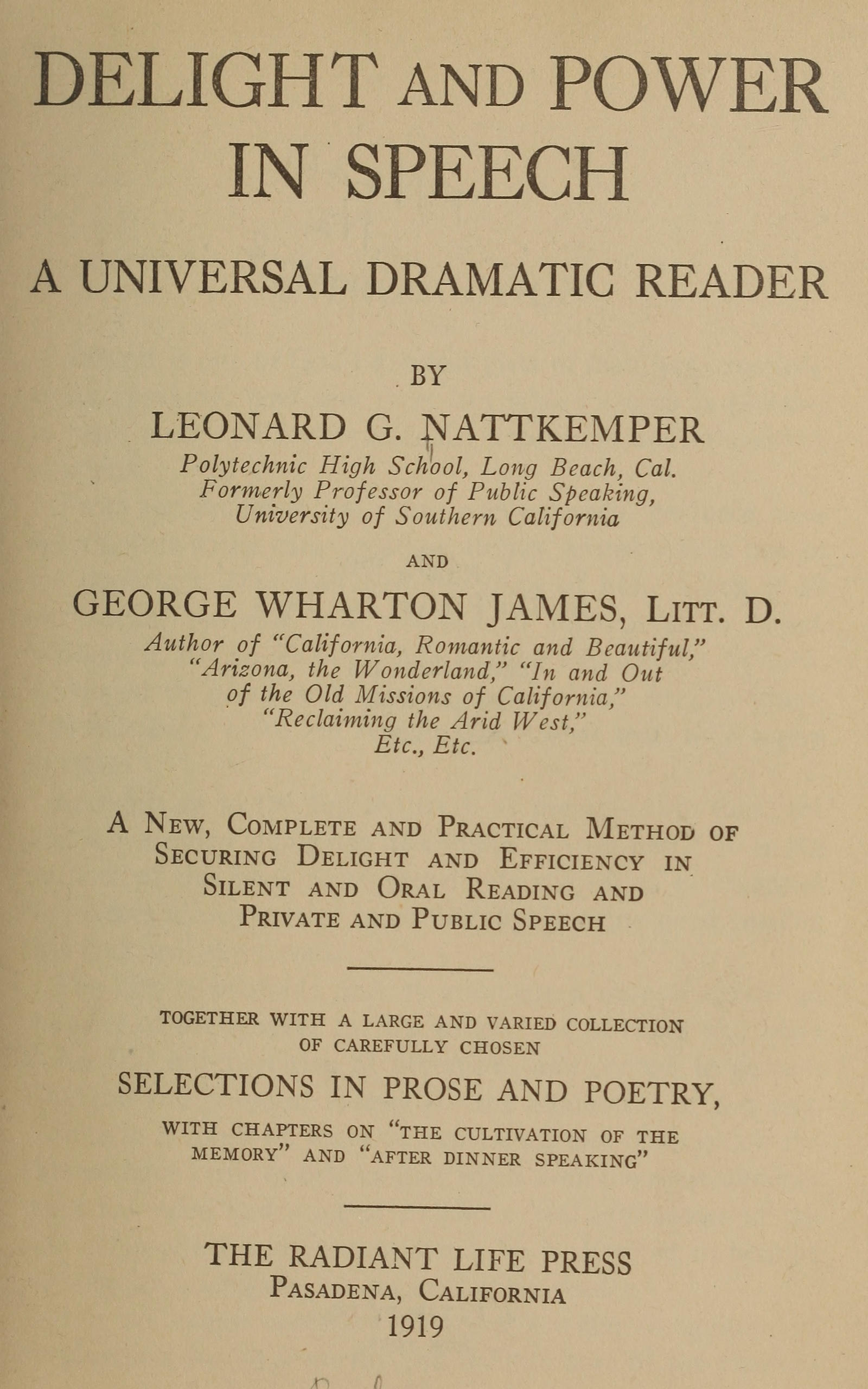
Delight and Power in Speech
by Leonard G. Nattkemper
★★★★★No ratings yet
Language: English
Sign in to rate this book.
Sign in to shelve this book.
About this eBook
- Author
- James, George Wharton, 1858-1923
- Title
- Delight and power in speech : A universal dramatic reader; a new, complete and practical method of securing delight and efficiency in silent and oral reading and private and public speech; together with a large and varied collection of carefully chosen selections in prose and poetry, with chapters on "The cultivation of the memory" and "After dinner speaking."
- Original Publication
- Pasadena, California: The Radiant Life Press, 1919.
- Credits
- ellinora, MFR and the Online Distributed Proofreading Team at www.pgdp.net (This file was produced from images generously made available by The Internet Archive/American Libraries.)
- Language
- English
- LoC Class
- PN: Language and Literatures: Literature: General, Criticism, Collections
- Subject
- Recitations
- Category
- Text
- Project Gutenberg
- eBook-No. 71798
- Release Date
- October 3, 2023
- Copyright
- Public domain in the USA.
Contents
- 1.DELIGHT and POWER IN SPEECH
- 2.INTRODUCTION — The Selections of the Book
- 3.PART ONE Intelligent and Intelligible Reading
- 4.CHAPTER I READING AND PUBLIC SPEECH
- 5.CHAPTER II EFFECTIVE SPEECH — The Basis for Good Oral Reading — The Basis for Good Silent Reading — Get the Author’s Thought — We Are Not Studying Style — Three Definite Aims to Gain Knowledge — Each Aim Illustrated
- 6.CHAPTER III INVENTORY OF SPEECH EFFICIENCY — The Knowing — The Doing
- 7.CHAPTER IV ORAL READING — Teacher’s First Great Task — What Is Expression? — Greatest Educational Value — The Desire to Express — The Channels of Expression — Merging of the Channels
- 8.CHAPTER V SELECTIONS FOR PART ONE — THE DOUGLAS SQUIRREL — WORK AND THE WORKER — THE MUSIC OF AMERICA — THE VIRTUES OF LOVE — THE MAJESTY OF THE OCEAN — THE GRAY DAYS — THE PRESENT CRISIS
- 9.CHAPTER VI ARTICULATION EXERCISES — I. For the Lips and Jaw — II. For Lips, Tongue and Soft Palate — III. The Aspirates, or Breath Sounds — IV. The Sub-Vocal Sounds — V. The Liquid Sounds — VI. The Nasal Sounds — VII. Combination Sounds — The Habit of Swallowing the “G” — Practice Exercises — Overcoming the Rising Inflection — Exercises in Inflectional Agility — Exercises Developing Force and Rate of Speech
- 10.CHAPTER VII CORRECTION OF SPEECH DEFECTS — The Problem — Characteristics of the Stammerer — The Stutterer
- 11.CHAPTER VIII ENUNCIATION AND PRONUNCIATION — Exercise One — Exercise Two — Exercises in Enunciation and Pronunciation — Key to Pronunciation
- 12.PART TWO Identification of the Reader with the Story, or Sympathetic Reading
- 13.CHAPTER IX GETTING THE AUTHOR’S MOOD — Hints to the Student — Mood-Analysis — A Student’s Analysis of “Columbus” — A Suggestive Outline for the Study of a Selection — A Condensed Outline for the Study of a Selection for Oral Presentation
- 14.PROSE SELECTIONS
- 15.HUMOROUS SELECTIONS
- 16.PATHETIC SELECTIONS
- 17.DRAMATIC SELECTIONS
- 18.DIALECT SELECTIONS
- 19.PART THREE Melodious Reading — EXPRESSIVE SPEECH [9]
- 20.CHAPTER X MELODIOUS READING — Exercises in Inflection — A Study of Pitch — Study in Stress — A Study of the Pause — Study of the Importance of Tone
- 21.CHAPTER XI HOW TO READ POETRY — PISGAH-SIGHT — DAWN — FLOWER IN THE CRANNIED WALL — THE WORKER’S GUERDON — MY HEART LEAPS UP
- 22.POETICAL SELECTIONS
- 23.COLLOQUIAL SELECTIONS IN POETRY
- 24.HUMOROUS SELECTIONS IN POETRY
- 25.HUMOROUS DIALECT SELECTIONS IN POETRY
- 26.PATHETIC SELECTIONS IN POETRY
- 27.DRAMATIC SELECTIONS IN POETRY
- 28.SUBLIME SELECTIONS IN POETRY
- 29.LYRIC SELECTIONS IN POETRY
- 30.CHAPTER XII IMPERSONATION — PRACTICE SELECTION
- 31.PART FOUR Oratoric Reading and the Art of Public Speech — HAMLET’S INSTRUCTION TO THE PLAYERS
- 32.CHAPTER XIII ORATORIC READING AND THE ART OF PUBLIC SPEECH — THE GETTYSBURG ADDRESS — SELECTIONS FOR PART FOUR
- 33.CHAPTER XIV PRACTICAL SUGGESTIONS FOR THE AFTER-DINNER SPEAKER
- 34.CHAPTER XV THE CULTIVATION OF THE MEMORY — Stokes’s Golden Rule of Memory — Strengthening the Observation — Suggestive Methods to Pursue — It Is Difficult to Observe Properly — Develop the Power of Reflection — Thought-Linking — The Incidental Method — The Accidental Method — The Scientific Method — The Pictorial Method — Methods of Constructive Thought-Linking — Think of the Impressions
- 35.FOOTNOTES
- 36.INDEX
Community reviews
Sign in to write a review.
No reviews yet.