It is the misfortune of those who study that
branch of science which our President has done so
much to advance—I mean the science of living
things—that they are not able, in the midst of
a vast assembly,[1] to render visible to all eyes
the actual phenomena to which their inquiries
are directed. Whilst the physicist and the chemist
are able to make evident to the senses of a great
meeting the very things of which they have to
tell, the zoologist cannot hope ever to share with
those who form his audience the keen pleasure
of observing a new or beautiful organism; he
cannot demonstrate by means of actual specimens
the delicate arrangements of structure which
it is his business to record, and upon which he
bases his conclusions. It is for this reason that
he who would bring to the notice of laymen some
matter which at the moment is occupying the attention
of biological students, must appear to be unduly
devoted to speculation—hypothesis—to support which
he cannot produce the facts themselves but merely
the imperfect substitutes afforded by pictures. It
is perhaps not altogether a matter for regret that
there should be in one great branch of science, as
there is in biology, so very marked a disproportion
between the facilities for demonstrating facts and
the general interest attaching to the theories connected
with those facts. We may be thankful that
at the present day we are not likely, in the domain
of biology, to make the mistake (which has been
made under other circumstances) of substituting the
mere inspection and cataloguing of natural objects
for that more truly scientific attitude which consists
in assigning the facts which come under our observation
to their causes, or, in other words, to their
places in the order of nature. Though we may
rightly object to the attempt which is sometimes
made to decry the modern teachings of biology
as not being “exact science,” yet we may boldly
admit the truth of the assertion that we biologists
are largely occupied with speculations, hypotheses,
and other products of the imagination. All true
science deals with speculation and hypothesis, and
acknowledges as its most valued servant—its indispensable
ally and help-meet—that which our German
friends[2] call “Phantasie” and we “the Imagination.”
Our science—biology—is not less exact; our conclusions
are no less accurate because they are only
probably true. They are “probably true” with a
degree of probability of which we are fully
aware, and which is only somewhat less than the
probability attaching to the conclusions of other
sciences which are commonly held to be “exact.”
These remarks are addressed to an Association
for the advancement of science—of science which
flourishes and progresses by the aid of suppositions
and the working of the imagination. The Association
has been holding its annual sitting in various parts of
the British Islands for more than thirty years, and yet
it is still a very common and widely spread notion
that science, that is to say, true science according to
those who hold the notion, does not countenance
hypotheses, and sternly occupies itself with the exact
record of fact. On the other hand, there are many
persons who run to an opposite extreme, and call by
the name of science any fanciful attempt to deal with
or account for a certain class of phenomena. The
words “science” and “scientific” are used so vaguely
and variously that one might almost come to the
conclusion that it would be well for our Association
to plainly state what is that thing for the advancement
of which its meetings are held. I cannot
venture to speak in the name of my colleagues; and
no doubt a review of the work done by the Association
would most fitly explain what that body understands
by the word “science.” At the same time it is
permissible to take this opportunity of briefly stating
what science is and what it is not, so far as I am able
to judge of the fitting use of the word.
Science is certainly not any and every kind of
knowledge. Knowledge of literature, of the beautiful
things which have been written or otherwise produced
by human ingenuity, is not science. Knowledge of
the various manufacturing processes in use by civilised
men is not science; nor knowledge of the names of
the stars, or of the joints of a beetle’s leg. Science
cannot be identified with knowledge of any particular
class of objects, however detailed that knowledge may
be. It is a common mistake to consider all knowledge
of raw products, of living objects or other natural
objects, as necessarily “science.” The truth is, that
a man may have great knowledge of these things as
so many facts, and yet be devoid of “science.” And,
on the other hand, that which is properly called
science embraces not only such subject-matter as
that just alluded to, but also may find its scope in
the study of language, of human history, and of the
workings of the human mind.
The most frequent and objectionable misuse of the
word ‘science’ is that which consists in confounding
science with invention—in applying the term which
should be reserved for a particular kind of knowledge
to the practical applications of that knowledge.
Such things as electric lighting and telegraphs, the
steam-engine, gas, and the smoky chimneys of factories,
are by a certain school of public teachers,
foremost among whom is the late Oxford Professor
of Fine Art, persistently ascribed to science, and
gravely pointed out as the pestilential products of
a scientific spirit. They are, in fact, nothing of the
kind. American inventors and electric lamps, together
with all the factories in Sheffield, might be obliterated
without causing a moment’s concern to a single
student of science. It is of the utmost importance
for the progress and well-being of science
that this should be understood; that the eager
practical spirit of the inventor who gains large
pecuniary rewards by the sale of his inventions
should not be confounded with what is totally
different and remote from it, namely, the devoted,
searching spirit of science, which, heedless of pecuniary
rewards, ever faces nature with a single purpose—to
ascertain the causes of things. It seems to me
impossible to emphasise too strongly in such a place
and in such a meeting as this, that Invention is
widely separate from, though dependent on, Science.
Invention is worldly-wise, and despises the pursuit of
knowledge for its own sake. She awaits the discoveries
of Science, in order to sell them to civilisation,
gathering the golden fruit which she has neither
planted nor tended. Invention follows, it is true, the
footsteps of Science, but at a distance: she is utterly
devoid of that thriftless yearning after knowledge,
that passionate desire to know the truth, which causes
the unceasing advance of her guide and benefactress.
We may, it seems to me, say that of all kinds and
varieties of knowledge that only is entitled to the
name “science” which can be described as Knowledge
of Causes, or Knowledge of the Order of Nature. It
is this knowledge to which the great founder of
European science—Aristotle the Greek—pointed as
true knowledge: τότε ἐπιστάμεθα ὅταν τὴν αἰτίαν
εἴδωμεν. Science is that knowledge which enables
us to demonstrate so far as our limited faculties
permit, that the appearances which we recognise
in the world around us are dependent in definite
ways on certain properties of matter: science is that
knowledge which enables, or tends to enable us, to
assign its true place in the series of events constituting
the universe, to any and every thing which we
can perceive.
The method by which scientific knowledge is
gained—knowledge of the causes of nature—is precisely
the same as that by which knowledge of causes
in every-day life is gained. Something—an appearance—has
to be accounted for: the question in both
cases is “Through what cause, in relation to what
antecedent is this appearance brought about?” In
scientific inquiry, as in every-day life, a hypothesis—a
provisional answer or guess—is the reply; and the
truth of that guess or hypothesis is then tested. This
testing is an essential part of the process. “If my
guess be true, then so-and-so as to which I can decide
by inspection or experiment, must be true also,” is
the form which the argument takes, and the inquiry is
thus brought to a point where observation can decide
the truth of the hypothesis or first guess. In every-day
life we have often to be content without fully
testing the truth of our guesses, and hurry into action
based on such unverified suppositions. Science, on
the other hand, can always wait, and demands again
and again the testing and verification of guesses
before they are admitted as established truths fit to
be used in the testing of new guesses and the building
up of scientific doctrine.
The delicately-reared imaginations of great investigators
of natural things have from time to time
given birth to hypotheses—guesses at truth—which
have suddenly transformed a whole department of
knowledge, and made the causes of things quite
clear which before seemed likely to remain always
concealed. So great is the value of hypothesis, so
essential to scientific discovery, that the most skilled
and highly-trained observer may spend his life in
examining and scrutinising natural objects and yet
fail, if he is not guided by hypothesis, to observe
particular facts which are of the uttermost importance
for the explanation of the causes of the things
which he is studying. Nature, it has been said, gives
no reply to a general inquiry—she must be interrogated
by questions which already contain the answer
she is to give; in other words, the observer can only
observe that which he is led by hypothesis to look
for: the experimenter can only obtain the result which
his experiment is designed to obtain.
For a long time the knowledge of living things, of
plants and of animals could hardly be said to form
part of the general body of science, for the causes of
these things were quite unknown. They were kept
apart as a separate region of nature, and were
supposed to have been pitched, as it were, into the
midst of an orderly and cause-abiding world without
cause or order: they were strangers to the universal
harmony prevailing around them. Fact upon fact
was observed and recorded by students of plants and
animals, but having no hypothesis as to the causes of
what they were studying, the naturalists of twenty
years ago, and before that day, though they collected
facts, made slow progress and some strange blunders.
Suddenly one of those great guesses which occasionally
appear in the history of science, was given
to the science of biology by the imaginative insight
of that greatest of living naturalists—I would say
that greatest of living men—Charles Darwin.
In the form in which Mr. Darwin presented his
view to the world it was no longer a mere guess. He
had already tried it and proved it in an immense
series of observations; it had already been converted
by twenty years’ labour on his part into an established
doctrine, and the twenty years which have
passed since he published the Origin of Species have
only served to confirm, by thousands of additional
tests, the truth of his original guess.
Space will not allow me to go fully into the history
of the Darwinian theory, but it is necessary for my
present purpose that I should state precisely what
that theory is. It involves a number of subordinate
hypotheses which, together with the main hypothesis,
furnish us with a complete “explanation,” as it is
called, of the facts which have been ascertained as
to living things; in other words, it assigns living
things to their causes, gives them their place in the
Order of Nature.
It is a very general popular belief at the present
day that the Darwinian theory is simply no more
than a capricious and anti-theological assertion that
mankind are the modified descendants of ape-like
ancestors.
Though most of my readers, I do not doubt,
know how imperfect and erroneous a conception this
is, yet I shall not, I think, be wasting time in stating
what the Darwinian theory really is. In fact, it is so
continuously misrepresented and misunderstood, that
no opportunity should be lost of calling attention to
its real character. Bit by bit, naturalists had succeeded
in discovering the order of nature—so far that
all the great facts of the universe, the constitution
and movements of the heavenly bodies, the form of
our earth, and all the peculiarities of its crust, had
been successfully assigned to one set of causes—the
properties of matter, which are set forth in what we
know by the name of the “laws of physics and
chemistry.” Whilst geologists, led by Lyell, had
shown that the strata of the earth’s crust and its
mountains, rivers, and seas were due to the long-continued
operation of the very same general causes—the
physico-chemical causes—which at this moment
are in operation and are continuing their work
of change, yet the living matter on the crust of
the earth had to be excluded from the grand
uniformity which was elsewhere complete.
The first hypothesis, then, which was present to
Mr. Darwin’s mind, as it had been to that of other
earlier naturalists, was this: “Have not all the
varieties or species of living things (man, of course,
included) been produced by the continuous operation
of the same set of physico-chemical causes which
alone we can discover, and which alone have been
proved sufficient to produce everything else?” “If
this be so,” Mr. Darwin must have argued (and here
it was that he boldly stepped beyond the speculations
of Lamarck and adopted the method by which
Lyell had triumphantly established Geology as a
science), “these causes must still be able to produce
new forms, and are doing so wherever they have
opportunity.” He had accordingly to bring the
matter to the test of observation by seeking for
some case of the production of new forms of plants,
or of animals, by natural causes at the present day.
Such cases he found in the production of new forms
or varieties of plants and animals, by breeders.
Breeders (the persons who make it their business
to produce new varieties of flowers, of pigeons, of
sheep, or what not) make use of two fundamental
properties of living things in order to accomplish
their purpose. These two properties are, firstly, that
no two animals or plants, even when born of the
same parents, are exactly alike; this is known as
Variation: secondly, that an organism, as a rule,
inherits, that is to say, is born with the peculiarities
of its parents; this is known as Transmission, and
is simply dependent on the fact that the offspring
of any plant or animal is only a detached portion
of the parent—a chip of the old block, as the
saying is. The breeder selects from a number of
specimens of a plant or animal a variety which
comes nearest to the form he wishes to produce.
Supposing he wished to produce a race of oxen with
short horns, he would select from his herd bulls and
cows with the shortest horns, and allow these only
to breed; they would transmit their relatively short
horns to their offspring, and from these again the
cattle with the shortest horns would be selected by
the breeder for propagation, and so on through
several generations. In the end a very short-horned
generation would be obtained, differing greatly in
appearance from the cattle with which the breeder
started.
Now we know of no facts which forbid us to suppose
that could a breeder continue his operations
indefinitely for any length of time—say for a few
million years—he could convert the short-horned
breed into a hornless breed; that he could go on
and thicken the tail, could shorten the legs, get
rid of the hind limbs altogether by a series of insensible
gradations, and convert the race into forms
like the Sirenia, or sea-cows. But if he could do this,
you have only to give him a longer time still and there
is no obstacle remaining to the conversion, by the same
kind of process, of a polyp into a worm, or of a worm
into a fish, or even of a monkey into a man.[3]
So far we have supposed the interference of a
breeder who selects and determines the varieties
which shall propagate themselves; so far we have
not got a complete explanation, for we must find a
substitute in nature for the human selection exercised
by the breeder. The question arises, then, “Is there
any necessary selective process in nature which could
have operated through untold ages, and so have represented
the selective action of the breeder, during an
immense period of time?” Strangely enough, Mr.
Darwin was led to the discovery of such a cause
existing necessarily in the mechanical arrangements
of nature, by reading the celebrated book of an
English clergyman, the Rev. Mr. Malthus, On Population.
On happening to read this book, Mr. Darwin
himself tells us that the idea of “natural selection”
flashed upon him. That idea is as follows. Not
only among mankind, but far more largely among
other kinds of animals and of plants, the number of
offspring produced by every pair is immensely in
excess of the available amount of the food appropriate
to the particular species in question. Accordingly,
there is necessarily a struggle for existence—a
struggle among all those born for the possession
of the small quantum of food. The result of this
struggle is to pick out, or select, a few who survive
and propagate the species, whilst the majority perish
before reaching maturity. The fact that no two
members of a species are alike has already been
shown to be the starting-point which enables the
breeder to make his selection. So, too, with natural
selection in the struggle for existence; the fact
that all the young born of one species are not
exactly alike—but some larger, some smaller, some
lighter, some darker, some short-legged, some big-eyed,
some long-tongued, some sharp-toothed, and
so on—furnishes the opportunity for a selection.
Those varieties which are best fitted to obtain food
and to baffle their competitors, gain the food and
survive, the rest perish.
We have, then, to note that the hypothesis that
there must be a selection—which was framed or deduced
as a “test hypothesis” from the earlier hypothesis
that species have arisen by the action of causes
still competent to produce new forms—led Mr. Darwin
to the discovery of this great cause—the “natural
selection,” or “survival of the fittest,” in the struggle
for existence. Just as the breeder can slowly change
the proportions of the animals or plants on which
he operates, so in inconceivably long periods of time
has this struggling of varieties, and the consequent
natural selection of the fittest, led to the production,
from shapeless primitive living matter, of all the
endless varieties of complicated plants and animals
which now people the world. Countless varieties
have died out, leaving only their modified descendants
to puzzle the ingenuity of the biologist.
Of the tens and hundreds of thousands of intermediate
forms we know nothing by direct observation.
They have perished as better fitted forms ousted
them in the never-ending conflict. But we feel sure
that they once were in existence, and can infer what
was their structure, and what were their peculiarities,
by the study of the structure and attributes of their
now living descendants.
If all the forms of life at present living are the modified
offspring of a smaller number of ancestral forms
which have died out, and if these again were the modified
descendants produced by ordinary parentage of
a single original living thing—then the whole series of
forms that have ever lived could, if we had them before
us, be arranged in the form of a great family-tree—the
various branches presenting a perfect gradation of
forms arranged one after another, leading down from
the terminal twigs (which would represent the latest
forms produced) to larger and larger branches, until
the common trunk representing the original ancestor
would be reached. Our actual means of observing the
genealogical affinities of different kinds of animals and
plants may be understood by a further use of the metaphor
of a genealogical tree in shape like an elm or
an oak. Suppose the genealogical tree completely
written out—a perfect record—to be sunk in muddy
water so that only its topmost branches and twigs are
here and there visible—then you have a fair notion of
the present condition of the great family of organisms.
Only the topmost twigs remain visible, the rest of
the great family-tree of living beings is hidden from
view, submerged beneath the muddy waters of time.
Naturalists have, however, undertaken to reconstruct
this great genealogical tree. It is a main object now
in the study both of zoology and of botany to find
out what are the cousinships, what the exact genetic
relationships of all the various species of plants and
animals, and so to show, even to the minutest detail,
in what particular ways physico-chemical causes have
brought about and modified the forms of living
things.
The task is not quite so difficult as the comparison
to a submerged forest-tree would lead one to expect;
at the same time it is more difficult than those
who have boldly attempted it appear to believe. We
have one great help in the carefully worked out
systematic classification of animals and plants according
to their structure. We are justified in assuming
as a general law that animals or plants of like
structure have descended from common ancestors—that
is to say, that the same kind of organisation
(especially where a number of elaborate details of
structure are involved) has not been twice produced
by natural selection. Thus we are entitled to conclude
that all the animals which have a backbone
and pharyngeal gill-slits combined—the Vertebrates,
as we call them—have descended from a common
parent; that all the animals with a muscular foot-like
belly and lateral gill filaments, the Molluscs, have also
had a common parent, and so on.
A classification according to structure goes then a
long way towards mapping out the main lines of the
family-tree of organisms. We are further assisted in
the task by the fossil remains of extinct organisms
which sometimes give to us the actual ancestors of
forms now living. But the most remarkable aid to
the correct building-up of the pedigree of animals at
least (and the remarks which follow are confined to
that division of the organic world), is afforded by the
changes—the phases of development—which every
animal exhibits in passing from the small shapeless
egg to the adult condition. The aid which we here
obtain depends on the following facts. Just as we
suppose any one animal—say a dog—to have developed
by slow change through an immense series of
ancestors which become simpler and simpler as we
recede into the past until we reach a small shapeless
lump of living matter devoid of structure, so do we
find actually as a matter of fact, which any one can
see for himself, that every individual animal begins
its individual life as a structureless particle which is
thrown off from its parent, and is known as the egg-cell
(Fig. 1). Gradually passing through a series of more
and more elaborated conditions of structure, that
egg grows into the adult dog. The changes which
have taken countless ages in the one case, are
accomplished in a few weeks in the other.
And now we have to note the important fact which
makes this process of development so intensely interesting
in relation to the pedigree of the animal
kingdom. There is very strong reason to believe
that it is a general law of transmission or inheritance,
that structural characteristics appear in the growth
of a young organism in the order in which those
characteristics have been acquired by its ancestors.
At first the egg of a dog represents (imperfectly, it is
true,) in form and structure the earliest ancestors of the
dog; a few days later it has the form and structure
of somewhat later ancestors; later still the embryo
dog resembles less remote ancestors; until at last
it reaches the degree of elaboration proper to its
immediate forefathers.
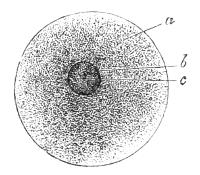
Fig. 1.—An egg: a single
corpuscle of protoplasm with nucleus b c, and body a.
Accordingly the phases of development or growth
of the young are a brief recapitulation of the phases of
form through which the ancestors of the young creature
have passed. In some animals this recapitulation
is more, in others it is less complete. Sometimes the
changes are hurried through and disguised, but we find
here and there in these histories of growth from the
egg most valuable assistance in the attempt to reconstruct
the genealogical tree. The history of the
development of the common frog is a good illustration
of the kind of evidence in question.
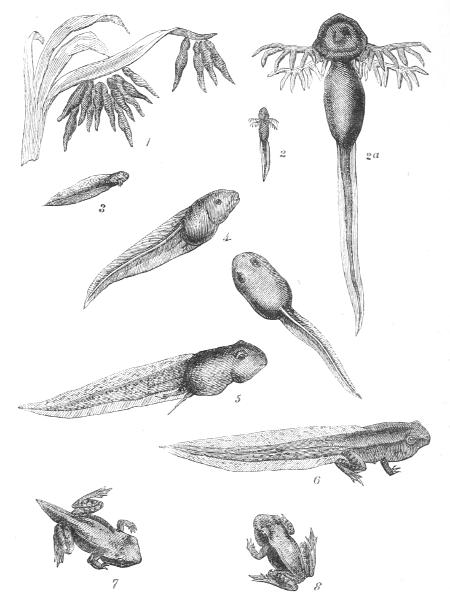
Fig. 2.—Tadpoles and young
of the Common Frog. 1, Recently hatched (twice natural size); 2 and 2a,
same enlarged to show the external gills; 3 and 4, later stages with gill
slits covered by a membrane leaving only the spiracle (see Fig. 16) as an
exit for the respired water; 5, with hind legs appearing; 6, with both
fore and hind legs; 7, atrophy of the tail; 8, young frog.
The frog’s egg first gives rise to a little aquatic
creature with external gills and a tail—the tadpole—which
gradually loses its gills and its tail and
acquires in their place lungs and four legs (Fig. 2),
so as now to be fitted for life on dry land. From
what we otherwise know of the structure of the frog
and the animals to which it is allied, we are
justified in concluding that the tadpole is a recapitulative
phase of development, and represents to us
more or less closely an ancestor of the frog which
was provided with gills and tail in the adult state,
and possessed neither legs nor lungs.
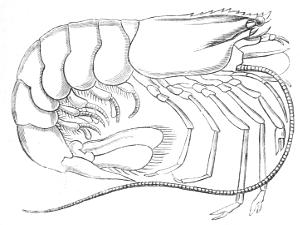
Fig. 3.—Adult shrimp of the
genus Peneus.
A less familiar case is that of a certain kind of
shrimp, which is illustrated in the wood-cuts (Fig. 3
and right lower corner of Fig. 4). The little creature
which issues from the egg of this shrimp is known
as the “Nauplius form.” Many animals very different
in appearance from this shrimp make their first
appearance in the world as Nauplii; and it appears
probable that the Nauplius-phase is the recapitulative
re-presentation of an ancestor common to all
this set of animals, an ancestor which was not exactly
like the Nauplius, but not very different from it.
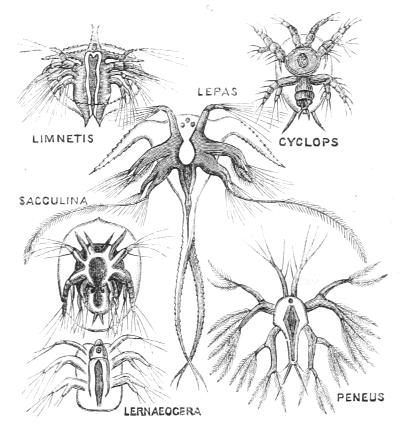
Fig. 4.—Nauplius
larval-form of various Crustacea (Shrimps, Water-fleas, Barnacles,
&c.).
The Nauplius of our shrimp gradually elongates.
At first it has but three pair of limbs, but it soon
acquires additional pairs, and a jointed body, and
thus by gradually adding to its complexity of structure
as seen in Figs. 5 and 6, it approximates more
and more to the adult form from the egg of which
it originated.
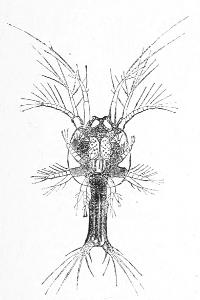
Fig. 5.—Larva of the Shrimp
Peneus.
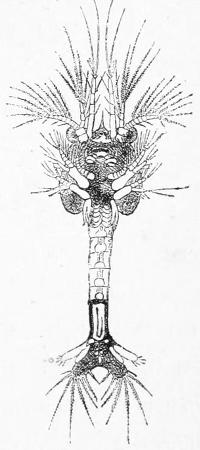
Fig. 6.—More advanced larva
of the Shrimp Peneus.
And now we are approaching the main point to
which I wish to draw the reader’s attention. In attempting
to reconstruct the pedigree of the animal
kingdom and so to exhibit correctly the genetic
relationships of all existing forms of animals, naturalists
have hitherto assumed that the process of
natural selection and survival of the fittest has invariably
acted so as either to improve and elaborate
the structure of all the organisms subject to it, or
else has left them unchanged, exactly fitted to their
conditions, maintained as it were in a state of balance.
It has been held that there have been some six or
seven great lines of descent—main branches of the
pedigree—such as that of the Vertebrates, that of
the Molluscs, that of the Insects, that of the Starfish,
and so on; and that along each of these lines there has
been always and continuously a progress—a change
in the direction of greater elaboration.
Each of these great branches of the family-tree is
held to be independent—they all branch off nearly
simultaneously from the main trunk like the leading
branches of an oak. The animal forms constituting
the series in each of these branches are supposed to
gradually increase in elaboration of structure as we
pass upwards from the main trunk of origin and
climb further and further towards the youngest,
most recent twigs. New organs have, it is supposed,
been gradually developed in each series, giving their
possessors greater powers, enabling them to cope
more successfully with others in that struggle for
existence in virtue of which these new organs
have been little by little called into being. At the
same time here and there along the line of march,
certain forms have been supposed to have “fallen
out,” to have ceased to improve, and being happily
fitted to the conditions of life in which they were
long ago existing, have continued down to the
present day to exist in the same low, imperfect
condition. It is in this way that the lowest forms
of animal life at present existing are usually
explained, such as the microscopic animalcules,
Amœbæ and Infusoria. It is in this way that the
lower or more simply-made families of higher groups
have been generally regarded. The simpler living
Mollusca or shellfish have been supposed necessarily
to represent the original forms of the great race of
Mollusca. The simpler Vertebrates have been supposed
necessarily to represent the original Vertebrates.
The simpler Worms have been supposed
necessarily to be the stereotyped representatives of
very ancient Worms.
That this is, to a certain extent, a true explanation of
the existence at the present day of low forms of animals
is proved by the fact that we find in very ancient strata
fossil remains of animals which differ, ever so little,
from particular animals existing at the present
day; for instance, the Brachiopods (lamp-shells),
Lingula and Terebratula, the King-crabs, and the
Pearly Nautilus are found living at the present day,
and are also found with no appreciable difference
in very ancient strata of the earth’s crust; strata
deposited so long ago that most of the forms of life
at present inhabiting the earth’s surface had not
then been brought into existence, whilst other most
strange and varied forms occupied their place, and
have now for long ages been extinct.
Whilst we are thus justified by the direct testimony
of fossil remains in accounting for some living forms
on the hypothesis that their peculiar conditions of
life have been such as to maintain them for an immense
period of time in statu quo unchanged, we
have no reason for applying this hypothesis, and this
only, to the explanation of all the more imperfectly
organised forms of animal or plant-life.
It is clearly enough possible for a set of forces
such as we sum up under the head “natural selection”
to so act on the structure of an organism as
to produce one of three results, namely these; to keep
it in statu quo; to increase the complexity of its
structure; or lastly, to diminish the complexity of its
structure. We have as possibilities either Balance,
or Elaboration, or Degeneration.
Owing, as it seems, to the predisposing influence
of the systems of classification in ascending series
proceeding steadily upwards from the “lower” or
simplest forms to the “higher” or more complex
forms,—systems which were prevalent before the
doctrine of transformism had taken firm root in the
minds of naturalists, there has been up to the present
day an endeavour to explain every existing form of
life on the hypothesis that it has been maintained
for long ages in a state of Balance; or else on
the hypothesis that it has been Elaborated, and is
an advance, an improvement, upon its ancestors.
Only one naturalist—Dr. Dohrn, of Naples—has put
forward the hypothesis of Degeneration as capable of
wide application to the explanation of existing forms
of life;[4] and his arguments in favour of a general
application of this hypothesis have not, I think, met
with the consideration which they merit.
The statement that the hypothesis of Degeneration
has not been recognised by naturalists generally as
an explanation of animal forms, requires to be corrected
by the exception of certain kinds of animals,
namely, those that are parasitic or quasi-parasitic.
With regard to parasites, naturalists have long recognized
what is called retrogressive metamorphosis;
and parasitic animals are as a rule admitted to be
instances of Degeneration. It is the more remarkable
whilst the possibility of a degeneration—a loss
of organisation making the descendant far simpler or
lower in structure than its ancestor—has been admitted
for a few exceptional animals, that the same
hypothesis should not have been applied to the
explanation of other simple forms of animals. The
hypothesis of Degeneration will, I believe, be found
to render most valuable service in pointing out the
true relationships of animals which are a puzzle and
a mystery when we use only and exclusively the
hypothesis of Balance, or the hypothesis of Elaboration.
It will, as a true scientific hypothesis, help us
to discover causes.
We may now examine a few examples of undeniably
degenerate animals, and first, I may call to
mind the very remarkable series of lizard-like animals
which exist in the south of Europe and in other
countries, which exhibit in closely related genera a
gradual loss of the limbs—a local or limited Degeneration.
We have the common Lizard (Lacerta), with
five toes on each of its well-grown fore and hind
limbs; then we have side by side with this a lizard-like
creature, Seps, in which both pairs of limbs have
become ridiculously small, and are evidently ceasing
to be useful in the way in which those of Lacerta
are useful; and lastly, we have Bipes, in which the
anterior pair of limbs has altogether vanished, and
only a pair of stumps, representing the hinder limbs,
remain.
No naturalist doubts that Seps and Bipes represent
two stages of Degeneration, or atrophy of the limbs;
that they have, in fact, been derived from the five-toed
four-legged form, and have lost the locomotor
organs once possessed by their ancestors. This very
partial or local atrophy is not however that to which
I refer when using the word Degeneration. Let us
imagine this atrophy to extend to a variety of
important organs, so that not only the legs, but the
organs of sense, the nervous system, and even the
mouth and digestive organs are obliterated—then we
shall have pictured a thorough-going instance of
Degeneration.
Degeneration may be defined as a gradual change
of the structure in which the organism becomes
adapted to less varied and less complex conditions
of life; whilst Elaboration is a gradual change of
structure in which the organism becomes adapted
to more and more varied and complex conditions of
existence. In Elaboration there is a new expression
of form, corresponding to new perfection of work in
the animal machine. In Degeneration there is suppression
of form, corresponding to the cessation of
work. Elaboration of some one organ may be a
necessary accompaniment of Degeneration in all the
others; in fact, this is very generally the case; and it
is only when the total result of the Elaboration of
some organs, and the Degeneration of others, is such
as to leave the whole animal in a lower condition,
that is, fitted to less complex action and reaction in
regard to its surroundings, than was the ancestral
form with which we are comparing it (either actually
or in imagination) that we speak of that animal as
an instance of Degeneration.
Any new set of conditions occurring to an animal
which render its food and safety very easily attained,
seem to lead as a rule to Degeneration; just as an
active healthy man sometimes degenerates when he
becomes suddenly possessed of a fortune; or as Rome
degenerated when possessed of the riches of the
ancient world. The habit of parasitism clearly acts
upon animal organisation in this way. Let the
parasitic life once be secured, and away go legs,
jaws, eyes, and ears; the active, highly-gifted crab,
insect, or annelid may become a mere sac, absorbing
nourishment and laying eggs.
Reference was made above to the larval stage of
a certain shrimp (Figs. 4, 5, 6). Let us now compare
these with the young stages of a number of shrimp-like
animals, viz., Sacculina, Lernæocera, Lepas,
Cyclops, Limnetis, (all drawn in Fig. 4), some of
which lead a parasitic life. All start equally with
the recapitulative phase known as the Nauplius;
but whilst the Nauplius of the free-living shrimp
grows more and more elaborate, observe what
happens to the parasites—they degenerate into
comparatively simple bodies; and this is true of
their internal structure as well as of their external
appearance. The most utterly reduced of these parasites
is the curious Sacculina (Fig. 7) which infests
Hermit-crabs, and is a mere sac filled with eggs, and
absorbing nourishment from the juices of its host by
root-like processes.
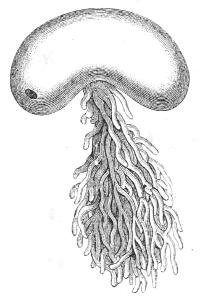
Fig. 7.—Adult Sacculina
(female).
Lernæocera again, which in the adult condition
is found attached to the gills of fishes, has lost the
well-developed legs of its Nauplius childhood and
become an elongated worm-like creature (Fig. 8),
fitted only to suck in nourishment and carry
eggs.
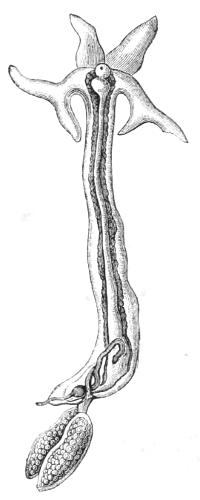
Fig. 8.—Adult female
Lernæocera.
Amongst these Nauplii—all belonging to the great
group Crustacea, which includes crabs and shrimps—is
one which gives rise to an animal decidedly
degenerate, but not precisely parasitic in its habits.
This Nauplius is the young of the ship’s Barnacle,
a curious stalked body, inclosed in a shell of many
pieces (Fig. 9). The egg of the Barnacle gives rise
to an actively swimming Nauplius, the history of
which is very astonishing. After swimming about
for a time the Barnacle’s Nauplius fixes its head
against a piece of wood, and takes to a perfectly
fixed, immobile state of life (Fig. 10). The upper
figures represent the Nauplius stage of animals
closely resembling the Barnacle: the lower figures
show the transformation of the Nauplius into the
young Barnacle. Its organs of touch and of sight
atrophy, its legs lose their locomotor function, and
are simply used for bringing floating particles to
the orifice of the stomach; so that an eminent
naturalist has compared one of these animals to a
man standing on his head and kicking his food
into his mouth.
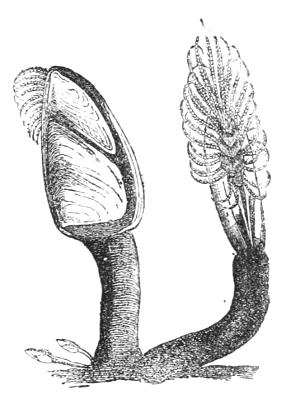
Fig. 9.—Adult Barnacle or
Lepas (one of the Cirrhipedes). Natural size.
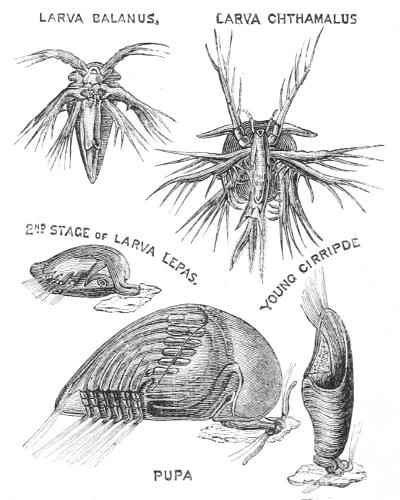
Fig. 10.—Development of
Cirrhipedes (Barnacle and Sea-acorn). After Huxley.
Were it not for the recapitulative phases in the
development of the Barnacle, we may doubt whether
naturalists would ever have guessed that it was a
degenerate Crustacean. It was in fact for a long
time regarded as quite remote from them, and placed
among the snails and oysters; its true nature was
only admitted when the young form was discovered.
Other parasitic organisms, which exhibit extreme
degeneration as compared with their free-living relatives,
might be cited and figured in profusion, did our
limits permit. Very noteworthy are the degenerate
Spiders—the mites, leading to still more degenerate
forms, the Linguatulæ.
We have two of these represented in Figs. 11
and 12. The one (Fig. 11), as compared with a
spider is seen still to possess the eight walking legs,
small, it is true, whilst the palps and daggers of the
spider have dwindled to a beak projecting from the
front of the globular unjointed body. In the other
the eight legs have become mere stumps, and the
body is elongated like that of a worm.
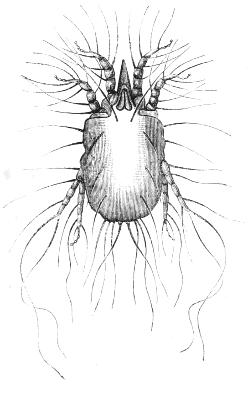
Fig. 11.—Acarus equi. A
degenerate Spider or mite parasitic on the skin of the horse.
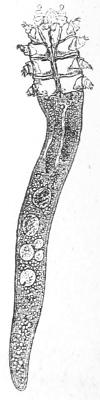
Fig. 12.—Degenerate Spider
(Demodex foliculorum) found in the skin of the human face.
The instances of degeneration which we have so
far examined are due to parasitism, except in the
example of the Barnacle, where we have an instance
of degeneration due to sessile and immobile
habit of life. We may now proceed to look at
some sessile or immobile animals which are not
usually regarded as degenerate, but which, I think,
there is every reason to believe are the degenerate
descendants of very much higher and more elaborate
ancestors. These are certain marine animals, the
Ascidians, or sea-squirts. These animals are found
encrusting rocks, stones, and weeds on the sea
bottom. Sometimes they are solitary (Fig. 13), but
many of them produce buds, like plants, and so
form compound masses or sheets of individuals
all connected and continuous with one another, like
the buds on a creeping plant (Fig. 14).
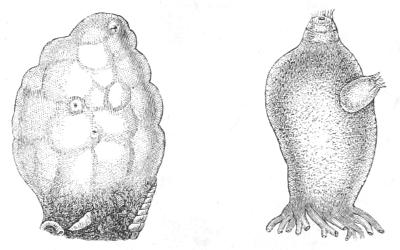
Fig. 13.—Two adult
Ascidians: to the left Phallusia—to the right Cynthia: the incurrent and
excurrent orifices are seen as two prominences. Half the natural size.
We will examine one of the simple forms—a
tough mass like a leather bottle with two openings;
water is continually passing in at the one and out at
the other of these apertures. If we remove the
leathery outer-case (Fig. 15), we find that there is
a soft creature within which has the following
parts:—Leading from the mouth a great throat, followed
by an intestine. The throat is perforated by
innumerable slits, through which the water passes
into a chamber—the cloaca: in passing, the water
aërates the blood which circulates in the framework
of the slits. The intestine takes a sharp bend,
which causes it to open also into the cloaca. Between
the orifice of the mouth and of the cloaca
there is a nerve-ganglion.
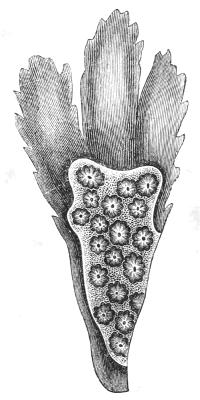
Fig. 14.—A colony of
compound Ascidians (Botryllus) growing on a piece of sea-weed (Fucus).
Each star corresponds to eight or more conjoined Ascidians. Natural
size.
My object in the next place is to show that the
structure and life-history of these Ascidians may
be best explained on the hypothesis that they are
instances of degeneration; that they are the modified
descendants of animals of higher, that is more
elaborate structure, and in fact are degenerate
Vertebrata, standing in the same relation to fishes,
frogs, and men, as do the barnacles to shrimps,
crabs, and lobsters.
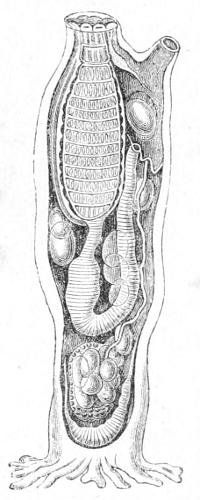
Fig. 15.—Anatomy of an
Ascidian (Phallusia). At the top is the mouth, to the right the orifice
of the cloaca. In the cloaca lies an egg, and above it the oblong nerve
ganglion. The perforated pharynx follows the mouth and leads to the
bent intestine which is seen to open into the cloaca. The space around
the curved intestine is the body-cavity; in it are seen oval bodies,
the eggs, and quite at the lower end the curved heart. The root-like
processes at the base serve to fix the Ascidian to stones, shells, or
weed.
The young of some, but by no means of all these
Ascidians, have a form totally different from that of
their parents. The egg of Phallusia gives rise to a
tadpole, a drawing of which placed side by side with
the somewhat larger tadpole of the common frog is
seen in the adjoining figure (Fig. 16). The young
Ascidian has the same general shape as the young
frog, but not only this; the resemblance extends into
details, the internal organs agreeing closely in the
two cases. Further still as shown by the beautiful
researches of the Russian naturalist, Kowalewsky,
the resemblance reaches absolute identity when we
examine the way in which the various organs arise
from the primitive egg-cell. Tail, body, spiracle,
eye, and mouth, agree in the two tadpoles, the only
important difference being in the position of the
two mouths and in the fact that the Ascidian has
one eye while the frog has two.
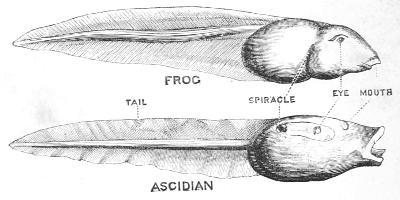
Fig. 16.—Tadpole of Frog
and of Ascidian. Surface view.
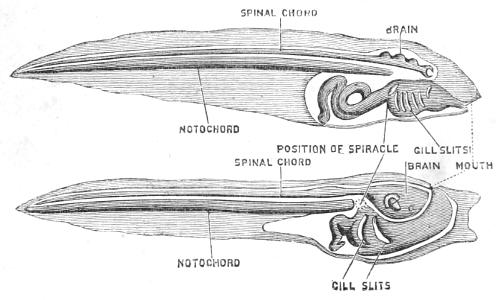
Fig. 17.—Tadpole of Frog
and of Ascidian. Diagrams representing the chief internal organs.
Now let us look at the internal organs (Fig. 17).
There are four structures, which are all four possessed
at some time of their lives by all those
animals which we call the Vertebrata, the great
branch of the pedigree to which fishes, reptiles,
birds, beasts, and men belong. And the combination
of these marks or structural peculiarities is an
overwhelming piece of evidence in favour of the
supposition that the creatures which possess this
combination are derived from one common ancestor.
Just as one would conclude that a man whom one
might meet, say on Salisbury Plain, must belong
to the New Zealand race, if it were found not
only that he had the colour, and the hair, and the
shape of head of a New Zealander, but also that he
was tattooed like a New Zealander, carried the
weapons of a New Zealander, and, over and above in
addition to these proofs, that he talked the Maori
language and none other; so here, in the case of
the vertebrate race, there are certain qualities and
possessions, the accumulation of which cannot be conceived
of as occurring in any animal but one belonging
to that race. These four great structural features are—first,
the primitive backbone or notochord; second,
the throat perforated by gill-slits; third, the tubular
nerve-centre or spinal cord and brain placed along the
back; and lastly, and perhaps most distinctive and
clinching as an evidence of affinity, the myelonic or
cerebral eye.
Now let us convince ourselves that these four
features exist not only in the frog’s tadpole, as
they do in all fishes, reptiles, birds, and beasts, but
that they also exist in the Ascidian tadpole, and,
it may be added, co-exist in no other animals at all.
The corresponding parts are named in Figs. 16
and 17, in such a way as to render their agreement
tolerably clear, whilst in Fig. 18 a more detailed
representation of the head of an Ascidian tadpole
is given.
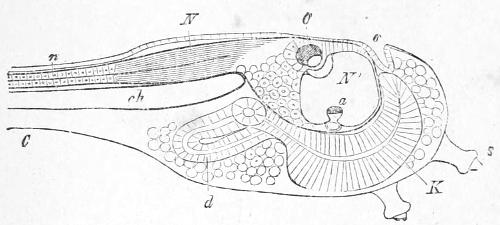
Fig. 18.—Ascidian Tadpole
with a part only of the tail C. N, nervous system with the enlarged
brain in front and the narrow spinal cord behind n; N´, is placed in
the cavity of the brain: O, the single cerebral eye lying in the brain;
a, similarly placed auditory organ; K, pharynx; d, intestine; o,
rudiment of the mouth; ch, notochord or primitive backbone. (From
Gegenbaur’s “Elements of Comparative Anatomy.”)
It is clear then that the Ascidians must be admitted
to be Vertebrates, and must be classified in that
great sub-kingdom or branch of the animal pedigree.
The Ascidian tadpole is very unlike its parent the
Ascidian, and has to go through a process of
degeneration in order to arrive at the adult structure.
The diagrams which are reproduced in Figs. 19 and
20, show how this degeneration proceeds. It will be
observed, that in somewhat the same manner as the
young barnacle, the young Ascidian fixes itself to a
stone by its head: then the tail with its notochord
and nerve-chord atrophies. The body grows and
gradually changes its shape, whilst the cloacal chamber
forms. The brain remains quite small and undeveloped,
and the remarkable myelonic eye (the eye in
the brain) disappears. The number of gill-slits
increases as the animal grows in size and its outer skin
becomes tough and leather-like.
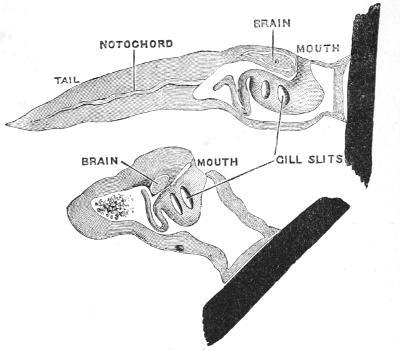
Fig. 19.—Degeneration of
Ascidian Tadpole to form the adult. The black pieces represent the rock
or stone to which the Tadpole has fixed its head.
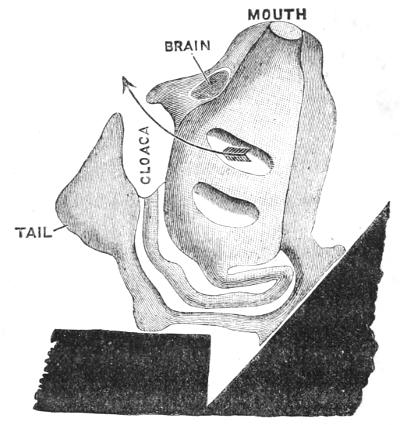
Fig. 20.—Very young
Ascidian with only two gill-slits. Compare with Fig 15; which is,
however, seen from the other side, so that left there corresponds to
right here.
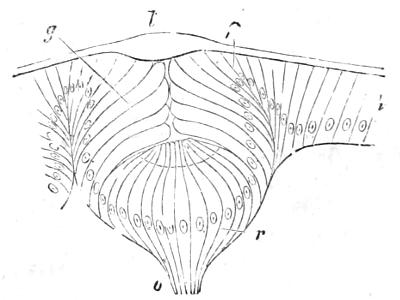
Fig. 21.—Section through
the eye (“surface-eye”) of a Water-beetle’s larva. All the cells are seen
to be in a row continuous with h, the cells of the outermost skin or
ectoderm. p, pigmented cells; r, retinal cells connected at o with
the optic nerve; g, transparent cells (forming a kind of “vitreous
body”); l, cuticular lens. (From Gegenbaur’s “Elements of Comparative
Anatomy,” after Grenacher.)
Before saying anything further on the subject of
degeneration, it seems desirable once more to direct
attention to the myelonic or cerebral eye which the
Ascidian tadpole possesses in common with all Vertebrates.
All other animals which have eyes
develop the retina or sensitive part of the eye from
their outer skin (See Figs. 21 and 22, and explanation.)
It is easy to understand that an organ which
is to be affected by the light should form on the
surface of the body where the light falls. It has
long been known as a very puzzling and unaccountable
peculiarity of Vertebrates, that the
retina or sensitive part of the eye grows out in
the embryo as a bud or vesicle of the brain, and
thus forms deeply below the surface and away from
the light (see Fig. 23, and explanation). The Ascidian
tadpole helps us to understand this, for it is
perfectly transparent and has its eye actually inside
its brain. The light passes through the transparent
tissues and acts on the pigmented eye, lying deep
in the brain. We are thus led to the conclusion—and
I believe this inference to be now for the first
time put into so many words—that the original Vertebrate
must have been a transparent animal, and
had an eye or pair of eyes inside its brain, like that of
the Ascidian tadpole. As the tissues of this ancestral
Vertebrate grew denser and more opaque, the
eye-bearing part of the brain was forced by natural
selection to grow outwards towards the surface, in
order that it might still be in a position to receive
the influence of the sun’s rays. Thus the very
peculiar mode of development of the Vertebrate eye
from two parts, a brain-vesicle (Fig. 23, A a, and
B p r), and a skin-vesicle (Fig. 23, B e, l), is
accounted for.
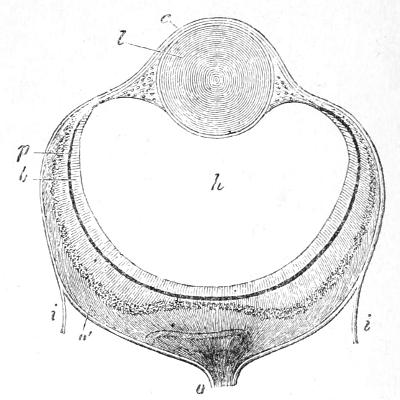
Fig. 22.—Section through
the eye (“surface-eye”) of a Marine Worm (Neophanta). i, integument
spreading over the front of the eye c; l, cuticular lens; h, cavity
occupied by vitreous body; p, retinal cells; b, pigment; o, optic
nerve: o´, expansion of optic nerve.
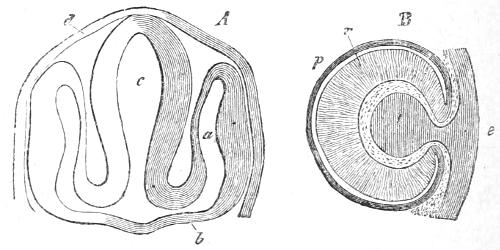
Fig. 23.—A. Vertical
section through the head of a very young fish, showing in the centre
the cavity of the brain c. On each side is a hollow outgrowth (a)
which will form the retina of the fish’s eye (“cerebral eye”); b,
will become the optic nerve connecting the brain and the retina; d,
integument.—B. Later condition of the hollow outgrowth (a) of A.
Its outer wall r is pressed against its deeper wall p by an ingrowth
(l) from the outer skin (ectoderm) e; r, gives rise to the retinal
cells, whilst only l, the cellular lens, is derived from the surface of
the skin.
The cases of degeneration which I have up to this
point brought forward, are cases which admit of very
little dispute or doubt. They are attested by either
the history of the individual development of the
organisms in question, as in Sacculina, in the
Barnacle, and in the Ascidian, or they are cases
where the comparison of the degenerate animal,
with others like it in structure, but not degenerate,
renders the hypothesis of degeneration an unassailable one.
Such cases are the Acarus or mite, and
the skin-worm (Demodex).
We have seen that degeneration, or the simplification
of the general structure of an animal, may be
due to the ancestors of that animal having taken
to one of two new habits of life, either the parasitic
or the immobile. Other new habits of life appear
also to be such as to lead to degeneration. Let
us suppose a race of animals fitted and accustomed
to catch their food, and having a variety of organs
to help them in this chase—suppose such animals
suddenly to acquire the power of feeding on the
carbonic acid dissolved in the water around them
just as green plants do. This would lead to a degeneration;
they would cease to hunt their food, and
would bask in the sunlight, taking food in by the whole
surface, as plants do by their leaves. Certain small
flat worms, by name Convoluta, of a bright green
colour, appear to be in this condition. Their green
colour is known to be the same substance as leaf-green;
and Mr. Patrick Geddes has recently shown
that by the aid of this green substance they feed on
carbonic acid, making starch from it as plants do.
As a consequence we find that their stomachs and
intestines as well as their locomotive organs become
simplified, since they are but little wanted. These
vegetating animals, as Mr. Geddes calls them, are the
exact complement of the carnivorous plants, and show
how a degeneration of animal forms may be caused
by vegetative nutrition.
Another possible cause of degeneration appears
to be the indirect one of minute size. It cannot be
doubted that natural selection has frequently acted
on a race of animals so as to reduce the size of the
individuals. The smallness of size has been favourable
to their survival in the struggle for existence,
and in some cases they have been reduced to even
microscopic proportions. But this reduction of size
has, when carried to an extreme, resulted in the loss
or suppression of some of the most important organs
of the body. The needs of a very minute creature
are limited as compared with those of a large one,
and thus we may find heart and blood-vessels, gills
and kidneys, besides legs and muscles, lost by the
diminutive degenerate descendants of a larger race.
That this is a possible course of change all will, I
think, admit. It is actually exemplified in Appendicularia—the
only adult representative of the
Ascidian tadpole—still tadpole-like in form and
structure, but curiously degenerate and simplified in
its internal organs. This kind of degeneration is
also exemplified in the Rotifers, or wheel animalcules,
in the minute Crustacean water-fleas (Ostracoda), and
in the Moss-polyps, or Polyzoa. Roughly then we
may sum up the immediate antecedents of degenerative
evolution as, 1, Parasitism; 2, Fixity or
immobility; 3, Vegetative nutrition; 4, Excessive
reduction of size. This is not a logical enumeration,
for each of these causes involves, or may be inseparably
connected with, one or more of the others. It
will serve for the present as well as a more exhaustive
analysis. (See Note C.)
And now we have to note an important fact
with regard to the evidence which we can obtain
of the occurrence of this process of degeneration.
We have seen that the most conclusive evidence
is that of the recapitulative development of the
individual. The Ascidian Phallusia shows itself to
be a degenerate Vertebrate by beginning life as a
tadpole. But such recapitulative development is by
no means the rule. Quite arbitrarily, we find, it
is exhibited in one animal and not in a nearly
allied kind. Thus very many animals belonging
to the Ascidian group have no tadpole young—just
as some tree-frogs have no tadpoles. It is
quite possible, and often, more often than not,
occurs, that the most important part of the recapitulative
phases are absent from the developmental
history of an animal. The egg proceeds very rapidly
to produce the adult form, and all the wonderful
series of changes showing the animal’s ancestry are
absolutely and completely omitted; that is to say,
all those stages which are of importance for our
present purpose. Just as certain bodies pass from
the solid to the liquid state at a bound, omitting all
intermediate phases of consistence, but giving evidence
of “internal work” by the suggestive phenomenon of
latent heat—so do these embryos skip long tracts in
the historically continuous phases of form, and present
to us only the intangible correlative “internal work”
in place of the tangible series of embryonic changes
of shape.
Now I want to put this case—a supposition—before
the reader who has so far followed me in these pages.
Suppose, as might well have happened, that the
Barnacles, one and all, instead of recapitulating in
their early life, were to develop directly from the egg to
the adult form, as so many animals do; should we
have ever made out that they were degenerate Crustaceans?
Possibly we should: their adult structure
still bears important marks of affinities with crabs and
shrimps; but as a matter of fact before their recapitulative
development had been discovered they were
classed by the great Cuvier and other naturalists with
the Molluscs, the mussels and snails.
Suppose again that all the existing Ascidians,
as many of them actually have, had long ago lost
their recapitulative history in growth from the egg:
suppose that no such a thing as an Ascidian tadpole
existed, but that the Ascidian’s egg grew as directly
as possible into an Ascidian, in every living species
of the group. This might easily be the case. Then
most assuredly we should not have the least notion
that the Ascidians were degenerate Vertebrates. We
should still class them where they used to be classed
before the Russian naturalist Kowalewsky discovered
the true history and structure of the Ascidian tadpole.
I believe that I shall have the assent of every
naturalist when I say that the vertebrate character of
the Ascidians and the history of their degeneration
would never have been suspected, or even dreamed of,
had the Ascidian tadpoles ceased to appear in the
course of the Ascidian development at a geological
period anterior to the present epoch.
This being the case, it must be admitted that it is
quite possible—I do not say more than possible—that
other groups of animals besides parasites,
Barnacles, and Ascidians, are degenerate. It is
quite possible that animals with considerable complexity
of structure, at least as complex as the
Ascidians, may have been produced by degeneration
from still more highly-organized ancestors. Any
group of animals to which we can turn may possibly
be the result of degeneration, and yet offer no evidence
of that degeneration in its growth from the egg.
Accordingly, wherever we can note that a group
of organisms is characterized by habits likely to lead
to degeneration, such as I have enumerated, viz.,
parasitism or immobility, or certain special modes of
nutrition, or again, by minute size of its representatives—there
we are justified in applying the
hypothesis of degeneration, even in the absence of any
confirmatory evidence from embryology. When we
so apply this hypothesis we find in not a few cases, in
working over the details of the organization of many
different animals by the light which it affords—that
much becomes clear and assignable to cause which,
on the hypothesis either of “balance” or of “elaboration,”
is quite hopelessly obscure. As examples of
groups of animals which can thus be satisfactorily
explained I may cite first of all the Sponges: as only
somewhat less degenerate, we have all the Polyps
and Coral-animals, also the Starfishes. Amongst
the Mollusca—the group of headless bivalves, the
oysters, mussels and clams, known as the Lamellibranchs,
are, when one once looks at their structure
in this light, clearly enough explained as degenerated
from a higher type of head-bearing active creatures
like the Cuttle-fish; whilst the Polyzoa or Moss-polyps
stand in precisely the same kind of relation
to the higher Mollusca as do the Ascidians to the
higher Vertebrates: they have greatly degenerated,
and become minute encrusting organisms which, like
some of the Ascidians, build up colonies by plant-like
budding growth. The Rotifers, or wheel animalcules,
I have already mentioned as best explained by the
supposition that they are the descendants of far
larger and more fully-organized animals provided
with locomotive appendages or limbs: they have
dwindled and degenerated to their present minute
size and curiously suggestive structure.
Besides these there are other very numerous cases
of animal structure which can best be explained by
the hypothesis of degeneration. A discussion of these,
and a due exposition of the application of the hypothesis
of degeneration to the various groups just cited,
would involve a complete treatise on comparative
anatomy and embryology, and lead far beyond the
limitations of this little volume.
All that has been, thus far, here said on the subject
of Degeneration is so much zoological specialism,
and may appear but a narrow restriction of the discussion
to those who are not zoologists. Though we
may establish the hypothesis most satisfactorily by
the study of animal organization and development, it
is abundantly clear that degenerative evolution is by
no means limited in its application to the field of
zoology. It clearly offers an explanation of many
vegetable phenomena, and is already admitted by
botanists as the explanation of the curious facts connected
with the reproductive process in the higher
plants. As a further example of its application in
this field, the yeast-plant may be adduced, which is
in all probability a degenerate floating form derived
from a species of mould (Mucor). In other fields,
wherever in fact the great principle of evolution
has been recognised, degeneration plays an important
part. In tracing the development of languages,
philologists have long made use of the hypothesis of
degeneration. Under certain conditions, in the
mouths and minds of this or that branch of a race,
a highly elaborate language has sometimes degenerated
and become no longer fit to express complex
or subtle conceptions, but only such as are simpler
and more obvious. (See Note D.)
The traditional history of mankind furnishes us
with notable examples of degeneration. High states
of civilisation have decayed and given place to low
and degenerate states. At one time it was a favourite
doctrine that the savage races of mankind were degenerate
descendants of the higher and civilised races.
This general and sweeping application of the doctrine
of degeneration has been proved to be erroneous by
careful study of the habits, arts, and beliefs of savages;
at the same time there is no doubt that many savage
races as we at present see them are actually degenerate
and are descended from ancestors possessed
of a relatively elaborate civilisation. As such we
may cite some of the Indians of Central America,
the modern Egyptians, and even the heirs of the
great oriental monarchies of præ-Christian times.
Whilst the hypothesis of universal degeneration as
an explanation of savage races has been justly discarded,
it yet appears that degeneration has a very
large share in the explanation of the condition of
the most barbarous races, such as the Fuegians, the
Bushmen, and even the Australians. They exhibit
evidence of being descended from ancestors more
cultivated than themselves.
With regard to ourselves, the white races of
Europe, the possibility of degeneration seems to
be worth some consideration. In accordance with
a tacit assumption of universal progress—an unreasoning
optimism—we are accustomed to regard ourselves
as necessarily progressing, as necessarily having
arrived at a higher and more elaborated condition
than that which our ancestors reached, and as destined
to progress still further. On the other hand, it is
well to remember that we are subject to the general
laws of evolution, and are as likely to degenerate as
to progress. As compared with the immediate forefathers
of our civilisation—the ancient Greeks—we
do not appear to have improved so far as our bodily
structure is concerned, nor assuredly so far as some of
our mental capacities are concerned. Our powers of
perceiving and expressing beauty of form have certainly
not increased since the days of the Parthenon
and Aphrodite of Melos. In matters of the reason,
in the development of intellect, we may seriously
inquire how the case stands. Does the reason of
the average man of civilised Europe stand out clearly
as an evidence of progress when compared with that
of the men of bygone ages? Are all the inventions
and figments of human superstition and folly, the
self-inflicted torturing of mind, the reiterated substitution
of wrong for right, and of falsehood for truth,
which disfigure our modern civilisation—are these
evidences of progress? In such respects we have at
least reason to fear that we may be degenerate.
Possibly we are all drifting, tending to the condition
of intellectual Barnacles or Ascidians. It is possible
for us—just as the Ascidian throws away its tail and
its eye and sinks into a quiescent state of inferiority—to
reject the good gift of reason with which every
child is born, and to degenerate into a contented life
of material enjoyment accompanied by ignorance
and superstition. The unprejudiced, all-questioning
spirit of childhood may not inaptly be compared to
the tadpole tail and eye of the young Ascidian: we
have to fear lest the prejudices, pre-occupations,
and dogmatism of modern civilisation should in any
way lead to the atrophy and loss of the valuable
mental qualities inherited by our young forms from
primæval man.
There is only one means of estimating our position,
only one means of so shaping our conduct that
we may with certainty avoid degeneration and keep
an onward course. We are as a race more fortunate
than our ruined cousins—the degenerate Ascidians.
For us it is possible to ascertain what will conduce
to our higher development, what will favour our
degeneration. To us has been given the power to
know the causes of things, and by the use of this
power it is possible for us to control our destinies.
It is for us by ceaseless and ever hopeful labour
to try to gain a knowledge of man’s place in the
order of nature. When we have gained this fully
and minutely, we shall be able by the light of the
past to guide ourselves in the future. In proportion
as the whole of the past evolution of civilised
man, of which we at present perceive the outlines, is
assigned to its causes, we and our successors on the
globe may expect to be able duly to estimate that
which makes for, and that which makes against,
the progress of the race. The full and earnest cultivation
of Science—the Knowledge of Causes—is
that to which we have to look for the protection of
our race—even of this English branch of it—from
relapse and degeneration.