PART ONE PRACTICAL CONSIDERATIONS — CHAPTER II. THE FUNCTIONS OF A SCALE IN DIAGNOSIS — A. The Meaning of Intellectual Deficiency. — B. Forms of Mental Deficiency Not Yet Discoverable by Tests. — C. Doubtful Intellects Accompanied by Delinquency Presumed Deficient. — CHAPTER III. THE PERCENTAGE DEFINITION OF INTELLECTUAL DEFICIENCY — A. The Definition. — B. The Assumptions of a Quantitative Definition. — CHAPTER IV. WHAT PERCENTAGE IS FEEBLE-MINDED — A. Kinds of Social Care Contemplated — B. Estimates of the School Population Versus the General Population — C. Desirable Versus Immediately Advisable Social Care — D. Percentages Suggested to Harmonize the Estimates — E. Comparison With Important Estimates — F. The Ability of the Mentally Retarded, Especially Those Receiving Special Training. — CHAPTER V. ADAPTING THE PERCENTAGE DEFINITION TO THE BINET SCALE — A. The Border Region for the Mature. — B. The Border Region for the Immature. — CHAPTER VI. DELINQUENTS TESTING DEFICIENT — A. At the Glen Lake Farm School for Boys, Hennepin County, Minnesota. — B. Comparison of Tested Deficiency Among Typical Groups of Delinquents. — C. Summary of Tested Deficiency Among Delinquents — CHAPTER VII. CHECKING THE BINET DIAGNOSIS BY OTHER METHODS — CHAPTER VIII. SCHOOL RETARDATION AMONG DELINQUENTS — A. In Minneapolis — B. School Retardations Among Other Groups of Delinquents — CHAPTER IX. COMPARISON OF THE SCHOOL TEST AND THE BINET TEST — A. Practical Uses of the School Test. — B. Checking Deficiency Among Delinquents by the School Test. — CHAPTER X. BAD SCHOOL ADJUSTMENT AS A CAUSE OF DELINQUENCY — CHAPTER XI. DEFICIENCY AS A CAUSE OF DELINQUENCY — A. The Chances of the Mentally Deficient Becoming Delinquent. — B. The Correlation of Deficiency and Delinquency. — C. The Causes of Delinquency. — CHAPTER XII. SUMMARY AND SUGGESTIONS
10
Whatever form the definition of feeble-mindedness may
take, in this country at least[3] the concept has become
quite firmly established as describing the condition of
those who require social guardianship, because, with
training, they do not develop enough mentally to live an
independent life in society. The feeble-minded are socially
deficient because of a failure to develop mentally. They
are proper wards of the state because of this mental deficiency.
Goddard says, they are “incapable of functioning
properly in our highly organized society” (112, p. 6).
The most generally quoted verbal description of the upper
line of social unfitness is that of the British Royal Commission
on Feeble-Mindedness: “Persons who may be
capable of earning a living under favorable circumstances,
but are incapable from mental defect existing from birth
or from an early age (a) of competing on equal terms with
their normal fellows; or (b) of managing themselves and
their affairs with ordinary prudence.” It is clear that
the intention is to distinguish mental deficiency from senile
dementia, from hysteria and from insanity, in which there
is a temporary or permanent loss of mental ability rather
than a failure to develop. Feeble-mindedness may, however,
arise from epilepsy or from other diseases or accidents
in early life as well as from an inherent incapacity for development.
11Moreover, mental deficiency, or feeble-mindedness,
(I use the terms interchangeably) does not imply
that the social unfitness is always caused by intellectual
deficiency. Mind is a broader term than intellect, as we
shall note in the next section.
This definition of the feeble-minded is the main idea
expressed by Witmer (221), Tredgold (204), Pearson (164),
and Murdock (164). The historical development of the
concept is traced by Rogers (172) and Norsworthy (159).
It is criticized by Kuhlmann (140) as impractical and indefinite.
The indefiniteness is indicated by such terms
as “under favorable circumstances,” “on equal terms,”
and “with ordinary prudence.” This objectionable uncertainty
as to social fitness can be considerably relieved
for those types of feeble-mindedness which involve the
inability to pass mental tests, since this result can later
be correlated with subsequent social failure and predictions
made during childhood on the basis of the tests.
Attempts to make the concept of feeble-mindedness more
definite have, therefore, naturally taken some quantitative
form in relation to objective tests. Binet and the French
commission in 1907 (77) called attention to the method
in use in Belgium for predicting unfitness objectively on
the basis of the amount of retardation in school at different
ages. With the appearance in 1908 of the Binet-Simon
revised scale for measuring mental development,
quantitative descriptions began to be concerned with the
borderlines of mental deficiency on scales of tests.
While the quantitative descriptions of tested deficiency
do not include all forms of feeble-mindedness, as I shall
show in the next section, they have made the diagnosis of
the majority of cases much more definite. Nobody would
think of returning to the days when the principal objective
criteria were signs of Cretinism, Mongolianism, hydrocephalus,
12microcephalus, epilepsy, meningitis, etc., which
LaPage (141) has shown are not found among more than
9% of 784 children in the Manchester special schools.
The impossibility of agreeing upon subjective estimates of
mental capacity without the use of objective criteria is
well shown by Binet's methodical comparison of the admission
certificates filled out within a few days of each
other by the alienists for the institutions of Sainte-Anne,
Bicêtre, the Salpêtreire and Vaucluse. These physicians
gave their judgments as to whether a case was an idiot,
imbecile or higher grade. Binet says: “We have compared
several hundreds of these certificates, and we think
we may say without exaggeration that they looked as if
they had been drawn by chance out of a sack” (77, p. 76).
The rapid accumulation of data with psychological tests
has made it possible to take our first halting steps in the
direction of greater definiteness in diagnosis by a larger
use of objective methods. This increase in significance
of the concept of deficiency is fruitful at once in estimating
the size of the social problem and planning means for
undertaking the care of these unfortunates. We can
discover something of the error in the previous subjective
estimates of the frequency of feeble-mindedness. We
can bring together and compare the work of different investigators,
not only in our country, but throughout the
world. We can discover, for example, how important the
problem of deficiency is among different groups of delinquents,
knowing that the differences are not to be explained
by differences in expert opinion. Furthermore, we can
now determine, with considerable accuracy, whether the
diagnosis made by a reliable examiner is independent of
his personal opinion.
If we disregard the natural antipathy of many people
to anything which tends to limit the charming vagueness
13of their mental outlook, we may endeavor to chart this
horizon of tested deficiency with something of the definiteness
of figures, which shall at the same time indicate a
range of error. As soon as our aim comes to be to plot
the borderline on a measuring scale of mental ability, we
find that the borderline must be so stated that we can
deal with either adults or children. Two sorts of limiting
regions must be described, one for mature minds and one
for immature minds. The latter will be in the nature of
a prediction as to what sort of ability the children will
show when they grow up. We must keep in mind, therefore,
that we should attempt our quantitative definition
for both growing and adult minds. As soon as the growing
mind passes the lower limit for the mature it is then
guaranteed access to the social seas although it may never
swim far from shore nor develop further with advancing
years. In seeking greater definiteness, our aim should
then be to describe both the limit for the mature individuals
and the limit for the immature of each age. In
this paper the definition will be restricted to intellectual
deficiency, i. e., tested deficiency. It will take the form
of describing the positions on a scale below which fall the
same lowest percentage of intellects. This percentage definition
of intellectual deficiency offers such a simple method
of consistently describing the borderlines for mature
and immature that it is surprising so little attempt has
previously been made to work it out for a system of tests.
Although the principle on which the definition is based
depends upon the distribution curve of ability, it is concerned
only with the lower limit of the distribution. Since
the exact form of this distribution is uncertain I have preferred
to call it a percentage definition of intellectual deficiency
rather than to state the limits in terms of the
variability of ability. Moreover the lowest X per cent.
14in mental development requires no further explanation to
be understood by the layman.
The first broad conclusion that impresses those who try
to use mental scales for diagnosing feeble-mindedness is
that the lower types, the idiots and imbeciles, can be detected
with great accuracy by an hour's testing. The
difficulties pile up as soon as the individual rises above
the imbecile group. The practical experience of those in
institutions for the feeble-minded here becomes of fundamental
importance. They are able to supply the history
of exceptions that should make us cautious about our general
rules. Certain people whom they have known for
years to be unable to adjust themselves socially because
their minds have not reached the level of social fitness will
yet be able to pass considerably beyond the lower test
limit for mature minds. The mental scales can only detect
those feeble-minded who cannot succeed with our
present tests. This is the basal principle in using any
system of tests.
Stated in another way, this first caution for anybody
seeking the assistance of a mental scale is that tests may
detect a feeble-minded person, but when a person passes
them it does not guarantee social fitness. The negative
conclusion, “this person is not feeble-minded,” can not be
drawn from tests alone. Mental tests at present are
positive and not negative scales. This fact will probably
always make the expert's judgment essential before the
discharge of a suspected case of mental deficiency. When
a subject falls below a conservative limit for tested ability
a trained psychologist who is familiar with the sources of
error in giving tests, even without experience with the
15feeble-minded, should be able to say that this person at
present shows as deficient development as the feeble-minded.
To conclude however that any subject has a
passable mind requires in addition practical experience
with feeble-minded people who pass the tests. It is very
much easier to state that the tests do not detect all forms
of feeble-mindedness than it is to give any adequate description
of the sort of feeble-mindedness which they do
not as yet detect.
This distinction between the feeble-minded who do well
with test scales and those who do not, is well known in the
institutions for the feeble-minded. Binet sought to
distinguish some of the feeble-minded who escaped the
tests by calling them “unstable,” or “ill-balanced,” individuals
as Drummond (77) translates the term. To use
the historical distinctions of psychology, their minds seem
to be undeveloped more on their volitional and emotional
sides than on their intellectual side. Weidensall (59) has
described another type as “inert.” She found that quite
a number of the reformatory women might slide through
the tests but fail socially from the fact that “their lives
and minds are so constituted that they feel no need to
learn the things any child ought to know, though they can
and do learn when we teach them.” Again, it seems to
be a disturbance of will through the feeling, rather than
an intellectual deficiency. Many of the so-called “moral
imbeciles” are probably able to pass intellectual tests lasting
but a few minutes. Like the unstable or inert they
are not failures because of a lack of intellectual understanding
of right and wrong, but because of excess or deficiency
of their instinctive tendencies especially in the
emotional sphere. Such weakness of will may arise either
from abnormality of specific instinctive impulses or inability
to organize these impulses so that one impulse may
16be utilized to supplement or inhibit another. We may
call all this group of cases socially deficient because of a
weakness in the volitional, or conative, aspect of mind.
The discrimination of mental activities which are predominately
emotional and conative from those in which
intellect is mainly emphasized is also well recognized by
those who have been making broad studies of tests in
other fields than that of feeble-mindedness. Hart
and Spearman (123), for example, call attention to
the fact that tests passed under the stimulus of test conditions
represent what the subject does when keyed up to
it rather than what he would do under social conditions.
We cannot be sure that speed ability as tested will represent
speed preferences. The subject may be able to work
rapidly for a few minutes, but in life consistently prefer
to work deliberately. Regarding the eighteen tests which
they studied with normal and abnormal adults they say:
“These tests have been arranged so as to be confined to
purely intellectual factors. But in ordinary life, this
simplicity is of rare occurrence. For the most part, what
we think and believe is dominated by what we feel and
want.” Kelley (130) finds by the regression equation
that the factor of effort amounts to two-thirds of the
weight of that of the intellectual factor in predicting
scholarship from teachers' estimates. Webb (217) thinks
that he finds by tests a general conative factor comparable
to Spearman's general intellective factor.
With the change in point of view that has come from
the adoption of the biological conception of the mind the
discrimination of the different forms of feeble-mindedness
must be recognized as a distinction in the emphasis on intellectual,
emotional and conative processes, not a distinction
between actually separable forms of mental
activity. On account of the organic nature of the mind
17it is well established that various mental processes are
mutually dependent. Any disturbance of the emotional
processes will tend to affect the thinking and vice versa.
Even if we believe that emotions are complex facts, involving
vague sensations as well as feelings, and that terms
like emotion, memory, reasoning and will are names for
classes of mental facts rather than for mental powers, it
still remains important to distinguish between feeling,
intellect and will, as well as to recognize the interdependence
of the mental processes. Common sense seems to
agree with psychological descriptions in regarding mind
as a broader term than intellect, and feeble-mindedness
as a broader term than intellectual feebleness.
Since tests at present tend to reach the intellectual processes
more surely than the emotional, we describe those
who fail in them as intellectually deficient. The term
“intellect” seems to be better than “intelligence” because
the latter seems to include information as well as capacity,
while the aim of measuring scales has been to eliminate
the influence of increasing information with age. To be
thoroughly objective, of course, one should talk about
“feebleness in tested abilities;” but we would then fail to
point out the important fact about our present scales that
they detect mainly intellectual deficiency, that they do
not reach those forms of feeble-mindedness in which the
weakness in such traits as stability, ambition, perseverance,
self-control, etc., is not great enough to interfere
with the brief intellectual processes necessary for passing
tests. Intellectual deficiency will be used hereafter to
refer to those social deficients whose feebleness is disclosed
by our present test scales.
In the opinion of Kuhlmann these cases of disturbed
emotions and will which shade off into different forms of
insanity should not be classed as feeble-minded at all,
18although he recognizes that they are commonly placed in
this group. He regards them as an intermediate class
between the feeble-minded and the insane. He says:
“They readily fail in the social test for feeble-mindedness
and because of the absence of definite symptoms of insanity
are often classed as feeble-minded. In the opinion
of the present writer they should not be so classed, because
they require a different kind of care and treatment, and
have a different kind of capacity for usefulness” (140). So
long as this group of what we shall term “conative cases”
is discriminated from the intellectually deficient it matters
less whether they be regarded as a sub-group of the feeble-minded
or as a co-ordinate class. In grouping them with
the feeble-minded we have followed the customary classification.
An estimate of the size of this group will be
considered later in Chapter III.
Conative forms of feeble-mindedness are perhaps the
most serious types in the field of delinquency. They are
the troublesome portion of the borderland group of deficient
delinquents about which there is so much concern.
It is important to remember that it is just among these
cases that the test judgment is least certain. In this
dilemma one principle seems to be sound enough psychologically
to be likely to meet with acceptance. I should
state this principle as follows: A borderline case which has
also shown serious and repeated delinquency should be classed
as feeble-minded, the combination of doubtful intellect and
repeated delinquency making him socially unfit. This will
relieve the practical situation temporarily until tests are
perfected which will detect those whose feebleness is specialized
in those phases of volition centering around the
instinctive passions, control, balance, interest and endurance.
19The principle recognizes that mental weakness is
sometimes emphasized in the volitional processes of the
mind.
The principle is apparently in conflict with the rule
advocated by Dr. Wallin. Referring to the mental levels
reached by individuals, he says: “We cannot consider
X-, XI-, or XII-year-old criminals as feeble-minded because
they happen to be criminals and refuse to consider
X-, XI-, and XII-year-old housewives, farmers, laborers
and merchants as feeble-minded simply because they are
law abiding and successful” (214, p. 707). At another
place he insists “that the rule must work both ways”
(215, p. 74). Logically it would seem at first that it was a
poor rule which did not work both ways. Further consideration
will show, I believe, that there has been a confusion
of feeble-mindedness with tested deficiency. If
all the feeble-minded tested deficient intellectually then
the tested level should determine whether or not they
were feeble-minded. This, however, is not a correct
psychological description of the facts. I prefer, therefore,
to allow for those in a defined narrow range of weak intellects
to be classed as deficient provided their weakness
also manifests itself pronouncedly in the conative sphere.
The principle that all mental deficients need not show
the same low degree of intellectual ability is clearly recognized
in perhaps the most important legal enactment on
deficiency which has been passed in recent years, the British
Mental Deficiency Act of 1913. It states regarding
“moral imbeciles” that they are persons “who from an
early age display some permanent mental defect coupled
with strong vicious or criminal propensities on which
punishment has had little or no deterrent effect.” It
specifically distinguishes them from the group of feeble-minded
which require guardianship because of inability
to care for themselves.
20
In order to direct attention to the quantitative description
of intellectual deficiency which is here proposed, let
us state the percentage definition in its most general form.
Individuals whose mental development tests in the lowest X
per cent. of the population are PRESUMABLY INTELLECTUALLY
DEFICIENT, unless their deficiency is caused by removable
handicaps. Above these is a group of Y per cent.
within which the diagnosis of intellectual deficiency is
uncertain on the basis of our present tests. The size of
the presumably deficient X group is to be determined by
the number of intellectually weak which society is at
present justified in indefinitely isolating. The doubtfully
deficient Y group should include all those who are
so intellectually deficient as to be expected to need assistance
indefinitely. The feeble-minded, or MENTALLY
DEFICIENT, are those who require social care indefinitely
because of deficiency in mental development. They include
the X group, that portion of the doubtful Y group
which is found to require isolation, guardianship or social
assistance, and any others not detected by the tests but
requiring prolonged social care on account of their failure
to develop mentally. Under the principle which we stated
at the close of the last section the combination of Y
ability and persistent serious delinquency brings the case
within the group presumed to be feeble-minded.
Besides the greater definiteness and significance of such
a definition of intellectual deficiency, it affords the simplest
practical criterion for determining the borderline of passable
intellects with a scale of mental tests. A detailed
comparison of the percentage plan with other forms of
21quantitative definition will be found in Part Two. We
may note here, however, that it guards against a number
of the absurdities of current descriptions of the borderline
with measuring scales. It is a criterion which may be consistently
applied to the borderline of both the immature
and the mature. It may be adapted with comparative
ease to any system of tests. It aids in comparing the
frequency of intellectual deficiency among different groups,
for example, among different types of delinquents, regardless
of whether the investigators have used the same
series of tests, provided only that each series has been
standardized for similar random groups.
Any form of quantitative definition, on the other hand,
involves certain assumptions which must be defended
before it can claim to be of advantage for practical purposes.
(a) Deficiency is a difference in degree not in kind.
Fortunately the tendency to describe the feeble-minded
person as if he were a different species from the normal
has been definitely attacked by two noteworthy researches,
that of Norsworthy (159) and that of Pearson and Jaederholm
(164) (167). In these two investigations mentally
deficient children either in special classes or in institutions
have been compared with groups of normal children from
the same localities on the basis of objective tests. The
results are uniformly supported by numerous other studies
of deficient and normal groups with the Binet and other
tests. The conclusion is, therefore, thoroughly established
that there is no break in the continuity of mental
ability. It grades off gradually from average ability, and
continually fewer and fewer individuals are to be found
22at each lower degree of ability. The borderline of deficiency
will, therefore, not be a mental condition which
clearly separates different kinds of ability, but a limiting
degree of capacity to be decided upon by social policy in
attempting to care for those who most need social guardianship.
Since ability changes gradually in degree it is
necessary to indicate a doubtful border region of degrees
of ability on which expert judgment must supplement the
test diagnosis. Below the doubtful region the diagnosis
is clearly supported by objective test criteria, so that the
only question to raise is whether the condition is caused
by removable handicaps. The percentage definition
thus strictly conforms to the best objective studies of
mental deficiency in treating deficiency as a difference in
degree.
It should, perhaps, be said that this view is in direct
conflict with the opinion that mental deficiency is accounted
for as a Mendelian simple unit character. The
opposing view has been advocated by Davenport (95,
p. 310) and others in the publications of the Eugenics
Record Office, and accepted by Goddard (112, p. 556).
It has been so fully answered by Pearson (164) and Heron
of the Galton Laboratory (127) and by Thorndike (198)
that there is no occasion to take up the question in detail.
We seem to be reaching an understanding so far as our
present problem is concerned. If the explanation of the
inheritance of mental ability is through Mendelian characters,
nevertheless intellectual ability is the result of
such a complex combination of units that it may best be
thought of in connection with the unimodal distribution
of ability adopted in this study. No random measurement
of mental ability has ever shown any other form of
distribution.
The attempt has also been made by Schmidt (179) to
23find qualitative differences between normal and feeble-minded
children by means of tests, and by Louise and
George Ordahl (162) to find qualitative differences between
levels of intelligence among feeble-minded children.
While these studies are very suggestive in pointing out
the tests which most clearly indicate differences between
individuals, they seem to me to fall far short of showing
that the qualitative distinctions are anything more than
larger quantitative distinctions. It is not clear that the
authors intended them to mean anything more than this,
so these studies do not seem to conflict seriously with our
assumption that intellectual ability grades off gradually
and uninterruptedly from medium ability to that of the
lowest idiot.
(b) As to the variation in the frequency of deficiency at different ages.
A quantitative definition of intellectual deficiency
would certainly be much simpler if it could be assumed
that the percentage of deficients at each age is practically
constant during the time when a diagnosis of deficiency
is most important, say from 5 to 25 years. Otherwise the
objection might be raised that it is impracticable to determine
different percentages for each year of immaturity
or to formulate our borderlines of ability for a particular
age. When the general instinctive origin of intellectual
deficiency is considered along with the incurability of the
condition, we seem to be theoretically justified in assuming
that the variation will be slight from one year of life
to the next. This assumption is tacitly made by all
those who use Stern's quantitative description of deficiency
in terms of the mental quotient. On the other hand,
there is a feeling among some of the investigators that
there is a sudden influx of feeble-minded at particular
24ages and this position should be examined. Probably
more important than this possibility of increase is the
question of a decrease in frequency with age on account
of the excessive death rate among the deficients.
It is a natural supposition that there is a sudden increase
in the proportion of feeble-minded at adolescence.
On account of the increased rate of growth at this period
we might expect to find greater instability for a few years.
It may well be that there is a rather sudden influx of
the unstable type of feeble-mindedness at this period.
Such an increase may occur without being detected by
a series of brief intellectual tests such as the Binet scale.
It would be of the conative type of feeble-mindedness that
cannot at present be diagnosed by objective tests, the
type that requires diagnosis by expert opinion. It is to
be noted, however, that Binet, who paid much attention
to the unstable type, says: “Since the ill-balanced are
so numerous at ten years of age, and even at eight, we
conclude that in many cases the mental instability is not
the result of the perturbation which precedes puberty.
This physiological explanation is not of such general application
as is sometimes supposed” (77, p. 18).
Only when an emotional disturbance is so great as to
be detectable by mental tests will this influx need to
be taken into consideration in stating the borderline for
objective tests. The evidence that few cases of feeble-mindedness
are not detectable until after ten years of
age is all the other way. With the Stanford measuring
scale, Terman and his co-workers did not even find a
noticeable increase in the variability of the groups at the
ages of adolescence (57, p. 555). It is to be remembered
also that we are not concerned here with mere instability
which corrects itself with more maturity, such as has been
described by Bronner among delinquents. This does not,
25of course, amount to an incurable conative deficiency and
is not classified under feeble-mindedness.
Goddard has suggested that possibly the moral imbecile
group comes into our class of feeble-minded suddenly
with a common arrest of development at about the stage
reached by the nine-year-old. He notes that “of the
twenty-three cases of this sort picked out for us (at Vineland)
by the head of the school department, fifteen are in
the nine-year-old group, five in the ten-year-old, two in
the eleven, and one in the twelve” (113). He regards
this evidence, however, as meager and only suggestive.
Doll has given evidence of late appearance of retardation
in rare cases (100 and 99).
It is to be noted that if a sudden change is found in the
percentage of children falling below a certain test standard
it is perhaps more likely to mean that there is a change in
the difficulty of the tests at that point. For example our
Table V shows 1.3% of the nine-year-olds test two or
more years retarded, while 18.9% of the ten-year-olds
are retarded two years or more. This presumably indicates
a change in the relative difficulty of the tests for
VII and VIII rather than a change in the frequency of
retardation at ages nine and ten. When we turn to Goddard's
norms for VII and VIII we find that 81% of the
seven-year-old children pass the norm for VII while only
56% of the eight-year-old children pass the norm for
VIII.
The Jaederholm data (167) obtained by applying the
Binet tests to pupils in the regular school classes and in
special classes for the retarded may suggest a possible
influx of intellectual deficiency at about 12 years of age
or else “more mental stagnation in the intellectually defective”
at this life-age and after. If one were to define
intellectual deficiency in terms of the standard deviation
26of the regular school children, this data suggests that there
is a marked increase in the number of children sent to the
special classes at 12 years of age who are -4 S. D. or lower.
Roughly speaking it amounts to 36 children at 12 years of
age, 36 at 13, and 21 at 14, as compared with 11 at 11
years and 13 at 10 years. On the other hand, this may
as well mean that intellectual deficiency becomes greater
in degree rather than in frequency at these ages. The
latter interpretation is adopted by Pearson for the Jaederholm
data, so that it is perhaps not necessary to consider
this evidence further. On the average the pupils in the
special classes fall about .3 S. D. months further behind
regular school children with each added year of life from
5 to 14 inclusive. A third possible interpretation of the
greater number showing the degree of deficiency measured
by -4 S. D. with the older ages should be mentioned. It
is possible that 1 S. D. has not the same significance for
5-year-olds as for 12-year-olds. The distribution of
abilities at succeeding ages may be progressively more and
more skewed in the direction of deficiency. We shall
return to this point in Part Two as showing the advantage
of the percentage definition over a definition in terms of
the deviation. In connection with the Jaederholm data
on special classes one should also consider the fact that
younger children are not as likely to be detected by the
teachers and sent to the special classes. It is possible also
that the difference in difficulty of the tests for different age
groups is somewhat obscured by using a year of excess
or deficiency as a constant unit as Pearson has in treating
this data. The bearing of this difference in difficulty
was pointed out above for Goddard's data.
The investigations by Pearson of children in the regular
school classes indicate that there is no important shift
with maturity in the frequency of those with different
27degrees of ability, when the ability is measured either in
terms of years of excess or deficiency with the Jaederholm
form of the Binet scale or in terms of estimates of ability
relative to children of the same age (166 and 167). In
both these studies the correlation of ability with age was
shown to be almost zero. For tested ability for 261
school children “r” was .0105, P. E. .0417; with the estimated
ability, the correlation ratios were for 2389 boys,
.054, P. E. .014; for 2249 girls, .081, P. E. .014. Until
we have better data this is certainly the most authoritative
quantitative answer to the question of the shift with
age in the frequency of the same relative degree of mental
capacity.
The best method of empirically settling this question
of the early appearance and constancy of deficiency would
be to test the same group of children again after they had
reached maturity and find out how many of those who
tested in the lowest X per cent. still remained in the same
relative position. This is, of course, not possible at present,
but it certainly should be done before we are dogmatic
as to the permanent isolation of the lowest X percentage
at any age. The nearest approach to this sort of evidence
is Goddard's three annual testings of a group of 346 feeble-minded
children with the Binet scale (117, p. 121-131).
Among these 109 showed no variation, 123 gained or lost
0.1 or 0.2 year, 18 lost 0.3 or more, and only 96 gained
0.3 or more of a year. With so small a change in absolute
tested ability the probability of a change in position relative
to normal children seems to be slight. Only one of
the 76 who had tested in the idiot group gained as much
as a half year in tested age in three years.
It is not possible to settle this question of the constancy
of the percentage of intellectual deficiency from one life-age
to the next by considering the frequency of different
28ages of children among those who are sent to special
classes for retarded pupils. This is evident from the fact
that these classes contain a considerable proportion of
those who are feeble mentally mainly because of conative
disturbances. These would not be detected by our present
tests and would not be classed as intellectually deficient.
In the second place the pupils for the special classes are
usually selected mainly on the advice of their teachers,
who cannot, of course, without tests select those who are
intellectually deficient except by trying them for a number
of years in the regular school classes. This means that
a smaller percentage of pupils in the special classes at the
younger ages is to be expected.
The figures of the U.S. Census as to the ages of inmates
of the institutions for feeble-minded are also of little significance
in connection with the question of the variation
from age to age. That the number of inmates at the
different ages is affected most largely by the pressure of
necessity for shifting the care from their homes to the institution
is shown by the fact that three-fourths of the
admissions are of persons over 10 years of age. It is also
indicated by the fact that for the period from 15 to 19
the males are over 20% more frequent than females, while
from 30-34 the females are nearly 20% more frequent.
Considering those ages most frequently represented in
the institutions, 10-24 years, the average variation for
the three five-year periods in the percentage of the population
of the corresponding ages who are in these institutions
is only 0.01%. The middle five-year period has the
most, but even if there were a cumulation of feeble-mindedness
with age, which is not shown, we would anticipate
a change of not more than 0.05% for these 15 years.
This would be clearly negligible in considering the general
problem.
29That little allowance for the variation from age to age
need be made for the number of cases not discoverable
at the beginning of school life is further indicated by report
of the Minnesota State School for Feeble-Minded.
It shows that in only 247 out of its 3040 admissions was
the mental deficiency known to commence after six years
of age (154). If the number of feeble-minded who should
be isolated were found to increase after school age less
than one in 10,000 of the population, as this suggests, it
would surely be better to neglect this variation from age
to age than to emphasize it in dealing with the problem
of objective diagnosis and social welfare.
How rare is the onset of feeble-mindedness after five
years of age is also shown by the frequency of hereditary
causes. In his study of the 300 families represented at
Vineland, Goddard places only 19% in his “accidental”
group and 2.6% in the group for which the causes are unassigned.
The rest are either in the hereditary group,
probably hereditary, or with neurotic heredity. Half of
the cases in the “accidental” group are due to meningitis.
His histories show that only 9 of the “accidental” and
unassigned groups were unknown at 5 years of age. This
is only 3% of his total feeble-minded group. To these
might be added, perhaps, a few from the hereditary groups
who did not show their feeble-mindedness at so early an
age, but so far as I can judge these would not be of the
intellectually deficient type that would be detectable by
the Binet scale at any age. They would test high enough
intellectually to pass socially and require expert diagnosis
to be classed as feeble-minded.
Certain diseases, epilepsy and meningitis, are undoubtedly
causes of feeble-mindedness. The evidence, however,
seems to be that they are so rare compared with
the mass of mental deficiency that after 5 years they may
30well be offset by the excessive death rate among the feeble-minded.
That recoveries from feeble-mindedness are
insignificant is generally agreed. Among the 20,000 in
institutions in 1910 only 55 were returned to the custody
of themselves. This is further evidence of the fundamental,
if not congenital, nature of the deficiency.
While the evidence submitted above makes it seem fair
to assume that the increase in the frequency of a certain
degree of intellectual deficiency with age is probably
negligible, it is not clear that the decrease with age in
the proportion of feeble-minded caused by an excessive
death rate may be neglected even for the test ages 5 to 25.
By searching the literature it has been possible to assemble
the records for nearly 3500 deaths among the feeble-minded
in institutions in this country and Great Britain
distributed by ages in ten-year periods. This evidence
is presented in Table I. The number of cases under five
years of age living in the institutions is so small that the
deaths under five years are certainly misleading. They
have, therefore, been omitted from the table and the distribution
calculated for those five years or over (123, 154,
204, 205). Comparison is made with a similar distribution
of the total deaths for a period of five years from 1901
to 1904, inclusive, within the area of the United States
in which deaths are registered, compiled from the special
mortality report of the Bureau of the Census (206). This
registration area has a population of about 32,000,000.
The general agreement of the distribution of deaths among
the four different groups of institutional inmates seems to
make it reasonable to assume that the United States
group of institutional deaths for the year 1910 is a conservative
description of excessive death frequency at the
early ages among the feeble-minded in institutions.
Table I. Age Distribution of Deaths in the General Population and Among Feeble-Minded in Institutions.
|
Population |
Ages |
|
|
5-14 |
15-24 |
25-34 |
35-44 |
45-54 |
55 & over |
| Gen'l—U. S. in death registration area |
1,897,492 |
6.1% |
9.6% |
12.8% |
13.0% |
13.6% |
44.9% |
| F. M. 1910 in Institut'ns in U. S. |
840 |
26.6 |
33.0 |
18.9 |
9.1 |
45 & over
12.3 |
|
| F. M. British (Earlswood) |
997 |
34.3 |
41.1 |
10.4 |
6.5 |
3.5 |
55 & over
4.2 |
| F. M. British (Barr) |
613 |
34.7 |
46.8 |
9.5 |
|
35 & over
9.0 |
|
| F. M. Faribault Minnesota |
982 |
27.6 |
38.0 |
16.1 |
8.6 |
3.5 |
55 & over
6.2 |
31Table II. Mortality of Institutional Deficients in the United States Compared with the General Population, Showing its Possible Effect on the Frequency of Deficiency at Different Ages.
| Ages |
|---|
|
5 |
10 |
15 |
20 |
25 |
30 |
35 |
40 |
| General population |
1000 |
983 |
972 |
956 |
934 |
903 |
872 |
835 |
| Deficients in Institut'ns |
1000 |
795 |
696 |
606 |
503 |
428 |
349 |
290 |
| |
|
|
|
|
|
|
|
|
| Per cent. deficient if 1% at age 15 |
1.40 |
1.11 |
1.00 |
|
.75 |
|
|
|
32
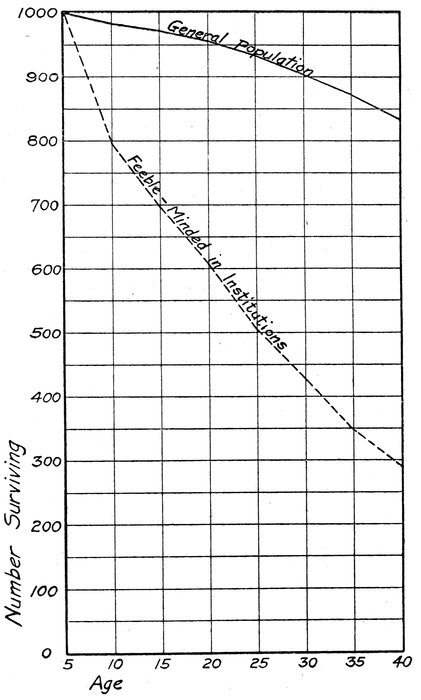
Fig. 1. Mortality among Feeble-Minded in Institutions Compared With the General Population
33A comparison of the death rates of the feeble-minded
and the general population at different ages is of prime
importance in connection with all attempts at quantitative
descriptions of deficiency. Heretofore this has been
completely neglected. Fig. 1 and Table II have been
prepared to provide a roughly adequate estimate, on the
basis of the above data for the United States, as to the
survival of 1000 institutional cases of feeble-minded 5
years of age for successive age periods compared with
1000 people in the general population. In constructing
this table it was necessary to assume, since the facts were
not given, that the age distribution in the registration
area of the general population was the same as for the
United States as a whole (census of 1910) and that the
number of feeble-minded in the institutions at the various
age periods was equal to the number enumerated on the
first of January plus the admissions during the year 1910,
disregarding the number discharged since they are not
distributed by ages. The average annual death rate
among the institutional cases of feeble-minded 5 years
of age and over in the United States in 1910 was 35.19
per thousand, while the corresponding death rate in the
general population of the registration area for the five
years 1901-1904 inclusive was 13.56. Assuming that
the death rates are uniform within the five-year periods,
the decline in the proportion of institutional feeble-minded
from 5-25 years of age as the result of excessive mortality
is indicated by the last line in Table II, after allowing
for the mortality in the general population. That
this effect of excessive mortality upon the percentage of
feeble-minded cannot be neglected between 5 and 25
years of age is apparent unless the mortality among institutional
cases is much greater than it is among the
deficient generally. As the figures stand the proportion
of feeble-minded would be reduced nearly one-half between
ages 5 and 25. Only a small part of this reduction
probably would be compensated for by new cases developing
from accident or disease. On the other hand there is
little doubt that the institutions contain an excessive
proportion of low grade cases among whom the mortality
is much greater. The mortality among institutional
cases is, therefore, probably not typical of that among the
feeble-minded generally. Nevertheless it is so great
that any quantitative definition of deficiency which neglects
it entirely is open to serious objection. We shall,
therefore, keep this variation in mind in connection with
the discussion in the next chapter of the percentage which
is deficient, and in the adaptation of the definition to a
measuring scale. It is clear that the percentage should
be so chosen as to allow best for the possible large effect of
excessive mortality among the deficients. Finally, it
34should be said that the percentage definition of feeble-mindedness
might be modified to meet a varying percentage
from age to age should that ever become desirable.
(c) As to the number of deficients not detected by tests.
If most of the feeble-minded for whom society should
provide were of the type which is only conative and not
detectable by our present objective tests, a quantitative
definition would be abortive. We must, therefore, study
our assumption that it is worth while to direct our attention
to those who are intellectually deficient. We
shall attempt to discover how frequent are the primarily
conative types.
Before examining the quantitative evidence we may
note that it is in conformity with two prominent recent
tendencies in psychology to subordinate specialized abilities,
as compared with abilities which function commonly
in many situations. The first of these tendencies is
represented by the fundamental researches of Hart and
Spearman (123) (185). This is not the place to set forth
the technical work on which their conclusions are based.
It may be said, however, that, with 17 different psychological
tests, they were unable to discover any important
specific mental weakness which distinguished adults who
were suffering with any one of various mental abnormalities,
including imbecility, manic-depressive insanity,
dementia praecox, paranoia, and general paralysis of the
insane. This may have been the fault of the tests, but
it seems to be more likely that the fault lies in the custom
of emphasizing special abilities and disabilities, at least
from the point of view of tested capacities. On the other
hand, all of these mental abnormalities showed a weakness
in general intellectual ability. This is true whether
35this general ability be regarded, as it is by Hart and Spearman,
as due to a general fund of brain energy, or whether
general ability be taken to refer to the common recurrence
of many specific abilities in much of our mental life. Its
significance for this study is that a series of varied tests,
such as that of Binet, may be expected to give a good estimate
of general ability, and its failure to disclose specific
disabilities is thus less important.
The second influence in psychology tending to emphasize
average tested ability is the establishment of the biological
conception of the mind which recognizes the mutual
interdependence of the mental processes, organically
united through the activity of the brain. So long as intellectual,
emotional and volitional processes are all
mutually dependent, a disturbance of one aspect of mental
life is bound to affect the others. In considering the mutual
dependence of the mental processes, it is important
to weigh carefully the striking examples which Bronner[4]
has brought together, illustrating special abilities and
disabilities. She has made an admirable start toward a
differential diagnosis of special defects in number work,
language ability and other mental activities. The degree
of special deficiency which results in social failure could
be placed upon an objective basis, but the rarity of special
deficiencies as compared with general deficiency will make
this a slow task. In the meantime we may rely upon the
mutual dependence of the organic processes as a point
of view which emphasizes the common spread of deficiency
to many activities. Knowledge of a single case of specific
disability is sufficient to make us recognize that such
cases do occur. On account of the rarity of those cases
and the absence of objective criteria, it seems necessary
36to leave the further differentiation to the future, considering
here only those cases which may be grouped together
as conative, as contrasted with those detected by our general
intellectual tests.
Whether the group of primarily conative cases is of any
considerable size can be only very roughly estimated at
present, since the diagnosis of such cases of feeble-mindedness
rests at present almost exclusively on the subjective
opinion of the examiner. Before their diagnosis is put
upon an objective basis we must have a different form of
test directed at such traits of will as initiative, perseverance,
stability and self-control. These probably center
on the mental side around the instinctive emotional background
of interest and the passions, while, on the physical
side, they raise the question whether the subject's energy is
adequate to endure the strain of competition or whether
it shows itself only in sudden bursts.
If the diagnosis of conative cases could be determined
objectively, it is possible that most forms of social unfitness
would be found highly correlated with intellectual
deficiency. On the other hand, when the diagnosis of
unfitness for school or social life depends merely upon the
opinion of experts or teachers, the inaccuracy of the diagnosis
may show a wide discrepancy between the so-called
conative and intellectual types of deficiency. Binet, on
the basis of his acquaintance with the pupils in special
classes, suggested that the number of unstable children
is probably equal to the number of those who are intellectually
unsuited for the ordinary schools or institutions
(77). Since he then places the total number of the two
classes at four or five per cent., it is apparent that he is
discussing a higher type of ability than is usually included
under the term feeble-minded. We can get somewhat
better evidence on this question by studying the results
37of Binet tests applied to children cared for in special classes
or in institutions for the feeble-minded. Chotzen (90)
presents a table of 280 children in the Hilfsschule in Breslau,
only 201 of whom, however, he himself diagnosed as
feeble-minded, i. e., debile or lower. Of these only 51
were intellectually deficient as indicated by the Binet
tests when we include the doubtful cases according to the
criteria we have adopted in this study. If we suppose
that, in addition to those in the special classes, there would
be one intellectually deficient child in an institution for
feeble-minded for every child testing deficient, we would
then guess that only 40% of the feeble-minded children
in Breslau were intellectually deficient. This sort of
estimate seems to agree with Binet's belief that half of
the children requiring special care, at least during school
ages, are cases which are primarily conative.
Pearson has approached the same problem in another
way (164) (167). He has used the results of the psychological
tests applied by Norsworthy to children in New
York in special classes and institutions for feeble-minded
compared with those in the regular school classes, and the
results of Jaederholm obtained with the Binet tests applied
to 301 children in Stockholm in the special classes compared
with 261 others selected from the regular classes. He
found that “70.5% of normal children fall into the range
of intelligence of the so-called mentally defective; and
60.5% of so-called mentally defective children have an
intelligence comparable with that of some normal children”
(167, p. 23). On the statistical assumption that those in
the normal classes would distribute according to the Gaussian
normal probability curve he estimates that, with the
Binet tests, among those in the special classes “10% to
20%, or those from 4 to 4.5 years and beyond of mental
defect, could not be matched at all from 27,000 children”
38(164, p. 46). Another 20 to 30% could be intellectually
matched by those in the regular classes having from 3 to
4.5 years of mental deficiency, but they would be matched
very rarely. On the assumption that 1% of the children
were feeble-minded, not more than about two children in
a thousand of this regular school population would be
expected to be 3 or more years retarded and thus overlap
those of like deficiency in the special classes (167, p. 30).
Considering the results of Norsworthy's study he says on
similar assumptions: “It seems, therefore, that a carefully
planned psychological test, while not sufficing to
differentiate 50 to 60% of the mentally defective from
the normal child, would suffice to differentiate 40 to 50%”
(164, p. 35). Again we come back to the estimate
that psychological tests may well be expected to select
nearly half of the children at present found in special classes
for retarded pupils. Moreover, a considerable part
of the overlapping of intellectual deficiency in the regular
classes with that in the special classes which he found may
be accounted for by the inadequate methods of selection
of pupils for the special classes by teachers or examiners
who have used no objective tests. Some who were left in
the regular classes should undoubtedly have been transferred
to special classes and vice versa. There seems to be
nothing to indicate that less than half of those properly
sent to special classes would be of clear or doubtful intellectual
deficiency. If the tests served to select even a
smaller proportion of those assigned to special instruction,
the “school inefficients” as Pearson calls them, their value
as an aid to diagnosis would be demonstrated.
Among groups of delinquents, where we would expect
the purely conative cases to be more common, we find
that a careful diagnosis of feeble-mindedness on the basis
of test data, medical examination and case history indicates
39that conative cases without serious intellectual deficiency
are much rarer than intellectually deficient delinquents.
At least this is the evidence of one study
where such information is available. Kohs at the Chicago
House of Correction found among 219 cases over 16
years of age, which he diagnosed as feeble-minded, only
28 tested XI and there were only 52 who did not test
either presumably deficient or uncertain intellectually
according to our criterion. Another bit of evidence is
that collected at the Clearing House for Mental Defectives
in connection with the New York Post-Graduate School of
Medicine, where 200 consecutive cases (108 males) were
examined by Miss Hinckley. Her graphs show that only
15% tested X or above with the Binet revised scale, i. e.,
above those presumably deficient in intellect. The cases
were from 13 to 42 years of age. The clearing house provides
an opportunity for social workers to have suspected
deficients examined and the few cases over X seems to indicate
that the purely conative type is not very commonly
met with among the social workers.
When we turn to the institutions for the feeble-minded
we find that they are today caring for few solely conative
cases. Although I can find no tables which give both
the life ages and mental ages of the individual inmates, we
can at least be sure that few test so high as X, or above
with the Binet scale. This means that only a few have
as yet reached the threshold for passable adult intellects,
which should be attained by 15 years of age. At the
Minnesota state institution for the feeble-minded in Faribault
among 1266 inmates, excluding epileptics, 41 tested
X; 28, XI; 12, XII; and 8, XIII, a total of 7% (154).
At Vineland, N. J., Goddard reported among 382 inmates,
14 tested X; 5, XI; and 7, XII, about 7%. Some of the
children who were under 15 in life-age might later develop
40above the limit for intellectual deficiency. Of the 1266
at the Minnesota institution, however, 508 were 15 or
over at the time of their admission, so that at least 82%
of the 508 were clearly intellectually deficient. Eight
per cent. more tested X and were in the doubtful group
in intellectual ability according to the criteria we have
adopted. This suggests that not more than about 10%
of those who are at present isolated in institutions are
there for feebleness of will alone. It seems to confirm our
presumption that the intellectually deficient discovered
by tests form the great majority of the social deficients
who need prolonged care or assistance.
(d) Allowance may be made for variability.
The quantitative definition of intellectual deficiency
must be made with careful allowance for irregularities
among different mental processes, among different individuals,
and among different groups. Theoretically
it is possible to place the borderline so low that a case with
that degree of deficiency and without removable handicaps
would be clearly feeble-minded. The chance that
the diagnosis would be mistaken could be reduced to any
minimum desired. Above this a wider region of doubtful
deficiency could then be stated in similar form. This is
the plan that we suggest in attempting the percentage
definition. Practically, however, the plan assumes that
a suitable allowance can actually be made for these variations
and raises a number of problems as to variability
which should be considered. Four of these sources of
variation are discussed below: (1) the variation due to a
limited sample of individuals measured, (2) the variation
among different communities, (3) the variations arising
from sex, race and social differences, (4) the variation of
the same individual from one mental process to another.
41We do not have the problem of neglecting these variations,
but of adequately allowing for them both in the percentage
of presumably deficient and in the doubtful region.
(1) Variation among Samples of Individuals Measured.
The error introduced by the fact that measurements
are made on a limited rather than an unlimited number
of individuals, in establishing the standards with a system
of tests, can be taken care of statistically fairly well by
applying the theory of probability as to the error of a
percentage in a single sample. The range of the error
can then be indicated on the measurement scale. This
supposes, however, that each sample to be measured is
taken from a random group and not from a selected group.
Allowance for this error of sampling is therefore complicated
by the fact that the usual test data have been obtained
from groups of school children, even when there
has been no further selection within the school group.
Data on school children are certainly reliable only within
the years of compulsory school attendance. Ordinarily
in this country, they are not reliable for children of 14
years of age or over. Moreover, the point of the scale
which is reached by the lowest X percentage of school
pupils will exclude a slightly larger percentage of all children
of corresponding ages, since the idiots and some imbeciles
are not sent to the ordinary schools. This slight
discrepancy should be kept in mind. The problem of
avoiding selected samples among adults is still more difficult;
but we found that it was possible in one community
at least to measure all the 15-year-olds in the lowest X
percentage in certain districts, as we shall note later. By
this age, mental processes are probably very much like
those of adults, except for the amount of information
and practise.
42(2) Variation among Different Communities. Under
any conception of deficiency it is clear that there are relatively
more deficients in some communities than others.
The percentage should, of course, not be determined for
a small community such as a city or county, but for a
state or a nation in order to avoid the difficulty of the difference
between communities. It would not interfere with
the plan for isolating the lowest X percentage of a state
even if that meant isolating 10% in one small community
and none in another. Indeed, it might be expected to do
just that, when one considers the accumulation of deficiency
in certain settlements such as Key has shown (131, p. 63).
The data on which the borderline with a measuring scale
would be established should, of course, not be obtained from
communities known to be unusual in respect to the
frequency of deficiency.
Since social failure is our final criterion for judging deficiency,
we must further consider that it is easier for a
person to survive in one environment than in another:
in the country, for example, than in the city. This sort
of problem has led to considerable confusion. Goddard
remarks: “In consequence of this it happens that a man
may be intelligent in one environment and unintelligent in
another. It is this point which Binet has illustrated by
saying 'A French peasant may be normal in a rural community
but feeble-minded in Paris.'” (117, p. 573.)
Goddard then goes on to suppose that a delinquent with
the intelligence of a sixteen year old may be “defective”
because he happens “to have got into an environment
that requires a twenty-year-old intelligence.” The suggestion
that a criminal might be excused on the ground
of deficiency because he happened to fall among bad
companions is a reductio ad absurdum. Clearly environment
must be defined as ordinary environment, available
43environment or by some similar concept, or else the definition
of deficiency loses all significance. In another place
Goddard more properly suggests that it would be well to
“draw one line at that point below which a person of that
intelligence is not desirable or useful in any environment”
(117, p. 3).
So long as the care of the feeble-minded is a state problem
the percentage of passable intellects would apparently
be determined for the available environment in that state.
The problem of social care cannot mean that the state
should care for college men because they cannot survive
among college men or in the station of life into which they
may have been born. So long as there are environments
within the community where they can survive it is a
problem of shifting them in their social habitat, not a
problem for social care. The same is true for the low
grades of intellect. It is not likely, however, that any
portion of the community could absorb many more of the
low degree intellects. For the problem of social care for
the feeble-minded, the question: What environment will
allow this individual to survive? becomes the question:
Can he survive in any available environment in his community?
It would seem very hazardous to suppose that
the different opportunities for survival afforded by different
localities in a state would be large enough to care for
more than the group of doubtful cases which should be
allowed for in a quantitative description of the border
region.
(3) The Variation with Sex, Race, and Social Position
has been carefully called to attention by Yerkes and
Bridges in their studies with the Binet Point Scale (225,
Chap. V and VI). It may very well be that not as high
ability should be expected of certain groups as of others;
44as a matter of moral obligation, they are not as responsible
for their conduct or their attainments. On the other
hand this does not directly affect the question, what lowest
percentage of intellects cannot get along in society?
When that percentage is determined for the environment
available in the community all those who fall within it
might even turn out to be of one sex or of one nationality
or of one social position, without affecting the question
whether they should be cared for by society, or what
grade of intellect is not socially passable? Temporary
social handicaps, such as lack of familiarity with the
language, lack of training, etc., must, of course, be allowed
for so far as they affect the individual's test record.
Whether the difference of 5% to 10% in the score of
pupils born to non-English-speaking families compared to
their companions' (225, p. 66) is due to the temporary
handicap of language or to a permanent difference is, however,
just the problem which the Yerkes and Bridges study
does not answer. The fact that the difference is even
greater for older children suggests that it may indicate
an inborn difference between the groups compared.
A diagnosis of deficiency should not be made until the
examiner is able to estimate whether the removal of training
or health handicaps would bring the individual above
the borderline. So far as known temporary handicaps
affect the standard of the test results with groups they
should, of course, also be taken into account. On the
other hand, it is clear that the borderline which predicts
social failure should not be shifted to allow for differences
in permanent handicaps whether those be of race, sex or
social position.
(4) The Variation among Different Mental Processes.
With our present knowledge the most difficult variation
for which we must make allowance at the borderline is the
45variation from one trait or process to another in the same
individual. One phase of it was discussed above under
“c.” The investigation of Norsworthy throws light on
this question. Summarizing her tests she says: “Among
idiots there is not an equal lack of mental capacity in
all directions. There is something of the same lack of
correlation among the traits measured in the case of idiots
as there is with ordinary people” (159, p. 68). Again:
“The idiots are nearest the central tendency for children
in general in the measurements of mental traits which
are chiefly tests of maturity, and farther and farther
away as measurements are made which are tests of ability
to deal with abstract data. They are two and a half
times as far from the median for children in general in tests
like the genus-species test as they are in tests like the A
test or the perception of weight.” Weidensall (60) and
Pyle (46) also compare delinquent and normal individuals
for different tests, showing a variation with the sort of
mental activity compared.
While Norsworthy thus presents evidence of certain
specializations of deficiency, she notes, however, that
perhaps feeble-mindedness is more typically general than
specific and that general deficiency is more important to
consider than specific. Even with that test with which
her group of retarded and feeble-minded children did best,
only 28% of them passed the point which would be excelled
by 75% of the children in general. In their worst
test only 1% passed this point. It is also to be noticed
that those tests in which they most nearly approached
ordinary children are for just those simple processes which
would be least likely to be of use in the struggle for social
existence. As a whole, therefore, there is nothing in her
results which shows that any appreciable number of children
who were deficient in the average of tested abilities,
46would have good enough special ability along a few lines
to make them socially passable. Indeed, for all that we
know at present, the borderline for passable ability in each
of our various mental processes might vary quite as much
as Norsworthy found, without this variation affecting a
prediction of failure based upon the average of a series of
tests.
On account of the great attention that has been paid
to individual differences in recent years, on account of
their importance for diagnosis, for determining the causes
of deficiency, and for planning for the training of deficients,
we have come almost to the point where we forget the
significance of the average as the most common condition
with which we have to deal. The lack of complete correlation
between abilities of an individual does not make
us hesitate to use the concept of his average ability; it
should not make us neglect or misunderstand the significance
of the position of an individual testing low down
on the scale. For the problem of social care the borderline
position on a scale is immensely more important than
higher ability. It seems advisable, therefore, to define
this borderline ability with some suitable allowance for
variability in mental processes. It is far safer to judge an
individual's chance of survival by his average or general
tested ability than by the little knowledge that is as yet
available regarding special abilities.
47
At first it seems like a hopeless task to try to bring harmony
out of the confused estimates of the proportion of
the feeble-minded in modern society. Authoritative
estimates by commissions or by recognized experts range
from less than 0.2% to 5.0% that is, from 2 to 50 per
thousand. Further study of these estimates shows that
they reflect not so much a difference in expert opinion
about the same problem as differences in the problems
which were considered in making the estimates. As soon
as we compare only those estimates that have been made
to answer the question, what percentage of low grade minds
should be provided with a certain form of social care? it is
rather surprising how much less the discrepancy becomes.
An analysis of important estimates will therefore be undertaken
in order to try to discover some of the sources of disagreement.
The most significant thing about an estimate is that
the estimator is thinking of providing for his group of
deficients in a special way. This is the purpose of the
estimates. Three important groups of the mentally deficient
now demand attention. They are: (1) The group
which, for moral and eugenic reasons, society is justified
in isolating for life or an indefinite period. (2) The group
which needs special simple industrial training in order to
get along with social assistance without isolation. These
deficients may be cared for in their home towns by special
schools, public guardians, and after-care committees.
(3) The group which needs special school assistance, but
is socially passable after leaving school. These individuals
are incapable of competing in school with their fellows,
48but they are able to get along in the simplest employments
without social assistance. We may designate these three
groups as those needing (1) social isolation, (2) social
assistance, and (3) only school assistance. The largest
estimates of feeble-mindedness, it will be found, include
the third group, while the smallest intend to include only
the first group. The first and second groups are clearly
below the limit of feeble-mindedness designated by the
verbal definition of the British Commission. They are
socially unfit. The language of that definition is ambiguous
enough to include the third group, but the plan of
the Commission, judged by its consideration of the number
to be sent to special schools, would regard only the
first two classes as feeble-minded. Following this common
conception I have regarded those in the third group as
above the feeble-minded. It will help to find harmony
among the estimates if we estimate separately those mentally
deficient enough to need social isolation, social assistance,
and only school assistance. This discrimination
of the retarded by the kind of social care needed
should also make the social definition more useful.
Before we consider the percentage estimates in detail
for these different forms of social care, let us note the
effect on them of two other considerations. The first of
these is the discrepancy between estimates of the proportion
of feeble-minded among school children and
estimates as to the proportion in the general population.
Since feeble-mindedness is regarded as a permanent arrest
of mental development occurring at an early age and usually
due to hereditary causes, it is plain that a school
child who is feeble-minded would be expected to remain
49so for life. Nevertheless we find that estimates of 0.3%
of the general population are accompanied by estimates
of 1.0% or 2.0% of the school population as feeble-minded.
I have not been able to find any careful attempt to account
for these discrepancies. The excessive mortality among
the feeble-minded is hardly adequate to explain so great
a difference.
It is interesting to note some of these comparisons.
Goddard, for example, considers it conservative to estimate
that 2% of the school population is “feeble-minded”
(112, p. 6). In the same publication he says: “There
are between 300,000 and 400,000 feeble-minded persons
in the United States” (p. 582). Since the elementary
school enrollment is about 20,000,000 (208), the feeble-minded
school children alone on his first estimate would
account for 400,000 feeble-minded in the United States
without allowing for any feeble-minded outside of the
ages in the elementary school.
The report of the British Royal Commission, published
in 1908, forms the starting point for many of the estimates
made today. The commission added together the
number of school children which were thought to require
special classes with the number of defectives found in
institutions, prisons and almshouses, or reported by its
medical investigators. The total gave 0.46% of the general
population as “mentally defective persons,” not including
certified lunatics. From this amount should be
deducted .06% who were insane but had not been certified
as such, leaving 0.4% mentally deficient. This was
not regarded by the Commission as an estimate, but was the
number actually “enumerated by the medical investigators”
in sixteen typical districts studied in England and
Wales with a total population of 2,362,222 (83, VIII,
p. 192). Turning to the school children we find that in
50the areas investigated there were 436,833 school children
of whom 0.79% were found defective. Since this was
an enumeration and not an estimate, the commission paid
no attention to the discrepancy between 0.79% of the
school children and 0.31% of the rest of the population.
Tredgold, moreover, based his estimates of the frequency
of the mental deficiency in England and Wales on the data
of the Royal Commission without attempting to harmonize
this discrepancy. This oversight has apparently been
one source of the not uncommon difference between the
estimates for school children and for the general population.
One suspects that the fact that the elementary
school population is about a fifth of the general population,
has also mistakenly contributed to this error. The
discrepancy of three to five times as large a frequency
of deficiency among school children as in the general
population certainly needs clearing up.
There is an escape from this dilemma which seems more
reasonable than to attempt to account for the discrepancy
by excessive mortality. When estimates are made concerning
the school population the estimator is usually
thinking of that group of feeble-minded which needs
special school training and probably social assistance afterward.
When estimates are made of the general population
the estimator is likely to be thinking of that group
which must be cared for permanently by society, mainly
in institutions or colonies. For some time at least the
state cannot be expected to undertake the indefinite care
of all the deficients who should have, at once, simple industrial
training, in special local schools or classes in order
to survive, even with social assistance. This difference
in the type of care contemplated seems most naturally
to account for the discrepancy found with many writers,
between their estimates for the school population and for
the general population.
51
A second source of confusion arises when one investigator
is thinking of the number of feeble-minded, the care
of whom it is desirable that society should assume, and
another is thinking of the feeble-minded, the care of whom
it is advisable for society to assume at once. Considered
in connection with a specific case the distinction is quite
obvious. It is one thing to say that it would be desirable
for the state to assume the indefinite care of a particular
person, it is quite another thing to say that it would be
advisable for the state to assume that care immediately,
when one remembers the crowded condition of the institutions,
the necessity of caring for the worst cases first,
the possibility of the person being cared for by his own
family or in a local school, the added public expense, the
necessary neglect of other movements for social welfare
if society assumes this expense, etc., etc.
When you magnify this problem in the mind of the
estimator who is interested in the question of caring for
the groups of feeble-minded, the result is that his estimates
of the size of the groups are decidedly affected.
For example, few would deny that the Site Commission
of New York appointed to locate the colony for mental
defectives, now known as the Letchworth Village, was
emphasizing a program of permanent social care when
it estimated the number of feeble-minded in New York.
The Commission, “after taking into consideration the
figures of the State and National census, and other data
collected from institutions,” estimated that there were in
New York state possibly 12,300 mentally defective persons
(Editor's Note, 205, p. 84). This is less than 0.15%
of the population and very low compared with most estimates.
52The low estimates will generally be found to be influenced
by considerations of public expense rather than the
social unfitness of the lower group. Inasmuch as there
are no sharp distinctions between different degrees of
mental ability this consideration of public expense is perfectly
proper. At the other extreme, however, are the
eugenists who are convinced that it is desirable to isolate
a large group at the lower range of ability. The member of
the legislature will be concerned mainly with the question
how much money will the public be willing to appropriate
now for the care of these unfortunates. The eugenist
will be thinking of an ideal rather far in the future towards
which to work.
The diagnostician should take a conservative intermediate
ground. He may leave to the court or other
authorized tribunal to decide whether the public has the
facilities available at present for caring for a particular
weak-minded person, but he must decide whether expert
scientific opinion at the present time will justify diagnosing
this degree of deficiency as suitable for the special
care provided for the feeble-minded. Whether it is advisable
to care for the particular deficient at home, in a
special local school, or in a state institution would be left
to the legal authority to decide. Under present conditions,
the diagnostician may possibly indicate whether
the individual is deficient enough to justify social isolation,
or merely to justify sending to a local elementary
day school for deficients.
It is from the point of view of the diagnostician that we
shall attempt to focus this question of the percentage of
feeble-minded. We shall tentatively suggest limits as
53to the degrees of intellectual deficiency which we might
be justified in regarding, under the present conditions of
scientific knowledge as being low enough in intellectual
capacity to justify particular forms of social care. Such
estimates will be of value if they help to harmonize the
conflicting opinions by bringing them into relation with
the above analysis. We shall, therefore, compare the
suggested percentages with a number of authoritative
statements of the frequency of feeble-mindedness. By
considering the differences in the nature of the estimations
we may approach nearer to an understanding of the problem.
Since the percentages to be suggested are chosen from
the point of view of diagnosis, they do not represent the
number for which every community should immediately
make financial provision. The expense is a local or a
state question. It is so much affected by state conditions
and by public policy that it probably must be determined
in any state by a special commission. On the other hand,
the laws already provide for caring for the feeble-minded
in institutions or colonies and in special schools or classes,
so that the estimates may help to guide diagnosticians
who are called upon to decide whether a particular person
might be rightfully regarded as deficient enough intellectually
to justify committing him for permanent care to a
state institution. In the present practise it is fairly clear
that this distinction is made in the minds of different
diagnosticians. It may ultimately be desirable that this
differentiation between the types of social care be introduced
into the law. Until then it will remain the duty
of the court to determine what degree of social unfitness
is intended by a particular law. The social concept of
feeble-mindedness is just now undergoing a rapid evolution
so that it would be impossible to predict how it may
legally crystallize a generation hence.
54To begin with the lowest group of the feeble-minded, we
should consider those whom the state might be clearly
justified in isolating indefinitely on the basis of their
tested lack of intellectual capacity, the social isolation
group. For purposes of comparison let us place this degree
of intellectual ability as that possessed by the lowest
0.5% at fifteen years of age. Above these let us estimate
a group of uncertain cases so far as isolation is concerned,
but cases which the diagnostician would be justified in
regarding as intellectually deficient enough to justify sending
to special local schools for training the feeble-minded.
After special training the majority of these cases might be
expected to require social assistance indefinitely. They
would form the social assistance group. Isolation would
be justified for none of them on the basis of their test
records alone. Those in this group who were persistent
delinquents would, by that additional fact, fall into the
lowest group so far as social care is concerned. Let us
estimate this social assistance group tentatively as the
next 1.0% at fifteen years of age.
These estimates have been made as at fifteen years
of age since the effect of the excessive mortality especially
among the isolation group is uncertain and may need to
be allowed for in a discussion of the percentage deficient
at different ages. If the mortality were as great as has
been described among institutional cases in the previous
chapter, a rough estimate of the percentage intellectually
deficient in the general population places it at less than
0.5%. This estimate may be made by using the estimated
deficiency at the median age of those under 15 years
of age and at the median age of those 15 years of age and
over. According to the age distribution of the 1910
census, there were 32% under 15 years with a median
age of 6 years. At age six 0.67% would be presumed as
55low as 0.50% at 15 years. The older group (68% of the
population) has a median age of 32 with a corresponding
percentage in the isolation group at that age of 0.30%,
after allowing for differences in mortality on the plan indicated
in Table II. This rough estimate for the lowest
group indicates that 0.42% of the general population
would be of as low a degree of intellectual capacity as the
lowest 0.5% at 15 years. Our plan presumes, therefore,
that between 0.4% and 0.5% of the population are unable
to pass their entire lives outside of institutions under ordinary
conditions; i. e., make an honest living and live
within the law even with social assistance and supervision.
The corresponding estimate for those requiring only
social assistance would be between 0.8% and 1.0% of
the general population above the lowest group. This
might vary from approximately 1.34% at 6 years to 0.59%
at 32, the median age for those over 14 years. Since the
mortality is probably less among deficients not in institutions,
as they average higher in ability, the changes in
the percentages are probably extreme estimates. We
should keep in mind, however, the possibility that with
the excessive death rate the lowest 1.0% at 15 may mean
an ability corresponding to the lowest 1.34% at 6 years
and the lowest 0.60% at 32 years.
The next higher group in intellectual ability is so high
as not to require social assistance outside of school.
When we ask how large a per cent. we should be justified
in placing in this group and separating merely for special
instruction in school, we reach a condition which is at
present so ill-defined even in the minds of educators that
it seems best to fall back on the general advice that our
school systems should provide just as nearly individual
instruction as the public purse and managing genius can
devise. Mannheim, Germany, for example, takes care of
5618 per cent. outside of its regular school classes. The
ideal is individual instruction for all. School authorities
would be justified in providing special instruction for
every degree of mental ability, if the cost would not restrict
other more important social undertakings. This
less degree of retardation in the group needing only school
assistance should not, however, be classed as feeble-minded.
We shall see later the percentages for which some
authorities have considered it already advisable to provide
special school instruction. We need not attempt to
estimate the size of this group, as it is beyond the limit of
feeble-mindedness.
The purely conative cases are not taken care of in the
above estimates, which are intended for tested deficients.
If the conative cases unaccompanied by intellectual deficiency
should be regarded as frequent enough to replace
those in the social assistance group who ultimately care
for themselves, plus those subtracted by the excessive
death rate, we would have a total of 1.5% of the general
population feeble-minded enough to warrant social care
of some sort. About 0.5% might justly be isolated.
The reasonableness of this program can be judged by
comparison with authoritative estimates now to be reviewed.
The problem here is whether this is an unreasonable
program for the diagnostician to assume as scientifically
justified, remembering that these estimates are for
tested deficients at 15 years of age and do not include
purely conative cases which might occur above these intellectual
borderlines.
The Social Isolation Group. We are now ready to consider
some of the important estimates which throw light
upon the reasonableness of the percentages we have named.
57First, what percentage would we be justified in
socially isolating? In the United States Census Report
on the Insane and Feeble-Minded in Institutions in 1910,
we find that the number then actually in institutions for
feeble-minded was only about 0.02% of the population.
At the most frequent ages this rises to about 0.05%. It
is evident that the number actually isolated is of little
significance except as a check on the estimates. The
report, however, refers to the special estimate made by
the public authorities in Massachusetts which also included
feeble-minded in state hospitals for the insane,
other asylums, those reported by the overseers of the
poor and those enumerated in the general population.
The U. S. report says: “The census was not regarded as
being complete, but it is of interest to note that if the
number of feeble-minded in proportion to the total population
was the same for the entire United States as it was
in Massachusetts according to this census, the total number
of feeble-minded would be over 200,000. Probably
this may be regarded as a conservative estimate of the
number of feeble-minded in the United States and would
indicate that not over one-tenth of the feeble-minded are
being cared for in special institutions” (205, p. 183).
This estimate, which thus amounts to about 0.2%, may
probably be considered as a reasonable program of expansion
from the institutional viewpoint. The diagnostician
who is considering the individual and not the mass
must supplement it by considering who should be isolated
if facilities were available. If the census bureau can
contemplate institutional care for ten times those at
present thus provided for, it gives us some indication of a
reasonable limit as to the increase in institutional care
that can be assumed to be reasonably contemplated at
present.
58Dr. W. D. Cornell, director of medical inspection of
the Philadelphia public schools, after the personal examination
of those cases which in the opinion of the teachers
should be sent to institutions, places the “institution
cases” at a minimum of 15 per 10,000 school children.
He adds: “The number of evidently feeble-minded above
6 years of age may be said to be 1 to every 500 of the
population. These figures are conservative and have
been accepted by experts for years.” This then is the
minimum estimate and quite clearly refers to institutional
cases.
A committee of the Public School Alliance of New
Orleans, of which Prof. David Spence Hill was chairman,
reported in 1913 a careful census of the public school children
in that city the previous year made by the teachers
in co-operation with the Newcomb Laboratory of Psychology
and Education. Each teacher was asked to state
her opinion as to how many in her room were “feeble-minded
or insane children who should be under institutional
or home care, rather than in the public schools.”
Also the number of backward children not in the above
class “who urgently need special educational methods in
special classes within the special schools.” About a
fifth of the total of the 38,000 school children in the city
are colored. The grand total showed 0.28% in the first
class mentioned above, and 7.7% in the second. Speaking
of those “thought by teachers to be feeble-minded” and
needing institutional care the report says:
“The figure 0.28 of 1% coincides exactly with the estimate
of the Philadelphia Teachers' Association made in
1909 in a census of 150,000 school children. Secondly,
while the teacher's estimates are open to revision, nevertheless
her judgment, as inevitably evidenced in her
attitude toward the child, is the practically effective judgment”
59(157, p. 6). It is a well-known fact that teachers
tend to underestimate the frequency of mental deficiency,
so that it would certainly be a matter of regret if this were
to continue to be the “practically effective judgment.”
Another census of the institutional type of feeble-minded
made by the Director of Public Health Charities in
Philadelphia and reported in 1910 enumerated 0.2% of
the population as in this group. It included cases in the
institutions for feeble-minded, the insane hospitals, almshouses,
hospital, reformatories, orphanages and known to
charity workers (168, p. 13).
One of the most careful surveys of individuals who,
because of mental abnormalities, show such social maladjustment
as to become the concern of public authorities
was made under the auspices of the National Committee
for Mental Hygiene in 1916.[5] It selected Nassau County
as representative of New York state. Part of the
survey consists of an intensive house to house canvass of
four districts of about a thousand population each. The
result disclosed that 0.54% of the population of this county
were socially maladjusted because of “arrests in development”
and 0.06% more, because of epilepsy. This
was in a population of 115,827.
The Children's Bureau in the U. S. Department of
Labor in 1915 made a census of the number of “mental
defectives” in the District of Columbia. The census included
only those whom we have termed feeble-minded.
The report states that 798 individuals, 0.24% of the population,
were found to be “in need of institutional treatment;
and the number reported, allowing for the margin
of error in omission and inclusion, is probably a fair
60representation of the number in the District who should
have custodial care” (88, p. 13). Over a quarter of the
population of the District is colored. The census was
taken in connection with plans for immediate care. The
same Bureau also made in 1915 and 1916 a Social Study of
Mental Defectives in New Castle County, Delaware.[6] This
county had a population of 131,670 and the survey disclosed
212 “positive cases of mental defect” and 361
“questionable cases,” a total of 0.44% of the general
population in this county. Among the positive cases,
82.5% were in need of public supervision or institutional
care. Among the questionable cases, information was
obtained about only 175, and 165 of these were either in
institutions, delinquent or uncontrollable, or living in
homes where proper care and safeguarding were impossible.
Two other important attempts to enumerate carefully
all the feeble-minded in definite areas in the United States
have been made in recent years. Lapeer County, Mich.,
was chosen for such a study, as it was of average size and
contained no large city. The census as reported in 1914,
showed 36 feeble-minded from that county in the state
institution and 116 others living in the county, a total of
1 from every 171 inhabitants (145). A special children's
commission was appointed by the state of New Hampshire
to investigate the welfare of dependent, defective and delinquent
children. Its report in 1914 contained a section
by its chairman, Mrs. Lilian C. Streeter, on feeble-mindedness
(40). This comes the nearest to a complete enumeration
for an entire state which has ever been attempted.
The commission tested with the Binet scale the inmates
61of the State Hospital for the Insane, the County Farms,
the State Industrial School and the Orphanages within
the state. The borderline which it used for the scale
was high. It counted all those testing three or more years
retarded and under XII as feeble-minded. Taking its
figures as they stand we find that they listed 947 as feeble-minded
in institutions and 2,019 outside, a total of 0.69%
of the inhabitants of the state. Outside the institutions
the commission sent a questionnaire to all school superintendents
and to chairmen of school boards, physicians,
overseers of the poor, county commissioners, probation
and truant officers, district nurses and charity workers
throughout the state, by which means they listed 792
additional cases. This questionnaire gave the following
description of the type of case it was trying to list as feeble-minded.
“The high grade imbecile, frequently known as the
moron, is one who can do fairly complicated work without
supervision, but who cannot plan, who lacks ordinary
prudence, who cannot resist the temptations that are
common to humanity. The high grade imbecile is most
dangerous because, except to the expert, he is apparently
not feeble-minded and is, therefore, usually treated as
normal, and permitted to multiply his kind, and to corrupt
the community.”
This description would tend to include cases above our
isolation group. Besides the questionnaire the commission
made an intensive study of 52 towns in which it
says practically complete census returns were obtained
by consulting doctors, school and town officials. With
these supplementary cases it secured a list of 2,019 cases
outside of institutions, making a total of 2,966 recorded
cases within the state or 0.69% of the population. When
it estimated the proportion for the entire state on the
basis of the rate of canvass returns to questionnaire returns,
62this proportion rose to 0.95%. The commission
does not advocate compulsory isolation for all of these
people although it recommends custodial care for the
feeble-minded women and girls of child-bearing age, apparently
of the degree of deficiency represented by its
criteria. This enumeration of 0.69% of the people of a
state as feeble-minded is the most liberal general census of
the feeble-minded in any large area. It clearly shows the
trend of diagnosis since the British Census.
The Extension Department of the Training School at
Vineland, N. J., states regarding estimates of the number
of feeble-minded in the general population: “Conservative
estimates give one in three hundred as the probable
present number.” Under the discussion of estimates of
the general population I have already cited Goddard's
estimate which was approximately 0.3 to 0.4% and the
enumeration of 0.4% by the British Royal Commission
in 16 districts with over two million population. While
all of these estimators are speaking broadly of the feeble-minded,
in the general population, we shall not be far
wrong in supposing that they are considering mainly those
deficients for whom the state might well expect to provide
care for life, isolating all those who cannot be eugenically
guarded at home. We shall later quote the estimate
of Van Sickle, Witmer and Ayres of 0.5% of the school
population as “institution cases.”
Our estimate of 0.5% in the group justifying isolation
on the ground of intellectual deficiency seems to be conservative
and to harmonize fairly this type of estimate.
The Social Assistance Group. Passing now to the next
higher group of deficients, those needing special training
in order to get along with social assistance, the estimates
have been based almost entirely upon the study of school
63children. Francis Warner was the moving spirit in the
early investigations in Great Britain, which were made
without tests from 1888 to 1894. The census which he
directed included about 100,000 school children who
passed in review before medical examiners. As cited by
Tredgold (204) the estimate growing out of this work
was that 1.26% of the school population should have
instruction in special classes. Of these 0.28% required
special instruction because of physical defects only (204).
About the same time Will S. Monroe (155) on the basis
of a questionnaire sent to California teachers, who reported
on 10,842 school children, found that they estimated
1,054 of these as mentally dull in school, 268 feebly gifted
mentally, and 6 imbeciles and idiots. He summarized
his conclusion as follows: “A long experience teaches that
every school of fifty pupils has at least one child that can
be better and more economically trained in the special
institutions than in the public schools.” In his estimate
of 2% he was probably thinking of care in special local
schools and not permanent isolation.
A government inquiry of school teachers in Switzerland,
who had charge of 490,252 school children, reported
that 1.2% were so feeble mentally as to need training in
special classes. Only about a tenth of this number were
then being instructed in separate classes (181, p. 17).
Great Britain first gave legal recognition to the class
of feeble-minded above the imbeciles in its Education Act
of 1898, following a report of a departmental committee
of its National Board of Education growing out of the
inquiries of Francis Warner. This committee estimated
the proportion of this class as approximately 1% of the
elementary school population (181). In discussing the
comparative estimates on the general and school populations
I have already referred to the estimate of Tredgold
64based upon an elaborate analysis of the most extensive
data ever collected,—that gathered by the British Royal
Commission on the Care and Control of the Feeble-Minded.
While the Commission's investigators enumerated
0.79% among the school as mentally defective, Tredgold's
estimate based on his analysis of their report was that
0.83% of the school population in England and Wales
were above the grade of imbecile but still feeble-minded
(204, p. 157). The variability of the estimates collected
by the Royal Commission from various cities probably
indicates the subjective character of the standards of deficiency.
They varied from an estimate of 0.24% of the
elementary school population in Durham to 1.85% in
Dublin (204, p. 159). The Commission says regarding
estimates as to communities other than those reported
by their medical investigator, for Newcastle the “number
of feeble-minded children of school age” (morons) was
0.25%, for Leeds the estimate was 0.80%, for London
0.50% or 0.60%, for Bradford 0.50%, for Dublin about
1% and for Birmingham about 1% of the school population.
Dr. Francis Warner's general estimate was 0.8%.
We have thus variations in estimates from 0.25%, 0.5%,
0.80% to 1% and some 2% (167, p. 90). For the rural
areas the estimates were generally less.
A careful estimate has been made with a different method
by Karl Pearson on the basis of a classification by
teachers of school children in Great Britain into nine
different classes each especially defined and extending
from the imbecile to the genius. This distribution of the
children was then fitted to the normal probability curve.
On this basis Pearson estimated that 1.8% would fall in
the “very dull group,” defined as having “a mind capable
of holding only the simplest facts, and incapable of grasping
or reasoning about the relationship between facts;
65the very dull group covers but extends somewhat further
up than the mentally defective.” Lower down would be
0.1% in the imbecile group. He says further regarding
this estimate: “It is deduced from three series covering
between 4000 and 5000 cases, and the three separate results
are in several accord. It will, I think, be possibly
useful for other inquirers, and it endeavors to give quantitative
expression to our verbal definitions of the intellectual
categories” (166).[7]
In 1914 Pearson cites estimates of mentally defective
children in several cities by teachers and medical officers
based upon the recommendation of elementary school
children for special schools and classes. These were, for
London: boys, 1.59%; girls, 1.09%. For Liverpool: boys,
0.827%; girls, 0.618%. The corresponding figure for
both sexes in Stockholm is 1.23%. He concludes that
“something between 1% and 2% is true for England.
Dr. James Kerr, Medical Research Officer, thinks that
the final estimate will be nearer the latter value.”
After giving a table of the percentages at each age in
the elementary schools of Stockholm, Pearson says: “Judged
from this table it would seem that the most reasonable
estimate of the prevalence of mental defect is to be formed
when all the mental defectives have been definitely selected
and the normal children have not yet begun to leave
school, i. e., at the ages 11 and 12. For Stockholm this
leads up to a mentally defective percentage of about 1.5”
(167, p. 6-8). In another place he says that the members
of special classes are selected practically for the same
reason, i. e., because they are school inefficients, the bulk
66of whom will, no doubt, unless provided for become “social
inefficients” (164, p. 48). Since some were not selected
because of intellectual deficiency, our social assistance
group should be somewhat smaller.
In 1909-10 the actual number in the schools for mental
defectives maintained by the London County Council
was 0.9% of the enrollment of the London elementary
Schools (143). The 1912 report of the London County
Council shows 7357 children enrolled in its local schools
for mental defectives, which is 1.1% of the average
attendance from 1912-1913 in the elementary county
council schools and voluntary schools of London (144, p.
44).
Following a discussion in the Australian Medical Congress
of 1911 the Minister of Public Instruction called for
returns as to the number of feeble-minded in the Australian
public elementary schools between 5½ and 14 years of
age inclusive. The questionnaire used the definitions
of the British Royal Commission as a description of the
various degrees of retardation and brought returns from
2,241 of the state schools, all except 57. For their average
attendance of 175,000 children, these teachers classified
1.9% as backward from accidental causes, 2% mentally
dull, 0.42% feeble-minded imbeciles or idiots, and 0.6%
epileptics. To this would be added 0.19% for children in
the idiot asylums. The report states that “the teachers'
estimates will thus be realized to be an absolute minimum,
dealing only with the intermediate grades, and not including
the gross cases (idiots, etc.) on the one hand and
the less marked high grades of feeble-minded on the other”
(70).
The census made by the Bureau of Health of Philadelphia
through the principals of schools in 1909 covered
157,752 elementary school children of whom 1.9% above
67the 0.28% who could “properly be in custodial institutions
'were classed' as backward children who require special instruction
by special methods in small special classes” (168).
A survey of the school population in the Locust Point
District of Baltimore was made by Dr. C. Macfie Campbell.[8]
The district surveyed was, however, not considered
typical of Baltimore, but was a sample of an industrial
district in which the majority of families are
“close to the poverty line, and too often below it.” Out
of a school population of 1,281 children, 166 (13%) were
“found to have special requirements on account of their
mental constitution.” Among these, 22 (1.7%) “showed
a pronounced mental defect, which eliminated any prospects
of their becoming self-supporting.”
The city of Mannheim (147), which perhaps cares for its
exceptional children better than any other in the world,
was in 1911-1912 caring for 0.7% of the children in its
Volkschule in Hilfsklassen which do not take them beyond
the fourth grade. There were 12% more who were backward
in school and being taught in Forderklassen where
they may reach the sixth grade. Including the exceptionally
bright who were also in special classes, 18% all
together of its school children were not in the regular
Hauptklassen of the eight grades. To these would be
added those sent to special institutions. When we estimate,
therefore, that we are justified at present in sending
1% of the children in school to special classes because
their intellectual deficiency is such that the bulk of them
cannot get along without social assistance, we are
naming about the proportion already thus cared for in
several foreign cities.
68Among the authoritative estimates of the number of
feeble-minded, which have been made by estimators who
had in mind the evidence from mental tests, is that
made by James H. Van Sickle, Lightner Witmer, and
Leonard P. Ayres in a bulletin published by the United
States Bureau of Education in 1911 (209). They state
that, “if all children of the public schools could be ranked,
it is probable that a rough classification would group
them about as follows—Talented, 4%; Bright, Normal,
Slow, 92%; Feeble-Minded, 4%. The 4% may for
administrative purposes be divided into two groups.
The lower one includes about one-half of one per cent. of
the entire school membership.... They are
genuinely mentally deficient, and cannot properly be
treated in the public schools. They are institution cases,
and should be removed to institutions. Ranking just
above these are the remaining three and one-half per cent.
who are feeble-minded but who could be given a certain
amount of training in special classes in the public schools.”
The estimate of institutional cases practically coincides
with that adopted above in this paper. The extension of
the term feeble-minded to include the lowest 4% seems
to be extreme. The authors do not suggest what portion
of these they think might require social assistance indefinitely,
but are interested primarily in provision for
special classes in the public schools. If the term feeble-minded
were to mean only unfit for regular school classes
and not socially unfit, I have already suggested that the
limit for special instruction might be increased indefinitely.
In Mannheim 18% are not cared for in the regular
classes.
The only estimate of feeble-minded which I have found
that is so large as this 4% is that of Binet. It is also intended
to cover all cases that should be sent to special
69classes regardless of subsequent social survival. His
statement as to those who are so abnormal or defective
as to be suitable for neither the ordinary school nor the
asylum is as follows:
“As to France, precise information has not been available
until the last year, when two inquiries were held—one
at the instance of the Ministerial Commission, the
other organized by the Minister of the Interior. According
to the former inquiry we find that the proportion
of defectives amounts to scarcely 1% for the boys, and
0.9% for the girls. These percentages are evidently far
too small, and we ourselves have discovered, by a small
private inquiry, that many schools returned “none” in
the questionnaires distributed, although the headmasters
have admitted to us that they possessed several genuine
defectives. In Paris, M. Vaney, a headmaster, made
some investigations by the arithmetic test, which we
shall explain presently, and reached the conclusion that
2% of the school population of two districts were backward.
If we were to include the ill-balanced, whose number
is probably equal to that of the backward, the proportion
would be about 4%. Lastly and quite recently
a special and most careful inquiry was made at Bordeaux,
under the direction of M. Thamin, by alienists and the
school medical inspectors, and it was found that the percentage
of abnormality amongst the boys was 5.17. Probably
the true percentage is somewhere in the neighborhood
of 5. All these inquiries are comparable because
they deal with the school population” (77, p. 8).
In this estimate of 5%, Binet was considering those to
be sent to special classes regardless of whether or not they
would require indefinite social assistance after their schooling.
It is therefore not directly comparable with our
estimate of 1.5% presumably or doubtfully intellectually
deficient.
The estimate of Dr. Henry H. Goddard, who has done
the most to introduce the Binet Measuring Scale in this
70country, is stated as follows: “It is a conservative statement
to declare that 2% of public school children are
distinctly feeble-minded, the larger part of them belonging
to this high-grade group which we call morons” (118).
In another (114) place he says: “The most extensive study
ever made of the children of an entire school system of two
thousand has shown that 2% of such children are so mentally
defective as to preclude any possibility of their ever being
made normal and able to take care of themselves as adults.”[9]
The study to which he refers gives individual results with
the Binet 1908 tests made on 1547 school children in the
first six grades (114, p. 43). Since the sixth grade does
not include the better children who are twelve years or
over in age this group is clearly selected in such a way that
it would show an excessive percentage of mentally retarded
children. We find in the investigation referred to
that he says: “Then we come to those that are four years
or more behind their age, and here again experience is
conclusive that children who are four years behind are so
far back that they can never catch up, or in other words,
they are where they are because there is a serious difficulty
which can never be overcome—they are feeble-minded.
They constitute 3% of the children in these grades.”
Since we have a random selection of school children in
his table for only those children who are 6 to 11 years of
age inclusive, I find that only 1% at these ages are retarded
four years intellectually. On his own basis, therefore,
3% is evidently too large an estimate. Later he
seems to have reduced his estimate to 2% of the school
population. Of those who test in the lowest 1.5% including
our doubtful group, I believe that there is no clear
evidence that more than 1% will require even social
assistance as adults.
71Many more estimates of the number of feeble-minded
among school children might be cited, but they would add
little to these authoritative samples. At the present time
an estimate by health officers or teachers who are not
familiar with the results of mental testing has little
significance, as the whole complexion of the problem has
been changed since the work of Binet and Simon.[10] We
may, however, cite three estimates based upon familiarity
with test results, which fairly cover the range of estimates
among school children. In connection with the Springfield,
Illinois, survey conducted by the National Committee
for Mental Hygiene under the direction of the Russel
Sage Foundation, we find that three typical schools
with a total of 924 pupils were studied. The report states
that “the mentally defective children” constituted 3.8%
of the number in attendance in March. The number of
children in the schools examined, for whom instruction
in special classes would be desirable, is about 7% of the
entire enrollment of these schools (203, p. 10).
In connection with the Stanford Version of the Binet
Scale, Dr. Lewis M. Terman says: “Whenever intelligence
tests have been made in any considerable number in the
schools, they have shown that not far from 2% of the
children enrolled have a grade of intelligence which, however
long they live, will never develop beyond the level
which is normal to the average child of 11 or 12 years....
The more we learn about such children, the clearer
it becomes that they must be looked upon as real defectives
(57, p. 10). Again in placing the borderline for
feeble-mindedness” with the Intelligence Quotient used,
72he suggests that “definite feeble-mindedness” lies below
an I. Q. of 70 which with 1000 quotients was found
to exclude about the lowest 1%. Above this is a group
with I. Q.'s 70-80 which he describes as “borderline
deficiency, sometimes classifiable as dullness, often as feeble-mindedness.”
This group would include, as judged by
the results of these tests, over 4% more.
Dr. Wallin, who has had wide experience in testing both
school children and defectives, states: “I will venture the
assertion, after years of teaching in the public schools and
clinically examining public school cases, that the oft-repeated
statement that 2% of the general school population
is defective (if by this is meant feeble-minded), exaggerates
the real situation. The actual number is probably
about 1%” (211, p. 149).
After reading a paper on “A Percentage Definition of
Intellectual Deficiency” before the American Psychological
Association in 1915 (151), I was pleased to
discover that Prof. Rudolf Pintner and Donald G. Paterson
were also about to propose a percentage definition of
feeble-mindedness for those who are dealing with mental
tests (44). While their idea seems to be fundamentally
similar, their paper shows that their conception is to be
sharply distinguished in several particulars from that
which I am advocating. They would limit the use of
the term “feeble-mindedness” to individuals who test
in a rather arbitrarily chosen lowest percentage of the
population. As opposed to this I suggest continuing
the present social definition of feeble-mindedness and supplementing
it, for the purpose of aiding in the diagnosis,
by indicating the social significance of those testing in
certain lowest percentages. Such tested deficients I
designate as “intellectually deficient.” It is important
to consider their statement and to note what percentage
73they have chosen to regard as feeble-minded. They say:
“It is in order to avoid this vagueness and uncertainty attaching to
the term that we suggest a definite psychological concept. The lowest
three per cent. of the community at large, that is, the lowest as determined
by definitely standardized mental tests, are to be called feeble-minded.
Such a definition will be unambiguous and the dividing line
between this and other groups will become clearer and clearer as we increase
the accuracy of our measuring scales and the adequacy of our
standardizations. Furthermore, if evolution is raising the degree of
intelligence the three per cent. at the lower end will still remain, for,
whatever the degree of their intelligence may be, they will still be feeble-minded
as compared with the normal.
“Such a definition will in addition restrict the term to such as are
lacking in intelligence and will differentiate them from the moral defectives
and the psychopathic personalities, which are at present often
confused with the group that we propose to call feeble-minded. An
individual may be at the same time a moral defective and feeble-minded,
but there is reason to believe that moral deficiency may exist
without such intellectual defect as to warrant a diagnosis of feeble-mindedness.
The same may be said of the psychopathic personality.
“The further question, whether all those coming within the proposed
definition of feeble-mindedness are to be confined in institutions, is
purely social and will be determined by the social needs of each community
and does not concern us here. It is obvious that many more in
addition to the feeble-minded as defined by us will require the restraint
of an institution, even though no real mental defect exists.
“It is immaterial for the purposes of this hypothesis whether three or a
smaller or larger percentage be designated as feeble-minded. The important
point is the agreement upon some fixed percentage, and we
have chosen three per cent. as covering presumably all the cases of
marked mental deficiency. A brief glance at the chief estimates of
the number of feeble-minded in civilized communities would indicate
that our percentage is somewhat higher than the conservative writers
give, but we shall show later on that it is much lower than the results
obtained from groups of children tested by intelligence scales” (44, p. 36).
With those who understand that deficiency is mainly
a question of degree, it would seem that there might be
some agreement as to the plan for defining tested deficiency.
In order to make this plan more useful to those dealing
74with the social care of the feeble-minded, it would be
necessary to supplement the bare percentage definition
by relating it to expectations of social failure somewhat
after the manner I have attempted. In particular it will
gain its main value for diagnostic purposes, it seems to me,
if the percentage is so chosen that it may receive the support
of conservative scientific opinion. To be most useful
it seems evident, also, that the percentages must be chosen
with regard to the sort of social care which it is anticipated
would be justified for the particular degrees of deficiency.
Let us recall the percentages suggested to harmonize
the estimates: the lowest 0.5% to be regarded as presumably
deficient enough to justify isolation and the next
1% as doubtful, but low enough to warrant special training
and probably requiring indefinite social assistance.
If these percentages for tested intellectual deficiency
have been shown to be fairly conservative estimates in
the light of the authoritative judgments with which they
have here been compared, the laboriousness of this comparison
has been worth while. Further light upon the
social assistance group may be thrown by the study of
the success of those children who have already had the
advantage of training in local classes for the deficient.
That we are not justified in isolating all whom we class
as feeble-minded is best indicated by the evidence as to
the number of these sent to special local classes for deficients
who are able to float socially with the assistance
of capable after-care committees. A fair picture of the
present situation may be obtained by thinking of these
pupils in the help-classes and schools as representing about
75the next 1% above those who have been isolated in institutions.
With this picture in mind let us see what has
been the outcome of their special instruction and social
assistance thereafter.
In his book on Les Enfants Anormaux, Binet collected
the evidence available at that time (77, p. 140). He
says:
“Mme. Fuster, after a stay in Germany, where she visited some
Hilfsschulen and Hilfsklassen (literally, 'help-schools' and 'help-classes')
made a communication to the Société de l'Enfant, from which it appears
that in the case of 90 classes for defectives in Berlin, 70% to 75% of
the defective pupils who were there became able to carry on a trade;
20% to 30% died in the course of study, or returned to their homes, or
were sent to medical institutions for idiots.
“According to a more recent inquiry, made under the auspices of M.
de Gizycki at Berlin, and published in a book by Paul Dubois, 22%
of the children were sent home or to asylums; 11% were apprenticed;
62% worked at occupations which required no knowledge and yielded
little pay (laborers, crossing-sweepers, ragmen). If we add together
these two last groups, we reach a proportion of 73% of defectives who
have been made, or who have become more or less useful....
“Dr. Decroly has kindly arranged at our request a few figures relating
to the occupational classification of the girls discharged from a
special class in Brussels.... Finally, then, out of nineteen
feeble-minded subjects, regarding whom particulars have been supplied,
one-half, or 50%, have been apprenticed, or more than half, 75% if
we count the defectives who 'work....'
“Through the intervention of an inspector, M. Belot, we have inquired
of twenty heads of schools what has become of the defectives
whom they notified to us two years ago. We have made these inquiries
with regard to sixty-six children only.... If we subtract
the two first groups, those about whom the particulars are wanting,
and those who have not yet left school, there remain twenty-seven
children, of whom seventeen have been apprenticed, or 76%....
Now this proportion is, by an unexpected agreement, identical with
that obtained in the classes of Berlin and Brussels.”
A more recent report concerning the Hilfsschulen in
Berlin by Rector Fuchs is in close agreement. It indicates
76that from 70% to 80% of the former pupils of these
schools make a living after they leave school.
To compare with these reports indicating that about
three-fourths of those leaving the special schools of Paris,
Berlin and Brussels by social assistance attain occupational
classifications, we have less favorable reports from Great
Britain. Shuttleworth and Potts (181, p. 23) say:
“At the Conference of After-Care Committees held in Bristol on
October 22, 1908, a paper read by Sir William Chance, Chairman of
the National Association for the Feeble-Minded, dealing with the reports
of the After-Care Committees of Birmingham, Bristol, Leicester,
Liverpool, London, Northampton, Oldham and Plymouth. The combined
statistics from the nine centers showed that 22% of those who
had attended special schools for the mentally defective were in regular
work, and 6.8% had irregular work.... To illustrate the
necessity for continuous supervision and the futility of temporary care,
we cannot do better than quote the records of the Birmingham After-Care
Committee, as embodied in their report for 1908, after seven years
work. It was found that, 'out of 308 feeble-minded persons who have
left school and are still alive, only 19.8% are earning wages at all,
and only 3.9% are earning as much as 10 s. per week'” (181).
Tredgold summarizes other data on this question of industrial
success as follows:
“We may next turn to the reports of 'After-Care' Committees regarding
feeble-minded (moron) pupils of the special schools. In London
the proportion of pupils known to be in 'good or promising' employment
was 37.5%. Two years previously it had been 45.7%, and
Sir George Newman, the Chief Medical Officer to the Board of Education,
attributes the falling off to two causes—firstly, insufficient after-care;
and secondly, the two additional years. He remarks: 'The longer
the test the more severe it is.' In Birmingham, the 'After-Care' Committee
compiled information regarding 932 cases which had passed
through the schools during the previous ten years. Of these, excluding
the normal and dead, 272, or 34%, were engaged in remunerative work.
At Liverpool, of 712 children passing through the hands of the 'After-Care'
Committee during a period of six years, 85, or 11.9%, were doing
remunerative work.
“Finally we may refer to some figures concerning 'After-Care' work
compiled by Sir William Chance from the returns of the National Association
77for the Feeble-Minded. These were based upon an inquiry
made of sixteen centers of the Association, and referred to a total of
3,283 persons. Of this number, 798 were doing remunerative work,
89 were 'doing work, but not reported;' 202 were useful at home; and
941 were returned as 'useless members of society.' If we exclude 340
who were transferred to normal schools (not being feeble-minded), we
have 27% engaged in remunerative work.
“With regard to the term 'remunerative work,' however, it is to be
remarked that the person employed is not being paid the standard
wage. On the contrary, it is my experience that this is practically
never the case, and this is corroborated by the observations of the
secretary of the Birmingham center, who says: 'Although some of our
cases have been at work for more than ten years, only 34 of the whole
number (173) earn as much as 10 s., 2 d., per week. Of these only 6
earn as much as 15 s., and only 2 earn 20 s., which is the highest wages
earned.... While it is not very difficult for some of our
higher-grade cases to get work when they first leave school, it is almost
impossible for them to retain their situations when they get older, and
the difference between them and their fellows becomes accentuated.
Uncontrolled and often quite improperly cared for, they rapidly deteriorate,
the good results obtained by the training and discipline of
the special school being under these circumstances distinctly evanescent....
There are few workers over twenty years of
age'” (204, p. 425, 435).
The 1912 report of the London County Council (144)
covers those who left its special schools for mentally defective
children during the years 1908-1912 inclusive.
These schools have accommodation for about 1% of the
elementary school enrollment. Of 2010 children who
left these schools during these five years, and who were
still alive, 1357 were employed and 311 more employed
when last heard from, a total of 79% employed
at last accounts. Those out for five years show about the
same proportion employed. This is a more favorable
showing and fairly in line with the results of other European
help-schools. The average weekly wages of those
employed ranged from 4 s. 6 d. for those just out to 10 s.
7810 d. for those leaving five years before. A considerable
proportion who live at home thus have been meeting
their necessary living expenses as the result of this special
training and subsequent assistance.
Dr. Walter E. Fernald reported to the British Royal
Commission on the Care and Control of the Feeble-Minded
concerning the inmates of the institutions for
feeble-minded in the United States. These institutions
receive a much lower grade of cases on the whole than
the local help-schools abroad: (83, Vol. VIII, p. 159)
“Some of the institutions where only the brightest class of imbeciles
are received, and where the system of industrial training has been very
carefully carried out, report that from 20% to 30% of the pupils are
discharged as absolutely self-supporting. In other words at other institutions,
where the lower grade cases are received, the percentage
of cases so discharged is considerably less. It is safe to say that not
over 10% to 15% of our inmates can be made self-supporting, in the
sense of going out into the community and securing and retaining a
situation, and prudently spending their earnings....
But it is safe to say that over 50% of the adults of the higher grade
who have been under training from childhood are capable, under intelligent
supervision, of doing a sufficient amount of work to pay for
the actual cost of their support, whether in an institution or at home.”
The wages of the women at the Bedford Reformatory
before entering prostitution as given by Davis (133, p. 210)
have a direct bearing on the earning capacity of the higher
grade feeble-minded. The Binet tests of Bedford women
by Weidensall indicate that about 38% of the successive
cases admitted to Bedford test in the lowest 0.5%
intellectually, and 75% in the lowest 1.5% intellectually.
Davis' table shows that for 110 whom she classes as mentally
low grade cases at the reformatory, the median wage
of those in domestic service, as claimed by the women,
was nearly $4.50 before entering prostitution. These
feeble-minded women, if their statements of earnings can
79be accepted, are therefore feeble-minded by reason of their
low intelligence plus delinquency, and not by reason of
inability to earn the necessities of life. The best of these
mentally low grade cases earned as high as $5.00 in addition
to board and lodging in domestic service and $25.00 outside
of domestic service.
In this country we have fewer studies of the results of
training the mentally retarded in special local classes
and schools. Miss Farrell has made a preliminary report
of 350 boys and girls out of the 600 children formerly in
the ungraded classes in New York City during the preceding
8 years (102). Omitting seven whose status was
unknown and 10 who had died, only 6% were known to
have failed to survive socially with assistance. These
were in penal or other institutions. On the other hand a
strict analysis of her returns shows only 28% earning
$5.00 a week or more and thus possibly surviving independently.
Of the above group of 333, 86 were at home,
192 employed, 31 unemployed and 3 married.
In Detroit among 100 children over 16 years of age who
had attended its special classes and been out of school not
over 5 years, 27 had been arrested, but 39 of the boys had
been at work and received an average wage of $7.00 per
week, while 16 girls had averaged $3.75 in weekly wages,
although few held their positions long (97).
Bronner (6) compared a random group of thirty delinquent
women at the detention home maintained by the
New York Probation Association with an intellectually
similar group of 29 women all of whom had been earning
their living in domestic service and none of whom had
been “guilty of any known wrong doing.” The delinquents
were 16 to 22 years of age while the servant group
was somewhat older. Only two or three of the delinquent
group were worse than the poorest of the servant group in
any of the five intellectual tests, so that, if more than this
80number were intellectually deficient, they were no more
deficient than those who had survived in society. No
Binet scale records were published so that we have no
means of determining how many of these delinquents
might fall within either of our deficient groups.
The principal deduction from this evidence on the
earning capacity of those of low intellectual grade is a
caution against demanding the social isolation of all the
intellectually weak until we have more definite information
as to what portion of them are able to live moral lives,
as well as earn their living with social assistance, without
being cared for entirely in isolation colonies. That a
significant number of the lowest 1.0% intellectually next
above the lowest 0.5% have led moral lives and have
shown considerable earning capacity after attending
special schools, when they are given proper after-care,
has probably been demonstrated. They should, therefore,
be treated as an uncertain group whose feeble-mindedness
would never be decided purely on the ground of
the intellectual tests. Most of them will, however, probably
be found mentally deficient enough to need at least
social assistance and protection.
In concluding this summary on the estimates of the frequency
of feeble-mindedness, it need only be added that
so far as concerns the use of the percentage definition for
fixing the borderline in any particular system of tests the
percentages chosen are not essential to the plan. The
principles of the method apply whatever percentages
might be adopted. For such important purposes as
the comparison of the relative frequency of deficiency
in different social groups and harmonizing the investigations
with different mental scales, agreement upon a particular
percentage is not essential. In diagnosis, of
course, it is a matter of fundamental importance in order
that injustice may not be done individuals. For this
81reason the estimate should be conservative, possibly more
conservative even than our tentative 0.5% at 15 years of
age. Any investigator who disagrees with the above
estimates of the degree of tested deficiency justifying
isolation may substitute X per cent. with a doubtful
region extending Y per cent. further. Provided such a
census were legally authorized and funds available it
would be not impossible to get a reliable determination
by a house to house canvass showing the number of adult
deficients, say 21 years of age, in typical communities,
who were not able to survive socially without assistance.
This number would then give the key for a conservative
percentage and the movement for early care would be
immensely advanced.
With the recent introduction of psychological tests
into the cantonments of the national army, the goal of
symptomatic borderlines as determined by objective
tests seems to be almost at hand. Since the men are
brought practically at random to the camps by the draft
and are under military command, it may be possible to
find out the social history of a large enough group at the
lower limit of tested ability to establish the question of
the necessary capacity for independent moral and social
survival. These borderlines could then be transferred
from the army tests to positions of equivalent difficulty
in other test systems.
The remainder of this study will show some of the advantages
of the percentage definition for fixing the borderlines
with a system of tests and the result of applying such
an interpretation to the particular problem of delinquency.
The advantage in increased definiteness should already
be evident. When a person is classed as presumably deficient
it will mean that he is in the lowest 0.5% in intellectual
development or within the lowest 1.5%, if he
is a persistent delinquent.
82
Sufficiently large random groups have not been tested
with any development scale to make the determination of
the borderline on the scale more than tentative. Such
borderlines must be looked upon as temporary descriptions
to be used in aiding diagnosis until more data are
available. Nevertheless, the percentage method of procedure
seems to be an improvement over other plans of
stating the borderline. So far as the Binet 1908 scale is
concerned, when we supplement Goddard's results with
1500 school children by the data for the lower limits of a
random group of 653 15-year-olds which we tested, the
limits on the scale for passable intellects defined by the
percentage method will be found, I believe, not only more
conservative, but more reliable than those in current use.
Moreover the intended meaning of such borders becomes
clear.
(a) Indication from a random group.
The passing limit for adults is unquestionably much
more important than that for children since any child
who once passes this limit is assured, generally speaking,
of social fitness so far as intellect is concerned. He has
attained a position intellectually which is sufficiently
good to enable him to get along without social assistance
unless he is especially deficient in will. This borderline
for the mature has been so thoroughly neglected that in
none of the common published forms of the Binet scale,
except the new Stanford Scale, is there an attempt to define
it. This seems almost incredible in view of the general
use of the Binet method in diagnosing feeble-mindedness.
To be sure, there are discussions of this upper limit, as
we shall see, but they have usually not been embodied
83in the actual directions accompanying the scales which
get into the hands of amateurs. Most of these directions
content themselves with describing borderlines for children
with no caution about the final lower limit for social
survival.
The borderline for the mature is the first difficulty
which a court examiner will encounter when he attempts
to obtain assistance from an objective system of measurement.
Very little experience will convince one that it
is not enough to describe the deficient ability of an adult
in terms of years of retardation. It is widely agreed that
at some age during adolescence practically all the mental
processes are available that will be found in the mature.
From that time the advance in ability is made by attaining
greater skill in specific activities through training
and by increasing knowledge, rather than through a
native change in the form of thinking. If mental tests
mainly reach capacity for thinking, as they aim to do,
rather than amount of knowledge or skill in specific work,
then we are conservative in using a randomly selected
group at 15 years of age for approximating the borderline
on the scale for the mature.
In connection with the new Stanford Scale, Terman
says: “Native intelligence, in so far as it can be measured
by tests now available, appears to improve but little after
the age of 15 or 16 years. It follows that in calculating
the I Q (intelligence quotient) of an adult subject, it will
be necessary to disregard the years he has lived beyond
the point where intelligence attains its final development.
Although the location of this point is not exactly known,
it will be sufficiently accurate for our purpose to assume
its location at 16 years” (57, p. 140).
Yerkes and Bridges in connection with their Point
Scale say, “it seems highly probable that the adult level
84is attained as early as the sixteenth year” (225, p. 64).
Kuhlmann (138) used 15 years as the divisor in calculating
the intelligence quotient of adults and Spearman
thinks that the limit of native development is reached
about 15 years (184). He says, “That mental ability
reaches its full development about the period of puberty
is still further evidenced by physiology. For the human
brain has been shown to attain its maximum weight between
the ages of 10 and 15 years” (184). For the last
statement he quotes Vierordt. On the contrary Wallin
thinks that we need more evidence for the correctness
of these hypotheses before choosing a fixed age as a divisor
for adults (215, p. 67).
We are not interested in determining a divisor for an
adult intelligence quotient but in fixing a conservative
borderline for the mature. Admitting that the mental
capacity of those 15-year-olds at the lower limit may not
be like adults, nevertheless adults would be more likely
to be better than worse. Borderlines for the 15-year-olds,
should, therefore, be safe for adults. Moreover, the lower
limits with a truly random group of 15-year-olds would
probably be more reliable than an assorted group of
adults subjectively chosen from different walks in life
and combined in an effort to represent a random mature
group. The Stanford Scale utilizes such combination of
selected adults. It seems, therefore, that we are justified
in utilizing the lowest percentages of randomly selected
15-year-olds as a reasonable criterion for describing the
limits for adult deficiency. Surely adults below this
lower limit for 15-year-olds would have questionable
intellectual capacity.
The borderline for the mature being the crucial feature
of a developmental scale when used for detecting feeble-mindedness,
it seemed imperative to us that some effort
85should be made to obtain records with a random group of
older-age children or adults. Goddard's results with
school children were not significant above eleven years
of age since the personal examinations were confined to
children in the sixth grade or below. The twelve year
old group in the sixth grade clearly omits the best 12-year-olds,
so that the percentage method would have no
significance applied to his figures for children above 11
years of age. Moreover it was obvious that the group of
public school children 15 years of age or older would not
give a picture of the lower end of a random group since
many children drop out of school at 14. On the average
those that leave are undoubtedly of lower ability than
those who remain.
The most valuable data on the borderline for the mature
would come from mental examinations of large random
groups of adults. The impossibility of gaining the consent
of adults for such examinations puts this plan out
of consideration. Perhaps the next best method would
be to examine all the children of 15 and 16 years of age in
typical communities. It happened that we could approach
this result in Minneapolis since we there had an excellent
school census made from house to house covering all
children under 16 years of age. The Minnesota law requires
school attendance until 16 years of age unless the
child has graduated from the eighth grade. Under the
able direction of Mr. D. H. Holbrook of the attendance
department the census of children of school age had been
made with unusual care. All the children living in each
elementary school district in the city were listed in a card
index regardless of whether they were attending public,
parochial or private schools, or had been excused from
attendance for disability or for any other reason. Since we
only needed to be sure to examine the lowest few per cent.
86of the children in ability this group of 15-year-olds could
be tested by examining all those children in typical school
districts in the city who had not graduated from the eighth
grade. A third of the 15-year-olds were still in the eighth
grade or below. Neither the compulsory attendance law nor
the census would have reached the 16-year-old adequately.
In most states even the 15-year-olds would have been
above the compulsory school age.
There were 653 children, (322 boys,) 15 years of age
living in the seven typical districts which were selected
objectively for study. Among these there were 196 who
had not graduated from the eighth grade. All of these
latter children were examined, except one who could not
be tested as she was in a hospital on account of illness.
Quite a number of the children were in parochial or private
schools, two were followed to the state industrial
school and a number were examined at home. In order
to be sure that we had not missed any institutional cases
in these districts the complete list of Minneapolis children
at the State School for Feeble-Minded was gone
through to get any of low ability who might have been
missed.
The seven districts in which the children were to be
studied were chosen, with the idea of avoiding any personal
bias in their selection, by taking them alphabetically
by the name of the schools, except that no district was
taken where the normal school attendance of the district
was affected by inadequate school facilities so that children
had to be transferred either to or from that district
to other schools in order to meet crowded conditions.
It happened fortunately that none of these schools represented
extreme conditions in the city. The average percentage
of children in the 69 elementary schools of the city
retarded in school position below a standard of 7 years in
87the first grade, 8 in the second, etc., was 24.1% with a
mean variation of 6.5%. The percentages retarded in
the schools studied were as follows: Adams, 22.7; Bryant,
21.1; Calhoun, 21.7; Corcoran, 29.4; Douglas, 20.4;
Garfield, 18.6; Greeley, 26.4.
Kuhlmann's adaptation of the 1911 scale (135) was
used as a basis for the examinations, supplemented by
the 1908 scale wherever tests had been changed so that
other forms of the tests were found in either Kuhlmann's
(136) or Goddard's (110) adaptations of the 1908 scale.
Since test results with the 1908 scale provide the most
data for describing the borderline for the immature, our
plan was to use the 1908 form of a test first when the procedure
had changed. The supplementary directions were
arranged for each age so that the testing could proceed
methodically and the results be scored under either the
1908 or 1911 scale with the least possible disturbance of
each test. Over a third of the children were tested by
myself. The rest were tested by three advanced students
in psychology. It is a pleasure to express my thanks to
these assistants, Miss Rita McMullan, Miss Lucile Newcomb
and Miss Florence Wells. Besides having had brief
experience in dealing with exceptional children, they
practised testing under my observation until the tests
could be given smoothly and I was convinced of their
ability to follow directions intelligently and make full
records with reasonable accuracy. The results of the
tests were all carefully gone over and scored by me. So
far as I can judge, the results are quite as accurate as any
other published tables, although one must always consider
the possible effect of errors of testing. Separate
rooms were provided at the schools or homes so that the
child could be alone with the examiner during the testing.
In attempting to define the borderlines on these scales
88we might either state the exact scale position in tenths of
a year below which 0.5 and 1.5% of the cases fall, or we
might merely attempt at present to state the borderlines
in rounded terms of years on the scale. The latter plan
is the one I have adopted for several reasons. The main
reason is that I wish to emphasize that these are still
rough boundaries. Besides that, however, a study of
the results shows that the cases do not distribute by separate
tenths of a year so that exactly these percentages
could be picked off, without a questionable smoothing of
the curves while the rounded years approach these limits
fairly well.
It seems to me that it is best at present to be carefully
conservative in describing these borderlines, so that I
have chosen them from the available data at the nearest
rounded age position which is reasonably sure not to
catch more than these limiting percentages. Throughout
the tables I have also followed the published directions
for the 1908 scale in classing the person in the intellectual
age group in which he finally scores all or all but one of
the tests. I recognize, of course, that this is an arbitrary
limit; but it is the limit fixed by the usual printed directions
going with the 1908 scale, which is the only one thus far
standardized for the immature on the percentage basis.
For those who wish to calculate other borderlines or reconstruct
the individual tests of the scale I have provided
the complete data for each individual both for the 1908
and 1911 scales in Table XXI, Appendix I. The table
also gives the exact ages and school grades of each child.
The summary of the results with the tests for those
testing under XII is given in Table III. Life-age[11] at
89the last birthday and not the nearest life-age is used in
the table. The children were all between their 15th and
16th birthdays. Following the directions published with
the scales, the basal age for calculating the results in the
table is taken as the highest at which all or all but one
test are passed for the 1908 scale, and the highest at which
all were passed for the 1911 scale. Two-tenths is allowed
in the table for each test passed above the basal age and
0.1 for an uncertain answer. The children were tested
by the long method, beginning with the mental-age group
at which the child could pass all the tests and continuing
to that age group in which he failed in all.
TABLE III—Test Borderlines with Randomly Selected Minneapolis 15-year-olds
Percentages of 653 living in these districts, 196 of whom had not graduated from the eighth grade and were tested. Scored by the Kuhlmann and Goddard 1908 Binet scale and by the Kuhlmann 1911 scale.
|
1908 Scale |
1911 Scale |
| Scored below |
Pass all but one in basal age |
Pass all in basal age |
|
Per cent. |
Cases |
Per cent. |
Cases |
| IX.0 |
0.0 |
0 |
0.0 |
0 |
| IX.8 |
0.2 |
1 |
0.5 |
3 |
| X.0 |
0.3 |
2 |
0.5 |
3 |
| X.8 |
1.1 |
7 |
1.2 |
8 |
| XI.0 |
1.2 |
8 |
2.0 |
13 |
| XI.8 |
10.0 |
65 |
8.1 |
53 |
| XII.0 |
10.4 |
68 |
13.0 |
85 |
| XII.8 |
23.6 |
153 |
29.1 |
190 |
| XIII or XV |
23.6 |
153 |
29.7 |
194 |
Thrown into percentages of the group of 653 children
living in these districts, it is evident that a test score of XI
raises any person above the group of intellectual deficients.
The percentage that tested this low, i. e., under XI.8,
with the 1908 scale, was 10.0 (65 cases) and this would
probably be increased if those who had graduated from
90the eighth grade had also been tested. The percentage
testing under the same position in the 1911 scale is 8.1
(53 cases). With the 1911 scale there were 32 additional
cases testing XI.8 or XI.9. The table indicates that
0.2% of the 15-year-olds tested below IX.8 with the
1908 scale, and 0.5% with the 1911 scale. This defines
our scale borderline for the mature who are presumably
deficient as below test-age X. These positions are near
enough to the lowest 0.5%. The group testing of uncertain
ability, age X, (strictly speaking between IX.8
and X.7 inclusive,) includes 0.7 to 0.9%. We thus approach
fairly well the rounded age positions which exclude
1.0% above the lowest 0.5%. The total number
testing in presumably and uncertain groups is thus 1.1%,
7 cases out of 653, for the 1908 scale and 1.2%, 8 cases,
for the 1911 scale. This is to be compared with the percentage
definition that the lowest 1.5% are either presumably
deficient or uncertain.
At present we are entitled to assume that adults testing
below XI, i. e., below X.8, are so low in intellectual development
that it is a question whether they have sufficient
equipment to survive socially. Fine discriminations
with the Binet scale are not possible with our present
knowledge. So far as our information goes, if we use the
percentage method of defining intellectual deficiency, we
may say that adults who test X are in an uncertain group
in intellectual ability, with the probability that they
will require more or less social care, while those who test
IX are deficient enough to need continuous care unless
the evidence of the test is contradicted by other facts or
is accounted for by the existence of removable handicaps.
It is perhaps not necessary to call attention to the fact
that X and XI are used here merely to refer to positions
on the Binet scale without regard to what per cent. of
91ordinary 10-and-11-year-old children attain these positions.
For example, XI does not imply that most of the
children of eleven years of age are above this borderline.
Table IV, to be given later, suggests that hardly two-thirds
of random 12-year-old children pass this position on the
1908 scale and not half of the 11-year-olds. Thorndike
regarded X.8 as normal for a child of 11.6 years of age.
(200)
So far as the determination of intellectual deficiency is
concerned we should note with emphasis that placing the
limit of passable intellects at XI for adults almost entirely
removes the common objection to the Binet scale
on account of the difficulty of the older age tests. The
older age tests become of little consequence because the
best of the deficient group have a chance at tests in at least
two groups above those of mental age X, so that they can
increase their score by passing advanced tests as they
could not if they had to test XII.
As a check upon the borderline for those presumably
deficient, it is important to note that the only case which
tested below this borderline with the 1908 scale was a
girl in the 4B grade. She tested exactly IX with each
scale and was the only child in the group who was below
the fifth grade in school. There can be no question that
she was mentally deficient. On the other hand in the
group which tested X or above there are several cases
which it would be unjust in my opinion to send to an
institution for the feeble-minded without some other
evidence of mental weakness. Half of them, for example,
are in the seventh grade. In Minneapolis this is not as
significant as it might be in other cities, since pupils are
rarely allowed to remain more than two years in the same
grade whether they are able to carry the work of the
92next higher grade or not. Pupils in higher grades may
not always be able to do even fifth grade work.
The evidence from the institutions for the feeble-minded
indicates that less than 5% of their inmates test XI
or over. Of 1266 examinations at the Minnesota School
for Feeble-Minded, 3.8% (154); of 378 examined at
Vineland, 3.2% (113); of 140 consecutive admissions
examined by Huey at Illinois, 5.7% (129). To be sure,
a goodly number of these inmates are not eleven years of
age, but a majority of them are at least that old and many
are older. Of 280 children in the Breslau Hilfsschulen,
Chotzen (89) found none reaching XI, and only six who
tested X. These few cases in institutions reaching XI
or over may well come within our class of those feeble-minded
through volitional deficiency.
Goddard's description of the children at the Vineland
school for feeble-minded who tested XI with the 1908
scale hardly sounds like an account of social deficiency.
He says:
“In the eleven year old group we find only five individuals,
but they are children who, for example, can
care for the supervisor's room entirely, can take care of
animals entirely satisfactorily, and who require little or
no supervision. They are, it is true, not quite as expert
or trustworthy as those a year older, and yet the difference
is very little and the two ages can probably be very
well classed together” (113).
The studies of groups are more important for fixing our
general rules than individual examples. We must always
expect to find exceptional cases where the brief intellectual
tests given in an hour or less are not adequate,
especially if the testing has been interfered with by the
person's emotional condition at the time or by deliberate
deception. A number of illustrations have been reported
93of successful adults who have tested X under careful examinations.
Such, for example, are three cases of successful
farmers tested by Wallin (215) and a normal
school student tested by Weidensall (59). There are
two examples of persons testing IX with the Binet scale
and yet earning a living. Such is the case related by
Dr. Glueck of the Italian immigrant making two trips to
this country to accumulate wealth for his family by his
labor (109), and the case of the boy reported by Miss
Schmidt (179). These cases should make us cautious,
but they are so rare that it seems best to treat those testing
IX at least as exceptions.
The group studies confirm our suggestion that a borderline
of X or below will bring in for expert consideration
nearly all adults who are feeble-minded from a lack of intellectual
ability, while testing IX is a fairly clear indication
of such serious deficiency as to justify isolation.
That testing X, in the absence of other evidence of conative
disturbance, places the case only in an uncertain
region so far as isolation is concerned is best indicated by
the fact that 1.1% to 1.4% of these 15-year-olds tested
this low. We have good evidence that many in special
classes, which contain only about the lowest one per cent.,
afterwards do float in society with or without social
assistance. They cannot be presumed to require isolation,
as I showed in the previous chapter. It is better to
say at present that those testing X require evidence of
their deficiency before isolation, except in special classes,
is justified. The test diagnosis alone is too uncertain, even
when there are no removable handicaps.
As to the reliability of these borderlines, too much emphasis
can hardly be put upon the fact that they have
been determined for only a single group of 653 in a single
community. They are undoubtedly not the exact borderlines,
94although they are the most probable percentage
estimates we have at present and were obtained in a
group that was as nearly unselected as it is possible to
obtain. The method of selection was perfectly objective
and excluded no feeble-minded children of this age living
in these school districts.
The theory of sampling applied to percentages (228)
enables us to say that the standard deviation of the
true lowest 0.5% in samples of this size made under the
same conditions would not be more than 0.28%.[12] That
is to say, if our result were only affected by the size of our
sample the chances are about two out of three that the
border of the true lowest 0.5 per cent. would lie between
the border of the lowest 0.22% and the lowest 0.78% of
a very large sample. Assuming that the distribution in
this sample represented that of communities generally,
the chances would be two out of three that the true border
of the lowest 0.5% for like groups in like communities
examined under the same conditions would lie between
IX.0 and X.6 or X.4 on the 1908 and 1911 scales respectively.
Moreover, the chances that a case in the lowest
0.5% in this sample would be above the doubtful group in
a larger sample, i. e., get above the lowest 1.5%, would
be about 1 in 10,000. On the other hand, the chances
that a case above the true lowest 1.5%, i. e., above the
uncertain group, would get into the lowest 0.5% in a
larger sample, i. e., be classed as clearly deficient intellectually,
would be about 18 in 1,000.
So far as the theory of sampling goes it would seem
that these borderlines for the mature are sufficiently accurate
for correcting present practise. On the other
hand, the conditions in Minneapolis so far as deficiency
95is concerned are probably better than in the country as
a whole, so that the borderlines here described might very
well exclude more than the lowest 0.5% and 1.5% in the
country at large. But if we shifted the definition so as
to exclude the lowest 0.2% and 1.1% (the percentages
empirically found below the limits described), the borders
on the Binet 1908 scale would not be changed from the
rough measures IX and X which are as accurate as we
should expect to define our limits with the present data.
(b) The Present Tendency Among Examiners.
Comparing the suggestions as to the borderline for the
mature which have heretofore been made, we find that
they have gradually approached the boundary now suggested
by the percentage method. In 1910 the American
Association for the Study of the Feeble-Minded
adopted a tentative classification in which the upper
limit of the feeble-minded included those “whose mental
development does not exceed that of a child of about
twelve years” (64). This was based mainly on the fact
that Goddard had found no case at the Vineland school
for feeble-minded which tested higher than XII. Huey
later than this found only two such cases at the institution
at Lincoln, Ill., and Kuhlmann only ten cases at the Minnesota
State School for the Feeble-Minded.
There was an early statement by Binet which referred
to the practise in Belgium of regarding older school children
as deficient when they were three years retarded in
their school work (77, p. 41). This practise may have
also contributed to this formulation by the American
Association. Binet, however, regarded a child of the
mentality of twelve as normal. In 1905, before his tests
were arranged in age groups, he said:
“Lastly we have noticed that children of twelve years
can mostly reply to abstract questions. Provisionally
96we limit mental development at this point. A moron
shows himself by his inability to handle verbal abstractions;
he does not understand them sufficiently to reply
satisfactorily” (76, p. 146).
It is important to consider how the suggestion of XII
as the upper limit of feeble-mindedness for adults got into
the early practise in this country as the lower borderline
for the mature. It is the most serious error which has
marred investigations in this field. It seems to have been
a case of repeated misunderstanding on the part of examiners
for which nobody in particular was to blame.
So far as I can determine nobody stated directly in connection
with any scale what should be regarded as the
lower borderline for the mature. Numerous examiners,
however, in reporting their results, concluded that if the
feeble-minded tested as high as XII then adults who
tested XII were feeble-minded. They were somewhat
encouraged in this fallacy by the fact that the 1908 scales
suggested three years of retardation as an indication of
feeble-mindedness, and the highest age-group of tests was
soon shifted to fifteen years.
The trouble seems to have been that early workers failed
to recognize that some of the feeble-minded in institutions,
the purely conative cases, have passable capacity so far
as the brief intellectual tests are concerned. To determine
scientifically what is the borderline, we should study
randomly selected groups from the general population
and determine the positions on the scale below which
practically all are socially unfit. Or, as Wallin has suggested,
we should find out the degree of tested ability
necessary for survival in simple occupations that are afforded
by society (216, p. 224). These positions can only
be checked by finding the conditions in institutions or
special classes. They cannot be determined by tests of
97these abnormal groups alone. Besides the confusion
arising from these feeble-minded who are primarily unstable
or inert, but with passable intellects, reasoning from
the statistics on abnormal groups merely repeats a common
fallacy. The fact that some inmates of institutions
test XII does not let us know how many outside the institutions
who test XII actually survive in society.
The randomly selected groups of children on which
Binet tried out his tests were so ridiculously small that he
continually cautioned against adopting his suggestions
as to borderlines as anything but tentative. For judging
the borderline for the mature there were no test results
which had not been seriously affected by the methods of
selecting the groups, so we collected the data on this
random group of Minneapolis 15-year-olds. I trust that
this will make any examiner more careful about assuming
that adults testing XI are clearly unable to survive socially,
unless he is ready to claim that 10% of the general
population are unfit socially.
It is to be noted that, taken literally, the description of
the American Association is not in terms of the Binet
scale, but of the mental development of a normal child of
twelve years, although the framers of the resolution undoubtedly
had the Binet scale of mental ages in mind.
It was soon found that the tests for the older ages in the
Binet 1908 scale were too difficult for the places assigned
them. This is certainly true with the tests for twelve
years and probably with those for eleven. This evidence
is assembled in Table IV. The combined results should
be used only with great caution since the methods of the
investigators differed in detail and the groups were differently
chosen. In the groups of children which Bobertag
and Bloch and Preiss tested, there had been eliminated
some of those who were backward in school, while Goddard's
group did not include the best 12-year-olds.
98TABLE IV.
Results with the Binet Tests for Mental Ages XI and XII
(1908 Series)
|
No. of Cases |
Pass tests XII or better |
Pass tests XI or better |
|
Life-Age |
Life-Age |
Life-Ages |
| Investigators |
12 |
11 |
12 |
11 |
12 |
|
No. |
No. |
No. |
% |
No. |
% |
No. |
% |
| Binet and Simon (School in poor quarter) |
|
|
|
|
|
|
|
|
| 1908 study |
11 |
|
2 |
18 |
|
|
7 |
64 |
| |
|
20 |
|
|
13 |
65 |
|
|
| 1911 study |
23 |
|
|
|
|
|
15[13] |
65 |
| Bloch and Preiss |
21 |
|
21 |
100 |
|
|
21 |
100 |
| (Only pupils up to grade) |
|
15 |
|
|
13 |
87 |
|
|
| Bobertag |
33 |
|
19 |
57 |
|
|
29 |
88 |
| (Pupils averaged satisfactory) |
|
34 |
|
|
18 |
53 |
|
|
| Dougherty |
46 |
|
9 |
20 |
|
|
36 |
78 |
| (Includes 8th grade) |
|
44 |
|
|
22 |
50 |
|
|
| Goddard |
144 |
|
39 |
27 |
|
|
75 |
52 |
| (Includes none above 6th grade) |
|
166 |
|
|
73 |
44 |
|
|
| Johnston |
24 |
|
6 |
25 |
|
|
? |
|
| (Includes some high school pupils) |
|
29 |
|
|
7 |
24 |
|
|
| Terman and Childs |
35 |
|
3 |
9 |
|
|
29 |
83 |
| (Includes a few in 8th grade) |
|
44 |
|
|
14 |
32 |
|
|
| Rogers and McIntyre |
20 |
|
1 |
5 |
|
|
5 |
25 |
| |
|
27 |
|
|
6 |
22 |
|
|
| Totals |
357 |
379 |
100 |
|
166 |
|
217? |
|
99Binet and Simon. L'Annee Psychol., 1908, 14: 1911, 17: 145-200.
Bloch and Preiss. Zeits. f. angew. Psychol., 1912, 6: 539-547.
Bobertag. Zeits. f. angew. Psychol., 1912, 6: 495-538.
Dougherty. J. of Educ. Psychol., 1913, 4: 338-352.
Goddard. Ped. Sem., 1911, 18: 232-259.
Johnston. J. of Exper. Ped., 1911, 1: 24-31.
Terman and Childs. J. of Educ. Psychol., 1912, 3: (Feb.-May).
Rogers and McIntyre. Brit. J. of Psychol., 1914, 7: 265-299.
Each of the studies indicated in the table, except that
of Bloch and Preiss, gives evidence that the XII-year tests
are too difficult for 12-year-old children. Moreover, we
find that in the 1911 revision of their scale Binet and Simon
advanced their 1908 XII-year tests to test-age XV and
four out of the five XI-year tests to test-age XII. Passing
the XII-year (1908) tests would, therefore, seem to
bring a child above the upper limit of feeble-mindedness
as defined even by the American Association for the
Study of Feeble-mindedness, since it means more than
the intelligence of a child of 12.
Goddard still adhered to this borderline of the American
Association in 1914 in his work on Feeble-Mindedness.
He says: “We have practically agreed to
call all persons feeble-minded who do not arrive at an
intelligence higher than that of the twelve year old normal
child” (p. 573). In the same year Schwegler's “Teachers'
Manual” for the use of the Binet scale says that a person
who tests XII is a moron if mature (180). Since the evidence
of Table IV indicates that 75% of the twelve-year-olds
do not test above XI, even those who adhere to the
high limit of the intelligence of a 12-year-old should have
required an adult to test XI on the Binet scale in order
to show deficiency.
In 1911 we find Wallin writing, regarding the 1908 tests,
“it is a question whether the line of feeble-mindedness
100should not be drawn between eleven and twelve instead
of between twelve and thirteen.... A number of
our twelve-year-olds are certainly very slightly, if at all,
feeble-minded” (210). Jennings and Hallock (31) and
Morrow and Bridgman (39) in testing delinquents reported
in 1911 and 1912 that they regarded those passing
the tests for twelve years as socially fit. Chotzen (31)
thinks that the two children in his group of pupils from a
Hilfsschule who test ten and are three years or more retarded
are not feeble-minded. Davis thinks that those
“showing mentality from ten to twelve years” may possibly
not be called mentally defective (133, p. 187).
In 1915 the editors of the magazine “Ungraded” in their
recommendations regarding the use of the Binet scale
say “a mental age of 10 or above is not necessarily indicative
of feeble-mindedness, regardless of how old the
examinee may be” (66, p. 7). In the same year Kohs, in
reporting the examinations of 335 consecutive cases at
the Chicago House of Correction, says: “We find normality
to range within the limits 122 and 104 and feeble-mindedness
not to extend above the limit 112. In other
words, none of our cases testing 113 or over was found,
with the aid of other confirmatory data, to be mentally
defective. None of our cases testing 103 or below was
found to be normal. Of those testing between 104 and
112, our borderline cases, a little less than half were found
normal, and somewhat more than half were found feeble-minded”
(33). His exponents here refer to number of
tests and not to tenths of a test-year. Hinckley (182) reports
examinations with the Binet 1911 scale on 200 consecutive
cases at the New York Clearing House for Mental
Defectives which show that with these suspected cases,
which were from 13 to 43 years of age, seven-eighths tested
X or below. Referring to adults, Wallin states that he
101has “provisionally placed the limen somewhere between
the ages of IX and X” (215). Dr. Mabel Fernald at the
Bedford Reformatory laboratory said in 1917, “many of
us for some time have been using a standard that only
those who rank below ten years mentally can be called
feeble-minded with certainty” (16). The reader should
also see the admirable review and discussion of the borderlines
on the Binet scale in Chap. II of Wallin's Problems
of Subnormality. Two descriptions of the scale borderlines
in books on mental testing which appeared in 1917
are of interest. In his Clinical Studies in Feeble-Mindedness
(p. 76), E. A. Doll says:
“By the Binet-Simon method feeble-mindedness is
almost always (probably more than 95 times in a hundred)
an accurately safe diagnosis when the person examined
exhibits a mental age under 12 years with an absolute
retardation of more than three years, or a relative retardation
of more than 25 per cent.”
N. J. Melville, in his Standard Method of Testing Juvenile
Mentality (p. 10), says:
“Conservative estimates today place the upper limit
of feeble-mindedness at least in a legal sense at Binet age
ten; others place it at Binet age eleven....
A Binet age score below eleven when accompanied by a
sub-age (retardation) of more than three years is usually
indicative of serious mental deficiency. Even when accompanied
by a slight sub-age score, a Binet age score below
eleven may be indicative of potential mental deficiency
when the test record reveals a Binet base that is six or
more years below the life age.”
In 1916 the new Stanford scale appeared and its tests
are arranged so that approximately 50% of each age instead
of 75%, test at age or above. Even with this lowering
of the scale units, Dr. Terman describes his borderline
for “definite feeble-mindedness” as below an intelligence
102quotient of 70. This would mean for his 16-year-old
mature borderline a mental age on this scale of XI.2. We
have no means of determining to what positions these
points on the Stanford scale would correspond on the 1908
or 1911 Binet scales. Dr. Terman says “the adult moron
would range from about 7-year to 11-year intelligence”
(57). Apparently also referring to the Stanford scale,
the physicians at the Pediatric Clinic of that university
agree with this borderline and say: “morons are such
high grade feeble-minded as never at any age acquire a
mental age greater than 10 years” (169). That there is
still need for more caution is evidenced by the statement
of a prominent clinician in 1916 that “cases prove ultimately
to be feeble-minded since they never develop beyond
12 years intelligence” (135).
Most interesting perhaps is the fact that Binet and
Simon themselves, the collaborators who first formulated
the scale for measuring intelligence by mental ages, after
their years of experience with the tests came, by rule of
thumb, to regard IX as the highest level reached by those
testing deficient. Dr. Simon stated the borderline for
the mature in this way in a paper read in England in 1914
and published the next year. He said:
“Provisionally it might be proposed to fix at 9 years the upper level
of mental debility.... We have reason to think that a
development equivalent to the normal average at 9 years of age is the
minimum below which the individual is incapable of getting along
without tutelage in the conditions of modern life. A certain number of
facts suggest this view and are mutually confirmatory. Nine years is
the intellectual level found in the lowest class of domestic servants, in
those who are just on the border of a possible existence in economic independence;
it is, on the other hand, the highest level met with in general
paralytics who come under asylum care on account of their dementia;
so long as a general paralytic, setting aside any question of
active delirious symptoms, has not fallen below the intellectual level
of 9 years, he can keep at liberty; once he has reached that level, he
103ceases to be able to live in society. And lastly, when we examine in
our asylums cases of congenital defect, brought under care for the sole
reason that their intelligence would not admit of their adapting themselves
sufficiently to the complex conditions of life, we find that amongst
the most highly developed the level of intelligence does not exceed
that of a normal child of 9 years of age” (182).
In connection with their 1911 revision of the scale Binet
and Simon had stated that among 20 adults in a hospital
where custodial care was provided for the deficient “we
found that the best endowed did not surpass the normal
level of nine or ten years, and in consequence our measuring
scale furnished us something by which to raise before
them a barrier that they could not pass” (79, p. 267).
They, however, then expressed complete reserve as to the
application of this criterion to subjects in different environments
on their presumption that deficiency for the
laboring class is different from that for other classes in the
population.
The Germans seem to have early recognized a lower
borderline for the mature than we did in this country for
we find Chotzen saying in 1912 that he agreed with Binet's
finding that “idiots do not rise above a mental age of three,
imbeciles not over seven, and debile not over ten” (89,
p. 494). Stern also quotes Binet as declaring that the
moron does not progress beyond the mental age of nine
(188, p. 70).
The tendency of interpretation indicated by these
studies is plainly to lower the borderline for passable
mature intellects until it approaches the limits which the
percentage definition suggests as reasonable from our
available evidence. The percentage plan thus confirms
the borderline that has been approached gradually by hit
or miss methods. An adult testing IX is presumed deficient,
while one testing X is in an uncertain zone. The
104numerous studies of delinquents which have regarded
adults who tested XI and even XII as deficient have seriously
overestimated the problem of the deficient delinquent,
as we shall see in our later chapter on tested delinquents.
(a) For the Binet 1908 Scale.
In attempting to adapt the percentage method of description
to the border region for the immature, it is essential
that the tests shall have been tried out on randomly
selected groups. Neither teachers nor the examiner
should pick out children to be tested, if we are to know much
about the region of lowest intellects. While Bobertag's
method of choosing typical groups by balancing those
backward in school by those advanced, is serviceable for
his purpose of determining norms, the personal element
of choice involved makes the results thus obtained almost
useless in determining the lower limit of ability.
In regard to the diagnosis of intellectual deficiency by
the Binet 1908 or 1911 scales, we know much more about
the interpretation of results obtained with the 1908 scale
than with the 1911 scale. The 1908 scale was therefore
used for our examinations of juvenile delinquents. The
best available data on which to base a description of the
borderline for the immature is that collected by Goddard
(119). He says that he “arranged to test the entire school
population of one complete school system. This system
includes about five thousand population within a small
city and as many more outside, so that we have, city and
country, a school population of about two thousand children....
In the seventh and eighth grammar
grades and the high school, the children were tested in
groups.” Since only the first six grades were tested individually
105and only these results are published in sufficient
detail to be available, we shall confine this account to
the school children below the seventh grade. It must be
remembered that any children of the idiot class and possibly
some of the low imbeciles would not be included in
his figures for they would probably have been excused from
school attendance. In a small rural community it is not
likely that these would be numerous enough to change the
rough borderline materially. We thus have a fairly
random group for a small town and its environs.
Since we cannot use Goddard's results for our purpose
above the sixth grade, it is plain that we would not sufficiently
approach a random distribution for any age above
11 years. In Minneapolis, for example, a recent census
showed 28% of the public school children 12 years of age
are in the seventh grade or above, while 6% of the better
eleven-year-olds would be excluded by including only
those below the seventh grade. We have therefore omitted
from our calculations all of Goddard's results for
children above eleven years of age as too unreliable for
purposes of percentage estimations. Even his eleven-year-olds
may be affected.
Although it is not clear in the published reports whether
the nearest or last birthday was used, Dr. Goddard has
informed me that his table shows the results for ages at
the last birthday. A child is regarded as six until he has
reached his seventh birthday, as is customary. Throughout
this book I have followed this method of using age
to mean age at last birthday, or avowed age. This is in
conformity with the common use of age and with general
anthropometric practise. It is less confusing and less
subject to mistake or errors of record. On the whole, I
believe that in statistical work avowed age is preferable
to nearest age.
106TABLE V.
Percentages of Mentally Retarded Children Tested with the 1908 Binet Scale. (From Goddard's Table.)
| Life-Age |
No. of cases |
Years Retarded |
| Two or more |
Three or more |
Four or more |
Five or more |
| 5 |
114 |
5.3 |
1.8 |
|
|
| 6 |
160 |
2.5 |
0.6 |
0.6 |
|
| 7 |
197 |
5.6 |
1.5 |
0.5 |
0.0 |
| 8 |
209 |
2.4 |
1.9 |
1.0 |
0.0 |
| 9 |
201 |
1.3 |
0.0 |
0.0 |
0.0 |
| 10 |
222 |
18.9 |
8.1 |
1.4 |
0.0 |
| 11 |
166 |
25.9 |
10.8 |
3.0 |
0.6 |
| |
1269 |
|
|
|
|
In the accompanying Table V Goddard's results are arranged
so as to show the percentages at each life-age retarded
two or more, three or more, four or more, and five
or more years according to the Binet 1908 scale. The
heavy black line indicates the upper borderline of the
doubtful group according to our interpretation. In
spite of irregularities, due mainly to insufficient numbers,
the trend of the table is fairly plain. The column of percentages
two or more years retarded and to the left of the
heavy line suggests that the break comes at ten years of
age. Using our tentative criterion of 0.5% presumably
deficient and the next 1.0% uncertain intellectually, the
outcome of this analysis is a rather striking demonstration
of the feasibility of the percentage procedure even when
the groups examined at each age are only composed of
about 200 cases. I have preferred to take the empirical
data at the lower extreme of each age distribution instead
of projecting the tail of a smoothed distribution curve for
each age.
107Until better data are available we have adopted in
practise, as a result of the study of this table, the procedure
of considering any child who is ten years of age or over as
testing of doubtful capacity if he is four or more years
retarded below his chronological age, three or more years
retarded if he is under ten years of age. If he shows one
additional year of retardation we consider, in the absence
of some other explanation of his retardation, that he is
presumably intellectually deficient enough to justify a
recommendation of isolation. Of course no such recommendation
should be made without a complete medical
examination, a full knowledge of the history of the
case and a checking of the record by further tests at different
times when there is any suspicion that the child
has not done as well as he might under other conditions.
The fact that we have no data on random groups 12,
13 and 14 years of age leaves a gap which may mean that
our criterion of 5 years retardation for presumable deficiency
at these ages is too small. It is possible that the
shift to 6 years retardation should be made before 15
years, which is the position where our criterion for the
borderline for the mature automatically makes the shift.
We say a 15-year-old testing X is above the group presumably
deficient as he has entered the “doubtful” adult
class.
It is also to be remembered that the standard error
expected from the results of samples as small as these is
0.5% when the sample is 200 and 0.7% when it is 100.
The limits thus might easily shift a year. The suggested
borderlines for the immature can at best be regarded only
as the most likely under the meager evidence available.
Whether the borderlines for deficiency on the Binet
scale should be described in terms of years of retardation
is doubtful except, as in this case, for practical convenience.
108It is certainly only a rough indication of the borderlines.
When this method has not been followed the most
common practise is to use some form of Stern's “intelligence
quotient.” An extended discussion of this question
is reserved for Part II of this book, to which the reader
is referred. It need only be said here that the percentage
procedure adapts itself to either method of description.
Since the designation of the limits must be very
rough until we have much further information from
tests upon unselected groups, we have adopted the common
method of description in terms of years of retardation,
since it seems to afford for the 1908 scale the simplest
expression of the borderline until the tests have been
much improved. It happens that the empirical results
for 5 years of age and over lend themselves to designating
the lowest percentages in terms of years of retardation
with only a single shift at 9 years of age. An equally
accurate designation by the intelligence quotient would be
quite complicated if it were adapted equally well to the
different life-ages.
The fact that the Binet mental ages do not signify corresponding
norms at each age has been frequently pointed
out (200). Moreover it is probable that one year of retardation
on the scale means a different thing at different
chronological ages. With the new Stanford form of the
scale, for example, “a year of deviation at age 6 is exactly
equivalent to a deviation of 18 months at age 9, and to 2
years at age 12, etc.” (197) when measured in terms of
the deviation in ability at these ages. This variation
does not interfere, however, with our use of the “years of
retardation” merely as a short method for describing
empirically the positions on the scale which roughly and
conservatively designate the same percentages of children
of low ability at various ages. Besides its convenience in
109this respect, there is no question but that such a description
does help better than a quotient to convince the public
of the seriousness of the deficiency.
A more serious theoretical objection to describing the
borderline for the immature in terms of years of retardation
is that, when one changes from three to four years of
retardation, it is clear that a moron who tests VI at 9 years
of age would be supposed to be still only VI at 10 years in
order to remain below the borderline, while it is known
that there is some, albeit a small, amount of progress made
by the higher class deficients at these ages. In the crude
state in which the Binet scale still remains, however, we
have preferred to waive these theoretical objections in
favor of the prevalent custom which has the advantages
of simplicity, practical convenience, popular significance
and, in this case, equal accuracy.
It is, of course, very desirable that the results obtained
by Goddard as well as our Minneapolis results should be
checked by data on unselected groups elsewhere. With
the 1908 scale the only other data which seems fairly to
represent a random selection are those of Terman and
Child's (195, p. 69). Since they examined less than 50
at any age, however, their table helps only to check roughly
the borderline suggested. The percentages retarded
two years or more changed to the basis of calculation we
used, indicate that the break comes at 10 years. The
percentages from six up to ten years run 0, 3, 7, 6, when
they change to 12% or more for the following ages. While
the groups are too small to indicate the borderlines for
each age, yet, when we group the children from 6-9 years
inclusive, under our interpretation we find that a year
less than our upper borderline for the uncertain group
would give 4.8% of 147 cases. With 142 cases in the
group 10, 11, and 12 years old, 5.6% would be caught by
110placing the borderline for the doubtful a year less than
we have indicated. Our scale borderlines are thus in
harmony with these data.
(b) Data For Other Developmental Scales.
When we turn to data from randomly selected groups
for judging the borderlines with other developmental
scales than the 1908 Binet, we find that a group of children
in the rural schools of Porter County, Indiana, have
been examined with the Goddard adaptation of the Binet
1911 scale (92) and a group of school children in a Minnesota
city, with the Kuhlmann adaptation of the 1911
scale (138). The important results with each study are
given in Table VI. In the Indiana study the children
were examined through the eighth grade. The elimination
of older children from school would certainly affect
the groups over 13 years of age and probably disturb the
results even for the 13-year olds. For this group the
results are published only for nearest mental and nearest
life-ages. The results are, therefore, not strictly comparable
with those of Table V. for the 1908 scale. It is
doubtful whether tests on children in the rural schools
should be used for indicating borderlines. The table
suggests, however, that the borderlines we have indicated
for the 1908 scale are not too conservative for the immature
tested with the 1911 scale. It is possible, however,
that with Goddard's adaptation the break comes at 9
years of age instead of 10.
111TABLE VI.
TABLE VI.—Mental Retardation of Children as Tested with the 1911 Binet Scale
Children in the Rural Schools of Porter County, Indiana, tested with the Goddard 1911 scale. (From Table XIII, U. S. Public Health Bulletin, No. 77)
| Nearest Life-Ages |
Total Pupils |
Percentages showing the following years of tested retardation according to the nearest mental ages: |
|
|
Two or more |
Three or more |
Four or more |
Five or more |
| 6 |
107 |
2.8 |
|
|
|
| 7 |
232 |
6.03 |
.43 |
|
|
| 8 |
234 |
8.12 |
2.12 |
.42 |
|
| 9 |
216 |
12.04 |
5.54 |
1.84 |
.92 |
| 10 |
278 |
19.88 |
3.58 |
1.08 |
.36 |
| 11 |
212 |
18.3 |
8.4 |
1.8 |
|
| 12 |
243 |
33.9 |
12.9 |
2.6 |
|
| 13 |
249 |
63.7 |
27.9 |
8.4 |
2.8 |
Number of Pupils Testing retarded according to Kuhlmann's revision of the Binet 1911 scale. (From Kuhlmann's Table VIII.)
|
|
Exact years of retardation. |
| Nearest Life-Age |
Total Pupils |
1 or more |
2 or more |
3 or more |
| 6 |
38 |
0 |
0 |
0 |
| 7 |
82 |
4 |
0 |
0 |
| 8 |
95 |
9 |
0 |
0 |
| 9 |
91 |
12 |
2 |
0 |
| 10 |
84 |
16 |
9 |
1 |
| 11 |
88 |
18 |
4 |
0 |
| 12 |
75 |
32 |
8 |
1 |
112Kuhlmann, with the assistance of twenty teachers
whom he started in the work and whom he regards as
“untrained examiners,” measured “the public school
children from the first to the seventh grade, inclusive, in
a Minnesota city.” The essential figures from his results
are given in Table VI. These results are not directly
comparable with those of Goddard using the 1908 scale,
since Kuhlmann tabulates the nearest ages instead of the
actual ages. His age groups would therefore average
a half year younger chronologically than Goddard's.
Moreover, the exact amount of retardation to tenths of a
year was then calculated from the exact age, and it is to
be remembered that the method of calculating the mental
age was changed in 1911 so as to start with a basal age
in which all tests were passed. The effect of these
changes would be that some of those recorded in Kuhlmann's
table as two years retarded might easily be a year
more retarded under the same methods of calculation
that were previously used. Using his method of computation,
it is clear that the general borderline for the immature
with this scale would not be as low as we have indicated
for the 1908 Binet scale. It would apparently
be about a year less, i. e., two years of retardation for
those six to nine years of age, and three years retardation
for those 10 or above in order to fall within our doubtful
group. The 13 year old group are not included here.
They would not be even approximately random since
those who had reached the eighth grade or above were
not examined. It is interesting to note that the break
in frequency of serious retardation again occurs in the
change from those chronologically 9 years of age to those
10 years of age.
The Stanford Revision and Extension of the Binet-Simon
Scale (57) has included a percentage designation of
the degrees of ability by a classification of intelligence
quotients (I Q's). It is interesting to find the percentage
method of setting forth the borderlines is utilized to supplement
the intelligence quotients in this important revision
of the Binet-Simon Scale. It shows how the method
may be adapted to testing of intelligence quotients.
113For fixing the borderline for the immature the Stanford
scale affords the best means provided by any of the revisions
or adaptations of the Binet scale. The amount of
data on randomly selected groups of school children, by
which these borderlines were determined, is, however, less
than with the 1908 Binet Scale as given by Goddard
and summarized in our Table V. The Stanford Scale
was standardized for the immature by testing 80 to 120
native born school children at each age from 5 to 14 inclusive,
a total of 905. While the 1908 scale gives corresponding
distributions for 114 to 222 children at each
age from 5 to 11 inclusive, a total of 1269. Using the
I Q's adopted by Dr. Terman for the Stanford Scale, the
lowest 1% of the children were found to reach only an
I Q of 70 or below, 2% to reach 73 or below, 5% to reach
78 or below. The author designates below 70 as “definite
feeble-mindedness,” 70-80 as “borderline deficiency, sometimes
classified as dullness, often as feeble-mindedness.”
His “definite feeble-mindedness” thus includes somewhat
fewer than our “presumably deficient” and “uncertain
groups” combined. The distribution of the intelligence
quotients was “found fairly symmetrical at each age
from 5 to 14.” The range including the middle 50%
of the I Q's, was found practically constant (57, p. 66).
The data for the extreme cases have not been published
except for ages 6, 9 and 13. For these ages 1% were 75
or below at 6 years, 2% at nine years, and 7% at 13
(197). The results with the extreme cases at each age
are the most important factor in fixing the borderline.
The combined per cent. results with I Q of 905 children at
different ages, which show 0.33% testing 65 or below and
2.3% 75 or below, may be deceptive for separate ages.
It seems clear that the criterion for tested deficiency
suggested by our study is more conservative than that of
the Stanford scale which says:
114“All who test below 70 I Q by the Stanford revision of
the Binet-Simon Scale should be considered feeble-minded,
and it is an open question whether it would not
be justifiable to consider 75 I Q as the lower limit of “normal”
intelligence. Certainly a large proportion falling
between 70 and 75 can hardly be classed as other than
feeble-minded, even according to the social criterion.”
(57, p. 81)
In regard to the borderline for the mature with the
Stanford scale it is especially important to note that at
present no randomly selected mature group has been tested
with this scale so that we are at a loss to know what would
be a safe borderline for adults with it. It is peculiarly
unsafe, it seems to me, to carry over an intelligence quotient
which may shut out the lowest 1% of children who
distribute normally, to the uncertain borderline of an adult
group composed of thirty business men, 150 migrating
unemployed, 150 adolescent delinquents and 50 high school
students. By these data it would be impossible to tell
what per cent. of a random group of adults would be
shut out by this borderline of 70.
115TABLE VII.—Borderline Results with the Point Scale
The lower range of “intelligence coefficients” for the normal group of school children and adults (226, Table III).
| Nearest Ages |
4-5 |
6-7 |
8-9 |
10-11 |
12-13 |
14-15 |
18-on |
| No. of Cases |
84 |
357 |
196 |
161 |
120 |
77 |
284 |
| Presumably deficient |
|
Under .61
0.4% |
|
Under .61
0.6% |
|
|
Under .61
0.7% |
| Doubtful |
Under .51 |
.61 to .81 |
Under .51 |
.61 to .71 |
Under .51 |
Under .61 |
.61 to .71 |
| Both |
(4.8%) |
1.5% |
1.5% |
(5.0%) |
1.7% |
1.3% |
(6.3%) |
Pupils of Grammar School B, Cambridge, Mass. (225, Table III)
| Ages |
6 |
7 |
8 |
9 |
10 |
11 |
12 |
13 |
| No. of Pupils |
71 |
73 |
61 |
71 |
76 |
79 |
60 |
52 |
| Per Cent of Pupils at |
1.4 |
1.4 |
1.5 |
2.7 |
1.3 |
1.3 |
1.7 |
2.0 |
| and Below Points |
11 |
14 |
15 |
21 |
35 |
40 |
33 |
38 |
For the Point Scale for Measuring Mental Ability,
prepared by Yerkes, Bridges and Hardwick, we have two
sets of data which give the only empirical basis for estimating
the percentage borderlines for the various ages
(225, 226). These data are restated in terms of percents
in Table VII. The first part of the table shows the borderline
results with the normal group composed of 829
pupils of the Cambridge schools, 166 pupils of Iowa
schools, 237 in the group of Cincinnati 18-year-old working
girls and an adult Massachusetts group of 50. The
table illustrates how difficult it is to find a common borderline
in terms of a ratio, in this case the “coefficient of
intelligence,” for a series of life-ages. It certainly seems
hazardous to attempt to smooth these empirical borderlines
for the different ages by accepting, on the present
evidence, the suggestion of the authors that a coefficient
of .50 or less at any of these ages indicates the individual
is “dependent” and coefficients from .51-70 that he is
“inferior,” since the data show the lowest group would
include only the lowest 0.04% of 18 years of age and over,
while it includes 4.8% of those in their table four and
five years of age. Indeed, the authors note that “a few
months' difference in age will alter the coefficient of a five
or six year old child by ten to thirty per cent.” Under
such circumstances it would be better for the present to
use the empirical basis suggested from the data of Table
VII rather than to attempt to use a uniform borderline coefficient
for the various ages. For calculating the coefficient
of a particular individual, his point scale record
should presumably be divided by the revised norms published
by the authors, which are as follows for the nearest
life-ages, reading the dots on their graph: 4 yrs. 15 points,
5 yrs. 22, 6 yrs. 28, 7 yrs. 35, 8 yrs. 41, 9 yrs. 50, 10 yrs.
58, 11 yrs. 64, 12 yrs. 70, 13 yrs. 74, 14 yrs. 79, 15 yrs. 81,
16 yrs. 84, 17 yrs. 86, 18 yrs. 88.
116Since all the pupils in Grammar School B, who were not
absent during the periods of examination, were examined,
the distribution of these 675 pupils may be serviceable
for obtaining a rough idea of the borderlines in terms of
points at the different ages from 6-13 inclusive. These
individuals “constituted the population of a city grammar
school in a medium to poor region and including grades
from the kindergarten to the eighth, inclusive.” On
account of the small number of individuals at each age
the errors are large and the limits should be used only
with much caution as an indication of the general trend
of the table.
All the scales, it should be noted, have been tried out
on immature groups composed only of school children.
These would not include those children who are so deficient
as not to be sent to school. The borderlines determined
with school children, therefore, tend to shut
out a slightly larger percentage of all children than of
school children. They would, therefore, tend to class
slightly too many as deficient. Moreover, the groups
tested were probably in communities which are somewhat
above the average in ability so that we should be doubly
cautious in using the borderlines for the immature.
(c) The change in interpreting the borderline for the immature.
The confusion over the amount of allowable retardation
in evaluating the results of Binet tests is illustrated
by the variations in practise. In 1908 Binet and Simon
said: “On the contrary, a retardation of two years is
rare enough; ... Let us admit that every
time it occurs, the question may be raised as to whether
the child is subnormal, and in what category he should
be placed” (79, p. 269). In 1911 they had become much
117more conservative. With their new scale they stated:
“We would add that a child should not be considered
defective in intelligence no matter how little he knows
unless his retardation of intelligence amounts to more
than two years” (78). This cautious statement seems
to have been converted by the various translators into
a rule that every child retarded three years was to be
regarded deficient. Drummond, for example, in his
translation says: “Should a child's mental age show a
retardation of three years as compared with his chronological
age, and should there be no evident explanation of
this, such as ill health, neglect of school attendance, etc.,
he is reckoned as deficient mentally” (77, p. 163). Wallin,
however, in 1911 kept to the original conservative statement,
“children retarded less than three years should
probably not be rated as feeble-minded” (211, p. 16).
In his book on Mentally Defective Children, before the
1908 scale had appeared, Binet had adopted the Belgian
practise of making a distinction between younger and
older children as to the amounts of allowable school retardation
before the question of mental deficiency should
be raised. As a method of preliminary selection for examination
he used a retardation in school position of
two years when the child was under 9 years of age
and three years when he had passed his ninth birthday
(77, p. 42). This practise was carried over into the field
of mental tests, and Huey then qualified these limits by
the safer allowance of four and three years of tested retardation
with the change still at nine years (129).
The German standard, formulated by Bobertag and
accepted by Chotzen (89, p. 494), is to place the lower limit
for the normal as less than three years retardation at ten
years of age or less than two years retardation under that
age. The change in the amount of retardation allowed
118came at the same position we advocated instead of at 9
as was earlier suggested.
The early practise in the United States was merely to
regard three years retardation as the sign of feeble-mindedness.
This custom was even followed in 1914 for all
under 16 years of age by Mrs. Streeter in the investigation
by the New Hampshire Children's Commission of
Institutions in that state. She did not call any feeble-minded
who tested over XII (40, p. 79). In both the
1908 and 1911 editions of the Binet scale issued by Goddard,
he stated that if a child “is more than three years
backward he is mentally defective,” giving no caution
about a borderline for the mature. This is a practise
which has been followed so far as the immature are concerned,
by Goddard's students generally. Kuhlmann
carefully avoids the statement of a borderline with both
his 1908 and 1911 adaptations of the Binet scale, but he
has since advocated using an intelligence quotient of less
than .75 with his 1911 scale to indicate feeble-mindedness
and leaving a doubtful area from .75 to .80 (140). Stern
suggested a borderline of .80 with the intelligence quotient
(188). Even a quotient of .75 would call a child feeble-minded
by Kuhlmann's 1911 scale if he tested two years
retarded at eight and three years retarded at twelve.
Haines suggests using, with caution, a borderline with a
modified Point Scale which should be at 75% of the average
performance measured in points at each age for individuals
over thirteen years, and four years retardation
for 13 years and younger (26).
Pintner and Paterson collected in one table the test results
with the Binet scale published by thirteen different
investigators and covering 4,429 children tested (44, p. 49).
They do not attempt to readjust these results so as to
allow for the very great differences in the methods by
119which the different groups were chosen to be tested or
the different uses of actual life-age and nearest life-age.
Such a table is, as they recognize, too hazardous to use for
determining the borderlines of deficiency. There might
be an average difference of at least a year in the mental
ages obtained by different investigators when no allowance
is made for their different procedures. Nevertheless,
it is interesting to note that a mental quotient of .75 is
less conservative than the lowest 3% which is the borderline
of feeble-mindedness that they suggest. The lowest
3% they find would include, for example, those who were
1.5 years or more retarded at age 5, 2.1 years retarded at
9 and 2.8 years at age 10.
The most important confirmation of the claim that a
borderline for the immature should require at least 4
years retardation comes from the Galton biometric laboratory
in London. Karl Pearson has furnished a careful
statistical treatment of Jaederholm's results in testing
all the 301 children in special classes in Stockholm compared
with 261 normal children in the same schools.
Pearson found that the modified 1911 Binet scale which
Jaederholm used could be corrected so that the normal
children at each age averaged very closely to their age
norms from 7 to 14 years of age. Under these conditions
of the scale he generalized on the basis of the children in
the Stockholm special classes who were from 7 to 15 years
of age, as follows:
“The reader may rest assured that until the mental
age of a child is something like four years in arrear of its
physical age it is not possible to dogmatically assert, on
the basis of the most scientific test yet proposed as a
measure of intelligence, that it is feeble-minded. Even
then all we can say is that such a child would be unlikely
to occur once in 261 normal children, or occurs under
½% in the normal child population.” (167, p. 18).
120In a later paper he says that those children “from 4 to
4.5 years and beyond of mental defect could not be matched
at all from 27,000 children,” on the assumption of a
normal distribution fitted to the normal Stockholm school
children (164, p. 51). He says further:
“It is a matter of purely practical convenience where
the division—if there must be an arbitrary one—between
the normal and defective child is placed; we suggest that
it be placed at either 3 or 4 years of mental defect. But
as mental defect increases with the age of the mentally
defective the division will be really a function of the
child's age” (167, p. 37).
Since he finds the children in the special classes fall
further behind the normal children on the average 4
months each year of life, this means that 3 years retardation
at 7 years of age would be equivalent to 4 years at 10.
In spite of uncertainty introduced by the use of quotients,
the general tendency in interpretation of results
with Binet scales has thus been to make a distinction in
the amount of retardation signifying deficiency among
younger and older children and to require four years retardation,
at least for the older ages. Our criterion for
the borderline of three years retardation for children under
10 years and four years for 10 years and over, with an
extra year to be quite sure that the deficiency is sufficient
to justify isolation, seems to be in line with the best practise
at present among those who have had much experience
with the Binet scale. Fortunately, little harm has been
done to the individuals themselves by this uncertainty in
the interpretation of the scores with the scale, since only
questionable cases have been affected. These have generally
been diagnosed, before disposing of the child, by
some expert who understands the sources of error in
mental tests. On the other hand, shifting the limit of
121allowable retardation by one year makes a great difference
in the estimation of the frequency of feeble-mindedness
in particular groups, as will be shown in our discussion
of deficient delinquents.
122
We are now in a position to evaluate the Binet examinations
of delinquents. Let us first note our results for
a group of 123 consecutive cases at the Hennepin County
Detention Home.[14] It is not a detention home in the
sense of a place where children are held awaiting the disposition
of their cases by the Juvenile Court. It is better
described by its unofficial title, The Glen Lake Farm School
for Boys. This county training school for delinquents is
located on a splendid farm beside a small lake fourteen
miles outside of Minneapolis. The boys are sent there
by the juvenile court for a few months' training as an
intermediate discipline between probation and sentence
to the State School at Redwing.
The character of this group of 123 randomly selected
delinquents is further indicated by the fact that 69 of
them had already been brought into court two or more
times, 54 were first offenders. Boys are sent to Glen
Lake whenever the nature of their delinquency or the
conditions at home, together with the personality of the
boy, seem to the court to require this special training. A
summary of the offenses for which the boys were brought
into court does not, therefore, show the character of the
boy as it is known to the court through the evidence and
123the efficient service of the probation officers. It shows,
however, that the last offenses for which this group were
being disciplined were as follows: Petit larceny 29, truancy
25, incorrigibility 25, burglary 9, grand larceny 6,
disorderly conduct 4, malicious destruction of property 4,
trespass 3, sweeping grain cars 3, breaking and entering
3, indecent conduct 2, miscellaneous offenses one each 8,
total 123. Perhaps a more important indication of the
character of the offenders in this group is that they represent
about a quarter of the cases brought before the juvenile
court during the period of this study, a little over a
year. With the exception of a very few cases sent directly
to the State Industrial School they may thus be
regarded as typically the worst quarter of the delinquent
boys under 17 years of age in Minneapolis.
The majority of boys were tested by myself after several
year's experience with the clinic in mental development
at the University of Minnesota and after examining many
other delinquents. Some were tested by assistants from
the university clinic, Mrs. Marie C. Nehls and Mr. Harold
D. Kitson, who had been specially trained for this.
Their detailed reports were carefully gone over and evaluated.
The Binet 1908 series (136) was used, except that for
tests above XII either tests XIII were used, or later
these were supplemented by two other tests, which have
been placed in the age XV group or adult groups, in the
revisions of the Binet scale published by Goddard (110)
or Kuhlmann (135). This variation was of small importance
since a boy was regarded as of passable intellect if
he scored X.8. We always gave the three tests of the
XIII group and the boy was credited with age XIII if
he passed two out of the original XIII year tests or four
out of five tests given above XII. In accordance with our
conservative position the rule of this 1908 scale for scoring
124was followed and the boy credited with the highest
age for which he passed all but one test, plus one year for
each five higher tests passed. This is the basis of the
1908 form of the scale as standardized by Goddard.
Appendix II gives the detailed results for each boy with
exact life-age and tenths of test-age on the scale, basal
test-age with the tests, grade in school at the first of September
when he was of this life-age and offense for which
he was being disciplined. It also indicates which boys
were repeaters. The results of this table are summarized
in Tables VIII and IX. The life-ages at the last birthday
are used rather than the nearest ages, since this accords
with Goddard's standardization and with the common
use of the term “age.” Moreover it seems to conform
to the best practise and to be less likely to lead to
mistakes. Table IX also shows the school position of
each boy. Since a number of the older boys had left
school, in order to tabulate their school positions in reference
to their life-ages it was necessary to assume that they
would have continued to progress normally from the position
they held when they left. The Minnesota law requires
attendance at school until sixteen years of age
unless before that the child graduates from the eighth
grade. In this group most of those sixteen years of age
and a goodly number of those fifteen years old had left
school, so that their school position had to be advanced a
year in the table; a very few of the 16-year-olds had to be
advanced two years in the table. In all cases the school
position is given relative to the first of September when
the boy was of the life-age given. Either ages six or
seven are taken as satisfactory for the first grade, ages
seven or eight for the second grade, and so on with the
other grades.
TABLE VIII.
Test-Ages of the Glen Lake Group of Delinquent Boys
|
Life-Ages at Last Birthday |
| Test-Ages |
6 |
7 |
8 |
9 |
10 |
11 |
12 |
13 |
14 |
15 |
16 |
Totals |
| VII |
|
1 |
|
|
|
|
|
|
|
|
|
1 |
| VIII |
1 |
|
|
|
1 |
|
|
1 |
|
|
|
3 |
| IX |
|
|
|
4 |
2 |
1 |
|
1 |
|
|
1 |
8 |
| X |
|
|
|
1 |
2 |
2 |
1 |
5 |
2 |
3 |
1 |
17 |
| XI |
|
|
|
1 |
2 |
8 |
6 |
9 |
6 |
13 |
3 |
48 |
| XII |
|
|
|
|
1 |
2 |
5 |
4 |
6 |
7 |
3 |
27 |
| XIII |
|
|
|
|
|
|
|
1 |
4 |
8 |
5 |
18 |
| Total |
1 |
1 |
0 |
6 |
8 |
13 |
12 |
21 |
18 |
30 |
13 |
123 |
125TABLE IX.
Intellectual Development Relative to Life-Ages and School Position Among Consecutive Delinquents at the Glen Lake Farm School for Boys of Hennepin County, Minn.
|
Life-Ages |
| School Position Grades |
No. |
6 |
7 |
9 |
10 |
11 |
12 |
13 |
14 |
15 |
16 |
| + |
1 |
|
|
XI |
|
|
|
|
|
|
|
| +S |
17 |
VIII |
VIII |
|
|
XII |
XI |
XIII |
XIII |
|
|
| |
|
|
|
IX-3 |
|
|
|
XI |
XII |
XI |
XII |
| |
|
|
|
X |
|
|
XII-2 |
XII |
|
|
|
| -S |
21 |
|
|
|
X |
XI-3 |
|
|
XIII-2 |
XI |
XIII |
| |
|
|
|
|
IX |
|
XI |
X |
|
|
|
| |
|
|
|
|
|
X |
|
|
XII-2 |
|
|
| |
|
|
|
|
XII |
|
|
|
|
XIII |
|
| |
|
|
|
|
XI |
VII |
|
|
XI |
|
|
| -1 |
28 |
|
|
|
XI |
XI-3 |
XI |
XI-3 |
XII |
XI |
XIII-2 |
| |
|
|
|
IX-1 |
VIII |
|
|
|
|
|
|
| |
|
|
|
|
X |
X |
XII |
XII |
XI-2 |
XIII-4 |
XI |
| |
|
|
|
|
IX |
|
|
|
|
XII |
|
| -2 |
26 |
|
|
|
|
IX |
XII-2 |
XII |
(X) |
XIII-3 |
XIII-2 |
| |
|
|
|
|
|
XI |
XI-2 |
X-2 |
XIII |
XII-2 |
XII |
| |
|
|
|
|
|
|
X |
XI |
|
XI-5 |
|
| -3 |
19 |
|
|
|
|
|
XI |
(IX) |
XII-2 |
(X) |
XI-2 |
| |
|
|
|
|
|
|
|
XI-3 |
XI-2 |
XI-XII |
|
| |
|
|
|
|
|
|
|
X XII |
|
|
|
| -4 |
7 |
|
|
|
|
|
|
VIII |
XI |
(X) |
XII |
| |
|
|
|
|
|
|
|
X |
|
XI |
|
| |
|
|
|
|
|
|
|
|
|
XII |
|
| -5 |
4 |
|
|
|
|
|
|
|
(X) |
(X) |
(IX) |
| |
|
|
|
|
|
|
|
|
|
|
(X) |
| Totals |
123 |
1 |
1 |
6 |
8 |
13 |
12 |
21 |
18 |
30 |
13 |
An Arabic numeral after a Roman numeral indicates the number of cases, when more than one case occurs at any position in the table.
Parentheses indicate cases testing presumable deficient or doubtful. S is a satisfactory school grade.
126The summary of the Binet scale testing of this group
according to the valuation which we have adopted, shows
two clear cases of tested deficiency. One boy who was
13 years of age tested VIII and was the only case sent to
the State School for Feeble-Minded from this group.
The other was 16 years of age and tested IX. Besides
the two presumable deficients, seven other boys were
uncertain according to our interpretation, as judged by
the Binet tests alone. One of them was 13 and tested
IX, the others were 14, 15 and 16 and tested X. This
would make a total of 7% possibly socially deficient, since
they were all delinquent. This seems to be the largest
estimation of deficiency which would be justified on the
basis of these test results. To show, however, how important
is the interpretation of the results obtained with
Binet examinations when treated in gross, it need only
be stated that a few years ago, when this study began, it
was not uncommon to count all who were retarded three
or more years and testing XII or under as feeble-minded.
On that absurd basis, there would be 45 such cases (37%).
As we have considered at length the reasons for not
counting a person as even of doubtful intellect who tests
XI or above or is less than three or four years retarded,
we do not need to rehearse them here.
127
Using our conservative basis for interpreting the results
of Binet examinations, let us now review the evidence
of the proportion of delinquents which is intellectually
deficient. We shall compare the available data on groups
of tested delinquents which have not been subjectively
selected, provided that the data permit of restatement on
the basis of the borderlines we have adopted. The evidence
of tested deficiency on over 9000 objectively selected
delinquents has thus been assembled under approximately
the same interpretation of the borderlines. This
should help to make it clear how extensive the preparations
must be for dealing with this problem of the defective
delinquent and where the needs are most pressing. It
should also enable us to discover when the estimates have
been excessive. We shall confine ourselves to the reports
of objective test examinations, so that the estimates
do not depend upon the judgment of the examiner alone.
A bibliography of these studies is given at the close of
the book. How much more has been accomplished in
this field in the United States than abroad is illustrated
by the fact that repeated search has failed to discover
any reports of Binet examinations on representative,
randomly selected groups of delinquents in any foreign
country. Binet examinations have been made of juvenile
delinquents in Breslau (34) and in Frankfurt a. M., and
in London (56); but only upon selected cases.
Those who wish to compare the results as to tested deficiency
with the subjective opinions of various estimators
should consult the reviews of this literature by Bronner
(6) and by Gruhle (121). The effect of such a comparison
is an increasing conviction that it affords dubious evidence
128of the relative amount of deficiency in different
groups of delinquents. Without objective tests, there
is no means of telling what amount of mental retardation
the different experts would class as feeble-mindedness.
(a) Women and Girl Delinquents in State Institutions.
Women in state penitentiaries are a small group among
delinquents in institutions. According to one study by
Louise E. Ordahl and George Ordahl[15] the frequency of
tested deficiency is smaller among them than among women
committed to reformatories, who in general commit
less serious crimes. All except one of the 50 women prisoners
enrolled were tested with the Kuhlmann 1911 revision
of the Binet scale. About half were negro women.
Only 6 (4 negroes) tested IX or below and were in our
group of presumably deficient by the tests. Twenty
others (13 negroes) tested one Binet age higher and were
in the doubtful group.
If we consider the worst condition so far as intellectual
deficiency is concerned, we find it in the reformatories
and training schools for women. Dr. Weidensall applied
the 1908 Binet scale to 200 consecutive women, 16 years to
30 years of age, as they were admitted to the New York
Reformatory for Women at Bedford. Seventy-seven
tested IX or under and were within our presumably deficient
group. An additional 74 tested X and were in
the uncertain group, although if we regard them all as
deficient because of their persistent delinquency, we have
a total of 75% (59). These results were duplicated by
Dr. Fernald (16). She tested 100 other consecutive
cases with the 1911 scale and found 41% tested below
X, our presumably deficient group. She regards these as
“feeble-minded with certainty.”
129Dr. Katherine Bement Davis, the former superintendent
at Bedford, estimated herself that among 647 prostitutes
who were inmates there, 107 were “feeble-minded
(distinctly so);” 26 “border-line neurotic;” 26 “weak-willed,
no moral sense;” 11 “wild, truant, run-a-ways.”
This makes a total of 26% of this group whom she apparently
thought might possibly be classed feeble-minded
or of questionable mentality because of deficient intellect
or will (11). It is quite clear that the objective tests
give a much better basis for comparison of the Bedford
group with those which are to follow.
The professional prostitute confined in institutions for
delinquents has been carefully studied and tested by the
Massachusetts Commission for the Investigation of the
White Slave Traffic, So Called (36). Three groups of 100
each were examined “without selection, except that all
had a history of promiscuous sex intercourse for pecuniary
gain.” One of the groups consisted of young girls
under sentence in the State Industrial School for Girls,
the House of Refuge and the Welcome House. A second
group consisted of those just arrested and awaiting trial
in the Suffolk House of Detention in Boston. The third
was made up of women serving sentence in the State
Reformatory for Women, the Suffolk County Jail and the
Suffolk House of Correction. “These three groups represent
the young girls who have just begun prostitution,
the women plying their trade on the streets at the present
time, and the women who are old offenders.”
The Binet tests were applied to 289 of the 300 women
examined, and other psychological tests were applied in
doubtful cases. The ages ranged from 12 up. Only
10 were under 15 and 32 were 36 years of age or over.
The investigators classed no case as feeble-minded which
did not test XI or under, but they did not class as feeble-minded
130107 other cases which tested XI and under. The
Commission's diagnosis is therefore conservative. It regarded
154 cases (51%) as feeble-minded, 46 in the detention
house group and 54 in each of the others. If we
ask how many tested below our standard we can not tell
exactly, since the report does not state whether X.8 was
classed as X or XI. It shows 81 tested IX or under
(27%) and these were nearly all, therefore, within the
limits of our group presumably deficient. Ninety-nine
others tested X, a total of 60% testing below our borderline
for presumable and doubtful deficients. Since only
2 cases were under 14 years of age, these figures could not
be much disturbed by the younger girls. We can be
reasonably sure, then, that at least 27% of these prostitutes
should be placed under permanent custodial care, and
probably 50% would be more nearly correct.
In a recent report of the Bureau of Analysis and Investigation
of the New York State Board of Charities[16]
Dr. Jesse L. Herrick reports testing 194 inmates of the
state reformatory for women known as the Western
House of Refuge. The Stanford Scale was used, 25%
tested IX or under with that scale and 14% tested X.
In the same bulletin the report is made of Binet ages for
607 inmates of the New York Training School for Girls.
Four versions of the scale were used so that the estimates
are somewhat affected. Moreover, 97 girls were under
15 years of age. The table of Binet ages indicates 20%
testing IX or under and 28% testing X.
Hill and Goddard (30) report examining a group of 56
girls who had been in a reformatory and were under probation
with a certain officer. In this entire group they
found only four who were not feeble-minded, “as we usually
define feeble-mindedness.” Presumably this means
131three or more years retarded, including those who tested
XII, so that it cannot be regarded as a conservative estimate.
No further data is provided for interpreting the
borderline.
Taking up the younger and milder girl delinquents,
Dr. Haines reports the examination of an unselected
group of 329 at the State Girls Industrial Home near Delaware,
Ohio (26). They were all under 21 years of age
and represent less hardened delinquents than the older
groups at the reformatories for women. The Ohio group
was tested with the Binet 1911 scale as well as with the
Yerkes-Bridges Point Scale. Counting a result of .8 of
a year as placing the case under the next mental age above,
as we have in fixing the limits, we find that his results are
given with such excellent detail that we may fairly compare
the percentages with our standard for the Binet
Scale. On this basis 70 of these delinquent girls (21%)
are clearly deficient and 55 more are in the uncertain
group, a total of 38%.
As a check upon results, we may compare the report of
Miss Renz for 100 consecutive admissions to the same institution
in 1912, tested with the Binet scale (47). She
found 29 tested IX or under, 49 tested X or under,
slightly more than was shown by the Haines tests. Miss
Renz' report, however, does not show how many of the
girls were under 14 years of age and might thus be excluded
from the deficient groups.
In the California School for Girls, Grace M. Fernald[17]
examined 124 cases as they entered the school. Twenty-four
tested under XI with both the Binet 1911 and Stanford
revision. This is a further indication of the less frequency
of feeble-mindedness in the state schools for girls
than in the reformatories for women.
132Dr. H. W. Crane reports the results of the Binet testing
at Adrian, the Michigan Industrial School for Girls,
which receives only minors and corresponds to the Ohio
Industrial Home (37). The Binet 1911 scale was used,
but this grouping in mental ages may mean that a few
more cases are thus classed deficient than with our standardized
borderlines which place the subject in the higher
age group when he scores .8. It is to be remembered
also that the borderlines for those whose life-ages are
under 15 have not been as well standardized with the
1911 scale. The testing was done under the direction of
a state commission appointed to investigate the extent of
mental defectiveness (37). Dr. Crane was assisted by
three other workers. The results at Adrian show, among
the 386 inmates, 131 or 34% tested in our groups of presumably
or uncertain intellectual deficients. Seventy-seven
of these, in our uncertain group, should only class
as deficient because also delinquent. The investigators
give it as their opinion that 16.7% of the inmates were
feeble-minded but not reached by the tests.
The entire population of the Illinois State Training
School for Girls at Geneva was tested by Louise E. and
George Ordahl.[18] The Kuhlmann revision of the Binet
Scale, supplemented by the Stanford Scale, for the older
ages, was used. Among the 432 tested 13 per cent. tested
below our borderline for the presumably deficient and 22
per cent. more in the doubtful group.
Dr. Otis, resident psychologist at the New Jersey State
Home for Girls at Trenton, examined 172 girls between 10
and 20 years of age inclusive (43). Since she said it was
“a preliminary testing” and “not many of the smaller
girls were included,” we conclude that it was a somewhat
133selected group. She regarded those who stand between
eleven and twelve as practically normal and those who
stand below ten as without doubt defective. She then
publishes three groups: “Defectives,” 45% (77 cases)
high grade; “Morons,” 30% (52 cases); and “Presumably
Normal,” 25% (43 cases). Since she does not give the
distribution of the cases it is not possible to tell how many
of her group were less than four years retarded. Her
statement of the ages, however, shows that not more than
7 of the defectives could have been less than four years
retarded and not more than 12 of the combined group
of defectives and morons tested X or over. We may be
sure, therefore, that at least 68% of these girls are of questionable
intellectual ability according to the conservative
standard adopted in this discussion.
Dr. Bridgman has reported the examination of 118
girls, 10 to 21 years of age, successively admitted to the
State Training School for Girls at Geneva, Ill. She
states that 89% (105 cases) “showed a retardation of
three years or more.” The distribution of cases is not
given so that it is not possible to tell how many testing
X, XI, and XII were classed as feeble-minded or how
many tested only three years retarded. The published
estimate is undoubtedly extreme, but I have no means of
making a more conservative estimate on this group. It
is interesting, however, to note that only 14 of the cases
were not sexually immoral. These were all cases which
were either dependent or sent because uncontrollable at
home and all tested as passable intellectually. She
states that “according to the Binet tests, 97% of the children
(5) sent to this institution because of sexual immorality
are feeble-minded as well.” This percentage
also would be decidedly discounted on a conservative test
standard. In another place Dr. Bridgman makes the
134important statement that of 400 girls admitted to Geneva
60% were suffering from venereal disease (4).
Mr. Bluemel (2) found that 24 out of 50 girls sent from
Judge Lindsay's Juvenile Court in Denver to the State
Industrial School or the Florence Crittenden Home tested
XI or under and four or more years retarded. This is
less conservative than our standard, which would exclude
those who tested XI as above even the uncertain group
in intellect.
Dr. Pyle (46) has tested the 240 girls at the Missouri
State Industrial Home for Girls with his standardized
group tests. These girls are from 7 to 21 years of age
and his table gives the results with each of six tests. The
most significant fact for our purpose is that with the different
tests from 50 to 88 per cent. fall below the averages
of normal individuals who are three years younger. He
says, “Our figures would indicate that about one-third of
these delinquent girls are normal and about two-thirds
subnormal. Most of them are probably high grade
morons.” This is based apparently on 69% being the
average of the results of six different tests as to the percentages
three years or more retarded from their life-ages.
He indicates, however, that 38%, similarly calculated,
are within the average deviation of the normal groups for
their life-ages. This indicates that the lowest 62% test
only as low as we should expect to find the lowest 21% of
random groups of corresponding ages. They should
certainly not be regarded as testing feeble-minded.
(b) Women and Girl Delinquents in County And City Institutions.
When we turn to those who are cared for locally in city
or county institutions, we find Sullivan (56) has examined
104 women and girls held temporarily at the Holloway
135jail in London, most of whom were between 16 and
25 years of age. Apparently the cases were especially
selected for examination and therefore do not represent
the general condition there. He was interested, however,
in finding the relative amount of deficiency among
different classes of these inmates and he gives the detailed
results with the Binet 1908 scale on small groups
of these different types which we may classify by our
standard as follows:
Twenty non-criminal, either not guilty or guilty of
unimportant offenses, who represent, he thinks, the ordinary
conditions among the corresponding working class
in this community, 3 presumably deficient, 5 uncertain;
twenty criminal by reason of the occasion, 1 presumably
deficient, 6 uncertain; twelve impulsive criminals, 1
presumably deficient, 2 uncertain; eight moral imbeciles,
2 presumably deficient, 2 uncertain; twenty-four recidivists,
2 presumably deficient, 8 uncertain; twenty
prostitutes, 3 presumably deficient, 8 uncertain. Together
these different types of women in jail form a motley
group of 104 of whom 12 test presumably deficient,
31 uncertain, a total of 41%.
Ordinary prostitutes are about as frequently deficient
as are those in reformatory institutions, if we may judge
by an important study of women who were sex offenders
but not in institutions for delinquents. The report is
by Dr. Clinton P. McCord, health director of the Board
of Education at Albany (35). One group consisted of
fifty cases of sex offenders who were not legally delinquents
at the time but were living in houses of ill-fame.
Their ages ranged from 22 to 41 with an average age of 27.
Nine of these (18%) tested IX or under with the Binet
1911 and 18 tested X, a total of 54% presumably and
doubtfully deficient. Another 38 cases were staying at
a House of Shelter where most of them had been sent by
136the courts. Nineteen of these tested IX or under (50%),
while 13 more tested X, a total of 84%. Since their ages
ranged from 12 to 40 years with an average of 18 we
cannot tell how many might be above the borderline on
account of an age less than 15 years, but probably very
few. A third group consisted of 9 street walkers and 3
wayward girls. Among these 7 tested presumably or
doubtfully deficient.
The McCord study of prostitutes not legally delinquent
at the time of examination is confirmed by the Virginia
State Board of Charities and Corrections in a special
report to the General Assembly which gives the results
of examining the prostitutes in an entire segregated district
in one of the Virginia cities (58). Its table shows
that, among 120 of these women, 43, or 36%, tested approximately
under our borderline for the presumably
deficient, while 67 cases, or 56%, tested below approximately
our borderline for the presumably passable intellects.
These results are similar to Weidensall's[19] findings
among the unselected group of unmarried mothers in the
Cincinnati General Hospital. While she does not give
the number tested with the Yerkes-Bridges scale, she
indicates that 48% tested as low-grade morons or worse,
which should correspond to a test age of IX or lower.
Twenty-two per cent. had intelligence coefficients of .50
or less and 32%, from .51 to .70. A Study of Fifty Feeble-Minded
Prostitutes[20] by Mary E. Paddon gives an admirable
summary of the social history of prostitutes who
tested deficient.
137Dr. Bronner has made a careful study with Binet tests
of a younger group of randomly selected girls at the Cook
County Detention Home which is connected with the
juvenile court at Chicago. The group included 133 girls
10-17 years of age inclusive, who were held awaiting a
hearing or were temporarily cared for in the detention
home. The Binet tests were given to all who did not
show clearly that they were of passable mentality by completing
the sixth grade or above without retardation, and
passing school tests in long division and writing from
dictation. A 14-year-old child “passing all the 10-year-old
tests and some, but not all, of the 12-year-old tests,” was
regarded as doubtful. She was not classed as feeble-minded
without further testing and study. Dr. Bronner
does not state her criterion for the borderline with the
younger children, but we may judge that her borderline
was more likely than ours to have classed a child in the
presumably deficient group. Her summary shows only
15 girls “probably feeble-minded” (11.2%), and 2 others
“possibly” so. From her description we may suppose
that the “probable” group were comparable with our
test standard of presumably deficient, plus perhaps a
few conative cases.
Mention should also be made of the work of Dr. Bronner
to which we referred under the earnings of the mentally
retarded (6). This group of 30 randomly selected delinquent
women at a local detention home in New York
tested, with two or three possible exceptions, no lower
than a similar group of women servants who had never
been offenders. Her data do not enable us to determine
how many would fall below our borderlines.
Stenquist, Thorndike, and Trabue (54) report the results
with the Binet 1911 tests, under a slightly modified
procedure, for 75 randomly selected dependent and 4
138delinquent girls cared for by a certain county, excluding
those children within the county sent to an institution for
the feeble-minded. The children were from 9 to 16 years
of age, with a medium age of 11 years. The line between
the delinquent and dependent groups with these younger
children becomes rather obscure. They state: “A child
may, in the county in question, become a public charge by
commitment by an officer of the poor-law on grounds of
destitution, or by an officer of the courts on grounds of
delinquency.... The decisive factor is often
simply whether the parents are more successful in getting
justices to commit their children than in getting poor-law
officers to do so.” With the detailed records which
they give it is possible to apply our standard even for the
immature, although it is certainly less adequate for those
under 15 years of age tested by the 1911 scale. I have
translated their corrected Binet ages back to the original
test ages, since their summary of retardation in terms of
years below average ability at each age is not comparable
with our borderline. Among the 79 girls who are mostly
dependent, there are 5 girls, or, 6%, who fall within our
presumably deficient group and 8 in the doubtful group, a
total of 16%. So far as serious deficiency is concerned
the situation is undoubtedly worse among delinquents than
among corresponding groups of dependents. The figures
of these investigators show this for their group of boys,
to which we shall refer later.
Certain other groups of women and girls have been
examined with the Binet or other tests, but the results are
of little significance for judging the problem of deficiency
objectively, since the individuals were either selected for
examination because they were thought to be abnormal
mentally or because there are not adequate norms for
determining the borderlines with the particular tests used.
139At the New York State Training School for Girls in Hudson,
we find that 208 selected cases who were not profiting
by their training were examined with the 1911 scale.
They ranged in life-age from 12 to 20. We cannot determine
how many were under 14 years of age, or how much
effect might have been produced by selecting dull cases;
but 44 tested IX or under and 52 tested X (158). Dr.
Spaulding (183) used Binet and other psychological tests
on a group of 400 inmates of the Massachusetts Reformatory
for Women at South Framingham; but she gives
only her judgment based on the examination and history
of the cases so that we have no data on this group for
comparison. Her statement that 16.8% showed “marked
mental defect, i. e., the moron group” and 26.8% showed
“mental subnormality (slight mental defect)” is an excellent
illustration of the best type of subjective judgment
on consecutive cases, since she is familiar with test
results. For her purpose of deciding how to care for the
women it is of undoubted value, but for comparative
purposes it is clear that it is impossible to tell how her
subjective opinion would agree with that of an equally
competent diagnostician, or what is meant by her terms
“feeble-minded” or “subnormal.” For scientific purposes
the Binet results for her group would be of much value, for
we should like to know whether the conditions at Bedford
are typical among the women's reformatories for the older
offenders.
Dr. Rowland used psychological tests other than the
Binet scale with a group of 35 at the Bedford Reformatory
for Women, but there are no adequate norms for the comparison
of her results with the general conditions (49).
Baldwin (1) has shown that delinquent colored girls, 13
to 21 years of age, in the girls' division of the Pennsylvania
Reformatory school at Sleighton Farm are inferior to white
140girls in the same institution in a learning test. As cited
by Gruhle (121), Cramer (10) used an Ebbinghaus completion
test, definition tests, etc. with 376 delinquent girls
in Hanover, but there are no borderlines for comparison.
As cited by Bronner, von Grabe gave several psychological
tests to 62 prostitutes treated in the city hospital in Hamburg
and compared them with a control group of 30 (6).
The most striking conclusion that comes out of the
study of this evidence of frequent deficiency among delinquent
girls and women is the close association between
sex offenses and deficiency. One hundred and four out
of 118 consecutive admissions at the Illinois training
school were known to be sexually immoral. At Bedford
94 out of 100 consecutive cases had records of immorality,
while three-fourths of the same group tested questionable
in intellect by our standards (11). This evidence, taken
with the report of the Massachusetts' Commission and
the tests of sex offenders who were not at the time legally
delinquents, reported by McCord, and the Virginia Commission,
leaves little doubt that there is an excess of deficiency
among this type of offender. Many of these deficient
girls probably at first drift into the life of prostitution.
They are passive rather than active agents.
This distinction in the nature of the offense accounts for
some of the difference between the sexes in this form of
delinquency. Furthermore our public attitude in matters
of social hygiene has made the isolation of the female
sex more common. Part of this may be due to the greater
difficulty of proof in the case of men and boys, but in
part it undoubtedly means that men have not been held
to as high a moral standard as women in this regard. The
greater frequency of deficient sex offenders among girls,
does not mean that girls are more likely than boys to be
active sex offenders. They are, however, more likely to
141be isolated for such offenses, and also more likely to be
passive offenders.
The greater amount of deficiency found among female
delinquents than among corresponding groups of males is
thus easily accounted for by frequent association between
deficiency and sex delinquency on the part of girls and
women. The combination of legal sex delinquency and
deficiency is due both to a native sex difference and a difference
in social attitude toward the two sexes as to this
form of offense. Whichever may be the main cause of
the facts found, it is clear that deficiency is, today, most
serious among female offenders. It is so serious that
some of our reformatories for women might even prove to
be practically institutions for deficient delinquents.
It is in this type of institution without doubt, that the
immediate problem of the deficient delinquent is most
pressing. Permanent guardianship, if not isolation, for at
least a third of the inmates of an institution like Bedford
which shows this amount of clear tested deficiency, under
our very conservative standard, would seem to be a wise
move in social hygiene. It should be undertaken at once
with vigor. A more fundamental change in our social
attack of this problem means state guardianship before
adolescence for all girls testing presumably deficient under
our standard, when their deficiency is not due to removable
handicaps.
(c) Men And Boy Delinquents In State Institutions.
For the purpose of judging the importance of the question
of feeble-mindedness among the most serious criminals,
those committed to the state prison, we have a very
important study by Rossy (48). Three hundred cases
were taken at random with the exception of a few selected
cases on which a report was requested. In this group,
142thirty prisoners could not be examined either because of
language difficulties or because of their refusal to be tested.
The Point Scale of Yerkes and Bridges was used and the
results are presented in terms of mental ages on that scale.
The examiner considered all those testing XI or under
as feeble-minded and found 22% of the 300 in this class.
This is less conservative than even our doubtful standard,
but I estimate that 16% would fall within our doubtful
and presumably deficient groups. This includes 11%
who test X or under with the Point Scale plus 54% of those
who tested XI. This estimate is made on the basis of
the tables given by Haines (26), comparing Binet 1911
results with those of the Point Scale on the same individuals.
It adds the proportion of those testing XI with
Point Scale, who would test nearer X with the Binet 1911
scale.
Ordahl[21] examined 51 convicts in the penitentiary at
Joliet, Ill. They “were selected in a manner thought to
secure fair representation of the prison population as a
whole.” The Kuhlmann 1911 Binet scale was used and
supplemented by tests for 13 to 18 years taken from the
Stanford scale. It is possible that selection affected the
results with this small group, since 25% showed test ages
of IX or under and 36% tested X or under.
Haines tested with the Point Scale 87 consecutive admissions
to the Ohio penitentiary (24). He found 18%
tested below a record corresponding to X.6 on the Goddard
1911 scale, which is about the upper limit of our doubtful
group.
That a smaller proportion of the state prison inmates
is found intellectually deficient than is found among
the inmates of the industrial schools is not surprising.
143This may be due to various causes. Among these may
be mentioned the failure to recognize feeble-mindedness,
heretofore, among the younger delinquents while the
adult feeble-minded were more carefully isolated in their
proper institutions. The deficient adults have also been
reduced in frequency by the excessive mortality. Probably
the feeble-minded are not so likely to plan or commit
felony as lesser crimes and misdemeanors. Moreover
the adult feeble-minded may be more stable and less inclined
to delinquency than adolescents. Whatever may
be the explanation, deficiency generally does not seem to
be as common among the inmates of a state prison as
among minor delinquents in states which are in the forefront
in the care of their feeble-minded.
The state reformatories reach a class of delinquents
between those of the state prisons and the state industrial
schools. In Minnesota all the inmates of the reformatory
except 80, who were disqualified by inability to speak
English or otherwise, were tested by Dr. E. F. Green.
Men are sent there only between the ages of 16 and 30, so
that his table of mental and life-ages gives us the opportunity
to apply our criteria accurately. Thirteen per
cent. of the 370 examined tested IX or under and were presumably
deficient, while 22% more were in the uncertain
group testing X (22).
In a report of the Binet results with 996 inmates of the
Iowa Reformatory, which Warden C. C. McClaughry
kindly sent me, 200 tested IX or under and 146 tested X,
a total of 35% including the doubtful group. The range
of ages was from 16 to 49. The Warden notes that the
tests were not made by an experienced psychologist.
“In many cases it is suspected that the crafty criminal
was endeavoring to lower his standing as to mentality
in the hope of excusing or mitigating his crime in the eyes
144of the Board of Parole.” The results, however, agree
well with what has been found in similar institutions.
Supt. Frank Moore of the New Jersey Reformatory at
Rahway says, “Nearly every young man who has entered
our institution in the last eighteen months has been tested
by this system (Binet), and the results have shown that
at least 46 per cent. were mentally subnormal” (38). By
his discussion this seems to mean that they tested below
XII which would mean that all those testing XI were less
deficient than our standard for doubtful cases. These
young men were from 16-25 years of age and 17.5% of
them had had one year or less in school. Ten per cent.
could not be examined because of unfamiliarity with
English. A later report in 1912 regarding the same institution
(42) says that 600 of the inmates have been
examined with the Binet tests in two years, but does not
state how these were selected. Of those examined we
are told “48% are of the moron type of mental defectives,
ranging in mentality from three to eight years, below the
average normal adult.” Again, no further information is
given so that it is impossible to allow for those testing X
or XI or for the cases only three years retarded. Both
of these estimates at the New Jersey Reformatory are
excessive when judged by conservative borderlines.
Dr. Fernald has applied 11 objective tests to a representative
group of 100 inmates at the Massachusetts Reformatory
(15) but the norms for the tests which he used
were obtained, for the most part, by testing a dozen boys
so that the line which he draws for the limit of the defectives
is largely a matter of his expert opinion and the estimation
loses objective character. He estimates that 26%
of his group whose ages run from 15 to 35 inclusive were
defective. Beanblossom[22] has published an account of
145tests on 2000 inmates of the Indiana Reformatory. Some
of the Binet tests as well as other tests were used but the
published results do not admit of reinterpretation.
Comparing the reports from the Minnesota, Iowa, and
New Jersey reformatories with the tested deficiency found
in institutions for women delinquents on the basis of the
same borderline with the scale, the records indicate clearly
that the percentage of feeble-mindedness is greater in
the reformatories for women. At the Bedford Reformatory
for women, for example, Dr. Weidensall's results
show that the corresponding borderline to that used in
the New Jersey men's reformatory which reported 46%
deficient, would class 100% at Bedford as feeble-minded,
where only one case in 200 tested as high as XII. A conservative
estimate of tested deficiency in men's reformatories
from the above data would be from 15 to 20%.
In the state institutions for minor delinquents, usually
called industrial schools, we have several studies of representative
groups with sufficient data to make objective
interpretations comparable with our standard.
In Ohio, Dr. Haines (26) reports on the examination of
671 delinquent boys 10 to 19 years of age at the Boys'
Industrial School near Lancaster. Interpreted as we
have indicated for the Ohio Institution for girls, we find
100, or 15%, in the group testing presumably deficient and
179 in the doubtful group, a total of 42% clear and questionable.
In the corresponding Michigan Industrial School at
Lansing, Dr. Crane (37) shows by his table of mental and
life-ages that 52 out of the 801 unselected inmates, or
6% are presumably deficient and 171 below the presumably
passable, or 21%. This is only a slightly greater
number than our criterion would provide, if .8 of a year
were not classed in the next higher mental age by these
examiners. The age of those examined ran from 10 to 17.
146T. L. Kelley in his “Mental Aspects of Delinquency”[23]
gives the results for an extensive series of measurements
and tests on about three hundred boys in the Texas State
Juvenile Training School. On the basis of an analysis
of his tests he estimates that 20% of the boys there should
be in a school for the feeble-minded. Interpreting his
original data for the 1911 Binet tests on the same basis
as our own, 8% fall within the clearly deficient group and
9% in the doubtful. The latter on account of their delinquencies
might also be included as feeble-minded.
The 215 inmates of the Whittier State School in California
were examined by J. Harold Williams with the
Stanford revision of the Binet scale (61). The boys were
10 to 22 years of age, median 16 years. He states that
32% were feeble-minded in the sense of having Intelligence
Quotients less than .75. This is a standard which
would include about 2% of those tested with the scale,
so that we may consider the bulk of them as within our
presumably deficient and uncertain groups combined.
He also states that approximately 14% tested below X
with the Stanford Revised Scale. In another paper he
shows that the amount of feeble-mindedness was much
different among the different races represented in the
institution. With 150 cases according to his standard
there were 6% feeble-minded among the whites, 48%
among the colored, and 60% among the Mexican and
Indian races. In this group 64% were native whites,
21% of Indian or Mexican descent and 15% colored.
“While the negro population of California constitute but
0.9% of the total, yet the results of this study indicate
that more than 15% of the juvenile delinquents committed
to the state institution are of that race.” It is, of
course, of fundamental importance in regard to all estimates
147of feeble-mindedness among delinquents to consider
the racial conditions at the particular institution.
A New Hampshire Commission tested the children in
its State Industrial School. Its table shows that among
the 113 boys tested at least 37% were presumably or
doubtfully deficient. To these should be added some 14
years of age and over who tested X, in order to have the
total number below our borderline for the presumably passable
cases. The published table does not separate these
from the 13-year-olds (40). Hauck and Sisson report
in School and Society for September, 1911, tests made at
the Idaho Industrial School, which receives both boys
and girls from 9 to 21 years of age, including some children
who would be classed as dependents but can not be
cared for elsewhere in the state. Supposing that our
standard applied to the 1911 scale which was used, among
201 tested there were 5 presumably deficient and 13
doubtful.
A partially selected group of 341 inmates at the St.
Charles, Ill., State School for Boys chosen in such a way
that it naturally would somewhat increase the frequency
of deficiency, was tested by Dr. Ordahl with Kuhlman's
form of the 1911 scale supplemented by the Stanford
Scale above XII. The results showed 11% in the presumably
deficient group and 20% in the doubtful group
(41).
One of the main uses of the objective scale is to demonstrate
that the same conditions do not prevail in various
institutions which, except for this objective evidence,
might be expected to care for the same type of inmates.
This is illustrated by the comparison of the above studies
in Ohio and Michigan with that made at a similar state
school for delinquent boys in Indiana reported by Hickman
(12, 28). The Binet 1911 tests, Goddard's adaptation,
148were applied to 229 new boys 8 to 17 years of age
inclusive, admitted to the Indiana Boys School at Plainfield.
Among these, 68 boys (30%) tested below our
borderline for the clearly deficient and 53 more within
the doubtful region, a total of 48%. There seems little
doubt that this represents a significant difference from
the condition at the corresponding Ohio and Michigan
schools where only 15% and 6% respectively tested clearly
deficient on a corresponding standard. An interesting
commentary on the necessity of reinterpreting the borderline
for feeble-mindedness on the scale arises when we
note that Hickman says: “One hundred and sixty-six,
or about 75% of the whole number tested, tested as much
as three years or more below normal, and therefore would
be classed as feeble-minded to a greater or less degree.”
(d) Men And Boy Delinquents In County And City Institutions.
It seems likely that in city and county institutions deficiency
is most common among repeaters in the jails or
workhouses. One study has been made of a randomly
selected group of repeaters who were in the jail of a Virginia
city for fixed sentences of not more than a year.
The examinations are summarized in the Special Report
of the Virginia State Board of Charities and Corrections
(58). In this Virginia city 50 whites of both sexes and
50 negroes of both sexes were examined. Among the
whites, 18 tested IX or under and 5 more tested X.
Among the negroes, 24 tested IX or under and 10 tested X.
The percentages would be just twice these numbers, a
total of 61% below passable capacity in this group of 100.
If such is the condition in other jails in other parts of the
country, it indicates one of the most serious hot beds of
deficiency among delinquents. The repeaters in this
149city jail during three years were responsible for 60% of
the commitments to jail, although only about one-fourth
of the 33,306 arrests in this city during the three years
resulted in commitment to jail. The feeble-mindedness
among the repeaters, therefore, may be little indication
of the frequency of deficiency among those arrested in
the city. The repeaters represented only a third of those
committed to jail during this period and this third was
probably the most deficient among those committed,
since recidivism goes with deficiency. Moreover, those
committed to jail are probably more likely to be deficient
than those who escape jail sentences. To assume, therefore,
that 61% of this city's delinquents were of doubtful
ability would be clearly unjustified, and yet this sort of
reasoning about the frequency of deficient delinquents
has been all too common.
Gilliland[24] tested one hundred male inmates of the Columbus,
Ohio, Workhouse (28 negroes) selected so as to
attempt to represent the different offenses about in their
proportions. He gives the results in point scores with
the Yerkes-Bridges scale, which may be translated only
roughly into Binet 1911 ages by Haines' data, as I have
indicated for the study by Rossy. All were 18 years of
age or over, so that I estimate 14% would fall into our
presumably deficient group including only the proportion
of those under 64 points who would test as Binet IX or
less. The doubtful group would include 17% more,
including the proportion under 66 points who would test
X or under.
Among the local institutions supported by the county or
city, the most serious delinquency is probably found in the
150group reported by Kohs at the Chicago House of Correction
(33). He tested with the 1911 Binet scale 335 consecutive
cases between 17 and 21 years of age. Among
these were 72 cases (21%) who tested clearly deficient
according to our standard, and 95 cases doubtful, a
total of 50% at least uncertain in intellectual ability.
Through the courtesy of Catherine Mathews, who
made the examinations for the psychological clinic of
the University of Pittsburgh, which is under the direction
of Dr. G. C. Bassett, I am able to give the records of
125 consecutive admissions to the Allegheny County
Detention Home. The institution is known as the Thorn
Hill School. It is situated some miles outside of Pittsburgh
and provides on the cottage plan for about 300
boys. The boys are sent from the Juvenile Court for
milder training than that at the state school. The school
has also been found to furnish a necessary place to care
for cases of feeble-minded delinquent boys who cannot
be immediately admitted to the state institution on account
of its crowded condition. A detention home is also
provided in the city for juvenile court children awaiting
trial or the disposition of their cases. These are not included
in the Thorn Hill group.
Among the 125 consecutive cases at Thorn Hill, omitting
two cases which are probably dementia praecox,
there were 37, or 29%, who tested presumably deficient
according to our standard, and a total of 68 cases, or 55%,
presumably and doubtfully deficient. It is to be remembered
that our standard for the immature was arranged
for the 1908 scale and not the 1911 scale which was used
here, although the difference would be slight.
151TABLE X.
Binet 1911 Tests of Boys Consecutively Admitted to the Allegheny County Detention Home at Thorn Hill. (Mathews)
| Life-Ages |
Mental Ages |
|
IV |
V |
VI |
VII |
VIII |
IX |
X |
XI |
XII |
Totals |
| 18 |
|
|
|
|
|
|
2 |
|
|
2 |
| 17 |
|
|
|
|
1 |
3 |
3 |
1 |
2 |
10 |
| 16 |
|
|
|
|
2 |
5 |
7 |
7 |
1 |
22 |
| 15 |
|
|
|
1 |
3 |
8 |
8 |
8 |
1 |
29 |
| 14 |
1 |
1 |
|
|
3 |
4 |
6 |
5 |
2 |
22 |
| 13 |
|
1 |
|
|
3 |
4 |
3 |
4 |
3 |
18 |
| 12 |
|
|
|
|
|
4 |
4 |
1 |
1 |
10 |
| 11 |
|
|
|
1 |
|
1 |
1 |
|
|
3 |
| 10 |
|
|
|
1 |
1 |
|
2 |
|
|
4 |
| 9 |
|
|
|
|
2 |
1 |
|
|
|
3 |
| 8 |
|
|
|
1 |
|
|
|
|
|
1 |
| Totals |
1 |
2 |
0 |
4 |
15 |
30 |
36 |
26 |
10 |
124 |
The accompanying Table X shows the distribution,
omitting the dementia praecox cases. It classes .8 as
in the next higher test age and shows the last birthday
for life-age. In interpreting these figures it is highly important
to remember that Thorn Hill is necessarily used
at present to shelter deficient boys who are dependent or
delinquent and cannot be otherwise provided for. This is
undoubtedly a wise temporary relief until the state takes
proper care of these unfortunates. Under the cottage
system which prevails at Thorn Hill the segregation can
be made with little interference with the main purpose
of an institution for delinquents. It is apparent that any
deductions made from the large frequency of feeble-mindedness
among these delinquents without considering
the particular local conditions under which they are
found, would be wholly unjustified. A similar local condition
probably explains the high percentage of tested
deficiency among the following group of boys in the
Newark, N. J., detention home.
152A representative group of 100 in the detention home at
Newark, “chosen entirely at random,” was examined by
Mrs. Gifford, and reported by herself and Dr. Goddard
(17). In this group of 100 there were 66 between the
ages of 14 and 17 who were at least four years retarded
mentally. Moreover, among these 66 “none tested
over eleven and only a few at that age.” Only average
mental ages are published, so that we cannot tell how many
tested XI or X, but the statement quoted shows that few
of these 66 would test XI, and would thus be above our
doubtful class. We may, perhaps, suppose that about
66% of this group in the Newark detention home tested
as low as the randomly selected group at Thorn Hill,
Pittsburgh.
That the explanation of the excessive amount of deficiency
found at Newark lies in the inadequate provision
for recognized feeble-mindedness in that community is
indicated by the Fourteenth Annual Report of the Newark
City Home. It states that “the lack of a state institution
for defective children made it necessary to commit
to the City Home many children, who, on account of
physical defects and psychic disturbances, have become
juvenile delinquents.” A statistical table shows that of
181 boys, 151 were either illiterate or below the fifth
grade in school in spite of the fact that the average age
of the boys at the school is 13 years. This shows clearly
that the differences between the test results at this institution
and those in Minneapolis, Chicago, and elsewhere,
is not the result of different methods of giving the
tests. It seems to be mainly due to inadequate state
provision for recognized feeble-minded children.
Among the more serious juvenile court offenders we
have a group of 1000 recidivists referred to Dr. William
Healy at the Psychopathic Institute connected with the
153Chicago Juvenile Court. The cases are not tabulated
separately for the sexes as to mentality. They were all
under 21 and averaged between 15 and 16 years of age.
While he used the Binet tests quite generally, as well as
his own and Miss Fernald's series (125), Dr. Healy has
not summarized his data in reference to the test standards.
Nevertheless, according to his experience after the results
of the test examinations were known, he classified only
89 of these cases as moron and 8 imbecile, a total of only
9.7% feeble-minded. Another group above these amounting
to 7.9% was classed as of “subnormal mentality—considerable
more educability than the feeble-minded”
(27, p. 139).
From the same psychopathic laboratory comes the estimates
of Dr. Bronner (7) of a group of less serious offenders,
some of whom were in court for the first time, a
group at the Cook County Detention Home connected
with the Juvenile Court in Chicago, where cases are held
for trial or until other disposition can be made of them.
I have already reported her results with the Binet tests
for the girls in this group. Using the same standard
which was there described, she found among 337 boys 7
to 16 years of age 7% “probably feeble-minded,” and
2.4% doubtful, a total of 9.4% “possibly feeble-minded.”
As nearly as I can tell from the description of
the borderline which she used with the tests, a boy was
perhaps slightly more likely to be regarded as testing
probably deficient than by our standard for the presumably
deficient. Inasmuch as Miss Bronner worked with
Dr. Healy, this may throw some light on the test standard
which he had in mind in connection with his more serious
offenders.
By means of Bluemel's study of different classes of
juvenile delinquents who passed through Judge Lindsay's
154Juvenile Court in Denver, we are able to compare
the intellectual ability of a group which was on probation,
about half of whom were first offenders, with groups sent
to the Boys' and Girls' State Industrial Schools (2).
Although the report does not so state, I should judge that
the cases were objectively selected. The published data
is not adequate to state the results on the basis of our
conservative borderlines; but we can note the cases
which tested XI or below and were four or more years
retarded with the 1911 Binet Scale (Goddard's modification).
This only differs from my broadest interpretation
by also including those that test XI. On this basis
6 of the 100 probationers were possibly deficient; 9 of the
50 boys sent to the State Industrial School, and 24 of the
50 girls sent to the State Industrial School or Florence
Crittenden Home. These are all somewhat excessive
estimates of the amounts of deficiency in this group as
judged by the interpretation we have been using. A
more telling comparison of the mentality of these groups
may be made by weighting each retarded case by the tests
according to the number of years he is retarded. The
amount of retardation alone averages 1.3 years for the
group of probationers, 1.8 for the boys at the state school,
and 3.8 years of the institutional group of girl delinquents.
Fifty first offenders among the probation group average
1.1 years retarded. The girls and the more serious
juvenile delinquents in these younger groups show more
retardation.
The Stenquist, Thorndike, and Trabue study of children
9 to 16 years of age, who were county charges as
delinquents or dependents in a single county, provides
results for a group of 104 delinquent boys. Translating
their records as I have explained for the girls in the group,
we find 11 of these presumably deficient and 18 doubtful,
155a total of 28%. So far as their delinquency is concerned
these probably correspond to the local institution groups.
While there is little difference in the average mentality of
the groups of delinquent and dependent children in this
county shown by tests there is apparently some difference
in the frequency of serious deficiency. In their corresponding
group of 63 dependent boys who were county
charges, 2 are in the presumably deficient group and 10
in the doubtful, a total of 19%. Miss Merrill found only
0.8% in our presumably deficient group and 1.6% uncertain
in a group of 250 dependent children at the Minnesota
State home (149).
Dr. Pintner reports the examination of 100 cases in
the Columbus, Ohio, Juvenile Court who were in the
detention home waiting to be disposed of or held for trial.[25]
He does not say whether they were selected cases among
those in the home, but we may presume that they were
more serious offenders than the usual juvenile court cases
not in the home. Their ages ranged from 7 to 20 years.
He used the Binet 1911 series and allowed double credit
for any test passed in the XV or adult series. By placing
his borderline so that a person testing 3.1 years retarded if
he scored under XII would be regarded as feeble-minded,
Dr. Pintner found 46% feeble-minded in this group.
Under the same standard about 20% of the Minneapolis
group would be classed as feeble-minded, instead of 2 to 7%
under our more conservative borderlines.
In a preliminary report of the doctorate examination
of Dr. Olga L. Bridgman (132) I find that she reports
testing 205 delinquents and 133 dependent children sent
to the psychological clinic of the University of California.
She found 36% of the delinquent and 26% of the dependent
156cases thus especially selected for clinical examination to
be “definitely feeble-minded,” but the preliminary report
does not enable one to judge the standard used for her
borderline (3).
Ordahl's study[26] of 61 cases who were wards of the San
Jose Juvenile Court is not comparable with other groups
since both sexes, both dependents and delinquents and
ages from 3 to 44 were included.
Dr. Hickson (8) reports concerning some 2700 cases
selected especially for examination from those passing
through the municipal court in Chicago, in the divisions
of the Boys Court, the Morals Court and the Domestic
Relations Court. His tables state only average mental
ages, and he classes 728 boys who average XI.11 as
morons, so that I am unable to make any comparisons
with his data.
Dr. Walter S. Cornell (92) published in 1912 the results
of Binet tests on 100 cases at the Philadelphia House
of Detention among whom 64% tested three or more
years below normal and 41% four years or more below
normal. We are unable to tell how many of these tested
X or above and were thus of questionable deficiency.
He also gives the results merely with the years of retardation
for a group of 73 “mildly delinquent boys of Miss
Wood's special school and the Children's Bureau (mostly
truants).” Of this group 46% were three years or more
and 25% four or more years retarded according to the
tests. Again we are unable to judge how the cases were
selected or what was the mental age distribution so as to
discover those that fall under our borderlines, especially
under the borderline of XI for the mature.
Psychological examinations have been employed in connection
157with the children at the Seattle Juvenile Court.
Although the results are not presented in a form which
can be compared with other localities, Dr. Merrill, the
physician who directs the general clinic, is of the opinion
that feeble-mindedness was the cause of the delinquency
of only 6% of 421 consecutive cases (148). Previously
in the same court, Dr. Smith, the psychologist, on the
basis of tests, reported among 200 consecutive cases only
11 cases as feeble-minded, 5 as mentally defective, and 8
as “moral imbeciles,” a total of 13.5% (53).
Frau Dosai-Révész (13) gave a number of tests to 40
boys, 9 to 16 years of age, selected from the boys training
school of the Children's Protective League in Hungary.
The cases which she classified as morally feeble-minded
were found to test between the normal and the feeble-minded
groups.
As yet only the preliminary announcement has appeared
of a study of a thousand delinquent boys and girls
with the Point Scale which has been made by Bird T.
Baldwin. It is to be published as a Swarthmore College
Monograph (Psychol. Bull., 1917, 14, p. 78).
The reader should also consult the series of articles
by L. W. Crafts and E. A. Doll appearing in the Journal
of Delinquency beginning with May, 1917, on “The Proportion
of Mental Defectives among Juvenile Delinquents.”
It is especially valuable as a critique of the
conditions desirable for exact comparison of the results
of different investigations.
A Bibliography of Feeble-Mindedness in Relation to
Juvenile Delinquency, compiled by L. W. Crafts, may be
found in the Journal of Delinquency, Vol. I, No. 4. In
Chap. II of his Problems of Subnormality, Dr. Wallin gives
an admirable review of numerous studies of tested groups.
158
In bringing together these studies in which we can
make somewhat comparable estimates of tested deficiency
covering over 9000 delinquents, it seems possible to
analyze further the question of the deficient delinquent.
Comparison of the amounts of deficiency on an objective
basis is scientifically a big step in advance from a reliance
upon the subjective opinion of experts who cannot possibly
have the same standard of deficiency in their minds.
The results of the comparable investigations, on the basis
of the above reinterpretation of the borderlines, are
brought together in Table XI. The frequency of tested
deficiency which is found among about the lowest 0.5
and 1.5% respectively of the population generally is
there shown for these different groups of delinquents.
This review of the studies thus assembled enables us to
correct a number of impressions that have become prevalent
by the early studies, as well as to formulate the general
data in regard to the deficient delinquent in a manner
that places the practical control of this problem on a
safer foundation. We shall summarize the data under
four heads.
159TABLE XI. Frequency of Tested Deficiency Among Over 9000 Delinquents.
Comparison of the frequency of tested deficiency among objectively selected groups of delinquents reinterpreted on roughly the same borderlines, which are often not those used by the original investigators. “Presumably deficient” in the table corresponds roughly to about the lowest 0.5 per cent., and the doubtful group to about the next 1.0 per cent. in the general population
|
|
Percentages |
| Group and Investigator |
No. of Cases |
Presumably deficient |
Doubtful |
Both |
| Women and Girls |
|
|
|
|
| |
|
|
|
|
| State Institutions |
|
|
|
|
| |
|
|
|
|
| Penitentiaries |
|
|
|
|
| Illinois Penitentiary (L. E. and G. Ordahl) Negro |
26 |
15 |
27 |
42 |
| Illinois Penitentiary (L. E. and G. Ordahl) White |
23 |
9 |
30 |
39 |
| |
|
|
|
|
| Reformatories |
|
|
|
|
| Bedford Reformatory, N. Y. (Weidensall) |
200 |
38 |
37 |
75 |
| Bedford Reformatory, N. Y. (M. R. Fernald) |
100 |
41 |
24 |
65 |
| Western House of Refuge, N. Y. (Herrick) |
194 |
(25) |
(14) |
(39) |
| |
|
|
|
|
| Training Schools |
|
|
|
|
| State Home for Girls, N. J. (Otis) Partially selected |
172 |
|
|
(68) |
| Girls Industrial Home, Ohio (Renz) |
100 |
(29) |
(20) |
(49) |
| State Industrial School and Florence Crittenden Home, Colo. (Bluemel) |
50 |
|
|
(48) |
| N. Y. Training School for Girls (Hall) |
607 |
(20) |
(28) |
(48) |
| Girls Industrial Home, Ohio (Haines) |
329 |
21 |
17 |
38 |
| Illinois State Training School for girls (L. E. and G. Ordahl) |
432 |
13 |
22 |
35 |
| Industrial School for Girls, Mich. (Crane) |
386 |
14 |
20 |
34 |
| California School for Girls (G. M. Fernald) |
124 |
|
|
19 |
| |
|
|
|
|
| County and City |
|
|
|
|
| |
|
|
|
|
| Sex Offenders |
|
|
|
|
| Sex Offenders not under arrest, Albany, N. Y. (McCord) |
88 |
32 |
35 |
67 |
| Unmarried mothers, Cincinnati General Hospital (Weidensall) |
|
(48) |
|
|
| Professional prostitutes, Mass. (State Commission) |
300 |
27 |
33 |
60 |
| Prostitutes in a segregated district in a Virginia City (State Commission) |
120 |
36 |
20 |
56 |
| |
|
|
|
|
| Juveniles |
|
|
|
|
| Cook County Juvenile Detention Home, Chicago (Bronner) |
133 |
11 |
|
|
| 160 |
|
|
|
|
| Men and Boys |
|
|
|
|
| |
|
|
|
|
| State Institutions |
|
|
|
|
| |
|
|
|
|
| Penitentiaries |
|
|
|
|
| Illinois Penitentiary (Ordahl) |
51 |
(25) |
(11) |
(36) |
| Ohio Penitentiary (Haines) |
87 |
|
|
18 |
| State Prison, Mass. (Rossy) |
300 |
|
|
16 |
| |
|
|
|
|
| Reformatories |
|
|
|
|
| State Reformatory, Minnesota (Green) |
370 |
13 |
22 |
35 |
| State Reformatory, Iowa (Report) |
996 |
20 |
15 |
35 |
| |
|
|
|
|
| Training Schools |
|
|
|
|
| Indiana Boys School (Hickman) |
229 |
30 |
18 |
48 |
| Boys Industrial School, Ohio (Haines) |
671 |
15 |
27 |
42 |
| State Industrial School, Colo. (Bluemel) |
50 |
|
|
(18) |
| Whittier State School, Calif. (Williams) |
215 |
(14) |
(18) |
(32) |
| State School for Boys, Ill. (Ordahl) |
341 |
(11) |
(20) |
(31) |
| Industrial School, Mich. (Crane) |
801 |
6 |
15 |
21 |
| State Industrial School, N. H. (Streeter) |
147 |
|
|
(37+) |
| Texas State Juvenile Training School (Kelley) |
296 |
8 |
9 |
17 |
| |
|
|
|
|
| County and City |
|
|
|
|
| |
|
|
|
|
| Jails and Workhouses |
|
|
|
|
| Repeaters in jail in a Virginia city (State Commission) Negro |
50[27] |
48 |
20 |
68 |
| Repeaters in jail in a Virginia city (State Commission) White |
50[27] |
36 |
10 |
46 |
| Chicago House of Correction (Kohs) |
335 |
21 |
29 |
50 |
| Columbus, O., Workhouse, 28 Negroes (Gilliland) |
100 |
(14) |
(17) |
(31) |
| |
|
|
|
|
| Juveniles |
|
|
|
|
| Newark Detention Home, N. J. (Gifford and Goddard) |
100 |
|
|
66[28] |
| Allegheny County Juveniles Detention Home, Pa. (Mathews) |
125 |
29[28] |
26[28] |
55[28] |
| Boys cared for by the county (Stenquist, Thorndike and Trabue) Delinquents |
104 |
11 |
17 |
28 |
| Cook County Detention Home, Chicago (Bronner) |
337 |
7 |
|
|
| Glen Lake Farm School for Boys, Hennepin County, Minn. (Miner) |
123 |
2 |
5 |
7 |
| Probationers, Juvenile Court (Bluemel) |
100 |
|
|
(6) |
Parentheses indicate percentages or selection on a somewhat different
basis.
1611. Intellectual deficiency as a social problem is undoubtedly
at present most serious among women and
girls who are sex offenders. It is this fact which accounts
for the excessive amount of deficiency found in the industrial
schools for girls, and the reformatories for women.
It is not necessary to repeat the discussion of the
reasons for this which were considered at the close of the
studies of women delinquents. The most closely corresponding
class of male delinquents is probably the
“vags,” as Aschaffenburg suggests (68, p. 162). The
vagrants form a much smaller portion of the inmates of
the institutions for male delinquents than do the prostitutes
in the institutions for women and girls. The little
evidence we have indicates, moreover, that as a class
the ne'er-do-wells average higher in ability than the prostitutes.
They are, probably, a more mixed group. As
reported by Terman (57), Mr. Kollin found among 150
“hoboes” at least 20 per cent. belonged to the “moron grade
of mental deficiency.” * * * “The above findings
have been fully paralleled by Mr. Glen Johnson and
Professor Eleanor Rowland, of Reed College, who tested
108 unemployed charity cases in Portland, Oregon” (57,
p. 18). Since these investigators used the Stanford Scale,
the borderline was probably set at the position where it
would exclude about 1% of the ordinary population, a
little more conservative than our doubtful group. We
should know more about deficiency among the typical
“Weary Willies,” since it is likely that courts are accustomed
to assume that vagrancy is a habit which can be corrected
by a term in the workhouse. There is little doubt
that mental deficients fill up the recruiting stations for
the prostitutes and “vags.” It is with these classes that
the most intensive social work should be done in the
campaign for early isolation of the unfit.
2. Institutions which care for the same type of delinquents
show pronounced variation in the amount of tested
deficiency. Compare the Indiana Boys' School with the
Michigan Industrial School for Boys. Thirty per cent.
tested presumably deficient in the former as against 6%
in the latter; or 48% in the former and 21% in the latter
tested below our borderline for the presumably passable
intellects. This difference can hardly be explained by
errors in testing. It marks a significant difference between
the care of the mentally deficient in the two states.
162The difference in the success of states in isolating their
feeble-minded is best shown by comparing the Newark
and Pittsburgh institutions for boys from the juvenile
courts on the one hand, and the local groups of boy delinquents
from Hennepin County, Minn., and Cook County,
Ill., on the other. In one case over 60% and in the
other less than 10% were below the same borderline. In
other words, the courts in Newark and Pittsburgh were
deliberately sending mental deficients to their local institutions
for delinquents because there was no better
place available, not because they mistook deficiency for
delinquency. The better diagnosis of deficiency by test
criteria is, however, the first step in demonstrating this
situation so that public sentiment for an adequate state
care for the feeble-minded may be in accord with a conservative
statement of the present conditions. Moreover,
we have made real progress when we have demonstrated
objectively that the difference in the character
of the inmates of corresponding institutions is not a mere
matter of opinion.
3. Unfortunately for social reform, a wholly incorrect
impression seems to have spread abroad that half of the
delinquents in juvenile courts are feeble-minded. Exaggeration
of the condition retards rather than assists a
sane public policy regarding the indefinite isolation of
those demonstrably deficient by psychological tests.
The mistaken impression apparently started with the
study of Goddard and Gifford as to the condition found
among boys at the Newark Detention Home. Two-thirds
of these boys tested approximately below our borderline
for clearly passable intellects. I should not be inclined
seriously to question calling these two-thirds in the
Newark Home feeble-minded, since I am willing to class
those in our doubtful group as feeble-minded provided
163that they are persistent delinquents. The deductions
which were drawn from this startling discovery seem,
however, to have slipped into the literature of the subject
without anybody noting that they were unjustified by
the facts. In the first place the condition at Newark
Detention Home may reflect a peculiar local situation
analogous to that at Pittsburgh in which deficient boys
had to be cared for in the detention home because no
other institution was available for these feeble-minded.
Under these recognized local conditions, it would seem
that the general situation might be better represented by
the conditions of deficiency found since then in Cook and
Hennepin counties than by the conditions at Newark.
We at least know that Newark and Pittsburgh represent
special and not ordinary conditions among those in local
detention homes, unless the situation is very different in
the East from that in the West.
Besides regarding the condition in the Newark Detention
Home as representative of the general condition in
detention homes elsewhere, it was argued that the condition
in the detention home represented the condition
among the ordinary cases of delinquents before the juvenile
courts. The groups in detention homes are undoubtedly
extreme both as to the seriousness of their
delinquency and as to their deficiency. Since Goddard
published his paper following the Newark study considerable
additional evidence has been made available. But
even without this contradictory data, it was a big jump
to assume that the condition in the local detention home
represented the frequency of deficiency among the ordinary
cases which come before the juvenile courts.
Either Dr. Goddard overlooked this distinction between
serious offenders who are often repeaters and the ordinary
offenders, or he took the questionable position that the
164difference was unimportant. On the basis of the tests of
cases in the detention home in Newark, which we have
quoted, he says that “by actual test 66% of the children
in the Juvenile Courts of Newark are feeble-minded.”
Again after quoting the results of examinations of delinquents
at several institutions, he says: “Suppose we take
the very lowest figure that any of these studies suggests,
namely 25%, and see for a moment where it leads us.
Twenty-five per cent. of the children who come before the
Juvenile Court[A] are feeble-minded. The figures cannot
be less than that” (19).
This paper was subsequently referred to by Dr. Fernald,
physician at the Massachusetts Reformatory, as
follows: “It has been found by the most eminent research
workers in this field that probably not less than 25% of
the criminals who come before our courts are feeble-minded
and that a much larger percentage of the children
brought before the Juvenile Court are defective” (103).[29]
The incorrectness of the assumption that detention
home cases show no more deficiency than ordinary juvenile
court cases could not at the time be demonstrated.
Since then, however, there have been several objective
studies. In Minneapolis we found that relatively twice
as large a proportion of the serious offenders sent to the
county detention home were either three or four years retarded
in school as we found among the ordinary juvenile
offenders taken consecutively. The data will be presented
later under our discussion of the school test. We also
found that if we compared the results of Binet examinations
at the Minnesota reformatory (22) with those at the
county detention home, tested deficiency is about five
times as common among the older and more established offenders
165at the reformatory. At Chicago serious deficiency
was less frequent among those in the detention home than
among more serious recidivists. Bluemel, as we have
also noted, found that the frequency of tested retardation
was decidedly greater among boys in Denver sent to the
State Industrial School than among those only put on
probation in that city. The investigation of Stenquist,
Thorndike and Trabue shows that serious deficiency is
less among dependent boys than among delinquents in
the same county. Cornell found less truant boys deficient
than delinquent boys, in the Philadelphia House of
Detention. In Chicago, Denver and Minneapolis, moreover,
less than 10% of the more serious cases in the detention
homes were found deficient. This evidence all
tends to contradict the assumption that a large proportion
of the ordinary children brought before the juvenile
court is feeble-minded.
Ernest K. Coulter, as Clerk of the Children's Court of
New York County, has raised his voice in protest against
charging the Juvenile Courts with dealing mainly with
feeble-minded children. He says:
“The writer, who has seen at close range 80,000 children
pass through the largest Children's Court in the
world, has little patience with the sentimentalist who
would pounce on every other juvenile delinquent as a
mental defective” (94, p. 68).
Unless we are to convert valuable propaganda for isolating
the feeble-minded from good kindling wood into
shavings, we must remove this cloud which has been cast
upon the mentality of the ordinary children who are
brought before juvenile courts of the country. Travis,
(202) years ago, may have been nearer right when he
said that 95% of the children who come before the Juvenile
Court are normal. Surely this agrees better with
166the conditions found in Chicago, Denver, and Minneapolis.
Possibly these western cities, however, show unusually
good conditions. The evidence as to the peculiar local
situations in Newark and Pittsburgh makes one confident
that their detention home conditions do not at all represent
the frequency of mental deficiency among ordinary
juvenile offenders in these cities. I see nothing in the
present evidence from mental tests to indicate that the
frequency of mental deficients who might justly be sent
to institutions from among the ordinary children who
come before the juvenile courts of the country, would be
over 10 per cent.
4. What shall we say as to the general frequency of
deficiency among delinquents of all classes? How about
the impression that a large proportion of them are not
responsible because of their deficiency and that the condition
is worse among juveniles? Note some of the published
statements: “Probably 80% of the children in the
Juvenile Courts in Manhattan and Bronx are feeble-minded.”
“Preliminary surveys have shown that from
60% to 70% of these adolescents [sent to the industrial
schools in one state] are retarded in their mental development
and are to be classed as morons.” “Forty to 50%
of our juvenile delinquents are without a doubt feeble-minded.”
“The best estimate and the result of the most
careful studies indicate that somewhere in the neighborhood
of 50% of all criminals are feeble-minded.” “Nearly
half of those punished for their wickedness are in reality
paying the penalty for their stupidity.” “More than a
quarter of the children in juvenile courts are defective.”
“One-third of all delinquents are as they are because they
are feeble-minded.” “It is extremely significant in the
study of juvenile delinquency that practically one-third
of our delinquent children are actually feeble-minded.”
167Fortunately, some of these writers are already beginning
to qualify and modify their views, and some of these
statements misstate the idea of the investigators, but it is
difficult to correct the impression that has been gathered
from those who speak with authority. In the face of
the fact that mental deficiency is undoubtedly the most
important single factor to be considered today in the
institutional care of delinquents, one hesitates to correct
even the most exaggerated impressions as to its importance.
On the other hand, it seems time to modify opinions
which raise false hopes as to solving the problem of delinquency
by caring for the feeble-minded. Above all it
is important to lay a surer foundation on which a platform
for the social care of these unfortunates may be securely
built.
In the first place, it is necessary to recognize that after
all the feeble-minded are properly cared for by society the
problem of the ordinary delinquent may still remain with
us in much of its present proportions. Surely the isolation
of the deficient children will hardly scratch the surface
of the problem of first offenders as it comes before
the juvenile courts of the country. To this it should be
replied that the first offenders are not, after all, the troublesome
cases before our courts. If we study the different
groups of delinquents which have been tested, we notice
that they represent highly selected groups among the
ordinary offenders whether these be adults or minor delinquents.
The only parallelism which can be traced at
all is between prostitutes and vagrants and some of the
institutional groups. We should stop assuming that the
institutional delinquents represent the ordinary offenders.
The present evidence points to the conclusion that it is
the repeaters, not the first offenders either in the juvenile
or criminal courts, who are most likely to be deficient.
168Nevertheless, 68% of the boys brought before the Chicago
Juvenile Court during its first ten years were first offenders
(142), while 89% of 4143 boys in the Juvenile Court
in Minneapolis were first offenders (105). We know almost
nothing about the frequency of deficiency among
the first offenders brought before our courts and yet the
bulk of delinquents are undoubtedly first offenders.
On the other hand, the repeaters do account for a considerable
portion of the cases before the courts, especially
the municipal courts, because each offender appears time
and time again. In the Virginia city cited, for example,
repeaters furnished 60% of the jail commitments for three
years. This is probably also an indication of the workhouse
situation, which is best represented by such a study
as that of Kohs. The proportions of offenses accounted
for by deficiency would, therefore, be much larger than
the proportion of offenders who are deficient. While the
offenses of repeaters might not commonly be serious
crimes, they afford a serious problem because of their bulk
and because temporary restraint is of little use when the
offender is mentally weak. As Aschaffenburg says: “We
must not forget that it is not the murderers, not the swindlers,
on a large scale, not the assassins of people in high
places, and not the sexual murderers, that determine the
criminal physiognomy of our day, but the thieves and
pickpockets, the swindlers and abusers of children, the
tramps and the prostitutes” (68, p. 181).
The best that we can do is to study Table XI, which
gives us a classified list of different types of delinquents
in institutions. If we should pick out in it such institutions
as represent to us the typical conditions in the country
we could get an idea of what we might expect from
groups of offenders of each type. For example, we might
say that the Massachusetts State prison is typical of such
169institutions, and it contained possibly 16% who were deficient.
Picking the Ohio Boys Industrial School as typical
of its class, it had between 15% and 42% deficient,
depending on how conservative you wish to be in your
diagnosis. So one might go through the list stating the
expectation for each type of institutional delinquent.
If these were then weighted according to the number of
delinquents of each class in the country sent to them, we
would have some idea of the frequency of deficiency among
those who reach the institutions. Merely to average the
columns in Table XI would give only a false impression.
The seriousness of the situation is amply demonstrated
among repeaters and the inmates of certain institutions.
Each superintendent should be put upon inquiry as to his
own charges.
Nothing which I have said in caution as to the importance
of deficiency in solving the problem of delinquency
can be taken for a moment to signify that the effort for the
isolation of the deficient is misspent. Elimination of a
generation of deficients will not solve the problem of delinquency,
but in no other way is there open such a clear
and definite method of reducing that problem. The better
care and prevented procreation of even a tenth of the delinquents
who would propagate deficiency, would mean
the most scientific advance in attacking the problem of
delinquency. A safe public policy can be formulated
which would at first provide for appropriate permanent
care of at least that number of delinquents in institutions
who by test are presumably deficient. This perfectly
obvious first step promises to tax our facilities for years.
170
The Binet scale in its various forms provides only part
of the objective evidence as to the mental inferiority of
delinquents, although it affords the best means at present
of interpreting the borderline of deficiency. Among the
other investigations in which psychological tests have
been tried with delinquents in comparison with normal
subjects, the recent study of the Mentality of the Criminal
Women by Weidensall is the most important so
far as estimating the frequency of deficiency is concerned
(60). It affords an admirable check upon our conclusions
from the Binet examinations, since she gives in detail the
results with a random group of 88 women inmates of the
Bedford (N. Y.) Reformatory, which is quite comparable
with the group of 200 which she tested with the Binet
scale, and which we have already considered.
For our purpose, the most important comparisons are
those between the group of women in the reformatory and
the group of 15-year-old Cincinnati working girls tested
by Woolley with the same tests. Weidensall's Table 92
shows for three tests the percentages of the Bedford women
who tested below the lowest 1% of these girls. For
the opposites test, 20% were below this borderline; for
a test on the completion of sentences, 12%; for the memory
span for digits, 29%. She also shows that 17% of the
delinquent group were poorer than any of the working
girls and 30.7% as poor as the poorest 5.7% of these working
girls, when their mentality is measured by the number
of the tests in which their ability is at or above that of the
median working girl of fifteen. This 30.7% is probably
most nearly comparable in ability with the lowest 0.5%
of the general population.
171Kelley's monograph on Mental Aspects of Delinquency,
to which reference was made in the last chapter, gives the
results with boys in the Texas Juvenile Training School
for the completion test and his own construction test, as
well as for a number of physical measurements, sensory
and motor tests. He has used various data from which
to provide norms for comparison. In connection with
the Psychopathic Institute at the Chicago Juvenile Court,
Healy and Fernald (125) have published an elaborate
series of tests with suggestions as to how they may be
employed for analyzing a child's mental ability and estimating
his mental capacity. Schmidt has partially standardized
these tests (178). Guy G. Fernald (15) tried
out a dozen different tests and recommends seven of them
for testing delinquents who are of adolescent age or older.
Haines has sought the diagnostic value with girl delinquents
of a dozen tests including Fernald's test of moral
judgment. Weidensall (218), Smedley (51), Rowland
(49), Porteus (45), and Whipple and Fraser (220, p. 663),
have published results with certain tests tried with delinquents.
With none of these tests can we adequately
define the borderline of feeble-minded intellects.
There is no series of tests which has been employed outside
the field of delinquency which diagnoses the borderline
cases objectively so well as the Binet scale. The
tests of Weyandt (219), Rossolimo (175), Rybakow (176),
and Knox (134) are without definable limits based on
unselected groups. Those employed by Dr. Norsworthy,
while scientifically better scored for describing the borderline,
were not arranged with this in view (160). Carpenter
has published norms obtained with Squire's tests on
50 pupils of each age from 7 to 14. Single tests like the
form board (87), Knox's cube test (134), the substitution
test (1), and the A test (160) have been tried with delinquent
172or feeble-minded groups as well as with normal
people. Under the direction of the New York Board of
Charities an excellent beginning has been made in determining
norms for eleven different tests (158). Stenquist,
Thorndike and Trabue (54) have furnished developmental
norms for several tests. Gilbert (108) and Smedley (51)
at an earlier date provided age norms and deviations for
certain tests. Mrs. Woolley has provided the percentile
distribution for a series of mental and physical tests with
14-and 15-year-old children leaving the public schools to
go to work (222) (223). In England a goodly number of
different tests have been tried out on small groups or on
children of particular ages (84) (63) (224). Pyle has obtained
norms and variations with a series of group tests.
It approaches nearest to the Binet as a developmental
scale for the immature, but these tests have not been
tried as individual tests and so could hardly be used
safely for individual diagnosis. A graphic summary of the
developmental curves for most of these tests on children
will be found in Chapter XIII.
In no case do we find any tests except the Binet scales
which have reached a stage of practical usefulness for the
diagnosis of deficiency except as supplementary aids for
checking the Binet indication with children of particular
ages. The emphasis has almost universally been placed
on determining the central tendencies of children of different
ages and not on the lower limits of the distributions.
Considering mental tests apart from the Binet scale, in
all the extended literature which has been brought together
in books like Whipple's Manual of Mental Tests
(220), one may seek in vain for tests which have reached
the position of defining the limits of serious mental deficiency.
This indicates, of course, the difficulty as well
as the newness of the problem, although the quantity of
173work that is being done shows the great interest aroused.
From all of this mass of research on mental tests one may
gather much that is useful in analyzing the character of
a mental defect. Many of the tests admirably aid in
elaborating the subjective impression of the examiner.
The failure to do this systematically has been one of the
main criticisms raised against the Binet scale. This and
the incorrectness of the borderline described in the published
scale seem to be the main objections made by Miss
Schmidt to the Binet Method. She voiced the objection
of the Juvenile Psychopathic Institute in Chicago to the
tests as follows: “It has been the experience of the writer,
and it may be added of all others who have worked in this
laboratory, where practical results are demanded, that
the Binet tests cannot furnish an adequate means through
which to come to conclusions for the disposition, classification,
or treatment of the cases which come for diagnosis”
(179).
Dr. Merrill of the Seattle court also seems unfriendly to
the Binet scale when he says: “Any system of tests by
which alone[30] it is attempted to classify the child as being
of a given mental age involves the fallacy of pseudo-exactness,
and needs carefully to be avoided” (148). Nobody
would seriously urge that real exactness of definition
leads to confusion. It is just the looseness of definition
of borderline with the Binet Scale which has led to most of
the mistakes with it. Perhaps Dr. Merrill has not discovered
that the scale works just as well when used as a
graded series of tests without the designation of mental
ages at all. The latter is merely a convenience. On the
other hand, we should agree when he says, that “no scale
of tests can give a valid measure of the child's intelligence
unless supplemented by a consideration of his history,”
especially if he includes in the child's history a medical
diagnosis.
174The objection that the Binet tests do not analyze the
source of the child's mental defect is of course important
if one were considering whether a better scale might not
be devised. It is rather beside the point, however, when
one remembers that it is not the purpose of this scale to
determine the causes of deficiency, but only to say whether
a deficiency in general intelligence is present and to what
degree. The causes of the disturbance must then be determined
by an expert. Moreover, if one classifies the
Binet tests as Meumann has done one may often get valuable
clues as to whether the deficiency is mainly in information
or in mental process. In seeking the causes
of the disturbance, the expert should not overlook the
standardization of the Rosanoff and Kent Association
Test which has been available for delinquent, feeble-minded
and normal children (174). It is one of the most
important supplementary means for mental analysis
which has yet been standardized for practical use. The
most complete tables on children's reactions for this test
have been published in a Psychological Monograph by
Woodrow and Lowell.
The importance of more accurate psychological tests in
studying mental disturbance is well illustrated by comparing
the results that may be obtained with the Binet
tests with the desultory, unstandardized tests such as
one finds in Dr. Schaefer's Allgemeine gerichtliche Psychiatrie
für Juristen, Mediziner, and Pädagogen (177),
or Dr. Cimbal's Taschenbuch (91) prepared for physicians
and jurists. Suggestive as these books are for disclosing
different mental activities, they give no means of evaluating
the disclosures. They show the puerile stage in diagnosis
which had been reached before standardized tests
were available.
Among those who are engaged in practical clinical work
for determining mental development the Binet Scale has
advocates who are quite as ardent as critics we have noted.
Goddard, Kuhlmann (139), Wallin (213), and Towne
175(201), have all used it in the practical examination of
hundreds of cases and heartily commend its use in connection
with delinquents, as does Healy for the earlier
ages (27, p. 80). On the other hand there is a growing
sentiment that the examinations should only be entrusted
to experts in mental development. It is felt that the
physician who has not had enough training in a psychological
laboratory to understand the snares of mental tests,
and very few have had this opportunity, ought to refer
this question to a clinical psychologist as the best physicians
now do when such experts are available. Perhaps
nobody is so well equipped to judge a child's mental development
without diagnostic tests as his school teacher,
although Terman has shown that the teacher's judgment
may be seriously at fault when he has not learned to
dissociate mental capacity from the age and size of the
child (196). In an editorial in the Journal of Criminology,
Dr. Gault (106, p. 322) expresses the opinion that “dissatisfaction
with mental tests as a means of diagnosis”
is traceable to the fact “that what the lay mind recognizes
as palpable errors are often made by half-trained
'investigators,' 'research directors' and even by men and
women whose only qualification is that they have been
trained for six weeks in a psychological clinic.” Dr.
Wallin demands that the tests should be used for diagnosis
only by the psychologist with clinical experience.
The American Psychological Association has cautioned
against diagnosis by those inadequately trained and
adopted the following resolution at its 1915 meeting:
“Whereas, psychological diagnosis requires thorough
technical training in all phases of mental testing, thorough
acquaintance with the facts of mental development and
with the various degrees of mental retardation.
“And whereas, there is evident tendency to appoint for
this work persons whose training in clinical psychology
and acquaintance with genetic and educational psychology
are inadequate:
176“Be it resolved, that this Association discourages the
use of mental tests for practical psychological diagnosis
by individuals psychologically unqualified for the work.”
Binet's suggestion as to the diagnosis of mental development
seems to be best. He says that “the selection
of defectives calls for three varieties of experience—that
of teachers, of doctors, and of psychologists” (77, p. 38).
These three points of view may be combined in a committee
as in France, or the decision may rest with a specialist in
mental development whose judgment should only be
given after he has all the information which the medical,
educational, and social diagnosis can provide to supplement
his test records and his evaluation of the causes of
the condition found.
Those who are considering the legal isolation of the
feeble-minded, especially defective delinquents, and superintendents
who wish a safe rule for transferring school
children to special classes or schools for the mentally retarded
should keep a committee plan in mind. A legal
requirement embodying an examination by such a commission
could easily be framed. In my opinion the expert
in mental development should be required at least
to have the equivalent of a year of graduate work with
his major time in testing. On the other hand very desirable
information as to children that require examination
may be obtained by a teacher who uses a mental scale
intelligently. In the hands of an amateur it may perform
an analogous service to that of a vision chart in discovering
children who require expert examination of their eyes.
The danger lies in the novice not knowing his limitations.
Few who have had experience with tests can doubt, however,
the much greater danger of inadequate diagnosis of
mental development on the part of physicians who give
opinions about mental deficiency without having had
experience with test scales.
177
Besides the estimates of deficiency based on tests, the
school records may furnish valuable objective evidence
about mental retardation among delinquents. The school
environment is the first prominent social environment to
which the child must adjust himself. If he fails in this
while in regular attendance we have an important indication
of mental deficiency. With laws which require
attendance at school, we may even estimate the mental
character of groups, on the basis of success in school,
provided that we use proper caution as to the effects of
late entrance and of absence from school. Moreover,
whether retardation in school shows mental deficiency
or not, it certainly sets forth a vital problem in connection
with delinquency. We shall first consider the school
retardation of delinquents and leave the problem of checking
the tests by school records until later.
In order to study school retardation we tabulated the
school position of 236 boys and 95 girls consecutively
found delinquent in the Minneapolis juvenile court. To
make the results more significant we did not include any
cases dismissed at their hearing in court. Comparison
with more serious delinquents is made by means of the
group of 100 juvenile repeaters and 123 from the Glen
Lake Farm School. The school position and actual age
of each delinquent was compared with the age and grade
distribution among Minneapolis elementary school children.
The latter was determined by a census made the
same year the returns for which included about 15,000 of
178each sex (see Table XII).[31] The ages and grades were
recorded for the beginning of September, when the school
year opens, and the census was taken late in the year after
all the children had been registered in school. That different
groups can only be properly compared when the
age-grade distributions are made for the same time in the
year is clear when one remembers that the ages are changing
throughout the school year while the grades remain
the same for at least half the year. The census was taken
for another purpose so that it unfortunately does not include
the high school pupils. Since the frequency and
amount of retardation increases for older ages which occur
relatively more frequently in the groups of delinquents
the comparison somewhat exaggerates the difference between
the groups. This difference in the relative ages of
the groups is allowed for, however, in a later table on
which the discussion will be based. The school positions
of the various groups of delinquents and of ordinary school
children are given in Table XIII and graphically in Figure
2.
TABLE XII.
Age and Grade Distribution in September of Pupils in the Elementary Schools of Minneapolis
|
Ages |
| Grades |
5 |
6 |
7 |
8 |
9 |
10 |
11 |
12 |
13 |
14 |
15 |
16 |
17 |
18+ |
Totals |
| I |
61 |
1656 |
629 |
144 |
44 |
7 |
4 |
4 |
4 |
|
2 |
|
|
1 |
2556 |
| II |
1 |
151 |
979 |
650 |
221 |
92 |
28 |
11 |
4 |
2 |
1 |
|
|
|
2140 |
| III |
|
12 |
169 |
724 |
606 |
290 |
106 |
44 |
9 |
10 |
4 |
3 |
|
2 |
2140 |
| IV |
|
|
|
140 |
628 |
635 |
344 |
184 |
66 |
34 |
13 |
2 |
|
|
2046 |
| V |
|
|
|
2 |
120 |
489 |
541 |
371 |
190 |
88 |
36 |
9 |
1 |
|
1847 |
| VI |
|
|
|
|
5 |
94 |
428 |
594 |
380 |
223 |
96 |
20 |
1 |
1 |
1842 |
| VII |
|
|
|
|
|
7 |
97 |
422 |
458 |
397 |
204 |
60 |
6 |
2 |
1635 |
| VIII |
|
|
|
|
|
|
|
112 |
308 |
499 |
346 |
142 |
27 |
6 |
1444 |
| |
62 |
1819 |
1777 |
1650 |
1624 |
1614 |
1552 |
1742 |
1419 |
1235 |
702 |
236 |
45 |
12 |
15489 |
|
Ages |
| Grades |
5 |
6 |
7 |
8 |
9 |
10 |
11 |
12 |
13 |
14 |
15 |
16 |
17 |
18+ |
Totals |
| I |
45 |
1642 |
493 |
117 |
38 |
9 |
6 |
3 |
1 |
1 |
1 |
|
|
1 |
2356 |
| II |
|
143 |
890 |
582 |
159 |
63 |
27 |
6 |
5 |
1 |
1 |
|
|
|
1877 |
| III |
|
10 |
165 |
755 |
553 |
193 |
77 |
27 |
12 |
4 |
|
|
|
|
1796 |
| IV |
|
|
6 |
168 |
727 |
618 |
290 |
132 |
446 |
18 |
8 |
|
|
1 |
2014 |
| V |
|
|
|
12 |
133 |
573 |
611 |
309 |
131 |
44 |
15 |
4 |
|
1 |
1833 |
| VI |
|
|
|
|
7 |
132 |
493 |
519 |
330 |
179 |
80 |
17 |
1 |
3 |
1761 |
| VII |
|
|
|
|
|
6 |
113 |
447 |
554 |
342 |
173 |
29 |
5 |
2 |
1671 |
| VIII |
|
|
|
|
|
|
6 |
109 |
432 |
577 |
348 |
96 |
12 |
8 |
1588 |
| |
45 |
1795 |
1554 |
1634 |
1617 |
1594 |
1623 |
1552 |
1510 |
1166 |
626 |
146 |
18 |
16 |
14896 |
179TABLE XIII.
Retardation in School of Groups of Consecutive Juvenile Delinquents in Minneapolis Compared with Pupils in the Elementary Schools, the Difference in the Relative Ages of the Groups Being Disregarded
|
Summary |
Percentages |
| BOYS |
Number |
Retardation |
Advanced |
Satisfactory |
Retarded |
|
|
Per Cent |
Av. Am't |
2 |
1 |
|
|
1 |
2 |
3 |
4 |
5 |
6 |
7 |
8 |
9 |
| Ordinary pupils |
15489 |
70 |
0.37 Yr. |
0.2 |
6.1 |
36.3 |
30.0 |
15.9 |
7.6 |
2.7 |
1.2 |
|
|
|
|
|
| |
|
|
|
|
|
|
|
|
|
|
|
|
|
|
|
|
| Ordinary delinquents |
236 |
27 |
1.34 Yr. |
2.5 |
9.7 |
17.4 |
30.1 |
24.6 |
9.7 |
3.4 |
1.3 |
0.9 |
|
|
|
0.4 |
| |
|
|
|
|
|
|
|
|
|
|
|
|
|
|
|
|
| Recidivists |
100 |
74 |
1.77 Yr. |
1.0 |
1.0 |
6.0 |
18.0 |
17.0 |
25.0 |
18.0 |
11.0 |
3.0 |
|
|
|
|
| |
|
|
|
|
|
|
|
|
|
|
|
|
|
|
|
|
| County Farm School |
123 |
68 |
1.66 Yr. |
|
0.8 |
13.8 |
17.1 |
22.8 |
21.1 |
15.4 |
5.7 |
3.3 |
|
|
|
|
| |
|
|
|
|
|
|
|
|
|
|
|
|
|
|
|
|
| GIRLS |
|
|
|
|
|
|
|
|
|
|
|
|
|
|
|
|
| |
|
|
|
|
|
|
|
|
|
|
|
|
|
|
|
|
| Ordinary Pupils |
14879 |
23 |
0.27 Yr. |
0.3 |
6.8 |
40.0 |
30.2 |
14.0 |
5.9 |
1.8 |
0. |
|
|
|
|
|
| |
|
|
|
|
|
|
|
|
|
|
|
|
|
|
|
|
| Ordinary Delinquents |
95 |
91 |
2.57 Yr. |
1.1 |
0.0 |
2.1 |
5.3 |
15.8 |
32.6 |
20.0 |
8.4 |
9.4 |
1.1 |
2.1 |
2.1 |
|
180
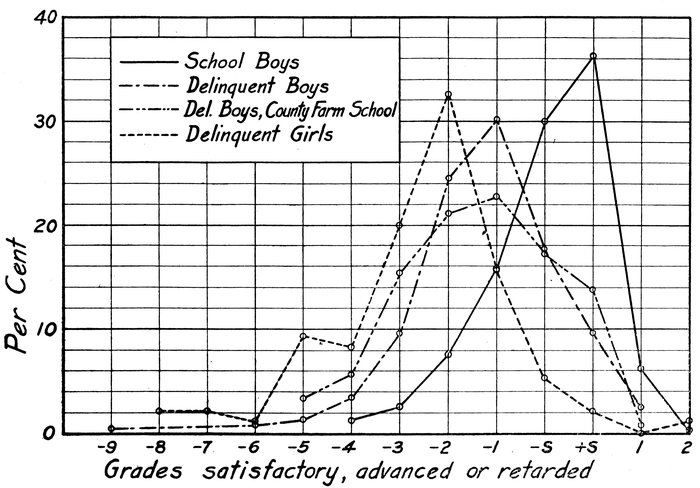
Fig. 2. School Retardation of Minneapolis Delinquents Compared With Elementary School Boys.
181In the Minneapolis group of elementary school children
it will be found that there is about as much chance of a
child being in either of the two most common ages for a
grade. Among the boys, for example, 36% were in the series
represented by age 6 in the first grade, 7 in the second
grade, 8 in the third grade, etc., while 30% were in the
series represented by one year older for each grade. It
is, therefore, reasonable to regard either 6 or 7 as a satisfactory
age in the first grade, 7 or 8 in the second, when
one estimates the amount of retardation in this group.
The allowance of two ages as satisfactory for a grade is
in conformity with the practise of Strayer (189). The
necessity of taking these ages at either the beginning or
the end of the school year, and not merely “in the grade,”
is emphasized by the report of the New York City Committee
on School Inquiry (72). Ayres (71) also considers
only those pupils over-age who are over 7 in the first grade,
8 in the second, etc., so that this may be regarded as
fairly well established as a standard for measuring the
retardation in school position of groups of children.
The summary of results in Table XIII shows that 70%
of the ordinary delinquent boys were retarded in school
position as compared with 27% among the Minneapolis
boys in the elementary schools, 91% of the ordinary delinquent
182girls as compared with 23% of the Minneapolis
girls of these schools. When one compares the age distribution
of the delinquent groups, given in Table XIII
with that of the Minneapolis school children in Table XII,
it is clear that an allowance should be made for the much
larger proportion of older children in the delinquent
groups. This may be done by determining the percentage
retarded at each age and in each group and then calculating
indices of retardation by weighting the percentage
retarded at each age in the proportion to the number of
delinquents at that age. Table XIV gives these results
for the ages 8 to 15 inclusive.
For example, in calculating the indices 39 and 70 for
the frequency of retardation among ordinary delinquent
boys as compared with elementary school boys, the percentages
retarded at each life-age for each of these groups
was multiplied by the number of ordinary delinquent
boys at this age, as shown lower in the table, and the totals
divided by the number of ordinary delinquents, 213.
The average frequency of the retardation of a school
group which compares in ages with the delinquent group
was thus determined. In calculating the indices of amount
of retardation the same procedure is followed except that
the average number of years retarded is found for each
age and this is multiplied by the number of delinquents
at that age. The 16-year-olds are omitted because of
the inadequacy of the school census for this age. According
to the standard which regards 7 years as satisfactory
in the first grade there can be no retardation under
eight years of age. Since some of the pupils 13 years of
age and over have reached high school and so do not
show in the Minneapolis table the percentage of retardation
for children 13-15 years is based on the assumption
that the number of children at these ages will be the same
as the average number for 11 and 12 years. No credit
could be allowed for those advanced in school positions
on account of the incompleteness of the Minneapolis
census for older ages. The comparison is, therefore, on
the basis of retardation alone.
183TABLE XIV.
Indices of Frequency and Amount of School Retardation of Minneapolis Juvenile Delinquents Compared with Minneapolis School Children of Corresponding Ages.
(Age 7 or younger regarded as satisfactory in the first grade.)
|
RETARDATION |
|
Percentage Retarded at Each Life-Age |
|
Index |
8 |
9 |
10 |
11 |
12 |
13 |
14 |
15 |
| School Boys |
39% |
8 |
16 |
24 |
31 |
35 |
40 |
45 |
43 |
| Delinquent Boys |
70% |
0 |
44 |
50 |
67 |
58 |
60 |
77 |
93 |
| School Boys |
36% |
|
|
|
|
|
|
|
|
| Glen Lake Boys |
86% |
|
17 |
50 |
46 |
66 |
81 |
61 |
87 |
| School Girls |
35% |
7 |
12 |
16 |
25 |
31 |
33 |
37 |
93 |
| Delinquent Girls |
90% |
0 |
100 |
50 |
50 |
75 |
83 |
95 |
100 |
|
Index |
Average Amount of Retardation in Years |
| School Boys |
.61 Yr. |
.09 |
.19 |
.31 |
.43 |
.54 |
.63 |
.78 |
.64 |
| Delinquent Boys |
1.27 Yr. |
.00 |
.66 |
.50 |
.86 |
1.09 |
1.11 |
1.23 |
2.11 |
| School Boys |
.54 Yr. |
|
|
|
|
|
|
|
|
| Glen Lake Boys |
1.54 Yr. |
|
.17 |
.50 |
.62 |
1.25 |
1.86 |
2.11 |
2.03 |
| School Girls |
.64 Yr. |
.07 |
.15 |
.22 |
.34 |
.45 |
.50 |
.59 |
.82 |
| Delinquent Girls |
2.29 Yr. |
.00 |
1.00 |
1.00 |
1.00 |
1.25 |
2.25 |
2.05 |
2.84 |
|
Totals |
Number of Children at Each Life-Age |
| School Boys |
13,123 |
1650 |
1624 |
1614 |
1552 |
1742 |
1647 |
1647 |
1647 |
| Delinquent Boys |
213 |
3 |
9 |
6 |
21 |
25 |
47 |
56 |
46 |
| Glen Lake Boys |
108 |
0 |
6 |
8 |
13 |
12 |
21 |
18 |
30 |
| School Girls |
12,781 |
1634 |
1617 |
1594 |
1623 |
1552 |
1587 |
1587 |
1587 |
| Delinquent Girls |
82 |
2 |
1 |
2 |
2 |
4 |
12 |
21 |
338 |
Index equals the sum of retardation at each age multiplied by the number of delinquents
at that age divided by the total number of delinquents.
From the indices of frequency of retardation in Table
XIV it will be seen that retardation of one or more years
below the standard of age 7 in the first grade is nearly
twice as common among the ordinary delinquent boys as
among a group of school boys of corresponding ages, while
it is fully 2½ times as great among the ordinary girl delinquents
as among a corresponding group of school girls,
when estimated on the same basis.
To understand the significance of this comparison one
should consider the relative difference which is shown
between school children and delinquents in the statistics
of health, defective sight, nose and throat obstructions,
etc. The percentages of consecutive delinquents showing
184other defective or diseased conditions has never, so
far as the writer is aware, been found to be double that
among the school children generally when figured on a corresponding
basis. Medical inspection shows that for
other conditions than retardation the frequency of defects
and disease found among representative groups of ordinary
juvenile delinquents can often be equaled in the poorer
schools of the city. To find a factor relatively twice as
common among delinquents as among school children,
when the frequencies are as great as with retardation,
means a variation that is unquestionably significant.
This is, of course, not an argument against the detection
and treatment of handicaps that can be benefited by the
physician. It only suggests the relative size of the two
problems.
In considering the frequency of school retardation
among delinquents in Minneapolis, it will be noted that
the most serious condition is clearly among the girls, 90%
of whom are below grade as compared with the index of
35% for the corresponding group of school girls.
One may estimate that the chance of a Minneapolis
boy who is retarded in school getting into juvenile court
is about 3½ times that of a boy who is up-to-grade. But
the chance of a girl who is retarded in school getting into
juvenile court is about 17 times as great as that of a girl
who is up to grade. This calculation is easily made
on the assumption that the indices of Table XIV are
typical for a single year, knowing that about 194 in
10,000 school boys in Minneapolis get into the court
annually and 21 in 10,000 school girls.
The best measure of the difference in school attainment
cannot be shown, however, without considering the
amounts instead of the frequency of retardation in the
groups compared. We should regard two years retardation
185as twice as serious as one year and make a corresponding
allowance for each additional year of retardation.
Thus weighting our results we find in the indices of Table
XIV that the boys 8-15 years of age in the Glen Lake
Farm School group of delinquents have on the average
lost 1.54 of a year through retardation in school attainment
compared with the satisfactory standard of 7 in
the first grade. The ordinary delinquent boys have
lost on the average 1.27 of a year, while the indices for
Minneapolis school boys of corresponding ages are—.54 and—.61
of a year respectively. Among the ordinary delinquent
girls the average amount of retardation on the
same basis is 2.29 years as compared with .64 of a year
among the school girls of corresponding age distribution.
The indices for the amount of school retardation are
the most significant figures in any of these tables, although
they are based on too few numbers to afford more than
rough comparisons. It is, however, a fairly reliable
estimate to say that retardation in school attainment in
Minneapolis is about twice as great among ordinary delinquent
boys and among the detention home group while
it is three times as great among ordinary delinquent girls
as among corresponding groups of elementary school children.
If we had been able to credit the groups with those
in advance of the expected position for their ages the difference
would have been even greater.
In view of the fact that retardation in school offers an
important check upon the question of the frequency of
mental deficiency among groups, besides stating a different
training problem of its own, it is curious that it has
not been more systematically studied in connection with
186delinquency. Few investigations include any reference
to the question. Auden (69) reports that among 263
committed to Borstal institutions (juvenile reformatories)
in England for the year ending March 31, 1909, 71% (186)
had not reached the fourth standard, corresponding to
the fourth school grade. These were delinquents between
16 and 21 years of age. The next year 402 out of
554 (72%) had not reached the fourth grade. Not one
person had reached the eighth grade and only 13 the
seventh grade. In the Minneapolis detention home group
only 23 out of the 103 over ten years of age were below
the fourth grade.
Cornell gives the distribution of 236 boys in special disciplinary
classes of two Philadelphia schools (93). These
classes are for truant and difficult boys 8 to 14 years of
age inclusive. While they are not technically delinquents
the problem is similar and they show even more serious
school retardation than the Minneapolis group. Summarizing
his results according to the standard which
counts ages six or seven as satisfactory in the first grade,
and so on, we find 12.3% satisfactory; 12.3% retarded
one year; 26.7% retarded two years; 30.1% retarded
three years; 15.8% retarded four years; 2.5% retarded
5 years; and 0.4% retarded 6 years. Eighty-eight per
cent. are thus behind a satisfactory position in the grades,
and 48.8% three or more years behind. This is to be
compared with 70 and 16% among ordinary Minneapolis
delinquent boys (Table XIII).
Among 647 prostitutes at the Bedford (N. Y.) Reformatory
48% either could not read or write any language or
had not finished the primary grades. Seven per cent. had
graduated from the grammar grades. Among 610 prostitutes
in other reformatories reported in the same work,
only 23% had finished the fifth grade. Among 877 street
187cases from which information was obtained 814 had no
more education than ability to read and write, 53 had
graduated from the grammar grades or had some special
education (133). Another report by Weidensall we shall
consider in the next chapter.
The attending physician (60) of the Morals Court in
Chicago inquired “of as many of the defendants as she
could, who were charged with being public prostitutes,
as to what ages they had left school.” Among 3546 cases
which passed before the court in seven months the report
covers 494 cases. Of these only 17 had gone beyond the fifth
grade in school, only one was a high school graduate (161).
Among 100 girls at the Ohio Industrial School, 11 to 18
years of age, median age 15 years, 50% were in the third
or fourth grade and 54% had failed of promotion three
or more times (55).
Drucker gives the age-grade distribution of 100 randomly
selected minor offenders, 15 to 22 years of age, in the
Cook County (Ill.) jail. This shows that 41 of these were
below the eighth grade and three or more years retarded
at the age they left school. They might well be examined
for deficiency. Among 86 who left school at 14 or after,
24 were in the fifth grade or below (101). Among 100
consecutive admissions to the Ohio State Girls Industrial
Home, Renz reports 25% in the third grade and 25% in
the fourth grade, 15% in the fifth grade; 29% failed of
promotion 4.5 to 6 years and 25% more failed of promotion
3 years (47). Storer reports on the same groups
(55). Bluemel finds that 100 probationers in the Denver
Juvenile Court were retarded in school 2 years on the
average as compared with an average school retardation
among the school boys of Denver of 1 year (2). At the
New Jersey State Home for Girls among a group of 163
selected cases 102 had not reached the fifth grade although
their average age was 17 (12).
188The school distributions by age is given for 215 delinquents
in the California State School at Whittier for boys
by Williams (62) in sufficient detail to make it usable for
estimating the frequency of deficiency on a plan we shall
consider shortly. Regarding age seven as satisfactory for
the first grade, and so on, only 7 of these boys had reached
this standard. Supposing that those older should have
attained at least the grade which is satisfactory for the
14-year-old, and those younger the corresponding grades,
we find that 29% were four or more years below this
standard and 14% were five years below this standard.
In the next section we shall endeavor to find out how the
school records might also be used as symptomatic of
mental capacity.
189
There has been considerable discussion of the question
whether psychological testing should be expected to conform
to the ranking of pupils in school. This discussion
however, does not attack the question in which we are
especially interested, i. e., how to get the best information
from both. If the school level were measured by the
progress made in school by passable work and not by the
school position attained often merely through age or size,
Binet would be right in expecting that in general they
would correspond among groups of children in the public
schools. Agreement with real school progress could,
therefore, be taken as a criterion of a good series of tests,
as it has been by Binet and Bobertag. On the other hand
Meumann and Abelson were right in objecting to the
proof of the value of tests by agreement with the school
level, if they limited their objection to tests applied to
exceptional children and to using school position as a
final test of school level. Lack of correspondence with
our group of delinquents is, of course, no indication of a
weakness in the Binet scale. In numerous instances
they had been promoted in school because of age without
doing passable work. The reader should also see the
evidence of the teacher's bad judgment of a pupil's ability
assembled by Terman and by Terman and Knollen
(196).
Terman has calculated the correlation between intelligence
quotients determined by the Binet scale and the
teacher's estimates of scholastic or of general ability.
These gave coefficients of .48 and .45. Doll has found
for Goddard's data on school children that the correlation
of school grades is closer with life-age than with test-age,
.84 as compared with .73 (12). This indicates an
190influence of life-age upon promotion. In a school for
deficients Burt found the correlation of teachers' estimates
with Binet ages was .55, with mental retardation
or excess .59, with intellectual quotient .48. He quotes
McIntyre and Rogers as finding coefficients about .5 for
similar calculations with normal school children in Scotland
(85). Starch has shown that measured by the combined
ability in reading, writing and spelling a third of
the pupils are in a grade behind and a third are in a
grade ahead of their ability (186).
However much we might disagree as to how close a
correlation might be expected between the Binet tests
and school level, independent of the relation to life-ages,
or which is the better test, it is certain that they afford
two different symptoms of mental deficiency. It becomes
our immediate problem, therefore, to discover how
the most information may be gained from a careful interpretation
of the test of school level. If we had sufficient
data, three sorts of checks might be formulated. 1.
What amount of school retardation will give us the best
estimate of mental deficiency among groups? 2. What
amount of school retardation should put an individual's
mentality in question so that he should be examined?
3. What amount of school success should put in question
a Binet diagnosis?
(a) Estimating the Frequency of Deficiency By School Retardation.
We shall first take up the question of utilizing information
about school retardation in estimating the frequency
of mental deficiency among groups of delinquents. It is
191perfectly clear that retardation in school position is not
always an indication of mental retardation. A child
may be behind the position in school reached by the children
of his age merely because he has not attended school
so long as his companions. A census of school progress
which we took in Minnesota indicates that in general a
large part, perhaps half, of the retardation in school is to
be thus explained even under compulsory attendance
laws. Some allowance is also to be made for physical
handicaps, such as defects of sight and hearing which
are not corrected, illness which does not cause prolonged
absence, frequent change of schools, bad home conditions,
etc. Aside from absence, however, there can be no
question that greater or less degrees of mental retardation
is the main cause of retardation in school. Moreover
a dull mind is often the reason for beginning school at an
older age and for staying away from an unsuitable school
environment as much as the law will permit. In any particular
case, it is to be noted, however, that all of the excuses
for backwardness in school are not likely to account
for more than one or two years of lagging for other reasons
than dullness.
We cannot hope at present to get nearly so accurate a
judgment about the frequency of deficiency in groups by
means of any school test as by the psychological tests.
Nevertheless, I believe that it may furnish us some supplementary
evidence. The main difficulty in formulating
any general rule for interpretation of the school level is
that very different plans of promotion prevail in different
school systems. It is not uncommon, for example, to
find that a child will be promoted to a higher grade regardless
of his ability provided that he has spent two
years with the same teacher. This practise, of course,
makes it impossible to judge a particular individual's
192ability by the school grade he has attained without knowing
how he reached it. Nevertheless, spending two years
in each grade will begin to show in a general distribution
of pupils by the time we deal with 12-year-olds. I have
gone over the tables of school retardation of pupils provided
by Strayer for several hundred cities in the United
States and I find that the percentage method of approach
gives us at least a rough cue as to what might be expected
by any general principle of interpretation (189).
Using age 7 as satisfactory in the first grade, 8 in the
second, and so on, we find that among 319 cities of all
sizes, half of them had 2% or more retarded four or more
years in school position. This condition was about the
same for cities less than 25,000 as with the larger cities.
On the basis of school position for groups of children of all
the school ages it would, therefore, be safer to make a
low estimate of the frequency of mental deficiency on
the basis of five or more years of scholastic retardation
in the groups and regard 4 years or more of school retardation
as a maximum estimate. Since most children
leave school at 14 it is generally best to regard all older
as only 14 years of age when estimating deficiency. I
have not been able to check this by school and test records
on a group of children through all the grades. Goddard's
published records do not give the mental ages for those
four or more years retarded scholastically. Moreover,
he only included those in the sixth grade and below. For a
group of young children this estimate would undoubtedly
be too low. The delinquent groups, however, are all older.
Most of them, if they lived in this country have gone to
school until they were at least 14 years of age. Wallin
(211) and Strong (190) also give records of school position
to check the Binet rating.
193
TABLE XV.
Percentages of Pupils 12 and 13 Years of Age Most Seriously Retarded in School
|
Percentages Retarded |
|
4 or more grades |
5 or more grades |
| Cincinnati, Ohio—June 1907 |
8.8% |
2.5% |
| Cleveland, Ohio—1909-1910 |
3.0 |
0.9 |
| Des Moines, Iowa—1915 |
1.0 |
0.2 |
| Memphis, Tenn.—June 1908 |
6.6 |
1.5 |
| Minneapolis, Minn.—June 1915 |
1.3 |
0.5 |
| Pittsburgh, Pa.—1913 |
4.7 |
1.1 |
| Springfield, Mass.—Sept. 1907 |
1.2 |
0.1 |
| Reading, Pa.—1906-1909 |
2.2 |
0.4 |
The distributions for Cincinnati, Memphis and Springfield are taken
from Ayres' Laggards in Our Schools. That for Minneapolis is from
unpublished data. That for Reading is from Snyder's Retardation
in Reading Public Schools. The others are from Superintendents' reports.
By considering only pupils in the public schools who
are 12 and 13 years of age, the last years in which practically
all are in school, we can get a check upon this
method of estimating for delinquent groups. I have
compared the age-grade distributions for those of these
ages in eight cities showing the percentages retarded 4 or
more and 5 or more years. They are given in Table XV.
These records indicate that at least five or more years
retardation below a standard of age 7 in the first grade
for all who are 12 years of age or over might be taken for
a low estimate of the frequency of deficiency, and four or
more years retardation for a maximum estimate. Except
under special circumstances those who are older than 14
years should be considered as if the highest grade attained
was at 14 years of age. These borderlines of school retardation
for the purpose of estimating the frequency of
deficiency check fairly well with estimates for the Minneapolis
and other groups of delinquents which have been
tested by the Binet scale, as we shall note later in this
chapter.
194In order that the school test of mental deficiency should
be as good as the Binet system it would have to provide
a standard of school progress relative to length of attendance
instead of school position relative to age. If one
could say that a child was not above the lowest 0.5% of
the children of his age in the progress which he had made
in school relative to the time actually spent in school,
one would then have an excellent standard for judging
feeble-mindedness for any child who had been in school
for some years. It would be better if an uncertain region
were also defined. By the time that a child's ability has
been passed upon for four or five years and by different
teachers, even from the point of view of the needs of school
work, one has a criterion for mental ability in a particular
community applied under long observation, which no
system of brief tests can hope to equal for some time to
come. Such a standard, however, is unfortunately not
available since we have too little information about school
progress relative to attendance. Even if it were available,
psychological tests would still be an important check
upon the school judgment on account of the excessive
value put upon mere memorizing in school and on account
of the emotional repulsion to the school developed by
some children of ability. Mental tests would be necessary,
moreover, for the younger ages.
(b) School Retardation As A Warning Of The Need For Examination.
Even if no more is known than a person's grade in
school at any age over eleven it is an important cue as to
his mentality. Here our problem is not estimating deficiency
among groups but the discovery of deficient individuals.
We wish to find the highest grade in school
in which we are at all likely to find children under present
195conditions who test in the lowest 1.5% for their ages.
Our records on 653 15-year-olds indicate that a pupil of
this age who tests doubtful is very rarely retarded less
than 3 years in school. It occurred only twice when tested
ability was judged by the 1911 tests, four times judged by
the 1908 scale. None of the 15-year-olds who tested
presumably deficient were retarded less than three years.
In Minneapolis, as in many cities, the custom prevails
of promoting, regardless of passable work, after two years
have been spent in a grade.
We suggest, therefore, to be perfectly safe, it is well for
every child in court to be examined who is two years retarded
in school below the standard age of 7 in the first
grade and is not able to carry work above the seventh
grade. This will include a considerable number of children
at the lower border of those presumably passable.
Binet used this standard of two years retardation in
recommending examination for children 9 years of age or
over (3 years below age 6 in the first grade) (77, p. 44).
He adopted it from Belgium. It is also quite commonly
followed in this country. The New Jersey law provides
for special classes in any school district where there are
ten or more children four or more years behind grade.
This probably means behind the theoretical position of
age 6 in the first grade, one year worse retarded than we
suggest examining. Goddard says in one place that “a
child who has been in school regularly and is two or three
years behind his grade is so suspicious that it is almost
certain that he is feeble-minded” (116). But later he is
much more conservative and says, “The child who is
fourteen years old and cannot pass an examination in
fourth grade work is almost surely feeble-minded” (34).
As judged by Strayer's tables the suggestion that examination
is desirable for those two years behind a standard of
196age 7 in the first grade would tend to bring in for examination
about 18% of the school boys in half of the cities
of 25,000 population and over. This would not be too
severe a burden for courts which would be interested only
in that portion of these retardates who were brought into
court.
This school test may be made of decidedly practical use
by those working in juvenile courts where most of the
cases are with children over this age. It can be applied
in a very simple manner by subtracting 8 from the child's
age and only passing without testing those who are in a
grade in school higher than the number remaining. For
example, if the child is 13 years of age, subtracting 8 gives
5. Now, if the child is in the fifth grade or lower, or
entered such a grade at the time he was of this age, one
should investigate the question of feeble-mindedness.
Unless more than one year of the retardation is explained
by the person's absence from school since he was six
years of age, he should always be turned over to an expert
for examination. This retardation of two years in
school attainment below the standard of seven in the first
grade may indicate feeble-mindedness if the child has
been attending school constantly, although the chances
are perhaps 6 to 1 that it does not. It is very desirable
that we should have more adequate data on this point.
A cautious court, however, would inquire into the mental
ability of any child—at least two years retarded in school,
i. e., any child the number of whose school grade is not
higher than the remainder after subtracting 8 from his
life-age at the time that he entered his last grade or who
is not actually carrying the school work of an advanced
grade. This latter caution we must now consider.
197
(c) School Success As A Check On The Binet Diagnosis.
The school test can give us still another practical cue
as to feeble-mindedness in examining children. Ability
to carry successfully school work of some grade certainly
could be used as a systematic criterion of passable intellectual
ability. What school grade indicates this is
not at present possible to determine except as a rough
practical check. With the great irregularity in school
grading at present known to exist, it certainly would not
be possible to say that fifth grade work indicates a passable
intellect, although some of the oldest local schools
for deficients, like those in Mannheim, do not pretend to
carry children above the fourth grade work. Speaking
of the school success of the intellectually deficient, Binet
said: “One may draw the conclusion, which is of practical
value, that one need not seek children of this group in the
senior divisions of the primary schools” (77, p. 44). This
would correspond to the sixth and seventh grades in this
country. Tredgold gives a careful description of the
highest work in a London special day-school for the highest
grades of deficients. It shows that even fifth grade
work would be beyond what is actually taught the children
in this school. He says:
“The work done by this class consists of reading and
writing, equivalent to normal Standard II; compound
addition and subtraction up to 1000, and simple multiplication
and division. Excluding a few children—who,
in my opinion, are not really defective—it may be said
that the scholastic acquirements of none of these children
come up to the Standard II. In occupations and
manual work they are decidedly better, and a considerable
portion of the children of this class can cut out and
make simple artificial flowers, knit rugs and weave baskets,
with a really very creditable amount of dexterity,
198which redounds in no small measure to the patient,
persevering and systematic care of their teacher” (14,
p. 173).
Some of our group with doubtful intellects do better
than this. When considering the borderlines with the
Binet tests we decided that a child was presumably passable
if he scored a test-age of XI. This score would not
be made by 11-year-olds as a group, but could probably be
attained by 12-year-olds. We may then ask what is the
corresponding school position attained by 12-year-olds
who have been continuously in school. At the same time
we must ask whether the lowest 1.5% of the children of
any single age can attain this school grade since it should
be high enough to exclude the deficients, no matter
how long they have attended school. We happen to
have this information for a random group of Minneapolis
elementary school pupils on the basis of census of school
progress per years of schooling. Considering only the children
who had been in school since they were six years of
age, we found that 82% of 186 12-year-olds and 92% of 174
13-year-olds had reached the seventh grade, and that the
lowest 1.5% of neither age nor of any of the older ages
could apparently carry the work of this grade no matter
how long they had remained in school. Our records included
older pupils who were in their eleventh year of
attendance on the elementary schools.
Another indication that reaching the seventh grade is
presumptive evidence of passable intellects is found in
the fact that none of our group of 653 15-year-olds testing
presumably deficient with the Binet scale and only four
of the six who tested doubtful intellectually had reached
the seventh grade. On the other hand those that think
that a 15-year-old testing XI is deficient will be interested
to find that 42 out of 51 who tested XI with the 1908 scale
199were in the seventh grade or above. We are convinced,
therefore, that it is a conservative position to take that
either passing the Binet tests XI in the 1908 series or
ability to pass successfully the seventh grade in school is
good evidence of a passable intellect. The rule, of course,
does not apply to those who are passed along to the seventh
grade because of their size or age regardless of ability
to carry the work.
Let us see what the rough preliminary estimates on the
basis of school retardation would indicate for the Minneapolis
delinquents. We may disregard the upper limit
of 14 years since compulsory attendance in Minnesota for
backward pupils continues until age 16. For the limits
of five and four years of retardation in school below the
standard of 7 years in the first grade we would have estimates
of 2.6% to 6% of deficiency among the ordinary
cases of delinquent boys and 14.7% to 23.1% among the
ordinary delinquent girls. Among the recidivist group of
boy offenders 3% to 11% would be below these borderlines.
Among the Glen Lake School group 12% are four
years or more and 4% five years or more retarded. This
last is to be compared with our judgment on the basis of
individual examinations with the Binet scale in which we
concluded that 2% were presumably deficient and 5%
doubtful as to deficiency. The estimates on the basis of
school retardation are somewhat too large. This would
certainly be true for older delinquents. In as much as
the laws for compulsory school attendance usually do
not enforce attendance after 14 years of age, it would
probably be better generally to treat all over 14 years of
age as if they were of this age at the time of leaving school.
200This limiting age of 14 checks more closely with the mental
examination records reported by Williams (149) and
Ordahl (41) for groups of delinquents in the California
state schools.
With her unselected group of 88 women at the Bedford
reformatory, Weidensall found that 39% had not completed
the fifth B grade (60, p. 23). This is not far from
the estimate of presumable deficiency among such inmates
on our borderline with the Binet scale. Considering
the actual years of school retardation relative to years
of attendance, so far as she was able to discover, and adding
the 8 who never attended school, we have 20% five
or more years retarded in school and 28% four or more
years retarded (60, p. 251). She says further regarding
the bi-modal distribution of ability which she found among
her group:
“The division which alone served to separate the better
from the poorer subjects was that of the grade completed
upon leaving school. Those who had accomplished
the completion of at least 5B grade formed a curve which
paralleled very closely that of the Cincinnati girl of fifteen,
while those who had not succeeded in passing 5B
comprised the majority of those who collected at the
poorer mode of the Bedford 88 curves. Throughout, the
grade completed has proved to be more often a measure
of our subjects' ability to progress in school, less often a
measure of their opportunity to attend school.”
The administrative officers of institutions may make
rough estimates of the frequency of serious deficiency
among their charges by regarding all over 14 as if they
were 14 years of age or under, disregarding those under
12 years of age, tabulating the highest school positions
reached, and finding the frequency of those four or more
and five or more grades retarded below a standard of
age 7 for the first grade. It would be well for each court
201also thus to make an estimate of the size of the problem
of deficiency in its jurisdiction. According to the second
suggestion which we have made, the Minneapolis Juvenile
Court, for example, should plan to examine for mental
deficiency all those two or more years retarded in
school or about 20% of the boys found delinquent and
nearly half of the girls. The prospect would be that the
number sifted out as having feeble intellects will be less
than 10% of the ordinary run of cases.
Let us study a little further into the detention home
cases tested by the Binet scale and see what additional
light their school position throws upon the question
whether or not they are defective delinquents. Four
years retardation in school position would have called
attention to both of our sure cases of feeble-mindedness.
On the other hand, it would have brought in for examination
only 4 out of the 7 doubtful cases. Three years
of school retardation would have sifted out all but one.
Two years school retardation, the rule suggested above,
would have detected all those who tested doubtful. It
would have required 56 examinations in this group to
have found the eight cases suspicious under our test criteria.
We also find that, among the random 15-year-olds
not delinquent, examining all those 3 years retarded
would have discovered all that tested even doubtful intellectually.
Applying the rule that ability to carry seventh grade
work is a good indication of a passable intellect, we find
that none of our Glen Lake delinquents testing either
presumably deficient or doubtful had reached the seventh
grade. On the other hand, if one were disposed to object
to saying that a person who passes Binet tests XI (1908)
has a passable intellect, one finds in reply that 16 out of
the 22 Glen Lake delinquent cases testing XI and three
or more years retarded intellectually, i. e., presumably
passable, were carrying seventh grade work or better.
202In examining individuals the importance of checking
each of these tests with the other seems perfectly clear.
If a boy fails in the Binet tests and shows better school
ability one should certainly be cautious in his diagnosis.
On the other hand a boy who is seriously behind in school
may be found by the Binet scale to have a better intellect,
so that the inquiry must be further extended to determine
the cause of his school retardation. Retardation in school
is generally not as fundamental a symptom of deficiency
as retardation in the tests because of the numerous other
causes of delay in school.
After allowance for the external causes of backwardness
in school one finds that the test of progress in school
and the Binet examination not rarely reach two different
sides of the nature of unusual children found in juvenile
court. Working with these exceptional children, Dr.
Kramer observed that school performances were often
notably different from ability in the tests. After checking
the two tests against each other in examining 59 cases
sent to him from the Society for the Care of Delinquent
and Dependent Children in Breslau and 59 children at
the psychiatric clinic in Berlin, he says regarding the
result of this comparison:
“For the valuation of the Binet method, it shows us
that the first objection which occurs to one, that the
method tests only school knowledge, is not correct. On
the contrary it was found that we had to do in high degree
with that which was independent of what the child
had learned in school and with real abilities which the
normal child is accustomed to acquire by a certain age
uninfluenced by training and instruction.”
He emphasizes, however, that to answer practical
questions regarding the training of a child, “we must
not only examine into the understanding but the total
personality must be taken into consideration” (184, p. 519).
203
The comparison of the Binet and school tests for our
group of serious delinquents suggests another important
comparison. Many delinquents are found to be apparently
wrongly placed in school relative to their intellectual
development. They form a group for which not isolation
but training is needed, a group notably larger than that
which should be sent to institutions for the feeble-minded.
This bad adjustment of juvenile delinquents to their
school work is not the same problem as backwardness
in school. It means attendance in school classes unsuited
to the child's mental ability. In a paper before the
Minnesota Annual Conference of Charities and Corrections
in 1910, I briefly forecasted this problem (152). It
is now clearly indicated by the records of the group of
delinquents at the Glen Lake Farm Training School.
This comparison is made in Table XVI.
204TABLE XVI.
School Positions of Delinquents at Glen Lake Relative to Their Intellectual Development
| School position worse |
Alike[32] |
Better |
Total |
| 3 yr. |
2 yr. |
1 yr. |
|
|
1 yr. |
2 yr. |
3 yr. |
4 yr. |
|
| 1 |
8 |
21 |
21 |
29 |
16 |
4 |
2 |
2 |
104 |
In order to be thoroughly conservative in estimating
this problem of maladjustment to school work, let us
not only allow for two mental ages to be satisfactory for
each grade, as indicated in the table, but in addition omit
all cases which might be credited with an intellectual development
above XII. This eliminates the objection
to considering higher age tests, for nobody questions
that tests XII or above indicate at least a 12-year-old
intellect. After these extremely liberal allowances we
still find 54 of the 104 boys in the detention home testing
less than XIII who were in school grades the work of
which was presumably not suited to their intellectual
level. Seventeen of the boys (16%) were at least two
years out of adjustment to their school work. If we disregard
those who were trying to carry work too difficult
for their capacity because placed a year or more ahead of
their ability, we find 30 out of adjustment because at
least one grade behind the class suited to their intellects.
Over a quarter of our detention-home group was thus
placed in school a year or more below grades attended
by the pupils of corresponding intellectual development.
It may be said that some of those behind their proper
intellectual position in school may have been kept back
because of instability, laziness, or other volitional characteristics
which might fail to show in tests of intellectual
performance. This is probably rare, and, when found,
it often means merely that the pupil requires more attention
to secure results.
That our delinquents are not unique in their maladjustment
to school as judged by their tested abilities, is
indicated by the report of Ordahl on the school position
of the special group of 341 delinquents in the state school
at St. Charles, California. The median of their school
positions, counting seven years as satisfactory for the
first grade, fell a grade and a half below that which their
tested mental development seemed to justify. He notes
that “mentality is not alone responsible” for their low
grades in school. Moreover, he believes that it shows
the necessity for a more objective pedagogical method in
dealing with them (41, p. 81).
205Only a prolonged trial of special instruction for those
presumably behind their proper grade would finally determine
how large is this evil of maladjustment. Such
an experiment could be satisfactorily carried out only
with the co-operation of the board of education. It
would mean the employment for some years of expert
teachers to train those delinquents found behind their
intellectual level in school. Until that time we shall
have to take the estimate from psychological tests which
indicated that, in our group of serious juvenile delinquents,
presumably 29% of those compared had been
held back by the school machinery. Since the retardation
of these pupils may be attributed to a late start in
school life or prolonged absence, the inadequacy of the
schools so far as these pupils are concerned may be supposed
to lie in their failure to promote pupils quickly up
to the school position of their equals. On account of
the expense of special teachers such pupils presumably
could not be given a chance to make up the school subjects
which they had missed and could not be advanced to
the grades requiring this knowledge. Whenever this is
the case or under any circumstances which keep the pupil
behind the school class of his intellectual equals, we have
a fundamental cause of distaste for school work. No
wonder that such pupils dislike school, become disgruntled
and stubborn, run away and rebel at the treatment they
receive under the traditional school system. One can
hardly blame a self-respecting boy, forced to remain behind
his peers, for breaking away from the lock step,
playing truant and seeking his education in the streets.
The trouble is not with the school authorities alone.
They are doing about as well as can be expected with
the funds which the people have been willing to provide.
The public must be educated up to the recognition of the
206fact that every child in the school should be allowed to
progress as rapidly as his abilities permit. The public
schools of Mannheim, Germany, are the great illustration
of what can be done to bring the school instruction
close to the varying degrees of capacity among the pupils.
In the Mannheim schools children may carry from four
to eight years of the regular curriculum in eight years,
and the brighter pupils may also take additional subjects.
The Industrial School in Cleveland has demonstrated
that some 14-year-old boys two years backward in school
may, with special help, be successfully prepared for high
school with about as much likelihood that they will continue
the high school course as the ordinary boys (107).
It is self-evident that a boy with ability to carry a
higher grade of work cannot ordinarily be allowed to
skip one or two classes without special instruction and
be expected to succeed with studies which require preliminaries
that he has had no opportunity to learn. The
necessary knowledge and sufficient skill in particular habits
of thought needed could probably be acquired in a
brief time under the right sort of special instruction. It
is not sufficient that special classes for pupils mentally
backward should be provided in the schools. They will
not take care of this problem, which has to do mainly
with pupils intellectually capable of carrying the work
of a higher grade than that in which they are placed.
These children can now be found by means of mental
tests and they should be assisted in making up the intermediate
work by collecting them into redemption groups,
so to speak, where they can have individual instruction.
In the public schools of Faribault, Minnesota, the plan
of thus picking out older minds in a class and promoting
them one or two grades with very little extra instruction
has been successfully tried in an experimental way.
207If all of the children in a school system who are thus
seriously out of intellectual adjustment cannot be cared
for, it is plain that the children in danger of delinquency
might well receive the first attention, since the lack of
adjustment with these may cause the most serious social
consequences. That the problem is more acute among
the serious offenders in juvenile court than among school
children generally is indicated by a comparison with Goddard's
figures for school children generally in a typical
community tested with the same scale. If we select from
his tables only that group of mental ages which could
actually be in a class ahead or behind their mental development,
we find that only 20% of this group would be
outside the standard of 6 and 7 years in the first grade,
etc., as compared with 52% of our detention home group
on the same basis. On the other hand Terman's records
with the Stanford scale (193) indicate 44% of ordinary
children similarly maladjusted to school. This condition
should probably be regarded, therefore, as a supplementary
stimulus for delinquency rather than a fundamental
cause comparable with mental retardation.
While this lack of adjustment is undoubtedly the most
pressing training problem connected with juvenile delinquency,
we must not expect that when it is solved we
shall have eliminated the problem of mental backwardness
of delinquents as a class. The most that we could
expect from perfect adjustment of the school work to
mental ability would be that the average amount of school
retardation for the group would be materially reduced.
How much retardation in school relative to the life-ages
would still remain, cannot be determined on account of
the uncertainty of the tests for older ages and the factor
of volition. For the mentally deficient pupils still remaining
behind the regular pupils it is necessary to provide
208other special classes. In these classes or schools the
feeble-minded children would remain for their entire
school course.
That the correction of the lack of adjustment is a
much more agreeable and hopeful task than the care for
deficients is shown by the facts regarding the detention
home group in Table IX. There is at least the possibility
that 10 of the school laggards in this group of serious
delinquents might be brought up to a satisfactory grade.
Discount this prospect as you may, it is still to be compared
with the fact that no actually feeble-minded boy
can ever, by special instruction, be brought up to a satisfactory
school grade. Moreover, we might expect that
30 of the 84 laggards might, by special help, catch up
one or more grades.
That the correction of lack of school adjustment is a
bigger problem in connection with juvenile delinquency
than the detection and isolation of the mentally unfit can
only be said in relation to the numbers affected. Taking
the lowest estimate of those in the detention home
group out of adjustment with their school environment
it was at least 30, while only 9 of that group fell below the
borderline of passable intellects and only 2 were surely
feeble-minded. If one guessed as we have on the basis
of school position that a maximum 6% of the ordinary
juvenile delinquents in Minneapolis might be feeble-minded,
who would venture to guess that ill-adjustment
of school to mental ability affects so small a proportion?
On the other hand one feeble-minded person, through
the transmission of his deficiency, may, perhaps, do more
damage to society than many intelligent delinquents.
Who shall say? Certainly both the isolation of the feeble-minded
and the adjustment of school training are vitally
important problems in the care of juvenile delinquents
209today. Nobody can say that one is more important than
the other except from a special point of view. From
the eugenics standpoint feeble-mindedness is more important;
from the point of view of the numbers affected
and the skill required for training the child, there can be
little question but that the correction of bad adjustment
to school environment is the bigger problem. When
one considers how much of the child's time is spent out
of school, at home, with playfellows, or at work we cannot
be sure that other external influences might not ultimately
be found to be more important in connection
with juvenile delinquency than either the school life or
mental incapacity. The further consideration of the
causes of delinquency we shall now make the subject
of a broader inquiry.
210
In a preceding chapter we have shown the frequency of
tested deficiency among various types of delinquents.
We may now further consider the significance of this association
of delinquency with deficiency. The best plan
for discovering its meaning is provided by the technical
method of correlation. The data in the published reports
of the score or more of investigations which I have
reported is wholly inadequate for following out this
method. We must, therefore, for the present content
ourselves with noting what has been discovered by the
better analysis of similar data which was supplemented
by the necessary information as to the distribution of
the different types of crime in the corresponding general
populations. To this we can add certain correlations in
connection with the small Minneapolis group of tested
juvenile delinquents.
We are indeed fortunate to have the fundamental work
of Dr. Charles Goring on “The English Convict,” from
which to formulate a point of view regarding the relation
of deficiency and delinquency. This work represents
ten years labor in making observations, collecting, tabulating,
and statistically evaluating data on 3000 convicted
men, who were found in the English convict prisons where
they had been sent after conviction in the higher courts
because guilty of grave or repeated offenses. It was
carried out with the co-operation of a corps of workers
who had the help of Professor Karl Pearson and his assistants
at the Biometric Laboratory of the University of
London, in the statistical reduction of the almost overwhelming
mass of data. By the large use of partial
211correlation the relative influence of various factors upon
criminality was investigated as it never had been before.
It is, of course, not possible to reproduce here the conclusions
of this monumental work which should be made
more widely available in the libraries of this country. We
shall, however, select certain conclusions which bear most
directly upon our problem and which rest upon well established
statistical deductions, and compare them with a
few other studies which have contributed interesting
side lights upon the causes of delinquency.
“Every feeble-minded person is a potential criminal,”
says Goddard in his work on Feeble-Mindedness (112, 514),
and this sentiment finds an echo in the emotions of many
social workers. On the other hand we have the careful
work of Bronner in which she compares by their test records
a group of delinquent women with groups selected
from night classes and the servant class who had never
been known to be immoral. On the average she finds
that the delinquents do not test below her servant group.
She says:
“Thus, though our delinquents are not as capable as
their sisters, many of them from congested districts, who
in other ways are proving themselves ambitious [the
group from night classes,] yet they are no less equipped
intellectually than others who are earning a livelihood
and caring for themselves without coming in conflict with
the law in the least. Whatever their mental status might
be, measured by other means, the fact remains that there
is no necessary correlation between their immoral or
criminal tendencies and their intellectual ability and
that others, no more endowed than they, are fighting
212life's battles without manifesting the same immoral or
criminal tendencies” (112, p. 43).
What portion of these moral household servants of
equal ability with the delinquents may later fall under
temptation, we, of course, cannot say. Neither can we
say that any of the delinquents would test deficient, since
we do not know the border lines of deficiency with the
tests which were used. The conclusion, however, is
clear that, if corresponding grades of intellect may be
delinquent or not at maturity, we must be cautious in
assuming that the lowest grades of intellects would all
become delinquent if not under supervision.
What chances we are running by allowing feeble-minded
individuals to be abroad might be determined if we could
find out the probability of tested deficients becoming
delinquent. This question cannot be answered by showing
for a single year or a period of years that crimes are
relatively more common among the defective classes,
although such figures give some impression of the danger
of deficiency to the community.
Kinberg, for example, calculates that in Sweden during
the years 1901-1907 murder was relatively 200 times as
common as among those not in institutions, but lacking
criminal responsibility through insanity or deficiency, as
among those who were responsible, arson was 72.5 as
common, manslaughter 12.63 times, other injuries to
property than arson 6.55, rape 6.1 times, infanticide
4.59 times, larceny 0.99 times, and fraud 0.26 times
(132). The data were based upon the reports of the
Royal College of Health which makes the diagnosis as to
criminal responsibility that is required for all cases in
which this question arises. Such examinations, it is
estimated, miss at least 15% of the deficient criminals.
213Goring gives a table which shows what crimes are most
likely to be committed by deficients. He found that
10% of the convicts in England and Wales were definitely
treated in prison as deficient, and he estimated that 0.5%
of the non-criminal population were equally deficient.
His table is based upon the tabulation of 8,290 crimes
past and present of 948 English convicts (Fig. XXXIX,
p. 258). It is given below:
TABLE XVII.
Goring's Data as to the Percentage of Mental Defectives Among Men Convicted of Various Offenses. (948 Convicts)
| Firing of stack |
52.9% |
| |
| Wilful damage, including maiming of animals |
22.2 |
| |
| Arson |
16.7 |
| |
| Rape (child) |
15.8 |
| |
| Robbery with violence |
15.6 |
| |
| Unnatural (sexual) offenses |
14.3 |
| |
| Blackmail |
14.3 |
| |
| Fraud |
12.8 |
| |
| Stealing (and poaching) |
11.2 |
| |
| Burglary |
10.0 |
| |
| Murder and murderous intent |
9.5 |
| |
| Rape (adult) |
6.7 |
| |
| Receiving |
5.1 |
| |
| Manslaughter |
5.0 |
| |
| Coining |
3.3 |
| |
| Wounding, intent to wound, striking superior officer |
2.9 |
| |
| Embezzlement, forgery, fraudulence as trustee, bigamy, performing illegal surgical operation |
0.0 |
| |
| General population |
0.5 |
Another table from Goring shows which groups of
crime are most likely to be committed by the deficients
compared with the frequency of that type of crime in the
general population. It is reproduced in part below.
214TABLE XVIII.
Goring's Data as to Groups of Crime Committed Most Frequently by Those Mentally Deficient
| Nature of crimes |
Total criminals |
Mentally defective |
Percentages of mental defectives among those committing various crimes |
Percentages of general population committing the several offenses |
| Malicious damage to property |
55 |
22 |
40.00 |
0.406 |
| Stealing and burglary |
442 |
45 |
10.18 |
4.180 |
| Sexual offences |
101 |
13 |
12.87 |
0.199 |
| Violence to the person |
183 |
11 |
6.01 |
1.606 |
| Forgery, coining and fraud |
167 |
4 |
2.40 |
0.722 |
| Total |
948 |
95 |
10.00 |
7.203 |
Some very striking instances of recidivism on the part
of the feeble-minded were summarized by Dr. Smalley
in his evidence before the Royal Commission (83). He
said:
“Against 130 out of 333 weak-minded prisoners who
were unfit for ordinary penal discipline by reason of mental
deficiency, no previous conviction had been recorded;
but for this absence of record their nomadic habits might
in part account. Against fifty-six 1 conviction had been
recorded, against twenty-eight 2; the remainder varied
from 4 to 105 convictions. About half had been convicted
from 5 to 10 times.... Dr. Hamblin
Smith, Medical Officer of Stafford Prison, as the result
of a special inquiry into 100 mentally defective prisoners,
found that 100 had a combined record of 1,104 convictions,
or an average of 11 per prisoner, and this number
was regarded as being below the actual truth. Ten of the
prisoners had over 30 convictions. Dr. W. R. Dawson
found that in the two prisons in Dublin 12.21 per cent. of
the inmates were defectives. The average number of
previous convictions for the females was 44.13. Many of
them ran into hundreds, and one was in prison for the
two-hundred and thirty-sixth time, and she was only
twenty-nine years old.”
215So far as I can discover nobody has directly attacked
the specific problem, what percentage of individuals
of a given degree of deficiency who are not under supervision,
become legally delinquent at some time in their
lives. A slight contribution to the empirical study of
the problem is made in the reports of the follow-up work
in connection with pupils formerly in special classes in
the public schools which I reviewed in Chap. IV, f. We
have also a telling report by Bullard of the New York
Prison Association published by Moore in 1911 (156).
It follows the records of 85 feeble-minded boys and men
16-29 years of age, paroled from the Elmira State Reformatory
in 1904. The whereabouts of 3 were unknown
and 2 died. Of the remaining eighty, 31 were arrested
again and 6 others violated their parole. One was arrested
19 times in this short period.
The best approach to this problem of measuring the
potential delinquency among deficients is afforded by
Goring's four-fold table for calculating the correlation
between deficiency and criminality in the male population
of England and Wales (20, p. 259). By means of the
annual data on first convictions of crime at different ages
and the probable length of life among criminals and in the
general population he has been able to predict a potential
criminality on the part of 7.2% of the general male population.
In other words, the best estimate seems to be
that about 7 in every hundred males in England and
Wales will be convicted of crime at some time in their
lives. About 10% of the convicts in England for a series
of years have been isolated in prison treatment because
of deficiency. If we now also assume with him that 0.46%
of the non-criminal population is mentally deficient, we
arrive at the table which enables us to determine, on these
assumptions, that it is most likely that 63% of the deficients
216will be convicted of crime at some time in their
lives. If instead of taking this estimate of 10% of the
criminals being deficient we had taken 20%, then the
probability of a deficient individual being convicted of
crime would rise to .77.
On the basis of our summary of tested delinquents in
the last chapter it seems extremely conservative to suppose
that 10% of the manifest and potential criminals are
as deficient mentally as the lowest 1.5% of the general
population. Even with this assumption we find that the
chances would be 48 out of a hundred that a person of
this degree of deficiency would be convicted of crime.
These estimates, I believe, afford a telling argument
for the indefinite isolation of at least those who are in the
lowest 0.5% mentally on the ground of their potential
criminality, independently of any question of the danger
to society from the hereditary transmission of the diathesis
of deficient delinquency.
We have heard much in recent years of the particular
danger of allowing the better grade of feeble-minded,
especially the morons, to be abroad in the community.
Time and again it is asserted that it is this class of deficients
which is most likely to become delinquent. There
is a widespread confusion here between the statement
that criminals in absolute numbers are drawn more frequently
from the moron class and the statement that
morons are relatively more likely than imbeciles or
idiots to become delinquent. To the first alternative
there would be no objection since morons are much more
frequent than the lower grades of deficiency. On the
other hand if morons are relatively more likely to be
delinquent than imbeciles, then we should expect those
just above the morons in ability to be more likely than
morons to be delinquent. The technical answer to the
217problem whether the lower grades of deficiency are more
likely to become delinquent could be best reached by
discovering the correlation of delinquency with the different
grades of deficiency.
Goring's data throw some light on this question since
he has found the correlation between grades of intelligence
and the degree of recidivism and also between intelligence
and the frequency of bad reports in the penal
institutions where the convicts were held. In both cases
the tendency is clear for the weak-minded and imbecile to
be more frequently convicted and to be reported more
frequently for bad conduct than for the higher grades of
intelligence which he classifies as unintelligent, fairly
intelligent and intelligent. The correlation coefficient
with frequency of convictions relative to time out of
prison is -.16 and with frequency of bad reports is -.33.
The correlation ratios are slightly higher in both cases.
On the other hand the more intelligent are likely to be
given longer sentences, the correlation being +.10.[33] It
might be contended that his distinction between the lowest
grades of intelligence is not objective and not very
clear; but that the general tendency of the regression
lines would be reversed at the lower extreme seems very
improbable. In other words there is some reason to
suppose that, relative to their numbers, the idiots and
imbeciles would be more likely to be delinquent than the
more intelligent feeble-minded provided none was confined
in an institution. No idiot and few, if any, imbeciles
could survive honestly in any environment without assistance.
How closely the degrees of immorality are associated
with the degrees of deficiency remains one of the most
218important problems to be answered authoritatively by
the correlation of these traits when properly measured.
That the greater degrees of immorality and of deficiency
are on the whole associated and not opposed we have
good reason to believe, but there are undoubtedly examples
in which the degree of immorality or delinquency
is out of proportion to the degree of deficiency. The fact
that certain instances are found of moral imbeciles without
corresponding intellectual deficiency, which has been
noted by Stern (188, p. 75) and by Anton (67), does not
of course determine the direction of the tendencies. We
must base our deductions as to the danger of delinquency
among lower and higher grades of deficients on our knowledge
of the general tendencies. Are morons, relative
to their numbers, more dangerous to the community
than lower grade deficients? We must not make the
absurd deduction that because morons are most numerous
they are most likely to be delinquent and should therefore
be most carefully isolated or supervised.
Modern statistical methods afford the ultimate quantitative
tool for determining the cause of delinquency,
whether or not we also require that the data should be
assembled under experimentally controlled conditions.
The rapid strides which have been made in answering
this fundamental question of criminology may be judged
by noting the treatment of it in such a work as Goring's
compared with the impressionistic literary style which
has prevailed. Illustrations of particular cases, opinions
subconsciously formulated by experts from wide experience
in dealing with delinquents, even the votes of the
majority of leaders in the field, give way before the acid
219test of measurement of tendencies in human traits just
as poorer methods succumbed in the Middle Ages in the
realm of the physical sciences. Quantitative determinations
can no longer be brushed aside with a smile on the
supposition that statisticians are the biggest liars. They
must be answered by better data or more refined methods.
The form of the discussion of social questions has changed.
Correlation is a powerful new weapon for attacking these
problems which promises to go far beyond the range of
earlier blundering methods.
While partial correlation affords an ideal approach to
answering the question of causation, it has been used
only to a very limited extent. The necessary data for
comparing the closeness of relationship of various suggested
causes of delinquency are not available and too
few who are interested in social problems have appreciated
the significance of the method. We should, therefore,
lay especial emphasis on the measurement of the correlation
of deficiency and criminality by Goring. He laboriously
assembled the only data which are sufficiently
extensive to allow much reliance to be placed upon their
statistical reduction. In his use of correlation, moreover,
he acted under advice from the main center for this work
at the Galton Laboratory in London.
If those who were “mentally defective” under Goring's
designation were always convicted of crime and none
of those who were not defective were ever convicted of
crime, the measure of the relationship between criminality
and deficiency would be expressed by a correlation coefficient
of +1.00. If there were no relationship whatever
between deficiency and criminality the coefficient
would be 0.00. If the deficients were never convicted of
crime and the non-deficients were always criminal the
coefficient would be -1.00. Intermediate degrees in the
220relationship of these tendencies would then be represented
by decimals which would be either positive or negative,
depending upon whether the traits were associated together
or were opposed. The coefficient which he found
for the male population was +.6553, which was much
higher than that for any other constitutional or environmental
factor which he measured.
In calculating this correlation Goring regarded 10%
of the criminal male population as defective. He found
that this was in agreement with the common tendency
in English convict prisons to class officially about this
portion of the criminals as defectives and needing care.
He also assumed that 0.46% of the non-criminal male
population in England and Wales was defective, the proportion
suggested by the report of the Royal Commission
on Feeble-mindedness. By a careful computation he
calculated that 7.2% of the males either have been or
will be convicted of crime before they die. He then
constructed the four-fold table on the basis of these estimates
as applied to the 948 convicts whom he examined
as to their mental condition. The coefficient was then
calculated by Pearson's method for a four-fold table.
This method assumes that the mental ability and the
tendency to criminality are distributed normally in the
population and that the difference in numbers between
the criminal and the non-criminal, deficient and non-deficient
are not too great. In case the percentage of defectives
among the criminals were taken as 20% instead
of 10% the correlation would be increased to .79.
Using the same four-fold method we may calculate the
correlation between deficiency and juvenile delinquency
among Minneapolis boys. It is necessary to make a
good estimate of the proportion of boys who annually
become delinquent in Minneapolis for the first time, and
221of the proportion of these boys who are correspondingly
deficient. Fortunately these comparisons can be made
fairly accurately on the basis of the reports for the year
1915 and of our tests of juvenile delinquents. We may
use a minimum and a maximum estimate of deficiency
among the delinquents corresponding to those that tested
below borderlines which represented the lowest 0.5% and
the lowest 1.5% of the population of corresponding ages.
We need to assume that the frequency of tested deficiency
among the boys found delinquent would correspond within
these limits to the frequency among the Glen Lake group.
The indices for the amount of school retardation in these
two groups (Table XIV) indicate that this is a liberal
estimate. We must also assume that the proportion of
juvenile delinquents for the year 1915 may be regarded as
typical for a series of years. The number of new cases of
boys in juvenile court in 1915 was within 18 of the median
number for the last four years. The result of these estimates
is Table XIX for the minimum estimate of deficiency.
A similar table for the maximum estimate of deficiency
would be the same, except that the proportion of
all boys of these ages who were deficient would be 1.5%,
and of the delinquent group, 7.3%.
The computation of the correlations by Pearson's tetrachoric
r shows the relationship between juvenile delinquency
and deficiency among boys to be .16, P. E. .07, on
the minimum estimate of deficiency. On the maximum
estimate the correlation is .29, P. E. .05. In order to
make a closer comparison between Goring's calculation
and my own I have recalculated the correlation for
his group on the assumption that 0.5% of the general
male population were deficient and that 1.29% would
be convicted felons of the type among which he found
10% to be deficient. This brings the minimum correlation
for his figures to .59, P. E. .03.
222TABLE XIX
Four-Fold Correlation Table for Juvenile Delinquency and Deficiency in Minneapolis (Minimum Estimate).
Boys 8-16 Years of Age
|
Non-Deficient |
Deficient |
Total |
| Non-Delinquent |
22,305 |
109 |
22,414 |
| Delinquent |
268 |
4 |
272 |
| Total |
22,573 |
113 |
22,686 |
The total number of boys is taken from the census of school children
for 1915-16 compiled by the attendance department of the Board of
Education. It includes those in public, parochial and private schools
and those not attending. The number of delinquent boys is taken from
the report of the Juvenile Court of Hennepin County, Tables H and I.
The number of repeaters and the proportion of delinquent cases dismissed
at the hearing are subtracted from the total number of new
cases.
The difference between a correlation of .29, the highest
I found, and .59, Goring's lowest result, indicates that conviction
for felony in Great Britain is more closely associated
with deficiency than juvenile delinquency is associated
with deficiency in such communities as Minneapolis. It
is to be remembered, however, that Goring's calculation
gave the convicts a life-time in which to be convicted,
while ours gave the boys only 16 years. The relation of
potential delinquency after 16 years of age to deficiency
might be greater among Minneapolis males than the corresponding
relation we found among the boys; but the
difference in these correlations is more easily explained
by supposing that the type of serious delinquency represented
by sentences to penal servitude, in England at
least, is more closely related to deficiency than are the
lighter forms of delinquency found among the youth of an
American city.
223The most significant fact demonstrated by the correlations
between juvenile delinquency and deficiency is that
there is a positive relationship which is significant in
amount. With the maximum estimate the correlation
is nearly 6 times its error. This is the first time that the
relationship has actually been calculated in connection
with any group of juveniles. We can say that when a
Minneapolis boy is below the average in tested ability
for his age, he is most likely to be .16 to .29 of the same
amount below the average in legal conduct, both measurements
being in corresponding units.
What then, is the significance of correlation in answering
the problem of causation? So far as the statistical
method itself is concerned it shows only a mathematical
functional relation between the conditions measured, not
a physiological relationship. In other words a correlation
between deficiency and delinquency might be explained
by both conditions being related to some more
fundamental factor which might be the causal factor involved.
One cannot reason from correlation to direct
causal connection. On the other hand, by correlation
we may directly compare the relation between any one
trait and various factors. We can find out, for example,
whether the association of delinquency with deficiency
is closer than the association of delinquency with other
factors which it has been suggested are causes of delinquency.
Goring's work allows us to compare the correlation
of the tendency to be convicted of crime with deficiency
and with many other constitutional and environmental
factors which have been measured, and thus our
attention may at once be directed to that factor which
the present evidence indicates as most fundamental.
Unless the measurement of the various factors is shown
to be seriously faulty or incomplete the outcome should
224determine our point of view as to the main cause of delinquency,
until new evidence is forthcoming. This is
the problem of the next section.
As we have noted above, the correlation of delinquency
with various factors should give us a scientific point of
view as to the main causal influence in criminality.
Thanks to Dr. Goring this work has recently been carried
far. His findings mark a new and higher scientific level
in the study of criminology. No data are now available
which modify his position in any important regard. I
shall, therefore, attempt to give his evidence in the briefest
possible manner, hoping that it may lead to a closer
reading of his basal investigation.
(a) Constitutional factors.
First comparing a dozen factors in the individual's own
constitution which may be measured by the death rates,
Goring found the tendency to be convicted of crime was
correlated most closely with alcoholism, .39; sexual profligacy
(syphilis and aneurism), .31; and epilepsy, .26; while
it was found to correlate with intelligence, .66. The
closeness of the relationship of defective physique to
criminality was expressed by coefficients of .18 and .19.
Among the inner factors investigated were many of
Lombroso's characteristics of the so-called criminal physiognomy
of which so much use is made by phrenologists,
such as asymmetries, projection of the chin, complexion,
form of the face and features, kind of hair, tattooing,
left-handedness, temperament, etc.
Following this analysis, we find that alcoholism, epilepsy,
and probably social profligacy are closely associated
with intelligence as well. By means of partial correlations
225he shows that when individuals of the same degrees
of intelligence are compared there is only slight additional
relation between alcoholism or epilepsy and criminality.
The relations to these other conditions are therefore accidental,
depending upon the fact that deficients are more
likely to be alcoholic and epileptic, the fundamental constitutional
factor being intelligence. Among over forty
physical and mental factors, the only other condition
which he found to have significant relation to criminality
is a generally defective physique as shown by height and
weight, neither of which is correlated with intelligence.
Regarding the above inner factors he summarizes his
conclusion as follows:
“Our final conclusion is that English criminals are
selected by a physical condition, and a mental constitution
which are independent of each other—that the
one significant physical association with criminality is
a generally defective physique; and that the one vital
mental constitutional factor in the etiology of crime is
defective intelligence” (20, p. 263.).
(b) External factors.
Turning now to certain factors which might be supposed
to be important mainly as environmental influences,
Goring studied the length of imprisonment and the frequency
of reconvictions for crime relative to the periods
of freedom as two measures of the degree of recidivism
among his criminal group. He measured the correlation
between the degree of recidivism and such outer factors
as formal education classified by the kind of school training,
whether received in the elementary school, secondary
school, or at a compulsory industrial or reformatory
school for delinquents, also formal education as measured
by the age at leaving school; effective education as
226measured by the grade in school reached at the time of
leaving and by the educational grade assigned the convict
in the prison school; regularity of employment classified
under the headings regular, occasional, voluntarily
unemployed, unemployable; alcoholism under estimates
as to the convicts' intemperance, temperance or abstinence;
family life, in which the standard of life was classified as
well-to-do, prosperous poor, poor, very poor, and destitute;
the influence of maternal authority measured by
the age at death of the mother, order of the subject in
the family, and number in the family, thus reaching the
question of only sons and of size of family; nationality;
and finally the relation of age at which the first sentence
was received and the nature of the sentence to subsequent
convictions.
The significance of the relation of these external influences
upon the degree of recidivism is not directly comparable
with the influence of these factors upon the tendency
to be convicted or not to be convicted of crime at
all, as he carefully explains. Since the distribution of
the above factors in the population at large is not known,
the relationship to criminality in general could not be
measured for the outer factors as it was for the inner
factors discussed previously. Reserving, then, our judgment
as to how closely these environmental factors may
be related to the criminal tendency not represented by
recidivism, we can reach important conclusions as to
their relation to the degree of recidivism. Only one of
the coefficients was found to be large enough to be twice
its probable error, so that as a whole they were not at all
significant. He summarizes his conclusions as follows:
“The relative values of these contrasted coefficients
demonstrate effectively and conclusively one truth: that
an adverse environment is related much more intimately
227to the intelligence of the convicts than it is to the degree
of their recidivism, or to the nature of the crimes they
commit. Moreover, since mental defectiveness is closely
related to crime, an easily imagined corollary to this
truth is that the mental defectiveness of the convict is
antecedent to his environmental misfortunes, rather than
that his unfortunate circumstances have been responsible
for the mental defectiveness of the convict, and his lapse
into crime....”
“From the general trend of the results tabulated above,
our interim conclusion is that, relatively to its origin in
the constitution of the malefactor, and especially in his
mentally defective constitution, crime in this country is
only to a trifling extent (if to any) the product of social
inequality, or of adverse environment, or of other manifestations
of what may be comprehensively termed 'the
force of circumstances'” (20, p. 287-288).
The caution which we have noted above, as to the influence
of outer factors having been measured in relation
to recidivism rather than to criminality, becomes more
important when we find that the correlation of high intelligence
with frequency of convictions is also low, only -.16
and to fractions of a year imprisoned +.10. Since
the relation of intelligence to criminality in the general
population is +.66, we cannot be at all sure that these
outer factors, or some of them, might not also be much
more closely related to criminality than they are to recidivism.
Besides this caution we might also urge that
some of the most important outer influences have not
yet been evaluated by correlations. We know nothing,
as yet, except by inference about the correlation of delinquency
with the influence of bad companions outside
the home, bad school adjustment, the effect of broken
families aside from the early death of the mother, absence
of proper recreation, and many other stimuli for delinquency
which social workers have been studying for years
by less conclusive methods.
228Just to recall the frequency of some of these other conditions
associated with the environment of the youth we
may note that Aschaffenburg says that Abanel found in
Paris “among 600 criminals under twenty years of age in
303 cases the family life of the parents was destroyed owing
to death, divorce, desertion, illicit relations, or to
some similar cause” (208, p. 133). Again he states that
in 1841 Father Mathew, by making 1,800,000 total abstainers
temporarily reduced serious crimes in Ireland
from 12,096 to 773 per annum in a period of three years.
Miss Rhoades by a personal evaluation of many factors
involved in each of 81 random cases of juvenile delinquency
in Chicago found that the main cause in 67 cases
was some home condition and in 9 others it was a special
temptation in street gangs, while only in 5 was the main
cause mental subnormality (171). That nearly half of
the juvenile delinquents come from broken families,
affected by death, divorce, or desertion has been frequently
shown. A study of more than a thousand successive
cases in the Minneapolis juvenile court by Miss Finkle
showed that 39% of them were from families not normally
constituted, families in which one of the natural parental
guardians of the children had been removed (105). We
also have an important study of the relation of the delinquent
child to his home by Breckenridge and Abbot
(82).
While there is always a possibility of finding some other
factor closely related to delinquency and independent of
capacity, nevertheless we should hardly urge this possibility
at the present time as overweighing the accumulation
of negative evidence which has been assembled in
recent years, especially at the Galton Laboratory. We
should remember that many so-called outer influences
are, like the temptation to drink, related to the incapacity
229which precedes the temptations. There is also good reason
to suppose that many bad environmental surroundings
result from rather than cause deficiency. Even
broken homes may be a result of incapacity, to which
undoubtedly early death is related. The first essential
for social philosophers is to recognize that so-called environmental
factors may have their corresponding inborn
correlates. This is almost invariable with home conditions.
The problem is to weigh the relative importance
of these outer and inner factors on the same individuals.
(c) Weighing heredity against environment.
Both subjective and objective methods have been used
in trying to determine whether heredity or environment
has the most influence upon criminality. The earlier and
subjective method is one for which Gruhle is perhaps the
leading advocate. By this method an expert with wide
experience judges the relative effect of inner and outer
causes of delinquency in particular cases. In his study
of 105 minor delinquents in a German industrial school
Gruhle, after a thorough and systematic clinical and sociological
study of each person, gave his judgment whether
heredity or environment was the main cause of delinquency
in the case. In his summary he concluded that
in 9 cases the fundamental cause was found in the environment,
in 8 cases in environment plus a subordinate
influence of heredity, in 41 environment and heredity
were balanced, in 20 cases heredity was the main influence
but environment was a subordinate factor and in 21
heredity was considered the causal factor. This shows
that, when each case was estimated separately, in his opinion
heredity on the whole turned out to be more important
than environment for this group. By the same subjective
method Gruhle weighs the influence of family taints
230such as mental abnormalities, deficiency, and drunkenness
as against the hereditary influence in crime, and comes
to the surprising result that in 9 cases where both parents
were abnormal mentally or drunken in only two cases
was heredity the predominant cause of the delinquency,
while in 7 cases where neither parent showed these taints
the delinquency was invariably explained by heredity.
The group whose delinquencies were in his opinion mainly
due to heredity showed, curiously enough, less family
taints from nearly every point of view. He concludes:
“The knowledge that so many of the criminal youths
are abnormal is indeed very significant for the therapeutic
treatment of the social offenders, for the choice of the ways
which should be used to improve the youths; but this
knowledge has no significance for establishing the causes
of delinquency.... The abnormal parents
really have more children who are abnormal and
under the average in capacity, but their children are
actually more seldom delinquent because of the natural
tendencies than the children of normal parents” (121).
Healy has followed a similar plan in subjectively weighing
the influence of various factors as causes of the delinquency
of 823 recidivists before the Psychopathic
Institute at the Chicago Juvenile Court. Although he
does not directly estimate hereditary and environmental
factors as such, his summary of these estimates of separate
cases shows the main cause of delinquency in 455 of these
cases to be some form of mental abnormality or peculiarity.
Abnormal physical conditions, including excessive
sex development accounted for 40 more. His other
causes, which embraced only 26% of the cases, might
possibly be regarded as directly environmental. They
included defective home conditions, including alcoholism,
bad companions, mental conflicts, improper sex experience
and habits, etc.
231Thus we find that the two most important expert estimates
of individual cases after exhaustive study apparently
agree in placing the main causal influence on factors
which are predominately inner rather than outer. The
most serious objection to this method of approaching
the problem is that we have no way of determining how
far such a result is the effect of the expert's unintentional
bias. Gruhle's analysis of his delinquent group, however,
raises very clearly the question whether the total influence
of heredity may not be markedly greater in the production
of delinquency than merely the heredity influence through
mental deficiency and abnormalities in the families.
A better method of evaluating the relative influence
of heredity and environment would avoid the danger of
subjective bias by studying objectively measured factors.
With either the subjective or objective method correlation
affords a better way of statistically handling the results.
The best approach to an objective study of the
inner and outer causes of delinquency by the correlation
methods is furnished by Goring. The ingenuity of the
biometrical procedure in applying correlation to resolving
this perennial question of heredity and environment must
be recognized by all who take the time to understand
its methods. We can only briefly consider the results
of Goring's chapter on “The Relative Influence of 'Inheritance'
and 'Contagion' upon the Occurrence of Crime and
the Production of Criminals.”
This work conclusively demonstrates that crime runs
in families. The probable value of the correlation between
conviction for crime on the part of the father and
son was found to be .60, while the correlation between
mother and son was only slightly less. The tendency
to resemble brothers in criminality was shown by the
232probable fraternal correlations of .45. Whether this
family resemblance is mainly through nature or nurture
is the problem.
In analyzing the influence of the home he uses partial
correlation and finds that the correlation between age
at first conviction and the number of convictions for a
constant period of time after the first conviction is -.243.
“From the value and sign of this coefficient, we see that
the earlier in life a child commits a criminal offence, and
is consequently removed from his home, the worse criminal
does he become; and, accordingly, we conclude that
criminal proclivities are more bred in the home than
inoculated there” (119, p. 368). This argues against
the predominant influence of the home training or example
as explaining family resemblance in criminality. Nevertheless,
it would seem that the result might also be interpreted
as meaning that the contact with other delinquents
and official discipline outside the home at a
more impressionable age notably increases the tendency
to recidivism.
Besides the argument as to the earlier removal from
home, we have a test of the question whether those kinds
of crime that are most influenced by contagion show
closer correlation within the family. His statement of
the results is as follows:
“Our table 177, above, starting with crimes of fraud,
passes to stealing and burglary—professional crimes,
where the influence of criminal contagion should be the
most intense; and then progressively to violence, arson
and sexual offenses, in which last it is difficult to understand
how the influence of example could have any effect
at all. We can understand the influence of parental
training in the original moulding of a professional burglar
or thief, and, to a certain extent, it is conceivable that the
constant spectacle of the lack of control in parents might
233lead their offspring to emulate them in acts of unlawful
violence. But, that parental example could play any
part of importance in the perpetration by their offspring
of crimes such as arson and wilful damage to property, and,
particularly, of sexual offenses, is not reasonably to be
supposed. As seen in the above table, 177, the parental
correlation for sexual crimes, and crimes for wilful damage
to property is from .45 to .5; for stealing, it is from .48
to .58. We would assume then, from this evidence, that
the tendency of the inherited factor in criminality is from
.45 to .5, and the intensity of criminal contagion is anything
between .05 and .1” (20, p. 367).
Other evidence as to the relative influence of heredity
and training, which Goring suggests, is in connection with
the difference in influence of the two parents. If the
contagion were from either the mother or father alone,
the difference in resemblance to that parent and the other
might indicate the strength of the contagion. The difference
amounts to about .05. This again, in his opinion,
gives some idea of the relative importance of nature and
nurture within the family. The measure would not be
complete unless the hereditary tendency to resemble
mother and father were equal and the contagion were
all from one parent.
Husbands and wives tend strongly to resemble each
other in crime, the correlation being .6378. This resemblance
is of course not due to heredity. Goring believes
that it is not due to contagion and argues that besides
the subjective tendency for the criminals to associate
together, there is here a large element of conscious choice
of a mate among the criminal classes, especially as the
criminal woman shows the tendency most clearly and
would not be able easily to get a non-criminal husband.
This work of Goring illustrates how an important beginning
has been made in applying the correlation method
to objective records, in order to weigh the relative importance
234of hereditary and environmental sources of
crime. Perhaps its most important support is the close
agreement between his conclusions as to the importance
of the native diathesis of criminality and other studies
by the biometric school as to the family tendencies in
physical traits such as stature, eye color, tuberculosis,
insanity, and deafness. These all tend to show a correlation
between parents and children or brothers and sisters
of about .5 as compared with relations to environmental
factors which tend to be less than .1 (165).
(d) The criminal diathesis.
If one accepts the point of view that the cause of crime
is to be considered analogous to that of pulmonary tuberculosis,
his understanding of the etiology of crime gains
immensely. The old question of whether the criminal
is born or made is answered, “both.” But the emphasis
from our present data is on the inborn tendencies. Moreover,
being born with the criminal diathesis does not
mean that a person is predestined to commit crime, but
that he is more likely than his neighbor to be infected by
the contagion of delinquency. We have only to catch
the trend of recent scientific research to extend our vision
further. The criminal does not lack a simple unit character
which would otherwise make him whole as some of
the disciples of Mendel seem to argue. Neither is the
criminal diathesis a simple instinctive tendency like the
tendency to make a specific response to a specific stimulus,
e. g., to wink when an object approaches the eye; the
criminal is not charged with a specific propensity to commit
murder or to steal. The safety of those who are more
susceptible lies in keeping away from the contagion of
bad example and temptations to fall, toward which he is
generally less resistant than others. Specific training in
235strengthening and guarding his weakest spots may in
time build up a resistance to temptations, the amount of
which we cannot yet measure. His hope lies in the recognition
of his weakness and the adjustment of his living
so that his whole organism may support the breach in
his make-up during the struggle with himself and with
society.
In this complex diathesis which means greater susceptibility
to temptations, there is little doubt that mental
deficiency is the main factor. Aschaffenburg has well
expressed one effect of this particular causal factor: “The
weak-minded are generally children of the moment....
The lessons of experience, which serve
normal persons as a guide, in later events, soon fade, be
cause they cannot be fitted into the existing condition
of the ideas. The inability to understand, much less
to form general points of view, is the direct result of mental
weakness” (20, p. 180). Lacking the ability to organize
their experience, fixed punishments have little restraining
influence. Only prolonged training and supervision
can save them from being the victims of the moment.
Even the large majority above the grade of ability which
would justify indefinite supervision still show their stupidity
in the offenses they commit. Goring gives an instance
of a watch repairer who was legally punished nine times
for pawning watches entrusted to him to repair. Who
would doubt that native stupidity is an important cause
of the recidivism which is so common a criticism of our
present forms of legal discipline? It is stated, for example,
that 10,000 of those convicted in one year in England had
been convicted more than twenty times before (165, p.
59). Even with school punishments the same association
of bad conduct and stupidity holds. Kemsies has shown,
as quoted by Terman, that the 16% ranking lowest in
236a group of pupils received 80% of the punishments, while
the brightest third received almost none (194).
That the criminal diathesis is not limited to mental
deficiency is demonstrated by Goring's results. He
shows its smaller correlation with deficient physical size,
alcoholism and suicidal tendency with such pathological
conditions as insanity and epilepsy, independent of their
relations to mental deficiency. In this connection Gruhle's
opinion that the hereditary tendency to crime was greater
among his non-defective families may be borne in mind.
That mental ability, and especially mental deficiency,
is primarily a question of inherited capacity rather than
training, is now indicated by a number of fundamental
objective studies of the correlation of abilities within the
family, which have been analyzed to show the relative
influence of inborn and external factors. Among these
studies Thorndike's investigation of the tested abilities
of twins compared with brothers and sisters in the same
family is the most objective, and is very convincing (199).
He has also summarized the evidence so well that it is
not necessary to go into the question here (198). One of
the most important facts is that equal practise under the
same conditions increases the difference between individuals
rather than makes them more alike. The work of
the English biometricians appearing in Biometrika and
the monographs from the Eugenics Laboratory is the
most important in this field, and cannot be summarized
here. It includes family resemblance in both pathological
and healthy mental traits (126).
As compared with these studies the attempt to show
that feeble-mindedness is inherited, because many of
those in institutions for the feeble-minded are from families
showing mental taints, lacks cogency, since we are
still uninformed as to what portion of the offspring of
237parents with and without deficient minds are deficient.
Even if 85% of the children in institutions for the feeble-minded
have tainted parents this does not mean that we
know what percentage of deficient parents have deficient
offspring. It is this latter fact that we must know in
order to predict the danger of defective offspring from
deficient parents. From what we know about the correlation
of parents and offspring in mental ability, it is
clear that the more deficient are the parents, the more
likely it is that their offspring are deficient. Children
of morons are, therefore, not so likely to be deficient as
are children of parents with lower grades of ability. From
the eugenic point of view, it is, therefore, most important
first to protect society from propagation by the lowest
grades of deficients, provided that all grades of deficients
are equally likely to have children when left unrestrained
in society. Since mental and moral qualities are probably
correlated positively, the same emphasis would be
placed on first isolating the lowest grades in order to reduce
inheritance of criminality. The eugenic emphasis
waits, however, on the discovery whether the greater
tendency for the lowest types to be produced by the
lowest types is overbalanced by any tendency of deficients
or delinquents of lower degrees to be less productive
when unrestrained in society.
The conception of a criminal diathesis does not stop
merely with the notion that there is an inborn predisposition
to crime. It considers further that offenses do not
occur except under the stimulus of certain situations,
even if such stimuli may be even more common than the
tubercle-bacillus. The important question which it now
puts to science is, “How much may the actual outbreak
of delinquency be reduced with better methods of social
prophylaxis?” Even if, “the chief tasks of social hygiene”
238are the “struggle against alcohol and against poor economic
conditions,” as Aschaffenburg believes (68, p. 228),
the chief emphasis from the best scientific work still
seems to be that the problems of alcoholism, poverty and
crime are more closely related to internal than to the external
conditions which have thus far been measured.
Guarding against the propagation of mental deficiency
thus seems to be the most direct and hopeful method of
attack, while the removal of infecting temptations, and
training for greater resistance, should receive hearty,
albeit subordinate emphasis.
239
1. In our attempt to interpret the volume of results
concerning tested delinquents, we have accepted the
common conception that the feeble-minded are those
who, through lack of mental development, are social deficients.
They cannot survive in society without supervision.
In the words of the English Mental Deficiency
Act, “they require care, supervision, and control for their
own protection or for the protection of others.” Our
present scales of development tests do not detect those
deficients whose failure is not directly due to intellectual
incapacity. We have called those not detected by tests
“purely conative cases,” to distinguish them from the
tested deficients, who were said to be “intellectually deficient.”
These conative cases would not be feeble-minded
except for their incapacity for prolonged acts of
will. Deficiency thus specialized in volition is so unusual,
however, that the study of tested deficients gives us a
useful picture of the problem of feeble-mindedness. To
get a general view of the relation of deficiency to delinquency
we determined conservative borderlines with the
Binet scale and then reinterpreted on a common conservative
basis the results obtained in more than a score of investigations
covering thousands of objectively selected
delinquents who had been tested. This has enabled us
very largely to remove the question of the frequency of
deficient delinquents from the realm of subjective opinion.
We may now be certain that under present conditions
the problem of deficiency is most pressing in institutions
for female offenders. The evidence also points
to the greater frequency of deficiency among prostitutes
and repeaters, rather than among ordinary juvenile delinquents.
240We have thus been able to restate the problem
of the deficient delinquent more conservatively and
to modify some of the current conceptions. This enables
us to direct our efforts more intelligently, with greater
foresight, and more hope of success.
2. A still broader outcome of this interpretative study
is to increase the precision of the test scales for use in the
diagnosis of social deficiency. This has been accomplished
by an extended reconsideration of the borderlines of
deficiency on test scales, particularly the Binet scale. A
percentage definition of tested deficiency is suggested for
determining the borderline below which an individual
may be presumed to be so deficient as to justify isolation,
and for setting off a distance above this on the scale for
which the test diagnosis of social deficiency should be
regarded as uncertain. By this means it is hoped that
the developmental scale may be made safer and more
useful as an instrument for diagnosing feeble-mindedness.
A quantitative definition for tested deficiency has its
main justification in its success in discovering social deficients
and in predicting social failure. With this in
mind the percentages suggested as representing the social
deficients or uncertain cases in the community were
chosen after a careful search through the evidence as to
the success of children who had been in special classes
or institutions and an extensive résumé and analysis of
the best expert estimates of the frequency of social deficiency.
The conclusion was that these percentages may
tentatively be placed so that those who would at 15 years
of age be in the lowest 0.5% in tested ability among a
randomly selected group, may be presumed to be so deficient
as to justify isolation. Above these the next 1.0%
may be regarded as uncertain, since the bulk of them
would require some supervision or guardianship during
241life. These two borderlines have then been located on
the Binet scale for both the immature and the mature so
far as possible from the available data. In particular
these borderlines for the mature have been found for the
first time on the basis of a randomly selected group. Besides
the records of Minneapolis delinquents these Binet
borderlines for a typical random population of 643 15-year-olds
is the main contribution of new data in the study.
The practical consideration of these borderlines in
Part One and their location on the test scale emphasizes
that a test diagnosis is only symptomatic, that the suggested
borderlines on the Binet scale are determined from
limited data which may not be verified in other communities,
that the scale itself is imperfect, and that the
results should be checked by other tests, especially by
the school retardation, a new example of which is given
for the Minneapolis delinquents. The plan of the percentage
method of describing the borderlines readily
allows for adjustment to more complete data or better
developmental scales. The alternative to the use of a
test record as symptomatic of deficiency is dependence
upon the history of the case or physical signs, such as are
found among Mongolians, cretins, epileptics, etc. These
signs have been found among only about 13% of the deficient
children (141). Expert opinion given on the history
of the case is clearly less reliable than such opinion
checked by even a crude objective test standard. In
Part Two of this study the theoretical background for
the percentage definition is compared with that of other
quantitative definitions on the basis of the conceptions of
mental measurement and mental development.
3. In attempting to suggest methods for diagnosis and
control, which our summary of the scientific data makes
necessary, we shall be led beyond the evidence presented
242in this study. To those to whom these suggestions may
seem remoted from the foregoing pages, it may be said
that they are the result not only of a review of the available
research work, but also an outcome of several years
observation of the practical handling of this problem
both in this country and abroad. In that study I was
led to visit several scores of institutions and schools for
delinquent or deficient children in Austria, England,
France, Germany, Italy and Switzerland. The methods
suggested below for the case of the deficient delinquent are
only modifications of what has been observed in actual
operation.
An adequate diagnosis of deficiency involves not only
the accurate knowledge of the present mental condition
of the individual, but an understanding of the causes of
that condition. This requires a complete family and
social history of the individual and a knowledge of the
medically removable handicaps. It would seem, therefore,
that such a diagnosis may be best made by a commission
which shall include a physician as well as a psychologist,
or else by an expert in mental development who
is provided with adequate facilities and assistance for
discovering other handicaps than innate incapacity. For
the group of uncertain and conative cases a final diagnosis
should, if possible, be made only after prolonged observation
in a temporary home school.
Frankfurt a. M. in Germany seems to have been the
first to provide a specialized observation cottage for uncertain
cases among children. This was established in
1900 and is much used by the juvenile court. Although
it has a separate building and an isolated division of the
grounds it is, however, connected with the local hospital
for the insane. An improvement in this respect was made
with the first provincial school for psychopathic children
243under compulsory training established near Leipzig at
Kleinmeusdorf. This serves also as a distribution station
and has two observation divisions through which
all fürsorge children in the province pass. Only the psychopathic
cases remain indefinitely. Detention homes for
juvenile delinquents in this country quite generally are
used for temporary quarters for cases to be observed, although
these are not isolated from the other children.
If an entirely separate observation institution is not possible,
a more definitely recognized probationary period
for observation of the uncertain cases should be arranged
within other institutions. The efforts for clearing-houses
for mental defectives such as that in New York City and
the Ohio Bureau of Juvenile Research will help to distribute
individuals to their proper institutions. The ideal
is a separate observation home where all cases in which
the question of mental deficiency and mental disease is
raised may be sent before the individual is labeled. The
effect of commitment to an institution for the feeble-minded,
insane, or delinquent can be guarded against
much better if the observation home is entirely isolated
from all other institutions. The separate institution,
however, is more difficult to obtain than a separate division
or cottage in an existing institution. The latter forms
a valuable intermediate step and is better than merely
giving uncertain cases additional attention when other
duties permit.
As a matter of legal procedure, diagnosis raises the
troublesome question of expert advice in court. Two
decisions have to be made about each case. First, is the
individual deficient enough to justify isolation or guardianship?
Second, considering the means of care available
in the particular community, how should the deficient be
cared for? The first is primarily a question which requires
244expert knowledge in mental development and should
be so handled. The second decision requires knowledge
about the individual's home and about the facilities for
guardianship or isolation. It should be left with the
authorities thus informed. This will usually be the court
unless there is a commissioner or a committee especially
charged with this duty.
An important advance in the legal definition of criminal
responsibility of deficients should be made by avoiding
all subtle questions of psychological analysis such as
would be involved in deciding, for example, under the New
York statute whether the accused “was laboring under
such a defect of reason as not to know the nature and
quality of the act he was doing or know the nature of the
act as wrong.” Obsolete legal descriptions could easily
be cleared away by adopting the statement of the law
suggested by the Committee of the Institute of Criminal
Law and Criminology for criminal responsibility and insanity.
In substance such a law would then state that the
accused was mentally deficient “so as not to be responsible
... for his acts or omissions at the time when
the act or omission charged was made.” The New York
law places an emphasis on knowledge which should be
placed on will, only one feature of which is an understanding
of the situation.
4. What should be the aim in the care and control of
deficients and delinquents after diagnosis also depends
upon a proper understanding of the causes of these conditions.
We have summarized some of the best and most
recent investigations in which a notable advance toward
solving this problem has been made by means of the correlation
method. This has proved to be a new and vigorous
force for directing social progress. By no other
method have we approached so near the solution of the
245cause of delinquency. It enables us to restate the problem
of criminality as mainly a problem in the treatment of a
hereditary criminal diathesis in which mental deficiency
is the largest factor. These recent scientific measurements
have deprived neither the eugenist nor the euthenist
of the opportunity for service. There is plenty of congenial
work to be done by those whose sympathies may
exaggerate the influence of heredity, contagion, or training.
As in the control of tuberculosis, so with the diathesis
of delinquency, some effect is produced by predisposition,
by training, and by external influences. Unless
the present evidence, however, is outweighed by improved
data obtained in the future, the most strategic point for
attacking persistent delinquency is through the relation
to deficiency, with heredity holding the heights.
With the immediate campaign against delinquency
centered against the propagation of the social deficients,
we have the atmosphere cleared so that it is possible to
turn attention to the best means of attaining this end.
Sterilization, isolation, or guardianship, by force or by consent,
which of these methods promises best? This is
not a question for detailed discussion here. We may,
however, call attention to the strides that have been made
by such legislation as the British Mental Deficiency Act
of 1913 and to the summary of the laws of the several
states in our country published at the University of
Washington, Seattle. The question whether sterilization
is desirable must at present be settled apparently
by the judgment whether the benefit in reducing the
propagation of the unfit outweighs the danger to morality
through the temptation of known sterility. The question
of isolation of the sexes by either sterilization or segregation
resolves itself into the question of accuracy of diagnosis
and prognosis. Our review of the uncertainties of
246diagnosis should make us cautious. When we consider
the social survival of many of those trained in the public
school classes for deficients and when a dozen girls discharged
from the Massachusetts institution for the feeble-minded
succeeded in getting along in society (164, p. 49),
it would seem wise to place the emphasis on first isolating
those about whose danger to the community through
delinquency or propagation of deficiency there would be
the least question. This would mean those of uncertain
mentality who were already repeated delinquents or in
imminent danger and those who were of the lowest grades
of deficiency, not the morons who were of uncertain
moral and mental ability. Among the clearly deficient
there is no question but that the emphasis should be to
isolate first the girls and women of child-bearing age, since
their chance of obtaining mates is greater than that of
the deficient males. With doubtful cases public guardianship,
such as that provided by the British Mental
Deficiency Act of 1913, affords a promising remedy.
Even those who are of uncertain ability should, when in
danger, be provided with whatever protection guardianship
can give. In this connection a suggestion of Dr.
Goddard in the Survey, March 2, 1912, may be utilized.
A court in returning an individual who is of uncertain
ability to his family or guardian may well warn them:
“We shall leave him in your custody, but we insist that
you shall care for him, shall be responsible for him throughout
his life, shall see that he does not get into mischief,
and above all that he does not become a parent. Whenever
the time comes that we find you are incapable of
performing or are neglecting this duty, then we shall
take him and place him in a colony.”
The question where to isolate the deficient delinquent,
whom Kuhlmann says is “equally well placed or misplaced
247in the institution for the feeble-minded and the reformatory,”
(140) is answered in substance by Supt.
Murdoch of the State Institution for the Feeble-Minded
in Western Pennsylvania. He suggests that in large
states the deficient delinquents might be cared for in an
institution which should bear the same relation to the
state institutions for the feeble-minded and the penal institutions
as is now held by the asylums for the criminal
insane. Where a separate institution is not possible the
affiliation with the institutions for either the delinquents
or the deficients may be tried by means of colonies especially
set apart in them. In Massachusetts these divisions
for the deficient delinquent are connected with the
institutions for delinquents.
5. Turning to external influences upon delinquency,
we find that their effect has been measured mainly in
connection with the tendency to repeat criminal acts.
It has been shown by Goring that even such important
influences as the example of criminality in the home,
kind and amount of schooling, irregularity of employment,
alcoholism, size of family, low standard of living,
early death of mother, etc., have generally been found not
to increase notably the tendency to recidivism while they
do correlate decidedly with deficiency. Nevertheless, it
has not been determined whether these external factors
may not have an important influence upon the first manifestation
of the criminal diathesis even though they tend
only slightly to increase recidivism. Should these external
influences prove to be not more than a fifth as important
as deficiency and heredity, which now seems to
be indicated, we need to hunt for other outer influences
which may really prove to be more important.
Among bad external influences as yet unmeasured is
maladjustment to school among those of passable ability.
248We have given some evidence as to this which we found
among a group of delinquent boys at a county farm
school, when their test records were compared with their
positions in school. As a possible serious source of delinquency,
bad adjustment to school work should be studied
further, since it is a matter that could be easily corrected
by the assistance of special teachers. With the
earlier discovery of deficient children by means of mental
tests, it should also be possible more definitely to direct
the training so as to build up resistance to worldly temptations.
How much could be done in this direction we
cannot yet say. We have undoubtedly wasted much
effort in the past in trying to create intellectual capacity
in those who are innately deficient in intellect. Fortunately
we are now directing our attention to training them
to acquire passable ability in simple occupations, or to
adjust themselves to the life of a colony. In the education
of the mentally weak the most promising field is
undoubtedly with the conative cases with passable intellects.
At Templin, outside of Berlin, there has been
established the first home school devoted entirely to the
training of such unstable and inert boys. This specialized
institution for conative cases, which was founded by a
philanthropic society at the suggestion of Prof. Thiedor
Ziehen, marks a most important advance step in the problem
of training the mentally deficient. The results of
specific training for the social adjustment of the intellectually
and of the volitionally deficient will be awaited with
great interest.
6. Shall the public authorities have the power to compel
isolation and special training at local or state schools?
These powers have already been provided by laws in a
number of states. Thus far the law has not outstripped
scientific knowledge. How far the authorities should
249use their discretion under these laws to force isolation is
a question which calls for the utmost good judgment on
their part. In case the parents or guardians of the socially
deficient can be convinced of the desirability of such isolation,
this procedure is undoubtedly to be urged. When
the guardian has once consented to the isolation of his
charge, he should not be permitted to remove the individual
from such care without the consent of the proper
public authority, which would of course be reviewable in
court. During this period of uncertainty as to the prognosis
of social deficiency, such a procedure would perhaps
be preferable to forced isolation in most cases, since the
authorities might be less troubled by the frequent annoyance
of legal actions begun by parents who had their
children forcibly removed to institutions. In some states
unscrupulous attorneys have deliberately stirred up parents
to try to get back their children who had been taken
away by force, thus seriously interfering with the administration
of laws for compulsory isolation. Without the
possibility of compulsory isolation of the socially deficient
for an indefinite time, we shall perpetuate the disgraceful
spectacle now observable in many states which cannot
legally prevent a feeble-minded parent removing a feeble-minded
girl from an institution to which she may be brought
back a few years later with one or more illegitimate, feeble-minded
children. Our legal omissions should not thus
handicap the wisdom of society. The 1917 codification
of the Minnesota laws relating to defective, delinquent
and deficient children should be seen by those who are
interested in the legal aspects of these questions. It was
brought about by the Minnesota Child Welfare Commission,
of which Judge Edward F. Waite was chairman.
7. In case we suddenly segregate for life all those who
are so deficient that we are justified in isolating them,
250would that solve the problem of delinquency for the next
generation? Although this would be the most important
attack which could be made on the most important known
cause of delinquency, we must still answer that the results
would hardly be comparable with a jail delivery.
There is nothing to be gained by turning our backs upon
the facts. Goring has estimated that 7.2% of the male
population of England and Wales commit crime before
death. We could not possibly suppose that more than
1% of the male population could be justly isolated for deficiency.
Even if all the deficients committed crime, at
least six-sevenths of the criminals in these countries,
about which we have the best means of estimating, are
presumably individuals who could not be isolated for
deficiency.
Moreover, Goring's estimates regarding the British
convicts enable us to judge that only about 25% of the
criminals of this generation inherit a predisposition to
crime from parents who were the criminals of the last
generation (20, p. 336). Nobody has suggested isolating
all persistent delinquents. We could not expect that the
isolation of both the deficients and delinquents would
completely remove the diathesis of delinquency from
society. The predisposition is received not only from
the deficients and delinquents, but also to some extent
from those above the borderlines. We could not raise
the borderlines of deficiency without isolating many
whose social deficiency or delinquency it would be presumptuous
to predict. We should not look forward,
therefore, to the sudden elimination of the problem of
delinquency even when it is attacked at its most vital
spot. On the other hand Dr. Hart, in a bulletin of the
Russell Sage Foundation, has worked out a practical plan
which would isolate the lowest 0.3% of the girls and women
251of child-bearing age in this country within five to
ten years. Some similar plan for isolating all deficient delinquents
would materially lessen the cost of recidivism
in the present generation.
The most hopeful sign is that we are no longer content
merely to guess at the relative importance of the sources
of delinquency and deficiency, but our efforts to promote
social welfare are directed by scientific investigations
which are utilizing new and more efficient methods of
research.