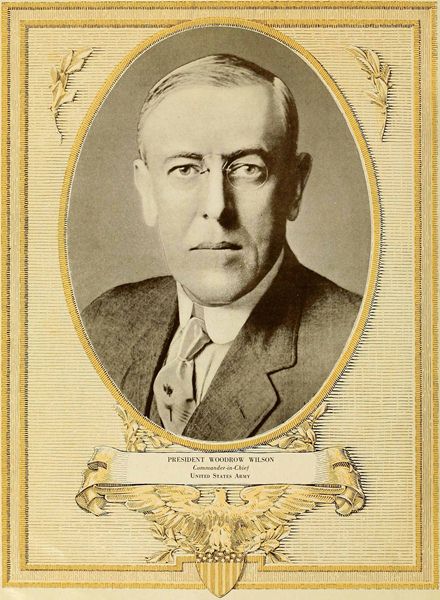
Delivered before Congress April 2, 1917
I have called the Congress into extraordinary session because there are
serious, very serious, choices of policy to be made, and made immediately,
which it was neither right nor constitutionally permissible that I should
assume the responsibility of making.
On the third of February last, I officially laid before you the
extraordinary announcement of the Imperial German Government that on and
after the first day of February it was its purpose to put aside all
restraints of law or of humanity and use its submarines to sink every
vessel that sought to approach either the ports of Great Britain and
Ireland or the western coasts of Europe or any of the ports controlled by
the enemies of Germany within the Mediterranean.
That had seemed to be the object of the German submarine warfare earlier
in the war; but since April of last year the Imperial Government had
somewhat restrained the commanders of its undersea craft in conformity
with its promise then given to us that passenger boats should not be sunk,
and that due warning would be given to all other vessels which its
submarines might seek to destroy, when no resistance was offered or escape
attempted, and care taken that their crews were given at least a fair
chance to save their lives in their open boats.
The precautions taken were meager and haphazard enough, as was proved in
distressing instance after instance in the progress of the cruel and
unmanly business, but a certain degree of restraint was observed.
The new policy has swept every restriction aside. Vessels of every kind,
whatever their flag, their character, their cargo, their destination,
their errand, have been ruthlessly sent to the bottom without warning and
without thought of help or mercy for those on board—the vessels of
friendly neutrals, along with belligerents.
Even hospital ships and ships carrying relief to the sorely bereaved and
stricken people of Belgium, though the latter were provided with safe
conduct through the proscribed areas by the German Government itself and
were distinguished by unmistakable marks of identity, have been sunk with
the same reckless lack of compassion or of principle.
I was for a little while unable to believe that such things would in fact
be done by any government that had hitherto subscribed to the humane
practices of civilized nations.
International law had its origin in the attempt to set up some law which
would be respected and observed upon the seas, where no nation had right
of dominion and where lay the free highways of the world.
By painful stage after stage has that law been built up, with meager
enough results, indeed, after all was accomplished that could be
accomplished, but always with a clear view, at least, of what the heart
and conscience of mankind demanded.
This minimum of right the German Government has swept aside under the plea
of retaliation and necessity, and because it had no weapons which it could
use at sea except these which it is impossible to employ as it is
employing them without throwing to the winds all scruples of humanity or
of respect for the understandings that were supposed to underlie the
intercourse of the world.
I am not now thinking of the loss of property involved, immense and
serious as that is, but only of the wanton and wholesale destruction of
the lives of non-combatants, men, women and children, engaged in pursuits
which have always, even in the darkest periods of modern history, been
deemed innocent and legitimate.
Property can be paid for; the lives of peaceful and innocent people cannot
be.
The present German submarine warfare against commerce is a warfare against
mankind. It is a war against all nations.
American ships have been sunk, American lives taken, in ways which it has
stirred us very deeply to learn of, but the ships and people of other
neutral and friendly nations have been sunk and overwhelmed in the waters
in the same way. There has been no discrimination.
The challenge is to all mankind. Each nation must decide for itself how it
will meet it.
The choice we make for ourselves must be made with a moderation of counsel
and a temperateness of judgment befitting our character and our motives as
a nation. We must put excited feeling away.
Our motive will not be revenge or the victorious assertion of the physical
might of the Nation, but only the vindication of right, of human right, of
which we are only a single champion.
When I addressed the Congress on the twenty-sixth of February last, I
thought that it would suffice to assert our neutral rights with arms, our
right to use the seas against unlawful interference, our right to keep our
people safe against unlawful violence.
But armed neutrality, it now appears, is impracticable. Because submarines
are in effect outlaws when used as the German submarines have been used
against merchant shipping, it is impossible to defend ships against their
attacks as the law of nations has assumed that merchantmen would defend
themselves against privateers or cruisers, visible craft giving chase upon
the open sea.
It is common prudence in such circumstances, grim necessity indeed, to
endeavor to destroy them before they have shown their own intention. They
must be dealt with upon sight, if dealt with at all.
The German Government denies the right of neutrals to use arms at all
within the areas of the sea which it has proscribed, even in the defense
of rights which no modern publicist has ever before questioned their right
to defend. The intimation is conveyed that the armed guards which we have
placed on our merchant ships will be treated as beyond the pale of law and
subject to be dealt with as pirates would be. Armed neutrality is
ineffectual enough at best; in such circumstances and in the face of such
pretensions it is worse than ineffectual; it is likely only to produce
what it was meant to prevent; it is practically certain to draw us into
the war without either the rights or the effectiveness of belligerents.
There is one choice we cannot make, we are incapable of making: we will
not choose the path of submission and suffer the most sacred rights of our
Nation and our people to be ignored or violated. The wrongs against which
we now array ourselves are no common wrongs; they cut to the very roots of
human life.
With a profound sense of the solemn and even tragical character of the
step I am taking and of the grave responsibilities which it involves, but
in unhesitating obedience to what I deem my constitutional duty, I advise
that the Congress declare the recent course of the Imperial German
Government to be in fact nothing less than war against the Government and
people of the United States; that it formally accept the status of
belligerent which has thus been thrust upon it; and that it take immediate
steps not only to put the country in a more thorough state of defense, but
also to exert all its power and employ all its resources to bring the
Government of the German Empire to terms and end the war.
What this will involve is clear. It will involve the utmost practicable
co-operation in counsel and action with the governments now at war with
Germany, and, as incident to that, the extension to those governments of
the most liberal financial credits in order that our resources may, so far
as possible, be added to theirs. It will involve the organization and
mobilization of all the material resources of the country to supply the
materials of war and serve the incidental needs of the Nation in the most
abundant and yet the most economical and efficient way possible. It will
involve the immediate full equipment of the Navy in all respects, but
particularly in supplying it with the best means of dealing with the
enemy’s submarines. It will involve the immediate addition to the armed
forces of the United States already provided for by law in case of war at
least five hundred thousand men, who should, in my opinion, be chosen upon
the principle of universal liability to service, and also the
authorization of subsequent additional increments of equal force so soon
as they may be needed and can be handled in training.
It will involve also, of course, the granting of adequate credits to the
Government, sustained, I hope, so far as they can equitably be sustained
by the present generation, by well-conceived taxation. I say sustained so
far as may be equitable by taxation because it seems to me that it would
be most unwise to base the credits which will now be necessary entirely on
money borrowed. It is our duty, I most respectfully urge, to protect our
people so far as we may, against the very serious hardships and evils
which would be likely to arise out of the inflation which would be
produced by vast loans.
In carrying out the measures by which these things are to be accomplished
we should keep constantly in mind the wisdom of interfering as little as
possible in our own preparation and in the equipment of our own military
forces with the duty—for it will be a very practical duty—of supplying
the nations already at war with Germany with the materials which they can
obtain only from us or by our assistance. They are in the field and we
should help them in every way to be effective there.
I shall take the liberty of suggesting, through the several executive
departments of the Government, for the consideration of your committees,
measures for the accomplishment of the several objects I have mentioned. I
hope that it will be your pleasure to deal with them as having been framed
after very careful thought by the branch of the Government upon which the
responsibility of conducting the war and safeguarding the Nation will most
directly fall.
While we do these things, these deeply momentous things, let us be very
clear, and make very clear to all the world what our motives and our
objects are. My own thought has not been driven from its habitual and
normal course by the unhappy events of the last two months, and I do not
believe that the thought of the Nation has been altered or clouded by
them.
I have exactly the same things in mind now that I had in mind when I
addressed the Senate on the twenty-second of January last; the same that I
had in mind when I addressed the Congress on the third of February and on
the twenty-sixth of February.
Our object now, as then, is to vindicate the principles of peace and
justice in the life of the world as against selfish and autocratic power
and to set up amongst the really free and self-governed peoples of the
world such a concert of purpose and of action as will henceforth insure
the observance of those principles.
Neutrality is no longer feasible or desirable where the peace of the world
is involved and the freedom of its peoples, and the menace to that peace
and freedom lies in the existence of autocratic governments backed by
organized force which is controlled wholly by their will, not the will of
their people. We have seen the last of neutrality in such circumstances.
We are at the beginning of an age in which it will be insisted that the
same standards of conduct and of responsibility for wrong done shall be
observed among nations and their governments that are observed among the
individual citizens of civilized states.
We have no quarrel with the German people. We have no feeling toward them
but one of sympathy and friendship. It was not upon their impulse that
their Government acted in entering this war. It was not with their
previous knowledge or approval.
It was a war determined upon as wars used to be determined upon in the
old, unhappy days when peoples were nowhere consulted by their rulers and
wars were provoked and waged in the interest of dynasties or of little
groups of ambitious men who were accustomed to use their fellow men as
pawns and tools.
Self-governed nations do not fill their neighbor states with spies or set
the course of intrigue to bring about some critical posture of affairs
which will give them an opportunity to strike and make conquest. Such
designs can be successfully worked out only under cover and where no one
has the right to ask questions.
Cunningly contrived plans of deception or aggression, carried, it may be,
from generation to generation, can be worked out and kept from the light
only within the privacy of courts or behind the carefully guarded
confidences of a narrow and privileged class. They are happily impossible
where public opinion commands and insists upon full information concerning
all the nation’s affairs.
A steadfast concert for peace can never be maintained except by a
partnership of democratic nations. No autocratic government could be
trusted to keep faith within it or observe its covenants. It must be a
league of honor, a partnership of opinion.
Intrigue would eat its vitals away; the plottings of inner circles who
could plan what they would and render account to no one would be a
corruption seated at its very heart. Only free peoples can hold their
purpose and their honor steady to a common end and prefer the interests of
mankind to any narrow interest of their own.
Does not every American feel that assurance has been added to our hope for
the future peace of the world by the wonderful and heartening things that
have been happening within the last few weeks in Russia?
Russia was known by those who knew it best to have been always in fact
democratic at heart, in all the vital habits of her thought, in all the
intimate relationships of her people that spoke their natural instinct,
their habitual attitude toward life.
The autocracy that crowned the summit of her political structure, long as
it has stood and terrible as was the reality of its power, was not in fact
Russian in origin, character or purpose; and now it has been shaken off
and the great, generous Russian people have been added in all their native
majesty and might to the forces that are fighting for freedom in the
world, for justice, and for peace. Here is a fit partner for a League of
Honor.
One of the things that has served to convince us that the Prussian
autocracy was not and could never be our friend is that from the very
outset of the present war it has filled our unsuspecting communities and
even our offices of Government with spies and set criminal intrigues
everywhere afoot against our national unity of council, our peace within
and without, our industries and our commerce.
Indeed, it is now evident that its spies were here even before the war
began; and it unhappily is not a matter of conjecture, but a fact proved
in our courts of justice, that the intrigues which have more than once
come perilously near to disturbing the peace and dislocating the
industries of the country have been carried on at the instigation, with
the support, and even under the personal direction of official agents of
the Imperial Government accredited to the Government of the United States.
Even in checking these things and trying to extirpate them we have sought
to put the most generous interpretation possible upon them because we knew
that their source lay, not in any hostile feeling or purpose of the German
people toward us (who were, no doubt, as ignorant of them as we ourselves
were), but only in the selfish designs of a Government that did what it
pleased and told its people nothing. But they have played their part in
serving to convince us at last that that Government entertains no real
friendship for us and means to act against our peace and security at its
convenience. That it means to stir up enemies against us at our very
doors, the intercepted note to the German Minister at Mexico City is
eloquent evidence.
We are accepting this challenge of hostile purpose because we know that in
such a Government, following such methods, we can never have a friend; and
that in the presence of its organized power, always lying in wait to
accomplish we know not what purpose, there can be no assured security for
the democratic governments of the world.
We are now about to accept gauge of battle with this natural foe to
liberty and shall, if necessary, spend the whole force of the Nation to
check and nullify its pretensions and its power. We are glad, now that we
see the facts with no veil of false pretense about them, to fight for the
ultimate peace of the world and for the liberation of its peoples, the
German peoples included: for the rights of nations great and small and the
privilege of men everywhere to choose their way of life and of obedience.
The world must be made safe for democracy. Its peace must be planted upon
the tested foundations of political liberty.
We have no selfish ends to serve. We desire no conquest, no dominion. We
seek no indemnities for ourselves, no material compensation for the
sacrifices we shall freely make. We are but one of the champions of the
rights of mankind. We shall be satisfied when those rights have been made
as secure as the faith and the freedom of nations can make them.
Just because we fight without rancor, without selfish object, seeking
nothing for ourselves but what we shall wish to share with all free
peoples, we shall, I feel confident, conduct our operations as
belligerents without passion and ourselves observe with proud punctilio
the principles of right and of fair play we profess to be fighting for.
I have said nothing of the governments allied with the Imperial Government
of Germany because they have not made war upon us or challenged us to
defend our right and our honor. The Austro-Hungarian Government has,
indeed, avowed its unqualified indorsement and acceptance of the reckless
and lawless submarine warfare adopted now without disguise by the Imperial
German Government, and it has therefore not been possible for this
Government to receive Count Tarnowski, the Ambassador recently accredited
to this Government by the Imperial and Royal Government of
Austria-Hungary; but that Government has not actually engaged in warfare
against citizens of the United States on the seas, and I take the liberty,
for the present at least, of postponing a discussion of our relations with
the authorities at Vienna. We enter this war only where we are clearly
forced into it because there are no other means of defending our rights.
It will be all the easier for us to conduct ourselves as belligerents in a
high spirit of right and fairness because we act without animus, not in
enmity toward a people nor with the desire to bring any injury or
disadvantage upon them, but only in armed opposition to an irresponsible
Government which has thrown aside all considerations of humanity and of
right and is running amuck.
We are, let me say again, the sincere friends of the German people, and
shall desire nothing so much as the early re-establishment of intimate
relations of mutual advantage between us—however hard it may be for them,
for the time being, to believe that this is spoken from our hearts. We
have borne with their present Government through all these bitter months
because of that friendship—exercising a patience and forbearance which
would otherwise have been impossible. We shall, happily, still have an
opportunity to prove that friendship in our daily attitude and actions
toward the millions of men and women of German birth and native sympathy
who live amongst us and share our life, and we shall be proud to prove it
toward all who are in fact loyal to their neighbors and to the Government
in the hour of test. They are, most of them, as true and loyal Americans
as if they had never known any other fealty or allegiance.
They will be prompt to stand with us in rebuking and restraining the few
who may be of a different mind and purpose.
If there should be disloyalty, it will be dealt with with a firm hand of
stern repression; but, if it lifts its head at all, it will lift it only
here and there and without countenance except from a lawless and malignant
few.
It is a distressing and oppressive duty, Gentlemen of the Congress, which
I have performed in thus addressing you. There are, it may be, many months
of fiery trial and sacrifice ahead of us. It is a fearful thing to lead
this great peaceful people into war, into the most terrible and disastrous
of all wars, civilization itself seeming to be in the balance. But the
right is more precious than peace, and we shall fight for the things which
we have always carried nearest our hearts—for democracy, for the right of
those who submit to authority to have a voice in their own governments,
for the rights and liberties of small nations, for a universal dominion of
right by such a concert of free peoples as shall bring peace and safety to
all nations and make the world itself at last free.
To such a task we can dedicate our lives and our fortunes, everything that
we are and everything that we have, with the pride of those who know that
the day has come when America is privileged to spend her blood and her
might for the principles that gave her birth and happiness and the peace
which she has treasured. God helping her, she can do no other.
Larger Image