Larger versions of most illustrations
may be seen by right-clicking them and
selecting an option to view them separately, or by double-tapping
and/or stretching them.
By FRANK T. BULLEN.
Deep-Sea Plunderings. 12mo. Cloth, $1.50.
The Apostles of the Southeast. 12mo.
Cloth, $1.50.
The Log of a Sea-Waif.Being Recollections
of the First Four Years of My
Sea Life. Illustrated. 12mo. Cloth, $1.50.
Idylls of the Sea. 12mo. Cloth, $1.25.
The Cruise of the Cachalot.Round the
World After Sperm Whales. Illustrated.
12mo. Cloth, $1.50.
AUTHOR OF “THE CRUISE OF THE CACHALOT,”
“THE APOSTLES OF THE SOUTHEAST,” ETC.
With Eight Illustrations
NEW YORK D. APPLETON AND COMPANY
1902
Copyright, 1901
ByFRANK T. BULLEN
All rights reserved
Published March, 1902
TO Dr. ROBERTSON NICOLL A SMALL BUT SINCERE
TRIBUTE OF AFFECTION AND ESTEEM
F. T. B.
PREFATORY NOTE
Warned by previous experience, I do not propose
to make any apology for the publication of
these stories in book form, but I hope my generous
critics will at least pardon me for expressing my
gratitude for the way in which they have received all
my previous efforts. Naturally, I sincerely hope they
will be equally kind in the present instance.
“What a clumsy, barrel-bellied old hooker she is,
Field!”
Thus, closing his telescope with a bang, the elegant
chief officer of the Mirzapore, steel four-masted clipper
ship of 5000 tons burden, presently devouring the
degrees of longitude that lay between her and Melbourne
on the arc of a composite great circle, at the
rate of some 360 miles per day. As he spoke he cast
his eyes proudly aloft at the splendid spread of square
sail that towered upward to a height of nearly 200
feet. Twenty-eight squares of straining canvas, from
the courses, stretched along yards 100 feet or so in
length, to the far-away skysails of 35 feet head, that
might easily be handled by a pair of boys.
Truly she made a gallant show—the graceful ship,
that in spite of her enormous size was so perfectly
modelled on yacht-like lines that, overshadowed as
she was by the mighty pyramid of sail, the eye refused
to convey a due sense of her great capacity.
And the way in which she answered the challenge
of the west wind, leaping lightsomely over the league-long
ridges of true-rolling sea, heightened the illusion
by destroying all appearance of burden-bearing or
cumbrousness. But the vessel which had given rise
to Mr. Curzon’s contemptuous remark was in truth
the antipodes of the Mirzapore. There was scarcely
any difference noticeable, as far as the contour of
the hull went, between her bow and stern. Only, at
the bows a complicated structure of massive timbers
leaned far forward of the hull, and was terminated by
a huge “fiddle-head.” This ornament was carved out
of a great balk of timber, and in its general outlines
it bore some faint resemblance to a human form, its
broad breast lined out with rude carving into some
device long ago made illegible by the weather; and
at its summit, instead of a head, a piece of scroll-work
resembling the top of a fiddle-neck, and giving the
whole thing its distinctive name.
The top-hamper of this stubby craft was quite in
keeping with her hull. It had none of that rakish, carefully
aligned set so characteristic of clipper ships. The
three masts, looking as if they were so huddled together
that no room was left to swing the yards, had
as many kinks in them as a blackthorn stick; and
this general trend, in defiance of modern nautical ideas,
was forward instead of aft. The bow-sprit and jibboom
looked as if purposely designed by their upward
sheer to make her appear shorter than she really was,
and also to place her as a connecting link between the
long-vanished galleasses of Elizabethan days and the
snaky ships of the end of the nineteenth century. In
one respect, however, she had the advantage of her
graceful neighbour. Her sails were of dazzling whiteness,
and when, reflecting the rays of the sun, they
glistened against the deep blue sky, the effect was
so fairy-like as to make the beholder forget for a
moment the ungainliness of the old hull beneath.
The wind now dropped, in one of its wayward
moods, until the rapid rush past of the Mirzapore faltered
almost to a standstill, and the two vessels,
scarcely a mile apart, rolled easily on the following
sea, as if in leisurely contemplation of each other. All
the Mirzapore’s passengers, a hundred and twenty of
them, clustered along the starboard poop-rail, unfeignedly
glad of this break in what they considered
the long monotony of a sailing passage from London
to the colonies. And these seafarers of fifty-five days,
eagerly catching their cues from the officers, discussed,
in all the hauteur of amateur criticism, the various
short-comings of the homely old tub abeam. Gradually
the two vessels drew nearer by that mysterious
impulse common to idly-floating things. As the different
details of the old ship’s deck became more
clearly definable, the chorus of criticism increased,
until one sprightly young thing of about forty, who
was going out husband-seeking, said—
“Oh, please, Captain James, do tell me what they
use a funny ship like that for.”
“Well, Miss Williams,” he replied gravely, “yonder
vessel is one of the fast-disappearing fleet of
Yankee whalers—‘spouters,’ as they love to term
themselves. As to her use, if I don’t mistake, you
will soon have an object-lesson in that which will give
you something to talk about all the rest of your life.”
And as he spoke an unusual bustle was noticeable
on board of the stranger. Four boats dropped from
her davits with such rapidity that they seemed to fall
into the sea, and as each struck the water she shot
away from the side as if she had been a living thing.
An involuntary murmur of admiration ran through
the crew of the clipper. It was a tribute they could
scarcely withhold, knowing as they did the bungling,
clumsy way in which a merchant seaman performs
a like manœuvre. Even the contemptuous Curzon
was hushed; and the passengers, interested beyond
measure, yet unable to appreciate what they saw,
looked blankly at one another and at the officers as
if imploring enlightenment.
With an easy gliding motion, now resting in the
long green hollow between two mighty waves, and
again poised, bird-like, upon a foaming crest, with
bow and stern a-dry, those lovely boats sped away
to the southward under the impulse of five oars each.
Now the excitement on board the Mirzapore rose to
fever-heat. The crew, unheeded, by the officers,
gathered on the forecastle-head, and gazed after the
departing boats with an intensity of interest far beyond
that of the passengers. For it was interest born
of intelligent knowledge of the conditions under which
those wonderful boatmen were working, and also tempered
by a feeling of compunction for the ignorant
depreciation they had often manifested of a “greasy
spouter.” Presently the boats disappeared from ordinary
vision, although some of the more adventurous
passengers mounted the rigging, and, fixing themselves
in secure positions, glued their eyes to their
glasses trained upon the vanishing boats. But none
of them saw the object of those eager oarsmen. Of
course, the sailors knew that they were after whales;
but not even a seaman’s eye, unless he be long-accustomed
to watching for whales, possesses the necessary
discernment for picking up a vapoury spout five or
six miles away, as it lifts and exhales like a jet of
steam against the broken blue surface. Neither could
any comprehend the original signals made by the ship.
Just a trifling manipulation of an upper sail, the dipping
or hoisting of a dark flag at the mainmast head,
or the disappearance of another at the gaff-end sufficed
to guide the hunters in their chase, giving them
the advantage of that lofty eye far behind them.
More than an hour passed thus tantalizingly on
board the Mirzapore, and even the most eager watchers
had tired of their fruitless gazing over the sea and
at the sphinx-like old ship so near them. Then some
one suddenly raised a shout, “Here they come!” It
was time. They were coming—a-zoonin’, as Uncle
Remus would say. It was a sight to fire the most
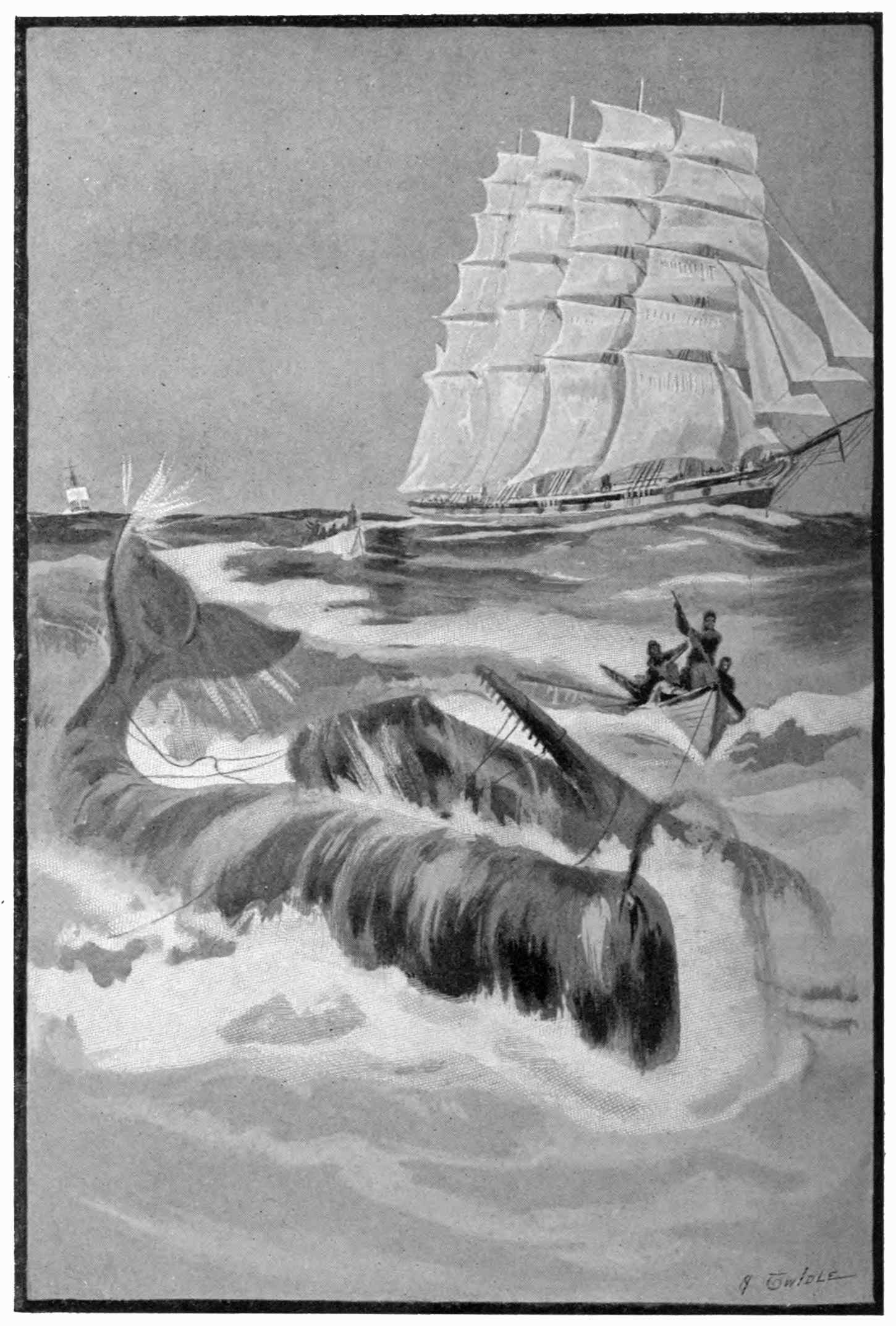
sluggish blood. About five hundred yards apart two
massive bodies occasionally broke the bright surface
up into a welter of white, then disappeared for two
or three minutes, to reappear at the same furious rush.
Behind each of them, spreading out about twenty
fathoms apart, came two of the boats, leaping like
dolphins from crest to crest of the big waves, and occasionally
hidden altogether by a curtain of spray.
Thus they passed the Mirzapore, their gigantic steeds
in full view of that awe-stricken ship’s company, privileged
for once in their lives to see at close quarters
one of the most heart-lifting sights under heaven—the
Yankee whale-fisher at hand-grips with the mightiest,
as well as one of the fiercest, of all created things.
No one spoke as that great chase swept by, but every
face told eloquently of the pent-up emotion within.
Then a strange thing happened. The two whales,
as they passed the Mirzapore, swerved each from his
direct course until they met in full career, and in a
moment were rolling each over each in a horrible
entanglement of whale-line amid a smother of bloody
foam. The buoyant craft danced around, one stern
figure erect in each bow poising a long slender lance;
while in the stern of each boat stood another man,
who manipulated a giant oar as if it had been a
feather, to swing his craft around as occasion served.
The lookers-on scarcely breathed. Was it possible
that men—just homely, unkempt figures like these—could
dare thrust themselves into such a vortex
amongst those wallowing, maddened Titans. Indeed
it was. The boats drew nearer, became involved;
lances flew, oars bent, and blood—torrents of blood—befouled
the glorious azure of the waves. Suddenly
the watchers gasped in terror, and little cries of pain
and sympathy escaped them: a boat had disappeared.
Specks floated, just visible in the tumult—fragments
of oars, tubs, and heads of men. But there was no
sound, which made the scene all the more impressive.
Still the fight went on, while the spectators forgot
all else—the time, the place; all senses merged in wonder
at the deeds of these, their fellow-men, just following,
in the ordinary way, their avocation. And the
thought would come that but for an accident this
drama being enacted before their eyes would have
had no audience but the screaming sea-birds hovering
expectantly in the unheeding blue.
The conflict ceased. The distained waters became
placid, and upon them floated quietly two vast corpses,
but recently so terrible in their potentialities of destruction.
By their sides lay the surviving boats—two of
them, that is; the third was busy picking up the
wrecked hunters. And the old ship, with an easy
adaptation of her needs to the light air that hardly
made itself felt, was gradually approaching the scene.
The passengers implored Captain James to lower a
boat and allow them a nearer view of those recently
rushing monsters, and he, very unwillingly, granted
the request. So slow was the operation that by the
time the port lifeboat was in the water the whaler
was alongside of her prizes, and all her crew were toiling
slavishly to free them from the entanglement of
whale-line in which they had involved themselves.
But when the passengers saw how the lifeboat tumbled
about alongside in the fast-sinking swell, the number
of those eager for a nearer view dwindled to half a
dozen—and they were repentant of their rashness when
they saw how unhandily the sailors manipulated their
oars. However, they persisted for very shame’s sake,
their respect for the “spouters’” prowess, and, through
them, for their previously despised old ship, growing
deeper every moment. They hovered about the old
tub as they saw the labour that was necessary to get
those two enormous carcases alongside, nor dared to
go on board until the skipper of her, mounting the
rail, said cheerily, “Wunt ye kem aboard, sir,’n’ hev
a peek roun’?”
Thus cordially invited, they went, their wonder
increasing until all their conceit was effectually taken
out of them, especially when they saw the wonderful
handiness and cleanliness of everything on board.
The men, too, clothed in nondescript patches, with
faces and arms almost blackened by exposure, and
wearing an air of detachment from the world of civilized
life that was full of pathos; these specially appealed
to them, and they wished with all their hearts
that they might do something to atone for the injustice
done to these unblazoned warriors by their
thoughtless, ignorant remark of so short a time before.
But time pressed, and they felt in the way besides;
so, bidding a humble farewell to the grim-looking
skipper, who answered the inquiry as to whether they
could supply him with anything by a nonchalant “No,
I guess not; we aint a-ben eout o’ port hardly six
month yet,” they returned on board, having learned a
corner of that valuable lesson continually being taught:
that to judge by appearances is but superficial and
dangerous, especially at sea.
Night fell, shutting out from the gaze of those
wearied watchers the dumpy outlines of the old whale-ship.
Her crew were still toiling, a blazing basket of
whale-scrap swinging at a davit and making a lurid
smear on the gloomy background of the night. One
by one the excited passengers sauntered below, still
eagerly discussing the stirring events they had witnessed,
and making a thousand fantastic additions to
the facts. Gradually the conversation dwindled to a
close, and the great ship was left to the watch on
deck. Fitful airs rose and fell, sharp little breaths of
keen-edged wind that but just lifted the huge sails
lazily, and let them slat against the masts again as if
in disgust at the inadequacy of cat’s-paws. So the
night wore on, till the middle watch had been in charge
about half an hour. Then, with a vengeful hiss, the
treacherous wind burst upon them from the north-east,
catching that enormous sail-area on the fore side, and
defying the efforts of the scanty crew to reduce it. All
hands were called, and manfully did they respond;
Briton and Finn, German and negro toiled side by side
in the almost impossible effort to shorten down, while
the huge hull, driven stern foremost, told in unmistakable
sea-language of the peril she was in. Hideous
was the uproar of snapping, running gear, rending canvas,
breaking spars, and howling wind; while through
it all, like a thread of human life, ran the wailing minor
of the seamen’s cries as they strove to do what was required
of them.
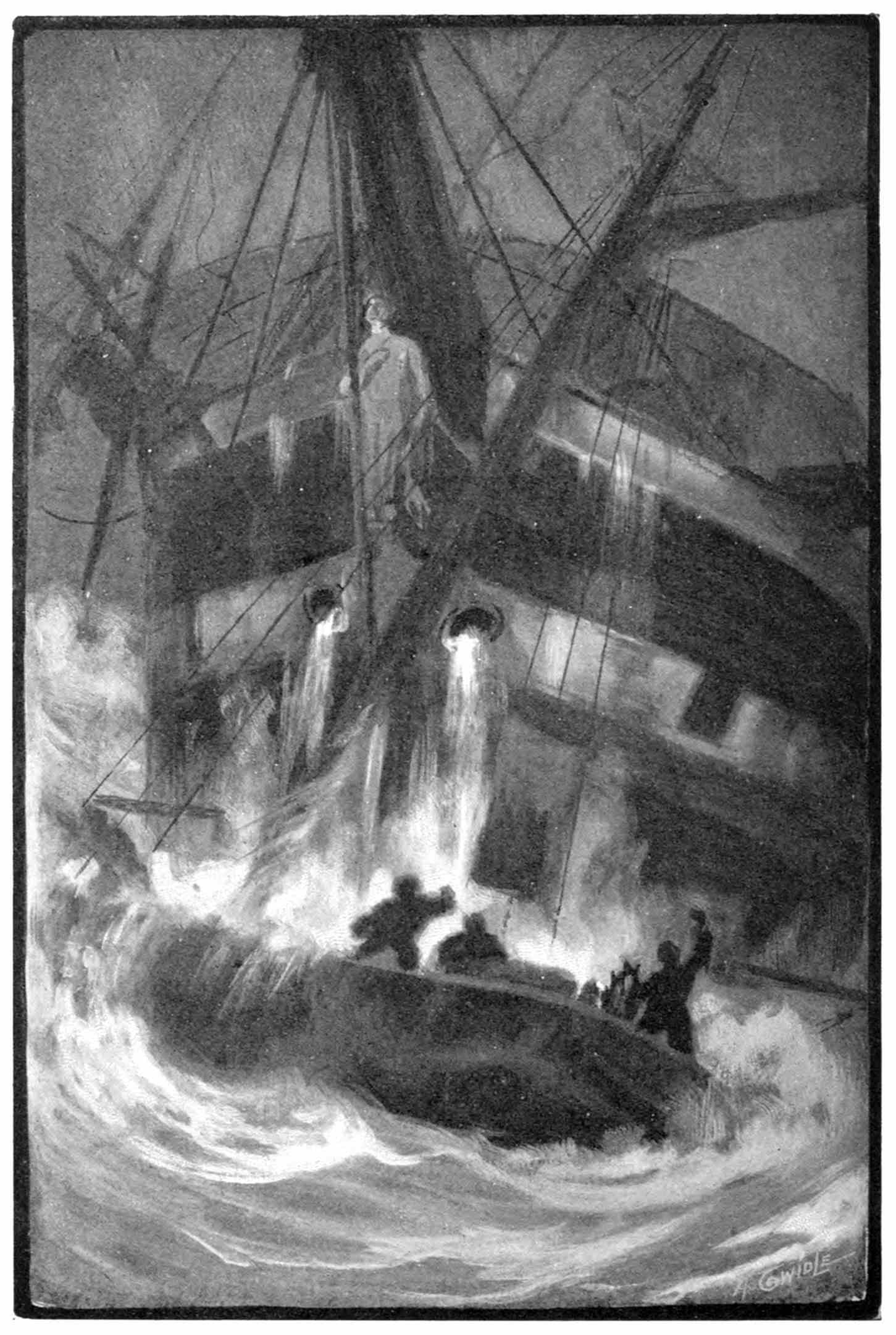
Slowly, oh, so slowly! the great ship paid off;
while the heavier sails boomed out their complaint like
an aerial cannonade, when up from the fore-hatch
leapt a tongue of quivering flame. Every man who
saw it felt a clutch at his heart. For fire at sea is
always terrible beyond the power of mere words to
describe; but fire under such conditions was calculated
to paralyze the energies of the bravest. There seemed
to be an actual hush, as if wind and waves were also
aghast at this sudden appearance of a fiercer element
than they. Then rang out clear and distinct the voice
of Captain James—
“Drop everything else, men, and pass along the
hose! Smartly, now! ’Way down from aloft!” He
was obeyed, but human nature had something to say
about the smartness. Men who have been taxing their
energies, as these had done, find that even the spur
actuated by fear of imminent death will fail to drive
the exhausted body beyond a certain point. Moreover,
all of them knew that stowed in the square of the
main-hatch were fifty tons of gunpowder, which knowledge
was of itself sufficient to render flaccid every
muscle they possessed. Still, they did what they could,
while the stewards went round to prepare the passengers
for a hurried departure. All was done quietly.
In truth, although the storm was now raging overhead,
and the sails were being rent with infernal clamour
from the yards, a sense of the far greater danger
beneath their feet made the weather but a secondary
consideration.
Then out of a cowering group of passengers came
a feeble voice. It belonged to the lady querist of the
afternoon, and it said, “Oh, if those brave sailors from
that wonderful old ship were only near, we might be
saved!”
Simple words, yet they sent a thrill of returning
hope through those trembling hearts. Poor souls!
None of them knew how far the ships might have
drifted apart in that wild night, nor thought of the
drag upon that old ship by those two tremendous
bodies alongside of her. So every eye was strained
into the surrounding blackness, as if they could pierce
its impenetrable veil and bring back some answering
ray of hope. The same idea, of succour from the old
whale-ship, had occurred to the captain, and presently
that waiting cluster of men and women saw with hungry
eyes a bright trail of fire soaring upward as a
rocket was discharged. Another and another followed,
but without response. The darkness around was like
that of the tomb. Another signal, however, now made
itself manifest, and a much more effective one. Defying
all the puny efforts made to subdue it, the fire in
the fore-hatch burst upward with a roar, shedding a
crimson glare over the whole surrounding sea, and
being wafted away to leeward in a glowing trail of
sparks.
“All hands lay aft!” roared the captain, and as
they came, he shouted again, “Clear away the boats!”
Then might be seen the effect of that awful neglect
of boats so common to merchant ships. Davits rusted
in their sockets, falls so swollen as hardly to render
over the sheaves, gear missing, water-breakers leaky—all
the various disastrous consequences that have given
sea-tragedies their grim completeness. But while the
almost worn-out crew worked with the energy of despair,
there arose from the darkness without the
cheery hail of “Ship ahoy!”
Could any one give an idea in cold print of the
revulsion of feeling wrought by those two simple
words? For one intense moment there was silence.
Then from every throat came the joyful response, a
note like the breaking of a mighty string overstrained
by an outburst of praise.
Naturally, the crew first recovered their balance
from the stupefaction of sudden relief, and with coils
of rope in their hands they thronged the side, peering
out into the dark for a glimpse of their deliverers.
“Hurrah!” And the boatswain hurled the mainbrace
far out-board at some dim object. A few seconds
later there arrived on board a grim figure, quaint
of speech as an Elizabethan Englishman, perfectly cool
and laconic, as if the service he had come to render
was in the nature of a polite morning call.
“Guess you’ve consid’ble of a muss put up hyar,
gents all,” said he; and, after a brief pause, “Don’t
know ez we’ve enny gre’t amount er spare time on
han’, so ef you’ve nawthin’ else very pressin’ t’ tend
ter, we mout so well see ’bout transhipment, don’t ye
think?”
He had been addressing no one in particular, but
the captain answered him.
“You are right, sir; and thank you with all our
hearts! Men, see the ladies and children over-side!”
No one seemed to require telling that this angel of
deliverance had arrived from the whale-ship; any other
avenue of escape seemed beyond all imagination out
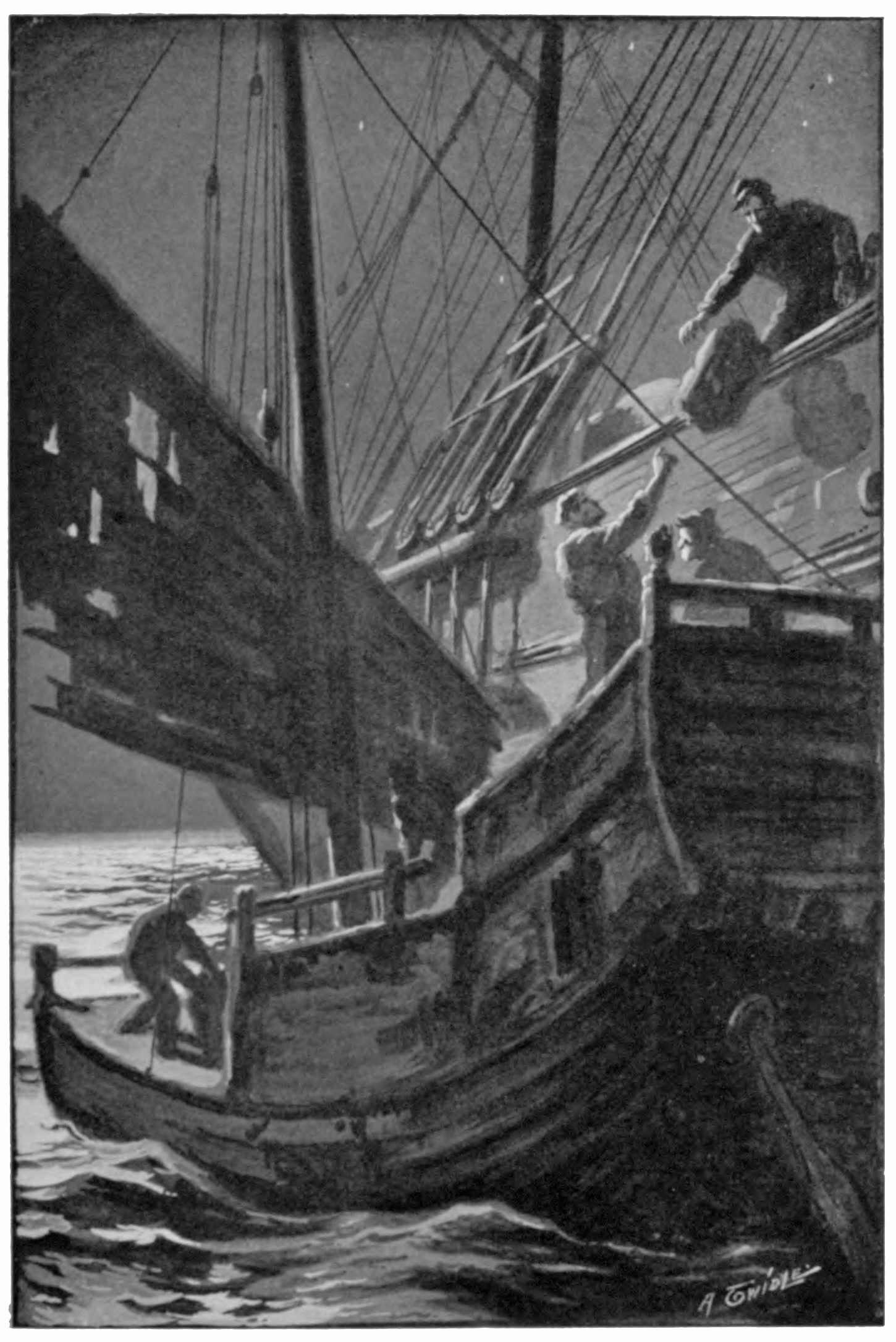
of the question. Swiftly yet carefully the helpless ones
were handed over-side; with a gentleness most sweet
to see those piratical-looking exiles bestowed them in
the boat. As soon as she was safely laden, another
moved up out of the mirk behind and took her place.
And it was done so cannily. No roaring, agitation, or
confusion, as the glorious work proceeded. It was
the very acme of good boatmanship. The light grew
apace, and upon the tall tongues of flame, in all gorgeous
hues that now cleft the night, huge masses of
yellow smoke rolled far to leeward, making up a truly
infernal picture.
Meanwhile, at the earliest opportunity, Captain
James had called the first-comer (chief mate of the
whaler) apart, and quietly informed him of the true
state of affairs. The “down-easter” received this appalling
news with the same taciturnity that he had
already manifested, merely remarking as he shifted his
chaw into a more comfortable position—
“Wall, cap’, ef she lets go ’fore we’ve all gut clear,
some ov us ’ll take th’ short cut t’ glory, anyhaow.”
But, for all his apparent nonchalance, he had kept a
wary eye upon the work a-doing, to see that no moment
was wasted.
And so it came to pass that the last of the crew
gained the boats, and there remained on board the
Mirzapore but Captain James and his American deliverer.
According to immemorial precedent, the Englishman
expressed his intention of being last on board.
And upon his inviting his friend to get into the waiting
boat straining at her painter astern, the latter said—
“Sir, I ’low no dog-goned matter ov etiquette t’
spile my work, ’n’ I must say t’ I don’ quite like th’
idee ov leavin’ yew behine; so ef yew’ll excuse
me——”
And with a movement sudden and lithe as a leopard’s
he had seized the astonished captain and
dropped him over the taff-rail into the boat as she rose
upon a sea-crest. Before the indignant Englishman
had quite realized what had befallen him, his assailant
was standing by his side manipulating the steer-oar
and shouting—
“Naow then, m’ sons, pull two, starn three; so,
altogether. Up with her, lift her, m’ hearties, lift
her, ’r by th’ gre’t bull whale it’ll be a job spiled
after all.”
And those silent men did indeed “give way.” The
long supple blades of their oars flashed crimson in the
awful glare behind, as the heavily-laden but still buoyant
craft climbed the watery hills or plunged into the
hissing valleys. Suddenly there was one deep voice
that rent the heavens. The whole expanse of the sky
was lit up by crimson flame, in the midst of which
hurtled fragments of that once magnificent ship. The
sea rose in heaps, so that all the boatmen’s skill was
needed to keep their craft from being overwhelmed.
But the danger passed, and they reached the ship—the
humble, clumsy old “spouter” that had proved to
them a veritable ark of safety in time of their utmost
need.
Captain James had barely recovered his outraged
dignity when he was met by a quaint figure advancing
out of the thickly-packed crowd on the whaler’s
quarter-deck. “I’m Cap’n Fish, at yew’re service, sir.
We haint over ’n’ above spacious in eour ’commodation,
but yew’re all welcome t’ the best we hev’; ’n’
I’ll try ’n’ beat up f’r th’ Cape ’n’ lan’ ye’s quick ’s it kin
be did.”
The Englishman had hardly voice to reply; but,
recollecting himself, he said, “I’m afraid, Captain Fish,
that we shall be sadly in your way for dealing with
those whales we saw you secure yesterday.”
“Not much yew wunt,” was the unexpected reply.
“We hed t’ make eour ch’ice mighty sudden between
them fish ’n’ yew, ’n’, of course, though we’re noways
extravagant, they hed t’ go.”
The simple nobility of that homely man, in thus
for self and crew passing over the loss of from eight
to ten thousand dollars at the first call from his kind,
was almost too much for Captain James, who answered
unsteadily—
“If I have any voice in the matter, there will be no
possibility of the men, who dared the terrors of fire
and sea to save me and my charges, being heavily
fined for their humanity.”
“Oh, thet’s all right,” said Captain Silas Fish.
THE OLD HOUSE ON THE HILL — CHAPTER I — CHAPTER II — CHAPTER III — CHAPTER IV
There is something in the stress and struggle of
tumultuous life in a vast city like London that to me
is almost unbearable. Accustomed from a very early
age to the illimitable peace of the ocean, to the untainted
air of its changeless circle of waves and roofless
dome of sky, I have never been able to endure satisfactorily
the unceasing roar of traffic in crowded
streets, the relentless rush of mankind in the race for
life which is the normal condition of our great centres
of civilization. Yet, for many years, being condemned
by circumstances to abide in the midst of urban strife
and noise without a break from one weary year to
another, I lived to mourn departed peace, and feed my
longing for it on memory alone, without a hope that its
enjoyments would ever again be mine. Then came
unexpected relief, an opportunity to visit a secluded
corner of Wiltshire, that inland division of England
which is richer, perhaps, in memorials of our wonderful
history than any other part of these little islands,
crowded as they are with reminiscences of bygone
glorious days.
I took up my quarters in a hamlet on the banks of
the Wylye, a delightful little river, taking its rise near
the Somersetshire border, and wandering with innumerable
windings through the heart of Wiltshire,
associating itself with the Bourne and the Nadder,
until at Salisbury it is lost in that most puzzling of all
streams, the Avon. I said puzzling, for I believe there
are but a handful of people out of the great host to
whom the Avon is one of the best-known streams in
the world from its associations, who know that there
is one Avon feeding the Severn near Tewkesbury,
which is Shakespeare’s Avon; there is another, upon
which Bristol has founded her prosperity, and there
is yet another, the Avon of my first mention, which,
accumulated from numberless rivulets in the Vale of
Pewsey, floweth through Salisbury, and loses itself
finally in the waters of the English Channel at Christchurch
in Hampshire. But I must ask forgiveness for
allowing the wily Avon to lure me away thus far.
One of the chief charms of Wiltshire is its rolling
downs rising upon either side of the valley, which in
the course of ages the busy little Wylye has scooped
out between them in gentle undulations, a short, sweet
herbage for the most part covering their masses of
solid chalk, coming to within a foot or two of those
emerald surfaces. This is the place to come and
ponder over the rubbish that is talked about the over-crowding
of England. Here you shall wander for a
whole day if you will, neither meeting or seeing a
human being unless you follow the road that winds
through the Deverills, five villages of the valley, all,
alas, in swift process of decay. Even there the simple
folk will stare long and earnestly at a stranger as he
passes, before turning to resume their leisurely tasks,
the uneventful, slumberous round of English village
life. To me it was idyllic. A great peace came over
me, and I felt that it was a sinful waste of nature to
shut myself within four walls even at night. Long
after the thirty souls peopling our hamlet had gone to
bed I would sit out on the hillside behind the cottage,
steeping my heart in the warm silence, only manifested—not
broken—by the queer wailing cry of an uneasy
plover as it fluttered overhead. And when, reluctantly,
I did go to bed, I was careful to prop the windows
wide open, even though I was occasionally awakened
by the soft “flip-flip” of bats flying across my chamber,
dazzled by the small light of my reading lamp.
The grey of the dawn, no matter how few had been
my hours of sleep, never failed to awaken me, and,
hurrying through my bath and dressing, I gat me out
into the sweet breath of morning twilight while Nature
was taking her beauty sleep and the dewdrops
were waiting to welcome with their myriad smiles the
first peep of the sun. And so it came to pass that one
morning, just as the eastern horizon was being flooded
with a marvellous series of colour-blends in mysterious
and ever-changing sequence, that I mounted the swell
of the down opposite to the village of Brixton Deverill,
with every sense quickened to fullest appreciation of
the lovely scene. Hosts of rabbits, quaint wee bunches
of grey fur, each with a white blaze in the centre,
scuttled from beneath my feet, and every little while,
their curiosity overpowering natural fear, sat up with
long ears erect and big black eyes devouring the uncouth
intruder on their happy feeding grounds. Great
flocks of partridges, almost as tame as domestic fowls
(for it was July), ran merrily in and out among the
furze clumps, or rose with a noisy whir of many wings
when I came too close; aristocratic cock pheasants
strolled by superciliously with a sidelong glance to see
that the erect biped carried no gun, and an occasional
lark gyrated to the swell of his own heart-lifting song
as he rose in successive leaps to his proper sphere. I
felt like singing myself, but Nature’s music was too
sweet to be disturbed by my quavering voice, so I
climbed on, all eyes and ears, and nerves a-tingle with
receptivity of keenest enjoyment. Reaching the summit,
I paused and surveyed the peaceful scene. Far to
the left lay Longleat, its dense woods shimmering in a
blue haze; to the right, Heytesbury Wood, in sombre
shadow; and behind, the forest-like ridge of Chicklade.
But near me, just peeping over the bare crest of an adjoining
down, were the tops of a clump of firs, and,
curious to know what that coppice might contain
(I always have had a desire to explore the recesses
of a lonely clump of trees), I turned my steps towards
it, only stopping at short intervals to admire the gracefulness
of the purple, blue, and yellow wild flowers
with which the short, fine rabbit-grass was profusely
besprent. Meanwhile the sun appeared in cloudless
splendour, his powerful rays dissipating the spring-like
freshness of the morning and promising a most
sultry day. Yet as I drew nearer the dark fastness of
the coppice I felt a chill, an actual physical sensation
of cold. At the same time there arose within me a
positive repugnance to draw any closer to that deep
shade. This unaccountable change only made me angry
with myself for being capable of feeling such a
nonsensical, unexplainable hindrance to my purpose.
So I took hold of it with both hands, and cast it from
me, striding onward with quickened step until I really
seemed to be breasting a strong tide. Panting with
the intensity of my inward struggle, I reached the
shadow cast by that solemn clump of pines, and saw
the pale outlines of a wall in their midst. Now curiosity
became paramount, and, actually shivering with
cold, I pressed on until I stood in front of a fairly large
house, surrounded by a flint wall on all sides, but at
some yards distance from it. Through large holes in
the encircling wall the wood-folk scampered or fluttered
merrily but noiselessly; rabbits, hares, squirrels,
and birds, and as I drew nearer there was a sudden
whiff of strong animal scent, and a long red body
launched itself through one of the openings, flitting
past me like a flash of red-brown light. Although I
had never seen an English fox before on his native
heath, I recognized him from his pictures, and forgave
him for startling me. Skirting the wall, I came to a
huge gap with crumbling sides, where once had been
a gate, I suppose. It commanded a view of the front
of the house, which I now saw was a mere shell, its
walls perforated in many places by the busy rabbits,
which swarmed in and out like bees upon a hive. No
windows remained, but the front door was fast closed
and barred by a thick trunk of ivy, which had once
overspread the whole building, but was now quite in
keeping with it, for it was dead. The space between
the wall and the house was thickly overgrown with
nettles to nearly the height of a man, but there was no
sign of any useful plant, and even the roof of the
building, which was of red tiles and intact, had none
of that kindly covering of house-leek, stone-crop, and
moss, which always decks such spaces with beauty in
the country. Upon a sudden impulse I turned, and
behind me I saw with a shudder that only a few feet
from where I stood there was a sheer descent of some
thirty feet, a veritable pit some ten yards wide, but with
its farther margin only a few feet high. Tall trees
sprang from its bottom and sides, their roots surrounding
a pool of black-looking water that seemed a receptacle
for all manner of hideous mysteries. Involuntarily
I shrank into myself, and looked up for a glint
of blue sunlit sky, but it was like being in a vault,
dark and dank and cold. Still, the idea never entered
my head to get out until I had seen all that might
be there to be seen, although I confess to comforting
myself, as I have often done on a dull and gloomy day,
with the reminder that just outside the sun was shining
steadily.
Turning away from that grim-looking pit, I thrust
myself through the savage nettle-bed, my hands held
high so that I could guard my face with my arms,
until I reached the first opening in the house wall
that offered admission. With just one moment’s hesitation
I stepped within, and stood on the decayed
floor of what had once been the best room. And then
I had need of all my disbelief in ghosts, for around me
and beneath me and above were a congeries of all the
queer noises one could conjure up. Soft pattering of
feet, hollow murmurings as of voices, the indefinite
sound of brushing past that always makes one turn
sharply to see who is near. I found my mouth getting
dry and my hands burning, in spite of the chill that
still clung to me; but still I went on and explored
every room in the eerie place, noting a colony of bats
that huddled together among the bare roof-beams,
prying into the numerous cavities in floors and walls
made by the rabbits and the rats, but seeing nothing
worthy of note until I reached a sort of cellar which
looked as if it had been used as a bakehouse. Upon
stepping down the decrepit ladder which led to it, I
startled a great colony of rats, that fled in all directions
with shrill notes of affright, hardly more scared than
myself. The place was so dark that I thankfully remembered
my box of wax matches, and, twisting two
or three torches out of a newspaper I found in my
jacket pocket, I soon had a good light.
It revealed a cavity in the floor just in front of a
huge baker’s oven, into the dim recesses of which I
peered, finding that it extended for some distance on
either side of the opening. Lighting another torch,
I jumped down and found—three oblong boxes of rude
construction, and across them the mouldering frame of
what had once been a man. At last I had seen enough,
and with something tap-tapping inside my head, I
scrambled hastily out of the hole, my body shaking as
if with ague, and my lungs aching for air. I looked
neither to the right nor the left as I went, nor paused,
regardless of the nettle grove, until I emerged upon
the bright hilltop, where I flung myself down and
drank in great gulps of sweet air until my tremors
passed away and the tumult of my mind became appeased.
Without casting another look back at that lonely
place, or attempting to speculate upon what I had
seen, I departed for home, and, after a hasty breakfast,
sought out a friend in the next village, Longbridge
Deverill, who had already given me many pleasant
hours by retailing scraps of local history reaching back
for hundreds of years. I found him in his pretty garden
enjoying the bright day, with a look of deep content
upon his worn old face—the afterglow of a well-spent
life. Staying his rising to greet me, I flung
myself down on the springy turf by his side, and almost
without a word of preface, gave him a hurried account
of my morning’s adventure. He listened in grave
silence until I had finished, and then began as follows.
It is certainly a strange coincidence that you
should stumble across that sombre place, because, after
what you told me the other day about your family
connection with this part of the country, I have no
doubt whatever that the unhappy tenants of Pertwood
Farm (as it is called even now) were nearly related to
yourself. Their tragical story is well known to me,
although its principal events happened more than
sixty years ago, when I was a boy. The house had
been built and enclosed, and the trees planted, by a
morose old man who wished to shut himself off from
the world, yet was by no means averse to a good deal
of creature comfort. He lived in it for some years,
attended only by one hard-featured man, who did apparently
men and women’s work equally well—lived
there until local rumour had grown tired of inventing
fables about him, and left him to the oblivion he
desired. Then one day the news began to circulate
that Pertwood had changed hands, that old Cusack
was gone, and that a middle-aged man with a beautiful
young wife had taken up his abode there, without
any one in the vicinity knowing aught of the change
until it had been made. Then the village tongues
wagged loosely for awhile, especially when it was
found that the new-comers were almost as reserved
as old Cusack had been. But as time went on Mr.
Delambre, whose Huguenot name stamped him as
most probably a native of these parts (you have noticed
how very frequent such names are hereabout), leased
several good-sized fields lower down the hill towards
Chicklade, and began to do a little farming. This, of
course, necessitated his employing labour, and consequently,
by slow degrees, scraps of personalia about
him filtered through the sluggish tongues of the men
who worked for him. Thus we learned that his wife
(your grandmother’s sister, my boy) was rarely beautiful,
though pale and silent as a ghost. That her
husband loved her tigerishly, could not bear that any
other eyes should see her but his, and it was believed
that his fierce watchful jealousy of her being even
looked upon was fretting her to death. Quite a flutter
of excitement pervaded the village here not long after
the above details became public property, by one of
the labourers from Pertwood coming galloping in on
a plough-horse for old Mary Hoddinot, who had
nursed at least two generations of neighbours in their
earliest days. She was whisked off in the baker’s cart,
but the news remained behind that twin boys had
arrived at Pert’ood, as it was locally called, and that
Delambre was almost frantic with anxiety about his
idol. The veil thus hastily lifted dropped again, and
only driblets of news came at long intervals. We
heard that old Mary was in permanent residence, that
the boys were thriving sturdily, and that the mother
was fairer than ever and certainly happier. So things
jogged along for a couple of years, until an occasional
word came deviously from Pertwood to the effect that
the miserable Delambre was now jealous of his infant
boys. Self-tortured, he was making his wife a living
martyr, and such was his wild-beast temper that none
dare interfere. At last the climax was put upon our
scanty scraps of intelligence by the appearance in our
midst of old Mary, pale, thin, and trembling. It was
some time before we could gather her dread story, she
was so sadly shaken; but by degrees we learned that
after a day in which Delambre seemed to be perfectly
devil-possessed, alternately raging at and caressing his
wife, venting savage threats against the innocent babes
“who were stealing all her affection away from him,”
he had gone down the hill to see after enfolding some
sheep. He was barely out of sight before his wife,
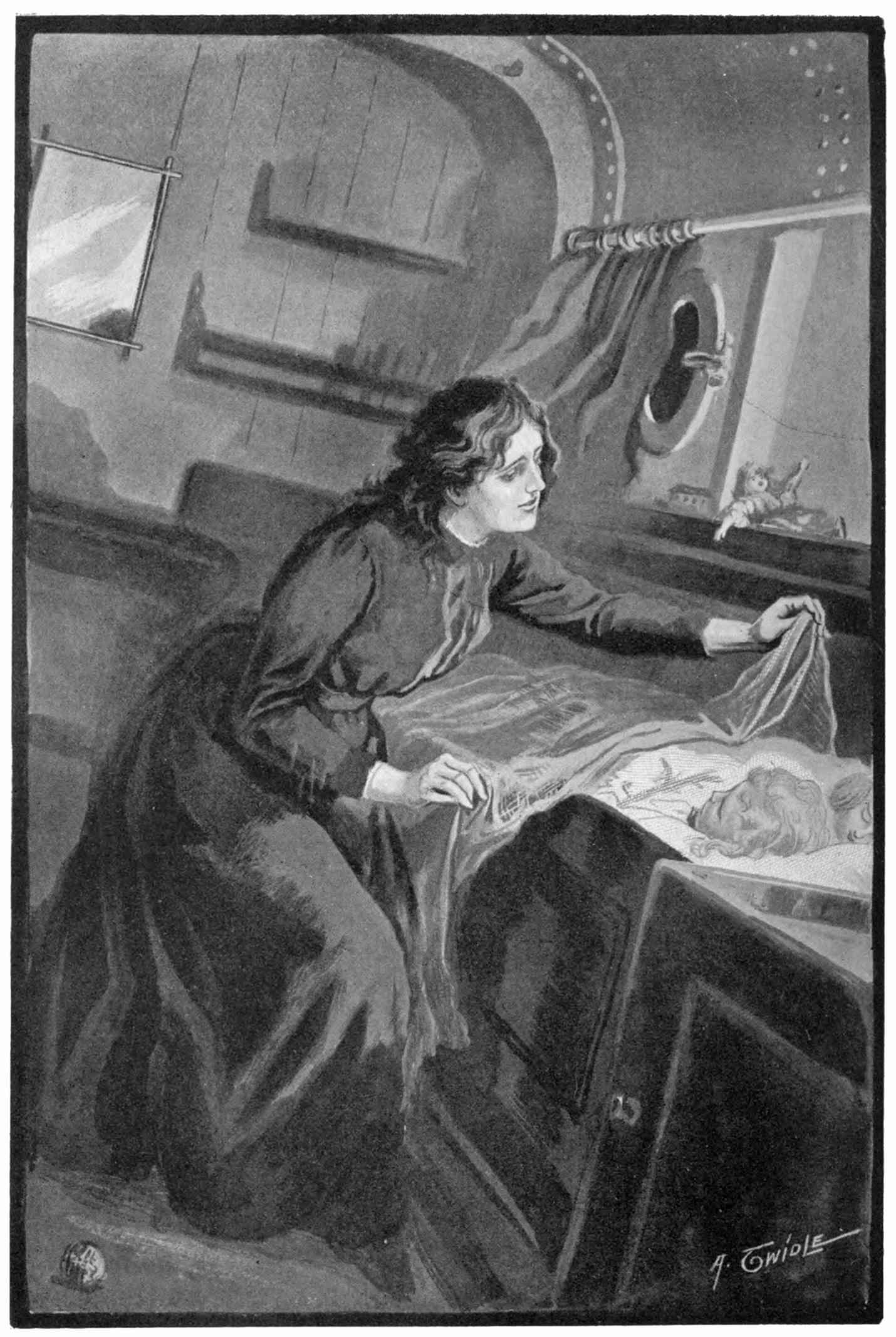
turning to old Mary, said, “Please put your arms
round me, I feel so tired.” Mary complied, drawing
the fair, weary head down upon her faithful old bosom,
where it remained until a chill struck through her
bodice. Alarmed, she looked down and saw that her
mistress was resting indeed.
Although terrified almost beyond measure, the
poor old creature retained sufficient presence of mind
to release herself from the dead arms, rush to the door,
and scream for her employer. He was returning, when
her cries hastened his steps, and, breaking into a run,
he burst into the room and saw! He stood stonily for
a minute, then, turning to the trembling old woman,
shouted “go away.” Not daring to disobey, she hurried
off, and here she was. After much discussion, my
father and the village doctor decided to go to Pertwood
and see if anything could be done. But their
errand was in vain. Delambre met them at the door,
telling them that he did not need, nor would he receive,
any help or sympathy. What he did require
was to be left alone. And slamming the door in his
visitors’ faces, he disappeared. Even this grim happening
died out of men’s daily talk as the quiet days
rolled by, and nothing more occurred to arouse interest.
We heard that the boys were well, and were
often seen tumbling about the grass-plot before the
house door by the farm labourers. Rumour said
many things concerning the widower’s disposal of his
dead. But no one knew anything for certain, except
that her body had never been seen again by any eye
outside the little family. Delambre himself seemed
changed for the better, less harsh and morose, although
as secretive as ever. He was apparently
devoted to his two boys, who throve amazingly. As
they grew up he and they were inseparable. He
educated them, played with them, made their welfare
his one object in life. And they returned his
care with the closest affection, in fact the trio seemed
never contented apart. Yet they never came near
the village, nor mixed with the neighbours in any
way.
In this quiet neighbourhood the years slip swiftly
by as does the current past an anchored ship, and as
unnoticeably. The youthful Delambres grew and
waxed strong enough to render unnecessary the employment
of any other labour on the farm than their
own, and in consequence it was only at rare intervals
that any news of them reached us in roundabout fashion
through Warminster, where old Delambre was
wont to go once a week on business. So closely had
they held aloof from all of us that when one bitter
winter night a tall swarthy young man came furiously
knocking at the doctor’s door, he was as completely unknown
to the worthy old man as any new arrival from
a foreign land. The visitor, however, lost no time in
introducing himself as George Delambre, and urgently
requested the doctor to accompany him at once to
Pertwood on a matter of life and death. In a few
minutes the pair set off through the heavy snow-drifts,
and, after a struggle that tried the old doctor terribly,
arrived at the house to find that the patient was
mending fast.
A young woman of about eighteen, only able to
mutter a few words of French, had been found huddled
up under the wall of the house by George as he
was returning from a visit to the sheepfold. She was
fairly well dressed in foreign clothing, but at almost
the last gasp from privation and cold. How she came
there she never knew. The last thing that she remembered
was coming to Hindon, by so many ways
that her money was all spent, in order to find a relative,
she having been left an orphan. Failing in her
search, she had wandered out upon the downs, and
the rest was a blank.
In spite of convention she remained at Pertwood,
making the dull place brighter than it had ever been.
But of course both brothers fell in love with the first
woman they had ever really known. And she, being
thus almost compelled to make her choice, with all
a woman’s inexplicable perversity, promised to marry
dark saturnine George, although her previous behaviour
towards him had been timid and shrinking, as
if she feared him. To the rejected brother, fair Charles,
she had always been most affectionate, so much so,
indeed, that he was perfectly justified in looking upon
her as his future wife, to be had for the asking. This
cruel blow to his almost certain hopes completely
stunned him for a time, until his brother with grave
and sympathetic words essayed to comfort him. This
broke the spell that had bound him, and in a perfect
fury of anger he warned his brother that he
looked upon him as his deadliest enemy, that the
world was hardly wide enough for them both; but, for
his part, he would not, if he could help it, add another
tragedy to their already gloomy home, and to that
end he would flee. Straightway he rushed and sought
his father, and, without any warning, demanded his
portion. At first the grim old man stared at him
blankly, for his manner was new as his words were
rough; then, rising from his chair, the old man bade
him be gone—not one penny would he give him; he
might go and starve for ought he cared.
“Very well,” said Charles, “then I go into the
village and get advice as to how I shall proceed
against you for the wages I have earned since I began
to work. And you’ll cut a fine figure at the Warminster
Court.”
The threat was efficient. With a face like ashes
and trembling hands the father opened his desk and
gave him fifty guineas, telling him that it was half
of his total savings, and with an evidently severe struggle
to curb his furious temper, asked him to hurry
his departure. Since he had robbed him, the sooner
he was gone the better. The young man turned and
went without another word.
That same night old Delambre died suddenly and
alone. And Louise, instead of clinging to her promised
husband, came down to the village, where the
doctor gave her shelter. The unhappy George, thus
cruelly deserted, neglected everything, oscillating between
the village and his lonely home. The inquest
showed that the old man had died of heart disease;
and George then, to every one’s amazement, announced
his intention of carrying out his father’s oft-repeated
wish, and burying him beneath the house
by the side of his wife.
And now we must needs leave Pertwood Farm and
its doubly bereaved occupant for a while, in order to
follow the fortunes of the self-exiled Charles. His
was indeed a curious start in life. Absolutely ignorant
of the world, his whole horizon at the age of twenty
years bounded by that little patch of lonely Wiltshire
down, and his knowledge of mankind confined to, at
the most, half a dozen people. He had great native
talent, which, added to an ability to keep his own
counsel, was doubtless of good service to him in this
breaking away into the unknown. His total stock of
money amounted to less than £50, to him an enormous
sum, the greater because he had never yet known the
value of money. His native shrewdness, however, led
him to husband it in miserly fashion, as being the one
faithful friend upon which he could always rely.
And now the salt strain in his mother’s blood must
have asserted itself unmistakably, if mysteriously, for
straight as a homing bee he made his way down to the
sea, finding himself a week after his flight at Poole.
I shall never forget the look upon his face as he told
me how he first felt when the sea revealed itself to
him. All his unsatisfied longings, all the heart-wrench
of his rejected love, were forgotten in present unutterable
delight. He was both hungry and weary, yet he
sat contentedly down upon the verge of the cliffs and
gazed upon this glorious vision until his eyes glazed
with fatigue, and his body was numbed with the immovable
restraint of his attitude. At last he tore
himself away, and entered the town, seeking a humble
lodging-place, and finding one exactly suited to his
needs in a little country public-house on the outskirts
of the town, kept by an apple-cheeked dame, whose
son was master of a brigantine then lying in the harbour.
She gave the handsome youth a motherly welcome,
none the less warm because he appeared to
be well able to pay his way.
Against the impregnable fortress of his reserve she
failed to make any progress whatever, although in the
attempt to gratify her curiosity she exerted every
simple art known to her. On the other hand he
learned many things, for one of her chief wiles was
an open confidence in him, an unreserved pouring out
to him of all she knew. He was chiefly interested in
her stories of her son. Naturally she was proud of that
big swarthy seaman, who, when he arrived home that
evening, loomed so large in the doorway that he appeared
to dwarf the whole building. As Englishmen
will, the two men eyed one another suspiciously at
first, until the ice having been broken by the fond
mother, Charles in his turn began to pump his new
acquaintance. Captain Jacks, delighted beyond measure
to find a virgin mind upon which to sow his somewhat
threadbare stock of yarns, was gratified beyond
measure, and thenceforward until long after the usual
hour for bed, the young man was simply soaking up
like a sponge in the rain such a store of wonders as
he had never before even dreamed of. At last the
old dame, somewhat huffed by the way in which
Charles had turned from her garrulity to her son’s,
ordered them both to bed. But Charles could not
sleep. How was it possible? The quiet monotone
of his life had been suddenly lifted into a veritable
Wagner concert of strange harmonies, wherein joy
and grief, pleasure and pain, love and hate, strove for
predominance, and refused to be hushed to rest even
by the needs of his healthful weariness.
Out of it all one resolve arose towering. He would,
he must go to sea. That alone could be the career
for him. But he would write to Louise. Knowing
nothing of her flight from the old home or of his
father’s death, he felt that he must endeavour to assert
a claim to her, more just and defensible than his
brother’s, even though she had rejected him. And
then, soothed by his definite settlement of future
action, he fell asleep, nor woke again until roused by
his indignant landlady’s inquiry as to whether “’ee
wor gwain t’ lie abed arl daay.” Springing out of bed,
he made his simple toilet in haste, coming down so
speedily that the good old dame was quite mollified.
A hasty breakfast ensued, and a hurried departure for
the harbour in search of Captain Jacks’ brigantine.
Finding her after a short search, he was warmly welcomed
by the gallant skipper, and, to his unbounded
delight, succeeded in inducing that worthy man to
take him as an extra hand without pay on his forthcoming
voyage to Newfoundland. Then returning to
his lodging, he made his small preparations, and after
much anxious thought, produced the following letter,
which he addressed to Louise, care of the old doctor
at Longbridge.
“My Dearest Loo,
“Though you chose George instead of me
I don’t mean to give you up. I mean to do something
big, looking forward to you for a prize. I believe you
love me better than you do George in spite of what
you did. You will never marry him, never. You’ll
marry me, because you love me, and I won’t let you
go. I know you’ll get this letter, and send me an
answer to Mrs. Jacks, Apple Row, Poole. And you’ll
wait for my reply, which may be late a coming, but
will be sure to come.
“Yours till death,
“Charles Delambre.”
A few minutes afterwards he was on his way down
to the Mary Jane, Captain Jacks’ brigantine. He was
received with the gravity befitting a skipper on shipping
a new hand, and after bestowing his few purchases
in a cubby-hole in the tiny cabin, returned on deck in
his shirt-sleeves, to take part in whatever work was
going on, with all the ardour of a new recruit. Next
morning at daylight the Mary Jane departed. Under
the brilliant sky of June the dainty little vessel glided
out into the Channel, bounding forward before the
fresh north-easterly breeze, as if rejoicing to be at
home once more, and freed from the restraint of mooring
chains and the stagnant environment of a sheltered
harbour.
Charles took to his new life wonderfully, feeling
no qualms of sea-sickness, and throwing himself into
every detail of the work with such ardour that by the
time they had been out a week he was quite a useful
member of the ship’s company. And then there
arrived that phenomenon, a June gale from the north-west.
Shorn of all her white wings but one, the little
brigantine lay snugly enough, fore-reaching against
the mighty Atlantic rollers that hurled themselves
upon her like mountain ranges endowed with swiftest
motion. So she lay throughout one long day and far
into the night succeeding, until just at that dread
hour of midnight when watchfulness so often succumbs
to weariness at sea, a huge comber came tumbling
aboard as she fell off into the trough of the sea.
For a while she seemed to be in doubt whether to
shake herself clear of the foaming mass, and then splendidly
lifting herself with her sudden burden of a deck
filled with water, she resumed her gallant struggle.
Just then it was discovered that her lights were gone.
Before they could be replaced, out of the darkness
came flying an awful shape, vast, swift, and merciless.
One of the splendid Yankee fliers of those days, the
Columbia, of over a thousand tons register, was speeding
eastward under every stitch of sail, at a rate far
surpassing that of any but the swiftest steamships. A
good look out was being kept on board of her, for
those vessels were noted for the excellence of their
discipline and careful attention to duty. But the night
was pitchy dark, the Mary Jane had no light visible, and
before anything could be done her doomed crew saw
the Columbia’s bow towering over their vessel’s waist
like some unthinkable demon of destruction. Up, up,
up, she soared above them, then descending, her
gleaming bow shone clean through the centre of the
Mary Jane’s hull, tearing with it the top-hamper of
masts and rigging, and rushing straight through the
wreckage without a perceptible check. One wild cry
of despair and all was silent. Over the side of the
Columbia peered a row of white faces gazing fearfully
into the gloom, but there was nothing to be seen.
The sea had claimed her toll.
As usual, after such a calamity, there was a hushed
performance of tasks, until suddenly one of the crew
shouted, “Why, here’s a stranger.” And there was.
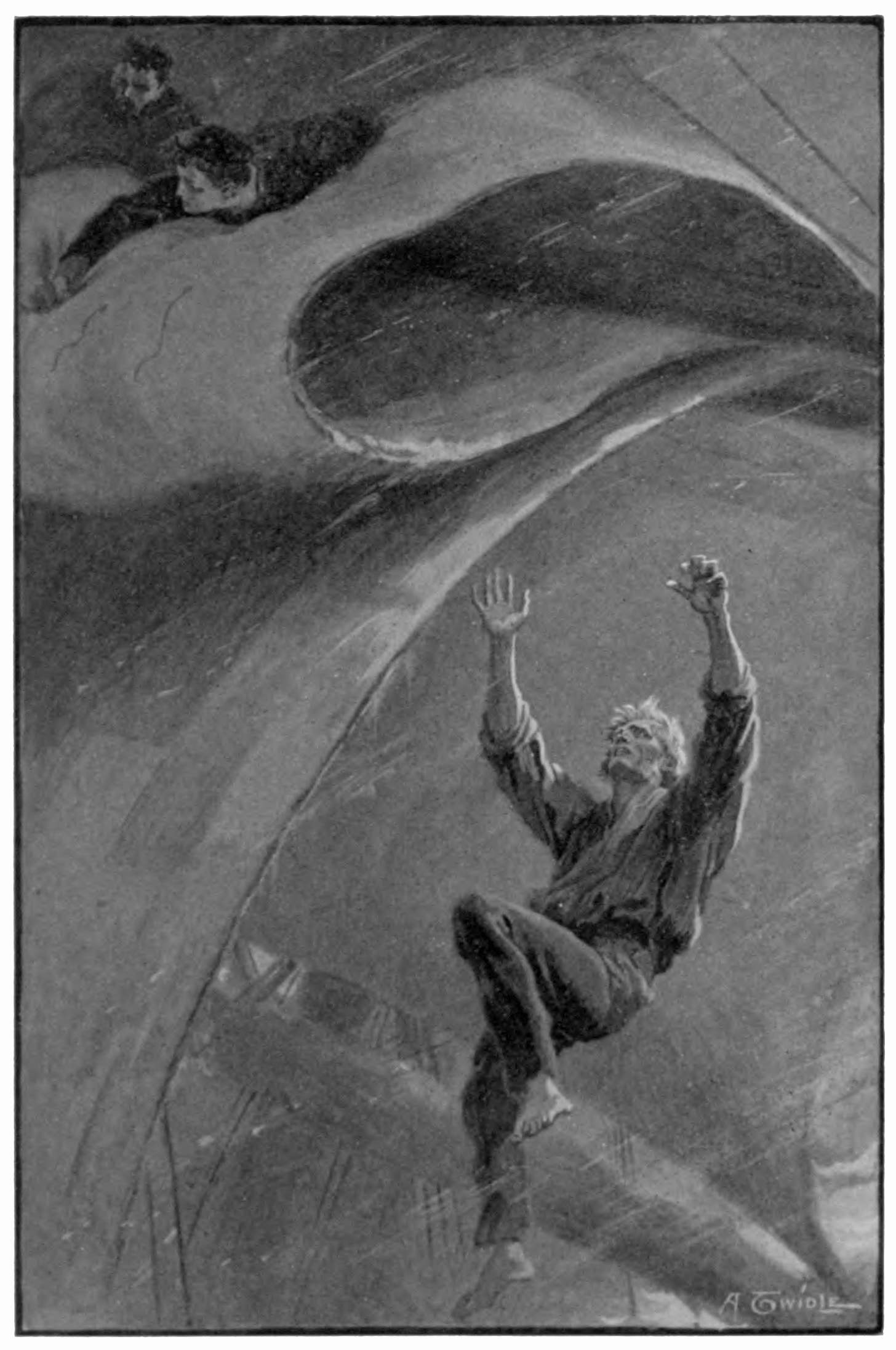
Charles had clutched instinctively at one of the martingale
guys as the Columbia swept over her victim,
and had succeeded in climbing from thence on board
out of the vortex of death in which all his late shipmates
had been involved. Plied with eager questions,
his simple story was soon told, and he was enrolled
among the crew. The Columbia was bound to Genoa,
a detail that troubled him but little; so long as he was
at sea he had no desire to select his destination. But
he found here a very different state of things obtaining.
The crew were a hard-bitten, motley lot, prime
seamen mostly, but “packet rats” to a man, wastrels
without a thought in life but how soon they might get
from one drinking-bout to another, and at sea only
kept from mutiny, and, indeed, crime of all kinds, by
the iron discipline imposed upon them by the stern-faced,
sinewy Americans who formed the afterguard.
There were no soft, sleepy-voiced orders given here.
Every command issued by an officer came like the bellowing
of an angry bull, and if the man or men addressed
did not leap like cats to execute it, a blow emphasized
the fierce oath that followed.
Charles now learned what work was. No languid
crawling through duties with one ear ever cocked for
the sound of the releasing bell, but a rabid rush at
all tasks, even the simplest, as if upon its immediate
performance hung issues of life or death. “Well fed,
well driven, well paid,” was the motto on board those
ships, albeit there were not wanting scoundrelly
skippers and officers, who, in ports where fresh hands
were to be obtained cheaply, were not above using the
men so abominably that they would desert and leave
all their cruelly-earned wages behind. Strangely
enough, however, Charles became a prime favourite.
This son of the soil, who might have been expected to
move in clod-hopper fashion, developed an amazing
smartness which, allied to a keenness of appreciation
quite American in its rapidity, endeared him specially
to the officers. In the roaring fo’c’sle among his half-savage
shipmates he commanded respect, for in some
mysterious way he evolved masterly fighting qualities
and dogged staying powers that gave him victory in
several bloody battles. So that it came to pass, when
Genoa was reached, that Charles was one day called
aft and informed that, if he cared to, he might shift
his quarters aft and go into training for an officer, holding
a sort of brevet rank as supernumerary third mate.
He accepted, and was transferred, much to the disgust
of his shipmates forward, who looked upon his move
aft as a sort of desertion to the enemy. But they
knew Charles too well to proceed further with their
enmity than cursing him among themselves, so that
as much peace as usual was kept.
From this port Charles wrote lengthily to Louise
at Longbridge as before, and to Poole to Mrs. Jacks,
breaking her great misfortune to her, and begging her
to write to him and send him at New York any letters
that might have arrived for him. And then he turned
contentedly to his work again, allowing it to engross
every thought. He was no mere dreamer of dreams,
this young man. In his mind there was a solid settled
conviction that, sooner or later (and it did not greatly
matter which), he would attain the object of his desires.
This granitic foundation of faith in his future saved
him all mental trouble, and enabled him to devote all
his energies to the work in hand, to the great satisfaction
of his skipper. Captain Lothrop, indeed, looked
upon this young Englishman with no ordinary favour.
A typical American himself, of the best school, he concealed
under a languid demeanour energy as of an unloosed
whirlwind. His face was long, oval, and olive-brown,
with black silky beard and moustache trimmed
like one of Velasquez’s cavaliers, and black eyes that,
usually expressionless as balls of black marble, would,
upon occasion given, dart rays of terrible fire. Contrasted
with this saturnine stately personage, the fair,
ruddy Charles looked like some innocent schoolboy,
the open, confiding air he bore being most deceptive.
He picked up seamanship, too, in marvellous fashion,
the sailorizing that counts, by virtue of which a seaman
handles a thousand-ton ship as if she were a toy and
every one of her crew but an incarnation of his will.
But this very ability of his before long aroused a spirit
of envy in his two brother officers that would have
been paralyzing to a weaker man. Here, again, the
masterly discipline of the American merchantman
came to his aid, a discipline that does not know of such
hideous folly as allowing jealousy between officers being
paraded before the crew, so that they with native
shrewdness may take advantage of the house divided
against itself. When in an American ship one sees a
skipper openly deriding an officer, be sure that officer’s
days as an officer are numbered; he is about to be reduced
to the ranks. So, in spite of a growing hatred
to the —— Britisher, the two senior mates allowed no
sign of their feelings to be manifested before the crew.
Perhaps the old man was a bit injudicious also. He
would yarn with Charles by the hour about the old
farm and the sober, uneventful routine of English rural
life, the recital of these placid stories evidently giving
him the purest pleasure by sheer contrast with his own
stormy career.
In due time the stay of the Columbia at Genoa came
to an end, and backward she sailed for New York.
In masterly fashion she was manœuvred out through
the Gut of Gibraltar, and sped with increased rapidity
into the broad Atlantic. But it was now nearly winter,
and soon the demon of the west wind made his
power felt. The gale settled down steadily to blow
for weeks apparently, and with dogged perseverance
the Columbia’s crew fought against it. Hail, snow,
and ice scourged them, canvas became like planks,
ropes as bars of iron. Around the bows arose masses
of ice like a rampart, and from the break of the forecastle
hung icicles which grew like mushrooms in a
few hours of night. The miserable crew were worn to
the bone with fatigue and cold, and had they been fed
as British crews of such ships are fed they would
doubtless have all died. But, in spite of their sufferings,
they worked on until one night, having to make
all possible sail to a “slant” of wind, they were all on
deck together at eight bells—midnight. With the
usual celerity practised in these ships, the snowy
breadths of canvas were rising one above the other,
and the Columbia was being flung forward in lively
fashion over the still heavy waves, when Charles, who
was standing right forward on the forecastle, shouted
in a voice that could be heard distinctly above the
roar of the wind and sea and the cries of the seamen,
“Hard down!” Mechanically the helmsman obeyed,
hardly knowing whither the summons came, and the
beautiful vessel swung up into the wind, catching all
her sails aback, and grinding her way past some
frightful obstruction to leeward that looked as if an
abyss of darkness had suddenly yawned in the middle
of the sea, along the rim of which the Columbia was
cringing. The tremendous voice of Captain Lothrop
boomed out through the darkness, “What d’ye see,
Mister Delamber, forrard there?” “We’ve struck a
derelict, sir,” roared Charles, and his words sounded in
the ears of the ship’s company like the summons of
doom. The ship faltered in her swing to windward,
refused to obey her helm, and swung off the wind
again slowly but surely, as if being dragged down into
unknown depths by an invisible hand whose grip was
like that of death.
In this hour of paralyzing uncertainty Charles rose
to the full height of his manhood. Passing the word
for a lantern, and slinging himself in a bowline, he
ventured into the blackness alongside, and presently
reappeared with the cheering news that no damage
was done. A few strokes of an axe and they would
be set free. And arming himself with a broad axe, he
again disappeared into the outer dark, this time under
the watchful eye of the skipper, and presently, with
a movement which was like a throb of returning life
to every soul on board, the Columbia regained her
freedom. Charles was hauled on board through the
surf alongside like a sodden bundle of clothing, unhurt,
but entirely exhausted, having made good his
claim to be regarded as one of the world’s silent heroes,
a man who to the call of duty returns no dubious
answer, but renders swift obedience.
This last adventure seemed to exhaust the Columbia’s
budget of ill-luck for the voyage. Although the
wind was never quite fair, it allowed them to work
gradually over to the westward, and with its change
a little more genial weather was vouchsafed to them.
They arrived in New York without further incident
worthy of notice, and Charles found himself not only
the guest of the skipper, but honoured by the owner,
who, as an old skipper himself, was fully alive to the
glowing account given him by Captain Lothrop of
Charles’s services to the Columbia. The other two
officers left early, and Charles, now a full-blown second
mate, saw his prize almost within his grasp. The
more so that a letter (only one) awaited him; it was
from Louise, and contained only these words—
“Dear Charles,
“It is that I am yours. Whenever it shall
please you to come for me, I am ready. I leave the
house to the day of your parting, for your father is
dead immediately, and I go not there any more. I
wait for you only.
“Louise.”
He accepted this news with perfect calmness, as of
one who knew that it would come, and turned again
to his work with a zest as unlike that of a love-sick
youth as any one ever saw. Not a word did he say
of his affairs even to his good friend the skipper, and
when, their stay in New York at an end, they sailed
for China, that worthy man was revolving all sorts of
projects in his mind for an alliance between Charles
and his wife’s sister, who, during Charles’ stay in New
York, had manifested no small degree of interest in
the stalwart, ruddy young Englishman. He, however,
took no advantage of the obviously proffered opportunity,
and in due course the Columbia sailed for Hong
Kong, petroleum laden. Captain Lothrop carried his
wife with him this voyage, and very homely indeed
the ship appeared with the many trifles added to her
cabin by feminine taste. A new mate and third mate
were also shipped—the former a gigantic Kentuckian,
with a fist like a shoulder of mutton, a voice like a
wounded buffalo bull, and a heart as big and soft as
ever dwelt in the breast of mortal man. Yet, strangely
enough, he was a terror to the crew. Long training
in the duty of running a ship “packet fashion” had
made him so, made him regard the men under his
charge as if they were wild beasts, who needed keeping
tame by many stripes and constant, unremitting
toil. The third mate was a Salem man, tall enough,
but without an ounce of superfluous flesh on his gaunt
frame. He seemed built of steel wire, so tireless and
insensible to pain was he. With these two worthies
Charles was at home at once. Good men themselves,
they took to him on the spot as an Englishman of the
best sort, who is always beloved by Yankees—that is,
genuine Americans—and loves them in return in no
half-hearted fashion.
It was well for them all that this solidarity obtained
among them, for they shipped a crowd in New York
of all nationalities, except Americans or English, a
gang that looked as if they had stepped direct from
the deck of a pirate to take service on board the
Columbia. The skipper was as brave a man as ever
trod a quarter-deck; but his wife was aboard, and his
great love made him nervous. He suggested at once
that each of his officers should never be without a
loaded six-shooter in their hip-pockets by night or
day, and that they should watch that crowd as the
trainer watches his cage of performing tigers. Fortunately
the men were all prime seamen, and full of
spring, while the perfect discipline maintained on
board from the outset did not permit of any loafing
about, which breeds insolence as well as laziness, that
root of mischief at sea. So, in spite of incessant labour
and the absence of any privileges whatever, the peace
was kept until the ship, after a splendid passage of
one hundred days, was running up the China Sea
under as much canvas as she could drag to the heavy
south-west monsoon. All the watch were busy greasing
down, it being Saturday, and, unlike most English
ships, where, for fear of the men grumbling, this most
filthy but necessary work is done by the boys or the
quiet men of the crew, here everybody took a hand,
and the job was done in about twenty minutes from the
word “go.” A huge Greek was busy at the mizzen-topmast,
his grease-pot slung to his belt, when suddenly
the pot parted company with him and fell, plentifully
bespattering sails and rigging as it bounded
and rebounded on its way down, until at last it
smashed upon the cabin skylight and deposited the balance
of its contents all around.
“Come down here, ye Dago beast!” bellowed the
mate. Slowly, too slowly, ’Tonio obeyed. Hardly
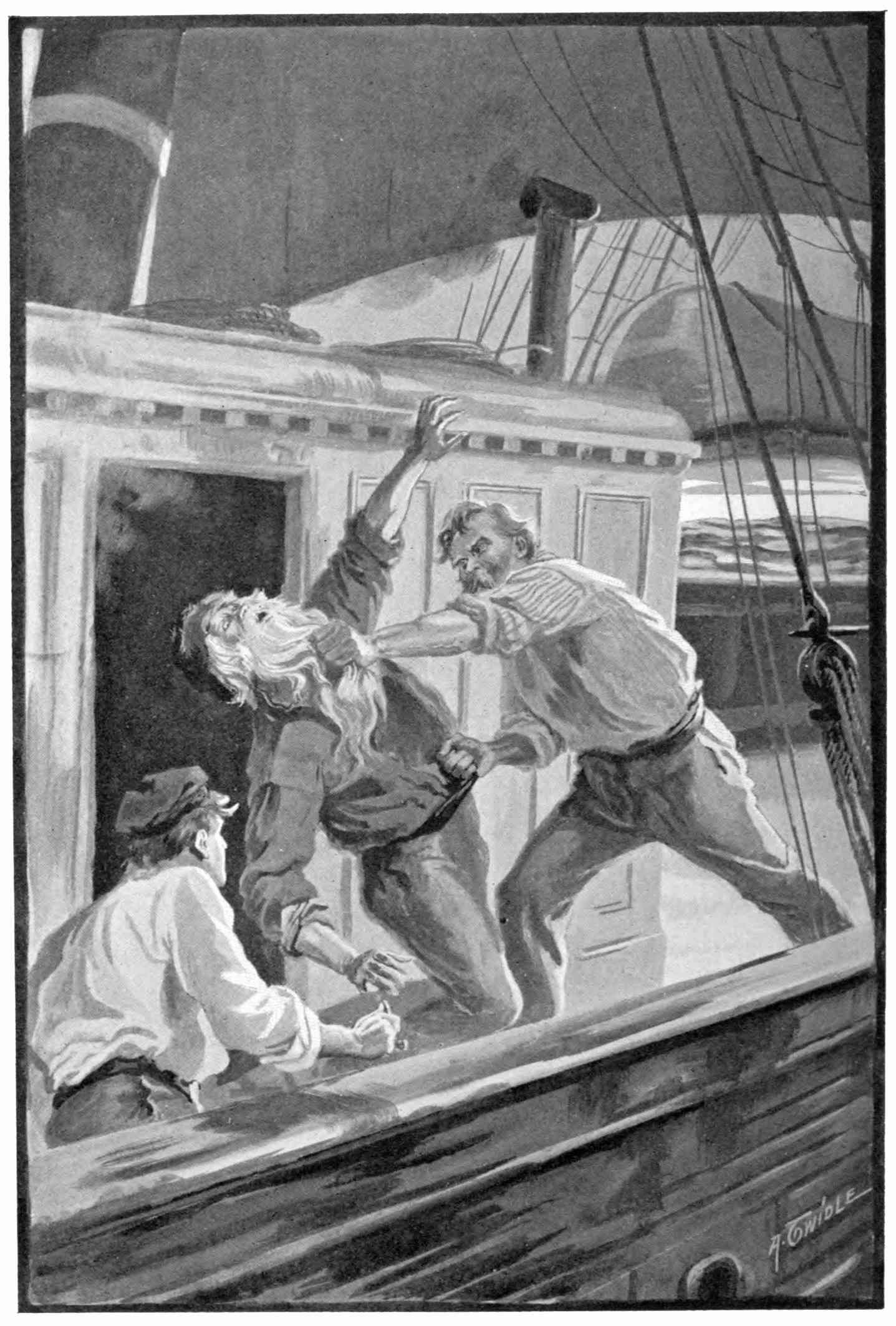
had he dropped from the rigging on to the top of the
house when Mr. Shelby seized him by the throat, and,
in spite of his bulk (he was almost as big as the mate
himself), dragged him to the skylight, and, forcing
his head down, actually rubbed his face in the foul
mess. ’Tonio struggled in silence, but unavailingly,
until the mate released him; then, with a spring like
a lion’s, he leaped at his tormentor, a long knife, never
seen till then, gleaming in his left hand. Mr. Shelby
met him halfway with a kick which caught his left
elbow, paralyzing his arm, the knife dropping point
downwards and sticking in the deck. But the fracas
was the signal for a general outbreak. The helmsman
sprang from the wheel, the rest of the watch slid down
backstays, and came rushing aft, bent on murder, all
their long pent-up hatred of authority brought to a
climax by the undoubted outrage perpetrated upon one
of their number. But they met with a man. His back
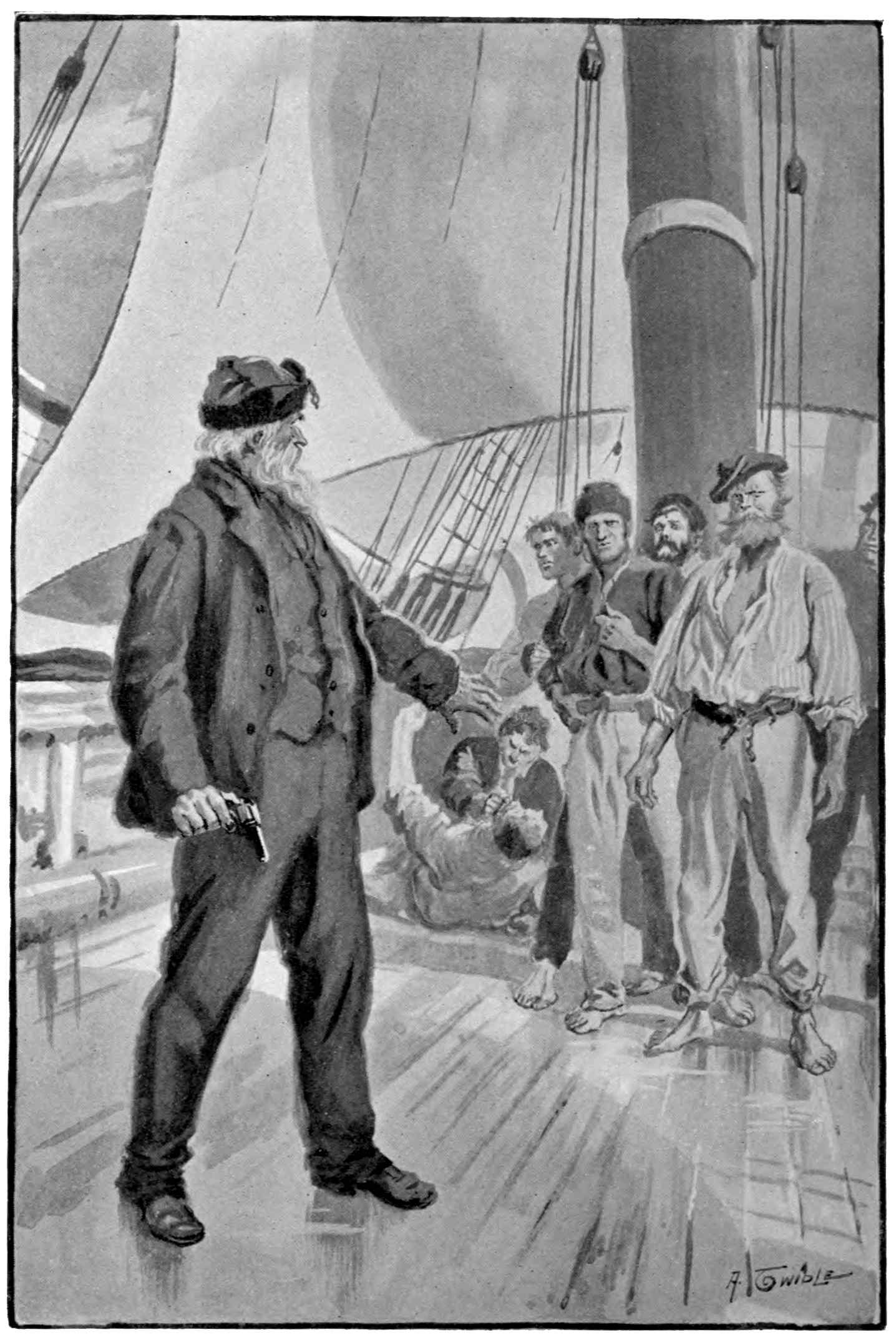
to the mizzen-mast, Mr. Shelby whipped out his revolver,
and, as coolly as if engaged in a day’s partridge-shooting
ashore, he fired barrel after barrel of
his weapon at the rushing savages. Up came the skipper
and the other two officers, not a moment too soon.
A hairy Spaniard clutched at Charles as he appeared
on deck, but that sturdy son of the soil grappled with
his enemy so felly, that in a few heart-beats the body
of the Latin went hurtling over the side. Then the
fight became general. The ship, neglected, swung up
into the wind and was caught aback, behaving herself
in the fashion of a wounded animal, while the higher
race, outnumbered by four to one, set its teeth and
fought in primitive style. The groans of the wounded,
the hissing oaths of the combatants, and the crack of
revolver shots made up a lurid weft to the warp of
sound provided by the moaning wind and murmuring
sea. Then gradually those of the men who could do
so crawled forrard, leaving the bright yellow of the
painted deck aft all besmeared with red, and the victory
was won for authority.
But a new danger threatened. Attracted, perhaps,
like vultures, by the smell of blood, several evil-looking
junks were closing in upon the Columbia, and but
for the tremendous exertions of the officers, aided by
the cook and steward and the captain’s wife, who, pale
but resolute, took the wheel, there is no doubt that the
Columbia would have been added to the list of missing
ships. That peril was averted by the ship being got
before the wind again, when her speed soon told, and
she hopelessly out-distanced the sneaking, clumsy
junks. And before sunset a long smear of smoke
astern resolved itself into one of the smart little gun-boats
which, under the splendid St. George’s Cross,
patrol those dangerous seas. In answer to signals, she
came alongside the Columbia, and soon a boat’s crew
of lithe men-o’-war’s-men were on board the American
ship, making all secure for her safe passage into Hong
Kong. There she arrived two days later, and got rid
of her desperate crew, with the exception of two who
had paid for their rash attempt the only price they
had—their lives.
From Hong Kong the Columbia sailed for London,
arriving there after an uneventful passage of one
hundred and twenty days. Charles, turning a deaf
ear to the entreaties of the captain and his fellow-officers,
determined to take his discharge. A load-stone
of which they knew not anything was drawing
him irresistibly into the heart of Wiltshire, and, with
all his earnings carefully secreted about him, he left
the great city behind, and set his face steadfastly for
Longbridge Deverill. There he suddenly arrived, as
if he had dropped from the sky, just as the short winter’s
day was closing in. The few straggling villagers
peered curiously at the broad, alert figure that strode
along the white road with an easy grace and manly
bearing quite foreign to the heavy slouch of their own
men-folk. There was, too, an indefinable foreign
odour about him which cut athwart even their dull perceptions
and aroused all their curiosity. But none
recognized him. How should they? They had hardly
ever known him, except by rumour, which, during his
absence of nearly two years, had died a natural death
for want of something to feed upon. Straight to the
old doctor’s house he went as a homing pigeon would.
To his confident knock there appeared at the door
Louise, the light of love in her eyes, her arms outstretched
in gladdest welcome. Neither showed any
surprise, for both seemed to have been in some unexplainable
way in communion with the other. Yet,
now the first speechless greeting over, the first caresses
bestowed, instead of contentment most profound
came unease, an indefinite fear lest this wonderful
thing that had befallen them should by the sheer
perversity of fate be swept away, leaving them in the
outer dark.
The quavering voice of the old doctor removed
them from each other’s close embrace, and shyly, yet
with a proud air of ownership, Louise led the way into
the cosy parlour, where the good old man sat enjoying
the rest and comfort he so fully deserved. He looked
up inquiringly as with dazzled eyes the big man entered
the room, hesitatingly, and with a rush of strange
memories flooding his brain.
“Who is it, Loo?” said the doctor. “I don’t recognize
the gentleman.”
And, rising stiffly from his armchair, he took a step
forward.
“It’s Charles, doctor, Charles Delambre,” faltered
Louise.
“Yes, doctor; and I’ve come to take away your
treasure. Also to thank you with my whole heart
for your loving kindness in taking care of her. Without
you what would she have done, me being so far
away?”
Almost inarticulate with joy, the old man caught
Charles’s hands in both his own, and pushed him into
a chair. Then sinking back into his own, he gasped
breathlessly—
“Ah, my boy, my boy, how I have longed for your
return! It has given me more pain than you can
think—the idea that I might die and leave this poor
child friendless and alone in the world. But she has
had no fear. She knew you would come, and she was
right. But, Charley, my boy, before we say another
word—your brother. You mustn’t forget him, and if,
as I fear, your quarrel was fierce, you must forgive.
His sufferings have been great. Never once has his
face been seen in the village since you left, and, except
that we hear an occasional word of him brought by a
tramp, he might be dead. Go to him, Charles, and
make it up, and perhaps the good Lord will lift the
cloud of misery that has so long hung heavily over
your house.”
Charles heard the kindly doctor’s little speech in
respectful silence, then, speaking for the second time
since entering the house, he said—
“You are right, doctor. I will be friends with
George if he’ll let me. But I must first secure my wife.
After all that has passed, I dare not waste an hour until
we are married.”
Louise sat listening with the light of perfect approval
on her fine face; and the doctor also in vigorous
fashion signified his entire acquiescence. The rest of
that happy evening was devoted to a recital of Charles’s
wanderings, his escapes, and his good fortune, until,
wearied out, those three happy people went to bed.
Next day Charles was busy. A special license had
to be procured, and Louise must procure her simple
wadding array. The facilities of to-day did not exist
then, and the impatient young lover chafed considerably
at the delay involved. But in due time the wedding
came off, with the dear old doctor as guardian
to give the bride away. The village was in a state
of seething excitement; the labourers left their work,
their wives left their household tasks, and all discussed
with an eagerness that was amazingly different to their
usual stolidity of demeanour the romantic happenings
in their midst. Then, when the newly-married pair
had returned to the doctor’s roomy house, and the
villagers had drifted reluctantly homeward again, the
ripples of unwonted disturbance gradually smoothed
out and subsided. Charles and his wife sat side by side
in the doctor’s parlour as the evening shadows fell,
their benefactor’s glowing face confronting them, and
the knowledge that half his home was theirs removing
all anxiety for the immediate future from their minds.
They sat thus, holding each other’s hands in silence,
until Louise, looking up in her husband’s face,
said, “Charles, let us go and see George. I feel I must
before I sleep.” And Charles answered, “Yes, dear;
it was in my heart too to do so, but I’m glad you spoke
first.” So, gently disregarding the remonstrances of
the doctor, who protested that the morrow would be
a more appropriate time, they departed, warmly
wrapped up against the piercing cold, and carrying
a lantern. As they passed from the village on to the
shoulder of the swelling down a few soft snow-flakes
began to fall....
All through that night the large round flakes fell
heavily incessantly, until, when the pale cold dawn
straggled through the leaden clouds, the whole country
was deep buried in a smooth garment of spotless
white. For three days the terrible, silent fall went on.
The poor folk almost starved in their homes, and all
traffic throughout the country was stopped. When at
last communications could be opened, the old doctor,
his heart aching with worry and suspense, made his
way, accompanied by my father, to Pertwood Farm.
There they found only a few hastily scribbled sheets of
paper on the kitchen table. They contained words
to the effect that George had been startled by a long
wailing cry at a late hour on the night of the first
snow. He had gone to the door, and there, on the
very spot where she had lain years before, was his
lost love. But this time she was dead. He had buried
her by the side of his parents, and hoped to join the
party soon.
A little search revealed the fact that after writing
those lines he had gone down into the cellar and died,
for his body lay across the rude box containing the
remains of Louise. But of Charles nothing was ever
again seen or heard. I have always felt that he might
have been found at the bottom of that dank tarn among
the pines, into which he may have fallen on that terrible
night. But I don’t know, the mystery remains.
YOU SING — CHAPTER I — CHAPTER II — CHAPTER III — CHAPTER IV
Regarded collectively, the Chinese may safely be
classified under the head of unpleasant races. Most
people who have had personal dealings with them will
doubtless admit that, while there are to be discovered
among them a tiny sprinkling of really decent men
and women, taken “by and large” they are, to Westerns
at any rate, anathema. And yet, when due allowance
is made for environment, and for hereditary peculiarities
of many strange kinds—for which, of course,
the individual is in no way responsible—it may not be
too bold an assertion that the Chinese are a people who
only need a little real leadership on Western lines to
become a truly great nation. They possess all the
necessary qualifications for such a splendid future and
few of the drawbacks. Many virtues that are among
us only inculcated by much laborious tuition are with
the Chinese sui generis. No one will deny that they
know how to die; were it possible to teach them how
to live, such a revolution would be felt in the progress
of the world as it has never yet witnessed. Of course,
this does not touch the vast question as to whether
such a resurrection of China is to be welcomed or
dreaded.
But my intention in these pages is far from that of
discussing the economic future of China. Such a task
would be indefinitely beyond my powers, besides being
utterly unnecessary and out of place here. Besides,
I do not really feel sufficiently interested in the Chinese
collectively. My story is about a single Chinaman
who played a very important part in my own history,
and who well deserved a far more powerful testimony
than any I am able to bear to his virtues.
But, first, in order to launch my story properly, I
must premise that in one of my vagrom voyages,
while I was only a puny lad of thirteen, I was flung
ashore in Liverpool, penniless, and, of course, friendless.
For many days I lived—or, rather, I did not die—by
picking up, bird-like, such unvalued trifles of food
as chance threw in my way while I wandered about the
docks; but as there were many more experienced urchins
with sharper eyes than mine on the same keen
quest, it may be well imagined that I did not wax
overfat upon my findings. Unfortunately my seafaring
instincts kept me near the docks at all times, where
most of my associates were as hunger-bitten as myself;
had I gone up town I should probably have fared
better.
However, I had put a very keen edge indeed upon
my appetite one bitter November afternoon, when,
prowling along the Coburg Dock Quay, I was suddenly
brought up “all standing” by a most maddening
smell of soup. With dilated nostrils I drew in the
fragrant breeze, and immediately located its source as
the galley of a barque that lay near, loading. I must
have looked hungry as I swiftly came alongside of her,
for the broad-faced cook, who was standing at his
galley-door swabbing his steaming face after his sultry
sojourn within, presently caught sight of me and lifted
a beckoning finger. I was by his side in two bounds,
and before I had quite realized my good fortune I was
loading up at a great rate from a comfortably-sized
dish of plum soup. My benefactor said nothing as the
eager spoonfuls passed, but lolled against the door
placidly regarding me with much the same expression
as one would a hungry dog with a just-discovered
bone. When at last I was well distended, he asked
me a few questions in a queer broken English that I
immediately recognized as the German version. What
was I? Where did I come from? Would I like to
go to sea? And so on. Eagerly and hopefully I
answered him, much to his amazement; for, like every
other seaman I fell in with in those days, he found it
hard to believe that I had already been nearly two
years at sea, so small and weak did I appear. But the
upshot of our interview was that he introduced me to
the skipper, a burly North German, who, looking
stolidly down upon me, between the regular puffs of
smoke from his big pipe, said—
“Vell, poy; ju dinks ju like du komm in a Cherman
scheep—hein?”
I faltered out a few words, not very coherently, I
am afraid, for the prospect of getting any ship at all
was just like a glimpse of heaven to me. Fortunately
for my hopes, Captain Strauss was a man of action, so,
cutting short my faltering reply, he resumed: “All
righdt. Ve yoost loosd a leedle Engelsch boy lige
ju. He pin mit me more as ein jeer, gabin-poy,
und mein vife lige him fery vell. Ju do so goot
as him, ju vas all righdt. Vat ju call jorselluf—hein?”
“Tom, sir,” I answered promptly.
“Ya; den ve call ju Dahn. Dat oder poy ve calls
Dahn, und so ju gomes all der same for him—aind
it?”
That seemed to settle the matter, for he turned
away abruptly and was gone. I hastened to my friend
the cook, and told him what the skipper had said,
with the result that in another five minutes I was
busy laying the cloth for dinner in the cabin as if I
had been the original Dan just come back. A pretty,
fair-haired little girl of about ten years of age watched
me curiously from a state-room door with the frank,
straightforward curiosity of a child; and I, boy-like,
was on my mettle to show her how well I could do my
work. Presently she came forward and spoke to me;
but her remarks being in German, I could only smile
feebly and look foolish; whereupon she indignantly
snapped out, “Schaafskopf,” and ran away. She returned
almost directly with her mother, a buxom,
placid-looking dame of about thirty-five, who addressed
me in a dignified tone. Again I was in a
hole, for she spoke only German also; and if ever a
poor urchin felt nonplussed, I did. This drawback
made my berth an uncomfortable one at first; but, with
such opportunities as I had and such a powerful inducement
to spur me on, I soon picked up enough
to understand what was said to me, and to make some
suitable reply.
The vessel was a smart-looking, well-found barque
of about six hundred tons, called the Blitzen, of Rostock,
and carried a crew of fourteen all told. Each
of the other thirteen was a master of mine, and seldom
allowed an opportunity to slip of asserting his authority;
while the skipper’s wife and daughter evidently
believed that I ought to be perpetually in motion.
Consequently my berth was no sinecure; and,
whatever my qualifications may have been, I have no
doubt I earned my food and the tiny triangular lair
under the companion-ladder wherein I crept—I was
going to say when my work was done—but a rather
better term to use would be, in the short intervals between
jobs.
Now, the story of the next nine months on board
the Blitzen is by no means devoid of interest; but I
have an uneasy feeling that I have already tried the
reader’s patience enough with necessary preliminaries
to the story of You Sing. After calling at several
ports in South America, looking in at Algoa Bay, visiting
Banjœwangie and Cheribon, we finally appeared
to have settled down as a Chinese coaster, trading between
all sorts of out-of-the-way ports for native consignees,
and carrying a queer assortment of merchandise.
Finally we found ourselves at Amoy, under
charter for Ilo-Ilo with a full cargo of Chinese “notions.”
Owing, I suppose, to the docility of the German
crew, and the high state of discipline maintained
on board, we still carried the same crew that we left
England with; but I must say that, while I admired
the good seamanship displayed by the skipper and his
officers, I was heartily weary of my lot on board. I
had never become a favourite, not even with the little
girl, who seemed to take a delight in imitating her
father and mother by calling me strange-sounding
Teutonic names of opprobrium; and I was beaten
regularly, not apparently from any innate brutality, but
from sheer force of habit, as a London costermonger
beats his faithful donkey. The only thing that made
life at all tolerable was that I was fairly well fed and
enjoyed robust health; while I never lost the hope that
in some of our wanderings we should happen into an
English port, where I might be able to run away.
That blissful idea I kept steadily before me as a
beacon-light to cheer me on. Happily, dread of losing
my wages in such an event did not trouble me,
because I had none to lose as far as I knew; I did not
stipulate for any when I joined.
It was on a lovely night that we swung clear of
Amoy harbour and, catching a light land-breeze,
headed across the strait towards Formosa. Many
fishing sampans were dotted about the sleeping sea,
making little sepia-splashes on the wide white wake of
the moon. Little care was taken to avoid running
them down; nor did they seem to feel any great
anxiety as to whether we did so or not, and as a consequence
we occasionally grazed closely past one, and
looked down curiously upon the passive figures sitting
in their frail craft like roosting sea-birds upon a floating
log. Without any actual damage to them, we
gradually drew clear of their cruising-ground, and,
hauling to the southward a little, stood gently onward
for Cape South, the wind still very light and the
weather perfect. But suddenly we ran into a strange
heavy mist that obscured all the sea around us, and
yet did not have that wetness that usually characterizes
the clinging vapour of the sea-fog. Through this
opaque veil we glided as if sailing in cloudland, a
silence enwrapping us as if we had been mysteriously
changed into a ghostly ship and crew. Then a quick,
strong blast of wind burst out of the brume right
ahead, throwing all the sails aback and driving the
vessel stern foremost at a rate that seemed out of all
proportion to its force.
For a few moments the watch on deck appeared to
be stupid with surprise. Then the skipper, roused by
the unusual motion, rushed on deck, and his deep,
guttural voice broke the spell as he issued abrupt
orders. All hands were soon busy getting the vessel
under control, shortening sail, and trimming yards.
But, to everybody’s speechless amazement, it was presently
found that entangled alongside lay a small junk,
a craft of some twenty to thirty tons, upon whose
deck no sign of life was visible. All hands crowded to
the rail, staring and muttering almost incoherent comment
upon this weird visitor that had so suddenly
arisen, as it were, out of the void. As usual, the skipper
first recovered his working wits, and ordered a
couple of the men to jump on board the junk and
investigate. They obeyed unquestionably, as was
their wont, and presently reported that she was unmanned,
but apparently full to the hatches of assorted
Chinese cargo in mats and boxes. The skipper’s voice
took an exultant ring as he ordered the vessel to be
well secured alongside, and her contents to be transferred
on board of us with all possible despatch.
Meanwhile the strange mist had vanished as suddenly
as it had arisen, and the full bright moon shone down
upon the toiling men, who with wonderful celerity
were breaking out the junk’s cargo and hurling it on
to our decks. Such was their expedition that in half
an hour our decks were almost impassable for the
queer-looking boxes and bales and bundles of all
shapes disgorged from the junk’s hold. Then they
invaded the evil-scented cabin, and ransacked its many
hiding-places, finding numerous neatly-bound parcels
wrapped in fine silky matting. And, last of all—they
declared he must have suddenly been materialized, or
words to that effect—they lighted upon a lad of probably
sixteen years of age. He showed no surprise, after
the fatalistic fashion of his countrymen, but stood
gravely before them like some quaint Mongolian idol
carved out of yellow jade, and ready for any fortune
that might await him. With scant ceremony, he too
was man-handled on deck, for the command was
urgent to finish the work; the busy labourers followed
him, and the junk was cast adrift.
The toiling men were breaking out the junk’s cargo.
Some sort of rough stowage was made of the treasure-trove
thus peculiarly shipped; and, the excitement
that had sustained their unusual exertions having subsided,
the tired crew flung themselves down anywhere
and slept—slept like dead men, all except the officer of
the watch and the helmsman. They had at first little
to do that might keep them from slumber, for the wind
had dropped to a stark calm, which in those sheltered
waters, remote from the disturbing influence of any
great ocean swell, left the ship almost perfectly motionless,
a huge silhouette against the glowing surface
of a silver lake. But presently it dawned upon the
mate who was in charge of the deck that, although the
vessel had certainly not travelled more than a mile
since the junk was cast adrift, that strange craft was
nowhere to be seen; and, stern martinet though he
was, the consciousness of something uncanny about
the recent business stole through him, shrinking his
skin and making his mouth dry, until for relief he
sought the helmsman and entered into conversation
with him on the subject. That worthy, a stolid, unemotional
Dutchman named Pfeiffer, scanned the
whole of the palpitating brightness around before he
would assent to the mate’s theory of any sudden disappearance
of our late companion; but, having done
so, and failed to discover the smallest speck against
that dazzling surface, he, too, was fain to admit that
the thing was not comforting. Right glad were those
two men when the interminably long watch was over,
and the sharp, business-like notes of the bell seemed
to dissipate in some measure the chilling atmosphere
of mystery that hemmed them in. To the second mate
the retiring officer said nothing of his fears, but hastened
below, hurriedly scratched a perfunctory note
or two on the log-slate, and bundled, “all standing”—that
is, dressed as he was—into his bunk, pulling the
upper feather-bed right over his head, as if to shut out
the terror that was upon him. Slowly the remainder
of the night passed away; but when at last the tiny
suggestion of paleness along the eastern horizon gave
the first indication of the day’s approach, no change,
not even the slightest, had occurred to increase the
mystery whose environment all felt more or less
keenly. As the advancing glory of the new day displaced
the deep purple of the night, the awakening
crew recalled, as if it had been a lifetime ago, the
strange happening of the past few hours. But it was
not until the clear light was fully come that the significance
of the whole affair was manifest. For there,
seated upon a mat-bound case, stamped all over with
red “chops,” was the Chinese youth, whose existence
had up till now been unnoticed from the time he was
first bundled on board. Impassive as a wooden image,
he looked as if the position he had held throughout the
night had left him unwearied, and, to all appearance,
the strange and sudden change in his environment possessed
for him no significance whatever. But now,
when the surly-looking mate approached him and
looked him over with evident distaste, he slid off his
perch, and, kneeling at the officer’s feet, kissed the
deck thrice in manifest token of his entire submission
to whatever fate might be dealt out to him.
The mate stood silently looking down upon him,
as if hardly able to decide what to do with him.
While this curious little episode was being enacted
the skipper appeared, and, hastening to the mate’s
side, addressed the grovelling Celestial in what he
supposed to be the only possible medium of communication—“pidgin”
English, which, coupled to a
German accent, was the queerest jargon conceivable.
“Vell,” he said, “vot pelong ju pidgin—hay? Ju
savvy vork, vun dime?”
Lifting his yellow mask of a face, but still remaining
on his knees, the waif made answer—
“No shabbee. You Sing.”
“You Sing” conveyed no meaning to anybody;
but, after various extraordinary attempts to extend the
conversation had entirely failed, it was tacitly agreed
that You Sing must be his name. Whether it was or
not, the taciturn pagan answered to it immediately it
was uttered, or rather he came instantly to whoever
mentioned it. So, seeing that it was hopeless to think
of getting any information from him as to the why
and wherefore of the strange circumstances under
which we had found him, the skipper decided promptly
to put him to work as a steward, believing that he
would make a good one. To that end he was handed
over to me for tuition, much to my delight, for now I
felt that I should have a companion who was certainly
not more than my equal, and who would not be likely
to ill-treat me in any way, as most of the crew did
when opportunity arose. His coming was to me a perfect
godsend. He was so willing, so docile, and withal
so eminently teachable, that it was a pleasure to be
with him. And the incongruity of being placed under
such an urchin as myself did not appear to strike him
at all, for he looked upon me from the first day of
our acquaintance as the one creature that stood between
him and the outer dark—although it must be
said that, as far as could be judged by his attitude to
all with whom he came in contact, he regarded every
member of the ship’s company as in some sort his
saviour. All could command him, and he would instantly
obey; and although he understood no word of
what was said to him, he watched so keenly, his desire
to please was so intense, and his natural ability so great,
that his efforts to do what was required of him were
generally successful. Unfortunately, his willingness
often got him into serious trouble, since he always
obeyed the last order, not being able to discriminate
between those who had the first claim upon him and
those who had no right to his services whatever. But
when he was beaten for neglecting tasks that he had
been called away from, he never murmured or showed
sign of pain or resentment; all treatment was borne
with the same placid equanimity, as if he were a perfectly
passionless automaton. With one exception—myself.
When with me his usually expressionless eyes
would shine, and his yellow face wear a peculiarly
sweet smile that had quite a fascination for me. I
found myself growing so much attached to him that
my rage against his persecutors often drove me nearly
frantic—such wrath as it had never occurred to me
to feel on my own behalf.
Meanwhile the Blitzen, sorely hampered by calms
and variable winds, crept slowly and painfully towards
her destination. I was so much absorbed with the
education and company of You Sing that I lost all my
usual interest in the progress of the vessel, and did
not even wonder when we were going to reach our
next port—a speculation that had hitherto always had
great charms for me. But one morning before breakfast
I was dreadfully affrighted to hear a fierce altercation
on deck. It had always been my ill-fortune
hitherto to find myself the ultimate vicarious sacrifice
in all cases of trouble, and even to this day the old
feeling of dread still exists—a feeling that whatever
row is going on I shall presently be made to suffer for
it; and the well-remembered sensation of sinking at
the pit of the stomach comes back, making me for the
moment quite ill. So, trembling all over, I peered
out of the pantry window on to the main deck, and
saw the mate confronting three men of his watch, who,
with inflamed faces and fierce gestures, were evidently
threatening his life. Now, there had never before
been the slightest sign of insubordination on board,
the discipline seeming as near perfection as possible,
and therefore this sudden outbreak was most alarming.
A swift step passed the pantry door, and instantly
I saw the skipper rushing forward. Without a word
he plunged into the midst of the angry four, and seizing
the foremost seaman by the throat and waist
hurled him crashing against the bulwarks. At the
same moment the mate sprang at another man, as if to
serve him in the same manner; but, missing his grasp,
he stumbled and fell on his knees. A stifled scream
burst from my dry lips as I saw the glint of steel; the
seaman attacked had drawn his knife, and as the mate
fell the weapon descended with fearful force between
his shoulders. I heard the ugly sound right aft, and
it remains with me to-day. The skipper, however, with
the agility of a porpoise, instantly flung himself on the
two men, and fought as if he had the sinews of ten.
Compared with the noise of the preliminary quarrel,
this life-and-death struggle was silence itself; but I
could hear the laboured breathings of the combatants
coming in hoarse gasps, and the cracking of the joints
as the writhing bodies knotted and strained. There
was a scream behind me, a rustle of skirts, and out of
the cabin rushed the skipper’s wife, with flying hair
and outstretched arms. But before she was halfway
to the spot there was a swoop as of some huge bird
past her, and the second mate, the youngest officer in
the ship and the biggest man, alighted in the fray like
a hungry tiger. I did not see the other watch of the
crew arrive, but they were there, and fighting as fiercely
as the rest.
Now, the first flush of fear having gone from me,
I became interested—somewhat coldly critical, indeed,
of the various points of the battle, finding myself, to
the wonder of some other corner of my brain, siding
with the officers, and hoping they would be victorious.
The surprise of this backwater of thought was probably
owing to the fact that all the officers had treated
me with steady brutality, while the men, though not
kind, seldom touched me, although that was probably
only lack of opportunity. But with all my keen watching
I could not yet forecast the upshot of this awful
encounter. The mass of bodies seemed to me inextricably
entangled, heaving and writhing like a basket
of wounded eels; while all around them, frantically
clutching at the labouring body of her husband, and
shrieking pitifully, hovered the unhappy wife and
mother.
Suddenly it dawned upon me that the little Elsie
was alone, and probably frightened to death; and,
though I was never a favourite with even her, it
seemed good to go and comfort her if possible. So I
turned away from the window, and there behind me
was You Sing, calmly cleaning the knives, as unmoved
by any external occurrence as a piece of machinery.
As I unblocked the window he caught my eye, and
the peculiarly winsome smile he always wore for me
lit up his solemn face. His lips opened, and he murmured
softly with an indescribable accent the only two
English words I had succeeded in teaching him,
“’Ullo, Tommy.” I could only smile back in return
as I hurried off to the skipper’s state-room aft, feeling
as if, with the shutting out of that savage sight, a load
had been lifted off my brain. A quick revulsion of
sympathy thrilled me as I found the pretty child fast
asleep in placid unconsciousness of the terrible scene
in progress outside. I stood for a minute looking at
her with a tenderness I had never before felt towards
her, all her childish dislike and funny little ways of
showing it, borrowed from her parents, utterly forgotten.
Then, softly closing the door, I hurried back
to the pantry, finding You Sing still busily employed.
Scrambling to the window, I peered forrard again,
seeing, to my horror, only a heap of bodies lying still.
I stood there as if frozen, trying hard to think, endeavouring
to realize the position, but unable to control
my disorganized brain. How long I stood staring
thus I have no idea; but I was recalled to usefulness
again by You Sing’s gentle touch upon my back.
Turning slowly round, I faced him, while he pointed
out his finished work and intimated to me in the sign
language we always employed that he awaited instructions
what to go on with. Impatiently I made a
great effort to show him that all ordinary work was
now at an end, and, pulling him to the window,
pointed out the awful heap on the main hatch. He
looked, and I believe understood the situation, for he
turned again to me and patted my face, pointed first
to me and then to himself, as if to intimate that upon
us two, me as master and he as servant, the conduct
of affairs now rested.
Then, taking my courage in both hands, I softly
stepped out on deck and approached the scene of
conflict, though trembling so violently that I could
scarcely go. But when I reached the entwined heap
of bodies I did not know what to do, standing helplessly
staring at the grim spectacle. A faint groan
startled me, and I bent down over the nearest body,
which happened to be the skipper’s, hearing him murmur
faintly, “Wasser, lieber Gott! Wasser.” Hastily
motioning to You Sing to fetch some water, I tried to
drag the skipper into a sitting position; but it was too
much for my strength. The effort, however, was apparently
all that was needed to shake the last faint
breath from his body, for, with wide dilated nostrils
and open mouth, he gave his final gasp. Then all was
still, for all were dead.
The whole waist was like the veriest shambles, and
the fearful savagery of the fight was manifest in many
hideous details that need not be reproduced. Suddenly
a hope dawned upon me that one man might still
be left—the helmsman; and, rushing aft, I bounded up
on to the poop, only to find the wheel swinging idly to
and fro: there was no one there. Then I ran forward,
unheeding You Sing’s dog-like wistful look after
me, and ransacked the forecastle and galley; but both
were deserted. We were quite alone.
This tremendous fact broke in upon me with good
effect after the strain to which I had recently been subjected,
for it braced me up to action. Calling upon
You Sing to help me, I tackled the ghastly heap, tugging
and straining at the limp bodies, and getting all
gory as they were. The sweat ran down blindingly; I
felt my sinews crack with my desperate exertions; but
at last all the bodies were separated and laid side by
side, the captain’s wife last of that sad row. Not a
sign of life was to be found in any one of them; and,
having at last satisfied myself of this, I dropped upon
the crimsoned tarpaulin exhausted, to rack my brains
for some reason why this sudden tragedy should have
been enacted. Gradually the conviction forced itself
upon me that the whole horrible outbreak was due to
some quarrel over the junk’s cargo; but as that had
all been overhauled and stowed away without my
knowing anything of its nature, it was only a blind
guess. Something, however, of tremendous importance
must have occurred to make a body of men fight
with such fury among themselves that not one of them
remained alive.
But urgent necessity was laid upon me to be up
and doing, the first duty that demanded attention
being the disposal of the dead. So I called upon You
Sing—who, standing near, never seemed to take his
eyes off me—and the pair of us triced up one of the
bulwark ports and dragged the first of the corpses up
to it. Then by a sudden impulse I flung off my cap,
and, kneeling down on the red deck, said the Lord’s
Prayer and the final Collect in the Church Service—all
I could then remember; while my heathen helper
stood gravely by making no sign but looking a very
well-spring of sympathy. Strangely cheered and uplifted,
I seized the poor piece of clay, and motioning
my helpmate, launched it through the yawning port,
listening shudderingly to the dull splash that followed.
And so with the rest, until we two stood alone, panting
and distressed with our heavy task. A few minutes’
rest, and then, with draw-bucket and broom, we
laboured to cleanse away the blood that besmeared so
wide a space of the decks. At this work we toiled for
a long time, and when at last we gave over, because
I was tired out, we had only partially succeeded in
removing the fearful evidence of that great fight. By
this time I was so far myself as to feel hungry. The
feeling of nausea, that had been coming and going
like waves over me ever since I first left the cabin, had
left me, and I ordered You Sing to get breakfast.
He set about the job immediately, leaving me seated
on the damp hatch wondering what would become of
us. Then suddenly it occurred to me for the first time
that the ship was entirely left to herself. There was
a faint breeze blowing steadily, all sail being set, and
the yards canted a couple of points, for what wind
existed was on the quarter. I rose and went aft to the
wheel, finding that she came up and fell off about
three points, so that she was practically steering herself,
and making a fairly average course S.S.E. This
was satisfactory so far, because it relieved me of any
necessity for immediate action. I knew how to steer,
and, as far as my strength went, could handle sails,
besides understanding fairly well how a ship was
worked; for I had been over two years at sea, and
always a deck-boy until this voyage, so that, unless I
had been a very idiot, I must know something about
sailoring.
Everything being so quiet and favourable, I remembered
little Elsie, and with a sinking heart went
down below to break the dreadful news to her. How
it was to be done I didn’t know, my stock of German
being pitifully scanty, and she, poor child! not knowing
one word of English. As I turned the handle of
the state-room door I heard her calling, “Mutter, wie
bist du?” and in spite of my efforts some big tears
burst from my eyes. But I went in and stood by her
cot, racking my brains for some way of making her
understand what had happened. As soon as she saw
me she began, as usual, to scold me for being there—where,
indeed, I was never allowed to enter—and
ordered me with much dignity to go and call her
mother.
It would be useless for me to attempt any description
of the scene that followed. I could not, do what
I would, make her understand what an awful change
had taken place since she went to sleep. She at last
made up her mind that I must be crazy, and, thoroughly
frightened, sprang out of her cot, and rushed
into the cabin screaming frantically for “Mutter,
Mutter! Vater, Vater!” I followed her carefully, puzzled
beyond measure to know what to do; but she fled
on deck, up the ladder and on to the poop, still calling
with all her voice for those who were for ever deaf
to her cries.
Of course, I dared not pursue her, for fear of adding
to her terror; so I waited anxiously until she had
explored every vacant corner of the ship, and at last,
exhausted with her efforts, she returned slowly to the
cabin. Then I quietly brought her some food, and
begged her to eat a little; but, as I might have expected,
that was impossible. However, she was so far
quieted that she plied me with questions, which I
answered as well as I was able, until I succeeded in
making her understand the grim truth. She burst
into such a passion of weeping when she comprehended
the case that at first I feared for her life; but
presently I saw that this outbreak was the best thing
that could have happened, for it relieved her poor little
brain; and soon, utterly worn out, she went off into a
heavy sleep.
Then I searched the cabin thoroughly, with the dim
idea in my mind of finding some cause for the mutiny
in accordance with my suspicions. Sure enough, I
had been right, for in various hiding-places I came
upon such treasures as I had never even dreamed of
before—coined gold in boxes, in bags, in bundles:
sovereigns, eagles, onzas, and napoleons; jewellery of
every variety of make, glittering with precious stones
of which I had never heard the name. At last I came
upon a crucifix nearly two feet in length, apparently
of solid gold, and encrusted with large gems, a marvel
of costliness and beauty. I showed it to You Sing,
who, for the first time in my acquaintance with him,
showed signs of horror, and tried hard to induce me to
throw the magnificent thing overboard.
This discovery marked a new departure in our
relations towards each other. Hitherto I had looked
upon You Sing as I might have done upon a big faithful
dog, but never dreamed of crediting him with any
intelligent initiative. His behaviour so far had certainly
justified me in this opinion; but now he became
completely transformed. In the most energetic
pantomime, and with strangely severe struggles to
enunciate a few words of my language, he endeavoured
to explain to me the origin of all these treasures. I
did not find it hard to understand the general drift
of his attempt to enlighten me, because I had already
suspected something of what I was now gathering
from him. Roughly, it was to the effect that the cargo
we had relieved the junk of was the accumulated hoard
of a nest of pirates who had long been preying upon
such seafarers as they dared attack without fear of reprisals,
and who were all deliberately slain after they
had been plundered and their vessels scuttled. Then
the wretches had turned their bloody hands against
each other, and by so doing somewhat atoned for
their innumerable crimes by ridding the world of two-thirds
of the gang. The survivors then loaded up all
the most valuable of the stored plunder into the
most seaworthy junk they possessed, and, divesting
her of all suspicious appearance, sailed for some port
where they intended to dispose of their loot. Again
Nemesis overtook them; they had befouled the seas
too long. They stealthily murdered one another as
opportunity served, until there were hardly enough
of them left to handle the junk. You Sing was a
slave who had done their cooking, having been spared
for that purpose alone out of the entire crew of a
large barque they had surprised one night. Doubtless
his turn to perish had nearly arrived, when, going
down into their store-room under the cabin for some
rice, he found himself in a sort of trap from which
he was unable to escape. There he would certainly
have perished of starvation, instead of sharing the
unknown fate of the remnant of his tyrants, but for
our intervention. And in various quaint ways he
gave me to understand that he considered his life
to belong to this ship and her crew, of whom the
child asleep and my small self were now the sole representatives.
I could not bring myself to the point of heaving
all those pretty things overboard; but seeing what a
dread he had of them, I stowed them all in the late
skipper’s berth under his bed-place, in two large
drawers, which I locked, and hung the key round my
neck. Then, for the first time, I began to think about
working the ship. Unfortunately, I had not the faintest
idea of which was the best direction to steer in,
for I did not know, within at least a thousand miles,
our position. I imagined, of course, that we were
somewhere south of Formosa, and between that great
island and the Philippines; but that was vague in the
extreme. And I was in hourly terror of being sighted
by a wandering junk of whatever character, feeling
certain of a barbarous death at the hands of any of
You Sing’s countrymen who might happen to find
such a prize as the Blitzen. How I longed for the
sight of a smoke-wreath festooning the horizon! That
vision would have nearly sent me crazy with joy. But
I suppose we were far out of the track of steamers, for
we saw no sign of one.
Aided most manfully and sensibly by You Sing, I
clewed up the royals and topgallant sails with a view
of making the vessel easier to handle, and with a great
deal of labour managed to haul up the courses (mainsail
and foresail) as well, taking the gear to the capstan
where it was too heavy for our united efforts, until
those great squares of canvas hung snug as they could
be without being actually furled. Then, after long
cogitation, I decided to make for the coast of China,
which I knew must be west of us, and trust to a
merciful God to bring us in sight of either some
civilized port or ship before any of those calm, merciless
pagans came across us. Now we each took a
regular trick at the wheel (You Sing learned to do so
in less than half an hour); and little Elsie, all her high
spirits gone, and docile as You Sing himself, even
took a spell at steering when we would let her.
Heaven alone knows what our track would have
looked like on the chart, but it’s my belief that we
were getting to the westward at the rate of about
twenty miles a day for the best part of a week (I lost
all count of time); and, though it seems hard to believe,
I was actually beginning to feel quite important as
the commander of a big vessel on the high seas. We
fed well and we slept well—at least Elsie and I did; as
for You Sing, I don’t know whether he ever slept at
all. He did all the cooking, kept everything clean
and tidy, and was ever ready when called upon. Besides
all this, he had won his way into the affections
of Elsie; and I almost felt a pang of jealousy when I
heard her clear laugh at some of the quaint antics he
cut in order to amuse her. Had it not been for the one
haunting dread of being overhauled by a junk, I believe
we should have been quite happy; for the terror
of the past tragedy had faded from our minds, and the
sea was kind and gentle, the soft breeze blew sweetly,
though it varied a great deal, making our task of trimming
the yards in order to keep the vessel somewhere
near her course—due west—an uncommonly heavy one.
Then it fell a flat calm. Now, I had, even at that
early age, all a sailor’s horror of a calm, and this one
troubled me more than any I had yet experienced.
The silence was almost unbearable. I could not rest
day or night—it lasted three days—for more than an
hour or so at a time; and when I fell asleep from sheer
weariness, I always woke with my heart thumping
furiously and in an icy sweat of fear. The inaction
got upon my nerves, so that I began to hear strange
noises, and to imagine that the dead crew were among
us, grieving because we were yet alive, and scheming
to secure our company. This state of mind grew upon
me to such an extent that at last I dared not leave
You Sing, clinging to him as the one hope I had of
ever again seeing the land of the living. He—grave,
careful, and kind as ever—accepted this entire change
in our relative positions with the same serene behaviour
as before; and in my worst mental trouble I had only to
look into his eyes to be completely comforted. Elsie,
strange to say, seemed quite happy. She was carelessly
kind to me; but she loved our Chinese friend.
A word or two from him, in an unintelligible jargon,
would set her dancing with delight, and it was only
during his unavoidable absence from her for a short
time that she ever seemed to feel the misery of our
position.
On the tenth evening (I think) of our loneliness,
and the third of the calm, I was lolling against the
useless wheel watching, with eyes that observed
naught, the fantastic efforts of You Sing to amuse
Elsie, when an appalling feeling of dread suddenly
came over me. It was as if I was going to be violently
sea-sick, and affected my limbs to such an extent that
I slid down from the wheel to the deck. This disabling
sensation was happily only momentary in its effect, so
that I was able to rise to my feet again almost immediately,
though trembling violently. Whatever mysterious
cause had thus affected me I could not tell, and
it was evidently peculiar to myself, for my two shipmates
were still merry at their play. But I was desperately
uneasy, fearing that I was going to be very ill.
I left the deck, and descended into the cabin, seeing,
to my astonishment, several rats prowling uneasily
about. They took scarcely any notice of me, and I
was too upset to obey the momentary impulse to chase
them. I sank down on a settee and tried to collect
myself, but I was too uneasy to sit still, and soon wandered
out on the main-deck again.
Aimlessly I slouched forrard and climbed up on the
forecastle head. As soon as I reached it, on looking
ahead, I saw a sight that thickened my blood. Right
before the vessel rose a dense mass of inky cloud, extending
over an arc of the horizon of about one-sixth
of its circumference. It was dome-shaped, and upon
its apex rested the descending sun, his glowing disc
changed into a dull bronze-green ball that shed no
light around. It looked as if the glorious orb was
sick unto death. As I watched with growing anxiety,
the painfully changed luminary sank slowly into that
black mountain of gloom and disappeared. But above
it the clear sky reflected its ghastliness, not by reason
of its rays ascending, for it appeared to have none, but
as if some unknown light from the bowels of the earth
had broken through the sea, and was thus disfiguring
the beautiful face of the heavens.
Tearing myself away from the disabling fascination
of the sight, I returned to the poop, noticing with
much satisfaction that my trembling had almost
ceased. I found You Sing and Elsie sitting on a
hen-coop, watching with solemn faces the rising gloom
ahead in perfect silence, all their pleasant play at an end.
Meeting You Sing’s eye, I read therein a reflection of
my own concern, and in an instant we understood each
other. Doubtless, it being his native country, he understood
the ominous signs far better than I, although
even the child could see and feel that something terrible
was impending; and as I went up to her to coax
her below he murmured in my ear two words of pure
Chinese, which, because they have passed into the
English language, I understood at once: “Ty foong!”
They rang through my brain like a sentence of death;
but I actually felt some relief at knowing the worst.
For if we were about to encounter a typhoon in our
utter helplessness either to prepare for it by furling
sail, or to handle the vessel in any way, what hope
could there be of our survival? But there is a certain
satisfaction in knowing that, whatever happens, it is
no fault of yours; that you can do nothing of any service,
but just endure and hope. And that was exactly
our position.
We got Elsie down below without alarming her,
laid in a stock of fresh water in the cabin, and barricaded
the doors opening on to the main-deck. Then
we got some old sails up from the locker and covered
the cabin skylight, lashing it down as securely as we
knew how. The cabin being as secure as we could
make it, we braced the yards sharp up on the starboard
tack (although I don’t know why I chose that side, I’m
sure), for I had a dim idea that we should stand a better
chance so than with the yards square as they were,
since I knew very well that in heavy gales of wind
a vessel ought to be hove to, and that that was always
effected by bracing the yards forrard. Then I let
go the topsail-sheets and lowered the upper topsails
down on the cap. We also hauled all the jibs and stay-sails
down, making them as snug as we could. Last
of all, I put the helm hard down, and lashed it there.
My hope was that in the first burst of the tempest the
big sails that were loose would blow away, and that
the vessel would then heave herself to naturally, although
I knew well enough that if caught by the lee
she would probably capsize or drive under stern foremost.
While we had been thus busy the rising pall of
clouds had imperceptibly grown until exactly half of
the concave above was perfectly black—black as the
adit of a coal-mine. The other half astern was of an
ugly green tint, as unlike the deep violet of the night
sky in those latitudes as could well be imagined. Its
chief peculiarity, though, was its light. That segment
of the sky was full of glare, diffused light that was
even reflected on to the vessel, and yet could not be
traced to any definite source. The contrast between
this uncanny radiance and the crêpe-like darkness of
the other half of the sky was tremendous, and of itself
enough to inspire fear in the breast of any creature
living.
Presently, as we watched in strained silence, came
the beginning of what we were to know; a twining
golden webwork of electric fires all over the swart
roof of cloud, or whatever that gloom was built of,
and in a hot puff of wind the destroying genie of the
tropics uplifted the opening strains of his song. All
cries of uttermost woe were blended in it as it faintly
fell upon our ears, indistinctly, as if echoed and re-echoed
from immeasurable distances, but growing
louder and wilder with every burning breath. Then,
in one furious blast, accompanied by a cracking blaze
of lightning, the typhoon burst upon us. It was just
sufficiently on the starboard bow to avoid catching us
aback, and the vessel paid off, heeling over to its force
until her lee rail was awash, and the gleaming foam
toppled inboard in a smother of pale light. Lower and
lower the sky descended, until it seemed as if we might
have reached upward and touched it; and, unable to
bear the sight any longer, I fled below, followed by
You Sing, and securely fastened the scuttle behind us.
Elsie was asleep when I peeped into her room, for
which I felt profoundly thankful; since how could we
have comforted her? I sat down by You Sing’s side
and looked up wonderingly into his impassive face
which, as usual, was lighted by a tender smile as he
met my troubled gaze. He took hold of my hand
and patted it, murmuring his shibboleth, “’Ullo, Tommy;”
and, in spite of my terrors, I smiled. Outside,
the uproar was beyond description; but except that
we lay over at a most dangerous angle we were fairly
steady. The force of the wind did not permit the sea
to rise, and so between sleeping and waking that awful
night passed.
Having no means of knowing the time—for the
clock had never been wound, owing to my not being
able to find the key—I cannot tell when the change
came; but I think it must have been about eight next
morning. The vessel suddenly righted, and then began
to tumble about in so outrageous a fashion that I
thought she must go all to pieces. Elsie awoke
screaming with fright; and with all You Sing’s catlike
capacity for holding on, it was some minutes before
he could get to her to comfort her. He had not
left my side more than ten minutes, when, with a
tremendous lurch, the vessel was hurled over to starboard,
and I knew that my greatest fear was realized—she
had been caught aback! Over, over she went,
until it was almost possible to stand upright upon the
lee bulk-heads of the cabin. In sea-phrase, she was
on her beam-ends.
I now gave all up for lost, and waited, hardly
breathing, for the crash of the end. The water on
deck burst in through every crevice, and rose upon
the lee-side until I was obliged to climb up to the fast-clamped
settees to windward to avoid being drowned.
The uproar on deck was louder than ever, and I fancied
that I could hear every now and then through
the tumult the rending and crashing of spars, and feel
the shattering blow of their great masses against the
hull alongside. But still the vessel appeared staunch,
although every inch of her framework visible in the
cabin was all awork.
After what seemed like a whole day, but could only
have been two or three hours, she began to right herself,
and the din outside grew less deafening. Rapidly
the howl of the wind moderated, although the vessel
still tossed and tumbled about in frantic fashion, until
my anxiety to see daylight again got the better of my
fears, and I painfully made my way up the companion,
opened it, and stepped on to the poop. The sight I
beheld took away my breath. The Blitzen was a complete
wreck. Not a stick was standing except the three
jagged stumps of the lower masts; the bulwarks were
stripped from her sides for their entire length, the
house on deck had clean disappeared, and everything
that could be torn from its fastenings about the decks
had gone also. It was a clean sweep. A cold shiver
went through me, such as one might feel upon awakening
to find his house roofless and all his household
goods exposed to the glare of day. But the sky was
clear, the sea was going down, and we were still afloat.
A great wave of thankfulness came over me, suddenly
checked by the paralyzing thought that perhaps we
had sprung a leak. I stood still for a moment while
this latest fear soaked in; then, bracing myself up to
learn the worst, I hurried forrard to try and find the
rod to sound the well. But it had gone, among the
rest of the carpenter’s gear, with the deck-house, and I
was obliged to give up the idea. Returning aft, I
uncovered the cabin skylight and went below, finding
You Sing busy preparing some food. Then I suddenly
remembered that I was ravenously hungry, and
we all three sat down and ate our fill cheerfully and
gladly. But while we were swallowing the last morsels
of our meal, You Sing gravely lifted his hand and sat
listening intently. There was a strange sound on deck,
and it made me almost helpless with fear; for it
sounded like the singing chatter of Chinese. We sat
for a few moments as if suddenly frozen, listening with
every faculty, and hardly breathing. Then, ghost-like,
You Sing rose, and, taking the two of us by the arms,
gently persuaded us into one of the state-rooms at
hand, and signed to us to keep close while he went
to investigate. Noiselessly he glided away from us
and was gone, leaving us a prey to the most harrowing
sensations in the belief that all our cruel forebodings
were about to be proved true. For some time not
a sound could be heard in our hiding-place except the
soothing creak of the timbers or the wash of the
caressing waves outside the hull. Yet I remember
curiously how even in that agony of suspense I noticed
that the motion of the ship was changed. She no
longer seemed to swing buoyantly from wave to wave,
but solemnly, stolidly, she rolled, as if the sea had taken
possession of her, and bereft her of her own grace of
mastery.
A confused thudding sound reached us from above,
as if caused by the pattering of bare feet on deck;
but there were no voices, nor, indeed, any other noises
to give us a clue as to what was going on. Very soon
even that slight sound ceased, and we were left again
to the dumbness of our surroundings. The child went
to sleep; and I, after perhaps half an hour of strained
listening, felt that I could bear this condition of things
no longer, for it had seemed like a whole day to my
excited imaginings. So, as silently as had You Sing
long ago, I stole from the little state-room and across
the saloon. With all my terrors weighing me down,
I crawled, worm-like, up the companion-ladder, and
wriggled on to the deck on all-fours. The sea, and the
sky, and the barren deck all lay in perfect silence,
which pressed upon me like one of those nightmares
in which you feel that unless you can scream you must
die. After two or three attempts, I moistened my
parched mouth and called, “You Sing!” There was
no voice of any one that answered. But that I think
the limit of my capacity for being terrified had been
reached some time before, I believe this irresponsiveness,
with its accompanying sensation of being utterly
alone, would have made me an idiot. As it was, I
only felt numbed and tired. Slowly I stood up upon
my feet, and went forrard to the break of the poop,
learning at once the reason of You Sing’s silence;
for by the side of the after-hatch lay three Chinese,
naked and dead, bearing on their bodies the grim evidences
of the method of their ending. Close to the
cabin door, as if he had dragged himself away from his
late antagonists in the vain hope of reaching his friends
again, lay You Sing. As I looked down upon him he
moved slightly. In a moment, forgetting everything
else, I was by his side, and lifted his head upon my
knee. He opened his glazing eyes and looked up
into my face with his old sweet smile, now with something
of highest satisfaction in it. His dry lips opened,
and he murmured, “’Ullo, Tommy; all litee.” Then
the intelligence faded out of his eyes, and he left me.
It must have been hours afterwards when I again
realized my surroundings. Elsie was sitting by the
piece of yellow clay that had been You Sing, perfectly
still, but with an occasional tearing sob. She must
have been crying for a long time. Gradually the whole
of the past came back to me, and I saw how our dead
friend had indeed paid in full what he considered to be
his debt to us; although how that mild and gentle
creature, in whom I never saw even so much as a
shade of vexation, much less anger, could have risen
to such a height of fighting valour as to slay three
men in our defence was utterly beyond my powers of
comprehension. For, without attempting any eloquence
of panegyric, that was precisely what he had
done, and with his opponent’s own weapons, too. To
say that I had not really felt lonely and helpless until
now only faintly conveys the appalling sense of loss
that had come upon me. As for the poor child, she
crouched by the side of the corpse, scarcely more
alive than it was, manifesting no fear or repugnance at
the presence of death; indeed, she appeared unable to
realize the great fact in its full terror.
How long we both sat in this dazed condition it is
impossible to say with any definiteness. No doubt it
was for several hours, for we both seemed only partially
alive; and, for my part, the only impression left
was that all besides ourselves were dead. That feeling
carried with it a dim anticipation that we too might
expect to find our turn to depart confronting us at
any moment; but in this thought there was no fear,
rather relief.
How often, I wonder, has it been noted that in
times of deep mental distress, when the mind appears
to have had a mortal blow, and all those higher faculties
which are our peculiar possession are so numbed
that they give no definite assistance to the organism,
the animal needs of the body have instinctively asserted
themselves, and thus saved the entire man or woman
from madness or death? It must surely be one of the
commonest of experiences, although seldom formulated
in so many words. At any rate, this was now the
case with me. Gradually the fact that I was parched
with thirst became the one conscious thing; and, without
thinking about it, without any definite idea even,
I found myself on my feet, swaying and staggering
as I crossed the bare deck to where the scuttle-butt
used to be lashed. Finding it gone, I stood helplessly
staring at the ends of the lashings that had secured it,
with a dull, stupid anger of disappointment. Then I
began to think; I had to, for my need was imperative.
I remembered that You Sing had brought into the
cabin before the typhoon a store of water sufficient for
days. This mental effort was bracing, doing much to
restore me again to some show of usefulness. I soon
found the water, and hurried on deck once more, for
the cabin was no place to stay in now. It was tenanted
by shapes of dread, full of inaudible signs of woe; and
right glad was I to regain the side of the little girl
for living companionship. I offered her some water.
She looked at it dully, as if unable to attach any idea
to it; and it was only by repeatedly rousing her that I
managed to awaken any reason in her injured mind at
all. In the absence of any such compulsion, I think
she would have just sat still and ceased to live, painlessly
and unconsciously.
Now that the needs of another were laid upon me, I
began to move about a little more briskly, and to
notice our condition with returning interest. For
some time the strange steadiness of the ship had puzzled
me without arousing any definite inquiry in my
mind as to the cause of it. But in crossing the deck
to re-enter the cabin the true significance of that want
of motion suddenly burst upon me, for I saw the calm
face of the water only a few inches from the deck-line.
The Blitzen was sinking. During the typhoon she
must have received tremendous injuries from the
wreckage of her top-hamper, that, floating alongside,
entangled in the web of its rigging, was as dangerous
as so many rocks would have been. There was urgent
need now for thought and action also, for there
was nothing of any kind on deck floatable. Boats,
spars, hen-coops, all had gone. A thousand futile
thoughts chased one another through my throbbing
brain, but they ran in circles that led nowhere. There
seemed to be no possible means of escape. Yet somehow
I was not hopeless. I felt a curious reliance upon
the fact that we two small people had come through so
much unhurt in any way, and this baseless unreasoning
faith in our good (?) fortune forbade me to despair.
So that I cannot say I felt greatly surprised when I
presently saw on the starboard side forrard a small
sampan floating placidly, its grass painter made fast to
the fore-chains. There was no mystery about its appearance.
It had brought those awful visitors whose
defeat caused You Sing his life, and was probably the
only surviving relic of some junk that had foundered
in the storm. The sight of it did me a world of good.
Rushing to Elsie, I pointed out the fact of our immediate
danger, and of the hope left us, and after some
little difficulty succeeded in getting her into the sampan.
The Blitzen was now so low in the water that
my remaining time was countable by seconds. I
flew into the cabin, snatched up a few biscuits and the
large can of water that stood in the bathroom, and
rushed for the boat. As I scrambled into her with my
burden I noticed shudderingly that the ship was beginning
to move, but with such a motion! It was
like the death-throe of a man—a physical fact with
which of late I had been well acquainted. Every plank
of her groaned as if in agony; she gave a quivering
sideway stagger. My fingers trembled so that I could
hardly cast adrift the painter, which I was compelled
to do, having no knife. I got the clumsy hitches
adrift at last, and with one of the rough oars gave our
frail craft a vigorous shove off, Elsie staring all the
while at the huge hull with dilating eyes and drawn
white face. Presently the Blitzen seemed to stumble;
a wave upreared itself out of the smooth brightness of
the placid sea and embraced her bows, drawing them
gently down. So gently, like a tired woman sinking
to rest, did the Blitzen leave the light, and only a few
foam-flecked whorls and spirals on the surface marked
for a minute or two the spot where she had been.
Happily for us who were left, our troubles were
nearly at an end. One calm night of restless dozing
under the warm sky, trying not to think of what a
tiny bubble we made on the wide sea, we passed not
uncomfortably. Just before dawn I felt rather than
heard a throbbing, its regular pulsations beating steadily
as if inside my head. But they had not lasted one
minute before I knew them for the propeller-beat of
a steamer, and strained my eyes around through the
departing darkness for a sight of her. Straight for us
she came, the watchful officer on the bridge having
seen us more than a mile off. In the most matter-of-fact
way we were taken on board, and Elsie was soon
mothered by the skipper’s wife, while I was being
made much of by the men. And that was all. Of all
that mass of treasure that had caused the sacrifice of
so many lives not one atom remained where it could
ever again raise the demon of murder in human
breasts. And although I could not realize all this, I
really did not feel sorry that I had not succeeded in
saving the slightest portion of it, my thankfulness at
being spared alive being so great.
There were no passengers on board to make a fuss,
so none was made. Three days afterwards we were at
Hong Kong, and Elsie was handed over to the German
Consul, who gravely took down my story, but I could
see did not believe half of it. I bade good-bye to
Elsie, having elected to remain by the steamer, where
I was being well treated, and in due time reached
England again, a step nearer to becoming a full-fledged
seaman.
THE DEBT OF THE WHALE
Elisha Cushing, skipper of the Beluga, South
Seaman, of Martha’s Vineyard, was a hard-bitten
Yankee of the toughest of that tough race. Even in
the sternest of mankind there is usually to be found
some soft spot, some deeply-hidden well of feeling that
at the touch of the right hand will bubble up in a
kindly stream, even though it be hermetically sealed
to all the world beside. But those who knew Captain
Cushing best were wont to say that he must have been
cradled on an iceberg, spent his childhood in a whaler’s
fo’c’sle, hardened himself by the constant contemplation
and practice of cruelty, until, having arrived at
the supreme position of master of his own ship, he was
less of a man than a pitiless automaton who regarded
neither God nor devil, and only looked upon other men
as an engineer might upon the cogs of a machine. Few,
indeed, are the men who, throughout a voyage lasting
from three to four years, shut up within the narrow
bounds of a small ship, could entirely do without human
companionship, could abstain from some friendly
intercourse, however infrequent, with those around
them. Yet Captain Cushing was even such a man.
No one knew how he passed his abundant leisure. He
was never seen reading, he did not smoke, no intoxicating
drink was ever allowed on board his ship; in
fact at all times, except when whale-fishing was being
carried on, he was to all appearance a body without
a mind, a figure of a man who moved and ate and
slept mechanically, yet whom to offend was to court
nothing less than torture. Those unspeculating eyes
missed nothing; not a member of the crew but felt
that in some not-to-be-explained fashion all his doings,
almost his very thoughts, were known to the grim
commander, and hard, indeed, was the lot of any unfortunate
who in any way came athwart the stern code
of rules that appeared to govern Captain Cushing’s
command. Nevertheless he had one virtue—he did
not interfere. So long as the business of the ship
went on as goes a good clock, there was peace. The
discipline was perfect; it reduced the human items
that composed the Beluga’s crew to something very
nearly resembling a piece of carefully constructed
mechanism, for Captain Cushing’s genius lay that way.
Out of the many crews that he had commanded during
his thirty years’ exercise of absolute power he was
wont to winnow officers that were a reflex of his own
mind, and it mattered not how raw were the recruits
bundled on board his ship at the last moment before
leaving home, the Cushing system speedily reduced
them to a condition of absolute mindlessness as far as
any wish of their own was concerned. They became
simply parts of the engine whereby Captain Cushing’s
huge store of dollars was augmented.
It was an article of religion among the afterguard
of the Beluga, handed on to each new-comer by some
unspoken code of communication, that the “old
man’s” being and doing might never be discussed.
The subject was “tabu,” not to be approached upon
any pretext, although nothing could be more certain
than that it lay uppermost in every officer’s mind.
Among the crew, in that stifling den forrard where
thirty men of almost as many differing nationalities
lived and sometimes died, the mystery of the grim
skipper’s ways, coupled with queer yarns about his
antecedents, was occasionally commented upon with
bated breath in strange mixtures of language. But
somehow it always happened that, closely following
upon any conversation of the kind, the injudicious
talkers ran butt up against serious trouble. No charges
were made, no definite punishments were awarded;
but loss of rest, dangerous and unnecessary tasks,
kickings and stripes exhibited casually, were their portion
for a season. These things had the effect of exciting
an almost superstitious reverence for the captain’s
powers of knowing what was going on, coupled
with a profound distrust of each other among the foremast
hands, that made for their subjection perhaps
more potently than even the physical embarrassments
which formed so liberal a part of their daily lot. And
yet, such is the perversity of human nature, whenever
the Beluga gammed another whaler, and the wretched
crowd got a chance to talk to strangers, they actually
indulged in tall talk, “gas” about their skipper’s smartness
as a whaleman, his ability as a seaman, and,
strangest of all, his eminence as a hard citizen who
would “jes’ soon killer man’s look at ’im.” Every
fresh device of his for screwing extra work out of his
galley-slaves, every mean and low-down trick played
upon them for the lessening of their scanty food or
robbing them of their hard-earned pay, only seemed to
increase their admiration for him, as if his diabolical
personality had actually inverted all their ideas of right
and wrong.
The man himself, the centre of this little cosmos
of whose dreary round pleasure formed not the minutest
part, was apparently about 55 years of age. He
had been tall, above the average, but a persistent stoop
had modified that particular considerably. The great
peculiarity about his appearance was his head, which
was shaped much like a fir-cone. From the apex of
it fell a few straggling wisps of hay-coloured hair that
did not look as if they belonged there, but had been
blown against the scalp and stuck there accidentally.
Wide, outstanding ears, pointed at the top like a bat’s,
eyes that were just straight slits across the parchment
face, from between whose bare edges two inscrutable
pupils of different but unnameable colours looked out,
a straight, perfectly shaped nose, so finely finished that
it looked artificial, and another straight lipless slit for
a mouth completes his facial portrait. His arms were
abnormally long, and his legs short, while his gait,
from long walking upon greasy decks, was a bear-like
shuffle. It was whispered in the fo’c’sle that his
strength was gigantic, and there was a tradition extant
of his having wrung a recalcitrant harpooner’s neck
with his bare hands as one would a fowl’s; but none
of his present crew had seen him exert himself at all.
What impressed them most, however, was his voice.
Ordinarily he spoke in almost a faint whisper, such as
a dying man might be supposed to utter, but it must
have been very distinct in articulation, as he was never
known to speak twice. Yet, if at any time it became
necessary for him to hail a boat or a passing ship, that
strange opening in his head would unclose, and forth
from it would issue a strident sound that carried farther
than the bellow of any angry bull.
His “luck” was proverbial. None of his officers
ever knew, any more than did the meanest member
of the ship’s company, whither he was bound, nor in
what unfrequented areas of ocean he sought the valuable
creatures from which he was amassing so much
wealth. Of course, they knew, as all sailors do from
close observation of courses made, land seen, weather,
etc., within a few hundred miles or so, but their knowledge
was never ample enough to have enabled them
afterwards to take another ship along the same tracks
that the Beluga had found so richly frequented by
payable whales. But Elisha Cushing added to his so-called
luck almost superhuman energy. If he did not
spare his unhappy slaves, he was no more merciful to
himself. Never a boat was lowered after whales, no
matter what the weather or how few the prey, but he
was foremost; as if he loved (if it be admissible to mention
love in connection with this emotionless man)
the chase for its own sake, or, knowing that he carried
a charmed life, dared to take risks that no ordinary
man would do except under compulsion. There was
one marked feature of his whaling, however, that was
noticed by all his crew, if, owing to the difficulties
hinted at before, it was seldom discussed. Whenever
the boats approached either a single whale or a whale
school, Captain Cushing would surely be seen standing
high on the two quarter-cleats in the stern-sheets of
his boat, searching with sparkling, almost glaring eyes
among them for something. It was believed that the
boats never “went on a whale” until the skipper had
first passed them (the whales) all in review, and fully
satisfied himself that the object of his search, whatever
it might be, was not there. His scrutiny over, the
game commenced, and surely never, since the bold
Biscayan fishermen first attacked the questing rorquals
that visited their shores, with bone and flint pointed
lances, was there ever seen such whale-hunting as that
carried on by Elisha Cushing. Without changing
colour, or raising his voice above its usual low murmur,
he would haul his boat up alongside of the mountainous
mammal, order her to be held there, and then,
disregarding the writhings and wallowing of the great
creature, he would calmly feel for the ribs or the
shoulder-blades with the lance point. And having
found an interspace, the long arms would straighten
out, and four feet of the lance would glide like a
slender bright snake into the mighty vitals, only to
be withdrawn on the instant and plunged home again
and again and again, each thrust taking a new turn
within, and causing the black, hot blood to burst from
the wound as from the nozzle of a fire-hose. Or,
quietly seated on the gunwale, he would select his
spot, and probe with the lance as a surgeon might
seek for a bullet in the body of an insensible patient.
Should the boat swerve away from the whale ever so
slightly until he gave the signal, he would look round,
and on the instant five men, albeit in the very shadow
of death, would feel a creeping at the pit of their stomachs,
and a frantic desire to avert his anger; for he had
been known to reach across the boat and snatch a man
from his thwart with one hand, flinging him, a limp,
ragged bundle, far out of the boat, and not caring
where. The only signs that he ever showed of anything
unusual being toward, was a faint blue patch
that appeared in the middle of his otherwise yellow
cheek, and a reddish glint in his eyes. In spite of his
peculiarities, his men were proud to be members of
his boat’s crew, for his skill was of so high an order
that his apparent recklessness never got him a boat
stove or lost him a man; while his officers, though the
pick and flower of whalemen, had their usual share of
casualties.
About two years of the cruise had gone by, and the
Beluga’s hold was already more than two-thirds full
of oil, in spite of the fact that several shipments home
had been made during the voyage. After a season on
the Vasquez ground in the South Pacific, where she
had averaged two whales a week, she was now steering
an easterly course with a little south in it—not
cruising, but making a passage apparently for the
“off-shore grounds,” on the coast of Chili. One
morning at daybreak the cry of “sail-ho” from the
crow’s-nest reached Captain Cushing in his cabin, and
before the officer on deck had time to answer, his
deep breathed tones were heard welling up from below
in reply, “Where away.” The stranger was a whaling
barque also, lying hove-to right ahead, as if expecting
and waiting for the Beluga. When the two vessels
were within three miles of each other, Captain Cushing
ordered his boat away, and with an order to the mate
to “keep her jes ’s she is,” he departed. No sooner
had his crew put him alongside than he climbed on
board, and, contrary to the usual practice, ordered
them away from the stranger, telling them to lie on
their oars at a little distance until he should call them.
The skipper of the stranger (still an unknown ship to
the Beluga’s crew, as she had no name visible) met
Captain Cushing at the gangway, presenting as complete
a contrast to that inscrutable man as could well
be imagined. A dumpy, apple-faced little fellow, with
a lurking smile in every dimple, and a mat of bright
red curls covering his round head. Snatching the
languidly offered paw of his visitor, he burst forth,
“Wall, ef this ent grate! I be tarnally ding-busted
ef I wa’nt a talkin’ ’bout ye las’ night, talkin’ t’ meself
that is,” he hastily interjected, upon seeing the look
that Cushing turned upon him. “But kem along
daown b’low n’hev—wall I wonder wut y’ will hev.
Don’ seem sif y’ ever hev anythin’. Nev’ mine, less
git b’low anyhaow.” And together they descended.
For a long time the little man did all the talking—after
the manner of a trusted manager of a thriving
business making his report to his principal. He told
of whales caught, of boats stove, of gear carried away—quite
the usual routine—while Cushing listened
with his impenetrable mask, through which it was impossible
to see whether he was interested or not. It
was like talking to a graven image. But still, as the
tale went on, and it appeared that the little talker had
been fairly successful, there was a slight relaxing of
the rigid pose, which to the eye of the initiate spelt
satisfaction. For all unknown to any one except the
ruddy skipper talking to him, Cushing was really the
owner of this unnamed ship—a vessel that he had
stolen from an anchorage in the Pelew Islands, while
all her crew were ashore on a furious debauch which
had lasted for several weeks, and had ever since been
running her in this mysterious fashion by the aid of
the one man in the wide world in whom he could be
said to repose any confidence. That story is, however,
too long to be told here.
The recital was apparently finished, when suddenly,
as if he had just remembered an important part of his
report, the narrator resumed, his jolly red face assuming
an air of gravity that was strangely out of harmony
with it. “An’ cap’,” said he, “I’d eenamost fergot—I
met up with the spotted whale of the Bonins las’
cruise. I——”
But there was a sudden change, an unearthly
brightening into copper colour of Cushing’s face, as
he sprang to his feet, and, with his long fingers working
convulsively, gurgled out, “’R ye sure? Don’t
ye mislead me, Silas, ’r ye’d be better dead every
time. Naow yew jest gi’ me th’ hull hang o’ this
thing ’fore y’ say ’nother word ’bout anythin’!”
There was no mask of indifference now. The man
was transformed into a living embodiment of eager
desire, and bold indeed would any have been that
would have dared to thwart him. No such idea was
in his hearer’s thoughts, at any rate, for no sooner had
he done speaking than Silas leaned forward and said—
“Yes, cap’, I am sure, not thet it’s hardly wuth
while sayin’ so, fur yew couldn’t imagine me bein’
mistook over a critter like thet. ’Twas this way. Ev’
since thet affair I’ve scurcely ever fergot yew’re orders—t’
look eout fer Spotty an’ let ye’ know fust
chance whar he uz usin’ roun’, but at this perticler
lowerin’ we jest had all eour soup ladled eout fer us
an’ no mistake. Ther’d ben a matter o’ a dozen ships
ov us in compny, ’n I wuz bizzy figgerin’ haow t’ git
rid’r some ov ’em befo’ we struck whale. I noo they
wuz abaout; the air wuz jest thick up with whale
smell, ’n every one ov my boys wuz all alive. Wall,
we hove to thet night ’s ushal till midnight, ’n then
I sez t’ myself, sez I, ef I don’t up-stick ’n run south
I’m a horse. Fur, ye see, ’twuz born in ’pon me thet
whales wuz comin’ up from the line away, ’n a big
school too. I doan’ know why, ov course not, but
thar twuz—y’ know how ’tis yerself.
“Sure ’nough by dayspring they wa’nt a ship in
sight of us, but at seven bells we raised whale, ’n b’
gosh I reckon they was mos’ a thousan’ of ’em spread
all out to looard of us more like a school o’ porps than
hunderd bar’l whales—which they wuz every last one
ov ’em, cep them thet wuz bigger. They wa’nt much
wind, ’n we lowered five boats ’n put f’r them whales
all we knew. Tell y’ wut, cap’, I’ve seen some tall
spoutin’, but that mornin’s work jest laid raight over
all I ever heer tell ov, much less see. We all got fas’
on the jump, ’n then we cut loose agen. Reason why,
we couldn’t move fur ’em. They jest crowded in on
us, quite quiet; they wa’nt a bit er fight in one ov ’em,
and we handled the lances on the nearest. That patch
o’ sea wuz jest a saladero now I’m tellin’ ye. We never
chipped a splinter ner used ten fathom o’ tow line,
’n be my recknin we killed twenty whales. Gradjully
the crowd drawed off, leavin’ us with all that plunder
lyin’ roun’ loose, an I wuz beginnin’ t’ wish I hadn’t
run so fur away from the fleet. Fur I knew we couldn’
handle sech a haul’s thet—more’n haef ov em’d be rotten
’fore we c’d cut in ef we’d worked f’r a week on
eend ’thout a minnit’s rest.
“While we wuz jest drawin’ breth like after th’ war,
and the shipkeepers ’uz a workin’ her daown t’ us, my
harponeer sings out ’sif he’d a ben snake bit, ‘Blow-w-s
’n breaches! Ee’r sh’ white waterrs. Madre di Gloria,
Capena, lookee what come.’ ’N thar shore nuff he uz
comin’; Spotty fur true. I know, cap. I never see
him afore. All I knoo ’bout him uz wut ye told me, an’
I doan mine ownin’ up naow at I thought y’ mout ha
ben a bit loony on thet subjec, but I tek it all back, ’n
’umbly axes yer pardin.
“Yaas, sir, he come; like all hell let loose. He jes
flung himself along the top er th’ sea like a dolphin,
’n I reckin we all felt kiender par’litic. Soon’s I got
me breath I sings out t’ cut adrif’, fur we’d all got tow-lines
fast to flukes ready to pass abroad, and handle
bomb-guns quick. Then when he come within range
t’ let him have ’em full butt’n put f’r th’ ship. Don’t
say I felt very brash ’baout it, but twuz the best I c’d
think ov. He kem, oh yes, sir, he kem, ’n the sight of
his charge brung a verse of th’ Bible (haint looked
inside one f’r twenty years) into my mind. Goes
suthin like this ‘The mountings skipped like rams, th’
little hills like young sheep.’ We done all we knoo,
we twisted and tarned an’ pulled an’ starned; but you
know, cap, better ’n any of us, thet the boat never was
built thet c’d git out of th’ way ov a spalmacitty whale
when he’d made up his mine fur mischief. ’N we
wa’nt no excepshin. We weakened at las’, ’n took th’
water, whar we knoo he wouldn’t tech us, ’n b’ gosh he
didn’ leave a plank o’ one o’ them thar boats whole. I
doan know why he didn’ foller it up or go fur th’ ship.
Ef he hed thar’d a ben an eend of the story, sure. But
no, he just disappeared quiet ’s death, ’n we all gut
picked up in time. Yes, ’n we managed to rig up our
spare boat ’n git five of them whales cut in too, though
I’m free t’ confess the last of ’em wuz middlin’ gamey
by th’ time they got t’ th’ try pots. The rest jest
floated erroun ’n stunk up th’ North Persific Ocean till
twuz like a graveyard struck be ’n erthquake. But we
got six hunderd barl out of th’ catch, anyway.”
While the recital was proceeding, Cushing’s face
was a study. He listened without moving a muscle,
but rage, hope, and joy chased one another over that
usually expressionless mask like waves raised by sudden
squalls over the calm surface of a sheltered lake.
And when it was over he rose wearily, saying—
“All right, Jacob; when ye’re through put fur the
old rondyvoos an’ discharge. I’ll be long ’bout March
an’ range fur next cruise. So long. I’m off t’ th’
Bonins full pelt.”
“But, Cap’n Cushing, is ut worth huntin’ up that
gauldern spotty beast ’n gettin’ ’tarnally smashed up
fur an’ idee? Why caint y’ leave ’im alone? Sure’s
deeth he’ll do ye a hurt. Take a fool’s advice, cap’n,
’n let him die ov ole age or accident.”
“Jacob, my man, y’ fergit yerself. When I want
yew’re advice, I’ll seek it. Till then don’t ye offer it.
Tain’t t’ my likin’, fur I’m accustomed to take no man
as my counsellor. So long once more, ’n don’t fergit
y’r orders.”
In two strides he reached the top of the companion-ladder,
and with that wide-breathed cry of his that we
knew so well had summoned his boat. She sprang to
the nameless barque’s side like a living thing, Captain
Cushing stepped into her, and the queer gam was
over. Back alongside he came, standing erect as a
monolith in the stern-sheets, and, hardly allowing time
for the boat to be hooked on, issued rapid orders for
all sail to be made; the helm was put hard up, and
away we went N.W. No one ventured an opinion
upon this sudden change, but every one looked volumes
of inquiry. And no one dared even hint to his
fellow the wonder, the painful curiosity, he felt as, day
after day, before a strong south-east trade, the Beluga
did her steady seven knots an hour, nor stayed for anything.
Again and again the cry of “blow” came ringing
down from the crows’-nests, and as often as it was
heard the old man mounted aloft with his glasses, and
stayed until he had apparently satisfied himself of
something. But never a halt did we make. No, and
as if the very whales themselves knew of our pre-occupation,
a school actually rose near and accompanied us
for a whole watch, gambolling along massively within
gun-shot on either side. They might as well have
been a thousand miles away for all the notice the old
man took of them. He just leaned upon the weather-rail,
gazing with expressionless face at the unchanging
ring of the horizon—a fathomless enigma to all of us.
The proximity of those whales, however, troubled the
officers more than anything else had done, and it took
all their inbred terror of the old man to keep them
from breaking into open mutiny. Even among us,
who had little interest in the voyage from a monetary
point of view, and to whom the capture of whales only
meant a furious outburst of the hardest work, the feeling
of indignation at the loss of so grand an opportunity
was exceedingly hard to bear.
Onward we sped until we got among the islands,
but no slackening of haste, except when the wind
lulled, was indulged in. By day or by night we
threaded those mazy archipelagoes as if the whole intricate
navigation was as familiar to the skipper as
the rooms of his cabin. Such ship-handling surely
never was seen. Perched upon the fore-yard, the only
light visible being the blazing foam spreading widely
out on either bow and ahead where the staunch old
ship plunged through those phosphorescent waters,
the glowing patches cropping up hither and thither all
around as the indolent Pacific swell broke irritably
over some up-cropping coral patch, and the steely
sparkles of the stars in the blue-black sky above, Captain
Cushing conned the ship as easily and confidently
as a pilot entering New York harbour on midsummer
day, his quiet voice sounding down from where he
crouched invisible as if we were being celestially directed.
There was no feeling of apprehension among
us, for our confidence in his genius was perfect, making
us sure that whatever of skill in navigation was
required he surely possessed it.
Nevertheless, the mystery of our haste across the
whole vast breadth of the Pacific fretted every man,
even the dullest. It was outside all our previous experience.
Perhaps the only thing that made it bearable
was the knowledge that not one of the officers was
any better informed than we were. Foremast hands
are always jealous of the information obtainable in
the cuddy, and even though it may not be of the
slightest use to them, any scrap they may obtain gives
to the lucky eavesdropper a sort of brevet-rank for
the time being. Here, however, all that was to be
known as to our movements, the reason for them, and
the ultimate object of our long passage, with its unprecedented
haste, was locked up in one man’s mind,
and that man a graven image for secretiveness.
Such was the expeditiousness of our passage that
seven weeks after gamming the nameless whaler on
the “off-shore” ground, we sighted one of the Volcano
group of islands which lie near the Bonins in the
great eddy of the Kuro Siwo or Japanese current, and
form one of the landmarks of what was once the
busiest sperm whaling-ground on the globe. The
shape of the island, more like the comb of a cock than
anything else, was familiar to many of us, and gave us
for the first time for months a clear idea of our position.
So we were on the Japan ground. It was a relief to
know that much, certainly; but why—why had we, contrary
to all whaling precedent, made a passage of several
thousand miles in such haste? No answer. But
having arrived, our usual whaling tactics were immediately
resumed. With a difference. Instead of being
kept hard at work during all the hours of daylight
scrubbing, polishing, cleaning, until the old oil-barrel
of a ship was as spick and span as a man-o’-war, the
word was passed that the watch on deck were to keep
a look-out for whale—every man of them except him
at the wheel. And the watchers in the crows’-nest
were provided each with a pair of binoculars—a thing
unheard of before. So the ship became a veritable
argus. It is safe to say that nothing, not even a frond
of seaweed, or a wandering sea-bird, ever passed within
range of sight without being seen and noted. After a
few days of this most keen outlook came another surprise
in the shape of a speech from the old man.
Calling all hands aft, he faced us for a minute in
silence, while every heart beat a trifle quicker as if we
were on the threshold of a mystery deeper than any
that had yet worried us. He spoke quietly, dispassionately,
yet with that blue patch in the middle of
each yellow cheek that was to us the symbol of his
most intense excitement. “I’ve kem up hyar aefter
one whale, ’n ef I git him th’ v’yge is over. He’s big,
bigger’n enny man here’s ever seen, I guess, an’ he’s
spotted with white on brown like a pieball horse. Yew
kaint mistake him. I’ll give five hundred dollars t’ th’
man that raises him first, ’n I’ll divide five thousand
among ye ’cordin t’ grade ef I kill him. An’ when
we’ve cut him in we’ll up-stick f’r Noo Bedford.
Naow, ef this is enny indoocement t’ ye, keep y’r
eyes skinned by day and night. Moreover, I warn
ye thet this ship doan’t see civilization agen until
I git wut I’m after, ’r I go under. Thet’ll do, all
haends.”
In any other ship this harangue would have been
succeeded by a buzz of chat as soon as the fellows got
forward, but here not a word was spoken. Thenceforward,
though it was evident that not a thought
could be spared, not a look wasted from scanning the
wide circle of blue around, by night and by day the
watch never slackened, and men would hardly sleep
for eagerness to be the first to claim the prize. Yet,
as so often happens, it fell to one who had the least
opportunity of obtaining it, the mulatto steward whose
duties kept him below most of the time. About ten
days after the skipper’s offer the steward crept on
deck one evening about eight bells, his long day’s
work just over, and slouching forward into the waist
leaned over the side and began to fill his pipe. It was
a heavenly evening, hardly a breath of air breaking the
sleekiness of the sea-surface, the slightest perceptible
swell giving us a gentle undulatory motion, and overhead
the full moon hung in the cloudless dome like
an immense globe glowing with electric light. The
steward had finished filling his pipe, and was just feeling
for a match when he stopped suddenly and said
to his nearest neighbour, “Oliver, what in thunder’s
thet right in the moon-glade?” The whisper ran
round the ship as if on a telephone, and in less than a
minute all the night-glasses were on the spot. The
skipper’s voice broke the silence—hardly broke it—so
quiet yet audible was it. “’Way boats. Th’ first
man thet makes a noise, I’ll cripple him f’r life.
Stoord, g’lang b’low ’n git y’r money; ye’ll find it
on my bunk-shelf.”
Like a crew of ghosts, we sped to our stations,
hanging over side and booming the boats off as they
were lowered with the utmost caution lest there should
be a rattle of a patent block or a splash as they took the
water. In five minutes we were all away, five boats,
the skipper leading and every man, except the officers
steering, wielding an Indian paddle as if his life depended
upon utter silence. As we sat facing forrard
every eye was strained for a glimpse of the enemy, but
at that low level and in the peculiar glare of a moonlit
tropical night we could see nothing. Moreover, we
were paddling along the glittering path cast upon the
sea by the moon, and a few minutes’ steady gaze upon
that stretch of molten silver made the eyes burn and
throb, so that it was an intense relief to close them for
a while. At every dip of the paddles there was an additional
flash in the water, behind each boat and far
beneath myriads of dancing gleams disported themselves,
while in ever-accumulating numbers wide
bands of pale fire radiating from opaque bodies keeping
company with us told us of the shark hosts mustering
for the fight wherein they, at any rate, were
likely to fall heirs to goodly spoil.
Without a pause for rest, and in the same utter stillness,
we toiled on for at least two hours. It was backbreaking
work, and but for the splendid training we
were in we could not possibly have held out. Then
suddenly from ahead came a yell of wild laughter, the
most blood-chilling sound surely ever heard. Immediately
following it we saw a veritable hill of light
upraise itself out of the sea ahead, and realized that
at last our quarry was brought to bay. “In paddles,
out oars!” yelled the officers, and as we obeyed we
were aware that a terrific commotion was in progress
ahead. The greenish-glaring spray ascended in long
jets, and the dull boom of mighty blows reverberated
over the hitherto quiet sea. Pulling till our sinews
cracked, we reached the storm-centre, and, by what
seemed a miracle, actually succeeded in getting fast to
the whale—every boat did that, although it seemed to
many of us a suicidal policy under the circumstances.
Shouts and curses resounded until a voice was heard
that enforced silence, the far-reaching tones of Captain
Cushing, who was nearest to the foe, but for all his
ability was unable to do more once he had got fast.
For now the whale had settled down into a steady
straightforward rush at the rate of about fourteen
knots an hour, the five boats sweeping along in his
wake like meteors glancing across the deep darkness
of the night. The whale could not be seen. Only at
long intervals did he slant upwards and, with a roar
like the lifting of an overloaded safety-valve, disappear
again.
So on we went through the warm quiet night without
the slightest sign of slackening until the gladsome
light of dawn quickened on the sea-rim, and showed
us that we were alone—there was no sign of the ship.
A gaunt and haggard crew we looked, anxiety scoring
deep furrows in our wan faces. And as the sun sprang
into the sky we suddenly came to a dead stop. The
strain on the line compelled us to pay out, and thus
we hovered in a circle, bows awash, and awaited the
pleasure of our foe. There was a sudden upspringing
of all boats, a hasty manœuvring to clear one another
as far as might be, and, before any of us could have
imagined it possible, high into our midst leaped the
spotted whale, his awful jaws agape, and his whole
body writhing in its evolution. Straight for the skipper’s
boat he came, taking it diagonally, and, with a
crash that set all our teeth on edge, she disappeared.
A mist arose before our sight, the spray of the conflict
filling the air, but, fired beyond fear by the wholesale
tragedy we believed had taken place, we bent to
our oars till they cracked, thirsting for that monster’s
blood. As we came bounding to the spot he disappeared,
and, to our unspeakable amazement (though
we had no time to show it) all the destroyed boat’s
crew reappeared. But if Captain Cushing had looked
dangerous before, his appearance now was that of a
demoniac. His cap was gone, so that the yellow dome
of his head loomed strangely in the early morning
light, his clothing hung from him in ribbons, and his
right arm dangled as if only held by a few sinews. He
had come right out of the whale’s jaws. All the others
were scathless.
To all offers of help he turned a savage scowl, and
seizing a bomb-gun in his uninjured hand he jammed
himself in the boat’s bows, his voice, unaltered save for
being a little higher in pitch, being heard and obeyed
among the other boats on the instant. The whale returned.
At the captain’s orders all cut their lines, and
the real fight began. Truly Captain Cushing was fit
to be a leader of men, for his eyes missed nothing. At
his orders all four boats advanced, retreated, backed,
circled, stopped dead. He seemed able to penetrate
the misleading medium of the water, where a whale at
twenty fathoms’ depth looks like a salmon, and whatever
move the monster made, his counter-move baffled
the savage intent. Yet all the time we were strictly
on the defensive. Our long night’s tow, want of food
and drink, and since daylight the tremendous strain
upon our nerves, was surely telling against us, and our
adversary was apparently tireless. Not only so, but his
ingenuity never flagged. Ruse after ruse was tried by
him, but no two were alike. And without a doubt our
hopes of coming alive out of this battle were growing
fainter and fainter every moment.
Things were in this gloomy stage when, with a
most appalling roar, the whale suddenly broke water
on his back, and launched himself at the captain’s boat.
The wide sea boiled like a pot as he came, but, to our
horror, the boat lay still, as if anchored to the spot.
The crash came, and amidst its uproar we heard the
sharp report of a gun. Like a great whirlpool the
waters foamed and rose, nothing being distinguishable
in the midst of the vortex until it gradually subsided,
and we saw the fragments of the boat idly tossing
upon the crimson foam. Hastening to the rescue, we
found six men still alive, but all sadly hurt. The seventh
was gone. At last Captain Cushing had paid in
full the debt that had been owing. We were now completely
overborne with fatigue as well as overloaded
with helpless men—utterly unfit to compete any further
with so fearful a foe. While we lay thus helplessly
awaiting what all felt must be the end, the
whale again broke water about twenty yards away.
Up, up, up into the air he rose, effortless, majestically;
and as he soared aloft every heart stood still to see
the body of our late commander hanging limply at
the angle of that yawning mouth. The yellow visage
was towards us, the same savage grin frozen upon it,
but the will against which everything had shivered
was now but the will of the drift-weed round about;
that clammy piece of clay was tenantless.
Down came the gigantic form, tearing up the sea
into foam and disappeared from our sight, to be seen
no more. Long and wearily we waited, hungry and
thirsty, and some in agony from their injuries, until
twenty-four hours later the Beluga found us, and all
were safely taken on board. Strangely transformed
the old ship appeared. At first we went about as we
had been wont, not daring to exchange thoughts with
one another. But gradually the blessed truth soaked
in. We were freed from a tyranny more dire than any
of us had realized—a tyranny over mind as well as
body. Officers and men rejoiced together, for all had
suffered. And it was at once decided to return home
in leisurely fashion, calling at well-known ports on the
way, and endeavouring to make up by a little joy of
life for past miseries.
What the true inwardness of Captain Cushing’s
desire of revenge on the spotted whale was we never
rightly knew, but many rumours were current among
ships that we gammed that he had, with his own hand
many years before, killed the whale of a small pod, or
company of whales, of which the spotted whale was the
leader, and that they had met on several occasions
afterwards, their meeting always being attended by
some grave disaster to Cushing’s ship and crew. This
had wrought upon his mind until it had become a
mania, and he was willing to risk all for the chance
of slaying his redoubtable foe. But we had no doubt
that the whale was merely the instrument chosen by
Providence for meting out to him a death he richly deserved
for his many crimes.
THE SKIPPER’S WIFE
Stories of the Sea have in my humble opinion
been quite unfairly dealt with by the majority of their
narrators. Told for the benefit of non-seafaring folk
by writers, who, however great their literary gifts, have
had merely a nodding acquaintance with the everyday
doings on board ship, they generally lack proportion,
and fail to convey to shore folk an intimate sense of
the sea-atmosphere. Especially has this been so with
books for young people, as was no doubt to be expected.
So much has this been the case that sailors
generally despise sea-stories, finding them utterly unlike
anything they have ever experienced themselves.
Of late years there have been some notable exceptions
among sea story writers, most of them happily still
living and doing splendid service. One cunning hand
is still, that of James Runciman, whose yarns are salt
as the ocean, and have most truly held the mirror up
to Nature in a manner unexcelled by any other marine
writer living or dead. Freedom from exaggeration,
clarity of expression, and sympathetic insight into sea-life
were his main features, and no one hated more
than he the utterly impossible beings and doings common
to the bulk of sea-fiction.
Whether it be from lack of imaginative power or
an unfertile inventiveness I cannot say, but it has always
appeared to me as if one need never travel outside
the actual facts of his experience, however humdrum
it may appear to the casual observer, to find
matters sufficiently interesting to hold any intelligent
reader enthralled, always providing that matter be well
presented. And in that belief I venture to tell a plain
tale here, into which no fiction enters except proper
names.
Drifting about the world, as the great fucus wanders
from shore to shore, having once been dislodged
from its parent rock, I one day found myself ashore at
Quilimane, desperately anxious to get a berth in any
capacity on board ship for the sole purpose of getting
away. My prospects were not very rosy, for the only
vessels in the hateful place were two or three crazy
country craft with Arab crews, that looked exceedingly
like slavers to me. At last, to my intense relief, a
smart looking barquentine entered the port and anchored.
I was, as usual, lounging about the beach (it
seemed the healthiest place I could find) and my longing
eyes followed every move of the crew as they
busied themselves in getting the boat out. When the
captain stepped ashore I was waiting to meet him, and
the first words he heard were—
“Do you want a hand, cap’n?”
Taking keen stock of me, he said, “What sort of a
berth do you want?”
“Well, sir,” I replied, “I’ve got a second-mate’s
ticket, but I’ll go as boy for the chance of getting
away from here, if necessary.”
“I want a cook-and-steward,” he murmured dubiously,
“and as I’ve got my wife aboard the cooking’s
rather important.”
“I’m your man, sir,” I cried, “if I can’t cook you
can dump me overboard. I never shipped as cook yet,
but I’ve had to teach a good few cooks how to boil
salt water without burning it.”
He smiled pleasantly at this, and said, “I must say
I like your looks and—well there, jump into the boat.
I’ll be back directly.”
Sure enough, in a couple of hours I was busy in her
cosy galley, while the chaps were rattling the windlass
round with a will, anxious enough to get clear of that
sweltering coast. From the first my relations with all
hands were of the pleasantest kind. They had suffered
many things at the hands of several so-called cooks
during the eighteen months they had been away from
home, each dirty destroyer of provisions being worse
than his predecessor. But especially were my efforts
appreciated in the cabin. The skipper had with him
his wife and two little girls, aged four and five respectively,
who made that little corner of the ship
seem to a homeless, friendless wanderer like myself a
small heaven. Mrs. Brunton was a sweet-faced grey-eyed
woman of about thirty, with a quiet tenderness of
manner and speech that made a peaceful atmosphere
about her like that of a summer Sunday evening in
some tiny English village. Her husband was a grand
specimen of a British seaman, stalwart and fair-haired,
with a great sweeping beard and bright blue eyes that
always had a lurking smile in their depths. The pair
appeared to have but one mind. Their chief joy
seemed to be in the silent watching of their children’s
gambols, as, like two young lambs, they galloped
round the decks or wriggled about the cramped fittings
of the small saloon. The charm of that happy home-circle
was over all hands. You might say that the
ship worked herself, there was so little sign of the
usual machinery of sea-life.
So the days slipped away as we crept down towards
the Cape, bound round to Barbadoes, of all places in
the world. Then in the ordinary course of events the
weather got gradually worse, until one night it culminated
in a following gale of hurricane fierceness, thundering
down out of an ebony sky that almost rested
on the mastheads. By-and-by the swart dungeon
about us became shot with glowing filaments that
quivered on the sight like pain-racked nerves, and the
bass of the storm fell two octaves. Sail had been reduced
to the fore lower topsail and the fore-topmast
staysail, which had the sheet hauled flat aft in case of
her broaching-to. Even under those tiny rags she flew
before the hungering blast like a hare when the hounds
are only her own length behind. The black masses of
water gradually rose higher alongside as they bellowed
past until their terrible heads peered inboard as
if seeking the weakest spot. They began to break over
all, easily at first, but presently with a sickening crash
that made itself felt in one’s very bowels. At last two
menacing giants rose at once on either side, curving
their huge heads until they overhung the waist. Thus,
for an appreciable fraction of time, they stood, then fell—on
the main-hatch. It cracked—sagged downward—and
every man on deck knew that the foot-thick
greenheart fore-and-after was broken, and that another
sea like that would sink us like a saucer. Hitherto
the skipper had been standing near the cuddy scuttle,
in which his wife crouched, her eyes dim with watching
her husband. Now he stooped and whispered
three words in her ear. With one more glance up into
his face she crept down into their berth, and over to
where the two little ones were sleeping soundly.
Gently, but with an untrembling hand, she covered
their ruddy faces with a folded mosquito net and
turned out the light. Then she swiftly returned to her
self-chosen post in the scuttle, just reaching up a hand
to touch her husband’s arm, and let him know that
she was near. The quiver that responded was answer
enough. He was looking astern, and all his soul was
in his eyes. For there was a streak of kindly light, a
line of hope on the murky heaven. It broadened to a
rift, the blue shone through, and stooping he lifted his
wife’s head above the hatch, turning her face so that
she too might see and rejoice. She lifted her face, with
streaming eyes, to his for a kiss, then fled below, turned
up the light again, and uncovered the children’s faces.
Five minutes later she heard his step coming down,
and devoured him with her eyes as he walked to the
barometer, peered into it and muttered “thank God.”
Gently she covered their ruddy faces.
A fortnight later I was prowling up and down the
cabin outside their closed state-room door, my fingers
twitching with nervousness, and a lump continually
rising in my throat that threatened to choke me; for
within that tiny space, the captain, all unaided except
by his great love and quiet common sense, was elbowing
a grim shadow that seemed to envy him his treasure.
Now and then a faint moan curdled round my
heart, making it ache as if with cold. Beyond that there
was no sign from within, and the suspense fretted me
till I felt like a bundle of bare nerves. Overhead I
could hear the barefooted step of the mate, as he wandered
with uncertain gait about the lee side of the poop
under the full glow of the passionless moon. At last,
when I felt as worn as if I had been swimming for
hours, there came a thin, gurgling little wail—a new
voice that sent a thrill through the curves of my brain
with a sharp pang. And then I felt the hot tears running
down my face—why, I did not know. A minute
later the door swung open, and the skipper said, in a
thick, strange tone, “It’s all right, Peter; I’ve a son.
And she’s grand, my boy, she’s grand.” I mumbled
out something; I meant well, I’m sure, but no one
could have understood me. He knew, and shook
hands with me heartily. And presently I was nursing
the bonny mite as if I had never done aught else—me
that never had held a baby before. It was good, too;
it lay in my arms on a pillow, and looked up at me
with bright, unwinking eyes.
Then came three weeks of unalloyed delight.
Overhead the skies were serene—that deep, fathomless
blue, that belongs of right to the wide, shoreless seas
of the tropics, where the constant winds blow unfalteringly
to a mellow harmony of love. On board, every
thought was drawn magnet-wise to the tiny babe who
had come among us like a messenger from another
sphere, and the glances cast at the tender mother as
she sat under the little awning, like a queen holding
her court, were almost reverential. Never a man of
us will forget that peaceful time. Few words were
spoken, but none of them were angry, for every one
felt an influence at work on him that, while it almost
bewildered him, made him feel gentle and kind. But
into the midst of this peaceful time came that envious
shadow again. How it happened no man could tell;
what malign seed had suddenly germinated, after so
long lying dormant, was past all speculation of ours.
The skipper himself fell sick. For a few days he
fought man-fashion against a strange lassitude that
sapped all his great strength and overcame even his
bright cheery temper until he became fretful as a
sickly babe. At last there came a day when he could
not rise from his cot. With a beseeching look in his
eyes he lay, his fine voice sunk to a whisper and his
sunny smile gone. His wife hovered about him continually,
unsparing of herself, and almost forgetting
the first claim of the babe. The children, with the
happy thoughtlessness of their age, could not be kept
quiet, so, for the most part, they played forward with
the crew, where they were as happy as the day was
long. Every man did his best to entertain them; and
when sailors make pets of children, those children are
favoured by fortune. Meanwhile, in the cabin, we
fought inch by inch with death for our friend. But
our hands were tied by ignorance, for the rough directions
of the book in the medicine chest gave us no
help in dealing with this strange disease. Gradually
the fine frame of the skipper dwindled and shrank,
larger and more wistful grew his eyes, but after the
first appalling discovery of his weakness he never
uttered a complaining word. He lay motionless, unnoticing,
except that into the deep wells of his eyes
there came an expression of great content and peace
whenever his wife bent over him. She scarcely ever
spoke, for he had apparently lost all power of comprehension
as well as speech, except that which entered
his mind by sight. Thus he sank, as lulls the sea-breeze
on a tropical shore when twilight comes. And
one morning at four, as I lay coiled in a fantastic heap
upon one of the settees near his door, sleeping lightly
as a watch-dog, a long, low moan tugged at my heart-strings,
and I sat up shivering like one in an ague-fit,
although we were on the Line. Swiftly I stepped into
his room, where I saw his wife with one arm across
his breast and her face beside his on the pillow. She
had fainted, and so was mercifully spared for a little
while the agony of that parting—for he was dead.
Up till that time every device that seamanship
could suggest had been put into practice to hurry the
ship on, so that she was a perfect pyramid of canvas
rigged wherever it would catch a wasting air. But all
was of little use, for the wind had fallen lighter and
lighter each day until, at the time of the skipper’s
passing, it was a stark calm. Then, as if some invisible
restraint had been suddenly removed, up sprang the
wind, strong and steady, necessitating the instant removal
of all those fragile adjuncts to her speed that
had been rigged everywhere possible aloft. So that
no one had at first any leisure to brood over our great
loss but myself, and I could only watch with almost
breathless anxiety for the return of that sorely-tried,
heroic woman to a life from which her chief joy had
been taken away. She remained so long in that death-like
trance that again and again I was compelled to
reassure myself, by touching her arms and face, that
she was still alive, and yet I dreaded her re-awakening.
At last, with a long-drawn sigh, she lifted her head,
looked steadfastly for a while at the calm face of her
dead husband, then stooped and kissed him once.
Then she turned to me as I stood at the door, with the
silent tears streaming down my face, and said, in a
perfectly steady voice (I can hear it now), “Are my
children well?” “Yes, ma’am,” I answered, “they
are all asleep.” “Thank you,” she murmured; “I
will go and lie down with them a little while. I feel
so tired. No” (seeing I was about to offer), “I want
nothing just now but rest.” So she turned into their
little cabin and shut the door. I went on deck and
waited until the mate (now skipper) was free, and then
told him how she was. He immediately made preparations
for the burial, for we were still a week’s sail
from port. In an hour all was ready, and silently we
awaited the re-appearance of the chief mourner. She
came out at breakfast-time, looking like a woman
of marble. Quietly thanking the new skipper for what
he had done, she resumed her motherly duties, saying
no word and showing no sign of the ordeal she was
enduring.
All through the last solemn scene, except for a
convulsive shudder as the sullen plunge alongside
closed the service, she preserved the same tearless
calm, and afterwards, while she remained on board—which
was only until we arrived at Barbadoes—she
preserved the same automaton-like demeanour. The
mail steamer arrived the day after we anchored, and
we took her on board for the passage to England; her
bitter tragedy moving most of the passengers to tears
as the history of it spread like wildfire among them.
And as the Medway steamed out of the harbour, we all
stood on the poop of our own vessel, with bared heads,
in respectful farewell to, and deepest sympathy for,
our late captain’s wife.
A SCIENTIFIC CRUISE
Five and twenty minutes, I believe, was the extreme
limit of time it took me to discover that my new
ship was likely to provide me some of the queerest
experiences I had yet met with in all my fishing. But
after a month’s weary munching the bread of the outward-bounder,
and in Calcutta too, I was so hungry
for a berth that I would have shipped as mess-room
steward in a Geordie weekly boat, and undertaken to
live on the yield of the dog-basket from the engineers’
table, if nothing better had offered. So when Romin
Dass, a sircar that I was very chummy with, hailed
me one morning at the corner of the Radha Bazaar,
with a quotation from Shakespeare to point his information
that he had heard of a second-mate’s berth
for me on board the Ranee, a fine iron ship moored off
Prinseps Ghât, I was so glad that I promised him the
first five dibs I could lay hands on. Trembling with
eagerness, I hurried down to the ghât and wheedled
a dinghy-wallah into putting me on board. The mate,
a weary looking man, about my own age, met me at
the foot of the gangway ladder with that suspicious
air common to all mates of ships abroad, especially
when they see an eager looking stranger with a nautical
appearance come aboard uninvited. In a diffident uncertain
way, born of a futile attempt, to conceal my
anxiety and look dignified, I inquired for Captain
Leverrier.
“He isn’t aboard,” snarled the mate, “an’ not
likely to be to-night. What might your business
be?”
“Well, you see—the fact is—I thought—that is,” I
blundered, getting red in the face as I saw a sarcastic
grin curdling the mate’s face. “I—I thought you
wanted a second mate, an’ I——”
“Oh, why the devil didn’t you say so,’thout gay-huppin’
about it like that. I begun ter think you was
some beach-comber tryin’ on a new bluff. Come an’
have a drink.”
Greatly relieved I followed him into the saloon,
which was almost as gorgeous as a yacht’s, carpets, and
mirrors, and velvet settees, piano and silver-plated
metal work till you couldn’t rest. A gliding Hindoo
came salaaming along with a bottle and glasses and
some ice in a bowl at a word from the mate, and
solemnly, as if pouring a libation, we partook of refreshment.
Then, offering me a Trichie, the mate
began to cross-examine me. But by this time I had got
back my self-possession, and I soon satisfied him that
I shouldn’t make half a bad shipmate. I happened to
have sailed with an old skipper of his, I knew two or
three fellows that he did, or at least I thought I knew
them, and before half an hour had passed we were on
quite confidential terms. No, not quite; for two or
three times I noticed that he checked himself, just
when he was on the point of telling me something,
although he let drop a few hints that were totally unintelligible
to me. At last he said—
“You might as well stay to supper an’ keep me
company, unless you’ve got to get back anywhere.”
“Anywhere’s just the right word, Mr. Martin,” I
broke in; “anywhere but ashore again in this God-forsaken
place. If you’d been ashore here for six
weeks, looking for a pierhead jump as I have, you’d
think it was heaven to get aboard a ship again. It’d
be a mighty important engagement that ’ud take you
up town again.”
“All right, my boy. Hullo, what do you want?”
to the suppliant steward, who stood in a devotional
attitude awaiting permission to speak.
“Dinghy-wallah, sab, waitin’ for speaky gentyman,
sab.”
I went cold all over. That infernal coolie was after
me for his fare, and I hadn’t a pice. I’d forgotten all
about him. I did the only thing possible, owned up
to the mate that I had a southerly wind in my pockets,
and he came to the rescue at once, paying the dinghy-wallah
a quarter of what he asked (two rupees), and
starting him off. Then we sat down to a sumptuous
supper, such as I had not tasted for many months, for
I came out before the mast, and the grub in the
Sailors Home (where I had been staying) was pretty
bad. Over the pleasant meal Mr. Martin thawed out
completely, and at last, in a burst of confidence, he
said—
“Our ole man’s scientific, Mr. Roper.”
As he looked at me like a man who has just divulged
some tremendous secret, I was more than a
little puzzled what to say in reply, so I looked deeply
interested, and murmured, “Indeed.”
“Indeed, yes,” growled the mate; “but I’ll bet you
a month’s wages you won’t say ‘indeed’ like that when
we’ve ben to sea a few days. I’ll tell you what it is,
I’ve been with some rum pups of skippers in my time,
but this one scoops the pot. He’s a good enough
sailor man, too. But as fer his condemn science—well,
he thinks he’s the whole Royle Serciety an’ Trinity
House biled down into one, an’ I’m damfee knows
enough to come in when it rains. He’s just worryin
me bald-headed, that’s what he is. Why, if it wasn’t
fer the good hash and bein’ able to do pretty much as
I mind to with the ship, I’d a ben a jibbin mainyac
’fore now, I’m dead shore o’ that. Looky here,” and
he sprang up and flung a state-room door wide open,
“djever see anythin’ like that outen a mewseeum?”
I stared in utter amazement at a most extraordinary
collection of queer looking instruments, models,
retorts, crucibles, and specimen glasses, turning round
after completing my scrutiny, and gazing into the
mate’s face without speaking.
He was peering at me curiously, and presently said,
interrogatively, “Well?”
Seeing that I was expected to make some sort of a
reply, I said, with a cheerful air—
“’Looks as if the skipper was no end of a scientific
pot, I must confess; but, after all, Mr. Martin,
it’s a harmless fad enough, isn’t it?”
“Harmless! Well, of all the—— Good heavens,
man, you hain’t the least idea—but, there, what’s the
use er talkin’. Better letcher wait ’n see fer yerself.
Come on up onter the poop ’n git a whiff er fresh Calcutta
mixtcher, dreadful refreshin’, ain’t it?”
A long confab succeeded to the accompaniment of
many cigars and sundry pegs, but not another word
about the skipper and his hobbies did the mate let
slip. No; we discussed, as housewives are said to do
when they meet, the shortcomings of those over whom
we were put in authority, compared notes as to the
merits and demerits of skippers we had served under,
and generally sampled the gamut of seafaring causeries,
until, with my head buzzing like a mosquito in a
bottle, I gave the mate good-night, and retired to my
bunk in an enviable state of satisfaction at my good
fortune. Next morning I was up at coffee-time, and
while sitting on the after-hatch coamings enjoying the
enlivening drink and chatting with the mate, a most
unearthly howl fairly made my whiskers bristle. I
looked at Mr. Martin, whose face wore a sarcastic grin,
but never a word spake he. Another nerve-tearing
yell resounded, starting me to my feet, while I exclaimed—
“Whatever is it, Mr. Martin? I’ve never heard
such a devilish noise in my life.”
“Oh, it’s only some o’ the ole man’s harmless fads
he’s a exercisin’. You’ll git used ter them chunes
presently.”
He was going to say something else, but just then
the steward emerged from the saloon—that is to say,
he shot out as if he had been fired from a balista.
When I saw him a few minutes before he was a suave
olive-complexioned Hindoo, cat-like in his neatness,
and snowy in his muslin rig. Now he was a ghastly
apparition, with streaming scalp-lock and glaring eyeballs,
his face a cabbage-water green, and his lank
body as bare as a newly-scalded pig. Apparently incapable
of flight, he crouched where he fell, salaaming
with trembling hands, and chattering almost monkey-like.
While the mate and I stood silently regarding
him, and indignation at the poor wretch’s plight was
rapidly ousting my alarm at the manner of his appearance,
a mild and benevolent looking man of middle-age
dressed in pyjamas appeared at the saloon door.
“Good morning, Mr. Martin,” said the skipper, for
it was himself, “did you see where that heathen
landed?”
“Oh yes, sir,” drawled the mate, “’eer ’e is, what’s
left ov ’im.”
“Ah,” replied the skipper, with a placid smile,
“he’s a bit startled I see. He trod on the plate of my
new battery, and got a slight shock, I think. But
where’s his close?”
“The Lord only knows,” piously ejaculated the
mate. “Looks ter me ’sif he’d ben shot clean out ov
’em, puggree an’ all.”
By this time the luckless steward, finding, I suppose,
that he had not reached Jehannum yet, began to
pull himself together, and, doubtless ashamed of his
being all face in the presence of the all-powerful sahibs,
writhed his way worm-like towards the other door
of the saloon, and disappeared within, the skipper regarding
him meanwhile with gentle interest as if he
were a crawling babe. Then turning his attention to
me, the old man courteously inquired my business, and
finding that I suited him, engaged me there and then
as second mate.
During the short stay we made in port after my
joining, nothing further occurred to change the
opinion I had already formed that I was in a very comfortable
ship. The fellows forward seemed fairly well
contented and willing. The food both fore and aft was
wonderfully good, and so was the cooking, for a marvel.
But that was because we had a Madrassee cook
who had served an arduous apprenticeship in P. and
O. boats, from which excellent service he had been
driven by some amiable inability to comprehend the
laws of meum and tuum. Here there was no chance
for him to steal, and every inducement for him to earn
a good name by pleasing his many masters. The result
was singularly happy for all of us. The foremast
hands were fairly divided into Britons and Scandinavians,
all good seamen and quiet, well-behaved men.
One thing, however, was noticeable, they all seemed
nervously anxious to avoid the after part of the ship
as much as possible. All seamen before the mast have
an inbred sense of reverence for the quarter-deck,
walking delicately thereon, and studiously keeping to
the lee-side, unless compelled by duty to go to windward.
But in the Ranee, whenever a man came aft
for any purpose whatever, his movements were much
like those of a man visiting a menagerie for the first
time alone, and morbidly suspicious that some of the
cage doors were unfastened. This behaviour was
highly amusing to me, for I had never seen anything
like it before, and I couldn’t help wondering how the
helmsman would hang out a trick at the wheel when
we got to sea.
All preparations complete, we unmoored, and in
tow of the Court Hey proceeded majestically down the
Hooghly, waking all the echoes and scaring the numberless
pigeons of the King of Oude’s palace with the
exultant strains of “Sally Brown.” One of those
majestic creatures, the Calcutta pilots, paced the poop
in awful state, alone, the skipper being nowhere visible.
Presently, my lord the pilot, feeling slightly fatigued,
I suppose, threw himself into the old man’s favourite
chair, an elaborately cushioned affair of peculiar shape
and almost as long as a sofa. No sooner had he done
so than, with a most amazing movement, the whole
fabric changed its shape, and became one of the most
bewildering entanglements conceivable, gripping the
astounded pilot in so many places at once that he was
in imminent danger of being throttled. I rushed to his
assistance, and exerted all my strength to set him free,
but my energetic efforts only seemed to hamper him
more, and fearing lest I should break him all to pieces,
I rushed below for the skipper. That gentleman was
busy in his laboratory, making carburetted hydrogen,
I should judge, from the “feel of the smell,” as the
Scotch say, but in answer to my agitated call he
emerged, serene and bland, to inquire my business.
Faith, I could hardly tell him, what with the reek, my
haste, and the anxiety I felt. Somehow I managed to
convey to him that the pilot was being done to death
in his chair, and as I did so I noticed (or thought I
did) a momentary gleam of satisfaction in his starboard
eye. But he mounted the companion, and gliding
to the spot where the unhappy man, voiceless and
black in the face, was struggling, he stooped, touched
a spring, and that infernal chair fell out flat like a
board. I stooped to assist the victim, but, unluckily
for me, he sprang to his feet at the same moment, and
his head catching me under the chin, I had urgent
business of my own to attend to for some little time.
When I got quite well again, I heard conversation. In
fact I might almost say the coolies in the jungle heard
it. The pilot was expressing his opinion upon his recent
experience, and from his manner I concluded that
he was annoyed. When at last he had finished, and
the lingering echoes had died away, the old man, looking
as happy as a lamb, offered to show him the beauty
and ingenuity of the mechanism. But the pilot merely
suggested that the only sight that could interest him
just then would be the old man dangling by the neck
at the cro’jack yard-arm, with that something (I didn’t
quite catch the adjective) chair jammed on to his
legs. And then the unreasonable man walked forward,
leaving the skipper looking after him with a
puzzled, yearning expression upon his pleasant face.
Perhaps it is hardly necessary to say that thenceforward
relations between the pilot and the captain were somewhat
strained. At any rate, the former potentate refused
to come below, taking his meals on deck with an
air as of a man whose life was at the mercy of irresponsible
beings, and when at last we hauled up at the
mouth of the river for the pilot brig to send a boat for
our pilot, he left the ship looking supremely relieved.
To the skipper’s outstretched hand he was blind, and
to that gentleman’s kindly good-bye he said naught
but “thank God, I’m safe out of your ship.” Away he
went, never once looking back to where we were busily
setting sail for the long homeward passage.
For some days everything went on greased wheels.
Except for an air of mystery that overhung the ship,
and which puzzled me not a little, she was the most
comfortable craft I ever sailed in. The skipper
scarcely ever appeared, although sundry strange noises
and unpleasant odours proceeding from his laboratory
were evidence all-sufficient that he was on the alert.
I was somewhat aggrieved though by the mate’s sardonic
grin every time he relieved me, and made the
usual remark, “still alive, eh?” Still, as each quiet
day succeeded a quieter night my wonderment became
dulled, and I thought that either the mate was
mistaken or that he had been trying to fool me.
One evening, however, when we were drawing near
the line, I came on deck at four bells to find the mate’s
watch busy rigging up a sort of theatre aft. An awning
had been stretched over the front of the poop,
weather cloths were hung along each side, and seats
arranged. As soon as I appeared, looking round me
in astonishment, the mate approached me and said,
“th’ entertainment’s goin’ ter begin.” Before I had
time to question him as to his meaning, the old man
emerged from the cabin loaded with sundry strange-looking
machines, and followed by the steward bearing
more. For a few minutes he was mighty busy placing
his menagerie in order, and then he turned to
me and said briskly, “Now, Mr. Roper, I’m all ready,
go forrard and invite the hands aft to the lecture.”
“Aye, aye, sir,” I answered mechanically, and departed.
I found all hands outside the forecastle, evidently
waiting for the summons, but looking as unlike
men expecting a treat as one could possibly picture.
But they all shambled aft in silence, and took their
seats with eyes fixed upon the strange-looking assemblage
of machinery in the centre.
It was a lovely evening, the sails just drawing to a
steady air, while the sea was so smooth that the vessel
was almost as motionless as if in dock. As it was
my watch on deck, I mounted the poop, glanced at
the standard compass, cast my eye aloft to see that
all was as it should be, and then turned my gaze with
intense interest upon the scene below. And what a
scene it was to be sure. All hands were glaring upon
the high priest of the mysteries as if mesmerised,
every expression gone from their faces but that of painful
anxiety to know what was going to happen. The
skipper was as busy as two people about his wheels
and things, and the unhappy steward like an image
of fear obeyed mechanically the various commands of
his dread master. At last a whirring sound was heard
like the humming of some huge imprisoned bee, and
to this accompaniment the skipper took up his parable
and proceeded to talk. I frankly confess that I know
no more what he said than I should have done had he
been speaking in Sanskrit, and I am perfectly sure that
none of his audience were in any better case. Indeed,
from what I could see of their faces, I believe every
other sense was merged in the full expectation of an
explosion, and they couldn’t have taken their strained
eyes off the buzzing gadget in their midst for any
consideration whatever. Suddenly a dark shadow
glided across the patch of deck behind the skipper,
which I recognized as a monkey belonging to one of
the crew. It reached the machine, and then——What
really happened nobody is ever likely to know,
for in a moment there was a shriek, a perfect shower of
blue sparks and a writhing, kicking, biting heap of
skipper, monkey, and steward. Some of the fellows,
acting upon impulse, forgot their fears and rushed to
the rescue, but only succeeded in adding to the infernal
riot, as they too became involved in the mysterious
calamity. Others, wiser in their generation, fled
forward to the fo’c’sle, from whence they gradually
crept aft again near enough to watch in safety the
devil’s dance that was going on. I looked on in a sort
of coma of all the faculties, until the mate touched me
on the shoulder, and said in a sepulchral voice—
“Now, Mr. Roper, djever strike anythin’ o’ this
kind before. Ain’t it scientific? Ain’t he a holy terror
at science? What I’d like ter know is, where do I
come on in this Gypshun Hall business? Damfime
goin’ ter be blame well paralyzed, or whatever it is,
for all the skippers erflote, n’ yet—n’ yet; I don’t like
ter see sech ungodly carryins on aboard of any ship
I’m mate of.”
I hadn’t time to answer him—besides I couldn’t, I
was all shook up like; but while I was trying to get
my thinking-gear in order, there was a bang, all the
sufferers yelled at once, and then all was quiet. Both
the mate and myself sprang into the arena, fully expecting
to find all the actors dead, but, bless you, they
were all laying round looking as if they’d been having
no end of a spree. All except the monkey, that is.
He was a very unhandsome little corpse, and I picked
him up by the tail to throw him overboard, getting a
shock through my right arm that took all the use out
of it for quite a while. Presently the fellows began to
get up one by one and slink away forrard, still with that
half-drunk smile on their heads, but when we came
to the skipper, although he wore a wide smile too,
he hadn’t any get up about him. Not he. He lay
there as comfy as you please, taking no notice of anything
we said, or any heed of the deliberate way in
which the mate was pushing the remains of his machinery
out through the gaping port with a broom.
We couldn’t move him. He was just charged jam
full of electricity, and one of the men who did touch
him let a yell out of him fit to call D. Jones, Esq.,
up from below, but it didn’t change the skipper’s
happy look one fragment. Well, he laid there all night
alongside of the steward, and in the morning he gets
up just before wash-deck time, and, says he, “Mr.
Roper, I shan’t give any more scientific exhibitions
this trip; I think they’re immoral.” With that he hobbled
into his cabin, and we saw no more of him for
a week. When we did, you couldn’t have got a grain
of science out of him with a small-tooth comb, and
the mate looked as glad as if he’d been appointed Lord
High Admiral. And from thenceforward she was, as
I had at first imagined she would be, the most comfortable
vessel I ever sailed in.
A GENIAL SKIPPER
Captain Scott was as commonplace a little man
as ever commanded an old wooden tub of a barque
lumbering her way forlornly from port to port seeking
freight as a beggar seeks pence. His command, the
Sarah Jane, belonged to a decayed firm of shipowners
that, like many other old-fashioned tradesmen, had
not kept pace with the times, and were now reduced
to the possession of this ancient pauper and a still older
brig, all the rest of their once stately fleet having been
sold or lost or seized to satisfy mortgages. Yet they
still retained a keen sense of respectability, and when
Captain Scott applied for the command of the Sarah
Jane they were exceedingly careful to ascertain that he
was strictly sober and trustworthy. He not only succeeded
in satisfying them on these points, but in some
mysterious manner persuaded them also that he was
exceedingly pious, and would certainly hold service
on board every Sunday, weather permitting. That
settled his appointment, for the senior member of the
firm was a good, honest Dissenter, who, if a trifle narrow
and bigoted in his religious views, was sincerely
anxious to live up to the light he had. Beyond all
question the Sarah Jane was the best-found vessel of
her class in the food line that we chaps forrard had ever
sailed in. It would have been hard to find a more
agreeably surprised little crowd than we were when
the first meal appeared in the fo’c’sle, for our preliminary
view of the ship certainly gave us the idea that
we were in for “plenty pump and velly flat belly,” as a
quaint little Italian A. B. said while we were selecting
bunks.
But no, she was a comfortable ship. There was
certainly “plenty pump,” but the grub was so good
that there was never a growl heard among us, and a
pleasanter passage out to Algoa Bay than we enjoyed
could hardly be imagined. The Sunday services were
held, too—that is to say, twice; after that they were
quietly dropped without any reason assigned. No
one felt sorry, for there was an air of unreality and
constraint about the whole thing that was puzzling and
unsatisfactory; and on several occasions there was
wafted across the poop, as the skipper emerged from
the companion, a tantalizing odour which none of us
could mistake—the rich bouquet of old Jamaica rum.
This gave rise to many discussions in the fo’c’sle.
The port watch took sides against the starboard, insisting
that the old man had fallen from grace, if,
which was problematical, he had ever possessed any
of that mysterious quality. We of the starboard, or
skipper’s watch, as in duty bound, stood up for him,
accounting for the thirst-provoking smell that came
wafting upwards from the cabin periodically by the
theory of the Sarah Jane having been an old sugar
drogher for many years, until her timbers were saturated
with the flavour of rum, and, according as the
wind tended to diffuse it, we were favoured with it on
deck.
Never was a skipper watched more closely by his
crew than Captain Scott was by us, for the steward
and the officers were unapproachable upon the subject,
and it was only by catching him really drunk that our
continual dispute could be settled. After we had
crossed the Line, and were getting rapidly to the
suth’ard, I began to lose faith, for, although I could
not determine whether the skipper’s peculiar gait was
or was not the regular nautical roll accentuated by
some physical peculiarity, there was no mistaking the
ever-deepening hue of his face. When we left home
it was fresh-coloured, but as the weeks went by it took
on the glow of burnished copper—especially after dinner—and
sometimes his nose looked warm enough to
light one’s pipe at it. However, we reached Algoa Bay
without settling our argument—openly, that is. In
truth, we of the starboard watch were looking eagerly
for some way of retreat from what we all felt was
getting to be an untenable position. Still, no agreement
was arrived at until we had been at anchor off Port
Elizabeth for a week, during which time we had never
seen our respected skipper once.
Then there arrived alongside, on a Saturday afternoon,
after we had washed decks and were dabbing
out our own few bits of duds for Sunday, a surf-boat,
in the stern of which sat precariously a very drunken
man. He was truculently drunk, and the big cigar,
which was stuck in one angle of his protruding lips,
pointed upwards like an old collier’s jibboom. Both
his hands were thrust deep into his pockets, and his
top-hat was jammed hard down on the back of his
head. As the boat bumped alongside, his insecure
seat failed him, and he lurched massively forward
upon the crown of his hat, which caved in after its
brim had passed his ears, adding to the picturesqueness
of his outfit. The boatmen seized and reinstated
him upon a thwart, receiving for their pains an address
that reeked of the pit. For variety of profanity we
all admitted it to be far beyond anything of the kind
that we had ever heard, and one of our number suggested
that he had been founding a new church during
his absence, his outbreak of peculiar language being
part of the liturgy thereof. We only had an ordinary
side ladder of the usual type carried in those ships—two
ropes with wooden rungs seized between them—which
was suspended perpendicularly from the rail.
This kind of approach is not easy of negotiation by
anybody but a sober sailor; it was impossible now to
Captain Scott. He gazed upwards fiercely at the
anxious face of the mate, and, with many flowers of
speech, insisted that a whip should be rigged on the
mainyard for him—blasphemously sharp, too, or he
would, yes, he would, when he did get aboard.
So we rigged a single whip at the mate’s order,
not without many audible comments upon this new
development and recriminations between the members
of the two disputing watches. With many a bump,
as the vessel rolled to the incoming swell, we hoisted
our commander on board, letting him come down on
deck with a jolt that must have well-nigh started all
his teeth. Released from his bonds, he rose swaying
to his feet, and, glaring round upon the assembled
crew, roared thickly, “All han’s short’n sail!” There
was a shout of laughter at this maniacal command,
which infuriated him so much that he seemed transformed
into a veritable demon. His face went purple,
he ground his teeth like a fighting boar, and would
no doubt have had some sort of fit but for a diversion
made by the boatmen who had brought him off. One
of them approached him, saying abruptly but quite
civilly—
“If you don’t want us any more, sir, we sh’d like
our fare, so’s we can get ashore again.”
Peculiarly, this interruption changed his mood into
the coldly sarcastic. With an air of exquisite politeness
he turned to the boatman, and, with a bear-like
bow, said—
“Ho, indeed; Hi ’ave much pleasure in ’earin’ ov
it. An’ may we take th’ hopportunity hof harskin’ oo
th’ ’ells a-preventin’ hof yer frum goin’ t’ the devil
hif ye likes.” (Be it noted that when sober he spoke
fairly correct English.) “Has ter a-wantin’ hof ye
hany more, Hi wouldn’t ’ave a barge-load hof yer fur
a gift; Hi wouldn’t carry yer fur ballast, there! Might
come in ’andy for dunnagin’ carsks—but there, I don’
know. Anyway, get t’ ’ell houter this.”
Of course, it could hardly be expected that such
sturdy independent souls as Algoa Bay boatmen
would be likely to take contumely of this sort meekly
in exchange for their hard labours. At any rate, if
such a thing had ever been expected, the expectation
was doomed to instant disappointment. Turning to
the rail, the boatman who had spoken to the skipper
gave a shout which brought the six of his mates on
deck. Just a word or two of explanation, and they advanced
threateningly towards their debtor. We stood
in passive enjoyment of what we felt was soon to be
a due meting out of reward to a man who deserved
such recompense richly. The two mates made a feeble
attempt to interfere, but were roughly thrust aside,
while the enraged boatmen seized the burly form of
our skipper, and were about to manhandle him over
the side when he roared for mercy, saying that he
would pay all their demand. He did so, and they departed,
not without a full and complete exposition of
what they considered to be all his characteristics, mental
and physical. They had hardly left the side when
the skipper ordered the windlass to be manned, and, in
spite of his drunken condition, no long time elapsed
before we were under way and standing rapidly out
to sea.
But that night a black south-easter sprang up, to
which we set all the sail we could stagger under for
our northward passage to Pondicherry, but towards
morning the wind backed to the northward, and blew
so hard as to necessitate the sudden taking in of all
the sail we had set except a tiny storm-staysail. But,
while we were, all hands of us, in the throes of our
conflict with the slatting topsails, a curious thing happened.
Sharp snapping noises were heard, and
flashes of light totally unlike lightning were seen on
deck. Cries were heard, too, that were disconcerting,
for it seemed as if a row was going on for which we
could imagine no cause. Suddenly the little Italian,
who was manfully struggling by my side to get the
topsail furled, yelled at the pitch of his voice something
in his own language, at the same time disappearing
to a dangling position on the foot-rope. This was
strange, but almost immediately after something with
a sharp “ping” struck the yard by my side, and the
horrible truth flashed into my mind that somebody
on deck was shooting at us poor wretches struggling
aloft. It is difficult, indeed, to express what the conditions
of our minds were upon making this discovery.
The handling of sails by a weak crew in a gale of
wind at night is no child’s play at any time, but when
to that great fight is added the peculiar complication
of a drunken madman amusing himself by taking potshots
at the men aloft, the condition of things is, to
say the least, disconcerting. The sails were let go.
Incontinently we slid down on deck, taking refuge behind
whatsoever shelter we could find. Happily,
Natalie, the poor little Italian, managed to get down
too, having, as we presently discovered, a bullet
through the fleshy part of his arm. The sails blew to
pieces, the ship tumbled about helplessly, the helmsman
having run from his post, and it appeared as if a
terrible calamity was about to overtake us, but presently
the two mates came forrard, saying, “It’s all
right, men. We’ve knocked him down, and, although
we couldn’t find his revolver, we have locked him
up in his cabin. For God’s sake, turn to and get the
ship in hand.”
With many muttered curses and desires of taking
the skipper’s life we resumed our duties, and soon had
got the rags of sail still left on the yards snugly secured.
Then the watch entitled to go below retired.
Natalie had his wound dressed, and peace reigned for
a time. In the morning the skipper, being sober,
begged piteously to be released. All of us protested
strongly against any such piece of folly being perpetrated.
However, after he had been confined a week
our hearts relented towards him, and, upon his making
a solemn assurance that he had no more ammunition
or grog, which latter disturbing element the mates
assured us they had searched for and were unable to
find, it was agreed that he should resume command.
During the rest of our passage to Pondicherry there
was certainly nothing to complain of. More, she was
as comfortable a ship as one could wish to be on board
of. Evidently, with a view to mollifying our feelings
towards him, Captain Scott allowed us to fare as well
as he and his officers did, so that by the time we
anchored in Pondicherry we had, with the short
memory for previous sufferings peculiarly characteristic
of sailors, apparently entirely forgotten his amiable
little outbreak. Nor during her stay at Pondicherry
did we have anything to complain of. Then
came the welcome news that we were homeward
bound. On a glorious morning, just at daybreak, the
order was given to man the windlass, and, with the
singing that old-time shanty of “Hurrah, my boys,
we’re homeward bound,” we were all lustily engaged
in tearing out the big mud-hook, when suddenly, to
our unspeakable horror, Captain Scott emerged from
the cabin, his outstretched hands each grasping a huge
navy revolver, and almost immediately after bullets
were flying like hail. Like frightened rabbits, we
bolted for even the most impracticable holes and corners—anywhere,
indeed, out of that withering fire.
The situation was desperate, but, happily for us, a British
gunboat was lying near. The officer in charge of
her deck, hearing the fusillade, with naval promptitude
sent a boat’s crew on board to inquire into the cause
of this strange occurrence.
It so happened that the inquirers arrived just as
Captain Scott was recharging his revolver, and they
lost no time in taking him prisoner. We, the luckless
crew, emerging from our various hiding-places, laid
the matter before them with much wealth of detail,
and the result that we presently had the satisfaction
of seeing our vivacious commander, bound hand and
foot, being lowered into the boat for conveyance on
board the man-o’-war. Her commander held an inquiry
immediately into Captain Scott’s conduct, examining
us closely as to the reasons for this outbreak, if
we could give any. Strange to say, our recollection of
his good treatment outweighed our immediate resentment
against him, and we agreed that if only he could
be rendered incapable of either getting drunk or shooting,
we should be glad to finish the voyage with him.
So, after a thorough search for fire-arms and rum,
resulting in the discovery of no less than four more
revolvers, quite a large box of ammunition, and an
extraordinarily large quantity of the potent liquor, all
of which was duly confiscated by the naval authorities,
we returned to our duties, got under way, and sailed
for home.
The Sarah Jane was a most fortunate ship, as far
as weather was concerned, at any rate. Catching the
first breath of the north-eastern monsoon immediately
outside the harbour, under all canvas we bowled
briskly down to the line, crossed it with a steady, if
light breeze from the northward, and, without experiencing
any calm worth mentioning, presently found
ourselves in the tender embrace of the south-east trade-winds,
and being wafted steadily at the rate of about
five knots an hour across the vast placid bosom of the
Indian Ocean.
Life at sea under such conditions is very pleasant.
For the vicissitudes of a sailor’s life only become hard
to bear when weather is bad, food scanty, and officers
brutal. When the opposites of these three conditions
obtain, the sailor can gladly put up with many evil
qualities in the ship itself. The leakiness of our old
vessel troubled us not at all as long as the pleasant
conditions of which I have spoken continued. Even
when we reached the stormy latitudes adjacent to the
Cape of Good Hope we were favoured by fair winds
until we arrived off Simons Bay, when the wind fell
away, and a perfect calm ensued with lowering, ugly-looking
weather. But our good fortune still remained.
The great sweep of the Agulhas current carried us
round the Cape of Storms homeward without any wind
worth taking notice of coming upon us out of the
leaden-looking sky, and so we rounded the Cape, and
with a fine southerly breeze pointed the Sarah Jane
jibboom homeward.
The usual routine work of cleaning ship was indulged
in. Nothing worthy of notice occurred until
losing the trades. In about 7° N. lat. a calm of a
week’s duration ensued. Here we fell in with several
other ships, and our captain, apparently with a view of
getting a little amusement, had a boat out, and went
ship-visiting. This suited us admirably. Sailors always
enjoy it, perhaps because they get so little of it
on board merchant ships. The first two ships we visited
were evidently strongly teetotal, for we noticed that
while our captain returned on board perfectly sober,
he always looked exceedingly glum and disappointed.
But at last we spoke a vessel whose captain was in
dire want of a little fresh water. We had plenty to
spare, and in no long time had filled a couple of
puncheons, lowered them over the side into the water,
and towed them to the other ship. Her captain’s
gratitude was great; in fact, he seemed hardly able to
reward us sufficiently. Among other gifts we received
a huge hog, two cases of preserved beef, a barrel of
cabin biscuits, and two large cases of what appeared
to us to be lime-juice. We returned on board, and
hoisted in our spoils.
That night a breeze sprang up, and the little company
of vessels that had clustered together in the vortex
made by the “trades” separated, and pursued
their various ways. Next morning we were alone, our
ship was by herself on the face of the deep. The
steward went to call the captain as usual, but could get
no response. Alarmed, he came and reported the
matter to the mate, whose watch on deck it was at the
time. The mate went down, and, after repeated knockings
at the captain’s door which failed to obtain any
response, took violent measures, and burst the door
open.
The captain was not there. A search was immediately
made without result, but presently, to the horror
of every one on board, the steward, a rather feeble-minded
mulatto, rushed on deck shouting “Fire!” It
need not be said how terrible this cry at sea always
is, but it is never more so than when on board a badly-found
wooden ship. However, all hands rushed aft at
the call of the mate, and prepared to do everything
that was possible for the subdual of the fire when it
should be located. The smoke appeared to be rising
from the lazarette, a store-room in the after part of the
ship beneath the cabin. The mate and a couple of
men tore off the hatch, and, half choked with the
smoke that burst up in a great volume, made their way
below, only to scramble out again in double quick
time and fall fainting on the deck.
Meanwhile everybody was wondering what had become
of the captain, until suddenly an awful-looking
figure was seen emerging from a ventilator on deck at
the fore part of the cabin. It was the captain, who
announced his presence with a series of horrible yells.
His clothes were in ribands, his face was black, his
eyeballs glared. Several of us made a rush at him,
conceiving him to have suddenly gone mad, but he
eluded our grasp, and, nimble as a monkey, rushed up
aloft, and sat mowing on the mainyard. A couple of
us started after him, but were recalled by the second
mate, who said—
“Let the old —— alone. We have got something
else to do if we want to save our lives.”
And indeed we had. The feeble pump in the bows
of the ship, which we used for washing decks, was not
of the slightest service as a fire-engine, and drawing
water overside by buckets is a tedious process. We
could hear the roaring of the flames underneath our
feet, we could feel the decks getting hot, and as it
appeared that our labour was utterly in vain, and that
if we wished to save our lives we must waste no time in
getting the boats provisioned and lowered, we turned
all our energies in that direction. By the most tremendous
exertions we succeeded in getting a fairly
satisfactory amount of food and water into the two
boats, along with some clothing, a compass, and a
sextant. Hardly had we done so before a sudden outburst
of flame from the cabin of furious violence
warned us that it was time to be gone.
Meanwhile the skipper had been raging, a howling
madman, on the mainyard. What was to be done
about him? Truth compels me to state that the majority
of us were for leaving him to his fate, realizing
that to him we owed all our misfortunes. But still,
that we could hardly bring ourselves to do when the
time came. The ship herself solved the question for
us. She seemed to suddenly burst into flame fore and
aft, the inflammable cargo, most of which was of
cotton and various grasses, burning almost like turpentine.
Indeed, some of us were compelled to spring
into the sea and clamber on board the boats as best we
could. Having done so, it became necessary to put a
goodly distance between us and the ship with little
delay, for the heat was terrible. And there sat the
skipper on the mainyard, while the long tongues of
flame went writhing up the well-tarred rigging. Suddenly
we saw him spring to his feet, balancing himself
for a moment on the yard, and then, with a most
graceful curve, he sprang into the sea. He reappeared,
swimming strongly, and the mate’s boat picked him
up. And here occurred the strangest part of the whole
matter, for no sooner was he in the boat than all the
previous occurrences seemed to be wiped clean out
of his mind, and he was as sane as any man among us.
We stared at him in amazement, but he took no notice,
saying a word or two on the handling of the boat or
the direction in which she was to be steered, but making
no comment upon the sudden catastrophe that
had overtaken us.
Fortunately for us all, the weather remained perfectly
fine, and as we knew we were directly in the
track of ships, we were under no apprehensions as to
our safety, but we certainly looked upon the skipper
as, to say the least of it, uncanny. We watched him
closely by day and by night, lest in some new maniacal
outbreak he should endanger the lives of us all once
more, and this time without hope of recovery. But he
remained perfectly quiet and sensible, nor did he betray
by any sign whatever any knowledge of what had happened.
On the third day we sighted a barque right
astern. She came up grandly, and very soon we were
all safely on board of the same vessel from which we
had received the provisions. Then we found that the
two cases we had supposed to contain lime-juice had
really been full of lime-juice bottles of rum—which
explained matters somewhat.
And now another astonishing thing happened.
Captain Scott suddenly conceived the notion that the
Jocunda was his own ship, nor could any arguments
convince him that he was wrong. The captain humoured
him for a while, but at last his mania reached
such a height that it became necessary to confine him
in irons, and thus he was kept under restraint until
our arrival in Plymouth, where no time was lost in
placing him in a lunatic asylum.
What became of him I do not know, but at the
Board of Trade inquiry all hands had the greatest difficulty
in persuading the officials that we were not
joined in a conspiracy of lying, and I for one felt that
we could hardly blame them.
MAC’S EXPERIMENT
“Mahn, A’am nae carin’ a snap wut ye think aboot
ma. A’am a Scoetchman, ye ken, fra Fogieloan; an’
them ’at disna laik ma th’ wye Ah aam, c’n juist dicht
ther nebs an’ ma bachle-vamps. Tha rampin’, roarin’
lion uv Auld Scoetland aye gaed his ain wye, an’
A’am thinkin’ ’at maist o’ his weans ’ll dae the same
thing. An’ if tha canna dae’t yin day, they’ll dae’t
the neist, an’ muckle Auld Hornie himsel’ winna stap
them a’thegither.”
It was a long speech for Jock MacTavish, our taciturn
shipmate aboard the Yankee whaling-barque
Ursus. Like several other luckless deep-water sailors,
he had been “shanghaied” in San Francisco, awaking
from the combined effects of a drug that would have
killed anybody but a sailor, and sundry ugly blows on
the head, to find himself booked for a cruise in a
“spouter” for an indefinite length of time, and at a
remuneration that none of us were ever able to understand.
This was bad enough, in all conscience, but it
might easily have been much worse, for the Ursus was
a really good ship, as whalers go.
At the time when this yarn begins, we had been
employing a slackness in the fishing by having a thorough
clean up. It was very nearly time, for she was
beginning to stink so badly that every morsel of food
we ate seemed saturated with rancid whale-oil. So
we worked, if possible, harder than usual, with sand
and ley, to remove the clotted fat from decks, bulwarks,
and boats, until on Christmas Eve she was
almost her old clean self again. There remained only
the tryworks, but they were certainly in a vile condition
of black grease.
At knock-off time (all hands had been working all
day) we began discussing our chances of having a
merry Christmas on the morrow, and, with the usual
argumentativeness of sailors, had got a dozen different
theories started. But running through them all there
seemed to be a fixed idea that no notice whatever
would be taken of a day that we all regarded as the
one festival of the year which could, by no possible
means, be allowed to pass unhonoured.
No, not all, for when the discussion was at its
height, Conkey, a lithe Londoner, whose epithet of
Cockney had somehow taken this form, suddenly
looked straight to where Mac was sitting stolidly
munching a gigantic fragment of prime East India
mess beef (it hadn’t been round Cape Horn more than
four times), and said, “Wot d’yer sye, Mac? Ain’t
’erd from yer. ’Ow d’yer feel abart workin’ a Crissmuss
dye?”
There was an instant silence, while every one fastened
his eyes on Mac and awaited his answer. Slowly,
as if the words were being squeezed out of him, he
replied, “It disna matter a snuff tae me what wye ’tis.
Ah belong tae the Free Kirk o’ Scoetland, an’ she
disna gie ony suppoert tae siccan heathen practusses
as th’ obsairvin’ o’ days, an’ months, an’ yeers.”
Conkey sprang to his feet full of fury, and, in
choicest Mile End, informed Mac that, “hif ’e thawt
’e wuz blanky well goin’ ter call ’im a bloomin’ ’eathen
an’ not goin’ ter git bashed over it, ’e wuz a bigger
blank fool then ’e’d ever seen a-smokin’ tea-leaves ter
sive terbacker.” To this outburst Mac only said what
begins this yarn, and, in so saying, brought all hands
down on him at once. Conkey was restrained from
his meditated attack while one after another tried to
argue the point with Mac, and to convince him that
no man who neglected to keep Christmas Day as a
feast of jollity and respite from all work, except under
the direst pressure of necessity, could possibly be a
Christian.
The contract we had on hand, though, was much
too large for us. Metaphorically speaking, Mac wiped
the fo’c’sle deck with each of us in succession. His
arguments, in the first place, were far too deep for our
capacity, had they been intelligible; but couched in
the richest Aberdeenshire dialect, and bristling with
theological terminology utterly foreign to us, we stood
no chance. One by one we were reduced to silence.
It was broken by Conkey, who said finally, “Hi don’t
know wot ’e bloomin’ well sez, but Hi c’n punch ’is
hugly carrotty mug for ’im, an’ ’ere goes.”
Again we restrained our shipmate’s primitive instincts,
while Mac slowly rose from his donkey, wiped
his sheath-knife deliberately on his pants, put it away,
and then, quietly as if it had just occurred to him,
turned to the raging Conkey, saying, “See heer, ma
laddie, A’al mak’ y’ an oafer. A’al fecht ye. If ye
gie ma a lickin’ A’al hae naethin’ mair tae dae wi’ the
business; bud if Ah lick you, A’al dae aal Ah can tae
get, no juist the day aff, but a guid blow-out o’ vittles
in the bairgin, altho’ Ah misdoot ma muckle ther’s
naethin’ aft that ye cud mak’ a decent meal o’. Hoo
diz that shoot ye?”
For all answer Conkey, breaking away from those
who had held him, sprang at Mac, dealing, as he came,
two blows, right and left, like flashes. Mac did not
attempt to parry them, but seemed to stoop quietly;
and suddenly Conkey’s heels banged against the beam
overhead. Immediately afterwards there came the
dull thump of his head upon the floor. Mac just
disengaged himself, and stood waiting till his opponent
should feel able or willing to resume.
Truly the latter’s head must have been as thick as
his courage was high, for, before any of us had begun
to offer assistance, he had struggled to his feet, looking
a bit dazed, it is true, but evidently as full of fight as
ever. He had learned a lesson, however—that caution
in dealing with his sturdy adversary was necessary,
and that he must accommodate his undoubted boxing
powers to new conditions.
In a crouching attitude, and with two arms held
bow-wise in front, he moved nearer the rugged,
square-set figure of the Scotchman, who, as before,
stood strictly on the defensive. There was a feint by
Conkey—we saw Mac’s head go down again—but then
came a sharp thud and a swinging, sidelong blow from
Conkey, and Mac seemed to crumble into a heap, for,
as he stooped to repeat his former successful grip,
Conkey had shot upward his right knee with such
force that Mac’s nose was a red ruin, and the blow on
the ear from Conkey’s left could have done Mac very
little good. So far, the advantage undoubtedly lay
with the Londoner, but, after a brief spell, Mac pulled
himself together, and the two clinched again. Locked
together like a pair of cats, except that they neither
bit, scratched, nor made a sound, they writhed all over
the fo’c’sle unable to strike, but so equally matched
that neither could loose himself. Had they been alone,
I believe only death would have parted them; but at
last, in sheer admiration for the doggedness of their
pluck, we laid hold on them and tore them apart, declaring
that two such champions ought to be firm
friends. As soon as they got their breath, Conkey
held out his hand, saying, “Scotty, me cock, ye’re as
good a man as me, but Hi’m——hif ye’re a better. If
yer think y’are, wy, we’ll just ply the bloomin’ ’and
art, but if ye’re satisfied, Hi am.” Taking the proffered
hand, Scotty replied, “Mahn, A’am no thet petickler.
Ah haena a pickle o’ ambeeshun tae be thocht
a better mahn than ma neebours, neither am Ah a
godless fule that henkers aefther fechtin’ for fechtin’s
sake; but as ye say, we’re baith’s guid’s yin anither,
an’ there’s ma han’ upo’ th’ maetter. Ah dinna see ’at
we’re ony forrader wi’ oor bairgin tho’.”
Then a regular clamour of voices arose, all saying
the same thing, viz. that the heroes should “pull
sticks”—that is, one should hold two splinters of wood
concealed in his hand with the ends just protruding
for the other to choose from, and whichever got the
shortest piece should be the loser. It is a time-honoured
fo’c’sle way of settling disputes or arranging
watches.
They drew, and Scotty won. All faces fell at this,
for if we were going to make a bold bid for our Christmas
privileges we needed unity, and especially we
wanted such a tough nut as Jock MacTavish actively
enlisted on our side. The winner lifted our gloom by
saying quietly, “Sae A’m with ye, aefther aal, ut
seems.” Then, noting the surprise on our faces, he
went on, “What’s the differ, think ye, whether Ah win
at fechtin’ or drawin’. Ah said Ah’d be with ye if Ah
won, sae that’s a’ richt.” And, easy in our minds, we
separated, the watch below to their bunks, and the rest
to their stations.
* * * * *
Morning broke in glory, such a day as we see, perhaps,
two of during a year in our hard, grey climate
at home. After wetting down the decks as usual, the
mate gave the order to turn-to at cleaning the tryworks—a
step which brought us all up “with a round
turn,” as we say. Closing together we faced the
amazed officer, and Mac, stepping a little in advance,
said, “Div ye no ken, Maister Winsloe, ’at this is the
day o’ days tae all true Chreestyin’ men. Suner than
Ah’d dae ae han’s turrn on Chrissmus Day—except,
af coorse, in the wye o’ neceesary seamen’s duties, sic
as a trick at the wheel, furrlin’ sail, or the like—Ah’d
gae ashore this meenut!”
At this we couldn’t help chuckling, for the nearest
land was about three miles beneath our keel, vertically,
and at least a thousand horizontally. But the mate
was like Lot’s wife after she looked back. The thing
was outside his mental dimension altogether. As the
real significance of it filtered through, his eyes
gleamed, and, with a yell like a Pawnee, he leaped for
Scotty—and missed him; for Scotty was a born
dodger, and had an eye like a gull’s. The officer’s
spring carried him right into our midst, however; and,
with a perfect hurricane of bad words, he struck out
right and left as if we were the usual mixed gang of
Dagoes, Dutchmen, and Kanakas he had been used to.
Pluck he certainly did not lack, but his judgment had
turned sour.
The skipper produced from his hip-pocket a revolver.
In a minute he was flat on deck on his face, with
Conkey sitting on his head, and the rest of us were
marching aft to make an end of the matter with the
old man. He reached the deck from below just as we
arrived; and, although the most unusual sight might
well have given him pause, he showed no sign of surprise.
Advancing to meet us, he said quietly, “Well?”
Again Mac was to the fore, and, facing the stately,
impassive figure of the skipper, he said, “We’ve juist
daundert aeft, sir, tae wuss ye a Murry Chrismuss, an’
tae thenk ye in advance-like for the bit extry vittles,
an’ maybe a drap o’ somethin’ cheerin’ tae drink ye’re
health in an sic an ahspeeshus occashin.”
For an answer the skipper produced from his hip-pocket
a revolver, which he pointed straight at Scotty’s
head, while with the other hand he made a comprehensive
gesture, which we obeyed by falling back from
that dangerous vicinity. As we did so, there was a
rioting behind us, and into our midst burst the mate
and Conkey, fiercely struggling.
In a moment there was as pretty a rough-and-tumble
among us as any fighting-man would wish to see,
for the harpooners and the other three mates had
sprung in from somewhere, and were making up for
lost time with vigour.
Apart from the struggling crowd the skipper stood
fingering his shooting-iron, apparently irresolute—indeed,
it was hard to decide for a moment what to do.
Bloodshed was evidently most distasteful to him, yet
there could be no doubt that he would not shrink from
it if necessary. But the whole affair was so grotesque,
so causeless, that he was undecided how to deal with
it, the more especially as his officers were every one
mixed inextricably with the crew in a writhing mass.
The problem was solved for him and for us in a
most unexpected way. In the midst of the riot there
was a tremendous shock, as if the Ursus had suddenly
struck a rock while going at full speed; but, as she had
barely been going through the water at the rate of
two knots an hour, that was an impossible explanation.
The concussion, whatever it was, flung every
man to the deck, and in one moment all thoughts were
switched off the conflict with one another and on to
this mysterious danger. All hands rushed to the side
and looked overboard, to see the blue of the sea
streaked with bands of blood, while not twenty feet
away, on the starboard beam, a huge sperm whale lay
feebly exhaling breath that showed redly against the
blue of the water. Like a trumpet-blast the old man’s
voice rang out, “Lower ’way boats!” and with catlike
celerity every man flew to his station, the falls rattled,
and with an almost simultaneous splash three boats
took the water.
“Hold on, starboard bow boat!” roared the old
man again, seeing that there was no need of it, and
taking that advantage of keeping it in its place given
him by the third mate being a few seconds slower than
the others in getting away.
Before we had time to realize what a change had
come over us all, we were furiously assaulting the monster,
but he was in no condition to retaliate. Had we
left him alone, he must have died in a few minutes,
for protruding from the side of his massive head was
a jagged piece of timber, showing white and splintered
where it had been freshly broken away.
We had little time to speculate upon the strangeness
of the occurrence, for suddenly we were aware
that urgent signals were being made from the ship;
and, leaving one boat to pass the fluke-line ready for
hauling our prize alongside, the other two sped back
to the ship. Arriving alongside, we clambered
swiftly on board, to hear the skipper’s deep voice calling,
“Leave the boats and man the pumps!” A cold
shudder ran through us at the words, for in a moment
all knew that our ship had received a deadly blow
from the wounded whale, and that it was a portion of
her that we had seen protruding from his head. And
we remembered the awful loneliness of that part of
the Pacific, far away from the track of all ships except
an occasional whaler, so occasional that our chances of
falling in with one was infinitesimal.
The wind fell to a dead calm. There was not a
cloud in the heavens, and the sea in our immediate
vicinity was not only smooth, but silky, from the slight
oiliness we exuded, so that looking down into it was
almost like looking up at the sky. After the first
alarm had subsided it was evident that we could have
several relays at the pumps, their structure not admitting
of more than eight men working conveniently at
one time. The skipper stood by with the sounding-rod,
waiting, in grim silence, to see whether we or the
leak were gaining, when Mac, sidling up to him, made
some remark that we could not hear. The skipper
turned to him and nodded; and immediately we saw
our pawky shipmate shedding his two garments. Next
thing we knew he was climbing over the side, and
those of us who were resting mounted the rail and
watched him. I have seen Kanakas diving for pearl-shell,
and Malays diving for pearls, but never an olive-skinned
amphibian of them all could have held a candle
to Jock MacTavish. He swam about under the ship’s
bottom, examining her just as coolly as if in Lambeth
Baths, his wide, open eyes glaring upward through the
water with a most uncanny look in them—like the
eyes of a man long dead. Suddenly he popped up
alongside, not at all distressed, and, wringing the water
from his nose, mounted the side and approached the
skipper.
With one accord the clang of the pumps ceased to
hear his words, for we felt that they were a verdict of
life or death for all of us. “She’ll be a’ recht, sir,”
said he. “Ther’s a muckle hole in th’ garburd straake,
an’ aboot twenty fit o’ the fause keel awa’; bit a poke
fu’ o’ shakins ’ll bung it up brawly wi’ a len’th o’ chain
roond her tae keep it in’s plaace.” The pumping was
resumed with all the energy of hope renewed, while
busy hands made ready a bagful of soft rope-yarns and
got up a spare fluke-chain. The bag was made fast in
the bight of a rope, which, weighted with a lump of
sandstone attached by a slipping lashing of spunyarn,
was passed under her bottom. Again Mac went overboard
and guided the plug into its place.
Then the chain was passed round her, and placed
over the plug by Scotty. On deck we hove it taut, and
in four hours we had sucked her out.
Then the skipper called all hands aft, and said,
“Boys, ye’re the whitest crowd I’ve ever struck. The
best dinner I k’n scare up ’s waitin’ for ye,’n I’ve
raided the medsun chest for the only drop of licker
thar is aboard. I don’t tech fire-water meself, but I’ll
wish ye a Merry Christmas with all me heart. Ther’s
only one thing I’d like t’ know; an’ that is, haow a
Scotchman comes to risk his life for a Christmas dinner?”
“We’el, cap’n,” drawled Mac, “’twus juist a
wee bit seekoeloegical expeerimunt.”
Time’s up; but I must add that we humoured the
old barky back to ’Frisco—and we didn’t lose that
whale either.
ON THE VERTEX
Not the least curious to the uninitiated of the ways
by which shipmasters navigate their vessels over the
trackless wastes of ocean is that known to the navigator
by the name of Great Circle Sailing. Lest the
timid reader take alarm at the introduction of so high-sounding
a technical term, let me hasten to assure him
or her that I have no deep-laid designs upon innocent
happiness by imposing a trigonometrical treatise upon
them in the guise of an amusing or interesting story.
To such baseness I cannot stoop, for one very good
reason at any rate, because I have such a plentiful lack
of trigonometry myself. Nevertheless, I do think that
much more interest might be taken in the ways of our
ships and their crews by the people of this essentially
maritime nation than is at present the case if, in the
course of sea-story telling, the narrators were not
averse to giving a few accurate details as to the why
and how of nautical proceedings.
Having, I trust, allayed all tremors by these preliminary
remarks, let me go on to say that while all
sane civilized persons believe this earth of ours to be
more or less globular in shape, it probably occurs to
but few that the shortest distance from point to point
on a globe is along a curve. But in order to get any
substantial gain out of this knowledge in the direction
of shortening a ship’s passage, it is necessary first of all
to have a considerable stretch of sea whereon to draw
your curve, which is after all a straight line, since it is
the shortest distance between two points. Even the
fine open ocean between England and America is hardly
sufficient to induce navigators to make use of Great
Circle Sailing on outward or homeward passages, the
gain being so small. When, however, the captain of
an outward bound ship has wriggled through the baffling
belt of hesitating winds that have hindered his
progress southward from the equator to Cape, and
begins to look for the coming of the brave westerly
gales that shall send him flying before them to Australia
or New Zealand, an opportunity occurs as in
no other part of the world for putting the pretty Great
Circle theory into practice.
It may be necessary to remind the reader that
Great Circles are those which divide a globe into two
equal parts, such as the equator and the meridians. If,
then, the navigator at Cape in South America draws a
thread tightly on a terrestrial globe between that point
and, say, the south-east cape of Tasmania, the line it
describes will be the arc of a Great Circle, and consequently
the shortest distance between the two places.
But when he comes to lay down the track which that
thread has described upon his Mercator chart he finds
that, instead of steering almost a straight course between
the two places, he must describe a huge curve,
with its vertex or highest southerly point well within
the Antarctic circle. Now, no sane seaman would
dream of seeking such a latitude upon any voyage but
one of exploration, since it is well known what kind of
weather awaits the unfortunate mariner there. But,
without saying that Captain Jellico was a lunatic, it is
necessary to remark that he was no ordinary shipmaster,
and those who knew him best often prophesied that
one day his persistent pursuit of hobbies and fads
would involve him and all his unfortunate crew in
some extraordinary disaster.
On the present voyage he commanded an ancient
teak built barque that had long ago seen her best
days, and was, besides, so slow that any of the ordinary
methods of economizing time were a ridiculous
waste of energy when applied to her. Of course, she
carried stunsails, those infernal auxiliaries that are or
were responsible for more sin on board ship than any
other invention of man. She was bound to Auckland,
and by the time she had waddled as far south as Cape
had already consumed as many days as a smart clipper
ship would have needed to do the whole passage.
Yet Captain Jellico was so proud of the ugly old tub
(bathing machine, the men called her), principally because
he was half-owner of her, that he was perfectly
blind to her slothful and unhandy qualities. Day by
day he held forth to his disgusted mate upon the
beauty of the Great Circle problem, and the desirability
of putting it into practice, announcing his firm
intention of carrying it out in its entirety this trip. He
wasn’t going to piffle with any “composite” Great
Circle track, not he. Half-hearted seamen might
choose to follow the great curve down as far as 50° S.
or so, and then shirk the whole business by steering
due east for a couple of thousand miles, but he would
do the trick properly, and touch the vertex, unless,
indeed, it happened to be on the mainland of Antarctica.
After an hour or two of this sort of talk the mate
would go on deck feeling mighty sick, and muttering
fervent prayers that his commander would meet with
some entirely disabling accident soon, one that would
effectually hinder him from carrying out his oft-reiterated
intention. But no such answer was afforded
to Mr. Marline’s impious aspirations. The steadfast
westerly wind began as usual, and the clumsy old
Chanticleer, under every rag of canvas, stunsails and
all, began to plunder along that hateful curve, steering
about south-east by south. Gradually the wind
strengthened, until, much to the delight of the scanty
crew, the fluttering rags that hung precariously at the
yard-arms were taken in and stowed snugly away, the
booms and irons were sent down from aloft, and lashed
along the scuppers with the spare spars and stunsail
carrying, for that passage, at any rate, became only a
wretched memory. Sterner and stronger blew the
wind as day succeeded day and higher latitudes were
successively reached, until, although it was the Antarctic
summer, all hands were wearing nearly every
garment they possessed in the vain endeavour to keep
a little warmth in their thin blood.
One topic now overlaid every other in the endless
causeries that were held in the gloomy den where the
sailors lived. It was the course steered. The position
of the ship is always more or less a matter of conjecture
to the men forward, except when some well-known
island or headland is sighted, but all sailors are
able to judge fairly well from the courses steered what
track is being made, and the present persistence in a
southerly direction was disquieting in the extreme to
them all. The weather worsened every day, and occasional
icebergs showed their awful slopes through
the surrounding greyness, making every man strain
his eyes when on the look-out or at the wheel in painful
anxiety lest the ship should suddenly come full tilt
upon one of them. A deep discontent was heavy upon
the heart of every member of the crew, with the sole
exception of the skipper. Snugly wrapped in a huge
fur-lined jacket, and with an eared sealskin cap drawn
down over his ears, he paced the poop jauntily, as
merry as Father Christmas, and utterly oblivious of
everything and everybody but the grand way in which
he was following up his Great Circle. At last, when a
dull settled misery seemed to have loaded all hands so
that they appeared to have lost the heart even to growl,
a dense mist settled fatefully down upon the ship, a
white pall that was not dispelled again by the strong,
bitter wind. The skipper hardly ever left the deck,
but his almost sleepless vigilance had no effect upon
his high spirits. Suddenly at mid-day, when by dead
reckoning he was within a day’s sail of the vertex, the
sea, which had been running in mountainous masses
for weeks past, occasionally breaking over all and
seething about the sodden decks, became strangely
smooth and quiet, although the wind still howled behind
them. Such a change sent a thrill of terrible
dread through every heart. Even the skipper, with all
his stubborn fortitude, looked troubled, and faltered in
his unresting tramp fore and aft the poop. Then
gradually the wind failed until it was almost calm, and
the enshrouding mist closed down upon the ship so
densely that it was hardly possible to see a fathom’s
length away. The silence became oppressive, all the
more so because underlying it there was the merest
suggestion of a sound that always has a fateful significance
for the mariner, the hoarse, unsatisfied murmur
of the sea sullenly beating against an immovable
barrier. And thus they waited and endured all the
agony and suspense born of ignorance of the dangers
that they knew must surround them, and utter incapability
to do anything whatever. Full thirty-six hours
crept leaden-footed away before there came any lightening
of their darkness. Then gradually the rolling
wreaths of mist melted away and revealed to them
their position. At first they could hardly credit the
evidence of their senses, believing that what they saw
hemming them in on every side was but the reluctant
fog taking on fantastic shapes of mountain, valley,
and plateau. But when at last the wintry sun
gleamed palely, and they could discern the little surf
glittering against the bases of the ice-cliffs, all elusive
hopes fled, and they became fully aware of their horrible
position. The vessel lay motionless in a blue
lake bounded on every side by white walls of ice, the
snowy glare of their cliffs contrasting curiously with
the deep blue of the sea. Some of the peaks soared to
a height of over one thousand feet, others again rose
sheer from the water for several hundreds of feet, and
then terminated in flat table-like summits of vast area.
But all were alike in their grim lifelessness. They
looked as if they had thus existed for ages; it was impossible
to imagine any change in their terrible
solidity.
After the first shock of the discovery had passed,
the relief that always comes from knowing the worst
came to them, and they began to speculate upon the
manner in which they could have entered this apparently
ice-locked lake. Presently the skipper, in a
strangely altered voice, ordered the long boat to be
got out, a task of great difficulty, since, as in most
vessels of the Chanticleer’s class, the long boat was,
besides being hampered up by a miscellaneous collection
of all the rubbish in the ship, secured as if she
was never intended to be used under any circumstances.
But the tough job gave the hands something
to take their minds off their unhappy position, while
the exertion kept off the icy chill of their surroundings.
When at last the boat was in the water, although she
was so leaky that one man was kept constantly baling,
the skipper entered her, and, with four oarsmen,
started to explore their prison. With the utmost caution,
they surveyed every fathom of the sea line, no
detail of the ice-barrier escaping their anguished scrutiny;
but when at last, after six hours’ absence, they
returned on board, they had been unable to discover
the slightest vestige of a passage, no, not so much as
would admit their boat. The only conclusion that
could be arrived at was that they had passed in through
the opening of a horseshoe-shaped berg of enormous
area, and that another smaller berg had drifted in
after them and turned over in the channel, effectually
closing it against their return. Slowly and sadly they
had returned to the ship, the skipper looking heartbroken
at this tragic termination to his enthusiastic
scheme of navigation. After ascertaining his position
by means of an artificial horizon, he called all hands
aft, and thus addressed them, “Men, we’m all fellow-sufferers
now, I reckon, and the only thing to do ’es
to wait God’s good time for lettin’ us get out. I
find we’m in 61° S., 50° E., and I reckon our only
hope lies in the fact that this can’t be no shore ice;
it must be a floatin’ berg, ef ’tes a most amazin’ big
un. Consequently it must be a driftin’ to the norrard
a little; they all do, and sooner or later the sun ’ll
melt us out. One good job, we got ’nough pervisions
in the cargo ter las’ us six years, an’ as for water, well,
I reckon there’s more fresh water froze around us than
all the ships in the world ’ud ever want. So we’ll just
take care of ourselves, try an’ keep alive,’n look after
the old barky, for we shall certinly sail away in her
yet.” His speech was received in silence, but all hands
looked brighter and happier than they had done for
a long time. They towed the vessel into a sort of cove,
and moored her firmly with kedges and hawsers to
the ice, then turned their attention to the invention of
all sorts of expedients for preventing the time hanging
too heavily. Better feeding became the order of the
day, for the old man at once drew upon the cargo,
which included an immense assortment of preserved
food of the best brands, as well as many luxuries.
And every day there was a slight change in the position,
showing that, as the skipper had said, the whole
body of ice was drifting north as well as east. So uneventfully
and tediously two months passed away, leaving
everything pretty much the same, except that the
skipper seemed to have aged ten years.
Then one afternoon, when the enwrapped mist was
so thick that even the deck beneath their feet was
scarcely visible, there came a tremendous crash that
made the old vessel quiver from keel to truck. It
was followed by loud splashes as of falling blocks of
ice, and strange sounds that resembled human voices.
Presently the fog lifted, and revealed a great gap in
the ice-wall just ahead of the vessel, and on one side
of its cliffs the wreck of a splendid ship, whose crew
were huddled upon the precipitous crags of the berg.
The sight sent all hands into frantic activity on the
instant. Toiling like giants, they rescued all the nearly
frozen men, who were in such evil case that they could
hardly ask whence their rescuers had come, and then,
as if incapable of fatigue, they strained every ounce of
strength they possessed to warp their long-imprisoned
ship out of that terrible dock. Once escaped, it is hardly
necessary to say that Captain Jellico lost no time in
getting north and running his easting down upon a
parallel of 42° S. Great Circle Sailing had lost all its
charms for him. And in due time the Chanticleer arrived
at Auckland, two hundred and forty-six days out
from home, with all her passengers and crew in the
best of health and mutually pleased with each other.
A MONARCH’S FALL
Glorious in all his splendid majesty, the great sun
issued forth of his chamber, and all the wide sea basked
in his beams with a million million smiles. Save the
sea and the sun and the sky, there was nought apparently
existing—it might well have been the birthday of
Light. Also the one prevailing characteristic of the
scene to a human eye, had one been there to see, was
peace—perfect stainless peace. But we are, by the
very fact of our organization, true impressionists, and
only by a severe course of training, voluntary or otherwise,
do we realize aught but the present fact, the past
is all forgotten, the future all unknown. So it was
here, beneath that sea of smiling placid beauty a war
of unending ferocity was being waged, truceless, merciless;
for unto the victors belong the spoils, and without
them they must perish—there was none other food
to be gotten.
But besides all this ruthless warfare carried on inevitably
because without it all must die of hunger,
there were other causes of conflict, matters of high
policy and more intricate motive than just the blind
all-compelling pressure of hunger. The glowing surface
of that morning sea was suddenly disturbed simultaneously
at many points, and like ascending incense
the bushy breathings of some scores of whales became
visible. Perfectly at their ease since their instincts assured
them that from this silent sea their only enemy
was absent, they lay in unstudied grace about the sparkling
waters, the cows and youngsters gambolling happily
together in perfect freedom from care. Hither they
had come from one of their richest feeding-grounds,
where all had laid in a stock of energy sufficient to
carry them half round the globe without weariness.
So they were fat with a great richness, strong with incalculable
strength, and because of these things they
were now about to settle a most momentous question.
Apart from the main gathering of females and calves
by the space of about a mile lay five individuals, who,
from their enormous superiority in size, no less than
the staid gravity of their demeanour, were evidently
the adult males of the school. They lay almost motionless
in the figure of a baseless triangle whereof the
apex was a magnificent bull over seventy feet in length,
with a back like some keelless ship bottom up, and a
head huge and square as a railway car. He it was who
first broke the stillness that reigned. Slowly raising
his awful front with its down-hanging, twenty-foot
lower jaw exposing two gleaming rows of curved
teeth, he said, “Children, ye have chosen the time and
the place for your impeachment of my overlordship,
and I am ready. Well, I wot that ye do but as our
changeless laws decree, that the choice of your actions
rests not with yourselves, that although ye feel lords
of yourselves and desirous of ruling all your fellows, it
is but under the compelling pressure of our hereditary
instincts. Yet remember, I pray you, before ye combine
to drive me from among ye, for how many generations
I have led the school, how wisely I have chosen
our paths, so that we are still an unbroken family as
we have been for more than a hundred seasons. And
if ye must bring your powers to test now, remember,
too, that I am no weakling, no dotard weary of rule,
but mightiest among all our people, conqueror in more
than a thousand battles, wise with the accumulated
knowledge of a hundred generations of monarchy.
Certainly the day of my displacement must come; who
should know that better than I? but methinks it has
not yet dawned, and I would not have ye lightly pit
your immature strength against mine, courting inevitable
destruction. Ponder well my words, for I have
spoken.”
A solemn hush ensued, just emphasized by the
slumbrous sound of the sparkling wavelets lapping
those mighty forms as they lay all motionless and apparently
inert. Yet it had been easy to see how along
each bastion like flank the rolling tendons, each one
a cable in itself, were tense and ready for instantaneous
action, how the great muscle mounds were hardened
around the gigantic masses of bone, and the flukes,
each some hundred feet in area, did not yield to the
heaving bosom of the swell, but showed an almost
imperceptible vibration as of a fucus frond in a tide rip.
After a perfect silence of some fifteen minutes an answer
came—from the youngest of the group, who lay
remote from the chief. “We have heard, O king, the
words of wisdom, and our hearts rejoice. Truly we
have been of the fortunate in this goodly realm, and
ingrates indeed should we be had our training under so
terrible a champion been wasted upon us. But therefore
it is that we would forestall the shame that should
overtake us did we wait until thy forces had waned and
that all-conquering might had dwindled into dotage
ere we essayed to put thy teaching into practice. Since
thy deposition from this proud place must be, to whose
forces could’st thou more honourably yield than to
ours, the young warriors who have learned of thee all
we know, and who will carry on the magnificent traditions
thou hast handed down to us in a manner worthy
of our splendid sire! And if we be slain, as well may
be, remembering with whom we do battle, the greater
our glory, the greater thine also.”
A deep murmur like the bursting of a tidal wave
against the sea-worn lava rocks of Ascension marked
the satisfaction of the group at this exposition of their
views, and as if actuated by one set of nerves the
colossal four swung round shoulder to shoulder, and
faced the ocean monarch. Moving not by a barnacle’s
breadth, he answered, “It is well spoken, oh my children,
ye are wiser than I. And be the issue what it
will, all shall know that the royal race still holds. As
in the days when our fathers met and slew the slimy
dragons of the pit, and, unscared by fathom-long claws
or ten-ply coats of mail, dashed them in pieces and
chased them from the blue deep they befouled, so
to-day when the world has grown old, and our ancient
heritage has sorely shrunken, our warfare shall still be
the mightiest among created things.”
Hardly had the leviathan uttered the last word
when, with a roar like Niagara bursting its bonds in
spring, he hurled his vast bulk headlong upon the close
gathered band of his huge offspring. His body was
like a bent bow, and its recoil tore the amazed sea into
deep whirls and eddies as if an island had foundered.
Full upon the foremost one he fell, and deep answered
unto deep with the impact. That awful blow dashed
its recipient far into the soundless depths while the
champion sped swiftly forward on his course, unable to
turn until his impetus was somewhat spent. Before he
could again face his foes, the three were upon him,
smiting with Titanic fluke strokes, circling beneath
him with intent to catch the down-hanging shaft of
his lower jaw, rising swiftly end on beneath the broad
spread of his belly, leaping high into the bright air
and falling flatlings upon his wide back. The tormented
sea foamed and hissed in angry protest,
screaming sea-birds circled low around the conflict,
ravening sharks gathered from unknown distances,
scenting blood, and all the countless tribes of ocean
waited aghast. But after the first red fury had passed
came the wariness, came the fruitage of all those years
of training, all the accumulated instincts of ages to
supplement blind brutal force with deep laid schemes
of attack and defence. As yet the three survivors were
but slightly injured, for they had so divided their attack
even in that first great onset, that the old warrior
could not safely single out one for destruction. Now
the youngest, the spokesman, glided to the front of
his brethren, and faced his waiting sire—
“What! so soon weary. Thou art older than we
thought. Truly this battle hath been delayed too long.
We looked for a fight that should be remembered for
many generations, and behold——” Out of the corner
of his eye he saw the foam circles rise as the vast
tail of the chief curved inward for the spring, and he,
the scorner, launched himself backwards a hundred
fathoms at a bound. After him, leaping like any salmon
in a spate, came the terrible old warrior, the smitten
waves boiling around him as he dashed them aside
in his tremendous pursuit. But herein the pursued
had the advantage, for it is a peculiarity of the sperm
whale that while he cannot see before him, his best
arc of vision is right astern. So that the pursuer must
needs be guided by sound and the feel of the water, and
the very vigour of his chase was telling far more upon
his vast bulk than upon the lither form of his flying
enemy. In this matter the monarch’s wisdom was of
no avail, for experience could not tell him how advancing
age handicaps the strongest, and he wondered
to find a numbness creeping along his spine—to feel
that he was growing weary. And suddenly, with an
eel-like movement the pursued one described a circle
beneath the water, rising swift as a dolphin springs
towards his pursuer, and dashing at the dangling,
gleaming jaw. These two great balks of jaw met in
clashing contact, breaking off a dozen or so of the
huge teeth, and ripping eight or ten feet of the gristly
muscle from the throat of the aggressor. But hardly
had they swung clear of each other than the other two
were fresh upon the scene, and while the youngest
one rested, they effectually combined to prevent their
fast-weakening foe from rising to breathe. No need
now for them to do more, for the late enormous expenditure
of force had so drained his vast body of its
prime necessity that the issue of the fight was but a
question of minutes. Yet still he fought gallantly,
though with lungs utterly empty—all the rushing torrent
of his blood growing fetid for lack of vitalising
air. At last, with a roar as of a cyclone through his
head, he turned on his side and yielded to his triumphant
conquerors, who drew off and allowed him to
rise limply to the now quiet sea-surface. For more
than an hour he lay there prone, enduring all the agony
of his overthrow, and seeing far before him the long,
lonely vista of his solitary wanderings, a lone whale
driven from his own, and nevermore to rule again.
Meanwhile the three had departed in search of their
brother, smitten so felly early in the fight that he had
not since joined them. When they found that which
had been him it was the centre of an innumerable host
of hungry things that fled to air or sea-depths at their
approach. A glance revealed the manner of his end—a
broken back, while already, such had been the energy
of the smaller sea people, the great framework of his
ribs was partly laid bare. They made no regrets, for
the doing of useless things finds no place in their
scheme of things. Then the younger said—
“So the question of overlordship lies between us
three, and I am unwilling that it should await settlement.
I claim the leadership, and am prepared here
and now to maintain my right.”
This bold assertion had its effect upon the two
hearers, who, after a long pause, replied—
“We accept, O king, fully and freely, until the next
battle-day arrives, when the succession must be maintained
by thee in ancient form.”
So the matter was settled, and proudly the young
monarch set off to rejoin the waiting school. Into
their midst he glided with an air of conscious majesty,
pausing in the centre to receive the homage and affectionate
caresses of the harem. No questions were
asked as to the whereabouts of the deposed sovereign,
nor as to what had become of the missing member of
the brotherhood. These are things that do not disturb
the whale-people, who in truth have a sufficiency of
other matters to occupy their thoughts besides those
inevitable changes that belong to the settled order of
things. The recognition complete, the new leader
glided out from the midst of his people, and pointing
his massive front to the westward moved off at a
stately pace, on a straight course for the coast of Japan.
Long, long lay the defeated one, motionless and
alone. His exertions had been so tremendous that
every vast muscle band seemed strained beyond recovery,
while the torrent of his blood, befouled by his
long enforced stay beneath the sea, did not readily
regain its normally healthful flow. But on the second
day he roused himself, and raising his mighty head
swept the unbroken circle of the horizon to satisfy himself
that he was indeed at last a lone whale. Ending
his earnest scrutiny he milled round to the southward
and with set purpose and steady fluke-beat started for
the Aucklands. On his journey he passed many a
school or smaller “pod” of his kind, but in some
mysterious manner the seal of his loneliness was set
upon him, so that he was shunned by all. In ten days
he reached his objective, ten days of fasting, and impelled
by fierce hunger ventured in closely to the
cliffs, where great shoals of fish, many seals, with an
occasional porpoise, came gaily careering down the
wide-gaping white tunnel of his throat into the inner
darkness of dissolution. It was good to be here, pleasant
to feel once more that unquestioned superiority
over all things, and swiftly the remembrance of his fall
faded from the monster’s mind. By day he wandered
lazily, enjoying the constant easy procession of living
food down his ever-open gullet; by night he wallowed
sleepily in the surf-torn margin of those jagged reefs.
And thus he came to enjoy the new phase of existence,
until one day he rose slowly from a favourite reef-patch
to feel a sharp pang shoot through his wide
flank. Startled into sudden, violent activity, he
plunged madly around in the confined area of the cove
wherein he lay in the vain endeavour to rid himself of
the smart. But he had been taken at a disadvantage,
for in such shallow waters there was no room to
manœuvre his vast bulk, and his wary assailants felt
that in spite of his undoubted vigour and ferocity he
would be an easy prey. But suddenly he headed instinctively
for the open sea at such tremendous speed
that the two boats attached to him were but as chips
behind him. He reached the harbour’s mouth, and
bending, swiftly sought the depths. Unfortunately for
him a huge pinnacle of rock rose sheer from the sea
bed some hundred fathoms below, and upon this he
hurled himself headlong with such fearful force that
his massive neck was broken. And next day a weary
company of men were toiling painfully to strip from
his body its great accumulation of valuable oil, and his
long career was ended.
THE CHUMS
What a depth of mystery is concealed in the phenomena
of likes and dislikes! Why, at first sight, we
are attracted by one person and repelled by another,
independently, to all outward seeming, of personal
appearance or habits of observation. This is, of course,
a common experience of most people, but one of the
strangest instances I have ever known was in my own
affection for Jack Stadey and all that grew out of it.
Stadey was a Russian Finn, one of a race that on
board ship has always had the reputation of being a bit
wizard-like, credited with the possession of dread
powers, such as the ability to raise or still a storm,
become invisible, and so on. The bare truth about the
seafaring Finns, however, is that they make probably
the finest all-round mariners in the world. No other
sea-folk combine so completely all the qualities that
go to make up the perfect seaman. Many of them may
be met with who can build a vessel, make her spars,
her sails, and her rigging, do the blacksmith work and
all the manifold varieties of odd workmanship that go
to complete a ship’s equipment, take her to sea, and
navigate her on soundest mathematical principles, and
do all these strange acts and deeds with the poorest,
most primitive tools, and under the most miserable,
poverty-stricken conditions. But, as a rule, they are
not smart; they must be allowed to do their work in
their own way, at their own pace, and with no close
scrutiny into anything except results. Now, Jack
Stadey was a typical Finn, as far as his slow ungainly
movements went, but none of that ability and adaptiveness
which is characteristic of his countrymen was
manifest in him. To the ordinary observer he was just
a heavy, awkward “Dutchman,” who couldn’t jump to
save his life, and who would necessarily be put upon
all the heaviest, dirtiest jobs, while the sailorizing was
being done by smarter men. With a long, square
head, faded blue eyes, and straggling flaxen moustache,
round shoulders, and dangling, crooked arms,
he seemed born to be the butt of his more favoured
shipmates. Yet when I first became acquainted with
him in the fo’c’sle of the old Dartmouth, outward
bound to Hong Kong, something about him appealed
to me, and we became chums. The rest of the crew,
with one notable exception, were not bad fellows, and
Jack shuffled along serenely through the voyage, quite
undisturbed by the fact that no work of any seamanlike
nature ever came to his share. I came in for a
good deal of not ill-natured chaff from the rest for
my close intimacy with him, but it only had the effect
of knitting us closer together, for there is just that
strain of obstinacy about me that opposition only stiffens.
And as I studied that simple, childlike man, I
found that he had a heart of gold, a nature that had
no taint of selfishness, and was sublimely unconscious
of its own worth.
We made the round voyage together, and on our
return to London I persuaded him to quit the gloomy
environment of sailor-town to come and take lodgings
with me in a turning out of Oxford Street, whence we
could sally forth and find ourselves at once in the
midst of clean, interesting life, free from the filthy importunities
of the denizens of Shadwell that prey upon
the sailor. My experiences of London life were turned
to good account in those pleasant days, all too short.
Together we did all the sights, and it would be hard to
say which of us enjoyed ourselves most. At last, our
funds having dwindled to the last five pounds, we must
needs go and look for a ship. I had “passed” for
second mate, but did not try very hard to get the berth
that my certificate entitled me to take, and finally we
both succeeded in getting berths before the mast in a
barque called the Magellan, bound for New Zealand.
To crown the common-sense programme we had been
following out, we did a thing I have never seen deep-water
sailors do before or since—we took a goodly
supply of such delicacies on board with us as would,
had we husbanded them, have kept us from hunger
until we crossed the line. But sailor Jack, with all his
faults, is not mean, and so all hands shared in the good
things until they were gone, which was in about three
days. To our great disgust, Jack and I were picked
for separate watches, so that our chats were limited
to the second dog-watch, that pleasant time between
six and eight p.m. when both watches can fraternize at
their ease, and discuss all the queer questions that appeal
to the sailor mind.
Jack never complained, it wasn’t his habit, but, unknown
to me, he was having a pretty bad time of it in
the starboard watch. Of course, the vessel was short-handed—four
hands in a watch to handle an over-sparred
brute of nearly a thousand tons—and as a consequence
Jack’s ungainly want of smartness was trying
to his over-worked watchmates, who were, besides,
unable to understand his inability or unwillingness to
growl at the hardness of the common lot. The chief
man in that watch was a huge Shetlandman, Sandy
Rorison, who, broadly speaking, was everything that
Jack was not. Six feet two in his stocking vamps, upright
as a lower mast, and agile as a leading seaman on
board a man-o’-war, there was small wonder that
Sandy was sorely irritated by the wooden movements
of my deliberate chum. But one day, when, relieved
from the wheel, I came into the forecastle for a “verse
o’ the pipe,” I found Sandy bullying him in a piratical
manner. All prudential considerations were forgotten,
and I interfered, although it was like coming between
a lion and his kill. Black with fury, Sandy turned
upon me, tearing off his jumper the while, and in
choking monosyllables invited me to come outside and
die. I refused, giving as my reason that I did not feel
tired of life, and admitting that I was fully aware of
his ability to make cracker-hash of me. But while
he stood gasping, I put it to him whether, if he had a
chum, any consideration for his own safety would stop
him from risking it in the endeavour to save that
chum from such a dog’s life as he was now leading
Jack Stadey. Well, the struggle between rage and
righteousness in that big rough man was painful to see.
It lasted for nearly five minutes, while I stood calmly
puffing at my pipe with a numb sense of “what must
be will be” about me. Then suddenly the big fellow
went and sat down, buried his face in his hands, and
was silent. I went about my work unmolested, but for
nearly a week there was an air of expectation about the
whole of us—a sense that an explosion might occur at
any moment. Then the tension relaxed, and I saw
with quiet delight that Rorison had entirely abandoned
his hazing of Jack.
After a most miserable passage of a hundred and
ten days we arrived at our port, and almost immediately
after came an opening for me to join a fine ship
as second mate. It could not be disregarded, although
I had to forfeit to the knavish skipper the whole of
my outward passage earnings for the privilege of being
discharged. So Jack and I parted, making no sign, as
is the custom of men, of the rending pain of our separation.
When next I saw Jack, several years after, I
had left the sea, but on a periodical visit to the docks—a
habit I was long curing myself of—I met him,
looking for a ship. How triumphantly I bore him
westward to my little home I need not say, but when
in the course of conversation I found that he and
Rorison had been chums ever since I left the Magellan,
I was dumbfounded. The more because, in spite
of the change in Rorison after my risky interference on
that memorable afternoon, I had passed many unhappy
hours, thinking, in my conceit and ignorance of the
nobleness of which the majority of human kind are
capable, given the proper opportunity for showing it,
that Jack would have but a sorry time of it after I had
left him. Malvolio thought nobly of the soul, and
I have had reason, God knows, to think nobly of my
fellow-men, even of those who upon a casual acquaintance
seemed only capable of exciting disgust. I believe
that few indeed are the men and women who
have not within them the germ of as heroic deeds as
ever thrilled the hearts and moistened the eyes of mankind,
although, alas! myriads live and die wanting
the occasion that could fructify the germ. Made in
His own image, although sorely battered out of the
Divine likeness, the Father does delight in showing
how, in spite of the distance men generally have placed
between themselves and Him, the type still persists,
and self-sacrifice, soaring above the devilish cynicism
that affects to know no God but self-interest, blazes
forth to show to all who will but open their eyes
that “God’s in His Heaven, all’s right with the
world.”
Two more strangely assorted chums surely seldom
foregathered than Sandy and Jack. I remember none
in real life, though the big trooper George Rouncewell
and Phil have been immortalized by Dickens in
“Bleak House,” and the probability is that such a
friendship had been known to that marvellous man.
How the bond between the Shetlandman and the Finn
gradually grew and toughened I had no means of
knowing, for Jack was a man of so few words, that
even my eager questioning never succeeded in drawing
from him the information that I thirsted for. However,
to resume my story, the pair succeeded in obtaining
berths in the same ship again, a big iron clipper,
the Theodosia, bound to Melbourne. I did not
succeed in meeting Sandy before they sailed, though
I tried hard in my scanty leisure to do so. But I determined
that when they returned I would have them
both home to my little place, and devote some of my
holidays to entertaining them. I watched carefully
the columns of the Shipping Gazette for news of the
ship, and succeeded in tracing her home to Falmouth
for orders from Port Pirie. Thence in due time she
departed, to my great disappointment, for Sunderland.
And the rest of the story must be told as I learned it
long afterwards.
It was in the late autumn that they sailed from
Falmouth, leaving port on a glorious afternoon with
that peerless weather known to west-country fishermen
as a “fine southerly.” Up the sparkling Channel
they sped with every stitch of canvas set, and a great
contentment reigning on board at the prospect of the
approaching completion of the voyage under such
favourable conditions. Being foul, the Theodosia
made slow progress, but so steady was the favouring
wind that in two days she picked up her Channel pilot
off Dungeness. He was hardly on board before a
change came. One of those sudden gales came howling
down the stern North Sea, and gradually the labouring
ship was stripped of her wings, until in a
perfect whirl of freezing spindrift she was groping
through the gloom across the Thames estuary. But
no uneasiness was felt, because the pilot was on board,
and the confidence felt in the well-known skill and
seamanship of those splendid mariners makes even the
most timid of deep-water sailors feel secure under their
charge. No man is infallible, however, and just before
midnight a shock, which threw all hands, then
standing by to wear ship, off their feet, brought the
huge vessel up all standing. Not many minutes were
needed to show every man on board that she was
doomed. Lying as she was on the weather edge of the
Galloper Sand (though her position was unknown even
to the pilot), she was exposed to the full fury of the
gale, and the blue lights and rockets made but the
faintest impression upon the appalling blackness. All
hands worked with feverish energy to free the long-disused
boats from their gripes, although they were
often hurled headlong from this task by the crushing
impact of those inky masses of water that rose in terrible
might all around. And as the boats were cleared,
so they were destroyed until but one remained seaworthy
and afloat upon the lee-side, fast by the end of the
forebrace. One by one the beaten, bruised, and almost
despairing men succeeded in boarding that tiny ark
of refuge as it strained and plunged like a terrified
creature striving to escape from the proximity of the
perishing leviathan. When it appeared that all hands
were crowded into the overburdened boat, the watchful
skipper mounted the lee rail, and, waiting his opportunity,
leapt for his life.
“Cast off, cast off,” shouted a dozen voices as the
captain struggled aft to the place of command, but
one cry overtopped them all, the frenzied question of
Rorison, “Where’s Jack Stadey?” A babel of replies
arose, but out of that tumult one fact emerged, he was
not among them. The next moment, as a mountainous
swell lifted the boat high above the ship’s rail,
Rorison had leapt to his feet, and, catching hold of the
drooping mainbrace above his head, was hauling himself
back on board again. And the boat had gone.
Doubtless in the confusion, some man had succeeded
in casting the end of the rope adrift that held her, not
knowing what had happened, so that the next vast
roller swept her away on its crest a hundred fathoms
in an instant. The wide mouth of the dark engulfed
her. All unheeding the disappearance of the boat,
Rorison fought his way about the submerged and roaring
decks, peering with a seaman’s bat-like power of
vision through the dark for any sign of his chum. Buffeted
by the scourging seas, conscious that he was
fast losing what little strength remained to him, he
yet persisted in his search until, with a cry of joy, he
found poor Stadey jammed between the fife-rail and
the pumps, just alive, but with a broken leg and arm.
Not a word passed between them, but with a sudden
accession of vigour, Sandy managed to drag his chum
aft and lash his limp body to one of the poop hen-coops.
He then cast another coop adrift, and secured
it to the side of the first. Having done this, he lashed
himself by Stadey’s side, and with one hand feeling
the languid pulsation of his chum’s heart, awaited the
next comber that should sweep their frail raft away
into the hissing sea.
Next morning, under a sky of heavenly glory, two
Harwich fishermen found the tiny raft, still supporting
the empty husks of those two faithful souls, undivided
even unto the end of their hard life, and together entered
into rest.
With these two exceptions all hands were saved.
ALPHONSO M’GINTY
Who is there among British seafarers that does not
know the “chain-locker”—that den just opposite the
Mint like an exaggerated bear-pit? The homeward-bounder,
his heart light as thistle-down with the first
taste of liberty after his voyage’s long imprisonment,
takes no heed of its squalor; no, not even in the drear
December slushiness, following upon a Shadwell
snowstorm. If he does glance around shudderingly at
the haggard faces of the unshipped for a moment, the
feel of the beloved half-sheet of blue foolscap ostentatiously
displayed in his club-fingered right hand
brings the departing look of satisfaction back swiftly
enough. It is his “account of wages,” his passport
within the swing doors of the office, which he will
presently exchange for the few pieces of gold for which
he has given such a precious slice of his life.
But the outward-bounder, his hands thrust deep
into empty pockets, the bitter taste of begrudged
bread parching his mouth, and the scowling face of his
boarding master refusing to pass from his mind’s eye;
he it is who feels the utter desolation of the crowded
“chain-locker” corrode his very soul. After a long
day’s tramp around the docks, sneaking on board vessels
like a thief, and asking the mate for a “chance”
with bated breath, as if begging for pence, unsuccessful
and weary, he returns to this walled-in pit of
gloom, and jealously eyes the company of miserables
like himself, as if in each one he saw a potential
snatcher of his last hope of a berth.
Outward-bounders have little to say to each other
in the “chain-locker.” They wait, not like honest
labourers seeking legitimate employment, but like half-tried
prisoners awaiting sentence. This characteristic
is so universal that, although we who bided the coming
of the Gareth’s skipper had all got our discharges
in, and so felt reasonably sure of her, we had not exchanged
half a dozen words among the fourteen of us.
But there suddenly appeared in our midst a square-built,
rugged-faced man of middle height, whose grey
eyes twinkled across his ruined nose, and whose mouth
had that droll droop of the lower lip that shows a
readiness, not only to laugh in and out of season, but
almost pathetically invites the beholder to laugh too.
He it was who broke the stony silence by saying in the
richest brogue, “Is it all av us bhoys that does be
goin’ in the wan ship, I wondher?” Even the most
morose among us felt an inclination to smile, we
hardly knew why, but just then the swing door of the
engaging office burst open, and a hoarse voice shouted,
“Crew o’ the Gareth here.”
The words, like some irresistible centripetal force,
sucked in from the remotest corner of the large area
every man, and in a moment all of us, who had, as we
thought, secured our chances by lodging our discharges
beforehand, were seized with something of a
panic lest we should lose the ship after all. Heavens!
how we thrust and tore our way into the office, past
the burly policeman who held every one of us at the
pinch of the door until he was satisfied of our right
to enter. Once within, we felt safe, and stood nervously
fingering our caps while the clerk gabbled over
the usual formula, to which none of us gave the slightest
heed. “Signing on” began and proceeded apace,
to the accompaniment of a running fire of questions as
to age, nationality, last ship, etc., to which answers,
if not promptly forthcoming, were, I am afraid, supplied
by the questioner. There was a subdued chuckle,
and the man who had spoken outside stood at the
counter.
“What name?” snapped the clerk.
“Alphonso M’Ginty, yer anner,” was the answer.
No exquisite witticism ever raised a more wholesome
burst of laughter. It positively brightened that dull
hole like a ray of sea-sunshine.
“How old?” said the clerk, in a voice still tremulous.
“God befrind me, I forgot! Say tirty-five, sor.”
“Your discharge says twenty-five?” returned the
clerk.
“Ah yes, yer anner, but it’s said that for the last
tirty years!”
“Isn’t it time it was altered then?” retorted the
clerk, magisterial again, as he entered fifty-five on the
articles. The old fellow’s quaint speech, added to an
indefinable aureole of good humour about him, had
completely changed the sullen aspect of our crowd, so
that for the moment we quite forget that but fourteen
of us were engaged to take the 4000-ton ship Gareth
to New Zealand first, and then to any other part of
the world, voyage not to exceed three years.
So, with even the Dutchmen laughing and chuckling
in sympathy with the fun they felt, but didn’t
understand, we all dispersed with our advance notes to
get such discount as fate and the sharks would allow.
In good time we were all aboard, for ships were scarce,
and all of us anxious to get away. But when we saw
the vast, gaunt hull well down to Plimsoll’s Mark, and
the four towering steel giants of masts with their immense
spreading branches, and thought of the handful
we were to manage them, we felt a colder chill than
even the biting edge of the bitter east wind had
given us.
We mustered in the dark, iron barn of the fo’c’sle,
and began selecting bunks temporarily, until we were
picked for watches, when our attention was arrested
by the voice of M’Ginty, saying—
“Bhoys!”
All turned towards him where he stood, with a
bottle of rum and a tea-cup, and no one needed a second
call. When the bottle was empty, and our hearts
had gone out to the donor, he said, clearing his throat
once or twice—
“Bhoys, fergive me, I’m a —— imposhtor. I
broke me right knee-cap an’ five ribs comin’ home
from ’Frisco in the Lamech—fell from the fore-t’galant
yard—an’ I bin three months in Poplar Hospital.
I can’t go aloft, but I didn’t think what a crime it
wuz goin’ to be agin ye all until I see this awful over-sparred
brute here. Don’t be harrd on me, bhoys; ye
wouldn’t have me starrve ashore, wud yez now, or fret
me poor owld hearrt out in the wurrkhouse afther
forty-five year on the open sea?”
He stopped and looked around distressfully, and in
that moment all our hearts warmed to him. We were
a mixed crowd, of course, but nearly half of us were
British, and there would have been a stormy scene if
any of the aliens had ventured to raise a protest
against M’Ginty’s incapacity. We didn’t express our
sympathy, but we felt it, and he with native quickness
knew that we did. And never from that day forward
did the brave old chap hear a word of complaint from
any of us about having to do his work.
Just then the voice of the bos’un sounded outside,
“Turn to!” and as we departed to commence work,
although not a word was said, there was a fierce determination
among us to protect M’Ginty against any
harshness from the officers on account of his disablement.
There was too much of a bustle getting out of
dock for any notice to be taken of his stiff leg, which
he had so cleverly concealed while shipping, but the
mate happening to call him up on to the forecastle
head for something, his lameness was glaringly apparent
at once to the bos’un, who stood behind him.
For just a minute it looked like trouble as the bos’un
began to bluster about his being a —— cripple, but
we all gathered round, and the matter was effectually
settled at once.
We never regretted our consideration. For, while
it was true that he couldn’t get aloft, and those mighty
sails would have been a handful for double our number
in a breeze of wind, there never was a more willing,
tireless worker on deck, and below he was a perfect
godsend. His sunny temper, bubbling fun, and inexhaustible
stock of yarns, made our grey lives happier
than they had ever been at sea before. If we would
have allowed it, he would have been a slave to all of
us, for we carried no boys, and all the odd domestic
jobs of the fo’c’sle had to be done by ourselves. As it
was, he was always doing something for somebody,
and as he was a thorough sailor in his general handiness
and ability, his services were highly appreciated.
He made the Gareth a comfortable ship, in spite of her
manifold drawbacks.
In due time we reached the “roaring forties” and
began to run the easting down. The long, tempestuous
stretch of the Southern Ocean lay before us,
and the prospect was by no means cheering. The
Gareth, in spite of her huge bulk, had given us a taste
of her quality when running before a heavy breeze of
wind shortly after getting clear of the Channel, and we
knew that she was one of the wettest of her class, a
vessel that welcomed every howling sea as an old
friend, and freely invited it to range the whole expanse
of her decks from poop to forecastle. And, in accordance
with precedent, we knew that she would be
driven to the last extremity of canvas endurance, not
only in the hope of making a quick passage, but because
shortening sail after really hard running was
such an awful strain upon the handful of men composing
the crew. So that when once the light sails were secure,
an attempt would always be made to “hang on”
to the still enormous spread of sail remaining, until the
gale blew itself out, or we had run out of its vast area.
But for some days the brave west wind lingered in its
lair, and we slowly crept to the s’uthard and east’ard
with trumpery little spurts of northerly and nor’-westerly
breeze. We had reached 47° S. and about 10°
E. when, one afternoon, it fell calm.
One of the most magnificent sunsets imaginable
spread its glories over the western sky. Great splashes
of gorgeous colouring stained the pale blue of the
heavens, and illuminated the fantastic crags and
ranges of cloud that lay motionless around the horizon,
like fragments of a disintegrated world. A long, listless
swell came solemnly from the west at regular intervals,
giving the waiting ship a stately rhythmical
motion in the glassy waters, and making the immense
squares of canvas that hung straight as boards from
the yards slam against the steel masts with a sullen
boom. Except for that occasionally recurring sound,
a solemn stillness reigned supreme, while the wide
mirror of the ocean reflected faithfully all the flaming
tints of the sky. Quietly all of us gathered on the
fo’c’sle head for the second dog-watch smoke, but for
some time all seemed strangely disinclined for the
desultory chat that usually takes place at that pleasant
hour. Pipes were puffed in silence for half an hour,
until suddenly M’Ginty broke the spell (his voice
sounding strangely clear and vibrant), by saying—
“I had a quare dhrame lasht night.”
No one stirred or spoke, and after a few meditative
pulls at his pipe, he went on—
“I dhreamt that I was a tiny gorsoon again, at
home in owld Baltimore. I’d been wandherin’ and
sthrayin’, God alone knows where, fur a dhreadful long
while, it seemed, until at lasht, whin I wuz ready t’
die from sheer weariness an’ fright, I hearrd me dear
mother’s sweet voice cryin’, ‘Where’s Fonnie avic
iver got to this long while?’ Oh!’twas as if an angel
from hiven shpoke to me, an’ I cried wid all me hearrt
an’ me tongue, ‘Here, mother, here I am!’ An’ she
gathered me up in her arrums that wuz so soft an’ cosy,
till I felt as if I was a little tired chick neshtlin’ into
its mother’s feathers in the snuggest of nests. I didn’t
go to sleep, I just let meself sink down, down into rest,
happy as any saint in glory. An’ thin I woke up wid
a big, tearin’ ache all over me poor owld broken-up
body. But bad as that wuz, ’twuz just nothin’ at all to
the gnawin’ ache at me hearrt.”
Silence wrapped us round again, for who among us
could find any words to apply to such a story as that?
And it affected us all the more because of its complete
contrast to M’Ginty’s usual bright, cheery, and uncomplaining
humour. Not another word was spoken by
any one until the sharp strokes on the little bell aft
cleft the still air, and, in immediate response, one rose
and smote the big bell hanging at the break of the
forecastle four double blows, ushering in the first watch
of the night. The watch on deck relieved wheel and
look-out, and we who were fortunate enough to have
the “eight hours in,” lost no time in seeking our respective
bunks, since in those stern latitudes we might
expect a sudden call at any moment. We had hardly
been asleep five minutes, it seemed, when a hoarse cry
came pealing in through the fo’c’sle door of “All
hands on deck! Shorten sail!” And as we all started
wide awake, we heard the furious voice of the southern
tempest tearing up the face of the deep, and felt the
massive fabric beneath our feet leaping and straining
under the tremendous strain of her great breadths of
canvas, that we had left hanging so idly at eight bells.
Out into the black night we hurried, meeting the
waiting mate at the foremast, and answering his first
order of “man the fore tops’ls downhaul” with the
usual repetition of his words. Weird cries arose as we
hauled with all our strength on the downhauls and
spilling lines, while overhead we could hear, even
above the roar of the storm, the deep boom of the
topsails fiercely fighting against the restraining gear.
Then, with a hissing, spiteful snarl, came snow and
sleet, lashing us like shotted whips, and making the
darkness more profound because of the impossibility
of opening the eyes against the stinging fragments of
ice. But, after much stumbling and struggling, we
got the four huge tops’ls down, and, without waiting
for the order, started aloft to furl, the pitiful incapacity
of our numbers most glaringly apparent. The pressure
of the wind was so great that it was no easy matter to
get aloft, but clinging like cats, we presently found ourselves
(six of the port watch) on the fore topsailyard.
The first thing evident was that the great sail was
very slightly subdued by the gear; it hovered above
the yard like a white balloon, making it both difficult
and dangerous to get out along the spar. The storm
scourged us pitilessly, the great round of the sail
resisted all our attempts to “fist” it, and we seemed
as helpless as children. Some bold spirits clutched
the lifts, and, swinging above the sail, tried to stamp
a hollow into it with their feet; but against the increasing
fury of the tempest we seemed to be utterly
impotent. We were so widely separated, too, that
each man appeared to be essaying a giant’s task
single-handed, and that horrible sense of fast-oozing
strength was paralyzing us. Feeling left our hands;
we smote them savagely against that unbending sail
without sensation, and still we seemed no nearer the
conclusion of our task. But suddenly the ship gave a
great lurch to windward, and just for one moment the
hitherto unyielding curve of the sail quivered. In
that instant every fist had clutched a fold, and with a
flash of energy we strained every sinew to conquer
our enemy.
* * * * *
Tugging like a madman to get the sail spilled, I
glanced sideways, and saw to my horror, by a jagged
flash of lightning, the rugged face of M’Ginty.
He gasped “In manus tuas, Domine,” and fell.
I had hardly recognized him when, with a roar like
the combined voices of a troop of lions, the sail tore
itself away from us, and with bleeding hands I clutched
at the foot-rope stirrup as I fell back. But at the
same moment M’Ginty’s arms flew up. He caught at
the empty gloom above him, gasping, “In manus tuas,
Domine——” and fell. Far beneath us the hungry
sea seethed and whirled, its white glare showing
ghastly against the thick darkness above. For two
or three seconds I hung as if irresolute whether to
follow my poor old shipmate or not; then the heavy
flapping of the sail aroused me, and springing up again,
I renewed my efforts. The ship had evidently got a
“wipe up” into the wind, for the sail was now powerless
against us, and in less than five minutes it was
fast, and we were descending with all speed to renew
our desperate fight with the mizen and jigger topsails.
The decks were like the sea overside, for wave
after wave toppled inboard, and it was at the most
imminent risk to life and limb that we scrambled aft,
quite a sense of relief coming as we swung out of that
turbulent flood into the rigging again.
But I was almost past feeling now. A dull aching
sense of loss clung around my heart, and the patient,
kindly face of my shipmate seemed branded upon my
eyes, as he had lifted it to the stormy skies in his last
supplicatory moan. I went about my work doggedly,
mechanically; indifferent to cold, fatigue, or pain, until,
when at last she was snugged down, and, under
the fore lower topsails and reefed foresail, was flying
through the darkness like some hunted thing, I staggered
wearily into the cheerless fo’c’sle, dropped upon
a chest, and stared moodily at vacancy.
Somebody said, “Where’s M’Ginty?” That
roused me. It seemed to put new life and hope into
me, for I replied quite brightly, “He’s gone to the rest
he was talking about in the dog-watch. He’ll never eat
workhouse bread, thank God!”
Eager questioning followed, mingled with utter
amazement at his getting aloft at all. But when all
had said their say one feeling had been plainly manifested—a
feeling of deep thankfulness that such a
grand old sailor as our shipmate M’Ginty was where
he fain would be, taking his long and well-earned rest.
THE LAST STAND OF THE DECAPODS
Probably few of the thinking inhabitants of dry
land, with all their craving for tales of the marvellous,
the gloomy, and the gigantic, have in these later centuries
of the world’s history given much thought to the
conditions of constant warfare existing beneath the
surface of the ocean. As readers of ancient classics
well know, the fathers of literature gave much attention
to the vast, awe-inspiring inhabitants of the sea,
investing and embellishing the few fragments of fact
concerning them which were available with a thousand
fantastic inventions of their own naïve imaginations,
until there emerged, chief and ruler of them all, the
Kraken, Leviathan, or whatever other local name was
considered to best convey in one word their accumulated
ideas of terror. In lesser degree, but still worthy
compeers of the fire-breathing dragon and sky-darkening
“Rukh” of earth and sky, a worthy host of
attendant sea-monsters were conjured up, until, apart
from the terror of loneliness, of irresistible fury and instability
that the sea presented to primitive peoples,
the awful nature of its supposed inhabitants made the
contemplation of an ocean journey sufficient to appal
the stoutest heart. A better understanding of this
aspect of the sea to early voyagers may be obtained
from some of the artistic efforts of those days than
anything else. There you shall see gigantic creatures
with human faces, teeth like foot-long wedges, armour-plated
bodies, and massive feet fitted with claws like
scythe-blades, calmly issuing from the waves to prey
upon the dwellers on the margin, or devouring with
much apparent enjoyment ships with their crews, as a
child crunches a stick of barley-sugar. Even such
innocent-looking animals as the seals were distorted
and decorated until the contemplation of their counterfeit
presentment is sufficient to give a healthy man
the nightmare, while such monsters as really were so
terrible of aspect that they could hardly be “improved”
upon were increased in size until they resembled
islands whereon whole tribes might live. To
these chimæras were credited all natural phenomena
such as waterspouts, whirlpools, and the upheaval of
submarine volcanoes. Some imaginative people went
even farther than that by attributing the support of the
whole earth to a vast sea-monster; while others, like
the ancient Jews, fondly pictured Leviathan awaiting
in the solitude and gloom of ocean’s depths the glad
day of Israel’s reunion, when the mountain ranges of
his flesh would be ready to furnish forth the family
feast for all the myriads of Abraham’s children.
Surely we may pause awhile to contemplate the
overmastering courage of the earliest seafarers, who,
in spite of all these terrors, unappalled by the comparison
between their tiny shallops and the mighty
waves that towered above them, set boldly out from
shore into the unknown, obeying that deeply rooted
instinct of migration which has peopled every habitable
part of the earth’s surface. Those who remember their
childhood’s dread of the dark, with its possible population
of bogeys, who have ever been lost in early youth
in some lonely place, can have some dim conception,
though only a dim one, after all, of the inward battle
these ancients fought and won, until it became possible
for the epigram to be written in utmost truth—
“The seas but join the nations they divide.”
But, after all, we are not now concerned with the
warlike doings of men. It is with the actualities of
submarine struggle we wish to deal—those wars without
an armistice, where to be defeated is to be devoured,
and from the sea-shouldering whale down to
the smallest sea-insect every living thing is carnivorous,
dependent directly upon the flesh of its neighbours
for its own life, and incapable of altruism in
any form whatever, except among certain of the mammalia
and the sharks. In dealing with the more heroic
phases of this unending warfare, then, it must be said,
once for all, that the ancient writers had a great deal
of reason on their side. They distorted and exaggerated,
of course, as all children do, but they did not disbelieve.
But moderns, rushing to the opposite extreme,
have neglected the marvels of the sea by the
simple process of disbelieving in them, except in the
case of the sea-serpent, that myth which seems bound
to persist for ever and ever. Only of late years have
the savants of the world allowed themselves to be convinced
of the existence of a far more wondrous monster
than the sea-serpent (if that “loathly worm” were
a reality), the original Kraken of old-world legends.
Hugest of all the mollusca, whose prevailing characteristics
are ugliness, ferocity, and unappeasable hunger,
he has lately asserted himself so firmly that current
imaginative literature bristles with allusions to
him, albeit oftentimes in situations where he could by
no possibility be found. No matter, he has supplied a
long-felt want; but the curious fact remains that he is
not a discovery, but a re-appearance. The gigantic
cuttle-fish of actual, indisputable fact is, in all respects
except size, the Kraken; and any faithful representation
of him will justify the assertion that no imagination
could add anything to the terror-breeding potentialities
of his aspect. That is so, even when he is
viewed by the light of day in the helplessness of death
or disabling sickness, or in the invincible grip of his
only conqueror. In his proper realm, crouching far
below the surface of the sea in some coral cave or
labyrinth of rocks, he must present a sight so awful
that the imagination recoils before it. For consider
him but a little. He possesses a cylindrical body reaching
in the largest specimens yet recorded as having
been seen, a length of between sixty and seventy feet,
with an average girth of half that amount. That is to
say, considerably larger than a Pullman railway-car.
Now, this immense mass is of boneless gelatinous matter
capable of much greater distension than a snake;
so that in the improbable event of his obtaining an
extra-abundant supply of food, it is competent to swell
to the occasion and still give the flood of digestive
juices that it secretes full opportunity to dispose of the
burden with almost incredible rapidity. Now, the
apex of this mighty cylinder—I had almost said “tail,”
but remembered that it would give a wrong impression,
since it is the part of the monster that always
comes first when he is moving from place to place,
is conical, that is to say, it tapers off to a blunt point
something like a whitehead torpedo. Near this apex
there is a broad fin-like arrangement looking much
like the body of a skate without its tail, which, however,
is used strictly for steering purposes only. So
far there is nothing particularly striking about the
appearance of this mighty cylinder except in colour.
This characteristic varies in different individuals, but
is always reminiscent of the hues of a very light-coloured
leopard; that is to say, the ground is of a
livid greenish white, while the detail is in splashes and
spots of lurid red and yellow, with an occasional
nimbus of pale blue around these deeper markings.
But it is the head of the monster that appals. Nature
would seem in the construction of this greatest
of all molluscs to have combined every weapon of
offence possessed by the rest of the animal kingdom in
one amazing arsenal, disposing them in such a manner
that not only are they capable of terrific destruction,
but their appearance defies adequate description.
The trunk at the head end is sheath-like, its terminating
edges forming a sort of collar around the
vast cable of muscles without a fragment of bone
which connects it with the head. Through a large
opening within this collar is pumped a jet of water, the
pressure of which upon the surrounding sea is sufficiently
great to drive the whole bulk of the creature,
weighing perhaps sixty or seventy tons, backwards
through the water, at the rate of sixteen to
twenty miles per hour, not in steady progression, of
course, but by successive leaps. At will, this propelling
jet is deeply stained with sepia, a dark-brown
inky fluid, which, mingling with the encompassing sea,
fills all the neighbourhood of the monster with a gloom
so deep that nothing, save one of its own species, can
see either to fight or whither to fly. The head itself
is of proportionate size. It is rounded underneath,
and of much lighter hue than the trunk. On either
side of it is set an eye, of such dimensions that the
mere statement of them sounds like the efforts of one
of those grand old mediæval romancers, whose sole
object was to make their reader’s flesh creep. It is
perfectly safe to say that even in proportion to size,
no other known creature has such organs of vision as
the cuttle-fish, for the pupils of such an one as I am
now describing are fully two feet in diameter. They
are perfectly black, with a dead white rim, and cannot
be closed. No doubt their enormous size is for the
purpose of enabling their possessor to discern what
is going on amidst the thick darkness that he himself
has raised, so that while all other organisms are groping
blindly in the gloom, he may work his will among
them. Then come the weapons which give the cuttle-fish
its power of destruction, the arms or tentacles.
These are not eight in number, as in the octopus, an
ugly beast enough and spiteful withal, but a babe of
innocence compared with our present subject. Every
schoolboy should know that octopus signifies an eight-armed
or eight-footed creature, and yet in nine cases
out of ten where writers of fiction and would-be
teachers of fact are describing the deadly doings of the
gigantic cuttle-fish they call him an octopus; whereas
he is nothing of the kind, for, in addition to the eight
arms which the octopus possesses, the cuttle-fish flaunts
two, each of which is double the length of the eight,
making him a decapod. This confusion is the more unpardonable,
because even the most ancient of scribes
always spoke of this mollusc as the “ten-armed one,”
while a reference to any standard work on Natural
History will show even the humbler cuttle-fish with
their full complement of arms—that is, ten. But this
is digression.
Our friend has, then, ten arms springing from the
crown of his head, of which eight are forty feet in
length, and two are seventy to eighty. The eight each
taper outward from the head, from the thickness of a
stout man’s body at the base to the slenderness of a
whip-lash at the end. On their inner sides they are
studded with saucer-like hollows, each of which has
a fringe of curving claws set just within its rim. So
that in addition to their power of holding on to anything
they touch by a suction so severe that it would
strip flesh from bone, these cruel claws, large as those
of a full-grown tiger’s, get to work upon the subject
being held, lacerating and tearing until the quivering
body yields up its innermost secrets. Each of these
destroying, serpent-like arms is also gifted with an
almost independent power of volition. Whatever it
touches it holds with an unreleasable grip, but with
wonderful celerity it brings its prey inwards to where,
in the centre of all those infernal purveyors lies a black
chasm, whose edges are shaped like the upper and
lower mandibles of a parrot, and these complete the
work so well begun. The outliers, those two far-reaching
tentacles, unlike the busy eight, are comparatively
slender from their bases to near (within two
feet or so of) their ends. There they expand into
broad paddle-like masses, thickly studded with acetabulæ,
those holding sucking-discs that garnish the
inner arms for their entire length. So, thus armed,
this nightmare monstrosity crouches in the darkling
depths of ocean, like some unimaginable web, whereof
every line is alive to hold and tear. Its digestion is
like a furnace of dissolution, needing a continual inflow
of flesh, and nothing living that inhabits the sea
comes amiss to its never-satisfied cravings. It is very
near the apex of the pyramid of interdependence into
which sea-life is built, but not quite. For at the summit
is the sperm whale, the monarch of all seas, whom
man alone is capable of meeting in fair fight and overcoming.
The head of the sperm whale is of heroic size, being
in bulk quite one-third of the entire body, but in addition
to its size it has characteristics that fit it peculiarly
to compete with such a dangerous monster as the
gigantic decapod. Imagine a solid block of crude
indiarubber, between twenty and thirty feet in length,
and eight feet through, in shape not at all unlike a
railway-carriage, but perfectly smooth in surface. Fit
this mass beneath with a movable shaft of solid bone,
twenty feet in length, studded with teeth, each protruding
nine inches, and resembling the points of an
elephant’s tusks. You will then have a fairly complete
notion of the equipment with which the ocean
monarch goes into battle against the Kraken. And
behind it lies the warm blood of the mammal, the
massive framework of bone belonging to the highly
developed vertebrate animal, governed by a brain impelled
by irresistible instinct to seek its sustenance
where alone it can be found in sufficiently satisfying
bulk. And there for you are the outlines of the highest
form of animal warfare existing within our ken, a
conflict of Titans, to which a combat between elephants
and rhinoceri in the jungle is but as the play
of schoolboys compared with the gladiatorial combats
of Ancient Rome.
This somewhat lengthy preamble is necessary in
order to clear the way for an account of the proceedings
leading up to the final subjugation of the huge
molluscs of the elder slime to the needs of the great
vertebrates like the whales, who were gradually
emerging into a higher development, and, finding
new wants oppressing them, had to obey the universal
law, and fight for the satisfaction of their urgent needs.
Fortunately, the period with which we have to deal
was before chronology, so that we are not hampered
by dates; and, as the disposition of sea and land, except
in its main features, was altogether different to what
we have long been accustomed to regard as the always-existing
geographical order of things, we need not be
greatly troubled by place considerations either. What
must be considered as the first beginning of the long
struggle occurred when some predecessors of the present
sperm whales, wandering through the vast morasses
and among the sombre forests of that earlier
world, were compelled to recognize that the conditions
of shore life were rapidly becoming too onerous for
them. Their immensely weighty bodies, lumbering
slowly as a seal over the rugged land surface, handicapped
them more and more in the universal business
of life, the procuring of food. Not only so, but
as by reason of their slowness they were confined for
hunting-grounds to a very limited area, the slower
organism upon which their vast appetites were fed
grew scarcer and scarcer, in spite of the fecundity of
that prolific time. And in proportion as they found
it more and more difficult to get a living, so did their
enemies grow more numerous and bolder. Vast
dragon-like shapes, clad in complete armour that
clanged as the wide-spreading bat-wings bore them
swiftly through the air, descended upon the sluggish
whales, and with horrid rending by awful shear-shaped
jaws, plentifully furnished with foot-long teeth, speedily
stripped from their gigantic bodies the masses of
succulent flesh. Other enemies, weird of shape and
swift of motion although confined to the earth, fastened
also upon the easily attainable prey that provided
flesh in such bountiful abundance, and was unable to
fight or flee.
Well was it, then, for the whales that, living always
near the sea, they had formed aquatic habits, finding
in the limpid element a medium wherein their huge
bulk was rather a help than a hindrance to them.
Gradually they grew to use the land less and less as
they became more and more accustomed to the food
provided in plenty by the inexhaustible ocean. Continual
practice enabled them to husband the supplies
of air which they took in on the surface for use beneath
the waves; and, better still, they found that
whereas they had been victims to many a monster on
land whose proportions and potentialities seemed far
inferior to their own, here in their new element they
were supreme, nothing living but fled from before
them. But presently a strange thing befell them. As
they grew less and less inclined to use the dry land,
they found that their powers of locomotion thereon
gradually became less and less also, until at last their
hind legs dwindled away and disappeared. Their vast
and far-reaching tails lost their length, and their bones
spread out laterally into flexible fans of toughest gristle,
with which they could propel themselves through
the waves at speeds to which their swiftest progress
upon land had been but a snail’s crawl. Also their fore
legs grew shorter and wider, and the separation of
the toes disappeared, until all that was left of these
once ponderous supports were elegant fan-like flippers
of gristle, of not the slightest use for propulsion, but
merely acting as steadying-vanes to keep the whole
great structure in its proper position according to the
will of the owner. All these radical physical changes,
however, had not affected the real classification of the
whales. They were still mammals, still retained in the
element which was now entirely their habitat the high
organization belonging to the great carnivora of the
land. Therefore it took them no long period of time
to realize that in the ocean they would be paramount,
that with the tremendous facilities for rapid movement
afforded them by their new habitat they were
able to maintain that supremacy against all comers,
unless their formidable armed jaws should also become
modified by degeneration into some such harmless
cavities for absorbing food as are possessed by their
distant relatives, the mysticetæ, or toothless whales.
With a view to avoiding any such disaster, they
made good use of their jaws, having been taught by
experience that the simple but effectual penalty for
the neglect of any function, whether physical or mental,
was the disappearance of the organs where such
functions had been performed. But their energetic
use of teeth and jaws had a result entirely unforeseen
by them. Gradually the prey they sought, the
larger fish and smaller sea-mammals, disappeared from
the shallow seas adjacent to the land, from whence the
whales had been driven; and in order to satisfy the
demands of their huge stomachs, they were fain to
follow their prey into deeper and deeper waters, meeting
as they went with other and stranger denizens
of those mysterious depths, until at last the sperm
whale met the Kraken. There in his native gloom,
vast, formless, and insatiable, brooded the awful Thing.
Spread like a living net whereof every mesh was
armed, sensitive and lethal, this fantastic complication
of horrors took toll of all the sea-folk, needing not to
pursue its prey, needing only to lie still, devour, and
grow. Sometimes, moved by mysterious impulses,
one of these chimæras would rise to the sea-surface
and bask in the beams of the offended sun, poisoning
the surrounding air with its charnel-house odours, and
occasionally finding within the never-resting nervous
clutching of its tentacles some specimens of the highest,
latest product of creation, man himself. Ages of
such experiences as these had left the Kraken defenceless
as to his body. The absence of any necessity for
exertion had arrested the development of a backbone;
the inability of any of the sea-people to retaliate
upon their sateless foe had made him neglect any of
those precautions that weaker organisms had provided
themselves with, and even the cloud of sepia with
which all the race were provided, and which often
assisted the innocent and weaker members of the same
great family to escape, was only used by these masters
of the sea to hide their monstrous lures from their
prey.
Thus on a momentous day a ravenous sperm whale,
hunting eagerly for wherewithal to satisfy his craving,
suddenly found himself encircled by many long,
cable-like arms. They clung, they tore, they sucked.
But whenever a stray end of them flung itself across
the bristling parapet of the whale’s lower jaw it was
promptly bitten off, and a portion having found its way
down into the craving stomach of the big mammal, it
was welcomed as good beyond all other food yet encountered.
Once this had been realized, what had
originally been an accidental entrapping changed itself
into a vigorous onslaught and banquet. True, the
darkness fought for the mollusc, but that advantage
was small compared with the feeling of incompetence,
of inability to make any impression upon this mighty
impervious mass that was moving as freely amid the
clinging embarrassments of those hitherto invincible
arms as if they were only fronds of seaweed. And
then the foul mass of the Kraken found itself, contrary
to all previous experience, rising involuntarily, being
compelled to leave its infernal shades, and, without
any previous preparation for such a change of pressure,
to visit the upper air. The fact was that the
whale, finding its stock of air exhausted, had put forth
a supreme effort to rise, and found that, although unable
to free himself from those enormous cables, he
was actually competent to raise the whole mass. What
an upheaval! Even the birds that, allured by the
strong carrion scent, were assembling in their thousands,
fled away from that appalling vision, their wild
screams of affright filling the air with lamentation.
The tormented sea foamed and boiled in wide-spreading
whirls, its deep sweet blue changed into an unhealthy
nondescript tint of muddy yellow as the wide
expanse of the Kraken’s body yielded up its corrupt
fluids, and the healthful breeze did its best to disperse
the bad smells that rose from the ugly mass. Then the
whale, having renewed his store of air, settled down
seriously to the demolition of his prize. Length after
length of tentacle was torn away from the central
crown and swallowed, gliding down the abysmal throat
of the gratified mammal in snaky convolutions until
even that great store-room would contain no more.
The vanquished Kraken lay helplessly rolling upon
the wave while its conqueror in satisfied ease lolled
near, watching with good-humoured complacency the
puny assault made upon that island of gelatinous flesh
by the multitude of smaller hungry things. The birds
returned, reassured, and added by their clamour to the
strangeness of the scene, where the tribes of air and
sea, self-bidden to the enormous banquet, were making
full use of their exceptional privilege. So the great
feast continued while the red sun went down and the
white moon rose in placid beauty. Yet for all the combined
assaults of those hungry multitudes the tenacious
life of that largest of living things lay so deeply
seated that when the rested whale resumed his attentions
he found the body of his late antagonist still
quivering under the attack of his tremendous jaws.
But its proportions were so immense that his utmost
efforts left store sufficient for at least a dozen of his
companions, had they been there, to have satisfied
their hunger upon. And, satisfied at last, he turned
away, allowing the smaller fry, who had waited his
pleasure most respectfully, to close in again and finish
the work he had so well begun.
Now, this was a momentous discovery indeed, for
the sperm whales had experienced, even when fish and
seals were plentiful, great difficulty in procuring sufficient
food at one time for a full meal, and the problem
of how to provide for themselves as they grew
and multiplied had become increasingly hard to solve.
Therefore this discovery filled the fortunate pioneer
with triumph, for his high instincts told him that he
had struck a new source of supply that promised to
be inexhaustible. So, in the manner common to his
people, he wasted no time in convening a gathering
of them as large as could be collected. Far over the
placid surface of that quiet sea lay gently rocking a
multitude of vast black bodies, all expectant, all awaiting
the momentous declaration presently to be made.
The epoch-making news circulated among them in
perfect silence, for to them has from the earliest times
been known the secret that is only just beginning to
glimmer upon the verge of human intelligence, the
ability to communicate with one another without the
aid of speech, sight, or touch—a kind of thought transference,
if such an idea as animal thought may be held
allowable. And having thus learned of the treasures
held in trust for them by the deep waters, they separated
and went, some alone and some in compact
parties of a dozen or so, upon their rejoicing way.
But among the slimy hosts of the gigantic Mollusca
there was raging a sensation unknown before—a
feeling of terror, of insecurity born of the knowledge
that at last there had appeared among them a being
proof against the utmost pressure of their awful arms,
who was too great to be devoured, who, on the other
hand, had evinced a greedy partiality for devouring
them. How this information became common property
among them it is impossible to say, since they
dwelt alone, each in his own particular lair, rigidly respected
by one another, because any intrusion upon
another’s domains was invariably followed by the absorption
of either the intruder or the intruded upon by
the stronger of the two. This, although not intended
by them, had the effect of vastly heightening the fear
with which they were regarded by the smaller sea-folk,
for they took to a restless prowling along the sea-bed,
enwreathing themselves about the mighty bases of the
islands, and invading cool coral caverns where their
baleful presence had been till then unknown. Never
before had there been such a panic among the multitudinous
sea-populations. What could this new portent
signify? Were the foundations of the great deep
again about to be broken up, and the sea-bed heaved
upward to replace the tops of the towering mountains
on dry land? There was no reply, for there were none
that could answer questions like these.
Still the fear-smitten decapods wandered, seeking
seclusion from the coming enemy, and finding none
to their mind. Still the crowds of their victims rushed
blindly from shoal to shoal, plunging into depths unfitted
for them, or rising into shallows where their
natural food was not. And the whole sea was troubled,
until at last there appeared, grim and vast, the advance-guard
of the sperm whales, and hurled itself
with joyful anticipation upon the shrinking convolutions
of those hideous monsters that had so long
dominated the dark places of the sea. For the whales
it was a time of feasting hitherto without parallel.
Without any fear, uncaring to take even the most elementary
precautions against a defeat which they felt
to be an impossible contingency, they sought out and
devoured one after another of these vast uglinesses,
already looked upon by them as their natural provision,
their store of food accumulated of purpose
against their coming. Occasionally, it is true, some
rash youngster, full of pride, and rejoicing in his pre-eminence
over all life in the depths, would hurl himself
into a smoky network of far-spreading tentacles
which would wrap him round so completely that his
jaws were fast bound together, his flukes would vainly
essay to propel him any whither, and he would presently
perish miserably, his cable-like sinews falling
slackly and his lungs suffused with crimson brine.
Even then, the advantage gained by the triumphant
Kraken was a barren one, for in every case the bulk
of the victim was too great, his body too firm in its
build, for the victor, despite his utmost efforts, to succeed
in devouring his prize. So that the disappointed
Kraken had perforce to witness the gradual disappearance
of his lawful prize beneath the united efforts
of myriads of tiny sea-scavengers, secure in their insignificance
against any attack from him, and await
with tremor extending to the remotest extremity of
every tentacle, the retribution that he felt sure would
speedily follow.
This desultory warfare was waged for long, until,
driven by despair to a community of interest unknown
before, the Krakens gradually sought one another out
with but a single idea—that of combining against the
new enemy; for, knowing to what an immense size
their kind could attain in the remoter fastnesses of
ocean, they could not yet bring themselves to believe
that they were to become the helpless prey of these
new-comers, visitors of yesterday, coming from the
cramped acreage of the land into the limitless fields of
ocean, and invading the immemorial freeholds of its
hitherto unassailable sovereigns. From the remotest
recesses of the ocean they came, that grisly gathering—came
in ever-increasing hosts, their silent progress
spreading unprecedented dismay among the fairer
inhabitants of the sea. Figure to yourselves, if you
can, the advance of this terrible host. But the effort is
vain. Not even Martin, that frenzied delineator of
the frightful halls of hell, the scenes of the Apocalypse,
and the agonies of the Deluge, could have done justice
to the terrors of such a scene. Only dimly can we
imagine what must have been the appearance of those
vast masses of writhing flesh, as through the palely
gleaming phosphorescence of the depths they sped
backwards in leaps of a hundred fathoms each, their
terrible arms, close-clustered together, streaming behind
like Medusa’s hair magnified ten thousand times
in size, and with each snaky tress bearing a thousand
mouths instead of one.
So they converged upon the place of meeting, an
area of the sea-bed nowhere more than 500 fathoms in
depth, from whose rugged floor rose irregularly stupendous
columnar masses of lava hurled upwards by
the cosmic forces below in a state of incandescence
and solidified as they rose, assuming many fantastic
shapes, and affording perfect harbourage to such dire
scourges of the sea as were now making the place their
rendezvous. For, strangely enough, this marvellous
portion of the submarine world was more densely
peopled with an infinite variety of sea-folk than any
other; its tepid waters seemed to bring forth abundantly
of all kinds of fish, crustacea, and creeping
things. Sharks in all their fearsome varieties prowled
greasily about, scenting for dead things whereon to
gorge, shell-fish from the infinitesimal globigerina up
to the gigantic clam whose shells were a yard each in
diameter; crabs, lobsters, and other freakish varieties
of crustacea of a size and ugliness unknown to day
lurked in every crevice, while about and among all
these scavengers flitted the happy, lovely fish in
myriads of glorious hues matching the tender shades
of the coral groves that sprang from the summits of
those sombre lava columns beneath. Hitherto this
happy hunting-ground had not been invaded by the
sea-mammals. None of the air-breathing inhabitants
of the ocean had ventured into its gloomy depths, or
sought their prey among the blazing shallows of the
surface-reefs, although no more favourable place for
their exertions could possibly have been selected over
all the wide sea. It had long been a favourite haunt of
the Kraken, for whom it was, as aforesaid, an ideal
spot, but now it was to witness a sight unparalleled
in ocean history. Heralded by an amazing series of
under-waves, the gathering of monsters drew near.
They numbered many thousands, and no one in all
their hosts was of lesser magnitude than sixty feet
long by thirty in girth of body alone. From that size
they increased until some—the acknowledged leaders—discovered
themselves like islands, their cylindrical
carcases huge as that of an ocean liner, and their tentacles
capable of overspreading an entire village.
In concentric rings they assembled, all heads pointing
outward, the mightiest within, and four clear
avenues through the circles left for coming and going.
Contrary to custom, but by mutual consent, all the
tentacles lay closely arranged in parallel lines, not outspread
to every quarter of the compass, and all a-work.
They looked, indeed, in their inertia and silence, like
nothing so much as an incalculable number of dead
squid of enormous size neatly laid out at the whim of
some giant’s fancy. Yet communication between them
was active; a subtle interchange of experiences and
plans went briskly on through the medium of the
mobile element around them. The elder and mightier
were full of disdain at the reports they were furnished
with, utterly incredulous as to the ability of any created
thing to injure them, and, as the time wore on, an
occasional tremor was distinctly noticeable through
the whole length of their tentacles, which boded no
good to their smaller brethren. Doubtless but little
longer was needed for the development of a great absorption
of the weaker by the stronger, only that, darting
into their midst like a lightning streak, came a
messenger squid, bearing the news that a school of
sperm whales, numbering at least ten thousand, were
coming at top-speed direct for their place of meeting.
Instantly to the farthest confines of that mighty gathering
the message radiated, and as if by one movement
there uprose from the sea-bed so dense a cloud of
sepia that for many miles around the clear blue of the
ocean became turbid, stagnant, and foul. Even the
birds that hovered over those dark-brown waves took
fright at this terrible phenomenon, to them utterly
incomprehensible, and with discordant shrieks they
fled in search of sweeter air and cleaner sea. But below
the surface under cover of this thickest darkness
there was the silence of death.
Twenty miles away, under the bright sunshine, an
advance-guard of about a hundred sperm whales came
rushing on. Line abreast, their bushy breath rising
like the regular steam-jets from a row of engines, they
dashed aside the welcoming wavelets, every sense
alert, and full of eagerness for the consummation of
their desires. Such had been their despatch that
throughout the long journey of 500 leagues they had
not once stayed for food, so that they were ravenous
with hunger as well as full of fight. They passed, and
before the foaming of their swift passage had ceased,
the main body, spread over a space of thirty miles,
came following on, the roar of their multitudinous
march sounding like the voice of many waters. Suddenly
the advance-guard, with stately elevation of the
broad fans of their flukes, disappeared, and by one impulse
the main body followed them. Down into the
depths they bore, noting with dignified wonder the absence
of all the usual inhabitants of the deep, until,
with a thrill of joyful anticipation which set all their
masses of muscle a-quiver, they recognized the scent
of the prey. No thought of organized resistance presented
itself; without a halt, or even the faintest slackening
of their great rush, they plunged forward into
the abysmal gloom; down, down withal into that wilderness
of waiting devils. And so, in darkness and
silence like that of the beginning of things, this great
battle was joined. Whale after whale succumbed, anchored
to the bottom by such bewildering entanglements,
such enlacement of tentacles, that their vast
strength was helpless to free them; their jaws were
bound hard together, and even the wide sweep of their
flukes gat no hold upon the slimy water. But the
Decapods were in evil case. Assailed from above
while their groping arms writhed about below, they
found themselves more often locked in unreleasable
hold of their fellows than they did of their enemies.
And the quick-shearing jaws of those enemies
shredded them into fragments, made nought of their
bulk, revelled and frolicked among them, slaying, devouring,
exulting. Again and again the triumphant
mammals drew off for air and from satiety, went and
lolled upon the sleek oily surface, in water now so
thick that the fiercest hurricane that ever blew would
have failed to raise a wave thereon.
So through a day and a night the slaying ceased
not, except for these brief interludes, until those of the
Decapods left alive had disentangled themselves from
the débris of their late associates and returned with
what speed they might to depths and crannies, where
they fondly hoped their ravenous enemies could never
come. They bore with them the certain knowledge
that from henceforth they were no longer lords of the
sea, that instead of being, as hitherto, devourers of all
things living that crossed the radius of their outspread
toils, they were now and for all time to be the prey
of a nobler race of creatures, a higher order of being,
and that at last they had taken their rightful position
as creatures of usefulness in the vast economy of
Creation.
THE SIAMESE LOCK
Even in these prosaic days of palatial passenger
steamers, running upon lines from port to port almost
as definite as railway metals, and keeping time with
far more regularity than some railway trains that it
would be easy to name, there are many eddies and
backwaters of commerce still remaining where the
romance of sea-traffic retains all the old pre-eminence,
and events occur daily that are stranger than any fiction.
Notably is this the case on the Chinese coast, in
whose innumerable creeks and bays there is a never-ceasing
ebb and flow of queer craft, manned by a still
queerer assortment of Eastern seafarers. And if it
were not for that strange Lingua Franca of the Far
East, to which our marvellous language lends itself
with that ready adaptability which makes it one of
the most widely-spoken in the world, the difficulties
awaiting the white man who is called upon to rule
over one of those motley crews would be well-nigh insuperable.
As it is, men of our race who spend any
length of time “knocking about” in Eastern seas always
acquire an amazing mélange of tongues, which
they themselves are totally unable to assign to their
several sources of origin, even if they ever were to
seriously undertake such a task. Needless, perhaps, to
say that they have always something more important
on hand than that. At least I had when, after a much
longer spell ashore in Bangkok than I cared for, I one
day prevailed upon a sturdy German skipper to ship
me as mate of the little barque he commanded. She
flew the Siamese flag, and belonged, as far as I was
ever able to ascertain, to a Chinese firm in the humid
Siamese capital, a sedate, taciturn trio of Celestials,
who found it well worth their while to have Europeans
in charge of her, even though they had to pay a long
price for their services. My predecessor had been a
“towny” of the skipper’s, a Norddeutscher from Rostock,
who, with the second mate, a huge Dane, had
been with the skipper in the same vessel for over two
years. On the last voyage, however, during his watch
on deck, while off the Paracels, he had silently disappeared,
nor was the faintest inkling of his fate obtainable.
When the skipper told me this in guttural German-English,
I fancied he looked as if his air of indifference
was slightly overdone, but the fancy did not
linger—I was too busy surmising by what one of the
many possible avenues that hapless mate had strolled
out of existence. I was glad, if the suggestion of gladness
over such a grim business be admissible, to have
even this scanty information, since any temptation to
taking my position at all carelessly was thereby effectually
removed. Before coming on board I invested a
large portion of my advance in two beautiful six-shooters
and a good supply of ammunition, asking no
questions of the joss-like Chinaman I bought them
from as to how he became possessed of two U. S. Navy
weapons and cartridges to match. I had, besides, a
frightfully dangerous looking little kris, only about
nine inches long altogether, but inlaid with gold, and
tempered so that it would almost stab into iron. I
picked it up on the beach at Hai-phong six months
before, but had only thought of it as a handsome curio
until now.
Thus armed, but with all my weapons well out of
sight, I got aboard, determined to take no more
chances than I could help, and to grow eyes in the
back of my head if possible. The old man received
me as cordially as he was able—which isn’t saying
very much—introduced me to Mr. Boyesen, the second
mate, and proposed a glass of schnapps and a
cheroot while we talked over business. I was by no
means averse to this, for I wanted to be on good terms
with my skipper, and I also had a strong desire upon
me to know more about the kind of trade we were
likely to be engaged in, for I didn’t even know what
the cargo was, or what port she was bound to—the
only information the skipper gave me when I shipped
being that she was going “up the coast,” and this
state of complete ignorance was not at all comfortable.
I hate mystery, especially aboard ship—it takes away
my appetite; and when a sailor’s off his feed he isn’t
much good at his work. But my expectations were
cruelly dashed, for, instead of becoming confidential,
Captain Klenck gave me very clearly to understand
that no one on board the Phrabayat—“der Frau” he
called her—but himself ever knew what was the nature
of the trade she was engaged in or what port she was
bound to. More than that, he told me very plainly
that he alone kept the reckoning; the second mate
and myself had only to carry out his instructions as to
courses, etc., and that so long as we kept her going
through our respective watches as he desired, he was
prepared to take all the risk. And all the time he
was unloading this stupefying intelligence upon me,
he kept his beady eyes on mine as if he would read
through my skull the nature of my thoughts. Had
he been able so to do, they would have afforded him
little satisfaction, for they were in such a ferment that
I “wanted out,” as the Scotch say, to cool down a
bit. I wanted badly to get away from Bangkok, but
I would have given all I had to be ashore there again
and well clear of the berth I had thought myself so
lucky to get a day or two ago. But that was out of
the question. The old man helped himself to another
bosun’s nip of square-face, and, rising as he shipped
it, said—
“Ve ked her onder vay mit vonce, Meesder Fawn,
und mindt ju keeb dose verdammt schwein coin
shtrong. Dey vants so mooch boot as dey can get,
der schelm.”
Glad of any chance of action to divert my mind, I
answered cheerily, “Ay, ay, sir!” and, striding out of
the cabin, I shouted, “Man the windlass!” forgetting
for the moment that I was not on board one of my
own country’s ships, free from mysteries of any kind.
My mistake was soon rectified, and for the next hour
or so I kept as busy as I knew how, getting the anchor
and making sail. The black, olive, and yellow
sailors worked splendidly, being bossed by a “serang”
or “bosun” of herculean build and undiscoverable
nationality. I think he must have been a Dyak. Now,
it has always been my practice in dealing with natives
of any tropical country to treat them as men, and not,
as too many Europeans do to their loss, behave towards
them as if they were unreasoning animals. I
have always found a cheery word and a smile go a long
way, especially with negroes, wherever they hail from—and,
goodness knows, unless you are liverish, it is
just as easy to look pleasant as glum. At any rate,
whether that was the cause or not, the work went on
greased wheels that forenoon, and I felt that if they
were all the colours the human race can show, I
couldn’t wish for a smarter or more willing crowd.
When she was fairly under way and slipping down to
the bar at a good rate, I went aft for instructions, finding
the old man looking but sourly as he conned her
down stream. Before I had time to say anything he
opened up with—
“Bei Gott, Meesder Fawn, ju haf to do diffrunt
mit dese crout ef ju vaunts to keep my schip coin.
I tondt vant ter begin ter find fault, but I ain’t coin
to haf no nicker-cottlin abordt de Frau. Ju dake
id from me.”
This riled me badly, for I knew no men could have
worked smarter or more willingly than ours had, so I
replied quietly, “Every man knows his work and does
it, Cap’n Klenck. I know mine, and I’ll do it, but I
must do it my own way, or not at all. If you’ve got
any fault to find, find it, but don’t expect me to spoil
a decent crew and chance getting a kris between my
brisket bones in the bargain.”
He gave me one look, and his eyes were like those
of a dead fish. Then he walked away, leaving me
standing simmering with rage. But no more was said,
and at dinner he seemed as if he had forgotten the
circumstance. And I, like a fool, thought he had,
for the wish was ever father to the thought with me,
especially in a case of this kind, where what little
comfort I hoped to enjoy was entirely dependent upon
the skipper. He, astuteness itself, gave no sign of his
feelings towards me, being as civil as he was able in
all our business relations; but beyond those he erected
a barrier between us, all the more impassable because
indefinite. Thrown thus upon my own resources, I
tried to cultivate an acquaintance with Mr. Boyesen;
but here again I was baffled, for he was the greatest
enigma of all. I never knew a man possessing the
power of speech who was able to get along with less
use of that essentially human faculty. He was more
like a machine than a man, seeming to be incapable of
exhibiting any of the passions or affections of humanity.
I have seen him grasp a Siamese sailor by the belt
and hurl him along the deck as if he were a mere
bundle of rags; but for any expression of anger in his
pale blue eyes or flush upon his broad face, he might
as well have been a figure-head. So that after a brief
struggle with his immobility I gave up the attempt to
make a companion of him, coming to the conclusion
that he was in some way mentally deficient.
Thus I was perforce driven to study my crew more
than I perhaps should have done, particularly the neat-handed,
velvet-footed Chinese steward, Ah Toy, who,
although at ordinary times quite as expressionless as
the majority of his countrymen, generally developed a
quaint contortion of his yellow visage for me, which,
if not a smile, was undoubtedly meant for one. We
were the best of friends; so great, indeed, that whenever
I heard the old man beating him—that is, about
once a day—I felt the greatest difficulty in restraining
myself from interference. I was comforted, however,
by noticing that Ah Toy seemed to heed these whackings
no more than as if he had been made of rubber;
he never uttered a cry or did anything but go on with
his work as if nothing had happened. I had eight
men in my watch: two Chinese, four Siamese, one
Tagal, and a Malay; a queer medley enough, but all
very willing and apparently contented. For some
little time I was hard put to it to gain their confidence,
their attitude being that of men prepared to meet with
ill-treatment and to take the earliest opportunity of
resenting it (although they accepted hearty blows
from the Serang’s colt with the greatest good nature).
But gradually this sullen, watchful demeanour wore
off, and they became as cheerful a lot of fellows as I
could wish, ready to anticipate my wishes if they could,
and as anxious to understand me as I certainly was
them. This state of things was so far satisfactory that
the time, which had at first hung very heavily, now
began to pass pleasantly and quickly, although I slept,
as the saying is, with one eye open, for fear of some
development of hostility on the skipper’s part. Because,
in spite of my belief that he meant me no ill,
having, indeed, no reason to do so as far as I knew, I
could not rid myself of an uneasy feeling in my mind
that all was not as it should be with him.
We had wonderfully fine weather, it being the
N.E. monsoon, but made very slow progress, the vessel
being not only a dull sailer at the best of times, but
much hindered by the head wind. This tried my
patience on account of my anxiety to get some inkling
of our position, which the old man kept as profound
a secret as if millions depended upon no one knowing
it but himself. And although we sighted land occasionally,
I was not sufficiently well up in China coast
navigation to do more than guess at the position of
the ship. At last, when we had been a fortnight out,
I was awakened suddenly in my watch below one
night by the sound of strange voices alongside. I
sprang out of my bunk in the dark, striking my head
against the door, which I always left open, but which
was now closed and locked. I felt as I should imagine
a rat feels in a trap. But the first thrill of fear soon
gave place to indignation at my treatment, and, after
striking a light, I set my back against the door and
strove with all my might to burst it open. Failing in
the attempt, I remembered my little bag of tools, and
in a few seconds had a screw-driver at work, which
not only released me, but spoiled the lock for any
future use. Of course, my revolvers were about me; I
always carried them. Still hot with anger, I marched
on deck to find the ship hove-to, a couple of junks
alongside, the hatches off, and a rapid exchange of
cargo going on. Silence and haste were evidently the
mots d’ordre, but, besides, the workers were the smartest
I had ever seen; they handled the stuff, cases, bags,
and bales of all sorts and sizes, with a celerity that
was almost magical. I stood looking on like a fool for
quite two or three minutes, in which every detail of the
strange scene became indelibly stamped upon my
brain. The brilliant flood of moonlight paling all the
adjacent stars, the wide silvern path of the moon on
the dark water broken by a glistening sand-bank over
which the sullen swell broke with an occasional hollow
moan, every item in the arrangement of the sails,
and the gliding figures on deck; all helped to make a
marvellous picture. The brief spell was broken by
a hand upon my shoulder that made me leap three
feet forward. It was the skipper, and in that moment
I felt how helpless I was if this man desired to do me
hurt. We stood facing each other silently for a breath
or two, when he said quietly—
“Meesder Fawn, I tondt vant my offcers to keeb
only dere own vatch. I nefer make dem vork oferdime.
Ven ids your vatch an deg yu vill be gall as
ushal. Goot nacht,” and he stood aside to let me pass.
“But, Captain Klenck,” I blurted out, “why did
you lock me in my berth?”
“Ey good man, du bist nod vell, or ellas you bin
hafin a—vat you call im—night-pig, ain’d it?” Then,
suddenly changing his tone, he made a step towards
me, and said, “Go below mid vonce, er I’m tamt ef
ju see daylight any more dis foyge!”
To tell the truth, I didn’t quite see my way to defying
him. I felt like a beastly cur, and I knew there
was some devilish business going on, but the whole
thing had come on me so suddenly that I was undecided
how to act, and indecision in such a predicament
spells defeat. So I just inclined my head and sauntered
off to my cabin in a pretty fine state of mind.
Needless to say, I got no more sleep. A thousand
theories ran riot in my brain as to the nature of the
business we were doing, and I worried myself almost
into a fever wondering whether Boyesen was in it. By
the time eight bells (four a.m.) was struck I was almost
crazy, a vile taste in my mouth, and my head throbbing
like a piston. The quiet appearance of Ah Toy
at my door murmuring “eight bell” gave me relief,
for I took it as a sign that I might reappear, and I
wasted no time getting on deck. I found the watch
trimming the yards under the skipper’s direction, but
no sign of the second mate. All trace of the junks had
vanished. I went for’ard to trim the yards on the fore
by way of slipping into my groove, and being in that
curious mental state when in the presence of overwhelmingly
serious problems the most trivial details
demand attention, some small object that I kicked
away in the darkness insisted upon being found before
I did anything else. It only lay a yard or two in front
of me, a key of barbarous make with intricate wards
on either side. Mechanically I picked it up and
dropped it in my pocket, imagining for the moment
that it must belong to one of the seamen, who each
had some sort of a box which they kept carefully
locked. Then I went on with my work, getting everything
shipshape and returning to the poop. The
skipper greeted me as if nothing had happened, giving
me a N.N.E. course if she would lay it, and, bidding
me call him at once in the event of any change taking
place, went below.
Left alone upon the small poop with the vessel
calmly gliding through the placid sea, and the steadfast
stars eyeing me solemnly, I felt soothed and uplifted.
I reviewed the situation from every possible
point of view I could take of it, until, sick and weary
of the vain occupation, I unslung a bucket and went to
the lee-side with the intention of drawing some water
to cool my aching head. As I leaned over the side
I saw a sampan hanging alongside, and a figure just
in the act of coming aboard. By this time I was almost
proof against surprises of any kind, so I quietly
waited until the visitor stepped over the rail, and
saluted me as if boarding a vessel in the dark while she
was working her way up the China Sea was the most
ordinary occurrence in the world. He was a gigantic
Chinaman, standing, I should think, fully 6ft. 6in. or
6ft. 7in., and built in proportion. In excellent English
he informed me that he had business with Captain
Klenck, who was expecting him, and without further
preliminary walked aft and disappeared down the
cabin-companion quietly as if he had been an apparition.
In fact, some such idea flitted across my mind,
and I stepped back to the rail and peered down into
the darkness alongside to see if the sampan was a
reality. It was no longer there. Like one in a dream
I walked aft to where one of the Siamese stood at the
wheel, and after a casual glance into the compass, from
sheer force of habit, I asked the man if he had seen
the visitor. He answered, “Yes,” in a tone of surprise,
as if wondering at the question. Satisfied that
at least I was not the victim of some disorder of the
brain, I went for’ard again, noting with a sense of utmost
relief the paling of the eastern horizon foretelling
the coming of the day.
No one realizes more than a sailor what a blessing
daylight is. In a gale of wind the rising sun seems to
lighten anxiety, and the prayer of Ajax trembles more
frequently upon the lips of seafarers than any other.
I watched the miracle of dawn with fervent thanksgiving,
feeling that the hateful web of mystery that
was hourly increasing in complexity around me would
be less stifling with the sun upon it. And in the
homely duties of washing decks, “sweating-up,” etc.,
I almost forgot that I was not in an orderly, commonplace
English ship, engaged in honest traffic. The
time passed swiftly until eight bells, when a double
portion of horror came upon me at the sight of
Captain Klenck coming on deck to relieve me.
Before I knew what I was saying I had blurted out,
“Where’s Mr. Boyesen?” The cold, expressionless
eyes of the skipper rested full upon me as he replied
slowly—
“Ju tondt seem to learn mooch, Meesder Fawn. I
dells ju one dime more, undt only one dime, dat ju
nodings to do mit der peezness auf dis scheep. Verdammt
Englescher schweinhund, de nexd dime ju inderferes
mit mein affaires will pe der lasd dime ju efer
do anythings in dees vorl’. Co pelow!”
Again I had to own myself beaten, and the thought
was just maddening. To be trampled on like a coolie,
abused like a dog. Great heavens! how low had I
fallen. I never seemed to be ready or able to keep end
up when that man chose to put forth his will against
mine. But, unknown even to myself, I was being educated
up to the work that was before me, and the training
was just what was necessary for me. I ate my
breakfast alone, Ah Toy waiting on me with almost
affectionate care. Several times I caught his eye, and
fancied that there was a new light therein. Once I
opened my mouth to speak to him, but his finger flew
to his lips, and his look turned swiftly towards the
skipper’s berth, that closely-shut room of which I had
never seen the inside. As soon as my meal was over
I retreated to my cabin, closed the door, and busied
myself devising some means of fastening it on the inside.
For now I felt sure that for some reason or other
Boyesen had been made away with, and in all probability
my turn was fast approaching. Is it necessary to
say that I felt no want of sleep? Perhaps not; at any
rate, I spent the greater part of my watch below in
such preparations as I could make for self-defence.
My two revolvers now seemed precious beyond all
computation as I carefully examined them in every
detail, and made sure they were ready for immediate
use.
While thus employed a sudden appalling uproar on
deck sent my blood surging back to my heart, and,
after about a second’s doubt, I flung wide the door and
rushed on deck, flinging off Ah Toy, who caught at
me as I passed his pantry door. Springing out of the
cabin, I saw the colossal Chinaman who had boarded
us on the previous night standing calmly looking on,
while the crew fought among themselves with a savagery
awful to witness. I did not see the skipper at
first, but, glancing down, I caught sight of his face
distorted beyond recognition by the foot of the huge
Celestial, which was planted on his throat. In that
moment all my detestation of him vanished. He was
a white man at the mercy of Mongols, and drawing my
revolvers, I sprang towards his foe. Click went the
trigger, but there was no flash or report. Both were
alike useless, and my brain working quietly enough
now, I realized that the man I would have saved had
rendered my weapons useless while I slept, to his own
bitter cost. Flinging them from me, I snatched at a
hand-spike that lay at my feet; but before I could
grasp it the combatants divided, half a dozen of my
watch flung themselves upon me, and in a minute I
was overpowered. Of course I was somewhat roughly
handled, but there was no anger against me in the
faces of my assailants. As for the giant, he might as
well have been carved in stone for all the notice he
appeared to take of what was going on.
Two Siamese carefully lashed me so that I could
not move, then carried me, not at all roughly, aft to
the cabin door, and sat me on the grating, where they
left me and returned to the fight, which seemed to be a
life and death struggle between two parties into which
the crew were divided. I have no taste for horrors,
and do not propose serving up a dish of them here,
although the temptation to describe the wild beast
fury of those yellow and black men is very great. But
it must suffice to say that those who were apparently
friendly to me were the victors, and having disposed
of the dead by summarily flinging them overboard,
they busied themselves of their own accord in trimming
sail so as to run the vessel in towards the coast.
Meanwhile, the gigantic Chinaman, whose advent
had so strangely disturbed the business of our skipper,
quietly lifted that unhappy German as if he had
been a child, and carried him into the cabin. Ah Toy,
doubtless ordered by some one in authority, came and
set me free, his face fairly beaming upon me as he
told me that it was entirely owing to my humane treatment
of the fellows that my life had been spared. To
my eager questionings as to what was going to be done
with the skipper and the ship, he returned me but
the Shibboleth of the East, “No shabee him; no
b’long my pidgin.”
I went on with the work of the ship as usual, finding
the survivors quite as amenable to my orders as
they had ever been, and contenting myself with keeping
her on the course she was then making until some
way of taking the initiative should present itself. I
had given up studying the various problems that had
so recently made me feel as if I had gone suddenly
mad, and went about in a dull, animalized state, too
bewildered to think, and prepared for any further freak
of Fate. While thus moodily slouching about, Ah
Toy came on deck and informed me that the huge
Chinaman was anxious to see me in the cabin. Instinctively
I felt that whatever, whoever he was, I
could not afford to offend him, so I went on the instant,
finding him sitting in the main cabin contemplating
the lifeless body of Captain Klenck, which lay
on the deck by his side. Although prepared for anything,
as I thought, I could not repress a shudder of
horror at this spectacle, which did not pass unnoticed
by the giant. Turning a grave look upon me, he
said, in easy, polished diction—
“This piece of carrion at my feet had been my paid
servant for the last two years. He was necessary
to me, but not indispensable, and he fell into the fatal
error of supposing that not only could I not do without
him, but that, in spite of the enormous salary I
paid him, he could rob me with impunity. I am the
senior partner in the Bangkok firm owning this vessel,
and also a fleet of piratical junks that range these seas
from Singapore to Hong Kong, and prey upon other
junks mostly, although wherever it is possible they
have no scruples in attacking European vessels. It
is a lucrative business, but a good deal of business
acumen is needed in order to dispose of the plunder
realized. In this the late Captain Klenck was a very
useful man, and, knowing this, we paid him so well
that he might very soon have realized a fortune from
his salary alone. Now my men, who, as you have seen,
without any assistance from me, have easily disposed
of the gang Klenck had engaged to further his ends,
tell me that they are very fond of you. They say that
you have treated them like men, of your own free will,
and I am prepared to offer you the command of the
Phrabayat at the same salary as Klenck enjoyed.
What do you say?”
For a moment I was stunned at the story told me,
and, besides, very much annoyed because I hadn’t seen
it all before. It looked so simple now. But one thing
dominated all the rest—who or what was this suave,
English educated Celestial, who trafficked in piracy
and yet spoke as if imbued with all the culture of the
West? He actually seemed as if he read my thoughts,
for with something approaching a smile he said—
“I see you are wondering at my English. I am a
graduate of Cambridge University, and was at one
time rather lionized in certain fashionable circles in
London. But circumstances made it necessary for me
to go into this business, which pleases me very well.
You have not yet answered my question, though.”
“I am aware that I run considerable risk at present
by so doing,” I replied; “but, in spite of that, I must
give you an unqualified refusal. I am rather surprised
at your offer!”
A look of genuine astonishment came over his face
as he said, “Why? Surely you are not so well off
that you can afford to play fast and loose with such a
prospect as I hold out to you?”
Then, as if it had suddenly dawned upon him, he
shrugged his shoulders and murmured, “I suppose
you have some more scruples. Well, I do not understand
them, but for the sake of my foolish men I suppose
I must respect them. There is one other point,
however, upon which I think you can enlighten me
or help me. This carrion here,” and he kicked contemptuously
at the skipper’s dead body, “has secreted
quite a treasure in pearls and gold, and I cannot now
compel him to tell me where. Did you enjoy his confidence
at all?”
I hastened to assure my questioner that nothing
could well be farther from the late skipper’s thoughts
than to place any confidence in me; but, as I was
speaking, I suddenly remembered the odd-looking key
I had picked up, and diving into my pocket I produced
it, saying, “This may open some secret locker of his.
I found it on deck last night, just after the transhipment
of cargo in the middle watch.”
His eyes gave one flash of recognition, and he said
quietly, “I know that key. Come, let us see what we
can find by its aid.”
Then, for the first time, I saw the inside of the
skipper’s state-room. No wonder he kept it fast
closed. It was honeycombed with lockers of every
shape and size; but, strangest of all, there were three
rings in the deck as if to lift up level-fitting hatches.
These took my eye at once, and, upon my pointing
them out, the Chinaman stooped and essayed to lift
one. He had hardly taken hold of the ring, though,
when he saw a keyhole at one edge, and muttering, “I
didn’t know of this, though,” he tried my key in it.
It fitted, unlocking the hatch at once. But neither
he nor I was prepared for what we found. There, in
a space not more than four feet square and five feet
deep, was a white man, a stranger to me. The giant
at my side reached down and lifted the prisoner out of
his hole as if he had been a child, and, placing him
gently on a settee, regarded him with incurious eyes.
He was just alive, and moaning softly. I called Ah
Toy, who evinced no surprise at seeing the stranger;
but, after he had brought some water at my order, and
given the sufferer some drink, he told me that this
was the missing mate. Ah Toy assisted me to get the
unfortunate man into my berth, where I left him to the
ministrations of the steward, while I hurried back to
the skipper’s state-room. When I reached it the calm
searcher had laid bare almost all its secrets.
Boyesen, the second mate, was there, looking like
a man just awaking from a furious debauch, and
blinking at the light like a bat. And around him on
the deck were heaped treasures beyond all my powers
of assessment. But their glitter had no effect upon
me; I suppose I must have been saturated with surprises,
so that my clogged brain would absorb no
more. I turned to Boyesen and offered him my hand,
which he took, and, by assistance, crawled out of that
infernal den, leaving the Chinaman to sort out his
wealth.
I tried hard to get some explanation of the second
mate’s strange disappearance from him, but, in addition
to his habitual taciturnity, he was in no condition
to talk; so, after a few minutes’ ineffectual effort, I
left him and returned on deck. Ah, how delightful
was the pure air. I drew in great draughts of it, as
if to dispel the foulness of that place below; I looked
up at the bright sky and down at the glittering sea,
over which the Phrabayat was bounding at the rate of
six or seven knots an hour, and blessed God that I was
still alive, and for the moment forgot how great was
the danger still remaining.
Far ahead I could see the loom of the China coast.
By my reckoning she would be in touch with the land
before nightfall if the present fresh breeze held—and
what then? A sudden resolve came upon me to ask
the evident master of my destinies; for, although I
felt quite sure that any compunction for whatever sufferings
we white men might endure would be impossible
to him, there would be a certain amount of satisfaction
in knowing his intentions. I turned to go and
seek him, but he was standing by my side. Without
waiting for me to speak to him, he said gravely—
“In a few hours I hope to reach the creek where
my agents are waiting to tranship the cargo. What
then will happen depends largely upon yourself.
Should you persist in refusing to take command of
this vessel it may be the easiest plan to cut your throat,
as you would be greatly in the way. Of course, your
two companions would be disposed of in the same
manner. But for the present, if you will have the
goodness to call the hands aft, there are some precautions
to be taken with reference to the valuables you
have seen, which represent the loot that Captain
Klenck anticipated making off with presently. That
reminds me——” And, disappearing from my side,
he slid rather than walked below. I called the hands
aft, walking to the break of the poop as I did so. As
I stood looking down on to the main deck, my late
companion appeared with the skipper’s body in his
arms, which he cast over the lee-rail as if it had been
a bundle of rags.
Then, turning to the waiting crew, he gave a few
quiet orders, and at once they began preparing the two
boats for lowering. Some of them dived below and
brought up armfuls of small boxes, bags, and mats,
within which coarse coverings I knew were concealed
that mass of wealth lately exposed upon the deck of
the state-room below.
Quite at a loss what to do, I stood listlessly watching
the busy scene, until I suddenly remembered the
two white men below, who had been so strangely
rescued from an awful death. And as I was clearly
not wanted on deck I went into the cabin, finding,
with the first thrall of satisfaction I had felt for a
long time, that they were both rapidly mending. It
is hardly necessary to say that I soon found the
stranger to be my predecessor, whose mysterious disappearance
had worried me not a little. Neither he
nor Boyesen were able to talk much, had they been
willing; but I learned that they had both incurred the
wrath of the skipper from having obtained too much
knowledge of his proceedings, that they had both been
drugged (at least, only in that way could they account
for his being able to deal with them as he had done),
and they had suffered all the torments of the lost until
the yellow giant had let in the blessed daylight upon
them again. But neither they nor I could understand
why the skipper had not killed them offhand. That
was a puzzle never likely to be unravelled now.
Neither of them appeared to take a great deal of interest
in the present state of affairs, certainly not
enough to assist me in concerting my plans for our
safety. I was quite satisfied that we were in no immediate
danger, so that I was content, having established
a bond of good-fellowship between us, to wait
until they were more fit for active service.
We sat quietly smoking and dropping an occasional
word, when a sudden hurried pattering of bare
feet overhead startled me. I rushed on deck, roused at
last into something like vigorous interest, to find that
all hands were quitting the ship. We were now some
twenty miles (by my estimate) from the land, and what
this sudden manœuvre could mean was beyond me
until, looking astern, I saw a long smoke-wreath lying
like a soft pencil smudge along a low mass of cumulous
cloud. Not one of the departing heathen took the
slightest notice of me as they shoved off, so I darted
out, snatched up the glasses, and focused them on the
approaching steamer. I could not make her out, but
I felt sure it was her advent that had rid us of our
parti-coloured masters. Down I went and told the
invalids what had happened, begging them, if they
could, to come on deck and lend a hand to get her
hove-to, so that the steamer might the more rapidly
overhaul us. Boyesen managed to make a start, but
the late mate was too feeble. And Ah Toy, to my
surprise, also showed up. I had no time to ask him
why he had not gone with the rest, but together we
hurried on deck, finding that a thick column of smoke
was rising from the main hatch—those animals had set
her on fire! There were, of course, no boats, and
unless that vessel astern got in some pretty good speed
we stood no bad chance of being roasted alive. However,
we rigged up an impromptu raft, after letting
go all the halyards so that her way might be deadened—we
knew better than to waste time trying to put out
such a fire as was raging below.
Why enlarge upon the alternations of hope and
fear until the Ly-ee-moon, Chinese gunboat, overhauled
us? She did do so, but not until we were cowering
on the taffrail watching the hungry flames licking
up the mizen-rigging. And when rescued I would
not have given a dozen “cash” for our lives, but that
the gunboat had an Englishman in command, to
whom I was able to tell my story. He put the coping-stone
upon my experiences when he told me that
he had been watching for the Phrabayat for the past
six months, having received much information as to
her doings. And he used language that made the air
smell brimstone when he realized that, after all, his
prize had escaped him. I told him all I could—it
was not much—of the disappearance of the crew, but
he was indifferent. He “didn’t expect to clap eyes on
’em any more,” he said. Nor did he. Where they
landed, or whether they sank, no one but themselves
knew. And we three unfortunate wretches were
landed in Hong Kong three weeks afterwards almost
as bare of belongings as when we began the world.
Ah Toy fell on his feet, for he shipped in the gunboat
as the commander’s servant upon my recommendation.
I had all the experience of the China coast I
wanted, and shipped before the mast in a “blue-funnelled”
boat for home two days after, glad to get
away on any terms. The two Danes went their way,
and I saw them no more.
THE COOK OF THE CORNUCOPIA
A square-set little Norwegian with a large head,
puffy face, faded blue eyes, and a beard that, commencing
just below them, flowed in wavy masses
nearly to his waist; the “Doctor” had already
achieved a reputation among us for taciturnity and
gruffness quite out of keeping with his appearance.
As a cook he was no better or worse than the
average, except in one particular, his cleanliness; and
as the majority of sailors in British ships do not expect
such a miracle as would be necessary in order to
change the bad, scanty provisions supplied into tasty
food by cooking, a clean cook is pretty certain of
becoming a prime favourite for’ard.
But Olaf Olsen courted no man’s company or favour.
To all such sociable advances as were made him
by various members of the crew he returned the barest
answer possible, letting it plainly be seen that he
considered his own society amply sufficient for all his
desires. One of the most difficult positions to maintain,
however, on board ship is that of a misanthrope.
Sooner or later the need of human fellowship always
asserts itself, and the most sullen or reserved of men
let fall their self-contained garment. Olsen was no
exception to this rule.
Before we had been a month at sea, I was sitting
on the spare spars opposite the galley door silently
smoking during the last half-hour of the second dog-watch,
in full enjoyment of the delicious evening freshness,
when the cook suddenly leaned out over the
half-door of his den and said—
“You looks fery quiet dis efening, ain’t id?”
I was so taken aback by his offering any remark
that I let my pipe fall out of my mouth, but stooping
to pick it up gave me time to collect myself and reply
in a cheery word or two, feeling curiously anxious to
draw him out. One word brought on another, as the
common phrase has it, and five minutes after his first
remark he was sitting by my side yarning away as if
trying to make up for lost time. I let him talk, only
just dropping a word or two at intervals so as to keep
him going by showing him that I was paying attention.
Presently he broke off some rambling remarks by
saying abruptly—
“You efer bin t’ Callyo?”
“No, but I’ve heard a lot about it,” I replied.
“Pretty hard citizens around there, ain’t they?”
“Id’s de las’ place Gott Allamitey efer made, my
boy, an’ de deffel’s ben a dumpin’ all de leff-overs in
de vorl’ down dere efer since,” grunted he. “I vas
dere las’ voy’ge. You know a ship call de Panama—big
wooden ship’bout fourteen hundred ton? Yell, I
vas cook apoard her, ben out in her over two yere ven
ve come ofer frum Melbun in ballas’. Ve schip a
pooty hard crout in de Colonies, leas, dey fancy demsellufs
a tough lot, but mie Gott! dey tidn’ know’
Capn Tunn. No, dey tidn’, ner yet de tree mates,’n’
leas’ of all dey tidn’ know me. I like de afterguard
fus’-class, me an’ dem allvus ked along bully, an’ ve
vas all lef’ of de fus’ crew ship’ in London.
“De Bosun, Chips, an’ Sails wa’nt any count;
square-heads all tree ov’ em. P’raps you’se tinkin’
I’m a square-head, too? Yus, but I’m f’m Hammerfes’,
an’ dey don’ breed no better men in de vorl, dan
dere. Veil, I see how tings vas coin’ t’be, ’fore ve ked
out of Bass’s Straits,’n I dells you, my poy, dere vas
dimes pooty soon. De ole man vas a Kokney, but he
looks so much like me as if he been my dvin broder.
He speak fery low an’ soft—de mate alvus done de
hollerin’; but de fus’ time one of de fellers gif him
some slack, he pick him from de veel like he bin a crab,
unt schling him forrut along de poop so he fall ofer
de break onto de main-deck vere de mate vus standin’
ready ter kig him fur fallin’. De noise bring de vatch
below out, an’ dey all rush af’, fur a plug mush. I
come too, but I sail in an he’p de ole man, un’ I dell
you id vas a crate fight, dere vas blut unt hair flyin’.
“In den minnits ve hat it all ofer, de olt man vas
de boss, unt eferybody know it. All de fellers get
forrut like sheeps, un’ ven de ole man sing out, ‘Grog
oh!’ presently, dey come aft so goot as a Suntay-school.
Ve haf no more trouble mit dem, but ven ve
ket ter Callyo de ole man say, ‘Py Gott! I ain’t coin
ter keep dis crout loafin’ rount here fur two tree
mont’ vile ve vaitin’ fur our turn at de Chinchees.
Run’em out, Misder Short; ve ket plenty men here
ven ve vant ’em quite so goot as dese, un some blut
money too!’ So de mate, he vork ’em up, make ’em
rouse de cable all ofer de ballas’, schling ’em alof’, tarrin’
un schrapin’ an’ slushin’ all day long frum coffee-time
till eight bells at night, unt I feet ’em yoost de
same as at sea.
“In tree day efery galoot ov ’em vas gone, unt den
ve haf goot times, I dell you, de Bosun unt Chips unt
Sails vashin’ decks unt keepin’ tings shipshape. Ve
lay dere tree mont’, an’ den de olt man ket his per-mit
fur de islan’s. He vent to Bucko Yoe, de Amerigan
boarding-master dat kill so many men—you hear of
him before, ain’t it?—unt he say, ‘Yoe, I vant fifteen
men to-morrow. I ton’d care a tarn who dey vas
s’long’s dey’s life sailormen, put py Gott, ef you
schanghai me enny ’longshoremen, alla det men, I fills
you so full of holes dat you mage a No. 1 flour tretger.
Dat’s all I’m coin t’ say t’ you.’ Bucko Yoe he larf,
but he know de olt man pefore, unt he pring us fifteen
vite men, all blind, paralytic tronk, but anybody see
dey vas sailormen mit von eye.”
Just at this juncture, Sandy McFee, my especial
chum, came strolling out of the fo’c’sle, his freshly-loaded
pipe glowing and casting a grateful odour upon
the quiet evening air. He was, like the cook, a square-set,
chunky man, but he was also, in addition, one of
the smartest men I ever knew. He brought up all
standing at the unusual sight of the Doctor and myself
enjoying a friendly cuffer, so surprised that he allowed
his pipe to go out. The cook froze up promptly, and
stared at the intruder stonily. It was an uncomfortable
silence that ensued, broken at last by the rasping
voice of the Aberdonian, saying, “Man Tammas, hoo
d’ye manach t’ open th’ lips o’ yon Dutch immuj?
Ah’d a noshin’ ut he couldna speyk ony ceevil language.
Ye micht tell ma hoo ye manached it.”
He clutched his insulter by the beard and belt.
A certain quivering about the cook’s broad shoulders
was the only visible sign that he had heard and
understood the mocking little speech made by Scotty,
but the latter had hardly finished when the Doctor
rose to his feet, remarking with a yawn, as of a man
who took no interest in the subject—
“I allvus t’ought Scossmen vas dam’ pigs, und now
I knows it. But I nefer hear von crunt before. Vy
tondt you co unt scradge yorselluf? You findt un
olt proom forrut.”
Down went Sandy’s pipe, an articulate growl burst
from his chest, and, with a spring like a grasshopper,
he had clutched his insulter by the beard and belt.
There was a confused whirl of legs and arms, a panting
snarl deep down in the men’s throats, and suddenly,
to my horror, I saw the cook go flying over the
rail into space, striking the sea almost immediately
afterwards with a tremendous splash. It was all so
sudden that for the instant I was helpless. But the
splash alongside started me into life, and, grabbing the
coil of the fore-sheet behind me, I hurled it overside
without looking. At the same moment Sandy, horror-struck
at his mad action, sprang on to the pin-rail and
dived after his victim.
The ship was just forging ahead through an oily
smoothness of sea to a faint upper current of air, so
that there was no great danger except from a prowling
shark, but the short twilight was fading fast. As if
intuitively, all hands had rushed on deck and aft to the
quarter, while the helmsman jammed the wheel hard
down. The vessel turned slowly to meet the wind,
while we watched the man who had just hurled a fellow-creature
to what might easily be his death, fighting
like a lion to rescue him. The cook could not
swim, that was evident, but it was still more evident
that he had no thought of his own danger if only he
might take his enemy along with him to death. He
had, however, to deal with one who was equally at
home in the water as on deck, and it was wonderful
to see how warily, yet with what determination the
little Scotchman manœuvred until he had the furious
Norwegian firmly pinned by the arms at his back,
and how coolly he dipped him again and again beneath
the surface, until he had reduced him to quiescence.
Getting the boat out is usually in those ships a formidable
task, and it was nearly half an hour before
we had the two men safely on board again. The
skipper was a quiet, amiable man, and this strange outbreak
puzzled him greatly. Sandy, however, expressed
his contrition, and promised to avoid the Doctor
and his bitter tongue in future. So with that the
skipper had to be content, especially as the cook recovered
so rapidly from his ducking that we heard him
in another half-hour’s time grinding coffee for the
morning as if nothing had happened. But the strangest
part of the affair to me was its outcome. Next
morning, in our watch below, the Doctor came into the
fo’c’sle, and, walking up to Sandy, put out his hand,
saying—
“Santy, you vas a coot man, pedder as me, unt I
tond vant any more row longer you. I ben coot man,
too, bud I ain’t any longer, only I forkedd it somedimes.
I cot my soup unter vay for dinner, unt if you
likes I finish dot yarn I vas tellin’ Tom here lasd
night.”
Now Sandy was all over man, and jumping up
from his chest he gripped the Doctor’s paw, saying—
“Weel, Doctor, A’am as sorry as a maan can be
’at I lost ma temper wi’ ye. W’en Ah see ye i’ th’
watter Ah feelt like a cooard, and Ah’d a loupit
owerboord afther ye, even ef Ah couldna ha soomt
a stroak. Ah wisht we’d a bottle o’ fhuskey t’
drink t’ yin anither in; but never mind, we’ll hae
two holl evenin’s thegither in Melburrun when
we got thonder. But you an’ me’s chums fra this
oot.”
This happy conclusion pleased us all, and, in order
to profit by this loosening of the Doctor’s tongue, I
said, passing over my plug of tobacco—
“Now then, Doctor, we’re all anxious to hear the
rest of that cuffer you was tellin’ me last night. I’ve
told the chaps all you told me, and they are just
hungry for the rest, so fill up and go ahead.”
“Vell, poys, you nefer see a hantier crout dan dat
lot Amerigan Yoe cot schanghaied abord of us in
Callyo. How he ked ’em all so qviet I ton’t know.
But dey vas all ofer blut, unt dere close vas tore to
shakin’s, so I kess dey vas some pooty hart fightin’
pefore he put ’em to sleep so he could pring dem
alonkside. De olt man unt his bucko crout of off’cers
ton’t let ’em haf time to ked spry pefore dey pegin
roustin’ ’em erroun’—dey know de ropes too vell fer
dot. So as soon as de boardin’ marsder vas gone, oudt
dey comes, unt aldough it vas keddin’ tark, I be tamt
ef dey vasn’t sdarted holystonin’ de deck fore ’n aft.
Dey vas haluf tedt mit knoggin’ about, dey hadn’t
been fed, unt dey vas more as haluf poison mit bad
yin, unt den to vork ’em oop like dat, I dells you vat,
poys, id vas tough.
“Dey let oop on ’em ’bout twelluf o’clock unt told
’em to co below, but de poor dyfuls yoost ked into de
fo’c’sle unt fall down—anyveres—unt dere dey schleep
till coffee-dime. Perhaps you ton’d pelief me, but I
dells you de trut, dem fellers come out ven de mate
sinks oudt, ‘Turn-to’ like anoder crout altogeder.
Efen de mate look mit all his eyes cos he don’t aspect
to see ’em like dat. Dey ton’t do mooch till prekfuss-dime,
unt den dey keds a coot feet; mags dem quite
sassy.
“Unt so off ve goes to de Chinchees, unt from
dat day out ve nefer done fightin’. You talk apout
Yankee blood-poats unt plue-nose hell-afloats, dey
wan’t in it ’longside de Panama. Dem fellers vas all
kinds; but dey vas all on de fight, unt, if de could only
haf hang togedder, dey’d haf murder de whole lot
of us aft. But dey couldn’t; leas’, dey didn’t until long
after ve lef de island, an slidin’ up troo de soud-east
trades tords de line. Den one afternoon I ketch one
of ’em diggin’ a lot er slushA outer one er my full
casks. ’Course I vas mat, unt I dells him to get t’
hell out er dat, unt leave my slush alone. He don’t
say nuthin’, but he schlings de pot at me. Den it vas
me un him for it, un ve fight like two rhinosros.
A “Slush” in the merchant service is the name given to the
coarse dripping, lumps of waste fat, etc., which the ship’s cook
has over after preparing the men’s food. He is entitled to this
as his perquisite, and is naturally careful to cask it down during
the voyage for sale ashore, after the voyage, to wholesale chandlers
and soap-boilers, or their middlemen.
“Ve fight so hardt ve don’t know dat all hants haf
choin in, efen de man run from de veel un chip in. I
bin dat mat ’bout my slush I fight like six men, unt
ven de fight vas ofer I fall down on teck right vere I
am, unt go to sleep. Ven I vake up aken de olt man
haf got de hole crout in ierns. He say he be tam ef
he coin’t t’ haf any mo’ fightin’ dis voy’ge; liddle’s all
fery vell, but ’nough’s a plenty. So ve vork de ship
home oursellufs—qvite ’nough t’ do, I tell you, t’ keep
her coin ’n look after dat crout so vell.
“De olt man dell me he bin fery font of me,’n
he coin’ t’ gif me dupple pay; but ven ve ket to Grafesent
’n sent all de crout ashore in ierns, I vant t’ sell
my slush to a poatman—I haf fifteen parrels—unt de
poatman offer me £25 for it. But de olt man he say
he want haluf—haluf my slush vat I ben safin fery near
tree years! I say to him, ‘Look here, Cap’n Tunn, I
luf you petter as mineselluf; but pefore I led you take
away haluf my slush, I coin to see vich is de pest man,
you alla me.’ He don’t say no more, but he valk up
to me unt make a crab at my peard, unt den it vas us
two for it. But he vasn’t a man, he vas ten deffels
stuff into von liddle man’s body. I tondt know how
long ve fight, I tondt know how ve fight; but ven I
vake oop I ain’t any fightin’ man no more. My het is
crack unt haluf my teet gone, unt I haf some arms
unt legs break pesides. But he gomes to see me in
de ’ospital, unt he ses, ‘Olsen, my poy, you bin a tam
goot man, ’n I haf sell your slush for tirty poun’ unt
pring you de money. You haf £120 to take, unt ven
you come out, tondt you go to sea no more; you puy
a cook-shop in de Highvay; you make your fortune.’
Den he go avay, unt I never see him any more.
“Ven I come out I traw my 150 soffrins unt puy
a pelt to carry dem rount me. Unt I pig up mit a nice
liddle gal from de country, unt ve haf a yolly time. Ve
make it oop to ked marrit righd off, unt dake dat cook-shop
so soon as I haf yoost a liddle run rount. Den I
sdart on de spree unt I keep it oop for tree veeks, until
I ked bad in my het, allvus dirsty unt nefer can’t get
any trinks dat seems vet. Afterwards I co vat you call
oudt—off my het, unt I tond’t know vedder I isn’t
back in de Panama agen, fightin’, fightin’ all day unt
all night. Ven I ked vell agen, I got nuthin’, no
money, no close, no vife. So I tink I petter go unt
look for a ship, unt ven I ked dis von I ain’t eat anyting
for tree days.”
Then, as abruptly as he had opened the conversation,
he closed it by getting up and leaving us, having,
I supposed, obeyed the uncontrollable impulse to
tell his story that comes now and then upon every man.
A LESSON IN CHRISTMAS-KEEPING
Morning broke bleakly forbidding on the iron-bound
coast of Kerguelen Island. Over the fantastic
peaks, flung broadcast as if from the primeval cauldron
of the world, hung a grim pall of low, grey-black
cloud, so low, indeed, that the sea-birds drifting disconsolately
to and fro between barren shore and gale-tossed
sea were often hidden from view as if behind
a fog-bank, and only their melancholy screams denoted
their presence, until they glinted into sight again
like huge snow-flakes hesitating to fall. Yet it was
the Antarctic mid-summer, it was the breaking of
Christmas Day.
As the pale dawn grew less weak, it revealed a
tiny encampment, just a few odds and ends of drifting
wreckage piled forlornly together, and yielding a dubious
shelter to a huddled-up group of fourteen men,
sleeping in spite of their surroundings. Presently,
there were exposed, perched upon the snarling teeth
of an outlying rock-cluster, the “ribs and trucks” of a
small wooden ship, a barque-rigged craft of about
four hundred tons. Her rigging hung in slovenly festoons
from the drunkenly standing masts, the yards
made more angles with their unstable supports than
are known to Euclid, while through many a jagged
gap in her topsides the mad sea rushed wantonly, as if
elated with its opportunities of marring the handiwork
of the daring sea-masters.
The outlook was certainly sufficiently discomforting;
yet, as one by one the sleepers awakened, and
with many a grunt and shiver crept forth from their
lair, it would have been difficult to judge from the expressions
upon their weather-beaten countenances how
hopeless was the situation that they were in.
For they came of a breed that is strong to endure
hardness, that takes its much bitter with little sweet as
a matter of course, and, by dint of steady refusal to
be dismayed at Fate’s fiercest frowns, has built up for
itself a most gallantly earned reputation for pluck,
endurance, and success throughout the civilized world.
They were Scotch to a man, rugged and stern as the
granite of their native Aberdeenshire.
They were the crew of the barque Jeanie Deans, of
Peterhead, which, while outward bound from Aberdeen
to Otago, New Zealand, had, after long striving
against weather extraordinarily severe for the time of
year, been hurled against that terrific coast during the
previous afternoon. Their escape shoreward had been
as miraculous as fifty per cent. of such escapes are,
and, beyond their lives, they had saved nothing. So
the prospect was unpromising. Nothing could be expected
from the break-up of the ship. She was loaded
with ironwork of various sorts, and her stores were
not in any water-tight cases which might bring them
ashore in an eatable condition. But the large-limbed,
red-bearded skipper, after a keen look round, said—
“Ou, ay, ther isna ower muckle tae back an’ fill on,
but A’am thenkin’ we’ll juist hae to bestir wersells an’
see if we canna get some breakfas’. Has ony ane got
ony matches?”
It presently appeared that of these simple yet invaluable
little adjuncts to civilization there was not
one among the crowd. But even this grim discovery
appeared to make no great impression, and presently
the mate, a tall man from Auchtermuchty, with an expressionless
face and a voice like “a coo’s,” as he
was wont to say, remarked casually—
“If ye’ll scatther aboot an’ see fat ye can fine tae
cuik, I’se warrant ye Aa’ll get ye some fire tae cuik
it wi’.”
No one spoke another word, but silently they separated
for their quest, leaving Mr. Lowrie, with his
blank face, methodically rummaging among the débris.
Presently he sat down quietly with a piece of flat
board before him about two feet long by six inches
wide. In his hand he held a piece of broomstick,
which in some mysterious way had got included in the
flotsam. This he whittled at one end into a blunt
point, carefully saving the cuttings in his trousers
pocket. Then with a steady movement of his stick he
commenced to chafe a groove lengthways in the board,
adding occasionally a pinch of grit from the ground to
assist friction.
By-and-by there was quite a little heap of brown
wood-dust collected at one end of the groove. Then
getting on his knees and grasping his broom-stick-piece
energetically in both hands, he pushed it to and
fro in the groove with all his force and speed, until
suddenly he flung away the stick, and stooping over
the little pile of dust, he covered it tenderly with both
hands hollowed, and bending his head over it breathed
upon it most gently. And by imperceptible degrees
there arose from it a slender spiral of smoke.
His right hand stole to his pocket, and fetched
therefrom a few slivers of wood, which he coyly introduced
under the shelter of his other hand, until suddenly
the Red Flower blossomed—there was fire.
Now it only needed feeding to rise gloriously into that
gloomy air. To this end Mr. Lowrie worked like a
Chinaman, until within an hour he had a pile of burning
driftwood, four feet high and fully six feet round,
sending up ruddy tongues of flame and a column of
smoke like a palm tree.
One by one the adventurers returned with dour
faces, empty-handed save for a sea-bird’s egg or two, a
few fronds of seaweed which the bearers insisted was
“dulse” (the edible fucus), and a brace of birds that
looked scarcely enough to furnish an appetizer for one.
But just as a stray sunbeam darted down upon the
little gathering, while they huddled round the grateful
warmth, there was a hoarse shout. All started, for it
was the skipper’s voice roaring—
“C’way here an’ lend a han’, ye louns. Fat’r ye
aal shtannin there toasting yer taes fur like a pickle o’
weans juist waitin’ on yer mithers tae cry on ye tae
come ben fur yer breakfas’?”
The men at once obeyed the familiar command,
finding the skipper and the cook wrestling with a huge
case, that was so stoutly built that not a plank of it had
come adrift. When they had man-handled it over the
rugged ground to within reach of the warmth the
skipper said—
“Ah divna ken fats intilt, bit Ah min fine that Mester
Broon, fan he shipped it, said it wis somethin’ Ah
wis tae tak unco care o’. And so ’twis lasht under th’
s’loon table. C’wa, le’s open’t; please God ther may
be somethin’ useful inside o’t.”
Willing hands, regardless of the loss of skin from
knuckles and arms, wrought at the task; but so stoutly
did the case resist their efforts that it was long
before they had stripped off the stout planking and
revealed an air-tight lining of thick tin. This was
attacked with sheath-knives, and, after much hacking
and breaking of cutlery, yielded and exposed a number
of queer-looking parcels most carefully packed.
On the top was a letter. It ran as follows:—
“Dear Jack,
“In full recollection of your curious Scottish
prejudice against any celebration of Christmas,
and also of that awful time when you and I were
stranded on the Campbells, and compelled to suck raw
sea-birds’ eggs for our Christmas fare, I have sent you
the materials for a good old-fashioned Christmas dinner,
as I understand it, being a Cockney of the Cockniest.
I also send you Dickens’s ‘Christmas Carol’ to
read after dinner, and if you don’t do justice to my
loving Christmas Box, I solemnly swear that I will
never regard you as a chum again. Here’s wishing
you a Merry Christmas, and as jolly a Hogmanay as
ever you can get after.
“Most affectionately yours,
“John Brown.”
“Em, ehmm” (no written words can adequately
represent the peculiar Scottish exclamation that stands
for anything you like, being strictly non-committal),
“that reads no sae bad. We’ll juist investigate. Fat
hae we here? Et’s a duff, mahn, ou ay, bit et’s a
boeny wan.”
And as he spoke he pulled out of its nest a gorgeous
Christmas pudding weighing some twenty-five
pounds. Next came an enormous oblong tin case,
labelled, “Fortnum and Mason. Special Christmas
turkey, stuffed with capon, tongue, and forcemeat,”
upon reading which the skipper murmured again, “Ou
ay, that’s no sae dusty, ye ken.” Next came a layer of
bottles of green peas, alternated with bottles labelled
“Turtle soup.” Other queer tin cases followed, bearing
inscriptions such as “Special mince-pies,”
“Scotch shortbread,” “American biscuits”—like
foam-flakes—“Dessert fruits,” “York ham, best quality,
ready cooked,” and “Boar’s head.” Finally, on the
ground floor, as it were, was displayed a compact array
of bottles, of which six were labelled, “Extra special
Scotch whisky,” six “Special port, bin 50,” two corpulent
ones bore the signature “D.O.M.,” and twelve
had big-headed corks with gold foil adorning them.
Followed at last two boxes of fat-looking cigars, and
the book.
That grim assembly looked down upon this tempting
array with their hard features perceptibly softening,
while the skipper said—
“Weel a’weel. A’am no’ an advocate for specializin’
Chrismuss masel, altho’ Ah laik fine tae keep up
Hogmanay. But A’am no a bigot, ye ken, an’ A’am
thenkin’ that unner th’ circumstances ’twad juist be
flytin’ Proeveedence no tae accept in a speerut o’ moderashun
sichn a Chrismuss Boex as thon. Bit I’ll
not coairce ony man. Them ’at disna approve o’ keepin’
Chrismuss ava can juist daunder awa’. ’S far as
A’am consairned”—here he deftly knocked the top
off one of the special Scotch bottles, and, looking
round benignantly, said—“Here’s tae wersels, boys, a
blessin’ on the giver o’ th’ feast, an’ a Merry Chrismuss
tae us a’.”
Why particularize the proceedings that ensued?
Should it not be sufficient to say that no conscientious
scruples were entertained by any of those hard-grained
men at this almost compulsory wrecking of their principles?
Scarcely; yet passing notice may be given to
the difficulties attendant upon drinking champagne
out of bottle-necks, of eating concentrated turtle-soup
warmed in the bottle like Pommard, of the total want
of order and routine evidenced in dealing with the
assorted provisions so providentially to hand—and
mouth. Especially was this the case with the rotund
bottles of Benedictine. One and all agreed that while
the contents were “gey an’ oily-like,” they were “vara
seductiv’,” and had the effect of making the partakers
thereof curiously unreserved and open to conviction as
to the general satisfactoriness of things in general.
When at last, with long-drawn sighs, the unwonted
Christmas-keepers sank down upon their stony seats
and lit up their aromatic smokes with brands passed
from hand to hand, it evidently needed no keen judge
of human nature to prophesy that a unanimous vote
would be given if asked for as to the desirability of
keeping up Christmas English fashion.
When all had quietly settled down to the soothing
influence of nicotine in its best form, the skipper lifted
up his voice and said—
“Weel, ma lads, A’am thenkin’ that we k’n dae nae
less than gae through the haill reetual. This buik, ‘A
Christmas Carol,’ is eevidently pairt o’ th’ programme,
an’ as A’am nae that ongratefu’ I’ll juist read it, fativer
it coasts ma.”
So he opened the volume, and read while the hard
lines of the faces softened under the magic of the
Master’s words, and in spite of the well-worn masks of
indifference an occasional dewdrop of sympathy glittered
like a diamond in the furrow of a bronzed visage.
* * * * *
“Ah wudna wuss tae interrup ye, sir,” suddenly
interjected an ordinary seaman, “bit Ah thocht ye
micht laik tae ken that thers a vessel juist lookin’
roun’ the point.”
“Man, ye’re richt, there is that. Weel, A’am
neerly throu’, an’ as thon auld deevil Scrooge has been
conveencit o’ th’ errour of’s ways (as we have), A’am
of opingon we ma tak’ th’ lave o’ th’ storey as read.
But ’twas a gey guid yarn, was’t no?”
By this time the ship of deliverance, having hove
to, was getting a boat out. That laborious business
over, the boat came at fair speed towards the only
practicable landing-place, until the commiserating face
of the officer in charge took on an expression of bewilderment
as he noted the smug complacency on the
countenances of the castaways.
It did not diminish when the skipper, gravely welcoming
him with one hand, held out invitingly a decapitated
bottle of extra special Scotch with the other,
saying, with lingering sweetness in his voice—
“Mahn dear, here’s wussin’ ye a Merry Chrismuss.”
THE TERROR OF DARKNESS
“South 70° E., sir, weather’s a bit sulky and inclined
to dirt before daylight, I should think. Lot of
ships about. Bishop bore N. 20° W. fifteen miles off
at eight bells (4 a.m.). Good morning.” And as he
uttered the last words the second officer of the Kafirstan,
10,000-ton cargo steamer, London to Boston,
U.S., swung his burly form down the lee-bridge ladder,
and the darkness swallowed him up. The chief,
who had just relieved him, mumbled out “G’mornin’”
in the midst of a cavernous yawn, not because he was
churlish or out of humour, but for the reason that be
a man never so seasoned, the sudden transition from
the cosy recesses of a warm bunk and sweet sleep to a
narrow platform some forty feet above the sea, fully
exposed to the wrathful edge of a winter gale at four
o’clock in the morning, does not predispose him to
cheerful conversation, or indeed any other of the
amenities of life, until the wonderful adaptability of
the human body has had time to adjust itself to the
altered conditions.
No; John Furness, chief mate, was anything but a
sulky man. Buffeted by the storms of Fate from his
earliest youth in far fiercer fashion than ever the
gales of winter had smitten him, he was now by way of
esteeming himself one of the most fortunate of mankind,
for, after serving as second mate for several years
with a chief and master’s ticket, and never getting a
better berth than some thousand-ton tramp could
afford him, he had suddenly taken unto himself a wife—a
dear girl, as poor and as friendless as himself—with
the quaint remark that the best thing to do with
two lonely people was to make ’em one, on the principle
that like cures like. And with his marriage his
luck seemed to have turned. On the second day of
his honeymoon he was taking his young wife round
the docks, and pointing out to her the various ships—like
introducing her to old acquaintances—when suddenly,
with a bound, he left her side and disappeared
over the edge of a jetty. He had caught sight of an
old gentleman who had tripped his foot in a coil of
rope and tumbled over it and the edge of the pier at
the same time. John’s promptitude cost him a wetting,
but got him his present berth, the best he had
ever held in his life, and his heart beat high with hope
that at last he was on the high road to fortune.
Still, all these pleasant recollections didn’t prevent
him feeling sleepy and chilly upon relieving his shipmate.
Vigorously he called up his resources of energy,
peering through the thick gloom ahead at the
twinkling gleams showing here and there, betokening
the presence of other ships. Far beneath him the
untiring engines, with their Titanic thrust and recover,
kept his lofty station a-quiver as they drove the huge
mass of the Kafirstan steadily onward against the
fierce and increasing storm. Again and again he answered
cheerily to the look-out man’s taps on the bells
announcing lights “All right,” and as often by a word
to the helmsman behind him, altered his great vessel’s
course a little to port or starboard in order to avoid
collision with the passing ships. All this in the usual
course of routine—it is what hundreds of men like him
are doing this morning, thinking no more of the magnitude
of the forces they control than a cabman who
navigates the crowded London streets dwells upon
what would happen if he should spill his fare under a
passing waggon. It is, above all things, necessary at
sea to refrain from dwelling upon what may happen.
The one thing needful is to be equal to each duty as
it arises. And John Furness was undoubtedly that.
But suddenly an awful crash flung him backwards;
his head struck against a stanchion of the bridge, a
myriad lights gleamed before his glazing eyes, and he
knew no more—knew nothing, that is, of the short,
stern agony through which his shipmates passed as the
huge fabric beneath them admitted the supremacy of
the ever-watchful sea. She had met—her mass of
10,000 tons or so being hurled along at the rate of
twelve miles an hour—with the Terror of the Darkness,
a derelict just awash, one of those ancient Norwegian
timber-scows, the refuse of the sea, that crawl
to and fro across the Atlantic on sufferance, until there
comes a day when the half-frozen crew are swept from
the top of the slippery deck-load, the sea pours in
through a hundred openings, and she becomes one of
the most awful dangers known to mariners—a water-logged
derelict. Floating just awash at the will of
ocean currents, she cannot be located with any degree
of certainty, but solid almost as a rock she drifts
silently across the great ocean highway invisible, unheard,
a lier-in-wait for the lives of men.
When John Furness returned to consciousness
again, he became aware of acute pains all over his
body. Also that he was not drowning, although at
intervals waves washed over him. Gradually he realized
that he was clinging desperately, mechanically,
but with such force that he could hardly unbend the
grip of his hands, to a slimy rope. But where? As
his mind cleared, and the certainty of the awful tragedy
that had just passed over him and left him still alive
became borne in upon him, he felt his heart swell. He
thought of the handful of brave men, of whom he had
already got to know every one, suddenly hurled into
oblivion with all the hopes and love of which each
was the centre. And a few heavy drops rolled out
from his brine-encrusted eyes. Then he thought of
Mary—his Mary—and at the same moment realized
his duty: to strive after life for her sake. The impulse
was needed, because that lethargy that means a
loss of the desire to live was fast stealing over him.
With a great effort that sent racking pains through his
stiffened body he turned his face upwards, passed one
hand across his face, and saw where he was. Lying
upon the slope of a bank thickly overgrown with dank
green weed like fine hair, and with a strong fishy smell.
With awakening interest he peered at the rope he
held—it, too, was thickly draped with the same growth,
but in addition, beneath the weed, it was encrusted
with jagged little shells. More than this he could
hardly discern for the present, because it was still
dark; but as his senses resumed their normal keenness
of apprehension, he knew that he was afloat, and
guessed the truth—that by some mysterious means he
had been preserved from drowning by laying hold of
the same cause that had sent all his late shipmates to
their sudden end. A low, sullen murmur smote upon
his ears, for the wind had gone down, and the resentful
sea still rolled its broken surface violently in the direction
in which it had been so fiercely driven, making
John’s holding-on place roll and heave in a heavy, lifeless
manner. The grey, cheerless dawn struggled
through the thick pall of clouds still draping the sky,
and by the cold light the shivering man saw the full
horror of his surroundings. He was clinging to the
last rag of running-gear trailing from the short stump
of the mainmast of a large ship—a ship that must, at
least, have been of seventeen or eighteen hundred
tons burden. She lay with one side of the deck well
below the water, and the other some ten feet above it.
Not a vestige of bulwarks, cabin, or fo’c’sle appeared
on deck, all was flush as if mowed off by some gigantic
scythe. Only a little forrard of where John lay was
a gash cut into her side at right angles, revealing
within sodden masses of timber also crushed and
broken by the terrible impact of that blow. And as
he looked at the wedge-shaped wound there came back
to him, as if in a dream of some former life, the shock,
the few seconds’ realization of that fatal blow dealt herself
by the Kafirstan, before he had lost consciousness
to resume it here. And knowing the build of the
steamer as he did, he had not the faintest hope of her
having survived for even an hour. His chief longing
was that sufficient time had been allowed his shipmates
to get into the boats and pull away from the
frightful vortex of the sinking Kafirstan.
The light having become sufficiently strong for
him to see thoroughly well, he made another heroic
effort, and commenced to explore his prison. And as
soon as he did so, he realized how long this dangerous
obstruction had been drifting about the ocean. For
she was literally undistinguishable, except to a seaman’s
eye, from a worn and sea-beaten rock. Through
the crevices in her deck and the gap made by the
Kafirstan, he could see hosts of fish, legions of crabs of
various kinds, and nowhere, except at the point where
she had been run into, was there a square inch that
was not thickly hidden by the sea-growth of weed and
shells. He dragged himself up to the stump of the
mainmast, and, bracing himself erect against it, looked
long and earnestly around the lowering horizon; but
he was quite alone. Not a gleam of sail or a wreath
of smoke was to be seen. But he was a man who,
while never very sanguine about his “luck,” had a
wonderful fund of hope, and in spite of the dismal
outlook, he felt no despair. Nevertheless, that he
might not brood, he determined to be busy, and dragging
himself aft with the utmost caution that he might
not slide off that slimy slope into the cold sea to leeward,
he reached the yawning cavity, where once the
companion or entrance to the lower cabin had been.
Peering down, the sight was not encouraging, although
the dark water did not here come so close up
to the deck as forward. But he was bound to explore,
even if he had to swim, if only for the sake of employment;
so crawling over the edge, he dropped below
into water up to his waist, and immediately struggled
to windward, where to his content he found he could
move about above water. He entered what he took
to be the skipper’s cabin, noticing with a queer feeling
of sympathy the few remnants of clothing hanging
from hooks like silent witnesses of the tragedy of
long ago. To his surprise, he found that everything
was left as if in the midst of ordinary life; the owner
had been carried off without a moment in which to
return for anything he might value. Even the bed-clothes,
dank and sodden, lay as they had been jumped
out of, well tucked in at the foot of the bunk by a
careful steward. With a sense of sacrilege that he
found it hard to shake off, John tried the drawers, and
the woodwork fell away at his touch. Clothes, papers,
photographs within lay in pulpy masses where the invading
sea had so long drained through on to them.
But the searcher turned all over, listlessly, mechanically,
until the hot blood suddenly surged to his head
as he heard a musical jingle. With feverish haste he
pulled out the lumps of dank stuff until at the bottom
of the drawer he found a heap of gold coins which he
had evidently disturbed by twitching at the rotted bag
which had contained them. Gathering them all together
without counting, he shovelled them into the
two inner pockets of his pea-coat, afterwards tearing
open the lining and securing the necks of the pockets
by a piece of roping twine, of which he was never
without a small ball.
Then with almost frantic haste he scrambled on
deck, feeling as if by being down there another minute
he might be risking his chance of rescue. But when
he again reached the mainmast and looked around
only the same blank circle greeted him. And his
mind, until then fairly calm, fiercely rebelled at the
idea of being lost now, when the weight burdening
him told him that should he reach home again, he
would be able to secure a position for himself as captain
of a ship by the hitherto impossible means of buying
an interest in her. Had he waited to analyze his
feelings, he would no doubt have wondered why the
possession of a little gold should have the power to
change his usually calm and philosophic behaviour
into the fretful eager frame in which he now found
himself; but at the time all his hopes, all his energies,
were concentrated upon the one idea, how to save, not
merely his life, but his newly gotten gold for the enjoyment
of that dear one bravely waiting at home.
The long bitter day passed without other sign of
life around, than the occasional deep breathing of a
whale close at hand, or the frolicsome splash of a passing
porpoise. His vitality, great though it was, began
to fail under the combined influences of cold and hunger
and thirst. So that he passed uneasily to and fro
between sleeping and waking, only dimly conscious all
the time of decreasing ability to resist the combined
influences of these foes to life. Day faded into night,
and still the wind did not rise, although the sky continually
threatened, being so lowering that the night
shade was almost opaque. As he lay semi-conscious
some mysterious premonition smote him to his very
vitals, and raised him erect with such nervous energy
that he felt transformed. There, almost upon him,
glared the two red and green eyes of a great ship,
while, high above, the far-reaching electric beams from
her fore masthead made a wide white track through
the darkness. He shouted with, as it seemed to him,
ten voices, “Ship ahoy.” And back like an echo came
the reply, “Hullo.” The alarm was taken, and close
aboard of the derelict the huge mail steamer came to
a standstill, saved from destruction. In ten minutes
John Furness was in safety, and three days after he
landed in London, bringing the first news of the loss
of the Kafirstan. And in three days more his treasure
trove had secured for him the position he had so long
fruitlessly striven to obtain by merit and hard work.
THE WATCHMEN OF THE WORLD
There is surely high inspiration in the thought
that of all the mighty civilizations that have emerged
in these latter days, there is none that dare claim the
comprehensive title given to this paper without fear
of contradiction, save ourselves. For the function of
the Watchman is to keep the peace, to restrain lawlessness,
to bring evil-doers to justice, and to hold
himself unspotted from even the tiniest speck of injustice.
At least these should be his functions, and if
they seem to be counsels of perfection, the aiming
thereat with persistent courage is continually bringing
them nearer a perfect realization. And if this be
so with individual watchmen, it is infinitely more so
with those typical Watchers of the Empire, of whom
I would now speak, the splendid, ubiquitous, and ever-ready
British Navy. It would be an uplifting exercise
for some of us, widening our outlook upon life,
and enlightening us as to the majestic part our country
has been called upon to play at this wonderful
period of the world’s history, if we were to get a terrestrial
globe, a number of tiny white flags, and a list
of positions of all our men-o’-war. Then by sticking
in a flag for every ship wherever she was stationed, or
on passage at the time, we should have a bird’s-eye
view as it were of the “beats” which our Empire
Watchmen patrol unceasingly.
From end to end of the great Middle Sea wherein
we hold but those dots upon the map, Gibraltar and
Malta and Cyprus, whose shores bristle with hostile
populations, our stately squadrons parade, not on sufferance,
but as a right, none daring to say them nay.
Their business is peaceful, although they have enormous
force ready to use if need be, the duty of keeping
Britain’s trade routes clear, that the shuttles weaving
the vast web of world-wide trade that we have
built up may glide to and fro in security even though
envious nations gnash upon us with their teeth, and
vainly endeavour by every species of chicane and underhand
meanness to rob us of the fruits of centuries
of industry. In two Mediterranean countries alone are
our ships of war heartily welcome. Italy and Greece
remember gratefully our constant friendship. Italians
of all classes are acquainted with the practical good-will
of Great Britain, and so man-o’-war Jack is sure
of warm reception throughout that lovely country.
Not that the manner of his reception troubles the
worthy tar at all. Oh no. The keynote of the chorus
that is perpetually being chanted in the British Navy
is duty. The word is seldom mentioned, but better
than that, it is lived. It enables the sailor to spend unmurmuringly
long periods of absolute torture under
the blazing furnace of the Persian Gulf, an oven that
while it burns does not dry; where the soaking dews of
the night lie thickly upon the decks throughout the
scorching day, and are not dispersed because the
molten air is overloaded with moisture, and life is lived
in a vapour-bath. Here you will find the young men
of gentle birth who govern in our fighting ships, forgetting
their own physical miseries, in the brave effort
to make the severe conditions more tolerable to the
crews they command. Do their dimmed eyes often in
the steaming night turn wistfully westward to the cool
green English country-side, where the old home lies
embowered amid the ancestral oaks? Why, certainly,
but that does not make the young officer’s zeal any
weaker, does not damp his ardour to sustain the great
traditions which are the pride and glory of the service
to which it is his greatest delight to belong.
Or creep down the coast of East Africa, throbbing,
palpitating under that fervent heat glare, and see the
St. George’s Cross proudly waving over the sterns of
the gun-boats set by Britain to quell the bloodthirsty
Arab’s lust for slavery. Here is manifest such devotion
to an ideal, albeit that ideal is never formulated in
so many words, as should stir the most prosaic, matter-of-fact
minds among us. I well remember—could I
ever forget?—a visit I once paid to H.M.S. London,
sometime depôt ship at Zanzibar. It was a privilege
that I valued highly, not knowing then that with a
high courtesy our country’s men-o’-war are always
accessible at reasonable times to any citizen who
would see with his own eyes how his home is defended
and by whom. I was then mate of a trading vessel that
had brought supplies from home for the use of the
East Indian fleet, and consequently my business took
me on board the depôt ship often. First of all I was
shown the hospital, a long airy apartment on the upper
deck, kept as cool as science could devise in that burning
climate, and fitted with all the alleviations for sickness
that wise skill and forethought could compass.
Here they lay, the heroes of the long, long fight, the
never-ending battle of freedom against slavery, the men
who had left their pleasant land for service under the
flag of England against a foreign foe; yes, and far more
than that. For we know that they who fight in the
deadliest combat with lethal weapons are upheld and
swept onward by the fierce joy of strife; so that death
when it comes is no terror, and fear vanishes under the
pressure of primitive instincts. But here there is no
glitter, no glamour of battle. Forgotten by the world,
unknown to the immense majority of their countrymen,
these Britons suffer and die that the fair fame of their
country may live. There, in that miniature hospital,
on board H.M.S. London, I saw rows of pale, patient
figures, their faces drawn and parchment-like with
fever, the deadly malaria of that poisonous coast, while
amongst them passed silently doctors and sick-bay
attendants, each doing his part in the universal warfare.
Passing thence on to the main deck, I came
across a bronzed, busy group hoisting up a steam pinnace
that had just returned from a cruise among the
slimy creeks and backwaters of the mainland and adjacent
islands, busily seeking for hunters of human
flesh. A dozen men formed her crew, men who had
once been white Anglo-Saxons, but were now, after a
week’s cruise under such conditions as that, so disguised
by ingrained dirt, so scorched and dried by exposure
to that terrible sun, that they were indistinguishable
save by their clothing from the Arabs they had
been set to watch. They were not happy, because having
chased a dhow, which they were sure was packed
with slaves, throughout a day and a night, they had
been baffled upon coming up with her, by her hoisting
the tricolour of France, the Flag of Liberty, Equality
and Fraternity, sold for a few paltry dollars, to cover a
traffic which the French nation had covenanted to assist
in putting down. More than that, a deep gloom
pervaded the whole ship on account of their recent
loss; a loss which to them seemed irreparable. Their
captain, idolized by them all, had been killed while
engaged in an act of gallantry, typical of the service.
He had gone off like any sub-lieutenant with all his
honours to win, in a chase after a dhow, with only a
weak boat’s crew. The villainous Arabs in the dhow,
seeing their advantage, turned and fought desperately.
Outnumbered by five to one, and being moreover the
attacking party, the Britons were beaten off, while a
shot from one of the antiquated guns carried by an
Arab slaver slew Captain Brownlow on the spot. And
all his men mourned him most deeply and sincerely.
But cross over the Indian Ocean, and thread the
tortuous ways of the East Indian Archipelago, and
you shall find the beautiful white flag with its red
cross flying in the most out-of-the-way nooks among
that tremendous maze. Here with never-ceasing labours
the highly trained officers of our navy work with
loving care to make perfect our geographical knowledge
of those intricate current-scoured channels. By
reason of this long-drawn-out toil our merchant ships
are enabled to pursue their peaceful way with perfectly
trustworthy charts to guide them. Not only so, but,
owing to the dauntless courage, energy, and perseverance
of these nameless seafarers, those tortuous waters
have been cleansed of the human tigers that had for so
long infested them, swooping down upon hapless merchantmen
of all nations, pitiless and insatiable as death
itself. Within the lifetime of men of middle age those
seas were like a hornet’s nest. In every creek, estuary,
and channel lurked Portuguese, Malay, and Chinese
pirates, the terror of the Eastern seas. Now, solely
through the exertions of our countrymen, or by their
good example putting heart into the Chinese sailors,
those waters are as safe as the English Channel. So,
too, have the coasts of China itself been purged of
pirates, although there, since every Chinese, of whatever
grade, is a potential pirate or brigand given the
opportunity, immunity from piratical raids is only purchased
at the price of incessant vigilance. In the far
Eastern seas, however, our stalwart fighting sailors
are more than mere keepers of the peace of Britain,
they stand between the crumbling Celestial Empire
and the greed of the world.B Ever ready in diplomacy
as in war, and with a force always sufficient to command
respect as well as breed envy, they make the
might of our island nation felt in all the affairs of the
Far East.
B This sentence was written before the recent outbreak of
hostilities in China.
Cross the Pacific, and on the western sea-board of
our vast American possessions find a naval station
fully equipped for the maintenance of a fleet so far
from home. From thence the peace-keepers sally forth
all over the length and breadth of Northern Oceania
and all down the western littoral of the great American
continent, a mobile body of peace-keepers, whose
business it is to keep widely opened eyes upon all the
doings of other people, no matter how great or how
small they may be. Hailed with delight by dusky
populations, who hate impartially the Germans and
the French, and look upon the war-canoes of the great
white Queen of Belitani as the adjusters of disputes
and the even-handed dispensers of justice between
them, dreaded by the rascaldom of the Pacific; the robbers
of men’s bodies as well as the robbers of their
produce, truly the lads under the White Ensign have a
wide field in the “peaceful” ocean for their beneficent
labours. Guarding that Greater England in the
Southern seas, where men of every nation under
heaven find the same security, the same opportunities
to grow rich that men of our own race enjoy, clustering
closely around that storm-centre (in a double
sense), the Cape Colony, patrolling Western Africa,
as well as Eastern, and ready at a word to send off
a compact little army into the interior, mobile and
manageable as no shore troops can ever be; among
West Indian islands, as warm and fruitful as the most
northerly American station is cold and arid, the great
patrol goes on.
One does not need to be a rabid Imperialist or a
raving Jingo to feel in every fibre of his frame the debt
that we Britons owe to our navy. These brave, stalwart
men, the very pick and flower of the British race,
stand continually on sentry on all the shores of all
the world—stand to guard our freedom, and, so far as
one nation may do, strive to secure freedom for all
other peoples. We see but little of them, for their
parades are not held amid shouting crowds, but on the
lonely waters, under an Admiral’s eye, keen to discover
defects where all seems to an untrained observer
perfection of power and movement; their greatest
deeds, done by steady presentation of an unmistakable
object-lesson to our enemies—that is to say, to a full
half of the world, bursting with envy at our comfort
and prosperity—are hidden from most of us.
In God’s name, then, let us see that we do not
forget, amid the security and plenty that we enjoy,
the labours of those who are watching, far out of our
sight, to see that these blessings are not filched from
us. Let the officers and men of the Royal Navy see
that they are ever in our thoughts, that out of sight
out of mind is not true in their case, but that stay-at-home
Britons are fully conscious that the outposts of
our Empire, the piquets of our power, are in very truth
to be found on board the ships of the Royal Navy, the
Watchmen of the World.
THE COOK OF THE WANDERER
One of the oldest, truest, and most often quoted
of all sea-sayings is that “God sends meat, but the
devil sends cooks.” The first part of this saw is really
a concession on the sailor’s part, for few of them truly
believe that the Deity has much to do with the strange
stuff usually served out as meat on board ship. The
latter half of the proverb is taken for granted, and
while admitting to the full the thanklessness of the
task of endeavouring to dish up tasteful meals with
such unpromising materials as are usually given to
sea-cooks to work upon, it certainly does seem truer
than the majority of such sayings are apt to be.
But in justice even to sea-cooks let it be said that
they have but a hard life of it. Cooking is a hobby of
my own, and I feel a positive delight in the preparation
of an appetizing dinner, which culminates when
those for whom it is dressed partake of it with manifest
enjoyment. Between the calm, unhindered task of
shore-cooking and the series of hair-breadth escapes
from scalding, burning, or spoiling one’s produce that
characterizes sea-cooking there is, however, a great
gulf fixed, and with a full consciousness of the unromantic
character of his trials, I must confess a deep
sympathy with the sea-cook in his painful profession.
Even in the well-ordered kitchens of a great liner,
where every modern appliance known to the art is at
hand, and where the chief cook is a highly paid professional,
each recurring meal brings with it much
anxiety, and, when the weather is bad, much painful
work also. There is no allowance made. Whatever
happens, passengers and crew must be fed, although
the roasting joints may be playing “soccer” in the
ovens, the stew-pans toboganning over the stove-tops,
and the huge coppers leaping out of their glowing
sockets. Let all who have ever gone down to the sea
as passengers remember how faithfully the cooks have
justified the confidence reposed in them, and how
punctually the varied courses have appeared on the
fiddle-hampered tables without even a hint as to the
series of miracles that have produced them. Still,
in large passenger steamers there is a fairly large staff
of cooks, unto each of whom is given his allotted task,
so that the labour, though severe, is not so complicated
as it must necessarily be in vessels where one
unfortunate man must needs be a host in himself. In
sailing-ships on long voyages the cook’s berth is perhaps
the worst on board, for he has to hear the continual
growling of the men at the brutal monotony
of the food (which he cannot help), and he must, if he
would not be badgered to death, perform the difficult
task of keeping on good terms with both ends and the
middle of the ship. Under the blistering sun of the
tropics, or amid the fearful buffeting of the Southern
seas, he must perform his duties within a space about
six feet square, of which his red-hot stove occupies
nearly half. And, as a pleasant change, he is liable to
have the weather door of his galley burst in by a tremendous
sea, and himself in a devil’s dance of seething
pots, and all the impedimenta of his business hurled
out to leeward.
Necessarily such a service does not appeal strongly
to many, and often in English vessels of small size
prowling about the world begging for freight, some
very queer fellows are met with filling the unenviable
post of cook. In the course of a good many years of
sea-service I have met with several cooks, each of
whom deserves a whole chapter to deal comprehensively
with his peculiarities, but chief among them all
must be placed the exceedingly funny fellow designated
at the beginning of this sketch. The Wanderer
was a pretty brigantine of about 200 tons register, built
and owned in Nova Scotia, and at the time of my joining
her as an A.B. was lying in the Millwall Docks
outward bound to Sydney, Cape Breton, in ballast.
She had quite a happy family of a crew, while the skipper
was as jolly a Canadian as it was ever my good
fortune to meet with. We left the docks in tow of one
of the little “jackal” tugs that scoot up and down the
Thames like terriers after rats, but, owing to the vessel’s
small size and wonderful handiness, we dispensed
with our auxiliary just below Gravesend, and worked
down the river with our own sails. As soon as the
watches were set all hands went to supper, or tea, as
it would be called ashore, and going to the snug
little galley with my hook-pot for my modicum of hot
tea, I made the acquaintance of the cook. He was a
young fellow of about two and twenty, able-looking
enough, but now evidently ill at ease. And when,
with trembling hand, he baled my tea out of a grimy
saucepan with another saucepan lid, I regarded him
with some curiosity, fancying that he had the air of
a man to whom his surroundings were the most unfamiliar
possible. Supper consisted of some cold fresh
meat and “hard tack,” so that any deficiency in the
cookery was not manifest beyond a decidedly foreign
flavour in the tea, making it unlike any beverage ever
sampled by any of us before. But we were a good-natured
crowd, willing to make every allowance for a
first performance, and aware that the “Doctor,” as
the cook is always called at sea, had only joined on
the previous day. Nevertheless, we discussed him in
some detail, arriving at the conclusion that by all appearances
he would be found unable to boil salt water
without burning it, which, according to the sea phrase,
marks the nadir of culinary incompetence.
Next morning it was my “gravy-eye” wheel, the
“trick” that is, from four to six a.m. The cook is
always called at four a.m. in order to prepare some hot
coffee by two bells, five a.m., and, as may be expected,
the comforting, awakening drink is eagerly
looked forward to, although it usually bears but a
faint resemblance to the fragrant infusion known by
the same name ashore. Two bells struck, and presently,
to my astonishment, sounds of woe arose forward,
mingled with many angry words. I listened
eagerly for some explanation of this sudden breach of
the peace, but could catch no connected sentence.
Presently one of my watchmates came aft to relieve
me, as the custom is, to get my coffee, and I eagerly
questioned him as to the nature of the disturbance.
With a sphinx-like air he took the spokes and muttered,
“You’ll soon see.” I hastened forward, got my
pannikin, and going to the galley held it out for my
coffee. The cook had no light, but he silently poured
me out my portion, and wondering at his strange air
I returned to the fo’c’sle. I sugared my coffee, and
put it to my lips, but with a feeling of nausea spat out
the mouthful I had taken, saying, “What in thunder
is this awful stuff?” Then the other fellows laughed
mirthlessly and loud, saying, “You’d best go’n see ef
you kin fine out. Be dam’ ’fenny ov us can tell.” I
hastened back to the galley and said coaxingly, “Doctor,
you ain’t tryin’ to poison me, are ye?” He looked
at me appealingly, and I saw traces of recent tear-tracks
adown his smoke-stained cheeks. “Mahn,” he
said, “Ah’ve niver dune ony cookin’ afore, an’ ah must
hev made some awfu’ mistake, but ah’ll sweer ony
oo-ath ah dinna ken wut’s wrang wi’ the coaphy.”
And he wept anew. “For Heaven’s sake, don’t cry,
man,” I put in hastily; “you’ll make me sea-sick if
you do. Let me have a look at it.” I stepped into his
den, and striking a match explored the pot with a
ladle. And I found that he had been stewing green
unroasted coffee beans. The colour was brought
somewhat near that of the usual product by reason of
the remains of some burnt porridge at the bottom of
the saucepan, but the taste was beyond description
evil.
This was but a sorry beginning to our voyage,
since so much of our comfort depended upon the
cooking of our victuals, and it was well for the unfortunate
cook that all hands, with the sole exception of
the mate, were of that easy-going temper that submits
to any discomfort rather than ill-use a fellow-creature.
For Jemmie (the quondam cook) was not
only ignorant of the most elementary acquaintance
with cookery—he was also unclean and unhandy to
the uttermost imaginable possibility of those bad
qualities. Yet he did not suffer any grievous bodily
harm until an excess of new-found zeal brought him
one day into contact with the mate. As the only way
in which we could hope to get anything beyond hard
tack to eat, we had all taken turns to cook our own
meals. Even the skipper, with many uncouth, unmeant
threats, used to visit the galley and try his hand,
while the trembling Jemmie stood behind him watching
with eager eyes the mysterious operations going
on. One morning the skipper fancied some flap-jacks,
a sort of primitive pancake of plain flour and water
fried in grease, and eaten with molasses. He had
hardly finished a platter full and borne it aft, when
Jemmie seized the bowl, and mixing some more flour,
proceeded to try his hand. He managed after several
failures to turn out half a dozen quite creditable-looking
patches of fried batter, and intoxicated with
his success rushed aft with them to where the mate
and his watch were busy scrubbing the poop. Timidly
approaching the energetic officer, Jemmy said,
“Wou’d ye like a flap-jack, sir? they’re nice an’ hot.”
For one fearful moment the mate glared at the
offender, then as the full area of the enormity enveloped
him he uttered a hyena-like howl and fell
upon him. Snatching the flap-jacks from his nerveless
grasp, the mate overthrew him, and frantically burnished
his face with the smoking dough, holding him
down on the deck by his hair the while. Then when
the last fragments had been duly spread over Jemmie’s
shining visage, the mate dragged him to the break of
the poop, and with many kicks hurled him forward to
make more flap-jacks should he feel moved so to do.
So his education proceeded, until one day he felt
competent to essay the making of some soup for us
forward. By the time his preparations were complete
he was a gruesome object, and withal so weary that he
sat down on the coal-locker and went fast asleep. He
awoke just before the time the soup was due to be
eaten to find it as he left it, the fire having gone out.
In a terrible fright he rushed aft and smuggled a tin
of preserved meat forward—a high crime and misdemeanour—since
that was only kept in case of bad
weather rendering cooking impossible. However, he
succeeded in stealing it, but when he had got it he was
little better off. For he didn’t know how to shell it, as
it were, how to get the meat out of the tin. I happened
to be passing by the galley-door at the time,
and saw him with the tin lying on its side before him,
while he was insanely chopping at it with a broad axe,
all unheeding the spray of fat and gravy which flew
around at each swashing blow. I gave him such assistance
as I could, and took the opportunity thus afforded
of asking him however he came to offer himself as a
ship’s cook. I learned then that his previous sea experience
had been limited to one trip to Iceland as a
bedroom steward on board a passenger steamer from
Leith—that having come to London to seek his fortune,
he had foregathered with an old friend of his
father’s, who had obtained for him this berth, and who,
in answer to his timid demur as to his being able to
do what should be required of him, stormed at him
so vigorously for what he called his “dam’ cowardice”
that he took the berth, and resigned himself to his
fate, and ours. His fates were kind to him in that he
fell among easy-going fellows, for I shudder to think
what would have befallen him in the average “Blue-nose”
or Yankee. A description of it would certainly
have been unprintable.
Yet, like so many other people ashore and afloat,
he was ungrateful for the many ways in which we, the
sailors, helped and shielded him, and one day when I
found him laboriously drawing water from our only
wooden tank by the quarter pint for the purpose of
washing potatoes, in answer to my remonstrance he
was exceeding jocose and saucy, even going so far as
to suggest that while my advice was doubtless well
meant, it irked him to hear, and I had better attend to
my own business. Now, to use fresh water where salt
water will serve the same purpose is at sea the unpardonable
sin; and where (as in our case) a few days’
difference in the length of the passage might see us
all gasping for a drink, it merits a severe punishment.
So I was indignant, but swallowed my resentment as I
saw the mate coming down from aloft with his eyes
fixed upon the criminal.
I must draw a veil over what followed, only adding
that by the time the cook had recovered from his
injuries we were in port, and, with the luck of the incompetent,
no sooner had he been bundled ashore
than he obtained a good berth in an hotel at about
treble the salary he would ever earn. But we held a
praise-meeting over our happy release.
THE GREAT CHRISTMAS OF GOZO
On the eve of the nativity of our Blessed Lord
A.D. 1551 there was profound peace in Gozo.
The assaults of the infidel had for so long a time
been intermitted, that the simple hardy islanders had
almost come to believe that they would always be left
in peace to cultivate their tiny fields, to worship God
after their own sweet manner, and to rest quietly in
their little square stone dwellings, secure from the
attacks of the swarthy, merciless monsters that, not
content with the possession of their own sunny lands,
had so often swarmed across the bright blue stretches
of sea separating the Maltese Islands from Africa.
Over the main thoroughfare of Rabato, the principal
town of the tiny island that hung like a jewel in
the ear of Malta the Beautiful, the great square citadel
of the knights kept grim watch and ward. It rose
sheer from the street for one hundred feet of height, a
mass of quarried stone cemented into a solidity
scarcely less than that of the original rock from
whence its ashlar had been hewn with such heavy toil,
a mountainous fortress, to all outward seeming impregnable.
Upon its highest plateau towered the
mighty cathedral, fair to view without in its stately apparel
of pure white stone, and all glorious within by
reason of the numberless gifts showered upon it by
the loving hands of those who desired thus to show
their gratitude to God.
In truth it was a goodly fane. Not merely because
of the blazing enrichments of gold and silver and
precious stones with which it glowed and sparkled, but
because of the many signs of loyalty and truth evidenced
in the sculptured tombs of the illustrious dead.
The knights who kept vigilant watch around its sacred
walls and came daily to worship within its cool aisles
were never left without a solemn witness to the fealty
of those who had gone before them. The most careless
among them could not help being impressed by
the fact that here in the midst of the Great Sea had
been planted an outpost of Christendom of which they
were the custodians—a fortress of the utmost value
for the keeping back of the Paynim hordes who bade
fair to overwhelm all Christian countries, and bring
them under the abhorrent rule of Mahomed the Accursed
One.
In this there is no exaggeration. If there be one
fact more clearly established than any other, amid the
welter of misleading rubbish that floods the world to-day,
it is this, that the fearless self-sacrifice of the
knights of Malta, buttressed by the devotion of those
over whom they held no gentle sway, saved Europe
from being overrun by the pitiless Mussulman, saved
Europe from being to-day a depraved, debased, and
miserable land, wherein all the horrors of Eastern
Africa would have their full and awful outcome.
Raimondo de Homedes, only son of the Grand
Master of that name, Juan de Homedes, was on this
most momentous Christmas Eve in command of the
Gozo garrison. The general feeling was one of security.
The last attack of the infidel in 1546 had been
repulsed with such terrible loss to the invader that the
high-spirited garrison could not help coming to the
conclusion that it would be at least a generation before
any such attempt would again be made.
She was to him brightest and best of all damsels.
Raimondo de Homedes, then, went the rounds of
his great command in the citadel of Gozo with a carefree
heart. His thoughts were mainly occupied with
the question of how soon he should be free to meet
his lady-love, the stately daughter of Alfonso de Azzopardi,
chief of all the notables in Gozo. She was, to
him at least, brightest, best of all the damosels whose
charms fired the palpitating hearts of those warriors
of the Cross who were holding these islands for the
commonweal of Christian Europe.
While he thus meditated, receiving the replies to
his perfunctory challenges of the sentries on guard
with an ear that hardly conveyed to his brain the
meaning of the words, there came running to him a
page, a lad of parts who was an especial favourite.
Breathless, panting with excitement, the child (he was
scarcely more) gasped out, “Messer Raimondo, the
sentinel on the eastern tower says that since you passed
his guard-house he has been mightily exercised by the
appearance of some black masses on the sea. He
knows not what they can be, but he fears they are
galleys and that they can be coming for no good purpose.
He prays you to return and look for yourself, in
case there should be any mischief intended of which
we have had no warning by our spies.”
Raimondo listened, with a concentration of all his
mental faculties, but as he did so he could not help a
contemptuous smile crinkling his features. “Just another
bad dream of old Gianelli’s. But never mind;
I will go and set his troubled soul at rest.”
It wanted but two hours of midnight. The moon
was full and almost in the meridian, pouring down
through the cloudless serene a flood of light like
molten silver. So dazzling was the radiance that when
the commandant and his companion stepped forth
upon the highest plateau of all into its full glare, their
shadows glided by their sides as if carved in solid
ebony, and every object around them was as clearly
visible as if it had been noonday. With a quick springing
step, Raimondo mounted the half-dozen steps of
stone leading into the eastern tower, meeting Gianelli’s
challenge with the countersign of the night, “Mary.”
Then Raimondo burst impetuously into speech, saying—
“What ails thee, Gianelli? Surely dreams trouble
thee; and in thy nervous anxiety to be counted most
faithful of all our faithful guards, thou hast conjured
up a band of spectres to torment thyself withal. What
hast thou seen and where?”
For all answer Gianelli bowed low, and, straightening
himself immediately, stretched out his long left
arm towards the west in the direction of Tunis. And
there, in that blazing tract of silvern light shed upon
the darkling sea by the moon, was distinctly to be seen
a row of objects that could be nothing else but galleys,
although it was evident that they were of the
smallest size.
An instantaneous change took place in the attitude
of the young commandant. “By the Holy Sepulchre,”
he muttered, “thou art right, Gianelli, and I did thee
grievous wrong to ridicule thy well-known fidelity and
watchfulness.”
“Say no more about it, my lord; I love thee far too
well to be over-pained by what I know is but the natural
free speech of a high-spirited youth. But what
thinkest thou, my lord? Is it possible that some of
our own galleys may be returning from a secret raid
upon the infidel strongholds?”
“No, Gianelli, it is not; for my latest information,
coming yesterday morning, was to the effect that all
the smaller galleys had been recalled, and were safely
housed in the Grand Harbour. Their crews have
been given leave for the great festival, only the slaves
remaining by them under guard. No; this must
be a matter of far more serious import. Sound
the summons to arms and light the beacon while
I haste to the Council Chamber. Luigi, my lad,
run thou to the church and pass the word for all
my officers to leave their vigil around the altars at
once.”
Thus saying, Raimondo hastened away, noting as
he did so, with grim satisfaction, the leaping flames
from the summit of the tower being answered by
twinkling points of light all over the black masses of
rock that lay to the eastward, showing that already the
alarm had been sounded in every fortress from Rabato
to St. Elmo.
Within the great church were gathered most of the
garrison not on guard. All the gorgeous details with
which the church loves to welcome in the Day of
days had been lovingly attended to. There was the
stable, the manger, the waiting cattle, the worshipping
Eastern kings. Mary, in her mighty meekness,
cradled her Divine infant upon her virgin bosom;
Joseph, careworn and travel-stained, looked upon her
with a solemn wonder in his honest eyes; while around
and above jewels and gold and silver flashed in all
their splendour by the light of a thousand tall candles.
A thin blue haze of incense gave all things an air of
mystery, and the perfume laid upon the senses a
strange exaltation.
Suddenly there was a hush, a bated breathing by
all, as the archbishop, in his marvellous vesture, arose
from his knees and spoke.
“My brethren, from the preparation for the advent
of the day whereon we celebrate the human birth of
our Divine Redeemer, ye are called to do battle with
His most terrible foes. My lord the Commandant of
Gozo informs me that the galleys of the infidel are
approaching us, in the hope, he supposes, of finding
us all so enwrapped in our devotions that he will
have of us an easy prey. My children, let him learn
that we watch as well as pray. Show him once again
that we count it our most precious privilege to pour
out our blood in defence of our most Holy Faith, that
we look upon our dying in this high endeavour to protect
Christendom from the infidel as the most glorious
fate that could befall us. Receive at my hands the
blessing of the Most High. Go forth, each of you,
fully equipped, not merely with material armour, but
with the knowledge that upon you rests the special
benevolence of God the Son, under whose banner you
fight.”
All heads bowed for an instant as the solemn benediction
was spoken, then with a clanging of armour
and a clashing of swords the great assembly sprang to
their feet and departed each to his post of honour and
utmost danger.
It was high time. Already those snaky galleys
laden with men of the most bloodthirsty type, fired
with fanaticism and lured by the promises of an endless
paradise of sensual delight, had crept into the
many little sheltered bays of the island, and were vomiting
forth their terrible crews.
Already a quick ear might catch the varied cries
in strange tongues floating upward through the silken
smoothness of the night air, predominant over them
all the oft-reiterated shout of “Allah!” Already the
keen-sighted watchers could discern dark-moving
masses of men, from the midst of which came an occasional
silvery gleam as the molten flood of moonlight
touched a spear-tip or sword-blade.
Onward they came, marvelling doubtless at the
ease with which they had been permitted thus to assemble
upon the enemy’s territory, and for the most
part utterly unconscious of the reception that awaited
them at the goal of their hot desire. Suddenly there
arose from the town beneath the citadel walls a long-drawn
cry of anguish. The careless ones who had
not fled for shelter to the common refuge had been
found by the invader, and were being ruthlessly
slaughtered. Their cries made bearded lips tighten,
nervous hands grasp more firmly their weapons, and
all hearts above to beat higher and more resolute to
repay these murderers in full tale when the opportunity
so to do should arrive.
Out from the highest belfry of the cathedral pealed
the twelve strokes of the midnight hour, and before
their sound had died away there uprose from the
citadel a mighty chorus of welcome to Christmas Day—Gloria
in excelsis Deo.
Before it had ended the first of the invaders had
reached the walls, and, mad with fanatic fury and lust
of blood, were swarming like ants up its steep sides,
clinging with desperate tenacity to every plant and
projection that afforded the slightest foot or hand hold.
Regardless of the avalanche of stones hurtling down
upon them, unheeding the dreadful rain of boiling lead
and scalding water, they came indomitably on. Their
numbers seemed incalculable, their courage, buttressed
by unreasoning faith, invincible. But they were met
at every point by men whose hearts were as well fortified
as their own, and who possessed, besides the inestimable
advantage of discipline and long training in
warlike matters, the invaluable position of being defenders.
Downwards by hundreds the invaders were hurled,
their spurting blood staining the pure whiteness of
the walls with long black-red smears, which the shuddering
moonlight revealed in all their ghastliness.
Already the reinforcements were compelled to mount
upon mounds of dead to get their first hold; the street
of the little town, but lately so peaceful, was defiled
by heaps upon heaps of frightfully mangled corpses,
representatives of all the savage tribes of Northern
Africa. “For Mary and her Son”—the war-cry of
the night—rang out clearly and defiantly, soaring high
above the shrill yells of the savages and the monotonous
howl of “Allahhu!”
So far all seemed to have gone well, until suddenly
a shudder ran through the whole garrison as the news
spread that by the treachery of a vile renegade the
secret subterranean passage into the citadel from a
point near the shore had been laid open, and that already
a torrent of the infidels were pouring through it.
The commandant, who had approved himself on
this occasion a man of the very highest ability and
courage, no sooner heard this awful news than, summoning
around him his most trusted knights, he placed
himself at their head and hurried to the spot. And the
first sight that met his eyes was the beautiful form
of her he loved borne high upon the shoulders of a
gigantic heathen in black armour who, apparently feeling
her weight not at all, was brandishing a huge
scimitar in his right hand, and yelling words of encouragement
in some guttural Eastern tongue to his
followers.
Forgetful of all else, his brain on fire at the sight,
Raimondo sprang ahead of his men, his keen blade
whirling round his head. By the sheer fury of his
onslaught he burst through the grim ranks of the
heathen, and smiting with all his vigour at the head
of the captor of his beloved one, slew, not his foe, alas!
but her for whom he would gladly have given his life.
The terrible blow cleft her fair body almost in twain,
as the heathen giant held her before himself shieldwise
to meet it. The distracted commandant’s first impulse
was to fling himself upon that beloved corpse and accompany
her spirit to heaven, but that thought was
conquered by the knowledge of his high responsibilities.
And with a shout of “Mary” he recovered his
blade, sprang at the foul Paynim’s throat, and cleft
him in sunder through gorget and vant brace.
All the followers of the young knight were fired
in like manner, and like avenging angels before whom
no mere flesh and blood could possibly stand for a moment,
they hewed their gory way through the masses
of the heathen, halting not until the last of their foes
had gasped out into the darkness of eternal night his
guilty soul.
And as it was in the heart of the citadel, so it had
been on the battlements, not one heathen had survived
his footing upon those sacred walls. And as it
appeared that the whole force had devoted themselves
to death in default of victory there was not one left
alive.
So that the great fight ceased with the death of
the last invader, and the blessed sun rose upon a
scene of carnage such as even these blood-stained
islands had never before witnessed. But in the hour
of victory there arose a great cry. Raimondo the gallant
commandant was missing. His devoted friends
rushed hither and thither in the pearly light of the
new day, seeking him where the heaps of dead lay
thickest, but for a long time their search was in vain.
At last he was found before the manger in the church,
lying with face hidden on the bosom of his beloved,
whose cold mangled body was clutched in an unreleasable
embrace. He was to all human sight unwounded,
but even the most ignorant and callous of his command
knew that he had died of a broken heart.
Yet it must be believed that he went gladly to join
his beloved one, knowing full well that as a gallant
soldier of the Cross he had nobly sustained his high
part, and only when his duty was done had he permitted
himself to sink into eternal rest in the arms of
her whom he had so fondly loved.
DEEP-SEA FISH
Among shore-dwellers generally there obtains an
idea that the ocean, except in the immediate vicinity of
land, is an awful solitude, its vast emptiness closely
akin to the spaces above. But while admitting fully
that there is little room for wonder at such a speculative
opinion, it must be said that nothing could well
be farther from the truth. Indeed, we may even go
beyond that statement, and declare that the fruitful
earth, with its unimaginable variety and innumerable
hosts of living things, is, when compared to the densely
populated world of waters, but a sparsely peopled
desert. A little knowledge of the conditions existing
at great depths, may well make us doubt whether any
forms of life exist able to endure the incalculable pressure
of the superincumbent sea; but leaving all the
tremendous area of the ocean bed below 200 fathoms
out of the question, there still remains ample room and
verge enough for the justification of the statement just
made.
Nothing has ever excited the wonder and admiration
of naturalists more than this prodigious population
of the sea—these unthinkable myriads of hungry
things which are shut up to the necessity of preying
upon each other since other forms of food do not exist.
The mind recoils dismayed from a contemplation of
their countlessness, as it does from the thought of
timelessness or the extent of the stellar spaces, shrinkingly
admitting its limitations and seeking relief in
some subject that is within its grasp. But without
touching upon the lower forms of life peopling the sea,
and so escaping the burden of thought which the
slightest consideration of their myriads entail, it is
possible to note, without weariness, how, all over the
waste spaces of a remote and unhearing ocean, fish of
noble proportions and varying degrees of edibility disport
themselves, breeding none know where, and revealing
their beauties to the passing seafarer as they
gather companionably around his solitary keel. Excluding
all the varied species of mammals that form
such an immense portion of the sea-folk, it may
roughly be said that the majority of deep-sea fish belong
to the mackerel family, or Scombridæ. They possess,
in an exaggerated form, all the characteristics
of that well-known edible fish that occasionally
gluts our markets and gladdens the hearts of our fishermen.
One of the least numerous, but from his size and
prowess probably the monarch of all sea fish, is the
sword-fish, Xiphias. This elegant fish attains an enormous
size, specimens having been caught weighing
over a quarter of a ton; but owing to the incomparable
grace of its form, its speed and agility are beyond
belief. It is often—in fact, generally—confounded
with the “saw-fish,” a species of shark; the principal
reason of this confusion being the great number of
“saws” or beaks of the latter, which are to be found
in homes about the country. Yet between the sword
of the Xiphias and the “saw” of the Pristiophoridæ
there is about as much similarity as there is between
the assegai of a Zulu and the waddy of a black-fellow.
The one weapon is a slender, finely pointed shaft of
the hardest bone, an extended process of the skull,
about two feet long in a large specimen. Impelled by
the astounding vigour of the lithe monster behind
it, this tremendous weapon has been proved capable
of penetrating the massive oaken timbers of a ship, and
a specimen may be seen in the Museum of Natural
History at South Kensington, at this present time,
transfixing a section of ship’s timber several inches in
thickness. The “saw,” on the other hand, is, like all
the rest of a shark’s skeleton, composed of cartilage,
besides being terminated at the tip by a broad, almost
snout-like end. Unlike the round lance of the sword-fish,
the “saw” has a flat blade set on both sides with
sharp teeth with considerable gaps between them. As
its name and shape would imply, it is used saw-wise,
principally for disembowelling fish, for upon such soft
food the saw-fish is compelled to feed owing to the
shape of his mouth and the insignificance of his teeth.
Thus it will be seen that apart from the radical differences
between the two creatures, nothing being really
in common between them, except that they are both
fish, there is really no comparison possible between
“saw” and “sword.” Fortunately for the less warlike
inhabitants of the deep sea, sword-fish are not numerous,
there are none to cope with them or keep their
numbers down if they were prolific. Sometimes—strange
companionship—they join forces with the
killer whale and the thresher shark in an attack
upon one of the larger whales, only avoiding instinctively
that monarch of the boundless main, the
cachalot.
Next in size and importance among deep-sea fish,
excluding sharks, about which I have said so much
elsewhere that I do not propose dealing with them
here, is the albacore, tunny or tuña, all of which are
sub-varieties of, or local names for the same huge
mackerel. They abound in every tropical sea, and are
also found in certain favourable waters, such as the
Mediterranean and Pacific coast of America. Like the
sword-fish their habits of breeding are unknown, since
they have their home in the solitudes of the ocean.
But they are one of the fish most frequently met with
by seafarers, as, like several others of the same great
family, they are fond of following a ship. A sailing
ship that is, for the throb of the propeller, apart from
the speed of the vessel, is effectual in preventing their
attendance upon steamers, so that passengers by
steamships have few opportunities of observing them.
But in sailing vessels, gliding placidly along under the
easy pressure of gentle breezes, or lying quietly waiting
for the friendly wind, ample scope is given for
study of their every-day life. Very occasionally too,
some seaman, more skilful or enterprising than his
fellows, will succeed in catching one by trolling a piece
of white rag or a polished spoon with a powerful hook
attached. Yet such is the vigour and so great is the
size of these huge mackerel, some attaining a length
of six feet and a weight of five hundred pounds, that
their capture from a ship is infrequent.
In size, beauty, and importance, the “dolphin”
easily claims the next place to the albacore. But an
unaccountable confusion has gathered around this
splendid fish on account of his popular name. The
dolphin of mythological sculpture bears no resemblance
either to the popularly named dolphin of the
seaman and the poets, or the scientifically named dolphin
of the natural histories, which is a mammal, and
identical with the porpoise. One thing is certain, that
no sailor will ever speak of the porpoise as a dolphin,
or call Coryphena hippuris anything else. Of this lovely
denizen of the deep sea, it is difficult to speak soberly.
Even the dullest of men wax enthusiastic over its
glories, feeling sure that none of all beautiful created
things can approach it for splendour of array. I have
often tried to distinguish its different hues, watching
it long and earnestly as it basked alongside in the
limpid blue environment of its home. But my efforts
have always been in vain, since every turn of its elegant
form revealed some new combination of dazzling
tints blending and brightening in such radiant loveliness
that any classification of their shades was impossible.
Then a swift wave of the wide forked tail-fin
would send the lithe body all a-quiver in a new
direction, where, catching a stray sunbeam it would
blaze like burnished silver reflecting the golden
gleam, and the overtaxed eye must needs turn away
for relief. Then suddenly the marvellous creature
would spring into activity, launching itself in long
vibrant leaps through the air after its prey, a fleeting
school of flying fish, that with all their winged speed
could not escape the lethal jaws of their splendid pursuer.
Having read of the wondrously changing colours
of a dying dolphin I watched with great eagerness
the first one that ever I saw caught. Great was
my disappointment and resentment against those who
had perpetrated and perpetuated such a fable. Compared
with the glory of the living creature, the fading
hues of its vesture when dying were as lead is to
gold. Only by most careful watching was it possible
to distinguish the changing colour schemes, faint and
dim, as if with departing vitality they too were compelled
to fade and die away into darkness. On the
utilitarian side too the dolphin is beloved by the sailor,
for its flesh is whiter and more sapid than that of any
other deep-sea fish except the flying fish, which are
too small and too infrequently got hold of on board
ship to be taken much account of for food. Yet, in
spite of its wondrous speed, the dolphin, when congregated
in considerable numbers, often falls a prey
to the giant albacore, which hurls itself into their
midst, clashing its great jaws and destroying many
more than it devours.
Commonest of all deep-water fish, but only found
in the warm waters of the tropical seas or fairly close
to their northern or southern limits is the bonito,
another member of the mackerel family, but much
inferior in size to the albacore. “Bonito” is a Spanish
diminutive equivalent to beautiful, and beautiful
the bonito certainly is, although compared with the
dazzling glory of the dolphin it looks quite homely.
It is a most sociable fish, keeping company with a
slow-moving sailing ship for days together, and quite
easily caught with a hook to which a morsel of white
rag is fastened to simulate a flying fish. For its size—the
largest I have ever seen being less than thirty
pounds weight—its strength is incredible, as is also
the quantity of warm blood it contains. On account
of these two characteristics, it is usual when fishing
for bonito off the end of the jibboom to take out a
sack and secure it to the jib-guys with its mouth
gaping wide so that the newly caught fish may be
promptly dropped therein to kick and bleed in safety
and cleanliness. My first bonito entailed upon me
considerable discomfort. I was a lad of fourteen, and
had stolen out unobserved to fish with the mate’s line,
which he had left coiled on the boom. I hooked a
large fish which, after a struggle, I succeeded in hauling
up until I embraced him tightly with both arms.
His vibrations actually shook the ship, and they continued
until my whole body was quite benumbed, and
I could not feel that a large patch of skin was chafed
off my breast where I hugged my prize to me. And
not only was I literally drenched with the fish’s blood,
but the flying jib, which happened to be furled on the
boom, was in a truly shocking condition likewise.
Nevertheless I rejoice to think that I held on to my
fish and successfully bore him inboard to the cook,
although I shook so with excitement and fatigue that
I could scarcely keep my feet. Nor was my triumph
much discounted by the complete rope’s-ending I got
the same evening, when upon hoisting the jib, its
filthy condition was made manifest, and at once rightly
attributed to me. The flesh of the bonito is coarse
and dark, tough, and with little flavour. But still it
comes as a welcome change to the worse than pauper
dietary served out to crews of sailing ships generally,
while the ease with which the fish may be caught, and
the frequency of its companionship make it one of the
most appreciated by seamen of all the denizens of the
deep sea. One other virtue it possesses which makes
it even more of a favourite than the dolphin, in spite
of all the latter’s superior palatability—it is never poisonous,
unless after exposure to the rays of the moon.
Dolphin have often been known to inflict severe suffering
upon those eating their flesh, and no one who
has ever experienced the enormously swollen head
and agonizing pain consequent upon a meal off a
poisonous dolphin is ever likely to think even of such
a meal again without a shudder.
Another exceedingly pretty fish found in all deep
tropical waters is the skip-jack. Smaller than the
average bonito, yet in the details of its form closely
resembling the great albacore, this elegant fish is less
sociable than any of those mentioned in the preceding
lines. Therefore, it is seldom caught, although in
calm weather in the doldrums thousands may often
be seen making the short vertical leaps into the air
from which peculiar evolution they derive their trivial
name. Both the bonito and the skip-jack are subject
to being devoured by the albacore, whose voracity,
swiftness, and size make him the terror of all his
smaller congeners.
Occasionally after a few days’ calm some delicate
little fish, also belonging to the mackerel tribe—a
species of caranx—will be seen huddling timorously
around the rudder of a ship, as if in momentary dread
of being devoured, a dread which is exceedingly well
founded. The wonder is how any of them escape the
ravenous jaws of the larger fish since they must find
it well-nigh impossible to get away from such pursuers.
They may be easily caught by a fine line and
hook, and are very dainty eating. So, too, with the
lovely little caranx familiar to all readers as the pilot
fish. What peculiar instinct impels this beautiful tiny
wanderer to attach himself to a shark is one of the
mysteries of natural history, and the subject of much
ignorant incredulity on the part of those who are
often found ready to believe some of the most absurd
travellers’ yarns. But the pilot fish and its habits deserves
a whole paper to itself—it is far too interesting
a subject to be dealt with in the brief space now remaining.
This, too, must be said of the flying-fish,
one of the most wonderful of all the inhabitants of the
deep seas, yet not so important to the seaman from
a utilitarian point of view, since the occasional stragglers
that do fly on board ship in their blind haste to
escape from their countless foes beneath, usually fall
to the lot of the ship’s cat. Pussy is swift to learn
that the sharp “smack” against the bulwarks at night,
followed by a rapid rattling flutter means a most delicious
meal for her, and smart indeed must be the
sailor who finds the hapless fish before pussy has commenced
her banquet.
One more important member of the true ocean
fish must be mentioned, although it also frequents
many shores, and is regularly caught for market on
widely separated coasts. It is the barracouta or sea-pike,
a large fish of delicious flavour, much resembling
the hake of our own southern coasts. As I have
caught this voracious fish all over the Indian Ocean,
I have no hesitation at including it among deep-sea
fish, although perhaps many well-informed seafarers
would disagree with me. But if any seaman, still pursuing
his vocation, doubts my statement, let him on
his next East Indian voyage keep a line towing astern
with a shred of crimson bunting hiding a stout hook
at its end, as soon as the ship hauls to the nor’ard
after rounding the Cape. And I can assure him that
he will have several tasty messes of fish before she
crosses the Line.
A MEDITERRANEAN MORNING
From my lofty roof-top here, in the highest part
of Valetta, it is possible to take in at one sweeping
glance a panorama that can hardly be surpassed for
beauty and interest.
Intensely blue, the placid sea curdles around the
rock bases of this wonderful little island as if it loved
them. There are no rude breakers, no thundering,
earth-shaking on-rushings of snowy-crested waves,
leaping at the point of impact into filmy columns
of spray.
Overhead the violet, star-sprinkled splendours of
the night are just beginning to throb with returning
light. One cannot say that the beams are definite,
rather it is a palpitating glow that is just commencing
to permeate the whole solemnity of the dome above,
as does the first impulse of returning joy relax the
lines of a saddened face. Far to the north may be
seen a tiny cluster of fleecy cloudlets nestling together
as if timid and lonely in that vast expanse of clear
sky. But as the coming day touches them they put
on garments of glory and beauty. Infinite gradations
of colour, all tender, melt into one another upon their
billowy surfaces until they spread and brighten, investing
all their quadrant of the heavens with the
likeness of the Gardens of Paradise.
At my feet lie the mighty edifices of stone that
have, by the patient unending labour of this busy
people, grown up through past ages, until now the
mind reels in the attempt to sum up the account of
that labour. A sea of white roofs, punctuated here
and there with the dome and twin steeples of a church,
the only breaks in the universal fashion of roof architecture.
Away beneath, the white, clean streets—so
strangely silent that the far-off tinkle of a goat-bell
on the neck of some incoming band of milk-bearers
strikes sharply athwart the pellucid atmosphere, like
the fall of a piece of broken glass on to the pavement
below. A few dim figures, recumbent upon
the wide piazza of the Opera House, stir uneasily as
the new light reaches them, and gape, and stretch,
and fumble for cigarettes. A hurried, furtive-looking
labourer glides past, his bare feet arousing no echo,
but making him pass like a ghost. And then, from
the direction of the Auberge de Castile, comes a solemn
sound of music.
Its first faint strains rise upon the sweet morning
calm like some lovely suggestion of prayer, but they
are accompanied by an indefinite pulsation as of a
beating at the walls of one’s heart. More and more
distinct the strains arise until recognizable as Chopin’s
“Marche Funèbre,” and suddenly in the distance may
be discerned, turning into the Strada Mezzodi, row
after row of khaki-clad figures moving, oh, so slowly.
Deadened and dull the drum-beats fall, more and
more insistent wails that heart-rending music, and
close in its rear appears the only spot of colour in the
sad ranks, the brilliant folds of the Union Jack, hiding
that small oblong coffer which holds all that was mortal
of Private No. ——. Perhaps in life he was rather
an insignificant unit of his regiment, at times a troublesome
one, familiar with “pack-drill,” “C.B.,” and
“clink,” but now he has been brevetted, for a fleeting
hour his fast-decaying remains are greeted with almost
Royal honours.
Nearer and nearer creeps the solemn and stately
procession, so slowly that the strain becomes intolerable.
How do his comrades bear it? We who
knew him not at all find ourselves choking, gasping
in sympathy. While that silent escort is filing past
we have traced his history, as it might be, his babyhood
in some fair British village far away, his school-days,
his pranks, his mother’s pride. Then his aspirations,
what he would do when he was a man. Or
perhaps he came from the slums of a great town,
where, neglected, unwanted, he wallowed in the gutters,
living like the sparrows, but less easily, and only
surviving the rough treatment by dint of a harder
grip of life than so many of his fellows. He knew
no love, was coarse of speech, given to much drink
and little repentance. But who thinks of that now?
He is our dear brother departed, and his comrades
follow him home, for the time at least solemnized
at the presence among them of that awful power before
whom all heads must bow.
Now, the so lately slumbering street has filled.
Swarthy Maltese, Sicilians, Indians, men of all occupations,
and of none, stand with bared heads and
downcast faces as the King goes by. Oh that they
would hasten on! But no. As if the procession
would never end, it files through the Porta Reale, and
at last is lost to view, although for long afterwards
those muffled drums still beat upon the heart.
As if rejoicing at the passing of death, the street
suddenly awakens. A very hubbub of conversation
arises. Incoming crowds of workmen, striding along
with that peculiarly easy gait common to the barefooted,
jostle each other, and fling jest and repartee
in guttural Maltese. Country vehicles, laden with all
manner of queer produce, their bitless stallions swaying
tinkling bells, encumber the way. Presently all
make clear the crown of the road for the passage of
a company of mounted infantry, which, in the almost
blatant pride of fitness and workmanlike appearance,
sallies forth into the country for exercise beyond the
walls. But hark! martial strains are heard, a joyous
blare of brass, a gleeful clatter of cymbal and drum.
Hearts beat quicker, the foot taps, involuntarily acknowledging
the power of music to elevate or depress
the mind. Swinging into view strides a jaunty company,
with heads erect and splendid swagger, and in
their midst the plain imitation gun-carriage, which
so short a time ago was burdened with the flag-enwrapped
dead, is gaily trundled along. The moments
of mourning are ended. We have hidden our
dead out of our sight, and, with a spring of relief, are
back again with the duties and pleasures of the living.
The great sun is soaring high, and already his
beams are heating the stones so that we can hardly
bear to touch them. The sea is rejoicing, for with
the sun a little breeze has risen and covered that
gorgeous expanse of sapphire with an infinity of
wavelets, each crested with a spray of diamonds. A
few barbaric-looking feluccas, their great pointed sails
gleaming like snow against the blue sea, are creeping
in from Gozo or Sicily, laden with fruit and fish for
hungry Valetta. Far out, a long black stain against
the clear sky betokens the presence of a huge steamship,
homeward bound from the East, and avoiding
these bright shores carefully because of stringent
quarantine regulations. The very mention of the
dread word “plague” is enough to cause a panic
here, and if the most rigorous exclusion, at whatever
cost, of vessels from infected ports, will keep us free,
we will see to it that such exclusion is practised.
But what is this long, phantom-like vessel, her
colour so blending with the blue of the sea, that she
is difficult to distinguish? Occasionally from one of
her three irregularly placed funnels there is a burst
of black smoke, but otherwise she is as nearly invisible
as careful painting can make her. Up there
at the lofty look-out station the signalmen are discussing
her with many epithets of dislike. They
know her well, and all her kindred; know well, too,
with what jealous, longing eyes those on board peer
at the prosperous island, and with what accents of
hatred they speak of the insolent, perfidious Briton,
who dare to thus maintain a station of such strength,
a naval base of such inestimable value, in the midst
of what should be a Latin-governed sea.
But the treasure so coveted is not only guarded by
all the deadly devices known to modern warfare, it is
made doubly secure in that these swarthy speakers of
a strange tongue know and love their rulers too well
to exchange them, save at the cost of almost utter
annihilation, for masters whom they equally well
know and hate.
The morning freshness has gone. Valetta, never
quite asleep at any time, only drowsing occasionally,
is wide awake now. The bright waters of the harbour
are alive with “disós,” gondola-like boats, and small
steamers. The hurrying thousands have swarmed
into their appointed places in the dockyard, the never-finished
stone-hewing is going briskly forward, the
market is a howling vortex of clamour and heat and
excitement; and in its niche of living rock the tabernacle
of him who yesterday was Private ——, of her
Majesty’s army, lies quietly oblivious of it all.
ABNER’S TRAGEDY
Our quaint little Guamese was vociferously
cheered at the close of his yarn, although in some
parts it had been most difficult to follow, from the
bewildering compound of dialects it was delivered in.
Usually that does not trouble whalers’ crews, much
accustomed as they are to the very strangest distortions
of the adaptable English language. “The next
gentleman to oblige” was, to my utter amazement,
Abner Cushing, the child of calamity from Vermont,
who had been hung up by the thumbs and flogged on
the outward passage. Up till then we had all looked
upon him as being at least “half a shingle short,” not
to say downright loony, but that impression now received
a severe shock. In a cultivated diction, totally
unlike the half-intelligible drawl hitherto affected by
him, he related the following story.
“Well, boys, I dare say you have often wondered
what could have brought me here. Perhaps (which,
come to think of it, is more likely) you haven’t troubled
your heads about me at all, although even the
meanest of us like to think that we fill some corner
in our fellow’s mind. But if you have wondered, it
could not be considered surprising. For I’m a landsman
if ever there was one, a farmer, who, after even
such a drilling as I’ve gone through this voyage, still
feels, and doubtless looks, as awkward on board as
any cow. My story is not a very long one, perhaps
hardly worth the telling to anybody but myself, but
it will be a change from whaling ‘shop’ anyhow, so
here goes.
“My father owned a big farm in the old Green
Mountain state, on which I grew up, an only son, but
never unduly pampered or spoiled by the good old
man. No; both he and mother, though fond of me as
it was possible to be, strove to do me justice by training
me up and not allowing me to sprout anyhow like
a jimpson weed to do as I darn pleased with myself
when and how I liked. They were careful to keep
me out of temptation too, as far as they were able,
which wasn’t so difficult, seeing our nearest neighbour
was five miles away, and never a drop of liquor
stronger than cider ever came within a day’s journey
of home. So I suppose I passed as a pretty good boy;
at least there were no complaints.
“One day, when I was about fifteen years old,
father drove into the village some ten miles off on
business, and when he came back he had a little golden-haired
girl with him about twelve years old. A
pale, old-fashioned little slip she was, as staid as a
grandmother, and dressed in deep black. When I
opened the gate for the waggon, father said, ‘This is
your cousin Cicely, Abner, she’s an orphan, an’ I
cal’late to raise her.’ That was all our introduction,
and I, like the unlicked cub I must have been, only
said, ‘that so, father,’ staring at the timid little creature
so critically, that her pale face flushed rosy red
under my raw gaze. I helped her out (light as a bird
she was), and showed her into the house, where
mother took her right to her heart on the spot. From
that on she melted into the home life as if she had
always been part of it, a quiet patient helper that made
mother’s life a very easy one. God knows it had been
hard enough. Many little attentions and comforts
unknown before, grew to be a part of our daily routine,
but if I noticed them at all (and I hardly think
I did then), I took them as a matter of course, nor
ever gave sign that I appreciated the thoughtful care
that provided them. So the years slithered past uneventfully
till I was twenty-one, when dad fell sick.
Within a week he was dead. It was a terrible stroke
to mother and Cicely, but neither of them were given
to much show of feeling (I reckon there was scant
encouragement), and things went on much as usual.
I didn’t seem to feel it very much—didn’t seem to
feel anything much in those days, except mad with
my folks when everything wasn’t just as I wanted
it. Dad’s affairs were all shipshape. He left mother
fairly well off, and Cicely just enough to live on in
case of necessity, while I came in for everything else,
which meant an income of 1500 dollars a year if I
chose to realize and not work any more. Being now,
however, fairly wound up like any other machine, and
warranted to go right on in the same jog, I had no
thought of change. Don’t suppose I ever should
have had; but—Excuse me, boys, I’m a bit husky,
and there’s something in my eye. All right now.
“That summer we had boarders from Boston,
well-to-do city folks pining for a change of air and
scene, who offered a big price for such accommodation
as we could give them for a couple of months.
“I drove down to the village to meet them with
the best waggon, and found them waiting for me at
Squire Pickering’s house—two elderly ladies and a
young one. Boys, I can’t begin to describe that
young lady to you; all I know is, that the first time
our eyes met, I felt kinder as I guess Eve must have
done when she eat the apple, only more so. All my
old life that I had been well contented with came up
before me and looked just unbearable. I felt awkward,
and rough, and ugly; my new store clothes felt
as if they’d been hewn out of deals, my head burned
like a furnace, and my hands and feet were numb
cold. When, in answer to some trifling question put
to me by one of the old ladies, I said a few words,
they sounded ’way off down a long tunnel, and as
if I had nothing to do with them. Worst of all, I
couldn’t keep my foolish eyes off that young lady,
do what I would. How I drove the waggon home
I don’t know. I suppose the machine was geared up
so well, it ran of its own accord—didn’t want any
thinking done. For I was thinking of anything in
the wide world but my duty. I was a soldier, a statesman,
a millionaire by turns, but only that I might
win for my own that wonderful creature that had
come like an unpredicted comet into my quiet sky.
“Now, don’t you think I’m going to trouble you
with my love-making. I’d had no experience, so I
dare say it was pretty original, but the only thing
I can remember about it is that I had neither eyes
nor ears for anything or anybody else but Agatha
Deerham (that was her name), and that I neglected
everything for her. She took my worship as a matter
of course, calmly, royally, unconsciously; but if she
smiled on me, I was crazy with gladness.
“Meanwhile my behaviour put mother and Cicely
about no end. But for their industry and forethought,
things would have been in a pretty muddle, for I was
worse than useless to them; spent most of my time
mooning about like the brainsick fool I was, building
castles in Spain, or trying to invent something that
would please the woman I worshipped. Oh, but I
was blind; a poor blind fool. Looking back now, I
know I must have been mad as well as blind. Agatha
saw immediately upon coming into my home what I
had never seen in all those long years—that Cicely—quiet,
patient little Cicely—loved me with her whole
heart, and would have died to serve me. So, with that
refinement of cruelty that some women can show, she
deliberately set herself, not to infatuate me more—that
was impossible—but to show Cicely that she, the
new-comer, while not valuing my love at a pin, could
play with it, prove it, trifle with it as she listed.
“Sometimes her treatment nearly drove me frantic
with rage, but a tender glance from her wonderful
eyes brought me fawning to her feet again directly.
Great heaven, how she made me suffer! I wonder
I didn’t go really mad, I was in such a tumult of
conflicting passions continually.
“The time drew near for them to return to their
city home. Now, although Agatha had tacitly accepted
all my attentions, nothing definite had yet
passed between us, but the announcement of her imminent
departure brought matters to a climax. Seizing
the first opportunity of being alone with her, I
declared my passion in a frenzy of wild words, offered
her my hand, and swore that if she refused me I
would do—I hardly remember what; but, among
other things, certainly kill her, and then myself. She
smiled pityingly upon me, and quietly said, ‘What
about Cicely?’ Bewildered at her question, so little
had any thought of Cicely in connection with love
entered my head, I stared for a few moments blankly
at the beautiful and maliciously smiling face before
me, muttering at last, ‘Whatever do you mean?’
“With a ringing laugh, she said, ‘Can it be possible
that you are unaware how your cousin worships
you?’ Black shame upon me, I was not content
with scornfully repudiating the possibility of such a
thing, but poured all the bitter contempt I could give
utterance to upon the poor girl, whose only fault was
love of me. While thus basely engaged, I saw Agatha
change colour, and turning, found Cicely behind me,
trembling and livid as one who had received a mortal
wound. Shame, anger, and passion for Agatha kept
me speechless as she recovered herself and silently
glided away.
“But I must hurry up if I’m not going to be
tedious. Encouraged by Agatha, I sold the farm,
sending mother and Cicely adrift to live upon their
little means, and, gathering all together, took my departure
for Boston. Arrangements for our marriage
were hurried on at my request, not so swiftly, however,
but that news reached me on my wedding morning
of mother’s death. For a moment I was staggered,
even the peculiar thing which served me for
a heart felt a pang, but only in passing. What had
become of Cicely I never troubled enough to think,
much less to inquire.
“Some weeks of delirious gaiety followed, during
which I drank to the full from the cup of my desires.
Our lives were a whirl of what, for want of a better
word, I suppose I must call enjoyment; at any rate,
we did and had whatever we had a mind to, nor ever
stopped to think of the sequel. We had no home,
never waited to provide one, but lived at a smart
hotel at a rate that would have killed my father to
think of.
“One night at the theatre I slipped on the marble
staircase, fell to the bottom a tangle of limbs, and
was taken up with a broken leg, right arm, and collar
bone. At some one’s suggestion I was removed to
hospital. There, but for the ministrations of the
nurses and surgeons, I was left alone, not a single
one of my acquaintances coming near me. But what
worried me was my wife’s neglect. What could have
become of her? Where was she? These ceaselessly
repeated and unanswered questions, coupled with my
utter helplessness, drove me into a brain fever, in
which I lost touch with the world for six weeks.
“I awoke one morning, a wan shade of my old
self, but able to think again (would to God I never
had). I was informed that no one had been to inquire
after me during my long delirium, and this sombre
fact stood up before me like a barrier never to be
passed, reared between me and any hope in life. But,
in spite of the drawbacks, I got better, got well, came
out into the world again. I was homeless, friendless,
penniless. The proprietor of the hotel where I had
stayed with my wife informed me that she had left
in company with a gentleman, with whom she seemed
so intimate that he thought it must be some relative,
but as he spoke, I read the truth in his eyes. He
took pity on my forlorn condition and gave me a
little money, enough to keep me alive for a week or
two, but strongly advised me to go back to my native
village and stay there. I was too broken to resent
the idea, but in my own mind there was a formless
plan of operations insisting upon being carried out.
“Husbanding my little stock of money with the
utmost care, and barely spending sufficient to support
life, I began a search for my wife. Little by little I
learnt the ghastly sordid truth. Virtue, honour, or
probity, had never been known to her, and my accident
only gave her an opportunity that she had been
longing for. Why she had married me was a mystery.
Perhaps she sought a new sensation, and didn’t
find it.
“Well, I tracked her and her various companions,
until after about three months I lost all traces in New
York. Do what I would, no more news of her could
be obtained. But I had grown very patient in my
search, though hardly knowing why I sought. My
purpose was as hazy as my plan had been. So, from
day to day I plodded through such small jobs as I
could find, never losing sight for an hour of my one
object in life.
“I must have been in New York quite six
months, when I was one day trudging along Bleecker
Street on an errand for somebody, and there met me
face to face my cousin Cicely. I did not know her,
but she recognized me instantly, and I saw in her
sweet face such a look of sympathy and loving compassion
that, broken-hearted, I covered my face and
cried like a child. ‘Hush,’ she said, ‘you will be
molested,’ and, putting her arm through mine, she
led me some distance to a dilapidated house, the door
of which she opened with a key. Showing me into
a tidy little room, she bade me sit down while she
got me a cup of coffee, refusing to enter into conversation
until I was a bit refreshed. Then, bit by
bit, I learned that she had heard of my desertion by
Agatha, and had formed a resolution to find her and
bring her back to me if possible. She did find her,
but was repulsed by her with a perfect fury of scorn,
and told to go and find me and keep me, since such
a worthless article as I was not likely to be useful to
any other person on earth. Such a reception would
have daunted most women; but I think Cicely was
more than woman, or else how could she do as
she did.
“Driven from my wife’s presence, she never lost
sight of her, feeling sure that her opportunity would
soon come. It came very suddenly. In the midst
of her flaunting, vicious round of gaiety small-pox
seized her, and as she had left me, so she was left,
but not even in an hospital. Cicely found her alone,
raving, tearing at her flesh in agony, with no one
to help or pity. It was the opportunity she had
sought, and hour by hour she wrestled with death
and hell for that miserable woman. It was a long
fight, but she was victorious, and although a sorrowful
gap was made in her small stock of money, she
was grateful and content.
“Agatha was a wreck. Utterly hideous to look
upon, with memory like a tiger tearing at her heart,
she yet had not the courage to die, or, doubtless, she
would quickly have ended all her woes. Quietly, unobtrusively,
constantly, Cicely waited on her, worked
for her, and at last had succeeded in bringing us together.
The knowledge that she whom I had sought
so long was in the same house took away my breath.
As soon as I recovered myself a bit, Cicely went to
prepare her for meeting me. Unknown to Cicely, I
followed, and almost immediately after she entered the
room where my wife lay, I presented myself at the
door. Looking past the woman who had preserved
her miserable life, she saw my face. Then, with a
horrible cry, unlike anything human, she sprang at
my poor cousin like a jaguar, tearing, shrieking. If
I dwell any longer on that nightmare I shall go mad
myself. I did what I could, and bear the marks of
that encounter for life, but I could not save Cicely’s
life.
“The room filled with people, and the maniac was
secured. After I had given my evidence on the inquiry,
I slunk away, too mean to live, afraid to die. A
recruiter secured me for this ship, and here I am, but
I know that my useless life is nearly over. The world
will be well rid of me.”
When he stopped talking, there was a dead silence
for a few minutes. Such a yarn was unusual among
whalemen, and they hardly knew how to take it. But
the oldest veteran of the party dispelled the uneasy
feeling by calling for a song, and volunteering one
himself, just to keep things going. In the queerest
nasal twang imaginable he thundered out some twenty
verses of doggerel concerning the deeds of Admiral
Semmes of the Alabama, with a different tune to each
verse. It was uproariously received, but story-telling
held the field, and another yarn was demanded.
LOST AND FOUND A Sea Amendment
He stood alone on the little pier, a pathetic figure
in his loneliness—a boy without a home or a friend
in the world. There was only one thought dominating
his mind, the purely animal desire for sustenance,
for his bodily needs lay heavily upon him. Yet it
never occurred to him to ask for food—employment
for which he should be paid such scanty wages as
would supply his bare needs was all he thought of;
for, in spite of years of semi-starvation, he had never
yet eaten bread that he had not worked for—the
thought of doing so had never shaped itself in his
mind. But he was now very hungry, and as he
watched the vigorous preparation for departure in full
swing on board the smart rakish-looking fishing
schooner near him, he felt an intense longing to be
one of the toilers on her decks, with a right to obey
the call presently to a well-earned meal. Whether by
any strange thought-transference his craving became
known to the bronzed skipper of the Rufus B. or
not, who shall say? Sufficient to record that on a
sudden that stalwart man lifted his head, and looking
steadily at the lonely lad, he said, “Wantin’ a berth,
sonny?” Although, if his thoughts could have been
formulated, such a question was the one of all others
he would have desired to hear, the lad was so taken
aback by the realization of his most fervent hopes
that for several seconds he could return no answer,
but sat endeavouring to moisten his lips and
vainly seeking in his bewildered mind for words
with which to reply. Another sharp query, “Air ye
deef?” brought his wits to a focus, and he replied
humbly—
“Yes, sir!”
“Well, whar’s yer traps, then?” queried the skipper;
“‘kaze we’re boun’ ter git away this tide, so it’s
naow er never, ef you’re comin’.”
Before answering, the boy suddenly gathered himself
up, and sprang in two bounds from his position
on the quay to the side of the skipper. As soon as
he reached him, he said, in rapid disjointed sentences—
“I’ve got no close. Ner no boardin’ house. Ner
yet a cent in the world. But I ben to sea for nearly
three year, an’ ther ain’t much to a ship thet I don’
know. I never ben in a schooner afore, but ef you’ll
take me, Cap’n, I’ll show you I’m wuth a boy’s wages,
anyhow.”
As he spoke the skipper looked down indulgently
at him, chewing meditatively the while, but as soon
as he had finished, the “old man” jerked out—
“All right. Hook on ter onct, then;” and almost
in the same breath, but with an astonishing increase
of sound, “Naow, then, caest off thet guess warp forrard
there,’n run the jib up. Come, git a move on
ye—anybody’d think you didn’t calk’late on leavin’
Gloster never no more.”
Cheery “Ay, ay, cap’s,” resounded from the willing
crowd as they obeyed, and in ten minutes the
Rufus B. was gliding away seawards to the musical
rattle of the patent blocks and the harmonious cries
of the men as they hoisted the sails to the small breeze
that was stealing off the land.
The grey mist of early morning was slowly melting
off the picturesque outline of the Massachusetts
shore as they departed, and over the smooth sea before
them fantastic wreaths and curls of fog hung
about like the reek of some vast invisible fire far away.
It was cold, too, with a clammy chill that struck
through the threadbare suit of jeans worn by the new
lad, and made him exert himself vigorously to keep
his blood in circulation. So hearty were his efforts
that the mixed company of men by whom he was surrounded
noted them approvingly; and although to a
novice their occasional remarks would have sounded
harsh and brutal, he felt mightily cheered by them,
for his experienced ear immediately recognized the
welcome fact that his abilities were being appreciated
at their full value. And when, in answer to the skipper’s
order of “Loose thet gaff taupsle,” addressed to
no one in particular, he sprang up the main rigging
like a monkey and cast off the gaskets, sending down
the tack on the right side, and shaking out the sail
in a seamanlike fashion, he distinctly heard the skipper
remark to the chap at the wheel, “Looks ’sif we’d
struck a useful nipper at last, Jake,” the words were
heady as a drink of whisky. Disdaining the ratlines,
he slid down the weather backstays like a flash and
dropped lightly on deck, his cheek flushed and his
eye sparkling, all his woeful loneliness forgotten in
his present joy of finding his services appreciated.
But the grinning darky cook just then put his head
outside his caboose door and shouted “Brekfuss.”
With old habit strong upon him, the boy bounded
forrard to fetch the food into the fo’c’sle, but to his
bewilderment, and the darky’s boisterous delight, he
found that in his new craft quite a different order of
things prevailed. Here all hands messed like Christians
at one common table in the cabin, waited upon
by the cook, and eating the same food; and though
they looked rough and piratical enough, all behaved
themselves decently—in strong contrast to the foul
behaviour our hero had so often witnessed in the
grimy fo’c’sles of merchant ships. All this touched
him, even though he was so ravenously hungry that
his senses seemed merged in the purely physical satisfaction
of getting filled with good food. At last, during
a lull in the conversation, which, as might be expected,
was mostly upon their prospects of striking
a good run of cod at an early date, the skipper suddenly
looked straight at the boy, and said—
“Wut djer say yer name wuz, young feller?”
“Tom Burt, sir,” he answered promptly, although
he was tempted to say that he hadn’t yet been asked
his name at all.
“Wall, then, Tom Burt,” replied the skipper,
“yew shape ’s well ’s yew’ve begun, and I’m doggoned
ef yew won’t have no eend of a blame good
time. Th’ only kind er critter we kain’t find no sort
er use fer in a Banker ’s a loafer. We do all our
bummin’ w’en we git ashore, ’n in bad weather; other
times everybody’s got ter git up an’ hustle fer all
they’re wuth.”
Tom looked up with a pleasant smile, feeling quite
at his ease among men who could talk to him as if
he, too, were a human being and not a homeless cur.
He didn’t make any resolves to do his level best—he
would do that anyhow—but his heart beat high
with satisfaction at his treatment, and he would have
kept his end up with any man on board to the utmost
ounce of his strength. But meanwhile they had
drawn clear of the land, and behind them dropped a
curtain of fog hiding it completely from view. To
a fresh easterly breeze which had sprung up, the
graceful vessel was heading north-east for the Grand
Banks, gliding through the long, sullen swell like
some great, lithe greyhound, and yet looking up almost
in the wind’s eye. In spite of the breeze, the
towering banks of fog gradually drew closer and
closer around them until they were entirely enveloped
therein, as if wrapped in an impenetrable veil
which shut out all the world beside. The ancient tin
horn emitted its harsh discords, which seemed to rebound
from the white wall round about them, and in
very deed could only have been heard a ship’s length
or so away. And presently, out of the encircling
mantle of vapour, there came a roar as of some unimaginable
monster wrathfully seeking its prey, the
strident sounds tearing their way through the dense
whiteness with a truly terrific clamour. All hands
stood peering anxiously out over the waste for the
first sight of the oncoming terror, until, with a rush
that made the schooner leap and stagger, a huge,
indefinite blackness sped past, its grim mass towering
high above the tiny craft. The danger over, muttered
comments passed from mouth to mouth as to
the careless, reckless fashion in which these leviathans
were driven through the thick gloom of those crowded
waters in utter disregard of the helpless toilers of
the sea. Then, to the intense relief of all hands, the
fog began to melt away, and by nightfall all trace of
it was gone. In its stead the great blue dome of the
heavens, besprinkled with a myriad glittering stars,
shut them in; while the keen, eager breeze sent the
dancing schooner northward at a great rate to her
destined fishing-ground, the huge plateau in the Atlantic,
off Newfoundland, that the codfish loves.
But it was written that they should never reach
the Virgin. The bright, clear weather gave way to
a greasy, filmy sky, accompanied by a mournful, sighing
wail in the wind that sent a feeling of despondency
through the least experienced of the fishermen,
and told the more seasoned hands that a day of wrath
was fast approaching, better than the most delicately
adjusted barometer would have done. When about
sixty miles from the Banks the gale burst upon the
staunch little craft in all its fury, testing her powers
to the utmost as, under a tiny square of canvas in the
main rigging, she met and coquetted with the gathering
immensities of the Atlantic waves. No doubt she
would have easily weathered that gale, as she had
done so many others, but that at midnight, during
its fiercest fury, there came blundering along a huge
four-masted sailing-ship running under topsails and
foresail that, like some blind and drunken giant staggered
out of the gloom and fell upon the gallant little
schooner, crushing her into matchwood beneath that
ruthless iron stem, and passing on unheeding the
awful destruction she had dealt out to the brave little
company of men. It was all so sudden that the agony
of suspense was mercifully spared them, but out of
the weltering vortex which swallowed up the Rufus B.
only two persons emerged alive—Tom Burt and Jem
the cook. By a miracle they both clung to the same
piece of flotsam—one of the “dorys” or flat little
boats used by the Bankers to lay out their long lines
when on the Banks. Of course she was bottom up,
and, but for the lifeline which the forethought of the
poor skipper had caused to be secured to the gunwale
of every one of his dorys, they could not have
kept hold of her for an hour. As it was, before they
were able to get her righted in that tumultuous sea,
they were almost at their last gasp. But they did
succeed in getting her right way up at last, and,
crouching low in her flat bottom, they dumbly
awaited whatever Fate had in store for them.
A huge sailing-ship crushed her into matchwood.
A mere fragment in the wide waste, they clung
desperately to life through the slowly creeping hours
while the storm passed away, the sky cleared, and the
sea went down. The friendly sun came out in his
strength and warmed their thin blood. But his beams
did more: they revealed at no great distance the shape
of a ship that to the benumbed fancies of the two waifs
seemed to behave in most erratic fashion. For now
she would head toward them, again she would slowly
turn as if upon an axis until she presented her stern
in their direction, but never for five minutes did she
keep the same course. Dimly they wondered what
manner of ship she might be, with a sort of impartial
curiosity, since they were past the period of struggle.
Well for them that it was so, for otherwise their
agonies must have been trebled by the sight of rescue
apparently so near and yet impossible of attainment.
So they just sat listlessly in their empty shell gazing
with incurious eyes upon the strange evolutions of the
ship. Yet, by that peculiar affinity which freely floating
bodies have at sea, the ship and boat were surely
drawing nearer each other, until Tom suddenly awoke
as if from a trance to find that they were so
close to the ship that a strong swimmer might easily
gain her side. The discovery gave him the needed
shock to arouse his small store of vital energy, and,
turning to his companion, he said—his voice sounding
strange and far away—“Doc, rouse up! Here’s the
ship! Right on top of us, man!” But for some
minutes the negro seemed past all effort, beyond
hearing, only known to be living by his position.
Desperate now, Tom scrambled towards him, and in
a sudden fever of excitement shook, beat, and pinched
him. No response. Then, as if maddened by the
failure of his efforts, the boy seized one of the big
black hands that lay so nervelessly, and, snatching it
to his mouth, bit a finger to the bone. A long dry
groan came from the cook as he feebly pulled his
hand away, and mechanically thrust the injured finger
into his mouth. The trickling blood revived him, his
dull eyes brightened, and looking up he saw the ship
close alongside. Without a word he stooped and
plunged his hands into the water on either side the
dory, paddling fiercely in the direction of the ship,
while Tom immediately followed his example. Soon
they bumped her side, and as she rolled slowly
towards them, Tom seized the chain-plates and clung
limpet-like for an instant, then, with one supreme
effort, hauled himself on board and fell, fainting but
safe, on her deck.
When he returned to life again, his first thought
was of his chum, and great was his peace to find that
the cook had also gained safety. He lay near,
stretched out listlessly upon the timber, with which
the vessel’s deck was completely filled, rail-high, fore
and aft. Feebly, like some decrepit old man, Tom
rose to his knees and shuffled towards the cook, finding
that he was indeed still alive, but sleeping so soundly
that it seemed doubtful whether waking would be
possible. Reassured by finding the cook living, the
boy dragged himself aft, wondering feebly how it was
that he saw no member of this large vessel’s crew.
He gained the cabin and crawled below, finding
everything in disorder, as if she had been boarded
by pirates and ravaged for anything of value that
might be concealed. She seemed a staunch, stout,
frigate-built ship, of some eleven or twelve hundred
tons register, English built, but Norwegian owned;
and to a seaman’s eye there was absolutely no reason
why she should thus be tumbling unguided about the
Atlantic—there was no visible cause to account for
her abandonment. Aloft she was in a parlous condition.
The braces having been left unbelayed, her
great yards had long been swinging to and fro with
every thrust of the wind and roll of the ship, until it
was a marvel how they still hung in their places at all.
Most of the sails were in rags, the unceasing grind
and wrench of the swinging masses of timber to which
they were secured having been too much for their
endurance, and their destruction once commenced,
the wind had speedily completed it.
All this, requiring so long to tell, was taken in by
the lad in a few seconds, but his first thought was
for food and drink wherewith to revive his comrade.
He was much disappointed, however, to find that not
only was the supply of eatables very scanty, but the
quality was vile beyond comment—worse than even
that of some poverty-stricken old British tub provisioned
at an auction sale of condemned naval stores.
The best he could do for Jem was to soak some of
the almost black biscuit in water until soft, and then,
hastening to his side, he roused the almost moribund
man, and gently coaxed him to eat, a morsel at a
time, until, to his joy, he found the poor darky beginning
to take a returning interest in life. Fortunately
for them, the weather held fine all that day and night,
relieving them from anxiety about handling the big
vessel, and by morning they were both sufficiently
themselves again to set about the task of getting her
under control. A little at a time they reduced the
chaotic web of gear aloft to something like its original
systematic arrangement, and under such sail as was
still capable of being set they began to steer to the
south-westward. In this, as in everything else now,
the boy took the lead, for Jem had never set foot upon
a square-rigged ship before, and even his schooner
experience had been confined to the galley. But Tom
had spent his three years at sea entirely in large
square-rigged ships, and, being a bright observant
lad, already knew more about them and their manipulation
than many sailormen learn all their lives. He
it was who set the course, having carefully watched
the direction steered from Gloster by the hapless
Rufus B., and now he judged that a reversal of it
would certainly bring them within hail of the American
seaboard again, if they could hold on it long
enough. So all day long the two toiled like beavers
to make things aloft more shipshape, letting the vessel
steer herself as much as possible, content if she would
only keep within four points of her course. With
all their labours they could not prevent her looking
like some huge floating scarecrow that had somehow
got adrift from its native garden and wandered out
to sea. Her appearance simply clamoured for interference
by any passing ship in trumpet tones had one
entered the same horizon, but much to the youngster’s
wonder, and presently to his secret delight, not
a sail hove in sight day after day.
Thus a fortnight passed away satisfactorily enough
but for the wretched food and the baffling winds, that
would not permit them to make more than a meagre
handful of miles per day towards the land, and worried
Tom not a little with the idea that perhaps the
Gulf Stream might be sweeping them steadily eastward
at a much greater rate than they were able to
sail west. But he did not whisper a syllable of his
fears to his shipmate in case of disheartening that docile
darky, whom even now he often caught wistfully
looking towards him, as if for some further comfort.
He himself was full of high hopes, building a fantastic
mental edifice upon the prospect of being able
to make the land unaided, and therefore becoming
entitled not only to the glory of a great exploit in
ship-handling but also to the possession of a fortune,
as he knew full well his share of the salvage of this
ship would be. For although she contained but a
cheap cargo of lumber, yet from her size and sea-worthiness
she was worth a very large sum could she
be brought into port without further injury, her hull
being, as sailors say, “as tight as a bottle”—that is,
she leaked not at all. But both the shipmates were
puzzled almost to distraction to account for a vessel
in her condition being abandoned. Nearly every
spare moment in which they could be together was
devoted to the discussion of this mystery, and dark
Jem showed a most fertile inventiveness in bringing
out new theories, none of which, however, could
throw the slightest glimmer of explanation upon the
subject. Except that from the disorder of the cabin
and fo’c’sle, and the absence of the boats, with their
lashings left just as they had been hacked adrift, there
was no other clue to the going of her crew; and, if,
as was probable, the deserters had afterwards been
lost by the swamping of their frail craft, this mystery
was but another item in the long list of unravelled
sea-puzzles.
But one evening the sun set in a lowering red
haze, which, though dull like a dying fire, stained
the oily-looking sea as if with stale blood. The feeble
uncertain wind sank into fitful breaths, and at last
died completely away. Gigantic masses of gloomy
cloud came into being, apparently without motion of
any kind, marshalling their vast formlessness around
the shrinking horizon. As the last lurid streaks faded
out of the sky, and utter darkness enfolded them, the
two lonely wanderers clung together, as if by the
touch of each other’s living bodies to counteract the
benumbing effect of the terrible quiet. Deeper,
denser grew the darkness, heavier grew the burden
of silence, until at the thin cry of a petrel out of the
black depths their hearts felt most grateful. It was
like a tiny message telling them that the world was
not yet dead. A sudden, hissing spiral of blue flame
rent the clouds asunder, and immediately, as if it
leaped upon them through the jagged cleft in that
grim barrier, the gale burst. Wind, lightning, thunder,
rain; all joined in that elemental orchestra, with
ever-increasing fury of sound as they smote upon the
amazed sea, as if in angry scorn of its smoothness.
In the midst of that tremendous tumult the two
chums were powerless—they dared not move from
the helm, even though, with yards untrimmed, their
presence there was useless. But, in some curious
freak of the neglected vessel, she flung her head off
the wind farther and farther until the boy suddenly
snatched at hope again, and spun the wheel round
to assist her. Off she went before the wind like a
hunted thing, and knowing it was their only chance
for life, the two friends laboured to keep her so. It
was so dark that they could not see anything aloft,
so that they did not know how far the small amount
of sail on her when the gale burst still remained; but
that mattered little, since they were powerless in any
case. But they stuck to their steering, caring nothing
for the course made as long as she could be kept
before the gale. And in the bitter grey of the morning
they saw a graceful shape, dim and indefinite, yet
near, that reminded them painfully of their late vessel
and her hapless crew. The shadowy stranger drew
nearer, until, with thumping hearts, they recognized
one of the schooners belonging to that daring, hardy
service, the New York Pilots. Rushing to the side,
Tom waved his arms, for they were now so close
together that he could see the figures grouped aft.
With consummate seamanship, the schooner was
manœuvred towards the ship until so close that three
men sprang from her rail into the ship’s mizzen rigging.
Few words passed, but leaving one of their
number at the wheel, the other two worked like giants
to get a little sail set, while the schooner, shaking out
a reef, bounded ahead to bespeak steam aid.
With such assistance, the troubles of the two wanderers
were now at an end, and in less than thirty
hours they were snugly anchored in New York harbour,
with a blazing fire in the galley and a Christian
meal before them. At the Salvage Court, held soon
after, their share came to $7,000, equally divided between
the two of them, the pilot crew receiving $3,000
for their two days’ work. Feeling like millionaires,
they hurried back to Gloster, fully agreed to do what
they could for the benefit of their late shipmates’ bereaved
ones, and handing over to the authorities for
that purpose on their arrival half of their gains. Then
Jem, declaring that he had seen all he wanted of fishing,
opened a small oyster saloon in Gloster, while
Tom, aided by the advice of a gentleman who was
greatly interested in the whole story, entered himself
at Columbia College. He will be heard of again.
THE END
A PICTURESQUE BOOK OF THE SEA.
A Sailor’s Log.
Recollections of Forty Years of Naval Life. By Rear-Admiral
Robley D. Evans, U.S.N. Illustrated.
Large 12mo. Cloth, $2.00.
“It is essentially a book for men, young and old; and the
man who does not enjoy it is lacking in healthy red blood.”—Chicago
Bookseller.
“A profoundly interesting book. There is not a line of bravado
in its chapters, nor a carping criticism. It is a book which
will increase the esteem and high honor which the American feels
and willingly awards our naval heroes.”—Chicago Inter-Ocean.
“It would be difficult to find an autobiography possessing
more interest than this narrative of forty years of active naval service.
It equals the most fascinating novel for interest; it contains
a great deal of material that has a distinct historical value....
Altogether it is a most delightful book.”—Brooklyn Eagle.
“His is a picturesque personality, and he stands the supreme
test by being as popular with his officers and men as he is with
the public generally. His life has been one of action and adventure
since he was a boy, and the record of it which he has prepared
in his book ‘A Sailor’s Log’ has not a dull line in it from
cover to cover. It is all action, action, and again action from the
first page to the last, and makes one want to go and ‘do things’
himself. Any boy between fifteen and nineteen who reads this
book and does not want to go to sea must be a sluggish youth....
The book is really an interesting record of an interesting
man.”—New York Press.
D. APPLETON AND COMPANY, NEW YORK.
BOOKS BY C. C. HOTCHKISS
The Strength of the Weak.
12mo. Cloth, $1.50.
The delightful outdoor quality of Mr. Hotchkiss’s novel forms a charming
accompaniment to the adventurous happenings of the romance. The author
has found some apt suggestions in the diary of a soldier of the New Hampshire
Grants, and these actual experiences have been utilized in the development of
the tale. The story is one of love and daring and American courage, and the
varying outdoor scenes which succeed each other as the tale unfolds provide a
picturesqueness and zest which show the increasing power of an author whose
previous books have won for him a large circle of admirers.
Betsy Ross.
A Romance of the Flag. 12mo. Cloth, $1.50.
“A novelized drama, and a right good one, too, with plenty of stir, patriotism,
and love.”—New York World.
“‘Betsy Ross’ reaches the American ideal in fiction. It is the long-looked-for
American novel. Stirring, intense, dealing with great native
characters, and recalling some of the noblest incidents connected with our
national history, it is the one novel of the time that fulfills the ideal that we
had all conceived, but no one had before accomplished.”—Philadelphia Item.
In Defiance of the King.
12mo. Cloth, $1.00; paper, 50 cents.
“As a love romance it is charming, while it is filled with thrilling adventure
and deeds of patriotic daring.”—Boston Advertiser.
“A remarkable good story.... The heart beats quickly, and we feel
ourselves taking a part in the exciting scenes described, the popular breeze seizes
upon us and whirls us away into the tumult of war.”—Chicago Evening Post.
A Colonial Free-Lance.
12mo. Cloth, $1.00; paper, 50 cents.
“A fine, stirring picture of the period, full of brave deeds, startling though
not improbable incidents, and of absorbing interest from beginning to end.”—Boston
Transcript.
“A brave, moving, spirited, readable romance. Every one of his pages is
aglow with the fire of patriotism, the vigor of adventure, and the daring of
reckless bravery.”—Washington Times.
D. APPLETON AND COMPANY, NEW YORK.
RECENT FICTION.
A Nest of Linnets.
By F. Frankfort Moore, author of “The Jessamy Bride,”
“A Gray Eye or So,” etc. Illustrated. 12mo. Cloth, $1.50.
“That ‘A Nest of Linnets’ is bright, clever, and well written follows as a
matter of course, considering that it was written by F. Frankfort Moore.”—Philadelphia
Telegraph.
The Eternal City.
By Hall Caine, author of “The Christian,” “The Manxman,”
“The Bondman,” “The Deemster,” etc. 12mo.
Cloth, $1.50.
“A powerful novel, inspired by a lofty conception, and carried out with
unusual force. It is the greatest thing that Hall Caine has ever attempted.”—Brooklyn
Eagle.
The Teller.
By Edward Noyes Westcott, author of “David Harum.”
Illustrated. 12mo. Cloth, $1.00.
The publishers of “David Harum” have the pleasure of presenting the
only other story written by the lamented Edward Noyes Westcott. Mr. Westcott’s
business life lay with practical financial matters, and in “The Teller” he
has drawn upon his knowledge of life in a bank.
When Love Flies Out o’ the Window.
By Leonard Merrick. 12mo. Cloth, $1.00; paper, 50 cents.
“The attention of the reader is held from start to finish, because the whole
plot is original, and one can not tell what is going to happen next.”—Washington
Times.
The Beleaguered Forest.
By Elia W. Peattie. 12mo. Cloth, $1.50.
“‘The Beleaguered Forest’ is not a novel—it is a romance; it is not a
romance—it is a poem.”—Chicago Post.
Some Women I have Known.
By Maarten Maartens, author of “God’s Fool,” etc. With
Frontispiece. 12mo. Cloth, $1.50.
“Maarten Maartens stands head and shoulders above the average novelist
of the day in intellectual subtlety and imaginative power.”—Boston Beacon.
The Wage of Character.
By Julien Gordon, author of “Mrs. Clyde,” etc. With Portrait.
12mo. Cloth, $1.25.
Julien Gordon’s new novel is a story of the world of fashion and intrigue,
written with an insight, an epigrammatic force, and a realization of the dramatic
and the pathetic as well as more superficial phases of life, that stamp the
book as one immediate and personal in its interest and convincing in its appeal
to the minds and to the sympathies of readers.
The Quiberon Touch.
A Romance of the Sea. By Cyrus Townsend Brady, author of
“For the Freedom of the Sea,” “The Grip of Honor,” etc.
With Frontispiece. 12mo. Cloth, $1.50.
“This story has a real beauty; it breathes of the sea. Fenimore Cooper
would not be ashamed to own a disciple in the school of which he was master
in these descriptions of the tug of war as it was in the eighteenth century between
battle-ships under sail.”—New York Mail and Express.
Shipmates.
A Volume of Salt-Water Fiction. By Morgan Robertson,
author of “Masters of Men,” etc. With Frontispiece. 12mo.
Cloth, $1.50.
When Mr. Robertson writes of the sea, the tang of the brine and the snap
of the sea-breeze are felt behind his words. The adventures and mysteries of
sea life, the humors and strange complications possible in yachting, the inner
tragedies of the foks’l, the delightful adventures of Finnegan in war, and the
original developments in the course of true love at sea, are among the vivid
pictures that make up a volume so vital in its interests and dramatic in its situations,
so delightful in its quaint humor and so vigorous and stirring throughout,
that it will be read by sea lovers for its full flavor of the sea, and by others as a
refreshing tonic.
Shacklett.
A Story of American Politics. By Walter Barr. 12mo.
Cloth, $1.50.
“As a picture of American political life and possibilities it is wonderfully
vivid and truthful.”—Brooklyn Eagle.
Four-Leaved Clover.
By Maxwell Gray, author of “The Silence of Dean Maitland.”
12mo. Cloth, $1.00; paper, 50 cents.
“An honest piece of work by a story-teller who knows her trade thoroughly....
It is a book which ought to be in every hammock.”—Pittsburg
Commercial Gazette.
A Woman Alone.
By Mrs. W. K. Clifford, author of “Love Letters of a Worldly
Woman.” 12mo. Cloth, $1.00; paper, 50 cents.
“Mrs. Clifford is an adroit writer, whose knowledge of the world and whose
brilliancy have not destroyed in her a simple tenderness to which every sensitive
reader must respond.”—Chicago Tribune.
Mills of God.
By Elinor Macartney Lane. Illustrated. 12mo. Cloth,
$1.50.
“It is a good novel in comparison with even the best in current American
fiction. Its author, in this her maiden effort, easily takes her place among the
Churchills and the Johnstons and the Runkles.”—New York Herald.
The Seal of Silence.
By Arthur R. Conder. 12mo. Cloth, $1.00; paper, 50
cents.
“A novel of marked originality, of extraordinary strength.... I recommend
this very dramatic and exciting story, with its quaint love interest and its
dry, quiet humor, to all lovers of a good story capitally conceived and happily
told.”—George S. Goodwin, in Philadelphia Item.
D. APPLETON AND COMPANY, NEW YORK.
BOOKS BY JULIEN GORDON. Each, 12mo, cloth.
The Wage of Character. $1.25.
Julien Gordon’s new story of modern society is in her most brilliant
vein. Glimpses of social life in New York are accompanied by vivid
pictures of political life and society in Washington. Her novel is a
story of the world of fashion and intrigue, written with an insight, an
epigrammatic force, and a realization of the dramatic and the pathetic,
as well as more superficial phases of life, that stamp the book as one
immediate and personal in its interest and convincing in its appeal to
the minds and to the sympathies of readers.
Mrs. Clyde. $1.50.
“It all makes a story of exceeding interest, with now and then some
delicious moments.”—New York Herald.
“A pure literary style, combined with graphic incidents, and punctuated
with deep, shrewdly expressed aphorisms on social forms, makes
this a story of exceptional strength and interest. This is a strong,
brilliant story.”—Philadelphia Item.
His Letters. New Edition. $1.50.
“The writer’s style and diction are charming, and these passionate
letters touch the chords of emotion and sympathy in the reader’s
heart.”—New Haven Journal and Courier.
“The letters are bound to rank high in the mass of epistolary literature—fact
and fiction—which looms in the season’s output of the
army of publishers.”—St. Louis Republic.
A Puritan Pagan. $1.00.
“This beautiful novel will, without doubt, add to the repute of the
writer, who chooses to be known as Julien Gordon.... The ethical
purpose of the author is kept fully in evidence through a series of intensely
interesting situations.”—Boston Beacon.
D. APPLETON AND COMPANY, NEW YORK.
NOVELS BY HALL CAINE. Uniform Edition. Each, 12mo, cloth.
The Eternal City. $1.50.
“One of the very strongest productions in fiction that the present age has been
privileged to enjoy.”—Philadelphia Item.
“The novel is wonderful in its power, its wealth of dramatic incident, and its richness
of diction.”—Rochester Democrat and Chronicle.
“A powerful novel, inspired by a lofty conception, and carried out with unusual
force. It is the greatest thing that Hall Caine has ever attempted.”—Brooklyn Eagle.
The Christian. $1.50.
“A book of wonderful power and force.”—Brooklyn Eagle.
“Its strength grasps you at the beginning and holds you to the end. There is in it
something of the fervor of true prophecy.”—Chicago Journal.
“The public is hardly prepared for so remarkable a performance as ‘The Christian.’...
A permanent addition to English literature.... Above and beyond any
popularity that is merely temporary.”—Boston Herald.
The Manxman. $1.50.
“May easily challenge comparison with the best novels of the latter part of the
century.”—San Francisco Call.
“Hall Caine has the art of being human and humane, and his characters have the
strength of elemental things. In ‘The Manxman’ he handles large human questions—the
questions of lawful and lawless love.”—New York Commercial Advertiser.
The Deemster. $1.50.
New copyright edition, revised by the author.
“Hall Caine has already given us some very strong and fine work, and ‘The
Deemster’ is a story of unusual power.... Certain passages and chapters have an
intensely dramatic grasp, and hold the fascinated reader with a force rarely excited
nowadays in literature.”—The Critic.
The Bondman. $1.50.
New copyright edition, revised by the author.
“A story of Iceland and Icelanders at an early era. Our author throws a charm
about the homes and people he describes which will win the interest and care of every
reader. Their simple lives and legends, which shaped and directed them, take the
reader clear away from the sensational and feverish and unhealthy romance and give
the mind a rest.”—Chicago Inter-Ocean.
The Scapegoat. $1.50.
New copyright edition, revised by the author.
Capt’n Davy’s Honeymoon. $1.00.
The Little Manx Nation. $1.00.
D. APPLETON AND COMPANY, NEW YORK.
BY CYRUS TOWNSEND BRADY.
The Quiberon Touch.
A Romance of the Sea. With frontispiece. 12mo. Cloth,
$1.50
“A story to make your pulse leap and your eyes glisten. It fairly glows
with color and throbs with movement.”—Philadelphia Item.
“This story has a real beauty; it breathes of the sea. Fenimore Cooper
would not be ashamed to own a disciple in the school of which he was master
in these descriptions of the tug of war as it was in the eighteenth century
between battle-ships under sail.”—New York Mail and Express.
Commodore Paul Jones.
A new volume in the Great Commander Series, edited
by General James Grant Wilson. With Photogravure
Portrait and Maps. 12mo. Cloth, $1.50 net; postage,
11 cents additional.
“A thousand times more interesting than any of the so-called historical
romances that are now in vogue.”—Spirit of the Times.
“Mr. Brady’s vigorous style, vivid imagination, and dramatic force are
most happily exhibited in this book.”—Philadelphia Press.
“Incomparably fine. Being the work of a scholarly writer, it must stand
as the best popular life yet available. The book is one to buy and own. It
is more interesting than any novel, and better written than most histories.”—Nautical
Gazette.
Reuben James.
A Hero of the Forecastle. A new volume in the Young
Heroes of Our Navy Series. Illustrated by George
Gibbs and Others. 12mo. Cloth, $1.00.
“A lively and spirited narrative.”—Boston Herald.
“Mr. Brady has made a stirring tale out of the material before him, one
of those brilliant and forceful descriptions of the glories of the old wooden-walled
navy, which stir the blood like a trumpet call.”—Brooklyn Eagle.
D. APPLETON AND COMPANY, NEW YORK.
RECENT FICTION.
The Man Who Knew Better.
By T. Gallon, author of “Tatterley,” etc. Illustrated by
Gordon Browne. 8vo. Cloth, $1.50.
“The best Christmas story that has appeared since the death of Charles
Dickens.... It is an admirably written story, and merits warm welcome and
broad recognition.”—Baltimore Sun.
Under the Skylights.
By Henry B. Fuller, author of “The Chevalier of Pensieri-Vani,”
“The Cliff Dwellers,” etc. 12mo. Deckle edge, gilt
top, $1.50.
The charming humor, delightful flavor, and refined quality of Mr. Fuller’s
work impart a peculiar zest to this subtly satirical picture of the extraordinary
vicissitudes of arts and letters in a Western metropolis.
The Apostles of the Southeast.
By Frank T. Bullen, author of “The Cruise of the Cachalot,”
“Idyls of the Sea,” etc. 12mo. Cloth, $1.50.
“Mr. Bullen writes with a sympathy and pathetic touch rare indeed. His
characters are living ones, his scenes full of life and realism, and there is not a
page in the whole book which is not brimful of deepest interest.”—Philadelphia
Item.
The Alien.
By F. F. Montrésor, author of “Into the Highways and
Hedges,” etc. 12mo. Cloth, $1.50.
“May be confidently commended to the most exacting reader as an absorbing
story, excellently told.”—Kansas City Star.
While Charlie Was Away.
By Mrs. Poultney Bigelow. 16mo. Cloth, 75 cents.
Mrs. Bigelow tells a wonderfully vivid story of a woman in London “smart”
life whose hunger for love involves her in perils, but finds a true way out in
the end.
D. APPLETON AND COMPANY, NEW YORK.
BOOKS BY GILBERT PARKER. Uniform Edition.
The Seats of the Mighty.
Being the Memoirs of Captain Robert Moray, sometime an
Officer in the Virginia Regiment, and afterwards of Amherst’s
Regiment. Illustrated, $1.50.
“Another historical romance of the vividness and intensity of ‘The Seats
of the Mighty’ has never come from the pen of an American. Mr. Parker’s
latest work may without hesitation be set down as the best he has done. From
the first chapter to the last word interest in the book never wanes; one finds
it difficult to interrupt the narrative with breathing space. It whirls with excitement
and strange adventure.... All of the scenes do homage to the
genius of Mr. Parker, and make ‘The Seats of the Mighty’ one of the books
of the year.”—Chicago Record.
“Mr. Gilbert Parker is to be congratulated on the excellence of his latest
story, ‘The Seats of the Mighty,’ and his readers are to be congratulated on
the direction which his talents have taken therein.... It is so good that we
do not stop to think of its literature, and the personality of Doltaire is a masterpiece
of creative art.”—New York Mail and Express.
The Trail of the Sword. A Novel. $1.25.
“Mr. Parker here adds to a reputation already wide, and anew demonstrates
his power of pictorial portrayal and of strong dramatic situation and climax.”—Philadelphia
Bulletin.
The Trespasser. $1.25.
“Interest, pith, force, and charm—Mr. Parker’s new story possesses all
these qualities.... Almost bare of synthetical decoration, his paragraphs are
stirring because they are real. We read at times—as we have read the great
masters of romance—breathlessly.”—The Critic.
The Translation of a Savage. $1.25.
“A book which no one will be satisfied to put down until the end has been
matter of certainty and assurance.”—The Nation.
Mrs. Falchion. $1.25.
“A well-knit story, told in an exceedingly interesting way, and holding the
reader’s attention to the end.”
The Pomp of the Lavilettes. 16mo. Cloth, $1.25.
“Its sincerity and rugged force will commend it to those who love and seek
strong work in fiction.”—The Critic.
D. APPLETON AND COMPANY, NEW YORK.
Transcriber’s Notes
Punctuation, hyphenation, and spelling were made
consistent when a predominant preference was found
in the original book; otherwise they were not changed.
Dialect spacing and variations were not changed.
Simple typographical errors were corrected; unbalanced
quotation marks were remedied when the change was
obvious, and otherwise left unbalanced.
Illustrations in this eBook have been positioned
between paragraphs and outside quotations. In versions
of this eBook that support hyperlinks, the page
references in the List of Illustrations lead to the
corresponding illustrations.
Page 96: “hard-earned pay” was printed as
“hard-earned lay”. Changed here.