One morning Tom came on deck, glanced
ashore and rubbed his eyes. He could
hardly believe what he saw. Beyond the
igloos, several of the Eskimos were busily putting
up a skin tent on the shore.
“Golly, Jim!” he cried to his cousin. “Look,
there—they must know that spring’s coming.
They’re putting up their skin tents.”
“Cricky, so they are!” exclaimed Jim. “Say, I
didn’t know spring came so early.”
“Won’t be here for some spell yet,” laughed Mr.
Kemp who had overheard the boys. “You’re rushing
the season. Getting tired of winter?”
“Not a bit of it,” declared Tom. “We’re having
a bully time and I wouldn’t mind being frozen in
here for six months more. But if spring’s not near,
why are they moving ashore and putting up the skin
tents?”
“Going to mend some clothes,” replied the second
officer.
“Oh, say, you must think we’re easy,” laughed
Jim. “They could mend clothes in the igloos,
couldn’t they? What’s the joke?”
“No joke,” Mr. Kemp assured him. “And of
course they could mend clothes in the igloos—only
they don’t think so. That is, some kinds. You see,
these Eskimos believe there’s a water god and a land
god—sorta spirit I reckon—and each one’s boss of
the critters where he reigns. So they think if they
mend clothes made of sea critters’ skins on shore,
the water spirit’ll be peeved, and if they mend things
made of land animals’ hides on the ice, t’other god’ll
be vexed. I’ll bet, if you was over to that tent,
you’d find the old lady sewin’ at a shirt or somethin’
made of bear or reindeer or fox, or some other
land thing’s hide.”
“Well, that is the funniest thing yet,” declared
Tom. “Come on, Jim, let’s go and see.”
They found that it was exactly as Mr. Kemp had
said. Inside the tent, two of the Eskimo women were
busily mending some garments which the boys at
once saw were made of wolf and deer skins. This
discovery aroused their interest and all of their spare
time was spent questioning the Eskimos about beliefs
and habits. The two boys learned a great
number of most interesting things. All of these they
recorded in their notebooks, and once, as Tom was
busily writing down a folklore story, Newilic, who
had been watching him, asked what he was doing.
Tom explained as best he could and the Eskimo
grinned. Then, asking Tom to let him take the
book, the Iwilic[3] grasped the pencil in his fist,
screwed up his mouth, bent his eyes close to the
paper, and commenced to draw several pictures.
Presently he handed the book back to Tom and as the
boys saw what the Eskimo had drawn they roared
with laughter. There, unmistakable and indescribably
quaint and funny, were the birds and animals
of the story with a stiff-jointed, woodeny Eskimo
among them.
From that time on the boys had Newilic illustrate
all the stories they recorded, and the result was a
collection of the most fascinating pictures they had
ever seen. Both boys declared they would have them
bound and the stories printed with them as soon as
they reached home.
Of course the two boys never lost their interest in
hunting and one day, when out for meat for the
schooner’s table, Jim killed an Arctic hare, and picking
him up, was amazed to see that he was speckled
with brown.
“Hurrah!” he shouted to Tom. “Now I know
spring’s coming. The hares are getting brown.”
“Perhaps Amook forgot to rub his hands all over
him,” laughed Tom. “You know one swallow doesn’t
make a summer, and I don’t believe one hare with
brown spots makes a spring. Let’s get another one
and see if he’s the same way.”
But oddly enough, now that the boys wanted a hare,
there were none to be found. Finally, tiring of
searching for them, the two turned back. As they
crossed a little swale, a pair of ptarmigan fluttered
up and Tom bagged them.
“Gosh, I guess you’re right,” he cried as he picked
up the birds. “These fellows have got brown feathers
on them.”
“Yep, ain’t no doubt of it,” declared Cap’n Pem
when the boys returned to the schooner and showed
the brown feathers and hairs to the old whaleman.
“Can’t fool these here critters, by gum! I’ll bet ye,
ye’ll see the geese a-honkin’ back afore long.”
Despite the fact that the hare and the ptarmigan,
as well as many other creatures the boys brought
in, were all assuming their summer coats of gray and
brown, there was no let up in the biting wind. Snow
storms came and piled the drifts higher, and the
thermometer hovered around the thirty or forty mark
below zero.
Then one day the boys came on deck to find a soft
wind blowing from the south, water was dripping
from the icicles on the Narwhal’s rigging, the sky
was clear and blue, and there was an unmistakable
feel of spring in the air. Day after day the south
wind blew, and the sky was cloudless and though
the nights were cold, the ice and snow thawed rapidly
during the short days. One morning a faint, faraway
sound caused the boys to look up, and they
saw a little V-shaped string of black specks winging
swiftly across the sky.
“There are the geese!” cried Tom. “I guess
spring really is here.”
Evidently the Eskimos were of the same mind,
for they were all busy, erecting skin tents and moving
their household belongings from the igloos to
their new homes. Before long the low, rounded
houses of ice were deserted.
“Looks like the ice might break up pretty soon,”
remarked Captain Edwards. “That is, if this
weather holds. What do you think, Pem?”
The old whaleman squinted at the sky, sniffed the
wind and scratched his head. “I reckon ’twill,” he
replied at last. “But I’ll be sunk if I hanker arter
a early thaw. Mos’ gin’rally there’s a’ all-fired,
dod-gasted freeze arterwards an’ the ice buckles an’
raises Sam Hill. I’ve seen many a good ship stove
an’ sent to Davy Jones by a freeze arter the ice breaks.
No, sir, gimme a late spring an’ no danger of it
a-freezin’ solid arterwards.”
“Hmm,” muttered the skipper. “Yep, I know
that, Pem, but if the ice breaks we’ll clear it away
about the schooner and then she’d ought to stand it.
Clear water’ll freeze smooth black ice and won’t do
any harm.”
“Mebbe ye will, an’ mebbe ye won’t,” grumbled
the old man. “Course I ain’t a-lookin’ fer trouble
but I’ll bet ye we git it.”
A few days after this conversation the boys were
wakened by a report like a cannon and started up.
“What’s that?” cried Tom.
“Ice breakin’ up,” called back Mr. Kemp from the
next berth. “Reckon she’ll be a-goin’ good by to-morrow.”
Throughout the rest of the night the crackling reports,
dull crashes and sharp detonations woke the
boys a score of times, and when they reached the deck
the next morning, they gazed with amazement at the
vast plain of white that marked the bay. Where
yesterday it had been solid ice—rough, hummocky
and rugged—it was now broken, and cracked in every
direction. Narrow strips of dark water could be
seen here and there, and the mass rose and fell in
undulations like the swell of the ocean.
“Hurrah! it’s broken!” cried Tom. “Now we’ll
soon be getting away.”
It did indeed look as though the bay would soon
be cleared of ice, for the tide or current and the wind
were slowly but surely moving the ice away from the
land. Already a stretch of fifty feet of water separated
the igloos from the shore, and along the beach
tiny waves were lapping at the shingle. For the first
time in many months, the boys felt the schooner
gently rising and falling beneath their feet. But Tom
and Jim did not know the treacherous Arctic weather.
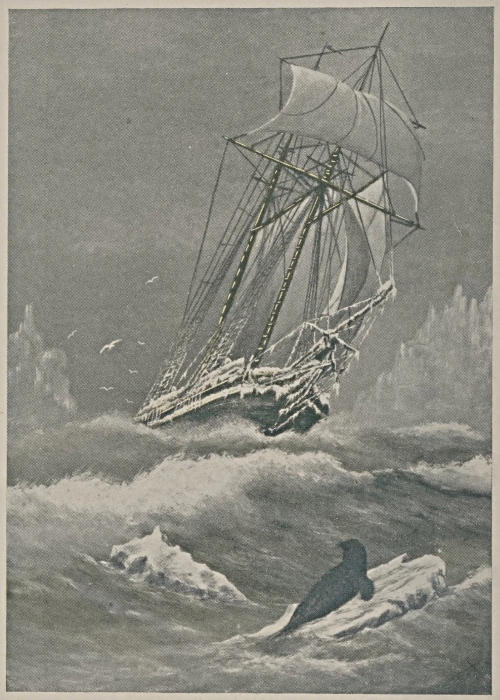
Two nights later they were aroused by shouts and
cries, the sound of hurrying feet, and crashing shivering
blows that shook the schooner from stem to
stern. At first they thought the Narwhal had gone
adrift and was on the rocks. Hurrying into their garments
they rushed on deck to gaze upon a terrific,
wild and magnificent sight. The wind had shifted
and was blowing half a gale from the east and the
broken ice, that had been drifting out of the bay for
the past three days, was now being driven back.
Tossing on the waves, the great masses of gleaming
ice came in, grinding together, crashing like thunder
as one collided with another, bumping and roaring
as they lifted and fell upon the seas. In a vast solid
rampart, the upended jagged cakes were approaching
the Narwhal, and already she was surrounded by
scores of the cakes—huge, sharp-edged bits of floe
twenty feet or more in thickness, and hurled like battering
rams by wind and waves.
Instantly, the boys realized the peril the schooner
was in. Each time a great cake was flung against
the stout ice sheathing of her hull, the Narwhal
shivered and trembled. It seemed impossible
that any vessel could withstand the steady buffeting,
the constant impacts, of the tossing cakes.
Shouting, and yelling, the men and the Eskimos
labored, striving to ward off the ice with poles, by
lowering great rope fenders over the sides, and by
paying out cable, but their puny efforts made no impression
on the irresistible oncoming ice. Presently,
however, the boys noticed that there were fewer
shocks, that the blows seemed less severe and then
they saw the reason. The first cakes of ice had
reached the shore, others had piled upon them,
back of these the oncoming ice was checked and, unable
to move farther, the countless thousands of heaving,
crashing, grinding cakes were jammed together
and the schooner was locked fast in their embrace.
“Gosh! that was a narrow escape!” cried Jim. “But
I guess we’re all right now.”
“All right!” burst out Mr. Kemp. “Here’s where
we’re a-goin’ to get it good an’ plenty. If the Narwhal
ain’t stove it’ll be nothin’ short of a miracle.”
For a moment the boys could not see where the
danger lurked and every one was too busy to answer
the questions they longed to ask. But presently they
understood. The gale, the heavy seas outside the
bay and the tide were all pushing with terrific force
against that vast mass of millions of tons of ice, and
the schooner was gripped within it as in the jaws of a
titanic vise. Only her hull of oak and pine, a mere
egg shell in that stupendous field of ice, lay between
the cakes, and no fabric built by human hands
could withstand that awful pressure.
With sickening creaks the timbers and planks began
to give. With horrified eyes the boys saw the
stout sides and bulwarks bending and buckling inwards.
The heavy oak rail parted, splintered and
ripped like a match stick. With a report like a gunshot
the decks sprang into the air and rose in a steep
hill-like ridge above the shattered bulwarks.
“Gosh, Jim, it’s all over with the old Narwhal!”
cried Tom, scarcely able to realize that the stout old
schooner had met her fate at last. “Now what will
we do?”
Even as he spoke the boys were thrown headlong
on to the ripped deck and with a terrific lurch the
schooner’s stern reared high in air. She careened
terribly, and a moment later was lying almost on her
beam ends on the top of the floe which had forced
its way beneath her keel. Captain Edwards, old
Pem and Mr. Kemp were shouting and yelling orders
while the Eskimos who had seen their plight from the
shore came hurrying over the ice to help. Soon
every one was laboring like mad, unloading the cargo,
getting out stores and supplies and preparing to
desert the schooner, for all knew, that should the
wind shift and the ice go out, the Narwhal would
plunge to the bottom like a lump of lead.
Rapidly the casks of oil, the bales of whalebone,
the bundles of skins, and the sacks of walrus ivory
were lowered over the schooner’s sides. In a constant
stream the Eskimos’ sledges went back and
forth between the stove schooner and the shore, carrying
the salvaged goods which were piled in a great
mound well back from the beach.
At last everything movable had been saved. The
spars and sails, the chains and cables, the blocks and
tackle and the running rigging were stripped from
the Narwhal and with lumber hastily torn from the
long deck house a shed was built over the pile of
valuables and supplies.
“Gee, we’re marooned here now,” cried Jim when
the last sledge had come from the schooner and her
sorrowing crew had tramped over the hummocky
ice and stood gazing at the pitiful-looking ship which
had served them so well.
“Reckon we won’t have to stay here long,” said
Captain Edwards. “The Ruby’s up to Nepic Inlet
and, if we can make her, we’ll be all right.”
“The Ruby?” queried Tom. “What’s she?”
“Little brigantine out o’ Nova Scotia,” replied
the skipper. “Bluenose sealer. Guess her skipper’ll
be willin’ to come in here an’ pick up this stuff
of ourn an’ give us a lift to port.”
“But how can we get to her?” asked Jim.
“Sleds,” replied the captain. “’Tain’t over a hundred
miles by land to the inlet an’ we can make it
all right. Snow’s still good enough for sleddin’.”
Since another warm spell and a thaw might arrive
at any moment, and make it impossible to travel
over the slushy snow, no time was to be lost. Within
two hours from the time the crew had come ashore,
all were on their way across the snow-covered land
toward Nepic Inlet and the Ruby.
Leading the party was Amaluk, with his sledge
laden with necessities, the men’s personal belongings,
food, and supplies. Behind him came team after
team and the schooner’s men and officers. In the
rear were the two boys with their own dog team,
their sledge laden with their trophies, and with
Unavik a few paces ahead of them.
Although the snow had been softened by the warm
spell, the change in wind and temperature had frozen
a hard crust upon it, and sledding was easy and rapid.
But the heavily loaded sledges broke through here and
there and the boys, bringing up the rear, found that
they could travel far easier by swinging to one
side on to the unbroken crust. Often, for several
miles, they were out of sight of the others, for they
made detours around hills and deep drifts and once
or twice stopped to shoot game. They had no fear of
going astray for the shrill shouts of the Eskimos, the
cracking of whips, and the yelps of the dogs were
borne plainly to them on the strong easterly
wind.
They had traveled in this way for several hours
when Tom, who was running ahead, halted and signaled
the dogs to stop. “Look here, Jim,” he cried,
“there are reindeer near. See, here’s where they’ve
been scraping away the snow and feeding.”
“Golly, that’s so,” assented Jim as he saw the bits
of moss on the white surface and the bare spots where
the animals had pawed away the snow from a deep
bed of moss.
“Let’s go after them!” suggested Tom. “They
may be near, and Captain Edwards said to get meat
if we could, to help out the provisions.”
“Better not,” cautioned Jim. “You know he told
us not to go off alone.”
“But that was different,” argued Tom. “He meant
not to go off on long trips. There’s no danger in
this. We can’t get lost. It’ll be dead easy to find
the others’ trail, or follow our own back. See, it’s
plain as can be.”
“No, I guess there’s no danger of that,” admitted
Jim. “All right, come on, but if we don’t find the
deer soon, we’ll have to come back.”
Urging their dogs forward, the boys followed the
deer’s trail and presently, by the dogs’ yelps and
growls and the way they strained at their traces, the
boys knew they were on a fresh scent, and that the
deer could not be far away. The trail led up a narrow
circuitous valley, and as the marks of the reindeer’s
hoofs became more and more distinct, and the
bits of moss where the animals had stopped to feed
were fresher, the boys knew they were nearing the
herd, and halted their dogs.
“Let’s look over that ridge before we go farther,”
suggested Tom. “They may be in the next hollow.”
Crawling up the low ridge, the boys peered over
and to their joy saw a dozen reindeer lying down and
resting. Hurrying to the dogs, the boys unharnessed
them, looped the neck thongs together and led the
pack to near the summit of the hill. Then, unleashing
them, they let them go. With loud barks
and growls the dogs rushed down at the surprised
deer.
Leaping to their feet the reindeer, as always,
formed a defensive ring, and while they were busy
keeping off the snapping dogs, the boys slipped
around the hill to get within easy range. So intent
were the deer upon their four-footed enemies that the
boys crept within fifty yards and brought down two
of the creatures. It was almost as simple and as
little sport as killing domestic cattle but the boys were
out after meat and not for sport and, having all they
needed, they ran towards the herd, yelling and shouting.
Instantly the survivors turned and fled, and the
dogs, after chasing them a short distance, came loping
back to the dead deer.
“We can’t carry both these, as they are,” said
Tom. “And we can’t afford to waste them. Let’s
dress them and leave the heads and horns. We have
better ones than these and the meat’s what we want
most.”
“Guess we’ll have to,” agreed Jim, and at once the
two set to work.
Although the boys had assisted Unavik and the
other Eskimos in dressing deer and musk oxen, they
had never before tried it alone and they soon found
that it was a hard and difficult undertaking. The
deer were heavy, the boys were no expert butchers
and the time passed more rapidly than they imagined.
As they finished the first deer and with grunts of
satisfaction stood up and looked about, they noticed
for the first time that the sky was overcast, that heavy
dun-gray clouds were scudding low overhead, and
that the wind had increased.
“Gee, I guess it’s going to storm!” exclaimed Jim.
“Don’t you think we’d better leave the other deer?”
“Why?” asked Tom. “If it does storm, it won’t
make any difference. We’re not two miles from the
trail, and we can make it in a few minutes. Come
on, let’s get busy on this other fellow. If it storms
it will be all the easier to catch up with the other
sledges. They’re slower than we are and may have
to stop.”
Once more the boys bent over the deer, cutting and
dressing the big carcass, and they had almost finished
when a few big snowflakes dropped upon the animal’s
hide.
“Golly, it’s snowing!” exclaimed Jim. “Say, we’ve
got to hurry!”
The snow was falling thick and fast by the time the
deer was dressed. Bending to the force of the wind,
the boys called to their dogs and started for the
sledge.
And then they realized that they had made a fatal
blunder. All intent upon dressing the deer they had
forgotten to knot the dogs’ thongs together, the
animals had been eating their fill of the offal from
the deer, and instinctively knowing a storm was approaching,
they were running nervously about, sniffing
the air and whining.
At Tom’s call, two of the dogs, old huskies who had
been long trained to obedience, came trotting to him,
but the others kept their distance.
“Come on, we’ll have to get them,” cried Jim, as
the boys knotted the thongs of the two together.
“Gosh, we were boobs not to have fastened them!”
But as soon as the boys started towards the dogs,
the animals turned, dashed away with tails between
their legs and growled savagely.
“Confound them!” cried Tom, and yelling a command
in Eskimo he made a rush at the nearest dog.
With a sharp bark, and baring his teeth, the creature
leaped away and then, lifting his head in air,
he uttered a long wolflike howl and galloped off
over the hill with the pack at his heels.
The boys looked at each other with real fear upon
their features.
“They’ve gone!” exclaimed Tom. “Now we are
in a fix.”
“We’ll have to leave the deer and the sledge and
hike it,” declared Jim. “Maybe these two dogs can
lead us to the trail.”
It was their one chance and urging the dogs on,
the boys started back over the trail of their sledge.
But presently they were again at a loss. The rapidly
falling snow had now covered the runner marks, the
dogs seemed confused and ranged back and forth,
and the boys grew more and more frightened. Then
one of the dogs gave a glad yelp and with noses to
the snow they strained at the leading thongs.
“It’s all right!” shouted Tom. “The dogs have
picked up the trail!”
“Well, they’re going in exactly the opposite direction
I think they should have gone,” declared Jim.
“But I suppose they know.”
Over low hills and through valleys the dogs led the
boys while the blizzard raged. To the frightened
and nervous lads it seemed as if they had covered
twice the distance they had come when the dogs
barked loudly, sniffed the air and tugged harder than
ever at the leash.
“Guess the others are near now!” panted Tom,
striving to keep pace with the dogs. “They smell
something.”
The next instant the dogs cringed back, the hair
rose upon their necks and with tails drawn in they
whimpered as if in fear.
“Gosh, I wonder what’s up now!” exclaimed Tom.
“Maybe a bear or wolf ahead,” suggested Jim,
cocking his rifle.
Anxiously the boys peered into the misty white
ahead and saw a low, irregular mound of snow with a
dark object projecting from it.
“Say, what’s that ahead?” queried Jim in low
tones.
“Looks like a sled covered with snow,” replied
Tom. “We’ll soon see.”
Approaching cautiously, while the dogs struggled
to keep back, the boys neared the little white mound,
and the next instant Jim uttered a piercing, frightened
cry and leaped back. Sticking stiffly up from
the snow was a human arm!
“Gee, it’s a man!” exclaimed Tom. “What are
you afraid of? Maybe he’s got lost or injured and
is not dead yet. Come on, let’s see.”
With fast beating hearts the boys, overcoming their
fears and nervousness, stepped close to the ominous
pile of snow. Tom grasped the outstretched fur-clad
arm.
But the next instant he let go, yelled, and jumped
away with a white face. The arm was frozen stiff.
It was the arm of a corpse!
“He—he’s dead!” stammered Tom.
Jim had now recovered himself. “Well, he won’t
hurt us if he is,” he reminded Tom. “It’s awful I
know, but we must find out who he is. It may be one
of our men.”
“Ugh, I hate to go near it!” declared Tom.
“So do I, but we’ve got to,” said Jim. “Come on,
Tom, we’re no babies or silly nervous girls. Brace
up.”
Striving to control their nervous fears, the boys
grasped the furs encasing that gruesome stiff arm and
tugged. Presently, with a horrible, terrifying motion,
the arm moved, the snow broke loose and the
boys involuntarily screamed and jumped away as the
body rolled over free from snow.
With wide eyes the two gazed upon the corpse
and backed still farther off. The body, clad in furs,
was that of a short, heavily built man, but the face,
swarthy, black-bearded and black-browed, was frightful
with the expression of fear and awful agony
stamped upon it. At the first glance the boys
saw with inexpressible horror that the whole side
of the skull was crushed in and the scalp ripped
off.
“Wha—wha—what killed him, I wo—wonder!”
stammered Tom, his teeth chattering.
Jim, summoning all his courage, took a step nearer.
“A bear!” he exclaimed, as he caught sight of a row
of great gashes in the man’s neck and the ripped and
torn back of the fur coat.
“Well, le—let’s get away from here,” stuttered
Tom. “We ca—can’t do anything.”
Without replying Jim turned and with boyish terror
of death gripping their hearts, and all their courage
flown, the two raced away from the body.
Not until they had topped the next rise did they
stop. Then, as they halted to regain their breaths,
they noticed that the snow had almost ceased, the
wind had gone down and they could see for a long
distance across the white landscape.
A moment later Tom gave a glad cry. “Look Jim!
Look!” he yelled. “We’re all right! see, over on
that second hill! There’s some of the men!”
“Hurrah! you’re right!” yelled Tom as he too
caught sight of two sledges just topping a distant
ridge. “Come on!”
Yelling and shouting, the boys raced forward as
fast as the newly fallen snow would permit. As they
gained the summit of the second hill, they waved
their arms wildly. But they were already seen.
The dogs wheeled, the sleds swung around, and with
the two drivers riding the runners, they came racing
towards the boys.
As they came near Tom and Jim looked at each
other in surprise. The dogs, they knew, were not
the Eskimos’. One team was made up of huge black
and white Newfoundlands, the other of shaggy-haired,
magnificent, cream-colored huskies. At the boys’
first glance they were sure the men were utter strangers.
“Hello!” cried the foremost man as his sledge,
drawn by the Newfoundlands, came to a halt close to
the boys. “What you kids doing out here?”
“We got separated from our party and lost,” explained
Tom. “Our dogs broke away and cleared
out. You’re from the Ruby aren’t you?”
That any other white men should be here had never
occurred to the boys, and yet the men did not look
like whalemen or sailors. One was clad in a gay
Mackinaw, the other in furs; both were large, powerfully
built fellows and both had an alert, erect, peculiar
bearing that was very different from any whalemen
the boys had even seen. The man in the
Mackinaw was lean-jawed, with keen gray eyes and
wore a close-cropped mustache, while the other was
smooth-faced. Although both were as red as Indians
from wind and weather and had a week’s stubble
of beard upon their faces, they wore an indefinable
stamp of authority about them.
The boys remembered that Captain Edwards had
said the Ruby was a Nova Scotia ship, and as they
had never seen Nova Scotia seamen, they thought the
men before them might be the officers of the brigantine.
But at Tom’s words the man with the mustache
laughed pleasantly.
“Well, hardly!” he replied. “I’ve been taken for
most everything, but never for a sealer before. No,
we’re just ordinary Northwest Police. I’m Sergeant
Manley and this chap”—jerking his head towards his
comrade—“is Private Campbell. We’re from Fort
Churchill. Been mushing it for two weeks. Looking
for the darkest-dyed rascal that ever disgraced
the Dominion. Fellow named Pierre Jacquet—Chippewa
half-breed. Wanted for murder and with
a thousand dollars reward for him, dead or alive.
Haven’t seen anything of him, have you?”
Tom shook his head. “No,” he replied. “But
say, Sergeant, we found a dead man back there. He’d
been killed by a bear or something. He was awful!
His head smashed in and torn to pieces! Gee, it
makes me feel sick to think of him.”
“Dead man!” snapped the Sergeant. “What did
he look like?”
“He was short and stout with a black beard and
bushy, black eyebrows,” replied Tom, “and had on a
suit of harp seal trimmed with blue fox.”
The Sergeant whistled. “Boys,” he cried, slapping
Tom on the back. “You’re lucky kids! Not
many can get lost and make a thousand dollars by
doing it!”
“Why, what do you mean?” asked Tom puzzled.
“Mean!” cried Sergeant Manley. “Why, that
dead man’s Jacquet. You’ve won a thousand dollars
by finding him. Come on, lead us to him.”
Now that the snow had ceased to fall it was easy
to retrace their footsteps, and in a few minutes the
party was once more approaching the dead man.
“It’s Pierre all right!” declared the Sergeant, as
he glanced at the dead man.
“Aye, there’s nae doot o’ it,” agreed Campbell.
“Mon, but ’tis a fit endin’ he met.”
“Can’t take him back to the Fort,” commented the
Sergeant, half to himself. “Can’t bury him. Guess
we’ll have to leave him. Campbell, search his clothes
for anything that will identify him.”
Rapidly the private went through the pockets of
the dead outlaw, turning the body over as nonchalantly
as though it were a log, and presently he
straightened up.
“Aye, here’s his dirk an’ a wee bit o’ siller,” he
announced as he handed the Sergeant a long-bladed
hunting knife reddened with blood and a buckskin
bag of money.
“Must have shot at the bear and wounded him, and
had a hand-to-hand fight,” remarked Manley. “Used
his knife evidently, but the bear got in the finishing
blow. Hmm, there must be papers or jewelry or a
watch or something on him.”
Stooping, the Sergeant again examined the body,
stripping aside the furs, and presently rose with a
satisfied grunt. “Guess this is all we need,” he said
as he showed a heavy, old-fashioned silver watch, a
bundle of letters and small book. “Nothing more to
do here,” he continued. “We’ll see you to the Ruby
now.”
“But we can’t leave our sledge,” objected Tom.
“It’s got all our things on it.”
Sergeant Manley stroked his mustache and bit his
lip as he hesitated. “All right,” he assented at last.
“Guess we can find it. You saved us a lot of hard
work by finding Jacquet, so we can afford to do our
bit.”
With keen, trained eyes the officers followed the
boys’ trail, half hidden though it was, and long before
Tom and Jim realized that they were near it,
private Campbell sighted the abandoned sled covered
deep with snow.
“Might as well take your meat, too,” said the Sergeant.
“These Newfoundlands can manage one deer
and we can load the other on your sled and hitch
your two huskies on with Campbell’s dogs to haul
it.”
In a few minutes the deer were lashed to the
sledges, the boys’ dogs had been harnessed to Campbell’s
team, and with the boys riding, the dogs raced
forwards over the soft fresh snow.
“Have to give us your address so that reward can
be sent you,” said the Sergeant as they dashed down a
long slope.
“I don’t want it,” declared Tom. “It belongs to
you and private Campbell, doesn’t it, Jim?”
“Of course,” agreed Jim. “I wouldn’t think of
taking it. Why, we just stumbled on the body by
chance and you’d have found it if we hadn’t.”
“That’s being too generous,” declared the Sergeant.
“It belongs to you. We might have passed by and
never found the body.”
“Well, we want you to have it—even if you call
it a present—or to show our gratitude for finding
you and getting saved,” insisted Tom.
“I can’t thank you—only to say thanks awfully,”
declared Manley, “and I’ll tell the wife what a couple
of fine kids you are when I get back to the Fort.”
“Aye!” shouted the private. “Yon bit o’ siller’ll
come muckle handy i’ celebratin’ o’ a weddin’ wi’ a
bonny lass awaitin’ me i’ yon Fort.”
Then as the boys sped on, they talked with the
two stalwart guardians of His Majesty’s law in the
frozen wastes, and told them all about their trip,
their hunts, and the staving of the Narwhal, and even
of their former cruise in the Hector, to the Antarctic.
To all of this Campbell and his Sergeant listened
attentively, laughing gaily over Cap’n Pem and Mike,
now and then asking a question, uttering surprised
ejaculations as the boys told of their adventures, and
now and again glancing at each other and raising their
eyebrows as Tom and Jim told of the rich catch of
furs, hides, and ivory the Narwhal had made. Rapidly
the time passed. Untiringly the powerful dogs
raced on, until at last, Sergeant Manley raised his
fur-mittened hand and pointed ahead.
“Tinavik Cape,” he said. “See that conical hill?
Guess you’ll see your people when you get to the
ridge there.”
Down into a deep, wide valley the sledges sped;
across a broad frozen river, and up the farther slope,
and gaining the top of the sharp, high ridge the dogs
came to a standstill, panting and winded.
“Hurrah! We’re there!” shouted Tom as the
boys looked down from the hilltop. “There’s the
brigantine!”