Seventy-two years after the adoption of the
Constitution, called into being to form “a more
perfect union,” and eighty-five years after the declaration
of independence (a space completely covered by the lives
of men still living), a new confederacy of seven Southern
states was formed, and the great political fabric, the
exemplar and hope of every lover of freedom throughout
the world, was apparently hopelessly rent. Of these
seven states but two were of the original thirteen—Louisiana
and Florida had been purchased by the government
of the Union; a war had been fought in behalf of
Texas; two states, Alabama and Mississippi, lay within
original claims of Georgia, but had been ceded to the
Union and organized as Federal territories.
April 11, 1861, found a fully organized separate government
established for these seven states, with a determination
to form a separate nation, most forcibly
expressed by the presence of an army at Charleston,
South Carolina, which next day was to open fire upon
a feebly manned fort, and thus to begin a terrible civil
war. The eight other slave states were in a turmoil of
anxiety, leaning toward their sisters of the farther South
through the common sympathy which came of slavery,
but drawn also to the Union through tradition and
appreciation of benefits, and through a realization by a
great number of persons that their interests in slavery
were much less than those of the states which had already
seceded.
The North, in the middle of April, was only emerging
from a condition of stupefied amazement at a condition
which scarcely any of its statesmen, and practically none
of the men of every-day life, had thought possible. It
was to this crisis that the country had been brought by
the conflicting views of the two great and strongly divided
sections of the Union respecting slavery, and by
the national aspirations which, however little recognized,
were working surely in each section, but upon
divergent lines.
* * * * *
The outward manifestations in the history of the
separation of the North and the South stand out in
strong relief: the Missouri question; the protective tariff
and South Carolina nullification; the abolition attacks
which wrought the South into a frenzy suicidal in character
through its impossible demands upon the North
for protection; the action of the Southern statesmen in
the question of petitions; the passage of a fugitive-slave
law which drove the North itself to nullification; the
Kansas-Nebraska act and its outcome of civil war in the
former territory; the recognition, in the dicta of the
supreme court in the Dred Scott case, of the South’s
contention of its constitutional right to carry slavery
into the territories, and the stand taken by the North
against any further slavery extension. To these visible
conflicts were added the unconscious workings of the
disruptive forces of a totally distinct social organization.
The outward strifes were but the symptoms of a malady
in the body politic of the Union which could have but
one end, unless the deep, abiding cause, slavery, should be
removed.135
The president and vice-president of the Southern Confederacy,
in their elaborate defences written after the
war, have endeavored to rest the cause of the struggle
wholly on constitutional questions. Stephens, whose
book, not even excepting Calhoun’s utterances, is the
ablest exposition of the Southern reading of the Constitution,
says: “The struggle or conflict, ... from its
rise to its culmination, was between those who, in whatever
state they lived, were for maintaining our Federal
system as it was established, and those who were for a
consolidation of power in the central head.”136 Jefferson
Davis is even more explicit. “The truth remains,” he
says, “intact and incontrovertible, that the existence of
African servitude was in no wise the cause of the conflict,
but only an incident. In the later controversies ...
its effect in operating as a lever upon the passions, prejudices,
or sympathies of mankind was so potent that
it has been spread like a thick cloud over the whole
horizon of historic truth.”137
This is but begging the question. The constitutional
view had its weight for the South in 1860 as it had for
New England in the Jefferson-Madison period. Jefferson’s
iron domination of the national government during
his presidency, a policy hateful to New England, combined
with the fear of being overweighted in sectional
influence by the western extension through the Louisiana
purchase, led to pronounced threats of secession by men
of New England, ardently desirous of escaping from what
Pickering, one of its most prominent men, termed the
Virginian supremacy.138 Exactly the same arguments were
used, mutatis mutandis, later by the South.
As we all know, the movement, which never had any
real popular support and which had its last spasm of life
in the Hartford Convention at the close of the War of
1812, came to naught. Freed by the fall of Napoleon
and the peace with England from the pressure of the
upper and nether mill-stones which had so ground to
pieces our commerce, a prosperity set in which drowned
the sporadic discontent of the previous twenty years.
The fears of the Eastern states no longer loomed so high
and were as imaginary in fact, and had as slight a basis,
as were, in the beginning of the era of discord, those of
the South. Could slavery have been otherwise preserved,
the extreme decentralizing ideas of the South
would have disappeared with equal ease, and Stephens’
causa causans—“the different and directly opposite views
as to the nature of the government of the United States,
and where, under our system, ultimate sovereign power
or paramount authority properly resides,” would have
had no more intensity of meaning in 1860 than to-day.
Divergence of constitutional views, like most questions
of government, follow the lines of self-interest; Jefferson’s
qualms gave way before the great prize of Louisiana;
one part of the South was ready in 1832 to go to war on
account of a protective tariff; another, Louisiana, was
at the same time demanding protection for her special
industry. The South thus simply shared in our general
human nature, and fought, not for a pure abstraction, as
Davis and Stephens, led by Calhoun, would have it, but
for the supposed self-interest which its view of the Constitution
protected. Its section, its society, could not
continue to develop in the Union under the Northern
reading of the document, and the irrepressible and certain
nationalization, so different from its own tendencies,
to which the North as a whole was steadily moving.
Slavery drove the South into opposition to the broad,
liberal movement of the age. The French Revolution;
the destruction of feudalism by Napoleon; the later
popular movements throughout Europe and South
America; the liberalizing of Great Britain; the nationalistic
ideas of which we have the results in the
German empire and the kingdom of Italy, and the strong
nationalistic feeling developing in the northern part of
the Union itself had but little reflex action in the South
because of slavery and the South’s consequent segregation
and tendency to a feudalistic nationalization.
General Scott, with his memories of 1832, was one of
those who appreciated the danger hanging over the
country, and, October 29, 1860, he wrote from New York,
where he had his headquarters, a letter of great length
to the President, which in pompous phrases, conceding
the right of secession, and embodying some absurd ideas,
such as allowing “the fragments of the great republic to
form themselves into new confederacies, probably four,”
as a smaller evil than war, gave it as his “solemn conviction”
that there was, from his knowledge of the Southern
population, “some danger of an early act of rashness
preliminary to secession, viz.: the seizure of some or all
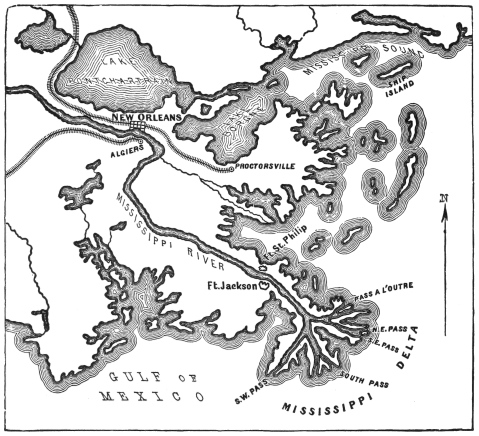
of the following posts: Forts Jackson and St. Philip on
the Mississippi; Morgan below Mobile, all without garrisons;
Pickens, McKee at Pensacola, with an insufficient
garrison for one; Pulaski, below Savannah, without a
garrison; Moultrie and Sumter, Charleston harbor, the
former with an insufficient garrison, the latter without
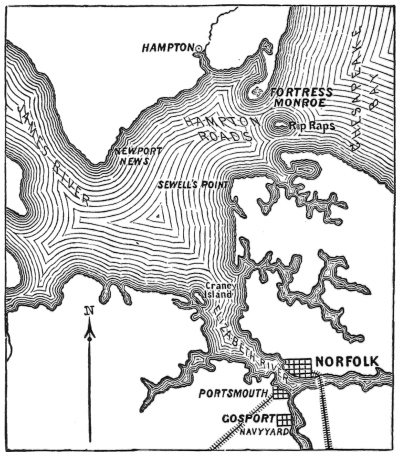
any; and Fort Monroe, Hampton Roads, with an insufficient
garrison.”
He gave it as his opinion that “all these works should
be immediately so garrisoned as to make any attempt to
take any one of them by surprise or coup de main ridiculous.”
He did not state the number of men needed, but
in a supplementary paper the next day (October 30th)
said, “There is one (regular) company in Boston, one
here (at the Narrows), one at Pittsburg, one at Baton
Rouge—in all, five companies only within reach.”139 These
five companies, about two hundred and fifty men, were
of course absurdly inadequate to garrison nine such posts,
but, had there been a determination in the President’s
mind to prevent seizures, enough men could have been
brought together to hold the more important points.
For Scott’s statement as to the number available was
grossly inaccurate, and but serves to show the parlous
state of a war department in which the general-in-chief
can either be so misinformed or allow himself to remain
in ignorance of vital facts. There were but five points
in the farther South of primal importance: the Mississippi,
Mobile, Pensacola, Savannah, and Charleston; two hundred
men at each would have been ample to hold the
positions for the time being, and, being held, reinforcement
in any degree would later have been easy. There
was a total of 1048 officers and men at the Northern
posts,140 including Leavenworth, Mackinac, Plattsburg,
Boston, New York, and Fort Monroe, who could have
been drawn upon. There were already 250 men at
Charleston, Key West, Pensacola, and Baton Rouge.
It is safe to say that a thousand men were available.
There were also some eight hundred marines at the navy-yards
and barracks141 who could have been used in such
an emergency. The aggregate of the army, June 30,
1860, was 16,006, of which 14,926 were enlisted men;
and it was in the power of the President to increase this
total aggregate to 18,626.142 Recruiting was, in fact,
actively going on; almost every man at the posts mentioned
could, even much after the date of Scott’s paper,
have been safely withdrawn for the object mentioned and
quickly replaced.
Scott’s inaccurate report gave Buchanan additional
reason for the inaction which was his basic thought.
He says, in his apologia, that “to have attempted to distribute
these five companies in the eight forts of the
cotton states and Fortress Monroe in Virginia, would
have been a confession of weakness.... It could have
had no effect in preventing secession, but must have
done much to provoke it.”143 The first part of this statement
would have been true had these five companies
been the only force available; the second, on the supposition
that the President meant that any attempt with
a force reasonably large would have provoked secession,
was a short-sighted view. To garrison the forts could
not have been more obnoxious than to put them in a
state of defence. At any time before the secession of a
state they could have been garrisoned without bringing
on actual conflict. The statesmen of the South were
well aware that an attack upon an armed force of the
United States, before secession, must place them irretrievably
in the wrong. South Carolina did not secede
until December 20th. To resist the sending of troops
before this date to any of these forts would have been
unqualified treason, and for this no one in the South
was prepared. The safety of the secession movement,
the extension of sympathy throughout the South, rested
very greatly upon strict compliance with the forms of
law and with the theories of the Constitution held by
that section. At least one ardent secessionist, Judge
Longstreet, recognized this when he appealed to South-Carolinians
to refrain from any act of war; “let the first
shot,” he said, “come from the enemy. Burn that precept
into your hearts.”144 It was impossible that the
Southern leaders should place themselves, or allow their
people to place them, in the attitude of waging war against
the Union while even in their own view their states still
remained within it. There was, too, still a very large
Union sentiment in the South, though finally swept into
the vortex by the principle of going with the state, which
would not have been averse to a determined action on
the part of the President and might have upheld it, as
in 1833. Such vigor would have given this sentiment a
working basis, through the evidence that the Federal
authority was to be upheld; and it would have caused
a pause even in the least thoughtful of the secessionists
had they felt that their coast strongholds were to be held
and all their ports to be in the hands of the enemy. In
the dearth of manufactures in the South, the holding of
their ports was an essential to Southern military success.
Their closure by blockade was equally an essential to
the success of the North. The strategy of the situation
was of the clearest and most palpable, and with their
coast forts in Union hands warlike action on the part
of the South is not conceivable. One can thus understand
the importance of spreading the reiterated statements
of “intense excitement” and “danger of attack”
in the event of reinforcement; statements which, in the
circumstances, must be regarded, if the phrase may be
used, in the nature of a gigantic and successful “bluff.”
* * * * *
The military property of the United States at Charleston
consisted of the armory, covering a few acres, where
were stored twenty-two thousand muskets and a considerable
number of old, heavy guns, and of three forts
named for South-Carolinians of Union-wide fame. The
smallest of these, Castle Pinckney, was a round, brick
structure, in excellent condition, on a small island directly
east of the town and distant from the wharves but half
a mile. It completely commanded the town, and had
a formidable armament of four forty-two-pounders,
fourteen twenty-four-pounders, and four eight-inch sea-coast
howitzers. The powder of the arsenal was here
stored. The only garrison was an ordnance sergeant,
who, with his family, looked after the harbor light which
was in the fort.
Almost due east again, and three miles distant, was
Fort Moultrie, on the south end of Sullivan’s Island, a
low sand-spit forming the north side of the harbor entrance.
The work had an area of one and a half acres,
and mounted fifty-five guns in barbette. The drifting
sands had piled themselves even with the parapet, and
the work was in such condition as to be indefensible
against a land attack. The whole was but of a piece with
the long-continued neglect arising from many years of
peace and the optimistic temperament of a people who
never believe that war can occur until it is upon them;
it was the natural outcome of the almost entire absence
of governmental system and forethought of the time.
The fort was garrisoned by two companies, comprising
sixty-four enlisted men and eight officers, of the First
regiment of artillery; the surgeon, band, a hospital
steward, and an ordnance sergeant brought the total up
to eighty-four.
Almost south of Moultrie was Cummings Point, on
Morris Island, forming the southern side of the harbor
entrance. Nearly midway between this point and
Moultrie, but a half-mile within the line joining them,
and distant three and a half miles from the nearest part
of the city, was Fort Sumter, begun in 1829, and after
thirty-one years not yet finished. Built on a shoal covered
at most stages of the tide, it rose directly out of the
water, with two tiers of casemates, and surmounted by
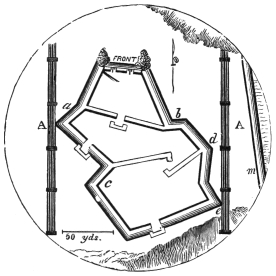
a third tier of guns in barbette. In plan it was very
like the transverse section of the ordinary American house,
the apex of the two sides representing the lines of the
roof, looking toward Moultrie. It was intended for a
garrison of six hundred and fifty men and an armament
of one hundred and forty-six guns, of which seventy-eight
were on hand.
On a report made in July by Captain J. G. Foster, repairs
on Moultrie were begun September 14th, and next day
upon Sumter, some two hundred and fifty men being
employed. The sand about the walls of Moultrie was
removed, a wet ditch dug, a glacis formed, the guardhouse
pierced with loop-holes, and the four field-guns
placed in position for flank attack.
At the end of October, Captain Foster, foreseeing events,
requested the issue of arms to the workmen to protect
property, and the Secretary of War approved the issue of
forty muskets, if it should meet the concurrence of the
commanding officer. Colonel Gardner, in reply, November
5th, doubted the expediency, as most of the laborers
were foreigners, indifferent to which side they took, and
wisely advised, instead, filling up “at once” the two
companies at Moultrie with recruits and sending two
companies from Fort Monroe to the two other forts.145
The requisition was thus held in abeyance, and the
muskets remained at the arsenal. When, only two days
later, Gardner, urged by the repeated solicitations of his
officers, directed the transfer of musket ammunition to
Moultrie, the loading of the schooner was objected to by
the owner of the wharf, and the military store-keeper,
under apparently very inadequate pressure, returned the
stores to the arsenal. A permit, given by the mayor of
Charleston next day, for the removal was very properly
declined by Gardner, on the ground that the city authorities
could not control his actions.146
The affair, however, cost Gardner his command, by a
process described by the Assistant Secretary of State,
Trescot: “I received a telegram from Charleston, saying
that intense excitement prevailed, ... and that, if the
removal was by orders of the Department of War, it ought
to be revoked, otherwise collision was inevitable. Knowing
the Cabinet were then in session, I went over to the White
House.... I took Governor Floyd aside, and he was
joined, I think, by Messrs. Cobb and Toucey, and showed
them the telegram. Governor Floyd replied, ‘Telegraph
back at once; say that you have seen me, that no such
orders have been issued, and none such will be issued,
under any circumstances.’” Floyd, a day or so later,
gave Trescot “his impressions of the folly of Colonel
Gardner’s conduct, and his final determination to remove
him and supply his place with Major Robert Anderson,
in whose discretion, coolness, and judgment he
put great confidence. He also determined to send Colonel
Ben. Huger to take charge of the arsenal, believing that
his high reputation, his close association with many of
the most influential people in Charleston, and the fact of
his being a Carolinian, would satisfy the state of the
intention of the government.”147
That Floyd himself was in an uncertain state of mind
is shown by his willingness to begin and continue the
work upon the forts; that his mental state did not permit
logical action is clear from his temper and attitude
regarding the transfer of musket ammunition November
7th, though but the week before (October 31st) he had
authorized the transfer of the muskets themselves.
Major Fitz-John Porter, of the adjutant-general’s office,
later the able and ill-treated general, was sent to Charleston
to inspect the conditions. His report, made November
11th, revealed the military inefficiency almost inseparable
from a post so neglected and ill-manned, and
subject to the lazy peace conditions of the period. He
said: “The unguarded state of the fort invites attack,
if such design exists, and much discretion and prudence
are required on the part of the commander to restore the
proper security without exciting a community prompt to
misconstrue actions of authority. I think this can be
effected by a proper commander without checking in the
slightest the progress of the engineer in completing the
works of defence.” Major Porter continues with a most
significant phrase, “All could have been easily arranged
a few weeks since, when the danger was foreseen by the
present commander.”148
November 15th, Anderson was ordered to the command.
A Kentuckian by birth, his wife a Georgian, his views in
sympathy with those of General Scott, he appeared to be
and, as results proved, was in many respects particularly
fitted for the post; by November 23d he was able to
report that in two weeks the outer defences of Moultrie
would be finished and the guns mounted, and that Sumter
was ready for the comfortable accommodation of one
company, and, indeed, for the temporary reception of
its proper garrison. “This,” he said, “is the key to the
entrance to this harbor; its guns command this work
[Moultrie] and could drive out its occupants. It should
be garrisoned at once.... So important do I consider the
holding of Castle Pinckney by the government that I
recommend, if the troops asked for cannot be sent at
once, that I be authorized to place an engineer detachment
[of an officer and thirty workmen] ... to make the
repairs needed there.... If my force was not so very
small, I would not hesitate to send a detachment at once
to garrison that work. Fort Sumter and Castle Pinckney
must be garrisoned immediately if the government
determines to keep command of this harbor.”
Anderson proceeded to give advice which sane judgment
and every sentiment of national honor demanded.
After mentioning his anxiety to avoid collision with the
citizens of South Carolina, he said: “Nothing, however,
will be better calculated to prevent bloodshed than our
being found in such an attitude that it would be madness
and folly to attack us. There is not so much feverish
excitement as there was last week, but that there is a
settled determination to leave the Union, and obtain
possession of this work, is apparent to all.... The clouds
are threatening, and the storm may break upon us at
any moment. I do, then, most earnestly entreat that a
reinforcement be immediately sent to this garrison, and
that at least two companies be sent at the same time to
Fort Sumter and Castle Pinckney.” Anderson also
stated his belief that as soon as the people of South
Carolina learned that he had demanded reinforcements
they would occupy Pinckney and attack Moultrie; and
therefore it was vitally important to embark the troops
in war steamers and designate them for other duty as a
blind.149 Captain Foster, November 24th, reported the
whole of the barbette tier of Sumter ready for its armament
and as presenting an excellent appearance of preparation
and strength equal to seventy per cent. of its
efficiency when finished.150 He said, November 30th, “I
think more troops should have been sent here to guard
the forts, and I believe that no serious demonstration on
the part of the populace would have met such a course.”151
The work on the forts was, of course, well known to
the people of Charleston, and that at Moultrie, at least,
subject to daily inspection by many visitors. There was
still no restriction “upon any intercourse with Charleston,
many of whose citizens were temporary residents of
Sullivan’s Island. The activity about the fort drew to
it a large number of visitors daily, and the position of
the garrison and the probable action of the state in
regard to the forts were constant subjects of discussion.
There was as yet no unfriendly feeling manifested, and
the social intercourse between the garrison and their
friends in Charleston was uninterrupted. But as the
days went on the feeling assumed a more definite shape,
and found expression in many ways.... It was openly
announced, both to the commanding officer and to his
officers, that as soon as the state seceded a demand for
the delivery of the forts would be made, and, if resisted,
they would be taken.... Meantime, all of the able-bodied
men in Charleston were enrolled, military companies
were formed everywhere, and drilling went on by night
and day, and with the impression among them that they
were to attack Fort Moultrie.”152 November 28th and
December 1st, Anderson again pressed for troops or for
ships of war in the harbor;153 but his last request was anticipated
in a letter of the same date, when he was informed
by the War Department, “from information
thought to be reliable, that an attack will not be made
on your command, and the Secretary has only to refer
to his conversation with you and to caution you that, should
his convictions unhappily prove untrue, your actions
must be such as to be free from the charge of initiating a
collision. If attacked, you are of course expected to
defend the trust committed to you to the best of your
ability.”154
A demand being made by the adjutant of a South
Carolina regiment on the engineer officer at Moultrie for
a list of his workmen, “as it was desired to enroll the men
upon them for military duty,”155 Anderson asked for instructions.
The War Department replied, December 14th,
“If the state authorities demand any of Captain Foster’s
workmen on the ground of their being enrolled into the
service of the state, ... you will, after fully satisfying
yourself that the men are subject to enrolment, and have
been properly enrolled, ... cause them to be delivered up
or suffer them to depart.” Banality could go no further,
and Anderson, December 18th, informed the department
that, as he understood it, “the South Carolina authorities
sought to enroll as a part of their army intended to act
against the forces of the United States men who are
employed by and in the pay of that government, and
could not, as I conceived, be enrolled by South Carolina
‘under the laws of the United States and of the state of
South Carolina.’” No answer was vouchsafed to this,
and the request was not complied with.
Anderson’s repeated statements of the necessity of the
occupancy of Sumter, without which his own position
was untenable, led to the despatch of Major Buell, a Kentuckian,
and later a major-general of United States
volunteers, with verbal instructions, which, however, on
Buell’s own motion, and with the thought that Anderson
should have written evidence, were reduced, December
11th, to writing. This memorandum is of such importance
that it must be given in full.
“You are aware of the great anxiety of the Secretary
of War that a collision of the troops with the people of
this state shall be avoided, and of his studied determination
to pursue a course with reference to the military
force and forts in this harbor which shall guard against
such a collision. He has therefore carefully abstained
from increasing the force at this point, or taking any
measures which might add to the present excited state
of the public mind, or which would throw any doubt on
the confidence he feels that South Carolina will not
attempt, by violence, to obtain possession of the public
works or interfere with their occupancy. But as the
counsels and acts of rash and impulsive persons may
possibly disappoint those expectations of the government,
he deems it proper that you should be prepared
with instructions to meet so unhappy a contingency.
He has therefore directed me verbally to give you such
instructions. You are carefully to avoid every act which
would needlessly tend to provoke aggression; and for
that reason you are not without evident and imminent
necessity to take up any position which could be construed
in the assumption of a hostile attitude. But
you are to hold possession of the forts in the harbor,
and if attacked you are to defend yourself to the last
extremity. The smallness of your force will not permit
you, perhaps, to occupy more than one of the three forts,
but an attack on, or attempt to take possession of, any
one of them will be regarded as an act of hostility, and
you may then put your command into either of them
which you may deem most proper to increase its power
of resistance. You are also authorized to take similar
steps whenever you have tangible evidence of a design
to proceed to a hostile act.”156
These instructions did not come to the President’s
knowledge until December 21st, though a despatch from
Washington, December 13th, published in the Charleston
Courier, announced Major Buell’s visit; when made
known to the President, he directed them to be modified,
ordering that if “attacked by a force so superior that resistance
would, in your judgment, be a useless waste of
life, it will be your duty to yield to necessity and make
the best terms in your power.”157
December 3d, Anderson placed Lieutenant Jefferson C.
Davis with thirty men in Castle Pinckney, and began
work there. Action upon a request for arms for the
workmen at Sumter and Pinckney was deferred by the
War Department “for the present,” but Captain Foster
going to the arsenal, December 17th, for two gins for
hoisting, “to the transmission of which there was no
objection,” arranged with the store-keeper that the old
order of the Ordnance Department of November 1st, for
forty muskets, should be complied with, which was done.
“Intense excitement” as usual was reported the next
day to have occurred; there was the reiteration of great
danger of “violent demonstration” from a military official
of the state who called upon Foster, and who stated that
Colonel Huger had informed the governor that no arms
should be removed. Foster declined to return the arms,
stating that he knew nothing of Huger’s pledge, but was
willing to refer the matter to Washington. Trescot was
informed by telegraph that “not a moment’s time should
be lost.” The Secretary of War was aroused in the
depths of the night, and the result was a telegraphic order
from Floyd himself to “return [the arms] instantly.”158
The go-between Assistant Secretary of State, so busily
engaged with affairs not his own, received from the aide-de-camp
of Governor Pickens the telegram: “The Governor
says he is glad of your despatch, for otherwise there
would have been imminent danger. Earnestly urge that
there be no transfer of troops from Fort Moultrie to Fort
Sumter and inform Secretary of War.”159 Captain Foster,
explaining to the War Department, December 20, 1860,
says, “when in town to see General Schnierle and allay
any excitement relative to the muskets, I found to my
surprise that there was no excitement except with a
very few who had been active in the matter, and the
majority of the gentlemen whom I met had not even
heard of it.”160
Pickens, the new governor of South Carolina, December
17th, the day after his inauguration, and before the
state had passed the ordinance of secession, made a demand
on the President for the delivery of Fort Sumter.
The letter, drawn in the most offensive terms, and marked
“strictly confidential,” urged that all work be stopped
and that no more troops be ordered. It continued: “It
is not improbable that, under orders from the commandant,
or, perhaps, from the commander-in-chief of the
army, the alteration and defences of the posts are progressing
without the knowledge of yourself or the Secretary
of War. The arsenal in the city of Charleston, with
the public arms, I am informed, was turned over very
properly to the keeping and defence of the state force at
the urgent request of the Governor of South Carolina.
I would most respectfully, and from a sincere devotion
to the public peace, request that you would allow me to
send a small force, not exceeding twenty-five men and
an officer, to take possession of Fort Sumter immediately,
in order to give a feeling of safety to the community.”161
The ever-ready Trescot arranged an interview December
20th with the President for the delivery of the letter.
The President stated that he would give an answer the
next day. In the mean time Trescot, seeing the difficulties
to which it led, consulted both Senators Davis
and Slidell, who thought the demand “could do nothing
but mischief”; and on consultation with two of the
South Carolina delegation in Washington, Governor
Pickens was advised by telegraph to withdraw the
letter, which was done. Trescot’s letter to Governor
Pickens, returning that of the latter, after mentioning
all that had been done by the executive to refrain from
injuring the sensibilities of South Carolina, said: The
President’s “course had been violently denounced by
the Northern press, and an effort was being made to
institute a Congressional investigation. At that moment
he could not have gone to the extent of action you desired,
and I felt confident that, if forced to answer your
letter then, he would have taken such ground as would
have prevented his even approaching it hereafter; ...
you had all the advantage of knowing the truth, without
the disadvantage of having it put on record.... I was
also perfectly satisfied that the status of the garrison
would not be disturbed.... I have had this morning an
interview with Governor Floyd, the Secretary of War; ...
while I cannot even here venture into details, which are
too confidential to be risked in any way, I am prepared to
say ... that nothing will be done which will either do
you injury or properly create alarm.”162
The President’s painful weakness is but too clear in
the fact that he had not only given his confidence so
largely to such a man, whose position and attitude he
knew, but saw nothing derogatory in such a letter as
that of Governor Pickens, and could draft a reply
(December 20th) in which, while stating that no authority
had been given to Governor Gist to guard the
Charleston arsenal, he said: “I deeply regret to observe
that you seem entirely to have misapprehended my
position, which I supposed had been clearly stated in
my message. I have incurred, and shall incur, any
reasonable risk ... to prevent a collision.... Hence I
have declined for the present to reinforce these forts,
relying upon the honor of the South-Carolinians that they
will not be assaulted whilst they remain in their present
condition; but that commissioners will be sent by the
convention to treat with Congress on the subject.”163
December 18th the President sent Caleb Cushing with
a letter to Governor Pickens, with the idea of inducing
the authorities and people of South Carolina to await the
action of Congress and the development of opinion in the
North as to the recommendation of his message. Governor
Pickens told Cushing, December 20th, the day of
the passage of the ordinance of secession, that he would
make no reply to the letter, and stated “very candidly
that there was no hope for the Union, and that, as far as
he was concerned, he intended to maintain the separate
independence of South Carolina.”164
The question of the United States forts was now uppermost,
and upon the action regarding them hung war or
peace. Three commissioners—Robert W. Barnwell,
James H. Adams, and James L. Orr—were appointed by
South Carolina to lay the ordinance of secession before
the President and Congress, and were empowered as
agents of the state to treat for the delivery of the forts
and other real estate, for the apportionment of the
public debt, and for a division of all the property of the
United States.165
In apprehension of the occupation of Sumter by Anderson,
a patrol by two small steamers, the Nina and
General Clinch, was established, with orders to prevent
such action at all hazards and seize Fort Sumter if it
should be attempted. A Lieutenant-Colonel Green was
sent to Fort Monroe to observe any movements; and
one Norris, at Norfolk, was employed to give information
of any action at the Norfolk navy-yard. A committee of
prominent men was sent to Fort Sumter, who thoroughly
inspected the works and reported upon them.
Meantime, Major Anderson had been preparing, with
great caution and foresight, to move his command. For
some ten days the officers had been apprised that it was
advisable to send the families of the men to the unoccupied
barracks on James’ Island, known as Fort Johnson,
a mile and a quarter west of Sumter. The work of
mounting guns at Sumter had been discontinued for
three days, and the elevating-screws and pintle-bolts
sent to Moultrie so that the guns should not be used if
the South-Carolinians should anticipate his action, and
also to give the impression that occupancy of the fort
was not designed. All stores and provisions at Fort
Moultrie which could be carried, and personal belongings,
except what the men could carry in their knapsacks,
were loaded as for Fort Johnson in the two small
sailing-vessels which were to carry the women and children.
Christmas Day had been fixed for the transfer, but
heavy rains prevented. The delay might have had
other consequences, for, curiously enough, on the morning
of December 26th, Colonel R. B. Rhett, Jr., waited
upon the governor, with a private warning letter from
Washington to the effect that Anderson was about to
seize Sumter, and urged the governor to secure it.166
All was made ready on December 26th, and the quartermaster
who was to have charge of the little flotilla, loaded
with “everything in the household line from boxes and
barrels of provisions to cages of canary-birds,” was directed
to go to Fort Johnson, but not to land anything.
Upon a signal of two guns from Moultrie he was to go to
Sumter on the plea that he had to report to Anderson
that he could not find accommodations. Five pulling-boats
in customary use were available for the transportation
of the men. Only one officer had been thus far informed,
and the men had no suspicion where they were
to go when they fell in at retreat roll-call with packed
knapsacks and filled cartridge-boxes, carried at parade
under a general standing order. So little was the movement
suspected that Captain Doubleday, second in command,
came at sunset to Anderson in the midst of the
officers to invite the major to tea. He was then informed
of Anderson’s intentions, and was directed to
have his company in readiness in twenty minutes, an
order met by an “eager obedience.” Part of this time
was taken in arranging for the safety of Mrs. Doubleday
in the village outside of the fort, whither the families of
the other officers were also sent. The men were ready
promptly, and the first detachment of twenty, led by
Anderson himself, marched over the quarter of a mile of
sand to the landing-place with the good-fortune of encountering,
no one.
Anderson went in the leading boat. Lieutenant
Meade, the engineer in charge of the works at Castle
Pinckney, had charge of the second, and Captain Doubleday
of the third. When half-way across, Doubleday’s
boat came unexpectedly in the path of one of the patrol
boats, the General Clinch, which was towing a schooner
to sea. The men were ordered to take off their coats
and cover their muskets. The steamer stopped, but in
the twilight, and with the resemblance of the boat and
its load of men to the usual parties of workmen, suspicion
was not aroused, and the steamer resumed her
way without questioning. She had been anxiously
watched from Moultrie, and had she interfered would
have been fired upon by a thirty-two-pounder, two of
which had been loaded with that intent. Captain Foster,
with Assistant Surgeon Crawford, a Mr. Moall, four non-commissioned
officers, and seven privates, had been left
at Moultrie to spike the guns, burn the gun-carriages, and
hew down the flag-staff.167
On reaching Sumter, the workmen, some hundred and
fifty, swarmed to the wharf, some feebly cheering, many
angrily demanding the reason for the presence of the
soldiers; many of the workmen wore the secession cockade;
the malecontents (a number of whom shortly returned
to Charleston) quickly gave way before the bayonets
of Doubleday’s men, who at once occupied the
main entrance and guard-room; sentries were posted
and the fort was under military control. Boats were
now sent back for Captain Seymour’s company, which
arrived without interference, and the whole force, except
the few detailed to remain at Moultrie, was in Sumter
before eight o’clock, at which hour Anderson wrote the
Adjutant-General, reporting that he had “just completed,
by the blessing of God, the removal to this fort of all
my garrison.... The step which I have taken was, in
my opinion, necessary to prevent the effusion of blood.”168
On the firing of the signal-guns at Moultrie, Lieutenant
Hall left the west side of the bay with the two lighters
carrying the men’s families and stores, and reached
Sumter under sail.
With the help of the engineer’s workmen at Moultrie,
the boats were loaded during the night with part of the
impedimenta of every sort which had to be left in the
first crossing, and reached Sumter in the early dawn.
The following day, December 27th, was passed like the
preceding night, in transferring ammunition and other
stores to Sumter; but a month and a half’s supply of
provisions, some fuel, and personal effects had to be left.
All the guns at Moultrie were spiked, and the carriages
of those bearing on Sumter burned, the smoke from these
bearing to Charleston the first indication of what had
happened. At fifteen minutes before noon the command
and one hundred and fifty workmen were formed
in a square near the flag-staff of Sumter; the chaplain
offered a prayer expressing gratitude for their safe arrival,
and prayed that the flag might never be dishonored, but
soon float again over the whole country, a peaceful and
prosperous nation. “When the prayer was finished,
Major Anderson, who had been kneeling, arose, the battalion
presented arms, the band played the national air,
and the flag went to the head of the flag-staff, amid the
loud and earnest huzzas of the command.”169
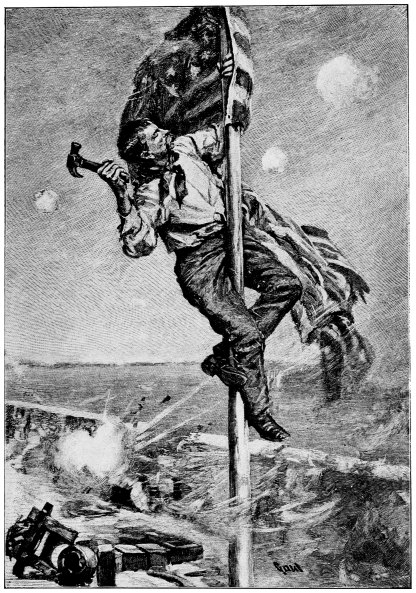
SERGEANT HART NAILING THE COLORS TO THE FLAG-STAFF, FORT
SUMTER
Intense excitement in Charleston was the natural outcome
of Anderson’s action, and the morning of the 27th
the governor sent his aide-de-camp, Colonel Pettigrew,
accompanied by Major Capers, with a peremptory demand
that Anderson should return with his garrison to
Moultrie, to which Anderson replied, “Make my compliments
to the governor and say to him that I decline to
accede to his request; I cannot and will not go back.”
The governor’s messenger mentioned that when Governor
Pickens came into office he found an understanding
between his predecessor (Gist) and the President, by
which the status in the harbor was to remain unchanged.
Anderson stated “that he knew nothing of it; that he
could get no information or positive orders from Washington;
... that he had reason to believe that [the state
troops] meant to land and attack him from the north;
that the desire of the governor to have the matter settled
peaceably and without bloodshed was precisely his own
object in transferring his command; ... that he did it
upon his own responsibility alone,” as safety required it,
“and as he had the right to do.” He added that, “In
this controversy between the North and the South, my
sympathies are entirely with the South,” but that a
sense of duty to his trust was first.170 The immediate result
was the occupancy by the state forces, December
27th, of Pinckney and Moultrie; the seizure, December
30th, of the unoccupied barracks known as Fort Johnson,
and of the arsenal, with its ordnance and ordnance stores,
valued at four hundred thousand dollars.
The news of Anderson’s dramatic, bold, and self-reliant
act, one for which the country owes a debt to the memory
of this upright and excellent commander, brought consternation
to the President and Secretary of War, who
learned it through the indefatigable Trescot, who had,
on the 26th, arranged for the three commissioners of
South Carolina an interview with the President for December
27th, at one o’clock. The news of the morning
brought a complete change of circumstances. A telegram
to Wigfall was brought by him to the commissioners
and to the Secretary of War, who at once went to the
commissioners. Trescot was present, and could not believe
in an “act not only without orders but in the face
of orders.” Floyd at once telegraphed, asking an explanation
of the report. “It is not believed, because
there is no order for any such movement.” A telegram
in reply from Anderson assured him of the truth, and a
written report gave as reasons that “many things convinced
me that the authorities of the state designed to
proceed to a hostile act. Under this impression I could
not hesitate that it was my solemn duty to move my
command from a fort which we could not have held
probably longer than forty-eight or sixty hours to this
one where my power of resistance is increased to a very
great degree.”171
[In January a futile attempt to relieve Fort Sumter was
made by sending from New York two hundred troops in
an unarmed steamer, The Star of the West, which was
fired upon by the secessionists in Fort Moultrie, and,
receiving no support from Fort Sumter, returned to
New York.]
Lamon’s172 officiousness resulted in giving both to
Anderson and to the Confederate authorities an impression
that Sumter would surely be evacuated; hence
Beauregard, March 26th, wrote to Anderson offering
facilities for removal, but asking his word of honor that
the fort would be left without any preparation for its
destruction or injury. This demand deeply wounded
Anderson, and he resented it in a letter of the same date,
saying, “If I can only be permitted to leave on the pledge
you mention, I shall never, so help me God, leave this
fort alive.”173 Beauregard hastened to state that he had
only alluded to the “pledge” on account of the “high
source” from which the rumors appeared to come, and
made a full amend, which re-established their usual
relations.
Anderson had informed Fox that, by placing the command
on a short allowance, he could make the provisions
last until after April 10th; but not receiving instructions
from the War Department that it was desirable to do so,
it had not been done.174 He had already reported, March
31st, that his last barrel of flour had been issued two
days before.175
Anderson’s little command, as he explained to Washington
April 1st, would now face starvation should the
daily supply of fresh meat and vegetables, still allowed
from Charleston, be cut off. Being in daily expectation,
since the return of Colonel Lamon to Washington, of receiving
orders to vacate the post, he had, to the great
disadvantage of the food supply, kept the engineer laborers
as long as he could. He now asked permission to
send them from Sumter; but the request, referred to
Montgomery April 2d by Beauregard, was refused, unless
all the garrison should go.176
April 1st an ice-laden schooner bound for Savannah
entered Charleston harbor by mistake, and was fired
upon by a Morris Island battery. Again the Sumter
batteries were manned and a consultation held, at which
five of the eight officers declared in favor of opening fire,
but no action was taken by Anderson beyond sending an
officer to the offending battery, from which word was
returned by its commanding officer that he was simply
carrying out his orders to fire upon any vessel carrying
the United States colors which attempted to enter.
On April 4th Anderson assembled his officers, and for
the first time made known to them the orders of January
10th and February 23d, directing him to act strictly on
the defensive. As Lieutenant Talbot had just been promoted
captain and ordered to Washington, Anderson
determined to send by him his despatches. In order to
arrange for his departure, Talbot, April 4th, accompanied
Lieutenant Snyder, under a white flag, to call the attention
of the governor to the fact that the schooner fired
upon had not been warned by one of their own vessels,
as had been arranged. It developed that the guard-vessel
on duty had come in on account of heavy weather,
and the commanding officer was consequently dismissed.
The request to allow Talbot to proceed brought out the
fact that orders had been received from Montgomery not
to allow any portion of the garrison to leave the fort
unless all should go177—which, however, Beauregard construed,
for the benefit of Talbot, to apply more particularly
to laborers and enlisted men178—and also that the following
telegram from Commissioner Crawford had reached
Charleston April 1st: “I am authorized to say that this
government will not undertake to supply Sumter without
notice to you. My opinion is that the President has
not the courage to execute the order agreed upon in
Cabinet for the evacuation of the fort, but that he intends
to shift the responsibility upon Major Anderson by suffering
him to be starved out. Would it not be well to aid
in this by cutting off all supplies?”179 Beauregard had,
the same day, sent the message to the Confederate Secretary
of War, with the remark, “Batteries here ready
to open Wednesday or Thursday. What instructions?”
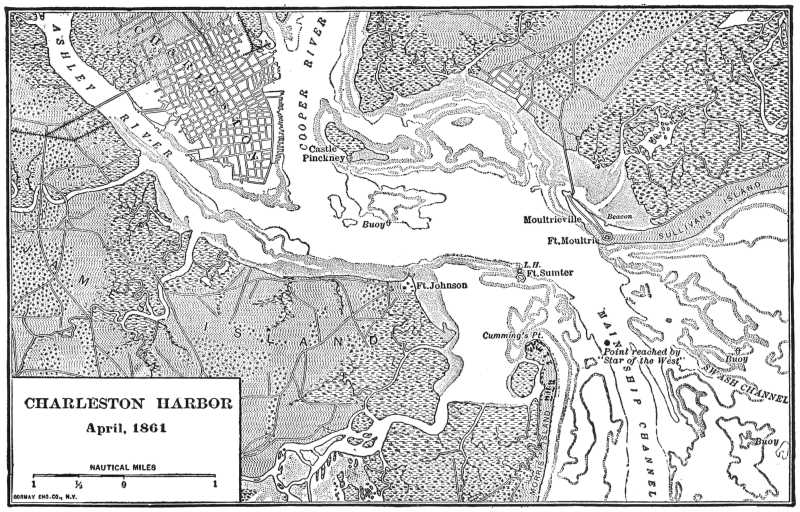
CHARLESTON HARBOR
April, 1861
The knowledge of these telegrams called from Anderson,
April 5th, a pathetic despatch to the War Department:
“I cannot but think Mr. Crawford has misunderstood
what he has heard in Washington, as I cannot think
the government could abandon, without instructions and
without advice, a command which has tried to do all
its duty to our country.” He ended a fervent appeal
for this act of justice with, “Unless we receive supplies
I shall be compelled to stay here without food or to
abandon this post very early next week.”180 “At this
time,” says Doubleday, “the seeming indifference of the
politicians to our fate made us feel like orphan children
of the Republic, deserted by both the State and Federal
administration.”181
Two days later Anderson received a letter of April 4th
from the Secretary of War, informing him of the government’s
purpose to send the Fox expedition, and hoping
that he would be able to sustain himself until the 11th
or 12th.182 The same day he was informed by the Confederate
authorities that the supply of provisions had
been stopped, and late that evening that no mails coming
or going would be allowed to pass. The fort was to be
“completely isolated.” This action was undoubtedly
taken at this moment in consequence of a telegram from
Washington sent Magrath April 6th, as follows: “Positively
determined not to withdraw Anderson. Supplies
go immediately, supported by naval force under Stringham
if their landing be resisted.” This telegram, signed
“A Friend,” was, as later became known, from James E.
Harvey, who was about to go as United States minister
to Portugal. It was sent to Montgomery, and had its
full effect.183
Just before the reception of the information regarding
the stoppage of mails, Anderson had posted his acknowledgment
of the War Department’s letter of the 4th and
a report by Foster to the chief-engineer of the army;
both letters were opened by the Confederate authorities,
and gave full confirmation of the accuracy of the telegram
from “A Friend.” Anderson said that “the resumption
of work yesterday (Sunday) at various points
on Morris Island, and the vigorous prosecution of it this
morning, ... shows that they have either received some
news from Washington which has put them on the qui
vive, or that they have received orders from Montgomery
to commence operations here. I fear” that Fox’s attempt
“cannot fail to be disastrous to all concerned.... We
have not oil enough to keep a light in lanterns for one
night. The boats will have therefore to rely at night
entirely upon other marks. I ought to have been informed
that this expedition was to come. Colonel Lamon’s
remark convinced me that the idea merely hinted
at to me by Captain Fox would not be carried out. We
shall strive to do our duty, though I frankly say that
my heart is not in the war which I see is to be thus
commenced.”184
As shown by despatches which Anderson had no
means of sending, and carried north, eight guard-boats
and signal-vessels were on duty out far beyond the bar;
a fourth gun had been added to the new battery on Sullivan’s
Island, which had until the 8th been masked by
a house now torn down, and which bore directly upon
any boat attempting to land stores on the left bank.
There was bread enough to last, using half-rations, until
dinner-time Friday (12th). Anderson reported the command
in fine spirits. It was evident that a hostile force
was expected. The iron-clad floating battery appeared
the morning of the 11th at the west end of Sullivan’s
Island. Anderson, in ignorance that his own intercepted
letter and Harvey’s telegram had given them all they
needed to know, said: “Had they been in possession of
the information contained in your letter of the 4th instant
they could not have made better arrangements
than these they have made and are making to thwart
the contemplated scheme.”185
Chew, who, as mentioned, had been selected as the
messenger to carry to Charleston the notice of the President’s
intention to attempt to provision Sumter, left
Washington Saturday, April 6th, at 6 P.M., in company
with Captain Talbot, and reached Charleston forty-eight
hours later; finding no action taken against Sumter,
he delivered a copy of his memorandum to the governor,
who called General Beauregard into the consultation.
Captain Talbot’s request to join the garrison at Sumter
was referred to Beauregard, and peremptorily refused,
Beauregard remarking that the instructions from Montgomery
required that no communication whatever should
be permitted with Anderson except to convey an order for
the evacuation of the fort.186 The return of the envoys
to Washington was much delayed by disarrangement of
trains by order of Beauregard, who also held all telegrams
from Chew to Lincoln.187
Sumter now mounted fifty-nine guns, twenty-seven
of the heaviest of which were in barbette (the upper
and open tier). In the lowest tier there were also twenty-seven,
four of which were forty-two-pounders and the remainder
thirty-two’s. The ports of the second (or middle
tier), eight feet square, were closed by a three-foot brick
wall, laid in cement and backed in twenty-seven of the
more exposed by two feet of sand kept in place by planks
or barrels. On the parade were one 10-inch and four 8-inch
guns, mounted as howitzers, the former to throw shells
into Charleston, the latter into the batteries on Cummings
Point. The guns bearing upon the three batteries on
the west end of Sullivan’s Island were ten thirty-two-pounders;
on Fort Moultrie, two forty-three-pounders.
Five guns bore upon the mortar battery at Fort Johnson.
Seven hundred cartridges had been made up, material of
every kind, even the woollen shirts of the men, being used.188
Bearing upon Fort Sumter there were on Sullivan’s Island
three 8-inch, two thirty-two-pounders, and six twenty-four-pounders
in Fort Moultrie; two thirty-two-pounders and
two twenty-four-pounders in the new enfilade battery; one
9-inch, two forty-two-pounders, and two thirty-two-pounders
at the Point and aboard the floating battery, and six
10-inch mortars; on Morris Island, two forty-two-pounders,
one twelve-pounder Blakely rifle, three 8-inch guns, and
seven 10-inch mortars; at Fort Johnson, one twenty-four-pounder
and four 10-inch mortars; at Mount Pleasant, one
10-inch mortar: a total of twenty-seven guns and eighteen
mortars.189 The latter were particularly to be feared, as
mortar fire under the conditions of a fixed target and perfectly
established distances is extremely accurate. The interior
of the fort was thus as vulnerable as the exterior.
Governor Pickens at once sent to Montgomery a telegram
reporting the visit of the President’s messenger.
A lengthy discussion ensued in the Confederate Cabinet.
Toombs, the Secretary of State, said: “The firing upon
that fort will inaugurate a civil war greater than any the
world has yet seen; and I do not feel competent to advise
you.”190 In the state of Southern feeling, however,
the only thing possible was for Secretary Walker to order
Beauregard, April 10th, “If you have no doubt of the
authorized character of the agent who communicated to
you the intention of the Washington government to
supply Sumter by force, you will at once demand its
evacuation, and if this is refused proceed, in such manner
as you may determine, to reduce it.”191 Beauregard answered
the same day, “The demand will be made to-morrow
at twelve o’clock.” To this came reply from Montgomery,
“Unless there are special reasons connected with
your own condition, it is considered proper that you
should make the demand at an earlier date.” Beauregard
replied (all these of the same date, the 10th), “The
reasons are special for twelve o’clock.”192 These imperative
“reasons” proved to be shortness of powder, then on
its way, and which arrived from Augusta, Georgia, that
evening,193 and the placing of a new rifled twelve-pounder.
Shortly after noon, April 11th, a boat bearing a white
flag and three officers, the senior being Colonel James
Chesnut, recently a United States senator, pushed off
from a Charleston wharf and arrived at Sumter at half-past
three. The officers being conducted to Anderson,
a demand for the evacuation of the work was delivered.
The officers of the fort were summoned, and after an
hour’s discussion it was determined, without dissent, to
refuse the demand, and a written refusal was sent, in
which Anderson regretted that his sense of honor and
his obligations to his government prevented his compliance.194
Anderson accompanied the messengers as far
as the main gate, where he asked, “Will General Beauregard
open his batteries without further notice to me?”
Colonel Chesnut replied, “I think not,” adding, “No, I
can say to you that he will not, without giving you
further notice.” On this Anderson unwisely remarked
that he would be starved out anyway in a few days if
Beauregard did not batter him to pieces with his guns.
Chesnut asked if he might report this to Beauregard.
Anderson declined to give it such character, but said it
was the fact.195
This information, telegraphed to Montgomery, elicited
the reply: “Do not desire needlessly to bombard Fort
Sumter. If Major Anderson will state the time at which,
as indicated by him, he will evacuate, and agree that in
the mean time he will not use his guns against us unless
ours should be employed against Sumter, you are authorized
thus to avoid the effusion of blood. If this or
its equivalent be refused, reduce the fort as your judgment
decides to be most practicable.”196
A second note from Beauregard was presented that
night, and after a conference with his officers of three
hours, in which the question of food was the main consideration,
Anderson replied, “I will, if provided with
proper and necessary means of transportation, evacuate
Fort Sumter by noon on the 15th instant ... should I
not receive prior to that time controlling instructions
from my government or additional supplies.” The
terms of the reply were considered by the messengers
“manifestly futile,” and at 3.20 A.M. of the 12th the following
note was handed by Beauregard’s aides, Chesnut
and Lee, to Anderson: “By authority of Brigadier-General
Beauregard, commanding the provisional forces
of the Confederate States, we have the honor to notify
you that he will open the fire of his batteries on Fort
Sumter in one hour from this time.”197
Meantime Fox, intrusted with the general charge of
the relief expedition, was sent by the President, March
30th, to New York, with verbal instructions to prepare
for the voyage but to make no binding engagements.
Not having received the written authority expected, he
returned to Washington April 2d, and on the 4th the
final decision was reached, and Fox was informed that
a messenger would be sent to the authorities at Charleston
to notify them of the President’s action. Fox mentioned
to the President that he would have but nine
days to charter vessels and reach Charleston, six hundred
and thirty-two miles distant. He arrived at New York
April 5th, bearing an order from General Scott to Lieutenant-Colonel
H. L. Scott (son-in-law and aide-de-camp
to the general-in-chief), embracing all his wants and directing
Colonel Scott to give in his name all necessary
instructions. Colonel Scott ridiculed the idea of relief,
and his indifference caused the loss of half a day of
precious time, besides furnishing recruits who, Fox complained,
were “totally unfit” for the service they were
sent on.198
Fox at once engaged the large steamer Baltic for troops
and stores, and, after great difficulty, obtained three
tugs, the Uncle Ben, Freeborn, and Yankee, the last fitted
to throw hot water. The Pocahontas, Pawnee, and the
revenue-cutter Harriet Lane, as already mentioned, were
to be a part of the force, which thus, with the Powhatan,
included four armed vessels, the last being of considerable
power. The Pawnee, Commander Rowan, sailed from
Washington the 9th; the Pocahontas, Captain Gillis,
from Norfolk the 10th; the Harriet Lane, Captain Faunce,
from New York the 8th; the Baltic, Captain Fletcher, the
9th. The Powhatan was already far on her way to
Pensacola.
The Baltic arrived at the rendezvous, ten miles east
of Charleston bar, at 3 A.M. of the 12th, and found there
the Harriet Lane; at six the Pawnee arrived; the Powhatan
was not visible. The Baltic, followed by the
Harriet Lane, stood in toward the land, where heavy
guns were heard and the smoke and shells from the batteries
which had opened that morning on Sumter were
distinctly visible. Fox stood out to inform Rowan, of
the Pawnee. Rowan asked for a pilot, declaring his intention
of going in and sharing the fate of his brethren
of the army. Fox went aboard the Pawnee and informed
him that he would answer for it that the government did
not expect such a sacrifice, having settled maturely upon
the policy in instructions to Captain Mercer and himself.
The Nashville, from New York, and a number of merchant
vessels off the bar, gave the appearance of the presence of
a large naval fleet.
The weather continued very bad, with a heavy sea.
No tugboats had arrived; the tug Freeborn did not leave
New York; the Uncle Ben was driven into Wilmington
by the gale; the Yankee did not arrive off Charleston bar
until April 15th, too late for any service; neither the
Pawnee nor the Harriet Lane had boats or men to carry
supplies; the Baltic stood out to the rendezvous and
signalled all night for the expected Powhatan. The next
morning, the 13th, was thick and foggy, with a heavy
ground-swell, and the Baltic, feeling her way in, touched
on Rattlesnake Shoal, but without damage; a great
volume of black smoke was seen from Sumter. No tugboats
had yet arrived, and a schooner near by, loaded
with ice, was seized and preparations made to load her
for entering the following night. Going aboard the
Pawnee, Fox now learned that a note from Captain
Mercer of the Powhatan mentioned that he had been
detached by superior authority and that the ship
had gone elsewhere; though Fox had left New York
two days later than the Powhatan, he had no intimation
of the change. At 2 P.M., April 13th, the Pocahontas
arrived, and the squadron, powerless for relief,
through the absence of the Powhatan and the tugs,
was obliged to witness the progress of the bombardment.199
“About 4 A.M. on the twelfth,” says Doubleday, “I
was awakened by some one groping about my room in
the dark and calling out my name.” This was Anderson,
who had come to inform his second in command of
the information just received of the intention of the
Confederates to open fire an hour later.200 At 4.30, the
Confederates being able to make out the outline of the
fort, a gun at Fort Johnson was fired as the signal to
open; the first shotted gun was then fired from Morris
Island by Edmund Ruffin, an aged secessionist from Virginia,
who had long, in pamphlet and speech, advocated
separation from the Union. The fire from the batteries
at once became general.
The fort began its return at seven o’clock. All the
officers and men, including the engineers, had been divided
into three reliefs of two hours each, and the forty-three
workmen yet remaining all volunteered for duty.
It was, however, an absurdly meagre force to work such
a number of guns and to be pitted against the surrounding
batteries, manned by more than six thousand men.
The number of cartridges was so reduced by the middle
of the day, though the six needles available were kept
steadily at work in making cartridge-bags, that the
firing had to slacken and be confined to the six guns
bearing toward Moultrie and the batteries on the west
end of Sullivan’s Island. The mortar fire had become
very accurate, so that, when the 13-inch shells “came
down in a vertical direction and buried themselves in
the parade-ground, their explosion shook the fort like
an earthquake.”201 The horizontal fire also grew in accuracy,
and Anderson, to save his men, withdrew them
from the barbette guns and used those of the lower tiers
only. Unfortunately, these were of too light a caliber to
be effective against the Morris Island batteries, the shot
rebounding without effect from the face of the iron-clad
battery there, as well as from the floating iron-clad battery
moored behind the sea-wall at Sullivan’s Island.
The withdrawal of the men from the heavier battery could
only be justified by the already foregone result, and no
doubt this was in Anderson’s mind. The garrison was
reduced to pork and water, and, however willing, it could
not with such meagre food withstand the strain of the
heavy labor of working the guns; to add to the difficulties,
the guns, strange to say, were not provided with breech-sights,
and these had to be improvised with notched sticks.202
The shells from the batteries set fire to the barracks
three times during the day, and the precision of the vertical
fire was such that the four 8-inch and one 10-inch
columbiad, planted in the parade, could not be used.
Half the shells fired from the seventeen mortars engaged
came within, or exploded above, the parapet of
the fort, and only about ten buried themselves in the
soft earth of the parade without exploding. Two of the
barbette guns were struck by the fire from Moultrie,
which also damaged greatly the roof of the barracks and
the stair towers. None of the shot came through. The
day closed stormy and with a high tide, without any
material damage to the strength of the fort. Throughout
the night the Confederate batteries threw shell every
ten or fifteen minutes. The garrison was occupied until
midnight in making cartridge-bags, for which all the
extra clothing was cut up and all the coarse paper and
extra hospital sheets used.203
At daylight, April 13th, all the batteries again opened,
and the new twelve-pounder Blakely rifle, which had
arrived but four days before from abroad,204 caused the
wounding of a sergeant and three men by the fragments
thrown off from the interior of the wall by its deep penetration.
An engineer employed was severely wounded
by a fragment of shell. Hot shot now became frequent,
and at nine o’clock the officers’ quarters were set afire.
As it was evident the fire would soon surround the magazine,
every one not at the guns was employed to get out
powder; but only fifty barrels could be removed to the
casements, when it became necessary from the spread
of the flames to close the magazine. The whole range
of the officers’ quarters was soon in flames, and the
clouds of smoke and cinders sent into the casements set
on fire many of the men’s beds and boxes, making the
retention of the powder so dangerous that all but five
barrels were thrown into the sea.205
By eleven o’clock the fire and smoke were driven by
the wind in such masses into the point where the men
had taken refuge that suffocation appeared imminent.
“The roaring and crackling of the flames, the dense
masses of whirling smoke, the bursting of the enemy’s
shells, and our own, which were exploding in the burning
rooms, the crashing of the shot and the sound of masonry
falling in every direction made the fort a pandemonium....
There was a tower at each angle of the fort. One of
these, containing great quantities of shells, ... was almost
completely shattered by successive explosions. The
massive wooden gates, studded with iron nails, were
burned, and the wall built behind them was now a heap
of débris, so that the main entrance was wide open for
an assaulting party.”206
But however great the apparent damage and the discomfort
and danger while the fire lasted, the firing could
have been resumed “as soon as the walls cooled sufficiently
to open the magazines, and then, having blown down
the wall projecting above the parapet, so as to get rid
of the flying bricks, and built up the main gates with
stones and rubbish, the fort would actually have been
in a more defensible condition than when the action
commenced.”207
But want of men, want of food, and want of powder
together made a force majeure against which further
strife was useless; and when, about 1 P.M., the flag-staff
was shot away, though the flag was at once flown
from an improvised staff, a boat was sent from the commanding
officer at Morris Island, bringing Colonel (Ex-Senator)
Wigfall and a companion bearing a white flag,
to inquire if the fort had surrendered.
Being allowed entrance, Major Anderson was sought
for, and Wigfall, using Beauregard’s name, offered Anderson
his own terms. Wigfall exhibited a white handkerchief
from the parapet, and this being noticed brought
from Beauregard himself Colonel Chesnut, Colonel Roger
A. Pryor, Colonel William Porcher Miles, and Captain
Lee, followed soon by Beauregard’s adjutant-general,
Jones, Ex-Governor Manning, and Colonel Alston. It
transpired that Wigfall had not seen Beauregard for
two days, and that his visit was wholly unauthorized.
The proper authorities, however, being now at hand, arrangements
were concluded at 7 P.M., Anderson surrendering
(after some correspondence), with permission
to salute the flag as it was hauled down, to march out
with colors flying and drums beating and with arms
and private baggage.208
Noticing the disappearance of the colors, a flag of truce
was sent in from the squadron outside, and arrangements
made for carrying the garrison north. Next morning,
Sunday, April 14th, with a salute of fifty guns, the flag
was finally hauled down. It had been Anderson’s intention
to fire a hundred guns, but a lamentable accident
occurred in the premature discharge of one, by which
one man was killed, another mortally wounded, and four
others seriously injured. This accident delayed the departure
until 4 P.M., when the little company of some
eighty men, accompanied by the forty laborers,209 marched
out of the gate with their flags flying and drums beating.
The steamer Isabel carried Anderson and his men to the
Baltic, and at nightfall they were on their way north.
April 15th, the day after the surrender, the President
issued his proclamation calling “forth the militia of the
several states of the Union” to the number of seventy-five
thousand men, in order to suppress “combinations
too powerful to be suppressed by the ordinary course of
judicial proceedings or by the powers vested in the
marshals by law,” and “to cause the laws to be duly
executed.” Congress was called to convene July 4th.
An immediate effect of the proclamation was the secession
of Virginia, April 17th, the conservative elements of the
state convention, although in the majority, being overwhelmed
by the enthusiasm and impetus of the secession
attack. Another prompt result was the formation
of the northwestern counties into what is now West
Virginia.
Fox’s expedition, however abortive in a physical
sense, did much more than attempt to succor Sumter;
it was the instrument through which the fort was held
to the accomplishment of the fateful mistake of the
Confederacy in striking the first blow. It prevented the
voluntary yielding of the fort, and was an exhibition of
the intention of the government to hold its own. It was
thus elemental in its effects. Had Anderson withdrawn
and hauled down his flag without a shot from the South,
it would have been for the Federal government to strike
the first blow of war; and its call for men would have
met with a different response to that which came from
the electric impulse which the firing upon the flag caused
to vibrate through the North. This expectation was the
basis of Lincoln’s determination. Almost alone, unmovable
by Cabinet or War Department, he saw with the certainty
of the seer what holding Sumter meant, and continued
on the unchangeable way which from the first
he had taken. In his letter of sympathy to Fox, May 1st,
he said: “You and I both anticipated that the cause of
the country would be advanced by making the attempt
to provision Fort Sumter, even if it should fail, and it is
no small consolation now to feel that our anticipation is
justified by the result.”210
The enthusiastic response of the North to the proclamation
was witness to the truth of Lincoln’s view, as
well as to the North’s determination that the offended
dignity of the Union should be avenged, its strongholds
regained, its boundaries made intact, and that the United
States be proved to be a nation. It was for this the
Union fought; the freeing of the blacks was but a natural
and necessary incident. The assault upon Sumter was
the knife driven by the hand of the South itself into the
vitals of slavery.
1861. President Lincoln calls for seventy-five thousand
militia to suppress the rebellion of the Southern
States. Secession of Virginia, Tennessee, Arkansas, and
North Carolina. Formal division of Western Virginia
from Virginia. The Massachusetts militia attacked in
Baltimore. The Congress of the Confederate States assembles
at Montgomery and is later transferred to Richmond.
The first battle of Bull Run results in a Federal
repulse. Battle of Wilson’s Creek. Repulse of the Federals
at Ball’s Bluff. McClellan succeeds Scott as commander-in-chief
of the Federal armies. The Federals
gain possession of Port Royal. The Confederate commissioners,
Mason and Slidell, are intercepted on the
British steamer Trent.
1862. Surrender of the Confederate commissioners,
Mason and Slidell, to the British government. The
Federals capture Roanoke Island. Fort Henry and Fort
Donelson surrender to General Grant. Federal victory
at Pea Ridge. Engagement between the Monitor and
the Merrimac. The French declare war against Mexico.