The Project Gutenberg eBook, Decatur and Somers, by Molly Elliot Seawell,
Illustrated by W. Granville Smith, J. O. Davidson, George Gibbs, and F.
Cresson Schell
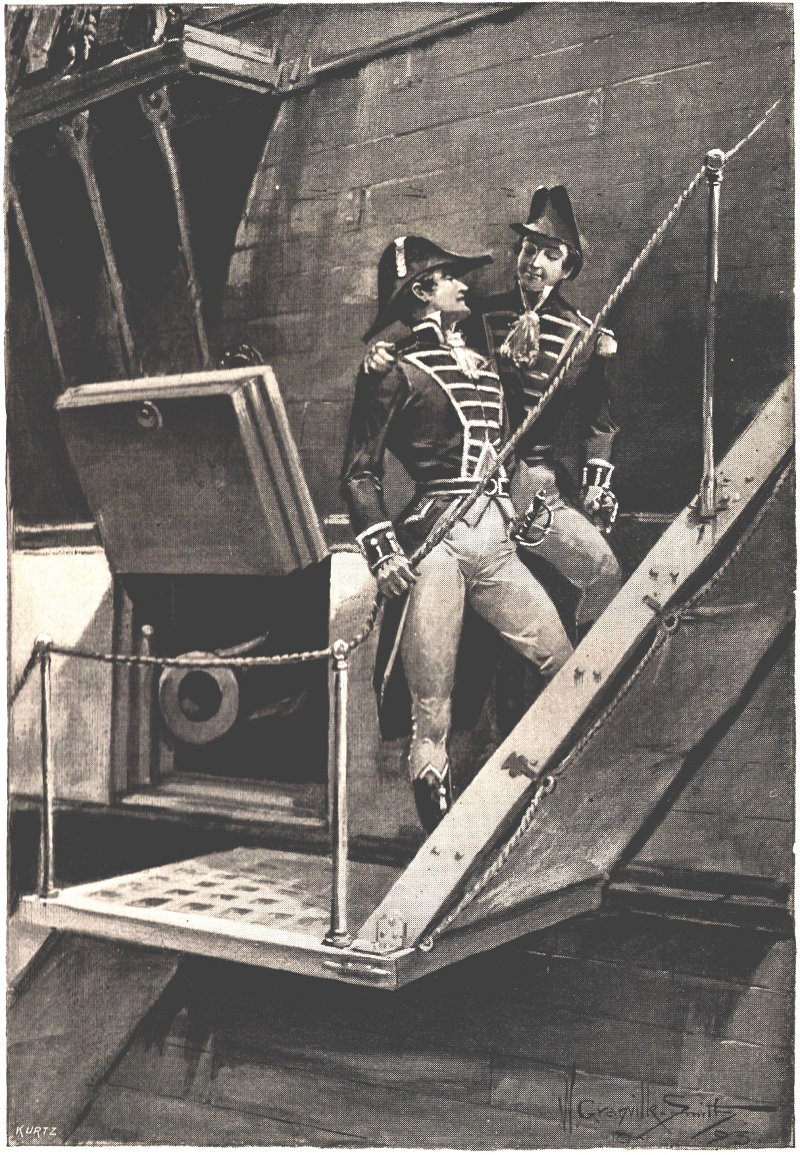
The meeting of the two young captains.
BY M. ELLIOT SEAWELL
AUTHOR OF PAUL JONES, LITTLE JARVIS, MIDSHIPMAN PAULDING, CHILDREN OF DESTINY, MAID MARIAN, THROCKMORTON, ETC.
ILLUSTRATED
THIRD EDITION
NEW YORK
D. APPLETON AND COMPANY
1896
Copyright, 1894,
By D. APPLETON AND COMPANY.
Electrotyped and Printed
at the Appleton Press, U. S. A.
The blue and beautiful Delaware Bay, bathed in a
faint haze, looked its loveliest, one evening about sunset,
in June, 1798. The sky above was clear, and, although
there was no moon, the stars were coming out brilliantly
in the sky, that was of a darker blue than the water.
The sun had gone down, but the west was rosy yet. The
green, low-lying country around looked ineffably peaceful,
and the only sound that broke the charmed silence was
the rattling of the capstan as a noble frigate, lying in the
stream, hove up her anchor.
2
Although the brief, enchanted twilight was over all
the earth and sea, the graceful outlines of this lovely frigate
were clearly defined against the opaline sky. She was
stoutly sparred, but in such exquisite proportions that
from her rail up she had the delicate beauty of a yacht.
But one look at her lofty hull, and the menacing armament
she carried showed that she could take care of
herself in a fight, as well as run away when she had
enough of it. Every rope and every spar was “ship-shape
and Bristol fashion.” Her bright work shone like gold,
and the rows of glistening hammocks in the nettings were
as white as snow. Everything about her was painted an
immaculate white, except the hull, which was a polished
black. A gorgeous figure-head ornamented her keen
bows, and across her stern, in great gold letters, was
her name—United States. Such, indeed, was her official
name, but from the day she had first kissed the water she
had been nicknamed “Old Wagoner,” because of the
steadiness with which she traveled. Other vessels might
be delayed by vexing calms, but “Old Wagoner” was
pretty sure to strike a favoring breeze that seemed specially
reserved for her. And when old Boreas was in a
rage, it was in vain that he poured out all the fury of his
tempests upon her. She could go through a roaring gale
like a stormy petrel, and come out of it without losing a
sail or a spar.
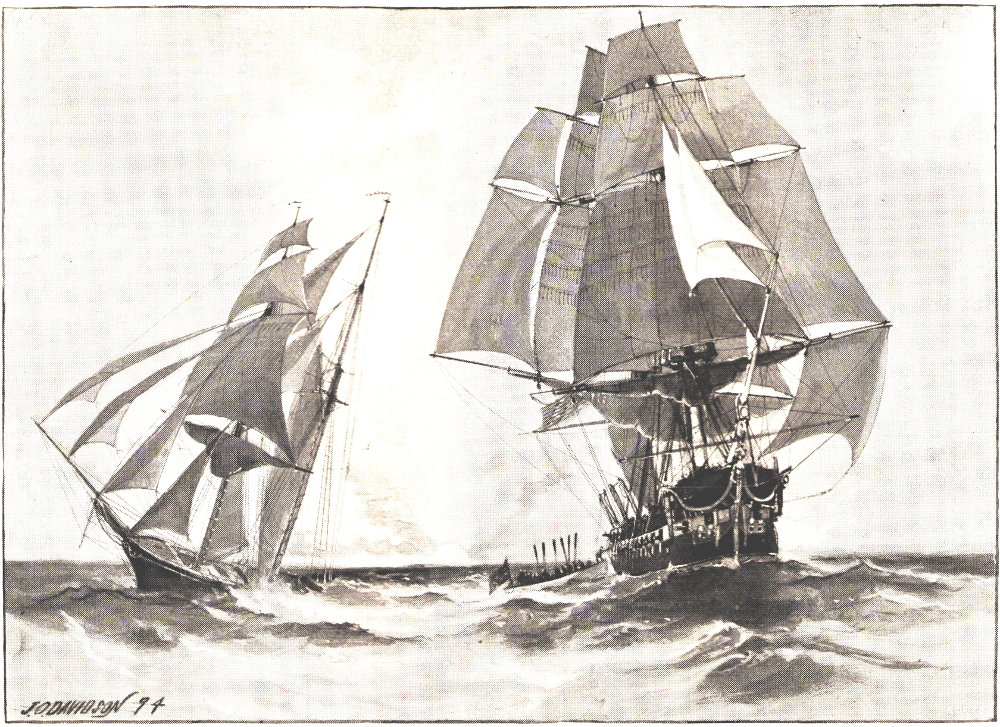
A little way off from “Old Wagoner” lay a trim and
handsome little sloop-of-war carrying twenty guns—the
Delaware—a fit companion for the great frigate. On
both ships were indications of speedy departure, and all
the orderly bustle that accompanies making sail on a ship
of war. The boats were all hoisted in except the first
cutter, and that was being pulled rapidly through the
fast-darkening water. In it was a very young lieutenant,
who was afterward to distinguish himself as Commodore
Stewart, and two young midshipmen, just joined, and
each of the three was destined to add something to the
reputation that “Old Wagoner” gained in after-years, of
having been a nursery of naval heroes.
3
Both of these young midshipmen were about eighteen.
One of them—Decatur—looked older, from his height
and strength, as well as from his easy and confident address.
The other one—Somers—seemed younger, because
of a singularly quiet and diffident manner. The lieutenant,
in the stern-sheets, engaged in steering the cutter
through the mist upon the water without colliding with
any of the fishing smacks with which the bay was dotted,
yet found time to ask some questions of the young midshipmen,
with whom he had long been well acquainted.
“I think you two have always been together, have
you not?” he asked, keeping meanwhile a bright lookout.
“Yes,” answered Decatur, showing his white teeth in
a smile. “We have been together ever since we were
born, it seems to me. We both remember you when we
were at school in Philadelphia, although you were so
much older than we.”
“I recollect you both perfectly,” answered Stewart,
“although you were such little fellows. Somers was the
quietest fellow in the school, and you, Decatur, were the
noisiest.”
“I believe you,” said Decatur, laughing. “I could
have gone with my father on the Delaware,” pointing to
the smart little sloop-of-war, “but I could not think of
leaving Somers alone to fight it out in the steerage of the
United States all by himself.”
4
At this Somers turned his eyes on Stewart, with a
laugh in them. They were very black and soft, and full
of humor, although Somers neither laughed nor talked
much.
“Don’t mind Decatur, Mr. Stewart,” he said. “Captain
Decatur didn’t want him on the Delaware.”
“I should think not,” replied Stewart. “I can’t imagine
anything more uncomfortable than for a captain to
have his own son among the junior officers. Captains,
you know, have to understand what to see and what not
to see. But a captain with his own son in the steerage
would have to see everything.”
“Just what my father said,” added Decatur; “and, besides,
he really did tell me he would like to keep Somers
and me together for our first cruise, because Somers is
such a steady old coach that he is fit to be the guardian
of every midshipman in the navy.”
“I wish there were more like him, then,” said Stewart,
with rather a grim smile, remembering what a larky set
of youngsters the steerage of “Old Wagoner” harbored.
“Let me give you each one piece of advice,” he added,
as they drew close to the frigate’s great black hull, that
loomed up darkly in the uncertain haze. “Decatur, do
you be careful what you say to your messmates—Somers,
do you be careful what you allow your messmates to say
to you. Decatur will be too quick to take the other midshipmen
up, and you, Somers, will be too slow.”
“Thank you, sir,” said both Somers and Decatur together,
who appreciated Stewart’s few words of caution.
5
Just then the band on the poop of “Old Wagoner”
burst into “The Girl I Left Behind Me.” The music
rang over the darkening water with a charming sound,
and the capstan rattled around at the liveliest possible
rate, while the men worked, inspired by the melody.
The boat was quickly brought alongside, and, just as
Stewart and the two young midshipmen stepped on
board, the officer of the deck called out the quick order:
“Strike the bell eight! Call the watch!”
The boatswain, with his mates, had been standing
ready, and as soon as eight bells struck he piped up “Attention!”
and was answered by all his mates in quick succession.
Then he blew a musical winding call, ending
suddenly by singing out, in a rich bass, “All the watch!”
This, too, was answered, every voice deeper than the
other, and then the watch came tumbling up the hatchways.
The wheel and chain were relieved, the officer of
the deck perceived his own relief coming, and put on a
cheerful smile. While all the busy commotion of relieving
the watch was going on, Decatur and Somers were
paying their respects to Commodore Barry, who commanded
the ship—an old Revolutionary officer, handsome
and seamanlike, who gloried in his beautiful ship,
and was every inch a sailor.
The wind had been stealing up for some little time,
and as soon as the anchor was lifted, “Old Wagoner”
shook out all her plain sails and shaped her course for
the open sea.
6
Decatur and Somers, on going below, were introduced
to their messmates, Bainbridge, Spence, and others, and
were shown where to sling their hammocks. Decatur
directed everything in their joint arrangements, Somers
quietly acquiescing—so much so that he overheard one
of the midshipmen say knowingly to the others, “I think
our new messmate is the sort of fellow who likes to be
under the lee of the mizzenmast better than any other
place on deck.” Somers did not quite take in that he
was referred to, and went on very calmly stowing his
traps away. Decatur did not hear the remark.
Dinner was served promptly in the steerage, and by
that time “Old Wagoner” was dashing along in great
style, with every sail drawing like a windlass.
At dinner the prospects of their cruise were freely
discussed. The United States Government having on
hand the quasi war with France, the frigate and the sloop
of war were under orders to sail to the West Indies, and
to clear out the great number of fleet French privateers
that were playing havoc with American commerce. Each
midshipman expressed the conviction that “we’ll meet
some of those rattling good French frigates; and when
‘Old Wagoner’ barks up, they’ll either have to leg it
faster than she can, or they’ll be chewed up—that’s certain.”
Likewise all of them fully believed that they
would return from the cruise covered with glory, and
with a hundred thousand dollars each in prize money.
The views of the older officers up in the wardroom were
more conservative; but with a lot of merry, reckless
young midshipmen the roseate hue always prevails.
7
Decatur, with his dashing manner, his fine figure, and
his ready laugh, became instantly popular. Somers’s
quietness was not very well understood, and before the
day was out, Decatur was asked with the frankness of
the steerage, if “Somers wasn’t a little—er—rather a
milksop?”
“You think so?” answered Decatur, with a grin.
“Very well. I’ve known Somers ever since I was born.
We went to our first school together—and our last—and
I tell you, for your own good, that you had better mind
your p’s and q’s with that sort of a milksop.”
Everything progressed very pleasantly for the first
day or two, but it was impossible that two new arrivals
in the steerage could escape the “running” which, according
to the code prevailing then, makes a man of
a midshipman. Decatur achieved an instant popularity,
so that the pranks played on him were comparatively
mild, and were taken with laughing good
nature. Somers was also amiable enough in regard to
his “running.” In fact he was too amiable, for his messmates
rather resented his want of spirit, as they mistakenly
supposed. Therefore it was that, three times in
one day, Somers was told that he was “too fond of the
lee of the mizzenmast.”
“That means,” said Somers quietly, and looking the
youngster in the face who last made the remark, “that
you think I haven’t much spunk? Very well. We
shall both be off duty until to-night. Couldn’t we go
to some quiet place in the hold where we could have
it out?”
8
“Fighting is strictly prohibited on board ship,” sung
out Bainbridge, one of the older midshipmen, in a sarcastic
voice.
“Squabbling, you mean,” chimed in another one.
“That, I grant you, is unbecoming an officer and a gentleman;
but when two fellows have a falling out in the
steerage, why, the regulation squints exactly the other
way; it means that the two fellows must have it out, like
gentlemen, and no bad blood afterward.”
“Just what I think,” said Somers; “and as I hate
fighting, I want to get through with all I shall have to
do in that way in as short a time as possible; so I will
settle with two other young gentlemen to-day against
whom I have an account. Then, if I get my eye blacked,
I will only have one hauling over the coals for three
scrimmages.”
“You don’t mean to fight three fellows in one day?”
asked Bainbridge in surprise.
“Yes,” answered Somers nonchalantly.—“Decatur,
you settle the particulars,” and he walked off, as composed
as ever.
“I told you fellows what a Trojan Somers was when
he was started,” remarked Decatur, “and now you’ll see
for yourselves. He is wiry and as strong as a buffalo,
and he is first-class with his fists, and—— Well, you’ll
see!”
9
As these little affairs were conducted strictly according
to the code, they were arranged in a very business
like manner. Fair play was the watchword, and all the
midshipmen who were off duty assembled to see the
fun. When Somers had knocked the wind out of his
first adversary and brought him to apologize, it was
proposed that the other affairs should be postponed;
but Somers, being in for it, and the exercise rather
warming his blood, invited his persecutor Number Two
to “come on.” He came on, with disastrous results in the
way of a good, wholesome pounding and a swelled nose.
The third encounter following, Decatur begged Somers
to be allowed to take his place.
“Why, I’m like Paul Jones!” cried Somers, laughing,
as he sponged off his neck and head. “I haven’t begun
to fight yet.”
True it was that Somers was then perfectly able to
do up Number Three in fine style. As he stood astride
over his opponent, who frankly acknowledged himself
whipped, a mighty cheer went up from the surrounding
audience of midshipmen, and every one of them,
including his late opponents, came forward to shake
Somers’s hand. The noise of the cheer penetrated
from the hold up to the wardroom, where some of the
lieutenants were sitting around. Stewart smiled significantly.
“I think I know what that means,” he said. “The
fellows have been running a rig on Somers, and I predict
he has come out ahead. That fellow has an indomitable
spirit under that quiet outside.”
10
Some hours afterward, when Somers had to report
on deck, he bore unmistakable marks of his encounters.
His nose was considerably larger than usual, one eye had
a black patch over it, and there was a bit of skin missing
from his chin.
Stewart, looking at him attentively, could scarcely
keep his face straight as he remarked:
“Falling down the ladder, I presume, Mr. Somers,
from your appearance. You should be careful, though,
not to fall down too often.”
“Yes, sir, I did fall down,” answered Somers, very
diplomatically, without mentioning that, when he fell, a
messmate was on top of him.
That day’s work established Somers’s popularity in
the steerage, and the three midshipmen whom he had
pommeled became his staunch friends. “And I’ll tell
you what,” he announced, “this is the last fighting I’ll
do while I am in this mess. You fellows may walk over
me if you like, before I will take the trouble to lick any
more of you.”
But nobody walked over him after that.
Decatur gave immediate promise of brilliancy as a
seaman; but Somers was not far behind, and his uncommon
steadiness recommended him highly to the lieutenants.
Stewart, dining one night in the cabin with the
commodore, was giving his impressions of the junior
officers to the commander, who wished to appoint a master’s
mate of the hold—a place always given to the most
reliable and best informed of the midshipmen.
11
“They are all as fine a lot of youngsters, sir, as I ever
saw. That young Decatur is a remarkable fellow. He
finds out more than any of the rest, because he never has
to ask the same thing twice. Before he had been on
board a week he knew every rope and where each is
belayed; and the clever youngster writes with a pencil,
behind the rail, everything he is told. There’s a very
good manual of seamanship written under the starboard
rail, and Decatur and Somers may be seen every day,
when they are not on duty, putting their heads together
and studying it out.”
“And how about young Somers?” asked the commodore.
“Somers is the only one who rivals Decatur, and I
must say I consider him the best-balanced young fellow
of his age I ever knew. His messmates have nicknamed
him ‘Old Reliable.’ He is not so brilliant a boy as Decatur,
but he is steady to the utmost degree. Nothing
flusters him. He is never too early, and never too late;
he goes on his way quietly, and I do not think he has
had a reproof since he has been on board. And he evidently
studied seamanship thoroughly before he was
commissioned—just what I should expect of such a long-headed
fellow.”
“Then Somers shall be master’s mate of the hold,”
said the commodore, decisively.
Next day Somers was sent for to the cabin and informed
of the commodore’s choice. He merely said:
“Thank you, sir; I shall do my best.” But Commodore
Barry felt well assured that Somers’s “best” was a good
“best.”
12
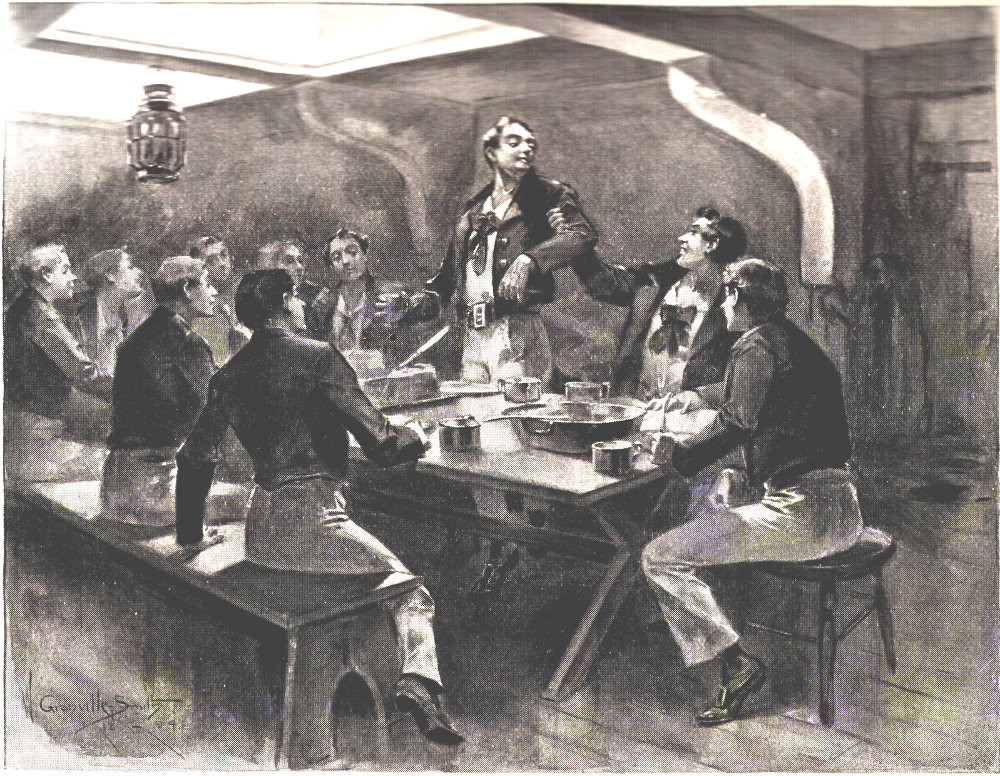
Somers went down to the midshipmen’s dinner that
day, and said nothing of his appointment. Each of the
reefers was eager to get the place of trust, and they began
talking of it. Somers wished to tell them of his
good fortune, but a kind of bashfulness restrained him.
He turned red, though, and became more silent than
usual. Decatur, who sat next him, looked keenly at him.
“Somers, something is up, I see; and I believe—I believe
you are going to be master’s mate,” he said.
Somers blushed more than ever as he answered: “I
am master’s mate. I was appointed to-day.”
Decatur, with one stretch of his powerful arm, raised
his chum up standing.
“You good-for-nothing lubber, you are made master’s
mate, while Bainbridge and Spence, and all the rest of
us that are worth ten of you, are passed over! I’m going
to prefer charges against the commodore for gross
favoritism in giving you the appointment.”
Somers always submitted to this sort of horse-play
from Decatur without the slightest resistance, and the
effect was very comical. Decatur, after shaking him vigorously,
plumped him back in his chair, when Somers
calmly resumed his dinner as if nothing had occurred.
“Mr. Somers,” said Bainbridge politely—who was
the oldest midshipman on board, and, as caterer of the
mess, sat at the head of the table—“the officers of this
mess have very grave doubts of your fitness for the place
to which the unwarranted partiality of the commodore
has elevated you; and we desire to form some idea of
how extensive are your disqualifications. Suppose, sir,
this ship were proceeding with a fair wind, under all
sail except one topmast studding sail, and you were officer
of the deck. Suppose again, sir, that the alarm were
given, ‘Man overboard!’ and you should perceive that
my dignified corporosity was the man overboard. Now,
please state to me, Mr. Somers, categorically, what
would be the first thing you would do in such an emergency?”
The new master’s mate.
13
Somers laid down his knife and fork, folded his arms
and reflected for a few moments, and finally answered:
“This is what I should do, Mr. Bainbridge: I should
immediately order the other topmast studding sail to be
set, if she’d draw, with a view to increase the speed of
the ship.”
A roar of laughter succeeded this, which was repressed
by Bainbridge sternly rapping for order.
“Gentlemen, this is not the undignified cabin or the
disorderly wardroom. This—please remember—is the
model mess of the ship, the steerage mess, and order
must be preserved, if I have to lick every one of you to
get it.”
“Spence,” said Decatur, holding out his plate and
trembling violently, “G-give me some of that salt horse.
It may be the l-l-last time, dear Spence, that we shall
ever eat salt horse together. When the discipline of this
ship is so relaxed that Somers, who doesn’t know a marlin-spike
from the mainmast, is promoted, it’s time we
were all making our wills. Our time is short, Spence;
so give me a good helping, old man.”
14
“I know more seamanship than all of you lubbers put
together,” quietly remarked Somers, going on with his
dinner.
“Hear! hear!” cried Bainbridge. “Mr. Somers, you
are facetious to-day.”
Decatur, at this, got up and went to the nook that he
and Somers occupied together. He came back with a
black bottle labeled “Cherry bounce.”
“Gentlemen,” said he, “Mr. Somers feels so acutely
your kind expressions of confidence in him, that he begs
you will drink his health in this bottle of cherry bounce
which he has been saving up for this auspicious occasion.”
Somers said nothing as his cherry bounce was liberally
distributed, leaving only a very small glass of the
dregs and heel-taps for himself; and his good nature
under so much chaff made the reefers more jolly than
ever. His health, with many pious wishes that he might
learn to know a handy-billy when he saw it, was drunk
with all honors; and as a great favor he was permitted
to drink his one small glass in peace. In the midst
of the jollity a commotion was heard overhead, and
the cry of “Sail, ho!” In another moment every midshipman
made a dash for the gangway and ran on
deck.
15
Nearly every officer of the frigate was there too.
Commodore Barry glass in hand, watched from the flying
bridge, a sail off the starboard quarter. By the
squareness of her yards and the symmetry of her sails she
was evidently a ship of war, and was coming down fast.
The Delaware, which sailed equally as well as “Old
Wagoner,” was close by to starboard. On sighting the
strange and menacing ship, the Delaware was seen to
bear up and draw nearer her consort—for it was well
known that a contest with a French ship would by
no means be declined by any American ship. Commodore
Barry, who was a veteran of the glorious days of
Paul Jones and the gallant though infant navy of the
Revolution, was more than willing to engage. Every
moment showed more and more clearly the character
and force of the stranger. The day was bright and
cloudless, and, as they were in the sunny atmosphere
of West India waters, objects could be seen at a great
distance. The frigate was remarkably handsome and
sailed well. The Americans counted more than twenty
portholes, and very accurately guessed her to be one of
the great fifty-gun frigates of which both the French
and the English had many at that day. If she were
French, it meant a fight; and so nearly matched were
the two frigates that it would be the squarest sort of
a fight.
The excitement on the ships was intense. Several of
the more active officers clambered up the shrouds, while
the rigging was full of men eager to make out the advancing
ship, which was coming along at a good gait;
and all were eager to know what colors the commodore
would show.
16
“Mr. Ross,” said Commodore Barry, turning to his
first lieutenant, “we will show French colors; if he is
a ‘Mounseer,’ it will encourage him to make our acquaintance.”
The quartermaster, Danny Dixon, a handsome, fresh-faced
sailor of middle age, who had served under the immortal
Paul Jones, quickly produced French colors, and
amid breathless silence he ran them up.
The stranger was now not more than a mile distant.
She had worn no colors, but on seeing French colors
run up at the American frigate’s peak, in another moment
she too displayed the tricolored flag of France.
At that an involuntary cheer broke from the gallant
fellows on “Old Wagoner.” Decatur, behind the commodore’s
back, deliberately turned a double handspring,
while even the dignified Somers executed a slight pirouette.
As for the men, they dropped down upon the deck
like magic, and every man ran to his station. Commodore
Barry straightened himself up, and the old fire of
battle, that had slumbered since the glorious days of
the Revolution, shone in his eyes under his shaggy
brows.
17
“Mr. Ross,” said he, turning to his first lieutenant,
“we are in good luck—in excellent good luck, sir. Signal
to the Delaware to keep off. I think the officers and
men of this ship would feel hurt if we should mar the
beauty of the game we are about to play by having odds
in our favor; and call the men to quarters without the tap
of the drum. The first man who cheers until we have
hailed will be sent below, to remain until after the engagement.
I desire to come to close quarters, without
telling any more about ourselves than our friend the
enemy can find out.”
In the midst of a dead silence the signal was made
to the Delaware. Only Decatur whispered to Somers,
whose station was next his:
“Poor old dad! He’d give all his old boots if he
could have a share in the scrimmage.”
The Delaware then hauled off, making a short tack,
and going no farther away than she could help. The
strange frigate, whose trim and ship-shape appearance
grew plainer at every moment, was now nearly within
hail. The American, preparing to bear up and run off
as a preliminary to the action, the first lieutenant, under
the commander’s eye, stood near the wheel, while Danny
Dixon took the spokes.
In the midst of the breathless silence, while the
strange frigate continued to advance, shortening sail
meanwhile, and with her men at quarters and her batteries
lighted up, Mr. Ross, watching the trim of “Old
Wagoner’s” sails, sung out:
“Give her a good full, quartermaster!”
“A good full, sir,” answered old Danny steadily, and
expecting the next order to be “Hard aport!”
But at that moment Commander Barry dashed his
glass down with an impatient exclamation. “We are
truly unfortunate, gentlemen. She is English. Look at
her marines!”
18
At the same instant the stranger, discovering the
American’s character, quickly hauled down her French
colors and showed the union jack. A loud groan burst
from the American sailors, who saw all their hopes of
glory and prize money vanish; and it was answered by
a corresponding groan from the British tars, who felt a
similar disappointment, having taken the American to be
a Frenchman.
Commodore Barry then ordered her to be hailed, and
the first lieutenant called through the trumpet: “This is
the American frigate United States, forty guns, Commodore
Barry. Who are you?”
“This is His Britannic Majesty’s ship Thetis, fifty
guns, Captain Langley.”
Both ships were on the same tack and going at about
the same speed, about half a mile apart. Commodore
Barry then hailed again, asking if the English captain
had any news of two crack French frigates—L’Insurgente
and La Vengeance—that were supposed to be cruising in
that station. No answer was returned to this, although
it was called out twice. This vexed Commodore Barry,
as it did every officer and man aboard.
“Wot a pity,” growled Danny Dixon, the quartermaster,
to his mates, “that somebody hadn’t ’a’ axerdentally—jist
axerdentally, you know—pulled a lockstring
and fired one o’ them starboard guns! The Britishers
ain’t the sort to refuse a fight; they would ’a’ fired back
cocksure, and we could ’a’ had a friendly tussle and found
out which were the best ship, and then it could ’a’ been
fixed up arterwards—’cause ’twould ’a’ been all a axerdent,
you know.”
19
This was agreed with by all of Danny’s messmates, as
they left their stations and gathered forward. The two
ships were now abreast of each other, and the distance
between them was being quickly decreased by Commodore
Barry’s orders, who himself took the deck. They
were not more than two cables’ lengths apart. The English
frigate, which had taken in considerable of her canvas,
now took in her royals. The American ship followed
suit, so that in a little while both ships had come down
to a five-knot gait, although there was a good breeze
blowing. They were near enough to hear conversation
and laughter on the English ship, and the men gathered
on the fok’sl of the Thetis called out loudly to each
other, as if to emphasize the rudeness of not returning
the hails of the American ship. In the midst of a perfect
silence on the United States, which was soon followed on
the Thetis, Danny Dixon, who had a stentorian voice,
swung himself in the forechains and began to sing as
loud as he could bawl:
“Boney is a great man,
A soldier brave and true,
But the British they can lick him,
On land and water, too!”
20
This produced a roaring cheer from the British. The
Americans, who knew what was coming next, waited,
grinning broadly until the laugh should be on their side.
The men gathered on the Thetis’s port side, and the officers
hung over the rail to catch the next verse. As soon
as the cheering was over, Danny fairly shouted, in a voice
that could be heard a mile:
“But greater still, and braver far,
And tougher than shoe leather,
Was Washington, the man wot could
Have licked ’em both together!”
At this “Old Wagoner’s” deck fairly shook with the
thunders of cheers from the Americans, the midshipmen
joining in with leather lungs, the grave Somers yelling
like a wild Indian, while Decatur executed a war-dance
of triumph.
The Thetis, as if disgusted with the turn of affairs, set
her royals and all her studding sails, and began to leg it
at a lively pace. “Old Wagoner” followed her example,
and the men sprang into the rigging and set exactly the
same sails. But they found within five minutes that the
American could sail better, both on and off the wind, as
she followed the Thetis in her tacks. The Thetis then,
keeping her luff, furled sail on the mizzen and took in
royals and studding sails. The American did precisely
the same thing, and, as she still sailed faster, an old sail
containing kentledge was ostentatiously hung astern and
acted as a drag, keeping the two ships together.
21
This evidently infuriated the British, but they had
found out that the American could walk around the
Thetis like a cooper around a cask. They did not care
to test it further, and the Thetis therefore sailed sullenly
along for half an hour more. The Americans were
delighted, especially Commodore Barry, who handled
his trumpet as gayly as if he were a midshipman on his
first tour of duty as deck officer. He next ordered the
topsails lowered. This brought the American down very
slow indeed, and she rapidly fell astern of the Thetis.
The English thought that their tormentors were now
gone. The Americans, suspecting some ruse of the commodore’s,
were all on the alert. Presently the commodore
cried out jovially:
“Now’s the time for carrying all hard sail!” and in
five minutes “Old Wagoner” seemed literally to burst
into one great white cloud of canvas from truck to rail.
Everything that would draw was set; and the breeze,
which was every moment growing stronger, carried her
along at a perfectly terrific pace. She shot past the
Thetis, her gigantic spread of canvas eating the wind out
of the Englishman’s sails and throwing them aback, and
as she flew by another roaring cheer went up from the
Americans.
The fun, however, was not over yet. Having got
well in advance of the Thetis, “Old Wagoner” bore up,
and, hauling her wind, dashed directly across the forefoot
of the English ship as the Englishman came slowly on.
All the cheering that had preceded was as nothing
when this neat manœuvre was accomplished. The old
Commodore, giving the trumpet back to the officer of
the deck, was greeted with three cheers and a tiger, and
every officer and man on board gloried in the splendid
qualities of the ship and her gallant old commander.
22
The brilliant visions of the midshipmen of yardarm-and-yardarm
fights with French frigates, with promotion,
and prize money galore, failed to materialize, although
they had several sharp encounters with fleet
French privateers that infested the waters of the French
West Indies. With them it was a trial of seamanship,
because, if ever a privateer got under the guns of “Old
Wagoner,” small was her chance of escape. But the
American proved to be a first-class sailer, and nothing
that she chased got away from her. Several privateers
were captured, but the midshipmen groaned in spirit
over the absence of anything like a stand-up fight.
It did not seem likely that they would make a port for
some time to come. Early in February, cruising to windward
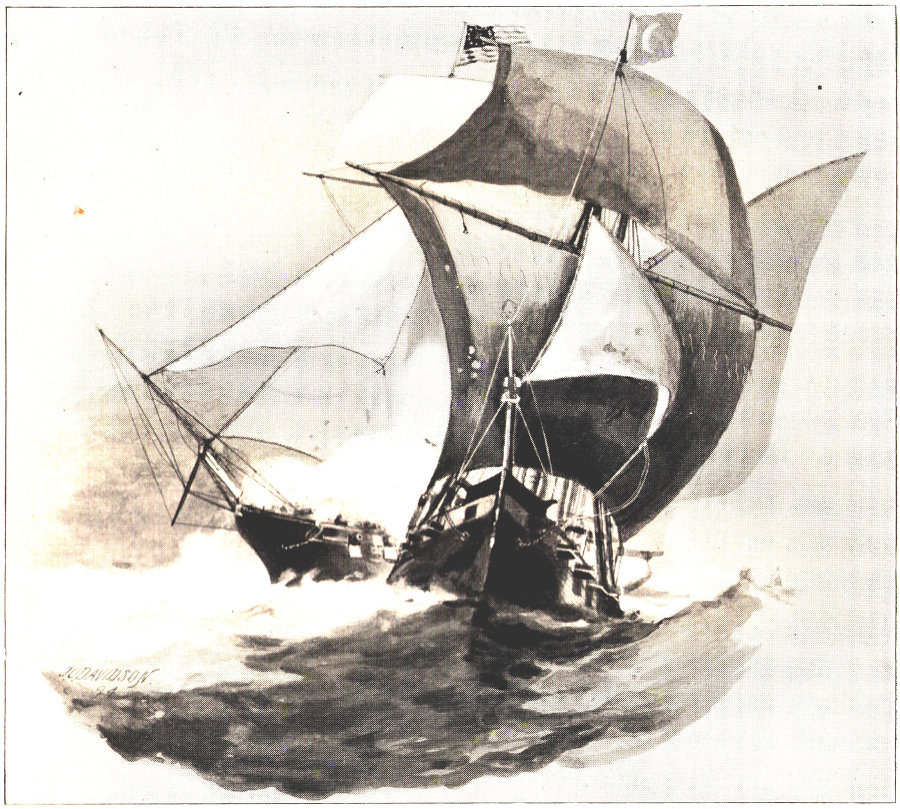
of Martinique, they ran across the French privateer
Tartuffe—and Tartuffe she proved. She was a beautiful
little brigantine, with six shining brass guns, and her
captain evidently thought she could take care of herself;
for when the United States gave chase and fired a gun
from her bow-chasers, the saucy little privateer fired a
gun back and took to her heels.
The sinking of the French privateer.
23
It was on a bright February afternoon that the chase
began. The midshipmen, elated by their triumph in sailing
with the great English frigate, thought it would be
but child’s play to overhaul the Frenchman. But they
had counted without their host, and they had no fool to
play with. In vain did “Old Wagoner” crowd on sail;
the Tartuffe managed to keep just out of gunshot. All
the afternoon the exciting chase continued, and when
night fell a splendid moon rose which made the sea
almost as light as day. Both ships set every stitch of
canvas that would draw, and at daybreak it was found
that the frigate had in all those hours gained only a
mile or two on the brigantine. However, that was
enough to bring her within range of “Old Wagoner’s”
batteries. The American then fired another gun as a
signal for the Frenchman to haul down his colors. But,
to their surprise, the Tartuffe went directly about, her
yards flying round like a windmill, and her captain endeavored
to run directly under the broadside of the
United States before the heavier frigate could come
about. One well-directed shot between wind and water
stopped the Frenchman’s bold manœuvre. She began at
once to fill and settle, and her ensign was hauled down.
Commodore Barry, on seeing this, cried out:
“Lower away the first cutter!” and Decatur, being
the officer in charge of that boat, dropped into her stern
sheets and pulled for the Frenchman. Commodore Barry,
leaning over the side, called out, laughing, to Decatur:
“I wish you to treat the Frenchman as if he were the
captain of a forty-four-gun frigate coming aboard to surrender
her. He has made a gallant run.”
24
Decatur, bearing this in mind, put off for the brigantine.
The sun was just rising in glory, and as he saw, in
the clearness of the day, the plight of the pretty brigantine,
he felt an acute pity. Her company of sixty men crowded
to the rail, while her captain stood on the bridge, giving
his orders as coolly as if his ship were coming to
anchor in a friendly port. Decatur, seeing that his boat
would be swamped if he came near enough for the men
to jump in, called out to the captain, saluting him meanwhile,
and asking if he would come off in one of the brigantine’s
boats, while the Tartuffe’s helm could be put up,
as she was still able to get alongside the United States,
and her people could be transferred.
“Sairtainly, sir—sairtainly,” answered the French captain,
politely, in his queer English.
In a few moments the boat containing the captain
came alongside the cutter, and the Frenchman stepped
aboard. He took his seat very coolly by Decatur in the
stern-sheets, and then, putting a single eyeglass in his
eye, he cried out, with a well-affected start of surprise:
“Is zat ze American flag I see flying? And am I captured
by ze Americans?”
“Yes,” answered Decatur, trying not to smile.
“But I did not know zat ze United States was at war
wiz France.”
“Perhaps not,” replied Decatur. “But you found
out, probably, from the American merchant vessels you
captured, that France was at war with the United
States.”
At that the Frenchman laughed in spite of his defeat.
“I can stand a leetle thing like this,” he said. “I have
had much good luck, and when I tell my countrymen it
took your cracque frigate fourteen hours to catch me—parbleu,
zey will not think I have done ill.”
25
“You are quite right, sir,” answered Decatur. “You
gave us more trouble to overhaul than a ‘cracque’ English
frigate.”
The commodore and his officers all treated the brave
French captain as if he had been captain of a man-of-war;
and as he proved to be a pleasant, entertaining fellow,
he enlivened the ship very much.
But Commodore Barry was anxious to get rid of so
many prisoners, which encumbered the ship, and he determined
to stand for Guadeloupe, in the hope of effecting
an exchange of prisoners. He therefore entered
Basseterre Roads, on a lovely morning a few days after
capturing and sinking the Tartuffe. A white flag flying
at the gaff showed that he was bent on a peaceful errand.
Everything, however, was in readiness in case the men
should have to go to quarters. Although the ports
were open the guns were not run out, nor were their
tompions withdrawn. The French captain, standing
on the quarter-deck in his uniform, was easily recognizable.
The beautiful harbor of Guadeloupe, with its circlet
of warlike forts, looked peculiarly attractive to the eyes
of seamen who had been cruising for many long months.
“Old Wagoner” had been newly painted, and as she
stood in the Roads, under all her square canvas, she was
a perfect picture of a ship. Just as they came abreast of
the first fort, however, the land battery let fly, and a
shower of cannon balls plowed up the water about two
hundred yards from the advancing ship.
26
“Haul down that white flag!” thundered Commodore
Barry, and Danny Dixon rushed to the halyards
and dragged it down in a jiffy, and in another minute the
roll of the drums, as the drummer boys marched up and
down beating “quarters,” resounded through the ship.
The French captain, mortified at the treacherous action
of the forts, quickly drew his cap over his eyes and went
below.
The United States then, with every gun manned and
shotted, sailed within gunshot of the first fort that had
offered the insult, and, backing her topsails, gave a broadside
that sent the masonry tumbling about the ears of the
garrison and dismounting several guns. This was followed
up by another and another broadside, all accurately
aimed, and knocking the fort considerably to pieces.
Then, still under short canvas, she slowly sailed around
the whole harbor, paying her compliments to every fort
within gunshot, but without firing a gun into the helpless
town. And when “Old Wagoner” drew off and made
her way back to the open ocean, it was conceded that she
had served the Frenchmen right for their unchivalrous
proceeding.
27
The whole spring was spent in cruising, and it was the
first of June when, on a Sunday morning, the ship being
anchored, the boatswain and his eight mates, standing in
line on the port gangway, piped up that sound so dear to
every sailor’s heart, “All hands up anchor for home!”
At the same moment the long red pennant, that signifies
the ship is homeward bound, was joyfully hoisted at the
main, and “Old Wagoner” turned her nose toward home.
Just one year from the time they had left the Delaware,
Decatur and Somers set foot again upon the green shore
of the beautiful bay—happier, wiser, and better fellows
for their year in the steerage of the fine old frigate.
28
CHAPTER II.
The leave enjoyed by Decatur and Somers was brief,
and before the summer of 1801 was out they were forced
to part. For the first time in their young lives their
paths were to diverge for a short while, and to be reunited
in the end. But their separation was for a reason
honorable to both. Decatur was appointed first lieutenant
in the frigate Essex—like most of those early ships of
the American navy, destined to a splendid career. She
was commanded by Captain Bainbridge, whose fate was
afterward strangely linked with that of his young first
lieutenant. The Essex was one of a squadron of three
noble frigates ordered to the Mediterranean, under the
command of Commodore Richard Dale; and this Richard
Dale had been the first lieutenant of Paul Jones, the
glory of the American navy, in the immortal fight between
the Bon Homme Richard and the Serapis. The
association with such a man as Commodore Dale was an
inspiration to an enthusiast like Decatur; and as he found
that Danny Dixon was one of the quartermasters on the
Essex, it was not likely that there would be any lack of
reminiscences of Paul Jones.
29
Somers’s appointment was to the Boston, a fine sloop-of-war
carrying twenty-eight guns, commanded by Captain
McNeill. He was destined to many adventures before
again meeting Decatur, for Captain McNeill was one
of the oddities of the American navy, who, although an
able seaman and a good commander, preferred to conduct
his cruise according to his own ideas and in defiance
of instructions from home. This Somers found out the
instant he stepped upon the Boston’s deck at New York.
The Essex was at New York also, and the two friends
had traveled from Philadelphia together. Out in the
stream lay the President, flying a commodore’s broad
pennant.
“And although, ‘being grand first luffs,’ we can’t be
shipmates, yet we’ll both be in the same squadron, Dick!”
cried Decatur.
“True,” answered Somers, “and a Mediterranean
cruise! Think of the oldsters that would like to go to
Europe, instead of us youngsters!”
So their anticipations were cheerful enough, each
thinking their separation but temporary, and that for
three years certainly they would serve in the same
squadron.
30
The two friends reached New York late at night, and
early next morning each reported on board his ship.
The Essex was a small but handsome frigate, mounting
thirty-two guns, and was lying close by the Boston at the
dock. As the two young lieutenants, neither of whom
was more than twenty-one, came in sight of their ships,
each hugged himself at the contemplation of his luck in
getting so good a one. Decatur’s interview with Captain
Bainbridge was pleasant, although formal. Captain
Bainbridge knew Captain Decatur well, and made civil
inquiries about Decatur’s family and congratulations
upon James Decatur—Stephen’s younger brother—having
lately received a midshipman’s appointment. Captain
Bainbridge introduced him to the wardroom, and
Decatur realized that at one bound he had cleared the
gulf between the first place in the steerage and the ranking
officer in the wardroom.
All this took but an hour or two of time, and presently
Decatur found himself standing on the dock and
waiting for Somers, who had left the Boston about the
same time. As Somers approached, his usual somber
face was smiling. Something ludicrous had evidently
occurred.
“What is it?” hallooed Decatur.
Somers took Decatur’s arm before answering, and as
they strolled along the busy streets near the harbor he
told his story amid bursts of laughter:
“Well, I went on board, and was introduced into the
captain’s cabin. There sat Captain McNeill, a red-headed
old fellow, with a squint; but you can’t help knowing
that he is a man of force. He talks through his nose,
and what he says is like himself—very peculiar.
31
“‘Now, Mr. Somers,’ said he, drawling, ‘I daresay
you look forward to a devil of a gay time at the Mediterranean
ports, with all that squadron that Dale has got to
show off with.’ I was a good deal taken aback, but I
said Yes, I did. ‘Very well, sir, make up your mind that
you won’t have a devil of a gay time with that squadron.’
I was still more taken aback, and, being anxious to agree
with the captain, I said it didn’t make any difference; I
looked for more work than play on a cruise. This didn’t
seem to please the captain either, so he banged his fist
down on the table, and roared: ‘No, you don’t, sir—no,
you don’t! You are no doubt longing this minute to be
on that ship’—pointing out of the stern port at the President—‘and
to have that broad pennant waving over you.
But take a good look at it, Mr. Somers—take a good long
look at it, Mr. Somers, for you may not see it again!’
“You may fancy how astonished I was; but when I
went down into the wardroom and talked with the officers
I began to understand the old fellow. It seems he
hates to be under orders. He has always managed to
have an independent command, but this time the navy
officials were too smart for him, and he was ordered to
join Commodore Dale’s squadron. But he managed to
get orders so that he could join the squadron in the
Mediterranean, instead of at Hampton Roads, where the
other ships are to rendezvous; and the fellows in the
wardroom say they wouldn’t be surprised if they never
saw the flagship from the time they leave home until
they get back.”
“That will be bad for you and me, Dick,” said Decatur
simply.
“Very bad,” answered Somers. Their deep affection
was sparingly soluble in language, but those few words
meant much.
32
Within a week the Boston was to sail, and one night,
about nine o’clock, the wind and tide serving, she slipped
down the harbor to the outer bay, whence at daylight
she was to set sail on her long cruise. Decatur bade
Somers good-by on the dock, just as the gang-plank was
being drawn in. They had but few parting words to
say to each other; their lives had been so intimate, they
knew each other’s thoughts so completely, that at the
last there was nothing to tell. As they stood hand in
hand in the black shadow cast by the Boston’s dark hull,
Decatur, whose feelings were quick, felt the tears rising
to his eyes; while Somers, the calm, the self-contained,
suddenly threw his arms about his friend and gave Decatur
a hug and a kiss, as if his whole heart were in it;
then running up the gang-plank, the next moment he
was giving the orders of his responsible position in a
firm tone and with perfect alertness. Decatur turned,
and, going a little distance off, watched while the frigate
slowly swung round and headed for the open bay, stealing
off like a ghostly ship in the darkness. He felt the
strongest and strangest sense of loss he had ever known
in his life. He had many friends. James, his brother,
who had entered the navy, was near his own age, but
Somers was his other self. Unlike as they were in temperament,
no two souls ever were more alike in the
objects aimed at. Each had a passion for glory, and
each set before himself the hope of some great achievement,
and ordered his life accordingly.
33
This strange loneliness hung upon Decatur, and although
his new duties and his new friends were many,
there were certain chambers of his heart that remained
closed to the whole world except Somers. He found on
the Essex a modest young midshipman, Thomas Macdonough,
who reminded him so much of Somers that
Decatur became much attached to him. Macdonough,
like Somers and Decatur, lived to make glorious history
for his country.
Within a few days the Essex sailed, in company
with the President, flagship, the Philadelphia, and the
schooner Enterprise. This cruise was the beginning of
that warfare against the pirates of Tripoli that was to
win the commendation of the whole world. They made
a quick passage, for a squadron, to the Mediterranean,
and on a lovely July night, with the flagship leading,
they passed Europa Point and stood toward the lionlike
form of the Rock of Gibraltar that rose in stupendous
majesty before them. A glorious moon bathed all the
scene with light—the beautiful harbor, with a great line-of-battle
ship, the Thunderer, flying British colors; while
half a dozen fair frigates looked like sloops alongside of
this warlike monster, which carried a hundred and twenty
guns and a crew of nearly a thousand men.
At the extremity of the harbor lay a handsome frigate
and a brig, both flying the crescent of Tripoli. The
large ship also flew the pennant of an admiral. There
being good anchorage between the Tripolitan and the
British line-of-battle ship, Commodore Dale stood in, and
the American squadron anchored between the two.
34
Early next morning Decatur went ashore in the first
cutter, by Captain Bainbridge’s orders, to find out the
state of affairs with Tripoli. He also hoped to hear something
of Somers, who had sailed a week in advance. He
heard startling news enough about the Barbary pirates.
The flagstaff of the American legation at Tripoli had
been cut down, and war was practically declared. But
as the information had not reached the United States
before the squadron left, the commodore was not justified
in beginning hostilities until he had received formal
notice of the declaration of war from the home Government.
Nevertheless, the Tripolitans and the Americans
watched each other grimly in the harbor. As for Somers,
Decatur was bitterly disappointed not to see him.
The Boston had been quietly at anchor the day before,
when a clipper ship that outsailed the American squadron,
which was in no particular hurry, gave notice that
the ships were coming. Instantly Captain McNeill gave
orders to get under way; officers were hurriedly sent
ashore to collect those of the ship’s company on leave or
liberty, and before nightfall the Boston was hull down
going up the straits. When Decatur brought the news
on board, Captain Bainbridge frowned, and laughed too.
“The commodore will have harder work to catch the
Boston than anything else he is likely to give chase to,”
he said.
35
Commodore Dale determined to await orders at Gibraltar
before making a regular attack on Tripoli, but he
caused it to be boldly announced by the American officers,
meanwhile, that if the Tripolitans wanted to fight,
all they had to do was to lift their anchors, go outside
and back their topsails, and he would be ready for them.
The British naval officers, at that time, treated the
American officers with studied ill-will, for they had not
yet learned to look with pride upon the United States as
a country made by themselves, and which Great Britain
found unconquerable because its people were of the same
sturdy stock as her own. The cooler heads and better
hearts among the English officers at Gibraltar counseled
courtesy, but among the younger men it was sometimes
difficult to avoid clashes. Especially was this the case as
regards Commodore Dale’s squadron, for he was connected
with an episode hateful to the British, but glorious
to both themselves and the Americans—the capture
of the Serapis by Paul Jones. The squadron was kept in
the highest state of drill and efficiency, not only as a matter
of necessary precaution, but as one of professional
pride and duty; and the trim American officers and the
clean and orderly American seamen made a brave showing
alongside of those belonging to England, the Mistress
of the Seas.
One night, a week or two after their arrival, as Decatur
was pacing the deck of the Essex, he heard a
splash at the bow, and going forward he saw a man
swimming rapidly away from the ship. Suspecting this
to be a deserter, he at once had a boat lowered; and as
Macdonough, Decatur’s favorite midshipman, was about
swinging himself into it, Danny Dixon came up.
36
“Mr. Decatur,” said he, touching his cap, “that ’ere
man is a deserter, sir, and he’ll be making for the Thunderer,
sure. His name is John Hally, and he come from
New York State, and he’s been a scamp ever since I
knowed him—and that’s ten year ago. He’s a thief, and
he’s stole a mort o’ things; but he ain’t been caught yet.
I told him this arternoon I was agoin’ to report him for
gittin’ into the men’s ditty-bags; and you see, sir, he’s
showin’ us his heels.”
“Jump in the boat, then,” said Decatur. “You may
help to identify him.”
The Thunderer lay about four hundred yards away,
and the deserter’s course in the water was perfectly visible
every foot of the distance. He evidently saw the
boat following, and dived once or twice to throw his pursuers
off the track. The noise made by the boat aroused
the attention of the people on the Thunderer. They
came to the rail peering through the darkness of the
night, and presently a lantern was waved over the side.
Decatur, who watched it all with interest, was convinced
that this was done by order of an officer, and the object
was to help the deserter from the American frigate.
Sure enough, as soon as the swimmer reached the great
line-of-battle ship a line was thrown him, and he was
dragged bodily through an open port on the berth deck.
Almost at the same moment the Essex’s boat came alongside,
and young Macdonough ran up the gangway and
stepped on the quarter-deck.
37
Captain Lockyer, who commanded the Thunderer,
happened to be on deck, and to him Macdonough addressed
himself. This young midshipman, like most of
the gallant band of officers in the infant navy, afterward
earned a name great in the history of his country. But
he was always of a peculiarly gentle and even diffident
manner, and his mildness, like that of Somers, was sometimes
mistaken for want of spirit. It was in this instance;
for when he saluted Captain Lockyer, and modestly
asked that the deserter be delivered to him, he was
only answered by a curt order to have the man brought
on deck, adding, “Your ships, sir, are full of British subjects,
and if this man is one I shall retain him.”
Macdonough flushed redly, but feeling it to be more
dignified to say nothing, he held his tongue. The captain
took a turn up and down the deck, without deigning
any further notice of him. Macdonough, not thinking
the rudeness of the captain would extend to the officers,
turned to a young lieutenant, who happened to be Captain
Lockyer’s son, lounging on the rail, and said:
“I am very thirsty. Will you be good enough to
order me a glass of water?”
“Yonder is the scuttle-butt,” coolly responded the
officer, pointing to the water-butt with its tin dipper.
38
Macdonough, without a word, folded his arms, and
made no move toward the water-butt. The other British
officers, standing about, looked rather uncomfortable at
the discourtesy shown the young midshipman, but none
of them attempted to repair it or to teach manners to the
captain’s son. Macdonough, who not many years after
captured seventeen British ensigns in one day, stood, insulted
and indignant, in silence, upon the deck of the
British ship.
In a few moments the deserter, who had been supplied
with dry clothes, appeared on deck. As he was an
able-bodied fellow, he would be very acceptable among
the crew of the Thunderer, so the captain addressed him
in very mild terms:
“Well, my man, are you a British or an American
citizen?”
“British, sir,” responded the deserter boldly.
“This man,” said Macdonough to Captain Lockyer,
“is an American citizen from the State of New York.
He enlisted as an American citizen, and I can prove it
by one of our quartermasters in the boat.—Here, Dixon!”
Danny Dixon, hearing his name, now appeared over
the side, touching his cap politely.
“Do you not know this man, John Hally, to be an
American citizen?” asked Macdonough.
“Yes, sir,” replied the quartermaster. “I’ve knowed
him for ten year, and sailed two cruises with him. He’s
got a family on Long Island. He ain’t no more British
nor I am.”
“Perhaps you are, then,” said Captain Lockyer.
“Your crews are full of British subjects.”
39
“No, sir,” answered Danny, very civilly. “I was
born in Philadelphy, and I’ve been in the ’Merican navy
ever since I were eleven year old, when I was a powder-monkey
aboard o’ the Bunnum Richard, that ’ere old
hulk with forty-two guns, when she licked the bran-new
S’rapis, fifty guns. The Richard had Cap’n Paul Jones
for a cap’n.”
Angry as Macdonough was, he could scarcely keep
from laughing at Danny’s sly dig. But Captain Lockyer
was furious.
“Is this the state of discipline prevailing among your
crew—allowing them to harangue their superiors on the
quarter-deck?” he asked cuttingly, of Macdonough.
“Captain Bainbridge, sir, of the Essex, is fully capable
of maintaining discipline without any suggestion from
the officers of the Thunderer,” answered Macdonough
firmly, “and the question to be decided is, whether the
word of the officers and men of the Essex is to be taken,
or this man’s, regarding his citizenship.”
“It is the practice in the British navy to take the
word of the man himself, as being most likely to know
the facts in the case,” said Captain Lockyer, “and I decline
to give up this man.”
True it was that such was the practice in the British
navy, because it had the power to make good its high-handed
measure.
“I do not feel myself qualified to deal with the question
any further, then,” said Macdonough, “and I shall
return on board the Essex and report to Captain Bainbridge,”
and in another moment he had bowed formally
and entered his boat.
40
When he reached the Essex, Captain Bainbridge was
not on board, having gone ashore early in the evening,
so Decatur was in command. Decatur’s anger knew no
bounds. He stormed up and down the deck, sent a messenger
off to the captain, and altogether was in just the
sort of rage that an impetuous young officer would be in
under like circumstances. But retaliation was nearer at
hand than he imagined. While he and the other officers
were collected in groups on deck, discussing the exasperating
event, Danny Dixon, his face wreathed in smiles,
approached.
“Mr. Decatur,” said he, unable to repress a grin of
delight, “one o’ the finest-lookin’ sailor men I ever see,
hearin’ ’em say on the Thunderer as how ’twas a rule to
take a man’s word ’bout the country he belongs to, jist
sneaked into our boat, sir, and hid hisself under the gunwale;
and when we was h’istin’ the boat in, out he pops,
sir, and swears he’s a ’Merican that was pressed into the
British sarvice.”
Now, a man might very well have concealed himself
in the boat, by the connivance of the men, without Macdonough’s
seeing him, but how Danny Dixon could have
avoided knowing it was a miracle. Nevertheless, he remarked
solemnly:
“Didn’t a man in the boat see him, neither, sir—so
they say; and, bein’ sailor men, ’tain’t likely they’d lie
about it, sir.”
Decatur and Macdonough, charmed with this state of
affairs, could hardly refrain from winking at one another;
but Decatur only said: “Very well, Dixon; if he says he’s
an American, mind, we’ll keep him.”
41
“He’ll say so, sir,” answered Danny, making no effort
at all to suppress his enjoyment.
Good luck followed good luck. Within ten minutes
the rattle of hoisting out a boat from the Thunderer was
heard, and in a little while it was seen pulling across the
dark water in which the stars were faintly reflected.
The man’s getting into the American boat had been suspected,
and his absence discovered. But no midshipman
had been sent after him. Lieutenant Lockyer, the officer
who had been so rude to Macdonough, and who, in spite
of his bad manners, was a young officer of experience and
determination, was sent in the first cutter. As soon as he
stepped on deck Decatur greeted him politely, but all the
other officers maintained an unbroken silence. Lockyer
began at once, in a dictatorial manner:
“One of our men, sir, Moriarity by name, slipped into
your boat a bit ago, and is probably on board now, and I
have come to request, in Captain Lockyer’s name, that
this man be delivered to me.”
Lockyer’s “request” sounded very much like “demand.”
“Certainly,” replied Decatur, with much suavity. “If
the man acknowledges himself a British subject, he shall
be delivered to you at once, to be punished as a deserter.
But it is the rule in the American navy to take the word
of the man in question respecting his citizenship, upon
which he is likely to be the person best informed.”
42
This rule was improvised for the occasion, but Decatur
was not the man to be taken at a disadvantage, and
he quoted Captain Lockyer’s words to Macdonough with
a sarcastic emphasis that was infuriating to the young
lieutenant.
Decatur then turned to Danny Dixon and said,
“Bring the man Moriarity on deck, if he is on the ship.”
Danny touched his hat, and in a few moments appeared
with a young sailor, of splendid physique, but
with a bright red head, and the first word he uttered was
in a brogue that could be cut with a knife.
“Are you a British or an American citizen?” asked
Decatur.
“Amurican, sorr,” almost shouted Moriarity. “I and
all me posterity was born in Ameriky, begorra, and I
niver was in ould Oireland, God bless her!”
Decatur could scarcely keep his countenance, and the
other officers were all seized at the same time with
coughing spells.
“Who said anything about Ireland?” asked Lieutenant
Lockyer sharply. “You are as Irish as potatoes, and
you were never out of Ireland in your life until you enlisted
on the Thunderer.”
“Bedad, sorr, I’d be proud to be an Oirishman,” responded
Moriarity with a grin. “It’s not denyin’ of it
I’d be, but me mother was of a noble Italian family, in
rejuced circumstances, be the name of Murphy, and me
father was a Spanish gintleman be the name of Moriarirty,
and I was born in Ameriky, sorr, and pressed into
the Thunderer”; and, turning to Decatur, he added,
“And I claims the protection of the Amurican flag.”
43
Lockyer was silent with rage and chagrin, but Decatur
spoke up with undisturbed blandness:
“You see, sir, how this matter stands. I must take
this man’s word, and you are at liberty to keep the fellow
that deserted from us. Your boat waits, and I have the
honor to bid you good-evening.”
Lockyer, thus practically ordered off the ship, bowed
slightly and walked rapidly down the ladder and got into
his boat.
Scarcely had he pushed off when Captain Bainbridge’s
boat appeared, and in a few minutes he stepped on deck.
“Anything happened, Mr. Decatur?” he asked, as
soon as he caught sight of his young first lieutenant.
Decatur told him briefly what had occurred. When
he finished, Captain Bainbridge, who was a tall, powerful
man, gave him a thwack upon the shoulder that nearly
knocked him down.
“Good for you!” he cried. “You boy officers have
as much sense as we oldsters. I would not take a year’s
pay for what has happened this night!”
44
Captain Bainbridge, though, had reason to be still
more proud of his boy officers in what followed concerning
Moriarity. The Thunderer’s people were determined
to get Moriarity back, and watched their chance for days.
They knew it was impossible to get him off the Essex,
and their opportunity was when the man went ashore on
liberty. About two weeks after this, one bright August
day, Captain Bainbridge having gone ashore on official
business and Decatur being again in command, he noticed
a great commotion in a British boat that was pulling off
toward the Thunderer. A man was struggling in the
bottom of the boat, and his loud cries and fierce efforts to
free himself and jump overboard were clearly heard on
the Essex. Decatur, whose eyesight was wonderfully
keen, called to Macdonough, who was near him:
“Is not that voice Moriarity’s?”
“Yes,” cried Macdonough, “and he was given liberty
this morning, I happen to know.”
It took Decatur but a moment to act. “Lower the
second cutter!” he cried—the fastest of all the boats;
“and you, Macdonough, if possible—if possible, do you
hear?—reach that boat before it touches the ship, and
bring me that man!”
Scarcely were the words out of Decatur’s mouth before
the boat began to descend from the davits, and the
boat’s crew, with Danny Dixon as coxswain, dropped in
her as she touched the water. Macdonough, his dark
eyes blazing, and almost wild with excitement under his
calm exterior, was the first man in the boat.
“Give way, men!” he said, in a voice of suppressed
agitation. “We must get that man, or never hold up our
heads as long as we are at Gibraltar.”
45
The men gave way with a will and a cheer, and Macdonough,
in the stern sheets, steered straight for the
Thunderer’s boat. The British tars, realizing what was
up, bent to their oars and dashed the diamond spray in
showers around them. Both were about evenly matched,
and the question was whether the Americans could reach
the British boat before she got under the lee of the ship—and
then, whether Moriarity could be recaptured. The
American sailors, their oars flashing with the steadiness
and precision of a machine, were gaining a little on the
British boat; but it was plain, if they could intercept it
at all, it would be directly under the quarter of the great
line-of-battle ship. Several officers were in the Thunderer’s
boat, and Macdonough recognized among them
Lockyer, the insolent lieutenant. Moriarity, completely
overpowered, lay handcuffed in the bows of the boat.
Decatur, on the deck of the Essex, watched the two
cutters speeding across the dazzling blue of the harbor
with an intensity as if his life depended on it. He had
instantly chosen Macdonough to represent the Essex, and
said to himself, involuntarily: “If any one can do it, it is
Macdonough. He is like Somers, quiet and determined.
He can’t—he sha’n’t fail!”
His excitement was shared by every officer and man
on the Essex, and also on the Thunderer. Cries and
cheers were heard from each ship. At last, as the two
boats neared each other, Macdonough, motioning to
Danny Dixon, gave him the tiller and took a place in
the bow of the cutter. He spoke a word to the men,
and they, as if they had reserved the strength in their
brawny arms for a final effort, laid to their oars so that
the boat fairly flew across the water, and in two minutes
she had closed up on the bow of the British boat. As
quick as a flash, Macdonough, who was a tall fellow,
leaned forward, and, catching Moriarity by the waistband
of his trousers, lifted him bodily into the American
boat. In the suddenness of the movement not one of the
dozen oars raised to strike Macdonough touched, and in
another moment the Americans had sheered off, and the
men were cheering wildly, while they still worked their
oars sturdily. Lockyer, standing up in the British boat,
shouted:
46
“The Thunderer will blow you out of the water for
that!”
“No doubt she is fully able to do it,” cried Macdonough
in reply; “but we will never give up this man as
long as our ship will float!”
Decatur, on the deck of the Essex, fairly jumped with
delight.
“Somers—Somers,” he cried to himself, without knowing
what he was saying, “I knew that brave young
Macdonough was like you!”
Cheers resounded. The American tars, gathered on
the fok’sl, danced with delight. The Thunderer’s boat
had made some effort to follow the American, but the
latter had come about so quickly that she gained too
long a lead to be overtaken, and after a few minutes her
adversary sullenly put about and returned to the Thunderer.
The Americans did not relax their efforts, though,
and in a little while were landed on the Essex’s deck.
Decatur embraced Macdonough and fairly kissed him,
much to Macdonough’s embarrassment.
47
“You remind me of the most gallant fellow that lives—Dick
Somers!” cried Decatur, “and that’s praise
enough for any man. Send the armorer here to take
Moriarity’s handcuffs off.”
“Av ye plaze, sorr,” said Moriarity, “maybe it ’ud
be safer to keep the bracelets on, and to give me a pair
o’ leg irons to decorate me legs wid; for I shall be axin’
for liberty, sure, if I’m ’lowed around, and then I’ll be
captured by thim Johnny Bulls. So, av ye plaze, sorr,
put me in double irons while we’re in port, and that’s
the only way to kape me from gittin’ into a peck o’
trouble agin, sorr.”
“You’ll not be put in irons, but you’ll get no more
liberty while you’re at Gibraltar,” answered Decatur,
laughing.
“Thanky, sorr,” responded Moriarity. “If ye’ll kape
to that, maybe I can do widout the double irons.”
When Captain Bainbridge came on board, Decatur
eagerly told him of Macdonough’s gallant exploit, and
the captain’s delight was unbounded.
“By heavens!” he chuckled, “these boy officers of
mine manage to do something handsome every time I
leave them to themselves. If I stayed on shore altogether,
I believe they’d lick everything in sight, in one
way or another!”
48
Several weeks had now passed, and, owing to the
slowness of communication from home, no official declaration
of war had reached them. The squadron cruised
about the Mediterranean, giving convoy, and ready to
begin active hostilities as soon as called upon. The
Tripolitan pirates were still at work, whenever they
dared, but the watchful energy of the American squadron
kept them from doing much harm. Meanwhile the
Boston was cruising over the same ground; but whenever
the squadron put into port, either the Boston had
just left, or she arrived just as the squadron disappeared.
This was very exasperating to Commodore Dale; but as
Captain NcNeill was ostensibly in hot pursuit of the
squadron, and always had some plausible excuse for not
falling in with it, the commodore could do nothing but
leave peremptory orders behind him and in advance of
him, which invariably reached Captain McNeill just a
little too late or too early.
It was a cruel disappointment to both Decatur and
Somers, who had expected to be almost as much together
as if on the same ship. When they had been thus dodging
each other for months, Decatur found at Messina,
where the Essex touched, the following letter from
Somers:
“My dear Decatur: Here we are, going aloft, with
a fair wind, while I am perfectly sure that the sail reported
off the starboard quarter is one of the squadron—perhaps
the Essex! As you know, Captain McNeill is
apparently the most anxious man imaginable to report
to his commanding officer; but if Commodore Dale wins
in this chase, he will be a seaman equal to Paul Jones
himself. For Captain McNeill is one of the very ablest
seamen in the world, and, much as his eccentricities annoy
us, his management of the ship is so superb that we
can’t but admire the old fellow. But I tell you privately
that he has no notion of taking orders from anybody, and
the commodore will never lay eyes on him during the
whole cruise. Nevertheless, he is doing good service,
giving convoy, and patrolling the African coast so that
the Barbary corsairs are beginning to be afraid to show
their noses when the Boston is about.”
49
Here a break occurred, and the letter was continued
on the next page:
“Just as I had written the last word, another sail was
reported off the starboard quarter, and all of us are convinced
that it is your squadron. I even think I recognize
the rig of the Essex, among the four ships now visible. But
old McNeill, sending his favorite lookout—an old sailor,
Jack Bell, the captain of the maintop—aloft, we know very
well that you will soon be hull down, and we ripping it
as fast as we can leg it, on the opposite tack. Jack Bell,
you must know, understands the captain’s peculiarity,
and never sees anything the captain doesn’t wish to see.
So he has just come down with the report that, of the
four ships, not one is square enough in her rig to be a
war ship, and that he thinks they are French transports!
You can’t imagine with what a straight face he says this,
and how infuriated we are. The captain then turns and
says to us: ‘Gentlemen, this is most unfortunate. I was
in hopes this was Commodore Dale’s squadron, but it
is evidently not.’ And now we are bearing away due
north, with every stitch of canvas set that will draw!
I said that all of us are infuriated. That is not quite correct,
for two or three odd fish among us have become
infected with the captain’s mania, and declare that, for
the credit of the thing, they don’t wish to be caught, for
it is really a chase and a pursuit.
“In regard to my shipmates, I find them pleasant
fellows, but still I feel, as I always shall, the loss of
your companionship, my dear Decatur. Perhaps, had I
a father or a mother, I should feel differently, but your
parents are the persons who have treated me with the
most paternal and maternal affection. As for you, we
have lived so long in intimacy, that I can scarcely expect
to form another such friendship, and, indeed, it would
be impossible. I am glad that you are becoming fond
of young Macdonough. Several of the midshipmen on
this ship know him, and speak of him as a young officer
of wonderful nerve and coolness. Well did you
come off in your dispute with the Thunderer! I only
hope that Macdonough, as young as he is, may exercise
some of that restraint over you which you have always
charged me with, Decatur. You are much too rash, and
I wish I could convince you that there are occasions in
every officer’s life when prudence is the very first and
greatest virtue. Of course, you will laugh at this, and
remind me of many similar warnings I have given you,
but I can not help advising you; you know I have been
doing that ever since we were lads together at Dame Gordon’s
school. I heard a story of the great Nelson, the
other day, that reminded me of you. When he was a
very young child he went one day to his mother and
said to her: ‘I hear people speak of “fear,” of “being
afraid.” What is it? What is fear?’ The child was, indeed,
father of the man in that case.”
The Enterprise capturing the Tripolitan pirate.
51
Here came another break, and a new date.
“I was about to close my letter, when one of our officers
got a letter from a friend on the Enterprise; and as
it shows how the Barbary corsairs fight, I will tell you a
part of it. While running for Malta, on the 1st of August,
the Enterprise came across a polacca-rigged ship,
such as the Barbary corsairs usually have, with an American
brig in tow. It had evidently been captured and her
people sent adrift. Sterrett, who commands the Enterprise,
as soon as he found the position of affairs, cleared
for action, ran out his guns, and opened a brisk fire on
the Tripolitan. He got into a raking position, and his
broadside had a terrific effect upon the pirate. But—mark
the next—three times were the Tripolitan colors
hauled down, and then hoisted again as soon as the fire
of the Enterprise ceased. After the third time, Sterrett
played his broadside on the pirate with the determination
to sink him for such treachery; but the Tripolitan
rais, or captain, appeared in the waist of his ship, bending
his body in token of submission, and actually threw
his ensign overboard. Sterrett could not take the ship
as prize, because no formal declaration of war had
reached him from the United States; but he sent Midshipman
Porter—you remember David Porter, who, with
Rodgers, carried the French frigate L’Insurgente into
port after Commodore Truxtun had captured her—aboard
of the pirate, to dismantle her. He had all her guns
thrown overboard, stripped her of everything except one
old sail and a single spar, and let her go, with a message
to the Bashaw of Tripoli that such was the way the
Americans treated pirates. I understand that when the
rais got to Tripoli with his one old sail, he was ridden
through the town on a jackass, by order of the Bashaw,
and received the bastinado; and that since then the
Tripolitans are having great trouble in finding crews to
man their corsair ships because of the dread of the
‘Americanos.’ One more thing—I must tell you about
our red-headed captain. There was a great dinner given
at Messina to the officers of a Swedish frigate and ourselves.
You know how the Swedes drink! Well, Captain
McNeill, in addition to his other virtues, is very abstemious.
So, the night of the dinner, when the Swedish
officers began to pass the decanters, Captain McNeill
lay back in his chair scowling, and the next thing he
was sound asleep. After he had snored about two hours,
he suddenly waked up and bawled out, ‘Have those
d——d Swedes got through with their guzzling and tippling
yet?’ Imagine our feelings!
“Now I must tell you a piece of news almost too good
to be true. I hear the Government is building four beautiful
small schooners, to carry sixteen guns, for use in the
Tripolitan war, which is to be pushed very actively; and
that you, my dear Decatur, will command one of these
vessels, and I another! I can write nothing more exhilarating
after this; so, I am, as always,
“Your faithful friend,“Richard Somers.”
53
Many letters passed between the two friends, but they
did not once meet during the whole cruise. Captain
McNeill, true to his intention, never allowed himself to
be overhauled by his superior officer, and at the end of
two years returned to the United States without ever
having seen the flagship of the squadron to which he was
attached. He had done good work, though, and so the
authorities winked at his odd cruise, and the brave old
captain enjoyed his triumph.
54
CHAPTER III.
Never had the blue Mediterranean and the quaint old
town of Syracuse and its fair harbor looked more beautiful
than on a certain sunny September afternoon in 1803.
The green shores of Sicily stretched as far as the eye
could reach; the white-walled town, with its picturesque
and half-ruined castle, lay in the foreground; while looming
up on the farthest horizon was the shadowy cone of
Etna with its crown of fire and smoke. The harbor contained
a few fishing vessels, most of them with their white
lateen sails furled, and motionless upon the water. A
large pleasure boat, with a gay red awning, moved lazily
across the “lesser harbor,” while two or three fruit-laden
vessels were beating in or out of the offing under
a “soldier’s wind”—that is, a wind which enables a ship
to go in any direction she wishes.
55
But in the midst of all this placid beauty lay a war
ship—the majestic Constitution—the darling frigate of
her country, looking as if she commanded everything in
sight. Never was there a more warlike-looking ship
than Old Ironsides. Her towering hull, which was
higher than the masts of most of the vessels in the sunlit
harbor, was, like all American ships, painted black. In
contrast to this were her polished decks, her shining
masts and spars, and her snowy canvas, whose whiteness
was visible although tightly clewed up. Her ports were
open to admit the air, and through them could be seen
a double row of wicked-looking muzzles, like the grin of
a mastiff. The other vessels rocked with the tide and
wind, but the great frigate seemed to lie perfectly
still, as if defying both wind and tide. Her colors, too,
caught some wandering puff of air, and “Old Glory”
fluttered out proudly, while the other flags in sight
drooped languidly. At anchor near her were two small
but beautiful schooner-rigged vessels, which also flew
American colors. They were precisely alike in their
lines, their rig, and the small but serviceable batteries
they carried. On the stern of one was gilded “Nautilus,”
while on the other was “Siren.” These were indeed the
gallant little vessels that Somers had written to Decatur
about, and his dream was realized. He commanded the
Nautilus, while Decatur commanded the Argus, a sister
vessel, which was hourly expected.
56
The perfect quiet of the golden afternoon was
broken when around the headland came sailing another
small but beautiful cruiser, schooner-rigged, and wearing
American colors. As soon as she had weathered the
point of land, and had got fully abreast of the Constitution,
her guns barked out a salute to the commodore’s
pennant flying on the Constitution, which the frigate
acknowledged. The schooner had a handsome figurehead,
and on her stern was painted, in gold letters,
“Argus.” She came to anchor in first-class man-of-war
style, close under the Constitution’s quarter, and in a
wonderfully short time her sails were furled, and her
anchor had kissed the ground, the cable emitting sparks
of fire as it rushed out of the hawse-hole. In a quarter
of an hour her gig was lowered, and her young commander,
Stephen Decatur, stepped into the boat and was
pulled toward the Constitution. At that time neither
he nor Somers was turned of twenty-four, although
both were commanding officers.
As the boat shot past the Nautilus, Decatur stood up
and waved his cap at the officers, but he observed that
Somers was not among them. A captain’s gig, though,
looking like a mere speck under the great quarter of the
Constitution, made Decatur surmise that Somers was at
that moment on board the flagship. The two had parted
only six weeks before, when, Somers’s vessel being ready
in advance of Decatur’s, he had sailed to join Commodore
Preble’s squadron in the Mediterranean. The prospect
of seeing Somers again raised Decatur’s naturally
gay and jovial spirits to the highest pitch, and he tried
to distinguish among the officers scattered about the
Constitution’s decks the handsome, lithe figure of his
friend. While watching the frigate as he advanced
toward it, he saw another boat come alongside; an officer
stepped out and ran lightly up the ladder, while the
boat pulled back to the shore. Decatur was struck by
the fact that this officer, who was obviously a young
man, wore two epaulets. In those days only flag officers
were allowed to wear two—all others wearing but one.
Commodore Preble was, in fact, the only man in the
whole American fleet then in European waters who was
entitled to wear two epaulets. Decatur was much puzzled
by the officer’s uniform, and the only explanation
that occurred to him was that the gallant Preble had
been superseded—an event which would have filled him
with regret. Although the commodore was a stranger
to him, Decatur had conceived the highest respect for
his abilities, and had heard much of his vigor and enterprise,
to say nothing of his untamable temper, which at
first the officers chafed under, but had soon come to
regard as “Old Pepper’s way,” for so the midshipmen
had dubbed Commodore Preble.
57
The deck was full of officers, standing about enjoying
the lovely afternoon, and they all watched with
interest the Argus’s boat, knowing it contained Decatur.
While it was still a hundred yards off Decatur recognized
the figure of Somers running down the ladder, and
in a few minutes Decatur literally jumped into Somers’s
arms. Their affectionate way of meeting amused their
shipmates very much, and even Danny Dixon, who was
Decatur’s coxswain, grinned slyly at the men in the
boat, and whispered, as the two young captains went
up the ladder together, their arms entwined like schoolboys:
“They’re lovyers, them two be. They keeps locks o’
each other’s hair, and picters in their bosoms!”
58
The officers greeted Decatur warmly, among them
Macdonough, now a tall young fellow of eighteen; but
Decatur noticed that all of them seemed convulsed with
laughter. Lieutenant Trippe, who was officer of the
deck, laughed to himself as he walked up and down. A
little way off, Moriarity, who was quartermaster, was
standing just as near the dividing line between the quarter-deck
and the forecastle as the regulations allowed,
his mouth stretched from ear to ear, and even the stolid
marine who stood guard at the hatchway wore a broad
smile. Two or three midshipmen loitering about grinned
appreciatively at each other.
“Why, what’s the meaning of this hilarity, Somers?”
cried Decatur, observing a smile even on his friend’s
usually grave countenance.
“Matter enough,” responded Somers, bursting out
into a shout of laughter. “The commodore needed a
surgeon’s mate for this ship, so he succeeded in getting a
little Sicilian doctor for the place. He was entered on
the ship’s books regularly under an acting appointment
and ordered to prepare his uniforms and outfit and report
on board this afternoon. Well, just now he came
aboard, in full regalia, with cocked hat and side arms,
but instead of having one epaulet, he has two; and the
commodore isn’t the man to permit any equality between
himself and a surgeon’s mate. The little fellow has gone
below, and—ha! ha!—we are waiting for the explosion.”
There was one of the midshipmen, though, the youngest
and smallest of them all, a bright-faced lad of fourteen,
who laughed as much as the rest, but who looked undoubtedly
a little frightened.
59
“Mr. Israel, there,” continued Somers, still laughing,
“was the officer to whom the doctor applied for instructions
about his uniforms, and we are apprehensive that
the commodore may call upon Mr. Israel for an explanation.”
“I—I don’t know what I shall do,” faltered the little
midshipman, “if old Pep—I mean the commodore—should
ask me. I’m sure I’d never have the nerve to
own up, and I certainly can’t deny that I did tell the
doctor he’d look well in a cocked hat and two epaulets.”
“Never mind, Pickle,” said Macdonough, clapping the
boy on the shoulder, “you’re always in mischief anyhow,
so a little more or less makes no difference.—Captain
Decatur, we in the steerage do our best to reform
Mr. Israel, but he has a positive genius for getting into
scrapes.”
“Queer thing, that, for a midshipman,” answered Decatur,
with a wink. “That was the way with Captain
Somers when we were midshipmen together on ‘Old
Wagoner.’ If it had not been for my watchful eye and
discreet judgment, he would have been in trouble all the
time.”
This was so conspicuously to the contrary of the truth,
that Somers did not condescend to deny it, merely remarking:
“A likely yarn, that.”
60
Scarcely were the words out of Somers’s mouth before
a wild yell was heard from below. The next moment
the unlucky Sicilian dashed out of the cabin, hotly
pursued by Commodore Preble himself. The commodore
was six feet high, and usually of a grave and saturnine
countenance. But there was nothing grave or saturnine
about him then. He had been in the act of shaving
when the surgeon’s mate with the two epaulets appeared,
and he had not taken time to wipe the lather off his face
or to take off his dressing-gown, nor was he conscious
that he was flourishing a razor in his hand. The Sicilian,
seeing the razor, and appalled by the reception he had
met with, had taken to his heels; and the commodore,
determined to have an explanation, had followed him,
bawling:
“What the devil do you mean, you lubberly apothecary,
by appearing before me in that rig? Two epaulets
and a cocked hat for a surgeon’s mate! I got you, sir, to
pound drugs in a mortar—not to insult your superiors by
getting yourself up like a commodore. I’ll have you
court-martialed, sir!—no, sir; I’ll withdraw your appointment,
and take the responsibility of giving you the cat
for your insolence!”
The poor Sicilian darted across the deck, and, still
finding the enraged commodore at his heels, suddenly
sprang over the rail and struck out, swimming for the
shore.
Commodore Preble walked back to where the officers
stood, who had watched the scene ready to die with
laughter, and shouted:
61
“Mr. Israel, I believe you were the midshipman, sir,
that I directed that miserable little pill-maker to go to
for information respecting his uniforms?”
“Yes, sir,” answered Pickle in a weak voice, the
smile leaving his countenance. The others had assumed
as serious an expression as they were able, but kept it
with difficulty. Not so poor Pickle, who knew what it
was to fall into the commodore’s hands for punishment.
“And did you, sir, have the amazing effrontery, the
brazen assurance, to recommend that little popinjay to
have two epaulets and a cocked hat?” roared the commodore.
“I—I didn’t recommend him, sir,” replied Pickle, looking
around despairingly, and seeing Decatur, Somers,
Macdonough, and all the others with their handkerchiefs
to their mouths, “but he asked me if I thought two epaulets
would look well on him, and I said ‘Y-yes’—and—”
“Go on, sir!” thundered the commodore.
“And then I—I told him if he had two epaulets he
ought to have a cocked hat.”
“Mr. Israel,” said the commodore in a deep voice,
after an awful pause, “you will go below, and remain
there until I send for you!”
Poor Pickle, with a rueful countenance, turned and
went below, while Decatur, advancing with Somers,
managed to recover his composure enough to say:
“Commodore Preble, I have the honor of presenting
myself before you; and yonder is my ship, the Argus.”
62
It was now the commodore’s turn to be confused.
With his strict notions of naval etiquette, the idea that he
should appear on the quarter-deck half shaved and in his
dressing-gown was thoroughly upsetting. He mumbled
some apology for his appearance, in which “that rascally
apothecary” and “that little pickle of a midshipman”
figured, and, asking Captain Decatur’s presence in the
cabin in a few moments, disappeared. As soon as the
commodore was out of hearing the officers roared with
merriment.
“That’s the same old Preble,” said Decatur, laughing,
“that I have heard of ever since I entered the navy.”
“Yes,” answered Somers. “At first we hated him.
Now, there is not an officer in the squadron who does
not like and respect him. He is a stern disciplinarian,
and he has a temper like fire and tow. But he is every
inch a sailor and a gentleman, and all of us will one day
be proud to say, ‘I served under Preble at Tripoli!’”
“Yes,” broke in Trippe. “On the outward voyage,
one very dark night, we found ourselves suddenly about
half a cable’s length off from a large ship of war. We
hailed her, but got no answer. After a very little of
this, the commodore sent the men to quarters, had the
guns run out, and took the trumpet himself. Then he
shouted:
“‘This is the United States frigate Constitution, forty-four
guns. This is the last time I shall hail, and if you
do not answer I will give you a shot. What ship is that?—Blow
your matches, boys!’
“This brought an answer, you may be sure, and a
voice out of the darkness replied:
63
“‘If you give us a shot, we will give you a broadside!
But since you are so anxious to know, this is His Britannic
Majesty’s ship Donegal, razee, eighty guns!’
“‘I don’t believe you!’ bawled back old Preble; ‘and
I shall stick by you until daylight to find out what you
are!’
“The men gave a great cheer then, and the officers
joined in—for we couldn’t help cheering a man who with
a forty-four gives the lie to another man with an eighty-gun
ship. In a little while, though, a boat came alongside
with a very polite explanation. The ship really was
the Maidstone frigate, thirty-eight guns, and the delay in
answering our hails came from suspecting that we might
be French, and therefore they wanted to get their people
at quarters. After that we all felt differently toward
‘Old Pepper,’ as the steerage fellows call him, and we
know his heart is all right if his temper is all wrong.”
64
The conversation then turned upon the distressing
news of the loss of the frigate Philadelphia, the handsomest
in the world, and the capture of all her company
by the Tripolitans. While commanded by Bainbridge,
Decatur’s old captain in the Essex, the Philadelphia had
run upon a rock at the entrance to the harbor of Tripoli,
and, literally mobbed by a Tripolitan flotilla, she was compelled
to surrender. All her guns had been thrown overboard,
and every effort made to scuttle her, when the
Americans saw that capture was inevitable, but it was
with grief and shame that the officers of the Constitution
told Decatur that the ship had been raised, her guns fished
up, her masts and spars refitted, and she lay under the
guns of the Bashaw’s castle in the harbor, flying the piratical
colors of Tripoli at her peak. If anything could
add to the misery of the four hundred officers and men
belonging to her, it was the sight of her, so degraded,
which they could not but witness from the windows of
their dungeons in the Bashaw’s castle. Her recapture
had been eagerly talked over and thought over, ever since
her loss; and it was a necessary step in the conquest of
the piratical power of the Barbary States, for she would
be a formidable enemy to any ship, even the mighty
Constitution herself.
When Decatur entered the cabin, nothing could have
been a greater contrast to the scene he had lately witnessed.
Commodore Preble was handsomely shaved and
dressed, and was a model of dignity and courtesy. He
made no allusion to what had just happened, but at
once began questioning Decatur as to their present and
future plans.
“I have a plan, sir,” said Decatur, after a while, with a
slight smile—“just formed since I have been on this ship,
but nevertheless enough developed for me to ask your
permission. It is, to cut out the Philadelphia as she now
lies in the harbor at Tripoli. I hear that when Captain
Bainbridge was compelled to haul down his flag
he ordered the ship scuttled. Instead of that, though,
only a few holes were bored in her bottom, and there
was no difficulty in patching them and raising her.”
65
As Decatur spoke, some inward voice seemed to cry
out to him, “Hold on to this plan, for that way lies immortality!”
His dark eyes gleamed with a strange light,
and he seemed to hear such words as “Glory! immortality!”
thundering in his ears.
As soon as he spoke, Commodore Preble answered
him quickly and firmly:
“Certainly, the ship must be destroyed, for the honor
of the flag, and it will also be a measure of prudence in
the coming campaign against the fleet and town of Tripoli.
But as to cutting her out, that is an impossible thing.”
“I think not, sir,” answered Decatur, with equal firmness.
“You think not, Captain Decatur, because you are not
yet twenty-five years old. I think to the contrary, because
I am more than forty. The flag will be vindicated
if the Philadelphia is destroyed, and never permitted to
sail under Tripolitan colors. Anything else would be
quixotic to attempt.”
“At all events,” said Decatur, “I may ask the honor
of being the one to make the attempt. My father was
the Philadelphia’s first commander, and if I can rescue
her it will be glory enough for a lifetime.”
“No doubt all my beardless captains will ask the
same thing,” answered the commodore with a grim smile;
“but as you have spoken first, I shall consider you have
the first claim.”
“Thank you, sir,” answered Decatur, rising. “Whenever
you are ready to discuss a plan I shall be gratified.”
He then went on deck again.
66
As Decatur felt obliged to return to his ship, Somers
went with him, and saying good-by to the officers on the
Constitution, with the hope that the little midshipman
would get off from the commodore’s wrath, the two
friends were soon pulling across the placid harbor. The
last rays of the sun were reflected on the water, turning
it all red and gold, while in the sky a pale opaline glow
still lingered.
The two friends had only been separated a few weeks,
but they had much to talk about. At dinner, as they sat
opposite each other in the cabin, with a hanging lamp
between, Decatur, who was overflowing with spirits,
noticed that Somers was more than usually grave.
“What ails you, man?” cried Decatur. “Those lantern
jaws of yours have not opened with a smile since
we left the flagship. Are you disappointed about anything?”
“Yes,” answered Somers, continuing his dinner with
a very rueful countenance. “You will be the one to go
upon the Philadelphia expedition. The rest of us will
have to hang on to our anchors, while you are doing the
thing we all want to do.”
“How do you know about that?” asked Decatur,
with sparkling eyes and a brilliant smile.
67
“Oh,” answered Somers, resignedly, pushing his plate
away, “I had a presentiment as soon as you went down
in the commodore’s cabin. Here are the rest of us, who
have been wanting to speak of this thing for weeks, and
watching each other like hawks, but all afraid to beard
the lion in his den; when you, with your cool impudence,
just arrived, never saw the commodore in your life before,
you go and plump out what you want at your first interview,
and get it too. Oh, I guessed the whole business
as soon as I saw you come out of the cabin!”
“You are too prudent by half, Dick,” cried Decatur,
laughing at Somers’s long face. “Now, if I had taken
your advice about prudence I never would have got the
better of you. The commodore, too, has enough and to
spare of prudence—that beggarly virtue. When I offered
to go into the harbor of Tripoli with the Argus and
bring the Philadelphia out, he said No, she must be destroyed,
as it would be too risky to attempt to cut her
out. Think of the misery of old Bainbridge and his men
when they look out and see this beauty of a ship lying at
the mole, with a gang of Tripolitan pirates at work on
her!”
“I’ll never say a word in favor of prudence again,”
groaned Somers, still thinking of his disappointment.
Then began questions about their shipmates. Decatur
was lucky enough to have as his first lieutenant James
Lawrence, who was afterward to give the watchword to
the American navy, “Don’t give up the ship!” James
Decatur was also in the squadron, although not on the
Argus; Decatur also had Danny Dixon as his first quartermaster;
while Somers had as his quartermaster, Moriarity,
who “never was in ould Ireland, God bless her!”
The two young officers went on deck, where they found
Danny, whom Somers went forward to greet. Danny
was delighted to see him, and could not touch his cap
often enough to express his respect for Somers’s new rank.
68
“Lord, Cap’n Somers, when I remember you and
Cap’n Decatur as reefers aboard o’ ‘Old Wagoner,’ and
now I sees you both commandin’ smart vessels, like the
Airgus and the Nartilus, I says to myself, I must be a-gittin’
old. I ain’t very old, sir; you know I warn’t but a
little shaver when I was on the Bunnum Richard with
Cap’n Paul Jones——”
“Yes, yes,” interrupted Somers hastily, remembering
that once, started on Cap’n Paul Jones and the Bunnum
Richard, Danny was difficult to stop. “We have a fine
lot of young reefers here now.”
“Yes, sir; Mr. Macdonough, he’s a fine young gentleman,
and there’s a little ’un, they calls Mr. Pickle Israel,
’cause he’s allus in a scrape o’ some sort. But he ain’t
got no flunk at all in him, and the men says as how, when
it’s work or fightin’ to be done, that this little midship-mite
is right on top. ’Course, there ain’t no Paul Joneses
among ’em, axin’ your pardon, sir—there never was but
one Cap’n Paul Jones—but we’ve got as fine a lot o’
young officers as ever I see, and no ladybirds among ’em—all
stormy petrels, sir.”
69
Somers presented Danny with a pound of tobacco,
which was shown in the fok’sl with great pride, accompanied
with more reminiscences of “Cap’n Paul Jones.”
Some days passed in giving the men on the Argus liberty
and in making ready for a cruise to Tripoli, which
was to precede the great attack. The bomb-vessels,
shells, and many of the preparations necessary for the
gigantic struggle with the pirates were not completed,
and would not be for some time; but Commodore Preble
wisely concluded to give the Tripolitans a sight of his
force, and also to encourage Captain Bainbridge and his
companions in captivity by the knowledge that their
country had not forgotten them. The commodore had
determined to wait for the return of the Siren, under
Lieutenant-Commandant Stewart, which had been sent
to Gibraltar for some stores and to have some slight repairs
made. The Siren, however, did not return as
promptly as was expected, which annoyed Commodore
Preble excessively. The officers, all of whom were Stewart’s
friends, were fearful that it might hurt him very
much in the commodore’s opinion. His arrival, therefore,
was looked for anxiously, and every hour of the day
the question was asked, “Has anything been heard of
Stewart?” and every day Commodore Preble’s vexation
became more evident. At last, one morning, seeing a
very fine merchant ship that was bound for Gibraltar
making her way out of the harbor, the commodore signaled
to her and sent a boat with a letter to Captain
Stewart. The letter was written in the commodore’s
most fiery vein and with his curtest decision. It simply
directed Stewart to sail at once, without waiting for further
repairs.
A day or two afterward, when the usual inquiries
were made about Stewart, Trippe answered dolefully:
70
“The commodore has just had a letter from him saying
his mainmast is so badly sprung that it is unserviceable,
and he is having a new one made. Was there ever
anything so unlucky? Of course, he can’t get here for
a considerable time, and all that time ‘Old Pepper’ will
be lashing himself into a rage; and on top of this Stewart
gets the commodore’s orders to sail at once.”
Things seemed black enough for Stewart, and as they
were all looking forward to the chance of distinction in
the approaching attack on Tripoli, it seemed more unfortunate
than ever. However, one morning, only a day
or two after this, a vessel which looked very like the
Argus, a sister ship to the Siren, was discerned, and a
few minutes revealed her to be the Siren. But she had
no mainmast, and her appearance with only one mast
was grotesque in the extreme.
“What can it be that Captain Stewart is towing?”
asked Pickle Israel of Lieutenant Trippe, as the two
watched the Siren’s approach from the deck of the flagship.
Trippe examined it carefully, but before he could
make out what the object was, the commodore walked
up, and, handing Trippe his glass, asked him:
“Will you be kind enough, Mr. Trippe, to examine
the Siren and see what sort of a spar she is towing?”
Trippe took the glass, and, after a minute’s survey, he
could not refrain from smiling as he answered the commodore:
71
“It is undoubtedly the Siren’s mainmast, sir. As you
see, she has only her foremast standing, and the spar is
much too big and too long for anything but the mainmast.”
Commodore Preble’s mouth twitched; he had never
seen a ship of war in such a plight before. He remembered
his peremptory orders to Stewart to sail at once.
Stewart had evidently taken him at his word, and had
sailed with one mast and was towing the other.
The good news that Old Pepper had smiled instead
of scowling at Stewart’s device quickly communicated
itself to the officers and gave them great satisfaction.
The reception of the Siren’s captain, when he came
aboard the Constitution soon after, was comparatively
mild, and his explanation so satisfactory, that he was invited
to prolong his visit and have luncheon with the
commodore.
Decatur and Somers, standing together on the deck
of the Nautilus, and seeing that Stewart did not return
from the frigate, concluded that he would either be sent
home or given a chance for promotion; and much relieved
they were at the news brought them that “Old
Pepper grinned when Stewart told him about the mainmast,
and said that was the way he liked to have his
orders obeyed.”
The fleet was now assembled for the first demonstration
against Tripoli; and not until Commodore Preble
had himself seen the Philadelphia and her position in the
Tripolitan harbor would he finally fix upon any plan, although
Decatur had a promise that he should have the
honor of commanding the expedition.
72
One morning, in response to a signal from the Constitution,
all the captains—Decatur, Somers, Hull, and
Stewart—assembled on the flagship to hold their first
council of war with the commodore. As the four young
captains met on the quarter-deck, the extreme youth of
every one of them seemed to strike them simultaneously.
After a moment’s pause Somers remarked:
“Decatur will be the only one of us with assurance
enough to parley with the commodore.”
“Somers,” said Decatur with unwonted gravity, “I
do not feel as if I could make a suggestion, or argue
with Commodore Preble, if my life depended upon it.”
“Heaven help the rest of us, then!” said Stewart dismally.
As the four young captains entered the cabin they
passed a gentleman of middle age, who was a guest of
the commodore’s on board of the flagship. Captain Hull
saluted him as Colonel Lear, the American consul at
Tangiers, and with a bow to the assembled officers the
consul retired.
After the usual formalities, which Old Pepper was
careful to observe, unless he happened to be in a choleric
humor, the captains seated themselves around the table,
the commodore at the head. Commodore Preble then
opened his plan of campaign, which was listened to with
the most respectful attention. He next asked each of the
youthful commanders for an individual opinion. Each
hastened to agree with that of the commodore.
73
The commodore then asked if any one of them had a
suggestion to offer. Somers looked at Decatur, and Decatur
looked gravely at Somers. Hull and Stewart
looked straight before them. After hemming a little,
each one in turn protested that he had no suggestion to
make. “Old Pepper,” with a glance around the table,
rose suddenly.
“Gentlemen,” said he, “this council is over. I regret
to say that I have not had, in any way, the slightest assistance
from you. Good-morning!”
The four young captains filed out in the same order
in which they had entered, but very much quicker, and
looking like whipped schoolboys.
Some hours after, Colonel Lear, entering the cabin,
found Commodore Preble sitting at the table, leaning
his head on his hands in an attitude of the deepest dejection.
“Lear,” said he, raising himself up, “I have been
indiscreet in accepting the command of this squadron,
with the duty of punishing Tripoli. Had I known how
I was to be supported, I certainly should have declined
it. The Government has sent me here a lot of schoolboys
as commanders of all my vessels, and not one of
them but is afraid to open his mouth before me!”
Nevertheless, the commodore went on with his preparations,
and about the middle of December he set sail.
74
The squadron kept fairly well together for some days.
Then a heavy gale arose, and for several days more they
did not see each other. Toward night, on the afternoon
that the gale abated, Decatur, while off the Tripolitan
coast, caught sight of a low vessel with lateen sails and
flying Tripolitan colors. He at once gave orders for the
pursuit; but the ketch—for such it was—showed herself
a fairly good sailer, and it took several hours to overhaul
her. She was skillfully navigated and ran very close in
shore, hoping to induce the Argus to follow her. But
Decatur was wary, and, keeping well off the shore, declined
to trust his ship upon the treacherous rocks and
shoals toward which the Tripolitans would have led him.
At last, just as a faint moon rose in a murky sky, the
Argus got to windward of the ketch, and, bearing down
on her, opened fire with deadly precision. The Tripolitans
at once hauled down their colors; but Decatur, remembering
their treachery as told him by Somers, and
knowing that the pirates preferred hand-to-hand fighting,
did not slacken his fire, but, standing on, ranged up alongside.
The call for boarders had been sounded, and, of the
Argus’s small company of eighty men, two thirds were
ready to spring aboard the Tripolitan at the word. In
another minute the two vessels were broadside to broadside.
Decatur himself gave the order to board, and as the
Americans sprang over the side they were met by every
available man in a crew as numerous as their own, and
armed with the terrible curved sword of the Barbary
pirates.
75
The fight on the deck of the ketch was furious but
short. The Tripolitans fought desperately, but in disorder,
and within fifteen minutes they were beaten. Decatur,
in examining his prize, found that she had sustained
but little injury; and bearing in mind, as he had done
ever since the first day he had heard of the Philadelphia’s
loss, the destruction of the frigate, he determined that
the ketch would be of great use on the expedition, and
he would therefore take her back to the rendezvous at
Syracuse with him.
“She is of a build and rig common in the Mediterranean,”
he said to his first lieutenant, James Lawrence,
who had lately joined, “and in arranging a surprise it
would be best to have a Mediterranean vessel, which
would not be readily suspected.”
Lawrence agreed with his young captain. Leaving
the prisoners on board, a midshipman was put in command
of the ketch, with a prize crew, and sent back to
Syracuse. Decatur then joined the rest of the squadron,
and they proceeded to Tripoli, where, lying off the town,
they gave it a bombardment by way of a promise of what
was to come. The lack of small vessels to enter the tortuous
and rocky harbor prevented much damage being
done; but the Bashaw saw the fine fleet the Americans
could muster, and it was conveyed to him that it would
return in a few months with guns, vessels, and bombards
to sail in and attack the town in earnest.
76
To Captain Bainbridge and the poor prisoners with
him in the dungeons of the castle the sight of “Old
Glory” fluttering from the gallant little fleet in the far
distance was an assurance of hope, and the cannonade,
which was merely a defiance, was sweet music to the captives.
The sight of the great Philadelphia riding at anchor
under the guns of the castle and the fort, and degraded
by wearing the Tripolitan colors, was a sore one
for the American officers and sailors. But Decatur,
during all the days of the cannonade, kept his eyes fixed
on the frigate whenever he could, studying her position,
examining charts, and thinking out his scheme for destroying
the ship to save her honor. Every time he saw
her his heart beat with a strange premonition, and he felt
with rapture the presentiment that he was destined to
glory in that undertaking.
77
CHAPTER IV.
Upon the return of the squadron to Syracuse, preparations
went on vigorously for the attempt upon the
Philadelphia. Decatur’s first plan, which he held to eagerly,
of going in boldly and cutting out the frigate, was
flatly forbidden by Commodore Preble as being too rash.
Decatur’s second plan—going in with the ketch, disguised,
and destroying the frigate—was approved of by
Commodore Preble, who had, in fact, first suggested the
idea to Decatur. He and “Old Pepper” spent many long
hours in the cabin of the Constitution perfecting the details
of this glorious but hazardous expedition, and the
commodore’s respect for his “schoolboy captains” increased
every day that they served under him. Particularly
was he gratified at the spirit of instant acquiescence
they showed when, after the keenest rivalry among them
all for the honor of supporting Decatur, the privilege was
accorded Captain Stewart, in the Siren, which was the
fastest and most weatherly of the brigs and schooners.
Somers felt the deepest disappointment, but, with his
usual calm good sense, he allowed no impatient word to
escape him. On the day that the use of the ketch was
determined upon, Commodore Preble said to Decatur:
78
“And now, Captain Decatur, what shall be the name
of this craft?”
“The Intrepid, sir,” answered Decatur promptly.
“Good!” was the commodore’s instant reply.
When Decatur and Somers were together that night—for
no day passed without their seeing each other—Decatur
spoke of the name of the ketch.
“Do you know,” said Somers, thoughtfully, “that was
the very name that occurred to me?—and as I, too, long
for a chance for glory, when you have returned in her I
shall ask for her to carry out a plan of mine. I will not
tell you of it until you come back—and you will come
back, that I feel; but then you must give me all your
time and abilities to help me with my scheme.”
“I will,” answered Decatur, “and I warrant it is
something ten times more difficult, more desperate, than
what I shall attempt; for, when it comes to taking
chances, I know of no man who takes such odds as you,
Dick Somers, for all your long face and continual preaching
to me.”
The ships were to remain at Syracuse all winter.
Meanwhile every effort was made to communicate with
Captain Bainbridge and his officers imprisoned at Tripoli.
A large reward was offered for the conveyance of letters
to and from the prisoners, and two letters were thus
conveyed to Captain Bainbridge, and answers received.
79
One afternoon, as Decatur and Somers were strolling
along a mountain path that led to the famed fountain of
Cyane, above the city, a man wearing the costume of a
Sicilian peasant came up to them, and, touching his cap,
said, in the lingua franca which both Somers and Decatur
understood:
“Signors, are you not American naval officers?”
“Yes,” answered Decatur, while Somers eyed the
man closely.
“Then I have a communication for you from the
American captain now held at Tripoli.”
“Give it to us, then,” said Decatur.
“It is not here,” answered the man, with a sly look.
“But if you will come to-night, at nine o’clock, to the
tavern of the Three Doves, up a little higher beyond the
fountain of Cyane, I will introduce you to a pilot, brother
of Salvatore Catalano, who is employed by the American
squadron. This other Catalano is a pilot too, and, wishing
to oblige the Americans, as you have taken his brother
into your service, he managed to communicate with
the American captain. He has a letter for you, from
him, and he will bring it to the Three Doves to-night, at
eight. Shall I tell him you will be there?”
“Certainly, without fail!” replied Decatur.
The Sicilian then touched his cap again, and disappeared
in a path by the side of the mountain road.
“Do you know,” said Somers, who had taken no part
in the colloquy, “that I have much doubt whether such
a person as Catalano’s brother exists? and I am perfectly
certain that our peasant friend is really a sailor.”
“Why?” asked Decatur, surprised.
80
“First—well, I can only say, as the sailors do, ‘by the
cut of his jib.’ Besides, he did not bow, as these peasants
do here; and the way he touched his cap was very like a
salute. And you perceive he made no demand for money.
Now, that is the only thing that would induce these people
to take the risk of communicating with Captain Bainbridge.”
Decatur stopped in his walk, much struck by what
Somers said.
“And did you notice,” continued Somers, “that
although he was dark and had black eyes, like the
Sicilians, he was of altogether different build? He was
larger and stouter, and his features were aquiline. His
eyes were of a sleepy black, like a Turk’s—not soft and
bright, like these handsome peasants about here.”
“At all events,” said Decatur, “we can not refuse to
keep our appointment, for it is possible that these suspicions
may be only suspicions after all, and we could
not lose the chance of hearing from Captain Bainbridge.”
They determined, however, to seek out the pilot, Catalano,
and ask if he had a brother such as the Sicilian described.
But on inquiry they found that the pilot had
got a few days’ leave, and had gone into the country to
visit his family.
Somers and Decatur, however, concluded that it
would be only prudent to go armed upon such an expedition,
as Sicily was then much infested with brigands.
About seven o’clock they started. The evening was
warm and murky, and a fine mist shrouded the town and
the water. They could only see the Constitution looming
up like a great black shadow in the harbor, while the
smaller vessels were mere patches of darkness.
81
As they were making their way, in the gloomy half-light,
up the rocky path that led through a straggling
wood of ilex trees, they suddenly came upon Macdonough
and Pickle Israel, coming down the mountain from
the little tavern for which Decatur and Somers were
bound. It was a resort of the better kind, and not much
frequented by seafaring men of the Salvatore Catalano
class.
Somers stopped the two young midshipmen and made
some inquiries, mentioning at the same time that they
were in hopes of getting news of Captain Bainbridge.
After parting with them, Decatur looked back and saw
the midshipmen following them at a respectful distance.
“Look at those two fellows!” said Decatur to Somers,
laughing. “They are afraid we will get into mischief,
and they are following us—to protect us, I suppose!”
Somers, too, could not help laughing at the idea of
little Pickle, who was not much more than four feet high,
imagining he could protect anything. Macdonough was,
indeed, a stalwart fellow, and might be of service. Somers
called out, half joking:
“So you young gentlemen are dogging our footsteps,
so as to take care of us.”
Macdonough did not know what to say, but Pickle,
coming up the path at a run, answered in his shrill boyish
treble:
“Yes, sir. We thought something might happen——”
82
“And you’d be there with that brawny arm of yours
to help us out, eh?” asked Decatur. “Very kind of you,
I’m sure; so come along. After we get the letters at the
tavern we will have some supper, and will get on board
ship before ‘lights out.’”
As they were toiling up the slippery path Decatur remarked
to Somers:
“This seems like a safe enough sort of business, but
yet I wish I had brought my dirk with me instead of
my sword.”
Somers said nothing, but in his heart he echoed the
wish. He, too, was only armed with his sword.
“I’m a prudent fellow, I am,” cried little Pickle,
wagging his head triumphantly. “I brought my
dirk; I always wear it, Captain Somers, and here
it is.”
Pickle took out his midshipman’s dirk and flourished
it around.
“Hide that thing,” said Somers. “I hope we sha’n’t
have to murder anybody on this expedition.”
They were still some distance away from the tavern,
from whose low windows, half a mile higher up, they
could see a faint gleam, and the two young midshipmen
who had fallen behind were concealed by a turn of the
path, when some one stepped out of the bushes, and said
quietly:
“You are the Americanos, are you not?”
Both Somers and Decatur recognized their acquaintance
of that afternoon.
83
“Yes,” answered Somers, “and we have come to receive
the letter from the American officers at Tripoli
that Catalano, the pilot, has brought.”
In the meantime four men had approached silently
and surrounded the two American officers. Somers,
coolly putting his back to a stone wall that ran along
the path, said:
“Where is Catalano?”
“One moment,” said the supposed Sicilian with a
wolfish smile. “Have you ever heard of Mahomet
Rous?”
“Yes,” answered Decatur—“the Tripolitan captain
who hauled his colors down three times and then threw
them overboard.”
“And when he got back to Tripoli the Bashaw rode
him through the town on a jackass and gave him the bastinado,”
added Somers.
84
Scarcely were the words out of the young captain’s
mouth before the supposed Sicilian made a dash at him,
and, as in a flash, both Somers and Decatur realized that
they were caught in a trap. Decatur, whose powerful
frame made him a match for two ordinary men, turned
and grappled with Mahomet Rous, and the two men
rolled over, fighting together on the ground. Somers,
with his back to the wall, was set upon by the three; but
at that moment the two young midshipmen, hearing the
clash of swords in the darkness, rushed forward. Macdonough
went to Somers’s assistance, while Pickle Israel,
seeing Decatur struggling desperately with the Tripolitan
pirate, drew his dirk, and with one well-directed
blow pinned the arm of Mahomet Rous to the earth. Decatur,
thus freed, rose. The other brigands were being
well taken care of by Somers and Macdonough, and seeing
Decatur on his feet, concluded they had had enough
of it, and took to their heels, disappearing quickly
among the shadows of the stunted ilex trees. Mahomet
Rous, half killed by Decatur’s powerful arm, lay on the
ground swearing frightfully at all “Americanos.” The
people from the tavern, hearing the noise of the brawl,
came out with lanterns and torches; but the four young
officers, glad to escape from such an adventure, ran down
the mountain path as fast as their legs would carry them.
As soon as they reached the outskirts of the town they
stopped for breath, and to repair damages as far as they
could. While Pickle Israel was industriously rubbing
the mud off Decatur’s back he could not forbear saying,
with a mischievous grin:
“Well, Captain Decatur, I—I—believe we did manage
to look out for you and Captain Somers.”
“You did, indeed,” answered Decatur, laughing.
“That dirk of yours did good service. You left it sticking
in the pirate’s arm, but I’ll give you another one that
will always be a reminder of this night.—Somers, we
shall have to learn from these cautious reefers how to
take care of ourselves.”
“We will indeed,” answered Somers gravely.
85
Macdonough was old enough not to take this chaff
seriously, but Pickle fairly swelled with pride as he
marched along through the town at the heels of the two
young captains.
The general plans of Decatur’s expedition were now
known among the American officers and privately discussed.
“Old Pepper” gave Decatur one last warning.
“You may dream, Captain Decatur, that you could
bring out a frigate of the Philadelphia’s draft through
that tortuous harbor at night, under the fire of every
battery in the town, of the castle, and the whole fleet in
the harbor. Very well, sir; if you attempt it and get out
alive, you shall be sent home at once under charges; for,
look you, Captain Decatur, it is as dangerous to do too
much when you are under my orders as it is to do too
little.”
Decatur very wisely held his tongue, and realized that
the destruction of the ship was all he could aim at.
86
It was known that a draft of officers was to be made
from the Constitution, and the wildest excitement prevailed
in the steerage, where every midshipman thought
himself cocksure of being one of the lucky ones to go.
Pickle Israel, in his anxiety to curry favor with Decatur,
who had the selection of the officers, stopped at nothing.
At the same time he felt convinced—from his prowess
on the night of the adventure with the brigands, and from
Decatur’s present to him of a beautiful dirk to replace
the lost one—that he would undoubtedly be permitted to
go. Whenever Decatur came on board the Constitution,
the first object he would see would be Pickle, who would
bow to the deck and make the most insinuating inquiries
about his health. Decatur was sure to find Pickle, cap in
hand, at every turn. The other midshipmen saw through
it, and determined to get a “rig” on Pickle. One day, at
dinner, therefore, Laws, one of the older midshipmen,
casually remarked that he had seen Captain Decatur on
shore that day with a box of frogs and lizards. “And you
know,” said he, turning half round so that Pickle might
not see him winking at the rest, “Captain Decatur has a
craze for frogs and lizards. He’s making a collection to
take home with him. I gave him a tree-toad to-day, and
you’d have thought from the way he thanked me that I
had given him a forty-four-gun frigate. The fellows that
want to go on the Intrepid can take the hint.”
That was enough for Pickle. The next day he got
shore leave, and in the afternoon, as the result of his
day on shore, he returned with a box about a foot square
full of frogs and snails and lizards. This, he himself
took on board the Enterprise, and, asking to see Captain
Decatur, was very much disappointed to find that the
captain was not on the ship. He left his box, though,
and returned to the Constitution.
Again, at dinner, more tales were told respecting
Decatur’s extravagant fondness for frogs, and Pickle
chuckled to himself on his astuteness in sending the
captain a whole boxful. At last he burst out with—
“I tell you what it is, fellows, I’ve got ahead of all of
you! I went ashore to-day, and I got a dozen of the biggest
bull-toads you ever clapped your eyes on, and I sent
’em to Captain Decatur with my compliments!”
87
“Pickle,” remarked Laws solemnly, “something ails
you that doesn’t often afflict a midshipman: you’re too
long-headed by half.”
“Yes,” said Morris, another of the midshipmen, “and
soon we’ll see the effect of Pickle’s sharpness. Captain
Decatur will say to himself: ‘Now, there’s that little
Pickle Israel, he’s a very sharp fellow—knows a lizard
when he sees one, and isn’t afraid of a jumping frog.
Likely as not he isn’t afraid of a jumping pirate either.
He’ll be a good fellow to have on the Intrepid, so here
goes!’ Then the captain will take out his list and put
your name down, and you’ll go and cover yourself with
glory as with a mantle, and get promoted to be lieutenant,
and be at the top of the list, ahead of all us poor devils,
and all on account of sending Captain Decatur a box of
frogs.”
Pickle could not forbear grinning with delight at
this pleasing prospect, but thought it proper to disclaim
his future distinction by cocking his head knowingly,
and saying:
“Oh, well, you fellows stand just as good a chance
as I do, but it was pretty clever of me to do that frog
business so neatly!”
Pickle waited in vain for a note of enthusiastic thanks
from Decatur, including an invitation to dinner, but none
came. At last, about a week afterward, Decatur being
on the Constitution’s deck one day, and Pickle, as usual,
hanging around, he turned to the little midshipman with
a very quizzical smile, and said:
88
“I think, Mr. Israel, that some one has been playing a
joke at your expense. I received, the other day, a box of
frogs and lizards and what not, with your compliments.
Of course I had them dumped overboard, and determined
to ask you about them.”
Pickle’s black eyes grew wide with amazed disappointment.
“I heard, sir—I heard you liked frogs,” he managed
to stammer, and then stopped short, appalled by the reflection
that perhaps, after all, he had injured his chances
of going in the Intrepid.
“And suppose I do like frogs,” said Decatur, laughing;
and then, eyeing the boy closely, he continued: “I know
now, Mr. Israel, that some one has been playing on you.
I understand you are very anxious to go upon the expedition
to Tripoli.”
“Yes, sir,” cried Pickle, eagerly, “I want to go more
than I can say, though all the other fellows want to go
too; but, Captain Decatur, if you’ll take me——”
Decatur put his hand kindly upon the boy’s shoulder.
“Now, my young friend, dismiss the idea from your
mind. You are entirely too young——”
“I’m fourteen, sir,” cut in Pickle, straightening himself
up, “and I look as old as some fellows at sixteen.”
89
“Nevertheless it is not my intention to take any of
the very young midshipmen. If I did, I should certainly
take you, for I have perfect confidence in your determination
and coolness. But remember, we expect to
have a hand-to-hand fight with the Tripolitans; and although
they are neither good seamen nor even tolerable
gunners, they are superb as hand-to-hand fighters, and
for that reason I shall choose the strongest and oldest
of the midshipmen. I feel sorry for you”—for Pickle’s
eyes had begun to fill with tears—“but your turn will
come some day, and then I have not the slightest doubt
you will give a good account of yourself.”
The expedition was to start about the 1st of February,
and during the last days of January the excitement
among the junior officers was intense as to which would
have the honor of being selected. Decatur consulted
with Somers, and with his help, after much deliberation,
made out a list of the officers he desired, which he submitted
to the commodore. The men of the Argus were
to compose the crew, and they were to be asked to volunteer.
Decatur found himself unable to make a choice
among his three lieutenants—Lawrence, Thorn, and
Bainbridge, the nephew of Captain Bainbridge—and felt
obliged to take them all.
90
Somers and Decatur were constantly together during
these last days, and Decatur was ably assisted by Somers’s
extraordinarily good judgment in matters of detail, especially
regarding the disguising of the ketch and her
company. Every officer and man was to be provided
with a jacket and trousers such as the Maltese sailors
wear—for the Intrepid was to steal in as a fruit-laden vessel
from Malta. At last, every preparation being well
forward, on the afternoon of the 3d of February, Decatur,
with Somers, was pulled to the Constitution, where they
found Stewart. Every officer and man in the ship, by
some strange mental process, knew that the choice of
officers was to be made that day, and all were on hand, so
as not to miss the chance of going upon an expedition of
so much glory.
Decatur went immediately to the commodore’s cabin,
when he submitted his list, and every name was approved.
As he appeared upon the quarter-deck with the
commodore, he could not but smile at the ill-concealed
eagerness of the officers, who could scarcely restrain their
impetuosity.
The commodore looked around and smiled. Not an
officer was missing. He took his station near the gangway,
and an instant hush fell upon them. The boatswain’s
call to “Attention!” was a mere form.
“Gentlemen,” said he, “you perhaps know that it is
in contemplation to send an expedition, under the command
of Captain Decatur, to Tripoli, for the purpose of
destroying the Philadelphia, which has been raised, refitted,
and now flies the Tripolitan colors. Captain Stewart,
of the Siren, is to support Captain Decatur with his
whole force. The ketch so gallantly captured by Captain
Decatur is to be used, as being of a build and rig often
seen in Mediterranean ports, and therefore not likely to
excite suspicion. She has been fitly named the Intrepid.
Her ammunition is now aboard of her, and she sails
at daylight. Captain Decatur has the selection of his
brave assistants. I can only say that his choice, like
mine, of the ships and the captains to do the work, will
be made solely upon the ground of availability. If willingness
to go were the only test, there could be no
choice; but in other respects there is a choice, which Captain
Decatur has made with my approval.”
91
The commodore then read off the first name, “Midshipman
Izard.”
An electric thrill seemed to run through the group of
midshipmen as the names followed in quick succession:
“Midshipmen Morris, Laws, Davis, and Rowe.”
The older officers looked acutely disappointed; many
of them had hoped to go, but they gave the lucky five
a rousing cheer, while the “stay-at-homes” among the
midshipmen joined in, and all shook hands cordially with
their more fortunate messmates. Decatur could not but
notice little Israel, the boy’s face was so doleful. He
turned to the lad and said kindly:
“Mr. Israel forgets that his stature is not as great as
his spirit; but some day he will have a chance, and no
doubt he will make glorious use of it.”
These kind words consoled Pickle a little, but except
the lucky five, it was a disappointed lot of reefers who
stood on the Constitution’s quarter-deck and magnanimously
cheered the more fortunate of their number.
92
The ketch was anchored close in shore, with the red flag
flying at her fore, showing that she was taking on powder.
Decatur then ordered his boat, and said farewell to the
commodore and the assembled officers. He directed the
midshipmen to report on board the Intrepid at daylight,
and then, inviting Somers and Stewart to go to his ship
with him, all three were pulled to the Argus. It was
about four o’clock on a lovely afternoon in February,
which is a springlike month in Sicily. On the Argus,
too, there was the tension of expectation, as they knew
from the state of forwardness in the preparations of the
ketch that the time of adventure was at hand.
The three young captains came over the side together,
and immediately Decatur ordered the boatswain and his
mates to pipe “All hands to muster!” Almost before the
sound had died away the men crowded up the hatchways,
and the officers quickly ranged themselves on the quarterdeck.
“All up and aft!” was reported, and Decatur advanced
with the list in his hand.
“Gentlemen,” said he to his officers, in his usual impetuous
way, “you know, perhaps, that an expedition
leaves at daylight to-morrow morning, in the ketch
Intrepid, to destroy the Philadelphia in the harbor of
Tripoli. I have the honor of commanding the ketch,
while Captain Stewart, in the Siren, commands the supporting
force. I have selected the officers to accompany
me from the Constitution and the Argus. My selection
was governed by expediency only. All will wish to go”—a
murmur of assent was here heard—“but all can not go.
Hence I select those who seem to me best adapted to
bear the hardships and to withstand the peculiar fighting
methods of the Tripolitans. I have concluded to make
no choice among my lieutenants, but to take them all,
and Midshipman Macdonough and Dr. Heerman, surgeon.”
93
A rousing cheer, as on the Constitution, greeted this
announcement, and the five officers were warmly congratulated.
Decatur then turned to the men:
“Of you, my men,” he said, “I will name one who
may go—the pilot, Salvatore Catalano. I wish sixty-one
men out of the ship’s company, and I shall take the first
sixty-one that volunteer. Let each man who wishes to
go advance two steps.”
As if moved by a common impulse, every man and
boy on the ship, including two or three just out of the
sick-bay, who had not yet reported for duty, advanced
two steps.
Decatur stood looking at them, his fine face lighted
up with pleasure.
“My men,” he said, “it is impossible that all should
go. Let those who are not physically strong, and those
under twenty and over forty, step back.”
Not a man moved. In the midst of the dead pause
Danny Dixon spoke up, touching his hat:
“Please, sir,” he said, “ain’t none of us more’n forty
or less’n twenty. And ain’t a one of us that ain’t jist
as healthy and strong as a bull whale.”
Decatur managed to take this without smiling, but replied:
“Very well; pipe down, boatswain! Within an
hour I shall have a list made out of sixty-one men that
I wish to accompany me.”
Summoning Lawrence, his first lieutenant, Decatur,
with Stewart and Somers, disappeared in the cabin, and
the men were dismissed.
94
Next morning, at daylight, the five officers from the
Argus, the five midshipmen from the Constitution, the
sixty-one petty officers and seamen, and the pilot Catalano,
were assembled on the deck of the ketch. The accommodations
were bad, and not more than one half the
officers could sling their hammocks at one time; but not
a word of complaint was heard. Early as it was, Somers
was on hand to bid his friend good-by. Just as the pale
pink flush of dawn lightened the dark water, the Intrepid,
hoisting one lateen sail, got under way, and Somers,
wringing Decatur’s hand, dropped into his boat alongside.
As the ketch caught the morning breeze and began
to glide rapidly out toward the offing, Decatur ran
aft and waved his cap at Somers, standing up in the boat,
who returned it, and then pulled away to his own vessel.
The Siren, being a fast sailer, did not leave until the
sun was well up, when she, too, spread her white wings
and flew.
95
Several days of delightful weather followed. The officers
amused themselves with rehearsing the proposed
strategy by which they were to make the Tripolitans believe
them to be Maltese sailors and the ketch a Maltese
trading vessel. Catalano was to do the hailing, prompted
by Decatur, when they had got, as they hoped, to the
Philadelphia’s side. Except a few men, the vessel’s company
was to remain below, but ready at a signal to leap
on deck. The Intrepid proved to be a better sailer than
was thought at first, and on a lovely afternoon, four days
after leaving Syracuse, anchor was cast about a mile to
windward of Tripoli. The Siren followed some distance
behind. She, too, was disguised, her ports being
closed, her guns covered with tarpaulins, and her sails
daubed with lampblack, and patches painted on them to
represent old and worn canvas. Nothing could disguise
the beauty of her lines; but for want of paint on her hull,
and by devices of various sorts, she looked like a staunch
American or English merchantman after a long voyage.
Having got the Intrepid in a good position without being
discovered, Decatur was eager for night to fall, that
the desperate adventure might be made. Right out before
them lay the large though dangerous harbor of
Tripoli, the frowning castle, and the numerous forts that
protected the town. Among all the shipping collected
at the mole, the dark and towering hull of the Philadelphia
was most conspicuous, and from her peak flew the
crescent of Tripoli.
“There she is, my men!” cried Decatur, as he pointed
her out. “All her guns are kept double shotted, and
when we make a bonfire of her she will give the rascals
a broadside that will make them squeal.”
While waiting for the brief twilight of Africa, Decatur
noticed a boy about twelve years old standing by the
mast. Two or three of the boys on the Argus had been
brought along to act as helpers, and who could be left in
the ketch while the rest of the crew made the proposed
dash for the Philadelphia. Decatur, passing by at the
time, was struck by the little fellow’s bright face, and
stopped to ask him what he wished to say.
96
“Please, sir,” said the boy, in a piping treble, “I belongs
to the Argus, but because I was so little they never
put my name on the ship’s books. I hear ’em say, sir,
for’ard, as how there’ll be a big lot o’ prize money to
divide arter we has blowed the Philadelphy up; and
Mr. Dixon, the quartermaster, sir, says as I won’t get no
prize money unless my name is entered reg’lar; and so I
axes you to enter me.”
“Certainly I will,” replied Decatur, laughing at the
boy, who was evidently a victim of fok’sl wit, but who
had the spirit to ask for what he thought his due.
“What is your name?”
“Jack Creamer, sir, apprentice boy.”
“Very well, Jack Creamer, apprentice boy, you shall
be regularly entered in the ship’s books, and you’ll get
your share of whatever goes round.”
The wind had been rising for some little time, and
just then it blew violently from the southwest. The sky
became overcast, and suddenly darkness seemed to envelop
them. This Decatur thought rather favorable to
his scheme; but Catalano, the pilot, who knew every foot
of the harbor, came up at that moment.
“Sir,” he said in fluent English, but with a strong
Italian accent, “it will be impossible to take the ketch in
to-night. The water is no doubt now breaking clear
across the reef of the western passage, and even if I
could get in, there would be no chance of getting out. I
know this harbor well, sir, and the water must be moderately
smooth before it is safe to go near the reefs.”
97
Decatur was of too impetuous a nature to accept all
at once this decision.
“I will have the cutter lowered, and I desire you, with
Mr. Morris, to go and examine the entrance, and, if possible,
the ketch shall go in to-night,” he said.
The cutter was lowered and manned, and pulled away
in the fast gathering darkness. They could see at a little
distance that the Siren’s boats were hoisted out and
manned and only awaited the signal to advance. But
every moment the wind increased, and at last Decatur
began to feel seriously uneasy regarding the absent cutter.
It was obviously impossible to attempt the attack
that night, and the Intrepid accordingly so signaled the
Siren. After a while the cutter was seen approaching,
tossed about on the great waves, and every man in her
drenched to the skin. The storm was now on them, and
the cutter was brought up with difficulty, and her company
clambered into the ketch; but in hoisting the boat
in she was dashed violently against the ship, and her side
completely stove in. This was a trifle; but when the
anchor was weighed it was found to be broken in three
pieces. The wind had now become a roaring gale, and
soon the Intrepid was stretching out to sea. It was observed,
though, that the Siren was having trouble with
her anchor, too. She was rolling her gunwales under
water, and the anchor held firmly on the bottom.
“Stewart is well able to look out for himself, while it
is as much as we can do to take care of ourselves,” said
Decatur, as he gave orders to claw off the land.
98
For six days the storm raged. The brig, which had
finally been obliged to leave her anchor and cable, managed
to keep in company with the ketch, which threatened
to founder at every moment. Their provisions
were soaked, and in cold and wet and hunger these brave
men weathered the gale. But at last, on the morning of
the 15th of February, the weather moderated, the wind
fell, and a bright sun shone. The ketch and brig found
themselves in the Gulf of Sydra. Good weather promising
for some days, Decatur signaled the Siren to bear
away for Tripoli, and began to make his preparations for
the attack.
Toward evening they found themselves in sight of the
town, with its circle of forts crowned by the frowning
castle. The great hull of the Philadelphia, larger than
any in the harbor, stood out in bold relief, her masts and
spars clearly defined against the dazzling blue of the
African sky. Two frigates, anchored about two cables’
lengths apart, lay between her and the castle, while nineteen
gunboats and a few galleys lay near her. From the
castle and the batteries one hundred and fifteen guns
could be trained upon an attacking force; but the
bold tars on the Intrepid took all chances cheerfully,
and even gayly. Every man had been instructed in
his duty, and the crew was not mustered, for fear of
awaking distrust. The watchword “Philadelphia” was
passed around. The men quietly took their places
below the hatches, while half a dozen officers sat or
lay about on deck. Catalano took the wheel, while
Decatur, in a common sailor’s jacket and fez, stood
by him.
99
The breeze had become light and baffling in the offing
and the Siren, which kept well away from the Intrepid in
order to avoid suspicion, was evidently unable to get any
nearer until the wind should change; but at the entrance
to the harbor it was very fresh, and carried the ketch
forward at a lively rate. Decatur saw that his best hope
was to make a bold dash then, without waiting for the
gallant little brig, which was almost becalmed. At the
moment when the steersman made straight for the western
entrance of the harbor, Decatur addressed a few
last words to his officers and men.
“You see,” he said in a firm, clear voice, perfectly
audible to all, although not loud, “that Stewart and his
gallant crew can not assist us. Very well; the fewer
the number, the greater the honor. Our brave shipmates
now in prison have been forced for many months to see
the shameful spectacle of an American frigate wearing
the colors of her pirate captors. Please God, it shall be
so no longer after this night. Let every man think of
this—let him think of his country; and though we can
not hoist ‘Old Glory’ at the Philadelphia’s peak, we can
at least send her to the bottom, rather than let her float
disgraced by a pirate flag!”
100
A half-suppressed cheer greeted Decatur’s brave
words, and every officer and man felt himself possessed
by that noble enthusiasm which works miracles of courage.
Jack Creamer allowed his voice to get so far the
better of the instructions given him to keep quiet, that he
screeched out a boyish cheer, for which Danny Dixon
came near chucking him overboard.
It was not desired to get in before ten o’clock, but at
the rate they were going, under a good breeze, would
have got them in before sunset. Afraid of attracting attention
by shortening sail, Decatur had all the vessel’s
buckets, spare sails, etc., towed behind, so that she moved
very slowly through the water. About nine o’clock,
when they were a mile off the town, a brilliant moon rose
trembling in the heavens. Decatur noticed it.
“Just the light for us,” he said.
The scene was one of perfect peace and beauty. All
the shipping in the harbor lay quietly at anchor, and the
water was so smooth that their lights were as stationary
as those that twinkled in the town and the Bashaw’s
castle.
The Intrepid stole quietly in, leaving the Siren farther
and farther astern. The moon was now high, flooding
the sea with glory, and making the harbor lights
mere twinkling points of flame. The Intrepid steered
directly for the Philadelphia’s bows, and this caused her
to be hailed while still a considerable distance off. A
number of Tripolitans were seen lounging about the
Philadelphia’s decks, and an officer smoking a long pipe
leaned over the rail and called out:
“What vessel is that?”
101
“The ketch Stella, from Malta,” responded Catalano
in Italian, which is the lingua franca of the East. “We
were caught in the gale and nearly wrecked. We lost
our anchors, and our commander would like the favor of
riding by you during the night.” Decatur, in his round
jacket and fez, lounged near Catalano, and whispered to
him what to say.
“Your request is rather unusual,” replied the officer.
“Bananas and oranges, with a few bales of raw silk,”
answered Catalano, pretending that he had understood
the Tripolitan to ask what the Stella’s cargo was. The
ketch continued to draw rapidly near, and from the
Philadelphia could be seen the supposed Italian mariners
moving lazily about and gesticulating to one another.
“Mule-head and son of a jackass,” cried the Tripolitan,
“it is nothing to me what you are laden with! I say it
is dangerous to have you dogs of Christians made fast to
us. If you get on board, you will steal anything you lay
your hands on.”
“That’s not a very pleasant way to meet men who
have been in a whole gale for six days, with all our provisions
spoiled, and on short allowance of water, and expecting
every moment to go to the bottom. On the
voyage we met with a xebec of your country with her
captain ill and half the crew down with scurvy. We
broke our cargo to give them fresh fruit, and took the
captain on board and landed him at Tunis.” So answered
Catalano, in an injured voice, the ketch still advancing
steadily.
102
“Then you may lie by us until daylight,” answered
the officer. At the same time he ordered a boat with a
fast to be lowered. Then he called out again, his voice
resounding over the smooth water, now lighted by the
moon, that had climbed high in the deep blue of the
night sky:
“What vessel is that in the offing?”
“The Transfer,” answered Catalano, prompted by Decatur.
This was a small frigate lately purchased of the British
at Malta, and which the Tripolitans were anxiously
looking for.
“Good!” said the officer.
“The wind died out before she could get in,” continued
Catalano, “and she asked us to report her.”
Not the slightest suspicion had yet entered the minds
of the Tripolitans that the Intrepid was anything but a
trading vessel, and luckily enough for Decatur and his
dauntless company; for at that moment a puff of wind
came, the Intrepid’s head fell off, and she drifted directly
under the Philadelphia’s broadside.
At this appalling moment the least hint of the Intrepid’s
real character would have meant death to every
man on board. Decatur, with his unshakable coolness,
ordered a boat out, with Lawrence and three seamen,
carrying a hawser, which they quietly fastened to the
forechains of the Philadelphia. The ketch meanwhile was
drifting under the port batteries of the frigate, toward the
stern, where, if she had escaped the guns on broadside,
the stern chasers could have annihilated her. But every
man on board shared Decatur’s calm self-possession at
this critical moment.
103
The frigate’s boat containing the fast had now put
out. Lawrence, rowing back to the ketch, met the Tripolitan
boat.
“Give us your fast,” he said, “so we can let go another
hawser. We lost our best cables with the anchors,
and our hawsers are so small that it will take two to hold
us in case the wind should rise during the night.”
The Tripolitans handed out the fasts, which Lawrence
coolly carried on board the Intrepid. The men on deck,
catching hold of the fast, then drew the ketch close to
the frigate’s huge black hull, and were soon breasting
along under her port side.
The shadow cast by the Philadelphia’s hull was of immense
help to the Intrepid’s men, but near her stern was
a great patch of white moonlight, and any object passing
through this glittering and shimmering belt could be
seen as plainly as in daytime. As the ketch glided
steadily along and into this brilliant light, her anchors,
with their cables coiled up, were seen on her decks.
“Keep off!” shouted the Tripolitan officer, suddenly
taking the alarm; “you have deceived us—you have not
lost your anchors, and we do not know your character,”
and at the same moment he ordered men with the axes to
cut the fasts. But, as if by enchantment, the deck of the
Intrepid was alive with men, whose strong arms brought
her grinding up against the frigate’s side in a moment’s
time. Then a great yell went up from the frigate:
104
“Americanos! Americanos!” cried the Tripolitans.
The next instant Decatur, who was standing ready,
made a powerful spring, and jumped at the Philadelphia’s
chain-plates, shouting at the same moment:
“Board!”
Morris and Laws, two of the midshipmen of the Constitution,
were at Decatur’s side clinging to the frigate’s
plates. Morris and Decatur both sprang at the rail, and
Morris, being little more than a boy, and very lithe and
agile, his foot touched the quarter-deck first. But Decatur
was second. Laws had dashed at an open porthole,
and would have been the first on the frigate, but his
boarding belt, with his pistols in it, caught between the
gun and the port, so that he was third.
Instantly, in the dazzling moonlight, turbaned heads
appeared over the rail and at every port. The Americans
came pouring over the side, and as the Tripolitans
rushed above they found the quarter-deck already in possession
of the “Americanos.” The Tripolitans ran forward
and to starboard. The Americans, quickly forming
a line across the deck, and headed by Decatur, dashed at
them, and, caught between an advancing body of resolute
seamen and the ship’s rail, those who were not cut down,
after a short but desperate resistance, leaped overboard.
The Americans were more than a match for them in
hand-to-hand fighting, at which they excelled, and they
fought in disorder. In five minutes the spar deck was
cleared and in possession of the Americans.
105
Below there was a more prolonged struggle. The
Tripolitans, with their backs to the ship’s side, made a
fierce resistance, but were clearly overmatched from
the beginning; and as it is their practice never to fall
alive into the hands of an enemy, those who were not cut
down on the spot ran to the ports and jumped overboard,
and within five minutes more there was not a Tripolitan
on the frigate except the dead and wounded. Not until
then did the batteries, the castle, the two frigates moored
near the Philadelphia, and the gunboats, take the alarm.
The ketch, however, fastened close under the overhanging
quarter-gallery of the frigate, and completely in
the shadow, still escaped detection. Lights began to
flash about from the ships and the batteries, but not
enough could be discerned to justify the Tripolitans in
firing upon their own ship. Warning had been given,
though, and it was now only a question of a few moments
how long the Americans could work undisturbed.
Decatur now appeared upon the quarter-deck to have
the powder on the ketch rapidly transferred to the frigate.
Lawrence was with him. When the moment came
that Decatur must give the order for the destruction of
the frigate, his resolution to obey orders almost failed
him.
He turned to his lieutenant, and, grasping him by the
shoulders, cried out in an agonized voice:
“Ah, Lawrence, why can not this gallant ship be cut
out and carried off, a glorious trophy of this night?”
106
“She has not a sail bent nor a yard crossed,” answered
Lawrence firmly. “The tide will not serve to
take so large a ship out now; and remember, it is as dangerous
to do too much under Commodore Preble’s orders
as to do too little.”
“I care nothing for that——”
“Then, if you value your reputation, give the order
at once to hand up the powder!” exclaimed Lawrence.
“See! the frigate off the port quarter is lighting up her
batteries.”
For a moment or two, as Lawrence watched Decatur’s
agitated face, he almost feared that his young captain
literally could not give the order to destroy the ship, so
intense was his desire to bring her out. But after a moment
or two Decatur recovered himself; the opposition
of so fearless a man as Lawrence convinced him, against
his will, that it was impossible; and by a powerful effort
he gave the order, and the men began rapidly hoisting
the kegs of gunpowder over the side and carrying
them along the decks. In a few moments the gun-room,
the magazine scuttle, the cockpit, and the forward
storerooms were filled with combustibles, and smoke was
already pouring from the ports on the gun deck before
those in the lower parts of the ship had time to get up.
They ran to the forward ladders, and when the last firing
party reached the spar deck the men were jumping into
the ketch—all except Decatur and a small party of his
own. Two eighteen-pounders, double shotted, had been
dragged amidships and pointed down the main hatch, in
order to blow the ship’s bottom out; and a port fire, with
a train of powder, had been started so as to fire these two
guns with certain effect. The sailors then, seeing their
glorious work well done, dropped quickly over the side
into the ketch, the officers followed, and Decatur, taking
one last look at the doomed frigate, now enveloped in
curling smoke, was about to leave her deck—his the last
foot ever to tread it—when he saw little Jack Creamer
trying to drag a wounded Tripolitan across the deck.
But the boy was scarcely able to do it, and the man, who
was large and heavy, was too badly wounded to help
himself, and Decatur stepped forward to assist.
107
“I found him under the hammock netting,” Jack
gasped, “and I took him, sir—I captured him.”
“Bear a hand here!” shouted Decatur, cutting Jack’s
magnificent claim short; and the next moment Danny
Dixon’s brawny arms were around the wounded man,
while Jack Creamer hopped lightly into the ketch. And
then—the frigate being quickly enveloped in fire and
smoke, with little tongues of flame beginning to touch
the rigging—Decatur leaped from the Philadelphia’s
deck into the ketch’s rigging, and, the sixteen sweeps
being already manned, the order was given to cast off.
At that very moment the guns from the Bashaw’s castle,
half gunshot off, boomed over the heads of the Americans.
108
In this instant of triumph, though, they incurred
their greatest danger of that perilous night. The headfast
having been cast off, the ketch fell astern of the
frigate, out of whose ports the flames were now blazing.
The Intrepid’s jigger flapped against the blazing
quarter gallery, while on her deck, just under it, lay all
her ammunition, only covered by a tarpaulin. To increase
their danger, the sternfast became jammed, and
they were fixed firmly to the blazing frigate, while the
ships as well as the shore batteries now opened a tremendous
fire upon them.
There was no axe at hand; but Decatur, Lawrence,
and the other officers managed, by the most tremendous
efforts with their swords, to cut the hawser; and just as
they swung clear, the flames rushed up the tar-soaked
rigging of the Philadelphia, and the two eighteen-pounders
roared out their charges into the bottom of the burning
ship.
The Intrepid was now plainly visible, in the light
of the blazing Philadelphia to every man on board the
aroused fleet and batteries, and of the crowds collected
on the shore. Then the thunder of a furious cannonade
began. And now, after this unparalleled achievement, the
Americans gave one last proof of their contempt of danger.
As the Intrepid worked out in the red blaze that
illuminated the whole harbor, a target for every gun in
the Tripolitan batteries, the men at her sweeps stopped
rowing, every officer and man rose to his feet, and with
one impulse they gave three thundering American
cheers.
When this was done they settled down to getting out
of the way.
The expedition to destroy the Philadelphia.
109
As they drew farther from the shore they were in
more and more danger from the batteries; but although
every shot threw showers of spray over them, the
Americans only gave back derisive cries and cheers.
A rapid count showed that not a man was missing. Jack
Creamer, however, shouted proudly:
“Cap’n Decatur, please, sir, besides capturin’ that
there man, one o’ them wuthless Turks throwed his
pistil at me and knocked me down, and I expects some
smart money for this ’ere cut.”
Here Jack displayed with great satisfaction a small
cut, that would not have hurt a baby, behind his left ear.
A roar of laughter from the men followed, while Decatur
smiled, and said:
“You shall have your smart money, sure.”
As they pulled with powerful strokes toward the
offing, where they could see the vague outline of the
Siren and her boats, fully manned, lying like black shadows
on the water, the harbor and town were as light as
day with the reflection from the blazing frigate and the
silvery radiance of the moon. The Philadelphia seemed
to be burning in every spot at the same moment. Flames
poured from her ports, and her fifty guns, all double
shotted, began to go off in every direction as her blazing
hull drifted helplessly with wind and tide. Many of the
shot from her guns crashed into the fleet around her,
while at almost every turn she poured a furious cannonade
into the castle. As her decks fell in, the guns
were lowered at the breech, and their hot shot went
farther and farther, even into the town itself. One shot
from the castle passed through the to’gallant sail of the
ketch; but the men only laughed, while Catalano, the
pilot, sang out in his Italian-English:
110
“Eet ees a peety we can not get a piece of Meester
Bashaw’s trousers for to mend our sail! Next time we
come to Tripoli, Meester Bashaw, we will get you, and
your trousers too, sair.”
They were now well out of the range of firing, and
close to the launch and cutter of the Siren. Decatur
hailed the cutter, which was very fast.
“Bring up alongside,” he cried, “and take me
aboard!”
The cutter quickly drew alongside. Decatur jumped
on board, and the boat shot ahead of the slower ketch.
As they neared the Siren, Decatur by the light of the
moon perceived Stewart at the gangway anxiously peering
into the darkness. Stewart could only see the officer
in command of the boat in uniform, and he did not
recognize Decatur disguised in the jacket of an Italian
sailor. When the boat got near enough, Decatur made
a spring at the hawser that hung astern, and in another
moment he had sped along the deck and clapped Stewart
on the shoulder.
“Didn’t she make a glorious bonfire?” he cried, “and
we came off without losing a man!”
Stewart, astonished, turned round, and recognizing
Decatur, could only wring his hand, while the other officers
crowded around and overwhelmed Decatur with
congratulations. In a little while the Intrepid neared
them and hailed, asking that the wounded Tripolitan be
taken aboard the Siren, as there was no place on the
ketch in which he could be made decently comfortable.
111
The man was hoisted on board, and as Jack Creamer
claimed the honor of capturing him, the boy was allowed
to be one of the helpers. The Tripolitan had kept so
quiet that Dr. Heerman, who had come with him, flashed
a lantern into his face to see if he were alive or dead, and
Decatur, who was looking on, to his surprise recognized
Mahomet Rous. Mahomet opened his eyes and
shut them again quickly, but there was no doubt that he
was very much alive.
“He’s a-playin’ possum, sir,” said Jack Creamer, who
was holding up the Tripolitan’s head. “When he s’rendered
to me——”
An involuntary shout of laughter followed this, as
Jack’s little figure was contrasted with Mahomet Rous’s
brawny form.
“When he s’rendered, sir,” kept on Jack stoutly, “he
was bleedin’ from a wound in the leg, and one arm was
hangin’ down like ’twas broke, and if I hadn’t captured
him when I did he’d ’a’ jumped overboard, as sure’s my
name’s Jack Creamer. He give me his sword and pistil,
leastways,” Jack added, blushing. “I took ’em from him,
’cause he couldn’t hold on to ’em no longer, and I’ve got
’em hid in a pork-barrel on the ketch, and I axes, sir—”
turning to Decatur and Stewart, who could not help
laughing at him—“if I can’t be allowed to keep ’em, and
I’ll take ’em instid o’ smart money for my wound, if I
can’t have both.”
112
Jack here gravely displayed his scratched ear, which
Dr. Heerman examined with equal gravity.
“I’ll tell you what you ought to do for this ear: go
and wash it,” said the surgeon; at which Jack, unable to
stand the laughter of the officers and the grins of the
men, dropped Mahomet’s head and disappeared forward.
But Decatur called after him:
“You shall have the sword and pistol, and the smart
money too.”
The wind still held, and, the Siren getting up her
anchor, Decatur took Jack Creamer with him and returned
on board the ketch, and all sail was made for
Syracuse.
On the morning of the 19th of February, just fifteen
days after they had left Syracuse, the Intrepid and the
Siren stood into the harbor. Stewart, from motives of
delicacy, kept his fast-sailing brig astern of the ketch.
The Nautilus lay farther out than the Constitution, and
Somers, taking his morning walk on the quarter-deck,
saw the ketch and the brig approaching, and the next
moment the lookout sang out, “Sail, ho!”
Instinctively Somers knew that it was Decatur and
Stewart. The morning was one of those clear, brilliant
days when the earth and sea seem like paradise. In the
bright blue air he could see the white canvas of the brig,
now cleaned and fresh, and the low hull of the ketch
with her lateen sails. Soon they were near enough to be
hailed, and, with a joy and thankfulness not to be described,
Somers saw Decatur standing on the bow of the
ketch, waving his cap—a signal meaning success, that had
been agreed on between them.
113
The next instant they were seen from the Constitution,
and as soon as it was certain that they were observed
an ensign was run up to every masthead on the
Intrepid. This was enough—it meant complete success.
At once the commodore gave orders for a salute to be
fired, and the guns of the Constitution roared out their
welcome. This was taken up by the Nautilus, and by
the Sicilian forts on shore—for Sicily, too, had her
grudge against Tripoli. In the midst of the thundering
salutes, and in a cloud of blue smoke, the brig and the
ketch came to anchor. Somers had ordered his boat
lowered, and had made for the Constitution, in order to
be the first to meet Decatur. His boat and the Intrepid’s,
which carried Decatur and Lawrence, came to
the ladder at the same moment. Decatur sprang out
and caught Somers in his arms, and they hugged each
other very much as they had done in their midshipman
days, when both were larking together in “Old Wagoner’s”
steerage. Somers then went over the side, in order
that he might witness Decatur’s triumphal entry. The
commodore and all the Constitution’s officers were waiting
at the gangway to salute Decatur. Somers greeted
the commodore and the other officers hurriedly and
walked aside, as Decatur stepped upon the quarter-deck,
followed by his first lieutenant. Decatur wore a perfectly
new naval uniform, with a handsome sword. His
fine black eyes were sparkling, and he had a happy air
of success. He bowed low to the commodore. “Old
Pepper” grasped Decatur’s hand warmly, and, taking off
his cap, cried:
114
“If every plank in the Philadelphia is destroyed, you
shall have my best efforts to make you a post-captain
for it!”
“Every plank is destroyed, sir; every gun is burst
and at the bottom of the harbor; and the ship, after burning
to the water’s edge, exploded, and you could not
have told the place where she lay,” answered Decatur,
in a quiet voice.
At this a mighty hurrah went up from the officers and
men on the Constitution.
“Not a man was lost——” continued Decatur, but at
that another storm of cheering cut him short. Somers,
the quietest and most self-contained man on the squadron,
was cheering wildly, and literally dancing in his excitement.
The commodore hurried Decatur into the cabin
to get the particulars. Lawrence told the glorious story
on the quarter-deck; while Danny Dixon, who was coxswain,
got permission to leave the Intrepid’s boat, and to
a listening crowd of blue-jackets on the fok’sl he narrated
the noble adventures of the Intrepid.
When Decatur returned to the deck to get into his
boat he found the rigging full of men, and as he left the
ship, taking Somers with him, that they might have their
usual long and intimate talk, the yards were manned, and
three rousing American cheers shook the Constitution’s
deck in honor of the Intrepid’s young commander.
115
Amid all the felicitations on the outcome of the expedition,
the modesty and calmness of Decatur under his
weight of splendid achievement were remarked upon—especially
as he was so young and so impetuous. But
when he and Somers were alone in the cabin of the
Argus, they suddenly threw aside their dignity and
acted like a couple of crazy schoolboys. They hugged
and pounded each other, they laughed, they cried, they
joked, they sang, and at last the only thing that quieted
them was the usually grave Somers shoving Decatur into
a chair and shouting:
“Now, you lucky rascal, don’t dare to move from
that chair until you have told me all about the fight!”
116
CHAPTER V.
On the morning of the 3d of August, 1804, began that
immortal series of five assaults on the town, the fortresses,
and the fleets of Tripoli that were destined to forever
destroy this piratical and barbarous power. The
force of the Americans was but little. With one heavy
frigate—the glorious old Constitution—three brigs,
three schooners, two bomb vessels, and three gunboats,
manned by one thousand and sixty officers and men,
Commodore Preble stood boldly in to attack the town
defended by the Bashaw’s castle, not less than a dozen
powerful forts, a fleet of three cruising vessels, two galleys,
and nineteen gunboats, manned by twenty-five thousand
Turks and Arabs. The harbor was, moreover, protected
by a line of shoals and reefs perfectly well known
to the Tripolitans, but very imperfectly known to the
Americans, and which the Constitution could not approach
very closely without incurring the fate of the unfortunate
Philadelphia. But whatever “Old Pepper”
lacked in ships and guns he made up in men; for every
soul in the American fleet was worthy to serve under
the flag that flew from the mastheads.
117
In considering the claims of his different officers in
leading the attack, Commodore Preble had at last determined
upon Decatur and Somers. The larger vessels
were to cover the advance of the gunboats, which were
to do the real fighting, and these gunboats were divided
into two divisions—the first under Decatur, the second
under Somers. Besides the natural fitness of these two
young captains for this dangerous honor, the commodore
knew their perfect understanding of each other and the
entire absence of jealousy between them; and with two
officers acting in concert this harmony of ideas and feelings
was of great value. But few officers were to be
taken in the gunboats, and none of the midshipmen from
the Constitution were permitted to leave her. The frigate’s
situation would not be nearly so exposed as the boat
divisions, yet she was the force to support them all, and
would require much and skillful manœuvring. Commodore
Preble, therefore, had use for all his officers. These
brave young men accepted the inevitable, and only little
Pickle Israel begged and pleaded unavailingly with both
Somers and Decatur to take him.
“Now, Captain Decatur,” said Pickle, in a wheedling
voice, finding himself in the cabin of the Nautilus with
both Somers and Decatur the morning of the attack,
“I’m nearly fifteen years old, sir.”
“And a great help you’d be,” cried Decatur, laughing,
and much amused by Pickle’s persistence. “If a strapping
great big Turk were to board us, I should at once
sing out: ‘Where is Mr. Israel? Let him tackle this
fellow; he’s too much for me!’”
118
Pickle looked very solemnly into the laughing faces
of the two young captains, and then gloomily remarked:
“I’m afraid you’re joking, Captain Decatur.”
“Not at all,” answered Decatur, winking at Somers.
“Didn’t that little apprentice boy, Jack Creamer, capture
a whole live Tripolitan by himself the night of the destruction
of the Philadelphia?”
As Jack Creamer’s claim of having captured Mahomet
Rous was a joke in the whole squadron, Pickle did
not feel Decatur’s remark as any encouragement. So he
turned to Somers, and said earnestly:
“Well, Captain Somers, if Captain Decatur won’t let
me go with him——”
“That’s very ungrateful of Decatur, too,” interrupted
Somers, quite seriously, “considering the way you and
Macdonough came to our assistance the night of our
adventure with the brigands at Syracuse. And Macdonough
is going in the boats.”
Here Decatur, seeing that the little midshipman was
really in earnest, thought they had amused themselves at
his expense quite enough; so he said kindly:
“Now, Mr. Israel, let us talk common sense. You
are as brave a little fellow as ever stepped—both Captain
Somers and I know that—but you could be picked up
and thrown overboard like a handspike by any full-grown
man. Macdonough is several years older than
you, and as strong and able to take care of himself as any
lieutenant in the squadron. Never you mind, though.
Just as soon as your body grows up to your spirit, you
will have your chance at distinction.”
119
“And then,” added Somers, looking at the boy with a
strange interest, “every officer who has a desperate enterprise
on hand will want you.”
Poor Pickle had to go back on the Constitution fortified
only by this promise.
James Decatur, Stephen’s younger brother, was put
in Somers’s division, which consisted of three gunboats,
while Decatur’s consisted also of three boats, and each
was armed with a single long twenty-four-pounder. The
two friends had spent many days and weeks in perfecting
their plans, and when, at noon on the 3d of August, the
Constitution flung out the signal of battle, each knew exactly
what was to be done.
It was a beautiful August day, and the white-walled
city, with its circle of grim forts, its three smart cruisers
lying under the guns of the castle, crowned with heavy
mortars, and its fleet of gunboats, manned by sailors in
quaint costumes, made a beautiful and imposing picture.
The American fleet looked small to grapple with
such a force, but, although it was estimated as about
one to five of the Tripolitans’ force, every man went
into action with a coolness and determination not to be
excelled.
120
At half past twelve o’clock the Constitution ran in,
with a good breeze, about three miles from the town.
She wore ship, with her head off the land, and signaled
to the brigs, schooners, gunboats, and bomb vessels to
prepare for the attack, and at the same moment the frigate
herself was cleared for action.
It was seen that the Tripolitan batteries were manned,
and the cruising vessels had lifted their anchors, so that
the Americans knew that they would have a warm reception.
At the moment that the Constitution wore with
her head pointing out of the harbor, the Bashaw of
Tripoli was watching the fleet with a glass from one of
the windows of the castle, and haughtily remarked:
“They will mark their distance for tacking. These
Americanos are a sort of Jews, who have no notion of
fighting!” But Captain Bainbridge and his officers and
men, who watched the scene with the eager eyes of prisoners
hoping for release, knew perfectly well that every
manœuvre made by the Americans that day would be
only to get closer to the enemy.
By half past one o’clock the gunboats were manned,
and separated into two divisions. Somers led the first,
with young James Decatur commanding the boat next
him, while Stephen Decatur led the second division.
Danny Dixon was, as usual, acting as coxswain, and with
him was a brawny young sailor, Reuben James, who had
captivated Danny by his admiration for Captain Paul
Jones. Danny had, in consequence, recommended him
highly to Decatur. “For, cap’n,” he said, “a man as
thinks as highly o’ Cap’n Paul Jones as Reuben James
does, and kin listen oncet in a while to my yarns ’bout
the fight between the Bunnum Richard and the S’rapis,
is apt to be a mighty good sailor. And if one o’ them
murderin’ pirates was to do for me, sir, I’d like to think
there’d be a good man to take my place. I’m a-thinkin’,
Cap’n Decatur, this ain’t goin’ to be no picnic, but good
hard fightin’. ’Course ’twon’t be like fightin’ the Britishers
on the S’rapis——”
121
“I’d rather fight the Britishers ten to one,” answered
Decatur, cutting short Danny’s reminiscences, which
otherwise would have been interminable. “The British
are seamen and gentlemen, while these wretches are corsairs
and pirates. But Reuben James may be with you,
if you want him.”
“Thanky, sir,” responded Danny; and Reuben was
the first man Decatur saw when he stepped aboard the
gunboat.
Somers had for his coxswain Moriarity, who, while
waiting for his young commander, remarked, with a wink
to his messmates who were resting on their oars:
“Begorra, although ould Oireland is a good counthry,
Oi’m roight glad, Oi am, that I was born and bred in
Ameriky. There’s goin’ to be great doin’s this day, and
Misther Somers—or Cap’n, as I should say—is one o’ them
young gintlemen as has a grip like a bulldog on a enemy.
And Oi promise ivery wan of yez that if yez follows Misther
Somers—or Cap’n, I should say—ye’ll git into a
warm place, shure; and ye won’t come out of it, nayther,
as soon as ye’d like; for Misther Somers—or Cap’n, I
should say—for all he be as soft as a May mornin’, is got
more fight in him nor any murtherin’ Turk as iver smoked
a poipe or tould a lie.”
122
Which was perfectly true.
As the two divisions of three boats each formed and
pulled away, they saw two divisions of Tripolitan gunboats,
much larger, stronger, and more fully manned,
pull slowly out from behind the line of reefs. The windward
division consisted of nine gunboats, and the leeward
of five, while a reserve of five others lay just inside her
harbor, protected by the reefs.
As Somers took his place in the gunboat he said to
the man at the tiller:
“Do you see that division of five boats to leeward?
Steer straight for it and within pistol shot of it, when I
will give you further orders.”
The breeze was easterly, and the one lateen sail drawing
well, the boat was soon covering the distance between
her and her enemies across the blue water. The firing
had begun, and a terrific roar, as the Constitution barked
out all her great guns in broadside, showed that the ball
was opened. Somers watched until his boat was abreast
of the Tripolitan’s, when, himself sighting the long gun
amidships, he fired, and saw the shot had instant and terrible
effect. Just then Moriarity leaned over and whispered
in his ear:
“Sorr, the flagship is showin’ a signal of recall.”
“Moriarity,” answered Somers quietly, and without
turning his head, “I thought you had too much sense to
see a signal of recall in action!”
123
“Thrue for you, sorr,” said Moriarity, with a grin,
“but I jist mintioned it to you, sorr, so you wouldn’t
turn your head that way. Why, it’s a mishtake, be the
powers! but Cap’n Blake, in the next boat, seen it—bad
luck to it!—and he’s gone and obeyed it.”
Somers turned around, and, carefully avoiding looking
toward the flagship, saw the next boat to his, under Lieutenant
Blake, a brave young officer, drawing off, obeying
the signal of recall; and the very next moment the third
boat, commanded by James Decatur, caught a puff of wind
that brought her head round and carried her directly into
the other division of boats, which was dashing forward to
attack the nine Tripolitan gunboats.
“Very well,” said Somers, with his usual calm smile,
“as Decatur says, ‘The fewer the number the greater
the honor!’ So we’ll go ahead, boys.”
The sailors gave a cheer, and in another moment they
were under the fire of the five gunboats. The situation
of Somers was now critical in the extreme, but he gave
no sign of it in his manner, which was as cool as if he
were exercising at boat drill. He opened a steady
and well-directed fire, that soon began to weaken the
attack of the Tripolitan boats, and not one of them dared
to come near enough to attempt boarding him. Still, he
was drawing nearer and nearer the batteries. Commodore
Preble, who was watching him from the Constitution’s
quarter-deck, exclaimed:
“Look at that gallant fellow Somers! I would recall
him, but he will never see the signal.”
At that the commodore heard a boyish voice at his
elbow, and there stood little Pickle Israel.
124
“If you please, sir,” said he, with the air of one making
a great discovery, “I don’t believe Captain Somers
wants to see any signal.”
“You are right, my boy!” cried “Old Pepper,” who
was in high good humor over the gallant behavior of
his “schoolboy captains;” “but, at least, he shall be supported.”
With that he gave orders, and the ship, advancing
slowly but as steadily as if working into the roadstead of
a friendly port, delivered a tremendous fire upon the
batteries that were now trying to get the range of the
daring little boat.
In spite of Somers’s efforts to keep from drifting too
far toward the reefs and the reserve squadron by backing
his sweeps astern, he soon found himself directly under
the guns of one of the larger forts. The Constitution
was thundering at the forts, but this one was a little too
near, and her shot fell over it. The situation of Somers
was now desperate, but his indomitable coolness stood
him in good stead.
“If we can knock down the platform that holds those
guns, my men, we shall be all right,” he cried, “and see, it
is very rickety!”
Then, ordering a double charge put in the long gun,
he sighted it himself. A shot went screaming over the
water, and immediately a cloud of dust, bricks, and mortar
showed that it had struck the right spot. The platform
was destroyed, and the battery tumbled down
among the ruins.
125
Somers then turned his attention to the five gunboats,
that he could now drive still closer to the reef, and on
which every shot was telling. At this moment Moriarity
whispered anxiously in Somers’s ear:
“For the love of Heaven, sorr, don’t look toward the
flagship! They’re flyin’ a signal as you’d be mighty onwillin’
to see, sorr.”
“Thank you, Moriarity,” answered Somers, smiling,
who knew that the coxswain meant that the signal of
recall had been sent up—this time in earnest. But,
feared as Commodore Preble was by his young captains,
he could not make them retire under the fire of
an enemy.
“Look at Decatur over there!” cried Somers, pointing
to the southern entrance to the reef, where there was
heavy firing and a terrible struggle going on. “If we
leave these gunboats, they will at once re-enforce their
windward division; and Decatur already has as much on
his hands as he can manage.”
And so, for an hour longer, did the little American
boat, with her one gun, her resolute young captain, and
her brave crew, hold in check a force of five times her
own; and not until a general recall was ordered did she
leave her perilous position, and retire under the guns of
the frigate.
126
As Somers was unexpectedly weakened, so Decatur
was unexpectedly strengthened by James Decatur’s boat.
Decatur, under sails and sweeps, and making for the nine
gunboats advancing to meet him, saw Somers’s desperately
gallant attempt, and, turning impetuously to his
men, shouted:
“Do you see, men, how Somers has turned like a lion
on a whole division of gunboats? We must do our best
this day, or else Somers and his boat will reap all the
glory!”
The Tripolitans advanced boldly, keeping up a hot
fire of grape and musketry, which Decatur returned with
interest. In the midst of the smoke from the vessels and
the batteries the Tripolitans could not quite make out
where the Americanos were; but suddenly a boat was laid
alongside of the first Tripolitan gunboat, and Decatur’s
voice was heard ringing out, “Board!” and then they
knew indeed where the Americanos were.
The Turkish gunboat was divided into two parts by a
long, open hatchway extending from her port to her starboard
side. The Tripolitans, taken by surprise, rushed
to the farther end of the hatchway, while Decatur, joined
by his lieutenant, Thorn, and his favorite midshipman,
Macdonough, made a dash for them. Now, these pirates
were celebrated for their hand-to-hand fighting, at which
they were considered almost invincible; but they could
not withstand the steady charge of the Americans, and
the boat was carried with the first rush. Scarcely were
the Tripolitan colors hauled down and the captured boat
taken in tow, when in the midst of the drifting smoke an
American gunboat was found to have ranged up directly
under the stern of Decatur’s boat.
“What is the matter?” shouted Decatur.
127
“Lieutenant Decatur is wounded!” answered Midshipman
Morris, the one whose foot had first touched
the Philadelphia’s deck. He was standing on the gunwale
of the boat, and the instant Decatur saw his agitated
face he knew that his brother was desperately injured.
“Severely wounded?” asked Decatur, turning pale.
“Yes, sir,” answered Morris in a low voice.
“Mortally?” asked Decatur.
To this Morris made no answer for a moment; then
he said huskily:
“He had boarded a Turkish boat yonder, and the
flag had been hauled down, when, as he advanced across
the deck, the Tripolitan captain drew a pistol and shot
him. We carried him to our own boat. The Turk escaped,
and there is his boat now within the enemy’s
line.”
Decatur knew his duty to his country and to the
brave men under him—whose lives and reputations depended
upon his judgment and coolness—too well to
spend a moment indulging his private grief.
“I can not go to him yet,” he cried in an agonized
voice; “but I can punish the treachery of the wretch
who shot him!”
128
The Tripolitan boat was now well in the line of the
rest, a few hundred yards away; but the Americans, bending
to their sweeps and unshipping their bowsprit, in a
little while had reached the boat and had run aboard of it.
They could see that it was strongly manned, and its decks
were crowded with turbaned heads. Decatur had put
his pistol in his pocket, and had taken a boarding pike
in his hand to parry the Turkish scimitars. As the two
boats neared each other, Decatur—whose heart was torn
with grief for his brother, and filled with the determination
to punish the enemies of his country—recognized the
treacherous Tripolitan captain, a man of gigantic frame
and ferocious countenance, standing near the bow. The
next moment he noticed the young sailor, Reuben James,
at his side, who threw with unerring skill a grappling iron
aboard of the Tripolitan boat, and the Americans, dragging
on the chain, drew the boat toward them. There
was no need to call away the boarders. Every man that
could be spared from the sweeps was up and ready to
spring. Next Decatur stood Macdonough, and immediately
behind him were Danny Dixon and Reuben James.
Before the boats had touched, the Americans leaped over
the side and found themselves on the Tripolitans’ deck,
surrounded by twice their number of enemies.
129
Then began a hand-to-hand fight to which all that had
gone before was as child’s play. The Americans, keeping
together as much as possible, fought from one end of the
deck to the other, while Decatur made a dash for the
Turkish captain. Decatur was a tall and athletic fellow,
but the Turk was a giant. As the young American captain
charged with his pike, the Turk caught it and
wrested it out of his hands. The Turk then standing
up on tiptoe to bring the pike down with terrific force,
Decatur had time to draw his sword. The blade
flashed over his head for a moment, and then the heavy
iron pike, descending, broke it short off at the hilt. Decatur
felt the sharp point of the pike enter his breast, but
tearing it out in a moment, covered with blood, he suddenly
clinched with the Turk, who, although a much
larger and stronger man than Decatur, was taken by surprise,
and went down on the deck, locked with Decatur
in a mortal embrace.
Seeing the desperate plight of their young captain,
the Americans rallied around him, but they were followed
by the Tripolitans, and were forced to defend themselves
at every step. Fifty scimitars were leveled against
them, and the noise and clash of arms were deafening. In
the midst of it, Reuben James, who was almost surrounded,
saw a Tripolitan raise his curved blade above
Decatur, lying prostrate on the deck and struggling with
the pirate captain. There was no time for the young
sailor to use his cutlass, but dashing forward he threw up
his left arm and caught the descending blow. It nearly
cut the arm in two, but it saved Decatur’s life.
130
Meanwhile Decatur, almost overmastered by the
brawny Tripolitan, managed to put his hand in his trousers
pocket, and, drawing his pistol cocked it and fired
into the captain’s shoulder. With a scream the Tripolitan
relaxed his hold, rolled over, and Decatur sprang to
his feet. That was the turning point. The Americans,
seeing their captain on his feet, and having been kept together
by the coolness of Macdonough and the steadiness
of Danny Dixon, now charged the Tripolitans. This last
onslaught was too much for them. They retreated, fighting
to the last, and when driven into the after part of
the boat, were disarmed. The reserve of the Tripolitan
gunboats, inside the reefs, then tried to come out,
but the Constitution, hauling her wind, poured a heavy
fire into the opening in the rocks through which they
attempted to make their way, and they were driven back.
The brigs and schooners also kept up the cannonade, and
at half past four o’clock, the Tripolitans having drawn
off, the American gunboats and their captured prizes were
towed out into the offing.
Somers’s boat was the first to reach the frigate’s
side when he heard of James Decatur’s mortal wound.
Somers loved James Decatur like a younger brother, and
was deeply distressed at the news. Commodore Preble
had his own barge manned, and as soon as Decatur
reached the Constitution and reported on deck the commodore
said:
“Captain Decatur, there is my barge. Take any officer
you wish, and bring your brother on the Constitution.”
Decatur, too overcome to reply, bowed silently, and
motioned to Somers. The two friends, without speaking
a word, got into the barge together. Decatur unconsciously
gripped Somers’s hand hard, as he had often
done in the old days when they had been schoolmates together,
and in this hour of grief Somers seemed closer to
him than ever before.
131
They soon reached the gunboat, and found James Decatur
lying on the deck, where he had gallantly fallen,
still alive but unconscious. His handsome boyish head
was supported by Midshipman Morris, of whom he had
been very fond, and around him the sailors gathered in
sympathetic silence, and showing in their humble way
the grief they felt at the death of their brave young commander.
The sailors then, lifting James Decatur tenderly,
placed him in the Constitution’s barge. Morris followed
and still supported him, helped by Somers, while Decatur
for the first time gave way to his grief, and, holding his
brother’s fast-chilling hand, sobbed aloud. James Decatur
did not seem to be in pain as his breath grew fainter and
fainter. Somers looked apprehensively at Morris, who
shook his head sadly in response to Somers’s glances of
anxious inquiry. The men, although worn with the labors
of that glorious day, pulled with a will. They were
about fifty yards away from the frigate, when James Decatur
opened his eyes, and they rested on his brother for
a moment. A faint smile passed over his face, and he
said in a pleasant voice, “Good-night,” and with one gasp
all was over.
Decatur was the first to realize it. Neither Somers
nor Morris could restrain his tears; but Decatur, regaining
his composure, said, “I loved him so much that I
would rather see him as he is than living with any cloud
upon him.”
132
In a few moments James Decatur’s body was carried
on board the frigate by the sailors, and followed by Decatur,
Somers, and Morris. The bodies of thirteen other
brave men who had died gloriously for their country that
day, were also taken on board; and the Constitution, after
having inflicted terrible damage on her enemies, hauled
off, and in company with the rest of the squadron ran out
of gun-shot.
The frigate was much cut up aloft, and had lost her
main royal yard, but otherwise the tremendous onslaught
of her guns upon the enemy had brought no corresponding
injury to herself. The brigs, schooners, gun-vessels,
and bombards had also escaped comparatively unharmed;
while the Tripolitans had had three gunboats sunk, three
captured, one of their strongest batteries destroyed, and
all the defenses much battered.
At sunset the whole squadron came to anchor three
leagues from the town. The bodies of the thirteen seamen,
and James Decatur, the only officer, were decently
dressed in uniform, covered with ensigns, and laid upon
shot-boxes arranged on the quarter-deck. All during
the short August night Decatur watched by the body of
his brother, and Somers kept that solemn vigil with him.
As the hours passed on, with the silence of the star-lit
August night, broken only by the regular step of the
deck officer and the occasional striking of the ship’s bells,
Somers began to say some things that had long dwelt in
his heart.
133
“Why should we pity him, Decatur?” he asked, pointing
to the body of James Decatur, wrapped in the flag,
“Can you imagine a better death than to die for one’s
country and for the good of humanity?—for the conquest
of these pirates will save many innocent lives, and release
many thousands of prisoners who are suffering like our
own countrymen. The feeling has been on me for a long
time that there is but one thing worth living for or fighting
for, and that is our duty. You love pleasure better
than I; and, so many things that you value seem worthless
to me. I acknowledge an ambition to leave an honorable
name behind me, and to do something for my country
that will be remembered; and if, in trying to do this, I
should lose my life in this far-off land, recollect I lose it
willingly.”
Somers spoke in a prophetic voice; and as Decatur, in
the shadowy half-light, looked into his friend’s eyes, he
saw an expression there as if Somers were already gazing
into another world.
Just as the radiant sunrise turned the blue Mediterranean
into a sea of gold, the solemn call resounded
through the Constitution, “All hands to bury the dead!”
The ensign flew at half-mast, the yards were set cock-a-bill,
the sails half furled, the ropes hung in bights; everything
was arranged to express mourning and distress.
Commodore Preble himself read the service at the open
gangway; and as the awful words were uttered, “We
therefore commit their bodies to the deep, looking for
their resurrection when the sea shall give up its dead,”
the bodies of James Decatur and the thirteen gallant seamen
who were his companions in death as in glory slid
over the rail and sank swiftly into the sapphire sea. In
another moment the drums beat a double roll, the bugler
sounded a cheerful call; as if by magic the yards were
squared, the sails were clewed up, the ropes hauled taut,
the flag hoisted; for among men who put their lives
daily and hourly in peril at the service of their country
it is considered that those who die gloriously are
not to be mourned, but envied. So felt Somers, as, taking
Decatur’s arm, he said to him with strange prescience:
134
“Let no one mourn for me if it should be my fate to
die bravely, like your brother. Rather let those who
love me rejoice that so noble an exit was permitted
me.”
Only a breathing-spell of a few days was allowed
the squadron, but in that time the tone of the Bashaw
changed wonderfully. He wanted the Americans to send
in a flag of truce; but this Commodore Preble refused,
with the menace that, if a hair of the heads of the imprisoned
Americans should be injured, the Bashaw should
be made to pay such a price for it as he would remember
the longest day of his life.
135
On the 7th of August, repairs having been completed
and the captured Tripolitan boats refitted, another attack
was made, about two o’clock in the afternoon. The gunboats,
of which there were now nine, were again in two
divisions, commanded by Somers and Decatur. Covered
by the guns of the brigs and schooners, they dashed boldly
in. Immediately a terrific cannonade was opened on them
from the forts, the castle, and the Tripolitan fleet of gun-vessels
that were ranged directly across the harbor.
The Americans, however, returned it warmly, and over
five hundred solid shot and fifty shells were fired at the
forts. The batteries were very nearly silenced, the gunners
driven away from their guns, and the masonry
almost demolished.
The Tripolitan gunboats no longer gave the Americans
a chance to board them, but remained at a prudent
distance within the reefs, preferring to fight at long
range. While the divisions were advancing, Somers, who
was leaning against the flagstaff of his boat, turned around
as Moriarity, the coxswain, uttered an exclamation. The
second boat in Decatur’s division had been struck by a
Tripolitan shell. It exploded, and for a moment or two
the unfortunate vessel and her brave crew were lost in
a cloud of smoke and the water thrown up around it.
When the boat became again visible the after part was
already shattered and under water. Upon the forward
part, which still floated, were a young midshipman and
eleven men. They had been engaged in reloading the
long twenty-four-pounder she carried, and at this terrible
moment the gun captain, under the midshipman’s orders,
was coolly applying the match.
“That’s Mr. Spence, sorr,” said Moriarity, pointing to
the little midshipman.
136
The gun roared out, and the shot struck the muzzle of
a gun in the battery of Fort English, breaking it into a
hundred pieces. The bow of the boat was beginning to
sink, but, before thinking of saving themselves, the men,
led by the midshipman, gave three hearty American
cheers. Then Decatur’s boat approaching, they leaped
into the water, and were hauled on board.
“Hurrah!” shouted Somers, standing up and waving
his cap at Decatur, who was doing the same thing at him.
Hardly were the words out of his mouth, when he
suddenly felt himself seized around the waist by Moriarity’s
strong arms and thrown down on the deck. The
next moment a shot struck the flagstaff against which
Somers had been leaning and cut it off short at the very
spot where but a moment before his head had been.
“Beg your parding, sorr,” said Moriarity, as the two
scrambled to their feet, “but I seen her comin’, and
’twarn’t no time for to be axin’ what the regulations is
’bout gittin’ a orficer’s head out o’ the way when a shot
is a-comin’ straight for it, sorr.”
“No apologies are necessary,” cried Somers, shaking
Moriarity’s hand, “for saving a man’s life as you did
mine.”
The attack was so spirited, and so much damage was
done, that on the next day came an offer from the Bashaw
to surrender the officers and crew of the Philadelphia for
five hundred dollars each.
“Tell your master,” said Commodore Preble to the
envoy, “that I will yet have every officer and man belonging
to the Philadelphia, but without paying one dollar
of ransom for them.”
137
This was supplemented by a night attack on the 18th
of August, which Somers and Decatur both urged upon
the commodore. But finding that it was more risky and
not so effective as the day attacks, Commodore Preble
told his two young captains that thereafter the attacks
would be by daylight.
The Tripolitans now began to be very much alarmed,
and made several offers to treat; but Commodore Preble
would listen to nothing but the unconditional surrender
of the officers and crew of the Philadelphia.
On the 24th and 28th of August two more attacks were
made, which as usual were led by Somers and Decatur.
After every attack came renewed offers from the Bashaw;
but Commodore Preble meant to destroy, at once and
forever, the power of this barbarous nation of pirates and
corsairs.
In the first days of September another attack in force
was determined upon. It was the third in which the Constitution
had taken an active part, and the magnificent
way that the stout and beautiful frigate withstood the
bombardment of all the guns of the forts and vessels,
gained for her the name of “Old Ironsides”—a name she
has now borne gloriously for nearly a hundred years. At
daylight on the 4th of September the Tripolitans were
awakened by the roar of a cannonade, and the eyes of the
captive officers and men of the Philadelphia were gladdened
by seeing the gunboats advancing boldly in the
first flush of dawn, supported by the brigs and schooners,
while Old Ironsides was standing in, her men on the
yards shortening sail as deliberately as if she were working
into a friendly port. Arrived at a point opposite the
mole, she backed her topsails and then let fly her thirty
great guns in broadside. In vain the forts pounded her.
Moving slowly, and occasionally throwing her topsail
aback, she skillfully avoided being raked, and, except for
some slight damage aloft, she came out of the action
without injury and without losing a man.
138
Meanwhile the Tripolitan gunboats had advanced to
the reefs, and just as the sun rose the divisions under
Somers and Decatur went at them fiercely. The brigs
and schooners also directing their fire toward the Tripolitan
flotilla, Commodore Preble was sanguine that it
would be utterly destroyed. The Tripolitans, though,
whose vessels drew less water than the Americans’, and
who knew the intricate maze of reefs and shoals perfectly
well, ran into shoal water, where they could not be followed.
Somers sank two boats, while Decatur managed
to bring off three. As soon as the frigate hauled off and
made for the offing, the gun-vessels were towed off, and
when they were well out of gunshot the whole squadron
came to anchor, about three o’clock in the day.
139
Somers was the first captain to report on board the
flagship. As soon as he caught sight of “Old Pepper”
on the Constitution’s quarter-deck he knew that something
had gone wrong. The commodore, while fighting
his own ship, could give but little attention to the boat
divisions, but seeing the Tripolitans almost surrounded
by the American boats, with the brigs and schooners closing
up, he had expected the whole flotilla to be captured.
When, therefore, he saw it making back into the harbor
with the loss of only five boats, and not knowing the shoalness
of the water at that point, he could not understand
the conduct of the American boats, and was deeply disappointed
for the first time in his “boy captains.” As
Somers approached and made his report in a few words,
he was received in angry silence, and the only words the
commodore said were, “I shall have something to say on
this matter when Captain Decatur reports.”
Somers, although annoyed, yet knew that, when the
circumstances were explained, the commodore would do
both Decatur and himself justice—for Commodore
Preble’s heart was as just as his temper was fiery. But
knowing Decatur’s high spirit, he could not but be fearful
of a meeting between the two in “Old Pepper’s”
state of mind. He had but little time to think, though,
for at that instant Decatur stepped over the side. He
had on a short jacket, in which he had been through the
fight, and he was grimed with powder, besides being
stained with blood from a slight wound he had received.
Advancing with his usual alert step to the commodore,
he raised his cap and said quietly, “Well, commodore, I
have brought you out three of the gunboats.”
At that, “Old Pepper” suddenly seized him with
both hands by the collar, and, shaking him violently as if
he were a refractory boy, cried out:
“Ay, sir, and why did you not bring me more?”
The officers stared, paralyzed with astonishment. Decatur
involuntarily put his hand on his sword; and the
next moment the commodore turned on his heel and
went into the cabin.
140
Decatur, pale with anger, walked to the gangway.
Somers caught him by the arm and cried earnestly:
“Decatur, where are you going?”
“Away from this ship,” answered Decatur in a voice
of suppressed rage.
“No,” said Somers, holding him, “you must not—you
shall not go! The commodore has misunderstood
what you have done to-day. He met me with almost
equal anger; but you know how excitable he is—but
how just, brave, and magnanimous. Do nothing that is
insubordinate, and I’ll warrant the commodore will
make you every amend.”
Somers could always exercise a powerful influence
over Decatur, whom he actually held to prevent from
leaving the ship. The other officers gathered around,
trying to reason with Decatur, who, although a captain,
was still only a boy in Commodore Preble’s eyes. Just
then the commodore’s orderly appeared with a message.
“Commodore Preble desires Captain Decatur’s presence
in the cabin.”
“I will not go!” was Decatur’s determined answer.
Somers gave the man a significant look, which meant
that he was not to repeat the message, and then began
pleading with Decatur. He led his friend to one side,
and said to him solemnly:
141
“You know what is planned for four nights from this?
Remembering that this may be my last request of you,
I ask you, therefore, to go to Commodore Preble, and not
to sully by one single act of disobedience the glorious
record you have made.”
The appeal touched Decatur deeply, and he could not
say No. Somers went with him to the cabin door, saw
him enter, and the door close after him.
Fifteen minutes passed, and Decatur did not return.
Somers, whose anxiety was by no means over when he
had brought these two impetuous spirits together, began
to be very unhappy. He walked back and forth, uncertain
what to do; but at last, remembering that his rank
gave him the right to seek the commodore even when
not sent for, and taking his courage in both hands, he
knocked gently at the cabin door. No reply was made,
but he ventured to open the door slightly.
Seated near each other were the gray-haired commodore
and his young captain, both in tears. Somers, softly
closing the door, moved off without being noticed. Half
an hour later, when the commodore appeared, he was
leaning affectionately upon Decatur’s arm.
142
CHAPTER VI.
And now, after a series of heroic ventures which had
raised the American name to the highest point of honor,
was to come another—the last, the most glorious, and the
most melancholy of them all. Three officers and ten men
enlisted in this enterprise, and offered the choice between
life and honor, each one of them chose the better part.
It had been known for some time that, as the season
would soon compel the American squadron to leave
Tripoli for the winter, Commodore Preble was anxious
that one great and decisive blow might be struck before
he left. True, the Bashaw was anxious to negotiate, but
Commodore Preble was not the man to treat with pirates
and brigands as long as four hundred American captives
were imprisoned in Tripolitan dungeons. He was the
more anxious to strike this great blow because he had
discovered that the Tripolitans were almost out of gunpowder—a
commodity which, at that time of general
European warfare, was of much value and not always
easy to get. The Americans, though, were well supplied,
and this put the thought into Somers’s mind of attempting
a desperate assault upon the shipping and forts by
means of a fire-ship, or “infernal.”
143
He first broached the plan to Decatur, the night after
the last attack on Tripoli. The two young captains were
sitting in the cabin of the Nautilus, Decatur having
come in answer to a few significant words from Somers.
When the two were seated at the table, Somers unfolded
his plan.
It was a desperate one, and as Somers lucidly explained
it, Decatur felt a strange sinking of the heart.
Somers, on the contrary, seemed to feel a restrained enthusiasm,
as if he had just attained a great opportunity,
for which he had long hoped and wished.
“You see,” said Somers, leaning over the table and
fixing a pair of smiling dark eyes upon Decatur, “it is
an enterprise that means liberty to four hundred of our
countrymen and messmates. Who could hesitate a moment?”
“Not you, Somers.”
“I hope not. The beauty of my plan is, that it requires
but the risking of a few lives—two boats to tow
the fire-ship in, four men in my boat and six in another
boat, and one officer besides myself—in all, twelve men.
Did ever so small a number have so great a chance for
serving their country?”
Decatur made no reply to this, and Somers went on
to explain the details of his scheme. Decatur aided him
at every turn, advising and discussing with a freedom
that their devoted intimacy permitted. But, instead of
the gay impetuosity that generally characterized Decatur,
Somers was surprised to find him grave, and almost sad;
while the sober Somers was for once as full of enthusiasm
as Decatur usually was.
144
After two hours’ conversation, and it being not yet
nine o’clock, Somers asked Decatur to go with him to the
flagship, where the plan might be laid before the commodore.
As soon as Commodore Preble heard that two of his
young captains wished to see him, he at once desired
that they be shown into the cabin. When Somers and
Decatur entered, they both noticed the somber and careworn
look on the commodore’s face. He had done much,
and the force under him had performed prodigies of
valor; but he had not succeeded in liberating his old
friend and shipmate Bainbridge and his gallant company.
When they were seated around the cabin table, Somers
produced some charts and memoranda and began to
unfold his idea. It was, on the first dark night to take the
ketch Intrepid—the same which Decatur had immortalized—put
on her a hundred barrels of gunpowder and a
hundred shells, tow her into the harbor through the
western passage as near as she could be carried to
the shipping, hoping that she would drift into the
midst of the Tripolitan fleet, and then, setting her afire,
Somers and his men would take their slender chances
for escape.
Commodore Preble heard it all through with strict
attention. When Somers had finished, the commodore
looked him fixedly in the eye, and said:
145
“But suppose for one moment the explosion should
fail, the ketch should be captured, and a hundred barrels
of gunpowder should fall into the hands of the Bashaw?
That would prolong the war a year.”
“Have no fear, sir,” answered Somers calmly. “I
promise you that, rather than permit such a thing, I myself
will fire the ‘infernal,’ if there is no alternative but
capture. And I will take no man with me who is not
willing to die before suffering so much powder to be captured
and used against our own squadron.”
“Are you willing, Captain Somers, to take that responsibility?”
“Perfectly willing, sir. It is no greater responsibility
than my friend Captain Decatur assumed when
in that very ketch he risked the lives of himself and
sixty-two companions in the destruction of the Philadelphia.”
“Old Pepper,” leaning across the table, suddenly
grasped a hand each of his two young captains.
“My boys,” he said with shining eyes, “the first day
you sat with me at this table the sight of your youth,
and the knowledge of the duties you had to perform,
gave me one of the most terrible fits of depression I ever
suffered. I deeply regretted that I had assumed charge
of such an expedition with what I bitterly called then a
parcel of schoolboy captains. Now I can only say that
you have all turned out the best boys I ever saw—for I
can not yet call you men.”
146
This outburst, so unlike Commodore Preble’s usual
stern and somewhat morose manner, touched both Decatur
and Somers; and Decatur said, laughing, but with
moisture in his eyes:
“You see, commodore, it is because we have had such
a good schoolmaster in the art of war.”
The conversation that followed was long and animated,
and when Decatur and Somers left the ship and
were rowed across the dark water the commodore’s
permission had been given. On the Enterprise, the
very next morning, the squadron being well out of
sight of the town and at anchor, the preparation of the
ketch began.
The day was a bright and beautiful one, although in
September, which is a stormy month in the Mediterranean.
The ketch was laid alongside of “Old Ironsides,”
and the transfer of the powder and shells was begun at
sunrise; for it was characteristic of Somers to do quickly
whatever he had to do, and time was of great consequence
to him then. The men worked with a will,
knowing well enough that some daring expedition was
on hand. Wadsworth, Somers’s first lieutenant, with the
assistance of Decatur, directed the preparation of the fire-ship;
while Somers, in the cabin of the Nautilus, arranged
his private affairs and wrote his will, remembering well
that he might never return from that night’s awful adventure.
He wrote several letters and sealed them, and then
the last one, inclosing his will, was to Decatur. The
other letters were long, but that to Decatur was brief.
It only said:
147
“Herein is my will, which I charge you to see executed
if I should never come back. For yourself, dear
Decatur, I have no words that I can say. To other men
I may express my affection, and ask their forgiveness for
any injury I may have done them; but between you and
me there is nothing to forgive—only the remembrance of
our brotherhood, ever since we were young and innocent
boys. If I were to think long on this it would make me
too tender-hearted, and when this thought comes to me,
I can only say, Good-by and God bless you!
“Richard Somers.”
The golden noon had come, and as Somers glanced
through the cabin windows of the smart little Nautilus
he could see the preparations going on aboard the ketch.
Anchored directly under the quarter of the splendid frigate,
men were busy passing the powder and arranging
the shells, doing it all with the cool caution of those accustomed
to desperate risks. Decatur’s tall figure was
seen on the Constitution’s deck. He paced up and down
with the commodore, and was really unable to tear himself
away from the ship. Tears came into Somers’s eyes
as he watched Decatur. Somers had no brother, no
father, and no mother, and Decatur had been more to
him all his life than he could express.
148
Meanwhile it was well understood on the other ships
that, except the first lieutenant of the Nautilus, Mr.
Wadsworth, who was to command the second boat, no
other officer would be permitted to go. Although any
and all of them would have been rejoiced to share in the
dangers of this expedition, they knew it would be useless
to ask—that is, all except Pickle Israel, who marched
boldly up to the commodore, as he was pacing the
deck, and, touching his cap, suddenly plumped out
with—
“Commodore Preble, may I go with Captain Somers
on the Intrepid to-night?”
“Old Pepper,” coolly surveying Pickle, who was
rather small for his fourteen years, and reprobating the
little midshipman’s assurance, sternly inquired:
“What did I understand you to say, sir?”
The Commodore’s tone and countenance were altogether
too much for Pickle’s self-possession. He stammered
and blushed, and finally, in a quavering voice,
managed to get out—
“If—if—you please, sir—m-may I go——” and then
came to a dead halt, while Decatur could not help smiling
at him slyly behind the commodore’s back.
“May you go aloft and stay there for a watch?”
snapped “Old Pepper,” who suspected very shrewdly
what Pickle was trying to ask. “Am I to understand
that is what you are after?”
“No, sir,” answered Pickle, plucking up his courage
and putting on a defiant air as he caught sight of Decatur’s
smile; while Danny Dixon, who had been sent on a
message and had come back to report, stood grinning
broadly at the little midshipman—“No, sir,” repeated
Pickle, with still more boldness. “I came to ask if I
might go on the Intrepid, with Captain Somers, to-night.”
149
“Has Captain Somers asked for your services, Mr.
Israel?” inquired the commodore blandly.
“N—no, sir,” faltered Pickle, turning very red, and
unconsciously beginning to practice the goose step in his
embarrassment.
“Very well, sir,” replied the commodore, still excessively
polite, “until Captain Somers asks for an officer
of your age and experience, I shall not request him to
take you or any other midshipman in the squadron.”
“The truth is, commodore,” said Decatur, who could
not but respect the boy’s indomitable pluck, “Mr. Israel
has the courage and spirit of a man, and he forgets that
he is, after all, a very young gentleman.” A very young
gentleman meant really a boy.
The commodore smiled at this, and looking into
Pickle’s disappointed face he said:
“Never mind, Mr. Israel. Although I can not let you
go on this expedition, your gallant desire to go has not
hurt you in my esteem; and the day will come when your
country will be proud of you—of that I feel a presentiment
at this moment.”
True it was, and sooner, far sooner than any of them
dreamed at that moment.
Pickle turned away, his eyes filled with tears of disappointment.
As he was going sadly below, he heard a step
following him, and there was Danny Dixon’s hale and
handsome face close behind him.
150
“Mr. Israel, sir,” said Danny, touching his hat, “I
wants to say as how I likes your spirit; and when you’re
a cap’n you’ll find the men mighty willin’ to sarve under
you, sir, for they likes a orficer with a spirit. You
oughter been in the fight with Cap’n Paul Jones, on the
Bunnum Richard.”
“I wish I had been, Dixon,” answered Pickle, almost
crying with vexation.
“Never you mind, Mr. Israel,” said Danny, with an
encouraging wink, “all the orficers and men knows you
ain’t got no flunk in you; and if you hadn’t been such a
little ’un—beg your parding, sir—you’d ’a’ had a chance
at somethin’, sure.”
Pickle, not exactly pleased with being called “a little
’un,” marched off in high dudgeon, angry with Danny,
with the commodore, with Decatur—with the whole world,
in fact, which seemed bent on balking his dreams of
glory. However, after an hour or two of bitter reflection,
it suddenly occurred to him as a forlorn hope that
he might yet ask Somers. As if in answer to his wish,
at that very moment he was ordered to take a boat with
a message to Somers, saying that at four o’clock—eight
bells—a call would be made for volunteers to man the
boats.
151
Pickle swung himself into the boat with the agility of
a monkey, and in a few moments the stout arms of the
sailors had pulled across the blue water to where the
lovely Nautilus lay, rocking gently on the long, summer
swells of the sea. Pickle skipped over the side and up
to Somers on the deck, like a flash of blue light, in his
trim midshipman’s uniform. His message was delivered
in a few words, and then Pickle artfully continued:
“And as there’s to be a call for volunteers, Captain
Somers, I wish, sir”—here Pickle drew himself up as tall
as he could—“to offer my services.”
“I am very much obliged, Mr. Israel,” answered
Somers courteously, and refraining from smiling. “Your
courage now, as always, does you infinite credit. But
as only one officer besides myself is needed, I have promised
my first lieutenant, Mr. Wadsworth, that honor.”
Poor Pickle’s face grew three quarters of a yard long.
He suddenly dropped his lofty tone and manner, and
burst out, half crying:
“That’s what all of the officers say, Captain Somers;
and the next thing, maybe, the war will be over, and I
sha’n’t have had a single chance of distinguishing myself—or—or—anything;
and it’s a hardship, I say—it’s a
hardship!”
Somers put his hand kindly on the boy’s shoulder.
“But you have already distinguished yourself as one
of the smartest and brightest midshipmen in the squadron;
and this gallant spirit of yours will yet make you
famous.”
Pickle turned away, and was about to go over the side,
when Somers said:
“Wait a few moments, and see that there are others
as brave and as disappointed as you.—Boatswain, pipe
all hands on deck, aft!”
152
The boatswain, who was ready, piped up, and in a
few minutes every man of the eighty that formed the
company of the handsome brig was reported “up and
aft.”
Somers then, with a glow upon his fine face, addressed
the men, the officers standing near him.
“My men,” he said, “you see that ketch yonder—rightly
named the Intrepid, after the glorious use to
which our brave Decatur put her. She has on board one
hundred barrels of gunpowder, one hundred shells, and
all the apparatus for lighting these combustibles; and
to-night, if wind and tide serve, she is to be taken into the
harbor of Tripoli and exploded among the shipping. I
have obtained the honor of taking charge of this expedition,
and I wish my boat manned by four men who would
rather die than be captured; for the pirates are short of gunpowder,
and they can get no more from Europe, so that unless
they capture this, it will be easy work to reduce them
next spring, when we shall take another and a last whack
at them. But—the Intrepid must not be captured! The
commodore, on this condition only, gave it me. I do not
disguise from you that the enterprise is one full of danger,
but fuller of glory. No man shall be ordered to go; but
I want four men to volunteer who are ready, if necessary,
to die for their country this very night; and let them
hold up their right hands and say ‘Ay!’”
Every man in the brig’s company held up his hand,
and their deep voices, like the roar of the sea, shouted
out, “Ay, sir!”
153
Somers shook his head and smiled but his eyes shone
with pleasure at the readiness of his brave crew.
“Ah,” he cried, “I might have known! My men, I
can only take four of you. I shall take the four that are
most able-bodied, and who have no wife or family.—You,
Moriarity,” he said to the quartermaster, “I know, are
alone in the world. I want you.”
“Thankee, sorr,” answered Moriarity, stepping out of
the line with a grin.
“And you—and you—and you,” said Somers, walking
along the line, as he picked out three more men; and
every man smiled, and said, “Thankee, sir.”
“You understand perfectly well, then,” said Somers,
addressing the four, “that this is an undertaking of the
utmost hazard. We may, in the performance of our solemn
duty, have to light the fire that will blow us all into
eternity. There will be twelve of us, and it is better that
our lives should be sacrificed than that hundreds, perhaps,
of valuable and gallant lives be required to subdue the
pirates in a longer and severer struggle. So, think well
over your engagement; and if you are of the same determined
mind, follow my example, and leave all your
worldly affairs in order. And then, make your peace with
Almighty God, for we may all meet Him face to face
before the sun rises on another day.”
Somers’s solemn words had a great effect on the men.
While not in the least dampening their enthusiasm, their
tone and manner changed from the jaunty gayety with
which sailors meet danger to a serious and grave consideration
of their situation. Moriarity acted as spokesman:
154
“We thankee, sorr, for remindin’ us o’ what we has
got to face. We’ve done a heap o’ wrong, but maybe the
Cap’n up above, if we has to report to him to-night, ’ll
say: ‘Them chaps died a-doin’ o’ their duty to their
country; mark their shortcoming off the list, master-at-arms!’
And he’ll let us in, bekase we means to do our
duty—don’t we, men?”
“We does!” answered the three sailors all together.
A hearty American cheer rang out at this, and Somers
shook hands with the four men. He then ordered his
boat, and in a few moments, was pulling toward the
frigate.
Somers’s words had inspired another heart besides
that of the four sailors. Pickle Israel, with his dark eyes
fixed on the bright horizon, felt a longing, a consuming
desire, tugging at his heart. A voice seemed to be repeating
to him the sailor’s words, “We means to do our
duty.” Pickle, being only a boy, could not exactly see the
reason why he should not be allowed to go on the expedition—and
some strange and overmastering power seemed
impelling him to go. It was not mere love of adventure.
It was Moriarity’s untutored words, “Them chaps died
for their country.” Well, he had but one life to give his
country, thought Pickle, and there was no better time or
place to give it than that very night. However, Pickle
said not one word more to anybody about his disappointment;
but his face cleared up, as if he had formed a
resolution.
155
On reaching the Constitution, the men were mustered,
and Commodore Preble made a short speech to them before
calling for volunteers. “And I consider it my duty,”
he said, “to tell every one of you, from Captain Somers
down, that this powder must not be suffered to fall into
the enemy’s hands. For my own part, it is with pride
and with fear that I shall see you set forth; but, although
I value your lives more than all Tripoli, yet not even for
that must the pirates get hold of this powder. I have
not asked this service from any of you. Every man, from
your captain down, has volunteered. But if you choose
to take the honorable risk, all I can say is, ‘Go, and God
protect you!’”
As Commodore Preble spoke, tears rolled down his
face, and the men cheered wildly. As on the Nautilus,
the whole ship’s company volunteered, and six had to be
chosen. To Danny Dixon’s intense chagrin, he was not
among them. When the men were piped down, Pickle
Israel caught sight of the handsome old quartermaster
going forward with a look of bitter disappointment on his
face. Pickle could not but remember Danny’s glib consolation
to him only a few hours before; so he sidled up to
Danny, and said with a smile:
156
“Never mind, Dixon. If you weren’t so old you’d
have been allowed to go. All the officers know you
haven’t got any flunk in you. And we—I mean those
that come back—will have some yarns to spin equal to
yours about Captain Paul Jones and the Bon Homme
Richard!”
For answer, Danny looked gloomily in the little midshipman’s
face, and said, in a much injured manner:
“It do seem hard, sir, as when a old sailor, sir, as
fought with Cap’n Paul Jones, is disapp’inted in goin’ on
a expedition, to have the young gentlemen on the ship
a-pullin’ his leg.”
“That’s the way you comforted me!” chuckled Pickle
in high glee.
By sunset everything was ready. Decatur was with
Somers on the Nautilus, and just as the sun was sinking
they stood together at the gangway. It was a clear and
beautiful September evening, with no moon, but a faint
and lovely starlight. Over the dark bosom of the sea was
a light haze, that was the thing most desired by Somers,
to conceal the Intrepid as she made her perilous way toward
the city of the corsairs. A soft breeze ruffled the
water and gently rocked the tall ships. As the two
friends stood watching the dying glow in the west, Decatur
was pale and agitated, while Somers, instead of his
usual gravity, wore an air of joy, and even gayety.
“Does not this remind you, Decatur, of Delaware
Bay, and the first evening we ever spent together as midshipmen?
The water is almost as blue at home as it is
here, and I can quite imagine that ‘Old Ironsides’ is
‘Old Wagoner,’ and that the Siren over there is your
father’s ship, the Delaware. It seems only the other
day, and it is more than six years ago.”
157
Decatur, unable to speak, looked at Somers with a
sort of passion of brotherly love shining out of his eyes.
He felt, as sure as that he was then living, that he would
never see his friend again.
The boat being ready, Moriarity and his three companions
were called forward. As they advanced, Somers
smiling, said to them:
“There is bound to be some disappointment among
you. Each one of you has come privately to ask that he
may be the one to apply the match; but that honor, my
fine fellows, I have reserved for myself.”
Somers and Decatur then went down the ladder, followed
by the four seamen; and at the same moment, as if
by magic, the yards of the Nautilus were manned and
three cheers rang over the quiet water.
The boat pulled first to the Constitution, where the
second boat was waiting. Commodore Preble was standing
on the quarter-deck. Somers, with an air of unwonted
gayety, came over the side. Going up to the commodore,
he said pleasantly, “Well, commodore, I have come
for my last instructions.”
Commodore Preble could only clasp his young captain’s
hand and say:
“I have given all that I have to give. I know your
prudence and your resolute courage. You are in the
hands of the great and good God, and no matter what
the result of this night’s work may be, your country will
never forget you.”
158
As Somers, still wearing his pleasant smile, left the
Constitution, the men also manned the yards and cheered
him. With Decatur he went on board the fire-ship, to
take one last look, and to wait for complete darkness,
which was now approaching. On the ketch were Captain
Stewart and Lieutenant Wadsworth, first, of the
Nautilus, and these four spent this last hour together.
Wadsworth, a man of vigor and determination, like Somers,
was perfectly easy and cheerful. Stewart and Decatur,
who were to follow the ketch as far in the offing
as was prudent, were both strangely silent. Decatur had
a terrible foreboding that he and Somers would never
meet again in this world.
Meanwhile the Constitution’s cutter had been lowered,
and with the Nautilus’s boat had been made fast to the
frigate’s side, directly under a port in the steward’s pantry.
Somers having determined to wait another half
hour for the blue fog which was steadily rising on the
water to conceal him entirely, the men had been permitted
to leave the boat. Danny Dixon, taking advantage of
this, was in the Constitution’s cutter, making a last examination,
for his own satisfaction, of the oars, rowlocks, etc.,
when above the lapping of the water against the great
ship’s side, he heard a whisper overhead of—
“Dixon! I say, Dixon!”
Danny glanced up, and saw, poked out of the pantry
window, in the dusky half light, Pickle Israel’s curly head.
“Now, whatsomdever are you up to, Mr. Israel?”
began Danny; but a violent shaking of the head, and a
“Sh-sh-sh!” checked him.
159
“Turn your lantern round,” whispered Pickle.
Danny turned the dark side round, and then drew
the boat up close to the port. When the boat was just
below the port, and Danny had raised his head to hear
Pickle’s mysterious communication, the little midshipman
quickly wriggled himself out, and, swinging himself down
by his hands, landed silently in the boat.
Danny was so surprised that he could not speak a
word, but he at once suspected Pickle’s design—to go on
the expedition.
“Now, Dixon,” said Pickle, in a wheedling voice,
“don’t go and tell on me. In fact, as your superior officer,
I direct you, on leaving this boat, to go immediately
forward, and stay there unless you are sent for.”
Danny grinned broadly at this, and grasping Pickle’s
hand in his own brawny one, he nearly wrung the boy’s
arm off.
“I knows, sir—I knows!” said he, in a delighted whisper.
“But I ain’t a-goin’ to blow the gaff on you. I likes
these ’ere venturesome youngsters that’s allers ready for
to risk their lives for their country. That’s the sort as
Cap’n Paul Jones loved. But, Mr. Israel, I’ll have to
git out o’ this ’ere boat, ’cause if any o’ them foremast
men seen me in here, when you is missed they’ll all
say as how Dixon, the quartermaster, was a-talkin’ with
you, and then the Commodore will take my hide, sure.
But good-by, Mr. Israel, and God bless you, as the
commodore says; and if you ain’t but a little shaver,
let me tell you, sir, you’ve got a sperrit that’s fittin’ to
sarve under the greatest man as ever sailed blue water—Cap’n
Paul Jones!”
160
With that Danny wrung the little midshipman’s hand
again, and with a spring he noiselessly gained the ladder
and disappeared.
Pickle, being very small, crawled under the gunwale
of the boat, where there was an extra coil of rope, spare
lanterns, and other things necessary to repair damages,
all covered with a tarpaulin. These things he carefully
distributed along the boat, under the gunwales, and then,
covering himself up with the tarpaulin, made himself as
small as possible in the place of the ropes and lanterns.
He had left a little hole in the tarpaulin through which
he could see; and as he curled himself up comfortably
and fixed his eyes on this opening, there was never a
happier boy. He had succeeded perfectly, so far, in his
scheme. He thought, if any of the men suspected he
was on board, they would be inclined to wink at it, like
Danny Dixon; and as soon as they cast off and got the
Intrepid in tow, there would be no earthly way, as Pickle
gleefully remembered, to get rid of him. At this idea
he almost laughed aloud; and then, he thought, when
they came back in triumph, and Captain Somers and Mr.
Wadsworth were being congratulated and almost embraced,
on the Constitution’s deck, by the commodore
and all the officers of the squadron, and the men cheering
like mad, as at Decatur’s return, then would he be
brought forward—Midshipman Israel! and his name
would be in the report sent home, and everybody would
know what prodigies of valor he had performed, and he
would no doubt receive a sword like Decatur’s and be
made a lieutenant. Lieutenant Israel! How charming
was the sound! Pickle was so comfortable and so happy
that unconsciously his eyelids drooped. How faint were
the stars shining in the quiet skies, and how gently the
boat rocked on the water! It was like being rocked to
sleep when he was a little boy, not so long ago, in his
mother’s arms. And in five minutes the little midshipman
was sleeping soundly.
161
An hour afterward he was wakened by the boat
drawing up to the side of the fire-ship. Ahead, he could
see the Constitution’s boat carrying the towline. The
mist was denser still on the water, through which the
hulls and spars of the ships loomed with vague grandeur.
The Siren and the Argus were getting under
way; and standing at the low rail of the ketch were
two dark figures—Somers and Decatur.
Somers had taken a ring from his finger, and, breaking
it in two, gave one half to Decatur and put the other
half in the breast of his jacket.
“Keep that, Decatur,” he said, “in case we should
never meet again. I need not ask you to remember
me——” Here Somers could say no more.
Decatur put both hands on Somers’s shoulders,
and his lips moved, but no sound came. Utterly overcome
with emotion, he turned silently away, got into
his boat, and was quickly on board his ship, where, in
his cabin, for a few moments he gave way to a burst
of tears, such as he had not known since he could remember.
162
Somers descended into his boat, the towline was made
fast, and, with the ketch’s sails set to catch the faint
breeze, soon the “infernal” was making fast through
the dark water. The Siren and Argus, having got up
their anchors, followed the ketch at a distance, under
short canvas.
The boats and the “infernal” were fast leaving the
brigs astern in the murky night, when Somers, who was
sitting in the stern sheets, felt something moving close
by him, and, glancing down, he recognized in the uncertain
light Pickle Israel’s laughing eyes peering up
mischievously at him.
“Why—what is this?” he asked, amazed.
“Nothing, Captain Somers, only me,” answered
Pickle, scrambling up from under the gunwale. “I
wanted to go, sir, very much, on this expedition, just
as I did on Captain Decatur’s, and nobody would let
me; so I took French leave, and came by myself.”
Somers, although vexed with the boy, and alarmed
at having him on board, yet could not but admire his
pluck.
“Did any man on this boat help you to get aboard?”
he asked.
“No, sir,” chirped Pickle gayly. “Not one of them
knew I was aboard until just now.”
163
“Please, sorr,” said Moriarity, who was sitting next
Pickle’s hiding-place, “I thought as how the lantherns
and things was moighty ristless under there, and wanst
I thought I heard ’em snaze, but I sez, sez I, ‘Moriarity,
me man, yez never heard of a snazin’ lanthern;’
and the next minute, here comes Misther Israel, and it
warn’t the lantherns, afther all!”
Somers could not help smiling at Moriarity and
Pickle too; but he said gravely to the little midshipman:
“Do you understand the terrible risk we run in this
attempt, and that it will be our duty, if in danger of capture,
to blow up the ketch?”
“Perfectly, sir,” answered Pickle. He now sat up
straight in the boat, and his eyes were shining so that
Somers could see them even in the gloom. “I know
that we have only a few chances for our lives; but—but—we
have a great many chances for immortality;
and, Captain Somers, although I am only a midshipman,
and you are a captain, I am as willing, even as eager,
to risk my life for our country and for our shipmates
in prison as you are.”
“I believe you,” answered Somers, in a sweet and
thrilling voice; “you are a brave boy, and, be it life or
death, we will be together.”
164
They soon entered the offing, and drawing rapidly
ahead, helped by wind and tide, they reached the western
passage of the harbor. There they rested for a few
minutes. Before them, in the misty night, lay the black
masses of the town, and the encircling forts, over which
the Bashaw’s castle reared its pile of towers and bastions.
They saw the twinkling lights of the town, and those on
the mastheads of the shipping in the harbor. Near the
entrance lay three low gunboats that looked unnaturally
large through the dim and ghostly fog that lay upon the
water, but left the heavens clear and darkly blue. Behind
them they could see the outline of the two American
brigs, on which, as a precaution, not a light was shining.
The fire-ship, as black as midnight, was stationary
on the water for a moment. Somers, rising in his boat,
uncovered his head, and every man in both boats, understanding
that he was making a solemn prayer, removed
his hat and prayed likewise. Little Israel, with his midshipman’s
cap in his hand, stood up, with his eyes fixed
on the stars overhead. He made his prayer briefly but
reverently, and then, pointing to a brilliant group of stars,
that blazed with splendor far down on the horizon, he
said to Somers with a smile:
“The stars, I believe, mean glory. That is why we
steer by them.”
The breeze had then died out, and the men took to
their oars, which were muffled. Like a black shadow
moving over the water the ketch advanced. The darkness
of the night favored their escaping the gunboats. They
crept past the rocks and reefs, entered the western passage,
and were within the harbor of Tripoli. The lights
of the town grew plain, and they could still see the stars,
although they seemed to be alone in a world of fog.
Suddenly and silently three shadows loomed close
upon them—one on each side and one on their bows.
The men, without a word, seized the towline and drew
themselves noiselessly back toward the ketch.
Exploding the “infernal” at Tripoli.
165
As the two American boats disappeared like magic,
and as if they had vanished from the face of the water,
the Tripolitan gunboats closed up, and in another moment
the Americans found themselves surrounded on all
sides but one by the corsairs, and that one side was next
the fire-ship. The Tripolitans, with a yell of triumph,
prepared to spring over the side.
“Are you ready to stand to your word, men?” asked
Somers, standing up in the boat, with a lighted torch in
his hand.
“Ay, ay, sir!” promptly answered every man in both
boats, laying down his oars.
“And I!” called out Wadsworth.
“And I!” said Pickle Israel, in his sweet, shrill, boyish
voice.
“Then may God bless our country, and have mercy
on us!” said Somers solemnly, and throwing the torch
upon the Intrepid’s deck.
The next moment came an explosion as if the heavens
and the earth were coming together. The castle rocked
upon its mighty base like a cradle. The ships in the
harbor shivered from keel to main truck, and many of
them careened and almost went over. The sky was
lighted up with a red glare that was seen for a hundred
miles, and the deafening crash reverberated and
almost deafened and paralyzed all who heard it.
166
Those on the American ships heard the frightful roar
of the hundred barrels of gunpowder that seemed to
explode in an instant of time, and, stunned by the concussion,
they could only see a mast and sail of the ketch as
they flew, blazing, up to the lurid sky, and then sank in
the more lurid water.
To this succeeded an appalling blackness and stillness.
Every light on the shipping and in the castle and the
town had been extinguished by the force of the explosion.
Not a cry, not a groan was heard from the harbor, upon
which the dense mist of the fog had again settled; but
floating on the dark bosom of the water were thirteen
blackened and lifeless bodies—the thirteen brave men
who had cheerfully rendered up their lives, when it was
all they could do for their country.
All night, at intervals, a moaning gun was heard from
the frigate, in the vain hope that some of those heroic
men might yet be living. All night Decatur swung on
the forechains of his ship, flashing a lantern across the
water, and listening vainly and in agony for some sound,
some token, from the friend he was never again to see.
But the gray dawn brought with it despair to him. For
Somers and his brave companions had another morning,
and another and more glorious sunrise.
* * * * * * * *
Six years after this, one evening in September, 1810,
the Constitution, which had been standing off and on
Tripoli for several days, approached the town. Since
her last visit the Tripolitans had been effectually conquered,
and peace had long prevailed; and so highly was
the American name respected, that an American officer
could go safely and alone all about the town and its
suburbs.
167
The captain’s gig was lowered and manned, and
Danny Dixon was its coxswain. Presently Decatur, in
the uniform of a post captain, came down the ladder and
seated himself in the stern sheets. The gig was then
rapidly pulled toward the beach at the end of the town.
Here Decatur left the boat, and, telling Danny that he
would be back within an hour, walked quickly along to a
little clump of trees outside the wall.
It was just such an evening as that six years before.
The sun had gone down, and there was no moon, but, as
if led by some invisible power, Decatur walked straight
along the path to where the few straggling and stunted
trees made a shadow against the white walls of the town
and the white sand of the beach.
When he reached the spot, he saw, by the light of the
stars that glinted faintly through the leaves, a little group
of three graves, and farther off a larger group. These
were the resting places of Somers and his men. At the
first of the three graves together, there were four stones
laid; at the second, two stones; while at the third and
smallest, in which Israel, the little midshipman, slept,
was only one stone.
168
Decatur stood with folded arms at the head of Somers’s
grave. As in a dream the whole of his early life
with his friend rose and passed before him. He remembered
their boyhood together; then their happy days as
careless and unthinking midshipmen, and the great scenes
and adventures through which they had passed before
Tripoli. That night, six years before, they had parted to
meet no more in this world. Every incident of the night
returned to him—the horror of the explosion, the long
hours he spent hanging in the brig’s forechains, the agony
of daybreak, when not a man or a boat or even a spar
could be seen.
As Decatur stood by this lonely grave, he felt as if he
were still conversing with his friend.
“No one has ever been, no one could ever be to
me what you were, Somers,” he almost said aloud—“the
bravest, the most resolute, and the gentlest of
men.”
He then stood for a moment by Wadsworth’s mound.
“You, too, were brave and generous, and worthy to die
with Somers,” he thought. And then he went to the
head of the smallest grave of all. The tears were falling
from his eyes, but he smiled, too. He seemed to see the
little midshipman’s merry eyes, and to hear faintly, from
the far-off world of spirits, his boyish laughter. He
thought that Pickle must have gone smiling to his death,
in his white-souled youth. “How can I feel sorry for
you?” thought Decatur, as he stooped and pulled some
of the odorous and beautiful jasmine blossoms that grew
on the small grave, which was almost hidden under their
straggling leaves. “You lived purely and died bravely.
Your life, though brief, was glorious. You, too, were
worthy to die with Somers—the best and bravest!”
169
Decatur turned again to Somers’s grave, but he could
not see it for the mist of tears.
About an hour afterward a young moon climbed into
the blue-black sky, and just as its radiance touched the
three graves, Decatur turned and walked away, without
once looking behind at the spot where slept his
friend.