This book review is included by the request of the author, and with permission
of Nicholas Reid:
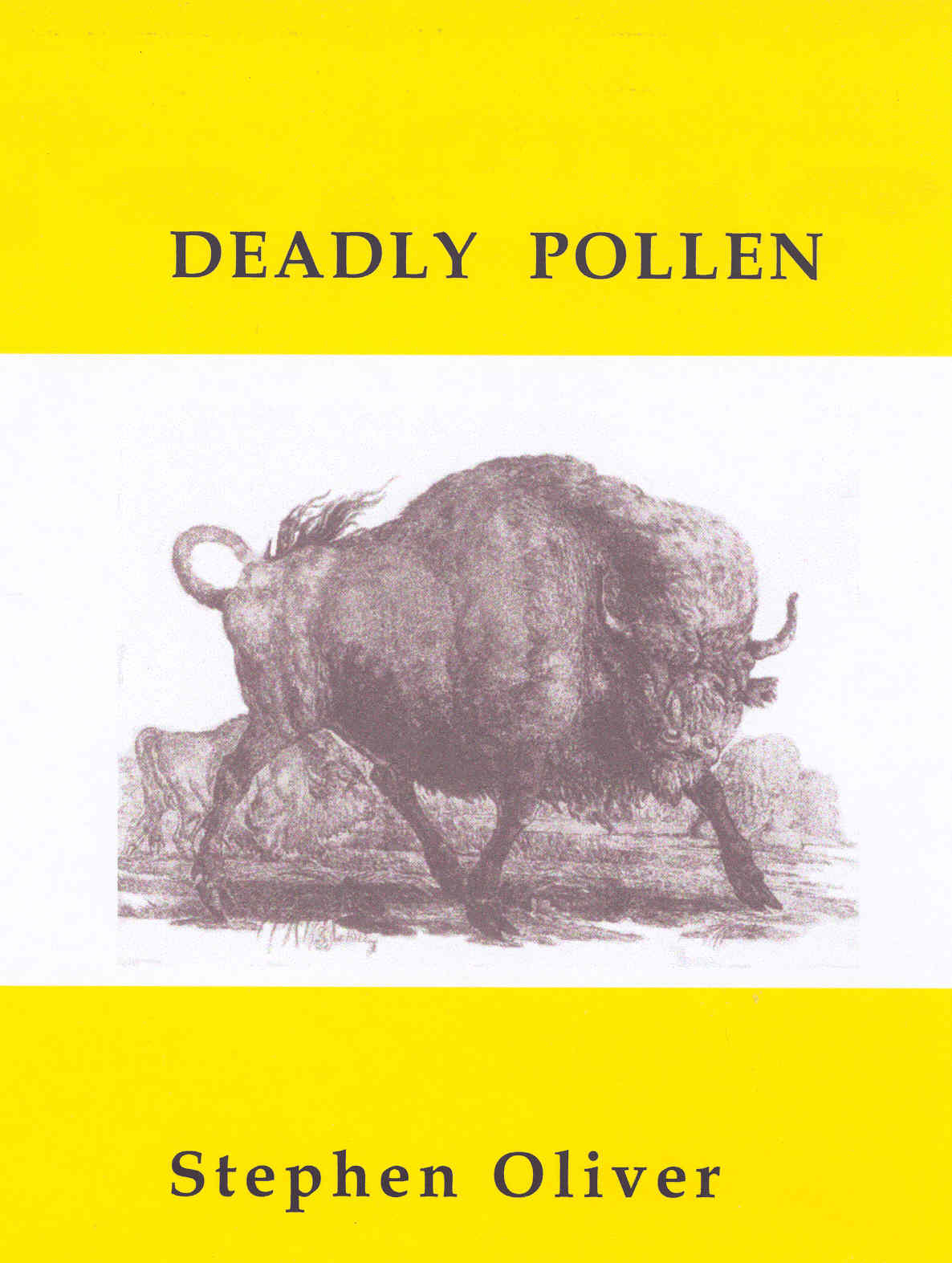
Stephen Oliver Deadly Pollen [Middletown NJ: Word Riot Press, 2003]; and
Ballads, Satire & Salt [Sydney: Greywacke Press, 2003]. Review by Nicholas
Reid. First Appeared: JAS Review of Books.
Stephen Oliver’s anthology of 2001, Night of Warehouses, brought together the
work of a poet who combines an astonishing facility for image with a complete
assurance of voice, while showing a deep engagement with the poetic tradition .
Two new collections, Ballads, Satire & Salt and Deadly Pollen, will do much to
extend that reputation. The former is subtitled ‘A Book of Diversions’ and
displays Oliver’s sardonic wit and verbal inventiveness, along with a fine
set of illustrations by Matt Ottley. The book’s light verse moves from
political satire (‘Think Big’) to a series of reflections on the poets of this
and the last generation, ranging from Larkin and Auden to the major figures in
recent New Zealand writing. Wit explained is wit ruined, however, and so I
shall not comment at length on what is an impressive work.
Oliver’s other new collection, Deadly Pollen, is an ambitious undertaking - a
meditation, in large measure, on Wallace Stevens and his legacy - and brings
together thirty-five short lyrics into a loosely linked sequence which examines
the state of the world after 9/11. And the poem is not ‘merely’ political, for
it diagnoses a state of spiritual malaise based on fear, a state of crisis in
which the role of the poet is in question. So far, so good. But if this is a
crisis poem, it is also a crisis in which (and this is my reservation) I find
it difficult to believe, though it has been the subject of much recent American
commentary. And in any case, there is also an enormous amount to admire in the
language and in the range of reference.
I can convey something of the fineness of Oliver’s craftsmanship in his
translation of Horace’s ‘Pyrrha’ ode, a translation which fits into Oliver’s
theme of disillusionment, and of his modernist distrust of beauty in person and
in diction. The quiet intensity, and the distanced, almost intellectualized
sensuality, of the language in which Oliver brings alive the golden-haired
Pyrrha, Horace’s femme fatale, is perfect:
Pyrrha, your dewy hair,
yellow, scented, doubly wreathed
in Jasmine, fresh from the trellis
this morning.... (lyric 12)
Nor is Oliver’s ambition here as limited as it might seem, for in taking on
such a translation Oliver is setting himself up against a history of
translations, and most notably one by Milton. It is a challenge in which he
succeeds admirably. And in the later lines of the lyric, Oliver marks his
disengagement by a withdrawal into a more demotic register. For while he is
adept at finding occasion for the lyrical richness of which modernism was
always suspicious, he also writes at times in a spare modern voice, as in the
following lines which may owe something to the New Zealand poet Curnow’s ‘Canto
of Signs’:
Rubbed off sky exposes an
undercoat of white that is really
fuzzed, mid-day heat. Birds
change over shifts. Things settle.
Shadow drops under eaves, tier
by tier .... (lyric 32)
The language here has a powerful antipodean flatness, and depends on its
laconic pauses. And if ‘things settle’, it is because, as the allusion to Yeats
suggests, things are about to fall apart; and we move to images of Bali.
Oliver goes on in a following lyric to demonstrate his gift for image, in his
intense visualization of Spring’s strange bloom, the terrorist’s bomb:
Compression of bees,
shrub-shaped, in proton loops,
on cushioned air. Spring!
See the counter, its bright ticking
with fail-safe growth. (lyric 34)
Political poets do not always manage to capture so well the estrangement which
is necessary for successful social comment.
Similarly, Oliver demonstrates an unsettled verbal mastery in a bravura
display, a description of architectural form:
... Complex of
accented runs, angles, drops, sluices,
pumps, ditches, endless unbowed
archways... (lyric 11)
The language here is finely controlled, from the way in which the ‘x’ sound is
perfectly balanced in the opening phrase, to the series of falling
monosyllables which are released in the enjambed expansiveness of the final
phrase with its open vowels. The language is reminiscent of Les Murray’s ‘Bent
Water’ (surely Murray’s masterpiece). But the lines I have just quoted continue
in rhythms which, while still lyrical, are also more unsettling: ‘archways,
treatment ponds breaking into/sunlight’. For where Murray’s language embodies a
confident belief in God, Oliver’s has been a celebration of a public sewer -
and more to the point, a sewer envisioned but (in an act of creative failure)
never built.
Late in the poem, Oliver brings together these themes in a grim reflection
upon the role of the poet - in a voice in which the emotion is italicized but
never allowed to run outside its bounds:
One quadrant of sky turns,
face up, black as the ace of spades.
Much as a God can manage
muttering from the side of his mouth.
Star flecks, nova spittle. Rage of
emptiness pours through, for the hell
of it, endlessly. Looking back to
what beginning. The whole shebang
advances toward, beyond our
best efforts. We live under a Niagra
of star fall, huge optics dilate time,
blackness like velvet slips over
chrome. Sounds of nothingness
strung between a singlet of lights. (lyric 30).
This is vintage Oliver. The language is elaborate, but perfectly judged,
undercut by a colloquial impulse (‘black as the ace of spades’, ‘for the hell
/ of it’). This undersong speaks of Oliver’s awareness of his place as a poet
of the vernacular republic; but it also speaks, in its use of cliche, of a loss
of faith in the resources of poetic language.
And something similar can be said of its use of Stevens, for where Stevens is
the poet who brought romantic metaphysics to its final crisis, and with it the
end of any hope of finding essential meaning in the world, Oliver’s use of
Stevens here seems also an act of deliberate failure. The stanza alludes to
Stevens’s Jove, a false divinity who ‘moved among us, as a muttering king’ in
‘Sunday Morning’, and to that poem’s existential conclusion that (contra
Milton) ‘We live in an old chaos of the sun’. Like Stevens in ‘Key West’,
Oliver laments the ‘Blessed rage for order’, the ‘glassy lights’ which gave a
bogus sense of structure to the sea. But in a sense, and an important sense,
much of the language of Oliver’s stanza is the language of Stevens: it is an
eloquent testament to a failure to find in the present a viable voice for
poetry.
Clearly there is much in this sequence which I find powerful, and respond to
warmly. Many of the lyrics are perfect, and thematically the poem traverses
many of the issues which are at the heart of poetry today: from the modernist
legacy of deep worries over memory and metaphor, to a more contemporary
juxtaposition of dictions and registers, and a concern with post-modernism and
the end of history. It is a sequence which is not afraid to take on Stevens, or
Milton and Hardy and Auden. But I would like to see it slightly reshaped, for I
feel that there is a great poem hiding in here somewhere, if only I could be
persuaded more of its motivation. I think fear does lie at the heart of its
psychology, but the real fear is artistic rather than political; and if this
could be worked more into the texture of the poem, along with some editing of
the poem’s middle section, we would have a major achievement not only in
Oliver’s oeuvre, but in antipodean writing.