BY CYRUS THOMAS
INTRODUCTORY
As the origin and signification of the day and month, names of the Maya
calendar, and of the symbols used to represent these time periods, are
now being discussed by students of Mexican and Central American
paleography, I deem it advisable to present the result of my
investigations in this line. The present paper, however, will be limited
to the days only, as I have but little to add in regard to the month
names or symbols. As the conclusion reached by Drs Seler and Brinton in
regard to the order and sequence of the days of the month in the
different calendars appears to be satisfactorily established, it will be
accepted.
As frequent allusion is made herein to the phoneticism or phonetic value
of the written characters or hieroglyphs, it is proper that the writer’s
position on this point should be clearly understood. He does not claim
that the Maya scribes had reached that advanced stage where they could
indicate each letter-sound by a glyph or symbol. On the contrary, he
thinks a symbol, probably derived in most cases from an older method of
picture writing, was selected because the name or word it represented
had as its chief phonetic element a certain consonant sound or syllable.
If this consonant element were b, the symbol would be used where b
was the prominent consonant element of the word to be indicated, no
reference, however, to its original signification being necessarily
retained. Thus the symbol for cab, “earth,” might be used in writing
Caban, a day name, or cabil, “honey,” because cab is their chief
phonetic element.
In a previous work205-1 I have expressed the opinion that the
characters are to a certain extent phonetic—are not true alphabetic
signs, but syllabic. And at the same time I expressed the opinion that
even this definition did not hold true of all, as some were apparently
ideographic, while others were simple abbreviated pictorial
representations. In a subsequent paper205-2 I expressed substantially
the same opinion, and gave as my belief that one reason why attempts at
decipherment have failed of success is a misconception of the peculiar
character of the writing, which peculiarity is found in the fact that,
as it exists in the codices and inscriptions, it is in a transition
stage from the purely ideographic to the phonetic. I stated also my
belief that the writing had not reached the stage when each sound was
indicated by a glyph or sign.
This may further be explained by the following illustration: The
conventionalized figure of a turtlehead is the symbol for a “turtle,”
ak, ac, or aac in Maya; and a conventionalized footprint is the
symbol for “step” or “road,” be, beil, in Maya. These may be brought
together to form the word akyab or kayab, which may have no
reference to the original signification of the combined symbols. These
two glyphs are, in fact, combined to form the symbol for the month
Kayab.
These statements will perhaps suffice to make clear my views on this
question, which do not appear to have been clearly understood, possibly
because of my frequent use of the words “phonetic” and “phoneticism,”
and perhaps rather loose reference to “letter elements.”
It is proper, however, to add that I am inclined to the opinion that
modification in the form and details of a glyph which belongs to the
class which, for want of a better term, we may designate “phonetic,” in
many cases indicates a modification or change in the signification or
word value. I say in “many cases,” because these modifications are due
often to the greater or lesser accuracy with which the glyph is drawn,
the caprice of the scribe, and other causes which have no reference to
sound or signification. For example, the change of a rounded or circular
symbol to a face figure, as is often done, does not appear, at least in
the day signs, to have any significance. On the other hand, a slight
variation, if permanent, may be indicative of a difference in
signification or phonetic value. This appears to be true, to some
extent, whether we consider the characters ideographic or as, in some
sense, phonetic.
The lists of the days in the Maya, Tzental, Quiche-Cakchiquel, Zapotec,
and Nahuatl, in the order usually given, are as follows:
Names of the days in the different calendars
| Maya |
Tzental |
Quiche-
Cakchiquel |
Zapotec |
Nahuatl |
| Imix. |
Imox. |
Imox. |
Chilla. |
Cipactli. |
| Ik. |
Igh. |
Ik’. |
Gui, Ni, Laa. |
Ehecatl. |
| Akbal. |
Votan. |
Akbal. |
Guèla. |
Calli. |
| Kan. |
Ghanan. |
K’at. |
Guache. |
Cuetzpallin. |
| Chicchan. |
Abagh. |
Can. |
Ci, Ziie. |
Cohuatl. |
| Cimi. |
Tox. |
Camey. |
Lana. |
Miquiztli. |
| Manik. |
Moxic. |
Quch. |
China. |
Mazatl. |
| Lamat. |
Lambat. |
Canel. |
Lapa. |
Tochtli. |
| Muluc. |
Molo. |
Toh. |
Niza. |
Atl. |
| Oc. |
Elab. |
Tzi. |
Tella. |
Itzcuintli. |
| Chuen. |
Batz. |
Batz. |
Goloo. |
Ozomatli. |
| Eb. |
Euob. |
E, Ee. |
Pija. |
Mallinalli. |
| Ben, Been. |
Ben. |
Ah. |
Quii. |
Acatl. |
| Ix, Hix. |
Hix. |
Balam. |
Eche. |
Ocelotl. |
| Men. |
Tziquin. |
Tziquin. |
Naa. |
Quauhtli. |
| Cib. |
Chabin. |
Ahmak. |
Loo. |
Cozcaquauhtli. |
| Caban. |
Chic. |
Noh. |
Xoo. |
Ollin. |
| Edznab. |
Chinax. |
Tihax. |
Gopaa. |
Tecpatl. |
| Cauac. |
Cahogh. |
Caoc. |
Appe. |
Quiahuitl. |
| Ahau. |
Aghual. |
Hunahpu. |
Lao. |
Xochitl. |
THE FIRST DAY
Maya, imix (or ymix); Tzental, imox or mox; Quiche-Cakchiquel,
imox or moxin; Zapotec, chilla or chiylla; Nahuatl, cipactli.
The symbol of this day, which is quite uniform in the day series of the
codices, is shown in plate LXIV, 1.207-1 In this the essential
features appear to be the black spot at the top, the semicircle of dots
around it, and the short perpendicular lines in the lower half. The form
on the right slab of the “Palenque tablet,” and also in the Lorillard
City inscription, copied by Charney, is given in plate LXIV, 2.
The only particular in which this differs from the other is that the
little circle at the top is crosshatched. The form shown in LXIV, 3, is
found in the Tikal inscription; it shows also the crosshatching in the
little circle at the top. This character, however, when combined with
other glyphs, and when used otherwise than as a day symbol, sometimes
varies from the types given. For example, in the symbol of the month
Mac it is as shown in plate LXIV, 4. In this a minute, divided oblong,
takes the place of the dark spot at the top, and a double curved line
accompanies the circle of dots. Another form is shown in plate LXIV, 5.
The only variation in this from the usual type is the introduction of
two or three minute circles in the curved line of dots and the divided
oblong. Dr Seler is inclined to believe that these are essential
variants from the true imix symbol; nevertheless, as m is the chief
consonant element both in imix, or mox and mac, there appears to
be a relation between the form of the glyphs and their phonetic value.
Drs Seler and Schellhas believe im to be the radical of imix and
imox, which are dialectal variations of the same word. Dr Brinton,
however, basing his opinion on the fact that mox and moxin are used
sometimes as equivalents, decides that the radical syllable is m-x. In
this he is probably correct, and if so, this furnishes additional
evidence of the close relation between form and sound, as in one case
m-x are the chief phonetic elements and in the other m-c. It is
probable that Drs Schellhas and Seler were led to their conclusion by
the fact that the symbol bears a close resemblance to the conventional
form of the female breast, which in Maya is im. This, which was
perhaps the origin of the symbol, was probably selected simply because
m is its only prominent element. Nevertheless, it is worthy of notice
that the symbol for the day Ix is frequently represented as shown in
plate LXVI, 36, from Tro. 5*c. This is similar in some respects to the
Imix symbol, and the name contains the i and x of the latter. If
the writing is phonetic, the points of resemblance may have some
significance, otherwise they do not.
In a previous paper208-1 I suggested that the probable signification
of the character LXIV, 7, from Dres. 14c and 46b, is maax, “monkey,
ape, imitator.” Below the text in each case is seen a dark male figure
(or deity), to which it undoubtedly refers, as is conceded by Drs
Schellhas and Seler. The face character, which forms part of the glyph,
may be only a determinative; at least I am unable to assign it any other
value in this connection, and the necessity for such determinative is
apparent. Brasseur, under akab-maax, speaks of a phantom or hobgoblin
of this name, which he says signifies “the great monkey of the night.”
Perez gives as definitions “duende” (elf or hobgoblin) and “mico
nocturno.” Henderson, who writes the name akabmax, simply says
“sprite, phantom.” It would seem, therefore, that among the
superstitious beliefs of the Maya was that of a night phantom or deity,
which took the form of a monkey. But this black figure appears to be
different from those on Tro. 34*-31*, with which Seler connects it and
to which he applies the name Ekchuah.208-2
In the paper above referred to, I have interpreted the symbol shown in
plate LXIV, 8 (from Dres. 35c) maach, “the crow,” assuming the
birdhead to be a determinative. Seler concludes that the bird which this
represents is “a substitute, colleague, or symbol of the Rain god Chac,”
the so-called Maya Tlaloc so frequently represented in the codices.
Although there is in this case no bird figure below to confirm our
interpretation, yet it appears to be justified by the comparisons given
and by its agreement with the phonetic value of the imix symbol. It is
also further confirmed by the two glyphs shown in plate LXVIII, 13, 14,
which occur together in Dres. 38b. In this case the two characters,
which are combined in plate LXIV, 8, are separated, yet must have the
same signification. Here the bird figure (a man with a bird’s head or
bird mask) is seen below. In both instances rain is represented, showing
that the bird is supposed to bear some relation thereto. But it is more
likely that it has direct reference to the wind which accompanies the
rain storm rather than to “fruitfulness,” as Seler supposes. Be this,
however, as it may, our rendering of the imix symbol in this
connection appears to be justified, and indicates that the symbol is
used here for its phonetic value rather than with any reference to its
primary signification.
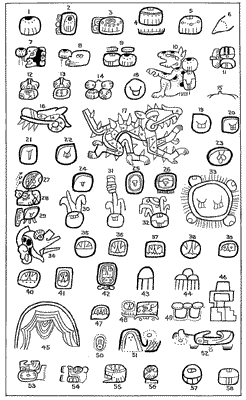 PL. LXIV. COPIES OF GLYPHS FROM THE CODICES
Dr Seler also refers in this connection to the lower line of symbols on
Dres. 29-30b (three of which are shown in plate LXVIII, 15, 16, 17); to
those shown in plate LXVIII, 18, 19, from Tro. 14c; and those shown in
plate LXVIII, 20, 21, from Tro. 11a. He remarks that “in a number of
hieroglyphs the character imix stands as an equivalent of a peculiar
animal head which bears as a distinctive mark the element akbal over
the eye. Thus in the hieroglyphs enumerating those above mentioned
which, standing after the hieroglyphs of the cardinal points, seem to
express the deities presiding over them, indeed there appears here on
the same animal head, on one hand the character imix, on the other the
element figure 165” (our plate LXIV, 5).
Although I am unable to interpret satisfactorily the imix symbols in
the places above referred to, I think it can be made apparent that Dr
Seler’s explanation is without foundation. For instance, by referring to
the plates of the Dresden and Troano codices mentioned, it will be seen
that there is nothing whatever that refers to an “animal head which
bears the element akbal over the eye,” unless we suppose it to be in
plate LXVIII, 16 (from Dres. 29b) and LXVIII, 21 (from Tro. 11a). There
is no figure below or connected with either series to justify this
conclusion. It is also certain that plate LXVIII, 21 (Tro. 11a) is not
an animal head. Possibly plate LXVIII, 16 (Dres. 29b) may be intended
for an animal head, but this is not certain and, moreover, it is not
repeated in the series.
Referring to Cort. 27a it will be seen that the compound glyph shown in
plate LXVIII, 22 (apparently the same as that on Tro. 11a) is repeated
four times in one line, each connected with a cardinal point symbol, and
each standing immediately over and evidently referring to a large
vessel.209-1 It is stated that it was a custom among the Maya during
certain religious ceremonies to place a vessel in their temples at each
of the four cardinal points.209-2 As cum and xamach are Maya words
signifying vessel, we still find in these the m sound. It is therefore
possible that the similar glyphs on Dres. 29b and Tro. 14 and 15 also
refer to vessels. The supposition seems to be strengthened by the fact
that connected with the former are figures of the four classes of food
animals—quadrupeds, birds, reptiles (iguana), and fishes. The latter
refer to the hunter’s occupation, being accompanied by figures of the
deer. Landa, in his descriptions of the various festivals, repeatedly
alludes to the four Chacs or Bacabs which represent the four cardinal
points, and to the different classes of food animals presented where
vessels were used. It is therefore more likely that the symbol is used
in the places mentioned because of its phonetic value rather than as a
substitute for the heads of lightning animals, for which supposed
substitution Dr Seler admits he can not account.
Dr Seler refers also to the glyph on which the long nose deity is
seated, Dres. 44a, shown in our plate LXVIII, 23. The prefix he
interprets by “man, human being,” and supposes the whole glyph refers to
the attributes of the Rain god. As the deity holds a fish in his hand,
and is seen in the lowest division of the same plate in the act of
seining fish, is it not more likely that this symbol should be rendered
by cayom, “a fisherman”? This is appropriate and retains the phonetic
value of the imix symbol.
In the compound glyph 24, plate LXVIII, from Dres. 67b, to which Seler
also refers in the same connection, we see in the figure below the same
deity wading in water in which a fish is swimming. The right portion of
the symbol is the same as the last (plate LXVIII, 23) and presumably has
the same signification—cayom, “a fisherman,” or cayomal, “to fish.”
I am unable to interpret the first or left-hand character; possibly it
may be found in one of the terms chucay, or ɔaucay, which Henderson
gives as equivalents of cayomal. The latter—ɔaucay—would give to
this prefix precisely the phonetic value I have hitherto assigned it.
The next character Dr Seler refers to in this connection is that shown
in plate LXVIII, 25, from Dres. 40c, where the long-nose god is seen
below rowing a boat on the water. The adjoining symbol in the text is a
fish. It is probable therefore that substantially the same
interpretation is to be given here.
The group shown in plate LXIV, 9, consisting of an Imix and Kan
symbol, is of frequent occurrence in all the codices. The relation of
the characters in this combination varies, the order being frequently
the reverse of that given in the figure, and again one being placed on
top of the other. They frequently follow deity symbols, especially the
symbol of the so called “Corn god,” and in these instances seem to refer
to some attribute of the divinity indicated. However, they are by no
means confined to these relations, being found quite frequently in other
connections. The combination is occasionally borne upon the back of an
individual, as Dres. 16a, and on Tro. 21b it is on the back of a dog. Dr
Seler concludes “that it denotes the copal or the offering of incense.”
However, he subsequently210-1 expresses the view that it may signify
“beans and maize.” In a previous work210-2 some reasons were presented
by me for believing this combination was intended to denote bread or
maize bread. This belief is based on the statement by Landa in his
account of the sacrifices at the beginning of the year Muluc, that
they made “images of dogs, in baked earth, carrying bread on the back,”
and the fact that in plate 21 of the Codex Tro., representing the
sacrifices of this year, we see the figure of a dog with this Kan-Imix
group on its back. This figure (plate LXIV, 10) probably represents the
images of which Landa speaks, and the symbols on the back, bread or food
in the general sense. Further notice of this combination will be given
under the fourth day, Kan.
The character shown in plate LXVIII, 26, from Tro. 20*d, is erroneously
given by Seler as an example of the kan-imix symbol. The two glyphs on
the mat figure are unquestionably imix symbols, though of the two
different types shown in plate LXIV, 1 and 5. He suggests that here it
replaces the deity symbol, but this is contradicted by the fact that in
both groups where it appears the deity symbol is present. The mat-like
figure, which is probably a determinative, shows that it refers to the
sack, bag, or kind of hamper which the women figured below bear on the
back, filled with corn, bones, etc. As mucuc signifies “portmanteau,
bag, sack, etc,” mucub “a bag or sack made of sackcloth,” and
mucubcuch “to carry anything in a sack or folded in a shawl,” it is
more than probable we have in these words the signification of the
symbol. The duplication of the imix symbol may be to denote the
plural; or, as the words come from a root signifying “secret, hidden,
covered,” it may be to intensify. It is noticeable also that the latter
or right-hand Imix symbol is similar to that used for the mouth Mac.
In the right section of Dres. 41b is the glyph shown in plate LXIV, 11,
which, according to the phonetic system that appears to prevail in this
writing, may be translated yulpolic, from yulpol, “to smooth or
plane wood,” or, as given by Henderson (MS. Lexicon), “to smooth, plane,
or square timber, to beat off the log.” This interpretation, which is
given here merely because of its relation to the symbol which follows,
is based in part on the following evidence: The left character, which
has y as its chief phonetic element, is the same as the upper
character in the symbol for the month Yax (plate LXIV, 12), and also
the upper character of the symbol for the month Yaxkin (plate LXIV,
13). Other evidence of its use with this value will be presented farther
on, and also in reference to the right character of the above-mentioned
symbol (plate LXIV, 11), which has been given p as its chief phonetic
element. By reference to the figure below the text the appropriateness
of this rendering is at once apparent, as here is represented an
individual in the act of chipping off the side of a tree. This he
appears to be doing by holding in his left hand an instrument resembling
a frow, which he strikes with a hatchet.
The character immediately below the one above mentioned and belonging to
the same series is shown in plate LXIV, 14. It may be interpreted
mamachah, “to make flat by repeated strokes.” The phonetic value of
the parts is obtained in this way. The upper character with two wings is
Landa’s ma, except that the circular wings contain the lines or
strokes which the bishop has omitted, and which appear to indicate the
m sound and are observed in the Imix symbol. Colonel Mallery,
comparing this with the sign of negation made by the Indians and that of
the Egyptians given by Champollion (our plate LXIV, 15), concludes that
it is derived from the symmetrically extended arms with the hands curved
slightly downward. This will furnish an explanation of the strokes in
the terminal circles. The left of the two lower characters is almost
identical with the symbol for the month Mac (plate LXIV, 4), omitting
the ca glyph. The lower right-hand character is similar to the symbol
for the month Chuen. We thus obtain legitimately the sounds ma
ma-ch, whether we consider the parts truly phonetic or only ikonomatic.
For further illustration of the use of this symbol and evidence of
phoneticism, the reader is referred to the article in the American
Anthropologist above mentioned.
The fact that a symbol is used to denote a given Maya day does not
prove, supposing it to be in any sense phonetic, that the Maya name
gives the original equivalent. It may have been adopted to represent the
older name in the Tzental, or borrowed from the Zapotec calendar and
retained in the Maya calendar for the new name given in that tongue.
However, the symbol for this first day, which has substantially the same
name in the Maya and Tzental, appears to represent the name in these
languages and to be in some degree phonetic, m being the chief
phonetic element represented by it. The crosshatching in the little
circle at the top, seen in some of the older forms found in the
inscriptions, may indicate, as will later be seen, the x or ch
sound, thus giving precisely the radical m-x.
It may be said, in reference to the signification of the names of the
day in different dialects, that no settled or entirely satisfactory
conclusion has been reached in regard to either.
The Cakchiquel word imox is translated by the grammarian Ximenes as
“swordfish,” thus corresponding with the usual interpretation of the
Mexican cipactli. Dr Seler thinks, however, that the Maya names were
derived, as above stated, from im. Nevertheless he concludes that the
primitive signification of both the Maya and Mexican symbols is the
earth, “who brings forth all things from her bosom and takes all living
things again into it.” If we may judge from its use, there is no doubt
that the Mexican cipactli figure is a symbol of the earth or
underworld. The usual form of the day symbol in the Mexican codices is
shown in plate LXIV, 16, and more elaborately in plate LXIV, 17. As
proof that it indicates the earth or underworld, there is shown on plate
73 of the Borgian Codex an individual, whose heart has been torn from
his breast, plunging downward through the open jaws of the monster into
the shades or earth below. On plate 76 of the same codex, the extended
jaws open upward, and into them a number of persons are marching in
regular order. These apparently represent the thirteen months of the
sacred year. One has passed on and disappeared from view, and the other
twelve are following with bowed heads. It would seem from these to be
not only symbolic of the earth or hades, but also to have some relation
to time.
For positive proof that it is sometimes used to denote the earth, or
that from which vegetation comes, it is only necessary to refer to the
lower right-hand figure of plate 12, Borgian Codex. Here is Tlaloc
sending down rain upon the earth, from which the enlivened plants are
springing forth and expanding into leaf and blossom. The earth, on which
they stand and from which they arise, is represented by the figure of
the mythical Cipactli.
It is quite probable that the monster on plates 4 and 5 of the Dresden
Codex, which appears to be of the same genus, is a time symbol, and also
that on plate 74 of the same codex. It is therefore more than likely
that the animal indicated by the Mexican name of the day is mythical,
represented according to locality by some known animal which seems to
indicate best the mythical conception. Some figures evidently refer to
the alligator, and others apparently to the iguana; that on plates 4 and
5 of the Dresden Codex is purely mythical, but contains reptilian
characteristics.
Dr Brinton, probably influenced to some extent by the apparent
signification of the Nahuatl name and symbol, explains the other names
as follows:
This leads me to identify it [the Maya name] with, the Maya mex
or meex, which is the name of a fish (the “pez arana,” “un
pescado que tiene muchos brazos”), probably so called from another
meaning of mex, “the beard.” ... This identification brings this
day name into direct relation to the Zapotec and Nahuatl names. In
the former, chiylla, sometimes given as pi-chilla, is
apparently from bi-chilla-beo, water lizard, and Nahuatl
cipactli certainly means some fish or fish-like animal—a
swordfish, alligator, or the like, though exactly which is not
certain, and probably the reference with them was altogether
mythical.
Dr Seler, in his subsequent paper, gives the following explanation of
the Zapotec name chilla or chijlla:
For this I find in the lexicon three principal meanings: One is the
cubical bean (wurfel bohne). “Pichijlla, frisolillos o havas con
que echan las suertes los sortilegos” [beans used by the sorcerers
in casting lots or telling fortunes]; another meaning is “the
ridge” (pichijlla, lechijlla, chijllatani, loma o cordillera de
sierra); another is “the crocodile” (cocodrillo, lagarto grande de
agua); and another “swordfish” (pella-pichijlla-tao, espadarte
pescado). Finally, we have chilla-tao, “the great Chilla,” given
again as one of the names of the highest being. Here it seems to me
that the signification “crocodile” is the original one, and thus
far suitable. For the manner in which the first day character is
delineated in Mexican and Zapotec picture writing [our plate LXIV,
16] shows undoubtedly the head of the crocodile with the movable
snapping upper jaw, which is so characteristic of the animal.
Attention is called to the apparently closely related word as given by
Perez—mech, ixmech, “lagartija.”
It will not be out of place here to refer to a superstition pervading
the islands of the Pacific ocean, which seems strangely coincident with
the conception of the physical symbol of this day. This is a
mythological monster known in some sections by the name Taniwha, and
in others as moko or mo’o.
Dr Edward Tregear214-1 speaks of it as follows:
Taniwha were water monsters generally. They mostly inhabited lakes
and streams, but sometimes the sea. Sometimes the beast was a land
animal, a lizard, etc, but the true taniwha is a water kelpie.
Mr Kerry Nichols,214-2 speaking of these monsters, says:
With the other fabulous creations of Maori mythology were the
taniwhas or evil demons, mysterious monsters in the form of
gigantic lizards, who were said to inhabit subterranean caves, the
deep places of lakes and rivers, and to guard tabued districts.
They were on the alert to upset canoes and to devour men. Indeed,
these fabulous monsters not only entered largely into the religious
superstitions, but into the poetry and prose of Maori tradition.
The Hawaiian Mo’o or Moko appears, from the following statement by
Judge Fornander, to have been applied sometimes to this mythological
monster:
The Mo’o or Moko mentioned in tradition—reptiles and
lizards—were of several kinds—the mo’o with large, sharp,
glistening teeth; the talking mo’o, moo-olelo; the creeping mo’o,
moo-kolo; the roving, wandering mo’o, moo-pelo; the watchful
mo’o, moo-kaala; the prophesying mo’o, moo-kaula; the deadly
mo’o, moo-make-a-kane. The Hawaiian legends frequently speak of
mo’o of extraordinary size living in caverns, amphibious in their
nature, and being the terror of the inhabitants.214-3
According to the Codex Fuen-leal, at the beginning of things the gods
made thirteen heavens, and beneath them the primeval water, in which
they placed a fish called cipactli (queses como caiman). This marine
monster brought the dirt and clay from which they made the earth, which,
therefore, is represented in their paintings resting on the back of a
fish.
A similar conception is found both in Malay and Hindu mythology,
differing somewhat in details, but always relating to some monster
reptile. In the Manek Maya, one of the ancient epics of Java, Anta Boga,
the deity presiding over the lowest region of the earth, is a
dragon-like monster with ninety nostrils. The same conception is found
also among other peoples.
In the Tonga language moco is “a species of lizard;” in Hawaiian
mo’o or moko is “the general name for lizards,” and the same word
signifies “lizard” in Samoan; moko-moko is the New Zealand (Maori)
name for a small lizard. Taylor214-4 says that moko-titi was a
“lizard god.”
It is therefore evident that a superstition regarding some reptilian
water monster prevailed throughout the Pacific islands. It is true also
that the Nahuatl cipactli certainly means some amphibious or water
animal—a swordfish, alligator, or something of the kind, though exactly
which is not certain—or, what is more likely, the reference was
altogether mythical.
It is possible, and perhaps probable, as stated above, that the Maya
symbol of this day was taken originally from the conventional method of
representing the female breast. Drs Seler and Schellhas appear to be of
this opinion. But it does not necessarily follow from this that the
character used for the name of the day has any reference to the female
breast, as it is more likely used in this relation for its phonetic
value alone, m being the chief phonetic element indicated thereby.
If the supposition herein advanced that the combination shown in plate
LXIV, 9, denotes bread or food be correct, it is possible that the
symbol is also sometimes used to indicate “maize,” ixim or xim, on
account of its phonetic value. As will be shown farther on, the kan
symbol is not only used to denote the grain of maize and maize in the
general sense, but it appears to denote in some cases bread or the
tortilla.
THE SECOND DAY
Maya, ik; Tzental, igh; Quiche-Cakchiquel, ik’; Zapotec, gui,
ni, laa, laala or liaa; Nahuatl, ehecatl.
The form of the symbol of this day presents a number of minor
variations, the more important of which are shown in plate LXIV, 18-26.
Symbol 18 is the form given by Landa; 19-24, those found in the codices;
25 is from the left slab of the Palenque tablet or altar plate, and 26
is from the Tikal inscription.
So far as this character can satisfactorily be interpreted, where used
otherwise than as a day symbol, the signification appears to be wind,
spirit, or life, whether considered phonetic or not. As illustrations of
its use, the following examples are presented:
At the right side of Dres. 72c are the three characters shown in plate
LXIV, 27, 28, and 29, which follow one another downward, as shown in the
figure, the three forming one of the short columns of the series to
which they belong. From the lowest, which is the ik symbol, waving
blue lines, indicating water, extend downward to the bottom of the
division. If these glyphs are considered ideographic and not phonetic,
it is still possible to give them a reasonable interpretation. The
falling water shows that they relate to the rain storm or tempest. The
uppermost character, which appears to be falling over on its side, we
may assume to be the symbol of a house or building of some kind;215-1
the dotted lines extending from its surface may well be supposed to
represent rain driven from the roof. There is, however, another possible
interpretation of this character which appears to be consistent with
Mexican and Central American mythology. It is that it indicates a house,
vessel, or region of the heavens which holds the waters of the upper
world. The turning on the side would, in this case, denote the act of
pouring out the water in the form of rain. This supposition (although I
am inclined to adopt the former) appears to be supported by the fact
that this character is used in the Dresden Codex as one of the cloud or
heaven symbols, as, for example, on plates 66 and 68. According to
Ramirez, the Mexican wind and rain gods occupy a large mansion in the
heavens, which is divided into four apartments, with a court in the
middle. In this court stand four enormous vases of water, and an
infinite number of very small slaves (the rain drops) stand ready to dip
out the water from one or the other of these vases and pour it on the
earth in showers.216-1 As the lowest character in the group mentioned
is the ik symbol, its appropriate rendering here is beyond question
“wind;” therefore, as two out of the three characters, and the rain sign
below, indicate the rain storm, we may take for granted that the middle
character probably refers to lightning or thunder.
Additional reasons for this interpretation are given in a previous
paper216-2 and need not be repeated here, as the only object now in
view in referring to them is to show that the ik symbol is there used
to denote wind.
In the third and fourth divisions of plate 16* Codex Troano, five
persons are represented, each holding in his hand an ik symbol from
which arises what appear to be the sprouting leaves of a plant, probably
maize (plate LXIV, 30, 31). This is interpreted by Dr Seler as the heart
just taken from the sacrificed victim, the leaf-shape figures
representing the vapor rising from the warm blood and flesh. It is
unnecessary to give here his reasons for this belief, as the suggestion
presented below, although wholly different, gives to the symbol in this
place substantially the same meaning that he assigns to it, to wit,
life, vitality. It is probable that the figure is intended to represent
the germination of a plant—the springing forth of the blade from the
seed—and that the ik symbol indicates plant life, or rather the
spirit which the natives believe dwells in plants and causes them to
grow. Seler’s suggestion that in this connection ik may be compared to
kan is appropriate, but this comparison does not tend to the support
of his theory. Take, for example, the sprouting kan symbols on Tro.
29b, to which he refers. There can be no doubt that the symbol
represents the grain of maize from which the sprouting leaves are rising
(plate LXIV, 32). In one place a bird is pulling it up; at another place
a small quadruped is attacking it; at another the Tlaloc is planting (or
perhaps replanting) the seed.
In the lowest division of the same plate (Tro. 29) are four individuals,
three of whom, as may be seen by studying the similar figures in the
division above, are anthropomorphic symbols of corn; the other an earth
or underworld deity. One of the former holds in his hands a kan
symbol, which is colored to signify maize; the others hold ik symbols.
There are two interpretations which may be given this symbolic
representation—one, that the ik glyphs are intended to denote plant
life, that which causes plants to spring up and grow; the other, that
they denote wind, which in that country was often destructive to growing
corn.
Very distinct reference is made in the “Relacion de la Villa
Valladolid”217-1 to the injurious effects of winds on the maize crop.
It is related in this report, which appears to have been of an official
character, made in 1579, that—
From June till the middle of August it rains very hard and there
are strong winds; from the latter date the rains are not copious
and the wind blows strongly from the north, which causes much
mortality among the natives, and Spaniards as well, for they
contract catarrh and barriga (dropsy?). This north wind destroys
the maize crops, which form the main sustenance of both natives and
Spaniards, for they use no other bread.
There can be no doubt that most, if not all, of the figures on this
plate (Tro. 29) are intended to represent the injurious and destructive
agencies to which maize and other cultivated plants were subject. Birds
and quadrupeds pull up the sprouting seed and pull down and devour the
ripening grain; worms gnaw the roots and winds break down the stalks,
one out of four escaping injury and giving full return to the planter.
The latter is therefore probably the correct interpretation, the only
difficult feature being the presence of the Earth god, which agrees
better with the first suggestion.
It is to be observed that the series on Tro. 29c really commences with
the right-hand group on 30c. The figure here holds in his hand an ik
symbol. Following this, the left group on 29c shows a bird pecking the
corn; the next, a small quadruped tearing it down; the next, a worm
gnawing at the root of a plant; and the fourth, or right-hand group, a
corn figure holding a kan symbol, indicating the mature grain, the
uninjured portion of the crop. It would therefore appear that the ik
symbol in this series denotes wind.
As additional proof that the symbol is used to indicate “wind,”
reference is made to Tro. 24a. Here the long-nose Rain god, or Maya
Tlaloc, is seen amidst the storm, clothed in black and bearing on his
arm a shield on which are two ik symbols (plate LXIV, 33), doubtless
indicative of the fierceness of the tempest. In front of him is the Corn
god, bending beneath the pouring rain. On plate 25, same codex, lower
division, the storm is again symbolized, and the ik symbol is present
here also.
It seems from these facts to be quite certain that the value of the
symbol in the codices, so far as it can be satisfactorily determined,
corresponds in signification with the Maya name.
Referring again to Dr Seler’s theory that the plant-like figures on Tro.
15*, 16* indicate the freshly extracted heart and the vapor arising
therefrom, the following additional items are noted: He says that in the
text the scene below, or at least these sprouting-plant figures, are
expressed by hieroglyphs 27-29, plate LXVIII. His comparison with the
so-called heart figures from the Mexican codices can scarcely be
regarded as convincing, for there is hardly any resemblance. Moreover,
he omits to furnish an explanation, on his theory, of the fact that some
of these rising “vapors” are crowned with blossoms or fruit (plate LXIV,
31).
I think it quite probable that Dr Seler, although not accepting the
theory of phoneticism, has been influenced to some extent by the form of
the right-hand character of the glyph shown in plate LXVIII, 27. This is
much like Landa’s o, and ol in Maya denotes “heart, etc.”
According to Brasseur, oloh signifies “a germ” and “to germinate;”
hokol also has about the same meaning. This furnishes a consistent and
appropriate explanation of the figures, and gives at the same time the
phonetic value of the glyph. I have not determined the prefix
satisfactorily, but presume it is some word having ch’ or tz’ as its
chief phonetic element, which signifies “little,” “plant,” or something
similar.
I have not determined the other symbols to which Seler alludes in this
connection, but some of them, as may be seen by comparison with other
passages, do not have special reference to the plant-like figures.
Whether the little sharp-corner square seen in the upper right-hand
character of the compound symbols shown in plate LXVI, 28 and 55, and
others of similar form, are to be taken as ik glyphs is yet an
undecided question. Dr Seler appears to have excluded them from this
category in his paper, so frequently referred to, though he subsequently
brings them into this relation. But in these places he gives the glyph
the signification “fire” or “flame.” It is possible that in some of the
cases to which he refers he is correct, as, for example, in regard to
the figure shown in plate LXVIII, 30, from Dres. 25, where it is in the
midst of the blaze. If so, the word equivalent must be kak, as it is
seemingly a variant of ik, and hence may be supposed to have the k
sound. This will agree with his interpretation of plate LXVI, 29, by
kinichkakmo; but in this case we must give ich as the value of the
so-called ben symbol. This, however, is not so very objectionable, as
there are other places where the chief phonetic element of the ben
glyph appears to be i. It is also to be remembered that it is much
like Landa’s i. It is likewise true, as will hereafter be shown, that
the value ben does not appear to hold good where it occurs in
combination with other symbols. However, until a satisfactory rendering
of this little four-corner ik (?) symbol in some other place than the
fire is found, I am hardly prepared to give full acceptance to Dr
Seler’s supposition.
The Zapotec names are somewhat difficult to bring into harmony with the
others. Dr Brinton’s solution is as follows:
In that tongue we have uii, air, wind; chiic, breath; which we
may bring into relation with gui; and we find guiiebee,
wind-and-water cloud (nube con vient y agua). Dr Seler prefers to
derive gui from quii, fire, flame, the notion of which is often
associated with wind.
It was probably this notion and the fact that the little four-corner
ik (?) symbol is sometimes seen in the flame, which caused this
authority to believe the symbol denotes “fire,” “flame.” In the
manuscript Zapotec vocabulary by E. A. Fuller, “wind” is bii.
Dr Brinton thinks that ni is the radical of nici, to grow, increase,
gain life. He says:
Laa, or laala, is a word of many meanings, as warmth, heat,
reason, or intelligence. The sense common to all these expressions
seems to be that of life, vitality.
The form of the Mexican symbol for the day Ehecatl (wind), shown in
plate LXIV, 34, and also of the mouths of the female figures on plates
26 and 28, Troano Codex, which are emblematic of the storm, appear to be
taken from the bird bill. The bird, as is well known, is a wind symbol
with many peoples. It has been so esteemed among several tribes of
American Indians, and also by peoples of the Old World. As nii or ni
signifies “nose, beak, point” in Maya and several cognate dialects, is
it not possible that in this is to be found an explanation of the second
Zapotec name? In this case, however, we must assume that the term is
borrowed, as in this language xi or xie is the term for “nose.” I
notice, however, that the name for bird is given as viguini and
piguiini. If pi (vi) is a prefix, as seems probable from the word
for “hen,” guitii, then we have some ground for believing that the
first Zapotec name has the same fundamental idea as the Mexican symbol.
It therefore would seem that it is not difficult to understand the
origin of the Mexican symbol. Examining plate 10, Borgian Codex, which
appears to represent the home of the winds, we see that, though mostly
furnished with human bodies, they have bird claws as well as bills. But
the origin of the Maya symbol is more difficult to account for. Dr Seler
remarks:
It is difficult to determine the original idea of this character.
Figure 210 [our plate LXIV, 24] and the forms on the reliefs—if we
have correctly interpreted these—lead us to think that the wind
cross, or the figure of the Tau resulting from it, was the origin
of the character. However, the forms of the Cod. Tro. are not
easily reconciled with this.
Dr Brinton219-1 asserts, without heeding Dr Seler’s caution, that it
is the sign of the four directions or four winds—the wind
cross—evidently alluding to the sharp-corner square seen in our plate
LXVI, 28. But he seems to have overlooked the fact that it is never thus
represented in the day symbol. Moreover, no satisfactory proof has been
presented showing that this form has this signification. Seler gives it
in some places, as above stated, the signification “fire,” “flame;” and
if his interpretation of plate LXVI, 29 by Kinich-kakmo be correct, as
Brinton seems to think it is, his interpretations are consistent.
However, Seler’s assertion that “the forms of the Cod. Tro. are not
easily reconciled with this” must be admitted. In the codices this
glyph, as this author remarks, “rather brings to mind the idea of
hanging,” often resembling a bunch of grapes.
I take for granted the symbol, when standing for the day, is not
pictorial or ideographic, but is adopted for its sound value. If this
supposition be correct, then it must be a conventional representation of
something the Maya name of which is ik or that has substantially this
phonetic value. The form of the Mexican symbol, as above indicated,
shows that in selecting it reference was had to the bird bill, to which
possibly may have been added the idea of blowing forcibly from the
mouth, a common method of indicating wind. (See for example the
bird-mouth female, Tro. 25b, where the Ik symbol is present.) But it
seems impossible to find in the symbol any reference to the bird, bird
bill, or the act of blowing, or in fact anything indicating, even by a
conventionalized figure, wind, air, spirit, or breath. Hence it is
reasonable to conclude that it has been selected only because of the
resemblance in sound of the thing it represents to the name Ik. I
would be inclined to believe that the most usual form is the
representation of a tooth or two teeth, the name being used for its
phonetic value only, but for the very troublesome fact that I can find
no name for tooth in Maya to sustain this view. If we could suppose it
to be a conventionalized ideogram of an insect, we would obtain the
desired sound, as Perez explains ikel by “bicho, insecto, polilla,
gorgojo.” It must, however, be confessed that none of these suggestions
are satisfactory.
The following additional references to the bird as a symbol of the wind
are appropriate at this point.
Not only is the day Ehecatl represented in the Mexican codices by a
bird’s head, but we see a bird perched upon a tree at each of the
cardinal points on plate 44 of the Fejervary Codex. Birds are also
perched on three of the four trees representing the cardinal points on
plate 65 of the Vatican Codex.
In speaking of the myths of the Muyscas, Dr Brinton220-1 says:
In the cosmogonical myths of the Muyscas, this [alluding to a
certain name] was the home or source of light, and was a name
applied to the demiurgic force. In that mysterious dwelling, so
their account ran, light was shut up and the world lay in primeval
gloom. At a certain time the light manifested itself, and the dawn
of the first morning appeared, the light being carried to the four
quarters of the earth by great black birds, who blew the air and
winds from their beaks.
The Javanese also assigned a bird to each of the cardinal points,
doubtless with substantially the same mythological concept.
Commenting on a passage of the Popol Vuh, in which the name Voc is
mentioned, the same author220-2 says:
The name Voc is that of a species of bird (Cakchiquel Vaku).
Coto describes it as having green plumage, and a very large and
curved bill, apparently a kind of parrot. Elsewhere in the myth
(page 70) it is said to be the messenger of Hurakan, resting
neither in the heaven nor in the underworld, but in a moment flying
to the sky, to Hurakan, who dwells there.
This is unquestionably the wind symbolized as a bird. The name for wind
in Malay is bayu, and Vayu is a Wind god in Hindu mythology. Garud,
the Bird deity of the Hindu Pantheon, who plays such an important rôle
in the Mahabharata, and is so frequently termed therein “the foremost
ranger of the skies,” is apparently the Storm god, the equivalent of the
Maya Hurukan.
We may remark incidentally that a curious coincidence is found in the
fact that there appears to be a relation between the wind and monkeys in
the mythology both of the Hindu and of the natives of Central America,
or at least of Mexico. Hanuman, the Monkey god, who plays such an
important part in the Ramayana, was the son of Pavana, the chief Wind
deity. According to Brasseur, in his introductory essay to the Popol
Vuh, it is stated in the Codex Chimalpopoca that the men were, on a day
Ehecatl, changed by the wind into monkeys. On what peculiar
mythological conception this idea is based I am unable to state.
THE THIRD DAY
Maya, akbal; Tzental, votan; Quiche-Cakchiquel, akbal; Zapotec,
guèla; Nahuatl calli.
The form of the Maya character as given by Landa is shown in plate LXIV,
35; those usually found in the codices are presented in figures 36 and
37 of the same plate. A slight variation which sometimes occurs in the
Dresden Codex is given in plate LXIV, 38. In figure 39 of this plate
circular dots take the place of the teeth. In another variant, shown in
figure 40, there is a row of dots immediately below the broken cross
line. The forms shown in figures 41 and 42 are from the inscriptions. As
will be seen by comparing figures 36 and 38 with plate LXV, 64, this
glyph, in some of its forms, resembles somewhat closely the chuen
symbol, but is generally readily distinguished from it by the wavy line
across the face and the absence of the little divided oblong at the top,
which is mostly present in the chuen symbol. The lower triangle is
usually sharp and extends to the top in the akbal symbol, while that
in the chuen glyph is broad or rounded and does not extend to the top.
The signification of the Maya and Cakchiquel names, and also of the
Zapotec, is “night” or “darkness.” The Tzental name is that of a
celebrated hero, which, according to Dr Brinton, is derived from the
Tzental word uotan, “heart” or “breast.” This explanation is accepted
by Seler, as Bishop Nuñez de la Vega, the principal authority regarding
this mythological personage, says that “in every province he was held to
be the heart of the village.” Dr Seler also adds that “‘heart of the
village’ is in Mexican called tepeyollotl, and that is the name of the
deity of the third day character, calli” (plate LXIV, 46).
The Mexican name calli signifies house. The method by which Dr Brinton
brings this and the Tzental names into harmony with the idea of darkness
or night is as follows:
The house is that which is within, is dark, shuts out the light,
etc. Possibly the derivation was symbolic. Votan was called “the
heart of the nation,” and at Tlazoaloyan, in Soconusco, he
constructed, by breathing or blowing, a “dark house,” in which he
concealed the sacred objects of his cult. In this myth we find an
unequivocal connection of the idea of “darkness” and “house.”
Dr Seler’s explanation is substantially the same; he differs somewhat,
however, from Dr Brinton in regard to the derivation of the word votan
(or uotan), as he obtains it from the Maya ol, uol, “heart, soul,
will, etc,” and tan, “in the midst,” also “surface, level, extent,
front.” He concludes, therefore, if uo signifies heart, that uotan
denotes “the inmost heart” or “heart of the expanse.” It is proper,
however, to call attention to the fact that Dr Brinton’s derivation of
the name in his “American Hero Myths” is slightly different from that
given in his “Native Calendar,” above mentioned. In the former he says
uotan “is from the pure Maya root word tan, which means primarily
‘the breast,’ or that which is in the front or in the middle of the
body; with the possessive prefix it becomes utan. In Tzental this word
means both ‘breast’ and ‘heart.’” It must be admitted that these
explanations are apparently somewhat strained, yet it is possible they
are substantially correct, as they appear to receive some support from
the figures in the Mexican codices.
Plate 75 of the Borgian Codex, which is in fact the lower part of the
figure on plate 76, heretofore alluded to, although having reference to
the underworld, appears to be in part a delineation of night. The large
black figure probably represents night, the smaller star-like figures
denoting stars, and the large one the night sun, or moon. The house in
the lower right-hand corner, with the black lining, is the house of
darkness. The wind symbol above the roof indicates relationship with the
winds. Dr Seler interprets these star-like figures as sun symbols, but
the number found together on this plate forbids the supposition that
they represent suns. Moreover, the association with the dark figure
renders it probable that they are here used to denote stars.
There is, however, a lack in these explanations of a connecting link,
which seems necessary to render them entirely satisfactory. The name
appears to be intimately associated with that for serpent; or perhaps it
would be more correct to say that this mythological personage appears to
be intimately connected in some way with the serpent. The title of the
Tzental manuscript containing the myth was, according to Cabrera, “Proof
that I am a Chan,” which signifies “serpent.” His chief city was
Nachan, “the house of the serpent;” his treasure house was a cavern.
Simply designating him by “the heart of the nation,” “heart of the
village,” does not appear to furnish a full explanation of his
attributes or characteristics.
As the symbol of this day is frequently connected with cloud and
rain-storm series, as in Tro. 25a, where it appears to be that from
which rain is falling, its signification in these places would appear to
be “cloud,” which carries with it the idea of shade, shadow, and
darkness. This being true, the most likely supposition in regard to the
origin of the symbol is, that it was designed to represent the cloud
breaking into drops and falling as rain—in other words, the weeping
cloud. Such appears beyond question to be its signification in Tro. 25a
and in other places in the same and other codices. This supposition is
also consistent with the fact that some of the symbols, especially those
of the inscriptions (plate LXIV, 42), have dots along the broken line,
which may indicate the raindrops into which the cloud is breaking. I am
therefore not inclined to accept Dr Seler’s supposition that it is
intended to represent the opening to a cavern, after the conventional
method adopted by the Mexican artists. It is improbable, though not
impossible, that the older system may have adopted some features from
the younger. Moreover, this supposition on the part of Dr Seler is in
direct conflict with his statement in the immediately preceding
paragraph. He says:
It is to be observed as applying chiefly to the manuscripts and the
reliefs, that the two side points which project like teeth from the
inner circle of the character could in no wise have signified
teeth. Such an interpretation is contradicted by the occasional
change of their position [plate LXIV, 47] and the fact that they
also appear now and then exactly like eyes [plate LXIV, 39].
Now the Mexican cavern symbol, as shown in his figures and as given in
Peñafiel’s “Nombres Geográficos,” appears to be the open serpent mouth
with teeth and fangs. It is therefore more probable that the symbol was
derived as above indicated. Among the Indian pictographs given by
Colonel Mallery223-1 as representing clouds are those shown in plate
LXIV, 43 and 44. An Ojibwa cloud symbol223-2 is shown in plate LXIV,
45, in which the circular outline denotes the sky. It seems quite likely
that the Maya symbol is intended to convey precisely the same idea. On
the left (bottom) of plate 70, Borgian Codex, is a curved or arch-like
figure somewhat on the same order as those given. It appears to
represent the sky—but darkened sky, indicating night or obscurity. On
its upper surface are nine heads, which probably signify the “Nine Lords
of the Night.” Below it is a black figure. On each side are two figures,
the color of the four differing—one blue, another yellow, another
black, and the other red. These are probably the regents of the cardinal
points.
If this supposition be correct, the symbol is purely ideographic and not
phonetic or ikonomatic; but this does not forbid the idea that when used
in other combinations it is used phonetically to give the chief sound
element of the word indicated by the ideograph. Dr Seler claims, as
corroborative of his supposition, that “all symbols which are combined
with the name of the third character are to be fully explained through
the word ‘cavern.’” But it is far more likely that this (so far as it
holds good) is due to the fact that the symbol is used because of its
phonetic value or its chief phonetic element, ak, which is the same as
the chief element of the Maya name for cavern—actun, actan, aktan
(Henderson, MS. Lexicon).
If this supposition be correct, it may furnish a clue to the name of the
deity whose symbol is shown in plate LXIV, 48. Here the left-hand
character is the akbal symbol (though not complete) surrounded by a
circle of dots. This circle, Dr Seler contends, often indicates flames
which consume the object it surrounds, or light which emanates from that
object. If the whole is but a simple ideogram, it must be taken, as a
whole, as indicating a particular mythological personage; otherwise it
is in part phonetic, or given after the Mexican rebus method of denoting
names. If not a simple ideogram, this prefix is most probably used in
some sense phonetically with reference chiefly to the k sound. The
circle of dots is used here probably to indicate the vowel sound u or
o. But in making this suggestion I do not by any means intend to
suggest that the Maya scribes had reached that stage of advancement
where they could indicate each sound by a character. All I wish to
assert is that I find in numerous cases characters accompanied by this
circle of dots where the proper interpretation appears to be a word
having as its prominent vowel element u or o. Hence the inference
that there is some relation between this circle and these vowel
sounds—this and nothing more.
In Dres. 16c is the symbol shown in plate LXIV, 49. This, as I have
shown elsewhere,224-1 represents the kukuitz or Quetzal figured
below the text. Here are encircling lines of dots, and in the Maya name
the u sound repeated; and here also is Landa’s ku. In Dres. 47c the
symbol for the month Mol is given as shown in plate LXIV, 50. Here
again is seen the circle of dots, and the vowel appears to hold good in
other places. We see it in Landa’s first o. It will also assist us in
giving at least a consistent interpretation to the strange character
shown in plate LXIV, 51, which occurs repeatedly on plate 19 of the Tro.
Codex. In the pictures below are individuals apparently, and as
interpreted by most authorities, engaged in grinding paint or other
substance or in making fire. The right half of the glyph, including the
circle of dots and crosshatching might, according to the value
heretofore given these elements, be rendered by huck, “to rub, grind,
pound, pulverize;” which certainly agrees with the interpretation
usually given the pictures below. Possibly the whole glyph maybe
interpreted by cecelhuchah, “to triturate.” While this, so far as it
relates to the left portion of the glyph, is a mere suggestion, it
agrees with the fact that the ornamented or crossbarred border is found
in the symbol for Cib, and the three dots with Landa’s e.224-2
In Tro. 11*d is the character shown in plate LXIV, 52. As the right
portion is the upper part of the symbol for chikin, “west” (see plate
LXIV, 53), its phonetic value may be a derivative of kuch, kuchnahi,
kuchah, “to spin, to draw out into threads.” Henderson gives chuch
as an equivalent. As the subfix in plate LXIV, 48, is the character I
have usually interpreted by u, this would give us some of the elements
of the name Kukulcan and not Itzamna, as Seler and Schellhas
suppose. Possibly, however, the deity represented may be Baklum-Chaam,
the god adored at Ti-ho and usually considered, though without apparent
justification, as the Maya Priapus.
The somewhat similar character, plate LXIV, 55, from Tro. 18*c, which Dr
Seler considers synonymous, is probably essentially distinct, as it
bears a somewhat stronger resemblance to the chuen than to the akbal
symbol. In character 54, plate LXIV, from Dres. 17b, which denotes the
vulture or rapacious bird figured below the text, it probably indicates
the c sound, as the most reasonable interpretation of the symbol is
hchom, “the sopilote” (Perez), or hchuy, “a hawk or eagle.” If the
character shown in plate LXIV, 54, is intended to indicate the bird
figured below, and is neither of those mentioned, it is probably one the
name of which begins with ch.
The symbol of the month Zoɔ (Tsoz or Zotz) also contains this
supposed akbal glyph, but in the varied form last above mentioned,
which, as we have said, bears a strong resemblance to the chuen
symbol. This, as will be seen by comparing, bears a very close
resemblance to glyph LXIV, 54. If phonetic, we must assume that the ch
(if the interpretation of the former be correct) has been hardened to
z or tz.225-1
The same character is also found in the symbol for the month Xul (see
plate LXIV, 56, from Dres. 49c). As Dr Seler refuses to accept the
theory that the characters are either phonetic or ikonomatic, he
concludes, in the following words, that resemblance in the forms of the
symbols indicates relationship in the subject-matter:
Xul signifies the end, the point; xuulul, to end; xulah,
xulezah, to bring to an end; xulub (that with, which anything
ends), horns, or he who has horns, the devil; xulbil, jests,
tricks, deviltry. We see, therefore, that this word contains
doubtless a reference to something unholy, uncanny, demoniac. To
the Central Americans the bat was not merely a nocturnal animal.
The Popol-Vuh speaks of a Zo’tzi-ha, “bat house,” one of the five
regions of the underworld. There dwells the Cama-zo’tz, “the
death-bat,” the great beast that brings death to all who approach
it, and also bites off the head of Hunapu.
Instead of having to surmise this fancied relation, I think the
explanation is to be found in the fact that similarity in the form of
the glyph is indicative of a similarity in the sounds of the words
represented. Here the ch becomes x (sh).
Dr Seler also calls attention in this connection to the animal figures
in Dres. 36a and elsewhere, which are “represented as plunging down
from heaven with torches in their paws, and fire also issuing from the
tassel-like ends of their tails, which doubtless denote the lightning,
the death-dealing servant of the Chac.” By the mention of this last
word—chac—Dr Seler has shown that correct reasoning by a different
line leads to precisely the same result as that which appeals to the
phonetic or ikonomatic character of the symbol. Here again the ch
sound appears as the chief element of the character. The rain or field
deities, the chacs, are usually represented in the codices as dog or
panther like animals; and chuac, “the tempest,” and, according to
Henderson, chac also, signifies lightning. But the relation of figures
and phonetic value includes also the animal; chacbolay, “a savage
tiger, a young lion” (Perez); chacboay, “a leopard” (Henderson);
chacoh, “a leopard;” chacekel, “a tiger, jaguar;” chac-ikal, “the
storm, the tempest.” The similar figures in Tro. 32c probably symbolize
the dry burning season which parches and withers the corn. The word is
probably choco, chocou, or some related form.
THE FOURTH DAY
Maya, kan or kanan; Tzental, ghanan; Quiche-Cakchiquel, k’at
(k’ate, k’atic, gatu); Zapotec, guache or gueche; Nahuatl,
cuetzpallin.
The Maya symbol of this day is subject to but few and slight variations.
The principal forms are shown in plates LXIV, 57, to LXV, 3. That given
by Landa is presented in plate LXIV, 57. The forms in the codices are
shown in plates LXIV, 58; LXV, 1, 2, 3, that with the eye (LXV, 3) being
the usual form given in Peresianus; LXV, 4 represents it as found on the
right slab of the Palenque tablet.
The significations of the Maya word kan are various, as “yellow,”
“rope,” “hamac,” etc, and, according to Dr Brinton, the Tzental ghanan
is the same word under a slightly different form. However, he contends
that the original sense is to be found in the Cakchiquel word k’an, as
given by Guzman (in a manuscript work in his possession), who says it is
the name applied to the female iguana, or tree lizard. This, it is true,
brings the signification into close correspondence with that of the
Nahuatl term, but it is more than probable that the Maya and Tzental
terms were in use before the application mentioned by Guzman was made by
the Cakchiquel. It is noticeable, however, that in the list from
Taylor’s “Te-Ika-a-Maui,” presented in the appendix, “lizards” are given
as symbolic of one of the New Zealand days.
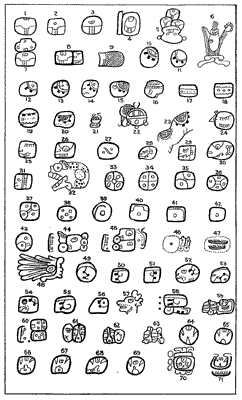 PL. LXV COPIES OF GLYPHS FROM THE CODICES
This interpretation, however, savors too much of an effort to bring the
signification into harmony with the Mexican name. Moreover, it is
difficult to explain the use of the Maya symbol on this theory, as it is
undoubtedly frequently employed to denote the grain of maize. For
example, it represents the seed from which a corn plant is springing, as
on Tro. 29b (see plate LXIV, 32); and one figure in the same division
represents a bird plucking it up, while another shows some small
quadruped seizing it. It is also frequently represented in all the
codices as on a platter or vessel placed as an offering to some
deity, and is often given a yellowish tint in these places. That the
plant which arises from the symbol in these instances is the maize stalk
is admitted by Drs Schellhas and Seler, although they do not seem to
recognize the fact that the symbol represents the grain of maize which
gives birth to the stalk. However, Dr Seler, in his subsequent paper
above referred to, concludes that it refers to the seed, dropping his
former interpretation. Both seem to recognize the whole glyph as a
symbol of the stalk. Concerning this, Dr Seler says:
Indeed, we see in Cod. Mendoza the maize shoot employed to express
the word acatl, “reed.” I believe that the character kan
repeats the Mexican idea, the maize stalk. This explains for us the
reason why the character kan, as above pointed out, always
appears among the sacrifices.
I fail to understand why this authority applies the symbol to the
“stalk,” when it is the fruit, the ear, the grain, which furnishes food,
and may therefore be very properly used as the symbol of food.
In plate LXV, 5, is presented a copy of one of these corn offerings as
found on Tro. 9*b. As the vessel containing the offering appears to be a
vase, pot, or olla, it seems improbable that the offering it contains
should consist of maize stalks. It is true, however, that instances
occur, as on plates 21-23, Troano, where the stalk rises from the kan
symbols contained in a vessel, but these are evidently given in a
figurative sense, as the vessel rests on a serpent. But even here there
is evidence that the symbol denotes the grain or ear, and not the stalk,
as in the lower right-hand corner of plate 21 a human figure is
represented as feeding a bird with the symbol, which can not be
construed in this instance as representing the stalk.227-1
Ximenes, who gives the Cakchiquel name as cat, says it refers to a net
used for carrying maize, but means “lizard.” Dr Seler, referring to this
statement, says he strongly suspects that “the Mexican equivalent of
this character has furnished him with this interpretation.” He adds
further that, in his opinion, “it has no connection with the Maya root
kan, kaan, ‘rope,’ ‘cord,’ ‘mat-cord,’ and kan—Quiche-Cakchiquel,
k’an (gan)—‘yellow.’” He believes the Maya term is derived from
kaanan, kanan, which signifies “to be superfluous,” “overflow,” “to
abound.”
Dr Brinton thinks that the Zapotec guache, translated by Seler “frog
or toad,” is more likely a variant of gurache or gorache, “iguana.”
It is apparent from these widely different opinions that the
signification of none of the names, save that of the Mexican
calendar—cuetzpallin, “lizard”—has been satisfactorily determined.
In attempting to ascertain the signification of the names of the day,
exclusive of the Mexican calendar, it is best to exclude from
consideration at first the signification of the latter, and allow it to
have no influence in arriving at a conclusion. The attempt by Dr Brinton
to force agreement with the latter appears to be unsatisfactory.
I am inclined to agree with Dr Seler that the Maya symbol for the day
kan and the Mexican symbol for tecpatl, “flint,” are based on the
same fundamental concept, if the flint-like symbols on plate 12 of the
Borgian Codex, one of which is shown in plate LXV, 6, are tecpatl
figures; of this, however, there is considerable doubt. Seler’s opinion
is based on those of this type. There can be no doubt that here this
spindle-shape figure represents the shooting plant, the central stock or
stem, or, what is far more likely, the seed which gives birth to the
plant. Although they occupy the position of the stock or stem, yet from
the form, the fact that some of them have the eye, and that from them
the roots stretch downward, I am inclined to believe they are intended
to denote the seed. The kan symbol, as above stated, is also
represented in the codices as that which gives birth to the plant, as
that from which the sprouting plant springs. It is probable, therefore,
that it was originally taken from the grain of maize, which it fairly
represents.
Now it is well known that “yellow” is one of the primary meanings of
kan, and that the word is closely associated with fruit, the “yellow”
referring in a large degree to the ripening fruit, especially of the
maize plant. According to Henderson one signification of kan is “ripe,
as fruit, timber,” and, according to Perez, kankanil is “sazon en
[que] las frutas, aunque no esten maduras por estar las mas tomando el
color amarillo.” In Cakchiquel kan (gan) signifies “yellow, ripe,
rich.” According to Otto Stoll, vuich (or vuach), which is almost
identical with the Zapotec name of the day, is the word for “fruit” in
several of the Maya dialects. According to the vocabulary of Cordova, as
given by Ternaux-Compans, “yellow” in Zapotec is nagache, and in
Fuller’s MS. Vocabulary it is na-gutchi, the na being a prefix
signifying “thing.” The anonymous author, however, writes it brechii.
We also notice that “gold” in this language is yache, probably
referring to the color. It is likely, therefore, that the Zapotec name
of this day signifies “yellow, ripe, mature,” referring to fruits,
especially maize.
When maize was introduced into New Zealand it was named kanga,
probably after the Malay tangkai, the name for an “ear of corn.” The
Meztitlan name of the day is Xilotl, “an ear of corn,” or “a young
maize shoot.” These facts seem to show that the symbol has some
reference to maize, and tend to confirm the view expressed above, that
the compound symbol shown in plate LXIV, 9, denotes “maize bread.” The
presence of the kan character in the symbol of the month Cumhu or
Cumku or Humku (plate LXV, 7) is difficult to explain on the theory
that it retains here the signification given it as the symbol of the day
Kan, whether considered ideographic or phonetic, unless we suppose
the name is incomplete and should have kan added to it. I am somewhat
disposed to believe that it is sometimes used alone to denote bread, and
is then to be interpreted by uah. Take, for example, the figure in
Tro. 30d. Here we see a dog seated on a kan symbol, with the same
symbol taking the place of the eye. As pek is dog in Maya and pecuah
the tortilla or bread of maize, and the compound glyph in plate LXIV, 9,
is in the text, this may be an instance of the true rebus method of
representing a word. Another instance of a similar character will be
given under the day Caban. Possibly the kan glyph in the month
symbol may have there the signification uah.
The fact must be borne in mind that this character, as before stated, is
often, and perhaps most frequently, used, except where it indicates the
day, merely as the symbol of corn or maize. As an example, take the
compound character shown in plate LXV, 8, from Tro. 33c. In the picture
under the text is the Corn god represented with the dead eye and bound
with cords; above his head is a dog-like animal bearing burning torches.
This representation, taken in connection with what is seen in the other
divisions of the plate, appears, as heretofore stated, to denote the
burning drought of summer, which is destroying the maize crop. As the
right portion of the compound character is the cimi symbol, probably
representing death, the whole character very likely indicates the dying
corn. I have not found any combination where the rendering of the symbol
by kan proves satisfactory. In fact, with the exception of the
kan-imix combination heretofore mentioned, kan is very seldom
combined with other glyphs, there being only some two or three in the
Tro. Cod., and three or four in the Cortesian Codex. It appears,
however, a number of times in combination in the Dresden Codex, but as
yet I am unable to interpret any of them satisfactorily.
THE FIFTH DAY
Maya, chicchan; Tzental, abagh; Quiche-Cakchiquel, can; Zapotec,
ci, ziie or guii; Nahuatl, cohuatl.
The forms in which the symbol of this day appears are various and
sometimes widely divergent. The principal ones are shown in plates LXV,
9 to 20. The form given by Landa is seen at 9; that most common in the
Codex Tro. at 10. Other forms which frequently occur are shown at 11-13;
those shown at 14-16 are from the Troano Codex. Some unusual forms which
vary widely from the typical glyph are given at 17-20.
The change of a symbol to the face form, as seen in this instance at
LXV, 15-16, does not appear to have any significance. The chief element
of this character is the circular spot in the right portion, usually
bordered by a double line and little square blocks, with the interior
generally crosshatched. As the crosshatching is also found in the symbol
for the month Pax (plate LXV, 22), it is probable, if phonetic, that
this characteristic denotes the x (sh) or ch sound. As a similar
marking is frequently present on the serpent figures in the codices
(plate LXV, 23), it is possible that its signification is chan,
“serpent,” or it may refer to some real or mythological characteristic.
The signification of the names of this day, except that of the Nahuatl
calendar—cohuatl, “serpent”—appears to be uncertain. Perez says the
word chicchan can be explained only by considering it to be
incorrectly written for chichan, “little.” Henderson in his lexicon
writes it chichan, and gives as the meaning of the word, “new, young,
as chichan u, the new moon.” Dr Seler first suggested that the first
part of the name might be derived from the root chi, chii, “mouth,
to bite,” and hence that the signification might be “the biting
serpent.” However, he subsequently concluded that the proper
interpretation is “a sign marked or taken,” from chich, “a sign or
mark,” and ch’aan, “something taken or carried away.” Dr Brinton
thinks there is much less difficulty in construing it as chich, strong
or great, and chan, the generic Tzental term for serpent. The generic
term for serpent in the Zoztzil is cham.
Dr Seler does not attempt an explanation of the Tzental term, but Dr
Brinton says that it means in that dialect and in Cakchiquel, “luck,
fate, fortune.” This, he says, is identical with the Zapotec ci,
zii, and guii, and, as he finds evidence that the serpent is
mentioned as an animal whence portents were derived by the Zapotecs,
thinks this furnishes the connecting link with the signification in
other calendars. This explanation is so circuitous, and in fact
strained, as to render it unsatisfactory.
A study of the symbol with reference to its origin may perhaps furnish
some aid in arriving at the true signification of the name. As will be
seen by reference to the various forms of the symbol, the bordering of
the circular inclosed space appears to be more permanent than the inner
markings. This is apparent from the fact that the little squares or
blocks are retained in all the types except the anomalous forms shown in
plate LXV, 16-18, and even in one of these (LXV, 18) they appear. On the
other hand, the markings in the inclosed space are varied, and in some
instances, as LXV, 11, are omitted altogether. It would seem, therefore,
from this that the bordering was considered the essential element of the
glyph. From what, then, is the symbol taken? If we turn to Dresden 25c,
we see in the priest’s robe, in all probability, that from which the
symbol was derived. Here we have the inner crosshatching and the little
dark blocks or squares around the border. The same pattern is seen also
on Tro. 16*b and c, and on the female dresses, same codex, 20*c and d.
On the latter, in some cases, is the waved line seen in the unusual
forms of the day symbol shown in plate LXV, 17, 18, and 19. Other
examples could be referred to, but attention is called only to one more,
viz, the curtain-like articles exhibited on Tro. 29*b, where we see not
only the inner crosshatching and bordering blocks, but on the side
borders the precise marking of the day symbol shown in plate LXV, 17.
As chi, chii, signifies not only mouth, but also “limit, border,
margin, shore,” and especially the “skirt or loose edge of a garment,”
the relation of the symbol to the name of the day is obvious. It is used
here for its phonetic value—chi. As chii signifies “to bite, prick,
to sting as a serpent,” and chan denotes “serpent,” the true
explanation of the name of the day would seem to be “the biting or
stinging serpent.” This will perhaps justify us in supposing that where
the symbol is found on a serpent it must have reference to this
characteristic.
I had not observed when the above was written that Brasseur had
expressed substantially the same view in regard to the origin of this
symbol.
THE SIXTH DAY
Maya, cimi; Tzental, tox; Quiche-Cakchiquel, camey; Zapotec,
lana; Nahuatl, miquiztli.
Landa’s symbol for this day is shown in plate LXV, 24. The usual form in
the Codex Tro. and Cortesian Codex is given in LXV, 25; it is varied
frequently by an extension of the line from the mouth, somewhat as in
symbol 28 of the same plate, which is the usual form in the Dresden
Codex. A variation of this is seen at 29, which seems to have given rise
to the unusual form shown in 31. A radical variation is that given at
27. The symbol of the Death god, 26 and 30, is sometimes, though rarely,
substituted as the symbol of this day. The closed or dead eye and
prominent teeth, as seen in the usual forms, show very clearly that the
symbol is simply a conventional representation of the naked skull. The
form shown at 27, however, is more difficult to account for; reference
to it will be made farther on.
The Maya, Quiche Cakchiquel, and Nahuatl terms signify “death.” The
Tzental name tox, however, presents a difficulty not readily overcome
in order to bring its signification into harmony with that of the
others. Dr Seler does not attempt an explanation in his paper on the
meaning of the day names, and in his subsequent article fails to reach
any settled conclusion. Dr Brinton thinks it means something (as a human
head) separated, sundered, cut off; “hence tox-oghbil, the ax or
hatchet; q-tox, to split, divide, cut off.” In this, he holds, it
agrees precisely with the Zapotec lana, which, he says, the Zapotec
vocabulary renders “a separated thing, like a single syllable, word, or
letter.” Dr Seler’s interpretation of the Zapotec name is wholly
different, as he says that the most natural of the various
significations given is, in his opinion, “hare;” pela-pillaana,
“liebre animal;” too-quixe-pillaana, or pella-pillaana, “red para
liebres.” I observe, however, that in Fuller’s vocabulary gu-lana is
“to steal.” Other significations are “name,” “flesh,” “secretly,” etc.
The proper interpretation of the Zapotec name therefore appears to be
very doubtful. In Cordova’s vocabulary, as given by Ternaux-Compans,
“fleche” is given as the meaning of quii-lana. In Tzotzil gtox
signifies “to split, break off, break open, to chop.” In Maya we have
tok; which, as a substantive, Perez explains by “pedernal, la
sangria;” as a verb it signifies “to bleed, let blood.” In this dialect
tox denotes “to drain, draw off liquor, spill, shed.”
The usual form of the Mexican symbol for this day is shown in plate LXV,
32. It is also a naked skull.
Like Dr Seler, I am compelled to admit that I can give no satisfactory
suggestion as to the origin of the form shown in plate LXV, 27.
According to Colonel Mallery,232-1 one sign among the Indians for
knife is to “cut past the mouth with the raised right hand,” which, if
figured, would probably bear some resemblance to the marks on this
symbol.232-2
THE SEVENTH DAY
Maya, manik; Tzental, moxic; Quiche-Cakchiquel, queh; Zapotec,
china; Nahuatl, mazatl.
The symbol for this day, shown in plate LXVIII, 31, is without any
change worthy of notice, the only difference observable being a greater
or less degree of perfection with which it has been drawn by the
aboriginal artist. It is found, however, in various combinations where
it is subject to variation in form, if these in truth be intended for
this symbol. As Brasseur de Bourbourg has suggested, this appears to
have been taken from the partially closed hand, where the points of the
fingers are brought round close to the tip of the thumb. Whether
intended to show the palm or back outward is uncertain, though
apparently the latter. The nearest approach I find among the Indian
signs figured by Colonel Mallery is that denoting “little, diminutive,
small.” But the position of the hand in the symbol appears to indicate
the act of grasping; either signification gives ch as the chief
phonetic element of the Maya word chan and chichan, signifying
“little,” and chuc, chucah, “to grasp, to seize” (“alcanzar, asir,
prender,” Perez); or chuuc, “to take, grasp, catch, seize,”
Henderson.232-3 It would seem from this that if the symbol is phonetic
in any sense, the chief element of the word indicated is ch. The
supposition by Drs Schellhas and Seler that this symbol sometimes
contains the elements of the sign of the four winds or wind cross,
appears to be without any real foundation. The partial cross-shape
figure in it is merely the conventional method of drawing the opening
between the fingers, and would be just as correctly given as an oval as
an inverted tau.
As this interpretation of the symbol is quite different from that given
by other writers, some evidence to justify it is presented here.
Attention is called first to the symbol for “west,” shown in plate LXIV,
53. The lower portion is the recognized symbol for kin, “day” or
“sun,” and the upper portion is beyond question the manik character.
As chikin is the Maya name for “west,” we are justified in assuming
that here at least this manik symbol is to be interpreted by chi,
and is in some sense phonetic. As china is the Zapotec name of the
day, and signifies “deer,” and chigh is the Zotzil name for “deer,” it
is probable that the symbol preserves the old name, while in Maya this
old name has been supplanted for some reason, or through some linguistic
process, by manik.
Dr Seler calls attention to the character shown in plate LXVIII, 32,
from Dres. 13c, which is repeated in the form LXVIII, 33, on plate 21b.
That this refers to the deer figured below must be admitted, as this is
clearly shown by the relation of the characters in the adjoining section
to the animals figured below the text. Henderson (MS. Lexicon) gives
xolke as “the male deer.” If this could be considered substantially
equivalent to cholceh in sound, our manik symbol would retain its
value. The objection to this supposition is that the figure is probably
intended for a doe instead of the male. Brasseur gives chacyuc as the
name applied to a small species of deer. It is true these
interpretations leave out the numeral prefix; nevertheless they serve to
show that it is probable the true name is a word which retains the
phonetic value of the manik symbol as we have given it. Be the word
what it may, two conclusions maybe relied on: First, that it alludes to
the deer, and, second, that one of its chief phonetic elements is ch.
The character shown in plate LXVIII, 34, from Tro. 11*b, has probably
the same element in its phonetic equivalent, for the Maya verb hax
(haxnahi), “to twist or turn by rolling the thing between the palms of
the hand; make cord used for muslin or cloth,” etc, gives substantially
this phonetic equivalent.
The character shown, in plate LXVIII, 35, from Dres. 10b, is referred to
by Seler as indicating an offering to the gods. In this he is possibly
correct. As tich, in Maya, signifies an “offering,” “a sacrifice,” and
tich (tichah) “to offer, present,” etc, it is probable that in this
instance also the manik symbol retains ch, as its chief phonetic
element. However, I am inclined to believe it refers to the collecting
or gathering of the ripened fruit. In this case the prefix must be
understood as a determinative indicating piling or heaping up, putting
together or in a heap, or storing away. Of the Maya words indicating
this operation, we note the following: Cħicħ (cħicħah),
hich, and hoch, each of which has ch or cħ as its chief
consonant element. This interpretation agrees very well with the fact
that here, as elsewhere, a date is to be taken into consideration. On
such a date, at such a time, the cacao is to be gathered, is to be
harvested and stored away. Students of these codices, in their attempts
at interpretation, appear, as a general thing, to overlook the fact that
almost every paragraph or group of glyphs in the script is accompanied
by a date which must be taken into consideration in the interpretation.
The symbol which follows immediately to the right, shown in plate
LXVIII, 36, may be rendered cacau, the “cacao,” as the duplicated
comb-like character is Landa’s ca.
As the Quiche-Cakchiquel, Zapotec, and Nahuatl names all signify “deer,”
the difficulty in bringing all into harmony lies in the Maya and Tzental
names. Dr Seler’s explanation is substantially as follows: That the word
manik is from the root man or mal, which signifies “to pass
quickly;” manik may therefore mean “that which passes by,” “that which
is fleeting.” Dr Brinton gives the same explanation, and concludes that
the deer is referred to metaphorically. In regard to the Tzental name
moxic, Dr Seler suggests that it may be founded on the root max,
from which is derived maxan, “swift.” Dr Brinton objects to this
derivation, as maxan with the signification “swift” is from ma,
“not,” and xan, “slow, tardy,” and suggests that the name is probably
a corruption of the Nahuatl mazatl. However, it may be stated in favor
of Seler’s explanation, that Henderson gives moxan, “quickly, shortly,
without hindrance,” which is apparently another form of maxan. Dr
Seler, however, concludes, from a study of the relations in which the
character is found in the codices, that it is the symbol of offering, of
sacrifice, the deer being esteemed the animal most appropriate for this
purpose. Henderson says manik signifies “calm,” evidently considering
it to be formed of ma, negative, and ik, “wind.”
It is evident, therefore, that the authorities are at sea in regard to
the signification of the Maya and Tzental names. If the symbol is used,
as Seler claims, to indicate offerings or sacrifices, this may be
readily explained on the supposition that it is used ikonomatically
because of the phonetic value I have assigned it; but otherwise it is
difficult, if not impossible, to see any relation between the symbol and
the name given it. So far I have found it used in no place, in
combination, where the value manik will give a satisfactory
interpretation.
The following additional renderings are added here as tending to confirm
the phonetic value assigned the manik character.
The character shown in plate LXVIII, 37, is from Tro. 20*c, where it is
repeated four times. The figures below the text show women in the act of
sprinkling or pouring water on children. Whether this be considered a
religious ceremony or not, it is probably intended to denote purifying
or cleansing, and not baptism in the modern acceptation of the term. As
choah, according to Perez, signifies “to cleanse, purify, scour,” and
choich “to clean, scour, or wash the face,” we have therein a quite
appropriate interpretation of the symbol. The presence of the
cardinal-point symbols renders it probable that the scene refers to a
religious ceremony of some kind. The strict regard paid to the position
relative to the cardinal points by savage and semicivilized people is
too well known to require any proof here.
On Tro. 34*c two individuals are engaged in some work which we might
suppose to be weaving but for the fact that there is no cord or thread
to be seen. Over each is the character shown in plate LXVIII, 38. This
is evidently an incomplete manik symbol. As the supposed aspirate sign
is present, it is probable that hooch, “to pare off, to scrape,” or
hoochci, “to pare off, or scrape the hennequin,” will furnish an
appropriate rendering.
THE EIGHTH DAY.
Maya, lamat; Tzental, lambat; Quiche-Cakchiquel, canel or kanel;
Zapotec, lapa or laba; Nahuatl, tochtli.
The various forms of the symbol of this day are shown in plates LXV, 33
to 37, and LXVIII, 39-40. That given by Landa is seen in LXV, 33; it is
also found very frequently in the codices as LXV, 34. The three other
forms found in the codices are shown in LXV, 35, 36, 37. The form on the
Palenque Tablet is given in LXVIII, 40; that of the Tikal inscription is
similar to Landa’s figure, if we are correct in our determination, of
which there is some doubt, as the dots are effaced.
A comparison of plate LXV, 36, with the symbol of the day Ahau, shown
in LXVIII, 5, leads at once to the impression that the former was
derived from the latter, and that, if in any sense phonetic, the
equivalents of the two are closely related. As will be shown hereafter,
the Ahau symbol has l as its chief phonetic element, if it be
considered in any sense phonetic. We should therefore expect to find, in
the verbal equivalent of this Lamat symbol, l as a prominent
element. In the form shown at LXV, 33, it would seem that we see an
effort to intimate by the character itself the presence of the b
element. That the symbol shown in plate LXV, 38, has b as its chief
element is shown elsewhere. It is possible, therefore, that this Lamat
symbol had no original signification purely its own, but that it is a
composite derived from the Ahau, and what I have termed the b
symbol. Without anticipating the proof that the Ahau symbol has l as
its chief phonetic element, I call attention to the fact that it is the
upper character in the symbol for likin, “east” (plate LXVIII, 12). As
the lower character is the well-known symbol for kin, “day” or “sun,”
we must assume that the value of our Ahau, in this case at least, is
li. As another suggestion, I would add that it may have been derived
from a figure used in some game. As the figure is usually divided into
apartments or cells, most of which inclose a dot, the Maya word lem,
lemah, “meter, encajar, poner dentro, introducir” (Perez), would not
inappropriately express the idea. Its use as a day symbol would then be
simply for its phonetic value. This is based, of course, on the
derivation. I suggest below. Nevertheless it must be admitted that these
are but mere guesses.
In his article so frequently referred to Dr Seler has little to say in
regard to the signification of the names of this day. He remarks that
“the word kanel is given by Ximenes—with what authority I know
not—with the signification ‘rabbit,’ thus corresponding to the Mexican
name for this character (Tochtli).” He says he is unable to interpret
the words lambat and lamat. In his subsequent article he interprets
the Zapotec word by “to divide, to break into pieces,” and remarks “that
the concept of something divided, broken in pieces, lies at the
foundation of the delineation of this day character is also proved by
the Maya hieroglyph for the same [see plate LXV, 33 and 36], in which
something divided or broken up is undoubtedly indicated.” He adds that
“perhaps also the terms lambat and lamat, used in Tzental-Zoztzil
and in Maya for the day character, and which are hardly explainable from
the well-known Maya, are derived from the Zapotec word lapa.” Dr
Brinton’s explanation is as follows:
The Maya lamat is evidently a shortened form of the Tzental
lambat, which is composed of lam, to sink into something soft
(“hundirse in cosa blanda,” like light loam), and bat, the grain,
the seed, and the name refers to the planting of the crops. The
Quiche-Cakchiquel kanel is the name of the Guardian of the Sown
Seed, probably from kan, yellow, referring to the yellow grains
or maize. The Zapotec lapa or laba means a drop, and a crown or
garland; here probably the latter, in reference to the products of
the fields. The rabbit, in Nahuatl, is the symbol of ease and
intoxication.
Thus, while Dr Brinton explains the name by “sinking in the mud or
soil,” Brasseur explains it by “sinking in the water.”
It is much more likely that the Maya name is but a modification of
lemba, which, as a verb, according to Henderson, signifies “to flash,
to shine, etc;” and as a noun, according to Perez, “resplendor, brillo,
relampago.” I have no Tzental vocabulary at hand, but observe that in
the closely allied Zoztzil, “relampagear” is given as the equivalent of
lemlaghet.
It is a coincidence worthy of a passing notice that in Hawaiian lama
and pu-lama signify “a torch;” au-lama, “to give light;” malama,
“light from the sun or moon;” in Samoan, lama, “the candle-nut tree,
and a torch made of the nuts;” in Tonga, mama, “light, a flambeau;”
New Zealand, rama, “candle, light;” Tahaitan, rama, “a torch.”
It is somewhat singular that Dr Brinton, after his interpretation of the
Maya name of the fourth day heretofore given, should in this instance
derive kanel—the Quiche-Cakchiquel name of this day—from lean,
“yellow,” referring to the yellow grains of maize. However, it is quite
probable that the reference to the color in this explanation is correct.
The traditions of the Indians in which the rabbit is brought into
relation with the sun are well known. Dr Brinton has shown in his work
on “American Hero Myths” that the Rabbit or Great Hare in the Algonquian
myths symbolized “light.” He remarks in “The Lenape and their Legends”
that—
The familiar Algonkin myth of the “Great Hare,” which I have
elsewhere shown to be distinctively a myth of Light, was also well
known to the Delawares, and they applied to this animal, also, the
appellation of the “Grandfather of the Indians.” Like the fire, the
hare was considered their ancestor, and in both instances the Light
was meant, fire being its symbol, and the word for hare being
identical with that of brightness and light.236-1
It is possible that the Mexicans selected the rabbit for this day as a
known symbol of light, thus bringing it into correspondence with the
signification of the day names of the other calendars. The method by
which Drs Seler and Brinton try to bring the Maya and Zapotec names into
harmony with the Mexican appears to me to be in the wrong direction.
It is therefore quite probable, from what has been shown, that the Maya,
Tzental, and Quiche-Cakchiquel names refer to light, flame, or the
lightning flash, and that the rabbit was selected because of some
mythological relation it was supposed to bear to the sun, or
light.237-1 As this character is seldom found in combination, or used
otherwise than as a day symbol, it is probable that the signification is
represented by some other symbol, or is not referred to in the text.
THE NINTH DAY
Maya, muluc; Tzental, molo or mulu; Quiche-Cakchiquel, toh;
Zapotec, niza or queza; Nahuatl, atl.
There are but few and slight variations in the form of the symbol of
this day. That given by Landa is shown in plate LXV, 39. The usual forms
in the codices are seen at 40-42 of the same plate. Symbol 43, which is
an important variation, is from the Cortesian Codex.
The addition of the little circle and loop in example LXV, 43, from the
Cortesian Codex, is important, as it possibly indicates that the simple
forms given in plate LXV, 40-42, are incomplete, and may be a slight
indication of phoneticism. If the latter supposition be correct, it is
probable that in this additional feature we find the element ’c of the
word. It is one of the characteristics of the manik symbol, which, as
heretofore shown, has, in some instances at least, ch as one of its
phonetic elements, whether considered truly phonetic or not.
This clue, if followed up, appears to furnish an explanation of some
other characters in which the little circle and loops are found. For
example, the character shown in plate LXV, 44 (Dres. 2 (45)b and c),
apparently refers to the act of sewing or stitching indicated by the
pictures below the text. As the circle and loops form an important part
of the character, it is probable that c or ch is the chief or
prominent element of the word. It is possible therefore, that chuyah,
“to sew,” or some derivative thereof, would be a proper rendering. The
glyph shown in plate LXV, 45, from. Tro. 11*c is a duplication of LXV,
44. As the appendix, as shown elsewhere, probably has ah, ha, or
hal as its phonetic equivalent, we have, as the elements of the word
represented by the whole glyph (omitting the prefix), ch’-ch’ah. As
choch (chochah), Perez, and chooch (choochah), Henderson,
signify “to loosen, untie, disunite, detach,” this may be the true
interpretation of the symbol. The presence of the eye in a symbol
appears, as a rule, to have no special significance, as is shown by its
presence sometimes in the symbols for the days chicchan and oc. It
is worthy of note that Dr Seler introduces into his manik series the
character above shown as having some relation to and being possibly a
variation of that symbol. Before attempting to trace the symbol of the
day in its combinations with other characters, with a view of
ascertaining its original signification, reference will be made to the
signification of the day names in the different calendars.
The signification of the Nahuatl word atl is water; the Zapotec names
are also words for water. Tohil was the name of the principal Quiche
deity, and appears to have been the god of thunder and rain, and, as
Seler presumes, was the representative in these nations of the Maya Chac
and Mexican Tlaloc. According to Brasseur, toh signifies “a heavy or
sudden shower” or “thunder shower.” Drs Seler and Brinton both derive
the Maya and Tzental names from the radical mul or mol, “to join
together, collect, heap up,” and suppose it refers to the gathering
together of the waters (that is, the clouds) in the heavens. This brings
the signification of these two names into harmony with that of the names
of the other calendars, and is probably a correct interpretation.
There are but few places where the symbol of this day is found in
connection with other characters that I have been able to interpret
entirely satisfactorily.
The compound character shown in plate LXV, 46, is from Dres. 16c.
Judging by the evident parallelism of the groups in this division, this
character is the symbol of the bird figured below the text. In this
picture is easily recognized the head of the parrot. As moo is the
Maya name of a species of parrot (“the macaw”), and the circular
character of the glyph is like the symbol for muluc, except that the
circumscribing line is of dots, we may safely accept this term as the
phonetic value. The fact that the small character is double, as is the
o in the word, is another indication that the rendering is correct,
and probably accounts for the circle being of dots. (See above under
akbal.) This interpretation appears to be further supported by the
form of the symbol for the month Mol as found at Dres. 47c. (See plate
LXIV, 50.)
The hint furnished by these characters may enable us to gain a correct
idea of the signification of the dotted line which surrounds one of the
characters in each group of Dres. 7c, one of which is shown in plate
LXV, 47. As the inclosing line of dots appears in some cases (but not
all, for in some instances o or u appears to form the chief phonetic
element) to indicate mo or mu, it is possible that this glyph may be
properly interpreted by muhul, “a gift, dower, present,” or “to
present a gift or dower, to offer a present.” Hence the whole character
shown in plate LXV, 47, may be interpreted “to make a gift of
cacao.”238-1
The usual form of the Mexican symbol of this day is shown in plate LXV,
48, the leaf-like portion being blue in the original to indicate water.
In regard to the origin of the character, Seler remarks: “If the Maya
character agrees with the Mexican (atl), we must look upon it as a
water vessel.” Yet after a number of illustrations and references he
declares: “I by no means affirm that the vessel is expressed by the
form of this character. The form seems to me to express rather the water
drop.”
It is more likely that it represents a little circular hillock, seen
from above, or something of that nature surrounded by a ring, as the
significations given the Maya word mul are “hillock, heap, mound,
mountain, ants’ nest, etc.” However, if Henderson is correct in giving
as one of its special meanings “out of many one,” its origin may readily
be seen. That it was taken from some object which could be designated by
the word mul or mol may confidently be assumed. Hence the symbol is
used for its phonetic value as a day character and not with any
reference to the object represented. The little circle and loops seen in
plate LXV, 43, from the Cortesian Codex 30b, are probably, as heretofore
stated, introduced to give the c sound. Dr Brinton suggests that it
represents one thing in another of the same kind, with a reference to
collecting together or heaping up.
THE TENTH DAY
Maya, oc; Tzental, elab; Quiche-Cakchiquel, tzi; Zapotec, tella;
Nahuatl, itzcuintli.
The symbol of this day as given by Landa is shown in plate LXV, 49. This
is substantially the usual form found in the codices as given in LXV,
50, 51, 55, the first two being usual in the Troano, Cortesian, and
Peresian codices, and 55 in the Dresden. In a few instances, as Tro. 12a
and 12c, it assumes the face form 52. The face form shown at 54 occurs
in the Dresden Codex, as do the variations seen at 53 and 56.
Dr Seler and Brasseur contend that the forms shown in plate LXV, 52 and
54, make it evident that the broken line, which is the chief
characteristic of the glyph, is intended to represent, or rather is
derived from, the ear of the dog. This, Seler says, is frequently
represented in the Mexican codices, and also many times in the Maya
manuscripts, with the tip of the ear torn away. To illustrate this, he
presents several figures of dog’s heads, one of which is shown in our
plate LXV, 57.239-1
There would seem to be some foundation for this supposition, yet there
are difficulties in the way of its acceptance which appear
unsurmountable. The first of these is that it furnishes no explanation
or clue to the relation between the symbol and the Maya or Tzental name.
Second, it does not appear to have been used in any instance as the
symbol of the dog, which seems to be a fatal objection, if it is assumed
to be merely ideographic. Third, it renders only more difficult any
explanation of the character shown in plate LXV, 58, which is of such
frequent occurrence in all the codices. If a satisfactory interpretation
of this glyph could be found, it would assist greatly in deciphering the
codices. I am rather inclined to think it is a sign of repetition—as
“repeat thrice.” If there were some word for ear which could be
connected with oc or elab, then we might suppose the symbol to be
used phonetically. However, as this can not be found, some other
explanation must be sought.
The Nahuatl and Quiche-Cakchiquel names are the ordinary terms in these
languages for “dog,” and the Mexican symbol for the day is the head of a
dog. Dr Seler does not attempt to explain the Tzental name, and merely
suggests that the Maya word oc, “foot, footprint, track,” and as a
verb, “to enter, to go into,” may have been adopted by the priests as
expressing a prominent characteristic of the dog. Dr Brinton is inclined
to derive the name oc from the verb ocol, oclah, “to steal, to
rob,” rather than from ocol, “to enter,” supposing it to have been
selected as indicative of another characteristic of the dog. This he
believes also to be the signification of the Tzental term elab. This
it seems to me is again reversing the order, unless we assume that the
Quiche tzi and Mexican itzcuintli are the older terms.240-1
Dr Brinton says that according to Bartolomé de Pisa the Zapotec name
signifies “dog,” though he does not find it with this meaning in the
vocabularies. Dr Seler, however, obtains the signification “dog” for
this name by supposing that it is derived from tee-lao, “mouth
downward,” referring to some myth of a dog representing the lightning,
or lightning demon, as falling or plunging downward from the sky in
certain figures of the codices. This, Dr Brinton says, “seems strained,”
which may also be said of the explanations of the Maya name.
The symbol of the dog as found in the Dresden Codex (13c), and as
admitted by Dr Seler, is shown in plate LXV, 59. The same symbol is
found in the same codex, 21b. Now, I think it possible to show, with a
considerable degree of certainty, what is the chief phonetic element of
this symbol, at least of its first or left-hand character. In plate LXV,
60, from Tro. 22*a, is seen (omitting the prefix) substantially the
symbol that Landa interprets le, “the lasso,” and also “to lasso.” As
the lower character is his e, we may take for granted that the upper
portion indicates the l sound; further evidence of this, however, will
be presented under the twentieth day. As this is followed by the symbol
seen in plate LXV, 61, which refers to the “turkey” (kutz or
cuitz),240-2 and the figure below the text shows a snared turkey, the
interpretation appears to be appropriate. Turning now to Dres. 44 (l)c,
we notice in the picture below the text the compound glyph shown in
plate LXV, 62. Immediately below it is the figure of a fish, which the
two individuals represented are trying to catch in a seine. As this
contains the same elements as 61 (plate LXV), reversed, the phonetic
value should be tz’c. Referring to Perez’ Lexicon, we find that tzac
is a fish “so named;” Brasseur says, “a little fish resembling a sardine
which inhabits the senotes.”
Now these give tz’ as the chief phonetic element of the left character
of the dog symbol (LXV, 59), which is also the consonant element of the
name for “dog” (tzi) in the Tzental, Cakchiquel, and most of the Maya
dialects, though not of the Maya proper. This furnishes a consistent and
appropriate rendering of the left portion of the symbol. Although the
symbol for the mouth Kankin (LXV, 63) presents a difficulty, it is
possible some other name was applied to this month of which tz was a
leading element; Yaxkin is sometimes written with the prefix Dze.
As och is the Maya name for the “male fox,” and oquil or ocquil is
the name in Tzental and Tzotzil for “wolf,” it is possible the Maya name
may have been derived from one of these. Moreover, it is worthy of
notice that “foot” in Tzotzil is written oquil as well as oc.
I was at first inclined to adopt Dr Seler’s suggestion that the
distinguishing feature of the symbol might have been taken from the
dog’s ears as given in the codices. However, a more thorough examination
leads me to doubt this suggestion. The little black clots or blocks on
the bent line appear here, as in the chicchan symbol, to be the most
prominent and essential elements of the symbol. As they do not appear in
the ear figures, it seems impossible that the character should have been
derived from these figures. It is more likely that they represent the
knots on a string or cord; and this supposition appears to be sustained
by the fact that the Maya word hok, according to Brasseur, signifies
“a knot, hook;” and hokal “to be knotted, formed of knots.” Perez says
“hok, el lazo formado para anudar;” “hokol, lazarse para anudarse la
cuerda.” If this supposition be correct, the symbol is used for the day
because of its phonetic value, and without any reference to its original
signification.
THE ELEVENTH DAY
Maya, chuen; Tzental, batz; Quiche-Cakchiquel, batz; Zapotec,
loo; Nahuatl, ozomatli.
The symbol of this day is subject to few and slight variations. The form
given by Landa, which is also quite common in most of the codices,
especially Tro. and Cort., is shown in plate LXV, 64. Slight variants
are shown in LXV, 65, 66, and 67. An exceptional and peculiar form from
Dres. 32b is seen in LXV, 68. A form from the Perez codex in which an
eye is introduced is given at LXV, 69. The character on the Palenque
Tablet and some other inscriptions, which is supposed to be the symbol
of this day, is shown at LXV, 70, but the proof that it is, in these
cases, the day symbol is not so conclusive as that in regard to other
day symbols, as no method of bringing it into relation with the other
time symbols of the inscriptions has been found.
A closely corresponding form is seen in the symbol for the mouth Tzec
as found in the Dres. Codex (see plate LXV, 71). If the glyphs are in
any sense phonetic, it is probable that in the comb-like appendage to
this symbol (Landa’s ca) we have the ’c (’k) sound, and that the
variation in the main character from the usual chuen glyph (in having
the bounding line open and turned right and left at the top) is
indicative of the variation in the phonetic value. The explanation of
the symbol, which replaces the eye in the dog or panther like figure in
Tro. 32c and 33c, and is alluded to by Dr Seler in this connection
(LXVI, 1), has already been given under the discussion of the “Third
Day.” There, as I have shown, it probably indicates the Maya word
choco, “heat, warmth,” alluding to the hot, dry season which parches
and shrivels up the growing corn. This explanation retains the phonetic
value of the symbol, and it appears also to be entirely consistent with
the figures found in connection with it.
There is another symbol closely allied in form (plate LXVI, 2) which is
of frequent occurrence in the codices, usually, and, in fact, almost
exclusively, in the picture spaces, and apparently bearing some relation
to the offerings. It is often in groups, and is many times repeated in
groups on the so-called “title pages” of the Tro. and Cort. manuscripts.
It, however, frequently occurs in the form seen in the dog’s eye (LXVI,
1), grouped as the other (Dres., 25a, etc) and undoubtedly used as an
equivalent, as we find numerals attached as with the other form. The
only distinction, as will be observed, is the presence or absence of the
little divided square at the top. As that with the divided square is
more detailed, it is probably the correct form, and, if so, can not be
distinguished from the Chuen symbol.
On Dres. 29b, 30b, and 31b the symbol shown in plate LXVI, 3, is found
in each group of characters. This bears a close resemblance to the
symbol for the month Tzec, but varies in some important respects, as
will be seen by comparison. The appendix, as I am inclined to believe,
gives the ah, ha, or hal sound, and shows that it is a verb or
word indicating action. As we find in each group the figure or symbol of
a food animal, the whole series may be supposed to relate to feasts, or
eating, or the collection of food. This suggestion is strengthened by
the fact that the kan or maize symbol is placed in connection with the
animal figures. It is possible, therefore, that this character may be
correctly rendered by tziclim (tziclimtah), “to distribute, share,
divide among many.” As it is followed in each case by a cardinal-point
symbol, and the symbol of the double tongued or toothed deity, probably
Itzamna, is found in each group, it is probable that the text relates to
religious festivals. This interpretation, however, is a mere suggestion
or guess, which as yet I am unable to fortify by any other evidence than
the resemblance of the main character to the Tzec symbol.
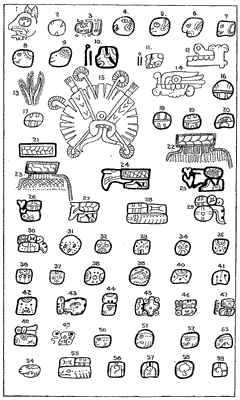 PL. LXVI COPIES OF GLYPHS FROM THE CODICES
The Nahuatl, Tzental, and Quiche-Cakchiquel names of this day are the
ordinary terms in these languages for “monkey.” Dr Brinton thinks the
Maya name, which does not appear to have any signification in this
language as a separate word (though chuenche is “aborao, tuble,” “a
certain tree”), is derived from a Tzental term, chiu, which is applied
to a particular species of monkey. He and Dr Seler refer to the chouen
in a legend of the Popol Vuh, which undoubtedly stands in close relation
to batz or “monkey,” there spoken of as hunbatz. As these words in
the Quiche myth appear unquestionably to refer to a species of the
monkey tribe, or mythical persons under the symbolism of monkeys, the
conclusion they reach is probably correct, and justifies the belief that
the Maya name should be interpreted “monkey.”
The origin of the symbol is uncertain, and Dr Seler makes no attempt to
explain it. The difference between the simple form with the three teeth
only (plate LXVI, 2) and the typical Chuen symbol indicates a
difference in the word equivalents, or in the signification if
ideographic. It is possible that Brasseur is right in rendering the
former by co, which signifies “tooth;” in which case we may be
justified in assuming that the additions in the Chuen symbol give the
additional phonetic elements in the word. It may be, as supposed by some
authors, that it was intended to represent the front view of an open
mouth of some animal, as chi is the Maya word for mouth.
THE TWELFTH DAY
Maya, eb; Tzental, euob; Quiche-Cakchiquel, e or ee; Zapotec,
pija; Nahuatl, mallinalli or itlan.
There are comparatively few variations in the symbol of this day; some,
however, are of sufficient importance to render recognition doubtful but
for their presence in the day series. That given by Landa is seen in
plate LXVI, 4; the form most usual in the Tro. and Cort. codices is that
shown in LXVI, 5; the variations seen in LXVI, 6, 7, 8, are from the
Dresden Codex, and that in LXVI, 9, is from the Peresianus.
This character occurs very seldom, if ever, except as a day symbol,
hence it is presumed to be purely ideographic or pictorial. There is,
however, a deity symbol found in the Tro. Codex (plate LXVI, 10) in
which we see apparently the chief characteristic of the eb symbol.
Here, however, instead of a dot-bordered tooth, there is a dot-bordered
dark stripe which runs downward entirely across the face. This is
accompanied usually by the numeral prefix 11. The symbol of the same
deity as found in the Dresden Codex is shown in plate LXVI, 11. Here the
stripe is reduced to a single broken line. Dr Schellhas contends that he
is a Death god and the equivalent of the Mexican Xipe. That he is a god
of the underworld in the Tro. Codex is apparent from his ornaments and
the dotted lines on his body or limbs; yet in two instances—plates 5a
and b—he is represented as a traveling merchant. Whether the deity in
the Dresden Codex is the same as that of the Tro. Codex is not
positively certain, but the presence of the numeral 11 with the symbol,
and in some instances the dotted lines on the body of the deity,
indicate that the two are identical. Whether this deity glyph bears any
relation to the day symbol is, however, doubtful. The only names of Maya
deities I find with buluc (“eleven”) as a prefix are Ahbuluc-Balam and
Buluc-Ahau (?). The first, which signifies “He of the Eleven Tigers,”
was one of the idols made at the festival of the new year Cauac. On one
of the four plates of the Dresden Codex representing the festivals of
the new year (26a) we observe that the image carried by the chac is a
tiger-like animal marked with dotted lines. Whether this is to be
connected with the deity above mentioned is doubtful. The other name,
Buluc-Ahau, mentioned by Landa, is the name of one of the signs of the
Katun given in his figure of the cycle, and, although he uses the word
“idol,” does not appear to refer to any particular deity.
In regard to the names of the first three calendars, Dr Seler remarks as
follows:
E, ye signifies “the edge,” “sharpness,” “the notch;” eb,
ebil, ebal, yebal, “a row of notches,” “flight of steps,”
“stairs.” In Quiche-Cakchiquel e signifies “the tooth,” “the
edge;” ee is the plural form in Cakchiquel of the word, as eeb
of the Quiche; euob is also a plural form in the Tzental, as I
think, from a singular eu-ee. The name must denote the same thing
in all the languages, i. e., “a row of teeth,” “flight of steps”—a
signification which harmonizes excellently with many Mexican forms
of the character [plate LXVI, 12] as well as with the Meztitlan
name of it (itlan, “his tooth”).
Dr Brinton says that “in Maya eb is the plural of e, which means
‘points’ or ‘ends,’ like those of pins or thorns, and plainly was
intended to designate the broom by reference to its numerous points.
From the same idea, rows of teeth received the same name. The Tzental
and Quiche names e and euob—the latter a plural—were from the same
radical and had the same signification.” He says the Nahuatl and Zapotec
names both signify the brush or broom of twisted twigs, or stiff grass
used for cleaning and dusting, and also this grass itself. Thus he
brings the names of the five calendars into harmony. This explanation
corresponds with that given by Clavigero of the Mexican term, which he
says is the name of a certain plant of which brooms were made.
I am inclined to believe the symbol in this instance is a mere
pictograph intended to represent the tip of some lanceolate leaf, the
dots denoting the hairs along the edge. The tips of the “reed grass,” as
shown in the symbolic representation of Zacatla (“Nombres Geográficos”
by Peñafiel; plate LXVI, 13), would give precisely the dot-bordered
tooth in the symbol. It is to be observed, however, that the Mexican
symbol for this day, the usual form of which is shown in LXVI, 14, is
essentially different and has joined with the green blades the skeleton
underjaw. In some instances, as at Malinaltepec (“Nombres
Geográficos”), the entire skull is added. A more elaborate form of the
symbol, from the Borgian Codex plate 26, is given in LXVI, 15. Here the
skeleton jaw is replaced by the roots of the plant; observe, however,
the brush-like projections above. Are we to see in this associated
death’s-head a reference to death, or rather to the earth, a symbolism
undoubtedly found in the Tro. Codex? Or must we suppose that behind the
name is to be found the signification of the Meztitlan name itlan,
from tlantli, “tooth?” Dr Seler remarks that “it seems to me quite
possible that the point surrounded by dots in the character eb is an
abbreviation of figure 326” (the prefix to our plate LXIV, 48).245-1
THE THIRTEENTH DAY
Maya, ben or been; Tzental, ben; Quiche-Cakchiquel, ah; Zapotec,
quii, ii, or laa; Nahuatl, acatl.
The symbol of this day is subject to but few and, with one or two
exceptions, but slight variations. Landa’s figure is represented at
LXVI, 16, those usual in the codices in LXVI, 17, 18, 19, and an
irregular form found in Dres. 10c in symbol 20 of the same plate. When
used in combination with other glyphs and otherwise than as a day
symbol, the form, though usually typical, is subject occasionally to
wide variations, though there is considerable doubt whether the latter
are to be considered ben symbols.
Dr Seler contends that the figure originated from the plaited reed or
mat, which, if correct, enables us to trace it by gradations to a wholly
different figure. But before referring further to these, it is best that
the signification of the names should be given, as determined by
linguistic evidence.
The Nahuatl name acatl signifies “reed,” “cane,” or “stalk;” and,
according to Ximenes and Brasseur, the Quiche-Cakchiquel ah also
signifies “reed,” especially the “cornstalk” or “sugar cane.” The
Zapotec quii has also the same signification, “reed,” and Dr Brinton
says laa has the same meaning, but Dr Seler says he can not find it
with this signification in the lexicons, nor do I find it in any to
which I have access. The Maya and Tzental ben, however, presents a
more serious difficulty in the attempt to bring it into harmony with the
others. Dr Seler contents himself with reference to certain words which
have been or ben as their root. This root, he says, signifies
“consumed,” and the words to which he refers mean “to be consumed,” “to
waste away,” “to fail, be lacking, go away.” This is also the
signification to which Dr Brinton refers. “I find,” he says, “that in
Tzental the dried cornstalk (caña de mais seco) is called cagh-ben,
and from this I doubt not this day-name in that dialect and the Maya was
taken and syncopated. The verb ben or been in Tzental means ‘to
walk, to go,’ but in the above compound the ben is from the Maya stem
benel, ‘to be used up, to be dead.’”
The opinion of Dr Seler, above stated, that the symbol of this day
originated from the delineation of the plaited reed or mat, is based on
the representation of the mat both in symbols and figures in the Mexican
and Maya codices. Some of these are shown in our plate LXVI, 21 to 24.
The first, 21, is from the Mendoza Codex, and is found also in Tro.
20*d. These are undoubtedly intended to denote mats or something of a
kindred nature. The same figure is seen on the roofs of temples and
houses, one of which is shown in LXVI, 22, from Tro. 10*c. In these
instances they appear to indicate the thatching with which the roof is
covered. The form is sometimes varied, as in LXVI, 23, from Tro. 10*a.
The symbol which, it is presumed, refers to the mat as seen in Tro.
21*d, is given in LXVI, 24; that representing the house in Tro. 10*c is
seen in LXVI, 25; another of a slightly different form, from Tro. 7*c,
in LXVI, 20; and another, referring also to a house or to the roof, as
Dr Seler supposes, is given in LXVI, 27.
There can be no question that plate LXVI, 21, is intended to represent a
mat or something of that nature, nor that the character shown at 24 is
the symbol used to represent this mat, straw, or plaited fabric; nor can
it be doubted that the figures shown at 22 and 23 are conventional
figures for houses of some kind. It must also be admitted that the
characters shown at 25, 26, and 27 are symbols denoting these houses.
According to Dr Seler’s interpretation, figures 24 and 27 are, in some
cases, used “to denote a seat on a mat [24]; sometimes the mat roof of
the temple or the temple itself” (27). In his opinion these characters,
especially 27, contain “the element of the mat and a symbol of
carrying—the hand or elements which have been borrowed from the figure
of the hand—and in these hieroglyphs the transition of the
realistically delineated mat into the character ben may be distinctly
traced.”
That the upper part of plate LXVI, 25 and 26, and of other similar
figures in the codices which might be shown, do make a close approach in
form to the ben symbol, must be admitted. But there is one break in
the chain which needs to be closed before the evidence is entirely
satisfactory. Does the upper part of these house symbols (25-26)
indicate roof mats or thatching? An examination of the house figures
shows these supposed mat figures to be something standing on the top of
the roof—something rising, as it were, perpendicularly along and above
the comb or crest. Now, precisely such battlements or elevated crests
appear to have been common on the roofs of the temples or structures
which have been preserved to modern times. We see them in the figures
given by Charnay, Stevens, and other explorers; and what is worthy of
special notice in this connection is, that they sometimes consist of
openwork or trellis-like figures. Therefore, if we connect the upper
part of the house symbols with the ben glyph, it is still by no means
certain that it is derived from, or bears any relation to, the mat
character. We notice further that in the figures of houses this supposed
mat figure is not used to indicate the thatching, but is clearly
distinguished from it. Again, if the upper characters of LXVI, 25, 26,
are intended to signify the thatching, roof matting, or roof, and are
simple ideograms drawn from the thing represented, then the lower
characters in these symbols might well be supposed to represent the wall
or framework of the house. But the widely different relations in which
we find this lower character forbid this conclusion. That the wall may
be indicated is true, but if so it must be ikonomatically or by the
phonetic value of the symbol. I have therefore found it very difficult
to reach any entirely satisfactory conclusion in regard to these house
symbols. That the lower character is phonetic in the true or rebus sense
can, I think, be shown, but, notwithstanding the objections I have
presented, the most satisfactory interpretation of the upper part is
that it represents the roof, as we see in the upper figure of LXVI, 25,
the crosshatching and the double ben lines. Hence it would seem
satisfactory to consider it merely an ideogram or picture but for the
prefix, which can not be readily accounted for on the idea of a
pictorial representation.
As we have found that the lower character of plate LXVI, 26, has the
phonetic value of ch usually combined with o or u (see remarks
above on LXV, 44), we may find in this glyph otoch, “house,” though
the full signification of the entire compound symbol appears to embrace
more than this. Possibly the upper part is a determinative. The lower
part, however, of LXVI, 25 and 27, is found, as before remarked, where
it can have no reference to a building. As it has the two heavy lines
indicative of the p sound (see explanation of LXIV, 11), and also of
the guttural, it is probable that the signification, where a structure
is referred to, is pak (pakal), “a building, wall, fortification.”
But when it is found in an entirely different relation, as in Tro. 17b,
where it is over an individual tying a deer, it must have an entirely
different signification. It is possible that it may be consistently
rendered by pacoc (paccah), “to cord, fasten, bind” (Henderson), or
some derivative thereof. We find it again on Tro. 19*d and 20*d, and
Dres. 18c, 19c, and 20c, where females are represented as bearing
burdens on their backs. Now, cuch signifies “to bear, to carry,” and
also “a load, a burden,” and cuch-pach, “a carrier, a porter”
(literally “to carry on the back,” pach denoting “back”).
In this instance also the phonetic value assigned it holds good. On Tro.
17b the same glyph stands above an individual who is in the act of
striking a snake which is biting his foot. In this case it has a suffix
like that to LXVI, 3, which, as we have stated, probably represents the
sound ah, ha, or hal, and indicates that the word is a verb. There
are several words containing the phonetic value assigned the character,
which are applicable, as pokchetah, which Perez interprets “pisar,
poner el pie sobre algo;” puchah, “despachurran, machucar;” pachah,
“to scatter, break” (H.); pech, “to crush” (H.); pacez (paczah),
“to squeeze, press, crush” (H.).
It seems, therefore, quite probable that the lower part of these
compound symbols is phonetic.
If Dr Seler is correct in his supposition that the symbol is derived
from the plaited mat, then it is most likely simply ideographic or a
mere conventional pictograph. Possibly this is the correct conclusion,
as I can find no evidence tending to show that it is phonetic. If we
could suppose the form was intended to represent a “road” or
“pathway”—be, beil, and bel in Maya, and beel in Zotzil—we
might assume it to be phonetic.
The combinations shown in plate LXVI, 28, 29, 30, and 55, in which the
symbol of this day appears, have as yet received no satisfactory
explanation. Those shown in LXVI, 28, and 55, are of very frequent
occurrence and probably indicate some common ceremony, order, or
direction in the religious ceremonies. I have a strong suspicion that
the first indicates exorcism or driving away the evil spirits, but I
find no appropriate Maya word unless it be pekokalil, given by
Henderson. This, however, does not agree with the interpretation
Kinichkakmo, given by Seler to LXVI, 29, above referred to. Seler
gives to LXVI, 30, the apparently strained interpretation, “he who is
conquered in war and brought home prisoner.” I have no interpretation to
offer.248-1
THE FOURTEENTH DAY
Maya, ix or hix; Tzental, hix; Quiche-Cakchiquel, balam, yiz,
or hix; Zapotec, eche; Nahuatl, ocelotl.
The symbol of this day is found in quite a number of different forms,
some of which are wide variations from the prevailing type.
Landa’s figure is shown in plate LXVI, 31. The usual forms found in the
Tro. Codex are LXVI, 32 to 37; 36 is somewhat rare. That shown at 38 is
found only on plate 30*c, and that showing the animal head (39) on plate
12c. No essential variations from these are found in either the Codex
Peresianus or Cortesianus. Those shown in LXVI, 40-42, are from the
Dresden Codex.
The Nahuatl name and the Quiche-Cakchiquel, balam, denote the “tiger,”
possibly the jaguar, though the Mexican name certainly refers to the
ocelot. Dr Brinton says that the Zapotec eche, or in the full form
be-eche-guia, has the same signification. Dr Seler, however, derives
it from the term peche-tao, “the great animal”—the tiger, or
ferocious animal. But the other names, ix, hix, hiix or gix, as
they are variously written (though really one word), present a more
serious difficulty to the attempt to bring them into harmony with the
others.
Dr Seler says:
The Cakchiquel term yiz, i. e., the Maya h-ez, “the sorcerer,”
may well be considered as giving an explanation of the Maya name of
this day character (ix). My conception, after one more link in
the chain of evidence pointing toward it, is that the day-character
system has become known to the Mayas through the medium of the
cognate branches of Chiapas, for we frequently find the
Tzental-Zotzil x corresponding to the Maya z.
Dr Brinton says that the Maya, Tzental, and Cakchiquel word hix or
ix means “sorcerer,” though he does not furnish the evidence.
Moreover, he adds immediately after that “it is probable ix is a
variant of ik or igh ‘wind, breath, life,’” and makes the connection
by referring to the fact that blowing was practiced in medicine rites.
It would have been more satisfactory, however, had he given the evidence
on which he based his assertion that the Maya and Tzental name means
“sorcerer.” According to Ximenes the Cakchiquel name yiz denotes the
“sorcerer;” and it is probable that the signification of ix or hix
is the same, as the codices appear to give support to this conclusion.
On Dres. 8a the character shown in plate LXVI, 43, stands in the text
over the figure of a tiger, and evidently refers to it. The close
resemblance of this to the ix symbol from Tro. 12c shown in LXVI, 39,
is too manifest to be overlooked. The same symbol is found in Tro. 17c,
but here the prefix is changed to the numeral 4; below is a tiger-like
animal with a feathered tongue protruding from its mouth. I have taken
for granted, from the indicated action and my interpretation of one of
the accompanying symbols, that this figure was intended to indicate the
sorcerer or diviner. This supposition I admit is not supported by
sufficient evidence to demand acceptance. However, it is probable that
Léon de Rosny is justified in rendering LXVI, 43, by ek-balam. This
supposition will be strengthened by any evidence tending to show that
the prefix is properly interpreted by ek.
The symbol for the month Ceh, as given in Dres. 49c, is shown in LXVI,
44, and is the same as Landa’s figure minus the suffix or month
determinative. It would seem from the fact that the lower character of
this symbol is the same as the lower portion of the symbols for Yax
(LXIV, 12) and Zac (LXVI, 48), that the word Ceh, if the writing is
phonetic or ikonomatic, does not give the entire phonetic equivalent
unless the x or c of the other names is here softened to h. It may
be added, however, that Henderson gives both Ceh and Kez as the name
of the month and the Maya name for “deer.” In the Zotzil vocabulary
“ciervo” is chig and “venado” chigh. There is, however, a difficulty
in harmonizing this with the symbol for the month Zip—in which the
same character appears—that I have not been able to explain.
Nevertheless, it may be said, as the lower character appears (from
evidence that will not be introduced at this point) to have z or dz
as its chief phonetic element, that it is possible the name had
sometimes ek or ke prefixed. Running through the lower division of
plates 46-50 of the Dresden Codex is a line consisting of repetitions of
the character shown in LXVI, 45. Here we have again our k’, ke, or
ek glyph as a prefix. The right portion of the symbol bears a somewhat
close resemblance to some forms of the symbol of the day Lamat (but
not to kin, as has been suggested), and is so interpreted by Brasseur
and Léon de Rosny. As ek signifies “star,” and lemba “resplendent,
bright, shining, sparkling,” the phonetic value of the glyph may be “the
bright, shining star,” alluding to Venus. According to Henderson,
eekil, ekil, or yekil was used to designate this star, zaztal
being added to name it as a “morning star.” According to the “Report on
the city of Valladolid,”250-1 the name given the “morning star” was
noch eke (or eque). It is possible, therefore, that Dr Förstemann is
right in supposing that the long numeral series running through plates
46-50 of this codex relates to the apparent revolution of the planet
Venus.
In Dres. 18c is the compound symbol shown in plate LXVI, 46, followed by
47. In the former we see our ek or ke symbol as the upper character
and the supposed cimi (LXV, 28) glyph as the lower character, and to
the left a prefix. This prefix is precisely that in the symbol for the
month Zac (LXVI, 48), and has presumably the same value in one glyph
as the other. This will give, as the proper rendering of the symbol
LXVI, 46, zeek-cimil, “the skull of the dead.” By referring to the
figure below the text, a woman is seen bearing on her back a skull
inclosed in a wrapping of some kind, which in Kingsborough, where the
color is retained, appears to be cloth. This certainly agrees with the
rendering of the glyph. The symbol which follows it, shown in LXVI, 47,
has one of the elements of LXVI, 27, and, as suggested under “the
Thirteenth Day,” should probably be interpreted cuchpach, “a carrier
or porter” (or “bear upon the back”). In the corresponding glyph in Tro.
20*d (LXVI, 24) the upper portion, as above stated, refers probably to
the hamper or basket-like holder in which the load is carried, and is a
simple ideogram; but here (LXVI, 47) the upper character is phonetic,
corresponding very closely to the lower part of the symbols for the
months Yax and Zac. The character which follows—the lower left-hand
of the group of four—seen at LXVI, 49, is the well-known symbol for
woman. As the women were the burden bearers in Yucatan, the
interpretation appears to be consistent. It is therefore probable that
the prefix to LXVI, 43, is to be interpreted by ek, as Rosny has
suggested.
Seler, alluding to the symbol, asks, “May not the skin of the tiger,
instead of the animal itself, be here indicated?” He further suggests
that it represents the round hairy ear and the spotted skin of the
tiger, and that the glyph shown at LXVI, 39, represents the entire head
of this animal, of which there can be little doubt.
Some of the symbols of this day, found in the Fejervary Codex, one of
which is shown in LXVIII, 41, appear to favor Seler’s idea.250-2
THE FIFTEENTH DAY
Maya, men; Tzental, tziquin; Quiche-Cakchiquel, tziquin; Zapotec,
naa or ñaa; Nahuatl, quauhtli.
Landa’s figure is so imperfect in this case that it is not given. The
usual forms and variations are shown in plate LXVI, 50 to 54. The last
two, which show the widest variation, are from the Dresden Codex.
The Tzental and Quiche-Cakchiquel, tziquin, signifies “bird” in
general, and the Nahuatl, quauhtli, “eagle.” The Maya and Zapotec
names are more difficult to bring into harmony with the others. Dr
Brinton thinks that the Zapotec name is derived from na, “to know, to
understand, to be able through knowledge.” This, he says, “exactly
corresponds to the Maya men, which means to understand, to be able to
do ...; hence in this latter tongue, ah-men means the man of
knowledge, the wise one, the master of wisdom.” “The bird,” he adds,
“was the symbol of wisdom and knowledge.”
Dr Seler says it is difficult to determine the Yucatan name. However,
from the form of the symbol he concludes it is intended to represent an
aged face, by which he connects it with an aged goddess, Ixchel, the
companion of Itzamna, and with certain Mexican deities. In his
subsequent paper he says the Zapotec name furnishes linguistic proof of
the above conclusion. “I had concluded,” he says, “that the Maya
hieroglyph represented the image of the old earth mother, the
universally worshipped goddess called Tonantzin, ‘our mother,’ who is
connected in the Codex Vienensis with the eagle symbol.” He then adds
that the Zapotec term naa or ñaa signifies “mother,” and thus finds
the connection between the calendar names.
It is probable we will not be far wrong if we assume that reference to
the bird as used in this connection is not so much to it as an animal as
an augury, sign, or portent. The birds introduced in the Dresden and
Troano codices, especially those on pages 16, 17, and 18 of the former
and 18* and 19* of the latter, are supposed to have reference to
auguries. In the “Vocabulario Castellano Zapoteco,” under “Ave,” we find
mani-biici, “ave agorera.” In the Dresden Codex (17b) one of the birds
introduced as playing this rôle is an eagle, or some rapacious species
resembling an eagle or vulture. Although Seler believes the symbol to
have been derived from the aged wrinkled female face, yet he closes his
observations on this day in his first article as follows:
I think the reference to the eagle is very distinctly indicated
[referring to a number of glyphs accompanying or indicating an
eagle-like bird]. We can understand that these hieroglyphs were
annexed as attributes of the deities. But how is it that figures
687-689 [same as our plate LXVIII, 42] serve as a seat for the
Chac? Now Chac [he refers to the long-nose god] is not really a god
of water, but of rain; the rain-producing storm cloud is his
vehicle; the storm bird is his beast of burden on which he rides.
It follows from this, notwithstanding his supposition in regard to the
origin of the symbol, that he looks upon it as signifying the eagle, or
bird. However, the explanations given by Drs Brinton and Seler of the
Maya name fail to make a satisfactory connection between the names in
the different calendars.
Not only do we find birds introduced on the pages of the Troano and
Dresden codices above referred to, apparently for the purpose of
indicating augury, but on Dres. 69b we see the long-nose god (probably
Itzamna) sitting on the glyph LXVIII, 42, holding a bird in his arms.
Also on Dres. 73b, where the groups are composed of short columns, each
apparently relating to storms, winds, etc, we see in the right-hand
group the bird and men-like glyph associated. Whether these are in
fact men glyphs is a question not yet determined. I am as yet unable
to interpret satisfactorily any of the compound characters of which
these supposed men glyphs form a part. If the form shown in LXVI, 28,
the lower portion of which is substantially the same as Landa’s first
l, is to be accepted as equivalent to LXVI, 55, then it is probable
that the symbol of the day does not indicate the phonetic value of the
name. This would lead to the supposition that the name men is not the
original one applied to the day, or that the symbol has been changed. I
am inclined to believe one or the other of these suppositions to be
correct. If the symbol could be identified in the inscriptions, I would
adopt the first supposition until substantial evidence of its
erroneousness could be produced.
I am unable to offer any suggestions as to the origin of the symbol. I
do not think the suggestion that it is intended to represent an aged
face of woman or man of any force or worthy of serious consideration.
The symbol would be just as complete so far as its signification is
concerned without the eye as with it.
THE SIXTEENTH DAY
Maya, cib; Tzental, chabin; Quiche-Cakchiquel, ahmak; Zapotec,
guilloo or loo; Nahuatl, cozcaquauhtli. In addition to these the
following are also given: Pipil, tecolotl; Meztitlan, teotl itonal
or temetlatl.
The forms of this symbol shown in plates LXVI, 56 to 59, and LXVII, 1 to
3, are those usually found in the codices, the slight differences being
due to the greater or less degree of perfection with which they have
been made. Landa’s figure is similar to LXVII, 1. The variants in LXVII,
4 and 5, are from Dres. 46 and 49; but the symbols found in the day
columns of Dres. 46 to 50 must not be taken as evidence of peculiar
types, as they are to a large extent dashed off without care, one or two
of a column being sufficiently exact for determination and the rest mere
blotches. I have referred to them here and under other days simply
because Dr Seler has noticed them; hence had I failed to allude to them
it might be thought an oversight. However, I do not think any of the
variations in the day columns of these five plates should be taken into
consideration as types.
The Nahuatl name cozcaquauhtli is the “royal zopilote” (Sarcoramphus
papa of ornithologists). Drs Seler and Brinton agree in the supposition
that the Zapotec name is derived from balloo, “the raven or crow.” Dr
Seler says that the Quiche-Cakchiquel word ahmak seems to signify the
vulture, “who pecks out the eyes,” “who makes deep holes;” while Dr
Brinton maintains that the Quiche ahmak means “the master of evil,”
referring to the owl, which is esteemed a bird of evil omen and bad
fortune. The Pipil tecolotl also denotes “the night bird or owl.”
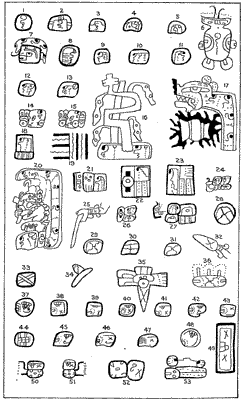 PL. LXVII COPIES OF GLYPHS FROM THE CODICES
The Maya and Tzental names, however, present a difficulty not so easily
explained. The signification of the former is “wax, gum, or copal gum,”
and also, according to Henderson, “root.” According to Brinton the
Tzental radical chab means “honey, was, bee, a late meal.” He refers,
however, to the Cakchiquel, where he finds that ch’ab means “mud,
clay, mire,” and suggests that “as red and black clays were the
primitive pigments this may connect the Tzental day name with the Maya.”
Seler, however, derives the Maya name from ci or cii, “to taste
good,” “to smell good;” and as ci is also the name of the maguey
plant, and likewise refers to the pulque or intoxicating drink from this
plant, he concludes that cib must have been formed by the addition of
the instrumental suffix, and hence refers to that which is used for
wine, “either the honey, or, more correctly, the narcotic root.”
This conclusion he thinks is strengthened by the fact that the corkscrew
figure, which is the chief element of the cib symbol, is found several
times on vases or earthen vessels (see LXVII, 6). Attention is called in
this connection to the fact that loo in Zapotec signifies “root,”
which is also one of the meanings given by Henderson to the Maya cib,
which would seem to strengthen Dr Seler’s conclusion.
The glyph is seldom if ever found in combination with other characters
or used otherwise than as a day symbol. This, together with the fact
that it is not found except as a day symbol in the beekeeper’s calendar
in the Troano Codex, would seem to indicate that there has been a change
in the name of the day since the origin of the symbol; or, on the other
hand, the symbol has been modified from some older form. Nevertheless,
there are some indications that it is phonetic and that the corkscrew
figure has b as its chief element, whether cib be the word indicated
or not.
In the symbol for the day Caban (LXVII, 9) we see the same corkscrew
figure, and observe that b is the chief consonant element of the word.
In the well-known symbol for woman (LXVI, 49) there appears the same
character, usually double, one at the front of the face, the other on
the back part of the head. I have usually considered this a mere
conventional symbol, taken from the female head, these corkscrew figures
indicating the rolls of hair. Nevertheless it is possible that it is
phonetic, as we see on the cheek the c, ch, or k character
heretofore referred to. As chup, chupal, and chuplal are names for
“woman, female, or girl,” the p may replace the b and represent the
corkscrew figure. I am unable, however, to explain the prefix, which
should have the b or p sound, or be a determinative. Possibly it may
denote pal, signifying a young person, though this appears to refer
generally to the male sex. Henderson, however, prefixes x to give it
the signification “daughter, or girl.”
That the symbol on vessels as shown in LXVII, 6, indicates liquid, or
drink of some kind, is more than probable. It may refer to balche (or
baleze), the ceremonial drink, the symbol indicating the phonetic
element b.
The upper portion of the figure shown in LXVII, 7, from Tro. 3*b and 4*b
(in the space) I was at first inclined to regard as a reptile of some
kind, but the fact of its presence in the section relating to bees and
honey, and the corkscrew markings, render it probable that it is
beeswax. To this evidence may be added the fact that the symbol over
which it is placed contains some of the elements of the cib glyph.
There are a number of places where quite similar markings appear on
seats and other things, but these are distinguished by the added line of
dots, showing it, as will be seen hereafter, to be in these cases the
cab or caban symbol.
The facts which have been mentioned, together with the form of the
symbol, may possibly lead to a correct understanding of its origin. It
seems probable that the corkscrew figure, which is the chief, and
apparently only, essential element, is taken from the root of a plant
and was the conventional method of representing that object. As it
appears from Henderson’s Lexicon that “root” was one signification of
cib (probably from cibah, “to follow, succeed,” which also signifies
“born, manifested, root,” alluding to origin), and also that in Zotzil
yib or yibel is “root” (raiz de arbol, yibel-te), we find the
reason why this was selected as the symbol to express the sound cib.
The fact that in the Zapotec loo signifies “root” strengthens this
conclusion and indicates that the symbol is not used simply for the
sound indicated—that is, phonetically or ikonomatically—but also with
reference to the signification.
THE SEVENTEENTH DAY
Maya, caban; Tzental, chic; Quiche-Cakchiquel, noh; Zapotec,
xoo; Nahuatl, ollin. In addition to these, the following are also
sometimes given: In Meztitlan, nahui olli; Pipil, tecpila nahuatl.
This character, as is apparent from plate LXVII, 8-13, is subject to no
material variation; in fact, to no variation which would prevent us from
at once identifying it. That shown in LXVII, 8, is Landa’s figure. The
change in position of the black spot and lines with reference to one
another does not appear to have any significance. In the Troano and
Cortesian codices the black dot is sometimes on one side and sometimes
on the other. In the Dresden Codex, however, it is nearly always on the
left. The one shown in LXVII, 13, in which there is introduced a new
element, is found several times in the last part of the Dresden Codex.
This character is used very frequently otherwise than as a day symbol,
being found separate and in combination, also as a mark on a number of
articles. As it is possible to determine with reasonable, and in fact
satisfactory, certainty its signification in a number of instances where
used otherwise than as a day symbol, some of these will be noticed, as
they seem to furnish strong evidence of phoneticism. But I repeat here
the statement made at the commencement of this paper, that in using this
term “phoneticism,” I include that which may, in a strict
classification, be called ikonomatic. However, before referring to
these, it is best to give the interpretations of the names which have
been suggested, as the bearing of our interpretations of the symbols
will then be better understood.
The Mexican name ollin or olin is generally interpreted “motion or
movement,” with special reference to the earthquake. Dr Seler, however,
adds “caoutchouc ball.” In his first paper, heretofore referred to, he
remarks in regard to the Maya, Tzental, and Quiche-Cakchiquel names:
“There is not much to be drawn from these words.” In his subsequent
paper he apparently relies upon the usual signification of the Mexican
term, and from this and the signification of the Zapotec xoo,
“powerful, strong, violent,” concludes that the Tzental name may be
consistently rendered by “large, powerful,” and the Maya name by “that
which is brought down, which is above,” reference being made to
ascending and descending. Dr Brinton derives the Maya term from cab,
“might or strength,” on the authority of the Motul Dicc., and says
that in this sense it corresponds precisely with the Tzental chic
(equal Maya chich, “cosa fuerta y dura”), the Quiche-Cakchiquel noh,
“strong, great,” and the Zapotec xoo, “force, power, or might.” Dr
Seler, however, concludes that the Zapotec name is here to be
interpreted “earth,” or to be understood as referring to the earth. He
thinks that the day symbol is an abbreviated form of, or derived from,
LXVI, 49, which he takes to be a symbol of the goddess Chiribias or
Ixchebelyax, whom he identifies with Zaczuy, “the white maiden.” As will
be observed, we have expressed the opinion that this glyph is a symbol
for woman in the general sense, which conclusion appears to be confirmed
by its connection with different female figures. There are, however,
certain prefixes and suffixes which may serve to give it a specific
application; for example, in LXVII, 14, from Dres. 16c, the prefix,
according to my interpretation, contains the z sound as its chief
phonetic element. It is possible that in this case a particular person
may be referred to by the prefix, the woman symbol being here simply a
determinative. Dr Brinton, in his explanation of the month name Zip,
remarks: “This was Zuhuy Zip, the virgin Zip, her name being
properly Dzip, ‘to skin, to dress slain animals.’” I prefer, however,
to interpret the symbol by “maiden,” or “young woman,” the prefix
signifying zuhuy. Nevertheless, the suffix in some instances, as
LXVII, 15, from Dres. 18b, may indicate that a sacred or mythological
personage is referred to, as it is added as a suffix in some cases to
deity symbols; however, as it is often found in other relations, where
it can have no such signification, I am not inclined to give it this
interpretation, as the evident female deities are denoted by quite
different glyphs.
The evidence that the Caban symbol is in some sense phonetic appears to
me to be too strong to be rejected. In the first place, one of its chief
elements is the corkscrew figure, which, as shown under the preceding
day, appears to have b as its consonant element, this sound being a
prominent element of both cib and caban. It also has been shown that
it is not out of place in the woman glyph, under the supposition that
this is also phonetic, as chup or chupal is the Maya name for woman,
and the change from b to p is not uncommon. It is found in several
places as that out of which plants are growing, as LXVII, 16, from Tro.
32b, which appears to represent some leguminous plant supported by a
stake driven into the ground. It is that on which persons are sitting
Indian fashion, and on which others are lying; again, it is that out of
which a serpent is arising. As “earth,” “ground,” will furnish an
entirely satisfactory explanation in all these cases, there is no
apparent reason why it should not be accepted. As cab has “earth” as
one of its leading significations, we not only find therein a connection
with the day name, but also an indication of phoneticism.
In Cort. 30a is the figure shown at LXVII, 17. The animal represented,
notwithstanding the quadruped head, is conceded to be intended for the
serpent. The shading around the vessel, a blotch of which is on the
serpent’s nose, I take for the clay or paste out of which the vessel is
being formed, or to be formed. In the division immediately below is a
representation of what appears to be some step in the manufacture of
vessels. May this not be correctly interpreted by kancab, “la terra
roja o amarilla,” or “red clay?” Henderson gives cancan as an
equivalent term of kankan. As I have not seen a copy of the colored
edition of this codex, I can not say whether this interpretation is
borne out by the color of the shading. If this interpretation be
correct, the serpent figure must be used symbolically or as a true
rebus.
In Tro. 9*c an individual is represented lifting what is supposed to be
honey or honeycomb out of a box-shape object on which is the caban
symbol. This symbol is presumed to indicate the contents—“honey.” If
this supposition be correct, then, as cab is the Maya name for
“honey,” we have in this coincidence in sound and glyph another
indication of pboneticism. Support is given to this interpretation by
the fact that this is found in what is known as the “bee section,” and
that on the upper division of the same plate the same figure, with the
caban symbol upon it, is seen in the hands of an individual who holds
it to a bee.
As the character when used otherwise than a day symbol is frequently,
perhaps most generally, drawn with a suffix, as shown in LXVII, 18, I
suggest that it is possible it is a conventional method of representing
earth or soil. By reference to the Borgian Codex, plate 11, also 19a and
61b, it will be seen that where earth is introduced into the picture it
is indicated by heavy and wavy lines, as shown in LXVII, 19. This bears
a very strong resemblance to the suffix of LXVII, 18. The corkscrew or
root figure is added as appropriate, as an element, in forming an earth
figure. Such, I am inclined to believe, is the origin of the symbol
which, when used to indicate anything else than earth, is used
phonetically or ikonomatically. The figure shown in LXVII, 20, from
Dres. 30a, which Seler calls a serpent, is merely the representation of
a clay image and the seat or oratorio in which it is placed. It is
probably from something of comparatively small size, burnt in one piece.
The mark of the earth symbol, to distinguish the substance of which it
is made, is certainly appropriate. In Tro. 6b we see another on which is
quite a different symbol, indicating, as will hereafter be shown, that
the material is wood.
The compound character in LXVII, 21, is found in Tro. 9*b and 10*c. It
occurs in the latter twice, the parts, however, reversed in the parallel
groups, while in that of 9*b one is above the other. These variants do
not necessarily indicate a difference in the signification, as can
readily be ascertained by comparing characters in the numerous parallel
groups. Omitting the prefix, this maybe rendered mak-cab, “to eat
honey without chewing (that is, by sucking); to break into a hive and
steal the honey.” By reference to the plates on which the symbols are
found the appropriateness of this rendering will be apparent, if I
rightly interpret the figures below the text. There we see the twisted
red symbols denoting the fire kindled beneath the hives, or beehouses,
by which to drive out or destroy the busy little workers. In one of the
fires we observe bone symbols, probably denoting a method of giving to
the smoke an unpleasant odor, as rags were formerly used in some
sections of our country for the same purpose.
The characters shown in LXVII, 22 and 23, are from the upper part of
Cort. 22, which is supposed to be the right half of the so-called “title
page” of the Tro. Codex. These are interpreted by Seler, and probably
correctly, as indicating “above” and “below” (LXVII, 22, the former, and
LXVII, 23, the latter). By following the line in which these characters
are found, through the two pages, beginning at the left of the plate of
the Tro. Codex, the result appears to be as follows, giving the
signification of the characters so far as known: First, the four
cardinal points in one direction, then two characters apparently
corresponding with the two we have figured, one of which is partly
obliterated; next the cardinal points in an opposite direction, after
which follow the two characters shown in LXVII, 22 and 23. As the right
half of the first (22) is the cab or caban symbol, it is presumable
that it has here substantially the same phonetic value. It is probable,
therefore, that the whole compound character maybe rendered yokcabil
(or okcabil), “above the earth,” or as Henderson, who gives two words
of this form, interprets the first, “over, above the earth, above.” The
second (LXVII, 23) has also as its chief part the cab symbol, and the
upper right-hand portion appears to have x’m as its chief phonetic
elements. It is possible that cabnix; “a stair,” “downward,” given by
Henderson, furnishes the phonetic equivalent of the compound character.
These six directions, according to Dr J. W. Fewkes,257-1 were noted by
the Tusayan Indians in some of their religious ceremonies. Mr Cushing
says the same thing is true in regard to some of the Zuñi ceremonies.
Plate LXVII, 24, is a compound character from Dres. 39b, below which the
long-nose deity holds in his hand a peculiar article (LXVII, 25), “as
if,” says Seler, “pouring out of a bottle.” That the prefix has the
interior cross-hatched when complete appears from a number of other
places, as, for example, in the upper division of the same plate. This,
as heretofore stated, gives the x or ch sound. It is possible,
therefore, that the symbol, omitting the right portion, should be
interpreted xachcab, “abrir de par en par,” or hechcab, “to open
little by little, to develop, discover it” (Henderson). As the right
portion has a character resembling the Muluc symbol as its chief
element, and below it the u glyph, we may translate it muyal,
“cloud.” This would give as the meaning of the entire symbol “open the
cloud”—that is, “to pour out the rain.” As this is connected with a
rain series, and we see a similar glyph (though with different prefix)
on plate 38b, where the same deity is in the midst of a rain storm and
holding in his hand a similar object, the rendering appears to be, at
least, appropriate. It is to be further observed that this combined
Caban and Muluc symbol is found frequently in connection with rain
storms and cloud symbols.
According to the interpretation given LXVII, 22 and 24, the compound
symbol shown at 26, from Dres. 35b and 34b, should be rendered Yokcabil
muyal, “the cloud above.” As we see in both places, in the picture
under the text, the looped serpent inclosing water, which Dr Seler
considers the “water sack” or cloud, this interpretation is appropriate.
As further confirmation of the interpretation given LXVII, 22, attention
is called to the picture in Tro. 32*c over which the same symbol is
found. Here the allusion is doubtless to the basket-like covering over,
or “above,” the black deity lying on a mat.
THE EIGHTEENTH DAY
Maya, edznab or ezanab; Tzental, chinax; Quiche-Cakchiquel,
tihax; Zapotec, gopaa; Nahuatl, tecpatl.
The form of the symbol of this day varies but little in the codices, as
shown by plate LXVII, 28-31. It is seldom found in this form in
combination. If its equivalent is given in these, it is of the form
shown in 33. It is, however, occasionally seen on articles of stone, as
the spearpoint (32) and stone hatchet (34) and sacrificial knife. It
also appears in the symbol for the stone mortar (36) from Tro. 19c.
Before discussing its signification and probable origin we will give the
significations which have been suggested of the different names of the
day.
The signification of the Nahuatl name—tecpatl—is “flint.” Dr Brinton
says, “especially the flint-stone knife used in sacrificing, to cut the
victim.” Dr Seler finds agreement in the Tzental name from a statement,
by Nuñez de la Vega, that the symbol chinax, or rather the tutelary
god of the same, was a great warrior, who was always represented in the
calendars with a banner in his hand, and that he was slain and burned by
the nagual of another heathen symbol. Dr Brinton states that the name
“is an old or sacred form of the usual zni-nax, ‘knife.’” The literal
meaning of the Cakchiquel tihax is, according to Ximenes, “it bites,
scraping” (muerde rasgando). Dr Seler, however, affirms that Ximenes
(with what authority he knows not) gives “obsidian” as the meaning. He
thinks the word is related to the root teuh, “cold”—tih-ih, “to be
cold”—with which may be compared the words tic, “to stick in, prick;”
tiz, “to stitch,” and tiztic, “pointed.”
In regard to the Zapotec name, gopa, gopaa, or opa, the authors
named differ quite widely, Dr Seler deriving it from rogopa, “cold,”
and Dr Brinton suggesting that it is more likely “a variant of guipa,
a sharp point or edge, whence the word for stone knife, gueza-guipa,
from guia, stone.”
The Maya name, however, does not appear to be readily brought into
harmony with the others. Dr Seler simply remarks that it may be related
to the root e, “firm, rigid, hard.” Pio Perez offers no explanation.
Dr Brinton suggests that it is a figurative expression for the
sacrificial knife, from nab, something anointed, or blood, and edz,
to adjust, to point, to sharpen.
There can be no question that the articles in the codices on which the
trembling cross is found consists, in most instances, if not all, of
stone. Hence it is a reasonable conclusion that the primary
signification of the symbol is stone. The Zotzil name for “flint”
(pedernal) is zuiton.
I am inclined to believe that the symbol is derived from a conventional
form used for indicating stone or flint, probably from the cracks or
fissures in it.
I am not prepared yet to discuss the somewhat similar figures which
assume the form of the St Anthony cross. Various interpretations, as
symbol for “union,” “night sun,” etc, have been given. However, as this
form is never used as a day symbol, it has no direct relation to the
present discussion.
THE NINETEENTH DAY
Maya, cauac; Tzental, cahogh; Quiche-Cakchiquel, caok, cook;
Zapotec, ape, appe, aape; Nahuatl, quiahuitl.
The various forms of the symbol of this day are shown in plate
37-48—that by Landa at 37; those of the Troano and Cortesian codices at
38-43, and those from the Dresden Codex at 45-47. The irregular form
given at 44 is from Tro. 28d, and that at 48 from the Peresianus.
This symbol is found quite frequently in combination with other
characters, in some of which its phonetic value can be ascertained with
reasonable certainty. For example, it forms the lower half of the symbol
for the month Yax, as seen at LXIV, 12; also in the symbol for the
month Zac (LXVI, 48). In both these instances its chief phonetic
element appears to be the guttural sound k, or ks. The essential
elements are also found frequently on objects which are undoubtedly of
wood and where no reasonable explanation can be given except that it
signifies “wood” in these places. For example, it is found on what
appear to be boards carried in the hands of individuals, on Tro. 32*b
(LXVII, 49); and it also is seen on what appear to be wooden boxes or
gums from which the honeycomb is being removed, as Tro. 5*c and 9*a. Dr
Seler, who gives quite a different interpretation of the character from
that presented here, admits that these are boards. It is also found on
trees, as Tro. 15*a (shown in LXVIII, 1) and 17*a, and Dres. 26c, 27c,
and 28c. It is marked on the walls of houses or canopied seats, as Tro.
6b, 29*c, and 18*b. Under the last mentioned we observe the cab
symbol, showing that it is a building placed on the ground and not on a
stone foundation. It also appears on the ends of beams, as at Tro. 9a
and 22*a. True, Dr Seler contends that these are stones instead of
weight poles, but I think all trappers will decide against him. Again,
it appears on seats (Tro. 13a and 14*a) and also marked on heads, one of
which is shown in LXVIII, 2. That the symbol is not intended to indicate
the different articles on which it is found is evident; hence it must be
given to denote the substance of which these things are formed, which I
maintain can only be wood. That the trees and boards must be wood is
admitted; that the walls of many of the houses and of some of the other
buildings of Yucatan were of wood must be admitted; that seats were
often of wood is well known. The heads with this mark are in all
probability representations of wooden masks. Masks are represented in
the hands of individuals at several places in the codices, as Dres.
42(1)a and in Peresianus. I therefore conclude that in all these cases
the symbol is to be interpreted by che, cheil, “wood, tree, timber,
stick.” In order to show the difference between the explanation given
here and that by Dr Seler, I copy the latter:
We find, for instance, on the one hand the undoubted application
which is connected with the idea of cloud or rain. Thus, in the
hieroglyph, figure 80, the accompanying hieroglyph of figure 46,
i. e., the bird Moan. So also the one in figure 28 (p. 107) the
accompanying hieroglyph of the name Kinchahau, which, besides
cauac, contains further the element of fire and that of the
hatchet, which may remind us of the ray [or flash] darting from the
cloud. The hieroglyph cauac is, however, used far more commonly in
the sense of “stone” or “heaviness.” This is most clearly shown in
the case of the animal figures pictured in Cod. Tro. 9a and 22*a,
where the stone laid upon and weighing down the horizontal beam is
represented by the element cauac. But this explanation must be
accepted also, because we find the pyramidal foundation of the
temple covered with the element cauac. And where, in Cod. Tro.
15*a, to the Chac who is felling a tree is opposed the death god,
also felling a tree, covered by the element cauac, it is clear that
here there is substituted with the death god a rigid stone in place
of what with the Chac is a sprouting tree. The numerous cases in
which the hieroglyph cauac serves as a seat or footstool of the
gods are sometimes easily interpreted as signifying clouds, but in
the majority of cases it undoubtedly represents “stone,” homologous
to the hieroglyph caban and the element tun, “stone,” itself
(figure 85), both of which are found equally often denoting the
seat and footstool of the gods. It is equally evident that in the
hieroglyph figure 84, in which there is indicated the bearing of a
burden on the back, the element cauac is to be understood simply as
the expression of the weight, the burden. In the peculiar cases
where we see the gods holding a board provided with the elements of
the character cauac, or where a board is placed before the gods,
furnished with a plaited handle whose side bears the element cauac,
the latter seems to relate to a sounding board, for the
accompanying hieroglyphs seem to signify music. Finally, there can
be found a direct homology between the element cauac and the
element tun. This is seen in the hieroglyph of the hunting god of
figure 83, whose distinguishing mark is usually an eye or the
element tun (i. e., a precious stone), which he hears in the front
of the headdress. The hieroglyph of this god is written sometimes
as in figure 81, sometimes as figure 82. And that the element here,
which in figure 82 replaces the element cauac, is to be understood
in fact as tun or “stone, precious stone,” is evident, on the one
hand from the application of the precious stone in the headdress
(tun, “piedra, piedra preciosa”), and, on the other hand, from its
use as the base of the pole on which Mam, the Uayeyab demon, is set
up during the xma kaba kin (Cod. Dres. 25c). Now, it is true that a
connection of ideas can be established with considerable certainty
between clouds, rain, and stone, for in that region every rain was
a thunderstorm. But at the same time it will be found
comprehensible that a barrier of doubt was removed when I
discovered in the course of my Zapotec studies that in Zapotec the
same word was used for “rain” and “stone,” namely, quia, quie.
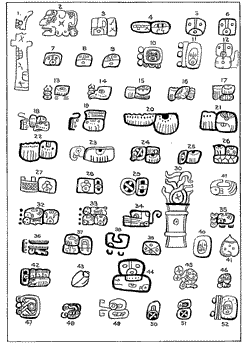 PL. LXVIII COPIES OF GLYPHS FROM THE CODICES
According to the explanation I have given above, the chief phonetic
element of the character is the guttural sound k, ks (or x), and
ch. As additional evidence tending to confirm this conclusion, the
following examples are given:
Symbols 61, LXV, from Tro. 22*a, and 62, from Dres. 1 (42), have already
been explained, the first as signifying kutz or cutz, “the turkey,”
and the second tzac, the name of a certain fish found in the senotes.
In the first (61) the first or left-hand character is our Cauac symbol
and has the k sound, and the same symbol forms the right portion in
the second (62) and also has the k sound. In LXVI, 47, from Dres. 18c,
the Cauac symbol forms the first or upper portion. The whole compound
symbol, as above shown, may be consistently interpreted cuchpach, “a
porter or carrier;” literally, “one who bears on the back.” Again we see
the k sound given the character is consistent. The symbol for the
month Ceh, as found in the Dresden Codex, is shown at LXVI, 44. In
this the last or lower portion is also the Cauac character, and,
according to the value assigned it, should have a harder sound than the
simple aspirate. That such is the case is rendered probable by the fact
that Henderson gives ceh and kez both as names of the month and as
Maya words for “deer.” In the Zotzil chigh is the name for “deer.” It
is therefore apparent that the symbol has here the guttural sound.
The glyphs in LXVII, 50 and 51 (Cort. 21), probably signify “night” and
“evening”; the first (50), akab, “night,” and the second (51),
kankin, one signification of which, according to Henderson, is
“evening.” The wing-like appendage is probably a time determinative.
These last interpretations are of course given with some doubt. However,
this may be said in their favor, that wing-like appendages are usually
attached to time symbols, and that the figures below the text represent
persons, each of whom carries what appears to be a wheel, possibly like
those used in keeping time, and the main character of the preceding
symbol in both cases is the Manik glyph, having ch as its chief
phonetic element and chackinil, signifying “hours, wheel.” Precisely
the same symbol as LXVII, 51, preceded by the Manik glyph, and a wheel
in the hand of the person figured below the text, is seen in Troano
35d.
The character shown in LXVII, 52, from Tro. 35c, may possibly be
correctly rendered by bakah (baakal), “to roll round about, to go
round about,” alluding to the flight of the vulture figured below the
text. This supposition appears to be strengthened by the probable
interpretation of the symbol immediately below it (LXVII, 53),
malaalahah, “without repeated buffetings.” The character given in
LXVIII, 3, from Tro. 31a, may be interpreted pak, “to sow seed, to
plant,” and that shown in LXVIII, 4, from the second division of the
same plate, indicates the same word, as the transposition of the parts
of a symbol does not always indicate a change of signification.
Possibly, however, its equivalent may be capak, “to reseed or sow seed
the second time,” or kapak, “to place in a trench or hole.” As the
persons figured below the text appear to be planting seed by dibbling
them in with a stick, this would seem to be an appropriate rendering. Dr
Seler appears to have entirely misunderstood these figures, as he thinks
they represent the deities pouring out water. I have in a previous part
of this paper given some reasons for believing that these plates refer
to the planting and cultivation of corn.
These examples will suffice at this point.
It is difficult to decide as to the origin of the glyph. However, I am
inclined to believe it has grown out of a conventional symbol for wood,
possibly drawn from the little knots and marks seen on the inside
surface of split wood. This may be wide of the true explanation, but all
the indications I can find point in this direction. As “wood” (leña)
in Zotzil (I do not know what it is in Tzental) is ci—equal to ki
or qi—we obtain the guttural sound which appears to be the chief
element of the symbol. In its use it appears to shade off from the hard
to the soft sound.
The Zapotec name ape, which, according to Dr Brinton, may properly be
translated by “lightning,” or “the lightning flash,” is much like the
name for “fire” which prevails throughout Oceanica. Commencing with the
Malay api, we trace it through the Oceanic islands in such forms as
api, lap, yap, nap, yaf; to New Zealand kapura; Tonga and Samoan
afi, and Hawaiian ahi.
In the Zapotec words laari-api-niza and ri-api-laha, translated
“relampage, relampaguear,” we find precisely the original form of the
Oceanic word for “five.”
THE TWENTIETH DAY
Maya, ahau; Tzental, aghual; Quiche-Cakchiquel, hunahpu; Zapotec,
lao or loo; Nahuatl, xochitl.
The symbol for this day, except where evidently imperfectly drawn, is
subject to but few and slight changes, that given by Landa corresponding
to the form found in the codices.
The usual and correct form is shown in LXVIII, 5-7; slight variations
are seen in LXVIII, 8 and 9. Dr Seler figures several other varieties,
but as these are from plates of the Dresden Codex, where the symbol
is in columns, where they are evidently hastily made, without any
attempt to have more than one or two in a column complete, they are not
given here. The character represented in LXVIII, 10, is from the Tikal
inscription, and that in LXVIII, 11, from the Palenque Tablet.
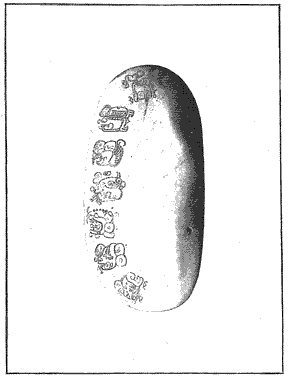
PL. LXIX SHELL BEARING MAYA GLYPHS
This shell, on which are engraved seven Maya hieroglyphs, was found in
Belize and courteously sent to the Bureau of American Ethnology by Sir
Alfred Moloney, Governor of British Honduras. The shell is here figured
for the purpose of placing it before students of Central American
paleography
The Maya and Tzental names signify “king, lord, sovereign.” The
derivation of the word has been explained in various ways. Brasseur
explains it by “the lord of the collar,” ah-au, as does Dr Brinton;
Stoll gives “lord of the cultivated lands,” from the Ixil, avuan, “to
sow.” Dr Seler, however, is disposed to derive the name from the
masculine prefix ah and uinic or vinak, “man.” His method of
reaching this conclusion is as follows:
For the Tzental word aghual, standing parallel with the Maya
ahau, which doubtless corresponds to the abstract form ahaual
of the word ahau, is to be referred rather to a primitive form
avu, a’ku, ahu, than to ahau. In the Tzental Pater Noster
which Pimental gives, we find the phrase “to us come Thy kingdom
(Thy dominion)” expressed by the words aca taluc te aguajuale.
The primitive meaning of ahau is certainly “man,” “lord,” and the
two roots of similar significance, ah and vu (see uinic,
vinak, “man”) seem to concur in this word.
He explains the Quiche-Cakchiquel hunahpu by hun, “one,” and ahpu
“lord of the blowpipe,” or “blowpipe shooter.” Dr Brinton translates it
the “One Master of Power.” He brings the Mexican name into harmony by
rendering it “the flower of the day”—that is, the sun; and the Zapotec
by rendering it “eye,” meaning “the eye of the day”—i. e., the sun.
When we attempt to bring the symbol of the day into harmony with the
Maya name, we encounter a difficulty which can be overcome only by
following a different line from that suggested by Dr Brinton or Dr
Seler. That the character shown in LXVIII, 12, is the symbol for the
cardinal point “east,” which in Maya is likin, is now generally
admitted, and that the lower portion is the symbol for kin, “day” or
“sun,” is also admitted. We are therefore justified in concluding that
the upper portion, which is the Ahau symbol, stands for li, and that
l is its consonant element. If Landa’s second l (shown in LXVIII,
43) is turned part way round, it will be seen that it is a rough attempt
to draw the Ahau symbol. If a careful study is made of his l’s as
given in his list, and his example of spelling le, and of the similar
characters in the codices, it will be seen that both his l characters
are derived from the same original. For example, the character shown in
LXV, 60, from Tro. 22*a is precisely the combination which this author
translates le, “a snare,” or “to snare.” By referring to the plate it
will be seen that it is followed by the character (LXV, 61) which we
have interpreted kutz, “turkey,” and that in the picture below the
text there is a lassoed turkey. It is apparent, therefore, that both
these forms are used sometimes for words of which l is the chief
phonetic element, and that the parallelogram and two interior dots are
the essential elements. The day symbol is of less frequency in
combination than the other form, but it sometimes occurs. It must,
however, be distinguished from the closely allied p symbol heretofore
alluded to.
From what has been shown in regard to the symbol it would seem, if
considered phonetic, that the original day name it was intended to
represent contained l as its chief consonant element. If ikonomatic,
the name of the thing indicated had l as its chief element.
I think there can be little doubt that the symbol, as has been suggested
by others, was taken from the full face, the central double line
representing the nose, the two open dots the eyes, and the circle below
the mouth. Now, according to Fuller’s Zapotec Vocabulary, the name for
face is lu, which is the Zapotec name of the day. As has been stated,
Dr Brinton thinks the Nahuatl and Zapotec names refer to the sun, and he
is inclined also to believe that the “ruler” or “sovereign” referred to
by the names of the Maya dialects is the sun.
I think we may rest assured that the symbol of this day was derived from
the full face, and that the word (for face) it was intended to indicate
had l as its chief phonetic element—possibly from lec, “brow,
front, forehead.” If derived from the face, its use as a day symbol, and
in numerous combinations, proves beyond question that it is phonetic in
the true or in the rebus sense.


