July-August 1914.
While the war cloud was breaking, I was close to my
birthplace at Dorking with my father, whom I was not
to see again. Though eighty-one years old he was in his
full vigour of heart, mind and body, and we were motoring
every day among the beautiful Surrey hills. He had
had a great life of work for others, born just after the
first Reform Bill which his own father had helped to
carry through the House of Commons, and stamped
with the robust faith and vigour of the great generation
of the Old Liberals. Like every other interest of his
children, he had always followed with the fullest participation
my own work in Russia, and I had everything
packed for my yearly visit there. In London I had
had short visits from Mr. Protopopov, a liberal Russian
publicist, and later from the eminent leader of Polish
public life, Mr. Dmowski, than whom I know no better
political head in Europe. Both had expected war for
years past, but neither had any idea how close it was.
Mr. Protopopov was absorbed in a study of English
town planning and Mr. Dmowski was correcting the
proofs of his last article for my Russian Review, which
he ended with the words, "The time is not yet." He
came down and motored with us through what he called
"the paradise of trees"—and Poland itself has some of
the finest trees in Europe; and my father was keenly
interested in his hopes for the future of Poland. He was
going to the English seaside when events called him
back to an adventurous journey across Europe, in the
course of which he was twice arrested in Germany, the
second time in company of his old political opponent,
the reactionary Russian Minister of Education, the late
Mr. Kasso. To them a German Polish sentry said
that as a Pole he wished for the victory of Russia, for
"though the Russian made himself unpleasant, the
Schwab (Swabian or German) was far more dangerous."
When I read Austria's demands on Serbia, I felt that
it must mean a European war, and that we should have
to take part in it. I remember the ordinary traveller
in a London hotel explaining to me how infinitely more
important the Ulster question was than the Serbian.
It was clear that the really mischievous factor was the
simultaneous official and public support of Germany,
who claimed to draw an imaginary line around the
Austro-Serbian conflict and threatened war to any one
who interfered in the war. I had long realised the
humbug of pretending that Austria was anything distinct
from or independent of Germany; and the claim
of the two to settle in their own favour one of the most
thorny questions in Europe could never be tolerated by
Russia. The Bosnian withdrawal of 1909 would, I
knew, never be repeated, least of all by the Russian
Emperor. The line had been crossed; it was "mailed
fist" once too often.
Serbia's reply showed the extreme calm and circumspection
both of Serbia and of Russia. Then came in
quick succession the great days, when every one's political
horizon was daily forced wider, when all the home
squabbles of the different countries—the Caillaux case,
the Russian labour troubles, and the Irish conflict, on
which Germany had counted so much—were hurrying
back as fast as possible into their proper background.
There was a significant catch when the Austro-Russian
conversations were renewed, and Germany, who had now
come out in her true leadership, went forward to the
forcing of war. The absurd inconsequences of German
diplomacy reached their extraordinary culmination in
the actual declaration to Russia. To make sure of war,
the German ambassador in St. Petersburg received for
delivery a formal declaration with alternative wordings
suitable to any answer which Russia might give to the
German ultimatum; and this genial diplomatist delivered
the draft with both alternative wordings to the
Russian Foreign Minister, Mr. Sazonov. It is the last
communication printed in the Russian Orange Book.
The question was, how soon we should all see it. The
news of the German declaration was in the English
Sunday papers. Many English clergymen see virtue in
not reading Sunday papers. I went to church. The
clergyman began his sermon: "They tell me that the
Sunday papers assert that Germany has declared war
on Russia." Not a very promising beginning, but England
was there the next minute. "If this is true," he
went on, "and if we come into it, as we shall have to,
we stand at the end of the long period when we have
been spoiling ourselves with riches and comfort and
forgetting what it is to make sacrifices"; and there
followed an impromptu but very clear forecast of what
was to be asked of us.
No one will forget the great days of probation, when
each great country in turn was called on to stand and
give whatever it had of the best. Russia was what one
had felt sure that she would be. The Emperor's pledge
not to make peace while a German soldier was in Russia,
was an exact repetition of the words of Alexander I,
but given this time at the very beginning of the war.
The wonderful scene before the Winter Palace showed
sovereign and people at one; and the wrecking of the
German Embassy was an answer of the Russian workmen
to an active propaganda of discontent that had
issued from its walls. Next came France's turn, her
remarkable coolness and discretion, and the outburst of
patriotic devotion which the President of the Chamber
voiced in the words, "Lift up your hearts" (Haut les
cœurs). Then the turn of the Belgians, king and people,
and their splendid and simple devotion. And now it
was for us to speak.
I believed that we were sure to come into the war,
but it was three days of waiting and the invasion of
Belgium that gave us a united England. The Germans
did our job for us. It was a quick conversion for those
who hesitated; one day, neutrality to be saved; the
next, neutrality past saving; the next, war, and war
to the end. When we were waiting before the post
office for Sir Edward Grey's speech, every one was
asking, "Have they done the right thing?" This was
the atmosphere of the London streets on the night that
we declared war. We all lived on a few very simple
thoughts. It was clear that there must be endless losses
and many cruel inventions, but just as clear not only
that we had to win but that, if we were not failing to
ourselves, we were sure to.
I was in London before our declaration to ask what I
could do, and was now making my last preparations for
starting. The squalor of the great city had taken the
aspect of a dingy ironclad at work. At the Bank of
England, where payment could still be claimed in gold,
I was asked the object of my journey. No one seemed
to know about routes except Cook & Son. In the
country the mobilisation passed us silent and unnoticed,
except for the aeroplanes which we saw streaming southwards.
I saw my father in his garden for the last time,
went to London, and there, in a confusion of little things
and big, with a taxi piled in haste with parcels of the
most various nature and ownership, hurried to King's
Cross, bundled into a full third-class carriage and started
for Russia.
August 21.
At King's Cross I was already almost in Russia. The
sixty or so Russians who had come to the Dental Congress
in London, after one sitting had been caught by the war.
Their English hosts looked after them splendidly, and
they themselves pooled the supplies of money which
they happened to have on them. There were also
several members of the Russian ballet, and other Russians
on their way from Italy, Switzerland and France, going
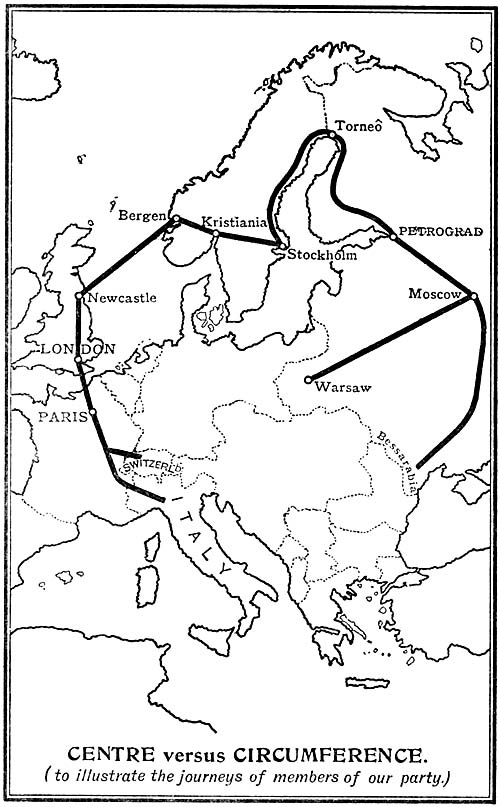
via Norway and Sweden to St. Petersburg. Our route
of itself was a striking illustration of the great military
advantage possessed by Germany and Austria. With
its interior lines of communication, the great German
punching machine could measure its forces to any blow
which it wished to deal on either side, while for any
contact with each other the Allies had to crawl right
round the circumference. For this military advantage,
however, the aggressors had sacrificed in the most evident
way all political considerations. In a quarrel which
Austria had picked with Serbia, Germany forced war
on Russia for daring to mobilise. Germany made an
ultimatum to France at the same time, so as to make
war with both countries simultaneously and give herself
time to crush France before Russia could help her. For
greater speed against France, she invaded neutral Belgium,
thus making England an enemy and Italy a neutral.
The absurdity became apparent when, with all this done,
we were still waiting for the completion of the Russian
mobilisation which was the nominal cause of the European
War. Hence the union of so many peoples; but
for all that the military advantage remained. It was as
if Europe had the stomach ache, with shooting pains in
all directions.
I asked a friend in the train what might be the state
of mind of the Emperor William. He replied by quoting
the answer of an Irishman: "He's probably thinking,
Is there any one that I've left out?"
At Newcastle, the Norwegian steamer had booked at
least forty more passengers than it could berth. I only
got on to the boat by a special claim and had to sleep
in a passage with my things scattered round me. All
the corridors were taken up in this way. The Russians
are admirable fellow-passengers: they had organised
themselves informally under a natural leader into a
great family. One corridor was set apart for a night
nursery. The women received special consideration, and
any one who had a berth was ready to give it up to them.
One Russian, thinking I was ill, offered me his. I was
ensconced with my back to the wall at the head of a
staircase, and they would stop to chat as they went
up or down. They had been greatly impressed by the
spirit in England: the Englishman they regarded as a
civil fellow who had better not be provoked, for if he was
he would get to business at once and not look back till
it was finished. They spoke very simply of themselves
and of their little failings, and said that for this reason
it was the greatest comfort to have England with them.
What had impressed them most was the calm and vigour
with which we had faced our financial crisis. They had
seen some of our territorial troops, whom they classed
very high for physique and spirit. They had much to
tell one of France and Italy, and also of insults offered
to them or their friends when leaving Germany. There
were outbursts of sheer hooliganism marked with a sort
of brutal contempt for Russians, and one lady, they said,
had the earrings torn out of her ears. Their humanity
was shocked by all this. They had nothing but condemnation
for anything of the kind, from whatever side
it came, and they were quite ready to criticise their own
people or ours wherever there was any ground for doing so.
The captain said to me, "We sail under the protection
of England." We were stopped once by an English
warship, but only for a few minutes. At Bergen I
found new fellow-passengers, and after an evening which
was a succession of fiords, lakes, rocky heights and
white villages, we passed by a wonderfully engineered
railway over the snow level and down to Kristiania. The
Norwegians were friendly and sympathetic, the Swedes
courteous but reserved. There had recently been unveiled
a frontier monument showing two brothers shaking
hands; and one felt that the one country would not
move without the other.
Between Kristiania and Stockholm I wrote an article
on the Poles, and directly afterwards, puzzling out a
Swedish newspaper, I read the manifesto of the Grand
Duke Nicholas. We had with us Poles who were travelling
right round to Warsaw. From Stockholm the more
apprehensive members of our party went northward for
the long land journey by Torneô. The rest of us risked
the voyage across the Gulf of Bothnia. In the beautiful
Skerries, we were at one point sent back by a Swedish
gunboat and piloted past a mine field. I was on a
Finnish boat, which was fair prize; so I had an interest
in any ship that showed itself on this hostile sea. When
we reached Raumo, a little improvised port in Finland,
there was an outburst of relief for those who had come
so far and were home again at last. All classes joined
and enjoyed the home-coming together. The train
picked up detachments of Russian troops on their way
to the war. I had no seat, and went and slept or drowsed
for an hour or two in a carriage full of soldiers. As I
lay on a wooden bench I listened to a young peasant
recruit with a bright clear face who was talking to his
mother. It seemed to be a kind of fairy tale that he was
telling her, and the clearly spoken words mingled with
the movement of the train: "And he went again to the
lake, and there he found the girl, and there was the
golden ring, the ring of parting."
Petrograd.
I shall not dwell on the six weeks or so that I spent
in St. Petersburg. My time was taken up with a number
of details and with arrangements for getting to the front.
I had volunteered for the Red Cross when I was asked
to serve as official correspondent.
On my arrival I saw Mr. Sazonov, who spoke very
simply about the overdoing of the mailed fist; he was
as quiet and natural as he always is. He was very pleased
with the mobilisation, which he told me had been so
enthusiastic as to gain many hours on the schedule.
This was the account that I heard everywhere. Mr.
N. N. Lvov, of Saratov on the Volga, one of the most
respected public men in Russia, was at his estate at the
time. When the news of war came, the peasants, who
were harvesting, went straight off to the recruiting depot
and thence to the church, where all who were starting
took the communion; there was no shouting, no drinking,
though the abstinence edict had not then been issued;
and every man who was called up, except one who was
away on a visit, was in his place at the railway station
that same evening. In other parts the peasants went
round and collected money for the soldiers' families,
and even in small villages quite large sums were given.
The abstinence edict answered to a desire that had been
expressed very generally among the peasants for some
years. It was thoroughly enforced both in the country
and in the towns. In the country the savings banks
at once began steadily to fill, and the peasants, who would
speak very naïvely of their former drunkenness, hoped
that the edict would be permanent. In the towns some
few restaurants were for a time still allowed to supply
beer, but this ceased later. In all this time I only saw
one drunken man.
The whole country was at once at its very best. After
a mean and confused period every one saw his road to
sacrifice. The difference between the Russians and us
was that while this feeling, often so acute with us, could
often find no road, in Russia, with her conscription and
her huge Red Cross organisation, the path was easy.
All the life of the country streamed straight into the
war; age limits did not act as with us; and the rear,
including the capital, was depleted of nearly every one.
This made one feel that no good work could be done
here without access to the army. Nearly all my friends
were gone off, and I was anxious to join them.
The interval was filled with different lesser interests.
The question of communications between the Allies was
engaging a great deal of attention. I was a member of
a committee at the Russo-British Chamber of Commerce,
which was working out arrangements for trade routes.
My English friends and I also tried to plan an exchange
of articles, asking leading Russians and Englishmen to
write respectively in English and Russian papers. But,
though this was felt to be important, we broke down on
the Russian side, because those who wished to write
for us were swept away to war work at the front. In
the rear the most important work was the relief of the
families left behind. This engaged a number of devoted
workers and was soon brought into very good order both
at St. Petersburg and at Moscow, but it was in the main
a task for women.
At the outset of the war the aged Premier, Mr. Goremykin,
whose political record was that of a benevolent
Conservative, at once saw the need of engaging the full
co-operation of the nation as a whole. After consultation
with public leaders the Duma was summoned. A
few representative speeches were expected, but with a
remarkable spontaneity not only every section of political
opinion, but every race in the vast Russian empire took
its part in a striking series of declarations of loyalty
and devotion. Each man spoke plainly the feelings of
himself and those for whom he spoke. Perhaps no
speeches left a greater impression than those of the
Lithuanians and of the Jews; these last found a noble
spokesman in Mr. Friedmann. The speeches in the Duma,
which were circulated all over the country, were a revelation
to the public and to the Duma itself; and the war
thus had from the first a national character; it was a
great act in the national life of Russia.
In particular it was found that the Red Cross work
could not possibly be organised on any basis of suspicion
of public initiative. In the Japanese War Zemstva were
still suspect to the Government, because they represented
the elective principle. The Zemstva created a large Red
Cross organisation under the admirable Prince George
Lvov, but it worked under great difficulties. Now Mr.
Goremykin confided the main work of the Red Cross to
Prince Lvov and the Zemstva; and almost every one
prominent in Zemstvo or Duma life engaged in this
work, which gave splendid results. The later attempt
of the reactionary Minister of the Interior, Mr. Maklakov,
to close this organisation ended in his resignation.
Red Cross Zemstvo work meant the nationalisation
of Russian public life, which had so long been under
the strong control of reactionary German influences.
The liberation from these influences was sealed by the
re-naming of the capital. The German name, St. Petersburg,
was exchanged for the Russian Petrograd. This
was no fad. It was the fitting end to a long struggle of
the Russian people as a whole, under a national sovereign,
to develop itself independently of any mailed fist, to
manage its own affairs as Russian instincts should direct.
In Moscow in 1812 the Emperor met his people after
the beginning of the war. Gentry offered their lives;
merchants, with clenched fists and streaming eyes,
offered one-third of all their substance. In 1914 the
Emperor again went to pray with his people in Moscow,
and the growth of a still greater Russia has only augmented
those proportions, deepened the reach of that
historic example of patriotic self-sacrifice.
"Russia," said one of the best Russians to me, Mr.
N. N. Lvov, "was lost in a confusion of petty quarrels
and intrigues; and suddenly we see that the real Russia
is there."
The pleasant streets of this great country city, so far
more homelike than those of the capital, we found even
more country-like than ever; a notable absence everywhere
of young men; the feeling that all those who were
left were at work somewhere together.
In the town hall, which I have always found so
thronged and busy, none of the chief public men were to
be seen; the work of all seemed to have passed to the
new department opened close by for the town organisation
in connection with the Red Cross. There, after a
long wait while numberless applicants for service passed
us, we received an admirably short and clear explanation
of the work for the wounded. In the same building was
organised the care for the poor, strongly developed in
recent years at twenty-nine local branches, and now
working wholesale and with splendid effect for the homes
of those who have gone to the war.
At the Zemstvo League there was the atmosphere of
all the years of missionary work for the people that has
been carried on in camping conditions for so many years
by the Zemstvo in all sorts of country corners of Russia.
Every one was moving quietly and quickly about his
share of the common business. At the big green baize
table every seat was occupied—here a woman of the
poorer class volunteering as a Red Cross sister, there a
medical student asking for service. Small conferences
of fellow-workers going on in all the side rooms; and in
the evening a common discussion of how the Zemstvo
work could be carried further to the economic support
of the population; an appeal is being drawn up to go to
every one in Russia. Here I found the excellent "twin"
secretaries of the President of the Duma, Mr. Shchepkin
and Mr. Alexeyev, who have done so much for friendship
with England, and the head of the whole Zemstvo League,
Prince Lvov, who in a few simple words gave all the
objects of the work for the wounded, who were expected
to number 750,000.
Next we were taken to the chief depots. Princess
Gagarin has given her beautiful house for one, and now
lives in a corner of it, helping at the work. There are
two main departments for paid work and for unpaid.
Patterns of all the clothes, pillows, and hospital linen
required for the wounded are sent here, and the material
cut out is given out to 3,200 women, some of whom stand
in a long file in the court outside. Every day the store,
which works till midnight, is cleared for a new supply,
and the materials prepared are packed in cases of birch
bark for the army. In the Government horse-breeding
department there is another great depot under the direction
of Princess O. Trubetskoy. The workers, rich and
poor, all have their simple meals together in one of the
working rooms. There is a large store of chemicals, and
elsewhere a department for the supply of furniture and
implements for the field hospitals.
It would be hard to make those who cannot see it feel
how intimately the Russian people now feels itself bound
up with the English in a great common effort. The
Rector of Moscow University, with whom I was only
able to converse by telephone, said to me: "Tell them
in England that we have one heart and one soul with
them."
Every day great numbers of wounded are brought by
train to Moscow. By the admirable arrangements of
Countess O. Bobrinsky, a vast number of students,
young women, and helpers of all kinds are waiting for
them at the Alexandrovsky station to assist in moving
them and to supply them with refreshments. An enormous
silent crowd surrounds the white station. The owners
of motors are waiting ready with their carriages; all
details are in order. Three trains come in between six
and ten o'clock. The sight is a terrible one; faces bound
up, limbs missing; some few have died on the journey.
The wounded are moved quickly and quietly to the private
carriages. As they pass through the crowd all hats are
off, and the soldiers sometimes reply with a salute. It
is all silent; it is the pulse of a great family beating as
that of one man.
October 8.
The Emperor's visit to the Vilna was a great success.
He rode through the town unguarded. The streets were
crowded, the reception most cordial. The upper classes
in Vilna are mostly Poles, a kind of Polish "enclave."
There are several splendid Catholic churches. On the
road to the station are gates with some revered Catholic
images, before which all passers by remove their hats.
There is a large Jewish trading population often living
in extreme poverty: for instance, sometimes in three
tiers of cellars one below another. The peasants are
mostly Lithuanians. Thus there are not many Russians
except officials. At the beginning of war the nearness
of the enemy was felt with much anxiety. Now there is
an atmosphere of work and assurance. The Grand Hotel
and several public buildings are converted into hospitals,
where the Polish language is largely used. The Emperor
visited all the chief hospitals, and spoke with many
wounded, distributing medals in such numbers that the
supply ran short. He received a Jewish deputation and
spoke with thanks of the sympathetic attitude of the
Jews in this hour so solemn for Russia. The general
feeling may be described as like a new page of history.
Among Poles, educated or uneducated, enthusiasm is
general. This is all the more striking because in no
circumstances could Vilna be considered as politically
Polish. Vilna shows all the aspects of war conditions,
but the country around is being actively cultivated.
October 10.
We reached the Russian headquarters as the bugle
sounded for evening prayer. The atmosphere here is
one of complete simplicity and homeliness. Our small
party includes several distinguished journalists from
most of the chief Russian papers, also eminent French,
American and Japanese representatives of the Press.
We found the Grand Ducal train on a side line. It was
spacious and comfortable but simply appointed. We were
received by the Chief of the General Staff, one of the
youngest lieutenant-generals in the Russian army. He
is a strongly built man with a powerful head, whose
carriage and speech communicate confidence. He spoke
very simply of the military conditions, of the common
task, and of his assurance of the full co-operation of the
public and Press. The Grand Duke then entered, his
light step, bright eye and imposing stature well shown up
by his easy cavalry uniform. Shaking hands with each
of us, both before and after his address, he said: "Gentlemen,
I am glad to welcome you to my quarters. I have
always thought, and continue to think, that the Press,
in competent and worthy hands, can do an enormous
amount of good. I am sure you gentlemen are just the
men who by your communications through the papers,
telling all that is most keenly interesting, and by your
correct exposition of the facts, can do good both to the
public and to us. I unfortunately and necessarily cannot
show you all I should be perhaps glad to show, as in
every war, and particularly in this stupendous one, the
observing of military secrecy relative to the plan and all
that can reveal it is the pledge of success. I have marked
out a road on which you will be able to acquaint yourselves
with just what is of most lively interest to all,
and what all are anxious to know. Allow me to wish
you success and to express to you my confidence that by
your work you will do all the good which is expected of
you as representatives of the public, and will calm relations
and friends and all who are suffering and anxious.
I welcome you, gentlemen, and wish you full success."
We were invited to join in the lunch and dinner of the
General Staff in their restaurant car. There were no
formalities—it was simply a number of fellow workers
having their meals together, without distinction, just as
in the big houses in Moscow where the making of clothes
for the army is proceeding. A notice forbids handshaking
in the restaurant, under fine of threepence for the
wounded. I noticed a street picture of the Cossack
Kruchkov in his single-handed combat with eleven
German Dragoons, also a map of the front of the Allies
in the West, but hardly any other decorations. Among
the party there was, in accordance with the temperance
edict, no alcohol.
October 12.
To-day I visited several wounded from the Austrian
front, mostly serious cases. The first, an Upper Austrian
with a broken leg, spoke cheerily of his wound and his
surroundings. He described the Russian artillery fire
as particularly formidable. His own corps had run short
of ammunition, not of food. Another prisoner, a young
German from Bohemia, singularly pleasing and simple,
described the fighting at Krasnik, where he was hit in
the leg. The battle, he said, was terrible. The Austrian
artillery here was uncovered and was crushed. The
Russian rifle line took cover so well that he could not
descry them from two hundred yards in front of his own
skirmishing line, but its firing took great effect. I saw
also an Austrian doctor taken prisoner, and now continuing
his work salaried by the Russians. All three
prisoners evidently felt nothing antagonistic in their
surroundings. They struck me as men who had fulfilled
a civic duty without either grudge or any distinctive
national feeling. I spoke with several Russians who had
been badly hit in their first days of fighting, especially
at Krasnik. Here a young Jew fell in the firing line on
a slope, and saw thence more than half of his company
knocked over as they pressed forward. He was picked
up next morning. A Russian described how his company
charged a small body of Austrians, who retired precipitately
to a wood but reappeared supported by three
quickfirers which mowed down most of his company.
All accounts agreed that the Austrians could never put
up resistance to Russian bayonet charges. This was
particularly noticeable in the later fighting. As one
sturdy fellow put it, "No, they don't charge us, we charge
them, and they clear out." I was most of all impressed
by a frail lad of twenty who looked a mere boy. He was
not wounded, and was sent back simply because he was
worn out by the campaigning. He said, "They are firing
on my brother and not on me. That is not right, I
ought to be where they all are." One feels it is a great
wave rolling forward with one spirit driving it on.
Many of these wounded had only been picked up after
lying for some time on the field. I saw one heroic lady,
a sister of mercy, who had herself carried a wounded
officer from the firing line. Both the hospitals that I
visited were strongly staffed. In the second, designed
only for serious cases, and admirably equipped with
drugs, Roentgen apparatus and operating rooms, the
sister of the Emperor, the Grand Duchess Olga Alexandrovna
(who went through the full two years' preparation)
is working as a sister of mercy under all the ordinary
discipline and conditions of travel and work. Starting
at the outbreak of the war, she was in time for the tremendous
pressure of the great Austrian battles, when the
hospital had to provide for three hundred patients instead
of the expected two hundred. All the arrangements in
these hospitals, based on fifty years' experience of Russian
country hospital work, were carried out under the most
difficult conditions and bore the impression of missionary
devotion. Here, for instance, all the medicine chests
were adapted for frequent transport; the table is also
the travelling chest, and so on.
The country aspect was also noticeable in an army
bread factory which I visited. The rye bread is dried
to a portable biscuit; the soldier can carry a large supply
of this biscuit and has something to eat in the firing line
when other provisions run short.
Lvov (Lemberg), October 15.
To-day, on their arrival, the Russian Governor-General
of Galicia received the correspondents, and
addressed us as follows—
"I am glad, gentlemen, to meet you; I am well aware
of the enormous advantage that can be derived from the
use of the Press, and am only sorry that you are to be
for so short a time in Galicia, for I should like you to
have had the opportunity of studying on the spot the
difficult questions of administration: you might have
communicated to me your impressions and suggestions—for
in your capacity of writers you are trained critics.
We have to deal in Galicia with various nationalities, and
very divergent political views.
"I shall be glad if I can be of any assistance in your
study of the country. I have already communicated to
various deputations, and to the public, the principles of
my attitude toward the problems of administration, and
have no alterations to make in my declared views.
"Eastern Galicia should become part of Russia.
Western Galicia, when its conquest has been completed,
should form part of the kingdom of Poland, within the
empire. My policy as to the religious question is very
definite. I have no desire to compel any one to join
the Orthodox Church. If a two-thirds majority in any
given village desires to conform to the Orthodox Church,
then they should be given the parish church. This does
not mean that the remaining third should not be free to
remain in its former communion. I am avoiding even
any suggestion of compulsion. The peasants pass over
very easily to Orthodoxy; for them the question is in no
way acute, indeed the so-called Uniats consider they are
Orthodox already. But it is different for the clergy, for
whom the question is a real one. I respect all the priests
who have remained in their parishes, and they have not
been disturbed. Those who have abandoned their benefices
I am not restoring: nor shall I permit the return of
any who are associated with any political agitation against
Russia.
"A difficult question has arisen relating to Austrian
officials in the town of Lvov: from persons of means they
have now become paupers requiring assistance. Another
question is that of credit: numbers of banks are without
their cash, which has all been taken away to Vienna.
These banks are sending a deputation to Petrograd to
solicit the support of the Bank of Russia.
"There is also the question of the police. I am waiting
for trained policemen to be sent from Russia: it is impossible,
of course, to use untrained men for administrative
work, and meanwhile I contrive to employ the local
Austrian police. Some magistrates have fled—we have
to put the affairs of justice in order: I am awaiting a
representative of the Ministry of Justice, who will examine
the question.
"In certain regions around Lvov, Nikolayev, Gorodok
and other places where there has been severe fighting,
the population has been left in a state of great distress. In
Bukovina, however, there is little distress, except in the
towns; and as the crops there are good, we are importing
food into Galicia from thence. The relief of distress is
being dealt with by committees, including prominent local
residents, under the Directors of Districts, and controlled
by a central committee, whose chairman is Count
Vladimir Bobrinsky. In cases of extreme distress it is
being arranged that money may be advanced to the
necessitous.
"I have established in Galicia three provinces: Lvov
(Lemberg), Tarnopol, and Bukovina. Perhaps we may
establish another province, following the line of demarcation
of the Russian population, which on maps of Austrian
Poland is admitted to include parts of the region about
Sanok (in central Galicia)."
October 24.
I have spent some days in the Austrian territory conquered
by the Russians. The Russian broad gauge has
been carried some distance into Galicia, and the further
railway communication with the Austrian gauge and
carriages is in working order. The large waiting-rooms
were covered with wounded on stretchers with doctors
and sisters of mercy in constant attendance. They utter
no sound, except in very few cases when under attention.
One poor fellow, a bronzed and strapping lad struck
through the lungs, I saw dying; he looked so hale and
strong; his wide eyes kept moving as he gasped and
wrestled silently with death; he seemed so grateful to
those who sat with him; he died early in the morning.
I talked with three Hungarian privates, keen-eyed and
vigorous. They said their men were very good with
the bayonet and seldom surrendered, a statement which
was confirmed by a Russian cavalry officer who had just
returned from fighting in the passes, though it seems the
Hungarians do not consider the war as national beyond
the Carpathians, and they fight well because they are
warlike and not because they like this war. The
prisoners with whom I talked were very energetic in
praising their treatment by the Russians, which is indeed
beyond praise. Everywhere they met people with
tea, sugar, and cigarettes. One said repeatedly, "I can
say nothing," and another said, "I cannot but wish that
we may do as well by them in Hungary." These were
the only Austrian prisoners in whom I have seen a
trace of that national enthusiasm for the war which is
so evident in all the Russian soldiers. I talked with
two Italians, simple, friendly fellows who described their
treatment as pulito, or very decent.
The Slovenes and Bohemians seemed rather in a maze
about the whole thing. A Ruthenian soldier of Galicia
was quite frank about it. "Of course we had to go," he
said, but he expressed pleasure at the Russians winning
Galicia, and even regarded it as compensation for his
wound.
I saw off a train of Russian wounded. They were most
brotherly and thoughtful for each other. An Austrian
patient told me he was happy and had made great friends
with the Russian next to him. The electric trams are
used for ambulances, and the chief buildings are turned
into hospitals. The biggest is in the Polytechnicum, and
is served practically by Poles. The big Russian hospital
of the Dowager Empress is very well equipped. The Red
Cross organisation is in the hands of eminent public men;
such as Homyakov, Stakhovich and Lerche, who visited
England with the party of Russian Legislators in 1909.
Count Vladimir Bobrinsky, another member of that
party, is chairman of the relief committee appointed
by his cousin the Russian Governor-General of Galicia.
The town is old and pleasing, set in undulating country.
It is in excellent order. A little sporadic street firing
was quickly suppressed. All inhabitants throughout the
conquered territory must be at home from ten in the evening
till four unless they have special permission. How well
this rule is kept one could judge when returning from
the station. No one was out except Russian sentries and
Austrian policemen, who have been continued on their
work. Otherwise one sees no signs of a conquered
town.
The day the Russians entered, the Polish paper issued
its morning edition under Austrian control and its evening
edition under Russian. The electric lighting and tramways
continued working and the shops remained open.
The fighting, which was most severe, was all outside.
But even on the sites of engagements the amount of
damage done by artillery is limited to few places and few
houses, and cultivation is now going on, without any signs
of war, close up to the present front. A general order forbids
the leaving about of any refuse. There is no friction
between the Little Russian peasants and the troops or
the new administrators; but the Jews adopt a waiting
attitude. The general position is a great credit to the
Russians, and gives ample proof of their close kinship
with the great majority of the conquered population.
October 26.
I have visited some of the battlefields of Galicia. It
is much too early to attempt any thorough account of
these battles; nor did the conditions of my visits make
any complete examination possible.
The chief harm which Germany and Austria could
inflict in a war against Russia was to conquer Russian
Poland, whose frontier made defence extremely difficult.
Regarding this protuberance as a head, Germany and
Austria could make a simultaneous amputating operation
at its neck, attacking the one from East Prussia and the
other from Galicia. But the German policy, which had
other and more primary objects, precipitated war with
France and threw the bulk of the German forces westward.
Thus the German army in East Prussia kept
the defensive, and Austria was left to make her advance
from Galicia without support.
The Austrian forces on this front were at first more
numerous than the Russians. The Russians had been
prepared to defend the line of the Bug, which would have
meant the temporary abandonment of nearly all Poland.
But the alliance with France and England made it both
possible and desirable to advance, and at the battle of
Gnila Lipa the army on the Austrian right was driven
back beyond Lvov (Lemberg), the town falling into
Russian hands. The next great fighting was for the
possession of the line of the river San.
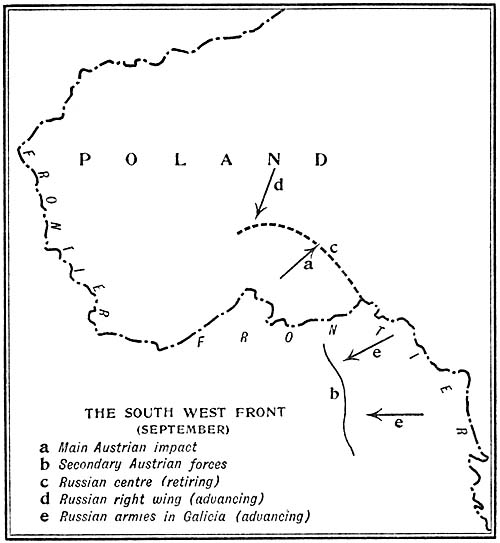
It must be remembered that while the fighting lines
ran roughly from north to south, the frontier line here
ran from east to west. Thus the left of each force occupied
the territory of the other. The first decisive success had
been that of the Russian left in Galicia; but the Austrian
left and centre were still allowed to advance further into
Russian Poland. A double movement was then undertaken
against them. While General Brusilov pushed
home in southern Galicia the success already obtained
on this side, and thus secured the Russian left flank from
a counter-offensive, General Ruzsky, the conqueror of
Lvov, came in on the Austrian centre at Rava Ruska,
while other Russian armies, detached from the reserves
standing between the Russian northern and southern
fronts, and making good use of the advantageous railway
connexion, arrived to the north of the Austrian left.
Seldom has a tactical battle been planned on so large
a scale. The Austrians, threatened at this point with
outflanking on both sides, after several days' hard defensive
fighting, withdrew with a haste that had the character
of a rout, and which only saved them from complete
annihilation. Their centre, like their already beaten
right, retired southwards toward Hungary, while their left,
just escaping the peril of being surrounded, fell back
rapidly in the direction of Cracow, where it was strengthened
by further support from Germany. Two German
corps had already joined it, but too late to avert the
reverse already described. The success of Brusilov at
Gorodok (Grodek) secured to the Russians the line of
the river San as far as Peremyshl (Przemysl).
This series of operations, after the Russian evacuation
of East Prussia necessitated by the strong German movements
on the northern fronts, left Russia with the following
line of defence: the Niemen, the Bobr, the Narev, the
middle Vistula, the San (to Peremyshl) and the Carpathians.
This line includes the larger part of Russian
Poland, the city of Warsaw, and western Galicia, with
its capital, Lvov. This line is infinitely more satisfactory
than that of the Bug. Its security on the south
depends in part on the action of Rumania, but a counter-offensive
from Hungary has already been repulsed on this
side. On the north, attempts of the Germans on Grodno
and on Warsaw have been triumphantly repulsed; and
the Russians have since fought with success along almost
the whole line; a serious German and Austrian effort is
to be anticipated on the middle Vistula and the San.
I have so far visited only Galich (Halicz), the junction
of the Stryi (Stryj) and Dniestr, and the battlefield
of Rava Ruska. Galich was at the south of the first
Austrian line of defence. The Dniestr here presents from
the north-eastern side a concave front, defended by extensive
wire entanglements and trenches, and, behind the
river, by low but jutting hills. The town, which lies on
a ledge between these hills and the river, bears the distinctive
Russian character and possesses an ancient Russian
church, now Uniat, and a remnant of an early Russian
tower. There is no doubt of the Russian-ness of Galich;
the only inhabitants whom one sees besides the picturesque
Little Russians are the numerous Jews. There was nothing
to indicate nearness of the enemy, and complete order
prevailed, the Russian authorities being evidently chiefly
concerned with the newness of their work and the task
of organisation. Friendly relations were maintained between
the troops here and the inhabitants; and the only
violences of which there was local evidence were those
committed by Austrian soldiers before the evacuation
of the town. In spite of the strength of the position, no
serious resistance was offered here. The Russians appeared
unexpectedly at a point on the north of the river,
taking in reverse the Austrian field works at this point.
They shelled the neighbouring township with extraordinary
accuracy, destroying only the houses in the middle
and leaving standing the two churches and a third spired
building, the town hall. The Austrians then retired
rapidly over the bridge, which they blew up, and evacuated
Galich.
At the junction of the Dniestr and Stryi we also found
deep trenches, some six feet deep and three feet wide.
The tower at the bridge head, commanding a wide, flat
outlook, had suffered but little. The railway bridge had
been blown up. Here, too, there were no signs of serious
resistance. At a railway junction in the neighbourhood
there were again striking signs of the accuracy of the
Russian artillery fire, only a distant portion of the station
building having suffered. Close by lay a very handsome
French chateau belonging to the Austrian General
Desveaux, who was connected with the Polish family of
Lubomirski. The interior of this chateau had been
systematically wrecked by the Little Russian peasants
of the locality, the top torn off the piano, family portraits
defaced, sofa and chairs destroyed, and the bare floor
covered with a thick litter of valuable sketches and
pictures, among which I noticed a map of the Austrian
army manœuvres of 1893. I heard here and in other
places of the violences committed against the peasants
by the Austrian troops on their passage, the inhabitants
being often left entirely destitute. The Ruthenian troops
in the Austrian army were in a very difficult position: in
several cases they fired in the air; and the attacking
Russians would sometimes do the same, on which numbers
of the Little Russians would come over to them. The
Cossacks who preceded the Russian army offered no
violence here, I was told, except where villagers told them
untruly that the Austrian troops had left the village; with
such cases they dealt summarily. They were also sometimes
drastic, though not necessarily violent, with the
local Jews, who in Galicia have held the peasants in the
severest bondage, leaving only starvation wages to the
tenants of their farms and exacting daily humiliations of
obeisance.
My examination of these questions could only be very
short; but the general picture obtained was, I think, in
the main correct, because it was confirmed by much that
I have heard from the soldiers of both sides; and it is
clear that the Russians considered themselves to be at
home among the Ruthenians of Galicia, whose dialect
many of them are able to talk with ease. One thing was
clear: namely, that there was no friction in the parts
which I visited, except with the Jews, and that life was
going on as if the war were a thousand miles away instead
of almost at one's doors.
Our visit to Rava Ruska presented much greater military
interest; we drove round the south, east, and north
front of the Russian attack on this little town, and very
valuable explanations were given by an able officer of
the General Staff. On the southern front, near the station
of Kamionka Woloska, where there were lines of trenches,
the deep holes made by bursting Russian shells and sometimes
filled with water, lay thick together.
The eastern front was more interesting. Here there
were many lines of rifle pits, Austrian, Russian, or Austrian
converted into Russian. The Austrian rifle pits were
much shallower and less finished than the Russian, which
were generally squarer, deeper and with higher cover.
An officer's rifle pit just behind those of his men showed
their care and work for him, as was also indicated in
letters written after the battle. Casques of cuirassiers,
many Hungarian knapsacks, broken rifles, fragments
of shrapnel, potatoes pulled up, and such oddments as
an Austrian picture postcard, were to be found in or near
the rifle pits. These wide plains, practically without
cover, were reminiscent of Wagram. A high landmark
was a crucifix on which one of the arms of the figure was
shot away; underneath it was a "brother's grave" containing
the bodies of 120 Austrians and 21 Russians.
Another cross of fresh-cut wood marked the Russian
soldiers tribute to an officer: "God's servant, Gregory."
Close to one line of trenches stood a village absolutely
untouched, and in the fields between stood a picturesque
group of villagers at their field work, one in an Austrian
uniform and two boys in Austrian shakos.
The hottest fight had been on the north-eastern front.
Here, after a wood and a fall of the ground, there came
a gradual bare slope of a mile and a half crowned by
two Austrian batteries which lay just behind the crest.
This ground had been disputed inch by inch and was
seamed with some five or six lines of rifle pits. At one
point three Russian shells fired from about due east had
fallen plump on three neighbouring rifle pits, and fragments
of uniform all round gave evidence of the wholesale
devastation which they had worked. All the ground was
cut up with deep shell pits, and this place, which was
a kind of angle of the defending line, must have become
literally untenable. The pits for the Austrian guns still
contained a broken wheel and other relics, and close by
was a cross made of shrapnel.
The impressions which most defined themselves from
this battlefield were the almost entire absence of cover,
the exposed position of the rifle pits, the deadliness of
the Russian artillery, the toughness of the resistance
offered, and lastly the thunder of cannon from some thirty
miles away, which was sounding in our ears all the time
of our visit to the field of Rava Ruska.
We did not pursue our journey further along the
northern positions. In the market place we saw an angry
scramble of a large number of Jews over some sacks of
flour; and in a wood outside we passed a strong, masterful
old Jew with dignified bearing striding silently with his
two sons over his land, a sight which is hardly to be seen
in Russia. The Jewish land-leasers here sometimes take
ten-elevenths of the profits, as contrasted with the two-thirds
which the leaseholder takes in Russia. Distant
hills to the north marked the old frontier of Russia.
From narratives of soldiers a few characteristics of all
this fighting may be added. The attack was throughout
delivered by the Russians, even where their numbers are
inferior. The men are full of the finest spirit, and they
have the greatest confidence in their artillery, though
the proportion of field guns to a unit is less numerous on
the Russian side than on the German or Austrian. When
given the word to advance, the Russians feel that they
are going to drive the Austrians from the field and go
forward with an invincible rush. They say that less
resort is made to the bayonet by the Austrians and by the
Germans. In the rifle fire of their enemies they find, to
use the expression of one of them, "nothing striking,"
the one thing that commands their respect is the heavy
artillery, but the Russian field artillery has had a marked
advantage. Small bodies of Austrians have made repeated
use of copses to draw advancing Russian companies
on to their quick-firing guns, which have sometimes done
deadly work. Cavalry has played but an insignificant
part in the fighting.
But the most impressive thing of all is the extraordinary
endurance of the men in the trenches. It is a common
experience for a man to be five to eight days in the
trenches in pouring rain, almost, or sometimes altogether
without food, then perhaps to rush on the enemy, to fall
and see half his comrades fall, but the rest still going
forward, to lie perhaps through a night, and then to the
hospital to lose a limb: and yet, spite of the reaction,
such men are not only patient and affectionate to all
who do anything for them, but really cheerful and contented,
often literally jovial and always in no doubt of
the ultimate issue.
There are no two accounts of the spirit in the Russian
army. One feels it as a regiment goes past on foot or
packed into a train, with one private tuning up an indefinite
number of verses and the rest falling into parts
that give all the solemnity of a hymn. It draws everything
to it; so that no one seems to feel he is living
unless he is getting to the front; the talk of all those
who are already at work, whether officers or men, is
balanced and confident, and all little comforts are
shared simply as among brothers. I saw a little boy
of twelve with a busby looking as large as himself, an
orphan who performed bicycle tricks in a circus, and had
now persuaded a passing regiment to let him come with
them, and seemed to have found his family at last.
All the life of Russia is streaming into the war, and
never was the Russian people more visible than it is now
in the Russian army.
October 30.
I have spent some days in Warsaw and have examined
the scenes of the recent fighting as far out as beyond
Skiernewice. The Russian river line of defence ran along
the Niemen, Bobr, Narew, middle Vistula and San. The
Germans had not previously seriously tested the strength
of the centre of this line, and Russian reports issued had
so far only spoken of a northern and a southern front.
Warsaw lay beyond the defensive river line. A rapid
seizure of the city before winter set in would have greatly
strengthened the Prussian northern front and have endangered
the Russian occupation of Galicia. It would
also have created a moral effect on the Poles and might
have served as a support to any proposals to negotiate.
The Germans advanced principally from the south-west,
a region largely left in their hands. German army
corps reached a line south-east of Blonie, and at Pruszkow
they were little more than six miles from Warsaw. The
cannonade shook the windows in the city. German
aeroplanes dropped bombs near the railway bridge, Etat
Major and elsewhere, killing over a hundred persons but
not achieving any military object. The population were
much exasperated, and many went out to the scene of
the fighting. The brunt of the defence fell on two
Russian corps, especially on one containing Siberian
troops which had to oppose three German corps. Splendid
work was done at Pruszkow and also by a Siberian regiment
at Rakitna. Here the Germans, covered by woods
and gardens, delayed the Russian advance and placed
machine guns on the roof of a high church. The inhabitants
say that the Siberians long refrained from
returning the fire from the church. The regiment lost
its colonel and many officers and 275 men, but held good
till reinforced. Several Russian corps arrived, and the
Russians then drove the Germans back in successive
rearguard engagements which lasted for eighteen days.
Another regiment specially distinguished itself at Kazimierz
and received a telegram from the Commander-in-Chief,
congratulating it on a brilliant bayonet attack.
Two days ago it drove back the enemy with the bayonet
through a wood, inflicting heavy loss. The Germans
retired rapidly in the night south-westward. The country
up to several miles west and south of Lowicz and Skiernewice
has now been recovered.
The Germans in these operations seized provisions and
some valuables and committed some minor indignities,
but the country has in no way an aspect of devastation.
The population is strongly for Russia and offers every
service to the Russian soldiers. In Warsaw great enthusiasm
prevails, with a very striking difference from
the attitude before the war and the Grand Duke's appeal.
The Germans during their withdrawal made clean work
of bridges, railways, and stores. There was every sign of
a deliberate and well-executed retreat. Fewer prisoners
were taken than in the case of the Austrians, the wounded
being mostly carried away. The Russian artillery
worked with great precision and effect, and the Russian
infantry, after artillery preparation, attacked throughout.
There is no sign of any likelihood of a further German
aggressive on this side before winter, but there is always
the possibility of an early conflict southward, where the
Russians need to secure and complete their conquest of
Galicia, and the enemy have to guard their base of joint
action between Germany and Austria.
October 30.
My visits to the scenes of fighting in the Warsaw area
have been of interest. The main scene of the most
critical fighting, Pruszkow, we did not visit. The
Germans tried to force their way up here from the south,
close to the Vistula, and got to within some nine miles
from Warsaw. If they had captured the town (about
900,000 inhabitants, of whom 300,000 are Jews), and
occupied the Vistula bridges, they would have established
an enormous political and military advantage, which
could not have been reversed without the greatest difficulty.
Though Warsaw was beyond their line of defence,
the Russians made every effort to hold it.
We visited a point in the centre of the line of defence,
where the Russians held good under heavy losses; their
rifle pits were close up to a copse and gardens, and they
had tried to secure a footing even closer in. From thence
their line ran in a convex curve to Rakitna. Here their
artillery had battered in the sides of the lofty and impressive
church, leaving standing the woodwork of the
roof and two irregular pinnacles. The Germans fired
from this church; they had confined several of the inhabitants
in the vaults. The buildings near the church
were reduced to ruins. Close up against the village lay
graves of the attacking Siberian regiment, marked by
lofty well-cut orthodox crosses, the men lying together
under a vast regular mound and Colonel Gozhansky and
six of his officers under separate crosses at the base, while
at the head stood one great cross for all the dead of the
regiment. The inscriptions were throughout in almost
identical language, ending: "Sleep in peace, hero and
sufferer." In a small garden close by, the Germans had
buried their dead so rapidly that some of them were still
uncovered. On two neighbouring crosses they had paid
their tribute to "six brave German warriors" and to
"six brave Russian warriors." Through a great hole
in the ruined church one caught sight of a crucifix, untouched
but surrounded with marks of shot in the wall.
In the neighbouring township of Blonie, the town hall had
been set on fire.
Blonie, which was the northern point of the line of
battle, lies about eighteen miles due west of Warsaw;
from thence runs an excellent broad chaussée, embanked
and lined with poplars, going straight westward towards
the frontier. At Sochaczew the high bridge over the
river was broken off clean at both ends and the central
supports entirely destroyed, but there were few other
marks of war. At Lowicz the bridge had been destroyed
and, as at Sochaczew and Skiernewice, had been very
rapidly repaired by the pursuing Russians. Lowicz
lies in flat country, through which the rivers make deep
furrows. It is a clean and picturesque little place,
with a symmetrical central square flanked by large
buildings and with the fine parish church at the western
end. The Poles of this part wear very distinctive
national costumes; the women have skirts in broad and
narrow vertical stripes, with orange, or sometimes red,
as the foundation of colour, the narrow stripes being
usually black, purple and yellow; round their shoulders
they wear what look like similar skirts, fastened with
ribbons at the neck, and they have variegated aprons,
in which the foundation colour of the dress is absent;
the general impression in the fields or on the sky line is
of a mass of orange. The old men wear grizzled grey
overcoats and broad-brimmed hats, and the younger
men elaborate and tight-fitting costumes that suggest a
groom of the eighteenth century, or loose zouave blouses
and trousers of blue or other colours. Houses in the
villages are spacious and plastered white, with sometimes
a certain amount of decoration, usually in blue. At
Lowicz there were some marks of war. My host for the
night, an old soldier from Orenburg who had served
under Skobelev, spoke with indignation of the recent
German occupation; they had taken all the supplies
that they could find. But there were no signs of any
permanent occupation, and the German requisitions
could not have been very thorough, as one saw many
geese, pigs and, above all, very fine horses in this part,
and the inhabitants had quite settled down again to their
ordinary occupations. From such accounts as I have
read of the conditions in Germany, I should think
that one would see there fewer young and middle-aged
men and less field work going on than in this
no-man's land that has lain between the two hostile
lines of defence and has been traversed by each army
in turn.
From Lowicz to Skiernewice there runs south-westward
a chaussée and also a more direct road that passes through
an area of sand and mud. Napoleon used to say that in
his campaign of Poland (1807) he had discovered a fifth
element—mud. There is no other obstacle, the broad
undulating plains suggesting parts of the north of France;
combining lights and shades, they offer scope for the
artist, and the long lines of well-to-do villages have a
pleasing effect that is enhanced by the graceful local
costumes. The peasants are well built and good featured,
often with a military air and carriage; their manners
are excellent, and their intercourse with the Russian
soldiers is both courteous and cordial. They were at any
time ready to come and help in the frequent breakdowns
of our motors, and I noticed, to my surprise, after experiences
of other years in Warsaw, that they felt no
difficulty in understanding Russian and in making themselves
intelligible to us. At some points on our road
there were marks of rearguard fighting, and as we were
told, two or three wounded, but we saw hardly any
prisoners, except a body of Landwehr men, and no
trophies. At the village of Mokra (which means "damp")
the houses still bore the ordinary German chalk marks
assigning the billets to given numbers of men. At
Skiernewice the coal stores at the station had been fired
and were still burning: but the town was comfortably
held by the Russians, and we found no difficulty in the
matter of supplies and quarters. Skiernewice will be
remembered as one of the last stopping places in the
Russian empire on the road from Moscow to Berlin,
and also as a former meeting place of the three emperors.
It has great preserves for pheasants, which are only
touched during the visits of the Sovereign. There is the
usual central square of Polish houses, and here, as in
Sochaczew, the Jews were in evidence, though they have
been removed from some military centres where they
have given assistance to the enemy. From Skiernewice
we travelled a considerable distance south-westwards,
passing over a fine military position carefully prepared
by the Germans, and commanding a view of some
ten miles to the north-east, but abandoned without
any sign of resistance. At every point we met the
picturesque-looking peasants returning to their now
recovered homes.
At a low-lying village we saw vedettes riding to and
fro, trains of supplies, vans of the Red Cross being loaded
with wounded, and in front of the poor thatched cottages
a line of deeply hollowed trenches, from which rose a
colonel, a simple homely man in workday uniform, to
offer us part of the repast. There was the strong family
feeling typical of any gathering of Russians. We passed
along the line chatting with the men; a young colonel
galloped up to invite us to visit his guns; but we turned
to a nearer battery, of which the old commander did us
the honours. These men were from a military province
in the heart of Russia, and their faces passed into a broad
friendly grin as they stood to their guns for us, sat to
be photographed at their tea-drinking, and told the story
of their last fighting. They had been firing for all the
last two days. At about half a mile lay a copse on a
hill, at first held by the Germans, and behind it a long
wooded ridge near which were German rifle pits. The
German artillery put up a cross fire from both sides.
Their shells had done very little damage. The Russian
infantry charged up the nearer slope and drove the
Germans with the bayonet through the copse. Here
there were more than three hundred German dead;
among them boys of thirteen and fourteen, whose soldiers'
pay-books gave their ages. One officer remained standing
just as the blow had caught him. In the night the
Germans had rapidly withdrawn and were now several
miles away.
On a bare slope to the right of the battery stood an
infantry regiment, which in eighteen days' fighting had
been reduced to about half its strength. As we approached,
we saw it drawn up under arms and in a
hollow square. A priest was preaching. He was arrayed
in rich blue vestments, which showed up in the dull
earthen colour of the slope and of the soldiers. His
strong handsome features and long hair recalled pictures
of Christ. His deep voice carried without effort to the
ranks in the rear. As I approached, he was saying,
"Never forget that wherever you are and whatever is
happening to you the eye of God is on you and watching
over you." After the sermon followed prayers, a band
of soldiers at his side, led by a tall Red Cross soldier,
joining in the beautiful other-world chants of the Eastern
Church; they were trained singers and sang just as in
church, without any accompaniment and with perfect
balance and rhythm, the tall soldier conducting them
very quietly with his hand. At one point, the prayers
for the Emperor, all crossed themselves. All fell on
their knees again at the prayers for the Russian troops,
for the armies of the Allies and that God should give
them every success. Once more all knelt at the prayers
for their slain comrades, while the beautiful "Eternal
memory" was chanted by the little choir. The rest of
the service was standing; the men remained firm and
motionless, in fixed and silent attention. There were
impressive moments when the priest placed a little
Gospel, bound in blue velvet, on an improvised lectern
of six bayonets crossed in front of him, and when turning
to all sides shadowed the men with a little gold cross
which he waved slowly with both hands. After the
service the Colonel stepped forward and with a quick
movement called for the salute to the flag, and every
musket was raised with a dull rattle that sounded out
over the vast open space under the grey sky. Next
he read out in a loud clear voice a message from the
Commander-in-Chief congratulating the regiment on the
brilliant bayonet attack at Kazimierz, and called out:
"For Tsar and country, Hurrah!" This cheer rose like
low thunder and died away in distant peals. Some
twenty to thirty men had received the cross of St. George
for personal bravery, and these, at a word from the
Colonel, stepped out and filed by with quick springing
step, circling round the priest and the piled bayonets, then
stopped in front of him to kiss the Cross which he pressed
in turn to the lips of each. Then the whole regiment
fell into movement and swung round the open square,
the cross movements, carried out slowly and in perfect
order, giving the appearance of a labyrinth. One could
not tell which way the men would turn, but they swung
round with precision and came forward with the strength
of a great river. An officer had asked me to carry a
postcard message for him, and while he wrote "I am
alive and well" and a short greeting, we were caught in
the current, which parted to each side of us at the words
of the kneeling writer, "Brothers, don't come over me."
As each section passed the saluting point, the officer
ordered the salute, the Colonel replied with a word of
congratulation, and the men gave a short sharp cry expressing
their readiness for work. There was a remarkable
regularity and springiness in the march of the men,
and their motion was that of an elemental force moving
well within its strength, like the flow of the Neva. After
the march past the Colonel handed to us a whole bundle
of postcards for home.
We passed from the bare grey slope with all this strong
life on it and drove forward to the next village, lately
held by the Germans and now abandoned. Here we saw a
very different spectacle, showing the effectiveness of the
Russian artillery. The houses were for the most part
long and spacious, built of huge stones with a superstructure
of wood and roof of thatch. Some of them
still remained intact; but most had only the stone basis
standing. Everywhere were groups of the bright orange-coloured
peasants, just returned, and in one house stood
an old woman making her first examination of her
devastated home. We stood in the slush on the dirty
lane listening to the last report of a mounted staff officer,
and as the Germans were evidently retreating rapidly
we turned back to Skiernewice. We had followed the
Russian advance some seventy miles from Warsaw.
It is well to recognize the value of these operations.
The Germans would obtain obvious advantages from
a rapid seizure of Warsaw. So far western Poland,
lying between the two military lines of defence, had been
a kind of no-man's land, and as the main operations were
to north or to south, the Germans had made here a number
of raids and had secured partial and transitory successes.
They now, as at Grodno, tasted the actual Russian line
of defence. The Russian forces in the centre were much
stronger than anticipated, and making a great effort,
not only repulsed the attack but made any real success
on the German side impossible. The political aspect of
the attempt and the character of its failure are illustrated
by the following incident. The King of Saxony, whose
ancestors were kings of Poland, had sent a court official
with presents and decorations for those who should take
part in the capture of Warsaw, and this official was
himself captured by Cossacks after the repulse. The
Germans, on the failure of their attempt, withdrew
quickly but in good order, leaving few prisoners and
spoils of war. The country was not devastated. There
had been, after the repulse, some disgraceful incidents, e.g.
they had made a Polish landowner and his servants stand
in the Russian line of fire: and clocks and ornaments
were taken away. But I have no evidence of any
atrocities such as those in Belgium, and these could hardly
have escaped observation. The German troops seem to
have been partly reservists, with whom excesses are less
likely. The signs indicate that the retreat is definitive,
and such is the inference from the reported incendiarism
at Lodz, which is full of German factories.
November 4.
Trustworthy eyewitnesses speak with great enthusiasm
of the conduct of the Russian troops on the Upper Vistula,
where more serious fighting is to be expected.
The influence of the Commander-in-Chief has produced
the selection of capable commanders everywhere, and the
subordinate officers are full of spirit and energy. Here
again the German heavy artillery commands respect, but
the Russian field guns and howitzers are served with
remarkable precision and alertness and meet with great
success. The complete confidence of the Russian infantry
in the effectiveness of the Russian artillery is a striking
and general feature. The men are always keen for
bayonet work, which the enemy consistently avoids.
The Russian cavalry has, by different accounts, shown
great dash and has been handled with dash and skill. In
a raid beyond the river on the enemy's communications,
a Russian cavalry division came on Germans in the dusk,
and the troopers with the baggage column in the centre
left the baggage and, charging, completely routed the
enemy. The division several times got into the German
forces, taking many prisoners. Large numbers of stragglers
have been taken by the Russians. A Hungarian division
put up a good resistance for three days and then
collapsed.
German officers pay ridiculously small sums for their
keep; for example, two marks for two days' keep of three
officers, and they appropriate valuables and take all stores.
The population in southern Poland is in a state of profound
distress, and the Russians are organising extensive
relief work. The Germans compel captured officers to
work with the men, spit at them and drive them about
bare to the waist.
A competent eyewitness in East Prussia says that the
German communications are very good, and that underground
telephones are frequently discovered. Large
forces are in close contact here, and the Russian counter-stroke
has much impressed the enemy. Our men bear
fatigue and privations with great endurance.
The Polish population shows the greatest alacrity in
assisting the Russian troops both in the country and in
the towns. All Poles now readily speak Russian. Yesterday
the Warsaw Press entertained the Russian and foreign
correspondents. There was a distinguished gathering,
and both Russians and Poles spoke with striking frankness
and feeling. One eminent Polish leader, Mr. Dmowski,
said that all the blood shed between the two nations
was drowned in the heavy sacrifices of the present common
struggle. Polish politicians are keenly enthusiastic
for France and Great Britain, and are studying the
development of closer economic and other relations with
Great Britain.
The Russian advance is now much more complete in
southern Poland and is better lined up with the forces
in Galicia. This advance tends to secure the Russian
position on the northern frontier, where any German
initiative becomes daily more hazardous. The ordinary
fresh yearly Russian contingents mean an increase of
half a million men. The arrangements for the wounded
provide, if necessary, for over a million.
November 8.
I have just made a journey over the country lying
between Warsaw and Cracow, where the Russian advance
is now proceeding. My previous communication spoke
of the original line of Russian defence along the Bug,
and the later and more advanced line along the Vistula
and the Narew. Present events are rapidly converting
the new advance west of Warsaw from a counterstroke
into a general transference of the sphere of operations and
a most valuable rectification of the whole Russian line.
In East Prussia the Germans are being slowly driven
back by a double turning movement. Further westward
the northern frontier of Poland is well secured. The
Russians have now occupied and hold firmly Plock, Lodz,
Piotrkow, Kielce and Sandomir, as also Jaroslaw and all
the other passages of the river San. A glance at the map
will show the importance of this line, which is only a
stage in the general advance.
On the repulse of the German attack on Warsaw, the
enemy was pressed back south-westward in three weeks
of continuous fighting. Near Ivangorod, a famous
Caucasian regiment forced the passage of the Vistula
under the fire of German heavy artillery. The advance
guard crossed the broad stream—here unbridged—in
skiffs and ferry-boats, and held good under a devastating
cross fire till the construction of a pontoon bridge allowed
the passage of reinforcements. The supports coming
along the river bank from Ivangorod had to advance
through flooded swamps almost breast high. Their
footing was made good at Kosienice, where desperate
fighting took place. Later they made a series of brilliant
attacks in forests, after which the Germans were thrown
back on Radom. The general advance drove the enemy
back beyond Radom and Ilza.
At the small town of Szydlowiec the German commandant
threatened, as the Russians approached, to blow
up the remarkable town hall, in Florentine style, conspicuous
for thirty miles around, and the beautiful Gothic
church, six hundred years old. The inhabitants offered
to ransom them by a contribution of 5000 crowns. The
offer was accepted; but twenty minutes later the town
hall was blown up, and the church followed at the end of
another quarter of an hour. This story was narrated to
me with great indignation by the inhabitants.
Some miles in front of Kielce the Austrians—now
abandoned by the Germans, who had retired—made a
stand near Lesczyna on a high sandy position with a large
fir copse in its centre and extending over a wide front.
The attack on it was delivered by a Russian corps including
a division mainly composed of Poles, and fell chiefly
on an Austrian Polish regiment from Cracow. The
assailants kept up a fire all day, and finally rushed the
enemy's rifle pits with hurrahs. The Austrians left
Kielce at night and in the early morning—some were
captured by the Russians, who came in close upon their
heels. They were pursued for some miles, and brought
to action again later on the same day. Next day the
Russian artillery was also heard to the south-east of
Kielce. The Germans had retreated in the direction of
Czenstochowa.
All this three weeks of fighting was in the characteristic
Russian style: bayonet attacks were repeated for two
hours; small units eagerly attacked larger ones of the
enemy. In general the Russians outflanked the enemy,
but in one case they broke through his centre. Often
the Russian artillery caused him to decamp in the night.
Officers describe the enthusiasm of the rank and file
as growing if possible greater. It is clearly visible in the
rear of the army, and shown by the energy with which
transport is being pushed up. The enemy has thoroughly
destroyed the bridges, but they are quickly repaired, and
meanwhile the ardour of the troops and of the transport
trains minimises all delay.
It may be noted that the German rifle fire is superior
to the Austrian. Some Austrian regiments have been
found to be officered by Germans. The Austrian Slavonic
regiments resist well for two or three days, but then break
up and surrender in large bodies—they have sometimes
asked for guides to take them to the Russian lines.
The inhabitants speak well of the Austrians, but with
indignation of the Germans. Prisoners confirm the bad
relations between the two allied armies, and Austrians and
Germans when captured have to be kept apart.
I saw at Kielce ample evidence of the enthusiasm of
the Poles for the Russian cause; they show the greatest
courtesy and kindness, especially in the villages. I am
told on good evidence that at Kalisz, when a German
soldier defaced a portrait of the Tsar, a Polish official
struck him in the face, and for this was bound to a telegraph
post for two days, and then taken down and shot.
All evidence of prisoners shows that the Russians are
treating enemies as well as their own comrades—often
I have seen them giving the captives the best of
everything.
The following interesting proclamation was posted to-day
by the commander of a Russian army corps at
Radom, where the Germans had remained for over a
month.
"Poles! Our wounded officers and soldiers, and also
our prisoners who have fallen into the hands of the
enemy and have passed through the town or province
of Radom, speak with deep gratitude of your cordial
treatment of them. You have tended the wounded, fed
the starving, and clothed and sheltered from the enemy
those escaping from captivity. You have given them
money and guided them to our lines. Accept from me
and all ranks of the army entrusted to me our warm and
hearty thanks for all your kindness, for your Slavonic
sympathy and goodness."
The theatre of the present operations is of crucial
importance. Here Austria and Germany join hands.
Serious reverses would compel them either to retreat on
diverging lines, or to expose one or other of their capitals.
Either event would have political consequences of the
highest military significance.
November 9.
I left Warsaw on November 2 by motor and arrived
without incident at Radom (sixty miles to south-south-west).
The town was held by the Germans for a month
and four days. They made themselves objectionable to
the inhabitants, taking all supplies on which they could
lay hands; but I came on no evidence of any particular
outrages. The inhabitants showed the heartiest friendship
to the Russians, as is recognised in the proclamation
of the Commanding General which I have already
quoted. Nothing could exceed the care and thoughtfulness
of my own Polish hosts; the Russian soldiers, for
instance the one who accompanied our party, were on
friendliest terms of intercourse with the Poles, and the
objection which the Poles previously had to speaking
Russian had vanished as if by magic. It should be noted
that the inhabitants of all this area are particularly
strong in Polish patriotism. Beyond Radom the excellent
high road to Cracow, running on an embankment
and lined with poplars, was broken at every bridge and
cut up for some distance by a road plough. Side tracks
had been made at every necessary point. We travelled
in the midst of troops all hurrying forward to participate
in the taking of Kielce. They moved slowly along the
road in straggling groups like an enormous family on its
way to a huge picnic, but the unity of each regiment is
never lost and the most remarkable impression which one
receives is that of destination—of movement to "the
appointed place." Every artificial barrier was little more
than an occasion for thought and effort: the Russian
peasant, everywhere accustomed to obstacles of this
kind, has all sorts of ready and resourceful ways of surmounting
them; and they call forth all his brotherly
instincts of joint work and mutual help. Any number
of men run up from their loose ranks to push a motor
or cart or transport wagon over a marshy stream, and
the travellers call back from their vehicle, "Thank you,
brothers." It is like a current that slows up and takes
thought against some barrier, but whose general movement
seems not even to be checked. Some of the side
passages looked very bad indeed, but every one somehow
got through, no matter what the size of their carriage.
Often at such points there were companies that rested
along the grassy banks of the road; in other places one
saw, to the side, great parks of small grey wagons.
Those carrying straw for the bivouacs were in front;
but sometimes one came upon a resting battery. The
brotherhood between officers and men is another notable
feature of the march of a Russian army.
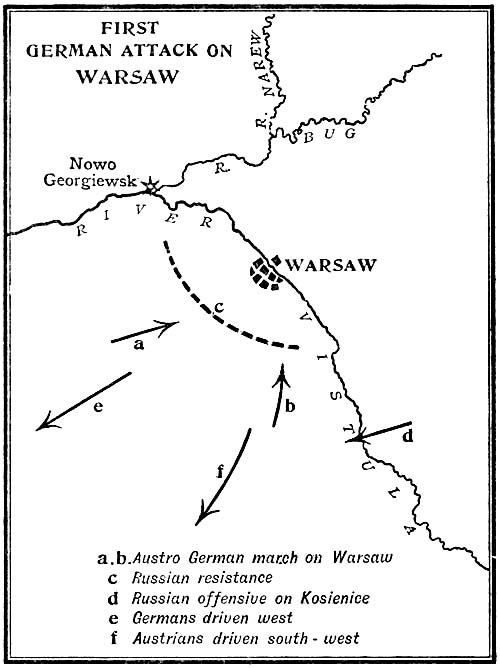
At Szydlowiec, seventeen miles south of Radom, I saw
the first signs of devastation, but these were not the
work of the advancing Russian artillery but had been
perpetrated deliberately by the retreating Germans. The
tower of the town hall was crumbled to ruins. The church
is not large, but has a high pointed roof, of which the
open woodwork still remains, with the cupola as if caught
astride of it in its fall. Inside, the beautiful painted inner
roof is mutilated, but the monuments of the ancient
Szydlowiecki family, and notably the graceful figure of
a sleeping woman, have for the most part escaped. The
floor was covered with rubbish and the damage is estimated
at a very high figure. While I was in the church,
the dignified old priest entered with six young men, who
knelt with faces full of reverence before they set to work
to clear the nave of rubbish. The Pole who told me the
story of the ruin of the church told it quietly but with
flashing eyes. He said the inhabitants asked rather
that the whole town should be destroyed and the church
be left standing. The only excuse was a few shots from
the advancing Russian infantry and artillery, and there
was no regular fighting there, the Germans making no
resistance and retreating too quickly to blow up the castle.
After Szydlowiec, the Cracow road on its way to Kielce
(twenty-seven miles) passes through country of quite a
different character. A long rise, and we were now close
up among the troops. At one point the long train of
wagons branched away to a village on our left, and out
of it by another road there came in another stream of
fighting men. We passed some two hundred Austrian
prisoners in their blue shakos and uniforms; they were
all Poles, with hardly any guard but giving no trouble;
one of them courteously stepped out of the ranks to pick
up my field glass, which I had dropped. These men, who
talked freely to us, did not look at all miserable, only
confused. The Russians behaved to them as to their
own people.
At last we came to the hills above Kielce. It was now
clear what had happened. Troops of all kinds were
streaming into the town and all resistance was over. On
the main street we were stopped for a few moments by a
general and his staff. At the chief hotel large parties
of officers were sitting down to lunch. All the streets
were full of movement, but with no sign of any conflict
or friction—horses, dismounting messengers, soldiers
eating, talking or resting, the townspeople standing
watching, satisfying the requirements or questions of the
newcomers or joining in their talk. We had no difficulty
in securing good rooms, and our lunch was as good as it
would have been in Warsaw. Many of the troops had
passed or were passing on along the broad road in the
direction of Cracow. Mounting the high hill south-west
of the town we could see the scattered stream of men,
horses and carts going forward past pleasant houses,
hills and villages, and the thunder of artillery came to
us from beyond a ridge in the distance. Our plans, however,
prevented us from going further. At the hotel the
regiment which had done most of the fighting was
sitting at dinner and singing the regimental song and
the national hymn. The song began with a Mahometan
word, "God has given us victory."
Next day, November 4, with villagers guiding and
recounting to us, we went over the scene of the last
Austrian resistance about six miles east of Kielce. A
long curving line of rifle pits ran over a broad high front;
sometimes the line ran along the inside of an extensive
copse of small fir trees; some of the pits contained
extemporised pallets of fir boughs, in others were bullets,
weapons or even letters. The Russian advance was
indicated by two hostile lines running almost side by side,
where within a few yards I picked up undischarged bullets
of the two armies. In a little wooded cemetery on the
bare ridge lay a number of bodies, Austrian and Russian,
brought in by the villagers for burial. It was not a sight
to dwell on; but one thing that I shall not forget was the
body of a young Austrian of not more than twenty, full
of grace and beauty, the head thrown back, the breast
bared, and the hand lifted as if waving on the attack.
Outside, other bodies were still being brought in, the
Russians greatly predominating in numbers. Some Austrian
wounded still walked about the village. One, with
whom I spoke, had the lower part of his jaw bound up
and complained that he could drink nothing. He was
greatly depressed but had no rancour and evidently felt
at home with the villagers, who were of the same blood
and behaved to him rather as people would to an interesting
traveller in their midst. He was a Pole from no
further off than Cracow, where he was a master—"professor"
as he put it—in a secondary school, a very
intelligent and educated man who seemed quite out of
place in a uniform and on a battlefield. He told me how
they replied all day as best they could to a cross fire, till
in the evening the Russians came on them shouting
"Hurrah!" A day earlier, and we should have seen this
fight. The Germans had left them in the lurch—"as
they always do," he added. It was in the main a battle
of Poles against Poles. He himself was a "Pan-Slavist,"
he told me, but could not say so because of his post. If
the Russians got Cracow and maintained the appointment
of Polish civil officials there, including a Polish Governor,
as at present, he felt certain that all western Galicia would
be on their side. I left him a little tobacco and took the
address of one of his colleagues in Cracow. Heavy firing
from the south was all the time audible.
We returned to Kielce, passing regiments of all kinds.
On our way back to Radom my motor broke down, and
after sitting for three hours amidst marshy ground, with
wounded; transports and villagers passing and occasionally
hearing stray rifle shots, I had to return again to
Kielce for the night. The discomfort of this contretemps
disappeared before the unconquerable wit and good
humour of my French colleague, M. Naudeau, who
improvised little songs on our mishap.
The next day, the 5th, there was nothing left but to
return to Radom, occupying three seats which a Russian
general, a man of charming simplicity, kindly put at our
disposal in his motor. The strength of the Russian
advance was everywhere before our eyes. The great
stream was still flowing on. There were troops of all
kinds—we inquired the name of each regiment, which
they always gave in a kind of jovial chorus; there
were food transports, field kitchens, pontoons and, not
least important, the post. At one point we saw a large
body of Austrian prisoners sitting by a wood and drinking
water with their very small escort. These men helped
some of our motors over difficult places. Streams, their
bridges broken down, were still being crossed by the
great onflowing current of men and wagons, only with
more ardour than before. Teams of white horses, which,
because of their conspicuousness, are only allowed to
serve in the transport, were dashing through the mud
and water with a fervour as great as if on the field
of battle. At one place a bread wagon dropped all its
cargo and turned over on its side, but horse and driver,
evidently not noticing, carried it on into the stream with
no diminution of pace—one wheel high in the air and
the other broken beneath the wagon. Our General
spoke frequently with the men; and we all helped one
another through difficult places, on each occasion with
a hearty "Once more thank you, brothers," from the
General. Nothing will remain with me longer than these
endless irregular lines of big, sleepy, almost stupid-looking
faces moving at a walk which might last for ever,
and all in one direction and all with set eyes, a people
that lies down to sleep at the roadside, that breakfasts
off stale biscuit soaked in water, that carries nothing
but what it can put to a hundred uses, that will crouch
for days without food in flooded trenches, that can die
like flies for an idea, and is sure, sooner or later, to
attain it, a people that never complain, a brotherhood
of men.
In Radom I found our Russian orderly from Kostroma
fraternising with the Polish servants, joining in their
work and singing them songs of the Volga. I told him
he was another Susanin who had led the foreigners into
the marsh. We were soon on our way back to Warsaw.
November 25.
I have dealt with the Russian advance from Warsaw
and Ivangorod, by which the Russian front was carried
forward some one hundred and seventy miles in all
from the original defensive line on the Bug and the
communications of the Austrian and German armies
were threatened in the neighbourhood of Cracow. This
movement was necessarily completed by an advance of
the Russian forces on the San.
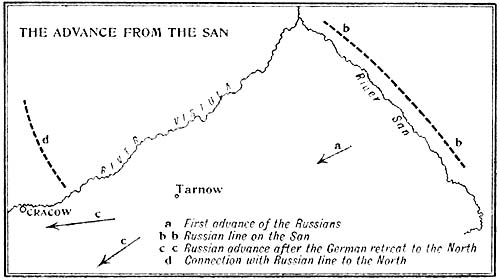
After their first successes in Galicia the Russians had
advanced as far as the Wisloka, but the German attempt
on Warsaw from the west and south and a strong Austrian
and Hungarian counterstroke on Galicia made advisable
a temporary strategic withdrawal of the Russian line to
the San, while all available forces helped in repulsing
Germans further north. For nearly a month the Russian
defensive line held good against superior Austrian forces
on the San and in the south. Report says that bounteous
rewards were offered to the Austrian troops for the reconquest
of Lvov; and the Russian occupation of eastern
Galicia was seriously endangered. The San varies in
breadth from fifty to a hundred and fifty yards and is
lined with marshes. Across this narrow obstacle Russians
in trenches maintained an unbreakable resistance, repulsing
all Austrian attempts at crossing.
I have seen many of the wounded of this long defensive
struggle. Their temper is the same conquering spirit
that has carried the general advance. I stayed at their
hospital some days. A group of slightly wounded,
mostly young men with bright, radiant faces and strong,
lusty voices, sat up in bed recounting to me, one after
the other, individual feats of daring done by their comrades.
Throughout there was the feeling of individual
superiority to the enemy tested by the heaviest conditions
and sometimes by the wiping out of nearly all
one's company or squadron. Most were wounded in the
left arm or left leg in the trenches. Five or ten of the
company would fall every day. The most exposed were
the telephonists. Others fell in daring reconnaissances
in boats across the river. All testified to the far heavier
losses inflicted on the enemy. One simple young fellow
crippled in a leg described how one did not in one's first
day's fighting like to look out of the trenches. Then he
showed how one began to peer about, and later one took
no notice of bullets whistling round one, because of the
sense that the army would surely go forward. One bright
day he said to me, "It must be fine in the trenches
to-day." This is the spirit of them all.
At last, when the Russians to the north had advanced
and Sandomir had been taken, the word came to go
forward. The river was crossed at night and the enemy
driven from the trenches and neighbouring villages and
further back. The advance was triumphant at all points.
The Austrians were driven southward and westward.
Some were pressed against the Carpathians, with two
difficult passes which would hardly admit the passage of
artillery and field trains; others were pressed back on
Cracow where the line of the whole Russian advance is
now complete.
The Russian impact on Cracow promises, first, a
settlement of the destiny of western Galicia, where the
population is Polish and very ready to respond to the
appeal of Grand Duke. Next, a gap is made between
the Austrians and Germans who are already retiring in
mutual dissatisfaction in different directions, and whose
political interests must more and more differentiate.
Further advance through this gap will be on Slavonic
territory, as southern Silesia up to the River Neisse is
mainly Polish or Bohemian, and the Czechs in general
are largely Russophil and quite hostile to Germany.
The Germans are doing all that is possible to make
diversions on other sides. Stopped and driven back on
the side of Mlawa, they have made a serious effort on
both sides of the Vistula, near Plock, but have been
decisively repulsed, the inhabitants giving effective aid
in bridging the river. They are now attempting to
force a strong wedge into the Russian front between the
Vistula and the Wartha; but so far the Russian line,
which is everywhere continuous and is reinforced wherever
necessary with strong reserves, has successfully outflanked
every local German advance.
Meanwhile a double Russian advance on East Prussia
from east and south is overcoming the numerous obstacles
and making rapid progress, avoiding and enveloping the
thickset fortified line of the Mazurian lakes. Here, too,
the subject population is chiefly Polish.
Retreating German troops in Poland, previously
transferred from the western front, expressed to the
inhabitants great despondency, even saying, "This is
our last judgment" (Das ist unser Weltgericht). Many
prisoners have displayed a similar mood.
November 28.
A Russian Field Hospital
A large, low, white building with a grassy court and
outhouses; four large tents stand in the court; on the
centre of the main building a white canvas band that
bears in rough black letters the inscription: First Etape
Lazaret of the Imperial Duma.
After a wonderful star-lit journey in a formanka or
double-horsed cart with a courteous and humble old
grey-haired peasant, I come on this building about half-past
two in the morning. The last part of the journey
was adventurous; the driver at one point wished to
strike work, which resulted in a wait of nearly an hour;
the way had to be asked of a group of soldiers with
blackened faces seated round a camp fire, and of three
sentries of the étape marching through the night with
fixed bayonets, who challenged, "Who goes there?" and
received with some hesitation the answer, "Our side"
(svoi). One of them lowered his bayonet to be ready for
any further emergencies. In the end I was guided to
the lazaret, where I had a cordial welcome from the two
sanitars on duty and was accommodated with a bed in
one of the large tents, which was empty and ready for
moving.
The Duma Lazaret was equipped chiefly by the energy
and liberality of Prince Volkonsky, Vice-President of the
Duma and one of its most respected and popular members.
All parties are associated in the work; and Prince
Volkonsky, who is a Conservative, has had the valuable
help of the eminent Radical, Dr. Shingarev, who earlier
earned a wide reputation as the organiser of the sanitary
system in the province of Voronezh. Meetings of a
committee are held in the Duma, and lately two other
lazarets have been equipped and dispatched, one to
the Prussian front and one to the Caucasian.
The first Duma lazaret was one of the earliest to
arrive behind the front during the tremendous fighting in
southern Poland and in Galicia. At Brody on the road
to Lvov it gave preliminary treatment to thousands of
wounded in the course of a few days. Later it was
moved to Lvov, Sokal and Belzec, where I now found it.
It had picked up on its road stray dogs which it had
named after their places of adoption—Brodka, Rava,
and Belzec.
The lazaret was equipped for two hundred patients,
but at the time of my visit had only forty, as it was about
to be moved further to the front. Operations were
performed daily, to be ready for the move. I saw one
poor fellow, very frail and no longer young, just after his
leg was amputated; he was calling in a piteous way to
his mother. In one ward the patients were in a late
stage of convalescence from typhus, and in another lay
one of the sanitars of the lazaret. In a far corner lay
a poor fellow with a wound in the head; his case was
hopeless, and he was communicated by the priest in an
interval of consciousness.
The central wards were full of strong, lusty men, most of
them young, some with bad wounds but nearly all getting
the better of them. They were in many ways like dormitories
of big schoolboys, all of them good comrades—during
my stay of some days I only heard one altercation and
that was mild and very short. They lived a chance
corporate life of their own; and when I went round with
cigarettes, there was always some one to see that tired
or sleeping comrades got their share. There was very
little groaning and no complaint; the men felt their
wounds in the long night time, and sometimes one would
mention that his wound was smarting. One Armenian,
a weak-looking lad of the gentlest disposition, lay striving
to bear his pain. "Oh!" he said as he fought it; and
then, with closed teeth, "No matter; it doesn't matter;
our Emperor ought to be rich; it had to be done—to
beat the Germans; it doesn't matter."
Usually, however, the wound would only be mentioned
in a side sentence in a narrative—"and then I got this,"
or it would be the occasion for a story of strong life and
effort and the triumph of "ours." There was a peculiar
delicate courtesy about the halest and strongest, who
would shift their wounded limbs with an inviting gesture
of the hand, making room for me to sit on their beds;
and then there would rise a general stream of narrative
where all joined in without ever seeming to interrupt
each other, each telling of some daring feat of a comrade
against all odds. One will not forget the figures leaning
up in bed and the young, radiant faces; many of these
men were cripples who will never fight again, but everything
about them was full of health and fresh air and
victory.
A young trooper told me of the actions of his regiment
against the Hungarians. They have, it appears, a
particularly mobile horse artillery, served with great
accuracy by horsemen who fire with the left hand.
They enticed the regiment up with displays of white
flags and suddenly rent them with a murderous fire.
For all that, as in practically all these narratives, in the
end the Russians triumphed.
Others described the long defensive work on the San,
with its narrow stream and muddy banks, and the final
irresistible advance. There were two young men, one
from Chernigov and one from Tauris, who beckoned to
me each day, and with whom I spent several happy
hours. When I asked for their addresses they wrote
them down in form, beginning in the one case with
"Wounded in arm" and in the other with "Wounded
in leg." "Wounded in leg" was a sunny youth who,
when we were photographed together, made quite a
careful toilette. He was the boy who called out "What
a splendid day! It's fine to-day in the trenches!"
These two discussed with me all sorts of subjects, including
the English sailors and the Grimsby fishermen, who
appealed to them as "going for boldness." Another
more elderly pair, one like a jolly farmer and the other
like a brown-bearded stationmaster, worked out with me
on the map the progress of the Russian army. Simplicity
was the note of all, and it would have been hard to
convince them that it was they more than any others
who were now under the eyes of Europe.
There was another still more elderly couple that had
an out-of-the-way interest. They were two old men,
one of sixty-six and one of seventy-two, who had been
shot by the Hungarians for sheltering Russian soldiers.
One of them, a picturesque-looking person with round
head and furry grey hair, told me of how he was locked
up in his attic and then called down to be shot, while
his womanfolk were reviled and struck. His leg was
broken, but was mending. Both these poor old men
were full of plaints and, after the Galician manner,
insisted on kissing one's hand each time that one talked
with them.
One of the most sympathetic figures in the lazaret
was the priest, a man of the age and with many of the
features of a Russian picture of the Christ. He was a
monk from the famous Pochayev monastery in Volyn,
sent hither by the Archbishop Eulogius. His was an
entirely un-selfconscious nature, gentle, good and whole;
and the care that he gave to the dying was like the
best of man and of woman combined. I had some talk
with him of the Uniats, that oppressed people under
the heavy hand of Jewish taskmasters, which had held
through centuries to its roots of parish organisation
thrown out by the early Brotherhood of Lvov. We
glanced in at one of their services in the quaintest little
wooden church, where the singing was congregational
and like a sad plaint.
Our priest every day read a short Orthodox service in
the central ward, and on Saturday and Sunday served
the full Mass in one of the largest tents. Some six
of the soldiers were trained singers; the priest himself
did not chant, and the words of the service came with all
the more reality, especially the frequent allusions to the
"Christ-loving army." At one point the priest went
through the wards to repeat a part of the service; for,
as he said, "our soldiers are deeply religious, and the
patients will feel that they are left out." At the end
all in the tent kissed the cross, and the priest then went
to hold it to each of the patients in turn. He told us
that at the mobilisation and before battle communions
were frequent and that fasting was in such cases excused.
It was while I was here that the order to move forward
arrived. The remaining wounded were arranged for in
neighbouring hospitals; warm blue vests were served out
to all for the journey. "We have much to be thankful
for," said one soldierly fellow who looked like a sergeant
and took a lead among the rest. "Our Emperor has
indeed fed and clothed us." Everything was packed, the
large farm buildings were left deserted, and the hospital
moved forward in the track of Radko Dmitriev.
Kiev, December 15.
The Country and the War
I have just made a journey across Russia. The
average opinion seems to be the same everywhere. The
feeling expressed is quiet and sober; no boasting of any
kind is heard anywhere; news of the war is treated on
its merits, and anything that seems unsatisfactory is
faced and is given its reasonable value. As to the
ultimate issue, complete confidence is felt, and, in this
feeling, satisfaction with what has been done and the
determination to go through with the matter seem to
have an equal share. Every one is clear that there can
be no stopping half-way with the task unfinished; and
the task, as it presents itself to the average man or
woman, is that the crisis thrust upon us must not
occur again. I say "thrust upon us" because, with
average people even perhaps more than in official circles,
and with the peasant more than all, there is the strongest
feeling that peace has been wilfully disturbed by Germany,
and that Russia was left no option but to hit back as
hard as she could. A peasant cabman, fraternising with
me on our alliance and promoting me in the course of
our conversation to the second person singular, summed
up the common instinct very well by saying: "How
disagreeable He is" ("He" is always the enemy); "he
makes himself nasty to every one," which is surely
the chief reason why "He" is having a bad time of
it now. "He might have smashed you or the French,"
my cabman goes on; "us he can only hit about a bit
(pobit)," and his attitude is that of a big, kindly animal
that is provoked into defending itself and others.
"Pobit" is the ordinary expression of the soldiers for
the work they have to do. A peasant servant puts it
stronger and is sorry that I am not going to "spike"
(kolot) any Germans, especially as she has made up her
mind that they are going to kill me. "You had better
tell me what to do with your things," she says, "for
you're not going on a pleasure trip"; and she reminds
me of this as I start by asking, "But when you're killed,
though?" I quote this because this good woman has a
brother in the Siberian rifles, of whom so many are lying
under the great wooden crosses outside the wrecked
village of Rakitna, and no doubt she judges of my chances
by his; but she talks of him with the same equanimity.
Beneath all this, there is the full and silent sense of all
the sacrifices that are asked and a silent pride in making
them. I have never heard this take words with the
peasants, though it is behind everything they say; but
it comes out often with those who have any responsibility
for others and most of all with any who are in close touch
with the common soldier. Those speak the strongest
and simplest of him, who are only telling a friend
their daily experience of him; and the selflessness of
his courage and endurance keeps coming back on
them as something that astounds and even confounds
them.
All the life of the country that lies behind the line is
centred in it. The nearer one comes up to the line, the
more does one feel in the moral atmosphere a sense of
satisfaction, of ease of mind. In the line itself all sense
of self disappears, and the big band of brothers lives for
its daily work and divides up everything in common. It
is wonderful how far little resources can go when they
are put together; one produces some chocolate, another
a little store of comfits, a third hands round a flask,
another supplies the cigarettes and another the matches,
and a little feast is thus improvised by the half-light of
a candle; all these stores are renewed at chance and are
expended without reserve.
But it is farthest of all from the front that the sense
of the war is most painfully felt, and that because it
has to seek ways of finding its satisfaction. For this it
seeks continually. Every now and then, in the capitals
and all the big towns, a week is set aside for some special
object: for the collection of warm underwear for the
men in the trenches, for Christmas presents for the troops,
for the families left behind, for the widows and orphans,
for the supply of means for the crippled. At these times,
which are constantly recurring, every tram or train is
boarded and every restaurant is traversed by the collectors,
who for each donation pin on a little special badge to
secure the donor from any further importunity; but the
badge is quite disregarded both by donors and collectors,
and one sees many who have paid their due several times
over. Thus the public is taxing itself over and over
again for every need that it can think of.
The posters have a nervous force, such as the Petrograd
one that begins and ends in large letters with the
words "It's cold in the trenches." Several of them bear
the signatures of members of the Imperial Family, one
of the most simple and telling coming from a sister of
the Emperor who is engaged in ordinary hospital work
among the wounded. Another striking appeal, for the
widows and orphans, is simply a twofold picture. Along
the top in pale blue with a sullen sky of winter dawn
above, a number of scattered soldiers, big and clumsy
and heavily clothed, are running forward over a rough,
flat field, with the lumbering run of a Russian porter
at a railway station, their bayonets lowered and all with
set faces; from a copse in the distance come puffs of
smoke; and in front of the men, close behind his chief,
who has already fallen, an officer has his hand thrown
up in the air as a bullet carries him over. Underneath
sits a group of dark-haired figures; a young wife with
set and brooding face, and two young boys at once with
fear and spirit in their eyes. I have asked that some of
these posters should be sent to England, in case any
could spare from their nearer needs something for the
countless bereaved of Russia.
Every non-military unit of society is looking for a
way of its own of helping. Mary Dolina, who might
perhaps be called the Mrs. Kemble of Russian opera,
has, with her many helpers, now given over thirty concerts
of national and patriotic music for widows and
orphans. The artists of Russia, banded together with
special imperial approval, are giving movable representations
in restaurants or in public squares, where, as
in all other cases, the full collection goes to the army.
The Press of Moscow is meeting to organise a day on
which the Press will make a united effort for the same
object. And then there are the collections for claims that
make a special appeal, such as the devastated homes of
Poland, Belgium and Serbia. The superscriptions adopted
in these various endeavours are quite simple and usually
take the form of offering a present—for instance,
Petrograd to Poland, Moscow to Poland and Belgium,
Artists to Soldiers, and so on. All this wealth of various
charity is co-ordinated, and regularity of service is secured
by committees of the most representative kind under the
chairmanship of one or other member of the Imperial
Family. The Emperor himself is constantly paying
visits to the army with abundant supplies of medals for
all the heavily wounded.
Among the links between front and rear are the frequent
short visits to the capitals of those chief organisers
of the Red Cross who must be everywhere. Prince
George Lvov, one of the most admirable of Russian
public workers, who organised relief during the famines
and led the Civil Red Cross in the Japanese War, passes
from Lemberg to East Prussia, or from Warsaw to the
Caucasus, seeing as much as can come under one pair of
eyes, and returning to Petrograd and Moscow to find
ways of meeting each new need. Nicholas Lvov, a
former Vice-President of the Duma, whose brother has
fallen and whose eldest boy has been killed by shrapnel
before Cracow, passes constantly between Petrograd and
Galicia. Alexander Guchkov, the organiser of Red Cross
work on the Warsaw front, who is constantly in the
front line and was reported prisoner at Lodz, pays flying
visits to Moscow. And all these glimpses of the realities
of the war draw closer the ties between the army of
defenders at the front and the country that is waiting
to meet every sacrifice and to fill every gap. Russia
will close the ranks till the work is done; and she can
go on doing this after it has become impossible for our
enemies.
December 18.
In Kiev, though there is every sign of its being in the
minds of all, materially the war is hardly felt. It is in
fact wonderful how little effect of this kind it seems to
have made on the body of Russia. On the other hand,
the atmosphere of nervous tension begins to disappear
the moment one begins to get really near to the front.
In the Red Cross offices at Kiev I found the same straining
toward the front as elsewhere, only much calmer
because these were people who had a big war work to do.
Hospitals meet the eye in the streets at every turn.
Once in the train for Galicia it was again the war
atmosphere and simplicity itself. The talk was all of
people engaged directly or indirectly in it. A graceful old
lady with a very attentive son was on her way to get
a sight of her husband, one of the generals. A young
officer, whose wound has kept him out of it for three
weeks, is on his way to the front before Cracow. A
fresh-looking young man, at first unrecognisable to his
friends with his close-cropped bullet head, tells how he
went on a reconnaissance, how he came on the Austrians,
how their first line held up their muskets and when the
Russians had passed on fired on their rear, how nevertheless
practically all came back safe and sound. It
was told with a kind of schoolboy ingenuousness and
without suggestion or comment of any kind on the
conduct of those concerned. Then followed an account
of a war marriage, at first put off and then carried out
as quietly as possible. All the friends of every one
seemed to be at the war.
At the old frontier some of the buildings near the
station were wrecked by artillery fire, and the railway
was lined with a succession of solid hospital barracks,
with the local commandant's flag flying over one of
them. There was plenty to eat at the station; and
though we moved on very quickly, every one from our
crowded train managed to find a place in the Austrian
carriages, chiefly because every one was ready to help
his neighbour. The corridors jammed with passengers
and kits, we moved on through the typical "strips" of
Russian peasant culture, a pleasant wooded country,
passing a draft detachment on the halt which waved
greetings to us. My companion, Mr. Stakhovich, a
phenomenally strong man and imbued by a fine
spirit, was talking of the indifference of the Russian
peasant to danger; he regarded it as an indifference to
all sensations; anyhow they go forward, whatever the
conditions, as a sheer matter of course. With the
ordinary educated man the mind must be kept occupied
with work if unpleasant possibilities of all kinds are to
be kept out of it; but General Radko Dmitriev, to whom
we are going, will jump up from a meal, however hungry,
when there is a chance of getting under fire.
We draw up in the great station at Lvov. To the
right of us stretch endless lines crowded with wagons,
especially with sanitary trains. In the lofty passages
and waiting-rooms are sleeping troops with piled muskets,
some wounded on stretchers tended by the sisters of
mercy who are constantly on duty here, and a crowd of
men, all soldiers, coming and going. One passed many
Austrian prisoners, of whom another enormous batch
was just announced to arrive; and elsewhere a Russian
private explained to me the excellent quality of the
Hungarian knapsack, which he and his comrades had
turned into busbies. One man was asleep inside the
rail opposite the ticket office. He did not seem to mind
how often he was woken up.
In the town everything is quiet, and life goes so naturally
that no one could take it for a conquered city. In
the country this might have been expected because far
the greater part of the population is Little Russian;
but in Lvov the Russians are only about 17 per cent.
and the predominant element is the Polish (60 per cent.),
the rest being Jews (20 per cent.) or Germans (3 per cent.).
The university, the Press and the bulk of the professional
class are Polish. This result is in character with the
place, which has a peculiarly pleasing atmosphere of its
own. But it is also a great tribute to two quite different
influences: to those Poles who, though in no way tied
to Russia, have preferred to all other considerations the
corporate interests of their fellow-countrymen, and to
the wise and sympathetic administration of the Russian
Governor-General, Count George Bobrinsky.
December 22.
Lvov is taking on more of the character of a Russian
town. Many of the Jews have left. The Russian signs
over new restaurants, stores, etc., meet the eye everywhere.
Of the Little Russian party which supported the Austrians,
many have now returned and are making their peace
with the new authorities. The Russian soldier is quite
at home in Lvov, as one sees when the singing "drafts"
swing past the Governor-General's palace; the Austrian
prisoners in uniform, who are allowed liberty on parole,
seem equally at their ease. Numbers of Russian priests
are pouring into Galicia, but not fast enough for the
Uniat villages which have embraced Orthodoxy; as
soon as they arrive, peasants come with their carts and
take them off to their parishes, without waiting for any
formal distribution. The Uniat creed and ritual are
practically identical with the Orthodox, so that the
difference between the two was purely political. At the
new People's Palace of Nicholas II, I saw a number of
children, principally from families that had suffered
severely at the hands of Austrian troops, receive Christmas
presents on the day of St. Nicholas, who is the Russian
Santa Claus. Archbishop Eulogius, in a very effective
little address, told them that the biggest Christmas
present which they were receiving was the liberty to
speak their own language and worship in their own way
in union with their Russian brothers.
Starting for the army, I spent a night of strange
happening in the great railway station, as our train
was delayed till the morning. At one time I went, in
the frosty night, to look for it at the goods station, where
there were endless rails and wagons, and found it after
a long search. In the big restaurant four little boys
made great friends with me, one of fourteen in uniform
and spurs who had been serving as mounted scout with
a regiment at the front, and one of thirteen who had
attached himself in the same capacity to a battery.
Both were small creatures, and the first was a remarkable
little person, with all the smartness and determination
of a soldier, relieved by an amusing childlike grace and
courtesy. He said to me in a confidential voice, "I
see you are very fond of little children," and he ordered
with pride lemonade and chocolates for us both. He
said the men at the front could last a week to
ten days, if necessary, without any food but sukhari
(army biscuit), so long as they had cigarettes. His
imagination had been caught by the aeroplanes over
Peremyshl, and also by the Carpathians, which he
described with an up and down movement of the hand.
He had a great disgust for anything mean and a warlike
pride in the exploits of the soldiers of his regiment. His
model was a boy, now a young man, who had been
through the Japanese War. "If a general comes past,"
and he made a salute to show the extreme respect felt
for his hero. Many a time in that long night, while
the weary heads of doctors and sisters of mercy were
bent in sheer tiredness against the tables, he would
come and sit by me and ask me to read the war news to
him, or to tell him about the English submarines. He
left me with the smartest of salutes in the early hours of
the morning.
Our train is an enormous one with endless warm
carriages (teplushki) for the wounded. The staff of
sanitars and sisters, working for the Zemstvo Red Cross,
live in a spotlessly clean carriage, and there are special
carriages for drugs, stores, kitchen, etc. They are simple
and interesting people, and, as I am now in the Red
Cross and have many interests in common with them,
they kindly made me up a bed in their carriage, where
we discussed Russia in all its bearings.
We carry a group of passengers who have all made
friends after the Russian way. A colonel and his wife
are going to fetch the body of a fallen comrade. Another
colonel, a delightfully simple man with close-cropped
hair, thin brown face and bright, clever eyes seems to
know all the Slavonic languages and has much to say
of the Austrians. He has seen twenty of them surrender
to a priest and his clerk who came on them in a wood,
made the sign of the cross and told them to come with
them. In another place twenty-two Austrians were
captured by two Russians. The Austrian officers put
quick-firing guns behind their own rifle pits for the
"encouragement" of their men, on whom he has seen
them fire. They make their gunners fire every two hours
in the night as a kind of exercise. He has seen them
form their men in close column under fire and march
them about up and down along the line of the Russian
trenches. The Austrian artillery seldom takes cover;
the Russian directs its fire on the enemy rather than on
his batteries. In one place, heavy Russian artillery at
a range of seven miles demolished an Austrian field
train and two battalions who were lunching in the square
of a small town. He is full of life and confidence, and
all that he says breathes of fresh air and of work.
December 24.
Our train made its way through to the furthest point
up. We had to stop several times to let through the
ambulance trains already charged with wounded, which
take precedence. We had to go very slowly over several
repaired bridges; and this was no simple matter, as we
had twenty-seven long and heavy coaches. Some of
these repairs were complicated pieces of work, as the
bridges were high above the level of the rivers. At
point after point, and especially on the Austrian sides
of the rivers, we passed lines of carefully prepared trenches,
and in one place there was a masterpiece of artillery
cover, with every arrangement for a long stay.
The damage done by the artillery fire was sporadic—here
a smashed station building, there a town where
several houses had suffered. But there was nothing
indiscriminate; and the Polish population, which showed
no sign of any hostility to the Russians, seemed to find
the war conditions livable.
As in other parts, I was specially struck by the easy
relations existing between the inhabitants, the Austrian
soldiers and their Russian captors. There were exceptions.
I had some talk with a few Austrian Germans
from Vienna. They were simple folk and seemed to
have no grudge against the Russians; and the circumstance
in their position which they felt most—they were
only taken the day before yesterday—was that this was
Christmas Eve, the "stille Nacht, heilige Nacht" of the
beautiful German hymn, and that they were far from
home among strange people. They kept apart as far as
possible not only from their captors but from their fellow
prisoners from Bohemia and Moravia. These last seemed
at least quite comfortable, smoking their long pipes
and leisurely sweeping the platforms. They were quite
a large company. They understood my Russian better
than my German. When I asked them how they stood
with the German troops, instead of the sturdy "Gut"
of their Viennese fellows, they answered with a slang
word and a gesture. When asked about the Russians,
they replied in a quite matter-of-course way: "We
are brothers and speak the same tongue; we are one
people." For any difficulties, the Poles often prove
good interpreters. It is very different for the Austrian
captive officers, who often cannot understand their own
men.
These Czechs confidently assured me that any Russian
troops that entered Bohemia would be welcomed as
friends; and they claimed that not only the neighbouring
Moravians and Slovaks but also the Croats further south
were to be taken as feeling as they did. The Bohemians
and Moravians seem to be surrendering in the largest
numbers of all; and though the Viennese claimed that
large numbers of Russians had also been taken, I cannot
regard as anything but exceptional the enormous batches
of blue uniforms that I passed on the road here. I asked
these men about their greatcoats and was not at all
surprised when they said they felt cold in them. It is
nothing like such a practical winter outfit, whether for
head, body or legs, as that of the Russian soldier.
We came very well over the last part of our journey.
I was sorry to part with the friendly sanitars, who all
seemed old acquaintances by the end of the journey and
invited me to take up my quarters permanently with
them. Theirs was more than ordinary kindness, as they
had shared everything they had with me, including their
little sleeping apartment. The bearer company under
their orders is all composed of Mennonites, a German
religious sect from South Russia which objects to war on
principle and, being excused military service even in
this tremendous struggle, seems to be serving wholesale
as ambulance volunteers.
As there were none but soldiers about, these men
helped me out with my luggage; and through the window
of the First Aid point in Tarnow station, I saw another
acquaintance waving me a welcome. This is the last
point that the railway can serve; and my friends will
go back with a full burden, which will keep the medical
staff busy day and night all the way. One of my new
companions, who has been out to a village to get milk for
the wounded, has seen the shrapnel bursting; and the
guns are sounding loud and clear near the town as I
write this. It is here that the most seriously wounded
must be treated at once, as a railway journey would
simply mean death for them. This is brought home to
one, if one only looks at the faces of the workers. Yet
with this huge line of operations, and the assaults which
may be made at any point of it, at any moment the nearest
field hospitals may need to send off any wounded who
can be moved without delay. Though the work is being
done with danger all round, less thought is being given
to it than anywhere that I have been yet.
Christmas Eve: peace on earth and good will toward
men. And all through "the still night, the holy night,"
the sound that means killing goes on almost continuously.
How can any one say prayers for a world which is at war,
or for himself that is a part of it? May God, who knows
everything, help each of us to bear our part and not
disgrace Him, and make us instruments to the end that
He wishes.
December 26.
Christmas day I spent in the hospitals. In one ward,
at a local Austrian hospital, and full of wounded, I found
that almost every one of the line of patients was of a different
nationality. Going round the room, one found first
a Pole of western Galicia, then a Russian from the Urals,
next a Ruthenian (Little Russian) from eastern Galicia,
next a Magyar from Hungary, and against the wall a
young German from Westphalia. After him came an
Austrian-German from Salzburg, a Serbian from southern
Hungary, another Ruthenian, an Austrian-German from
Moravia, an Austrian-German from Bohemia, and a
Moravian from Moravia.
I spent a couple of hours here, talking sometimes with
each of the patients, sometimes with all. The Pole knew
only Polish and the bearded Russian, who had a bad
body wound, was too tired to talk much. Of the Ruthenians
one was a frail, white-faced boy from close to the
Russian frontier who seemed, like most of his people,
subdued, and confused with the strangeness of his position
in fighting against his own people; the other was a
lumpish boy without much intelligence. The thin,
bearded Hungarian, who knew no German but a little
Russian, was mostly groaning or dozing. The Salzburg
Austrian was dazed and drowsy, but at intervals talked
quietly of his pleasant homeland.
The German stood out from the rest. He was a bright,
vigorous boy of twenty, had gone as a volunteer and was
tremendously proud of the spirit of the German army.
He had fought against the French during four days of
pouring rain, mostly in standing water. The Bavarians,
who seemed to have quarrelled with the other troops in
that part, were making war atrociously, he said, knifing
the inhabitants, insulting the women and destroying all
that came in their way. He was later moved to the
Carpathians, where one German division fought between
two Austrian ones. They advanced in snow without
field kitchens, and were not allowed to touch the pigs
and poultry that they passed. However, they had
enough to eat; and they were hoping to surprise their
enemy, when the Russians fell upon them and left only
the remnants of a regiment, many of the officers also
falling. He himself was wounded in both legs, and was
brought here in a cart.
Every German soldier has a prayer-book and a song-book.
They constantly sing on the march, and find it
a great remedy against fatigue. Songs of Arndt and
Körner are very popular, and there is a new version of
an old song, which is perhaps the greatest favourite; it
begins—
"O Deutschland hoch an Ehren,
Du heil'ges Land der Treu,"
and it goes on to speak of the new exploits in east
and west. There are any number of volunteers in
Germany; the women are all joining the Red Cross;
and the population is busy with every kind of work for
the army; but when I asked whether the people were
keen for the war, he answered with astonishment, "The
people? The people thought that the war was not to
be avoided; but that was at the start; now it is different."
He asked if there were many other Englishmen
in Russia, and when I answered that there were some,
he said, to my surprise, "The English are everywhere,
they are a fine people—nobel." He also asked me on the
quiet whether, when he was well, he would be sent to
Siberia. He had been told that the Russians were
terrible, but had written home to say that he had found
them nothing of the sort.
Much of our talk turned on the Austrian army. The
German said that it didn't stand firm "unless it was
properly led, by Germans." In Bohemia and Moravia
the regiments were mixed, Slavs and Austrian-Germans,
and, according to the Moravian soldiers, were constantly
quarrelling; all the officers were Austrian-Germans, and
even some of the Hungarian regiments seemed to be
commanded by Germans. The young Serbian spoke
of frequent quarrels and even brawls between Serbian
and Hungarian fellow-soldiers. The great wish of all
was that the war should end. When I said that the
end was not in sight, the German exclaimed, "More
misery, more misery;" a second said, "Oh, Jammer,
Jammer" (lamentation), and a third had tears in
his eyes.
In another ward I heard more of the Bohemians.
There Prussia is the antipathy. There appear to be
Czech officers only in the reserve. After the outbreak
of war, the Austrians made wholesale arrests among the
educated Czechs, quite apart from party politics, and
were particularly severe on the gymnastic volunteer
organisations (sokols), which are popular among all
the Slav nationalities of Austria. The Bohemians had
not had time to find their legs under the new possibilities
created by the Russian successes, but the Russian
troops would be sure of a cordial welcome there. The
whole of my informant's regiment had surrendered en
masse; and even in the mobilisation of 1909, a Prague
regiment had refused to march against Russia and
several of the men had been shot. I was told that the
Austrian army was much weaker in reserves than the
Russian.
I ended the day at the railway station, where the
Russian wounded just brought in were being attended
to, while the cannon sounded from time to time not far
off. Several lay on stretchers in the corridors and others
on pallets in the ambulance room, all still in their greatcoats
and with their kits lying beneath them. I had
no conversations here; there was too much pain, one
could only sit by the sufferers or perhaps help them to
change their position. First aid had been given elsewhere,
but this was the stage when the wounds seem to be felt
most. There was wonderfully little complaining. Most
were silent, except when a helping hand was needed. One
man shot through the chest told me that "By the grace
of God, it was nothing to matter." It was always a
satisfaction to the men that they had been wounded
while attacking. A general walked quickly round, distributing
cigarettes, which he put in the men's mouths
and himself lighted.
In the night the cannonade sounded close to the town,
but seemed farther off again next morning.
To-day I also went round a hospital with the dressers.
The work was quickly executed, but much of it was very
complicated. One does not describe such scenes, not
so much because of the ugly character of many of the
wounds, nor because of the end impending over many of
the patients. To this last the Russian soldier's attitude
is simple—gilt es dir, oder gilt es mir. He will speak
of it as "going to America," the undiscovered country.
But all these things come to be forgotten in the atmosphere
of work. Here all the resources of life are going forward
in their own slow way, for they can have no quicker,
handicapped and outpaced in their struggle to keep up
with the work of death. You work early and late, do
what you can, and try to be ready for the fresh work of
to-morrow.
December 27.
General Radko Dmitriev is a short and sturdily built
man with quick brown eyes and a profile reminiscent of
Napoleon. He talks quickly and shortly, sometimes
drums on the table with his fingers, and now and then
makes a rapid dash for the matches. The daily visit
of the Chief of the Staff is short, because, as the General
says on his return, simple business is done quickly.
Every piece of his incisive conversation holds together
as part of a single and clear view of the whole military
position, of which the watchword is "Forward."
It is only the heavy rains that have saved the retreating
Austrians from further losses. The roads are so broken up
and so deep with mud that any quick movement is impossible.
This gives the occasion for a useful rest. The
cold weather—and it is freezing now—will be welcomed
on this side; and the Russian winter kits, which have
already been served out, are immeasurably better than
the thin blue greatcoats of the draggled and demoralised
Austrians.
Numbers of Austrian units are so reduced that they
are only shadows of what they were, and some seem to
have disappeared altogether. The ordinary drafts came
in some time ago and are now exhausted—such is
the testimony of Austrian officers. The new Russian
recruits, on the contrary, will join the colours shortly.
From the beginning of the war, Bosnians, who are really
Serbians, surrendered in large numbers. Then the Poles
began to come in, and now the Bohemians. The Hungarians
are sure to go on to the end; but the Roumanian
and Italian soldiers of Austria have also come over
very easily. In front of Cracow a Russian officer under
fire came on a whole number of Bohemians, who were
singing the "Sokol" songs and shouted a greeting as
they came into the Russian lines.
These wholesale surrenders have, I think, an extremely
interesting political significance. When governments
turned the whole people into an army, it was clear that
the army was also being turned into the people; but it
was not clear how the people could express itself when
under army discipline. These surrenders, in their general
character and in their differences of detail, are a picture
of the feelings and aspirations of the various nationalities
which are bundled together under the name of Austria.
January 1, 1915.
At this Staff, as at the General Staff, life was very
simple. We all met twice a day for a plain meal without
any alcohol; there was plenty of conversation, but it
was that of men engaged in responsible work; any news
from outside was welcome, especially from the western
allies, and there was full appreciation and sympathy for
their hard task.
There was plenty of news from other quarters of the
Russian front, and one could have a much juster and
fuller perspective of how things were going than anywhere
behind the army; the two things which stood out
even more here than elsewhere were, on the one hand,
the immensity of the sacrifices which have been asked
and are being cheerfully made by Russia, and, on the
other, the sense of quiet confidence as to the ultimate
result.
These things were of course talked of here with greater
detail. There is a photograph of a battlefield, not with
a few straight lines and some scattered dead, but with
zigzag lines all close together and simply heaps of Austrian
dead (the Russian dead had already been removed).
From the attack of one German division on this side,
one thousand corpses were counted. The Germans and
also the Austrians advance in close column, which may
give moral support to the men, but results in terrible
losses, as compared with the more individualistic advance
of groups of eight to ten on the Russian side. In bayonet
fights practically no quarter can be given, and sometimes
the men can only use their rifles as clubs. The Austrian
army is already no more than a relic of its former self,
though it still makes some vigorous moves and covers
every retreat with a tremendous cannonade, often resulting
in the capture of the guns and men thus left
behind. It must not be forgotten that Russia has had
to deal with practically all the forces of two of the three
allies (Austria and Turkey), as well as with an ever increasing
proportion of the forces of the third (Germany).
But she is going steadily through with her work, and
already it is possible to see more clearly both what has
been achieved and how the remainder of the task can be
attempted.
After some days in a cottage with some friends, living
largely by candle-light and discussing the great social
changes which are to be expected in Europe after the
war, we were joined by V. S., who had walked in through
the thick mud a distance of some twenty miles. V. S. is
a young and clever Conservative, who has sat in several
Dumas, always a strong and witty enemy of revolution,
but never content to sink his conservatism or patriotism
in any commonplace formula. He went to the front at
the beginning of the war and was wounded in the trenches
simultaneously by shrapnel and by bullet. He is now
partially recovered and is working energetically for the
Red Cross, superintending the removal of the wounded
from the front.
V. S. left the neighbouring town in a motor with some
Christmas presents for the General. He had only come
halfway when his benzine gave out, and, as none was to
be got anywhere near, he left the motor with the chauffeur
and made the rest of the journey on foot. He had to
plough his way through rivers of mud, and when the
early night fell he took shelter in a Polish cottage.
When he reached us next day he was dead beat and slept
for hours.
As soon as his main business was done, we set out
together yesterday morning in a long boat-like cart with
three horses and a soldier driver; our plan was to find
the motor and return to the town, sending back the
General's presents in our cart. For some hours we made
a sort of slow progress, rolling about in a way that exceeded
the North Sea at its nastiest; however, we had
time to talk over many subjects that interested us both.
We pulled up at the Polish cottage, where V. S. had a most
affectionate welcome from the children, and we lunched
on bread and milk. We were not out of sight of the
cottage when our axle broke; and after finding that
there was no smith, and no other cart to be had, we loaded
our benzine and chattels on the horses and left the cart
at the cottage with a note explaining what was to be
done with it.
For several more hours we tramped on in the mud with
our pack horses; it was quite impossible to follow the
track of the road closely; it was thick with mud too deep
to walk through and often the fields were a sort of swamp.
At one point we turned in to a Jewish cottage and ate
more bread and milk, while our old host asked ceaselessly
when the war would end.
At last we found the motor and the chauffeur, and,
after a cottage dinner, started on the short remainder of
our journey; but we were by no means at the end of our
troubles, and this, I was told, was to be expected, because
a hare had run across our track. We were going
along, dodging the huge and deep ruts in the chaussée,
when, close up to one of the hugest and deepest, a cart
coming the other way compelled us to make a sudden
turn, and we were landed on a kind of plateau between
two deep holes with our wheels almost off the ground
in them.
We had tried almost all the ordinary expedients in
vain, when a long train of soldiers began to pass us with
artillery. Appeals of "Brothers, come and help us,"
brought about a dozen of them to our aid, and they performed
prodigies of strength, pushing forwards or backwards,
and at one point even raising the whole motor
from the ground. Sometimes they counted "one, two,
three," sometimes they sang a bargee's chanty, and each
of them put the best of his wits to our service; but at
last, just after one of them had said "Let's do something
a bit more together," the officer in command felt it his
duty to call them back to their work, and our brown-coated
brothers left us in the semi-darkness while the
guns boomed a few versts away.
The chauffeur meanwhile had set himself like a hero
to raise the motor out of the ruts. V. S. and I found a
cottage with a pile of bricks outside, which we took with
the explanation "Needed." After several journeys to
and fro we collected a little brickyard; and V. S., though
his back was paining him, came dragging a huge log and
a tree stump to use for leverage. He still found a free
hand to shake mine with the words: "A Happy New
Year; it finds us hard at work but full of spirits in spite
of everything." The new year began well: the lever
acted, the chauffeur made a sort of macadam of his own,
and we sailed over the obstacle and on to our destination,
which we reached at 1.30 a.m.
These are the conditions of weather and roads under
which Russia has to press back the enemy; but she never
lets him alone, for she knows that on persistent pressure
depends the issue on the allied front.
January 3.
Yesterday I walked out to the lines, which are about
four miles out of Tarnow. The railway runs quite
straight to the little river which is the Russian front
at this point; so I followed the railway embankment,
meeting small bodies of troops on the way and a few
sentries guarding the bridge over the Biela. It was a
beautiful crisp December day, with a blue sky, distant
views and a good foothold. To the left lay a long low
plateau abutting on the river and crowned with a wooded
village and a little church. In front was flat ground,
rather marshy, with scattered villages close up to the
broken railway bridge. The smoke from burning houses
rose at different points to either side of the foreground,
and high rugged hills bounded the view. Making my
way to some rising ground, I for a time sat in an arbour
beside a dismantled and deserted house, with the panorama
of plain and villages stretched in front of me,
listening to the swirl of the enemy's shrapnel and to
the booming replies of a Russian battery. I made my
way round to this battery; the men were engaged in
improving their underground shelters, which were lined
with straw, well heated, and furnished with shelves for
a few belongings, including even books, and, anyhow, provided
a refuge against frost and bullets. Water was near,
and the soldiers' washing was hanging out to dry outside.
We couched in the straw and talked of the western front
till the word was given to fire. The officer gave the
directions and the guns were discharged smartly. A
German shell, which broke near us, was greeted with a
cry of "Bravo!"; and when the officer announced that
the practice was "excellent" the men all cheered. I had
more talk in the telephone pit and in the officers' shelter;
there was absolute composure, and the men were anxious
to move forward again, having been here for over two
weeks; I was asked to share any little delicacies that
these hermits possessed.
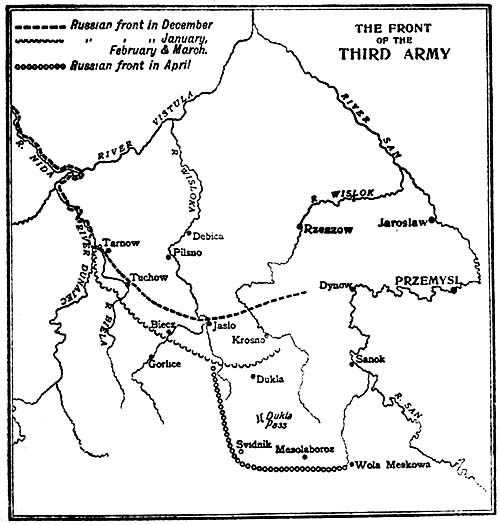
Exchanging good wishes "for health and success" I
made my way on through the villages toward the broken
bridge. One of a group of soldiers, when I asked the
way to the lines, simply pointed, saying "Here, close
by." A long line of high earthworks ran close to the
stream, on the other side of which were the Germans,
their sentry being about 1000 yards away. I entered a
hut and drank tea with the battalion commander, an old
gentleman in a jersey, who, with charming apologetic
gesture, offered me some white bread and chocolate. The
telephone gave word of my coming to the staff of the regiment,
to which I was piloted over the marsh by a soldier.
The Germans shoot at almost any mark, or, even, at
hazard, in the darkness; but very few are wounded in
this way—this day none, and the day before only one.
Scouts go out from time to time and sometimes find a
searchlight turned on them. It is a waiting position.
The colonel, a good-looking young man of great simplicity
and vigour, entertained me at supper, and we
talked late into the night. Everywhere one feels the
winning spirit. After the last great halt, on the San,
the men went forward with a tremendous rush, and the
enemy's rifle pits were filled with dead. Again the talk
turned chiefly on the French and English front, and on
the necessity of carrying the war to a real settlement.
No one can understand why the Germans challenge such
enormous losses by their attacks in close columns. Late
at night I made my way back to the town; every now
and then a few isolated shots rattled in the darkness.
January 5.
I set out late in the evening for a forward ambulance
post attached to a famous fighting division. Our party
consisted of two soldiers, a niece of Count Bobrinsky, who
took such a notable part in the Duma visit to England,
and myself. The young Countess, who was enveloped
in tarpaulins, is one of the hardest workers in the ambulance.
Our cart was stacked with necessaries for the
soldiers; on the wall of the courtyard German soldiers
had scribbled in large letters expressions of their self-satisfaction,
such as "Austria and Germany fear God,
and nothing else in the world," and sundry contemptuous
allusions to "der Nikolai, der Georg und der Französe."
From the time when we left the lights of the town we
had to go mostly on foot, negotiating difficult bits of
road and ploughing our way through fluid mud. We
passed over high ground and close to the front; all round
us was the glare of camp fires and in the distance the
flash of projectors. In the darkness we were constantly
meeting trains of carts.
At last, on the slope of a hill, we turned into a Polish
hut. It had two fairly large apartments, with a big stove
and an earthen floor. In the inner room lived the six
sisters of mercy: in the outer we were an interesting and
strange collection; along one side lay a big bed, on which,
crosswise, sat or slept the Polish peasant, his wife, two
daughters and little son; in a corner, on a heap of boxes
which he had to arrange each night, slept the young
priest, the monk, whom I had met before, and one of the
most spiritual men whom I have known; the two sanitars
and myself made our beds each night beneath the windows
(one of which was smashed), removing them each day to
make room for the dinner-table. By the stove, or anywhere
else, our soldier servants slept on straw.
Not two hundred yards off, but only to be reached
by crossing two deep gullies of mud, lay the lazaret of
the division, quartered in a white-walled village school.
These quarters, I was told, were luxury compared to most
of the ordinary stopping places; but we were in a very
different atmosphere from the admirably equipped hospitals
further back. The wounded arrive all day in large
carts or on foot; they come straight from the First Aid
stations, which are close up to the actual fighting line;
there are no beds, only pallets of straw, on which the men
lie down while waiting their turn. They have not yet lost
the sense of the battlefield or reached the stage where they
are fully conscious of their wounds. They take their places
one after another in the cottage chair—in which one of
them died yesterday as soon as he had sat down—and the
young divisional doctor, with the help of the sisters,
removes their first rough-and-ready bandages, and gives
them such quick treatment as may enable them to be sent
further. It is, of course, the seriously wounded of whom
one sees most here, for many of these get no further,
dying here, or on the road. From one of them the doctor
removed an enormous splinter of shrapnel completely
embedded in the body; the largest bombs of all, which
the soldiers call "portmanteaux," make terrible
wounds.
Here all day and all night the doctors and sisters work
at the wounded as they come in. The senior sister, a
lady of the most remarkable capacity, takes about one
night's sleep in five, but is always as fresh and bright as
can be. Her husband, a member of the Duma, travels
over Russia for the better organisation of the Duma field
hospitals. The transport is in charge of one of the
sanitars, the son of a Moscow business man, who has a
particularly clear head for work. The whole party, three
of whom talk excellent English, are drawn close together
by their work; and there is the atmosphere of complete
unselfishness which one feels so strongly in anything connected
with the Russian soldier. As to our soldier servants,
it is clear that their constant preoccupation is to
make themselves useful to anyone.
January 6.
We lie at the head of a little valley, some few miles
from the Divisional Staff. As the troops move forward
new questions are constantly arising; and our transport
sanitar, Nikolay Nikolayevich, discusses the possibilities
of getting better access for the wounded to the hospitals.
We are pressing back the enemy into the Carpathians, and
there are halts in front of difficult hill positions. The
advance through swamps of mud makes tremendous
demands on the men, who have to lie for days in rifle pits
full of water; at times a well-chosen and well-entrenched
position holds the Russians at bay at a distance of a few
hundred yards or less, in one case fifty, and yet they will
not go back. "Und auf den Carpathen sind die wege
beschneit," often recur to me, these lines of one of the
laziest of German student songs, which is a kind of
renunciation of all effort.
Nikolay Nikolayevich and I rode over through the
snow to the Staff of the Division. He is a charming
and simple man, very like one of our own best-known
Generals both in face and manner. He lives in a small
hut, which is kept very clean. We lunch and discuss
transport, and I am asked to carry certain suggestions
to the town. On our way back, accompanied by two
Cossacks, we pass through Tuchow, a little township half
in ruins, and I notice that, as on our way out, some one is
still strumming on a piano in a house of which only the
walls are standing. The cannon has carried away a large
tree and left deep pits near the road.
Driving in the evening to the town, I find groups of
wounded, for whom there is no place on the carts, wandering
forward in the darkness. The men choose among
themselves which I shall take with me: "Let him with
the nose go," for one of them has had his face smashed
up; the rest move on contentedly, and my passengers
give me a word of thanks, which would make any one
feel ashamed of himself. This is their Christmas Eve.
It is very wonderful, this self-denying patience of the
Russian soldier, and it is too big a thing that one should
get tired of speaking of it. A doctor at work here tells
me how constantly it is impressed upon him. A man
whose chin he has had to remove simply says: "Thank
Heaven, now you've tied me up, and I am all right."
Another, after his leg has been taken off, as soon as he is
able to speak, says: "Ah, but it was a fine fight at
Krasny; they gave it us, but we gave it to them too."
Another, when he is brought in for operation, is only
taken up with the thought that he meets in the operating
room an Austrian officer to whom he has attached himself
as guide and friend. Anything else that is human
comes before any thought of self. I am quite certain
that one of the greatest things that this war is doing is
its revelation to Europe of the simple goodness of the
Russian peasant in the person of the Russian soldier.
He is more than the unconscious hero of the moment.
The qualities of the real Russian people are going to take
their proper place among the best factors in the future of
European civilisation.
January 8.
In our halupa (hut) we had those intimate and speculative
conversations which seem so natural to Christmas
Eve. Monk and Intelligents were on common ground.
Only once Father Tikhon put down his foot when one
of the party expressed indifference as to the other life.
"No," he said, "joking apart, that's not good, least of
all in time of war"; and the rebuke was accepted as
gently as it was given.
Our Russian Christmas began with the burial of a
wounded soldier who had died in the night. In a little
waste patch in the snow, near the lazaret, the priest
stood in his gorgeous vestments and bowed deep over the
new grave, while two soldier choristers sang the beautiful
prayers for the dead.
In the evening there was a Christmas Eve service in a
room of the lazaret, which Father Tikhon and the soldiers
had spent no end of trouble in turning into a chapel. The
room was crowded with soldiers, and there was an
improvised choir. The simple directions of the priest
and the strangeness of the surroundings only added to
the deep atmosphere of reverence.
I completed the night service in our hospital in the town.
Here the first-floor landing had been turned into a chapel.
A matronly sister from Moscow, one of the simplest souls
in this work-a-day gathering, served as clerk. The
leader of the choir was a young Social Democrat doctor,
who had suffered for his convictions at the time of the
second Duma; and among the choir were all who had
had a training in church singing, which reaches such a
high standard in Russia. The singers included sisters,
sanitars, soldiers and several of the convalescent wounded,
who were wrapped in their long grey dressing-gowns;
and one wounded man had been laid on his stretcher
among the choir in order that he might take part in the
singing. Afterwards we all had cakes and tea; and a
conversation as to what England could do, and what
would follow in Europe, lasted well into Christmas Day.
We have here with us Bishop Tryphon, of Moscow, who,
like the Bishop of London, asked leave to accompany the
army, and is now the Superior, or Rural Dean, of one of
our Divisions. The Russian army has a staff of army
chaplains with an Arch-Presbyter or Chaplain General,
as in England; but many priests have enrolled specially
for the war. Some have been killed, others wounded,
others taken prisoner; some have been specially honoured
for serving the Liturgy to regiments under fire. I am told
that Father Tikhon's first sermon under fire was wonderfully
simple and impressive. One regimental priest told
me how a shell burst in his quarters, blowing a medical
attendant to bits and leaving himself with a bad contusion.
Bishop Tryphon took a prominent part in the entertainment
of our Bishops in Moscow, and sends them by
me a message of greeting and good wishes. He arranged
a solemn Christmas Day service, with trained singers who
were serving in the army. He later visited the hospitals,
giving short and plain addresses, and his blessing to
each branch of the Red Cross work in turn. There was a
great Christmas tree in the station, where presents were
distributed to four hundred wounded. Gifts were also
distributed under fire by the hospital workers to the
soldiers in the trenches some miles from the town.
In the evening I took part in a Christmas gathering in
one of the big hospitals. Everyone's health was drunk
in turn by Christian name, the whole being woven into a
long song. Afterwards we sang songs of the Volga, and
some stayed on talking till five in the morning, resuming
their work a few hours later.
January 10.
Returning to our halupa in the little village, I rode
over in the night to the General to convey the results of
my journey. It was almost pitch dark and the road was
in most places a simple swamp of mud, sometimes with
gaping holes in the causeway or with beams or trunks
of trees lying about; and though I had a soldier and a
lantern, the ten miles took over four hours. Next morning
we left the halupa: the dismantling process made
the hut look more desolate, and while our things were
being packed, the peasant family sat on their bed, looking
on like moony spectators at some rustic entertainment.
They showed more than satisfaction with their payment,
which they expressed after the local fashion by kissing
every one's hands; but they had now to expect the
arrival of a fresh batch of strangers.
Our forward move of a few miles was carried out with
great expedition; but our carts made quite a long train,
and the movement of even a small ambulance section
is in itself, under such conditions, almost an exploit.
Just in front of me went our Austrian field kitchen with
three separate cauldrons, which is found very useful.
In a few hours we were installed in our new quarters, a
great improvement on the halupa, within a stone's throw
of the divisional lazaret and the now reopened railway
station. From beyond a near wooded hill came the
sound of almost continuous firing.
We were now close behind the line of the front ambulance
points. At the station, which we put in order for
their reception, there was a constant dribbling stream of
soldiers who had come almost straight from the front.
Most of them had walked in with their kits, and many
seemed almost unconscious of their wounds. Their
conversation was of comrades who stood at other points
in the line, of the relative distance of the enemy and of
the conditions of work in the rifle pits.
Through the thick mud the Russians are driving the
Austrians upward over the deeply indented country of
the Carpathian region. The enemy entrenches himself
strongly, making much use of complicated wire entanglements
which can only be carried with a rush. Thus, the
heavily clad Russians, whose efforts have pushed the
enemy all this way, have sometimes to dig themselves
in as best they can at a few paces from the enemy—1000,
500, 100 or even 50. The rifle pits are full of
water, straw makes hardly any difference, and as soon
as a head is shown it is shot at; many of the wounded
have fallen at the moment of rising from the trenches.
The Austrians continue a rumbling fire nearly all night.
On the other hand, some of our men have seen the shells
from the heavy Russian artillery falling plump in the
middle of the enemy and have seen how they scatter
under the fire of the Russian machine guns. The Russians
use less ammunition with much more effect. I have
met several Russians who have had at different points
fifteen or seventeen days on end of this soaking trench
work. One officer, who had had two long doses of it,
had contracted rheumatism in one place and bronchitis
in another and was resting in a hospital with the hope
of getting back as soon as possible. A wounded soldier
asked Father Tikhon to write a request that he should
be sent back to his regiment as soon as possible. One
man at the station, twice wounded in hand and in chest,
asked that this time he should be sent to recover in his
native town.
The station was very soon in order. One of the sisters
went round distributing clean underwear. "Change
while you can, children," she said; "we shall give you
some tea and soup, and pack you into the train, and
send you straight off to Russia"; and in a few hours
the first train had arrived and the station was cleared
for further work. In the dusk, the military ambulance
men set out again to collect more of the wounded under
fire.
What is happening is, shortly, this. The Russians,
who had first to deal mainly with the Austrians, leaving
the Germans to us, have now got within sight of the end
of this part of their task. A first-class military power
has been so pounded and smashed and has been repulsed
in so many vigorous counterstrokes that it is coming
to have only a secondary importance. Meanwhile the
bulk of the Russian forces is now devoted to meeting
the incessant and desperate initiative of the Germans.
Russia's new defensive front on this side runs in a straight
line to the point where it covers the Russian conquest
in Galicia. It is now being extended further south to
the natural barrier of the Carpathians. The interval
made necessary by the operations in the north is not
being wasted by the victorious troops in the south.
When we get to the end of the Austrian efforts and have
a mountain barrier to safeguard us on that side, these
forces will be able to act with much more effect against
the Germans. Russia, by accounting for Austria and
concentrating her attack on Germany, will have done
more than her full share of the work in the common
cause. "Honour is not to be divided," said Ney when
he stormed the heights of Elchingen; and it is in
this spirit of generous rivalry that the Allies move
forward.
January 15.
By a little arrangement room was made in our small
quarters for a New Year's feast, to which the divisional
doctors were all invited. Father Tikhon had turned the
local hall of the Sokols into a Russian church, and the
evening service was crowded with soldiers. There was
great delight in unpacking the gifts and delicacies received
from Petrograd, and soon the guests began to arrive.
It was all the simple talk of men accustomed to great
privations: some of it turned on a comparison of unpleasant
bivouacs; for instance, one told of a night
spent in driving wind and rain on an open slope by the
light of a burning village; he hoped the wind would
blow over some of the warmth from the flames, till at
last shelter and sleep were found in a ditch. Another
officer was drowsing in a hovel when the door was opened,
there entered a strong smell of coarse tobacco and a
heavy weight fell on him; he woke in the morning to
find a soldier asleep across his knees. An artillery officer,
a fine-looking man, told of the tremendous work of the
mobilisation and of the strain which war life puts upon
the hardest nerves. Regimental doctors have, of course,
had to work under fire for weeks on end. Every one
discounts the heavy German mortars which in the field
do very little damage in comparison with their expense.
As to the Austrian bullets, one doctor says that it takes
a man's weight of bullets to wound a man. When the
trenches are near they come pouring in a sort of continuous
rain. One man who insisted on standing up
had thirty-six bullets through him directly. When the
distance is a hundred to two hundred yards, especially
where there is no natural cover, continuous sniping goes
on. The line not being straight, but varied by all sorts
of indentations, due to the lie of the ground and to the
Russians' desire to get as close as possible to the enemy,
the former at many points crouch in the temporary
and flooded holes which they have scratched out for
themselves, perhaps all the while under a cross fire.
Men are killed going out with long scissors to cut the
Austrian wire entanglements. Many a man has fallen
in a crawling excursion to dig up a potato. The sniping
becomes a kind of game, and it was described as such
by two Russian soldiers, of whom one had knocked over
nine Austrians and the other sixteen. The Austrians
fire a lot of random shots in the night which are in most
cases a sheer waste of powder; but it was hard on a man
who was relieved after a week's rifle pits to be hit by a
bullet in the night on his way back, as far as a mile
from the front.
The last hours of the Russian Old Year I spent in a
goods carriage. My companions kept reckoning whether
we should reach the town by midnight. Twelve o'clock
was well past when the train drew up heavily a verst
from the station and we were told that it would go no
further. We scrambled out into the snow, when suddenly
from the lighted station there rose in full orchestra, strong
and triumphant, the most beautiful and the most religious
of national anthems. It was played three times, and the
notes may even have been carried to the neighbouring
Germans beyond the river. This was our Russian New
Year: and in the station a colonel was dismissing his
men with the words, "For this year I wish you health
and victory."
Next day the stretch of railroad that we had traversed
and the carriage in which we had supped was cannonaded
by the biggest German shells. The bombardment went
on all day and night, the huge "portmanteaux" making
tremendous holes and falling for the most part far wide
of their only mark, the railway, and carrying ruin and
mutilation to many of the inhabitants, who are thus
encouraged by the beaten enemy to remain Austrian
subjects. There is hardly any object in this bombardment,
which is put down to the Germans and has roused
great indignation among the many wounded Austrian
officers and men who are lying here in hospital. Not
a soldier has been touched; but wounded civilians,
men, women and children, have been brought in to the
different hospitals.
January 16.
The bombardment, which was continued yesterday, has
created a certain excitement here, but nothing approaching
to panic. The big "portmanteaux" are very ugly
things and make an unpleasant noise, but only two shots
can be said to have produced any results worth mention.
The prevailing mood is one of vigour and interest.
I have had some informing conversations with wounded
officers of the enemy. They indicate a definite mental
attitude very different from ours. I see no trace of
religious enthusiasm and little of nationality in the
wider sense. The Germans have the greatest confidence
and pride in their army. They tell me that two million
volunteers were inscribed at the beginning of the war—an
enormous fact, if correct. The attitude of the German
women is such that no man who can serve dares to
remain at home. My informants fully realise that for
Germany the war is a matter of life and death. They
have served on the western front and described the
French fortresses as extremely strong ("brillant").
The Bavarians are terrible in warfare and spread alarm
among the population. The losses of the first move
through Belgium were enormous. The Belgians are
described as excellent soldiers, and large German losses
are put down to them. In the march on Paris the
reserves and the commissariat could not keep up. The
retreat is accepted as an unpleasant necessity. There
was a certain pedantry among my informants in insisting
on the need of turning the allied right wing, whatever
should happen at other points. They claimed that the
Germans were now in Calais.
Large losses against the Russians were admitted, but
it was claimed, without any real evidence, that the
Russians had lost more. Again, there was a kind of
machine-like insistence on the need of attack in columns
with reserves close up—as this was "our tactics." The
Germans had so far been saved by the default of any
real Russian winter, which would have ruined the German
transport and artillery and robbed their operations of
all effect. What struck me most was the absence of any
real intelligence as to the political issues in debate. My
informants were, for reasons of humanity, in favour of
a status quo peace.
Some Austrians gave an interesting account of the
origin of the war. The Austro-Serbian quarrel was not
political but personal. The Serbian dynasty, failing to
obtain any satisfactory recognition from Austria, was
credited with a personal hostility against the late Archduke,
who was described as in general a friend of the
Slavs. Proof in support of this view of his end had
been widely circulated in Austria in December. The
personal quarrel between the reigning houses of Austria
and Serbia had been turned by the insistence of the
Emperor William into an occasion for a European war,
specially directed against Russia, into which Austria
had been hurried against her will. Her present position
now was described as very precarious.
To a Hungarian officer I put the question whether
the war had produced any real poetry in Hungary. He
answered that there had been some rough-and-ready
effusions among the working classes, whom he described
as militant in their habits in time of peace and always
ready for any war, especially with Russia. But the
educated classes were not well disposed either to war or
to this war.
It is rarely that one meets among these wounded of
the enemy any other disposition than a strong desire
for peace. I should add that several of them have
asked me to communicate to their relations that they
were being treated with the greatest kindness in Russia;
"I am lovingly tended," wrote one of them. An Austrian
colonel, a fine soldier and gentleman, told me he should
never forget the "Anständigkeit" (decency) of all the
Russians with whom he had had to do since his capture.
Even Germans who at first are challenging and hostile,
are softened by the true humanity with which they are
surrounded in the Russian hospitals.
January 22.
The town has been bombarded for several days on
end, beginning with the Russian New Year, January 14.
The Germans had given a foretaste on our own Christmas
Eve. They dropped from an aeroplane a paper bearing
the words: "We ask you not to shoot on December 25;
we will send you presents": the text of the telegram
I had from the Commandant of the town, to whom it
was taken. For all that, and though the Russian artillery
was instructed only to reply, five heavy bombs were
fired into the town and some of the inhabitants were
wounded.
There were other Christmas "presents" which I have
seen, sent by the Austrians with a parleyer and a white
flag. With other objects of no importance were six
matchboxes full of matches and containing also short
manifestoes printed in Russian and addressed to the
troops. They were signed "Your unfortunate Tsar,
Nicholas"; and they informed the Russian soldiers that
the Emperor knew the war would ruin Russia and had
sought to avoid it, but had been forced into it by the
Grand Duke Nicholas and the "perfidious" Russian
generals, against whom the soldiers were invited to turn
their arms. I have not often seen a document so conspicuously
lacking in humour.
Punctually at midnight of January 13, one Russian
regiment received two large shells bearing on their case
the words "Congratulations on the New Year." The
next day the town, though it had no troops in it, was
shelled severely, and this bombardment was kept up for
several days. The chief mark, and a very legitimate one,
was the railway; here there fell in all six large bombs,
making holes some twenty feet in diameter and ten
in depth. But the great majority of the bombs fell in
other parts of the town; and two of them rattled close
over the roof of two different hospitals while I was in
them, and the splinters of a third flew into the lodging
of the workers of another lazaret.
In one of these hospitals, a local one now served by
the Russian Red Cross, a large proportion of the patients
are wounded of the enemy, including officers, most of
them too badly hit to be removed without danger to
their lives; and these were greatly agitated by the shells
passing so near to them. Hurried councils were held
by the different Red Cross authorities. One hospital,
where the shells continued to fall quite near, left the
town. The most serious cases were moved to the local
hospital, where the Russian Red Cross courageously
decided to remain. Here are also to be found many
local inhabitants, wounded by bullets and shrapnel in
the town or in neighbouring villages under fire; and one
room is mostly filled with little Polish boys, all of them
wearing a little silver religious medal round their necks.
Here, too, are the inmates of a Polish hut who were
injured by the explosion of a hand grenade; in a space
of about twelve feet square, some sixteen persons were
thus wounded; the father is dead and the mother and
one of the children are out of their minds.
These are all cases that have come under my notice;
and of course there are many others. Yet it is wonderful
how the inhabitants remain in their huts under fire in
the hope that the worst is over or in despair of finding
any other shelter. From one such hut, after the last
and finally crushing shot, there issued an old man of
nearly seventy with a pipe in his mouth and entirely
unharmed. I remember that on my first visit to Lvov,
I heard a barrel organ repeating about fifty times the
beautiful Polish national hymn: "From the Smoke of
Fires"; in the Lublin province, on a line of some seventy
miles, I found almost every other village half demolished.
It is everywhere Poland that suffers; and it will be hard
if some new life for this unhappy people does not rise
out of their present ordeal.
There must be endless espionage in this town. An
Austrian was found by one of our priests at the top of
a tower working a telephone, and to the priest's question
he replied that he was "sending word as to fires," which
was no doubt strictly true. If so, it is a pity that the
shots were not better directed. There is no question
that the guns at work were not Austrian but German.
General Radko Dmitriev came without delay to the
town, and distributed the George medal for bravery
among the workers of the Red Cross.
January 23.
I have been visiting some of the Regimental First Aid
stations. In principle each regiment of four battalions
should have five doctors and a captain of bearers. The
bearers are selected from each company and can be
supplemented by soldiers who volunteer for this service.
They must be sound and strong; in peace time they
march with their companies, carrying the rifle, and meet
for a course of instruction twice a week. They are
expected to gather under their captain before an action
and to go out to the field to pick up the wounded only
at night time, or after the action is over. In the present
war it is seldom possible to maintain the full complement
of regimental doctors. As battles have continued for
weeks on end, it has been quite impossible to limit the
bearers' work to less dangerous times; and it has been
found most convenient to send them to the trenches with
their respective companies, as they could then get to
work as soon as they were wanted, and could also know
the least dangerous track from their companies to the
first-aid points. Ordinarily four bearers are assigned
to one wounded: but as the track under fire is often
long and exposed, it is sometimes necessary to send out
eight men together, to carry by turns. They are supposed
to have a leader, but in practice any one gives a
lead, and if good it will be followed. The mortality in
this service is considerably higher than in the ranks, as
this is largely a war of cover, and these are the men who
are most deprived of it.
Every Russian soldier is supplied with a packet containing
lint, two compresses and a fastening pin. The
object of the first bandaging is simply to stop the flow
of blood and keep out dirt; and the wounded man is
bandaged on the spot by himself, some comrade, or a
feldsher (a trained medical assistant), one of whom is in
the trenches with each company.
During the seventeen days of fighting on the San, the
wounded had to be carried by relays over a long exposed
slope and in many cases over the river. It was found
possible to divide the distance into different sections; but
the workers in each section were under fire, and so was
the regimental point, which might sometimes be in a
hut, but was more often a patch of open ground, with a
tent stretched over it, or with no covering at all. There
were instances where wounded and bearers alike were
crushed by a shell on their road; for the Austrians
poured endless artillery volleys on to given points. For
all that, when the Russian trenches were examined after
the battle, it was found that the bearers' work had been
carried out completely, and that all the wounded had
been removed.
The tremendous mortality of this war has put a specially
hard strain on this service. Yet it is one of those
which it would be most difficult to supplement with
volunteers. Untrained men would be almost certain to
be killed off soon; and indeed the appearance of bearers
on the field is at once an indication to the enemy of the
positions of the troops.
It has been found quite impossible, with the present
range of artillery, to keep the regimental points in
security. The work has therefore to be dispatched with
the greatest expedition. The regiments, for mobility,
dispense with any superfluous material and appliances
and send their patients as soon as possible to the divisional
lazaret, where the first really serious treatment is
received.
Lazarets further back have often, as I have previously
mentioned, been under fire. Austrian prisoners tell me
that they have often seen their artillery fire on field
hospitals; and from Russian observation points it has
several times been noticed that the Austrian fire has been
opened on what could only be a hospital field train.
One of the subjects discussed with me by wounded
officers of both sides is the possibility of securing further
respect for the Geneva Convention and even a further
definition of its regulations; but at present the overpowering
stress under which we all live seems to be
carrying us to the total disregard of any limitations
at all.
January 27.
After a talk with the Divisional General, I set out for
a visit to the regiments at the front. My orderly told
me with pride that this was the best fighting Division in
the army; certainly it has that reputation in other
quarters and has three times in this campaign done
decisive work against superior odds. It has rushed the
Austrians from point to point, and would do so still
unless they had taken refuge in the hill country before
the Carpathians, where every hill has to be won in turn.
Its General, an old man full of fire and energy, has
received three wounds, which, as he says, make for him
a calendar of the war.
The way lay between pleasant fir-clad hills, and late
in the evening I reached the X regiment, with quite
a good-sized house for its headquarters. The Colonel,
who was very simple and businesslike, lived with his
staff in the dining-room by a kind of half-light and with
picnic fare, of which, as always in Russia, much more
than his share was pressed upon the guest. The talk
was that of comrades at serious work. These men will
all go to the end, but they don't find it necessary to say
so. When one said something about finishing at Berlin,
a young officer put in with a smile: "Do you know, if
we do, I expect none of us will be alive by then?"
I spent the night in the regimental doctor's hut, and
next day went off to the artillery observation point. It
was a clear day and we could see not only our own lines
and the enemies', but also some of the Austrians walking
about near their trenches. A shell from us sent them
scattering back into their burrows, and our guns were
then turned on one point after another, the shells, as
we could see, always exploding on or very close to the
object aimed at; this day, there was only a half-hearted
reply. The following day, I saw the guns themselves
at work; the place of the battery was not likely to be
located. It is very seldom during the war that a Russian
battery has been silenced by the enemy. The Austrians,
on the other hand, often place their guns on the crests
of hills and have suffered severely from the accuracy
of the Russian artillery, which is one of the striking
features of the whole campaign. There is, further, this
difference, that the Russians never fire without a target,
whereas the Austrians in the most systematic way sweep
whole areas in turn, as a rule doing extraordinarily little
damage for the powder expended. One colonel suggested
that the Emperor Francis Joseph must have more money
than he knows what to do with.
In the evening I set out with a party of soldiers for
the infantry trenches. With a clear moon lighting the
snow-clad slopes we made our way along the more exposed
lines; there was no sign of life, though the Austrian
trenches could be seen quite near. Passing under shelter
we found the Russian mud huts, which take only three
or four hours to make and give good cover from weather,
bullets and shrapnel, but not from bombs. We sat for
some time in an angle of the entrenchments; here several
bombs had fallen close to a very exposed hut, in which
however, the inhabitants still remained. We passed the
night in another hut, which we could only enter in the
dark for fear of drawing the enemy's fire. The scouts
came in for instructions, headed by a young volunteer who
was doing his first work of this kind. Voices went on
long into the night; reports came in from various points.
The scouts returned about 3 a.m. They had come on
a body of Austrians double their force in a wood; they
let themselves be nearly surrounded, then threw a hand-grenade
with effect and scrambled back to our lines;
as the whole Austrian line opened fire the reconnaissance
had achieved its object, which was to ascertain
whether the enemy had made any changes in his positions.
In the early morning appeared an Austrian officer who
had made his way across to us. He was smiling so
broadly that I saw his smile before I saw the man. He
was a Ruthenian and was married to a Serbian, so that
all his sympathies were long since on our side; his wife
was already under Russian rule in conquered Galicia,
and his own great wish was to fight in the Serbian army.
The Russian officers made him completely at home at
once, putting their breakfast and their servants at his
disposal; when a few hours later another Ruthenian
fugitive arrived, our last-found ally helped to make him
feel comfortable, stroking his face and relieving his
apprehensions, amid the broad smiles of the Russian
soldiers.
The day we spent under the fire of 180 bombs, which
fell often along the line of the entrenchments, but only
wounded some five or six men. It was very unpleasant
for the infantry to have to sit under this alarming noise,
and certainly the men would infinitely have preferred to
attack. From the Austrian side no other sign was made,
and there was no such mark as the Russian artillery or
infantry think it worth while to fire at.
In the evening I was coming back on horseback in the
twilight when a shell fell on the road close in front of me.
This was the last as far as I was concerned, and I slept
in comfort at the first-aid point of the regiment.
January 29.
On my way to the H regiment I had to pass over a
commanding plateau, and from hence, looking backward,
I could see endless and intermingling lines of wooded
hills with the main masses of the Carpathians in the far
distance. I commented to my orderly on the beauty of
the view, and as usual when I made any pointless remark,
he replied courteously, "I understand," which meant
"I don't."
Shrapnel was falling by a fir-wood on the crest, and we
took a lower road to the regimental staff. The Colonel
was a soldier of an English type, with a grace which I
have seldom seen in a man. Altogether, minds seem
more at ease at the front than anywhere else in Russia;
there is the fullest consciousness of heavy losses and of
straining conditions, but all this seems only to make
every-day life more simple. There was a strange incident
after lunch: one of the regimental doctors had just gone
out of the door when he was bitten by a mad dog that
was running wild in the woods, and the place had to be
burnt out with a hot iron. One comes on many "extras"
of this kind, which have nothing to do with the war but
seem to fit themselves into it.
When twilight was come, I made another of these foot-pace
rides over frozen fields and gullies to the lines of the
regiment. Halfway, by some trees and a stream, we
met a very young soldier who reported the presence of
"Free Austrians" in a neighbouring hut. These turned
out to be only the local peasants; and my orderly, who
was an old soldier, was very outspoken with his rebuke.
We soon reached a hut, containing two commanders of
battalions, with a young officer who seemed to me a
type of that fearlessness that I have seen everywhere in
the Russian army. They wanted to give away all their
chocolates and other luxuries, and sent guides to take me
to the trenches.
We had to climb one of the steepest hills I have ever
gone up. Fortunately it was covered with light scrub:
otherwise I should never have got to the top, for the
frozen and clouted soil was so slippery that one slid
back at every step. Yet up this hill the Russian troops
had gone at night under the fire of the defending Austrians
not many days before, and I was told that the ground
was then in even worse condition. The storming of
these hills one after the other calls for the most reckless
courage; but this kind of task is the favourite work of
the Russian soldier.
Halfway up, we took an "easy" in the mud hut of
a superior officer. We sat together in the straw with
our toes to the stove, and, as is often the case, the talk
was not about the war at all, but about the human things
that most interest the Russian mind: about the characters
in Russian literature and the future of Russia. Naturally
there is also a good deal now to be said about England;
and nowhere more than in the trenches does one notice
how every one wishes to give us the best word, just as
the guest receives the best of the fare. England's share
in the war was put to me, with a real thought and kindness,
much better than I could have put it myself. In
these rough surroundings where ordinary comforts must
all be dispensed with, there is nothing that makes them
seem so unnecessary or that so stamps the character of
officers and men alike, as a certain delicacy of mind
which seems to me the ideal of good breeding.
Reaching the top we went over some ground which
by day was almost impassable and was covered with
huge holes made by shells, and I slept in an officer's
mud hut just behind the trenches, where the five of us
lay literally packed in like sardines. Some shells fell
during the night; but the Austrians did not ordinarily
open a regular fire till ten in the morning. The last few
days they had covered the brow of this hill with shells.
A hut standing on the summit and some farm buildings
in a hollow behind had been smashed to bits. To-day
there was a fog, so that even the Austrians did not make
their usual aimless cannonade. But they sent us in the
course of the day what might be called a mixed packet:
the mortars, field and mountain artillery machine guns
and rifles all coming into play at one time or other. In
particular there were chance rifle shots on all sides. The
Russian trenches, despite the concentrated fire of the last
few days, had suffered very little; and here as elsewhere
it appeared that, though only explosive shells are effective
against entrenchments, even they are comparatively
harmless. This day I was able to pass along the front
of the regiment and even further forward. My general
impression was that the Russian superiority is so great
that all neutral ground may almost be reckoned as
Russian. The Russians are always ready to venture
into this unknown land; the Austrians, on the contrary,
expect attacks from all sides, answer every isolated shot
with a wild volley, and are ready to fire at anything,
even a fog. Two or three Austrian soldiers came across;
they were loutish youths, not like soldiers, and had only
quite recently joined the colours; there have been instances
of prisoners who did not know to what regiment
they belonged and had not yet received their rifles. I
was present while the Colonel examined some prisoners,
and the tale they told of the conditions in the Austrian
trenches was pitiable: water in the trenches, thin coats
and ridiculously ineffective boots, constant diarrhœa
from eating fresh meat; the roughest treatment from the
officers (nearly all Germans), who themselves avoided
all danger and privations; a Hungarian battalion at one
time put to discipline them and shots fired at them from
behind; regiments reduced to a quarter of their strength,
boy recruits without any training, discordant elements
in a given regiment, a general and growing resentment
against Germany and the German Kaiser, a keen longing
for peace, and an almost epidemic desire to surrender.
This is the consequence of six months' punching, which
has, however, cost heavy losses to the Russians.
February 4.
Every one here—particularly the young men who are
in the Red Cross—is naturally drawn as by a magnet
to work being as near as possible to the actual front.
Different people show this in different ways; some are
restless, some are evidently there in thought, others
keep it to themselves as an intimate purpose which they
only mention when their desire is to be satisfied. Often
this satisfaction is long in coming, even when it has long
been worked for and seems quite near. F., a quiet, self-contained
young man, asked leave to go off with the bearers
in the hope of learning how to help later in carrying the
wounded, and I saw him ride off in his grey mantle with
set face; but that time he got no further than the regimental
headquarters. K., one quiet evening, told me
how all was arranged for regular volunteer work in the
trenches, but everything is still uncertain and he will
anyhow have to wait for some weeks.
The fact is that this creditable straining after the most
dangerous work of all, for it is more dangerous than that
of the soldiers in the firing line, does not easily fit in
with the requirements of the army. There are certain
dangers which it is madness to court, not only in one's
own interest but in that of others, and especially of the
troops themselves. For instance, a body of volunteer
helpers would simply by their appearance indicate the
positions of the troops and draw the fire of the enemy,
and would probably have to return without any wounded.
Such experiments have been made with doubtful success.
It is only by following the wishes of the commanders,
and learning from them how and when help can be given,
that any good can be done; and this means that it is
necessary to stand near to some given military unit and
earn the confidence of its chief.
A few days ago I had a chance meeting with a few
men in rough winter coats, who came in together and
sat down to a hasty meal. They were of different ages,
but all bore the stamp of the simple seriousness of the
front. It was the same with their talk. We discussed
the meaning of this war for the Russian soldier—that is,
for the Russian peasant—and I expressed my conviction
that this war is one of the greatest stages in history, in
the manifestation of the true qualities of the Russian
people to Europe. The quietest of the party, a middle-aged
doctor, intervened to say that this idea pleased
him; the Russian seemed uncultured because he took
less thought for comforts and contrivances, but all his
care was for the biggest things of all; the scope of his
vision might indeed help to broaden the heart of Europe;
and it was good to feel that all this quiet and selfless
heroism would not go for nothing.
I learned that these men belonged to the most famous
and the most forward of the Red Cross organisations.
No. 14 is headed by a military man; it has three doctors,
several students and 130 soldier-bearers. It was the
first to attach itself to a given Division, and, by waiting
for its chances and always keeping close up, it has so
far made the most interesting experiments in volunteer
help. I expressed my respect; but my acquaintances
hastened to tell me that the reports of their work were
highly exaggerated, and they gave me a plain prose
picture of what they did and of things that might be
done.
Yesterday I paid a visit to No. 14. They were in clean
quarters in a little scattered village in the snow some
five miles from the front. They had good quarters for
first aid and some twenty very practical carriages for
the transport of the wounded. The soldier-bearers were
drawn up in line and received a message of thanks for
their work from the General. Six of them, and two of
the students, had the George medal for bravery, bestowed
for their work on the San.
Travelling on to the regimental staff, we entered the
atmosphere of which I have written above. The regimental
surgeon described with enthusiasm the work of
No. 14, especially when the regiment was in movement;
at such times he could not have possibly coped with
his work alone. He himself was forbidden by the
regulations to work further forwards.
Somewhat farther on stood a village, with a lofty
church that had been struck by several shells. To
appear beyond the village was at once to draw fire, as
it lay along the Dunajec, beyond which were the enemy.
There was no natural cover; but our side of the stream,
which is not a broad one, was lined with a kind of embankment.
However, we also held the bridge and a
bridge-head on the other side. As this bridge-head was
faced and flanked by the enemy's trenches it was constantly
under the closest fire; and every night, especially
when it was dark, the bridge was under a continuous
shower of bullets and shrapnel, while by day the appearance
of a single person at once called forth a volley. We
were not allowed to cross this bridge, nor was any one
allowed to come across to us, for at the time of our visit
it was under rifle fire and shrapnel. But in the earthworks
beyond there has been put up in the trenches a
first-aid point with approaches from the sides and all
necessary appliances; here the wounded can be attended
to and kept under some kind of shelter till a slackening
of the fire, perhaps once in twenty-four hours, allows of
their transport across the bridge; and here at this point,
prohibited to the regimental surgeon, lives, sleeps and
works Dr. Vladimir Petrovich Roshkov, who spoke to
me of the quiet heroism of the Russian soldier and of
his faith in the qualities of the Russian people.
February 21.
After my visit to No. 14 I was laid up with a bad chill,
but after two weeks I was able to resume my journeyings.
I arrived at the N regiment in a cab, or rather did not
arrive, because we stuck in a sea of mud. The Polish
cabman, plaintive but polite, described it as an "awful
drive," and seemed inclined to stay there all night, till
some soldiers came and dragged us out.
The Colonel and his two adjutants lived in the usual
hut. These Polish cottages are very clean and well
furnished, with handsome stoves, decorated roofs, sometimes
a divan, and in all cases rows of religious pictures
encircled with wreaths of artificial flowers.
We had the usual telephone-interrupted night and a
long talk about the Colonel's earlier experiences in
Austria. He now had in front of him an Austrian
regiment whose guest he had been when on his travels.
Next day I rode to some of the positions. One could
get close up to them without danger. We walked forward,
through brushwood and swamp, with sentries at
various points, up to the rapid Dunajec. To the right
some of our positions were across the stream; to the left
it was itself the dividing line. Here there was a broken
bridge, and on either side of the break were the opposing
sentries, who occasionally took snapshots at each other
at short range. The German lines and their wire entanglements
were plainly visible, but at midday the view
was as bare and desolate as the ship of the "Flying
Dutchman" before the awakening. One of the most
curious things in war is the tacit convention that develops
itself illogically out of a set of circumstances entirely
novel. In open day to show oneself here is ordinarily
to be killed, yet at certain hours, fixed rather by instinct
than by reason, there is an unspoken truce of which both
sides take advantage. Photographs could be taken, and
we returned in peace to the main positions.
In the evening I set out for some more distant trenches
where the enemy was Austrian. I stopped to take tea
at a point where some of the inhabitants were being
examined. I have seen a good deal of this, and have
always found that the Russians, if anything, erred on
the side of leniency. There are undoubted communications
between the lines, but, apart from the most obvious
espionage, the most that is done is to remove suspects from
the ground nearest to the trenches. We went forward
on foot in the twilight, with a good moon and a clear sky,
and with a full view of the enemy's ground, though we
ourselves were indistinguishable from our surroundings.
We soon came on the trenches, which were elaborate,
deep, and for the most part dry. My host here was one
of those ideal persons who seem made for such conditions
of life. I will call him George, because he is one of the
most worthy knights of that Order of bravery. I asked
him how he won this distinction, and after starting the
briefest account of a village taken and communications
secured he broke it off saying: "For execution of orders."
He was a big man with kind eyes, a manner prompt and
natural, and the simplest address to his soldiers.
It was now comparatively safe to traverse a bit of
more open ground and visit some other positions. Here
again the works were excellent, and George required some
still further improvements. The men were in good heart
and vigour; and across the plain we could hear how the
younger soldiers of a neighbouring regiment were singing
in lusty chorus one of their favourite war-songs.
A voice came across from the Austrian lines which
were here only a few hundred yards off: "The Russians
are singing—Peace." Answering shouts of song came
from the Austrian trenches, but they were feeble and soon
ended sharply as if by order. We made our way back in
the dark to our central entrenchments.
After a half-hour's talk on the straw in our earth hut
the moon had waned, though the stars were still shining
bright all over the sky. With a guide I passed through
some trees down the slope to the river and beyond the
line of our trenches. It was reported that there were
signals and signs of movement beyond the river, and all
the men were ordered to be clothed and ready.
My guide was one of those native gentlemen who are
so common among the Russian peasants and are to be
met everywhere in the army, entirely selfless, indifferent
to all danger except for others, and full of quiet, childlike
intelligence of the great issues engaged. His hand, a
strong and gentle one, was there to help my every movement
with the instinct of the most devoted of family
servants. The whispered talk came with a strange
freshness, and the whole atmosphere of our excursion
was that of another world more real than our own. We
entered a dwelling where the watch sat round a smoky
camp fire. There was a brisk salute, and the answer to
my greeting from England was "Very pleasant." What
they all liked to hear about was how we were preparing
new armies. "Then we'll take him on both sides,"
whispered my companion as we left the watch, "and
we'll surround him—the barbarian."
We crept slowly forward till we came up with the
second of the two advanced sentries, a young man
crouched on his knee with rifle loaded and ready. Here
we stayed a little time, with now and then the lowest
whisper, and in front of us the rushing river, beyond
which were the sentries of the enemy; sky and air were
clear. We crept on to the forward sentry on the bank,
and were crouching beside him when a rocket went up
in front of us beyond the river followed by a blaze of
light and then a second and a third. "Lie down, your
nobility," whispered my companion, and we lay as still
as we could together while four rifle shots cracked at us.
We could hear each other's breathing in the few seconds
while the blaze hung above us. We had all crawled
back to the second sentry when the rocket went up again
followed by more shots, but this time we had some little
shelter. We returned and bade "Good-night" to the
Watch and lay for a while in a shelter close by, with a
whispered talk of our joint task. On the way up the
hill there were more rockets and more shots at us, but
we were soon back at the earth hut with its welcome
shelter and its friendly host, and the straw screen that
served as a door shut on a good night and a sound sleep.
February 23.
All day long we sat in our earth hut or passed crouching
along the trenches visiting the different points of observation.
What a difference a few inches make! At
each more exposed point no care seemed enough. The
whole day bullets passed above us, sometimes singing—or
as George said "wailing"—about fifteen yards off,
but most of them embedded themselves in our hill,
sometimes kicking away with a ricochet or exploding.
Often there were sharp salvos from several rifles at once
aimed mostly at the loopholes where our sharpshooters
lay ready; men were shot through the forehead in this
way.
In the afternoon I saw a fire light up in some German
trenches by the river, and it quickly spread along their
lines. A figure like an insect stood out shovelling at
the flames and some of our men shot at it; the German
passed down the slope but came again, this time going
back at a run. The flames spread further until they
were at last extinguished from below. We ourselves
got nothing except bullets, and none of our men were
wounded. There was no excitement and practically no
reply.
It was considered that the enemy was wasting his
powder, in a nervous fear of attack.
But all the day we saw, from our vantage-point, shell
after shell raining on neighbouring positions. At one
time attention was given to the high ground behind us,
and a large hut in which I had halted the night before
went up in flames, and in a few minutes seemed to have
disappeared altogether. However, only a cow was killed,
and except for two huts I found the position unchanged
when I passed back here in the evening. No wonder
that our own artillery did not deign to reply till the
evening, when it lighted up a big flame in a small town
beyond the river.
Southward across the flat ground which we had traversed
in the dark the cannonade was more furious and had
more meaning. Here there was a projecting bluff where
our front came close up to the river before receding
sharply from it and taking an altogether different direction.
This was doubly an angle. It was a salient landmark
in the curve of the whole Russian line from a western
front against Germany to a southern front against
Austria, and was therefore one of the points from which
the conquering Russian march through Galicia threatens
the junction of the two allies. The lie of the ground
made it still more a challenge to the enemy, as the advanced
trenches on this side were opposed to a fire from
both sides and even partly from the rear. On this
devoted hill the enemy's artillery, strongly reinforced,
poured an unending torrent of shells. We could see
them burst almost without interruption—the heavy
explosive shell for driving the men from their shelter
followed by the two shrapnels for catching them in the
open. In all some eight hundred shells must have been
lodged on the hill on this day, and in the evening a large
hut on the top lit up like an illuminated fairy castle.
No fewer shots were fired the next day, and when I
was later able to get to this ground, it was all harrowed
up with enormous holes even in the gullies that ran
crosswise through the hill itself. The men crouched
in the trenches where death threatened any exposed
movement and the falling shells often carried the works
away wholesale, wounding and killing large numbers.
A wounded officer, much loved by his men, was asked
by them what they could do to pay the enemy back, and
he answered, "Sit and Wait."
This time the cannonade was not, as so often with the
Austrians, simply a nerve-stricken discharge of ammunition.
When the hill, and especially the line of our
trenches, had been covered with shell, and the defenders
had been long enough reduced to a condition of paralysis
and impotence, a whole division of the gallant Tirolese
advanced on the projecting angle of the line. These are
the best troops that Austria has left, and they were
opposed to parts of two Russian regiments. They
ensconced themselves at night in rifle pits on a lower ridge
of the hill, and forcing their way up found lodgment in
a small wood and even occupied some disused trenches
only fifty yards from the Russians. They planted a flag;
and the fire of their artillery, which was this day wonderfully
accurate, continued to pound the Russians over the
heads of the Tirolese infantry. An attempt was made
to break through the Russian line at the point of the
angle, which was also the junction of the two defending
regiments.
And now came the reply. Standing up under the
cannonade the Russian infantry, with the support of its
machine guns, poured in such volleys that everything
in front of it went down. The rush to break through
was beaten out and backward, the trenches occupied by
the Tirolese became a line of corpses; no attempt was
made to resist the bayonet; Russian troops on the flank
passed down towards the river and took the enemy in
flank; the whole attack, or what was left of it, rolled
down the hill, leaving 1300 corpses in the wood and in
the open; a number of prisoners, wounded and Red
Cross men were left behind; and next day retreating
columns, without even their baggage, were seen marching
off into the hills beyond the river.
Prisoners told me they had not eaten for four days,
and that enteric and typhus were rampant in their
trenches, which were often full of water. They gave no
good account of their officers, and they said that both
they and Tirol were sick of the war. I found many
dead in the Russian trenches, all killed by the enemy's
artillery. The fire was then intermittent, and we were
still obliged to act on the defensive; but the men
were perfectly unperturbed. As a Russian private put it
when I asked him to compare the Austrian soldier with
the Russian: "He is a man, too, but we have rather
more vigour, rather more boldness, more inclination for
it, and we are anyhow winning. It might be added that
we are steadier." A modest and quiet estimate enough
at the moment of a signal victory against odds and
natural conditions.
February 26.
In the bandaging-room every description of suffering is
seen, and many ways of meeting it. What strikes one most
is the difference between the Russians and the rest. In
general the Russians have an altogether stronger physique
and therefore a much firmer and sounder morale. Some
of the younger men lie there under treatment as if they
were not ill at all and were simply having football injuries
patched up. Such was Alexey of Yaroslav, who
kept a fine ruddy colour and chatted away jollily about
the market gardeners at Lake Nero as he arched his
broad back and had his numerous wounds attended to.
He was wounded in a scouting expedition, but crawled
back of himself to the Russian lines; and when he was
carried out of the hospital he behaved like an ordinary
traveller going on a journey. He had no intention of
going to Russia and spoke of his return to the ranks as
"a matter of course." Many of these wounded write
begging their officers to keep their places open for them.
Some lie glancing at their serious wounds as they are
treated, with a healthy and indifferent eye. The head
wounds are the most trying to the morale; they always
make men look weak and unequal to things. But
even here the Russian temper shows itself. Ivan, a
married peasant, had two nasty holes in his head, but
he talked all the while he was being treated with a loveable
simplicity, and even his exclamations of pain were
only little appeals to the sisters, full of a natural courtesy.
Once when the knife was a long time in his head, he
protested mildly, "Enough, gentlemen!" There was
great alarm when he suddenly rolled off the dressing-table
on to the stone floor; but this proved to be the
turning-point in his recovery, and he was soon afterwards
joining with the others in his ward singing peasant
songs. The Armenians are sometimes a frailer people;
but there was one man with a great heart, who had both
his legs smashed while bringing in an officer from under
fire; one leg had been amputated, and delay in first aid
had induced a mass of gangrene; the man was doomed;
but he held out for day after day, and nothing but a
dull, strong groan escaped him until at last he succumbed
under his sufferings; to the end he was always asking
after the officer whom he had saved.
The Germans show a much greater consciousness of
their wounds, but take a quiet pride in conquering them.
Will and purpose are triumphant, and these men return
sooner than others to a normal outlook on the little
businesses of life. A Tirolese, badly wounded in the
head, at first took a little too much trouble to keep up
his self-respect before strangers, but later talked away
freely, though he was very troubled that he would go
back to his sweetheart with the brand of a prisoner of
war. The Austrian Germans were frailer and more
gentle. Two of them in particular, both officers, won
golden opinions from all who met them. They were
men of a happy disposition, of real culture and of great
delicacy of mind. There was not the slightest difficulty
in talking with them about the war, because they bore
no grudge against any one, not even against the Emperor
William, whose unwisdom they regarded as the main
cause of their country's misfortunes. These two showed
the greatest patience under treatment, talking meanwhile
of their army, literature and music, and regarding
their wounded limbs as children who were being gradually
persuaded to be good.
Much the saddest sight in the bandaging-room were
the little Polish boys who had been wounded in villages
during the operations, mostly by shrapnel. There were
eleven of them in the hospital, and they almost filled one
ward. They were all pretty little fellows, remarkably
well made and with something martial in their bearing;
all of them wore round their necks little silver religious
medals. It was very painful to see them minus an arm
or a leg, or still worse with some body wound which
could only look natural on a full-grown soldier. Most
of these children were from ten to thirteen years of
age. They were bright and smiling in the bandaging-room,
and seemed to have no more regret for themselves
than they would have had for their own broken
toys. But Poland will be covered with such after the
war. There may be a renewed, there may be a united
Poland, but anyhow there will be a Poland of cripples.
That is why I continue to hear everywhere, like a burden
that ever repeats itself, the beautiful Polish national air
"In the Smoke of Fires." Its solemn tones meet one
everywhere, now hummed by passers-by, now ground
out endlessly by a barrel organ. I came one day on to
the street humming it myself, when an old Pole at once,
with the grace of his nation, took off his hat and solemnly
bowed to me. It is the motto of the Polish population
on whichever side of the Russian frontier; and may the
purification of which it speaks lead to happier things:
for no nationality has been tempered in a harder school
than that of Poland.
Nothing could exceed the kindness of the Russian
staff in dealing with all these various patients. There is,
of course, no distinction of nationality or condition; the
sisters play with the children, find all sorts of little
questions or other interests to distract the attention of
those under treatment, and bring them back to lighter
mood, as soon as the actual pain is passed. A Russian
hospital, even with all the afflictions of war, gives out an
atmosphere of home of which there is frequent mention
in the letters which the prisoners send off to their distant
relations.
March 1.
My friend "Wiggins" is a very remarkable person.
Heaven knows what he doesn't manage, and it would
be difficult to say what he doesn't know. Take England,
though Wiggins has many other languages and knowledges.
Wiggins's English, learnt in childhood, is of the
most daring and comprehensive kind and runs to the
writing of doggerel verse. The history of the English
Church he knows far better than most English clergymen,
and the development of the English Constitution he both
knows and understands better than some English professors.
He will write, for instance, "Please send me
more books on the period of transition from Constitutionalism
to Parliamentarism." Parliamentary procedure
he has studied night after night in the Distinguished
Strangers' Gallery; and his toast when he was dined in
the House of Commons in 1909 was "to the glorious
traditions of the Parliament of Great Britain." He is
very well up in all the detail of our Army and Navy,
is thought a good judge of English shorthorns, and hopes
to send his son to Winchester.
Wiggins has done no end of work for the close friendship
of his country with England. His quick resourceful
mind and his ties with men in all departments of Russian
politics and public life here have for years been mobilised
to this object, which is the mainspring of all his great
and untiring efforts. He has never lost heart when
events went against him or when some favourite plan
was blocked, and was always ready for another go. He
is a good man and a brave man.
War has brought Wiggins and me together in novel
surroundings. He has a liking for all that is venturesome
and an innocent predilection for anything that partakes
of conspiracy. Wiggins sits and collects all the
military telegrams from the different fronts, including
the western; Wiggins reads, answers and transmits
private telegrams from Russia to other countries.
Wiggins goes through the letters found in the enemy's
trenches, and his staff is competent to deal with all the
Babel of languages of Austria. Wiggins interrogates the
prisoners and fixes the movements of the enemy's troops;
there is a delightful caricature of him, standing like a
wild boar at bay, among a crowd of gaping Austrians.
Wiggins looks after the aeroplanes; and sometimes goes
himself on the most perilous of scouting expeditions.
On one of these I found with him a man of the most
quaint simplicity, an artist, who used to sit down between
the lines and sketch the enemy's positions. He described
with an impersonal unconcern how the bullets passed
him. "But what do you do when you have finished?"
I asked. "Oh, I go on to another position." "But
surely it is very dangerous work?" "Yes, I suppose
there are about ninety-nine chances in a hundred of
my getting killed; but I haven't any children. I should
rather like to do my work from an aeroplane; I think
that would be safer."
"Wiggins" asked my help in reading some of the
letters from the trenches. One way or another, I have
seen a good many of these. The great thing that strikes
me is that they are so good—that the war after all brings
out the best of every one. The Italian letters (of soldiers
in the Austrian army) are particularly graceful and
pretty; but then most Italians are gentlefolk. One
writes: "I hear that T. is a prisoner and with the
Russians and that they are much better off than in the
line of fire." Another, hoping for the end of the war
by Christmas, writes: "For the Babe Jesus we hope
for peace." "Angelina" writing to "Carissimo Gustavo"
ends thus: "If we are meant to be married,
few letters are enough; and if we are not, no letters
are any use."
I came out on the muddy little square and to my
surprise caught the notes of a melody that was for many
years prohibited in Poland. It was "Poland is not
ruined yet," the battle-song of the Polish legions that
fought under Dombrowski against Russia for Napoleon
and for Polish independence. The words were different
but not in spirit; they were the famous "Slavs come
on." I was surprised, because I was in purely military
surroundings at the staff of our army. But the men
who were singing were all Slavs of non-Russian origin,
they were a military unit in Russian uniform and marched
round the square in front of Radko Dmitriev, who, with
all others present, stood to the salute. To these troops
he then distributed crosses and medals of the George
for signal bravery, and they sang him another Slavonic
air, a Bulgarian hymn in honour of himself. Behind him
stood a number of Czech (Bohemian) prisoners; and the
troops next played the Bohemian salute and the Czech
National Hymn; some of the prisoners were in tears.
Turning to them, the General said that as Slavs they
could have no doubt as to the welcome that awaited
them in Russia, where all that was possible would be
done for their comfort, and that when the war was
over they would return home, and he hoped that they
would find their country free. The last words were, at
his desire, repeated to them by the interpreter.
No wonder that the Slavs of Austria are coming over
in great masses and begging for employment on the
Slavonic side; while the fictitious unity of Austria, a
mechanism for turning to German uses a country which
is three-quarters Slavonic, is crumbling before the eyes.
German ambitions are being reduced to count only on
the services of instruments that are really German.
March 9.
I crossed the river and followed the line of the entrenchments.
The men were resting in the evening before
their earth-burrows. I passed along to the corner of our
positions; in the half-light one could stand on the earthworks
and see without being shot at. The enemy, who
were Hungarians, were only six hundred yards off.
Between the two lines ran a broad causeway built in time
of peace, part of a great dam of which sections are occupied
by us and other sections by the enemy. Here, where for
a short distance it becomes neutral, all sorts of queer
things are possible. Our scouts can pass under partial
cover along either side of it, and constantly do so. The
enemy makes no counter-moves; his advance sentries
stand only just outside his wire entanglements, and creep
in and report the moment they see any movement outside;
he does not even open fire. The Russian soldier,
who here, as elsewhere, has a complete moral and physical
superiority, goes out on little night raids, sometimes in
small companies, sometimes alone, to hear the conversation
of the enemy, which if Slavonic can be readily understood
by him, or, still better, to catch a "tongue,"
that is, to bring home a captive sentinel for information.
This is why the enemy's sentries retreat. If fire were
opened, it would only tell the Russians just what they
want to know, namely, in what strength the positions
are occupied.
I should like to have stayed here, but there were
other things to see; so, with a soldier guide, I passed over
some flat, marshy ground to a forward angle of our lines.
We found our way by passing the field telephone through
our hands, which is also a good means of seeing that it is
in order. In the dusk, with the sense of danger and mystery
around us and stray bullets sometimes coming from the
enemy, my companion spoke in short and simple sentences,
of which one would like to have preserved every
word. "He" (the German) must be having a bad time;
why doesn't he see it? We are drawing in on him from
all sides; the Austrians will be no use to him; they are
nervous and fire at everything, and seldom hit anything;
our people only fire to hit.
In a stone cellar with nothing above it, for the whole
village was destroyed soon after it was taken, there are
gathered the officers of the battalion. The commander,
Lukich, is a genial, communicative man who has knit
them all together into a little family; indeed, two of the
captains are cousins, and the commander has living with
him in his mud hut his nephew, a boy of fifteen, who has
been allowed to spend his holidays at the war. Not many
of those who set out for the war are left now, and that
alone makes a closer brotherhood among the rest. They
all smile at Lukich's inventiveness and resource, and are
all very fond of him.
Lukich gives elaborate instructions for the night's
scouting. Pavel Pavlovich, whose turn it is to go, is a
splendidly built man with a great head and big brown
eyes: "an ideal fighting man," I am told. He is down
with a very bad chill, and reports himself quite unfit.
Lukich says that he always has to send out sick scouts.
"Don't laugh," says Pavel Pavlovich; "I can hardly
keep on my legs." However, without further words he
gets ready for his night's job. Half-an-hour later he
appears in a long white dressing-gown which hangs carelessly
over his huge figure, and with him are thirty picked
men—for there are always plenty of volunteers for this
work—drawn from different companies. All are clad in
white, and when first I stumbled on them in the darkness,
though I knew they were there, I took them for
a row of posts. Lukich made them a little speech,
telling them that some one from their English allies
had come to see them and that he hoped they would
do well.
Their job was to crawl some one thousand yards, to
overhear the conversation in the enemy's trenches and
judge of the numbers there, to catch a sentry if possible,
to cut through some of the wire entanglements, and,
above all, to throw some hand-grenades into the Austrian
lines. Each man had a definite task; the bomb-throwers
were trained men, and several carried huge scissors for
cutting wire. As the Austrians sometimes pass an
electric current through the wires, these scissors often
have wooden handles.
The men passed at once into the darkness, and we
waited on the line of our trenches. Nothing happened
for some time. Various figures appeared from the
neutral ground: sentries and patrols, who gave the
impression that all this ground was Russian. At last,
at the request of a soldier, we took cover (the soldiers
are always trying to put their officers in greater safety
than themselves), and directly afterwards there was a big
thud, and flash went the first bomb. The next moment
the Austrians were shooting wildly in all directions; but
very soon after the firing had died down the second bomb
went up, followed by another excited discharge from the
enemy. This showed that our scouts had stayed close
outside the Austrian lines; and among those around us,
too, there was a sort of buoyant audacity. "They'll
come away now?" I asked. "Oh no; they've several
more bombs with them;" and soon after the calm of
night had returned up went No. 3. We waited till six
bombs had been lodged in this way, and each time there
was the same nervous discharge of musketry, bullets
flying everywhere, but no one being hit.
After a time Pavel Pavlovich came back, as if from a
football match. He had left a reserve in the rear, sent
watchers in various directions, and taken the rest forward.
Not a man was hurt, and every detail of his instructions
had been carried out. Pavel Pavlovich was a
different man, full of life and spirits; and, to complete
his satisfaction, there appeared in our cellar at this very
moment his nearest friend, a brother officer wounded
earlier in the war through the head and only to-night
returned to the regiment. "We must leave those two
alone," said Lukich; "they are like man and wife, and
no one will get a word out of either of them."
March 11.
The staff of the V regiment was in the usual hut, clean,
comfortable and decorated with religious pictures, as
most of these Polish cottages seem to be. It was the
usual family party, the little colonel being a sort of
paterfamilias, the major a kind of uncle, and the younger
men like cousins of different degrees. It was very interesting
when the reports came in from other parts of the huge
front and the day's changes were filled in on the maps—as
usual, on the whole satisfactory.
The colonel of artillery was a bronzed man whose
face was a mixed suggestion of a raven and of a kind
Mephistopheles. He was a strong Conservative, and had
friendly discussions with the chronicler of the regiment,
a highly cultivated Liberal with a beautiful voice and
the features of a youthful Mr. Pickwick. The war brings
all sorts of political views together, and the exchange is
always free, equal and without rancour.
When I got to know these good people, I told them I
thought they spent a lot of time in copying out verses.
"Position warfare"—standing in the trenches—is not
an eventful life; and while I was with the regiment three
sets of verses were put on the machine and circulated to
the battalions. One of these, with a number of jokes
about "Wilhelm," was written by a soldier in the ranks;
and another was the composition of a non-commissioned
officer, also of this regiment. This second was headed
by the word which is in every one's thoughts here, "Forward,"
and contained one verse which had almost the
smoothness and simplicity of Pushkin, and is, therefore,
not for translation. The third set came from Pickwick
Junior, and I give a rough rendering of it which, I am
afraid, only spoils it—
Now in this year of heavy trial
Happy is he who for his land
Has passed at price of self-denial,
Into the heroes' shining band—
Who of his hopes and love the whole
On his dear country has bestowed,
With all the ardour of his soul,
His highest aims, his mind, his blood.
'Twill pass, the battle and its blare;
'Twill sink, the endless crash of guns;
And, in their place, the burning prayer
Of mothers orphaned of their sons.
The meadows will be green again,
The corn will ripen on the plain.
The spite of war will pass away,
And happy peace once more will reign.
These are the simple thoughts that are in most people's
minds here—the more so the nearer one is to the front.
There one finds least of all doubt of the blessings of peace,
and least of all doubt of the need to go to the end, and of
the certainty of the final result. But Russia has done
and is doing a giant's task, and one will meet cripples at
every turn for many a year to come.
My friends possessed an interesting little book in a
black paper binding which they kindly lent to me. It
was the song-book of the German army, which, with a
soldier's Prayer-book, is carried in every German knapsack.
It is called "War Song-book for the German
Army, 1914," and was issued by the Commission for the
Imperial Book of Folk-songs. Roughly, about the ten
best things in German patriotic and military song are to
be found here, with a few of the best-known folk-songs
and a number of inferior ditties which vainly attempt to
be light. Prussia has more than her share, for there are
very few good Prussian songs, though such as there are
are military. "Fredericus Rex" and "Als die Preussen
marschirten vor Prag"—surely an unfortunate reminiscence
in the present war—are both historic and have the
merit of plainness. The year 1813, a year of liberation
and not of aggression, gives three magnificent songs:
"The God that bade the iron grow," by Arndt, and
"Lützow's wild hunt" and the "Sword Song" of
Körner, the latter written a few hours before the author
of "Lyre and Sword" met his death in a cavalry charge
at the battle of Dresden. But, of course, I expected
also to find—and am sure that I should have found in
God-fearing 1870—the same writer's "Prayer in Battle,"
one of the most real and masculine of hymns, and his
soul-stirring "Landsturm." As to the omission of the
"Landsturm," an Austrian prisoner explained it to me
by saying, "This is no war of liberation." Of the less
specially national songs there is Schiller's magnificent
picture of the soldier of fortune, "Wohlauf Kameraden
aufs Pferd, aufs Pferd," some of the verses of which have
certainly been too faithfully followed in Poland. One
finds also the top thing in German war lyric, "I had a
trusty Comrade" of Uhland—a word-perfect poem which
I shall always associate with the Saxon grave outside
Saint-Privat where I heard it sung by veterans of 1870.
There is also the simple trooper's song "Morgenrot";
I should have put in "Die barge Nacht," but one verse
is certainly too plain-spoken for present German hopes.
Martin Luther's "Safe stronghold"—"Now thank we
all our God," sung by Frederic's soldiers on the battlefield
of Lützen—and the Evening Prayer—these are the
other best things in the collection; but it is spoilt by the
unnecessary and improbable allusions to the successful
wooing of French and Russian damsels, and beer is too
much mixed up with Bible.
I left my friends singing. The Raven, with a plaintive
and sentimental look, was with bent head putting in his
bass to the admirable tenor of Pickwick Junior. My own
contribution was about the "leaders" who "marched
with fusees and the men with hand-grenades" (British
Grenadiers). One scout, who usually works alone, had
taken an unexploded Austrian shell back into their very
lines, made a small bonfire round it, and was waiting
outside for it to explode; but the result, when I left, was
not yet known.
March 13.
I have just visited "The Birds," a very tight place for
the Russian soldier to sit in. I was in this part once
before, for it was here that Dr. Roshkov set up his tent,
or, to be more exact, his earthwork bandaging room in
the foremost trenches.
The divisional general was kindness itself; for I
stumbled on him in the darkness by opening a wrong
door, and his revenge was to ask me in and offer me a
bed. The next day I visited the divisional lazaret, where
an English lady, Miss Kearne, is working with admirable
skill and devotion for the Russians. Nearly all the
wounded came from "The Birds," and nearly all had
been wounded while sitting in the trenches or looking
through the embrasures—that is, without taking any
risks, which in "The Birds" all are strictly forbidden to
court.
One soon felt one was coming to a warm place. The
driver of my army cart explained that the open space
over which we were passing was often covered with stray
bullets, and there, sure enough, were the Austrian trenches
just across the river. The village on our side had a high
church, now smashed by the Austrian fire into an imposing
ruin. Around it the shells continue to fall freely, and
women and children going for water along the village
streets are sometimes hit by stray bullets. Roshkov
and his comrades have been sent to another part of
the front; but a Red Cross "flying column" from the
Union of Russian towns is working here under fire, and I
met one of its students on horseback taking wounded to
the rear.
I delivered a greeting from England to the scouts who
were drawn up in the village, and then set off with their
leader for the advance posts across the river—as I may
say, "The Birds Proper." The chief scout was almost a
boy, who had joined the army as a volunteer only at the
beginning of the war. He was a Musulman, with a most
determined face and a manner of complete ease and
indifference. He explained that we were passing over
ground often swept by the fire, and added casually,
"You've a bad coat; it is fur-lined; the fur might stick
in your wound and give you lockjaw, so that you would
probably die." Whether he was right or not I have no
idea. The soldiers who accompanied us insisted on
walking above the covered way, until we told them that
we should join them unless they came down to us.
At last we passed some trenches and came out into the
open above the river. It is the peculiarity of "The
Birds" that we hold a strip of land across the river a
mile and a half long, but nowhere more than 300 yards
deep. When the Russians rectified their line after the
advance to Cracow, they decided to retain certain vantage-points
of this kind; however cramped the position and
however difficult the conditions of defence, the advantage
will be felt when, as on the San earlier, the time comes
for another move forward. These advanced lines are
connected with our side by bridges which are constantly
under fire, as the favourite offensive of the Austrians is
a hail of artillery; yet they have never succeeded even
in endangering the communications, and their frequent
musketry fire is disregarded.
We were able this time to cross the bridge at a walk,
and passed along the lines, guesting with different officers,
and ultimately taking up our quarters in a spacious earth
hut ten yards from the front, which was protected by a
high line of excellent earthworks. One advanced post
which we visited was only sixty yards from the enemy, and
in general the distance from trenches to trenches was 400
to 200 yards. Artillery fire is seldom brought effectively
to bear here, but a shower of bullets is kept up, mostly
explosive, as one can tell from their splutter; and the
enemy have made machines for lodging bombs of various
kinds at this short range within our trenches. There is
little work for scouts here; the distance is too short, and
the opposing sentries are often not more than twenty-five
yards from each other. My young host reassuringly
mentioned that shrapnel would penetrate our roof, and in
the night there was the constant thud of bullets striking
against our shelters, while often our door was lit up by
the reflection of the frequent rockets sent up by the
enemy. Inside, however, our accommodation was first-rate,
and we soon slept soundly.
Next morning we went along the front line. The men
were everywhere in their places, this line being fully
occupied day and night. I had been told I must not
stand anywhere behind an embrasure, so we took our
view in peeps, mostly from the side. At one point we
looked over the top of the works, with the result that
there was an immediate volley. One man had been
wounded by a bomb in the night, and another was shot
through an embrasure, as the shadow made by a head at
once draws fire. Some soldiers were busy making little
mirrors, so as to see from the side; another had made a
bomb-throwing machine out of an Austrian shell, which
he fired off in front of us, the officer first calling out to two
exposed soldiers, "Here, Beard and Black Collar, get
out of the way!" One man's hand was shot through
an embrasure.
The most difficult part of the lines was on one of the
flanks, where they passed close to the river and were
separated from the Austrians at one point by a distance
of only twenty-five yards. Earlier it was worse. The
two lines were eight yards apart, the bayonets actually
crossed over the earthworks, and the Austrians held
their rifles over their heads in order to fire down into the
Russian trenches. At that time a flank fire also swept
these trenches, which were now protected by many transverses.
Yet I found the men perfectly cool and natural,
just going about the work as they would have done any
other.
The bridge on our return was only under a partial fire;
but the enemy was again heavily shelling the village.
March 15.
From "The Birds" I passed on to a rather similar
position occupied by another regiment. In this case
only a small section beyond the river was held, and the
Austrian trenches were at a distance of 800 to 1000 yards.
This meant a good deal of difference. The enemy was
not pestering the advance posts with bombs at short
range and incessant musketry fire. The approach was
again over a plain bare except for some patches of trees,
and there was again a lofty church, this time of particularly
handsome outlines, ruined by the Austrian artillery
fire. From afar its two towers looked like severed and half-twisted
stalks. The Austrians evidently feel sure that all
churches are observation points for the Russian artillery.
In this they are quite wrong. The Russians in general
avoid all such use of churches; I know of many cases
in this war in which churches have figured as points of
vantage, but always for the Austrians. In more than
one case, after the Austrian retreat, telephones for
spy's communications have been found attached to
the altars, and once a priest was caught at this
work.
We left our horses at a ruined building and crossed
the bridge. The advanced works were deep and well
constructed but, as at "The Birds," the trenches were
often full of water, and one had to walk along them frog-wise
with a foot pressed against each side. This did not
affect the actual shelters of the officers and men, which
were dry and fairly comfortable, with lots of straw. One
could look through the embrasures or even in some parts
over the top of the works, without being likely to confuse
the Austrian lines with the Russians as one did at "The
Birds." At one place, however, there was an unusual
sight. A covered way actually ran without interruption
direct from the one line to the other and was often used
by the scouts of either side. At the Russian side it came
right up to the wire entanglements and the rampart, and
here there were always stationed sharpshooters with
loaded rifles commanding it for about fifty yards. The
enemy's lines were, of course, very plainly visible.
In January a considerable action took place within
this narrow compass. The Austrians came out in force
and tried to storm the trenches. They swarmed up to
the wire entanglements—over which the Russians in
general took less trouble than the enemy, as they ordinarily
have the confidence of the aggressive—but they
were beaten off with terrible loss. Blue uniforms covered
all the space between the two lines. Those who fell
nearest to the trenches were buried by the Russians
without delay; but the Austrians made no attempt to
bury their dead lying between, and their fire makes it
quite impossible for the Russians to come out for this
purpose. Thus, two months after the engagement, I
saw these bodies still rotting there; it will soon be spring;
and with the two lines so close the danger of infection
is pressing for both sides. It would only need a truce
of three hours to remove it, and the Russians would
gladly make this arrangement and do the work. It
seems to me one of those matters which even in this war
could be dealt with by some international association,
and I have communicated the details, through Prince
Dolgorukov, to the Peace Society of Moscow.
As usual in the regiments, and more especially in the
trenches, I delivered with the wish of the colonels a
greeting to the men from England; and it is one of my
chief interests, in making these visits, to see how warmly
it is returned, usually with some variant of the Russian
military response, "We are glad to do our best"—such
as, for instance, "We'll have a try together and finish
him." Here the men were particularly cordial. There
was the usual interchange of news with the officers as
to the eastern and western fronts. I think I may repeat
that there is nowhere a more generous appreciation of
England's work in the war than in the front lines of the
Russian army. The attack on the Dardanelles, which
promises to be the most decisive blow that has yet been
dealt, arouses the greatest enthusiasm; and the military
preparations of England, their wholeheartedness and
thoroughness, are a tremendous source of confidence to
the Russians. How many times it has been said to
me: "With England with us, we know we shall make a
clean job of it." Here an officer quoted his father, who
had always told him, "Where England is, there things
go right," The support is not only moral. The spirit
in the two countries is so identical that I frequently find
in my letters from England the same phrases, word for
word, as I am hearing in conversation here. But it is
much more than that; and when it becomes known how
close, detailed and far-reaching is the co-operation between
the three chief Allies, I am sure that it will be found that
no alliance was ever more close or more effective.
Our reappearance on the bridge drew a few bullets.
In general all this firing has very little result, and our
people do not take the trouble to reply to it. As to
artillery, I am sure they fire more than twenty shells to
every one of ours. They do it in a routine way at fixed
times for an hour, two hours or three at a time. Our
artillery lets it pass till it becomes a nuisance and then,
with infinitely superior precision, plumps a few shells
straight into their lines. This sight I have witnessed
more than once from our infantry trenches, which might
be miles from our guns but were only a few hundred
yards from the marks that they aimed at. It was interesting
to see the immediate rebound of spirits among our
infantry, who had been sitting almost without reply
under the aimless crash and roar of the enemy's fire. By
instinct they at once looked freely over the ramparts
as privileged spectators, and called out to each other
"Got him again," as the smoke of our shells rose from
the enemy's line. At such times, indeed, the Austrian
fire stops almost immediately; and in one place, after
the first Russian shell, a commanding voice came to us
from the other side: "Corporal, cease firing."
March 26.
The bombardment of Tarnow has continued. It is
now nearly three months that it has gone on intermittently.
Yesterday I was walking along a street when
the heavy bustling goods-train sound of a big shell came
rattling close overhead. There was a crash somewhere
near, and a few soldiers who were close to us laughed
and picked up a jagged segment. The street seemed
full of people at once, and all moving toward where the
shell had fallen. An old soldier with a cut face came
moodily toward me, so I took his arm and walked with
the crowd, as it was taking the direction of the chief
local hospital, in which I often worked.
I was afraid that the hospital itself was hit. Far as it
was from the railway or anything of military importance,
it had more than once had the attention of the German
heavy artillery. In January, while I was in this hospital,
a shell passed over us so near as to take the breath of
the heavily-wounded Austrians who were lying there,
and lodged about two hundred yards off, reducing a
house to ruins. Some weeks later another shell lodged
on an open space about 150 yards off. The Russian
sisters of mercy, under Miss Homyakov, never lost their
heads for a minute and set about reassuring the wounded;
but these last, who were themselves entirely helpless and
could not distract their attention by helping any one else,
were very agitated. No one was more indignant than
the wounded Austrian officers, especially a colonel from
Hungary, who regarded the German shot as without any
kind of justification. The Russian Red Cross staff were
urged from some sides to move the hospital to a safer
place, but the sisters absolutely refused, because to transport
many of the wounded would have meant death
to them. The Commander of the Army conferred the
George medal on them for their courage.
As I now neared the hospital, I saw a huge rent in the
building in front of it, which was mostly unoccupied.
A whole wall of this huge building was torn out, and the
iron staircase within was twisted into fantastic shapes.
At the door of the hospital, nearly all the windows of
which were broken, stood a crowd of townspeople, mostly
women and children bringing in wounded. The operating-room
was full; on one side an old man, on another a
wounded girl with blanched face, and in an ante-room
a woman with a wounded baby. Here the local Polish
medical staff works hand in hand with the Russians;
and with remarkable expedition the wounded all received
first aid within half an hour.
Twenty minutes, however, had hardly passed when a
second shell banged into something else close to us. I
found a little Polish boy, previously amputated here,
crouching in the corridor and shivering with fear: I
had to carry him back to his ward. Not more than
250 yards off there was a large crowd looking at the new
big shell pit (the shell came from a 12-inch gun). In
a garden lay the corpse of a girl of twenty, terribly
mangled, so that no head was to be distinguished; and her
father, running up, cried as if his heart would break and
fell beside her. The people, who are of course Austrian
subjects, were furious.
Two days later the Commandant put up posters
announcing that, on the statement of a captured
Austrian officer, these guns are served by a native of
Tarnow.
Throughout the bombardment there have been hardly
any Russian troops in the town, and it is the local population
that suffers. The closeness of so many shell pits
near the hospital suggests that this is one of the regular
"numbers" or aims of the German artillery.
March 30.
The fall of Przemysl, which will now no doubt be
called by its Russian name of Peremyshl, is in every way
surprising.
Even a few days before, quite well-informed people
had no idea that the end was coming so soon. The town
was a first-class fortress, whose development had been
an object of special solicitude to the late Archduke
Francis Ferdinand. Of course it was recognised that
Peremyshl was the gate of Hungary and the key to
Galicia; but, more than that, it was strengthened into
a great point of debouchement for an aggressive movement
by Austro-Hungary against Russia; for the Russian
policy of Austria, like her original plan of campaign, was
based on the assumption of the offensive. It was generally
understood that Peremyshl was garrisoned by about
50,000 men, that the garrison was exclusively Hungarian,
and that the commander, Kusmanek, was one of the
few really able Austrian commanders in this war. The
stores were said to be enough for a siege of three years.
The circle of the forts was so extended as to make operations
easy against any but the largest blockading force;
and the aerodrome, which was well covered, gave communication
with the outside world. An air post has
run almost regularly, the letters (of which I have some)
being stamped "Flieger-Post." As long as Peremyshl
held out, the local Jews constantly circulated rumours of
an Austrian return, and the Russian tenure of Galicia
remained precarious. The practical difficulties offered to
the Russians by Peremyshl were very great; for the one
double railway line westward runs through the town, so
that all military and Red Cross communications have
been indefinitely lengthened.
My friend "Wiggins" did his part toward the taking
of Peremyshl. The air-postmen, on their long journey
to the fortress, are often shot at and sometimes brought
down. An Austrian airman found himself compelled to
descend on our ground; "Wiggins" sent a cart to be
ready for him as he alighted, and that night all his papers
were worked through. Among them was the now well-known
army order of Kusmanek, announcing that the
only way of safety lay through the enemy's lines, and that
the men must conquer or die. But side by side with it
was a letter from an Austrian staff officer to his wife. He
explained that he took this opportunity of eluding the
military censor, that a sortie was determined on, but that
it was not likely to succeed, and that as to danger his
wife need not feel anxious, as the staff did not go
into the firing line. Word was sent off at once to the
blockading army to expect the sortie.
For weeks past the fortress had kept up a terrific fire
which was greater than any experienced elsewhere from
Austrian artillery. Thousands of shells yielded only
tens of wounded, and it would seem that the Austrians
could have had no other object than to get rid of their
ammunition. The fire was now intensified to stupendous
proportions and the sortie took place; but, so far from
the whole garrison coming out, it was only a portion of
it, and was driven back with the annihilation of almost
a whole division.
Now followed extraordinary scenes. Austrian soldiers
were seen fighting each other, while the Russians looked
on. Amid the chaos a small group of staff officers
appeared, casually enough, with a white flag, and announced
surrender. Austrians were seen cutting pieces
out of slaughtered horses that lay in heaps, and showing
an entire indifference to their capture. Explosions of
war material continued after the surrender.
The greatest surprise of all was the strength of the
garrison, which numbered not 50,000 but 130,000, which
makes of Peremyshl a second Metz. Different explanations
are offered; for instance, troops which had lost
their field trains and therefore their mobility are reported
to have taken refuge in Peremyshl after Rava Russka,
but surely the subsequent withdrawal of the blockade
gave them ample time for retreat. A more convincing
account is that Peremyshl was full of depôts, left there
to be supports of a great advancing field army. In any
case no kind of defence can be pleaded for the surrender
of this imposing force.
The numbers of the garrison of course reduced to one-third
the time during which the food supplies would last;
but even so the fortress should have held out for a year.
The epidemic diseases within the lines supply only a partial
explanation. The troops, instead of being all Hungarians,
were of various Austrian nationalities; and there is good
reason to think that the conditions of defence led to
feuds, brawls, and in the end open disobedience of orders.
This was all the more likely because, while food was
squandered on the officers, the rank and file and the local
population were reduced to extremes, and because the
officers, to judge by the first sortie, took but little part
in the actual fighting. The wholesale slaughter of horses
of itself robbed the army of its mobility. The fall of
Peremyshl is the most striking example so far of the
general demoralisation of the Austrian army and
monarchy.
Peremyshl, so long a formidable hindrance to the
Russians, is now a splendid base for an advance into
Hungary.
April 1.
I am afraid to-day, which, by the way, was Bismarck's
birthday, is a bad date to put to any anticipations as to
the war. But things seem to be taking a more definite
direction than for some months past, and one may say
that the possibility of decisive events is now in sight.
If one glances along both fronts, western and eastern,
one sees, I think, only a single point at which a really
decisive blow, military and political, is possible; it is, of
course, the junction on the eastern front of Austro-Hungary
and Germany. This has been clear to every
one for some time past. But one may go further. The
greatest strength of our enemies, both political and
military, lies in two parts, Prussia and Hungary; and
the gap between Prussia and Hungary is a very much
wider one than the Austro-German frontier. In this
gap lie Slavonic peoples, the Czechs (Bohemians), Moravians
and Slovaks, whose representatives in arms have
shown by extensive surrenders that their sympathies
are rather with us than with the enemy. A number of
mountain chains, the Carpathians, Giant Mountains,
Erzgebirge and Böhmerwald, give this group rough
geographical boundaries.
Germany, under the lead of Prussia, is a powerful and
compact unit which has so far given itself heart and soul
to this war. Divisions in the future here are by no means
impossible. There have been brawls even in this war
between Prussian and Bavarian troops (in the Argonne);
and it is not difficult to picture a return of the old jealousies
which less than fifty years ago put South Germany and
Saxony into the opposite camp to Prussia. Here, too,
the Böhmerwald, Thüringerwald and Erzgebirge have
a traditional political and military significance; but
such divisions are not at present in sight, and can only
follow on decisive events on the western front. Prussia
is at present not at all likely to be troubled by them.
It is very different with Hungary. What an extraordinary
position this valiant people holds, drowned, as
has been said, in an ocean of Slavs, and what vigour it
has shown in maintaining it. The Magyar from Asia has
planted himself on the rolling plains of the Theiss and
Danube and, though he does not inhabit the surrounding
mountains, he has managed to grip them into a strong
kingdom with good geographical boundaries. He has
made himself the equal, almost the predominant partner
with Vienna and the Austrian Germans in the Austro-Hungarian
state, and his strength rests in the deprivation
of the surrounding Slavs of any equal voice in the
destinies of this monarchy. He has gone wholesale for
the intimate connexion between Austro-Hungary and
Germany which makes the first an instrument of the
policy of the second, with many incidental gains to himself
at the expense of the Slavs.
Now for the Magyar has come a time of reckoning.
Russia, the big brother of the Slavs and his own hereditary
enemy, stands at his door. The protecting glacis of
Galicia has been torn away and Peremyshl, the road out
and the road in, has fallen. Even on the south there
is a victorious enemy, the Serbian, who has just claims
on some of his territory. To east, the sky is equally
cloudy for him. Transylvania, a mountain barrier whose
loss would leave him defenceless on this side, has a large
Rumanian population, which his oppressive policy has
driven to its natural affinities; and Rumania seeks the
realisation here of her traditional ambitions.
The Russians are fighting their way from hill to hill
through the Carpathians. The Austro-Hungarian army
has suffered severely in each of the many counterstrokes
which it had to attempt in the interest of the German
plan of common defence. The cavalry is practically gone
and the infantry is very exhausted. Sacrifice made
to Germany at the beginning of the war, when so many
of the Austro-Hungarian guns and motors were sent to
the western front, have left their marks on the Hungarian
artillery. The Carpathians are like a fan, and might
perhaps have been held from the inside, but they have
at many points been lost step by step; and once they
are crossed, the converging passes will bring the Russians
together into a compact mass on the further side.
There is one strong man in Hungary, Count Tisza,
and he still reserves his hand. He is fighting meanwhile
the desperate battle of the Austro-German connexion,
to abandon which is to put Hungary at the mercy of
Russia and to sign the abdication of the Magyars' mastery
over his Slav subjects; but this seems to be the result
which awaits him almost inevitably.
Germany is for every reason bound to do all that she
can to save Hungary. But the Russian advance, whatever
direction it takes, must make an ever-widening gap
between the two allies.
April 4.
I had known the airmen for some time. Sometimes I
met them discussing sporting enterprises with their chief
in the conspirative quarters of "Wiggins." Sometimes
I dropped in at their spacious lodging in the town, where
everything, meals, talk or plans, seemed to go with a
peculiar briskness and lightness; in particular there was
this touch about any of the several services which they
rendered me. It was Russian in spirit, but in manner
very reminiscent of England. Several of the airmen
might be English, and one of them they call "the
Englishman."
On every fine day we see the aeroplanes above the
town, and at different points on both sides there are
batteries for firing on them. There are no longer duels
of airmen on the eastern front; there were two or three,
but now they are apparently forbidden on both sides.
It was felt to be waste to lose a competent airman in order
to kill one of the enemy. This means that there is no
such attempt on either side to drive the enemy from the
air, as was anticipated by Mr. Wells. Thus on both sides
the airman has come to stay, and the whole significance
of his work is not in fighting but scouting. It is, of course,
far the most valuable scout-work that can be done; altogether
wider and more far-reaching than any other kind;
and there can hardly be any doubt that in the future no
Chief of Staff but will have to fly and to fly often. On
nearly every one of Napoleon's battlefields one will find
some commanding point from which he fought and won;
there is no such point at Borodino or Leipzig, but that
helps to explain why these battles were not won. Now,
with the scope of operations and of pitched battles enormously
enlarged, there has come also the ideal way of seeing.
On the other hand, the earth does not give up without
a fight. Batteries capable of any direction and almost
any elevation can guard those parts where the enemy's
eye is most to be avoided. Experience on this side shows
that the airman can be kept out of such parts.
The contest is an interesting one to watch. The airman
has first to fetch inland, that is away from his own lines
in order to get as much height as possible. The guns can
hit far higher than the airman will fly, that is if they wish
to see anything. The Austrian flyers are therefore well
within range, and the Russians, who take more sporting
risks, often go not much more than half the height of the
Austrians. In this connexion one must remember the
infinitely greater precision of the Russian artillery. On
a fine day the buzz of the aeroplanes and the boom of the
batteries are among the most customary sounds here.
One sees the little puff of shrapnel at different points in
the blue sky; the aeroplane always makes off as soon as
possible, and it is seldom hit. It is hard to hit the motor,
though I have seen an airship which we struck on one of
its cylinders; shots on the wings or tail are seldom dangerous.
The man who knows least of what is happening is
the airman himself, for the noise of his motor drowns any
other.
April 6.
Yesterday I went out to the aerodrome. I was given
some breakfast in a cottage, and saw the different
types of machines while waiting for the Chief of the
Section. I was also shown the little missiles which the
Austrians and Russians respectively let fall: the Austrian
is like a pointed thermometer and the Russian is like a
rounded letter-weight with little wings. After a while
there came over the high level ground a tall man with a
swinging stride and a little grizzled man whose walk and
manner spoke of quickness and decision. This last was
the Chief of the Section, and he has a great reputation
among Russian airmen. Two of the smaller machines
went out scouting. One seemed at first a little unsteady,
but the other made a splendid take-off and rose like a
bird; soon one of them returned, having gone far beyond
the enemy's line in an hour and a half. My turn came
next, and I was seated in a larger machine with a most
capable chauffeur, who sat in front of me. He cried:
"Contact obtained"; the men fell back for a moment,
and then we rushed smoothly along the ground, soon rising
into the air. We made a circle above the town, returned
over the aerodrome, saluted our friends and then struck
away inland away from the front to get the necessary
elevation. We passed over a map of ponds and villages
and copses, all clearly marked in the bright sunshine, with
the long ridge of the snowy Carpathians to the right of us.
Then we turned and swept higher over the same ground
as before straight for the lines. In front, at right angles
to us, lay the dividing river like a long, twisted ribbon, and
as soon as we neared it we swept to the right and along it.
All the different points at which I had stayed came out
clear in the sunlight. Here was the piece across the river
where I had seen the scouting; there were "The Birds"
with the high ruined church behind them; further came
the smaller outpost; and in the distance lay the marshes
in the neighbourhood of the Upper Vistula. We again
faced about and this time passed right over the river
which divided the hostile lines, following it further southward
by the broken bridge and to the main road, near the
point where I had sat at night among the sentries and
to the hills which had been the scene of the action with
the Tirolese. But for me the main interest of this, my first
air ride, was that suddenly the unknown land beyond
the fatal line was as clearly outlined as all that was so well
known to me. Till now I had seen here a field and a line
of ramparts, there a river with trees, and there again a hill.
It is true that sometimes I had had good field-glass views
of a given landscape with signs of life, but now to the
naked eye both sides were for the first time parts of one
common world, the dividing line ran thin and almost
undividing, and all was alive. There occurs to one the
notable description by Tolstoy of Nicholas Rostov looking
across the field. The wonderful and real things that that
field meant were gone. The tremendous and human
struggle of all Europe was become a simple problem of
science; one had mounted to the skies and reached what
Napoleon, with his heartlessness and his seeing mind, had
called "the celestial side of the art of war." What would
he have given for this view, where his trained eye could
have marked down not only the numbers indicated by
slight symptoms, but the full bearing of each, suggested
by the flash of genius so typical of him. Surely it was
a measure of magnificent consolation for the enormous
widening of the area of combat.
The dull flats beyond the river rose to higher ground
eastward, and there on a high wooded plateau ran the
railway dead straight, and at one point a stationary train
marked the centre of many of our troubles, the point from
which the 42-centimetre guns had been bombarding
Tarnow. As our aeroplanes flew along the river, there
flicked out from a copse a shot from a masked Austrian
air-battery, posted there to keep off the too curious eye.
I was told afterwards that there were other shots, but we
did not see or hear them.
We returned as we came, making a great circuit away
from the lines and wheeling always nearer to the earth.
We made a straight drive over the aerodrome while the
company of airmen stood at the salute, and after circling
once more over the town came to the ground. We had
had an hour's run, and our highest elevation was 1200
metres. It appeared that there had been awkward currents
of wind and that we had wobbled a good deal, but
it had not seemed so to me, and what I remembered was a
smooth, regular motion and a broad back and a cool head
in front of me.
April 7.
My flying friends have a small but very interesting
collection of letters which, with the leave of the authorities,
no doubt on both sides, have been exchanged between
them and the airmen of the enemy. It is headed simply,
"Correspondence with the —th Austrian Section of
Aviators." It opens with a letter from the Russian Chief
of Section: "Airmen of yours have been taken prisoner
in civil costume. They said that our officers have also,
which we doubt. Please let us know what is the character
of the serious wound of Lt. X, taken prisoner by you on
January —th." This note was dropped on the Austrian
aerodrome with two letters from Austrian prisoners. As
the answer was delayed, the Russians dropped a second
note, this time in German, on the same place. It reported
that the captive Austrians were unwounded and
proceeds: "Your note picked up at —— on the ——th
of March leaves the impression that our first message has
not reached you; we therefore would respectfully ask
you to answer our note. We also send a friendly-foemanly
request that you will give us news of our airman,
Lt. ——. He was taken prisoner on the —th of January
and was wounded. We should like to know how it happened
and whether the wound is slight or serious.—The
Russian Flyers."
To this the following answer was received from the
Austrian Chief of Section: "My hearty thanks for your
letter, which I have just got. I am sorry that I have not
had time to drop on you a photograph of the machine of
Lt. ——. On March the —th and the —th we have
dropped you news of your airmen taken prisoners [the
names follow]. I therefore repeat that all four were
unwounded and have probably been transported to the
prettiest part of our country, Salzburg. Lts. —— and
—— got a shot on their sparking apparatus. I have
myself had a talk with Lt. ——. I saw no signs of any
wound. In future every note of yours will be answered,
and the answer will be dropped on your aerodrome.—With
best greeting, Your ever devoted enemy, August, Baron
von Mandelslob."
To this the Russians replied, under name and address
of the Austrian Chief of Staff: "Our hearty thanks for
yesterday's note which dropped straight on our aerodrome.
We are sorry not to be able to tell you to what part of
our country your airmen have been sent, but we think that
the address will soon be sent you by earth-post by the
prisoners themselves. The Albatross was shot to pieces,
about thirty bullets in the wings and body. One bullet
hit the propeller, but made only a smooth hole without
any fissure. The two airmen, Lts. —— and —— are
unhurt. With this note we shall drop on you two letters
from the prisoners. Please address your next note as
follows (——). God greet you.—The Russian
Flyers."
The Austrians continued: "A few days ago our airmen,
Captain ——, Oberleutnant ——, Oberleutnant ——,
Professor D—— and two lieutenants with two airship
chauffeurs, left Przemysl in a balloon and are lost. We
beg you friendly-foemanly to drop on our aerodrome news
of these officers" [three signatures]. Baron von Mandelslob
also writes: "Many thanks for your last lines about
the loss of our Albatross. I am sorry to say that we have
not for some time had the honour of seeing Russian airmen
among us on the ground. Will you be so kind as to forward
to Omsk the accompanying note to our captive
airman, Lt. ——? We will try to get the address of
your airmen prisoners, and then you will be able to write
to them. Best greeting."
The Russians reply: "A happy Easter. Many thanks
for yesterday's letter. Your note will be sent at once to
Lt. ——. On March —th we received a communication
about three balloons from Pzremysl. It was signed by
Captain Kahlen. As we do not know this gentleman, we
address to you, with the friendly request to forward to
him. All the three balloons landed in Russia. We have
only private news of them, and understand that all the
airmen were alive and well. We ask you to forward the
four accompanying letters to the proper addresses. We
have been waiting for an answer to our letter of the —th,
and that is why these letters are late. What was wrong
with your motor yesterday? We thought we should soon
have the honour of seeing the enemy's airship land on our
aerodrome. Best greeting and Easter wishes to all the
gentlemen of the —— Section of Aviators.—The Russian
Flyers." This letter was dropped on the Austrian aerodrome,
and also on the same day an Easter egg and a large
box of Russian cigarettes. On Easter Sunday an enormous
Easter egg, with the inscription in Russian "Christ
is risen," was dropped from an aeroplane and, having a
parachute attached to it, fell slowly on the Austrian
lines.
April 8.
It was Easter Eve. A wide awning had been set up,
and in front of it an altar with flaming lights all round it.
The tall priest served the Liturgy with wonderful spirit;
sometimes it was a hurried and fervent whisper; sometimes
his voice rose to a battle-cry, as when he powerfully
swayed the Cross almost as if it were a weapon. On the
grass, grouped in chance masses, stood the soldiers of the
N regiment, most of them holding lighted candles, with
their officers gathered in front. The young colonel stood
near the priest; through Lent he had shown the example
of rigorous fasting. On the other side was a strong choir
of soldiers, led with the slightest movements of the hand.
The service begins with a time of waiting; then there
are movements of expectancy, and the priest retires, as
if to see whether the coffin of the Saviour is still in its
place. He comes back and whispers, "Christ is risen,"
and these words, which are themselves in Russian like a
whisper ("Christos Voskres") are taken up by the choir,
first very softly and later rising to a song of triumph.
The service ends with the Eucharist. The words "Lift
up your hearts" were a moment of wonderful spirit and
elevation. The priest took the Sacrament on bended
knees with the greatest reverence and feeling, and administered
it to two of the soldiers.
Now every one, beginning with the colonel, approached
in turn to kiss the Cross. Then each turned to his neighbour
and gave the threefold brother's kiss, with the
words "Christ is risen," to which comes the answer, "He
is risen indeed." All the officers gave the kiss to the
priest and the colonel. From the neighbouring lines shone
out two projectors, whose lights crossed to form the first
letter of the name of Christ—X.
We drove off to the officers' mess, which was in a large
cottage. At the crowded tables there reigned the spirit
of brotherhood. After the Emperor's toast the colonel
and the regiment drank to King George and England, and
all stood waving their glasses and roaring hurrah, while I
went round and touched glasses with each. My toast
was that the alliance should last on after the war.
We had other toasts, the sisters of mercy, the colonel's
wife, and above all the regiment. It was well on in the
early morning when the young officers on horseback
escorted their guests back to the town.
On Easter Sunday some of the Red Cross people went
out to the front. At this point both sides had agreed not
to shoot, and the men came out of their trenches and
fraternised across the Dunajec, the Russians producing a
harmonium. Newspapers were exchanged; and an
Austrian officer sat down and wrote some impromptu
verses, which he fastened to a stone and threw across.
The verses began very peaceably, but had an unexpected
end which, my friends felt, would be specially interesting
to me. I give them in German with a translation—
Auf Grund der hohen Feier tage
Geändert unsere Feindeslage.
Wir leben heut' in tiefem Frieden:
Zur kürzen Zeit ist's uns beschieden,
Dann werden wir die Waffen mässen;
Jedoch soll niemals man vergessen
Den Stifter deiser Weltenbrand.
"Gott Strafe England."
The holy days of Easter-tide
Have set our enmity aside.
We live in perfect peace to-day:
'Tis but a little time we may,
Then to our weapons we must get;
But ever we'll remember yet
Who lit this fire of world-wide wrack;
O God, pay England back.
April 9.
I have been visiting my friends at the Staff of the army
at Jaslo. Even this place has not been immune, bombs
have been thrown from aeroplanes, doing no damage to
the army but wounding and killing some children.
I visited the General in command, who is in splendid
spirits. He is the simplest of men, and stops in the streets
to talk to the children or to any new arrival. He is happy
now, because things are going forward.
The Staff lies in rather better quarters here, but with
the same simplicity as when I first visited it at Pilsno.
One of the regiments I knew came through in fine style
with its colonel at its head; it had done forty-eight miles
in two days, and was ready for any amount more. The
different battalions were singing different soldiers' songs,
each taking pride in getting a good swing and putting in
the best foot forward. I was struck with one man who
marched at the side leading the songs with a mouth like
a brass instrument and a voice to match.
Two German airmen have just come down here. They
had made a wide circuit, and were brought down by the
failure of their motor. As always here, they are being
well treated. Even in the case of spies caught red-handed,
it is most difficult to get the Russian soldier to
shoot, especially if the condemned shows any sign of
fear.
Austrian soldiers are to be seen here everywhere. The
Germans and Magyars are under close surveillance; but
the Austrian Slavs are ordinarily allowed to wander about
freely. Many of them have shown in the most thorough
way their attachment to the Russian cause; but I am
told on the best authority for this area, that there is not
a known instance of their abusing their liberty to play
the part of spies. At many points on the Austrian front
the Slavonic cause is like a kind of contagion. Under
German direction disaffected troops are moved from one
point to another to escape this infection, and finally, at
the first opportunity, come over en masse.
Every day the prisoners are gathered together in groups
according to their various nationalities for examination.
These interrogations, which are of a very systematic kind,
obtain very interesting results. Most of the prisoners
testify to a shortness of food, not only in the front but
in the rear. Letters from home to them speak of the
dearness of all food; some necessities cannot even be
obtained for money, and different parts of the empire
are applying to each other for them in vain. Nowhere is
there any spirit left. The only comfort which the officers
can suggest is to await some success from the Germans.
Some, moreover, describe the officers as being never on
view, except to abuse their men, treating them worse
than cattle: "So that one does not know whether one is
a man or not." Only one Austrian officer so far has been
taken in this part with a bayonet wound. It is known
that there have been further protests in Bohemia after the
taking of Peremyshl, and that the severest repression has
been used, also that two Polish regiments have been
literally decimated, that is, that every tenth man in them
has been shot. One man's brother writes to him that he is
called for the first time to the army at the age of forty-eight,
and in his part the last call covers those between
forty-two and fifty-two. Other new battalions are
formed, ninety per cent. of reservists and ten per cent. of
wounded who have returned to the colours; in most of
them there is now a hopeless mix up of all nationalities.
Some describe their training as having only lasted four
weeks. In all cases the preoccupation of the commanding
officers is regarding retreat.
April 11.
The centre of interest is now in the Carpathians. If
Russia could have advanced with success against the
strong German positions in East Prussia, she would have
secured her right flank, but only as far as the sea, which
would still have remained in German hands. On her
left, her victories in Galicia have brought her to a very
different barrier, which, if passed by her, will certainly
remain impassable for the beaten enemy. It is a good
thing that the Austrians, continually spurred forward
by the Germans, have exhausted themselves in one
desperate counter-attack after another on Galicia. It
is a good thing that the Germans, realising what the
ultimate defeat of Austria must mean to them, have
diverted so many of their forces to this side. It is best
of all that they have risked a desperate advance in the
Bukovina and even as far as the Russian frontier, in
the hope of dragging Rumania in on their side. The
fall of Peremyshl has opened the gates of Hungary and
has made possible a movement which threatens vital
results on this front. Hungary and Prussia are the two
keys to our triumph in this war. The one element in
Austria that holds firm to the Prussian alliance is the
Magyar; the one statesman in Austria is the Hungarian,
Count Tisza, whose estate almost on the crest of the
Carpathians is now in Russian hands. A Russian advance
on this side can crush Hungary or cut her from Prussia.
It can bring even the Magyar to wish for peace; it can
finally put aside all action of Austria; and along the
real barrier thus secured to the south, it can facilitate
the concentration of the forces of the allies against the
main enemy. It is, indeed, good that this effect comes
at the time when we are hammering at the gates of
Constantinople and opening up an effective advance
from our western front.
But the task in the Carpathians is a stupendous one,
and it comes when the Russian army has been tried to
the full by the tremendous work which it has already
gone through. We had in England no adequate army
when the war began; we had not reckoned on the shameless
violation of Belgian territory or on the obligations
of a joint struggle with allies for the independence of
Europe. Every one in Russia understands the miracle
that we have done in creating so rapidly a really competent
continental army on the basis of volunteer service, and
every one sees that we were right to defer our blow till
the great new instrument was whole and perfected. But
it is Russia who has given us time for preparing our
action on land; and the sacrifices which this has cost
her are heavy indeed. The tremendous impact at Rava
Ruska was followed by another prolonged and exterminating
effort on the San, and this takes no account of
the work which was done in holding the furious attacks
of the main enemy in Russian Poland. These efforts
put a terrible drain on the Russian resources. While
we stood firm on the west, whole Russian regiments
were almost annihilated in the victorious storming of
one Austrian position after another. In my earlier
visits to regiments I have often asked how many men
of the first call still remain; sometimes only six of a
company were still left, sometimes it was hardly more
out of a whole regiment. It was an army already replaced
at almost every point which had to attempt the
conquest of the Carpathians.
The Carpathians are not the Alps. It might be easier
if they were, for there would be fewer positions capable
of being defended. They are a belt of high and higher
hills some sixty miles or more in breadth, where whole
armies can hold line after line. They are full of trees,
water and mud. Only one double line of railway runs
through them. As they have the shape of a fan spread
northwards, the defence can concentrate backward along
the various converging passes and can, in a relatively
small space, almost block the narrow entrance to the
Hungarian plain. But once that final barrier is passed,
Hungary is lost. Any counter advance can be blocked
without great expenditure of forces, and the conqueror
will be free to advance southwards or westwards.
April 12.
At the Staff of the Army I fell in with a number of
casual acquaintances who all saluted me as "Mister."
There was a keen young flying-man who was now going
back to his cavalry regiment, and a colonel sent to take
temporary command of an infantry regiment. The talk
was in fragments and all of incidents of camp life or
engagements. We knew that another advance had been
made and that big things were going forward.
All night we travelled by train, with changes and queer
moments in the dark when our luggage ought to have
been lost but wasn't. In the early morning the Colonel
and I were on an engine climbing the Carpathians along
a fine double track. We sat like Dean and Archdeacon
in little side stalls with our things stacked where there
was least coal and bilge, while the engine-driver, a most
intelligent man from the Caucasus, explained the difficulties
of his work. The rise is a very steep one, and
we had a front view of it, passing up long slopes or
through strata of yellow rock. In these mountains one
had at once the feeling of being altogether away from
Russia; and the new Russian army notices blending
with the earlier Polish and Hungarian inscriptions
suggested the atmosphere of a big adventure. All
along the beautiful slopes there was the look of a
huge Russian picnic, soldiers sitting at rest in great
boyish crowds very much as in peace time the peasants
do on the sloping banks of the Volga. The bright
dresses of the Ruthenian women and the almost theatrical
picturesqueness of their men-folk touched the whole with
novelty.
Alighting at a station near the top, I found the usual
war crowd and park of waiting army carts, and a brisk-faced
intendant who rapped out business-like answers
to a running fire of questions from all sides. My own
business was to get to General Dobrotin, and it was
made easy by the appearance of a plain-faced officer
who said, "He's the man who pours cold water over
himself in the morning; give him to me; we know him
all over the division." I was soon in a formanka—a
sort of boat-like cart which works particularly well in
the mountains—and making my way up the gorge, at
first with a broad shallow river to my left and later
branching into the hills. Here in a little gully lay a
scattered village; and the notes of a mountain flute
were wafted down the slope.
General Dobrotin and his famous division have had
far more than their share of the great fighting in this
war; and they have been given one critical task after
another, because their action has so often been decisive.
In no less than three great movements they made the
first cut in, and held the ground won as a kind of pivot
until the whole operation was successfully completed.
It was so at Rava Russka, on the San, and at Muchowka.
They had now been transferred to the other flank of
our Army.
It was the second time that this division, now enlarged
into an army corps, had had mountain fighting, to which
the Russian soldier is much less accustomed than to the
plains. This time the task was a stupendous one. The
railway pass crosses one of the lowest parts of the Carpathians,
but close to it rises the long, steep ridge of
the Eastern Beskides, which is the actual crest of the
range at this point. It is covered with forest, and forms
a line of rounded heights which are often separated from
each other by almost precipitous gullies. Along this line
ran a chain of carefully prepared positions, which the
Austrian officers regarded as inaccessible.
Dobrotin's force, brought up with the greatest secrecy,
had in some cases hardly detrained before it was
launched to the attack. It soon mastered the outlying
ground and then marched from all sides to the attack
of the main ridge. The Russian infantry, on which
has fallen the brunt of attack in this war, does not
ordinarily go forward in close columns like the German.
Groups of men, led by the instinctive enterprise of the
more daring, gain one point of vantage after another,
each of which forms a pivot for an advance of the whole
line. In night attacks the movement can, of course, be
more general and more rapid. In any case the last
hundred yards or so are covered at a rush; but there is
an inevitable pause before the wire entanglements, which
in front of the Austrian trenches are generally most
elaborate and have to be cut through with enormous
scissors under a storm of fire, especially of quick-firing
guns.
The Russians went up the slope with unconquerable
daring, the new recruits showing the same courage as
those already seasoned by the war. The whole operation
went with a simplicity which made short work of all
obstacles. Under a furious fire the men swarmed into
the Austrian trenches, at once overcoming all opposition.
There is no easy retreat from heights of this kind;
everywhere hands were thrown up and the positions
were won. The Russians sit firm on the crest of the
Carpathians.
The staff from which this crucial attack was directed
lived like a little family of brothers in a farmhouse in
the valley. The General, white-haired, with one eye left,
and with two other wounds, but with a youthful vigour
of voice and movement, lived among his officers with a
comradely simplicity, now patting one on the back, now
sharing with another a bench on which to draw up a
report, now gazing with amused interest at the regimental
chronicler at work with his typewriter. His was
an authority absolute.
April 14.
The F and J Regiments were to storm a height of
about 2,500 feet on the further side of the Beskides and
thus close the flank of the newly-won positions against
any turning movement of the enemy.
I set out in the General's britchka in a swirling storm
of sleet. Ground could only be made very slowly; for
the whole country was sunk in deep mud. On a slope
in the road we came upon an ambulance transport
stuck fast, with a couple of soldiers using all their expletives,
which would have translated quite simply into
English. Soon afterwards we had to leave the road and
plough through spongy meadows intersected with ditches.
At one ditch there were two sharp cracks, and here both
our springs were broken.
It was a desolate halting-place, with no one in sight.
My soldier-driver announced: "We shall go nowhere
with this to-day." However, he set to work and showed
prodigies of strength and resource, using broken boughs
as levers, detaching certain parts of the carriage for
strange uses in other places, and more than once lifting
the cart almost off its wheels by its own strength.
I made a fruitless journey for help; and a squadron
passing on its way to the front could do nothing for us.
My driver did, indeed, succeed in tying up the broken
springs; but the most that he could hope for was to
get back safely; so I went forward on foot over a bog
and a moor, to the nearest village. Here I found a train
of transports, whose captain kindly sent help to the
britchka, and I myself went on to the staff of the J
Regiment. This was in a Ruthenian cottage several
miles behind the firing line; only orderlies were left
here besides the Ruthenian family, which almost always
remains in some corner of its hut during occupation
by the Russians. These people had vigorous, handsome
faces, and were dressed, men and women, in bright
colours; they sat almost silent in an attitude of long
waiting. While I was with them, orders came for the
staff to move on: a squad of men marched in, and,
saluting, took away the regimental flag, tramping off
southwards. As the last man left, the Ruthenians began
to talk, at first in whispers. Their language was Russian,
their religion Uniat, and they had much more in common
with the invader than with the neighbouring Magyar.
The delays had spoiled my chance of seeing the action,
which was nearly over. Horses sent from the front took
me on to the new headquarters of the F Regiment.
It was a big cottage with two bare, spacious rooms.
On the wall of one were pencil pictures of Hindenburg,
surrounded with a laurel wreath, and Austrian ladies
of various degrees of comeliness. The officer in charge
made me comfortable; and from the outside room were
audible the telephone reports from the battlefield. The
first words that I heard were "rank and file many:
number not yet ascertained."
The staff had left this cottage at six in the morning.
At eight the Russians opened a heavy artillery fire which
came home on a weak part of the enemy's line. At
eleven the infantry left its trenches and advanced, point
by point, making shallow holes with head-cover at each
line when it halted. At five in the evening, being now
within storming distance, the whole Russian line went
forward. The Austrian front was pierced at two points;
to left and to right their quick-firing guns continued to
play with deadly effect, but with a third great sweep
forward in the centre, the whole position were surrounded
and carried, nothing being possible for the enemy except
surrender. The regiment encamped on the conquered
hill.
All this came in over the telephone, with first some
and then more detail, as to the losses. "G. is killed";
"H. is shot in the ear"; "L. is wounded"; "G. is
missing"; "G. is at the station, seriously wounded."
The group of soldiers at the telephone were all taken
up with the general course of the action. I asked the
officer if G. was a great friend: "I am sorry for him,"
he said. "He's a comrade." Every word of the reports
was checked by the receiver and then repeated to the
divisional officers. It was clear that the Austrian
positions were very strong, and that the chief damage
was done by their machine-guns.
I was in bed in my corner, when there was a hubbub
of rather exacting voices; it was a group of fifteen
captured Austrian officers. One, who retained the habit
of command, quieted the rest and then entered our room.
He was a young captain, strong and healthy, and showed
no sign of confusion or annoyance. He seated himself
to the good meal which his captors had prepared for
him, ate with appetite and, turning to the Russians,
said vigorously, "I see no point in this war; it should
be stopped: it is all England's fault." I interposed
from my corner and asked for his reasons; he had none;
he said, "That's the only way that I can explain it;
England is the only real enemy of Germany; she has
egged on the others indirectly; and she has kept her
own fleet in harbour." We had a friendly discussion
as to the facts of the matter, especially about the Austrian
policy of aggression at the expense of the Slavs and Russia;
and he ended by saying that he knew nothing of politics
and did not think that officers ought to. He told me
the Austrian trenches were flooded, and though the
food was fair, the condition of the men was enough to
make his heart bleed. When the hill was taken, he was
at the telephone; he saw that the Russians were through
on the left, that they were through on the right, and that
they were storming the centre. "There was no point
in running on them," he said simply, "so I surrendered.
But I'm keeping you awake, am I not?"
A young sentry came in, saluted the regimental flag,
and mounted guard over it, his face settling at once into
a fixed stare. When I woke the next morning, the man,
his pose and his stare were still the same.
Along the drenched road and fields came numberless
batches of blue Austrian uniforms, prisoners, usually
escorted only by one brown Russian. I had a lot of
talk with some of these. "Miserabel" was their word
for their condition before capture. All were sick of the
war, "even the Hungarians now, though at first they
liked it." "The main thing," said one, "is that people
should not go on killing each other: nothing else counts.
As to territory, it's all one to me to what State my home
belongs; I only want to earn my living." "When you
hear that in Russia," I said, "you will have the kind of
peace that you ask for, but I don't think you ever will."
The colonel came back with his staff, drenched through,
even to the case of his field-glass, but jubilant. After
the rest came a middle-aged officer with his head bound
up, and that gentle look which accompanies head wounds.
He said in a conversational voice "Hurrah" and sat
down. Some one asked him of his wound; and he
simply answered, "Oh, that's nothing."
April 16.
I have been to see one of the first regiments which I
visited, in its new surroundings. When I was first with
the H's, they were maintaining ground under difficulties.
They were opposite a notable and commanding height,
which could sweep the Russian line with a cross-fire
or lodge bombs among the H's at short range. I remember
in particular a visit to an exposed part of the
trenches in company with two officers, one a fair-haired
florid young man who sniped at stray Austrians, the
other also young, but dark and sallow, evidently not
strong, to whom this part of the front had been entrusted.
When I said I should like to visit it, he said, "You'll be
killed"; and when I rather pointlessly said, "That is
interesting," he replied, "No, it is not interesting." He
struck me and others as bearing a hard burden, and
bearing it well. I remember the fair young man sniping
at the enemy, and also dealing with a soldier who asked
to be sent to the rear. "What's his wound? That's
not much." "Yes, but he has a wife and three children."
"Then I should say he is one of those who ought to
stay: he has seen a bit of life."
I found the H's beyond the Beskides. My orderly
and I rode over a broad shoulder, then crossed a gully,
and climbed the main ridge at one of its lower points.
The Beskides are the frontier between Galicia and Hungary,
and they are in almost every sense a dividing line.
From here the rivers flow respectively north and south—to
the Vistula and Baltic or to the Danube and Black
Sea. There is a marked difference between the views
northward and southward. Though on a very much
larger scale and with greater detail, it recalls the difference
between the northern and southern views from Newlands
Corner in Surrey. To the north, it is true, there are
descending lines of hills, but they are uniform and severe,
and covered mostly with firs. To the south opens up a
whole series of Hascombes and Hind Heads and, best of
all, Horseblock Hollows. It is an English forest, of oaks
and elms and especially beeches; and the firs and pines, as
in Surrey, are in relief and not in sole possession. Many
of the hills are covered with brown fern like the hills
in east Herefordshire. The earth is rich in soil, in water
which seems to bubble to the surface as soon as one
makes any hole in it, and also in snakes, of which a
great number have been found wintering by the Russian
soldiers wherever they have entrenched themselves.
The streams are broad and clear with beds of stones
and pebbles.
One looks in vain for any sign of the plain below. In
every direction it is a sea whose waves are hills. This
is all the more so because the broad belt of the Carpathians
makes an enfolding curve forward and southward,
both to left and to right. One sees in the distance other
hills as high as the Beskides and to the east the towering
mass of the High Tatra.
Near the ridge of the Beskides was a great park of
horses, and along the top were trenches and soldiers.
All the way down among the beeches one seemed to
be riding straight on to the enemy, whose positions,
unless absolutely enveloped in cloud, seem to be at less
than half their real distance. Soon the horses had to
be left in the wood; and crossing a narrow hollow we
came out on a low, bare bluff which was the line of the
H regiment. A green hill loomed up close above us,
and every man and every line of the trenches could be
distinguished. This was the enemy. It seemed only a
stone's throw, but when the rifles and machine-guns
first set to work here, they found that they did not carry
the distance and stopped firing. A desultory cannonade
was going on, but it ceased as the evening began to close
in; mingled rain and snow were sweeping in gusts about
us, and even the near distance was soon so shrouded
as to seem for us non-existent. We were as if on a
promontory in a dark sea.
By this time I was in the earth shelter of an old
acquaintance, the commander of the battalion with whom
I had passed a night some months before. How changed
he was. Always the soldier, he had before looked the
smart man of the world. Now he was grimed and tired
and had something of the mild and enduring look of a
hermit. The water came through our mud hut everywhere.
As we sat eating biscuits and chocolate, another
acquaintance came in and with almost such a smile as
one might have in speaking of a wedding said, "You
remember the fair young man; he is dead." I asked
after the sallow young officer. "He is dead, too; both
were killed when we tried to take the green hill opposite,
they are lying out there now." The fair youth just before
his death had telephoned "All in order," and he was
first wounded in the open and then shot dead while
looking through his field-glass. The H's were among
the first to move on the Beskides, which they took at
the rush. Here, on the further side, they had three
tries at the green hill in front of us, two at night and
one in the early morning; each time they had won the
top, and each time the German troops, which had been
brought up in large numbers to the defence of the
Carpathians, proved too many for them, and they had
to retire, leaving their dead behind. Each attack was
made up the stiff ascent in mud knee-deep. Such is
the price to be paid for each hill in the Carpathians.
All night the water poured in on my host and myself.
We lay so as to avoid, as far as possible, its trickling on
the face. At intervals in this unquiet night one saw the
soldier servant rise from where he slept bowed on a box
and move over our squelching floor of fir boughs to try
some new plan to stop the dripping. My host said,
"I'm used to it now." However, next morning he had
a great inspection of earth shelters, with the result that
we moved into the telephone hole. I asked a private if
it was better there, and with a glad smile he said, "It's
good there and it's good here; as long as we stand here
we have got to suffer; soon there'll be peace."
The colonel, whose staff was some way behind, was
of the same way of thinking. He used to like to say,
"He that endureth to the end shall be saved." He
had himself lived for a week in our night quarters, till
he was driven out by a shell which fell a yard off and
sent a beam flying past his head. Firing went on most
of the time, and while I was there shots lodged on or
near the trenches and at different points on our path
up the Beskides. When I halted to look back from the
crest, a man came up at once and said, "You're under
fire." I remember the quiet reply of one of the soldiers
when he was asked if there were any wounded that day.
He said "Not yet."
I found the regimental staff, with the kindest of
colonels, in an armoured blockhouse that had guarded
the railway tunnel between Hungary and Galicia. I
asked him after the two dead officers. The sallow young
man was not dead after all. He had led the storming
of the Beskides and was the first man into the trenches.
"He saved the whole thing for us," said the Colonel,
"and I am presenting him for the Cross of St. George."[1]
April 17.
I started off from the General's on a journey of six
miles, and I had an object lesson in the difficulties of
movement in this region. My orderly, naturally, did not
know the names of villages in this part, and thus we
found ourselves at a neighbouring station eight miles
from my destination. A train was due; but at any
station on this line a long halt may be necessary for the
collection of all that must be forwarded, whether troops or
material. I spent the interval at a local Feeding Point,
where I had some acquaintances. Only a soldier-caretaker
was there, attending to a young scout-leader who
had got a shrapnel wound.
At last the train moved off. I had made a couch of
my wraps in a large goods wagon; but I was the only
passenger who travelled in comfort. The others were
private soldiers, and in the dark they talked freely, and
were entirely themselves. One of them was telling sad
things of the losses in his regiment, of how the telephone
might have saved them, but had broken down. "You
won't manage in war without loss," said one of the elder
men. "No losses, no victory." Few as they were, his
words summed up the difference between sitting in
trenches and making ground by attack. They talked
on; and as one often notices in these night talks of the
Russian privates, there was a kind of sacred simplicity,
which left one thinking. I recalled the Austrian private
who did not care what country his home belonged to
as long as he earned his own living.
Seven hours had passed since I left my starting-point,
and I was still a mile and a half from my destination. I
decided to walk, and set out along the railway. The
night was dark, and the only light was from the enemy's
projectors. There were bridges over deep gullies that
called for caution; and every hundred yards or so I was
hailed by a sentry; one of them asked naïvely whether
I was a Magyar. Anyhow, I reached the station an hour
and a half before the train; and in the half-smashed
station building I found first an ambulance room, and
above it a little band of devoted workers with whom I
had lived at another part of the front.
This forward detachment of the Red Cross was always
keen and united. It worked under fire during a time of
retreat, and all its members had the George medal for
courage. When I was with them it was a slack time;
and the result was that one member of the band after
another felt the effects of the previous stress and had to
go off to Russia. Now they had struck another period
of arduous work, and the absent ones were returning with
a few new additions. Work pulls people together,
especially out here, and they were making more effort
than ever. When I reached their very modest quarters
(two rooms: one for the sisters and one for the men), I
could not make out where the ambulance rooms ended,
because each member's bed in the detachment was
occupied by a wounded man or invalid awaiting the
evacuation train. Here was an old colonel (they had
nursed several here); there was a private, who had won
first the George Cross and then a commission. Judging
by my own experience, I fully expected the train to be
hours late, and thought the detachment would get no
sleep till the morning. However, the train drew up, the
officers thanked and kissed the gentlemen of the detachment,
and the room was clear. I had a warm welcome
from my friends, and a bed was found for me.
The next day I had an interesting talk with some
cordial officers at the staff of a brigade which had taken
7000 prisoners, or almost the number of its own men,
from the enemy since December. In all the regiments
in the Austrian army the various nationalities were now
hopelessly mixed up. They told me of a Serbian, an officer
in an Austrian regiment, who had been court-martialled
and transferred for not joining, at a banquet, in toasting
the extermination of Serbia. All the Austrians, they said,
are now for peace, and the military oath, to which, in this
non-national state, the greatest significance is attached,
is the only deterrent from wholesale surrender. As
always elsewhere at the front, I found the greatest
enthusiasm for the work of England in the allied cause.
I ended this journey in an ambulance train standing
at Mezolaborcz, which is already Hungary. The chief
of the train, though I did not know him, gave me a
clear night's rest, with luxuries of every kind, including
English tobacco, of which he insisted on making me up
a packet for my journey. But the best of the evening
was, as so often, a clever and fascinating conversation on
the war and the future of Russia and England. There
is matter in this subject for all sorts of interesting suggestion,
but one seldom meets any difference of opinion
on one point, namely, that after the war the relations of
the two countries will assume a far wider importance,
political, economic and, above all, social, and that they
will be among the chief factors that make for the peace
of Europe.
April 19.
The staff of the Xth Division was housed in a white-walled
cottage at the end of the little town. After the
usual glasses of tea and talk of England, we set out with
a small cavalcade for the front. The long street was
very definitely Hungarian. It was not only the notices
and the shops, with surname written first, among which
I saw the historic name of Rakoczy, probably a Jew;
but that the line of the houses, the river and the
landscape were all new to one coming from Russia.
We rode fast along the double track of railway, and very
quickly reached our first halting-place. Diverging to the
high road, which was also fairly hard and dry, we soon
left our horses and proceeded on foot. The road was so
good and straight, the weather was so fine, and the beautiful
hills so peaceful, that, though talking all the time
about the war, we somehow forgot that we were in it,
when suddenly, from a high hill that seemed quite close
to us, there crashed a shell about thirty yards from
us. The little lurid flame that preceded the explosion
burned long enough to let us throw ourselves against
the bank, which was bright with pretty blue flowers.
We found we had exactly reached the front of our positions
and made our way under shelter up a slope. The
men were at work on their breastworks, which were very
different from those of the Galician plain. On this higher
ground, almost at any point the spade soon came on
springs of water which filled the hole in a few minutes.
In such places the breastworks are ordinarily what is
called horizontal; they are constructed of brushwood
and spruce fir, and give hardly any shelter. The earth-huts
are replaced by little arbours of fir boughs, which
are very much more difficult to warm, though from the
captured Austrian trenches, unfortunately facing in the
other direction, there have been taken quite a number
of excellent little stoves. As the new Russian lines were
only recently occupied, they were still in a very primitive
state; in the wood that stretched in front, trees were still
being cut to the stump to serve as posts for the wire-entanglements,
and the lines themselves were not as yet
at all continuous. Shells continued to fall at short
intervals for some time, and a private, killed while at
work, was brought up for burial. The colonel pointed
the moral of getting the shelters finished as soon as
possible.
When the firing died away, we walked along the outside
of the lines; the task of sentries and scouts was a difficult
one, for the trees stood close together. After a halt, I
was taken further by a business-like officer with worn
uniform and steely blue eyes, and, with his approval, I
passed a word or two of greeting from the English army
to the groups of soldiers at work. Several of the men
asked me to send a like greeting back.
As we went forward, this little procedure became
more detailed. The idea was taken up with enthusiasm
by the commanders of companies, especially after I had
been conducted, staff in hand, over a deep gully which
separated us from the next regiment. Here each company
was called outside its trenches and drawn up facing
the enemy. I gave the salute, "Health, brothers";
and the usual answer came in a thundering peal. I told
them how grateful we were for everything that they had
sacrificed and everything that they had done for our
common cause, and said that we wanted to be in time to
do our full share on land, that our new big army was
ready, and that we were going to advance as they had
done. There is no difficulty in making simple things
clear to Russian soldiers. They answered with their
"Glad to do our best," and the "Hurrah!" which was
so vigorous as to bring the Austrian machine guns into
play; I am glad to say, without results. Several of the
men came and talked to me in groups later; they felt
the effects of their hard work and the heavy losses that
go with attack, but their spirit was a conquering one,
and all the more impressively so, because of the hardships
in which I saw them. Later, when I saw the
Commander of the Army, who had run a risk of being
captured close to this very ground, he asked me to continue
to give these greetings, "to hearten for the common
cause," and arranged for me to get early news of any
successes on the western front.
I slept with the usual brotherly group of officers in a
little forester's hut, a hundred yards from the comparatively
open front; on the outside of the door was
chalked the word "Willkommen," which read like an
amusing invitation to the enemy. We all slept on the
floor, but I was accommodated with a litter, which made
an excellent bed. The porch served as first-aid point,
and when the firing was resumed in the morning, a
wounded man was brought in here.
Before I went further, the Brigadier-General sent me
by telephone a warm greeting, to be communicated to
England.
April 20.
The reader will remember "The Birds," a very tight
place held by the L regiment beyond a river on another
front. The L's had done no end of work and had suffered
heavily long before I visited them at "The Birds."
There, too, they lost many men—about 1500 out of 4000—in
an action which followed on their occupation of
those positions and in the weeks of cannonade which
they endured there.
I was aware that the L's were now in the Carpathians
and close to me. The two regiments whose lines I had
traversed had lost many in this hill warfare. Where a hill
is taken, the enemy's losses, though probably more than
double the Russian, are rather in surrenders than in killed
and wounded. A hill attack, which is beaten off by
superior numbers, means heavy sacrifices.
I clambered over another of the steep intersecting
gulleys. A group of S's stood waving their farewells.
There was a bit of bare slope facing the Austrian plateau,
and then I came on the first shelter of the L's, quite a
comfortable mud hut. The young officer, who had come
to meet me, was an acquaintance, and he sat down and
told me about the men I knew. In a single night attack
on the height in front of us, two-thirds of the officers that
I had known had gone down, and about half the regiment.
Name after name came up with the brief record, "He's
killed." We lay on the straw—in nearly all other huts
here there were only boughs of fir—and he told me the
whole story. The hill was almost inaccessible, the works
were long prepared and elaborate, the Germans had hurried
up large forces here; yet the attack all but succeeded.
"All but," and no results but losses. At Rava Russka
and on the San the L's had given of their best, and decisive
successes had followed. The hill opposite had
cost more and still faced us. It is one of the saddest
of thoughts, that the bravest of all, the men who go
furthest, must lie where they fell. Yet the L's, who in
the course of a few days have again been brought up to
full strength by the enormous reinforcements which
Russia continues to pour into the army, will have written
their name on the Hungarian war in as lasting colours as
on the Galician. We are over the crest; we are fighting
in the main downwards; we touch a vital spot; and we
are going forward.
There is nothing which makes one feel all this better
than to pass along the lines of a regiment so battered,
still in position at the time when I visited it; nay, more,
occupying for the moment far more than the natural
extent for its full strength, and occupying it as a conqueror
with swiftly thrown-up works that only provide for an
elementary shelter. And the battle is not offered; the
enemy sits on his heights and makes no counter-stroke
to push his temporary advantage home.
I write of a time which has already passed; for the
whole position is very different now. But I say the L's
were conquerors. There were nothing like enough of
them for a continuous line; so they had picked out all
those sections which commanded any possible advance
of the enemy, and held them as masters. For the intervals,
the gullies, they detached large scouting parties
which met any forward move halfway. The work which
this meant for all will remain with me as giving a picture
of a Russian regiment after a check. All the officers and
men were alert and looking to the next move in the game.
A soldier who guided me, confident and intelligent,
stopped only for a moment in his conversation, to say:
"But, as a matter of fact, sir, there are very few left of
us." Regiments that can take punishments like this,
communicate their spirit and tradition to those of the
new recruits who are so fortunate as to join them.
From one occupied point to another, our little party
of officers and men walked freely over the open, in face of
the neighbouring Austrian plateau, till each of our cleverly
chosen positions had fallen into its place in our survey.
I had a long walk back; in fact, I did not get out of the
range of the Austrian plateau till the next day. My two
soldier guides and I sat down and smoked by a stream
for a while, and they told me that of their fellow villagers
who set out at the beginning of the war, the one had lost
sixteen out of eighteen, and the other fifty out of sixty.
One of them, with three comrades, had fought his way
back, when the rest of his company was lost.
The position is changed now, but I feel that the more
we know of this fighting, the more we shall understand of
the Russian spirit and of the Russian sacrifices, and the
clearer will be the picture of the Russian advance.
May 1.
Waiting at a railway station, I met a young officer
who was taking home the body of his brother. The
young man met his death leading a night attack. He
took his company further up than any, and even got
through the wire entanglements and into the enemy's
trenches. The deadly fire of the machine guns made it
necessary to draw off the men, and this company got the
order late. Some fought their way through, but their
leader was mortally wounded. The brother was serving
in the neighbouring artillery and was able to be with
the dying man to the last. He said that his brother
might easily have surrendered with others, but it would
always be a satisfaction that he did not "hold up his
hands and go into Austria."
At staff headquarters of the army I passed many
funerals. Here the enemy's airmen make a visit almost
every day. Two days ago, and again to-day, they appeared
in force and dropped their bombs almost without a break.
The air battery and picked riflemen kept up an incessant
fire on them. Yesterday I watched an aeroplane under
fire of Russian shrapnel. The shells burst all round it
and evidently forced it to give up its intention of reaching
the town: it sped away northwards. These raids have
had hardly any success. Even the bombs which lodged
where they were meant to, on the railway or on the
aerodrome, did no real damage. The net result is a
small number of wounded, including civilians and a
sister of mercy.
An officer whom I met in the trenches, and of whom I
wrote under the name of "George," has very appropriately
been appointed one of the judges of recommendations
for the George Cross. The soldier's George is
given for any signal act of bravery, and the men thus
honoured are always found to be the rallying points in
further attacks. The officers' George is in four classes.
Only some four individuals have ever received the first
class, beginning with Kutuzov. The second class, which
is for very definite achievements of generalship can only
be given to Generals (Ivanov has it for the conquest of
Galicia), and the third only to Generals and Colonels.
The fourth, which is for any act of courage or initiative,
can be won by any officer. The different achievements
which can win the George are clearly set out. The two
first classes are conferred only by the nomination of the
Sovereign; for the other two there is in each army what
is called a "Duma," or panel of selectors.
My friend, who is one of the bravest and simplest men
that I have met, told me very interesting things about
his work. His own standard of bravery is not striking
acts of daring, but the maintenance of normal composure
in the performance of dangerous tasks. It is, I think,
a standard which will appeal to Englishmen. One of
the most typical instances of Russian courage that I
know is among the records of the battle of Borodino.
An aide-de-camp galloped up to a commanding officer
and, pointing towards a hill, said: "The Commander-in-Chief
asks you to attack there." As he spoke, a cannon
ball carried away his extended arm; he simply pointed
to the hill with the other, and said, "There: be quick."
At many points of our line there has been a complete
lull. One battery which I visited, standing on some
thickly wooded hills, was building a wooden villa for
the officers, and had already put up a camp theatre for
the performances of short plays written by the men.
There was little but the ordinary diversion of shooting
at aeroplanes.
Prisoners continue to testify to the discontent in the
enemy's armies. For instance, an Alsatian says that any
Alsatian would come over at the first opportunity. A
German says that the conditions in his regiment are
such that he would have shot himself but for regard for
his family. Czechs report further mutinies in their
regiments which have been punished with military
executions. The Ruthenian regiments, which cannot
now be reinforced from Galicia, are rapidly melting away.
Even the Hungarian soldiers are described as desirous
of peace.
May 3.
The advance of the Russians over the Carpathians was
sure to draw a counter-stroke, and it has come just where
many have expected it, but with tremendous force.
This is because it is not so much the work of the tired
Austrians, but rather the biggest effort that Germany
has yet put forth in her attempts to bolster her ally. We
have all been preparing for May, and Germany and even
Austria have evidently made great preparations. The
food supply in the Austrian army has been much improved;
the proportion of Germans on the Austrian
front has been enormously increased; heavy artillery
has been concentrated; and the Emperor and Hindenburg
have been reported to be here.
I set out with a nice bright-eyed chauffeur who did a
splendid day's work with me. We had the main road
for some distance, and none of the varieties later seemed
to trouble him. We went along a valley, and in a house
standing high by a church we found the staff of the
Division. I had friends; and I was soon dispatched
with a tall determined Cossack to the point where the
road climbed the hill. Here we left our machine, and
in a hundred yards or so we had the whole scene
before us.
There was a hut on the top of the hill; sitting in front
of it one could see for at least ten miles in either direction.
The Division was holding a front of eight miles with the
Z's on the left, the O's in the middle, the R's on the right
and the I's in reserve. The O's, who were just beyond
a hollow, occupied a low line of wooded heights a thousand
yards in front of me. The Z's held a lower wooded ridge,
the R's connected with the O's over a valley and were
posted along a less defined line, of which the most marked
feature was a village with a little church tower. Against
these three regiments were nine, mostly German, and
backed by the most formidable artillery. Beyond each
of the flanks of the Division one could see at intervals
black clouds of smoke; one thick stream of smoke that
stretched into the skies came from some distant petroleum
works. The whole line of the R's was being pounded
with crash after crash, sometimes four black columns
rising almost simultaneously at intervals along it; under
each would break out little angry teeth of sparkling flame;
the only thing that seemed not to be hit was the church
tower, which, as each cloud died down, came out simple
again in the bright sunshine. The Z's were in patches
of smoke that sometimes disappeared for a time.
What was happening to the O's was not so clear; so
after watching the shells and shrapnel bursting along
the line and on the slope for some hours, we descended
by some winding gullies, drawing a shrapnel as we
passed over a low shoulder, and soon reached the staff
of the O's. Under the nearer wall of a hut, a group of
officers was working the telephones, while a number of
soldiers lay on logs around. The Colonel came forward
to me with a preoccupied smile: "A convoy for the
flag," he explained, and turning to his men; "you have
the flag there?" Then he took me into the open and
pointed at the ridge some six hundred yards away: all
his left was at grips with the enemy who had come through
at several points, and on the right his men were fighting
at the close range of two hundred yards in the wood
beyond the crest.
We crouched behind the houses amid a constant roar
of shells bursting all round us, and firing some of the
neighbouring huts. The telephones worked incessantly.
Now each of the battalion commanders reported
in turn—one, that his machine guns had been put out
of action, another that there were gaps in his line, a third
that he was holding good, but hard put to it. The Colonel
explained that his last reserves were engaged. A message
came that his right flank was open and was being turned.
He seized the telephone and called to the reserve regiment:
"Two companies forward at the double," reporting his
action directly to the staff of the Division. There was
a peculiar humanness about all these messages; in form
they were just ordinary courteous conversation. The
question which brought the most disquieting answers
was "Connexions." The Z Colonel reported that his
line was penetrated at more than one point, but was
holding out. The R telephone gave no answer at all.
Life there was unlivable, the trenches were destroyed,
and on my way I had heard from soldiers a report that
when taking ammunition to the R's they had seen the
Austrians in our lines. Shells and shrapnel were crashing
all round us, especially on our rear; a great cloud rose
where I had sat at the top, and a hut that I had passed
on the way down broke out in full flame. Nearer down
there fell four black explosives at regular distances of
fifty yards, "the four packets" as one officer called it.
Our cover would all have gone with a single shot, and the
men crouched to avoid the falling splinters from each
shell. In this depressing atmosphere there went on the
conversation between the Colonel and the divisional
staff: "I can get no contact, with the R's. Cavalry
is reported on both of my flanks. The R's have had to
retreat." The answer was an order to retire at nightfall.
Three hours at least had to run. The order was communicated
in French over each battalion telephone. The
Colonel apologised for his elementary French; anyhow
it was the French of a brave man. As disquietudes
increased, the permission came to retire at once; but
the Colonel answered that this could not be done: he
was in hot defensive action, and the enemy would follow
on his heels; at present he was holding his own.
Twice on the telephone the fatal word "surrounded"
had been used. My hosts urged me to go. "We have
each a different duty," they said. It was with little
heart that I faced for the slope, turning a few yards off
to salute these brave men once more. They were some
wounded struggling up the gullies, one with a maimed
foot, whom we helped along but who had to sit down
at times and smoke. As we began to approach shelter,
we suddenly saw on the hills to the west of us men coming
down the slope towards us. "Perhaps ours, perhaps the
enemy," said my Cossack, who never turned a hair
throughout the day. We got our lame man up the big
hill, but as soon as we had passed the crest he said that
his strength failed him, and sat down with several others
round a well. The next thing was to look for the motor.
We were now in comparative safety; for we were out
of the line of fire, and the valley to the north of us was
full of our own people. Officers galloped forward,
looking at the line of our retreating field trains. In the
valley there was a long train of wounded. I at last
found our motor in the midst of it. We packed in the
men with the worst wounds that we noticed; they lay
without a groan, and one old soldier said: "Thanks to
Thee, O Lord; and eternal gratitude to you." A young
soldier with an eager face pressed forward with a letter,
begging us to take his wounded officer, whom he had
brought five miles from the distant lines of the R's.
"Harchin"—that was his name, was like a loving son,
with his captain, walking by our side or standing on our
step for mile after mile and all the while helping to hold
the litter in position. He told us that no living man
could have driven the R's from their position: but that
the whole area was covered with shells till trenches and
men were levelled out of existence. The companies
left comparatively intact had all joined on to the O's.
Of the O's themselves we could only hear vague rumours;
it was said that most of them had made their way back.
There was no panic, no hurry in the great throng, as
it retired. Each was ready to help his neighbour.
Crossing a long hill we had to transfer some of our wounded
to an empty cart which we commandeered, the men moving
without a word. In the night Harchin kept holding up
his officer and giving any comfort that he could. "It's
quite close now, your nobility, it's a good road now," he
would say. We reached a hut where the kind Polish
hostess showed us beds for our wounded; Harchin was
constant and tender in his care, and I left the two together
to await the arrival of the doctor. A private with a
crushed face refused to lie on his bed for fear of spoiling
it, and sat holding his bleeding head in his hands.
Through the darkness and past an incessant train of
army carts, which without any shouting did all they
could to give us passage, I made my way to the corps
of the staff and to the next Division; where I slept long
into the morning. It was only later that we knew the
full scope of our losses. The Division had against it
double its number of infantry and an overwhelming mass
of heavy and light artillery. It had held its trenches
till it was almost annihilated.
May 4.
When I woke up in the morning, the deserted school
where the staff had stretched their beds was alive with
work and anxiety. The lines lay only a mile and a half
outside the town of Biecz, and the Germans and Austrians
were making a tremendous attack on them, pounding
them with the heaviest artillery and advancing on them
in close column again and again. The leader of this
Division is a fighting General, robust, active and of
great composure. The Staff was very close up to the
front, and our own immediate movements depended on
to-day's results. As we were being shelled, we went for
lunch to a neighbouring Polish monastery, a pleasing
white-walled building on a hill. It was deserted but for
one or two monks; and its cloisters and wall-paintings
and stations of the Cross were like an oasis far from the
war. I lay down in one of the empty rooms and had
some more hours of sleep. On my return to the school
building I found that the situation was critical. From
the balcony the General viewed the lines and gave some
short directions. In the summer weather one watched
groups of soldiers descending from the neighbouring hill
and making for the bridge at the foot of our house.
They were ours and were being relieved; and they
formed up into order and were addressed by an officer
before crossing the bridge. The enemy had been beaten
off in every infantry attack, but many parts of the lines
were now non-existent, having been reduced to a series
of shell-pits by the German artillery.
With a young Cossack I started out for the D regiment.
The picturesque little town—all the Polish towns
are full of pleasing architecture—was crowded with troops,
and the atmosphere was one of uncertainty. Men were
sheltering from the hot fire all along the banks of the
sunken road. On the top of the hill were a few huts
through which we threaded our way, dodging an exposed
area where shells burst continually. Further on we found
to the right of us a deep valley thick with lofty trees.
On the edge of this wood were a number of soldiers who
had lost touch with their regiments. We stopped them to
find our way. The D regiment, we learned, was no longer
at the front; and indeed on this side we should not find
any lines at all. We were told that the Austrians were
already in the wood, which later proved to be true. The
fire was heavy here, splinters falling upon us through
the trees; and the stragglers hurried away.
Turning to the left I found myself at the head of a
wide hollow in the hills. Over it soldiers were moving
forward. Making my way to one of the huts, I found
the Brigadier-General and got leave to accompany this
advance. It was the first regiment of the famous Caucasian
Corps just arrived after an all-night march, and
going up to the attack. A battalion commander stood
just below the hut, putting his men in position. He was
a quiet little man, already elderly and with an old voice,
that sounded vigorously, however, across the slope.
"You shall come with me," he said. The men who had
been sitting in groups, made their way by companies up
the different clefts in the hollow and soon lined into the
ridge beyond. The commander moved about among
them at an easy walk, directing some, hurrying on others.
The men went forward on their knees, separating off
into what the Russians call a "chain," where any one
with initiative, by finding cover a little further forward,
gives a lead to all the rest. The officers walked upright
throughout.
When the crest was lined, the commander went forward
in different directions. On his return he gave a few
orders to his officers; one of them was a little excited,
and called out: "I have an instinct that it will go right;
God grant that it is a true one," and turning to his men
he shouted, "God is with us." Except for this, nothing
broke the atmosphere of the evening stillness. "Well,
children," said the commander, "what shall I say to
you? With God! Forward!"
One company went off to the wood on the right, and
after a few minutes another with the commander and
myself moved forward over the bare hill, leaving two
others to follow in reserve. Throughout the men advanced
in little groups, creeping in line with each other;
the officers walked about freely, often in advance of the
men, or encouraging any that showed too much caution.
We soon saw that the ground was clear in front of us,
and we descended the hill a good deal more rapidly.
The commander and I branched off into the edge of the
wood; all the time he was calling out to keep touch
with the company on our right; he turned and smiled
to me as the shrapnel tore away some of the boughs.
At the bottom the machine guns were hurried up,
and we ascended the further slope. We were now on a
bare height, which was like a tongue projecting forward,
and a hot musketry fire was opened on us. A man near
me called out that he was wounded and rolled himself
down to the hollow, where a bearer set about bandaging
him; a shell burst beyond us and another called out.
I could only see what happened to the men nearest to
me. The commander continued to stroll about among
the men, in the same way as he would have done out of
action; several of the men begged him to lie down. We
went round the outside of the height, and he brought his
men everywhere to the edge of it and told them to entrench
themselves, which they set about doing at once.
We could see where the bullets came from, on the low
ground in front. To our left was a ridge with trees,
along which we could see men on horseback coming from
the direction of the enemy. To our right, beyond the
wood, was a high ridge covered with men who appeared
to be advancing upon us but did not open fire. Later
it seemed that they were stationary, and we could not
make out whether they were ours or theirs, so a scouting
party was sent to find out. Suddenly a column of blue
figures was seen coming up close on our front. In what
seemed a minute, two of our machine guns had been
moved to this side. Round some brushwood thirty
yards away came the first rank of the column; one caught
sight of a line of pale faces; I remember a slim fair-haired
youth who peered anxiously forward. Our commander
shouted orders; our machine-gun men, standing
up and with indignation on their faces, ground out a
shower of bullets, and the Austrian column disappeared
into the wooded valley.
Night was closing in, the enemy's cannonade was
slackening, and the time was approaching when the
physical superiority of man to man would put the balance
firmly on the Russian side. The men were entrenching
themselves; and the commander wished to send a message
to the brigade about the undefined troops on his right.
I was going with this message and had not got more
than two hundred yards from the front when I heard
shouts of hurrahs, which marked the beating off of
another Austrian attack. A few more shells burst on our
way back, but my companion muttered to the enemy:
"It's getting dark, brother"; for, once technique does
not dominate, the Russian feels that he is master.
On the road we found a large batch of Austrians
(Poles) taken in the wood. I was invited to examine
them; they had had no food that day; there was much
disaffection in Austria; they were strongly against the
Germans and were glad that for them the war was over.
Our report was delivered; the troops on our right were
Russians. Later there came other and sadder news.
The little commander was brought back into the town
wounded in the head in the last Austrian attack.
In the evening I rode with the Divisional Staff several
miles to our new quarters. All along the road he stopped
any straggling soldiers and asked closely what had happened
to their regiments. This was all extremely well
done; he was really severe only to one batch who told
him an obvious lie. Altogether the retreat, for it was
that, was unattended by any panic. Going at a sharp trot,
we reached our new quarters at three in the morning.
May 6.
I woke in a farmhouse, in a village that was filled with
the divisional field train. The Divisional General had
gone off early to the front to rectify the new positions.
The news that came in was uncertain and anxious. The
first hut which the General and his staff had entered
had been made untenable by the enemy's artillery. The
second hut that he visited was also set on fire. No
further news of him came till late in the evening that
he had barely escaped capture.
Word came that the staff would be moved further
back. The field trains were set in motion, and we
travelled without any kind of confusion across a beautiful
range of wooded hills. We stopped more than once to
see the fight that was going on below us. It was a
blazing line of fire and smoke, the twin yellow and white
bursts of the Austrian shrapnel being almost lost in the
white or black smoke of the German artillery. We
travelled very slowly and for a good part of the day;
officers and men were full of vexation at having to retire
before troops which they felt themselves capable of beating
with any equal conditions: among themselves there
prevailed a simple good humour.
I rode at different times with the adjutant, the chief
of the field train, and the divisional doctor, all of
whom were perfectly cool and collected. We made
different wayside halts, and in the afternoon drew up
in a large village also full of field trains. Here we took
rest and refreshments, while different rumours came in
from all quarters: and in the evening I drove in for
news to the staff of the army at Jaslo, which was now
close to the enemy.
From nearly all the regiments of the corps which I
had accompanied, great losses were reported; on the
other hand, practically every infantry attack had been
driven off with great loss to the enemy. The trenches
had been left only when the enemy's artillery had made
them untenable. In some parts the systematic ploughing
up of whole given areas had gone so far behind our lines
that even approach to the trenches had been made
impossible.
The game was not lost even on this ground, and immediate
measures had been taken for counter-attacks the
following day. Meanwhile Jaslo was under an intermittent
but violent bombardment of aeroplanes; and
all the hospitals were being moved to the rear.
I learned that the enemy were making a similar artillery
attack on Tarnow, where I had spent several of my
periods of Red Cross work at the hospitals. The Russian
workers in the local Civil Spital had stayed on to the
last and were now under a hot fire, and it was desired
that they should be moved without delay. The Red
Cross authorities had been told that this detachment
could be guaranteed "against capture for the present,
but not against artillery fire." I was commissioned to
go and move it.
I found the General of the Transport at the railway
station full of work, but cool and business-like. His
was one of the most difficult tasks, but there was no
better head in the Third Army. At three in the morning
he came to tell me that a motor was at my disposal
at once.
At my first stop I was asked to take with me an official
of the Red Cross who had been deprived by contusion
of his voice and hearing. He was in full possession of
his senses and wrote down his wishes. He had been
under fire with three hundred wounded in the village
where I had slept the night before. There were other
reports more disquieting. In one advanced bandaging
point the German soldiers had burst in, full of drink and
rage, and had bayoneted the staff and, as we were told,
the doctor.
In the early morning I reached an ambulance point
managed almost entirely by the members of one family,
the father (who was a retired divisional doctor), the
mother, and their son. To them I handed over my
unhappy companion. Here I had anxious news of the
hospital for which I was making. Tarnow was four
miles from the front; on the German advance nine shells
had been fired on the hospital in one day, and one
of them had struck the operating-room and wounded
the lady doctor.
I drove on to the staff of the neighbouring corps to
see about transport, and thence to my destination.
There was an ominous absence of troops, other than
retreating field trains. The inhabitants were all in the
streets, alive as it seemed to me with excitement and
expectation. As I drove up, I saw the five plucky sisters
waiting on their balcony. They had already sent away
all their Russian wounded and were ready to start.
The wounded civilians, who were Austrian subjects,
and some wounded Austrian soldiers had been housed
in the cellars and would be left to the care of their own
people.
This work had all been done in two hours directly
after the last bombardment. The sisters had been given
a second George medal for bravery. They spent the
evening on a hill watching the artillery attack on our
troops. It was a ring of fire that simply demolished the
trenches. Attack after attack of the enemy's infantry
was beaten off. One detachment, sent to the support
of a neighbouring regiment, found some of the defenders
asleep under the cannonade: they had beaten off eight
attacks. The N Regiment was decimated, but full of
spirit.
All this I learned later. Without any kind of haste
or commotion, the sisters said good-bye to the Austrian
wounded and to the kind Polish sisters who had worked
so long with them, and we all started in my motor.
We were soon out of the range of fire, and continued our
journey until we had reached the new headquarters of
the Red Cross, where we were joined a day later by the
staff of the army.
May 9.
The details of the Austro-German advance on the
Third Army are now clearer. The Russian advance
over the Carpathians was not met directly, but by a
counter-advance on its flank. Here five army corps were
concentrated, some of the fresh troops being drawn from
reserve divisions on the French front, especially in the
neighbourhood of Verdun. The journey across Germany
is reckoned at three to five days, according to whether or
not one includes the mountain marches at the end of the
railway journey. Prisoners of the Prussian Guard tell
me that they were given special training in hill climbing
before they started.
Meanwhile, the long months of comparative inaction
had been employed in bringing up the heaviest German
and Austrian artillery, both of which were last summer
concentrated on the western front, and getting the range
not merely of the Russian lines, but of squares which
covered a good part of their rear. This was a long and
toilsome operation, as these guns cannot be moved
except by railway or, with great efforts and under good
weather conditions, on roads which have a certain consistency.
The potentialities of these guns are in any
case limited; they cannot easily follow up an advance
or get away in case of a rout. They can force the evacuation
of a given area, but it may be possible to manœuvre
in such a way that the general position is but little
changed.
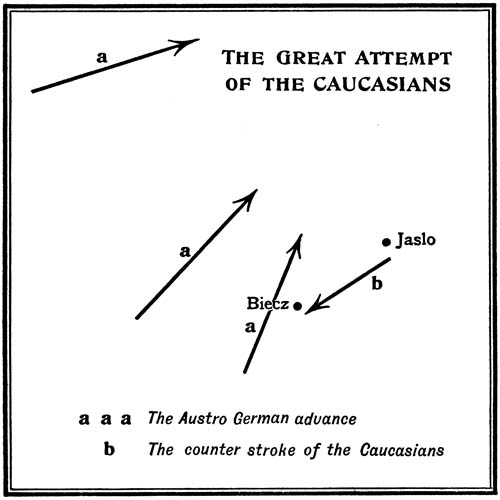
It will be remembered that the Austrians during the
idle months have been covering the Russian lines in
front of them with a ceaseless cannonade. This counted
for little at the time. The Austrian artilleryman has
only lately developed any accuracy; for a long time
they continued in the most stupid errors of detail; they
hardly ever placed a Russian battery, and evidently
the process of range-finding has been long and very
expensive. The Austrians rarely attempted infantry
attack, knowing that they always met their masters;
thus their ceaseless cannonade was not a preparation
for an infantry offensive; and the Russians might even,
if necessary, leave their trenches only partially occupied
during the day, keeping less in those parts which were
under the hottest fire and holding the whole line in force
only by night.
It was a very different story when the initiative on
this side was undertaken by the Germans, who use
artillery as a preparation for desperate attacks in close
column. The difference in accuracy between the German
and Austrian artillery fire was very soon discovered to the
Russian regiments in front of them; and it was known
that the Prussian Guard Reserve was here. The trenches
were, therefore, occupied in full and held until they
became untenable.
The enemy's advance was at first directed against
what was thought to be the weakest part of the Third
Army, namely its right flank, which had sent a number
of reinforcements to the Carpathian wing; but the
alertness of the Russian general on this side produced
an alteration in the plan, and the attack was diverted
to the next army corps eastwards. This corps contained
regiments which had had heavy losses in the previous
hill-fighting. A gap was forced between the two army
corps; and the right flank of the threatened corps (the
R Regiment) was crushed by the pounding fire which
I have described under May 3. The regiment retreated in
good spirit, but with the heaviest losses, the O Regiment,
holding its ground to the end, retired with its colonel
and some 300 men: the Z Regiment was severely cut
up. In all this fighting practically every infantry attack
of the enemy was beaten back. The next day the impact
fell mainly on the troops which I described on May 4.
They held their ground to the evening and then executed
an orderly retreat, coming into line with the broken
forces to the right of them. But on both days a tremendous
cannonade was directed on the division still
further eastward, with the result that some regiments
suffered terribly. The next day a fresh corps, the
Caucasians, one of the most famous in the Russian
army, had arrived and went forward boldly to the attack
on the flank of the enemy's advance. The prisoners
cannot speak too highly of the courage of this corps; and
it did succeed in stemming the tide, with such effect that
the broken army corps to its right had in two days
reformed and come again into position. But it did not
get as far as the enemy's heavy artillery, and retired
fighting rearguard actions—not much further than the
point from which it had started.
I have explained that the whole advance of the enemy
was a counter-stroke to the Russian advance over the
Carpathians further eastwards. The right wing of that
advance was now outflanked and had to retire. Half
of this corps succeeded in rectifying its positions without
serious loss; but the other division had the greatest
difficulty in fighting its way through, and lost heavily.
Meanwhile the enemy's attack was extended also
westwards, including the area against which it had been
originally directed. Here the cannonade was furious
and the trenches were in many parts wiped out, all
approach to them of reinforcements from the rear being
made almost impossible. But here, too, practically all
hostile infantry attacks were repulsed with heavy loss.
Ultimately a retreat was ordered by the Russians on
this side. Results are indefinite unless they bring one
side or the other to a definite line of defence.
The situation resulting from all this fighting was as
follows: The present area of conflict is a square lying
between two rivers west and east (Dunajec and San), with
the Vistula on the north and the Carpathians on the south.
The square may now be divided by a diagonal running
from north-west to south-east. On the one side are
the Russians and on the other are the enemy; but the
diagonal is not any natural line of defence, and the
operations must be continued till one side or the other
occupies the whole of the square.
The enemy has made a special concentration by
depleting other parts of his line. The respective forces
are now at close grips in a great battle which is likely
to last for several days. The enemy's heavy artillery
is not likely to have the same effect as before; and a
successful Russian advance may even endanger its
retreat.
There are two obvious deductions from this fighting.
The Germans are risking more and more of their forces
in the support of Austria, or, to speak more accurately,
in the defence of Hungary, and in order to do this
they must surely have weakened their western front.
They must secure definite results on the Russian side
if their attack here is to be of value to them, as they
may again have to throw their forces westwards ere
long.
May 10.
What a picture these days will leave on the minds of
those who have lived through them. It is only the
simple things that count; but they keep coming back
on one in new forms again and again, and that is why one
must repeat oneself so often.
The staff is in no way downhearted; it is sometimes
preoccupied, sometimes cheerful, but always full of
vigour. The cause of our losses has been localised; and
there is no sign of panic or hurry in the search for the
necessary remedies. At the bottom of all is this wonderful
confidence of the men and officers who come back
wounded from the front. The Commander of the Army
is full of spirit and energy, and we all consider that we
are only halfway through this battle.
The other hospital institutions have mostly been sent
to the rear; but this period of movement is a time of
small advance ambulance points which dispatch their
wounded to the rear at once and themselves are ready
to move at short notice, whether forward or backward;
and the Russian sisters who returned with me from the
front organised at once such an ambulance at the station,
going on duty the same night, and working sometimes
fifteen hours or more at a stretch.
Enemy aeroplanes threw bombs at them every day,
and we picked up several badly wounded at the station,
but none of the workers in the bandaging-room took any
notice of the explosions.
The station is a wonderful place—as wonderful as the
great station in Lvov, which I described several months
ago. It is crowded with wounded, lying close together
in the family manner of the Russian peasant. Most
are wounded in the hands or the head; this means
that they were under a devastating fire in the trenches
which hit anything that was at all exposed. But there
are also many signs of advance or of infantry attacks
beaten off, in wounds of all kinds all over the body.
Every night hundreds of wounded are given clean
bandages and fed with anything that can be bought
in a place where all is movement.
The officers lie here like the rest, separated only by
the silent respect shown to them by the men. The
number of wounded officers is not surprising, for, as I
have explained, they stand and walk while their men
are ordered to crawl; but the sacrifice in officers is
particularly impressive.
For me the officers are also sources of information as
to the fate of each of the regiments I have visited.
Four jolly N's, three of them wounded, told me of how
their trenches were levelled and how they retired because
there were only shell pits to sleep in; seven officers led
the last counter-attack of this regiment. Of some
regiments the news was that they were practically all
gone; in one case the answer was "The regiment does
not exist." Some one asked of one of the O's where
his regiment was to be found: he answered "In the
other world." I learned that three hundred men of
this regiment with the colonel had fought their way
back; later, I learned that only seventy-one were left.
The General of this Division told me that he had reformed
and reinforced his men and that they were again at the
front, where he was off to join them. The T's had
invited me to join them when in action, and it was a
pure chance that I was directed to another point. I
passed in the street the field trains of this regiment;
the officer riding at the head stopped me and grasped
my hand: "What I wanted to say," he said, "is that
the T's are gone, only the flag is saved." The next day
a private with the number of this regiment came up to
me in the street: would I come and see the Colonel
who had just been brought in wounded? I found him
at the quarters of the Commander of the Army. His
head was bound up, but he was seated and writing.
General Radko Dmitriev came in and shook his hand
time after time. "Thank you for your splendid stand;
human strength can do no more." The Colonel related
that his entrenchments were demolished with the men
in them; one company was cut off, and forty hands
were held up in surrender; he himself saw how the
Germans bayoneted half the number out of hand; his
own men, when only five hundred were left of them, went
on taking prisoners exceeding themselves in number, and
rejoiced in this sign of their moral superiority. Of forty
officers and four thousand men, in the end two hundred
and fifty were left.
The enemy was in overwhelming numbers; but
prisoners continued to come in in great batches. I spoke
with some of the Prussian Guard; they were vigorous
and contentious, and spoke with small respect of the
Austrians. The war is becoming more and more bitter.
I return to my inevitable conclusion. There has been
a big success of technique; and it has wiped out a
number of good lives. Even this battle is not over,
and our own people are advancing at points which offer
hope of better results. The Russian army is firmer than
ever, and more and more men are being poured in. It
can win, but only if it can be given anything like fair
conditions; in a word, that the Germans should be met
on their own ground, that of heavy and more numerous
artillery, by every possible united effort of the Allies.
May 13.
I learned that the FF Corps, which contained regiments
that I had twice stayed with, was going to make a determined
attempt to turn the tide. On the heels of this
came the news that it had already begun a daring advance
and had taken some heights on the rear of the enemy's
line. I had no means of transport, and was wondering
how to get to this corps when I met in the street a group
of soldiers who were asking who wanted to buy a bicycle
for five roubles (ten shillings). I learned afterwards that
a large German cyclist corps had been cut off by our
cavalry. The bicycle was there, so I had a turn on it
and bought it. The handles of the bar were gone, and
there was no bell or lamp; the seat and brake wanted
screwing up; otherwise it was a good machine. I had
lost my maps in the retreat, so I went to one of the
adjutants, who sketched for me a map of the district,
and I started off.
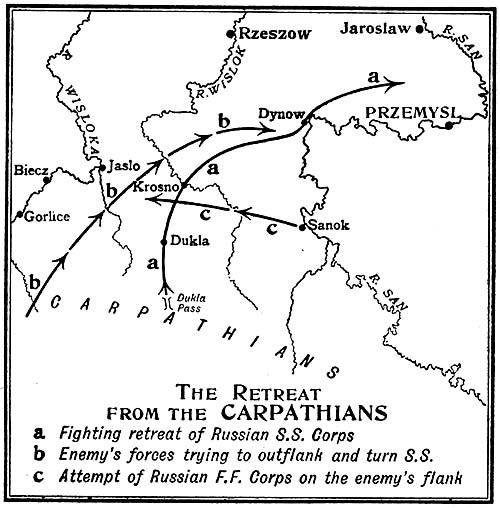
My first destination was Dynow, where I was to find
the staff of the SS Corps. The Polish inhabitants whom
I asked pointed forward along a good straight road,
and with the wind behind me I made good way. I
passed plenty of troops going both ways, and the cavalry
indulged in friendly banter with me as to who would
arrive first.
Meanwhile, at Dynow things were not at all as we
imagined. The FF Corps further on found that it was
advancing into an empty space, while its neighbour, the
SS Corps, was being beset by superior German forces;
there was nothing left for it but to give up its attempt.
The SS Corps arrived at Dynow only to find it already
occupied by the enemy. In instant danger of being cut
off, this corps swerved from the road and went straight
forward at a point where it had to cross two bends of the
river. The water was more than breast high; the two
passages were made under a hot fire, and a number of
men were killed or drowned; but the corps made good
its retreat, and indeed served as rearguard from hence
to the San line. It was followed closely and vigorously,
the Germans showing the greatest ardour, which in one
case brought on them the most serious losses at the hands
of the Russian artillery. The SS Corps also suffered
severely and was greatly reduced in strength.
I should have ridden straight on to the enemy, but
my bicycle collapsed, and I was misdirected as to the
road, so that in the evening I found myself at quite a
different point, not far from the town of Rzeszow, which
I had left in the morning. Making for a railway station,
I found a train waiting and learned the new turn of
events, also that Rzeszow itself was likely to fall into the
enemy's hands.
It was important that this news should reach those
with whom I had been working; but it was twelve hours
before any train could move in this direction, and then
it was only an engine that was sent forward, with one
carriage full of high explosives and a colonel in charge.
The colonel and I sat on either side of the engine, and
the driver kept looking out and slowing down to ask
news of the stragglers who were coming from Rzeszow.
Of course we got the usual exaggerated reports; some
said that every one had left or was leaving Rzeszow and
that the enemy were just about to enter. Puffs of
shrapnel were to be seen ahead of us, but we made our
way safely into the town.
Here little was known of what was happening; but
several plain signs indicated retreat, and an officer whom
I knew kindly gave us the lead that we required. In
the streets there was an unpleasant silence, and the
people seemed to be waiting for something from the
west. The last trains out started with little delay. We
looked back on the smoke of explosions and travelled
leisurely and without panic through a peaceful country,
where at each halt the road was lined by good-natured
soldiers resting, eating or chaffing each other on the
embankments, as if there were no war and they were
all happy on the banks of some great Russian river.
At one point there was a small collision, but all was put
right without the slightest hurry or excitement.
May 18.
We had retreated to the San, and the Corps of the
Third Army held a not extensive front, partly in
front of and partly behind the river. The apparently
endless file of trains had all made their way along the
single line across the river. Wherever they stopped,
the station was infested by the enemy's aeroplanes; at
one time ten of these were flying along the line. In one
day three were brought down, all the airmen being
killed.
The long road picnic on these trains, military or ambulance,
shows the Russian soldier at his best. All content
themselves with the simplest and roughest conditions,
and lie anywhere about the spacious vans or dangle their
legs out of the broad doors and talk cheerily with any
who pass. Most of these goods vans are festooned with
boughs.
Of course there is an endless stock of narratives from
the life at the front, always with a complete absence of
self, except for a summary mention of the date and occasion
of the narrator's own wound. The main features
are always the same—regiments reduced by sheer artillery
fire to half or a quarter, furious infantry attacks of the
enemy vigorously repelled.
Now that we again had a definite line in front of us,
I decided to go up again. I started on foot in fine evening
weather and took a straight line for a point to the
south-west. I was halfway to my destination when in
the failing light I saw a motor, which carried one of the
adjutants of the commander of the army. He beckoned
me up, and explained the day's fighting, at which he
had been present. It was a furious artillery duel; and
it was chiefly concentrated at a different point from that
for which I was making. He advised me to return and
to visit this point the next day.
On the following morning I started out, again on foot,
with a supply of big biscuits. Nearing the area of firing,
I turned across the fields and came upon a battery of
Russian heavy artillery, which was so well masked that,
though I was looking for it, I did not make it out until
I was only a hundred yards off. I had a talk with the
commander and went on to a neighbouring village which
was under a heavy fire. Here were the staffs of a regiment
and of the Division which I was seeking. On the
telephone there was brisk conversation. I was invited
in to lunch, where all business talk was avoided, and I
was given a Cossack to take me to the infantry positions.
Heavy shells were rattling like goods vans over our
heads, sometimes three being in the air at once and all
taking the same direction. The crashes came from some
distance behind us. The enemy was clearing a space in
our reserves and among our staffs.
The Cossack was a quaint person, with flashing eyes,
who walked about leading his horse everywhere. When
he was told to take me in the direction of the firing, he
murmured something about its being "the very best."
His idea was that we should go on foot, he leading his
horse, from which he was most unwilling to part, because
he would feel lost without it. This was all very well:
but the appearance of any horse near the positions is
strictly barred, as it at once calls forth a more or less
accurate fire on the infantry. This it was hopeless to
explain to him; so in the end I left both him and his
horse behind.
I went on to one of the regimental staffs, and obtained
two guides to the respective regiments which I was
visiting. I had hardly left this hut when a bomb fell
on it, killing or wounding several of the staff. We had
sheltered ground almost up to the river. The famous
San is here about a hundred yards broad, with a steep
further bank and, on our own side, a long hollow running
parallel with the river and thick with willows and alder;
the country in general, except for some depressions, is
quite flat.
I passed along the front of the C regiment. There was
hardly a shot fired, though the enemy could be seen
moving on a hill opposite and was free to approach to
the further side of the river. Our own people had made
some progress with their entrenchments, which were not
yet under artillery fire. To the greeting from the English
ally, which I gave as I passed along, there was an interested
reception, and the men put questions as to the
western front. One man, when I told him we were
advancing, crossed himself and said "God grant it."
The men had a very difficult part of the stream to
guard and could easily be put under a flanking fire.
With two of the officers I stayed some time; they were
cool and keen, but deeply mortified at the loss of
ground for which they had sacrificed so much. We
watched the shells bursting just behind us; and after
a time I made my way back over ground which was
often traversed by shells and shrapnel, usually fired
together.
The cannonade became more and more intense in the
evening and lasted all night and into the next day.
Some hours after I left the enemy crossed at the point
which I had visited and made good a footing on our
side of the river. In the morning he was driven back
out of our lines; but returning in force, he finally
established himself on our side and forced these regiments
to retreat for some miles. A day later I heard that
the German Emperor in person was opposite to us, just
across the river.
May 24.
On the day when I walked along the San, the enemy
did not show themselves in any force till the evening.
Then and throughout the night the tremendous cannonade
that they had kept up all day became more
intense, and with the aid of the powerful German projectors
the area to the rear of the Russian lines was
swept, especially at three given points. Here in the
evening the enemy crossed the narrow stream in boats.
The railway bridge was mined, but was left standing as
long as possible. An Austrian shell cut the train of the
mine, without exploding it, at a point forty yards on the
Russian side of the river. Masses of the enemy were
already at the bridge when a Russian officer and private
went forward and made a new connexion, which they
fired at once. The bridge was blown into the air, and
the two daring Russians were sent flying by the shock,
but remained alive.
At different points the enemy effected a lodgment on
the eastern bank and, where the Russian line was thinnest
and held by regiments already reduced to half or
quarter strength in the previous fighting, the trenches
were partly occupied by the Germans or Austrians.
Next morning the Russians made vigorous counter
attacks and recovered the ground lost; but returning
in overwhelming force, the enemy not only regained his
hold on the eastern bank but extended it on either flank
and pushed further eastwards.
There followed five days of very severe fighting. The
issue at stake was whether the enemy's successes could
still be limited to western Galicia—or, in other words,
whether half or the whole of the territory conquered by
the Russians was now to be flooded by his armies. His
object was, of course, to find room eastward of the San
for his powerful forces and artillery. There were in all
five German or Austrian armies in the area chosen for
the enemy's impact. Of these, two were engaged with
the Eighth Russian Army and three were opposed to
our Third Army; these last numbered nine army corps,
including the Reserve Corps of the Prussian Guard and
two others which were drawn from the French front.
German heavy artillery, though apparently of a different
calibre from that employed at the beginning of the
Galician battle, took a prominent part in this fighting;
and the Austrians showed better marksmanship than at
any period in the war.
The enemy's advance, however, had slackened before
it reached the San; and the Russians had had time
not only to make good a very spirited retreat but to give
their men two days' rest on the eastern side of the river.
These two days were invaluable. Large reinforcements
were hurried up. In the shortest time entrenchments
were thrown up of a kind superior to those held by the
Russians during their long occupation of western Galicia,
and very much better supported. The earlier ruinous
effects of the enemy's heavy artillery were now minimised
or even avoided; and the Russian artillery were in much
greater force than before. Above all, the men proved,
if proof were needed, by the vigour of their resistance and
by beating off one German attack after another that the
earlier retreat had been due simply to the enemy's
technical superiority in artillery, and that even a half-annihilated
Russian regiment felt itself to be master as
soon as the issue lay with the bayonet.
The enemy daily sent aeroplanes to the Russian rear,
in one day ten at a time, but in at least five cases these
were brought down and in most instances by the fire of
musketry and machine guns. In one comparatively
weak spot the Russian infantry was rescued by a few
timely discharges from our artillery, which sent the
close column of Germans running like hares.
Attempt after attempt of the enemy to break through
in close column failed. At certain points the Germans
were able to push home their blow, at others the Russians
closed in on their flanks, driving them back to the river
and threatening even their success in the centre with
serious consequences. At one moment the enemy thought
that he was through; but the gap was filled at once from
the large Russian reserves. At another he even launched
his cavalry through what seemed an empty space, and
it looked as if he might find room to develop the favourite
German cavalry advance, which has spread such terror
among peaceful inhabitants in other parts; but without
delay the tide was stemmed by Cossacks and Russian
infantry.
The struggle is still going on; but one thing is certain—that
the Russian resistance east of the San has stopped
the forward flow of the German advance. It is a new
chapter in the war, and different in essentials from that
which preceded it. News of successful resistance or of
advance comes from the Russian armies on either flank
of our own.
May 27.
The situation seemed to be changing rapidly and at
the same time clearing. There were reports of German
attempts to break through at various points, but all of
them seemed to be stopped and our line was apparently
becoming more stable. As I have explained before,
there is a splendid ambulance organisation of the most
complete kind managed by a joint committee of all
the Zemstva (or county councils) of Russia and directed
by Prince George Lvov. Apart from a wide system of
hospitals right away to the rear and all over Russia, it
includes ambulance and depôt trains which run almost
up to the very front, and flying columns, giving first aid
to the wounded. These last have attached to them large
field transport trains, adapted to the local roads and
working in close touch with the generals at the front and
the military surgeons.
It is always a pleasure to meet with any section of this
organisation. It possesses the free initiative characteristic
of self-government, for the Zemstva members and
employés have everywhere volunteered for this service;
and there is in it the healthy sense of open air
and a practical experience at making the best of any
conditions.
There was a flying column which I met at the beginning
of our retreat, and which took charge of my baggage.
The same column was now quite near me, and they kindly
gave me a lift to the front. I set out in one of their
sensible "two-wheelers" adapted for carrying the
wounded, and travelled a good part of the night to where
they had their park: there I had a splendid sleep in the
two-wheeler. The next day we went on in a long train
of carts through pine-woods and sand, sometimes almost
losing our bearings, until we found the flying column at
work in a wood: among the sisters was an English lady,
Miss Hopper, and in a neighbouring flying column of
the Zemstva is another English sister, Miss Flamborough;
the others call them "our allies."
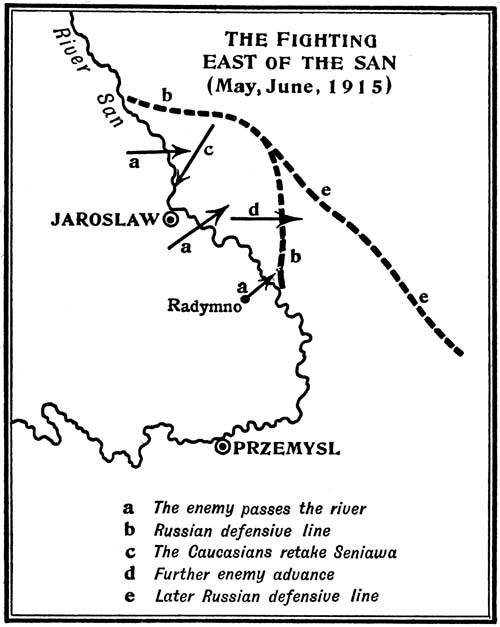
I was told that one of the military doctors wondered
whether I was a spy. As he was going to the staff of
the LL Corps, I asked him to take me with him. Here
I had a kind welcome, though I happened to be without
all my papers. Everything seemed to be going better.
The General in command, a man of decision and much
humour, was evidently in good spirits; business was
barred at meals; but the position was explained to me,
and it was clear that the enemy was being held.
I was sent on to one of the Divisions, which had been
in action for about five days. Here, in spite of the rapid
changes in the personnel of the officers, there was the
same feeling of confidence and hope. In the evening
I rode out with the General of Division on his visit to
one of the regiments. Everywhere we passed fresh
troops coming up. We found the regimental staff in
a wood; though there were huts quite near, the Colonel
preferred a series of elaborate burrows which had been
made in the sand among the trees. Near these burrows
we sat round a table in the twilight, while orderly masses
of grey figures kept passing us in their march forward.
This Colonel, a big genial man with a composure that
inspired confidence, soon dropped into a conversation
about old comrades. The General had commanded the
O regiment, and it was painful to hear his inquiries about
one after another of his officers: almost all were gone.
The next day I again visited this regiment and went
forward to the front. The rear was being shelled by
the enemy with a good deal of shrapnel, and this seemed
to be going on every day. As I got further forward
I passed line after line of entrenchments and shelters,
and eventually came on the front line, which was admirably
complete and much more detailed than most of the
positions which I had yet seen. The battalion, which
was in a wood, was commanded by a fine young fellow,
still a lieutenant, who exposed himself freely but took
the greatest thought for his men. The enemy was only
a few hundred yards off and suddenly opened a hurricane
of musketry fire; practically none but explosive bullets
were used; this was quite clear as they kept crashing
into the trees all around us. The men, who were in fine
strength and spirits, did not suffer; and such measures
have been taken that the losses inflicted earlier by the
German heavy artillery are very unlikely to be repeated.
At no time have I seen so marked a difference in the
course of a few days. When I visited the San there was
still the atmosphere of the preceding operations, heroism
against odds. Now there was a quiet confidence for
which one could everywhere see the reason—in the troops
that had come up, and the lessons that had been learned.
May 29.
Matters here continue to take a better complexion.
Yesterday in the staff of the LL Corps I was given the
sketch-map of the day, which showed an advance at
more than one point. The regiment which I had last
visited had now crossed the little brook in front of its
trenches and also the larger stream which runs at some
distance almost parallel with it. Of this I had painful
evidence just outside headquarters. A man with face
bound up had just been brought in and came forward to
me making signs. On the paper which I gave him he
wrote: "I am the Commander of the second battalion of
the Y regiment. Where are you off to now?" It was the
fine young lieutenant whom I had seen a few days back,
so proud of his new command and so brisk and vigorous in
all his dispositions. He wrote that he had been wounded
during the attack by an explosive bullet, such as I had
heard crackling against the trees when I was with his
regiment. His mouth was shattered, but he was quite
cool and gave no sign of pain. My companion sent him
off at once by motor to the ambulance.
At another point there had been a more definite advance,
which, coming as it did just where the enemy had made
a great effort to break through, seemed to promise results
all along the line. This was the point that I decided
to visit; so I was directed to a cavalry division from the
Caucasus which was stationed there. I experimented
in a new means of conveyance, namely a hand-truck
which worked between our last station and the front.
It was a sporting ride, and we went faster than a good
many trains. Just before I started I was asked to carry
word to a badly wounded officer that a motor was being
sent for him. Alighting at a signal-box, I made my way
to the place, and the poor fellow was delighted; but alas!
no motor could make its way over this road, and the
young man died before there were other means of moving
him.
Headquarters staff of the Division was a farm building
crowded with fine horses and soldiers. The men wore the
long black busbies and the picturesque flowing uniform
of the Caucasus, with decorated sabres and bandoliers.
The General was a patriarchal man with bald head and
long beard, easy of manner and short and conclusive in
speech. He kindly put me up in his own room, and
through the night he seemed to be doing business at a
great rate with the minimum of exertion. Next morning
the whole position was shortly and plainly explained
to me; in the night we had taken another village, and
levelled up the line of our advance rightwards. I
was sent to see the corresponding movement on the
left.
The General took me with him to one of his Brigadiers,
and on the way in a few vigorous words put renewed heart
into two brisk-looking batteries that lay on our road.
The soldier who took me forward had the day before
got a skin wound on the face from shrapnel, while carrying
a message to the staff; it had not prevented him
from returning to the front. The General jocularly
told him that to-day he would probably get one on the
other cheek.
As we came out of the wood, we saw a man dodge past
us, and the next minute came the explanation in the
shape of a shell. The railway ran straight forward up
the bare slope; and the enemy was shelling all along this
line. A few hundred yards on, behind the lightest of
shelters, was a hole in the ground with a telephone,
which served during action for the staff of the regiment.
I asked for the Colonel, and they pointed to a splendidly
built man lying stretched out on the ground. I thought
for a moment that he was dead, but he was only lying
fast asleep under the shrapnel, after the ceaseless and
arduous work of the attack. He stood up and shook
himself like some noble animal, standing in the open,
much against the wish of his officers.
We sat and talked for some hours. The ground where
we were had all been won in the night. Our present
positions, temporary and little developed, were about five
hundred yards further up. Our men were only six hundred
yards from the Germans and had orders to advance
by short stages. Some of them had already crept forward
two hundred yards and were throwing up head cover on
the ridge of the slope. Other parts of the ridge were still
in the hands of the Germans; their trenches were plainly
visible, and they were firing down on us, aiming at
anything which stood upright.
A soldier was sent by the railway ditch up to the
front, so I went with him. The best plan after all
was to walk forward, stepping out but without hurry.
A little beyond the level of our lines I found some
breast-high shelters on the edge of the railway ditch.
Here we posted the bearers, who would wait to attend
to the wounded.
One got a near view of all our front. A group of some
twenty men had gone forward together and were entrenching
themselves; others at intervals crept forward
on their own initiative on different sides; it was rather
like men at a Salvation meeting, coming in, one by one,
for conversions. As one was halfway up to his comrades,
a shrapnel burst with a flare just above him; he lay
still for a few minutes and then crawled slowly back,
evidently wounded. The twenty had hardly established
themselves when three shrapnels and a shell burst at
intervals all along their little line. However, the slow
process went on, and the line was being gradually levelled
up to those who were furthest forward.
This slow advance, inevitable in daytime, is very
trying. The moment of greatest danger was when the
men came in full view of the enemy, who from his trenches
could direct his artillery fire with precision on to the
Russian advance. As our men came closer in, this danger
would disappear, for the German artillery in the rear
would be afraid of hitting its own infantry; but this
stage was still far off.
I came back to the staff, and when close to it I was
noticed and followed with a little shower of explosive
bullets which burst near me. Beyond the railway, much
the same movement was in process, except that here
machine guns were at work. I made my way back to
the wood; shells travelled overhead far to our rear; as
each passed, the wounded men whom I was supporting
jerked instinctively away from me and wished to lie
down or seek any shelter.
I had a long walk back, passing on the way groups of
those wounded who were able to go on foot, and followed
for some distance by two soldiers who were on the lookout
for spies.
May 31.
I have had an interesting talk with a German officer,
commander of a battery which was cut off by the Russians
in a recent advance on our side. He comes from the
Rhine and has lived long in Hamburg, and he inspired
in his captors the greatest respect by his breeding and
good feeling.
We talked first of Hamburg: he described it as a dead
town; trade there is, but it goes by other roads and most
of the profits remain in neutral countries. The short
rations in Germany he insisted were simply a measure
of precaution, and latterly prices had been lowered; he
had a poor opinion of potato bread. Next we talked
of the Rhine Universities, which are practically emptied
of students by the war. There are in the army many
volunteers from the age of sixteen to that of forty-eight,
but this is no indication of the depletion of material for
the Army.
We now got on to the main questions; he was very
ready to discuss them and spoke perfectly frankly. I
asked on what side Germany could hope for any deciding
success. He admitted at once that no such point, of
the kind that Napoleon used to look for, was to be found
on any side, and he maintained that from the outset,
both militarily and politically, Germany was fighting
a purely defensive war, of course by frequent counter-offensives.
In that case, I suggested, Germany could
only have peace by our offering it, that is, by our getting
tired of the war; and surely it was unfortunate that she
had all of us against her at once. In reply he reminded
me of the German word Streber, which means a restless
pushing person who is always disturbing and annoying
others. Economically, he said, the struggle for life in
Germany had become almost impossible, of which he
himself had seen many instances. Some outlet was
essential, and this England and the other Powers had
united to prevent. I said that for us English the issue
was whether Germany should have things which we at
present possess, and that we were not likely to give them
up without fighting. He quite accepted this. Germany,
he said, was like the troublesome boy of the school, who
was dissatisfied and had a grievance, and was always
making things unpleasant for all the rest, so that there
was no wonder if he was not liked. I suggested that
this went too far, if his own old allies, such as Italy, turned
against him. He expressed a natural resentment against
Italy, and said that anyhow here right was on the side
of Germany, who would continue to defend herself to
the end. I answered that we might disagree as to the
question of right, but that I could not understand how
any successful issue could be hoped for under such conditions.
He was of my opinion, and twice spoke of the
war as a "catastrophe." I asked, then, why Germany
should persist in a policy which had obviously, especially
in the case of Italy, proved to be a misguided one; we
all felt admiration for the magnificent fighting power
of the German army, which might have dealt successfully
with us separately; but it had been set an impossible
task. He replied that England had a long experience
as a state and that policy with her was well thought out;
Germany had only some forty years of a united existence
behind her, and the policy which had led to "the catastrophe"
could not, as a policy, be defended. I asked
whether it was likely to be changed, and to this I neither
expected nor got any answer. But it was interesting
that, in spite of the great successes in western Galicia,
he described the present mood of the army as nothing
like the first great outburst of enthusiasm at the beginning
of the war.
I was later given an opportunity of examining a German
private (a Hanoverian). This man had been asleep when
the Russians stormed his trenches. I was interested
both in the readiness of his answers, which he gave with
a smiling face, and in the answers themselves. The
German heavy artillery was all beyond the San, and
troops were being sent away to the Italian front. Food
was poor in Galicia; all the soldiers were for peace, and
there was the same refrain in all the letters received from
home. He had been on the western front near Reims
and had made the railway journey to Neu-Sandec (Nowy
Sacz) in five days. He spoke with especial respect of the
first English troops, of the Russian field artillery and of
the accuracy of the French heavy artillery.
June 7.
I had a talk with a staff officer of the E E Corps on the
fortunes of his corps and on the German methods of
advance. The corps had not been hit so hard as some
others by the Austro-German impact; it helped to cover
the retreat to the San, and stood to its ground beyond
the river until one of its neighbours retired. When the
enemy had thus got a footing beyond the river, the
E E Corps made a counter-attack vigorous and successful.
But the enemy pushed the next corps still further
back, so that the E E's had also to rectify their line.
However, they continued to make counter-attacks, at
one point gaining about a mile of ground, and they were
still holding good. They had at least the satisfaction
of holding the forces of the enemy which were opposed
to them, so that these troops could not move further
along the Russian line to complete their offensive movement.
This record is typical of very much of the Galician
fighting, which is full of such ups and downs of attacks
and of counter-attacks, and only reached decisive results
by the employment, at given points, of an overwhelmingly
superior heavy artillery.
The German method is to mass superior artillery
against a point selected and to cover the area in question
with a wholesale and continuous cannonade. The big
German shells, which the Russian soldiers call the "black
death," burst almost simultaneously at about fifty yards
from each other, making the intervening spaces practically
untenable. The cannonaded area extends well to the
rear of the Russian lines, and sometimes it is the rear that
is first subjected to a systematic bombardment, the lines
themselves being reserved for treatment later. On one
of my visits the divisional and regimental staffs were
being so shelled that the former had to move at once
and one of the latter was half destroyed; but meanwhile
there was hardly a shot along the actual front. In
this way confusion is created, and reinforcements and
supply are made difficult. It is the wholesale character
of these cannonades that make their success, for there
is nowhere to which the defenders can escape. The
whole process is, of course, extremely expensive.
When a considerable part of the Russian front has
thus been annihilated, and when the defenders are, therefore,
either out of action or in retreat, the enemy's infantry
is poured into the empty space and in such masses that
it spreads also to left and right, pushing back the
neighbouring Russian troops. Thus the whole line is
forced to retire, and the same process is repeated on the
new positions.
When success in one district has thus been secured,
the German impact is withdrawn and again brought
forward at some further part of the Russian front. In
other words, the German hammer, zigzagging backwards
and forwards, travels along our front, striking further
and further on at one point or another, until the whole
front has been forced back.
The temper of this corps, as of practically all the
others, is in no sense the temper of a beaten army. The
losses have been severe; but with anything like the
artillery equipment of the enemy, both officers and men
are confident that they would be going forward.
June 10.
I rode over dull country on my way to the SS Corps,
one of whose divisions I had visited a week or so before.
While I sat lunching in a wood, regiments of cavalry
swept past me, filling the air with dust; sometimes one
could not see a horseman until he was upon one. Not
far from the Staff there was a sick soldier lying by the
road, with some peasants looking after him; we sent him
forward on a passing army cart.
The SS Corps was having an easy time after the recent
fighting in a large village over three miles long which
had several good clean quarters; the Polish peasants are
excellent hosts. Neither side was making any move,
but our Staff went up every day to the positions to direct
the work of entrenching, which was being carried forward
with the greatest energy. The General in command, who
is very hearty and sociable, was just starting in his motor
when I arrived, and he invited me to come with him. It
was a far drive, and at one point we were stuck in the
sand; we passed quite a number of different lines of
defence, carefully planned and executed. As large drafts
of recruits had come in recently, we halted at the edge of
a wood and the General gathered the men round him and
made them a very vigorous little speech. He described
how Germany and Germans had for several years exploited
Russia, especially through the last tariff treaty,
which was made when Russia was engaged in the Japanese
War, and set up entirely unfair conditions of exchange.
He said that the German exploited and bullied everybody;
and that was a thing which the peasant could
understand, often from personal experience. Then he
got talking of the great family of the Slavs, of little
Serbia's danger and of the Tsar's championship, of
Germany's challenge and of Russia's defiance. Next he
spoke of the Allies and of their help. And then he spoke
of the regiment, which bears a name associated with the
great Suvorov; they were always, he said, sent to the
hardest work, often, as now, to repair a reverse; and he
spoke plainly and without fear of the recent retreat.
Concluding, he told them a story of Gurko: some of his
men had said that the enemy would have to pass over
their bodies, and Gurko answered, "Much better if
you pass over his." He ended by telling them all to
"fight with their heads." In the wood he addressed
another group. Both his little speeches were manly and
effective, and they were very much appreciated; one
of the men (I wear no epaulettes) called me to closer
attention.
On the further edge of the wood there were good
trenches, and from them ran a long and very winding
covered way to the front line of all. The enemy here
was only some sixty yards off, and we could get a good
view of his lines; but this day he only sent a few
intermittent shrapnel over our heads.
The next day we motored again to this side, which was
on our extreme right flank. We left the motors and rode
fast through thick brushwood. Most of us got separated
from the leaders, but we picked up their tracks, and
our Cossacks gave us a great gallop to catch up with
them. We had tea in a beautiful wood with an outpost
of the Red Cross, which was living in tents; the regimental
band played to us, and gave us "God save the
King." We were just beginning to talk about the stifling
gases. "Confound their politics; Frustrate their knavish
tricks" seemed to have a new significance. After tea
we rode and walked to an artillery observation post,
from which the enemy's lines were clearly visible. This
day wore a holiday atmosphere, with music and snapping
of photographs and the forest picnic. But the General's
alertness was soon to be proved. Three days later the
Germans made their new advance exactly at this point,
but of that I will write later.
June 13.
Next to the L Corps on the right is one of the most
famous corps in the Russian army—3 K. In this war
it has been put to hard and dangerous work all over the
front.
At Kosienice, which saw some of the hardest fighting
in the war, two regiments crossed the Vistula—the Vistula,
mind; and those who have seen it will know what that
means—under fire and in face of two German corps and
three Austrian; another brigade of 3 K came along
the river from a Russian fortress on the western bank,
marching knee-deep through marsh and water with the
general at its head. The two regiments that crossed
moved forward to a vast forest near the river, and there
they had an hour and a half's bayonet fighting—one
may imagine what that means. An enormous number
of officers went down; the B's lost forty, and the S's in
the course of those five days had seven successive officers
killed while commanding the regiment. In the midst of
the bayonet fighting, when most of the Russian officers
fell, some of the Germans shouted out in Russian,
"Don't fight your own men!" and in the confusion
which followed the Russians left the forest and lay, half
in marsh and with only the most elementary cover, under
a devastating artillery fire; however, they held their
ground on this bank of the river, and, as soon as they
were reinforced, they again moved forward and scattered
the Germans, drove them off westward, and then pushed
the Austrians, in more than a week of fighting, beyond
Kielce, where they feasted their triumph with the old
corps song, "God has given victory." After this followed
arduous fighting in the Czenstochowa region.
Later the corps went to the eastern Carpathians to stem
an Austro-German advance, and it was thence brought
rapidly across to the assistance of our army when the
tremendous artillery impact of the enemy fell on Galicia
between Gorlice and Tarnow.
I first saw General Irmanov the day he had entered
Kielce. He is one of the most remarkable and sympathetic
figures of the whole war. I saw what seemed an
old man of middle height, of sturdy figure, with a curious
outward kink in his walk as of one who had lived much
on horseback; he has a singularly peaceful and gentle
face, with a high colour and grey hair and beard; a child-like
simplicity and directness blended with a fatherly
benevolence; but the suggestion of different ages ends,
when one sees much of the General, in one's forgetting age
altogether. The voice is a mild, high one which sometimes
comes out like a little bark. I had a long talk then
with General Irmanov, and for every one of my questions
got a clear and full answer. Irmanov was not a General
Staff officer; in peace and off duty he lives a quiet
domestic life in his mountain home. His staff is like a
family; there is a peculiar smartness and spirit in the
salute when the General appears and all line up to greet
him. He mounts without delay and is off in a moment;
he is one of the fastest riders in the army, and in a few
minutes his suite, trained riders as they are, are all
streaming behind him.
In the battle of Gorlice the corps was set a desperate
task. It was to turn the German flank and get to the
devastating heavy artillery and take it. It is always
shorter to go forward than to go back; and this was the
one way in which bold hands could beat metal. When I
first heard the order, some one said, "Irmanov can do
it"; and he very nearly succeeded. The Prussian Guard
Reserve was against him, and their prisoners, who held
their heads high in other matters, were all agreed as to
the heroism of 3 K. There followed tremendous rearguard
fighting, battles or marches every day. The corps
was 40,000 when it marched on the guns; it was 8000
when it stood covering the Russian rear beyond the river
San. It was 6000 when it made its counter-advance on
Sieniawa, and then it took 7000 prisoners and a battery
of heavy artillery. Not much of the beaten army in
this!
I reached the pleasing white farmhouse in which the
staff of the corps lived, and felt at home from the first.
They made me feel myself to be one of the party; there
was no ceremony, but the General, who found time for
everything, saw to it himself that I had a little room of
my own, which he visited to see that all was in order.
Next day he asked me whether I would like to go
with a colonel of Cossacks. This seemed simple enough.
We went to the colonel's quarters, took a quick lunch
and then mounted. The whole regiment, I noticed, was
behind us; we started at a dashing pace, breaking a way
through thick forest, the branches often lashing our
faces. The Germans had come through at one point,
and we were on our way to stop them; if we found them
on the march, the regiment would charge; if they were
taking cover, we should take cover opposite them and
possibly advance on foot to a counter-attack, in which
the Cossack's sword would replace the infantry bayonet.
At a signal all heads were uncovered and, while we still
rode forward, there rose a solemn hymn which is always
sung before action. Later the colonel said, "We have
been serious long enough; let's have some songs"; and
with the music of the Don and Caucasus rising and
falling we rode forward.
I had begun to wonder what exactly was my part in
the day's business—for I was riding, with only a Red
Cross brassard, next to the colonel—when we were all
told to dismount, hide in a wood and await further orders.
We were here for about two hours; I woke from a good
sleep to see the divisional general come out of his hut
with our colonel. The General made vigorous gestures
which I thought must be an order for attack; but it
turned out just the opposite. The gestures meant that
the German advance had already been stopped, and the
colonel came back, saying, "Got to go home." From
my point of view it was just as well, for I am sure I could
have done nothing to help except fall off. We rode
slowly back in the evening; and every now and then the
men sang long melodies that fitted the hour and the bare
plains.
June 16.
The day after our ride there was nothing doing, and
it was difficult to make any plan. I spent most of the
day lying about the big garden, as many of the soldiers
did. There were pleasant gullies, and beyond lay the
long, rambling, white-walled village with a pretty church.
The village girls were all on the way thither dressed in
bright colours. It seemed that there were services twice
a day; and the people, who were Poles, met whenever
they heard the cannon, to pray for the success of the
Russian arms.
I sat for some time in the church. The younger girls
all knelt before the chancel and sang a long and beautiful
prayer, into which, in the second half of each stave, there
joined the voices of the men behind. Then the priest,
who looked both kind and clever, had a talk with the
younger children. Poland is one of the few countries
where all the church music is congregational, and it is
often sung very beautifully. For the Pole the church is
the fortress and shelter of his country; and in this terrible
war, which has fallen so hardly on Poland, this comfort
is more needed and more real than ever. It is many
times that the inhabitants of this region, especially old
peasant women, have told me how they feared the coming
of the Germans.
The Staff was a very pleasant company. The chief,
also a general, had the face and manner of a conscientious
English country gentleman; he was widely read in military
history, and his judgments were always weighed. The
senior adjutant had been contusioned and invalided, but
somehow had managed to return almost at once; he was
humorous and talkative; in his room he had a placard,
"There is no air in this room, don't spoil your health and
GO AWAY." Over the General's door he had written,
"Don't disturb work or rest."
Two officers examined our prisoners, assisted by a
Czech interpreter. There was one very militant Austrian
German, who would have it that Austria would win; he
was so rude about the Austrian Slavs that I asked him
at the end whether Austria wanted the Slavs. He said
they wished to be quit of Galicia, and in fact of all their
Slav provinces; I suggested that Austria proper and Tirol
might find their natural place inside the German empire;
he answered with alacrity, "Of course, far better under
Wilhelm II." It is a view which offers possibilities of a
settlement; but I did not see how it would suit Austria.
In the evening the Cossacks, encamped in different
groups in the wood, struck up their strange songs and the
Russian national hymn, which they have their own way
of singing, suggestive of cadences in the music of the north
of England. I came back from a walk in the cornfields
to hear that the General invited me to come with him the
next day.
At eight in the morning all was movement. We made
a vigorous start, and went off at a great pace towards
our left flank, the point which I had already visited when
with the SS Corps. The General missed nothing. He
had a salute in his little high voice for every one: "Good
day, sapper," "Good day, cavalier" (to any soldier with
the George Cross); and men standing far away across
the fields drew themselves to sharp attention to anticipate
him with their lusty greeting. "Thank you for your
trouble," he said, whenever we passed a group of men at
work. At one point he galloped right away from all the
lot of us, and when we caught him up he said, "I thought
somehow he looked like my son." He turned round
several times to ask, "Is the Englishman there?" and
insisted on superintending the adjustment of my stirrups.
After passing several lines of entrenchments, we came
to the front line. Here he ordered us all to stay on the
edge of a wood and went forward into the open alone,
diving into the trenches, talking with one man or another,
patting them on the back and distributing rewards for
bravery. He was soon back again from his scramble and
said he must have an observation point. They took us
to a tree with a ladder against it; the tree was outside our
lines. He was up it in an instant. "They can come at
us from three sides under cover here," he said, pointing
to the surrounding woods. "Go up and have a look";
then, "Who's on our flank?" for we were at the limit of
our positions. The answer did not satisfy him, nor did
the reply which he received from a neighbouring regiment;
he made the necessary dispositions and was off on
horseback.
As we passed behind our lines we met a Red Cross outpost,
where we made a short halt. A little further on
there passed us at full gallop four regiments of Cossacks
on their way to relieve our neighbours on the left, where,
as we now knew, the Germans were breaking through.
As we passed, the General called a salute to each regiment
by name and to officers or soldiers in person; and we
saluted each flag as the Cossacks swept past in full swing.
We pulled up sharp at the Staff of the brigade. The
General had the men out and talked to them; to the candidates
presented for the George he said, "I will give it to
any one who accounts for ten Germans;" then he spoke of
England, and asked me to give a greeting, so I told them
how grateful we were for all that they had done for the
Allies, and how we meant to do our full share of the work.
Rewards were distributed, and we were off for home;
but we had hardly got there, with every one except the
General fairly tired, when he ordered his motor to take
him off to his opposite flank, the right. He invited me
to come with him, and I asked leave to spend the night
in the trenches of the Q regiment, which held that flank.
He gave his leave, as there was no disquieting news from
that side, and my traps were put in the motor. We had
a long push through the oceans of sand, but at last were
travelling along the rear of the right flank. At one point
some sinister hand, well in the rear of our front, had laid
a whole line of fire through a great wood.
Suddenly there opened before us such a sight as I had
seen at the beginning of the great fighting in Galicia when
I was with the J Corps. There was one long line of fire,
shell on shell bursting at close intervals and almost continuously
in the twilight, with a deafening noise, though
we were some way in the rear. It was the smashing tactics
again—and again at the expense of the J Corps—which
had suffered so much in the previous fighting.
General Irmanov thought for a moment that we had
gone beyond our own positions; but it proved otherwise.
We found the Staff of the Division in a garden outside a
hut. It was a General whom I had met elsewhere, with
a new Chief of the Staff, very conscientious and painstaking.
With a lamp on the table we sat in the garden
and heard the news. At four o'clock the Q's were intact.
The neighbouring regiment of the J Corps, which was
only at half strength, had had to retire from its positions;
and the Q's, with their flank uncovered, were pounded
till they had but few men left. These retreated in good
order, guarding as best they could against further outflanking;
but there was no question of getting to them
that night.
In a single day our corps, which the enemy respected
enough to leave till last, had been turned on both flanks;
and at each of the threatened points so far distant from
each other, General Irmanov, who could not have anticipated
the danger, had managed to be on the spot as soon
as it presented itself.
June 19.
The morning after our return from the right flank every
one was very busy, and the best thing that one could do was
not to get in the way. I had a chat with the Chief of the
Staff, who, when he could snatch an interval at an anxious
time, usually spent it with one of the more fantastic novels
of Mr. H. G. Wells. We talked of the military reputations
of the war. He told me we were engaged along our whole
front; I had thought of getting to the regiment which
I had accompanied near Biecz, and which belonged to
this corps; but he said that it was difficult to send me.
Shortly afterwards, in the most business-like way, everything
in the house was packed; we, too, were to retreat.
General Irmanov believed in meeting attack by counter-attack,
and almost every day his corps had contrived
some surprise for the enemy, usually by night; on the
day of my arrival it took over a thousand prisoners.
Altogether the corps had taken in prisoners much more
than its own original strength. But this time there were
reasons which made retreat imperative. "If I had what
I need," said the General, "I should advance to-morrow."
The retreat was conducted in the most perfect order.
The General visited on his way the new line of entrenchments,
which had been prepared with great care. I
accompanied the senior adjutant to the new quarters,
which were only four and a half miles off, but, alas!
beyond the old frontier and in Russian Poland. What
of our friends, the poor inhabitants, whom we left behind?
In our new halting-place I could not fail to notice the
delicacy of the corps authorities in their arrangements for
their quarters. Everything was done to lessen the inconvenience
for the townspeople; and the General's own
quarters were asked, rather than claimed, of the local
priest. The General had given a special order as to my
own accommodation; I was again to have a room of
my own.
By now I was coming to a conclusion which I had long
been considering. I had visited these last corps to
complete my information on some points which seemed
to me to be of the first importance, not only to the army,
but to Russia and to the allies. The data, of which I now
had much more than enough, were overwhelming in what
they indicated. Clearly the troops had lost not an atom
of their fighting spirit; equally clearly they were fighting
under the most unfair conditions and would continue to
do so until their technical equipment, in arms and munitions,
was much more on a level with that of the enemy.
I wished to report in person what I had seen; and in this
conclusion I was encouraged by the General. He thought
I should not wait for the end of these operations, which
might last a long while, but that I should be off as soon
as possible. "Come back and live with us when we've got
what we want," he said; "and we'll show you how we
use it."
He gave me his motor to go and pick up my luggage.
It was a curious journey. Apparently I had twelve miles
to go, but one could not tell how fast the enemy was
advancing elsewhere. We ourselves were retreating twelve
miles next day. Besides, the roads were mostly a hopeless
waste of sand, in which motors stuck fast and had to be
dragged out by horses. I was therefore advised to make
a circuit of something like eighty miles.
For most of this distance I had a glorious paved road,
constructed, I believe, by a Polish count, and certainly
as good as asphalte. Late at night I was only five miles
from my luggage: but it took me till the morning—something
like seven hours—to get over those five miles, and
it was a wonder that we got through at all, for the aquatic
feats of the chauffeur were astonishing. However, by the
evening of the next day I was with the Staff of the army
and making all preparations for going further. Among
the Staff I found not the slightest trace of agitation. The
situation was fully recognised, and there was a clear-cut
plan for dealing with it. I saw all my friends, got all
further information that I needed, and started for
Moscow and Petrograd.
The last words of the Chief of the Staff of the army were
these: "Be sure to say, after everything else, that we
won't consider a separate peace and that we are perfectly
confident of the final result."