ORIGIN OF THE KINGDOM OF THE FIVE NATIONS, WHICH WAS CALLED
A LONG HOUSE;—THE WARS, FIERCE ANIMALS, &c.
By some inducement a body of people was concealed in the mountain at
the falls named Kuskehsawkich, (now Oswego.) When the people were
released from the mountain they were visited by TARENYAWAGON, i. e.
the Holder of the Heavens, who had power to change himself into various
shapes: he ordered the people to proceed towards the sunrise as he guided
them and come to a river and named Yenonanatche, i. e. going round
a mountain, (now Mohawk) and went down the bank of the river and
come to where it discharges into a great river running towards the midday
sun; and Shaw-nay-taw-ty, i. e. beyond the Pineries, (now Hudson,) and went
down the bank of the river and touched bank of a great water. The company
made encampment at the place and remained there a few days. The
people were yet in one language; some of the people went to the banks of
great water towards the midday sun; but the main company returned as
they came, on the bank of the river, under the direction of the holder of the
Heavens. Of this company there was a particular body which called themselves
one household; of these were six families and they entered into a
resolution to preserve the chain of alliance which should not be extinguished
in any manner. The company advanced some distance up the river of
Shaw-na-taw-ty, (Hudson) the Holder of the Heavens directs the first family
to make their residence near the bank of the river, and the family was
named Te-haw-re-ho-geh, i. e. a Speech divided, (now Mohawk) and
their language was soon altered; the company then turned and went towards
the sunsetting and travelled about two days and a half, and come to
a creek[2] which was named Kaw-na-taw-te-ruh, i. e. Pineries. The second
family was directed to make their residence near the creek, and the family
was named Ne-haw-re-tah-go, i. e. Big Tree, now Oneidas, and likewise
their language was altered. The company continued to proceed towards the
sunsetting under the direction of the Holder of the Heavens. The third
family was directed to make their residence on a mountain named Onondaga,
(now Onondaga) and the family was named Seuh-now-kah-tah, i. e. carrying
the name, and their language was altered. The company continued their
journey towards the sunsetting. The fourth family was directed to make
their residence near a long lake named Go-yo-goh, i. e. a mountain rising
from water, (now Cayuga) and the family was named Sho-nea-na-we-to-wah,
i. e. a great pipe, their language was altered. The company continued to
proceed towards the sunsetting. The fifth family was directed to make their
residence near a high mountain, or rather nole, situated south of the Canandaigua
lake, which was named Jenneatowake and the family was named
Te-how-nea-nyo-hent, i. e. Possessing a Door, now Seneca, and their language
was altered. The sixth family went with the company that journeyed
towards the sunsetting, and touched the bank of a great lake, and named
Kau-ha-gwa-rah-ka, i. e. A Cap, now Erie, and then went towards between
the midday and sunsetting, and travelled considerable distance and came to
a large river which was named Ouau-we-yo-ka, i. e. a principal stream, now
Mississippi; the people discovered a grape vine lying across the river by
which a part of the people went over,[3] but while they were engaged, the
vine broke and were divided, they became, enemies to those who went over
the river; in consequence they were obliged to dispense the journey. The
Holder of the Heavens instruct them in the art of bows and arrows in the
time of game and danger. Associates are dispersed, and each family went
to search for residences according to their conveniences of game. The sixth
family went towards the sunrise and touched the bank of the great water.
The family was directed to make their residence near Cau-ta-noh, i. e. Pine
in water, situated near the mouth of Nuse river, now in North Carolina, and
the family was named Kau-ta-noh, now Tuscarora and their language was
also altered; but the six families did not go so far as to lose the understanding
of each other’s language. The Holder of the Heavens returns to the
five families and forms the mode of confederacy, which was named Ggo-nea-seab-neh,
i. e. A Long House, to which are 1st.—Tea-kaw-reh-ho-geh; 2d—New-haw-teh-tah-go;
3d—Seuh-nau-ka-ta; 4th—Sho-nea-na-we-to-wan;
5th—Te-hoo-nea-nyo-hent. About this time it is supposed an agent from
superior power solemnly visits the families, and he instructs them in various
things respecting the infinity, matrimony, moral rules, worship, &c.; and he
warns them that an evil spirit was in the world and would induce the people
to commit trespasses against the rules he had given them; and he offers
them favorable promises obedience to rules, the souls would enter the place
of happiness; but to the disobedient their souls would be sent to a state of
misery. And he gives the seeds for corn, beans, squashes, potatoes and tobacco,
with directions how to cultivate them; and he gives them the dogs to
aid in pursuing the game; and he repeats the administration of the game;
and that the great country was given for their people’s maintenance. When
he ended the interview of consolation he leaves.
About one hundred winters since the people left the mountain,—the five
families were increased, and made some villages in the country. The Holder
of the Heavens was absent from the country, which was destitute of the
visits of the Governor of the Universe. The reason produced the occasion
that they were invaded by the monsters called Ko-nea-rau-neh-neh, i. e.
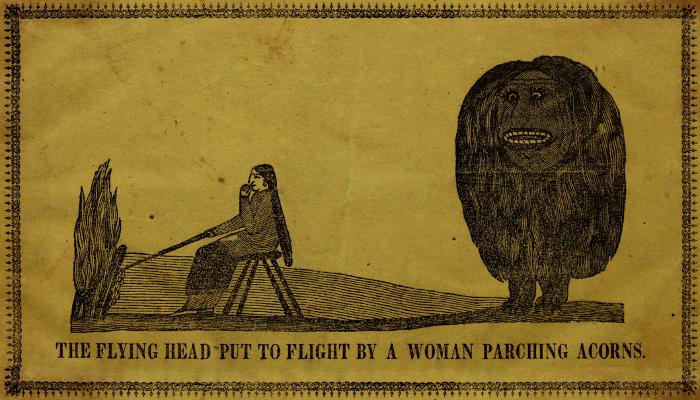
Flying Heads, which devoured several people of the country. The Flying
Heads made invasions in the night; but the people were attentive to escape
by leaving their huts and concealing themselves in other huts prepared for
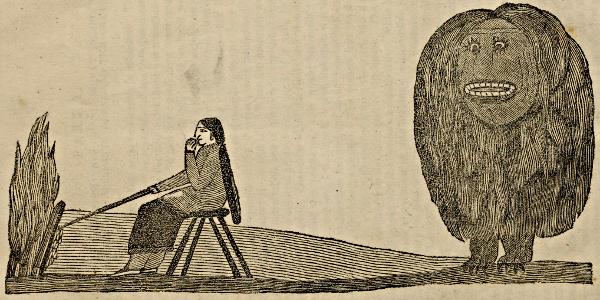
that purpose. An instance:—there was an old woman which resided at
Onondaga; she was left alone in the hut at evening, while others deserted.
She was setting near the fire parching some acorns when the monstrous Head
made its appearance at the door: while viewing the woman it was amazed
that she eat the coals of fire, by which the monsters were put to flight, and
ever since the heads disappeared and were supposed concealed in the earth.
After a short time the people were invaded by the monster of the deep:
the Lake Serpent traverses the country, which interrupted their intercourse.
The five families were compelled to make fortifications throughout their respective
towns, in order to secure themselves from the devouring monsters.—The
manner making the fort: at first they set fire against several trees as
requires to make a fort, and the stone axes are used to rub off the coals, as
to burn quicker; when the tree burns down they put fires to it about three
paces apart and burns it down in half a day; the logs are collected to a
place where they set up round according to the bigness of the fort, and the
earth is heaped on both sides. A fort generally has two gates; one for passage,
and the other to obtain water. The people had implements which they
used to make bow and arrows. The kettle is made of baked clay in which
the meat is boiled; the awl and needles are made of hard bone; a pipe for
smoking, is made of baked clay, or soft stone; a small turtle shell is used to
peal the bark; a small dry stick is used to make a fire, by boring it against
the seasoned wood.
Perhaps about 1250 years before Columbus discovered the America, about
two hundred and fifty winters since the people left the mountain, the five
families became numerous and extended their settlements, as the country
had been exposed to the invasion of the monsters that the people could not
enjoy but a short space of time without being molested. About this time a
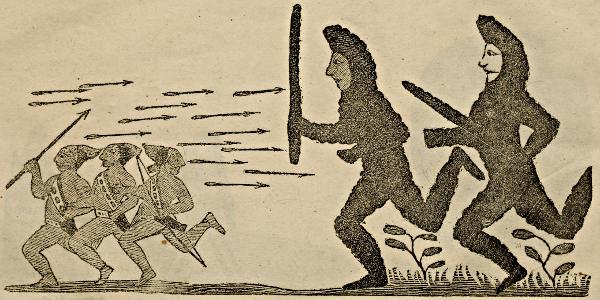
powerful tribe of the wilderness, called Otne-yar-heh, i. e. Stonish Giants[4]
overrun the country and the warriors were immediately collected from several
towns and a severe combat took place, but the warriors were overpowered
and the people fell at the mercy of the invaders, and the people were
threatened with destruction, and the country was brought to subjection for
many winters. As the people have been reduced so often they could not
increase. The Stonish Giants were so ravenous that they devoured the people
of almost every town in the country; but happily the Holder of the
Heavens again visits the people and he observes that the people were in
distressed condition on the account of the enemy. With a stratagem he
proceeds to banish their invaders, and he changes himself into a Giant, and
combines the Stonish Giants, he introduces them to take the lead to destroy
the people of the country: but a day’s march they did not reach the fort
Onondaga, where they intended to invade, and he ordered them to lay in a
deep hollow[5] during the night and they would make attack on the following
morning. At a dawn of the day, the Holder of the Heavens ascended upon
the heights and he overwhelms them by a mass of rocks, and only one escaped
to announce the dreadful fate; and since of the event the Stonish
Giants left the country and seeks an asylum in the regions of the north.—The
families were now preserved from extinction. The Lake Serpent discovers
the powerful operations of the Holder of the Heavens, instantly retreats
into the deep places of the lakes. After the banishment of the monster
of the deep made its appearance in the country; a snake with the shape
of human head opposed the passage between the Onondaga and Go-yo-gouh,
now Cayuga, which prevented their intercourse, as the snake had seated
near the principle path leads through the settlements of the Five Families.
The people were troubled of their condition, and finally they determined to
make resistance. They selected the best warriors at Onondaga, and after
they were organized and prepared proceeded to the place; after a severe
conflict the snake was killed; the lake serpent was often seen by the people,
but the thunder bolt destroyed the serpent or compelled them to retire
into the deep. About this time they were various nations inhabited the
southern countries, these nations descended from the families that were dispersed
after the vine broke on Onauweyoka, [Mississippi.] The Holder of
the Heavens visited the Five Families and instructed them in the arts of
war, and favors them to gain the country beyond their limits, after which he
disappeared.
Perhaps 1000 years before Columbus discovered the America. About
this time the Five Families become independent nations, and they formed a
Council fire in each nation, &c. Unfortunately a war broke out among the
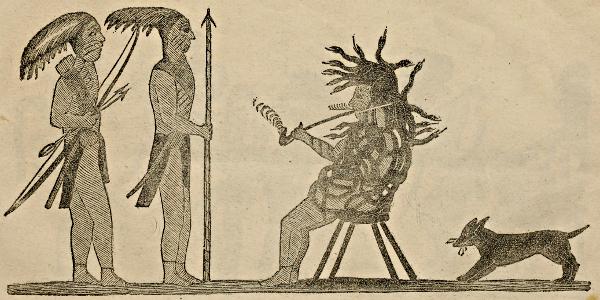
Five Nations: during the unhappy differences the Atotarho was the most
hostile chief, resided at the fort Onondaga; his head and body was ornamented
with black snakes;—his dishes and spoons were made of skulls of
the enemy; after a while he requested the people to change his dress, the
people immediately drove away the snakes—a mass of wampam were collected
and the chief was soon dressed in a large belt of wampam; he became
a law giver, and renewed the chain of alliance of the Five Nations
and framed their internal government, which took five years in accomplishing
it. At Onondaga a tree of peace was planted reached the clouds of
Heaven; under the shade of this tree the Senators are invited to sit and
deliberate, and smoke the pipe of peace as ratification of their proceedings;
a great council fire was kindled under the majestic tree, having four branches,
one pointed to the south, west, east, north: the neighboring nations were
amazed at the powerful confederates; the Onondaga was considered a heart
of the country; numerous belts and strings of wampam were left with the
famous chief as record of alliance, &c., after he had accomplished the noble
work he was immediately named Atotarho, King of the Five Nations; and
was governed by the senate, chosen by the people annually; the successor
of the kings to follow the woman’s line. About this time the Te-hoo-nea-nyo-hent,
or Senecas was at war with the Squawkihows, a powerful tribe
passed the banks of the Genesee river; after various engagements the Senecas
sent an army to scourge the enemy, but were repulsed with a severe
loss; the melancholy intelligence was soon conveyed to Onondaga and informed
the king of their defeat; a powerful army of the allies were soon
directed against the Squawkihows; after a long siege the principal fort was
surrendered without discretion, and the chief was taken prisoner, put to
death, the war terminated, however a remnant of the Squawkihows were allowed
to remain in the country and became vassals to the five nations after
the conquest. The government ordered the Senecas to settle the country
and to build forts on the Genesee river as to keep Squawkihows in subjection,
for fearing in time they might create a rebellion. The Senecas now
possessed along the bank of the Great Lake, now Ontario, to the creek called
Kenaukarent, now Oak Orchard, the bank of the river Onyakarra, now
Niagara, possessed by Twakanhah, [Mississaugers.]
In the days the king Atotarho II. about this time the Oyalkquoher, or
big bear invaded the territory of the five nations, the hunters were often attacked
by these monsters. At the village of Ohiokea, situated west of
Oneida creek, a small party went out to hunt and encamped near the lake
Skonyatales; one morning while they were in the camp a noise broke out
in the lake; a man was sent immediately to see the tumult; he saw a great
bear on the bank rolling down stones and logs; the monster appeared to be
in a great rage: a lion came out of the lake and suddenly fell upon the bear,
a severe contest ensued, in the mean time the bear was beaten and was
compelled to leave the bank, the next day the men went in search of the
bear, they found the bear; one of the fore legs was so heavy that two men
could not lift but a hands high, they procured some of the meat for useful
purposes in the time of war. About this time a great musqueto invaded
the fort Onondaga; the musqueto was mischievous to the people it flew
about the fort with a long stinger, and sucked the blood a number of lives;
the warriors made several oppositions to expel the monster, but failed; the
country was invaded until the Holder of the Heavens was pleased to visit
the people; while he was visiting the king at the fort Onondaga, the musqueto
made appearance as usual and flew about the fort, the Holder of the
Heavens attacked the monster, it flew so rapidly that he could hardly keep
in sight of it, but after a few days’ chase the monster began to fail: he chased
on the borders of the great lakes towards the sunsetting, and round the
great country: at last he overtook the monster and kill it near the salt lake
Onondaga, and the blood became small musquetos.
In the reign the king Atotarho III. About this time the Oneidas had
extended their forts down the river Kaunsehwatauyea, or Susquehanna, a
fort situated on the river, there was a certain woman delivered a male child
uncommon size; when he was twelve years of age he was nearly as large
as grown person, and he would beat his playmates which would create disputes,
but the mother would correct him, and afterwards she prevailed, he
promised never to injure his people; when grown up he became a giant and
was a great hunter; the parent was stored with venison continually; he was
so strong that when returned from hunting he would have five or six deers
and bears strung round on his belt. The giant was named Soh-nou-re-wah,
i. e. Big Neck, (now Shawnees) which inhabited the banks of the river and
brought several suits of dress and the scalps of whom he had killed. The
Sah-wau-noo sends messengers to fort Keu-na-sen-wa-tau-yea as to demonstrate
the conduct of Soh-nau-ro-wah, but the business was left upon the
relatives Sau-rau-ra-wah, who persuaded him to reform his behaviour for the
future: he remained only two winters without making disturbance; he went
down the river and whenever he came to a town he committed the same
outrages upon the inhabitants, and plundered the people’s clothes, skins, &c.
Again the Sau-wa-noo sends a deputy and reported their resentment, but
determined to make hostile aggressions if not satisfaction was made on their
part. The Chief Ne-nau-re-tah-go sends a belt of Wampum, and offered
the terms of peace, which was accepted; but the Sau-rau-roh-wah was not
disposed to favor the treaty; he left the fort and went down and located on
the bank of Kau-nau-seh-wah-tau-yea river, (said Susquehanna) and commenced
to build a fort;[6] he was frequently visited by his relatives; and after
the fortification was completed he resolved to continue the war against
his enemies; he went from time to time and attacked the people which inhabited
on the river as he had done before; he would lay in ambush near
the path, and whenever the people are passing he shoots them: he used a
plump arrow, which was so violent that it would break the body in two parts:
as he became mischievous to the people that the relatives were obliged to
form a plan to destroy him; but Sau-rauh-ro-wah was not easily to be quelled,
it was supposed that ten warriors were not sufficient to equal his strength.
At the fort Kou-na-seh-wa-ta-yea there went three warriors of his natives
which bring him favorite diet, a mess of huckle berries, &c.; the Sau-nou-ro-wah
was pleased of the visit and the food which was given; but while he
was eating it one of the warriors, with a club, concealed under his cloak,
instantly stepped on the bench where he was setting, and gave a fatal blow
on the monster’s head, he was so distracted that he run out the fort and was
intended to cross the river, he sunk in the mire which was near the bank,
the warriors prevailed and killed him on the spot: the warriors spoiled his
house and obtained a large quantity of skins, &c.; and the fort was ruined
ever since.
Perhaps about 800 years before the Columbus discovered the America.
About this time the Twakanhahors, (now Mississaugers) ceded the colonies
lying between the Kea-nau-hau-sent (Oak-Orchard,) and the river Onyakarta,
(Niagara) to the five Nations.
About this time lived the king Atotarho IIII. There was a woman and
son resided near the fort, which was situated near a nole, which was named
Jenneatowaka, the original seat of the Council fire of the Te-hoo-nea-nyo-hent
(Senecas;) the boy one day while amusing in the bush he caught a
small serpent called Kaistowanea, with two heads, and brings it to his apartment;
the serpent was first placed in a small bark box to tame, which was
fed with bird’s flesh, &c. After ten winters the serpent became considerable
large and rested on the beams within the hut, and the warrior was obliged
to hunt deers and bears to feed the monster; but after awhile the serpent
was able to maintain itself on various game; it left the hut and resided on the
top of a nole; the serpent frequently visited the lake, and after thirty years
it was prodigious size, which in a short time inspired with an evil mind against
the people, and in the night the warrior experienced the serpent was brooding
some mischief, and was about to destroy the people of the fort; when
the warrior was acquainted of the danger he was dismayed and soon moved
to other fort; at daylight the serpent descended from the heights with the
most tremendous noise of the trees, which were trampled down in such a
force that the trees were unrooted, and the serpent immediately surrounded
the gate; the people were taken improvidentially and brought to confusion;
finding themselves circled by the monstrous serpent, some of them endeavored
to pass out at the gate, and others attempted to climb over the serpent,
but were unable; the people remained in this situation for several days;
the warriors had made oppositions to dispel the monster, but were fruitless,
and the people were distressed of their confinement, and found no other
method than to rush to pass out at the gate, but the people were devoured,
except a young warrior and sister, which detained, and were only left exposed
to the monster, and were restrained without hopes of getting released;
at length the warrior received advice from a dream, and he adorned his arms
with the hairs of his sister, which he succeeded by shooting at the heart,
and the serpent was mortally wounded, which hastened to retire from the
fort and retreated to the lake in order to gain relief; the serpent dashed on
the face of the water furiously in the time of agony; at last it vomited the
substance which it had eaten and then sunk to the deep and expired. The
people of the fort did not receive any assistance from their neighboring forts
as the serpent was too powerful to be resisted. After the fort was demolished
the Council fire was removed to other fort called Thau-gwe-took, which
was situated west of now, Geneva Lake, erected bulwarks on Mountain
Ridge, west of Genesee River.
About this time reigned the King Atotarho V. At the fort Ke-dau-yer-ko-wau,
(now Tonewanta plains) a party went to hunt and were attacked
by the Ottauwahs, which created differences between the two nations as
they entered on no terms but to commence hostilities; the To-hoo-nyo-hent
sends a band of warriors to attack some of the hunters as to retaliate the
vengeance upon their enemies. The warriors advanced above the lake
named Geattahgweah (now Chatauque) and made encampment and agreed
to hunt two days, after which to proceed towards the enemies’ country;
the warriors went in various directions; a certain warrior passed a small
brook, he discovered a strange animal resembling a dog, but could not discover
the head; the creature was a greyish color, and was laying asleep exposed
to the rays of the sun; and also discovered a den, supposed the place
of his residence; the warrior returned to the camp at evening and related the
kind of animal, and informed them, as he imagined was a very poisonous animal,
and he was afraid to approach it again, but one of the jokers laughed
at him and he was called a cowardly fellow; the joker determined to go himself
and kill the creature without trouble, but wished some of the warriors
to be spectators in the time of the engagement; accordingly the warrior
went, accompanied by a number of warriors; he was directed to the spot and
discovered the animal. After beating it short time with his club, he seized
the animal and tied it with a tumline; but while he was lifting it the creature
immediately moved to the den. With all his might, he held the tumline,
but he could not stop it, he was compelled to let go the tumline when
the creature went beyond his reach; the warrior was confused at not being
able to kill the animal; he hastened to retire from the spot, but when a few
paces he was taken with the pestilence which was influenced by the creature,
and suddenly died; another warrior was at sight and directly fled to carry
the intelligence, but also died at a short distance, and the others returned to
the camp; but the pestilence soon prevailed among the warriors, and many
of them died in the same manner; a few of them escaped by leaving the
camp before the plaigue appeared, and thus ended the expedition. The Ottauwahs
continued their hostilities and attacked the hunters; the Senecas
sent out a small party and fought—drove the enemy off, but their engagements
were small and continued many winters.
In the days of king Atotarho VI., perhaps 650 years before the Columbus
discovered the America, at the fort Keadanyeekowa or Tontawanta plains, a
small party went out to make incursion upon the enemy that may be found
within the boundaries of the kingdom. They penetrated the Ohio river and
encamped on the bank; as they were out of provision, the warriors were anxious
to kill a game; a certain warrior discovered a hollow tree, supposing a
bear in the tree, he immediately reported; the warriors were in hopes to obtain
the bear—went to the tree; one of them climbed and put a fire in it in
order to drive out the creature; the warriors made ready to shoot, but were
mistaken, there instantly came out a furious Lizard, and quickly grasped and
leaped into the hollow of the tree and the young ones devoured it; a grumbling
noise ensued, the warriors were terrified at the monstrous creature and
were soon compelled to retire, except one staid at the tree while others fled;
he remained until the party was destroyed and the last warrior was chased;
the warrior immediately left the tree and ran on the way fortunately met
the holder of the Heavens who advised him to stop and offers the aid of making
resistance which was accepted; the warrior was instructed to make fire
without delay and to get some sticks to use with which to prevent the Lizard
flesh from uniting the body as being efficatious, the protector changed into
a lion and laid in wait, in a meanwhile the monster came up, a severe engagement
took place, the warrior hastened with a stick and began to hook
the Lizard’s flesh, when bit off by his defendant and throws it into the fire,
by means the monster was quelled. The warrior thanked for the personal
preservation. The protector vanished out of his sight. The warrior returned
to the fort and related the occurrence. The war raged: the Senecas
had sent out parties against the Ottauwahs and obtained various successes;
at last the Ottauwahs sued for peace. After a few winters the Senecas
gained their mutual intercourse with the Ottauwahs and other neighboring
nations. About this time reigned the king Atotarho VII. who authorised
by the Senate to send an expedition to explore the countries towards the setting
sun, he sends a messengers to acquaint the Ottauwahs of his intention,
and wished them to form such arrangements and to favor their passage,
which was complied agreeable to his request. The king appointed two captains
to command the expedition, about fifteen men were selected from the
five nations; after they were equiped and prepared, commenced the journey
and arrived at Sandusky; the King of Ottauwah sent two warriors to accompany
the expedition; on their way held several conferences with the nations
and all seemed to favor their passage. They advanced the Mississippi
river; a duke of Twa-kan-ah had collected the people from several towns
came out to meet them the people danced around them, singing, beating
their little drums; after the ceremonies was performed the band of warriors
was invited into the national house. The band crossed the Mississippi and
continued their course towards the sunsetting; they reached an extensive
meadow; they discovered a curious animal—a winged fish, it flew about the
tree; this little active creature moved like a humming bird. They continued
the journey and come at the village of the Dog Tail Nation, the band
was accommodated, amused with dances, and was conducted to the chief’s
house. They were astonished that the people had short tails like apes; a
hole was made through their seats where they put their tails. The band
continued their direction and came to another nation and too was kindly received,
and their object was favorably accepted by the head men of the nation.
During their stay, a certain warrior of the band courted a young woman,
but the warrior died soon after the marriage. They observed that the
people did not eat any meat but drink the soup. The band continued the
journey, but before reached the Rocky Mountains, were arrested by a giant;
the band was compelled to return; after a long journey came back to the
seat and informed the king all the particulars about the journey. After a
time the five nations was desirous to preserve the peace and friendship with
the western nations; ambassador was sent to the Lentahkeh nation, who inhabited
the country east of Ohio River (now in Kentucky); another ambassy
was sent, who went and lived among the Ottauwahs for several years; he
married a woman and afterwards obtained two children; he was invited to
join a company going out a winter’s hunt. They journeyed some distance,
and reached their hunting grounds; but the men were so unlucky that they
could kill but a few game; after a few days the people were destitute of provisions;
the leader of the company commanded the overseer to select two fat
persons and to kill them without delay, which was soon executed; the flesh
of these victims was distributed among the people. The leader had commanded
the people that if any one killed a game the meat should be left with
the overseer for distribution, and that who disobeyed, the offender should be
punished in a severest manner. The ambassy killed a bear, the meat was
disposed to the rules. The leader daily butchered two persons to feed the
people, which only increased their distress. The people were so feeble that
they were unable to hunt any more, and many of them began to famish.—The
ambassy again killed another game and bring it secretly to his camp, but
it was soon detected and rumored among the people; at this offence, the ambassy
was ordered to appear before their tribunal; some men were angry at
him and sought to destroy him, but the leader deemed it unjust, it would violate
the treaty they had entered with the five nations; but however, to satisfy
the people, the leader consented to use other method to destroy him; he
commanded to strip him and to seize his clothes and the instruments; after
which to extinguish their fires, and then to remove their camps a half day’s
journey distance; the offender would certainly freeze without remedy; but
the ambassy was ingenious, finding that he would be surprised, instantly takes
a suit of dress and bow and arrows, and hides them under the hemlock
boughs which were spread in the camp. In a meanwhile the opponents
entered the camp, the ambassy was stripped without discriminate, as they
had determined to destroy him. The wife was compelled to leave him, or
else she would share the same fate.
The company retired; he dressed himself immediately and proceeded and
was in hopes to reach a fort situated near the Lake Erie; but was so fatigued
that he could not travel very fast; about sunset he happened to approach
on an age of a dark forest; he selected a spot where he encamped,
but as he had no kind of food to eat and was quite dejected after making
exertions to render himself comfortable, but failed, the weather being unfavorable,
as it was cold and cloudy, however he was seldom taken by surprise;
having a good understanding about astronomical calculations, ascertained
that the storm was at hand; after kindled a fire laid himself down to linger
out a miserable existence which he was doomed to suffer. Early in the morning
he heard some noise as something was coming, which at once attracted
his attention; he was afraid; as presumed that some of his enemy had overtook
him; fortunately a young man came up and sat down; the visitor
showed a friendly disposition, after a short conversation the ambassy related
his distressed condition; the visitor offered to relieve him as soon as possible,
which was received with sanguine expectations; the ambassy was advised
that a snow would fall so deep that he would be in want of a pair of snow
shoes, the visitor offered the pattern and showed him how to make the shoes.
The ambassy was directed where to find the game; and did as he was bidden.
On the night the young man made another visit and advised the
ambassy where to catch bears; after the conversation the visitor disappeared.
He succeeded and caught seven bears; after he had prepared some
meat and the bears’ oil, immediately went to the encampment in search of
his wife and children, found them almost perished; as first gave them each a
spoonful of oil and were soon relieved; he directed them to his camp. The
ambassy was relieved from distress whilst his enemy was lingering in despair;
he examined the camp and was astonished to find that the people
were utterly famished; the people became so weak and faint that they were
not able to make fire; those who held out had eat the human flesh as long
as they could they themselves, and were lying among the dead, the company
was now exposed to destruction, as the people had put themselves to disgrace;
the ambassy had refused to invite any of them except his wife’s
relatives; the disasters were so worn out did not reach the camp until next
morning. After a few days by his exertions, the men’s strength was revived,
and were capable to hunt. After they had come back to the town the ambassy
was so shamefully abused by the people, he was compelled to leave
his wife and the country. About this time the Ottawahs became numerous
and powerful nation, occupied an extensive country lying between the Lake
Erie and the Ohio river, and was supposed their national force amounted
about 4000 men.
In the reign of King Atotarho VIII., perhaps 4000 years before the Columbus
discovered America. About this time the Twakanhah or Messissaugers
began to wage a war against the five nations; the Senecas on the frontier
were most engaged in the warfare. After various skirmishes the enemy
was so excited that they determined to destroy the fort Kauhanauka, (now
in Tuscarora near Lewiston,) but the commander of the fort was aware of
the danger, he sent messengers to the forts in the vicinity, and about eight
hundred warriors were collected at fort Kauhanauka. The commander had
sent runners to observe the movements of the enemy. The army marched
towards the river, and hid themselves among the bushes under the mountain;
the enemy came up; a bloody battle ensued; the enemy was repulsed
and flies from the foe. The army retired to the fort; soon after the commander
despatched two runners to the forts on the Genesee river to
procure assistance as soon as possible; the army received reinforcements;
they made bark canoes and carried them to the mouth of the
Niagara river; the canoes were ready, the commander sent a chieftain
and offered the enemy an intermission or parley, but the proposal was not
accepted; the army immediately crossed the river and made vigorous attack:
the enemy was routed and fled from the bank without making resistance,
retreated towards the head of the lake; after burning the huts, the
army returned to the fort; but the commotions were not quelled; small parties
of the Senecas often take the canoes and go by water towards the head
of Ontario lake, in search of the enemy, but they avoid from attack of superior
force; several engagements were made on the lake with small parties
of the enemy; after a while the commander of the fort Kauhanauka, was
ardent to attack the main body of the enemy; he sends runners beyond the
Genesee river, and obtained two thousand warriors: the army again crossed
the Niagara river and proceeded towards the head of the lake, but before
reached the beach met a strong force of the enemy; after a desperate contest
the army retreated; the commander soon perceived that it was impossible
to gain the conquest, sued for peace and offered to restore the prisoners
which he took from them which was concluded. About this time the Stonish
Giants were diminished, but very few found in the north regions; the
Giants understood the language of the five nations, but they were a most
savage tribe, and often attacked the hunters, but that set of hordes were
extirpated. At the Onondaga, two men went out to hunt beaver, and crossed
the river St. Lawrence, and went far in the north, and discover a number
of beaver dams, and killed many beavers. One day a man went alone
in search of the beaver, but unfortunately he was taken prisoner by
the Stonish Giant; the man was compelled to run a race with the Giant, a
considerable distance; after midday the man gained and almost went out of
sight, but the giant whooped, by which the man was so affected that he
fainted and fell down. The giant took advantage of him and soon passed
him; the man was dismayed and turned his course, and sought to escape and
endeavored to hide himself: he climbed a small tree and bent it to another
tree, and leaped from tree to tree, until he reached a large basswood stump
which had sprouted several branches, and seated himself in the midst of it
and watched the pursuer: in a few moments the giant came up and examined
the stump for some time; at length the giant exhibited a curious instrument
which he called a pointer, and possessed a power of the nature; it
directed him where to find game; the giant could not live without it. The
man observed the motion of the hand, and as it was about to point to him, he
jumped from the stump and seized it by the fingers, and instantly possessed
the valuable instrument; the giant was defeated and immediately entreated
for the pointer, and offered to mention the medical roots as a mark of friendship,
which was accepted; the pointer was restored to the owner, after
which the giant retired; the man came home and began to doctor, and cured
many diseases; he was skilled in the business and drew hair and worms
from persons whom the witches had blown into their bodies. It was supposed
that the Skaunvatohatihawk, or Nanticokes in the south first founded
the witchcraft. Great pains were taken to procure the snakes and roots
which the stuff was made of to poison the people. The witches formed into
a secret society; they met in the night and consult on various subject respecting
their engagements; when a person becomes a member of their society, he
is forbidden to reveal any of their proceedings. The witches in the night
would turn into foxes and wolves, and run very swift, attending with flashes
of light. The witches sometimes turn into a turkey or big owl, and can fly
very fast, and go from town to town, and blow hairs and worms into a person;
if the witches are discovered by some person they turn into a stone or rotten
log; in this situation they are entirely concealed; about fifty persons were
indicted for being witches, and were burnt to death near the fort Onondaga,
by order of the national committee. About this time a strange thing happened
near the village of Kaunehsuntahkeh, situated east of Oneida creek:
a man and his wife and another person returned from hunting, but before
they reached the village the night was getting late; they went into a house
to stay over the night; the house where the dead bodies were deposited;
they kindled a fire and went to sleep, but when the fire was
out, the room became dark, the man heard something was gnawing:
the man kindled the fire, he discovered the person was dead eaten by a
ghost; he was so frightened that he trembled; he immediately told his wife
to quit the room as soon as possible; he remained a few moments and also
left the house and followed his wife and overtook her, but she became faint
and could not run fast; they saw a light coming and supposed the ghost was
chasing; fortunately they gained the village. The next day the people went
and burnt the dead bodies. This important event was soon made known
among the five nations, and afterwards changed their mode of burying, by
setting posture face to the east; but again they were troubled with the dead
bodies, and were compelled to make some alterations in burying.
In each Nation contain set of generations or tribes, viz. Otter, Bear, Wolf,
Beaver, Turtle. Each tribe has two chiefs to settle the disputes, &c. If a
man commits murder, the nearest relation of the slain despatches the murderer
with a war-club; the slain and the murderer are put into one grave.
Sometimes their relation of the offender present a belt of white wampum,
to make the atonement. The adulterous women are punished by shaving
their heads, and banished from the town. The thieves are punished by
whipping severely. To recover debts, they generally apply to the chiefs;
the payments are made up by the relatives of the debtor. They have a
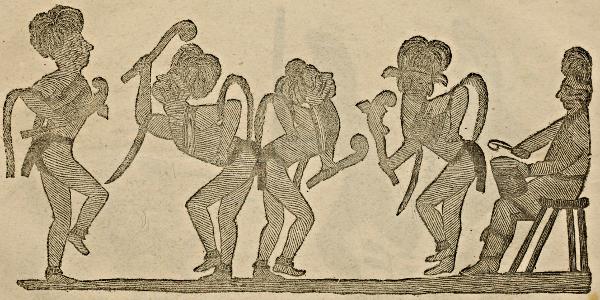
certain time of worship; the false faces first commence the dances; they
visit the houses to drive away sickness, &c. Each town or district are allowed
to sacrifice a couple of white dogs: the dogs are painted and ornamented
with strings of wampum: they throw the dogs into the fire, and
some tobacco, and addresses the Maker. They pretend to furnish him a
coat of skin and a pipe full of tobacco; after which, have dances for several
days. The private feats are guided by the dreams. The sixth family,
Esaurora, or Tuscaroras, was visited by a person, and went to see their
amusements, but he was abused by some of the ball-players. He punished
the offender by throwing him into a tree; he suddenly disappeared, but
the person came again and released the fellow from the tree. The visitor
appeared very old man; he appeared among the people for a while; he
taught them many things; how to respect their deceased friends, and to love
their relations, &c., he informed the people that the whites beyond the great
water had killed their Maker, but he rose again; and he warns them that
the whites would in some future day take possession of the Big Island and
it was impossible to prevent it; the red children would melt away like snow
before the heat. The aged became sick, and he told them to get different
kinds of roots, to cure the diseases; and also showed them the manner of
mourning, &c. The aged man died among them, and they buried him; but
soon after some person went to the grave and found he had risen, and never
heard of him since.
In the reign the King Atotarho IX., perhaps 350 years before the Columbus
discovered the America. About this time the Kanneastokaroneah or
Erians sprung from the Senecas, and became numerous and powerful nation,
occupying the country lying between the Genesee and Niagara Rivers. It
was supposed that the national sovereignty was confirmed by the Senate
of the Five Nations. A Queen, named Yagowanea, resided at the fort
Kauhanauka, (said Tuscarora.) She had an influence among the people, and
extended her authority over twelve forts of the country. A treaty of peace
was concluded between her and the Twakanhah, (Messissaugers.) After
a time dissentions broke out between the Five Nations and the Messissaugers,
and soon commenced hostilities; but the war was regulated under her
control. The Queen lived outside the fort in a long house, which was called
a Peace House. She entertained the two parties who were at war with
each other: indeed, she was called the mother of the Nations. Each nation
sent her a belt of wampum as a mark of respect, but where the Five Nations
were engaged in the warfare she admitted two Canandaigua warriors
into her house; and just as they began to smoke the pipe of peace a small
party of the Messissaugers too came into the house. She betrayed her vistors—she
advised the Messissaugers to kill the warriors, which was soon executed;
the Messissaugers soon retired. The Queen was informed that the
two warriors of Canandaigua had been over the river and killed a young
prince of the Messissaugers: this offence was too great to pass without condemning
the murderers; the reason she gave them up. She immediately
went and consulted the chieftain of the band, stationed at Kanhaitauneekay,
east of Onondaga village, Buffalo reservation, and from thence repaired to
fort Kauquatkay, situated on the Lake Erie, the residence of the Kaunaquavouhar,
a chief commander of the Erian forces. She dispatched two
runners to assemble the people at Kauquatkay the Queen too sends an ambassy
to form an alliance with the Naywaunaukauraunah, a savage tribe encamped
on the lake Erie, to unite against the Five Nations. During the
absence of the Queen from the fort Kauhanauka, a woman went privately
and took a canoe and proceeded on the lake Ontario, towards Canandaigua,
as fast as possible; she left the canoe at some place and went through the
woods, and came late in the evening at Canandaigua, a fortified town, and
immediately informed the Governor, Shorihowane, that the Erians were making
preparations to destroy the people living on the east side of Genesee
river. The woman gave direction how to send the spies: the governor rose
in the morning and sent out two fast runners to the fort Kauhanauka, to ascertain
the matter; the two spies came to an old cornfield south of the fort,
where they met some boys hunting squirrels; the spies made inquiries and
received all necessary information respecting the Erians’ Council at Kauquatkay,
and went home as fast as possible. The Governor Shorihowane, obtained
the news. The business was so in haste that it was impossible to procure
any aid from the allies. He collected the warriors from the neighboring
forts, amounting to fifteen hundred besides the women and the old men.
The governor separated the people into three divisions; first the men, between
thirty and fifty years of age; second division, the men were from
twenty to thirty years of age; third division, were women and old men.—The
Governor had commanded the leaders to be in good courage and use
all the means in their power to defeat the enemy. After parading the divisions
they marched towards the Genesee River; the army halted at the
fort Kawnesats, situated on a small lake east of Genesee. The governor
had sent runners to observe the motions of the enemy. The women and
old men were to remain at fort to cook and provide provisions for the people.
The runners came in and announced that the Erians had crossed the
Genesee river; the divisions immediately proceeded and laid an ambush on
both side the path; the first division was in front to commence the action at
the advance of the enemy. With a stratagem a certain warrior was dressed
with a bear skin, and was seated on the path a little distance from the
front of the division, meanwhile the enemy came up and saw the bear sitting
at ease; the enemy chase it, which brought them in the midst of the
division; at once burst a most hideous yell, followed with a rattling of war
clubs. After a severe contest the first division was compelled to retreat,
but the assistance of the second company came up and the battle was renewed.
At last the Erians fled from the field, leaving six hundred warriors
slain. The enemy hurried to cross the Genesee river; the Governor
declined to chase the enemy, but returned to Canandaigua. About
this time the King of the Five Nations had ordered the great war chief
Shoribowane, (a Mohawk,) to march directly with an army of five thousand
warriors to aid the Governor of Canandaigua against the Erians, to
attack the fort Kauquatkay, endeavor to extinguish the council fire of the
enemy, which was becoming dangerous to the neighboring nations; but unfortunately
during the seige a shower of arrows was flying from the fort, the
great war Chief Shorihowane was killed and his body conveyed back to Genesee
and was buried in a solemn manner; but however, the seige continued
for several days. The Queen sued for peace,—the army immediately ceased
from hostilities, and left the Erians entire possession of the country. The
Skumantoh or Deer was the most useful game of the Five Nations; the animal
can run considerable distance in a day. The people have a small dog
in aid to overtake, but very seldom stop when pursued by the dogs.
These creatures generally go in the river or lake; in this situation the dogs
are compelled to leave the deer. The wolves are also prevented from catching
these animals; the hunters have never seen a deer lying dead, except in
some instances; if a person find one it was considered a bad sign; that person
some of his relatives will die in the course of a few moons. When the
deer get old they throw themselves into the river and die. Another way
has been discovered: if a deer runs off and barks at the hunter, it was a
bad sign; his wife has committed adultery, in consequence he cannot kill any
deer. When a person intends to hunt deer he procures a medicine, and
vomits once daily for twelve days, after which he procures some pine or cedar
boughs and boils them in a clay kettle, and after removed from the fire,
he takes a blanket and covers himself over with it to sweat; the person that
uses the medicine does not allow a woman with child or uncleanness to eat
any of the venison. The people sometimes go out to hunt as the corn begins
to grow on the ears: they make a long brush fence and remove the
leaves on both sides of the fence, the deer will follow the path; the person
can easily kill the game. In the hot days of the summer, they go and
watch in the night at the salt licks. Another mode of killing the deer; they
take slivers of basswood bark and proceed to the place and obtain a canoe
and go into the river or lake in the night, provided with a light of slivers.—The
bear, elk and buffalo, were found in the territory of the Five Nations.—The
moose inhabit the spruce country and the heads of the Mohawk river;
this country was never inhabited by any kind of people in the winter season;
the snow fell so deep it was supposed that country would always remain a
wilderness.
About this time the Oneidas killed a very poisonous blue otter; the meat
was very carefully preserved; some are used to hunt, and others to poison
the arrows when go out to war; some of the witches obtained the meat to
poison the people. In the river and lakes are found various kinds of fishes.
The people had particular time of the moon to make sugar, plant corn, and
hunt deer and other animals. The seasons of the year they are directed by
the seven stars of the heavens: when warriors travel in a great forest they
are guided by a northern star; if the sun or moon is eclipsed they believe
that the Bad Spirit darkens it: the people are assembled, and make a loud
noise to scare the Bad Spirit from the orb. They believe that the clouds in
the moon were earth and inhabited by people. The six family made resident
near the mouth of Neuse river, in North Carolina, and became three
tribes, the Kautanohakau, Kauwetseka, and Tuscarora, and united into a
league and were at war with the Nanticokes, and totally on the sea shores.
About this time the Long House became numerous and powerful; each nation
could muster as follows:—the Mowhawks, 5000 warriors; Oneidas, 3500
warriors; Senecas, 6000 warriors; Onondagas, 4000 warriors; Cayugas, 4500
warriors; total amount, 23,000 warriors. The Mowhawk was considered an
oldest brother, and was appointed to keep a watch towards the sunrise, the
Senecas were appointed to keep a watch towards the sunsetting. The Senators
met annually, at the fort Onondaga, to promote their national prosperity.
The Long House were free and independent nations, and have been acknowledged
in such treaties made with them by the neighboring nations.—Every
independent nation have a government of their own: they have a national
committee meet occasionally: they have a Chief Ruler, named Aukoyaner[7],
a peace-maker who is invested with authority to administer the government.
Each nation have a right to punish individuals of their own nation
for offences, committed within their jurisdiction; each nation are bound
to oppose any hostile invasions of the enemy.
In the reign Atotarho X., perhaps about 250 years before Columbus
discovered America. The Oyalquarkeror, Big Bear, continue invade the
country at Onondaga; a party went and encamped a day’s journey distance
from the village; they hunted and killed a few deer. One morning a woman
left the camp and was going home to pound corn and to supply the men
with provisions; but before she reached half way she was attacked by the
monstrous Bear, and was soon devoured, as she did not return. The men
were anxiously waiting, and were suspicious about her; a man was sent to
see if she was coming; he advanced where she was assaulted, and discovered
the place of her remains; he soon perceived their fate; he immediately reported
and the men immediately proceeded to the place; and while examining
her remains the bear made a vigorous attack; the men met a severe engagement,
but in the meantime the monster was killed: they procured some
of the meat for useful purposes.
Atotarho XI., perhaps about 150 years before Columbus discovered America.
About this time the Tuscaroras sends messengers and renewed their
intercourse with the five nations. The Tuscaroras were yet numerous and
had twenty-four large towns, and probably could muster six thousand warriors.
They possessed the country lying between the sea shores and the
mountains, which divide the Atlantic states; but afterwards a contest arose
and the southern nations, the Oyatoh, Kwntariroraunuh, Caweda. The war
lasted for many years; unfortunately it became so distressed that the Tuscarora’s
frontier settlements were reduced considerably, but the Tuscaroras
send expresses and received assistance from their brethren, the Five Nations,
and war was carried on for some time: at last the enemy was compelled to
suspend their hostility.
The Bear tribes nominate the Chief Warrior of the nation. The laws of
the confederation provides the Onondagas to furnish a King, and the Mowhawks
a great war chief of the Five Nations.
About this time an earthquake was felt throughout the kingdom, supposed
a large comet fell into some of the lakes; and other signs were seen in the
heavens. The defender ceased from visiting the people in bodily form, but
appeared to the prophet. In a dream he foretells the whites would cross
the Big Waters and bring some liquors, and buy up the red people’s lands;
he advises them not to comply with the wishes of the whites, lest they should
ruin themselves and displease their Maker; they would destroy the tree of
peace and extinguish the great Council Fire at Onondaga, which was so long
preserved to promote their national sovereignty.
In the reign Atotarho XII., perhaps about 50 years before Columbus discovered
America, the Tehatirihokea, or Mowhawks was at war with Ranatshaganha,
supposed Mohegans, who occupied the opposite bank of the river
Skaunataty or Hudson. The warfare was maintained by small expeditions:
the Mowhawks would cross the river and attack the enemy: the canoes were
kept in the river continually to cover their retreat; but after a while the
Mohegans expaliated the war: the chief of the Mowhawks received orders
from the King, and invited the two confederate nations, the Oneidas and the
Onondagas, to unite against the common enemy; the band of the combined
forces immediately crossed the river and revenged a part of the country, and
the enemy were compelled to sue for peace.
In the reign Atotarho XIII., in the year 1492, Columbus discovered the
America. The Keatahkiehroneah, were fighting with the neighboring tribes
and were injurious to the frontier settlements. The five nations sends Thoyenogea
with an army of five thousand warriors and defeated the Keatahkiehroneah
and drove them west of the Ohio River; and they lay waste the
enemies’ country, and attacked other tribes &c. About this time the Erians
declared a war against the Five Nations; a long bloody war ensued; at last
the Erians were driven from the country, and supposed were incorporated
with some of the southern nations: after which the kingdom enjoyed without
disturbance for many years.
The Mowhawk was considered the oldest language of the confederacy:
Mowhawk.
- 1. WUS-KOT,
- 2. TACK-NY,
- 3. AU-SUH,
- 4. KAU-VALY,
- 5. WISK,
- 6. YUA-YAK,
- 7. GIA-TOCK,
- 8. SOT-TAI-GON,
- 9. TEW-DO,
- 10. OYA-LY,
Tuscarora.
- 1. VNTCHEE,
- 2. NAKE-TEE,
- 3. AU-SH,
- 4. HUN-TOCK,
- 5. WHISK,
- 6. O-YAK,
- 7. GIA-NOCK,
- 8. NAKE-RUH,
- 9. NI-RUH,
- 10. WOTS-HUH.
END.