The friendly Indians besieged at Talladega—Jackson
sends them help—The attempted ambush—“Painted
scarlet, and naked as when they were born”—The
battle of Talladega, and the bleaching skulls—Mutiny
of the volunteers—Davy goes home when his
time is up and reënlists—The Indian victory at
Enotachopco Creek—Davy is in a furious fight—One
hundred volunteers killed or wounded—English Intrigue
at Pensacola—Davy’s visit to that place—Many
stirring adventures in the Escambia River
country—Davy is hungry enough to climb a tree after
a squirrel—With powder and lead he buys corn from
an Indian—Home at last.
Early in November, 1813, Jackson built a fort
at Ten Islands, on the north shore of the Coosa
River, and many refugees came within its stockades.
It was called Fort Strother, after the owner
of the place on which it stood. On the 7th of
the month an Indian runner arrived with bad news
from the friendly town of Talladega, where a small
fort had been built. One hundred and fifty peaceable
Creeks were besieged by more than a thousand
Red Sticks and their allies. The latter had given
the fort three days to surrender, and relied on
thirst and hunger to bring their intended victims
to terms. The runner who came to Jackson is said
to have disguised himself as a hog, in order to
escape in the woods near-by. Jackson resolved to
save the friendly Indians at any risk. Their faithfulness
could not be unrewarded. They had refused
all attempts to turn their allegiance, and when the
enemy tried to induce them to help whip Jackson’s
army and secure the booty that might be expected,
they were repulsed with scorn. Just after midnight
Jackson began crossing the river with two thousand
men, of whom eight hundred were mounted. He
relied upon the arrival of General White, with his
men, to protect Fort Strother.
It was sun-up of the 8th when the little army
came in sight of Talladega, and deployed to right
and left, for the purpose of surrounding the hostile
Creeks. Only through the bravery of the beleaguered
Indians were the companies under Major
Russell and Captain Evans saved from an ambush.
As they drew near to the fort, the friendly Indians
within shouted in welcome:
“How do, brother? How do?”
This they kept up till Major Russell had passed
the fort and was headed for the brush-covered
creek behind it, where the enemy waited to surprise
him. The friendly Creeks tried in vain to call him
to a halt, and at last two of them leaped from the
walls, ran to his horse’s head, and pointed out the
danger. At once the hidden warriors fired on
them, and, to quote Crockett’s description of the
event, “They came forth like a cloud of Egyptian
locusts, screaming as if all the young devils had
been turned loose, with the old devil of all at
their head. They were all painted scarlet, and were
as naked as when they were born.”
Leaving their horses, Russell’s men made for
the fort. As the cordon of soldiers rushed to
enclose them in an ever-narrowing ring of fire, the
ill-fated Red Sticks fell in heaps. Many of them
were armed only with bows and arrows—futile
weapons, even against flintlock guns. Four hundred
painted braves fell before the survivors broke
through the line of drafted militia and escaped.
When Davy returned that way, a year afterward,
he saw the bleaching skulls scattered about like
gourds upon a winter field.
At Fort Strother, after returning from Talladega,
the volunteers, whose sixty days were long
elapsed, asked to go home for fresh horses and
clothing, but Jackson, who felt that he needed every
man, refused permission. White had failed him,
following orders from General Cocke, and the situation
was a bad one. The volunteers were within
their rights, but the General was determined, and as
they prepared to leave, he covered with cannon,
and the guns of his other troops, a bridge that
must be crossed on leaving camp. Of this affair
a dramatic account is given in Eggleston’s history
of the war. He tells us that behind the cannoneers
with matches lit, their general gave the malcontents
a few seconds in which to go back, with the
promise of shot and shell if they refused; and
then, the story runs, the mutineers gave in and
asked for terms.
Davy Crockett says that the discontented volunteers,
with flints picked and guns primed, marched
across the bridge, amid the clicking of the gun-locks
of the militia, some of whom had run at
the battle of Talladega. He says they were determined
to fight their way, or die together. The
merits of this affair are in dispute, but Davy and
his company returned to Tennessee, where many
reënlisted after a time. It may be set down for
certain that from that day Davy was no friend of
Jackson.
When Davy returned to the Creek country, he
went to serve the balance of six months, although
his term of two months had expired. Jackson now
had less than a thousand whites, with about two
hundred and fifty Cherokees and friendly Creeks.
One of the companies was made up of officers
whose men had gone home. Major Russell was
in command of a body of scouts, of whom Davy
was one.
It is strange that such a small force could not
be supplied with provisions. It seems to have been
in no way backed up by the Government. But in
the East matters had not gone well. Perry’s victory
and other naval successes had not made the
New Englanders any more loyal. Their pockets
had suffered, and the prizes won in privateering
were only a partial salve for their losses. The war
with the Alabama nations was not regarded as a
matter of importance on the Atlantic coast.
It was from the ranks of the ill-fed volunteers
of Kentucky and Tennessee that victory was to
come. The battle of New Orleans was fought after
the conclusion of peace, but the capture of that city
by Pakenham would have meant more war. Jackson
knew the danger of Indian victories, and with
his hungry and ragged troops and scouts fought
regardless of odds. Davy Crockett was one of the
men who learned to know what hunger was, but he
was eager to be in the hottest of the trouble, and
never had enough.
In January, 1814, Jackson’s little army pushed
on to the Horseshoe Bend of the Tallapoosa River,
and camped in a hollow square, with every prospect
of being attacked by hostiles, who were in great
numbers in the vicinity. Two hours before dawn,
the pickets were heard firing. Throwing brush on
the camp-fires, the volunteers waited for the attack,
expecting to see the Indians by the glare of the
flames; but the Creeks kept out of sight, and were
themselves aided in aiming by the light in the camp.
Four whites were killed and a number wounded,
and although several charges were made, Jackson
found it necessary to retreat. The dead were
burned, to prevent their being scalped, and the force
fell back to the Enotachopco Creek. Some historians
have called this affair a victory!
When the army was about to cross the creek,
the savages fell on the rear guard, which Colonel
Carroll was commanding. On the right flank
Colonel Perkins was in charge, and on the left
Colonel Stump. Carroll did his duty bravely, but
the other Colonels fled and their men followed
them. As Stump rode frantically past Jackson, the
General tried to cut down the coward with his
sword, but missed him. Colonel Carroll was thus
left with only twenty-five men, and was in danger
of being cut to pieces by the yelling and triumphant
warriors.
Then the scouts under Russell, with the aid of
the artillerymen, who had only one six-pound cannon,
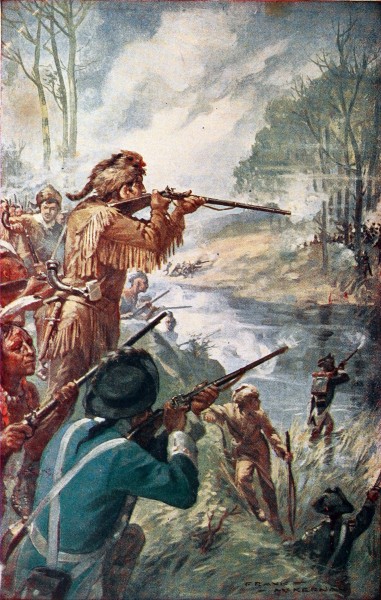
sprang to the aid of the rear guard, and Davy
had a chance to fight that must have satisfied him.
While the artillerymen were dragging the piece up
the bank of the creek and loading it with grape,
Davy’s company, led by old Major Russell, rushed
across the stream and attacked the left flank of the
Indians, who outnumbered the whites ten to one.
Constantine Perkins and Craven Jackson, of the
cannoneers, at last swept the ranks of the savages,
huddled in the narrow descent to the creek, with
a hail of grape. Then the scouts fell on the demoralized
enemy, who took to the woods, and Jackson’s
army was saved. One hundred and eighty-nine
dead Indians were counted after this fight, and
twenty volunteers were killed and seventy-five
wounded.
It is worth while to consider the iron tenacity of
Old Hickory, in the face of such disastrous losses.
Practically without an army, and with no supplies
for the friendly Creeks, he renewed his appeals to
the people of Tennessee and Kentucky, and hopefully
awaited their response. Every day of delay
made the danger greater, for the Creeks were constantly
securing firearms and powder and lead from
the British agents at Pensacola.
The spectacle of the English unloading guns and
scalping-knives for the savages at a Spanish port
has always been miserable to look upon. But in
1865, after the surrender of Lee had ended the
Civil War, twenty-five cases of Colt’s Navy revolvers,
received via London, were taken from the
warehouse of the Confederate Agent at St. George’s
in the Bermuda Islands, sold to an American, and
sent to New York on the bark Palo Alto. The
Southern army had Hartford revolvers, via England
and the blockade, with which to fight the
brothers of the men who made them. Until the
United States Government prohibited the shipping
of beef to Nassau, Bermuda, and Havana, there
was a supply sent to the Confederates through the
blockade, as best it could be, by New York dealers.
There is no use in the pot calling the kettle black.
As the volunteers returned to their homes,
they stirred the hearts of their neighbors with the
story of Jackson’s bravery and self-sacrifice, and
the indifference of the people turned to enthusiasm.
Before the end of February, Coffee returned to
Alabama with two hundred of his old brigade, and
there soon followed him two thousand men from
Western Tennessee, and two thousand more from
the mountains of Eastern Tennessee. Every man
was a rifleman. The Choctaws also offered the
stubborn General all the warriors of their tribe to
fight the Creeks.
After serving about four months instead of the
two for which he at first volunteered, Davy
Crockett returned to his home, and for some time
he was busy in providing for the comfort of his
family. After the battle of Tohopeka, in March,
1814, in which Jackson completely routed the hostile
Creeks, the victorious General made plans for
an attack on Pensacola, which port the British fleet
was using as if it were under the “gridiron” flag.
Davy has said of this time: “I determined to go
again with them [to Pensacola] as I wanted a small
taste of British fighting, and I supposed they would
be there.” It was in vain that Polly Crockett
begged him to change his mind. Under the command
of Major Russell, he crossed the Tennessee
at Mussel Shoals, and at the junction of the Alabama
and the Tombigbee Rivers, was two days
behind the main army of General Jackson. Here
they found the horses of the army, and left their
own, as forage was not to be had nearer to Pensacola.
With their guns, blankets, and provisions,
they made the march of nearly eighty miles in two
days, and came in sight of the town and of the
British fleet, which lay off the port.
It was now November of the year 1814, and as
Jackson had made terms with the Indians, and had
occupied Pensacola, he marched his army to New
Orleans, where the British were defeated in the
following January. As Crockett was now at liberty
to go home, he did so, but he was a long time
getting there.
A careless reading of his story of this period of
his adventurous life is utterly confusing, but with
a better understanding of his meaning, the account
is a logical one. Davy called things as he was
accustomed to hear them called, and when he speaks
of the Scamby River, meaning the Escambia, or
calls the Conecuh, the Conaker, he gives the best
proof that in his relation he was not indebted to
the imagination of an educated and inventive editor.
In Eggleston’s intensely interesting history of the
Creek War, the author tells us that after his treaty
with the Creek nation, August 14, 1814, General
Jackson went back to The Hermitage, because his
work was done, and that for a year Red Eagle, the
vanquished chief, was his guest. But from Hickory
Grove, the place of the treaty, Jackson must have
gone to Pensacola, which he occupied November 7,
1814; and as he fought the battle of New Orleans
in January, 1815, it is a cause for wonder that any
historian should make a statement so far from facts
known to the ordinary schoolboy.
It was in November that Davy and his regiment
set out for Tennessee. Just how long the trip
lasted, we do not know, but before it ended they
met volunteers from the Tennessee mountains
bound to New Orleans. Among them was a
younger brother of Davy’s, as well as many of his
old neighbors. The regiment to which Davy belonged
seems to have gone to Fort Montgomery,
near Fort Mims, and then towards Pensacola, and
back and forth between the Choctawhatchee and
Escambia Rivers, intent, for the most part, on getting
something to eat. Some of their adventures
are of interest, but must be referred to without
any attempt to fix their dates. Davy tells them
as they happen to come into his head, and his book
was written twenty years after.
On reaching the Escambia, they found a flooded
country, and waded a mile and a half in cold water
up to their shoulders. Reaching the high land and
yellow pine timber, they were drying themselves
when their spies came “leaping the brush like so
many old bucks,” with the news that they had
found a hostile Creek camp. After the braves and
Major Russell had been suitably decorated with
war-paint they set out for the place, but before
they reached it, two of their Choctaw scouts treacherously
killed two Creeks whom they had met.
The fight was thus prevented, as the firing alarmed
the Creek camp, and the hostiles made good their
escape. Davy’s party found that the scouts had
already cut off the heads of the Creeks, and each
warrior in turn walked up to the heads and struck
them with a war-club. Davy says that after he
had done this, the Choctaws danced about him,
struck him on his shoulders, and called him “Warrior!
Warrior!”
Soon after this they found a Spaniard and his
wife and four children killed and scalped, and
Davy says the sight made him feel “ticklish.”
After scouting about between the Escambia and
the Choctawhatchee, the regiment divided, a part
going to Baton Rouge, where they joined Jackson
on his way to New Orleans. From now on, Davy
was looking out for his stomach, hunting everything
alive along the trail. Hawks, squirrels, small
birds, gophers, and even wood-rats, were thrown
into one pile each night by the hunters, and then
divided.
One evening Davy came in without fur or feather
for the pile; but there was a sick man in his mess,
and Davy intended to feed him, even if he himself
went hungry. He found Captain Cowen, his commander,
broiling a turkey gizzard, and was told
that the turkey had been killed by Major Smiley,
and divided among the sick. Davy went straight
to Smiley’s camp-fire, and he, too, was broiling a
turkey’s gizzard. Davy told the Major that it was
the first time he had heard of a turkey with two
gizzards, but it ended with the sick man going
hungry.
The next morning, Davy and his mess went on
ahead, desperate with hunger. There appears to
have been no attempt to preserve military discipline.
For three days they went without food, and
were ready to “lie down and die.” At last they
came to a wide prairie, crossed it, and found a
large creek and wooded bottom-lands. Then a
squirrel was seen, and Davy shot him, but the
stricken animal managed to get into a hole in the
tree, thirty feet from the ground. Davy climbed
the tree, without a limb to help him, and fished
the dead creature out of the hole. He says that
showed how hungry he was. Shortly after he
and the man with him shot two more squirrels,
and also started up a flock of wild turkeys, finally
killing two of them. The hunters then raised a
shout, and were soon joined by the rest of their
party, when they cooked the game and ate it, without
salt or bread. The next day a relief corps
came back with a small quantity of flour and
other food from Fort Decatur, and some bee-trees
were also found, the honey making some of the
men sick.
Reaching Fort Decatur, the company could get
no more than one ration of meat, and no bread.
Davy, who never spared himself, crossed the river
and went to Black Warrior’s town, where he tried
to buy food. Taking off his large hat, he offered
an Indian a silver dollar if he would fill it with
corn. The Indian had no corn, but he told Davy
of another of the tribe, who had some left. When
the latter was asked to sell part of his precious
store, he refused silver.
“You got some bullet?” he asked.
Davy produced ten bullets, for which he got his
hatful of corn.
The Indian weighed the matter in his mind,
and asked again, “You got some powder?”
For ten charges of powder another hatful was
bought, and tied up in Davy’s hunting-shirt. He
said that fifty silver dollars would not have bought
it. After much tramping, going out of the way
to get rations, and leaving as many as thirteen
horses played out in a single day, they reached Fort
Strother, on the Tennessee, where there was at
last plenty of food. Here it was that the volunteers
going to New Orleans were met, among them
Davy’s younger brother.
From there Davy went directly home to his
family. “I found them all well, and doing well,”
he says, “and although I was only a rough backwoodsman,
they seemed mighty glad to see me,
however little the quality folks might suppose it.
For I do reckon we love as hard in the backwoods
country as any people in the whole creation.”