DAVE PORTER’S GREAT SEARCH OR THE PERILS OF A YOUNG CIVIL ENGINEER
Transcriber's Note:
The cover image was created by the transcriber and is placed in the public domain.
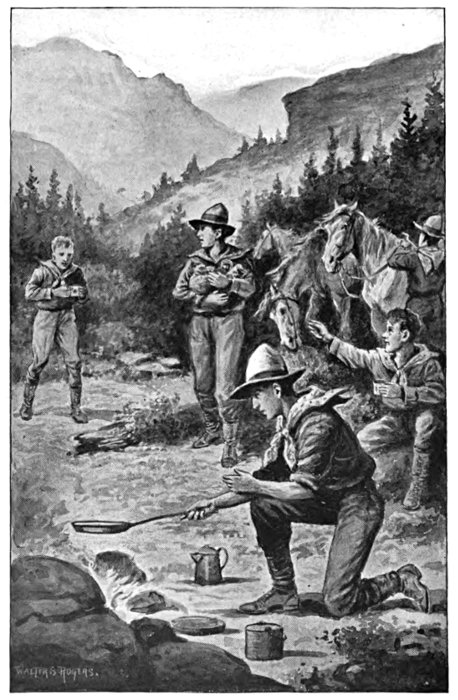
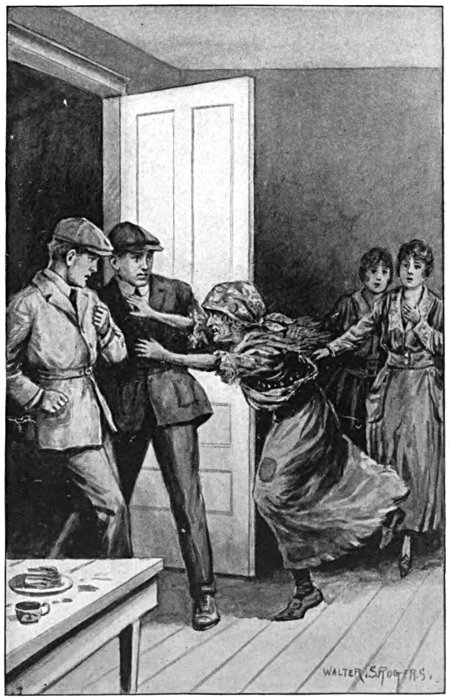
The long horseback ride of the morning had whetted their appetites.—Page 125.
Dave Porter Series
BY
EDWARD STRATEMEYER
Author of “Dave Porter at Oak Hall,” “The Old Glory Series,” “Colonial Series,” “Pan-American Series,” etc.
ILLUSTRATED BY WALTER S. ROGERS
BOSTON
LOTHROP, LEE & SHEPARD CO.
Published, August, 1917
Copyright, 1917
By Lothrop, Lee & Shepard Co.
All rights reserved
DAVE PORTER’S GREAT SEARCH
Norwood Press
BERWICK & SMITH CO.
NORWOOD, MASS.
U. S. A.
PREFACE
“Dave Porter’s Great Search” is a complete
story in itself, but forms the thirteenth volume
in a line issued under the general title of
“Dave Porter Series.”
As my old readers know, this series was begun
some years ago by the publication of “Dave
Porter at Oak Hall,” in which my readers were
introduced to a wideawake, American boy at an
up-to-date American boarding-school. This was
followed by “Dave Porter in the South Seas,”
where our hero had gone to find his father, and
then by “Dave Porter’s Return to School.”
After that we had “Dave Porter in the Far
North,” where the lad went on a second journey
looking for his parent; “Dave Porter and His
Classmates,” in which our hero was put to a most
unusual test; and then by “Dave Porter at Star
Ranch,” in which he took part in many strenuous
adventures.
From the Wild West Dave returned again to
school, as related in “Dave Porter and His
Rivals.” Then he took a sea voyage, as told of
in “Dave Porter on Cave Island,” and later still
taught some of his school chums a much-needed
lesson, the particulars of which are given in “Dave
Porter and the Runaways.”
The lad had imagined his strenuous adventures
were now at an end, but this was not to be. He
heard of a lost mine, and, with his chums, went
in search of it, as related in “Dave Porter in the
Gold Fields.” Coming back, he put in some fine
times in the Adirondack Mountains, as related in
“Dave Porter at Bear Camp.”
By this time the lad had graduated from school,
and he now took up the study of civil engineering.
There was another lad who looked exactly like
Dave, and this person caused our hero much
trouble, as told of in “Dave Porter and His
Double,” where we last met him.
In the present volume Dave is still pursuing his
calling of civil engineering. He is at work in the
mountains when he comes face to face with one of
his old-time enemies. Later still word comes to
the youth that his dearest girl friend, Jessie
Wadsworth, and his sister Laura have disappeared
from home. One surprise is followed by
another, and the young civil engineer is confronted
by many perils.
Once again I thank my young readers for the
interest they have shown in the various volumes
I have written for them. I trust that the reading
of this book will benefit them all.
“It looks to me as if we were in for a storm,
Roger,” answered Dave Porter, a trace of anxiety
crossing his usually pleasant features.
“Perhaps it is only wind,” vouchsafed Roger
Morr, after he brought his horse to a standstill so
that he might scan the distant horizon minutely.
“You know they do have some terrible wind
storms out here in Montana.”
“Oh, yes. I remember the big winds we had
when we were out at Star Ranch,” answered
Dave. “Don’t you remember once we thought
we were in for a regular tornado?”
“I surely do remember. Say, Dave, those were
certainly great days on the ranch, weren’t they?”
“Now that we’ve moved up here to Montana
I hope some day to get the chance to run out to
2the ranch,” continued Dave. “I would like very
much to meet Belle Endicott and her folks.”
“I’ll wager you’ll find Phil Lawrence sneaking
out this way some day,” laughed Roger.
“Can you blame him, Roger? Belle is an awfully
nice girl.”
“Of course I shouldn’t blame him, any more
than I’d blame myself for—for——”
“Than you would blame yourself for sneaking
off to Crumville to see my sister,” laughed Dave.
“Humph! I guess you wouldn’t mind being
back in Crumville this moment, calling on Jessie
Wadsworth.”
“I don’t deny it. But say, let us get on our
way. Those black clouds are coming up altogether
too rapidly to suit me.”
“How many miles do you suppose we are from
the camp?”
“Six or eight at least. You know we followed
this trail for a long time before we stopped to
have lunch.”
“If that new branch of the M. C. & D. Railroad
comes through this way it will certainly follow
a picturesque route,” declared Roger.
“That will suit the summer tourists, even if it
doesn’t cut any ice with the natives. But come on,
we had better not waste any more time. Before
you know it it will be dark and that storm will
be upon us.”
3The two young civil engineers were high up on
a trail among the mountains of Montana. Far
below them stretched a rugged valley, containing
more rocks than grazing lands. Off to the southward
could be seen a small stream which some
time before had been shimmering in the sunlight,
but which now was almost lost in the sudden
gloom that was overspreading the sky.
“What a difference between the scenery here
and that along the Rio Grande,” remarked Roger,
as the two chums made their way along the narrow
trail leading to the camp of the Mentor Construction
Company.
“I’m glad of the change, Roger. I was getting
tired of the marsh land along that river, and
I was also mighty tired of those greasers.”
“Not to say anything about the raids the Mexicans
made on us,” laughed the chum. “Say, we
came pretty close to having some hot times once
or twice, didn’t we?”
“I hope, Roger, we are able to make as good
a showing up here on this railroad work as we
did on that Catalco Bridge. That certainly was
a superb piece of engineering.”
Dave was silent for a few minutes while the
horses trotted along the stony trail. Then,
pleased by a passing thought, his face and eyes lit
up with enthusiasm.
“Wouldn’t it be grand, Roger, if some day
4you and I could put through some big engineering
feat all on our own hook?” he cried. “Think
of our putting up some big bridge, or building some
big tunnel, or some fine skyscraper, or something
like that!”
“I don’t see why we shouldn’t be able to do it
some day. The men who are at the head of the
Mentor Construction Company had to start as we
are doing—at the foot of the ladder. What one
man has done, some other fellow ought to be able
to do after him.”
“Right you are! But ride slow now. If
you’ll remember, the trail is rather dangerous just
ahead of us.”
The admonition that had been given was not
necessary, for both young men knew only too well
the danger which lay ahead of them. At this point
the trail became exceedingly narrow and wound
in and out around a cliff which towered at least
a hundred feet above their heads. In some spots
the trail was less than a yard wide, and on the
outer edge the rough rocks sloped downward at
an angle of forty-five degrees.
“If a fellow slipped down there I wonder
where he would land,” murmured Roger, as he
held back his steed so as to give his companion a
chance to pick his way with care.
“If you went over there you’d probably tumble
down several hundred feet,” answered Dave.
5“And if you did that, you and your horse would
most likely be killed. You be careful and keep
your horse as close to the cliff as possible.”
At one point in the trail where it would have
been utterly impossible to pass another person, the
young civil engineers stopped to give a long, loud
whistle, to announce to any one coming in the opposite
direction that they were approaching. No
whistle or call came in return, so they took it for
granted that the trail was clear and proceeded
again on their way.
By the time the vicinity of the cliff had been
left behind, more than three quarters of the sky
was overcast. Far off in the distance they could
hear a murmur which gradually increased.
“It’s the wind coming up between the mountains,”
announced Dave. And he was right.
Soon the murmur had increased to a strange humming,
and then, in a moment more, the wind came
rushing down upon them with a violence that was
anything but comfortable.
“Come on! Don’t linger here!” shouted
Dave, as he urged his horse forward. “We’ll
soon be out on the regular road.”
A quarter of a mile farther brought them to
another turn in the trail, and in a minute more
they went down a long slope and then came out
on a broad trail running to a number of mines and
ranches in that part of Montana. Here for over
6a mile riding was much easier, and the chums
made good progress in the direction of the construction
camp at which they were making their
headquarters.
“Do you think we can make it before the rain
comes?” questioned Roger, as they dashed along.
“No such luck. Here comes the rain now,”
answered Dave.
As he spoke, both of the young civil engineers
felt the first drops of the on-coming storm.
Then the rain became a steady downpour which
threatened every minute to turn into a deluge.
Fortunately for the two young men, they were
not hampered by any of their civil-engineering outfit.
They had been asked that morning by Mr.
Ralph Obray, the manager of the construction
gang, to ride up the trail and make sure that certain
marks had been left there by the surveyors
for the railroad. The work done by the railroad
had been merely of a preliminary nature, but this
preliminary work, crude as it was, was to be used
as a basis for the more accurate survey by the
engineers of the construction company.
“I don’t think we can make camp in such a
downpour as this,” gasped Roger, after another
half-mile had been covered.
“Maybe you’re right,” responded Dave. “It
certainly is coming down to beat the band! But
what are we going to do? I don’t believe in
7standing still and getting ourselves drenched to the
skin.”
“We ought to be able to find some sort of
shelter near by. Come on, let us take a look
around.”
Both did this, sheltering their eyes from the
rain with their hands. In such a downpour the
scenery on all sides was practically obliterated.
“Can’t make out a thing,” remarked Roger in
disgust. “I suppose we’ve got to go on and take
what comes. By the time we reach camp we’ll
feel like a couple of drowned rats.”
“Never mind. We’ll have a chance to change
our clothing, anyway,” responded Dave lightly.
“And we won’t have to take a bath or get under
the shower.”
“Take a bath or get under the shower!” repeated
Roger. “Wow! If I had a chance to do
that I wouldn’t know myself,” he added with a
grin. For neither of the chums had seen anything
like a bathtub or a shower for several
months. When they took a bath it was usually
in a small stream that flowed not far from where
the construction camp was located.
Forward the young civil engineers went once
again, the rain beating furiously in their faces as
they proceeded. The downpour was so severe
that presently they came to where a hollow on the
road was completely filled with muddy water.
8“Stop, or you may get stuck!” cried Dave, as
he brought his horse to a halt. “I think we had
better try to go around this pool.”
“Come on this way,” returned his chum
quickly, and turned off to the left.
And right here it was that the two young civil
engineers made a big mistake. Had they turned
to the right they would soon have come out on
the road at a point where it would have been
perfectly safe to proceed. But the turn to the left
led them downward, and almost before they knew
it they found themselves between the rocks and on
the edge of a thick woods.
“Hello! where have we landed now?” queried
Dave. “I don’t believe we can get back to the
road from here.”
“Oh, come on, let us skirt the woods,” urged
Roger. “We are bound to get back to the road
sooner or later.”
Somewhat against his better judgment, Dave allowed
his chum to take the lead, and on they went
through the rain and increasing darkness. The
first rush of wind had now somewhat subsided, but
in its place they could hear the low rumble of distant
thunder. Then a sudden flash of lightning
lit the scene.
“Say, I don’t like this!” cried Roger, as the
thunder became louder and several more flashes
of lightning flared over the surroundings.
9“Watch for the next flash, Roger, and maybe
you can see the road,” suggested Dave.
Both young civil engineers did as had been suggested,
but, though they waited not only for the
next flash of light but also for the two following,
they were unable to see more than the rocks and
trees in their immediate vicinity.
“I’m afraid we’re lost down here,” said Dave
at last. “And if that’s the case, the only thing
we can do is to ride back to where we came from.”
“Oh, let us go ahead a little farther. Maybe
the road is at the edge of the woods yonder.”
“If we only knew of some miner’s camp or
some ranch-house around here, we might get
shelter, Roger. I don’t much like the idea of riding
in such a storm as this is getting to be.”
“True for you! But I don’t think there is any
kind of shelter such as you mention within a mile
or two of this place. I didn’t see anything that
looked like a house or a cabin when we came up
the trail.”
Once more Roger went ahead, and with increased
unwillingness Dave followed him, all the
while thinking that it would be better to retrace
their steps to the point where they had found the
roadway covered with water.
“We might have skirted that pool somehow,”
thought Dave. “Now we don’t know where
we’ll land.”
10The two riders found a slight rise ahead of
them, and this encouraged Roger into believing
that the roadway was not far distant. Less than
a hundred yards further on, however, they came
to a sudden halt.
“Well, I’ll be blessed!”
“I think we’ll have to turn back now, Roger.”
“I suppose so. Isn’t it too bad?”
Without warning of any kind they had suddenly
come to a spot where the jagged rocks arose in
front of them several feet higher than their
horses’ heads. Off to the left flowed a swift
mountain torrent, bordered on one side by a low,
irregular cliff and on the other by the jagged rocks
and the tall forest. The rain was now coming
down as steadily as ever, while the thunder and
lightning constantly increased in violence. The
sky was entirely overcast, so that when there was
no lightning it was almost totally dark at the edge
of the forest.
“Maybe if we could get across that stream we
might climb up to the roadway,” suggested Roger,
who hated to think of going back. “Anyway, let
us take a good look the next time it lightens.”
Roger had scarcely spoken when there came a
tremendous crash of thunder so close at hand that
it made both of the young civil engineers start.
The horses too were badly frightened, and both
gave wild plunges one into the other. As a consequence,
11a moment later Dave found himself unseated
and thrown to the ground, and an instant
later Roger landed almost on top of him.
“Hi! Stop the horses!” gasped Dave, when
he could speak.
To this Roger made no response for the reason
that he had come down on the rocks with such
force that he was all but stunned. Dave attempted
to struggle to his feet and catch the
plunging animals, but before he could do so the
two horses had bolted away in the semi-darkness,
leaving their former riders to their fate.
CHAPTER II SOMETHING ABOUT THE PAST
12
“We’re in a pickle now, and no mistake!”
panted Roger.
“Let us try to catch the horses before they get
too far away,” came from Dave. “We don’t
want the fun of tramping back to camp on foot.”
“Not to say anything about losing two valuable
animals.”
“I hope you didn’t break any bones,” continued
Dave, as he saw his chum feeling of his knee and
his elbow.
“Oh, I guess I didn’t get anything more than a
good shaking up. And you didn’t escape entirely,
either. See, your hand is bleeding.”
“Oh, it’s only a scrape. Come on;” and thus
speaking Dave ran off in the direction the runaway
horses had taken, and his chum followed.
To my old readers Dave Porter will need no
special introduction. For the benefit of others,
however, let me state that when a small boy he
had been found wandering alongside the railroad
tracks in Crumville. As nobody claimed him he
13had been put in the local poorhouse, and, later on,
bound out to a broken-down college professor,
Caspar Potts, who at that time was farming for
his health.
In an elegant mansion on the outskirts of Crumville,
lived Mr. Oliver Wadsworth, a wealthy
jewelry manufacturer, with his wife and his daughter
Jessie. One day the gasoline tank of an automobile
took fire, and Jessie was in danger of being
burned to death when Dave came to her rescue.
As a consequence of this Mr. Wadsworth became
interested in the boy, and decided that he should
be given the benefits of a good education and had
sent him to a first-class boarding school, as related
in the first volume of this series, entitled “Dave
Porter at Oak Hall.” With Dave went Ben
Basswood, his one boy friend in the town.
At Oak Hall Dave made a number of close
friends, including Roger Morr, the son of a well-known
United States Senator; Phil Lawrence, the
offspring of a rich ship-owner; “Shadow” Hamilton,
who loved to tell stories; and Buster Beggs,
who was as fat as he was jolly.
In those days the principal thing that troubled
Dave was the question of his parentage. To
solve the mystery of his identity he took a long
sea voyage, as related in “Dave Porter in the
South Seas,” where he met his uncle, Dunston Porter,
and learned much concerning his father, David
14Breslow Porter, and also his sister Laura, who
were at that time traveling in Europe.
On his return to school, and during the time that
our hero spent in trying to locate his father and
his sister, as related in succeeding volumes of this
series, Dave made many new friends. But there
were some lads who were jealous of the boy’s success,
and two of them, Nick Jasniff and Link Merwell,
did what they could to get our hero into
trouble. The plot against Dave, however, was
exposed, and in sheer fright Nick Jasniff ran away
and went to Europe while Merwell went out West
to a ranch owned by his father.
Dave’s sister Laura had an intimate friend,
Belle Endicott, who lived on Star Ranch in Montana,
and through this friendship all of the boys
and girls were invited out to the ranch. There,
to his surprise, Dave fell in once more with Link
Merwell and finally exposed that young rascal
so that Link thought it would be to his advantage
to disappear.
“You’ll have to keep your eyes open for those
wretches,” was Roger’s comment at the time.
“They’ll get the better of you if they possibly
can, Dave,” Phil Lawrence had added.
“I’ll watch them,” the youth had answered.
When the Christmas holidays arrived Dave
went back to Crumville, where he and his folks resided
with the Wadsworths. Directly after
15Christmas came a startling robbery of the Wadsworth
jewelry works, and Dave and his chums
by some clever work discovered that the crime
had been committed by Merwell and Jasniff.
After a sea voyage to Cave Island, Jasniff was captured
and sent to jail, but Merwell at the last
minute managed to make his escape.
The trip to Cave Island was followed by another
to the great West, where Dave aided Roger
Morr in locating a gold mine which had been lost
through a landslide.
After this our hero went up to Bear Camp in
the Adirondack Mountains, where he had a glorious
time with all of his chums and also the girls.
At that time Dave fell in with a young man named
Ward Porton, who was almost our hero’s double
in appearance. Porton proved to be an unscrupulous
person, and caused our hero not a little
trouble, he trying at one time to palm himself off
as the real Dave Porter. This scheme, however,
was exposed, and then Porton lost no time in disappearing.
Our hero had now graduated from Oak Hall,
and he and Roger Morr had taken up the profession
of civil engineering. In the midst of his
studies Dave was startled by the news of the disappearance
of some valuable miniatures which had
been willed to his old friends, the Basswoods. It
was discovered that Ward Porton was in this plot,
16and later on this evildoer, along with his disreputable
father, was brought to justice.
As soon as their first examination in civil engineering
had been passed, Dave and Roger had
succeeded in obtaining through their instructor
positions with the Mentor Construction Company,
a large concern operating many branches throughout
the United States and in foreign countries.
They were assigned to a gang operating in Texas,
building a railroad bridge near the Rio Grande.
This construction camp was under the general
management of Mr. Ralph Obray, assisted by a
number of others, including a middle-aged man
named Frank Andrews, who had speedily become
a warm friend of the young civil engineers.
The work had proved absorbing from the start
to Dave, and it must be said that the senator’s son
was almost equally interested. Both kept up their
studies every day and kept their eyes and ears
wide open, and consequently made rapid progress.
On more than one occasion Mr. Obray had given
them encouraging words and shown his satisfaction,
and Frank Andrews was enthusiastic.
“You fellows keep on the way you have started,
and some day you’ll be at the top of the ladder,”
was the way Andrews expressed himself.
The two young civil engineers had remained at
work on the Catalco Bridge for nearly a year.
Then the task had been turned over to another
17gang, and the Obray outfit, as it was commonly
called, had been sent up from Texas into Montana,
to take up the work of roadbed and bridge
construction for the M. C. & D. Railroad.
This railroad was simply a feeder of one of the
main lines, yet it was thought that in time it would
become a highly important branch. The work to
be undertaken was unusually difficult, and it was an
open secret that several construction companies
had refused even to give figures on it.
“We’ve got our work cut out for us up here,”
had been Frank Andrews’ remark to Mr. Obray,
after the pair had gone over the situation carefully.
“Right you are, Andrews,” the manager of the
construction gang had answered. “It looks all
right on paper, but we are going to have a good
many difficulties which can’t be put down in black
and white.”
“What we’ve got to guard against, to my way
of thinking, is landslides,” the assistant had
answered.
Since beginning work for the Mentor Construction
Company, Dave and Roger had had two opportunities
for returning to the East. They had
come by the way of Washington, where Senator
Morr and his wife were now residing, and had
also stopped off at Philadelphia to visit Phil Lawrence.
Then they had made their way to Crumville,
18there to put in a most delightful time with
Dave’s folks and the Wadsworths. As my old
readers are aware, to Dave there was no girl in
the world quite so sweet and lovable as Jessie
Wadsworth, while it was noticed that Roger and
Dave’s sister Laura were together whenever occasion
permitted.
The two young civil engineers had been in Montana
now for about three weeks, and during that
time they had gone on numerous errands to places
ten and even twenty miles away. On arrival they
had hoped to visit Star Ranch, but had learned
that this place was nearly a hundred miles off.
They had looked at some of the local mines with
much interest, and had likewise visited several
ranches.
“We’ll get to know this whole district like a
book before we get through with it,” had been
Roger’s comment.
“Maybe,” Dave had answered. “Just the
same, if I were you I wouldn’t go too far away
from the regular trails without a pocket compass.
Getting lost among these mountains might prove
very serious.”
The two young civil engineers had started off
on their errand that morning in high spirits, due
not alone to the fact that both were feeling in the
best of health and were doing well in their chosen
profession, but also to the fact that the day before
19they had received a number of letters from home,
including a warm epistle to Dave from Jessie and
an equally tender missive from Laura to Roger.
At their end the two girls had written each in the
confidence of the other, so that the two chums did
not hesitate to talk over the contents of both letters
between them.
“Oh, we’ve got the brightest prospects in the
world before us!” Dave had cried when they had
set out, and in the exuberance of his spirits he had
thrown his cap high up in the air.
But the prospect at this particular minute did
not seem to be so bright. The rain was coming
down steadily, accompanied by sharp crashes of
thunder and vivid flashes of lightning, and the
two youths had all they could do to keep their
feet as they sped along in the direction the runaway
horses had taken.
“This is the worst ever!” groaned Roger, as
both presently came to a halt with the rocks on
one side of them and the forest on the other.
“I can’t see anything of those horses, can you?”
Dave did not for the moment reply. He was
waiting for the next flash of lightning, and when
it came he strained his eyes in an effort to locate
the vanished steeds. The effort, however, was a
vain one.
“They’re gone, that’s sure,” he announced
gloomily. “If the storm didn’t make so much
20noise we might be able to hear them clattering
over the rocks; but between the wind and the
thunder that’s impossible.”
“They had to come this way, for it’s the only
way. Let us go on a little farther.”
As there was nothing else to do, Dave followed
his chum along the edge of the forest and at last
the pair reached the spot where they had left the
road. Here the pool of water had become much
larger and deeper.
“We don’t seem to be getting anywhere,”
grumbled the senator’s son, as they came again to
a halt. “Just look at this! It’s a miniature
lake!”
“We’ll have to get around it somehow, Roger,”
was the reply. “Let us try the other side this
time.”
“But what about the horses?”
“If they came up here on the roadway I’ve an
idea they started straight for camp. They
wouldn’t know where else to go.”
Not caring to stand still in such a downpour,
the two started to skirt the pond, going in the opposite
direction to that which they had before
taken. They had to clamber over a number of
rough rocks and through some brushwood
heavily laden with water, so that by the time they
reached the other side they were as wet as if they
had taken an involuntary bath.
21“Well, there’s one consolation,” announced
Roger grimly. “We couldn’t get any wetter if
we tried.”
“Come on. Let us leg it for camp as fast as
we can,” returned Dave. “It’s pretty cold out
here, drenched like this.”
“Wait a minute! I think I saw something!”
cried the senator’s son suddenly. “Look!”
He pointed off to one side of the roadway, and
both waited until another flash of lightning lit up
the scene.
“The horses!”
They were right. There, not over a hundred
yards away, stood the two runaway steeds, partly
sheltered by several big trees. Their heads had
been down, but now they suddenly came up as if
in fresh alarm.
“Do you think we can catch them, Dave?”
gasped the senator’s son.
“We’ve got to do it, Roger,” was the reply.
“But be careful, or they’ll get away as sure as
fate. Here, you approach them from the right
and I’ll go around to the left. And don’t let them
get past you, no matter what happens.”
CHAPTER III A SURPRISE OF THE ROAD
22
Fortunately for the two chums, the flash of
lightning which had revealed the two horses to
them was followed by something of a lull in the
storm and this served to keep the steeds from
stampeding again.
“Be careful, Roger,” cautioned Dave, as they
separated to do as our hero had advised.
“Do you want me to take my own horse or the
one which happens to be nearest to me?” questioned
the senator’s son.
“Take the nearest, by all means—and be sure
to hold on tight!”
In the darkness, and with the rain still coming
down steadily, the two approached closer and
closer to the horses. One animal gave a low
snort, but whether of fear or recognition of his
master could not be ascertained.
“I guess we’ve got them, all right enough,”
sang out Roger, as he made a dash to cover the
dozen feet that separated him from the nearest
steed.
23Dave was a few steps farther away from the
other horse. At that instant came another clap
of thunder, followed almost instantly by the lightning.
Then came a crash in the forest, showing
that a tree close by had been struck.
The nervous horses wheeled around and reared
up. Then one started in one direction and the
other in another.
“Grab him, Roger! Don’t let him get away!”
yelled Dave, and made a wild leap for the animal
nearest him. He caught the loose rein, and an
instant later had a firm hold on the steed. The
horse did considerable prancing, but the youth,
who some seasons before had tamed a bronco at
Star Ranch, was not daunted. He brought the
animal to a standstill, and then, seeing that it was
his own mount, leaped lightly into the saddle.
“Now behave yourself, old boy,” he said
soothingly, patting the animal on the neck.
“You’re all right. Take it easy.”
In the meanwhile, Roger was having an exciting
experience with his own horse. The animal
had tried to back away from him, and had gotten
a hind leg fast between two trees. Now he began
to kick out wildly, hitting one of the trees several
resounding blows.
“Whoa there! Whoa!” cried the senator’s
son; but his horse continued to kick out until, with
a wrench, he got the other foot free. Then he
24began to prance around once more, showing every
evidence of wanting to run away.
“Wait! I’ll hold him while you get into the
saddle!” cried Dave, riding up. And then he
placed himself directly in front of Roger’s mount.
Taking advantage of this opportunity, the senator’s
son made a leap and got safely into the saddle;
and then the two runaway horses settled down
to behaving themselves decently.
“This was luck, all right,” remarked Dave,
when the brief excitement was over.
“Right you are,” was the ready reply. “I
didn’t fancy walking back to the camp.”
“Nor losing two such valuable horses,” added
our hero. “If they had failed to return perhaps
Mr. Obray would have made us pay for them,
and that would make a big hole in our salaries.”
Making sure that the horses should not get
away from them again, the two young civil engineers
rode back to the road, and then with caution
picked their way along on the right-hand side
of some ever-increasing ponds of water. This
was slow and dangerous work, the horses slipping
and sliding among the wet rocks and loose stones,
and more than once getting into mud and water
up to their knees. But at last that peril was left
behind, and once again the youths found themselves
on comparatively solid ground and headed
in the direction of the construction camp.
25“We’ll sure have a story to tell when we get
back,” remarked Roger, as they rode along side
by side.
“Yes. But we’ll want to change our togs before
we start to tell it,” returned Dave grimly.
“I feel as if I had jumped overboard with all my
clothing on.”
“It looks to me as if the storm was passing
away,” continued the senator’s son, gazing up at
the sky.
“Oh, more than likely it will stop raining as
soon as we get back, Roger. It would be just our
luck.”
It was true that the storm was passing, and they
were still some distance from the construction
camp when the rain practically ceased. A portion
of the clouds rolled away, making the sky
much clearer.
“I’ll bet the sun comes out as brightly as ever
before it sets,” ventured Roger. “Hang it all!
why couldn’t we have found some shelter during
this awful downpour? Then we wouldn’t have
got wet to the skin.”
“Never mind, Roger. There is no use in crying
over spilt milk. Don’t forget how thankful
we are that we got our horses back.”
The chums were still out of sight of the construction
camp when they heard a clatter of hoofs
on the stony roadway ahead of them. In a minute
26more a figure, clad in a semi-cowboy outfit,
came galloping toward them.
“Hello! who can that be?” cried Roger.
“Maybe it’s one of our men coming out to look
for us,” answered Dave. “Perhaps Mr. Obray
or Frank Andrews got worried when it began to
blow so and lighten so hard.”
The two young civil engineers slackened their
pace, expecting that the newcomer would halt as
soon as he saw them. They drew up to one side
of the road, and were somewhat surprised to see
the person on horseback go by without paying any
attention to them. He was a fellow about their
own age and had his head bent down over his
horse’s neck as if he was in deep thought.
Both of the young civil engineers stared at the
rider as if he were a ghost. Neither of them said
a word, but they both looked after the passer-by
as if they could not believe the evidence of their
senses.
“Dave, did you see him?” came at last in an
excited tone from Roger.
“I certainly did, Roger!”
“It was Nick Jasniff!”
“So it was!”
“But how in the world did he get here?”
“I don’t know. I thought he was in prison!”
“So he was—we saw him sentenced ourselves,
after we caught him on Cave Island.”
27“And his sentence can’t be up yet. The time is
too short.”
“Maybe he broke jail or got out sooner on account
of good behavior. You know they give
prisoners some time off if they behave themselves
well.”
“You don’t think we could be mistaken?”
“I don’t think so. If that fellow was not Nick
Jasniff, it was his double.”
“Oh, don’t say anything about doubles!” cried
Dave quickly. “I had all I want of that sort of
thing with Ward Porton. I’m quite sure that fellow
was Nick Jasniff himself. He had that same
hang-dog, slouching way about him he had when
he went to Oak Hall.”
“But what can he be doing out here in Montana?”
“I don’t know,—unless he may have thought
that some of the Merwells were still out here.
He, of course, must know about Mr. Merwell disposing
of the Three X Ranch.”
“You don’t suppose he came out here to see us,
do you?”
“To see us? Not on your life! Why should
he want to see us? He knows well enough that
we have no use for him.”
“But maybe he wants to get square with us.
You know he threatened us in all sorts of ways
after we had him arrested. And you know what an
28awful wicked fellow he is, Dave. Didn’t he try
once in the Oak Hall gym to brain you with an
Indian club?”
“Yes; I remember that only too well, Roger.
Just the same, I don’t think a fellow like Jasniff
would come away out here to square accounts with
us. It’s more likely he came out here to get away
from the people who know him. Maybe he
thought he could start life over again in a place
like this, where nobody knew him.”
“Humph! possibly you’re right. But if that’s
the case, I don’t want him to come around where
I am. I have no use for a jailbird,” grumbled
the senator’s son.
The youths had resumed their journey, and a
few minutes later they came into sight of the construction
camp. This consisted of a rudely-built
office, backed up by a score or more of smaller
buildings used as bunk-houses. At the end of a
row was a large, low building in which was located
the kitchen and also the mess hall, or “Palace of
Eats,” as some of the engineers had christened it.
Still further away was a small shed for horses,
with a corral attached.
“Hello! I was wondering what had become
of you two chaps,” cried Frank Andrews, as they
rode up to the building wherein they and the assistant
and some others had their quarters.
“Some let-down you got caught in.”
29“I should say so!” cried Roger. “We came
within an ace of being drowned.”
“Be thankful that you weren’t struck by lightning,”
returned the older engineer, with a twinkle
in his eyes. “I suppose you’ll want to get some
dry duds on before you make any report about
those marks.”
“The marks are all there, just as Mr. Obray
expected they would be,” answered Dave. “I’ve
got a list of them here in my notebook.”
“By the way, Mr. Andrews, was there a
stranger here a little while ago—a fellow about
our age?” questioned Roger.
“There was somebody here. I don’t know
who it was,” answered the assistant. “He was
over at the main office, talking to Mr. Obray.”
“And you don’t know who he was?”
“No.” Frank Andrews gazed at the two
chums questioningly. “Anything wrong about
him?”
“That is what we want to find out,” answered
the senator’s son. “We thought we knew him;
and if so he isn’t the kind of fellow that any one
would want around here.”
“Why, how is that?” questioned Frank Andrews.
And thereupon, in a few brief words,
Roger and Dave told about Nick Jasniff and his
doings.
“You’re right! We don’t want any jailbirds
30around this camp!” cried the assistant. “When
you go up to the office you had better tell Mr.
Obray about this.”
Dave and Roger were glad enough to get under
shelter. They lost no time in taking a good rub-down
and in changing their apparel. Then they
hurried over to the office of the construction camp,
where they found the manager and several of his
assistants going over various papers and blue-prints.
“Got back, eh?” said Mr. Obray, with a smile.
“You certainly didn’t have a very nice day for the
trip.”
“Oh, well, it’s all in the day’s work, Mr.
Obray,” answered Dave lightly.
“And we had one advantage coming back,” put
in Roger. “We didn’t suffer the least bit from
dust;” and at this sally a smile lit up the features
of all present. They liked Dave and Roger very
much, and the fact that Dave’s chum was the son
of a United States Senator added something to
the importance of both of the young men.
Getting out his notebook, Dave lost no time in
turning in his report, which was supplemented by
what Roger had to say. Then the two young
civil engineers were asked a number of questions,
to which they replied as clearly as possible.
“I guess that’s about all,” said Mr. Obray
finally. “I think that makes it pretty clear.
31Don’t you, Mr. Chase?” he continued, turning to
one of the other men present.
“I think so,” answered Mr. Chase. “But
we’ll still have to make an investigation up there
at Number Six. I’m not satisfied about the formation
of that rock. I think we’re due for a
lot of trouble.”
“Well, we’ll meet it as it comes—there is no
use in anticipating it,” answered Ralph Obray
briefly.
He was a man who was never daunted, no matter
how great the obstacles that confronted him.
It was his clear-headedness that had won more
than one engineering victory for the Mentor Construction
Company when all the other engineers
had given up a task as impossible.
“Mr. Obray, we would like to ask you a few
questions in private if you don’t mind,” said Dave
in a low voice, when he saw the other civil engineers
turn away to consult a map that hung on
one of the office walls.
“All right, Porter. Come right in here,”
answered the manager, and led the way to a
corner, where he had a small private office.
“I wish to ask you about a fellow we met on
the road just before we got back to camp about
half an hour ago,” explained our hero. “He was
a fellow about our own age. He was on horseback,
and I thought he might have been here.”
32“There was a fellow here, and he left less than
an hour ago,” answered the manager. “I should
think he was about your age, or maybe a year or
two older.”
“Was he a tall, lanky sort of fellow with a
rather slouchy air about him?” questioned Roger.
“Yes, that description would fit him pretty
well.”
“And did he have a squint in one eye?” questioned
Dave suddenly, remembering a peculiarity
about Nick Jasniff which he had almost forgotten.
“Yes, there certainly was something the matter
with one of his eyes. The upper lid seemed
to droop considerably.”
“Might I ask what that fellow was doing
here?”
“He came here looking for a job. He said he
was working on one of the ranches in this vicinity
but that he preferred to work for us and learn
civil engineering if we would give him a chance.
I told him we were pretty well filled up as far as
our engineering corps was concerned, but said he
might call some other time. You see, Barry and
Lundstrom are thinking of leaving, and if they do
we might have a chance for one or two outsiders,
provided they were of the right sort.”
“Well, if this fellow is the person we think he
33is, he isn’t any one you would care to have around
here, Mr. Obray,” cried Roger.
“And why not?” demanded the manager of
the construction camp.
“Because if he is the fellow we think he is, he
is a thief and a jailbird!”
CHAPTER IV WHAT PHIL’S LETTER TOLD
34
Mr. Ralph Obray was much surprised at the
statement made by Roger, and his face showed it.
“That is a pretty strong statement to make
against anybody,” he said slowly. “Perhaps you
had better explain.”
“I can do that easily enough,” returned the
senator’s son. “And Dave here can tell you even
more than I can.”
“By the way,” broke in Dave, “may I ask if
the fellow left any name?”
“Oh, yes.” The manager of the construction
camp glanced at a slip of paper lying on his desk.
“Jasper Nicholas.”
“Jasper Nicholas!” cried Roger. “What do
you know about that?”
“It sounds a good deal like Nicholas Jasniff
turned around,” answered our hero. He looked
at the manager. “The fellow we have in mind
was named Nicholas Jasniff,” he explained.
“Tell me what you know about the fellow,” returned
Mr. Obray shortly.
Thereupon the two chums related how they had
35been schoolmates with Nick Jasniff and Link Merwell
at Oak Hall and how Jasniff had one day attacked
Dave in the gymnasium with an Indian club
and how the fellow had run away. Then they
told of the robbery of the Wadsworth jewelry
works, and of how Jasniff and Merwell had been
followed to Cave Island and captured.
“At the last minute Merwell got away,” continued
Dave, “but the authorities hung on to Jasniff
and he was tried and sent to prison for a long
term of years. How he got out I don’t know.”
“That is certainly an interesting story,” said
Mr. Obray. “But if that fellow Jasniff is in
prison he can’t be the fellow that called here.”
“But look at the similarity in names!” broke
in Roger. “Oh, I am sure he is the same fellow.”
“If he is, we won’t want him around here even
if he has a right to his liberty,” declared the manager.
“Our men are all honest—or at least
we think they are—and we can not take chances
with a man who has been convicted of a crime.
Of course, such a fellow has a right to do his best
to get along in the world; but he had better go
to some place where nobody knows him.”
“Don’t you think we had better try to find out
whether Jasniff has really served his full term and
been properly discharged from prison?” remarked
Dave. “If he is a fugitive we ought to
36capture him and send him back to the authorities.”
“You are right there, Porter. It might be a
good idea for you to send a message to the East
to find out about this.”
“Where do you think I ought to send for information?”
“Do you know where he was placed in prison?”
“Oh, yes.”
“Then I would send directly to the prison
authorities.”
“Let us send a telegram!” cried Roger. “A
letter would be too slow. I’ll stand half the expense.”
“All right, I’ll go you!” responded our hero
quickly. “If Nick Jasniff got out of prison on the
sly, he ought to be returned to the place.”
“Maybe if he did get out, and we captured
him, we might get a reward, Dave.”
“That is true, too—provided a reward has
been offered.”
“You seem to be pretty sure that this fellow
who called here is the man you are after,” remarked
Mr. Obray. “Don’t you think you may
be mistaken? In that storm, and with the fellow
galloping past you on horseback all hunched up
to keep from getting wet, you may have made a
mistake.”
At this remark the face of the senator’s son became
clouded.
37“It might be so, Dave. To tell the truth, we
didn’t get a very good look at him. And yet I
think it was Nick Jasniff.”
“I’m almost certain of it, Roger. I’ll never
forget that face of his. I studied it pretty well
when he was up for trial and we testified against
him.”
“You might wait until he comes here again,”
suggested the manager.
“Yes. But then we wouldn’t have the information
we want,” declared Dave. “I’d rather
pay out my money on that telegram and learn
the truth. Then, if Jasniff was wanted by the
authorities, we could make a prisoner of him right
then and there.”
“That is true.”
The matter was discussed for several minutes
longer, and then the two chums walked back to
their quarters. Here they talked the matter over
between themselves.
“We can’t send a telegram to-night; the office
closes at six o’clock,” declared Dave. “We can
write it out, however, and send it the first chance
we get in the morning. I think Mr. Obray will
let you or me ride down to the telegraph office with
it.” The nearest station from which a telegram
could be sent was quite a distance away, and a telephone
line between the two points, while it was being
erected, was not yet in operation.
38Of course Frank Andrews wished to know what
had taken place, and the youths told him. He
shook his head sadly.
“It’s too bad! Especially with a young fellow,”
he declared. “That term in prison will
hang over him like a cloud all the rest of his life.
Kind-hearted people may talk all they please and
do all they possibly can—the fact remains that if
a man has once been in prison, unless he can prove
that he was innocent, very few people will care to
have anything to do with him.”
“If Jasniff were a different kind of fellow I’d
have a different feeling for him,” said Dave; and
his face showed his earnestness. “If he had been
led into crime by others it would be a different
story. But so far as I can remember, he was always
hot-tempered, vicious, and bound to have his
own way. He was the leader in that robbery—not
Merwell. And when he was captured he
acted in anything but a penitent mood. On that
account I can’t get up much sympathy for him.”
“He doesn’t deserve any sympathy!” cried
Roger. “Why, every time I think of how he
grabbed up that Indian club in the Oak Hall gymnasium
and did his best to brain you with it, it
makes my blood run cold!”
“He certainly must have been a pretty wicked
boy to attempt anything like that,” was Frank Andrews’
comment. “It’s bad enough for schoolboys
39to fight with their fists; but that at least is a
fair way to do.”
The two chums were tired out from their
strenuous adventures of the day, and were glad to
retire early. During the night the storm cleared
away entirely, and in the morning the sun shown
as brightly as ever.
“If you don’t mind, Dave, I’ll take that telegram
down to the office,” said Roger, while the
pair were dressing. “I’m expecting a box that
father said he was sending, and I can ask for that
at the same time.”
“All right, Roger. But you had better wait
until the mail gets in. There may be some other
message we’ll want to send.”
The mail was brought in while the youths were
at breakfast, and was distributed immediately
after that repast was over.
“Hello, here’s a letter from Phil!” cried our
hero, as he noticed the postmark “Philadelphia.”
“I’ve got the box from dad,” returned the senator’s
son, “so I won’t have to ask about that at
the express office.”
“I knew it!” exclaimed Dave, who had ripped
the letter open and was scanning its contents.
“Phil is coming out here to pay a visit to Star
Ranch; and he says he may bring Shadow Hamilton
with him. Isn’t that the best ever?”
“So it is, Dave! But it’s no more than I expected—at
40least so far as Phil is concerned. I
knew he couldn’t remain away from Belle Endicott
very long,” and the senator’s son winked suggestively.
“Here’s a lot of news about the other fellows,
Luke Watson, Polly Vane, and Jim Murphy.
Polly has gone into business with an uncle of his,
and Jim Murphy has a well-paying position up at
Yale.”
“I’m glad to hear it. Polly Vane was one of
the finest fellows that ever lived, even if he was
somewhat girlish. And as for Jim Murphy—there
was never a better monitor around Oak
Hall.”
Dave had turned over to the last sheet of the
six-page communication Phil Lawrence had sent.
Here the letter proper came to an end, but there
was a postscript added in lead pencil. This ran
as follows:
“You will be interested to know that some
time ago Nick Jasniff’s case was brought up before
the Board of Pardons by a Committee on Prison
Reform. The men and women composing the
committee made a strong plea for Jasniff because
of his age, and I understand they made a very
favorable impression on the Pardon Board. If
Jasniff is pardoned, he will be getting out without
having served even half of his sentence. I wish
I had been there to tell the Board what sort of a
fellow he is.”
41“Here’s the milk in the cocoanut, Roger!”
cried Dave, and read aloud what Phil had written.
“Humph, so that’s the truth of it,” murmured
the senator’s son. “More than likely that committee
worked on the feelings of the Pardoning
Board so that they gave Jasniff his liberty. Well,
if that’s the case, there won’t be any need for
sending that telegram.”
“You’re right. If he was pardoned, that ends
it, and he has as much right to his liberty as we
have to ours. Just the same, I think they made a
mistake. When he was tried, I am sure the
judge, on account of his age, gave him as short a
sentence as he deemed best.”
“I’m sure of that too, Dave! Why, one of the
lawyers told me that if Jasniff had been ten years
older he would have gotten twice as long a sentence.”
“I think I had better go to Mr. Obray with
this news,” said Dave. “You can tell Andrews
if you want to.”
Our hero found the manager of the construction
camp just preparing to go out with several of
his assistant engineers. Explaining the situation,
Dave allowed Mr. Obray to read the postscript of
Phil’s letter.
“Looks as if you were right after all, and the
fellow who was here had been pardoned,” was
42Ralph Obray’s comment. “In that case, you
can’t do anything about having him held. Just
the same, if he is that sort I won’t want him
around.”
“If he comes again, may we see him to make
sure that he is really this Nick Jasniff?”
“Certainly, Porter. If you are anywhere near,
I’ll hold the man at the office, or wherever we happen
to be, and send for you and Morr.”
Dave and Roger were now working under the
directions of Frank Andrews. In the gang were
two others—a young man named Larry Bond,
and an elderly engineer named Hixon. All had
become well acquainted and were good friends.
Hixon was from the West and had spent many
years of his life on the cattle ranges and in the
gold fields.
“I was a prospector for six years,” he once declared.
“But, believe me, it didn’t pay. Sometimes
I struck it pretty rich; but then would come
long dry spells when I wouldn’t get a thing. All
told, I didn’t do as well, year in and year out, as
I am now doing at regular wages.”
Andrews’ gang, as it was termed, had some
work to do at Section Five of the proposed line,
the work, of course, being preliminary to that
which was to be made on the erection of the
bridges to be built. This was in a decidedly rocky
part of the territory, and the young civil engineers
43and the others had no easy time of it making their
survey.
“Some different from sitting in your room at
Oak Hall working out a problem in geometry,
eh?” remarked Dave to Roger, after a particularly
hard climb over the rocks.
“I should say so,” panted the senator’s son.
“You look out that that chain doesn’t get away
from you,” cried Dave, pointing to the long
coiled-up steel measure which the other was carrying
at his belt. The real civil engineer’s, or
surveyor’s, chain is largely a thing of the past, the
steel measure having taken its place.
Frank Andrews and the others were at a distance
and young Bond was wigwagging his signals
across a deep cut in the hills. Now Dave prepared
to signal in return, at the same time holding
up his leveling-rod as required. Roger attempted
to climb around on the rough rocks, and
then suddenly uttered a cry of dismay.
“What’s the matter?” asked Dave.
“That measure! I just started to fasten it
tighter to my belt when it slipped out of my hands.
There it goes—sliding down the rocks out there,”
and the senator’s son pointed to a spot at least
fifty feet below them.
While Dave was still signaling and moving his
leveling-rod farther along as desired, Roger began
to scramble down the rocks in the direction where
44the steel measure had fallen. He was gone for
fully ten minutes when suddenly Dave heard a
yell.
“What’s the matter, Roger?” he called, dropping
the leveling-rod and the signal flag he held.
“It’s a snake—and a big one, too!” screamed
the senator’s son. “Oh, Dave, come here and
help me! My leg is caught between the rocks,
and it’s a rattlesnake!”
CHAPTER V NICK JASNIFF’S VISIT
45
The announcement that Roger had his leg
caught between the rocks and that a rattlesnake
was about to attack him filled Dave with alarm.
“Oh, Roger, are you sure it’s a rattlesnake?”
“Yes! Yes! Come down and help me!
Quick!”
“I will. Can’t you hit him with a rock or
something?”
“I will if I can. But hurry up—and bring
that axe or something with you!”
When leveling parties, as they are officially
called, go out, one man often carries an axe with
which to clear away any obstructions which may
prevent a clear sight. On this occasion Roger
had been carrying the axe, as well as the chain,
and the implement now lay close to where our
hero stood.
Grabbing up the axe, Dave lost no time in
scrambling down the rocks. As he did this he
heard a stone strike on some rocks below and knew
that Roger was throwing at the snake.
46“Oh, Dave! Help!” yelled the senator’s son,
“He’s getting ready to strike!”
With one wild leap Dave came down to within
a few feet of where his chum stood between two
rocks which reached up to his waist. One leg
was fast between the rocks, and while the unfortunate
youth was endeavoring wildly to extricate
himself from his predicament, he was shying one
loose stone after another at a snake that was coiled
up in something of a hollow less than a dozen feet
away. The hollow was so situated that exit from
it could only be had in the direction occupied by
the young civil engineer.
As Dave approached he saw that it was indeed
a rattlesnake that his chum had disturbed. The
reptile was at least five feet in length and of corresponding
thickness, and was now coiled up as if
ready to strike.
It was a moment which called for immediate
action, and without stopping to think Dave raised
the axe and sent it whirling forward toward the
snake. His aim fell short, but this shortness
proved to be thoroughly effective. The handle of
the axe came down with a thud on the rocks, sending
the blade flashing in a semicircle. The sharpened
bit of steel caught the snake in the very center
of its folds, inflicting several deep cuts.
Instantly the reptile’s attention was taken from
47Roger. It whirled around swiftly in search of
the enemy that had struck it and whipped angrily
at the axe.
“Oh, Dave! can’t you shoot him?” gasped
Roger. “I dropped my pistol when I came down
over the rocks.”
In that wild territory it was the custom of every
one of the engineering gang to carry firearms.
Dave had a small automatic pistol in his hip pocket,
and this he now brought into play.
Crack! Crack! Crack! went the weapon
three times in rapid succession. The first shot did
not take effect, but the second and third hit the
mark, and the rattlesnake twisted and turned in
its death agony. Then, placing the pistol back in
his pocket, our hero raised up a stone almost as
large as his head and with it put the reptile out
of its misery.
“Oh, Dave, is he—is he dead?” panted
Roger. His face had gone white, and his whole
attitude showed how unstrung he was.
“He’s as dead as a door-nail, Roger,” was the
answer, after Dave had made a brief inspection of
the remains. “He’ll never bother you or anybody
else again.”
“I felt sure he was going to bite me!” went on
the senator’s son with a shudder.
“You certainly had a close shave, and I don’t
48wonder that it scared you, Roger. Think of facing
a snake like that and not being able to run
away!”
“He was down in this very hollow where my
leg is first. Then he glided over to the other hollow
and began to rattle and coil up to strike. If
you hadn’t come down as you did, he would have
struck me sure;” and the senator’s son shivered
again.
“I think we had better wipe off that axe-handle,
and the blade, too,” remarked Dave. “He may
have gotten some of his poison on it.”
“Yes, wipe it off very carefully,” answered
Roger. “But first of all I’ve got to get my foot
loose. It does beat all how I got stuck.”
“You didn’t hurt your leg or your foot, did
you?”
“I scraped my shin a little, but that doesn’t
count.”
An inspection was made, and finally Dave had
to bend down and unlace Roger’s shoe before the
limb could be gotten out of the space between the
two rocks. Then the footwear was recovered,
and the senator’s son put it on once more. In the
meanwhile, Dave took up the axe rather gingerly
and also tied a bit of string to the tail of the lifeless
rattlesnake.
“We’ll take it back to the camp to show the
others,” announced our hero. “They wouldn’t
49believe our story unless we were able to show the
snake. Besides that, we can keep the rattles if we
want to. Some people prize them quite highly as
trophies.”
The axe was wiped off with care, and then,
after Roger had recovered his pistol and also the
steel measure he had dropped, the pair scrambled
up the rocks to where Dave had left his flag and
the leveling-rod. He waved the flag in the air as
a signal, and presently an answering signal came
back from the other members of the leveling gang,
who had been wondering what had become of the
two assistants.
“Say, you fellows have got to attend to business
during working hours!” cried Frank Andrews,
when they met. “If you want to——Great catfish!
where did you get that snake?” and
he broke off short to gaze in wonder at the rattlesnake
tied to the string that Roger exhibited.
“You have to break off business when you get
an unexpected caller like that,” replied Dave dryly.
“Do you mean to say that rattler attacked
you?” questioned Larry Bond quickly.
“He started to attack Roger.”
“And Dave threw the axe at him and then shot
him,” explained the senator’s son.
“Some rattler! that’s what he is!” was the
comment of John Hixon. “If he struck for you
he certainly meant business;” and he examined the
50remains of the rattlesnake with much interest.
“We thought we heard several shots, but we
were not sure,” remarked Frank Andrews.
“I guess you didn’t hear them very well because
we were in something of a hollow,” answered
Dave; and then he and Roger gave the particulars
of what had occurred.
“You can be mighty lucky that you weren’t
struck,” declared Hixon emphatically. “When I
was out in the gold mines in the northern part of
this state I knew a man who was struck twice by
a rattler, and he came about as close to dying as
any man I ever saw.”
The adventure had so unnerved Roger that
Frank Andrews excused him for the rest of the
day, and he went back to the construction camp,
taking the remains of the rattlesnake with him.
Here the story about the reptile soon spread; and
that evening all the men connected with the camp
came in to view the rattlesnake.
“I’m very thankful that you got out of this as
luckily as you did,” remarked Mr. Obray to Roger.
Then he told all of his men that they must be
very careful when they went among the rocks and
through the bushes. “Because, you know,” he
explained, “where there is one rattlesnake there
may be more. I was told by those who made the
first survey for the railroad that they saw no
snakes of any kind in this vicinity. Evidently,
51however, there was one snake that they missed.”
“And I hope he’s the only one,” put in Frank
Andrews.
The snake scare was the main topic of conversation
for several days, and it is safe to say that no
one went anywhere without having his eyes wide
open for a possible appearance of some reptile.
But no more snakes—rattlers or otherwise—put
in an appearance.
Phil had written that he would come out to
Montana in about a week and would stop at the
construction camp before going to the Endicott
place. Dave and Roger, of course, looked forward
to the visit with much pleasure.
“We’ll have to ask for a day off just to show
Phil around,” said Dave.
“That’s so. And among other points of interest
we can show him the spot where you killed
the rattler,” answered his chum, with a grim
smile.
“Yes, we can do that.”
“I hope Shadow Hamilton comes with him. I
could even stand it to hear some of Shadow’s oldest
chestnuts of stories,” went on Roger. “It
would seem like old times at Oak Hall.”
“Let us trust that Shadow has a new batch of
stories to tell,” responded Dave. “We haven’t
seen him in such a while he has had plenty of time
to gather in a new crop.”
52Several days went by, and the young civil engineers
were kept so busy that they had little time
to think about the coming of Phil Lawrence and
Shadow Hamilton. Once or twice they thought
of Nick Jasniff and asked Mr. Obray if that individual
had shown himself.
“Not yet,” was the manager’s reply. “Maybe
he got wind that you were here and that is
keeping him away.”
On the afternoon of the fourth day following
the killing of the rattlesnake, Dave and Roger
were hard at work in Section Five when one of the
general utility men around the camp came riding
up on horseback and leading another steed by the
halter.
“Mr. Obray sent me for you,” he announced to
the chums. “You are to take these two horses
and ride down to the office as fast as you can.
Some young man is there that you wanted to see—the
fellow who came here some days ago looking
for a job.”
“It must be Nick Jasniff!” exclaimed Dave, and
lost no time in leaping into the saddle. He was
followed by Roger; and both hurried off along the
trail leading to the construction camp.
“Let us sneak up to the office by the back way
and listen to what Nick Jasniff has to say,” suggested
Dave while they were on the way.
This suited Roger, and coming into view of the
53camp they left the horses at the shed and hurried
along past the bunk-houses to the rear of the office.
Here a window was wide open, and, looking
through this, they saw Mr. Obray at a desk,
and sitting near him was his visitor, hat in hand.
“There is no mistake about him. It’s Nick
Jasniff,” whispered the senator’s son.
He was right, it was indeed the former bully of
Oak Hall, the rascal who had been sent to prison
for the robbery of Mr. Wadsworth’s jewelry
works. Jasniff was talking very earnestly to the
manager of the construction camp.
“Yes, I am working over at the Double Eight
Ranch,” Jasniff was saying. “I’ve been there
now for quite a while, but I don’t like it very
much. You see, I’ve been used to office life, and
working around the construction of skyscrapers,
and things like that. I had a pretty good job out
in San Francisco and another one in Seattle. I
would much rather work for a concern like yours
than to stick to cow-punching.”
“How long have you been at Double Eight
Ranch?” questioned Mr. Obray. He was doing
what he could to put in time until Dave and Roger
might arrive.
“Been there nearly three months.”
“And did you come directly from San Francisco
or Seattle?”
“Oh—I—er—came from Seattle,” responded
54Nick Jasniff hesitatingly. “I was—er—out
of work for about six weeks.”
“And how long did you work in Seattle?”
“A little over a year. I would have stayed
there longer, only the firm that employed me went
out of business,” continued the fellow who had
been in prison glibly.
“Ever been in the East—in New York or
Philadelphia?”
“No, sir. I never got any farther East than
Chicago.”
At this reply from Jasniff Dave poked Roger in
the side and both looked at each other knowingly.
“He’s the same Jasniff,” whispered the senator’s
son. “He always did have a smooth
tongue.”
“Yes. And that smooth tongue of his got him
into more than one difficulty,” responded our hero.
The pair remained silent for a minute or two
longer listening to the questions put by Ralph
Obray and the answers made by Nick Jasniff.
Finally the questions became so personal that the
fellow who had been in prison commenced to grow
suspicious.
“Well, will you have an opening for me or
not?” he demanded at last, arising to his feet.
At that moment Dave and Roger glided around
the side of the office and tiptoed in through the
doorway. They came up directly behind Nick
55Jasniff before he was aware of their presence.
“Here is the fellow if you want to talk to him,”
said Mr. Obray quickly; and thereupon the visitor
turned around, to stare in amazement at Dave and
Roger.
“W—w—what——” stammered Nick Jasniff,
and was unable to go on.
“You didn’t expect to see us, did you, Jasniff?”
declared Dave coolly.
“You were lucky to get out of prison so
quickly,” put in Roger.
“I—I—don’t know you,” faltered Nick Jasniff,
and now his face grew purple while the heavy
beads of perspiration stood out on his forehead.
“You don’t know us, eh?” cried Dave.
“Well, we know you well enough!”
“Even if you are traveling under the assumed
name of Jasper Nicholas,” added Roger slyly.
“See here! I don’t know what you fellows are
talking about!” cried Nick Jasniff, straightening
up. “Is this some game or not?”
“It is a game—on your part,” answered Dave,
quickly.
“I don’t know what you mean.”
“Oh, come, Jasniff, what’s the use of talking
like this? We know your game thoroughly!”
burst out Roger. “We have found out all about
you, and Mr. Obray here knows about you, too.
He just sent for us to identify you.”
56At this announcement Nick Jasniff wheeled
around to confront the manager.
“Is that true? Did you send for these fellows
to come to identify me?”
“I did.” Mr. Obray’s face took on a stern
look. “They had told me all about you.”
“They didn’t have any right to do that!”
blustered the fellow who had been in prison.
“Yes, they did. In fact, it was their duty to
do so. We are all honest men in this camp, and
we have no use for fellows like you. I wanted
to make sure that there was no mistake. Now I
am sure, and you can get out—and stay out.”
“I think that Board of Pardons was very
foolish to pardon you,” Roger could not help remarking.
“They should have let you stay in
prison to the end of your term.”
At this remark Nick Jasniff looked for a moment
blankly at the senator’s son.
“Now, see here, you——”
“Oh, we know all about how you were
pardoned,” went on Roger. “It was a big mistake.
But now that they have let you go, I suppose
you have as much right to earn your living
as anybody.”
“But we don’t want you around where we are,”
added Dave.
“Huh, I’m not taking orders from you,” blustered
Nick Jasniff.
57“No, but you are taking orders from me,” interposed
Mr. Obray sternly. “As I said before,
I want you to leave this place. I don’t want you
to come here again—understand that;” and he
arose to his feet to signify that the interview was
at an end.
“All right—I’ll go. But I won’t forget that
you had me come over here on a fool’s errand,”
grumbled Nick Jasniff. And then, as he reached
the doorway and passed outside, he turned around
and shook his fist at Dave and Roger. “Just you
wait! Some day I’ll get square with you for
this!” he cried angrily.
Then he ran swiftly toward the horse he had
been riding, leaped into the saddle and rode away.
CHAPTER VI NEWS FROM HOME
58
“He’s mad clean through, that’s certain,” remarked
Roger, as he and Dave hurried out of the
office to watch Nick Jasniff gallop away down the
road leading from the construction camp.
“Yes. And I’ve no doubt but he’ll do his best
to make trouble for us,” replied Dave seriously.
“It’s too bad! I thought we were done with that
fellow forever.”
“Do you suppose he really has a job at the
Double Eight Ranch?” queried the senator’s son,
after a pause, during which they noted Jasniff’s
disappearance around a bend of the trail.
“He must be working somewhere. Or else
somebody has supplied him with funds. He can’t
live on nothing.”
“Perhaps he got his funds as he got those
stolen jewels, Dave.”
“That might be true too. They say very few
men reform after they have once been in prison.”
“Let us ask some of the others about this
Double Eight Ranch.”
59This suggestion was considered a good one, and
during the next few days they made a number of
inquiries concerning the ranch in question, and
learned that it was a large place located in a fertile
valley about twenty miles away. It was owned by
a syndicate of Western capitalists and was under
the management of a man named James Dackley.
The ranch employed about a dozen experienced
cowboys and an equal number of assistants.
“If Nick Jasniff works there it must be simply
as an assistant, since he knows little about a cowboy’s
duties,” was Dave’s comment.
“Yes. And if he is only an assistant he can’t
be paid very much money. No wonder he wanted
to join our crowd. I suppose he thought he could
earn two or three times as much.”
“Well, Roger, you can’t blame him for wanting
to earn money,” returned Dave briefly.
“Now that he has paid the penalty of his crime,
as the laws puts it, he has as much right to go
where he pleases, and work at what he pleases, as
anybody.”
“Oh, I’m not begrudging him a chance to earn
his living,” cried the senator’s son quickly. “I
hope he reforms and gets along well in life. I
only want him to keep away from where I am.
I think I’ve got a right to pick my company, and I
don’t propose to pick such fellows as Jasniff.”
Sunday passed, and then Dave received another
60letter from Phil Lawrence stating that the ship-owner’s
son had been delayed, but that he would
surely come West in the near future, and that not
only Shadow Hamilton but also Ben Basswood had
promised to make the trip with him. Concerning
Ben, Phil wrote as follows:
“You must know how grateful the Basswoods
are to you and Roger for recovering those thousands
of dollars’ worth of miniatures down there
on the Border. I think they feel pretty wealthy
now, having been offered a fine price for some of
the little paintings. So it was an easy matter for
Ben to get permission to join Shadow and me
when the trip was proposed. Ben is wild, thinking
what a good time he is going to have, for,
as you know, he has never had the chance of getting
around that we have had.”
“This is better than ever!” cried Roger, when
he read the communication. “Talk about old
times at Oak Hall! We will tear things wide
open when they arrive.”
“We’ll have to attend to our work, Roger.
You know we are here to learn all about surveying
and civil engineering. Our play days are very
largely at an end.”
“Oh, I think Mr. Obray and Frank Andrews
will let us cut loose a little—after they understand
matters,” pleaded the senator’s son.
The same mail had brought the young men letters
61from Jessie and Laura and also an interesting
communication from Dave’s Uncle Dunston. The
two girls had been on a trip to New York with
Mrs. Wadsworth, and had much to tell about their
sightseeing in and around the metropolis. Both
said they wished Dave and Roger had been with
them.
“Too bad! But we are a long way from old
New York,” sighed Roger. “My, what a grand
old time we could have had, visiting Bronx Park,
Coney Island, and a lot of other places!”
“Yes. And we might have taken an auto trip
or two,” added Dave, his face brightening.
“And think of being with the girls, Dave!”
broke in Roger wistfully. “It seems a terribly
long time since we saw them, doesn’t it?”
“It sure does,” answered Dave. He gave
something of a sigh. “Well, it can’t be helped.
If we want to make something of ourselves in this
world, we’ve got to buckle down and take the bitter
with the sweet. I guess it’s just as hard on the
girls. They won’t want to go out in company with
any of the other fellows.”
“And we know what we are working for—and
that is one comfort,” added the senator’s son.
In his communication to his nephew Dunston
Porter spoke about having bought some stock in
the Mentor Construction Company, and having
gotten Mr. Wadsworth to make the same kind of
62investment. Between them the two had put up
twenty thousand dollars.
“That sure is something worth while!” cried
Roger. “It ought to help your chance with the
concern.”
“Well, if it helps my chance, it’s got to help
your chance, too, Roger.”
“I never thought of the company as an investment,”
went on the senator’s son. “I think when
I write to my father I’ll speak to him about it, and
tell him of what your uncle and Mr. Wadsworth
have done. Maybe my father will buy a like
share.”
“That would be fine, Roger. Then both of us
could feel as if we had a real personal interest in
the concern we were working for. Of course, it’s
only a small amount in comparison with what the
construction company really has invested in this
business. But every little helps.”
“Yes. And it will prove to those higher up
that we have some interest beyond just earning our
salaries.”
Another part of Dunston Porter’s letter referred
to the clearing up of a tract of land on the
outskirts of Crumville which belonged jointly to
the Porters, Mr. Wadsworth and an estate which
was represented by Mr. Basswood. The real estate
dealer had said that now would be a good
time in which to lay out streets through the tract
63and sell off the plots for building. There were
several new factories being erected down along the
railroad tracks, and the workingmen employed in
these concerns would want homes.
“The tract has not been used for a number of
years,” wrote Dunston Porter; “and during the
past six summers a band of gypsies has been making
its encampment there. We had quite some
trouble getting the gypsies to evacuate, and a couple
of them became so ugly that we had to threaten
them with arrest. But they have gone at last,
and we have told them that they cannot come back.
We expect to lay out the streets and the plots of
ground immediately, and then Mr. Basswood is
going to get ready and hold a big auction sale of
the various parcels. All of us hope to make quite
some money by the transaction.”
“Hurrah for the auction sale of building lots!”
cried Dave. “I hope they make a barrel of
money. Wouldn’t it be fun to be there and see
the various plots sold off?”
“I went to a sale like that in our home town
years ago,” returned Roger. “They had a big
tent put up and furnished refreshments, and a
small brass band played selections. The auctioneer
was a very gifted talker, and he made a
wonderful address to the assemblage, telling them
of all the advantages to be had by buying the lots.
Then the agents got busy and the lots sold off like
hot cakes, some for cash and some on the instalment
64plan. At that time there wasn’t a building
of any kind on the land; but less than a year later
there were half a dozen rows of houses and half
that number of barns and garages, and now that
end of the town is quite thriving.”
“I’m sure Crumville is bound to grow,” returned
Dave. “Just look at what it was when I
was a small boy and what it is to-day! We have
three or four times as many people and stores, and
we have a new railroad station with a good many
more trains, and two moving picture theaters, two
new schools, another church, and several new
factories. And not only that, the business men
have become so wideawake that they are gathering
in the trade for miles around—trade that
used to go to other towns.”
“Well, I hope it does grow, Dave. That will
make it so much better for your folks and the
Wadsworths, and also the Basswoods.”
On the morning following this conversation
Dave was preparing to go out with the others
when one of the clerks from the office came to him
with the information that Mr. Obray wanted to
see him at once. He found the manager of the
construction camp deep in some papers strewn over
his desk.
“Porter, would you like to go on a special errand
for me over to Orella?” the manager asked
abruptly. “I’ve got some important papers that
65I wish delivered, and I want to see to it that they
are placed in the hands of just the right party.”
“Why, yes, Mr. Obray, I’ll be glad to do whatever
you want me to,” answered Dave quickly.
“It’s quite a trip though, so I’ve heard,” he added
with a smile.
“I know that, Porter. But the trail is a good
one all the way; and if you follow the signboards
you can’t go astray. You can take a good horse,
and you had better take something to eat along,
too. If you start inside of the next hour, you
ought to be able to get back before dark. Of
course, if you have any difficulty in finding the right
party, you can stay in Orella all night and come
back to-morrow.”
“Oh, I think I can make the trip in one day,
provided I don’t have to lose too much time in the
mining camp. I’ll be ready inside of fifteen or
twenty minutes.”
“Then go ahead, and when you’re ready I’ll
give you the papers and also tell you who they are
to be delivered to.”
When Dave rejoined his chum he told Roger
about the proposed trip.
“You’re in luck, Dave!” cried the senator’s
son. “That will make a dandy outing. I wish
I was going along.”
“I thought at first of asking Mr. Obray to let
you go,” answered Dave. “But then I got to
66thinking about the time we would want off when
Phil and the others came, and I didn’t want to
crowd things too much.”
“Oh, no, I’m glad you didn’t,” was the hasty
response. “I don’t want to have the manager
thinking we are loafing on the job.”
Dave ran over to the kitchen and there had
Jeff, the cook, put him up a substantial lunch.
Then he dressed himself for the long, hard ride
through the mountains, and a little later presented
himself again at the office.
“Here are the papers,” said Ralph Obray,
handing over a large and fat legal-looking envelope.
“I want you to deliver them to Mr. Raymond
Carson or, if Mr. Carson is not there, to
either his wife or his brother-in-law, Mr. Fred
Jamison. If you deliver this to the wife or the
brother-in-law, tell them that the papers are very
valuable and that they must not be given to anyone
but Mr. Carson.”
“Yes, sir,” replied the young civil engineer.
And to make sure of the names he put them down
in the notebook he carried. “I suppose I had better
get a receipt for them,” he added.
“Yes, it wouldn’t be a bad idea to do that, Porter,
although I know I can take your word for it.
I have watched you ever since you came to work
for our company, and that is why I am trusting
you in the present instance.”
67“You can rely on me to do my best, Mr.
Obray,” answered our hero. And then with pardonable
pride he drew from his pocket the letter
he had received from his uncle. “I guess this
will prove to you how much I am interested in the
Mentor Construction Company,” and thereupon
he showed the manager the paragraph pertaining
to the purchase of stock in the concern by the Porters
and Mr. Wadsworth.
“That certainly is evidence!” cried Ralph
Obray heartily. “I am glad to know your people
take such a substantial interest in this company.
I might as well tell you, my folks have an
interest in it, too. But now you had better be on
your way, because it’s a long trip to Orella and I
won’t feel entirely satisfied until I know those papers
are in the hands of Mr. Carson or those
other people.”
“I’ll get them there just as soon as I can make
it,” answered Dave.
And a few minutes later he was on his way,
never dreaming of the strange adventure in store
for him.
CHAPTER VII THE FIGHT ON THE TRAIL
68
The road to Orella was in the opposite direction
to that taken by Dave and Roger on the day
they had encountered the heavy storm. As Mr.
Obray had said, the trail was well marked, so that
the young civil engineer had little trouble in following
it.
“But you are going to have some rough riding,
Dave,” remarked Roger, when he came forward
to see his chum depart. “They tell me there is
one spot on the trail where riding is as dangerous
as it is on any trail in Montana.”
“Well, Sport is a good horse, and I intend to
be careful,” answered our hero; and then, with a
wave of his hand, he galloped away and was soon
out of sight of the construction camp.
Our hero felt in the best of humor, for the day
promised to be a fine one and a ride on horseback
through the mountains was just to his liking. He
could not help but whistle gayly to himself as he
sped forward; and thus the first three miles of his
journey were covered in a comparatively short
space of time.
69Beyond these three miles the trail roughened for
another mile or two, and here the young civil engineer
had to pick his way among the rocks and
loose stones with care. In some places where the
trail was of dirt, the brushwood grew thickly, so
that it often brushed his legs and the sides of his
steed as they passed. This, of course, was merely
the foot trail to Orella, a sort of short cut. The
main trail for teams wound along farther down in
the valley and was fully fifteen miles longer.
As Dave pursued his journey, many thoughts
came to his mind, both about his work and concerning
those left at home in Crumville. The
beautiful face of Jessie, with her bewitching eyes,
was continually before him; and once or twice he
took from his pocket the last letter he had received
from her, to read over some of the lines she had
penned.
“She wants me to make good as a civil engineer,
and I’m going to do it,” he murmured to himself.
Shortly after leaving the construction camp he
had passed several miners who were prospecting
in that vicinity, but now he seemed to be alone on
the trail, and the only sound that broke the stillness
was the occasional cry of a wild bird and the
hoofbeats of his horse as the sturdy animal moved
ahead.
Having mounted to the top of an unusually hard
70rise, Dave brought Sport to a halt to rest, and also
to take a look at his surroundings. On one side
of him were the jagged rocks leading still further
upward, while on the other was the broad valley,
clothed in green and with a shimmering river flowing
through its center. Far away he could see
some animals grazing, and took them to be mountain
goats, although at such a distance it was hard
to make sure.
“A fellow certainly could have some great
times out here hunting in the proper season,” he
told himself. “I’d like to go out myself for a
few days, especially if I could get some old hunter
for a guide.”
Having rested for about five minutes, Dave
moved forward again, and soon found himself on
the dangerous part of the trail mentioned by
Roger. The youth had heard this spoken of before,
and he reined in his steed and moved forward
with caution.
“You be careful, old boy,” he said, patting his
horse on the neck. “Neither of us wants to take
a tumble down yonder rocks. If we did, it might
be good-bye to both of us.”
Evidently Sport understood the situation quite
as well as did the young civil engineer, for he kept
as close to the inner side of the path as possible,
and picked every step carefully, and thus they
moved onward until the very worst of the trail had
71been left behind. There was, however, still some
bad places, the trail widening out in some spots
only to narrow worse than ever in others.
“Hi there! Don’t you ride me down!” cried
an unexpected voice, as Dave came around one of
the narrow bends of the trail. And the next instant
the youth found himself face to face with
Nick Jasniff.
The fellow who had been in prison was on foot,
and carried a bundle strapped over one shoulder.
He was so close that he had to leap to one side for
fear of being trampled under foot, and this filled
him with anger even before he recognized who
was on horseback.
“Nick Jasniff!” exclaimed Dave, and for the
instant knew not what more to say.
“So it’s you, Porter, is it?” snarled the former
bully of Oak Hall. “What are you doing on this
trail?”
“That is none of your business, Jasniff,”
answered Dave coldly.
“See here! You needn’t put on any lordly airs
with me!” growled the fellow who in the past had
caused our hero so much trouble. “Thought you
were playing a fine game on me, didn’t you—having
that construction camp manager make a fool
of me?” And now Jasniff came closer and caught
Dave’s horse by the bridle.
“You keep your hands off my horse, Jasniff,”
72ordered Dave. “You let go of him this instant!”
“I’ll let go when I please.”
“No, you won’t! You’ll let go now!” And
so speaking, Dave leaned over in the saddle to
push the fellow away.
It was not a very wise thing to do, and Dave
should have known better. The instant he made
the movement, Jasniff, who was tall and powerful,
caught him by the arm, and the next instant had
hauled him from the saddle. The scuffle which resulted
from this alarmed the horse, and the steed
trotted away some distance up the trail.
“I guess I’ve got you now where I want you,
Porter!” cried Jasniff, the squinting eye squinting
worse than ever as he scowled at our hero. “I’ve
got a big account to settle with you.”
Dave realized that he was in for it and that
Nick Jasniff would hesitate at nothing to accomplish
his purpose. Our hero remembered well
the dastardly attack made on him by the rascal at
the Oak Hall gymnasium with an Indian club.
Jasniff struck out with his left fist, and at the
same time put his right hand back as if to draw
some weapon. Dave dodged the blow intended
for his face, and then struck out swiftly, hitting
Jasniff in the cheek. Then several blows were exchanged
in quick succession, Dave being hit in the
chest and shoulder and Jasniff receiving several in
the chest and one on the nose which sent him staggering
73several feet. Then the bully rushed forward
and clinched, and both circled around and
around on the narrow trail, each trying to get the
advantage of the other.
“I’ll fix you! Just wait and see!” panted Jasniff,
as he did his best to get a strangle hold on
our hero.
Dave did not answer, for he realized that in an
encounter with such a tall and powerful fellow as
Jasniff he must make the best use of his breath as
well as his muscles.
He slipped from the clutch Jasniff was trying
to get on him, and caught the fellow by the waist.
Then Jasniff went down with Dave on top of him,
and both rolled over and over among the rocks
and into some bushes which chanced to have sprung
up in that vicinity.
“You le—le—let up!” gasped Jasniff presently,
when he found Dave had him by the throat.
“I’ll let up when I’m through with you—not
before,” answered Dave pantingly.
The struggle continued, and Jasniff arose partly
to a sitting position only to have his head banged
backward on the rocks. Then, however, he managed
to get one leg doubled up and he sent his foot
into Dave’s stomach in such a way that our hero
was for the moment deprived of his breath.
Both clinched again and rolled over until they
were close to the edge of the rocks.
74“Now I’ve got you!” cried the bully; and just
as Dave managed to hit him another blow in the
nose, one which made the blood spurt, Jasniff tore
himself free and an instant later pushed Dave
down over the rocks.
Even then our hero might have saved himself,
as he had his left foot planted in what he thought
a safe place, and he might have caught Jasniff by
the leg. But the foot gave way most unexpectedly,
and in a trice Dave found himself rolling
over and over down a rocky slope. He clutched
out wildly, and managed to catch hold of several
bushes. But these came out by the roots, and then
he slid downward once more, at last reaching a
little cliff over which he plunged sideways, to land
with a crash in some bushes and stunted trees
some distance below.
The rolling and the drop over the cliff had all
but stunned the young civil engineer, and for fully
five minutes he lay among the bushes hardly realizing
where he was or what had happened. Then,
when he finally arose to his feet, he found that his
left shoulder hurt him not a little, and that his left
ankle felt equally painful and was quite lame.
“That certainly was some tumble,” he groaned
to himself. “I suppose I can be thankful I wasn’t
killed.”
Dave found himself rolling over and over down a rocky slope.—Page 74.
He had rolled a distance of fifty yards, and the
top of the little cliff was six or eight feet above his
75head. From where he stood he could not see that
portion of the trail where the encounter had occurred,
and consequently he knew not what had become
of Nick Jasniff.
“I hope he rolled down, too,” murmured Dave
to himself. But after he had taken a good look
around he concluded that Jasniff had remained up
on the trail.
The only thing to do was to climb up to the trail
and try to find out what had become of Jasniff and
the horse.
“It would be just like Jasniff to take Sport and
ride off with him,” thought Dave dismally.
“What a fool I was not to give him a knock-out
blow when I had him down on the rocks! If I
had given him that I could have made him a prisoner
before he had a chance to regain his senses.
Now he’s got the best of it, and there is no telling
what he’s up to.”
More anxious to know what had become of his
horse than over Jasniff’s welfare, Dave moved
around to one end of the cliff and then began to
scramble up the rocks. This was by no means
easy, and more than once he had to stop to catch
his breath and nurse his hurt shoulder and his
lame ankle. Up above him he could now see the
trail, but neither Jasniff nor the horse was in sight.
At last Dave had the satisfaction of drawing
himself up over the rocks bordering the edge of
76the trail, and here, feeling rather weak, he sat
down to regain his strength. He listened intently,
but scarcely a sound broke the silence of the mountains.
Evidently Nick Jasniff had taken time by
the forelock and made good his departure.
“If he took that horse, what am I to do?”
mused Dave bitterly. “To foot it all the way to
Orella, and especially with this lame ankle, is almost
out of the question.”
Thinking of Orella put Dave in mind of his mission,
and he quickly thrust his hand into his pocket
to see if the envelope Mr. Obray had given him to
deliver was safe.
The next instant his heart almost stopped beating.
The envelope was gone!
Frantically he searched one pocket after another;
and then he made another discovery equally
dismaying. Not only was the envelope the construction
camp manager had given him missing, but
likewise the letters he had received from Jessie
and his Uncle Dunston, and also his pocketbook
which had contained upward of forty dollars.
CHAPTER VIII WHAT WAS MISSING
77
“Gone!”
This was the one word which burst from Dave’s
lips as he searched one pocket after another in
rapid succession. Then he arose to his feet, to
hurry up and down the trail in the vicinity where
the encounter with Jasniff had occurred. But
though he looked everywhere, not a trace of the
documents, the letters, or his pocketbook could be
found.
An examination showed that his coat was torn
in several places and that the side of one of the
pockets had likewise been rent. But whether this
damage had been caused by the fight or when he
had rolled down over the rocks, he could not determine.
“I guess I got pretty well mussed up in the
fight, and the fall down the rocks finished the
job,” he muttered to himself.
He was much disheartened, and felt bitter
against Nick Jasniff. Whether the rascal had
picked up the articles lost and made off with them
was, however, a question.
78“If I lost them up here on the trail he probably
took them,” Dave reasoned. “But if they fell out
of my pockets when I rolled down the rocks and
over the cliff, they must be scattered somewhere
between here and the place where I landed in the
bushes.”
Dave felt much perplexed, not knowing whether
it would be better to try to find Jasniff or to make
a search in the vicinity where he had had the fall.
“I suppose it would be sheer nonsense to try to
follow Jasniff on foot if he went off on my horse,”
the young civil engineer reasoned. “I might as
well take a look down below and make sure that I
didn’t drop those things when I fell.”
With his hurt shoulder and lame ankle, it was
almost as much of a task to get down the rocks
as it had been to climb up. As well as he was
able, he took the same course he had followed in
the fall, and he kept his eyes wide open for the
things he had lost. But five minutes of slipping
and sliding brought him to the top of the little cliff
without seeing anything but dirt, rocks, and bushes.
Then he had to make a wide detour to get to the
bottom of the cliff.
“I suppose it’s a wild-goose chase, and I’ll have
my work for my pains,” he grumbled. “Oh,
rats! Why did I have to fall in with Jasniff on
this trip? I wish that fellow was at the North
79Pole or down among the Hottentots, or somewhere
where he couldn’t bother me!”
Dave began to search around in the vicinity of
the spot where he had fallen. He was almost
ready to give up in despair when his eye caught
sight of a white-looking object some distance below.
Eagerly he climbed down to the place where
the object lay, and the next moment set up a cry
of joy.
“Hurrah! Here are Mr. Obray’s documents!”
he exclaimed. “I hope they are all
right.”
A hasty inspection convinced him that the legal-looking
envelope and its contents were intact.
Having inspected them carefully, he placed the
packet inside of his shirt.
“I won’t take any more chances with it,” he told
himself. “Somebody will have to rip my clothing
off to get that envelope away.”
With the envelope safe in his possession once
more, Dave felt exceedingly light-hearted. But
the letter from Jessie, as well as the communication
from Uncle Dunston, and the pocketbook
with the forty odd dollars in it, were still missing,
and he spent some time looking for those things.
“It doesn’t matter so much about the letters,
even though I hate to part with the one from Jessie,”
he reasoned. “But I’d like to set my eyes
80on that pocketbook with the forty-two or forty-three
dollars it held.”
But our hero’s success had come to an end with
the finding of the envelope to be delivered at
Orella; and although he searched around for a
quarter of an hour longer, nothing of any value
came to sight. Then, with a deep sigh, he pulled
himself up once more to the trail, and set off on a
hunt for his horse.
“Jasniff was headed in the opposite direction,
and maybe he didn’t go after Sport,” Dave argued
to himself. “Anyhow, I’ve got to go that way,
even if I have to journey on foot.”
Painfully our hero limped along, for the climbing
up and down on the rocks had done the lame
ankle no good. He had had to loosen his shoe,
for the ankle had swollen not a little.
“If I could only bathe it it wouldn’t be so bad,”
he thought.
But there was no water at hand, and the small
quantity he carried in a flask for drinking purposes
was too precious to be used on the injured limb.
He had covered several yards when his lame
ankle gave him such a twinge that he had to sit
down to give it a rest.
“I don’t know what I’m going to do if I can’t
find that horse,” he thought bitterly.
He was sitting and nursing the hurt ankle and
looking over the landscape in the valley below him,
81when something on one of the bushes less than
fifty feet away caught his eye.
“I wonder what that can be,” he mused. “It
doesn’t look like a bird’s nest. It looks more like
an old shoe. I wonder——Can it be my pocketbook?”
The last thought was so electrifying that Dave
leaped to his feet, and, regardless of the painful
ankle, walked over to the edge of the trail. Here
he could see the object quite plainly, and he lost
no time in crawling down to the bushes and obtaining
it.
It was indeed his pocketbook, but wide open and
empty. Even the few cards and slips of paper it
had contained were missing.
“This proves one thing,” he reasoned bitterly.
“Jasniff picked that pocketbook up where we had
the fight, and he came this way while he was emptying
it, then he threw it away.”
Dave was also sure of another thing. The
pocketbook and the two letters had been in the
same pocket, and he felt certain that Nick Jasniff
had also confiscated the two communications.
“Now the question is, if he came this way, did
he get Sport?” Dave mused. “If he did, then
it’s good-bye to the letters, the money and the
horse.”
Placing the empty wallet in his pocket, Dave sat
down and rested his lame ankle. He counted the
82loose change in his trousers’ pocket and found he
had eighty-five cents. Then he limped on once
more around another bend in the trail.
Here a sight filled him with satisfaction. At
this point the rocks came to an end and there was
a fairly good bit of pasture-land, and here stood
Sport, feeding away as if nothing out of the ordinary
had happened.
“Good old Sport!” cried Dave, going up to the
animal and patting him affectionately. “I’m
mighty glad you didn’t run any farther, and doubly
glad Nick Jasniff didn’t get you. Now, old boy,
we’ll be on our way and try to make up for lost
time;” and in a moment more our hero was in the
saddle and galloping off in the direction of Orella.
Dave surmised that Nick Jasniff had come in
that direction looking for the horse, but without
finding Sport. At the same time, the rascal had
rifled the pocketbook and then thrown it in the
bushes. Then, thinking the horse had gone a
much greater distance, Jasniff had retraced his
steps and continued on his way in the direction of
the construction camp.
“But he can’t be bound for the camp, for Mr.
Obray warned him to keep away,” thought our
hero. “It must be that he is headed either for
some of the mining camps or ranches, or the railroad
station.”
Our hero felt that it would be next to useless
83for him to go to the Double Eight Ranch, where
Nick Jasniff was employed, and accuse him of the
theft. The fellow would probably deny everything—even
the meeting on the road. And as
there had been no witnesses to the transaction,
there the case would have to rest.
“Just the same, when I get the chance, I’ll let
the manager of the Double Eight Ranch know
what sort of fellow Jasniff is,” Dave said to himself.
“Maybe that crowd over there won’t want
a prison bird around any more than we wanted
him at the construction camp.”
Our hero had been right in regard to finding the
pocketbook and letters. After Dave had disappeared
over the edge of the cliff below the trail,
Nick Jasniff had looked around to find his hat,
which had fallen off in the struggle. As he picked
this up he had noticed the pocketbook and the two
letters.
“Maybe there’s something in that pocketbook
worth keeping,” he had muttered to himself, as he
tried to stop the flow of blood from his bruised
nose. “And I guess I’m entitled to anything I
can get from Dave Porter. I hope he broke every
bone in his body by that fall.”
He waited for a minute to see if Dave would
reappear, and then hurried along the trail, thinking
he could find and mount our hero’s horse.
He quickly transferred the forty-three dollars he
84found in the wallet to his own pocket, and then
threw the pocketbook away in the spot where
Dave picked it up.
“I guess it’s no use to look any farther,” Jasniff
had muttered to himself on failing to locate
the horse. “Gee! I’m glad I struck this forty-three
dollars! That amount with the thirty I had
before will see me a long distance on my way.”
And thereupon he had hurried back past the
spot where the encounter had taken place, and
then along the trail to where there was a fork—one
branch leading down to the construction camp,
and the other off in the direction of some mines
and the nearest railroad station.
Although our hero did not know it, Jasniff had
had another quarrel earlier in the day. A miner
operating near the Double Eight Ranch had the
night before fallen in with several of the men employed
by the Mentor Construction Company, and
from them had learned the particulars concerning
the fellow who had gotten out of prison.
This news had been carried to James Dackley,
the manager of the Double Eight, and Dackley,
who was naturally a hot-headed man, had become
furious over the thought of being so deceived by
Jasniff.
“I only took him on because I thought he was
a tenderfoot and was hard up for a job,” Dackley
had growled. “He told such a straight story that
85I swallowed it, hook, line, and sinker. I don’t
want such a fellow around here any more than
they want him over to the railroad camp. Just
have Nolan send him to me, and I’ll soon send him
about his business.”
Thereupon Nick Jasniff had been summoned
from the bunk-house to the main building on the
Double Eight Ranch and been closely questioned
by James Dackley. He had denied everything,
but the ranch manager had refused almost to listen
to him.
“I’m going to investigate this,” said Dackley,
“and if the story is true, the sooner you get out
the better I’ll be pleased.”
Nick Jasniff had well understood that the truth
would come out in the near future; and knowing
how passionate James Dackley could become on
occasion, he had lost no time in packing his few
belongings and asking for his pay. This had been
given to him, and he had thereupon set out on his
journey toward the railroad station on foot—Dackley
refusing to give him the loan of a horse.
Nick Jasniff had come to the conclusion that it
would be best for him to quit the neighborhood.
He had thirty dollars in his pocket, and this added
to the forty-three taken from Dave’s pocketbook
made quite a sum.
“There’s no use of my staying here in the
West,” he reasoned. “There are far more
86chances in the East for a fellow like me. Maybe
I’ll find some of the fellows I used to know out
there, and we can pull off some stunts worth
while.”
With several miles placed between him and the
place where he had had the encounter with Dave,
Nick Jasniff sat down to rest and at the same time
look over the letters he had picked up. There
was a cynical sneer on his face as he read the communication
from Jessie to Dave.
“It’s enough to make a fellow sick to think such
a rich girl as that should take to a fellow like Dave
Porter,” he murmured to himself. “Wouldn’t I
like to put a spoke in that fellow’s wheel! I
wonder if I couldn’t do something to come between
Porter and the Wadsworths? I owe old man
Wadsworth something for sending me to prison.”
Then Nick Jasniff turned to the letter written by
Dunston Porter. The beginning of this did not
interest him greatly, but he read with interest what
Dave’s uncle had written concerning the gypsies
who had camped out on the outskirts of Crumville.
“Got into a row with a couple of gypsies, eh?”
he mused. “I reckon that’s something worth remembering.
Maybe those fellows wouldn’t mind
joining me in some kind of a game against the
Wadsworths. Maybe we could put one over and
87make a lot of money out of it. Anyway, it’s something
worth thinking about;” and thereupon Nick
Jasniff grew very thoughtful as he proceeded on
his way to the railroad station.
CHAPTER IX DAVE AT ORELLA
88
It was two o’clock in the afternoon when Dave
rode into Orella. This was a typical mining town
of Montana, containing but a single street with
stores, the majority of which were but one story
in height. Back of this street were probably half
a hundred cabins standing at all sorts of angles
toward the landscape; and beyond these were the
mines.
Just previous to entering the town Dave had
stopped at a wayside spring and there washed up.
Before that he had brushed himself off as well as
he was able, so that when he entered the place the
only evidences he carried of the encounter with
Nick Jasniff were some scratches on the back of his
hand and a small swelling on his left cheek.
The first person he met directed him to the offices
of the Orella Mining Company, of which Mr.
Raymond Carson was the general manager.
“Is Mr. Carson in?” he questioned of the
clerk who came forward to interview him.
“He is,” was the answer. “Who shall I say
wants to see him?”
89“My name is Porter, and I was sent here to see
him by Mr. Obray of the Mentor Construction
Company.”
“Oh, then I guess you can go right in,” returned
the clerk, and showed the way to a private
office in the rear of the building.
Here Mr. Raymond Carson sat at his desk writing
out some telegrams. Dave quickly introduced
himself and brought forth the legal-looking envelope
which had been intrusted to him. The
manager of the mining company tore it open and
looked over the contents with care.
“Very good—just what I was waiting for,”
he announced. “You can tell Mr. Obray I am
much obliged for his promptness.”
“Would you mind giving me a receipt for the
papers?” questioned the young civil engineer.
“Not at all.” The mining company manager
called in one of the clerks. “Here, take down a
receipt,” and he dictated what he wished to say.
Dave at first thought he might tell of how close
he had come to losing the documents, but then
considered that it might not be wise to mention
the occurrence. The receipt was written out and
signed and passed over.
“How are matters coming along over at your
camp?” questioned Mr. Raymond Carson with
a smile.
“Oh, we are doing very well, everything considered,”
90was Dave’s reply. “We are having a
little trouble on account of some of the rocks
in Section Six. They are afraid of a landslide.
We’ve got to build two bridges there, and our engineers
are going to have their own troubles getting
the proper foundations.”
“Yes, that’s a great section for landslides. I
was out there mining once, and we had some of
the worst cave-ins I ever heard about.”
“There is practically no mining around there
now,” ventured Dave.
“No. The returns were not sufficient to warrant
operations. Some time, however, I think
somebody will open up a vein there that will be
worth while.”
A few words more passed concerning the work
of the construction company, and then Dave prepared
to leave. Just as he was about to step out
of the office, however, he turned.
“By the way, Mr. Carson, may I ask if there
was a young fellow about my own age here during
the past week or two looking for a job—a
fellow who said his name was Jasper Nicholas?”
“A young fellow about your age named Nicholas?”
mused the mine manager. “Let me see.
Did he have a cast in one eye?”
“The fellow I mean squints a good deal with
one of his eyes. He is rather tall and lanky.”
91“Yes, he was here. He wanted a job in the
mines. Said he didn’t think he was cut out for
office work. But somehow or other I didn’t like
his looks. Is he a friend of yours?”
“He is not!” declared Dave quickly. “In
fact, he is just the opposite. And what is more,
he is a thief and has served a term in prison.”
“You don’t say!” exclaimed the mine manager.
“Are you sure of this?”
“Positive, sir. His real name is Nicholas Jasniff.
Some years ago he and another fellow stole
some valuable jewels from a jewelry works. I
aided in capturing him and sending him to prison.”
“Humph! If that’s the case I am glad I didn’t
hire him. As I said before, I didn’t like his looks
at all, and out here we go about as much on looks
as we do on anything.”
“He came to our camp, but Mr. Obray soon
sent him about his business,” said Dave.
After talking the matter over for a few minutes
longer, but without mentioning the attack on
the trail, Dave rode away. At the end of the
street he stopped at a general store, which contained
a drug department, and while giving his
horse a chance to feed, there obtained some liniment
with which he rubbed his lame shoulder and
his hurt ankle. Then, having obtained a bottle
of lemon-soda with which to quench his thirst,
92and help along his supper when he should stop
to eat it, our hero set off on the return to the construction
camp.
By the time Dave reached the spot where the
encounter with Jasniff had occurred, it was growing
somewhat dark on the trail. Over to the
westward the mountains were much taller than
those where the trail ran, and the deep shadows
were creeping upward from the valley below.
Soon the orb of day sank out of sight, and then the
darkness increased.
So far on the return Dave had met but two men—old
prospectors who had paid scant attention
to him as he passed. He had stopped at a convenient
point to eat what remained of the lunch
he had brought along, washing it down with the
lemon-soda. Presently he came to a fork in the
trail, and by a signboard placed there knew that
he was now less than four miles from the construction
camp.
The hard ride had tired the young civil engineer
greatly, and he was glad enough to let
Sport move forward on a walk. The horse,
too, had found the journey a hard one, and was
well content to progress at a reduced rate of speed.
The narrow portion of the footway having been
left behind, horse and rider came out into something
of a hollow on the mountainside. Here and
there were a number of loose rocks and also quite
93a growth of scrub timber. Dave was just passing
through the densest of the timber when an
overhanging branch caught his hat and sent it to
the ground.
“Whoa there, Sport!” he cried, and bringing
his horse to a halt, he leaped down to recover the
hat.
Dave had just picked up the head covering when
he heard a low sound coming from some bushes
close at hand. It was not unlike the cry of a cat,
and the youth was instantly on the alert. He remembered
only too well how, when he had been
at Star Ranch, a wildcat, commonly called in that
section a bobcat, had gotten among the horses belonging
to himself and his chums and caused no
end of trouble.
The cry was followed by several seconds of intense
silence, and then came the unmistakable
snarl of a bobcat, followed instantly by a leap on
the part of Sport.
“Whoa there!” cried Dave, and was just in
time to catch the horse by the bridle. Then Sport
veered around and kicked out viciously at the
brushwood.
The bobcat was there, and evidently had no
chance to retreat farther, the bushes being backed
up by a number of high rocks. With a snarl, it
leaped out into the open directly beside the horse
and Dave. Then, as the horse switched around
94again and let fly with his hind hoofs, the bobcat
made a flying leap past Dave, landing in the
branches of a nearby tree.
“Whoa there, Sport!” cried the youth, and
now lost no time in leaping into the saddle. In
the meanwhile the bobcat sprang from one limb of
the tree to another and disappeared behind some
dense foliage.
Had our hero had a rifle or a shotgun, he might
have gone on a hunt for the beast. But he carried
only his small automatic, and he did not consider
this a particularly good weapon with which
to stir up the bobcat. He went on his way, and
now Sport set off on a gallop, evidently glad to
leave such a dangerous vicinity behind. Although
horses are much larger, bobcats are such vicious
animals that no horses care to confront them.
“I sure am having my fill of adventures to-day,”
mused Dave grimly. “First Nick Jasniff,
and now that bobcat! I’ll have to tell the others
about the cat, and maybe we can organize a hunt
and lay the beast low. The men won’t want to
face a bobcat while at work any more than they
would care to face that rattlesnake I shot.”
It was not long after this when the lights of
the construction camp came into view, and soon
Dave was riding down among the buildings.
Roger was on the watch, and came forward to
greet him.
95“Had a safe trip, I see!” called out the senator’s
son. “Good enough!”
“I had a safe trip in one way if not in another,”
announced Dave. “Two things didn’t suit me at
all. I met Nick Jasniff, and then I also met a bobcat.”
“You don’t say!” ejaculated Roger. “Tell
me about it.”
“I want to report to Mr. Obray first, Roger.
If you want to go along you can.”
Dave found the construction camp manager at
the doorway of the cabin he occupied, reading a
newspaper which was several days old. He, as
well as Roger, listened with keen interest to what
our hero had to relate.
“And so that rascal took your forty-odd dollars,
did he?” exclaimed Ralph Obray, when
Dave was telling the story. “He certainly is a
bad egg.”
“I’m mighty glad he didn’t get away with your
papers, Mr. Obray,” answered our hero soberly.
“Of course, I don’t know how valuable they were,
but I presume they were worth a good deal more
than the contents of my pocketbook.”
“You are right there, Porter. The documents
would be hard to duplicate. And I’m mighty glad
they are safe in Mr. Carson’s hands and that we
have the receipt for them. Now, in regard to
your losing your money: If we can’t get it back
96from this fellow Jasniff, I’ll see what the company
can do toward reimbursing you.”
“Oh, I sha’n’t expect that, Mr. Obray!” cried
the youth. “It was no concern of yours that I
was robbed.”
“I don’t know about that. If you hadn’t taken
that trip for us, this Jasniff might not have gotten
the chance to take your money. In one way, I
think it is up to the company to make the loss
good; and I’ll put it up to the home office in my
next report.”
“You certainly ought to let the people at
Double Eight Ranch know what sort Jasniff is!”
cried Roger.
“Of course, I can’t prove that he took the
money,” returned Dave. “There were no witnesses
to what occurred, and I suppose he would
claim that his word was as good as mine.”
“But we know it isn’t!” burst out the senator’s
son indignantly. “He’s a rascal, and I intend
that everybody around here shall know it!”
“You certainly had your share of happenings,”
was Mr. Obray’s comment. “It was bad enough
to have the fight with Jasniff without running afoul
of that wildcat. You ought to have brought him
down with your pistol, as you did that rattlesnake,”
and he smiled broadly.
“I didn’t get a chance for a shot,” explained
Dave. “I had to grab the horse for fear he
97would run away and leave me to walk to the camp.
And besides, the wildcat moved about as quickly
as I can tell about it.”
“Maybe we can form a party and round the
wildcat up,” put in Roger eagerly.
“I was thinking of that, Roger.”
Of course Dave had to tell Frank Andrews
about the encounter with Jasniff and also about
meeting the wildcat. Several others were present
when the story was retold, and soon nearly
everybody in the camp was aware of what had
taken place.
“I certainly hope you get your money back,”
remarked Larry Bond. “Gracious! I wouldn’t
like to lose forty-odd dollars out of my pay! I
couldn’t afford it.”
“We’ll have to round up that bobcat some
day,” said old John Hixon. “If we manage to
kill him off, it will discourage others from coming
to this neighborhood.”
“Well, any time you say so, I’ll go out with
you to try to lay the bobcat low,” answered Dave.
CHAPTER X WHAT THE GIRLS HAD TO TELL
98
Two days later Dave was hard at work with
the others on the mountainside when a gang of
six cowboys rode up. They were curious to know
some particulars concerning the new railroad spur
which was to be put through in that vicinity, and
stopped to watch proceedings and to ask a number
of questions.
“What ranch do you hail from, boys?” questioned
Frank Andrews of the leader of the crowd,
a tall, leathery-looking man of about forty.
“We’re from the Double Eight outfit,” was the
answer, as the fellow pulled a sheet from a book
of papers he carried, filled it with some loose
tobacco from a pouch, and proceeded to roll himself
a cigarette.
“The Double Eight, eh?” exclaimed the civil
engineer. “That is interesting. I think one of
my young men here would like to ask you a few
questions, if you wouldn’t mind.”
“All right, pard, shoot away,” answered the
99cowboy calmly, as he began to puff at his cigarette.
Frank Andrews lost no time in summoning
Dave, who was some distance up the trail, and
told our hero where the cowboy hailed from.
“I believe you have a fellow staying with you
who calls himself Jasper Nicholas,” began Dave.
“We did have a feller with that handle down
to our outfit,” responded the cowboy. “But he
got fired some days ago.”
“Fired!” cried Dave and Roger simultaneously.
“That’s the size on it, son. He got kind o’
fresh with the boss, and Jim wouldn’t stand for it
nohow. I don’t know exactly wot the rumpus was
about, but that feller didn’t lose no time vamoosin’.”
“I wish you would tell me some of the particulars
about him,” went on Dave. “Then I’ll tell
you something that may interest you.”
“I ain’t got much to tell, ’cause I didn’t like
the feller, and consequently didn’t have much to
do with him. Fact is, he wasn’t in cahoots with
nobody around the ranch. He had a hang-dog
way about him none of us cottoned to.”
“But I wish you would tell me what you do
know,” insisted our hero.
Thereupon the cowboy, who said his name was
Pete Sine, told how Nick Jasniff had come to the
100Double Eight Ranch some weeks before with a
hard-luck story and had been given a job as an all-around
handy man.
“But he wasn’t handy at all,” announced Pete
Sine. “Fact is, he was the most unhandy critter
I ’most ever met up with. But he told such a
pitiful story, the boss and some of the fellers felt
sorry for him, so they all done the best they
knowed how for him—that is at the start. But
he soon showed the yellow streak that was in him,
and then, as I said before, the boss got wise to him
and fired him. Now what do you know about
him?”
Dave, aided by Roger, gave many of the particulars
concerning Nick Jasniff’s past doings, and
our hero related the details of the fight on the
road, and how he had lost the contents of his
pocketbook.
“Snortin’ buffaloes!” ejaculated Pete Sine, giving
his thigh a resounding slap with his hand.
“I knew it! I sized that feller up from the very
start. I warned Jim Dackley about him, but Jim
was too tender-hearted to see it—that is at first.
Now when did this happen?” went on the cowboy.
And after Dave had mentioned the day, he
continued: “That was the very day the boss
fired him!”
“And have you any idea where he went to?”
questioned our hero quickly.
101“Not exactly, son. But Fred Gurney, one of
our gang who ain’t here just now, got it from the
agent over to the railroad depot that the feller
took the seven-thirty train that night for Chicago.”
“He must have left Montana for good!” cried
Roger. “Dave, I’m afraid you can whistle your
forty-odd dollars good-bye.”
“So it would seem, Roger. It’s too bad! But
I’m mighty glad Nick Jasniff has cleared out. I’d
hate to think he was around here. He would be
sure to try to do us some harm.”
“You might send on to Chicago and have him
arrested on his arrival there,” suggested Frank
Andrews. “That is, if he hasn’t gotten there already.”
“I don’t think it would be worth bothering
about,” answered Dave. “It would make a lot
of trouble all around; and maybe I would have
to go on to Chicago to identify him, and then stay
around and push the charge against him. I’d
rather let him go and pocket my loss.”
“Maybe you’ll meet up with him some day,”
suggested Pete Sine. “And if you do——Well,
I know what I’d do to him,” and he tapped his
pistol suggestively.
The other cowboys had listened with interest
to the talk, and every one of them intimated that
he had distrusted Nick Jasniff from the start.
Evidently the fellow who had been in prison had
102not created a favorable impression, even though
his hard-luck story had brought him some sympathy.
After this occurrence matters moved along
quietly for a few days. On Sunday, there being
no work to do, old John Hixon and several of
the other men went out to look for the bobcat
Dave had met on the trail. But though they
spent several hours in beating around through the
brushwood and the scrub timber, they failed to
find the animal.
“Guess he got strayed away from his regular
haunts, and then went back,” was Hixon’s comment.
“Wild animals do that once in a while.
I remember years ago an old hunter told me about
a she bear he had met here in Montana. Some
time later another hunter, a friend of his’n, told
about meetin’ the same bear over in Wyoming.
Then, less than a month later, this old hunter I
first mentioned met the same bear and killed her.
He always wondered how it was that bear got so
far away from home and then got back again.”
On Monday morning came more letters from
home, and also communications from Phil Lawrence,
Ben Basswood and Shadow Hamilton.
The letters from Crumville were, as usual, two
communications from Laura and Jessie; and in
each of these the girls mentioned the fact that
Dave’s Uncle Dunston, as well as Mr. Wadsworth
103and Mr. Basswood, had had more trouble with the
gypsies who had formerly occupied the vacant land
on the outskirts of the town.
“Uncle Dunston says the gypsies were very forward,”
wrote Laura. “They said all kinds of
mean things and made several threats. One of
the old women, who is called Mother Domoza,
came here to the house and frightened Jessie and
me very much. The folks were away at the
time, and I don’t know what we would have done
had it not been for dear old Mr. Potts. He
was in the library, where, as you know, he spends
most of his time, and when he heard the old
gypsy denouncing us he came out with his cane in
his hand and actually drove her away.”
“Good for Professor Potts!” cried Dave, when
Roger read this portion of the letter to him.
“I’m glad he sent the old hag about her business.”
The letter from Jessie also contained some
references to the gypsies, but had evidently been
mailed previous to the trouble with Mother Domoza.
Jessie said she was glad that the vacant
ground was to be cut up into town lots and built
upon, and she sincerely trusted that none of the
gypsies would ever come to camp near Crumville
again.
“Some of them used to come around and tell
fortunes,” wrote Jessie. “But I don’t need to
have my fortune told, Dave. I know exactly what
104it is going to be, and I would not have it changed
for the world!”
And this part of the letter Dave did not show
to Roger; but he read it over many times with
great satisfaction.
But all thoughts of the gypsies and of what they
might do were forgotten by our hero and Roger
when they came to peruse the letters sent by Phil,
Ben and Shadow.
“Hurrah! They are on their way at last!”
cried Dave, his face beaming with satisfaction.
“Ben writes that they were to start within forty-eight
hours after this letter was sent.”
“And that is just what Shadow and Phil say,
too,” announced the senator’s son. “That being
so, they ought to arrive here within the next two
days.”
“Right you are, Roger! Oh, say! when they
come, won’t we have the best time ever?” exclaimed
Dave.
And then, in the exuberance of their spirits, both
youths caught hold of each other and did an impromptu
war-dance.
“Hello! hello! What’s going on here?” cried
Frank Andrews, coming up at that moment.
“Have you fellows joined the Hopi Indians?”
“Our three chums are on the way—we expect
them here inside of the next two days!” announced
Dave.
105“Is that so? I don’t wonder you’re so happy.
As I understand it, you fellows were all very close
chums.”
“The closest ever!” answered Roger. And
then suddenly his face clouded a little. “But
oh, Mr. Andrews, what are we going to do with
them when they get here? We’ll have to make
some sort of arrangements for them.”
“I reckon we can make room one way or another,”
answered the older civil engineer. “You
know Barry and Lundstrom have left and that
gives us two vacant bunks, and we can easily fix
up an extra cot here if we want to.”
“Then that’s what we’ll do, if you won’t
mind,” announced Dave.
He and Roger had already spoken about the
matter to Ralph Obray, and the general manager
had given them permission to entertain their
chums at the camp for several days if the visitors
wished to stay that long. It was, of course, understood
that their meals should be paid for,
since a report of all expenditures had to be made
to the head office.
“I think you fellows have earned a little vacation,”
said the manager to the chums. “You
have both worked very hard. And I have not
forgotten, Porter, how you carried those documents
to Orella for me and what a fight you had to
get them there in safety.”
106“But understand, Mr. Obray, we don’t expect
to be paid for the time we take off,” interposed
Roger. “At least I don’t expect to be paid for
it.”
“And that is just the way I feel about it,”
added Dave.
“You young fellows leave that to me,” answered
the construction company manager smilingly.
“I’ll take care of that. I can remember
when I was a young fellow and had my friends
come to see me. You go on and show your chums
all the sights, and have the best time possible, and
then, when they are gone, I’ll expect you to work
so much the harder to make up for it. I think you
see what I mean.”
“And we’ll do it—take my word on it!”
answered Dave heartily.
“Indeed we will!” echoed Roger.
During the next two days the chums were so
anxious awaiting the coming of the others that
they could hardly attend to their work. They
saw to it that quarters were made in readiness
for the three who were expected and that Jeff,
the cook, would have room for them at one of
the dining-tables.
Then, on the morning of the third day, when a
telegram came in from the railroad station stating
that Phil and the others would arrive by noon,
Dave and Roger, taking a lunch along, set off on
107horseback, leading three other horses behind them,
to meet the expected visitors.
The ride to the railroad station occurred without
mishap, though it was no easy matter to make
the three riderless horses follow them at certain
points where the trail was rough. But the two
chums reached the station with almost an hour to
spare.
“And it wasn’t no use for you fellers to hurry,”
announced the station master, when he found out
what had brought them. “That train is generally
from one hour to three hours late.”
“Great Scott! have we got to wait around here
three hours?” groaned the senator’s son.
“We might have known the train would be
late,” observed Dave. “They usually are on this
line.”
Presently the station master went in to receive a
telegram. When he came out he announced that
the train would be there in less than two hours unless
something occurred in the meanwhile to cause
a further delay.
The chums put in the time as best they could;
but it was slow work, and they consulted their
watches every few minutes. At last, however, the
time came to a close, and soon they heard a long,
low whistle.
“Here she comes!” cried Dave, his heart giving
a leap.
108“Let’s give them a cheer as soon as we see
them,” suggested the senator’s son.
And then the long train rolled into sight around
a bend of the mountains and soon came to a standstill
at the little station.
CHAPTER XI THE OAK HALL CHUMS
109
“There they are!”
“This way, boys! Oak Hall to the front!”
A vestibule door to one of the cars had been
opened and a porter had come down the steps carrying
three suit-cases. He was followed by three
young men, who waved their hands gayly at Dave
and Roger.
“Here at last!” sang out Phil Lawrence, as
he rushed forward to catch our hero with one hand
and the senator’s son with the other.
“Some city you fellows have here,” criticized
Ben Basswood, with a broad grin, as he waited
for his turn to “pump handle” his friends.
“Say!” burst out the third new arrival, as he
too came forward. “Calling a little, dinky station
like this a city puts me in mind of a story.
Once some travelers journeyed to the interior of
Africa, and——”
“Hello! What do you know about that?”
sang out Dave gayly. “Shadow has started to
tell a story before he even says ‘how-do-you-do’!”
110“Why, Shadow!” remonstrated Roger in an
apparently injured tone of voice. “We heard
that you had given up telling stories entirely.”
“Smoked herring! Who told you such a yarn
as that?” burst out Phil.
“I don’t intend to give up telling stories,” announced
Shadow Hamilton calmly. “I’ve got a
brand new lot; haven’t I, fellows? I bet Dave
and Roger never heard that one about the coal.”
“What about the coal, Shadow?” demanded
Roger, shaking hands.
“Don’t ask him,” groaned Ben. “He’s told
that story twenty-six times since we left home.”
“You’re a base prevaricator, Ben Basswood!”
roared the former story-teller of Oak Hall. “I
told that story just twice—once to you and once
to that drummer from Chicago. And he said he
had never heard it before, and that proves it’s a
new story, because drummers hear everything.”
“Well, that story has one advantage,” was
Phil’s comment. “It’s short.”
“All right then, Shadow; let’s hear it. And
then tell us all about yourself,” said Dave quickly.
“It isn’t quite as much of a story as it’s a conundrum,”
began Shadow Hamilton. “Once a small
boy who was very inquisitive went to his aunt in
the country and helped her hunt for eggs. Then
he said he would like to go down into the cellar.
‘Why do you want to go in the cellar, Freddy?’
111asked the aunt. ‘I want to go down to look at
the egg coal,’ announced the little boy. ‘And
then I want to see what kind of chickens lay it.’”
And at this little joke both Dave and Roger had
to smile.
No other passengers had left the cars at this
station, and now the long train rumbled once more
on its way. The station master had gone off to
look after some messages, so the former chums
of Oak Hall were left entirely to themselves.
“It’s a touch of old times to get together again,
isn’t it?” cried Dave gayly, as he placed one arm
over Phil’s shoulder and the other arm around
Ben. “You can’t imagine how glad I am to see
all of you.”
“I am sure the feeling is mutual, Dave,” answered
Phil. “I’ve missed you fellows dreadfully
since we separated.”
“I sometimes wish we were all back at Oak
Hall again,” sighed Ben. “My, what good times
we did have!”
“I guess you’ll be glad enough to reach Star
Ranch, Phil,” went on Dave, giving the ship-owner’s
son a nudge in the ribs. “Probably Belle
Endicott will be waiting for you with open
arms.”
“Sour grapes, Dave. I know where you’d like
to be,” retorted Phil, his face reddening. “You’d
like to be in Crumville with Jessie Wadsworth—and
112Roger would like to be in the same place, with
your sister.”
“Have you fellows had your lunch?” questioned
Roger, to change the subject.
“Yes. When we found out that the train was
going to be late, we went into the dining-car as
soon as it opened,” answered Ben. “How about
you?”
“We brought something along and ate it while
we were waiting for you,” said the senator’s son.
“Come on, it’s quite a trip to the construction
camp. We came over on horseback, and we
brought three horses for you fellows.”
“Good enough!” cried Shadow. “But what
are we going to do with our suit-cases?”
“You’ll have to tie those on somehow,” announced
Dave. “We brought plenty of straps
along.”
As the five chums got ready for the trip to the
construction camp, Dave and Roger were told of
many things that had happened to the others during
the past few weeks. In return they told about
themselves and the encounter with Nick Jasniff.
“A mighty bad egg, that Jasniff,” was Phil’s
comment.
“The worst ever,” added Shadow.
“Mr. Dunston Porter and the girls didn’t tell
you half of the story about those gypsies,” said
Ben. “Those fellows tried to make all sorts of
113trouble for us. They tried to prove that they
had a right to camp on that land, and my father
and your uncle had to threaten them with the law
before they went away. Since that time several
of the gypsies have been in town, and they have
made a number of threats to get square. That
old hag, Mother Domoza, is particularly wrathful.
She insists that she got the right to camp
there as long as she pleased from some party who
used to own a part of the land.”
“Where are the gypsies hanging out now?”
questioned Dave.
“Somebody told me they were camping on the
edge of Coburntown.”
“You don’t say! That’s the place where I
had so much trouble with the storekeepers on account
of Ward Porton’s buying so many things
in my name.”
“If I were living in Coburntown, I’d keep my
eyes open for those gypsies,” declared Ben. “I
wouldn’t trust any of them any farther than I
could see them. Ever since they camped on the
outskirts of Crumville folks have suspected them
of raiding hencoops and of other petty thieving.
They never caught them at it, so they couldn’t
prove it. But my father was sure in his own mind
that they were guilty.”
“Yes, and I remember a year or so ago some of
the gypsy women came around our place to tell
114fortunes,” added Dave. “They went into the
kitchen to tell the fortunes of the cook and the
up-stairs girl, and two days later the folks found
that two silver spoons and a gold butter-knife were
missing. We made some inquiries, but we never
got any satisfaction.”
“Looking for stuff like that is like looking for
a needle in a haystack,” was Phil’s comment.
“Oh, say! Speaking of a needle in a haystack
puts me in mind of a story,” burst out Shadow.
“What! another?” groaned Roger in mock
dismay; and all of the others present held up their
hands as if in horror.
“This is just a little one,” pleaded the former
story-teller of Oak Hall. “A man once heard
a lady speak about trying to find the needle in
the haystack. ‘Say, madam,’ said the man, very
earnestly, ‘a needle in a haystack wouldn’t be no
good to nobody. If one of the animals got it in
his throat, it would ’most kill ’im.’”
“Wow!”
“Does anybody see the point?” questioned
Roger.
“What do you mean—the point of the
needle?” demanded Dave.
“If you had the eye you could see better,” suggested
Ben.
“I don’t care, it’s a pretty good joke,” protested
the story-teller.
115“Hurrah! Shadow is stuck on the needle joke!”
announced Dave. “Anyhow, it would seem so.”
“Jumping tadpoles!” ejaculated Roger.
“Boys, did you catch that?”
“Catch what?” asked Phil innocently.
“Phil wasn’t born a tailor, so maybe he never
knew what it was to seam sew anything.”
“Whoop! I’ll pummel you for that!” roared
the ship-owner’s son, and made a sweep at Dave
with his suit-case.
But the latter dodged, and the suit-case landed
with a bang on Shadow’s shoulder, sending the
story-teller to the ground.
“Say, Phil Lawrence, you be careful!” cried
the prostrate youth, as he scrambled up. “What
do you think I am—a punching-bag?”
“Ten thousand pardons, Shadow, and then
some!” cried the ship-owner’s son contritely. “I
was aiming to put Dave in the hospital, that’s
all.”
“Come on and get busy and let us be off to the
camp,” broke in Roger. “We’ll have plenty of
time for horse-play later. We want to show you
fellows a whole lot of things.”
Dave insisted upon carrying one of the suit-cases,
while Roger took another. Soon all of the
hand-baggage was securely fastened to the saddles
of the horses, and then the boys started on the
journey to the construction camp. They took
116their time, and numerous were the questions asked
and answered on the way.
“Yes, I’m doing first class in business with
dad,” announced Phil. “We are going to buy an
interest in another line of ships, and dad says that
in another year he will put me at the head of our
New York offices. Then I’ll be a little nearer to
Crumville than I was before.”
“I’m glad to hear of your success, Phil,” said
Dave. “I don’t know of any fellow who deserves
it more than you do.”
“Sometimes I wish I had taken up civil engineering,
just to be near you and Roger,” went
on the ship-owner’s son wistfully. “But then, I
reckon I wasn’t cut out for that sort of thing. I
love the work I am at very much.”
“I suppose some day, Phil, you’ll be settling
down with Belle Endicott,” went on our hero in a
low tone of voice, so that the others could not
hear.
“I don’t know about that, Dave,” was the
thoughtful answer. “Belle is a splendid girl, and
I know she thinks a good deal of me. But her
father is a very rich man, and she has a host of
young fellows tagging after her. There is one
man out in Denver, who is almost old enough to
be her father, who has asked Mr. Endicott for her
hand in marriage.”
“But Belle doesn’t want him, does she?”
117“I don’t think so. But she teases me about
him a good deal, and I must confess I don’t like
it. That’s one reason why I am going out to Star
Ranch.”
“Well, you fix it up, Phil—I know you can
do it,” answered Dave emphatically. “You
know Jessie and Laura are writing to Belle continually;
and I know for a fact that Belle thinks
more of you than she does of anybody else.”
“I hope what you say is true, Dave,” answered
the ship-owner’s son wistfully.
Naturally a bright and energetic youth with no
hesitation when it came to business matters, Phil
was woefully shy now that matters between himself
and the girl at Star Ranch had reached a
crisis.
In their letters Dave and Roger had told their
chums much about the Mentor Construction Company
and what it proposed to do in that section of
Montana. They had also written some details
concerning the camp and the persons to be met
there, so that when the party came in sight of the
place the visitors felt fairly well at home. They
were met by Frank Andrews, who was speedily
introduced to them, and were then taken to the
offices.
“I’m very glad to meet all of you,” said Mr.
Obray, shaking hands at the introduction. “Porter
and Morr have told me all about you; and
118I’ve told them to do what they can to make you
feel at home during your stay. There is only one
thing I would like to caution you about,” went on
the manager, who occasionally liked to have his
little joke. “Don’t under any circumstances
carry away any of our important engineering secrets
and give them to our rivals.”
“You can trust us on that point,” answered
Phil readily. “All we expect to carry away from
here is the recollection of a grand good time.”
“Oh, say! That puts me in mind of a story,”
burst out Shadow enthusiastically. “Once a
man——”
“Oh, Shadow!” remonstrated Roger.
“I hardly think Mr. Obray has time to listen
to a story,” reminded Dave.
“Sure, I’ve got time to listen if the story isn’t
a long one,” broke in the manager.
“Well—er—it—er—isn’t so very much of
a story,” answered Shadow lamely. “It’s about
a fellow who told his friends how he had been
hunting ostriches in Mexico.”
“Ostriches in Mexico!” repeated Mr. Obray
doubtfully.
“Yes. A man told his friends that he had been
hunting ostriches in Mexico with great success.
His friends swallowed the story for several days,
and then began to make an investigation. Then
they went to the man and said: ‘See here.
119You said you had been hunting ostriches in
Mexico. There are no ostriches there.’ ‘I
know it,’ said the man calmly. ‘I killed them
all.’” And at this story the manager laughed
heartily. Then he dismissed the crowd, for he
had much work ahead.
“A nice man to work for,” was Ben’s comment,
when the visitors were being shown to their
quarters in the bunk-houses.
“As nice a man as ever lived, Ben,” answered
Dave. “Roger and I couldn’t have struck it
better.”
“I know I’m going to enjoy myself here,” announced
Shadow. “All of your gang seem so
pleasant.”
“And I want to learn something about civil engineering,”
announced Ben. “Maybe some day
I’ll take it up myself.”
CHAPTER XII ON THE MOUNTAIN TOP
120
The next morning all of the former Oak Hall
chums were up by sunrise. As Dave had said,
they wanted to make the most of their time.
“It’s a beautiful location,” was Phil’s comment,
as he stood out on the edge of the camp
and surveyed the surroundings.
On one side were the tall mountains and on the
other the broad valley, with the little winding
river shimmering like a thread of silver in the
sunlight.
“Nice place to erect a bungalow,” added Ben.
“What are you thinking of, Ben—erecting
bungalows and selling off town lots?” queried
Roger slyly.
“Oh, I didn’t get as far as that,” laughed the
son of the Crumville real estate dealer. “Just
the same, after your railroad gets into operation
somebody might start a summer colony here.”
The visitors were shown around the camp, and
at the ringing of the breakfast bell were led by
Roger and Dave into the building where the meals
121were served. And there all did full justice to the
cooking of Jeff and his assistant.
The youths had talked the matter over the
evening before, and it had been decided to take
an all-day trip on horseback along the line of the
proposed railroad.
“We’ll show you just what we are trying to
do,” Roger had said. “Then you’ll get some
idea of what laying out a new railroad in a country
like this means.”
“I wish I could have gone down to the Rio
Grande when Ben went down,” remarked Phil.
“I would like to have seen that new Catalco
Bridge your company put up there.”
“It certainly was a fine bit of engineering
work!” cried Ben. He turned to Dave. “You
don’t expect to put up any bridge like that here,
do you?”
“Not just like that, Ben. Here we are going
to put up fifteen or twenty bridges. None of
them, however, will be nearly as long as the Catalco
Bridge. But some of them will be considerably
higher. In one place we expect to erect a
bridge three hundred feet long which, at one
point, will be over four hundred feet high.”
A substantial lunch had been packed up for them
by the cook, and with this stowed safely away in
some saddlebags, the five youths set out from the
construction camp, Dave, with Phil at his side,
122leading the way, and the others following closely.
Every one felt in tiptop spirits, and consequently
the talk was of the liveliest kind, with
many a joke and hearty laugh. Shadow Hamilton
was allowed full sway, and told a story whenever
the least opportunity presented itself.
“Some mountains around here, and no mistake,”
observed Phil, after they had climbed to
the top of one stretch of the winding trail and
there come to a halt to rest the horses.
“That climb would be a pretty hard one for
an auto,” observed Ben. “It’s worse than some
of the climbs we had to take when we were making
that tour through the Adirondacks to Bear
Camp.”
“Oh, say! Speaking of climbing a hill in an
auto puts me in mind of a story!” burst out Shadow
eagerly. “A man got a new automobile of
which he was very proud, and took out one of his
friends, a rather nervous individual, to show him
what the auto could do. They rode quite a distance,
and then the man started to go up a steep hill.
He had a terrible time reaching the top, the auto almost
refusing to make it. But at last, when he did
get up, he turned to his friend and said: ‘Some
hill, eh? But we took it just the same.’ To this
the nervous man answered: ‘I was afraid you
wouldn’t make it. If I hadn’t put on the hand-brake
good and hard, you would have slipped
123back sure.’” And at this little joke the others
smiled.
Having rested, the party proceeded on the way
once more, and Dave and Roger pointed out what
had been done toward surveying the new line and
where the bridges and culverts were to be constructed;
and they even drew little diagrams on a
pad Dave carried, to show how some of the
bridges were going to be erected.
“It certainly is a great business,” was Phil’s
comment. “I should think it would be pretty
hard to learn.”
“It is hard, Phil. But we are bound to do
it,” answered Dave. “We are going to learn all
about surveying and draughtsmanship, and in the
meantime we are brushing up on geometry and
trigonometry, and half a dozen other things that
pertain to civil engineering. We’ve got a great
many things to learn yet, before we’ll be able to
tackle a job on our own hook,” he added, with a
little smile.
From time to time the youths talked about the
days spent at Oak Hall and of what had become of
numerous schoolfellows. The visitors discussed
the doings of Nick Jasniff in that vicinity, and
they wondered what that rascal would do next.
“Like the proverbial bad penny, he’ll be sure
to turn up again sooner or later,” was Phil’s comment.
124“I’m afraid you’re right,” sighed Dave.
Thinking that they might possibly spot a bobcat
or some other wild animal, Dave had brought
a double-barreled shotgun along, and Roger carried
old Hixon’s rifle. The others were armed
with small automatic pistols, purchased especially
to be carried on the trip to Star Ranch.
“But I don’t suppose we’ll sight anything worth
shooting now we’re armed,” remarked our hero.
“That’s the way it usually is.”
Noon found the chums in the very heart of the
mountains. They had been told by Hixon where
they could find a fine camping-spot close to a
spring of pure, cold water; and there they tethered
their horses and proceeded to make themselves
at home. They had brought along some
coffee and a pot to make it in, and presently they
started a small fire for that purpose.
“A fellow could certainly camp out here and
have a dandy time,” remarked Ben, when the odor
of the coffee permeated the camp. “There must
be plenty of game somewhere in these mountains
and plenty of fish in the streams.”
“Yes, the streams are full of fish,” answered
Roger. “But about the game, I am not so sure.
There are plenty of birds and other small things,
but big game, like deer, bear, and mountain lions
are growing scarcer and scarcer every year, so
Hixon says. He thinks that every time a gun is
125fired it drives the big game farther and farther
back from the trails.”
The youths brought out their lunch from the
saddlebags, and when the coffee was ready they
sat down to enjoy their midday repast. The long
horseback ride of the morning had whetted their
appetites, and with little to do, they took their
time over the meal.
“Let’s take a walk around this neighborhood
before we continue the ride,” said Roger, when
they were repacking their things. “I’m a bit
tired of sitting in the saddle, and had just as lief
do some walking.”
Seeing to it that their horses could not get away,
the five youths started to climb up the rocks to
where the summit of the mountain along which
they had been traveling would afford a better view
of their surroundings. It was hard work, and
they frequently had to help each other along.
“Be careful, Shadow, or you may get a nasty
tumble,” cautioned Dave, just before the summit
was gained.
“Don’t worry about me, Dave,” panted the
former story-teller of Oak Hall. “I know
enough to hang on when I’m climbing in a place
like this. I’m not like the fellow in the story who
let go to spit on his hands.”
From the summit of the mountain they could
see for many miles in every direction, and here
126Ben, who had brought along a pocket camera, insisted
upon taking a number of views—two with
the others seated on several of the nearby rocks.
Then Dave made Ben pose and took two more
pictures.
“It’s too bad we can’t take a picture of Ben
shooting a bear or a wildcat,” remarked Roger.
“That would be a great one to take home and
show the folks.”
“I’d rather have a picture of you and Dave
building one of those big bridges you spoke about,”
answered the other youth. “Then we could have
a couple of copies framed and shipped to Jessie
and Laura;” and at this dig Ben had to dodge,
for both Dave and Roger picked up bits of rock
to shy at him.
“Let’s walk across the summit of this mountain
and see what it looks like on the other side,” suggested
Shadow. “I suppose we’ve got time
enough, haven’t we?”
“We’ve got all the time there is, Shadow,”
answered Dave. “It won’t make any difference
how late it is when we get back to camp.”
One after another they trudged along through
the underbrush and among the loose stones on the
mountain summit, which was a hundred yards or
more in diameter. In some places they had to
pick their way with care, for there were numerous
cracks and hollows.
127“A fellow doesn’t want to go down into one
of those cracks,” remarked Phil, after leaping
over an opening which was several feet wide and
probably fifteen or twenty feet in depth.
“He’d get a nasty tumble if he did,” answered
Roger.
“And he’d have a fine time of it getting out if
he chanced to be alone!” broke in our hero.
With the sun shining brightly and not a cloud
obscuring the sky, the five chums presently reached
the other side of the mountain. Looking down,
they saw a heavy wilderness of trees sloping gently
down to the hollow below them and then up on
the side of the mountain beyond.
“Isn’t that perfectly grand!” murmured Ben.
“Just think of the thousands upon thousands of
feet of timber in that patch!”
“Yes. And think of all the masts for ships!”
added Phil, with a little laugh.
“And flagpoles!” exclaimed Dave. “I guess
there would be enough flagpoles in that patch to
plant a pole in front of every schoolhouse in the
United States.”
“Well, every schoolhouse ought to have a flagpole,
and ought to have Old Glory on it, too!”
cried Roger. “My father says that people generally
don’t make half enough display of our
flag.”
The youths walked along the edge of the summit
128for quite a distance, looking off to the northward
and southward. Then, after Ben had taken
a few more pictures, they started back for where
they had left the horses.
“Come on, let’s have a race!” cried Ben suddenly.
“First fellow to reach the horses wins the
prize!”
“And what’s the prize?” queried Phil.
“Won’t tell it to you till you win it!” broke
in Dave.
With merry shouts, all of the chums started on
a run for where they supposed the horses had
been left. They soon found themselves in the
midst of the underbrush and many loose rocks,
around which they had to make their way. Some
thought the horses were in one direction and some
another, and as a consequence they soon became
separated, although still within calling distance.
“Hi! Be careful that you don’t go down in
some hole and break a leg,” cautioned Dave.
“That’s right!” sang out Roger, who was some
distance off. “Some of these rocks are mighty
treacherous.”
Forward went the crowd, and in about ten
minutes Dave and Roger found themselves in sight
of the former camping spot. Phil and Ben were
also coming on from around some rocks on the
left, and each of the crowd put on an extra burst
of speed to reach the horses first.
129“I win!” cried Roger, as he caught hold of one
of the saddles.
At the same moment, Phil touched another of
the animals, and a few seconds later Dave and Ben
did the same.
“Pretty close race for all of us!” cried Ben;
and then, of a sudden, he looked around.
“Where is Shadow?”
The four who had reached the horses looked
back toward the brushwood and the rocks around
which they had made their way. They waited
for several seconds, expecting each instant that
the former story-teller of Oak Hall would show
himself. But Shadow failed to appear.
“Hello, Shadow! Hello! Where are you?”
sang out Dave, at the top of his lungs.
No answer came to this call, and one after another
the others also summoned their missing
chum. They listened intently, but not a sound of
any kind broke the quietness of the mountain top.
“Something has happened to him, that’s sure,”
remarked Roger, his face growing grave.
“I guess we had better go back and look for
him,” announced Dave.
CHAPTER XIII TO THE RESCUE OF SHADOW
130
“Who saw Shadow last? Does anybody
know?” questioned Dave, as the whole crowd
looked at each other in perplexity.
“He was close to me when we started the
race,” answered Phil. “But I soon got ahead of
him and turned to one side of some big rocks while
he went to the other side.”
“And didn’t you see him after that?”
“No. But I heard him call to some of the
others.”
“I think he was close behind me during the
first half of the race,” broke in Roger. “But
after that I drew away from him.”
“We’ll go back to where we started from and
keep calling his name,” said our hero. “He’ll
be bound to hear us if he is anywhere around.”
“Perhaps he went down into one of those openings
between some of the rocks and was knocked
unconscious,” suggested Ben. “Such a thing
could easily happen.”
“Oh, I hope he isn’t seriously hurt!” cried the
senator’s son.
131Very soberly the four youths climbed back to
the summit of the mountain, and then began to retrace
their steps toward the other side. They
kept calling Shadow’s name continually, but no
answer came back.
“Over yonder is the worst opening I had to
jump over,” remarked Roger, when they were
near the center of the summit.
“Let us look at it, right away,” returned our
hero quickly.
All hurried to the place Roger had mentioned.
It was an opening between some rough rocks, and
was all of a hundred feet long and two to eight
feet in width. How deep it was they could not
surmise, for the walls curved from one side to the
other, so that the bottom of the opening was out
of sight.
“Looks to me as if it might be the entrance to
some cave,” announced Ben, as all came to a halt
on the brink of the opening. “Listen!”
The crowd did so, and at the bottom of the
opening they heard a faint splashing of water as
it poured over the rocks.
“Must be an underground stream down there,”
remarked Phil.
“Perhaps it’s the same stream that furnishes
water to the spring at our camp,” suggested Dave.
He sent up a shout. “Hello, Shadow! Are
you down there?”
132“Help! Help!” came in a low voice from
below.
“He’s down there, as sure as fate!” exclaimed
Roger.
“Are you hurt?” shouted Phil.
“I’m pretty well scraped up, that’s all. But
the rocks down here are all smooth and wet, and
I can’t climb up—try my best.”
“You are in no danger just at present, are
you?” questioned Dave quickly.
“I don’t think so—unless you fellows roll
down some stones on me.”
“We’ll be careful about that,” answered Ben;
and lost no time in pushing back a number of
stones which lay close to the brink of the opening.
“We’ll have to get a rope or something with
which to haul him up,” said Phil. “Dave, did we
bring anything of that sort along?”
“Yes, I’ve got a good strong lariat tied to
my saddle,” answered our hero. “Frank Andrews
advised taking it along; for when you are
traveling among the mountains you can never tell
when you’ll need such a rope. I’ll go back and
get it.”
“Maybe you’d better bring a few straps along,
too, Dave,” put in Roger. “Then, if Shadow
can’t haul himself up, he can tie himself fast and
we can pull him up.”
“Good idea, Roger. I’ll do it.”
133Dave was soon on his way, and in less than
twenty minutes he was back to the spot, carrying
the lariat he had mentioned and also a number of
straps taken from the outfit. The lariat was of
rawhide, and more than once had been tested by
the civil engineers for its strength. It had been
purchased by Andrews from a cowboy in Texas,
after the latter had given a very fine exhibition of
lassoing steers with it.
“We’re sending down the end of a lariat with
some straps,” called down Dave. “Let us know
as soon as it is low enough.”
“All right,” answered Shadow, but somewhat
feebly, for the tumble had evidently knocked the
breath out of him.
Tying the loose straps to the end of the rope,
and weighting the whole down with a stone, Dave
lowered the lariat carefully over the edge of the
opening. It slipped through his hands readily,
and soon the end disappeared from sight over a
bulge of the wall below. All of the others
watched the rope as it disappeared into the opening.
They waited for some cry from Shadow,
stating that he had hold of the other end, but none
came.
“Maybe it caught somewhere on the way
down,” suggested Ben.
“Well, here’s the end of it anyway,” announced
Dave. “And the other end must be free
134for I can still feel the weight of the straps and
the stone.”
“Hello, down there!” shouted Roger. “Can
you see the rope?”
“Yes,” answered Shadow. “Please let it
down about two feet farther.”
“I can’t do that just now. I’m at the end of
the rope,” answered Dave. “Just wait a few
minutes, and we’ll fix you up.”
“We’ll have to tie something to it,” said Roger.
“Too bad we didn’t keep one or two of those
straps up here.”
“Let’s get a stout sapling and tie that to the
lariat,” said Phil. “That will be even stronger
than the straps.”
On the edge of the summit they had noticed
a number of saplings growing, and in a few minutes
they had one of these uprooted. It was ten
or twelve feet in height, and plenty strong enough
for the purpose intended. It was tied fast by
the roots, and then they lowered it into the opening,
all taking hold of the other end, so that it
might not slip from them.
“All right, I’ve got the rope now,” announced
Shadow, a few seconds later. “Just hold it as it
is.”
“Do you think you can haul yourself up,
Shadow?” asked Dave. “Or do you want us to
do the hauling?”
135“I guess you had better do it if you can,” answered
the youth below. “That tumble made me
kind of weak and shaky.”
“Then strap yourself good and tight,” answered
Roger. “See to it that the lariat won’t
slip from the straps, either.”
It was almost dark at the bottom of the hollow
into which Shadow had tumbled. He was in water
up to his ankles. But this the unfortunate
youth did not mind, for the stream had enabled
him to bathe his hurts and obtain a refreshing
drink. Now he lost no time in fastening one of
the large straps around his waist, and to this he
attached the lariat by a firm knot. Then, to make
assurance doubly sure, he tied another of the
straps to the rope and around his left wrist.
“Now I’m ready!” he shouted to those above.
“But do be careful and don’t send any rocks or
dirt down on my head!” His hat had fallen off
and into the stream, but he had recovered it, and
was now using it as a protection for his head.
“We’ll be as careful as we can,” announced
Dave. “If anything goes wrong, shout out at
once.”
It had been decided that Dave and Roger
should haul up on the sapling and the lariat;
and while they were doing this, Ben and Phil were
to hold fast to them in order to prevent any of
the party from going over the brink.
136Soon the sapling came out of the opening, and
then the lariat came up inch by inch.
“Are you all right, Shadow?” demanded our
hero, when about half of the rope had been pulled
up.
“All right, so far,” was the gasped-out answer.
“For gracious’ sake, don’t let me drop!”
“Don’t worry,” answered Roger. And then
he added to Ben: “Just carry the sapling back
and stick it between those rocks, then we’ll be sure
that the rope can’t slip.”
As Shadow even though thin, was tall and
weighed all of one hundred and thirty pounds, it
was no easy matter to haul him up out of the
opening, especially as the lariat had to slip over
several bends of the rocks. Once there came a
hitch, and it looked as if the lariat with its burden
would come no farther. But Shadow managed
to brace himself and climb up a few feet and
loosen the rope, and then the remainder of the
haul was easy. Soon he came into sight, and in a
few seconds more those above helped him over the
brink of the opening and to a place of safety.
“Thank heaven, I’m out of that!” he panted,
as he sat down on a nearby rock to rest. “I owe
you fellows a good deal for hauling me out of
that hole.”
“Don’t mention it, Shadow,” answered Dave
readily.
137“We’d do a good deal more for you than that,”
added Roger.
“Indeed we would!” came simultaneously
from the others.
“After this I’m going to be careful of how I
run and jump,” answered Shadow.
“How did you come to go down?” questioned
Phil.
“That was the funniest thing you ever heard
about,” was the quick reply. “Just as I came
into sight of this opening, I felt one of my shoes
getting loose. I bent down to feel of it, and the
next instant I stumbled over something and rolled
right down into the hole. Of course, I tried to
save myself, but it was of no use, and down I
went quicker than you can think. I struck the
rocks on one side of the opening, and then on the
other side, and hit some bushes and dirt. Then,
the next thing I knew, I went ker-splash! into a
big pool of water.”
“And that pool of water saved you from breaking
your neck,” broke in Ben.
“More than likely. I got up out of the pool
in a hurry, and then I walked several yards to
where the stream of water wasn’t nearly so deep.
Then I set up a yell, and kept at it for nearly a
quarter of an hour. I had just about given up
thinking you would ever find me, when I heard you
yelling.”
138“As soon as you’ve rested, we’ll help you back
to our camping place,” announced Dave. “Then
we can start up the fire again and you can dry
yourself;” for he saw that Shadow was soaking
wet from his back down.
“I’m thankful this adventure has ended so
well,” was Phil’s comment. “What would we
have done if anything had happened to you?”
“As it was, enough did happen,” answered
Shadow ruefully. Then, of a sudden, his face
broke into a smile. “Say, when I was down there
I thought of a dandy story! One day two men
went to clean a well——”
This was as far as the former story-teller of
Oak Hall got with his narrative. The others
gazed at him for a moment in wonder, and then
all broke out into a uproarious fit of laughter.
“Can you beat it!” gasped Phil.
“I guess Shadow would tell stories if he was
going to his own funeral!” came from Roger.
“You’ve certainly got your nerve with you,
Shadow,” announced Dave.
“I suppose you thought of the story while you
were tumbling down into the opening,” suggested
Ben.
“No, I didn’t think of it just then,” answered
the story-teller innocently. “It came to me while
I was waiting for you fellows to get the rope.”
“Never mind the story now,” said Dave. “If
139you are rested, let us get back to the camp and
start up that fire. We don’t want you to catch
cold.” For on the summit of the mountain there
was a keen, cool breeze.
They were soon on the way, Dave on one side
of Shadow to support him and Roger on the other.
Phil and Ben ran ahead, and by the time the youth
who had taken the tumble arrived, more wood had
been placed on the campfire, and it was blazing up
merrily, sending out considerable warmth.
“That’s an adventure we didn’t count on,” remarked
Phil, while Shadow was drying out his
clothing in front of the blaze.
“Well, something is bound to happen when we
get together,” answered Roger. “It always
does.”
“After this we had better keep our eyes peeled
for all sorts of danger,” said Dave. “We don’t
want anything bad to happen to our visitors during
their stay.”
Half an hour was spent in the camp, and by
that time Shadow’s wet clothing had dried out sufficiently
to be worn again. The former story-teller
of Oak Hall had been allowed to tell several
of his best yarns, and now seemed to be in as good
a humor as ever. His hands and his shins had
been scraped by his fall, but to these little hurts he
gave scant attention.
“I came out on this trip with Phil just to see
140what rough life was like,” he announced. “If
something hadn’t happened to me I surely would
have been disappointed.”
“You’ll see enough of rough life before you get
home again, Shadow,” said Phil. “Just you wait
till you get to Star Ranch. I’ll have some of the
cowboys there put you through a regular course of
sprouts.”
Just before the party got ready to break camp,
Ben wandered off to get several more pictures.
He went farther than he had originally intended,
the various scenes before his eyes proving decidedly
fascinating. He took a view of some rocks,
and then gazed for a long time across to a hill
some distance away. Then he returned quickly to
where he had left the others.
“Say, fellows, I’ve discovered some game!” he
cried.
“Game?” queried Dave. “What kind?”
“I don’t know exactly what they were,” answered
the youth from Crumville. “They looked
though to be a good deal like a couple of bears.
They are off in that direction,” and he pointed
with his hand.
“Say, let’s go after them, no matter what they
are!” exclaimed Phil. “I’d like to get a shot at
something before we return to the construction
camp.”
“I’m willing,” announced Dave.
141“Shall we go on horseback or on foot?” questioned
Shadow. “For myself, I’d rather ride
than walk.”
“Oh, we’ll go on horseback,” answered Roger.
“There is no use of our coming back to this place.
Come on—let us get after that game right now!
Ben, you show the way.”
CHAPTER XIV SOMETHING ABOUT BEARS
142
The campfire was stamped out with care, so
that there would be no danger of a conflagration
in the forest so close at hand, and then the five
lively chums leaped into the saddle once more and
started off in the direction in which Ben had said
he had seen the game.
“What made you think they were a couple of
bears?” questioned Dave, as they rode along as
rapidly as the roughness of the trail permitted.
“They looked as much like bears as they looked
like anything,” answered his chum. “Of course,
they were quite a distance away, and I may have
been mistaken. But anyway, they were some sort
of animals, and quite large.”
“Were they standing still?”
“No. They appeared and disappeared among
the rocks and bushes. That’s the reason I
couldn’t make out exactly what they were.”
“Perhaps they were deer,” suggested Phil.
“I think they were too chunky for deer—and
even for goats. Besides that, they didn’t leap
143from one rock to another as deer and goats do.”
“Could they have been bobcats?”
“No. They were larger than that.”
The chums soon had to leave the regular trail,
and then found themselves in a section of the
mountainside sparingly covered with bushes and
an occasional tree. The rocks were exceedingly
rough, and in many places they had to come to a
halt to figure out how best to proceed.
“Say, we don’t want to get lost!” remarked
Phil.
“I don’t think we’ll do that, Phil,” answered
Dave. “Roger and I know the lay of the mountains
pretty well around here. And besides, I
brought my pocket compass along. Just at present
we are northeast of the construction camp.”
They could not go in a direct line to where Ben
had noticed the game, and it therefore took them
the best part of an hour to reach the vicinity.
“Now I guess we had better be on the watch,”
announced Dave, and unslung the shotgun he carried,
while Roger did the same with the rifle.
Seeing this, the others looked to their automatic
pistols, to make certain that the weapons were
ready for instant use.
For fully half an hour the five chums rode up
and down along the side of the hill and had Ben
point out to them just where he had seen the two
animals.
144“It looks to me as if they had cleared out,”
said Phil in a disgusted tone of voice. “And if
they have, we have had a pretty nasty ride for our
pains.”
“Oh, don’t let’s give up yet!” pleaded Shadow.
“I want to get a shot at something—even if it’s
nothing more than a squirrel.”
“If you don’t watch out, you may have an elephant
crashing down on you,” laughed Phil.
“Humph, I suppose you don’t care whether we
bring down any game or not!” retorted Shadow.
“You put me in mind of a fellow who went hunting.
He came back at night, and his friends asked
him if the hunting was good. ‘Sure, it was
good!’ he declared. ‘I hunted all day long, and
not a bit of game came anywhere near me to disturb
my fun!’”
“One thing is certain,” broke in Dave.
“You’ve got to be quieter if you expect to find
any game at all. You don’t suppose a bear is
going to come out on the rocks just to listen to
stories.”
“That’s right! He couldn’t bear to do it!”
cried Roger gayly.
“My, my, but that’s a bare-faced joke!” cried
Phil; and then there was a general laugh over the
little puns.
After that the youths became silent, and the
only sound that broke the stillness was the clatter
145of the horses as they passed over the rocks between
the brushwood. Thus another half hour
passed, and still nothing in the way of game was
brought to view.
“I guess we’ll have to give it up and continue
our trip,” said Roger at last.
To this the others agreed, and then all started
off in another direction to hit the regular trail
where it wound off towards the railroad station.
“I think we can make a sort of semicircle,” said
Dave. “And if we don’t lose too much time
we’ll be able to get back to the construction camp
by seven or eight o’clock.”
All were disappointed that they had not seen
any game, and the others began to poke fun at
Ben, stating that his eyesight must have deceived
him.
“It didn’t deceive me at all,” insisted the son
of the Crumville real estate dealer. “I know I
saw them as plain as day. But what the animals
were, I can’t say.”
“Oh, well, never mind!” cried Phil gayly.
“If we can’t bring down any game, we can have
a good time anyway. Let’s have a song.”
“All right, boys. Everybody go to it!” cried
Dave. “Oak Hall forever!” And then all
present began to sing, to the tune of Auld Lang
Syne, a song they had sung ever since they had
first gone to Oak Hall.
146“Oak Hall we never shall forget,
No matter where we roam;
It is the very best of schools,
To us it’s just like home.
Then give three cheers, and let them ring
Throughout this world so wide,
To let the people know that we
Elect to here abide!”
They sang it exceeding well, Dave and Roger in
their tenor voices, Phil and Ben filling in with their
baritone, and the long and lanky Shadow adding
his bass voice, which every day seemed to be growing
deeper. Then, after the verse was finished,
at a signal from Roger, all let up the old school
cry:
“Baseball!
Football!
Oak Hall
Has the call!
Biff! Boom! Bang! Whoop!”
“Oh, my! wouldn’t it be grand if we were all
going back to school to-morrow?” burst out Phil.
“Oh, those good old baseball days!” cried Ben.
“And the skating and snowballing!” burst out
Shadow.
“And the football!” added Dave. “Don’t
you remember how we used to make Rockville
Academy bite the dust?”
“And all those funny initiations in the Gee
Eyes!” came from Roger.
“I think if I could do it, I’d like to go back to
147my first days there, even if I had to stand Gus
Plum’s insolence,” said Dave, his eyes glistening.
“Yes. But we wouldn’t stand for such fellows
as Merwell and Jasniff,” added Roger quickly.
“Oh, let’s forget all those bullies!” broke out
Phil. “If we should——”
Phil did not finish, for Dave had suddenly put
up his hand as a warning to be silent. Now our
hero motioned his chums behind some of the rocks
and brushwood beside the trail. Then he pointed
to a large, flat rock a distance farther on.
“A bear!” gasped Shadow.
“Two of them!” burst out Ben, in a low tone.
And then he added quickly: “I’ll bet they are
the two animals I saw when I was taking those
pictures!”
“Perhaps so, Ben,” answered Dave in a whisper;
“although we are a pretty good distance from
where you spotted them. However, that doesn’t
matter just now. The question is—what are we
going to do?”
“Shoot ’em!” came promptly from all of the
others in a breath.
Evidently the horses had either scented or
sighted the bears, for they showed great uneasiness.
The bears, however, did not seem to be
aware of the presence of their enemies. Both
were bending down on the rocks, as if examining
something intently.
148“They are eating something,” said Roger, a
moment later. “See how eagerly they are lapping
it up.”
“Maybe it’s some wild honey,” suggested Phil.
“I understand bears are all crazy about anything
that is sweet.”
The shipowner’s son was right. The bears had
come upon the remains of a “bee tree” which had
been blown down by the recent high winds. A
section of the tree containing a large portion of the
honey had struck the rocks, and the honey had
spread in every direction. Now the two animals
were frantically lapping up the sweet stuff, each
trying to get his fill before the other got it away
from him.
“I guess Roger and I had better fire first,” said
Dave. “I’ll take the bear on the left, and you,
Roger, take the one on the right. Then, as soon
as we have fired, you other fellows can let drive
for all you are worth with your automatics while
we are reloading. Then, if the bears are not dead
by that time, we’ll try our best to give them another
dose of lead.”
So it was arranged, and a moment later the
crowd of five dismounted and tied their horses to
some trees. Then they crept forward, keeping
as much as possible behind the rocks, so that the
feeding bears might not see them.
Ordinarily the bears would have been on the
149alert, and their quick sense of smell would have
made it impossible for the youths to get within
shooting distance. But now both animals were so
absorbed in lapping up the honey spread around
on the rocks, that they paid absolutely no attention
to anything else. It is also possible that the
smell of the honey was so strong that it helped to
hide every other odor.
“Now then, fellows, are you ready?” whispered
Dave, when they had gained a point behind
the rocks which was not over a hundred and fifty
feet from the bears.
“All ready!” was the whispered return.
It must be confessed that some of the youths
were nervous. Shadow’s hand shook as he
started to level his automatic pistol. Had he been
called on to face a bear all alone, it is quite likely
that he would have been struck with what is known
among hunters as “buck fever,” and would have
been totally unable to do anything.
Bang! crack! went the shotgun and the rifle.
And almost immediately came the crack! crack!
crack! of the three automatic pistols.
Then, as the bears whirled around and started
to run, Dave fired again, and so did Roger, and
the others continued to discharge their small firearms
as rapidly as possible.
Dave’s first shot had been a most effective one,
taking one of the bears directly in an ear and an
150eye. This had been followed up by the second
shot, and also several shots from the pistols, and
presently the animal raised up on his hind legs
and then came down with a crash, to roll over and
over among the rocks and brushwood.
“He’s done for, I think!” cried our hero with
much satisfaction.
“Don’t be too sure,” remonstrated Ben, who
was close behind. “He may be playing ’possum.”
In the meantime, the other bear had leaped out
of sight behind some of the rocks. Now, as Dave
stopped to reload the double-barreled shotgun, the
others went on, intent, if possible, on bringing the
second beast low. That he had been hit, there
was no doubt, for he had squealed with pain and
flapped one forepaw madly in the air.
The youths with the pistols were the first to
again catch sight of the second bear. He stood at
bay between a number of large rocks, and snarled
viciously as soon as he caught sight of them. He
arose on his hind legs and made a movement as if
to leap directly toward them.
“Shoot! Shoot!” yelled Roger, and discharged
his rifle once more. But the shot whistled harmlessly
over the bear’s head. Then the other
youths took aim with their pistols, hitting bruin
on the shoulder and in the thigh.
These wounds were not dangerous, but they
151maddened the beast very much; and, with a roar
of rage, the bear suddenly leaped from between
the rocks and made directly for the crowd of
young hunters.
CHAPTER XV THE TRAIL TO NOWHERE
152
“Look out there!”
“He’s coming this way!”
“Run for your lives!”
These shouts were mingled with shots from several
of the pistols, none of which, however, took
effect, for the sudden advance of the wounded
bear had disconcerted the aim of the young hunters.
The youths scattered to the right and the left
behind the rocks and brushwood, and as the bear
came lumbering forward, it looked as if for the
time being he would have the place entirely to himself.
Then, however, he caught sight of Roger
and made a savage leap for the senator’s son.
Fortunately for the youth, the rifle he carried
was a repeating weapon, and now he let drive once
more, sending a ball along bruin’s flank. But this
attack only served to increase the rage of the animal,
and with a ferocious snarl he sprang forward
and made a pass at Roger with one of his heavy
paws.
153Had this blow landed as intended, it is more
than likely the senator’s son would have been
felled and perhaps seriously hurt. But by a quick
backward spring, the young civil engineer dodged
the attack. Then he fired again, and this was
followed almost simultaneously by discharges
from the pistols of Phil and Ben. But all the bullets
flew harmlessly over the beast’s head.
“Run, Roger! Run!” yelled the shipowner’s
son. “Run, or he’ll knock you down sure and
kill you!”
Roger needed no such advice, because he already
realized his peril. He turned to retreat,
but in his haste tripped over the uneven rocks and
went pitching headlong into some nearby brushwood.
It was at this time, when the matter looked exceedingly
serious, that Dave came once more to
the front. He had succeeded in reloading the
shotgun, and now, advancing rapidly, he took
careful aim at the bear and fired twice.
The first discharge from the shotgun took the
huge beast directly in the neck, and as he made a
leap forward, as if to cover the distance that
separated him from our hero, the second dose of
shot landed in his stomach. He let out a frightful
roar of pain and rage, and then pitched forward
with a crash on a rock and rolled over and
over down into a nearby hollow.
154“Reload as fast as you can, fellows!” ordered
Dave. “Don’t take any chances. Neither of
those beasts may be dead;” and he started at once
to look after his own weapon.
Years before his Uncle Dunston, who, as my
old readers know, was a famous hunter, had impressed
upon the youth the truth that an unloaded
weapon is a very useless affair.
It must be admitted that Roger’s hand shook
not a little while he was looking to make sure that
his rifle was in condition for further use. Poor
Shadow had gone white, and now sat on a flat
rock, too weak in the knees to stand up.
“Maybe we had better give the bears some
more shots before we go near them,” suggested
the former story-teller of Oak Hall, in a voice
which sounded strangely unnatural even to himself.
“It wouldn’t do any harm to give them a few
shots from the pistols,” answered Dave. “Then
we can all say we had a hand in laying them low.”
And thereupon those who possessed the smaller
weapons proceeded to make sure that the bears
should never have a chance to fight again.
“Dave, I’ve got to hand it to you for coming
to my assistance,” said Roger warmly, as soon as
he had recovered from his scare. “Gracious! I
thought sure that bear was going to jump right on
me!”
Dave took careful aim at the bear and fired.—Page 153.
155“Dave is the head hunter of this crowd,” announced
Phil.
“He takes after his Uncle Dunston when it
comes to shooting,” put in Ben. “Both of them
can hit the bull’s-eye without half trying.”
“I—I—don’t think I want to do much hunting
after this,” was Shadow’s comment. “That
is, hunting for big game. I wouldn’t mind going
out after rabbits and birds and things like that.”
“Oh, you’ll get used to it after a while,
Shadow,” answered Dave. “I know how I felt
when I faced my first big game. I had all I could
do to steady my nerves.”
“Not such very big bears, when you come to
look them over,” said Ben, who was making a
close inspection.
“They certainly looked big enough when they
stood up on their hind legs and came for us,”
answered Phil. “I guess a bear must shrink
after he’s dead;” and at this remark there was
something of a laugh. Now that the tension had
been removed, some of the youths were inclined to
be a bit hysterical.
“What are we going to do with the bears?”
questioned Phil.
“Can’t we save the skins and the heads?”
asked Ben.
“Yes, we can do that,” answered Dave. “I
don’t believe the skins are particularly good at this
156time of the year, but you fellows might draw lots
for them and take them home as trophies of the
occasion.”
On their numerous hunting trips Dave and
Roger, as well as Phil, had seen large game
skinned and dressed on more than one occasion,
and, consequently, the task before them was not
an altogether new one. In the outfit they had
brought along there was a hunting-knife, and also
a good sharp carving-knife, and with these tools,
and the aid of the hatchet they had brought along,
they set to work to skin both of the bears and cut
each head from the rest of the body. It was no
easy job, and took much longer than they had
anticipated.
“As soon as we have finished we had better
make for the construction camp,” said Dave.
“What are you going to do with the bear
meat?” asked Roger. “It’s a shame to leave it
here.”
“We can cut out some of the best of the steaks,
Roger; and then we can hang the rest of the meat
up on the limbs of a tree. Then, if we want to
come back for it to-morrow, or any of the others
at the camp want to come and get it, why all
right.”
One of the saddle-bags was cleaned out, and in
this they placed the very choicest of the bear
steaks. Then the heads and pelts were rolled up
157and strapped into bundles. After that, by means
of the lariat, they hoisted one carcass after the
other into the branches of the nearest tree and
there fastened them with straps.
The horses were uneasy, evidently scenting the
blood of the bears. They did not seem to fancy
the idea of carrying the pelts and steaks, and the
youths had all they could do to make the animals
behave. But all the young men were used to riding,
and so, after a little prancing around, they
made the steeds steady themselves, and then the
journey back to the construction camp was begun.
“I think it is quite a while since a bear was
brought down in this neighborhood,” said our
hero, while they were riding along. “Old Hixon
told me he had been on their trail a number of
times, but he could never get close enough to get
a shot.”
It was already growing dark, and long before
the construction camp came into view, the sun sank
over the tops of the mountains in the west and the
long shadows began to creep across the valley.
“I hope you are sure of where you are going,
Dave,” said Phil, as he rode alongside of his
chum.
“I’m not so very sure of this trail, Phil,” was
the slow answer. “You see, this is a new bit
of territory to Roger and me.” He turned to
158the senator’s son. “What do you think of it?”
“I hope we are on the right way,” was the
ready reply. “I think inside of another half hour
we’ll strike the regular trail between the camp and
the railroad station.”
Soon the shadows had reached the summit of
the mountain behind them, and then the darkness
of night came on rapidly. As the trail was a
most uncertain one, they had to proceed slower
and slower, for fear of running into some danger
which might lurk ahead.
“It’s a pity one of us didn’t bring a flashlight
along,” said Ben. “Then we could make sure of
what sort of footing was ahead.” They were
passing over some loose rocks at the time, and
these occasionally made the horses slip and slide.
Once Phil’s animal went to his knees, and made a
great splurge and clatter regaining his footing.
“This is certainly some lonely spot,” was
Roger’s comment, after they had gone forward another
quarter of a mile. “There doesn’t seem to
be a cabin or a camp of any sort in sight.”
“Listen! What’s that?” cried Shadow suddenly,
and came close up beside Dave.
Far away in the woods they heard a peculiar
sound. They listened intently for several minutes,
and then the sound was repeated.
“I don’t think it’s anything more than a hoot
owl or something of that sort,” said our hero.
159“Just what I think,” answered Roger. “I’ve
heard that cry several times since I came to Montana.
It’s a bird of some sort.”
They had been going downward, but now the
little trail they were following led up over more
loose rocks, and then into a thicket of underbrush.
Beyond this they came to the edge of the
mountain forest. Here Roger called a halt.
“This doesn’t look very good to me,” declared
the senator’s son. “The trail is getting worse
and worse, and now it seems to lead directly into
these big woods.”
“We had better go slow about getting in among
trees,” announced Phil. “We might become
hopelessly lost.”
“Then what do you propose to do?” demanded
Ben. “Go back?”
“I’m sure I don’t know. I am willing to leave
it to Dave and Roger. They know a great deal
more about this section of the country than we
do.”
“We don’t know much about this particular
piece of ground we are on right now,” answered
the senator’s son. “I can’t remember that I was
ever in this vicinity before.”
“Nor I,” added Dave. “Ever since we left
the place where we had our lunch this noon, the
trail has been a strange one to me. Just the same,
I think we have been heading in the general direction
160of the construction camp. For all we know,
it may be right on the other side of these big
woods.”
Dave brought out his pocket compass, and he
and Roger inspected it carefully by the light from
a match. Then the two talked the matter over
for several minutes.
“I’ll tell you what I think about it,” declared
our hero finally. “I think the best thing we can
do is to skirt the woods instead of going through
them.”
“I’m sure it would be safer,” added Phil.
To skirt the edge of the forest, they had to
leave the trail entirely and pick their way as best
they could among the rocks and brushwood.
Soon the horses hesitated about going forward,
and then they had to dismount and lead the animals.
“If we can’t locate the camp after we get
around the edge of the woods, what are we going
to do?” questioned Roger of our hero in a low
voice, so that the others who were coming on behind
might not hear.
“I’m sure I don’t know, Roger,” was the unsatisfactory
reply.
“We’ve got to do something, Dave. We can’t
stay out here all night.”
“Oh, yes, we can if we have to. If it becomes
161necessary to do so, we can go into camp, light a
fire, and broil some of those bear steaks.”
“Yes, we could do that. And bear steaks
wouldn’t be half bad, seeing how hungry I am
getting,” returned the senator’s son. “But just
the same, I’d rather get back to our camp to-night.”
CHAPTER XVI WAITING FOR LETTERS
162
The five chums continued on their way around
the edge of the forest. All were in a sober frame
of mind, for each realized that, for all they knew,
they might be hopelessly lost on the mountainside.
Presently the sharp decline came to an end,
and then all of them leaped once more into the
saddle.
“Look!” exclaimed Dave presently. “Am I
right? Is that a light ahead?”
All gazed in the direction he indicated, and presently
made out a small light which was swinging
to and fro as it seemed to draw closer.
“I believe that’s some one with a hand lantern!”
cried Roger. “Maybe it’s a man on
horseback with a lantern to light his way.”
The five chums noted in what direction the light
was headed, and then turned the horses toward
the same point. Soon they came so close that they
could call to the other party, and they set up a
shout.
“Hello, Porter! Hello, Morr! Is that
163you?” came an answering hail. And then the
light seemed to come to a halt.
“It must be one of the fellows from our
camp!” exclaimed Dave. “And if that is so, we
can’t be very far from one of the regular trails.”
He urged his steed forward with the others following,
and soon they came face to face with a
man named Dan Morrison, who had charge of
one of the section gangs at the camp. To this
individual our friends explained the situation, and
received the information that they were on a side
trail which, half a mile farther on, ran into the
regular trail leading to the construction camp.
“This trail is one of several that leads to the
railroad station,” explained Dan Morrison.
“It’s something of a short cut, but it isn’t quite as
good as any of the others. But I’m used to it,
so I don’t mind it, even in the darkness. I carry
the lantern more for company than for anything
else.”
Mr. Morrison was much surprised to hear
about the shooting of the two bears, but the youths
did not wait to go into details, being anxious to get
back to the construction camp, where they hoped
a good hot supper would be awaiting them.
“And if they haven’t got anything cooked for
us, we’ll make Jeff broil some of these bear
steaks,” announced Dave.
“They’ll certainly be something in the way of a
164novelty,” said Phil. “Although, as a matter of
fact, I never yet ate a bear steak that could compare
to a beefsteak. The meat is usually coarser
and tougher.”
It was not long after this when they discerned
the welcome lights of the construction camp in the
distance. Then they set off on something of a
race, and rode into camp in great style.
“Well, lads, what kind of a day did you have?”
questioned Frank Andrews, as he came out to
greet them.
“Fine!”
“The best ever! We shot two bears.”
“Shot two bears!” repeated Frank Andrews
incredulously. “You can’t string me that way.
Why don’t you say you brought down half a dozen
elephants while you’re at it?”
“We certainly did bring down two bears,” announced
Roger with pardonable pride. “And
one of them might have killed me if it hadn’t been
for Dave.”
“What’s this I hear about shooting two
bears?” demanded another voice, and Mr. Obray
stepped into view from the semi-darkness.
“It’s true, Mr. Obray,” answered Dave.
“Just wait, and we’ll show you the skins and the
heads. We cut them both off to bring along.
And we’ve got some fine bear steaks in our saddle-bags
too.”
165“And anybody who wants to, can go back and
get the rest of the carcasses,” added Roger.
“We hung them up in a tree to protect them.”
“It doesn’t seem possible!” exclaimed the construction
camp manager. “One bear would be
something worth talking about. But two! Are
you sure you’re not fooling?”
“It’s the plain truth,” answered Phil.
“But I never want to go out to shoot any more
bears,” vouchsafed Shadow. “One bear hunt in
a lifetime is enough for me.”
The news soon spread throughout the construction
camp that two bears had been killed, and it
was not long before every man in the place came
up to view what the hunting party had brought in.
Old John Hixon seemed to be particularly interested.
“Pretty big critters—both of ’em,” was his
comment. “Of course, I’ve seen ’em bigger, but
these fellows were large enough for anybody to
wrassle with.”
Of course the youths had to tell their story in
detail—not only about the fight with the two
bears, but also how Shadow had fallen into the
opening on the mountain summit and had been
rescued.
“You’ve certainly had a strenuous day of it,”
was Ralph Obray’s comment. “I’m glad to know
that all of you got back in safety. After this I
166guess I had better keep my eyes on you,” and he
smiled faintly.
“I hope we are in time for supper, Jeff!” cried
Roger to the cook. “I’m altogether too hungry
to miss that.”
“You all ain’t goin’ to miss nothin’,” answered
the cook, with a good-natured showing of his
ivories. “Come right down to the dinin’-room
and git all you wants. If you wants me to broil
some of dem dar bear steaks, I’ll do it fo’ you.”
“Well, I’m mighty glad we’re not going to miss
anything in the way of supper,” remarked Ben.
“Oh, say, speaking about missing something
puts me in mind of a story!” burst out Shadow
eagerly, as the chums made their way toward the
dining-room of the camp. “Once there was a miserly
old man who was inveigled into buying a
ticket for a charity concert. He found it impossible
to get there on time, and so found the concert
in full blast when he arrived. ‘Say, what are
they playing?’ he asked of an usher as he came
in. ‘Why, they just started the Twelfth Symphony,’
was the reply. ‘You don’t say!’ groaned
the miserly old man. ‘It’s too bad I’ve missed so
much of the concert, after paying for that
ticket!’”
It might go without saying that all of the youths
enjoyed the repast which Jeff and his assistant provided.
At first they thought to have some of the
167bear steaks; but then concluded to leave those until
the morning, when every man in the camp who
cared to do so might have his share of the
meat.
On the following morning all of the visitors,
as well as Roger, were so tired that they decided
to remain in camp and take it easy. Dave, however,
after consulting with Mr. Obray, took two
of the men with him and went back to where the
carcasses of the bears had been left, and brought
the meat back to camp. Here the steaks and the
other portions fit to cook were enjoyed by all, and
served to put Dave and his chums on better terms
than ever with the others.
Phil, Ben, and Shadow remained at the construction
camp two days longer, and during that
time the chums went fishing, as well as riding, and
enjoyed every moment of the time. Ben was particularly
pleased, and in private confided to Dave
and Roger that had he not promised to go on to
Star Ranch with Phil he would willingly have put
in the rest of his vacation with them.
“Oh, you’ll like it at Star Ranch just as well
as you like it here,” announced Dave. “It’s a
splendid place, and the Endicotts will be sure to
give you the time of your life.”
The days passed all too quickly for all of the
young men. Even Shadow complained of the
shortness of the time, he stating that he had not
168had an opportunity to tell one half of his best
stories.
“Never mind, Shadow, you’ll have to come
back some day and tell us the rest of them,” said
Roger consolingly.
At last came the hour when the visitors had to
depart, and Dave and Roger saw them off at the
railroad station.
“Give our best regards to the Endicotts!”
cried Dave, when the long train rolled into the
station and Phil and the others climbed on board.
“And don’t forget to remember us to Sid
Todd!” added Roger, mentioning the foreman
of Star Ranch, a man who had proved to be a
good friend.
“Don’t go after any more bears!” sang out
Ben.
“Oh, say, that puts me in mind of a story!”
cried Shadow. “Once three men went out to
hunt, and——” But what the story was about,
Dave and Roger never heard, for the vestibule
door to the car was closed, and in a moment more
the long train rumbled on its way.
“A nice bunch, all right,” was Roger’s comment,
as he and Dave turned their horses back in
the direction of the camp.
“No better fellows anywhere, Roger. I’ll tell
you, when we went to Oak Hall we made some
friends that are worth while.”
169“Right you are!” The senator’s son drew a
deep breath. “Well, now that they have gone,
I suppose we have got to pitch into work again.”
“Sure thing, Roger! It doesn’t do to be idle
too long.”
“Oh, I’m not complaining, Dave. I love my
work too much.”
“That’s exactly the way I feel about it. The
more I see of civil engineering, the deeper it
grips me. I’m hoping some day we’ll be able to
get together and put over some piece of work that
is really worth while,” answered Dave earnestly.
Two weeks slipped by without anything unusual
happening. Their brief vacation at an end, Dave
and Roger plunged into their work with vigor, just
to show Mr. Obray and Frank Andrews that they
appreciated all that had been done for them.
During that time the weather was far from fair,
and the young civil engineers were more than once
drenched to the skin while at work on the mountainside.
Then the numerous storms brought on
a small landslide, and some of the results of what
had been accomplished were swept away.
“That’s too bad!” cried Dave.
“Oh, it’s all in the day’s work, Porter,” answered
Frank Andrews philosophically. “Mr.
Obray is mighty thankful that none of our men
was caught in that landslide.”
Two days after this the storms cleared away,
170and the sky became as bright as ever. As soon as
things had dried out a little, the engineering gangs
went forth once more, and Dave and Roger became
as busy as ever. They worked their full
number of hours, as did the others, and in addition
spent one or two hours every evening over
their textbooks. Frank Andrews continued to aid
them, and often explained matters which puzzled
them.
The two youths had received letters from home
on the day after their former Oak Hall chums had
left. But since that time no other communications
had arrived.
“It’s queer we don’t get some more letters,”
grumbled the senator’s son one day.
“Were you looking for a letter from your
folks?” questioned Dave slyly.
“You know well enough what I was looking
for,” answered Roger, his face growing a bit red.
“You didn’t get any letter from Jessie, did
you?”
“Not since the day you got one from Laura,
and the day that one came from your mother.”
“What do you make of it, Dave? They must
have gotten our letters.”
“Maybe not, Roger. Just the same, I think
the girls would have written even if they didn’t
get our letters.”
“Do you suppose anything has gone wrong?”
171“I don’t know what to suppose.”
“Maybe we ought to send a telegram,” suggested
the senator’s son, after a pause.
“Oh, there’s no use of scaring them with a
telegram, Roger. Let us wait a few days longer.
We may get some letters to-morrow.”
But the morrow passed, and so did several
more days, including Sunday, and still no letters
were received from Crumville. Roger got a letter
from his folks in Washington, and Dave received
a brief communication from Phil, stating
that he and the others had arrived safely at Star
Ranch. But all of these did not satisfy the young
civil engineers.
“Something must be wrong somewhere,” announced
Dave at last. “I guess after all, Roger,
we had better send a telegram to Crumville and
find out what it means.”
CHAPTER XVII BAD NEWS
172
On the following day the two young civil engineers
were sent with the rest of the gang under
Frank Andrews to do some work located along
the line about half way to the railroad station.
“That will give us a chance to send off a telegram,”
said Dave to the senator’s son. “We
can ask Andrews to let us off an hour earlier than
usual and ride over to the station and get back to
camp in time for supper.”
So it was arranged; and as soon as they quit
work, the two young men hurried off on a gallop
so that they might reach the station before the
agent, who was also the telegraph operator, went
away.
“We want to send a telegram to the East,” announced
Dave, as they dismounted at the platform
where the agent stood looking over some express
packages.
“All right, I’ll be with you in a moment,” was
the reply. “By the way, you are from the construction
camp, aren’t you? I just got a telegram
for one of the fellows over there.”
173“Who is it?” questioned Roger.
“I forget the name. I’ll show it to you when
we go inside. Maybe you wouldn’t mind taking
it over for the fellow.”
“Certainly we’ll take it over,” declared Dave
readily.
When they passed into the office, the agent
brought the telegram forth from a little box on
the wall, and gazed at it.
“David Porter is the name,” he announced.
“Why, that is for me!” cried our hero
quickly.
“You don’t say! Well, there you are. It’s
paid for.”
Hastily the young civil engineer tore open the
flimsy yellow envelope and gazed at the message
inside. It read as follows:
“Do you or Roger know anything about Jessie
and Laura? Answer immediately.
“David B. Porter.”
“What is it?” questioned the senator’s son
eagerly; and without replying our hero showed
him the message. Then the two youths stared
at each other blankly.
“What in the world——” began Dave.
“Something has happened!” burst out his
chum. “Dave, this looks bad to me.”
“They want to know if we know anything.
174That must mean that Jessie and Laura are away
from home, and they are without news about
them.”
“It certainly looks that way.”
Each of the youths read the telegram again.
But this threw no further light on the mystery.
“And to think we didn’t get any letters! That
makes it look blacker than ever,” murmured
Roger.
“I’m going to answer this at once and see if
we can not get further information!” exclaimed
our hero. He turned to the station agent.
“How long do you expect to remain open?”
“I generally shut down about seven o’clock, but
to-night I expect to stay open until the five-forty
gets here, which will be about seven-thirty.”
“You haven’t got to go away, have you?” continued
Dave. “The reason I ask is that I want
to send an important telegram off, and I’d like
to wait here for an answer for at least a couple
of hours. Of course, I am perfectly willing to
pay you for your time.”
“I haven’t anything very much to do to-night
after I close up, and if you want me to stay here
I’ll do it,” announced the agent, who was not
averse to earning extra money.
The two young civil engineers held a consultation,
and soon after wrote out a telegram, stating
they had heard nothing since the receipt of
175the last letters from home, the dates of which
were given. They asked for immediate additional
information, stating they would wait at the
telegraph office for the same.
“Nothing wrong, I hope?” ventured the station
master, after the telegram had been paid for
and sent.
“We don’t know yet. That is what we wish
to find out,” answered Dave. And then, to keep
the man in good humor, he passed over a dollar
and told the agent to treat himself from a small
case full of cigars which were on sale in the depot.
After that there was nothing for Dave and
Roger to do but to wait. The agent sat down to
read some newspapers which had been thrown off
the last train that had passed through, and even
offered some of the sheets to them. But they
were in no humor for reading. They walked outside,
and a short distance away, and there discussed
the situation from every possible angle.
“If we don’t get any news, what shall we do?”
queried the senator’s son. “I’m so upset that
I know I won’t be able to sleep a wink to-night.”
“Upset doesn’t express it, Roger,” returned
Dave soberly. “When I read that telegram it
seemed fairly to catch me by the throat. If anything
has happened to Jessie and Laura——”
He could not finish.
“Dave, do you suppose those gypsies——”
176“I was thinking of that, Roger. Such things
have happened before. But let us hope for the
best.”
Slowly the best part of two hours passed.
Then the station master, having looked through
all the newspapers, came out of his office, yawning
and stretching himself.
“How much longer would you fellows like me
to stay?” he questioned. “You know I open up
here at six in the morning, and I live about a
mile away and have to hoof it.”
“Oh, don’t go away yet,” pleaded Roger.
“The message may come in at any minute.
They’ll be sure to send an answer as soon as they
get what we sent.”
“Wait at least another half-hour,” added Dave.
“All right;” and the agent went back into his
office, to settle himself in his chair for a nap.
Ten minutes later the telegraph instrument
began to click. The station agent jumped up to
take down the message.
“Is it for me?” questioned Dave, eagerly, and
the station master nodded. Then the two
youths remained silent, so that there might be no
error in taking down the communication that was
coming in over the wire.
“Here you are,” said the agent at last, handing
over the slip upon which he had been writing.
“I’m afraid there is trouble of some kind.”
177Like the other message, this was from Dave’s
father, and contained the following:
“Laura and Jessie left on visit to Boston four
days ago. Thought them safe. They did not
arrive and no news received. Suspect gypsies.
Everybody upset. Mrs. Wadsworth prostrate.
Will send any news received.”
Dave’s heart almost stopped beating when he
read this second telegram, and he could not trust
himself to speak as he allowed his chum to peruse
the communication.
“Oh, Dave, this is awful!” groaned the senator’s
son.
“So it is,” responded our hero bitterly. He
read the message again. “I wonder what we
can do?”
“I don’t see that we can do anything—being
away out here.”
“Then I’m not going to stay here—I’m going
home,” announced Dave firmly.
“What!”
“Yes, Roger. I’m going home. Why, you
don’t suppose I could stay here and work with
such a thing as this on my mind! This looks to
me as if Jessie and Laura had been abducted—or
something of that sort.”
“Well, if you go, Dave, I’ll go too!” cried the
senator’s son. “If anything has happened to
178Laura——” He did not finish, but his face
showed his concern.
“Do you want to send any more telegrams?”
questioned the station agent. “If you don’t, I’ll
lock up.”
“I think I will,” answered Dave. “They’ll
want to know whether this telegram was received.”
And then, after he and Roger had consulted
for a moment, they sent the following:
“Second telegram received. Both too worried
to remain. Will come East as soon as possible.
“Dave and Roger.”
Having listened to the operator sending the message
off, the two young civil engineers lost no time
in leaping into the saddle and setting off for the
construction camp. They rode at as rapid a gait
as possible, and on that stony trail there was but
little chance for conversation.
“It must be the gypsies,” said Roger, when he
had an opportunity to speak. “I can’t think of
anything else.”
“The gypsies certainly promised to make trouble
for them,” answered Dave bitterly. “But to
go so far as kidnapping——Why, Roger!
that’s a terrible crime in these days!”
“I know it. But don’t you remember what
they wrote about the gypsies—how that Mother
Domoza and the others were so very bitter because
they had to give up their camp on the outskirts
179of Crumville? More than likely your
Uncle Dunston, and Mr. Basswood, and Mr.
Wadsworth, didn’t treat them any too gently, and
they resented it. Oh, it must be those gypsies
who have done this!” concluded the senator’s son.
When they arrived at the construction camp,
they found that most of the men had gone to bed.
But there was a light burning in the cabin occupied
by Ralph Obray and several of the others,
and they discovered the manager studying a blue-print
and putting down a mass of figures on a
sheet of paper.
“What do you want?” questioned the manager,
as he noted their excited appearance.
“Have you struck more bears?”
“No, Mr. Obray. It’s a good deal worse than
that,” returned Dave, in a tone of voice he tried
to steady. “We’ve got bad news from home.”
“You don’t say, Porter! What is it? I
hope none of your relatives has died.”
“My sister is missing from home, and so is the
daughter of the lady and gentleman with whom
my family live,” announced our hero. And then
he and Roger went into a number of particulars,
to which the construction camp manager listened
with much interest.
“That certainly is a strange state of affairs,”
he declared. “But I don’t see what you can do
about it.”
180“I can’t stick here at work with my sister and
Jessie Wadsworth missing,” declared Dave
boldly. “I’ve come to ask you to give me a
leave of absence. I want to take the very first
train for home.”
“But what can you do after you get there,
Porter? If anything has really gone wrong, you
can rest assured that your folks and the others
have notified the authorities and are doing all they
possibly can.”
“That may be true, Mr. Obray,—more than
likely it is true. Just the same, unless I get word
by to-morrow morning that they are found or
that some word has come from them, I want to go
home and join in the search.”
“And I want to go with him!” broke out
Roger.
“I might as well explain matters to you, Mr.
Obray,” said Dave. “For a number of years
Jessie Wadsworth and myself have been very close
friends, and now we have an understanding——”
“Oh, I see. That’s the way the wind blows,
does it?” And the camp manager smiled.
“Yes, sir. And the same sort of thing holds
good between Roger here and my sister Laura.
That’s the reason he wants to go with me.”
“Oh!” The construction manager nodded his
head knowingly. “I understand. Well, I suppose
181if I were situated like that, I’d feel just as
you do.”
“Please understand we’re not going away to
shirk work or anything like that,” declared
Roger. “You ought to know me well enough by
this time, Mr. Obray, to know that I am heart
and soul in this thing of making a first-class civil
engineer of myself.”
“And that’s just the way I feel about it, too,”
affirmed Dave.
“Oh, I understand. I have been very well
satisfied so far with the showing both of you
have made. It has been very creditable. I know
you haven’t shirked anything.”
“Of course, it’s too bad we have got to go right
on top of having that vacation when our friends
came to visit us,” was Dave’s comment.
“That is true, too, Porter. But some things
can’t be helped. I take it that you would rather
know that your sister and that other young lady
were safe, and stick at work, than you would to
lay off on account of such an errand as this.”
“You’re right there, Mr. Obray!”
“I’d give all I’m worth this minute to know
that Dave’s sister and Jessie Wadsworth were all
right!” burst out the senator’s son.
“Well then, if you think you ought to go back
home, you may do so,” announced Ralph Obray.
182“But I sincerely hope that by the time you get
there this matter will have straightened itself out.
And if that proves to be true, I shall depend upon
your coming back immediately.”
“We’ll do it,” answered Dave readily. “We’ll
come back the very first thing after we find out
that everything is all right.” And Roger promised
the same.
It can easily be imagined that the two chums
did not sleep much that night. They spent the
best part of an hour in packing some of their
belongings and in informing Frank Andrews of
what had occurred. The head of their gang was
even more sympathetic than Mr. Obray had been,
and said he would do anything in his power to
help them.
“I suppose you would like to take the eight
o’clock morning train East,” he remarked.
“That’s our idea,” answered Dave.
“Then I’ll tell you what I’ll do,” went on Frank
Andrews. “I’ll order up an early breakfast for
you, and I’ll have old Hixon ride over to the station
with you to bring back your horses.”
And so the matter was arranged.
CHAPTER XVIII ON THE WAY EAST
183
“Well, boys, I certainly wish you luck.”
It was John Hixon who spoke, as he shook
hands with Dave and Roger at the railroad station
on the following morning.
As arranged, the party of three had had an early
breakfast and had lost no time in riding over to
the railroad station. They had found the train
half an hour late, and Dave had lost no time
in sending a telegram to Crumville stating that
he and Roger were on the way, and asking that
if there was anything of importance to communicate,
to send them word either at St. Paul or
Chicago.
The two youths had no accommodations on the
train, which was made up of sleeping-cars, an observation-car
and a diner. They had made up
their minds that they would journey on the train
even if they had to sit up in a smoking compartment.
But the cars proved to be less than three-quarters
filled, and they had but little trouble in
obtaining a section. Then they settled down as
best they could for the long journey to Chicago,
184where, of course, they would have to change for
the train to the East. They paid for their passage
only as far as St. Paul, so that they might leave
the train at that city if a telegram was received
assuring them that everything was all right.
“But I’m afraid we won’t have any such luck,
Roger,” observed Dave, in speaking of this possibility.
“You can’t tell,” answered the senator’s son
hopefully. “It’s just possible that Laura and
Jessie may have returned home and explained their
disappearance.”
“They’d never stay away so long without sending
some word, I’m certain of that,” answered our
hero emphatically. “They are not that kind of
girls.”
“It certainly would seem so, Dave. But you
must remember they may have sent some kind of
word, and it may not have been received. They
may have met some friends, sent a message, and
gone off on an automobile tour or a motor-boat
voyage.”
Dave shook his head. “It won’t do, Roger. I
know Laura and Jessie too well. They would
want to make sure that the folks at home knew
where they were. And they would send us word
too. Besides that, they wouldn’t go off on any
extended trip, such as you mention, unless they had
permission from my father and Mrs. Wadsworth.”
185All through the morning the two young civil
engineers discussed the situation from every possible
angle, but without arriving at any satisfactory
conclusion. At noon they partook of lunch in the
dining-car, making this repast last as long as possible,
“just to kill time,” as Roger expressed it.
“It’s going to be a long-winded trip,” sighed
the senator’s son, after they had finished their
meal and had walked back to the end of the
observation car.
“Well, we’ve got to make the best of it, Roger,”
was Dave’s reply. “Ordinarily such a trip as
this would be fine. Think of what grand scenery
there is to look at!” and he pointed out with a
sweep of his hand.
The long train rumbled onward hour after
hour, and the two youths passed the time as best
they could, talking, looking at the scenery, and
reading the various papers and magazines contained
in the car library. At seven o’clock they
had dinner, and then sat outside once again until
it grew so dark that nothing could be seen.
“Well, we might as well go to bed,” remarked
Dave finally. “Which berth do you want,
Roger—the upper or the lower?”
“It is immaterial to me, Dave,” was the answer.
“To tell the truth, I don’t think I’m going
to do much sleeping.”
“We’ll toss up for it,” was the answer. And
186the toss of the coin gave Dave the lower berth.
It proved to be a long, wearisome night for both
of them. Dave tumbled and tossed on his pillow,
trying in a hundred ways to account for the
mysterious disappearance of his sister and Jessie.
Were they captives of the gypsies? Or had some
other dreadful fate overtaken them? Then, at a
sudden thought, Dave sat up in his berth so quickly
that he hit his head on the bottom of the berth
above.
“I wonder if it’s possible,” he murmured to
himself.
He had suddenly remembered how he had lost
the two letters from home at the time he had been
robbed by Nick Jasniff of the contents of his
pocketbook. If Jasniff had read those letters he
had learned much about the trouble in Crumville
with the gypsies, and he had also learned from
Jessie’s letter that she and Laura were contemplating
a trip to Boston.
“Jasniff is bitter against Mr. Wadsworth for
having had him sent to prison,” Dave reasoned;
“and he is equally bitter against me and my family
for what I did in capturing him. He took a train
for the East. Can it be possible that he is mixed
up in this affair?”
This thought sent Dave off on a new chain of
reasoning, and he became so restless that, instead
of trying to go to sleep, he pulled up the shade
187of one of the windows, propped his pillow close
against the glass, and lay there thinking and looking
out on the star-lit landscape. But at last tired
nature asserted itself, and he fell into a fitful doze,
from which he did not awaken until it was about
time to get up.
“I’ve got a new idea,” he announced to his
chum, after the two had washed and dressed and
were on their way to the dining-car for breakfast.
And thereupon he related his suspicions against
Jasniff.
“It may be so,” mused the senator’s son. “It
would be just like that rascal to go in with those
gypsies and try to do your folks and the Wadsworths
harm.”
On the train the two young civil engineers met
several very agreeable people, but they were in no
frame of mind to make friends just then. Though
they did their best to be pleasant, they were glad
enough when the train, after a stop at Minneapolis,
finally rolled into the station at St. Paul. Here,
with only a few minutes to spare, they rushed
out to the telegraph office. There was a message
for them, and Dave tore the envelope open eagerly.
One glance at the contents, and his face fell.
“No news of importance,” he announced.
“Come on. We’ll have to go on to Chicago.”
And then the journey to the great City of the Lakes
was renewed.
188At Chicago another message awaited them.
This was a little longer than the other had been,
but gave them scant satisfaction, reading as follows:
“Strong suspicions against gypsies who have
disappeared. Demand for fifty thousand dollars.
“Dunston Porter.”
“That settles one thing. The girls have been
kidnapped,” remarked Roger.
“Yes. And the kidnappers want fifty thousand
dollars,” added Dave. He drew a long
breath. “Well, there’s one satisfaction about
this, Roger. We know the two girls must be
alive.”
“Yes, Dave. But think of them in the hands of
those dirty gypsies!”
“I can hardly bear to think of it, Roger. I
wish I had those rascals by the neck! I think I
could willingly shake the life out of them!”
“So could I! But come on, let us see if we can’t
get on the next train bound for Albany. There is
no use of our going down to New York City.”
The chums were fortunate in getting two upper
berths on a train to leave in less than an hour.
The run to Albany would take less than twenty-four
hours, and there they would be able to change
to a local train running to Crumville.
On the train a surprise awaited them. They
189ran into two of their old school chums, Buster
Beggs and Sam Day. Both of these lads were
fat and full of fun, and, having been close chums
at school, had gone into business together in the
city.
“We’re in the book and stationery line,” announced
Buster Beggs, after a cordial handshaking
all around. “We’re doing fine, too. Aren’t
we, Sam? But say, I thought you fellows were
learning to be civil engineers and were away out
West.”
“We have been out West,” answered Dave.
“But we are going home on a special errand just
now.” And then there was nothing to do but to
acquaint Buster and Sam with what had occurred.
“You don’t mean it!” burst out Buster in excitement.
“Why, that reads like a regular old-fashioned
novel!”
“I thought kidnappings like that were a thing
of the past,” was Sam Day’s comment. “I certainly
hope you round up those gypsies and rescue
the girls.”
“We’ll do it or else know the reason why,” answered
Roger determinedly.
From Buster and Sam the two young civil engineers
learned much concerning a number of their
other school chums. In return, they told a great
deal about themselves; and thus the hours passed
a little more quickly than they would otherwise
190have done. The four former Oak Hall students
dined together, and managed to make an exchange
of berths with some others on the train, so that
they were all together in opposite sections that
night.
“We’re certainly getting some touches of old
times,” remarked Dave. “First Phil, Ben, and
Shadow, and now you two!”
“I’ll tell you what—we ought to organize that
Oak Hall club we once talked about,” said Buster
Beggs. “Then we could hold a reunion once a
year.”
“It certainly would be fine,” answered Roger,
his eyes lighting up with pleasure. “We’ll have
to remember that, Dave.” And to this our hero
nodded approval.
Buster and Sam left the train at Utica, while
the two young civil engineers continued on their
way to Albany. Here they had a wait of an hour
and a half, and during that time they purchased
a couple of newspapers.
“Hello, here’s an account of the affair now!”
cried Roger, pointing to the top of one of the
pages.
There was an account nearly a column long, telling
of how a search was being instituted for the
missing girls and how it was supposed that a demand
for money had been made upon Mr. Wadsworth
and Mr. Porter. It was added that neither
191of the gentlemen would affirm or deny the report.
“That looks to me as if they were warned
to keep quiet about the demand for money,” announced
Dave.
“Possibly they were told that if they did not
keep quiet something would happen to the girls,”
added Roger. He closed his teeth with a snap.
“Oh, I just wish I had my hands on those rascals!”
“It’s maddening, isn’t it, Roger, to stand around
here and not be able to do anything?” groaned
Dave. In his mind’s eye he could picture the misery
endured by Jessie and his sister while they
were being held captives.
At last the train for Crumville came in, and they
lost no time in jumping on board.
“Thank heaven, we are on the last leg of this
journey!” breathed Roger, as they settled down
in a seat.
“Right you are, Roger!” answered Dave.
But then their faces grew exceedingly thoughtful.
What dire news might await them at their
journey’s end?
CHAPTER XIX THE DEMAND FOR MONEY
192
“Oh, what shall we do—what shall we do?”
It was Mrs. Wadsworth who uttered the words.
She sat in the luxuriously furnished living room of
the Wadsworth mansion, wringing her hands
while the tears stood on her cheeks. In front of
her was the rich jewelry manufacturer, pacing up
and down and biting his lip in deep thought.
“Don’t take it so hard, Alice, my dear,” said
the husband in a husky voice. “It’ll come out all
right—I am sure it will.”
“But, Oliver, I am so frightened! Think of
those poor girls in the hands of those awful gypsies—or
somebody just as bad, or worse! It’s dreadful!
I can’t bear to think of it!” and Mrs. Wadsworth’s
tears began to flow afresh.
In a corner of the library sat old Caspar Potts,
white-haired and with eyes that were no longer
bright. The professor’s head was shaking from
side to side.
“I wish Davy were here,” he quavered. “I’m
sure that boy could do something.”
“He has telegraphed that he is on the way,
193along with Roger Morr,” said Mr. Wadsworth.
“Good! Good! He’ll do something—I
know he will! Davy is a great boy!” and the old
professor nodded his head vigorously. Ever since
he had taken our hero from the poorhouse years
before, Dave had been the very apple of his eye.
Oliver Wadsworth walked to a writing-table,
and from one of the compartments drew a much-rumpled
sheet of paper, which had come to him in
a dirty envelope several days before. The envelope
had been post-marked, “Halwick,” the
name of a town about thirty miles away.
“What are you going to do about that demand
for money?” questioned Mrs. Wadsworth, as she
watched her husband peruse the note—something
he had done a great number of times.
“I don’t know,” he answered helplessly. “We
have been given at least ten days in which to raise
it, so there is no great hurry about deciding the
question.”
“Is Mr. Porter in favor of meeting the demand?”
“He is like myself, he doesn’t know what to do.
He and Dunston Porter are both of the opinion
that this demand for fifty thousand dollars may
be just the forerunner of other demands. They
may want every cent all of us are worth before
they give the two girls up,” added the jewelry manufacturer.
194“But, Oliver! if you don’t give them the
money——”
“I know, I know, Alice. We’ll have to fix it
up somehow,” answered the husband hastily.
Then he sat down beside her and put his arm
around her shoulder. “Please don’t worry so. I
am sure we’ll be able to fix this matter up somehow
sooner or later, and that the girls will come
back safely.”
“Oh, I wish I could believe you!” burst out the
distressed woman. And then, unable to control
herself longer, she burst into a passionate fit of
weeping, and betook herself away to her bedroom.
From outside came the sound of an automobile
rolling along the gravel roadway, and looking
from a window the manufacturer saw Dave’s
father alight, followed by Dunston Porter. Both
showed signs of weariness, and the look on the face
of each betokened keen disappointment.
“Any success?” demanded the jewelry manufacturer
quickly, as the pair entered the house.
“Nothing worth speaking about,” answered
Dunston Porter. “We hired another detective
and sent him off to Halwick.”
“The authorities have no news whatever,”
added Dave’s father. “They have received telegrams
from all the large cities within three hundred
miles of this place, and not a trace of the
195girls has come to light. They claim that it’s the
strangest disappearance on record.”
“But this demand for money——” began Oliver
Wadsworth.
“Yes, they are trying to sift that out, too. But
they don’t seem to be able to get anywhere with
it. They have advised that you continue to keep
quiet about it, and they said they would keep quiet,
too. Nevertheless, I think the news has leaked
out somehow.”
“Let me see that letter again,” said Dunston
Porter, and perused the communication as carefully
as the jewelry manufacturer had done. It was
written in heavy lead pencil in evidently a disguised
hand, and was as follows:
“The to girls Jessie Wadsworth and Laura
Porter are safe in our hands. We will take good
care of them but you wil haf to pay the price and
do it inside of ten days or two weeks at longest.
We mean busines so no funy work. We want
fifty thousand dollars from you Mr. Wadsworth
and from them Porters. Each of you can pay
as much of the amount as you plese. We want
the money in cash and wil send you word just
were it is to be placed and at what time. If you
fale us you will be mighty sory for we mean
busines. Dont make no mistak about that. If
you pay the money as we want the girls will be
back home safe inside of two days and not a hare
of there head harmed. Now take warning for
we mean busines and wont stand for no nonsence.”
196“This was either written by a very illiterate
person or else by somebody who tried to make
out he was such,” was Dunston Porter’s comment.
“I think it is just such a letter as one of those
young gypsies might write,” answered Dave’s
father. “Most of them have some education, but
not a great deal.”
Both Mr. Wadsworth and Dave’s father had
had a great deal of business to attend to during
the past few weeks, and Dunston Porter had been
kept busy assisting Mr. Basswood in turning the
vacant land on the outskirts of Crumville into
building plots and offering them for sale. But
since the unexpected and mysterious disappearance
of the two girls all thoughts of business had been
brushed aside.
“Dave and Roger ought to be here almost any
time now,” remarked Dunston Porter. “But
what good their coming on the scene is going to
do, I can’t surmise.”
“You can’t blame them for wanting to come
after receiving such news,” remarked Mr. Wadsworth.
“Dave, I know, thinks a great deal of
his sister, and you all know that he and Jessie think
a great deal of each other.”
“Yes. And I know that Roger has his eye on
Laura,” answered the girl’s father. “And she
thinks a great deal of the young man.”
At that moment the telephone rang, and Dunston
197Porter went to answer it. A telegram was
telephoned to him.
“Dave and Roger are now on their way from
Albany,” he announced. “They will be here in
about an hour. I think I’ll run down to the depot
in the auto and meet them.” And so it was arranged.
There were no passengers as eager as Dave and
Roger to leave the train when it rolled into the little
station at Crumville. Dunston Porter was on
hand, and they gazed eagerly at his face to see if
it bore any signs of good news.
“No, I’ve got nothing to cheer you with,” he
announced, after shaking hands and conducting
them to the auto, into the tonneau of which they
pitched their suit-cases. “We haven’t the least
idea where they are or how they disappeared.”
“But, Uncle Dunston, you must have some
news!” pleaded Dave.
“At least you can tell us how and when they
left home and what was the last word you had
from them,” said Roger.
“They made up their minds to go to Boston to
visit Jessie’s aunt, Mrs. Brightling, just about two
weeks ago,” answered Dave’s uncle. “They
spent two or three days in getting ready; and
then a week ago this Wednesday they started on
the trip, Mrs. Wadsworth and the chauffeur taking
them down to the depot. They carried one
198trunk, which was checked through to Boston, and
Laura had a suit-case, and both of the girls had
handbags. They had through tickets to Boston,
and got on the train; and that was the last we saw
or heard of them.
“We had expected to get a letter from Laura,
and the Wadsworths expected a letter from Jessie,
stating that they had arrived safely. When
no letters came, Mrs. Wadsworth got nervous,
and as a result she asked her husband to send a
telegram to find out what was wrong.
“The telegram had just been sent when a telegram
was received from Mrs. Brightling, asking
how it was that the girls had not come on as expected.
Then she telegraphed a little later that
she had not seen them nor heard from them.
“A search was made at the depot in Boston,
and the trunk was found just as it had been
checked from here. The suit-case the girls had
kept with them on the train.”
“But didn’t they meet anybody on the train
who knew them?” questioned Dave.
“No one that we have heard from up to the
present time. We have been making a number
of inquiries, and, of course, expect to make more.
You see, the people they met on the train were
going away from Crumville, so that makes it difficult
to follow them up. And besides that, so
199much time was lost in the first place, that I suppose
a good many people would forget, even if
they had seen them on the train.”
“But didn’t they have parlor-car chairs?”
questioned Dave.
“No. The train had only one parlor car on it,
and that was crowded. Mr. Wadsworth had telegraphed
for seats, but there had been some mix-up,
and as a consequence the girls had to put up
with seats in one of the day coaches. Mrs. Wadsworth
told them they had better wait for another
train, but they laughed and said that they would
rather go into one of the day coaches than lose the
time.”
During this conversation Dunston Porter had
started up the automobile and was on the way to
the Wadsworth mansion. In a few minutes more
they rolled up to the piazza, and there Dave’s
father and Mr. Wadsworth came out to greet
them, followed by the trembling form of Professor
Potts.
It was a sorry home-coming for our hero, and
Roger was equally affected. They shook hands
with those who were there to greet them, and for
the moment the emotions of all were so deep
that nobody trusted himself to speak. All went
inside, and it was old Caspar Potts who broke the
silence.
200“If I were only a younger man!” he said in a
trembling voice. “Davy, it’s up to you to do
something—you and your friend Roger.”
“I’m going to do it if I possibly can, Professor,”
answered the youth, huskily.
All sat down and the Crumville folks gave to
the young civil engineers all the particulars they
had concerning the strange disappearance of the
two girls.
“And are you quite sure it is the work of those
gypsies?” queried Roger.
“I don’t see who else would play such a dirty
trick,” responded Mr. Wadsworth.
“Dave has another idea,” went on the senator’s
son.
“What is that?” asked Dunston Porter
quickly, while the others looked up questioningly.
“I’ve been wondering if Nick Jasniff wasn’t
connected with this affair,” answered Dave.
“Nick Jasniff!” exclaimed Oliver Wadsworth.
“You mean the fellow I helped to put in prison?”
“Yes.”
“What makes you think he could have had anything
to do with it?”
“I’ll tell you,” answered our hero. And thereupon
he related how he and Roger had first seen
Nick Jasniff in the vicinity of the construction
camp, and how, later on, he had been instrumental
in having Jasniff sent away from the camp, and
201then how he had met the rascal on the road, had
a fight, and lost the two letters and the contents
of his pocketbook.
“I ought to have written about this, but I didn’t
want to worry you folks too much,” he concluded.
“Dave, you may have struck the truth!” burst
out Mr. Wadsworth excitedly. “It would be just
like that rascal to do such a thing as this. And
besides that, you must remember one thing—Jasniff
was not pardoned.”
“Not pardoned!” burst out our hero and
Roger simultaneously.
“No, he was not pardoned,” answered the
jewelry manufacturer. “His case came up before
the Board of Pardons, and after a hearing
they recommended a pardon for him to the governor.
But before the governor signed the order
to let him go, Jasniff made his escape from the
prison and ran away. Then, of course, the recommendation
for a pardon was torn up and
thrown in the waste-basket; so if the fellow is
ever captured he can go back to prison and serve
his term over again.”
CHAPTER XX BEGINNING THE GREAT SEARCH
202
“Well, what do you know about that!” cried
Roger.
“No wonder Nick Jasniff wanted to leave the
vicinity of the construction camp,” remarked
Dave. “He must have reasoned that sooner or
later we would learn that he hadn’t been pardoned
and was wanted at the prison.”
“That must be it,” answered the senator’s son.
“If this Nick Jasniff is interested in the affair,
we want to know it,” said Mr. Wadsworth. “I
shall at once give the authorities the particulars
of Jasniff’s doings, so that they can go on the
hunt for him. They have his picture in the
Rogues’ Gallery, and that can be copied and circulated,
so that the authorities in different cities,
and especially in this vicinity, can be on the lookout
for him.”
“But why weren’t the authorities on the lookout
for him before?” questioned our hero.
“They were at first. But then they got word
that Jasniff had sailed for some port in South
203America, so they gave it up. Evidently the report
was a false one.”
“Yes, and probably circulated by Nick Jasniff
himself,” added Roger.
“Of course you have been over to Coburntown,
where the gypsies went after they left here,” remarked
Dave.
“We have been all around that territory,” answered
his Uncle Dunston. “The gypsies have
disappeared entirely, one report stating that they
were bound south. I had them stopped at a town
about fifty miles away, and those in the camp were
closely questioned. They said that Mother Domoza
had been left behind on account of sickness,
and that two gypsies, one named Tony Bopeppo,
and the other Carlos Vazala, had remained with
her to take care of her. They said the three were
to go to another gypsy camp some twenty or thirty
miles away. But at that camp it was said that
they knew nothing about the old hag and her followers.”
“Were the two gypsies, Bopeppo and Vazala,
the two with whom you had trouble about the
land?” questioned Roger.
“Yes, they were the leaders in the quarrel,”
answered Dunston Porter. “Bopeppo was particularly
furious, and one day threatened to strike
Mr. Basswood. I stopped him, and told him if
he didn’t behave himself I’d have him placed under
204arrest. Vazala was also very vindictive, he asserting,
along with Mother Domoza, that they
had the right to occupy the land as long as they
pleased.”
“Then it is more than likely that Bopeppo and
Vazala, assisted by Mother Domoza and perhaps
by Nick Jasniff, are guilty of this kidnapping,”
went on our hero.
“We had figured it out that way—of course
leaving out Jasniff.”
“Have you any sample of the handwriting of
Bopeppo or Vazala?” asked Roger. “If you
have you might compare them with the note sent
to Mr. Wadsworth.”
“We have managed to get one note written by
Bopeppo, and we have two samples of Vazala’s
signature. But neither of them seem to be in
the handwriting used in the note,” answered
Dave’s father.
“Then it would seem as if the note had been
written by somebody else!” cried Dave. “How
about Mother Domoza?”
“We don’t believe the old hag can read or write
English.”
“I’d like to see the note,” said Roger. Thereupon
the communication was brought forth and
the two young civil engineers scanned it very
closely.
“I wish I could remember Nick Jasniff’s handwriting,
205but I can’t,” said Roger. “How about
it, Dave?”
“If my memory serves me, he wrote rather a
heavy hand,” answered our hero. “But I am not
willing to say whether this is in his style or not.
This looks to me as if it was a disguised hand,
for it is very irregular.”
“We all thought the handwriting was disguised,”
answered Mr. Wadsworth. He heaved
a deep sigh. “Too bad! All this talk doesn’t
seem to get us anywhere.”
“Well, one thing is certain,” said Dave.
“The girls got on board that train, and the train
went to Boston, making all of its usual stops. In
that case, they must have gotten off at one of the
stop stations,—that is, unless the train made some
other stops which were not scheduled.”
“We have found out that the train did make
a number of other stops,” answered his father.
“Shortly after it left Hemston they discovered a
hot box, and they had to stop four times on the
way to fix that—twice near some water tanks, and
twice at some cross-road signal towers. As a consequence
of the delay, the train was also held up
at two little way stations to let two express trains
pass, and did not get into Boston until nearly two
hours behind its regular time.”
“Have you got a list of all those stopping
places?” questioned Roger.
206“We have.”
“Then I know what I’m going to do,” cried
Dave. “I’ll take the automobile and go along
the line of the railroad and stop at every one of
those places and make inquiries, and see if we can’t
find out whether the girls left the train, or if they
were met by the gypsies, or anybody else.”
“I’ve already been along the line, Dave,” answered
his father. “Your uncle and I went over
the route, not by automobile but by a way train,
and we made inquiries at every station; but without
the least success.”
“Yes, but the train couldn’t have stopped long
enough for you to ask many questions,” put in
Roger.
“That is true,” returned Dave’s parent slowly.
“Probably you would have a better chance of getting
some particulars if you went along the route
in the automobile. Of course it would take considerable
time—several days in fact—to follow
the route in that manner all the way into Boston.”
“It’s the only thing I can think of to do,” answered
Dave. “And it will be much better than
sitting here and doing nothing.”
“Right you are!” cried Roger. “I’m willing
to start this minute if you say so,” and he jumped
to his feet.
“I don’t think you can do much to-day,—it is
too late,” answered Mr. Wadsworth. “But you
207might get ready for a start early to-morrow morning,”
and he looked rather hopefully at the two
young civil engineers.
“We’ll do it!” answered Dave.
After that the discussion became general, and
our hero and his chum got all the particulars possible
concerning the stops the train upon which
Jessie and Laura had taken passage had made on
its trip to the Hub. They put all these names and
locations down on a sort of map that they drew
up, and then consulted an automobile Blue-Book,
so that they might get familiar with the roads to
be taken on their tour.
“This is certainly going to be some search,
Dave,” remarked Roger, after the conference had
come to an end and the two chums had gone up-stairs
to fix up for dinner.
“I know it, Roger. It will probably take us
several days, and maybe a week. But I won’t
mind that, and neither will you, if only we learn
something of advantage.”
It was a quiet party that sat down to the table
that evening in the large dining room of the Wadsworth
mansion. In a voice that trembled more
than usual with emotion, old Professor Potts asked
a blessing on the meal, and the repast was well
on its way before anyone felt like talking. Then
Roger questioned Mr. Wadsworth concerning the
automobile to be taken for the trip.
208“I think you had better take the four-passenger
car,” announced the jewelry manufacturer.
“That will leave us the large car in case we need
it. The smaller car is in just as good a condition
and is just as speedy.”
“We’ll look over the car as soon as we have
finished eating,” said Dave. “I want everything
to be in the best of order, so that we shall not be
delayed by any breakdown. Of course, we’ll
carry along an extra shoe or two, and three or
four inner tubes.”
The two chums had already decided on what
they were to wear on the trip and what to take
along in the way of extra clothing. They spent
the entire evening in going over the four-passenger
car, and, with the aid of the Wadsworth chauffeur,
put the machine in the best possible order,
and then filled it up with oil and gasoline.
“Oh, boys, you’ll do your best to find them?”
said Mrs. Wadsworth, when they came in rather
late and were ready to retire.
“You can rest assured of that, Mrs. Wadsworth,”
answered Dave.
“We won’t give up until we have found them,
or found out something about them,” broke in
Roger. And then the lady kissed each of them
affectionately. The strain had been terrible, and
she looked ten years older than usual.
Dave and Roger had expected that no one
209would be around when they were ready to depart
in the morning, for it was but a little after sunrise.
But in this they were mistaken. Both
Dave’s father and his Uncle Dunston had come
down to see them off.
“I want to caution you about one thing,” said
Dave’s parent. “You take care of yourselves,
and if you do chance to run into those gypsies, or
anybody else who has any connection with this
crime, do your best to keep out of trouble.”
“We’ll be on our guard, Dad, don’t fear,” answered
the son.
“Of course you are armed?” questioned Dunston
Porter.
“Yes, we’ve each got a pistol, and Dave’s shotgun
is under the back seat,” answered Roger.
“You see, we weren’t going to take any chances,”
and he smiled grimly.
“If you discover anything at all, send us word
at once,” went on Dave’s father. “Use the telegraph
or the telephone—whichever is handiest.”
“You can depend on it we will,” said Dave.
“And don’t forget that we want to hear from
you folks here in Crumville if you hear anything,”
added Roger. “You can send a message to any
of the railroad stations along the line. We’ll
stop at each station and ask for messages.”
Dave was at the wheel of the car, with Roger
alongside of him. In the back the two had their
210suit-cases, and also a number of wraps and a hamper
filled with lunch, for there was no telling where
they could stop along the road for something to
eat.
With scarcely an effort, the touring-car rolled
away from the Wadsworth mansion, the men left
behind waving their hands to the two on board.
They waved in return, and a moment later the machine
left the grounds, headed for the Crumville
railroad station. This was soon passed, and they
took the highway leading to the next station on the
line; and thus the great search was begun.
The first place they reached was a small way-station,
and they soon learned that the particular
train Laura and Jessie had taken had not stopped
there for a month or more. The station master
had, however, heard about the kidnapping, and
was anxious to hear more. But Dave and Roger
did not waste time on him.
In the course of the next couple of hours, they
stopped at six more stations, and made various inquiries.
The train had stopped at just one of
these places, but the station agent was positive
that only two of the local residents had gotten on
board, and no one but a drummer from the city
had alighted.
The way to the next station was up a long hill,
and near the top Dave had to bring the car to a
sudden halt. The regular road was being repaired,
211and a sign was up showing where a detour
might be made.
“That side-road doesn’t look very inviting,”
was our hero’s comment, as he surveyed it.
“Oh, it must be all right,” answered Roger.
“If it were not, they wouldn’t have that sign up.”
They proceeded on their way, and soon found
the side road both rough and uncertain. They
had some difficulty in getting to the bottom of the
hill, and here they had to make a sharp turn to
the left in an endeavor to get back to the main
highway.
“Look out for the puddles, Dave!” cried the
senator’s son, as they splashed into one pool of
water.
Dave did what he could to keep out of the next
puddle, and in doing this ran pretty well off to one
side of the roadway. The next instant he found
himself in mud almost up to the hubs, and here the
car threatened to come to a standstill. He immediately
threw the gear into second, and then into
low, and thus they chugged on for a distance of ten
or twelve feet farther. Then the car came to a
sudden standstill.
“Stuck?” remarked Roger laconically.
“So it would seem,” answered Dave.
CHAPTER XXI STUCK ON THE ROAD
212
Twice Dave tried to back the car and then go
ahead, but without avail. The machine settled
down still farther in the mud of the road, and there
it stuck.
“Now what are we going to do?” demanded
the senator’s son, impatiently.
“I don’t know, Roger,” was the slow reply.
“We’ve got to do something—we can’t stay in
this mud-puddle all day.”
“It’s an outrage that they marked this road for
a detour,” continued Roger. “Why, a team of
horses would have all they could do to get through
such a spot as this!”
“I guess I’ll have to get out for help,” said
Dave. “Too bad! To think of getting stuck inside
of three hours after leaving home!” and he
made a grimace.
There was no help for it, and, reaching over into
the tonneau of the car, Dave got out a pair of rubbers
and put them on; and Roger did the same.
Then both leaped out of the car and made their
way to where the footing was fairly firm.
213“The road seems to be pretty good farther on,”
announced our hero, after an examination. “But
I’m afraid we’ll have to get somebody with a team
of horses or oxen to pull us out of that hole. The
car will never do it under its own power.”
They walked on, and presently came in sight of
a farm nestling in a small valley beyond the hill.
They walked up to this, and found a farmer in the
barnyard, cleaning the mud from one of his horses.
“Well, gentlemen, what can I do for you?”
hailed the man, as they walked up.
“I guess we got here just in time,” returned
Dave. “There’s no use in finishing that cleaning
until you’ve done a little job for us.”
“Eh? What’s that?” demanded the farmer
curiously.
The chums explained the situation, and the
farmer, whose name was Rawson, readily agreed
to take two of his horses and the necessary tackle
and assist them in getting the automobile out of
the mud. In less than ten minutes the three were
on their way to where the car was stalled. Mr.
Rawson went to work quickly and with a precision
that showed he knew exactly what he was doing.
“As soon as I give the word, you turn on your
power and throw her into low gear,” he said. “I
think we’ll have you out of this in a jiffy.”
And so it proved, the car coming up from the
mud by the combined power of itself and the horses
214with hardly an effort. Then the team was unhooked,
and Dave ran the car along the highway to
where the farmer said farther traveling would be
perfectly safe.
“By the way, we are on a rather peculiar errand
around here,” said Dave, after he had settled for
the farmer’s services. “May I ask if you have
seen any gypsies in this vicinity during the last
couple of weeks?”
“I don’t know about their being gypsies,” answered
Mr. Rawson. “I had some trouble with
a couple of tramps who robbed my chicken-coop
about ten days or two weeks ago. I found they
had been camping out in one of our sheds down in
the woods. They wore bandana neckerchiefs and
bright-colored vests.”
“That sounds as if they were gypsies! What
became of them?”
“I can’t tell you about that. You see, one night
we lost two of the chickens, and so I set a watch,
and the next night I saw these two fellows sneaking
up toward the house. I had my shotgun, and
asked them what they wanted, and both of them
dived out of sight behind some bushes and then ran
for the woods. I followed them as far as the
shed, and after that I lost track of them, and I’ve
never seen them since. The next day I went down
to the shed, thinking they might be hanging around
215somewhere, and there I saw they had been camping
out in the shed, and saw where they had
cooked the chickens and eaten them.”
“That sounds pretty interesting,” said Dave.
“But I hardly think those fellows could have been
the men we are looking for. The gypsies we are
trying to spot must have had some money, and I
don’t think they would camp out in that shed you
mention. However, I’m going to remember it,”
he added.
The chums questioned the farmer further, but
got very little satisfaction. Then the journey in
the automobile was resumed.
“What makes you think those fellows could not
have been Bopeppo and Vazala?” questioned
Roger, when they were once again speeding along
the highway.
“I think this kidnapping was conducted in a
much more high-toned fashion—if you can call
it that, Roger. Those gypsies who used to camp
on the outskirts of Crumville were far from poor.
In fact, I have an idea that old Mother Domoza
is really wealthy.”
“What! Wealthy, and live like that?”
“Exactly. I think she’s a first-class miser. A
good many of the gypsies are—especially the
older ones. They pretend to be very poor, but
they own all sorts of jewelry, precious stones, and,
216very often, quantities of gold coin. They won’t
trust the banks, but carry the stuff around their
person, or else bury it somewhere.”
“But these fellows might have been frightened
over something, and gone into hiding on that account,”
suggested Roger.
“That may be—and I don’t intend to forget
what Mr. Rawson said,” answered Dave. “It’s
also possible that those two fellows may have been
just hangers-on, who helped Bopeppo, Vazala and
Mother Domoza, and maybe Nick Jasniff, to commit
the crime.”
By noon the chums had stopped at one more
way station, and also at one of the water tanks
near where the hot box on the train had been discovered.
They went up and interviewed the man
in charge of the tank, but he could give them no
satisfaction.
“I can’t tell you who left the train or who got
on board,” he said. “I went down to look at the
hot box along with the engineer, and I helped him
get some water, and I didn’t pay much attention
to anything else.”
“Have you seen any fellows around here who
look like gypsies?” questioned Dave.
“Yes. I saw a couple of that class of men
walking up the track either the day before that
train came along or the day after. I’ve been trying
to make up my mind which day it was since I
217read about this kidnapping, but I can’t say for
sure.”
Leaving the vicinity of the water tank, the
chums continued along the highway which ran
within sight of the railroad. Reaching a convenient
spot in the shade of a big tree, and where
there was a spring and a watering trough, they
came to a halt and there enjoyed a portion of the
lunch they had brought along, washing it down
with a drink of pure, cold water.
“Well, we haven’t learned anything yet that is
worth while,” remarked Roger, during the course
of the meal.
“I didn’t expect it was going to be any easy
kind of a job,” Dave replied. “Even if we get
the slightest kind of clue to this mystery, Roger,
we can think ourselves lucky.”
“Oh, I know that.”
During the afternoon they stopped at five other
places, putting to the people they met the questions
which they had been asking all along the line.
In every instance, however, no one could give
them any information, although most of the men
and women were very anxious to learn if anything
had been heard of the missing girls.
“I hope those kidnappers are caught,” said one
of the men at the last station at which they
stopped. “They are not fit to be at large.”
“They ought to be hung!” declared his wife
218emphatically. “Why, since I heard about the disappearance
of those two girls, I haven’t dared to
let my little girl and boy leave the house! It’s
terrible! I do so hope they catch those rascals
and punish them well!”
Evening found the chums at the town of Chesleyville,
and here, as there was a fairly good hotel,
they resolved to remain for the night. They
drove around to the hotel and left the car in the
garage attached to the hostelry, and then made arrangements
for a room and meals. They had
supper, and then Dave suggested that they take a
walk down to the railroad station and in the
vicinity of the freight yard.
“I don’t know whether we’ll learn anything or
not, but we can’t afford to miss any chances,” was
the way he expressed himself.
“That’s the talk!” cried Roger. “We don’t
want anything to get away from us.”
They had quite a talk with the station agent and
a number of others, including a young fellow who
had charge of a news-stand.
“I’ve seen pictures of those girls who were
kidnapped,” declared the youth, “and unless I am
greatly mistaken, one of them—the taller of the
two—bought a magazine and a weekly from
me.”
This was interesting information, and the two
lost no time in questioning the youth closely. He
219described the taller of the two girls, telling how
she had been dressed and what sort of hat she had
worn. The description of the suit and the head
covering tallied closely with what Mrs. Wadsworth
had said Laura had worn.
“What did she buy—do you remember
that?” questioned Roger. And thereupon the
news vendor mentioned a popular monthly magazine
and an equally popular weekly.
“And you saw the other girl?” asked Dave.
“Yes, at the car window. She didn’t get out,
but the other girl went to the open window and
asked her what she wanted, and then she came
back and got the weekly. That was after she had
bought the magazine. She dropped her hand-bag
and had to turn around to pick it up, and
that’s how I came to notice her.”
This was all the youth could tell, but it was
something, and the chums returned to the hotel
in a thoughtful mood.
“If that really was Laura, and if the girl in
the car was Jessie, then that proves one thing,”
remarked Dave. “They weren’t kidnapped anywhere
between here and Crumville.”
“And that means that it did happen somewhere
between here and Boston,” added Roger. “But,
gracious, Dave! it’s a long way from here to that
city!”
Neither of the young civil engineers felt in the
220humor for retiring early, so they passed into the
reading-room of the hotel, to glance at one or two
of the newspapers. Dave was perusing an article
in reference to the disappearance of the girls, and
Roger was deep in some news from Washington
which affected his father, when both were startled
by an exclamation made by some one who had
stepped from the outside to a broad window which
opened upon a veranda of the hotel.
“Who was that?” asked Roger, as he looked
up just in time to see somebody disappearing from
view.
“I don’t know, I’m sure,” answered Dave.
Struck by the peculiarity of the movement which
had taken place, both walked over to the window
and looked outside. Here all was in semi-darkness,
the only light coming from the hotel and a
small street lamp some distance away. They saw
the figure of a young man hurrying down the
street, and as the individual passed under the
street light, he pulled up the collar of his coat and
pulled down the soft hat he wore.
“Whoever he was, he got out in a mighty
hurry,” was Roger’s comment.
To this Dave did not answer. He was wondering
who the strange individual could be.
CHAPTER XXII THE FIRST CLUE
221
“Did you see his face at all, Dave?”
“No. Did you?”
“Not at all. He left the window so quickly I
didn’t catch more than a glance of the side of his
body.”
“He certainly left in a mighty hurry,” mused
our hero.
“Dave, do you imagine it might have been
Nick Jasniff?” asked the senator’s son excitedly.
“I thought of that, Roger. As the fellow
passed under that lamp-post his form looked
something like Jasniff’s. But that is rather a wild
guess—a good many fellows might possess his
general make-up.”
The two chums went back to their newspapers,
and half an hour later they retired to their room.
Both arose early, thinking to look over the automobile
before breakfast, so that they might be
ready to start off immediately after eating.
When they reached the hotel garage, they found
the colored man who was in charge very much excited.
222“You gemmen didn’t send nobody down here
to get your car, did you?” he questioned quickly.
“We certainly did not!” cried Dave.
“Has any one been here to get the car?” questioned
the senator’s son.
“A young fellow was here at your machine,”
answered the colored man. “I jest stepped over
to the hotel to ask the clerk to order some more
gasoline, we runnin’ short. When I came back
the fellow was at your car. I thought at first it
was one of you gemmen, but as soon as I called to
him he jumped from the car and went out the
back door.”
“How long ago was this?” burst out Dave.
“Not over five minutes ago, boss. I called to
the fellow and ran after him, but he jumped over
the back fence and got away.”
“Was he a tall young fellow with a soft hat?”
queried Roger.
“He was.”
“He must have been the same chap who looked
in at the hotel window!” went on the senator’s
son to Dave. “Now, what do you make of
that?”
“I make of it that he is trying to do us some
injury,” answered Dave.
“Do you really think it could be Nick Jasniff?”
“I am sure I don’t know. If it was Jasniff,
how in the world did he get up here in this town?”
223“Perhaps he has been following us.”
“But how could he do that unless he had an
automobile or a motorcycle, or something like
that?”
“I am sure I can’t answer that question.”
Roger turned to the garage man. “Did you
know the fellow at all?”
“No, boss; he was a stranger to me.”
“Have you ever seen him before?” asked
Dave.
“Oh, I ain’t exactly sure of that, boss—so
many men comin’ and goin’ all the time.”
“Let us see if he did any injury to the car,”
suggested Roger.
The automobile was run out into the yard of
the hotel, and there the young men went over the
machine carefully. Nothing seemed to be amiss,
and the things in the tonneau had been left undisturbed.
“I guess he didn’t have time enough to do anything,”
said Dave. “I think he had been watching
this man,” indicating the colored individual,
“and as soon as he went into the hotel, the rascal
sneaked into the garage intending to get the car
out. Maybe he was nothing more than an auto
thief who watched us come to the hotel and
thought he saw a chance to get away with our
car.”
“If he’s an auto thief, I wish I had caught
224him,” was the comment of the colored man.
“I think I’ll buy a lock for the car,” announced
Dave. “I saw an automobile place down the
street. We can stop there before we leave town.”
This was done; and the chums purchased a lock
which could be placed on the gear shift, so that
it would be impossible to start the car without
unlocking the device or smashing it.
“By the turn of affairs, we’ve got to watch out
for more than one kind of enemy,” announced
Roger, when the search for clues to the mysterious
disappearance of the two girls had again been resumed.
“I’ve got a new idea, Roger,” answered our
hero slowly. “I may be mistaken, but somehow
it strikes me that it would pay us to take a look
around Chesleyville before we go farther. If
that fellow was connected in any way with the kidnapping
of Jessie and Laura, the girls may be
held somewhere in this neighborhood.”
“That idea strikes me as a good one, Dave.
Let us make a number of inquiries and find out if
the gypsies were in this vicinity.”
The plan was carried out, the two youths spending
the best part of a couple of hours both in the
town and on the outskirts. The search in that
vicinity, however, proved fruitless, and once again
they set off on their trip along the line of the railroad.
225Before lunch time they had stopped at three
more places, and at one of them gained the information
that several gypsies had been seen in
that vicinity about two weeks before. They had
been men, and where they had gone nobody
seemed to know.
Late that afternoon found the chums at a place
known as Fallon’s Crossing. Here a small sideline
crossed the main railroad, and here were located
a switch shanty and a small freight yard.
At this point it was said that the train which had
carried Laura and Jessie had stopped for fully
fifteen minutes, to let the hot box cool off and also
to allow another train to pass. Just beyond Fallon’s
Crossing was the thriving town of Crandall,
at which the train was scheduled to make a regular
stop.
The switchman at the shanty could tell them
nothing more than that the train had stopped.
He said a number of people had gotten off to pick
some wildflowers that grew by the roadside, and
then re-entered the train. Who the people had
been, he could not remember.
There was a man hanging around the freight
yard who had also been present on the day when
the train had stopped, and he vouchsafed the information
that when the people on the train had
learned that the stop would be for some time a
number had tramped up the tracks to the town, to
226get on again when the train arrived at the regular
station.
“There were at least eight or ten people did
that,” said the freight-yard man; “but who they
were I do not know.”
“Did you see any gypsies around?” questioned
Dave.
“No. We haven’t had a gypsy around here in
years. We don’t stand for gypsies any more than
we do for tramps.”
When the two chums returned to their automobile
they saw nearby a middle-aged man with a
motorcycle. He was bending over the machine,
trying to fix something, and as they came closer
he hailed them.
“Is that your car over there?” he questioned.
“It is,” answered Dave.
“Then, would you mind lending me a small
wrench for a few minutes? I just broke mine.”
“Certainly,” answered Dave.
The tool was brought forth, and the man at
once set to work to use it. While the two chums
looked on the man spoke about the trials and tribulations
he had had with the motorcycle and of a
trip he had made to that vicinity some time before.
Being questioned, it developed that he had been
on hand when the train containing the two girls
had stopped there.
“I was quite interested in that hot box they
227had, and I was talking to the fireman about it,” he
said.
“Did you see any of the folks leave the train?”
questioned Dave. “We are very anxious to find
out.” And then, seeing the look of surprise on
the man’s face, he gave his reasons.
“I’ve read about that kidnapping case!” cried
the man. “Yes, I saw at least a dozen people
leave the cars and walk off in the direction of the
town. Some of them said they belonged in the
town, and others asked the conductor if they
couldn’t go up to the railroad station and get
aboard again when the train came along.”
“Did you notice those two young ladies?”
questioned Roger eagerly, and gave a description
of Laura and Jessie.
“I think I did see them,” answered the man
slowly. “I remember seeing the beaded hand-bag
one of the young ladies carried, and I remember
she wore a hat with a blue pompon.”
“It must have been Jessie and Laura!” exclaimed
Dave. “Have you any idea where they
went?”
“The whole crowd walked up the railroad
tracks in the direction of the town. Whether
they went to the station or not, I, of course, don’t
know. I hung around here watching them fix
that hot box, and then I jumped on my motorcycle
and rode off in the opposite direction.”
228This was all the man on the motorcycle could
tell; and as he was in a hurry to go on they did
not detain him further.
“This looks like a clue,” was Roger’s comment,
as they re-entered the automobile and moved on
their way. “I guess the best thing we can do,
Dave, is to make some inquiries around Crandall.”
“Exactly, Roger! I think we are on the trail
at last;” and Dave’s face showed his pleasure.
The road ran close to the tracks, and it took
them but a few minutes to reach the town. Here
they continued their inquiries in and around the
station, but without gaining any additional information.
“It is too bad,” said Roger disappointedly.
“I thought sure we would learn something more.”
“We’ve got to do it, Roger!” cried Dave.
“I am sure we are on the right track. Those
girls came here, and, so far as we can learn, nobody
saw them get on the train again. If they
didn’t get on the train, where did they go?”
“I’d give a good deal to have that question answered,”
returned the senator’s son. He heaved
a sigh. “Oh, we’ve got to do something!”
They continued their inquiries, and presently
found themselves talking to a lame boy in charge
of a small fruit-stand, where they made a purchase.
“Yes, I was here the day the train was held
229up down at the Crossing, and some of the folks
walked up to the station,” said the lame boy.
“There were a couple of drummers with their
cases, and a man and his wife and two or three
children, and then there were a couple of other
men,—and three or four young ladies. Some of
’em went right over to the station, and the rest of
’em went uptown.”
“Did you notice two young ladies in particular?”
questioned Dave; and then he told how
Laura and Jessie had been dressed, and of the
beaded handbags they carried, and added that
they also had a magazine or two.
“Oh, yes, I remember them!” cried the young
fruit-stand keeper. “They stopped here and got
some grapes and a couple of peaches.”
“And did they get on the train again when it
came along?”
“I didn’t see ’em. They walked uptown.
One of them asked me where the Bliss House
was.”
“The Bliss House?” queried Roger.
“Yes, sir. That’s our hotel,” explained the
boy.
“And they went there?” questioned Dave.
“I think they did.”
CHAPTER XXIII WHAT THE LITTLE GIRLS KNEW
230
Dave and Roger talked to the fruit-stand boy
a few minutes longer, and then jumped into the
automobile and rode up to the Bliss House, an
old-fashioned hotel, standing on a corner and surrounded
by a number of stately elm trees.
“I can’t understand this at all, Dave,” said
Roger, while on the way. “What would take
those girls uptown? They must have known that
the train might come along at any minute, and
then, if they weren’t on hand to get aboard,
they’d be left.”
“It certainly is a mystery, Roger. All we can
do is to follow up this clue and see where it leads
to. From what that man who had the motorcycle
said, and from what the lame boy told us,
it is pretty certain that Jessie and Laura got off
the train at the Crossing and did not get on again
at this railroad station. And if they came up to
the hotel here, they must have had some purpose
in so doing.”
The country hotel was not a very busy place,
231and the chums found the clerk quite willing to give
them all the information he could. He did not,
however, remember the girls; nor did the proprietor
of the place, who came up to see what was
wanted, remember them.
“I don’t think they came here. Or, if they
did, they didn’t come to the office,” said the clerk.
“I was here all day, and I know.”
“Did you have any strangers around the place
that day, so far as you can remember?” questioned
Dave.
“None to stay. We had half a dozen drummers;
but I know all of them, for they have been
coming and going for a number of years.”
“Wait a minute! Come to think of it, there
was something else happened that day which I
thought was rather queer,” cried the hotel proprietor
suddenly. He was a bald-headed man,
and he began to scratch his hairless head vigorously.
“Seems to me it was just about half an
hour or so before that train came in, too,” he
added, nodding his head emphatically.
“What was the thing that happened?” questioned
Roger quickly.
“There was a big touring-car came down the
Kapton road yonder. A man dressed as a chauffeur
was driving the machine. He stopped his
car and asked for directions, and then the car
swung around and came to a stop down there
232near our stables. I sent the boy out to see if anything
was wanted—the stable man being off on
an errand—and the boy came back and said they
wanted to know when that train would get in.
Then the car moved over to the other side of the
street and stood there for five or ten minutes.
The chauffeur turned around in his seat to talk
very earnestly to a couple who were in the car. I
couldn’t hear what they were saying, but they all
seemed to be rather excited. Then the car went
back down the road, and that was the last I saw
of it.”
“It wasn’t a car that belonged around here, so
far as you knew?” asked our hero.
“No, it didn’t belong around here. It was a
great big heavy enclosed affair, and looked as if
it had seen pretty rough usage—one of the mud-guards
being quite battered. That was one reason
why I took notice of it—I thought maybe
they had been in some sort of an accident, especially
when the chauffeur and the people in the
car got to talking so excitedly among themselves.”
“Did you notice what kind of people they
were?” asked Dave.
“I think the chauffeur was a foreigner. He
had heavy dark hair and a small dark mustache.
He wore a regular cap and goggles, and also a
dust-coat.”
233“Who were the people in the car?” questioned
the senator’s son.
“There were a man and a woman, and I should
say they were rather elderly. The woman had a
thick veil over her face, and the man wore a dust-coat
buttoned up around his throat and a cap
pulled far down over his forehead, and I think
he had on smoked glasses. I thought the whole
bunch might be foreigners, and that was another
reason why I noticed them.”
“This is certainly interesting, but I don’t see
how it connects up with the disappearance of the
girls,” was Dave’s comment.
“Those gypsies all look like foreigners,” said
Roger.
“Yes. But I don’t think any of them knows
how to run an auto. They always use horses.”
“Oh, well, they might be getting up-to-date.”
Thinking that the incident of the strange touring-car
might be worth following up, Dave and
Roger left the hotel and ran their own automobile
a distance along the Kapton road. From the hotel
proprietor they had learned that this road led
to the small village of Kapton two miles distant.
“This is a good deal like looking for a needle
in a haystack,” was Roger’s comment.
“True, Roger. But if you took the haystack
and went over it a wisp at a time, sooner or later
you’d come on the needle,” answered Dave.
234“And that is what I propose to do in this case—I’m
going to follow up every possible clue until
we strike something.”
On the outskirts of Crandall they came upon a
little country home where several children were
enjoying themselves at a swing in the open dooryard.
Here Dave stopped the car.
“I suppose you play here nearly every day,” he
said to the oldest of the girls, a bright miss of nine
or ten years of age.
“Oh, yes; whenever the weather is good.”
“And we have lots of fun,” broke in another
of the happy group.
“We are trying to find out something about a
big automobile that came along here about ten
days ago,” said Roger. “It was a great big enclosed
car, and one of the mud-guards was
smashed.”
“Oh, I remember that car, Nellie!” cried one
of the girls. “Don’t you remember? It’s the
one that stopped over by Radley’s orchard.”
“Indeed I do remember!” answered Nellie,
with a toss of her head. “Didn’t they come close
to running over Rover?”
“What did the car stop at the orchard for?”
asked Dave.
“I don’t know exactly. I think they had to
fix something on it. Anyway, the man opened the
tin door on the top of the front,” answered the
235girl. “That was broken, too, just like the tin
thing over the wheels.”
“They didn’t stop for that,” said another one
of the girls. “They stopped to send Billy Barton
on an errand down to the hotel.”
This announcement on the part of the little girl
filled our hero and Roger with increased interest.
“Where is this Billy Barton, and what did he
go to the hotel for?” questioned Dave.
“The man who ran the car gave Billy a note to
give to two young ladies who, he said, would either
be at the hotel or would soon get there. Billy
said he saw two young ladies just going into the
hotel, and asked them if they were the people he
was looking for, and they said ‘Yes’; and so
Billy gave them the note. The man gave him ten
cents for doing it. I wish I could deliver a note
and get ten cents for it,” continued the little girl
wistfully.
“Well, you’re going to get ten cents for telling
me all about those people in the automobile,” said
our hero, and produced several dimes which he
distributed among those present, much to their
astonishment and gratification.
“But that wasn’t all of it, mister,” said one of
the girls. “Those young ladies came up here and
got into the automobile and rode away.”
“Got into the automobile and rode away!”
burst out Dave and Roger simultaneously.
236“Yes, sir.”
“I saw them, too!” said the smallest of the
girls, who had thus far spoken but little. “They
didn’t get in very easy though!”
“They didn’t get in easy?” queried our hero.
“What do you mean?”
“Why the driver of the automobile and the
man who was inside got out and had to shove
them both in. I thought they was fooling, but
they was awful rough about it.”
“Did the girls scream, or anything like that?”
asked Roger.
“I don’t know. I wasn’t near enough to hear.”
“And then, when the girls were in the auto,
what did the others do?”
“Oh, they drove away just as fast as they could.
They drove so fast that they nearly ran over old
Mr. Merrick.”
“Who is he?”
“Why, don’t you know old Mr. Merrick?”
asked the little girl. “He lives ’way up the road—up
there where you see that little white house.
He was standing out in the middle of the road
when the automobile rushed past him so fast that
he could hardly jump out of the way. He was
awful angry. He told my papa that he thought
the man ought to be arrested.”
“If only they had arrested them!” murmured
Dave.
237“And that was the last you saw of that automobile?”
asked Roger.
“Yes, sir,” came from several of the girls at
once.
“It hasn’t been this way again?”
“No, sir.”
After that the two chums questioned the little
girls closer about the general appearance of the
car, and learned that the turnout not only had one
of the mud-guards badly bent, but that the side of
the car was scratched in several places and that
the wind-shield was cracked.
“That’s something to go by, but not much,”
remarked our hero. “One thing is certain, we
are on the right trail at last. For some reason
that isn’t at all clear, Jessie and Laura left that
train at the Crossing, walked up to the railroad
station here in town, and then to the hotel.
There they were met by the small boy with the
note, and as a result of receiving that note they
came out here and either got into that automobile
willingly or were forced into it.”
“But where did the auto go to, Dave?”
“That remains to be found out.”
“Will you let the authorities know about this?”
“At once! The more people we get on this
trail, the quicker we’ll be able to run those rascals
down.”
CHAPTER XXIV ANOTHER CLUE
238
Dave and Roger lost no time in getting back
to the business section of Crandall, and there they
inquired their way to police headquarters. They
found the chief in charge, and introducing themselves
asked him if he knew about the disappearance
of the girls.
“Oh, yes, I know all about that,” answered the
chief. “We’ve been on the watch for them, but
so far nothing has come to light.”
Thereupon Dave and Roger related what they
had heard from the lame boy and those at the
Bliss House, and then what the little girls had
told.
“This is mighty interesting,” mused the chief.
“But I don’t see what I can do except to have my
men on the watch for that automobile. If it turns
up, do you want the party running it held?”
“I certainly do!” answered Dave. “Or better
yet, if you get the chance, have the auto followed
and see where it goes to—especially if it
goes down the Kapton road.”
“All right, I’ll do that.”
239From the police station the two young civil engineers
hurried down to the telegraph office, and
there sent a long message to the folks in Crumville.
No message had arrived for them, so they
took it for granted that no news had come in at
the Wadsworth place since their departure.
“And now what’s the next move?” queried
Roger, who in this affair looked to Dave as the
leader.
“I think we had better travel along that Kapton
road and see if we can find out anything more
about that automobile and those in it,” was the
reply. “There is certainly no use in our continuing
the trip along the railroad.”
It was growing dark when Crandall was left
behind, and they journeyed forward on the Kapton
road slowly, keeping their eyes open for anything
that might suggest a further solution of the
mystery they were endeavoring to unravel.
“We might stop and question that Mr. Merrick
the little girls mentioned,” suggested Roger.
“Yes, we can do that, although I doubt if the
old man can add much to what we already know.”
They found Mr. Aaron Merrick a very fussy
old individual and hard to talk to. He remembered
the incident of the automobile very well,
and was highly indignant, but he could not tell
anything about who had been driving the car or
who was inside.
240“They went by me jest like a comet!” he explained.
“I had to jump fer my life, or I’d been
run over sure! All them pesky rascals ought to
be put in prison. I don’t believe in autermobiles,
anyway,” and he looked rather indignantly at the
two chums.
“Well, we are after the fellow who ran that
auto,” answered Roger. “And if we catch him
he’ll go to prison fast enough.”
“What’s the matter? Did he steal that there
car?”
“He did worse,” answered the senator’s son.
“But we haven’t got time to talk about that now,”
he added, and hurried away, followed by our hero.
Mr. Merrick came after them, anxious to know
what might be wrong, but they did not enlighten
him.
Half an hour later found the machine rolling
into the little village of Kapton. They had
stopped twice on the way, but had learned nothing
more concerning the big touring car with the battered
mud-guard and the cracked wind-shield.
“Do you think we ought to stay here all
night?” questioned Roger.
“That will depend on whether we can get accommodation
or not,” returned Dave. “Anyhow,
we want to make some inquiries before we
leave this place.”
241They soon learned that Kapton boasted of nothing
in the way of a hotel or boarding-house.
“But you can get pretty good accommodations
at the Bliss House in Crandall,” said the storekeeper,
who gave them the information. “Or
else you can go to the American House at Frytown.”
“Is that in the opposite direction to Crandall?”
questioned Dave.
“Yes, sir; it’s on the same road that you came
up on. The road runs right through Frytown to
Cullomburg, and it’s a pretty fair road all the
way.”
“Then I guess we’ll go on to Frytown. By
the way, can you give us any information about a
big touring-car that went through here about ten
days ago—a touring-car that had a battered mud-guard
and a cracked wind-shield and was driven by
a fellow who looked like a foreigner—a chap
with a small black mustache?”
“Why, yes, I saw that car!” cried the storekeeper.
“The fellow who ran it came in here
and bought a lot of groceries.”
“He did!” exclaimed both of the chums in
surprise.
“Yes, sir.”
“When was this?”
“Let me see——” The storekeeper rubbed
242his chin reflectively. “I guess it was just about a
week ago to-day. The fellow came in and said
he was in a good deal of a hurry, so I and my
clerk hustled to get the order out for him. We
packed it in a big box, and put the box in the tonneau
of the car. But what about this—is the
man some friend of yours?”
“Hardly a friend,” answered Dave quickly!
“But we are very anxious to locate him. Have
you any idea where he came from or where he
went?”
“All I can say is that he came into this place
from Frytown way, and he turned around after
he had the stuff and went back the way he came.”
“Did he give you any names, or say where he
was from?” questioned Roger.
“No, he didn’t say anything excepting that he
was buying the things for some folks who were
sick in a camp and couldn’t get away. I asked
him one or two questions, but he acted as if he
didn’t want to answer them, and so I didn’t say
too much. You see, he paid spot cash for what
he got, so it was none of my business,” added
the storekeeper.
“Do you remember the things he got?” questioned
Dave. And then, as the storekeeper
showed that he was becoming suspicious, our hero
added: “I may be perfectly frank with you,
Mr. Linton. We suspect that the man who is
243running that automobile is a fellow who escaped
some time ago from prison. In fact, we are not
sure that he owns the automobile he is running,
and it is possible that he may be mixed up in the
abduction of two young ladies. That is why we
are so anxious to get on his trail.”
“You don’t say! Well, I’d want to get on
the trail of a rascal like that myself. Yes, I
think I can tell you pretty near everything the fellow
bought.”
And thereupon the storekeeper enumerated a
number of articles, including coffee, sugar, flour,
butter, and a quantity of canned goods.
“And was that all?” asked Roger, as the
storekeeper paused.
“No. After he had those goods, he asked
about a good strong clothes-line, and then he
bought a lock, some screws and nails, and a hammer
and a screwdriver.”
“And was that all?”
“That’s all, so far as I can remember. Oh,
no! he did buy some smoking tobacco and a couple
of pipes and some packages of cigarettes.”
“And how did the fellow look? Can you describe
him?”
“I can’t say much except that he was rather
tall and thin and had, as you said, a little black
mustache, and heavy black curly hair. His face
was very dark, as if he had gotten well tanned.
244He kept on his automobile goggles, and had his
cap pulled down well over his forehead, and his
dust-coat was buttoned up tight around his neck.”
“You haven’t seen him since?”
“I think I saw the automobile going by the
door late one evening a couple of nights ago, but
I am not sure. You see, I am getting old, and
my eyesight ain’t none too good,” concluded the
storekeeper.
When Dave and Roger returned to the automobile
and headed the car in the direction of Frytown,
both were in a meditative mood.
“I think I can begin to figure this out, Roger,”
said Dave slowly. “It looks to me as if Jessie
and Laura were being held prisoners somewhere
in this vicinity, and that that fellow who ran the
car, whoever he is, came down here to buy supplies
for the crowd.”
“Yes. And do you remember what the storekeeper
said about the clothes-line and a lock and
nails? More than likely they’ve got the poor
girls tied fast in some room, and they have put a
new lock on the door and nailed up the windows.”
“What you say would fit in very well with
what the storekeeper told us. If that rascal
came here to get his supplies, it would seem to
indicate that the place where the girls are being
kept prisoners must be somewhere in this vicinity.”
“Yes, unless they did not dare to go to any
245town that was closer by. For all we know, he
may have come from twenty or thirty miles
away—or even farther than that.”
“Well, we’re on the right trail, anyway, and
that’s something,” returned Dave hopefully.
Then he gave a sudden exclamation. “My
gracious! Why didn’t I think of that before?”
“Think of what, Dave?”
“Don’t you remember what the storekeeper
said about that fellow purchasing some cigarettes?”
“What of it?”
“Why, just this: One of the things that fastened
the crime on Jasniff and Merwell at the
time Mr. Wadsworth’s jewelry factory was
robbed was the fact that both of those rascals
were inveterate cigarette smokers, and smoked a
certain brand of Turkish cigarettes—a kind
that had a peculiar gold and blue band around
the box. I’m going back and ask that storekeeper
what kind of cigarettes that fellow got.”
And so speaking Dave made a sharp turn and
brought the car around, and in a moment more
was on his way back to the store.
“Back again, eh?” said the proprietor.
“You weren’t gone very long.”
“I believe, Mr. Linton, you said that fellow
we were talking about purchased some tobacco
and cigarettes?”
246“So I did.”
“Can you remember anything about the cigarettes?
Please try to think exactly of what happened
when he asked for them.”
“Hum! Let me see!” The storekeeper
meditated for a moment. “Oh, yes, I remember
now! He asked me if I had any Doradas or
Mimoras, or any other Turkish cigarettes. I
told him No, we had very little call for anything
like that. So then he took half a dozen
packages of these,” and the storekeeper pointed
to some cigarettes in his showcase.
“Thank you. That’s all I wanted to know,”
answered Dave. “Good night”; and he hurried
away to the automobile with Roger following.
“Well, what do you make of this?” questioned
the senator’s son quickly.
“I think we have found another clue, Roger.
That fellow asked for Doradas cigarettes. They
are a Turkish brand, and come in a box having a
blue and gold band around it—the same kind of
cigarettes that Jasniff smoked when he and Merwell
robbed Mr. Wadsworth’s safe.”
CHAPTER XXV WHAT HORSEHAIR HAD TO TELL
247
“Then you think the fellow purchased the
cigarettes for Jasniff?” questioned Roger, after
our hero had made the declaration concerning the
Wadsworth robbery.
“Either that, Roger; or else the fellow purchased
the cigarettes for himself.”
“Do you mean to insinuate that that chauffeur
was Nick Jasniff?” exclaimed the senator’s son.
“Why not, Roger? It would be an easy matter
for Jasniff to disguise himself. In fact, if he
was in any such game as this, I think that is just
what he would do. He could easily stain his skin
with some walnut juice, or something like that,
gotten from the gypsies, and then put on a wig and
a false mustache.”
“I believe that’s just what he did!” exclaimed
Roger. “I know one thing—he was a good
hand at running automobiles. I have seen him
do it.”
“The whole thing fits in pretty closely,” went
on Dave. “First, Jasniff was angry at Mr.
248Wadsworth and the rest of us for placing him in
prison. Next, he stole those letters and my
money. The letters told him all about the gypsies
and their troubles with our folks. He put
two and two together, came on East, and fixed
up the plan to kidnap the girls.”
“But how did they get the girls to leave the
train at Crandall and then go from the hotel to
where the automobile stood along the road?”
“That is something still to be explained. But
that can wait. What we want to do just now is
to find out where they took Jessie and Laura, and
rescue them.”
“It certainly is a great search, Dave. What
are you going to do next?”
“I think the best thing we can do is to work
our way along to Frytown. That is quite a place,
and it is barely possible that from there we can get
into communication with Crumville on the long
distance telephone. If we can do that, we can
tell the folks at home all we have learned, and
get them to send some first-class detectives out
this way to assist us in the search.”
“Let’s run rather slow on the way to Frytown,”
suggested the senator’s son. “We may
be able to pick up more clues.”
“Yes, we’ll keep our eyes wide open.”
They presently found themselves on a lonely
stretch of the country road, and here it was so
249dark they had to turn on all the lights of the machine.
“I’d give all I’m worth, Dave, if we could
catch sight of that other car,” remarked Roger,
after a spell of silence.
“I’m afraid that’s too much to hope for,” answered
our hero, with a grim smile. “We ought
to be thankful that we have learned as much as
we have. If we hadn’t met that fellow on the
motorcycle down at the Crossing, we might still
be hunting for clues along the line of the railroad
between Crandall and Boston.”
“Oh, yes, I think we’ve done wonderfully
well.”
On the way to Frytown they stopped at six
or seven farmhouses, but without learning anything
that was to their advantage. Two farmers
had seen the big touring car with the battered
mud-guard go by a week or two before, but could
give no definite information as to who had been
driving it or what passengers the automobile had
contained.
“So many machines comin’ and goin’ these
days, a feller don’t pay much ’tention to ’em,” was
the way one farmer expressed himself.
“I know it,” answered Dave. “But we are
very anxious to find that car, so I thought it
wouldn’t do any harm to ask.”
“Oh, no harm whatever,” said the farmer.
250When the chums reached Frytown it was after
nine o’clock. They made their way at once to
the American House, the hotel which the Kapton
storekeeper had mentioned, and there placed their
machine in the garage, engaged a room, and asked
if they might be served with something to eat.
“The dining room is closed,” announced the
proprietor. “But we don’t let anybody starve,”
he added, with a smile. “Just come this way,
and I guess we can fix you up,” and he led them
to a side room, where a waitress served them with
a plain but substantial supper. Before this was
eaten, however, Dave questioned the man about
telephone connections.
“You can’t get any out-of-town connections
after seven o’clock,” was the statement made by
the hotel keeper. “You’ll have to wait until
seven o’clock to-morrow morning.”
After the meal the two chums questioned the
hotel man and several of his assistants about the
big automobile they were looking for, and were
informed that the touring-car had been seen in
Frytown a number of times, moving up and down
the main road.
“Once I saw it when it had several people inside
besides the chauffeur,” said one man. “The
people seemed to be cuttin’ up pretty well, but
what it was all about, I don’t know. The car
251was goin’ too fast to give a fellow a chance to
see.”
“How long ago was that?” questioned Dave
quickly.
“Oh, I don’t know. Ten days or two weeks—or
maybe longer.”
“Do you remember which way the car was going
at that time?”
“Sure. It was headed in the direction of Cullomburg.”
“How far is that town?” questioned Roger.
“That’s up in the mountains about eight miles
from here. It’s a pretty fair road, though, all the
way.”
After receiving this information, Dave and
Roger took a walk around the town, stopping at
several of the stores and making a number of
small purchases just for the sake of getting into
conversation with the storekeepers. From one of
these they learned that the man who had driven
the car had come in for some supplies, including
some cigarettes.
“Yes, he bought six packages of Turkish cigarettes—all
I had,” said the storekeeper.
From this man they learned that there was a
regular public garage in the place with a machine
shop attached.
“Let us go over there. Possibly the fellow
252with the car stopped for gasoline or oil, or to get
something fixed,” said our hero.
The garage was a short distance up a side
street, and they found the man in charge sitting in
a little office with his feet on a desk and smoking
a corncob pipe. They stared at this man for a
moment in amazement, and then both burst out:
“Horsehair!”
“Eh? Wot’s that?” cried the man, and
swung his feet down from the desk and leaped up,
taking his corncob pipe from his mouth as he
did so. “Well now, ain’t this jest wonderful!”
he ejaculated. “Dave Porter and Roger Morr!
Who would ‘a’ thunk it!”
“And who would have thought of meeting you
here, Horsehair?” cried Dave, shaking hands
vigorously, quickly followed by his chum.
“Why, we thought you were still driving the
stage-coach at Oak Hall,” remarked the senator’s
son.
For the man they had run across so unexpectedly
was indeed Jackson Lemond, the man who
for years had driven the stage-coach and worked
around the stables at the boarding-school. Because
of the number of horsehairs which continually
clung to his clothing, the pupils had never
known him by any other name than Horsehair.
“Well, you see, I got a leetle bit old for that
job—or else the boys got a leetle bit too frisky
253fer me, so I looked around fer something else
that was a bit more quiet; and as my cousin owned
this garage, and he was too sick to tend to business,
I come out here and took hold—and here I
be.”
“It’s like a touch of old times, Horsehair!”
cried Dave, as he dropped on a chair, while
Roger did the same. And then after a few more
words about their former doings at Oak Hall our
hero continued: “I am after some information,
and I know you’ll give it to me if you possibly can.
Have you noticed during the past couple of weeks
a big touring-car around here—a car that has
one of the mud-guards badly smashed, and the
wind-shield cracked, and a good deal scratched
up?”
“Sure, I know that car,” answered Horsehair
readily. “The feller that runs it was in here
to git some new batteries, and also some gas and
oil.”
“Was he smoking cigarettes?” questioned
Roger.
“He was—one right after another. But I
told him not to smoke while I was pourin’ in the
gasoline. I don’t want to go up to heaven jest
yet;” and Horsehair chuckled over his little joke.
“Have you any idea where that fellow came
from or where he went to?” questioned Dave.
“I might as well tell you, Horsehair, it is of
254great importance. We suspect that fellow of
some serious crimes.”
“You don’t say, Porter! What did he do—steal
that machine? Oh, I know them auto
thieves is all over. They told me only last week
a car was stole in and around Boston ’most every
day.”
“Never mind what the fellow is guilty of,
Horsehair. What we want to do is to find him,
and then you’ll know all about it.”
“Well, I don’t know where he come from,
but after he got fixed up here he turned off in the
direction of Cullomburg.”
“Do you know what make of car it was?”
“Yes, although the name-plate had been tore
off. It was a Simms-Tecco, one of them old foreign
cars. Must be about eight or a dozen years
old. It had them old-fashioned battery connections
on it, and had them old Horseshoe anti-skid
tires on the rear wheels. That’s how I remember
it.”
“You must have learned a lot about cars after
you left Oak Hall,” was Roger’s comment.
“Oh, I’m right in the business now, I am!” answered
Horsehair proudly.
“You didn’t know who the fellow was, did
you?” questioned Dave.
“No, I didn’t. But do you know, he acted
awful queer—that feller did. He come sailin’ in
255here shoutin’ out fer gasoline, and all at once,
when he seen me, he stopped as if he was shot,
and fer a minute or two I thought he was goin’
to back out and go ’way. Then he seemed to git
over it and bought what he wanted, jest like I
said.”
“It is no wonder that he was surprised, if he
is the fellow we think,” answered Dave. “Do
you remember a chap who went to Oak Hall,
named Nick Jasniff—the fellow who once attacked
me in the gymnasium with an Indian club
and then ran away?”
“O’ course I remember that big overgrown
bully,” answered Horsehair.
“Well, that’s the fellow we think it is,” said
Roger.
“But it can’t be him! This feller was a furriner.
He had real dark skin and dark hair and a
little dark mustache.”
“We think he was in disguise.”
“Gee, sho! you don’t mean it?” ejaculated
Jackson Lemond. “Gosh, it does beat all wot
some fellers will do! And I suppose he stole
that auto?”
“We don’t know about that. But even if he
did, we think he is guilty of a worse crime,” answered
Dave; and thereupon related some of the
particulars concerning the disappearance of his
sister and Jessie.
256“Well, if that rascal is guilty of sech a measly
piece of business as that, I hope you ketch him,”
said Horsehair. “He deserves to be put behind
the bars.”
The two chums talked the matter over with
the former stage driver of Oak Hall for fully
half an hour, and then returned to the hotel.
Now that the scent of the trail seemed to grow
warmer, it was hard for them to rest, and they
slept but little and were glad when morning was
at hand.
“I am going to call up Crumville on the telephone
as soon as possible,” declared Dave, and
went to a booth to see if he could get the necessary
connections.
It took some little time, but finally he recognized
the voice of Mr. Wadsworth.
“This is Dave—Dave Porter,” said our hero.
“I’ve got some news of importance.”
“And we’ve got some news, too,” answered
the jewelry manufacturer.
CHAPTER XXVI THE MOUNTAIN ROAD
257
The news Mr. Oliver Wadsworth had to impart
was to the effect that two more notes had
been received from those who held Laura and
Jessie prisoners.
The first told that it was known Dave and
Roger were trying to follow up those who had
committed the crime, and added a warning that it
would do no good and if they persisted in the
search they would certainly come to grief. The
second communication had been another demand
for the fifty thousand dollars, stating that the
sum must be paid over in cash inside of the next
three days and designating how the transfer was
to be made. With that communication was sent
a lock of each girl’s hair and also a card on which
was written: “We are well,” and signed by
both.
“I’m glad to know they are well,” answered
Dave; and then he related the particulars of what
he and Roger had discovered since they had sent
their former messages to Crumville.
“It certainly looks as if you were on the right
258track!” exclaimed the jewelry manufacturer.
“I hope you will notify the local authorities, so
that they will watch out for that car and those who
are running it.”
“We have done that,” answered our hero;
“but the local authorities up here do not amount
to a great deal when it comes to running down
such slick criminals. I think the best thing you
can do is to notify some of those city detectives to
come up here and get busy.”
“You can rest assured, Dave, that I will do
that—and at once,” was the reply. “Where
can they get into communication with you?”
“We are now stopping at the American House
in Frytown, but from here we are going to go up
into the mountains to Cullomburg. We have an
idea that the girls are being held somewhere between
here and Cullomburg or beyond. There
are not very many good roads around here, and
it is reported that the battered-up touring-car was
seen going back and forth on the road between
here and that mountain town.”
Before the conversation over the telephone
came to an end, Dunston Porter broke in on the
Crumville end of the wire, and when he heard of
what had been discovered stated that he would
come on to Crandall immediately, bringing several
men with him, and there get some kind of
turnout to take him to Frytown and beyond.
259“There can’t be too many of us in this search,”
said Dave’s uncle.
“If we learn anything new we’ll send word to
you at the American House in Frytown,” announced
Dave, “and if we need any signal remember
what we used to use—two shots or two
whistles in quick succession”; and thereupon the
telephone conversation came to an end.
“I’m glad to learn your uncle is coming up
here and that he will bring two or three men with
him,” said Roger, when told of what had been said
over the wire. “As your uncle says, it would be
impossible for us to round up those rascals alone,
even if we were fortunate enough to locate them.”
“I don’t want to round them up so much as I
want to rescue Jessie and Laura,” was the reply.
“I’m glad to learn that they are well, Dave.”
“But we can’t be sure of that, Roger. That
card may have been signed under compulsion, or
it may have been signed some days ago. There
is no telling what condition the girls are in just
now. They may have been dreadfully mistreated,”
and the look on Dave’s face showed his
great anxiety.
The chums explained the situation to the hotel
proprietor, who promised to aid them in every
way possible. Then they had breakfast, paid
their bill, and rode away from the hotel. They
stopped at the garage where Horsehair was in
260charge, and there purchased some gasoline and
oil and had a little more air put in their tires.
“Now don’t forget, Horsehair,” said Dave.
“If that fellow puts in an appearance with that
battered-up car—or anybody else comes with
that car—be sure to have the fellow held. I
don’t care how you do it—just see to it that he
doesn’t get away. If he talks about damages, or
anything like that, don’t pay any attention to him.
We’ll foot the bill, if there’s anything to pay.”
“All right, Porter, you leave it to me,” answered
the former stage-driver of Oak Hall.
“If I git my claws on ’im, you bet your boots he
ain’t goin’ to git away, nohow.”
“And remember, if you see any of those people,
or see any people who look like gypsies
around here, either let me know, or else leave
word at the hotel for my uncle, Dunston Porter.”
“Is he here?”
“Not yet. But I expect him up here before
to-night.”
Dave had questioned Horsehair about the
road to Cullomburg, and had been told that it was
a winding highway, passing over two small hills,
and then going up into the mountains beyond.
There were a number of cross-roads, but none of
these was in very good condition, and that to
travel them in an automobile would be difficult.
261“I wonder if we had better take somebody
along?” remarked Roger, when they were about
to leave. “We might get a constable, or somebody
like that.”
“I think we had better make this search on our
own hook,” answered our hero. “Outsiders
might be more in the way than anything else.”
“I wish we had brought along some sort of
disguises, Dave. They might come in handy.”
“We can put on our auto goggles and pull our
caps down pretty well over our foreheads and button
our dust-coats tight up around our necks, just
as Jasniff did. That will help to disguise us.”
A little while later found them on the road to
Cullomburg. The highway was a winding one,
passing a number of farms, where, however, the
houses sat back a considerable distance from the
road. Here and there they had to pass through
patches of woods, and at one point they crossed a
rickety bridge that spanned a small mountain torrent.
“That bridge isn’t any too good for a heavy
auto,” announced Roger, after they had rattled
over it. “Some day some fellow with a heavy
load will break through.”
So far they had met nobody on the road, but
now they heard the rattle of a wagon, and presently
a sleepy-looking farmer, drawing a load of
262hay, appeared. He was willing enough to stop
and talk, but could give them no information concerning
the battered touring-car.
“I belong on the other side of Cullomburg, an’
I don’t git down on this end o’ the road very
much,” he explained.
“Do automobiles use the road on the other
side of Cullomburg?” questioned Roger.
“They do when they don’t know where they’re
at,” answered the farmer, with a chuckle. “A
feller from Boston come through that way this
spring, an’ he vowed he’d never come ag’in. He
got stuck in the mud twice, an’ he cut two tires all
to pieces on the rocks, an’ I guess it was too expensive
fer ’im.”
“Then the good road ends at Cullomburg?”
said Dave.
“That’s right, mister. An’ the last half-mile
into town ain’t none too good at that.”
“And the side-roads are all poor, too?”
“Yes, sir, every blame one o’ them. We
ought to have ’em fixed up, but the folks aroun’
here don’t want to pay the taxes for doin’ it.”
And then the farmer with the load of hay rattled
on down the road.
“Well, the trail seems to be shortening,” announced
Dave, as they continued on their way up
a steep grade where he had to throw the clutch
into second gear. “If that car couldn’t use the
263road beyond Cullomburg and couldn’t use any of
the side-roads, those rascals must be hanging out
somewhere on this road between Frytown and
Cullomburg.”
They were passing up a rocky bit of the roadway
when suddenly there came a loud report from
one of the back tires. Dave turned off the power
and put on the hand-brake, and they came to a
stop.
“A blow-out,” he announced laconically.
“I was thinking we might get something of
that sort after what that farmer said,” answered
the senator’s son. “Well, it’s all in the day’s
work, Dave. We might as well get out and see
how much damage has been done.”
The cut in the back tire was not a large one,
and at first they thought to use the same tire again
by putting in a patch. Then, however, Dave
changed his mind, and said he would put on another
shoe.
“The tube might blow out through the patch
just when we wanted to use the car the worst
way,” he said. “If we have to, we can fall back
on this old shoe later on.”
The chums were used to putting on tires, so
the task did not take them very long. There
was a device attached to the engine for blowing
up the inner tube, so they were saved the trouble
of this exertion.
264“Suppose you let me run the car for a while?”
suggested the senator’s son.
“All right, Roger; go ahead,” was the ready
reply. “Only don’t run too fast. I’ve got another
idea. Perhaps we’ll be able to trace that
other car by the marks left in the roadway.
Don’t you remember Horsehair said that the back
wheels of the car were equipped with the old-style
Horseshoe anti-skid tires?”
“Yes, I remember his saying that.”
They proceeded along the mountain road with
care, doing this not only to look for some trace
of the car they wanted to locate, but also in order
to avoid the rough stones which seemed to crop
up most unexpectedly. A quarter of a mile farther
on, they came out on a level stretch, and just
beyond was a cross-road. Here the woods were
thick on all sides, and the roadway was covered
with dirt and decayed leaves.
“Certainly a rather lonely place,” announced
Roger.
“A splendid place in which to hide,” answered
Dave, and then, as they came closer to the cross-road,
he added: “Let us stop here, Roger, I
want to take a look around.”
The touring-car was brought to a halt, and the
chums got out and began to inspect the wagon and
other tracks to be seen both on the highway which
they had been traveling and the narrow cross-road.
265A few minutes later Dave uttered a cry.
“Here are the marks of auto tires, Roger!
Just look in this muddy stretch. Wouldn’t you
say that those were the marks of the Horseshoe
anti-skid shoes?”
“That’s just what they are, Dave!” answered
the senator’s son, after a brief examination.
The marks had been discovered on the side-road
to their left. The road was a winding one,
leading through the thick woods, and what was
beyond they could not surmise.
“It seems to me this proves their hiding-place
must be up on that road,” said Roger.
“Let us go down the road on the other side
and see if any of the marks are there,” returned
our hero.
This was done, but no automobile marks of any
kind were to be discerned in the soft soil. Then
they came back to the cross-road, and after a
long hunt found traces where the other touring
car had come around the corner from the side-road
into the main road leading down to Frytown.
“That settles it in my mind,” announced Dave.
“I don’t believe they ever went through to Cullomburg
or that they ever went up that side road
on our right. They took this side-road to the
left, and it’s my opinion that leads to where they
have got Laura and Jessie prisoners.”
266“What do you think we ought to do, Dave?
Go back to town and get help and round them
up?”
Our hero mused for a moment. “Maybe we
had better go ahead, Roger, and do a little more
investigating.”
“But suppose those rascals come on us all at
once and surprise us? For all we know there may
be half a dozen or more in this gang.”
“I’ve got another idea. I don’t believe this
road is very long. As we came up I saw through
the clearing below that there was quite a mountain
on our left, and this road probably ends right
there. Now, if you are willing, we’ll run our
machine up past the cross-road a little distance,
and then see if we can’t hide it behind the bushes.
Then we can tramp up on the side road on foot.”
“All right, Dave. Let us do it—and at
once!”
CHAPTER XXVII TO THE RESCUE
267
It was an easy matter to run the car a hundred
feet or so beyond the side road. Here the
trees were slightly scattered, and they had little
difficulty in bringing the machine to a halt in the
midst of them at a place where there were a few
bushes. Then Dave took out the spark plug from
the dashboard and placed it in his pocket.
“I don’t believe anybody will bother that car,”
he said.
“Perhaps we won’t be gone very long anyhow,
Dave. This may prove to be a blind road
leading to nothing.”
They pushed on side by side. As it was very
warm they had discarded their dust-coats and
their goggles. Each had seen to it that his pistol
was ready for use, for there was no telling
what might confront them.
A little farther on the road took a turn, and
here became so stony that the tracks made by the
wheels of the car they were following were completely
lost. But as there was no place where the
machine might have turned around, they felt certain
it had gone on.
268“We had better keep quiet from now on,
Roger,” said our hero in a low voice. “And
keep your ears and eyes wide open.”
Two hundred feet more were passed and then
Dave came to a halt, at the same time clutching
his chum by the arm. From ahead they heard
footsteps coming down the rocky roadway. Both
made a bound, and crouched behind some trees
and brushwood. The approaching person, whoever
he was, came closer; and presently the two
youths saw that he was a middle-aged man dressed
in the garb of a gypsy.
“I’ve seen that fellow before! He is one of
the gypsies who used to hang around the outskirts
of Crumville!” whispered Dave excitedly.
“Then he must be one of the chaps who ran
off with Laura and Jessie!” returned the senator’s
son. “What shall we do?”
“Wait a minute. We want to make sure that
he is alone.”
They waited until the gypsy had passed them
and gone on a distance of a hundred feet or more.
He was evidently alone.
“Maybe we had better let him go,” whispered
Roger. “That will make one less to tackle, if
the others are ahead of us.”
“He’s not going to get away,” answered Dave
decidedly. “We may not meet the others at all,
and in that case we’d be very foolish to let this
269fellow get out of our clutches. Come on! I’m
going to make him a prisoner!”
Making as little noise as possible, our hero
went after the gypsy, who had now passed a turn
in the road and was out of sight. The senator’s
son followed, and soon both came up behind the
fellow ahead.
The gypsy was taken completely by surprise.
He had seated himself on a rock to fix one of his
shoes, and before he could regain his feet both of
the young civil engineers had him covered with
their weapons.
“Throw up your hands and keep quiet,” demanded
Dave sternly.
“Yes, don’t you dare to cry out,” added Roger.
“If you do, you’ll get shot.”
“What is this? For why do you stop me like
this?” stammered the gypsy. He was a tall,
swarthy-looking fellow, with anything but a cheerful
countenance.
“You know well enough why we have stopped
you,” returned Dave. “What have you done
with those two young ladies who belong in Crumville?”
“I know not’ing of any young ladies,” grumbled
the gypsy. “You make big mistake.”
“You do know!” cried Roger. “Now tell us
the truth! Have you hurt those young ladies?”
“I know not’ing,” was all the gypsy replied.
270And, try their best, that was about all the two
chums could get out of him.
Had the man not been covered by the pistols he
would undoubtedly have shown fight, but he was
too cowardly to attempt anything under the existing
circumstances.
Not knowing what else to do with their prisoner,
the two youths marched him down the road
and to where they had left the automobile. Here
they brought out a strong rope, and with this
bound the gypsy’s hands and feet and tied him fast
to one of the trees.
“I guess he’ll stay there until we get back,”
was Dave’s comment. “Now then, are you going
to tell us what became of those young ladies
or not?” he questioned. But to this the gypsy
merely shook his head and muttered something
which neither of the young civil engineers could
understand.
“I don’t believe that fellow is altogether right
in his mind,” said Roger.
“Either that, Roger, or else he is shamming,”
answered Dave. But Roger was right, the fellow
was not more than half-witted.
Leaving their prisoner, the two chums lost no
time in making their way along the side-road once
more. They soon passed the point where they
had first caught sight of the gypsy. Here the
roadway became fairly good for a distance of
271several hundred feet, but beyond this were a number
of large rocks, and the road seemed to come to
an end in a mass of brushwood.
“Let us look around for wheel-tracks, Roger,”
said Dave in a low voice.
Both began an eager search, and were soon rewarded
by seeing where the touring-car they were
following had left the mountain road and passed
in among some trees and bushes on the right.
Close at hand was a spring of water, and beyond
this the remains of a tumbled-down barn.
“I see the car!” whispered Dave, and pointed
to the machine, which rested behind some rocks
and brushwood. One glance at the automobile
showed that it was deserted.
“They can’t be very far off,” said Roger in a
low voice. “Dave, what do you think we had
better do next?”
“Let us get behind the trees and bushes and
reconnoiter,” was the answer. “Be very careful,
Roger, so that you don’t expose yourself. We
don’t want to tumble into a hornet’s nest.”
“Don’t you think we had better go back to
town and get help, or wait until your Uncle Dunston
arrives?”
“Maybe we’ll have to do that. But I want
to discover where the girls are first, if I possibly
can.”
With extreme caution the young men moved
272along behind the trees. They saw that from the
dilapidated barn a trail ran over some rough
rocks to where was located a large bungalow.
This had evidently been unused for years, and
was almost as dilapidated as the other building.
One end of the front porch had fallen down, and
many of the windows had the glass broken out of
them.
“I’d like to wager that this is the place to
which they brought the girls,” whispered Roger.
“I think you’re right,” answered Dave.
“And if that is so, and those rascals are around
here, we want to be more careful than ever.”
Nobody was in sight around the dilapidated
bungalow, and not a sound came from within.
Presently, however, Dave noticed a thin wreath of
smoke curling up from the chimney.
“Somebody has got a fire in there—that’s
sure,” he whispered. “I’m going to work my
way around to the kitchen side of the building.”
With added caution the two youths crept along
among the trees and over the rocks until they
gained a point where they could look into the open
kitchen of the bungalow. Here they saw an old
gypsy woman moving around as if preparing a
meal.
“I’ll bet that’s Mother Domoza, in fact, I’m
almost certain of it,” whispered our hero. And he
273was right, it was indeed the gypsy woman who
had caused so much trouble to the folks in Crumville.
The two chums crept closer, and were then able
to see what Mother Domoza was doing. She had
prepared some things to eat over a small rusty
stove in the bungalow, and now she placed this
food on a couple of tin plates. Then, with the
plates in one hand and a tin kettle of water in the
other, the old woman left the kitchen and entered
the front part of the bungalow.
“Do you know what I think?” said Roger excitedly.
“I think she’s been getting some food
ready for the girls!”
“I’m going to follow her and find out,” answered
Dave, with sudden determination.
“But, Dave, we want to be careful! If those
other fellows are around——”
“I know, Roger. But I was thinking that possibly
we could get into the bungalow without being
seen. It is a big rambling affair, as you can see,
and it must have a lot of vacant rooms.”
Our hero led the way across a little clearing,
and then entered the kitchen of the house. Going
to one of the doors, he listened intently and heard
Mother Domoza ascending a creaking pair of
stairs. Then he heard a door slam, after which,
for the time being, all became silent.
Not daring to speak for fear of being overheard,
274our hero tiptoed his way across what had
been the living room of the bungalow and then to
the narrow stairs which led to the upper floor.
Roger came close behind him, and soon the pair
stood on an upper landing. All was bare, the entire
building being devoid of everything but a few
heavy pieces of furniture, evidently left there years
before because the owner did not think they were
worth carrying away.
“Oh! oh! please don’t do that! Please
don’t!”
The unexpected cry came from a room at the
end of a corridor. It was the voice of a girl, and
was immediately followed by some harsh words
uttered by the gypsy woman. Then the voice of
another girl was heard.
“You let her alone! Don’t you dare to touch
her, or touch me!”
“I’ll do as I please! I’ll make you behave
yourselves!” came in the voice of Mother Domoza.
And then there followed some heavy footsteps
and several girlish screams.
Not waiting to hear more, Dave and Roger
bounded down the corridor and flung themselves
against the door to the room from which the
sounds had issued. They had recognized the
voices of Laura and Jessie, and were more than
eager to go to the girls’ assistance.
The door had been closed, and evidently something
275had been placed against it. But the two
young civil engineers were strong and their excitement
gave them additional strength. They
flung the door open readily, sending a bench before
it. As they did this they found themselves
confronted by Mother Domoza, her eyes blazing
with commingled astonishment and anger.
“You—you!” she shrieked. “What do you
want here?”
“It’s Dave!” shrieked Jessie.
“And Roger!” exclaimed Laura.
Then the two girls attempted to move toward
the two youths, but their way was barred by
Mother Domoza.
“You get out of here! You have no right
here!” screamed the old gypsy hag, and in her
sudden fury she hurled herself at the two young
civil engineers, sending them out into the corridor.
Then she tried to shut the door of the room behind
her.
But now Dave’s blood was up, and he knew it
would be useless to attempt to argue with the old
hag. He made a leap forward, caught her by the
arm, and swung her around. As he did this,
Roger caught the old hag by the other arm, and
between them they ran her down the corridor.
Here they saw the open door to a vacant room,
and into this they thrust the old woman, who, by
this time, was screaming at the top of her lungs.
276The door had a hook with a staple to it, and this
they locked.
“Now you behave yourself and keep still,” ordered
Dave. “If you don’t, you’ll get into worse
trouble than ever.”
“Oh, Dave! is it really you?” came from the
room at the other end of the corridor.
“Roger! Roger!” burst out Laura, “can’t
you come and release us?”
“We are chained fast to the floor,” explained
Jessie.
“We’ll release you, and we’ll get you out of
here in no time,” answered Dave; and then he
and his chum ran back to where the girls were confined.
They had just passed into the room and were
hard at work on some chains which bound the two
girls to rings in the floor, when there came an unexpected
interruption. They heard footsteps in
the corridor, and an instant later several gypsy
men appeared. Then, before they could make a
move to escape or show fight, the door to the room
was slammed shut and they heard the click of a
heavy lock.
Dave and Roger were prisoners in company
with those they had sought to rescue.
“You have no right here!” screamed the old gypsy hag.Page 275.
CHAPTER XXVIII PRISONERS
277
For a moment after they were made prisoners
Dave and his chum thought to try an attack upon
the door, in an endeavor to batter it down. But
then a command from the corridor made them
pause.
“Now, you keep quiet in there and behave yourselves,”
said a voice in fairly good English.
“We are armed, and we mean business.”
“Who is it who is talking?” asked Dave.
“That’s none of your business, young man.
You keep quiet or it will be the worse for you.”
“Say, Tony, you are wanted downstairs,” put
in another voice out in the corridor. “There may
be more of those spies around.”
“All right, Carlos,” was the quick reply.
Then the gypsy called Tony raised his voice.
“Now you fellows settle down and don’t try any
funny work. Remember we are all armed and
know how to shoot.”
“Look here, we want to talk this matter over,”
said Dave, as he heard the gypsy prepare to go
below.
278“I haven’t got time now. I’ll be back later.
Now, no funny work remember, or you’ll get the
worst of it!” and then those in the room heard the
gypsies tramp downstairs. Mother Domoza had
joined them, and all seemed to be in an angry discussion
among themselves.
“Oh, Dave, do be careful!” pleaded Jessie.
“They are dreadful people, and I am afraid they
will shoot us!”
“Yes, you must both be very careful,” put in
Laura. “I heard one of them say that if our
folks attempted to follow them, there would surely
be some shooting;” and the girl shuddered.
“Have they done you any harm?” questioned
Roger, quickly.
“They have treated us very rudely, and they
have given us awful food,” answered the daughter
of the jewelry manufacturer.
“They wanted us to aid them in a demand for
money, but we would not do it,” explained Laura.
“We have had some dreadful quarrels, and that
old Mother Domoza has been exceedingly hateful
to us. Just now, when she brought in some food,
she said we must write a letter home for money,
and when we said we wouldn’t do it, she caught
Jessie by the arm and shook her.”
Each of the girls was chained to a ring in the
flooring by means of a heavy steel dog-collar fastened
around her ankle and to a chain which had
279another steel dog-collar on the other end passed
through a ring in the floor.
“They keep us chained up about half the time,”
explained Laura.
“But not at night, I hope?” returned Dave.
“No. At night Mother Domoza releases us
so we can go into the adjoining room where there
is an old mattress on the floor on which we have
to sleep. Mother Domoza, or one of the other
gypsies, remains on guard in the hallway outside.”
“What about the windows?” questioned
Roger.
“They are all nailed up, as you can see. Once
we tried to pry one of them open, but the gypsies
heard it, and stopped us.”
The two youths made a hasty inspection of the
two rooms in which the girls were kept prisoners.
Each apartment was about twelve feet square, and
each contained a window which was now nailed
down and had heavy slats of wood taken from the
tumbled-down piazza nailed across the outside.
The inner room, which contained the mattress already
mentioned, had also a small clothing closet
in it, and in this the girls had placed the few belongings
which had been in Laura’s suit-case at the
time they had been kidnapped.
“They took our handbags with our money away
from us,” explained Jessie.
Of course the girls wanted to know how it was
280that Dave and Roger had gotten on the trail, and
they listened eagerly to the story the chums had to
tell.
“Oh, I knew you would come, Dave!” cried
Jessie, with tears in her eyes. “I told Laura all
along that you would leave Montana and come
here just as soon as you heard of it;” and she
clung tightly to our hero, while the look in her bedimmed
eyes bespoke volumes.
“Yes, and I said Roger would come,” added
Laura, with a warm look at the senator’s son.
“There’s one thing we can’t understand at all,”
said Dave. “How was it that you left that train
at Crandall, went to the hotel there, and then
walked out on that country road to where the automobile
was?”
“Oh, that was the awfulest trick that ever was
played!” burst out Laura. “They must have
planned it some days ahead, or they never could
have done it.”
“Tell me,” broke in Roger suddenly, “wasn’t
the driver of that car Nick Jasniff?”
“I think he was,” answered Dave’s sister.
“We accused him of being Jasniff, but he denied
it. Nevertheless, both of us feel rather certain
that it is the same fellow who robbed Mr. Wadsworth’s
factory.”
“We suspected Jasniff almost from the start,”
said Dave. “But go ahead—tell us how they
281got you to leave the train and go to where they
had the automobile.”
“You see, it was this way,” explained Laura.
“At the very first station where the train stopped,
a messenger came through the car calling out my
name. He had a telegram for me, which read
something like this: ‘We are on an auto tour
to Boston. If you want to ride with us, leave
train at Crandall and meet us at the Bliss House.
Telegraph answer from Glenwood.’ And the telegram
was signed, ‘Mrs. Frank Browning.’”
“Mrs. Frank Browning?” repeated Dave.
“Do you mean the girl you used to know so well—Edith
Parshall?”
“Yes, Dave. You know she is married, and
her husband has a fine big touring-car. They left
Crumville for a trip a few days before we went
away. They were at our house talking about the
tour the night before they started.”
“Jessie and I talked it over, and as we were
very much crowded in the day coach—you know
we couldn’t get parlor-car chairs—we thought
it would be a fine thing to accept Mrs. Browning’s
invitation. So at Glenwood we sent a telegram,
stating we would meet them at the Bliss House in
Crandall. The train met with some kind of an accident,
and we were stalled just outside Crandall;
282but we got out with a number of others and walked
to the town.”
“Of course Mrs. Browning had nothing to do
with the telegram,” put in Jessie.
“Just as we got to the hotel in Crandall, a boy
came up with a note and asked if either of us knew
Laura Porter. I took the note, and from the
way it was written supposed that Mrs. Browning
had sent it. It stated that they had had a blow-out,
and her husband was fixing the car some distance
down the road, and wouldn’t we walk down
there and meet them?”
“So, instead of going into the hotel, we went
down the road as the boy told us,” said Jessie.
“He pointed out the car, and then ran away to
join some girls who were in a yard not very far
off. We went up to the car, and the next thing
we knew we were caught up and thrown inside, and
the car went down the road at breakneck speed.”
“Who was in the car?” questioned Dave.
“Mother Domoza and a tall gypsy, who we
found out was Tony Bopeppo, the man you were
just talking to. The fellow who drove the car
was the chap we afterward suspected of being Jasniff.
He wore a false mustache and a wig, and I
am sure he had his face stained.”
“Didn’t you struggle or cry out?” questioned
Roger.
“To be sure we did! But the old gypsy hag
283had something on a handkerchief which she placed
to our faces, and then we went off into something
like a swoon. When we recovered, we found we
were bound hands and feet with pieces of clothes-line.
The automobile was going along at a lively
rate, and we bumped over some terrible rocks.
Then we began to climb a long hill, and after a
little while the automobile came to a stop among
some trees. There we were met by several other
gypsies, and the whole crowd made us walk to this
house and marched us up to these rooms—and
here we are!”
“And now they have captured you, too!” cried
Jessie. “Oh, this is worse than ever!”
“Don’t you worry too much,” whispered Dave,
lowering his voice so that anybody outside the door
might not hear. “When we were at a town a
few miles away from here, we sent word to Crumville,
and Uncle Dunston is coming out to this
neighborhood.”
And then in a low voice Dave and Roger related
how they had been following up the trail from
Frytown, and had captured one of the gypsies and
tied him to a tree.
“Oh, if we could only get word to Uncle Dunston!”
murmured Laura.
The girls had had no food since early morning,
and so they were hungry. Nevertheless they insisted
upon it that the boys share what was on the
284tin plates left by Mother Domoza, and each
washed down the scanty meal with a draught of
water from the tin kettle.
“Dave, what do you think they will do with all
of us?” questioned his sister, after the situation
had been discussed from several angles. The
gypsies were still downstairs and in the woods surrounding
the bungalow.
“Their idea is to make a lot of money out of
this,” was the reply. “But they are not going to
do so if I can prevent it. I’m going to get out of
here somehow, and then notify the authorities, and
have these rascals rounded up.”
“That’s the talk!” returned Roger. “Come
on—let us make an inspection of these rooms and
see what can be done.”
“I’m going to release the girls first,” said Dave,
and getting out his penknife, he opened the file
blade and began work on the steel band which encircled
Jessie’s ankle.
Seeing this, Roger employed himself on the
band which held Laura prisoner, and soon the
youths had the satisfaction of setting the two girls
free.
“Those gypsies will be very angry when they
find out that you have ruined the chains,” remarked
Jessie.
“We’ll have to take our chances on that,” answered
Dave.
285“We are still armed, even if we are prisoners,”
put in Roger. “I guess we could put up a pretty
stiff fight if we had to.”
“Oh, Roger, I hope there won’t be any shooting!”
cried Laura, in horror.
“There won’t be, unless they start something,”
answered the senator’s son.
The two young men began a careful inspection
of the two rooms. Although the bungalow was
old and dilapidated in many places, the timbers of
which it was built were heavy, and they found the
walls and the floor, as well as the ceiling, intact.
The only place that looked as if it might afford
some means of escape was the little closet where
the girls had hung up some of the articles contained
in Laura’s suit-case. Here, by standing on
a bench, Dave found that one of the boards in the
closet ceiling was loose. He was just about to
make an investigation of what was beyond this
loose board, when there came a sharp knock on the
door leading to the corridor.
“I want Dave Porter to step out here!” said
a voice. “I want to talk to him!”
CHAPTER XXIX TRYING TO ESCAPE
286
“Oh, Dave, don’t go!” cried Jessie, as he
walked toward the door, and she caught him by
the arm.
“I don’t think I’d trust myself out there alone,
Dave,” cautioned Roger in a low voice. “I think
the best thing we can do under the present circumstances
is to stick together.”
Dave hesitated. He realized that what his
chum said might be true. Then his hand went
into the pocket where he had his automatic pistol.
“I’ve got this, Roger. I think I can defend myself,”
he said.
“Oh, Dave, I’d hate to see any shooting!”
whispered his sister.
“There won’t be any shooting unless they start
things,” he answered.
“Say, Dave Porter, are you coming out or
not?” demanded the voice of the person in the
corridor.
“Is that you, Nick Jasniff?” asked our hero
quickly, for he was quite sure that he recognized
the voice.
287“Who told you I was Nick Jasniff?” grumbled
the fellow outside.
“Never mind that now, Jasniff. What do you
want?”
“You are making a mistake about me, Dave
Porter. I want you to come outside so I can talk
to you.”
“Is the door unlocked?”
“It is. But don’t you try any funny work, because
we are well armed, and we don’t intend to
take any chances so far as you and Roger Morr
are concerned.”
With caution Dave opened the door several
inches, and peered out into the corridor. He saw
the disguised person he suspected of being Nick
Jasniff standing there, and behind him were several
others, evidently gypsies.
“This is a fine piece of business for you to be in,
Jasniff,” he said sharply. For a close look at the
face in front of him had convinced him that the
rascal was really the fellow who had escaped from
prison.
“Humph, you needn’t preach to me, Dave Porter!
I guess I’ve now got you just where I want
you!” answered Nick Jasniff, seeing it would be
useless to deny his identity any longer.
“That remains to be seen. Fellows like you
always get to the end of their rope sooner or
later.”
288“We won’t waste words on that just now, Porter.
What I want to know is, did you and Morr
come here alone or are there others hiding in the
woods?”
“Do you think I’d be fool enough to tell you
our plans?” demanded Dave.
“You’ll tell me everything, Porter, and do it
pretty quick!” snarled Nick Jasniff, flying into a
sudden rage. “Don’t you see that you are entirely
in our hands, and that we can do as we please
with all of you? Unless you tell me everything I
want to know, we are coming in there and take
those two girls away and leave you two fellows
here, bound and gagged. Then, if nobody comes
to rescue you, you can starve to death. Do you
get me?”
“Oh, Dave! don’t let them do anything like
that!” pleaded Jessie, who had been listening over
his shoulder to what was said.
“Don’t worry about their binding and gagging
us—at least not while we are armed,” put in
Roger.
“See here, Jasniff, you can talk all you please,
but we do not intend to let you carry out your
threats,” said Dave. “Both Morr and I are well
armed, and we know how to shoot. In a very
short time this place will be completely surrounded
and you will be made prisoners.”
“It isn’t so!” cried the former bully of Oak
289Hall; but the tone of his voice showed his uneasiness.
“It may be so!” cried one of the gypsies
quickly. “Remember, Carmenaldo did not return.
That looks bad.”
The gypsies began to whisper among themselves,
and then one of them pulled Jasniff back.
“We had better go out again and take another
look around,” he said in a hoarse whisper.
“That young man may speak the truth, and we do
not want to run any chances of being captured in
such a game as this. If we find the woods clear,
we can then come back and settle with these intruders.”
“All right, have your own way,” grumbled Jasniff.
“Just the same, I think they came here
alone. Didn’t I see them alone at that hotel?”
The gypsies were evidently too disturbed to
argue the matter further, and they pushed forward
and closed the door in Dave’s face. Then those
inside the room heard the lock fastened once more
and heard the gypsies tramp away and down the
stairs.
“Oh, Dave, I’m so glad you didn’t get into a
fight!” cried Jessie, her face showing momentary
relief.
“While they are gone let us see if we can escape
by way of the opening in the top of the closet,”
suggested Roger.
290“Hush, not so loud!” whispered Dave. “One
of the gypsies or Nick Jasniff may still be in the
corridor listening.”
“I’ll tell you what let’s do,” returned the senator’s
son in an equally low voice. “Let the two
girls stay here and do some pretty loud talking.
That will cover up any noise that we may make in
the closet. Then, if there is a chance to get out,
we’ll have to lay a plan as to just how to do it.”
This suggestion was carried out, and the two
girls began to talk hurriedly and in a loud tone
of voice close to the door leading to the corridor.
In the meantime, Dave and Roger went to the
closet, and both made an investigation of the ceiling.
Here, as stated before, one board was loose,
and they soon managed to pry up another.
“Now boost me up, Roger, and I’ll investigate
further,” said our hero.
Dave presently found himself in a dark place
directly under the sloping roof of the bungalow.
In its highest part, the roof was but four feet from
the flooring, so he had to stoop as he felt his way
around. He soon came to a sort of hatchway; the
cover to this he raised cautiously. Below was a
vacant room which had once been used as a bed-chamber.
Around the opening where Dave stood
was a mass of discarded household things and
several packages of magazines which had evidently
been brought up to the little garret-like opening by
291means of a ladder, but now the ladder was missing.
Our hero lit a match, and this brief illumination
showed him several large bundles of magazines
still tied together with some old rope. He quickly
possessed himself of the rope, and found it still
usable. Then he went back to the closet where
Roger awaited him, and told of what he had discovered.
“Do you think we can make our escape that
way?” questioned the senator’s son eagerly.
“I don’t know about that, Roger. We might
try.”
The matter was discussed for several minutes
with the girls, and all decided that they had better
do what they could to secure their freedom without
delay. Dave brought down one of the boards
from the flooring above, and setting the bench up
endways placed one end of the board upon it, thus
making a sort of gangplank. Up this he and
Roger assisted the girls, and then followed to the
little garret-like enclosure above.
“Now I think I had better go down into that
other room first and look around,” said our hero,
and let himself down by means of the rope which
he had found and which he fastened to a staple at
the side of the hatchway.
Once below, Dave tiptoed his way around cautiously.
There was a window to the room, and
this looked out on the top of a little porch, beyond
292which were a number of trees. Then he went to
the door and opened it cautiously. He saw a little
corridor opening into that which led to the stairs.
From below came a murmur of voices.
“I don’t think we can get away by going below,”
he explained to the others, after they had joined
him; “but that looks pretty good to me,” and he
pointed out of the window to the roof of the porch
and the trees so close at hand.
“Oh, that’ll be easy if they don’t catch sight of
us getting down,” answered Roger quickly.
The glass of the window was gone; nevertheless,
they had to raise the lower sash before any
of them could get out on the roof of the porch.
This was much dilapidated, and creaked as they
stepped upon it.
“Oh, Dave! you don’t suppose it will break
down with us?” cried Jessie.
“Jump for the trees if it starts to go,” he answered,
and the words had barely left his lips when
the old porch began to sag. A moment later it
collapsed completely, sending all of the young people
to the ground.
It was a most unexpected tumble. As they went
down Dave made a grab for Jessie and did what
he could to save her from getting hurt. Both
landed in some bushes, and Laura and Roger came
down beside them.
With the sudden collapse of the porch, there
293was a cry of alarm in the lower part of the bungalow,
and some person, evidently one of the gypsies,
set up a yell from somewhere among the trees.
“Come!” cried Dave, as he pulled Jessie to
her feet. “We’ve no time to spare! Let us get
out of sight as quickly as possible!”
He glanced over his shoulder, to see that Roger
had Laura by the arm and was forcing her along.
All four ran among the trees, not knowing, however,
in which direction they were heading.
“Oh, Dave, they are after us!” panted Jessie.
Our hero glanced back and saw that several
gypsies and Nick Jasniff had just emerged from the
bungalow, some with pistols and others with clubs
in their hands.
“This way, quick!” he exclaimed, and pointed
to a little gully but a few feet away.
He and Jessie leaped into this, and Roger and
Laura immediately followed. The hollow was
filled with weeds and brushwood.
“Say, can’t we hide here?” asked Roger.
“They’d be after us in a minute, Roger,” answered
Dave. “Come on!” and he pushed his
way down along the hollow until they reached the
tiny watercourse which flowed from the spring
near the roadway. Here was a heavy clump of
trees, some of the branches close to the ground.
“Now then, up you go!” cried Dave, and he
and Roger assisted the two girls into the nearest
294tree branches. Then the young men hauled themselves
up.
“Now climb up as high as you can,” directed
Dave to Jessie and his sister. And then all four
went up the tree a distance of twenty feet or more.
“Where did they go?” cried someone who
stood close to the watercourse.
“I don’t know. But they must be somewhere
in this vicinity,” answered the voice of Nick Jasniff.
Hardly daring to breathe, the four in the tree
listened to what was taking place below. They
heard Nick Jasniff and several of the gypsies
tramping around, first in one direction and then in
another.
“Are you sure they all got away?” questioned
one of the gypsies, of another who had just arrived.
“Yes. The room was empty and we have
searched the house thoroughly.”
“Then I guess the game is up,” growled a third.
“What’s the use of giving up so soon?” grumbled
Nick Jasniff. “I believe they are hiding
around here somewhere, and I don’t believe there
is anybody else near. I think the best thing you
can do, Bopeppo, is to call in all those other fellows
and begin a search for them. Eight of us
ought to be able to handle two fellows and two
girls without much trouble.”
295After that Jasniff and Bopeppo moved around
again through the woods in the immediate vicinity
of the bungalow. One of them had discovered
where the party of four had jumped into the gully
leading to the watercourse, and now he set up a
sudden shout:
“They came this way! Here are their footprints!”
“Where do they lead to, Vazala?” questioned
Nick Jasniff eagerly.
“They lead to right here!” answered Carlos
Vazala, pointing to some impressions in the damp
ground and some overturned stones.
“I bet they went up into these trees!” cried Jasniff.
He raised his voice. “If you are up there
you might as well come down,” he commanded.
“If you don’t, we’ll come up there and bring you
down.”
CHAPTER XXX THE ROUND-UP—CONCLUSION
296
“Oh, Dave, do you think——” began Jessie in
a low voice, when a look of warning from our hero
stopped her.
“You can’t fool us!” cried Nick Jasniff, after a
moment of silence. “Are you coming down, or
shall I come up and bring you down?”
To this none of those in the tree replied. All
kept silent, scarcely daring to breathe. Jessie was
clinging to Dave’s arm, and Roger had a protecting
hand on Laura’s shoulder. Each of the young
civil engineers had his pistol ready for any emergency
which might arise. They heard a movement
below as if either Nick Jasniff or one of the
gypsies was starting to climb the tree.
“Oh, don’t let them come up here!” whispered
Laura, unable to remain silent longer.
“Yes, yes, make them stay on the ground!”
breathed Jessie.
“Stop where you are!” cried Dave in stern
tones. “Don’t you dare come a foot closer if you
value your life.”
“Don’t you shoot me!” exclaimed Nick Jasniff.
297“Then you get back on the ground, Jasniff, just
as quick as you can,” answered Roger. “We
won’t stand any more of your nonsense!” and at
these words Nick Jasniff lost no time in dropping
out of the tree.
The gypsies and the fellow who had escaped
from prison began to talk among themselves, but
in such a low tone of voice that those in the tree
could not make out what was being said.
“What do you suppose they’ll do next?” questioned
Jessie anxiously.
“They’ll try to get us down somehow; but I’m
not going,” answered Roger stubbornly.
“But they may keep us up here all night—or
even longer!” returned Laura.
“Are you going to give in or not?” demanded
Nick Jasniff in a loud tone of voice.
“I don’t see why we should give in,” answered
Dave.
“You’ll have to do it, Porter, sooner or later.
Can’t you see that we’ve got the bulge on you? If
you don’t give in now, we’ll keep you up in that
tree until you change your mind. The best thing
you can do is to drop your pistols and give yourselves
up. If you’ll do that we’ll promise to treat
you well and let you go as soon as we receive that
ransom we are expecting.”
“We don’t intend to give in,” answered Dave,
after a few words with Roger.
298“All right then, we’ll let it go at that—for the
present,” answered Nick Jasniff. “I think you’ll
change your tune after you have spent a night in
that tree and are good and hungry,” he added cunningly.
“And let me tell you, if anybody tries to
escape he’ll get shot.”
After that there was a long period of silence.
Evidently some of the gypsies had moved away,
but it was more than likely that the others were
keeping on guard in the vicinity of the tree. What
had become of Nick Jasniff those who were concealed
among the branches could not surmise.
It must be confessed that Dave and those with
him were in a great quandary. They did not
wish to remain in the tree indefinitely, and yet to
make another break for liberty might be decidedly
perilous.
The best part of an hour passed, and then Dave
and the others heard some of the gypsies calling
to each other.
“Dobado is back, and he has news!” they
heard some one cry.
“Did they find Carmenaldo?” asked another
voice.
“They did not.”
“Perhaps that half-witted fool has gone back on
us,” came in the voice of Nick Jasniff. “I said it
wouldn’t be wise to let that fellow into the game.”
“Carmenaldo is all right. He can be trusted,”
299answered the voice of Mother Domoza. She was
an aunt to the half-witted gypsy and she did not
like to have any one speak ill of him.
Then began a hurried consultation among the
gypsies, and the whole crowd moved down in the
direction of the tree in which our friends were hiding.
“Ha, you are a pack of cowards not to get them
out of the tree!” cried Mother Domoza. “Had
I the strength to climb, I’d get them out single-handed.”
“We’d bring them down quick enough, were it
not that they are armed,” answered Tony Bopeppo.
There was a warm discussion, the old gypsy
woman urging the men to go up into the tree and
bring down our hero and the others.
In the midst of the discussion Dave heard a
sound which thrilled him to the heart. Far off
from the direction of the main road between Frytown
and Cullomburg came the honk of an automobile
horn twice repeated.
“Roger, did you hear that?” he cried in a low
voice. “Listen!” and a moment later the double
honk was repeated.
“Why, it sounds like the horn on your auto!”
exclaimed the senator’s son.
“That’s just what it is! And didn’t you hear—it
sounded out twice in rapid succession? Listen!
300there it goes again! That’s the signal from
my Uncle Dunston!”
“Oh, Dave! can it be Uncle Dunston?” exclaimed
his sister.
“That’s just who it is!” he answered, great relief
showing itself in his voice. “I’m going to answer
back!” and pulling out his pistol, Dave fired
two shots in the air in rapid succession.
“Hi! hi! what are you doing?” roared a voice
from below. “Don’t you dare to shoot at us!”
“We are not shooting at you,” answered Dave
quick-wittedly. “I am trying my pistol to see that
it is in good order.”
“Huh, you’ll get no chance to use that pistol on
us,” growled Nick Jasniff.
All in the tree paid but scant attention to what
was said below. They were listening intently.
An instant later came two more honks from the
distant automobile.
“Give them two more shots, Roger!” cried our
hero. “I’m going up to the top of the tree to look
around,” and he began to climb with vigor.
From the top of the tree Dave could get a fairly
good view of the surroundings. He soon made
out the little side-road and the point where it ran
into the main highway. Then he spotted an automobile
containing four or five men. Another auto
was on the main highway but a short distance
away.
301Standing on the topmost branch of the tree and
holding fast with one hand, Dave waved his cap
with the other and then fired two more shots from
his pistol. Those in the automobile were evidently
on the alert, and a second later our hero
saw that his signal had been seen. One man
jumped up in the front automobile and waved his
arms, and then the automobile moved forward
rapidly up the little side-road.
“They have seen us, and they are coming in this
direction!” cried Dave, as he lowered himself to
where the others rested in the tree. “I’ll give
them another signal, so that they won’t go astray,”
and a few seconds later two more shots rent the
air.
“Hi, you! what are you doing up there, anyway?”
came uneasily from Nick Jasniff.
“An automobile is coming!” came in a yell
from a distance. “An automobile with a number
of men in it!”
“We’ve been betrayed!” added another of the
gypsies. “We must run for it or we’ll be captured!”
“The automobile! Why can not we ride away
in the automobile?” asked Mother Domoza, in
sudden panic.
“We can’t use it! That other auto will block
the road!” answered Nick Jasniff.
By this time a shouting was heard from the narrow
302roadway as the first automobile came closer,
quickly followed by the second car.
“Hello, Uncle Dunston! is that you?” yelled
Dave at the top of his lungs.
“Yes, Dave!” came the answering cry.
“Where are you?”
“We are all here in a tree in the woods,” answered
Roger.
“Are the girls safe?”
“Yes,” returned Dave. “Never mind us—go
after those gypsies and after Nick Jasniff.”
“We’ll do that all right enough!” answered
Dunston Porter.
“They are the kidnappers, don’t let them get
away!” yelled Roger.
The men who had accompanied Dunston Porter
needed no further urging. They knew many of
the particulars concerning the case, and had been
promised a large reward if they would give their
aid in rounding up the kidnappers and saving the
two girls. One man was a local constable, and
two were detectives, while the others were men
who had been picked up in the town and pressed
into service because of their strength and willingness
to fight. The whole crowd leaped from the
automobiles and lost no time in giving chase to the
fleeing criminals.
“I’m going to join in this hunt, Roger!” exclaimed
Dave. And then he added to the two
303girls: “You had better remain where you are
until we come back.”
He dropped out of the tree just in time to see
his Uncle Dunston making after one of the gypsies
and Nick Jasniff. Several shots were fired, which,
however, took no effect, and then the criminals
dived out of sight between a number of trees.
Dave’s blood was up, and he made up his mind
that Nick Jasniff should be captured if it were
possible to do so. Roger had followed him out
of the tree, and now both made after the rascal
who had escaped from prison.
“You get back! Don’t you dare to follow
me!” howled Jasniff, and flourished a revolver at
them. He pulled the trigger, but the weapon
failed to go off, and then the rascal continued to
run.
“We ought to shoot him!” exclaimed the senator’s
son.
But as he spoke he saw Nick Jasniff trip over a
tree root and go sprawling. Before the fellow
could arise, Dave was on him. Jasniff tried to
catch our hero by the throat, and in return received
a blow in the chin which all but stunned
him.
That the chase after the fleeing gypsies was going
on in earnest was testified to by the sounds coming
from various quarters of the woods on the
mountainside. Exclamations and cries rent the
304air, punctuated every now and then by a pistol
shot or the discharge of a shotgun. One of the
gypsy men was hit in the leg and fell, and Mother
Domoza received part of a charge of shot in her
right hand.
“We’ll disarm him and tie his hands behind
him,” said Dave to Roger, referring to Jasniff.
And despite the protests of the fellow who had escaped
from prison this was speedily done. Then
Jasniff was marched along to the foot of the tree
in which the girls were hiding, and there Roger
stood guard over him, while Dave assisted Jessie
and his sister to the ground.
In less than half an hour the impromptu fight
came to a finish. Mother Domoza and three of
the leading gypsies had been captured. The others
had escaped into the mountains, but a posse
was organized, and all of them were rounded up
inside of twenty-four hours.
“Oh, Uncle Dunston, I am so glad to see you!”
cried Laura, when the uncle put in an appearance.
“And I am glad, too!” exclaimed Jessie.
“Are either of you hurt?” questioned Dunston
Porter quickly.
“No, not in the least,” answered the daughter
of the jewelry manufacturer. “But we have been
horribly frightened.”
“You didn’t pay the gypsies or Jasniff any reward,
did you?” questioned Dave quickly.
305“No, Dave; although we might have done so
if we hadn’t got the word that you sent by telephone.”
As far as our friends went, it was a happy little
party that gathered in the bungalow a short while
after. The girls were inclined to be somewhat
hysterical, and the young men and Dunston Porter
did all they could to quiet them.
“As soon as I discovered your automobile in the
bushes I knew that you must be somewhere in this
vicinity,” explained Dunston Porter. “We had
come in to Frytown from Crandall less than an
hour before.”
“But how did you get to Crandall so quickly?”
questioned Roger.
“As soon as I got word from Dave I set the
wires to working, and through the authorities had
the Boston Express stop both at Crumville and
Crandall, so that brought us up here in no time.”
“Did you see that fellow we had tied to the
tree?” questioned Dave.
“Oh, yes, I found him directly after I located
your auto. I tried to get something out of him,
but he seemed a bit off in his mind. Then I remembered
that signal you had spoken about and
used it on the auto horn.”
“Oh, won’t I be glad to get back to Crumville!”
murmured Jessie.
“That’s right,” answered Laura. “I don’t
306think we want to make that trip to Boston just now.
I want to get home and see the rest of the folks.”
And now let me add a few words more and then
bring this story of “Dave Porter’s Great Search”
to a close.
The whole party found themselves that night at
the Bliss House in Crandall, where they would
have to remain until morning. Word had been
sent to Crumville, and it can well be imagined
how happy those at home were when they received
the glad tidings that the girls were safe and that
those who had kidnapped them had been captured.
“Oh, Dave, it was simply wonderful how you
and Roger got on the trail of Jasniff and those
awful gypsies!” remarked Jessie, in talking the
matter over.
“It was certainly very clever work,” put in
Laura. “I think I’ll have to have medals of
honor struck off for both of you”; and this remark
brought a happy laugh all around.
The criminals had been taken in charge by the
authorities, and the following day found them safe
behind the bars. It may be added here that later
on all of the gypsies, including Mother Domoza,
were tried and sentenced to long terms of imprisonment.
Nick Jasniff was returned to the prison
from which he had escaped.
“He’ll have to serve his old sentence over
307again,” explained Dunston Porter. “After he
has finished with that, they will probably try him
for this kidnapping affair, so that it’s likely he will
not mingle with honest people for a good many
years to come.”
On being taken to prison, Jasniff was closely
questioned and finally gave the particulars of how
he had stolen the battered touring-car, come to
Crumville in disguise, learned that the girls were
going to take the trip to Boston, and arranged with
the gypsies to do the kidnapping.
“Oh, what a misspent life!” was Laura’s comment.
“Well, he has no one to blame for it but himself,”
was Roger’s blunt reply.
The home-coming of the two girls, accompanied
by Dave, Roger and Dunston Porter, was made a
gala occasion at Crumville. Many of their
friends were on hand to greet them, and Mrs.
Wadsworth shed tears of joy when she embraced
her daughter and Laura.
“I shall never forget what you have done,”
said Mr. Wadsworth to Dave and Roger. “It
was grand—simply grand!” and he wiped the
moisture from his eyes.
“I knew Davy would do it,” quavered Caspar
Potts, nodding his head over and over again.
“He’s a great boy—my Davy is!”
As for Dave’s father, the man could hardly
308speak, but the way he grasped his son’s hand spoke
volumes.
The two young civil engineers could not resist
the temptation to send a so-called night letter over
the wires to those at the construction camp in
Montana, telling of what had been accomplished
and stating that they would soon be back at work.
This message caused even Ralph Obray to become
enthusiastic.
“They are certainly great boys,” he said to
Frank Andrews.
“The finest lads we have in camp,” answered
the other. “I’m certainly glad they joined us.
Some day they’ll make their mark.”
“I believe you!”
Now that the young civil engineers had found
the two girls they were loath to separate from
them. The young folks had many hours of happiness
together, which the older heads did not have
the heart to interrupt.
“They certainly think the world and all of each
other,” said Mr. Porter to Mr. Wadsworth, referring
to Dave and Jessie.
“So they do, and I am not sorry for it,” answered
the jewelry manufacturer. “And I notice
that Roger thinks a good deal of your daughter
Laura.”
“You are right. And that pleases me, too,”
returned Dave’s father.
309“Well, we’ve got to start back for the West
to-morrow,” announced Dave one day.
“Right you are!” answered the senator’s son.
“I suppose after this there won’t be anything left
for us to do but to work.”
“Oh, I don’t know, Roger. Something else
may turn up sooner or later,” returned our hero.
And he was right. Something else did turn
up, and what that was will be related in our next
volume, to be entitled “Dave Porter Under Fire,
or A Young Army Engineer in France,” in which
book we shall learn how our hero and his chum
“did their bit” for Uncle Sam.
“Becoming civil engineers has not been such a
monotonous existence after all,” said Roger.
“Think of those strenuous times we had along the
Rio Grande and in Mexico, and then all those doings
out in Montana, and when we went after the
gypsies and Jasniff.”
“They certainly were strenuous days, Roger,”
answered Dave. “But now we’ve got to buckle
down to work if we want to become first-class,
full-fledged civil engineers.”
And here let us take our leave and bid Dave
Porter good-bye.
THE END
EDWARD STRATEMEYER’S BOOKS
Old Glory Series
Cloth. Illustrated. Net $1.75 per volume.
UNDER DEWEY AT MANILA.
A YOUNG VOLUNTEER IN CUBA.
FIGHTING IN CUBAN WATERS.
UNDER OTIS IN THE PHILIPPINES.
THE CAMPAIGN OF THE JUNGLE.
UNDER MacARTHUR IN LUZON.
Fortune Series
Cloth. Illustrated. Net $1.75 per volume.
ON TO PEKIN.
UNDER THE MIKADO’S FLAG.
AT THE FALL OF PORT ARTHUR.
WITH TOGO FOR JAPAN.
Colonial Series
Cloth. Illustrated. Net $1.75 per volume.
WITH WASHINGTON IN THE WEST.
MARCHING ON NIAGARA.
AT THE FALL OF MONTREAL.
ON THE TRAIL OF PONTIAC.
THE FORT IN THE WILDERNESS.
TRAIL AND TRADING POST.
Mexican War Series
Cloth. Illustrated. Price per volume $1.00.
FOR THE LIBERTY OF TEXAS.
WITH TAYLOR ON THE RIO GRANDE.
UNDER SCOTT IN MEXICO.
Pan-American Series
Cloth. Illustrated. Price per volume $1.00.
LOST ON THE ORINOCO.
THE YOUNG VOLCANO EXPLORERS.
YOUNG EXPLORERS OF THE ISTHMUS.
YOUNG EXPLORERS OF THE AMAZON.
TREASURE SEEKERS OF THE ANDES.
CHASED ACROSS THE PAMPAS.
Dave Porter Series
Cloth. Illustrated. Net $1.75 per volume.
DAVE PORTER AT OAK HALL.
DAVE PORTER IN THE SOUTH SEAS.
DAVE PORTER’S RETURN TO SCHOOL.
DAVE PORTER IN THE FAR NORTH.
DAVE PORTER AND HIS CLASSMATES.
DAVE PORTER AT STAR RANCH.
DAVE PORTER AND HIS RIVALS.
DAVE PORTER ON CAVE ISLAND.
DAVE PORTER AND THE RUNAWAYS.
DAVE PORTER IN THE GOLD FIELDS.
DAVE PORTER AT BEAR CAMP.
DAVE PORTER AND HIS DOUBLE.
DAVE PORTER’S GREAT SEARCH.
DAVE PORTER UNDER FIRE.
DAVE PORTER’S WAR HONORS.
Lakeport Series
Cloth. Illustrated. Net $1.75 per volume.
THE GUN CLUB BOYS OF LAKEPORT.
THE BASEBALL BOYS OF LAKEPORT.
THE BOAT CLUB BOYS OF LAKEPORT.
THE FOOTBALL BOYS OF LAKEPORT.
THE AUTOMOBILE BOYS OF LAKEPORT.
THE AIRCRAFT BOYS OF LAKEPORT.
American Boys’ Biographical Series
Cloth. Illustrated. Net $1.75 per volume.
AMERICAN BOYS’ LIFE OF WILLIAM McKINLEY.
AMERICAN BOYS’ LIFE OF THEODORE ROOSEVELT.
DEFENDING HIS FLAG. Price $1.75
DAVE PORTER SERIES
By EDWARD STRATEMEYER
“Mr. Stratemeyer has seldom introduced a more popular hero
than Dave Porter. He is a typical boy, manly, brave, always ready
for a good time if it can be obtained in an honorable way.”—Wisconsin,
Milwaukee, Wis.
“Edward Stratemeyer’s ‘Dave Porter’ has become exceedingly
popular.”—Boston Globe.
“Dave and his friends are nice, manly chaps.”—Times-Democrat,
New Orleans.
DAVE PORTER AT OAK HALL
Or The School Days of an American Boy
DAVE PORTER IN THE SOUTH SEAS
Or The Strange Cruise of the Stormy Petrel
DAVE PORTER’S RETURN TO SCHOOL
Or Winning the Medal of Honor
DAVE PORTER IN THE FAR NORTH
Or The Pluck of an American Schoolboy
DAVE PORTER AND HIS CLASSMATES
Or For the Honor of Oak Hall
DAVE PORTER AT STAR RANCH
Or The Cowboy’s Secret
DAVE PORTER AND HIS RIVALS
Or The Chums and Foes of Oak Hall
DAVE PORTER ON CAVE ISLAND
Or A Schoolboy’s Mysterious Mission
DAVE PORTER AND THE RUNAWAYS
Or Last Days at Oak Hall
DAVE PORTER IN THE GOLD FIELDS
Or The Search for the Landslide Mine
DAVE PORTER AT BEAR CAMP
Or The Wild Man of Mirror Lake
DAVE PORTER AND HIS DOUBLE
Or The Disappearance of the Basswood Fortune
DAVE PORTER’S GREAT SEARCH
Or The Perils of a Young Civil Engineer
DAVE PORTER UNDER FIRE
Or A Young Army Engineer in France
DAVE PORTER’S WAR HONORS
Or At the Front with the Fighting Engineers
For sale by all booksellers, or sent postpaid on receipt of price by the publishers
Lothrop, Lee & Shepard Co. Boston
TRANSCRIBER’S NOTES
Moved the advertising page at the beginning of the book to between the End and
the advertising at the back.
Silently corrected typographical errors.
Retained anachronistic and non-standard spellings as printed.