DARWIN. Illustrated.
A NATURALIST OF SOULS.
THE SOUL OF SAMUEL PEPYS. Illustrated.
DAMAGED SOULS. Illustrated.
AMERICAN PORTRAITS. Illustrated.
A PROPHET OF JOY.
PORTRAITS OF AMERICAN WOMEN. Illustrated.
PORTRAITS OF WOMEN. Illustrated.
UNION PORTRAITS. Illustrated.
CONFEDERATE PORTRAITS. Illustrated.
LEE THE AMERICAN. Illustrated.
HOUGHTON MIFFLIN COMPANY
BOSTON AND NEW YORK
DARWIN
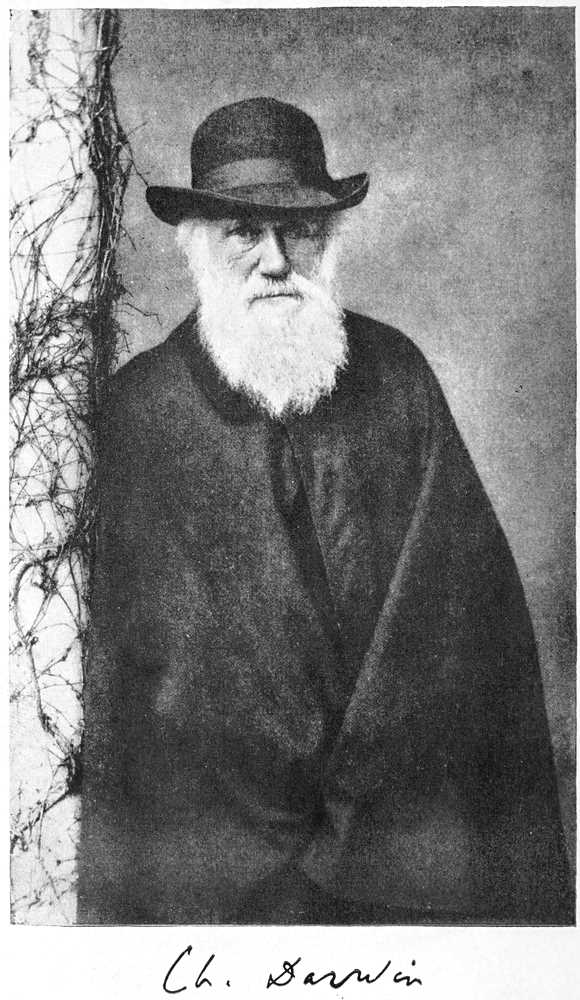
Ch. Darwin (signature)
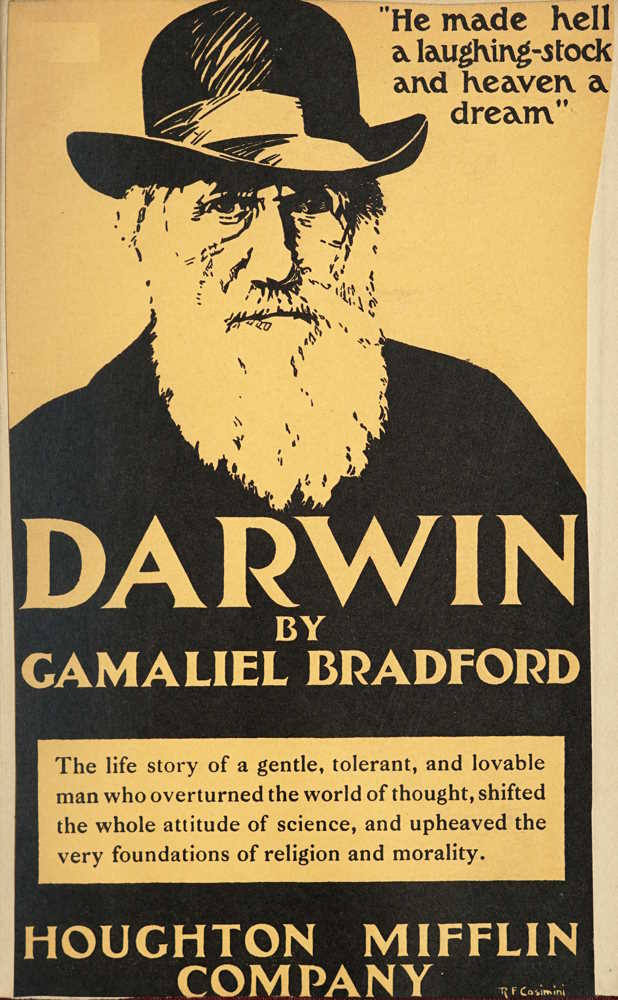
DARWIN
BY
GAMALIEL BRADFORD
WITH ILLUSTRATIONS
BOSTON AND NEW YORK HOUGHTON MIFFLIN COMPANY The Riverside Press Cambridge
1926
COPYRIGHT, 1926, BY GAMALIEL BRADFORD
ALL RIGHTS RESERVED
The Riverside Press
CAMBRIDGE · MASSACHUSETTS
PRINTED IN THE U.S.A.
TO MARSHALL LIVINGSTON PERRIN
WHO TAUGHT ME TO WRITE
AND TO THINK
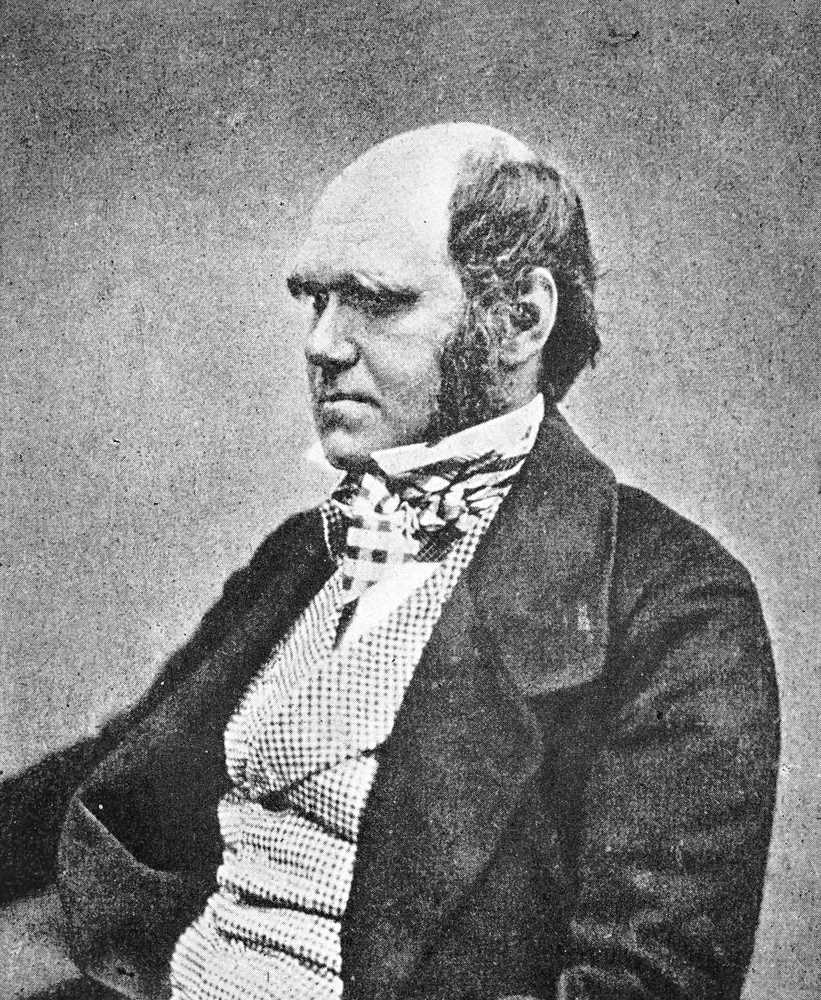
Photograph by Maull & Fox, reproduced in More Letters
DARWIN
CHRONOLOGY
CHARLES ROBERT DARWIN
Born, Shrewsbury, February 12, 1809.
At Edinburgh University, 1826.
At Cambridge, 1827-1831.
Absent with the Beagle, 1831-1836.
Married Emma Wedgwood, January 29, 1839.
Settled at Down, in Kent, 1842.
‘The Origin of Species’ published, November 24, 1859.
‘The Descent of Man’ published, February 24, 1871.
Died, Down, April 19, 1882.
CHAPTER I THE OBSERVER — I — II — III — IV
DARWIN
Any formal life of Darwin should be written by a
thoroughly trained and equipped scientist, and
indeed no such life could be better than that
written by Darwin’s son forty years ago. But one
who, without special scientific qualifications, is
profoundly interested in the characters and souls of
men, all men, may perhaps be justified in making
an intimate study of a man whose influence upon
other men, for good and evil both, has been enormous,
and who was himself one of the simplest,
purest, noblest, most candid, most lovable, most
Christian souls that ever lived.
By an extraordinary coincidence Charles Robert
Darwin was born in Shrewsbury, England, on the
same day, February 12, 1809, on which Abraham
Lincoln was born in Hardin County, Kentucky.
Darwin belonged to an excellent old English family
on his father’s side and his mother was one of the
Wedgwoods, of ceramic fame. His paternal grandfather,
Erasmus, was a physician, a poet, and a
scientist. Darwin’s father was an able and successful
physician. He would have liked his son to be the
same, but the son had not the taste for it. Failing
medicine, the church was considered, but seemed
equally unpromising. Education at Edinburgh and
at Cambridge did not yield very much. In those
days the classics were the basis and this boy had
little interest in the classics. He liked field sports
and outdoor life. Above all, he liked animals and
plants, liked to observe and to describe them, and
to record his observations, and this interest grew
more and more absorbing.
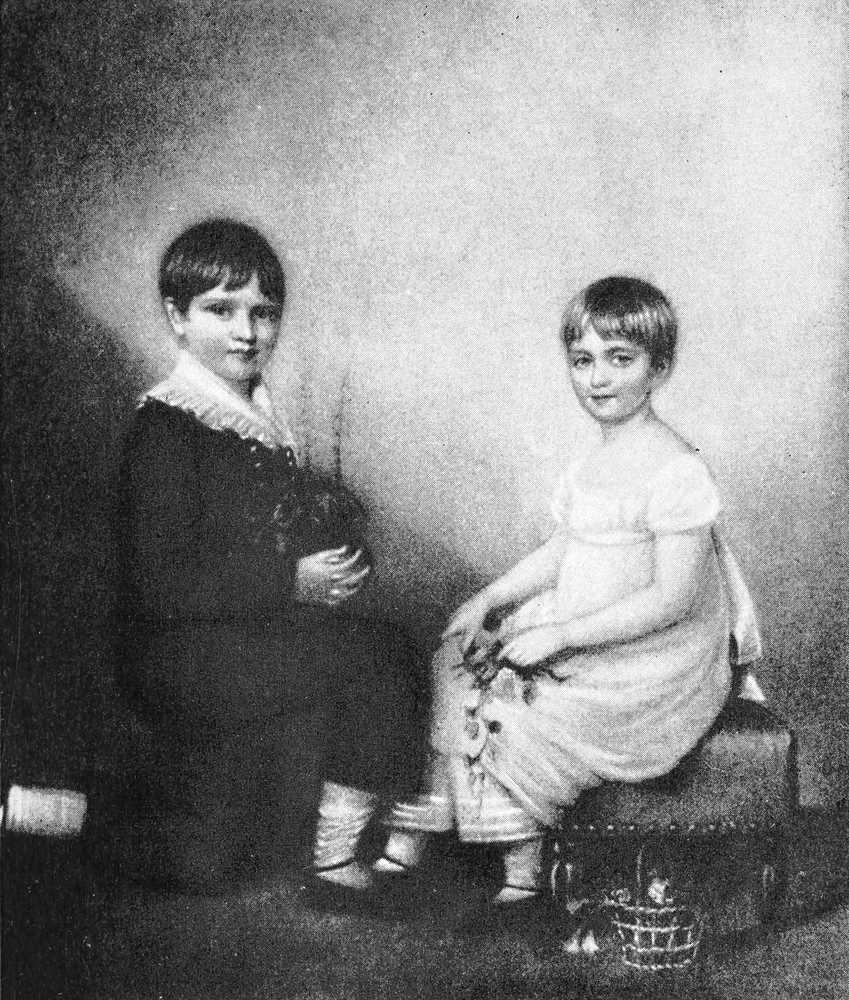
CHARLES DARWIN AS A CHILD
With his sister Catherine
In 1831, at the age of twenty-two, Darwin obtained
the position of naturalist on the government
ship, Beagle, and for five years he was absent from
England, exploring the southern hemisphere and
carefully recording his observations on every sort of
scientific subject, which were later published in his
printed journal. Soon after his return home, he
married his cousin, Emma Wedgwood, a noble and
charming woman, and a little later, in 1842, he
settled at the small village of Down, in the county
of Kent, and made his home there until his death in
1882. He inherited a considerable property, which
was later increased from his books. He had a large
family of sons and daughters, ten in all, and his life
was half chronic invalidism and half intense devotion
to scientific study and thought, or rather, the
two elements were inextricably intertwined.
As a result of his observations on the Beagle,
Darwin became possessed with the idea, which of
course had occurred to various thinkers before him,
from the Greeks to Lamarck, that life had not been
created in distinct manifold forms, but had developed
in all its variety, including even man, from
a few forms, or even from one. To entertain the
idea in the abstract was comparatively simple; but
to explain the process of development was the
puzzle, until Darwin hit upon what seemed to him
the clue in what he called ‘natural selection,’ or, as
Spencer termed it, ‘the survival of the fittest.’ For
twenty years Darwin patiently worked out experimental
proof of this theory, and then in 1859 he
published ‘The Origin of Species,’ a book which is
generally admitted to be one of the most important
in the whole history of science. During the remaining
twenty years of his life he devoted himself
to endless further experiment, and the results were
embodied in numerous volumes, chief among which
was ‘The Descent of Man.’ His views were from
the first the subject of fierce controversy, and in
many details they are still so, and will continue to
be. But it may safely be said that in the scientific
world the evolution of life, or more technically,
modification by descent, which is so inseparably
associated with Darwin’s name, is an accepted
principle, and Darwin himself had the great and
satisfying triumph of living until this acceptance
was perceived to be general, if not universal. He
was buried in Westminster Abbey, close to the
last resting-place of Newton.
The basis, or at any rate one of the most fundamental
elements of Darwin’s character, was the
instinct and habit of observing the external world,
and we can best approach him by considering this
habit in others and in him. It is astonishing how little
most of us see. We live in a world of shadows
and dream outlines, piecing out reality by convenient
abstractions, which pass in memory like worn
current counters, with little resemblance to actual
fact. A tree to us is vaguely a tree: the structure of
its bark, the shape of its leaves do not enter our
world. A man and a woman are simply—a man
and a woman. Unless we are specially called upon
to do so we do not note details of feature or gesture
or garment. This vagueness, this abstraction of
vision, is what Théophile Gautier referred to in his
celebrated phrase, ‘I am a man for whom the visible
world exists.’[1] And he amplified his idea by
saying that of twenty-five persons who come into a
room, twenty-four will go out and not be able to
tell you the color of the wall-paper, whereas he
could tell that and pretty much everything else.
To such an observing temperament life is a matter
of visual detail, of sensuous detail of every kind.
There are people who look out and people who
look in, and of course there are all sorts of degrees
between the two extremes. Some people are wholly
preoccupied with their own inner life, their
thoughts, their emotions, their experiences. It is
only by the pressure of necessity that they force
themselves into connection with the world about
them, and then it is under protest, and their
thoughts leap back, as by a spring, to internal
matters, as soon as the pressure is removed. Others
live in the swift, diverting movement of the external
world and lose their own destiny and almost their
identity in the play of it. ‘Let me alone to observe
till I turn myself into nothing but observation,’ says
the old poet.[2] The observation may be for a serious
scientific purpose. It may be for endless entertainment
and pure, inexhaustible delight. As Sterne
has it: ‘What a large volume of adventures may be
grasped within this little span of life by him who
interests his heart in everything and who, having
eyes to see what time and chance are perpetually
holding out to him as he journeyeth on his way,
misses nothing he can fairly lay his hands on.’[3]
As there are some persons who naturally observe,
so there are some who observe certain things, and
not others. Women are apt to be more acute observers
than men: their senses are more keen and
their minds less preoccupied. But their vision is
usually limited to the things that interest them. A
woman will go into a friend’s house and tell you
every detail of furnishing, will describe the friend’s
dress with finished minuteness. But she may take
a walk through the fields and not be able to remember
a single flower or insect. On the other
hand, very great scientists will not miss a spider
in the grass, but the color of a ribbon may escape
them.
From another point of view observation may be
deliberately exclusive. A trained observer may find
that general vision distracts him, and that to follow
up his special object it is necessary to put all other
sights and sounds out of consideration entirely.
Bradford Torrey used to say, and no doubt it is the
experience of all naturalists, that if he went to
look for a special flower, he saw flowers only, and
was quite oblivious to birds, while on bird days a
rare blossom might be passed unnoticed.
Naturally the most common matter of observation,
the one which is more or less forced upon the
attention of all of us, is humanity. We may be indifferent
to trees and stones, but our pleasure, our
labor, our existence depend upon a more or less
constant study of the human beings whose existence
interlocks at every point with ours. Therefore, from
the earliest times of record there have been profound
observers of humanity, persons who have
examined the human aspect and the human heart,
as read through that aspect, with the most persistent
zeal and the most unwearying delight. In the
vivid phrase of one of the most acute of these, ‘I
glutted myself with observation.’ And even those
of less gormandizing tendency find the analysis of
the human subject one of the most inexhaustible
pleasures that this world affords. All through the
study of Darwin I shall have occasion to refer to
one of Darwin’s contemporaries who in a different
line of research was an equally brilliant and significant
exemplification of the scientific spirit,
Sainte-Beuve. As Darwin devoted years upon
years to patient investigation of the secrets of the
natural world, so Sainte-Beuve with the same
patience, the same labor, the same infinite and
ever-varied curiosity, probed human hearts, all
sorts of human hearts, and portrayed them with
unfailing accuracy and sympathy. He said of
himself, using the strictly scientific expression: ‘I
analyze, I herborize, I am a naturalist of souls.’[4]
But in dealing with Darwin we are in the main
concerned with the field of so-called natural science,
with the varying aspects of the material world,
which we are apt to sum up under the term, nature.
General observation of this world is, of course,
also as old as man. Greek, Hebrew, Egyptian, all
ancient records, contain scientific facts of importance
and interest to-day. Sophocles and Vergil
had an exquisite sense of the exact beauty of
birds and flowers. The vision of Chaucer and
Shakespeare was as acute as that of Gautier, so
far as they chose to employ it. At the same time
we must recognize that with the middle of the
eighteenth century a new interest in nature arose.
The literature of Rousseau and Cowper, of Keats
and George Sand, reflected the external world in a
far different fashion from anything before imagined,
and Linnæus, Cuvier, and many others laid
the foundations of modern scientific study, which
the nineteenth century developed until it overshadowed
every branch of learning both for theoretical
abundance and for practical utility.
It must of course be recognized that in many
cases the observation of nature is not practiced for
the pure pleasure of it, but serves some ulterior
object or interest. There is first the obvious practical
gain from such observation. Agriculture has
undergone a complete revolution in the last hundred
years, and this revolution has been brought
about by the various developments of scientific
research. Darwin’s vast investigations showed
the intimate connection between the theories of
the scientist and the practical experiments of the
breeder.
On the other side there is the observation of the
artist. Ruskin pointed out long ago, how fine, how
subtle, how delicate was the vision of the great
painters, how perfect their skill in rendering the
exact sense impression of natural objects. In the
same way, it is not often considered what wealth of
accurate record we have in the poets and novelists.
Gautier, for whom the visible world existed,
was a poet. He saw shapes and contours and
colors, saw them to render them in words that
interpreted as perfectly as words can. The great
French novelists who followed Gautier and learned
from him were in the same way admirable observers
and recorders. Darwin himself did not
scorn to use the observation of the English novelist
Mrs. Oliphant and he refers to her as ‘an excellent
observer.’[5]
But there is such a thing as observation for the
pure love of it, which is used neither to improve the
breed of chickens or tomatoes, nor to make effective
and salable copy, nor even to generate and sustain
theories about the organization of the cosmos.
There is a pure, inexhaustible delight in just living
with the insects and the birds, in merging one’s
own existence, one’s own soul in the mysterious
abundance and ecstasy of the universal life, without
thought of any ulterior object to be achieved
in any way whatsoever. White of Selborne felt nature
in this fashion. So did Richard Jefferies. So
did the French naturalist and observer, Fabre. I
know few works that have more of the charm of personal
delight than Bates’s ‘Naturalist on the Amazons,’
a book which I have read and re-read and
shall read again. Bates was interested in the Darwinian
theories and worked at them. But his
passion for the forest life was quite independent of
any theories and it is expressed with an engaging,
absolute simplicity, without the slightest pretence
at literary ornament or effect.
Our supreme American example of this life in
nature, and perhaps the supreme example anywhere,
is Henry Thoreau. Thoreau had his speculations,
and some persons relish them. But it
seems as if no other human being had ever left the
record of such complete self-abnegation in the external
world as Thoreau’s. His soul not only turns
to that of the birds and flowers, it is that of the
birds and flowers, and he is never, never making
observations to serve a purpose. He is simply existing
in the universal existence for the joy of it: ‘I
have given myself up to nature; I have lived so
many springs and summers and autumns and winters
as if I had nothing else to do but live them, and
imbibe whatever nutriment they had for me; I have
spent a couple of years, for instance, with the flowers
chiefly, having none other so binding engagement
as to observe when they opened; I could
have afforded to spend a whole fall observing the
changing tints of the foliage. Ah, how I have
thriven on solitude and poverty!’[6]
Of the numerous records of simple natural observation
and experience few are more charming
than Darwin’s ‘Journal of the Voyage of the
Beagle,’ in which he notes what he saw and heard
by land and sea during those years of adventure in
the southern hemisphere. All through this book,
as indeed in all his books, it is evident that the
instinct and habit of observing were inborn and
constant, and all those who write about Darwin
make this instinct at least the foundation of his
scientific eminence.
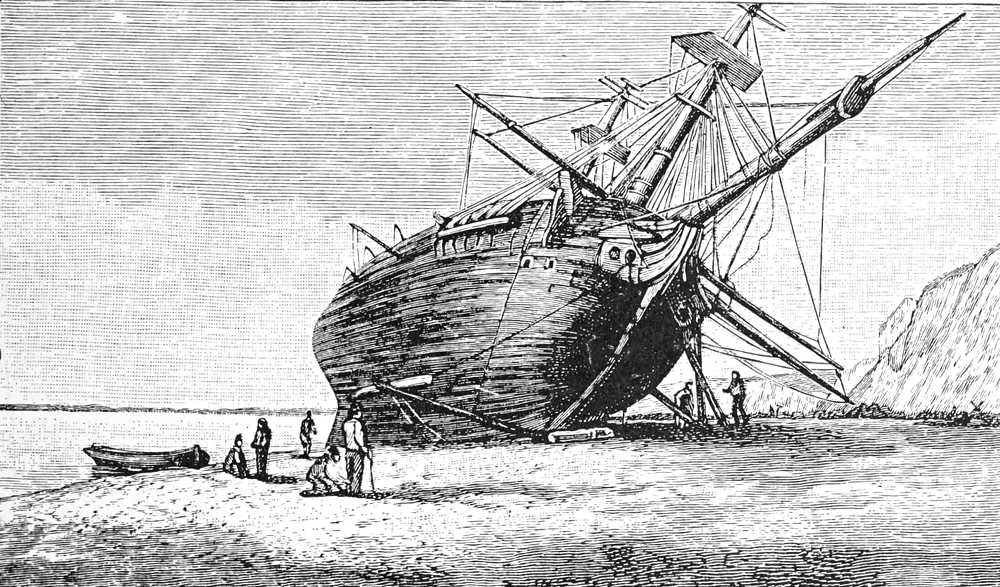
THE BEAGLE LAID ASHORE FOR REPAIRS AT RIVER SANTA
CRUZ, PATAGONIA
Asa Gray, who had given his life to botany, writes:
‘What a skill and genius you have for these researches!
Even for the structure of the flower of the
Ophyrideæ I have to-night learned more than I ever
knew before.’[7] Professor Osborn says, more generally:
‘Rare as were his reasoning powers, his
powers of observation were of a still more distinct
order. He persistently and doggedly followed every
clue; he noticed little things which escaped others;
he always noted exceptions and at once jotted down
facts opposed to his theories.’[8] And the editors of
Darwin’s letters put the whole matter with concise
effectiveness in speaking of ‘that supreme power
of seeing and thinking what the rest of the world
had overlooked, which was one of his most striking
characteristics.’[9]
Darwin’s own comments on observation are frequent
and most interesting. Little inclined as he
was to self-praise, in the charming autobiographical
sketch which begins the ‘Life,’ he frankly states his
merits in this regard: ‘I think that I am superior to
the common run of men in noticing things which
easily escape attention, and in observing them
carefully. My industry has been nearly as great as
it could have been in the observation and collection
of facts.’[10] Exact, systematic, patient study of
what is actually seen seems to him the basis of all
great scientific work, and he repeatedly emphasizes
the importance of it. ‘It is well to remember that
Naturalists value observations far more than
reasoning.’[11] Again, ‘I have come not to care at all
for general beliefs without the special facts. I have
suffered too often from this.’[12] And observation is
not only a duty, it is a delight. The arrangement of
facts, the deduction of theories from them, thought,
reasoning, argument, these are labor and pain. But
to watch the insects and the flowers, by long and
careful attention to make them yield all their secrets,
this is no labor, but an exquisite diversion,
which never fails: ‘A naturalist’s life would be a
happy one if he had only to observe, and never to
write.’[13]
It is evident, further, that Darwin’s observation
was by no means confined to natural science, but
was quick, acute, and constant in all the different
phases and interests of life. Naturally his books
deal with little besides his scientific work, but the
record of the Beagle shows interest and appreciation
of many things outside of this work altogether.
An eye so carefully trained could not fail
to distinguish and perceive all sorts of minute
points that others would pass over. His readiness
to note other things besides those he was looking
for shows in the piquant comment on wide experimenting:
‘It may turn out a mare’s nest, but
I have often incidentally observed curious facts
when making what I call “a fool’s experiment.”’[14]
It is especially curious to note Darwin’s observation
of himself. To be sure, he disclaims any
philosophical study in this regard: ‘I have never
tried looking into my own mind.’[15] Nevertheless,
whether he tried or not, he was curiously alive to
what went on there, and he records what he finds
with the singular candor which appears in his
treatment of his own affairs as well as of others.
The very hesitation with which he speaks of self-analysis
increases the value of his results: ‘If I can
analyze my own feelings (a very doubtful process).’[16]
And when he does make a statement, it is
all the more reliable and all the more far-reaching
from the moderation and reserve with which it is
advanced.
In one field quite remote from what is usually
considered natural science, that of physiognomy
and expression, Darwin’s observation is especially
interesting, though of course he connected this line
of research, as so many others, with his general
scientific theory. His book on ‘The Expression of
the Emotions’ is one of the most entertaining and
profitable of all for the general reader, and it is instructive
to note, how early, how persistently, and
how faithfully he collected memoranda on this
comparatively collateral issue. The use of what was
immediately about him, of his own personal experience
in daily living, is especially significant in this
regard. For the study of expression he felt that
unconsciousness in the subject was a prime requisite.
Hence the study of infants, who were perfectly
indifferent to your investigations, was peculiarly
profitable, and almost from the moment his children
were born, Darwin began to make notes on
their expressions of pain and pleasure, all the little
subtle indications of desire and need, which mothers
use instinctively but which fathers are not commonly
apt to register as scientific data. The curious
paper, published in Mind, called ‘The Biography of
a Child,’ gives many of Darwin’s notes on this
subject, and repeated references in ‘The Expression
of the Emotions’ show what fruitful use he
made of those notes at a later period. The minuteness
with which he observed and reflected is well
shown in this passage on childrens’ crying: ‘I ought
to have thought of crying children rubbing their
eyes with their knuckles, but I did not think of it,
and cannot explain it. As far as my memory serves,
they do not do so whilst roaring, in which case compression
would be of no use.... I wish I knew
more about the knuckles and crying.’[17]
The observation not only records the larger and
more violent manifestations of passion, but is
constantly on the watch for those trifling signs of
feeling which appear and flit away in trivial social
intercourse. Take this account of an animated
conversation: ‘Another young lady and a youth,
both in the highest spirits, were eagerly talking together
with extraordinary rapidity; and I noticed
that, as often as the young lady was beaten, and
could not get out her words fast enough, her eyebrows
went obliquely upwards, and rectangular
furrows were formed on her forehead. She thus
each time hoisted a flag of distress; and this she
did half-a-dozen times in the course of a few minutes.’[18]
Nor is he content with his own observations, but
in this, as in wider researches, he perpetually appeals
to his friends for assistance, opens their eyes
and sharpens their wits, to see and record matters
which they would assuredly never have thought of
for themselves. Note the care and tact with which
he makes his requests: ‘I beg you, in relation to a
new point for observation, to imagine as well as you
can that you suddenly come across some dreadful
object, and act with a sudden little start, a shudder
of horror; please do this once or twice, and observe
yourself as well as you can, and afterwards read the
rest of this note, which I have consequently
pinned down.’[19]
It is, however, in the regions of natural science
more particularly so-called that Darwin’s observation
is inexhaustibly rich, varied, exciting, and
suggestive. He himself puts it very simply and effectively,
when he says, ‘I was born a naturalist.’[20]
At the age of ten his curiosity was intensely stimulated
by the varying aspects of insects and he considered
the desirability of collecting them. In one
of his letters, Darwin gives an amusing illustration
of this youthful enthusiasm for collecting. One day
he had caught two most interesting beetles and
was holding one in each hand, when he discovered
a third, ‘a sacred Panagæus crux-major!’ ‘I could
not bear to give up either of my Carabi, and to lose
Panagæus was out of the question; so that in despair
I gently seized one of the Carabi between my
teeth, when to my unspeakable disgust and pain the
little inconsiderate beast squirted his acid down my
throat, and I lost both Carabi and Panagæus.’[21]
The delight of observation, which began in
childhood, continued to old age, and increased instead
of weakening. When he was fatigued and
worn with writing and theorizing, when illness tormented
him and weakness rendered more concentrated
effort impossible, it was a relief to turn to the
simple contemplation of facts, and the budding and
fading of flowers and the varied activity of insects
offered at all times diversion and contentment.
Sometimes he dwells upon the larger aspects of such
contemplation, the joy of discovery, the excitement
of finding what has never been found before.
Again and again in his southern voyages this excitement
appears: ‘In these wild countries it gives
much delight to gain the summit of any mountain.
There is an indefinite expectation of seeing something
very strange, which, however often it may be
balked, never failed with me to recur on each successive
attempt.’[22] Or the pleasure may come in
what seem the humblest, smallest things, in what is
to ordinary persons negligible, or even repulsive.
One of Darwin’s most attractive books, perhaps
with ‘The Expression of the Emotions,’ the most
attractive from the casual reader’s standpoint, is
that in which he gathers together the results of his
study of earthworms, a study which had continued
through years of patient and thoughtful investigation
of a subject which, even from the
naturalist’s point of view, would not seem one of
the most fruitful or engaging.
The fundamental principal of all scientific observation
is accuracy, and no one knew this better
than Darwin. No one understood better than he
the subtle, treacherous influences that are always
at work, distracting, impairing, and distorting
exact and lucid vision. There is the danger of seeing
what we are accustomed to see and therefore think
we see. There is the danger of seeing what others
have seen and described before us. There is the
supreme danger of seeing what we wish to see, what
accords with some preconceived theory or dogma.
Against all these dangers Darwin tried to be ever
on his guard, and he is constantly warning others
of them and emphasizing the importance of pure
accuracy and the enormous difficulty of it. ‘Good
heavens, how difficult accuracy is!’[23] Among all the
merits of the scientist he values accuracy highest,
the instinct and the ability to record facts correctly:
‘I value praise for accurate observation far higher
than for any other quality.’[24] And especially in one
admirable passage he stresses and reiterates both
the difficulty and the value: ‘Accuracy is the soul of
Natural History. It is hard to become accurate;
he who modifies a hair’s breadth will never be
accurate.... Absolute accuracy is the hardest
merit to attain, and the highest merit.’[25]
Among the various elements of accuracy, that of
statement, as well as of observation, is of course of
the utmost importance, yet is too apt to be overlooked.
Even those who are careful in their actual
observing, may in their report of their observations
be much less so. Words are misleading and inadequate
things, and the tricks they have played with
scientific accuracy have been deplorable. There is
the strange ease of mere misstatement. There is
the natural tendency to overstate. There is the
tendency to clarify verbally what in fact is more or
less confused or the opposite difficulty of making
verbally clear what the senses may perceive with
singular lucidity.
Here again Darwin is constantly on the watch.
Memory is misleading and accounts based upon it
are apt to be untrustworthy: ‘I foolishly trusted to
my memory, and was much annoyed to find how
hasty and inaccurate many of my remarks were.’[26]
Words are inadequate, blundering, they will not
render the finer, more delicate shades: ‘A difference
may be clearly perceived, and yet it may be impossible,
at least I have found it so, to state in what
the difference consists.’[27] One cannot be too careful,
too scrupulous, about one’s statements, or too
anxious to correct them, when one has made a
mistake. And Darwin gets up in the middle of the
night and arouses a slumbering friend to explain
that, after all, he felt the sense of the sublime more
fully in the forests of Brazil than on the top of the
Cordilleras.[28]
When one is so mistrustful of one’s own records
one cannot always accept implicitly the narratives
of others. Darwin is eager to get the accounts of
other observers, and is singularly deferential to
their opinions. At the same time he is gently and
watchfully critical, and knows well how to estimate
the ability of those with whom he deals. One of
the most interesting remarks upon the skill of his
methods in obtaining information, and one that
every one who reads him carefully will confirm, is
Sir William Turner’s comment upon ‘his care in
avoiding leading questions.’[29]
And if Darwin was insistent upon accuracy in
records, he was also extraordinarily thorough and
exact in mathematical matters and measurement.
He speaks of abstract mathematics as having been
one of the neglected elements of his education,[30]
but he shunned no amount of pains and toil in
calculating, wherever he felt it necessary to work
out his results. In his books which record the investigation
of detail there is an almost incredible
amount of slow and careful research involving
exact counting and weighing and measuring. ‘I was
compelled to count under the microscope above
20,000 seeds of Lythrum salicaria,’ he says casually
in one instance,[31] and there are innumerable others
of the same kind. In all these calculations the possibility
of error haunts him and he does his best to
eliminate it, yet still the possibility is there: ‘Although
I always am endeavoring to be cautious and
to mistrust myself, yet I know well how apt I am
to make blunders.’[32] If he blundered, what shall be
said of some of us? Most interesting and characteristic
is the trait, pointed out by his son, that he
assumed with singular naïveté the absolute accuracy
of the instruments that came to him: ‘He had
great faith in instruments, and I do not think it
naturally occurred to him to doubt the accuracy
of a scale or measuring glass.’[33] Yet further, ‘it was
characteristic of him that he took scrupulous pains
in making measurements with his somewhat rough
scales.’[34]
As he was exact and particular in calculation and
measurement, so he shrank from no amount of detail,
did not hesitate to carry his investigations to
the last point of minuteness, whenever the full and
solid breadth of result demanded it. Apparently
nothing escaped him. It was not only what he was
looking for, but he noted and seized oddities and
exceptions for their larger bearing and for future
profit. As his son says, ‘A point apparently slight
and unconnected with his present work is passed
over by many a man almost unconsciously with
some half-considered explanation, which is in fact
no explanation. It was just these things that he
seized on to make a start from.’[35] Thus, on any
subject that came up, his memory or his notes
could almost always be appealed to. As Sir Thomas
Farrer puts it, ‘What interested me was to see that
on this as on almost any other point of detailed
observation, Mr. Darwin could always say, “Yes,
but at one time I made some observations myself
on this particular point; and I think you will
find, etc., etc.”’[36]
To appreciate this minuteness and thoroughness,
it is necessary to examine the less known and less
popular books, such as the ‘Cross and Self Fertilization’
and the ‘Different Forms of Flowers.’
In these one is overwhelmed with Darwin’s persistence
in examining and noting trivial details.
And perhaps most impressive of all is to turn over
the pages of the two immensely solid volumes on
Cirripedes. For many years Darwin devoted himself
to the study of these unexciting barnacles,
sometimes wearying, sometimes rebelling, but always
keeping at his task until he had completed it.
He himself sometimes wondered whether such prolonged
toil at mere description was wholly worth
while; but Huxley believed that the mental discipline
was of the greatest possible profit to Darwin’s
later work. In any case the exhaustive thoroughness
of it is indeed exemplary. How far this goes
may be suggested by one quotation out of many:
‘I cannot too strongly impress on any one intending
to study this class, not to trust to external characters;
he must separate and clean and carefully
examine the internal structure and form of the compartments
and more especially of the opercular
valves.’[37] And the examination, in Darwin’s case,
applied to hundreds of specimens of minute barnacles
gathered and sent to him from all parts of the
world.
It is hardly necessary to emphasize the enormous
amount of labor implied and involved in all these
self-imposed tasks of Darwin. Although circumstances
compelled him to give a large part of his
life to repose, he was by nature a worker. It is true
that he sometimes speaks jokingly of his idleness:
‘I have been of late shamefully idle, i.e., observing
instead of writing, and how much better fun observing
is than writing.’[38] But as Huxley well
points out, Darwin generally means by idleness
‘working hard at something he likes when he
ought to be occupied with a less attractive subject.’[39]
And Darwin’s own more serious comment
is, ‘I am a pretty man to preach, for I cannot be
idle, much as I wish it, and am never comfortable
except when at work.’[40] He complains of fatigue,
he forces himself to seek recreation, relaxation; but
even when his body is at rest, his mind tends to
work, refuses to stop working, finds its only real
relief in change of occupation and thought.
And as the labor is impressive, so is the patience.
The man was naturally nervous, restless, eager.
He wanted results, like the rest of us. Yet after he
had conceived a theory which he thought destined
to subvert the whole realm of science, he waited
twenty years for the thorough observation and
testing necessary to put the theory into even tentative
form. Of all the great scientific qualities perhaps
patience is the most essential and the most
difficult, and surely patience never had a more supreme
exemplar than Charles Darwin. Sometimes
even his enduring persistence is temporarily
shaken: ‘My cirripedial task is an eternal one; I
make no perceptible progress. I am sure that they
belong to the hour-hand, and I groan under my
task.’[41] But though he may groan, he never yields.
As his son admirably says of him: ‘He used almost
to apologize for his patience, saying that he could
not bear to be beaten, as if this were rather a sign
of weakness on his part.... Perseverance seems
hardly to express his almost fierce desire to force
the truth to reveal itself. He often said that it was
important that a man should know the right point
at which to give up an inquiry. And I think it was
his tendency to pass this point that inclined him to
apologize for his perseverance, and gave the air of
doggedness to his work.’[42] The intensity of such
patience is best appreciated by those who all their
lives have scamped and hurried and slighted and
touched a thousand things without ever going to
the bottom of a single one.
Nothing illustrates better the patience of Darwin,
and of course also of hundreds of other scientists
who are working as he worked in unknown
laboratories all over the world, than the process of
simple waiting so often necessary to obtain results.
Nature demands time, often enormous time, and
the brevity of human life and the evanescence
of human opportunity mean nothing to her. The
careful working out of scientific investigation requires
the study of successive generations, sometimes
of many, the sowing of the seed and the gathering
of the blossom, the close observation of the
individual from conception to death, which can be
carried on only through long periods of time. The
observer must keep a dozen lines of study in his
mind, must maintain them side by side, and must
be always ready to turn from one to the other, as
some new development arises that demands his
attention. It was in this phase of long, renewed,
continued, enduring watchfulness that Darwin was
preëminent. As well appears in his son’s record: ‘I
think it was all due to the vitality and persistence
of his mind—a quality I have heard him speak of
as if he felt that he was strongly gifted in that
respect. Not that he used any such phrases as
these about himself, but he would say that he had
the power of keeping a subject or question more or
less before him for a great many years.’[43] Very
little examination of Darwin’s books is required to
show how amply and constantly this power was
exercised.
And to give such patience and taste for continuity
their full effect there is needed almost a passion
for system, for orderly arrangement, and the habit
of putting not only things but thoughts in their
proper places, so that they can be called upon at
the right moment in the right way. Darwin himself
describes his elaborate method of indexing
the books that he read and the notes that he made,
so that whenever he wished to deal with any
special subject, he could turn at once to material
bearing upon it: ‘Before beginning on any subject
I look to all the short indexes and make a general
and classified index, and by taking the one or more
proper portfolios I have all the information collected
during my life ready for use.’[44]
Such systematic habits of working both demand
and imply an orderly and economical use of time.
Owing to his limitations of health, Darwin’s working
time was extremely limited, but he made the
most of it. Every usable hour was allotted, and the
utmost profit and result were extracted from it. No
doubt such sense of pressure is in itself not very
beneficial to health, but it means an immense
amount of work accomplished. The time was employed
thriftily as well as intelligently: ‘He saved
a great deal of time through not having to do things
twice.’[45] And everywhere there is the feeling of
the value of minutes which is indicated in Dante’s
saying,
Or as Darwin himself expresses it: ‘A man who
dares to waste one hour of time has not discovered
the value of life.’[47]
Still another element of observation richly illustrated
in Darwin, and closely connected with the
patience and the continuity, is the element of comparison.
Observation by itself, the mere accumulation
of curious detail, does not get us very far.
Observations must be bound together, one with
another, they must be connected and related, intertwined
into results and conclusions, often remote
and far-reaching, or they do not begin to attain
all their possible significance. In Darwin’s own
phrase: ‘As you say, there is an extraordinary
pleasure in pure observation; not but what I suspect
the pleasure in this case is rather derived from
comparisons forming in one’s mind from allied
structures.’[48] This more elaborate process of comparison,
however, leads us at once to the methods
of deliberate experiment for a special purpose, and
will therefore be more fully and naturally considered
in the next chapter.
As to the more practical side of observation, one
is largely impressed with all the difficulties and
drawbacks of it, when pursued on any considerable
scale, and certainly Darwin’s life affords abundant
illustration of these, some peculiar to himself and
some of a more general nature which beset most
naturalists more or less.
There are the difficulties that always attend extensive
field and outdoor work. In a voyage such as
that of the Beagle, in a small sailing ship a hundred
years ago, there were the elements of actual danger.
Darwin was the last person to enlarge upon his
courage in meeting these or in disregarding them.
Of his childhood he says: ‘I remember how very
much I was afraid of meeting the dogs in Barker
Street, and how at school I could not get up my
courage to fight: I was very timid by nature.’[49]
But repeated experiences during the voyage of the
Beagle make it evident that the timidity was overcome
by a calm and intelligent comprehension of
conditions and necessities. Perhaps the most interesting
illustration is Darwin’s attitude toward an
earthquake in South America: ‘I have had ill luck,
however, in only one little earthquake having
happened. I was lying in bed when there was a
party at dinner in the house; on a sudden I heard
such a hubbub in the dining-room; without a word
being spoken, it was devil take the hindmost and
who should get out first; at the same moment I
felt my bed slightly vibrate in a lateral direction.
The party were old stagers, and heard the noise
which always precedes a shock; and no old stager
looks at an earthquake with philosophical eyes.’[50]
Worse perhaps than the specific, exceptional
dangers were the constant annoyances and discomforts.
Food was often insufficient, ill-prepared,
and indigestible. Cold was wearing and heat was
wearing. There was exposure to all sorts of weather,
there was the torment of insects, there was endless,
inescapable fatigue, which could not be remedied or
avoided, but just had to be borne and forgotten in
the excitement of great or even little objects to be
attained. Glimpses here and there, never unduly
emphasized, show what these trials were and how
they were met: ‘The road, from some recent rain,
was full of little puddles of clear water, yet not a
drop was drinkable. I had scarcely been twenty
hours without water, and only part of the time
under a hot sun, yet the thirst rendered me very
weak. How people survive two or three days under
such circumstances, I cannot imagine.’[51] To put up
with discomforts during a camping trip of a few
weeks or months is one thing. To endure them constantly
for five years implies a very pretty enthusiasm
for the cause of science.
Besides these external drawbacks to observation,
there are others more subjective and personal. A
minor aspect of these has interested me, because it
shows such a delightful mixture of human feeling
and scientific curiosity. As we shall have occasion
to amplify later, Darwin was remarkable for tenderness,
for sympathy, for affectionate and kindly
interest, not only in humanity generally and in
animals, but especially in those directly connected
with him. Yet his investigations of expression led
him, forced him, to a calm and cold-blooded analysis
of situations and emotions which at the same
time made the strongest appeal to his sympathies.
All through his children’s infancy he pursued the
practice of making notes on them, yet it is most
curious to trace the play of personal emotion in
combination with the abstract research, and the
working of this well appears in his son’s remark:
‘It was characteristic of him that (as I have heard
him tell), although he was so anxious to observe the
expression of a crying child, his sympathy with the
grief spoiled his observation.’[52] A more impersonal
example is his careful record as to a woman whom he
studied in a railway carriage, watching with minute
attention the movement of her depressores anguli
oris, which appeared to indicate extreme distress:
‘As her countenance remained as placid as ever, I
reflected how meaningless was this contraction, and
how easily one might be deceived. The thought
had hardly occurred to me when I saw that her
eyes suddenly became suffused with tears almost to
overflowing and her whole countenance fell. There
could now be no doubt that some painful recollection,
perhaps that of a long-lost child, was passing
through her mind.’[53] And so instances of intense
individual suffering became generalized into
typical cases of scientific record.
Far more important, however, in Darwin’s career,
as a drawback to scientific observation, than
any intrusions of subjective sympathy, were the
bitter, persistent limitations of physical illness and
weakness. During a very large part of his life he
was tormented by nervous indigestion, manifesting
itself, under any strain, in persistent nausea.
This first appeared in the ever-returning and unconquerable
sea-sickness which made all his southern
voyages a misery. When the ocean was at all
boisterous the malady prostrated him, and those
who know how absolutely prostrating sea-sickness
is will appreciate the positive heroism which enabled
him to prosecute his journey and his researches
with such a handicap.
After his return to England the trouble continued
to hound and haunt him through all his
later years. He never could work for more than a
small portion of the day. The excitement of
visitors always upset him. There were long periods
when any work was impossible and often an absorbing
investigation had to be laid aside altogether
just at the most critical point, laid aside so
completely that not only actual labor but even
thought was prohibited. The idleness which he
detested was forced upon him for a very large part
of his days and hours and the spirit framed for such
constant and intense activity was obliged to discipline
itself to the most irksome and profitless repose.
It made no difference in the intensity or the persistence
of his scientific preoccupations. Perhaps
if he had abandoned his pursuits altogether and
had contented himself with an indolent and externally
diversified existence, he might have enjoyed
reasonable health. But he would not yield for a
moment. His whole soul was in the studies, the
pursuits, the investigations that enthralled and
inspired him, and life without them would have
been inconceivable. ‘We have come here for rest
for me, which I have much needed; and shall remain
here for about ten days more, and then home to
work, which is my sole pleasure in life.’[54] That is
the constant note. In the midst of his travels he
wrote home: ‘My mind has been since leaving England,
in a perfect hurricane of delight and astonishment,
and to this hour scarcely a minute has passed
in idleness.’[55] The body might lag and drag and
harass and torment, but the spirit lived in just such
a hurricane of excitement and enthusiasm always.
It must be recognized that even in the pure habit
of observation for itself, whether in the natural
world or otherwise, there is a charm for those who
are born for it. Curiosity is a natural instinct with
most of us, and there is inexhaustible entertainment
in letting the spirit lie fallow within, while the
external world plays upon it with an endless succession
of picturesque incidents and highly colored
circumstance. At the same time, and especially in
the realm of nature, it is astonishing what a difference
even a little knowledge makes. Most of us
walk through the fields and woods like blind men,
utterly oblivious of all the fascinating secrets which
await our eyes and ears if we were only alive to
them. As one who has always delighted in solitary
wood walks merely for their associative beauty, I at
least can bewail the deplorable ignorance as to plants
and birds and insects which makes it impossible for
me even to interrogate them intelligently. Lack of
time or natural indolence have prevented my accumulating
the knowledge which would put all
these things in their proper relations and make
them tell a story which the trained and expert
observer instantly and instinctively reads in them.
It is comforting to find even Darwin complaining
of the same ignorance and the same blindness, when
he gets into surroundings that are strange to him.
Thus in his earlier voyaging, he notes: ‘One great
source of perplexity to me is an utter ignorance
whether I note the right facts, and whether they
are of sufficient importance to interest others.’[56]
And again even more vividly: ‘It is positively distressing
to walk in the glorious forest amidst such
treasures and feel they are all thrown away upon
one.’[57]
Then with the coming of a little knowledge the
observation is enriched, transfigured, glorified.
Hear what Thoreau says of even the apparently
dry and profitless acquisition of nomenclature:
‘With the knowledge of the name comes a distincter
recognition and knowledge of the thing. That shore
is now more describable and poetic even. My knowledge
was cramped and confined before, and grew
rusty because not used—for it could not be used.
My knowledge now becomes communicable and
grows by communication.’[58] Knowledge in one
branch amplifies and steadies observation in that
branch. Knowledge of many branches connects
them and makes each one throw light on all the
others. Record of others’ observations or of your
own through several years give each new year
double significance and fruitfulness. As Thoreau
again puts it: ‘I soon found myself observing when
plants first blossomed and leafed, and I followed it
up early and late, far and near, several years in succession,
running to different sides of the town and
into the neighboring towns, often between twenty
and thirty miles in a day.’[59] If your attention gets
fixed upon some special point to be elucidated,
every walk you take, and almost every step brings
out some development which you did not consider
or imagine before. In short the enrichment of
knowledge doubles, triples, quintuples your vision,
since it teaches you what to look for, and even
while it sometimes betrays, teaches you what to
see.
But if mere general scientific knowledge is so
stimulating and so enlarging in the realm of observation,
how infinitely more fruitful is the Darwinian
view of the interrelated development of all
life including that of man. Whatever may be said,
whatever we may have to say later, of the injurious
action of this view upon the status of man himself,
there can be no question as to the transforming,
magical effect of it upon the study of the natural
world. Before the evolutionary attitude, the observation
of plants and animals was at best a mere
gratification of curiosity. The proper study of
mankind was man, and the investigation of birds and
insects was only distraction and diversion. But the
instant it appeared that all the threads of life were
intertwined and that in disentangling even the
slightest of them you might be getting the clue to
the riddle of the whole, all was changed. When it
comes to be felt that the history of man, of his instincts,
of his passions, of his powers, of his future,
of his fate, is written in his past, and that past is to
be studied, if at all, in the history of the humblest
creatures who are animated by the same mysterious
impulse of life that moulds and governs him, the interest
of natural observation is increased a thousandfold.
It is not exaggerating to say that the
study of natural history is an entirely different
pursuit since Darwin from what it was before.
It is evident that Darwin himself was constantly
and immensely impressed by the profound significance
thus added to scientific research. A passage
in his earlier note-books shows how the idea was
beginning to take hold of him: ‘If we choose to let
conjecture run wild, then animals, our fellow
brethren in pain, disease, death, suffering and famine—our
slaves in the most laborious works, our
companions in our amusements—they may partake
of our origin in one common ancestor—we
may be all melted together.’[60]
A striking concrete illustration of the community
of life, even in the humblest forms, appears in the
book on earthworms and suggests Emerson’s
poetical version of the same idea,
‘And striving to be man the worm
Mounts through all the spires of form:’
‘It may be well to remember how perfect the sense
of touch becomes in a man when born blind and
deaf, as are worms. If worms have the power of
acquiring some notion, however rude, of the shape
of an object and of their burrows, as seems to be the
case, they deserve to be called intelligent; for they
then act in nearly the same manner as would a man
under similar circumstances.’[61] While a celebrated
passage in ‘The Origin of Species’ develops the
idea abstractly, by implication at least placing
man at the apex of the whole: ‘As buds give rise by
growth to fresh buds, and these, if vigorous, branch
out and overtop on all sides many a feebler branch,
so by generation I believe it has been with the
great Tree of Life, which fills with its dead and
broken branches the crust of the earth, and covers
the surface with its ever-branching and beautiful
ramifications.’[62]
Wallace said of his great friend and competitor,
‘Again, both Darwin and myself had what he terms
“the mere passion of collecting”.... I should describe
it rather as an intense interest in the mere
variety of living things.’[63] The simple observer is
carried away, absorbed, ravished by the delight and
the fascinating play of this variety of living things,
but how far more absorbing and inexhaustible does
the delight become when we feel that in studying
this universal play of life we are every moment
probing the depths of our own souls.
CHAPTER II DARWIN: THE THINKER — I — II — III — IV
Mere observation of the natural world, varied, fascinating,
inexhaustible as it is, affords only the
material for science. Observed facts must be built
up, woven together, ordered, arranged, systematized
into conclusions and theories by reflection
and reason, if they are to have full bearing on life
and the universe. Knowledge is the accumulation
of facts. Wisdom is the establishment of relations.
And just because the latter process is delicate and
perilous, it is all the more delightful. The lofty
scorn of the true philosopher for mere perception
is well shown in Royer Collard’s remark: ‘There is
nothing so despicable as a fact.’ Which does not
prevent philosophers or any one else from making
facts the essential basis of all discussion of relations.
Darwin’s own comments on the general connection
between the two are always interesting: ‘I have an
old belief that a good observer really means a good
theorist,’[432] and again: ‘About thirty years ago there
was much talk that geologists ought only to observe
and not theorize; and I well remember some
one saying that at this rate a man might as well go
into a gravel-pit and count the pebbles and describe
the colors. How odd it is that any one should not
see that all observation must be for or against
some view if it is to be of any service.’[433]
It is supposed to be one of the chief functions of
education to develop this faculty of relating facts
to each other and to train and strengthen the reasoning
powers. Darwin did not feel that education
did much for him in this line, at any rate in the
scientific directions which were of especial interest
to him. He believed that his academic discipline
was largely wasted. Making Latin verses did not
appeal. More general lines of current information
attracted him very little, and he seemed at times
oddly ignorant of what the ordinary educated man
is expected to know. Thus his son records that he
once asked Hooker where ‘this place Wien is
where they publish so many books.’[434] He read
vastly in all that concerned his own work, but that
very fact prevented his keeping up with daily interests
that were remote from it. His own comment
on his university experience is bitter: ‘During the
three years which I spent at Cambridge my time
was wasted, as far as the academical studies were
concerned, as completely as at Edinburgh and at
school.’[435] And he believed that he had learned
everything that to him was worth learning pretty
much by his own efforts: ‘I consider that all I have
learnt of any value has been self-taught.’[436]
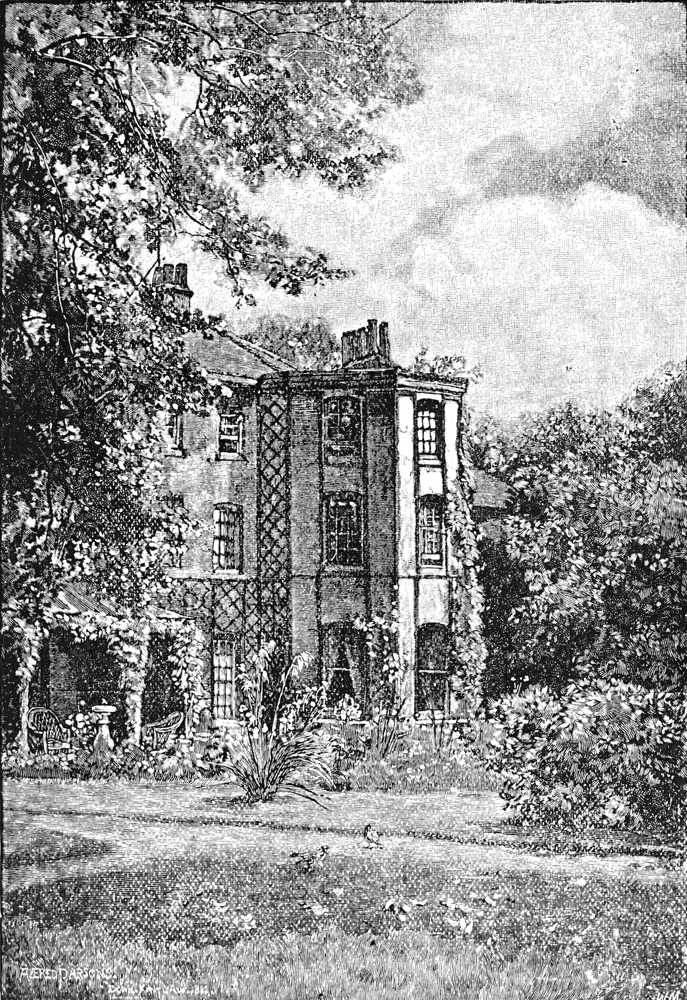
DOWN HOUSE FROM THE GARDEN
With this sort of discipline behind him, it is of
great interest to examine his general attitude toward
the connection of reasoning and fact. To
some of us the controversy between induction and
deduction has always seemed rather profitless. The
Baconian insistence upon the absolute necessity of
fact as the basis of all solid theory is of course indisputably
just. But to talk of proceeding from abstract
theory to the investigation of fact seems as
barren as to wander aimlessly in unassorted realms
of fact without the assistance of theory. It is comforting,
therefore, to find so clear and systematic a
thinker as Huxley unwilling to identify his processes
with either complete induction or deduction:
‘Those who refuse to go beyond fact rarely get as
far as fact; and any one who has studied the history
of science knows that almost every great step therein
has been made by the “anticipation of nature,”
that is, by the invention of hypotheses which,
though verifiable, often had very little foundation
to start with; and not unfrequently, in spite of a
long career of usefulness, turned out to be wholly
erroneous in the long run.’[437]
Now Darwin obviously finds himself in precisely
the uncertainty between inductive and deductive
methods that Huxley here indicates. His instincts
were naturally hostile to abstract theory, which
used facts as playthings to substantiate soaring
conjecture. He says in regard to one scientific
author: ‘I am not convinced, partly I think owing
to the deductive cast of much of his reasoning; and
I know not why, but I never feel convinced by deduction,
even in the case of H. Spencer’s writings.’[438]
And he speaks even more specifically concerning
Spencer himself: ‘I always feel a malicious pleasure
when a priori conclusions are knocked on the head;
and therefore I felt somewhat like a devil when I
read your remarks on Herbert Spencer.’[439] Early and
late he emphasized that ‘no one has a right to
speculate without distinct facts.’[440] Yet at the same
time he urges and reiterates that the mere collection
of facts, without some basis of theory for guidance
and elucidation, is foolish and profitless: ‘I
am a firm believer that without speculation there is
no good and original observation.’[441]
The truth is, the importance of imaginative
power in the equipment of a great scientist is
often underestimated. Exact and watchful vision
is the first necessity; but it does not go far, or not
farthest, except as it has behind it the thoughts
that wander through eternity, the vast and questing
genius that is perpetually on the lookout for causes
and explanations and is eager to evolve theory from
the sure and substantial but inanimate basis of
fact. Even Thoreau almost deplores his intense preoccupation
with the fascinating business of observing:
‘Man cannot afford to be a naturalist, to look
at Nature directly, but only with the side of his
eye. He must look through and beyond her. To
look at her is fatal as to look at the head of Medusa.
It turns the man of science to stone. I feel that I
am dissipated by so many observations.... I have
almost a slight, dry headache as the result of all
this observing.’[442] Theory, speculation, must be
perpetually checked and restrained by the precision
of systematic logic, but the accurate eye and
the careful finger need to be supplemented by the
eternally active mind.
As to the activity of Darwin’s mind there can be
no question whatever. He not only saw, but he
thought incessantly. If you compare the Beagle
Journal with the Journal of Thoreau, you see at
once how much more quick and ready the English
naturalist is with speculation and conjecture. The
smallest fact is apt to set him off on a train of theory,
where Thoreau simply records, or possibly compares,
and passes on. How significant is the brief
comment of Asa Gray, in regard to some botanical
point which as a specialist in that line he should
have been the first to develop: ‘That is real Darwin.
I just wonder you and I never thought of it. But
he did.’[443] And he not only thought himself, he had
the rarer and more valuable faculty of making
others think. His mind was so intense and so
magnetic in its constant activity that all those who
came into contact with it were impelled and fired to
work double on speculation of their own. ‘You
stimulate my mind,’ says Gray again, ‘far more
than any one else, except, perhaps Hooker.’[444]
On this point of intellectual fertility, as on his
other scientific qualifications, it is most interesting
to hear Darwin himself. The mental activity was
present early and late, and it does not appear that
the exuberance of youth especially emphasized it
or that it tended to increase with the later desire to
develop and elaborate his special theories. He
himself says in the Autobiographical sketch: ‘I
am not conscious of any change in my mind during
the last thirty years, excepting in one point: ...
I think that I have become a little more skillful in
guessing right explanations and in devising experimental
tests; but this may probably be the result of
mere practice, and of a larger store of knowledge.’[445]
The quick intelligence was always working, sometimes
wearily, sometimes eagerly, but working,
unless absolute physical prostration forbade. When
he is too exhausted, he complains: ‘Facts compel
me to conclude that my brain was never formed for
much thinking.’[446] But if so, he certainly lived contrary
to his nature. He tells us that he cannot resist
forming hypotheses on every subject.[447] Sometimes
he bewails the tendency, realizing its drawbacks
and dangers. Sometimes he gives way to it, recognizing
its charm: ‘It is delightful to have many
points fermenting in one’s brain.’[448] Speculation is
fascinating. Theory gives form and texture to the
fleeting drift and confusion of fact. Yet even when
one indulges with most enthusiasm, a touch of
humor shows that the satisfaction must be tempered
with a certain lack of entire confidence:
‘That is a splendid fact about the white moths;
it warms one’s very blood to see a theory thus almost
proved to be true.’[449]
For the wonder and the interest of Darwin is,
that, with such an eager and perpetual bent toward
theorizing, he could keep the bent so fully under
control. As Karl Pearson puts it, generally: ‘Hundreds
of men have allowed their imagination to
solve the universe, but the men who have contributed
to our real understanding of natural phenomena
have been those who were unstinted in their
application of criticism to the product of their
imaginations.’[450] Surely no man applied such criticism
more carefully, more conscientiously, more
constantly than Darwin. He analyzes his own position
and sees the dangers of it: ‘Living so solitary
as I do, one gets to think in a silly manner of one’s
own work.’[451] He sees constantly how theory interferes
and warps the judgment: ‘I have not a doubt
that before many months are over I shall be longing
for the most dishonest species as being more
honest than the honestest theories.’[452] The possibility
of error haunts him, torments him, and he knows
well how apt his own speculative disposition is to
mislead: ‘What you hint at generally is very, very
true: that my work will be grievously hypothetical,
and large parts by no means worthy of being called
induction, my commonest error being probably induction
from too few facts.’[453] As a consequence he
was ever on his guard against being led astray.
The tempting little demon of hypothesis might be
luring round the corner: ‘It is as difficult not to
form some opinion as it is to form a correct judgment.’[454]
But whatever opinion was formed must be
corrected, must be adjusted, must be tested, by the
cold and rigid measure of fact. As he says himself,
‘I have steadily endeavored to keep my mind free
so as to give up any hypothesis, however much beloved
(and I cannot resist forming one on every
subject), as soon as the facts are shown to be opposed
to it.’[455] And one who knew him well and had
studied him carefully says the same thing with
equal emphasis: ‘His long experience had given
him a kind of instinctive insight into the method of
attack of any biological problem, however unfamiliar
to him, while he rigidly controlled the fertility
of his mind in hypothetical explanations by the
no less fertility of ingeniously devised experiment.’[456]
In regard to this matter of speculative freedom
and the tendency to let imagination run wild, it
is interesting to watch Darwin’s comments on the
general methods of others. The excess of abstinence
he indeed deplores, recognizing that a
man’s extreme caution may prevent him from
theorizing enough: ‘How many astronomers have
labored their whole lives on observations, and have
not drawn a single conclusion.’[457] But the danger
on the other side is so great and so ruinous that it
cannot be enough insisted on, and indeed at times
it makes all generalization suspicious and almost a
thing to be eschewed: ‘I look at a strong tendency
to generalize as an entire evil.’[458] At any rate, the
theorist must never forget the subjective element,
that his preconceptions and prejudices are apt to
warp his judgment and distort his vision, till the
keenest of observers and the sanest of thinkers may
go astray: ‘the firmest conviction of the truth of a
doctrine by its author seems, alas, not to be the
slightest guarantee of truth.’[459]
The profit and the lesson of all which must be
constantly borne home to oneself: ‘When I think of
the many cases of men who have studied one subject
for years, and have persuaded themselves of
the truth of the foolishest doctrines, I feel sometimes
a little frightened, whether I may not be
one of these monomaniacs.’[460]
To appreciate fully Darwin’s combination of
mental activity and fertility with moderation and
restraint, it is well to place him between two extreme
types of thinkers. On the one hand, there is
the born essential reasoner, and logician, Spinoza,
for instance, or Hegel, or Darwin’s own contemporary,
Spencer, the man who to a greater or less
extent takes fact for his foundation, but who by
nature and temperament delights to weave an
elaborate web of logical theory, rigid and perfect
in its appearance of systematic deduction, but too
apt in the end to treat facts with indifference if not
disrespect. I like especially in this regard to compare
Darwin with Lucretius. The De Rerum
Natura is one of the most striking, enthralling examples
of what I should call passionate thinking.
Theoretical problems take hold of Lucretius like
the ecstasies of love. He tears and wrenches at the
roots of thought, determined to make them yield
to the delving vigor of his eager search. Now Darwin
has a broad and constant curiosity, his interest
may well be called enthusiasm, and he himself uses
the term passion for it: ‘Hence it has come to be a
passion with me to try to connect all such facts
by some sort of hypothesis.’[461] Yet in no phase of
his nature should I be inclined ever to employ the
general word, ‘passion,’ and it seems to me that
every page of Lucretius is stamped with a devouring
ardor different from anything Darwin knew.
On the other hand, over against these furious
reasoners, I should set Darwin’s close contemporary,
Sainte-Beuve, who, as I said in the previous
chapter was, in some aspects, as admirable a representative
of the scientific spirit as Darwin himself.
The endless curiosity, the unlimited observation
of fact, as embodied in the human subject,
have never been more richly exemplified than in
the great French critic. But Sainte-Beuve was no
reasoner in the larger sense. He did not even
avoid reasoning from mistrust: he had no taste for
it, and when he dealt with it, it was always charily
and with extreme reserve. He delighted to study
and portray individuals and to allow those individuals,
as it were, to classify themselves and so to
point the way to general results.
Between these two extremes Darwin stands, as
one who used reasoning to the fullest extent for the
interpretation of fact, yet at the same time always
stuck closely and rigidly to the fact itself, and would
not allow it to be for an instant distorted by the
reasoning process.
The supreme means for keeping theory on a basis
of fact is of course unfailing, persistent, ever-varied
experiment. In the preceding chapter we have seen
observation lead naturally to experiment; but
experiment is observation guided, directed, and
illuminated by theory. And assuredly no scientist
ever had the love and the habit of experiment more
firmly fixed than Darwin. The explanation of
phenomena was all very well in its place, essential,
absorbing, but he would have agreed absolutely
with Aristotle as to the proper ordering of the
process: ‘After this we shall pass on to the discussion
of causes. For to do this when the investigation
of the details is complete, is the proper and
natural method, and that whereby the subject and
the premises of our argument will afterwards be
rendered plain.’[462] The fascination of experiment in
itself was endless and almost sufficing: ‘The love of
experiment was very strong in him,’ says his son,
‘and I can remember the way he would say, “I
shan’t be easy till I have tried it,” as if an outside
force were driving him.’[463] There was a sense of
adventure about it, of discovery, and he loved to
try things that seemed almost fantastic and absurd:
‘If you knew some of the experiments (if they
may be so-called) which I am trying, you would
have a good right to sneer, for they are so absurd
even in my opinion that I dare not tell you.’[464]
And more concisely and vividly: ‘I am like a gambler
and love a wild experiment.’[465] The best comment
on which is the excellent remark of Professor
Castle: ‘Most advances in practical affairs are made
by those who have the courage to attempt what
others with good reason think unattainable. When
such attempts have succeeded, the world simply
revises its classification of things attainable and
unattainable, and makes a fresh start.’[466]
The first thing in regard to experiment is conditions.
There are of course rough and elementary
experiments, involving only simple principles,
which do not require minute care in detail. But in
many cases the nicest and most delicate preparation
and adjustment are indispensable to ensure reliable
results. The extensive equipment of modern
laboratories was not at Darwin’s command, and
though he had considerable financial resources, he
could not afford the unlimited outlay of commercial
research. Thus, we read of one of Mr. Burbank’s
trials: ‘Forty thousand blackberry and raspberry
hybrids were produced and grown until the fruit
matured. Then from the whole lot a single variety
was chosen as the best.... All others were uprooted
with their crop of ripening berries, heaped up into
a pile twelve feet wide, fourteen feet high, and
twenty-two feet long, and burned. Nothing remained
of this expensive and lengthy experiment,
except the one parent plant of the new variety.’[467]
Darwin could hardly work on any such elaborate
scale as this. Yet, as one turns over his vast record
of experiment, one is astonished to see how thorough
and painstaking was his effort to avoid accidents
and to provide for disturbing contingencies.
Take, for instance, as a minor but significant illustration,
his account of the difficulty in carrying out
the specific fertilization of certain plants: ‘In making
eighteen different unions, sometimes on windy
days, and pestered by bees and flies buzzing about,
some few errors could hardly be avoided. One day
I had to keep a third man by me all the time to prevent
the bees visiting the uncovered plants, for in
a few seconds’ time they might have done irreparable
mischief. It was also extremely difficult
to exclude minute Diptera from the net.’[468]
Another vital consideration as to experiment, is
that it should be kept impersonal. In most cases, if
one is to experiment fruitfully and satisfactorily,
there should be some special object in view, some
particular point to be rejected or confirmed. Unless
you know just what you are looking for, you are
apt not to see. Again and again in Darwin’s book
on Orchids, as in many of the others, we read that
he made investigations and got no results, simply
because he did not have in mind theoretical possibilities.
When he had reasoned out what ought
to happen or might happen, he often found that it
did. The danger of this method is obvious. When
the experimenter is so desperately anxious to see
something, unless he is most carefully trained and
disciplined, he will see it. It is not to be supposed
that Darwin always escaped this danger, but few
men have been more prepared for it or more ready
to allow for it than he. His confession of prejudice,
his recognition of the importance of certain
points in his general theory and of his unwillingness
to have anything interfere with them are
among his greatest charms: ‘I remember well
the time when the thought of the eye made
me cold all over.... The sight of a feather in a
peacock’s tail, whenever I gaze at it, makes me
sick.’[469]
We have already enlarged under observation on
the essential quality of accuracy, and it may simply
be added that accuracy is doubly important in all
experiments for a theoretical purpose. Accuracy,
complete, detailed, mathematical exactitude, was
Darwin’s hobby, and the minuteness of his record
constantly exemplifies it.
Also, to confirm their accuracy experiments have
to be repeated. Goethe remarks with justice that
it is not necessary to travel all over the world to
make sure that the sky is everywhere blue,[470] and
no doubt there are repetitions that are vain and
superfluous. But many difficult and delicate researches
have to be gone over again and again that
the minutest detail may be complete; and the
process may involve months of tedious delay.
Darwin’s unfailing care, both to repeat and to avoid
repetition, is well indicated in his son’s comment:
‘Although he would patiently go on repeating experiments
where there was any good to be gained,
he could not endure having to repeat an experiment
which ought, if complete care had been taken, to
have succeeded the first time.’[471] Here too, one cannot
appreciate how immense and thorough his experimentation
was without looking through such
books as the ‘Animals and Plants under Domestication’
or ‘The Power of Movement in Plants.’
The endless repetition of slightly varied combinations
to test a difficult or remote conclusion makes
one feel how persistent and inexhaustible the patience
was. And after all the years of repeated and
varied research and investigation he writes the
almost pathetic epilogue six months before his
death: ‘I wish that I had enough strength and
spirit to commence a fresh set of experiments, and
publish the results, with a full recantation of my
errors when convinced of them.’[429]
Finally, experiments have to be not only made,
but recorded, and the accuracy, so essential with
all scientific observation, is above all essential here,
since the omission of a link in the record may be
ruinous to the continuity of the logical chain. It is
peculiarly characteristic of Darwin that he wanted
the record of error and mistake as well as of success.
‘I remember,’ says his son, ‘how strongly he
urged the necessity of keeping the notes of experiments
which failed, and to this rule he always adhered.’[430]
The value of preserving and comparing
apparently insignificant and meaningless notes is
sometimes brought out, as in a special case of
orchids: ‘I had given up the case as hopeless, until
summing up my observations, the explanation
presently to be given, and subsequently proved by
repeated experiments to be correct, suddenly occurred
to me.’[431] Long experience of his own mistakes
and failures induces extreme scepticism as to
the results of others: ‘The difficulty is to know what
to trust.’[352] Even when he has taken the greatest
pains, the scepticism often lingers and forces him to
repeat although with an identical result: ‘Notwithstanding
the care taken and the number of
trials made, when in the following year I looked
merely at the results, without reading over my observations,
I again thought that there must have
been some error, and thirty-five fresh trials were
made with the weakest solution; but the results
were as plainly marked as before.’[353] And thus the
long series of packed, closely printed volumes forms
an amazing record of a life of zealous, persistent,
curious experimentation from beginning to end.
Now let us look a little more closely at the stuff
and quality of Darwin’s logical processes, considered
as such. He himself often complains of the
slowness and difficulty of his thinking. It is hard
for him to arrange his thoughts, he says, hard for
him to get them into the lucid and effective order
which carries conviction with it, almost enforces
conviction by the power of its own movement. He
says of one of his critics: ‘He admits to a certain
extent Natural Selection, yet I am sure does not
understand me. It is strange that very few do, and
I am become quite convinced that I must be an
extremely bad explainer.’[354]
It is worth while to note the comments of Huxley,
as one of Darwin’s staunchest friends and supporters,
on his reasoning faculty and processes.
When Romanes lauds Darwin’s colossal intellect,
Huxley is inclined to protest: ‘Colossal does not
seem to me to be the right epithet for Darwin’s
intellect. He had a clear, rapid intelligence, a great
memory, a vivid imagination, and what made his
greatness was the strict subordination of all these
to the love of truth.’[355] Elsewhere Huxley adds:
‘Exposition was not Darwin’s forte—and his
English is sometimes wonderful. But there is a
marvelous dumb sagacity about him and he gets to
truth by ways as dark as those of the Heathen
Chinee.’[356] Of ‘The Origin of Species’ Huxley
writes: ‘It is one of the hardest books to understand
thoroughly that I know of.’[357] And again,
more amply: ‘Long occupation with the work has
led the present writer to believe that “The Origin of
Species” is one of the hardest of books to master, and
he is justified in this conviction by observing that
although the “Origin” has been close on thirty years
before the world, the strangest misconceptions of
the essential nature of the theory therein advocated
are still put forth by serious writers.’[358] Critics less
friendly to Darwin than Huxley have spoken still
more strongly.
I feel that Huxley’s judgment is too severe. It
is true that Darwin had not the admirable gift of
logical, lucid exposition which made Huxley himself
one of the most luminous of scientific writers.
But even when Darwin’s reasoning is most complex
and difficult, there is a notable quality of sincerity
and single-mindedness, which wins and retains your
confidence. He seems somehow to have an exceptional
power of taking you into his mental processes,
and to make you think and see and feel as
he does. If you feel that he may be wrong, it is because
he feels that he may be wrong himself.
It is profitable to examine a little more in detail
some illustrations of Darwin’s scientific theorizing.
The great central doctrine of evolution, with its
buttressing support of natural selection, will fill our
next chapter, but there are several lesser developments
of speculation which deserve notice. I need
hardly say that we are not in any way discussing
the validity of the theories in the abstract, but
simply Darwin’s fashion of framing, holding, and
sustaining them.
There is first the theory as to the formation of
coral reefs. At an early period in his career Darwin
conceived the idea that these reefs were produced
by the subsidence of the ocean bed and the steady
building up of the coral insects toward the surface.
He himself admits that this theory was the
most deductive of all that he ever urged and the
least founded in the beginning upon a wide and
careful investigation of fact. Alexander Agassiz,
who, after extensive research, was not disposed to
accept it, wrote: ‘Darwin’s observations were all
theoretical, based upon chartographic study in his
house, a very poor way of doing, and that’s the way
all his coral reef work has been done.’[359] And the
theory has met with strenuous opposition from
many quarters, though one critic says in regard to
it: ‘Be it true or not, be it a competent explanation
or not, no matter. In influence on geology it has
been as far-reaching as the doctrine of natural
selection has been on biology.’[360] But Darwin himself
clung to it to the end, meeting objections with
vast ingenuity and reiterating his positions with
ampler and more penetrating arguments. Yet
through all the persistence there is the readiness at
any moment to see the other side. ‘I must still adhere
to my opinion, that the atolls and barrier
reefs in the middle of the Pacific and Indian Oceans
indicate subsidence, but I fully agree with you that
such cases as that of the Pellew Islands, if of at all
frequent occurrence, would make my general conclusions
of very little value. Future observers
must decide between us.’[361] And he writes frankly
to Alexander Agassiz: ‘If I am wrong, the sooner I
am knocked on the head and annihilated so much
the better.’[362]
Another instance of Darwin’s zeal and ingenuity
in reasoning is the theory of sexual selection, devised
to meet some difficulties in his general argument.
Many animals have certain so-called secondary
sexual characteristics, that is, characteristics
affecting one sex only yet not directly involved
in the reproductive process. Darwin believed
that these characteristics were largely developed
through the working of natural selection upon the
basis of the preference of one sex for individuals of
the other for mating purposes. That is to say, the
splendor of the male peacock’s tail made him more
attractive to the female and therefore more successful
with her. There were numerous and obvious
difficulties in this view, as the assumption of a
fine æsthetic sense in comparatively lowly organized
creatures, and it was energetically disputed
from the start. Wallace, Darwin’s ardent fellow-thinker
and coadjutor, was anything but favorable
to it. Yet Darwin’s faith was never really shaken.
He persisted to the end, making new experiments
and investigations, and meeting his adversaries’
contentions with vast and varied resource. In
‘The Descent of Man’ he wrote: ‘For my own
part I conclude that of all the causes which have
led to the differences in external appearance between
the races of man, and to a certain extent
between man and the lower animals, sexual selection
has been the most efficient.’[363] Nevertheless, it is
fascinating to see him reveal the doubt and the
questioning that were inwrought with conviction
in his mind. He writes to Wallace: ‘I grieve to
differ from you, and it actually terrifies me and
makes me constantly distrust myself.’[364] Again:
‘You will be pleased to hear that I am undergoing
severe distress about protection and sexual selection;
this morning I oscillated with joy towards
you; this evening I have swung back to my [old] position,
out of which I fear I shall never get.’[365] And
he sums up the process with a general remark of
the largest and most fruitful bearing: ‘I sometimes
marvel how truth progresses, so difficult is it
for one man to convince another, unless his mind is
vacant. Nevertheless, I myself to a certain extent
contradict my own remark, for I believe far more
in the importance of protection than I did before
reading your articles.’[366]
Still another example of theorizing is the doctrine
of pangenesis. Darwin’s general theory of
evolution which dealt so much with heredity, was
closely complicated with the difficulty of understanding
how one minute reproductive cell could
transmit by inheritance all the complicated variety
of organs and functions in a highly developed plant
or animal. To meet this difficulty he devised the
explanation of pangenesis (he doubts about the
name, because ‘my wife says it sounds wicked, like
pantheism’),[367] that is, the idea that the primitive
cell contains a great number of gemmules, each
transmitting and originating some particular organ
with its varied functions. Here again the theory, as
Darwin conceived it, did not find general acceptance,
though in some respects it surprisingly anticipates
the results of the latest modern research.
But the interesting thing is to see the ardor with
which its inventor worked it out and the elaborate
argument with which he carries it through the
latter part of the great work on ‘Animals and
Plants under Domestication.’ It is difficult, he
admits. He does not blame any one for disputing
it, or for rejecting it, or even for laughing at it.
‘The hypothesis of Pangenesis, as applied to the
several great classes of facts just discussed, no
doubt is extremely complex, but so are the facts.’[368]
And then he lets his imagination range more widely
than usual in contemplating possible deductions
and consequences: ‘No other attempt, as far as I
am aware, has been made, imperfect as this confessedly
is, to connect under one point of view these
several grand classes of facts. An organic being is
a microcosm—a little universe, formed of a host of
self-propagating organisms, inconceivably minute
and numerous as the stars in heaven.’[369] Yet here
again he introduces the inevitable reservation and
in his Autobiographical Sketch he says: ‘Towards
the end of the work I give my well-abused hypothesis
of Pangenesis. An unverified hypothesis is of
little or no value; but if any one should hereafter
be led to make observations by which some such
hypothesis could be established, I shall have done
good service.’[370]
It seems sometimes surprising that, with this
marked bent towards abstract speculation, which
it was so difficult to control, Darwin should have
been always so indifferent to philosophical thought
on the ultimate questions of the universe. He
admits that he knew little of metaphysics and
cared little for them. But this again is instructive
as to the peculiar balance of his temperament. He
liked to speculate, but he would not speculate for a
moment without a firm foundation of fact. His
feet must be based first on the solid tangible earth.
Then if his head would not reach the clouds, he
would keep out of them.
It will be profitable to consider more in detail
some specific elements of Darwin’s reasoning. In
the first place, we have seen everywhere and in all
connections that his propensity to eager theorizing
was tempered with an unfailing sense of doubt and
mistrust. He was indeed always disposed to act
in the spirit of Weisman’s remark: ‘When we are
confronted with facts which we see no possibility
of understanding save on a single hypothesis, even
though it be an undemonstratable one, we are
naturally led to accept the hypothesis, at least until
a better one can be found.’[371] And he recognized
fully the force of the comment which Huxley makes
on a phrase of Goethe, to the effect that doubt
must not be blighting or destructive, but fruitful
and stimulating: ‘Goethe has an excellent aphorism
defining that state of mind which he calls
“Thätige Skepsis”—active doubt. It is doubt
which so loves truth that it neither dares rest in
doubting nor extinguish itself by unjustified belief.’[64]
At the same time, the doubt was there, was temperamental,
and could not be altogether extinguished,
even when the rush of the logical impetus
was fullest. One beautiful expression of it among
many is, ‘When you say you cannot master the
train of thoughts, I know well enough that they are
too doubtful and obscure to be mastered. I have
often experienced what you call the humiliating
feeling of getting more and more involved in doubt
the more one thinks of the facts and reasoning on
doubtful points.’[65] The truth is, that Darwin had in
a high degree the quality, often so hampering to
the man of practical action, but invaluable to the
thinker, of getting outside of himself and his own
point of view and criticizing it as if it were the
standpoint of some one else. He himself indicates
this forcibly in connection with returning to one’s
ideas after an interval: ‘The delay in this case, as
with all my other books, has been a great advantage
to me; for a man after a long interval can criticize
his own work, almost as well as if it were that of
another person.’[66] Some men can.
Another characteristic of Darwin’s mental processes
is his way of meeting difficulties. The born
reasoner is apt to slur over obstacles and objections,
to devote himself with endless ingenuity to
eliminating them rather than facing them squarely.
Darwin was ingenious enough, but he did not dodge
difficulties. Instead of doing so, his propensity
was, if anything, to make them and seek them. It
was said of Pasteur, so like Darwin in many points:
‘No adversary of M. Pasteur had formulated this
argument; but M. Pasteur, who had within himself
an ever-present adversary, always on the watch and
determined to yield only to the force of accumulated
evidence, himself raised the objection.’[67]
So Darwin. As he himself records, and no thinker
ever laid down a more significant principle or one
more revealing for his own mental constitution:
‘I had, also, during many years followed a golden
rule, namely, that whenever a published fact, a
new observation or thought came across me, which
was opposed to my general results, to make a memorandum
of it without fail and at once; for I had
found by experience that such facts and thoughts
were far more apt to escape from the memory than
favorable ones.’[68] And the intense consciousness
of objections and difficulties appears even more
vividly in the sentence: ‘I cannot too strongly express
my conviction of the general truth of my
doctrines, and God knows I have never shirked a
difficulty.’[69]
The recognition of obstacles and complications
constantly popping up from everywhere naturally
necessitated endless revision and recasting. Here
again, the habitual reasoner, having once set his
mould is reluctant to alter it. Not so Darwin.
There are indeed times when even he rebels and declares
that it will be more fruitful to follow new
paths than to be perpetually adjusting the old.
But in general his readiness to alter and reconstruct
is unlimited. He revises and works over his books.
In doing so he showed his characteristic disposition
to accept and defer to the judgment of others.
How charming is his daughter’s account of this:
‘He was always so ready to be convinced that any
suggested alteration was an improvement, and so
full of gratitude for the trouble taken. I do not
think that he ever used to forget to tell me what
improvement he thought that I had made, and he
used almost to excuse himself if he did not agree
with any correction. I think I felt the singular
modesty and graciousness of his nature through
thus working for him in a way I never should otherwise
have done.’[70] There is no better way to appreciate
the extent and the persistence of Darwin’s
revision than to make even a cursory comparison of
the first and the last editions of the ‘Origin.’
Almost every page shows minor or considerable
changes, and while some are no doubt mere matters
of language, many have a bearing, however
slight, on the trend of the reasoning, deepening, or
strengthening, or clarifying it.
It is profitable also to watch Darwin’s attitude
towards argument, the direct interchange of view
by those who take different sides of a case and are
at once eager to advance their own and to detect the
flaws in their opponent’s. It is very evident that he
was not a quick and natural arguer, as was Huxley,
for instance. His son says: ‘He used to say of himself
that he was not quick enough to hold an argument
with any one, and I think this was true.
Unless it was a subject on which he was just then
at work, he could not get the train of argument into
working order quickly enough.’[71] And Darwin confesses
the same thing with his unfailing, charming
naïveté, in a letter to Hooker: ‘I am astonished at
your success and audacity. It is something unintelligible
to me how any one can argue in public
like orators do. I had no idea you had this power.’[72]
Arguments haunted him, agitated him, disturbed
him. Active discussion was apt to be followed by a
broken night, filled with the things that might and
should have been said and were not. Even of a
conversation quite remote from his scientific interest
he says: ‘Your slave discussion disturbed me
much; but as you would care no more for my opinion
on this head than for the ashes of this letter, I
will say nothing except that it gave me some sleepless,
most uncomfortable hours.’[73]
The gift I have before suggested, of getting outside
of your own position and judging it as another
would, while it benefits the results of argument, is
most hampering in the process, since one finds
oneself stating one’s adversary’s case sometimes
more forcibly than he does himself. Darwin often
repeats the principle I have quoted earlier, of recognizing
and recording objections, and he sums up his
method in regard to his main theory: ‘I have for
some time determined to give the arguments on
both sides (as far as I could) instead of arguing on
the mutability side alone.’[74]
Yet in spite of all the strain and effort of argument,
he liked it and believed in it. In the concluding
chapter of the ‘Origin’ he says: ‘This whole
volume is one long argument.’[75] It certainly is.
Elsewhere he says of a personal conversation: ‘I was
particularly glad of our discussion after dinner;
fighting a battle with you always clears my mind
wonderfully.’[76] To get the mind clear, to illuminate
and elucidate the complicated tangles of thought
and theory, that was always the object, and if
verbal battles helped it on, they were welcome.
But if he liked sincere, earnest argument, he detested
controversy, the bitter war of excited personal
feelings bent rather on achieving an individual
triumph than on proving an abstract theory.
He condemned and deplored the injury to science
inevitably wrought by such disputes and had nothing
but disgust for the manifestations of temper
that were bound to accompany them: ‘I went the
other evening to the Zoölogical Society, where the
speakers were snarling at each other in a manner
anything but like that of gentlemen.’[77]
When his own views were involved in bitterness,
as, alas, they too often were, he expressed the
keenest regret: ‘I often think that my friends ...
have good cause to hate me, for having stirred up
so much mud, and led them into so much odious
trouble. If I had been a friend of myself, I should
have hated me.’[78] He early made up his mind to
keep out of quarrels if possible, and he congratulated
himself on the whole on his success: ‘I rejoice
that I have avoided controversies, and this I
owe to Lyell, who many years ago, in reference to
my geological works, strongly advised me never to
get entangled in a controversy, as it rarely did any
good and caused a miserable loss of time and
temper.’[79]
Thus, whenever it was possible, he shunned
dispute, and if, by any chance, haste and eagerness
involved him in a mistaken cause, he bitterly
regretted his blunder and was ready to acknowledge
it with the utmost frankness. One of the
most striking cases of this is that of the parallel
roads of Glen Roy, as to which Darwin had developed
a geological theory which he asserted
with a good deal of conviction. A careful consideration
of his opponent’s arguments, obliged him to
recognize that he was completely in the wrong, and
he gave up, though with a pang: ‘I am very poorly
to-day, and very stupid, and hate everybody and
everything. One lives only to make blunders.’[80]
His acknowledgment of his error was ample and
complete.
It was his natural frankness in admitting his
mistakes and endeavoring to rectify them which
made Darwin so attractive and engaging. Goethe
complains of the disposition of many people to
reiterate a misstatement because they have once
made it.[81] Such reiteration did not appeal to Darwin
in the least. Sometimes he was irritated and
annoyed by the attitude of his adversaries, and he
expressed the annoyance with the same outspokenness
that he gave to other things; but there was
never any attempt to conceal his blunders or to
maintain his own positions simply because they
were his.
Indeed, in this regard, as in all others, what distinguished
him was a singular and charming candor.
It is this which makes his letters so attractive
and so revealing. They are not great literary
letters. They are always written in haphazard
fashion and with the utmost casual directness.
But few correspondences of literary men or of any
others reveal the man with such clear and winning
amplitude. He opens his heart and leads you right
into it without the least pretence of self-revelation,
but simply as if he were thinking aloud to you, as
he is. Take, for instance, among a bewildering
mass of illustrations, his confession of the sense of
inferiority in regard to Spencer: ‘I feel rather mean
when I read him: I could bear, rather enjoy feeling
that he was twice as ingenious and clever as myself,
but when I feel that he is about a dozen times
my superior, even in the master art of wriggling, I
feel aggrieved.’[82] Or this other acknowledgment
to Hooker: ‘How candidly and meekly you took
my Jeremiad on your severity to second-class men.
After I had sent it off, an ugly little voice asked me,
once or twice, how much of my noble defence of the
poor in spirit and in fact, was owing to your having
not seldom smashed favorite notions of my own.
I silenced the ugly little voice with contempt, but
it would whisper again and again.’[83] The sense, the
atmosphere, of a pervading candor, was what
Huxley expressed so excellently when he spoke of
Darwin’s having ‘a certain intense and almost passionate
honesty by which all his thoughts and
actions were irradiated, as by a central fire. It was
this greatest and rarest of endowments which kept
his vivid imagination and great speculative powers
within due bounds ... which made him accept
criticisms and suggestions from anybody and everybody,
not only without impatience, but with expressions
of gratitude sometimes almost comically
in excess of their value.’[84]
For the honesty and the candor not only led him
to admit his own mistakes, but made him singularly
ready to recognize the merits of others, and to
tolerate not only their views but even their dogmatic
assertion of them. He made mistakes all the
time, and yet he knew that he was sincere and lofty
in purpose. Why should not others be the same?
Why should not their theories be right and his
wrong? ‘It matters very little to any one except
myself, whether I am a little more or less wrong on
this or that point; in fact, I am sure to be proved
wrong on many points.’[85] Of one who did not agree
with him he could say: ‘I know nothing of him
excepting from his letters: these show remarkable
talent, astonishing perseverance, much modesty,
and what I admire, determined difference from me
on many points.’[86] And how winning is his defense
of blunderers, of those who do poor work which is
not all poor: ‘Shall you think me very impudent if
I tell you that I have sometimes thought that ...
you are a little too hard on bad observers; that a
remark made by a bad observer cannot be right; an
observer who deserves to be damned you would
utterly damn. I feel entire deference to any remark
you make out of your own head; but when in
opposition to some poor devil, I somehow involuntarily
feel not quite so much.’[87]
The truth is, that Darwin’s tolerance was based,
as all real tolerance is apt to be, on the vast and
haunting sense of his own ignorance. Again and
again he repeats and emphasizes how little he
knows, how little any one knows, and how petty,
imperfect, and inadequate are the efforts of any and
all of us to penetrate the veil of shrouding mystery
which involves the deepest secrets of life. To probe
this mystery the vague and flickering torch of
reason is all that is given to us. And those who are
most conversant with reason and make most use of
it mistrust it most. When the far surer guidance of
instinct fails us, reason is our only support, and we
must employ it not only for the larger speculative
purposes, but for the practical decisions. At its
best, it is a bright and splendid instrument, incredibly
keen and penetrating, and able to accomplish
miracles in the hands of those who manipulate
it skillfully. But it is an instrument as delicate as it
is bright, and it loses point and edge, unless constant
pains are taken to keep it in working condition.
Also, it cuts both ways, and every way, and
to even the expert manipulator, perhaps to him
most of all, it is apt to be difficult, dangerous,
treacherous.
There is the subtle, unfathomable connection of
reason with our wishes, desires, and prejudices.
A clever Frenchman said that reason was given us
to enable us to justify the gratification of our
passions, and when we see how the devices of logic
may be used to work from any premises to any conclusion,
one feels the force of the Frenchman’s view.
No one was more aware than Darwin of these
dangers and difficulties of reason, or of the endless
possibilities of deception when one gives oneself up
to that enchanting and deluding siren. He often
emphasizes his distress and almost despair at
finding himself making deductions quite different
from those which others draw from the same facts.
‘It is really disgusting and humiliating to see directly
opposite conclusions drawn from the same
facts.’[88] And again: ‘Nothing is so vexatious to me,
as so constantly finding myself drawing different
conclusions from better judges than myself, from
the same facts.’[89] And yet again: ‘I hate beyond
all things finding myself in disagreement with any
capable judge, when the premises are the same.’[90]
These comments make us see clearly what Darwin’s
relation to reason was. Few thinkers have
been so ready, so fertile, so abundant, so ingenious,
yet at the same time so sober, so restrained and
controlled.
With this analysis of his observation and his
thought we are ready to take up the supreme interest
of Darwin’s life, the dramatic study of the
conception, elaboration, promulgation, and triumph
of his evolutionary theory.
CHAPTER III DARWIN: THE DISCOVERER — I — FOOTNOTES: — II — III — IV — V — VI — VII
The word ‘evolution’ is so popularly accepted and
so generally employed in connection with Darwin’s
theories that it will never be displaced; but it is not
wholly satisfactory, because it always suggests
progress from a lower to a higher and hence involves
a difficult and invidious definition of terms.
Some such phrase as ‘descent with modification’
would probably be more exact. But whatever the
term used, to associate it as a scientific theory or
discovery exclusively with Darwin or any other one
man would be absurd. The natural hypothesis of
earlier thinkers was that divine creative power, in
whatever shape, had established the different forms
of life on the earth pretty much as they exist to-day.
But those who looked more deeply, were inclined
to surmise, in view of the close and evident
bonds of kinship between all living things, that
variety had developed from comparative unity and
that the vital impulse, having first appeared in
elementary forms, became gradually elaborated
into more and more complicated organisms. The
vast pains that Darwin took to substantiate this
view, together with his particular explanation of
how the process came about, have forever bound up
the idea of evolution with his name, but he did not
originate it nor did he claim to have done so.
The various hints and manifestations of earlier
evolutionary theory are admirably elucidated in
Professor Osborn’s ‘From the Greeks to Darwin.’
The vast curiosity and reflection of Aristotle anticipated
here, as everywhere, and some of his sentences
have a striking evolutionary bearing: ‘Variety
in animal life may be produced by variety of
locality.’[389] ‘Locality will differentiate habits also;
for instance, rugged highlands will not produce the
same results as the soft lowlands.’[390] And Empedocles
suggests Darwin’s views even more directly.
Under the régime of Biblical and Christian tradition
evolutionary thought naturally made little
progress. But with the greater freedom of the
eighteenth century, notions of modification by descent
again appeared. In England Darwin’s grandfather,
Erasmus, the botanical poet, speculated
curiously on the subject, and there were various
other intimations, notably in Chambers’s ‘Vestiges
of Creation,’ while Darwin himself felt that he was
much influenced by the geological theories of Lyell.
In Germany Goethe became profoundly interested
in the metamorphoses of life. Especially in France
Buffon and St.-Hilaire led up to the ‘Philosophie
Zoologique’ of Lamarck, which propounded the
theory of modification in a very definite form, and
suggested the mode in which the modification was
accomplished. Lamarck’s idea was that plants and
animals, by an inborn, vital impulse, adapted
themselves to their environment, and that these
adaptations were transmitted by inheritance. Thus
wading birds acquired webbed feet and the neck of
the giraffe was elongated in its effort to obtain its
food from the branches of the trees. The great
stumbling-block of this theory has always been the
difficulty of proving that acquired adaptations are
inherited.[A]
[A] Investigators have of course worked constantly and persistently
upon this point and I find Professor William McDougall quoted in
a Boston Herald editorial of August 16, 1926, as saying: ‘Species
may change and undergo evolution through the efforts of the individual
parents to adapt themselves to conditions.’
What is of interest to us, however, is Darwin’s
attitude toward his more immediate predecessors,
Buffon, Lamarck, Chambers, etc. This attitude
has been a matter of much comment by Samuel
Butler and others and it is not perfectly easy to
understand. That Darwin in his earlier thinking as
well as in his later was influenced by previous investigators
is evident enough, for instance in touches
like that in the ‘Voyage of the Beagle’: ‘Nature by
making habit omnipotent, and its effects hereditary,
has fitted the Fuegian to the climate and productions
of his miserable country.’[391] Also, his frequent
comments show that he knew what had
been written before him and had profited by it, and
in the later editions of the ‘Origin’ he took some
pains to acknowledge the obligation. Yet his tone
in his letters is by no means respectful and of
Lamarck especially, who had done the most, it is
difficult for him to speak without a sneer. Thus, in
1844 he writes: ‘Heaven forefend me from Lamarck
nonsense of a “tendency to progression,” “adaptations
from the slow willing of animals,” etc.! But
the conclusions I am led to are not widely different
from his; though the means of change are wholly
so.’[392] Again, a little later: ‘With respect to books on
this subject, I do not know any systematical ones,
except Lamarck’s which is veritable rubbish.’[393]
And later still, in 1859, he writes to Lyell: ‘You
often allude to Lamarck’s work; I do not know what
you think about it, but it appeared to me extremely
poor; I got not a fact or idea from it.’[394]
Various explanations of Darwin’s treatment of
Lamarck have been offered. One at least, that of a
disposition to run down a predecessor from jealousy,
we may exclude as absolutely as is possible
with poor human nature. Everything we know of
Darwin in other connections justifies us in doing
this. Professor Osborn, after referring to ‘the disdainful
allusions to him [Lamarck] by Charles
Darwin (the only writer of whom Darwin ever
spoke in this tone)’[395] observes that ‘it is very evident
from all Darwin’s criticisms of Lamarck, that
he had never studied him carefully in the original.’[396]
But against this view we have to set Darwin’s own
comment (italics mine): ‘What I consider, after
two deliberate readings, as a wretched book, and one
from which (I well remember my surprise) I gained
nothing.’[397] It is true that Darwin, as in the quotation
above as to ‘adaptations from the slow willing
of animals,’ apparently misinterpreted Lamarck’s
view of the self-adaptation of the individual to
its environment into the absurd assumption that
animals and even plants deliberately willed their
own evolutionary progress; but on the other hand
Darwin all his life and especially in his later period
wavered toward Lamarck’s adaptation theories.
It has been suggested that in Darwin’s university
years French thought and French scientists were
distinctly in disfavor and that Darwin imbibed an
enduring dislike of them.[398] Darwin himself hints
that he may have been influenced by a prejudice in
favor of his grandfather as Lamarck’s predecessor.
But it seems more probable that he disliked Lamarck
because he regarded him as a theorist and
speculator who did not found his argument on a
sufficiently broad basis of fact, whereas Darwin
toiled for years at observation and experiment before
he gave his theory to the world at all. This
explanation is indicated in Darwin’s remark to
Lyell: ‘As for Lamarck, as you have such a man as
Grove with you, you are triumphant; not that I can
alter my opinion that to me it was an absolutely
useless book. Perhaps this was owing to my always
searching books for facts.’[399] In any case one cannot
help wishing that Darwin had spoken of a man so
prominent and so highly esteemed as Lamarck a
little differently.
Darwin first began to be interested in the idea of
modification by descent during his voyage on the
Beagle and in the year 1837.[400] In his earlier years
he had been satisfied with the conventionally
orthodox theological and scientific conception of
the creation of distinct species, and all his youthful
work had been on the basis of this view. Such
phrases as the note, written in 1834, in Valparaiso:
‘It seems not a very improbable conjecture that the
want of animals may be owing to none having been
created since this country was raised from the sea,’[401]
are obviously significant of the earlier attitude.
But as he observed more widely and became more
and more impressed with the infinite diversity of
forms and the delicacy of shading with which they
pass into each other, the conviction grew that the
possibilities of development were unlimited, and
that individual differences might pass into varieties
and these again into species, making the origin of
varied life far simpler and more unified than had
ever been imagined. And such an evolutionary
process seemed much more in accord with general
natural laws than the abrupt appearance of fixed,
highly organized forms in sudden sufficiency. As
he says, ‘the subject haunted me,’ and from a very
early period he began making notes and memoranda
of all observations that might bear for—or
against—the gradual modification of species.
A PAGE FROM A NOTEBOOK OF 1837
The difficulty was to imagine just how the process
of modification was brought about, and until
he could get some light on this point, his enthusiasm
for the general idea was chilled and baffled.
As we have seen, Lamarck’s view, that living
beings directly adapted themselves to their surroundings
and then transmitted these adaptations
to their descendants, seemed at least inadequate,
and Darwin felt that the theory must have some
more solid basis, if it was to prevail at all. He set
his mind to work for months and months, and he
applied the intellectual method which he himself
has so admirably defined in a letter to his young
son: ‘I have been speculating last night what makes
a man a discoverer of undiscovered things; and a
most perplexing problem it is. Many men who are
very clever—much cleverer than the discoverers—never
originate anything. As far as I can conjecture,
the art consists in habitually searching for the
causes and meaning of everything which occurs.’[402]
Searching for the cause and meaning of everything
which occurred, he at last achieved the discovery
he was looking for, and so knew what is
assuredly one of the greatest of spiritual delights.
Largely by watching and studying the results of
deliberate human selection with plants and animals,
he was led to his great principle of natural
selection, that is, assuming the tendency in all living
beings to vary individually, that in the intense
struggle for existence those variations which
are beneficial and help the organism to live and
prosper will be preserved and transmitted. The
causes of variation, whether spontaneous or to be
found in environment, Darwin never pretended
entirely to explain. Of the principle of natural
selection, or as Spencer phrased it in a form which
Darwin admitted to be in some respects more
satisfactory, ‘the survival of the fittest,’ perhaps
its discoverer has given no better statement than
the sentences in the second volume of the great
work on ‘Plants and Animals under Domestication’:
‘To consider the subject under this point of
view is enough to strike one dumb with amazement.
But our amazement ought to be lessened when we
reflect that beings almost infinite in number, during
an almost infinite lapse of time, have often had their
whole organization rendered in some degree plastic,
and that each slight modification of structure which
was in any way beneficial under excessively complex
conditions of life has been preserved, whilst
each which was in any way injurious has been
rigorously destroyed. And the long-continued
accumulation of beneficial variations will infallibly
have led to structures as diversified, as beautifully
adapted for various purposes, and as excellently
coördinated, as we see in the animals around us.
Hence I have spoken of selection as the paramount
power, whether applied by man to the formation of
domestic breeds, or by nature to the production of
species.’[403]
It is not to be supposed that the first grasp of
evolution through variation and natural selection
could have carried with it the full foresight of the
enormous changes, mental, moral, and spiritual,
that such a theory was likely to produce. Still, a
mind so keen and active as Darwin’s was bound
to catch some suggestion of those changes. For
instance, the astonishing and deadly ease with
which the old workings of Providential adaptation
and design slipped under the new light into
mere operations of mechanical law could not fail
to foreshadow the philosophical and theological upheaval
that was sure to follow. A spirit trained in
the conventional atmosphere of the early English
nineteenth century must necessarily have regarded
such an upheaval with a certain amount of question,
awe, and even dismay; and Darwin indisputably
had something of these feelings mingled
with the triumphant joy of discovery.
It is profoundly characteristic of the man that
he did not hasten to fling the discovery to the
world, to get the immediate excitement and glory,
leaving discussion and substantiation to come afterwards.
He was so hesitant, so doubtful of his
own methods and his own powers, that he delayed
even to commit his conjectures to writing in his
note-books, lest they should become hardened and
distorted by the prejudice of statement and so
misleading. His one idea was to get confirmation,
by every line of study and experiment, and for
twenty years he toiled with deliberate patience
before he was willing to make the attempt to put
his results into publishable shape.
And all the time there was the chance, perfectly
present to his mind, that death might prevent him
from ever making the discovery known. And all
the time there was the chance that in the world of
scientific thought that was seething about him some
one else might anticipate him and propagate the
idea, perhaps in a form less convincing and less
substantial than he would be able to give it. Just
as he was getting to the stage of preparation which
he had aimed at, exactly this thing seemed likely
to happen. In June 1858, Alfred Russel Wallace,
a scientist of standing and ability, with whom
Darwin had corresponded, sent him a paper largely
anticipating Darwin’s ideas on natural selection,
so largely that Darwin wrote of it to Lyell: ‘I never
saw a more striking coincidence; if Wallace had
my MS. sketch written out in 1842, he could not
have made a better short abstract; ... so all my
originality, whatever it may amount to, will be
smashed.’[404] And he even doubted whether he
should make his views public at all, for fear of depriving
Wallace of credit: ‘I would far rather burn
my whole book, than that he or any other man
should think that I had behaved in a paltry spirit.’[405]
The difficulty was adjusted, however, by friends,
and a joint paper by Darwin and Wallace both, was
read at the meeting of the Linnæan Society on
July 1, 1858, giving the world the first inkling of
what natural selection was to mean. Sir Joseph
Hooker wrote prophetically of this meeting: ‘The
interest excited was intense, but the subject was
too novel and too ominous for the old school to
enter the lists, before armoring. After the meeting
it was talked over with bated breath.’[406]
The relation between Darwin and Wallace in
regard to priority of discovery is one of the finest
things in the whole history of science. There was no
jealousy, no bitterness, no acrimony, but instead a
full recognition of each others’ achievements, and
a sympathetic understanding which ripened into
a helpful and unbroken friendship. Wallace’s
statement of the matter long after Darwin’s death,
is as noble in its unselfishness as words can make it:
‘But what is often forgotten by the press and the
public is that the idea occurred to Darwin in 1838
... nearly twenty years earlier than to myself,
and that during the whole twenty years he had
been laboring collecting evidence from the vast
mass of literature of biology, of horticulture, and of
agriculture.... Such being the facts of the case, I
should have had no cause for complaint if the respective
shares of Darwin and myself ... had been
henceforth estimated as being roughly proportioned
to the time we had each bestowed upon it
... that is to say, as twenty years to one week.’[407]
Darwin’s summary, more general, is equally
worthy of both: ‘I hope it is a satisfaction to you to
reflect—and very few things in my life have been
more satisfactory to me—that we have never
felt any jealousy towards each other, though in one
sense rivals. I believe that I can say this of myself
with truth, and I am absolutely sure that it is
true of you.’[408]
The first promulgation of the Darwinian ideas,
with those of Wallace, was therefore made in July,
1858. In the following year, November, 1859, ‘The
Origin of Species’ was published. Darwin himself
regarded this book as a mere preliminary sketch,
requiring to be supported and buttressed by confirmatory
evidence of all sorts. But it at once overwhelmed
the world, and has always been looked
upon since as the cardinal statement of the theory.
As Huxley said of it, ‘It is doubtful if any single
book, except the “Principia,” ever worked so great
and so rapid a revolution in science, or made so
deep an impression on the general mind.’[409] And
innumerable quotations could be drawn from other
sources to the same effect.
The study of the complication of motives that
prompts a man like Darwin, and many others, to
reveal and establish a great scientific discovery in
spite of violent opposition is profoundly curious
and profitable. It seems to me that a main element
in these motives, with the scientist, as with the
artist and the politician and the actor and the
preacher and the athlete alike, is ambition. As
Darwin himself expresses it: ‘The action of unconscious
selection, as far as pigeons are concerned,
depends on a universal principle in human nature,
namely on our rivalry, and desire to outdo our
neighbors. We see this in every fleeting fashion,
even in our dress.’[410] And again: ‘Man is the rival
of other men; he delights in competition, and this
leads to ambition which passes too easily into selfishness.’[411]
The concrete essence of ambition is the
desire for fame, to have one’s efforts, one’s powers,
one’s achievement, one’s ego, recognized, appraised,
established by the applause and commendation
of one’s fellow-men. And surely this desire in
itself is a natural and even a laudable one, leading,
as it does, to most useful and enduring accomplishment.
The drawback is that the thirst for glory is
so enticing, so overmastering, that it seduces men
into strange and dubious methods of obtaining it.
Glory, or notoriety, is got so often by base means,
the trickster and the charlatan can so often snatch
its rewards and laurels from honest labor and even
from genius divinely endowed, that sincere and
earnest spirits are impelled to disclaim the pursuit
altogether, and to insist, perhaps with genuine
self-deception, that fame as a motive hardly enters
into their struggle at all. This contention is maintained
the more easily, since it is evident that
other motives, and those most powerful, do enter
in. There is the restless, ever active disposition of
human nature to be doing something, almost no
matter what. To work, to create, to achieve, is
to live. Nothing else can properly be called life.
To have done great things, to be doing them, makes
you feel that you exist, and why should you vex
yourself with what other men think of them? Then
for the scientist there is the sheer delight of adding
one grain of truth to the slow accumulation of the
centuries, as for the artist there is the splendid sense
of having created something beautiful. You know
it, you feel it: what do the others matter? And
there is further the rich reward of believing, or
hoping, that you are doing even a little to help or
to enlighten your fellow-men, whether they are
ever aware of it or not. Few things are more
soothing or cheering to the soul than that. So
that there have been thinkers and there have been
artists who have said, and perhaps sincerely
thought: ‘I care not if some other man gets the
credit of my work altogether. So the work is done,
and I have done it, and know that I have done it,
and it endures, and is worthy to endure, what does
the name or the glory of it matter?’ There are
many who have said this, there may be some who
have meant it; but surely there are few who have
tried to do great things, and have not longed for the
human recognition of them; and why should they not?
It is peculiarly interesting to trace the play of
these motives in Darwin, because here, as everywhere,
he has such an extraordinary, intimate
frankness of revelation. The love of fame was
strong in him, and he knew it. He tells us of his
childhood: ‘Some other recollections are those of
vanity—namely, thinking that people were admiring
me, in one instance for perseverance and another
for boldness in climbing a low tree, and what
is odder, a consciousness, as if instinctive, that I
was vain, and contempt of myself.’[412] Of his earlier
scientific years he writes: ‘I was also ambitious to
take a fair place among scientific men ... whether
more ambitious or less so than most of my fellow-workers,
I can form no opinion.’[413] At a much later
period he still recognizes the same stimulus: ‘Without
you have a very much greater soul than I have
(and I believe that you have), you will find the
medal a pleasant little stimulus; when work goes
badly, and one ruminates that all is vanity, it is
pleasant to have some tangible proof, that others
have thought something of one’s labors.’[414] And
how charming is the frank admission that he hates
to have glory snatched away from him: ‘I always
thought it very possible that I might be forestalled,
but I fancied that I had a grand enough soul not to
care; but I found myself mistaken and punished.’[415]
Certainly in him the tranquil appreciation that
there was a something of inborn power can hardly
be set down to the inferiority complex, and inborn
power does yearn for outward applause: ‘Looking
back, I infer that there must have been something
in me a little superior to the common run of youths,
otherwise the above-mentioned men, so much
older than me and higher in academical position,
would never have allowed me to associate with
them.’[416]
Yet with the passage of years and the growing
sense of the futility and injustice of popular reputation,
Darwin was more and more disposed to
disclaim all interest in it. The desire for glory, he
admits, is a universal human motive, and a natural
one; but there are others of as much, if not more
account: ‘You do me injustice when you think that
I work for fame; I value it to a certain extent; but,
if I know myself, I work from a sort of instinct to
try to make out truth.’[417] To the very end it is
clear that the sale of his books and the public discussion
of his ideas are pleasant to him, perhaps
more pleasant than he recognizes. But assuredly
no man can be said to be unduly hungry for the
laudation of the mob who waits patiently for
twenty years before making public his claims to
it. And it is certain that never under any circumstances
would Darwin have descended to court it
by base means or false pretences. As he himself
sums up the whole matter, speaking of his youth:
‘All this shows how ambitious I was; but I think
I can say with truth that in after years, though I
cared in the highest degree for the approbation of
such men as Lyell and Hooker, who were my
friends, I did not care much about the general
public. I do not mean to say that a favorable review
or a large sale of my books did not please me
greatly, but the pleasure was a fleeting one, and I
am sure that I have never turned one inch out of my
course to gain fame.’[418] We certainly have here no
extreme or morbid case of notoriety-seeking.
Thus, in 1859, ‘The Origin of Species’ startled
the world with the theory of evolution through
natural selection, a theory which immediately
raised a storm that in some of its aspects is still
raging. It is occasionally urged that Darwin’s
reputation and success had an element of good fortune
in them, that, as with so many discoveries, he
simply happened to express and as it were crystallize
general ideas that were vaguely present to
many and needed only a vigorous expositor to
give them universal acceptance. Doubtless there
is a measure of truth in this view. Yet it must not
be forgotten how much Darwin’s character, his
tact and reasonableness, his persistent energetic
logic, above all the enormous industry and fidelity
of his research entered into his final triumph.
His own comment on this matter of the timeliness
of his theories is exceedingly interesting: ‘It has
sometimes been said that the success of the “Origin”
proved “that the subject was in the air,” or
“that men’s minds were prepared for it.” I do not
think that this is strictly true, for I occasionally
sounded not a few naturalists, and never happened
to come across a single one who seemed to doubt
about the permanence of species.... I tried once
or twice to explain to able men what I meant by
Natural Selection, but signally failed. What I believe
was strictly true is that innumerable well-observed
facts were stored in the minds of naturalists
ready to take their proper places as soon as any
theory which would receive them was sufficiently
explained.’[419]
In any case, the evolutionary theory, when first
propagated, was bitterly attacked, both by scientists
and by others. Darwin’s personal friends, and
some of the younger men, who were less hardened in
conservatism, supported him, though with more or
less hesitation and reserve. But scientists of the
older school, trained in established traditions, were
generally most unfavorable. Some of them brought
up the innumerable difficulties of which Darwin
himself was only too well aware. Others resorted
to the usual weapons of abuse and sarcasm. Owen
in England and Agassiz in America represented
perhaps the strongest conservative views. To
them the Darwinian system was merely a passing
heresy, which could not stand for a moment
against the array of facts and arguments which
they could bring from their vast experience and
observation of the natural world.
The hostility of religious circles, aroused by the
‘Origin’ and increased by the later books, especially
‘The Descent of Man,’ was fiercer and less discriminating
than that of the scientists. Perhaps the
acme of it was reached in the savage interchange in
which the Bishop of Oxford asked Huxley whether
he ‘was related by his grandfather’s or grandmother’s
side to an ape’ and Huxley retorted that
a man had no reason to be ashamed of having an
ape for a grandfather, but if he were to feel shame,
it would be for an ancestor ‘who not content with
an equivocal success in his own sphere of activity,
plunges into scientific questions with which he has
no real acquaintance, only to obscure them by an
aimless rhetoric, and distract the attention of his
hearers from the real point at issue by eloquent
digressions, and skilled appeals to religious prejudice.’[420]
This sort of thing was by no means agreeable to
Darwin, and he repeatedly refers to the pain and
distress it caused him. For example: ‘I have just
read the “Edinburgh,” which without doubt is by
——. It is extremely malignant, clever, and I
fear will be very damaging. He is atrociously
severe on Huxley’s lecture, and very bitter against
Hooker. So we three enjoyed it together. Not that
I really enjoyed it, for it made me uncomfortable
for one night; but I have got quite over it to-day.
It requires much study to appreciate all the bitter
spite of many of the remarks against me; indeed I
did not discover all myself.... It is painful to be
hated in the intense degree with which ——
hates me.’[421]
What interests us is the attitude of Darwin in all
the aspects of the struggle, and we find everywhere
manifested and illustrated the mental and spiritual
qualities which we have analyzed generally in the
preceding chapters. Long and cruel as the controversy
was, that large, tranquil disposition could
not be warped or embittered, or substantially
shaken in its kindly serenity.
And first there is the candor, the readiness to admit
mistakes and errors, and to recognize the force
and significance of an opponent’s view and arguments.
Darwin himself complains humorously of
a weakness in this regard: ‘My God, is not the case
difficult enough, without its being, as I must think,
falsely made more difficult? I believe it is my own
fault—, my d——d candor.’[422] But, damned or
not, it is a quality worth admiration. As Professor
Osborn excellently puts it: ‘If he were living, ...
he would be in the front line of inquiry, armed with
matchless assemblage of fact, with experiment verification,
and not least with incomparable candor
and good-will. This bequest of a noble method
is hardly less precious than the immortal content
of “The Origin of Species” itself.’[423]
This is the language of an admirer. But it is
curious to see how with critics and opponents
‘To some kind of men
Their graces serve them but as enemies.’
Thus, even Alexander Agassiz, who was much more
favorably disposed to evolution and to Darwin
than was his father, remarks on this point of
candor: ‘I was somewhat surprised in Darwin’s
Life to see the element of wishing his cause to succeed
as a cause brought out so prominently. The
one thing always claimed by Darwin’s friends had
been his absolute impartiality to his own case.
Certainly his correspondence with Hooker, Huxley,
and Gray shows no such thing.’[424] And others,
distinctly more hostile, are much more severe, declaring
that Darwin’s passionate eagerness to prove
his point was quite incompatible with any real
fairness or breadth. But surely there is misunderstanding
here. Any one can be impartial who is
perfectly indifferent, and when you care not which
side triumphs, there is no merit in seeing the justice
of both. The charm and the interest of Darwin are
precisely that he was devoted to his own theory,
that it was the effort of his life to prove it, and
yet that at the same time he could and did look for
all the facts against it and even go to excess in
allowing weight to the objections that could be
opposed to him.
And as the candor was all the more notable
because of the enthusiasm, so it was notable because
it did not spring from a cold temperament, or
an incapacity for natural human anger and indignation.
Darwin enlarges, perhaps unduly, on his
heat of temper in youth; and in age, though his
control and his patience got the better of this, still
the sparks would fly when unjust and unreasonable
attack annoyed and irritated him. Thus, he cries
out in regard to Owen: ‘You would laugh if you
could see how indignant all Owen’s mean conduct
about E. Columbi made me. I did not get to sleep
till past 3 o’clock.’[425] And again, ‘If Owen wrote
the article “Oken” and the French work on the
Archetype ..., he never did a baser act.... You
are so good a Christian that you will hardly understand
how I chuckle over this bit of baseness.’[426]
When an adversary, not content with rational argument,
resorted to personal attack: ‘I care not
for his dull, unvarying abuse of me, and singular
misrepresentation. But at p. 244 he in fact doubts
my deliberate word, and that is the act of a man
who has not the soul of a gentleman in him.’[427]
But, however at moments indignation might get
the better of him, Darwin, as we have already seen,
rarely allowed himself to be drawn into anything
approaching controversy. Intelligent argument
with those who had reasonable objections might be
profitable, but where was the use of contending
with those whose object was not to convince but to
prevail? ‘I do so hate controversy,’ he cries, ‘and
feel I shall do it so badly.’[428] And elsewhere he
writes, more generally: ‘All that I think is that you
will excite anger, and that anger so completely
blinds every one, that your arguments would have
no chance of influencing those who are already
opposed to our views.’[349]
With this general attitude, it is interesting to
find Darwin, in one of his few temptations to sharp
retort, checked and repressed by the great fighter
Huxley. Darwin submits the draft of a crisp letter,
asking Huxley to criticize, and the latter suggests
omissions: ‘Though Thomson deserved it and more,
I thought it would be better to refrain. If I say a
savage thing, it is only “Pretty Fanny’s way”; but
if you do, it is not likely to be forgotten.’[350] Huxley
and other friends also restrained Darwin in perhaps
the most annoying of his controversial affairs,
that with Samuel Butler over the translation of
Krause’s Life of Erasmus Darwin. It is not necessary
for us to attempt to unthread the complicated
tangle of this dispute, since we may start with the
confident assumption that both men were perfectly
sincere in their good intentions. The curious may
read the whole story in the Life of Butler by Henry
Festing Jones, and it is pleasant to find that the
biographers of Butler and of Darwin were able to
come together and by comparing unprinted documents
straighten out the difficulty to their mutual
satisfaction.
With his fellow-workers, those who were following
the same lines of research from the same
general point of view, Darwin’s relations were
most cordial and sympathetic. There was no
jealousy, no rivalry, no undue sensitiveness. We
have indeed seen that in his treatment of his predecessors,
notably Lamarck, there was a suggestion
of what in any one else might be taken for a
jealous attitude. But all the dealings with Wallace
nobly refute the possibility of any such suggestion.
And at all times and under all circumstances
Darwin was ready to recognize and to proclaim the
merits and achievements of those who were laboring
beside him. When there was any question of
priority in an idea or a discovery, he refused to
assert himself unduly: ‘I have always had a strong
feeling that no one had better defend his own priority.
I cannot say that I am as indifferent to the
subject as I ought to be, but one can avoid doing
anything in consequence.’[351] When a scientist,
whether known or unknown, applied to him for
assistance or suggestion, he was always ready to
supply it, so far as was in his power. Above all, he
was appreciative, almost to excess, of any assistance
that was rendered to him, and his gratitude to his
friends for supporting and sustaining him and forwarding
his views is touching in its naïve earnestness.
To Huxley, to Hooker, to Lyell, to Gray, to
Häckel, to a dozen others, he speaks with enthusiastic
acknowledgment of their efforts and
their contributions, and, as Huxley points out, he
was ready to bestow almost the same gratitude for
services that in themselves appeared to be absurdly
insignificant.
For he had a singular humility, most notable and
appealing in a man of such distinguished power and
achievement. ‘A mind conspicuous for its powerful
humility and strong gentleness,’ is Huxley’s vivid
characterization.[278] Again and again he expresses
distrust of his powers, sense of inadequacy and incompetence,
keen consciousness of limitation.
Such phrases as the following from the book on
Orchids, are constantly recurring: ‘To any one with
more knowledge than I possess, it would be an
interesting subject to trace the gradations between
the several species and groups of species in this
great and closely-connected order.’[279] Sometimes
the expression of humility is direct. ‘Any one with
ordinary faculties, if he had patience enough and
plenty of time could have written my book.’[280]
Sometimes there is a humorous assertion of the
contrary which is quite as significant: ‘I should
rather think there was a good chance of my becoming
the most egotistical man in Europe. What
a proud preëminence!’[281] Occasionally the profession
of humility is so extreme, as in the sentence
in regard to Owen, ‘The Londoners say he is
mad with envy because my book has been talked
about; what a strange man to be envious of a
naturalist like myself, immeasurably his inferior!’[282]
that critics disposed to find fault have discerned
something of affectation in it. It is of the nature of
the deepest humility always to expose itself to
such accusations as this; but surely no one can
study Darwin carefully, can be familiar with his
work in all its aspects, and not set him down as
one of the most sincerely humble spirits that ever
lived.
This humility and feeling of his own incompetence
made Darwin keenly alive to the difficulties
connected with his great undertaking and gave him
such a clear sense of them that at times he felt incapable
of solving them at all. As he says in the
sixth chapter of the ‘Origin’: ‘Long before the
reader has arrived at this part of my work, a
crowd of difficulties will have occurred to him.
Some of them are so serious that to this day I can
hardly reflect on them without being in some degree
staggered.’[283]
Take one of the most striking, if not the most
crucial difficulties, one which puzzled and perplexed
Darwin from the first and was made a fruitful text
for criticism by his adversaries, the development of
the eye. Was it to be supposed that so delicate,
so complex, and so highly adapted an organ could
be produced by mere accidental variation working
through inheritance and the gradual survival of the
fittest? And Darwin investigated and compared
and reflected, until he was ready to state his position
thus: ‘Reason tells me, that if numerous gradations
from a simple and imperfect eye to one complex
and perfect can be shown to exist, each grade
being useful to its possessor, as is certainly the
case; if further the eye ever varies and the variations
be inherited, as is likewise certainly the case;
and if such variations should be useful to any animal
under changing conditions of life, then the difficulty
of believing that a perfect and complex eye
could be formed by natural selection, though insuperable
by our imagination, should not be considered
subversive of the theory.’[284]
Sometimes the difficulties appear in themselves
insignificant, yet their bearing is such as to make
them of extreme importance. For example, how the
useful institution of neuter insects could be developed
by inheritance was a terrible problem. It ‘at
first appeared to me insuperable, and actually fatal
to the whole theory.’[285] Study and observation wear
it away; yet it is disposed of with the candid remark:
‘I must confess, that, with all my faith in
natural selection, I should never have anticipated
that this principle could have been efficient in so
high a degree, had not the case of these neuter insects
led me to this conclusion.’[286] Or there is the
coloring of the peacock’s tail, which has to be explained
by extreme wrestlings of logical ingenuity.
And again, as compared with these seemingly
petty obstacles, there are the great questions
involved in the essential tissue of the theory itself.
There are the gaps, the breaks, the missing
links, not only between man and his simian ancestors,
but completing all the gradations between
all the existing forms of development. Many and
many an hour, and one may say, many a year of
anxious thought did Darwin bestow on this point.
He could meet it only with such eager comment as
he makes after his prolonged study of the orchids:
‘In the comparatively few orchids described in this
volume, so many and such plainly-marked gradations
in the structure of the rostellum have been
described, ... that we may well believe, if we could
see every orchid which has ever existed throughout
the world, we should find all the gaps in the existing
chain, and every gap in many lost chains, filled up
by a series of easy transitions.’[287] And there were
such vast problems as sexual selection and pangenesis,
which we discussed in a previous chapter,
and there was even the central element of natural
selection itself, which in darker moments seemed
but a weak agency for sustaining the whole world:
‘If I think continuously on some half-dozen structures
of which we can at present see no use, I can
persuade myself that natural selection is of quite
subordinate importance.’[288]
The interesting aspect of this matter of difficulty,
as with other things, is Darwin’s way of meeting
and facing it. There was an excitement, a stimulus,
undoubtedly, a joy in attacking tough problems
and conquering them. But there was also a pervading
consciousness of what the difficulties were,
and some have even thought an almost too pervading
disposition to go out of one’s way to deal
with them. As Huxley puts it: One ‘who desires to
attack Mr. Darwin has only to read his works with
a desire to observe not their merits but their defects,
and he will find ready to hand more adverse suggestions
than are likely ever to have suggested
themselves to his own sharpness, without Mr.
Darwin’s self-denying aid.’[289]
And there is always the appreciation, in handling
the difficulties, of the danger in over-ingenuity, of
the subtle possibilities of betrayal by reason ever
toiling with intense ardor to arrive at its preconceived
ends. ‘God knows I have never shirked a
difficulty,’ said Darwin.[290] But the danger lies not
only in shirking, but in the dissolving, transforming
power of prejudice and enthusiasm. Here again
Darwin tried to be ever on his guard: ‘I am fairly
rabid on the question, and therefore, if not wrong
already, am pretty sure to become so.’[291] He would
not be misled, or fooled, or betrayed: ‘As I read on,
I felt not a little dumbfounded, and thought to
myself that whenever I came to this subject I
should have to be savage against myself.’[292]
But you can never be sure that you have been
savage enough, and there are moments when unexpected
obstacles make you mistrust your theory,
mistrust your method, mistrust your reasoning
power. ‘If it could be proved that any part of the
structure of any one species had been formed for the
exclusive good of another species, it would annihilate
my theory.’[293] And who knows that it cannot be
proved? After months of study, a clear statement
of opposing facts seems for the moment to demolish
everything. ‘You give all the facts so clearly and
fully, that it is impossible to help speculating on the
subject; but it drives me to despair, for I cannot
gulp down your continent; and not to be able to do
so gives, in my eyes, the multiple creationists an
awful triumph.’[294] And with his extraordinary gift
of direct self-revelation, Darwin sums up the state
of mind in one vivid sentence: ‘Your letter actually
turned me sick with panic.’[295]
Thus there are times of discouragement and disgust.
One gets to feel that one has utterly overestimated
one’s work and one’s powers. One concocts
‘pleasant little stinging remarks for reviews,
such as “Mr. Darwin’s head seems to have been
turned by a certain degree of success, and he thinks
that the most trifling observations are worth
publication.”’[296] One concludes that all the years
of vast labor have been given to no valid result and
that one had better have cultivated one’s cabbages
with health and quietness: ‘At present I feel
sick of everything, and if I could occupy my time
and forget my daily discomforts, or rather miseries,
I would never publish another word.’[297] Such
periods of depression in Darwin are peculiarly interesting,
because he was by no means of a melancholy
temperament, nor, in spite of his nervous
weakness, was he inclined to a fretful or morbid pessimism.
Yet, even with all his courage and all his
patience, with all his past labor and all his victory,
there were moments toward the end when the
grave seemed inviting for its mere vastness of repose,
without any definite prospect of anything
further: ‘I am rather despondent about myself, and
my troubles are of an exactly opposite nature to
yours, for idleness is downright misery to me, as I
find here, as I cannot forget my discomfort for an
hour. I have not the heart or strength at my age to
begin any investigation lasting years, which is the
only thing which I enjoy; and I have no little jobs
which I can do. So I must look forward to Down
graveyard as the sweetest place on earth.’[372]
The recognition and the accumulation of difficulties
naturally involved modification of views. Indeed
any really vital theory is bound to develop
and modify itself with the vitality of the man who
holds it. And Darwin was as vital as any man, and
his theories as vital as any ever were. No man ever
recognized more fully than he the desirability, the
necessity of modification: ‘I look at it as absolutely
certain that very much in the Origin will be proved
rubbish; but I expect and hope that the framework
will stand.’[373] He groans over the burden and difficulty
of perpetual correcting: ‘I am grieved to hear
that you think I must work in the notes in the text;
but you are so much better a judge that I will
obey.’[374] Again: ‘It is only about two years since
last edition of Origin, and I am disgusted to find
how much I have to modify, and how much I ought
to add.’[375] Nevertheless, as the successive editions of
the ‘Origin’ and the other books show, he continued
to add and to alter and to correct, to the very end.
The minute, thoughtful, and far-reaching character
of these alterations shows well in the concluding
sentence of the eleventh chapter of the ‘Origin,’
which in the first edition read, ‘old forms having
been supplanted by new and improved forms of life
produced by the laws of variation still acting round
us and preserved by natural selection,’ and later,
‘old forms having been supplanted by new and improved
forms of life, the products of Variation and
the Survival of the Fittest.’
Besides revision in detail, there was of course
always a tendency to larger modifications of the
general theory. Ingenious and far-reaching as
natural selection was, the difficulties connected with
it were so immense, that the loyalty of even its
discoverer at times necessarily wavered, or perhaps
we should say better, his enthusiasm heated
and cooled. Moreover, natural selection depended
upon variation, and variation to Darwin was always
an inexplicable puzzle, for which no solution
or too many might be found. Disinclined as he was
to accept or even to respect his predecessors, Buffon
and Lamarck, Darwin in later years, when the
pressure on natural selection became fiercer, seemed
to turn more to the adaptive solutions of these predecessors.
As Professor Morgan puts it: ‘Despite
the contempt with which Darwin referred to
Lamarck’s theory, he himself, as we have seen,
often made use of the principle of the inheritance
of acquired characters, and even employed the
same illustrations cited by Lamarck.’[376] And Professor
Osborn indicates admirably the gradual
process of the change which took place in Darwin’s
attitude: ‘Starting with some leaning towards the
theories of modification of Buffon and Lamarck, he
reached an almost exclusive belief in his own theory,
and then gradually inclined to adopt Buffon’s and
then Lamarck’s theories as well, until in his maturest
writings he embraced a threefold causation
in the origin of species.’[377] The drift towards Lamarck
is well shown in a passage of a letter to Galton,
written in 1875: ‘If this implies that many
parts are not modified by use and disuse during the
life of the individual, I differ widely from you, as
every year I come to attribute more and more to
such agency.’[378] At the same time, to the very end
natural selection remained in Darwin’s mind not
only the quintessence of his theorizing, but the
prime agent by which modification had been accomplished.
In ‘The Descent of Man’ he explains
and in a manner excuses any earlier undue insistence
upon it, but also reiterates his firm faith in
its great, if not omnipotent efficacy: ‘If I have
erred in giving to natural selection great power,
which I am very far from admitting, or in having
exaggerated its power, which is in itself probable,
I have at least, as I hope, done good service in
aiding to overthrow the dogma of separate creations.’[379]
So through the sixties and seventies the battle for
evolution went merrily on, and before Darwin’s
death in 1881 it was evident that the scientific
world was largely converted and still more evident
that the theory had taken solid hold upon the popular
mind. Even in the sixties Charles Kingsley
could write to F. D. Maurice: ‘The state of the
scientific mind is most curious; Darwin is conquering
everywhere, and rushing in like a flood, by the
mere force of truth and fact.’[380] Darwin himself was
no aggressive fighter, though perhaps his quiet,
persistent, logical statement of facts went further
than fighting. But he had fighting followers, and
they pushed his cause with an energy and dogmatism
which he himself could hardly have manifested.
In England Spencer gave the theory the
metaphysical and philosophical sanction and support
which Darwin was not equipped to render, and
the brilliant, ardent eloquence of Huxley paralyzed
opponents with incisive argument and stinging
ridicule. In America Asa Gray, the great botanist,
was a convert from the beginning and a most helpful
disciple, and his aid was peculiarly welcome to
Darwin, because Gray’s eager orthodoxy was useful
in conciliating many whose prejudices would naturally
have been most adverse. Darwin repeatedly
spoke of Gray as understanding his ideas better and
expounding them more effectively than almost any
one. John Fiske was also a valuable champion from
the more philosophical side. In Germany Weisman
and Häckel were the most prominent apostles, and
immensely effective, though, with thorough-going
Teutonic logic, they were ready to push conclusions
to lengths that were not always acceptable to
Darwin himself.
The amount of popular interest is probably best
shown in the extensive sale of Darwin’s books.
‘The Origin of Species’ was successful at once.
It went through edition after edition, in Darwin’s
lifetime six in all, and was translated into numerous
foreign languages. The later books, even those
of a more technical character, sold like popular
fiction, and the last one, on the apparently uninviting
subject of earthworms, found many readers
everywhere.
Darwin was of course quite conscious of his growing
triumph. Even hostility, animosity, execration,
painful as they might be, afforded evidence of
power and achievement. And he would not have
been human, had he not relished the varied testimony
of respect and admiration which came to
him from every quarter. His natural distrust of
himself was so great that it was hard for him to
believe in success, even when it came, and before it
came, he deprecated any attempt to discount it:
‘Please do not say to any one that I thought my
book on Species would be fairly popular, and have a
fairly remunerative sale (which was the height of
my ambition), for if it prove a dead failure, it
would make me the more ridiculous.’[381] Yet, however
one might shrink and distrust oneself, to enter
a great scientific meeting and have every one present
rise to do one honor was undeniably agreeable.
And, with his unfailing frankness, Darwin admits
that praise was pleasant, and one could not have
too much of it, provided one felt that it was in a
measure deserved: ‘You pay me a superb compliment,
and as I have just said to my wife, I think
my friends must perceive that I like praise, they
give me such hearty doses.’[382] Also, with equal
frankness, he makes it plain in his autobiographical
sketch that he realizes how great the success was
and that it implied a certain prospect of permanence:
‘My books have sold largely in England,
have been translated into many languages, and
passed through several editions in foreign countries.
I have heard it said that the success of a work
abroad is the best test of its enduring value. I
doubt whether this is at all trustworthy; but judged
by this standard my name ought to last for a few
years.’[383] When he died, he was unquestionably
rated as one of the very first, if not the first, among
the scientific men of his time.
And it is equally unquestionable that his reputation
has rather increased than diminished ever
since. ‘“Before and after Darwin” will always be
the ante et post urbem conditam of biological history,’
says Professor Osborn.[384] Naturally Darwin’s
theories have been criticized and attacked
and largely modified by later investigations and
discoveries. To Darwin himself variation, as the
basis of natural selection, was the difficult, inexplicable
point, and the experiments of Mendel, the
mutation theory of De Vries, and many other lines
of research have put the subject of variation in
a new light. Natural Selection has been and will be
the subject of controversy, both as to its working
and as to the extent of its efficacy. Darwin’s inimitable
caution left the way open for all these investigations,
as is so well indicated in the excellent
sentence of Professor Whitehead: ‘Darwin’s
own writings are for all time a model of refusal to
go beyond the direct evidence and of careful retention
of every possible hypothesis.’[385]
Yet, after fifty years of discussion and argument,
Darwin’s main positions hold their own with
extraordinary tenacity. In the very latest word on
the subject Professor Parker says: ‘It is to the
credit of Charles Darwin and his body of able supporters
that the scientific world was finally brought
to accept the principle of descent with modification
and natural selection as the means whereby it was
accomplished.’[386] Professor Conklin affirms that:
‘The only scientific explanation of such adjustment
or fitness is Darwin’s principle of natural selection
of the fit and elimination of the unfit, and it is eloquent
testimony to the greatness of Darwin that
more and more this great principle is being recognized
as the only mechanistic explanation of adaptation.’[387]
And Professor Osborn is equally emphatic:
‘In my opinion natural selection is the only cause of
evolution which has thus far been discovered and
demonstrated.’[388] While from a more abstractly
philosophical point of view the emphatic recently
written words of Professor Ralph Barton Perry,
give ample support to the general Darwinian position:
‘In truth there is no gulf between man and the
animal. We cannot deny to the latter sensibility,
memory, and intelligence. The facts which prove
it would fill volumes.... The animal has feelings of
mother love, attachment, and devotion. It differs
from us in degree only; its “soul” is to ours what
the bud is to the flower and fruit.’[234]
But, independent of all agreement or disagreement
with Darwin’s theories, the striking thing is
the consensus of scientists in praise of the man, and
the recognition of his effort and method and life as
a model for all scientific workers. It is rare that
praise is so unalloyed, so persistent, and so complete.
In this connection it is interesting to compare
the nature of the glory of the poet, Shakespeare,
for example, with that of the scientific
writer. Shakespeare is not only remembered, he is
read. Every successive generation takes up his
plays for themselves, reads into them its own
passions and experiences, and thus makes them a
perennial possession of humanity, quite independent
of their author. The works of Darwin, or of
any other scientist, have no such enduring value for
actual perusal. The curious study them for historical
record. But for the mass of mankind and
even of scientists, a large part of them has entered
into universal knowledge and may be read in any
textbook, and the remainder has become obsolete
and of no value except for what it meant in an
earlier day. The scientist’s name becomes detached
from the work, even though he remains
great because he did it. Yet the name, in spite of
being thus detached, perhaps all the more because
it is detached, shines like a star through century
after century.
CHAPTER IV DARWIN: THE LOSER — I — II — III — IV
At different times Darwin commented on the
gradually increasing absorption of his life by
scientific pursuits and on the consequent atrophy of
other intellectual and spiritual interests, which in
earlier days had meant a good deal to him. In other
words he was illustrating the favorite text of
Sainte-Beuve, ‘All longings fail except that to
understand.’ Sometimes he expresses this loss with
terse vigor: ‘It is an accursed evil to a man to become
so absorbed in any subject as I am in mine.’[309]
Or again: ‘It is a horrid bore to feel as I constantly
do, that I am a withered leaf for every subject
except Science. It sometimes makes me hate Science,
though God knows I ought to be thankful for
such a perennial interest, which makes me forget
for some hours every day my accursed stomach.’[310]
And elsewhere he analyzes it with more elaborate
regretful curiosity: ‘My mind seems to have become
a kind of machine for grinding general laws out
of large collections of facts, but why this should have
caused the atrophy of that part of the brain alone,
on which the higher tastes depend, I cannot conceive.
A man with a mind more highly organized
or better constituted than mine, would not, I suppose,
have thus suffered; and if I had to live my life
again, I would have made a rule to read some
poetry or listen to some music at least once every
week; for perhaps the parts of my brain now atrophied
would thus have been kept active through
use.’[311]
THE STUDY AT DOWN
Having recently had occasion to make a somewhat
extended study of Darwin’s remarkable contemporary
the evangelist D. L. Moody, I have been
struck by this similarity of lack of general interest
in both of them. Darwin was of course a far better
educated man fundamentally than Moody. But
in both, their very bigness and power made the one
engrossing passion—about as different in the
two cases as can be imagined—dwarf and drive
out the varied distractions and desires which relieve
and stimulate the curiosity or the indolence of
more ordinary men. So far as Darwin is concerned,
with the exaggeration natural to reminiscence, he
perhaps somewhat overestimated both the original
aptitude and the later atrophy. But it is exceedingly
instructive to trace his relation to the various
occupations and experiences of life outside of
the scientific.
Take first the external human interests, other
than purely social. In the larger movements of
history Darwin seems not to have been particularly
well versed or to have concerned himself very
much with them. Of course, in relying upon his
volumes of published letters as evidence, we must
remember that those volumes were naturally
edited with a view in the main to scientific pursuits,
and therefore it is to be expected that other
interests should figure less conspicuously. Still the
testimony, both positive and negative, to the unimportance
of those interests is very decided. As
to this matter of history, Darwin himself tells us
that he read the historians in his youth. He even
insists that when he had lost æsthetic pleasures,
‘books on history, biographies, and travels ... and
essays on all sorts of subjects interest me as much
as ever they did.’[312] Of his earlier life he records that
‘I used to sit for hours reading the historical plays
of Shakespeare, generally in an old window in the
thick walls of the school.’[313] Perhaps on this Shakespearean
basis, he retains, with many other English
conventions, that of reverence for rank, though
no more natural democrat ever lived, and he makes
gentle fun of himself for his snobbishness: ‘I have
the true English reverence for rank, and therefore
liked to hear about the Princess Royal.’[314]
Nevertheless, in his letters and in his books, you
get the sense that the great currents of development
in Europe and in the world were not familiar to
his thought. With the unfailing candor, he admits
this: ‘I believe your criticism is quite just about
my deficient historic spirit, for I am aware of my
ignorance in this line.’[315] And an acute and sympathetic
analyst of his work, points out that it suffered
to some extent from the deficiency. The tendency
to extend evolutionary analogies from the
individual to society was partly Darwin’s fault, says
this critic, because of his ‘embarking upon the discussion
of social and moral matters, in “The Descent
of Man”; matters concerning which he was
little better informed than any other non-specialist.’[316]
In contemporary politics it was not to be expected
that Darwin should have much immediate
concern. One can hardly imagine a man less likely
to choose an active political career, or on the whole
less adapted to it, though the tact which enabled
him to deal successfully with his fellow-scientists
would no doubt have been helpful in more practical
spheres. There are occasional glimpses of his
taking some part in local interests, and for a time
at any rate he attended to the judicial duties which
we so generally associate with the English country
squire: ‘I attended the Bench on Monday, and was
detained in adjudicating some troublesome cases
one and one half hours longer than usual, and came
home utterly knocked up, and cannot rally.’[317]
Darwin would not have been an Englishman, if
he had not entertained political opinions of some
sort. He could not pretend to escape the tradition
so strongly planted in the blood of the race. He
does indeed resent the suggestion that politics are
more important than science: ‘Did you see a sneer
some time ago in the Times about how incomparably
more interesting politics were compared with
science even to scientific men?... Jeffrey, in one of
his letters, I remember, says that making an effective
speech in Parliament is a far grander thing
than writing the grandest history. All this seems to
me a poor short-sighted view.’[318] But he has been
brought up a Whig, a Liberal, and Whig prejudices
are inherent in his system. This was true in the
early days of the Beagle voyage: ‘The Captain does
everything in his power to assist me, and we get on
very well, but I thank my better fortune he has not
made me a renegade to Whig principles.’[319] And
it remained true to old age. When answering a
questionnaire in 1873, he described himself as
‘Liberal or Radical,’[320] but the radicalism was of a
very conservative and English order.
The Whig partisanship even shows itself in quite
normal fashion in hatred of the Tories, and on this
head the tolerant and kindly scientist expresses himself
with a rather amusing bitterness: ‘Thank God,
the cold-hearted Tories, who, as J. Mackintosh used
to say, have no enthusiasm, except against enthusiasm,
have for the present run their race.’[321] But
these outbursts are not to be taken very seriously.
There are occasional glimpses of interest in
current public men and current public affairs.
Lord Bryce gives a striking account of a visit which
Gladstone paid to the great thinker. Darwin’s comment
was, ‘he seemed to be quite unaware that he
was a great man, and talked to us as if he had been
an ordinary person like ourselves.’ On which
Bryce remarks: ‘The friend who was with me and I
could not but look at each other and exchange
covert smiles. We were feeling toward Darwin just
as he had felt toward Gladstone.’[322] During the
early portion of the Franco-German War Darwin’s
sympathy, like that of many Englishmen, was
with Germany: ‘I have not yet met a soul in England
who does not rejoice in the splendid triumph
of Germany over France: it is a most just retribution
against that vainglorious, war-liking nation.’[323]
But the struggles of party politics, as they went on
about him, aroused little attention and little ardor.
There was, however, one political event of his
time that called forth Darwin’s keen sympathy and
extended comment, and that was the American
Civil War. As is well known, English opinion was
much divided on this question, and the prejudices
of the upper class, at any rate among the more conservative,
were in favor of the South. Although
Darwin was by no means confident that the North
would win, he was strongly on that side from the
start, and his numerous letters to Asa Gray show
how decided his feeling was.
The feeling was not based on the abstract political
and constitutional considerations that appealed
to Americans, but on Darwin’s rooted, bitter
antipathy to the system of slavery in any form.
When he was in South America with the Beagle, he
had plenty of opportunity to watch the working of
human servitude, and it disgusted and repelled
him beyond measure. ‘To this day, if I hear a
distant scream, it recalls with painful vividness my
feelings, when passing a house near Pernambuco, I
heard the most pitiable moans, and could not but
suspect that some poor slave was being tortured,
yet knew that I was as powerless as a child even
to remonstrate.... Near Rio de Janeiro I lived
opposite to an old lady, who kept screws to crush
the fingers of her female slaves. I have stayed in
a house where a young household mulatto, daily
and hourly, was reviled, beaten, and persecuted
enough to break the spirit of the lowest animal.’[324]
As a result of these experiences and many others,
Darwin imbibed a detestation of slavery and slave-holders
which lasted through life, and which led
him to oppose them where he could, whether in
England or America.
The hostility to slavery was based even more
deeply on an intense hatred of cruelty, barbarity,
and the infliction of physical suffering of any sort.
The dislike of such suffering was so keen that from
the start it incapacitated Darwin for the medical
profession, which his father would have been glad
to see him follow. He could not bear the sight of
blood, and fled from an operation with disgust.
Ill-treatment of animals was especially tormenting
to him, and he interfered to prevent it, when he
could: ‘He returned one day from his walk pale and
faint having seen a horse ill-used, and from the agitation
of violently remonstrating with the man.’[325]
With such a general sensibility, Darwin’s attitude
towards vivisection is extremely curious.
Knowing as he did the importance of animal experiment,
he could not possibly range himself on
the side of the anti-vivisectionists. But he supported
every effort to have humanity legally emphasized
and rigidly insisted upon. The nature of
his feeling in the matter appears clearly in a passage
of ‘The Descent of Man’: ‘Every one has heard of
the dog suffering under vivisection, who licked the
hand of the operator; this man, unless the operation
was fully justified by an increase of our knowledge,
or unless he had a heart of stone, must have felt remorse
to the last hour of his life.’[326]
In sociological questions of a broader bearing,
which made no such immediate appeal to his susceptibilities,
Darwin took much less interest.
Now and then some special point arouses him. He
was excited about any attempt to interfere with the
marriage of cousins, because he had married his
cousin and had in consequence largely investigated
the subject.[327] He was decidedly opposed to the
English tradition of primogeniture, and felt its unfairness.
On the land-question he writes to Wallace:
‘I see you are going to write on the most difficult
political question, the land. Something ought to
be done; but what, is the rub.’[328] In the same spirit
of remoteness and uncertainty, he writes also to
Wallace in regard to Henry George’s ‘Progress and
Poverty’: ‘I will certainly order “Progress and
Poverty,” for the subject is a most interesting one.
But I read many years ago some books on political
economy, and they produced a disastrous effect on
my mind, viz., utterly to distrust my own judgment
on the subject, and to doubt much every one else’s
judgment. So I feel sure that Mr. George’s book
will only make my mind worse confounded than it
is at present.’[329] But it is clear that the remoteness
did not imply contempt or cynical disregard, merely
a feeling of complete inability and diffidence in regard
to economic problems, and one is slow to condemn
this state of mind, when one thinks that such
problems are usually dealt with and solved, if it
can be called so, by those in whose equipment freedom
from diffidence is the most aggressive and impressive
instrument.
With artistic and general æsthetic matters, Darwin,
at any rate in later years, was even more indifferent
than with political. It is true that his
scientific investigations sometimes involved the
abstract analysis of æsthetics: ‘I agree with what
you say about beauty. I formerly thought a good
deal on the subject, and was led quite to repudiate
the doctrine of beauty being created for beauty’s
sake.’[330] The theory of sexual selection, as presented
in ‘The Descent of Man,’ necessitated a good deal
of discussion of the susceptibility to color and form
and to music. But such æsthetic discussion has
nothing whatever to do with æsthetic enjoyment.
One thing may be said in regard to Darwin; with
art as with everything else, he was absolutely free
from pretense. He says of one writer, ‘The pretentiousness
of her style is extremely disagreeable,
not to say nauseous to many persons.’[331] Anything
artificial, anything affected, was peculiarly repugnant
to him, and never under any circumstances
would he have pretended to admire or to appreciate
a work of art that really left him cold. Indeed
it was partly his intense wish not to appear to feel
what he did not feel that made him inclined to
underestimate his artistic pleasure as compared
with the raptures of those who exclaimed conventionally
over what they neither understood nor enjoyed.
Nevertheless, it seems unquestionable that art in
its varied forms hardly afforded Darwin the delight
and solace that it brings to many persons. The
theater he cared little for at any period of his life.
The effort, fatigue, and constraint outweighed the
charm. Mrs. Darwin, who was a lover of average
plays, though she found Shakespeare tedious and
said so with something of her husband’s candor,
is quite anxious on the subject: ‘The real crook in
my lot I have withheld from you, but I must own it
to you sooner or later. It is that he has a great dislike
of going to the play, so that I am afraid we shall
have some domestic dissensions on that head.’[332]
Later she takes him to see Macready in ‘Richelieu’
and hopes that he is getting converted, but there
are no signs that the hopes were finally realized.
With the plastic arts the case is somewhat better.
There is little reference to architecture. One passage
in a letter seems to suggest the feeling of
cathedral grandeur, but the æsthetic quickly turns
into the scientific bearing: ‘Possibly the sense of
sublimity excited by a grand cathedral may have
some connection with the vague feelings of terror
and superstition in our savage ancestors, when they
entered a great cavern or gloomy forest.’[333] As regards
pictures, his son thinks that he did keep up his
love of them to a certain extent.[334] His biographer
remarks: ‘His love of pictures as a young man is
almost a proof that he must have had an appreciation
of a portrait as a work of art, not as a likeness.’[335]
And the biographer adds, with entire justice:
‘This way of looking at himself as an ignoramus
in all matters of art, was strengthened by the
absence of pretence, which was part of his character.’[336]
The immediate recognition of a Salvator
Rosa scene in one of the Beagle experiences shows
an acquaintance with painting in its different
forms and periods.[337] Yet pictures make a different
showing in Darwin’s letters from what they have in
Edward FitzGerald’s, for instance.
The form of art which meant most to Darwin and
into which he seemed to enter with the nearest approach
to ecstasy was music. Here again, there is
a good deal of theoretical discussion, which at
times appears of a nature to dampen emotional enjoyment.
But there can be no question that with
Darwin as a young man the emotional enjoyment
was there, and sincere, and profound, even at times
overmastering. He does indeed confess that his musical
ear was not fine or perfect: ‘I am so utterly
destitute of an ear, that I cannot perceive a discord,
or keep time and hum a tune correctly; and it
is a mystery how I could possibly have derived
pleasure from music.’[338] But it is manifest that he
did derive such pleasure, and went out of his way to
seek it: ‘I also got into a musical set.... From associating
with these men, and hearing them play I
acquired a strong taste for music, and used very
often to time my walks so as to hear on week days
the anthem in King’s College Chapel.’[339]
The love was for good music, too, not by any
means for what was trashy or cheap. He liked
Beethoven and Händel, had the natural instinct
for the high and fine, in this as in other matters.
Mrs. Darwin took him to classical concerts and he
responded much more heartily than to the theater.
He liked to have his wife and his sisters play to him,
and when he was absent with the Beagle, he wrote:
‘I hope your musical tastes continue in due force.
I shall be ravenous for the pianoforte.’[340]
And the enjoyment was not merely perfunctory,
but went deep, and took hold of the nerves. ‘At the
end of one of the parts, which was exceedingly impressive,
he turned round to me and said, with
a deep sigh, “How’s your backbone?” He often
spoke of coldness or shivering in his back on hearing
beautiful music.’[341] The references to this thrill,
this tension of nervous musical excitement, occur
occasionally even in Darwin’s more scientific
works.
And then there is the recurring doubt, the mistrust
of one’s sincerity, the desperate dread of sentimental
convention in these artistic matters: ‘This
gave me intense pleasure, so that my backbone
would sometimes shiver. I am sure that there was
no affectation or mere imitation in this taste, for I
used generally to go by myself to King’s College,
and I sometimes hired the chorister boys to sing in
my rooms.’[342]
But, affectation or not, the musical enthusiasm
vanished, and the encroaching, all-absorbing
growth of the scientific preoccupation crowded it
out. Indeed, any one who is susceptible to musical
delight, appreciates how elusive it is, how much it
depends upon favorable conditions and surroundings,
and how peculiarly its delicate and subtle
quality is subject to erasure by distractions of a different
order. And Darwin’s comment on the disappearance
of his pleasure in music is: ‘I have said
that formerly pictures gave me considerable, and
music very great delight.... I have also almost lost
my taste for pictures or music. Music generally
sets me thinking too energetically on what I have
been at work on, instead of giving me pleasure.’[343]
With the enjoyment of beauty in literary forms,
Darwin’s sense of loss was quite as keen as with
music. Of the higher and finer elements of style
and imagination there is little evidence that he was
conscious. Such consciousness would not seem very
compatible with his remark about Buckle: ‘To
my taste he is the very best writer of the English
language that ever lived, let the other be who he
may.’[344]
In this connection it is interesting to consider
Darwin’s own style, as it appears in the vast mass of
his production, running probably, letters and all,
to over two million words. In this mass there are
occasional passages of appealing beauty or startling
effectiveness, for example, the charming sentence,
written in age, ‘I should very much like to see you
again, but you would find a visit here very dull, for
we feel very old and have no amusement, and lead a
solitary life,’[345] or the much earlier passage: ‘This
letter is a most untidy one, but my mind is untidy
with joy.’[346]
But Darwin, in writing, would have bestowed no
thought or care on such qualities as these. He had
a great discovery to give to the world. His one desire
was to give it accurately, lucidly, and in a form
that would convince, and it was his despair that he
thought nature had not endowed him with the gifts
for doing this. He envies the admirable literary
skill of Huxley and Spencer and deplores his own
inability to get his thoughts and ideas into a shape
that would force mankind to read and understand
them: ‘I do not believe any man in England naturally
writes so vile a style as I do.’[347]
Which is a gross exaggeration and belongs to the
humility so manifest in other and more important
matters. It is true that there are curious lapses
from mere formal correctness, as in the rather attractive
misuse of ‘like,’ which occasionally occurs:
‘Few have observed like you have done.’[348] It is
true, also, that Darwin had not the swift and eloquent
vigor of Huxley, which has sometimes virile
energy enough to make force of statement appear
like truth of fact. But no one, I think, can read
Darwin at all widely without getting to feel a
singular charm in the absolute simplicity of his
manner of expressing himself. To be sure, Huxley
suggests that the very simplicity is sometimes misleading:
‘A somewhat delusive simplicity of style,
which tends to disguise the complexity and difficulty
of the subject.’[275] But when so many writers
make simple subjects difficult, it would surely be
ungracious to complain of one who makes a difficult
subject simple. As I have before suggested,
Darwin’s perfect candor, his absolute sincerity, his
intense and obvious effort to have you think with
him, seem to take the place of great literary qualities
and to give his prose a revealing directness
which is quite lacking to some who are more highly
skilled.
Especially is this the case with the correspondence,
where finish and technical perfection are of
less importance than the power of spontaneous
spiritual contact. In maintaining this contact
there are few letter-writers who can surpass Darwin,
and his four solid volumes, technical and
scientific as they are, have a singular and persistent
appeal to those who have a taste for that kind of
writing.
As to his own personal enjoyment of literature,
one form of it at least continued to attract him to
the very last, and that was fiction. Relief from the
strain of his scientific labors was best found in
stories which distracted and absorbed: ‘He was
extremely fond of novels,’ says his son, ‘and I remember
well the way in which he would anticipate
the pleasure of having a novel read to him, as he lay
down, or lighted his cigarette. He took a vivid interest
both in plot and characters, and would on
no account know beforehand how a story finished;
he considered looking at the end of a novel as a
feminine vice.’[276] Darwin himself confirms this
statement: ‘Novels, which are works of the imagination,
though not of a very high order, have
been for years a wonderful relief and pleasure to
me, and I often bless all novelists. A surprising
number have been read aloud to me, and I like all if
moderately good, and if they do not end unhappily—against
which a law ought to be passed.’[277] He
enjoyed Miss Austen, he adored Scott, and cites
the Laird of Redgauntlet’s facial peculiarity in the
book on Expression. He did not like realism, even
in the mild form practiced by George Eliot, and he
wished things and people to be agreeable: ‘A novel,
according to my taste, does not come into the first
class, unless it contains some person whom one can
thoroughly love, and if a pretty woman, all the
better.’[197]
But for the higher orders of literature, the loss
was indubitable, and Darwin himself makes it
very emphatic. He tells us that in his youth he
enjoyed poetry. Shakespeare was his favorite
reading. He read Thomson and Byron, and he got
much pleasure from ‘Paradise Lost’: ‘Formerly
Milton’s “Paradise Lost” had been my chief
favorite, and in my excursions during the voyage of
the Beagle, when I could take only a single volume,
I always chose Milton.’[198] The solid evidence of this
enjoyment is the frequent reference to poetical
reading in Darwin’s books. Even in connection
with strictly scientific topics he is apt to introduce
some citation from the poets which not only proves
his point, but shows his familiarity.
Yet in later years all this poetical interest disappeared,
and Darwin bewails the disappearance
deeply. Shakespeare, who had touched and stirred
him, ceases to awaken any emotion, rings merely
hollow and empty: ‘Now for many years I cannot
endure to read a line of poetry: I have tried lately
to read Shakespeare, and found it so intolerably
dull that it nauseated me.’[199]
A clever writer in the Popular Science Monthly
some years ago endeavored to prove that here, as
in other things, Darwin’s humility much exaggerated
his defects, and that his natural poetical
sympathy was greater than he recognized. This
writer urges Darwin’s early enjoyment and his
constant, apt, and accurate quotation to establish
the thesis: ‘By his unconscious confession and
the evidence of his written works, his mind was
leavened with poetic feeling; all through his mature
life he is ready with quotation when the occasion
calls; and the very poignancy of his regret for the
loss of poetry witnesses to his poetic endowment.’[200]
But the contention though ingenious, is exaggerated.
Darwin’s quick intelligence was interested in
the substance of Shakespeare and Milton and other
poets and prose writers. But it seems to me impossible
that any one who had really felt the high stimulus
of the splendor of Shakespeare’s imagination
could ever have lost it to any such extent as Darwin
deplores with obvious sincerity. Sainte-Beuve
had as wide and varied a scientific curiosity
as Darwin’s. But he said when he was well over
fifty, ‘I rarely write about poetry, precisely because
I have loved it so much and because I still love it
more than anything else.’[201] Goethe’s old age was
filled with scientific preoccupations, yet the glory
of poetry was more to him than any possible
science.
The most interesting point of all in connection
with these æsthetic matters is that Darwin, for all
his intimate contact with nature and all his
scientific study, apparently did not feel much of
the rapture and ecstasy that natural beauty affords
to many who have often little or no scientific knowledge.
Here, more than in any other field, there is
of course a riot of convention and pretense, and
thousands prate of clouds and sunsets and bird-song
who have no more real feeling for these things
than they have for any other form of æsthetic development.
Nevertheless, the ecstasy has been recorded
and rendered by too many persons whose
gift of expression is as impressive as their sincerity
is indisputable, to be neglected or overlooked. It is
worth while to examine more closely into some
of the elements of this imaginative enjoyment of
the natural world.
To begin with, there is the delight of simple perception,
the excitement, the inexplicable thrill
that goes with color and form and sound and
movement, with the nodding of a blossom and the
quiver of a butterfly, the
‘Thoughts that do often lie too deep for tears.’
And no doubt this enjoyment is frequently too
subtle, too delicate, too elusive, too evanescent to
be put in words, and it comes to many who could
never find the words to convey it. Something of
its high intensity may be suggested by Cowper’s
brief and poignant phrase: ‘O! I could spend whole
days and moonlight nights in feeding upon a lovely
prospect. My eyes drink the rivers as they flow.’[202]
The secret of the enjoyment must lie mainly in
obscure processes of association, hints and suggestions
of buried joy and sorrow, which go down deep
into the roots of subconscious memory. But at
any rate it is true that such enjoyment is bound up
far more with simple scenes and home surroundings
than with the remote or the picturesque or what
Darwin so often refers to as the sublime. The
hurrying tourist, who rushes about the world in
search of some higher mountain or rougher glacier
or wilder valley is not the one who feels the secret
charm of nature, but rather he who strolls in lonely,
quiet fields or woods that he has always known and
loved. The return of violets in early spring, the
song of thrushes in summer twilights, these are the
things that bring tears, that come full charged with
the weight of all that Cowper means when he
writes of
‘Scenes that soothed
Or charmed me young, no longer young I find
Still soothing and of power to charm me still.’[203]
And it is in this matter of association that the
poets most of all help us. It is they who can disentangle
the subtle threads of emotion and thought
that have twined themselves about the simple impressions
of the natural world, and who in turn can
interweave a tissue of still more splendid imaginative
glory with all our sight and all our hearing.
It is Shakespeare with his
‘Daffodils
That come before the swallow dares, and take
The winds of March with beauty.’
it is Keats, with his
‘Tall oaks, branch-charmed by the earnest stars,’
or his,
‘Fast-fading violets covered up in leaves,’
who store our souls with memories that vibrate at
the sight of daffodils and violets and stars.
And the imagination goes further yet, interpenetrates
the whole of nature, transforms it, makes it a
living, sentient unity, wholly unlike the dead multiplicity
on which the scientist exercises his ingenious
research. Take Emerson’s ‘Nature’ and compare
it with Darwin’s book on Earthworms. The
Darwin has its fascination: it makes you long to
spend your days watching and testing and measuring
the tiny creatures who are forever making over
the surface of the globe. But the Emerson transfuses
all this natural world with thought, with
creative human intelligence, dissolves it, moulds
it, re-creates it, tosses and turns it till it seems a
ball and a trifle for the overmastering soul of man
to produce or abolish as it will. Or again, with
Wordsworth, there is the sense of animating life
in nature, the dim, impersonal personality, which
is for ever passing and repassing through the endless
manifestations that are all the scientist can
count or measure,
‘A presence that disturbs me with the joy
Of elevated thoughts.’
And as there is the sense of this profounder life
in nature, this deeper, mysterious unity, back of all
the varied shift and change, so there is the passionate
desire to be at one with that unity, to lose
one’s miserable, insignificant, turbulent, tormenting
I in that vast, illimitable, measureless All. There is
the thirst of Shelley’s ‘Adonais’:
And with the realization that the longing cannot be
satisfied, that we are forever imprisoned within the
insuperable barriers of this petty I, from which
there is no escape, comes a bitter revolt of despair,
or a profound melancholy of questioning. It is
Obermann, with his, ‘There, in the peace of night,
I questioned my uncertain destiny, and this inconceivable
universe, which, containing everything yet
does not contain my desires.’[205] Or, as an American
contemporary has expressed the deep suggestion
of the earnest stars: ‘O Lyra, I have gazed
at you, until I could not tell your brightness from
my own eyes. I have gazed at you till my soul left
my body, and circled with you through the stars;
but there is something which I am and you are not,
something which will not let me rest....
‘Infinite Intelligence! Infinite Beauty! Either
make me what thou art, take me to thyself, or free
me from this passion which I cannot gratify and
cannot destroy. Make me as other men are, toilers
and forgetters, seeking yesterday in to-day, and to-day
in to-morrow, and illusion always; or fulfill for
me the hope which the waters whisper, which I can
feel throbbing forever in the heart of thy world.’
Of all this in Darwin nothing whatever, nothing,
nothing. It may indeed be said that with nature, as
with other things, many people have feelings and
experiences that they do not express or try to express.
But persons who cherish such experiences
with the natural world usually have a more constant
regard and interest for the expression of them
in others than Darwin had. Any such melancholy
or passionate longing as is suggested above one
would of course not expect in him. There was no
natural melancholy in his temperament. He was
depressed and discouraged when things went badly,
yet in the main his disposition was even and serene.
But his enjoyment of natural scenes and objects,
which is indisputable and proved by his own testimony
and that of others, would seem to have been
generally of a rather superficial character, and certainly
not to have partaken of the nature of passion.
How far, far different is his touch from that of
Lucretius, for example.
Darwin enjoyed picturesque surroundings and
novel experiences. He enjoyed the beauty of
flowers, their color and shape. His son’s account of
this is very charming: ‘I used to like to hear him
admire the beauty of a flower; it was a kind of
gratitude to the flower itself, and a personal love
for its delicate form and color. I seem to remember
him gently touching a flower he delighted in; it was
the same simple admiration that a child might
have.’[206] Occasionally, also, there are scattered
hints which seem to suggest a deeper feeling. There
is the description of the hour in Moor Park: ‘At
last I fell asleep on the grass, and awoke with a
chorus of birds singing around me, and squirrels
running up the trees, and some woodpeckers
laughing, and it was as pleasant and rural a scene
as ever I saw, and I did not care one penny how
any of the beasts or birds had been formed.’[207]
Yet even here, ‘as pleasant and rural a scene as ever
I saw,’ is the eighteenth century, not the nineteenth.
There is the still intenser bit in the
‘Beagle’: ‘Neither plant nor bird, excepting a few
condors wheeling around the higher pinnacles, distracted
my attention from the inanimate mass. I
felt glad that I was alone: it was like watching a
thunderstorm, or hearing in full orchestra a chorus
of the Messiah.’[208] And there is the striking touch
in the early letter to Henslow: ‘The delight of sitting
on a decaying trunk amidst the quiet gloom of
the forest is unspeakable, and never to be forgotten,’[209]
which at least suggests Obermann in the
Forest of Fontainebleau.
But these rare and scattered intimations serve
only to bring out the different nature of the habitual
attitude, and it is clear enough that such æsthetic
element as there was gradually faded in the
growing absorption of the scientific ardor. It cannot
be denied that in the main Darwin’s interest in
nature was intellectual, not emotional.
As with sociology and with æsthetic experience,
so, and even more, with God and the things of
God, Darwin’s limitations are profoundly interesting,
and if the loss was less, because there was
less to lose, it was nevertheless, in all its aspects
significant. Here again, as with æsthetic emotion,
it must be remembered that men do not utter all
they feel, and those who feel most sometimes utter
least. But it so happens that circumstances obliged
Darwin to be very explicit about his religious
views and experiences, so that we are justified in
assuming that we have access to pretty much all
there was.
It must never be forgotten that Darwin grew up
in the thoroughly conventional atmosphere of the
English Church. Neither his father nor his grandfather
was an active believer, but the immense
tradition of staid decorum, from which the English
upper middle class rarely escapes, was all about his
boyhood, and left an indelible mark on it. To appreciate
how haunting and oppressive the atmosphere
was, one should read ‘A Century of Family
Letters,’ edited by Darwin’s daughter. The flavor
of established religious propriety is so overwhelming
that one wonders how Darwin could ever have
shaken himself intellectually free from it.
Mrs. Darwin was a wise and a charming woman,
and she was invaluable to her husband, but, oh, she
was English. She took a proper wifely interest in
Darwin’s scientific adventures, and was sometimes
of assistance to him. She had her anxieties about
the animosity of his critics and also about the drift
of his speculations, and her daughter implies that
in later years these speculations effected a change
in the mother’s religious beliefs.[210] But I relish very
much this lovely passage of solicitude for the husband’s
eternal welfare, written in the year of the
publication of the ‘Origin’: ‘I am sure you know I
love you well enough to believe that I mind your
sufferings, nearly as much as I should my own, and I
find the only relief to my own mind is to take it as
from God’s hand, and to try to believe that all
suffering and illness is meant to help us to exalt our
minds and to look forward with hope to a future
state. When I see your patience, deep compassion
for others, self-command, and above all gratitude
for the smallest thing done to help you, I cannot
help longing that these precious feelings should be
offered to Heaven for the sake of your daily happiness.’[211]
Also, Mrs. Darwin was a careful observer
of that augustly hideous institution, the Victorian
Sunday: ‘I remember she persuaded me,’ writes a
reminiscent relative, ‘to refuse any invitation from
the neighbors that involved using the carriage on
that day, and it was a question in her own mind
whether she might rightly embroider, knit, or play patience.’[212]
It strikes me as peculiarly delightful that
the Sabbath should be treated with such reverence
in the house of one who was to do more than any one
else to smash the God of the Sabbath altogether.
So it is evident that Darwin grew up with a
strong religious habit. There was even serious
talk of his entering the church, till his hopeless lack
of vocation made it clearly impossible. The net of
religious inheritance and circumstance was woven
closely about him and in the early days he recognized
himself as in general orthodox enough. I like
particularly the reply he made to his Catholic
friends in South America, who conjured him to see
the light: ‘Why do you not become a Christian—for
our religion is certain?’ ‘I assured them I was
a sort of Christian.’[213] A sort of Christian! Isn’t
that charmingly characteristic? You can imagine
millions of fanatics to-day howling, ‘What sort of
Christian?’
One thing at least is certain: Darwin never was
cynical or mocking in his attitude toward religion.
Without the least trace of affectation or cant, he
always spoke of the church and the clergy and religious
practice with respect, and with the same
gentle tolerance that he displayed towards those
who differed from him in any line. Peculiarly significant
in this regard are his references to the missionaries
with whom he came into contact on his
southern voyage. He was at first disposed to speak
of them without enthusiasm, to say the least, and
Admiral Sullivan, who was with him on the Beagle,
tells of his scepticism about missionary work, ‘his
conviction that it was utterly useless to send missionaries
to such a set of savages as the Fuegians.’[214]
Many years later Darwin was entirely converted,
and, as usual, did not hesitate to say so: ‘He wrote
me that he had been wrong and I right in our estimates
of the native character, and the possibility
of doing them good through missionaries; and he
requested me to forward to the Society an enclosed
cheque for £5, as a testimony of the interest he took
in their good work.’[215] Other passages could be adduced
to the same effect.
And the religious training and the constant
presence of high-minded and earnest living and
meaning people about him had established in Darwin
a secure habit of morals and a vivid activity of
conscience. He might subject the moral habit in
theory to cold analysis, ‘The moral nature of man
has reached its present standard, partly through
the advancement of his reasoning powers and consequently
of a just public opinion, but especially from
his sympathies having been rendered more tender
and widely diffused through the effects of habit,
example, instruction, and reflection.’[216] But the
analysis did not in the least affect his own personal
instinct of right and upright living.
It is not only that there is no appearance or
record of irregularity of conduct of any kind. But,
much more than this, there is repeated evidence of
the nicest scrupulousness and a tender conscience
which would not be surpassed in the most devout
and anxious Christian. It was perhaps ‘a sort of
Christian,’ but assuredly not a bad sort, who, as I
have before mentioned, got up in the middle of the
night to correct a fancied misstatement, not about
a scientific fact, but about an æsthetic experience.[298]
And a clerical friend records a similar incident,
equally striking: ‘On one occasion, when a parish
meeting had been held on some disputed point of
no great importance, I was surprised by a visit
from Mr. Darwin at night. He came to say that,
thinking over the debate, though what he had said
was quite accurate, he thought I might have drawn
an erroneous conclusion, and he would not sleep
till he had explained it.’[299] With the members of his
own family there was the same scrupulous, tender
anxiety not to do or say anything unjust or unkind.
After some quite warrantable and reasonable outburst
of indignation over the levity of one of his
sons, ‘The next morning at seven o’clock he came
to my bedroom and said how sorry he was that he
had been so angry and that he had not been able to
sleep; and with a few kind words he left me.’[300]
This ‘sort of Christian’ is perhaps not even yet so
common as might be wished.
On the other hand, when we come to the more
intimate, personal aspects of the religious life,
Darwin’s record appears to be largely negative, and
what earlier traces there are gradually disappear.
Take prayer. Here again, in the study of Expression,
we have the scientific analysis, of prayer as an
attitude at any rate: ‘Hence it is not probable that
either the uplifting of the eyes or the joining of the
open hands under the influence of devotional
feelings, are innate or truly expressive actions, and
this could hardly have been expected, for it is very
doubtful whether feelings, such as we should rank
as devotional, affected the hearts of men, whilst
they remained during past ages in an uncivilized
condition.’[301] Also, there are other occasional references
to the external aspects of religious petition,
as in the Beagle Journal: ‘He prayed as a
Christian should do, with fitting reverence, and
without the fear of ridicule or any ostentation of
piety.’[302]
But to prayer as a personal experience I find only
one single allusion. When Darwin was a boy, he
was a good runner, often took part in races, and
was often successful. His explanation of his
success at that time is interesting: ‘When in doubt
I prayed earnestly to God to help me, and I well
remember that I attributed my success to my
prayers and not to my quick running, and marveled
how generally I was aided.’[303] This recalls the
youthful experience of Moody, who was caught
under a fence rail and could not move, but put up
earnest prayers to God, and then was able to lift
the rail quite easily.
Prayer played a very different part in Moody’s
later life from what it did in Darwin’s, so far as any
tangible evidence goes. It is true that probably a
good many men pray whom one would never suspect
of doing so. I had an old friend, who had been
brought up devoutly but had been a Unitarian for
years, rarely going to church, apparently indifferent
to religion, and discussing speculative, ultimate
problems with annihilating freedom. Yet he told
me, in an outburst of confidence, that every night,
when he went to bed, he repeated, in substance, if
not in words, the prayers that he had learned at
his mother’s knee. ‘I don’t know what it means,’
he said; ‘I don’t know whether there is a God, or
whether He hears me, or what I want of Him; but
I pray.’ And I, who had not prayed for thirty
years, heard him with amazement. Nevertheless, I
do not believe that Darwin repeated ‘Now I lay
me’ to the end, or prayed for triumph with evolution
as he had prayed for triumph in the foot-race.
The question of a future life seems to have had
as little actuality for Darwin as that of prayer, and
we have more explicit evidence on the point, because
correspondents were always writing for a
statement of his beliefs. He never committed himself
to any complete assertion of disbelief. On the
contrary, he is quite ready to admit some forcible
positive arguments: ‘Believing as I do that man
in the distant future will be a far more perfect
creature than he now is, it is an intolerable thought
that he and all other sentient beings are doomed to
complete annihilation after such long-continued
slow progress. To those who fully admit the immortality
of the human soul, the destruction of our
world will not appear so dreadful.’[304] Yet the difficulties
seem insuperable, and he is hardly able to
accept any definite belief: ‘Many persons seem to
make themselves quite easy about immortality ...
by intuition; and I suppose I must differ from such
persons because I do not feel any innate conviction
upon such points.’[305]
The supreme test as to the future is the death of
those we love and the thought of our own death.
In 1851 Darwin lost a little daughter whom he
loved tenderly. His intimate letters at that time
have affectionate and pathetic references to her;
but there is not one word in them to indicate the
slightest hope of ever meeting her again. When he
himself was close to the end, mentally clear but
with no prospect of recovery, his calm words were:
‘I am not the least afraid of death.’[306]
As to the question of God, Darwin’s statements
are as elaborate as in regard to immortality, and
for the same reason, because eager inquirers were
determined to find out where he stood. In early
life, while he still believed in the theory of special
creations, he accepted the deistic view without
hesitation: ‘Many years ago, when I was collecting
facts for the “Origin,” my belief in what is called
a personal God was as firm as that of Dr. Pusey
himself.’[307] As the years went on, the working out
of his theories involved a profound change, but
still he never at any time admitted an absolute disbelief
or a militant atheism. He goes over and over
the old, old arguments. How could an omnipotent
God, who desired the good of all his creatures, inflict
upon the travailing creation such an infinity of
misery? Again, there is the puzzle of design and
providential interference. He is reluctant to believe
that this vast and ordered whole came together
by mere chance; yet he debates with Asa
Gray the possible providence in the fall of a sparrow:
‘An innocent and good man stands under a
tree and is killed by a flash of lightning. Do you
believe (and I really should like to hear) that God
designedly killed this man? Many or most persons
do believe this; I can’t and don’t. If you believe
so, do you believe that when a swallow snaps up
a gnat that God designed that that particular swallow
should snap up that particular gnat at that
particular instant? I believe that the man and the
gnat are in the same predicament.’[308] Nor does the
Pantheistic solution appeal much more than the anthropomorphic
one. Darwin is constantly personifying
Nature, with a capital N; but he is careful to
specify that he does this for convenience, and that
Nature means only the sum of natural laws in their
eternal working, not any mysterious force of
Divinity. The Pantheistic solution also creates as
many puzzles as it solves. So the conclusion is, to
leave all such questions as hopeless and insoluble,
beyond the intelligence of man so completely that
it does not seem intended that he should grapple
with them. And Darwin at least was satisfied to
weigh and measure and experiment and let God go.
It does not appear that he felt the need and the
longing and the desire that torture some of us.
Like some other men, perhaps like many others, the
life of this world, the work of this world, the pleasure
of this world, the interest of this world, were
enough for him, and the other world might simply
wait its turn. And as in beginning this chapter I
compared the evangelist Moody with the scientist
Darwin in their extreme limitation of interests, so
at the end I would compare them again to bring
out the enormous difference. To Darwin the mere
fact of life in the universe and the endless curiosity
about it were enough. Whether God was there or
not was a matter that could not be settled and
need not be discussed. To Moody both life and the
universe were nothing without God.
CHAPTER V DARWIN: THE LOVER — I — II — III — IV
If Darwin was not conspicuous as a lover of God,
he was at least notable in every way as one who
loved his fellow men. He liked to meet people,
liked to talk with them, liked to have them about
him. He was interested in humanity, enjoyed the
contact of it, and felt in others the warm throb of a
heart that beat as kindly and sympathetically as
his own. Men, women, and children were drawn
to him and recognized a friend.
Of his personal appearance the chief impression
that comes to us is naturally in age. He was tall and
powerfully built, and in his youth must have been
attractive to look at, though there is no definite
record of this. In later years his aspect was dignified
without being severe. ‘His face is massive,’
writes Norton to Ruskin, with ‘little beauty of
feature, but much of expression.’[235] What seems to
have chiefly impressed observers was the eyes and
the look in them. Professor Osborn says: ‘The impression
of Darwin’s bluish-gray eyes, deep-set
under overhanging brows, was that they were the
eyes of a man who could survey all nature.’[236] And
Bryce agrees: ‘The feature which struck one most
was the projecting brow with its bushy eyebrows,
and deep beneath it the large gray-blue eyes with
their clear and steady look. It was an alert look, as
of one accustomed to observing keenly, yet it was
also calm and reflective. There was a pleasant
smile which came and passed readily, but the chief
impression made by the face was that of tranquil,
patient thoughtfulness, as of one whose mind had
long been accustomed to fix itself upon serious
problems.’[237]
There is general testimony as to Darwin’s ready
hospitality and eager kindliness in greeting all
those who came into his household. There was no
reserve or assumption of dignity, but a perfectly
natural and cordial desire and disposition to make
every one feel at home. I do not know any more
impressive witness to this charm of manner than
Leslie Stephen, who was certainly not a man to be
unduly carried away. Stephen speaks of ‘the
charm which no one to whom I have ever spoken
failed to perceive in his presence and in his writings.’[238]
And he elsewhere dwells upon it more elaborately:
‘He was in town for a few days and most
kindly called upon me. You may believe that I was
proud to welcome him, for of all eminent men that
I have ever seen he is beyond comparison the most
attractive to me. There is something almost
pathetic in his simplicity and friendliness. I heard
a story the other day about a young German admirer
whom Lubbock took to see him. He could
not summon up courage to speak to the great man;
but, when they came away, burst into tears. That
is not my way; but I sympathize to some extent
with the enthusiastic Dutchman.’[239]
The accounts of Darwin’s conversation are as
attractive as of his appearance and manner. That
he entered into it usually with intense eagerness
appears from his own account of his fatigue from
it: ‘I find that on my good days, when I can write
for a couple of hours, that anything which stirs me
up like talking for half or even a quarter of an hour,
generally quite prostrates me, sometimes even for
a long time afterwards.’[240] But it is very evident
that he did not engross the talk and even after his
high position was established had not the slightest
tendency to hold forth or deliver orations, as is the
habit of some distinguished men. Norton even declares
that ‘His talk is not often memorable on
account of brilliancy or impressive sayings—but
it is always the expression of the qualities of mind
and heart which combine in such rare excellence in
his genius.’[241]
Instead of himself talking to excess, he liked to
draw his visitors out, to get at their interests and
their point of view, not in any intrusive fashion, but
with instinctive sympathy, and with his natural
modest sense that their affairs were more important
than his own. He clearly had in a high degree the
exquisite art of listening intelligently, and of asking
questions which would bring out all that was best
and most profitable in the person with whom he
happened to be talking. This well appears in
Charles Kingsley’s account of his first interview
with him: ‘I was deeply moved at meeting for the
first time Darwin. I trembled before him like a
boy, and longed to tell him all I felt for him, but
dare not, lest he should think me a flatterer extravagant.
But the modesty and simplicity of his
genius was charming. Instead of teaching, he only
wanted to learn, instead of talking, to listen, till I
found him asking me to write papers which he could
as yet hardly write himself—ignorant in his grand
simplicity of my ignorance and of his own wisdom.’[242]
The conversation was not by any means always
serious. It does not appear that Darwin had any
great enjoyment of humorous literature. Nor was
he inclined to witty flings or brilliant repartee.
His mind worked too slowly for a rapid-fire exchange
of this sort. It was only occasionally that
he hit out at a promising interlocutor, as when he
remarked to Lady Derby, who had been describing
her remarkable peculiarities of vision, ‘Ah, Lady
Derby, how I should like to dissect you.’[243] Above
all, he had no taste for the satirical or bitter, and it
was only under extreme provocation that he could
write to Huxley: ‘God bless you!—get well, be
idle, and always reverence a bishop.’[244]
But he was full of genial, kindly fun, and was
ready to see the laughable side of little incidents
and even great. He laughed heartily and frequently
and with an infectious gayety and buoyancy. He
liked merry and humorous talk, with plenty of
anecdote and sparkle, and he was ready to chaff
and joke his friends and to take the same sort
of thing himself. He was even willing to find a
comic side in the sacred subject of natural selection
and to turn his own deepest interests into matter
for smiles when the occasion was suitable. Thus
he writes to Lubbock, of his son: ‘See what it is
to be well trained. Horace said to me yesterday,
“If every one would kill adders they would come
to sting less.” I answered, “Of course they would,
for there would be fewer.” He replied indignantly:
“I did not mean that; but the timid adders which
run away would be saved, and in time they would
never sting at all.” Natural selection of cowards!’[245]
In Darwin’s later years he might of course have
been crowded with social engagements all the time.
Everybody wanted to see him, to know him, to talk
with him, to entertain him. The preoccupation of
his work and the limitations of his health made any
such social activity impossible, and it is not likely
that he greatly missed it. Yet, wherever he went,
he was welcome, his society was appreciated, not
only for his reputation, but for itself, and when he
could get about, it evidently gave him pleasure:
‘I dined with Bell at the Linnean Club, and liked
my dinner ... dining out is such a novelty to me that
I enjoyed it.’[246] At an earlier period, when there
was more strength to spare for such diversions, he
entered into them with hearty enthusiasm, and
even, it appears, with a thorough rollicking zest.
When he settled himself in Cambridge, after his
return from the Beagle voyage, he complained
that the only trouble was that life was too pleasant
and some agreeable party every evening made
morning labor rather difficult.[247] And of the miscellaneous
social gatherings of still earlier days he
writes: ‘We used often to dine together in the
evening, though these dinners often included men
of a higher stamp, and we sometimes drank too
much, with jolly singing and playing at cards afterwards.
I know that I ought to feel ashamed of days
and evenings thus spent, but as some of my friends
were very pleasant, and we were all in the highest
spirits, I cannot help looking back to these times
with much pleasure.’[248]
In the matter of sports and diversions Darwin’s
tastes seem to have run rather to those which are
not in their nature social, though what attracted
him was the character of the sports themselves, and
not the element of solitude. In his youth he was
passionately fond of outdoor sport, of fishing and
hunting. He had a keen love for angling, he says,
and would sit for hours watching his float in some
solitary pool or stream, though when some one
told him that he could kill the angle worms with
salt and water instead of spitting them on the hook,
it was a great relief to his feelings.[249] He was especially
eager with a gun, and long before he took
the slightest interest in the scientific study of
birds, he liked to kill them. He tells us that the
killing of his first snipe excited him so much that he
trembled till it was difficult to reload his gun.
Even after his scientific interest had begun to
develop, he dropped every vestige of it in the shooting
season: ‘at that time I should have thought
myself mad to give up the first days of partridge-shooting
for geology or any other science.’[250]
He became an excellent shot and, as his son says,
had all his life a remarkable power of coördinating
his movements, so that he was not only accurate
with a gun, but in throwing, and after he was a
grown man, simply to test his skill, he threw a
marble at a cross-beak and killed it: ‘He was so
unhappy at having uselessly killed the cross-beak
that he did not mention it for years, and then explained
that he should never have thrown at it if
he had not felt sure that his old skill had gone from
him.’[251] Perhaps the most striking witness to the
depth of Darwin’s passion for these field sports is
the unusually harsh remark of his father who loved
his son and was deeply beloved by him: ‘You care
for nothing but shooting, dogs, and rat-catching,
and will be a disgrace to yourself and all your family.’[252]
Which is not the first case of imperfect prevision
on the part of a father, nor the last.
Of games that are more essentially social, there
is no indication that Darwin was an ardent practitioner.
When he was at school he played ‘batfives,’[253]
but there is no mention of football or
cricket. In describing his personal tastes in later
years, he speaks of cards with something of contempt:
‘Have not played for many years, but I am
sure I should not remember.’[254] His tone about them
in 1842, however, is quite different: ‘This walk was
rather too much for me, and I was dull till whist,
which I enjoyed beyond measure.’[255] In 1859, the
year of the ‘Origin,’ he set up a billiard-table, ‘and
I find it does me a deal of good, and drives the
horrid species out of my head.’[256] But his special
pleasure in the game line was backgammon, which
he played with Mrs. Darwin, year after year, keeping
a score of victories and defeats, getting or pretending
to be, greatly excited over his failures and
even indignant at his antagonist’s good-fortune.
In 1875 he wrote to Asa Gray: ‘Pray give our very
kind remembrances to Mrs. Gray. I know that she
likes to hear men boasting, it refreshes them so
much. Now the tally with my wife in backgammon
stands thus: she, poor creature, has won only 2490
games, whilst I have won, hurrah, hurrah, 2795
games.’[257]
But through it all Darwin’s humanity is evident
everywhere. He loved his fellow-creatures, loved to
mix with them, and to have them care for him, and
his interest went far deeper than a mere, though
absorbing, curiosity as to their animal origin.
The drawback to Darwin’s social life, as to his
power of work, was in the limitations of health, and
if we would fully appreciate not only the heroism of
his achievement, but the charm of his character,
we must understand how great and far-reaching
those limitations were. The natural strength and
vigor of his sturdily constructed frame endured
through youth and in the main through the Beagle
voyage, in spite of the persistent sea-sickness; but
from shortly after his return to England on, his
life was nothing but a more or less relieved and
varying chronic invalidism.
The effect of this upon his scientific labors I have
indicated earlier. It hampered them at every step.
He could work but a few hours in the morning and
after that the constant effort and lesson was in the
endeavor to forget; ‘It is so weariful, killing the
whole afternoon, after 12 o’clock, doing nothing
whatever.’[258] A piece of investigation, which required
perhaps the most nice and constant watchfulness,
had to be abandoned in the middle, because
recurring and increasing symptoms absolutely
demanded that complete rest should be
taken. It was necessary not only to stop working,
but to stop thinking, and for a brain eager and
absorbed as Darwin’s was, this was enormously
difficult.
With social life the limitation was equally vexatious.
It is true that there are certain compensations
about such a state of things. A successful
and prominent man who has his health is expected
to meet all sorts of social demands and strains which
consume his time to little purpose, and if he is not
extremely careful of himself and does not sometimes
push insistence even to the point of rudeness,
he finds his work interfered with almost as much as
by ill-health, or it may be even more. There are
many times when delicate health is a convenient
and useful excuse, and Darwin recognized this very
fully: ‘Even ill-health, though it has annihilated
several years of my life, has saved me from the distractions
of society and amusement.’[259]
But the compensation was not always appreciated.
When indigestion preserved you from boredom,
you might be grateful; but when it cut you
off from seeing your best friends, when it deprived
you of that exchange of scientific ideas which is the
keenest and most fruitful stimulus for achievement,
then you could not but repine a little. The
excitement, the enthusiasm of eager talk, made you
forget yourself and your symptoms for the time.
But there was the inevitable afterwards, and gradually
you learned that restraint was necessary.
‘Even talking of an evening for less than two hours
has twice recently brought on such violent vomiting
and trembling that I dread coming up to London.’[260]
Simple comments like this, often repeated,
show how intense and how crippling the weakness
was.
What is notable about this matter of Darwin’s
ill-health is that it bred no bitterness. There is an
occasional sigh of regret, a touch of humorous complaint
over the deprivations and the inability to
accomplish all that was desired: ‘Adios, my dear
Hooker; do be wise and good, and be careful of your
stomach, within which, as I know full well, lie
intellect, conscience, temper, and the affections.’[261]
But there is not one trace of that sour pessimism,
that crabbed outcry against the dispositions of
Providence and of the universe which chronic
invalidism is so apt to produce.
When we come to look for the cause of Darwin’s
troubles, it is evident that at this distance of time
we can hardly get a clear enough account of the
symptoms and the conditions to conjecture with
great definiteness, though the enlarged medical
knowledge of to-day might interpret matters that
were then obscure. There was sometimes a disposition
to attribute the whole recurring misery of
later years to the Beagle sea-sickness. But Darwin
himself rejected this explanation and his son points
out that the settled illness came on only gradually
some years after his return.[262] Darwin believed that
his bad health was due ‘to the hereditary fault
which came out as gout in some of the past generations.’[263]
The specialists of that day were quite
at sea. ‘Dr. Brinton has been here,’ says Darwin;
‘he does not believe my brain or heart primarily
affected, but I have been so steadily going down
hill, I cannot help doubting whether I can ever
crawl a little uphill again.’[264] It is amusing to see
how later speculators have exercised their wits
upon the case. Dr. George M. Gould, in his brilliant
‘Biographic Clinics,’ grouped Darwin with
Huxley, Tennyson, Browning, and a dozen others,
as a victim of eye-strain, and believed all his
trouble could have been disposed of by properly
refracting glasses. With the development of
glandular theories, Darwin’s thyroid, pituitary,
and adrenal secretions have been set down as
excessive or deficient. With his build, he would
certainly have been a promising subject for the experiments
of the orthopædist, while the dietitian
would have prescribed unlimited spinach and
carrots, the osteopath would have discovered disastrous
subluxations in the spine, and the psycho-analyst
would see the foundation of the whole
trouble in disordered complexes. And all of them
would have some symptomatic justification, and all
of them would have been eager to work over the
poor man, as they have done over many another
such, with mountains of expectation and promise
and outlay, and too often a pitiful mouse of result.
Fortunately, or unfortunately, the specialist was
not quite so rampant in Darwin’s day, and while
later scientific developments might, or might not,
have cured him, he escaped a good deal of unprofitable
discomfort. The water cure was fashionable
at that time and he was duly put through it, with
some annoyance, and perhaps with a little improvement:
‘One most singular effect of the treatment is
that it induces in most people, and eminently in
my case, the most complete stagnation of mind. I
have ceased to think even of barnacles.’[265]
But pending the discovery of some miraculous
cure, the only help seemed to be in persistent care,
self-control, and discipline. It was necessary to be
careful as to eating, and here Darwin appears to
have been generally abstemious, though he had a
taste for sweets, which he sometimes indulged with
humorous excuses and a clear prevision of the bad
results that were likely to follow, and did. As to
alcohol, even in his earlier years when boisterous
excess in drinking was common enough, Darwin
was not much inclined to anything of the sort. He
does indeed tell of gay supper-parties, where too
much wine was drunk. His son records his confession,
in answer to a query as to early habits, that
‘he was ashamed to say he had once drunk too
much at Cambridge.’[266] And Grant Duff mentions
a curious remark, which seems well vouched for
but is hard to believe: ‘Hooker, who is staying here,
amused us by saying that Darwin had told him
that he had got drunk three times in early life,
and thought intoxication the greatest of all pleasures.’[267]
Whether he thought so or not, he did not
often indulge in it. And as he grew older, he abandoned
wine almost entirely, so that when she was
engaged his future wife could write: ‘I don’t think
it of as much consequence as she does that Charles
drinks no wine, but I think it a pleasant thing.’[268]
He smoked cigarettes more or less, and found them
restful, but he certainly did not overdo the habit.
His favorite indulgence was snuff-taking, which
was given up and renewed much after the fashion
of Lamb’s tobacco. Of his efforts in this direction
he writes, with humor: ‘I am personally in a state
of utmost confusion also, for my cruel wife has persuaded
me to leave off snuff for a month; and I
am most lethargic, stupid, and melancholy in consequence.’[269]
The chief element in Darwin’s care of his health,
however, was persistent rest. All his days were
systematically planned, the few hours that could
be given to it set apart for work, and the rest devoted
to some form of relaxation or needed repose.
There were long nights, if not for sleep, at least for
physical tranquillity, and there were afternoons and
evenings spent largely on the sofa, in chat or in
listening to music or to stories of purely diverting
quality. Any interruption of this carefully
arranged schedule was avoided, if possible, and
almost always had to be paid for. Thus, by persistent,
systematic, rigid self-control, and by sacrificing
days and months and years to a comparatively
tedious indolence, Darwin gained the few
hours that were essential for the work that shook
the world.
In one respect he was extremely fortunate. If he
was hampered by ill-health, he at least had ample
means to make that ill-health as tolerable as possible.
He did not know the misery of having to
support yourself and your family and being physically
unable to do it. Without wholly endorsing the
sarcastic remark of Butler, ‘The worst thing that
can happen to a man is to lose his money, the next
his health, and the third his reputation,’ one can
see some truth in it, especially when the possession
of money serves to make the loss of health more
endurable. Darwin’s father was very successful
financially. He provided for all his children in the
most liberal fashion during his life, and left them in
comfortable circumstances after his death, and
Darwin often refers to this with gratitude and
appreciation. The son seems to have had abundant
means to keep up a considerable establishment, to
educate and provide for his own large family, to
indulge in general benefaction, and to do if not all
he wished, at least a great deal in the way of
scientific investigation and experiment.
In later years a considerable income from the
published books was naturally added to the supply
that was inherited. Darwin was proud of his
earning in this way, and he had reason to be, although
he could hardly boast of such returns as
were received by his contemporary Trollope. One
is chiefly impressed, however, with his extreme
anxiety that others should be treated fairly, and
that no one should suffer by his gains. Thus he
writes to his publisher, in a tone which publishers
will I think recognize as not usual: ‘You are
really too generous about the, to me, scandalously
heavy corrections. Are you acting fairly towards
yourself? Would it not be better at least to share
the £72 8s? I shall be fully satisfied, for I had no
business to send, though quite unintentionally and
unexpectedly, such badly composed MS to the
printers.’[270]
One of the consequences of Darwin’s delicate
health was, that he was more or less anxious about
money. When you can count on your physical
strength for fighting circumstance, you can float
cheerfully out into the world and let your daily
support come where you can get it. But if you are
weak, crippled, and hampered, if you are absolutely
dependent upon the comforts which others
merely enjoy but can do without, you look with
dread upon the possibility of losing what alone
assures you of the indispensable. Darwin was not
altogether free from this feeling, and his son tells
us that he was haunted by the fear that his children
would not have health to earn their own living yet
might be obliged to do so.[271] In consequence he was
always thoughtful and careful in money matters.
He looked after his investments with shrewd intelligence,
and respected the faculty of making
money and keeping it. He was not above saving a
penny where it could be done, and especially he was
exact and systematic about his expenditure. His
biographer says that ‘he kept accounts with great
care, classifying them, and balancing at the end of
the year like a merchant. I remember the quick
way in which he would reach out for his account
book to enter each check paid, as though he were
in a hurry to get it entered before he had forgotten
it.’[272] An interesting contradiction to this financial
exactitude and to Darwin’s ordinary habits of accuracy
is his inveterate carelessness in not dating
or not fully dating his letters.
The financial exactitude and anxiety do not
for a moment imply that he was not liberal and
generous in the highest degree, as perhaps the
wisest, and even the largest generosity, comes with
such prevision and forethought. He spent freely
on his current living, and he was particularly considerate,
not only in giving to his family, but in the
manner of giving, which sometimes seems to count
for even more. His son speaks of his thoughtful
kindness in attending to financial arrangements,
and emphasizes his generosity in paying college
debts, ‘making it almost seem a virtue in me to
have told him of them.’[273] Nor was the generosity
confined to his family. It was broad and luminous
in its working, and there are constant references
to the causes to which Darwin sent his check, with
no ostentation, but with the earnest desire to do
good. His limitations of strength made it difficult
for him to go about largely in his home neighborhood,
but the poor people knew him and loved him,
and he was ready and glad to assist them when
possible. As Bryce says, ‘he was a kind and helpful
neighbor to the humble folk who lived round
him at Down.’[274] Especially he was glad to give not
only his time and his limited strength, but his
money, to aiding those who were doing scientific
work of any sort. And in brief, in this connection
of general kindliness it is worth while to note the
remark of the devout old woman who was told that
Darwin would go to hell for his wicked doctrines
and answered: ‘God Almighty can’t afford to do
without so good a man.’[194]
It was a natural consequence of invalidism that
Darwin’s social habits and inclinations were conspicuous
in the domestic circle. He seems to have
been kindly and considerate with every one in the
household, and the servants liked him, though they
were sometimes puzzled by his pursuits, as when a
gardener remarked that he thought Mr. Darwin
would be better if he had more to do. It was very
rare that he got out of temper with those who
worked for him, and he dreaded having to scold
any one because he knew that he was liable to say
more than he meant.[195] His son tells us, ‘when I
overheard a servant being scolded, and my father
speaking angrily, it impressed me as an appalling
circumstance.’[196] In general his manner was courteous
and conciliatory and he appeared more as
if he were asking a favor than giving an order.
When he was overcome by illness, in the very last
days, he refused to allow a neighbor’s butler either
to call a cab or to accompany him home, as he was
unwilling to give so much trouble.
Darwin’s extreme love for all domestic animals
I have already indicated negatively in dealing with
his dislike of cruelty and ill-treatment, but the
love was always positive and showed itself in constant
interest and attention and care. One instance
of much regretted sin in this regard is amusingly
recorded in the Autobiographical Sketch: ‘Once as
a very little boy whilst at the day school, or before
that time, I acted cruelly, for I beat a puppy, I
believe, simply from enjoying the sense of power;
but the beating could not have been severe, for
the puppy did not howl, of which I feel sure, as the
spot was near the house. This act lay heavily on
my conscience, as is shown by my remembering the
exact spot where the crime was committed.’[107]
But the crime was not repeated in later life. Even
to the pigeons, which he raised for purposes of
scientific investigation Darwin became greatly
attached: ‘I love them to that extent,’ he says,
‘that I cannot bear to kill and skeletonize them.’[108]
His dogs were matter of interest and delight and
intense affection to him always. And dogs of all
kinds seemed to be drawn to him. As a young man
his sister’s pets would follow him instead of her, and
with the dog of a friend at Cambridge it was the
same. Dogs were not only the subject of his minute
observations for the study of expression, they were
his companions in his daily walks and his intimate
friends.
For all the members of his family Darwin’s
affection was deep, solid, and lasting. The tenderness
with which he regarded his father’s memory
is, it seems to me, somewhat unusual: ‘I do not
think any one could love a father much more than
I did mine, and I do not believe three or four days
ever pass without my still thinking of him.’[109] The
tenderness shows especially in the long sketch of
his father’s character, which is far less qualified
with critical comments than one would expect from
Darwin’s naturally analytical disposition, and always
where his affection was concerned the analysis
seemed to drop somewhat into abeyance. His references
to his brothers and sisters also show in
simple earnestness how much they meant in his
life.
EMMA DARWIN AT THIRTY-ONE
Naturally the most prominent figure in the domestic
circle is Mrs. Darwin, and the depth and
endurance of Darwin’s affection for her are everywhere
evident. There is no record or intimation of
any earlier attachment or love-affair. Very likely
there were such, but neither Darwin nor his biographers
give any hint of them. We have seen that
he liked pretty women in novels, and occasionally in
his books he makes some reference to feminine
attraction. His daughter tells us that ‘He was
often in love with the heroines of the many novels
that were read to him, and used always to maintain
both in books and real life that a touch of affectation
was necessary to complete the charm of a
pretty woman.’[110] The daughter finds it difficult to
understand what this means, as her father had such
a horror of affectation in general. It seems to me
at any rate to mean that he did not take love-making
very seriously, and there is certainly no
sign that it ever much disturbed his life.
Even when he was engaged, his love for Emma
Wedgwood does not seem to have been of the kind
that stings and burns. His letters to her that have
been printed are gentle, considerate, and sympathetic:
they exhibit none of the torments that self-doubting
and self-spurring and ardently exultant
passion are inclined to. In the most attractive of
them he writes: ‘Excuse this much egotism—I
give it you because I think you will humanize me,
and soon teach me there is greater happiness than
building theories and accumulating facts in silence
and solitude. My own dearest Emma, I earnestly
pray, you may never regret the great, and I will add
very good deed, you are to perform on the Tuesday.’[111]
And he adds playfully: ‘I want practice in
ill-treating the female sex—I did not observe
Lyell had any compunction; I hope to harden my
conscience in time: few husbands seem to find it
difficult to effect this.’[112] Everything is right and as
it should be. But the tone is not that of some
love-letters I have seen, and this is the more notable,
considering the extraordinary frankness and
directness of Darwin’s correspondence generally.
But if Darwin’s conjugal attachment did not
begin with violence and high-wrought passion, it
continued and deepened and strengthened with
broad sunny richness to the end of his life. And
this was just as true, although Mrs. Darwin had no
particular affection for his scientific pursuits. I
have said elsewhere that she assisted him, and in
his work as in everything else she was eager to do
her wifely duty and help where she could. But she
had no love for the work in itself, and her daughter
remarks that though in the beginning she had resolved
to enter into her husband’s tastes, she found
it impossible. ‘He used to tell how during some lecture
at the British Association he said to her, “I
am afraid this is very wearisome to you,” to which
she quietly answered, “Not more than all the
rest,”’[113] And in writing to Lubbock he makes
gentle fun of her indifference: ‘Of course you will
publish an account of [your discovery]. You will
then say whether the insect can fly well through
the air. My wife asked, “How did he find that it
stayed four hours under water without breathing?”
I answered at once: “Mrs. Lubbock sat four hours
watching.” I wonder whether I am right.’[114]
But Darwin did not demand that the woman he
loved should share all his professional ardor. He
loved her for other things, which he found in her
sufficingly and inexhaustibly, for her patience, her
thoughtfulness, her quick and vivacious sympathy
and understanding, and the general charm of her
character. In a passage of his Autobiography not
published till after Mrs. Darwin’s death he said of
her: ‘She has been my greatest blessing.... I do
not believe she has ever missed an opportunity of
doing a kind action to any one near her. I marvel at
my good fortune that she, so infinitely my superior
in every moral quality, consented to be my wife.’[115]
And in the ardor of indiscriminating affection he
adds a note of eulogy which could not perhaps be
justly written by any one of any one: ‘I can declare
that in my whole life I have never heard her utter
one word I would rather have been unsaid.’[116]
Darwin’s constant ill-health gave a peculiar
quality of intimate dependence to his relation to
her whose care did most to make the ill-health
tolerable, and Darwin’s son bears emphatic witness
to the unfailing devotion, thoughtfulness, and
efficacy of that care. ‘For all the latter years of his
life she never left him for a night; and her days were
so planned that all his resting hours might be
shared with her.’[117] Only those who have known the
situation can fully appreciate the restraint and constraint
involved in such chronic invalidism, not only
for the one who bears, but perhaps still more for
the one who must watch, and sympathize, and
shield, and protect, and as far as possible keep off
the pressure and strain of the crowding, noisy,
bustling, indifferent world.
It is true that Mrs. Darwin was spared some of
the more trying elements of such invalidism. It
too often carries with it impatience, irritability, ill-temper,
complaint, or at any rate a moody depression
which refuses to be comforted or dissipated.
We have seen that Darwin confessed to some quickness
of temper in youth, but there appears to have
been no sign of it whatever during the years of
illness. He was not only gentle and considerate,
he was almost always cheerful, even gay, and
relished having love and cheerfulness and gayety
about him. As Mrs. Darwin charmingly puts it:
‘It is a great happiness to me when Charles is most
unwell that he continues just as sociable as ever,
and is not like the rest of the Darwins, who will not
say how they really are; but he always tells me how
he feels and never wants to be alone, but continues
just as warmly affectionate as ever, so that I feel I
am a comfort to him.’[118] Nor is there any sign of
growing selfishness. An invalid must in a measure
protect himself, he must make certain demands,
and in many cases these necessary demands tend
to grow into the inconsiderate and the morbidly
engrossing. It does not seem to have been so with
Darwin. He thought of others before himself, and
kept his own needs and his own discomforts as
much in the background as possible.
Nevertheless, he was an invalid, and his wife was
well and vigorous, and could have mingled largely
and freely with the world, and would doubtless
have enjoyed it. Instead, she gave her life to him,
and he fully appreciated the beauty and the constancy
of her devotion. As his son says: ‘In her
presence he found his happiness, and through her
his life—which might have been overshadowed
by gloom—became one of content and quiet gladness.’[119]
But I think I feel most the human depth
of the broken notes which Mrs. Darwin herself
entered, recording the very last hours and words of
her husband’s life: ‘I will only put down his words
afterwards—“I am not the least afraid of death.”
“Remember what a good wife you have been to
me.” “Tell all my children to remember how good
they have been to me.” After the worst of the distress
he said, “I was so sorry for you, but I could
not help you.” Then, “I am glad of it,” when told
I was lying down. “Don’t call her; I don’t want
her.” Said often, “It’s almost worth while to be
sick to be nursed by you.”’[120]
In his relations with his children Darwin is quite
as winning as in that with his wife. He had a huge
household of them, ten in all, boys and girls. His
home-keeping habits brought him closely into
contact with them, and he loved them, and they
loved him. It is true that he appreciates the conflict
of family cares with the one all-absorbing pursuit
of life, appreciates it and states it with almost
tragic force and compactness: ‘Children are one’s
greatest happiness, but often and often a still
greater misery. A man of science ought to have
none—perhaps not a wife; for then there would be
nothing in this wide world worth caring for, and a
man might (whether he could is another question)
work away like a Trojan.’[121] With which it is interesting
to compare the similar complaint of an
equally devoted father, Thomas Moore: ‘My anxiety
about these children almost embitters all my
enjoyment of them.’[122]
But the anxiety arose simply from an excess of
thought and care and fondness, and assuredly few
fathers have been more devoted than Darwin was.
There is no sign whatever that he was severe or
harsh in his discipline. His son says that he never
spoke an angry word to one of his children in his
life. Yet he somehow managed to get things done as
he wished: ‘I am certain that it never entered our
heads to disobey him.’[123] The ease and comradeship
with which he worked appear in one anecdote
told by Francis: ‘He came into the drawing-room
and found Leonard dancing about on the sofa,
which was forbidden, for the sake of the springs,
and said, “Oh, Lenny, Lenny, that’s against all
rules,” and received for answer, “Then, I think
you’d better go out of the room.”’[124] But I do not
imagine that Leonard did any more dancing.
The basis of all discipline was sympathy and
understanding, just as these were the basis of Darwin’s
dealings with his fellow-scientists; and in his
respect for his children’s personality and individuality
he seems to have anticipated the ideas of a later
age. His daughter says: ‘Another characteristic
of his treatment of his children was his respect for
their liberty, and for their personality.... Our
father and mother would not even wish to know
what we were doing or thinking unless we wished
to tell. He always made us feel that we were each of
us creatures whose opinions and thoughts were
valuable to him, so that whatever there was best
in us came out in the sunshine of his presence.’[125]
We have already seen what care Darwin took
at all times in regard to his childrens’ comfort in
money matters. There was the same solicitude in
all their affairs, as to their education, their conduct,
and especially their prospects and their pursuits
and occupations in life. He was always ready
with advice and counsel when they were wanted.
But he did not intrude them unduly, and above all
things he did not insist upon their acceptance, or
urge that his opinion and maxims should be made
the rule of procedure. How admirably characteristic
is his saying that ‘he hoped none of his sons
would ever believe anything because he said it, unless
they were themselves convinced of its truth.’[126]
It is, it seems to me, merely delightful to feel
that through all this interest and affection Darwin
was constantly using his children, as he used himself,
and everybody else, as material for the abstract
scientific observation which was the main
interest of his life. ‘My first child was born on
December 27th, 1839,’ he tells us, ‘and I at once
commenced to make notes on the first dawn of the
various expressions which he exhibited.’[217] How
many fathers would have done as much? And the
constant, watchful observation was continued at
all times.
But it did not in the least interfere with the
abundant, overflowing, sympathetic affection. And
the affection was not distant, of the sort which
adores but cannot enter in. His son indeed points
out that health prevented his father’s romping
with the children or taking part in any rough play.
But he shared their games, so far as he could, with
eager interest and keen enjoyment, and made them
feel that he was one of themselves and as themselves.
When they all went off on a holiday, he
entered into it with a youthfulness of enthusiasm
which intensified the enthusiasm of everybody.
He liked to have the children about, even if they
interrupted his work, as they too frequently did;
such a multitude of them in a house would be likely
to. Especially when they were ill, his sympathetic
care and watchfulness were soothing and comforting.
His daughter quotes one of his cousins as
a witness that ‘in our house the only place where
you might be sure of not meeting a child, was the
nursery. Many a time, even during my father’s
working hours, was a sick child tucked up on his
sofa, to be quiet, and safe, and soothed by his
presence.’[218]
Dread of the children’s illness and death at times
haunted and oppressed him. Thus he writes to
Hooker: ‘To the day of my death I shall never forget
all the sickening fear about the other children,
after our poor little baby died.’[219] And the depth of
his grief after losing his little daughter Annie appears
quietly but profoundly in the letters written
at that time.
As years passed, Darwin’s relation to his children
reached its climax of comradeship in the constant
assistance they gave him in his work. His daughter
helped him clerically, and his sons, who had scientific
interests of their own, participated actively
and most profitably in his labors. Sometimes he
made use of their keen wits to sharpen and clarify
his: ‘Two of my grown-up children who are acute
reasoners have two or three times at intervals tried
to prove me wrong; and when your letter came
they had another try, but ended by coming back to
my side.’[220] Whatever the nature of the assistance
might be, Darwin was always profoundly grateful
for it, and his children speak particularly of the
simple, humble fashion in which his gratitude was
expressed. It was a pleasure to help him in any
way, because you were sure that the help would be
used as you meant it and would be thoroughly
appreciated.
And in general I do not know that the beauty of
Darwin’s relation to his children can be better expressed
than in the words of his son, equally honorable
to son and to father: ‘I do not think his
exaggerated sense of our good qualities, intellectual
or moral, made us conceited, as might perhaps have
been expected, but rather more humble and grateful
to him. The reason being no doubt that the
influence of his character, of his sincerity and
greatness of nature, had a much deeper and more
lasting effect than any small exaltation which his
praises or admiration may have caused to our
vanity.’[221]
Though Darwin’s social activity was necessarily
restricted by his ill-health, his devotion to special
friends was as sweet and notable as his devotion to
his family. Indeed, friendship, the natural turning
to sympathetic spirits, and clinging to them
with constant loyalty, seems to have been a peculiarly
profound and powerful instinct in him. He
took a deep interest in all his friends’ affairs, and
poured out all his own interests to them with intimate
and appealing effusiveness. In writing of
his grandfather, he says: ‘There is, perhaps, no
safer test of a man’s real character than that of
his long continued friendship with good and able
men.’[222] Assuredly, if the test is applied to himself,
he bears it nobly.
Of his longing for friendship and great aptness
for it in boyhood he speaks very positively: ‘I had
many friends amongst the schoolboys, whom I
loved dearly, and I think that my disposition was
then very affectionate.’[223] His son says that the
friendships of mature life had not quite the zest
and passion of those of youth; but the son adds
with justice that no one who reads his father’s
letters can feel that his later affections were lacking
in intensity or depth.[224]
There can be no doubt that Darwin’s influence
over his friends was very great, probably all the
more so because he was so unassertive and disinclined
to interfere or to dictate. Sir John Lubbock
is said to have ‘owed to the great Charles Darwin
even a larger debt in the respect of character
formation than in the encouragement and direction
of his mental gifts.’[225] Darwin did not hesitate to
advise urgently and warmly, where he felt that
advice was needed. For example, he writes to
Hooker about his health: ‘Take warning by me,
and do not work too hard. For God’s sake, think of
this.’[226] He did not hesitate to differ, or to question,
or to argue, when he thought his friends were
wrong, and he could set them right.
At the same time, owing to his humility and
natural self-effacement, the chief impression one
gets from the intimate personal correspondence is
that of turning to friends for counsel, encouragement,
and support. Not that he was not amply
able and ready to stand on his own feet; but to develop
his views and arguments to others seemed to
clarify them and to give them added force and significance
for himself: ‘I will write no more, which
is a great virtue in me; for it is to me a very great
pleasure telling you everything I do.’[227] Honor,
commendation, appreciation, when they came
from the public, were all very well; but their value
and their charm were doubled when they came
from those one loved. Thus, he writes in regard to
a letter of Hooker, congratulating him on the receipt
of a medal: ‘I then opened yours, and such is
the effect of warmth, friendship, and kindness from
one that is loved, that the very same fact, told as
you told it, made me glow with pleasure till my
very heart throbbed.’[228] I have already alluded to
his expressions of gratitude and appreciation for
all the support and assistance that his friends gave
him; but the expression is so tender, and so constant,
and so thoroughly characteristic, that it
cannot be too much insisted upon.
Nor was Darwin’s affection for his friends lacking
in the practical side any more than in the sentimental.
He was ready to give his time and his
strength in their service, though time was so limited
and strength so much needed and so essential.
When utter prostration makes assistance impossible,
he reproaches himself bitterly, and zealously
offers to make up the defect. As when he writes to
Hooker: ‘I write now to say that I am uneasy in
my conscience about hesitating to look over your
proofs, but I was feeling miserably unwell and
shattered when I wrote. I do not suppose I could
be of hardly any use, but if I could, pray send me
any proofs. I should be (and I fear I was) the most
ungrateful man to hesitate to do anything for you
after some fifteen or more years’ help from you.’[229]
Or, in slighter matters, the sacrifice is given a
humorous turn, as when Darwin visits his old friend
Sedgwick and allows himself to be put through the
sights of the Museum without protest though he
suffers for the effort for a long time afterwards: ‘Is
it not humiliating to be thus killed by a man of
eighty-six, who evidently never dreamed that he
was killing me?’[230]
And if time and strength, so vital and in general
miserly hoarded, were not spared, it is easy to
imagine that money was not. Scientists are not
always wealthy, and their researches require
ample means for their prosecution. Scientists
wear themselves out in eager toil and then are too
often hard put to it for funds with which to recuperate.
Darwin was always watchful, interested,
ready, generous, and best of all unobtrusive in
supplying these needs. If his closest friend and supporter
Huxley broke down, Darwin was quick to
head a subscription to make recovery possible. If
he heard that a fellow-worker in Germany, who
was accomplishing great results with small means,
was hampered and embarrassed for lack of books,
he writes at once: ‘Forgive me, but why should you
not order through your brother Hermann, books,
etc., to the amount of £100, and I would send a
check to him as soon as I heard the exact amount?
This would be no inconvenience to me; on the
contrary, it would be an honor and lasting pleasure
to me to have aided you in your invaluable scientific
work to this small and trifling extent.’[231]
But the merely material relation of support and
assistance was a small affair compared to the profound
affection which Darwin seemed peculiarly
calculated to convey and inspire. The note of this
affection sounds through all his correspondence and
gives it a more winning quality than almost anything
else. How deep and strong was his friends’
regard for him is nicely indicated in the passage
in which Huxley analyzes the bearing of it upon
his work and success: ‘I cannot agree with you,
again, that the acceptance of Darwin’s views was
in any way influenced by the strong affection entertained
for him by many of his friends. What the
affection really did was to lead those of his friends
who had seen good reason for his views to take
much more trouble in his defense and support and
to strike out much harder at his adversary than
they would otherwise have done. This is pardonable,
if not justifiable—that which you suggest
would to my mind be neither.’[232]
As for Darwin’s own feeling, I know nothing
that brings it home more vividly, when one considers
his zeal for his work and for success with it,
than the passage in which he declares such success
and everything else to be trash beside love: “Talk
of fame, honor, pleasure, wealth, all are dirt compared
with affection; and this is a doctrine which,
I know, from your letter, that you will agree with
from the bottom of your heart.’[233] After which I
think we may conclude generally that few human
beings have been more endowed than Charles
Darwin with tenderness and sympathy for all
created things.’
CHAPTER VI DARWIN: THE DESTROYER — I — II — III — IV
In studying the influence of Darwin and Darwinism,
it is well to begin by realizing clearly the crude
orthodox religious conceptions which prevailed
with the mass of mankind through the Middle
Ages and well into the nineteenth century, as they
prevail still in some form among large portions of
the population in Europe and America. According
to these conceptions the universe was created
by an omnipotent, thoroughly anthropomorphic
Deity. In that universe the terrestrial globe occupied
a most important, if not a central and pivotal
position. The globe was peopled by living beings,
each created by the Deity in its particular form and
kind, and all, like the whole existing universe, subordinated
to man, who alone was endowed with
a reasoning intellect and a moral nature. Thus
gifted, he was an object of peculiar solicitude to
his Creator, who interfered in every aspect of human
fate, and whose favor could be secured and
his wrath deprecated by prayer and by the conformity
of human conduct to the divine decrees.
In other words, the earth was the primary object
of the universe, and man was the primary object
of the earth, and hence of the universe also.
The speculations of Copernicus and the consequent
development in modern astronomy, showing
that the earth was not the center of the universe at
all, but merely an insignificant and utterly inconsequential
speck in the vastness of stellar space, gave
this orthodox view a shattering shock. If the earth
was of no consequence, how could man’s consequence
be supreme? Theology, with its fortunate
gift of agile adaptation, after first combating the
new astronomy with all its zeal, finally worked out
to a belated acceptance of what could not be resisted,
and then ingeniously contrived, by huge
effort of reasoning, to reconcile science with orthodox
views and to restore man to his supremacy.
But just when this had been happily and satisfactorily
accomplished, along came Darwin, and
shattered human distinction and superiority, and
with them the ancient ideas of Deity, even more
completely than Copernicus had done. It is no
wonder that theology, exhausted by the earlier
struggle, was at times inclined to balk and give up
the contest.
What interests us first is Darwin’s own attitude
toward the far-reaching consequences of his theory.
In an earlier chapter we have considered his religious
views, so far as they affected him personally.
We are now concerned with the larger aspect of
their effect upon mankind as a whole.
That he was conscious of possible effects from
the start is evident. He had lived closely enough in
contact with the orthodox attitude to appreciate
the results of disturbing it, and the deeper results
of disturbing the fundamental principles upon
which it was based. Nevertheless, he does not
appear to have felt, or at least to have been haunted
by, the dread of a solitary and God-abandoned universe
that afflicts some of us. He was sensitive to
concrete fears: ‘You will then get rest, and I do
hope some lull in anxiety and fear. Nothing is so
dreadful in this life as fear; it still sickens me when I
cannot help remembering some of the many illnesses
our children have endured.’[154] But his general
mental attitude was so healthy and so practical
that he was not too much troubled by remote apprehensions
and dim spiritual possibilities. Thus he
was inclined to take an optimistic view of the
workings of natural selection. He believed that, on
the whole, the sum of happiness exceeded that of
misery for sentient beings,[155] and he felt that indefinite
progress and advancement for man were
perfectly compatible with the conclusions to which
his scientific study led him. As he puts it in ‘The
Descent of Man’: ‘To believe that man was aboriginally
civilized and then suffered utter degradation
in so many regions, is to take a pitiably low
view of human nature. It is apparently a truer and
more cheerful view that progress has been much
more general than retrogression; that man has
risen, though by slow and interrupted steps, from
a lowly condition to the highest standard as yet
attained by him in knowledge, morals, and religion.’[156]
With these undeniably optimistic leanings
on Darwin’s part in mind, it is amusing to read
Lyell’s remark, that ‘he had frequently been asked
if Darwin was not one of the most unhappy of men,
it being suggested that his outrage upon public
opinion should have filled him with remorse.’[157]
At the same time, Darwin was perfectly aware
that his theories tended to shatter the orthodox
view of man and his supremacy and even the orthodox
God. The sheer, simple statement of the matter
appears in one vivid phrase: ‘What a book a
devil’s chaplain might write on the clumsy, wasteful,
blundering, low, and horribly cruel works of
nature!’[158] Especially Darwin knew well what fierce
hostility he should evoke from those who had
grown up in the orthodox belief, were wedded to it
by all the force of habit and tradition, and were
intellectually unqualified to adapt themselves to
any other. Therefore, from the beginning, he proceeded
with the greatest caution and moderation of
statement. This arose partly from his sweetness of
temper. He had no desire to wound or destroy,
except as the truth might compel him to do so. One
early critic speaks admirably of ‘the magnanimous
simplicity of character which in rising above
all petty and personal feeling delivered a thought-reversing
doctrine to mankind with as little disturbance
as possible of the deeply rooted sentiments
of the age.’[159]
It was this caution and considerateness that induced
him to write such passages as the conclusion
of the ‘Origin’ with its interesting introduction for
later editions of the phrase ‘by the Creator’ in the
last sentence.[160] And the caution did not result
wholly from timidity or unwillingness to shock, but
was also brought about by Darwin’s natural reluctance
to commit himself in regions where he did
not feel at home, or to take one step beyond the
properly scientific province which he had really
made his own. As to ultimate questions he confessed
himself to be in ‘a muddle,’[161] and why should
he interfere with the more definite creed of others?
On the other hand, where his conclusions were
clear and well established, he meant to speak out,
and let the truth prevail, without regard to the
feelings of anybody. He wanted to sustain no cause,
to push no argument for itself, he wanted facts and
nothing else. And when he feels that he has yielded
too much to popular prejudice and to the desire to
conciliate it, his regret is decided and he determines
to do so no more: ‘I have long regretted that I
truckled to public opinion, and used the Pentateuchal
term of creation, by which I really meant
“appeared” by some wholly unknown process. It
is mere rubbish, thinking at present of the origin
of life; one might as well think of the origin of
matter.’[162]
As regards this world, in questions of morals, of
conduct, and generally of the bearing of evolution
on sociology, Darwin’s own sturdy moral habit
and self-poised temperament made him perhaps
unduly optimistic. Temptation had little hold upon
him. Why should it have more upon others, even
unsustained by celestial guidance and control?
In ‘The Descent of Man’ he endeavors to show the
social instinct as a sufficient and satisfactory basis
for upright living: ‘We have seen that even at an
early period in the history of man, the expressed
wishes of the community will have naturally influenced
to a large extent the conduct of each member....
Thus the reproach is removed of laying the
foundation of the noblest part of our nature in the
base principle of selfishness.’[163] And elsewhere he
adds, ‘It is not improbable that after long practice
virtuous tendencies may be inherited.’[164] Yet the
deadly, grinding, destroying implications of the
struggle for existence do crop out everywhere, and
the best intentioned efforts do not altogether
disguise them: ‘It may be difficult, but we ought
to admire the savage instinctive hatred of the
queen-bee, which urges her to destroy the young
queens, her daughters, as soon as they are born, or
to perish herself in the combat; for undoubtedly
this is for the good of the community; and maternal
love or maternal hatred, though the latter fortunately
is most rare, is all the same to the inexorable
principle of natural selection.’[165] While Darwin’s
optimism as to possible consequences appears, it
seems to me, in a note to the ‘Descent.’ He is commenting
on an article of Miss Cobb, in which she
says, referring to his ethical explanations, ‘I cannot
but believe that in the hour of their triumph would
be sounded the knell of the virtue of mankind.’
On which Darwin remarks comfortably, ‘It is to be
hoped that the belief in the permanence of virtue
on this earth is not held by many persons on so
weak a tenure.’[166]
When it comes to the bearing of evolution on
another world, Darwin’s attitude is equally interesting,
and equally inconclusive. To me one of the
most characteristic and suggestive sentences he
ever wrote occurs in a letter to Wallace, of August,
1872 (italics mine): ‘Perhaps the mere reiteration
of the statements given by Dr. Bastian and by other
men, whose judgment I respect, and who have
worked long on the lower organisms, would suffice
to convince me. Here is a fine confession of intellectual
weakness; but what an inexplicable frame of
mind is that of belief.’[167] The implications here are
almost fathomless, but it is clear enough that to
Darwin belief in general was not a spiritual necessity
of his being, but merely came with the overwhelming
obtrusion of fact.
In regard to a future life, Darwin recognized, in
a passage I have quoted earlier, that a belief in it
was needed to complete the process established
here, and the dire necessity of the belief comes out
clearly in the passage suggesting the tragic physical
future of this earth: ‘I quite agree how humiliating
the slow progress of man is, but every one has his
own pet horror, and this slow progress ... sinks in
my mind into insignificance compared with the
idea or rather I presume certainty of the sun some
day cooling and we all freezing. To think of the
progress of millions of years with every continent
swarming with good and enlightened men, all ending
in this, and with probably no fresh start until
this our planetary system has been again converted
into red-hot gas.’[168]
Yet when the question of the future has been debated
over and over, the result, as with other questions,
is complete muddle and puzzle, and all that
can be said of them is: ‘The conclusion that I always
come to after thinking of such questions is
that they are beyond the human intellect; and the
less one thinks on them, the better.’[169] What at
least stands out, is that Darwin does not greatly
concern himself with the enormous dislocation of
life in this world which is likely to follow the loss of
belief in another.
And again, there is evolution and God. Darwin
frequently insists that he is no atheist, and that his
system must not be charged with any atheistical
conclusion: ‘Let each man hope and believe what
he can. Certainly I agree with you that my views
are not at all necessarily atheistical.’[170] The belief in
God is eminently useful: ‘With the more civilized
races, the conviction of the existence of an all-seeing
Deity has had a potent influence on the advance of
morality.’[171] At every convenient opportunity God
is given fair play and a fighting chance: it rests
with Him to make the most of it. At the same time,
the obstacles and difficulties are mountainous and
it would appear insuperable. Thus, there is the
conclusion of ‘Plants and Animals Under Domestication’:
‘If we assume that each particular variation
was from the beginning of all time preordained,
then that plasticity of organization, which
leads to many injurious deviations of structure, as
well as the redundant power of reproduction which
inevitably leads to a struggle for existence, and, as
a consequence, to the natural selection or survival
of the fittest, must appear to us superfluous laws of
nature. On the other hand, an omnipotent and
omniscient Creator ordains everything and foresees
everything. Thus we are brought face to face
with a difficulty as insoluble as is that of free will
and predestination.’[172]
But the result in any case, if God is left in His
universe at all, is to remove Him very, very far
away, and completely to demolish all sense of His
intervention in the little daily actions and experiences
of common life and all intimate communion
and conference with Him in regard to those actions.
When ‘The Descent of Man’ is published,
Mrs. Darwin writes to her daughter, quite simply:
‘I think it will be very interesting, but that I shall
dislike it very much as again putting God further
off.’[173] For others besides Mrs. Darwin it reduced
Him quite to the vanishing point.
But if Darwin himself was contented to let God
alone, so far as possible, the more ardent and zealous
of Darwin’s followers were inclined to hustle
the Creator out of the universe altogether. This
was especially true of the aggressive Darwinians in
Germany. They extended the deductions of evolution
to all the practical workings of human life
in a fashion which Darwin distinctly disapproved:
‘What a foolish idea seems to prevail in Germany,’
he writes, ‘on the connection between Socialism
and Evolution through Natural Selection.’[174] To
Darwin’s energetic disciple, Weisman, the evolutionary
theory seemed as solidly established as
that of gravitation: ‘We know just as surely as that
the earth goes round the sun, that the living world
upon our earth was not created all at once and in
the state in which we know it, but that it has gradually
evolved through what, to our human estimate,
seem enormously long periods of time.’[175]
And in Weisman’s opinion, evolution would go on
creating adequate moral ideals, as it has done in the
past: ‘The number of those who act in accordance
with the ideals of purer, higher humanity, in whom
the care for others and for the whole will limit care
for self, will, it is my belief, increase with time and
lead to higher ethical conceptions, as it has already
done within the period of human existence known to
us.’[176] Häckel substituted an exuberant, triumphant
materialistic atheism for the crawling superstitions
of an earlier day.
In England Huxley endeavored to emphasize the
complete separation of religion and science, though
no one really knew better than he how fatally they
interlock at every step. Spencer, in providing
evolution with a metaphysical apparatus, extended
its bearing into all the regions of speculative
thought. It is not probable that he is much read at
present, but his ‘First Principles’ spread a wide
leaven of agnosticism among the youth of a generation
ago, and I do not know where you will find
a more desolating statement of the possible barrenness
of evolutionary results than in the conclusion
of his Autobiography: ‘Then behind these
mysteries lies the all-embracing mystery—whence
this universal transformation which has gone on
unceasingly throughout a past eternity and will go
on unceasingly throughout a future eternity? And
along with this rises the paralyzing thought—what
if, of all this that is thus incomprehensible to
us, there exists no comprehension anywhere? No
wonder that men take refuge in authoritative
dogma.... Lastly come the insoluble questions
concerning our own fate: the evidence seeming so
strong that the relations of mind and nervous
structure are such that cessation of the one accompanies
dissolution of the other, while simultaneously
comes the thought, so strange and so difficult
to realize, that with death there lapses both the
consciousness of existence and the consciousness of
having existed.’[177]
After considering Darwin’s view of the practical
working of his discovery, it is interesting to sum up,
so far as is possible in such vague and indefinite
matters, one’s own impression of the effect of the
popular acceptance of that discovery. And here I
must emphasize that I am not dealing with philosophical
or scientific theories, least of all with any
such theories of my own, but am simply trying to
suggest what seem to me the indirect and secondary
workings of scientific theory in the minds of vast
masses of people, even of those conventionally
connected with the churches of various denominations.
It is hardly necessary to say that Darwin’s
own teaching cannot be held directly responsible
for those workings, and that many of them he
would have completely rejected. Moreover, it
must also be recognized that Darwin in large
measure summarized and embodied the general
scientific drift of the age. Especially we must not
overlook the immense influence of practical as
well as theoretical science in affecting contemporary
life. An excellent editorial in the Saturday
Review of Literature (May 8, 1926) emphasizes
the importance of scientific invention and machinery
on nineteenth- and twentieth-century living,
and this importance, both direct and indirect, is
almost incalculable. For example, printing has
spread thought among the masses. The sewing-machine
has changed the world of woman. The
extraordinary development of transportation has
enormously increased the superficial bustle and
distraction of life, to the serious detriment of meditative
and spiritual interests. Nevertheless, the
evolutionary theory may be regarded as typifying
and formulating all these complicated tendencies
more fully and effectively than any other. How
the theory has worked is well suggested in the
pregnant words of Professor Osborn, though he is
careful to insist that it is the misunderstanding,
not the understanding, of evolutionary doctrine,
that has caused the evil: ‘It may be said without
scientific or religious prejudice that the world-wide
loss of the older religious and Biblical foundation of
morals has been one of the chief causes of human decadence
in conduct, in literature, and in art. This,
however, is partly due to a complete misunderstanding
of creative evolution, which is a process of
ascent, not of descent.’[178]
Let us attempt to follow the workings of evolution
in various phases of life and thought. Take, first,
politics. We cannot perhaps establish two strongly
opposed points of view in regard to the phenomena
of political life better than by contrasted quotations.
President Coolidge, speaking on October
29, 1926, said: ‘I do not know any adequate support
for our form of government except that which
comes from religion.’[179] Professor Keller, writing of
‘Societal Evolution,’ says: ‘What moves men ...
is not thought, but emotion. And what sets emotion
going is interest.... What sets the revolutions
in motion, with the result of drastic selection in the
codes, is not the cerebration of any one over great
issues, but the unendurable discomfort and awakened
emotions of the masses. Their interests have
been so outraged that anything seems likely to be
better than the present.’[180]
The great democratic movement of the past
hundred and fifty years naturally far antedated
Darwinism. Its roots were laid in the eighteenth
century, with the teachings of the French philosophers,
chiefly Rousseau, and the practical action
of the American and French Revolutions. But the
views of evolutionary science fitted admirably with
the intense individualism of democracy, its proclamation
of the right of the individual man to
assert himself against every and all others, high
or low, rich or poor.
After democracy has made its way in the world,
it is interesting to see the effort of theology to claim
it and to urge that the value and importance of the
individual is a gradual effect and an essential element
of Christian doctrine. It is true that Christianity
has always proclaimed the equality of all
souls before God and their equal need of salvation.
But it is equally true that the Church has always
got along comfortably with every sort of tyranny
and for centuries solemnly sponsored the divine
right of kings, alleging at all times the unfailing
text, ‘Render unto Cæsar the things which are
Cæsar’s.’ And it is more deeply true that the
natural Christian emphasis upon the importance of
another world tends to create indifference to the
political concerns of this, so that, even in the middle
of the nineteenth century, revivalists like Moody
could regard political movements and reforms as
matters of minor consequence in face of the imminent
cataclysm which would wipe out this world
and its doings altogether. The most vigorous and
energetic insistence on the rights of man as a mortal
came from those who concerned themselves very
little with his immortality.
And if indifference to the other world affected
politics, it has had an even greater effect in the more
general regions of sociology. So long as the poor
and wretched were taught—by the rich—that
their sojourn here was infinitesimally insignificant
compared with the bliss that awaited them hereafter,
they could endure with comparative patience.
Lazarus could let the dogs lick his sores with fair
content, while he was comforted with the reflection
that an equally bad day was coming for Dives, and
a great deal more of it. But when he became convinced
that this world was all, Lazarus bestirred
himself, and invented Socialism and Anarchism and
Bolshevism and many other isms with capital
letters, which might enable him to attend to the
matter of Dives right here and to see to it that, if
he himself could not share all the blessings of the
rich, at least the rich might be made as miserable
as he. We have become so gradually accustomed to
an adjustment to the standpoint of this world that
we hardly realize how completely and vastly it
has entered into the views and opinions of even
those who do not explicitly admit it.
Take again the influence of science in the realm
of art. From the close of the eighteenth century
external nature began to play a rôle in the arts
that it had never played before and the prominence
of landscape in painting was as notable as
natural description in literature. But during the
first half of the nineteenth century this natural
influence was romantic, imaginative, emotional.
With the middle years the scientific tendency made
itself felt, and art became more closely and intensely
realistic. This is perhaps most generally
obvious in the literary world, and the great novelists
of France from Balzac on embody the scientific
movement of which Darwin is so eminently representative.
Most significant of all in this regard is
the great epic of Zola, the history of the Rougon-Macquart
family, in twenty solid volumes. I am
not for a moment vouching for the solidity of Zola’s
science, which may be quite as fantastic in its way
as the romance of Dumas. The point is that Zola
believed himself to be typifying and illustrating
scientific tendencies, and that the popularly accepted
notion of the struggle for existence, with all
its blind and bitter cruelty, its pitiful tragedy of
the warfare and merciless destruction of the animal
world, was transferred to humanity in the endless
pages, as gloomy as they are powerful, of the great
French imaginative drama. And it is interesting,
as we come right down to the present day, to find
a thoughtful critic attributing the ugly and realistic
tendencies of current American fiction not to any
passing upheaval caused by the World-War, but to
just this gradual influence of scientific thought
making itself felt everywhere: ‘What we are looking
at is not the product of a decade or an episode, even
so supreme an episode as battle, but the fructifying
of scientific doctrines that for several decades have
been seeping into society. What we are witnessing
is the yielding of the romantic view of life to the
scientific.’[181]
Thus scientific conceptions, working in the popular
mind, have fixed it upon the affairs of this
world, and have reduced the various phases of the
other, formerly so immensely important, to a
shadowy inconsistency. Science, for example, has
disposed of hell with ludicrous completeness. The
old material hell, as Dante and the Middle Ages
viewed it, a repository definitely under ground, with
devils busily engaged over boiling cauldrons, has
surely vanished, never to return. In the scientifically
arranged physical universe there is no place
for it. Even my friend Moody, whose ideas of
heaven were so specific, does not attempt any such
physical location of hell. And it is true that the
orthodox still take refuge in moral torments, prolonged
if not eternal horrors, which the erring spirit
in wilful perversity inflicts upon itself. But it
is doubtful if even the orthodox continue to take
even these very seriously. There cannot be many
persons who still suffer from the brooding gloom
with which the concrete vision of hell genuinely
oppressed thousands of sensitive souls in ages past.
And in some respects this may be set down as a
gain, since the misery to the sensitive souls was
very real, while how far the fear of hell acted as a
deterrent to souls of another order is always open
to question. But, gain or loss, it will hardly be disputed
that the boiling depths of hell have largely
boiled away.
Unfortunately hell, in departing, has shown a
marked tendency to drag heaven with it. The same
material difficulty of course obtains here also.
Moody used to proclaim that heaven was tangible,
mapable, a city like New York, only with more
agreeable streets and doubtless better traffic arrangements.
But it is hard for the most devout believer
to-day to take so concrete a view. And it is
not only that the pearly gates and golden pavements
have gone. Their disappearance has given
a rude jar to the belief in any kind of future
life whatever. I am merely speaking of the average
American man in the street, and perhaps of
even the woman also. The negative views in such
matters announced shortly before his death by so
good, so upright, so in the largest sense Christian
a man as Luther Burbank, are beyond a doubt the
views more or less definitely formulated of millions
of men in America to-day. The best they can say
is, that it is their business to live the life here in
the most energetic, straightforward, profitable way
they can, to see that after their deaths their wives
and children are provided for, and to leave any
other lives to take care of themselves.
And then there is the question of God, and it
seems that He has a tendency to vanish also, with
the disappearance of His celestial habitation, so
that I feel a pathetic touch of tenderness for departed
grandeur in capitalizing the pronoun. The
scientific sequence of cause and effect has permeated
so thoroughly the minds of even those who
do not think of it in formal terms that the old
feeling of the intervention of Divine Providence in
daily affairs and the old intimate relation with
a personal Father have been greatly weakened
where they have not been altogether forgotten.
As Mrs. Darwin suggests, God grows further and
further away. It is sometimes urged that this remoteness
is connected with a deeper and more
serious reverence, that our relation to the immanent
Deity has become more worthily and profoundly
spiritual; but there is great danger of revering
Him out of existence. In the Middle Ages
men treated God as familiarly as if He were a friend
round the corner, but they felt Him.
Worship, at any rate Protestant worship, tends
to lose its devotional character and the overpowering
sense of the Divine presence, and to become a
mere polite fraternizing for social purposes. You
hear many people say that they worship God
better alone in the fields than in the churches. As
to some of the churches the feeling is natural
enough, but I wonder how many think of Him on
the golf-links, except in the form of profanity, or
in the hurry and swirl of traffic-crowded highways,
or even in the fields, if anybody ever gets there any
more. And prayer? I have spoken in connection
with Darwin of my old friend who prayed, though
he had nothing to pray to. It may be that more
keep up the habit than we suppose. But with how
many is it still a passionate intercession for divine
help in their daily needs or a means of self-forgetful
communion with the comforting, supporting, everlasting
Arms? How many boys still pray to have
fence-rails lifted off them or to win in their games
of baseball and football? Can we possibly conceive
such a state of things as is indicated in Finney’s
description of a revival a hundred years ago? ‘Indeed
the town was full of prayer. Go where you
would, you heard the voice of prayer. Pass along
the street and if two or three Christians happened
to be together, they were praying. Wherever they
met, they prayed.’[182]
The most striking of all the dislocations effected
by the intrusion of the scientific attitude is in the
banishment of sin. Not only original sin has been
swept away with the disappearance of the older
theology and the establishment of evolutionary
doctrines, but the uneasy, haunting torment of conscience
and remorse appears to have been greatly
diminished. No doubt it still, as always, chiefly
harasses those who have least need of it. No doubt
some persons still vex themselves to agony for
imaginary sins. But vast numbers, especially of
the younger generation, are like the heroine of Lemâitre’s
play, ‘a little woman who without any
very definite idea of the meaning of positivism,
Darwinism, struggle for life, etc., lives in a moral atmosphere
impregnated with all these things.’[183] And
as a consequence, her moral attitude undergoes the
great transformation of the modern world, by which
an old-fashioned sin becomes simply a new-fashioned
mistake. In other words, expediency, the
belief that it does not pay to do wrong, takes
the place of the old divine sanction, divine command,
divine reward and punishment.
There are many who take a very sanguine view
of all this. To them it seems that the old, instinctive
sense of sin was stupid and caused far more
misery than it cured. Expediency, or enlightened
self-interest, working with the larger interest of the
community, is expected more and more effectively
and satisfactorily to take the place of the older
categorical imperative. But to others it seems that
expediency is but a chill and slender reed to lean
upon when the stress of passion and temptation
comes. ‘Oaths,’ says Shakespeare, ‘are straw to
the fire i’ the blood.’ The dread of hell was often
a mild deterrent enough, but it is doubtful whether
remote considerations of expediency will suffice to
deter even so effectively as hell-fire.
To these old-fashioned and conservative persons
it seems likely that the decay of a divine origin
will weaken and break down the springs of moral
action and that in an enlightened self-interest the
enlightenment is hardly powerful enough to abolish
the selfishness. Some of these persons have even
been disposed to see in the World War something at
least of the culmination of evolutionary doctrines
about the struggle for life and survival of the fittest,
and it is certainly in the protest against these
doctrines that the Fundamentalists find their best
justification for attempting to set back and repress
the movement of human thought, if there were
any justification whatever for the unwisdom of
an effort to dam the Mississippi with a sheet of
paper.
When we turn from the popular acceptance of
evolution and its workings, we may, if we choose,
find plenty of interpretations of the theorists yielding
a different result.
Long before Darwin’s day evolution, in the
sense of a larger process of development and unfolding
in the universe, had been foreshadowed and
cherished by the philosophers. Not to speak of the
Greeks, the successors of Kant in Germany had,
each in his way, devised some dynamic explanation
of the spiritual world. Fichte had built
his mystical metaphysic of the ego, Schelling had
worked out his scheme of the adjustment of the I
and the Not-I, Hegel had erected his superb logical
edifice on the framework of thesis, antithesis, and
synthesis, starting with the elements of being and
non-being reconciled in the progressive thesis of
becoming, which in itself seems to have the germ of
the whole evolutionary development. Schopenhauer
and Hartmann had followed somewhat
similar lines in their pessimistic treatment of the
Will and the Unconscious. So again, the thinking
of our own Emerson not only anticipates Darwin
in such detail as the lines I have already quoted,
‘And striving to be man, the worm
Mounts through all the spires of form,’
but is eminently suggestive of evolution in the intensely
dynamic, developmental quality of his
thought, which perhaps also, in its suggestion of a
Pantheistic indifference to immortality, may be
said to be as destructive to humbler human hopes
as Darwin was.
Also, there are the philosophers who, obviously
coming within the scope of evolution and Darwinism,
transform and transfigure them with a certain
divine radiance and spiritual change. There is William
James. Forty years ago I happened to ride in a
horse-car opposite James, who was talking with all
his splendid, eager enthusiasm to a pupil sitting beside
him. James said that for a time he had been
oppressed by the gloom of Schopenhauer’s pessimism.
Then he had pulled himself together and
made up his mind that the true course for him was
to get rid of all the evil within his own reach, so far
as he personally could, and let the broader working
of the universe take care of itself. Here we see the
germ which later grew into the splendid fabric of
Pragmatism, the belief that the Spirit, which made
the world of evolving phenomena, was itself a thing
of dynamic growth and force, able to create by its
own native energy a future and a reality and a God
that should embody its highest ideals. A parallel
development appears in the ‘Creative Evolution’ of
Bergson, the theory of the creative spirit perpetually
evolving in richer, more splendid, more satisfying
forms, through the eternal depths of a luminous
future. From the day when Darwin’s views
were first announced up to this very moment, up to
the publication of such books as Professor Whitehead’s
‘Science and Modern Thought’ and Professor
Lloyd Morgan’s ‘Emergent Evolution,’ thinkers
have been busily at work devising interpretations
and developments of the evolutionary doctrine,
regardless of conflict and divergence, in the spirit
of Professor Whitehead’s admirable saying, ‘A
clash of doctrines is not a disaster—it is an opportunity.’
The results are somewhat bewildering, and
perhaps rarely satisfying to any but the thinkers
themselves, but they are at least stimulating and
suggestive.
And there are the achievements of the clergy.
As I have earlier pointed out, it took many generations
of herculean effort to get the Bible and the
Copernican theory into harmony, but by endless
processes of the reasonable wriggling which so
much amused Darwin in himself and others[184] the
two were contentedly brought together. Then appeared
this later disturber of the peace, and at first
the theologians despaired. But when did a theologian
ever quite despair? Mankind must have God,
must have Christ, must have the Bible, and above
all things must have a priesthood. If Darwinism
did away with the first three, I ask you what would
the priesthood do for a living? Therefore the contending
elements must be reconciled, and should
be. Science in contradiction with religion? Fie!
Never! Why, science only clarifies religion, and
religion enriches and fructifies science. The marriage
of the two is triumphantly proclaimed in the
joyous cry of Dr. Cadman, which typifies thousands
of others, and demonstrates that everything
is for the best in the best of all possible clerical
worlds: ‘So far from evolution being incompatible
with religion, it is of all scientific theories the most
easily accommodated to the demands of faith. In
itself the evolutionary hypothesis supplies to all
scientists and believers in religion one of the noblest
conceptions of the creative mind to be found anywhere
in literature. The idea of progressive development
culminating in perfectibility contains
the most radiant optimism extant to-day.’[185] It
would be difficult to improve upon the splendor of
that passage, but it offers vast food for meditation.
Somehow I turn from it instinctively to the comment
of Darwin upon one of his orthodox admirers:
‘How funny men’s minds are! He says he is chiefly
converted because my books make the Birth of
Christ, Redemption by Grace, etc., plain to him!’[186]
How funny men’s minds are!
And then there come along those pestilent Fundamentalists,
with whom some of us are much inclined
to sympathize, and declare that Darwinism
shatters the Bible and Christ altogether. But the
Bible, as they read it, is infallible. Therefore Darwinism
must be wrong: let us crush it, and grind it,
and stamp it out of the world.
The optimism of the scientists is quite as persistent
and perhaps a little more convincing than
that of the theologians. There are first those whom,
without meaning any slur, one may call the pseudo-scientists,
writers who have had no special scientific
training or experience or discipline, but who
apply their quick literary wit to the consideration
of evolutionary problems as of many others. If
Messrs. Butler and Shaw and Wells and the rest
cannot be said to have made scientific contributions
of very great value, they have at least applied
thoughtful, acute, suggestive analysis and stimulating
conjecture in both religious and sociological
lines.
The optimism of trained and professed scientists
is, however, somewhat more serious and more important.
From the advent of Darwin’s theory
there have been those, like Asa Gray, who persisted
in regarding it as perfectly, luminously compatible
with entire orthodoxy. Gray himself maintained
this position with militant energy, and Mivart,
though far more critical of Darwin, contrived to
reconcile the general principles of evolution with a
long adherence to the Catholic Church. In our day
Sir Oliver Lodge has reconciled a life of scientific
research with spiritualistic beliefs, and even Darwin’s
co-discoverer, Wallace, ardently advocated
spiritualism to the end.
Others who are not quite so extreme in their conclusions,
yet insist that there is no conflict whatever
between a firm belief in Darwinism and a spiritual
hope. Especially scientists of this type lay stress
upon the benefits which enlightened scientific theory
confers upon our life in this world. Evolution,
according to them, teaches the splendid
progress of man in the past and in the future, his
enriching development, his enlarging solidarity in
well-being and well-doing. When one reads these
almost ecstatic interpretations of scientific possibility,
one finds it really difficult to resist their
rapture. Listen to the enthusiasm of Professor
Conklin: ‘The past and present tendencies of
evolution justify the highest hopes for the future
and inspire faith in the final culmination of this
great law in
The religion of the future is to be no worse than
that of the past: who knows but it may be infinitely
better? ‘In the past religion has dealt to a
large extent with the individual and his relation to
God; its chief concern was the salvation of individual
souls and their preparation for a future life; it
has been largely egocentric. The religion of the
future must more and more deal with the salvation
of society; it must be ethnocentric.’[188] In the
charming words of Meilhac and Halévy:
To be sure, there are persons to whom all this
ecstasy seems more gorgeous than substantial. I
cannot help thinking of the bitter comment of
Leopardi on the sciolists who were busily engaged
in making a happy whole out of wretched component
parts: ‘The lofty spirits of my day found out
a new and almost divine scheme: not being able to
make any one person happy, they forgot individuals
and set themselves to making the community
happy as a whole.’[190] And he concludes,
I confess that I am myself perfectly, enormously
egocentric, and these ethno considerations appeal
to me very little. In so far as the good of the race
is identified with my personal comfort and well-being,
I am interested in it. But my ego cries out
for God simply for itself, and if it is to vanish like
a dewdrop in the sun, words cannot express my
utter indifference to the well-being of the race, of
the world, and of the universe.
Nevertheless, it is probable that humanity will
achieve some adjustment in this matter. Mankind
has always demanded spiritual ideals and the divine
presence, and always will demand them. If
they are lost, it will re-invent them. If they are destroyed,
it will re-create them. No doubt the
speculations of the philosophers, the merry doings
of the clergy, and the persistent optimism of the
scientists will suffice to keep religion and the human
soul and even God upon Their feet and to enable
Them to carry on decorously through the dreamy
flight of centuries to come.
Meantime, it is interesting to consider how
many of the great spirits of the last generation, and
especially of those most intellectually influential,
were profoundly moved by Darwinism and felt
more or less its haunting gloom of destruction and
its far-reaching effect. In Ibsen the struggle for
existence shows itself in the intense assertion of the
individual and his passionate emphasis of the right
to live and develop himself, and the same tendency
in Nietzsche grew into the cloudy and colossal phantom
of the Superman. With Tolstoi the obsession
of Darwinistic conflict and survival appears in the
earlier novels, ‘Anna’ and ‘War and Peace,’ but in
the end, like Zola or John Fiske, he found the
pressure too great and too horrible, and endeavored
to establish an antidote for human misery in human
love. In Renan the subtle, delicate, enchanting
irony serves only to make the fundamental, dissolving
nihilism more deep and ruinous. As he
expressed it, through the dramatic characters who
are merely his mouthpiece: ‘Uncertain as we are
about human destiny, the wisest course is to see to
it that in making all sorts of hypotheses, one at
least avoids being too absurd’;[192] again: ‘Though
the universe should prove not serious, science
might be serious still. Vast sums of virtue have
been expended on chimæras. It is better to take
the more virtuous course, even though one may
not be sure that virtue is more than a word.’[193]
Or our own American Henry Adams asks evolution
to educate him, and asks in vain. All it can teach
him is that terebratula can remain unchanged in its
insignificance for centuries, while man evolves,
yet in the end proves to be no whit more significant
than terebratula. And Adams goes out, like a
spent torch, uneducated, in the huge, unmeaning,
whirling acceleration of theories and discoveries
and plain sufferings and questions that must remain
forever unanswered. Yet perhaps Adams was
quite as adequate to the universe as Dr. Cadman.
There are, especially, two figures, not so important
for the quality of their thought, but immensely
important for the influence of it, who
stand out as being overweighted and overcome by
the evolutionary blight. Anatole France, following
Renan, filled his books and his life with gentle, indulgent,
kindly tolerance, with rare human insight
and sympathy. Yet beneath it all, beneath the
lenient tenderness of Sylvestre Bonnard, and the
kindly curiosity of Jérôme Coignard, and the patient
comprehension of Monsieur Bergeret, always
there was the sense of the nullity of human effort
and the futility of human fate. All the motives and
interests of men and women are reduced to the Darwinian
residuum of self-preservation and propagation,
or as France repeatedly puts it, more boldly
and baldly, love and hunger are the two poles of our
being. And when he makes intimate confession of
the workings of the theory in his own person and
life, this is the result: ‘It is said, “Man is the lord
of creation.” Man is the lord of suffering, my
friend. There is no clearer proof of the non-existence
of God than life.... If you could read in my
soul, you would be terrified.... There is not in
all the universe a creature more unhappy than I.
People think me happy. I have never been happy
for one day, not for a single hour.’[104]
Or take the case of Mark Twain, far more important
for Americans than Anatole France, because
it may safely be said that few if any authors
more influenced and to-day influence the youth of
America than the creator of Huckleberry Finn.
Mark, like France, was the kindest, the gentlest,
the most humane of men and writers. His energetic
sympathy and support were given to relieve suffering
and oppression everywhere. But although he
was not particularly expert in science or philosophy,
the plague of utter nihilistic disbelief had
infected his soul as completely as that of France,
and far more militantly. The destructive effect of
the evolutionary teaching cannot be more fully
displayed than in the arguments which Mark, to
save his own credit, puts into the mouth of Satan
in ‘The Mysterious Stranger’: ‘A God ... who
mouths justice and invented hell—mouths mercy
and invented hell—mouths Golden Rules, and forgiveness
multiplied by seventy times seven, and
invented hell; who mouths morals to other people
and has none himself; who frowns upon crimes, yet
commits them all; who created man without invitation,
then tries to shuffle the responsibility for
man’s acts upon man, instead of honorably placing
it where it belongs, upon himself; and finally, with
altogether divine obtuseness, invites this poor,
abused slave to worship him!’[105]
In conclusion, perhaps one may introduce oneself,
not in the least as connected with all these distinguished
persons, but simply as a type of a great
number of average human beings, who live and
suffer and have to fight their way somehow through
the blinding mist of years and tears. When I was
sixteen, I read the ‘Origin,’ and I think the impression
it produced has never been obliterated.
It is not, it has never been, the maintenance of any
deliberate philosophical theory. I am too utterly
without intellectual training or equipment even to
form such a thing. It is not any aggressive or militant
agnosticism. It is simply a feeling of utter
insignificance in face of the unapprehended processes
of nature, such as Leopardi expresses with
bare intensity: ‘Nature in all her workings has
other things to think of than our good or ill.’[106] It is
a sense of being aimlessly adrift in the vast universe
of consciousness, among an infinity of other atoms,
all struggling desperately to assert their own existence
at the expense of all the others.
Apparently this sense of struggle among individuals,
struggle everywhere, among theories and beliefs,
as well as living creatures, does not affect
every one with the same oppression of distress.
There are natures so healthily constituted that
they have the mere joy of adventure in it, and can
go on forever elbowing their way through the crowd
of other nothings with the splendid affirmation of
their individuality in the conflict. If it is a question
of theories, they can say with Professor Whitehead:
‘A clash of doctrines is not a disaster; it is an
opportunity.’ If it is a case of more material strife,
they can disguise it with the ameliorations of the
social instinct, or such substantial optimism as sustained
President Eliot through his ninety years in
the view that the joy of life is in ‘contest without
conflict.’
More infirm, more frail, more doubting tempers
may not take it so. There is the weary horror of
endless multiplicity, sweeping from eternity to
eternity. There is the embodiment of the universe
in one individual, and yet the sense that that individual
is more fragile than the universe itself, the
sense that reduces all life and all one is to a mere
shifting maze and complication of fleeting sensations,
held together by the vaguest gauze of memory,
and liable to be scattered and disseminated at
any moment by the slightest shock. No doubt the
corrective for such a dissolving terror is to live intensely
in one’s own personality, without thinking
of it, to emphasize every moment instinctively the
huge importance of one’s ego, which if it has its way
is at all times adequate to fill the endless spaces of
the universe and crowd out the major stars. But for
some of us such emphasis is difficult to accomplish,
and instead, when one is thoroughly penetrated
by the evolutionary attitude, one is too apt to find
oneself more insignificant than terebratula, because
one is conscious of one’s own insignificance and
terebratula is not.
And it was Darwin, the gentle, the kindly, the
human, who could not bear the sight of blood, who
raged against the cruelty of vivisection and slavery,
who detested suffering in men or animals, it was
Darwin who at least typified the rigorous logic
that wrecked the universe for me and for millions
of others.
CHAPTER VII DARWIN: THE SCIENTIFIC SPIRIT — I — II — III — IV
Independently of his actual scientific work and
discoveries, Darwin is in so many respects one of
the finest types of the scientific spirit, that it seems
natural to conclude a study of him with a summary
of the most important elements of that spirit, its
admirable and broadly valuable qualities and its
limitations, as illustrated in Darwin himself and in
others as compared with him.
CHARLES DARWIN
About 1854
The basis and fundamental motive of the scientific
spirit is simply and naturally curiosity, the endless
and often merely wayward desire to know and to
find out facts, of all sorts. When the mind begins
to shake itself clear of the immediate, engrossing
pressure of mere subsistence, its first impulse is to
learn something about the surrounding universe
and about itself. And this impulse is not solely for
utility, for the immense practical advantage which
such knowledge evidently brings with it. There is
the instinct of occupation and distraction, the
effort to escape ennui and idleness and to fill one’s
thoughts with outward diversity that they may not
be dragged and weighed down by one’s own particular
cares and troubles. There is the instinct of
emulation, the desire to excel others in knowledge,
if one cannot in wealth, or in success of practical
achievement.
These are the motives of the collector, and in a
sense the scientist is a collector of facts, as others
collect coins, or stamps, or china, or old furniture.
The impelling motives of curiosity and excellence
are much the same. There are people who gather
and assort clippings from the newspapers, for the
mere collecting instinct of it, gather them on all
sorts of subjects, with the scientist’s obscure impulse
to accumulate knowledge even if they do not use it.
We are too apt to associate science exclusively
with the study of nature, and in this way the
thought of the scientific spirit is altogether too
much restricted. Its real field is as vast as that of
human interests, and scientific methods and scientific
purposes apply as much to philology, to history,
to religion, to the general movements of
human society, as to the curious consideration of
animals and plants and stones and chemical elements.
But if mere curiosity is to become truly scientific,
it must be broadened and deepened into research.
That is, the simple collection of facts must
be systematized by a definite object and method.
The mere garnering of one fact and another here
and there, though it often has its great and singular
charm, is apt to degenerate into aimlessness and
futility. It must be guided and solidified by the
sense of working toward some particular conclusion
which will give all the facts coherence and significance.
In other words, the relation of the facts
must be studied, as well as the facts themselves,
they must be coördinated and subordinated, till
their real depth of meaning is revealed. How nicely
does Darwin indicate the proportionate connection
between theory and observation in the following
passage: ‘Let theory guide your observations, but till
your reputation is well established, be sparing in
publishing theory. It makes persons doubt your
observations.’[127]
Two of the supreme elements of research are completeness
and correctness. It is true that final completeness
can rarely be obtained in this world, but
the important thing is to aim at it, to leave no
stone unturned, no nook unsearched, to gather
every possible fact from every possible source, before
one allows oneself to deduce positive conclusions,
or conclusions that even approach positiveness.
And besides the completeness, one should
test one’s position from every aspect, to insure its
being, so far as possible, correct. No one but the
trained scientific thinker appreciates thoroughly
the vast possibility of error, or is sufficiently aware
how apt error is to intrude its subtle and treacherous
working into the most careful investigations
and the most logically buttressed theories. In one
of his immensely suggestive casual phrases Darwin
remarks, ‘The history of error is quite unimportant.’[128]
This may be true enough as regards
the abstract progress of science, but assuredly the
history of error is of the highest interest to the
curious student of the human mind.
But neither curiosity nor even the ardor of research
will go very far, unless backed up by a habit
of enormous and persistent industry. It is not the
showy spurts that count, the bursts of application
for a few weeks or months. It is the long, assiduous
unbroken labor, such as thousands of scientists are
giving in hundreds of laboratories, without prospect
of distinction, without hope of immediate reward,
simply from pure love of the work itself.
And this toil is expended not only on the practical
inventions, which are expected to produce comparatively
quick and often astonishing commercial
results, but on pure science, abstract investigation
of speculative problems, which even if solved, will
not change the practical conditions of life in the
slightest degree. Although Darwin sometimes questioned
the wisdom of spending so many years on
his petty barnacles, he knew that the work was immensely
valuable to him in the pure discipline of
labor. At any rate it taught him a profound and
sincere respect for those who were doing such work
steadily, cheerfully, unendingly, without looking to
anything else whatever: ‘He would never allow a
depreciatory remark to pass unchallenged on the
poorest class of scientific workers, provided that
their work was honest, and good of its kind.’[129]
There are times when labor is attractive, when
you feel like it and like nothing else, and are ready
to plunge into it with a furious zeal. There are
other times when you are dispirited and discouraged,
when the labor seems worthless and the
effort impossible, or when you have a sheer desire
to drop it altogether and go play. Sir Walter Scott,
one of the great workers of the world, tells us that
if any one set him a task to do, even agreeable in
itself, the result immediately was an unbounded
desire to do something else. The real spirit of industry
shows in sticking through these periods of
discouragement and distraction, and the worker
who accomplishes is he who does not heed them.
It is one of the striking things about Darwin that
he kept up work all his life in this spirit, in spite of
all limitations and obstacles, and as a pure amateur
in the best sense of the word. It is true that he
himself points out what a benefit it was to him not
to be professionally tied to any duties: ‘If I had any
regular duties, like you and Hooker, I should do
nothing in science.’[130] But it is also true that few
men with plenty of money, with plenty of temptation
to amusement of every sort, would have stuck
to their chosen work with the ardor and also the
long, persistent system, which Darwin kept up to
the end.
For patience is as necessary to the true scientist
as industry. When you think you are getting new
facts, discoveries that will startle the world and perhaps
affect the practical living of millions, there is a
natural impulse to proclaim them, there is haste,
eagerness, the desire for reward, for recognition, for
material success. Or, there is the fear of anticipation,
that some one else may be working on the
same lines, and get in before you, and all your
glory will be taken away. These considerations
must be banished altogether. The slow, deliberate
processes of nature must be accepted and awaited.
If it takes years to develop the experiments that
will, or that even may, lead to the desired results,
then you must accept the years, unhurrying, unworrying,
with the assurance that the work will be
done in the end and that it makes no difference to
the world or to the future, whether it is done by
you or by another.
And with the patience goes caution, the determination
not to state results until you have confirmed
them, not to overstate or give them forms
that are misleading. In practical life, the necessity
of acting at once often makes caution a dangerous
luxury, and those who hesitate and debate too long
are apt to arrive too late or not at all. A certain
amount of chance and hazard must be taken and
accepted. But the beauty of these larger intellectual
realms of scientific thought is that you can
wait calmly till all doubt and error are eliminated.
The lesson of moderation is hard to learn. The best
and the most careful never feel that they have
learned it thoroughly: ‘The subject has begun to
interest me to an extraordinary degree,’ says Darwin;
‘but I must try not to fall into my common
error of being too speculative. But a drunkard
might as well say he would drink a little and not
too much.’[131] And elsewhere, after years had
weighted his work with the teachings of experience,
he sums up what seems to him one of the
supreme needs of science, if not the supreme need:
‘Forgive me for suggesting one caution; as Demosthenes
said, “Action, action, action,” was the soul
of eloquence, so is caution almost the soul of
science.’[132]
Also, when you are testing so widely and carefully,
and making sure of your foothold before
every step you take, you come to realize the vast
possibilities of different points of view. The one
thing that the true scientist dreads is fixity, positiveness.
Nature is forever mobile and flexible, and
those who would follow nature and study her and
interpret her must welcome and imitate her flexibility.
They must be at all times ready to recognize
the different aspects and phases of the same
fact or group of facts, and willing to accept different
conclusions with the changing and shifting light in
which the facts are viewed. As Professor Whitehead
puts it, admirably: ‘Science is even more
changeable than theology. No man of science
could subscribe without qualification to Galileo’s
beliefs, or to Newton’s beliefs, or to all his own
scientific beliefs of ten years ago.’[133] As I read in an
excellent article in a field of scientific research very
different from Darwin’s, that of philology and the
emendation of classical texts: ‘In emending these
passages we should adopt Pasteur’s method of investigation—exhaust
every combination which it
is possible for the mind of man to conceive.’[134]
This impartiality, this breadth of view, this
readiness to consider, if not to accept, all conjectures
and all theories, is comparatively easy, when
one is indifferent. If the motive of one’s investigation
is mere curiosity, and one has no doctrine to
establish, no thesis to defend, open-mindedness is
facile and natural. But the scientific man instinctively
forms theories, and when once a theory is
formed, there comes the human impulse to maintain
it, and to consider only those arguments and
even those facts that will bear one out. As we have
seen, it is here almost more than anywhere that
Darwin’s example is of abiding value. No man
could be more attached to a theory than he was to
his. Yet he was determined, so far as human nature
is capable of it, to keep his mind open and not
to let his preconceptions color his observation or
his reasoning. Huxley’s statement of the matter is
indisputably correct when he speaks of Darwin’s
‘sagacity, his untiring search after the knowledge of
fact, his readiness always to give up a preconceived
opinion to that which was demonstrably true.’[135]
And Darwin, in another of his simple, striking
phrases, condenses all that open-mindedness means,
and the difficulty of it and the rarity (italics mine):
‘If you argue about the non-acceptance of Natural
Selection, it seems to me a very striking fact that
the Newtonian theory of gravitation, which seems
to every one now so certain and plain, was rejected
by a man so extraordinarily able as Leibnitz.
The truth will not penetrate a preoccupied mind.’[136]
Finally, among these more impersonal elements
of the scientific spirit, a high place should be accorded
to the quality of being ready to admit one’s
ignorance. In this age of universal ignorance, most
people who think are more or less aware of their
deficiency, but as we are naturally more appreciative
of our own lack than of that of others, the
first impulse is a desperate effort to conceal it.
Perhaps of all states of mind one of the most hostile
to the scientific spirit and most incompatible with
it, is pedantry, and one of the most essential elements
of pedantry is precisely this disposition to
conceal one’s ignorance, to make the most determined
attempt to hide from others the fact that we
are as helpless and as groping and as uncertain as
they are. This is apt to be the vice of the teaching
profession, though so many teachers are gloriously
exempt from it. The pedagogue is inclined to
think, I believe quite wrongly, that if he once lets
his scholars see that there is anything he does not
know, they will lose confidence in him forever,
whereas nothing establishes their confidence so
much as to appreciate his willingness to enter into
their difficulties and to admit that the difficulties
are human and his own.
At any rate, the true man of science begins by
admitting the vastness of the regions that he has
not entered and can never enter, the illimitable
fields of knowledge that he has not the time or the
training to explore. And no man was ever more
notable in this admission than Darwin. There is
the general recognition of the limits of human
knowledge and human capacity for knowledge:
‘The more one thinks, the more one feels the hopeless
immensity of man’s ignorance.’[137] There is the
recognition of the hardening of the mental arteries,
so to speak, by which our flexibility is so greatly impaired
and against which we cannot guard enough:
‘nearly all men past a moderate age, either in
actual years or in mind, are, I am fully convinced,
incapable of looking at facts under a new point of
view.’[138] Further, there is not only the sense of general
intellectual impotence, but the admission
that, even in one’s own special line, there is much
that one must necessarily miss, much that must, if
not invalidate one’s conclusions, at least render
them dubious and incline one to the extremest
modesty in asserting them. No doubt the peculiar
nature of Darwin’s work, which obliged him to
touch upon all sorts of very different scientific
fields, accentuated this modesty of attitude, but
no one can question that it was inborn: ‘There are
so many valid and weighty arguments against my
notions, that you, or any one, if you wish, on the
other side, will easily persuade yourself that I am
wholly in error, and no doubt I am in part in
error, perhaps wholly so, though I cannot see the
blindness of my ways.’[139] When one goes after the
truth in that spirit, one is much more likely to find
it, and at any rate to teach the world valuable
lessons, whether one finds it or not.
Now to consider the more personal qualities of
the scientific spirit, that is those that affect human
relations. Naturally it is not pretended that all
scientific men have these personal qualities, any
more than the qualities already indicated. Men of
science are human like the rest of us, and eminently
liable to the weaknesses that the rest of us have.
Sometimes even they seem more liable, perhaps
because the impersonality of their occupation
makes the personal weaknesses stand out. But
such weaknesses are obviously not a result of the
scientific spirit, but obtain in spite of it, and its
higher tendency should be to diminish or restrain
them.
It is interesting, in this personal and human connection,
to see how the scientific qualities develop
into virtues to some extent akin to the Christian
ideal. For example, the recognition and admission
of ignorance, on which we have been insisting,
must carry with it, should carry with it, the eminently
Christian virtue of humility. When you are
oppressively aware how little you know, how far
your information is from being adequate and your
conclusions from being final, it is impossible to
maintain a spirit of arrogance or self-assertion.
You turn to others for their agreement and support,
in the tone of Goethe’s remark that he felt immensely
strengthened in a conclusion if he found
that even one other human being agreed with him.
Or, as Darwin puts it: ‘Though I, of course, believe
in the truth of my own doctrine, I suspect that no
belief is vivid until shared by others.’[140] The truly
scientific worker should be ready to defer to the
opinion of his fellow-workers and instantly to surrender
his own when convinced that theirs is based
upon wider observation or more valid arguments.
Closely connected with humility is tolerance, and
this virtue also flows from the admission of ignorance
almost as a necessity. If you appreciate your
limitations and that your knowledge is as incomplete
as your deductions are hazardous, you will be
at all times ready to recognize that others may be
right and you may be wrong, and you will have a
gentle forbearance toward even what appear to
be their errors. ‘True science necessarily carries
tolerance with it,’ says Voltaire.[141]
To be sure, the mention of Voltaire in connection
with tolerance rather makes one smile, for if he
fought for tolerance as for other things, he fought
hard and bitterly, and he was always fighting for
something. And in general it may well be urged
that the history of scientific thought shows anything
but tolerance and gentleness. Indeed it
sometimes seems as if scientists were a peculiarly
waspish and petulant generation, apt to fly out, and
to fly at, with what to the ordinary mind hardly
appears sufficient excuse. Darwin himself appreciates
this unfortunate tendency, and frequently
deplores it: ‘How strange, funny, and disgraceful
that nearly all ... our great men are in quarrels in
couplets.’[142]
But here again, it is human nature, in its inborn
weakness and self-satisfaction, that does the quarreling,
and the scientific spirit, taken in itself,
certainly tends to quiet and lenify. In one of his
very latest letters Darwin wrote: ‘You have shown
how a man may differ from another in the most decided
manner, and yet express his difference with
the most perfect courtesy. Not a few English and
German naturalists might learn a useful lesson
from your example; for the coarse language often
used by scientific men towards each other does no
good and only degrades science.’[143] But it is difficult
for humanity to learn, and when it is learned
to remember, the profound truth expressed in the
saying of Edmond Scherer in regard to tolerance:
‘The fundamental dogma of intolerance is that
there are dogmas, that of tolerance is that there are
only opinions.’
And tolerance, the mere recognition that others
may be right and we wrong, even as to our most
cherished theories, when it is enlightened by clearness
of intelligence and warmed by sympathy,
easily passes, as we have seen with Darwin in an
earlier chapter, into that most delightful of all
virtues, or more properly that root of all virtues,
the power and the instinct of putting ourselves in
others’ places, of entering into their lives. It is not
quite enough to respect others’ opinions, or even to
defer to them. One should go further, and endeavor
to understand how they arrive at them, and to do
this, one should be ever alive to the vast community
of human nature, and the infinite threads
and strands that bind together our hearts and the
hearts of even those who appear most different
from us. It is this power of comprehension, this
effort at comprehension, of others’ point of view,
which leads to the wonderful gentleness of tone
that makes a great part of Darwin’s charm: ‘You
are mistaken in thinking that I ever said you were
wrong on any point. All that I meant was that on
certain points, and these very doubtful points, I
was inclined to differ from you.’[144] It is evident that
in arguing, in discussing, Darwin always sought to
understand his adversary’s position, and in order
to do this, to put himself entirely in his adversary’s
place.
The nature of science in itself tends to foster and
encourage this disposition to enter into the lives of
others, because by its abstract character and its
larger aims and interests it inclines to reduce as
much as possible the elements of self, and of self-interest
and self-assertion. Indeed, here again it is
curious to see how, when the pursuit of scientific
truth rises to its highest intensity and white heat of
ardor, it brings about a sort of self-abnegation,
which approaches and suggests the mystical self-abandonment
of Christian ecstasy. He shall leave
all and follow me, says religion. And we have seen
something of the same spirit in Darwin’s apparently
colder declaration that the man of science should
have neither wife nor child, but a heart of stone,
and a brain altogether free for the vast, abstract
researches which make the whole of his life.
There is indeed something almost religious in the
passion with which the true scientist casts aside all
personal considerations, often all considerations of
comfort and ease and indolent enjoyment, in the
absorbing effort to attain the pure truth which he
is seeking. With what intensity of delight does one
fling an old delusion behind him. As Darwin puts
it: ‘To kill an error is as good a service as, and sometimes
even better than, the establishing of a new
truth or fact.’[145] With what rapture does one become
aware of the progress of scientific thought: ‘How
grand is the onward rush of science; it is enough to
console us for the many errors which we have
committed, and for our efforts being overlaid and
forgotten in the mass of new facts and new views
which are daily turning up.’[146]
It is needless to say that thousands of others
besides Darwin are infected with this rapture, and
to quite the same or an even greater degree. In the
dawn of scientific thought we have Lucretius, than
whom none was ever more ardent, exulting in his
passionate effort to dart the beams of intellectual
day through the swirling, smothering mist of error
and delusion. Or again, in our own time we have
such excitement as is described by Pasteur, so
nearly the correlative of Darwin in many ways,
when he feels himself to be on the brink of discovery:
‘I was so happy that I was overcome by a
nervous trembling that made it impossible for me
to bring my vision again to the polarizing apparatus.’[147]
So the pursuit of pure truth, and the giving one’s
life to the achievement of it, elevates, and clarifies,
and chastens, almost like the pursuit of virtue, and
the two tend even to merge in one another, as in
Goethe’s noble saying: ‘The real love of truth
shows itself in this, that one knows how to find and
cherish the good everywhere.’ Or to conclude with
another of Darwin’s sentences, all the more impressive
for its simplicity and restraint: ‘For myself
I would however, take higher ground, for I
believe there exists, and I feel within me, an instinct
for truth, or knowledge, or discovery, of
something the same nature as the instinct of virtue
and our having such an instinct is reason enough
for scientific researches without any practical results
ever ensuing from them.’[148]
It seems to be of interest to consider one or two
types of the scientific spirit in lines quite different
from Darwin’s. There is Sainte-Beuve, to whom I
have referred in earlier chapters. The great French
critic was almost exactly contemporary with Darwin,
being born in 1803 and dying in 1870. I do not
discover that he ever mentions Darwin’s books,
though he must have known something of them.
In any case, he typifies admirably many of the
scientific methods and qualities, the vast curiosity,
the research, the labor, the patience, the passion
for seeing all sides and allowing for all points of
view. Only, he was concerned, not with plants and
animals, not with the material, evolutionary world,
but with the subtle phases and motives and passions
and developments of the human spirit. He
studied human life and character with endless curiosity
and the results of his study are embodied in
the forty volumes of portraits and in the seven
solid volumes of the History of the Monastery of
Port Royal, one of the most profound and searching
investigations of religious psychology that has ever
been made. Sainte-Beuve himself liked to compare
his work with the researches of the more specific
scientists. I have quoted earlier his brief statement:
‘I analyze, I herborize, I am a naturalist of
souls.’[149] And elsewhere he puts it more elaborately,
‘It is absolutely as in botany for plants and in zoology
for the species of animals. There is a moral
natural history, with a method (as yet hardly developed),
of the natural families of souls.’[150] And he
loved to analyze souls of all sorts, good and bad,
strong and weak, happy and unhappy, to analyze
them and compare them and classify them, and
bring out in them the profound common elements
of human nature, under the endless play and diversity
of the superficial differences.
It is peculiarly interesting to watch in Sainte-Beuve,
as in Darwin, the working and the complication
of the scientific spirit with the more personal
elements. Sainte-Beuve made much more definite
assertion than Darwin did, of sacrificing and effacing
the personal life for scientific purposes. The
Frenchman boasted that he mingled with all sorts
of groups and associated himself with all sorts of
causes and experiences, not from devotion to the
things themselves, but from pure curiosity and
from the passion for analyzing the working of these
causes in human minds. He carried this so far that
he was often accused of disloyalty to his friends and
of espousing causes and then deserting them, and he
himself handles the defense of the subjective attitude
in such a way as to give some justification for
the charge. His life, his thought, his work, were perfectly
impersonal, he said, and in consequence he
was epigrammatically branded with betraying all
truths for the sake of truth.
On the other hand, it is very evident that some
personal elements lingered about him much more
than he thought or admitted. His early ambition,
his undying ambition, was to be a poet. As a poet
he failed, at least made no popular or conspicuous
success. He saw the ardent contemporaries
and close associates of his youth, Hugo, Lamartine,
Balzac, Sand, Musset, making great popular reputations,
while he was compelled to drag along in
comparative shadow; and for all his boasted impersonality,
this to a certain extent embittered him.
The vast comprehension, the high intellectual impartiality,
which distinguish him when he is dealing
with the past, fail and shrink in a measure when he
discusses contemporary work, and you cannot but
feel that he is unconsciously hampered and tormented
by a jealousy from which Darwin was wholly
and nobly free.
But what marks Sainte-Beuve’s work most of
all, as I have elsewhere emphasized, and what distinguishes
him from Darwin and many other
notable scientists, is the extraordinary concreteness
of it. He had of course a vast background of
general intellectual training and experience and of
conversance with general thought and principles.
But with this background always instinctively
present, he devoted himself directly to the study of
individuals. Only rarely does he deal in the discussion
of theories of any sort, and then his handling
is apt to be so complex and difficult that you
feel him to be out of his element. What fascinates
and absorbs him is the endless, close, minute, sympathetic
study of individual men and women, and
just because he is not hampered by theories, has no
ends to attain nor points to prove, the study is
endlessly varied, flexible, mobile, adaptable, and
profoundly, inexhaustibly human. The incessant,
fruitful application of scientific method has never
been better exemplified than in Sainte-Beuve’s
work.
Or, to take another of the broader types of the
scientific spirit, perhaps one of the noblest and
most luminous that has ever existed, Goethe.
Goethe was a half century older than Sainte-Beuve
and Darwin, but he lived well down into
their period and the clarity of nineteenth century
scientific thinking could find no better example than
he. His actual scientific work is far from contemptible,
and he to some extent anticipated Darwin as
to the possibilities of metamorphosis in the natural
world. His speculations on the theory of light, in
contradiction to those of Newton, show at least
the active and energetic intelligence.
But Goethe’s value to the scientific spirit rests on
far broader grounds than any mere detail of scientific
research or experiment. No one cultivated or
practiced more than he the attitude of vast, unprejudiced
curiosity, of eager search and relish for
pure truth, independent of all considerations of
party, or consequence, or practical bearing. It is
this spiritual latitude which Matthew Arnold
means when he calls Goethe the greatest poet of his
own time and the greatest critic of all times. The
free, broad, ample, mobile working of the human
intelligence has never found a more lucid exponent
than Goethe, and everywhere through his writings
there are passages which will help the lover of truth,
while the distilled essence of his mental attitude is
to be found in the collection of ‘Maximen und Reflexionen,’
which gives the kernel of wisdom without
the somewhat otiose Teutonic wrapping of amplification
in which Goethe was often inclined to
envelop it.
It is in the highest degree curious, remembering
the weaknesses of Sainte-Beuve to which I have
already alluded, to read all his numerous comments
on Goethe, but particularly the following: ‘Goethe
understood everything in the universe—everything
except perhaps two things, the Christian and
the hero. There was a weakness here which belonged
to the realm of heart. It seems likely that
he considered Leonidas and Pascal, the latter especially,
as monstrosities in the order of nature.’[151]
And Sainte-Beuve prided himself upon understanding
the Christian and the hero both, and it is probable
that he did.
The interesting point in Goethe, and also in less
degree in Sainte-Beuve, as compared with Darwin,
is that the full development of the scientific spirit
in both of them did not exercise the same sort of
spiritual blight with which Darwin thought that it
affected him. No human being ever lived who was
more susceptible to beauty than Goethe was, and
his passion for pure truth did not prevent his retaining
the highest sense of artistic ecstasy through
his whole long life. With him and with Sainte-Beuve
both, it could hardly be said that thinking
came before emotion, for both of them adored the
incomparable beauty of form and the rapture that
came with it up to the very end.
On the other hand, neither Goethe nor Sainte-Beuve
is for a moment to be compared with Darwin
in that ineffable sweetness and simple charm which
endeared him to all who came into contact with
him and which breathe everywhere through his
letters and even his more formal scientific works.
One striking feature in Sainte-Beuve is that he
recognized fully the absorbing, engrossing nature of
the scientific spirit, yet appreciated that the pursuit
of knowledge does not necessarily bring happiness.
No one has expressed the barren desolation of mortal
life with more acrid bitterness than he. Shakespeare
tells us that ripeness is all. Sainte-Beuve
doubts whether it exists. ‘Ripen?’ he cries. ‘Ripen?
We never ripen. We harden in some spots.
We rot in others. We ripen never.’[152] Years bring
with them—for him—an utter indifference to
everything and everybody: ‘I have arrived in life
at a complete indifference: provided I do something
in the morning, and go somewhere at night, life
has nothing more for me.’[153] And again, life is
nothing but the pricking of one illusion after another,
till one becomes bitterly convinced that no
illusion is worth the pains of being pricked. As he
sums it up in a vivid figure: ‘Why I no longer care
for nature, for the country? Why I no longer care
to walk in the little footpath? I know well that the
footpath is the same, but there is no longer anything
on the other side of the hedge. In old times
there was rarely anything, but always there might
be something.’[91]
It is true that Sainte-Beuve’s melancholy and
disgust are closely connected, as he himself admits,
with the gross sexual disorders of his celibate
career, and he speaks of ‘the incurable disgust with
everything which is peculiar to those who have
abused the sources of life.’[92] In his later years he
seems to have had no principle of sexual restraint
whatever, and to have indulged as freely in indiscriminate
commercial amours as did Pepys or
Aaron Burr, though he was as much without Burr’s
gay oblivion as without Pepys’s touches of remorse.
He proclaims as a cynical creed his method of seeking
wisdom: ‘Like Solomon and like Epicurus, I
have made my way to philosophy through pleasure.
It is a better road than traveling thitherward
by logic after Hegel’s or Spinoza’s fashion.’[93] And
the sum of the philosophy was akin to Solomon’s.
‘Sainte-Beuve said to me,’ records Goncourt, ‘One
should make the tour of everything and believe in
nothing. There is nothing real but woman.’[94]
Solomon would hardly have made the exception.
The curious thing is that, with all this abandoned
personal license, Sainte-Beuve, in his critical judgments,
preserved the most delicate sensibility as to
moral excellence in sexual lines, as in all others.
When we turn to Goethe, we find perhaps little
more regard for sexual morals than with Sainte-Beuve,
but at any rate a temperament far better
poised, and to all appearances charged and glorified
with luminous serenity. Yet with Goethe also the
scientific spirit, even though enriched with the
artist’s delight and the artist’s creative power,
could not bring happiness in its train. The sorrows
and sufferings of Werther might perhaps be
accredited to the extravagance of youth. But in
extreme old age we hear Goethe proclaiming the
emptiness and misery of life in terms almost as
bitter and complete as those of Sainte-Beuve or of
Anatole France. ‘I will say nothing,’ he said to
Eckermann, ‘against the course of my existence.
But at bottom it has been nothing but pain and burden,
and I can affirm that during the whole of my
75 years I have not had four weeks of genuine well-being.
It is but the perpetual rolling of a rock that
must be raised up again forever.’[95]
So far as we know, Darwin had no sexual cause of
spiritual disturbance, and his scientific pursuits obviously
brought him interest and delight. But we
have seen how much even Darwin complained that
absorption in science stunted and atrophied the
higher sides of the spiritual nature. Work was
largely a means of forgetting life, and when work
failed, Down cemetery became singularly attractive.
The pursuit of truth for itself, exciting and
engrossing as it may be, would seem to have something
abnormal and unwholesome about it and
Pascal’s consolation for the reedlike insignificance
of man in the thought that he is a ‘thinking reed’
sounds a little chill and comfortless, even with
Scherer’s amplification about the glory of ‘the
dream that knows itself to be a dream, of thought
that thinks itself.’ The final emptiness and futility
which at times appear to attach to the profoundest
search for truth have never been more grandly
stated than in the words with which Sainte-Beuve
brings his vast history of Port Royal to a close: ‘I
have been and I am only an investigator, a sincere
observer, attentive and scrupulous.... I have been
after my fashion a man of truth, so far as I have
been able to attain it. But how little is the best we
can attain! How bounded is our vision and how
quickly it reaches its limit! It is like a pale torch
lighted for a moment in the midst of an enormous
night. And he who most had it at heart to know
his subject, who had the keenest desire to grasp it,
and the greatest pride in treating it, most feels himself
impotent and below his task, on the day when,
seeing it almost completed and the result obtained,
the intoxication of power fails him, the final exhaustion
and the inevitable disgust overwhelm him,
and he perceives that he too is but an illusion the
most fleeting on the breast of the Illusion which is
infinite.’[96]
And of course it is not contended that scientific
men in general are unhappy, which would be absurd.
On the contrary, it is probable that, with the
infinite variety and solace of their pursuits, they are
apt to be an unusually contented and cheerful
class of men. There is the poignant saying of Voltaire,
who was full of the scientific spirit as of most
others: ‘Study consoles for everything.’[97] And
Montesquieu expresses it more generally: ‘I have
never had a sorrow which a half hour of reading
would not dissipate,’ and again, with more specific
elaboration: ‘The love of study is almost the sole
passion that is eternal in us; all the others fail as
this miserable machine which sustains them falls
more and more into decay.’[98]
Yet for the mass of mankind assuredly the
scientific spirit and the pure pursuit of truth are
not enough, and the abstract thought of them
leaves a void which only persistent, concentrated
action can fill up. We are living, moving, acting
creatures, and for most of us knowing, thinking,
except as a means to living, is inadequate, infertile,
and essentially provocative of discontent. As
Sterne’s Yorick expresses it, in his homely, pointed
fashion: ‘I think the procreation of children as
beneficial to the world as the finding out the longitude.’[99]
‘I’ll do and I’ll do and I’ll do,’ cries the
witch in ‘Macbeth.’ It is the natural, universal,
prevailing cry of humanity, doing, doing, doing, till
the end—and then, what? It skills not to inquire.
And there is the further point, that not only too
much abstract knowing does not help for doing: it
is apt to hinder. Especially, the scientific virtue of
the recognition of ignorance is far from being a
benefit in practical life. The best of doing, the
best of action is undoubtedly instinctive, flows by
quick, unapprehended, processes out of the vast
subconscious accumulated storehouse of our being.
The supreme illustration of this is the achievement
of the athlete. Watch the complicated action of the
highly skilled baseball-player. A dozen intricate
related movements are accomplished with sure, unfailing
speed, any one of which would be utterly
dislocated and thrown out of adjustment by the
slightest attempt to analyze it on the part of the
player, who is usually disinclined to such analysis
precisely in the proportion of his practical skill.
And the same thing obtains to much the same
extent in what might appear to be more intellectual
lines of practical action. The soldier, the man of
business, the statesman, all require no doubt immense
and competent detailed knowledge in their
particular professions. But here also too great
analysis, a too curious probing of motives and
processes and alternatives and possibilities hurts
rather than helps. The pure thinker is too often
apt to cry out with Goethe’s horror: ‘There is
nothing more frightful than active ignorance.’[100]
Yet nine tenths of the work of the world is done,
sometimes efficiently, sometimes haltingly, but
done, by active ignorance, and could not be done
otherwise. The thinker, the profound analyst, debates,
hesitates, falters, and too often accomplishes
nothing.
It may be that, not only in the realm of muscular
effort, but in all practical action, the best results
are obtained by comparatively instinctive methods.
Yet it is evident that deliberate conscious reasoning
is an important instrument in the work of the
man of affairs. Also, reason, the enchainment of
thoughts through elaborate logical processes, is the
chief agent of the scientific spirit. In an earlier
chapter we have analyzed the dangers and betrayals
of reason. But the greatest betrayal of all
is when reason turns upon itself and devotes its
brilliant, magnificent powers to self-dissection, instead
of to accomplishment in the practical world.
The extreme illustrations are in such minds as
Sénancour, Maine de Biran, Amiel, men naturally
equipped for the performance of great things, but
in whom the force of genius is paralyzed by the perpetual
introspective consideration of the means and
methods by which genius operates. As Amiel expresses
it: ‘I also feel at times the mad rage for
life, the desperate impulse to seize happiness, but
much more often a complete prostration and a
silent despair. And whence comes this? From
doubt of my own reason, of myself, of men, of
life, from doubt which enervates the will and destroys
the powers, which makes one forget God,
forget prayer, forget duty, from unquiet and corrosive
doubt, which renders existence impossible,
and makes a ghastly mock of hope.’[101]
Perhaps reason offers the most curious of all the
antinomies or self-contradictions which arise when
one seeks to develop the physical, mental, and
moral nature of man, on an evolutionary basis,
from the fundamental instinct of self-preservation.
A lesser but striking form of this self-contradiction
is, for example, the habit of thrift, which is naturally
explained as a tendency of self-protection,
yet in its sordid extremes may work to destroy
life rather than prolong it. Or, again, there are the
strange contradictions involved in the social instinct.
As one sees it in the insects, or in the gregarious
grouping of the lower animals, the self-preservational
basis is obvious enough, and with a
few wrenches of excusable ingenuity one may put
all human affections and devotions on the same
foundation. Yet in the end one arrives at the astonishing
paradox that the instinct of self-preservation
has developed devotion to others so that a
man may be willing to lay down his life for his
friend, or even for those who are not his friends.
But the extreme of all these contradictions, if one
accepts the evolutionary development of reason, is
that that marvelous instrument should be produced
for the preservation of the individual and
yet that the final working of it should be to show
how utterly insignificant, pitiable, and unworthy
of preservation this very individual is.
Another weakness of the scientific spirit, and the
curse of its passion for truth, is the difficulty, not
to say the impossibility of ever attaining it. In the
detail of scientific research this is, perhaps, not an
evil, and difficulty is merely a splendid spur and
stimulus to ever renewed effort and achievement.
But when it comes to profounder and more fundamental
matters, the difficulty is more serious, and
if it may be justly said that one wearies of everything
except to understand, one wearies of the
failure to understand more than of anything else.
After all, there are but two things that it is really
important to know: oneself and God. And it is
precisely in regard to these that the impossibility
of final knowledge most overwhelms us. In the
rugged language of old Ben Jonson: ‘I know no
disease of the soul but ignorance; not of the arts and
sciences, but of itself.’[102] And a Greek, two thousand
years before Ben Jonson, gave vivid utterance
to the same sufficiently obvious idea: ‘Many
things are obscure to man, but the most obscure of
all is his own soul.’[103]
It is precisely in this impossibility of attaining
truth in the ultimate things that the Fundamentalists
find their justification for the attempt to control
the search for it. ‘You tell us,’ they say, ‘that
everything must yield to the search for truth. You
undermine secure, established morals and traditions
in the name of truth. Then truth slips away
from you and in the end you can offer us nothing
but a shadow and a dream. Accepted convention
is at least a solid basis for living. You have nothing
solid to offer us, for any purpose, anywhere.’ And
the argument would have some validity, if the
inborn movements of great nature could ever be
stopped by laws or legislatures or Fundamentalists.
But, after all, the value of ignorance, or at least
of the knowledge of ignorance, which goes with
the scientific spirit, lies in the charming qualities
that I have indicated earlier in this chapter, tolerance,
patience, humility, gentleness. Only, to
produce these qualities, the recognition of ignorance
must not be aggressive, combative. Fifty
years ago such recognition was erected into a dogmatic
religion called Agnosticism, the triumphant,
militant assertion that no man knew anything
about the fundamental verities and no man could,
and this dogmatism was even more exasperating
than other dogmatisms, because it purported to be
based on an attitude essentially undogmatic. The
true, the fruitful, the profitable recognition of ignorance
is not dogmatic or assertive at all. It is purely
personal, begins and stops with my ignorance only,
and lets your ignorance altogether alone. This is
peculiarly true and important in the age of ignorance
in which we live, the age which has piled
up general knowledge with such vast celerity of
accumulation that no individual can pretend to
grasp more than a very small portion of it. And
all we can any of us say is, I do not know. You
may know, he may know, especially as he thinks he
does, which goes so vastly far, but I, I, I, alas, do not.
Agnosticism is too violent a word for this purely
personal and infinitely humble ignorance. Scepticism
even is too proud a word, too philosophical a
word. Yet scepticism, if used with caution, may perhaps
serve, for want of a better. But there is one thing
about scepticism too often forgotten. Universal
doubt surely carries with it the privilege of universal
hope. The professed sceptic is too apt to be critical
and cynical, to use his doubt simply to upset the
certainties of other people, and to rest always in
the darker side of possibility. But if anything may
be true, surely the beautiful may be true, the good,
the joyous, the lovable, as well as the gloomy and
despondent.
And if the privilege of scepticism is hope, the
essence of it is questioning and questing. There is
a doubt which, in its despair of ultimate truth, is
content to trifle, to beguile the misery of life with
jest and play and momentary diversion. Or there
is the doubt in deeper matters which, as with
Darwin, turns to eager, assiduous investigation of
the mere, fascinating detail of the external world.
But there is also a doubt which lives in passionate,
perpetual earnestness and the unfailing, unyielding,
indomitable effort to find out God, being assured
that without Him the universe, with all its
splendor and all its endless evolving glory, is nothing,
merely nothing. Such doubt will express itself
in words like those of the modern poet:
‘Day and night I wander widely through the wilderness of thought,
Catching dainty things of fancy most reluctant to be caught.
Shining tangles leading nowhere I persistently unravel,
Tread strange paths of meditation very intricate to travel.
Gleaming bits of quaint desire tempt my steps beyond the decent.
I confound old solid glory with publicity too recent.
But my one unchanged obsession, whereso’er my feet have trod,
Is a keen, enormous, haunting, never-sated thirst for God.’
THE END
BOOKS BY DARWIN, WITH THE ABBREVIATIONS USED IN REFERRING TO THEM IN THE NOTES
The American revised edition is referred to, unless otherwise specified
A Monograph on the sub-class Cirripedia.—The Balanidæ—The Verrucidæ.
Cirripedia.
The Descent of Man and Selection in Relation to Sex.
Descent.
The Different Forms of Flowers on Plants of the Same Species.
Different Forms of Flowers.
The Effects of Cross and Self Fertilization in the Vegetable Kingdom.
Cross and Self Fertilization.
Krause, Ernst, Erasmus Darwin (translated from the German by W. S. Dallas, with a preliminary notice by Charles Darwin).
Krause.
The Expression of the Emotions in Man and Animals.
Expression.
The Formation of Vegetable Mould through the Action of Worms.
Worms.
Geological Observations.
Geological Observations.
Insectivorous Plants.
Insectivorous Plants.
Journal of Researches into the Natural History and Geology of the Countries Visited during the Voyage of H.M.S. Beagle Round the World.
Beagle Journal.
More Letters of Charles Darwin, two volumes.
More Letters.
The Movements and Habits of Climbing Plants.
Climbing Plants.
The Origin of Species.
Origin.
The Power of Movement in Plants.
Movement in Plants.
The Variation of Animals and Plants under Domestication, two volumes.
Animals and Plants.
The Various Contrivances by which Orchids are Fertilized by Insects.
Orchids.
BOOKS BIOGRAPHICAL AND CRITICAL MOST FREQUENTLY REFERRED TO IN THE NOTES, WITH THE ABBREVIATIONS USED
Aristotle, Historia Animalium, translated by D’Arcy Wentworth Thompson.
Historia Animalium.
Castle, W. E., Genetics and Eugenics.
Genetics and Eugenics.
Conklin, Edwin Grant, The Direction of Human Evolution.
Evolution.
Darwin, Emma, A Century of Family Letters, two volumes.
Family Letters.
Darwin, The Life and Letters of Charles Darwin, two volumes.
Life.
De Vries, Hugo, Species and Varieties, Their Origin by Mutation.
Species and Varieties.
Goncourts, Edmond et Jules, Journal des Goncourts, nine volumes.
Goncourts, Journal.
Gray, Asa, Letters of, edited by Jane Loring Gray, two volumes.
Gray Letters.
Grant Duff, Sir Mountstuart E., Notes from a Diary, fourteen volumes, 1851-1901.
Grant Duff.
Huxley, Thomas H., Darwiniana (the second volume of Collected Essays).
Darwiniana.
Huxley, Thomas H., Life and Letters of, by his son Leonard, two volumes.
Huxley, Life.
Lull Richard, Harry Burr Ferris, George Howard Parker, James Rowland Angell, Albert Galloway Keller, Edwin Grant Conklin, The Evolution of Man.
Lull.
Morgan, Thomas Hunt, Evolution and Adaptation.
Evolution and Adaptation.
Osborn, Henry Fairfield, The Earth Speaks to Bryan.
The Earth Speaks.
Osborn, From the Greeks to Darwin.
Greeks to Darwin.
Osborn, Henry Fairfield, Impressions of Great Naturalists.
Great Naturalists.
Parker, George Howard, What Evolution Is.
What Evolution Is.
Pearson, Karl, The Grammar of Science.
Grammar of Science.
Thoreau, Henry, Journal, fourteen volumes.
Journal.
Vallery-Radot, Pasteur.
Vallery-Radot, Pasteur.
Wallace, Alfred Russell, My Life, two volumes.
Wallace, Life.
Whitehead, Alfred North, Science and the Modern World.
Science and the Modern World.
NOTES — CHAPTER I: THE OBSERVER — CHAPTER II: THE THINKER — CHAPTER III: THE DISCOVERER — CHAPTER IV: THE LOSER — CHAPTER V: THE LOVER — CHAPTER VI: THE DESTROYER — CHAPTER VII: THE SCIENTIFIC SPIRIT
[1] Journal des Goncourts, May 1, 1857, vol. I, p. 182.