"When are you going to Judge Ostrander's?"
"To-morrow. This is my last free day. So if there is anything for me to
do, do tell me, Mr. Black, and let me get to work at once."
"There is nothing you can do. The matter is hopeless."
"You think so?"
There was misery in the tone, but the seasoned old lawyer, who had
conducted her husband's defence, did not allow his sympathies to run
away with his judgment.
"I certainly do, madam. I told you so the other night, and now, after a
couple of days of thought on the subject, I am obliged to repeat my
assertion. Your own convictions in the matter, and your story of the
shadow and the peaked cap may appeal to the public and assure you some
sympathy, but for an entire reversal of its opinion you will need
substantial and incontrovertible evidence. You must remember—you will
pardon my frankness—that your husband's character failed to stand the
test of inquiry. His principles were slack, his temper violent. You have
suffered from both and must know. A poor foundation I found it for his
defence; and a poor one you will find it for that reversal of public
opinion upon which you count, without very strong proof that the crime
for which he was punished was committed by another man. You think you
have such proof, but it is meagre, very meagre. Find me something
definite to go upon and we will talk."
"Discouragement; discouragement everywhere," she complained. "Yet I know
John to have been innocent of this crime."
The lawyer raised his brows, and toyed impatiently with his watch-chain.
If her convictions found any echo in his own mind, he gave no evidence
of it. Doubtfully she eyed him.
"What you want," she observed at length, with a sigh, "is the name of
the man who sauntered down the ravine ahead of my husband. I cannot give
it to you now, but I do not despair of learning it."
"Twelve years ago, madam; twelve years ago."
"I know; but I have too much confidence in my cause to be daunted even
by so serious an obstacle as that. I shall yet put my finger on this
man. But I do not say that it will be immediately. I have got to renew
old acquaintances; revive old gossip; possibly, recall to life almost
obliterated memories."
Mr. Black, dropping his hand from his vest, gave her his first look of
unqualified admiration.
"You ring true," said he. "I have met men qualified to lead a Forlorn
Hope; but never before a woman. Allow me to express my regret that it is
such a forlorn one." Then, with a twinkle in his eye which bespoke a
lighter mood, he remarked in a curiously casual tone.
"Talking of gossip, there is but one person in town who is a complete
repository of all that is said or known this side of Colchester." (The
next town.) "I never knew her to forget anything; and I never knew her
to be very far from the truth. She lives near Judge Ostrander—a quaint
little body, not uninteresting to talk to; a regular character, in fact.
Do you know what they say about her house? That everything on God's
earth can be found in it. That you've but to name an object, and she
will produce it. She's had strange opportunities for collecting odds and
ends, and she's never neglected one of them. Yet her house is but a box.
Miss Weeks is her name."
"I will remember it."
Mrs. Scoville rose. Then she sat down again, with the remark:
"I have a strange notion. It's a hard thing to explain and you may not
understand me, but I should like to see, if it still exists, the
stick—my husband's stick—with which this crime was committed. Do the
police retain such things? Is there any possibility of my finding it
laid away in some drawer at Headquarters or on some dusty shelf?"
Mr. Black was again astonished. Was this callousness or a very deep and
determined purpose.
"I don't know. I never go pottering about at Headquarters. What do you
want to see that for? What help can you get out of that?"
"None probably; but in the presence of defeat you grasp at every hope. I
dreamt of that stick last night. I was in an awful wilderness, all
rocks, terrific gorges and cloud-covered, unassailable peaks. A
light—one ray and one only—shone on me through the darkness. Towards
this ray I was driven through great gaps in the yawning rocks and along
narrow galleries sloping above an unfathomable abyss. Hope lay beyond,
rescue, light. But a wall reared its black length between. I came upon
it suddenly; a barrier mighty and impenetrable with its ends lost in
obscurity. And the ray! the one long beam! It was still there. It shone
directly upon me from an opening in this wall. It marked a gate,—a gate
for which I only lacked the key. Where should I find one to fit a lock
so gigantic! Nowhere! unless the something which I held—which had been
in my hands from the first—would be found to move its stubborn wards. I
tried it and it did! it did! I hear the squeak of those tremendous
hinges now, and—Mr. Black, you must have guessed what that something
was. My husband's stick! the bludgeon with whose shape I was so familiar
twelve years ago! It is that and that only which will lead us to the
light. Of this I feel quite sure."
A short and ironical grunt answered her. Mr. Black was not always the
pink of politeness even in the presence of ladies.
"Most interesting," he commented sarcastically. "The squeak you heard
was probably the protest of the bed you were reclining on against such a
misuse of the opportunities it offered you. A dream listened to as
evidence in this office! You must have a woman's idea of the value of my
time."
Flushing with discomfiture, she attempted to apologise, when he cut her
short. "Nevertheless, you shall see the stick if it is still to be
found. I will take you to Police Headquarters if you will go heavily
veiled. We don't want any recognition of you there YET."
"You will take me—"
"The fact that I never go there may make my visit not unwelcome. I'll do
it; yes, I'll do it."
"Mr. Black, you are very good. How soon—"
"Now," he announced, jumping up to get his hat. "A woman who can take up
a man's time, with poetry and dreams, might as well have the whole
afternoon. Are you ready? Shall we go?"
All alacrity, in spite of the irony of his bow and smile, he stood at
the door waiting for her to follow him. This she did slowly and with
manifest hesitation. She did not understand the man. People often said
of her that she did not understand her own charm.
There was one little fact of which Mr. Black was ignorant;—that the
police had had their eye on the veiled lady at Claymore Inn for several
days now and knew who his companion was the instant they stepped into
Headquarters. In vain his plausible excuses for showing his lady friend
the curiosities of the place; her interest in the details of criminology
was well understood by Sergeant Doolittle, though of course he had not
sounded its full depths, and could not know from any one but Judge
Ostrander himself, her grave reasons for steeping her mind again in the
horrors of her husband's long-since expiated crime. And Judge Ostrander
was the last man who would be likely to give him this information.
Therefore, when he saw the small, mocking eye of the lawyer begin to
roam over the shelves, and beheld his jaw drop as it sometimes did when
he sought to veil his purpose in an air of mild preoccupation, he knew
what the next request would be, as well as if the low sounds which left
Mr. Black's lips at intervals had been words instead of inarticulate
grunts. He was, therefore, prepared when the question did come.
"Any memorial of the Etheridge case?"
"Nothing but a stick with blood-marks on it. That, I'm afraid, wouldn't
be a very agreeable sight for a lady's eye."
"She's proof," the lawyer whispered in the officer's ear. "Let's see the
stick."
The sergeant considered this a very interesting experience—quite a
jolly break in the dull monotony of the day. Hunting up the stick, he
laid it in the lawyer's hands, and then turned his eye upon the lady.
She had gone pale, but it took her but an instant to regain her
equanimity and hold out her own hand for the weapon.
With what purpose? What did she expect to see in it which others had not
seen many times? She did not know, herself. She was simply following an
impulse, just as she had felt herself borne on by some irresistible
force in her dream. And so, the three stood there, the men's faces
ironic, inquisitive, wondering at the woman's phlegm if not at her
motive; hers, hidden behind her veil, but bent forward over the weapon
in an attitude of devouring interest. Thus for a long, slow minute; then
she impulsively raised her head and, beckoning the two men nearer, she
directed attention to a splintered portion of the handle and asked them
what they saw there.
"Nothing; just stick," declared the sergeant. "The marks you are looking
for are higher up."
"And you, Mr. Black?"
He saw nothing either but stick. But he was little less abrupt in his
answer.
"Do you mean those roughnesses?" he asked. "That's where the stick was
whittled. You remember that he had been whittling at the stick—"
"Who?"
The word shot from her lips so violently that for a moment both men
looked staggered by it. Then Mr. Black, with unaccustomed forbearance,
answered gently enough:
"Why, Scoville, madam; or so the prosecution congratulated itself upon
having proved to the jury's satisfaction. It did not tally with
Scoville's story or with common sense I know. You remember,—pardon
me,—I mean that any one who read a report of the case, will remember
how I handled the matter in my speech. But the prejudice in favour of
the prosecution—I will not say against the defence—was too much for
me, and common sense, the defendant's declarations, and my eloquence all
went for nothing."
"Of course they produced the knife?"
"Yes, they produced the knife."
"It was in his pocket?"
"Yes."
"Have they that here?"
"No, we haven't that here."
"But you remember it?"
"Remember it?"
"Was it a new knife, a whole one, I mean, with all its blades sharp and
in good order?"
"Yes. I can say that. I handled it several times."
"Then, whose blade left that?" And again she pointed to the same place
on the stick where her finger had fallen before.
"I don't know what you mean." The sergeant looked puzzled. Perhaps, his
eyesight was not very keen.
"Have you a magnifying-glass? There is something embedded in this wood.
Try and find out what it is."
The sergeant, with a queer look at Mr. Black, who returned it with
interest, went for a glass, and when he had used it, the stare he gave
the heavily veiled woman drove Mr. Black to reach out his own hand for
the glass.
"Well," he burst forth, after a prolonged scrutiny, "there is something
there."
"The point of a knife blade. The extreme point," she emphasised. "It
might easily escape the observation even of the most critical, without
such aid as is given by this glass."
"No one thought of using a magnifying-glass on this," blurted out the
sergeant. "The marks made by the knife were plain enough for all to see,
and that was all which seemed important."
Mr. Black said nothing; he was feeling a trifle cheap;—something which
did not agree with his crusty nature. Not having seen Mrs. Scoville for
a half-hour without her veil, her influence over him was on the wane,
and he began to regret that he had laid himself open to this
humiliation.
She saw that it would be left for her to wind up the interview and get
out of the place without arousing too much attention. With a
self-possession which astonished both men, knowing her immense interest
in this matter, she laid down the stick, and, with a gentle shrug of her
shoulders, remarked in an easy tone:
"Well, it's curious! The inns and outs of a crime, I mean. Such a
discovery ten years after the event (I think you said ten years) is very
interesting." Then she sighed: "Alas! it's too late to benefit the one
whose life it might have saved. Mr. Black, shall we be going? I have
spent a most entertaining quarter of an hour."
Mr. Black glanced from her to the sergeant before he joined her. Then,
with one of his sour smiles directed towards the former, he said:
"I wouldn't be talking about this, sergeant. It will do no good, and may
subject us to ridicule."
The sergeant, none too well pleased, nodded slightly. Seeing which, she
spoke up:
"I don't know about that, I should think it but proper reparation to the
dead to let it be known that his own story of innocence has received
this late confirmation."
But the lawyer continued to shake his head, with a very sharp look at
the sergeant. If he could have his way, he would have this matter stop
just where it was.
Alas! he was not to have his way, as he saw, when at parting he essayed
to make a final protest against a public as well as premature reopening
of this old case. She did not see her position as he did, and wound up
her plea by saying:
"The public must lend their aid, if we are to get the evidence we need
to help us. Can we find the man who whittled that stick? Never. But some
one else may. I am going to give the men and women of this town a
chance. I'm too anxious to clear my husband's memory to shrink from any
publicity. You see, I believe that the real culprit will yet be found."
The lawyer dropped argument. When a woman speaks in that tone,
persuasion is worse than useless. Besides, she had raised her veil.
Strange, what a sensitive countenance will do!
"This is my daughter, Judge Ostrander, Reuther, this is the judge."
The introduction took place at the outer gates whither the judge had
gone to receive them.
Reuther threw aside her veil, and looked up into the face bent
courteously towards her. It had no look of Oliver. Somehow she felt
glad. She could hardly have restrained herself if he had met her gaze
with Oliver's eyes. They were fine eyes notwithstanding, piercing by
nature but just now misty with a feeling that took away all her fear. He
was going to like her; she saw it in every trembling line of his
countenance, and at the thought a smile rose to her lips which, if
fleeting, lent such an ethereal aspect to her beauty that he forgave
Oliver then and there for a love which never could be crowned, but which
henceforth could no longer be regarded by him as despicable.
With a courteous gesture he invited them in, but stopping to lock one
gate before leading them through the other, Mrs. Scoville had time to
observe that since her last visit with its accompanying inroad of the
populace, the two openings which at this point gave access to the walk
between the fences had been closed up with boards so rude and dingy that
they must have come from some old lumber pile in attic or cellar.
The judge detected her looking at them.
"I have cut off my nightly promenade," said he. "With youth in the
house, more cheerful habits must prevail. To-morrow I shall have my lawn
cut, and if I must walk after sundown I will walk there."
The two women exchanged glances. Perhaps their gloomy anticipations were
not going to be realised.
But once within the house, the judge showed embarrassment. He was
conscious of its unfitness for their fastidious taste and yet he had not
known how to improve matters. In his best days he had concerned himself
very little with household affairs, and for the last few years he had
not given a thought to anything outside his own rooms. Bela had done
all—and Bela was pre-eminently a cook, not a general house-servant. How
would these women regard the disorder and the dust?
"I have few comforts to offer," said he, opening a door at his right and
then hastily closing it again. "This part of the house is, as you see,
completely dismantled and not—very clean. But you shall have carte
blanche to arrange to your liking one of these rooms for your
sitting-room and parlour. There is furniture in the attic and you may
buy freely whatever else is necessary. I don't want to discourage little
Reuther. As for your bedrooms—" He stopped, hemmed a little and flushed
a vivid red as he pointed up the dingy flight of uncarpeted stairs
towards which he had led them. "They are above; but it is with shame I
admit that I have not gone above this floor for many years.
Consequently, I don't know how it looks up there or whether you can even
find towels and things. Perhaps you will go up first, Mrs. Scoville. I
will stay here while you take a look. I really, couldn't have a strange
cleaning-woman here, or any one who would make remarks. Have I counted
too much on your good-nature?"
"No; not at all. In fact, you simply arouse all the housekeeping
instincts within me. I will be down in a minute. Reuther, I leave you
with the judge."
She ran lightly up. The next instant they heard her sneeze, then they
caught the sound of a window rattling up, followed by a streak of light
falling slant-wise across the dismal stairs.
The judge drew a breath of relief and led Reuther towards a door at the
end of the hall.
"This is the way to the dining-room and kitchen," he explained. "I have
been accustomed to having my meals served in my own room, but after this
I shall join you at table. Here," he continued, leading her up to the
iron door, "is the entrance to my den. You may knock here if you want
me, but there is a curtain beyond, which no one lifts but myself. You
understand, my dear, and will excuse an old man's eccentricities?"
She smiled, rejoicing only in the caressing voice, and in the yearning,
almost fatherly, manner with which he surveyed her.
"I quite understand," said she; "and so will mother."
"Reuther," he now observed with a strange intermixture of gentleness and
authority, "there is one thing I wish to say to you at the very start. I
may grow to love you—God knows that a little affection would be a
welcome change in my life—but I want you to know and know now, that all
the love in the world will not change my decision as to the impropriety
of a match between you and my son Oliver. That settled, there is no
reason why all should not be clear between us."
"All is clear."
Faint and far off the words sounded, though she was standing so near he
could have laid his hand on her shoulder. Then she gave one sob as
though in saying this she heard the last clod fall upon what would never
see resurrection again in this life, and, lifting her head, looked him
straight in the eye with a decision and a sweetness which bowed his
spirit and caused his head in turn to fall upon his breast.
"What a father can do for a child, I will do for you," he murmured, and
led her back to her mother, who was now coming down stairs.
A week, and Deborah Scoville had evolved a home out of chaos. That is,
within limits. There was one door on that upper story which she had
simply opened and shut; nor had she entered the judge's rooms, or even
offered to do so. The ban which had been laid upon her daughter she felt
applied equally to herself; that is for the present. Later, there must
be a change. So particular a man as the judge would soon find himself
too uncomfortable to endure the lack of those attentions which he had
been used to in Bela's day. He had not even asked for clean sheets, and
sometimes she had found herself wondering, with a strange shrinking of
her heart, if his bed was ever made, or whether he had not been driven
at times to lie down in his clothes.
She had some reason for these doubtful conclusions. In her ramblings
through the house she had come upon Bela's room. It was in a loft over
the kitchen and she had been much amazed at its condition. In some
respects it looked as decent as she could expect, but in the matter of
bed and bedclothes it presented an aspect somewhat startling. The
clothes were there, tossed in a heap on the floor, but there was no bed
in sight nor anything which could have served as such.
IT HAD BEEN DRAGGED OUT. Evidences of this were everywhere; dragged out,
and down the narrow, twisted staircase which was the only medium of
communication between the lower floor and this loft. As she noted the
marks made by its passage down the steps, the unhappy vision rose before
her of the judge, immaculate in attire and unaccustomed of hand, tugging
at this bed and alternately pushing and pulling it by main strength down
this contracted, many-cornered staircase. A smile, half pitiful, half
self-scornful curved her lips as she remembered the rat-tat-tat she had
heard on that dismal night when she clung listening to the fence, and
wondered now if it had not been the bumping of this cot sliding from
step to step.
But no! the repeated stroke of a hammer is unmistakable. He had played
the carpenter that night as well as the mover, and with no visible
results. Mystery still reigned in the house for all the charm and order
she had brought into it; a mystery which deeply interested her, and
which she yet hoped to solve, notwithstanding its remoteness from the
real problem of her existence.
NIGHT! and Deborah Scoville waiting anxiously for Reuther to sleep, that
she might brood undisturbed over a new and disturbing event which for
the whole day had shaken her out of her wonted poise, and given, as it
were, a new phase to her life in this house.
Already had she stepped several times to her daughter's room and looked
in, only to meet Reuther's unquiet eye turned towards hers in silent
inquiry. Was her own uneasiness infectious? Was the child determined to
share her vigil? She would wait a little longer this time and see.
Their rooms were over the parlour and thus as far removed as possible
from the judge's den. In her own, which was front, she felt at perfect
ease, and it was without any fear of disturbing either him or Reuther
that she finally raised her window and allowed the cool wind to soothe
her heated cheeks.
How calm the aspect of the lawn and its clustering shrubs. Dimly seen
though they were through the leaves of the vines she had but partially
clipped, she felt the element of peace which comes with perfect quiet,
and was fain to forget for awhile the terrors it so frequently conceals.
The moon, which had been invisible up to this moment, emerged from
skurrying clouds as she quietly watched the scene; and in an instant her
peace was gone and all the thronging difficulties of her position came
rushing back upon her in full force, as all the details of the scene, so
mercifully hidden just now, flashed again upon her vision.
Perched, as she was, in a window overlooking the lane, she had but to
lift her eyes from the double fence (that symbol of sad seclusion) to
light on the trees rising above that unspeakable ravine, black with
memories she felt strangely like forgetting to-night. Beyond ... how it
stood out on the bluff! it had never seemed to stand out more
threateningly!... the bifurcated mass of dismal ruin from which men had
turned their eyes these many years now! But the moon loved it; caressed
it; dallied with it, lighting up its toppling chimney and empty, staring
gable. There, where the black streak could be seen, she had stood with
the judge in that struggle of wills which had left its scars upon them
both to this very day. There, hidden but always seen by those who
remembered the traditions of the place, mouldered away the walls of that
old closet where the timorous, God-stricken suicide had breathed out his
soul. She had stood in it only the other day, penned from outsiders'
view by the judge's outstretched arms. Then, she had no mind for bygone
horrors, her own tragedy weighed too heavily upon her; but to-night, as
she gazed, fascinated, anxious to forget herself, anxious to indulge in
any thought which would relieve her from dwelling on the question she
must settle before she slept, she allowed her wonder and her revulsion
to have free course. Instead of ignoring, she would recall the story of
the place as it had been told her when she first came to settle in its
neighbourhood.
Spencer's Folly! Well, it had been that, and Spencer's den of
dissipation too! There were great tales—but it was not of these she was
thinking, but of the night of storm—(of the greatest storm of which any
record remained in Shelby) when the wind tore down branches and toppled
down chimneys; when cattle were smitten in the field and men on the
highway; when the old bridge, since replaced, buckled up and sank in the
roaring flood it could no longer span, and the bluff towering overhead,
flared into flame, and the house which was its glory, was smitten apart
by the descending bolt as by a Titan sword, and blazed like a beacon to
the sky.
This was long before she herself had come to Shelby; but she had been
told the story so often that it was quite as vivid to her as if she had
been one of the innumerable men and women who had crowded the
glistening, swimming streets to view this spectacle of destruction. The
family had been gone for months, and so no pity mingled with the
excitement. Not till the following day did the awful nature of the event
break in its full horror upon the town. Among the ruins, in a closet
which the flames had spared, they found hunched up in one corner, the
body of a man, in whose seared throat a wound appeared which had not
been made by lightning or fire. Spencer! Spencer himself, returned they
knew not how, to die of this self-inflicted wound, in the dark corner of
his grand but neglected dwelling.
And this was what made the horror of the place till the tragedy of the
opposite hollow added crime to crime, and the spot became outlawed to
all sensitive citizens. Folly and madness and the vengeance of high
heaven upon unhallowed walls, spoke to her from that towering mass,
bathed though it was just now in liquid light under the impartial moon.
But as she continued to survey it, the clouds came trooping up once
more, and the vision was wiped out and with it all memories save those
of a nearer trouble—a more pressing necessity.
Withdrawing from the window, she crept again to Reuther's room and
peered carefully in. Innocence was asleep at last. Not a movement
disturbed the closed lids on the wax-like cheek. Even the breath came so
softly that it hardly lifted the youthful breast. Repose the most
perfect and in the form of all others the sweetest to a tender mother,
lay before her and touched her already yearning heart to tears. Lighting
a candle and shielding it with her hand, she gazed long and earnestly at
Reuther's sweet face. Yes, she was right. Sorrow was slowly sapping the
fountain of her darling's youth. If Reuther was to be saved, hope must
come soon. With a sob and a prayer, the mother left the room, and
locking herself into her own, sat down at last to face the new
perplexity, the monstrous enigma which had come into her life.
It had followed in natural sequence from a proposal made by the judge
that some attention should be given his long-neglected rooms. He had
said on rising from the breakfast table—(the words are more or less
important):
"I am really sorry to trouble you, Mrs. Scoville; but if you have time
this morning, will you clean up my study before I leave? The carriage is
ordered for half-past nine."
The task was one she had long desired to perform, and would have urged
upon him daily had she dared, but the limitations he set for its
accomplishment struck her aghast.
"Do you mean that you wish to remain there while I work? You will be
choked, Judge."
"No more than I have been for the last two days. You may enter any
time." And going in, he left the door open behind him.
"He will lock it when he goes out," she commented to herself. "I had
better hasten."
Giving Reuther the rest of the work to do, she presently appeared before
him with pail and broom and a pile of fresh linen. Nothing more
commonplace could be imagined, but to her, if not to him, there underlay
this especial act of ordinary housewifery a possible enlightenment on a
subject which had held the whole community in a state of curiosity for
years. She was going to enter the room which had been barred from public
sight by poor Bela's dying body. She was going to see—or had he only
meant that she was to have her way with the library—the room where she
had already been and much of which she remembered. The doubt gave a
tremulous eagerness to her step and caused her eye to wander immediately
to that forbidden corner soon as she had stepped over the threshold.
The bedroom door was open;—proof that she was expected to enter there.
Meanwhile, she felt the eye of the judge upon her and endeavoured to
preserve a perfect composure and to sink the curious and inquiring woman
in the diligent housekeeper.
But she could not, quite. Two facts of which she immediately became
cognisant, prevented this. First, the great room before her presented a
bare floor, whereas on her first visit it had been very decently, if not
cheerfully, covered by a huge carpet rug. Secondly, the judge's chair,
which had once looked immovable, had been dragged forward into such a
position that he could keep his own eye on the bedroom door. Manifestly
she was not to be allowed to pursue her duties unwatched. Certainly she
had to take more than one look at the every-day implements she carried to
retain that balance of judgment which should prevent her from becoming
the dupe of her own expectations.
"I do not expect you to clean up here as thoroughly as you have your own
rooms up stairs," he remarked, as she passed him. "You haven't the time,
or I the patience for too many strokes of the broom. And Mrs. Scoville,"
he called out as she slipped through the doorway, "leave the door open
and keep away as much as possible from the side of the room where I have
nailed up the curtain. I had rather not have that touched."
She turned with a smile and nodded. She felt that she had been set to
work with a string tied round her feet. Not touch the curtain! Why, that
was the one thing in the room she wanted to touch; for in it she not
only saw the carpet which had been taken up from the floor of the study,
but a possible screen behind which anything might lurk—even his
redoubtable secret.
Or had it another and much simpler explanation? Might it not have been
hung there merely as a shield to the window. The room must have a window
and there was none to be seen elsewhere. It would be like him to shut
out light and air. She would ask.
"There is no window," she observed, looking back at the judge.
"No," was his short reply.
Slowly she set down her pail. One thing was settled. It was Bela's cot
she saw before her—a cot without any sheets. These had been left behind
in the dead negro's room, and the judge had been sleeping just as she
had feared, wrapped in a rug and with uncovered pillow. This pillow was
his own; it had not been brought down with the bed. She hastily slipped
a cover on it, and without calling any further attention to her act,
began to make up the bed.
Conscious that the papers he made a feint of reading were but a cover
for his watchfulness, she moved about in a matter-of-fact way and did
not spare him the clouds of dust which presently rose before her broom.
She could have managed it more deftly,—would have done so at another
time, but it was her express intention just now to make him move back
out of her way, if only to give her an opportunity to disturb by a
backward stroke of her broom the folds of the carpet-rug and learn if
she could what lay hidden behind it.
But the judge was impervious to discomfort. He coughed and shook his
head, but did not budge an inch. Before she had begun to put things in
order, the clock struck the half-hour.
"Oh!" she protested, with a pleading glance his way, "I'm not half
done."
"There's another day to follow," he dryly remarked, rising and taking a
key from his pocket.
The act expressed his wishes; and she was proceeding to carry out her
things when a quick sliding noise from the wall she was passing, drew
her attention and caused her to spring forward in an involuntary effort
to catch a picture which had slipped its cord and was falling to the
floor.
A shout from the judge of "Stand aside, let me come!" reached her too
late. She had grasped and lifted the picture and seen—
But first, let me explain. This picture was not like the others hanging
about. It was a veiled one. From some motive of precaution or
characteristic desire for concealment on the part of the judge, it had
been closely wrapped about in heavy brown paper before being hung, and
in the encounter which ensued between the falling picture and the spear
of an image standing on a table underneath, this paper had received a
slit through which Deborah had been given a glimpse of the canvas
beneath.
The shock of what she saw would have unnerved a less courageous woman.
IT WAS A HIGHLY FINISHED PORTRAIT OF OLIVER IN HIS YOUTH, WITH A BROAD
BAND OF BLACK PAINTED DIRECTLY ACROSS THE EYES.
In recalling this startling moment, Deborah wondered as much at her own
aplomb as at that of Judge Ostrander. Not only had she succeeded in
suppressing all recognition of what had thus been discovered to her, but
had carried her powers of self-repression so far as to offer, and with
good grace too, to assist him in rehanging the picture. This perfection
of acting had its full reward. With equal composure he excused her from
the task, and, adding some expression of regret at his well-known
carelessness in not looking better after his effects, bowed her from the
room with only a slight increase of his usual courteous reserve.
But later, when thought came and with it a certain recollections, what
significance the incident acquired in her mind, and what a long line of
terrors it brought in its train!
It was no casual act, this defacing of a son's well-loved features. It
had a meaning—a dark and desperate meaning. Nor was the study-wall the
natural home of this picture. An unfaded square which she had noted on
the wall-paper of the inner room showed where its original place had
been. There in full view of the broken-hearted father when he woke and
in darksome watchfulness while he slept, it had played its heavy part in
his long torment—a galling reminder of—what?
It was to answer this question—to face this new view of Oliver and the
bearing it had on the relations she had hoped to establish between him
and Reuther, that she had waited for the house to be silent and her
child asleep. If the defacing marks she had seen meant that the cause of
separation between father and son lay in some past fault of Oliver
himself, serious enough for such a symbol to be necessary to reconcile
the judge to their divided lives, she should know it and know it soon.
The night should not pass without that review of the past by which alone
she could now judge Oliver Ostrander.
She had spoken of him as noble; she had forced herself to believe him
so, and in profession and in many of his actions he had been so, but had
she ever been wholly pleased with him? To go back to their first
meeting, what impression had he made upon her then? Had it been
altogether favourable and such as would be natural in one of his repute?
Hardly; but then the shock of her presentation to one who had possibly
seen her under other and shameful conditions had been great, and her
judgment could scarcely have full play while her whole attention was
absorbed in watching for some hint of recognition on his part.
But when this apprehension had vanished; when quite assured that he had
failed to see in the widowed Mrs. Averill the wife of the man who had
died a felon's death in Shelby, had her spirits risen and her eyes
cleared to his great merits as she had heard them extolled by people of
worth and intellectual standing? Alas, no. There had been something in
his look—a lack of spontaneity which had not fitted in with her
expectations.
And in the months which followed, when as Reuther's suitor she saw him
often and intimately—how had she regarded him then? More leniently of
course. In her gratification at prospects so far beyond any she had a
right to expect for her child, she had taken less note of this
successful man's defects. Peculiarities of conversation and manner which
had seemed to bespeak a soul far from confident in its hopes, resolved
themselves into the uneasy moods of a man who had a home he never
visited, a father he never saw.
But had she been really justified in this easy view of things? If the
break between his father and himself was the result of nothing deeper
than a difference of temperament, tastes or even opinions, why should he
have shrunk with such morbid distaste from all allusions to that father?
Was it natural? She may have looked upon it as being so in the heyday of
her hopes and when she had a secret herself to hide, but could she so
degrade her judgment now?
And what of his conduct towards Reuther? Had that been all her mother
heart could ask of a man of his seemingly high instincts? She had
assured his father in her first memorable interview with him that it had
been perfectly honourable and above all reproach. And so it had been as
far as mere words went. But words are not all; it is the tender look,
the manly bearing, the tone which springs from the heart which tells in
great crises; and these had all been lacking. Generous as he attempted
to show himself, there was nothing in his bearing to match that of
Reuther as she took her quiet leave of him and entered upon a fate so
much bitterer for her than for him.
This lack of grace in him had not passed unnoted by her even at the
time, but being herself so greatly in fault she had ascribed it to the
recoil of a proud man from the dread of social humiliation. But it took
another aspect under the strong light just thrown upon his early life by
her discovery in the room below. Nothing but some act, unforgivable and
unforgettable would account for that black mark drawn between a father's
eyes and his son's face. No bar sinister could tell a stronger tale. But
this was no bar sinister; rather the deliberate stigmatising of one yet
loved, but banned for a reason which was little short of—Here her
conclusions stopped; she would not allow her imagination to carry her
any farther.
Unhappy mother, just as she saw something like a prospect of releasing
her long-dead husband from the odium of an unjust sentence, to be shaken
by this new doubt as to the story and character of the man for whose
union with her beloved child she was so anxiously struggling! Should it
not make her pause? Should she not show wisdom in giving a different
meaning from any she had hitherto done, to that stern and inexorable
dictum of the father, that no marriage between the two could or should
ever be considered?
It was a question for which no ready answer seemed possible in her
present mood. Better to await the time when some move had to be made or
some definite decision reached. Now she must rest,—rest and not think.
Have any of us ever made the like acknowledgment and then tried to
sleep? In half an hour Mrs. Scoville was again upon her feet, this time
with a determination which ignored the hour and welcomed night as though
it were broad noon day.
There was a room on this upper floor into which neither she nor Reuther
had ever stepped. She had once looked in but that was all.
To-night—because she could not sleep; because she must not think—she
was resolved to enter it. Oliver's room! left as he had left it years
before! What might it not tell of a past concerning which she longed to
be reassured?
The father had laid no restrictions upon her, in giving her this floor
for her use. Rights which he ignored she could afford to appropriate.
Dressing sufficiently for warmth, she lit a candle, put out the light in
her own room and started down the hall.
If she paused on reaching the threshold of this long-closed room, it was
but natural. The clock on Reuther's mantel had sent its three clear
strokes through the house as her hand fell on the knob, and to her
fearing heart and now well-awakened imagination these strokes had
sounded in her ear like a "DON'T! DON'T!" The silence, so gruesome, now
that this shrill echo had ceased, was poor preparation for her task. Yet
would she have welcomed any sound—the least which could have been
heard? No, that were a worse alternative than silence; and, relieved of
that momentary obsession consequent upon an undertaking of doubtful
outcome, she pushed the door fully open and entered.
A smother of dust—an odour of decay—a lack of all order in the room's
arrangements and furnishings—even a general disarray, hallowed, if not
affected, by time—for all this she was prepared. But not for the wild
confusion—the inconceivable litter and all the other signs she saw
about her of a boy's mad packing and reckless departure. Here her
imagination, so lively at times, had failed her; and, as her eye became
accustomed to the semi-obscurity, and she noted the heaps of mouldering
clothing lying amid overturned chairs and trampled draperies, she felt
her heart grow cold with a nameless dread she could only hope to
counteract by quick and impulsive action.
But what action? Was it for her to touch, to rearrange, to render clean
and orderly this place of unknown memories? She shrank with
inconceivable distaste from the very idea of such meddling; and, though
she saw and noted all, she did not put out so much as a finger towards
any object there till—There was an inner door, and this some impulse
drove her to open. A small closet stood revealed, empty but for one
article. When she saw this article she gave a great gasp; then she
uttered a low PSHAW! and with a shrug of the shoulders drew back and
flung to the door. But she opened it again. She had to. One cannot live
in hideous doubt, without an effort to allay it. She must look at that
small, black article again; look at it with candle in hand; see for
herself that her fears were without foundation; that a shadow had made
the outline on the wall which—
She found herself laughing. There was nothing else to do. SHE with
thoughts like these; SHE, Reuther's mother! Verily, the early hours of
morning were unsuited for any such work as this. She would go back to
her own room and bed—But she only went as far as the bureau where she
had left the candlestick, which having seized, she returned to the
closet and slowly, reluctantly reopened the door. Before her on the wall
hung a cap,—and it was no shadow which gave it that look like her
husband's; the broad peak was there. She had not been mistaken; it was
the duplicate of the one she had picked up in the attic of the Claymore
Inn when that inn was simply a tavern.
Well, and what if it was!—Such was her thought a moment later. She
would take down the cap, set it before her and look at it till her brain
grew clear of its follies.
But after she had it in her hand she found herself looking anywhere but
at the cap. She stared at the floor, the walls about, the desk she had
mechanically approached. She even noticed the books lying about on the
shelves before her and took down one or two, to glance at their
title-pages in a blind curiosity she could not account for the next
minute. Then she found herself looking into a drawer half drawn out and
filled with all sorts of heterogeneous articles: sealing-wax, a roll of
pins, a pen-holder, a knife—A KNIFE! Why should she recoil again at
that? Nothing could be more ordinary than to find a knife in the
desk-drawer of a young man! The fact was not worth a thought; yet before
she knew it, her fingers were creeping towards this knife, had picked it
up from among the other scattered articles, had closed upon it, let it
drop again, only to seize hold of it yet more determinedly and carry it
straight to the light.
Who spoke? Had any one spoken? Was there any sound in the air at all?
She heard none, yet the sense of sound was in her ear, as though it had
been and passed. When the glance she threw about her came back to her
outstretched hand, she knew that the cry, if cry it were, had been
within, and that the echoes of the room had remained undisturbed. The
knife was lying open on her palm, and from one of the blades the end had
been nipped, just enough of it to match—
Was she mad! She thought so for a moment; then she laid down the knife
close against the cap and contemplated them both for more minutes than
she ever reckoned.
And the stillness, which had been profound, became deeper yet. Not even
Reuther's clock sounded its small note.
The candle fluttering low in its socket roused her at last from her
abstraction. Catching up the two articles which had so enthralled her,
she restored the one to the closet, the other to the drawer, and, with
swift but silent step, regained her own room where she buried her head
in her pillow, weeping and praying until the morning light, breaking in
upon her grief, awoke her to the obligations of her position and the
necessity of silence concerning all the experiences of this night.
Silence. Yes, silence was the one and only refuge remaining to her. Yet,
after a few days, the constant self-restraint which it entailed, ate
like a canker into her peace, and undermined a strength which she had
always considered inexhaustible. Reuther began to notice her pallor, and
the judge to look grave. She was forced to complain of a cold (and in
this she was truthful enough) to account for her alternations of
feverish impulse and deadly lassitude.
The trouble she had suppressed was having its quiet revenge. Should she
continue to lie inert and breathless under the threatening hand of Fate,
or risk precipitating the doom she sought to evade, by proceeding with
inquiries upon the result of which she could no longer calculate?
She recalled the many mistakes made by those who had based their
conclusions upon circumstantial evidence (her husband's conviction in
fact) and made up her mind to brave everything by having this matter out
with Mr. Black. Then the pendulum swung back, and she found that she
could not do this because, deep down in her heart, there burrowed a
monstrous doubt (how born or how cherished she would not question),
which Mr. Black, with an avidity she could not combat, would at once
detect and pounce upon. Better silence and a slow death than that.
But was there no medium course? Could she not learn from some other
source where Oliver had been on the night of that old-time murder? Miss
Weeks was a near neighbour and saw everything. Miss Weeks never
forgot;—to Miss Weeks she would go.
With instructions to Reuther calculated to keep that diligent child
absorbed and busy in her absence, she started out upon her quest. She
had reached the first gate, passed it and was on the point of opening
the second one, when she saw on the walk before her a small slip of
brown paper. Lifting it, she perceived upon it an almost illegible
scrawl which she made out to read thus:—
For Mrs. Scoville:
Do not go wandering all over the town for clews. Look closer home.
And below:
You remember the old saying about jumping from the frying pan into
the fire. Let your daughter be warned. It is better to be singed
than consumed.
Warned! Reuther? Better be singed than consumed? What madness was this?
How singed and how consumed? Then because Deborah's mind was quick, it
all flashed upon her, bowing her in spirit to the ground. Reuther had
been singed by the knowledge of her father's ignominy, she would be
consumed if inquiry were carried further and this ignominy transferred
to the proper culprit. CONSUMED! There was but one person whose disgrace
could consume Reuther. Oliver alone could be meant. The doubts she had
tried to suppress from her own mind were shared by others,—OTHERS!
The discovery overpowered her and she caught herself crying aloud in
utter self-abandonment:
"I will not go to Miss Weeks. I will take Reuther and fly to some
wilderness so remote and obscure that we can never be found."
Yet in five minutes she was crossing the road, her face composed, her
manner genial, her tongue ready for any encounter. The truth must be
hers at all hazards. If it could be found here, then here would she seek
it. Her long struggle with fate had brought to the fore every latent
power she possessed.
One stroke on the tiny brass knocker, old-fashioned and quaint like
everything else in this doll-house, brought Miss Weeks' small and
animated figure to the door. She had seen Mrs. Scoville coming, and was
ready with her greeting. A dog from the big house across the way would
have been welcomed there. The eager little seamstress had never
forgotten her hour in the library with the half-unconscious judge.
"Mrs. Scoville!" she exclaimed, fluttering and leading the way into the
best room; "how very kind you are to give me this chance for making my
apologies. You know we have met before."
"Have we?" Mrs. Scoville did not remember, but she smiled her best smile
and was gratified to note the look of admiration with which Miss Weeks
surveyed her more than tasty dress before she raised her eyes to meet
the smile to whose indefinable charm so many had succumbed. "It is a
long time since I lived here," Deborah proceeded as soon as she saw that
she had this woman, too, in her net. "The friends I had then, I scarcely
hope to have now; my trouble was of the kind which isolates one
completely. I am glad to have you acknowledge an old acquaintance. It
makes me feel less lonely in my new life."
"Mrs. Scoville, I am only too happy." It was bravely said, for the
little woman was in a state of marked embarrassment. Could it be that
her visitor had not recognised her as the person who had accosted her on
that memorable morning she first entered Judge Ostrander's forbidden
gates?
"I have been told—" thus Deborah easily proceeded, "that for a small
house yours contains the most wonderful assortment of interesting
objects. Where did you ever get them?"
"My father was a collector, on a very small scale of course, and my
mother had a passion for hoarding which prevented anything from going
out of this house after it had once come into it,—and a great many
strange things have come into it. There have even been bets made as to
the finding or not finding of a given object under this roof. Pardon me,
perhaps I bore you."
"Not at all. It's very interesting. But what about the bets?"
"Oh, just this. One day two men were chaffing each other in one of the
hotel lobbies, and the conversation turning upon what this house held,
one of them wagered that he knew of something I could not fish out of my
attic, and when the other asked what, he said an aeroplane—Why he
didn't say a locomotive, I don't know; but he said an aeroplane, and the
other, taking him up, they came here together and put me the question
straight. Mrs. Scoville, you may not believe it, but my good friend won
that bet. Years ago when people were just beginning to talk about
air-sailing machines, my brother who was visiting me, amused his leisure
hours in putting together something he called a 'flyer.' And what is
more, he went up in it, too, but he came down so rapidly that he kept
quite still about it, and it fell to me to lug the broken thing in. So
when these gentlemen asked to see an aeroplane, I took them into a
lean-to where I store my least desirable things, and there pointed out a
mass of wings and bits of tangled wire, saying as dramatically as I
could: 'There she is!' And they first stared, then laughed; and when one
complained: 'That's a ruin, not an aeroplane,' I answered with all the
demureness possible; 'and what is any aeroplane but a ruin in prospect?
This has reached the ruin stage; that's all.' So the bet was paid and my
reputation sustained. Don't you find it a little amusing?"
"I do, indeed," smiled Deborah. "Now, if I wanted to make the test, I
should take another course from these men. I should not pick out
something strange, or big, or unlikely. I should choose some every-day
object, some little matter—" She paused as if to think.
"What little matter?" asked the other complacently.
"My husband once had a cap," mused Mrs. Scoville thoughtfully. "It had
an astonishingly broad peak in front. Have you a cap like that?"
Miss Weeks' eyes opened. She stared in some consternation at Mrs.
Scoville, who hastened to say:
"You wonder that I can mention my husband. Perhaps you will not be so
surprised when I tell you that in my eyes he is a martyr, and quite
guiltless of the crime for which he was punished."
"You think that?" There was real surprise in the manner of the
questioner. Mrs. Scoville's brow cleared. She was pleased at this proof
that her affairs had not yet reached the point of general gossip.
"Miss Weeks, I am a mother. I have a young and lovely daughter. Can I
look in her innocent eyes and believe her father to have so forgotten
his responsibilities as to overshadow her life with crime? No, I will
not believe it. Circumstances were in favour of his conviction, but he
never lifted the stick which struck down Algernon Etheridge."
Miss Weeks, who had sat quite still during the utterance of these
remarks, fidgetted about at their close, with what appeared to the
speaker, a sudden and quite welcome relief.
"Oh!" she murmured; and said no more. It was not a topic she found easy
of discussion.
"Let us go back to the cap," suggested Deborah, with another of her
fascinating smiles. "Are you going to show me one such as I have
described?"
"Let me see. A man's cap with an extra broad peak! Mrs. Scoville, I fear
that you have caught me. There are caps hanging up in various closets,
but I don't remember any with a peak beyond the ordinary."
"Yet they are worn? You have seen such?"
A red spot sprang out on the faded cheek of the woman as she answered
impulsively:
"Oh, yes. Young Mr. Oliver Ostrander used to wear one. I wish I had
asked him for it," she pursued, naively. "I should not have had to
acknowledge defeat at your very first inquiry."
"Oh! you needn't care about that," laughed Deborah, in rather a hard
tone for her. She had made her point, but was rather more frightened
than pleased at her success. "There must be a thousand articles you
naturally would lack. I could name—"
"Don't, don't!" the little woman put in breathlessly. "I have many odd
things but of course not everything. For instance—" But here she caught
sight of the other's abstracted eye, and dropped the subject. The
sadness which now spread over the very interesting countenance of her
visitor, offered her an excuse for the introduction of a far more
momentous topic; one she had burned to introduce but had not known how.
"Mrs. Scoville, I hear that Judge Ostrander has got your daughter a
piano. That is really a wonderful thing for him to do. Not that he is so
close with his money, but that he has always been so set against all
gaiety and companionship. I suppose you did not know the shock it would
be to him when you asked Bela to let you into the gates."
"No! I didn't know. But it is all right now. The judge seems to welcome
the change. Miss Weeks, did you know Algernon Etheridge well enough to
tell me if he was as good and irreproachable a man as they all say?"
"He was a good man, but he had a dreadfully obstinate streak in his
disposition and very set ideas. I have heard that he and the judge used
to argue over a point for hours. And he was most always wrong. For
instance, he was wrong about Oliver."
"Oliver?"
"Judge Ostrander's son, you know. Mr. Etheridge wanted him to study for
a professorship; but the boy was determined to go into journalism, and
you see what a success he has made of it. As a professor he would
probably have been a failure."
"Was this difference of opinion on the calling he should pursue, the
cause of Oliver's leaving home in the way he did?" continued Deborah,
conscious of walking on very thin ice.
But Miss Weeks rather welcomed than resented this curiosity. Indeed she
was never tired of enlarging upon the Ostranders. It was, therefore,
with a very encouraging alacrity she responded:
"I have never thought so. The judge would not quarrel with Oliver on so
small a point as that. My idea is, though I never talk of it much, that
they had a great quarrel over Mr. Etheridge. Oliver never liked the old
student; I've watched them and I've seen. He hated his coming to the
house so much; he hated the way his father singled him out and deferred
to him and made him the confidant of all his troubles. When they went on
their walks, Oliver always hung back, and more than once I have seen him
make a grimace of distaste when his father urged him forward. He was
only a boy, I know, but his dislikes meant something, and if it ever
happened that he spoke out his whole mind, you may be sure that some
very bitter words passed."
Was this meant as an innuendo? Could it be that she shared the very
serious doubts of Deborah's anonymous correspondent?
Impossible to tell. Such nervous, fussy little bodies often possess
minds of unexpected subtlety. Deborah gave up all hope of understanding
her, and, accepting her statements at their face value, effusively
remarked:
"You must have a very superior mind to draw such conclusions from the
little you have seen. I have heard many explanations given for the
breach you name, but never any so reasonable."
A flash from the spinster's wary eye, then a burst of courage and the
quick retort:
"And what explanation does Oliver himself give? You ought to know, Mrs.
Scoville."
The attack was as sudden as it was unexpected. Deborah flushed and
trimmed her sails for this new tack, and insinuating gently, "Then you
have heard—" waited for the enlightenment these words were likely to
evoke.
It came quickly enough.
"That he expected to marry your daughter? Oh, yes, Mrs. Scoville; it's
the common talk here now. I hope you don't mind my mentioning it."
Deborah's head went up. She faced the other fairly, with the look born
of mother passion, and mother passion only.
"Reuther is blameless in this matter," she protested. "She was brought
up in ignorance of what I felt sure would prove a handicap and misery to
her. She loves Oliver as she will never love any other man, but when she
was told her real name and understood fully what that name carries with
it, she declined to saddle him with her shame. That's her story, Miss
Weeks; one that hardly fits her appearance which is very delicate. And,
let me add, having once accepted her father's name, she refuses to be
known by any other. I have brought her to Shelby where to our own
surprise and Reuther's great happiness, we have been taken in by Judge
Ostrander, an act of kindness for which we are very grateful." Miss
Weeks got up, took down one of her rarest treasures from an old etagere
standing in one corner and laid it in Mrs. Scoville's hand.
"For your daughter," she declared. "Noble girl! I hope she will be
happy."
The mother was touched. But not quite satisfied yet of the giver's real
feelings towards Oliver, she was not willing to conclude the interview
until she understood her small hostess better. She, therefore, looked
admiringly at the vase (it was really choice); and, after thanking its
donor warmly, proceeded to remark:
"There is but one thing that will ever make Reuther happy, and that she
cannot have unless a miracle occurs."
"Oliver?" suggested the other, with a curious, wan little smile.
Deborah nodded.
"And what miracle—"
"Oh, I do not wonder you pause. This is not the day of miracles. But if
my belief in my husband could be shared; if by some fortuitous chance I
should be enabled to clear his name, might not love and loyalty be left
to do the rest? Wouldn't the judge's objections, in that case, be
removed? What do you think, Miss Weeks?"
The warmth, the abandon, the confidence she expressed in this final
question were indescribable. Miss Weeks' conventional mannerisms melted
before it. She could no more withstand the witchery of this woman's tone
and manner than if she had been a man subdued by the charm of sex. But
nothing, not even her newly awakened sympathy for this agreeable woman,
could make her untruthful. She might believe in the miracle of a
reversal of judgment in the case of a falsely condemned criminal, but
not of an Ostrander accepting humiliation, even at the hands of Love.
She felt that in justice to this new friendship she should say so.
"Do you ask me?" she began. "Then I feel that I must admit to you that
the Ostrander pride is proverbial. Oliver may think he would be happy if
he married your daughter under these changed conditions; but I should be
fearful of the reaction which would certainly follow when he found that
old shames are not so easily outlived. There is temper in the family,
though you would never think it to hear the judge speak; and if your
daughter is delicate—"
"Is it of her you are thinking?" interrupted Deborah, with a new tone in
her voice.
"Not altogether; you see I knew Oliver first."
"And are fond of him?"
"Fond is a big word. But I cannot help having some feeling for the boy I
have seen grow up from a babe in arms to a healthy, brilliant manhood."
"And having this feeling—" "There! we will say no more about it." The
little woman's attitude and voice were almost prayerful. "You have
judgment enough for two. Besides the miracle has not happened," she
interjected, with a smile which seemed to say it never would be.
Deborah sighed. Whether or not it was quite an honest expression of her
feeling we will not inquire. She was there for a definite purpose and
her way to it was, as yet, far from plain. All that she had really
learned was this: that it was she, and not Miss Weeks who was playing a
part, and that whatever her inquiries, she need have no fear of rousing
suspicion against Oliver in a mind already dominated by a belief in John
Scoville's guilt. The negative with which she followed up this sigh was
consequently one of sorrowful acceptance. She made haste, however, to
qualify it with the remark:
"But I have not given up all hope. My cause is too promising. True, I
may not succeed in marrying Reuther into the Ostrander family, even if
it should be my good lot to clear her father's name; but my efforts
would have one good result, as precious—perhaps more precious than the
one I name. She would no longer have to regard that father as guilty of
a criminal act. If such relief can be hers she should have it. But how
am I to proceed? I know as well as any one how impossible the task must
prove, unless I can light upon fresh evidence. And where am I to get
that? Only from some new witness."
Miss Weeks' polite smile took on an expression of indulgence. This
roused Deborah's pride, and, hesitating no longer, she anxiously
remarked:
"I have sometimes thought that Oliver Ostrander might be that witness.
He certainly was in the ravine the night Algernon Etheridge was struck
down."
Had she been an experienced actress of years she could not have thrown
into this question a greater lack of all innuendo. Miss Weeks, already
under her fascination, heard the tone but never thought to notice the
quick rise and fall of her visitor's uneasy bosom, and so unwarned,
responded with all due frankness:
"I know he was. But how will that help you? He had no testimony to give
in relation to this crime, or he would have given it."
"That is true." The admission fell mechanically from Deborah's lips; she
was not conscious, even, of making it. She was struggling with the shock
of the simple statement, confirming her own fears that Oliver had
actually been in the ravine at the hour of Etheridge's murder. "Not even
a boy would hide knowledge of that kind," she stumblingly continued.
Then, as her emotion choked her into silence, she sat with piteous eyes
searching Miss Weeks' face, till she had recovered her voice, when she
added this vital question:
"How did you know that Oliver was in the ravine that night? I only
guessed it."
"Well, it was in this way. I do not often keep my eye on my neighbours
(oh, no, Miss Weeks!), but that night I chanced to be looking over the
way just at the minute Mr. Etheridge came out, and something I saw in
his manner and in that of the judge who had followed him to the door,
and in that of Oliver who, cap on head, was leaning towards them from a
window over the porch, made me think that a controversy was going on
between the two old people of which Oliver was the subject. This
naturally interested me, and I watched them long enough to see Oliver
suddenly raise his fist and shake it at old Etheridge; then, in great
rage, slam down the window and disappear inside. The next minute, and
before the two below had done talking; I caught another glimpse of him
as he dashed around the corner of the house on his way to the ravine."
"And Mr. Etheridge?"
"Oh, he left soon after. I watched him as he went by, his long cloak
flapping in the wind. Little did I think he would never pass my window
again."
So interested were they both, the one in telling to new and sympathetic
ears the small experiences of her life, the other in listening for the
chance phrase or the unconscious admission which would fix the suspicion
already struggling into strong life within her breast, that neither for
the moment realised the strangeness of the situation or that it was in
connection with a crime for which the husband of one of them had
suffered, they were raking up this past, and gossiping over its petty
details. Possibly recollection returned to them both, when Mrs. Scoville
sighed and said:
"It couldn't have been very long after you saw him that Mr. Etheridge
was struck?"
"Only some twenty minutes. It takes just that long for a man to walk
from this corner to the bridge."
"And you never heard where Oliver went?"
"It was never talked about at the time. Later, when some hint got about
of his having been in the ravine that night, he said he had gone up the
ravine not down it. And we all believed him, madam."
"Of course, of course. What a discriminating mind you have, Miss Weeks,
and what a wonderful memory! To think that after all these years you can
recall that Oliver had a cap on his head when he looked out of the
window at his father and Mr. Etheridge. If you were asked, I have no
doubt you could tell its very colour. Was it the peaked one?—the like
of which you haven't in your marvelous collection?"
"Yes, I could swear to it." And Miss Weeks gave a little laugh, which
sounded incongruous enough to Deborah in whose heart at that moment, a
leaf was turned upon the past, which left the future hopelessly blank.
"Must you go?" Deborah had risen mechanically. "Don't, I beg, till you
have relieved my mind about Judge Ostrander. I don't suppose that there
is really anything behind that door of his which it would alarm any one
to see?"
Then, Deborah understood Miss Weeks.
But she was ready for her.
"I've never seen anything of the sort," said she, "and I make up his bed
in that very room every morning."
"Oh!" And Miss Weeks drew a deep breath. "No article of immense value
such as that rare old bit of real Satsuma in the cabinet over there?"
"No," answered Deborah, with all the patience she could muster. "Judge
Ostrander seems very simple in his tastes. I doubt if he would know
Satsuma if he saw it."
Miss Weeks sighed. "Yes, he has never expressed the least wish to look
over my shelves. So the double fence means nothing?"
"A whim," ejaculated Deborah, making quietly for the door. "The judge
likes to walk at night when quite through with his work; and he doesn't
like his ways to be noted. But he prefers the lawn now. I hear his step
out there every night."
"Well, it's something to know that he leads a more normal life than
formerly!" sighed the little lady as she prepared to usher her guest
out. "Come again, Mrs. Scoville; and, if I may, I will drop in and see
you some day."
Deborah accorded her permission and made her final adieux. She felt as
if a hand which had been stealing up her chest had suddenly gripped her
throat, choking her. She had found the man who had cast that fatal
shadow down the ravine, twelve years before.
Deborah re-entered the judge's house a stricken woman. Evading Reuther,
she ran up stairs, taking off her things mechanically on the way. She
must have an hour alone. She must learn her first lesson in self-control
and justifiable duplicity before she came under her daughter's eyes. She
must—
Here she reached her room door and was about to enter, when at a sudden
thought she paused and let her eyes wander down the hall, till they
settled on another door, the one she had closed behind her the night
before, with the deep resolve never to open it again except under
compulsion.
Had the compulsion arisen? Evidently, for a few minutes later she was
standing in one of the dim corners of Oliver's musty room, reopening a
book which she had taken down from the shelves on her former visit. She
remembered it from its torn back and the fact that it was an Algebra.
Turning to the fly leaf, she looked again at the names and schoolboy
phrases she had seen scribbled all over its surface, for the one which
she remembered as, I HATE ALGEBRA.
It had not been a very clearly written ALGEBRA, and she would never have
given this interpretation to the scrawl, had she been in a better mood.
Now another thought had come to her, and she wanted to see the word
again. Was she glad or sorry to have yielded to this impulse, when by a
closer inspection she perceived that the word was not ALGEBRA at all,
but ALGERNON, I HATE A ETHERIDGE.—I HATE A. E.—I HATE ALGERNON E. all
over the page, and here and there on other pages, sometimes in
characters so rubbed and faint as to be almost unreadable and again so
pressed into the paper by a vicious pencil-point as to have broken their
way through to the leaf underneath.
The work of an ill-conditioned schoolboy! but—this hate dated back many
years. Paler than ever, and with hands trembling almost to the point of
incapacity, she put the book back, and flew to her own room, the prey of
thoughts bitter almost to madness.
It was the second time in her life that she had been called upon to go
through this precise torture. She remembered the hour only too well,
when first it was made known to her that one in closest relation to
herself was suspected of a hideous crime. And now, with her mind cleared
towards him and readjusted to new developments, this crushing experience
of seeing equal indications of guilt in another almost as dear and
almost as closely knit into her thoughts and future expectations as John
had ever been. Can one endure a repetition of such horror? She had never
gauged her strength, but it did not seem possible. Besides of the two
blows, this seemed the heaviest and the most revolting. Then, only her
own happiness and honour were involved; now it was Reuther's; and the
fortitude which sustained her through the ignominy of her own trouble,
failed her at the prospect of Reuther's. And again, the two cases were
not equal. Her husband had had traits which, in a manner, had prepared
her for the ready suspicion of people. But Oliver was a man of
reputation and kindly heart; and yet, in the course of time THIS had
come, and the question once agitating her as to whether Reuther was a
fit mate for him had now evolved itself into this: WAS HE A FIT MATE FOR
HER?
She had rather have died, nay, have had Reuther die than to find herself
forced to weigh and decide so momentous a question.
For, however she might feel about it, not a single illusion remained as
to whose hand had made use of John Scoville's stick to strike down
Algernon Etheridge. How could she have when she came to piece the whole
story together, and weigh the facts she had accumulated against Oliver
with those which had proved so fatal to her husband.
First: the uncontrolled temper of the lad, hints of which she was daily
receiving.
Secondly: his absolute, if unreasonable, hatred of the man thus brutally
assailed. She knew what such hatred was and how it eats into an
undeveloped mind. She had gone through its agonies herself when she was
a young girl, and knew its every stage. With jealousy and personal
distaste for a start, it was easy to trace the revolt of this boyish
heart from the intrusive, ever present mentor who not only shared his
father's affections but made use of them to influence that father
against the career he had chosen, in favour of one he not only disliked
but for which he lacked all aptitude.
She saw it all from the moment his pencil dug into the paper these
tell-tale words: I HATE OLD E to that awful and final one when the
detested student fell in the woods and his reign over the judgment, as
well as over the heart, of Judge Ostrander was at an end.
In hate, bitter, boiling, long-repressed hate, was found the motive for
an act so out of harmony with the condition and upbringing of a lad like
Oliver. She need look for no other.
But motive goes for little if not supported by evidence. Was it
possible, with this new theory for a basis, to reconstruct the story of
this crime without encountering the contradiction of some well-known
fact?
She would see.
First, this matter of the bludgeon left, as her husband declared,
leaning against the old oak in the bottom of the ravine. All knew the
tree and just where it stood. If Oliver, in his eagerness to head off
Etheridge at the bridge, had rushed straight down into the gully from
Ostrander Lane, he would almost strike this tree in his descent. The
diagram sketched on page 185 will make this plain. What more natural,
then, than for him to catch up the stick he saw there, even if his mind
had not been deliberately set on violence. A weapon is a weapon; and an
angry man feels easier with something of the kind in hand.
Armed, then, in this unexpected way, but evidently not yet decided upon
crime (or why his nervous whittling of the stick) he turned towards the
bridge, following the meandering of the stream which in time led him
across the bare spot where she had seen the shadow. That it was his
shadow no one could doubt who knew all the circumstances, and that she
should have leant just long enough from the ruins to mark this shadow
and take it for her husband's—and not long enough to see the man
himself and so detect her error, was one of those anomalies of crime
which make for judicial errors. John skurrying away through the thicket
towards Claymore, Oliver threading his way down the ravine, and she
hurrying away from the ruin above with her lost Reuther in hand! Such
was the situation at this critical moment. Afterwards when she came back
for the child's bucket, some power had withheld her from looking again
into the ravine or she might have been witness to the meeting at the
bridge, and so been saved the misery and shame of believing as long as
she did that the man who intercepted Algernon Etheridge at that place
was her unhappy husband.
The knife with the broken point, which she had come upon in her search
among the lad's discarded effects, proved only too conclusively that it
was his hand which had whittled the end of the bludgeon; for the bit of
steel left in the wood and the bit lost from the knife were to her exact
eye of the same size and an undoubted fit.
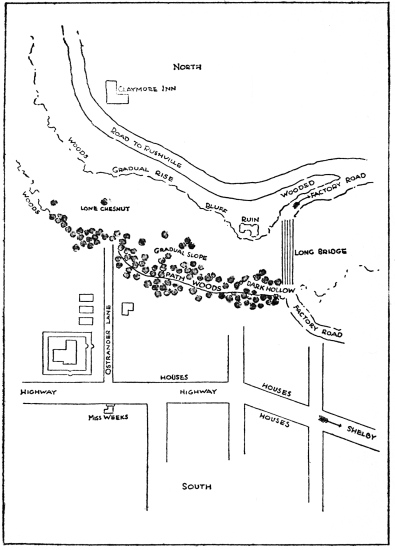
Oliver's remorse, the judge's discovery of his guilt (a discovery which
may have been soon but probably was late—so late that the penalty of
the doing had already been paid by the innocent), can only be guessed
from the terrible sequel: a son dismissed, a desolated home in which the
father lived as a recluse.
How the mystery cleared, as she looked at it! The house barred from
guests—the double fence where, hidden from all eyes, the wretched
father might walk his dreary round when night forbade him rest or memory
became a whip of scorpions to lash him into fury or revolt—the stairs
never passed—(how could he look upon rooms where his wife had dreamed
the golden dreams of motherhood and the boy passed his days of innocent
youth)—aye, and his own closed-up room guarded by Bela from intrusion
as long as breath remained to animate his sinking body! What was its
secret? Why, Oliver's portrait! Had this been seen, marked as it was for
all men's reprobation, nothing could have stemmed inquiry; and inquiry
was to be dreaded as Judge Ostrander's own act had shown. Not till he
had made his clumsy attempt to cover this memorial of love and guilt and
rehanging it, thus hidden, where it would attract less attention, had
she been admitted to his room. Alas! alas! that he had not destroyed it
then and there. That, clinging to habits old as his grief and the
remorse which had undoubtedly devoured him for the part he had played in
this case of perverted justice, he had trusted to a sheet of paper to
cover what nothing on earth could cover, once Justice were aroused or
the wrath of God awakened.
Deborah shuddered. Aye, the mystery had cleared, but only to enshroud
her spirits anew and make her long with all her bursting heart and
shuddering soul that death had been her portion before ever she had
essayed to lift the veil held down so tightly by these two remorseful
men.
But was her fault irremediable? The only unanswerable connection between
this old crime and Oliver lay in the evidence she had herself collected.
As she had every intention of suppressing this evidence, and as she had
small dread of any one else digging out the facts to which she only
possessed a clew, might she not hope that any suspicions raised by her
inquiries would fall like a house of cards when she withdrew her hand
from the toppling structure?
She would make her first effort and see. Mr. Black had heard her
complaint; he should be the first to learn that the encouragement she
had received was so small that she had decided to accept her present
good luck without further query, and not hark back to a past which most
people had buried.
"You began it, as women begin most things, without thought and a due
weighing of consequences. And now you propose to drop it in the same
freakish manner. Isn't that it?"
Deborah Scoville lifted her eyes in manifest distress and fixed them
deprecatingly upon her interrogator. She did not like his tone which was
dry and suspiciously sarcastic, and she did not like his attitude which
was formal and totally devoid of all sympathy. Instinctively she pushed
her veil still further from her features as she deprecatingly replied:
"You are but echoing your sex in criticising mine as impulsive. And you
are quite within your rights in doing this. Women are impulsive; they
are even freakish. But it is given to one now and then to recognise this
fact and acknowledge it. I hope I am of this number; I hope that I have
the judgment to see when I have committed a mistake and to stop short
before I make myself ridiculous."
The lawyer smiled,—a tight-lipped, acrid sort of smile which
nevertheless expressed as much admiration as he ever allowed himself to
show.
"Judgment, eh?" he echoed. "You stop because your judgment tells you
that you were on the point of making a fool of yourself? No other
reason, eh?"
"Is not that the best which can be given a hard-headed, clear-eyed
lawyer like yourself? Would you have me go on, with no real evidence to
back my claims; rouse up this town to reconsider his case when I have
nothing to talk about but my husband's oath and a shadow I cannot
verify?"
"Then Miss Weeks' neighbourliness failed in point? She was not as
interesting as you had a right to expect from my recommendation?"
"Miss Weeks is a very chatty and agreeable woman, but she cannot tell
what she does not know."
Mr. Black smiled. The woman delighted him. The admiration which he had
hitherto felt for her person and for the character which could so
develop through misery and reproach as to make her in twelve short
years, the exponent of all that was most attractive and bewitching in
woman, seemed likely to extend to her mind. Sagacious, eh? and cautious,
eh? He was hardly prepared for such perfection, and let the transient
lighting up of his features speak for him till he was ready to say:
"You find the judge very agreeable, now that you know him better?"
"Yes, Mr. Black. But what has that got to do with the point at issue?"
And SHE smiled, but not just in his manner nor with quite as little
effect.
"Much," he growled. "It might make it easier for you to reconcile
yourself to the existing order of things."
"I am reconciled to them simply from necessity," was her gentle
response. "Nothing is more precious to me than Reuther's happiness. I
should but endanger it further by raising false hopes. That is why I
have come to cry halt."
"Madam, I commend your decision. It is that of a wise and considerate
woman. Your child's happiness is, of course, of paramount importance to
you. But why should you characterise your hopes as false, just when
there seems to be some justification for them."
Her eyes widened, and she regarded him with a simulation of surprise
which interested without imposing upon him.
"I do not understand you," said she. "Have YOU come upon some clew? Have
YOU heard something which I have not?"
The smile with which he seasoned his reply was of a very different
nature from that which he had previously bestowed upon her. It prepared
her, possibly, for the shock of his words:
"I hardly think so," said he. "If I do not mistake, we have been the
recipients of the same communications."
She started to her feet, but sat again instantly. "Pray explain
yourself," she urged. "Who has been writing to you? And what have they
written?" she added, presuming a little upon her fascinations as a woman
to win an honest response.
"Must I speak first?"
If it was a tilt, it was between even forces.
"It would be gentlemanly in you to do so."
"But I am not of a gentlemanly temper."
"I deal with no other," said she; but with what a glance and in what a
tone!
A man may hold out long—and if a lawyer and a bachelor more than long,
but there is a point at which he succumbs. Mr. Black had reached that
point. Smoothing his brow and allowing a more kindly expression to creep
into his regard, he took two or three crushed and folded papers from a
drawer beside him and, holding them, none too plainly in sight, remarked
very quietly, but with legal firmness:
"Do not let us play about the bush any longer. You have announced your
intention of making no further attempt to discover the man who in your
eyes merited the doom accorded to John Scoville. Your only reason for
this—if you are the woman I think you—lies in your fear of giving
further opportunity to the misguided rancour of an irresponsible writer
of anonymous epistles. Am I not right, madam?"
Beaten, beaten by a direct assault, because she possessed the
weaknesses, as well as the pluck, of a woman. She could control the
language of her lips, but not their quivering; she could meet his eye
with steady assurance but she could not keep the pallor from her cheeks
or subdue the evidences of her heart's turmoil. Her pitiful glance
acknowledged her defeat, which she already saw mirrored in his eyes.
Taking it for an answer, he said gently enough:
"That we may understand each other at once, I will mention the person
who has been made the subject of these attacks. He—"
"Don't speak the name," she prayed, leaning forward and laying her
gloved hand upon his sleeve. "It is not necessary. The whole thing is an
outrage."
"Of course," he echoed, with some of his natural brusqueness, "and the
rankest folly. But to some follies we have to pay attention, and I fear
that we shall have to pay attention to this one if only for your
daughter Reuther's sake. You cannot wish her to become the butt of these
scandalous attempts?"
"No, no." The words escaped her before she realised that in their
utterance she had given up irretrievably her secret.
"You consider them scandalous?"
"Most scandalous," she emphatically returned, with a vivacity and
seeming candour such as he had seldom seen equalled even on the
witness-stand.
His admiration was quite evident. It did not prevent him, however, from
asking quite abruptly:
"In what shape and by what means did this communication reach you?"
"I found it lying on the walk between the gates."
"The same by which Judge Ostrander leaves the house?"
"Yes," came in faint reply.
"I see that you share my fears. If one such scrap can be thrown over the
fence, why shouldn't another be? Men who indulge themselves in writing
anonymous accusations seldom limit themselves to one effusion. I will
stake my word that the judge has found more than one on his lawn."
She could not have responded if she would; her mouth was dry, her tongue
half paralysed. What was coming? The glint in the lawyer's eye
forewarned her that something scarcely in consonance with her hopes and
wishes might be expected.
"The judge has seen and read these barefaced insinuations against his
son and has not turned this whole town topsy-turvy! What are we to think
of that? A lion does not stop to meditate; HE SPRINGS. And Archibald
Ostrander has the nature of a lion. There is nothing of the fox or even
of the tiger in HIM. Mrs. Scoville, this is a very serious matter. I do
not wonder that you are a trifle overwhelmed by the results of your
ill-considered investigations."
"Does the town know? Has the thing become a scandal—a byword? Miss
Weeks gave no proof of ever having heard one word of this dreadful
not-to-be-foreseen business."
"That is good news. You relieve me. Perhaps it is not a general topic as
yet." Then shortly and with lawyer-like directness, "Show me the letter
which has disturbed all your plans."
"I haven't it here."
"You didn't bring it?"
"No, Mr. Black. Why should I? I had no premonition that I should ever be
induced to show it to any one, least of all to you."
"Look over these. Do they look at all familiar?"
She glanced down at the crumpled sheets and half-sheets he had spread
out before her. They were similar in appearance to the one she had
picked up on the judge's grounds but the language was more forcible, as
witness these:
When a man is trusted to defend another on trial for his life, he's
supposed to know his business. How came John Scoville to hang,
without a thought being given to the man who hated A. Etheridge
like poison? I could name a certain chap who more than once in the
old days boasted that he'd like to kill the fellow. And it wasn't
Scoville or any one of his low-down stamp either.
A high and mighty name shouldn't shield a man who sent a poor,
unfriended wretch to his death in order to save his own bacon.
"Horrible!" murmured Deborah, drawing back in terror of her own emotion.
"It's the work of some implacable enemy taking advantage of the
situation I have created. Mr. Black, this man must be found and made to
see that no one will believe, not even Scoville's widow—"
"There! you needn't go any further with that," admonished the lawyer. "I
will manage him. But first we must make sure to rightly locate this
enemy of the Ostranders. You do detect some resemblance between this
writing and the specimen you have at home?"
"They are very much alike."
"You believe one person wrote them?"
"I do."
"Have you any idea who this person is?"
"No; why should I?"
"No suspicion?"
"Not the least in the world."
"I ask because of this," he explained, picking out another letter and
smilingly holding it out towards her.
She read it with flushed cheeks.
Listen to the lady. You can't listen to any one nicer. What she
wants she can get. There's a witness you never saw or heard of.
A witness they had never heard of! What witness? Scarcely could she lift
her eyes from the paper. Yet there was a possibility, of course, that
this statement was a lie.
"Stuff, isn't it?" muttered the lawyer. "Never mind, we'll soon have
hold of the writer." His face had taken on a much more serious aspect,
and she could no longer complain of his indifference or even of his
sarcasm.
"You will give me another opportunity of talking with you on this
matter," pursued he. "If you do not come here, you may expect to see me
at Judge Ostrander's. I do not quite like the position into which you
have been thrown by these absurd insinuations from some unknown person
who may be thinking to do you a service, but who you must feel is very
far from being your friend. It may even lead to your losing the home
which has been so fortunately opened for you. If this occurs, you may
count on my friendship, Mrs. Scoville. I may have failed you once, but I
will not fail you twice."
Surprised, almost touched, she held out her hand, with a cordial THANK
YOU, in which emotion struggled with her desire to preserve an
appearance of complete confidence in Judge Ostrander, and incidentally
in his son. Then, being on her feet by this time, she turned to go,
anxious to escape further embarrassment from a perspicacity she no
longer possessed the courage to meet.
The lawyer appeared to acquiesce in the movement of departure. But when
he saw her about to vanish through the door, some impulse of
compunction, as real as it was surprising, led him to call her back and
seat her once more in the chair she had so lately left.
"I cannot let you go," said he, "until you understand that these
insinuations from a self-called witness would not be worth our attention
if there were not a few facts to give colour to his wild claims. Oliver
Ostrander WAS in that ravine connecting with Dark Hollow, very near the
time of the onslaught on Mr. Etheridge; and he certainly hated the man
and wanted him out of the way. The whole town knows that, with one
exception. You know that exception?"
"I think so," she acceded, taking a fresh grip upon her emotions.
"That this was anything more than a coincidence has never been
questioned. He was not even summoned as a witness. With the judge's high
reputation in mind I do not think a single person could have been found
in those days to suggest any possible connection between this boy and a
crime so obviously premeditated. But people's minds change with time and
events, and Oliver Ostrander's name uttered in this connection to-day
would not occasion the same shock to the community as it would have done
then. You understand me, Mrs. Scoville?"
"You allude to the unexplained separation between himself and father,
and not to any failure on his part to sustain the reputation of his
family?"
"Oh, he has made a good position for himself, and earned universal
consideration. But that doesn't weigh against the prejudices of people,
roused by such eccentricities as have distinguished the conduct of these
two men."
"Alas!" she murmured, frightened to the soul for the first time, both by
his manner and his words.
"You know and I know," he went on with a grimness possibly suggested by
his subject, "that no mere whim lies back of such a preposterous
seclusion as that of Judge Ostrander behind his double fence. Sons do
not cut loose from fathers or fathers from sons without good cause. You
can see, then, that the peculiarities of their mutual history form but a
poor foundation for any light refutation of this scandal, should it
reach the public mind. Judge Ostrander knows this, and you know that he
knows this; hence your distress. Have I not read your mind, madam?"
"No one can read my mind any more than they can read Judge Ostrander's,"
she avowed in a last desperate attempt to preserve her secret. "You may
think you have done so, but what assurance can you have of the fact?"
"You are strong in their defence," said he, "and you will need to be if
the matter ever comes up. The shadows from Dark Hollow reach far, and
engulf all they fall upon."
"Mr. Black"—she had re-risen the better to face him—"you want
something from me—a promise, or a condition."
"No," said he, "this is my affair only as it affects you. I simply
wished to warn you of what you might have to face; and what Judge
Ostrander will have to face (here I drop the lawyer and speak only as a
man) if he is not ready to give a more consistent explanation of the
curious facts I have mentioned."
"I cannot warn him, Mr. Black."
"You? Of course not. Nobody can warn him; possibly no one should warn
him. But I have warned YOU; and now, as a last word, let us hope that no
warning is necessary and that we shall soon see the last of these
calumniating letters and everything readjusted once more on a firm and
natural basis. Judge Ostrander's action in reopening his house in the
manner and for the purpose he has, has predisposed many in his favour.
It may, before we know it, make the past almost forgotten."
"Meanwhile you will make an attempt to discover the author of these
anonymous attacks?"
"To save YOU from annoyance."
Obliged to make acknowledgment of the courtesy if not kindness prompting
these words, Mrs. Scoville expressed her gratitude and took farewell in
a way which did not seem to be at all displeasing to the crusty lawyer;
but when she found herself once more in the streets, her anxiety and
suspense took on a new phase. What was at the bottom of Mr. Black's
contradictory assertions? Sympathy with her, as he would have her
believe, or a secret feeling of animosity towards the man he openly
professed to admire?
"Reuther, sit up here close by mother and let me talk to you for a
little while."
"Yes, mother; oh, yes, mother." Deborah felt the beloved head pressed
close to her shoulder and two soft arms fall about her neck.
"Are you very unhappy? Is my little one pining too much for the old
days?"
A closer pressure of the head, a more vehement clasp of the encircling
arms, but no words.
"You have seemed brighter lately. I have heard you sing now and then as
if the joy of youth was not quite absent from your heart. Is that true,
or were you merely trying to cheer your mother?"
"I am afraid I was trying to cheer the judge," came in low whisper to
her ear. "When I hear his step in the study—that monotonous tramp,
tramp, which we both dread, I feel such an ache here, such a desire to
comfort him, that I try the one little means I have to divert him from
his thoughts. He must be so lonely without—"
"Reuther, you forget how many years have passed since he had a
companion. A man becomes used to loneliness. A judge with heavy cases on
his mind must think and think very closely, you know."
"Oh, mamma, it's not of his cases our judge is thinking when he walks
like that. I know him too well, love him too well, not to feel the
trouble in his step. I may be wrong, but all the sympathy and
understanding I may not give to Oliver I devote to his father, and when
he walks like that he seems to drag my heart after him. Mamma, mamma, do
not blame me. I have just as much affection for you, and I suffer just
as keenly when I see you unhappy. And, mamma, are you sure that you are
quite happy to-day? You look as if something had happened to trouble
you—something more than usual, I mean."
They were sitting in the dark, with just the light of the stars shining
through the upper panes of the one unshaded window. Deborah, therefore,
had little to fear from her daughter's eye, only from the sensitiveness
of her touch and the quickness of her ear. Alas, in this delicately
organised girl these were both attuned to the nicest discrimination, and
before the mother could speak, Reuther had started up, crying:
"Oh, how your heart beats! Something has happened, darling mother;
something which—"
"Hush, Reuther; it is only this: When I came to Shelby it was with a
hope that I might some day smooth the way to your happiness. But it was
only a wild dream, Reuther; and the hour has come for me to tell you so.
What joys are left us must come in other ways; love unblessed must be
put aside resolutely and forever."
She felt the shudder pass through the slender form which had thrown
itself again at her side; but when the young girl spoke it was with
unexpected bravery and calm.
"I have long ago done that, mamma. I've had no hopes from the first. The
look with which Oliver accepted my refusal to go on with the ceremony
was one of gratitude, mother. I can never forget that. Relief struggled
with grief. Would you have me cherish any further illusions after that?"
Mrs. Scoville was silent. So, after all, Reuther had not been so blind
on that day as she had always feared.
"Oliver has faults—Oh, let me talk about him just for once, darling
mother," the poor, stricken child babbled on. "His temper is violent, or
so he has often told me, coming and going like a gust of—No, mamma,
don't make me stop. If he has faults he has good traits too. He was
always gentle with me and if that far-away look you did not like would
come at times and take him, as it were, out of our world, such a sweet
awakening would follow when he realised that I was waiting for his
spirit to come back, that I never minded the mystery, in my joy at the
comfort which my love gave him."
"My child, my child!"
"Mother, I can soothe the father, but I can no longer soothe Oliver.
That is my saddest thought. It makes me wish, sometimes, that he would
find another loving heart on which he could lean without any
self-reproach. I should soon learn to bear it. It would so assure his
future and rid me of the fear that he may fail to hold the place he has
won by such hard work and persistence."
A moment's silence, then a last appeal on the part of the mother.
"Reuther, have I ever been harsh to you?"
"No, no."
"Then you will not think me unkind or even untender if I say that every
loving thought you give now to Oliver is hurtful both to yourself and to
me. Don't indulge in them, my darling. Put your heart into work or into
music, and your mother will bless you. Won't it help you to know this,
Reuther? Your mother, who has had her griefs, will bless you."
"Mother, mother!"
That night, at a later hour, Deborah struggled with a great temptation.
The cap which hung in Oliver's closet—the knife which lay in the drawer
of Oliver's desk—were to her mind positive proofs of his actual
connection with the crime she now wished to see buried for all time in
her husband's grave. The threat of that unknown indicter of mysterious
letters, I KNOW A WITNESS, had sunk deep into her mind. A witness of
what? Of anything which the discovery of these articles might
substantiate? If so, what peril remained in their continued preservation
when an effort on her part might so easily destroy them.
Sleep, long a stranger to her pillow, forsook her entirely as she faced
this question and realised the gain in peace which might be hers if cap
and knife were gone. Why then did she allow them to remain, the one in
the closet, the other in the drawer? Because she could not help herself.
Instinct was against her meddling with these possible proofs of crime.
But this triumph of conscience cost her dear. The next morning found her
pale—almost as pale as Reuther. Was that why the judge surveyed her so
intently as she poured out the coffee, and seemed more than once on the
point of addressing her particularly, as she went through the usual
routine of tidying up his room?
She asked herself this question more than once, and found it answered
every time she hurried by the mirror. Certainly she showed a remarkable
pallor.
Knowing its cause herself, she did not invite his inquiries; and another
day passed. With the following morning she felt strong enough to open
the conversation which had now become necessary for her peace of mind.
She waited till the moment when, her work all done, she was about to
leave his presence. Pausing till she caught his eye, which seemed a
little loth, she thought, to look her way, she observed, with perhaps
unnecessary distinctness:
"I hope that everything is to your mind, Judge Ostrander. I should be
sorry not to make you as comfortable as is possible under the
circumstances."
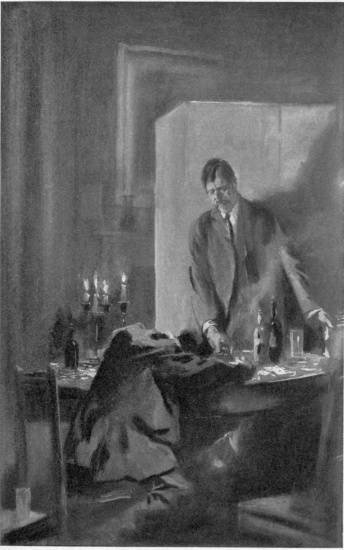
SILENCE! NOT EVEN HEAVEN SPOKE
Roused a little suddenly, perhaps, from thoughts quite disconnected with
those of material comfort, he nodded with the abstraction of one who
recognises that some sort of acknowledgment is expected from him; then,
seeing her still waiting, added politely:
"I am very well looked after, if that is what you mean, Mrs. Scoville.
Bela could not do any better—if he ever did as well."
"I am glad," she replied, thinking with what humour this would have
struck her once. "I—I ask because, having nothing on my mind but
housekeeping, I desire to remedy anything which is not in accordance
with your exact wishes."
His attention was caught and by the very phrase she desired.
"Nothing on your mind but housekeeping?" he repeated. "I thought you had
something else of a very particular nature with which to occupy
yourself."
"I had; but I have been advised against pursuing it. The folly was too
great."
"Who advised you?"
The words came short and sharp just as they must have come in those old
days when he confronted his antagonists at the bar.
"Mr. Black. He was my husband's counsel, you remember. He says that I
should only have my trouble for my pains, and I have come to agree with
him. Reuther must content herself with the happiness of living under
this roof; and I, with the hope of contributing to your comfort."
Had she impressed him? Had she played her part with success? Dare she
lift her eye and meet the gaze she felt concentrated upon her? No. He
must speak first. She must have some clew to the effect she had produced
before she risked his penetration by a direct look.
She had to wait longer than her beating heart desired. He had his own
agitation to master, and possibly his own doubts. This was not the
fiery, determined woman he had encountered amid the ruins of Spencer's
Folly. WHAT HAD MADE THE CHANGE? Black's discouraging advice? Hardly.
Why should she take from that hard-faced lawyer what she had not been
willing to take from himself? There must have been some other
influencing cause.
His look, his attitude, his voice, betrayed his hesitations, as he
finally remarked:
"Black is a man of excellent counsel, but he is hard as a stone and not
of the sort whose monitions I should expect to have weight with one like
you. What did he put in the balance,—or what have others put in the
balance, to send your passionate intentions flying up to the beam? I
should be glad to hear."
Should she tell him? She had a momentary impulse that way. Then the
irrevocableness of such a move frightened her; and, pale with dismay at
what she felt to be a narrow escape from a grave error of judgment, she
answered with just enough truth, for her to hope that the modicum of
falsehood accompanying it would escape his attention:
"What has changed my intentions? My experience here, Judge Ostrander.
With every day I pass under this roof, I realise more and more the
mistake I made in supposing that any change in circumstances would make
a union between our two children proper or feasible. Headstrong as I am
by nature, I have still some sense of the fitness of things, and it is
that sense awakened by a better knowledge of what the Ostrander name
stands for, which has outweighed my hopes and mad intentions. I am sorry
that I ever troubled you with them."
The words were ambiguous; startlingly so, she felt; but, in hope that
they would strike him otherwise, she found courage at last to raise her
eyes in search of what lay in his. Nothing, or so she thought at first,
beyond the glint of a natural interest; then her mind changed, and she
felt that it would take one much better acquainted with his moods than
herself to read to its depths a gaze so sombre and inscrutable.
His answer, coming after a moment of decided suspense, only deepened
this impression. It was to this effect:
"Madam, we have said our say on this subject. If you have come to see
the matter as I see it, I can but congratulate you upon your good sense,
and express the hope that it will continue to prevail. Reuther is worthy
of the best—" he stopped abruptly. "Reuther is a girl after my own
heart," he gently supplemented, with a glance towards his papers lying
in a bundle at his elbow, "and she shall not suffer because of this
disappointment to her girlish hopes. Tell her so with my love."
It was a plain dismissal. Mrs. Scoville took it as such, and quietly
left the room. As she did so she was approached by Reuther who handed
her a letter which had just been delivered. It was from Mr. Black and
read thus:
We have found the rogue and have succeeded in inducing him to leave
town. He's a man in the bill-sticking business and he owns to a
grievance against the person we know.
Deborah's sleep that night was without dreams.
About this time, the restless pacing of the judge in his study at nights
became more frequent and lasted longer. In vain Reuther played her most
cheerful airs and sang her sweetest songs, the monotonous tramp kept up
with a regularity nothing could break.
"He's worried by the big case now being tried before him," Deborah would
say, when Reuther's eyes grew wide and misty in her sympathetic trouble.
And there was no improbability in the plea, for it was a case of much
moment, and of great local interest. A man was on trial for his life and
the circumstances of the case were such that the feeling called forth
was unusually bitter; so much so, indeed, that every word uttered by the
counsel and every decision made by the judge were discussed from one end
of the county to the other, and in Shelby, if nowhere else, took
precedence of all other topics, though it was a Presidential year and
party sympathies ran high.
The more thoughtful spirits were inclined to believe in the innocence of
the prisoner; but the lower elements of the town, moved by class
prejudice, were bitterly antagonistic to his cause and loud for his
conviction.
Did the judge realise his position and the effect made upon the populace
by his very evident leaning towards this dissipated but well-connected
young man accused of a crime so brutal, that he must either have been
the sport of most malicious circumstances, or a degenerate of the worst
type. The time of Judge Ostrander's office was nearly up, and his future
continuance on the bench might very easily depend upon his attitude at
the present hearing. Yet HE, without apparent recognition of this fact,
showed without any hesitancy or possibly without self-consciousness, the
sympathy he felt for the man at the bar, and ruled accordingly almost
without variation.
No wonder he paced the floor as the proceedings drew towards its close
and the inevitable hour approached when a verdict must be rendered. Mrs.
Scoville, reading his heart by the light of her recent discoveries,
understood as nobody else, the workings of his conscience and the
passion of sympathy which this unhappy father must have for misguided
youth. She began to fear for his health and count the days till this
ordeal was over.
In other regards, quiet had come to them all and less tempestuous fears.
Could the judge but weather the possible conviction of this man and
restrain himself from a disclosure of his own suffering, more cheerful
days might be in store for them, for no further missives were to be seen
on the lawn, nor had anything occurred for days to recall to Deborah's
mind the move she had made towards re-establishing her husband's
innocence.
A week passed, and the community was all agog, in anticipation of the
judge's charge in the case just mentioned. It was to be given at noon,
and Mrs. Scoville, conscious that he had not slept an hour the night
before (having crept down more than once to listen if his step had
ceased), approached him as he prepared to leave the house for the court
room, and anxiously asked if he were quite well.
"Oh, yes, I'm well," he responded sharply, looking about for Reuther.
The young girl was standing a little behind him, with his gloves in her
hand—a custom she had fallen into in her desire to have his last look
and fond good morning.
"Come here, child," said he, in a way to make her heart beat; and, as he
took the gloves from her hand, he stooped and kissed her on the
forehead—something he had never done before. "Let me see you smile,"
said he. "It's a memory I like to take with me into the court room."
But when in her pure delight at his caress and the fatherly feeling
which gave a tremor to his simple request, she lifted her face with that
angelic look of hers which was far sweeter and far more moving than any
smile, he turned away abruptly as though he had been more hurt than
comforted, and strode out of the house without another word.
Deborah's hand went to her heart, in the dark corner whither she had
withdrawn herself, and when she turned again towards the spot where
Reuther had stood, it was in some fear lest she had betrayed her
understanding of this deeply tried father's passionate pain. But Reuther
was no longer there. She had fled quickly away with the memory of what
was to make this day a less dreary one for her.
Morning passed and the noon came, bringing Deborah an increased
uneasiness. When lunch was over and Reuther sat down to her piano, the
feeling had grown into an obsession, which soon resolved itself into a
definite fear.
"What if an attack, such as I once saw, should come upon him while he
sits upon the bench! Why have I not thought of this before? O God! these
evil days! When will they be over!"
She found herself so restless that she decided upon going out. Donning
her quietest gown and veil, she looked in on Reuther and expressed her
intention; then slipped out of the front door, hardly knowing whither
her feet would carry her.
They did not carry her far,—not at this moment at least. On the walk
outside she met Miss Weeks hurrying towards her from the corner,
stumbling in her excitement and so weakened in body or spirit that she
caught at the unresponsive fence for the support which its smooth
surface refused to give her.
At sight of Deborah's figure, she paused and threw up her hands.
"Oh, Mrs. Scoville, such a dreadful thing!" she cried. "Look here!" And,
opening one of her hands, she showed a few torn scraps of paper whose
familiarity made Deborah's blood run cold.
"On the bridge," gasped the little lady, leaning against the fence for
support. "Pasted on the railing of the bridge. I should never have seen
it, nor looked at it, if it hadn't been that I—"
"Don't tell me here," urged Deborah. "Let's go over to your house. See,
there are people coming."
The little lady yielded to the other's constraining hand and together
they crossed the street. Once in the house, Deborah allowed her full
apprehension to show itself.
"What were the words? What was on the paper? Anything about—"
The little woman's look of horror stopped her.
"It's a lie, an awful, abominable lie. But think of such a lie being
pasted up on that dreadful bridge for any one to see. After twelve
years, Mrs. Scoville! After—" But here indignation changed suddenly
into suspicion, and eyeing her visitor with sudden disfavour she cried:
"This is your work, madam. Your inquiries and your talk of John
Scoville's innocence has set wagging all the villainous tongues in town.
And I remember something else. How you came smirking into this very room
one day, with your talk about caps and Oliver Ostrander's doings on the
day when Algernon Etheridge was murdered. You were in search of
information, I see; information against the best, the brightest—Well,
why don't you speak? I'll give you the chance if you want it. Don't
stand looking at me like that. I'm not used to it, Mrs. Scoville. I'm a
peaceable woman and I'm not used to it."
"Miss Weeks—" Ah, the oil of that golden speech on troubled waters!
What was its charm? What message did it carry from Deborah's warm, true
heart that its influence should be so miraculous? "Miss Weeks, you have
forgotten my interest in Oliver Ostrander. He was my daughter's lover.
He was my own ideal of a gifted, kind-hearted, if somewhat mysterious,
young man. No calumny uttered against him can awaken in you half the
sorrow and indignation it does in me. Let me see those lines or what
there is left of them so that I may share your feelings. They must be
dreadful—"
"They are more than dreadful. I don't know how I had strength to pull
these pieces off. I couldn't have done it if they had been quite dry.
But what do you want to see them for? I'd have left them there if I had
been willing to have them seen. They are for the kitchen fire. Wait a
moment and then we will talk."
But Deborah had no mind to let these pieces escape her eye. Sick as she
felt at heart, she exerted herself to win the little woman's confidence;
and when Deborah exerted herself, even under such adverse conditions as
these, she seldom failed to succeed.
Nor did she fail now. At the end of fifteen minutes she had the torn
bits of paper arranged in their proper position and was reading these
words:
The scene of Oliv der's crime.
Nothing could be more explicit nothing more damaging. As the glances of
the two women met, it would be difficult to tell on which face Distress
hung out the whiter flag.
"The beginning of the end!" was Deborah's thought. "If after Mr. Black's
efforts, a charge like this is found posted up in the public ways, the
ruin of the Ostranders is determined upon, and nothing we can do can
stop it."
In five minutes more she had said good-bye to Miss Weeks and was on her
way to the courthouse.
This building occupied one end of a large paved square in the busiest
part of the town. As Deborah approached it, she was still further
alarmed by finding this square full of people, standing in groups or
walking impatiently up and down with their eyes fixed on the courthouse
doors. The case which had agitated the whole country for days was now in
the hands of the jury and a verdict was momentarily expected.
So much for appearances outside. Within, there was the uneasy hum, the
anxious look, the subdued movement which marks an universal suspense.
Announcement had been made that the jury had reached their verdict, and
counsel were resuming their places and the judge his seat.
Those who had eyes only for the latter—and these were many—noticed a
change in him. He looked older by years than when he delivered his
charge. Not the prisoner himself gave greater evidence of the effect
which this hour of waiting had had upon a heart whose covered griefs
were, consciously or unconsciously, revealing themselves to the public
eye. He did not wish this man sentenced. This was shown by his
charge—the most one-sided one he had given in all his career. Yet the
man awaiting verdict had small claim to his consideration—none, in
fact, save that he was young and well connected; facts in his favour
with which the people who packed the courthouse that day had little
sympathy, as their cold looks proved.
To Deborah, who had succeeded in getting a seat in a remote and
inconspicuous corner, these looks conveyed a spirit of so much threat
that she gazed about her in wonder that so few saw where the real
tragedy in this room lay.
But the jury is now seated, and the clatter of moving feet which but a
moment before filled the great room, sinks as if under a charm, and
silence, that awesome precursor of doom, lay in all its weight upon
every ear and heart, as the clerk advancing with the cry, "Order in the
court," put his momentous question:
"Gentlemen of the jury, are you ready with your verdict?"
A hush!—then, the clear voice of the foreman:
"We are."
"How do you find? Guilty or not guilty?"
Another hesitation. Did the foreman feel the threat lurking in the air
about him? If so, he failed to show it in his tones as he uttered the
words which released the prisoner:
"NOT GUILTY."
A growl from the crowd, almost like that of a beast stirring its lair,
then a quick cessation of all hubbub as every one turned to the judge to
whose one-sided charge they attributed this release.
Again he was a changed man. With the delivery of this verdict he had
regained his natural poise, and never had he looked more authoritative
or more pre-eminently the dominating spirit of the court than in the few
following moments in which he expressed the thanks of the court to the
jury and dismissed the prisoner. And yet, though each person there, from
the disappointed prosecutor to the least aggressive spectator, appeared
to feel the influence of a presence and voice difficult to duplicate on
the bench of this country, Deborah experienced in her quiet corner no
alleviation of the fear which had brought her into this forbidding spot
and held her breathless through all these formalities.
For the end was not yet. Through all the turmoil of noisy departure and
the drifting out into the square of a vast, dissatisfied throng, she had
caught the flash of a bit of paper (how introduced into this moving mass
of people no one ever knew) passing from hand to hand, towards the
solitary figure of the judge who had not as yet left his seat.
She knew—no one better—what this meant, and instinct bade her cry out
and bid those thoughtless hands to cease their work and let this letter
drop. But her discretion still held, and, subduing the mad impulse, she
watched with dilating eyes and heaving breast the slow passage of this
fatal note through the now rapidly thinning crowd, its delay as it
reached the open space between the last row of seats and the judge's
bench and its final delivery by some officious hand, who thrust it upon
his notice just as he was rising to leave.
The picture he made in that instant of hesitation never left her mind.
To the end of her days she will carry a vision of his tall form,
imposing in his judicial robes and with the majesty of his office still
upon him, fingering this envelope in sight of such persons as still
lingered in his part of the room. Nemesis was lowering its black wings
over his devoted head, and, with feelings which left her dazed and
transfixed in silent terror, Deborah saw his finger tear its way through
the envelope and his eyes fall frowningly on the paper he drew out.
Then the People's counsel and the counsel for the Defence and such
clerks and hangers-on as still lingered in the upper end of the room
experienced a decided sensation.
The judge, who a moment before had towered above them all in melancholy
but impressive dignity, shrunk with one gasp into feebleness and sank
back stricken, if not unconscious, into his chair.
Was it a stroke, or just one of his attacks of which all had heard? Was
he aware of his own condition and the disturbance it caused or was he,
on the contrary, dead to his own misery and oblivious of the rush which
was made from all sides to his assistance? Even Deborah could not tell,
and was forced to sit quiet in her corner, waiting for the parting of
the group which hid the judge from her sight.
It happened suddenly and showed her the same figure she had seen once
before—a man with faculties suspended, but not impaired, facing them
all with open gaze but absolutely dead for the moment to his own
condition and to the world about.
But, horrible as this was, what she saw going on behind him was
infinitely worse. A man had caught up the bit of paper Judge Ostrander
had let fall from his hand and was opening his lips to read it to the
curious people surrounding him.
She tried to stop him. She forced a cry to her lips which should have
rung through the room, but which died away on the air unheard. The
terror which had paralysed her limbs had choked her voice.
But her ears remained true. Low as he spoke, no trumpet-call could have
made its meaning clearer to Deborah Scoville than did these words:
"We know why you favour criminals. Twelve years is a long time, but not
long enough to make wise men forget."
Had she not caught the words themselves she would have recognised their
import from the blighting effect they produced upon the persons grouped
within hearing.
Schooled as most of them were to face with minds secure and tempers
quite unruffled the countless surprises of a court room, they paled at
the insinuation conveyed in these two sentences, and with scarcely the
interchange of glance or word, drew aside in a silence which no man
seemed inclined to break.
As for the people still huddled in the doorway, they rushed away
helter-skelter into the street, there to proclaim the judge's condition
and its probable cause;—an event which to many quite eclipsed in
interest the more ordinary one which had just released to freedom a man
seemingly doomed.
Few persons were now left in the great room, and Deborah, embarrassed to
find that she was the only woman present, was on the point of escaping
from her corner when she perceived a movement take place in the rigid
form from which she had not yet withdrawn her eyes, and, regarding Judge
Ostrander more attentively, she caught the gleam of his suspicious eye
as it glanced this way and that to see if his lapse of consciousness had
been noticed by those about him.
Would the man still in possession of the paper whose contents had
brought about this attack understand these evidences of apprehension?
Yes; and what is more, he seems to take such means as offers to hide
from the judge all knowledge of the fact that any other eyes than his
own have read these invidious words. With unexpected address, he waits
for the judge to turn his head aside when with a quick and dextrous
movement he so launches the paper from his hand that it falls softly and
without flurry within an inch of the judicial seat. Then he goes back to
his papers.
This suggestion, at once so marked and so delicate, did not fail of its
effect upon those about. Wherever the judge looked he saw abstracted
faces and busy hands, and, taking heart at not finding himself watched,
he started to rise. Then memory came,—blasting, overwhelming memory of
the letter he had been reading; and, rousing with a start, he looked
down at his hand, then at the floor before him, and, seeing the letter
lying there, picked it up with a secret, side-long glance to right and
left, which sank deep into the heart of the still watchful Deborah.
If those about him saw, they made no motion. Not an eye looked round and
not a head turned as he straightened himself and proceeded to leave the
room. Only Deborah noted how his steps faltered and how little he was to
be trusted to find his way unguided to the door. It lay to the right and
he was going left. Now he stumbles—Isn't there any one to—Yes, she is
not the sole one on watch. The same man who had read aloud the note and
then dropped it within his reach, had stepped after him, and kindly, if
artfully, turned him towards the proper place of exit. As the two
disappear, Deborah wakes from her trance, and, finding herself alone
among the seats, hurries to quit her corner and leave the building.
The glare—the noise of the square, as she dashes down into it seems for
the moment unendurable. The pushing, panting mass of men and women of
which she has now become a part, closes about her, and for the moment
she can see nothing but faces,—faces with working mouths and blazing
eyes,—a medley of antagonistic expression, all directed against
herself;—or so she felt in the heat of her self-consciousness. But
after the first recoil she knew that no such universal recognition could
be hers; that she was merely a new and inconsiderable atom caught in a
wave of feeling which engulfed all it met; that this mob was not raised
from the stones to overwhelm her but HIM, and that if she flew, it
should be to his aid, and not to save herself. But how was she to reach
him? He would not come out by the main entrance; that she knew. Where
look for him, then? Suddenly she remembered; and using some of her
strength of which she had good measure, and more of that address to
which I have already alluded, she began to worm herself along through
this astounding collection of people much too large already for the
ordinary force of police to handle, to that corner of the building where
a small door opened upon a rear street. She remembered it from those old
days when she had once entered this courthouse as a witness.
But alas, others knew it also, and thick as the crowd was in front, it
was even thicker here, and far more tumultuous. Word had gone about that
the father of Oliver Ostrander had been given his lesson at last, and
the curiosity of the populace had risen to fever-heat in their anxiety
to see how the proud Ostrander would bear himself in his precipitate
downfall. They had crowded there to see and they would see. Were he to
shirk the ordeal! Were he to wait for the square to be cleared—But they
knew him too well to fear this. He will come—nay, he is coming now—and
coming alone! No other figure looms so grandly in a doorway, nor is
there any other face in Shelby whose pallor could strike so coldly to
the heart, or rouse such conflicting emotions.
He was evidently not prepared to see his path quite so heavily marked
out for him by the gaping throng; but after one look, he assumed some
show of his old commanding presence and advanced bravely down the steps,
awing some and silencing all, until he had reached his carriage step and
the protection of the officers on guard.
Then a hoot rose from some far-off quarter of the square, and he turned
short about and the people saw his face. Despair had seized it, and if
any one there desired vengeance, he had it. The knell of active life had
been rung for this man. He would never remount the courthouse steps, or
face again a respectful jury.
As for Deborah, she had shrunk out of sight at his approach, but as soon
as he had ridden off, she looked eagerly for a taxicab to carry her in
his wake. She could not let him ride that mile alone. She was still
fearful for him, though the mass of people about her was rapidly
dissolving away, and the streets growing clear.
But an apprehension still greater, because more personal, seized her
when she found herself behind him on the long road. Several minutes had
been lost in obtaining a taxicab and she feared that she would be unable
to overtake him before he reached his own gates. This would be to
subject Reuther to a shock which the poor child had little strength to
meet. She could not escape the truth long. Soon, very soon she would
have to be told that the man who stood so high in her esteem was now
regarded as a common criminal. But she must be prepared for the awful
news. She must be within reach of her mother's arms when the blow fell
destroying her past as well as her future.
Were minutes really so long—the house really so far away? Deborah gazes
eagerly forward. There is very little traffic in the streets to-day and
the road ahead looks clear—too clear, she cannot even see the dust
raised by the judge's rapidly disappearing carriage. Can he have arrived
home already? No, or the carriage would be coming back, and not a
vehicle is in view.
Her anxiety increases. She has reached the road debouching towards the
bridge—has crossed it—is drawing near—nearer—when, what is this?
Men—women—coming from the right, coming from the left, running out of
houses, flocking from every side street, filling up the road! A lesser
mob than that from which she had just escaped, but still, a mob, and all
making for one point—the judge's house! And he? She can see his
carriage now. Held up for a moment by the crowd, it has broken through,
and is rolling quickly towards Ostrander Lane. But the mob is following,
and she is yet far behind.
Shouting to the chauffeur to hasten, the insistent honk! honk! of the
cab adds its raucous note to the turmoil. They have dashed through one
group;—they are dashing through another;—naught can withstand an
on-rushing automobile. She catches glimpses of raised arms threatening
retaliation; of eager, stolid, uncertain and furious faces—and her
breath held back during that one instant of wild passage rushes
pantingly forth again. Ostrander Lane is within sight. If only they can
reach it!—if only they can cross it! But they cannot without sowing
death in their track. No scattered groups here, the mob fills the
corner. It is packed close as a wall. Brought up against it, the motor
necessarily comes to a stand-still.
Balked? No, not yet. Opening the door, Deborah leaps to the ground and
in one instant finds herself but a mote in this seethe of humanity. In
vain her efforts, she cannot move arm or limb. The gate is but a few
paces off, but all hope of reaching it is futile. She can only hold
herself still and listen as all around are listening. But to what? To
nothing. It is expectation which holds them all silent. She will have to
wait until the crowd sways apart, allowing her to—Ah, there, some heads
are moving now! She catches one glimpse ahead of her, and sees—What
does she see? The noble but shrunk figure of the judge drawn up before
his gate. His lips are moving, but no sound issues from them; and while
those about are waiting for his words, they peer, with an insolence
barely dashed by awe, at his white head and his high fence and now at
the gate swerving gently inward under the hand of some one whose figure
is invisible.
But no words coming, a change passes like a stroke of lightning over the
surging mass. Some one shouts out COWARD! another, TRAITOR! and the
lifted head falls, the moving lips cease from their efforts and in place
of the great personality which filled their eyes a moment before, they
see a man entrapped, waking to the horror of a sudden death in life for
which no visions of the day, no dreams of the night, had been able to
prepare him.
It was a sight to waken pity not derision. But these people had gathered
here in a bitter mood and their rancour had but scented the prey. Calls
of "Oliver!" and such threats as "You saved him at a poor man's expense,
but we'll have him yet, we'll have him yet!" began to rise about him;
followed by endless repetitions of the name from near and far: "Oliver!
Oliver!"
Oliver! His own lips seemed to re-echo the word. Then like a lion baited
beyond his patience the judge lifted his head and faced them all with a
fiery intensity which for the moment made him a terrible figure to
contemplate.
"Let no one utter that name to me here!" shot from his lips in tones of
unspeakable menace and power. "Spare me that name, or the curse of my
ruined life be upon you. I can bear no more to-day."
Thrilled by his aspect, cowering under his denunciation, emphasised as
it was by a terrifying gesture, the people, pressing closest about him,
drew back and left the passage open to the gate. He took it with a
bound, and would have entered but that from the outskirts of the crowd
where his voice had not reached, the cry arose again of "Oliver! Oliver!
The sons of the rich go free, but ours have to hang!"
At which he turned his head about, gave them one stare and fell back
against the door. It yielded and a woman's arms received him. The gentle
Reuther in that hour of dire extremity, showed herself stronger than her
mother who had fallen in a faint amid the crowd.
To one who swoons but seldom, the moment of returning consciousness is
often fraught with great pain and sometimes with unimaginable horror. It
was such to Deborah; the pain and horror holding her till her eyes,
accustomed to realities again, saw in the angel face which floated
before her vision amid a swarm of demon masks, the sweet and solicitous
countenance of Reuther.
As she took this in, she took in other facts also: that there were no
demons, no strangers even about her: That she and her child were
comparatively alone in their own little parlour, and that Reuther's
sweet face wore a look of lofty courage which reminded her of something
she could not at the moment grasp, but which was so beautiful. At that
instant her full memory came, and, uttering a low cry, she started up,
and struggling to her feet, confronted her child, this time with a look
full of agonised inquiry.
Reuther seemed to understand her; for, taking her mother's hand in hers,
she softly said:
"I knew you were not seriously ill, only frightened by the crowd and
their senseless shoutings. Don't think of it any more, dear mother. The
people are dispersing now, and you will soon be quite restored and ready
to smile with us at an attack so groundless it is little short of
absurd."
Astounded at such tranquillity where she had expected anguish if not
stark unreason, doubting her eyes, her ears—for this was no longer her
delicate, suffering Reuther to be shielded from all unhappy knowledge,
but a woman as strong if not as wise to the situation as herself—she
scrutinised the child closely, then turned her gaze slowly about the
room, and started in painful surprise, as she perceived standing in the
space behind her the tall figure of Judge Ostrander.
He! and she must face him! the man whom she by her blind and untimely
efforts to regain happiness for Reuther, had brought to this woful pass!
The ordeal was too bitter for her broken spirit and, shrinking aside,
she covered her face with her hands like one who stands detected in a
guilty act.
"Pardon," she entreated, forgetting Reuther's presence in her
consciousness of the misery she had brought upon her benefactor. "I
never meant—I never dreamed—"
"Oh, no apologies!" Was this the judge speaking? The tone was an
admonitory, not a suffering one. It was not even that of a man
humiliated or distressed. "You have had an unfortunate experience, but
that is over now and so must your distress be." Then, as in her
astonishment she dropped her hands and looked up, he added very quietly,
"Your daughter has been much disturbed about you, but not at all about
Oliver or his good name. She knows my son too well, and so do you and I,
to be long affected by the virulent outcries of a mob seeking for an
object upon which to expend their spleen."
Swaying yet in body and mind, quite unable in the turmoil of her spirits
to reconcile this strong and steady man with the crushed and despairing
figure she had so lately beheld shrinking under the insults of the
crowd, Deborah was glad to sit silent under this open rebuke and listen
to Reuther's ingenuous declarations, though she knew that they brought
no conviction and distilled no real comfort either to his mind or hers.
"Yes, mother darling," the young girl was saying. "These people have not
seen Oliver in years, but we have, and nothing they can say, nothing
that any one can say but himself could ever shake my belief in him as a
man incapable of a really wicked act. He might be capable of striking a
sudden blow—most men are under great provocation—but to conceal such a
fact,—to live for years enjoying the respect of all who knew him, with
the knowledge festering in his heart of another having suffered for his
crime—that, THAT would be impossible to Oliver Ostrander."
Some words ring in the heart long after their echo has left the ear.
IMPOSSIBLE! Deborah stole a look at the judge. But he was gazing at
Reuther, where he well might gaze, if his sinking heart craved support
or his abashed mind sought to lose itself in the enthusiasm of this pure
soul, with its loving, uncalculating instincts.
"Am I not right, mother?"
Ah! must she answer that?
"Tell the judge who is as confident of Oliver as I am myself that you
are confident, too. That you could no more believe him capable of this
abominable act than you could believe it of my father."
"I will—tell—the judge," stammered the unhappy mother. "Judge," she
briefly declared, as she rose with the help of her daughter's arm, "my
mind agrees with yours in this matter. What you think, I think." And
that was all she could say.
As she fell again into her seat, the judge turned to Reuther:
"Leave your mother for a little while," he urged with that rare
gentleness he always showed her. "Let her rest here a few minutes
longer, alone with me."
"Yes, Reuther," murmured Deborah, seeing no way of avoiding this
inevitable interview. "I am feeling better every minute. I will come
soon."
The young girl's eye faltered from one to the other, then settled, with
a strange and imploring look upon her mother. Had her clear intelligence
pierced at last to the core of that mother's misery? Had she seen what
Deborah would have spared her at the cost of her own life? It would seem
so, for when the mother, with great effort, began some conciliatory
speech, the young girl smiled with a certain sad patience, and, turning
towards Judge Ostrander, said as she softly withdrew:
"You have been very kind to allow me to mention a name and discuss a
subject you have expressly forbidden. I want to show my gratitude, Judge
Ostrander, by never referring to it again without your permission. That
you know my mind,"—here her head rose with a sort of lofty pride which
lent a dazzling quality to her usually quiet beauty,—"and that I know
yours, is quite enough for me."
"A noble girl! a mate for the best!" fell from the judge's lips after a
silence disturbed only by the faint, far-off murmur of a slowly
dispersing throng.
Deborah made no answer. She could not yet trust her courage or her
voice.
The judge, who was standing near, concentrated his look upon her
features. Still she made no effort to meet his eye. He did not speak,
and the silence grew appalling. To break it, he stepped away and took a
glance out of the window. There was nothing to be seen there; the fence
hid all, but he continued to look, the shadows from his soul settling
deeper and deeper upon his countenance as each heavy moment dragged by.
When he finally turned, it was with a powerful effort which communicated
itself to her and forced her long-bowed head to rise and her troubled
mind to disclose itself.
"You wish to express your displeasure, and hesitate on account of
Reuther," she faltered. "You need not. We are quite prepared to leave
your house if our presence reminds you too much of the calamity I have
brought upon you by my inconsiderate revival of a past you had every
reason to believe buried."
His reply was uttered with great courtesy.
"Madam," said he, "I have never had a thought from the first moment of
your coming, of any change in the arrangements we then entered into; nor
is the demonstration we have just witnessed a calamity of sufficient
importance to again divide this household. To connect my high-minded son
with a crime for which he had no motive and from which he could reap no
benefit is, if you will pardon my plain speaking at a moment so
critical, even greater folly than to exculpate, after all these years,
the man whom a conscientious jury found guilty. Only a mob could so
indulge itself; individuals will not dare."
She thought of the letter which had been passed up to him in court, and
surveyed him with an astonishment she made no effort to conceal. Never
had she felt at a greater disadvantage with him. Never had she
understood him less. Was this attempt at unconcern, so pitiably
transparent to her, made in an endeavour to probe her mind or to deceive
his own? In her anxiety to determine, she hesitatingly remarked:
"Not the man who writes those anonymous letters?"
"Letters?" Involuntarily his hand flew to one of his inner pockets.
"Yes, you have found them, have you not, lying about the grounds?"
"No." He looked startled. "Explain yourself," said he. "What letters?
Not such as—" Again his hand went to his pocket, but shrunk hastily
back as she pulled out a crumpled bit of paper and began to smooth it
out for his perusal.
"What have you there?" he cried.
"Such a letter as I speak of, Judge Ostrander. I picked it up from the
walk a day or so ago. Perhaps you have come upon the like?"
"No; why should I?"
He had started back, but his eye falling involuntarily upon the words
she had spread out before him, he rapidly read them, and aghast at their
import, glanced from the paper to her face and back again, crying:
"He means Oliver! We have an enemy, Mrs. Scoville, an enemy! Do you
know"—here he leaned forward, and plunged his eye, now burning with
many passions, into hers—"who this enemy is?"
"Yes." Softly as the word came, it seemed to infuriate him. Seizing her
by the arm, he was about to launch against her the whole weight of his
aroused nature, when she said simply: "He is a common bill-poster. I
took pains to find this out. I was as interested as you could be to
discover the author of such an outrage."
"A bill-poster?"
"Yes, Judge Ostrander."
"What is his name?"
"I do not know. I only know that he is resolved upon making you trouble.
It was he who incited this riot. He did it by circulating anonymous
missives and by—forgive me for telling you this—affixing scrawls of
the same ambiguous character on fences and on walls, and even on—on—"
(Here terror tied her tongue, for his hand had closed about her arm in a
forceful grip, and the fire in the eye holding hers was a consuming one)
"the rails—of—of BRIDGES."
"Ah!"
The cry was involuntary, but not so the steady settling of the lips
which followed it and the determined poise of his body as he waited for
her next word.
"Miss Weeks, the little lady opposite, saw the latter and tore it off.
But the mischief had already spread. Oh, strike me! Send me from your
house!"
He gave no token of hearing her.
"Why is this man my enemy?" he asked. "I do not know any such person as
you describe."
"Nor I," she answered more quietly.
"A bill-poster! Well, he has done his worst. I shall think no more about
him." And the burning eye grew mild and the working lip calm again, with
a determination too devoid of sarcasm to be false.
It was a change for which Deborah was in no wise prepared. She showed
her amazement as ingenuously as a child, and he, observing it, remarked
in a different tone from any he had used yet:
"You do not look well. You are still suffering from the distress and
confusion into which this wretched swoon has thrown you. Or can it be
that you are not yet convinced of our wisdom in ignoring this diabolic
attack upon one whose reputation is as dear to us as our own? If that is
so, and I see that it is, let me remind you of a fact which cannot be
new to you if it is to others of happier memories, that no accusation of
this kind, however plausible—and this is not plausible—can hold its
own for a day without evidence to back it. And there is no evidence
against my son in this ancient matter of my friend Etheridge's violent
death, save the one coincidence known to many, that he chanced to be
somewhere in the ravine at that accursed hour. A petty point upon which
to hang this late and elaborate insult of suspicion!" And his voice rang
out in a laugh, but not as it would have rung, or as Deborah thought it
would have rung, had his mind been as free as his words.
When it had quite ceased, Deborah threw off the last remnant of physical
as well as moral weakness, and deliberately rose to her feet. She
believed she understood him now; and she respected the effort he was
making, and would have seconded it gladly had she dared.
But she did not dare. If he were really as ignorant as he appeared of
the extent of the peril threatening Oliver's good name; if he had
cheated himself during these long years into supposing that the secret
which had undermined his own happiness was an unshared one, and that his
own conduct since that hour he had characterised as accursed, had given
no point to the charges they had just heard hurled against his son, then
he ought to be undeceived and that right speedily. Evidence did exist
connecting Oliver with this crime; evidence as sure, nay, yet surer,
than that raised against her husband; and no man's laughter, no, not
even his father's—least of all his father's—could cover up the fact or
avail against the revelations which must follow, now that the scent was
on. Honouring as she did the man before her, understanding both his
misery and the courage he displayed in this superhuman effort to hide
his own convictions, she gathered up all her resources, and with a
resolution no less brave than his, said firmly:
"You are too much respected in this town, Judge Ostrander, for any
collection of people, however thoughtless or vile, to so follow the lead
of a low-down miscreant as to greet you to your face with these damaging
assertions, unless they THOUGHT they had evidence, and good evidence,
too, with which to back these assertions."
It was the hurling of an arrow poisoned at the point; the launching of a
bomb into the very citadel of his security. Had he burst into
outbreak—gripped her again or fiercely shown her the door, she would
not have been astonished. Indeed, she was prepared for some such result,
but it did not come. On the contrary, his answer was almost mild, though
tinged for the first time with a touch of that biting sarcasm for which
he had once been famous.
"If they had not THOUGHT!" he repeated. "If you had said if they had not
KNOWN, then I might indeed have smelt danger. People THINK strange
things. Perhaps YOU think them, too."
"I?" The moment was critical. She saw now that he was sounding her,—had
been sounding her from the first. Should she let everything go and let
him know her mind, or should she continue to conceal it? In either
course lay danger, if not to herself and Reuther, then to himself and
Oliver. She decided for the truth. Subterfuge had had its day. The
menace of the future called for the strongest weapons which lie at the
hand of man. She, therefore, answered:
"Yes; I have been thinking, and this is the result: You must either
explain publicly and quite satisfactorily to the people of this town,
the mystery of your long separation from Oliver and the life you have
since led in this trebly barred house, or accept the opprobrium of such
accusations as we have listened to to-day. There is no middle course,
Judge Ostrander. I who have loved Oliver almost like a son;—who have a
daughter who not only loves him but regards him as a perfect model of
noble manhood, tell you so, though it breaks my heart to do it. I cannot
see you both fall headlong to destruction for lack of understanding the
nearness or the depth of the precipice you are approaching."
"So!"
The ejaculation came after a moment of intense silence—a silence during
which she seemed to discern the sturdiness of years drop slowly away
from him.
"So that is the explanation which people give to my desire for
retirement and a life of contemplation. Well," he slowly added, with the
halting utterance of one to whom each word is an effort, "I can see some
justification for their conclusions now. I have been too self-centred,
and too short-sighted to recognise my own folly. I might have known that
anything out of the common course rouses a curiosity which supplies its
own explanation at any cost to propriety or respect. I have courted my
own doom. I am the victim of my own mistake. But," he continued, with a
flash of his old fire which made him a dignified figure again, "I'm not
going to cringe because I have lost ground in the first skirmish. I come
of fighting blood. Oliver's reputation shall not suffer long, whatever I
may have done in my parental confidence to endanger it. I have not spent
ten years at the bar, and fifteen on the bench for nothing. Let the
people look to it! I will stand by my own."
He had as completely forgotten her as if she had never existed. John
Scoville, his widow, even the child bowed under troubles not unlike his
own, had faded alike from his consciousness. But the generous Deborah
felt no resentment at the determination which would only press her and
hers deeper into contumely. She had seen the father in the man for the
first time, and her whole heart went out in passionate sympathy which
blinded her to everything but her present duty. Alas, that it should be
so hard a one! Alas, that instead of encouraging him, she must point out
the one weakness of his cause which he did not or would not see, that
is, his own conviction of his absent son's guilt as typified by the line
he had deliberately smeared across Oliver's pictured countenance. The
task seemed so difficult, the first steps so blind, that she did not
know how to begin and stood staring at him with interest and dread
struggling for mastery in her heavily labouring breast.
Did he perceive this or was it the silence which drew his attention to
her condition and the evils still threatening him? Whichever it was, the
light vanished from his face as he surveyed her and it was with a return
of his old manner, that he finally observed:
"You are keeping something from me—some fancied discovery—some clew,
as they call it, to what you may consider my dear boy's guilt."
With a deep breath she woke from her trance of indecision and letting
forth the full passion of her nature, she cried out in her anguish:
"I have but one answer for that, Judge Ostrander. Look into your own
heart! Question your own conscience. I have seen what reveals it. I—"
She stopped appalled. Rage, such as she had never even divined spoke
from every feature. He was no longer the wretched but calmly reasoning
man, but a creature hardly human, and when he spoke, it was in a frenzy
which swept everything before it.
"You have SEEN!" he shouted. "You have broken your promise! You have
touched what you were forbidden to touch! You have—"
"Not so," she broke in softly but very firmly. "I have touched nothing
that I was told not to, nor have I broken any promise. I simply saw more
than I was expected to, I suppose, of the picture which fell the day you
first allowed me to enter your study."
"Is that true?"
"It is true."
They were whispering now.
Drawing a deep breath, he gathered up his faculties. "Upon such
accidents," he muttered, "hang the fate and honour of men. And you have
gossiped about this picture," he again vociferated with sudden and
unrestrained violence, "told Reuther—told others—"
"No." The denial was peremptory,—not to be disbelieved. "What I have
learned, I have kept religiously to myself. Alas!" she half moaned, half
cried, "that I should feel the necessity!"
"Madam!"—he was searching her eyes, searching her very soul, as men
seldom search the mind of another. "You believe in the truth of these
calumnies that have just been shouted in our ears. You believe what they
say of Oliver. You with every prejudice in his favour; with every desire
to recognise his worth! You, who have shown yourself ready to drop your
husband's cause though you consider it an honest one, when you saw what
havoc it would entail to my boy's repute. YOU believe—and on what
evidence?" he broke in. "Because of the picture?"
"Yes."
"And the coincidence of his presence in the ravine?"
"Yes."
"But these are puerile reasons." He was speaking peremptorily now and
with all the weight of a master mind. "And you are not the woman to be
satisfied with anything puerile. There is something back of all this;
something you have not imparted. What is that something? Tell—tell—"
"Oliver was a mere boy in those days and a very passionate one. He hated
Etheridge—the obtrusive mentor who came between him and yourself."
"Hated?"
"Yes."
"HATED?"
"Yes, there is proof."
"Of his hate?"
"Yes, judge."
He did not ask where. Possibly he knew. And because he did not ask, she
did not tell him, holding on to her secret in a vague hope that so much
at least might never see light.
"I knew the boy shrank sometimes from Algernon's company," the judge
admitted, after another glance at her face; "but that means nothing in a
boy full of his own affairs. What else have you against him? Speak up! I
can bear it all."
"He handled the stick that—that-"
"Oliver?"
"Yes."
"Never! Now you have gone mad, madam."
"I would be willing to end my days in an asylum if that would disprove
this fact."
"But, madam, what proof—what reason can you have for an assertion so
monstrous?"
"You remember the shadow I saw which was not that of John Scoville? The
person who made that shadow was whittling a stick; that was a trick of
Oliver's. I have heard that he even whittled furniture."
"Good God!" The judge's panoply was pierced at last.
"They tried to prove, as you will remember, that it was John who thus
disfigured the bludgeon he always carried with pride. But the argument
was a sorry one and in itself would have broken down the prosecution had
he been a man of better repute. Now, those few chips taken from the
handle of this weapon will carry a different significance. For in my
folly I asked to see this stick which still exists at Police
Headquarters, and there in the wood I detected and pointed out a trifle
of steel which never came from the unbroken blades of the knife taken
from John's pocket."
Fallen was the proud head now and fallen the great man's aspect. If he
spoke it was to utter a low "Oliver! Oliver!"
The pathos of it—the heart-rending wonder in the tone brought the tears
to Deborah's eyes and made her last words very difficult.
"But the one great thing which gives to these facts their really
dangerous point is the mystery you have made of your life and of this
so-called hermitage. If you can clear up that, you can afford to ignore
the rest."
"The misfortunes of my house!" was his sole response. "The misfortunes
of my house!"
Suddenly he faced Deborah again. The crisis of feeling had passed, and
he looked almost cold.
"You have had advisers," said he. "Who are they?"
"I have talked with Mr. Black."
The judge's brows met.
"Well, you were wise," said he. Then shortly, "What is his attitude?"
Feeling that her position was fast becoming intolerable she falteringly
replied, "Friendly to you and Oliver but, even without all the reasons
which move me, sharing my convictions."
"He has told you so?"
"Not directly; but there was no misjudging his opinion of the necessity
you were under to explain, the mysteries of your life. AND IT WAS
YESTERDAY WE TALKED; NOT TO-DAY."
Like words thrown into a void, these slow, lingering, half-uttered
phrases seemed to awaken an echo which rung not only in his inmost
being, but in hers. Not till in both natures silence had settled again
(the silence of despair, not peace), did he speak. When he did, it was
simply to breathe her name.
"Deborah?"
Startled, for it had always before been Madam, she looked up to find him
standing very near her and with his hand held out.
"I am going through deep waters," said he. "Am I to have your support?"
"O, Judge Ostrander, how can you doubt it?" she cried, dropping her hand
into his, and her eyes swimming with tears. "But what can I do? If I
remain here I will be questioned. If I fly—but, possibly, that is what
you want;—for me to go—to disappear—to take Reuther and sink out of
all men's sight forever. If this is your wish, I am ready to do it.
Gladly will we be gone—now—at once—this very night if you say so."
His disclaimer was peremptory.
"No; not that. I ask no such sacrifice. Neither would it avail. There is
but one thing which can reinstate Oliver and myself in the confidence
and regard of these people. Cannot you guess it, madam? I mean your own
restored conviction that the sentence passed upon John Scoville was a
just one. Once satisfied of this, your temperament is such that you
would be our advocate whether you wished it or no. Your very silence
would be eloquent."
"Convince me; I am willing to have you, Judge Ostrander. But how can you
do so? A shadow stands between my wishes and the belief you mention. The
shadow cast by Oliver as he made his way towards the bridge, with my
husband's bludgeon in his hand."
"Did you see him strike the blow? Were there any opportune shadows to
betray what happened between the instant of—let us say Oliver's
approach and the fall of my friend? Much can happen in a minute, and
this matter is one of minutes. Granted that the shadow you saw was that
of Oliver, and the stick he carried was the one under which Algernon
succumbed, what is to hinder the following from, having occurred. The
stick which Oliver may have caught up in an absent frame of mind becomes
burdensome; he has broken his knife against a knot in the handle and he
is provoked. Flinging the bludgeon down, he hurries up the embankment
and so on into town. John Scoville, lurking in the bushes, sees his
stick fall and regains it at or near the time Algernon Etheridge steps
into sight at the end of the bridge beyond Dark Hollow. Etheridge
carries a watch greatly desired by the man who finds himself thus armed.
The place is quiet; the impulse to possess himself of this watch is
sudden and irresistible, and the stick falls on Etheridge's head. Is
there anything impossible or even improbable about all this? Scoville
had a heart open to crime, Oliver not. This I knew when I sat upon the
bench at his trial; and now you shall know it too. Come! I have
something to show you."
He turned towards the door and mechanically she followed. Her thoughts
were all in a whirl. She did not know what to make of him or of herself.
The rooted dread of weeks was stirring in its soil. This suggestion of
the transference of the stick from hand to hand was not impossible. Only
Scoville had sworn to her, and that, too, upon their child's head, that
he had not struck this blow. And she had believed him after finding the
cap; AND SHE BELIEVED HIM NOW. Yes, against her will, she believed him
now. Why? and again, why?
They had crossed the hall and he was taking the turn to his room.
"Enter," said he, lifting the curtain.
Involuntarily she recoiled. Not from him, but from the revelation she
felt to be awaiting her in this place of unguessed mystery. Looking back
into the space behind her, she caught a fleeting glimpse of Reuther
hovering on a distant threshold. Leaving the judge, without even a
murmured word of apology, she ran to the child, embraced her, and
promised to join her soon; and then, satisfied with the comfort thus
gained, she returned quickly to where the judge still awaited her, with
his hand on the curtain.
"Forgive me," said she; and meeting with no reply, stood trembling while
he unlocked the door and ushered her in.
A new leaf in the history of this old crime was about to be turned.
Once within the room, he became his courteous self once more. "Be
seated," he begged, indicating a chair in the half gloom. As she took
it, the room sprang into sudden light. He had pulled the string which
regulated the curtains over the glazed panes in the ceiling. Then as
quickly all was gloom again; he had let the string escape from his hand.
"Half light is better," he muttered in vague apology.
It was a weird beginning to an interview whose object was as yet
incomprehensible to her. One minute a blinding glimpse of the room whose
details were so varied that many of them still remained unknown to
her,—the next, everything swept again into shadow through which the
tall form of the genius of the place loomed with melancholy suggestion!
She was relieved when he spoke.
"Mrs. Scoville (not Deborah now) have you any confidence in Oliver's
word?"
She did not reply at once. Too much depended upon a simple yes or no.
Her first instinctive cry would have been YES, but if Oliver had been
guilty and yet held back his dreadful secret all these years, how could
she believe his word, when his whole life had been a lie?
"Has there ever been anything in his conversation as you knew it in
Detroit to make you hesitate to reply?" the judge persisted, as she
continued speechless.
"No; nothing. I had every confidence in his assertions. I should have
yet, if it were not for this horror."
"Forget it for a moment. Recall his effect upon you as a man, a
prospective son-in-law,—for you meant him to marry Reuther."
"I trusted him. I would trust him in many ways yet."
"Would you trust him enough to believe that he would tell you the truth
if you asked him point-blank whether his hands were clean of crime?"
"Yes." The word came in a whisper; but there was no wavering in it. She
had felt the conviction dart like an arrow through her mind that Oliver
might slay a man in his hate,—might even conceal his guilt for
years—but that he could not lie about it when brought face to face with
an accuser like herself.
"Then I will let you read something he wrote at my request these many
years ago: An experience—the tale of one awful night, the horrors of
which, locked within his mind and mine, have never been revealed to a
third person. That you should share our secret now, is not only
necessary but fitting. It becomes the widow of John Scoville to know
what sort of a man she persists in regarding innocent. Wait here for
me."
With a quick step he wound his way among the various encumbering pieces
of furniture, to the door opening into his bedroom. A breathless moment
ensued, during which she heard his key turn in the lock, followed by the
repeating sound of his footsteps, as he wended his way inside to a point
she could only guess at from her knowledge of the room, to be a dresser
in one of the corners. Here he lingered so long that, without any
conscious volition of her own,—almost in spite of her volition which
would have kept her where she was,—she found herself on her feet, then
moving step by step, more cautiously than he, in and out of huddling
chairs and cluttering tables till she came to a stand-still before the
reflection (in some mirror, no doubt) of the judge's tall form, bending
not over the dresser, as she had supposed, but before a cupboard in the
wall—a cupboard she had never seen, in a wall she had never seen, but
now recognised for the one hitherto concealed by the great carpet rug.
He had a roll of paper in his hand, which he bundled together as he
dropped the curtain back into place and then stopped to smooth it out
over the floor with the precision of long habit. All this she saw in the
mirror as though she had been at his back in the other room; but when
she beheld him turn, then panic seized her and she started breathlessly
for the spot where he had left her, glad that there was so little light,
and praying that he might be deaf to her steps, which, gently as they
fell, sounded portentously loud in her own ears.
She had reached her chair, but she had not had time to re-seat herself
when she beheld him approaching with the bundle of loose sheets clutched
in his hand.
"I want you to sit here and read," said he, laying the manuscript down
on a small table near the wall under a gas-jet which he immediately
lighted. "I am going back to my own desk. If you want to speak, you may;
I shall not be working." And she heard his footsteps retreating again in
and out among the furniture till he reached his own chair and sat before
his own table.
This ended all sound in the room excepting the beating of her own heart,
which had become tumultuous.
How could she sit there and read words, with the blood pounding in her
veins and her eyes half blind with terror and excitement? It was only
the necessity of the case which made it possible. She knew that she
would never be released from that spot until she had read what had been
placed before her. Thank God! the manuscript was legible. Oliver's
handwriting possessed the clearness of print. She had begun to read
before she knew it, and having begun, she never paused till she reached
the end.
I was fifteen. It was my birthday and I had my own ideas of how I wanted
to spend it. My hobby was modelling. My father had no sympathy with this
hobby. To him it was a waste of time better spent in study or such
sports as would fit me for study. But he had never absolutely forbidden
me to exercise my talent this way, and when on the day I mention I had a
few hours of freedom, I decided to begin a piece of work of which I had
long dreamed. This was the remodelling in clay of an exquisite statue
which had greatly aroused my admiration.
This statue stood in a forbidden place. It was one of the art treasures
of the great house on the bluff commonly called Spencer's Folly. I had
seen this marble once, when dining there with father, and was so
impressed by its beauty, that it haunted me night and day, standing out
white and wonderful in my imagination, against backgrounds of endless
variation. To copy its lovely lines, to caress with a creative hand
those curves of beauty instinct, as I then felt, with soul, became my
one overmastering desire,—a desire which soon deepened into purpose.
The boy of fifteen would attempt the impossible. I procured my clay and
then awaited my opportunity. It came, as I have said, on my birthday.
There was no one living in the house at this time. Mr. Spencer had gone
West for the winter. The servants had been dismissed, and the place
closed. Only that morning I had heard one of his boon companions say,
"Oh, Jack's done for. He's found a pretty widow in the Sierras, and
there's no knowing now when we'll drink his health again in Spencer's
Folly:" a statement which wakened but one picture in my mind and that
was a long stretch of empty rooms teeming with art treasures amid which
one gem rose supreme—the gem which through his reckless carelessness, I
now proposed to make my own, if loving fingers and the responsive clay
would allow it.
What to every other person in town would have seemed an insuperable
obstacle to this undertaking, was no obstacle to me. _I_ KNEW HOW TO GET
IN. One day in my restless wanderings about a place which had something
of the nature of a shrine to me, I had noticed that one of the windows
(a swinging one) overlooking the ravine, moved as the wind took it.
Either the lock had given way or it had not been properly fastened. If I
could only bring myself to disregard the narrowness of the ledge
separating the house from the precipice beneath, I felt that I could
reach this window and sever the vines sufficiently for my body to press
in; and this I did that night, finding, just as I had expected, that
once a little force was brought to bear upon the sash, it yielded
easily, offering a free passage to the delights within.
In all this I experienced little fear, but once inside, I began to
realise the hazard of my adventure, as hanging at full length from the
casement, I meditated on the drop I must take into what to my dazed eyes
looked like an absolute void. This taxed my courage; but after a moment
of sheer fright, I let myself go—I had to—and immediately found myself
standing upright in a space so narrow I could touch the walls on either
side. It was a closet I had entered, opening, as I soon discovered, into
the huge dining-hall where I had once sat beside my father at the one
formal meal of my life.
I remembered that room; it had made a great impression upon me, and some
light finding its way through the panes of uncurtained glass which
topped each of the three windows overlooking the ravine, I soon was able
to find the door leading into the drawing-room.
I had brought a small lantern in the bag slung to my shoulders, but I
had not hitherto dared to use it on account of the transparency of the
panes I have mentioned; but once in the perfectly dark recesses of the
room beyond, I drew it out, and without the least fear of detection
boldly turned it upon the small alcove where stood the object of my
adoration.
It was another instance of the reckless confidence of youth. I was on
the verge of one of the most appalling adventures which could befall a
man, and yet no premonition disturbed the ecstasy with which I knelt
before the glimmering marble and unrolled my bundle of wet clay.
I was not a complete fool. I only meant to attempt a miniature copy, but
my presumption led me to expect it to be like—yes, like—oh, I never
doubted it!
But when, after a few minutes of rapturous contemplation of the
proportions which have been the despair of all lesser adepts than the
great sculptor who conceived them, I began my work, oh, then I began to
realise a little the nature of the task I had undertaken and to ask
myself whether if I stayed all night I could finish it to my mind. It
was during one of these moments of hesitation that I heard the first
growl of distant thunder. But it made little impression upon me, and I
returned to my work with renewed glow,—renewed hope. I felt so secure
in my shell of darkness, with only the one small beam lighting up my
model and my own fingers busy with the yielding clay.
But the thunder growled again and my head rose, this time in real alarm.
Not because of that far-off struggle of the elements with which I had
nothing to do and hardly sensed, but because of a nearer sound, an
indistinguishable yet strangely perturbing sound, suggesting a step—no,
it was a voice, or if not a voice, some equally sure token of an
approaching presence on the porch in front. Some one going by on the
road two hundred feet away must have caught the gleam of my lantern
through some unperceived crack in the parlour shutters. In another
minute I should hear a shout at the window, or, perhaps, the pounding of
a heavy hand on the front door. I hated the interruption, but otherwise
I was but little disturbed. Whoever it was, he could not by any chance
find his way in. Nevertheless, I discreetly closed the shutter of my
lantern and began groping my way back to my own place of exit. I had
reached the dining-room door, when the blood suddenly stopped in my
veins. Another sound had reached my ear; an unmistakable one this
time—the rattling of a key in its lock. A man—two men were entering by
the great front door. They came in on a swoop of wind which seemed to
carry everything before it. I heard a loud laugh, coarsened by drink,
and the tipsy exclamation of a voice I knew:
"There! shut the door, can't you, before it's blown from its hinges?
You'll find everything jolly here. Wine, lights, solitude in which to
finish our game and a roaring good opportunity to sleep afterwards. No
servants, no porters, not a soul to disturb us. This is my house and
it's a corker. I might be away for a year and"—here there was the
crackling of a match—"I've only to use my night-key to find everything
a man wants right to my hand."
The answer I failed to catch. I was simply paralysed by terror. Should
their way lay through the drawing-room! My clay, my tools were all lying
there, and my unfinished model. Mr. Spencer was not an unkind man, but
he was very drunk, and I had heard that whisky makes a brute of the most
good-natured. He would trample on my work; perhaps he would destroy my
tools and then hunt the house till he found me. I did not know what to
expect; meantime, lights began to flame up; the room where I stood was
no longer a safe refuge, and creeping like a cat, I began to move
towards the closet door. Suddenly I made a dart for it; the two men,
trampling heavily on the marble floor of the hall were coming my way. I
could hear their rude talk—rude to me, though one of them called
himself a gentleman. As the door of the room opened to admit them, I
succeeded in shutting that of the closet into which I had flung
myself,—or almost so. I did not dare to latch it, for they were already
in the room and might hear me.
"This is the spot for us," came in Spencer's most jovial tones. "Big
table, whisky handy, cards right here in my pocket. Wait, till I strike
a light!"
But the lightning anticipated him. As he spoke, the walls which
surrounded me, the walls which surrounded them, leapt into glaring view
and I heard the second voice cry out:
"I don't like that! Let's wait till the storm is over. I can't play with
such candles as those flaring about us."
"Damn it! you won't know what candles you are playing by when once you
see the pile I've got ready for you. I'm in for a big bout. You have ten
dollars and I have a thousand. I'll play you for that ten. If, in the
meantime, you get my thousand, why, it'll be because you're the better
man."
"I don't like it, I say. There, SEE!"
A flood of white light had engulfed the house. My closet, with its
whitewashed walls flared about me like the mouth of a furnace.
"See, yourself!" came the careless retort, and with the words a gas-jet
shot up, then two, then all that the room contained. "How's that? What's
a flash more or less now!"
I heard no answer, only the slap of the cards as they were flung onto
the table; then the clatter of a key as it was turned in some distant
lock and the quick question:
"Rum, or whisky. Irish or Scotch?"
"Whisky and Irish."
"Good! but you'll drink it alone."
The bottles were brought forward and they sat down one on each side of
the dusty mahogany table. The man facing me was Spencer, the other sat
with his back my way, but I could now and then catch a glimpse of his
profile as he started at some flash or lifted his head in terror of the
thunder-claps.
"We'll play till the hands point to three," announced Spencer, taking
out his watch and laying it down where both could see it. "Do you agree
to that?—Unless I win and your funds go a-begging before the hour."
"I agree." The tone was harsh; it was almost smothered. The man was
staring at the watch; there was a strange set look to his figure; a
pausing as of thought—of sinister thought, I should now say; then I
never stopped to characterise it; it was followed too quickly by a loud
laugh and a sudden grab at the cards.
"You'll win! I feel it in my bones," came in encouraging tones from the
rich man. "If you do"—here the storm lulled and his voice sank to an
encouraging whisper—"you can buy the old tavern up the road. It's going
for a song; and then we'll be neighbours and can play—play—"
Thunder!—a terrific peal. It shook the house; it shook my boyish heart,
but it no longer had power to move the two gamesters. The fever of play
had reached its height, and I heard nothing more from their lips, but
such phrases as belong to the game. Why didn't I take advantage of their
absorption to fly? The sill above my head was within easy reach, the
sash was open and no sound that I could make would reach them in this
hurly-burly of storm. Why then, with all this invitation to escape, did
I remain crouched in my dark retreat with eyes fixed on the narrow crack
before me which, under some impulse of movement in the walls about, had
widened sufficiently for me to see all that I have related? I do not
know, unless I was hypnotised by the glare of expression on those men's
faces.
I remember that it was my first glimpse of the human countenance under
the sway of wicked and absorbing passions. Hitherto my dreams had all
been of beauty—of lovely shapes or noble figures cast in heroic mould.
Henceforth, these ideal groups must visit my imagination mixed with the
bulging eyes of greed and the contortions of hate masking their
hideousness under false smiles or hiding them behind the motions of
riotous jollity. I was horrified, I was sickened, and I was frightened
to the very soul, but the fascination of the spectacle held me; I
watched the men and I watched the play and soon I forgot the tempest
also, or remembered it only when my small retreat flared into sudden
whiteness, or some gust, heavier than the rest, toppled the bricks from
the chimneys above us and sent them crashing down upon the rain-soaked
roof.
The stranger was winning. I saw the heap of bills beside him grow and
grow while that of his opponent dwindled. I saw the latter smile—smile
softly at each toss of his losings across the board; but there was no
mirth in his smile, nor was there any common satisfaction in the way the
other's hand closed over his gains.
"He will have it all," I thought. "The Claymore Tavern will soon change
owners;" and I was holding my breath over the final stake when suddenly
the house gave a lurch, resettled, then lurched again. The tempest had
become a hurricane, and with its first swoop a change took place in the
stranger's luck.
The bills which had all gone one way began slowly to recross the board,
first singly, then in handfuls. They fell within Spencer's grasp, and
the smile with which he hailed their return was not the smile with which
he had seen them go, but a steady grin such as I had beheld on the faces
of sculptured demons. It frightened me, this smile. I could see nothing
else; but, when at another crashing peal I ducked my head, I found on
lifting it that my eyes sought instinctively the rigid back of the
stranger instead of the open face of Spencer. The passion of the winner
was nothing to that of the loser; and from this moment on, I saw but the
one figure, and thrilled to the one hope—that an opportunity would soon
come for me to see the face of the man whose back told such a tale of
fury and suspense.
But it remained fixed on Spencer, and the cards. The roof might fall—he
was past heeding. A bill or two only lay now at his elbow, and I could
perceive the further stiffening of his already rigid muscles as he dealt
out the cards. Suddenly hard upon a rattling peal which seemed to unite
heaven and earth, I heard shouted out:
"Half-past two! The game stops at three."
"Damn your greedy eyes!" came back in a growl. Then all was still,
fearfully still, both in the atmosphere outside and in that within,
during which I caught sight of the stranger's hand moving slowly around
to his back and returning as slowly forward, all under cover of the
table-top and a stack of half-empty bottles.
I was inexperienced. I knew nothing of the habits or the ways of such
men as these, but the alarm of innocence in the face of untold,
unsuspected but intuitively felt evil, seized me at this stealthy
movement, and I tried to rise,—tried to shriek,—but could not; for
events rushed upon us quicker than I could speak or move.
"I can buy the Claymore Tavern, can I? Well, I'm going to," rang out
into the air as the speaker leaped to his feet. "Take that, you cheat!
And that! And that!" And the shots rang out—one, two, three!
Spencer was dead in his Folly. I had seen him rise, throw up his hands
and then fall in a heap among the cards and glasses.
Silence! Not even Heaven spoke.
Then the man who stood there alone turned slightly and I saw his face. I
have seen it many times since; I have seen it at Claymore Tavern.
Distorted up to this moment by a thousand emotions,—all evil ones,—it
was calm now with the realisation of his act, and I could make no
mistake as to his identity. Later I will mention his name.
Glancing first at his victim, then at the pistol still smoking in his
hand, he put the weapon back in his pocket, and began gathering up the
money for which he had just damned his soul. To get it all, he had to
move an arm of the body sprawling along the board. But he did not appear
to mind. When every bill was in his pockets, he reached out his hand for
the watch. Then I saw him smile. He smiled as he shut the case, he
smiled as he plunged it in after the bills. There was gloating in this
smile. He seemed to have got what he wanted more than when he fingered
the bills. I was stiff with horror. I was not conscious of noting these
details, but I saw them every one. Small things make an impression when
the mind is numb under the effect of a great blow.
Next moment I woke to a realisation of myself and all the danger of my
own position. He was scanning very carefully the room about him. His
eyes were travelling slowly—very slowly but certainly, in my direction.
I saw them pause—concentrate their glances and fix them straight and
full upon mine. Not that he saw me. The crack through which we were
peering each in our several ways was too narrow for that. But the crack
itself—that was what he saw and the promise it gave of some room
beyond. I was a creature frozen. But when he suddenly turned away
instead of plunging towards me with his still smoking pistol, I had the
instinct to make a leap for the window over my head and clutch madly at
its narrow sill in a wild attempt at escape.
But the effort ended precipitately. Terror had got me by the hair, and
terror made me look back. The crack had widened still further, and what
I now saw through it glued me to the wall and held me there transfixed,
with dangling feet and starting eyeballs.
He was coming towards me—a straining, panting figure—half carrying,
half dragging, the dead man who flopped aside from his arms.
God! what was I to do now! How meet those cold, indifferent eyes filled
only with thoughts of his own safety and see them flare again with
murderous impulse and that impulse directed towards myself! I couldn't
meet them; I couldn't stay; but how fly when not a muscle responded. I
had to stay—hanging from the sill and praying—praying—till my senses
blurred and I knew nothing till on a sudden they cleared again, and I
woke to the blessed realisation that the door had been pushed against my
slender figure, hiding it completely from his sight, and that this door
was now closed again and this time tightly, and I was safe—safe!
The relief sent the perspiration in a reek from every pore; but the icy
revulsion came quickly. As I drew up my knees to get a better purchase
on the sill, heaven's torch was suddenly lit up, the closet became a pit
of dazzling whiteness amid which I saw the blot of that dead body, with
head propped against the wall and eyes—
Remember, I was but fifteen. The legs were hunched up and almost touched
mine. I could feel them—though there was no contact—pushing
me—forcing me from my frail support. Would it lighten again? Would I
have to see—No! any risk first. The window—I no longer thought of it.
It was too remote, too difficult. The door—the door—there was my
way—the only way which would rid me instantly of any proximity to this
hideous object. I flung myself at it—found the knob—turned it and
yelled aloud—My foot had brushed against him. I knew the difference and
it sent me palpitating over the threshold; but no further. Love of life
had returned with my escape from that awful prison-house, and I halted
in the semidarkness into which I had plunged, thanking Heaven for the
thunder peal which had drowned my loud cry.
For I was not yet safe. He was still there. He had turned out all lights
but one, but this was sufficient to show me his tall figure straining up
to put out this last jet.
Another instant and darkness enveloped the whole place. He had not seen
me and was going. I could hear the sound of his feet as he went
stumbling in his zigzag course towards the door. Then every sound both
on his part and on mine was lost in a swoop of down-falling rain and I
remember nothing more till out of the blankness before me, he started
again into view, within the open doorway where in the glare of what he
called heaven's candles he stood, poising himself to meet the gale which
seemed ready to catch him up and whirl him with other inconsequent
things into the void of nothingness. Then darkness settled again and I
was left alone with Murder;—all the innocence of my youth gone, and my
soul a very charnel house.
I had to re-enter that closet; I had to take the only means of escape
proffered. But I went through it as we go through the horrors of
nightmare. My muscles obeyed my volition, but my sensibilities were no
longer active. How I managed to draw myself up to that slippery sill all
reeking now with rain, or save myself from falling to my death in the
whirling blast that carried everything about me into the ravine below, I
do not know.
I simply did it and escaped all—lightning-flash and falling limb, and
the lasso of swirling winds—to find myself at last lying my full length
along the bridge amid a shock of elements such as nature seldom sports
with. Here I clung, for I was breathless, waiting with head buried in my
arm for the rain to abate before I attempted a further escape from the
place which held such horror for me!
But no abatement came, and feeling the bridge shaking under me almost to
cracking, I began to crawl, inch by inch, along its gaping boards till I
reached its middle.
There God stopped me.
For, with a clangour as of rending worlds, a bolt, hot from the zenith,
sped down upon the bluff behind me, throwing me down again upon my face
and engulfing sense and understanding for one wild moment. Then I sprang
upright and with a yell of terror sped across the rocking boards beneath
me to the road, no longer battling with my desire to look back; no
longer asking myself when and how that dead man would be found; no
longer even asking my own duty in the case; for Spencer's Folly was on
fire and the crime I had just seen perpetrated there would soon be a
crime stricken from the sight of men forever.
In the flare of its tremendous burning I found my way up through the
forest road to my home and into my father's presence. He like everybody
else was up that night, and already alarmed at my continued absence.
"Spencer's Folly is on fire," I cried, as he cast dismayed eyes at my
pallid and dripping figure. "If you go to the door, you can see it!"
But I told him nothing more.
Perhaps other boys of my age can understand my silence.
I not only did not tell my father, but I told nobody, even after the
discovery of Spencer's charred body in the closet so miraculously
preserved. With every day that passed, it became harder to part with
this baleful secret. I felt it corroding my thoughts and destroying my
spirits, and yet I kept still. Only my taste for modelling was gone. I
have never touched clay since.
Claymore Tavern did change owners. When I heard that a man by the name
of Scoville had bought it, I went over to see Scoville. He was the man.
Then I began to ask myself what I ought to do with my knowledge, and the
more I asked myself this question, and the more I brooded over the
matter, the less did I feel like taking, not the public, but my father,
into my confidence.
I had never doubted his love for me, but I had always stood in great awe
of his reproof, and I did not know where I was to find courage to tell
him all the details of this adventure.
There is one thing I did do, however. I made certain inquiries here and
there, and soon satisfied myself as to how Scoville had been able to
come into town, commit this horrid deed and escape without any one but
myself being the wiser. Spencer and he had come from the west en route
to New York without any intention of stopping off in Shelby. But once
involved in play, they got so interested that when within a few miles of
the town, Spencer proposed that they should leave the train and finish
the game in his own house. Whether circumstances aided them, or Spencer
took some extraordinary precautions against being recognised, will never
be known. But certain it is that he escaped all observation at the
station and even upon the road. When Scoville returned alone, the storm
had reached such a height that the roads were deserted, and he, being an
entire stranger here at that time, naturally attracted no attention, and
so was able to slip away on the next train with just the drawback of
buying a new ticket. I, a boy of fifteen, trespassing where I did not
belong, was the only living witness of what had happened on this night
of dreadful storm, in the house which was now a ruin.
I realised the unpleasantness of the position in which this put me, but
not its responsibility. Scoville, ignorant that any other breast than
his own held the secret of that hour of fierce temptation and murder,
naturally scented no danger and rejoiced without stint in his new
acquisition. What evil might I not draw down upon myself by disturbing
him in it at this late day. If I were going to do anything, I should
have done it at first—so I reasoned, and let the matter slide. I became
interested in school and study, and the years passed and I had almost
forgotten the occurrence, when suddenly the full remembrance came back
upon me with a rush. A man—my father's friend—was found murdered in
sight of this spot of old-time horror, and Scoville was accused of the
act.
I was older now and saw my fault in all its enormity. I was guilty of
that crime—or so I felt in the first heat of my sorrow and despair. I
may even have said so—in dreams or in some of my self-absorbed
broodings. Though I certainly had not lifted the stick against Mr.
Etheridge, I had left the hand free which did, and this was a sufficient
occasion for remorse—or so I truly felt.
I was so affected by the thought that even my father, with his own
weight of troubles, noticed my care-worn face and asked me for an
explanation. But I held him off until the verdict was reached, and then
I told him. I had not liked his looks for some time; they seemed to
convey some doubt of the justice of this man's sentence, and I felt that
if he had such doubts, they might be eased by this certainty of
Scoville's murderous tendencies and unquestionable greed.
And they were; but as Scoville was already doomed, we decided that it
was unnecessary to make public his past offences. However, with an eye
upon future contingencies, my father exacted from me in writing this
full account of my adventure, which with all the solemnity of an oath I
here declare to be the true story of what befell me in the house called
Spencer's Folly, on the night of awful storm, September Eleventh, 1895.
OLIVER OSTRANDER.
Witnesses to above signature,
ARCHIBALD OSTRANDER,
BELA JEFFERSON.
Shelby........November 7, 1898.
This was the document and these the words which Deborah, widow of the
man thus doubly denounced, had been given to read by the father of the
writer, in the darkened room which had been and still was to her, an
abode of brooding thought and unfathomable mystery.
No wonder that during its reading more than one exclamation of terror
and dismay escaped her, as the once rehabilitated form of the dead and
gone started into dreadful life again before her eyes. There were so
many reasons for believing this record to be an absolute relation of the
truth.
Incoherent phrases which had fallen from those long-closed lips took on
new meaning with this unveiling of an unknown past. Repugnances for
which she could not account in those old days, she now saw explained. He
would never, even in passing, give a look at the ruin on the bluff, so
attractive to every eye but his own. As for entering its gates—she had
never dared so much as to ask him to do so. He had never expressed his
antipathy for the place, but he had made her feel it. She doubted now if
he would have climbed to it from the ravine even to save his child from
falling over its verge. Indeed, she saw the reason now why he could not
explain the reason for the apathy he showed in his hunt for Reuther on
that fatal day, and his so marked avoidance of the height where she was
found.
Then the watch! Deborah knew well that watch. She had often asked him by
what stroke of luck he had got so fine a timepiece. But he had never
told her. Later, it had been stolen from him; and as he had a mania for
watches, that was why, perhaps—
God! was her mind veering back to her old idea as to his responsibility
for the crime committed in Dark Hollow? Yes; she could not help it.
Denial from a monster like this—a man who with such memories and such
spoil, could return home to wife and child, with some gay and confused
story of a great stroke in speculation which had brought him in the
price of the tavern it had long been his ambition to own—what was
denial from such lips worth, though emphasised by the most sacred of
oaths, and uttered under the shadow of death. The judge was right.
Oliver—whose ingenuous story had restored his image to her mind, with
some of its old graces—had been the victim of circumstances and not
John Scoville. Henceforth, she would see him as such, and when she had
recovered a little from the effect of this sudden insight into the
revolting past, she would—
Her thoughts had reached this stage and her hand, in obedience to the
new mood, was lightly ruffling up the pages before her, when she felt a
light touch on her shoulder and turned with a start.
The judge was at her back. How long he had stood there she did not know,
nor did he say. The muttered exclamations which had escaped her, the
irrepressible cry of despair she had given when she first recognised the
identity of the "stranger" may have reached him where he sat at the
other end of the room, and drawn him insensibly forward till he could
overlook her shoulder as she read, and taste with her the horror of
these revelations which yet were working so beneficent a result for him
and his. It may have been so, and it may have been that he had not made
his move till he saw her attitude change and her head droop
disconsolately at the reading of the last line. She did not ask, as I
have said, nor did he tell her; but when upon feeling his hand upon her
shoulder she turned, he was there; and while his lips failed to speak,
his eyes were eloquent and their question single and imperative.
"What do you think of him now?" they seemed to ask, and rising to her
feet, she met him with a smile, ghastly perhaps with the lividness of
the shadows through which she had been groping, but encouraging withal
and soothing beyond measure to his anxious and harassed soul.
"Oliver is innocent," she declared, turning once more to lay her hand
upon the sheets containing his naive confession. "The dastard who could
shoot his host for plunder is capable of a second crime holding out a
similar inducement. Nothing now will ever make me connect Oliver with
the crime at the bridge. As you said, he was simply near enough the
Hollow to toss into it the stick he had been whittling on his way from
the oak tree. I am his advocate from this minute."
Her eyes were still resting mechanically upon that last page lying
spread out before her, and she did not observe in its full glory the
first gleam of triumphant joy which, in all probability, Judge
Ostrander's countenance had shown in years. Nor did he see, in the glad
confusion of the moment, the quick shudder with which she lifted her
trembling hand away from those papers and looked up, squarely at last,
into his transfigured visage.
"Oh, judge!" she murmured, bursting into a torrent of tears. "How you
must have suffered to feel so great a relief!" Then she was still, very
still, and waited for him to speak.
"I suffered," he presently proceeded to state, "because of the knowledge
which had come to me of the scandal with which circumstances threatened
us. Oliver had confided to me (after the trial, mind, not before) the
unfortunate fact of his having been in possession of the stick during
those few odd minutes preceding the murder. He had also told me how he
had boasted once, and in a big crowd, too, of his intention to do
Etheridge. He had meant nothing by the phrase, beyond what any body
means who mingles boasting with temper, but it was a nasty point of
corroborative evidence; and heart-breaking as it was for me to part with
him, I felt that his future career would be furthered by a fresh start
in another town. You see," he continued, a faint blush dyeing his old
cheek ... old in sorrow not in years ... "I am revealing mysteries of my
past life which I have hitherto kept strictly within my own breast. I
cannot do this without shame, because while in the many serious
conversations we have had on this subject, I have always insisted upon
John Scoville's guilt. I have never allowed myself to admit the least
fact which would in any way compromise Oliver. A cowardly attitude for a
judge you will say, and you are right; but for a father—Mrs. Scoville,
I love my boy. I—What's that?"
The front door-bell was ringing.
In a flash Deborah was out of the room. It was as if she had flown with
unnecessary eagerness to answer a bidding which, after all, Reuther
could easily have attended to. It struck him aghast for the instant,
then he began slowly to gather up the papers before him and carry them
back into the other room. Had he, instead, made straight for the doorway
leading to the front of the house, he would have come upon the figure of
Deborah standing alone and with her face pressed in anguish and
unspeakable despair against the lintel. Something had struck her heart
and darkened her soul since that exalted moment in which she cried:
"Henceforth I will be Oliver's advocate."
When the judge at last came forth, it was at Reuther's bidding.
A gentleman wished to see him in the parlour.
This was so unprecedented,—even of late when the ladies did receive
some callers, that he stopped short after his first instinctive step, to
ask her if the gentleman had given his name.
She said no; but added that he was not alone; that he had a very strange
and not very nice-looking person with him whom mother insisted should
remain in the hall. "Mother requests you to see the gentleman, Judge
Ostrander. She said you would wish to, if you once saw the person
accompanying him."
With a dark glance, not directed against her, however, the judge bade
her run away to the kitchen and as far from all these troubles as she
could, then, locking his door behind him, as he always did, he strode
towards the front.
He found Deborah standing guard over an ill-conditioned fellow whose
slouching figure slouched still more under his eye, but gave no other
acknowledgment of his presence. Passing him without a second look, Judge
Ostrander entered the parlour where he found no less a person than Mr.
Black awaiting him.
There was no bad blood between these two whatever their past relations
or present suspicions, and they were soon shaking hands with every
appearance of mutual cordiality.
The judge was especially courteous.
"I am glad," said he, "of any occasion which brings you again under my
roof, though from the appearance of your companion I judge the present
one to be of no very agreeable character."
"He's honest enough," muttered Black, with a glance towards Deborah, for
the understanding of which the judge held no key. Then, changing the
subject, "You had a very unfortunate experience this afternoon. Allow me
to express my regret at an outbreak so totally unwarranted."
A grumble came from the hall without. Evidently his charge, if we may so
designate the fellow he had brought there, had his own ideas on this
subject.
"Quiet out there!" shouted Mr. Black. "Mrs. Scoville, you need not
trouble yourself to stand over Mr. Flannagan any longer. I'll look after
him."
She bowed and was turning away when the judge intervened.
"Is there any objection," he asked, "to Mrs. Scoville's remaining
present at this interview?"
"None whatever," answered the lawyer.
"Then, Mrs. Scoville, may I request you to come in?"
If she hesitated, it was but natural. Exhaustion is the obvious result
of so many excitements, and that she was utterly exhausted was very
apparent. Mr. Black cast her a commiserating smile, but the judge only
noticed that she entered the room at his bidding and sat down by the
window. He was keying himself up to sustain a fresh excitement. He was
as exhausted as she, possibly more so. He had a greater number of
wearing years to his credit.
"Judge, I'm your friend;" thus Mr. Black began. "Thinking you must wish
to know who started the riotous procedure which disgraced our town
to-day, I have brought the ringleader here to answer for himself—that
is, if you wish to question him."
Judge Ostrander wheeled about, gave the man a searching look, and
failing to recognise him as any one he had ever seen before, beckoned
him in.
"I suppose," said he, when the lounging and insolent figure was fairly
before their eyes, "that this is not the first time you have been asked
to explain your enmity to my long absent son."
"Naw; I've had my talk wherever and whenever I took the notion. Oliver
Ostrander hit me once. I was jest a little chap then and meanin' no harm
to any one. I kept a-pesterin' of 'im and he hit me. He'd a better have
hit a feller who hadn't my memory. I've never forgiven that hit, and I
never will. That's why I'm hittin' him now. It's just my turn; that's
all."
"Your turn! YOUR turn! And what do you think has given YOU an
opportunity to turn on HIM?"
"I'm not in the talkin' mood just now," the fellow drawled, frankly
insolent, not only in his tone but in his bearing to all present. "Nor
can you make it worth my while, you gents. I'll not take money. I'm an
honest hard-workin' man who can earn his own livin', and you can't pay
me to keep still, or to go away from Shelby a day sooner than I want to.
I was goin' away, but I gave it up when they told me that things were
beginnin' to look black against Ol Ostrander;—that a woman had come
into town who was a-stirrin' up things generally about that old murder
for which a feller had already been 'lectrocuted, and knowin' somethin'
myself about that murder and Ol Ostrander, I—well, I stayed."
The quiet threat, the suggested possibility, the attack which wraps
itself in vague uncertainty, are ever the most effective. As his raucous
voice, dry with sinister purpose which no man could shake, died out in
an offensive drawl, Mr. Black edged a step nearer the judge, before he
sprang and caught the young fellow by the coat-collar and gave him a
very vigorous shake.
"See here!" he threatened. "Behave yourself and treat the judge like a
gentleman or—"
"Or what?" the bulldog mouth sneered. "See here yourself," he now
shouted, as the lawyer's hands unloosed and he stood panting; "I'm not
afeard o' you, sir, nor of the jedge, nor of the lady nuther. I KNOWS
somethin', I do; and when I gets ready to tell it, we'll just see whose
coat-collar they'll be handlin'. I came 'cause I wanted to see the
inside o' the house Ol Ostrander's father doesn't think him good enough
to live in. It's grand; but this part here isn't the whole of it.
There's a door somewhere which nobody never opens unless it's the jedge
there. I'd like to see what's behind that 'ere door. If it's somethin'
to make a good story out of, I might be got to keep quiet about this
other thing. I don't know, but I MIGHT."
The swagger with which he said this, the confidence in himself which he
showed and the reliance he so openly put in the something he knew but
could not be induced to tell, acted so strongly upon Mr. Black's nerves,
that he leaped towards him again, evidently with the intention of
dragging him from the house.
But the judge was not ready for this. The judge had gained a new lease
of life in the last half-hour and he felt no fear of this sullen
bill-poster for all his sly innuendoes. He, therefore, hindered the
lawyer from his purpose, by a quick gesture of so much dignity and
resolve that even the lout himself was impressed and dropped some of his
sullen bravado.
"I have something to say to this fellow," he announced, looking anywhere
but at the drooping figure in the window which ought, above all things
in the world, to have engaged his attention. "Perhaps he does not know
his folly. Perhaps he thinks because I was thrown aback to-day by those
public charges against my son and a string of insults for which no
father could be prepared, that I am seriously disturbed over the
position into which such unthinking men as himself have pushed Mr.
Oliver Ostrander. I might be if there were truth in these charges or any
serious reason for connecting my upright and honourable son with the low
crime of a highwayman. BUT THERE IS NOT. I aver it and so will this lady
here whom you have doubtless recognised for the one who has stirred this
matter up. You can bring no evidence to show guilt on my son's
part,"—these words he directed straight at the discomfited poster of
bills—"BECAUSE THERE IS NO EVIDENCE TO BRING."
Mr. Black's eyes sparkled with admiration. He could not have used this
method with the lad, but he recognised the insight of the man who could.
Bribes were a sign of weakness, so were suggested force and
counter-attack; but scorn—a calm ignoring of the power of any one to
seriously shake Oliver Ostrander's established position—that might
rouse wrath and bring avowal; certainly it had shaken the man; he looked
much less aggressive and self-confident than before.
However, though impressed, he was not yet ready to give in. Shuffling
about with his feet but not yet shrinking from an encounter few men of
his stamp would have cared to subject themselves to, he answered with a
remark delivered with a little more civility than any of his previous
ones:
"What you call evidence may not be the same as I calls evidence. If
you're satisfied at thinkin' my word's no good, that's your business. I
know how I should feel if I was Ol Ostrander's father and knew what I
know."
"Let him go," spoke up a wavering voice. It was Deborah's.
But the judge was deaf to the warning. Deborah's voice had but reminded
him of Deborah's presence. Its tone had escaped him. He was too
engrossed in the purpose he had in mind to notice shades of inflection.
But Mr. Black had, and quick as thought he echoed her request:
"He is forgetting himself. Let him go, Judge Ostrander."
But that astute magistrate, wise in all other causes but his own, was no
more ready now than before to do this.
"In a moment," he conceded. "Let me first make sure that this man
understands me. I have said that there exists no evidence against my
son. I did not mean that there may not be supposed evidence. That is
more than probable. No suspicion could have been felt and none of these
outrageous charges made, without that. He was unfortunate enough not
only to have been in the ravine that night but to have picked up
Scoville's stick and carried it towards the bridge, whittling it as he
went. But his connection with the crime ends there. He dropped this
stick before he came to where the wood path joins Factory Road; and
another hand than his raised it against Etheridge. This I aver; and this
the lady here will aver. You have probably already recognised her. If
not, allow me to tell you that she is the lady whose efforts have
brought back this case to the public mind: Mrs. Scoville, the wife of
John Scoville and the one of all others who has the greatest interest in
proving her husband's innocence. If she says, that after the most
careful inquiry and a conscientious reconsideration of this case, she
has found herself forced to come to the conclusion that justice has
already been satisfied in this matter, you will believe her, won't you?"
"I don't know," drawled the man, a low and cunning expression lighting
up his ugly countenance. "She wants to marry her daughter to your son.
Any live dog is better than a dead one; I guess her opinion don't go for
much."
Recoiling before a cynicism that pierced with unerring skill the one
joint in his armour he knew to be vulnerable, the judge took a minute in
which to control his rage and then addressing the half-averted figure in
the window said:
"Mrs. Scoville, will you assure this man that you have no expectations
of marrying your daughter to Oliver Ostrander?"
With a slow movement more suggestive of despair than any she had been
seen to make since the hour of her indecision had first struck, she
shifted in her seat and finally faced them, with the assertion:
"Reuther Scoville will never marry Oliver Ostrander. Whatever my wishes
or willingness in the matter, she herself is so determined. Not because
she does not believe in his integrity, for she does; but because she
will not unite herself to one whose prospects in life are more to her
than her own happiness."
The fellow stared, then laughed:
"She's a goodun," he sneered. "And you believe that bosh?"
Mr. Black could no longer contain himself.
"I believe you to be the biggest rascal in town," he shouted. "Get out,
or I won't answer for myself. Ladies are not to be treated in this
manner."
Did he remember his own rough handling of the sex on the witness stand?
"_I_ didn't ask to see the ladies," protested Flannagan, turning with a
slinking gait towards the door.
If they only had let him go! If the judge in his new self-confidence had
not been so anxious to deepen the effect and make any future repetition
of the situation impossible!
"You understand the lady," he interposed, with the quiet dignity which
was so imposing on the bench. "She has no sympathy with your ideas and
no faith in your conclusions. She believes absolutely in my son's
innocence."
"Do you, ma'am?" The man had turned and was surveying her with the
dogged impudence of his class. "I'd like to hear you say it, if you
don't mind, ma'am. Perhaps, then, I'll believe it."
"I—" she began, trembling so, that she failed to reach her feet,
although she made one spasmodic effort to do so. "I believe—Oh, I feel
ill! It's been too much—I—" her head fell forward and she turned
herself quite away from them all.
"You see she ain't so eager, jedge, as you thought," laughed the
bill-poster, with a clumsy bow he evidently meant to be sarcastic.
"Oh, what have I done!" moaned Deborah, starting up as though she would
fling herself after the retreating figure, now half way down the hall.
She saw in the look of the judge as he forcibly stopped her, and heard
in the lawyer's whisper as he bounded past them both to see the fellow
out: "Useless; nothing will bridle him now"; and finding no support for
her despairing spirit either on earth or, as she thought, in heaven, she
collapsed where she sat and fell unnoticed to the floor, where she lay
prone at the feet of the equally unconscious figure of the judge, fixed
in another attack of his peculiar complaint.
And thus the lawyer found them when he returned from closing the gate
behind Flannagan.
"I CANNOT say anything, I cannot do anything till I have had a few words
with Mrs. Scoville. How soon do you think I can speak to her?"
"Not very soon. Her daughter says she is quite worn out. Would it not be
better to give her a rest for to-night, judge?"
The judge, now quite recovered, but strangely shrunk and wan, showed no
surprise, at this request, odd as it was, on the lips of this honest but
somewhat crabbed lawyer, but answered out of the fulness of his own
heart and from the depths of his preoccupation:
"My necessity is greater than hers. The change I saw in her is
inexplicable. One moment she was all fire and determination, satisfied
of Oliver's innocence and eager to proclaim it. The next—but you were
with us. You witnessed her hesitation—felt its force and what its
effect was upon the damnable scamp who has our honour—the honour of the
Ostranders under his tongue. Something must have produced this change.
What? good friend, what?"
"I don't know any more than you do, judge. But I think you are mistaken
about the previous nature of her feelings. I noticed that she was not at
peace with herself when she came into the room."
"What's that?" The tone was short, and for the first time irritable.
"The change, if there was a change, was not so sudden as you think. She
looked troubled, and as I thought, irresolute when she came into the
room."
"You don't know her; you don't know what passed between us. She was all
right then, but—Go to her, Black. She must have recovered by this time.
Ask her to come here for a minute. I won't detain her. I will wait for
her warning knock right here."
Alanson Black was a harsh man, but he had a soft streak in him—a streak
which had been much developed of late. Where he loved, he could be
extraordinarily kind, and he loved, had loved for years, in his own way
which was not a very demonstrative one, this man whom he was now
striving to serve. But a counter affection was making difficulties for
him just at this minute. Against all probability, many would have said
possibility, Deborah Scoville had roused in this hard nature, a feeling
which he was not yet ready to name even to himself, but which
nevertheless stood very decidedly in his way when the judge made this
demand which meant further distress to her.
But the judge had declared his necessity to be greater than hers, and
after Mr. Black had subjected him to one of his most searching looks he
decided that this was so, and quietly departed upon his errand. The
judge left alone, sat, a brooding figure in his great chair, with no
light in heart or mind to combat the shadows of approaching night
settling heavier and heavier upon the room and upon himself with every
slow passing and intolerable minute.
At last, when the final ray had departed and darkness reigned supreme,
there came a low knock on the door. Then a troubled cry:
"Oh, judge, are you here?"
"I am here."
"Alone and so dark?"
"I am always alone, and it is always dark. Is there any one with you?"
"No, sir. Shall I make a light?"
"No light. Is the door quite shut?"
"No, judge."
"Shut it."
There came the sound of a hand fumbling over the panels, then a quick
snap.
"It is shut," she said.
"Don't come any nearer; it is not necessary." A pause, then the quick
question ringing hollow from the darkness, "Why have your doubts
returned? Why are you no longer the woman you were when not an hour ago
and in this very spot you cried, 'I will be Oliver's advocate!'" Then,
as no answer came,—as minutes passed, and still no answer came, he
spoke again and added: "I know that you are ill and exhausted—broken
between duty and sympathy; but you must answer me, Mrs. Scoville. My
affairs won't wait. I must know the truth and all the truth before this
day is over."
"You shall." Her voice sounded hollow too and oh, how weary! "You
allowed the document you showed me to remain a little too long before my
eyes. That last page—need I say it?"
"Say it."
"Shows—shows changes, Judge Ostrander. Some words have been erased and
new ones written in. They are not many, but—"
"I understand. I do not blame you, Deborah." The words came after a
pause and very softly, almost as softly as her own BUT which had sounded
its low knell of doom through the darkness. "Too many stumbling-blocks
in your way, Deborah, too much to combat. The most trusting heart must
give way under such a strain. That page WAS tampered with. I tampered
with it myself. I am not expert at forgery. I had better have left it,
as he wrote it." Then after another silence, he added, with a certain
vehemence: "We will struggle no longer, either you or I. The boy must
come home. Prepare Reuther, or, if you think best, provide a place for
her where she will be safe from the storm which bids fair to wreck us
here. No, don't speak; just ask Mr. Black to return, will you?"
"Judge—"
"I understand. Mr. Black, Deborah."
Slowly she moved away and began to grope for the door. As her hand fell
on the knob she thought she heard a sob in those impenetrable depths
behind her; but when she listened again, all was still; still as if
merciful death and not weary life gave its significance to the
surrounding gloom.
Shuddering, she turned the knob and paused again for rebuff or command.
Neither came; and, realising that having spoken once the judge would not
speak again, she slipped softly away, and the door swung to after her.
When Mr. Black re-entered the study, it was to find the room lighted and
the judge bent over the table, writing.
"You are going to send for Oliver?" he queried.
The judge hesitated, then motioning Black to sit, said abruptly:
"What is Andrews' attitude in this matter?"
Andrews was Shelby's District Attorney.
Black's answer was like the man.
"I saw him for one minute an hour ago. I think, at present, he is
inclined to be both deaf and dumb, but if he's driven to action, he will
act. And, judge, this man Flannagan isn't going to stop where he is."
"Black, be merciful to my misery. What does this man know? Have you any
idea?"
"No, judge, I haven't. He's as tight as a drum,—and as noisy. It is
possible—just possible that he's as empty. A few days will tell."
"I cannot wait for a few days. I hardly feel as if I could wait a few
hours. Oliver must come, even if—if the consequences are likely to be
fatal. An Ostrander once accused cannot skulk. Oliver has been accused
and—Send that!" he quickly cried, pulling forward the telegram he had
been writing.
Mr. Black took up the telegram and read:
Come at once. Imperative. No delay and no excuse.
ARCHIBALD OSTRANDER.
"Mrs. Scoville will supply the address," continued the poor father. "You
will see that it goes, and that its sending is kept secret. The answer,
if any is sent, had better be directed to your office. What do you say,
Black?"
"I am your friend, right straight through, judge. Your friend."
"And my boy's adviser?"
"You wish that?"
"Very much."
"Then, there's my hand on it, unless he wishes a change when we see
him."
"He will not wish any change."
"I don't know. I'm a surly fellow, judge. I have known you all these
years, yet I've never expressed—never said what I even find it hard to
say now, that—that my esteem is something more than esteem; that—that
I'll do anything for you, judge."
"I—we won't talk of that, Black. Tell Mrs. Scoville to keep me
informed—and bring me any message that may come. The boy, even if he
leaves the first thing in the morning, cannot get here before to-morrow
night."
"Not possibly."
"He will telegraph. I shall hear from him. O God! the hours I must wait;
my boy! my boy!"
It was nature's irrepressible cry. Black pressed his hand and went out
with the telegram.