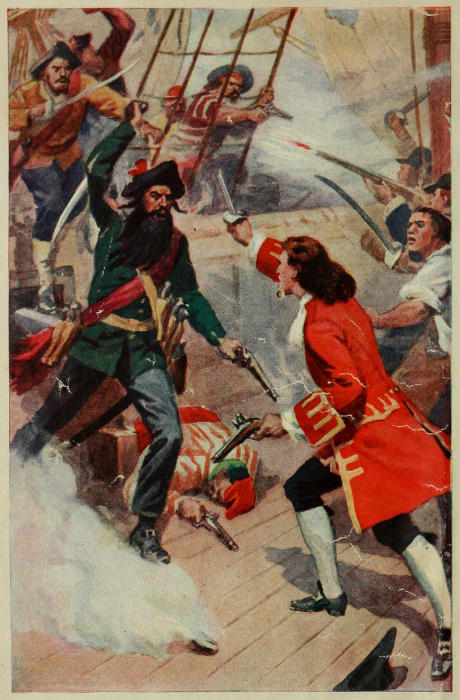
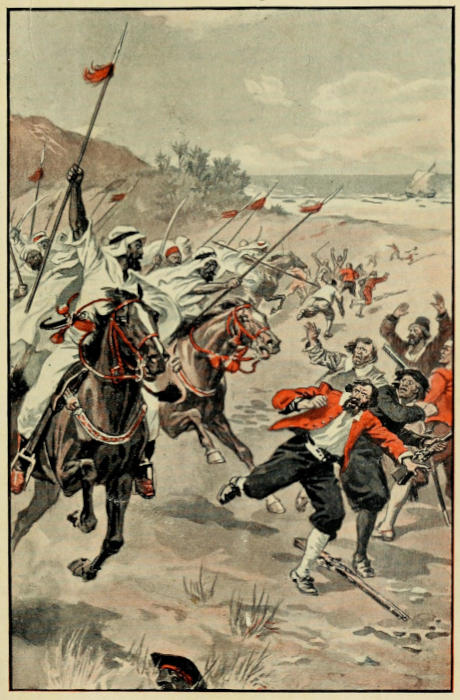
After exchanging shots, when Teach (Blackbeard) was wounded they
drew their swords and fiercely attacked each other. Maynard’s sword
broke in his hand and had it not been for one of his own men, who
wounded Blackbeard in the throat, the duel would have ended then.
DARING DEEDS OF
FAMOUS PIRATES
TRUE STORIES OF THE STIRRING ADVENTURES,
BRAVERY AND RESOURCE OF PIRATES,
FILIBUSTERS & BUCCANEERS
BY Lt.-Com. E. KEBLE CHATTERTON, R.N.V.R
B.A. (Oxon.), AUTHOR OF “THE ROMANCE OF THE SHIP” “FORE AND AFT”
“SAILING SHIPS AND THEIR STORY” &c. &c. &c.
WITH ILLUSTRATIONS IN COLOURS
LONDON
SEELEY, SERVICE & CO. LIMITED 196 Shaftesbury Avenue
MDCCCCXXIX
The contents of this book have been taken from Lieutenant
Keble Chatterton’s larger and more expensive volume entitled
The Romance of Piracy.
CHAPTER I THE EARLIEST PIRATES
I suppose there are few words in use which at once
suggest so much romantic adventure as the words
pirate and piracy. You instantly conjure up in your
mind a wealth of excitement, a clashing of lawless wills,
and there pass before your eyes a number of desperate dare-devils
whose life and occupation are inseparably connected
with the sea.
The very meaning of the word, as you will find on
referring to a Greek dictionary, indicates one who attempts
to rob. In classical times there was a species of
Mediterranean craft which was a light, swift vessel called
a myoparo because it was chiefly used by pirates. Since the
Greek verb peirao means literally “to attempt,” so it had
the secondary meaning of “to try one’s fortune in thieving
on sea.” Hence a peirates (in Greek) and pirata (in Latin)
signified afloat the counterpart of a brigand or highwayman
on land. To many minds piracy conjures up visions that
go back no further than the seventeenth century: but
though it is true that during that period piracy attained
unheard-of heights in certain seas, yet the avocation of sea-robbery
dates back very much further.
Robbery by sea is certainly one of the oldest professions
in the world. I use the word profession advisedly, for the
reason that in the earliest days to be a pirate was not the
equivalent of being a pariah and an outcast. It was
deemed just as honourable then to belong to a company
of pirates as it is to-day to belong to the navy of any
recognised power. It is an amusing fact that if in those
days two strange ships met on the high seas, and one of
them, hailing the other, inquired if she were a pirate or a
trader, the inquiry was neither intended nor accepted as
an insult, but a correct answer would follow. It is a little
difficult in these modern days of regular steamship routes
and powerful liners which have little to fear beyond fog
and exceptionally heavy weather, to realise that every
merchant ship sailed the seas with fear and trepidation.
When she set forth from her port of lading there was
little certainty that even if the ship herself reached the
port of destination, her cargo would ever be delivered to
the rightful receivers. The ship might be jogging along
comfortably, heading well up towards her destined port,
when out from the distance came a much faster and lighter
vessel of smaller displacement and finer lines. In a few
hours the latter would have overhauled the former, the
scanty crew of the merchantman would have been thrown
into the sea or pressed into the pirate’s service, or else
taken ashore to the pirate’s haunt and sold as slaves. The
rich cargo of merchandise could be sold or bartered when
the land was reached, and the merchant ship sunk or left to
wallow in the Mediterranean swell.
It is obvious that because the freight ship had to be
big-bellied to carry the maximum cargo she was in most
instances unable to run away from the swift-moving pirate
except in heavy weather. But in order to possess some
means of defence it was not unusual for these peaceful craft
to be provided with turrets of great height, from which
heavy missiles could be dropped on to the attacking pirate.
In the bows, in the stern and amidships these erections
could easily be placed and as quickly removed. And as
a further aid oars would be got out in an endeavour to
accelerate the ship’s speed. For whilst the pirate relied
primarily on oars, the trader relied principally on sail
power. Therefore in fine settled weather, with a smooth
sea, the low-lying piratical craft was at its best. It could
be manœuvred quickly, it could dart in and out of little
bays, it could shelter close in to the shore under the lee of
a friendly reef, and it was, because of its low freeboard, not
easy to discern at any great distance, unless the sea was
literally smooth. But all through history this type of
vessel has been shown to be at a disadvantage as soon as
it comes on to blow and the unruffled surface gives way to
high crest and deep furrows.
It is as impossible to explain the growth of piracy as it is
to define precisely the call of the sea. A man is born with
a bias in favour of the sea or he is not: there is no possibility
of putting that instinct into him if already he has not
been endowed with that attitude. So also we know from
our own personal experience, every one of us, that whilst
some of our own friends fret and waste in sedentary pursuits,
yet from the time they take to the sea or become explorers
or colonisers they find their true métier. The call of the
sea is the call of adventure in a specialised form. It has
been said, with no little truth, that many of the yachtsmen
of to-day, if they had been living in other ages, would have
gone afloat as pirates or privateers. And so, if we want to
find an explanation for the amazing historical fact that for
century after century, in spite of all the efforts which many
a nation made to suppress piracy, it revived and prospered,
we can only answer that, quite apart from the lust of wealth,
there was at the back of it all that love of adventure, that
desire for exciting incident, that hatred of monotonous
security which one finds in so many natures. A distinguished
British admiral remarked the other day that it was his
experience that the best naval officers were usually those
who as boys were most frequently getting into disfavour
for their adventurous escapades. It is, at any rate, still true
that unless the man or boy has in him the real spirit
of adventure, the sea, whether as a sport or profession, can
have but little fascination for him.
International law and the growth of navies have practically
put an end to the profession of piracy, though privateering
would doubtless reassert itself in the next great
naval war. But if you look through history you will find
that, certainly up to the nineteenth century, wherever there
was a seafaring nation there too had flourished a band of
pirates. Piracy went on for decade after decade in the
Mediterranean till at length it became unbearable, and Rome
had to take the most serious steps and use the most drastic
measures to stamp out the nests of hornets. A little later
you find another generation of sea-robbers growing up and
acting precisely as their forefathers. Still further on in
history you find the Barbarian corsairs and their descendants
being an irrepressible menace to Mediterranean shipping.
For four or five hundred years galleys waylaid ships of the
great European nations, attacked them, murdered their crews
and plundered the Levantine cargoes. Time after time were
these corsairs punished: time after time they rose again.
In vain did the fleets of southern Christian Europe or the
ships of Elizabeth or the Jacobean navy go forth to quell
them. Algiers and Tunis were veritable plague-spots in
regard to piracy. Right on through time the northern coast
of Africa was the hotbed of pirates. Not till Admiral Lord
Exmouth, in the year 1816, was sent to quell Algiers did
Mediterranean piracy receive its death-blow, though it
lingered on for some little time later.
But piracy is not confined to any particular nation nor
to any particular sea, any more than the spirit of adventure
is the exclusive endowment of any particular race. There
have been notorious pirates in the North Sea as in the
Mediterranean, there have been European pirates in the
Orient just as there have been Moorish pirates in the English
Channel. There have been British pirates on the waters of
the West Indies as there have been of Madagascar. There
have flourished pirates in the North, in the South, in the
East and the West—in China, Japan, off the coast of
Malabar, Borneo, America and so on. The species of ships
are often different, the racial characteristics of the sea-rovers
are equally distinct, yet there is still the same
determined clashing of wills, the same desperate nature of
the contests, the same exciting adventure; and in the
following pages it will be manifest that in spite of differences
of time and place the romance of piratical incident lives on
for the reason that human nature, at its basis, is very much
alike the whole world over.
But we must make a distinction between isolated and
collected pirates. There is a great dissimilarity, for
instance, between a pickpocket and a band of brigands.
The latter work on a grander, bolder system. So it has
always been with the robbers of the sea. Some have been
brigands, some have been mere pickpockets. The “grand”
pirates set to work on a big scale. It was not enough to
lie in wait for single merchant ships: they swooped down
on to seaside towns and villages, carried off by sheer force
the inhabitants and sold them into slavery. Whatever else
of value might attract their fancy they also took away. If
any important force were sent against them, the contest
resolved itself not so much into a punitive expedition as a
piratical war. There was nothing petty in piracy on these
lines. It had its proper rules, its own grades of officers and
drill. Lestarches was the Greek name for the captain of a
band of pirates, and it was their splendid organisation,
their consummate skill as fighters, that made them so
difficult to quell.
I have said that piracy was regarded as an honourable
profession. In the earliest times this is true. The occupation
of a pirate was deemed no less worthy than a man
who gained his living by fishing on the sea or hunting on
land. Just as in the Elizabethan age we find the sons of some
of the best English families going to sea on a roving expedition
to capture Spanish treasure ships, so in classical times
the Mediterranean pirates attracted to their ships adventurous
spirits from all classes of society, from the most patrician
to the most plebeian: the summons of the sea was as
irresistible then as later on. But there were definite arrangements
made for the purpose of sharing in any piratical
success, so there was an incentive other than that of mere
adventure which prompted men to become pirates.
To-day, if the navies of the great nations were to be
withdrawn, and the policing of the seas to cease, it is
pretty certain that those so disposed would presently
revive piracy. Nothing is so inimical to piracy as settled
peace and good government. But nothing is so encouraging
to piracy as prolonged unsettlement in international
affairs and weak administration. So it was that
the incessant Mediterranean wars acted as a keen incentive
to piracy. War breeds war, and the spirit of unrest on
sea affected the pirate no less than the regular fighting
man. Sea-brigandage was rampant. These daring robbers
went roving over the sea wherever they wished, they waxed
strong, they defied opposition.
And there were special territories which these pirates
preferred to others. The Liparian Isles—from about 580
B.C. to the time of the Roman Conquest—were practically a
republic of Greek corsairs. Similarly the Ionians and the
Lycians were notorious for piratical activities. After the
period of Thucydides, Corinth endeavoured to put down
piracy, but in vain. The irregularity went on until the
conquest of Asia by the Romans, in spite of all the precautions
that were taken. The Ægean Sea, the Pontus,
the Adriatic were the happy cruising-grounds for the
corsairs. The pirate-admiral or, as he was designated,
archipeirates, with his organised fleet of assorted craft, was
a deadly foe to encounter. Under his command were the
myoparones, already mentioned—light and swift they
darted across the sea; then there were, too, the hemiolia,
which were so called because they were rowed with one
and a half banks of oars; next came the two-banked
biremes and the three-banked triremes, and with these four
classes of ships the admiral was ready for any craft that
might cross his wake. Merchantmen fled before him,
warships by him were sent to the bottom: wherever he
coasted there spread panic through the sea-girt towns.
Even Athens itself felt the thrill of fear.
Notorious, too, were the Cretan pirates, and for a long
time the Etruscan corsairs were a great worry to the
Greeks of Sicily. The inhabitants of the Balearic Islands
were especially famous for their piratical depredations and
for their skilful methods of fighting. Wherever a fleet
was sent to attack them they were able to inflict great
slaughter by hurling vast quantities of stones with their
slings. It was only when they came to close quarters with
their aggressors the Romans, and the latter’s sharp javelins
began to take effect, that these islanders met their match
and were compelled to flee in haste to the shelter of their
coves. At the period which preceded the subversion of
the Roman commonwealth by Julius Cæsar, there was an
exceedingly strong community of pirates at the extreme
eastern end of the Mediterranean. They hailed from that
territory which is just in the bend of Asia Minor and
designated Cilicia. Here lived—when ashore—one of the
most dangerous body of sea-rovers recorded in the pages of
history. It is amazing to find how powerful these Cilicians
became, and as they prospered in piracy so their numbers
were increased by fellow-corsairs from their neighbours the
Syrians and Pamphylians, as well as by many who came
down from the shores of the Black Sea and from Cyprus.
So powerful indeed became these rovers that they controlled
practically the whole of the Mediterranean from east to
west. They made it impossible for peaceful trading craft
to venture forth, and they even defeated several Roman
officers who had been sent with ships against them.
And so it went on until Rome realised that piracy had
long since ceased to be anything else but a most serious
evil that needed firm and instant suppression. It was the
ruin of overseas trade and a terrible menace to her own
territory. But the matter was at last taken in hand.
M. Antonius, proprætor, was sent with a powerful fleet
against these Cilician pirates; they were crushed thoroughly,
and the importance of this may be gathered from the fact
that on his return to Rome the conqueror was given an
ovation.
In the wars between Rome and Mithradates the
Cilician pirates rendered the latter excellent service. The
long continuance of these wars and the civil war between
Marius and Sylla afforded the Cilicians a fine opportunity to
increase both in numbers and strength. To give some idea
of their power it is only necessary to state that not only
did they take and rob all the Roman ships which they
encountered, but they also voyaged among the islands
and maritime provinces and plundered no fewer than 400
cities. They carried their depredations even to the
mouth of the Tiber and actually took away from thence
several vessels laden with corn. Bear in mind, too, that
the Cilician piratical fleet was no scratch squadron of a few
antique ships. It consisted of a thousand vessels, which
were of great speed and very light. They were well
manned by most able seamen, and fought by trained soldiers,
and commanded by expert officers. They carried an
abundance of arms, and neither men nor officers were lacking
in daring and prowess. When again it became expedient
that these Cilicians should be dealt with, it took no less a
person than Pompey, assisted by fifteen admirals, to tackle
them; but finally, after a few months, he was able to have
the sea once more cleared of these rovers.
We can well sympathise with the merchant seamen of
those days. The perils of wind and wave were as nothing
compared with the fear of falling into the hands of powerful
desperadoes, who not merely were all-powerful afloat but
in their strong fortresses on shore were most difficult to
deal with. With the Balearic Islanders in the west, the
Cilicians in the east, the Carthaginians in the south, the
Illyrians along the Adriatic in their low, handy liburnian
galleys, there were pirates ready to encircle the whole of the
Mediterranean Sea. It is worth noting—for he who reads
naval history must often be struck with the fact that an
existing navy prevents war, but the absence of a navy brings
war about—that as long as Rome maintained a strong navy
piracy died down: but so soon as she neglected her sea-service
piracy grew up again, commerce was interrupted
both east and west, numerous illustrious Romans were
captured and either ransomed or put to death, though
some others were pressed into the service of the pirates
themselves. By means of prisoners to work at the oars, by
the addition of piratical neighbours and by mercenaries as
well, a huge piratical community with a strong military and
political organisation continued to prevent the development
of overseas trade. This piracy was only thwarted by
keeping permanent Roman squadrons always ready.
Of course there were pirates in these early times in
waters other than the Mediterranean. On the west coast
of Gaul the Veneti had become very powerful pirates, and
you will recollect how severely they tried Cæsar, giving him
more trouble than all the rest of Gaul put together. They
owned such stalwart ships and were such able seamen that
they proved most able enemies. During the time of the
Roman Empire piracy continued also on the Black Sea
and North Sea, though the Mediterranean was now for
the most part safe for merchant ships. But when the
power of Rome declined, so proportionately did the pirates
reappear in their new strength. There was no fearful navy
to oppose them, and so once more they were able to do
pretty much as they liked. But we must not forget that
long before this they had ceased to be regarded as the
equivalent of hunters and fishermen. They were, by
common agreement, what Cicero had designated “enemies of
the human race”: and so they continued till the nineteenth
century, with only temporary intervals of inactivity.
The thousand ships which the Cilician pirates employed
were disposed in separate squadrons. In different places
they had their own naval magazines located, and during
that period already mentioned, when they were driven off
the sea, they resisted capture by retreating ashore to their
mountain fastnesses until such time as it was safe for them
to renew their ventures afloat. When Pompey defeated
them he had under him a fleet of 270 ships. As the inscription,
carried in the celebration of his triumph on his return
to Rome, narrated, he cleared the maritime coasts of pirates
and restored the dominion of the sea to the Roman people.
But the pirates could always boast of having captured two
Roman prætors, and Julius Cæsar, when a youth on his way
to Rhodes to pursue his studies, also fell into their hands.
However, he was more lucky than many another Roman
who, when captured, was hung up to the yard-arm, and the
pirate ship went proudly on her way.
In the declining years of the Roman Empire the Goths
came down from the north to the Mediterranean, where
they got together fleets, became very powerful and crossed
to Africa, made piratical raids on the coast and carried on
long wars with the Romans. Presently the Saxons in the
northern waters of Europe made piratical descents on to the
coasts of France, Flanders and Britain. Meanwhile, in the
south, the Saracens descended upon Cyprus and Rhodes,
which they took, seized many islands in the Archipelago,
and thence proceeded to Sicily to capture Syracuse, and
finally overran the whole of Barbary from Egypt in the
east to the Straits of Gibraltar in the west. From there
they crossed to Spain and reduced the greater part thereof,
until under Ferdinand and Isabella these Moors were driven
out of Spain and compelled to settle once more on the north
coast of Africa. They established themselves notably at
Algiers, took to the sea, built themselves galleys and, after
living a civilised life in Spain for seven hundred years, became
for the next three centuries a scourge of the Mediterranean,
a terror to ships and men, inflicted all the cruelties which
the fanaticism of the Moslem race is capable of, and cast
thousands of Christians into the bonds of slavery. In many
ways these terrifying Moorish pirates—of which to this day
some still go afloat in their craft off the north coast of
Africa—became the successors of those Cilician and other
corsairs of the classical age. In due course we shall return
to note the kind of piratical warfare which these expatriated
Moors waged for most of three hundred years. But before
we come to that period let us examine into an epoch that
preceded this.
CHAPTER II THE NORTH SEA PIRATES
I am anxious to emphasise the fact that piracy is nearly
as old as the ship herself. It is extremely improbable
that the Egyptians were ever pirates, for the reason
that, excepting the expedition to Punt, they confined their
navigation practically to the Nile only. But as soon as men
built sea-going vessels, then the instinct to rob and pillage
on sea became as irresistible as on land. Might was right,
and the weakest went to the bottom.
Bearing this in mind, and remembering that there was
always a good deal of trade from the Continent up the
Thames to London, especially in corn, and that there was
considerable traffic between Gaul and Britain across the
English Channel, it was but natural that the sea-rovers of
the north should exist no less than in the south. After
Rome had occupied Britain she established a navy which
she called the “Classis Britannica,” and it cannot have failed
to be effective in policing the narrow seas and protecting
commerce from wandering corsairs. We know very well
that after Rome had evacuated Britain, and there was no
navy to protect our shores, came the Angles and Saxons and
Jutes. We may permissibly regard these Northmen, who
pillaged and plundered till the time of William the
Conqueror and after, as pirates. In the sense that a pirate
is one who not merely commits robbery on the high seas
but also makes descents on the coast for the purpose of
pillage, we may call the Viking seamen pirates. But, strictly
speaking, they were a great deal more than this, and the
object of this book is concerned rather with the incidents of
the sea than the incursions into the land. Although the
Vikings did certainly commit piracy both in their own
waters and off the coasts of Britain, yet their depredations
in this respect, even if we could obtain adequate information
thereof, would sink into insignificance before their greater
conquests. For a race of men who first swoop down on to
a strange coast, vanquish the inhabitants and then settle
down to live among them, are rather different from a body
of men who lie in wait to capture ships as they proceed on
their voyages.
The growth of piracy in English waters certainly owed
much to the Cinque Ports. In these havens dwelt a privileged
class of seamen, who certainly for centuries were a
very much favoured community. It was their privilege to
do that which in the Mediterranean Cicero had regarded
with so much disfavour. These men of the Cinque Ports,
according to Matthew of Paris, were commissioned to
plunder as they pleased all the merchant ships as they passed
up and down the English Channel. This was to be without
any regard to nationality, with the exception that English
ships were not to be molested. But French, Genoese,
Venetian, Spanish or any others could be attacked at the
will of the Cinque Port seamen. Some persons might call
this sort of thing by the title of privateering, yet it was
really piracy and nothing else. You can readily imagine
that with this impetus thus given to a class of men who
were not particularly prone to lawfulness, the practice of
piracy on the waters that wash Great Britain grew at a
great rate. Thus in the thirteenth century the French, the
Scotch, Irish and Welsh fitted out ships, hung about the
narrow seas till they were able to capture a well-laden
merchantman as their fat reward. So, before long, the
English Channel was swarming with pirates, and during the
reign of Henry III. their numbers grew to an alarming
extent. The net result was that it was a grave risk for
commodities to be brought across the Channel, and so,
therefore, the price of these goods rose. The only means of
remedy was to increase the English fleet, and this at length
was done in order to cope with the evil.
But matters were scarcely better in the North Sea, and
English merchant ships sailed in perpetual fear of capture.
During the Middle Ages pirates were always hovering about
for any likely ship, and the wool trade especially was interfered
with. Matters became somewhat complicated when,
as happened in the reign of Edward II., peaceable English
ships were arrested by Norway for having been suspected—erroneously—of
slaughtering a Norwegian knight, whereas
the latter had been actually put to death by pirates. “We
marvell not a little,” wrote Edward II. in complaint to
Haquinus, King of Norway, “and are much disquieted in
our cogitations, considering the greevances and oppressions,
which (as wee have beene informed by pitifull complaints)
are at this present, more than in times past, without any
reasonable cause inflicted upon our subjects, which doe
usually resort unto your kingdome for traffiques sake.”
For the fact was that one nation was as bad as the other,
but that whenever the one had suffered then the other
would lay violent hands on a ship that was merely suspected
of having acted piratically. Angered at the loss
to their own countrymen they were prompted by revenge
on alien seamen found in their own waters and even
lying quietly in their own havens with their cargoes of
herrings.
As an attempt to make the North Sea more possible for
the innocent trading ships, the kings of England at different
dates came to treaties with those in authority on the other
side. Richard II., for example, made an agreement with the
King of Prussia. In 1403 “full restitution and recompense”
were demanded by the Chancellor of England from the
Master-General of Prussia for the “sundry piracies and
molestations offered of late upon the sea.” Henry IV.,
writing to the Prussian Master-General, admitted that
“as well our as your marchants ... have, by occasion of
pirates, roving up and downe the sea” sustained grievous
loss. Finally it was agreed that all English merchant ships
should be allowed liberty to enter Prussian ports without
molestation. But it was further decided that if in the
future any Prussian cargoes should be captured on the
North Sea by English pirates, and this merchandise taken
into an English port, then the harbour-master or “governour”
was, if he suspected piracy, to have these goods promptly
taken out of the English ship and placed in safe keeping.
Between Henry IV. and the Hanseatic towns a similar agreement
was also made which bound the cities of Lubec,
Bremen, Hamburg, Sund and Gripeswold “that convenient,
just and reasonable satisfaction and recompense” might be
made “unto the injured and endamaged parties” “for all
injuries, damages, grievances, and drownings or manslaughters
done and committed” by the pirates in the
narrow seas.
It would be futile to weary the reader with a complete
list of all these piratical attacks, but a few of them may
here be instanced. About Easter-time in the year 1394 a
Hanseatic ship was hovering about the North Sea when she
fell in with an English merchantman from Newcastle-on-Tyne.
The latter’s name was the Godezere and belonged
to a quartette of owners. She was, for those days, quite a
big craft, having a burden of 200 tons. Her value, together
with that of her sails and tackle, amounted to the sum of
£400. She was loaded with a cargo of woollen cloth and
red wine, being bound for Prussia. The value of this cargo,
plus some gold and certain sums of money found aboard,
aggregated 200 marks. The Hanseatic ship was able to
overpower the Godezere, slew two of her crew, captured
ship and contents and imprisoned the rest of the crew for
the space of three whole years.
A Hull craft belonging to one Richard Horuse, and
named the Shipper Berline of Prussia, was in the same year
also attacked and robbed by Hanseatic pirates, goods to the
value of 160 nobles being taken away. The following year
a ship named the John Tutteburie was attacked by Hanseatics
when off the coast of Norway, and goods consisting
of wax and other commodities to the value of 476 nobles
were captured. A year later and pirates of the same
federation captured a ship belonging to William Terry of
Hull called the Cogge, with thirty woollen broad cloths and
a thousand narrow cloths, to the value of £200. In 1398
the Trinity of Hull, laden with wax, oil and other goods,
was captured by the same class of men off Norway. Dutch
ships, merchant craft from the port of London, fishing
vessels, Prussian traders, Zealand, Yarmouth and other
ships were constantly being attacked, pillaged and captured.
In the month of September, of the year 1398, a number
of Hanseatic pirates waylaid a Prussian ship whose skipper
was named Rorebek. She carried a valuable cargo of
woollen cloth which was the property of various merchants
in Colchester. This the pirates took away with them,
together with five Englishmen, whom they found on board.
The latter they thrust into prison as soon as they got them
ashore, and of these two were ransomed subsequently for
the sum of 20 English nobles, while another became
blind owing to the rigours of his imprisonment. In 1394
another Prussian ship, containing a number of merchants
from Yarmouth and Norwich, was also captured off the
Norwegian coast with a cargo of woollen goods and taken
off by the Hanseatic pirates. The merchants were cast
into prison and not allowed their liberty until the sum
of 100 marks had been paid for their ransom. Another
vessel, laden with the hides of oxen and sheep, with butter,
masts and spars and other commodities to the value of
100 marks, was taken in Longsound, Norway.
In June 1395 another English ship, laden with salt fish,
was taken off the coast of Denmark, the value of her hull,
inventory and cargo amounting to £170. The crew consisted
of a master and twenty-five mariners, whom the
pirates slew. There was also a lad found on board, and
him they carried into Wismar with them. The most
notorious of these Hanseatic pirates were two men, named
respectively Godekins and Stertebeker, whose efforts were
as untiring as they were successful. There is scarcely an
instance of North Sea piracy at this time in which these
two men or their accomplices do not figure. And it was
these same men who attacked a ship named the Dogger.
The latter was skippered by a man named Gervase Cat, and
she was lying at anchor while her crew were engaged fishing.
The Hanseatic pirates, however, swept down on them, took
away with them a valuable cargo of fish, beat and wounded
the master and crew of the Dogger and caused the latter
to lose their fishing for that year, “being endamaged thereby
to the summe of 200 nobles.”
In the year 1402 other Hanseatic corsairs, while cruising
about near Plymouth, captured a Yarmouth barge named
the Michael, the master of which was one Robert Rigweys.
She had a cargo of salt and a thousand canvas cloths.
The ship and goods being captured, the owner, a man
named Hugh ap Fen, complained that he was the loser to
the extent of 800 nobles: and the master and mariners
assessed the loss of wages, canvas and “armour” at 200
nobles. But there was no end to the daring of these
corsairs of the North. In the spring of 1394 they proceeded
with a large fleet of ships to the town of Norbern
in Norway, and having taken the place by assault, they
captured all the merchants therein, together with their
“goods and cattels,” burnt their houses and put their
persons up to ransom. Twenty-one houses, to the value of
440 nobles, were destroyed, and goods to the value of
£1815 were taken from the merchants. With all this
lawlessness on the sea and the consequent injury to overseas
commerce, it was none too soon that Henry IV. took
steps to put down a most serious evil.
We cannot but feel sorry for the long-suffering North
Sea fishermen, who, in addition to having to ride out bad
weather in clumsy leaky craft, and having to work very
hard for their living, were liable at any time to see a pirate
ship approaching them over the top of the waves. You
remember the famous Dogger Bank incident a few years
ago when one night the North Sea trawlers found themselves
being shelled by the Russian Baltic fleet. Well, in
much the same way were the mediæval ancestors of these
hardy fishermen surprised by pirates when least expecting
them and when most busily occupied in pursuing their
legitimate calling. The fisherman was like a magnet to
the pirates, because his catch of fish had only to be taken
to the nearest port and sold. That was the reason why,
in 1295, Edward had been induced to send three ships of
Yarmouth across the North Sea to protect the herring-ships
of Holland and Zealand.
The following incident well illustrates the statement
that, in spite of all the efforts which were made to repress
piracy, yet it was almost impossible to attain such an
object. The month is July, and the year 1327, the scene
being the English Channel. Picture to your mind a
beamy, big-bellied, clumsy ship with one mast and one
great square sail. She has come from Waterford in
Ireland, where she has taken on board a rich cargo,
consisting of wool, hides and general merchandise. She
has safely crossed the turbulent Irish Sea, she has wallowed
her way through the Atlantic swell round Land’s End and
found herself making good headway up the English Channel
in the summer breeze. Her port of destination is Bruges,
but she will never get there. For from the eastward have
come the famous pirates of the Cinque Ports, and off the
Isle of Wight they fall in with the merchant ship. The
rovers soon sight her, come up alongside, board her and
relieve her of forty-two sacks of wool, twelve dickers of
hides, three pipes of salmon, two pipes of cheese, one bale
of cloth, to say nothing of such valuable articles as silver
plate, mazer cups, jewels, sparrow-hawks and other goods
of the total value of £600. Presently the pirates bring
their spoil into the Downs below Sandwich and dispose of
it as they prefer.
CHAPTER III PIRACY IN THE EARLY TUDOR TIMES
The kind of man who devotes his life to robbery at sea
is not the species of humanity who readily subjects
himself to laws and ordinances. You may threaten
him with terrible punishments, but it is not by these means
that you will break his spirit. He is like the gipsy or the
vagrant: he has in him an overwhelming longing for
wandering and adventure. It is not so much the greed
for gain which prompts the pirate, any more than the land
tramp finds his long marches inspired by wealth. But
some impelling blind force is at work within, and so not all
the treaties and agreements, not all the menaces of death
could avail to keep these men from pursuing the occupation
which their fathers and grandfathers had for many years
been employed in.
Therefore piracy was quite as bad in the sixteenth
century as it had been in the Middle Ages. The dwellers
on either side of the English Channel were ever ready to
pillage each other’s ships and property. About the first
and second decade of the sixteenth century the Scots rose
to some importance in the art of sea-robbery, and some
were promptly taken and executed. In vain did Henry VIII.
write to Francis I. saying that complaints had been made
by English merchants that their ships had been pirated by
Frenchmen pretending to be Scots, for which redress could
not be obtained in France. In 1531 matters had become
so bad, and piracy was so prevalent, that commissioners were
appointed to make inquisitions concerning this illegal warfare
round our coasts. Viscount Lisle, Vice-Admiral of England,
and others were appointed to see to the problem. So
cunning had these rovers become that it was no easy affair
to capture them. But in this same year a notorious pirate
named Kellwanton was taken in the Isle of Man; while
another, De Melton by name, who was one of his accomplices,
fled with the rest of the crew in the ship to Grimsby.
Sometimes the very ships which had been sent by the
king against the pirates actually engaged in pillage themselves.
There was at least one instance about this time of
some royal ships being unable to resist the temptation to
plunder the richly laden Flemish ships. But after complaint
was made the royal reply came that the Flemings should be
compensated and the plunderers punished. It was all very
well to set a thief to catch a thief, but there were few
English seamen of any experience who had not done some
piracy at some time of their career, and when they at last
formed the crews of preventive ships and got wearied of
waiting for pirate craft to come along, it was too much to
expect them to remain idle on the seas when a rich merchantman
went sailing past.
Sometimes the pirates would waylay a whole merchant
fleet, and if the latter were sailing light, would relieve the
fleet of their victuals, their clothes, their anchors and
cables and sails. But it was not merely to the North Sea
nor to the English Channel that the English pirates confined
themselves. In October 1533 they captured a Biscayan
ship off the coast of Ireland. And during the reign of
Henry VIII. there was an interesting incident connected with
a ship named the Santa Maria Desaie. This craft belonged
to one Peter Alves, a Portingale, who hired a mariner,
William Phelipp, to pilot his ship from Tenby to Bastabill
Haven. But whilst off the Welsh coast a piratical bark
named the Furtuskewys, containing thirty-five desperate
corsairs, attacked the Santa Maria and completely overpowered
her. Alves they promptly got rid of by putting him
ashore somewhere on the Welsh coast, and they then proceeded
to sail the ship to Cork, where they sold her to the mayor
and others, the value of the captured craft and goods
being 1524 crowns. Alves did not take this assault with
any resignation, but naturally used his best endeavours to
have the matter set right. From the King’s Council he
obtained a command to the Mayor of Cork for restitution,
but such was the lawlessness of the time that this was of no
avail. The mayor, whose name was Richard Gowllys, protested
that the pirates told him they had captured the ship
from the Scots and not from the Portingale, and he added
that he would spend £100 rather than make restitution.
But stricter vigilance caused the arrest of some of these
pirates. Six of them were sentenced to death in the
Admiralty Court at Boulogne, eleven others were condemned
to death in the Guildhall, London: and in 1537 a ship was lying
at Winchelsea “in gage to Bell the mayor” for £35 for the
piracies committed in her, for she had been captured after
having robbed a Gascon merchantman of a cargo of wines.
The finest of the French sailors for many a century until
even the present day have ever been the Bretons. And
just as in the eighteenth century the most expert sailormen
on our coasts were the greatest smugglers, so in Tudor
times the pick of all seamen were sea-rovers. About the
time of Lent, 1537, a couple of Breton pirate ships caused a
great deal of anxiety to our west-country men. One of the
two had robbed an English ship off the Cornish coast and
pillaged his cargo of wine. From Easter-time till August
these rovers hung about the Welsh coast, sometimes coming
ashore for provisions and most probably also to sell their
ill-gotten cargoes, but for the most part remaining at sea.
It would seem from the historical records that originally
there had been only one Breton ship that had sailed from
St. Malo; but having the good fortune to capture a fishing
craft belonging to Milford Haven, the crew had been split
up into two. Presently the numbers of these French pirates
increased till there was quite a fleet of them cruising about
the Welsh coast. A merchant ship that had loaded a fine
cargo at Bristol, bound across the Bay of Biscay, had been
boarded before the voyage had been little more than begun.
For week after week these men robbed every ship that
came past them. But especially were they biding their
time waiting for the English, Irish and Welsh ships who
were wont about this period of the year to come to St.
James’s Fair at Bristol.
However, in the meanwhile, the men of the west were
becoming much more alert, and were ready for any chance
that might occur. And a Bristol man named Bowen, after
fourteen Breton pirates had come ashore near Tenby to
obtain victuals, acted with such smartness that he was able
to have the whole lot captured and put into prison. And
John Wynter, another Bristolian, knowing that the pirates
were hovering about for those ships bound for the fair,
promptly manned a ship, embarked fifty soldiers, as well as
the able seamen, and cruised about ready to swoop down on
the first pirate ship which showed up on the horizon. The
full details of these men and what they did would make
interesting reading if they were obtainable; but we know
that of the above-mentioned fourteen, one, John du
Laerquerac, was captain of the Breton craft. On being
arrested he stoutly denied that he had ever “spoiled”
English ships. That was most certainly a bare-faced lie,
and presently Peter Dromyowe, one of his own mariners,
confessed that he himself had robbed one Englishman;
whereupon Laerquerac made a confession that, as a matter
of fact, he had taken ships’ ropes, sailors’ wearing apparel,
five pieces of wine, a quantity of fish, a gold crown in money
and eleven silver halfpence or pence, as well as four daggers
and a “couverture”!
It was because the English merchants complained that
they lost so much of their imports and exports by depredations
from the ships of war belonging to Biscay, Spain, the
Low Countries, Normandy, Brittany and elsewhere, that
Henry VIII. had been prevailed upon to send Sir John
Dudley, his Vice-Admiral, to sea with a small fleet of good
ships. Dudley’s orders were to cruise between the Downs
on the east and St. Michael’s Mount on the west—in other
words, the whole length of the English Channel—according
as the wind should serve. In addition, he was to stand off
and on between Ushant and Scilly and so guard the entrance
to the Channel. Furthermore, he was to look in at the Isle
of Lundy in the Bristol Channel—for both Lundy and the
Scillies were famous pirate haunts—and after having so done
he was to return and keep the narrow seas. Dudley was
especially admonished to be on the look out to succour any
English merchant ships, and should he meet with any foreign
merchant craft which, under the pretence of trading, were
actually robbing the King’s subjects, he was to have
these foreigners treated as absolute pirates and punished
accordingly.
For the state of piracy had become so bad that the King
“can no longer suffer it.” So also Sir Thomas Dudley, as
well as Sir John, was busily employed in the same preventive
work. On the 10th of August of that same year, 1537, he
wrote to Cromwell that he had at Harwich arrested a couple
of Frenchmen who two years previously had robbed a poor
English skipper’s craft off the coast of Normandy, and this
Englishman had in vain sued in France for a remedy, since
the pirates could never be captured. But there were so
many of these corsairs being now taken that it was a grave
problem as to how they should be dealt with. “If they
were all committed to ward,” wrote Sir Thomas, “as your
letters direct, they would fill the gaol.” Then he adds:
“They would fain go and leave the ship behind them, which
only contains ordnance, and no goods or victuals to find
themselves with. If they go to gaol, they are like to perish
of hunger, for Englishmen will do no charity to them.
They are as proud naves as I have talked with.”
Eleven days later came the report from Sir John Dudley
of his experiences in the Channel. He stated that while on
his way home he encountered a couple of Breton ships in
the vicinity of St. Helen’s, Isle of Wight, where he believed
they were lying in wait for two Cornish ships “that were
within Porchemouthe haven, laden with tin to the value of
£3000.” Portsmouth is, of course, just opposite St. Helen’s,
and on more than one occasion in naval history was the
latter found a convenient anchorage by hostile ships waiting
for English craft to issue forth from the mainland. But
when these Breton pirates espied Dudley’s ships coming
along under sail, they “made in with Porchemouthe,” where
Dudley’s men promptly boarded them and placed them
under arrest, with the intention of bringing them presently
to the Thames. Dudley had no doubt whatever that these
were pirates, but at a later date the French ambassador
endeavoured to show that there was no foundation for such
a suspicion. These two French crafts, he sought to persuade,
were genuine merchantmen who had discharged their cargo
at “St. Wallerie’s” (that is to say, St. Valery-sur-Somme),
but had been driven to the Isle of Wight by bad weather,
adding, doubtless as a subtle hint, that they had actually
rescued an Englishman chased by a Spaniard. It is possible
that the Frenchmen were telling the truth, though unless
the wind had come southerly and so made it impossible for
these bluff-bowed craft to beat into their port, it is difficult
to believe that they could not have run into one of their
own havens. At any rate, it was a yarn which Dudley’s
sailors found not easy to accept.
This was no isolated instance of the capture of Breton
craft. In the year 1532 a Breton ship named the Mychell,
whose owner was one Hayman Gillard, her master being
Nicholas Barbe of St. Malo, was encountered by a crew of
English seamen who entertained no doubts whatsoever as to
her being anything else than a pirate. Their suspicions were
made doubly sure when they found her company to consist
of nine Bretons and five Scots. They arrested her at sea,
and when examined she was found well laden with wool,
cloth and salt hides. Some French pirate ships even went
so far as to wear the English flag of St. George, with the
red cross on a white ground. This not unnaturally infuriated
English seamen, especially when it was discovered that the
Bretons had also carried Englishmen as their pilots and
chief mariners, and were training them to become experts
in piracy.
But there were times when English seamen and
merchants were able to “get their own back” with interest,
as the following incident will show. At the beginning of
June, in the year 1538, an English merchant, Henry Davy,
freighted a London ship named the Clement, which was
owned by one Grenebury, who lived in Thames Street, and
dispatched her with orders to proceed to the “Bay in
Breteyne.” She set forth under the command of a man
named Lyllyk, the ship’s purser being William Scarlet, a
London clothworker. Seven men formed her crew, but
when off Margate they took on board nine more. They
then proceeded down Channel and took on board another
four from the shore, but espying a Flemish ship of war they
deemed it prudent to get hold of the coast of Normandy as
soon as possible. In the “mayne” sea—by which I understand
the English Channel near the mainland of the
Continent—they descried coming over the waves three ships,
and these were found to be Breton merchantmen.
This caused some discussion on board the Clement, and
Davy, the charterer, who had come with the ship, remarked
to the skipper Lyllyk that they had lost as much as £60 in
goods, which had been captured by Breton pirates at an
earlier date, and had never been able to obtain compensation
in France in spite of all their endeavours. Any one who has
any imagination and a knowledge of seafaring human nature,
can easily picture Lyllyk and his crew cordially agreeing
with Davy’s point of view, and showing more than a mere
passive sympathy. The upshot of the discussion was that
they resolved to take the law into their own hands and
capture one of these three ships.
The resolution was put into effect, so that before long
they had become possessed of the craft. The Breton crew
were rowed ashore in a boat and left there, and after
collecting the goods left behind, the Englishmen stowed
them in the hold of the Clement. A prize crew, consisting
of a man whose name was Comelys, and four seamen, were
placed in charge of the captured ship, which now got under
way. The Clement, too, resumed her voyage, and made for
Peryn in Cornwall, where she was able to sell, at a good
price, the goods taken out of the Breton. The gross
amount obtained was divided up among the captors, and
though the figures may not seem very large, yet the sum
represented the equivalent of what would be to-day about
ten times that amount of money. Henry Davy, being the
charterer, received £17; the master, the mate, the quarter-master
and the purser received each thirty shillings, while
the mariners got twenty shillings apiece. Lyllyk and nine
of the crew then departed, while Davy, Scarlet, Leveret the
carpenter and two others got the ship under way, sailed up
Channel and brought the Clement back to the Thames,
where they delivered her to the wife of the owner.
But Englishmen were not always so fortunate, and the
North Sea pirates were still active, in spite of the efforts
which had been made by English kings in previous
centuries. In 1538 the cargo ship George Modye put to
sea with goods belonging to a company of English merchant
adventurers, consisting of Sir Ralph Waryn, “good Mr.
Lock and Rowland Hyll” and others. She never reached
her port of destination, however, for the Norwegian pirates
pillaged her and caused a loss to the adventurers of £10,000,
whereupon, after complaint had been made, Cromwell was
invoked to obtain letters from Henry VIII. to the kings of
Denmark, France and Scotland that search might be duly
made. There was, in fact, a good deal of luck, even yet, as
to whether a ship would ever get to the harbour whither
she was sent. In September 1538 we find Walter Herbart
complaining that twice since Candlemas he had been robbed
by Breton pirates. But, a week later, it is recorded that
some pirates, who had robbed peaceable ships bound from
Iceland, had been chased by John Chaderton and others of
Portsmouth and captured about this time.
And it was not always that Englishmen dealt with these
foreigners in any merciful manner, regardless of right or
wrong. I have already emphasised the fact that, as regards
the question of legality, there was little to choose between
the seamen of any maritime nation. Rather it was a
question of opportunity, and the very men who to-day
complained bitterly of the robbery of their ships and cargoes
might to-morrow be found performing piracy themselves.
A kind of sea-vendetta went on, and in the minds of the
mariners the only sin was that of being found out. So we
notice that, in the spring of 1539, an instance of a Breton
ship being captured by English corsairs who, according to
the recognised custom of the sea, forthwith threw overboard
the French sailors. These were all drowned except one who,
“as if by a miracle, swam six miles to shore.” So says the
ancient record, though it is difficult to believe that even a
strong swimmer could last out so long after being badly
knocked about. The Bretons had their revenge this time,
for complaint was made to the chief justices, who within
fifteen days had the culprits arrested and condemned, and
six of them were executed on the 19th of May. Before
the end of the month Francis I. wrote to thank the English
king for so promptly dealing with the culprits.
Bearing in mind the interest which Henry VIII. took in
nautical matters and in the welfare of his country generally;
recollecting, too, the determination with which he pursued
any project to the end when once his mind had been made
up, we need not be surprised to find that a few months
later in that year this resolute monarch again sent ships—this
time a couple of barks of 120 and 90 tons respectively—“well
manned and ordnanced” to scour the seas for these
pirate pests that inflicted so many serious losses on the
Tudor merchants.
A little earlier in that year Vaughan had written to
Cromwell that he had spoken with one who lately had
been a “common passenger” in hoys between London and
Antwerp and knew of certain pirates who intended to
capture the merchant ships plying between those two ports.
Valuable warning was given concerning one of these roving
craft. She belonged to Hans van Meghlyn, who had fitted
out a ship of the “portage” of 20 lasts and 45 tons
burthen. She was manned by a crew of thirty, her hull
was painted black with pitch, she had no “foresprit,” and
her foremast leaned forward like a “lodeman’s” boat.
(“Lodeman” was the olden word for pilot—the man who
hove the lead.) Cromwell was advised that this craft would
proceed first to Orfordness (the natural landfall for a vessel
to make when bound across the North Sea from the Schelde),
and thence she would proceed south and lie in wait for ships
at the mouth of the Thames. In order to be ready to
pillage either the inward or outward bound craft which
traded with London, this pirate would hover about off
White Staple (Whitstable). Vaughan’s informant thought
that sometimes, however, she would change her locality to
the Melton shore in order to avoid suspicion, and he advised
that it would be best to capture her by means of three or
four well-manned oyster boats. There was also another
“Easterling” (that is, one from the east of Germany or the
Baltic) pirate who had received his commission from the
Grave of Odenburg. This rover was named Francis Beme
and was now at Canfyre with his ship, waiting for the
Grave of Odenburg’s return from Brussels with money.
But the warning news came in time, and in order to prevent
the English merchant ships from falling into the sea-rovers’
hands, the former were ordered by proclamation to remain
in Antwerp from Ash Wednesday till Easter.
CHAPTER IV THE CORSAIRS OF THE SOUTH
When, in the year 1516, Hadrian, Cardinal St. Chryogon,
wrote to Wolsey bitterly lamenting that
from Taracina right away to Pisa pirates, consisting
of Turks and African Moors, were swarming the sea, he
was scarcely guilty of any exaggeration. Multifarious and
murderous though the pirates of Northern Europe had long
since shown themselves, yet it is the Mediterranean which,
throughout history, and more especially during the sixteenth
century, has earned the distinction of being the favourite
and most eventful sphere of robbery by sea.
You may ask how this came about. It was no longer
the case of the old Cilicians or the Balearic Islanders coming
into activity once more. On the contrary, the last-mentioned
people, far from being pirates in the sixteenth century, were
actually pillaged than pillagers. A new element had now
been introduced, and we enter upon a totally different sphere
of the piratical history. Before we seek to inquire into the
origin and development of this new force which comes across
the pages of history, let us bear in mind the change which
had come over the Mediterranean. During the classical
times piracy was indeed bad enough, because, among other
things, it interfered so seriously with the corn ships which
carried the means of sustenance. But in those days the
number of freight ships of any kind was infinitesimal compared
with the enormous number of fighting craft that were
built by the Mediterranean nations. And however much
Greece and Rome laboured to develop the warlike galley,
yet the evolution of the merchant ship was sadly neglected,
partly, no doubt, because of the risks which a merchant ship
ran and partly because the centuries of fighting evoked
little encouragement for a ship of commerce.
During the centuries which followed the downfall of the
Roman Empire it must not be supposed that the sea was
bereft of pirates. As we have already seen, the decay of
Rome was commensurate with the revival of piracy. But
with the gradual spread of southern civilisation the importance
of and the demand for commercial ships, as differentiated
from fighting craft, increased to an unheard-of
extent. No one requires to be reminded of the rise to great
power of Venice and Genoa and Spain. They became
great overseas traders within limits, and this postulated the
ships in which goods could be carried. So it came to this
that crossing and recrossing the Mediterranean there were
more big-bellied ships full of richer cargoes and traversing
the sea with greater regularity than ever had been in the
history of the world. And as there will always be robbers
when given the opportunity, either by sea or by land, irrespective
of race or time, so when this amount of wealth was
now afloat the sea-robber had every incentive to get rich
quickly by a means that appealed in the strongest terms to
an adventurous temperament.
In Italy the purely warlike ship had become so obsolete
that, in the opinion of some authorities, it was not till about
the middle of the ninth century that these began to be built,
at any rate as regards that great maritime power, Venice.
She had been too concerned with the production and
exchange of wealth to centre her attention on any species
of ship other than those which would carry freights. But
so many defeats had she endured at the hands of the
Saracens and pirates that ships specially suitable for combat
had, from the year 841, to be built. The Saracens hailed
from Arabia, and it is notable that at that time the Arabian
sailors who used to sail across the Indian Ocean were far and
away the most scientific navigators in the whole world, many
of their Arabic terms still surviving in nautical terminology
to this day. Indeed, the modern mariner who relies so much
on nautical instruments scarcely realises how much he owes to
these early seamen. Just as the Cilicians and others had in
olden times harassed the shores of the Mediterranean, so now
the Saracens made frequent incursions into Sardinia, Corsica,
Sicily, as well as intercepting the ships of the Adriatic.
Let us remember that both in the north and south of
Europe the sailing seasons for century after century were
limited to that period which is roughly indicated between
the months of April and the end of September. Therefore
the pirate knew that if he confined his attentions to that
period and within certain sea-areas, he would be able to
encompass practically the whole of the world’s sea-borne
trade. These sailing periods were no arbitrary arrangement:
they were part of the maritime legislation, and only
the most daring and, at the same time, most lawless merchant
skippers ventured forth in the off-season.
Realising that the mariner had in any lengthy voyage
to contend not merely with bad weather but probably with
pirates, the merchant pilots were instructed to know how to
avoid them. For instance, their main object should be to
make the merchant ship as little conspicuous on the horizon
as possible. Thus, after getting clear of the land, the white
sail should be lowered and a black one hoisted instead.
They were warned that it was especially risky to change
sail at break of day when the rising sun might make this
action easily observable. A man was to be sent aloft to
scan the sea, looking for these rovers and keep a good look
out. That black sail was called the “wolf,” because it
had the colour and cunning of such an animal. At night,
too, similar precautions were employed against any danger
of piratical attack, strict silence being absolutely enforced,
so that the boatswain was not even allowed to use his
whistle, nor the ship’s bell to be sounded. Every one knows
how easily a sound carries on the sea, especially by night, so
the utmost care was to be exercised lest a pirate hovering
about might have the rich merchant ship’s presence betrayed
to her avaricious ears.
But the Saracens, whose origin I have just mentioned,
must not be confused with the Barbarian corsairs. It is
with the latter—the grand pirates of the South—that I
pass on now to deal. So powerful did they become that it
took the efforts of the great maritime powers of Europe till
the first quarter of the nineteenth century before they could
exterminate this scourge: and even to-day, in this highly
civilised century, if you were to be becalmed off the coast of
North Africa in a sailing yacht, you would soon find some
of the descendants of these Barbarian corsairs coming out
with their historic tendency to kill you and pillage your
ship. If this statement should seem to any reader somewhat
incredible, I would refer him to the captain of any modern
steamship who habitually passes that coast: and I would
beg also to call to his attention the incident a few years ago
that occurred to the famous English racing yacht Ailsa,
which was lying becalmed somewhere between Spain and
Africa. But for a lucky breeze springing up, her would-be
assailants might have captured a very fine prize.
I shall use the word Moslem to mean Mussulman, or
Mohammedan, or Moor, and I shall ask the reader to carry
his mind back to the time when Ferdinand and Isabella
turned the Moors out from Spain, and sent them across the
straits of Gibraltar back to Africa. For seven hundred
years these Moors had lived in the Iberian peninsula. It
must be admitted in fairness that these Moors were exceedingly
gifted intellectually, and there are ample evidences in
Spain to this day of their accomplishments. On the other
hand, it is perfectly easy to appreciate the desire of a
Christian Government to banish these Mohammedans from
a Catholic country. Equally comprehensible is the bitter
hatred which these Moors for ever after manifested against
all Christians of any nation, but against the Spanish more
especially.
What were these Spanish Moors, now expatriated, to do?
They spread themselves along the North African coast, but
it was not immediately that they took to the sea; when,
however, they did so accustom themselves it was not as
traders but as pirates of the worst and most cruel kind.
The date of their expulsion from Granada was 1492, and
within a few years of this they had set to work to become
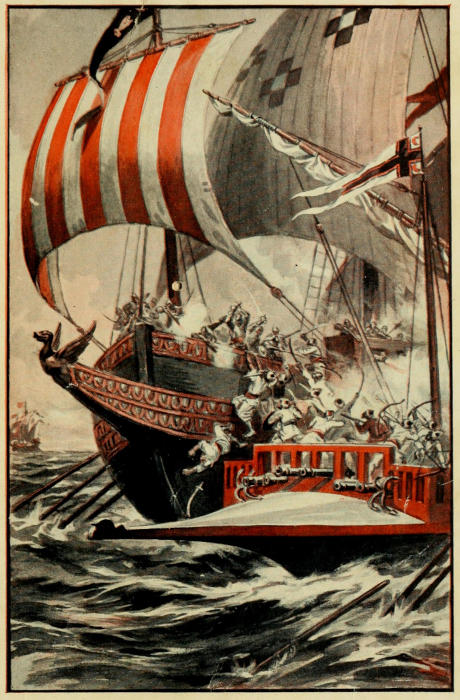
avenged. The type of craft which they favoured was of the
galley species, a vessel that was of great length, in proportion
to her extreme shallowness, and was manned by a considerable
number of oarsmen. Sail power was employed but
only as auxiliary rather than of main reliance. Such a craft
was light, easily and quickly manœuvred, could float in
creeks and bays close in to the shore, or could be drawn up
the beach if necessary. In all essential respects she was the
direct lineal descendant of the old fighting galleys of Greece
and Rome. From about the beginning of the sixteenth
century till the battle of Lepanto in 1571 the Moslem
corsair was at his best as a sea-rover and a powerful racial
force. And if he was still a pest to shipping after that
date, yet his activities were more of a desultory nature.
Along the Barbarian coast at different dates he made himself
strong, though of these strongholds Algiers remained for
the longest time the most notorious.
In considering these Moslem corsairs one must think of
men who were as brutal as they were clever, who became
the greatest galley-tacticians which the world has ever
seen. Their greed and lust for power and property were
commensurate with their ability to obtain these. Let it
not be supposed for one moment that during the grand
period these Moorish pirate leaders were a mere ignorant
and uncultured number of men. On the contrary, they
possessed all the instincts of a clever diplomatist, united to
the ability of a great admiral and an autocratic monarch.
Dominating their very existence was their bitter hatred of
Christians either individually or as nations. And though a
careful distinction must be made between these Barbarian
corsairs and the Turks, who were often confused in the
sixteenth-century accounts of these rovers, yet from a very
early stage the Moorish pirates and the Turks assisted each
other. You have only to remember that they were both
Moslems; to remind yourself that the downfall of Constantinople
in 1453 gave an even keener incentive to harass
Christians; and to recollect that though the Turks were
great fighters by land yet they were not seamen. They had
an almost illimitable quantity of men to draw upon, and for
this as well as other reasons it was to the Moors’ interests
that there should be a close association with them.
During the fifteenth and especially the sixteenth
centuries there was in general European use a particular
word which instantly suggested a certain character that
would stink in the nostrils of any Christian, be he under
the domination of Elizabeth or Charles V. This word was
“renegade,” which, of course, is derived from the Latin
nego, I deny. “Renegade,” or, as the Elizabethan sailors
often used it, “renegado” signifies an apostate from the
faith—a deserter or turncoat. But it was applied in those
days almost exclusively to the Christian who had so far
betrayed his religion as to become a Moslem. In the
fifteenth century a certain Balkan renegade was exiled from
Constantinople by the Grand Turk. From there he proceeded
to the south-west, took up his habitation in the
island of Lesbos in the Ægean Sea, married a Christian
widow and became the father of two sons, named respectively
Uruj and Kheyr-ed-din. The renegade, being a seaman, it
was but natural that the two sons should be brought up to
the same avocation.
Having regard to the ancestry of these two men, and
bearing in mind that Lesbos had long been notorious for its
piratical inhabitants, the reader will in no wise be surprised
to learn that these two sons resolved to become pirates too.
They were presently to reach a state of notoriety which
time can never expunge from the pages of historical
criminals. For the present let us devote our attention to
the elder brother, Uruj. We have little space to deal with
the events of his full life, but this brief sketch may suffice.
The connection of these two brothers with the banished
Moors is that of organisers and leaders of a potential force
of pirates. Uruj, having heard of the successes which the
Moorish galleys were now attaining, of the wonderful prizes
which they had carried off from the face of the sea, felt the
impulse of ambition and responded to the call of the wild.
So we come to the year 1504, and we find him in the
Mediterranean longing for a suitable base whence he could
operate; where, too, he could haul his galleys ashore during
the winter and refit.
A Daring Attack
Uruj with his one craft attacked the two galleys of Pope Julius II laden with goods
from Genoa. His officers remonstrated with Uruj on the desperate venture, but to
enforce his commands and prevent any chance of flight he had the oars thrown overboard.
He then attacked and overcame the galleys.
For a time Tunis seemed to be the most alluring spot in
every way: and strategically it was ideal for the purpose of
rushing out and intercepting the traffic passing between
Italy and Africa. He came to terms with the Sultan of
Tunis, and, in return for one-fifth of the booty obtained,
Uruj was permitted to use this as his headquarters, and
from here he began with great success to capture Italian
galleys, bringing back to Tunis both booty and aristocratic
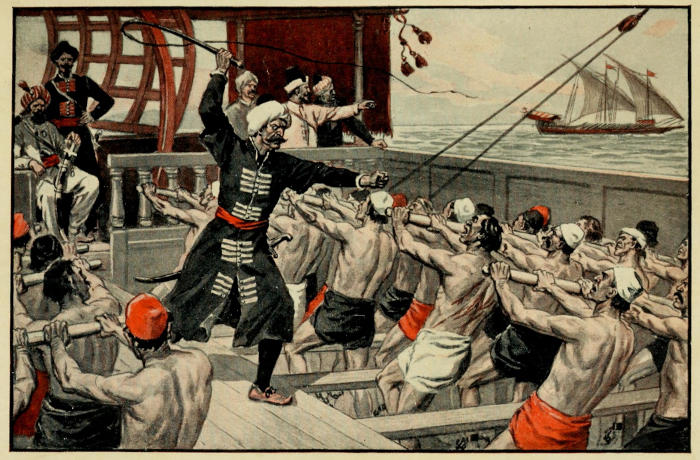
prisoners for perpetual exile. The women were cast into the
Sultan’s harem, the men were chained to the benches of the
galleys.
One incident alone would well illustrate the daring of
Uruj, who had now been joined by his brother. The story
is told by Mr. Stanley Lane Poole in his history of the
Barbarian corsairs, that one day, when off Elba, two galleys
belonging to Pope Julius II. were coming along laden with
goods from Genoa for Civita Vecchia. The disparity and
the daring may be realised when we state that each of
these galleys was twice the size of Uruj’s craft. The Papal
galleys had become separated, and this made matters easier
for the corsair. In spite of the difference in size, he was
determined to attack. His Turkish crew, however, remonstrated
and thought it madness, but Uruj answered this
protestation by hurling most of the oars overboard, thus
making escape impossible: they had to fight or die.
This was the first time that Turkish corsairs had been
seen off Elba, and as the Papal galley came on and saw the
turbaned heads, a spirit of consternation spread throughout
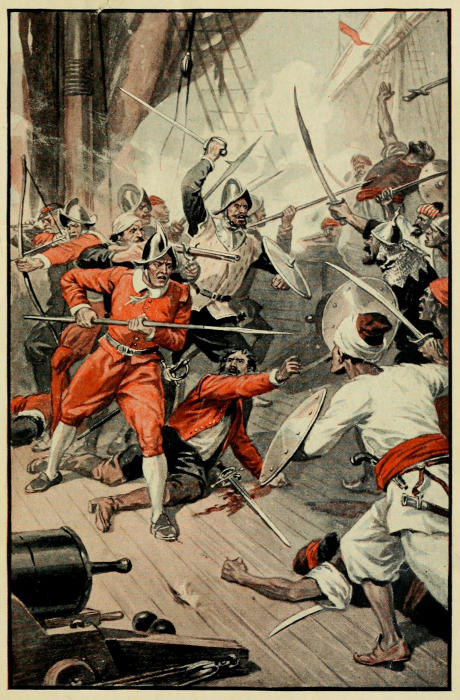
the ship. The corsair galley came alongside, there was
a volley of firing, the Turkish men leapt aboard, and before
long the ship and the Christians were captured. The
Christians were sent below, and the Papal ship was now
manned by Turks who disguised themselves in the Christians’
clothes. And now they were off to pursue the second
galley. As they came up to her the latter had no suspicion,
but a shower of arrows and shot, followed by another short,
sharp attack, made her also a captive. Into Tunis came
the ships, and the capture amazed both Barbarian corsair
and the whole of Christendom alike. The fame of Uruj
spread, and along the whole coast of North Africa he was
regarded with a wonder mingled with the utmost admiration.
He became known by the name Barbarossa, owing
to his own physical appearance, the Italian word rossa
signifying red, and barba meaning a beard. He followed
up this success by capturing next year a Spanish ship with
500 soldiers. And there were other successes, so that in
five years he had eight vessels. But Tunis now became too
small for him, so for a time he moved to the island of Jerba,
on the east coast of Tunis, and from there he again harassed
Italy.
Such was the fame of Barbarossa that he was invited to
help the Moors. It chanced that the Moslem king of Bujeya
had been driven out of his city by the Spaniards, and the
exile appealed to Barbarossa to assist him in regaining his
own. The reward offered to the Turk was that, in the event
of victory, Barbarossa should henceforth be allowed the free
use of Bujeya, the strategic advantage of this port being
that it commanded the Spanish sea. The Turk accepted
the invitation on these terms, and having now a dozen
galleys, with ample armament, in addition to 1000
Turkish soldiers, as well as a number of renegades and
Moors, he landed before the town in August of 1512.
Here he found the King ready with his 3000 troops, and
they proceeded to storm the bastion, in which an all too
weak Spanish garrison had been left. Still, for eight days
the Spaniards held out, and then when a breach was made
and a fierce assault was being carried out, Barbarossa had the
misfortune to have his left arm amputated, so, Bujeya being
now left alone, Barbarossa and his brother put to sea again.
They had not won the victory, but they had captured a rich
Genoese galley full of merchandise. Barbarossa took her
back with him to his headquarters, and while he recovered
from his wounds his brother Kheyr-ed-din acted in his
stead.
Not unnaturally the Genoese were angered at the loss of
their fine galliot and sent forth Andrea Doria, the greatest
Christian admiral, with a dozen galleys to punish the Turks.
The Christians landed before Tunis, drove Kheyr-ed-din
back into Tunis, and took away to Genoa one-half of
Barbarossa’s ships. Kheyr-ed-din now proceeded to Jerba
to build other ships as fast as possible, and as soon as his
wounds allowed him, Barbarossa here joined him. Meanwhile
the Moors were still chafing at their inability to get
even with the Spaniards, and once more an attempt was
made to take Bujeya, though unsuccessfully, and the corsair’s
ships were burnt lest they might fall into the hands
of the enemy.
At length the Barbarossas resolved to quit Tunis and
Jerba, for they had now chosen to settle at Jijil, sixty miles
to the east of Bujeya. Their fame had come before them;
the inhabitants were proud to welcome the brother corsairs
who had done many wonderful things by land and sea,
and before long the elder Barbarossa was chosen as their
Sultan. In 1516 died Ferdinand, and about this time the
Algerine Moors declined any longer to pay tribute to Spain.
To Barbarossa came an invitation to aid these inhabitants
of Algiers in driving the Spanish garrison from their fort.
The invitation was accepted, 6000 men and sixteen galliots
were got together. Arrived before the fortress of Algiers,
Barbarossa offered a safe conduct to the garrison if
they would surrender, but the latter’s reply was merely
to remind the corsair of Bujeya. Then for twenty days
Barbarossa battered away at the fortress, but without making
a breach, and meanwhile the Moors began to regret that
they had asked the red beard to aid them. But it would
be less easy to turn them out now that once these dare-devils
had set foot on their territory. Barbarossa knew this
and waxed insolent. The Algerines made common cause
with the soldiers in the fortress, and a general rising against
the red beard was planned. But they had reckoned without
their guest. For Barbarossa had spies at work and became
informed of this plot.
Whilst at prayers one Friday in the mosque, Barbarossa
had the gates closed, the conspirators brought before him
one by one, and then after twenty-two of them had been
put to death there was an end to this plotting against the
corsair of Lesbos. Barbarossa increased in power, in the
number of his galleys, in the extent of his territory and in
the number of his subjects, so that by now he had become
Sultan of Middle Barbary. Practically the whole of that
territory marked on our modern maps of Algeria was under
his sway. Step by step, leaping from one success to another,
ignoring his occasional reverses, he had risen from a mere
common pirate to the rank of a powerful Sultan. So potent
had he become, in fact, that he was able to make treaties
with other Barbarian Sultans, and all the summer season his
galleys were scouring the seas bringing back increased wealth
and more unfortunate Christian prisoners. Richly laden
merchant ships from Genoa, from Naples, from Venice, from
Spain set forth from home, and neither the ships nor their
contents were ever permitted to return or to reach their
ports of destination.
However, the time came when the Christian States could
no longer endure this terrible condition of affairs. And
Charles V. was moved to send a strong force to deal with
the evil. Ten thousand seasoned troops were sent in a
large fleet of galleys to Northern Africa, and at last the
wasp was killed. For Barbarossa, with his 1500 men,
was defeated, and he himself was slain while fighting
boldly. Unfortunately the matter ended there, and the
troops, instead of pressing home their victory and wiping the
Barbarian coast clean of this Moorish dirt, left Algiers
severely alone and returned to their homes. Had they,
instead, ruthlessly sought out this lawless piratical brood,
the troublesome scourge of the next three centuries would
probably never have caused so many European ships and so
many English and foreign sailors and others to end their
days under the lash of tyrannical monsters.
CHAPTER V THE WASPS AT WORK
But if Barbarossa was dead, his sagacious brother
Kheyr-ed-din was ready to take up his work, and he
proceeded on more scientific principles. He began
by sending an ambassador to Constantinople, and begged
protection for the province of Algiers. This, having been
granted, he was appointed officially, in 1519, Governor of
Algiers. His next step was to reinforce his garrisons at
different parts of the coast and so secure his territory from
attacks by sea. And in order to make for safety on the
southern or landward side, he entered into alliances with
the leading Arabian tribes up-country.
He was thus about as secure as it was possible for
human diplomacy and organisation to achieve. His ships
could still go on their piratical cruises and return with little
enough risk. In vain did the Spaniards send an Armada
against him. The men indeed landed, but they were driven
back, and a storm springing up did the rest. Gradually
more and more seaports fell into the net of this corsair, so
there were plenty of harbours to run for, plenty of safe
shelters whither to bring the valuable prizes. It was not
merely the middle or the eastern end of the Mediterranean
which was now harassed, but the west end. Those were the
days, you will remember, when Spain was developing the
rich resources of the New World, so there was a great
opportunity for the Barbarian pirates to go out some little
distance into the Atlantic and capture the West Indiamen
homeward bound for Cadiz with gold and other treasures.
And in addition to these prizes, no less than the merchantmen
of Italy, Kheyr-ed-din occasionally made raids on the
Spanish coast or even carried off slaves from the Balearic
Islands. From end to end these Algerine corsairs were thus
masters of the Mediterranean. No commercial ship could
pass on her voyages in any safety—even Spanish flagships
found themselves being brought captive into Algiers.
True, the small Spanish garrison still remained in Algiers,
and because it was immured within a very strong fortress
it held out. The time now came for this to be attacked
with great vigour. For a period of fifteen days it was
bombarded, and at length, after a most stubborn resistance,
it was overcome. The stronghold was then pulled down,
and Christian prisoners who in the summer season had rowed
chained to their seats in the corsair galleys, were in the off-season
employed to build with these stones the great mole
to protect the harbour of Algiers from the western side.
It was a stupendous undertaking, and seven thousand of
these unhappy creatures accomplished the work in most of
two years.
Nothing succeeds like success, and the corsair prospered
in power and possession to such an extent that he was pre-eminent.
This naturally attracted to his dominion many
thousands of other followers, and there was thus established
not a mere small colony of pirates, but a grand corsair
kingdom where the industry of sea-robbery was well organised
with its foundries and dockyards, and with every
assistance to agriculture, and a firm, hard government to
keep the land in fit and proper cultivation.
And now yet another invitation came to Kheyr-ed-din.
Andrea Doria had defeated the Turks at Patras and in the
Dardanelles. Like the policy of the corsairs, after each
victory the Christian admiral employed the infidel captives
to work at the oars of his galleys. Thus it was that the
Sultan of Turkey—Solyman the Magnificent—realising that
the Christian admiral was draining the best Turkish seafaring
men, determined to invite Kheyr-ed-din to help him against
Andrea Doria. So one of the Sultan’s personal guard was
dispatched to Algiers requesting Barbarossa to come to
Constantinople and place himself at the head of the Ottoman
navy. Barbarossa accepted this as he had accepted other
invitations, seeing that it was to his own interest, and in
August 1533 left Algiers with seven galleys and eleven other
craft. On the way he was joined by sixteen more craft
belonging to a pirate named Delizuff, but before they
had got to the end of the voyage Delizuff was killed in an
attack on a small island named Biba. There followed some
friction between the men of the deceased pirate and those
of Barbarossa, and finally one dark night the ships of
Delizuff stole away from Barbarossa’s fleet.
Eventually this Sultan of Algiers, with his ships, arrived
at Constantinople. The case stood thus. The Ottoman
subject was an excellent man to fight battles by land, but
not by sea. Barbarossa was a true fighting seaman: therefore
let him do for us that which we ourselves cannot do.
He was only three years short of becoming an octogenarian,
yet this veteran corsair was as able as he was wicked, and so,
after the Ottoman dockyards in the following year had
provided him with additional ships, Barbarossa set forth
from Constantinople and began by sacking Reggio, burning
Christian ships and carrying off their crews. Thence he
laid waste the coast until he came to Naples, and altogether
made 11,000 Christians prisoners, and returned to the
Bosphorus with an abundance of spoil and slaves. Sardinia,
too, was depleted of wealth and humanity till it
was almost bereft of both, and at last the fleet arrived
before Tunis, to the amazement of the inhabitants. To
condense a long story it may be said at once that, after
some fighting, Tunis found itself now in submission to him
who was also Sultan of Algiers and commander-in-chief of
the Ottoman fleet. But trouble was brewing.
Again Christendom was moved to action. The successes
of this all-conquering King of Corsairs were endangering
the world, so the great Charles V. set on foot most elaborate
preparations to cope with the evil. The preparations were
indeed slow, but they were sure and they were extensive.
But there was just one disappointing fact. When Francis
the First, King of France, was invited to take his share in this
great Christian expedition it is as true as it is regrettable
to have to record the fact, that not only did he decline,
but he actually betrayed the news of these impending
activities to Barbarossa. This news was not welcome even to
such a hardened old pirate, but he set to work in order to be
ready for the foe, employed the Christian prisoners in repairing
the fortifications of Tunis, summoned help to his standard
from all sides, all united in the one desire to defeat and
crush utterly any Christian force that might be sent against
the followers of Mahomet. Spies kept him informed of the
latest developments, and from Algiers came all the men
that could possibly be spared. And finally, when all preparations
had been made, there was on the one side the
mightiest Christian expedition about to meet the greatest
aggregation of Moslems. By the middle of June the invaders
reached the African coast and found themselves
before Tunis. It was to be a contest of Christian forces
against infidels: it was to represent an attempt once and
for all to settle with the greatest pirate even the Mediterranean
had ever witnessed. It was, if possible, to set free
the hordes of brother-Christians from the tyrannous cruelty
of a despotic corsair. Of those who now came over the sea,
many had lost wife, or sister, or father, or son, or brother
at the hands of these heathens. For once, at last, this
great Christian Armada had the sea to itself: the wasps
had retreated into their nest.
So the attack began simultaneously from the land and
from the sea. The men on shore and those in the galleys
realised they were battling in no ordinary contest but in a
veritable crusade. Twenty-five thousand infantry and six
hundred lancers, with their horses, had been brought across
the sea in sixty-two galleys, a hundred and fifty transports,
as well as a large number of other craft.[1] The Moslems
had received assistance from along the African coast and
from the inland tribes. Twenty thousand horsemen, as
well as a large quantity of infantry, were ready to
meet the Christians. The Emperor Charles V. was
himself present, and Andrea Doria, the greatest Christian
admiral, was there opposed to the greatest admiral of the
Moslems.
Needless to say the fight was fierce, but at last the
Christians were able to make a breach in the walls not
once but in several places, and the fortress had to be vacated.
Tunis was destined to fall into Christian hands. Barbarossa
realised this now full well. What hurt him most
was that he was beaten at his own game: his own
beloved galleys were to fall into the enemies’ hands. Presently
the corsairs were routed utterly, and Barbarossa
with only about three thousand of his followers escaped by
land. Now inside Tunis were no fewer than 20,000
Christian prisoners. These now succeeded in freeing
themselves of their fetters, opened the gates to the
victorious army, and the latter, unable to be controlled,
massacred the people they had been sent against right
and left. The 20,000 Christians were rescued, the
victory had been won, the corsair had been put to flight,
and Muley Hassan, a mere puppet, was restored to his
kingdom of Tunis by Charles V. on conditions, amongst
which it was stipulated that Muley Hassan should liberate
all Christian captives who might be in his realm, give
them a free passage to their homes, and no corsair
should be allowed again to use his ports for any purpose
whatsoever.
This was the biggest blow which Barbarossa had ever
received. But brute though he was, cruel tyrant that he
had shown himself, enemy of the human race though he
undoubtedly must be reckoned, yet his was a great mind,
his was a spirit which was only impelled and not depressed
by disasters. At the end of a pitiful flight, he arrived
farther along the African coast at the port of Bona, where
there remained just fifteen galleys which he had kept in
reserve. All else that was his had gone—ships, arsenal,
men. But the sea being his natural element, and piracy
his natural profession, he began at once to embark. But
just then there arrived fifteen of the Christian galleys, so
Barbarossa, not caring for conflict, drew up his galleys
under the fort of Bona, and the enemy deemed it prudent
to let the corsair alone, and withdrew. Soon after
Barbarossa put to sea and disappeared, when Andrea
Doria with forty galleys arrived on the scene too late.
Just as on an earlier occasion already narrated, the
Christian expedition made the mistake of not pressing
home their victory and so settling matters with the
pirates for good and all. Algiers had been drained so
thoroughly of men that it was really too weak to resist an
attack. But no; the Christians left that alone, although
they took Bona. About the middle of August Charles
re-embarked his men and, satisfied with the thrashing he
had given these pirates, returned home. But Barbarossa
proceeded to Algiers, where he got together a number of
galleys and waited till his former followers—or as many
as had survived battle and the African desert—returned
to him. If Moslem piracy had been severely crushed, it
was not unable to revive, and, before long, Barbarossa with
his veterans was afloat again, looting ships at sea, and
carrying off more prisoners to Algiers. For this piracy
was like a highly infectious disease. You might think for
a time that it was stamped out, that the world had been
cleansed of it, but in a short time it would be manifest
that the evil was as prevalent as ever.
Once more he was summoned to visit Soliman the
Magnificent; once more the arch-corsair sped to Constantinople
to receive instructions to deal with the
conquering Christians. Andrea Doria was at sea, burning
Turkish ships, and only this Sultan of Algiers could deal
with him. So away Barbarossa went in his customary
fashion, raiding the Adriatic towns, sweeping the islands of
the Archipelago, and soon he returned to Constantinople
with 18,000 slaves, to say nothing of material prizes.
Money was obtained as easily as human lives, and the
world marvelled that this corsair admiral, this scourge of
the sea, this enemy of the Christian race, should, after a
crushing defeat, be able to go about his dastardly work,
terrifying towns and ships as though the expedition of
Charles V. had never been sent forth.
But matters were again working up to a crisis. If the
corsair admiral was still afloat, so was Andrea Doria, the
great Christian admiral. At the extreme south-west corner
of the Epirus, on the Balkan side of the Adriatic, and almost
opposite the heel of Italy, lies Prevesa. Hither in 1569 came
the fleets of the Cross and the Crescent respectively. The
Christian ships had been gathered together at the Island of
Corfu, which is thirty or forty miles to the north-west of
Prevesa. Barbarossa came, assisted by all the great pirate
captains of the day, and among them must be mentioned
Dragut, about whom we shall have more to say later.
But Prevesa, from a spectacular standpoint, was disappointing.
It was too scientific, too clearly marked by
strategy and too little distinguished by fighting. If the
reader has ever been present at any athletic contest where
there has been more skill than sport, he will know just
what I mean. It is the spirit of the crowd at a cricket
match when the batsman is all on the defensive and no
runs are being scored. It is manifested in the spectators’
indignation at a boxing match when neither party gets in a
good blow, when there is an excess of science, when both
contestants, fairly matched and perhaps overtrained and
nervous of the other’s prowess, hesitate to go in for hard-hitting,
so that in the end the match ends in a draw.
It was exactly on this wise at Prevesa. Andrea Doria
and Barbarossa were the two great champions of the ring.
Neither was young; both had been trained by years of
long fighting. They were as fairly matched as it was
possible to find a couple of great admirals. Each
realised the other’s value; both knew that for spectators
they had the whole of Europe—both Christian and Moslem.
Victory to the one would mean downfall to the other, and
unless a lucky escape intervened, one of the two great
admirals would spend the rest of his life rowing his heart
out as a galley-slave. Certainly it was enough to make
the boxers nervous and hesitating. They were a long time
getting to blows, and there was but little actually accomplished.
There was an unlucky calm on the sea, and the
Galleon of Venice was the centre of the fighting which
took place. It was the splendid discipline on board this
big craft, it was the excellence of her commander and the
unique character of her great guns which made such an
impression on Barbarossa’s fleet that although the Galleon
was severely damaged, yet at the critical time when the
corsairs might have rushed on board and stormed her as
night was approaching, for once in his life the great nerve
of the corsair king deserted him. No one was more surprised
than the Venetians when they found the pirate not
pressing home his attack. True, the latter had captured a
few of the Christian ships, but these were a mere handful
and out of all proportion to the importance of the battle.
He had been sent forth to crush Andrea Doria and the
Christian fleet; he had failed so to do.
Next day, with a fair wind, Andrea Doria made away.
The honour of the battle belonged to the Galleon of Venice,
but for Barbarossa it was a triumph because, with an inferior
force, he had put the Christian admiral to flight. Doria’s
ship had not been so much as touched, and yet Barbarossa
had not been taken prisoner. That was the last great
event in the career of Kheyr-ed-din, and he died in 1548
at Constantinople as one of the wickedest and cruellest
murderers of history, the greatest pirate that has ever
lived, and one of the cleverest tacticians and strategists the
Mediterranean ever bore on its waters. There has rarely
lived a human being so bereft of the quality of mercy, and
his death was received by Christian Europe with a sigh of
the greatest relief.
In the whole history of piracy there figure some
remarkably clever and consummate seamen. Like many
another criminal they had such tremendous natural endowments
that one cannot but regret that they began badly
and continued. The bitterest critic of this Moslem monster
cannot but admire his abnormal courage, resource; his
powers of organisation and his untameable determination.
The pity of it all is that all this should have been wasted
in bringing misery to tens of thousands, in dealing death
and robbery and pillage.
CHAPTER VI GALLEYS AND GALLANTRY
But there was a third great Barbarian corsair to
complete this terrible trio. Uruj and Kheyr-ed-din
we have known. There is yet to be mentioned
Dragut, who succeeded to the latter. He too was a
Moslem who had been born in a coast village of Asia
Minor, opposite the island of Rhodes. His early life is
that of most pirates. He went to sea when quite young,
was devoted to his profession, was filled with ambition,
became an expert pilot and later became a skipper of his
own craft. Then, feeling the call of the wild, he devoted
himself to piracy and rose to notoriety.
But the turning-point in his career came when he joined
himself to the service of Kheyr-ed-din, who appointed
Dragut to the entire command of a dozen of the corsair
king’s galleys. Henceforward his life was that of his
master, ravaging the Italian coasts, pillaging Mediterranean
ships and dragging thousands of lives away into slavery.
Two years after the battle of Prevesa, Dragut was in fame
second only to Kheyr-ed-din, and another Doria—the
nephew of Andrea—was sent forth to capture this new
wasp of the sea. Doria succeeded in throwing his net so
well that off the Corsican coast he was able to bring back
Dragut as prisoner, and for the next four years the ex-corsair
was condemned to row as a slave in a Christian
galley, until on a day his late master Kheyr-ed-din came
sailing into Genoa. During his active, pillaging life he
had obtained plenty of riches, so it was nothing for him to
pay 3000 ducats and thus redeem from slavery a man who
had been particularly useful to his own schemes.
And from this day until Dragut fell fighting in 1565,
he followed in the footsteps of the man who brought him
his release. When Kheyr-ed-din died, the Turkish Sultan
appointed Dragut as admiral of the Ottoman fleet. Like
Barbarossa, Dragut’s first object was to obtain a base in
Northern Africa, and eventually he was able to capture the
town of “Africa” or Mehedia, to the east of Tunis. His
next proceeding was to fortify this place. The news came
to the ears of Charles V. that this had happened. The
two Barbarossas were dead, but there was another almost
as pernicious. Was this pestilence of piracy never to cease?
Andrea Doria was an old man now, but he was bidden by
Charles to go after Dragut, and he went. Nor was he
sorry for an opportunity of wiping out his own undistinguished
action at Prevesa. Dragut was away harrying
the coasts of Spain, and his nephew Aisa was left in
charge of “Africa.” Meanwhile Doria searched for him
along the African coast, came to “Africa,” but after losing
some men and with great damage to his own ship, Doria,
as the season was getting late, returned home.
But the following June, Doria with his fleet arrived off
Mehedia, besieged the city, and, after an expenditure of
great effort, took it, capturing Aisa.
Mehedia was lost, but Dragut was still at large. He
repaired to Constantinople and thence to Jerbah, the island
off the east coast of Tunis. Hither also came Andrea
Doria and hemmed the corsair in. At last the pirate was
in a trap, but like many another clever rascal he found a
way out with consummate cleverness. What he did may
briefly be summed up as follows: Outside were the waiting
Christian fleet, which was merely amused by the sight of a
new fort becoming daily greater. But these earthworks
were just so much bluff. For Dragut, by means of these,
was able to conceal what was being done on the other side.
With marvellous ingenuity he had caused a road to be
made across the island to the sea on the other side; he
had laid down a surface of well-greased planks, and under
the further cover of darkness had made his men drag his
galleys across till they were launched into the sea on the
opposite coast. The rest was easy, and the corsair fleet
once more escaped, having fooled Dorea in a manner that
amazed him. To add impudence to insult, Dragut at once
captured a Sicilian galley on its way to Dorea, containing
Muley Hassan, Sultan of Tunis. The latter was promptly
sent as a present to the Sultan of Turkey, who allowed him
to end his days in prison.
Of the rest of the acts of this corsair we have but little
space to speak. It is sufficient if we say that he well bore
the mantle which had fallen to him from the shoulders of
Barbarossa. He continued his scourging of the seas, he
fought gallantly, he laid waste and he captured prisoners
for slavery. Power and dominion came to him as to his
predecessors, and before long he was the ruler of Tripoli
and more than ever the enemy of the Christian race.
Finally he died at the siege of Malta, but he in turn was
succeeded by Ali Basha of Algiers, who conquered the
kingdom of Tunis, captured Maltese galleys, and showed
that the old corsair spirit was still alive.
But the day of reckoning was at hand, and there was to
be settled in one of the most momentous events of history
a debt that had long been owing to the Christians. Of all
the decisive battles of the world few stand out more conspicuously
than the battle of Lepanto. In spite of all the
great maritime expeditions which had been sent to put
down piracy in the Mediterranean, the evil had recurred
again and again. There were two reasons why Christian
Europe was determined to beat these corsairs: firstly, the
latter were natural enemies because they were Moslems;
but, secondly, they were the worst type of pirates. All the
losses of Christian lives, goods and ships merely increased
the natural hatred of these Mohammedans. And in
Lepanto we see the last great contest in which these
truculent corsairs fought as a mighty force. Thereafter
there were repeated piratical attacks by these men, but
they of a more individualistic nature than proceeding from
an enormous organisation.
Lepanto was fought sixteen years before the Elizabethans
defeated the Armada. Before we say anything of the contest
itself it is necessary to remind the reader that whereas
in the contest which took place in the waters that wash
England, the bulk of the ships were sail-propelled and had
high freeboard (with some exceptions), yet at Lepanto it
was the reverse. The fighting ship of the Mediterranean
from the very earliest times had always been of the galley
type, even though it contained variations of species. And
never was this characteristic more clearly manifested than
at the battle of which we are now to speak. There were
galleys and galleasses, but though the former were certainly
somewhat big craft, yet the latter were practically only big
editions of the galley.
The value of Lepanto is twofold. It proved to the
world that the great Ottoman Empire was not invincible
on sea. It showed also that in spite of all that the cleverest
corsair seamen could do, there were sufficient unity and
seamanlike ability in Christian Europe to defeat the combined
efforts of organised piracy and Mohammedanism.
No one can deny that Ali Basha distinguished himself as a
fine admiral at this battle, yet he was not on the side of
victory. When he found himself defeated there fell
simultaneously the greatest blow which organised piracy
had received since it established itself along the southern
shores of the Mediterranean. Lepanto was no mere isolated
event; it was the logical outcome of the conflict between
Christianity on the one hand and Mohammedanism with
piracy on the other. It is as unfair to omit the consideration
of Moslemism from the cause of this battle as it were
to leave out the fact of piracy.
The solidarity of the Christian expedition was formed
by what was called the Holy League, embracing the ships
of the Papal States, Spain and Venice. The unity of the
opposing side was ensured by the fidelity of the Barbarian
corsairs to the Sultan of Turkey. In supreme command of
the former was Don John of Austria, son of that Charles V.
who had done so much to oust these corsair wasps. The
Christian fleet numbered about three hundred, of which
two-thirds were galleys, and they collected at Messina.
The scene where the battle was to take place was already
historic. It was practically identical with that of Prevesa,
of which we have already spoken, and with that of the
classical Actium in 31 B.C., though exactly it was a little to
the south of where Prevesa had been fought. Just as
in the latter Kheyr-ed-din had fought against Andrea
Doria, so now Dragut was to fight against John Andrea
Doria. The Moslem strength may be gauged from the
statement that it contained 250 galleys plus a number
of smaller ships. But just as Prevesa had been marked
by little fighting but much manœuvring, so Lepanto was
distinguished by an absence of strategy and a prevalence
of desperate, hard hitting. Whatever strategy was displayed
belonged to Ali Basha. The galleasses of the
Christian side dealt wholesale death into the Moslems,
though Andrea’s own flagship suffered severely in the fight.
Spanish, Venetian and Maltese galleys fought most gallantly,
but Ali Basha, after capturing the chief of the Maltese
craft, was obliged to relinquish towing her, and himself
compelled to escape from the battle. At least 5000
Christians perished at Lepanto, but six times that amount
were slaughtered of the Moslems, together with 200 of
the latter’s ships. The corsairs had rendered the finest
assistance, but they had failed with distinction.
Christian craft had won the great day, and never since
that autumn day in 1571 have the pirates of Barbary
attained to their previous dominion and organised power.
Ali returned to Constantinople, and even the next year was
again anxious to fight his late enemies, though no actual
fighting took place. Still another year later Tunis was
taken from the Turks by Don John of Austria. For nine
years after the event of Lepanto, Ali Basha lived on, and,
like his predecessors, spent much of his time harrying the
Christian coastline of southern Italy. There were many
pirates for long years after his death, but with the decease
of Ali Basha closed the grand period of the Moslem corsairs.
It had been a century marked by the most amazing impudence
on the part of self-made kings and tyrants. But if
it showed nothing else, it made perfectly clear what
enormous possibilities the sea offered to any man who had
enough daring and self-confidence in addition to that
essential quality of sea-sense. From mere common sailormen
these four great corsairs—the two Barbarossas, Dragut
and Ali Basha—rose to the position of autocrats and
admirals. Mere robbers and bandits though they were, yet
the very mention of their names sent a shudder through
Christendom. And it was only the repeated and supreme
efforts of the great European powers which could reduce
these pirate kings into such a condition that honest ships
could pursue their voyages with any hope of reaching their
destined ports. Surely, in the whole history of lawlessness,
there never were malefactors that prospered for so long and
to such an extent!
We have spoken in this chapter of galleys and galleasses.
Before we close, let us add a few words of explanation to
facilitate the reader’s vision. Bearing in mind the interesting
survival of the galley type throughout Mediterranean
warfare, it must not be forgotten that in detail this type
of craft varied in subsequent centuries. There remained,
however, the prevailing fact that she relied primarily on
oars, and that she drew comparatively little water and had
but little freeboard in proportion to the caravels, caracks
and ocean-going ships of war and commerce. The great
virtue of the galley consisted in her mobility. Her greatest
defect lay in her lack of sea-keeping qualities. For the
galley’s work was concerned with operations within a limited
sphere with the land not far away; in other words, she was
suited for conditions the exact opposite of that kind of
craft which could sail to the West Indies or go round
Cape Horn.
Galley Slaves
The life of a galley slave was one of dreadful hardship. They were chained five or six to an oar, fed on the scantiest of food, and a
boatswain walked up and down a gangway in the centre wielding his terrible lash on those who incurred his anger.
The amazing feature of these galleys was the large
number of oarsmen required; but this was an age when
human life was regarded more cheaply than to-day. Slaves
could be had by raiding towns or capturing ships. The
work of pulling at the oar was healthy if terribly hard. A
minimum of food and the stern lash of the boatswain as he
walked up and down the gangway that ran fore-and-aft
down the centre of the ship kept the men at their duty,
and their shackles prevented them from deserting. But
when their poor, wearied bodies became weak, they were
thrown overboard before their last breath had left them.
The prints, which are still in existence, show that the number
of oarsmen in a sixteenth-century galley ran into hundreds—two
or three hundred of these galley-slaves would be no rare
occurrence in one craft. They retained the beak and the
arrangement of the yards from the time of the Romans.
At the stern sat the commander with his officers. When
these craft carried cannon the armament was placed in the
bows. By the sixteenth, or at any rate the seventeenth,
century, the galley had reached her climax, and it was not
thought remarkable that her length should be about 170
feet and her breadth only about 20 feet. She may be easily
studied by the reader on referring to an accompanying
illustration. Whether used by Christian or corsair, by
Maltese knights or Moslem Turks, they were not very
different from the picture which is here presented. With
five men to each heavy oar, with seamen to handle the sails
when employed, with soldiers to fight the ship, she was
practically a curious kind of raft or floating platform.
Irrespective of religion or race, it was customary for the
sixteenth-century nations to condemn their prisoners to row
chained to these benches. Thus, for example, when the
Spaniards captured Elizabethan seamen, the latter were thus
employed, just as Venetian prisoners were made to row in
Moslem galleys. Convicted criminals were also punished
by this means.
The difference between the old and new was never better
seen than in the late sixteenth century, when the big-bellied
man-of-war with sails and guns were beginning to discard
the old boarding tactics. It was the gun and not the sword
on which they were now relying. But the galley was dependent
less on her gunnery than on boarding. It was her
aim to fight not at a distance but at close quarters—to get
right close alongside and then pour her soldiers on to the
other ship and obtain possession. The galeass of the
Mediterranean, although the word was somewhat largely
used, signified an attempt to combine the sea-qualities of
the big-bellied ship with the mobility of the galley. Compromises
are, however, but rarely successful, and though the
galleass was a much more potent fighting unit, yet she was
less mobile, if a better sea craft. She began by being
practically a big galley with forecastle and sterncastle and
another deck; she ended in being little less clumsy than the
contemporary ship of the line which relied on sails and
guns. Anyone who cares to examine the contemporary
pictures of the Spanish galleasses used by the Armada
against England in the reign of Elizabeth can see this for
himself. It is true that even as far north as Amsterdam in
the seventeenth century the galley was employed, and there
are many instances when she fought English ships in the
Channel, off Portsmouth and elsewhere. For a time some
lingered on in the British Navy, but they were totally
unsuited for the waters of the North Sea and English
Channel, and gave way to the sail-propelled ships of larger
displacement.
CHAPTER VII PIRACY IN ELIZABETHAN TIMES
But although the Mediterranean was the sphere of the
Barbarian corsairs, yet this sea lawlessness was not
confided to that area. The Narrow Seas were just
about as bad as they had been in the Middle Ages. And
Elizabeth, with the determination for which she was famous,
took the matter in hand.
As early as the year 1564 she commanded Sir Peter
Carew to fit out an expedition to clear the seas of any
pirates and rovers that haunted the coasts of Devonshire
and Cornwall; yet it was an almost impossible task. For
the men of these parts especially had gotten the sea-fever.
Fishing was less profitable than it might be, but to
capture ships instead of fish was a very paying industry and
had just that amount of adventure which appealed to the
Elizabethans. And bear in mind that, as in the case of the
later smugglers, these men had at their backs for financial
support the rich land-owners, who found the investment
tempting.
It was because the colonies in the New World were
yielding such wondrous treasure that the English pirates
found the Spanish ships so well worth waiting for and
pillaging. Again and again did Philip make demands to
Elizabeth that this nuisance should be stopped, insisting
that in no case should a convicted English pirate be
pardoned. He requested that Her Majesty’s officers in the
west of England ports should cease from allowing these
marauders to take stores aboard or even frequent these
harbours. Rewards, he begged, should even be offered for
their capture, and all persons on shore who aided these
miscreants should be punished severely.
It was because of Philip’s complaint, no less than of the
complaint of her own merchants, that the Queen was compelled
to adopt severe measures. She despatched more
ships to police the seas, but with what advantage? Up
came a ship bound from Flanders to Spain with a cargo of
tapestry, clocks and various other articles for Philip. The
English pirates could not let such a prize go past, so they
stopped the ship and plundered her. The Queen’s next
effort was to cause strict inquiries to be made along the
coast in order to discover the haunts of these Northern
corsairs. Harbour commissioners were appointed, says
Lindsay, to inquire and report on all vessels leaving or
entering port, and all landed proprietors who had encouraged
the pirates were threatened with penalties. But it was an
impossible task, as I will explain. First of all, consider the
fact that after centuries of this free sea-roving, no government,
no amount of threats, could possibly transform the
character of the English seaman. If, for instance, to-morrow,
Parliament were to make it law forbidding the North Sea
fishermen to proceed in their industry, nothing but shells
from men-of-war would prevent the men putting to sea.
Years of occupation would be too strong to resist.
So it was with the seamen in the Elizabethan age. It
began by that hatred of their French neighbours; it was
encouraged by the privileges which the Cinque Ports enjoyed,
though it was in the blood of the English seamen
quite apart from any royal permission. But there was in
the time of Elizabeth still a further difficulty. Those
privateers whom the law had permitted to go forth sea-roving
had become too strong to be suppressed. Privateering
strictly consists of a private ship or ships having a commission
to seize or plunder the ships of an enemy; in effect
it amounts to legalised piracy, and any one can realise that
in a none too law-abiding age, such as the sixteenth century,
the dividing line between piracy and privateering was so
very fine that it was almost impossible to say which pillaging
was legal and which was unjustifiable. That alone was
sufficient reason for the frequent releases of alleged pirates
at this time.
True, the Crown allowed privateering, though the commissions
were limited only to the attacks on our acknowledged
enemies, yet it was futile to expect that these rude
Devonshire seamen would have any respect to legal finesse.
To control these men adequately was too much to expect.
French and Spanish and Flemish merchantmen, regardless
of nationality, were alike liable to fall into the English
pirates’ hands. Some of the backers were making quite a
handsome income, and who shall say that some of those fine
Elizabethan mansions in our country were not built out of
such illegal proceeds? The Mayor of Dover, for instance,
with some of the leading inhabitants of that port, had
captured over 600 prizes from the French, to say nothing
of the number of neutrals which he had pillaged. This
was in the year 1563, and already he had plundered sixty-one
Spanish ships. And there was the valuable trade
passing to and from Antwerp and London, which was a
steady source of revenue for the pirates of this time. You
cannot be surprised, then, at that important incident in
1564, that did so much to enrage the English seamen and
help matters forward to the climax in the form of the
Spanish Armada; for what happened? Philip, seeing how
little Elizabeth was doing to put down this series of attacks
on his treasure ships, had, in the year mentioned, suddenly
issued an order arresting every English ship and all the
English crews that happened to be found within his own
harbours. It was a drastic measure, but we can quite
understand the impetuous and furious Spaniard acting on
this wise.
During Elizabeth’s reign there were of course some
pirates who had the bad fortune to be arrested. One
little batch suspected included a Captain Heidon, Richard
Deigle and a man named Corbet. Included in the same
gang were Robert Hitchins, Philip Readhead, Roger Shaster
and others. The first three mentioned succeeded in fleeing
away beyond capture, but the remainder admitted their
guilt. Hitchins was a man about fifty years old and a
native of Devonshire, but both he and his companions protested
that they had been deceived by Heidon and Deigle;
they had undertaken a voyage to Rochelle presumably in a
merchant ship, whereas the trip turned out to be nothing
else than a piratical expedition.
Their version of the incident was that in June 1564
they captured a Flemish ship, and to her were transferred
thirteen Scots who were forming part of this supposedly
merchant ship. The Flemish ship with the Scots on board
now sailed away, as there was some disagreement with the
rest of the party. They proceeded to Ireland, where their
skipper joined them, and they also committed robberies on
the coast of Spain. Having captured a ship with a cargo
of wine they proceeded to that extreme south-west corner
of Ireland which, even in this twentieth century, is still a
wild, lonely spot and rarely visited by any craft excepting
the British Navy, an occasional cable-laying ship and
sometimes a coaster or two. Berehaven is a mighty
fjord which goes out of Bantry Bay. On the one side rise
high, rocky hills; on the other lies the island of Bere.
It is a safe, clear anchorage and a wild, inaccessible spot.
Here the captured ship was taken and the wines sold.
An arrangement was made with the Lord O’Sullivan by
which the pirates could rely on his assistance. For Corbet
with one ship, and a man named Lusingham, who had charge
of another ship, were prevented by O’Sullivan from falling
into the hands of Elizabeth’s ships that had been sent to
capture them. Lusingham, however, had been slain by “a
piece of ordnance,” as he was in the act of waving his cap
towards the Queen’s ships at Berehaven, but Corbet was yet
alive. It was alleged that Heidon and Corbet had agreed
jointly to fit out the John of Sandwich, giving her all
the necessary guns with the hope of being able to capture
a good ship wherewith to provide Corbet. But whilst in
the English Channel a storm had sprung up and the ship
had sprung a leak. They were therefore forced into Alderney,
where the vessel became a wreck, and Heidon, Corbet, Deigle,
as well as fourteen others, made their escape in a small
pinnace.
It was discovered that Robert Hitchins had been all his
life given to piracy, so, after having been arrested in the
Channel Isles, he was executed at low-water mark near St.
Martin’s Point, Guernsey, and there his body was left in
chains as a warning to others. The rest of the prisoners
were afterwards ordered by Elizabeth to be set free, “after
a good and sharp admonition to beware hereafter to fall
again into the damage of our laws.” They were bidden to
return to their native places and to get their living by honest
labour. It is a proof that the Crown really valued her seamen
by an interesting proclamation that was made in 1572
when there was a likeliness of war. The Queen went so far
as to promise pardon for all piracies hitherto committed by
any mariners who should now put their ships into her naval
service, and we must not forget that, at a later date, the
first tidings of the Armada’s advent were brought into
Plymouth by a patriotic English pirate named Fleming.
“Fleming,” wrote John Smith, the great Elizabethan
traveller and founder of the English colony of Virginia,
“was as expert and as much sought for” as any other
pirates of the Queen’s reign, “yet such a friend to his
Country, that discovering the Spanish Armado, he voluntarily
came to Plymouth, yeelded himselfe freely to my
Lord Admirall, and gave him notice of the Spaniards
comming; which good warning came so happily and unexpectedly,
that he had his pardon, and a good reward.”
“As in all lands,” writes this delightful Elizabethan,
“where there are many people, there are some theeves, so in
all seas much frequented, there are some pirates; the most
ancient within the memory of threescore yeares was one
Callis, who most refreshed himselfe upon the Coast of Wales;
Clinton and Pursser his companions, who grew famous, till
Queene Elizabeth of blessed memory, hanged them at
Wapping.” Now this John Callis or Calles, after his arrest,
wrote a letter of repentance to Walsyngham saying: “I
bewail my former wicked life, and beseech God and Her
Majesty to forgive me. If she will spare my life and use
me in her service by sea, with those she can trust best, either
to clear the coasts of other wicked pirates or otherwise, as
I know their haunts, roads, creeks, and maintainers so well,
I can do more therein than if she sent ships abroad and
spent £20,000.”
Thinking thereby to obtain pardon, Calles accordingly
forwarded particulars of his fellow pirates, their “maintainers
and victuallers of me and my companies.” This
list contained the names and addresses of the purchasers
and receivers of goods which had been pillaged from two
Portuguese, one French, a Spanish and a Scotch ship, which
Calles and a Captain Sturges of Rochelle had pirated. If
he were given his liberty, this loquacious corsair further
promised that he would also bring in a Danish ship, which
he had pirated. He promised also to warn Walsyngham to
take care that Sulivan Bere of Berehaven “does not practise
any treason” towards Her Majesty there, as he alleged that
Sulivan had told Calles in the former’s castle at Berehaven
that James Fitzmorris and a number of Frenchmen were
determined to land there if they could obtain pilots to guide
them thither. The old pirate further alleged that they
had tried to persuade himself to join them and become
their guide, promising him “large gifts.” “But I would
not join any rebel of Her Majesty,” he wrote grandiloquently,
“hoping her mercy in time to come.”
Last March, he went on, while he was riding at anchor
at Torbay, he met a Frenchman, commanded by Captain
Molloner, who came aboard Calles’s ship and sought information
regarding the Irish coast and the best harbours.
Calles informed him the best were Cork and Kinsale. His
inquirers then asked whether Berehaven and Dingell were
not good places where to land. “They told me if I would
go over with them to France, I need not fear the Queen
for any offence I had done.” The French King would
pardon him for anything Calles had done against His
Majesty’s subjects, and would give him 3000 crowns to
become his subject and be sworn his man, as well as a yearly
fee during life. “I asked him why his master wanted to
use me, and he said his master shortly meant to do some
service on the coast of Ireland, and wanted pilots.” Calles
protested that he had declined this invitation, to which the
other man was reported to have replied that he would
never have such a chance of preferment offered him in
England. But though this made a very fine yarn, the
authorities were too well aware of Calles’s past history to
give it too much credence.
“The misery of a Pirate (although many are as sufficient
Seamen as any) yet in regard of his superfluity,” wrote the
founder of Virginia, “you shall finde it such, that any wise
man would rather live amongst wilde beasts than them:
therefore let all unadvised persons take heed, how they
entertaine that quality: and I could wish Merchants,
Gentlemen, and all setters forth of ships, not to bee sparing
of a competent pay, nor true payment, for neither Souldiers
nor Seamen can live without meanes, but necessity will force
them to steale: and when they are once entered into that
trade, they are hardly reclaimed.”
Poverty as well as the love of adventure and the lust for
gain had certainly to be reckoned among the incentives to
this life. So steadily had the evil grown that on 7th
August 1579, Yorke complained to Lord Burghley that the
sea had never been so full of pirates, and a Plymouth ship
which had set out from St. Malo bound for Dartmouth had
been robbed and chased on to the rocks. None the less,
the “persons of credit” who had been appointed in every
haven, creek or other landing-place round the coast, in
order to deal with the evil, were doing their best, and three
notable pirates had some time before been arrested and
placed in York Castle together with other pirates.
But the practice of piracy, as we have seen, was the
peculiar failing of no country exclusively, though in certain
parts of the world and in certain centuries pirates were more
prevalent than elsewhere. The very men who in the
English Channel might have attained disgrace and wealth as
sea-robbers might, also, when he went into the Mediterranean,
be himself pillaged by those Barbarian corsairs of whom we
spoke just now. Many an exciting brush did the mariners
of England encounter with these men, and many were the
sad tales which reached England of the cruelties of these
Moslem tyrants. An interesting account of such an adventure
is related by Master Roger Bodenham. The incident
really happened seven years before Elizabeth came to the
throne, but it may not be out of place here to deal
with it.
After having set forth from Gravesend in the “great
barke Aucher” bound for the islands of Candia and Chio in
the Levant, the ship arrived at Messina in Sicily. But it
was made known that a good many Moslem galleys were in
the Levant and the rest of the voyage would be more than
risky. The Aucher’s crew got to know of this, so that
Bodenham was not likely to get farther on his way and
deliver his cargo at Chio. “Then,” he writes, “I had no
small businesse to cause my mariners to venture with the
ship in such a manifest danger. Neverthelesse I wan them
to goe with me, except three which I set on land.” But
these presently begged to come aboard again and were
taken, and the ship got under way. A Greek pilot was
taken on board, and when off Chio three Turkish pirates
were suddenly espied. These were giving chase to a number
of small boats which were sailing rigged with a lateen-sail.
It happened that in one of the latter was the son of the
pilot, and at this Greek’s request Bodenham steered towards
the Turks and caused the Aucher’s gunner to fire a demi-culverin
at the chaser that was just about to board one of
the boats. This was such a good shot that the Turk
dropped astern. Presently all the little boats came and
begged that they might be allowed to hang on to the
Aucher’s stern till daylight. After clearing from Chio,
Bodenham took his ship to Candia and Messina. But
whilst on the way thither and in the very waters where the
battle of Lepanto was presently to be fought, he found some
of the Turkish galleots pirating some Venetian ships laden
with muscatels, and, good Samaritan that he was, Bodenham
succeeded in driving off the Moslem aggressors and rescuing
the merchantmen. “I rescued them,” he writes briefly,
“and had but a barrell of wine for my powder and shot.”
CHAPTER VIII ELIZABETHAN SEAMEN AND TURKISH PIRATES
But a much more adventurous voyage was that of a
ship called The Three Half Moones, which, with a
crew of thirty-eight men and well found in arms—“the
better to encounter their enemies withall”—set out
from Portsmouth in the year 1563.
In some ways the story reads like mere romance, but it
has been so thoroughly well-vouched for that there is not a
particle of suspicion connected with it. Having set forth
bound for the south of Spain they arrived near the Straits
of Gibraltar, when they found themselves surrounded by
eight Turkish galleys. (It should be mentioned that the
Elizabethans used the word Turk somewhat loosely to mean
Moslems.) It was rapidly made clear that only two alternatives
were possible. Flight was out of the question, and
either the Aucher must fight to a finish or she must be
sunk. But being English and a gallant crew, they decided
to fight. Now, amongst those on board were the owner, the
master, the master’s mate, the boatswain, the purser and
the gunner as officers.
When their desperate situation was realised, the owner
exhorted his men to behave valiantly, to be brave, and to
bear a reverse with resignation. Then, falling on their
knees, they all commended themselves to God and prepared
for the fight. “Then stood up one Grove, the master, being
a comely man, with his sword and target, holding them up
in defiance against his enemies. So likewise stood up the
Owner, the Master’s mate, Boatswaine, Purser, and every
man well appointed. Nowe likewise sounded up the drums,
trumpets and flutes, which would have encouraged any man,
had he never so litle heart or courage in him.” But next
let us introduce to the reader John Foxe, the ship’s gunner,
a man of marvellous resource, as we will see presently. Foxe
saw that the guns were arranged to the best effect and that
the Turks were receiving a hot fire. But three times as
fast as the English shot came the infidel’s fire, and the fight
raged furiously with eight galleys to one big ship. The
Turks advanced, and then came the time for the English
bowmen to let fly their arrows, which fell thickly among
the rowers. Simultaneously the English poured out from
their guns a hotter fire than ever, and the Turks fell like
ninepins. But meanwhile the Aucher was receiving serious
damage below her waterline, and this the Turks seeing,
the infidels endeavoured now to board the ship. As they
leapt on board many of them fell never again to rise, the
others engaging in a tremendous conflict on the Aucher’s
deck. “For the Englishmen,” writes the narrator in fine,
robustous Elizabethan language, “shewed themselves men
in deed, in working manfully with their browne bills and
halbardes: where the owner, master, boateswaine, and their
company stoode to it lustily, that the Turkes were halfe
dismaied. But chiefly the boateswaine shewed himself
valiant above the rest: for he fared amongst the Turkes
like a wood Lion: for there was none of them that either
could or durst stand in his face, till at the last there came a
shot from the Turkes, which brake his whistle asunder, and
smote him on the brest, so that he fell downe, bidding them
farewell, and to be of good comfort, encouraging them likewise
to winne praise by death, rather than to live captives
in misery and shame.”
Gallantry against Odds
The Englishmen showed themselves men indeed against the Moors, especially the
boatswain, who was brought down by a bullet in his chest. But overcome by numbers
the brave crew were overwhelmed, and the survivors condemned to the oars.
Such was the fine gallantry of these brave men, but they
were fighting against heavy odds. The Turks pressed them
sorely, and not one of the company but behaved as a man,
except the master’s mate “who shrunke from the skirmish,
like a notable coward, esteeming neither the valure of his
name, nor accounting of the present example of his fellowes,
nor having respect to the miseries, whereunto he should be
put.” The rest of the crew covered themselves with glory,
but at length it was of no avail, for the Turks won the day.
Then, in accordance with the historic custom of the sea,
the crew of the Aucher were placed in the galleys, set to row
at the oars “and they were no sooner in them, but their
garments were pulled over their eares, and torne from their
backes,” for the galley slave was always condemned to row
stark naked.
At length the galleys reached their stronghold at the
port of Alexandria, which was well protected in those days
by means of fortifications. The reader will recollect that it
was stated some time back that the sailing season was
confined only to the late spring and summer, and that in
the winter the ships were laid up. The close time now
approaching, the Christian prisoners were brought ashore
at Alexandria and cast into prison until the time came
round again for the season of piracy. At this port, says
the Elizabethan chronicler, “the Turkes doe customably
bring their gallies on shoare every yeere, in the winter
season, and there doe trimme them, and lay them up
against the spring time. In which road there is a prison,
wherein the captives and such prisoners as serve in the
gallies, are put for all that time, untill the seas be calme
and passable for the gallies, every prisoner being most
grievously laden with irons on their legges, to their great
paine.”
So the voyage of the Aucher had come to a tragic ending.
But after a time the news of this incident evidently reached
England, for both the master and the owner were ransomed
by their friends from their prison. The rest had to bear
their ill-treatment and semi-starvation as best they would.
But he who bore it all with wonderful endurance was the
gunner John Foxe and “being somewhat skilfull in the
craft of a Barbour, by reason thereof made great shift in
helping his fare now and then with a good meale.” In the
course of time the keeper of the prison became rather fond
of him and allowed him special privileges, so that he could
walk as far as the sea and back when he liked, but he was
warned always to return by night, and he was never allowed
to go about without his shackles on his legs. Later on,
six more of the prisoners were allowed a like privilege.
The life sped wearily on, and now, for fourteen sorry
years, this durance vile had continued. It was the year
1577, and the winter season had come round again and the
galleys drawn up the beach. The masts and sails thereof
were brought ashore and properly housed till once more the
spring should return, and the Turkish masters and mariners
were now “nested in their own homes,” as the narrative
quaintly words it. The galley-slaves had again resumed
their long bondage ashore, and now there were no fewer
than 268 wretched Christians there, languishing in captivity,
having been captured from sixteen different nations. It
was then that John Foxe, man of resource that he was,
resolved that escape must be made and his fellow-prisoners
also released. If you consider such a project as the release
of nearly 300 prisoners from the hands of these Turkish
pirates, the idea seems entirely impracticable and utterly
visionary.
To John Foxe, however, it seemed otherwise, and this is
how he set to work. After pondering over a method for a
very long time and saying many prayers that his scheme
might be successful, he betook himself to a fellow-prisoner—a
Spanish Christian—named Peter Unticaro, who had
been in captivity no less than thirty years. This man was
lodged in “a certaine victualling house” near the roadstead.
He had never attempted escape during all those years, so
was treated with less suspicion and trusted. Foxe and
Unticaro had often discussed their bondage, however, and
at last the Englishman took the risk of making him his
confidant, and also one other fellow-prisoner. These three
men put their heads together, and Foxe unfolded a method
of escape. Their chances of meeting were but few and
short, but at the end of seven weeks they had been able to
agree on a definite plan. Five more prisoners were now
taken into their confidence whom they thought they could
safely trust.
The last day of the old year came round, and these eight
men agreed to meet in the prison and inform the rest of
the prisoners of the plan. On the 31st of December, then,
this was done. It needed but little persuasion to cause
these two hundred odd to join in the scheme, and Foxe
having “delivered unto them a sort of files, which he had
gathered together for this purpose, by the meanes of Peter
Unticaro,” admonished them to be ready at eight o’clock
the next night with their fetters filed through. So on the
next day Foxe, with his six companions, resorted to the
house of Peter Unticaro. In order to prevent any
suspicions of a dark deed, they spent the time in mirth till
the night came on and the hour of eight drew nigh. Foxe
then sent Unticaro to the keeper of the road, pretending
that he had been sent by one of the Turkish officials,
ordering him to come at once. The keeper promptly came,
and before doing so, told the warders not to bar the gate as
he should not be long away.
In the meantime the other seven prisoners had been able
to arm themselves with the best weapons they could find in
the house of the Spaniard, and John Foxe was able to lay
his hands on a rusty old sword blade “without either hilt
or pomell,” but he managed to make it effective. By now
the keeper had arrived, but as soon as he came to the house
and saw it silent and in darkness he began to be suspicious.
John Foxe was ready for him, and before the keeper had
retraced his steps more than a few yards, the Englishman
sprang out, and, calling him a villain and “a bloodsucker of
many a Christian’s blood, lift up his bright shining sword
of tenne yeeres rust” and killed him on the spot. They
then marched quietly in the direction of the warders of the
road and quickly dispatched these six officials. Foxe then
barred the gate and put a cannon against it to prevent
pursuit. So far all had worked with remarkable smoothness.
They next proceeded to the gaoler’s lodge, where they found
the keys of the fortress and prison by his bedside. They
also found some better weapons than the arms they were
using. But there was also a chest full of ducats. To three
of the party this wonderful sight proved irresistible. Foxe
would not have anything to do with the money for “that it
was his and their libertie which he sought for, to the honour
of his God, and not to make a marte of the wicked treasure
of the Infidels.” But Unticaro and two others helped themselves
liberally, and concealed the money between their skin
and their shirt.
These eight men, armed with the keys, now came to the
prison, whose doors they opened. The captives were ready
and waiting. Foxe called on them to do their share, and
the whole band—between two and three hundred—poured
forth. To each section did Foxe bestow some duty. The
eight prison warders were put to death, but some of the
prisoners Foxe had wisely sent down to the water, where
they got ready for sea the best galley, called the Captain of
Alexandria. Whilst some were getting her launched, others
were rushing about bringing her masts and sails and oars
and the rest of her inventory from the winter quarters. The
whole place was seething with suppressed excitement. Meanwhile
there was a warm contest going on at the prison before
all the warders were slain. The latter had fled to the top
of the prison, and Foxe with his companions went after them
with ladders. Blood and slaughter were all round them.
Three times was Foxe shot, but by a miracle the shot only
passed through his clothing on each occasion. But, as if by
way of punishment for their greed, Unticaro and his two
companions who had taken the ducats were killed outright,
being “not able to weild themselves, being so pestered with
the weight and uneasie carrying of the wicked and prophane
treasure.”
In this conflict one of the Turks was run through with
a sword and, not yet dead, fell from the top of the prison
wall to the ground. Such a noise did he then begin to
make that the alarm was raised, and the authorities were
amazed to find the Christian prisoners were “paying their
ransoms” by dealing death to their late masters. Alexandria
was now roused, and both a certain castle as well as a strong
fortress were bestirring themselves to action. It seemed as
if the prisoners, after all their years of suffering, after having
brought about so gallant an escape, were now to fail just as
victory was well in sight. It was a saddening thought. But
there was one road of escape and one only. Whilst some of
the prisoners were still running down to the sea carrying
munitions, some additional oars, victuals and whatever else
were required for the galleys, others were getting ready for
pushing off. The last of the Christians leapt aboard, the
final touch was given to the gear, and up went the yards
and the sails were unloosed. There was a good breeze and
this, the swiftest and best of all Alexandria’s ships, was
speeding on at a good pace. But ashore the Turks have
already got to their guns, and the roar of cannon is heard
from both the castle and fortress. The sea is splashing
everywhere with Turkish ball and the smoke is swept by
the breeze off the shore. Five and forty times did these
guns fire and never once did a shot so much as graze the
galley, although she could see the splashes all around her.
On and still on sailed this long, lean galley, increasing
her speed all the time, till at length, by God’s mercy, she,
with her long-suffering crew, who by years of involuntary
training had learnt to handle her to perfection, were at last
out of range of any Turkish cannon. In the distance they
could see their late masters coming down to the beach
“like unto a swarme of bees,” and bustling about in a
futile endeavour to get their other galleys ready for the sea.
But it was of little avail. The Christians had long been
preparing for flight in the Captain, so the Turks found it
took an unbearable time in seeing out the oars and masts,
and cables and everything else necessary to a galley’s
inventory lying hidden away in winter quarters. They had
never suspected such a well-planned escape as this. Nothing
was ready; all was confusion. And even when the galleys
were at last launched and rigged, the weather was so boisterous,
there was such a strong wind that no man cared about
taking charge of these fine-weather craft just at that
time.
So the escaping galley got right away, and then, as soon
as they were a safe distance away, Foxe summoned his men
to do what Nelson was to perform less than three centuries
later at almost this very spot. You remember how, after
the glorious battle of the Nile, when the British fleet had
obtained such a grand victory over the French, Nelson sent
orders through the fleet to return thanksgiving to Almighty
God for the result of the battle. All work was stopped, and
men who had spent the whole night risking death and fighting
for their lives, dishevelled and dirty with sweat and
grime, now stood bareheaded and rendered their thanks.
So it was now on the galley Captain. Foxe “called to them
all, willing them to be thankfull unto Almighty God for
their deliverie, and most humbly to fall downe upon their
knees, beseeching Him to aide them unto their friends’ land,
and not to bring them into an other daunger, sith Hee had
most mightily delivered them from so great a thraldome and
bondage.” It must have been a momentous occasion. Men
who, after being prisoners for thirty years and less, men who
had just come through a night of wild excitement, men
who had fought with their arms and sweated hard to get
their galley ready for sea, men who even at the last minute
had barely escaped being blown into eternity by the Turkish
cannon, now halted in their work and made their thanksgiving,
whilst most of them hardly could realise that at
length they were free men and the time of their tribulation
was at an end.
And then they resumed their rowing, and instead of
working till they dropped for faintness, each man helped
his neighbour when weariness was stealing over the oarsmen.
Never did a more united ship’s company put to sea. One
object alone did they all possess—to come to some Christian
land with the least possible delay. They had no charts,
but Foxe and his English fellow-seamen knew something
about astronomy, and by studying the stars in the heavens
they roughly guessed the direction in which they ought to
steer.
With such haphazard navigation, however, they soon
lost their position when variable winds sprang up. Those
light-draught ships made a good deal of leeway, and as the
wind had been from so many points of the compass “they
were now in a new maze.” But troubles do not come singly:
they were further troubled by their victuals giving out, so
that it seemed as if they had escaped from one form of
punishment only to fall into a worse kind of hardship. As
many as eight died of starvation, but at last, on the twenty-ninth
day after leaving Alexandria, the others picked up
the land again and found it was the island of Candia. Their
distance made good had thus been about 350 miles north-west,
which works out at about twelve miles a day. But though
this is ridiculously small it must be borne in mind that
their courses were many and devious, that to row for twenty-nine
consecutive days was a terrible trial for human endurance,
and latterly they were rowing with empty stomachs.
They came at length to Gallipoli in Candia and landed.
Here the good abbot and monks of the Convent of Amerciates
received them with welcome and treated them with
every Christian hospitality. They refreshed these poor
voyagers and attended to their wants until well enough to
resume their travels. Two hundred and fifty-eight had
survived, and good nourishment, with kindly treatment on
land, restored their health and vigour.
We need not attempt to suggest the warmth of the welcome
which these poor prisoners received and the congratulations
which were showered upon them in having escaped from
the hands of the Turks. It was in itself a remarkable achievement
that so many had come out alive. As a token and
remembrance of this miraculous escape Foxe left behind as
a present to the monks the sword with which the Englishman
had slain the keeper of the prison. Esteeming it a
precious jewel it remained hanging up in a place of honour
in the monastery. When the time came for the Captain to
get under way again, she coasted till she arrived at Tarento
(in the heel of Italy) and so concluded their voyage. They
were once again in a Christian land and away from their
oppressors. The galley they sold at this port and immediately
started to walk on foot to Naples. Yes, they had
escaped, but by how little may be gathered from the fact
that the Christians having started their long walk in the
morning, there arrived that self-same night seven Turkish
galleys. But the latter were too late: their captives were
now inland.
Having reached Naples without further adventure, the
Christians separated and, according to his nationality, made
for their distant homes. But Foxe proceeded first to Rome,
arriving there one Easter Eve, where he was well entertained
by an Englishman who brought the news of this wonderful
escape to the notice of the Pope. Foxe was without any
means of livelihood, and it was a long way to walk to the
English Channel, so he determined to try his luck in Spain.
The Pope treated the poor man with every consideration,
and sent him on his journey with a letter to the King of
Spain. “We, in his behalf, do in the bowels of Christ
desire you,” wrote His Holiness, “that, taking compassion
of his former captivity and present penury, you do not
only suffer him freely to pass throughout your cities and
towns, but also succour him with your charitable alms,
the reward whereof you shall hereafter most assuredly
receive.”
Leaving Rome in April 1577, Foxe arrived in Spain apparently
the following August. The Spanish king appointed
him to the office of gunner in the royal galleys at a salary
of eight ducats a month. Here he remained for about two
years, and then, feeling homesick, returned to England in
1579. “Who being come into England,” as we read in
Hakluyt, “went unto the Court, and shewed all his travell
unto the Councell: who, considering of the state of this
man, in that hee had spent and lost a great part of his
youth in thraldome and bondage, extended to him their
liberalitie, to helpe to maintaine him now in age, to their
right honour, and to the incouragement of all true heartied
Christians.”
Such, then, was the happy ending to Foxe’s travels sixteen
years after his ship had set forth from Portsmouth.
He had shown himself not merely to be a man of exceptional
physical endurance, but a man of considerable resource
and a born leader of men in times of crisis and despair
We may well relish the memory of such a fine character.
CHAPTER IX THE STUART NAVY GOES FORTH AGAINST THE “PYRATS”
After the death of Queen Elizabeth and the respite
from the Anglo-Spanish naval fighting there was little
employment for those hundreds of our countrymen
who had taken to the sea during the time of Drake. Fighting
the Spaniards or lying in wait for treasure ships bound
from the West Indies to Cadiz was just the life that
appealed to them. But now that these hostilities had
passed, they felt that their means of livelihood were gone.
After the exciting sea life with Drake and others, after the
prolonged Armada-fighting, it would be too tame for them
to settle down to life ashore. Fishing was not very profitable,
and there was not sufficient demand for all the men to
ship on board merchant ships.
So numbers of these English seamen unfortunately took
to piracy. Some of them, it would be more truthful to say,
resumed piracy and found their occupation haunting the
English Channel, the Scillies being a notorious nest for
pirates. Notwithstanding the number of these robbers
of the sea who were always on the look out, yet, says our
friend Smith of Virginia, “it is incredible how many great
and rich prizes the little barques of the West Country daily
brought home, in regard of their small charge.”
But the strenuous measures which were being now taken
in the narrow seas by the North European governments
made piracy in this district less remunerative than hitherto.
In the Mediterranean these unemployed seamen knew that
piracy was a much better paid industry. They knew that
the Moors would be glad to avail themselves of the services
of such experienced seamen, so they betook themselves to
Barbary. At first, be it remembered, these Englishmen
had established themselves as North African pirates “on
their own” without any connection with the Moors. Smith
mentions that Ward, “a poore English sailor,” and Dansker,
a Dutchman, here began some time before the Moors scarcely
knew how to sail a ship. An Englishman named Easton
made such a profit that he became, says Smith, a “Marquesse
in Savoy,” and Ward “lived like a Bashaw in
Barbary.” From these men the Moors learnt how to become
good sea-fighters. Besides Englishmen there came also
French and Dutch adventurers to join them, attracted by
this mode of life, but very few Spaniards or Italians ever
joined their throng. After a time, however, disagreements
arose and the inevitable dissensions followed.
They then became so split up and disunited that the
Moors and Turks began to obtain the upper hand over
them and to compel them to be their slaves. Furthermore,
they made these expert European sailors teach themselves
how to become distinguished in the nautical arts. This
“many an accursed runnagado, or Christian turned Turke,
did, till they have made those Sally men, or Moores of
Barbary, so powerfull as they be, to the terror of all the
Straights.” Other English pirates hovered about off the
Irish coasts, and three men, named respectively Gennings,
Harris and Thompson, in addition to some others, were
captured and hanged at Wapping. A number of others were
captured and pardoned by James I.
A contemporary account of rowing in a Barbarian galley
in the time of Elizabeth has been preserved to us, written
by one Thomas Sanders. “I and sixe more of my fellowes,”
he writes, “together with fourescore Italians and Spaniards
were sent foorth in a Galeot to take a Greekish Carmosell,
which came into Africa to steale Negroes, and went out of
Tripolis unto that place, which was two hundred and fourtie
leagues thence, but wee were chained three and three to an
oare, and wee rowed naked above the girdle, and the
Boteswaine of the Galley walked abaft the maste, and his
Mate afore the maste ... and when their develish choller
rose, they would strike the Christians for no cause. And
they allowed us but halfe a pound of bread a man in a day
without any other kinde of sustenance, water excepted
... we were then also cruelly manackled in such sort, that
we could not put our hands the length of one foote asunder
the one from the other, and every night they searched our
chaines three times, to see if they were fast riveted.”
And the same man related the unhappy experience of a
Venetian and seventeen captives who, after enduring slavery
for some time at the hands of the Sultan of Tripoli,
succeeded in getting a boat and got right away to sea.
Away they sped to the northward, and at length they sighted
Malta. Their hopes ran high: their confidence was now
undoubted. On they came, nearer and nearer to the land,
and now they were within only a mile of the shore. It was
beautifully fine weather, and one of them remarked, “In
dispetto de Dio adesso venio a pittiar terra”—“In the despite
of God I shall now fetch the shoare.” But the man had
spoken with an excess of confidence. For presently a
violent storm sprang up, so that they were forced to
up-helm and to run right before the gale, which was now
blowing right on to the Tripolitan coast. Arrived off there
they were heart-broken to find that they were compelled to
row up and down the very coastline which they had
imagined they had escaped from. For three weeks they
held out as best they could, but the weather being
absolutely against them, and their slender victuals being
at length exhausted, they were compelled to come ashore,
hoping to be able to steal some sheep. The Barbarian
Moores, however, were on the watch and knew that these
unlucky men would be bound to land for supplies. Therefore
a band of sixty horsemen were dispatched who secreted
themselves behind a sandhill near the sea. There they
waited till the Christians had got well inland a good half
mile. Then, by a smart movement, the horsemen cut off all
retreat to the sea, whilst others pursued the starving
voyagers and soon came back with them. They were
brought back to the place whence they had so recently
escaped. The Sultan ordered that the fugitives should,
some of them, have their ears cut off, whilst others were
most cruelly thrashed.
Blighted Hopes
The seamen had escaped from Tripoli and were within sight of Malta when a violent
storm drove them back to the Moorish coast. Compelled by hunger to land, they were
cut off by a party of horsemen, and again thrown into captivity to be most barbarously
treated.
The enterprising voyages of the English ships to the
Levant in the sixteenth century had been grievously
interfered with by the Algerine galleys roving about the
Mediterranean, especially in proximity to the Straits of
Gibraltar. They would set out from England with goods
to deliver and then return with Mediterranean fruits and
other commodities. But so often were these valuable
ships and cargoes captured by the hateful infidels that the
English merchants who had dispatched the goods became
seriously at a loss and were compelled to invoke the aid of
Elizabeth, who endeavoured, by means of diplomacy, to
obtain the release of these ships and to prevent such
awkward incidents recurring. To give the names of a few
such ships, and to indicate the loss in regard to ships’
freights and of men held captive in slavery we have only
to mention the following: The Salomon of Plymouth had
been captured with a load of salt and a crew of thirty-six
men. The Elizabeth of Guernsey was seized with ten
Englishmen and a number of Bretons, her value being 2000
florins. The Maria Martin, under the command of Thomas
More, with a crew of thirty-five, had been taken while
returning from Patrasso in Morea. Her value was 1400
florins. The Elizabeth Stokes of London, under the
command of David Fillie of London, whilst bound for
Patrasso, had been also captured, but her value was 20,000
or 30,000 florins. The Nicolas of London, under the
command of Thomas Foster, had also been seized, at a loss
of about 5000 florins. So also in like manner could be
mentioned the Judith of London, the Jesus of London, the
Swallow of London.
But England, of course, was not the only country which
suffered by these piratical acts. In 1617 France was
moved to take serious action, and sent a fleet of fifty
ships against these Barbarian corsairs. Off St. Tropez
they captured one of these roving craft, and later on
met another which was captured by a French renegado of
Rochelle. The latter defended himself fiercely for some
time, but at length, seeing that the day was going against
him, he sunk his ship and was drowned, together with the
whole of his crew, rather than be captured by the Christians.
And from now onwards, right up to the nineteenth century,
there were at different dates successive expeditions sent
against these rovers by the chief European powers.
Many of these expeditions were of little value, some
were practically useless, while others did only ephemeral
good. Thus, you will remember, the only active service
which the navy of our James I. ever saw was in 1620, when
it was sent against the pirates of Algiers. But they had
become so successful and so daring that they were not
easily to be tackled. Not content now with roving over
the Mediterranean, not satisfied with those occasional
voyages out through the Gibraltar Straits into the Atlantic,
they now, if you please, had the temerity to cross the Bay
of Biscay and to cruise about the approaches of the English
Channel. These Algerine pirates actually sailed as far
north as the south of Ireland, where they acted just as they
had for generations along the Mediterranean: that is to
say, they landed on the Munster shore, committed frightful
atrocities and carried away men, women and children into
the harsh slavery which was so brutally enforced in their
Barbarian territory. What good did the Jacobean expedition
which we sent out, you may naturally ask? The
answer may be given in the fewest words. Although the
fleet contained six of our royal ships and a dozen merchantmen,
yet it returned home with no practical benefit, the
whole affair having been a hopeless muddle.
In 1655, Blake, the great admiral of Cromwell’s time,
was sent to tackle these pirate pests. It was a big job, but
there was no one at that time better suited for an occasion
that required determination. Tunis was a very plague-spot
by its piratical colony and its captives made slaves. It had
to be humbled to the dust, and Blake, with all the austerity
and thoroughness of a Puritan officer, was resolved to do his
duty to Christendom. But Tunis was invulnerable, so it
was a most difficult undertaking. He spent the early
spring of this year cruising about the neighbourhood,
biding his time and being put to great inconvenience by
foul winds and tempestuous weather. He found that these
Tunis pirates were obstinate and wilful: they were unprepared
to listen to any reason. Intractable and insolent,
it was impossible to treat with them: force was the only
word to which they could be made to hearken. “These
barbarous provocations,” wrote Blake in giving an account
of his activities here, “did so far work upon our spirits that
we judged it necessary, for the honour of the fleet, our
nation and religion, seeing they would not deal with us as
friends, to make them feel us as enemies”; and it was thereupon
resolved, at a council of war, to endeavour the firing
their ships in Porto Farina.
Tunis, itself, being invulnerable, Blake entered the
neighbouring harbour, this Porto Farina, very early in the
morning. The singular thing was that he was favoured
with amazingly good luck—a fair wind in and a fair wind
out. But let me tell the story in the Admiral’s own words:
“Accordingly, the next morning very early, we entered
with the fleet into the harbour, and anchored before their
castles, the Lord being pleased to favour us with a gentle
gale off the sea, which cast all the smoke upon them, and
made our work the more easy. After some hours’ dispute
we set on fire all their ships, which were in number nine;
and, the same favourable gale still continuing, we retreated
out again into the road. We had twenty-five men slain,
and about forty besides hurt, with very little other loss. It
was also remarkable by us that, shortly after our getting
forth, the wind and weather changed, and continued very
stormy for many days, so that we could not have effected
the business, had not the Lord afforded that nick of time
in which it was done.”
But these attacks by the powers were regarded by the
pirates as mere pin-pricks. For it was nothing to them
that even all their galleys should be burnt. Such craft were
easily built again, and there was an overwhelming amount
of slave-labour and plenty of captive seamen to rig these
ships as soon as finished. So the evil continued and the
epidemic spread as before. In 1658, these Barbarian
corsairs attacked a ship called the Diamond, homeward
bound from Lisbon to Venice. She was laden with a
valuable cargo, and her captain saw that he would not be
able to defend his ship against three galleys, so, rather than
let her fall into piratical hands, he determined to destroy
her. He placed an adequate quantity of powder, and then
laying a match to the same, he jumped into his long-boat,
from which presently he had the pleasure of seeing his
enemies blown into space by the terrific explosion just as
these infidels were in the act of boarding the Diamond.
Ten years later Sir Thomas Allen was sent during the
summer with a squadron once more to repress Algerine
piracy. He arrived before Algiers, and was so successful
that he compelled the release of all the English captives
which had been accumulating there. Indeed, it is amazing
to count up so many of these expeditions from England
alone. Thus, in the early spring of 1671, we find Sir
Edward Spragge sent out to the Mediterranean for the
same purpose. The following account is condensed from
his own dispatch and is of no ordinary interest. On the
20th of April, Spragge was cruising in his flagship the
Revenge, about fifteen or twenty miles off Algiers, when he
met his other ships, the Mary, Hampshire, Portsmouth and
the Advice, which were all frigates. These informed him
that several Algerine war-craft were at Bougie. He called
a council of war, at which it was agreed that Spragge
should make the best of his way there with the Mary, the
Portsmouth pink and his fireships, and he should endeavour
to destroy these corsairs in their own lair. The Hampshire
and the Portsmouth were left to cruise off Algiers till further
orders should reach them.
The wind was now easterly, and one of his ships, named
the Dragon, had been gone five days, as she was busy chasing
a couple of Algerine corsair craft: but as the wind for some
days had been from the south-west, Spragge was in hopes
that the chase would have carried the ships to the eastward
and thus force the Algerines into Bougie. And so, on the
23rd of April, the Dragon returned to Spragge, having been
engaged for two days in fighting the two Algerine craft.
Unfortunately her commander, Captain Herbert (whom the
reader will remember by his later title when he became the
Earl of Torrington), had been shot in the face by a musket
shot, and nine of his men had also been wounded with small
shot. The wind continued easterly until 28th April, but at
eight o’clock that night it flew round to south-west and the
weather became very gusty and rainy. This caused Spragge’s
Little Eagle fireship to become disabled, and she was
dismasted by the wind. But, on the last day of April,
Spragge got her fitted with masts again and re-rigged, for
luckily he had with him a corn ship captured from the
corsairs, and her spars, together with some topmasts and
other spars, caused the fireship to be ready again for service.
Unfortunately the same bad weather caused the Warwick
to spring her mast—an accident that frequently befell the
ships of the sixteenth and seventeenth centuries—so she
“bore away to the Christian shore: my Brigantine at the
same time bore away, and as yet I have no news of her.”
The same day this admiral arrived in Bougie Bay, but
here again he had bad luck. Just as he was within half a
shot of the enemy’s castles and forts the wind dropped and
it fell a flat calm. Then the breeze sprang up, but it blew
off shore. So the time passed. On the 2nd of May the
winds were still very fluky, and after twice in vain attempting
to do anything with these varied puffs, Spragge resolved
to attack by night with his ships’ boats and his smallest
fireship. The water close to the forts was very shallow,
and the English fireship could be rowed almost as well as
a ship’s long-boat. So about midnight he dispatched all
the boats he could, as well as the Eagle fireship, under the
command of “my eldest Lieutenant, Master Nugent.” It
was a dark night, and the high land was very useful for
its obscuring effects.
Nugent, leaving one of the long-boats with the fireship,
in addition to the fireship’s own boat, now rowed off to
reconnoitre the enemy, having first given the fireship’s
captain orders to continue approaching until he should find
himself in shoal water: he was then immediately to anchor.
Nugent had then rowed off and had scarcely left the fireship
one minute when, after proceeding but a little way over the
leaden waters, he found himself quite close to where the
English squadron was anchored. He had thus lost his
bearings in the dark and at once steered off again to find
the fireship, when, to his great amazement, he suddenly saw
the latter burst out into a sheet of flame. That, of course,
was another piece of ill-luck, for it entirely upset all the
carefully laid plans and instantly alarmed the enemy. It
would have been useless to have attempted a boat attack
that night, so the effort was postponed. What had happened
was this: the little fireship had been all ready when,
by an accident, the gunner had fired off his pistol. This
had caused the ignition, and so the ship had been lost
without any good being done. It was a thousand pities
as, owing to her shallow draught, she had been relied upon
for getting right close in.
With this warning the enemy the next day unrigged
their ships, which lay in their harbour, then gathered
together all the yards, the topmasts and spars generally off
these ships, together with their cables. All this they made
into a boom, which was buoyed up by means of casks.
Spragge and his fleet watched this being done, for there
was no wind, or, as he expressed it, we had “no opportunity
of wind to do anything upon them.” On the 8th of May
they noticed that the corsairs ashore were reinforced by the
arrival of horse-as well as foot-soldiers, which the Englishmen
suspected rightly had come from Algiers. The Bougie
corsairs greeted this arrival with wild cheering and by
firing of the guns in their ships and castles, as well as by
the display of colours.
About noon, just as Spragge was anxious to reopen
operations, he was harassed by a flat calm. Luckily, however,
at 2 p.m. a nice breeze sprang up, and the Revenge,
Dragon, Advice and Mary advanced and let go in 3½
fathoms nearer in, mooring stem and stern so that their
broadsides might face Bougie’s fortifications. The position
was roughly thus. Looking towards Bougie, Spragge’s six
ships were moored roughly in a half-circle in the following
order from left to right. First came the Portsmouth, then
the Garland, the Dragon, the Mary, the Advice and finally
the Revenge flagship. These were all, so to speak, in
the foreground of the picture. In the background were
the enemy’s ships on the left, whilst on the right were the
castles and fortifications. In the middle distance on the
left was the boom defence already noted. The Revenge
was in 4 fathoms, being close up to the castles and walls,
and the fight began. For two hours these ships bombarded
Bougie’s ships and fortresses.
Spragge then decided to make a boat attack, his ships
still remaining at anchor. He therefore sent away his
pinnace, under the command of a man named Harman, “a
Reformado seaman of mine.” A “reformado,” by the way,
was a volunteer serving with the fleet without a commission
yet with the rank of an officer. Harman was sent because
Spragge’s second lieutenant had been hurt by a splinter in
the leg. Lieutenant Pin was sent in command of the
Mary’s boat, and Lieutenant Pierce had charge of the
Dragon’s boat. The project was to cut the boom, and this
was bravely done by these three boats, though not without
some casualties. Eight of the Mary’s boat’s crew and her
lieutenant were wounded with small shot. In the Admiral’s
pinnace seven were killed outright, and all the rest were
wounded excepting Harman. Of the Dragon’s boat’s crew
ten were wounded as well as her lieutenant, and one was
killed.
But the boom had been cut, and that was the essential
point. That being done, the Admiral then signalled to his
one remaining fireship, the little Victory, to do her work.
She obeyed and got in so well through the boom that she
brought up athwart the enemy’s “bolt-sprits, their ships
being aground and fast to the castles.” The Victory burnt
very well indeed, and destroyed all the enemy’s shipping,
ten in all. Of these ten, seven were the best ships of the
Algerine fleet, and of the three others one was a Genoese
prize and the other had been a ship the pirates had captured
from an English crew. The commander, the master’s mate,
the gunner and one seaman of the fireship had been
wounded badly in the fight, but the victory was complete
and undoubted. On the 10th of May a Dutchman who had
been captive with the corsairs for three years escaped by
swimming off to the Revenge, and Spragge had him taken
on board. The Dutchman informed the English Admiral
that the enemy admitted that at least 360 Turkish soldiers
had lost their lives in this engagement by fire and gunshot,
as they could not get ashore from the ships. There were in
all about 1900 men in addition to those 300 who came that
morning from Algiers. The Dutchman, for himself, thought
the losses far exceeded the number assessed by the enemy.
He stated that the castles and the town itself had been
badly damaged, and as all their medicine-chests were on the
ships and so burnt, it was impossible for the enemy to dress
the wounds of their injured. “Old Treky, their Admiral,
is likewise wounded,” wrote Spragge. Among the enemy’s
killed was Dansker, a renegado, and our losses consisted
only of 17 killed and 41 wounded.
CHAPTER X THE GOOD SHIP EXCHANGE OF BRISTOL
A satirical English gentleman who lived in the
reign of Charles II. and described himself as formerly
“a servant in England’s Navie,” published a pamphlet
in 1648 in which he complained bitterly of the
inability of “the present Government,” even in spite of the
expense of vast quantities of money, “to clear England’s
seas of Ireland’s Pyrates.” The latter belonged at this time
especially to Waterford and Wexford. A large amount of
money, he bewailed, had been and was still being spent “to
reduce half a dozen inconsiderable Pyrates,” but yet the
“pyrates are not reduced, neither are the seas guarded.”
One of these “pyrates” had in February 1647 in one day
taken three small ships and one pinnace of a total value of
£9000. One of these ships, whilst defending herself, had
lost her master and one of her mates, as well as five mariners,
besides other members of her crew wounded. And this
author of A Cordiall for the Calenture asks if the present
Government, with such an expenditure, cannot reduce half
a dozen pirates, “how will England’s Commonwealth be
wasted if the French, the Danes, the Dutch, or all of them
shall infest England’s Seas.”
Well, we know now that in time England’s navy did
actually defeat each of these—the Dutch, French and
Danes. And although the pirates were a real and lasting
trouble, both in the narrow seas and in the Mediterranean,
yet, as the reader has now seen, it was no easy matter to
crush them more than for a short period. In 1675 we find
Sir John Narborough with a squadron sent to chastise the
pirates of Tripoli which were interrupting our overseas
trade. At dead of night he arrived before Tripoli, manned
his ships’ boats and sent them into the port under his
lieutenant, Mr. Cloudesly Shovell, who in later times was to
achieve such naval fame. The latter in the present instance
seized the enemy’s guard-boat, and so was able to get right
in undiscovered. He then surprised four Tripolitan ships,
which were all that happened to be in port, and having
burnt these, he returned to Narborough’s squadron, having
successfully accomplished that which he was sent to perform
without the loss of a man.
France, too, at this time having risen to the status of a
great naval power, was performing her share in putting
down this perpetual nuisance. In 1681, as the Barbarian
corsairs had for some time interrupted the French trade
across the Mediterranean, Du Quesne was sent with a fleet
against them. He was able to destroy eight galleys in the
Port of Scio in the Archipelago, and threw in so many
bombs that at length he subjected the corsairs to terms.
Finally, in 1684, he had obtained from them all the French
captives and had caused the pirates to pay 500,000 crowns
for the prizes they had taken. And in 1682 Admiral
Herbert had again been sent out by England against the
Algerine pirates.
And now, before we leave this period, I want to put
before the reader the interesting story which centres round
the Bristol ship named the Exchange, which was so happily
rescued from the Algerine pirates.
The story begins on the 1st of November 1621, when
two ships were sent on their voyage from Plymouth. The
larger of these was the George Bonaventure, about 70 tons
burthen. The smaller of the two was the Nicholas, of 40
tons burthen, and her skipper’s name was John Rawlins, of
whom we shall have much to say. These two vessels, after
being freighted by Plymouth merchants, proceeded down
Channel, past Ushant and, after a fair passage, found themselves
across the Bay, round the Spanish coast and off
Trafalgar by the 18th of November. But the next morning,
just as they were getting into the Straits of Gibraltar, the
watch descried five ships under sail coming towards them as
fast as they could.
In a moment the English ships rightly guessed these
were pirate craft, and immediately began to escape. But
in spite of all their efforts, the pirates came the more
quickly. There were five of them in all, and the first came
right to windward of the English craft, the second came
“up on our luff,” and presently the remainder also came
along. Their Admiral was one Callfater, whose ship was
described as “having upon her main topsail two topgallant
sails, one above another.” For of these five ships two were
prizes, one being a small London ship, and the other a
west-country ship which, homeward bound with a cargo of
figs and other goods, had had the misfortune to fall into the
hands of these rovers.
So the George Bonaventure was taken and the Turkish
Vice-Admiral, whose name was Villa Rise, now called upon
the Nicholas to strike sail also, and Rawlins, seeing it was
useless to do otherwise, obeyed. The same day, before
nightfall, the Turkish Admiral sent twelve of the George
Bonaventure’s crew ashore, together with some other Englishmen
whom he had taken prisoners from another previous
ship. The Admiral was doubtless nervous lest with so many
English seamen a mutiny might break out. So some were
set upon a strange land to fare as best they might. Villa
Rise, the Vice-Admiral, ordered Rawlins and five of his
company to go aboard Villa Rise’s ship, leaving three men
and a boy on the Nicholas. To the latter were sent thirteen
Turks and Moors—a right proportion to overmaster the
other four, in case mutiny should be meditated. The ships
then set a course for Algiers.
But the next night a heavy gale sprang up, so that they
lost sight of the Nicholas, and the pirates were afraid their
own ships would likewise perish. On the 22nd of November
Rawlins arrived at Algiers, but the Nicholas had not yet
come into port. In this piratical stronghold he found
numerous Englishmen now as slaves, and there were a
hundred “handsome English youths” who had been compelled
to turn Turks. For these inhuman Moslems, these
vipers of Africa, these monsters of the sea, having caught a
Christian in their net would next set about trying to make
him change his Christianity for Mohammedanism. If he
refused, he would be tortured without mercy, until some of
them, unable to endure these terrible sufferings any longer,
yielded and declared they would become Turks, being yet
Christians at heart. These poor, ill-treated English slaves,
though bowed down with their own troubles, welcomed this
latest batch and, says the contemporary narrator, “like
good Christians, they bade us ‘Be of good cheer! and
comfort ourselves in this! That God’s trials were gentle
purgations; and these crosses were but to cleanse the dross
from the gold, and bring us out of the fire again more clear
and lovely.’”
But if these Algerine pirates and taskmasters were
ordinarily cruel towards English seamen they were now the
more embittered than ever, for they were still smarting
from the injury they had received in May of that year when
Sir Robert Mansell’s fleet had attempted to fire their ships
in the Mole. Tortures and all manner of cruelties were
dealt out to them by the infuriated Moslems, and there was
but little respect for the dignity of humanity. Some of
these men from the George Bonaventure and the Nicholas
were sold by auction to the highest bidder, and the bargainers
would assemble and look the sailormen over critically
as if they were at a horse fair, for the Nicholas had
arrived safely on the 26th of November. The Bashaw was
allowed to take one of these prisoners for himself, the rest
being sold. Rawlins was the last to be put up for sale, as
he had “a lame hand.” He was eventually bought by Villa
Rise for the sum which in the equivalent of English money
amounted to £7, 10s. The Nicholas’ carpenter was also
bought at the same time.
These and other slaves were then sent into Villa Rise’s
ship to do the work of shipwrights and to start rigging her.
But some of these Algerines became exceedingly angry
when they found Rawlins, because of his “lame” hand,
could not do as much work as the other slaves. There
was a loud complaint, and they threatened to send him
up-country far into Africa, where “he should never see
Christendom again” and be banished for life. In the
meanwhile there lay at Algiers a ship called the Exchange
of Bristol, which had some time previously been seized by
the pirates. Here she “lay unrigged in the harbour, till,
at last, one John Goodale, an English Turk, with his
confederates (understanding she was a good sailer, and
might be made a proper man-of-war) bought her from the
Turks that took her” and got her ready for sea. Now
the overseer happened be an English renegado named
Rammetham Rise, but his real name was Henry Chandler,
and it was through him that Goodale became master of
the Nicholas. They resolved that as there were so many
English prisoners they should have only English slaves for
their crew and only English and Dutch renegadoes as
their gunners, but for soldiers they took also Moslems on
board.
One of the saddest aspects of this Turkish piracy is the
not infrequent mention of men who either from fear or
from love of adventure had denied their religion and
nationality to become renegades. It is easy enough to
criticise those who were made so to act by compulsion and
heartrending tortures, such as placing a man flat on the
ground and then piling weights on to the top of his body
till life’s breath was almost crushed out of him: or thrashing
him without mercy till he would consent to become a
Moslem. The ideal man, of course, will in every instance
prefer martyrdom to saving his life by the sacrifice of
principles. But when the matter is pressed home to us as
individuals we may well begin to wonder whether we should
have played the man, as some of our ancestors did, or
whether we should, after much torturing, have succumbed
to the temptation of clinging to life at the critical moment.
Of those renegades some were undoubtedly thorough-paced
rascals, who were no credit to any community, but mere
worthless men without a spark of honour. Such as these
would as soon become Moslems as Christians, provided it
suited their mode of life. But it was the knowledge of the
sufferings of the other English prisoners which, with the
loss of ships and merchandise, caused the Government
repeatedly to send out those punitive expeditions. One
would have thought that the only effective remedy would
have been to have left a permanent Mediterranean squadron
to patrol the North African coast and to chase the corsairs
throughout at least the entire summer season. But there
were many reasons which prevented this. The ships could
not be spared; there were the long-drawn-out Anglo-Dutch
wars, and it was not English ships and seamen exclusively
that were the objects of these attacks. But, if by any
means some continuous arrangement between the Christian
powers had been possible whereby the North African coast
could have been systematically patrolled, there is little
doubt but that endless effort, time, money, lives, ships,
commerce and human suffering might have been saved.
To-day, for instance, if piracy along that shore were ever
to break out again in a serious manner with ships such
as might harass the great European liners trading to the
Mediterranean, the matter would speedily be settled, if not
by the British Mediterranean squadron, at least by some
international naval force, as the Boxer troubles in China
were dealt with.
Nine English slaves and one Frenchman worked away
refitting the Exchange, and in this they were assisted
by two of Rawlins’ own seamen, named respectively Roe
and Davies. The former hailed from Plymouth, the latter
from Foy (or, as we spell it nowadays, Fowey). Now both
Rammetham Rise (alias Chandler), the captain, and Goodale,
the master, were both west-country men, so they were
naturally somewhat favourably disposed to Roe and Davies,
and promised them “good usage” if they did their duty
efficiently. For these men were to go in the Exchange as
soon as she was ready for sea-roving. Let us remind the
reader that the position of the captain in those days was
not quite analogous to what we are accustomed to-day.
Rather he was the supreme authority aboard for keeping
discipline. He was a soldier rather than a sailor, and
usually was ignorant of seamanship and navigation. He
told the master where he wished the ship to go, and the
latter saw that the sailors did their work in trimming
sheets, steering the ship and so on. But the navigator
was known as the pilot. So, too, the master gunner was
responsible for all the guns, shot, powder, matches and the
like.
Rammetham Rise (the captain) and Goodale (the
master), now busying themselves getting together a crew
for this square-rigged Exchange, had to find the right kind
of men to handle her. What they needed most was a good
pilot or navigator who was also an expert seaman, for
neither Rammetham Rise nor Goodale were fit to be
entrusted with such a task as soon as the ship should get
beyond the Straits of Gibraltar and out of sight of land.
They therefore asked Davies if he knew among these
hundreds of prisoners of any Englishman who could be
purchased to serve in the capacity of pilot. Davies
naturally thought of his former skipper, and after searching
for him some time found him, and informed his two new
taskmasters that he understood that Villa Rise would be
glad to sell Rawlins, “and for all he had a lame hand,”
continued Davies, “yet had he a sound heart and noble
courage for any attempt or adventure.” So at last Rawlins
was bought for the sum of £10, and he was sent to supervise
the fitting out of the Exchange, especially to look after
the sails.
By the 7th of January 1622, the Exchange, with her
twelve good cannon, her munitions and provisions, was ready
for sea, and the same day she was hauled out of the Mole.
In her went a full ship’s company, consisting of sixty-three
Turks and Moors as soldiers, nine English slaves, one
Frenchman, four Hollanders and two English soldiers as
gunners, as well as one English and one Dutch renegado.
The good ship, with this miscellaneous crew, put to sea. It
was better than slaving away ashore, but it was galling to
John Rawlins, a fine specimen of an English sailor, to have
to serve under these dogs. Rawlins, you must understand,
was one of those hot-tempered, blunt and daring seamen
such as had made England what she was in the time of
Elizabeth. Forceful, direct, a man of simple piety, of great
national pride, he was also a sailor possessing considerable
powers of resource and organisation, as we shall presently
see.
The Exchange was as fine and handsome a ship as
England had built during the Elizabethan or early Stuart
period. As she began to curtsey to the swell of the
Mediterranean Sea, the slaves were at work looking after
the guns and so on. Rawlins, in his brusque, fierce manner
which is so typical of Drake and many another sailor of the
late sixteenth or early seventeenth century, was working
and raging at the same time. While he was busying himself
among his fellow-countrymen, pulling ropes and looking
after the cannon, he complained in no measured terms of
the indignity of having to work merely to keep these
Moslem brutes in a life of wickedness. He broke out into
a torrent of complaint, as the other slaves besought him to
be quiet “least they should all fare the worse for his distemperature.”
However, he had firmly resolved to effect
an escape from all this, and after mentioning the matter
cautiously to his fellow-slaves he found they were similarly
minded.
From now onwards there follows one of the best yarns
in the history of piracy, and the story is as true as it
is exciting. On the 15th of January the morning tide
had brought the Exchange near to Cape de Gatte, and
they were joined by a small Moslem ship which had followed
them out of Algiers the day after. This craft now gave
information that she had sighted seven small vessels in the
distance, six of them being sattees. (A sattee was a very fast,
decked species of galley, with a long, sharp prow and two
or three masts, each setting a lateen sail.) The seventh
craft was a polacca, a three-masted type of Mediterranean
ship which usually carried square sails on her mainmast, but
lateen sails on her fore and mizzen, though some of these
vessels had square sails on all three masts.
Before long the Exchange also sighted these seven and
made towards them. But when she had separated the polacca
from the rest, this craft, rather than surrender to the
infidels, ran herself ashore and split herself on the rocks,
and her crew made their way inland. As near as she dare
go the Exchange followed in-shore and let go anchor when
in the shallows. Both she and the other Moslem ship sent
out boats with many musketeers and some English and
Dutch renegades who, rowing off to the stranded polacca,
boarded her without opposition. Seven guns were found
on board, but after these had been hurled into the sea the
polacca was so lightened that she was floated safely off.
She was found to have a good cargo of hides and logwood,
the latter to be used for dyeing purposes.
In the pillaging of this craft there arose a certain
amount of dissension among the pirates, and eventually it
was decided to send her and the Moslem ship which had
joined them back to Algiers. Nine Turks and one English
slave were accordingly taken out of the Exchange and six
out of the Moslem craft to man the polacca till she reached
Algiers. The Exchange, now alone, with a fair wind
proceeded through the Straits into the Atlantic, which
the Turks were wont to speak of as the “Marr Granada.”
Notwithstanding anything which has been said in this book
so far, it must be borne in mind that the Turk was essentially
not a seaman: he had no bias that way. He was
certainly a most expert fighter, however. It was not till
the renegade English, Dutch and other sailors settled
among them—notably those Barbarossas and other Levantine
sailors—that the Moslems learnt how to use the sea.
Had it not been for these teachers they would have continued
like the Ottomans, strong as land-fighters but
disappointing afloat. These Algerine corsairs in the
Exchange had no sea-sense and they did not relish going
beyond the Gibraltar Straits. So long as they were within
sight of land and in their oared galleys they were—given
such able seamanlike leaders as the Barbarossas—able to
acquit themselves well in any fighting. But to embark in
an ocean-going, full-rigged ship, such as the Exchange, and
to voyage therein beyond their familiar landmarks was to
place them in a state of grave concern.
These Moslems never went to sea without their Hoshea
or wizard, and this person would, by his charlatanism,
persuade these incapable mariners what to do and how to
act. Every second or third night, after arriving at the
open sea, this wizard would go through various ceremonies,
consult his book of wizardry, and from this he would advise
the captain as to what sails ought to be taken in, or what
sail to be set. The whole idea was thoroughly ludicrous
to the rude, common-sense Devonshire seamen, who marvelled
that these infidels could be so foolish.
The Exchange was wallowing on her way when there
suddenly went up the cry, “A sail! A sail!” Presently,
however, it was found only to be another of these Moslem
corsairs making towards the Exchange. After speaking
each other the ships parted, the Exchange now going
north, past Cape St. Vincent, on the look out for the well-laden
ships which passed between the English Channel and
the Straits of Gibraltar. All this time the English slaves
were being subjected to the usual insults and maltreatment.
The desire to capture the Exchange positively obsessed
John Rawlins, and his active brain was busy devising some
practical scheme. He resolved to provide ropes with
“broad specks of iron” so that he might be able to close up
the hatchways, gratings and cabins. Roughly his plan was
to shut up the captain and his colleagues and then, on
a signal being given, the Englishmen, being masters of
the “gunner-room” with the cannon and powder, would
blow up the ship or kill their taskmasters one by one if
they should open their cabins.
It was a daring plan and worthy of a man like Rawlins.
But in all attempts at mutiny it is one thing to conceive a
plan and it is another matter to know whom to entrust
with the secret. In this respect Rawlins was as cautious
as he was enterprising, and he felt his way so slowly and
carefully that nothing was done hastily or impetuously or
with excess of confidence.
CHAPTER XI A WONDERFUL ACHIEVEMENT
Rawlins knew he could rely on his fellow-countrymen,
but at first he hesitated to say anything to the
four Hollanders. At last, however, he found them
anxious to join in with the scheme, and his next effort
was equally successful, for he “undermined” the English
renegado-gunner and three more, his associates. Last of
all, the Dutch renegadoes of the “gunner-room” were won
over and persuaded by the four Hollanders.
The secret had been well kept, and Rawlins resolved
that during the captain’s morning watch he would make
the attempt. Now where the English slaves lay in the
gunroom there were always four or five crowbars of iron
hanging up. When the time was approaching when the
mutiny should take place, Rawlins was in the act of taking
down his iron crowbar when he had the misfortune to make
such a noise with it that it woke up the Turkish soldiers,
and they, in alarm, roused the other Moslems. Everything
was in pitch darkness and it was uncertain as to what would
happen. Presently the Turkish boatswain came below with
a candle and searched all the parts of the ship where the
slaves were lying, but he found nothing suspicious other
than the crowbar, which had apparently slipped down. He
then went and informed the captain, who merely remarked
that there was nothing to cause uneasiness, as the crowbar
not infrequently slipped down.
But with this unlucky beginning Rawlins deemed it best
to postpone the undertaking for the present. He had intended,
with the aid of his friends, knife in hand, to press
upon the gunner’s breast and the other English renegadoes,
and either force them to help, or else to cut their throats.
“Die or consent”—this was to be the prevailing force, and
the watchword was to be, “For God and King James, and
St. George for England.” In the meantime the Exchange
continued on her northerly voyage, farther and farther
away from the coast of Barbary. Still cautious but keen,
Rawlins went about the ship’s company, and now had
persuaded the gunners and the other English renegades
to fall in with his project. This was one of the riskiest
moments of his enterprise, but it resulted that there were
“reciprocal oaths taken, and hands given” to preserve
loyalty to each other: yet once again was Rawlins to be
disappointed.
For after the renegado gunner had solemnly sworn
secrecy, he went up the hatchway on deck for a quarter of
an hour, after which he returned to Rawlins in the “gunner-room.”
Then, to Rawlins’ surprise, in came an infuriated
Turk with his knife drawn. This he presented in a menacing
manner to Rawlins’ body. The latter, cleverly feigning
innocence, inquired what was the matter, and whether
it was the Turk’s intention to kill him. To this the
Turk answered, “No, master. Be not afraid: I think he
doth but jest.” But it was clear to Rawlins that the other
man had broken his compact and rounded on him. So,
drawing back, Rawlins drew out his own knife and also
stepped towards the gunner’s side, so that he was able to
snatch the knife from the gunner’s sheath. The Turk,
seeing that now the Englishman had two knives to his one,
threw down his weapon, protesting that all the time he had
been joking. The gunner also whispered in Rawlins’ ear
that he had never betrayed the plan nor would he do such
a thing. However, Rawlins thought otherwise and kept
the two knives with him all the night.
Very ingenious was the way in which this Rawlins was
weaving his net gradually but surely around the ship. He
succeeded in persuading the captain to head for Cape
Finisterre, pretending that thereabouts they would be likely
to come upon a ship to be pillaged. This was perfectly
true, though the Englishman’s intention was to get the
Exchange farther and farther from the Straits of Gibraltar,
so that it became less and less likely that the corsairs would
send out reinforcements. On the 6th of February, when
about thirty-six miles off the Cape, a sail was descried.
The Exchange gave chase and came up with her, “making
her strike all her sails: whereby we knew her to be a bark
belonging to Torbay, near Dartmouth.” She was laden with
a cargo of salt, and her crew consisted of nine men and a
boy. But it came on bad weather, so the Exchange did
not then launch her boat, but ordered the Torbay ship to
let down her boat. Her master, with five men and the boy,
now rowed off to the Exchange, leaving behind his mate and
two men in the bark. The Turkish captain now sent ten
Moslems to man her. Now among these ten were two
Dutch and one English renegadoes “who were of our
confederacy.”
Just as the latter were about to hoist out their boat
from the Exchange, Rawlins was able to have a hurried
conversation with them. He quickly warned them it was
his intention that night or the next to put his plan into
action, and he advised these men to inform the mate and
two men of the Torbay bark of this plot and then make for
England, “bearing up the helm, whiles the Turks slept and
suspected no such matter.” Rawlins reminded them that
in his first watch, about midnight, he would show them a
light by which the men on the bark might know that the
plan was already in action. So the boat was let down from
the Exchange and rowed off to the Torbay bark. The
confederates then told the mate of their intention, and he
entirely approved of the plan, though at first amazed by its
ingenuity.
The fact was that the idea was really much simpler than
was at first apparent. Being sailors the English “had the
helm of the ship,” for the Turks, being only soldiers and
ignorant of sea affairs, could not say whether their vessel
were sailing in the direction of Algiers or in the opposite
direction. They knew nothing of navigation and practically
nothing of seamanship, so they were, in spite of all their
brutality, more at the mercy of the Christians than they had
realised. But, resolved the plotters, if by any chance these
Moslems should guess that the ship was sailing away from
Algiers then they would at once cut the Turks’ throats,
and then throw their bodies overboard. It will be
remembered that the master and some of the Torbay bark’s
crew were now in the Exchange, and Rawlins made it his
business to approach these men tactfully and ask them to
share in the plan. This they resolved to do.
So far so good. Now the number of Turks had been
gradually diminishing since the beginning of the cruise.
For, first of all, nine Turks and one English slave had been
sent back to Algiers with the polacca prize; and now some
more had been sent off to the Torbay bark. Had the
Exchange’s captain fully realised how seriously he was
diminishing the strength of his own force, he could scarcely
have done such a foolish thing. But throughout the whole
plot he was, without ever suspecting it, being fooled by a
clever schemer. Rawlins had all the tact and foresight of
a diplomatist combined with the ability to know when to
strike and the power to strike hard. And all this time,
while the captain himself was diminishing the number of
Moslems and simultaneously adding to the number of
Englishmen by the arrival of the Torbay ship, Rawlins, in
the most impudent manner, was going about the ship winning
every one except the Turkish soldiers over to his side.
One knows not which to admire most: his wonderful courage
or his consummate skill. For had he made one single error
in reposing confidence in the wrong man, the death of
the Englishman would have been both certain and cruel.
And the following step in Rawlins’ diplomatic advance
was even more interesting still. When morning came
again—it was now the 7th of February—the Torbay prize
was quite out of sight. This annoyed the captain of the
Exchange intensely, and he began both to storm and to
swear. He commanded Rawlins to search the seas up and
down; but there was not a vestige of the bark. She was
beyond the horizon. In course of time the captain abated
his wrath and remarked that no doubt he would see her
again in Algiers and that all would be well. This remark
rather worried Rawlins, as he began to fear the captain
would order the Exchange to return to the Straits of Gibraltar.
But Rawlins did not allow himself to worry long,
and proceeded below down into the hold. Here he found
that there was a good deal of water in the bilges which
could not be sucked up by the pump. He came on deck
and informed the captain. The latter naturally asked
how this had come about that the pump would not
discharge this, and Rawlins explained that the ship was too
much down by the head and needed to have more weight
aft to raise her bows more out of the water.
He therefore ordered Rawlins to get the ship trimmed
properly. The captain was swallowing the bait most
beautifully; presently he would be hooked. Rawlins
explained that “We must quit our cables and bring four
pieces of ordnance” further aft, and that would cause the
water to flow to the pump. The captain, being quite
ignorant of the ways of a ship, ordered these suggestions to
become orders, and so two of the guns which usually were
forward were now brought with their mouths right before
the binnacle. In the ship were three decks. Rawlins and
his mates of the “gunner-room” were warned to be ready
to break up the lower deck; and the English slaves, who
always lay in the middle deck, were likewise told to watch
the hatchways. Rawlins himself persuaded the gunner
to let him have as much powder as would prime the guns,
and quietly warned his confederates to begin the mutiny as
soon as ever the gun was fired, when they were to give a
wild shout and hand on the password.
The time appointed for the crisis was 2 p.m., and
about that time Rawlins advised the master-gunner to
speak to the captain that the soldiers might come on the
poop deck and so bring the ship’s bows more out of the
water and cause the pump to work better. To this
suggestion the captain readily agreed, so twenty Turkish
soldiers came aft to the poop, while five or six of the
confederates stole into the captain’s cabin and brought
away various weapons and shields. After that Rawlins
and his assistants began to pump the water. Later on,
having made every preparation and considered all details,
in order to avoid suspicion the members of the “gunner-room”
went below and the slaves in the middle deck went
about their work in the usual way. Then the nine English
slaves and John Rawlins, the five men and one boy from
the Torbay bark, the four English renegades, the two
Dutch and the four Hollanders “lifting up our hearts and
thanks to God for the success of the business” set to work
on the final act of the cleverly conceived plot.
About noon Roe and Davis were ordered by Rawlins
to prepare their matches, while most of the Turks were on
the poop weighing down the stern to bring the water to
the pump. The two men came with the matches, and at
the appointed time Roe fired one of the guns, which caused
a terrific explosion. Immediately this was followed by
wild cheering on the part of the confederates. The explosion
broke down the binnacle and compasses, and the
soldiers were amazed by the cheering of the Christian slaves.
And then they realised what had happened—that there
had been a mutiny, that the ship had been surprised.
The Turks were mad with fury and indignation. Calling
the mutineers “Dogs,” they began to tear up planks of the
ship and to attack the confederates with hammers, hatchets,
knives, boat’s oars, boat-hook and whatever came into
their hands. Even the stones and bricks of the “cook-room,”
or galley, were picked up and hurled at Rawlins’
party.
But the carefully arranged plot was working out
perfectly. Below, the slaves had cleared the decks of all
the Turks and Moors, and Rawlins now sent a guard to
protect the powder, and the confederates charged their
muskets against the remaining Turks, killing some of them
on the spot. The Moslems, who had been such tyrannical
taskmasters, now actually called for Rawlins, so he, guarded
by some of his adherents, went to them. The latter fell
on their knees and begged for mercy, who had shown no
mercy to others. Rawlins knew what he was about, and
after these tyrants had been taken one by one, he caused
them to be killed, while other Turks leapt overboard,
remarking that “it was the chance of war.” Others were
manacled and then hurled overboard. Some more had yet
to be killed outright, and then at length the victory and
annihilation were complete. By careful plotting and
good organisation and a firmness at the proper time, the
whole scheme had been an entire success.
It happened that when the explosion had taken place,
the captain was in his cabin writing, and at once rushed
out. But when he saw the confederates and how matters
stood and that the ship was already in other hands, he
at once surrendered and begged for his life. He reminded
Rawlins “how he had redeemed him from Villa Rise,” and
that he had since treated him with great consideration.
Rawlins had to admit that this was so, so he agreed to
spare the captain his life. As before mentioned the
captain was an English renegade whose real name was
Henry Chandler, he being the son of a chandler in Southwark.
So this man was brought back to England, as well
as John Goodale; Richard Clarke, gunner (alias Jafar in
Turkish); George Cook, gunner’s mate (alias Ramedam
in Turkish); John Browne (alias Mamme in Turkish); and
William Winter, ship’s carpenter (alias Mustapha in
Turkish); “besides all the slaves and Hollanders, with
other renegadoes, who were willing to be reconciled to
their true Saviour, as being formerly seduced with the
hopes of riches, honour, preferment, and suchlike devilish
baits to catch the souls of mortal men and entangle frailty
in the tarriers of horrible abuses and imposturing
deceit.”
The Englishmen now set to work and cleared the ship
of the dead Moslem bodies, and then Rawlins assembled
his men and gave praise to God “using the accustomed
Service on shipboard; and, for want of books, lifted up
their voices to God, as He put into their hearts or renewed
their memories.” And after having sung a psalm, they
embraced each other “for playing the men in such a
deliverance.” The same night they washed the ship of the
carnage, put every thing in order, repaired the broken
quarter which had been damaged by the explosion, set up
the binnacle again and made for England. On the 13th
February the Exchange arrived at Plymouth, where they
“were welcomed like the recovery of the lost sheep, or as
you read of a loving mother that runneth with embraces to
entertain her son from a long voyage and escape of many
dangers.”
As for the Torbay bark, she too had got back to
England, having arrived at Penzance two days before.
Her story is brief but not less interesting. The mate had
been informed of Rawlins’ plan, and he and his friends had
agreed. But the carrying out of this had been a far simpler
and neater matter than that which had taken place on the
Exchange. For once again mere landsmen had been
fooled at the hands of seamen. It happened on this wise.
They made the Turks believe that the wind had now come
fair and that the prize was being sailed back to Algiers.
This they believed until they sighted the English shore,
when one of the Turks remarked that “that land is not like
Cape St. Vincent.” To this the man at the helm replied
very neatly, “Yes; and if you will be contented and go
down into the hold, and turn the salt over to windward,
whereby the ship may bear full sail, you shall know and
see more to-morrow.”
Suspecting nothing the five Turks then went quietly
down. But as soon as they had gone below into the hold,
the renegadoes, with the help of two Englishmen, nailed
down the hatches and kept the rascals there till they reached
Penzance. But one of the other Turks was on deck, and at
this incident he broke out into great rage. This was but
short-lived, for an Englishman stepped up to him, dashed
out his brains and threw his body overboard.
All the other prisoners were brought safely to England
and lodged either in Plymouth gaol or Exeter, “either to be
arraigned according to the punishment of delinquents in
that kind, or disposed of as the king and council shall think
meet.” We need not stop to imagine the joy of welcoming
back men who had been lost in slavery. We need not try
to guess the delight of the west-countrymen that at last
some of these renegadoes had been brought back to be
punished in England. There is not the slightest doubt of
this story of the Exchange being true, but it shows that
even in that rather disappointing age which followed on
immediately after the defeat of the Armada, there were, at
a time when maritime matters were under a cloud, not
wanting English seamen of the right stamp, men of courage
and action, men who could fight and navigate a ship as in
the spacious days of Queen Elizabeth. Happily the type
of man which includes such sailor characters as Rawlins is
not yet dead; the Anglo-Saxon race still rears many of his
calibre, and it needs only the opportunity to display such
nerve, daring enterprise and tactful action.
CHAPTER XII THE GREAT SIR HENRY MORGAN
About the year 1636 a certain London mariner, named
Dunton, had an experience somewhat similar to that
which we related in the last chapter concerning
Rawlins. Dunton had the bad luck to be taken by the
Sallee pirates, who then sent him out as master and pilot of
a Sallee pirate ship containing twenty-one Moors and five
Flemish renegadoes. The instructions were that Dunton
should sail to the English coast and there capture Christian
prisoners. He had arrived from Barbary in the English
Channel and was off Hurst Castle by the Needles, Isle of
Wight, when he was promptly arrested as a pirate and sent
to Winchester to be tried by law. He was given his release
at a later date, but his ten-year-old boy was still a slave
with the Algerines.
Now about the year when this was taking place, there
was born into the world Henry Morgan, who has become
celebrated in history and fiction as one of the greatest sea-rovers
who ever stepped aboard a ship. His career is one
of continual success, of cruelties and amassing of wealth.
He was a buccaneer, and a remarkably clever fellow who rose
to the position of Governor-General of one of our most important
colonial possessions. Adventures are to the adventurous,
and if ever there was a Britisher who longed for
and obtained a life of excitement, here you have it in the
story of Henry Morgan. It would be easy enough to fill
the whole of this book and more with his activities afloat,
but as our space is limited, and there are still many other
pirates of different seas to be considered, it is necessary to
confine ourselves to the main facts of his career.
The date of his birth is not quite certain, but it is
generally supposed to belong to the year 1635. He first
saw light in Glamorganshire, and his existence was tinged
with adventure almost from the first. For whilst he was a
mere boy, he was kidnapped and sold as a servant at
Barbados. Thus it was that he was thrust on to the region of
the West Indies, and in this corner of the world, so rich in
romance, so historic for its association with Spanish treasure-ships
of Elizabethan times, so reminiscent of Drake and
others, he was to perform deeds of daring which as such are
not unworthy to be ranked alongside the achievements of
the great Elizabethan seamen. But he differed from Drake
in one important respect. The Elizabethan was severe even
to harshness, but he was a more humane being than Morgan.
All the wonderful things which the Welshman performed
are overshadowed by his cruel, brutish atrocities. In a
cruel, inhuman age Morgan unhappily stands out as one of
the wickedest sailors of his time. And yet, although we
live in an epoch which is somewhat prone to white-washing
the world’s most notorious criminals, yet we must modify
the popular judgment which prevails in regard to Morgan.
To say that he was a pirate and nothing else is not accurate.
At heart he certainly was this. But as Sir John Laughton,
our greatest modern naval historian has already pointed
out, he attacked only those who were the recognised enemies
of England.
I admit that in practice, especially in the case of men
of such piratical character as Henry Morgan, the difference
between privateering and piracy is very slight. The mere
possession of a permission to capture the ships belonging
to other people is nothing compared to a real sea-robbing
intention. Morgan was lucky in having been required for
a series of certain peculiar emergencies. His help happened
at the time to be indispensable, and so he was able to do
legally what otherwise he would have done illegally. All
those seizures were legalised by the commission which he
was granted at various times. But this is not to say that
without those commissions he would not have acted in a
somewhat similar manner.
We are accustomed to speak of Morgan and his associates
as buccaneers. Now let us understand at once the meaning
of this term. Originally the word meant one who dried
and smoked meat on a “boucan.” A “boucan” was a
hurdle made of sticks on which strips of beef newly salted
were smoked by the West Indians. But the name of
buccaneers was first given to the French hunters of S.
Domingo, who prepared their meat according to this Indian
custom. From the fact that these men who so prepared
the flesh of oxen and wild boars were also known for another
characteristic, namely, piracy, the name was applied in its
widest sense to those English and French sea-rovers of the
seventeenth and eighteenth centuries who employed their
time in depredating Spanish ships and territory of the
Caribbean Sea. Hence from signifying a man who treated
his food in a certain fashion, the word buccaneer came to
mean nothing more or less than a robber of the sea.
After young Morgan had finished his time in service at
Barbados, he joined himself to these buccaneer-robbers after
arriving at Jamaica. It should be added that Morgan’s
uncle, Colonel Edward Morgan, went out from England in
1664 to become Governor-General of Jamaica, but his death
occurred in the following year. There are gaps in Morgan’s
life, and there has been some confusion caused by others
possessing the same surname. But it appears pretty certain
now that in the year 1663 Henry Morgan was at sea in
command of a privateer. Even by this time he had begun
to be an expert in depredation and in sacking some of the
Caribbean towns, and striking terror into the hearts of the
wretched inhabitants. We may pass over these minor
events and come to the time when, his uncle having died,
Sir Thomas Modyford was sent out from England as
Lieutenant-Governor. Bear in mind that intense hatred of
the Spanish prevailing at this time, and which had not been
by any means quenched by the defeat of the Armada. To
put it mildly, the Caribbean Sea was an Anglo-Spanish
cockpit where many and many a fight had taken, and was
still to take, place. Modyford wanted the island of Curaçoa
to be taken, and there was then no better man to do the
job than a very celebrated buccaneer named Edward
Mansfield. Sir Thomas therefore commissioned Mansfield
to seize this island. He got together a strong naval
expedition and accomplished the task early in the year 1666,
Henry Morgan being in command of one of Mansfield’s
ships.
Off the Nicaraguan coast lies an island which has been
called at different times Santa Catalina or Providence
Island. This had been taken from the English by the
Spaniards more than twenty years before, and Morgan was
also present when Mansfield now recaptured it. A small
garrison was left to occupy it, and Mansfield returned with
his ships to Jamaica. But before long Santa Catalina fell
again into the hands of the Spaniards, and Mansfield died.
It is now that Morgan’s career begins to come into the
limelight. For after Mansfield’s decease the buccaneers,
bereft of their leader, thought the matter over and decided
to make Morgan his successor, and the commissions which
Mansfield had been accustomed to receive from Modyford
now fell to the Welshman.
The first of these duties occurred when Modyford became
aware of a rumour that the Spaniards were contemplating
an invasion of Jamaica. It was nothing more than a rumour,
but, as governor, he desired to find out the truth. He
therefore despatched Morgan to ascertain the facts. He
was directed to get ten ships together and to carry 500
men in this fleet. The ships gathered on the south side of
Cuba and then, having accomplished their voyage, Morgan
landed his men and found that the people had fled from
the coast, driving all their cattle away. Morgan marched
inland, plundered the town of Puerto Principe, and then
was able to send information to Modyford that considerable
forces were being collected and that an expedition against
Jamaica was, in truth, being planned. He had fulfilled his
commission as instructed.
His next big achievement occurred when he sailed to
the mainland in order to attack Porto Bello, where levies
were being made to attack Jamaica. Several Englishmen
were known also to be confined here in grim dungeons.
And if any further incentive were required, this would
certainly rouse the ire and sharpen the keenness of Morgan
and his men. Porto Bello relied for its defence on three
forts, and it was likely to be no easy work to compel these
to yield. But Morgan succeeded in his object, and this is
how he went to work: Arrived in the vicinity of Porto
Bello, he left his ships and, under the cover of night, proceeded
towards the shore with his men in about two dozen
canoes. By three o’clock in the morning his force had crept
into the shore and landed. The first fort was assaulted by
the aid of ladders, and the garrison was slaughtered. So,
too, the second fort was attacked. Hither the Spanish
governor had betaken himself. For a time it offered a
stout resistance, but Morgan had a number of ladders so
made that they were wide enough to allow several men to
climb up abreast of each other. By this means the castle
walls were overcome, the castle itself taken, and the governor
slain. The third fort surrendered, the town was sacked, and
then, for over a fortnight, the buccaneers indulged themselves
as was their wont in debauchery. I have no intention
of suggesting the details either of these excesses nor
of the abominable tortures to which the inhabitants were
now subjected in order to compel them to reveal the places
where their treasures were hidden. Not even the most
unprincipled admirer of the buccaneers could honestly find
it possible to defend Morgan and his associates against the
most serious charges on the ground of common justice.
Morgan may not have been any worse than some of his
contemporaries at heart, but whatever else he was, he was
an unmerciful tyrant. As for his enemies, we cannot regard
them with much admiration either. This Dago crowd were
morally not much better than the Welshman, and though
sometimes they put up a good fight, they were too often
cowards. In this present instance they adopted that futile
and weak plan of buying off the aggressor. You will
remember that, unfortunately, our ancestors adopted this
plan many hundreds of years ago when they sought to ward
off the Viking depredators by buying peace. It was a
foolish and an ineffectual method both then and in the
seventeenth century in the case of Morgan. For what else
does such an action mean than a confession of inferiority?
Peace at this price is out of all proportion to the ultimate
value obtained, and the condition is merely a temptation to
the aggressor to come back for more. Stripped of any
technicality, Morgan blackmailed these Panamanians to the
extent of 100,000 pieces of eight, and 300 negroes. On
these conditions, which were agreed upon, he consented to
withdraw. So, very well rewarded for his trouble, Morgan
returned joyfully to Jamaica, and for some time the
buccaneers were able to indulge themselves in the pleasures
which this booty was capable of affording them.
You will generally find that a buccaneer, a highwayman,
a gambler, a smuggler or any kind of pirate by land or by
sea is a spendthrift. There are certainly exceptions, but
this is the rule. A man who knows that he can easily get
more money when he runs short shows no reserve in spending,
provided it affords him gratification. So with these
buccaneers. At length they came to the end of their
resources and were ready to go forth again. It is true that
Modyford had been in two minds after Morgan’s return
from Porto Bello. He rejoiced at the success of his arms,
but he was nervous of the consequences. The Welshman
had certainly exceeded his commission, and there might be
trouble, as a result, at headquarters.
And yet there was work to be done, and Morgan was
the only man who could do it. So once more Modyford
had to commission him to carry out hostilities against the
Spaniards. To the eastward of Jamaica lies the island of
S. Domingo, or as it was known in those days, Hispaniola.
If you were to examine a chart of Hispaniola you would
see in the south-west corner a bay and a small island.
The latter is known as Vache Island. This was to be the
meeting-place where Morgan was now to collect his ships.
Apart from being a good anchorage, it was a convenient
starting-place if one wished to attack either the mainland
of Central America or Cuba. In the present instance the
objective was in the latter. The ships got under way,
Morgan arrived at the scene of operations, and positively
ravaged the Cuban Coast, again striking terror wherever
he went. But, important as this was, it is not to be
reckoned alongside the achievement which he performed in
the early part of 1669.
On the north coast of South America is a wide gulf
which opens out into the Caribbean Sea. But as this gulf
extends southward, the shores on either side narrow so
closely that the shape resembles the neck of a bottle. The
town here is named Maracaibo. But a little distance still
farther south the shores on either side recede considerably
like the lower portion of a bottle, and there extends a vast
lagoon which takes its name from the town mentioned. It
is obvious to any one that the strategical point is at the
neck. And when I mention that here the navigation was
both tricky and shallow, and that the channel was protected
by a strong castle, the reader will instantly appreciate that
any one who tried to bring his ships into the lake would
have a very difficult task.
Now in the month of March, Morgan, with eight ships
and 500 men, had arrived off this entrance. With great
daring and dogged determination he was able to force his
way in through this narrow entrance. He not only dismantled
the fort, but he sacked the town of Maracaibo in
his own ruthless manner; then he followed up his attack by
scouring the neighbouring woods, and put the captured and
terrified inhabitants to cruel tortures in order to compel
them to reveal the hiding-places of their valuables. He
captured many a prisoner and at length, very well satisfied
with his success, after the lapse of three weeks decided to
advance still farther. He had got his ships through the
most difficult portion, and now he intended to navigate
the lagoon itself.
At length he arrived at a town called by the inhabitants
Gibraltar, after the European place of that name. Here
Morgan again satiated himself with plunder, with cruelties
and with debauchery until the time came for him to take
his ships away with all the booty they could carry. But
the serious news reached them that awaiting them off the
entrance to the gulf were three Spanish men-of-war. Still
more serious was the information that the castle at
Maracaibo had now been efficiently manned and armed.
That was more than awkward, for without the permission
of the fort it was quite impossible for his ships to make their
exit in safety. The situation would have puzzled many a
fine strategist. Here was the buccaneer positively trapped
with no means of escape.
But Morgan was quite equal to the occasion, and he
set to work. His first object was to gain time, and so he
began by opening negotiations with the Spanish Admiral
Don Alonso del Campo y Espinosa. He knew these
negotiations would prove fruitless, as indeed they did. But
in the meantime Morgan had been busily employing his
men in getting ready a fireship. In our modern days of
steel hulls, fireships play no part in naval tactics, but in the
time of oak and hemp this mode of aggression continued
till very late. The fireship would first be filled with combustible
material, and then released, the wind or current
taking her down on to the enemy’s ships. The grapnel
irons projecting from her side would foul the enemy, and
it would be no easy matter to thrust the fireship off until
she had done considerable damage by conflagration. This
method of warfare was one of the oldest tactics in the
history of naval fighting. It was successful over and over
again, and the reader can well imagine that the sight of a
flaming ship rapidly approaching a fleet of anchored ships
with the tide was really terrifying. And even if the
attacked ships were under way and not brought up it made
little difference: for the flames would immediately set on
fire a ship’s sails, and the tarred rigging would soon be
ablaze, rendering the attacked ship disabled.
Of course it was possible at times for a fleet under way
so to manœuvre as to get out of the direction towards
which the fire-vessel was travelling. But Morgan was up
to every eventuality. The fireship he disguised as a man-of-war,
and she was not yet set alight. With this craft
looking just like one of his own he took his fleet to look
for the Spanish men-of-war. On the 1st of May he found
them just within the entrance to the lagoon. He now
made straight for them, and setting the fireship alight
when quite near, sent her right alongside the Spanish flagship,
a vessel of 40 guns. The latter was too late to
shake her off, burst into flames and soon foundered.
Another Spanish ship was so terror-stricken that her crew
ran ashore, and she was burnt by her own men lest she
should fall into the hands of the buccaneers. The third was
captured after heavy slaughter. Some of the Spaniards
succeeded in swimming ashore, among whom was the
Admiral Don Alonso himself.
Morgan was able to capture a number of prisoners, and
from these men he learned tidings which must have sent
a thrill of great joy through his avaricious mind. The
sunken ship had gone down with 40,000 pieces of eight!
So the buccaneer took steps to recover as much of this
treasure as he could, and salved no less than 15,000, in
addition to a quantity of melted silver. His next work was
to have the prize-ship refitted, and her he adopted as his
own flagship. So far, so good. But he was still in the
lagoon, and the door of the trap was yet closed as before,
although the enemy’s ships had been now disposed of. He
again opened negotiations with Don Alonso, and it is
surprisingly true that the latter actually paid Morgan the
sum of 20,000 pieces of eight and 500 head of cattle as a
ransom for Maracaibo. But, on the other hand, Don Alonso
declined to demean himself by granting Morgan permission
to take his ships out.
That, of course, set Morgan’s brain working. He was
determined to put to sea, and it was only a question of
stratagem. He therefore allowed the Spaniards to gain the
impression that he was landing his men so as to attack the
fort from the landward side. This caused the Spaniards to
move the guns of the fort to that direction, leaving the
seaward side practically unarmed. That was Morgan’s
chance and he fully availed himself thereof. It was night-time
and there was the moon to help him. He waited till
the tide was ebbing, and then allowing his ships to drop
down with the current he held on until he was off the fort,
when he spread sail and before long was well on his way
to the northward. It was a clever device for getting out of
a very tight corner.
So he sailed over the Spanish Main with rich booty from
Gibraltar, with 15,000 pieces of eight from the wreck, with
another 20,000 from Alonso, with a new ship and other
possessions. Certainly the voyage had been most fortunate
and remunerative. He reached Jamaica in safety, but again
Modyford was compelled to reprove him for having exceeded
his commission. But the same thing happened as before.
The Spaniards were becoming more and more aggressive
towards the English in the West Indies, and it was essential
that they should be given a severe lesson before worse events
occurred. Morgan was the only man for the task, and he
was now appointed commander-in-chief of the warships of
the Jamaican station, and sent forth with full authority to
seize and destroy all the enemy’s vessels that could be found.
He was further to destroy all stores and magazines, and for
his pay he was to have all the goods and merchandise which
he could lay his hands on, his men being paid the customary
share that was usual on buccaneering expeditions.
We find him, then, at the middle of August 1670, leaving
Port Royal (now better known as Kingston), Jamaica,
and as before his rendezvous was Vache Island. With this
as his base he sent ships for several months to ravage Cuba
and the mainland, and as usual “refreshed” himself, as an
Elizabethan would have said, with the things he was in most
need, such as provisions. But he was able also to obtain a
great deal of valuable information, and at length sailed in
a south-west direction till he came to that island of Santa
Catalina which we mentioned earlier in this chapter as
having been taken by the Spaniards. This he now recaptured,
and thereafter he was to perform another wonderful
feat. The object he had conceived was to capture Panama.
It was another bold idea boldly carried out. First of
all, then, he sent from Santa Catalina four of his ships,
and a boat, and nearly 500 men, under the leadership of
Captain Brodely. These, after a three days’ voyage, arrived
off Chagres Castle, which is at the mouth of the River
Chagres, not far from where the modern Panama Canal
comes out. In a remarkably short time Brodely was able
to capture this castle: and presently Morgan arrived with
the rest of his expedition.
Having made security doubly sure, he proceeded inland,
taking his ships up the River Chagres. But after he had
gone some distance it was found that, through lack of rain,
the river had dried considerably. He therefore left 200
men behind to hold the place, and with the rest of his
forces he set out to march on foot. He did not hamper
his expedition with provisions, as he trusted to obtain
supplies from the inhabitants whose dwellings he passed.
On the tenth day he had arrived at his destination. Before
him lay Panama and the Pacific. But the Spaniards were
there on the plain to meet his forces with a considerable
strength, consisting of 3000 infantry and cavalry as well as
some guns.
But the Spaniards had also ready a unique tactic which
seems almost ludicrous. We have already referred slightly
to the cattle, which were a feature of this region of the globe.
The Spaniards decided to employ such in battle. So,
between themselves and the English, they interposed a
vast herd of wild bulls, which were driven on in the hope
of breaking the English ranks. The wild stampede of
creatures of this sort is not likely to make for order, but,
like the boomerang on land and the ram in naval warfare,
such a device is capable of being less damaging to the
attacked than to the attacker. For, as it happened, many
of these bulls were shot dead by the English, and the rest
of the animals turned their heads round and made for the
Spanish, trampling many of them under foot. The English
gained the day; the Spaniards were put to flight, and
although the buccaneers lost heavily, yet the other side had
lost 600 dead. The city of Panama was captured early in
the afternoon, and yet again Morgan scooped in an amazing
amount of booty. There was the same series of tortures,
of threats, and there was a total absence of anything noble-minded
in the way Morgan went about his way, satisfying
his greed for gold. But he had just missed one very big
haul, and this annoyed him exceedingly. For when the
Spaniards saw their men were being defeated, they sent to
sea a Spanish galleon which was full of money, church plate
and other valuables, worth far more than ever Morgan had
obtained from what was left in Panama.
The expedition started on its return journey overland,
and after twelve days arrived at Chagres. Here the great
quantity of booty was divided up among the crews; but the
men were not satisfied with their share, protested that they
had been cheated of their full amount, and much discontent
ensued. There can be little doubt but that this was so,
and that Morgan had enriched himself at the expense of his
men. However, he managed to slip away to his ship,
followed by only a handful of his former fleet, and once
again found himself in Jamaica. Here he received the
formal thanks of the governor, but there was trouble
brewing. For while Morgan had been away, a treaty had
been signed at Madrid concerning Spanish America. It is
true that Modyford had, in those days of slow communication,
known nothing of it; but he was recalled, and he
returned to England a prisoner to answer for his having
supported and encouraged buccaneering. The following
year Morgan was also sent to England in a frigate, but
Charles II. took a great liking to this dare-devil, and in 1674
sent him back again to Jamaica, this time with the rank
of Colonel and with the title of knighthood, to be not a
buccaneer but Lieutenant-Governor of Jamaica. If ever
there was an instance of the ungodly flourishing, here it is.
Fourteen years longer did Morgan continue to live in this
island as a rich man possessing social prestige. It is true
that he made a good governor, but although he had
defeated Alonso, reduced Panama, made a clever escape
from Maracaibo, taken Santa Catalina and been a veritable
thorn in the side of the Spaniards, yet he had been a brute,
and he died a brute. He was a blackmailer on a large scale,
he was unmercifully a tyrant, and he was a profligate. It
is only because he attacked the enemies of his own Government,
and because he was lucky to obtain the commissions
demanded by law, that he is prevented from being reckoned
as a mere common pirate. But if there is honour among
most thieves, what shall we say of Morgan’s dishonesty and
harshness in cheating the very men who had fought under
him of their fair share of plunder when the battle was won?
It is, perhaps, hardly fair to judge even a Morgan except by
the prevailing standard of his time. But those who care to
look up the details of Morgan’s private life will find much
to condemn even if there is something to admire in his
exceptional cleverness and undoubted courage. The sea is
a hard school and makes hard men harder, and in those
days when might was right and every ocean more or less
in a chaotic state of lawlessness, when poverty, or chance,
or despair, or the irresistible longing for adventure drove
men to become pirates, there was no living for a soft-hearted
sailor. He had to fight or be fought: he had to swim with
the tide, or else sink. The luckiest and cleverest became
the worst terrors of the sea, while the least fortunate had
either to submit to the strong or else end their days in
captivity. Morgan having been kidnapped while young
may have been driven to kidnap others by sea: or there
may have been other causes at work. One thing, however,
is certain: the world is not made the richer by the advent
of such a man as this Welsh buccaneer.
CHAPTER XIII “BLACK-BEARD” TEACH
The sea-rovers whom we know by the name of buccaneers
had an origin somewhat similar to that of the Moslem
corsairs of Barbary. The reader will not have forgotten
that the latter, after being driven out of Spain, settled
on the north coast of Africa, and then, after being instructed
in the nautical arts by the seamen of different nationalities,
rose to the rank of grand corsairs.
So, likewise, the buccaneers were at first inoffensive
settlers in Hispaniola, but, after having been driven from
their habitations by the Spaniards, developed an implacable
hatred of the latter and devoted themselves to infesting the
shores of Spanish America and intercepting ships on their
way over the sea. And just as the Moslem corsairs were
a mixture of several nations—English, Dutch, Levantine,
Italian and so on—in like manner the company of buccaneers
before long was made up of various European seamen from
many a different port.
But among the English buccaneers a special place must
be reserved for a Bristol seaman named Edward Teach,
better known as “Black-Beard” Teach, just as we remember
the great Moslem corsair was known as Red-Beard Uruj, or
Barbarossa. Teach left the west of England, and having
arrived at Jamaica shipped as one of the crew of a privateer
during the French war, and was not long in showing that
he was made of the right stuff of which those who rove the
seas for booty are supposed to be. But it was not until a
Captain Benjamin Hornigold gave him the command of a
prize which he had taken that Teach began to have his full
opportunity. In the spring of 1717 Hornigold and Teach
sailed away from the West Indies for North America.
Before they had reached their destination they had captured
a vessel with 120 barrels of flour, which they distributed
between their two vessels. A little later they seized two
more vessels, from which they obtained a quantity of wine
and treasure. The pirates next proceeded to the coast of
Virginia, where they cleaned ship, and then, after these
diversions, they captured a ship bound for Martinique.
Hornigold now returned with his prizes to the island of
Providence, and presently surrendered himself to the King’s
clemency. But Teach went about his business as an independent
pirate now. The vessel in which he sailed was
fitted with forty guns, and he named her The Queen Anne’s
Revenge, and he began rapidly to accumulate wealth. One
day, while cruising near the island of St. Vincent, he captured
a large vessel called the Great Allan, pillaged her of what
he fancied and then set her on fire. Only a few days later
the Scarborough man-of-war hove in sight, and for several
hours the two ships engaged. The former recognised that
Teach was a pirate and was endeavouring to conquer him:
but it is a fact that after a time the Scarborough, seeing she
was not a match for The Queen Anne’s Revenge, deemed it
better to retire from the contest, thus allowing Teach to
resume his piratical profession.
He next found himself encountering a sloop, which was
commanded by a Major Bonnet, and Teach and Bonnet
agreed to throw in their lot together. But as “Black
Beard” soon saw that Bonnet was inexperienced in naval
matters the former gave the command of the sloop to one
of the crew named Richards, whilst Bonnet transferred to
the larger ship. And then the two craft went roaming over
the seas with singular success. Indeed, were one to mention
every ship that Teach captured, the reader would find the
catalogue to be one of mere monotony. The pirate had but
to give chase after a sail, hoist his black flag, and the fleeing
ship would heave-to and surrender. But as I believe the
reader would find it more interesting to become acquainted
with the more interesting episodes rather than a complete
list of every single engagement, I propose to confine myself
to the former.
Teach cruised about the West Indies and off the southern
portion of what are now the United States. He would
anchor off Charleston (South Carolina), wait till an outward-bound
ship emerged from the harbour, and then promptly
seize her, or, just to vary matters, he would capture a couple
of others as they were about to enter Charleston. The
impudence of the man was amazing, and his audacity spread
terror in the town and paralysed the trade of the port. No
vessel dared to show her nose outside the harbour, and a
whole fleet of ships was thus tied up inside unable to move.
And then, like many of these pirates, Teach showed how
remarkably clever and resourceful he was. By this time
he had captured quite a large number of prisoners, and it
became essential that medicine supplies should be procured
by some means. To this end he had the remarkable
impudence to demand a medicine-chest from the governor:
and this request was made neither diplomatically nor even
politely. He asked for it with consummate insolence. He
sent some of his own crew ashore, together with several of
the prisoners, demanding these medicinal stores, and it was
made quite clear to the governor that if these were not forthcoming
and a safe return made to the ships, every prisoner
should instantly be put to death, and the captured ships
burnt to ashes. Whilst these negotiations were being
carried on by the little deputation of prisoners, the pirate’s
crew were swaggering up and down the streets of Charleston,
and not a hand dared to touch them.
The governor was in a dilemma and listened carefully
to the insolent demand: but as he was anxious to prevent
human carnage, he got together medicinal supplies to the
value of over £300 and sent them aboard. But to show
you what sort of a man Teach was, let it be said that as
soon as the pirate obtained these goods and the safe return
of his own men, he pillaged the captured vessels of all their
gold and provisions, then put the prisoners back on their
respective ships and set sail for North Carolina. On the
way thither Teach began to consider how he could best
secure the spoil for himself and a few of his especial friends
among the crew, so he pretended that he was about to give
his ship’s bottom a scrub and headed for the shore, where
she grounded. He then called to the sloop to come to his
assistance. This they attempted, but the sloop also took
the ground badly and both ships became total wrecks.
Teach then took the tender, put forty hands therein, had
about half of them landed on a lonely sandy island three
miles from the shore, “where there was neither bird nor
beast nor herb for their subsistence.” Had it not been for
Major Bonnet, who afterwards sent a long-boat for them,
they would have died.
Meanwhile Teach, now very rich, with the rest of his
crew, went and surrendered himself to the Governor of North
Carolina. Why? Not for any other reason than in order
to plan out bigger piracies. For he knew that the governor
would succumb to bribery, and by this official’s influence
a court of vice-admiralty was held and The Queen Anne’s
Revenge condemned as a lawful prize and the legal property
of Teach, although it was a well-known fact that she
belonged to English merchants.
It was not long before Teach was at sea again, and
setting a course for Bermudas he pillaged four or five
English and French merchantmen, and brought one of the
ships back to North Carolina, where he shared the prizes
with the governor who had already obliged him. Teach
also made an affidavit that he had found this French ship
at sea with not a soul on board, so the court allowed him
to keep her, and the governor received sixty hogsheads of
sugar for his kindly assistance. Teach was very nervous
lest some one might arrive in the harbour and prove that the
pirate was lying, so on the excuse that this ship was leaky
and likely to stop up the entrance to the harbour if she
sank, permission was obtained from the governor to burn
her, and when that had been done, her bottom was sunk so
that she might never exist as a witness against him.
But the time came when the piracies of this Teach could
no longer be endured. Skippers of trading craft had
already lost so heavily that it was resolved to take concerted
action. The skippers knew that the Governor of Virginia
was an honourable man, and they laid the matter before
him, begging that an armed force might be sent from the
men-of-war to settle these infesting pirates. The governor
consulted the men-of-war captains as to what had best be
done, and it was decided to hire two small vessels which
could pursue Black Beard into all those inlets and creeks
which exist on the American coast. These were to be
manned by men from the warships, and placed under the
command of Lieutenant May. A proclamation was also
issued offering a handsome reward to any who within a year
should capture or destroy a pirate.
But before we go on to watch the exciting events with
which this punitive expedition was concerned I want the
reader to realise something more of the kind of pirate they
were to chase. A few actual incidents will reveal his
character better than many words. The story is told that
on a certain night when Black Beard was drinking in his
cabin with Israel Hands (who was master of The Queen
Anne’s Revenge), the ship’s pilot and a fourth man, Teach
suddenly took up a pair of pistols and cocked them underneath
the table. When the fourth man perceived this,
he went up on deck, leaving Teach, Hands and the pilot
together. As soon as the pistols were ready, Teach blew
out the light, crossed his arms and fired at the two men.
The first pistol did not harm, but the other wounded Hands
in the knee. When Teach was asked why he did this, he
replied with an oath, “If I didn’t now and then kill one of
you, you would forget who I was.”
And there is another anecdote which shows his vanity
in a curious manner. Like most blackguards, he was
anxious to pose as a person who set no limits to his endurance.
Those were the days of braggadocio, of pomposity
and hard drinking and hard swearing. It happened that
on this particular occasion the ship was doing a passage,
and Teach was somewhat high-spirited through the effect
of the wine, and he became obsessed with the idea of making
his crew believe that he was a devil incarnate. “Come,”
he roared to some of his men, “let us make a hell of our
own, and try how long we can bear it.” It was obviously
the prank of a drunken braggart, but with several others
he went down into the hold of the ship and closed up all
the hatches. He then filled several pots full of brimstone
and other combustible matter and set it on fire. Quickly
the hold became so bad that the men were almost suffocated,
and some of them clamoured for air. The hatches were at
last opened and Teach was as proud of having been able to
hold out longest as if he had just captured a well-freighted
prize. And, finally, you can also appreciate the man’s
vanity in a totally different manner. His name was derived
from his long black beard, which caused him to look
exceedingly repellent; but he would sometimes even stick
lighted matches under his hat, which, burning on either side
of his face, lit up his wild fierce eyes and made his general
appearance so repulsive that he exactly reflected his own
character.
But to resume our story at the point where we digressed.
About the middle of November 1717, Lieutenant Maynard
set out in quest of Black Beard, and four days later came
in sight of the pirate. The expedition had been fitted out
with every secrecy, and care was taken to prevent information
reaching Teach. But the tidings had reached Teach’s
friend, the Governor of Bermudas, and his secretary. The
latter therefore sent a letter to warn Teach to be on his
guard. But Teach had before now been the recipient of
false news, and he declined to believe that he was being
hunted down. In fact, it was not until he actually saw the
sloops which had been sent to catch him that he could
realise the true state of affairs.
Maynard had arrived with his sloops in the evening of a
November day, and deemed it wiser to wait till morning
before attack. Teach was so little concerned, however,
that he spent the night in drinking with the skipper of a
trader. Black Beard’s men fully realised that there would
be an engagement the next day, and one of them ventured
to ask him a certain question. If, inquired the man, anything
should happen to Teach during the engagement
would his wife know where he had buried his money?
Black Beard’s reply was short and concise. “Nobody but
the devil and myself,” he answered, “knows where it is.
And the longest liver shall take all.”
When the morning came, Maynard weighed anchor and
sent his boat to sound the depth of water around where the
pirate was lying. Teach then promptly fired at the boat,
but Maynard then hoisted his royal colours and made
towards Black Beard as fast as oars and sails could carry
him. Before long both the pirate and two sloops were
aground, but Maynard lightened his vessel of her ballast
and water, and then advanced towards Black Beard,
whereupon the pirate began to roar and rant. “Who are
you?” he hailed, “and whence come you?” The naval
officer quietly answered him. “You see from our colours
we are no pirates.” Black Beard then bade him send his
boat aboard that he might see who he was, but Maynard
simply answered this impudent request by replying, “I
cannot spare my boat, but I will come aboard you as soon
as I can with my sloop.”
The swaggering pirate then raised his glass of grog and
insolently drank to the officer, saying, “I’ll give no quarter,
nor take any from you.” Maynard replied that he expected
no quarter from him, nor, for his part, did he intend
to give any. But whilst this exchange of courtesies went
on, the tide had risen and the pirate’s ship floated off. As
fast as they could the sloops were being rowed towards
Teach’s ship, but as the ships drew near, Teach fired a
broadside and so killed or wounded twenty of the naval
men. A little later Black Beard’s ship drifted in to the
shore and one of the sloops fell astern. But Maynard,
finding that his own sloop was carrying way on and that he
would fetch alongside Teach’s ship, ordered all his own men
below, while he and the helmsman were the only two who
remained on deck. The latter he managed to conceal so
that only the officer was visible. But he ordered his crew
to take their pistols, cutlasses and swords and to be ready
for any duty immediately, and in order to make it possible
for the men to regain the deck in the minimum time, he
caused two ladders to be placed in the hatchway.
The sloop now came alongside the pirate, whereupon
the latter had case-boxes, such as were discharged from
cannon, thrown on board, having first been filled with
powder, small shot, slugs and pieces of lead and iron. A
quick match was placed in the mouth of these and then
they were dropped on to the sloop’s deck. These would,
of course, be exceedingly destructive, but inasmuch as the
naval crew were below at the time, they did but little
harm. And when Black Beard saw that by now there
were only a few hands on deck he believed that these three
or four were the sole survivors. He exulted greatly and
cried, “Let us jump on board and cut to pieces those that
are alive.” Now one of these case-boxes was causing a
great cloud of smoke, so that Black Beard was able, together
with fourteen of his men, to leap on the sloop’s deck
without being immediately perceived. But as soon as the
smoke began to clear, Maynard ordered his men up from
below, who were on deck in a flash.
Then there began a fierce fight, and between Maynard
and Black Beard there was a magnificent hand-to-hand
encounter. At first they exchanged shots, and the pirate
was wounded. Then they drew their swords, and each
man lunged at the other. Matters were proceeding in an
exciting manner until, by ill-luck, the lieutenant had the
misfortune to break his sword. In a moment Black Beard
would have dealt him a fatal blow, had not one of
Maynard’s men instantly given the pirate a terrible wound
in the neck and throat. After this the onslaught became
fiercer and fiercer. Both sides were releasing their pent-up
rage, and it was by no means certain who would win the
fight. There were twelve service men against fourteen of
the pirates, not counting Maynard or Teach. It is to be
stated that neither side lacked bravery, and the greatest
valour was displayed on both sides. The deck presented
a sickening sight, and blood was seen spilt everywhere.
Teach, though he had been wounded by the shot from
Maynard and the blow from one of the latter’s men, as well
as sundry other ugly cuts, still fought splendidly. But he
was employing the very utmost of his physical resources,
and finally, while in the act of cocking his pistol, fell down
with a heavy thud to the deck dead.
In the meanwhile eight of his men had also perished,
and most of the rest being wounded they clamoured for
quarter, a request which was granted, seeing that Teach
himself had been slain. Maynard severed the pirate’s head
from his body, and after affixing it to the end of his bowsprit,
sailed away to Bathtown in order to obtain medical
aid for his wounded men. On ransacking the pirate ship
there were found a number of incriminating documents
which showed the close connection between Teach and the
Governor of Bermudas. After Maynard’s men had their
wounds attended to, the sloop left Bathtown, and with
Black Beard’s head still swinging at the bowsprit end, proceeded
to Virginia, where there was great rejoicing that
the pirate pest had at last been killed. The prisoners
were brought off from the sloop, tried, condemned and
executed, with the exception of two. Of these one had
been taken by Teach from a trading ship only the day
before the fight, and he was suffering severely from no
less than seventy wounds, but of these he presently
recovered. The other man not executed was Israel Hands,
who was master of The Queen Anne’s Revenge, who had
remained on shore at Bathtown, where he was recovering
from that wound we mentioned just now which Black-Beard
one night in a playful humour had dealt him from
his pistol in the dark.
So the American colonists were able to breathe again,
and the trading ships were allowed to go about once more
without fear of this scoundrel. The blow had been dealt
decisively and neatly. It only remains to add one other
fact which well indicates the desperate nature of this
pirate. When, during the engagement, it seemed likely
that he would be overcome, he had placed a negro at the
gunpowder door with instructions to blow the ship up
the moment Maynard’s men should come aboard. But
inasmuch as Maynard’s clever stratagem lured the pirate
and his men on board the sloop, a terrible disaster was
avoided which would have involved both ships and doubtless
all the men of each contesting party.
CHAPTER XIV THE STORY OF CAPTAIN KIDD
We come now to another historical pirate, who, both in
America and England, will long be remembered
for his very interesting exploits. Following the
modern tendency of endeavouring to whitewash notorious
criminals of a bygone age, a recent writer has sought to
dismiss the idea that Kidd was to be numbered among the
pirates. I admit that at one time this man was an honest
seaman, and that force of circumstances caused his career
to become completely altered. But a pirate he certainly
became, and no amount of juggling with facts can alter
this.
The story of his life is as follows: He was a Scotsman
who was born in Greenock, which has given to the world
so many fine seamen in different generations, and so many
handsome new ships both of wood and of steel. Sailing
ships and steam-propelled liners have been built here during
the past two hundred years by the score. After a while
we find Kidd in North America. He became a resident of
New York, and in 1691 married a widow. He became a
prosperous shipmaster sailing out of New York, and they
say that in his house in Liberty Street was the first Turkey
carpet ever seen in New York. He was a man well-known
to the local merchants, and for a time had command of a
privateer cruising against the French in West Indian
waters. This was the period during which William III.
was at war with our French neighbours.
In the year 1695 Kidd had crossed to England and was
in London, having command of the brigantine Antigoa, of
New York. Now about this time the King had appointed
the Earl of Bellomont to be governor of New England and
New York. And the latter was especially instructed to
suppress the prevailing piracy which was causing so much
distress along the coast. Lord Bellomont, who had been
governor of Barbadoes, suggested that Kidd should be
entrusted with a man-of-war, as he was a most suitable
person to send against these sea-rovers, knowing as he did
every inch of the coast and the favourite hiding-places of
the pirates. But the Admiralty did not esteem it suitable
for Kidd to have a government ship under him, and there
the matter ended. But Bellomont was one of those far-sighted
men who ever had an eye for the main chance. He
and his friends were well aware of the enormous amount
of money which these pirates accumulated, and since the
Admiralty would not give him a frigate, he resolved to
form a small syndicate among his friends and fit out a
private ship. He decided to appoint Kidd as captain.
The latter was not anxious to accept this appointment, but
Bellomont pointed out that if he did not, Kidd’s own
vessel would be detained in the Thames; so at last he
consented.
In order to give the project a certain amount of status
and in order to be able to enforce greater discipline over
the crew, a King’s commission was obtained for Kidd,
authorising him “to apprehend, seize, and take into your
custody” all “pirates, freebooters, and sea-rovers, being
our subjects, or of other nations associated with them.”
But he was also given a “commission of reprisals.” As it
was then time of war, this second commission gave him
justification for capturing any French ships he might
encounter. The ship which had been purchased for him
was called the Adventure, of 287 tons, 34 guns and 70 or 80
men.
In the month of May 1696, we find her sailing out of
Plymouth Sound bound for New York. It should be
mentioned that Kidd and a man named Robert Livingstone
had undertaken to pay one-fifth of the expenses, whilst
Bellomont, with the First Lord of the Admiralty, the Lord
Chancellor and certain other gentlemen had put up the
other four-fifths of the capital. On the voyage out, Kidd
fell in with a French fishing craft off the Newfoundland
banks and annexed her. Owing to the second of his
commissions just mentioned, this was no act of piracy but
perfectly legal as a privateer. Arrived in New York, Kidd
made it known that he needed a number of additional
hands as crew, and, as an incentive, he offered each man a
share, reserving for himself and owners forty shares. He
got an additional number of men, comprising now 155, and
then sailed away. He had shipped a miscellaneous lot of
rascals—naval deserters, pirates out of employment, fugitives
from justice, brawlers, thieves, rogues and vagabonds. They
had signed on, attracted by the chance of obtaining plenty
of booty. He set a course across the Atlantic, and his first
call was at Madeira, where he took on board wine and other
necessaries. From there he proceeded to the Cape Verde
Islands, where he obtained salt and provisions, and having all
this done, steered in a southerly direction, rounded the Cape
of Good Hope, and hauled up into the Indian Ocean till he
found himself off Madagascar, which was a notorious hunting
ground for pirates. It was now February of 1697, the
Adventure having left Plymouth for New York the previous
May.
But, as it happened, there were no pirate ships to be
found off Madagascar, for they were somewhere out at sea
looking for spoil. Therefore, after watering and taking on
board more provisions, he steered to the north-east across
the Indian Ocean till he came to the Malabar coast in the
month of June. His ship was sadly in need of repairs, and
he was in serious need of further stores. He had come a
long way from New York to India, and his ship had not
earned a penny since she left America. But he managed to
borrow a sum of money from some Frenchmen who had lost
their ship but had saved their effects, and with this he
was able to buy materials for putting his ship in a seaworthy
condition.
And now there came a change, and from being a
privateer he became a pirate. Once more he crossed the
Indian Ocean and arrived at Bab’s Key, which is on an island
at the entrance to the Red Sea. He began to open his
mind to his crew and to let them understand that he was
making a change. So far he had acted according to the law
and his commission, though not a single pirate had he
seen. He knew that the Mocha fleet would presently come
sailing that way, and he addressed his men in these words:
“We have been unsuccessful hitherto; but courage, my
boys, we’ll make our fortunes out of this fleet.” There can
be little doubt but that Kidd had been working at this idea
as he came across the Indian Ocean. Before a man becomes
a robber either by land or by sea, there is a previous mental
process. A man cannot say that he acted on the spur of
the moment without confessing that he had been entertaining
the suggestion of robbery some time before. It would
seem that Kidd originally had every intention of keeping to
the terms and spirit of his two commissions. But as he
had been sailing across the world without luck, he became
despondent. He thought not merely of himself, or of his
crew, but of Bellomont and the rest of the syndicate. Time
and expenses had been running on, and there was nothing on
the credit side beyond that one French ship of a year ago.
He was utterly despondent, and as a man down on his luck
thieves on land so he would now act on sea. The intention
was thoroughly wrong, but it was comprehensible.
He waited for the Mocha fleet, but it came not; so he
had a boat hoisted out, and sent her well-manned along the
coast to bring back a prisoner, or at any rate obtain intelligence
somehow. In a few days the boat returned, announcing
there were fourteen ships ready to sail—English, Dutch
and Moorish. He therefore kept a man continually on the
look out at the masthead lest the fleet should sail past
without being seen; for Kidd was well-nigh desperate.
And one evening, about four days later, the ships appeared
in sight, being convoyed by two men-of-war—one English
and one Dutch. Kidd soon fell in with them, got among
them, and fired at the Moorish ship which happened to be
nearest to him. Thereupon the two convoys bore down on
him, engaged him hotly, and compelled him to sheer off.
So, as he had begun to play the pirate, he resolved to go on.
He crossed the Indian Ocean to the eastward yet again, and
cruised along the Malabar coast, and at last he got a prize.
She was a Moorish vessel, owned by Moorish merchants, but
her master was an Englishman named Parker, and there
was also a Portuguese named Don Antonio on board.
These two men Kidd forced to join him, the former as
pilot and the latter as interpreter. Thus the commissioned
privateer was now a full-fledged pirate; he had sunk deep
down into the mire. And he acted with all the customary
cruelty of a pirate. He hoisted his prisoners up by the
arms, drubbed them with a naked cutlass in order that they
might reveal where the money was hidden. But all that
he obtained was a bale of pepper and a bale of coffee. But
then he sailed along and touched at Carawar, where he
discovered that already the news of the assault on the
Moorish ship had arrived and was being discussed with great
excitement by the merchants. Kidd was suspected, and two
Englishmen came aboard and inquired for Parker and Don
Antonio. Kidd denied that he knew such persons, and as
he had taken the precaution to hide them away in a secret
place down the hold, the visitors, still suspicious, went
ashore without any definite tidings.
For over a week these two wretched men were kept in
their hiding-place, and once more Kidd put to sea. A
Portuguese man-of-war having been sent to cruise after him,
he engaged her for six hours, but as he could not take her,
and as he was the swifter sailer, he cleared off. Soon afterwards
he became possessor of a Moorish ship by a very
subtle quibble, which indicated the man’s astuteness. The
vessel was under the command of a Dutch skipper, and as
soon as Kidd gave her chase, the pirate hoisted French
colours. When the merchantship saw this, she also showed
the French ensign. The Adventure soon overtook her and
hailed her in French. The merchantship, having a Frenchman
on board, answered in that language. Kidd ordered
her to send her boat aboard, and then asked the Frenchman—a
passenger—if he had a pass for himself. The latter
replied in the affirmative. Kidd then told the Frenchman
he must pass as captain, “and,” he added, “you are
captain.” His intention was simply this. Remembering
the terms of his commission, he was untruthfully insisting
that the merchantman was French and therefore legally his
prize. It was a bare-faced quibble, and one wonders why
so unprincipled a man should deem it necessary to go out of
his way to make such a pretence.
So he relieved the ship of her cargo and sold it later on.
Presently, as he began to suffer from qualms of conscience
and declined to attack a Dutch ship with which they came
up, his crew mutinied, and one day, whilst a man named
Moore, his gunner, was on deck discussing the Dutch ship,
Moore so far lost control of his tongue as to accuse Kidd
of having ruined them all. The pirate answered this complaint
by calling him a dog, taking up a bucket and breaking
the man’s skull therewith, so that he died the next day.
Kidd now cruised about the Malabar coast, plundering craft,
taking in water and supplies from the shore, and pillaging
when he liked.
And now he came up with a fine 400-ton Moorish merchantman
named the Queda, whose master was an Englishman
named Wright, for it was by no means rare for these Eastern
owners to employ English or Dutch skippers, as the latter
were such good seamen and navigators. Kidd as before
chased her under French colours, and having got abreast of
her compelled her to hoist out her boat and send it aboard.
He then informed Wright he was to consider himself a
prisoner, and he learnt that there were only three Europeans
on board—two Dutch and one Frenchman—the rest being
either Indians or Armenians. The last mentioned were also
part-owners of the cargo. Kidd set the crew of this vessel
ashore at different places along the coast, and soon sold
about £10,000 worth of the captured cargo, so that each
man had about £200, whilst Kidd got £8000.
Putting part of his own crew into the Queda, Kidd took
the Adventure and the prize southwards to Madagascar, and
when he had come to anchor a ludicrous incident occurred.
For there came off to him a canoe containing several Englishmen
who had previously known Kidd well. They now saluted
him and said they understood that he had come to take them
and hang them, “which would be a little unkind in such an
old acquaintance.” But Kidd at once put them at their
ease, swearing he had no such intention, and that he was now
in every respect their brother, and just as bad as they; and
calling for alcohol he drank their captain’s health. The
men then returned on board their ship Resolution. But by
now, after all her travels backwards and forwards over the
ocean, the Adventure had become very leaky and her two
pumps had to be kept going continuously. So Kidd transferred
all the tackle and guns from her to the Queda, and in
future made her his home. He then divided up the spoil
on the sharing principle as before. About a hundred of his
men now deserted him, and, with his forty men and about
£20,000 in his ship, he put to sea, bound at last for America
again, for he was under orders to report to Bellomont at the
end of the cruise.
He arrived at the West Indies, called at one of the Leeward
islands and learnt that the news of his piracies had
spread over the civilised world, and he was wanted as a
pirate. The date was now April 1699. He handed over
the Queda to a man named Bolton who was a merchant
at Antigua, and bought from him a sloop named the San
Antonio, into which he put all his treasure. He must now
press on and swear to Bellomont that he was innocent of
piracy. Being anxious to communicate with his wife, Kidd
steered for Long Island Sound, proceeded as far as Oyster
Bay, landed, and sent her a message, and after going on his
northward voyaging, transferred some of his treasure into
three sloops. Towards the end of June he headed for
Boston, arriving there on the 1st July, where he had
various interviews with Bellomont. The sloop and her
contents, as well as the other three sloops’ goods were
arrested, and Kidd was afterwards taken across to England.
He and six others were tried at a sessions of Admirality at
the Old Bailey in May 1701 for piracy and robbery on the
high seas, and found guilty. Kidd was further charged with
the murder of the man Moore in the bucket incident, and
also found guilty.
Kidd’s defence was that the man mutinied against him,
that his accusers had committed perjury and that he was
“the most innocent person of them all.” But the Court
thought otherwise, and a week or so later he and the other
six men were executed at the Execution Dock, and afterwards
their bodies were hung up in chains, at intervals
along the river, where they remained for a long time.
Of the treasure which was brought by Kidd to America,
and has frequently been sought for by treasure-hunters unavailingly,
the exact total of gold dust, gold coins, gold
bars; silver rings, silver buttons, broken silver, silver bars;
precious stones—diamonds, rubies, green stones, and so on—reached
the following enormous amount—
Gold
1111
oz.
Silver
2353
”
Jewels
17
”
A certain amount of plate and money was successfully
retained by Kidd’s wife, and of what was left of the booty
after payment of the legal fees involved in his trial, the sum
of £6472 was, by special Act of Parliament, handed over to
Greenwich Hospital.[2]
Surely, with such facts as these before one, it is a hopeless
case for any modern enthusiast to pretend for a moment
that the famous Captain Kidd was not a pirate. If his luck
had turned out better, probably he would have contentedly
remained a privateer. But opportunity is illustrative of
the man, and if ever a sailor succeeded in showing himself
to be a pirate with all the avariciousness and cruelty which
the word suggests, here you have it in the life of Captain
Kidd.
CHAPTER XV THE EXPLOITS OF CAPTAIN AVERY
If the sixteenth century was the “grand” period of the
Moslem corsairs of the Mediterranean, the eighteenth
will ever remain memorable for the manifold activities
of those English seamen who took to piracy as a far more
remunerative profession than carrying freights. If we look
for any explanation of this, I think it is not far to seek.
You have to take into consideration several points.
Firstly, it seems to me, in all phases whether political or
otherwise, whether concerned with the sea or with land
affairs, you must get at personal and national character—the
very fount and origin of all human energies. Whatever
else the seventeenth century was, it was not a very distinguished
era. There were, of course, exceptions, but speaking
broadly, it was a most disappointing period. Morally it
was corrupt, politically it was degenerate, and artistically it
was insincere and pompous. You have only to read the
history of that period in its various aspects to realise this.
This was the time when the reaction after the Puritan
period had led to a dereliction of high principles, when
intrigue and bribery had made such an onslaught on political
life that votes were bought for money, that even admirals
allowed petty politics to interfere with their loyalty when
fighting at sea the nation’s enemies. Smug respectability
was the dominating high ideal, and there was no greater
sin than that of being found out. High-handed actions by
those in power and lawlessness by those who were covetous
of obtaining wealth were significant of this period. And
if you want to realise the humbug and insincerity of the
eighteenth century, you have only to go into the nearest
art gallery and examine the pictures of that period (excepting
perhaps some portraiture), or to read the letters which
the men and women wrote, or to read the books which the
educated people of that time esteemed so highly. Religion
and politics, domestic life, art and literature were in an
unhealthy condition.
Now a man, whether a sailor or a politician, or whatever
else, is very largely the child of his age. That is to say,
given a lawless, unprincipled, corrupt period, it is more than
likely that any particular individual will be found to exhibit
in his activities the marks of that age. And therefore,
bearing such facts as these in mind, it becomes perfectly
comprehensible that the eighteenth century should have
been the flourishing period of English sea-robbery. Add
just one item more—the continual period of unrest caused
by years of international wars and the rumours of war, and
you are not surprised that the call of the sea was accepted
by so many more hundreds of men than ever before in the
history of the nation. But naval wars did not mean merely
that more men were wanted to work the ship which fought
our battles; there was such an encouragement and incentive
to skippers and capitalists to undertake privateering that
not even in the Elizabethan age had so many ships and
men taken part in that kind of undertaking. So, instead
of privateering being merely an exceptional activity during
an occasional period of hostilities, it became, owing to long
drawn-out wars, a regular, definite profession. There was
in it every opportunity to indulge both personal and national
hatred of the foreigner; to enjoy a series of fine adventures,
and then to return home with an accumulation of glory
and prizes. Side by side with this—and well illustrating
the tone of the age—smuggling had become an almost irrepressible
national evil.
In the history of smuggling you not infrequently found
that the preliminary steps to this dishonest livelihood were
as follows: First, the man was employed as an honest
fisherman; then, finding this did not pay him, he became a
privateer, or else in the King’s service serving on board a
Revenue cutter. Then, being more anxious for wealth, he
threw in his lot with the very men he had been chasing, and
became either an out-and-out smuggler or else a pirate.
For, as has been insisted on more than once in previous
chapters, the line of demarcation between privateering and
piracy, though perfectly visible to lawyers, was not always
sufficiently strong to keep the roving seaman within the
limitations of legal livelihood. In a word, as it is always
difficult suddenly to break a habit, and as this immense
body of seamen had so long been accustomed to earning
their money by attacking other ships, so in an age that had
but little respect for what was lawful, it was really not
surprising that dozens of ships put to sea as downright
pirates or else as acknowledged smugglers. In this present
volume we are concerned only with the first of these two
classes.
Typical of the period was a notorious Captain Avery,
whose doings became known throughout Europe. There
was nothing petty in these eighteenth-century corsairs.
They had in them the attributes which go to making a
great admiral, they were born rulers of men, they were good
strategists, hard fighters, brave and valorous, daring and
determined. But as against this they were tyrannical, cruel
and brutal; and, as is so frequently the case with all men, the
acquisition of wealth ruined them, made them still more
overbearing and swollen-headed, so that with no high
principles, no lofty aims, they descended by degrees into
debauchery and callousness. It was a thousand pities in
many ways, for these were magnificent seamen who took
their ill-designed, bluff, old tubs practically all round the
world, keeping the sea for months at a time, and surviving
terrible weather and many changes of climate. If these
great disciplinarians had not become tyrants, and if their
unquestioned abilities could have been legitimately employed,
they had in them the ability which has produced great
Empire makers, brilliant admirals and magnificent administrators.
But their misfortune consisted in having belonged
to the eighteenth century.
Avery, like many of the world’s greatest seamen, was
born in Devonshire, went to sea when quite young, and rose
to the rank of mate in a merchant ship. It happened that
there was a good deal of smuggling going on by the French
of Martinique with the Spaniards of the American colonies.
And in order to put a stop to this, the Spanish Government
hired foreigners to act against the delinquents. A number
of Bristol merchants accordingly fitted out a couple of 30-gun
ships, and, well-manned, well-found in everything, sent
them to Corunna to await orders. One of these ships was
commanded by a Captain Gibson, and in the year 1715
Avery happened to be his mate. The Devonshire man
possessed all the traditional seafaring instincts and that
love of adventure for which his county was famous, and he
was evidently not unpopular with the rest of the crew. For
after he had won their confidence, he began to point out to
them what immense riches could be obtained on the Spanish
coast, and suggested that they should throw in their lot
with him and run off with the ship. This suggestion was
heartily agreed upon, and it was resolved to make the
attempt the following evening at ten o’clock.
It should be mentioned that Gibson, like many another
eighteenth-century skipper, was rather too fond of his
grog, and on the eventful night he had imbibed somewhat
freely and turned into his bunk, instead of going
ashore for his usual refreshment. Those of the crew who
were not in the present plot had also turned in, but the
others remained on deck. At ten o’clock the long-boat
from the other ship rowed off to them. Avery gave her a
hail, and the boat answered by the agreed watchword thus.
“Is your drunken boatswain on board?” Avery replied
in the affirmative, and then sixteen able men came on
board. The first thing was to secure the hatches, and then
very quietly they hauled up the anchor and put to sea
without making much noise.
After they had been under way some time, the captain
awoke from his drunken sleep and rang his bell. Avery
and one other confederate then went into the cabin.
“What’s the matter with the ship?” queried the “old
man.” “Does she drive; what weather is it?” For as
he realised she was on the move he naturally was forced
to the conclusion that the ship was sheering about at her
anchor and that a strong wind had sprung up. Avery
quickly reassured him, and incidentally gave his waking
mind something of a shock. “No,” answered the former
mate, “no, we’re at sea, with a fair wind and good weather.”
“At sea?” gasped the captain. “How can that be?”
“Come, don’t be in a fright, but put on your clothes, and
I’ll let you into a secret. You must know,” he went on,
“that I am captain of this ship now, and this is my cabin,
therefore you must walk out. I am bound for Madagascar
with the design of making my own fortune and that of all
the brave fellows joined with me.”
The captain began to recover his senses and to understand
what was being said, but he was still very frightened.
Avery begged him not to be afraid, and that if he liked
to join their confederacy they were willing to receive him.
“If you turn sober, and attend to business, perhaps in time
I may make you one of my lieutenants. If not here’s a
boat, and you shall be set on shore.” Gibson preferred to
choose this last alternative, and the whole crew being
called up to know who was willing to go ashore with the
captain, there were only about half a dozen who decided
to accompany him to the land.
So Avery took his ship to Madagascar without making
any captures. On arriving at the north-east portion of the
island, he found a couple of sloops at anchor, but when
these espied him they slipped their cables and ran their
ships ashore, while the men rushed inland and hid themselves
in the woods. For these men had guilty consciences.
They had stolen the sloops from the East Indies, and on
seeing Avery’s ship arrive they imagined that he had been
sent to punish them. But Avery sent some of his own
men ashore to say that the sloops’ men were his friends,
and suggested that they should form an amalgamation for
their common benefit and safety. The men were well
armed and had taken up positions in the wood, and
outposts had been stationed to watch whether they were
pursued ashore.
But when the latter perceived that two or three men
were approaching unarmed, there was no opposition offered,
and on learning that they were friends, the messengers
were led to the main body, where they delivered Avery’s
message. At first the fugitives had feared this was just a
stratagem to entrap them, but when they heard that Avery,
too, had run away with his ship, they conferred and decided
to throw in their lot. The next thing was to get the two
sloops refloated, and then the trio sailed towards the
Arabian coast. When they arrived at length off the
mouths of the Indus, a man at the masthead espied a
sail, so orders were given to chase. As they came on
nearer, the strange vessel was observed to be a fine tall
craft and probably an East Indiaman. But when they
came closer she was found to be far more valuable and
more worth fighting.
On firing at her the latter hoisted the colours of the
Great Mogul and seemed prepared to fight the matter out.
But Avery declined getting at close quarters and preferred
to bombard from a safe distance, whereupon some of his
men began to suspect that he was not the dashing hero
they had taken him for. But the sloops attacked the
strange ship vigorously, one at the bow and the other on
her quarter. After a while they succeeded in boarding
her, when she was now compelled to strike colours. It was
found that she was one of the Great Mogul’s ships, carrying
a number of important members of his court on a pilgrimage
to Mecca and most valuable articles to be offered at
the shrine of Mahomet. There were large quantities of
magnificent gold and silver vessels, immense sums of money,
and altogether the plunder was very considerable. Everything
of value having been taken out of her, and the entire
treasure having been transferred on board the three ships,
the vessel was permitted to depart.
When at last the ship returned to her home, and the
Mogul learned the news, he was exceedingly wrathful and
threatened to send a mighty army to drive out the English
from their settlements along the Indian coast. This greatly
alarmed the East India Company, but the latter managed
to calm him down by promising to send ships after the
robbers and deliver him into their hands. The incident
caused great excitement in Europe, and all sorts of
extravagant rumours spread about, so that at one time it
was intended to fit out a powerful squadron and have him
captured, while another suggestion was that he should be
invited home with his riches and receive the offer of His
Majesty’s pardon, for he was reputed now to be about
to found a new monarchy. But eventually these foolish
notions were discovered to be baseless. Meanwhile the
three treasure-laden ships were returning to Madagascar,
where it was hoped to build a small fort, keep a few
men there permanently and there deposit their ill-gotten
treasure.
But Avery had another plan in his mind, and this well
exhibits his true character. On the voyage he sent out a
boat to each of the sloops, inviting each skipper to repair
on board him. They came and he laid before them the
following proposition. If either of the sloops were to be
attacked alone, they could not be able to offer any great
resistance, and so their treasure would vanish. As regards
his own ship, he went on, she was such a swift ship that
he could not conceive of any other craft overtaking her.
Therefore he suggested that all the treasure should be
sealed up in three separate chests, that each of the three
captains should have keys, that they should not be opened
until all were present, that these chests should then be
kept on his own ship, and afterwards deposited in a safe
place ashore.
It seems very curious that such wide-awake pirates
should not have been able to see through such an obvious
trick. But without hesitation they agreed with the idea,
and all the treasure was placed aboard Avery’s ship as had
been suggested. The little fleet sailed on, and now Avery
began to approach his crew in his usual underhand manner.
Here was sufficient wealth on board to make them all
happy for the rest of their lives. “What,” he asked,
“shall hinder us from going to some country where we are
not known and living on shore to the end of our days in
affluence?” The crew thoroughly appreciated the hint, so
during the night Avery’s ship got clear away, altered her
course, sailed round the Cape of Good Hope and made for
America. They were strangers in that land, they would
divide up the booty and they would separate, so that each
man would be able to live on comfortably without working.
They arrived at the island of Providence, when it was
decided that it would be wiser to get rid of such a large
vessel. So, pretending she had been fitted out for
privateering, and that, having had an unsuccessful voyage,
Avery had received orders from his owners to sell her as
best he could, he soon found a merchant who bought her,
and Avery then purchased a small sloop.
In this craft he and his crew embarked with their
treasure, and after landing at different places on the
American coast where no one suspected them, they dispersed
and settled down in the country. Avery had now immense
wealth, but as most thereof consisted of diamonds and he
was afraid of being unable to get rid of them in America
without being suspected as a pirate, he then crossed to the
north of Ireland, where some of his men settled and
obtained the King’s pardon. And now began a series of
incidents which might well be taken to show the folly
of ill-gotten gain. The reader has already seen that in
spite of the vast affluence which these eighteenth-century
pirates obtained, yet in the end such wealth brought them
nothing but anxiety and final wretchedness.
Avery could no more dispose of his precious stones in
Ireland than in America, so thinking that perhaps there
might be some one in that big west-country town of Bristol
who would purchase them, he proceeded to his native
county of Devonshire and sent to one of his friends to
meet him at Bideford. The “friend” introduced other
“friends” and Avery informed them of his business. It
was agreed that the best plan would be to place the
diamonds in the hands of some wealthy merchants who
would ask no awkward questions as to their origin. One
of the “friends” asserted that he knew some merchants
who would be able to transact the business, and provided
they allowed a handsome commission the diamonds would
be turned into money. As Avery could think of no other
solution to the difficulty, he agreed with this, so presently
the merchants came down to Bideford, and after strongly
protesting their integrity they were handed both diamonds
and vessels of gold, for which they gave him a small sum
in advance. Avery then changed his name and lived
quietly at Bideford, but in a short time he had spent all
his money, and in spite of repeated letters to the wily
merchants he could get no answer. But at last they sent
him a small sum, though quite inadequate for paying his
debts, and as he could barely subsist he resolved to go to
Bristol and interview the merchants.
He arrived, but instead of money he was met with a
firm refusal and a threat that they would give information
that he was a pirate. This frightened him so much that
he returned to Ireland, and from there kept writing for
his money, which, however, never came. He was reduced
to such a condition of abject poverty that he resolved, in
his misery, to go back to Bristol and throw himself on the
merchants’ mercy. He therefore shipped on board a
trading ship, worked his passage to Plymouth and then
walked to Bideford. He had arrived there not many days
when he fell ill and died without so much as the money
to buy him a burial. So it was true that “there be land
rats and water rats, land thieves and water thieves, I mean
pirates.” Avery had met a company of men who treated
him in the way he had robbed others. Thus, the whole of
his long voyaging from sea to sea, the entire series of events
from the time when he had seized Gibson’s ship, had
been not only profitless but brought upon him the utmost
misery, terror, starvation and ultimate death. He had
fought, he had schemed, he had done underhand tricks,
he had told lies and he had endured bitter anxiety: but
all to no purpose whatever.
CHAPTER XVI A “GENTLEMAN” OF FORTUNE
“In an honest service there are commonly low wages and
hard labour: in piracy, satiety, pleasure and ease,
liberty and power; and who would not balance
creditor on this side, when all the hazard that is
run for it at worst is only a sour look or two at
choking? No, a merry life and a short one shall be my
motto.”
Such was the remark which a certain Captain Bartholomew
Roberts, a notorious seventeenth-century pirate,
was said to have made, and no doubt there was a certain
amount of truth in this statement. The low wages and
hard labour in other spheres of life contrasted unfavourably
with the possibilities of ease, plenty, liberty and power.
This fellow, like the notorious Henry Morgan, was a
Welshman and born in Pembrokeshire. He grew up to
be a tall, dark, ingenious and daring seaman. For a time
he led the hard but honest life of a sailor trading to the
Guinea coast, but in the year 1719 he had the bad luck
to be captured by Davis, another pirate captain. The
latter constrained Roberts to lead this lawless form of life,
and it is only fair to state that Roberts at first was
distinctly averse from piracy and would certainly have
deserted if an opportunity had been forthcoming. However,
“preferment claimed his conscience and reconciled
him to that which he formerly hated.”
And when Davis ended his days by death in action,
the pirate crew decided to choose Roberts as their skipper.
“It is my advice,” said one of these at the time of the
election, “it is my advice, while we are sober, to pitch
upon a man of courage, and one skilled in navigation—one
who, by his prudence and bravery, seems best able to
ward us from the dangers and tempests of an unstable
element, and the fatal consequences of anarchy, and such a
one I take Roberts to be: a fellow in all respects worthy of
your esteem and favour.” So the Welshman was prevailed
upon to accept this new honour, adding that since he
had dipped his hands in muddy water, and must be a
pirate, it was better being a commander than a private
man.
So the pirate ship sailed south along the Guinea coast
with her new commander, captured a Dutch Guinea ship,
emptied her of everything they fancied, sent her on her way
again, and two days later took an English ship. From
her, too, they extracted all that they desired, and since
her crew were persuaded to join Roberts’ ship the prize
was burnt and the pirate, with a now much bigger company,
set sail for the island of St. Thomas, which is in the
South Atlantic some distance off the Congo coast. But as
they had no further luck in these parts, they eventually
resolved by vote to make for Brazil. After a twenty-eight-day
voyage across the Atlantic they arrived off the South
American shore and for nine weeks or so cruised about
unsuccessfully, taking care to keep out of sight of land.
But on the way to the West Indies, whither they were
now bound, a little disappointed, they unexpectedly fell in
with a fleet of forty-two Portuguese ships of Bahia. These
vessels were bound for Lisbon, and were now waiting for
two 70-gun men-of-war to convoy them home.
Such a rich sight was too much for the pirate. He was
sure that his one single ship would have but little chance
against such a powerful fleet, especially as some of them
were really powerful vessels. But a faint heart never made
a prize, and he was minded to have a try. Among the
many vicissitudes of these pirate wayfarers the reader
must have been struck by the extremely able cunning
which these lawless desperate fellows displayed in many
of their captures. Somehow one does not associate skill
with brutality. But it was very rare that these pirate
skippers were at a loss for a stratagem. Force was employed
and used without mercy at the proper time, but
that was not allowed to take the place of ingenuity. So
long as these corsairs remained sober and did not set foot
on land, they very rarely met with defeat. They were
terrified not by superior forces but by the possibility of
being found out when ashore. The sea and its ways they
understood: in that sphere they were at home. It was
only when they became so foolish as to abandon their
natural element that they fell on evil days.
So Roberts set about devising some means of getting
what he wanted from this mighty fleet. He got his ship
in their midst and kept his own rugged desperate crew
concealed. He then took his ship close to one of the
biggest Portuguese and hailed her to send her master
aboard quietly. If the Portuguese should show the slightest
resistance, or make any signal of distress, he would show
them no mercy. This cool impudence was successful: for
the master now coming on deck, and seeing the sudden
flash of pirate cutlasses of the men who had for a time
been concealed, there was nothing to do but submit quietly,
and the captain repaired on board the pirate as requested.
Roberts saluted him in a friendly manner and told him he
and his crew were gentlemen of fortune. All they desired
from him was to be informed as to which was the richest
ship of the fleet. If the captain informed them correctly,
then he should be permitted to go back to his ship in
safety: but if not, he must expect instant death.
So the Portuguese pointed out a 40-gun vessel which
had a crew of 150 men. Certainly she appeared far too big
a job for Roberts to tackle, but he made towards her, still
keeping the Portuguese captain aboard. As they came
alongside, the pirate ordered the Portuguese prisoner to
hail her and inquire after the commander’s health and
invite him on board, as a matter of importance was waiting
to be imparted to him. The reply came that the commander
would come presently. But Roberts was not to be put off,
for, observing signs of unusual activity on board her, he
poured a heavy broadside into her, then ran his ship right
alongside in the most approved Elizabethan manner,
grappled and boarded her. In a short space of time she
had been captured, and there were taken out of her into
the pirate’s hold large and valuable quantities of sugar,
skins, tobacco, etc., and 4000 gold moidores.
After this, just as a dog which has stolen a piece of meat
hurries off to find a secluded spot where he can eat his spoil
in peace, so the pirates began to long for some safe retreat
where they could spend their time in debauchery with the
prizes to pay for the cost. They resolved to go to Devil’s
Island, on the river Surinam, in Dutch Guiana, and having
safely arrived there were well received by the governor and
inhabitants. But the pirates were sadly in need of provisions
until they fell in with a sloop which was in the river.
This craft, which was now seized, said that she had been
sailing in company with a brigantine loaded with provisions.
The news gladdened the corsairs, and Roberts, believing the
matter to be so important that he ought to attend to it
himself, went in command of the sloop, taking forty men
and leaving the pirate ship behind. He was sure the latter
would be all safe, and he would not be away long. The
brigantine would soon be espied and then he would return
with the latter’s welcome cargo.
But on this occasion Roberts was unlucky. He did not
sight the brigantine, although he sailed for miles and miles
during eight days, so at last he came to anchor off the coast
somewhere, and sent a boat ashore to inform their shipmates
left behind in the Surinam River. The boat was also to
bring back provisions to the sloop: but when she returned,
after an almost unbearable delay, she brought no provisions
and the unwelcome knowledge that the lieutenant of the
pirate ship had run off with her. Roberts had certainly
been a fool not to have foreseen this probability, and in
order to prevent such mutiny recurring he proceeded to
draw up regulations for preserving order in his present
craft. After that, he had to act. Provisions and water
they must have at all costs, and so they must make for the
West Indies.
They had not gone far, however, before they fell in with
a couple of sloops, which they captured. These afforded
them the necessary supplies. A few days later they also
captured a brigantine and then proceeded to Barbadoes.
Off Barbadoes they met a 10-gun ship heavily laden with
cargo from Bristol. Her they plundered, but after three
days allowed her to proceed. But as soon as the latter
touched land and informed the governor of her misfortune,
there was dispatched a 20-gun ship with eighty men, under
the command of Captain Rogers, to seek out the pirates.
In two days they came up with her. Roberts was, of course,
quite unaware that any vessel had been sent against him,
and the two craft drew near. Roberts as usual fired a blank
shot for the stranger to heave to, and was very surprised to
observe that instead of striking his colours forthwith she
returned his gun with a broadside. A sharp engagement
ensued, but as Roberts was getting distinctly the worst of
it, he threw some of his cargo overboard and hurried off as
fast as his ship could travel, being very lucky to escape in
this manner.
He next made for Dominica, in the Caribbean Sea, and
bartered some of his cargo with the inhabitants for provisions.
He watered his ship, and as he happened to meet
fifteen Englishmen who had been left upon the island by
some Frenchmen who had captured the Englishmen’s vessel,
Roberts persuaded these destitutes to join him, and this
additional strength was by no means inappreciable. But
his ship was very foul and badly needed her bottom scrubbed,
so Roberts took her for this purpose southwards to the
Grenada Islands. It was fortunate that he did not waste
any time about his cleaning and that he put to sea immediately
after, for the Governor of Martinique got to hear
that the pirate was so near, and two sloops were sent to
catch him. But Roberts and his ship had departed only
the very night before the sloops arrived.
Setting a northerly course, the pirate now proceeded
towards Newfoundland. His ship was well cleaned, so she
could sail at her best pace. He arrived off the Banks in
June of 1720, and entered the harbour of Trepassi with the
black pirate’s flag at her masthead, with drums beating and
trumpets sounding. Twenty-two ships were lying in that
harbour as Roberts came in, but as soon as they realised
what sort of a visitor was amongst them, the crews forsook
the ships, and Roberts, with his men, destroyed them by
burning or sinking, and then pillaged the houses ashore,
behaving like madmen and fiends let loose.
He retained just one ship of the lot, which hailed from
Bristol, and after leaving the harbour, encountered ten
French ships off the Newfoundland Banks. All of these he
also destroyed excepting one, which he took for his own use
and named the Fortune. The Bristol ship he handed over
to these Frenchmen, and then for some time, being in the
very track of the shipping, made some important prizes,
after which he sailed again for the West Indies, took in
ample supplies of provisions and then determined to hasten
towards the coast of Guinea, where previously they had
been so successful. On the way they came up with a French
ship, and as she was more suitable for piracy than his own,
Roberts made her skipper exchange ships. They were some
time getting towards Surinam, as they made a mistake in
their navigation and got out of the trade winds. And then
trouble overtook them. Water had been running short for
some time, so that they became reduced to one mouthful a
day. Famine, too, overtook them, so that with thirst also
tormenting them many of the crew died, whilst the rest
were extremely weak and feeble. Things went from bad to
worse, and now there was not one drop of fluid for drinking
purposes.
But, fortunately for them, they found they were in seven
fathoms of water, so the anchor was lowered over, but as
they were such a long way off the shore they despaired of
relieving their thirst. But the ship’s boat was sent away,
and after a while, to their immense relief, the little craft
returned with plenty of drinking water to end their
sufferings. One would have thought that as an act of
gratitude these men would then have given up their lawless
life and ceased their depredations. But they were a hardened
lot of ruffians who feared neither God nor man, so as soon
as they were able they were off to sea at their old game.
They fell in with a ship which gave them all the provisions
they required, and soon afterwards came up with a brigantine
which not only afforded them still further supplies, but also
a mate who joined their company. Then, as they learnt
that the governor had dispatched two ships to capture
them, they did a very impudent and a very cruel series of
acts by way of revenge. It should be mentioned that it was
the custom of the Dutch ships to trade with Martinique
illegally. To prevent any trouble they would keep some
distance off the island and then hoist their jacks. The
inhabitants were on the look out for the signal and would
row off to do their trading, there being always a sharp contest
as to who should reach the ship first and so secure the
pick of the goods.
The artful Roberts, always ready with some new device,
was well aware of this custom, so when he arrived off the
island he hoisted the Dutch jack and waited. The inhabitants
of Martinique saw it and came off in their craft
as fast as they could. As each man came on board he had
him killed until there were only left those who had remained
in the small ships which had come for the cargo. All these
ships, to the number of twenty, he burned, excepting one:
and into this one ship he put the survivors and sent them
back to Martinique with the doleful news. It was a cruel,
heartless trick and the basest of all methods of revenge.
Roberts’ ships then put to sea once more.
And so the life of pillage went on. When they found
themselves, after a successful period, well supplied with everything,
they would indulge their bestial bodies in hard drinking:
in fact, it was deemed a crime among them not to be in
this condition of inebriety. And then finding their wealth
diminishing they set a course across the South Atlantic once
more to the Guinea coast in order to forage for gold. They
fell in with two French ships, of which one was a 10-gunner
and the other a 75. The former carried sixty-five men
and the latter seventy-five. But so soon as these cowards
recognised the black flag they surrendered. So, taking the
two prizes with them, the pirates went on to Sierra Leone.
One of the new ships Roberts named the Ranger: the other
he used as a store-ship.
After six more weeks spent at Sierra Leone in excesses,
they put to sea, and after more captures and more enjoyment
of their wealth found that their resources were still
in need of replenishment. Festivity and mirth had made
a big hole in their capital, so that if they were to keep
alive they must needs get busy forthwith. Therefore they
cruised about, held up unprotected merchant ships, relieved
them of their cargoes and then burnt or sunk those strong
hulls which had been the pride of many a shipbuilder and
many an owner. But the time of reckoning was at hand,
for H.M.S. Swallow and another man-of-war had now been
sent to capture both Roberts and his craft. Definite news
had been gained as to where the pirates were likely to
be found, and the matter was to be dealt with firmly.
Just a little to the south of the Equator, where the “line”
touches the west coast of Africa, is a bold promontory known
as Cape Lopez. Off this point lay Roberts.
Now the Swallow was fortunate enough to know that
the man he wanted was here and came up as fast as she could
to that locality. Those who were serving under the pirate
saw this strange sail in the offing, and so Roberts sent one
of his ships to chase her and bring her back. The pirate had
heard that two men-of-war were sent out to seek him, but
he had so successfully escaped their vigilance so far that he
became over-confident and careless. And in the present
instance he judged her to be merely one more unhappy
merchantman that was to add to his list of victims. But
when the pilot of the Swallow saw the detached pirate
craft approaching, he effected a smart stratagem. He
altered his course and ran away from her, but he gave her
a good long run for her trouble, and managed to allow her
gradually to overtake the man-of-war. But this was not
until the pirate had got well away from her mother ship.
As the pirate came up, full of confidence that the prize
would shortly be hers, she hoisted out her black flag as usual
and then fired. But when it was now too late they discovered
that this was a man-of-war and much more than
a match for the pirate. The latter was too far from
Roberts’ ship to be assisted, and so, seeing that resistance
would be futile, she cried for quarter. This was granted
and her crew promptly made prisoners, but not till she had
lost already ten men killed and twenty wounded, whereas
the Swallow had not received one single casualty.
The pirate admiral was still lying near the Cape, and one
morning her crew looked up and saw a sight which gave
them no pleasure. Over the land they could see the masts
of the Swallow as the ship bore away to round the Cape.
At the time Roberts was below having breakfast, and some
of the crew came down to inform him of the sight. But
Roberts was far more interested in his meal than in the
ship and declined to get excited. She might be a Portuguese
craft, or a French slaver, or it might be their own Ranger
coming back. But as the ship came on nearer and nearer
the crew began to get exceptionally interested. That was
the man-of-war Swallow. It was useless to dispute the
point, for there was among the pirate crew a man named
Armstrong, who had previously served aboard the naval
ship and deserted. He knew her too well to take any heed
of others who disputed her identity. But Roberts was still
not nervous, and stigmatised those as cowards who were
disheartening his men. Even if she were the Swallow,
what did it matter? Were they afraid to fight her?
But if there was a man aboard the pirate who still
possessed any doubt, that uncertainty was instantly set at
rest when the Swallow was seen to be hoisting up her ports
and getting her guns ready for action. Out went the
British colours, and even Roberts thought it was time to
be doing something. He had driven matters pretty fine,
so he had to slip his cable, got under way, and ordered his
men to arms. All the time he showed no timidity, but
dropping an occasional oath he meant to be ready for all
that the Swallow would be willing to attempt. The pirate’s
sails were unloosed and the ship had gathered way.
Roberts never lost his head, although he was not in a good
humour at having had to interrupt his morning meal. He
called Armstrong to him and questioned him as to the
trim of the Swallow. Armstrong informed him that she
sailed best upon a wind, so that, if Roberts wanted to get
away, he would be best advised to run before the wind, as
thus the Swallow would not easily overtake him.
But the two ships were getting very near to each other
and there was no longer time for thinking out tactics.
Quick but not hasty decision must be made, so this is
what Roberts resolved to attempt: He would pass quite
close to the Swallow under full sail, and receive her broadside
before returning a shot. If the pirate should then have
the misfortune to be disabled, or if his masts and sails were
shot away, then the ship would be run ashore at the point,
and every man could shift for himself among the natives.
But if this means of escape should turn out impracticable,
Roberts intended to get his ship alongside the Swallow and
blow the two craft up together. The reason why he intended
such desperate measures was that old folly which
has been the cause of so much disaster both to nations,
fleets and individual ships. In a word, he was unprepared,
so were his crew. He himself had not been expecting the
Swallow, and his own men were either drunk or only passively
courageous; in any case not the keen, alert crew who
are likely to win an engagement.
But there was a curious old-time vanity about the man,
which shows how seriously these pirate-skippers took themselves.
Dressed in a rich crimson damask waistcoat and
breeches, a red feather in his hat, a gold chain round his
neck with a diamond cross depending, he stood on his
deck, sword in hand, and two pairs of pistols hanging at the
end of a silk sling flung over his shoulders, as was the custom
of the pirates and such as one sees in the old prints of these
men. He played the part of commander grandly, giving
his order with boldness and spirit. When his ship closed
with the Swallow, he received her fire and hoisted his
black flag, returning the man-of-war’s fire. He set all the
sail he could, and, as the ship tore through the water, blazed
away at the Swallow. It was a pity for his own sake that
he did not follow Armstrong’s advice and run his ship off
before the wind. Had he done so he might have escaped.
But either through the wind shifting or else through bad steerage
in the excitement of the contest, his sails, with the tacks
down, were taken aback, and for a second time the Swallow
came quite close to him. From now onwards there would
have been a very desperate fight, but a grape shot struck
him in the throat, and presently he died. He laid himself
on the tackles of one of the ship’s guns. The man at the
helm observing him there, and seeing that he was wounded,
ran towards him and swore at him, bidding him stand up
and fight like a man. But when the sailor found to his
horror that his chief was already dead, he burst into tears,
and hoped that the next shot might settle himself.
Presently the lifeless body of the daring, plucky, ingenious
Roberts was thrown over the side into the water with his
arms and ornaments still on, just as he had repeatedly
expressed the wish to be buried during his lifetime.
The rest is quickly told. The pirate ship was now soon
captured, and the crew arrested. The latter were strictly
guarded while on board the man-of-war, and were taken to
Cape Coast Castle, where they underwent a long trial. Like
many of the old smugglers, these pirates remained defiant
and impenitent for a long time, but after some experience
of the dull confinement in the castle and the imminence of
death, they changed their disposition, “and became serious,
penitent, and fervent in their devotions.” Their acts of
robbery on sea had been so flagrant that there was no
difficulty in bringing in a verdict of guilty.
CHAPTER XVII PAUL JONES, PIRATE AND PRIVATEER
We come now to consider the exploits of another
historical character whose life and adventures will
ever be of unfailing interest on both sides of the
Atlantic. And yet, perhaps, this amazing Scotsman is to-day
better known in America than in Great Britain. Like
many another before him he rose from the rank of ordinary
seaman to become a man that was to be had in great fear
if not respect. His fame has been celebrated in fiction, and
very probably many a story of which he has been made the
hero had no foundation in fact.
There is some dispute concerning his birth, but it seems
pretty certain that he was the son of John Paul, head
gardener on Lord Selkirk’s estate near Kirkcudbright. Paul
Jones first saw light in the year 1728. Brought up on the
shores of the Solway Firth, it was only likely that he gave
up being assistant to his father and preferred the sea to
gardening. In his character there developed many of those
traits which have been such marked characteristics of the
pirate breed. To realise Paul Jones, you must think of a
wild, reckless nature, burning with enthusiasm for adventure,
yet excessively vain and desirous of recognition. He was a
rebel, a privateer, a pirate and a smuggler; he was a villain,
he was quarrelsome, he was petty and mean. Finally, he
was a traitor to his country. When he died he had lived a
most varied life, and had seen service on merchantman,
slaver and man-of-war.
After making several voyages to the West Indies in a
merchantman as ordinary and able-bodied seaman, he was
promoted to rank of mate, and then rose to the rank of
master. Soon after the rupture between England and
America he happened to be in New England, and then it
was that he succumbed to the temptation to desert his own
national standard and to throw his aid on to the side of the
revolutionists—for which reason he changed his real name of
John Paul to that of Paul Jones. Notwithstanding that
Jones has been justly condemned by biographers for having
been a traitor, yet my own opinion is that this change arose
far less from a desire to become an enemy of the British
nation than from that overwhelming wanderlust, and that
irrepressible desire for adventure to which we have already
called attention. There are some men who have never had
enough fighting. So soon as one campaign ends they are
unhappy till another begins, so that they may find a full
outlet for their spirits. To such men as these the daily
round of a peaceful life is a perpetual monotony, and unless
they can go forth to rove and wander, to fight or to explore,
their very souls would almost cry out for freedom.
So, I am convinced, it was with Paul Jones. To such a
man nationalities mean nothing more than certain artificial
considerations. The only real differences are those between
the land and the sea. He knew that in the forthcoming
war he would find just the adventure which delighted him;
he would have every chance of obtaining booty, and his own
natural endowment, physical and mental, were splendidly
suitable for such activities. He had a special knowledge of
British pilotage, so he was a seaman distinctly worth having
for any marauding expeditions that might be set going.
So in the year 1777 we find him very busy as commander,
fitting out the privateer Ranger. This vessel mounted
18 guns as well as several swivel-guns, and had a desperate
crew of 150 able men.
He put to sea and made two captures on the European
side of the Atlantic, sending each of these prizes into a
French port. The following spring he went a step further
in his character as a rebel, for he appeared off the Cumberland
coast and began to attack a part of England that
must have been singularly well-known to him. He had
made his landfall by daylight, but stood away until darkness
set in. At midnight he ran closer in, and in grim
silence he sent away his boats with thirty men, all well
armed and ready to perform a desperate job. Their objective
was Whitehaven, the entrance to the harbour being
commanded by a small battery, so their first effort must
obviously be to settle that. Having landed with great care,
they rushed upon the small garrison and made the whole
lot prisoners. The guns of the battery were next spiked,
and now they set about their next piece of daring.
In the harbour the ships were lying side by side, the tide
being out. The good people of the town were asleep in
their beds, and all the conditions were ideal for burning the
shipping where it stood. Very stealthily the men went
about their business, and had laid their combustibles on
the decks all ready for firing as soon as the signal should be
given. But just then something was happening. At the
doors of the main street of the little town there was a series
of loud knockings, and people began to wake and bustle
about; and soon the sound of voices and the sight of
crowds running down to the pier. The marauders had now
to hurry on the rest of their work, for the alarm had been
given and there was not a moment to lose. So hastily the
privateer’s men threw their matches on the decks, then made
for their boats and rowed off quickly to their ship.
But, luckily, the inhabitants of Whitehaven had come
down just in time. For they were able to extinguish the
flames before serious damage had been done. What was
their joy was keen annoyance to the privateer’s men. But
who was the good friend who had taken the trouble to rouse
the town? Who had at once been so kind as to knock at
the doors and to despoil the marauders of their night’s
work? When the shore party of the privateer mustered on
deck it was found that one man was missing, and this was
the fellow who, for some conscientious or worldly motive, had
gone over to the other side, and so saved both property
and lives.
So Jones went a few miles farther north, crossed his
familiar Solway Firth and entered the river Dee, on the left
bank of which stands Kirkcudbright. He entered the
estuary at dawn and let go anchor off Lord Selkirk’s castle.
When the natives saw this warlike ship in their river, with
her guns and her formidable appearance generally, they
began to fear she was a man-of-war come to impress men
for the Navy. It happened that the noble lord was away
from home in London, and when the men-servants at the
castle espied what they presumed to be a King’s ship, they
begged Lady Selkirk for leave to go and hide themselves
lest they might be impressed into the service. A boat was
sent from the ship, and a strong body of men landed and
marched to the castle, which, to the surprise of all, they
surrounded. Lady Selkirk had just finished breakfast when
she was summoned to appear before the leader of the men,
whose rough clothes soon showed the kind of fellows they
were. Armed with pistols, swords, muskets, and even an
American tomahawk, they inquired for Lord Selkirk, only to
be assured his lordship was away.
The next request was that all the family plate should
be handed over. So all that was in the castle was yielded,
even to the silver teapot which was on the breakfast table
and had not yet been washed out. The silver was packed
up, and with many apologies for having had to transact
this “dirty business,” as one of the officers called it, the
pirates went back to their ship rather richer than they had
set out. But the inhabitants of the castle were as much
surprised as they were thankful to find their own lives had
not been demanded as well as the plate. The ship got
under way some time after, and put to sea without any
further incident. Now the rest of this story of the plate
runs as follows, and shows another side to the character of
the head-gardener’s son: for, a few days after this visit,
Lady Selkirk received a letter from Jones, apologising for
what had been done, and stating that this raid had been
neither suggested nor sanctioned by him. On the contrary
he had used his best influence to prevent its occurrence.
But his officers and crew had insisted on the deed, with a
view to capturing Lord Selkirk, for whose ransom they hoped
to obtain a large sum of money.
As an earnest of his own innocence in the matter, Paul
Jones added that he would try to purchase from his associates
the booty which they had brought away, and even if
he could not return the entire quantity he would send back
all that he could. We need not stop to wonder whether
Lady Selkirk really believed such a statement; but the
truth is that about five years later the whole of the plate
came back, carriage paid, in exactly the same condition
as it had left the castle. Apparently it had never
been unpacked, for the tea leaves were still in the teapot,
just as they had been taken away on that exciting
morning.
But to come back to the ship. After leaving the Solway
Firth astern, Jones stood over to the Irish coast and
entered Belfast Lough, amusing himself on the way by
burning or capturing several fishing craft. But it happened
that he was espied by Captain Burdon of H.M.S. Drake, a
sloop. Seeing Jones’ ship coming along, he took her to
be a merchantman, and so from her he could impress some
seamen. So the officer lowered a boat and sent her off.
But when the boat’s crew came aboard Jones’ vessel they
had the surprise of their lives, for instead of arresting they
were themselves arrested. After this it seemed to Jones
more prudent to leave Belfast alone and get away with his
capture. Meanwhile, Captain Burdon was getting anxious
about his men, as the boat had not returned. Moreover, he
noticed that the supposed merchantman was now crowding
on all possible sail, so he at once prepared his sloop for
giving chase and prepared for action, and, on coming up
with the privateer, began a sharp fire.
Night, however, intervened, and the firing had to stop,
but when daylight returned the engagement recommenced
and continued for an hour. A fierce encounter was fought
on both sides, and at length Captain Burdon and his first
lieutenant were killed, as well as twenty of the crew disabled.
The Drake’s topmast was shot away and the ship was
considerably damaged, so that there was no other alternative
but to surrender to the privateer.
But as both sides of the Irish Channel were now infuriated
against Jones, he determined to leave these parts,
and taking his prize with him proceeded to Brest, where he
arrived in safety. In the following year, instead of the
Ranger he had command of a frigate called the Bon Homme
Richard, a 40-gun ship with 370 crew. In addition to this
vessel he had also the frigate Alliance, of 36 guns and
300 crew; the brig Vengeance, 14 guns and 70 men; a
cutter of eighteen tons; and a French frigate named the
Pallas. All except the last mentioned were in the service
of the American Congress. A little further down the
coast of the Bay of Biscay than Brest is L’Orient, and from
this port Jones sailed with the above fleet in the summer of
1779, arriving off the Kerry coast, where he sent a boat’s
crew ashore to bring back sheep. But the natives captured
the boat’s crew and lodged them in Tralee gaol.
After this Jones sailed to the east of Scotland and
captured a number of prizes, all of which he sent on to
France. Finally he determined to attempt no less a plan
than burn the shipping in Leith harbour and collect tribute
from the undefended towns of the Fifeshire coast. He
came into the Firth of Forth, but as both wind and tide
were foul, he let go under the island of Inchkeith. Next
day he weighed anchor and again tried to make Leith, but
the breeze had now increased to a gale, and he sprung one
of his topmasts which caused him to bear up and leave the
Firth. He now rejoined his squadron and cruised along
the east coast of England. Towards the end of September
he fell in with a British convoy bound from the Baltic,
being escorted by two men-of-war, namely, H.M.S. Serapis
(44 guns), and H.M.S. Countess of Scarborough (20 guns).
And then followed a most memorable engagement. In
order that the reader may be afforded some opportunity of
realising how doughty an opponent was this Paul Jones,
and how this corsair was able to make a ship of the Royal
Navy strike colours, I append the following despatch which
was written by Captain Pearson, R.N., who commanded the
Serapis. The Countess of Scarborough was under command
of Captain Thomas Piercy, and this officer also confirmed
the account of the disaster. The narrative is so succinct
and clear that it needs no further explanation. The letter
was written from the Texel, whither Pearson was afterwards
taken:—
“Pallas Frigate in Congress Service, Texel, October 6, 1779.
“On the 23rd ult. being close in with Scarborough
about twelve o’clock, a boat came on board with a letter
from the bailiffs of that corporation, giving information of
a flying squadron of the enemy’s ship being on the coast, of
a part of the said squadron having been seen from thence
the day before standing to the southward. As soon as I
received this intelligence I made the signal for the convoy
to bear down under my lee, and repeated it with two guns;
notwithstanding which the van of the convoy kept their
wind with all sail stretching out to the southward from
under Flamborough-head, till between twelve and one, when
the headmost of them got sight of the enemy’s ships, which
were then in chase of them. They then tacked, and made
the best of their way under the shore for Scarborough,
letting fly their topgallant sheets, and firing guns; upon
which I made all the sail I could to windward, to get
between the enemy’s ship and the convoy, which I soon
effected. At one o’clock we got sight of the enemy’s ship
from the masthead, and about four we made them plain
from the deck to be three large ships and a brig! Upon
which I made the Countess of Scarborough’s signal to join
me, she being in-shore with the convoy; at the same time I
made the signal for the convoy to make the best of their
way, and repeated the signal with two guns. I then
brought-to to let the Countess of Scarborough come up,
and cleared ship for action.
“At half-past five the Countess of Scarborough joined
me, the enemy’s ships bearing down upon us with a light
breeze at S.S.W.; at six tacked and laid our head in-shore,
in order to keep our ground the better between the enemy’s
ships and the convoy; soon after which we perceived the
ships bearing down upon us to be a two-decked ship and
two frigates, but from their keeping end upon us in bearing
down, we could not discern what colours they were under.
At twenty minutes past seven, the largest ship of the two
brought-to on our lee-bow, within musket shot. I hailed
him, and asked what ship it was? They answered in
English, the Princess Royal. I then asked where they
belonged to? They answered evasively; on which I told
them, if they did not answer directly I would fire into them.
They then answered with a shot, which was instantly returned
with a broadside; and after exchanging two or three
broadsides, he backed his topsails, and dropped upon our
quarter, within pistol-shot; then filled again, put his helm
a-weather, and ran us on board upon our weather quarter,
and attempted to board us, but being repulsed he sheered
off: upon which I backed our topsails in order to get square
with him again; which, as soon as he observed, he then
filled, put his helm a-weather, and laid us athwart hawse;
his mizen shrouds took our jib-boom, which hung for some
time, till it at last gave way, and we dropt alongside each
other head and stern, when the fluke of our spare anchor
hooking his quarter, we became so close fore-and-aft, that
the muzzles of our guns touched each other’s sides.
“In this position we engaged from half-past eight till
half-past ten; during which time, from the great quantity
and variety of combustible matters which they threw upon
our decks, chains, and, in short, into every part of the ship,
we were on fire not less than ten or twelve times in different
parts of the ship, and it was with the greatest difficulty and
exertion imaginable at times, that we were able to get it
extinguished. At the same time the largest of the two
frigates kept sailing round us during the whole action, and
raking us fore and aft, by which means she killed or wounded
almost every man on the quarter and main decks. At half-past
nine, either from a hand grenade being thrown in at
one of our lower-deck ports, or from some other accident, a
cartridge of powder was set on fire, the flames of which running
from cartridge to cartridge all the way aft, blew up
the whole of the people and officers that were quartered
abaft the main mast; from which unfortunate circumstance
all those guns were rendered useless for the remainder of
the action, and I fear the greatest part of the people will
lose their lives.
“At ten o’clock they called for quarters from the ship
alongside, and said they had struck. Hearing this, I called
upon the captain to say if they had struck, or if he asked
for quarter; but receiving no answer, after repeating my
words two or three times, I called for the boarders, and
ordered them to board, which they did; but the moment
they were on board her, they discovered a superior number
lying under cover, with pikes in their hands, ready to receive
them; on which our people retreated instantly into our own
ship, and returned to their guns again until half-past ten,
when the frigate coming across our stern, and pouring her
broadside into us again, without our being able to bring a
gun to bear on her, I found it in vain, and in short impracticable,
from the situation we were in, to stand out any
longer with any prospect of success; I therefore struck.
Our mainmast at the same time went by the board.
“The first lieutenant and myself were immediately
escorted into the ship alongside, when we found her to be
an American ship of war, called the Bon Homme Richard,
of forty guns, and 375 men, commanded by Captain Paul
Jones; the other frigate which engaged us, to be the
Alliance, of forty guns, and 300 men; and the third frigate,
which engaged and took the Countess of Scarborough, after
two hours’ action, to be the Pallas, a French frigate, of
thirty guns, and 275 men; the Vengeance, an armed brig,
of twelve guns, and 70 men; all in Congress service, under
the command of Paul Jones. They fitted out and sailed
from Port l’Orient the latter end of July, and came north
about. They have on board 300 English prisoners, which
they have taken in different vessels in their way round since
they left France, and have ransomed some others. On my
going on board the Bon Homme Richard I found her in the
greatest distress, her quarters and counter on the lower deck
being entirely drove in, and the whole of her lower-deck
guns dismounted; she was also on fire in two places, and
six or seven feet of water in her hold, which kept increasing
upon them all night and next day, till they were obliged to
quit her. She had 300 men killed and wounded in the
action. Our loss in the Serapis was also very great.
“My officers, and people in general, behaved well; and
I should be very remiss in my attentions to their merit were
I to omit recommending them to their Lordships’ favour.
“I must at the same time beg leave to inform their
Lordships that Captain Piercy, in the Countess of Scarborough,
was not the least remiss in his duty, he having given me
every assistance in his power; and as much as could be
expected from such a ship in engaging the attention of the
Pallas, a frigate of thirty-two guns, during the whole
action.
“I am extremely sorry for the accident that has happened,
that of losing His Majesty’s ship which I had the honour to
command; but at the same time I flatter myself with the
hope that their Lordships will be convinced that she has
not been given away; but, on the contrary, that every
exertion has been used to defend her, and that two essential
pieces of service to our country have arisen from it: the one,
in wholly oversetting the cruise and intentions of this flying
squadron; the other is rescuing the whole of a valuable
convoy from falling into the hands of the enemy, which
must have been the case had I acted any otherwise than I
did. We have been driving about the North Sea ever since
the action, and endeavouring to make to any port we
possibly could; but have not been able to get into any
place till to-day we arrived in the Texel. Herewith I
enclose you the most correct list of the killed and wounded
I have as yet been able to procure, from my people being
dispersed among the different ships, and having been refused
permission to make much of them.
“R. Pearson.
“P.S. I am refused permission to wait on Sir Joseph
Yorke,[3] and even to go on shore.
It is obvious that the British Officers had fought their
ships most gallantly, and the King showed his appreciation
by conferring the honour of knighthood on Captain Pearson,
and soon after Piercy was promoted to the rank of Post-Captain,
and promotion was also granted to the other
officers. But recognition was shown not merely by the
State but by the City, for the Directors of the Royal
Exchange Assurance Company presented Pearson with a
piece of plate valued at a hundred guineas, and Piercy
with a similar gift valued at fifty guineas. They further
voted their thanks to the officers for having protected the
rich fleets under their care.
The British Ambassador, Sir Joseph York, had considerable
difficulty in procuring the release of the prisoners
which Paul Jones had made from His Majesty’s ships, and
although he strenuously urged the States General to detain
Jones and his ships as a rebel subject with unlawful ships,
yet the squadron, after being carefully blockaded, succeeded
in escaping one dark night to Dunkirk. Jones had lost
his ship the Bon Homme Richard as a result of the fight,
and now made the Alliance his flagship.
The story of Paul Jones from now is not capable of
completion. For a period of several years his movements
were somewhat mysterious, although it is known that on
one occasion he sailed across the Atlantic in the remarkable
time of three weeks with despatches from the American
Congress. Then the fame of this remarkable fellow begins
to wane. After peace was concluded the active brain and
fervent spirit of this Paul Jones were not required, and he
chafed against the fetters of unemployment. It is true
that he offered his services to the Empress of Russia in
1788, but he seems very soon to have gone to Paris, where
he spent the rest of his life. There was no employment
for him in the French Navy, and finally he was reduced to
abject poverty and ended his days in the year 1792. The
reader will doubtless have in mind that less than ten years
ago the United States had the body of Paul Jones brought
across the Atlantic and re-buried in North America.
It is not quite easy, altogether, to estimate the character
of a man so contradictory as Paul Jones. Had he been
born in another age and placed in different circumstances,
there is no telling how illustrious he might not have
become. He was certainly a magnificent seaman and
fighting man, but over and above all he was an adventurer.
Idolised as a hero both in America and France, he struck
terror in Britain. His latest biographer has stated that
the skull and crossbones never fluttered from his masthead
and that he never sailed with a letter of marque. But
that being so it can only be a mere quibble which can save
him from being reckoned among the most notorious pirates
of history. A pirate is a person who performs acts of
piracy. It seems to me that it makes little difference
whether he hoists the conventional black pirate flag or not.
It is not the flag which makes a pirate, but the deeds and
intentions of which he is responsible. And if his biographer
is correct in saying that Jones was never commissioned as
a privateer, that is still one more proof that in raiding
Whitehaven, the coasts of Scotland, Ireland, England;
capturing and burning merchant or fishing craft on the seas;
taking their crews into bondage,—he was acting without
any shred of legality, and therefore a pirate pure and simple.
A pirate—and a very daring pirate—he certainly was,
though he was primarily a sailor of fortune. As one can
see from his life his devotion of adventure was far superior
to his devotion to nationality—Scotch, English, French,
American or Russian. He was willing and anxious to go
wherever there was fighting, wherever glory could be
obtained. He was a man who despised those who did not
keep their word, and in the incident of his fulfilment of the
promise made to Lady Selkirk in respect of the family
plate, we have, at any rate in the life of Paul Jones, a
proof that sometimes there is honour among thieves. But
his death in abject poverty is but another illustration of
the tragic ending which was customary in the lives of many
notorious pirates.
CHAPTER XVIII A NOTORIOUS AMERICAN PIRATE
The notorious sea-robber of whom we are to speak in
the following chapter has an especial interest for
English and American readers, from the fact that he
was a member of the Chesapeake during her historic duel
with the Shannon. This Charles Gibbs was born in the
State of Rhode Island in the year 1794. From the sulky,
refractory character which he exhibited as a child any
reader of human nature could have guessed that his career
promised none too well, and when his full powers had been
developed he developed finally into a singularly cruel robber
of the sea. From one cruelty to another he sunk lower
and lower until the inevitable gallows were ready to put
an end to his atrocities.
Possessed of that roving spirit which was ever an early
characteristic of those who were destined to become pirates,
he threw up his work as farm-hand at the age of fifteen,
ran away from home and signed on as one of the crew in
the United States sloop-of-war Hornet. Off the coast of
Pernambuco this ship was in action and captured H.M.S.
sloop Peacock. The commander of the former was Captain
Lawrence, and on his return he was promoted to command
the Chesapeake, and to that ship Gibbs accompanied him.
When the Shannon emerged from the fray victorious, the
survivors were taken as prisoners and imprisoned in Dartmoor,
among them being Charles Gibbs. When prisoners
were exchanged, he returned to Boston, Captain Lawrence
having fallen in the engagement.
For a time Gibbs now abandoned the sea and set up
in business, but he was unable to lead a respectable life
ashore, so back he went to sea, this time on board a privateer
belonging to Buenos Ayres; but a quarrel arising
between the officers of the one part and the crew regarding
the division of prize-money, there ensued a mutiny. The
mutineers won the victory and took possession of the ship.
They proceeded to the coast of Florida, landed some of the
ship’s company, and thence sailed to the West Indies to
perform their piratical exploits, and in a short time had
captured more than twenty ships and murdered about four
hundred human beings, Havannah being used as the port
where they could conveniently dispose of their plunder. It
is difficult to speak of a man like Charles Gibbs in cold
blood. He was not a mere pirate, but a blackguard and
murderer of the vilest type. Of him it may be said in very
truth that with his death the world lost nothing, but was
the gainer. A pirate who in the heat of the moment, when
he is being violently opposed by another, kills his aggressor,
is a criminal whom we can understand though not acquit.
But a human fiend who, for no particular reason, unnecessarily
sheds blood and bereaves women of husbands and
children of fathers, is a devil incarnate. Such was Gibbs.
In the year 1819 he departed from Havannah and
returned to the United States, his accumulated wealth, as
a result of so many piracies, amounting to about £6000.
After passing some time in New York and Boston he sailed
for England on the Emerald, but in 1826 was back again
in the United States. Hearing of the war between Brazil
and the Buenos Ayres republic, he sailed from Boston to
fight, if possible, on behalf of the republic. He made
himself known to Admiral Brown, and presently received a
lieutenant’s commission, being assigned to a 34-gun ship.
For four months he served in this ship, and then, as a result
of his satisfactory conduct, he was given command of a
privateer schooner which carried two 24-pounders and
forty-six men. Sailing from Buenos Ayres he made a
couple of successful privateering cruises, and then was able
to purchase a half-share in a Baltimore schooner. But
after putting to sea he was captured seven days out and
taken into Rio de Janeiro, where he remained until the
declaration of peace and eventually returned to New York.
There followed another year’s interval in roaming about
from place to place, and then the French campaign against
Algiers attracted him, not to fight on behalf of the French
but for the pirates. He accordingly embarked on a ship
that landed him at Barcelona, whence he crossed to Port
Mahon and tried to make his way to Algiers; but the
vigilance of the French fleet prevented him from getting
any nearer than Tunis, and at last returned from Marseilles
to Boston. A few days later he went to New Orleans, and
there he signed on as one of the crew on board the Vineyard
brig. Up till now he had led a restless, wandering, wicked
life of self-indulgence. He had robbed and murdered.
But now we come to the climax and decline of his career.
The details which follow are essential to the story, and they
indicate better than any number of words the type of
character to which Gibbs belonged.
The skipper of this brig was William Thornby. She
sailed away from New Orleans, bound for Philadelphia, with
a valuable cargo of cotton, sugar, molasses, as well as over
£10,000 in dollars. When the ship was about five days
out from her port the crew began to talk about the money
on board, and some of them, including Charles Gibbs, made
up their minds to seize the ship. Before attaining this
object they realised they would have to kill the captain
and mate. On the night of the 23rd of November,
soon after midnight, the opportunity for putting this
dastardly deed into action arrived. One of the crew named
Dawes was at the helm. As the brig was ploughing her
way over the lonely sea, rolling her masts across the star-specked
sky, the steersman suddenly saw the steward emerge
from below with a light in one hand and a knife in the
other. He set down the light, and then, taking the top of
the pump, struck the captain on the head. The latter cried
“Murder!” but he was then seized firmly by Gibbs and
the cook at the head and the heels, and without further
delay hove overboard.
Roused by the unwonted noise on deck, the mate now
came up the hatchway, but, as he approached, two others of
the crew named Atwell and Church were waiting for him,
and struck him over the head just as he was asking for the
reason of the noise. The mate then rushed back into his
cabin, followed by Gibbs, who, by reason of the darkness,
could not find him. So the murderer ran on deck, fetched
the binnacle light, with the aid of which the helmsman was
steering, and returned below. This time he found his
victim, and two others of the crew knocked him down and
then dragged him on deck. Dawes, since he could not now
see his compass to steer by, left the helm to see what was
going on. And as the other men were hauling the mate
along, they called to Dawes to assist them. In a few
moments the mate was thrown over the side alive and was
even heard to cry out from the water twice. He was never
picked up, so must have been drowned.
Dawes was terrified beyond expression at these two
incidents, so that he scarcely knew what to do. The confederates
then ordered him to call a man named James
Talbot who had declined to take part in the plot. Talbot
was in the forecastle saying his prayers. He came up, and
the confederates did not instantly put him to death, as he
had quite expected, but, on the contrary, gave him some
grog. The captain and mate being now out of the way,
the confederates then got up a keg containing dollars.
They then divided the captain’s clothes, the sum of eight
pounds, which he possessed, and a gold watch. Dawes was
ordered to go back to the helm and to steer for Long
Island, while Talbot was likewise compelled to do as he was
told. The next day several more kegs of specie, amounting
to £1000 each, were divided and the specie placed into bags
and sewn up. After this the money was divided up without
counting it.
Gibbs had been acting as captain ever since the two murders,
and when they arrived about fifteen miles south-south-east
of Southampton Light the ship’s boats were ordered out,
half the money was placed in each, and the survivors got in.
Before doing so, however, the ship was scuttled and set fire
to in the cabin, so that before long she would founder and
so not exist as possible evidence against the assassins. But
after the boats had rowed away towards the shore, soon
after daylight, they stuck on the bar. One of them was
saved by throwing overboard about £1000 in dollars, but
the other was seen to fill and founder as the men in her
vainly sought to cling to the masts of the craft. Those in
the other craft, however, were more fortunate and landed
on Barron Island, buried the money in the sand and soon
afterwards fell in with a man who took them to the only
house on the island.
But justice, if delayed, advanced with sure and certain
steps. In the month of February 1831, Charles Gibbs and
a man named Wansley, who had been one of the confederates,
were brought up for trial in New York on a
charge of murdering Captain Thornby. Wansley was a
negro and was found guilty and condemned to death.
Gibbs, in his defence, said that when the ship started out
from New Orleans he was a stranger to all on board excepting
Dawes and one other. He pretended that it was
not he himself who first suggested taking the money, but
that after the subject had been discussed for some days he
agreed to join in the plot. He even protested, he alleged,
that it would be better to give up the plan, as it was a
serious thing to take human life and commit piracy. This,
be it remembered, was Gibbs’ version of the affair, but
having regard to his past record there is every reason to
suppose that he was now adding lies to his other guilt.
Three days later, he averred, the murder took place, and
all that he did was to help throw the captain’s body overboard
after he had been struck, when he presumed he had
been killed. He protested further that he was innocent of
the mate’s murder.
But the judge pointed out that even if Gibbs had not
actually done the deed, he was there strongly instigating the
murderers on without stretching out a hand to save them.
“It is murder as much to stand by and encourage the deed
as to stab with a knife, strike with a hatchet or shoot with
a pistol. It is not only murder in law, but in your own
feelings and in your own conscience.” So spoke the judge,
and he who had spent a life of licence and piracy, marked by
murders with only occasional legitimate fighting, was condemned
to the scaffold. To the end Gibbs, while admitting
his guilt of piracy, yet insisted that he was innocent of the
charge of murdering the captain, although “it is true I
stood by and saw the fatal deed done, and stretched not
forth my arm to save him.” Wansley, however, frankly
admitted the justice of the sentence and died penitent. We
need say no more, but if there are any to-day who have
still a secret affection for the pirates of yesterday, we can
only suggest that although few of these pirates were cowards
yet there is not one who showed himself little more than a
vulture in human form. Very rare indeed does one find
instances of these rude fellows giving mercy. There is now
and again such an occasion, but it is like the stray blade of
herbage in a wilderness. Personal vanity—the determination
to get rich at all costs—has brought many a crime in
its wake, and if men are still dishonest in other ways, we
can at least be thankful that the wholesale murders of the
days of the pirates have long since ended.
CHAPTER XIX THE LAST OF THE ALGERINE CORSAIRS
And now let us take a final look at that pestilential
spot, Algiers. We have seen how that during the
sixteenth and seventeenth centuries it had been constantly
attacked and conquered, but before long the Algerines
had again broken out into piracy. So soon as their
invaders withdrew their forces the corsairs rebuilt their
walls, fitted out their new craft and went roving the seas
and harassing innocent ships. They had pillaged the coastline
of the French Riviera, burning and killing and destroying
in their ruthless manner. And then the French had been
compelled to send Admiral Du Quesne against them, who
had bombarded the place for a time until bad weather had
caused him to withdraw his ships from Algiers.
The pirate trouble had therefore begun afresh, and the
Dey had sent to Louis the impudent message that if the
French monarch would give him half the money the last
French expedition had cost, the Dey would be pleased to
burn down his city! So once more Du Quesne had been
sent out, who had bombarded Algiers and caused wholesale
destruction. Then he had consented to cease firing and
discuss terms, but in the meantime the Dey had been assassinated
by his own followers, who now elected a new one
and ordered the Algerine flag to be re-hoisted on their
walls. With greater fervour hostilities were now resumed,
and in a few days the place was reduced to ashes and large
numbers of the Algerines had perished. This so infuriated
the new Dey that he ordered all the French captives to be
cruelly murdered, and with great brutality caused Father
Vacher to be bound hand and foot, tied to a mortar and
fired off like a bomb against the French fleet outside.
Du Quesne had then brought his ships as near in as
possible, destroyed all their shipping, fortifications and
buildings, and, having done all that he could, sailed away,
leaving the Algerines plenty of subjects for meditation.
And yet it was not long before these pirates had regained
their good spirits and were again engaged in piracy. Was
it not their profession and calling? Was it not by such
methods that they kept themselves alive? They knew
perfectly well they were rogues, but as other men were
traders so they were pirates. Therefore, diplomatic measures
being obviously impotent, the only way to treat with them
was to keep on sending expedition after expedition. In
1700 Captain Beach attacked seven of their craft, drove
them on shore and burnt them. Less than a hundred years
later ten American ships had been seized by these corsairs
and 150 men from their crews taken into captivity. In
order to obtain these men back, the Americans had to pay
a heavy ransom, and build the Dey a 36-gun frigate, but
thereby they also received protection for the American
ships and the right of free trade with Algiers.
At an earlier stage of this book I have had occasion, in
discussing the Moslem corsairs, to refer to the port of Bona,
a little to the east of Algiers. In the year 1816 there was
an establishment here for carrying on the coral fishery
under the protection of the British flag. Hither came a
number of Corsican, Neapolitan and other Italian fishercraft.
Ascension Day in that year fell on the 23rd of May,
and as the fishermen were about to attend Mass there was
a gun fired from the castle, and simultaneously there
rushed into sight 2000 infantry and cavalry, consisting of
Moors, Turks and Levanters. Fire was opened on the poor
fishermen, and practically the whole lot were massacred.
The English flags were then torn to pieces and trampled
on, the British Vice-Consul’s house was pillaged, as well as
the supplies of coral which had been obtained by the fishermen.
As soon as news of this incident reached England the
country was roused to immediate action, and a punitive
expedition was got together and sent out under Admiral
Lord Exmouth. He had been delayed by head winds, but
got under way in the last week of July. His flagship was
the 120-gun Queen Charlotte, Rear-Admiral Sir David
Milne being second in command in the 90-gun Impregnable.
There were also three 74-gun ships in addition to a number
of frigates, brigs, bombs, fireships and several smaller ships
well supplied with shrapnel and the ordinary means of
warfare of those times. By the 9th of August the fleet
had arrived and anchored at Gibraltar, where it was joined
by the Dutch fleet of five frigates and a corvette under
Admiral Van Cappillen. Meanwhile H.M.S. Prometheus
had been dispatched ahead to Algiers to bring away the
British Consul and his family, but did not succeed in the
entire task. By disguising them in midshipmen’s uniform
the Consul’s wife and daughter were able to escape, but the
Consul had been seized by the Dey and thrown into chains.
For the Algerine had learnt from French papers of the
forthcoming British expedition, and having heard of the
escape of Mrs. and Miss Macdonell, he immediately ordered
the detention of two of the boats from the Prometheus
which chanced to be ashore. The crews were thrown
into slavery; but when this information reached the ears
of Lord Exmouth, this, if anything were wanting, completed
his eagerness to wipe out the plague-spot of European
civilisation.
So the fleet left Gibraltar and arrived before Algiers
on 27th August. An interpreter was sent ashore with
Lieutenant Burgess (the Admiral’s flag-lieutenant), under
a flag of truce, with a letter to the Dey demanding reparation,
and while this was being done the fleet, taking
advantage of a light breeze springing up, came into the
bay and hove to about a mile from Algiers. But after
waiting beyond the stipulated time, since no answer was
forthcoming, Mr. Burgess and the interpreter returned to
the flagship, where every one was ready and anxious for the
order to blaze away at the enemy. The Admiral now made
a signal to know whether all the ships were prepared, and
the affirmative answer being returned, the Queen Charlotte
led the line towards the shore, and to the amazement of
the enemy ran across all the batteries without firing or
receiving a single shot. She then brought up within eighty
yards of that mole which the reader will recollect had been
built long years before by Christian captives. The spot
selected by the Admiral was where an Algerine brig was
seen lying. The rest of the fleet, including the Dutch
vessels, then took up their assigned positions in regular
order.
The Bombardment of Algiers
When Lord Exmouth attacked this den of piracy and cruelty, even the British women
served at the same guns as their husbands, and never shrank.
The position of the Queen Charlotte had been selected
with great foresight, for here she was exposed to only
three or four flanking guns, while her own broadside swept
the whole of the enemy’s batteries. But so far not a shot
had been fired, and the shore batteries were lined with
spectators who gazed in astonishment at the quiet order
with which the ships had each come to her berth in such
close proximity to the defensive works. For a time Lord
Exmouth was in hopes that the Dey would yield to his
lordship’s demands, but this delay was not caused by any
such intention on the part of the enemy but owing to the
fact that the Algerines were completely unprepared for
such a sudden approach, and their guns were not even
shotted. It was only as the fleet came to anchor that the
gunners ashore could be seen getting busy. To the last
minute the British Admiral was minded to spare human
life and even was seen on the quarter-deck repeatedly
waving his hat as a warning to the crowd to retire from
the mole.
So at 2.45 p.m. the enemy opened fire at the Queen
Charlotte. Before the sound of the firing reached his ears,
and while the first smoke was visible, Lord Exmouth gave
the order to fire, and then three broadsides were fired in
about six minutes, the rest of the fleet following the
example. This caused terrible devastation ashore, as many
as 500 people being killed or wounded. Then the attack
began in deadly earnest. It was a repetition of the history
of the sixteenth century. On the one hand, the Christian
forces of Europe: on the other, the infidel corsairs and
enemies of the human race. Both sides fought with the
same fierceness which had marked their contests in many a
previous generation. In the hot, overpowering sun, with
the last vestige of breeze vanished away, the gunners blazed
away in fine style. Algerine vessels in close proximity to
the English fleet burst forth into flames and for a time
endangered the wooden walls of England. On both sides
frightful slaughter was taking place. The Dey had 500
guns mounted and doing their work to our great loss, but
our own men and guns were hurling death into the nest of
pirates in a manner that surprised the Algerines. There
was in the breasts of the invaders, not merely the hatred of
the Algerines as infidels and pirates, but the fact that these
men had been responsible for the capture of so many
Christian ships and the cruelties to so many European
seamen, sufficed to increase the determination and enthusiasm
with which the destruction was being dealt out to these
poisonous wasps.
But if the enemy was clearly suffering heavy losses, the
attackers were not without heavy casualties. About sunset
Rear-Admiral Milne made a signal to Lord Exmouth
announcing the losses on the Impregnable alone as 150
killed and wounded, and requesting that if possible a
frigate might be sent to take off some of the enemy’s fire.
The Glasgow was therefore ordered to go, and actually got
up her anchor, but the wind was so scant that she was
obliged again to let go, though in a rather more favourable
position. But meanwhile on shore flames were bursting
out and making an end to matters. One of the enemy’s
frigates had been gallantly boarded and set on fire, but
now all the Algerine ships in the port were in flames, and
thence the fire spread with all-devouring force to the
arsenal and storehouse, causing a marvellous sight against
the background of darkness. Our shells had been splendidly
aimed, and although in some cases they had to be fired right
across our own men-of-war, yet never an accident occurred
to our ships as they went to find their billet in the home
of the Algerine pirates. And then, as if to bring about
the climax of this hot battle, the attacking fleet had
brought near to the battery of the enemy the special ship
which had been specially charged with explosives. And as
she blew up there was another wealth of damage done to
the cause of the defenders. And so by midnight the
enemy’s batteries had been silenced, and in the morning
the Dey was compelled to surrender.
The net result of Lord Exmouth’s fine attack was as
follows. Twelve hundred Christians were released from
their terrible slavery, all the demands were complied with,
the British Consul had been indemnified for his losses, and
the Dey, in the presence of all his officers, made an apology
for the insults offered. Even though, a few years later,
the French had further trouble with these Algerines, yet
Exmouth’s expedition had the effect of giving the death-blow
to a monster that had worried Europe for about
three centuries. The scourge of the tideless Mediterranean
had been obliterated: the murders and enslavery of so
many thousands and thousands of European Christians of
past centuries had been avenged, and a universal enemy
which neither Charles V., nor Andrea Doria, nor many
another had been able to exterminate was now laid low.
The combined squadrons of those two historic maritime
nations—Great Britain and Holland—had shown that even
a race so long accustomed to the sea as the Algerine pirates
could not resist for all time. In the history of the world
few nations have ever done so much for the development of
ships and sea-power as these two northern peoples, and the
chance which enabled them to combine forces against a
common evil of such antiquity was singularly happy.
CHAPTER XX PIRATES OF THE PERSIAN GULF
We have seen throughout this volume that there have
always been certain geographical areas which have
been favoured by pirates as their suitable sphere
for roving. Madagascar, Malabar, the north coast of
Africa, the West Indies—these and others have been the
scene, not of one piratical incident, but of scores.
The Persian Gulf is to this day not quite the peaceful
corner of the globe that undoubtedly some day it will
become. It is still patrolled by the Royal Navy for various
reasons, including the prevention of gun-running. Just how
long the Persian Gulf has been navigated it would be
impossible to say: but there is every reason to suppose that
if the first kind of boat which ever floated was seen on the
Tigris or Euphrates, the first sea-going craft was observed
in the Persian Gulf. At any rate it is certain that the
Arabians who occupy that peninsula which separates the
Red Sea from the Persian Gulf were in the early stages
of history the greatest navigators and seamen anywhere.
Even right down to the Middle Ages, for scientific navigation,
with the aid of those nautical instruments which were
the forerunners of our modern sextant, there were no
mariners who could find their way across the trackless seas
so skilfully as these inhabitants of Arabia.
From time immemorial there have dwelt on the west
side of the Persian Gulf an Arabian tribe named the
Joassamees, engaged in maritime pursuits either in trading,
or pearl-fishing, or as pilots to strange ships entering the
Gulf, or else acting as pirates. For it was obvious to them
that this last mentioned occupation held out much that was
tempting. So the Joassamees began in a small way,
pillaging the coasting vessels of the Gulf, and as they found
their efforts in this respect were so successful they aspired
to bigger things. We are speaking now of that fascinating
period of the sailing ship which belongs to the end of the
eighteenth and the beginning of the nineteenth centuries.
The reader will instantly call to mind those fine ships
of the East India Company, so smart and similar to the
ships of the Royal Navy in appearance, and so similar in
discipline and actual build. Shortly before the close of the
eighteenth century the Viper, a 10-gun East Indiaman, was
lying at anchor in the Bushire Roads. (Bushire is a port
on the east or Persian side of the Gulf.) In the same
harbour there were at anchor also a few dhows. Up till
now these pirates had never molested an English ship:
they had confined their attentions to native craft, so no
efforts had been made to deal with them.
Now the skippers of these dhows had applied to the
Persian agent of the East India Company for a supply of
gunpowder and cannon shot to last them out their cruise,
and, as the agent had no suspicions whatever, he gave them
an order to the commanding officer on board for the desired
quantity. It happened that the Viper’s captain was ashore,
so the order was produced to the officer in charge, the
quantity mentioned was handed over, and the dhows began
to make sail. The Viper’s crew were breakfasting on deck,
and the officers below, when, without any warning, a couple
of these dhows began to cannonade the Viper, and the crews
attempted to come aboard. No time was lost on the
Indiaman, however, for the officers rushed up on deck,
called the crew to quarters, cut the hempen cable, got
sail on her so as to be ready for manœuvring, and a regular
engagement began between the Viper and the four dhows
which had plenty of men and big guns. It was a determined
onslaught, and Lieutenant Carruthers, the commanding
officer, was wounded in the lower part of the body,
but bravely kept on, until he was killed by a ball in the
forehead.
The command now fell on Mr. Salter, midshipman, who
continued the fight not less courageously, and, after a keen
encounter, drove the pirates off and chased them out to sea.
This gave them a severe lesson, so that years passed by
before another similar attempt was made on the British flag.
But in the year 1804 there was a renewed attempt, and the
following story, though a little involved, is of real interest.
It begins with the East India Company’s cruiser named
Fly, and the scene is still the Persian Gulf. At the time
we are speaking of this ship was off the island of Kenn
when she had the bad fortune to be attacked by a French
privateer. In order, however, to prevent the enemy
boarding her, she was purposely run on to a shoal, and the
Government dispatches which she was carrying, together
with some treasure, were thrown overboard in 2½ fathoms,
cross-bearings having first been taken so that perhaps these
might be recovered at some future date. The passengers
and crew were taken to Bushire and set at liberty.
They then purchased a dhow by subscription, fitted her
out and sailed down the Gulf bound for Bombay. On
their way they stopped near Kenn Island to recover the
dispatches and treasure. The former they managed to get
up again, and as there was no time to waste they left the
treasure and were hurrying on to their goal. But when
they got to the south of the Gulf they had even worse
fortune, for they were attacked by a fleet of Joassamee
pirates and taken into the port of Ras-el-Khyma, which
was to these Arabian rovers what Algiers had been to the
corsairs of the Mediterranean. Here the English remained
in the hope of being ransomed, but no such opportunity
occurred. Months went by, and at last they determined to
do what they could. They informed the pirate-chief of
the treasure which lay sunk in the Gulf, and assured him
that having taken good cross-bearings of the spot by the
marks on shore the wealth could be recovered if some of
these Arabians, so accustomed to pearl-diving, would assist
them. The arrangement was that if the treasure was
recovered the English should regain their liberty.
So English and Arabian sailed to the spot, and anchored
where the cross-bearings indicated. The first divers who
went down were so successful that all the crew dived down
to the bottom of the fifteen feet in turns. And then came
the great chance of escape. While practically all these
men were below the water on the floor of the sea, it seemed
that the real opportunity was at hand after all those
months to get away. The picture is not without humour—the
prisoners above in the craft, while the captors are left
behind with no alternative but to swim ashore. But the
best laid schemes of mice and men often work out differently
from mere theory. The cable was cut, and either the
splash of the rope in the water, or some suspicious instinct
in these primitive people betrayed the plot, so the divers
rushed up again to the surface and prevented the consummation
of the prisoners’ desires.
But for all that, the pirates kept their word. The
treasure had been recovered, so the prisoners were given
their liberty. The promise was kept literally and no more.
For being placed on the island of Kenn there was no means
of escaping from this limited freedom; and, further, there
was practically nothing to eat. The pirates came ashore
at the same time and put to death all the inhabitants, and
the Englishmen, thinking it might be their own turn next,
took to hiding in the rocks as best they might, going out
under cover of night to steal a goat or whatever food might
fall into their hands. But when at last the pirates had
completed their bloody work they departed, leaving the
Englishmen the sole inhabitants.
It was clear to the latter that if they wished to keep
alive, they too must quit the island; but what were they to
do for a boat? And here again we have one of those
instances which, in fiction, would be far-fetched. When
they were most in despair they had the good fortune to
find a wrecked boat on the beach which might be capable
of being repaired. Through the silent, deserted town the
mariners searched until they were able to bring down to
the beach an adequate supply of timber for patching up the
boat and for making also a raft. In a few days both of
these were ready, and the party in two sections began to
endeavour to cross to the Persian shore. But one of the
sections foundered and were never seen again, while
the other reached the mainland and then, following the
line of coast, obtaining food and water from the villages
through which they passed, they arrived at length after
terrible privations at Bushire, still having preserved their
Government dispatches. Thence they proceeded to Bombay,
but out of the whole company there were only two
that survived, though the bag of dispatches was brought
at last into safety.
In the following year two English brigs were also
captured by these pirates, while the former were sailing
from Bombay to Bussorah, and the crew taken to an
Arabian port, whence they succeeded in escaping, though
the piracies now continued unabated. By the year 1808
these Joassamees were becoming exceedingly strong and
impudent. Their many successes had made them more
desperate than ever, and the time-honoured practice of
heaving the resisting captain overboard was, of course,
resorted to. One of the most daring attacks was that on
the Sylph, an East India Company’s cruiser of 60 tons,
mounting 8 guns. She was bound from Bombay to
Persia, and when she had arrived in the Gulf she was
attacked by a fleet of these Arab dhows. The commander
of the Sylph was a Lieutenant Graham. He, of course,
observed these craft approaching him, but he had been
previously warned by the Bombay Government not to fire
upon any of these dhows until he had first been fired at.
Under the circumstances one would have thought that
was a clear instance when orders might have been disobeyed:
for before he had even time to hoist his colours
to indicate his nationality, the dhows had thrown themselves
against the Sylph, poured in a shower of stones,
wounded many of the crew, and then leapt aboard and
captured the vessel before a single shot had been fired.
Those whom they had not killed were now slain with the
sword, and the enemy being in sole possession made sail
and took the ship along triumphantly, their dhows bearing
them company. But before long the Commodore of the
squadron hove in sight, cruising in the frigate Nereid.
Seeing the Sylph with so many dhows alongside, he
correctly surmised that the East Indiaman had fallen a
victim to the pirates. So giving chase to this assorted
fleet he soon came up to the East Indiaman, and the Arabs
having leapt again into their dhows, the Commodore was
able to regain the Sylph, though he was unable to capture
either dhow or Arab.
And then the East India Government began to realise
that something ought to be done to end these repeated
attacks: so an expedition was sent from Bombay consisting
of a frigate and a 38-gun ship as well as eight East India
Company’s cruisers, four large transports and a bomb-ketch.
These at length arrived at Ras-el-Khyma, anchored
before the town and landed the troops. The Arabs
assembled in crowds to attack the invaders, but the trained
troops were too great a match for them. The regular
volleys and the charge at the point of the bayonet caused
very heavy losses to the enemy. The place was burnt
down, sixty of their dhows and boats as well as an English
ship which they had previously captured were also consumed
in flames, and the troops were allowed to plunder
all that they found. With very small loss to the invaders
the whole place had been wiped out, though it was thought
that the treasures had been taken inland by the pirates.
The expedition afterwards sailed to Linga, another of
these pirate ports, and burnt it to the ground. And after
an exciting encounter yet another port, named Luft, was
also overcome. It happened on this wise. Because the
channel was very difficult and narrow, the ships had to be
warped to their anchorages. The troops were then landed,
and it was hoped to have been able to blow up the gate of
the fortress with a howitzer specially brought for such a
purpose. The fortress’s walls were fourteen feet thick, so
it would have been a tough business to have razed them
to the ground. But the English were picked off by the
enemy so disastrously from the loopholes of the fortress
that a general flight took place of our men, and the
howitzer was left behind. The troops lay hidden till darkness
came on, and were thus enabled to make for the beach,
where they embarked without further assault from the
enemy. But as the dawn came, judge of the surprise of
the invaders when they saw a man on the top of the fortress
walls waving the Union Jack! The whole squadron
marvelled and rubbed their eyes in amazement. Who was
it, and how had he remained there alive, and what were
the enemy doing? The answer was soon found. This
gallant gentleman was Lieutenant Hall who was in command
of the Fury, one of the ships nearest to the shore.
During the darkness he had put off from his ship, landed
alone with a Union Jack and advanced to the castle gate.
Here he found the fortress had been for the most part
abandoned, but there were a few of the enemy still remaining.
When they saw the British officer these presumed that
there were more of his followers coming on, so they fled
precipitately. All that the officer now had to do was to
take possession single-handed. It was a plucky, cool act,
and well worthy of remembrance.
The fleet got under way again, bombarded for several
days another pirate stronghold named Shenaz. A breach
was made in the castle walls, and even now a stubborn
resistance was made, the Arabs fighting finely till the last,
but the town was overcome and left a mere ruin. And
such was the effect of this protracted expedition, that for
some years following the pirates were compelled to reverence
the British flag whenever they were tempted to attack
our ships at sea. But as it was with Algiers, so with these
Arabian pirates. The respite did not continue long, and
by the year 1815 the Arabian dhows were infesting the
entrance of the Red Sea. Under their admiral, Ameer
Ibrahim, a fleet of them, the following year, captured near
the Straits of Babelmandeb four British vessels richly laden
with cargo from Surat.
So again a British squadron had to be sent against
them. This consisted of H.M.S. Challenger and the East
India Company’s cruisers Mercury, Ariel and Vestal, which
were dispatched to the port of Ras-el-Khyma, where a
demand was presented for the return of the four Surat
ships or, if not forthcoming, then the payment of four lacks
of rupees, coupled with the handing over of Ameer Ibrahim.
This town stands on a narrow tongue of sandy land, pointing
to the north-east, presenting its north-west edge to the
open sea and its south-east edge to a creek which ran up to
the south-west and affords a safe harbour for small craft.
Round towers and isolated walls were seen, but no continuous
wall. There were about 10,000 inhabitants in the town, and
the port boasted of 60 dhows manned by crews of from 80 to
300 men. In the present instance they were assisted by another
40 dhows from other ports. In short, the concentrated
force amounted to about 100 dhows and 8000 fighting men.
After some fruitless negotiations, the signal was made
to the British squadron to get up anchors and stand in
close to the shore. This was followed by another signal to
engage with the enemy, and the squadron bore down nearly
in line before the wind, under easy sail, till they got near
where four dhows were lying at anchor, the depth of the
water gradually shoaling till they found themselves in 2½
fathoms. At this sounding the squadron anchored with
springs on the cables, so that each vessel lay with her broadside
to the shore. Fire was now opened against these four
of the enemy’s craft, the latter seething with men, brandishing
their weapons in the air. At first some of our shells
reached the shore and buried themselves in the sand, others
fell across the bows of the Arab craft. On all the forts
were seen the Arabs’ colours flying, and crowds of armed
men were visible on the beach. But, unhappily, the whole
of this bombardment availed nothing and a bloodless battle
was brought to an end.
Attacking a Pirate Stronghold
A breach was made in the wall by the British, but a stubborn resistance was made, the
Arabs fighting finely till the last, but the town was overcome and left a mere ruin.
In the year 1818, as these pirates had assumed such
strength and daring to the great menace of commercial
shipping, another fleet had to be sent against them. For
the Arab dhows had not merely plundered ships at sea but
ravaged the sea-coast towns on islands as well as mainland.
But the British ships now dispatched intercepted them and
drove them back into the Gulf. In one day as many as
seventeen dhows were being chased by one of ours, but the
wind just suited the Arabian craft so that they managed to
get away. And so we might continue. For years these
pirates caused grievous trouble, and for years they had to
be dealt with. Perhaps the time will come when the
Persian Gulf will be as safe for navigation as the English
Channel is to-day, with regard to the elimination of pirate
craft. Matters have, thanks to the patrolling by the Royal
Navy, improved considerably: but that there is still danger
is well-known, and it would be foolish to ignore it. For
we must remember that it is a hard task to exterminate
such an ancient profession as piracy, and especially when
the practice is carried on by such an historic race of seamen
as the Arabs. When any community has been accustomed
for centuries and centuries, either in the Persian Gulf or the
Red Sea or the Arabian Sea or the Indian Ocean, to gain
their living by sea robbery; when they have made such a
careful study of the local navigation and the habits of their
potential victims,—it is no easy matter for these men suddenly
to relinquish their previous habits and to give up their
hard-earned knowledge. It would be just as easy for a
Brixham or Lowestoft fisherman to give up his vocation
and take to farming or manufacture, as it has been for the
Arab slaver and pirate to become a law-abiding seaman.
But as so many of the notorious piratical seas in the past
have been cleansed beyond all expectation, so, doubtless,
the time will come when the last sea-robber has disappeared
from both hemispheres and the pirate has become as extinct
as the dodo. But whether the story of the sea will thereby
be as interesting and exciting as in previous ages is quite
another matter.
CHAPTER XXI THE STORY OF AARON SMITH
If the expression had not been used already so many
thousand times, one might well say of the following
story that truth is indeed stranger than fiction. Had
you read the yarn which is here to be related you would, at
its conclusion, have remarked that it was certainly most
interesting and exciting, but it was too exaggerated, too full
of coincidences, too full of narrow escapes ever to have
occurred in real life. But I would assure the reader at the
outset that Smith’s experiences were actual and not fictional,
and that his story was carefully examined at the time by
the High Court of Admiralty. The prelude, the climax
and the conclusion of this drama with its exciting incidents,
its love interest and its happy ending; the romantic atmosphere,
the picturesque characters, the colours and the
symmetry of the narrative are so much in accord with
certain models such as one used to read in mere story-books
of one’s boyhood, that it is well the reader should be fully
assured that what is here set forth did in very truth happen.
In some respects the narrative reads like pages from one of
Robert Louis Stevenson’s novels, and yet though I have, by
the limits of the space at my disposal, been compelled to
omit many of the incidents which centred around Smith
and his pirate associates, yet the facts which are set forth
have been taken from contemporary data and can be relied
upon implicitly.
The story opens in the year 1821, and the hero is an
English seaman named Aaron Smith. In the month of
June, Smith departed from England and embarked on the
merchant ship Harrington, which carried him safely over
the Atlantic to the West Indies. Subsequent events induced
him to resign his billet on that vessel, and as he found that
the West Indian climate was impairing his health, he made
arrangements to get back home to England. Being then
at Kingston in the island of Jamaica, he interviewed the
captain of the British merchant ship Zephyr and was appointed
first mate. The Zephyr, like many of the ships of
the eighteenth and early nineteenth centuries, was rigged as
a brig, that is to say with square sails on each of her two
masts, with triangular headsails and a quadrilateral sail
abaft the second mast much like the mainsail of a cutter-rigged
craft. Brigs nowadays are practically obsolete, but
at the time we are speaking of they were immensely popular
in the merchant service and for carrying coals from Newcastle-on-Tyne
to London.
The Zephyr, after taking on board her West Indian
cargo together with a few passengers, weighed anchor in the
month of June 1822—just a year after Smith had left
Europe—and set sail for England. From the very first
Smith saw that things were not quite as they should be.
The pilot who took the ship out into the open sea was a
very incapable man, but his duties were soon ended and he
left the ship. The name of the Zephyr’s captain was
Lumsden, and even he was far from being the capable
mariner which one would have expected in a man whose duty
it was to take a ship across the broad Atlantic. Presently,
before they had left Kingston far astern, a strong breeze
sprang up from the north-east, and a heavy easterly swell
got up, which made the brig somewhat lively. Most people
are aware that the navigation among the islands and in the
tricky channels of the West Indies needs both great care
and much knowledge, such as ought to have been possessed
by a man in Lumsden’s position. Judge of Smith’s surprise,
therefore, when the latter found his captain asking his
advice as to which passage he ought to take.
Whatever else Smith had in his character, he was
certainly extremely shrewd and cautious, and he replied in
a non-committal answer to the effect that the “windward”
passage might prolong the voyage but that the “leeward”
one would expose the ship to the risk of being plundered
by the pirates, which in those days were far from rare.
Lumsden weighed the pros and cons in his mind, and at
last resolved to choose the “leeward” passage. About two
o’clock one afternoon Smith was pacing up and down deck
when he suddenly espied a schooner of a very suspicious
appearance standing out from the land. Not quite happy
as to her character, he then went aloft with his telescope
and examined her closely. In the case of a man of his
sea experience it did not take long for him to realise that
the schooner was a pirate-ship. Lumsden was below at
the time, so Smith called him on deck and, pointing out
the strange vessel, suggested to the captain that it would
be best to alter the brig’s course to avoid her. But
Lumsden, like most ignorant men, was exceedingly obstinate,
and stoutly declined the proffered advice. With characteristic
British sentiment he opined that “because he
bore the English flag no one would dare to molest him.”
The skipper of the schooner, as we shall presently see, did
not think of the matter in that way.
Half an hour passed by, the brig held on her original
course, and the two ships drawing closer together it was
observed that the schooner’s deck was full of men. Clearly,
too, she was about to hoist out her boats. This gave
cause for alarm even in the stubborn breast of Lumsden,
and now he gave orders for the course to be altered a
couple of points. But the decision had been arrived at
too leisurely, for the stranger was already within gunshot.
Before much time had sped on, the sound of voices was
heard from the schooner, and short, sharp orders came
across the heaving sea, ordering the Zephyr to lower her
stern boat and to send the captain aboard the schooner.
Lumsden pretended not to understand, but a brisk volley
of musketry from the stranger instantly quickened the
skipper’s comprehension, and he promptly gave orders to
lay the mainyard aback and heave-to.
The boat which had been lowered from the schooner
was quickly rowed alongside the brig, and nine or ten men,
ferocious of appearance and well-armed with knives,
cutlasses and muskets, now leapt aboard. It was obvious
before they had left the schooner’s deck that these were
desperate pirates, such as had many a dark, cruel deed to
their consciences. With no wasting of formality they at
once took charge of the brig and ordered Lumsden,
Smith, the ship’s carpenter, and also a Captain Cowper
who was travelling as a passenger, to proceed on board
the schooner without delay. In order to hurry them on,
the pirates gave them repeated blows over the back from
the flat part of their cutlasses, accompanying these strokes
with threats of shooting them. So the company got into
the schooner’s boat and were rowed off; Lumsden recollected
having left on the cabin table of the Zephyr the ship’s
books containing an account of all the money aboard
the brig.
Arrived alongside the schooner, the prisoners were ordered
on deck. It was the pirate captain who now issued the
commands, a man of repulsive appearance with his savage
expression, his short, stout stature. His age was not
more than about thirty-two, his appearance denoted that
in his veins ran Indian blood. Standing not more than
five and a half feet high, he had an aquiline nose, high
cheek bones, a large mouth, big full eyes, sallow complexion
and black hair. The son of a Spanish father and a Yucatan
squaw, there was nothing in him that suggested anything
but the downright brigand of the sea.
But with all this savage temperament there was nothing
in him of the fool, and his wits and eyes were ever on the
alert. Already he had observed a cluster of vessels in the
distance, and he questioned Lumsden as to what kind of
craft they might be. On being informed that probably
they were French merchantmen, the pirate captain gave
orders for all hands to get the schooner ready to give
chase. Meanwhile the Zephyr, with part of the pirate
crew on board, made sail and stood in towards the land in
the direction of Cape Roman, some eighteen miles away.
And as the schooner pushed on, cleaving her way through
the warm sea, the pirate applied himself to questioning the
skipper of the brig. What was his cargo? Lumsden
answered that it consisted of sugars, rum, coffee, arrowroot,
and so on. But what money had he on board?
Lumsden replied that there was no money. Such an
answer only infuriated the pirate. “Don’t imagine I’m a
fool, sir,” he roared at him. “I know that all vessels going
to Europe have specie on board, and”—he added—“if
you will give up what you have, you shall proceed on
your voyage without further molestation.” But Lumsden
still continued in his protestations that money there was
none: to which the pirate remarked that if the money
were not forthcoming he would throw the Zephyr’s cargo
overboard.
Night was rapidly approaching, and the breeze was
certainly dying down, so that although the schooner had
done fairly well through the water, yet the pirate despaired
of ever coming up with the Frenchmen. Disappointed at
his lack of success, he was compelled to abandon the chase,
and altered his course to stand in the direction of the
Zephyr. When night had fallen the pirates began to
prepare supper, and offered spirits to their captives, which
the latter declined. The pirate captain now turned his
attention to Smith, and observed that as he was in bad
health, and none of the schooner’s crew understood navigation,
it was his intention to detain Smith to navigate her.
We need not attempt to suggest the feelings of dismay
with which Smith received this information. To resist
forceably was obviously out of the question, though he
did his best to be allowed to forego the doubtful honour
of being appointed navigating officer to a pirate-ship.
Lumsden, too, uneasy at the thought of being bereft of a
man indispensable to the safety of his brig, expressed a
nervous hope that Smith might not be detained. But the
pirate’s reply to the last request came prompt and plain.
“If I do not keep him,” he growled at Lumsden, “I shall
keep you.” That sufficiently alarmed the brig’s master to
subdue him to silence.
The captives sat down to supper with their pirate
captain and the latter’s six officers. The meal consisted of
garlic and onions chopped up into fine pieces and mixed
with bread in a bowl. From this every one helped himself
as he pleased with his fingers, and the coarse manners of
the schooner’s company were in keeping with the brutality
of their profession. A breeze had sprung up in the meanwhile
and they began fast to approach the Zephyr. When
at length the two vessels were within a short distance, the
pirate ordered a musket to be fired and then proceeded to
tack shorewards. This signal was answered immediately
by the pirates on board the brig, and the Zephyr then
proceeded to follow the schooner. One of the brig’s crew
who had been brought aboard the schooner at the time
when Lumsden and Smith were taken, was now ordered to
heave the lead and to give warning as soon as the schooner
got into soundings. It is significant that whatever else
these pirates may have been, they were brigands first and
sailormen only a bad second, who had taken to roving less
through nautical enthusiasm than from a greed for gain
and a means of indulging their savage tastes. Thus,
although on waylaying a merchant ship their first object
was to pillage, yet they made it also their aim to carry off
any useful members of the trader’s crew who were expert in
the arts of seamanship or navigation.
As soon as the leadsman, then, found bottom at fourteen
fathoms, the pirate commanded a boat to be lowered and
therein were placed Lumsden and some of the crew which
had belonged to the Zephyr. Smith, however, and with
him the brig’s carpenter, were detained on the schooner.
The pirate captain himself accompanied Lumsden, left the
latter on board the brig and brought back the crew of the
pirate, who in the first instance had been left to take charge
of the Zephyr. They also brought away to the schooner a
number of articles, including Cowper’s watch, the brig’s
spy-glass, Smith’s own telescope, some clothes belonging to
the latter and a goat. To show what kind of cruel rascals
Smith had now become shipmate with may be seen from
the fact that as soon as the animal had been brought aboard,
one of the pirate’s crew instantly cut the goat’s throat with
his knife, flayed the poor creature alive, and promised the
same kind of treatment to his friends if no money were
found in the Zephyr. Even the most stalwart British
sailor could not help his heart beating the more rapidly at
such cowardly and bullying treatment.
By now the schooner had stood so near to the shore that
she was in four fathoms and the anchor was let go. The
Zephyr also let go and brought up about fifty yards away.
Relieved from work, the pirates now began to exult and
to congratulate each other on their fine capture. Night
came on again and a watch was set. Smith and Cowper,
still in the schooner, were ordered to sleep in the companion-way,
but with the fearful anxiety imminent and the possibility
of never being allowed to wake again, they never
relapsed into unconsciousness. Conversation was kept up
stealthily between them, and Cowper, knowing that the
Zephyr carried a quantity of specie and that Lumsden had
hoodwinked the pirate captain, dreaded lest this should be
found out. With the certain assurance in his mind of
being put to death, a horrible night of suspense and fear
was passed by the two seamen.
When daylight came, some of the pirates were seen on the
brig’s deck beating the Zephyr’s crew with their cutlasses.
Great activity of a most business-like nature was being
manifested on the English ship, boats were being hoisted
out, a rope cable—those were still the days of hemp—was
being coiled on deck, the hatches were being removed and
all was being made ready for taking out the Zephyr’s cargo.
The pirate commanded Smith to go aboard the brig and
fetch everything that might be essential for the purposes of
navigation, for the former was most determined to retain
the former mate of the English merchantman. To accentuate
his determination the half-caste brute raised his arm
into the air and, brandishing a cutlass over poor Smith’s
head, threatened him with instant death if he showed any
reluctance. “Mind and you obey me,” he taunted, “or
I will take off your skin.”
We need not stop to depict Smith’s feelings, nor to
suggest with what dismay he found himself compelled to
obey the behests of a coarse, ignorant freebooter. It was
humiliating to the last degree for a man who had been
mate and served under the red ensign thus to have to submit
to such abominable treatment. But there was no choice
between submission and death, though from what eventually
followed it was obvious that Smith was not a coward
and was not so proud of his skin as to fear death. He
proceeded aboard the brig, discovered that she had been
well ransacked and with a heavy heart began to collect his
belongings. He brought off his gold watch and sextant,
packed his clothes and then returned to the schooner. But
before doing so he acted as a man about to pass out of the
world and anxious to dispose of his remaining effects.
With almost humorous pathos, one might remark, he
set about this last duty. “My books, parrot and various
other articles I gave in charge to Mr. Lumsden, who engaged
to deliver them safely into the hands of my friends, should
he reach England:” and it needs no very gifted imagination
to see the sentimental sailor of the great sailing-ship
age painfully taking a last look at these cherished
possessions.
The cargo having been transferred to the schooner,
the pirates indulged themselves in liquor and became
intoxicated. But meanwhile the crew of the brig were not
allowed to stand idle. The pirate captain was going to get
all that he could from his capture, and ordered the Zephyr’s
fore t’gallant mast and yard to be sent down, and these,
together with whatever other spars might seem useful, were
to be sent on board the schooner. The merchant ship was
positively gutted of everything the pirates fancied. There
was not left even so much as a bed or a blanket: even the
ear-rings on the ears of the children passengers were
snatched from the latter. In addition to this the whole
of the live stock such as an ocean-going ship carried in
those days prior to the invention of refrigerating rooms and
tinned food was transferred to the schooner and a certain
amount of drinking water.
But the pirates had not yet concluded their dastardly
work. Lumsden and Cowper were warned that unless they
produced the money, which the pirate was convinced still
remained, the Zephyr, with all her people in her, should be
burnt to the water’s edge. It is to the credit of these two
men that they strenuously declined to oblige the pirate.
This only served as fuel to the latter’s temper, and he sent
them below and began a series of heartless tortures which
were more in keeping with some of the worst features of the
Middle Ages than the nineteenth century. Determined to
attain his object, no matter what the cost, he caused the
two men to be locked to the ship’s pumps and proceeded
to carry out the threat which he had just promised. Every
preparation was made for starting a fire, combustibles were
piled round about the unfortunate men, and the light was
just about to be applied when Lumsden, unable to endure
the torture any longer, confessed that there was money.
He was accordingly released, and rummaging about produced
a small box of doubloons.
This, however, far from satisfying the pirate’s thirst,
merely increased his desire for more. Lumsden protested
that that was all. So again the skipper was lashed to the
pumps, again fire was ordered to be put to the fuel, and
again the victim was about to be immolated. Once more,
at the last minute, Lumsden yielded and offered to surrender
all that he had. Thereupon, for the second time he was
released, and producing nine more doubloons declared that
this money had been entrusted to his care on behalf of a
poor woman. Such human sentiments, however, rarely
fell on more unsympathetic ears. “Don’t speak to me of
poor people,” howled the pirate. “I am poor, and your
countrymen and the Americans have made me so. I know
there is more money, and I will either have it or burn you
and the vessel.”
Following up his threat with deeds, he once more
ordered Lumsden below, yet again had the combustibles
laid around. But the Englishman stood his torture well:
his being was becoming accustomed to the treatment and
for a while he never flinched. Then the monsters of
iniquity applied a light to the fire, and the red and yellow
flames leapt forward and already began to lick the skipper’s
body. For a time he endured the grievous pain as the
fire burnt into his flesh. With agonising cries and heartrending
shouts he begged to be relieved of his tortures—to
be cut adrift in a boat and left solitary on the wide open
ocean—anything rather than this. Money he had not:
already he had given up all that he possessed. And after
this slow murder had continued for some time the stubborn
dulled intellect of the pirate captain began to work, and
seeing that not even fire could call forth more money from
a suffering man, he was inclined to believe that the last
coin had now been yielded up. Then turning to some of
his own crew, he ordered them to throw water on to the
flames, and the long-suffering Lumsden, more dead than
alive, racked by physical and mental tortures, was released
and allowed to regain his freedom. As if to accentuate
their own bestial natures the pirates then proceeded to
carouse once more and to exult again in their ill-gotten
treasures.
But even in the most villainous criminal there is always
at least one small trait of human nature left, and it is often
surprising how this manifests itself when circumstances had
seemed to deny its very existence. It was so in the case of
this pirate captain. Everything so far had indicated the
most unmitigated bully and murderer without one single
redeeming feature of any sort whatever. And yet, in spite
of all the vain entreaties of Lumsden for mercy, the pirate
showed that the last spark of human kindness was not yet
quenched. The reader will remember that among the
articles which Smith had brought away from the brig
was his gold watch. The pirate took this in his hands,
examined it, and instead of promptly annexing the same,
threw out a strong hint that he would like to retain it.
Such moderation from one who had not hesitated to burn
a man at the stake was in itself curious. But his inconsistency
did not stop at that. Smith remarked that the
watch was a gift from his aged mother, whom he now never
expected to see again, adding that he would like to be
allowed to send it to her by Lumsden, but was afraid that
the pirates would take it away from the English captain if
it were entrusted to him. It was then that the pirate
manifested the extraordinary contradiction which his
character possessed. “Your people,” he began, “have a
very bad opinion of us, but I will convince you that we
are not so bad as we are represented to be; come along
with me, and your watch shall go safely home.” And with
this he took Smith on board the Zephyr once more, handed
the watch into Lumsden’s keeping and gave strict orders
that on no account was any one to take it away from the
English captain.
Smith now took a final farewell of his old messmates,
but lest he should take advantage of the indulgence which
had been just granted him, the pirate captain instantly
ordered him back to the schooner, and even impelled him
forward at the point of his murderous knife. All this time
the two ships had been lying alongside lashed together by
warps. Being at last content with the ample cargo which
he had extracted from the Zephyr, and being convinced
that there was nothing else aboard of much value, the
pirate now ordered the warps to be cast loose and informed
Lumsden that he might consider himself free to resume his
voyage. But, he insisted, on no account was he to steer
for Havannah. Should he do so, the schooner would
pursue him, and on being overtaken Lumsden and his ship
should be destroyed without further consideration.
So at last the brig Zephyr, robbed of most of her
valuables, lacking some of her gear and minus her mate,
and with a tortured skipper, hove up her anchor, let loose
her canvas and cleared out into the open sea.
FOOTNOTES
[1] See Sea-Wolves of the Mediterranean, by Commander E. Hamilton
Currey, R.N., to which I am indebted for certain information regarding
these corsairs and their Christian foes.
[2] I wish to acknowledge my indebtedness for some of the facts
here mentioned to an interesting article by Mr. Winfield M. Thompson
in the Rudder for the year 1909.