In recounting my little adventures—as I am begged sometimes to do—upon
coming to this particular part my general practice is to stop, as if I
had no more to say. Whereas it is only that I want to know in which of
the persons concerned my friends appear to take most interest. And to my
pride, more perhaps than to my credit, their first question always is,
not "What became of you, George?" but "What became of Dariel?" And that
is more than I could tell for many a long day afterwards.
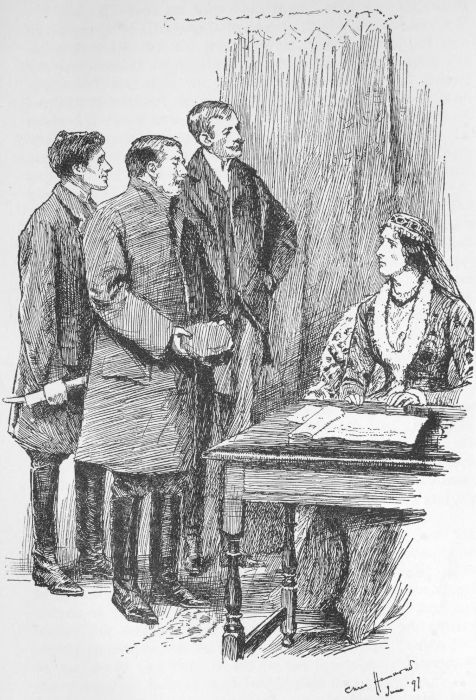
When the door of her cell was beaten in, she came forth as in a dream or
trance, without any wonder, or fear, or question, possessed by one
purpose alone,—to share the fate of her dear father. In the gloom of
the tunnelled rock she glanced at the tall form of her brother, but the
light even there was enough to show that this was not the one she
wanted. And he, having reason from very early days to give a wide berth
to the feminine form, drew aside gladly for a strange young lady to go
her way without compressing him.
For this young fellow, Prince Origen, the son of Imar and Oria, the
child who escaped by his fall into the drift (when Marva's genuine Hafer
perished), being substituted for him, and brought up with plenty of
chastisement, and strict privations, and a candid absence of affection,
had never been encouraged to think, or act, or even to feel for his poor
young self.
What then could be expected of him, when in a moment at one blow the
whole of his world was cut from beneath him, his own identity plucked
away, and not even a quiet corner left for considering who he was, or
how he came to be? In such a case is it surprising that his head went
round so rapidly that he might fairly be said to have lost it? Instead
of attending to his new-found father, he had simply stood staring at the
prostrate form, till moans of despair from that inner cell were brought
to his ear by the chilly draughts of rock. Thereupon he rushed in, and
while I kept the entrance, he used his great strength to such purpose
that his unknown sister glided past him and hurried to their unconscious
father. And truly it was a great mercy for me, as well as a glory to
this grand young fellow, that, instead of waiting longer where he was
not wanted, he ran out at once to obtain fresh air, and get some light
shed upon so many marvels. Rapid action and muscular exertion, for which
he found ample cause at once, probably saved him from congestion of the
brain, and certainly saved me from perforation of the heart.
For why should I make light of my defeats, any more than extol my
victories, which latter it would be hard to do by reason of their
nonentity? Those Ossets had performed an exploit declared to be
impracticable by all the bravest sons of Wykeham during my generation.
That is to say, they had cracked my skull, which was not a piece of
biscuit china, but of solid and heavy metal, sounder I trow than its
contents. And those who have studied the subject tell me that the
thicker the pot is, which nature has provided for our poor brains to
boil in, the more ticklish the job is to make good the splinters. What
tinker can patch an enamelled saucepan? And a queer saucepan must our
brainpan be, if, after all the smut shed round it and the slow smoke
under it, any steam of self-conceit still has a puff to lift the cover.
Let any man who thinks himself a wonder get a bit of his skull (too
small perhaps for a chick to pick up for the good of his gizzard)
crumbled in upon the brain he is so proud of; and if he has the luck to
meet with a friend who can get it out again, when he comes to know his
own name once more, will he count it worth remembering?
But as for myself—because perhaps I had never thought wonders of
it—trouble beyond belief was needful ever to make it sound again. When
I came to know the facts—as I did at last—it may appear a singular
result, but as true as I sat up in bed, the salt tears ran into my soup
so fast that they had to give me another basin. Not through any
weakness, as an ill-natured man might fancy, but just because I was so
happy to come home to a world where loving folk were living, and people
better than myself, who wished to keep me with them.
Perhaps I ought not to talk about it, and yet it seems shabby and
ungrateful not to say how much they had done for me. Here was my sister
Grace, together with her husband Jackson Stoneman, rushing from the
honeycomb of their blue moon among the soft Italian lakes into the
"horrid Caucasus;" and bringing with them by telegraph to Surrey that
wonderfully clever Dr. Hopmann, to whose skill I owe it that my reason
was restored as good as ever it was before, and perhaps even better, for
when it came back it had slept in the dew of humility.
But the doctor's humility was not increased, neither deserved it so to
be. Because the most eminent physician at Tiflis, a Frenchman of vast
renown, being called in at once by my host Sûr Imar, had pronounced all
surgical operation futile, and declared that the owner of that battered
brain might linger on for weeks, until inflammation kindled, but could
never be better than an imbecile, even if he failed to satisfy science
by ending as a raving madman.
"Shorge, my poy," were the first words passed by my ears into any
superior part, "now you let your tongue come—very slowly. Put a good
soup at the back of him, then put him in his house quietly, and go to
shleep again."
"But you haven't finished cooking the partridges yet; and I want to have
the one that is over."
This cupidity might scarcely seem to prove the possession of high
intellect, yet Hopmann declares that the noblest utterance has never
afforded him so fine a moral. "Zat Frenchman! Vot he know, to talk so
quick? No fear for a prain with a memory like zat. Shorge, they kill
bairds all the year round here. Go to shleep while I cook you four
bartriches."
For another week he took good care to keep me in a state of body which
wanted no motion of the mind inside it, nor even any quick heart-action,
except at the sight of a knife and fork. But I feel ashamed to say how
long the disabled body was the lord of all, and the nobler elements of
our existence were not allowed even to speak to it.
"I have dishpelled his shister and his sweetheart off," I heard Dr.
Hopmann say to some one whom I could not see, after he had attended to
my straps one day. "Vot they want? I tell you no. I let you help,
because you not care. His leetle prain stand nothing yet."
"But I do care, because it was all through me," the reply was in a sweet
low voice, as I caught a glimpse of a fair young lady, dressed in black
and retiring towards the door; "you may have got rid of his sister,
doctor, but there is one you will never get rid of, so you may just as
well give it up. How much longer? And I am sure it would do him good.
Why only yesterday I knew——"
"Ach, you be off! I am ze master here. We are not in England, where ze
vimmen rule the roast."
The lady departed hastily, as if she had found that over-true, while the
German bolted the heavy door, and came back with a grin on his solid
ruddy face.
"Am I never to see any one again," I muttered, for gratitude does not
flourish and abound with a man who has spent two months on his back,
"nobody but a confounded German, who bolts everybody out?"
"Zat is shoost vot I vant to hear. Shorge, zat proves how you come
round. If you say, 'Dank you, Tochtor Hopmann, you have saved my life, I
shall never forget it, how can I ever hope to recompensh you?' then I
know that your prain is very weak, not fit for healthy Englishman's at
all. But when you call him a 'confounded Sherman,' he know, he see, that
the nation have come up, which is the most obstinate of nature not to
die. All the same, you lie down again. The world go on very well without
you, Shorge."
It came into my head that this was not quite right, and that as an
honest man I ought to try to stop it; but torpor overpowered my sense of
justice, as it has a right to do, when the case is not our own. "I only
want to know who that lady was," I mumbled.
"Zat gal was nothing of your concerns," Hopmann replied, as he sat down
by the table, and began to rub some cake tobacco he had sliced; "little
English Fräulein of the name of Pezzeril. Zat bad fe-loe you knock
worse than they knock you bring her from England with a heap of lies,
and make sham to marry her; then he throw her off, and drive long black
stick through her brother, because he haf desire of too moosh money.
Englishmans often make mishtakes zat way."
"But I want to know about some one else, somebody different altogether,
somebody who never thinks of money——"
"Ach zen, what fool can it be? Sometimes leetle gal not think of money;
but boys do, vimmen do, men obliged to follow zem."
"Nonsense, doctor! The men set the example. But you know well enough
what I want to know. I want to know where I am, and all about it."
The German came over and looked at me, and turned up one of my eyelids,
and then did the same to the other, while he blew his smoke over his
shoulder; and then he said "No fear. Shorge, you are a brick, and your
prain go the way to belong to him. One leetle drop I give you shoost to
clear both ears, and zen I tell you everyzing."
O double-dyed villain! With my usual faith, I accepted and made the most
of his kind offering; and when I awoke again where was he? Perhaps in a
boat at the mouth of the Rion, listening for the mill-wheels of a
paddle-steamer to grind the slow grit of distance. For a telegram had
reached Karthlos that the vegetable Earl, the good Melladew, lay at the
last twist of our mortal coil internal, through travail on a bicycle
with a County Council lecturer who had taken crab-apples to be
synonymous with crabs.
When this abandonment was first brought home to me, my behaviour was not
what it should have been. We are all too apt to suppose ourselves
neglected, and doubly so when the system has been lowered, and the
action of the heart restricted. To my shame I confess that a miserable
pessimism—such as manhood should scorn on its own behalf, even without
higher thoughts to lead it—invaded and began to vanquish me.
"What is the good of anything? All nature is cruelty; all life a curse.
Every one for himself, and for none of us a God. Bitterness, and
contempt of mankind, and a reckless fight for one's own hand,—those
are the only solid things black destiny has left us. There is no choice
before us. As for sense of duty, or the stuff we call honour, or
patriotism, or the absurdity called love——"
"My dear young friend, my directions are precise and I cannot depart
from them. You may talk as much as you like about flowers, or food, or
sport, or the hills and valleys, or anything in fact that you know
anything about. And while you do that, you may refresh yourself and grow
stronger and stronger with these good things here." Sûr Imar, who had
risen from behind a curtain, pointed to a table which was laden with
fine import of exceedingly attractive fragrance. "On the other hand, if
you insist upon wandering into difficult and unpleasant subjects, which
no man has ever yet made head or tail of, my orders are to anticipate
the inevitable injury to the poor head and enfeebled system by prompt
administration of these two doses." My host laid his hands upon a large
flat bottle nearly full, but with room below the cork to shake up a
profoundity of horrors at the bottom, and a box of pills as big as
bullets. But before he could approach me, my heart and stomach, and
every other organ that can influence opinion underwent a fundamental
change.
"I did not mean it. You must make allowance. Only think of what has been
done to me. Sûr Imar, you are not a small minded man. You can see how a
fellow gets driven to sing out. Emptiness must bear a great deal of the
blame. I entreat you to look at the matter largely. I am ready to vow
that the world is good, and everything contained in it, except—except
that bottle, and that box."
"Hasty conversions are not worth much. But from you, George, we accept
anything. I hope to confirm you in the better faith, with these little
proofs that the world produces one or two things not entirely bad; and
after that, somebody—well, never mind, unless you are inclined to be
amiable."
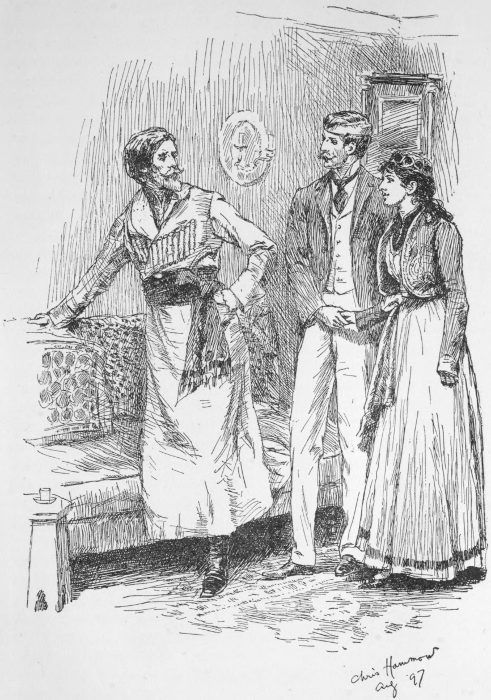
The chief was now in full Lesghian dress, a very magnificent affair to
look at, stately, and graceful, and impressive; but he proved himself
worthy of apparel even grander, by putting away all disrelishing sights,
and waiting upon me like a hospital nurse, until I could compass not a
dainty morsel more, and then he said, "Shut your eyes, and perhaps you
will have a little dream."
Was it a little dream? If so, I pray you tell me of a great one.
Expecting nothing I lay back upon the quiet pillows, quite content, as
young men are—for age destroys that comfort—to fancy that the world is
good, and governed by a gentle Lord who waves a hand when we drop our
eyes, that we may try to look up again. When the pride of strength is
crushed, and violence of the will lies low, and a man is able to take
himself at his proper insignificance, sometimes a little flow of calm
glides in upon his nature, so that all is soft and bright, and his
undulations multiply the silver and gold of heaven.
For behold, as I was gazing with a sweet and tranquil wonder, caring not
to enquire even where I was, or who I was, but taking as it came to me
the good-will of the time, and welcome of the friendly air—behold there
came (as it were a vision, not to be enquired into, but accepted with
the smiles of sleep) the form and face that had never left me,—though
never could I see them clearly,—the presence without which my own
presentment was all absence.
It was not for me to be certain yet, played with as I had been by
visions that cry advantage of the brain, when even a pennyweight thereof
is gone; neither was I clear enough to indulge in bright aerial doubt,
as adolescent genius may. All I knew was "here I am;" and nature needed
no more proof, when I had given myself a substantial pinch. "Is there
any one here or there at all?" I seemed to say, but could not be sure of
uttering or thinking anything.
Then, as sure as I am sitting here this day, the last thing that ever I
could have believed was done concerning me and to me. Dariel came, and I
knew nothing, except that here was Dariel. I feared to look direct, or
even glance as if I meant it, being now little more than a lump of
patches, with gingery tufts among them; and fool enough in my heart to
think that love would be ashamed of me. I cannot say another word to
teach any one who does not know, or do good to one who does. At such a
time is there any man, or even any woman, who notices the tint of
cheeks, the curve of lips, and eyebrows, the guidance of the breath, or
even the quick and tremulous enquiries, and lingering watches of the
eye? My love was looking at me thus, with a sad and piteous misgiving,
whether there might be any hope that I was large of heart as she
was,—for now she felt it trembling,—and yet with some cold arm of
pride and maiden fear thrown round it, to hold it back from being
offered till it had been asked for. And I was looking at my love, with
nothing but abasement, that anything I had ever done could make her feel
afraid of me; and yet with some victorious hope that it was because she
loved me.
"Yes, I do, I do," she said, as if she saw the very thing I wanted to be
sure of. "With all my heart I do. But how shall I make you believe it?
After all that I have done, how can you ever believe it?"
This made me look about and wonder; for all I wanted was her voice,—to
listen to its soft sweet tones, and feel that it was full of kindness,
and know that it was meant for me; and then to see the smile perhaps
that came so often with her words, and never failed to follow them if
ever they forgot themselves.
"You are not to me as you were; you think me of no value now, because I
have not been as true, and obstinate of truth against all signs and
symptoms and testimony, as an English lady would have been. If you have
in your mind decided so to estimate me, there is nothing more for me to
say. Only that you must not think, because you will not let me show it,
that I am base enough not to feel the wonderful things you have done for
us. For me it is nothing, for I am not worth it; but for my father, and
my brother, and for stopping cruel wickedness,—and now they have nearly
killed you, so that you do not even know me."
She had tried to make her meaning clear, by keeping herself a good way
off, and looking at the mountains more than me, and speaking as if her
words came one by one from some type-writer; until the thought of my
mishap and long disablement brought her near. Then I saw how she was
trembling, and withdrawing her hands to hide it, and striving to make
her eyelids proof against the shower inside them. With that the power of
my love arose, and I said, "Dariel, look at me."
"It is impossible any more, after all that I have done."
Even while she spoke she did the impossible thing to such effect that I
partook of the miracle. It seemed to me, as I met that soft deep gaze of
boundless love and hope, as if Heaven had now so gifted and endowed me
with the richest wealth, that humble as my powers were, henceforth I
could do anything.
"I am afraid, I am afraid," she whispered, as she saw my joy. "Love of
my heart, it is not right that you should care for me any more. It is
right for me to love you, and to be your slave for ever. But for you to
hate me, to hate the Dariel you loved once, because she so requited you.
Here you have been worse than dead, worse than dead for weeks and weeks,
after saving all our lives! Through whom? Through me, that could not
trust you, but measured you by my paltry self. But now I know all from
that sly traitor who sent the letter to her wicked brother. Alas, how
wicked I am, too, when he is dead, and she—oh, George, I ought to hate
her, but I cannot, because of her misfortunes! Tell me, George, do you
feel like that? Do you feel that you ought to hate me, because I have
destroyed your poor, poor mind?"
"Well, perhaps I shall, when you have done it. But not till then, my
Dariel. And I think that Dariel owes me something for her compliment to
my intellect."
"Hush! My orders are to keep you perfectly quiet and stupid. I like that
very much, because it appears so soft and easy. But I must not take
advantage,—hush! You want to talk; it is not right."
She laid one sweet soft finger on my lips, and when I closed them,
obedience had its due reward; such as is well known to those who have
been true and faithful, through every doubt and trouble, to the one they
love better than themselves.
"I am the master now," she said, "and I shall make the love to you, and
you will have to put up with it; because you are so helpless, and
because I have robbed you of all chance of doing it to me, when you
could. But one thing I shall insist upon,—you must not want to know
anything about yourself, or even me, or anything that you can think of,
until your poor mind restores itself."
Then I said a thing worthy of Tom Erricker, "I will leave myself in
Dariel's hands, if she will take me into her arms sometimes."
* * *
* *
* * * *
Being so treated I should have shamed England among races who think well
of her, if I had allowed a mere knock on the head to dwell too much upon
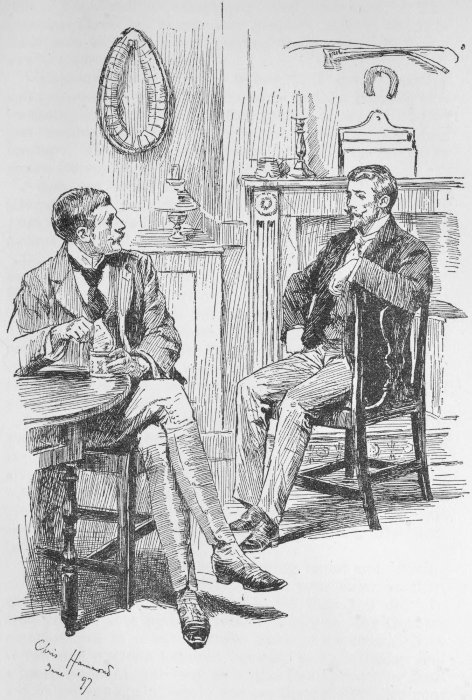
my mind. Strogue came to look at me, and spoke with his usual lofty confidence.
"My son, you have done well and wisely. I fell among a tribe on the
borders of Thibet, who make a point of taking out a piece about the size
of half a crown from the skull of every strong male infant. The folly of
the earth goes out, and the wisdom of the air comes in, according to
their traditions. But I was not allowed to verify their views, and I
found more vigour than wisdom there, for they kicked me over their
border. But you may hope the best. Who knows? You may begin to say
something good at last, and we shall know how you got it."
This was all very well for him, who had not received a single scratch,
and was living now in clover. Let good friends try things for
themselves, and comfort us with their own distress. "Optimism" is a
lovely gift, and comes direct from Heaven, chiefly when the sun shines
on ourselves. But Strogue never listened to argument. "You are the
luckiest fellow," he proceeded, "that I have ever come across. Here you
have had your sister crying over you for days and days, putting her
husband on the shelf, although he is made of money; and then the best
doctor in the world, the only one that ever did any good; and now you
have the loveliest girl ever seen waiting upon you hand and foot; and
more than all without a bit of pain, without even knowing it, you are
made a wise man for the rest of your life, at the age of six-and-twenty.
Stop out here, my boy, stop out here. Your father will have heaps of
money now, from your brother's grand discovery. Sûr Imar has made up his
mind to keep 'Farmer George' for the coffee-growing; you can shoot all
sorts of mountain game, and people the Terek and the Kur with salmon,
and winter at Tiflis or Patigorsk."
As yet I was not in a clear condition to care where I was, or even to
enquire at all about it, so long as the one my whole heart looked for
came for it to dwell with every day. But gradually (I know not how, and
probably none can tell me) a power, almost as strong as love of the
finest and sweetest of our kind, began to grow in my heavy nature.
Everything is now explained, even when a man knocks his brother on the
head, as a piece of hereditary tendency. To enter that plea appears to
me to cast an ungraceful reproach upon those who have gone before us and
done their best according to their lights which we disparage, and
without receiving any credit for the wonderful goodness we derive from
them. Let me blame no one but myself for that unreasonable pining and
hankering for my native land.
"Look at the glory of the sky, look at the mountains and the woods,"
several people said to me, who never looked twice at them when they
could smell their dinner; "look at the grand peaks robed with snow! Can
you see anything like that in England?"
"No. But I can feel the things I see there," I used to answer meekly;
"there may be little grandeur in them, but I love the things I know."
Moreover it came into my jarred and worried mind, that the gentle
satisfaction—the only solid form ever taken by human happiness—is
seldom or perhaps never to be found, when nature is too great around us.
We see perpetual change of form and colour, and a fleeting majesty, and
possibly our puny selves are incited to hopeless rivalry. Or even if
there be nought in that, the sense of danger and wild elements and
powers altogether beyond our control is at enmity with placid thought
and the quiet course of duties; so that it is a sweeter thing, at any
rate for an Englishman, to watch the plough on a gentle slope, or the
cows in a meadow with their hind legs spread ready for the milking-pail,
or the harvest-waggon coming to the rick, than to gaze at all the rugged
grandeur of the Alps or Caucasus.
"My dear friend," Sûr Imar said, when I tried to make him see it so,
"you were not born here, but I was; and that makes all the difference. I
see no more of majesty, or menace, or sublime oppression, when I look at
a peak growing up against the sky, than you find in a tall poplar-tree.
And behold how calm is your Captain Strogue, a man of the world, who
takes nothing amiss."
"Because he has no strict sense of right. He will do what he thinks
honourable, which every man judges by his own side-lights. Forgive me,
Sûr Imar, for speaking so. You have your own standard, and you keep to
it; and it is as much higher than mine, as Kazbek is than a Surrey
hill."
"There you are wrong," he answered gently; "the proof is always in the
practice. And I am proving myself as selfish, and as thoroughly
ungrateful, as if I had always been prosperous. George, you know too
well what I mean. Through you alone, and your wonderful"—it would not
become me to repeat all he said—"I now have not only my life and my
rights, but also a very grand son of my own, whose nature is that of the
sweet one I destroyed; and soon he will help me in the work I hope to
do. Yet I am so mean and small, that I grudge you the one love of your
life, if you insist upon taking her away."
For a moment, as I looked at him, and perceived the sparkle of tears in
his eyes, although his voice was clear and firm, it came home to my
heart that here was a contest of generosity, wherein it would be ignoble
of me not to show some valiance. But a sense of yearning, and perpetual
loneliness, and an empty life, coupled with a doubt of my duty to the
Power which has ordained true love, proved too much for my nobility.
"If you really think, Sûr Imar," I began with a dismal voice, "if you
can reconcile it with your duty as a father to keep your dear child all
to yourself—for she has vowed, I may tell you that, fifty times she has
pledged herself never to have any one but me—and of course I know that
I am poor." This was very mean of me, and I never meant to say it; but
love is mean, as well as grand.
"Then let us settle it this way," he answered, with a proud paternal
smile: "I have been so long in England that I will follow English
usages. Let us leave it to the lady. I will send for Dariel, and she
shall choose between us."
"I pray you not. It would be such a pain and trial to her."
As I spoke, he looked at me with a warmth of true affection.
"George, you love her even more than her own father does," he said;
"you deserve a decision in your favour. But I doubt whether you will get
it. If you do, I resign without conditions. But poverty there need be
none, unless you insist upon it. Mr. Stoneman, your brother-in-law,
entreats me to accept £10,000 for the valley of St. Winifred. Three
railway companies there are, according to his account of it, railing and
raving at one another for the possession of that part of Surrey. They
all declare that such a line can never pay for making, but they would
spend their last shilling upon it, rather than see either of the others
there. Mr. Stoneman is in what you call the bench, the chair, the throne
of the wealthiest of the three; and if he can make purchase of that
track, the rivals will have no chance to pass. I have felt much scruple
about accepting so much for land that cost me so little; the justice of
the matter is not clear to me as a stranger to the English equity."
"Oh, Sûr Imar," I exclaimed with great surprise, "the largest and
noblest of all the Angels, if he got the whip-hand of a Railway Company,
would be compelled by self-respect to take it out of them, to their last
penny."
"So I have been told on every side," the Lesghian chief replied with
calm decision; "but I waited for you to confirm it, George. I perceive
that they are the civilised form of the bandit. Well, that sum which
seems considerable to us, though in England you think nothing of it,
will pass at once to my Dariel, as the strict justice of the case
demands. Of that she knows nothing, and if she knew it, her decision
would be just the same. But here she comes, as I arranged."
The chief window of the sitting-room to which I was now promoted faced
westward over the table-rock on which the great house stood; and further
to the west, beyond deep chasms and dark precipices, arose a mighty Tau,
the rival of Kazbek in this eastern range, and mantled with perpetual
snow. This being flushed with ruddy thrills from the glances of the
evening sun shed a rich tint through the room, as if the rugged
mountains vied with heaven to bring their sweet Princess a tribute of
bright roses. Then as she passed the black walnut panels, which looked
as old as the ark itself, I took it for a good omen that she wore a
dress which I had praised; not such a thing as we see here, but
graceful, elegant, flowing softly, docile, ductile, and yet expressive,
simple though full of harmonious contrasts, zealous—if there were any
hope of that—to enhance the beauty it contained, as a great poet's
thoughts are clothed sometimes in language that transcends themselves.
She glanced at me as I rose, for now I could stand once more without
giddiness, and by that passing glance she told me that she knew the time
was come, when her long choice must be made. Then she went on to her
father's side, and took both his hands and looked at him, as if there
was nobody else to look at.
Over her bowed head he gave me a smile, which I interpreted—"Behold the
vanity of human wishes! Be satisfied with Nature's laws. A dear child
loves her father best. Young men may long to rob him; but the Lord
forbids it. I grieve for you. But how could it be otherwise?"
There was nothing more for me to say. I made the best bow of which a
true-born British back is capable; and with all the dignity left in me
by the beating of my foolish heart, I walked away from both of them
towards a little door which opened on a quiet gallery, where I might sit
down and think it over with myself alone.
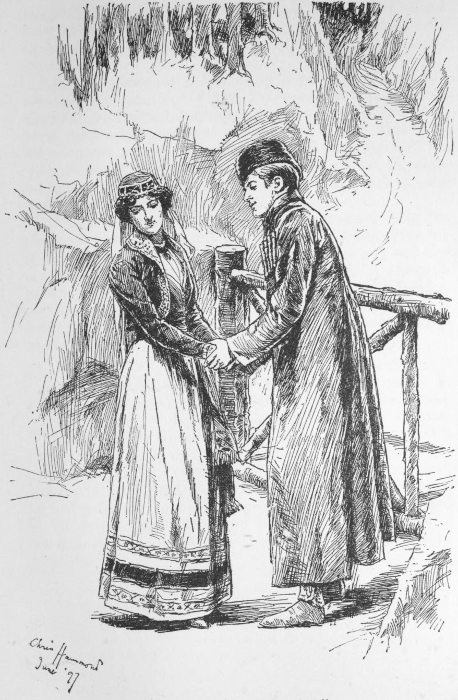
But before I could turn the handle, trembling arms were round my neck,
and a quivering breast arose to mine, and a face that shone with rolling
tears looked up for me to comfort it, and sweet lips whispered close to
mine—"My love, could you believe it?"
Then I felt myself all right again. The strength that had been shattered
by big Osset clubs, and long prostration, lonely wanderings of bloodless
brain, feeble doubts of woman's truth, and the crush of furious doctors,
all flowed back, and filled my heart and life with the joy of this great
love.
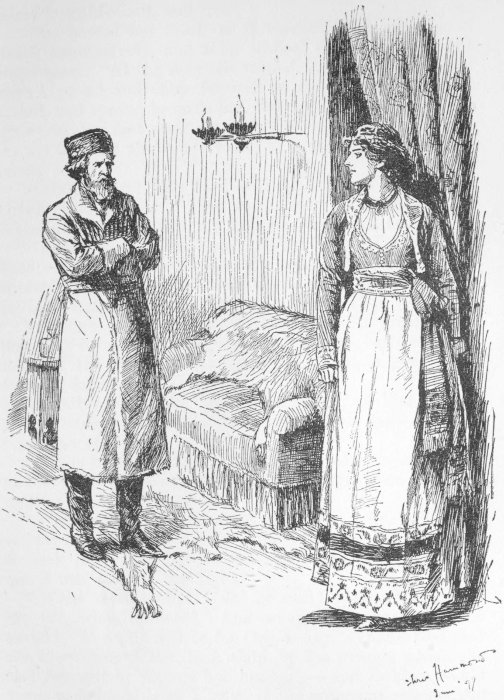
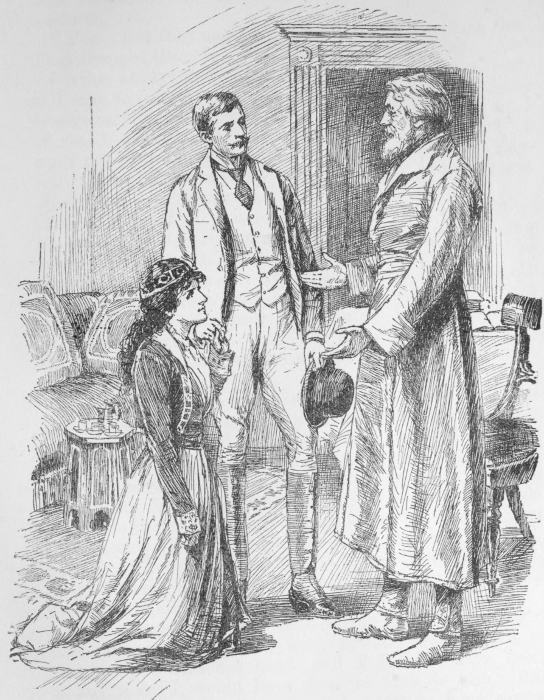
I led his beautiful daughter back to Sûr Imar, and I said—"You see."
"Yes, I see," he answered softly. "And there is no more to be said."
"'Yes, I see,' he answered softly."
PRINTED BY WILLIAM BLACKWOOD AND SONS.