| i. |
Hunza-Nagyr and the Pamirs. |
| ii. |
Recent Events in Chilas and Chitral. |
| iii. |
Fables, Songs, and Legends of Chitral. |
| iv. |
Races and Languages of the Hindukush. |
| v. |
Anthropological Observations and Measurements. |
| vi. |
Rough Itineraries in the Hindukush. |
| vii. |
A Secret Religion in the Hindukush. |
| viii. |
The Sciences of Language and of Ethnology as
illustrated by the Language and Customs of Hunza (a separate Pamphlet). |
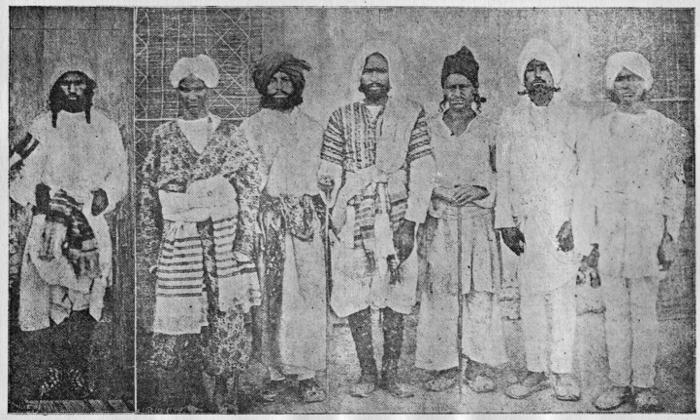
SPECIMENS OF THE BURISHKI RACE OF HUNZA (ON A
SLOPE OF THE PAMIR), OF NAGYR, AND OF YASIN.
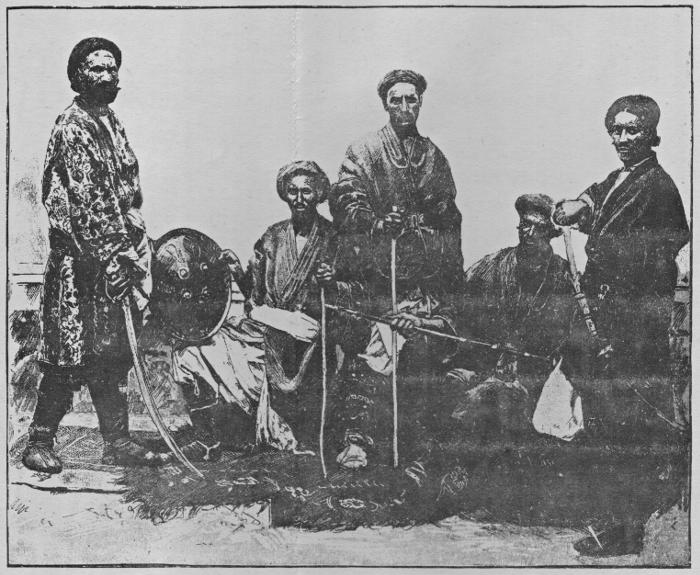
MATAVALLI,
the first Hunza man who came to Europe. |
SOME BURISHKIS FROM YASIN
separating the Hunza and Nagyri Warriors. |
SAYAD ALI,
of Nagyr. |
I wish to record how from small beginnings, owing to
carelessness, exclusiveness, and official desire for promotion,
Northern India may be lost and British interests in Europe
and Asia become subordinate, as they have often been,
to Russian guidance; how statesmanship has laboriously
invited dangers which physical barriers had almost rendered
impossible; and how it may still be practicable to maintain
as independent States the numerous mountain strongholds
which Nature has interposed between encroachment and
intrigue from either the Russian or the English sphere of
action in Asia, much to the benefit of these two Powers
and of the peace of mankind.
When, after an enormous expenditure of men and money
and during campaigns which lasted over thirty-six years,
Russia had conquered independent Circassia—a task in
which she was largely aided by our preventing provisions
and ammunitions from reaching by sea the so-called rebels,
although we ourselves were fighting against her in 1856,
quorum pars parva fui, it was easy to foresee that our conduct,
which some called chivalry, others loyalty, and some
duplicity or folly, would give her the present command of
the Black Sea and lead to the subjugation of Circassia. The
same conduct was repeated at Panjdeh, and may be repeated
on the Pamir, much to the personal advantage of the discreet
officers concerned. We have also recently discovered that
the holding of Constantinople by a neutral Power is not
essential to British interests, as we had long ago found out
that neither Merv nor Herat were keys to India. Indeed,
as we give up position after position, a crop of honours falls
to those who bring about our losses and, like charity, covers
a multitude of political sins of ignorance or treason.
It seemed, however, that there was one obscure corner
which the official sidelight could not irradiate. Valley
after valley, plateau after plateau, high mountains and
difficult passes separate the populations of India from those
of Central Asia. Innumerable languages and warlike races,
each unconquerable in their own strongholds if their
autonomy and traditions are respected, intervene between
invaders from either side who would lead masses of disciplined
slaves to slaughter and conquest. It is not necessary
to draw an imaginary line on Lord Salisbury’s large or
small Map of Asia across mountains and rivers, and dividing
arbitrarily tribes and kingdoms whose ancestry is the
same, call it “the neutral zone.” No sign-board need
indicate “the way to India,” and amid much ado about
nothing by ambitious subordinates and puzzled superiors
settle to the momentary satisfaction of the British public
that Russia can go so far and no farther. Where the
cold, the endless marching over inhospitable ground, and
starvation do not show the frontier, the sparse population,
the unknown tongue, and the bullet of the raider will
indicate it sufficiently, without adding to the number of
generals or knights for demarcating impossible boundaries.
The reassurances given by Lords Lansdowne and Cross
to the native Princes of India indicate the policy that
should be adopted with regard to all the Mountain States
beyond India proper. It is by everywhere respecting the
existing indigenous Oriental Governments that we protect
them and ourselves against invasion from without and
treachery from within. The loyalty of our feudatories is
most chivalrous and touching, but it should be based on
enlightened self-interest in order to withstand the utmost
strain. The restoration of some powers to the Maharaja
of Kashmîr came not a minute too soon. Wherever elsewhere
reasonable claims are withheld, they should be generously
and speedily conceded. The Indian princes know
full well that we are arming them, at their own expense,
against a common foe who is not wanting in promises,
and who is already posing as a saviour to the people of
Raushan, Shignan, Wakhan, Hunza, and even Badakhshan,
whose native dynasties or traditions we have either
already put aside or are believed to threaten.
As for the small States offering a fruitful field for intrigue,
their number and internal jealousies (except against a common
foreign invader) are in themselves a greater safeguard
than the resistance of a big but straggling ally, whose
frontier, when broken through at one of its many weak
points, finds an unresisting population from which all
initiative has disappeared. The intrigue or treachery of
a big ally is also a more serious matter than that of a
little State. What does it matter if English and Russian
agents intrigue or fraternize among the ovis poli, and
the Kirghiz shepherds of the Pamir, or advocate their
respective civilizations in Yasin, Chitrál, Wakhan, Nagyr,
Hunza, etc. Ambitious employes of both empires will
always trouble waters, in order to fish in them; but their
trouble is comparatively innocuous, and resembles that of
Sisyphus when it has to be repeated or wasted in a dozen
States, before the real defences of either India or of Russia
in Asia are reached. Indeed, so far as India is concerned,
the physical difficulties on our side of the Himalayas or of
the Hindukush, except at a few easily defensible passes, are
insuperable to an invader, even after he has crowned the
more approachable heights when coming from the North.
The only policy worthy of the name is to leave the
Pamir alone. Whatever line is drawn, it is sure to be
encroached upon by either side. Races will be found to
overlap it, and in the attempt to gather the fold, as with
the Sarik and Salor Turkomans, a second Panjdeh is sure
to follow. Intrigues will be active on both sides of the
line; and, as in Kashmîr, the worried people will hail the
foreigner as a saviour, so long as he has not taken possession,
when they find his little finger heavier than the whole
body of the indigenous oppressor. I have suffered so much
from my persistent exposure of the misrule and intrigues of
Kashmîr by those who now hail the fait accompli of its
practical annexation, that I may claim to be heard in favour
of at least one feature of its former native administration.
With bodies of troops averaging from 20 to 200, the late
Maharaja, who foresaw what has happened after his death,
kept the Hunza-Nagyr frontier in order. It certainly was
by rule of thumb, and had no dockets, red tape, and reports.
Indeed, his frontier guardians were, as I found them, asleep
during a state of siege in 1866, or, when war was over,
were engaged in storing grain outside the forts; but peace was
kept as it will never be again, in spite of 2,000 Imperial
troops, first-rate roads, and suspension bridges over the
“Shaitan Naré,” instead of the rotten rope-way that spanned
“Satan’s Gorge,” or of boats dragged up from Srinagar
over the mountains to enable a dozen sepoys to cross the
Indus at a time, or to convey couriers with a couple of
bullets, some dried butter-cakes, and an open letter or two,
who ran the siege at Gilgit and brought such effective
reinforcements to its defenders!

Nor has our diplomacy been more effectual than our
arms, as the encounter at Chalt with Hunza-Nagyr,
hereditary foes, but whom our policy has united against us,
has shown. To us Nagyr is decidedly friendly; but a worm
will turn if trodden on by some of our too quickly advanced
subalterns. That, however, the wise and amiable
Chief of Nagyr, a patriarch with a large progeny, and preserving
the keenness of youth in his old age, is really
friendly to us in spite of provocation, may be inferred from
the following letter to me, which does credit alike to his
head and heart, and which is far from showing him to be
our inveterate foe, as alleged by the Pioneer. His eldest
son began to teach me the remarkable Khajuná language,
which I first committed to writing in 1866, during the siege
of Gilgit, and another son continued the lessons in 1886.
The latter is a hostage in Kashmîr, to secure the good
behaviour of his tribe, which is really infinitely superior in
culture and piety to those around them. The father, who
is over 90, writes in Persian to the following effect, after the
usual compliments:—“The affairs of this place are by your
fortune in a fair way, and I am in good health and constantly
ask the same for you from the Throne which grants
requests. Your kind favour with a drawing of the Mosque
has reached me, and has given me much pleasure and
satisfaction. The reason of the delay in its receipt and
acknowledgment is due to the circumstance that, owing to
disturbances (fesád) I have not sent agents to Kashmîr this
year. After the restoration of peace, I will send [a letter]
with them. In the meanwhile, I have caught your hem
[seek your protection] for my son Habibullah Khan, a
beloved son, about whom I am anxious; the aforesaid son
is a well-wisher to the illustrious English Government.—Za’far
Khan.” [The letter was apparently written in
June last, when The Times reported a “rising,” because
the British Agent was at Chalt with 500 men.]
It seems to me that none but a farseeing man could, in
the midst of a misunderstanding, if not a fight, with us, so
write to one in the enemy’s camp, unless he were a true
man alike in war and peace, and a ruler whose good-will
was worth acquiring. As for his son, I know him to be
indeed well-disposed to our Government. He was very
popular among our officers when I saw him in Kashmîr,
owing to his modesty, amiability, and unsurpassed excellence
at Polo. In fact, my friendship with several of the
chiefs since 1866 has aided our good relations with them;
and it is a pity if they should be destroyed for want of a
little “savoir,” as also “savoir faire,” on our part.
Between the States of Nagyr and Hunza there exists a
perpetual feud. They are literally rivals, being separated
by a swift-flowing river on which, at almost regulated
distances, one Nagyr fort on one bank frowns at the
Hunza fort on the other. The paths along the river sides
are very steep, involving at times springing from one ledge
of a rock to another, or dropping on to it from a height of
six feet, when, if the footing is lost, the wild torrent sweeps
one away. Colonel Biddulph does not credit the Nagyris
with bravery. History, however, does not bear out his
statement; and the defeat inflicted on the Kashmîr troops
under Nathu Shah in 1848 is a lesson even for the arrogance
of a civilized invader armed with the latest rifle.
The Nagyris are certainly not without culture; in music
they were proficient before the Muhammadan piety of the
Shiah sect somewhat tabooed the art. At all events, they
are different in character from the Hunzas with whom they
share the same language, and their chiefs the same ancestry.
The Hunzas, in whom a remnant of the Huns may be
found, were great kidnappers; but under Kashmîr influence
they stopped raiding since 1869, till the confusion incidental
to our interference revived their gone occupation.
Indeed, it is asserted on good authority, that even our ally
of Chitrál, who had somewhat abandoned the practice of
selling his Shiah or Kalásha Kafir subjects into slavery,
and who had so disposed of the miners for not working his
ruby mines to profit, has now returned to the trade in men,
“with the aid of our present of rifles and our moral support.”
Nor is Bokhara said to be behind Chitrál in the revival of
the slave-trade from Darwáz, in spite of Russian influence;
so that we have the remarkable instance of two great
Powers both opposed to slavery and the slave-trade, having
revived it in their approach to one another. Nor is a
third Power, quite blameless in the matter; for when we
worried Hunza, that robber-nest remembered its old allegiance
to distant Kitái and arranged with the Chinese
authorities at Yarkand to be informed of the departure of
a caravan. Then, after intercepting it on the Kulanuldi
road, the Hunzas would take those they kidnapped from it
back for sale to Yarkand!
As a matter of fact, we have now a scramble for the
regions surrounding and extending into the Pamirs by
three Powers, acting either directly or through States of
Straw. The claims of Bokhara to Karategin and Darwáz—if
not to Shignán, Raushan, and Wakhan are as
little founded as are those of Afghanistan on the latter three
districts. Indeed, even the Afghan right to Badakhshan
is very weak. The Russian claims through Khokand on
the pasturages of the Kirghiz in two-thirds of the Pamirs
are also as fanciful as those of Kashmir or China on
Hunza. As in the scramble for Africa, the natives themselves
are not consulted, and their indigenous dynasties
have been either destroyed, or dispossessed, or ignored.
In an Indian paper, received by to-day’s mail (29 Nov.,
1891), I find the following paragraph: “Col. A. G. Durand,
British Agent at Gilgit, has received definite orders to bring
the robber tribes of Hunza and Nagar under control. These
tribes are the pirates of Central Asia, whose chief occupation
is plundering caravans on the Yarkand and Kashgar.
Any prisoners they take on these expeditions are sold into
slavery. Colonel Durand has established an outpost at
Chalt, about thirty miles beyond Gilgit, on the Hunza
river, and intends making a road to Aliabad, the capital
of the Hunza chief, at once. That he will meet with armed
opposition in doing so is not improbable.”
For some months past the mot d’ordre appears to have
been given to the Anglo-Indian Press, to excite public
feeling against Hunza and Nagyr, two States which have
been independent for fourteen centuries. The cause of
offence is not stated, nor, as far as I know, does one exist
of sufficient validity to justify invasion. In the Pioneer
and the Civil and Military Gazette I find vague allusions
to the disloyalty or recalcitrance of the above-mentioned
tribes, and to the necessity of punishing them. As Nagyr
is extremely well-disposed towards the British, and is
only driven into making common cause with its hereditary
foe and rival of Hunza by fear of a common danger,—the
loss of their independence,—I venture to point out the impolicy
and injustice of interfering with these principalities.
I have already referred to a letter from the venerable
chief of Nagyr, in which he strongly commends to my care
one of his sons, Raja Habibulla, as a well-wisher of the
English Government. Indeed, he has absolutely done
nothing to justify any attack on the integrity of his country;
and before we invade it other means to secure peace should
be tried. I have no doubt that I, for one, could induce
him to comply with everything in reason, if reason, and not
an excuse for taking his country, is desired. Nagyr has
never joined Hunza in kidnapping expeditions, as is alleged
in the above-quoted paragraph. Indeed, slavery is an
abomination to the pious and peaceful agriculturist of that
interesting country. The Nagyris are musical and were fond
of dances, polo, ibex battue-hunting, archery and shooting
from horseback, and other manly exercises; but the growing
piety of the race has latterly proscribed music and dancing.
The accompanying drawing of a Nagyri dance in the
neighbouring Gilgit gives a good idea of similar performances
at Nagyr.
The country is full of legendary lore, but less so than
Hunza, where Grimm’s fairy tales appear to be translated
into actual life. No war is undertaken except at the
supposed command of an unseen fairy, whose drum is on
such occasions sounded in the mountains. Ecstatic women,
inhaling the smoke of a cedar-branch, announce the future,
tell the past, and describe the state of things in neighbouring
valleys. They are thus alike the prophets, the historians,
and the journalists of the tribe. They probably now tell
their indignant hearers how, under the pretext of shooting
or of commerce, Europeans have visited their country,
which they now threaten to destroy with strange and
murderous weapons; but Hunza is “ayeshó,” or “heaven-born,”
and the fairies, if not the inaccessible nature of the
country, will continue to protect it.
The folly of invading Hunza and Nagyr is even greater
than the physical obstacles to which I have already referred.
Here, between the Russian and the British spheres of influence
in Central Asia, we have not only the series of
Pamirs, or plateaux and high valleys, which I first brought
to notice on linguistic grounds, in the map accompanying
my tour in Dardistan in 1866 (the country between
Kashmir and Kabul), and which have been recently confirmed
topographically; but we have also a large series of
mountainous countries, which, if left alone, or only assured
of our help against a foreign invader, would guarantee for
ever the peace alike of the Russian, the British, and the
Chinese frontiers. Unfortunately, we have allowed Afghanistan
to annex Badakhshan, Raushan, Shignan, and
Wakhan, at much loss of life to their inhabitants; and Russia
has similarly endorsed the shadowy and recent claims of Bokhara
on neighbouring provinces, like Darwáz and Karategin.
It is untrue that Hunza and Nagyr were ever tributaries
of Kashmîr, except in the sense that they occasionally sent
a handful of gold dust to its Maharaja, and received substantial
presents in return. It is to China or Kitái that
Hunza considers itself bound by an ancient, but vague,
allegiance. Hunza and Nagyr, that will only unite against
a foreign common foe, have more than once punished
Kashmîr when attempting invasion; but they are not hostile
to Kashmîr, and Nagyr even sends one of the princes to
Srinagar as a guarantee of its peaceful intentions. At the
same time, it is not very many months ago that they gave
us trouble at Chalt, when we sought to establish an outpost,
threatening the road to Hunza and the independence
alike of Hunza and Nagyr.
Just as Nagyr is pious, so Hunza is impious. Its religion
is a perversion even of the heterodox Mulái faith,
which is Shiah Muhammadan only in name, but pantheistic
in substance. It prevails in Punyál, Zebak, Darwáz, etc.
The Tham, or Raja, of Hunza used to dance in a Mosque
and hold revels in it. Wine is largely drunk in Hunza,
and like the Druses of the Lebanon, the “initiated” Muláis
may consider nothing a crime that is not found out. Indeed,
an interesting connection can be established between
the doctrines of the so-called “Assassins” of the Crusaders,
which have been handed down to the Druses, and those
of the Muláis in various parts of the Hindukush. Their
spiritual chief gave me a few pages of their hitherto mysterious
Bible, the “Kelám-i-Pir,” in 1886, which I have
translated, and shortly intend to publish. All I can now
say is, that, whatever the theory of their faith, the practice
depends, as elsewhere, on circumstances and the character
of the race.
The language of Hunza and Nagyr solves many philological
puzzles. It is a prehistoric remnant, in which a
series of simple consonantal or vowel sounds stands for
various groups of ideas, relationships, etc. It establishes
the great fact, that customs and the historical and other
associations of a race are the basis of the so-called rules of
grammar. The cradle, therefore, of human thought as
expressed in language, whether of the Aryan, the Turanian,
or the Shemitic groups, is to be found in the speech of
Hunza-Nagyr; and to destroy this by foreign intervention,
which has already brought new diseases into the Hindukush,
as also a general linguistic deterioration, would be a
greater act of barbarism than to permit the continuance of
Hunza raiding on the Yarkand road. Besides, that raiding
can be stopped again, by closing the slave-markets of
Badakhshan, Bokhara, and Yarkand, or by paying a subsidy,
say of £1,000 per annum, to the Hunza chief.
Indeed, as has already been pointed out, the recrudescence
of kidnapping is largely due to the state of insecurity
and confusion caused by our desire to render the Afghan
and the Chinese frontiers conterminous with our own, in
the vain belief that the outposts of three large and distant
kingdoms, acting in concert, will keep Russia more effectively
out of India than a number of small independent
republics or principalities. Afghanistan may now be big,
but every so-called subject in her outlying districts is her
inveterate foe. As stated in a letter from Nevsky to the
Calcutta Englishman, in connection with Colonel Grambcheffsky’s
recent explorations:
“One and all, these devastated tribes are firm in their
conviction that the raids of their Afghan enemies were
prompted and supported by the gold of Abdur Rahman’s
English protectors. They will remember this on the plateau
of Pamir, and among the tribes of Kaffiristan.”
However colourable this statement may be as regards
Shignán, Raushan, and perhaps even Wakhan, I believe
that the Kafirs are still our friends. At the same time it
should not be forgotten that, owing to the closing of the
slave-markets in Central Asia, the sale of Shiah subjects
had temporarily stopped in Chitrál. The Kafirs were being
less molested by kidnapping Muhammadan neighbours; the
Hunzas went back to agriculture, which the Nagyris had
never abandoned; Kashmîr, India, and the Russian side of
Central Asia afforded no opening for the sale of human beings.
The insensate ambition of officials, British and Russian,
the gift of arms to marauding tribes and the destruction
of Kashmîr influence, have changed all this, and it is only
by a return to “masterly inactivity,” which does not mean the
continuance of the Cimmerian darkness that now exists as
to the languages and histories of the most interesting races
of the world, that the peace and pockets of three mighty
empires can be saved.
In the meanwhile, it is to the interest of Russia to force
us into heavy military expenditure by false alarms; to create
distrust between ourselves and China by pretending that
Russia and England alone have civilizing missions in
Central Asia, with which Chinese tyranny would interfere;
to hold up before us the Will-o’-the-wisp of an impossible demarcation
of the Pamirs, and finally, to ally itself with China
against India. For let it not be forgotten, that once the
Trans-Siberian railway is completed, China will be like wax
in her hand; and that she will be compelled to place her immense
material in men and food at the disposal of an
overawing, but, as far as the personnel is concerned, not
unamiable neighbour. The tribes, emasculated by our
overwhelming civilization, and driven into three large camps,
will no longer have the power of resistance that they now
possess separately.
Let us therefore leave intact the two great belts of territories
that Nature has raised for the preservation of peace
in Asia—the Pamir with its adjacent regions to the east
and west, and the zone of the Hindukush with its hives of
independent tribes, intervening between Afghanistan on
the one side and Kashmîr on the other, till India proper is
reached. This will never be the case by a foreign invader,
unless diplomatists “meddle and muddle,” and try to put
together what Nature has put asunder. What we require
is the cultivation of greater sympathy in our relations with
natives; and, comparing big things with small, it is to this
feeling that I myself owed my safety, when I put off the disguise
in which I crossed the Kashmîr frontier in 1866 into
countries then wrongly supposed by our Government to be
inhabited by cannibals. This charge was also made, with
equal error, by one tribe against the other. Then too, as
in 1886, the Indian Press spoke of Russian intrigues; but
then, as in 1886, I found the very name of Russia to be unknown,
except where it had been learnt from a Kashmîr
Munshi, who had no business to be there at all, as the treaty of
1846, by which we sold Kashmîr to Ghulab Singh, assigned
the Indus as his boundary on the west. Now, as to the
question as to “What and where are the Pamirs?” I have
already stated my view in a letter to the Editor of the
Morning Post, which I trust I may be allowed to quote:
“As some of the statements made at the Royal Geographical
Society are likely to cause a sense of false
security, as dangerous to peace as a false alarm, I write to
say that ‘Pamirs’ do not mean ‘deserts,’ or ‘broken valleys,’
and that they are not uninhabitable or useless for movements
of large bodies of men. They may be all this in
certain places, at certain periods of the year, and under
certain conditions; but had our explorers or statesmen paid
attention to the languages of this part of the world, as
they should in regard to every other with which they deal,
they would have avoided many idle conjectures and the
complications that may follow therefrom. I do not wish
them to refer to philologists who have never been to the
East, and who interpret ‘Pamir’ as meaning the ‘Upa-Meru’
Mountain of Indian mythology, but to the people
who frequent the Pamirs during the summer months, year
after year, for purposes of pasturage, starting from various
points, and who in their own languages (Yarkandi, Turki,
and Kirghiz) call the high plain, elevated valley, table-land, or
plateau which they come across ‘Pamir.’ There are, therefore,
in one sense many ‘Pamirs,’ and as a tout-ensemble,
one ‘Pamir,’ or geographically, the ‘Pamir.’ The legend of
the two brothers, ‘Alichur and Pamir,’ is merely a personification
of two plateaux. Indeed, the obvious and popular
idea which has always attached to the word ‘Pamir,’ is the
correct one, whether it is the geographical ‘roof of the
world,’ the ‘Bám-i-dunya’ of the poet, or the ‘Pamir-dunya’
of the modern journalist. We have, therefore, to
deal with a series of plateaux, the topographical limits of
which coincide with linguistic, ethnographical, and political
limits. To the North, the Pamirs have the Trans-Altaic
Mountain range marking the Turki element, under Russian
influence; the Panja river, by whatever name, on the West is
a Tadjik or Iranian Frontier [Affghan]. The Sarikol on the
East is a Tibetan, Mongolian, or Chinese Wall, and the South
is our natural frontier, the Hindukush, to go beyond which is
physical death to the Hindu, and political ruin to the holder
of India, as it also is certain destruction to the invader,
except by one pass, which I need not name, and which is
accessible from a Pamir. That the Pamirs are not uninhabitable
may be inferred from Colonel Grambcheffsky’s
account [which is published at length elsewhere in this issue
of the Asiatic Quarterly Review]. A few passages from it
must now suffice:—‘The Pamir is far from being a wilderness.
It contains a permanent population, residing in it both
summer and winter.’ ‘The population is increasing to a
marked extent.’ ‘Slavery on the Pamir is flourishing:
moreover, the principal contingents of slaves are obtained
from Chatrar, Jasen, and Kanshoot, chanates under the
protectorate of England.’ ‘On descending into Pamir we
found ourselves between the cordons of the Chinese and
Affghan armies.’ ‘The population of Shoognan, numbering
2,000 families, had fled to Pamir, hoping to find a refuge
in the Russian Provinces’ (from ‘the untold atrocities which
the Affghans were committing in the conquered provinces of
Shoognan,’ etc.). ‘I term the whole of the tableland “Pamir,”
in view of the resemblance of the valleys to each other.’
“The climate of the Pamirs is variable, from more than
tropical heat in the sun to arctic cold in the shade, and in
consequence, is alike provocative and destructive of life.
Dr. G. Capus, who crossed them from north to south, exactly
as Mr. Littledale has done, but several months in the year
before him, says in his ‘Observations Météorologiques sur
le Pamir,’ which he sent to the last Oriental Congress,—‘The
first general fact is the inconstancy of severe cold.
The nights are generally coldest just before sunrise.’ ‘We
found an extreme amplitude of 61 deg. between the absolute
minimum and maximum, and of 41 deg. between the minimum
and the maximum in the shade during the same day.’
‘The thermometer rises and falls rapidly with the height of
the sun.’ ‘Great cold is less frequent and persistent than
was believed to be the case at the period of the year dealt
with’ (March 13 to April 19), ‘and is compensated by
daily intervals of elevation of temperature, which permit
animal life, represented by a fairly large number of species,
and including man, to keep up throughout the winter under
endurable conditions.’ Yet ‘the water-streak of snow,
which has melted in contact with a dark object, freezes
immediately when put into the shadow of the very same
object.’ ... The solution of political difficulties in Central
Asia is not in a practically impossible, and certainly unmaintainable,
demarcation of the Pamirs, but in the strengthening
of the autonomy of the most interesting races that inhabit
the series of Circassias that already guard the safety alike
of British, Chinese, and of Russian dominion or spheres of
influence in Central Asia.”
Woking, Nov. 29.
It is not impossible that the tribes may again combine
in 1892 as they did in 1866 to turn out the Kashmîr troops
from Gilgit. The want of wisdom shown in forcing on the
construction of a road from Chalt to Aliabad, in the centre
of Hunza, as announced in to-day’s Times, must bring on, if
not a confederation of the tribes against us, at any rate their
awakened distrust. It is doubtful whether it was ever expedient
to establish an outpost at Gilgit, and the carrying it
still farther to the traditional apple of discord, the holding of
Chalt, which commands the Hunza road, is still more impolitic.
As in Affghanistan, so here, whatever power does not
interfere is looked upon as the saviour from present evils.
Once we have created big agglomerations under Affghanistan,
or China, or Kashmir, we are liable to the dangers following
either on collapse, want of cohesion, treachery from
within, the ambitions of a few men at the respective courts,
or, as with us, to serious fluctuations in foreign politics due to
the tactics of English parties. The change, therefore, from
natural boundaries to the wirepulling of diplomatists at
Kabul, Peking, or Downing Street is not in the interests
of peace, of our empire, or of civilization. Besides, it should
not be forgotten that we have added an element of disturbance,
far more subtle than the Babu, to our frontier
difficulties. The timid Kashmîri is unsurpassed as an
intriguer and adventurer among tribes beyond his frontier.
The time seems to have arrived when, in the words of the
well-known Persian proverb,[107] the sparseness of races round
the Pamirs should bid us to be on our guard against the
Affghan, the “bad-raced” Kashmîrî, and the Kambó (supposed
to be the tribe on the banks of the Jhelum beyond Mozaffarabad).
Perhaps, however, the Kambó is the Heathen
Chinee; and the proverb would then be entirely applicable
to the present question. After the construction of the
Trans-Siberian Railway, Russia will be able to exert the
greatest pressure on China. The Russian strength at
Vladivostok is already enormous, and when the time comes
she can hurl an overwhelming force on what remains of
Chinese Manchuria, before which Chinese resistance will
melt like snow. Peking and the north of China are thus
quite at the mercy of Russia. She will find there the most
populous country of those she rules in Asia, and with ample
supplies. China has a splendid raw material, militarily
speaking; and Russia could there form the biggest army
that has ever been seen in Asia, to hold in terrorem over a
rival or to hurl at the possessions of a foe.
It is against such possibilities that the maintenance of
“masterly inactivity,” qualified by the moral and, if need
be, pecuniary or other material support of the Anglo-Indian
Government is needed. This is the object of this paper,
before I enter into the more agreeable task of describing
the languages, customs, and country of perhaps the most
interesting races that inhabit the globe.
The Times of the 30th November publishes a map of
the Pamirs and an account of the questions connected with
them that, like many other statements in its articles on
“Indian affairs,” are incorrect and misleading. Having
been on a special mission by the Panjab Government, in
1866, when I discovered the races and languages of
“Dardistan,” and gave the country that name, and again
having been on special duty with the Foreign Department
of the Government of India in 1886 in connection with
the Boorishki language and race of Hunza, Nagyr, and a
part of Yasin, regarding which I have recently completed
Part I. of a large work, I may claim to speak with some
authority as regards these districts, even if I had no other
claim. The point which I wish to specially contradict at
present, is the one relating to the Russians bringing themselves
into almost direct contact with “the Hunza and other
tribes subject to Kashmîr and, as such, entitled to British
protection and under British control.”
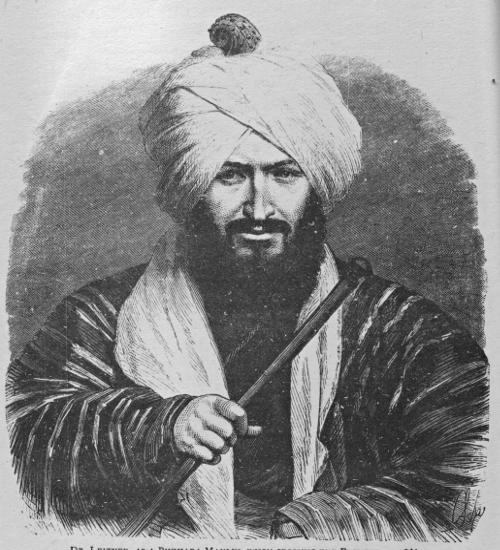
Dr. Leitner as a Bukhara Maulvi,
when crossing the Frontier in 1866 during the Kashmîr War with
the Dard Tribes.
When I crossed the then Kashmîr frontier in 1866, in
the disguise of a Bokhara Maulvi, armed with a testimonial
of Muhammadan theological learning, I found that the
tribes of Hunza, Nagyr, Dareyl, Yasin, and Chitrál had
united under the leadership of the last-named to expel the
Kashmîr invaders from the Gilgit Fort. My mission was
a purely linguistic one; but the sight of dying and dead
men along the road, that of heads stuck up along the
march of the Kashmîr troops, and the attempts made on
my life by our feudatory, the late Maharaja of Kashmîr,
compelled me to pay attention to other matters besides
the languages, legends, songs, and fables of the interesting
races with whom I now came in contact under circumstances
that might not seem to be favourable to the accomplishment
of my task. I had been warned by the then
Lieutenant-Governor of the Panjab, Sir Donald McLeod,
whose like we have not seen again, not to cross the frontier,
as the tribes beyond were supposed to be cannibals; but as
I could not get the information of which I was in search
within our frontier, I had to cross it. My followers were
frightened off by all sorts of wild stories, till our party was
reduced from some fifty to three, including myself. The
reason for all this was, that the Maharaja was afraid that
I should find out and report his breach of the Treaty by
which we sold Kashmîr to him in 1846, and in which the
Indus is laid down as his boundary on the west. In 1866,
therefore, at any rate, even the tenure of Gilgit, which is
on the other side of the Indus, was contested and illegal,
whilst the still more distant Hunza and Nagyr had more
than once inflicted serious punishment on the Kashmîr
troops that sought to invade districts that have preserved
their autonomy during the last fourteen centuries, as was
admitted by The Times of the 2nd November, 1891, before
its present change with the times, if an unintentional pun
may be permitted.
Then, as ever, the Anglo-Indian newspapers spoke of
Russian intrigues in those regions. I am perfectly certain
that if, instead of the fussiness of our statesmen and the
sensationalism of our journals, the languages, history, and
relations of these little-known races had been studied by
them, we should never have heard of Russia in that part of
the East. It is also not by disingenuousness and short
cuts on maps or in diplomacy, but by knowledge, that
physical, ethnographical, and political problems are to be
solved; nor will the bold and brilliant robberies of Russia
be checked by our handing over the inhabitants of the
supposed “cradle of the human race” to Affghan, Kashmîr,
or Chinese usurpations. Above all, it is a loss of time to
palm off myths as history in order to suit the policy or
conceal the ignorance of the moment.
Just as little as Darwaz and Karategin are ancestral
dominions of Bokhara, and, therefore, under Russian influence,
so little did even Badakhshan, and much less so,
Raushan, Shignan, and Wakhan, ever really belong to
Affghanistan. As for the Chinese hold on Turkistan, we
ourselves denied it when we coquetted with Yakub Khush
Begi, though Kitái was ever the acknowledged superior
of Eastern Turkistan. If Hunza admits any allegiance,
it is to China, and not to Kashmîr; and the designations
of offices of rule in that country are of Chinese, and not of
Aryan origin, including even “Thàm,” the title of its Raja.
As a matter of fact, however, the vast number of tribes
that inhabit the many countries between the Indus and the
Kuner own no master except their own tribal head or the
tribal council. From kidnapping Hunza, where the right to
plunder is monarchical, hereditary, and “ayeshó” = “heaven-born,”
to the peace and learning of republican Kandiá or
Gabriál, all want to be left alone. If a neighbour becomes
troublesome, he is raided on till an interchange of presents
restores harmony. It is impossible to say that either side
is tributary to the other. The wealthier gives the larger
present; the bigger is considered the superior in a general
sort of way, and so two horses, two dogs, and a handful of
gold dust are yearly sent by Hunza to Kashmîr or to Yarkand
as a cloak for much more substantial exactions in return.
Nagyr sends a basket of apricots instead of the horses and
dogs. In 1871 Chitrál still paid a tribute to Badakhshan
in slaves, but it would be absurd to infer from this fact that
Chitrál ever acknowledged the suzerainty of Jehandar Shah,
or of the Affghan faction that dispossessed him. Nor were
the Khaibaris, or other highway robbers, our rulers, because
we paid them blackmail, or they our subjects because they
might bring us “sweetmeats.”
The points in which most Englishmen are as deficient
as Russians are generally proficient, are language and a
sympathetic manner with natives. That, however, linguistic
knowledge is not useless may be inferred from the fact that
it enabled me, to use the words of my Chief, Commissary
General H. S. Jones, C.B., during the Russian War in 1855,
“to pass unharmed through regions previously unknown
and among tribes hitherto unvisited by any European.”
Also in topography and geography linguistics are necessary;
and the absurd mistakes now made at certain learned
societies and in certain scientific journals, regarding the
Pamirs, would be avoided by a little study of the Oriental
languages concerned. In 1866, the map which accompanies
my philological work on “Dardistan” shows, on linguistic
grounds, and on the basis of native itineraries, the various
Pamirs that have been partially revealed within the last
few weeks, or have been laboriously ascertained by expensive
Russian and British expeditions between 1867
and 1890. The publication of my material, collected at my
own expense and which shall no longer be delayed, would
have saved many complications; but when, e.g., I pointed out,
in 1866, that the Indus, after leaving Bunji, ran west instead
of south, as on the then existing maps, I got into trouble
with the Topographical Survey, which “discovered” the
fact through its well-known “Mulla” in 1876. The salvation
of India that is not made “departmentally” is crucified;
and whoever does not belong to the regular military or civil
services has no business to know or to suggest. Mr. Curzon,
when presiding at a meeting of the late Oriental Congress,
assured us that a new era had risen; but only the other
night, at the Royal Geographical Society, a complaint was
made of the reluctance of official departments in giving
the Society information. As a rule, the mysteriousness of
offices only conceals their ignorance, of which we have an
instance in Capt. Younghusband being sent to shut the
passes after the Russians had already stolen a march on, or
through, them.
The neutralization of the Pamirs is the only solution of a
difficulty created by the conjectural treaties of diplomatists
and the ambition of military emissaries. Left as a huge
happy hunting-ground for sportsmen, or as pasturage for
nomads from whatever quarter, the Pamirs form the most
perfect “neutral zone” conceivable. That the wanderings
of these nomads should be accompanied by territorial or political
claims, whether by Russia, China, Affghanistan, Kashmir,
or ourselves, is the height of absurdity. As for Hunza-Nagyr,
the sooner they are left to themselves the better
for us, who are not bound to help Kashmîr in encroaching
on them. Kashmîr managed them very fairly after 1848;
and when it was occasionally defeated, its prestige did not
suffer, for the next summer invariably found the tribal envoys
again suing for peace and presents. The sooner the Gilgit
Agency is withdrawn, the greater will be our reputation
for fair dealing. Besides, we can take hostages from the
Chiefs’ families as guarantees of future tranquillity. Hunza-Nagyr
are certainly not favourable to Russia, whilst Nagyr
is decidedly friendly to us. The sensational account of
Colonel Grambcheffsky’s visit to Hunza, which he places on
his map where Nagyr is, seems to be one of the usual traps
to involve us in great military expenditure and to alienate
the tribes from us. It is also not creditable that, for party
or personal purposes, the peaceful and pious Nagyris,—whom
our own Gilgit Resident, Colonel Biddulph, has reported on
as distinguished for “timidity and incapacity for war,” “never
having joined the Hunza raids,” “slavery being unknown in
Nagyr,”—should be described as “kidnappers,” “raiders
along with Hunza,” “slave-dealers,” “robbers,” and “scoundrels,”—statements
made by a correspondent from Gilgit in
a morning newspaper of to-day, and to all of which I give an
unqualified contradiction.
The establishment of the Gilgit Agency has already drawn
attention to the shortest road for the invasion of India; and
it is significant that its advocate at Gilgit should admit that
all the tribes of the Indus Valley “sympathized with the
Hunzas,” from whose depredations they are erroneously supposed
to have suffered, and that they were likely “to attack
the British from behind by a descent on the Gilgit road” to
Kashmîr. Why should “the only other exit from Gilgit by
way of the Indus Valley be through territories held by tribes
hostile to the British”? Have the Gilgit doings already
alienated the poor, but puritanical Chilásis, tributaries of
Kashmîr, who adjoin our settled British district of Kaghan?
Are we to dread the Republic of Muhammadan learning,
Kandiá, that has not a single fort; pastoral Dareyl; the
Koli-Palus traders; agricultural Tangir, and other little
Republics—one only of eleven houses? As for the places
beyond them, our officials at Attock, Peshawur, Rawalpindi,
and Abbottabad will deal with the Pathan tribes in their
own neighbourhood, which have nothing to do with the
adjoining Republics of quiet, brave, and intelligent Dards, on
both sides of the Indus, up to Gilgit, to which I have referred,
and which deserve our respectful study, sympathy,
and unobtrusive support.
G. W. Leitner.
16th December, 1891.
The following account, published by Reuter’s Telegram Company, will
supplement the preceding article:—
“Woking, Dec. 13.
“A representative of Reuter’s Agency interviewed Dr. Leitner at his residence at
Woking to-day, with the object of eliciting some information on the subject of the Hunza
and Nagyr tribes, with whom the British forces are at present in conflict.
“Dr. Leitner, it is needless to say, is the well-known discoverer of the races and
languages of Dardistan (the country between Kabul and Kashmir), which he so named
when sent on a linguistic mission by the Punjab Government in 1864, at a time when the
various independent tribes, including Hunza and Nagyr, had united in order to turn the
troops of the Maharaja of Kashmir out of Gilgit. At that time it was considered that
the treaty of 1846, by which Great Britain sold Kashmir to the Maharaja, had confined
him to the Indus as his westward boundary, and had therefore rendered his occupation
of Gilgit an encroachment and breach of treaty.
“Dr. Leitner, although the country was in a state of war, which is not favourable to
scientific research, managed to collect a mass of information, and a fine ethnographical
collection, which is at the museum at Woking. He has also made many friends in the
country, and is doubtless the highest, if not the only, authority regarding these countries.
“Dr. Leitner, who was quite unprepared for to-day’s visit, said that the relations
which he had kept up with the natives of Gilgit, Hunza, Nagyr, and Yasin forced him
to the conclusion that a conflict had been entered into which might have easily been
avoided by a little more sympathy and knowledge, especially of the Nagyr people. Indeed,
it was not a light matter that could have induced the venerable chief of Nagyr to
make common cause with his hereditary foe of Hunza, unless he feared that the British
threatened their respective independence.
“Not many weeks ago Dr. Leitner received a letter from the chief of Nagyr, in which
he recommended to his kind attention his son, now in Kashmir, on the ground that he,
even more so than any other member of his numerous family, was a well-wisher to the
British Government. At that time the chief could not have had any feelings of animosity,
although he might have protested, together with his rival of Hunza, against the British
occupation of Chalt. In fact, it was not true that Nagyr and Hunza were really subject
to Kashmir, except in the vague way in which these States constantly recognised the
suzerainty of a neighbouring power in the hope of getting substantial presents for their
offerings of a few ounces of gold dust, a couple of dogs, or basket of apricots, etc. Thus
Chitrál, the ally of Great Britain, used to pay a tribute of slaves to the Ameers of
Badakshan; but it would be absurd on that ground to render Chitrál a part of Afghanistan,
because Badakshan now, in a manner, belongs to Abdurrahman. Hunza, again,
sends a tribute to China; and, in a general way, China is the only Power that ever had
a shadow of claim on these countries, but it is a mere shadow. Dr. Leitner said, the
only policy for Great Britain is, in the words of the Secretary of State or Viceroy, ‘to
maintain and strengthen all the indigenous Governments.’ This policy he would extend
to the triangle which has Peshawur for its base, and thereby interpose a series of almost
impregnable mountainous countries, which would be sufficiently defended by the independence
of their inhabitants. If Circassia could oppose Russia for thirty years, even
although Russia had the command of the Black Sea, how much more effective would be
the resistance of the innumerable Circassias which Providence had placed between ourselves
and the Russian frontier in Asia? We ought to have made these tribes look upon
us as a distant but powerful friend, ready to help them in an emergency; but now, by
attacking two of them, we caused Russia to be looked upon as the coming Saviour; indeed,
the people of Wakhan, on the Pamir side of Hunza, were already doing so, whilst
Shignan and Roshan, which had been almost depopulated by our friends, the Afghans,
had already begun to emigrate into Russian territory. Here Dr. Leitner added that the
Russian claims through Bokhara were as illusory as those of Kashmir, and historically
even less founded than those of China. Indeed, no one had a right to these countries
except the indigenous peoples and chiefs who inhabited them; and in this scramble for
the regions round the Pamir, great Britain was simply breaking down her natural defences
by stamping out the independence of native tribes and making military roads; for
it was the absence of those roads on the British side that rendered it impossible to an
invader to do England any real harm or to advance on India proper.
Asked why the trouble had broken out at the present time, Dr. Leitner said, that he
had been kept without information of the immediate cause, but he felt certain that it was
owing to the attempt to construct a military road to Hunza, whereby England would only
facilitate the advent of a possible invader from that direction, besides making Hunza
throw in its lot with that invader. It was perfectly untrue, as alleged in some of the
Indian papers, that the Nagyris were kidnappers, and that our attack would be an advantage
to the cause of anti-slavery. The fact was just the other way. Kidnapping had
been stopped in 1869 as far as Hunza was concerned.
The Nagyris never raided at all; Chitrál also gave up selling its Káfir or Shiah
subjects into slavery when the markets of Badakshan were closed; but now that confusion
had caused the English and Russian advance, Hunza had again taken to raiding, and
Chitrál to selling slaves. As for Nagyr, the case was quite different; they were an
excellent people and very quiet, so much so that Colonel Biddulph, the Resident, described
them as “noted for timidity and incapacity for war,” whereas in his “Tribes of the Hindu
Kush” he also states that the people of Hunza are not warlike in the sense in which the
Afghans are said to be so. No doubt the Nagyris dislike war, but would fight bravely if
driven to do so. Colonel Biddulph adds: “They are settled agricultural communities,
proud of the independence they have always maintained for fourteen centuries, hemmed
in by lofty mountains, and living under rulers who boast of long, unbroken descent from
princes of native blood.” He also bears testimony to the fact that “the Nagyr people
were never concerned in these raids, and slavery does not exist among them.” At the
same time Dr. Leitner fully admitted that the Hunza people were not a model race,
since they used to be desperate raiders and kidnappers, and very immoral and impious.
The father of the present king used to dance in a state of drunkenness in the mosque; but,
on the other hand, we were not bound to be the reformers of Hunza by pulling down one
of the bulwarks to our Indian Empire. Hunza was a picturesque country in every sense;
it was nominally governed by fairies: ecstatic women were the prophetesses of the tribe,
recounted its past glories, and told what was going on in the neighbouring valleys, so
they were its historians and journalists as well as its prophetesses. No war was undertaken
unless the fairies gave their consent, and the chief fairy, Yudeni, who protects the
“Tham” (a Chinese title), has no doubt already struck the sacred drum in order to call
the men of the country to defend the “Heaven-born,” as their chief is called. The two
“Thams” of Hunza and Nagyr, who have a common ancestry, are also credited with the
power of causing rain, and there would certainly appear to be some foundation for this
remarkable fact.
The two tribes are great polo players; archery on horseback is common amongst
them; and they are very fair ibex hunters.
The people of Nagyr are as pious and gentle as those of Hunza are the contrary.
Their language went back to simple sounds as indicative of a series of human relations
or experiences, and clearly showed that the customs and associations of a race were at the
basis of so-called rules of grammar. Nothing more wonderful than their language could
be conceived; it went to the root of human thought as expressed in language, but the
language had already suffered by foreign influences between 1866, when one son of the
Rajah of Nagyr taught him, and 1886, when another son of the Rajah continued his
lessons.
As regards religion, the Hunzas are Mulais, a mysterious and heretical sect, akin to
the Druses of the Lebanon, practising curious rites, and practically infidels. He had
obtained a few pages of their secret Bible, the Kelam-i-pir, which throws much light on
the doctrines of the so-called “assassins” during the Crusades. The Nagyris are pious
Muhammadans of the Shiah denomination.
Dr. Leitner then showed the map accompanying his linguistic work on Dardistan.
After comparing it with the most recent Russian and British maps, that of Dr. Leitner
gives the fullest and clearest information, not only as regards Hunza-Nagyr, where all
the places where fighting has occurred are marked, but also as regards the various
Pamirs, thus anticipating in 1866 on linguistic grounds and native itineraries the different
Pamirs that have recently been settled geographically. It shows that the ethnographical
frontier of the Pamirs to the north are the Turki-speaking nomads of the trans-Altaic
range (now Russian); to the west the Persian, or Tajiks (now Afghan); to the south
the Aryan Hindu Kush [British]; and to the east the wall of the Serikol Mountains,
dividing or admitting Chinese, Tibetan, or Mongolian influence. The indeterminate
river courses through the Pamir, or a line stretched across its plateaux, valleys, and
mountains, are obviously an unmaintainable demarcation, which is liable to be transgressed
by shepherds under whatever rule; but the whole of the Pamirs together, as a huge and
happy hunting-ground, are, no doubt, if neutralized by the three Powers concerned, the
best possible frontier, as “no man’s land,” and a perfect neutral zone. “What matter,”
continued Dr. Leitner, “if the passes are easy of access on the Russian side, it is on the
descent, and on the ascent on our side that almost insuperable difficulties begin. Where
we are now fighting in Hunza-Nagyr only the low state of the river which divides Hunza
from Nagyr enables us to make a simultaneous advance on both. Otherwise we should
have to let ourselves man by man down from one ledge of rock to another, and if we
miss our footing be whirled away in the most terrible torrent the imagination can conceive.
Why, then, destroy such a great defence in our favour if Hunza is kept friendly,
as it so easily can be, especially with the pressure exercised on it by the Nagyris,
whose forts frown on those of Hunza all down the river that separates their countries?
I cannot conceive anything more wanton or suicidal than the present advance even if we
should succeed in removing one of the most important landmarks in the history of the
human race by shooting down the handful of Nagyris and Hunzas that oppose us. They
preserve the pre-historic remnants of legends and customs that explain much that is still
obscure in the life and history of European races. A few hundred pounds a year judiciously
spent and the promise of the withdrawal of the Gilgit Agency, which was
already once before attacked when under Colonel Biddulph, would be a far better way of
securing peace than shooting down with Gatlings and Martini-Henry rifles people who
defend their independence within their crags with bows, arrows, battleaxes, and a few
muskets; and promise of the withdrawal of the Gilgit Agency might be contingent
upon the increase of the number of hostages belonging to the chiefs’ families that
are now annually sent to Kashmir as a guarantee of friendly relations.
The Hunzas and Nagyris are not to be despised as foes; they are very good marksmen.
In 1886, when the Kashmir troops thought they had cleared the plain before the Gilgit
Fort entirely of enemies, and not a person was to be seen outside it, the tribesmen would
glide along the ground unperceived behind a stone pushed in front of them, and resting
their old flint muskets on them shoot off the Maharajah’s Sepoys whenever they showed
themselves outside the fort. Indeed, it was this circumstance that induced Dr. Leitner
to abandon the protection of the fort and make friends with the tribesmen outside. All
the tribes desired was to be left alone in their mountain fastnesses. They had sometimes
internecine feuds, but would unite against the common foe. It was merely emasculating
their powers of resistance to subject them, either on the one side to Bokhara, which
meant Russia, or to Afghanistan or Kashmir, which meant Great Britain, or to China,
which meant dependence on a Power that might be utilized any day against Great Britain
after the completion of the trans-Siberian railway. Diplomatists, frontier delimitation
commissions, and officers, both British and Russian, anxious for promotion, had, continued
Dr. Leitner, created the present confusion; and it was now high time to rely
rather on the physical obstacles that guaranteed the safety alike of the British, Russian,
and Chinese frontiers than on the chapter of political accidents.
Dr. Leitner, who is going to give a lecture at the Westminster Town-hall to-morrow
afternoon on “The Races, Religions, and Politics of the Pamir Regions,” then showed our
representative Col. Grambcheffsky’s map, which put Hunza where Nagyr ought to be, and
ignored the latter place altogether, just as did the last map of the Geographical Society
in connection with Mr. Littledale’s tour. Grambcheffsky’s map, however, had since been
corrected by evidently an English map, and it was strange that Russians had easier access
to English maps than Englishmen themselves. In fact, all this secrecy, Dr. Leitner
maintained, was injurious to the acquisition of full knowledge regarding imperfectly known
regions. Attention was then directed to a number of maps, that of Mr. Drew, a Kashmir
official, showing Hunza-Nagyr to be beyond Kashmir influence. This was practically
confirmed by several official maps and the statements of Colonels Biddulph and Hayward,
the latter of whom placed the Kashmir frontier towards Hunza at Nomal, whilst the
British are now fighting sixteen and a half miles beyond in front of Mayun, where the
first Hunza fort is. The Nagyr frontier Dr. Leitner places at Jaglot, which is nineteen
miles from Nilt, where we are simultaneously fighting the first Nagyr fort.
Dr. Leitner, in conclusion, expressed his conviction, from his knowledge of the people
concerned, that any one with a sympathetic mind could get them to do anything in reason;
but that encroachments, whether overt or covert, would be resisted to the utmost. Indeed,
England’s restlessness had brought on the present trouble.
In 1866, he stated, the very name of Russia was unknown in these parts, and in 1886
was only known to a few. Yet the English Press in both these years spoke of Russian
intrigues among the tribes. He did not fear them as long as the Indian Empire relied on
its natural defences, its inner strength, and on justice to its chiefs and people, and as
long as its policy with the tribes was guided by knowledge and good feeling.
In 1866 I was sent by the Punjab Government on a linguistic
mission to Kashmir and Chilás at the instance of
the Bengal Asiatic Society and on the motion of the late
Sir George Campbell, who hoped to identify Kailás or the
Indian Olympus with Chilás.[108] Although unable to support
that conjecture, I collected material which was published in
Part I. of my “Dardistan” and which the Government declared
“as throwing very considerable and important light
on matters heretofore veiled in great obscurity.” That
some obscurity still exists, is evident from the Times
telegram of to-day (5th December, 1892), in which an item
of news from the Tak [Takk] valley is described as coming
from Chitrál, a distant country with which Chilás has
nothing to do. The Takk village is fortified, and through
the valley is the shortest and easiest road to our British
district of Kaghán. It is alleged that some headmen of
Takk wished to see Dr. Robertson at Gilgit, who thereupon
sent a raft to bring them, but the raft was fired on and
Capt. Wallace, who went to its assistance, was wounded.
[Chilás is on the Kashmir side of the Indus, and the
Gilgit territory is reached by crossing the Indus at Bunji.]
The incident is ascribed either to “the treachery of the
men who professed willingness to come in” or to the mischievousness
of “other persons.” It is probable from this
suggestion of treachery and the unconscious use of the words
“to come in,” which is the Anglo-Indian equivalent for
“surrender,” that the headmen of Takk were not willing to
make over their Fort to the British or to open the road to
Gilgit. The Takk incident, therefore, is not a part of the
so-called “Chitrál usurpation,” under which heading it
immediately appears, but is a part of our usurpation on the
tribes inhabiting the banks of the Indus. In 1843, these
tribes inflicted a severe loss on the Sikh invaders, and
in my “history of the wars with Kashmir” the part
taken by the manly defenders of Takk, now reduced from
131 to some 90 houses, is given in detail. It seems to
me that as the Gilgit force was unable to support “the
Chitrál usurpation” of our protégé, Afzul-ul-Mulk, owing
to his being killed by his uncle Sher Afzul, it is to be
employed to coerce the Indus tribes to open out a road
which ought never to have been withdrawn from their
hold. About 50 years ago the Takk men were stirred
into so-called rebellion by Kashmir agents in order to
justify annexation. It is to be hoped that history will not
repeat itself, or that, at any rate, the next 50 years will see
the Indus tribes as independent and peaceful as they have
been since 1856, especially in Chilás (before 1892), and as
mysterious as Hunza ought to have remained till our unnecessary
attack on that country caused practically unknown
Russia to be looked upon as the Saviour of Nations “rightly
struggling to be free” (see Baron Vrevsky’s reply to the
Hunza deputation). Quem Deus vult perdere, prius dementat;
and no greater instance of folly can be conceived,
than the construction of a military road through countries
in which the chamois is often puzzled for its way. Nor
was the attention of the Russians drawn to them before
we made our own encroachments.
As for the Pamirs, whatever may be the present interpretation
of Prince Gortchakoff’s Convention, the Russians were
unwilling to let political consequences or limits accompany
the erratic wanderings of Kirghiz sheep in search of pasturage
in that region. Prince Gortchakoff’s advocacy of a
Neutral Zone and of the autonomy of certain tribes was
justified by the facts (which he, however, rather guessed
than knew) and was worthy alike of that Diplomatist and
of our acceptance in the interests of India and of peace.
The incorporation of certain Districts in the domain, or
under the sphere of influence, of Afghanistan, was distasteful
to tribes attached to their hereditary rulers or to republican
institutions and was not too willingly accepted by the
Amir of Afghanistan, who now expects us to defend the
white Elephants that we have given him better than we
did Panjdeh. Some Muláis that had fled from Russian
tyranny to Afghan territory assured me that “the finger of
an Afghan was more oppressive than the whole Russian
army.” Indeed, so far as Central Asia is concerned, Russia,
with the exception of certain massacres, has hitherto behaved,
on the whole, as a great civilizing power.[109]
As for Sirdar Nizám-ul-Mulk, this is his name and not
his title. He is the “Mihtar” or “Prince” Nizám-ul-Mulk,
and neither an Indian “Sirdár” nor a “Nizám.” He is also
the “Badshah” of Turikoh, this being the district assigned
to him in his father’s lifetime as the heir-apparent. He was
snubbed by us for offering to relieve that excellent officer,
Col. Lockhart, when a prisoner in Wakhan! He has written
to me from Turikoh for “English phrases and words with
their Persian equivalents as a pleasure and a requirement.”
This does not look like hostility to the British. He spoke
to me in 1886 of his brother Afzul’s bravery with affection
and pride, though he has ever maintained his own acknowledged
right as the successor of his father Amán-ul-Mulk.
If he has been alienated from us or has ever been tempted
to throw himself into the arms of Russia, it has most
assuredly been our fault. Besides, just as we have abandoned
the Shiah Hazaras, our true friends during the late
Afghan War, to be destroyed by their religious and political
foe, the Sunni Amir Abdurrahman, so have the Amir Sher
Ali and the Tham of Hunza, Safdar Ali Khan, rued their
trust in Russian Agents. I regret, therefore, to find in the
Times telegram of to-day that “the Nizám” “is acting
without the support of the British Agent” “who has not
interfered,” when he had already interfered in favour of
the usurper Afzul-ul-Mulk.
As for the connivance of Amir Abdurrahman, my “rough
history of Dardistan from 1800 to 1872” shows that, in one
sense, Chitrál is tributary to Badakhshán and as we have
assigned Badakhshán to the Amir, he, no doubt, takes an
interest in Chitrál affairs. I believe, however, that interest
to be somewhat platonic, and he knows that his friend
Jehandár Shah (the late wrongfully deposed hereditary ruler
of Badakhshán) never paid any tribute to Afghanistan. But
Chitrál once also paid tribute to Dîr, with whose able Chief,
Rahmat-ullah-Khan, “the Nizám” is connected by marriage.
Chitrál on the other hand has received a subsidy from
Kashmir since 1877, but this was as much a tribute from
Kashmir to Aman-ul-Mulk, as a sign of his subjection to
Kashmir, for shortly after he made offers of allegiance to
Kabul. With all alike it is
“The good old rule, the simple plan,
That they should take who have the power
And they should keep who can.”
It is misleading to speak of their relations to neighbouring
States as “tributary.” Are the Khyberis tributary
to us or we to them, because we pay them a tribute to
let our merchants travel through their Pass? Have we
never ourselves come, first as suppliants, then as merchants,
then as guests, then as advisers, then as protectors, and,
finally, as conquerors?
The procedure of Afghanistan, of Chitrál, of Kashmir,
and of our own is very much alike and so are the several
radii of influence of the various factors in “the question.”
We have our fringe of independent frontier tribes with
whom we flirt, or wage war, as suits the convenience of the
moment. Afghanistan has a similar fringe of independent
Ishmaelites round it and even through it, whose hands are
against everybody and everybody’s hands against them.
Chitrál is threatened all along its line by the Kafirs, who
even make a part of Badakhshán insecure, but are nevertheless
our very good friends. Kashmir has its fringe on
its extreme border, especially since, in violation of our treaty
of 1846, it has attacked countries beyond the Indus on the
west, including the Kunjûtis of Hunza, who resumed their
raiding—which had ceased in 1867—during and after
Col. Lockhart’s visit in 1886. Yet there can be little
doubt about “the loyalty” of those concerned. The
Amirs of Afghanistan consider themselves “shields of
India,” as I have heard two of them say, and so did our
Ally of Kashmir, who ought never to have been reduced to
a subordinate feudatory position. What wonder then that
old Amán-ul-Mulk of Chitrál should also have tried to
become a buffer between Afghanistan on the West,
Kashmir on the East, India on the South and, latterly,
Russia in the North, if indeed the whole story of Russian
intrigue in Chitrál be at all truer than a similar mare’s nest
which we discovered in Hunza? It is the policy of Russia
to create false alarms and thereby to involve us in expenditure,
whilst standing by and posing as the future saviour of
the tribes. Our tendency to compromises and subservient
Commissions of delimitation and to “scuttling” occasionally,
is also well known and so we are offered in Russian
papers “an Anglo-Russian understanding on the subject of
Chitrál,” as if Chitrál was not altogether out of the sphere
of Russia’s legitimate influence! It is also amusing to
find in the Novosti that Russia’s sole desire is “to prevent
Afghanistan from falling into British hands.” We are
already spending at Gilgit on food etc. for our troops more
in one year than were spent in the 40 years of the so-called
mismanagement of Kashmir, which I myself steadily exposed,
but which kept the frontier far more quiet than it has been
since the revival of the Gilgit Agency. There is every
prospect now of heavier and continued expenditure as the
policy of the Foreign Department of the Government of
India develops. On that policy a veto should at once be put
by the British Parliament and public, if our present Liberal
Administration cannot do so without pressure from without.
We should conciliate Nizam-ul-Mulk before it is too late.
He is connected with Umra Khan of Jandôl and with the
influential Mullah Shahu of Bajaur through his maternal
uncle, Kokhan Beg. He has also connections in Badakhshan,
Hunza and Dîr, as already stated. Indeed, we ought to
have given him our support from the beginning. I doubt
whether it would be desirable to subdivide Chitrál as
stated in to-day’s Times, letting Sher Afzul keep Chitrál
proper, giving Yasin to “the Nizám” and letting Umra
Khan retain what he has already seized of Southern Chitrál.
As for Sher Afzul, I believe, that he is also “loyal.”
As for Hunza, I am not at all certain that the fugitive,
Safdar Ali Khan, really murdered his father. At all
events when the deed was committed, I find that it was
attributed to Muhammad Khan,[110] probably not the present
Mir Muhammad Nazim who has acknowledged the
suzerainty of England (through Kashmir) and of China.
The latter power has always had something to say to
Hunza, and the very title of its Chief “Tham” is of
Chinese origin. The subsidy that China used to pay for
keeping open the commercial road from Badakhshan and
Wakhan through the Pamirs along Kunjût (Hunza) to
Yarkand, was about £380 per annum, and this sum was
divided between four States and ensured the immunity
of the route from raids.[111] I doubt whether in future
£380 a year on Hunza alone will enable us to keep it
quiet, and I am sure that the lofty superciliousness with
which Chinese officials discuss the Pamir question, as
something that scarcely concerns them, is no evidence of
that pertinacious power abandoning claims to a suzerainty
in those regions which are historically founded, although
their exercise has been more by an appeal to imagination
of the glorious and invincible, if distant, “Khitái,” than
by actual interference.
Indeed, it is China alone that has a grievance—against
Russia for the occupation of the Alichur Pamir—against
Afghanistan for expelling her troops from Somatash (of
subsequent Yanoff fame)—and against England for encroaching
on her ancient feudatory of Hunza, whose services
in suppressing the Khoja rebellion in 1847 are commemorated
in a tablet on one of the gates of Yarkand.
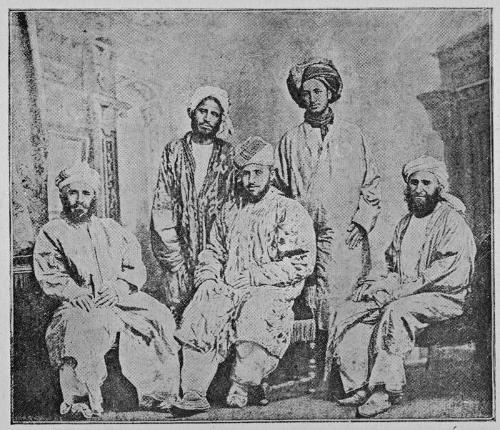
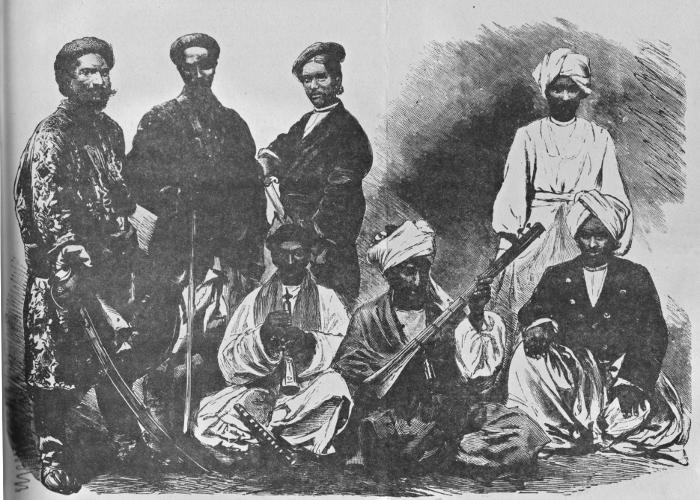
H. H. Mihtar Nizam-ul-Mulk and his late Yasin Council.
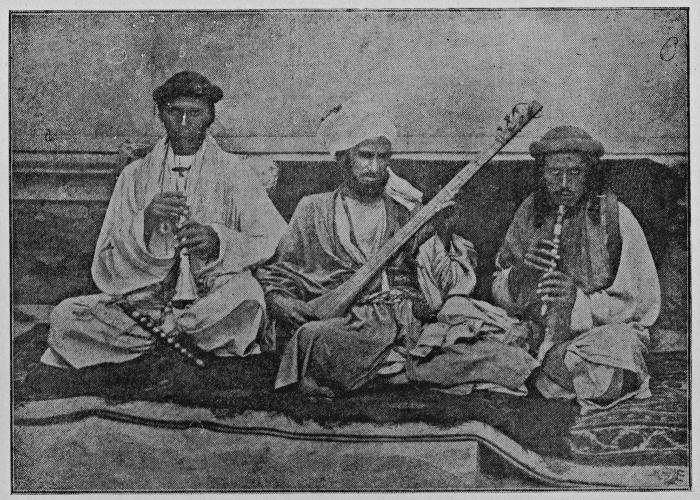
Chitrali Musicians and the Badakshi Poet, Taighun Shah.
Note.—We add a reproduction of the photographs of the Mihtar and
Badshah Nizam-ul-Mulk, sitting in Council with his uncle, Bahadur Khan,
now at Gilgit, where he represented Afzul-ul-Mulk. On the Nizam’s left is
his foster-uncle, Maimun Shah, whilst behind him stand our Indian Agent,
Wafadár Khan and a Chitráli office-holder, Wazîr Khan, of corresponding
rank. We also give the portrait of the Chitrál Court poet and musician, the
celebrated Taighûn Shah, one of whose songs, with its notation, was
published in our issue of the 1st of January, 1891. He is seated with
the two flute-players who always precede the King of Chitrál when on
a tour.
Although the period may be past in which a great
English Journal could ask, “what is Gilgit?” the contradictory
telegrams and newspaper accounts which we receive
regarding the countries adjoining Gilgit show that the
Press has still much to learn. Names of places, as far
apart as Edinburgh and London, are put within a day’s
march on foot. Names of men figure on maps as places
and the relationships of the Chiefs of the region in question
are invented or confounded as may suit the politics of the
moment, if not the capacity of the printer. The injunctions
of the Decalogue are applied or misapplied, extended or
curtailed, to suit immediate convenience, and a different
standard of morality is constantly being found for our
friends of to-day or our foes of to-morrow. The youth
Afzul-ul-Mulk was credited with all human virtues and
with even more than British manliness, as he was supposed
to be friendly to us. He had given his country into our
hands in order to receive our support against his elder
brother, the acknowledged heir of the late Aman-ul-Mulk
of Chitrál, but that elder brother, Nizám-ul-Mulk, was no
less friendly to English interests, although he has the
advantage of being a man of capacity and independence.
The sudden death of Aman-ul-Mulk coincided with the
presence of our protégé at Chitrál, and the first thing that
the virtuous Afzul-ul-Mulk did, was to invite as many
brothers as were within reach to a banquet when he
murdered them. No doubt, as a single-minded potentate,
he did not wish to be diverted from the task of governing
his country by the performance of social duties to
the large circle of acquaintances in brothers and their
families which Providence bestows on a native ruler or
claimant in Chitrál and Yasin. A member of the Khush-waqtia
dynasty of Yasin, which is a branch of the Chitrál
dynasty, told me when I expressed my astonishment at the
constant murders in his family: “A real relative in a high
family is a person whom God points out to one to kill as
an obstacle in one’s way, whereas a foster-relative (generally
of a lower class) is a true friend who rises and falls with
one’s own fortune” (it being the custom for a scion of
a noble house to be given out to a nurse.)
The dynasty of Chitral is said to have been established
by Baba Ayub, an adventurer of Khorassan. He adopted
the already existing name of Katór, whence the dynasty
is called Katore. The Emperor Baber refers to the
country of Katór in his Memoirs and a still more ancient
origin has been found in identifying Katór with “Kitolo,
the King of the Great Yuechi, who, in the beginning of
the 5th century, conquered Balkh and Gandhara, and
whose son established the Kingdom of the Little Yuechi,
at Peshawur.” (See Biddulph’s “Tribes of the Hindoo
Koosh,” page 148.) General Cunningham asserts that the
King of Chitrál takes the title of Shah Kator, which has
been held for nearly 2,000 years, and the story of their
descent from Alexander may be traced to the fact that
they were the successors of the Indo-Grecian Kings in
the Kabul valley. If Katór is a corruption of Kaisar,
then let it not be said that the remnant of the Katore
exclaimed with the Roman gladiator: “Ave, Kaisar-i-Hind,
morituri te salutant.”
Amán-ul-Mulk, the late ruler of Chitrál, was, indeed, a
terrible man, who to extraordinary courage joined the arts
of the diplomatist. He succeeded his elder brother, surnamed
Adam-Khôr or “man-eater.” His younger brother,
Mir Afzul, is said to have been killed by him or to have
committed a convenient suicide; another brother, Sher
Afzul, who is now in possession of Chitrál, was long a
fugitive in Badakhshan whence he has just returned with
a few Afghans (such as any pretender can ever collect) and
a hundred of the Chitráli slaves that used to be given in
tribute to the Mir of Badakhshan, which itself never paid
a tribute to Kabul before the late Sher Ali of Afghanistan
installed Mahmud Shah, who expelled his predecessor
Jehandar Shah, the friend of Abdur-Rahman, the present
Amir of Afghanistan. Another brother of Aman-ul-Mulk
was Kokhan Beg, whose daughter married the celebrated
Mullah Shahu Baba, a man of considerable influence in
Bajaur, who is feared by the Badshah of Kunar (a feudatory
of Kabul and a friend of the British) and is an enemy of
the Kamôji Kafirs, that infest one of the roads to Chitrál.
This Kokhan Beg, who was a maternal uncle of Afzul-ul-Mulk,
was killed the other day by his brother Sher Afzul
coming from Badakhshan. I mention all this, as in the
troubles that are preparing, the ramifications of the interests
of the various pretenders are a matter of importance. Other
brothers of Aman-ul-Mulk are: Muhammad Ali (Moriki),
Yádgar Beg, Shádman Beg and Bahádur Khán (all by a
mother of lower degree), and another Bahádur Khán, who
was on the Council of Nizám-ul-Mulk. Nizám-ul-Mulk has
therefore to contend with one or more of his uncles, and
by to-day’s telegram[112] is on his way to the Chitrál Fort in
order to expel Sher Afzul with the aid of the very troops
that Sher Afzul had sent to turn out Afzul-ul-Mulk’s
Governor from Yasin. I believe that Nizám-ul-Mulk has
or had two elder half-brothers, Gholam of Oyôn and Majid
Dastagir of Drôshp; but, in any case, he was the eldest
legitimate son and, according to Chitrál custom, was
invested with the title of Badshah of Turikoh, the rule of
which valley compelled his absence from Chitrál and not
“his wicked and intriguing disposition” as alleged by certain
Anglo-Indian journals. Of other brothers of Nizám-ul-Mulk
was Shah Mulk (of lower birth), who was Governor of
Daraung and was killed by Afzul-ul-Mulk. He used to live
at Dros (near Pathan in Shashi). Afzul-ul-Mulk of Drasun,
whom we have already mentioned as a wholesale fratricide,
was killed in his flight to one of the towers of the Chitrál
Fort from the invading force of his uncle, Sher Afzul of
Badakhshan. A younger half-brother is also Behram-ul-Mulk
(by a lower mother), called “Viláyeti,” of Moroi in
Andarti. Other brothers are: Amin-ul-Mulk, a brother of
good birth of Oyôn (Shoghôt), who was reared by a woman
of the Zondré or highest class; Wazir-ul-Mulk (of low
birth) of Brôz; Abdur-Rahman (low-born) at Owir (Barpèsh),
and Badshah-i-Mulk, also of Owir, who was reared
by the wife of Fath-Ali Shah. There are no doubt other
brothers also whose names I do not know. Murid, who
was killed by Sher Afzul, is also an illegitimate brother.
A few words regarding the places mentioned in recent
telegrams may be interesting: Shogôth is the name of a
village, of a fort, and of a district which is the north-western
part of Chitrál, and it also comprises the Ludkho
and tributary valleys. Through the district is the road
leading to the Dara and Nuqsán passes, to the right and
left respectively, at the bottom of which is a lake on which
official toadyism has inflicted the name of Dufferin in supersession
of the local name. Darushp (Drôshp) is another big
village in this district and in the Ludkho valley, and Andarti
is a Fort in it within a mile of the Kafir frontier. The inhabitants
of Shogôth are descendants of Munjanis, whose
dialect (Yidgah) I refer to elsewhere, and chiefly profess to
be Shiahs, in consequence of which they have been largely
exported as slaves by their Sunni rulers. Baidam Khan, a
natural son of Aman-ul-Mulk, was the ruler of it. The
Ludkho valley is traversed by the Arkari river which falls
into that of Chitrál. At the head of the Arkari valley are
three passes over the Hindukhush, including the evil-omened
“Nuqsán,” which leads to Zeibak, the home of the
heretical Maulais (co-religionists of the Assassins of the
Crusades) in Badakhshán. It is shorter, more direct, and
freer from Kafir raids than the longer and easier Dora pass.
Owir is a village of 100 houses on the Arkari river, and is
about 36 miles from Zeibak. Drasan is both the name
of a large village and of a fort which commands the Turikoh
valley, a subdivision of the Drasan District, which is the
seat of the heir-apparent to the Chitrál throne (Nizám-ul-Mulk).
Yet the Pioneer, in its issue of the 5th October
last, considers that Lord Lansdowne had settled the question
of succession in favour of Afzul-ul-Mulk, that Nizám-ul-Mulk
would thus be driven to seek Russian aid, but that
any such aid would be an infringement of the rights of
Abdur-Rahman. Now that Abdur-Rahman is suspected,
on the flimsiest possible evidence, to have connived at Sher
Afzul’s invasion of Chitrál, we seek to pick a quarrel with
him for what a few weeks ago was considered an assertion
of his rights. Let it be repeated once for always that if ever
Abdur-Rahman or Nizám-ul-Mulk, or the Chief of Hunza
or Kashmir or Upper India fall into the arms of Russia, it
will be maxima nostra culpa. I know the Amir Abdur-Rahman,
as I knew the Amir Sher Ali, as I know Nizám-ul-Mulk,
and of all I can assert that no truer friends to England
existed in Asia than these Chiefs. Should Abdur-Rahman
be alienated, as Sher Ali was, or Nizám-ul-Mulk might be,
it will be entirely in consequence of our meddlesomeness
and our provocations. Russia has merely to start a will-o’-the-wisp
conversation between Grombcheffsky and the
Chief of Hunza, when there is internal evidence that
Grombcheffsky was never in Hunza at all, and certainly
never went there by the Muztagh Pass, that we, ignoring the
right of China and of the treaty with Kashmir in 1846,
forgetful of the danger in our rear and the undesirability
of paving for an invader the road in front, fasten a quarrel
on Hunza-Nagyr, and slaughter its inhabitants. No abuse
or misrepresentation was spared in order to inflame the
British public even against friendly and inoffensive Nagyr.
What wonder that a Deputation was sent from Hunza to
seek Russian aid and that it returned contented with presents,
and public expressions of sympathy which explained
away the Russian official refusal as softened by private
assurances of friendship? Whatever may be the disaster to
civilization in the ascendancy of Russian rule, the personal
behaviour of Russian agents in Central Asia is,
generally, pleasant. As in Hunza, so in Afghanistan, some
strange suspicion of the disloyalty of its Chief, suggested by
Russia, may involve us in a senseless war and inordinate
expense, with the eventual result that Afghanistan must be
divided between England and Russia, and their frontiers in
Asia become conterminous. Then will it be impossible for
England ever to oppose Russia in Europe, because fear of
complications in Asia will paralyze her. Then the tenure of
India will depend on concessions, for which that country is
not yet ripe, or on a reign of terror, either course ending in
the withdrawal of British administration from, at any rate,
Northern India. Yet it is “Fas ab hosti doceri,” and when
Prince Gortschakoff urged the establishment of a neutral
zone with autonomous states, including Badakhshan, he advocated
a policy that would have conducted to centuries of
peace and to the preservation of various ancient forms of
indigenous Oriental civilization by interposing the mysterious
blanks of the Pamirs and the inaccessible countries
of the Hindukush between Russian and British aggression.
Instead of this consummation so devoutly to be wished,
and possible even now, though late, if action be taken under
good advice and in the fulness of knowledge, either Power—
“Thus with his stealthy pace
With Tarquin’s ravishing strides, towards his design
Moves like a ghost.”
If ever the pot called the kettle black, it is the story of
Anglo-Russian recriminations. Russian intrigues are ever
met by British manœuvres and Muscovite earth-hunger can
only be paralleled by English annexations. Here a tribe
is instigated to revolt, so that its extermination may “rectify
a boundary,” there an illusory scientific frontier is gradually
created by encroachments on the territories of feudatories
accused of disloyalty, if not of attempts to poison our
agents. By setting son against father, brother against
brother and, in the general tumult, destroying intervening
republics and monarchies, Anglo-Russian dominions are
becoming conterminous. Above all
“There’s not a one of them but in his house
I keep a servant fee’d.”
And it is this unremitting suspicion which is alike the secret
of present success and the cause of eventual failure in
wresting and keeping Asiatic countries and of the undying
hatred which injured natives feel towards Europeans.
The attempt to obtain the surrender of the Takk fort,
and of the Takk valley, a short and easy road to the
British District of Kaghán, has merely indicated to Russia
the nearest way to India, just as we forced her attention
to Hunza and are now drawing it to Chitrál. David
Urquhart used to accuse us of conspiracy with Russia in
foreign politics. Lord Dufferin in his Belfast speech sought
the safety of India in his friendship with M. de Giers and
his Secretary popularized Russia in India by getting his
work on “Russia” translated into Urdu. Certainly the
coincidence of Russian as well as British officials being
benefited by their respective encroachments, Commissions,
Delimitations, etc., would show their “mutual interest” to
consist in keeping up the farce of “Cox and Box” in
Central Asia, which must end in a tragedy.
As an official since 1855, when I served Her Majesty
during the Russian War, I wish to warn the British public
against the will-o’-the-wisp of our foreign policy, especially
in India. I can conceive that a small, moral and happy
people should seek the ascendancy of its principles, even if
accompanied by confusion in the camps of its enemies. I
can understand that the doctrines of Free Trade, of a free
Press, a Parliamentary rule, the Anti-Slavery propaganda
and philanthropic enterprises generally, with which the
British name is connected, should have been as good as an
army to us in every country of the world in which they
created a Liberal party, but these doctrines have often
weakened foreign Executive Governments, whilst “Free
Trade” ruined their native manufacture. What I, however,
cannot understand is that a swarming, starving and
unhappy population should seek consolation for misery at
home in Quixotism abroad, especially when that Quixotism
is played out. If bread costs as much now as in 1832
although the price of wheat has fallen from 60s. to 27s. a
quarter, it is, indeed, high time that we should lavish no
more blood and treasure on the stones of foreign politics,
but that we should first extract the beam from our own eye
before we try to take out the mote from the eye of others.
What these foreign politics are worth may be inferred
from the growing distrust on the Continent of British
meddlesomeness or from what we should ourselves feel if
even so kindred a race as the Prussians sought to monopolize
British wealth and positions. It would be worse, if
they did so without possessing a thorough knowledge of
the English language or of British institutions. Yet we
are not filled with misgivings when our Indian Viceroys
or Secretaries of State cannot speak Hindustani, the lingua
franca of India or when an Under-Secretary has a difficulty
in finding Calcutta on the Map.
India should be governed in the fulness of knowledge
and sympathy, not by short cuts. It should not be the
preserve of a Class, but the one proud boast of its many and
varied peoples. When Her Majesty assumed Her Indian
title, it was by a mere accident, in which pars magna fui, at
the last moment, that the Proclamation was translated to
those whom it concerned at the Imperial Assemblage. This
superciliousness, wherever we can safely show it, the cynical
abandonment of our friends, the breach of pledges, the
constant experimentalizing on the natives, the mysteriousness
that conceals official ignorance, is the enemy to
British rule in India, not Russia. A powerful Empire can
afford to discard the arts of the weak, and should even
“show its hand.” India should be ruled by a permanent
Viceroy, a member of the Royal family, not by one whom
the exigencies of party can appoint and shift. When in
1869 the Chiefs and people of the Panjab deputed me to
submit their petition that H.R.H. the Prince of Wales
be pleased to visit India, it was because they felt that it was
desirable in the interests of loyalty to the Throne. If it
be true that H.R.H. the Duke of Connaught is going
out as the next Viceroy, I can only say that the longer his
admirers miss him in England, the better for India, which
requires its best interests to be grouped round a permanent
Chief.
Dec. 7th.—As for the wanton aggression on Chilás which
never gave us the least trouble, as all our Deputy Commissioners
of Abbottabad can testify, it is a sequel of our interference
last year with Hunza-Nagyr. The Gilgit Residency
has disturbed a peace that has existed since 1856 and now
continues in its suicidal policy of indicating and paving the
nearest military road to British territory to an invader.
In November 1891 I wrote of the possibility of driving
even the peaceful, if puritanical, Chilásis into aggression
and now the Times telegraphs the cock-and-bull story of
the raft, enlarged in to-day’s Times telegram into an
attack of the Chilási tribesmen aided by those of Darêl
(another newly-created foe) on our convoy proceeding from
Bunji—the extreme frontier of Kashmir according to the
treaty of 1846—to Dr. Robertson’s Camp at (now) Talpenn
(spelt “Thalpin” in the telegram) and (then) Gôr, with, of
course, the inevitable result of the victory of the heroism
of rifles against a few old muskets and iron wrist-bands
(which the Chilásis use in fighting).
There are still other realms to conquer for our heroes.
There is the small Republic of Talitsha of 11 houses;
there is Chilás itself which admits women to the tribal
Councils and is thus in advance even of the India Office
and of the Supreme Council of the Government of India;
there is the Republic of Muhammadan learning, Kandiá,
that has not a single fort; there is, of course, pastoral
Dareyl; there are the Koli-Palus tribes, agricultural
Tangîr and other little Republics. Soon may we hear of
acts of “treachery,” “disloyalty,” etc. from Hôdur and Sazîn,
till we shoot down the supposed offenders with Gatlings and
destroy the survivors with our civilization. I humbly protest
against these tribes being sacrificed to a mistaken Russophobia.
I have some claim to be heard. I discovered
and named Dardistan and am a friend of its peoples.
Although my life was attempted more than once by agents
of the Maharaja of Kashmir, I was the means of saving
that of his Commander-in-Chief, Zoraweru, when on his
Dareyl expedition. This is what the Gilgit Doctor did
in 1866 and what the Gilgit Doctor should do in 1892.
This is how friendship for the British name was, and should
be, cemented, and not by shedding innocent blood or by
acts worthy of agents provocateurs.
As for the “toujours perdrix” of the Afghan advance
from Asmar (Times, December 8th) it is better than the
telegram in the Standard of the 2nd December 1892, in which
the Amir makes Sher Afzul Ruler of Kafiristan, a country
that has yet to be conquered, and which says “Consequently
there is now no buffer-state between Afghanistan and the
Pamirs”!! “Goods carried from India to Russian Turkestan,
through Chitral and Kafiristan, will pay duty to the Amir.”
Such journalistic forecasts and geography are inevitable when
full and faithful official information, such as it is, is, in a free
country, not obtainable by Parliament, the Press, and the
Public. Reuter’s Central Asian Telegrams, though meagre,
are more correct than those of certain correspondents of the
Times and Standard.
Dec. 9th.—Dr. Robertson has, at last, entered Chilás,
and found it deserted. Solitudinem faciunt, pacem appellant.
The Times Correspondent now admits that Chilás has
no connexion with Chitrál, but he still gives us “Tangail”
for “Tangir,” and omits the name of the member of the
ex-royal family of Yasin, who is supposed to have stirred up
against us the tribes of Darel and “Tangail,” among whom
he has resided for years. This is one of the Khushwaqtias,
though not the loyal chief to whom I have
referred, and who has rendered us good service. So we
have now an excuse for entering Tangir also. In the
meanwhile, the Russian Svet points out that the Russians
“would only have to march some 250 miles along a good
road to enter Cashmere,” “since it is impossible to invade
India viâ Afghanistan.” Yet are we nibbling at the Amir
Abdurrahman, whose troops merely occupy the status quo
ante at Asmar, confronted by Umra Khan on the other side
of the Kuner river. We are forgetting the lessons of the
Afghan campaigns, and especially that, although Abdurrahman
allowed himself to be proclaimed by us, in his
absence, as Amir, he marched in at one side of Kabul,
whilst we marched out at the other. We forget that, with
the whole country against us in a revived Jehád, with the
discontent among our native troops and with a crushing expenditure,
we preferred a political fiasco in order to avoid a
still greater military fiasco. The Russians also urge “the
construction of a military road on their side from Marghelan
across the Pamirs” leaving us to finish it for them on
our side of the Hindukush. The pretension to Wakhan,
however, is already disposed of in Prince Gortchakoff’s
Convention with Lord Granville in 1872, and no notice
need be taken of the preposterous claim of the Svet to place
Chitrál under a Russian protectorate! Thus have we sown
the wind and reaped the whirlwind. Our real defence of India
lies, as Lord Lawrence ever held, in its good government,
and to this I would respectfully add, in justice to its Chiefs,
wherever they have a legitimate grievance. Mere speeches
of Viceroys, unaccompanied by acts, will not convince them
of our “good intentions.” It is also not by emasculating
the Dard tribes and breaking down their powers of resistance
to the level of Slaves to the British, that we can interpose
an effectual barrier to the invading Myriads of Slavs
that threaten the world’s freedom. By giving to the loyalty
of India the liberty which it deserves, on the indigenous
bases that it alone really understands and in accordance
with the requirements of the age, we can alone lead our
still martial Indian Millions in the defence of the Roman
Citizenship which should be the reward of their chivalrous
allegiance to the Queen.
G. W. Leitner.
P.S.—15 Dec. 1892. The just cause of Nizám-ul-Mulk
appears to have triumphed. Sher Afzul is said to have
fled. So far Chitrál. As for Chilás, the people have come to
Dr. Robertson’s Camp and express friendliness.
LETTERS FROM MIHTAR NIZAM-UL-MULK TO DR. LEITNER:
My kind and true friend and dear companion, may you know:
That before this, prompted by excess of friendship and belief in me, you had written to
me a letter of sincerity full of pleasing precepts and words of faithfulness. These were
received and caused joy to my heart. My true friend, whatever words of faith and sincere
regard there were, these have been written in my mind. For I am one of your disciples
and well-wishers here, and have no other care but that of serving and well-wishing my
friends. My heart sorrows at separation from friends, but there is no remedy except
resignation. As I consider your stay there [in London] as my own stay, I hope from your
friendship that you have expressed words of my well-being and my sincerity towards the
Lord Bahadoor and the Great Queen and thus performed the office of friendship and caused
joy there. Another request is that if you have found a good dog like “Zulu,” when you
come to Delhi please send it to Jummoo. My men are there, and shall bring it to me.
Further, the volume of papers on the customs of Chitrár and the old folk-tales have been
written partly in Persian and partly in the Chitrári language. We are frontier and
village people, and are deficient in intelligence and eloquence. They have not been very
well done, and I don’t know if they will please you or not. But we have no better
eloquence or practice as we are hillmen.
Tuesday 11th Shavval 1304 despatched from Turikoh to London.
The standard of affection and friendship, the foundation-stone of kindness and obligation,
my friend, may his kindness increase!
After expressing the desire of your joy-giving meeting be it known to your kind self,
that the condition of this your faithful friend is such as to call for thanks to the Almighty.
The safety and good health of that friend [yourself] is always wished for. As you had sent
me several volumes of bound papers to write on them the customs of the Chitrar people and
their folk-tales, partly in Persian and partly in Chitrari language, I have in accordance
with this request of that true friend got them written partly in Persian and partly in
Chitrari and sent to you. Inshallah, they will reach you, but I do not know whether
they will please you or not; in any case you know, that whatever may be possible to do
by a faithful friend or by his employés I will do, with the help of God, if you will forgive
any faulty execution of your wishes, and continue to remember me for any services in my
power, and keep me informed continually of your good health so as to dispel my anxiety.
The condition here is of all news the best, as no new event has happened; but three
persons, wayfarers and travellers, have come from Wakhan to Mastuch and two of these
persons I have sent on to Chitrar, and one of these wanderers has remained (behind)
at Mastuch. They don’t know anybody. Sometimes they say we are Russians,
and sometimes they say we are Frenchmen. And I with my own eye have not seen
them. If I had seen them, they might have told me. Another desire is that you
send me something worth reading in English words and write opposite to them their
translation into Persian, so that it may be a pleasure and useful to me. I have another
request to make which is that you may be pleased to give an early fulfilment to your
kind promise of visiting Chitrar with your lady for the purpose of sight-seeing and sport
and study. I have been waiting ever since for your arrival. It is really only right that
you should come now when the weather is very delightful, game is abundant, and I
have made every arrangement for our hunting together. Everything is tranquil and you
will be able to return before the winter, greatly pleased. Let this become a fact. The
writer Sirdar Nizam-ul-Mulk, Tuesday the 11th of Shevvál, from Turikoh to London. May
it be received!
Collected by H. H. Sirdar Nizám-ul-Mulk, Raja of Yasin,
etc., and by Dr. G. W. Leitner, and translated
from Persian or Chitráli.
1. The Vindictive Fowl.
A fowl sat near a thistle, and opened a rag, in which
corals were tied up. Suddenly one fell into the thistle; the
fowl said, “O thistle, give me my coral.” The thistle said,
“This is not my business.” The fowl said, “Then I will
burn thee.” The thistle agreed. The fowl then begged the
fire to burn the thistle. The fire replied, “Why should I
burn this weak thorn?” The fowl thereupon threatened to
extinguish the fire by appealing to water: “O water, kill
this fire for my sake.” The water asked, “What is thy
enmity with the fire, that I should kill it?” The fowl said,
“I will bring a lean cow to drink thee up.” The water
said, “Well”; but the cow refused, as it was too lean and
weak to do so. Then the fowl threatened to bring the
wolf to eat the cow. The wolf refused, as he could feed
better on fat sheep. The fowl threatened the wolf with
the huntsman, as he would not eat the lean cow. The
huntsman refused to shoot the wolf, as it was not fit to eat.
The fowl then threatened the huntsman with the mouse.
The huntsman replied, “Most welcome.” But the mouse
said that it was feeding on almonds and other nice things,
and had no need to gnaw the leather-skin of the huntsman.
The fowl then said, “I will tell the cat to eat thee.”
The mouse said, “The cat is my enemy in any case, and
will try to catch and eat me, wherever it comes across me,
so what is the use of your telling the cat?” The fowl then
begged the cat to eat the mouse. The cat agreed to do so
whenever it was hungry: “Now,” it added, “I do not care
to do so.” The fowl then became very angry, and threatened
to bring little boys to worry the cat. The cat said, “Yes.”
The fowl then begged the little boys to snatch the cat one
from the other, so that it might know what it was to be
vexed. The boys, however, just then wanted to play and
fight among themselves, and did not care to interrupt their
own game. The fowl then threatened to get an old man to
beat the boys. The boys said, “By all means.” But the old
man refused to beat the boys without any cause, and called
the fowl a fool. The fowl then said to the Pîr (old man),
“I will tell the wind to carry away thy wool.” The old man
acquiesced; and the wind, when ordered by the fowl, with
its usual perverseness, obeyed the fowl, and carried off the
old man’s wool. Then the old man beat the boys, and the
boys worried the cat, and the cat ran after the mouse, and
the mouse bit the huntsman in the waist, and the huntsman
went after the wolf, and the wolf bit the cow, and the cow
drank the water, and the water came down on the fire, and
the fire burnt the thistle, and the thistle gave the coral to
the fowl, and the fowl took back its coral.
2. The Story of the Golden Mouse who tells the
Story of a Mouse and a Frog.
There was a kind of mice that had a golden body.
They never went out of their hole. One day one of them
thought: “I will go out and see the wonders of God’s creation.”
So it did; and when thirty or forty yards from its
hole, a cat, prowling for game, saw it come out from the
hole. The cat, that was full of wiles, plotted to get near
the hole, awaiting the return of the mouse, who, after its
peregrinations, noticed the mouth of the hole closed by
the wicked cat. The mouse then wished to go another
way, and turned to the left, towards a tree, on which sat
concealed a crow, expecting to devour the mouse when it
should run away from the cat. The crow then pounced on
the mouse, who cried out to God, “O God, why have
these misfortunes overtaken such a small being as myself?
My only help is in thee, to save me from these calamities.”
The mouse was confused, and ran hither and thither, in
vain seeking a refuge, when it saw another cat stealthily
approaching it; and, in its perplexity, the mouse nearly ran
into the cat’s paws; but that cat had been caught in a
hunter’s net, and could do nothing. The crow, and the cat
which was watching at the hole, saw that the mouse had
got near another cat between the two. They thought that
the mouse had fallen a victim to the second cat, and that
it was no use remaining. It was the fortune of the mouse
that they should be so deceived. The trembling mouse
saw that the two enemies had gone. It thanked the
Creator for having escaped from the cat and the crow, and it
said, “It would be most unmanly of me not to deliver the
cat in the net, as it has been the instrument of my safety;
but then, if I set it free, it will eat me.” The mouse was
immersed in thought, and came to the conclusion to gnaw
the net at a distance from the cat, and that as soon as the
hunter should come in sight, the cat then, being afraid of
the hunter, would seek its own safety, and not trouble
itself about the mouse. “Thus I will free the cat from the
hunter and the net, and deliver my own life from the cat,”
was the thought of the mouse. It then began to gnaw
the net at a distance. The cat then said to the mouse, “If
you want to save me, for God’s sake, then gnaw the net
round my throat, and not at a distance; that is no use to
me when the hunter will come. You err if you think that
I will eat you as soon as I get out. For all the faults,
hitherto, have been on the side of cats, which you mice
have never injured, so that, if you are magnanimous and
release me, there is no such ungrateful monster in the
world as would return evil for the unmerited good that I
implore you to bestow on me.” The golden mouse, which
was very wise, did not attend to this false speech, but continued
to gnaw the net at a distance, so that, when the
hunter came, there only remained the threads round the
neck of the cat, which the mouse bit asunder at the last
moment and then ran back into its hole. The cat bolted
up the tree where the crow had sat, the huntsman saw that
the cat had escaped, and that his net was gnawed in several
places, so he took the net to get it repaired in the Bazaar.
Then the cat descended from the tree and said to herself,
“The time of meals is over, it is no use to go home;
I had better make friends with the mouse, entice it out of
the hole, and eat it.” This she did, and going to the hole,
called out: “O faithful companion and sympathizing friend,
although there has been enmity between cats and mice for a
long time, thou hast, by God’s order, been the cause of my
release, therefore come out of the hole, and let us lay the
foundation of our friendship.” The mouse replied: “I
once tried to come out, and then I fell from one danger into
another. Now it is difficult for me to comply with your
request. I have cut the threads encircling your throat, not
out of friendship for you, but out of gratitude to God. Nor
is our friendship of any use in this world, as you will gather
from the story of
3. “The Frog and the Mouse.”
The mouse then narrated: “There was once a mouse
that went out for a promenade, and going into people’s
houses, found food here and there, and in the dawn of
the next morning it was returning to its home. It came
to a place where there was a large tank, round which
there were flowers and trees; and a voice was heard
from out of the tank. Coming near, it saw that it
emanated from a being that had no hair on its body,
no tail, and no ear. The mouse said to itself: ‘What is
this ill-formed being?’ and thanked God that it was not
the ugliest of creatures. With this thought the mouse, that
was standing still, shook its head to and fro. The frog,
however, thought that the mouse was smitten with astonishment
at his beauty and entranced with pleasure at his voice,
and jumping out of the corner of the tank came near: ‘I
know, beloved, that you are standing charmed with my
voice; we ought to lay the firm basis of our friendship,
but you are sharper than I am, therefore go to the house
of an old woman and steal from it a thread, and bring it
here.’ The mouse obeyed the order. The frog then said:
‘Now tie one end to your tail and I will tie the other end
to my leg, because I want to go to your house, where you
have a large family and there are many other mice, so that
I may know you from the others. If again you visit me,
the tank is large, my friends many, and you too ought to
distinguish me from the rest. Again, when I want to see
you I will follow the thread to your hole, and when you
want to see me you will follow it to the tank.’ This being
settled, they parted. One day the frog wanted to see the
mouse. Coming out of the tank he was going to its hole,
when he saw the mouse-hawk, who pounced upon the frog
as he was limping along, and flew up with him in its
claws. This pulled the end to which the mouse was tied.
It thought that its lover had come to the place and
wanted to see it; so it came out, only to be dragged
along in the air under the mouse-hawk. As the unfortunate
mouse passed a Bazaar it called out: ‘O ye Mussulmans,
learn from my fate what happens to whoever befriends
beings of a different species.’
“Now,” said the golden mouse to the cat, “this is the
story which teaches me what to do; and that is, to decline
your friendship and to try never again to see your face.”
4. The Quail and the Fox.
The Quail said: I teach thee art.
Night and day I work at art;
Whoever lies, the shame is on his neck.
A quail and a fox were friends. The fox said: “Why
should you not make me laugh some day?” The quail
replied, “This is easy.” So they went to a Bazaar, where the
quail, looking through the hole in the wall of a house, saw
a man sitting, and his wife turning up and down the
“samanak” sweetmeat with a big wooden ladle (much in
the same way as the Turkish rakat lokum, or lumps of
delight, are made). The quail then settled on the head
of the man. The woman said to him, “Don’t stir; I will
catch it.” Then the quail sat on the woman’s head, so
the man asked the woman to be quiet, as he would catch
the quail, which, however, then flew back to the head of
the man. This annoyed the wife, who struck at the quail
with the wooden ladle, but hit instead the face of her husband,
whose eye and beard were covered with the sweetmeat,
and who thereupon beat his wife. When the fox
saw this, he rejoiced and laughed greatly; and both the
fox and quail returned to their home. After a time the
fox said to the quail: “It is true that you have made me
laugh, but could you feed me?” This the quail undertook
to do, and with the fox went to a place where a woman was
carrying a plate of loaves of bread to her husband in the
fields. Then the quail repeated her tactics, and sat on the
head of the woman, who tried to catch it with one hand.
The quail escaped and settled on one shoulder, then on
another, and so on till the woman became enraged, put the
plate of bread on the ground, and ran after the quail, who,
by little leaps, attracted her further and further away till
she was at a considerable distance from it, when the fox
pounced on the bread and appeased his hunger.
Some time after, the fox wanted to put the cleverness of
the quail again to the test, and said: “You have made me
laugh, you have fed me, now make me weep.” The quail
replied, “Why, this is the easiest task of all,” so she took
the fox to the gate of the town and called out: “O ye
dogs of the Bazaar, come ye as many as ye are, for a fox
has come to the gate!” So all the dogs, hearing this good
news, assembled to hunt the fox, which, seeing the multitude
of its enemies, fled till he reached a high place. Turning
round, he saw the dogs following, so he jumped down
and broke his back. The fox therefore helplessly sat down
and said to the approaching quail: “O sympathizing
companion, see how my mouth has become filled with mud
and blood, and how my back has been broken. This is
my fate in this world; now, could you kindly clean my
mouth from mud and blood, as my end is near?” The
intention of the fox was, that he should take the opportunity
of this artifice to swallow the quail in revenge of her being
the cause of its death. The quail, in her unwise friendship,
began to clean the fox’s mouth. The accursed fox caught
her in his mouth; but the quail, which was intelligent and
clever, said, “O beloved friend, your eating me is lawful,
because I forgive you my blood, on condition that you
pronounce my name, otherwise you will suffer an injury.”
The base fox, although full of wiles, clouded by approaching
death, fell into the trap, and as soon as he said “O quail,”
his teeth separated, and the quail flew away from him and
was safe, whilst the fox died.
There is a story which seems to illustrate the fact that
private hatred is often the cause of the injury that is
ascribed to accident. A man slaughtered a goat, and kept
it over-night in an outhouse. His enemy put a number of
cats through the airhole, and when their noise awoke the
master of the house he only found the bones of his goat.
But he took their bones, and scattered them over the field
of his enemy the same night; and the dogs came, smelling
the bones, searched for them, and destroyed the wheat that
was ripe for reaping. One blamed the cats, the other
blamed the dogs; but both had the reward of their own
actions.
Sulei was a man well known on the frontier of Chitrál
for his eloquence. One day, as he was travelling, he
met a man from Badakhshan, who asked him whether
he knew Persian. Sulei said, “No.” “Then,” replied the
Badakhshi, “you are lost” [nobody, worthless]. Sulei at
once rejoined, “Do you know Khowár?” (the language of
Chitrál). “No,” said the Badakhshi. “Then you too are
lost,” wittily concluded Sulei (to show that personal worth
or eloquence does not depend on knowing any particular
language).
It is related that beyond Upper Chitrár there is a country
called Shin or Rashan. It is very beautiful, and its plains
are gardens, and its trees bear much fruit, and its chunars
(plane trees) and willows make it a shaded land. Its earth
is red, and its water is white and tasty. They say that in
ancient times the river of that district for a time flowed
with milk without the dashing (of the waves) of water.
Besir is a place near Ayin towards Kafiristan. The
inhabitants were formerly savage Kafirs, but are now subjects
of the Mehter (Prince) of Chitrár. They carry loads
of wood, and do not neglect the work of the Mehter. They
are numerous and peaceful, and in helplessness like fowls,
but they are still Kafirs; though in consequence of their
want of energy and courage they are called “Kalàsh.”
The people of Ayin say that in ancient times five savages
fled into the Shidi Mount and concealed themselves there.
Shidi is below Ayin opposite Gherát on the east
(whence Shidi is on the west). Between them is a river.
It is said that these savages had to get their food by the
chase. One day word came to them from God that “to-day
three troops of deer will pass; don’t interfere with the
first, but do so with the others.” When, however, the
troops came, the savages forgot the injunctions of God, and
struck the first deer. Now there was a cavern in the
mountain where they lived, into which they took the two or
three deer that they had killed and were preparing to cook,
two being sent out to fetch water. By God’s order the
lips of the cavern were closed, and the three men imprisoned
in it. God converted the three into bees, whilst
the two who had gone to fetch water fled towards Afghanistan.
Thus were created the first honey-bees, who, finding
their way out of the cavern, spread themselves and their
sweet gift all over the world. This is a story told by the
Kalàsh, who credit that the bees are there still; but it is
difficult to get there, as the mountains are too steep, but
people go near it and, pushing long rods into the hole of
the cavern, bring them back covered with honey.
Shah Muhterim is the name of a Mehter (prince), the
grandfather of the present Ruler of Chitrár. This Mehter
was renowned as a descendant of fairies, who all were
under his command. Whatever he ordered the fairies did.
Thus some time passed. From among them he married
a fairy, with whom he made many excursions. She bore
him a daughter. Seven generations have passed since
that time. This daughter is still alive, and her sign
among the fairies is that her hair is white, which does not
happen to ordinary fairies. Whenever a descendant of the
Shah Muhterim leaves this transitory world for the region
of permanence, all the fairies, who reside in the mountains
of Chitrár, together with that white-haired lady, weep and
lament, and their voices are clearly heard. This statement
is sure and true, and all the men on the frontiers of
Chitrár are aware of the above fact.
The People of Aujer (the Bœotia of Chitral).
There is a country “Aujer,” on the frontier of Chitrár
(or Chitrāl as we call it), the inhabitants of which in ancient
times were renowned for their stupidity. One had taken
service at Chitrár, and at a certain public dinner noticed
that the King (Padishah) ate nothing. So he thought that
it was because the others had not given anything to the
king. This made him very sorry. He left the assembly,
and reached home towards evening; there he prepared a
great amount of bread, and brought it next day to the
council enclosure, beckoning to the king with his finger to
come secretly to him. The king could not make this out,
and sent a servant to inquire what was the matter; but the
man would not say anything except that the king should
come himself. On this the king sent his confidant to find
out what all this meant. The man answered the inquiries
of the confidant by declaring that he had no news or
claim, but “as they all ate yesterday and gave nothing to
the king, my heart has become burnt, and I have cooked
all this bread for him.” The messenger returned and
told the king, who told the meeting, causing them all to
laugh. The king, too, smiled, and said: “As this poor
man has felt for my need, I feel for his;” and ordered the
treasurer to open for him the door of the treasury, so
that he might take from it what he liked. The treasurer
took him to the gate, next to which was the treasurer’s
own house, where he had put a big water-melon, on which
fell the eye of that stupid man from Aujer. He had
never seen such a thing, and when he asked, “What is
it?” the treasurer, knowing what a fool he had to deal
with, said, “This is the egg of a donkey.” Then he
showed him the gold, silver, jewels, precious cloths, and
clean habiliments of the treasury from which to select the
king’s present. The man was pleased with nothing, and
said, “I do not want this; but, if you please, give me the
egg of the donkey, then I shall indeed be glad.” The
treasurer and the king’s confidant, consulting together,
came to the conclusion that this would amuse the king to
hear, and gave him the melon, with the injunction not to
return to the king, but to take the egg to his house, and
come after some nights (days). The fool was charmed
with this request, went towards his home, but climbing a
height, the melon fell out of his hand, rolled down towards
a tree and broke in two pieces. Now there was a hare
under that tree, which fled as the melon touched the tree.
The fool went to his house full of grief, said nothing
to his wife and children, but sat mournfully in a corner.
The wife said, “O man, why art thou sorry? and what
has happened?” The man replied: “Why do you ask?
there is no necessity.” Finally, on the woman much cajoling
him, he said: “From the treasury of the prince (mehter) I
had brought the egg of the donkey; it fell from me on the
road, broke, and the young one fled out from its midst.
I tried my utmost, but could not catch it.” The woman
said: “You silly fellow! had you brought it, we might
have put loads on it.” The man replied, “You flighty
thing! how could it do so, when it was still so young?
Why, its back would have been broken.” So he got into
a great rage, took his axe, and cut down his wife, who died
on the spot.
Once, a donkey having four feet, in this country of donkeys
having two feet, put his head into a jar of jáo (barley),
but could not extricate it again. So the villagers assembled,
but could not hit on a plan to effect this result. But
there was a wise man in that land, and he was sent for and
came. He examined all the circumstances of the case, and
finally decided that they should do him “Bismillah”; that
is to say, that they should cut his throat with the formula,
“in the name of God,” which makes such an act lawful.
When they had done this to the poor donkey, the head remained
in the jar, and the wise man ordered them now to
break the jar. This they did, and brought out the head
of the donkey. The wise man then said: “If I had not
been here, in what manner could you have been delivered
of this difficulty?” This view was approved by all, even
by the owner of the donkey.
Two brothers in that country of idiots, being tired of
buying salt every day, decided on sowing it over their
fields, so that it may bring forth salt abundantly. The
grass grew up, and the grasshoppers came; and the
brothers, fearing that their crop of salt would be destroyed,
armed themselves with bows and arrows to kill the grasshoppers.
But the grasshoppers jumped hither and thither,
and were difficult to kill; and one of the brothers hit the
other by mistake with an arrow instead of a grasshopper,
and he got angry, and shot back and killed his brother.
A penknife once fell into the hands of this people, so
they held a council in order to consider what it was. Some
thought it was the young one of a sword, the others that it
was the baby of an axe, but that its teeth had not yet come
out. So the argument waxing hot, they fell to fight one
another, and many were wounded and killed.
A number of these people, considering that it was not
proper that birds alone should fly, and that they were able
to do so, clad themselves in posteens (some of which are
made from the light down of the Hindukush eagle), and
threw themselves down from a great height, with the result
that they reached the ground killed and mangled.
A Song (of evidently recent date, as the influence on it of
Persian poetry is obvious).
The Confession of the Soul.
1. (He.) If thy body be as lithe as (the letter) Alif (ا), thy eye is as full as (the letter) Nûn (ن).
If thou art Laila, this child (or lover) is Majnûn (referring to the well-known story of these true lovers).
2. (She.) If thou art the Prince of the Sultan of Rûm (Turkey)
Come and sit by me, free from constraint;
My eye has fallen on thee, and I now live.
3. My friend had scarcely come near me—why, alas, has he left?
My flesh has melted from these broken limbs.
4. How could I guard against the enmity of a friend?
May God now save me from such grief!
5. (He.) Were I to see 200 Fairies and 100,000 Houris,
I should be a Káfir (infidel), O my beloved!
If my thoughts then even strayed from thee.
6. Yea, not the Houri nightingale, nor my own soul and eyes as Houris,
Would, on the day of judgment, divert my thought from thee.
7. I envy the moth, for it can fly
Into the fire in which it is burnt (whereas I cannot meet thee).
8. (She.) My friend, who once came nigh me, suddenly left me—to weep.
My grief should move the very highest heaven.
A coral bed with its root has been torn out and gone.
9. A ship of pilgrims (Calendárs) has sunk, and yet the world does not care.
The end of all has been a bad name to me.
10. (He.) On this black earth how can I do (sing) thy praise?
Imbedded in the blue heaven (of my heart) thou wilt find it;
And yet, O child (himself), how great a failure (and below thy merits)!
11. Before thy beauty the very moon is nothing,
For sometimes she is full and sometimes half.
May God give thee to me, my perfect universe!
12. (She.) If an angel were a mortal like myself,
It would be ashamed to see my fate (unmoved).
13. (He.) O angel! strangely without pity,
Thou hast written her good with my evil (linked our fates).
14. (Both.) All have friends, but my friend is the Chief (God),
And of my inner grief that friend is cognizant;
His light alone loves our eyes and soul.
15. Break with the world, its vanities, its love;
Leave ignorance, confess, and let thy goal be heaven!
The following is an attempt to render the pretty tune
of a more worldly Laila and Majnûn song, which reminds
one of the “Yodeln” of the Tyrolese. It was sung to me
by Taighûn Shah, the poet-minstrel of the Raja, to the
accompaniment of a kind of guitar. The Chitráli language,
it will be perceived, is musical.
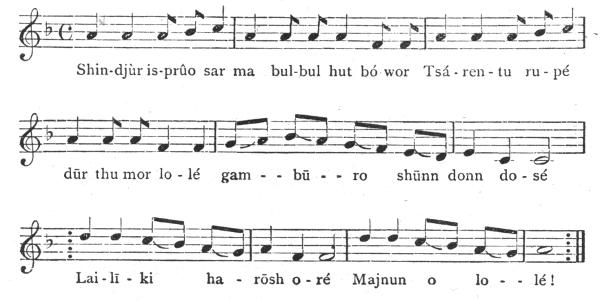
Shin·djùr is-prûo sar ma bul-bul hut bó·wor Tsá·ren-tu ru-pé
dūr thu mor lo - lé gam - - bū - - ro shūnn donn do - sé
Lai - lī - ki ha - rōsh o - ré Majnun o lo - - lé!
By Dr. G. W. Leitner.
GROUP OF DARDS AND CENTRAL ASIATICS WITH DR. LEITNER.
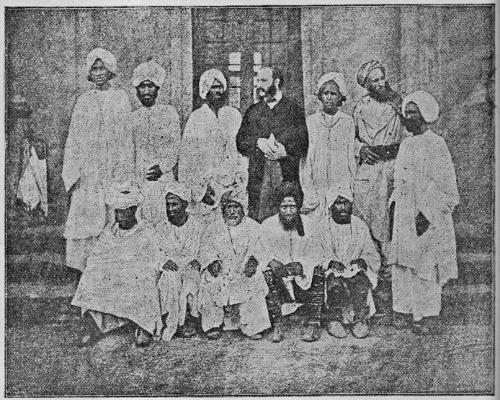
Standing Nos. 1 2 3 4 5 6 (see next page.)
Sitting Nos. 7 8 9 10 11 (see next page.)
Standing—1. Khundayar, son of a Shiah Akhun (priest) at Nagyr; 2. Maulvi
Najmuddin, a poet from Kolab; 3 and 4. Khudadad and Hatamu, pilgrims from
Nagyr; 5. A Chitrali soldier; 6. Matavalli, of Hunza.
Sitting—7. Mir Abdullah, a famous Arabic scholar and jurist from Gabrial;
8. Hakim Habibullah, a Tajik, a physician from Badakshan; 9. Ghulam
Muhammad, Dr. Leitner’s Gilgit retainer; 10. Ibrahim Khan, a Shiah, Rono
(highest official caste), of Nagyr; 11. Sultan Ali Yashkun, of Nagyr.
The accompanying illustration was autotyped some years ago from a photograph taken in
1881, and is now published for the first time. Following the numbers on each figure
represented we come first to No. 1, the tall Khudayár, the son of an Akhun or Shiah
priest of Nagyr, a country ruled by the old and wise Tham or Raja Zafar Ali Khan,
whose two sons, Alidád Khan in 1866, and Habib ulla Khan in 1886, instructed me in the
Khajuná language, which is spoken alike in gentle but brave Nagyr and in its hereditary
rival country, the impious and savage Hunza “Hun-land,” represented by figure 6, Matavalli,
the ex-kidnapper whom I took to England, trained to some Muhammadan piety,
and sent to Kerbelá a year ago. No. 2 was an excellent man, an Uzbek visitor from Koláb,
one Najmuddin, a poet and theologian, who gave me an account of his country. Nos. 3
and 4 are pilgrims from Nagyr to the distant Shiah shrine in Syria of the martyrdom of
Husain at Kerbelá; No. 5 is a Chitráli soldier, whilst No. 7 is a distinguished Arabic
Scholar from Gabriál, from whom much of my information was derived regarding a peaceful
and learned home, now, alas! threatened by European approach, which my travels in 1866
and 1872, and my sympathetic intercourse with the tribes of the Hindu Kush, have unfortunately
facilitated. The Jalkóti, Dareyli, and others, who are referred to in the course
of the present narrative, will either figure on other illustrations or must be “taken as
read.” No. 8 is the Sunni Moulvi Habibulla, a Tájik of Bukhara and a Hakîm (physician).
No. 9 is my old retainer, Ghulám Muhammad, a Shiah of Gilgit, a Shîn Dard
(highest caste), who was prevented by me from cutting down his mother, which he was
attempting to do in order “to save her the pain of parting from him.” 10. Ibrahim
Khan, a Shiah, Rôno (highest official caste) of Nagyr, pilgrim to Kerbelá. 11. Sultan Ali
Yashkun (2nd Shîn caste) Shiah, of Nagyr, pilgrim to Kerbelá. The word “Yashkun”
is, perhaps, connected with “Yuechi.”
The languages spoken by these men are: Khajuná by the Hunza-Nagyr men; Arnyiá
by the Chitráli; Turki by the Uzbek from Koláb; Shiná by the Gilgiti; Pakhtu and
Shuthun, a dialect of Shiná, by the Gabriáli. The people of Hunza are dreaded robbers
and kidnappers; they, together with the people of Nagyr, speak a language, Khajuná,
which philologists have not yet been able to classify, but which I believe to be a remnant
of a pre-historic language. They are great wine-drinkers and most licentious. They are
nominally Muláis, a heresy within the Shiah schism from the orthodox Sunni Muhammadan
faith, but they really only worship their Chief or Raja, commonly called “Thàm.”
The present ruler’s name is Mohammad Khan. They are at constant feud with the
people of Nagyr, who have some civilization, and are now devoted Shiahs (whence the number
of pilgrims, four, from one village). They are generally fair, and taller than the people
of Hunza, who are described as dark skeletons. The Nagyris have fine embroideries, and
are said to be accomplished musicians. Their forts confront those of Hunza on the other
side of the same river. The people of Badakhshán used to deal largely in kidnapped
slaves. A refugee, Shahzada Hasan, from the former royal line (which claims descent
from Alexander the Great), who has been turned out by the Afghan faction, was then at Gilgit
with a number of retainers on fine Badakhshi horses, awaiting the fortunes of war,
or, perhaps, the support of the British. He was a younger brother of Jehandár Shah, who
used to infest the Koláb road, after being turned out by a relative, Mahmûd Shah, with the
help of the Amir of Kabul. Koláb is about eleven marches from Faizabád, the capital
of Badakhshán. The Chitráli is from Shogòt, the residence of Adam Khor (man-eater),
brother of Aman-ul-Mulk, of Chitrál, who used to sell his Shiah subjects regularly into
slavery and to kidnap Bashgeli Kafirs. The man from Gabriál was attracted to Lahore by
the fame of the Oriental College, Lahore, as were also several others in this group; and
there can be no doubt that this institution may still serve as a nucleus for sending pioneers
of our civilization throughout Central Asia. Gabriál is a town in Kandiá, or Kiliá,
which is a secluded Dard country, keeping itself aloof from tribal wars. Gilgit and its
representative have been described in my “Dardistan,” to which refer, published in
parts between 1866 and 1877.
Although our first practical knowledge of “Polo” was derived from the
Manipuri game as played at Calcutta, it is not Manipur, but Hunza and
Nagyr, that maintain the original rules of the ancient “Chaughán-bazi,”
so famous in Persian history. The account given by J. Moray Brown
for the “Badminton Library” of the introduction of Polo into England
(Longmans, Green & Co., 1891), seems to me to be at variance with the
facts within my knowledge, for it was introduced into England in 1867, not
1869, by one who had played the Tibetan game as brought to Lahore by
me in 1866, after a tour in Middle and Little Tibet. Since then it has
become acclimatized not only in England, but also in Europe. The
Tibet game, however, does not reach the perfection of the Nagyr game,
although it seems to be superior to that of Manipur. Nor is Polo the only
game in Hunza-Nagyr. “Shooting whilst galloping” at a gourd filled
with ashes over a wooden scaffold rivals the wonderful performances of
“archery on horseback,” in which the people of Hunza and Nagyr (not
“Nagar,” or the common Hindi word for “town,” as the telegram has it) are
so proficient. Nor are European accompaniments wanting to these Central
Asian games; for prizes are awarded, people bet freely in Hunza as they
do here, they drink as freely, listen to music, and witness the dancing of
lady charmers, the Dayál, who, in Hunza, are supposed to be sorceresses,
without whom great festivities lose their main attraction. The people are
such keen sportsmen that it is not uncommon for the Tham, or ruler, to
confiscate the house of the unskilful hunter who has allowed a Markhôr
(Ibex) that he might have shot to escape him. Indeed, this even happens
when a number of Markhôrs are shut up in an enclosure, “tsá,” as a preserve
for hunting. The following literally translated dialogue regarding
Polo and its rules tells an attentive reader more “between the lines” than
pages of instructions:—
Poló = Bolá.—The Raja has ordered many people: To-morrow Polo I will play. To
the musicians give notice they will play.
Hast thou given notice, O (thou)?
Yes, I have given notice, O Nazúr; let me be thy offering (sacrifice).
Well, we will come out, that otherwise it will become (too) hot.
The Raja has gone out for Polo; go ye, O (ye); the riders will start.
Now divided will be, O ye! (2) goals nine nine (games) we will do (play). Tola-half
(= 4 Rupees) a big sheep bet we will do.
Now bet we have made. To the Raja the ball give, O ye, striking (whilst galloping)
he will take.
O ye, efforts (search) make, young men, to a man disgrace is death; you your own
party abandon not; The Raja has taken the ball to strike; play up, O ye musicians!
Now descend (from your horses) O ye; Tham has come out (victorious); now again
the day after to-morrow, he (from fatigue) recovering Poló we will strike (play).
Rules:—The musical instruments of Polo; the ground for the game; the riders; the
goals; 9, 9 games let be (nine games won); the riders nine one side; nine one (the
other) side; when this has become (the case) the drum (Tsagàr) they will strike.
First the Tham takes the ball (out into the Maidan to strike whilst galloping at
full speed).
The Tham’s side upper part will take.
The rest will strike from the lower part (of the ground).
Those above the goal when becoming will take to the lower part.
Those below the goal when becoming to above taking the ball will send it flying.
Thus being (or becoming) whose goal when becoming, the ball will be sent flying and
the musicians will play.
Whose nine goals when has become, they issue (victorious).
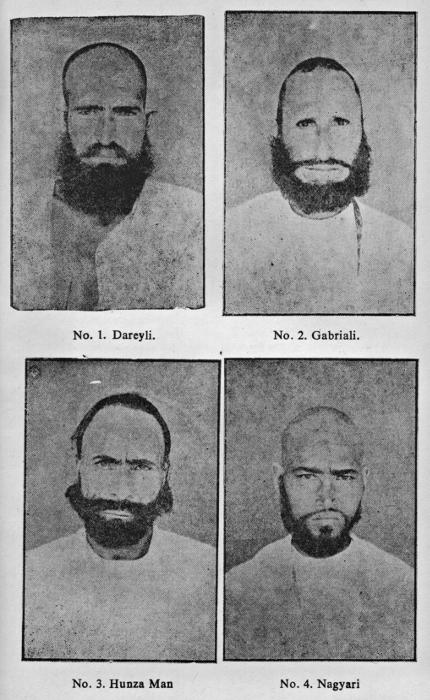
| No. 1. Dareyli. |
No. 2. Gabriali. |
| No. 3. Hunza Man. |
No. 4. Nagyri. |
Account of Mir Abdulla.
The real native place of Mir Abdulla is in the territory of Nandiyar; but
his uncle migrated to, and settled in, Gabriál. The Mir narrates:—
“In the country of Kunar there is a place called Pusht, where lives a
Mulla who is famous for his learning and sanctity. I lived for a long
time as his pupil, studying Logic, Philosophy, and Muhammadan Law, the
subjects in which the Mulla was particularly proficient. When my absence
from my native place became too long, I received several letters and messages
from my parents, asking me to give up my studies and return
home. At last I acceded to their pressing demands and came to my native
village. There I stayed for a long time with my parents; but as I was
always desirous to pursue my studies, I was meditating on my return to
Pusht, or to go down to India.
In the meantime I met one Abdulquddūs of Kohistan, who was returning
from India. He told me that a Dár-ul-u’lûm (House of Sciences) had been
opened at Lahore, the capital of the Punjab, where every branch of learning
was taught, and that it was superintended by Dr. L., who being himself a
proficient scholar of Arabic and Persian, was a patron of learning and a
warm supporter of students from foreign countries. I was accompanied
by two pupils of mine, named Sher Muhammad and Burhánuddin;
and I started together with them from my native village. We passed
through the territory of Dir, which is governed by Nawab Rahmatulla
Khan. The Qazi of that place was an old acquaintance of mine, and he
persuaded me to stop my journey, and promised to introduce me to the
Nawab, and procure for me a lucrative and honourable post. I declined
his offer, and continued my journey. The next territory we entered in
was that of Nawab Tore Mian Khan, who reigns over eight or nine
hundred people. After staying there some days we reached Kanan
Gharin, which was governed jointly by Nawabs Fazl Ahmad and Bayazid
Khan. After two days’ march we came to Chakesur, which was under a
petty chief named Suhe Khan. Here we were told that there are two
roads to India from this place—one, which is the shorter, is infested
with robbers; and the other, the longer one, is safe; but we were too
impatient to waste our time, and decided at once to go by the shorter
way, and proceeded on our journey. We met, as we were told, two
robbers on the road, who insisted on our surrendering to them all our
baggage. But we made up our minds to make a stand, though we were
very imperfectly armed, having only one “tamancha” among three
persons. In the conflict which ensued, one of the robbers fell, and the
other escaped; but Burhanuddin, one of our party, was also severely
wounded, and we passed the night on the banks of a neighbouring stream,
and reached next day Ganagar Sirkol Jatkol, where we halted for eight
or nine days. In this place the sun is seen only three or four times a
year, when all the dogs of the village, thinking him an intruding stranger,
begin to bark at him. Burhanuddin, having recovered there, went back
to his home, and I, with the other companion, proceeded to the Punjab,
and passing through the territory of a chief, named Shálkhan, entered
the British dominions. On arriving at Lahore we were told that Dr.
L. was not there, and my companion, too impatient to wait, went down
to Rampur, and I stayed at Lahore.” He then gave an account of—
THE KOHISTÁN (OR MOUNTAINOUS COUNTRY).
(A Different Country from one of the Same Name near Kabul.)
Boundaries.—It is bounded on the north by Chitrál, Yasin, and Hunza,
on the east by Chilas, Kashmir, and a part of Hazara; on the south by
Yaghistán (or wild country); on the west by Swat and Yaghistán.
It is surrounded by three mountainous ranges running parallel to each
other, dividing the country into two parts (the northern part is called
Gabriál). The Indus flows down through the country, and has a very
narrow bed here, which is hemmed in by the mountains.
The northern part, which is called Gabriál, has only two remarkable
villages—Kandyá, on the western side of the river, and Siwa on the
eastern; and the southern part contains many towns and villages:—
| On the eastern side of the river,— |
|
Town. |
Name of
influential Malak
(Landowner). |
| (1) |
Ladai |
Machú. |
| (2) |
Kolai |
Shah Said. |
| (3) |
Palas (9,000 pop.) |
Lachur. |
| (4) |
Marín |
Karm Khán. |
| On the western side of the river,— |
|
Town. |
Name of
influential Malak |
| (5) |
Batera |
|
| (6) |
Patan (8,000 pop.) |
Qudrat Ali. |
| (7) |
Chakarga |
|
| (8) |
Ranotia |
|
That part of Yaghistán which bounds Kohistan on the west is divided
into (1) Thakot, which is governed by Shalkhán, and (2) Dishán, which is
under Ram Khan; and that part of Yaghistán which bounds it on the south
is divided into three valleys,—
| (1) |
Alahi, |
governed by |
Arsalan Khan. |
| (2) |
Nandiyar, |
” |
Zafar Khan. |
| (3) |
Tikráí, |
” |
Ghaffar Khan (has also two cannons). |
Between the southern part of Kohistan and Alahi, in the eastern corner,
there is a plain, of a circular form, surrounded on all sides by mountains.
This plain is always covered with grass, and streams of clear
and fresh water run through it. Both the grass and the water of this vast
meadow are remarkable for their nourishing and digestive qualities. This
plain is called “Chaur,” and is debatable ground between the Kohistanis
of Ladai, Kolai, and Palas, and the Afghans of Alahi.
People.—The people of this country are not allied to the Afghans, as
their language shows, but have the same erect bearing and beautiful features.
Language.—Their language is altogether different from that of their
neighbours, the Afghans, as will be shown by the following comparison:—
| Kohistani. |
Pushto (the Afghan Language). |
| 1. To-morrow night to Lahore I will go. |
1. To-morrow night to Lahore I will go. |
| Douche rate Lahore bajanwa. |
Saba shapa ba Lahore shazam. |
| 2. Thou silent be. |
2. Thou silent be. |
| Tohe chut guda. |
Tah chup shai. |
| 3. Prepare, ye young men. |
3. Prepared be, O young men. |
| Jubti masha. |
Saubhal she zalmú. |
There is a song very current in Kohistan which begins,—
Palas kulal mariga, Patane jirga hotiga, Johle johal madado propár asáli =
“In Palas a potter was killed, in Patan the jirga (or tribal assembly) sat.”
“The corrupted (Jirga of Malaks) took a bribe, and retaliation was
ignored.” The Afghans are called Pathans.
Religion.—They have been converted to Islám since four or five generations,
and they have forsaken their old religion so completely that no
tinge of it now remains; and when a Kohistani is told that they are “nau-Muslims,”
that is, “new Muhammadans,” he becomes angry.
Muslim learning, and the building of mosques have become common in
Kohistan, and now we find twenty or thirty learned mullas in every considerable
town, besides hundreds of students, studying in mosques.
Dress.—Their national dress consists of a woollen hat, brimmed like
that of Europeans, and a loose woollen tunic having a long جاكى along the
right breast, so that one can easily get out the right hand to wield one’s
arms in a fight. Their trousers are also made of wool and are very tight.
In the summer they wear a kind of leathern shoes borrowed from the
Afghans, but in the winter they wear a kind of boots made of grass (the
straw of rice) reaching to the knees. They call it “pájola.”
Till very lately their only arms were a small “khanjar” (dagger),
bows and arrows; but they have borrowed the use of guns and long swords
from the Afghans.
The dress of their women consists of a loose woollen head-dress with
silken fringes, a woollen tunic and blue or black trousers of cotton cloth,
which they call “shakara.” Generally their women work with their husbands
in the corn-fields, and do not live confined to their houses.
Government.—They have no chiefs like the Afghans, but influential
Malaks lead them to battle, who are paid no tribute, salary, etc.
When an enemy enters their country they whistle so sharply that the
sound is heard for miles; then the whole tribe assembles in one place for
the defence of their country, with their respective Malaks at their heads.
Mode of Living, and other Social Customs.—In winter they live in the valleys,
in houses made of wood and stones; but in summer they leave their
houses in the valleys for those on the peaks of mountains, and the mass
of the population spends the summer in the cooler region; but those who
cultivate the land live the whole day in the valley, and when night comes
go up to their houses on the heights. Their food is the bread of wheat,
and milk furnished by their herds of cattle (gaómesh, cows, goats, and
sheep), which is their sole property. There are no regular Bazárs even
in the large villages; but the arrival of a merchant from India is generally
hailed throughout the country. The woollen cloth which they use
generally is manufactured by them.
Marriage.—Very lately there was a custom amongst them that the young
man was allowed to court any girl he wished; but now, from their contact
with the Afghans, the system of “betrothal” at a very early age is introduced,
and the boy does not go till his marriage to that part of the village
in which the girl betrothed to him lives. The Kohistanis say that they
have learned three things from the Afghans:—
(1) The use of leathern shoes,
(2) The use of long swords and guns,
(3) The system of betrothal.
By Maulvi Najmuddin, a Theologian and Poet from Koláb.
Names of Manzils (Stations) From Kolab to the Punjab.
| کولاب |
(1) |
Kolab. |
| صیاد |
(2) |
Sayad. Situated on this side of the Amoo, and belongs to Badakhshan. |
| ین قلع |
(3) |
Yan-Qalá. |
| چاھیاب |
(4) |
Chahyáb. Governed then (18 years ago) by Sultan Azdahar, son of Yusuf Ali Khán. |
| دشت سبز |
(5) |
Dashti-sabz. A halting-place. |
| رستاق |
(6) |
Rustáq. Governed then by Ismail Khán, son of Yusuf Ali Khán. |
| قزل درہ |
(7) |
Kizil Dara. |
| الکاشان |
(8) |
Elkáshán. The Himalaya begins. |
| اتن جلب |
(9) |
Átin Jalab. Here the river Kokcha[115] is crossed. |
| دشت سفید |
(10) |
Dasht-e-sufed. |
| فیض اباد |
(11) |
Faízabad. Capital of Badakhshan; governed then by Jahandár Shah; is situated on the river Kokchá. |
| رباط |
(11) |
Rubát. |
| دشت فراخ |
(12) |
Dashti Farákh. |
| وردوج |
(13) |
Wardúj. Contains a mine of sulphur. |
|
(14) |
Names are forgotten. |
|
(15) |
| زیباق |
(16) |
Zibáq. Peopled by Shi’as (or rather Muláis). |
| دہ گول |
(17) |
Deh Gôl. The frontier village of Badakhshán; only a kind of inn. |
| سنگر |
(18) |
Sanghar. A halting-place. |
| چترال |
(19) |
Chitrál. Governed then by Aman-ul-mulk (as now). |
| سرغال |
(20) |
Sarghál. |
| رباطَك |
(21) |
Rubatak. |
| دیر |
(22) |
Dír. Governed then by Ghazan Khán. |
| سوات |
(23) |
Swat. |
| پشاور |
(24) |
Peshawar. |
That part of the country lying at the foot of the Hindu Kush mountains,
which is bounded on the north by Kokand and Karatigan, on the
east by Durwaz, on the south by Badakhshan and the Amu, on the west
by Sherabad and Hissar (belonging to Bukhara) is called Khatlan ختلان.
Koláb, a considerable town containing a population of about ten thousand,
is situated at the distance of five miles from the northern bank of the Amu,
and is the capital of the province. The other towns of note are Muminabad
مؤمن اباد, Daulatabad دولتاباد, Khawaling خوالنگ, Baljawan
بلجوان, and Sarchashmá سرچشمہ.
The country, being situated at the foot of mountains, and being watered
by numerous streams, is highly fertile. The most important products are
rice, wheat, barley, kharpazá, etc.; and the people generally are agricultural.
There is a mine of salt in the mountains of خواجه مؤمن Khawaja Mumin;
and the salt produced resembles the Lahori salt, though it is not so
pure and shining, and is very cheap.
Cattle breeding is carried on on a great scale, and the wealth of a man
is estimated by the number of cattle he possesses. There is a kind of
goat in this country which yields a very soft kind of wool (called Tibit);
and the people of Kolah prepare from it hoses and a kind of turban, called
Shamali (from shamal, the northern wind, from which it gives shelter).
Religion.—Generally the whole of the population belongs to the Sunni
sect (according to the Hanafi rite).
Tribes.—The population of the country is divided into Laqai, Battash,
and Tajiks. The Laqais live in movable tents (khargah) like the Kirghiz,
and lead a roving life, and are soldiers and thieves by profession. The
Battashes live in villages, which are generally clusters of kappás (thatched
cottages), and are a peaceful and agricultural people. The Tajiks live in
the towns, and are mostly artisans.
Language.—Turki is spoken in the villages and a very corrupt form of
Persian in the towns. Most of the words are so twisted and distorted
that a Persian cannot understand the people of the country without effort.
Government.—The country is really a province of Bukhárá; but a native
of Kolab, descended from the Kapchaqs by the father’s and from the
Laqais by the mother’s side, became independent of Bukhará. After his
death, his four sons, Sayer Khan, Sara Khan, Qamshin Khan, Umra
Khan, fought with one another for the crown; and Sara Khan, having
defeated the other three, came to be the Chief of the province, but was
defeated by an army from Bukhará and escaped to Kabul.
When Najmuddin left his country, it was governed by a servant of the
court of Bukhárá.
The houses are generally built of mud, cut into smooth and symmetrical
walls, and are plastered by a kind of lime called guch. Burnt bricks are
very rare, and only the palace of the governor is made partially of them.
The walls are roofed by thatch made of “damish” (reeds), which grow
abundantly on the banks of the Amoo.
The dress consists of long, flowing choghás (stuffed with cotton) and
woollen turbans. The Khatlanis wear a kind of full boot which they call
chamush, but lately a kind of shoe is introduced from Russia, and is called
nughai.
The country is connected with Yarkand by two roads, one running
through Kokand and the other through the Pamir.
The above and following accounts were in answer to questions by Dr.
Leitner, whose independent researches regarding Kandiá in 1866-72 were
thus corroborated in 1881, and again in 1886, when the photographs which
serve as the basis of our illustrations were taken.
Position.—A town in Kandiá, a part of Yaghistan (the independent,
or wild, country) situated beyond the river Indus (Hawā-sinn), which
separates it from Chilás. The country of Kandiá extends along both
sides of the Kheri Ghá, a tributary of the Indus, and is separated from
Tangir by a chain of mountains.
The town of Gabriál is situated three days’ march from Jalkôt, in a north-west
direction, and is one day’s march from Patan, in a northerly direction.
Patan is the chief city of Southern Kandiá.
Inhabitants.—The whole tract of Kandiá can send out 20,000
fighting men. They are divided into the following castes:—
(1) Shîn, the highest, who now pretend to be Quraishes, the Arabs of
the tribe to which the Prophet Muhammad belonged. (Harif Ullá, the
Gabriáli, and Ghulam Mohammad, of Gilgit, call themselves Quraishes.)
(2) Yashkun, who now call themselves Mughals, are inferior to the Shîn.
A Yashkun man cannot marry a Shîn woman. Ahmad Shah, the Jalkoti
belonged to this caste.
| 3 |
(3) |
Doeúzgar, carpenters. |
In reality these people constitute
no distinct castes, but all belong to a third, the Kamin, caste. |
| (4) |
Jolá, weavers. |
| (5) |
Akhár, blacksmiths. |
| (6) |
Dôm, musicians. |
| (7) |
Kámìn, lowest class. |
The people of Northern Kandiá (Gabriál) are called Bunzárî, and of
the southern part (i.e., Patan) Maní, as the Chilasis are called Boté. A
foreigner is called Raráwi, and fellow-countryman, Muqámi.
Religion.—The Gabriális, as well as all the people of Chilás, Patan,
and Palas, are Sunnis, and are very intolerant to the Shias, who are kidnapped
and kept in slavery (Ghulam Mohammad, the Gilgiti, has been
for many years a slave in Chilás, as Ahmad Shah reports). The Gabriális
were converted to Muhammadanism by a saint named Bâbâji, whose
shrine is in Gabriál, and is one of the most frequented places by pilgrims.
The Gabriális say that this saint lived six or seven generations ago. Mir
Abdulla (who is really of Afghanistan, but now lives in Gabriál,) says that
the Gabriális were converted to Islám about 150 years ago. Lately, this
religion has made great progress among the people of Kandiá generally.
Every little village has a mosque, and in most of the towns there are
numerous mosques with schools attached to them, which are generally
crowded by students from every caste. In Gabriál, the Mullahs or priests
are, for the most part, of the Shîn caste, but men of every caste are zealous
in giving education to their sons. Their education is limited to Muhammadan
law (of the Hanifite school), and Arabian logic and philosophy.
Very little attention is paid to Arabic or Persian general literature and
caligraphy, that great Oriental art; so little, indeed, that Harifullah and
Mir Abdulla, who are scholars of a very high standard, are wholly ignorant
of any of the caligraphic forms, and their handwriting is scarcely better
than that of the lowest primary class boys in the schools of the Punjab.
The most accomplished scholar in Kandiá is the high priest and chief
of Patan, named Hazrat Ali, who is a Shîn.
The people generally are peaceful, and have a fair complexion and
erect bearing. Their social and moral status has lately been raised very
high. Robbery and adultery are almost unknown, and the usual punishment
for these crimes is death. Divorce is seldom practised; polygamy is
not rare among the rich men (wadán), but is seldom found among the
common people.
Government.—Every village or town is governed by a Council of
elders, chosen from among every tribe or “taífa.” The most influential
man among these elders for the time being is considered as the chief of the
Council. These elders are either Shîns or Yashkun. No Kamìn can be
elected an elder, though he may become a Mullá, but a Mulla-kamìn also
cannot be admitted to the Council.
The reigning Council of Gabriál consists of 12 persons, of whom 9 are
Shins and 3 Yashkuns. Patshé Khân is the present chief of the Council.
The post of Chief of the Council is not hereditary, but the wisest and
the most influential of the elders is elected to that post. Justice is administered
by the Mullahs without the interference of the Council, whose
operation is limited to inter-tribal feuds.
Customs and Manners.—Hockey on horseback, which is called
“lughât” in Gabriál, is played on holidays; and the place where they
meet for the sport is called “lughât-kárin-jha.”
Guns are called “nâli” in Gabriál, and are manufactured in the town
by blacksmiths.
Dancing is not practised generally, as in the other Shin countries.
Only “Doms” dance and sing, as this is their profession; they play on
the “surúi” (pipe), rabáb (harp), and shaṇdo (drum).
The “purdá” system, or “veiling” women, is prevalent among the
gentry, but it is only lately that the system was introduced into this country.
When a son is born, a musket is fired off, and the father of the newborn
son gives an ox as a present to the people, to be slaughtered for a
general festival.
Infanticide is wholly unknown.
Marriage.—The father of the boy does not go himself, as in Gilgit, to
the father of the girl, but sends a man with 5 or 6 rupees, which he offers
as a present. If the present is accepted, the betrothal (lóli) is arranged.
As far as the woman is concerned the “lóli” is inviolable. The usual
sum of dowry paid in cash is 80 rupees.
A bride is called “zhiyán,” and the bridegroom “zhiyán lo.”
Language.—On account of the want of intercourse between the tribes
the language of Kohistan is broken into numerous dialects; thus the
structure of the dialects spoken in Kandiá, i.e., in Gabriál and Patan,
differs from that of the language spoken in Chilás and Palus, i.e., in the
countries situated on this side of the Indus. Harifullah, a Gabriáli, did
not understand any language except his own; but Ahmad Shah, an
inhabitant of Jalkôt (situated in the southern part of Chilás), understood
Gabriáli, as he had been there for a time. Ghulam Mohammad, our
Gilgiti man, who had been captured in an excursion, and had lived as a
slave in Chilás, also thoroughly understood Jalkóti.
The language of Kohistan (as Chilás, Kandiá, etc., are also called) is
divided into two dialects, called Shéná and Shúthun respectively. In the
countries situated on that side of the Indus, that is in Kandiá, Shúthun is
spoken.
The following pages are devoted to Ballads, Proverbs, Riddles, and
Dialogues in the Shúthun dialect.
Songs = Gíla. Meshón gíla = men’s songs; Gharón gíla = female songs.
1. An Elegy.
Fifteen years ago a battle was fought between Arslán Khan of Kali, and
Qamar Ali Khan of Pálus, in which 300 men were killed on both sides.
Phaju, on whose death the elegy is written by his sister, was one of the
killed. The inhabitants of Palus are called “Sikhs,” in reproach.
i.
Rugé níle, jimátyán-kachh-dúkánt,
In a green place, next a mosque, in a sitting (resting) place,
Chá chápár gála mazé, shahzada marégil
In a surrounded fort within, the prince was killed
Rugé níle, jimátyán kachh, dúkánt
In a green place, next a mosque, in a resting place
Sheú wále, bathrí, sóh viráti walégil.
Bring the bier, lay it down, (so that) that heirless one may be brought to his home.
ii.
Rúge níle, wo Shérkot shar hogaé,
In the green place, that Sherkot, where the halting-places of guests
Diri Sikáno qatle karégil.
Are deserted, the Sikhs (infidels, that is the Pálusis) slaughter committed (did).
Rúge níle, Shérkot, barí bigá hojowo,
In the green place, in Sherkot, a great fight happened to be,
Kali Khel, Phajú dasgír marégil.
O Kalikhel (a tribe of Kohistan) Phajú is captured and killed.
Translation.
1. In a green place, next the mosque, in a place of rest.
Within an enclosure the prince was killed.
In a green place, next a mosque, in a spot of rest,
Bring the bier and lay it down, to bring him home who has no heir.
2. In the green place, that Sherkôt, where the halting-place of guests
Is deserted, the Sikhs committed slaughter.
In the green place, in Sherkot, a great fight took place,
Oh, Kalikhel tribe, Phajú was captured and killed.
2. The following song is a chârbait, or quatrain, composed by Qamrán,
a Gabriali poet. The song treats of the love between Saif-ul-mulk, a prince
of Rúm, and Shahparì (the Fairy-queen).
The first line of a charbait is called Sarnâmâh, and the remaining poem
is divided into stanzas or “Khhàṛáo,” consisting each of four lines. At the
end of every stanza the burden of the song is repeated:
Sarnamah.—Ma húga musfar, mi safár hugâe Hindustan waín
I became a stranger, my travel became towards Hindustan.
Mí duâ’ salám, duâ’ salámi ahl Kohistan waín
My prayer-compliments, prayer-compliments, to the inhabitants of Kohistan (may go forth).
Malá Malúkh thû, O Badrái tou ínê haragilua
I myself am Malukh (name of the Prince Saif-ul-mulk), O Badra, thou didst lose me.
Burden.—Hái, Malá Malúkh thû, O Badrái, ché Malúkh tîṇ tâó bar zíthu
Woe, I am Malukh, O Badra, now thy Malukh from thy sorrow has lost his senses.
i.
Stanzas.—1. Mala Malukh thu, O Badrai, Malúkh tîṇ, tâó thú dazélo
I myself am Malukh, O Badra, thy Malukh burnt has been from thy heat.
2. Hyó níeṇ nidhéto qarâré, Malúkh Badré wátbe thú harzélo
In the heart there is no ease, which Malukh after Badra has lost.
3. Be tí áṇs yârâúâ, mah pai-mukhé á’ṇs soh wéloṇ
Ours, yours, was friendship, I beardless at that time.
4. Gini kirí thi, háê háê, mi Azli qalam zikzithu
Why dost thou ... woe! woe! the pen of Eternity wrote so.
Burden.—5. Hái, Malá Malúkh thu, O Badrai, Ché Malukh tîṇ tâó harzi thu.
Woe, I am Malukh, O Badra, etc., etc.
ii.
1. Gini kiri the, hae hae, mi azló mazé lìkh taqdîr thú
Why dost thou ... woe, woe! in Eternity did Fate write so.
2. Darwázoṇ mazá galáchhe dhuî Mato tiṇ daráṇ faqîr thu
On thy gate I lit fire (like Jôgís), I a boy was the beggar of thy door.
3. To hikmat biu báz-shâî thi kishéu lûṇgo maza zanzîr thu
By thy stratagem thou takest the eagle a prisoner in the chain of thy black locks.
4. Kisheu lûngá, narai narai, panar mûṇla bé the zetdu
Black locks, in strings, on thy bright face are twined.
5. Hae Mala Malukh thu....
Woe, I am Malukh, etc....
iii.
1. Kisheu lûngá narai narai, panar mûṇ la âwizâṇ thu
Black locks in strings on thy bright face are hanging.
2. Mi laṛmûṇ mazá karáé, tiu makhchúe gi mi armâṇ thu
In my body is the knife, thine is this deed which was my desire.
3. A’khir dhar héṇti nímgaré shoṇ fáni na, malá rawâṇ thu
At length will remain unfinished this waning (world), I now depart.
4. Hyó mi kir súraí súraí, Jandun giná thu, ma mari thu
My heart didst thou pierce in holes, where is my life, I am dead.
5. Hae Hae....
Woe, I am Malukh, etc.
iv.
1. Hyó mi kir súraí súraí térubir, teṇ shon niázah ghiu
My heart didst thou pierce throughout, by this thy spear.
2. Mála thu muṛé, ti dalbaráṇ, lailo bá mi janázah ghiu
I am thy dead boy, thy lover, O dearest, go off from my bier.
3. Khún tiu gḥaṛ hoga, ghi tulá nibháé ansi khévah ghiu
My blood is on thy neck, alas! thou didst not sit with me, being engaged in thy toilet.
4. Khévah kirethi zhare tin soh khiyál mudá chaizbithú
Thy toilet do now, now that thy remembrance of me is slackened by Time.
Matal (Masl = Proverbs).
Proverbs.—(1) Zánda chapélo razan bhiyáṇt.
One who is struck by all, fears even a rope.
(2) Zoṛoṇ waé nhálé k hurá zhiká.
Looking towards (the length of) the sheet, extend your feet.
(3) Háte ché rachhélú darwáze aṛat kara.
Elephant if you keep, make your door wide.
(4) Kaṛotál ghutágir, láwáṇ na hol kir.
The Lion attacks, the Jackal makes water.
(5) Qá mil tillu gûṇ kaáṇt, báz mil tillu máséu khánt.
With crow went, ate dung; with eagle went, ate flesh.
i.e. In the company of the crow you will learn to eat dung and in that of the eagle, you will eat flesh.
(6) Taṇgá gatam karé rupaé balyúṇ.
A penny, for collecting went, lost rupee.
(7) Aíṇ tale kaṇwalé déthé, mazé háṛ shárá túṇ.
Big mouth flattery does, inwardly (in mind) breaks bones.
(8) Dúṇí lawáṇo karú márch.
Two Jackals a lion kill.
(9) Dhon mazé ek bakrí budi agalu, bûtoṇ bakroṇ ethi.
In a flock, if a contagious disease to one goat come, it comes to all goats.
(10) Gúṇ khuch táṇt soṇ, gháṇo cháí hont.
Dung is spread out however much, bad smell so much more becomes.
(11) Zhá zhui dárú.
Brother’s remedy is brother.
(12) Tálaiṇ uthi, kozá dishál, tiu dú boṇdi.
A sieve rose, to pot said, “You have two holes.”
(13) Zar bádshah tamam hotoṇ, hiyá bandgár shilát.
Money of the king is spent, heart of the treasurer pains.
Isholá (Question).
Riddles.—(1) Shúṇ ghélá chíz thuṇ, che naháláṇt tasi wáiṇ pasháṇt amá?
Such what thing is, which they see towards it, they see themselves in it?
Answer: Mirror. Shúṇ áhan thi. = Such mirror is.
(2) Shúṇ gheḷá chíz thúṇ che surat záné thi, tilháṇt nai?
Such what thing is, whose figure serpent-like is, does not move?
Answer: Rope. Shúṇ rás thi. = Such rope is.
(3) Shúṇ ghelá chíz thúṇ, aṇgár dheráni gellú, dhúaṇ darya bau nikáṇt?
Such what thing is, fire is applied to dry grass, the river of smoke flows from it.
Answer: Hookâh.
(4) Shúṇ ghélá chíz thúṇ, che mut surté waré nahále? hasáṇt, khuroṇ we nahále roṇt?
Such what thing is, who seeing towards other body laughs, seeing towards feet, weeps?
Answer: Peacock.
SHÚTHUN.
WORDS AND DIALOGUES.
Words.
- God, Khávaṇd.
- fairy, kháperé.
- demon, div.
- female demon, balái.
- paradise, janat.
- fire, aṇgár.
- earth, uzmuk.
- water, wí.
- heaven, asmán.
- moon, yúṇ.
- star, tará.
- darkness, tamáí.
- shadow, chhoṇl.
- day, des.
- light, láwar.
- night, rál.
- midday, mazardi.
- midnight, áṛ-rál.
- evening, nosháṇ.
- to-day, ázuk des.
- yesterday, bayaluk des.
- to-morrow, rályaṇk des.
- heat, taó, tát.
- cold, hewán.
- flame, lám.
- smoke, dhúáṇ.
- thunder, hagá-dazi-gé.
- lightning, mili.
- rain, ájo.
- drop, ájo-tìpo.
- rainbow, bijonṛ.
- snow, hiṇ yúṇ.
- ice, kambuk.
- hail, mékh.
- dew, palús.
- earthquake, bhúnál.
- dust, udhún.
- pebbles, lakh-bato.
- sand, sighál.
- mud, chichál.
- plain, maidán, meráh.
- valley, dará.
- mount, kháu.
- foot of mountain, múndh.
- river, sín.
- wooden bridge, síú.
- rivulet, uchhu.
- streamlet, kháṛ.
- avalanche, hiṇál.
- lake, dhám.
- pond, dhamkalú.
- confluence, milil.
- banks, sin-kaí.
- yonder bank, pír sinkai.
- this bank, ár sinkai.
- a well, kohi.
- country, watau.
- village, gáụ.
- place, zhaí.
- army, kauár.
- leader, kauár sardár.
- lumberdár, malak.
- tax-gatherer, jám kai.
- policeman, zeitú.
- cannon, tof.
- gun, náli.
- sword, tarwál.
- dagger, karái.
- lance, naizá, shel.
- powder, náláṇ daru.
- ball, goli.
- ditches, kahe.
- war, kali.
- thief, lú.
- sentinel, ráth.
- guard, chár.
- guide, pan-pasháṇtuk.
- coward, khiá to.
- traitor, fatandár.
- bribe, baṛi.
- prisoner, bandi.
- slave, dim.
- master, maulá.
- servant, naukar.
- drum, shaudo.
- sheath, káti.
- grip, kauzá.
- bottom of sheath, kundi.
- hatchet, ckháí.
- file, soán.
- smoothing iron, rambi.
- scythe, liṇzh.
- tongs, ochhúṇ.
- razor, chhúr.
- mirror, áhin.
- plough, hól.
- oar, phiyá.
- yoke, úṇ.
- ladle, tagú.
- kneading roller, chhagór.
- kettle, chati.
- little kettle, chedin.
- stone kettle, botá-bháṇ.
- pan, to.
- coal, phúthe.
- key, kunji.
- lion, khará.
- shawl, shíyúṇ.
- bedding, bathár.
- lock, sáṛ.
- bolt, hul.
- vineyard, dháṇgá.
- stable, ghozai.
- ” for cattle, gáṇ zai.
- ” for sheep, bakroṇ-ghuzál.
- water mill, yáṇzh.
- iron peg, kili.
- bullet-bag, koti.
- powder-flask, darú kothi.
- iron and flint, tíz.
- tinder, khú.
- bow, sháe.
- arrow, káṇó.
- quiver, káṇó bhaṇ.
- ship, jaház.
- boat, heṛi.
- century, shol kála.
- year, kála.
- half-year, aṛa-kála.
- three months, sha-yúṇ.
- week, sát-dés.
- spring, basáṇ.
- summer, barish.
- autumn, sharal.
Lunar Muhammadan
Months.
- Khudá tálá yúṇ, Rajab.
- Shahqadar, Shaaban.
- Rozoṇ yúṇ, Ramazan.
- Lukut (smaller) eed yúṇ, Shawal.
- Kháli yúṇ, Zi Qáad.
- Gháíṇ eed yúṇ, Zi Haj.
- Hasan Husain yúṇ, Muharram.
- Chár bheyáṇ (four sisters), four months of Rabiulawwal: Rabi 2, Jamadi 1, Jamadi 2.
- man, máṇsho.
- male, mésh.
- woman, gharoṇ.
- new-born child, chinot.
- girl, mati.
- virgin, bikra-mati.
- bachelor, cháur.
- old man, zárá.
- old woman, zírí.
- puberty, zuáni.
- life, zhigi.
- death, máreg.
- sickness, ráṇs.
- sick, najúr.
- health, mith ráhat.
- relation, zhává.
- brotherhood, sak zhá.
- friend, yár.
- aunt, máfi.
- father, abá.
- paternal uncle, pichá.
- mother, yá.
- brother, zhá.
- sister, bhiyúṇ.
- son, púsh.
- daughter, dhí.
- daughter’s husband, zamá zhú.
- grandson, pázho.
- granddaughter, pozhi.
- nephew, zhá-lichh.
- husband, baryú.
- wife’s brother, shábri.
- wife’s mother, ichosh.
- wife’s father, shor.
- pregnancy, ghaleíṇ.
- nurse, razáí mahal.
- priest, moláṇ.
- mosque, jamáat.
- pupil, shágar.
- sportsman, dháuzír.
- goldwasher, keryáṇ.
- peasant, déqán.
- horse-stealer, gálwáṇ.
- robber, lú.
- brick-baker, ustá kár.
- butcher, qasábi.
- shepherd, payál.
- cowherd, go-chár.
- groom, kharbal.
- body, surté adúmá.
- skin, chám.
- bones, hár.
- marrow, métho.
- flesh, maséṇ.
- fat, miyún.
- blood, rát.
- veins, rage.
- head, shish.
- occiput, shisháṇ-kokar.
- brain, metho.
- curls, chaṇdú.
- tresses, pétú.
- forehead, tál.
- eyes, aṇchhi.
- eyebrow, ruzí.
- eyelids, papáíṇ.
- pupil, machhá.
- tears, áṇchhe.
- ears, kaná.
- hearing, shúoṇ.
- cheeks, hargel.
- chin, dáí.
- nose, nathúr.
- nostrils, shúli.
- odour, gháṇ.
- sneezing, zhitá.
- upper lip, bul-dhút.
- nether lip, múṇ-dhút.
- mouth, áiṇ.
- taste, khoṇd.
- licking, chara.
- sucking, chúshoṇ.
- beard, dáí-bál.
- moustaches, phuṇge.
- teeth, daná.
- tongue, zíb.
- jaw, tálú.
- throat, marri.
- neck, shák.
- shoulder, phyá.
- back, dah.
- fore-arm, mutá.
- palm, kát-zil.
- nails, naḳhá.
- thumb, aṇgú.
- middle finger, mazwál angúi.
- breast, heṇ li.
- lungs, phap.
- liver, shúr.
- kidneys, juká.
- breath, dhéṇs.
- coughing, kháṇg.
- spleen, shiyáṇ.
- belly, vari.
- side, shígát.
- ribs, pash.
- thighs, sethi.
- knee, kútá.
- feet, khurá.
- sole, sháṇdá.
- anger, rush.
- aversion, achháq.
- boastful, amá-tikú.
- cheating, tḥag.
- courage, hyo-kura.
- cowardice, bhiyáto.
- blind, shéo.
- deaf, borá.
- dumb, cháo.
- dwarf, khátoṇ.
- giant, zhigo.
- hunch-back, dakoro.
- stammering, hup-hup.
- one-eyed, ek-áchhá.
- bed, shi-úṇ.
- broom, láhúli.
- canal, yáh.
- fort, kalá.
- house, báo.
- ladder, párchaṇgi.
- street, durro.
- water-jug, dhomb-lú.
- wall, kúṛ.
- window, bá-úṇ.
- guest, maláshi.
- host, malásh-khais.
- breakfast, vépli.
- midday meal, ashari-goli.
- luncheon, mazardiṇ-goli.
- evening meal, bilalú-ki-goli.
- sour dough, kham birá.
- light, lawár.
- I, má.
- thou, tú.
- he, úṇ.
- we, améṇ.
- you, tus.
- they, áiṇ.
- great, ghéroṇ.
- small, lakho.
- much, che.
- beautiful, sugá.
- ugly, adash.
- clean, sáf.
- dirty, mulgán.
- deep, khatoṇ.
- rich, poyandá.
- poor, kám toáṇ.
- miserly, sakh.
Dialogues.
What is your name? tiṇ ná gi thú?
Where do you come from? tú guláṇ
ethú?
Where do you go to? tú guláṇ byáṇ
thú?
When did you come? tú kal ethú?
Come quickly, zino é.
Go slowly, suple bhá.
Beat him now, as uskéṇ koteh.
Kill him afterwards, as hilék pásrih
máreh.
How is the road between this and
there? uṇgáí shálgái har páṇ
goshe the?
Very bad and dangerous, chaí kharáb
thi, chai gi aụ thi.
Very easy; a plain, and nothing to
fear, chaí hasán thi; bodi maiaán
kingi bhíl nithi.
Is there any water on the road? paú
mazé wi thú ya na thú (way-in
water is or not is)?
Why should there not be any? giné
nithú?
There is plenty, and good water, cho
thú, sains thú.
The water is bad and salty, achhak
thú, lúsuláe milál thú.
There is a big river on the road,
which you will not be able to
cross, pánda mazé, ghái sin thi,
pir-khingí (on that side) ni biháṇt.
Why? Is there no bridge? ginah?
síú nithú?
There was a rope bridge, but to-day
it broke, bilálá síú áṇs, áz sher thi.
Can it be not repaired? sáṇdhat nai
éṇ?
There are no men for two days’
march all round. There are
neither twigs nor ropes to be got.
How am I to do? shásh taraf se
másh nithu, doṇ diṇ so mazaló-mazé,
gishí sandhyí?
How can he come; he has gone
about some business, sóh gishé
éshóto, soh kámi béjthú.
Go! be silent. Bring him at once,
or else I shall be very angry, bóh!
chubbó; má khapá hothiú, zino
bádi á.
What do you want? tú gi lukhát?
I do not want anything except to
drink and eat, mà kiṇgeh ni lukhaṇt,
kháṇ púr lukháṇt.
I have nothing; what can I give
you? minge kíngé nithú, má gi
dáwá?
First of all bring cold water, buttó
mú tḥo tú mitḥa wi á.
Afterwards bring milk, ghi, butter,
paitóṇ shír, ghil, shishaṇ.
How many days will you stay here?
tú ondháṇ ketúk desi bhayáṇto?
I will start to-morrow early, má ráli
béṇto.
Get coolies (porters), petwáre á.
How many coolies do you want?
ketúk petwáre pakár thú?
The road is full of stones, páṇdá
maze batáh chaí vaṇte.
Your loads are very heavy, tíṇ aíṇ
(-this) peté chaí abur thíṇ.
The coolies will not be able to carry
them, zaṇ petwaré búí ner haṇthé.
I beg that you will make your loads
a little lighter, and then you will
arrive quicker, mi arzí thi, as peté
hilék achhrá; amén hálo chhíl.
Be patient; I will pay for all; I
will give the rate to the coolies.
If you act well I will reward you,
sabar karé; móṇh buto mazdúri
dashul; téṇ miṭh kám karlu, má
tighé inám dashut.
Get the horses ready, ghúí tayár
karáh.
Put the saddle on, ghúí tal kátḥí
sambhál karé.
Take the saddle and bridle off, ghúí
na maláni alú karé, háṇ káthé.
Catch hold of this, as dháí.
Do not lose it, as phat niré.
Do not forget what I say, míṇ bál
(my word) né ushá.
Hear! look! take care, káno hin
shúná, anchhí náhlí l fikar karé.
Tie the horse to that tree, gho as
gáí mél gáṇdá.
Keep watch all night, rál chokidárí
karáh.
Are there many thieves here? úndá
lú ché thé?
What is this noise? shún awáz kasiṇ
thúṇ?
Who are you? tú káṇ thúṇ?
Get away from here, uṇd gáí báh.
Shoot him the moment he comes
near, uṇgáí ígálo, asíṇ tumakáh
deh.
This man is treacherous, úṇ másh
bepat thú.
Don’t let him go, as másh úṇdú phat
niyáréh.
Bind him, imprison him, enchain
him; put him into stocks, as gaṇdáh;
asiṇ háthe zanzír gáláh; as
kundi galáh.
I am going to sleep, hú íṇ má sútá
bijáṇtaé.
Don’t make a noise, chozuk niyáreh.
How many people are there in the
village? as gáṇó maz katú maṇsh
thé?
I have not counted them, méṇ ishmár
niyárchí.
Is the soil fertile or sterile? dol níl
thé, gíh shíshi thé?
Is there much fruit? mévá chaí thé?
Is there much grain in the village?
as watné maz án cho thú?
How many taxes do you pay in the
year? ek kál maz ketúk masúl
diyáṇt tus?
Are you satisfied? tú khush-hál thú?
How is your health? tú uṇdáṇ arám
thú?
I am in good health, arám thú.
Good temper, tabyát sáf.
Bad temper, tabyát asak.
God bless you, khudáé tigé barakat
dé.
May God lengthen your life, khudáe
tiṇ umar chai kare.
My name is Gharib Shah, míṇ ná
Gharíb Sháh thú.
My age is twenty years, míṇ umar
bísh káláh thú.
My mother is dead; my father is
alive; míṇ mháṇli marigai, míṇ
mahálo zaná thú.
How is the road, good or bad?
pán mit thi ghi achak thi?
In one or two places it is good, in
others bad, ek dú záé mit thíṇ, ek
dú záé achak thíṇ.
How did you come from Chilas? tú
Chilasúṇ gishéí thú?
I could not get a horse, I went on
foot, gho nyans, maton, khuron tal
ethú.
Are the mountains on the road
high? pán maze kháná úchat thé?
When are you going back? tú kaiá
bashotá?
I am poor, má gharíh thú.
We kill all infidels, bé bud kafra
maráṇ the.
I have come to learn the language,
má zíb chhitáíṇ éthú.
What do I care about? miṇ gi
parwá thú?
I make my prayers five times every
day, má har dés panjwaqtúṇ nimáz
karáṇ thé.
Where did you come from? tu
guláṇ ethú?
Come into the house, bá khuní é.
Sit at your ease, mitho bhaí.
Are you well? tú mit thú?
Are your children well? tíu chinomati
júṛ thé?
Is your sister’s son well? tíu sazú
júṛ thé?
Are you very ill? tú cho ácháq
(sick) thé?
May God restore you to health!
khudá tálá tú joṛ kéré.
Light the fire, angár guyáh.
Cook the food, goli pazáh.
Spread the bed, bathári karé.
It is very cold, chaí lúí thé.
It is very hot, chaí tut thé.
Put on your clothes, zúr shá.
Catch hold of the horse, gho dhaí.
Look at that man, píshas másh
nahálá.
Take care, fikar karé.
You will fall, tú ullá shat.
Take a good aim, mitḥi nazir karé.
I will give you help, ma timál madat
karéshat.
I am hungry, bring food that I may
eat, má húshoshat, goli á, khéij.
I am thirsty, bring water that I may
drink, má chúha húga, wi á, púmá.
I am sleepy now, I will go to sleep,
migé nízh íge, nizh karáṇthú.
What do you call this in your language?
tus shas chizí taí zíb hín
gimá manáth?
How much is the produce of this
land? as zaímuz ketúk paidá húnt?
Can you sing? tige gila eṇthe?
(Measurements in Centimetres.)
Height, 168·5; hair, black; eyes, hazel; colour of face, ruddy; colour
of body, very light brown; narrow forehead; high instep; big boned;
length round the forehead, biggest circumference of head, 53·75; protruding
and big ears; square face; long nose, slightly aquiline; good
regular teeth; small beard; slight moustache and eyebrows; distance
between eyebrows, ordinary; good chest; fine hand; well-made
nails. Weight, 10 st. 2¾ lbs.
Height, 182; colour of body, light yellow brown; round the head, 52·5;
teeth, good, regular; nose, very slightly aquiline; little growth on
upper lip; none on cheeks; long, straight, coarse black hair; eyes,
hazel; ears, not so protruding; better-proportioned forehead; small
hand; good instep; foot bigger, in proportion, than hand (not so
good as other’s hand); 80 pulse. Weight, 9 st. 10 lbs.
Height, 162·3; round the head, 56·5; eyes, dark brown; big hands and feet;
instep, good; colour, brown; good muscular foot; strong arms; hair,
black; plentiful growth on upper lip; nose, aquiline; broad nostrils;
full lips. Weight, 10 st. 12 lbs. (No. 10 on Drawing 1 of Appendix IV.)
Height, 164·0; very hairy, including hands; round the head, 54·0;
head, pyramidal pointed; sinister countenance; very big hands and
feet; thin lips; great moustache, coarser hair; more flat-soled than
rest. Weight, 9 st. 8½ lbs. (Full details in “Comparative Table.”)
Height, 165·25; round the head 53·75; square head; retroussé, small nose;
small mouth; red beard, plentiful; black hair; brown eyes; very big
hands and feet, also instep. Weight, 9 st. 12 lbs. (No. 11 on
Drawing 1 of Appendix IV.)
Height, 163·3; round the head, 54·4; stupid expression; big chest; ordinary
hands and feet; low forehead; rising head; very muscular; eyes,
brown; complexion, brown; thickish nose; very narrow forehead;
underhung jaw; lots of hair. Weight, 9 st. 12 lbs. (No. 3 on
Drawing 1 of Appendix IV.)
Height, 162·1; round the head, 54·4 (broad head); low Grecian forehead;
small nose; eyes, dark brown; light brown complexion; small hands
and feet; regular, white teeth. Weight, 7 st. 13 lbs. (No. 4 of above
Drawing.)
Height, 161·0; round the head, 54; beard, prematurely grey; lost second
incisor; small hands and feet; fair instep; brown eyes and complexion;
nose, straight; ears all right. Weight 8 st. 5 lbs.
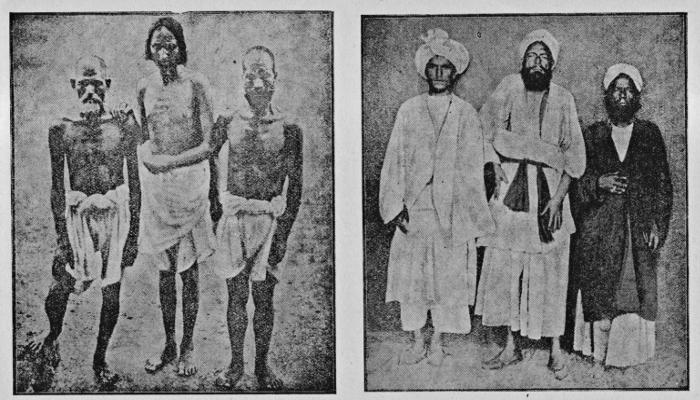
| Gilgiti (Ghulman Muhammad). |
Nagyri (Khudayar). |
Hunza Man (Matavalli). |
|
A Gabriali Student and two Messengers (A Chitrali
and a Yasini), from a Brother of the late Mihtar
Aman-ul-Mulk, Ruler of Chitral. |
(See explanations of these numbers further on, page 5.)
| Numbers by Schwarz. |
1. Abdul-Ghafûr, Kamôz Káfir. |
2. Khudayar Yashkun, Nagyri. |
3. Ibrahîm, Nagyri Róno. |
4.[117] Matavalli, Hunza Yashkun. |
5. Sultan Ali, Yashkun, Nagyri. |
6. Khudadád Nagyri. |
7. Hatamu Nagyri. |
8. Ghulam Muhamad, Gilgiti Shîn. |
| 28 |
30 |
26·7·5 |
29·2 |
31·5 |
25·5 |
28·5 |
24·7 |
29·5 |
| 29 |
15 |
24·7·5 |
14 |
13·5 |
14 |
11·75 |
31·1 |
15·5 |
| 30 |
14·5 |
13·5 |
14·5 |
13·6 |
13·7·5 |
14·2 |
12·7 |
14 |
| 31 |
10·2·5 |
8·7·5 |
9·5 |
9·6 |
8·7·5 |
9·2 |
8·1 |
9·1 |
| 32 |
3·7·5 |
3·5 |
3 |
3·7·5 |
3·25 |
3·3 |
3·8 |
3·9 |
| |
|
|
|
|
|
|
|
|
| 34 |
3·9 |
4 |
4·6 |
4·1 |
3·6 |
3·6 |
3·4 |
3·5 |
| 35 |
5·5 |
4 |
4·7·5 |
5 |
4·1 |
5·5 |
4·5 |
4·8 |
| 36 |
14 |
11·2 |
11·7·5 |
11·25 |
11·2 |
11·2 |
11·1 |
10·2 |
| 37 |
18·7·5 |
20·2·5 |
20·6 |
20·8 |
19 |
20·75 |
19·2 |
18·5 |
| |
|
|
|
|
|
|
|
|
| 39 |
46 |
44·7·5 |
48 |
44·5 |
44·5 |
48·6 |
41·5 |
39·6 |
Jamshêd of Katár, the nephew of General Feramorz, the renowned Kafir
General in the service of the late Amir Sher Alí of Kabul, was a
confidential orderly both in the service of the Amir Sher Alí and in that
of Yakúb Khan, whose cause he espoused against that of his father, in
consequence of which, when his master was imprisoned, he fled to Rawalpindi,
where he came to me. He had witnessed some of the most exciting
scenes in modern Kabul history, had risen to the rank of Major, and had
served with Prince Iskandar of Herát, whom he afterwards again met in
London.
In 1872 I published from Jamshêd’s dictation an account of the
“Adventures of Jamshèd, a Siah Pôsh Kafir, and his wanderings with
Amir Sher Alí,” and also “a statement about slavery in Kabul, etc.,”
which contained the names of places and tribes previously unknown to
Geographers and Ethnographers, as well as historical and political material,
the value of which has been proved by subsequent events. I took him with
me to England, not only on account of the interest which exists in certain
scientific quarters as regards the “mysterious race” of which he was a
member, but also in order to draw the attention of the Anti-slavery Society
and of Government to the kidnapping of Kafirs—the supposed “poor
relations” of the European—which is carried on by the Afghans.
His measurement was taken, according to the systems of both Broca
and Schwarz (of the Novara expedition), by Dr. Beddoe, and the type
appeared to approach nearest to that of the slavonized Macedonians of the
Herzegovina, like one of whose inhabitants he looked, thus creating far
less attention, especially when dressed à l’européenne in Europe, than he
did at Lahore, where Lord Northbrook saw him. The Anti-slavery Society
sent him to the Chiefs of Katár with a communication to the effect that
Englishmen strongly disapproved of slavery, and that they should represent
their case to the Panjab Government. A curious incident in connection
with his presence in England may be mentioned. It was the 6th May, 1874,
the day of the “Two Thousand”; the result of the Newmarket race was
eagerly expected, when the Globe came out with the following titles placed
on the posters: “Result of the ‘Two Thousand.’” “An Interesting Race”
(the latter was an article on the race of the Siah Pôsh Kafirs). The result
may be imagined. Hundreds of Welshers plunged into an account of the
Siah Pôsh Kafirs under the notion that they were going to have a great
treat in a telegraphic description of a Newmarket race. I was informed
that the wrath of the sporting roughs who besieged the office was awful
when they found out their mistake. Poor Jamshêd was seen across the
Panjab border by one of my Munshis, but returned some months later to
Lahore, whence he found his way to Brussa, in Asia Minor. It is supposed
that he took service in the Turkish Army, but he has not since been
heard of. As I intend to publish an account of the Káfirs of Katár (now,
I fear, all Nimchas, or half-Muhammadans), Gambir, etc., I reserve the interesting
statements of Jamshêd to their proper Section in my “Káfiristán.”
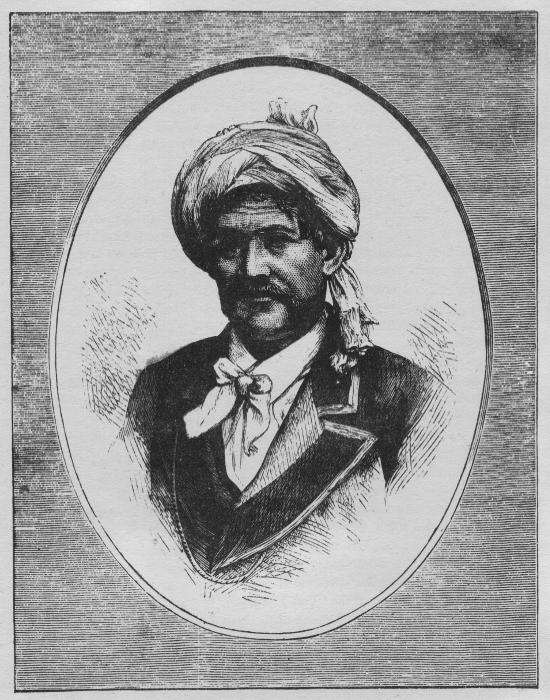
Jamshêd, the Siah Pôsh Kafir,
Brought to England by Prof. Leitner in 1872.
(The first five and the last are described by the French system; the sixth by the German system, put into millimetres and centimetres respectively.)
|
A
MATAVALLI.[118] |
B
KHUDÁYÁR. |
C
GHULAM MUHAMMAD. |
D
GHULÁM. |
E
ABDULLAH. |
F
MIR ABDULLAH.[119] |
G[120]
DR. LEITNER. |
| Date and place of observation |
2-6-81: Simla |
2-6-81: Simla |
2-6-81: Simla |
—— Simla |
2-6-81: Simla |
23-3-86: Lahore |
2-6-81: Simla |
| Age; sex; profession |
32 yrs.; m.; peasant and warrior |
21 yrs.; m.; student |
40 yrs.; m.; agriculturist |
18 yrs.; m. |
40 yrs.; m.; agriculturist |
30 yrs.; m.; Jurist |
40 yrs. |
| Caste, tribe, and tongue |
Yashkun; Khajuná; Burishki |
Yashkun; Khajuná; Burishki |
Shiná |
Shîn (Kashmir subject) |
Shîn; (Kashmir subject) |
Dard; Gabriál |
|
| Religion and birthplace |
Shiah; (probably Mulái) Hunza |
Shiah; Nagyr |
Shiah; Gilgit |
Sunni; Gurukôt near Astor |
Sunni; Gurukôt near Astor |
Sunni |
|
| Thin, medium, or stout |
medium |
thin |
medium |
|
medium |
medium |
stout |
| Weight[121] |
9 st. 8½ lb. |
9 st. 10 lb. |
8 st. 5 lb. |
|
|
|
14 st. 4 lb. |
| Colours[122] |
skin, exposed parts |
53 (red brown) |
54 |
38 |
52 |
37 |
forehead & cheeks, reddish-brown |
25 (very fair) |
| ” covered parts |
21 (light red brown) |
47 |
38 |
53 |
37 |
lips, pink; covered parts, lighter |
24 (very fair) |
| hair |
48 (black) |
42 |
grey |
48 |
48 |
black |
fair |
| beard |
41 (black) |
43 |
grey |
48 |
48 |
red-brown |
fair; slightly red |
| eyes |
3 (light brown) |
3 |
2 |
1 |
1 |
iris: dark brown; ball: white, bluish, injected |
14 (blue) |
| Hair: straight, wavy, curly, frizzled, or woolly |
straight |
curly |
curly |
curly |
curly |
black, short, curly |
curly |
| Beard: thick (abundant), scanty, or none |
thick, long and stiff |
scanty |
very thick |
thick |
very thick |
straight; woolly; brown-reddish |
abundant |
| Skin: smooth, a little, or very hairy |
very hairy |
a little hairy |
a little hairy |
very hairy |
very hairy |
hairy on breast, little on arms |
very hairy |
| Shape of profile of nose (p. 111) |
No. 2 (nearly quite straight) |
5 |
5 |
5 |
5, very high nostrils |
convex |
5 |
| Lips: thick, medium, or thin |
medium (arched) |
medium |
medium |
thin |
medium |
thin, arched |
medium |
| ” straight, or turned outwards |
straight |
straight |
straight |
straight |
little turned outward |
thin, straight |
thin, straight |
| Teeth: large, medium, or small |
small |
medium |
large |
small |
small |
small |
medium |
| ” incisors, straight (vertical), slanting, or very slanting |
straight (incisors wide apart) |
straight |
straight |
straight |
straight |
straight |
vertical |
| The set of teeth: very good, good, medium, bad, or very bad |
good (but dirty) |
very good |
good |
very good |
very bad |
transparent, very white |
medium |
| Skull |
Diameters: antero-posterior, maximum |
195 millim. |
183 |
186 |
187 |
193 |
191 |
201 |
| ” ” inial |
192 ” |
180 |
187 |
185 |
183 |
186 |
200 |
| ” transverse, maximum |
144 ” |
144 |
144 |
144 |
140 |
141 |
163 |
| ” auriculo-vertical (fr. m.) |
116 ” |
110 |
123 |
110 |
114 |
119 |
126 |
| Curves: inio-frontal |
345 ” |
315 |
325 |
335 |
345 |
|
340 |
| ” horizontal |
540 ” |
525 |
540 |
540 |
520 |
530 |
600 |
| ” transverse sub-auricular |
330 ” |
315 |
320 |
335 |
320 |
|
330 |
| facial angle (Camner) |
81 ” |
|
|
|
81 |
|
73 |
| From point of chin to edge of hair |
185 ” |
|
|
|
177 |
191 |
193 |
| ” ophryon to alveolar point |
95 ” |
|
|
|
75 |
|
94 |
| Breadth between zygomata |
139 ” |
|
|
|
132 |
136 |
133 |
| Length of nose |
48 ” |
|
|
|
52 |
59 |
54 |
| Breadth of nose |
31 ” |
|
|
|
39 |
35 |
33 |
| From ophryon to root of nose |
12 ” |
|
|
|
20 |
|
16 |
| Width between inner angle of eyes |
|
|
|
|
38 |
34 |
35 |
| ” ”cheekbones |
94 ” |
|
|
|
108 |
|
103 |
| Height (standing) |
164 centim. |
182 |
161 |
159 |
152 |
166 |
171 |
| ” (sitting) |
126 ” |
131 |
124 |
125 |
124 |
|
126 |
| Greatest extension of arms |
162 ” |
180 |
174 |
167 |
165 |
165 |
182 |
| ” ” of span |
20 ” |
16½ |
16 |
20 |
19 |
|
19 |
| Total length of foot |
25 ” |
26 |
25 |
24½ |
23½ |
25½ |
27 |
| Length of ditto, ante-malleolar |
20 ” |
21½ |
19 |
20 |
19½ |
|
22 |
| Forehead |
high; slightly receding |
high; slightly retreating |
medium; straight |
medium; straight |
high; straight |
high; breadth of forehead 107 |
high; slightly receding |
| Frontal bone (bord sourcillier) |
very marked |
well developed |
much developed |
scarcely any |
scarcely any |
pronounced |
very pronounced |
| Intra-ocular distance |
scarcely any |
deep |
very deep |
not deep |
not deep |
deep; distance 3·4 |
very small |
| Eyebrows |
bushy, crossing, forming but one line |
very bushy |
arched, bushy, crossed |
arched, bushy, crossed |
arched, bushy, crossed |
standing far apart, thin |
arched |
| Eyes |
straight |
straight |
straight |
straight |
straight |
straight |
straight |
| Cheeks |
little salient |
little salient |
salient |
little salient |
little salient |
very salient |
salient |
| Zygomatic arch |
very salient |
salient |
salient |
much developed |
much developed |
salient |
not salient |
| Chin |
oval |
oval |
oval |
oval |
oval |
oval |
square |
| Ears |
medium, little salient (round, small) |
|
|
|
medium flat |
long; height of ear 6·3 |
medium |
| Mouth |
|
|
medium |
small |
thick |
length of mouth 5·3 |
medium |
| Neck |
strong |
proportioned |
proportioned |
well proportioned |
strong |
proportioned |
strong |
| Torso |
strong |
square |
proportioned |
well made |
slim (svelte) |
proportioned |
vigorous |
| Extremities |
very small |
fine |
fine |
medium |
medium |
small |
medium[123] |
MEASUREMENTS OF HEAD (BY DR. JOHN BEDDOE).
|
|
ENGLISH
MILLIMETRES. |
INCHES. |
| 1. |
Greatest length of head from glabella |
6·8 |
172·7 |
| 2. |
Length from tuber occip. to greatest convexity of frontal arch |
6·7 |
170·2 |
| 3. |
Length from tuber occip. to glabella |
6·8 |
172·7 |
| 4. |
Greatest length of head from smooth depression above glabella (ophryon) |
6·75 |
171·4 |
| 5. |
Greatest length of head from depression at root of nose |
6·65 |
168·9 |
| 6. |
Length from chin to vertex |
9·1 |
231·1 |
| 7. |
Least breadth between frontal crests |
3·7 |
94 |
| 8. |
Greatest breadth between zygomata |
5·1 |
129·5 |
| 9. |
Breadth from tragus to tragus |
5· |
127 |
| 10. |
Greatest breadth of head, yielding cranial index 86·7 |
5·9 |
149·8 |
| 11. |
Breadth between greatest convexities of mastoid processes |
5·3 |
134·6 |
| 12. |
Greatest circumference of head |
20·6 |
523·2 |
| 13. |
Circumference at glabello-inial line |
20·4 |
518·1 |
| 14. |
Circumference at inion and frontal convexity |
20·5 |
520·6 |
| 15. |
Arc from nasal notch to inion (tuber occip.) |
12·8 |
325·1 |
| 16. |
Arc from one meatus to the other across top of head |
14·4 |
365·7 |
| 17. |
Arc from one meatus to the other over glabella |
11·5 |
292·1 |
| 18. |
Length of face (nasal notch to chin), giving facial index, 80·4 |
4·1 |
104·1 |
|
Height from meatus to vertex |
5·3 |
133·5 |
|
Bigoniac breadth |
4·1 |
103·5 |
The head, though strongly brachy-cephalic, is distinctly of Aryan type;
high and round, but not at all acro-cephalic; the inion is placed very high.
JAMSHÈD—(continued).
The following Measurements are according to the System of
Schwarz, of the Novara Expedition.
|
|
CENTIMETRES. |
| 28. |
From the growth of hair to the incisura semilunaris sterni |
25· |
| 29. |
From the inion to the Halswirbel (vertebra prominens) |
14·45 |
| 30. |
Direct diameter, from one meatus aud. ext. to the other |
11·85 |
| 31. |
Outer angle of the eye to the other |
8·75 |
| 32. |
Inner angle of the eye to the other |
2·75 |
| 33. |
Distance of the fixed points of the ear |
4·05 |
| 34. |
Breadth of the nose |
3·2 |
| 35. |
Breadth of the mouth |
5· |
| 36. |
Distance of the two angles of the lower jaw |
10·35 |
| 37. |
From incis. semil. sterni to the seventh vertebra |
12·95 |
| 38. |
From the axillary line over the mammæ to the other |
26·4 |
| 39. |
From sternum to columna vertebralis, straight across |
19·3 |
| 40. |
From one spina anterior superior ilii to the other |
22·35 |
| 41. |
From one troch. maj. to other |
26·05 |
| 42. |
Circumference of the neck |
33·5 |
| 43. |
From one tuberculum majus to the other |
37· |
| 44. |
From middle line of axillary line over the chest, above mammæ, to the other middle line |
41·5 |
| 45. |
Circumference of chest on the same level |
88·25 |
| 46. |
From nipple to nipple |
19·25 |
| 47. |
Between anterior spines of ilia |
26·85 |
| 48. |
From trochanter major to the spina anterior ilii of the same side |
13·5 |
| 49. |
From the most prominent part of the sternal articulation of the clavicular to above |
43·4 |
| 50. |
From same point to the navel |
39·2 |
| 51. |
From navel to upper edge of the symphysis ossium pubis |
14·75 |
| 52. |
From the 5th lumbar vertebra along the edge of the pelvis to the edge of the symphysis |
43· |
| 53. |
From the 7th vertebra to the end of the os coccygis |
60·35 |
| 54. |
From one acromion to the other across the back |
43·7 |
| 55. |
From the acromion to the condyl. ext. humeri |
32·25 |
| 56. |
From ext. condyl. humeri to processus styloideus radii |
25· |
| 57. |
From processus styloideus radii to metacarpal joint |
10·2 |
| 58. |
From the same joint to the top of the middle finger |
9·8 |
| 59. |
Circumference of the hand |
21·4 |
| 60. |
Greatest circumference of upper arm over the biceps |
26·8 |
| 61. |
Greatest circumference of forearm |
24·5 |
| 62. |
Smallest circumference of forearm |
15·2 |
| 63. |
From trochanter major to condyl. ext. femoris |
34·35 |
| 64. |
|
|
| 65. |
|
|
| 66. |
|
|
| 67. |
|
|
| 68. |
From condyl. ext. femoris to mal. ext. |
38·6 |
| 69. |
Circumference of knee joint |
32·4 |
| 70. |
Circumference of calf |
36·4 |
| 71. |
Smallest circumference of leg |
21·3 |
| 72. |
Length of the foot |
23·3 |
| 73. |
Circumference of instep |
23·5 |
| 74. |
Circumference of metatarsal joint |
23·5 |
| 75. |
From external malleolus to ground |
8·1 |
| 76. |
From condyl. intern. to malleolus int. |
36·9 |
| 77. |
Greatest circumference of thigh |
48·5 |
| 78. |
Smallest circumference of thigh |
35·5 |
| 79. |
Round the waist |
68·4 |
| 80. |
Height of man (English, 5´ 3¾) |
161·9 |
| 81. |
Colour of hair, very dark reddish-brown. |
|
| 82. |
Colour of eyes, hazel-grey. |
|
| 83. |
Colour of face, yellowish-brown. |
|
| 84. |
Colour of skin of body, lighter than above. |
|
| 85. |
Weight, |
|
| 86. |
Strength, |
|
| 87. |
Pulsation, 80 (a little excited). |
|
From Gilgit to Kabul, viâ Dareyl, Tangir, Kandiá, Ujù, Torwál,
Swat, Dir, Maidán, Jandūl, Bajaur, Muravarri, Pashàt, Kunèr, Jelalabad,
Kabul.
Gilgit to Sherkila, 9 katsha (rough) kôs[124] (1½ miles), ruled by Isa
Bahadur’s son, Raja Akbar Khan, under Kashmīr, a faithful ally, contains
70 zemindars’ (peasants’) houses on the Yasin river.
Sherkila to Patàri (is uninhabited), over a ridge Pīr (17 katsha kôs)
called Batrèt, which is a plateau on which the Dareylis graze their flocks in
the spring.
Patàri to Yatshōt (12 katsha kôs), road stony and jungly. Yatshōt
is a village of Dareyl of one hundred houses, occupied by zemindars
who have cattle, sheep, goats, and buffaloes (which are not found in
Badakhshan). The ground produces much white maize (from which
bread is made), wheat, barley, grapes growing to a gigantic size, nuts, etc.
There is excellent water, but it is very cold. The people are Sunnis, and
speak Shiná (the dialect of Chilás). [The Shins appear to have been a
Hindu tribe expelled from Kashmir territory and converted to a sort of
Muhammadanism, both Shiah and Sunni. They are the highest caste in
Dardistan; but, instead of the Brahminical veneration for the cow, they
abhor everything connected with it—its flesh and milk—and only touch its
calf at the end of a prong.] Yatshōt has two mosques, and Mullas who
understand Arabic well. The Dareylis are very religious, and attentive
to their ceremonial practices. The streamlet of Dareyl runs past it.
Yatshōt to Manikál, 3 katsha kôs, a plain easy march through a
prairie. Manikál has two forts, one of which has about 500 houses, and is
called Dòrkans; and the other, Manikál proper, which has 300 houses
and an old Mosque. Manikál is surrounded by forests. When the
Kashmīr troops reached Manikál, the Dareylis, after fighting, burned down
their old fort rather than surrender. There are many Mullas and disciples
there, some coming from Peshawar, Swat, etc.
Manikál to Samangál, 3 katsha kôs, over an inhabited plain. The
fort contains 800 houses. A great elder (Djashtero) called Kalashmīr
resides there, whom all the Dareylis respect and follow, although there are
many other Djashteros, like Muqaddams (elders, mayors), in Kashmir
villages. He is wise and rich, possessing, perhaps, in addition to cattle,
etc., 5 or 6 thousand tolas of gold; and he has one wife and two or three
children. Persian is read there in addition to Arabic. There is also
another fort containing 500 houses, also called Samangál, a few hundred
yards from the first. In fact, Dareyl, although a small country, is thickly
populated.
Samangál to Pùgutsh, a fort, with 500 houses, 2 katsha kôs—thence
1 katsha kôs to Gayál, a fort with 600 houses—all an easy road.
Gayál to Kàmi, Fort Tangīr, over a high mountain called Kùbbekunn,
very windy, and wooded. Water must be taken with one when
starting from Gayál, as none is found before reaching Rîm, a small village
of 20 houses, on the Tangīr side. The road for 8 kôs is difficult, being
an ascent of 4 kôs on each side. From Rîm to Tangīr the road is good,
water abundant, and habitations numerous. Kàmi fort has 1,000 houses
of Gujars (a shepherd and cowherd tribe that is found following its
peaceful occupation, either as settlers or nomads, in the most dangerous
districts), and zemindars, who are tributaries to Yasin, paying taxes in
gold and kind. There is a direct road from Tangīr to Yasin, viâ Satìl—6
kôs, plain, with many Gujars, paying their grazing tax in gold; thence
over a small peak, Mayiréy, to the plateau of Batrêt, 8 katsha kôs. (See
second stage of this route.)
From Batrêt to Ràushan, over a small mountain. Ràushan is a
small fort of Yasin, whence there are roads to Yasin, Chitrál, Gilgit, etc.
Gold is washed from the Indus, which is 3 katsha kôs from Kàmi. The
Tangīris are braver than the Dareylis and equally religious, having many
Mullas; but the country, although larger, is not so well populated as Dareyl,
the people of which are also rather shepherds than hunters. The Gabár
are the ruling people in Tangīr, about 1,000 families, of which 500 are in
Kàmi. They are the old proprietors of the country, and are all Shins
who now have given up their old aversion to the cow, its flesh and milk.
Kàmi, over the mountain Tràk, called by the Pathans Chaudunno, which
has no snow on the Tangīr side, but a snow-covered plateau 1½ kôs long
on the Kandiá side. Then comes a green plain. To the foot of the
mountain Tràk on the Tangīr side 11 kôs pakka (11 good kôs, or nearly
22 miles), over a tree-covered plain. Then over the Tràk pass and
plateau, the road goes along a plain which extends for 17 kôs to
Gabriál. There are a great many Gujars along the road. [The road to
Yasin is through the Gujar-frequented district of Kuranjá, belonging to
Tangīr. Multán is the Muqaddam of the Gujars, a brave man.]
Gabriál has only 40 houses, but the country of Gabriál generally is
studded with habitations. The famous Mullah Habîbulla, a relative of
Raja Khushwaqtia, is a most influential man among Kohistanis. His tribe
is Mullakheyl, and all the Gujars of Kandiá are obedient to him. The
Mullakheyl are Shîns, but Yashkuns also live there. Yashkuns are the
peasantry of Dardistan, including Hunza, and supposed to be aborigines,
though some derive the Yashkuns of Hunza from the white Yuechi, or
Huns, and others give them a Western origin. They have always been
Sunnis. (The Dareylis were formerly Shiahs.) (See detailed account of
Gabriál by one of its Maulvis, Mir Abdullah, and of Kandiá or Kiliá,
translated by Dr. G. W. Leitner.) The people of Kandiá are wealthy in
flocks, ghi (= clarified butter, exported to Peshawur, 18 to 25 pakka seers
for the rupee). It is subject to Yasin. They possess double or Indian
rupees and mahmudshahis, some having 10 or 20 thousand rupees.
The poorest have 10 to 12 cows, 100 sheep, etc. The greatest among the
Gujars intermarry with Yasin chiefs. The Kohistanis are independent,
but the Gujars pay a tribute to Yasin. The Samu or Samasi village is 2
kôs from Gabriál. From Gabriál, ½ kôs distant, is a mountain called by
the same name, with an ascent of five to six pakka kôs, with excellent
water; road only open in summer. A descent of 5 kôs brings one to
Ushu, a big village of 600 houses inhabited by Bashkaris. (See special
account by Dr. Leitner of Bashkar and its language.) The Swat river
touches it. The Bashkaris pay a small tribute to Yasin, but are practically
independent. They are generally on good terms with the Torwaliks,
who were formerly their rulers. The languages of Torwal and
Bashkar are different.
From Ushù to Torwál, 13 kôs, very bad, stony road, after Kalám
(2 miles from Ushù). Torwál has 200 houses. They are not so rich as
the people of Kandiá and Jalkôt.
From Torwál to Branihál, the frontier of Torwál, 12 to 13 kôs, a
bad stony road, 600 houses and a Bazár in which there are 5 or 6 Hindu
merchants. [The Hindu traders are not molested in Yaghistán (“the
wild land” as Dardistán, the country between Kabul and Kashmir is often
called), because no one is afraid of them; whereas if a Sahib (English
man) came, people would be afraid.] There are many wealthy people in
Branihál, which may be considered to be the capital of Torwál.
Branihál to Swat, a plain; at only 1½ kôs is Shagrám, composed of
3 villages, under the children of the Sayad (descendant of the prophet
Muhammad), Pir Bâba. The three villages are inhabited by Sayads and
contain 500 houses. Then to Tiráh (1 mile, a plain), where the Mîna
or Akhunkheyls live (300 houses).
Tiráh to Landéy, 1 kôs pakka, a Patán village, in which rice grows,
beginning from Branihál; Landéy to Lalkún (a small village away from the
big road to Hoti Murdan) 5 kôs, a plain. Thence Fazil banda, 12 kôs, a
plain; thence to a mountain, Barkànn, 12 kôs, a plain, leaving the Swat
for the Dīr territory. Jarughey (hamlet of Gujars) is the halting-place.
From Jarughey into the Dara of Ushuréy, in Yaghistan proper; it is the
home of the Khan of Dīr, and is inhabited by the Panda Kheyl tribe.
Halt at Jàbar, a village 14 kôs from Jarughey, a fairly inhabited road.
From Jàbar to Maidán (16 kôs) by the mountain Káir Dara, and passing
the fort Bībiól (100 houses) a fort of the Khan of Dīr. The mountain
is high. Maidán fort and Bazar, and Bandey fort (500 houses), Kumbàr
1 kôs distant, 1,000 houses, of Mīans, and Bazar with many Hindus.
Thence to Bandey Mayár, a great Bazár, and a renowned Ziáret (shrine),
and Langar (almshouse) of Saukanó Mīân, a village of Peshawar, are
2,000 or 3,000 houses, belonging to Jandūl. It is 14 kôs distant from
Maidán, over an inhabited plain. Umr Khan, the ruler, has 240 excellent
horsemen, 3,000 infantry, fights with Dīr, who has 500 inferior horses
and numerous footmen, but not so brave as Jandúl. Terkanì is the name
of the Jandúl ruler and tribe up to Jellalabad, and Irubsì that of Dîr,
Swat, Buneyr, Samè, Pakli, etc. At 1½ kôs of Mayar is Miákil, a big town,
of 5,000 houses and a Bazar. Miákil to (Bajaur) Badâm, are Kakazis, of
the Mamùnd tribe, for 16 kôs a plain, 400 houses, Yágis (wild); Badàm to
Mureweri, are 16 kôs, over a small mountain (Mohmands) in Yaghistan, has
1,000 houses. (At Nawagai is a Khan, Ajdar Khan, with 20 horsemen
and 3,000 footmen.) At Khàr was another Khán, Dilawar Khan, who
fled to Peshawar, his place having been conquered by Ajdar Khan; 100
houses. The place is surrounded by the Tuman-kheyl tribe. On the other
side of the river, Kabul rule begins, and opposite is Chagar Sarai, leading
to Katár, once a stronghold of Kafirs. Gambīr is subject to Kabul, the
rest of the Siah Posh being independent; and another road leads to Petsh,
which is Yági, or independent.
From Muraweri to Pashùtt, 5 or 6 kôs pakka. Below Muraweri,
2 kôs, is Serkanni, where there are 200 Kabul troops. From Pashùtt
cross stream on jhallas (inflated skins) to Jelalabad, 20 or 22 kôs; whence
the road to Kabul is too well known to need even a passing reference.
Uninteresting as rough accounts of itineraries may be to the general
reader, they are not without importance to the specialist. My material on
the subject of routes to, and through, the Hindu-kush territories is considerable,
though necessarily defective. It was mainly collected in 1866-72,
when a portion of it was used by that leader of men, General Sir Charles
MacGregor. I published a few “routes” at various intervals in the hope
of stimulating inquiry, and of eliciting corrections or further information;
but Indian official Departments, instead of co-operating, are uncommunicative
of the partial, and therefore often misleading, knowledge which they
possess, and, above all, jealous of non-official specialists. The First part of
my work on Hunza has recently been printed by the Indian Foreign Office;
where and when the Second will appear, is doubtful. I think the public have
a right to know how matters stand in what was once called “the neutral
zone,” the region between the Russian and the British spheres of influence
in Asia. At any rate, the learned Societies and International Oriental and
other Congresses, that, on the strength of the material already published,
have done me the honour at various times to apply with but very partial success,
to Government on behalf of the elaboration of my material, shall not be
deprived of it, though I can only submit it to them in its rough primitive
state. The reader of The Asiatic Quarterly Review will, I hope, not be
deterred by the dulness of “routes” from glancing at material which, in
future articles, will include accounts, however rough, of the languages, the
history and Governments, the customs, legends, and songs of, perhaps,
the most interesting countries and races in Asia. The information, often
collected under circumstances of danger, is based on personal knowledge,
and on the accounts of natives of position in the countries to be dealt with.
G. W. L.
[Reprinted from The Asiatic Quarterly Review, April, 1891.]
By Dr. G. W. Leitner.
In connection with my note in “Routes in Dardistan,” I now propose
to publish a series of accounts which have been supplied to me by native
Indian or Central Asian travellers of position and trustworthiness, and
which cannot fail, whatever their scientific or literary deficiencies, to be of
topographical and ethnographical, if not of political, value. I commence
with the account of a loyal native Chief, who has had opportunities of comparing
Russian with British administration. The Chief first passes quickly
from Jelalabad to Gandamak, thence to Tazîn, Butkhák, Balahisár
(where he left his sword with D... S...); he then proceeds from Kabul
to Chalikár, (a distance of 17 kôs over a plain); then stops at the Salán
village, at the foot of the Hindukush, 11 kôs, and then goes on to say:
“Salán: one road goes to the Hindukush and one to Bajgá (a halt) 14 kôs,[125]
over a mountain into Afghan Turkistan. Anderáb, district of Kundûz,
17 kôs, plain; Anderáb to Bazderá; then Baghbán; then Robât (where
there is a camp of Kabul troopers against Uzbak robbers), 14 k. in Haibak
district to Haibak town; stayed at a small place of Tashkurghán, which
has 6,000 houses, and is held by a Risála (troop) of the Amir; stayed at an
intermediate cantonment established by Kabul; then to Mazari Sharif, 13
kôs (all belonging to Balkh). Daulatabad (300 houses); thence to the
river Amu over a Rēg (sandy and dusty place) in a buggy of two horses,
paid three double rupees,[126] took water with us (20 kôs). There are 100 men
over the ferry for protection against raiding Turkomans. Sherdil Khan
Loináb gave me a passport to visit the Ziárat (shrine) of Khaja Bahauddin
Naqshbandi, at Bokhára. Went on ferry with 100 cattle and 50 men
all day long, to the village of Talashkhán (500 h.) in Bokhára territory,
where we rested in the evening. Next day by road to Sherabad, 7 kôs,
plain (2,500 h.); then to Chinarì (600 houses), passing the Khirga Nishin
Khirghiz and Uzbak, “living in huts” (also Zemindars); Cheshma-i-Hafiz,
40 h., and a Serai for travellers. Then again on to the plain; made a
halt among the Khirga-nishīn. Next day went on to the large city of
Ghuzár (250,000 inhabitants, with villages, etc.). (Thence to Karshi to
Bokhára); thence to Karabagh (700 houses); to town of Chiraghtshi in
Shehrsabz (Ch. has 3,000 h.), whence it is four miles distant. Shehrsabz is
a beautiful place of 6,000 houses. (The Bokhára army has a band in
Russian style, and is drilled in a Russian way; it is better fed and clad
than are the Afghans, but it is not so brave.) Thence to Kitáb, 3,000
houses, and Bokhára troops; did not stay there, but went to Takhta
Karatsha, 10 kôs: thence to Kurghantippé Bazár; thence to Samarcand,
a paradise (500,000 inhabitants, two rivers); there is a Hákim and General,
the place belongs to the White Czar = the Ak Padishah. There were 12
regiments of infantry, and 8 of cavalry there. Then to Jám, 4 kôs (a large
Russian force), 12 regiments of infantry, 4 of cavalry. I stayed with A.R. at
Samarcand. There is a Russian cantonment between Jezakh and Samarcand,
Kōr, Khoshgurù. The guns everywhere are directed towards Yasin, or
India. I was nowhere molested in visiting Russian cantonments. Jezakh,
Tamburabad, little Bokhara; Zamīn, Uratippa, a great town, and among
40,000 inhabitants there are 6 battalions and 8 regiments of infantry; Náu in
Khojend district. Then Khojend, 800,000 inhabitants, great army; Mahràm,
Besharìh in Khokand, then to the city of Khokand; Karawultippa, 8 kôs,
plain, Murghilán, a big city, 350,000 inhabitants with villages; Mintippé,
3,000 houses (or inhabitants?), Arabán; Ush, a large army (Kashghár is
eleven days’ march). Induján, big Russian army; 150,000 (inhabitants).
Then to the Kokand river, Derya Sîr, crossing to Namangán, big city
and army, thence returned to Induján, then to Asáka, 8 kôs plain,
9,000 inhabitants and army (1 cavalry, 4 infantry), then to Shahrikhán,
6 kôs, big city, 8,000 inhabitants or houses; then to Kawa, 5 kôs.
Utshkurghán, 10 kôs, big city in Khokand: thence into a valley to a
Langar, 17 kôs, plain, at night, where there are Khirghiz subjects to
Khokand; over a mountain into Alai, 13 kôs, plain of Pamīr, inhabited
by Khirghiz, very cold; then to Chaghalmak, 15 kôs, plain, a
small village, 100 houses of Khirghiz. District of Karateghin, which is
subject to Bokhara (Alai being under the Russians); Chaghalmak to
Zankù, 16 kôs, plain (horses are to be found everywhere for hire, according
to distance by Farsang). At Samarcand one mule’s wheat load = two
double rupees; a big sheep costs one rupee, and one and a half long-tailed
sheep at Khokand, also one rupee. The fat of sheep is used
instead of Ghi. Gold and notes abound more than silver. (Abdurrahman
received 700 tungas = 350 rupees per day, for self and eighty followers.)
Silk Atlas one and a half yards is sold for one rupee. The
Russian ladies are well dressed, and great respect is shown to them. The
officers are very polite. There are free dispensaries, and schools in which
Russian and the Korán are taught. (Haldi and black pepper from India
is dear); there is no tyranny, and they are exactly like the English; the
Russians live in bungalows. The Kázis and the man who beats the drum
at night for Ramazan are paid by the Russians; sanitation is well attended
to; all the troops are Europeans, except the Noghais, who are Tartars.
I was much struck at Khojend by seeing the cavalry mounted according
to the colour of the horses. (Gold is said to come from Kashgar and
Khokand, but I have not seen the mine.) Camels abound and are eaten.
Zankù to Kila-i Lab-i Ab (300 houses), 16 kôs, plain, to a village Shòkh
darà (300 houses).
It is a fine country; the people talk Persian, and are Sunnis (belongs to
Bokhára).
Kila-i Lab-i Ab, governed by a Bokhára Kardár, called Hákim Muhammad
Nazir Beg, at a Fort Gharm to Shughdaréy, 12 kôs, plain, on horseback
all along to Samarcand (300 h.), Shughdaréy to Fort Gharm, 3 k. (1,500
houses or inhabitants), Gharm to Childará, a village in Derwáz, plain, 17 k.
packa (buggies do not go there), 150 h.; thence to Khawaling, Bazar, 1,000
h. (in the District of Koláb), 17 kôs, plain; carriages can go; thence to the
city of Koláb 14 kôs, plain (Koláb is under Bokhára) (was formerly
governed by Kartshîn Khan, a raider), whose brother Serakhan is at
Kábul. Koláb, 6,000 houses, is a fine city, and there are six other cities
belonging to it (Khawaling, Kungár, etc.); thence to Sar-i-Chashma, 10
kôs, plain; carriages can go (200 houses); thence to Baràk, 40 h. on the
Amu 4 kôs, a warm place like Koláb generally; cross into Samptì (60 h.),
in the district of Rosták, belonging to Badakhshán (paid 4 annas for conveyance
of five horses costing me 3 tolas in Koláb = 30 rupees); to Chayáp
city, 2,000 houses (Jews are wealthy and not oppressed, and at Koláb
there are Jews and Hindus, the latter with no families). Jews wear front
curls, and have furs; women are handsome, but are dressed like Mussulman
women; men, however, wear caps and narrow trousers, not turbans, as a
rule, or wide trousers. The Jews in Turkestan are very clean. “They
have a learning like the Shastras of the Pandits.” They lend money to the
Khan of Bokhára. (The utensils are of china.)
Mare’s milk is much consumed cooked with meat, and has a highly
intoxicant effect. Chayàp to Rosták, 8 kôs, plain, 2 Afghan regiments of
cavalry, 4 regiments of infantry (there are also some troops at Chayàp) 4,000
houses. Bazár well-frequented; springs; is a hot place. Atunjuláb, 12 kôs,
plain, carriages can go (60 houses); Faizabád 16 kôs, great city and large
Afghan force (3,500 houses?). I stayed at Bárak, 10 kôs; a nice place for
illustrious strangers (100 houses); plenty of Zemindars, very easy, plain, full
of fruit (apples, apricots, etc.); Chaugarán 9 kos, plain (200 houses); Tirgarán
(60 houses, of Muláis, the strange sect regarding which elsewhere)
11 kôs, plain, with the exception of a small bad bit, over which horses, how
ever, can go, called Rafàq = Parrì in Punjabi. From Tirgarán to Zerkhan
in Zebák, 14 kôs, plain, but carriages cannot go. Zebák is a fine cool
place. Its great Mulai, Sayed Abdurrahim, has fled to Arkari in Chitrál.
Zerkhan has 500 Khassadars of Kabul (even the infantry there have
horses), and 150 houses. Zerkhan to Shikashìm, small fort, 11 kôs, plain,
300 houses in villages all round; it is now well garrisoned with Kabulis
(2 k. from Shikashìm are the ruby mines worked in winter near Gharàn on
the road to Shignán). (In the time of Mir Shah rubies as large as candles
were said to be got, lighting up the place.) “Lajvard” (Lapis lazuli)
is got from Yumgan, a village in mountain above Jirm in Badakhshan.
“Lajvard” is sold at a rupee of a Rupee size. (Gold streaks are often found
in it.) Shikashìm to Kazi-deh, 10 kôs, plain (carriages could go) in
Wakhan, which begins at Putr about half kôs from Shikashìm (another road
from Shikashìm to Shignán in two days viâ Ghasann 10 kôs, plain, very
cold); thence 12 kôs to a fort in Shignan. Kazi-deh has 40 houses. Kazi-deh
to Pigitsh 12 kôs, very plain, 15 houses of very wealthy people, all
Mulais; Shoghōr under Chitrál, 500 houses. Fort over the Khatinza,
Nuqsan and Dura passes from Zeibák all under Chitrál; the first-named
pass is open all the year round, but violent storms blow at the top.
Pigitsh to Fort Panjah, a plain 12 kôs; Ali Murdan Khan, its
former ruler, is a refugee with Chitrál; 200 Afghan cavalry; there are 5 or
6 houses in the fort, and a number of villages round it (Zròng, a warm mineral
spring, 40 houses; Kishm, 40 houses, Gatskhòn, 30 houses. Above
Pigitsh are other villages. Khindàt, 50 houses; supplies are most plentiful).
From Panjah to Zàng (50 houses) 11 kôs, plain (artillery could go);
Zàng to Serhadd 12 katcha kôs, 200 houses, plain, cold, much wheat,
cattle, etc.; here the Pamir begins. Thence to Ushàk, 14 k. plain, except
a small elevation, very cold (here there is a road to Yarkand, and another
to Hunza; the Wakhanis graze their cattle and flocks here in winter as
there is abundant grass); Ushàk to Langàr, 12 kôs, plain; the roads
divide, of which the left one goes to Sarikol, and the right one to Hunza.
Cattle are kept there in winter by the Serhadd people; Langàr to Baikará
8 kôs plain.
Barkará to Babagundì, 12 kôs over the Irshád Pir (somewhat steep
and snow-covered on the Wakhan side, but otherwise easy). Here there is
a road on the other side to Babagundì (small town); place for Ghazan
Khan’s cattle (Dannkut). Babagundì is a famous shrine of Pir Irshád,
where even the Mulai Ghazankhan gives cooking pots for travellers, and
makes offerings; there are 5 or 6 houses of Zemindars, who look after the
shrine. (Half a kôs beyond Babagundì the various roads to the Karumbar,
Badakhshan, and one to Hunza join.)
Babagundi to Ríshatt; small fort, 11 kôs; inhabited; 5 villagers’
houses employed in agriculture. Ríshatt; for 4 kôs there is a plain road;
then a difficult road, Ráship Jeráb, with precipices (6 kôs from Ríshatt),
which can be destroyed, so as to make the approach from that side very
hazardous; the road continues to Yubkatí, with scarcely much improvement,
for 1½ kôs. There is a small town there, as generally on difficult
defiles, or places than can be defended. Yubkatí to Gircha, 1 kôs katcha
(10 houses); Gircha to Murkhon, 10 houses of Zemindars, 1 kôs; 2 katcha-kôs
comes the Khaibar village of 4 houses, a defile defended by a small
town, with a door shutting the road (Der-band); Khaibar, 4 kôs to Pàss;
road over snow or glacier for 1½ kôs; below the glacier is the village of
Pàss, 25 houses.
Pàss to Hussain, 20 houses; also a shrine 1½ kôs; fair road; also a
deep natural tank (hauz) (where there is a place to keep cattle in winter)
a few hundred yards from village. Beyond there is again one of the streaks
of never-melting icefields, and dividing it from Ghulkin, a village of 60
houses (the gardens flourishing in the close vicinity of these icefields).
Immediately near Ghulkin is Gulmùtti, 100 houses; thence for 10 kôs to
Alti, a bad road over an elevation, Refáq, closed by one of the doors to
which I have referred. The door is 1 kôs distant from Gulmùtti. Alti
(150 houses), the residence of Salim Khan, father of Ghazanfar, who built
Balti, where his son, the present ruler of Hunza, Ghazankhan, lives. Balti
is ½ kôs from Alti, and above it. Balti has 1,000 houses, Zemindars
Muláis; there are 50 Mosques, but no one reads prayers in them; people
build them for the sake of glorification, not worship. They are used for
dancing, drinking, etc. (the Raja used to dance himself on the Naurōz,
and give presents to the Zemindars). Hunza may turn out 2,000 fighting
men. Near it Fort Haiderabad (½ kôs), with 300 houses; close to it is
another fort, Chumarsingh, with 100 houses; near it Dòrkhann Fort, with
200 houses (the inhabitants are more numerous than the wasted ground
can support. People live largely on apricots, etc.; the land is generally
sterile). ½ kôs from Dòrkhann is Gannish Fort, 600 houses, above the
river which divides Hunza from Nagyr, where the Sumeir Fort confronts
Gannish. There is also a small fort near Gannish, called Karál, with 50
houses. (Near Dòrkhann is also a similar small fort, the name of which I
forget.) Coming back to Dòrkhann, and going from it straight in the Gilgit
direction, is Aliabad Fort, with 600 houses, and close to it Hasanabad Fort,
with 100 houses. There is also a “Derrband” between Hasanabad and
Murtezabad, about a mile distant over a stream. Murtezabad has 2 forts,
one with 100, and the other with 50 houses.
From Murtezabad to Hirì for two kôs; difficult ascent and descent.
Hirì, a large village, with 800 houses of Zemindars in the fort (Shins live
there); 2 kôs of bad road, excepting about 1 mile; to Mayón, 50 houses.
Four katcha kôs bring one without much difficulty, except over one ascent,
over the Budalèss stream, violent in summer, where there is also a fort
(a warm spring in a fort called Barr, 25 houses, occupied by 20 Sepoys of
the Maharaja) to Chálta, in Gilgit territory, near Budalèss. There is a fort
there, 150 houses, and 100 Sepoys. Over the Nulla, about one kôs above,
is Chaprôt, 50 Sepoys and 60 houses; is a strong position (Natu Shah
came to grief, with 1,000 men, between Budalèss and Mayôn). From
Chálta, crossing the river and a small mountain, is a plateau to Nilt Fort,
in Nagyr territory, 4 kôs from Chálta, and confronting Mayôn. From
Chálta to Nomal, in Gilgit territory, with two Rifáqs each; near to these
respective places for 11 kôs (kacha), 100 houses. There are 20 Sepoys in
the Koti to guard the grain. The Zemindars now live outside the fort,
which is merely used for the storage of grain. From Nomal to Gilgit 12
kôs, plain, which now contains 200 houses.
From Zeibák to Chitrál, over the Khatinza, a very high Pass, to
Shoghor, or the other passes already mentioned. Viâ the Khatinza, which
is always open, the road from Zeibák to Deh-i-gul, 1 kôs, 25 houses.
There the roads separate, one going over the Nuqsán, which is closed
in winter, and the other one over the Khatinza, both joining at Kurubakh,
a place ensconced by stones, and about 5 kôs either way from Deh-i-gul;
from Kurubakh to Owîr, 20 houses, 3 kôs, easy road; from Owîr to Arkari,
80 houses, 5 kôs, easy road (Sháli, 10 houses, is one kôs from Arkari);
Mōmi, 5 kôs farther on, 50 houses. From Arkari to Shoghor is 10 kôs
katcha. From Shoghor, 3 miles below, is Rondur, 5 or 6 houses; 4 kôs
is another Shali, 20 houses, and thence over a plain by a village (the
name of which I forget) 5 katcha kôs.
Below Shoghor the streams of Arkari and Lodko join, at Andakhti, two
katcha kôs from Shoghor. The Rajah of Chitràl’s son lives there (Bahram);
another son, Murid, lived in Lodko district. There is little snowfall
on the high Khatinza, but there is plenty on the easy Nuqsán. A third
road, over a plain, also leads to Chitrál from Zeibák, namely, to Uskútul
(3 kôs from Zeibák); thence to Singlich, 2½ kôs, maidán; thence to the
great tank, lake, or Hauz, five miles long and 1½ miles broad, full of big fish.
Thence over the Durra, infested by Kafirs, only a katcha kôs, easy ascent,
when the snow melts (otherwise impassable), and an easy descent of one
kôs to Shai Sidèn, at foot of pass (below which is, 2 kôs, Gobôr, where there
is some cultivation in summer). (Birzin is a village of 40 houses, about 8 kôs
distant from Gobôr.) Parabêg, 50 houses, 2 kôs; Parabêg to Kui, 70 houses,
1 katcha kôs; below Kui, ½ kôs, is Jítur; below is a ziarat of Pir Shah Nasir
Khosrō at Birgunnì, one kôs, a warm spring, 50 houses; Birgunnì to Drôshp,
2 katcha kôs, where Raja Imán-ul-Mulk’s son, Murid, resides. Drôshp, 40
houses; one kôs further is Mogh, 20 houses; thence to Andákhti, 4 or 5
kôs. Over the Hauz is the Mandàl mountain towards the Siah Posh
country. Ahmad Diwanè, 50 houses, is the first village of Kafirs, subject
to Chitrál. Over Gabôr is the Shuitsh Mountain, behind which is the
Aptzai Fort of the Siah Posh Kafirs, 200 houses; these are the two places
from which Kafirs descend to plunder caravans coming from Peshawar, and
of whose approach they may have been warned from Chitrál, keeping
clothes and weapons for themselves, and giving the horses, etc., to Chitrál.
The Kafirs of Kamōz (2,000 houses) are subject to Chitrál; also Ludde
(1,000 houses), Aptsai (200 houses), Shudgol Fort (150 houses).
Istagàz is subject (100 houses) to Chitrál; Mēr (40 houses) subject to
Chitrál; Mundjèsh, 500 houses; Madugàll (500 houses and two forts), on
a difficult road, is between Kamōz (1 kôs above it) and Kamtán (Ludde,
Aptsai, Shudgol, Ahmad Diwané), 4 kôs. These Madugallis are independent,
and plunder caravans from Dīr or Zemindars. Sometimes they are
bribed by the Chitrál Raja to keep quiet.
Dull as the above account may read, it is full of topographical, if not
political, interest to whoever can read “between the lines”; and the telegrams
and articles in The Times of the 23rd and 25th Sept., 1891, throw
light on an unpleasant and hitherto concealed situation. Since 1866 I
have, in vain, drawn the attention of the Indian Government to the Gilgit
frontier. In 1886, or twenty years after my exploration, Colonel Lockhart’s
mission, no doubt, did service, as regards Chitrál; but Hunza and
Nagyr have been mismanaged, owing to the incompetent manner in which
my information has been used. I have recently, after three years’ labour,
much expense, and some danger, completed the first quarto volume of my
work on Hunza, Nagyr, and a part of Yasin, the language of which has been
a great puzzle, that has now been unravelled, giving a new departure to
philology; and the Foreign Department of the Indian Government has presented
me with 100 copies of my work, a compliment that is often paid to
the honorary contributor of a paper to the Asiatic Quarterly Review.
I.—The Muláis of the Hindukush.
A number of conjectures as to the origin of the word
“Mulái,” all of which are incorrect, have been made by
eminent writers unacquainted with Arabic or the meaning
of its theological history and terms. A few of these conjectures,
however, go very near some fact or view connected
with the “Muláis.” The word may not mean “terrestrial
gods,” but there are no other, for practical purposes, in the
creed of the “Muláis.” It is certainly not a corruption of
“Muláhid” or “heretic,” if not “atheist,” although this
term has been specially applied to them by their enemies.
It can have nothing whatever to do etymologically with
“Muwáhidin” or worshippers of “One” [God], though
they, no doubt, call themselves so, i.e., “Unitarians.” There
is this additional difficulty, moreover, introduced into the
question, that no name can be conclusive as to the esoteric
appellation of a sect that has been obliged to practise
“Conformity” or “Pious fraud” or “concealment” of
its religion, in order to escape persecution or wholesale
massacre. The Shiahs,[127] whose belief, in the hereditary
succession, through the descendants of A’li, of the spiritual
“Imámat” or leadership or apostleship of the prophet
Muhammad, rendered them overt or covert enemies of those
Sunni rulers who held the temporal power or “the Khiláfat”
(misspelt as “the Caliphate”), were, and are, allowed to
practise “Taqqîa” (which I have rendered as “Conformity”)
outwardly and the more exaggerated or exclusive a
particular A’liite or Shiite sect, the more careful had it to
be. The Sunni and Shiah may both publicly confess “There
is no God but God, and Muhammad is his prophet”; but
the Shiah adds under his breath, “A’li is the Deputy
(Governor) of God and the heir of the prophet of God.”
Now this word for “Deputy” is “vali,” “to be close to,”
whether it be to God, a king, a priest, a master, or other
position of eminence in Arabian belief, society, history, or
intellectual creations.[128] “Maulá” or “Mulá” comes from
the same root and is generally applied to a spiritual master,
but, among the Shiahs, specially to their “Lord” A’li.
Therefore, “Muláis” are the special followers of the
“Lord A’li,” just as the Jesuits claim to be a fraternity of
special followers of “the Lord Jesus.” When, then, the
term “Mauláná” or our “Master or Lord” is specially used
in the Druse Covenant of Initiation [see further on], there
is not far to seek for the meaning of the appellation
“Mulái,” though it was left for me to find it out from the
A’liite songs of the Muláis of the Hindukush. Whatever
the innermost coterie of the “initiated” may practise or
believe, a connecting link of the sect with some existing
creed is necessary for their safety or respectability. Thus,
the Ismailians might call themselves “Sadiqis” or “the
righteous,” in order to spread the belief of their being
special adherents of the 6th Imám, (in the order of descent
from A’li), the Imám Ja’far Sádiq (the righteous), without
entering into the vexed question as to whether his son
“Ismàîl” was the real “seventh” Imám or his other son,
Mûsa (through whom the bulk of Shiahs look for their
Mahdi or Messiah, the 12th Imám). Nor would any such
special fervour in revering a particular phase or man be
necessarily deemed to be heretical, even among Sunnis.
I have often heard a Sunni, especially if he was a Persian
scholar and the strange magic of that language had subdued
him, admit the impeachment of having “a particular love
for the house of A’li,” and the numerous class of Sayads, who
claim to be descendants of the Prophet, is respected, if
not venerated, among Sunnis, who, in theory, oppose the
“hereditary” claims of Shiahs.[129] The Máulais, therefore,
of the Hindukush, being, consciously or not, a sub-sect of
Shiahs, can make friends with the main body of Shiahs,
and yet pretend to the Sunnis as being, in many respects,
with them. Normally, the Mauláis would profess to be good
Muhammadans of the Shiah persuasion, leaning, however,
to the 7th Imám; if surrounded by, or in danger of, Sunnis,
they would outwardly “conform” (which is all that the
Sunnis require), and, at home, practise their own rites. The
Khojas of Bombay, who had been converted from Hinduism,
but whose very name is Ismailian, used to read the “Das-awtar”
or “ten incarnations,” in which “A’li” is made out
to be the “Tenth Incarnation,” thus rendering their step
from Wishnu Hinduism to Shiah Muhammadanism an easy
one. “All things to all men” is the dictum of the
Muláis, without, thereby, sacrificing their own convictions.
The more a Mulái knows, the more he acts on
Disraeli’s sneer that all sensible men are of one religion,
but do not tell what that religion is. The less a Mulái
knows, the more fanatically is he an A’liite, centreing
however his faith on the living descendant of the 7th Imám.
“Nothing is a crime that is not found out” may, or may
not be, the theory among the Druses, or the practice all
over the world; the fact remains that neither the Druses
nor the Muláis, whatever their belief, are worse than their
neighbours. Even the odious signification that attaches
to the term “Assassin” has been a calumny against those
misguided Ismailians who sought to rid the world of tyrants
who had ordered the general massacre of the sect or who
sacrificed one man in order to save a whole people.
In 1866 I discovered the languages and races of “Dardistan”
and gave that name to the countries between
Kashmir and Kabul, including Hunza in them. In 1886 I
was again on a special mission regarding the language of
Hunza-Nagyr and a part of Yasin. I had already pointed
out in 1867 the importance which our good friend, His
Highness Agha Khan of Bombay, the Head of the Khojas
in that city, enjoyed in those, then nearly inaccessible,
regions, as also in Wakhan, Zebak, Shignán, Raushan,
Koláb and Derwáz, where the Muláis predominate and are
governed by hereditary Pîrs or ancient sages of their own
choice,[130] to whom they yield implicit obedience, as do also the
covenanters with “Al-Hákim” among the “initiated” of the
Druses. Of these Pîrs, Agha Khan is Chief, and any command
by him would be obeyed in some of the most dangerous
parts of the Hindukush. Advantage was only taken
in 1886 of this hint, when Colonel Lockhart’s mission was
supplied with letters of recommendation by His Highness
to the Mulais. My identification of their mysterious rites
with those of the Druses connects the Lebanon with the
Hindukush through the Ismailia sect, which under the
name of the “Assassins” enjoyed such an unenviable
notoriety during the Crusades and establishes a link
among the nations of Richard Cœur de Lion,[131] of Palestine
and of the Pamirs. The connection of Hunza with the
Huns or Hunas and the relations between the “Old Man
of the Mountain” and our own Richard may be the subject
of a future article. At present, I will confine myself to
translating from the Persian original a Pythian utterance
out of the “Kelám-i-Pîr” or “the Word of the ancient
Sage,” which takes the place of the Korán among Mauláis,
and of which the following is the first extract ever given
from that hidden book. It was partly dictated to me
and partly written out on the occasion of His Highness,
the present Agha Khan, paying me a visit, by the leader
of some Muláis, who had fled, first from Russian tyranny,
and then from the still heavier Afghan oppression in the
border-countries of Central Asia, my own Hunza man
also being present on the occasion.[132] The extract was
called the Mulái “Mukti” or “Salvation” Cry of the
Muláis. It may be incidentally mentioned that Shah
Abdurrahim in Zeibak was (and perhaps still is) the
greatest Pîr in Central Asia. He controls Hunza, so far
as that God-forsaken country can be controlled. In
Wakhan, Khwaja Ibrahim Husain was the Mulái leader,
and in Sarikul, Shahzada Makin. Sayad Jafar Khan ruled
what there is of the sect in Bokhara, Balkh, Kabul and
Kunduz. “The Pîr” or “ancient sage,” however, was
the historical Shah Nasir Khosrô, who is styled “a missionary
of H. H. Aga Khan’s ancestor.” He is said to
have had the complete “Kelám-i-Pîr,” a book of which I
have for so many years in vain tried to get a copy, although
assisted by my friend, the Mihtar Nizám-ul-Mulk of Yasin
and Chitrál. The following extract from it, in one and the
same breath, affirms and denies the special doctrine of
metempsychosis and other notions opposed to the professed
Muhammadanism of the Muláis:
The Mukti or “Salvation.”
The Mulái “A’qil” or “intelligent” = “initiated” [the
singular of the Druse “U’qalá” or “initiated”] first asks,
in inelegant and enigmatical Persian:
“Ala! In what I say, can I remain knowingly an
Á’qil?” or “initiated” or “I remain knowingly an Á’qil,
although what I say
1. “Come, solve for me a difficult story [or conjecture]
Come, tell me the Light which the spirit from the world-shape
[this world of Phenomena]
When it becomes [gets] beyond [of] this shape, where
[is] its abode and station? [place of descent = “manzil”]
Is its place [of existence] in plants or in the Higher
Universe [the world above?]
Or in the Lower Universe between water, dust and clay”
[or stone]? [the strata between the centre and the surface
of the earth]
2. “If, knowingly, that secret, come and tell me: ‘Light’
And, if not, away! not knowing, without head-wandering,
careless [care not]
Dear ones! The spirit of the knowing when it departs
from these chains,
Does it become [wend] towards the skies [heavens]? Is
that its Station obtaining?[133]
Or why in the shape of man [anthropomorphic shape]
is the Adamite created?[134]
Nay (?) the perfect man [ko-burd] cultured perfect,[135] or
‘the ruling man [if] perfect, develops perfect culture’
But they who are not wanted [the useless] are ignorant
doubters”
3. “Let me tell its Commentary; every one, Come! in
the ear make it acceptable.
The present is one stride [or state of a man]
When they put him outside the body
They bind him in chains; he becomes with cow or ass
entering
Another time his place [of staying] is the [world of]
plants. They hold him [there]
He will remain inside these chains for three years
[many a year] [under] that vain curse” [this is a vain
word]
4. Al Láy! Helper of Chosroes![136] Such secrets to
men why recklessly impart? [it only makes them impudent]
Not will say ever this the A’qil [or “the initiated one.”]
[The wise do not mention their religion; if they do, they
only make the unwise impudent.]
So, after all, we have not been told the process or secret
of after-life, whether ascending into air, descending into
earth, renewing human life or migrating into animal, plant
or stone. In fact, we are made to understand that our
inquiry is folly and that its answer, whether true or not, is
also folly. Yet are we allowed to conjecture the belief of
“the initiated” in transmigration.
As for the Muláis “being all things to all men” in
matters of religion—Sunnis with Sunnis and Shiahs with
Shiahs—this is, as already stated, a mere amplification of
the Shiah doctrine of Taqqîah or concealment in times of
danger, to which I have specially referred in my “Dardistan.”
The leaning of the Muláis is, of course, rather to poetical
Shiism, with the chivalrous martyr A’li as its demigod or
“next to God” in the A’lewia sect, than to prosaic and
monotonous Sunniism, so that to strangers they seem to be
Shiahs, as will be seen in an extract from a native Indian
Diary[137] written some 20 years ago, and which, it may be
incidentally stated, still throws much light on the present
conflicts in Dir, Bajaur and other petty States bordering
on our frontier. No stranger is allowed to see the Kelám-i-Pir,
which takes the place of the Koran with Muláis, but
in the most popular poem that is recited by them, the
Imám-ul Zemán or Sahib-al-Zeman = the Imam or Lord of
the Age (H. H. Aga Khan) is worshipped as the Monarch
of this World, the visible incarnation of the Deity, offerings
or a pilgrimage to whom dispenses a Mulái from prayer,
fasting or a visit to the sacred shrines of Mecca or Madina,
or rather the Shiah Kerbelá, the place of the martyrdom of
Hasan and Husain, which Shiahs annually celebrate by
what are inappropriately called “miracle plays,” but which
really are “elegies,” and commemorative funeral recitations
and processions. A person who has seen “the Lord of
the Age” or who possesses some of the water in which he
has washed his feet is an honoured guest in Mulái countries.
The poem above alluded to is a parallel to the Druse
“Contract” which will be considered further on, and begins
with an invocation for “Help, oh Ali.”
“Nobody will worship God, without worshipping Thee, Lord of the Age!
Jesus will descend from the fourth heaven to follow Thee, Lord of the Age!
Thy will alone will end the strife with Antichrist, Lord of the Age!
Thy beauty gives light to heaven, the sun and the moon, Lord of the Age!
May I be blessed by being under the dust of Thy feet, Lord of the Age!”
A Maulái is, if sincere, already dead to sin, and can,
therefore, not commit any. He needs, therefore, no resurrection
or last Judgment day. Obedience to the Pîr is his
sole article of faith, and he holds his property, family and
life at this Chief’s disposal.
I must now conclude this introduction to a comparison of
the creeds of the Druses and of the Muláis by quoting a
few words from a rhapsody of A’li, repeated by the ordinary
Mauláis till the pious frenzy is at white heat:
“Oh A’li, to God, to God, oh A’li, my sole aim, the only
one, our Mula A’li; My desire, the only our Mula A’li; My
passion only the beauty of A’li; My longing day and night
for union with A’li; Higher and Higher A’li, oh A’li; A’li
is the Killer of difficulties, oh A’li; He is the Commander
of the Faithful, namely A’li; That one is the Imám of the
steadfast in faith, namely A’li,” and so on ad infinitum till
we come to the natural connection between normal Shiism,
its exaggeration into A’li worship, its mysterious interpretation
of the self-sacrifice of Husain to save the world,
and, finally, to all other aberrations of which Maulaism is
one. The poem then goes into wild Turkish and Arabic
measures, which exhausted my informant, Ghulam Haidar,
who adds on behalf of himself, also in verse: “It is not
proper that I should not answer the question which you
ask me, but what am I to say? The answer from me is
easy, but I see a difficulty in your way. Oh Ghulam
Haidar” (thrice repeated). Then in prose. “In the night
of Friday, the Mulái men (in Hunza), instead of worship
and prayer, taking Guitars and Drums (Rabábs and
Ḍaffs) in their hands, play the above “Ghazals” on them.
Then six old men, Akhunds (priests), having assembled,
read (sing) them in the Mosque, when the men of the
mass of the people gather and give ear to them:
‘“Yá A’li, Yá A’li, Yá Imám-i-Zemán”’—
‘“Oh Ali, Oh Ali, Oh Imám (and Lord) of the Age”’—
is the mention (Chorus) which they take on their tongues.
From the beginning of the evening till the morning they
thus show their zeal; the Raja then as a reward of thanks
for that worship bestows (gold dust to the value of) four
tilas on the priests and gives them a quantity of butter of
the weight of four measures and one sheep or big calf and
one maund of wheat in order to hold a feast.”
II.—The Covenant of “the initiated” Druses.
The following is a rendering of the Covenant or Contract
which the U’qalá or “the initiated” amongst the Druses are
reciting in mysterious seclusion. It was overheard by my
informant, an “uninitiated” Druse.[138] It formed, as it were,
the evening prayer of his uncle and aunt. Although an
educated and highly intelligent person, he was not aware
of even its local interest, much less of its general historical
and religious importance.
The Covenant = Al Mitháq:
“O Governor [Valî] of the Age,[139] may Allah’s blessing and
peace be upon him” (this phrase seems intended to delude
Muhammadans into the belief that the Druses have the
same Allah or God, but it has an esoteric sense which
will become apparent further on). “I put my confidence
into ‘our spiritual head the Lord’ (literally ‘our Maula
Al-Hákim’) (here is one of the esoteric formulæ)—‘the
One, the Single, the Everlasting (Lord), the (serenely)
Distinct from Duality and Number.’ (This is a protest not
only against the female form of the Deity, but also against
the notion of a distinct good and evil principle, an Ahriman
or Ormuz, whilst its Muhammadan form would seem to outsiders
to be merely a protest against giving any ‘companion
to God.’) The initiator and the to be ‘initiated’ then go on
repeating together the following, the former using the 3rd,
and the latter the 1st, person. ‘I so and so’ (here comes
name of the initiated), ‘son of such a one, confess firmly
the confession to which he (or I) respond from his [or my]
soul, and bears testimony to it upon his spirit, whilst in a condition
of soundness of his spirit and of his body, and with
the (acceptance of the passing of the) lawfulness of the order,
obeying without reluctance and under no violence: that he
verily absolves (himself) from all Religions and Dogmas and
Faiths and Convictions, all of them, in the various species of
their contradictions, and that he does not acknowledge anything
except the obedience to our Maula Al-Hákim, may
his mention be glorious! and this obedience it is the worship,
and that he will not associate in his worship any (other)
that is past or is present, or is to come, and that he has
verily entrusted his spirit and his body, and whatever is to
him and the whole of what he may possess to our Maula
Al-Hákim, and that he is satisfied to fulfil all His orders
unto himself and against himself without any contradiction,
and not refusing anything and not denying (refusing)
anything of His actions, whether this injures him or rejoices
him, and that he, should he ever revert (apostatize)
from the religion of our Maula Al-Hákim which he has
written upon his soul, and to which he has born testimony
unto his spirit, that he shall be bereft (free) of the Creator,
who is worshipped and deprived of the benefits of all the
sanctions (rules, laws), and that he shall be considered as
deserving the punishment of God, the High, may His
mention be glorious! And that he, if he acknowledges
that there is not to him in Heaven and not in the Earth an
Imám in existence except our Maula Al-Hákim” (this confession
distinguishes the Druses of the Lebanon and the
Muláis of the Hindukush from the orthodox Shiahs, who
believe in the coming of the ever-present Mahdi, or the
twelfth Imám, a view that had been fostered by us in the
Sudán to our endless confusion by our inexcusable opposition
to the Sultan of Turkey as the Khalifa of the Sunnis), “then
will the mention of him (who only believes in Al-Hákim)
become glorious, and he will be of the Muwáhidîn (who
profess the unity of God), who will (eventually) conquer.”
(This appellation is common to the Druses and to the Muláis,
but is not admitted as being applicable to them by orthodox
Shiahs or Sunnis. In retaliation they call the Sunni a dog,
and the Shiah an ass.) “And (the above) has been written[140]
in the month so and so of the year (chronology) of the I’d
(festival) of our Maula Al-Hákim, whose nation be glorious,
whose Empire be strengthened to Him alone.” (The
Maulái Chronology is said to begin with the special revelation
of the Imám on the 17th Ramadan in the 559th
year of the Hejira, at the castle of Alamût.)
The Special Recitation.
The following is repeated by Druses at the conclusion
of their prayers: “May God’s blessing be upon him who
speaks (confesses) the Lord of goodness and benefits. May
God bless the Ruler of the Guidances (Hidāyā); to him be
profit and sufficiency. May God’s blessing be on our Lord
the Hādi” (the Guide or “Mehdi” means one who is guided
aright by God = the coming Messiah of the Shiah world,)
“the Imám, the greatest of the perfect light” (this is an
allusion to the 7th Imám, Ismail, descendant of the light[141]
(Mohammed)), “who is waiting for the refuge (salvation) of
all living beings. On Him may be (our) trust, and from
him (may be) the peace. May God bless him and them
whatever passes of nights and of days and of months and
of years, whenever flashes the dawn of morning or night
remains in darkness may abundant peace and trust be for
ever! O Allah-humma!” (the mystic Muhammadan remnant
of Elohim = Lords, Gods) “provide us with Thy contentment”
(this is a play of words implying that our best “daily
bread” is God’s contentment with us) “and with Their
contentment” (this is either a Trinitarian or Polytheistic
invocation to “Elohim”) “and with their intercession and
with Thy mercy and with their mercy in this world and in
the next! O our Maula! and Lord of the Imám” (this is
indeed significant as to the pretensions of Al-Hákim to
the godhead, or to some dignity very near it).
Now comes an ancient curse with a modern application
and an appeal to arms (whispered along the line of
assembled Druses):
“Pray for the ornament of sons,
In the East the five[142] residing (compare also the Shiah
‘Panjtan’[143] and the five main Shiah sects)[144]
They say: Father Abraham has appeared,
and they announce the good tidings to the worshippers of
One (the Druses).
They say: With the sword has Father Abraham appeared;
A violence to his enemies
O brethren! Prepare earnestly for the campaign,
Visiting the House of Mecca.
The House of Mecca and the sacred places,
On them has destruction been ordained.
Oh people of the Berbers! Extermination is lawful.
With the sword shall ye be sacrificed.
The French are coming with stealth.
The ‘A’ql’ [or ‘the body of the initiated’] will protect us with its sword.
Rejoice, people of China, in the hour of Thy arrival.
Welcome to thee, city of Arin (?), oh my Lady!” [Fatima?].
A Druse wedding-song may also be quoted here:
(“Allah, billáli, billáli.”) The Chorus: “O God, with the
pearls, with the pearls,” “Sway on to me, oh my Gazelle!”
Song: “Thou maid who combest her (the bride’s) tresses,
comb them gently, and give her no pain; for she is the
daughter of nobles, accustomed to being a pet” [delláli].
Chorus: Allah, billáli, billáli; wa tanaqqalí, yá Ghazáli!
Another Song: “Sing the praises of the shore, oh
daughters; sing the praises of the daughters of the shore;
for we have passed by the pomegranate-tree bearing full
fruit, and we have compared it with the cheeks of the
daughters of the shore.”
It is not my wish to satisfy idle curiosity by describing the
contents of a book, concealed for nine hundred years, the
greater portion of which accident has placed in my hands
after years of unsuccessful search in inhospitable regions.
The fragmentary information regarding it and the practices
of its followers which I had collected, were contributed to
publications, like this Review, of specialists for specialists
or for genuine Students of Oriental learning. Nothing
could be more distressing to me than the formation of a
band of “esoteric Muhammadans,” unacquainted with
Arabic, which is the only key to the knowledge of Islám.
The mastery of the original language of his holy Scripture
is, still more emphatically, the sine quâ non condition of a
teacher, be he Christian, Muhammadan, or other “possessor
of a sacred book.” Nor should anyone discuss another’s
faith without knowing its religious texts in the original as
well as its present practice.
The term “esoteric” has been so misused in connection
with Buddhism, the least mystic of religions, by persons
unacquainted with Sanscrit, Pali and modern Buddhism, that
it has become unsafe to adopt it as describing the “inner”
meaning of any faith. Were Buddha alive, he would
regret having made the path of salvation so easy by abolishing
the various stages of Brahminical preparation, through
a studious, practical and useful life, for the final retirement,
meditation, and Nirvana. Yet there are mysterious practices
in the Tantric worship of “the Wisdom of the Knowable,”
which Buddha alone brought to the masses that were to
be emancipated from the Brahminical yoke. Even transparent
Judaism has its Kabala, and the religion that brought
God to Man has mysteries of grace and godliness, the real
meaning of which is only known to the true Christian of
one’s own sect or school. Thus open, easy and simple
Muhammadanism has its two triumphant orthodoxies of
Sunnis and Imamîa Shiahs and 72 militant, or outwardly
conforming, heterodoxies. Indeed, as long as words can
be fought over, and even facts do not impress all alike, so
long will the more or less proficient professors of a creed
reach various degrees of “esoteric” knowledge.
It is the unknown merit of the religious system of the
so-called Assassins of the Crusades to have discussed, dismissed
and yet absorbed a number of faiths and philosophies.
It adapted itself to various stages of knowledge among its
proselytes from various creeds, whilst the circumstances of
its birth, history and surroundings gave it a Muhammadan
basis. Non omnia scimus omnes may be said by the most
“initiated” Druse, Ismailian or “Mulái,” the latter being
the name by which I will, in future, designate all the
ramifications of this remarkable system of Philosophy,
Religion and Practical politics.
This system elaborates the principle that all truths, except
one, are relative. It treats each man as it finds him, leading
him through stages, complete in themselves, to the final
secret. We, too, in a way admit that strong meat and drink
are not the proper food for babes. We speak of professional
training and of the professional spirit, of esprit de corps,
terms which all have an “esoteric” sense, and imply preparation;
indeed, every experience of life is an “initiation”
which he, who has not undergone it, cannot “realize;” we,
too, have medical and other works which the ordinary
reader does not buy and which are, so far, “esoteric” to
him, but we have not laid down in practice that he, who
does not know, shall not teach or rule. This has been
systematized, with a keen sense of proportion, by the
Founders of the Ismailian sect. Fighting for its existence
against rival Muhammadan bodies and in the conflicts of
Christianity, Judaism, Magianism and various Philosophies,
its emissaries applied the Pauline conduct of being “all
things to all men” in order to gain converts.
After the establishment of mutual confidence, a Christian
might be confronted with puzzling questions regarding the
Trinity, the Atonement, the Holy Communion, etc.—the
Jew be called to explain an Universal God, yet exclusively
beneficent to His people, or might be cross-examined on
the miracles of Moses; a Zoroastrian, to whom much
sympathy should be expressed, would be sounded as to his
Magian belief; an idolater, if ignorant, could be easily
shown the error of his ways and, if not, his pantheism
might be checked by the evidences of materialistic or
monotheistic doctrine; the orthodox Sunni would be required
to explain the apparent inconsistencies of statements
in the Korán, and the various sects of Shiahs would be
confounded by doubts being thrown on this or that link of
the hereditary succession of the apostleship of Muhammad;
sceptics, philosophers, word-splitters, both orthodox and
heterodox, would be followed into their last retrenchments
by contradictory arguments, materialistic, idealistic, exegetical,
as the case may be. With every creed, to use an
Indian simile, the peeling of the onion was repeated, in
which, after one leaf after the other of the onion is taken
off in search of the onion, no onion is found and nothing is
left. The enquirer would thus be ready for the reception of
such new doctrine as might be taught him by the “Mulái”[145]
preacher, or Dái, who then revealed himself one step beyond
the mental and moral capacity of his intended convert,
whilst sharing with the latter a basis of common belief.
Now this required ability of no mean order, as also of great
variety, so as to be adapted to all conditions of men to
whom the Dái might address himself. Sex, age, profession,
heredity and acquired qualities, antecedents and
attainments, all were taken into consideration. At the
same time, in an age of violence, the missionaries of the
new faith had to keep their work a profound secret and to
insist on a covenant, identical with, or similar to, the one of
the Druses, which I published in the last number of the
Asiatic Quarterly Review. Even when confronted by
Hinduism, the new creed could represent that Áli, the son-in-law
of the prophet Muhammad, was the 10th incarnation
of Vishnu, which is expected, as was the Paraclete and as
are the Messiah and the “Mehdi” (many of those who
adopted that title being secret followers of the Ismailian
creed).[146] I have pointed out in my last article how the
very name of ’Ali, his chivalrous character, his eloquence,
his sad death and the martyrdom of his sons lent themselves
to his more than apotheosis in minds already prepared by
Magian doctrine and the spirit of opposition to the successful
Sunni oppressor. I think that I can quote extracts, in support
of this statement from the “Kelám-i-pîr” or the “Logos of
the Ancient,” showing how the contributor to it (for I take
the “Kelám-i-pîr” to be a collective name like “Homer”),
the eminent mathematician, historian and poet, Shah Násir
Khosrû, who was born in the year 355 A.H. = 969 A.D. was
led, after a long life of purity and piety, of abstemiousness
and study, to examine and reject one religion after the
other and, finally, adopt the one with which we are now
concerned and of which His Highness, Agha Sultan
Muhammad Shah is the present hereditary spiritual head.
His authority extends from the Lebanon to the Hindukush
and wherever else there may be Ismailians, who either
openly profess obedience to him, as do the Khojahs in
Bombay; or who are his secret followers in various parts of
the Muhammadan world in Asia and Africa.[147] The present
young, but enlightened, Chief is, as his father and grandfather,
likely to exert his influence for good.
The following is a short biographical sketch of this
lineal descendant of the prophet Áli. His genealogy is
incontestable and will, I hope, be included in my next
paper.[148]
“H. H. Agha Sultan Muhammad Shah was born at
Karachi on Nov. 2nd, 1877. It was soon seen that it would
be necessary to give him a good education, and his father,
H. H. the late Agha Ali Shah, early grounded him in the
history of Persia and the writings of its great poets. But
this education was certainly not sufficient in the present
day, and Lady Ali Shah, after the death of her husband,
very wisely carried out his wishes by placing his son under
an English tutor, so that, whilst Persian was by no means
neglected, a course of English reading was begun. Four
years ago he stumbled over the spelling of monosyllables.
The progress made now is really surprising; with natural
talents he has found it easy to acquire a thorough English
accent and converses freely with Englishmen. The histories
of Persia, India and England, the series of the Rulers
of India and the Queen’s Prime Ministers, McCarthy’s
‘History of our Own Times’ and the lives of eminent
men that stock his library, mark a predilection for
History and Biography. The subjects of conversation
during a morning’s ride are often the politics of the day or
the turning points in the lives of illustrious men. But with
this reading his other studies are not neglected. Algebra,
Geometry, Arithmetic, elementary Astronomy, Chemistry
and Mechanics, with English authors like Shakespeare,
Macaulay, and Scott, form a part of his scholastic course.
“Unlike his father and grandfather, the Aga Sahib has little
love for hunting, though he is seen regularly on the racecourse
and is well known in India as a patron of the turf. In
the peculiarity of his position it will be difficult for him to
travel for some years, but his eyes are directed to Europe
and he looks forward to the pleasure of witnessing at some
future time an important debate in the House of Commons.
From the fact that every mail brings English periodicals to
his door, it will be seen that he closely follows everything
that relates to English politics.
“With the work amongst the Khojahs and his other
followers devolving upon him at so early an age his
studies are, of course, liable to be interrupted, and it is
hardly possible for him to devote himself to his books—Oriental
and English—as much as he would wish to do.
He is not yet married, nor does he seem inclined to marry
early. A few years, however, must see him the father of a
family, and there is little doubt that his children will be
educated with all the advantages of the best ancient and
modern education so as to make them worthy of their
illustrious descent.”
How far His Highness will be himself initiated into more
than the practice and rites, public and private, of so much
of his form of the Ismailian Faith as is necessary for the
maintenance of his position and responsibilities towards his
followers, depends on his attainments, mental vigour, and
character. With greater theoretical power than even the
Pope, who is not hereditary, his influence is personal and
representative by the consensus fidelium. Nearly all of
them are in the first, or second, degree, even their Pirs
being generally in the 3rd or 4th, with a general leaning to a
mystic divine A’li, not merely the historical A’li, whom their
followers see incarnated in his present living descendant.
Few, if any, of the leaders are in higher degrees, for they
might be out of touch with the practical exigencies of their
position in different countries and circumstances. Perhaps,
among the Druses, there may be one professor in the
highest stage of the “initiated”—the Ninth—but even
then he would take his choice of Philosophies and find a
microcosm of theory and practice in each. The result on
mind and character would be ennobling, and he would die,
if, indeed, an “initiated” can die, carrying away with him
the secret of his faith, which he alone has been found
worthy to discover. What that secret is, no amount of
divulging will impart to any one who is not fit to receive it,
though the infinite variety of its manifestations adapt it to
every form of thought or life. That even Masonic passwords
may, for practical purposes and in spite of published
books, be kept a secret, though possibly an open one,
experience has shown, but the man does not yet exist who
can, or will, apply the system, of which I have endeavoured
to give a hint, to the Universal Federation of Religious
Autonomies, which, in my humble opinion, the Ismailian
doctrine was intended to found, little as its present followers
may know of this use of the genuine ring of Truth, of
which every religion, according to Lessing’s Nathan der
Weise, claims to have the exclusive possession. If this be
not enough, I will, at the outset, give the advice that the
old man in Lavengro with his dying breath gave to his
disciple as the reward of a life-long devotion to learn the
great secret—“Learn Arabic”—as a variation on his
“Learn German.” There is no royal road to learning or
to salvation, and mental culture is impossible without the
synthesis which the study of Classical languages—Oriental
or European—still foster in this age of destructive analysis
and of that scepticism which does not seek to re-construct.
Since writing above another accident has placed in my
hands an evidently ancient manuscript in Persian verse, on
the same or kindred subjects of Ismailian belief. The
manuscript is duodecimo, about 200 pages in extent, and is
written in exquisite miniature caligraphy. Its perusal may
affect my decision as to the manner of dealing with the
question, so far as the public is concerned; in the meanwhile,
I am still in search of the name of its author, and of
its date.
APPENDIX VIII.
ON THE
SCIENCES OF LANGUAGE AND OF ETHNOGRAPHY
WITH SPECIAL REFERENCE TO
The Language and Customs of the People of Hunza
BEING A REPORT ON AN EXTEMPORE ADDRESS
By G. W. LEITNER, M.A., PH.D., LL.D., D.O.L., etc.
Publications of the Oriental Institute, Woking.
LONDON
SWAN SONNENSCHEIN & CO.
PATERNOSTER SQUARE
1890
The time has long passed since grammar and its rules could
be treated in the way to which we were accustomed at
school. Vitality has now to be breathed into the dry bones of
conjugations and declensions, and no language can be taught,
even for mere practical purposes, without connecting custom and
history with so-called “rules.” The influences of climate and of
religion have to be considered, as well as the character of the
people, if we wish to obtain a real hold on the language of our
study. Do we desire to make language a speciality, the preparation
of acquiring early in life two dissimilar languages, one
analytic and the other synthetic, is absolutely necessary, because
if that is not done, we shall always be hampered by the difficulty
of dissociating the substance from the word which designates it.
The human mind is extremely limited, and amongst the limits
imposed upon it are those of, in early life, connecting an idea,
fact, or process, with certain words; and unless two languages, at
least, are learnt, and those two are as dissimilar as possible, one
is always, more or less, the slave of routine in the perception and
in the application of new facts and of new ideas, and in the adaptation
of any matter of either theoretical or practical importance.
It is a great advantage, for linguistic purposes, which are far
more practically important than may be generally believed, that
the study of the classical languages still holds the foremost place
in this country; because, however necessary scientific “observation”
may be, it cannot take the place of a cultured imagination.
The stimulus of illustration and comparison, which, in the
historical sense of the terms, is an absolutely necessary primary
condition to mental advance, is derived from classical and literary
pursuits. The study of two very similar languages, however, is
not the same discipline to a beginner in linguistics; e.g., to learn
French and Italian is not of the same value as French and
German, for the more dissimilar the languages the better.
Again, if you desire to elicit a language of which you know
nothing, from a savage who cannot explain it and who does not
understand your language, there are certain processes with which
some linguists, no doubt, are familiar, and others commend themselves
in practical experience; for instance, in pointing to an
object which you wish to have, say, a fruit which you want to
eat, you may not only obtain the name for it, but the gesture to
obtain it, if you are surrounded by several savages whose
language you do not know, may also induce one of the men to
order another to get it for you,—I suppose on the principle that
it is easy for one to command and for others to obey; but, be
that as it may, this course, to the attentive observer, first obtains
the name for the required thing and next elicits the imperative;
you hear something with a kind of inflection which, once heard,
cannot be mistaken for anything else than the imperative.
Further, the reply to the imperative would either elicit “yes,” or
“no,” or the indicative present. This process of inquiry does not
apply to all languages, but it applies to a great many; and the
attitude which you have to assume towards every language that
you know nothing about, in the midst of strangers who speak it,
is that, of course, of an entirely sympathetic student. You have,
indeed, to apply to language the dictum which Buddhist Lamas
apply to religion—never to think, much less to say, that your
own religion (in this case your own language) is the best; i.e., the
form of expression in which you are in the habit of conveying
your thoughts, is one so perfectly conventional, though rational
in your case, that the greatest freedom from prejudice is as
essential a consideration as the wish to acquire the language of
others. In other words, in addition to the mere elementary
acquisition of knowledge, you have to cultivate a sympathetic
attitude; and here, again, is one of the proofs of a truth which
my experience has taught me, that, however great knowledge
may be, sympathy is greater, for sympathy enables us to fit the
key which is given by knowledge. Gestures also elicit a response
in dealing, for instance, with numerals, where we are facilitated
by the fingers of the hand. Of course, one is occasionally
stopped by a savage who cannot go, or is supposed not to be able
to go, beyond two, or beyond five.
I take it that in the majority of cases of that kind, a good
deal of our misconception with regard to the difficulty of
the inquiry lies in ourselves—that ideas of multitude
connected with the peculiar customs of the race that have
yet to be ascertained, are at the bottom of the inability of that
race to follow our numeration. For instance we go up to ten,
and in order to elicit a name for eleven, we say “one, ten;” if
the man laughs, change the order, and say “ten, one;” the
chances are that the savage will instinctively rejoin “ten and
one,” and we then get the conjunction. Putting the fingers of
both hands together may mean “multitude,” “alliance,” or
“enmity,” according as the customs of the race are interpreted
by that gesture.
I am reminded of this particular instance in my experience,
because I referred to it in a discussion on an admirable paper on the
Kafirs of the Hindukush by the eminent Dr. Bellew. If you do not
take custom along with a “rule,” and do not try to explain the
so-called rule by either historical events or some custom of the
race, you make language a matter entirely of memory, and as
memory is one of the faculties that suffers most from advancing
age, or from modes of living and various other circumstances,
the moment that memory is impaired your linguistic knowledge
must suffer—you, therefore, should make language a matter of
judgment and of associations. If you do not do that, however
great your linguistic knowledge or scholarship, you must
eventually fail in doing justice to the subject or to those with
whom you are dealing.
The same principle applies as much to a highly civilised
language like Arabic, one of the most important languages in
the way of expressing the multifarious processes of human
thought and action, as to the remnant of the pre-historic Hunza
language, which throws an unexpected light on the science of
language.
Let us first take Arabic and the misconceptions of it by Arabic
scholars. In 1859 I pointed out before the College of Preceptors,
how it was necessary not only to discriminate between the
Chapters in the Koran delivered at Mecca, and those given at
Medina, but also to arrange the verses out of various Chapters
in their real sequence. I believe we are now advancing towards
a better understanding of this most remarkable book. But we
still find in its translation such passages, for instance, as, “when
in war women are captured, take those that are not married.”
The meaning is nothing so arbitrary. The expression for “take”
that we have there is ankohu—marry, i.e., take in marriage or
nikáh, as no alliance can be formed with even a willing captive
taken in war, except through the process of nikáh, which is the
religious marriage contract. Again, we have the passage, “Kill
the infidels wherever you find them.” There again is shown the
want of sympathetic knowledge, which is distinct from the
knowledge of our translators who render “qatilu” by “kill,”
when it merely means “fight” and refers to an impending
engagement with enemies who were then attacking Muhammed’s
camp. Apart from accuracy of translation, a sympathetic
attitude is also of practical importance. E.g., had we gone into
Oriental questions with more sympathy and, in consequence,
more real knowledge, many of our frontier wars would have
been avoided, and there is not the least doubt that in dealing
with Oriental humanity, whether we had taken a firm or a conciliatory
course, we should have been upon a track more likely
to lead to success than by taking action based on insufficient
knowledge or on preconceptions. For instance, in the Times
there was a telegram from Suakim about the Mahdi, to
the effect that El Senousi was opposing him successfully. I do
not know who El Senousi is, but very many years ago I pointed
out the great importance of the Senousi sect in Africa, and,
unless the deceased founder of that name has now arisen, whether
it is a man of that name or the now well-known sect that is
mentioned, one cannot say from the telegram. The sender of
the message states that as sure as the El Senousi rises to importance
there will be a danger to Egypt and to Islam. It is
Christian like to think well of Islam, and to try to protect it.
This very few Christians do, and it shows a kind feeling towards
a sister-faith, but I am not sure that the writer accurately knew
what Islam is; though there can be no doubt that the rise of
fanatical sects, like the Senousi, which is largely due to the feeling
of resistance created by the encroachments of so-called
European civilisation, is opposed to orthodox Muhammedanism.
Be that as it may, I have also turned to “the further correspondence
on the affairs of Egypt” which a friend gave me, and,
really, I now know rather less about Egypt than I did before.
For instance, I find (and I am specially referring to the blue-book
in my hand) that letters of the greatest importance from
the Mahdi are treated in the following flippant manner: “This is
nothing more or less than an unauthenticated copy of a letter sent
by the deceased Mahdi to General Gordon!” Is this not enough to
deserve attentive inquiry? General Gordon would, probably, not
have agreed with the writer of this contemptuous remark, which
is doubly out of place when we are also told that the Mahdi was
sending Gordon certain verses and passages from the Korán, illustrative
of his position, which are eliminated by the translator as
unnecessary, of no importance, and of very little interest! Now,
considering that this gentleman knew Arabic, I think I am
right when I add that with a little more sympathy he would
have known more, and had he known more he would have
quoted those passages, for it is most necessary for us to know
on what precise authority of the Korán or of tradition this so-called
Mahdi based his claim, and knowledge of this kind would
give us the opportunity of dealing with the matter. Again, on
the question of Her Majesty’s title of “Kaisar-i-hind,” which,
after great difficulty, I succeeded in carrying into general
adoption in India, the previous translators of “Empress” had
suggested some title which would either have been unintelligible
or which would have given Her Majesty a disrespectful appellation,
whilst none would have created that awe and respect
which, I suppose, the translation of the Imperial title was intended
to inspire. Even the subsequent official adopter of this
title, Sir W. Muir, advocated it on grounds which would have
rendered it inapplicable to India. With the National Anthem
similarly, we had a translation by a Persian into Hindustani,
which was supported by a number of Oriental scholars in this
country, who either did not study it, or who dealt with the
matter entirely from a theoretical point of view, and what was
the result? The result was—that for “God Save the Queen,” a
passage was put which was either blasphemous, or which, in
popular Muhammedan acceptance, might mean, “God grant that
Her Majesty may again marry!” whereas one of the glories of
Her Majesty among her Hindu subjects is that she is a true
“Satti” or Suttee, viz., a righteous widow, who ever honours
the memory of her terrestrial and spiritual husband—neither of
those views being intended by the translator, or by that very
large and responsible body of men who supported him, and that
still larger and emphatically loyal body that intended to give
the translation of the National Anthem as a gift to India at a
cost of several thousand pounds, when for a hundred rupees a
dozen accurate and respectful versions were elicited by me in
India itself.
I therefore submit that in speaking of the sciences of language
and ethnography, we have, or ought to have, passed, long ago,
the standpoint of treating them separately; they must be treated
together, and, as I said at the beginning, taking, e.g., Arabic, with
its thirty-six broken plurals (quite enough to break anybody’s
memory), you will never be able to learn it unless you thoroughly
realise the life of the Arab, as he gets out of his tent in the
morning, milks his female camel, &c., and unless you follow
him through his daily ride or occupations. Then you will
understand how it is, especially if you have travelled in Arabia,
that camels that appear at a distance on the horizon, affect the
eye differently from camels when they come near, and are seen
as they follow one another in a row, and those again different
from the camels as they gather round the tent or encampment;
and therefore it is that in the different perceptions to the eye,
under the influence of natural phenomena, these multifarious
plurals are of the greatest importance in examining the customs
of the people. Then will the discovery of the right plural be a
matter of enjoyment, leading one on to another discovery, and
to work all the better; whereas, with the grammatical routine
that we still pursue, I wonder, when we reach to middle or old
age, after following the literary profession, that we are not more
dull or confused than we are at present. When one abstract
idea follows the other, as in our phraseology, it is not like one
scene following another in a new country which is full of
stimulus, but the course which we adopt of abstract generalisations,
without analysing them and bringing them back to their
concrete constituents, is almost a process of stultification.
Coming now to one of the most primitive, and certainly one of
the remnants of pre-historic languages, that of Hunza, which I
had the opportunity of examining twenty-three years ago, while
Gilgit was in a state of warfare, and where I had to learn the
language, so to speak, with a pencil in one hand and a weapon
in the other, and surrounded by people who were waiting for an
opportunity to kill me, I found, that on reverting to it three
years ago, the language had already undergone a process of
assimilation to the surrounding dialects, owing to the advance of
so-called civilisation, which in that case, and which in the case of
most of these tribes, means the introduction of drunkenness and
disease, in this instance of cholera, for we know what has been
the condition of those countries which lie in the triangle between
Cashmere, Kabul, and Badakhshan, and to which I first
gave the name of Dardistan in 1866.
Now, what does this language show us? There the ordinary
methods proved entirely at fault. If one pointed to an object,
quite apart from the ordinary difficulties of misapprehension, the
man appealed to, for instance, might say “your finger,” if a
finger were the thing of which he thought you wanted the
name. If not satisfied with the name given in response, and
you turned to somebody else, another name was obtained; and
if you turned to a third person, you got a third name.
What was the reason for these differences? It was this, that
the language had not emerged from the state in which it is
impossible to have such a word as “head,” as distinguished from
“my head,” or “thy head,” or “his head”; for instance, ak is “my
name,” and ik is “his name.” Take away the pronominal sign,
and you are left with k, which means nothing. Aus is “my
wife,” and gus “thy wife.” The s alone has no meaning, and, in
some cases, it seemed impossible to arrive at putting anything down
correctly; but so it is in the initial stage of a language. In the
Hunza language under discussion, that stage is important to us as
members of the Aryan group, as the dissociation of the pronoun,
verb, adverb and conjunction from the act or substance only
occurs when the language emerges beyond the stage when the
groping, as it were, of the human child between the meum and
tuum, the first and second persons, approaches the clear perception
of the outer world, the “suum,” the third person. Now, during the
twenty years referred to “his” (house), “his” (name), and “his”
(head) are beginning to take the place of “house,” “name,”
“head,” generally, in not quite a decided manner, but still they
are taking their place. When I subsequently talked to the
Hunzas, and tried to find a reason for that “idiom,” if one may
use the term, it seemed very clear and convincing when they said,
“How is it possible for ‘a wife’ to exist unless she is somebody’s
wife?” “You cannot say, for instance, if you dissociate the one
from the other, ‘her wife,’ or ‘his husband.’ ‘Head,’ by itself,
does not exist; it must be somebody’s head.” When, again, you
dissociate the sound which stands for the action or substance
from the pronoun, you come, in a certain group of words, to another
range of thought connected with the primary family
relation, and showing the existence of that particularly ancient
form of endogamy, in which all the elder females are the mothers
and all the elder men are the fathers of the tribe. For instance,
take a word like “mother;” “m” would mean the female
principle, “o” would be the self, and the ther would mean “the
tribe;” in other words, “mother” would mean: “the female
that bore me and that belongs to my tribe.” Now, fanciful as
this may appear to us, it is the simple fact as regards the Hunza
language, which, when put the test of analysis, will throw an
incredible light on the history of Aryan words. For instance,
taking Sanskrit as a typical language, you will, I believe, find how
the early relations grew, and you will get beyond the root into
the parts of which the root is made up; each of which has a
meaning, not in one or two instances, but in most. I am not
going to read you the volume which I am preparing for the
Indian Government, and which is only the first part of the
analysis with regard to this language, and only a very small
portion indeed of the material that I collected in 1866, 1872, and
1884 regarding that important part of the world, Dardistan,
which is now being drawn within the range of practical Indian
politics—a region situated between the Hindukush and Kaghan
(lat. 37° N. and long. 73° E. to lat. 35° N. and long. 74·3° E.)
and comprising monarchies and republics, including a small
republic of eleven houses—a region which contains the solution
of numerous linguistic and ethnographical problems, the cradle of
the Aryan race, inhabited by the most varied tribes, from which
region I brought the first Hunza and the first Káfir that ever
visited England, and of which region one of its bigger Chiefs,
owing to my sympathy with the people, invested me with a kind
of titular governorship. In that comparatively small area the
questions that are to be solved are great, and it is even now in
some parts, perhaps, as hazardous a journey as, say, through the
dark continent. Whether you get to the ancient Robber’s Seat
of Hunza, where the right of plundering is hereditary, or into
the recesses of Kafiristan or the fastnesses of Pakhtu settlers;
whether you proceed to the republics of Darel, Tangir or Chilás,
or proceed to the community where women are sometimes at the
head of affairs, and which is neither worse nor better than others,
an amount of information, especially ethnographic, is within
one’s reach which makes Dardistan a region that would reward
a number of explorers. I may say, in my own instance, if my
life is spared for ten years longer, all I could do would be to bring
out the mere material in my possession in a rough form, leaving
the theories thereon to be elaborated by others. My difficulties
were great, but my reward has been in a mass of material, for
the elaboration of which International, Oriental, and other Congresses
and learned societies have petitioned Government since
1866. My official duties have hitherto prevented my addressing
myself to the congenial task of elaborating the material in conjunction
with others. In 1886, I was, however, put for a few
months on special duty in connexion with the Hunza language,
at the very time that Colonel Lockhart was traversing a portion
of Dardistan. But I think you will be more interested if, beyond
personal observations, I tell you something about that little
country of Hunza itself, which in many respects differs from those
surrounding it, not only in regard to its peculiar language, which
I have mentioned, but in other respects also. Unfortunately,
it is also unlike the surrounding districts, in being characterised
by customs the absence of some of which would
be desirable. The Hunzas are nominal Muhammedans, and they
use their mosques for drinking and dancing assemblies. Women
are as free as air. There is little restriction in the relation
of the sexes, and the management of the State, in theory, is
attributed to fairies. No war is undertaken unless the fairy
(whom, by the way, one is not allowed to see) gives the command
by beating the sacred drum. The witches, who get into an
ecstatic state, are the journalists, historians, and prophetesses of
the tribe. They tell you what goes on in the surrounding
valleys. They represent, as it were, the local Times; they tell
you the past glories, such as they are, of raids and murders by
their tribe; and when the Tham or ruler, who is supposed to be
heaven-born (there being some mystery about the origin of his
dynasty), does wrong, the only one who will dare to tell him the
truth is the Dayal, or the witch who prophesies the future, and
takes the opportunity of telling the Rajah that, unless he behaves
in a manner worthy of his origin, he will come to grief! This
is not a common form of popular representation to be met with,
say, in India. Grimm’s fairy-tales sometimes seem to be translated
into practise in Hunza-land, which offers material for discussion
alike to those who search for the Huns and to those who
search for the very different Honas.
Then with regard to religion, as I said before, though nominally
Muhammedan, they are really deniers of all the important precepts
of true Muhammedanism, which is opposed to drunkenness,
introduces a real brotherhood, and enjoins great cleanliness as
absolutely necessary before the spiritual purification by prayer
can take place. The people are mostly Muláis, but inferior in
piety (?) to those of Zébak, Shignán, Wakhan, and other places.
Now, what is that sect? It is represented by His Highness
Prince Aga Khan, of Bombay, a person who is not half aware of
his importance in those regions, where, till very recently, men
were murdered as soon as looked at. One who acknowledges
him or has brought some of the water with which he has washed
his feet, would always be able to pass through those regions
perfectly unharmed! I found my disguise as a Bokhara Mullah
in 1866 to be quite useless, as a protection at Gilgit, whence men
were kidnapped to be exchanged for a good hunting dog, but in
Hunza they used to fill prisoners with gunpowder, and blow them
up for general amusement. His Highness, who is much given
to horse-racing, confines his spiritual administration to the collection
of taxes throughout Central Asia from his followers or
believers, and the believers themselves represent what is still
left of the doctrine of the Sheik-ul-Jabl or the Ancient of the
Mountain, the head of the so-called Assassins, a connexion of the
Mahdi, if he was the Mahdi, or the supposed Mahdi in the Soudan.
I consider he was not the Mahdi as foretold in Muhammedan
tradition; but, be that as it may, the 7th Imám of the Shiahs
has given rise to the sects both of the Druses in the Lebanon and
to the Hunzas on the Pamir. They are the existing Ismailians,
who, centuries ago, under the influence of Hashish, the Indian
hemp, committed crimes throughout Christendom, and were the
terror of Knight-Templars, as “Hashîshîn,” corrupted into
“Assassins.”
Now, I have been fortunate enough, owing to my friendship
with the head of their tribe, to obtain some portions of the
Kelám-i-pîr volume, which takes the place, really, of the Korán,
and of which I have got a portion here. I thought it might not
be unworthy of your society to bring this to your knowledge, as
a very interesting remnant which throws, inter alia, considerable
light not only on their doctrine, but also on the Crusades. By a
similar favour, I have had the opportunity of hearing the
Mitháq, or covenant of the Druses, and that covenant of the
Druses is a kind of prayer they offer up to God, not only in connexion
with the Old Man of the Mountain, the head of the
assassins who began about 1022, but also with those mysterious
rites which also take place in what I may call the fairy-land of
Hunza. With regard to the covenants, or one of them, which the
“U’qelá” or the “initiated” or “wise,” as distinguished from the
“Juhelá” or “ignorant” “laity,” among the Druses, offer up every
night, this was used by a so-called educated Druse, one who had
been converted to Protestantism,—a very good thing: but, as
often happens, with that denationalisation which renders his conversion
useless as a means for the promotion of any religion, as
there are no indigenous elements for its growth. Such a convert
is often unable to obtain a knowledge of the practices of his still
unconverted countrymen, as nobody can be looked upon with
greater distrust than that native of a country who has unlearnt
to think in his own language, and who cannot acquire a foreign
language with its associations, which are part of the history of
that language; he does not become an Englishman with English
associations, but ceases to be a good native with his own indigenous
associations. Therefore, in my humble opinion, of all
the unfortunate specimens of mankind, the most degraded are
those who, under the guise of being Europeanised and, therefore,
reformers, have themselves the greatest necessity for reform.
Their mind has become completely unhinged, thereby showing
us that if we Europeans wish to do good among Orientals we
can do so best by living good lives in the midst of professors of
other religions, this being also in accordance with the 13th edict
of Asoka.
This Druse covenant makes the mad Fatimite ruler of Egypt,
Hákim, the “Lord of the Universe.” As I said before, the
present “Lord of the Universe”. for the Hunzas is the lineal
descendant of the 7th Imám, a resident of Bombay, one to whom
the Muláis make pilgrimages, instead of going to Mecca or to
Kerbelá. You may imagine that, even as regards the Druses,
there must be something higher than their “Lord of the Universe;”
but, such as he is, it is with him that this covenant is
made. Reverting to his living colleague, the Indian “Lord,” it
may be stated that there are men scattered throughout India of
whose influence we have only the faintest conception. I pointed
out in 1866 that if anyone wanted to follow successfully my
footsteps is Dardistan, he would have to get recommendations
from His Highness Aga Khan of Bombay, and I am glad to say
that Col. Lockhart has taken advantage of that recommendation.
The Druse “Lord of the Universe” is regarded as one with
whom nothing can be compared. The Druses are to render him
the most implicit obedience, and to carry out his behests at the
loss of everything, good name, wealth, and life, with the view of
obtaining the favour of one who may be taken to be God; but
the sentence is so constructed as to make him, if not God, only
second to God; in other words, only just a discrimination between
God as the distant ruler of the Universe and, perhaps,
some lineal descendant of Hákim, or rather, Hákim himself as
an ever-living being, as the ruler of this world. This and some
other prayers, with some songs, one amongst which breathes the
greatest hatred to Muhammedanism, and speaks of the destruction
of Mecca as something to look forward to, seems to be
deserving of study. There are also references in them to rites
connected with Abraham. A full translation of these documents,
compared with invocations in portions of the Korán, would,
indeed, reward the attention of the student.
I will now again revert from the Druses of the Lebanon to
the Muláis in the Himalayas. I obtained the poem in my hand
from the head of that sect, and the wording is such that it denies
whilst affirming the immortality and transmigration of souls.
It says, “It is no use telling the ignorant multitude what your
faith is.” That is very much like what Lord Beaconsfield said—that
all thinking men were of one religion, but they would not
tell of what religion!—a wrong sentiment, but one that is
embodied in the above poem. “Tell them,” continues the poem
in effect, “if they want to know, in an answer of wisdom to a
question of folly: ‘if your life has been bad you will descend
into the stone the vegetable, or the animal; if your life has been
good you will return as a better man. The chain of life is undivided.
The animal that is sacrificed proceeds to a higher life.’
You cannot discriminate and yet deny individual life, and
apportion that air, stone, or plant, to the animal and to man, but
you ought to be punished for saying this to others!” And on
this principle, at any rate, the Druses also act or acted, that that
is no crime which is not found out; and a good many people, I
am sorry to say, elsewhere, think much the same; whereas in
Hunza they have gone beyond that stage, and care extremely
little about their crimes being found out. The Mitháq and other
religious utterances of the Druses and the Kelám-i-Pîr of the
Hunzas, if published together, with certain new information
which we have regarding the Crusade of Richard Cœur-de-Lion,
would, I think, were time given and the matter elaborated, indeed
deserve the attention of the readers of the “Transactions.”
It also seems strange that where such customs exist there should
be a prize for virtue, but there is one in Hunza for wives who
have remained faithful to their husbands, something like the
French prize for rosières.
Formerly Suttee was practised, but Suttee had rather the
meaning of Sáthi or companion, as both husband and wife went
to the funeral pyre. Prizes are similarly given to wives who
have not quarrelled for, say, a certain number of years with
their husbands. The most curious custom which seems to
permeate these countries is to foster relationship in nursing, where
a nurse and all her relations come not only within the prohibited
degrees, which is against the spirit of Muhammedanism, but also
create the only real bond of true attachment that I have seen in
Dardistan, where other relatives seemed always engaged in
murdering one another.
Nearly all the chiefs in Dardistan give their children to
persons of low degree to nurse, and these and the children of
the nurse become attached to them throughout life and are their
only friends. But this foster-relationship is also taken in order
to get rid of the consequences, say, of crime; for instance, in the
case of adultery, or supposed adultery, the suspected person who
declares that he enters into the relationship of a son to the
woman with whom he is suspected, after a certain penalty, is
really accepted in that position, and the trust is in no case
betrayed. It is the only kind of forgiveness which is given in
Dardistan generally to that sort of transgression; but, further
than that, drinking milk with some one, or appointing some one
as foster-father, which is done by crossing two vases of milk,
creates the same relationship, except amongst the noble caste of
Shins, who were expelled by the Brahmins from India or Kashmir,
and who hold the cow in abhorence as one of their religious
dogmas, whereas, in other ways, they are really Brahmins, among
whom we find Hinduism peeping out through the thin crust of
Muhammedanism.
The subject of caste, by the way, is also one which is generally
misunderstood, and which, if developed on Christian lines, would
give us the perfection of human society, and solve many of the
problems with which we are dealing in Europe in more advanced
civilisations. I have just read with concern some remarks
against caste by Sir John Petheram, who has been in India some
three or four years. I think that before people speak on subjects
of such intricacy, they should take the position of students of
the question, learn at least one of the classical and one of the
vernacular languages of India, and then alone assume the role of
teachers whilst continuing to be learners; even in regard to such
subjects of infant-marriage and the prohibition of widow re-marriage,
there is a side of the question which has not yet been
put sufficiently before the British public. Infant-marriage, when
properly carried out in the higher castes, is an adoption of the
girl into the family where she and the husband grow up together
and join in prayer in common, which is necessary for their
respective salvation; there is much to learn in the way of tenderness,
charity, and love, from some of the households in India,
where we find a community constituted on the noblest principles
of “the joint family,” with an admirable and economical subdivision
of labour, which enables them to live for a mere trifle, and
yet so to prepare their food that in every dish you can see the
tender care of the woman who prepares it for the good of the
husband and of the household.
Then, as to the widow re-marriage, it has not been sufficiently
pointed out to the British public that spiritual marriage renders
the re-marriage of the Hindu widow impossible, because she is
necessary for the spiritual salvation of the husband, and because
as the representative of his property she may be called on to be
the head of the family, for many of them are at the head of the
family, and their position, therefore, renders it simply impossible
for them to re-marry. These are matters that we should treat
with respect, especially if we seek to adapt them to the spirit of
the age. There are also differences amongst Muhammedans as
great as there are between a Christian who tries to follow the
Sermon on the Mount and a nominal Christian. Science and
religion, according to a Muhammedan saying, are twins, and if
I understand the object of this Society, it is in order to make
this twinship (if I may be allowed to use the expression) more
real that your labours have been initiated, and that, under Providence,
they have been carried to the successful results that
have followed them both here and abroad.