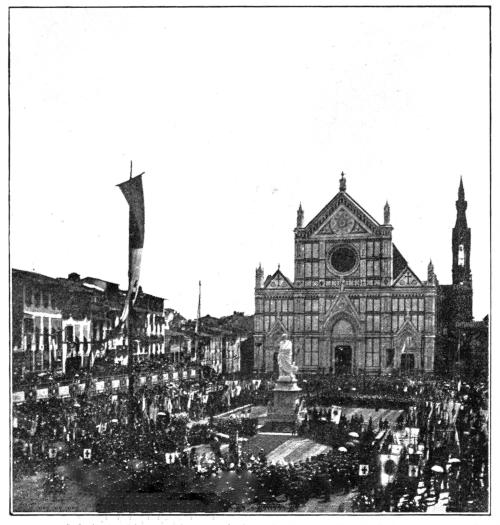
Dante, like Shakespere, speaks to every age, and has
a word for every crisis in the life of men and nations.
Perhaps at no time since he passed into the other world
has his spirit been so potent as in these last years, when
his Italy has been putting the last touches to the redemption
of that territory whose boundaries he sketched in
famous phrase.[1]
Scarce were his ashes cold, ere Boccaccio began to
expound, from the professorial chair founded by a repentant
Florence, the mysteries of his great Poem. Scarcely
had Italy awaked from her long sleep of slavery to the
foreigner ere she erected in Florence, in the very year
in which it became temporary capital of a free nation,[2]
a statue of the prophet of Italian liberty and unity.
Some forty-three years later, on the anniversary of
the Poet’s death, September 14th, 1908, Ravenna was
en fête with a gathering in which the “Unredeemed”
Brethren from Pola, Fiume, Trieste, and the Trentino
mingled their vows and gifts with those of the City that
was his last refuge and the City that bore him and cast
him out. All along, and especially in the crises of her
fate, his great spirit has brooded over the Italy he loved,
the Italy to whom he bequeathed the splendid instrument
of a classical language. To-day, perchance he “sees of
the travail of his soul, and is satisfied.”
His many-sided genius reveals new splendours when
viewed from fresh angles; and the following Essays,
which make no claim to special learning or originality,
attempt to approach him from different sides, and so to
bring out varied aspects of his greatness. But they all, or
nearly all, have one point in common: each sets him forth
as an Apostle of Liberty.
Freedom political, intellectual, spiritual—all these
ideals are wrought into the “Sacred poem to which
Heaven and Earth have set their hand,”[3] and that Poem
enshrines, as we have endeavoured to shew, principles of
liberty in the Educational Sphere,[4] which our present age
is apt to hug to itself as its own discovery. The Essays,
in their present form, are all coloured by the atmosphere
of the world’s great fight for freedom. From some of
them, written at the very height of the conflict, a few of
the fiercer touches have been removed as “out of tune”
in these critical years of would-be reconciliation and reconstruction,
when old rancours must perforce be exorcised
if we would save civilisation from its post-War perils. If
any undue traces of bitterness remain, may Dante shelter
them under the ample cloak of his righteous indignation.
He, too, spoke hotly—of a Florence and of an Italy whose
highest good was ever in his heart.
The problems and ideals of the Great War are still with
us in a new shape, and man’s greatest need is individual
and corporate “freedom of soul.” If these Essays be
recognised as reflecting to any extent Dante’s great mind
on such problems and ideals, the Author will be more than
satisfied.
Two of these Essays had been published some years
ago in the Modern Language Review,[5] and have been
slightly retouched: four appeared during the course of the
War, in a somewhat briefer form, in the Anglo-Italian
Review[6]; while the Prologue, product of the so-called
days of Peace, was published in the Guardian of August
19th, 1921. To the Editors and Publishers concerned the
writer hereby accords his acknowledgements and thanks;
as also to his friend, Professor Cesare Foligno,[7] for a
kindly glance at the MS., and for the suggestion that the
critical text of 1921 should be cited.[8] Two of the Essays
now see the light for the first time.[9] The longer of these,
“Dante and Educational Principles,” a paper delivered
at University College, London, in the Sexcentenary Series
of lectures last year, may perhaps, with the reprinted
articles on “Wit and Humour in Dante,” and “Dante
and Islam,” claim, in a manner, to break new ground.
But all alike are humbly commended to the patient
indulgence of the Dante-reading public.
Lonsdale Ragg.
Holy Cross Day, 1921.
DANTE ALIGHIERI — PROLOGUE DANTE, APOSTLE OF LOVE — THE POET OF LOVE
But we all with unveiled face, reflecting as a mirror the
glory of the Lord, are transformed into the same image,
from glory to glory.—2 Cor. iii. 18.
These words form the sequel of to-day’s Epistle[10] in
which the temporary reflection of the Shekinah in Moses’s
face is contrasted with the permanent and complete
illumination of the Spirit. They form the climax of a
passage which, full of mystery and splendour, leads us
up to those things which eye hath not seen nor ear heard—to
that beatific Vision prepared for God’s unfeigned lovers,
who shall shine with His own likeness because and when
they “see Him as He is.”
A month from to-day—on the day of the Holy Cross—we
shall be celebrating the six hundredth “birthday”
into the world beyond of the man whose eagle vision
pierced, dazzled but unafraid, into the blazing glory of
Paradise—Dante, the pilgrim of the world to come. St.
Paul’s inspired and inspiring words bring back to mind
the swift upward movement of Dante’s Paradiso, where
the spirit mounts from sphere to sphere, from glory to
glory, impelled and wafted by the sheer force of Love,
till at last, in face of the Triune blessedness, it is plunged
into an ineffable joy and wonder—ineffable because, as
he says, “as it draweth nigh to its ideal, the object of
its longing, our intellect sinketh so deep that memory
cannot go back upon the track”—
The glory of which we speak—which makes the Paradiso
a marvel of dazzling, but, so to speak, graduated
splendour—is the glory of Love, Divine and human; and
it is of Dante, the Apostle of Love, that I would speak to
you to-day. In this sexcentenary year all the civilised
world is acclaiming him, and it is well that our Christian
Churches should echo thanksgiving to Almighty God for
this most Christian poet, and for the magnificent bequest
that he left, not only to Italian literature, but to the
world. The Pope in his encyclical last spring[12] bore
eloquent testimony to Dante’s loyalty to the Christian
heritage, and to the power by which, as a teacher of the
Faith, “he being dead, yet speaketh.”
He speaks, indeed, with a voice from six hundred years
ago, yet not in the remote language of one nurtured in
leisure, ease, and comfort, far from the annoyances and
disappointments, the worries and anxieties and ugly
problems of the rough-and-tumble world we know. On
the contrary, the world in which Dante prayed and strove
and studied and dreamed and wrote-the world from
which comes down to us the serene glory of his Paradise
of Love—was astonishingly like our own on its uglier side:
a world of religious and political unrest, of clashing
interests and ideals, of faction, violence, and cruelty, of
individual and corporate predatory self-assertion; a
world in which the poet himself, called to “abandon all
that man holds most dear”—
wrought out his great work as a nameless wanderer,
and died in bitter exile. So we may listen to him as to one
who has a genuine message for us.
Amid all that has been said and written this year about
the author of the Divina Commedia, there is one note that
has rarely, if at all, been struck; yet it is surely, in some
sense, the keynote of all his singing. Dante is, from the
first and to the last, the poet of Love. “I am one,” he
says, “who, when Love breathes in me, take note, and
that which he dictates within I express”—
His first book—the Vita Nuova—testifies to this. It
represents a new movement in love-poetry.[15] The songs of
the Troubadours had been, in their earlier forms, with all
their strange beauty, frankly sensual and immoral; and
when, after the religious movement of the Albigensian
Crusade, a greater strictness had perforce been introduced,
they had lost their first warmth and glow and naturalness.
The “sweet new style”—Dolce Stil nuovo[16]—of Dante and
his circle combined the two requisites of sincere purity and
glowing life. The story of the Vita Nuova is the story of
the precocious passion of a boy of nearly ten years old
for a little girl of nine. It passes through its phase of
refined sensuousness and self-absorption, but it emerges
as a pure mystic love that leads ultimately up to the very
Throne of God.
In the vision with which the book closes—the vision of
his Beatrice after God has called her to Himself—lies
the germ of the greatest poem of Christendom; the poem
which, just because it sings the story of man’s freewill in
contact with God’s redeeming grace, has as its supreme
and final theme—Love. We are familiar, no doubt, with
the main lines of Dante’s vision of the world beyond—of
the three kingdoms as he conceived them, of hell, purgatory,
and heaven. But I will ask you to be patient if
I attempt to sketch for you something of the great contours
of each, that we may see together how, for this love-poet,
eternal Love dominates and shapes the universe.
His world beyond is conceived in terms partly belonging
to the age in which he lived, with its scholastic theology
and its Ptolemaic cosmography, partly in terms of the
originality of his own genius. Its details and its hard outlines
may be largely obsolete; but its lessons are true and
effective. It is because of its essential Christianity that
Dante’s poetry is so much alive, is more “modern,” as
the Papal Encyclical put it, than much actually contemporary
poetry that is conceived in the spirit of paganism.
Dante, for his soul’s health—and for the benefit of untold
generations—must needs pass through all three kingdoms
of the world to come, guided by Virgil, who represents
human reason. Descending down and down into the very
bowels of the earth he sees the doom of unrepented sin.
Then, after a wearying subterranean climb from earth’s
centre to the antipodes, he emerges at the foot of the lofty
terraced mountain where repentant souls are cleansed and
brought back to their primal innocence. At the top of
this mountain he finds himself in the earthly paradise, and
meets Beatrice, the glorified “lady of his mind,” who now
represents at once Revelation and Grace; sees wondrous
things, submits to mystic rites, and finally is drawn up
side by side with her, by the motive power of Love, from
sphere to sphere, up to the Throne of God, where the
redeemed worship Him for ever in the form of a mystic
white rose. That Love is the motive power in Paradise is
obvious. It is the radiant beauty of Beatrice, ever more
dazzling as they mount higher, that lifts him up, and the
spirits he meets glow one and all with the fire of Divine
charity. It is not easy, perhaps, to detect the influence of
Love in the dark abyss of the Inferno, or in the stern, long
discipline of the Mount of Purgation.
But love is written even across the portal of Hell.
“Abandon hope all ye that enter here” we all know as
its inscription; but that is but the last line of a nine-line
title, and part of that title runs thus—“Divine Power
made me, and Highest Wisdom, and Primal Love”—
This means, of course, the Blessed Trinity, but the last
word about the Blessed Trinity is—Love. Love can be
stern, and outraged love can draw down, as it were, by
the law of being rather than by such vengeful wrath as we
humanly attribute to the Most High, an unimaginable
ruin and loss upon the outrager. In the stern, grim, cruel,
sometimes grotesquely revolting picture Dante draws of
the eternal future sinners can deliberately make for themselves,
we see but the fruits of Love offered and rejected—the
inevitable outcome of their own choice.
When we enter the second kingdom, and begin to
climb the mount which forms the pedestal to Eden, the
home of man’s innocency, the breath of Love is stronger
and its radiance more clear. It reveals itself in the changing
beauty of sky and landscape, in the glories of star-light,
dawn and sunset and high noon, in the glad brilliance of
wild-flowers, in the melody and harmony of music, but,
not least, in the very structure and arrangement of Purgatory.
Seven terraces ring the mountain round—one
above another—separated by rugged cliffs and sheer
precipices which Dante needs all his cragsmanship to
overcome. And on each terrace one of the seven deadly
sins is purged—Pride, Envy, Anger, Sloth, Avarice,
Gluttony, Lust. These are arranged on a scheme which
brings into relief a great principle—that all our actions,
good or evil, are the fruits of Love—right love or wrong—
These sins are all results of Love—excessive or defective,
or aimed at the wrong object; and the purgatorial
discipline is just the action of the educative Love of God
upon willing penitents—straightening, developing, governing,
and directing the disordered love that has so marred
and stunted the beauty of their souls. The discipline and
the humiliation are seen for what they are, and the Divine
Love that speaks through them finds a ready and prompt
response from souls “happy in the fire,” because of the
hope of what it can do for them.
When we pass into the third kingdom, up and up
through sphere after sphere of the heavens, each more
radiant with the light of Love, we feel ourselves “reflecting,
as a mirror, the glory of the Lord, transformed into
the same image from glory to glory.” “One star,”
indeed, “differeth from another star in glory.” There is
higher and lower in the abode of bliss, in the “many
mansions” of the Father’s House. Dante questions one
whom he meets in the lower sphere—Piccarda—on earth
a playmate of his childhood. “Are you happy? Are you
content? Have you no wish to be placed higher still?”
Her answer enunciates the basal principle of heaven—“Brother,
the quality of our love stilleth our will and
maketh us long only for what we have, and giveth us no
other thirst.... In His Will is our peace”—
Here Love rules imperially, and the image of God’s Will is
stamped in glory on the souls of those who, “with unveiled
face,” are granted to feast upon the vision of His glory.
Pure in heart, their whole being is full of light. And so,
too, the poet, when at last he looked upon God, found his
own will and desire moving in perfect harmony with that
“Love that moves the sun and the other stars.”
So a great lover of Dante, the late Bishop Boyd-Carpenter,
summoned up the teaching of the Paradiso:
“Wouldst thou enter into God’s Kingdom, O pilgrim of
earth? then love. Wouldst thou share the sweet activities
of its citizens? then love. Wouldst thou know Him who
rules over them and all? then love. For love opens the
Kingdom of Heaven, and love makes the joyousness of
its happy services, and none can know the heart of God
save through love; for God is love.”[23]
Is it not meet that we should thank God this year for
the sublime poet who has drawn for us so splendid a
picture of the glory of Love “penetrating the whole
universe”; who has shown us in Love the one motive
force in the world, the one constructive principle? Was
there ever a time when the world needed this teaching
more than it does to-day? A true doctrine, if ever there
was one. If God is Love, then Love is the only principle
of life. “He that abideth in love, abideth in God, and
God abideth in him.”[24] Real love—not selfish, sensual
passion, not sentimental sweetness, not unwise and
poisonous indulgence; but love, wise, strong, straight,
and pure, like the love of God; love patient, self-forgetful,
self-giving, like the love of Jesus Christ; love illuminating,
invigorating, recreative, like that of the Holy Ghost. If
we could but “reflect” in life and character the “glory”
of the Lord!... There is no glory but love.
We must descend from the ethereal splendour of
Dante’s Paradiso into the hard realities of workaday life,
even as Peter, John, and James came down from the
Mount of Transfiguration to face the shouting, wrangling
crowd and the convulsions of the epileptic boy. But
though the radiance seems to fade, the glory is still with
us, for it is the unfailing Love of Him Who promised to
be with us “all the days.” Love, then, accompanied them
down from the height, unlocked the prison house of
afflicted souls, and solved the problems of sin-stricken
humanity. And Love, and Love alone, can do the same
to-day.
Let us face our bewildering problems with confidence,
knowing that the secret of life is ours. Love, the only
constructive principle, the only ultimately victorious
power. Our enemies in the late war sounded their own
doom when they promulgated a gospel of hate. Hate can
never build up, only destroy. Alas! they sowed the seeds
of hatred outside the sphere where armies clash, and the
devil’s doctrine of class-hatred has been disseminated far
and wide. If only the eyes of those concerned might be
opened to see the mad futility of hate! There is one force
at work in the world that can teach this, that can heal
the bleeding wounds of society, untie the knots of the
industrial and social and international tangle—the force
of Christian Love—yours and mine—a love like that of
Him Who came not to be served, but to serve and to
give His life as ransom for many; a love that brought
Him to die for a world yet steeped in rebellion and sin,
and moved Him to lay upon His disciples the injunction
“Bless them that curse you.” No merely human organisation
for philanthropic succour or for peace; not even a
League of Nations, even though, thank God, its power and
capacity at last be recognised with a gift of solemn
responsibility; nothing but the steady action of that
“love of God” which His grace sheds into Christian
hearts, leavening and inspiring such movements, such
organisations, can hope for final success. But Love, after
all, sits enthroned above the water floods, and abideth
king for ever. There is no limit to our opportunity for
blessing this poor world alike by prayer and by action—blessing
our own immediate circle, our civic and Church
life, blessing our country, our Empire, and the world’s
fellowship of Nations—if but our wills are moving in
one motion with His—
L’amor che move il sole e l’altre stelle.
Chapter I DANTE AND THE REDEMPTION OF ITALY
Sol nel tuo verbo è per noi la luce, o Rivelatore,
Sol nel tuo canto è per noi la forza, o Liberatore,
Sol nella tua melodia è la molt’ anni lagrimata pace, o Consolatore.
—D’ Annunzio.
La severa immagine del poeta governa tuttavia
i fati delle generazioni d’ Italia.—Mazzini.
Dante stands forth as the Apostle of Freedom in many
spheres—that Freedom for which all the world is now
longing: freedom for unhindered self-development of
men and nations, freedom of spirit—the true atmosphere
of all education. The Monarchia, the Epistles, and, most
of all, the Divina Commedia—that “mystical epos of
Man’s Free Will”—bear witness to the truth of the word
which Virgil speaks of him at the foot of the Mount of
Purgation—
Libertà va cercando ...
This all-pervading spirit of his teaching might perhaps
of itself have been sufficient to make his name an inspiration
to the heroes and martyrs who struggled for Italy’s
liberation in the nineteenth century; but it may be worth
while to draw attention to certain aspects of his work,
which give him a more definite and specific claim to be the
Father of Free Italy.
The other day I turned up, after many years of neglect,
Karl Witte’s Essay on Dante and United Italy. For this
suspicious intercourse with “enemy alien literature” I
can plead two extenuating circumstances: first, the
absorbing nature of the topic at this moment, and secondly
that I approached Witte in an English translation. Another
point which might count in my favour is the fact that this
particular Essay was written before 1870. That certainly
lends to it a special interest; and the interest is rather
enhanced than otherwise by the circumstance that Witte
prefixed a Prefatory note and added a peroration in
1878.
Karl Witte, who was born in 1800 and died in 1883,
represents the old vigorous and admirable type of German
scholarship which was in very truth “Stupor Mundi”:
a blend of genius and conscientious painstaking on the
reputation of which the Prussianised Kultur of to-day
bases a claim to deference which Europe will more and
more hesitate to accord.
How far, for instance, Germany has fallen from her
former position as regards Dante Scholarship may be
gauged from E. Benvenuti’s slashing article in the
Bullettino della Società dantesca italiana of June, 1914, of
which a summary appeared in the Times Literary Supplement
on March 4th. The article is the first instalment of a
review of Dante studies in Germany for the years 1908-1913.
It is a record, as the Times reviewer remarks, of
“monumental ignorance, inaccuracy, arrogance, bad
taste, and sheer stupidity ... hailed with salvoes of
approbation by the majority of German critics.”
But Karl Witte is a man of other build than these
modern Pan-Germanisers who are patriotic enough to
attribute to Dante pure German ancestry, and too patriotic
by far to soil their hands with the recent works of sound
Italian critics, or their minds with the elements of Italian
grammar and idiom.
Karl Witte, on the contrary—though he began life as an
Infant Prodigy, matriculating at Leipsic when only nine
and a half years old, and reading his Doctor’s thesis before
he was fourteen—won recognition in Italy and England as
well as in Germany as a real force in Dante scholarship:
a great pioneer, who made his mistakes, as all pioneers will,
but has won the gratitude of all subsequent Dantists.
In the Essay of which I have spoken, written and delivered
as a lecture in 1861, Witte notes the fact and investigates
the grounds of the constant association of
Dante’s name with the patriotic aspirations of Young
Italy. “It is a fact,” he says, “that, during the last half
century, a great number of those who aimed at transforming
Italy—and not only men of such moderation as Cesare
Balbo, Gino Capponi, or Carlo Troya, but also the democratic
revolutionaries who would take the world by storm—have
hung, and still hang, upon Dante’s Divine Comedy,
with passionate enthusiasm. Ugo Foscolo, who preferred
poverty and exile to place and honour under the rule of
Austria, devoted the last years of his life exclusively to a
great work on the poem; and after Foscolo’s death, this
new edition of the ‘Prophecy of Italy’s Future,’ as he called
the Comedy, was published by no other than Giuseppe
Mazzini himself....” If the Italian of the Sixties “were
asked whence his countrymen drew their inspiration, he
would scarcely hesitate,” says Witte, “to name the greatest
poet of his fatherland.” And again, “the fact that in
the days of foreign oppression patriots recognised each
other by their love of the immortal poet, and greeted one
another, as by a secret password, with the inspiring lines of
the Divine Poem, is a symbol of the fact that the roots of
this temper of mind”—the temper of national “self-reliance
and self-renouncing enthusiasm”—“are to be
sought in Dante.”
There are three passions, according to Witte, which are
(rightly or wrongly) traced back to Dante: (1) a glowing
love for Italy, (2) a hatred of the foreign, and above all of
the Teuton yoke, and (3) a hatred of the temporal power
of the Pope.
In the first case—and this is the point that more immediately
concerns us—Witte holds that the contention is
justified. “In hope, in sorrow, in reproof, we see Dante
filled,” he says, “with the same glowing love for the
Fatherland of Italy, a love which he is the first to put into
words.”
Before Dante, at any rate, Italy was, in Metternich’s
famous phrase, “nothing but a geographical expression.”
The Roman poets of the Empire praise her scenery, but
their devotion as patriots is to Rome itself. When the
Empire broke up, Italy lost her one bond of superficial
cohesion, though a shadowy unity emerged now and again
under Visigothic and Longobardic domination, and the
pressure now of Gothic Arianism, now of Byzantine Iconoclasm,
drew Italy’s various groups in self defence closer to
Papal Rome.
The phenomenon of an apparently independent and
united “Kingdom of Italy” (888-961) after the fall of the
House of Charlemagne, is, from this point of view, as
illusory as those of Odoacer and Theodoric, effecting little
or nothing towards the evolution of a national spirit or a
national self-consciousness. Dante is, it would seem, the
first to see Italy with a patriot’s eyes, as being, and as
having been for countless ages, a fatherland for whom one
might sing—
Dulce et decorum est pro patria mori.
She is “that lowlying Italy” on whose behalf the heroes
and heroines of the Aeneid shed their blood so freely:
... Quell’ umile Italia....
Per cui morì la vergine Cammilla,
Eurialo, e Turno, e Niso di ferute.
He loves her passionately, torn as she is by faction, her own
worst enemy; and he calls on the representative of the
Holy Roman Empire to control her madness and to bring
her peace.
The close association of Italian aspiration with the
name of Dante which Witte observed in 1861, came forcibly
under my own notice nearly fifty years later, when I made
a pilgrimage to Ravenna to take part in the “Feste
dantesche,” on September 13th, 1908. Isidoro del Lungo,
perhaps the greatest of Italy’s modern Dantists, was to
inaugurate the opening of a special Dante wing in the
Ravenna library, and to dedicate a beautiful silver lamp—an
expiatory offering from the Commune of Florence—to
adorn his tomb.
The occasion was nominally a Dantist celebration;
but it might with equal truth have been described
as an “Irredentist Orgy.” For one of the great
features of the festival was the arrival of a pilgrim-ship,
flying the Italian tricolour, from Trieste, bearing some
hundreds of Italian-speaking devotees from “Italia Irredenta”—the
“unredeemed” cities which remained under
Austrian rule when the rest of Italy threw off the yoke
of the foreigner—Trieste itself, and Pola, and Fiume.
The people of Ravenna and the visitors to the Festival,
spurred on by eloquent “posters” exhibited in the streets
at the instance of clubs and societies of every description,
and by the proclamation of the Municipality itself, to give
the “Fratelli irredenti” a fraternal welcome, poured out
towards the quay in their thousands, and escorted the
pilgrims through the streets with flags flying and bands
playing patriotic airs. Conspicuous in the procession were
half a dozen Garibaldini, veterans of the War of Liberation,
clad in their red shirts; and emotion rose to a high point
when the monument was reached which commemorates
those who fell in the struggle for a free and united Italy.
Laughter, tears, embraces and echoing Evvivas proclaimed
the arrival of the cortège at the Municipal Buildings.... It
was a scene which one will never forget, as the Italians
from across the water flung themselves upon their fellow-disciples
of Dante, with the romping and vociferous enthusiasm
of children just let out of school!
There were, so far as one could judge, from the floods of
printed and of spoken eloquence which marked that day,
two prominent thoughts in people’s minds: two prominent
points of contact and association between the thought of
the Divino Poeta and the aspirations of Italian patriotism.
The first of these is more general, the second more specific.
In general, Dante is rightly held to be the true Father of
the Italian language and literature—that “bond which
unites us to our native place.” “Love for our native
tongue,” says Witte—and he has in mind a passage of
Dante’s Convivio—“is the expression of our love of our
native land.” For Dante Italy is—
Il bel paese dove il Si suona.
“The beauteous land where si is uttered”; and to
that land the work of his mind and of his pen lent an added
beauty, and wove a spell which should draw together all
her scattered elements in the enthusiasm of a common
speech and a common literary heritage. That is Dante’s
first claim to supply the inspiration of a “United
Italy.”
The second claim is, as we have said, more specific.
It is claimed for him that he described, as it were prophetically,
the future boundaries of Italy.
In the ninth Canto of the Inferno (113-114) he includes
the whole of the Istrian peninsula in Italy, describing the
broad inlet to the east of it—the bay which stretches northward
up to Fiume—as “The Quarnaro which shuts in
Italy and bathes her boundaries”—
Sì come a Pola presso del Carnaro,
Che Italia chiude e suoi termini bagna....
Again, in his words about the Lago di Garda in the Twentieth
Canto of the Inferno (61-63)—
Suso in Italia bella giace un laco
A piè dell’ alpe che serra Lamagna
Sovra Tiralli, ch’ ha nome Benaco.
“Up in fair Italy there lies a lake afoot the Alp that
bars out Germany above Tyrol, that bears the name
Benaco:” he seems to include not only the whole of Lake
Garda but the Trentino too, “barring out Germany”
beyond the great watershed.
At Ravenna, in 1908, one might have been led to suppose
that these two passages summed up the main interest
of the Divina Commedia; but though the utterances are,
as a matter of fact incidental, they do point to the fact
that the Italy which Dante so passionately loved, and
which consciously or unconsciously he did so much to
bring into being, was a definite “geographical expression”
if it was also something more.
If with Witte we go on to enquire how far Young Italy
is justified in fathering upon Dante the passion of “hatred
of the foreign, and above all of the Teuton yoke,” the question
is at once confused by the fact that in Dante’s day
the authority and prestige of that Holy Roman Empire,
of which the Poet was so convinced and so enthusiastic
an advocate, was associated with a succession of German
princes. Teutons of the Swabian House of Hohenstaufen,
albeit Italian born, were “the illustrious heroes Frederic
the Caesar and his well-begotten Manfred” whom in the
De Vulgari Eloquentia (I. xii. 20; Bemp. p. 330) he extols
for their nurture, in the Sicilian Court, of the beginnings of
Italian vernacular poetry; Teutons the Rudolf and Albert
of Hapsburg, to whom the poet of the Divine Comedy looks
in vain for the liberation of Italy from its overwhelming
ills; Teuton also Henry of Luxemburg, on whom his
hopes were finally fixed, the “Alto Arrigo” of the
Paradiso—
... Ch’ a drizzare Italia
Verrà in prima ch’ ella sia disposta,
for whom he sees a vacant throne prepared in the White
Rose of heaven.[25]
These heroes are not for him, however, Germans,
Tedeschi, but Roman Caesars; and had the sceptre of
Empire chanced, then, as afterwards, to have been wielded
by other hands, we cannot doubt that a non-Teutonic line
of monarchs would have drawn from him a like reverence,
a like expectation and a like passionate appeal. Similarly,
had the House of Swabia been dissociated from the Roman
Imperial tradition and played a rôle of overweening and
unscrupulous self-aggrandisement like that actually played
by Philippe le Bel, Hugh Capet’s words in the fifth Cornice
of Purgatory—so well applied by a recent writer in the
Times to the Hohenzollern—would have been put into the
mouth of an ancestor of the two Frederics, and applied to
the House of Hohenstaufen. “I was the root,” he says,
“of the evil plant whose shadow blights the whole land
of Christendom”—[26]
Io fui radice de la mala pianta,
Che la terra cristiana tutta aduggia.
There is indeed one passage at least where Dante mentions
the German people in a non-political context (Inf.
xvii. 21), and designates them from the point of view of
their national or racial habits. Tedeschi lurchi—“Guzzling
Germans”—he calls them. How one’s heart goes out to
him, as one recalls memories of sojourns in Swiss hotels!
Had poor Dante like experiences or worse to put up with
in the days of his wanderings?
Witte, who spontaneously brings forward this word of
insight into national character, is delightfully frank about
it. “Only in one place,” he says, “does he accuse us of a
weakness which we would fain repudiate, but it has been
laid to the charge of Germany down even to our own day,
on so many hands, that we cannot escape the fear that our
forefathers at least must have given grounds for the
accusation.” ...
This is a poor note on which to end our study of Witte.
Yet it is one on which recent events have thrown a portentous
illumination. The tendency which we are combating
together, Italians and English, with the haughty
spirit of Dante on our side, is one which begins in grossness
of bodily appetite, and goes all lengths of cruel and brutalising
bestiality.
It is a relief to turn one’s back on this sordid atmosphere
and launch out once more into the “better waters”[27] of
Italian Patriotism.
I have by me a book which corroborates very strongly—for
the sixties at least—Witte’s contention that Young
Italy consciously draws her patriotic inspiration from
Dante. Some few years ago I picked up in Venice a bound
copy of the Giornale del Centenario di Dante Allighieri, of
which the first number was published in Florence on
February 10th, 1864, and the 48th on May 31st, 1865.
There should by rights have been two more numbers,
published after an interval, with Index and Frontispiece.
Whether these ever appeared in fact, I have not been able
to discover. My copy concludes with Number 48, which
describes the Festival, to which the year’s publication was
planned to lead up—the Feste Dantesche held in Piazza
Sta Croce, in May, 1865, the six hundredth anniversary
of the Poet’s birth. In that year Florence became the
temporary capital of an Italy free and united, but still
barred out from Rome by French bayonets; and she
signalised the occasion by welcoming back in spirit her
exiled Son to the “Bello ovile,” where as a lamb he had
slept,[28] when the Re Galantuomo himself unveiled the
Poet’s statue in the Piazza. A quaint woodcut of the ceremony
adorns the volume.[29]
The successive numbers of this Giornale, with their
varied contributions to the study and appreciation of the
Poet—contributions drawn from every part of the
Peninsula—bear eloquent testimony to the widespread
feeling among the Italian patriots of that epoch, that
Dante was rightly to be acclaimed Pater Patriae.
The articles are of all sorts, from chronological and
etymological notes to formal and discursive interpretations
and illustrations of Dante’s writings and his life, and studies
of contemporary political and social problems in the
light of his dicta. They would probably repay a fuller
investigation than the present writer has had opportunity
to apply to them. We will take one or two typical utterances
to indicate something of the general tone of the
contributors.
“Dante was the first among his contemporaries,”
says Prof. A. Zoncada,[30] “to rise to the conception of a
United Italy”—an Italy united in powers, in
purpose, in language, and that in spite of the manifold
disuniting influences at work in his day. “Fatto è che
Dante primo ne’ suoi tempi seppe levarsi al concetto
d’un Italia unita e concorde d’ intenti, di forze, di favella:
primo abbraciò nel suo amore tutta intera l’ Italia, senza
divario di cielo, di usi, di memorie, di legge, di stato,
donde appunto risulta il sentimento di nazionalità.”
Dante’s desire for the establishment of an Imperial Court
in Italy was, he says, a desire for national and linguistic
unity. “Non può essere nazione senza una comune
favella, nè comune favella dove nazione non sia. Il perchè
voleva Dante stabilito in Italia la sede degli imperatori,
unico mezzo, a suo credere, di conseguire l’ una e l’ altra
unità, della lingua, cioè, e della nazione.” There may
perhaps be a little exaggeration in this statement of the
reciprocal relations of nationality and vernacular, but
at any rate it fastens on facts. Dante, as we have seen,
visualised Italy as one, sighed for her divisions, expostulated
with her on her undisciplined factiousness; longed,
hoped, and prayed for the speedy advent of a strong
unifying force. He also devised for her and bequeathed
to her the noble instrument of a classical vernacular;
and if it be not strictly true that a nation cannot exist
save where there is one national language spoken, yet
it is more than half true. Dante doubtless did more in the
end for the cause of Italian nationality by his bequest of
that splendid vehicle of thought and feeling which the
mother-tongue became in his hands, and by his initiation
of a glorious literary tradition, than he or any other man
could have done by actual utterances, however inspired.
The importance of his work for the vernacular is recognised
again and again by the epigraphists who in the
Giornale del Centenario have taken Dante as their theme.
“The mother-tongue supplies a bond of nationality which
cannot be broken,” exclaims Prof. Lorenzo Berardi in his
epigraph,[31] “and that bond we owe to Dante.”
DANTE ALLIGHIERI FU IL PADRE IMMORTALE
DI NOSTRA LINGUA
QUESTA
FU IL VINCOLO NAZIONALE
CHE MAI SI RUPPE.
Father of the language, father of the national spirit,
prophetic delineator of the national frontiers.[32] So the
Festa of 1865 joins hands with that of 1908, wherein the
official document drawn up by Commendatore Guido
Biagi to accompany the gifts offered at the Poet’s shrine
describes the offering communities as—
CONCORDI IN LUI
CHE NEL VERSO IMMORTALE
SEGNAVA I TERMINI AUSPICATI
DELLA PATRIA ITALIANA
But these festas are no longer an ideal and a dream;
All-Saint’s-tide, 1918, has sounded a note of triumph
which resounds, it may be, in the world whither Dante is
gone. Since the words above were penned, there has
rung out at once the knell of the justly hated Hapsburg
autocracy, and the joy-bells of Italia Redenta!
The Piave, associated by Dante[33] with the grim thought
of a humbled and degenerate Italy, harried by the outrageous
violence of Eccelino da Romano and his minions;
associated for us all to-day with nobler memories, as the
line of defence where for long months and weary, patriots
shed their blood like water to ward off from Italy horrors of
brutality before which even Eccelino’s record—a byword
in the Middle Age—reads like a little ill-timed horseplay:
the Piave and the land behind it—
... Quella parte de la terra....
Italica che siede tra Rialto
E le fontane di Brenta e di Piava,
have witnessed wonderful events. That famous river of
which D’Annunzio exclaims:[34] “It runs beside the walls
and past the doors and through the streets of all the cities
of Italy; runs past the threshold of all our dwellings, of
all our churches, of all our hospitals. It safeguards from
the destroyer all our altars and all our hearths”; it has
witnessed a great victorious onrush that has swamped
the very memory of Caporetto, just a year, exactly, after
that day of disaster.
And the dream of the Ravenna pilgrims of 1908 has
come true. Trento and Trieste, “staked out,” as it were,
by Dante’s verse as Italian, proclaimed Italian by race
and speech and aspiration, are at last Italian in fact.
Evviva Italia Redenta!
Postscript.—September, 1921, takes us back once
more to Ravenna. Once more the short and narrow street
that faces the “little cupola more neat than solemn,” is
packed with an enthusiastic crowd. Once more the soul
of Italy is concentrated in that exiguous space, offering
votive gifts at the shrine. But this time the men of the
Trentino and of the Dalmatian cities come as “Redeemed
Brothers,” fused in the general life of the larger Italy.
The Army gives a Wreath of bronze and silver, the Communes
of Italy a Bell, the city of Rome a bronze Door.
The sexcentenary of Dante’s birth in 1865 marked a
great stage in the liberation and unification of Italy;
the sexcentenary of his death, a still greater.
May the Poet’s best dreams come true, as interpreted
by the Prophet Mazzini, and Dante’s native land find at
last that “peace” which she has been “seeking from
world to world”—find it in the fulfilment of her God-given
mission to the nations.
II DANTE AND POLITICAL LIBERTY
Libertà va cercando, ch’ è sì cara
Come sa chi per lei vita rifiuta.
—Purg. i. 71, 72.
These words, it will be remembered, are addressed by
Virgil, at the foot of the mountain of Purgatory, to Cato
of Utica. Virgil is speaking of Dante, and of his mystical
journey through the eternal world. The object of that
quest, he says, is Liberty—that liberty which will make
him master of himself morally and spiritually, when
Virgil himself, at the summit of the Mountain, ere he
takes his leave, shall crown him “King and bishop of his
own mind and soul.”[35]
... Te sopra te corono e mitrio.
These moving lines, as D’Ovidio reminds us,[36] have drawn
tears from many a patriot of the last century; they may
well form for us a starting-point for the consideration of
Dante’s attitude towards Political Liberty. True, it is
ultimately spiritual liberty, liberty of soul, that the Poet
“goes seeking” in his pilgrimage, even as it is slavery of
soul from which he announces in Paradise[37] that Beatrice
has delivered him. “Thou hast drawn me,” he says, “out
of slavery into freedom ... thou has given health to my
soul”—
Tu m’ hai di servo tratto a libertate
...
... l’ anima mia ... fatt’ hai sana....
But the conditions of spiritual and of bodily freedom
are very close to one another—as many a languishing
prisoner of war can testify—interlaced and interwoven
if not identical.
Stone walls do not a prison make,
Nor iron bars a cage.
It is possible, thank God, for the human spirit to rise
superior to the most degrading conditions which inhuman
brutality or fiendish hatred can impose. Yet an atmosphere
of justice and peace is the right and normal environment
for the soul’s free growth; and steady pressure of tyranny
and calculated injustice will all but infallibly blunt and
stunt the moral growth of its victims, as is witnessed by
the universally blighting effect of Turkish rule. Moreover,
unless the received political interpretation of the three
Beasts of the Dark Wood[38] is wholly unwarranted,
Professor D’Ovidio is right in claiming[39] that, in a true if
subsidiary sense, Dante’s supernatural journey was “a
refuge and a remedy” from the troubles in which the
Poet found himself immersed in the tangled thicket[40] of an
“enslaved Italy,” full of tyrants, and of that tyrannous
faction-spirit which is the worst enemy of Freedom.[41]
The Italy of his day, like the Florence which cast him
out, is a stranger to that Liberty which only Peace can
give—a peace for which, on Dante’s horizon, no other hope
appeared than that of a common subjection to the
“Roman Emperor,” the divinely appointed guardian of
justice among men.[42] Peace is, indeed, so closely linked
with freedom that Dante, in one place,[43] speaks of it as
the goal of his mystic quest.
Quella pace, che ...
Di mondo in mondo cercar mi si face.
whereas in the First Canto, Virgil has described that goal
as liberty—
Libertà va cercando....
We may pause, then, on the context of these lines,
wherein Dante’s quest of liberty is associated with Cato’s
suicide. For the difficulty and obscurity of the situation
which they raise will plunge us at once into the heart of
Dante’s Political Theory.
The opening Canto of the Purgatorio shews us Cato of
Utica, the austere republican who killed himself rather
than bow to the rising dominance of Julius Caesar,[44]
accorded a place of honour as Overseer of the souls in
Ante-Purgatory. His loving wife Marcia is in Limbo;
his fellow-republicans Brutus and Cassius are, with Judas
Iscariot, in the lowest depths of Hell. There is, moreover,
a special place in Hell[45] appointed for suicides, in a gruesome
wood made fouler by the Harpies. Yet here is Cato
honoured, and, further, held up by Virgil as pattern
of the patriot who gives life for liberty! It has been a
traditional crux to interpreters of the Divine Comedy, to
explain and justify Cato’s position. To understand the
fulness of the difficulty, and at the same time familiarise
ourselves with Dante’s theory of the ideal government
of the world, we shall need to turn to the treatise in which
he holds up for the general admiration of mankind that
Empire which to Cato was more hateful than death
itself.
Next to the Divina Commedia, the De Monarchia—the
“Monarchia” as it is more neatly styled in Italy—is,
in many ways, Dante’s most important work. It lacks
the charm as well as the literary importance of the Vita
Nuova, and the autobiographical interest of that and the
Convivio, but in it Dante develops his political theory,
and by it—through Marsiglio da Padova and his
Defensor Pacis[46]—he influences all subsequent generations.
The “Monarchy” which he expounds therein is not
Autocracy as such; it is the traditional suzerainty of
the Holy Roman Empire, in which, in spite of its actual
failure in history, he sees an ideal centre of unity for
Christian civilisation, an ideal Court of Appeal for international
quarrels, a divinely ordained curb for personal
and national greed and self-assertion, and so an unique
guarantee of peace for the world.
The Monarchia is comprised in three Books. In the
First, Dante sets himself to prove that the office of
“Monarch” is necessary to the well-being of the world,
developing his theory of “Monarchy” as such. In the
Second, which is a long panegyric of the Roman Power,
conceived as one and continuous from the days of Aeneas
son of Anchises, he points to Rome as a providential
instrument in God’s hand for the governing of the world
and the well-being of mankind.[47] He establishes to his
own satisfaction the thesis that the Holy Roman Empire,
and it alone, provides the “Monarchy” he is seeking.
In the Third he argues that, notwithstanding all that has
been said and done by Popes, who (since Gregory VII—and
notably in the person of the Poet’s contemporary,
Boniface VIII)—claimed authority over all earthly
potentates, the Secular Authority is, in its own sphere,
not derived from, or subject to the Spiritual, but is independent;
that the “Roman Prince” derives his authority
and his inalienable responsibility direct from God
Himself.
This last is the most original part of Dante’s treatise,
and that of most general importance. For it saps the false
temporal pretensions of the Papacy, the rottenness of
which Dante was clever enough to discern long before
the famous “Donation of Constantine” had been proved
a forgery. But this subject need not detain us now. Our
interest will be focussed mainly on the theme of the First
Book; in a lesser degree on that of the Second, and we
shall consider them both in the light of the Divina Commedia.
Dante’s reverence for the Roman Empire dates
probably from his first study of the Aeneid, and is bound
up with his passionate devotion to Virgil,[48] whom he
addresses in the opening Canto of the Divina Commedia[49]
O degli altri poeti onore e lume
Vagliami il lungo studio e ’l grande amore
Che m’ ha fatto cercar lo tuo volume!
For him, as we have said, the Roman Power is continuous—from
Aeneas, through Julius Caesar, and through
Charlemagne to his own day. In the Second Book of the
Monarchia he sets forth first the nobility of its origin, then
the attestation of its divine character by “miracles”;
he substantiates the claim of the Roman People to rule
by the evidence of their “public spirit” and rightness
of aim, and their unique faculty for governing; by
their success against all competitors for world-empire—the
prize sought so keenly by Cyrus, Xerxes, Alexander
and the rest was attained by Rome alone. Finally, he
adduces Christ Himself as a witness. Did He not choose
to be born and to die for the world’s salvation under the
authority of the Roman Empire?
In the Divine Comedy the theme of Rome’s glory
receives an equally enthusiastic and a more poetic treatment.
Its echoes ring all through the great poem, they
become clamant and compelling in the Sixth Canto of
the Paradiso, where, from the mouth of Justinian, in the
Heaven of the world’s Workers, flows the story of the
majestic flight of that “Uccel di Dio,” the Roman Eagle,
through the centuries from Aeneas to Charlemagne.[50]
But the atmosphere of serene satisfaction which
pervades the Monarchia is not maintained here. The
opening Paean of triumph gives place to a more mournful
note when the great Lawgiver turns to denounce the
factions of later times: “the Guelphs striving to Frenchify
Italy, the Ghibellines to Germanise it.”[51] Bitterly he
assails the unworthy partisans of the Empire. The Eagle
stands for Justice; let them practise their intrigues under
some other standard[52]—
Faccian li Ghibellin, faccian lor arte
Sott’altro segno....
Here practice comes to blows with theory. The Roman
“Monarchy” was, in Dante’s days, a failure. This failure
was partly due to negligence of individual occupants of
the throne of the Caesars, like Rudolf and Albert of
Hapsburg,[53] partly to the usurping pretensions of the
Papacy,[54] partly, again, to the turbulent, anarchic, and
self-seeking spirit of cities and states.[55]
It was Dante’s misfortune to be born into a world
seething with political faction, and into an Italy and a
Florence in which the fever of faction was at its hottest.[56]
The two most potent influences in Christendom—the
Papacy and the Holy Roman Empire—were at feud; and
half the people of Italy (largely, if the truth must be
told, to justify their existing group-enmities) sided with
the Papacy, and called themselves “Guelfs,” half with
the Empire, and called themselves “Ghibellines.” It is
a mark of Dante’s greatness that, unlike most of his
contemporaries, he was able to hold the balance true;
to realise the immense value of each Authority, the
Spiritual and the Temporal, if rightly wielded; to discern
the God-given responsibility of each, and their mutual
independence.
Exiled himself from Florence by political faction,
victim of the ruthless partisan spirit which ruled in his
native city, he felt keenly the need of a supreme controlling
power, a generally accepted and incorruptible Court of
Appeal; and he looked forward to the descent into Italy
of the Emperor Henry VII in 1311 as to the return of a
Golden Age[57]—of a Peace long wept for, and still delayed:[58]
Della molt’ anni lagrimata pace.
Many think that the Monarchia was written to celebrate
this advent of one to whom he is not afraid to address
the sacred words: “Ecce Agnus Dei, ecce qui tollit peccata
mundi!”[59]
Dante’s hopes in Henry VII were doomed to disappointment.
The disappointment did not shake his faith
in the Holy Roman Empire as a panacea for all the temporal
ills of a Christendom distracted by individual and
national self-seeking and aggression.
If we turn to the First Book of the Monarchia, wherein
Dante develops his Political Theory, we shall find that,
at first reading, the actual person of the Emperor seems
essential; just as, at first sight, he seems to rule out
Democracy, together with Oligarchy and Tyranny, as a
“perverted form of Government.”[60] Here we must remember
Dante’s environment. His personal experience of
the chances of freedom and justice in his native city would
give him an instinctive bias against a non-monarchial
form of government. Whether the system by which
Florence ruled itself in the opening years of the fourteenth
century is technically to be styled Democracy or Oligarchy,
or a compound of the two, it was certainly, in practice, for
Dante, a Hydra-headed Tyranny of the worst description.
Further, it may be well to realise that personal authority
was the only type of Suzerainty, the only form in which a
paramount and impartial Sway, or a world-wide Court
of Appeal had appeared on his mental horizon.
It has been said of Mazzini’s Republicanism that it
did not rule out “Imperialism” in the sense familiar to
British minds, of “The White’s Man’s Burden.” He approved
of the British Raj in India, and pictured his own
free Italy of the future as possibly destined to spread the
blessings of her own historic civilisation by a similar rule
over pupil-peoples. May it be claimed in like manner for
Dante, whose writings so profoundly inspired Mazzini
and his fellow patriots of the Risorgimento, that though
he is in a sense a thorough-going Imperialist, yet his
Imperialism is, at bottom, not inconsistent with a
more modern aspiration for a “World made safe
for Democracy,” and kept safe by a “League of
Nations”?
Dante is Imperialist; but if we enquire of him what
is the raison-d’-être of Empire, he will answer: “It is
the temporal well-being of mankind.” This “well-being”
consists in the fulfilment of the purpose of man’s earthly
life; the true and unobstructed self-expression of that
personal freedom of choice—that prerogative of self-determination—which
God has given to man as His
divinest gift: unique and universal endowment of His
intelligent creatures—that “Liberty of Will” which is
so nobly hymned by Beatrice in the Paradiso (v.
19-24)—
Lo maggior don che Dio per sua larghezza
Fesse creando, ed a la sua bontate
Più conformato, e quel ch’ e’ più apprezza,
Fu de la volontà la libertate,
Di che le creature intelligenti,
E tutte e sole, fuoro e son dotate.
In his Political Theory, as in his Mystic Pilgrimage,
Dante is the Apostle of Liberty.
Libertà va cercando, ch ’è si cara,
Come sa chi per lei vita rifiuta.
This noble couplet, which has moved the hearts of
countless heroes and martyrs of the Risorgimento, even
as our English Poetess was moved in ’48 at the sound of
a child’s voice singing beneath her window “O bella
Libertà, O bella ...!”—this couplet bears with it, as
we have seen, a reference which has puzzled all the commentators,
because it links with Dante’s quest of spiritual
liberty the deed of Cato of Utica: the suicide by which
that intransigent republican escaped submission to
the founder of the Empire. And not only is Cato given
an honourable place at the foot of the Mountain of Purgatory,
and assured that, at the Great Day, his self-slain
body shall be glorified[61]; but in the Monarchia,[62] Dante
actually quotes with approval Cicero’s dictum in the De
Officiis that for Cato “it was more fitting to die than to
look upon the face of a tyrant!” There may be other
reasons for this strange discrepancy in Dante’s scheme;
but one is clear. Liberty ranks so high in the Poet’s mind
that it over-rides all other considerations: its typical
votary may win most extraordinary and exceptional
treatment!
Well, an essential condition of this all-precious Liberty,
this full and unobstructed self-expression and self-determination
among nations, is Peace.
Such a peace must needs embrace harmony within the
individual life, in the home circle, in smaller local and
municipal units, and, finally, harmony between the various
nations of Christendom, over all of which, ideally, the
mantle of the one Empire would be spread. Such a
Christendom, and such an Empire, for Dante, ideally
embraces the whole of mankind. This all-embracing
character is, in fact, essential to it; and it is important
for our purpose to note that this complete world-wide
embrace (the antidote to personal ambition) never has
been, and is never likely to be, achieved by any personal
sovereignty.
In this teaching the Monarchic Principle is, on the
surface at least, more than an abstraction. It is everywhere
personified, though it claims to exclude, as far
as may be, the characteristically individual element of
greed and self-assertion.[63] To Dante it is self-evident
that peace in any of the concentric rings of human life—family,
municipal, national, international—can only be
secured by the recognised dominance of a single person
in each circle.[64] In illustration of this principle he quotes
(from Aristotle) Homer’s verse about the Cyclops[65]:
“Each of them lays down the law for his own children
and wives”; but he ignores the anarchic conclusion of
the sentence ... “and they take no heed of each other.”[66]
Nor does he follow Aristotle[67] in characterising this as
“an uncivilised form of government”; otherwise, he
might have adduced the Cyclops rather as an abuse of the
Monarchic Principle. The fact is, that in each of the concentric
circles the principle is only too liable to abuse;
and Dante knows it, else he would not have strewn the
realms of his Inferno with the tormented shades of those
who have been guilty of such abuse—have been brutal
tyrants in the home, in the city, on the throne. If we would
gauge the depth of indignation which such abuse can
rouse in Dante, we have only to turn to Hugh Capet’s
speech in Purg. xx. 40-96, where the denunciation of the
savagely self-assertive Royal House of France, with
its infamous record of oppression, fraud, treachery,
murder, and sacrilege, might be applied directly,
with scarce a change of phrase, to the Hohenzollerns of
to-day.
No doubt the personal guidance—even forceful
guidance—may be necessary in early stages, as we have
found it necessary among the child-races of Africa. Even
the Hohenzollern style of rule, in our day so monstrous
an anachronism, might have had its justification in far-back
ages. It would perhaps compare favourably with
its true antecedents, the Nineveh and Babylon of Old
Testament times. “The Mailed Fist” may have its place,
ere men have learnt—
... how to fill a breach
With olive branches—how to quench a lie
With truth, and smite a foe upon the cheek
With Christ’s most conquering kiss....
...
... We needed Caesars to assist
Man’s justice, and Napoleons to explain
God’s counsel, when a point was nearly missed
Until our generations should attain
Christ’s stature nearer....
—E. B. Browning: “Casa Guidi Windows.”
But now we are beginning to realise that it is a thing—
Worth a great nation’s finding, to prove weak
The “glorious arms” of military kings.
Ultimately, it is a Supreme Tribunal that Dante yearns
for, albeit he conceives that Tribunal as personified—incarnate
in the “Roman Prince”.[68] It is impartiality,[69]
above all, that Dante looks for; an impartiality to be
guaranteed by that absence of ambition which an undisputed,
world-wide supremacy might carry with it, “leaving
nothing to be desired.” The authority that is free from
taint of greed and self-interest, and so from the temptation
to use human lives as means for its own ends, will most
effectually display that “charity or love which gives
vigour to justice.” For “Charity, scorning all other
things, seeks God and man, and, consequently, the good
of man.”
Surely such impartiality and such human consideration
might be looked for in a representative tribunal at
least as hopefully as in a fallible individual like that
Henry VII, on whom, in life, he built such soaring hopes,[70]
and for whom, beyond death, he prepared so high a seat
in Heaven?[71]
That it is a Tribunal that Dante is really seeking, is
clear from the Tenth chapter of the First Book of the
Monarchia. And it may be permissible to adduce in this
connection a note on that chapter by an eminent Dante
scholar (to whom not a few of the thoughts in this Essay
are indirectly due), written at least ten years before the
outbreak of the World-War.
“Nothing,” says Mr. Wicksteed, (ad loc. p. 149),
“could better help the student to distinguish between the
substance and the form of the De Monarchia, or to free
himself from slavery to words, than reflection upon this
chapter. He will see that Dante’s ‘imperialism’ does not
mean the supremacy of one nation over others, but the
existence of a supreme law that can hold all national
passions in check; so that the development of international
law and the establishment of arbitration are its
nearest modern equivalents; and the main difficulty is
found in the want of any power of compulsion by which
the nations can be made to refer their quarrels to
the supreme tribunal and accept its awards, whether it
sits at Rome or at the Hague.”[72]
What shape, we may ask, would Dante’s theory of
the Temporal and Spiritual Authority have assumed,
had it seen the light in the Twentieth Century instead of
the Fourteenth? How would he shape it now?... How,
perchance, does he shape it now if he looks down from
“an eternal place” upon this “little plot” of an earth
which has so often been the cockpit of international
ferocity—
He would see a world that has for generations clean
forgotten that Holy Roman Empire which loomed so
large in his day, and is just giving the coup-de-grace to two
unholy Empires that were playing a rôle exactly the opposite
of that of Dante’s ideal Roman Prince, whose chief
care is to see that “in areola ista mortalium libere cum
pace vivatur;”[74] a world in which a bastard Roman
Empire, seeking not peace and freedom for the nations,
but living for war, has striven for four long years with all
its might to crush the rest of the world under an iron heel.
He would see a world in which the Papacy is no longer
paramount in Western Christendom; in which its spiritual
claims are largely challenged, and its temporal pretensions
reduced to the shadow of a sham. A world in which
industrialism and the fruits of applied science have
transfigured at once the material and the social landscape.
With the passing of German Military Autocracy, the last
traces of Feudalism are like to disappear.... A world in
which the development of national self-consciousness, in
its infancy during his lifetime, has increased and multiplied.
He would see a world, in short, both inwardly and
outwardly utterly different from that for which he
legislated in the Monarchia, save for the two permanent
factors—the identity of human nature, and the continuity
of Divine guidance, by Him “qui est omnium spiritualium
et temporalium gubernator” (loc. cit.)
Would he not acclaim the passion for justice and freedom
which has inspired the nations of the Entente to
pile up their enormous sacrifices in a five years’ struggle?
Had he compared the conduct of each side—had he
compared merely their treatment of prisoners of war—could
he have doubted for a moment which side exhibited
the princely spirit of Charity “which gives vigour to
justice:” caritas maxime justitiam vigorabit.[75]
Would he not see in the actions and aims of Italy—“Redeemed
Italy”—and her victorious allies, a surer
hope for the stable peace of mankind than ever his
“Romanus Princeps” could have furnished? Would he
not have found his own aspirations for a just and impartial
and supra-national Tribunal embodied in that arbitrament
which the “League of Nations” carries with it?
Would he not turn to individual nations (in the spirit
of Mon. i. 5) and say: “See to it that this principle of
freedom and justice rules throughout; that the spirit
which looks ‘only to God and the good of man’[76] inspires
all your life-circles: the Home, the City, the Province,
the entire Nation. See to it that the brotherly, unselfish,
co-operating spirit has sway not only between the members
of the various classes and groups and interests of which
your nation is composed, but that it dominates also the
relations of class to class and group to group? What can
better guarantee internal peace in a composite, democratic
community, than that each of the elements of which
it is composed shall be dominated by a single spirit—the
spirit of free fellowship, which is the surest antidote[77]
to the anti-social poison of greed and self-assertion?”
Would he not also see that the maintenance of such
a spirit demands also a Spiritual Authority, one and
forceful?
The “Sun and Moon” of Spiritual and Temporal
Authority of the Monarchia,[78] which in the Purgatorio
have become “two Suns,” to light men on the earthly
and the heavenly path, he would find still essential in a
“World made safe for Democracy.” In 1300, he found the
Spiritual Sun usurping the powers of the Temporal, and
so putting them out of gear.[79] The Roman Prelate had
annexed the Roman Prince’s sword and united it incongruously
with his own pastoral staff—
Soleva Roma, che ’l buon mondo feo
Due soli aver, che l’ una e l’ altra strada
Facean vedere, e del mondo e di Deo:
L’ un l’ altro ha spento; ed è giunta la spada
Col pasturale, e l’ un con l’ altro insieme
Per viva forza mal convien che vada;
Pero che, giunti, l’ un l’ altro non teme.
To-day he might rather see the Spiritual Sun eclipsed by
the Temporal. Religious sanctions will be needed to inspire
and elevate the democratic and multi-personal successor
of the “Roman Prince” as the guardian of the world’s
Justice and Freedom. God Himself is the “Living
Justice,”[80] and He alone can wean human hearts from
envy and that to which envy leads—
... Addolcisce la viva giustizia
In noi l’ affetto sì che non si puote
Torcer già mai ad alcuna nequizia.
And “Where the Spirit of the Lord is, there is Liberty.”[81]
For Freedom’s sake and Justice’s sake, Dante would
demand some independence still, of the Sword and the
Pastoral Staff. He would demand (to modify Cavour’s
famous phrase) “a free Church in a league of free States”—a
unified Church to match the union of Peoples; a
democratic Church to inspire a democratic World, no
longer an Ecclesiastical Autocracy, but a Federation
(shall we say?) of free National Churches, parallel to the
Temporal Authority of the future—the United States
of the World.
A democratic world, indeed, yet an “Empire” too,
after all; gladly submissive to the perfect sway, over
Church and State alike, of the King of Kings[82]—
... Quello imperador che là su regna:
A God whose influence, though more resplendently
manifest in some spheres than in others, interpenetrates
the whole of His universe, as in the magnificent opening
words of the Paradiso—
La gloria di colui che tutto move
Per l’ universo penetra, e risplende
In una parte più, e meno altrove;
A human world which reflects the peace of that wider
creation which “works like a giant and sleeps like a
picture”—a peace built on the only sure foundation,
namely, the harmonious co-operation of mighty, God-given
forces, working together under the hand of God
Himself.[83]
With his last breath, as it were, the great Poet reminds
us, to look up to the Eternal Love that sways the constellations
... and the hearts of men[84]—
L’amor che move il sole e l’altre stelle.
III WIT AND HUMOUR IN DANTE
Che è ridere, se non una corruscazione della dilettazione
dell’ anima, cioè un lume apparente di
fuori secondo che sta dentro?—Conv. iii. 8.[85]
Freedom of spirit—that freedom wherewith the Truth
can make us free—is man’s rightful heritage indeed;
but a heritage into the full enjoyment of which he often
needs must pass through suffering and strenuous struggle.
It is not a light, trivial, superficial thing. As Tasso sings—
There is an easy shallowness that apes freedom, and
looks like tolerance which is the full recognition of other
men’s right to Freedom. But the Freedom which Dante
“goes seeking” through “an eternal place”—through
the horror and murk of Hell, and by the steep ascent of
the Mountain of Hope, “l’erto e faticoso colle”—is a
stern and noble guerdon, and can only be enjoyed in its
fulness by one who has attained to the fulness of an
ordered and disciplined humanity. It is deep conviction
alone, as Bishop Creighton taught us, that can beget true
tolerance; the conviction that the Truth is so sacred
and so precious that it were impious to try to force any
soul to accept it (even were such a thing conceivable) by
external pressure.
The spirit of “Education by Frightfulness” which
devastated the civilised world for five long years cannot,
however, be accused of want of conviction. The mission
of Teutonic Kultur was taken only too seriously. It is no
burst of shallow lightheartedness that has driven a
whole people—nay, a group of peoples—forth upon this
gruesome and devilish crusade. They have shewn themselves,
throughout, in deadly earnest.[87]
What is it, then, that has brought forth from the womb
of an earnestness that breathes incredible industry and
ingenuity and unsurpassed readiness for individual
sacrifice, this misbegotten offspring of a cruelly narrow
outlook and a ludicrous intolerance?
The answer proposed by one of our brilliant essayists
in the first months of the war was nothing more or less
than “the lack of a saving sense of humour.” It is only
a partial answer, perhaps, but it is surely true as far as it
goes. The want of “the power to see ourselves as others
see us,” the power to put ourselves in another’s place and
see how our actions would look to him, would affect him,
is very close to that tragic blindness—blindness to the
fact that others have a like claim with ourselves to just
and reverent treatment, a like right to peace and prosperity,
to self-government and self-determination. These,
who would set the world right by violently upsetting it
and forcibly conforming it to their own pattern, have not
the grace to see how ugly and ungainly that pattern looks
to other eyes. Indeed, self looms so large with them that
it fills the entire foreground, and even obliterates all trace
of background and middle distance.
Life, as its Creator clearly intended it to be, with all
the rich variety and diversity in which alone its unity can
find adequate expression, is impossible on such terms.
Freedom of self-development and self-expression, which
is of the essence of true life, is as likely to flourish in such
an atmosphere as is an “open-air” English girl in the
atmosphere of a stuffy German Wohnzimmer. Civilisation,
under such hegemony, would lose all the beauty of its
spontaneity, all the romance and mystery of its movement;
its expansive forces would be imprisoned in a
minute and deadening code of regulations.
It would be like a “corrected” river flowing evenly
between straight banks of enforced concrete, with nothing
except its sober, serious, and self-concentrated current
to speak of the sinuous, sparkling, effervescent charm,
the “careless rapture” of its native motion.
If we are to substantiate our claim for Dante as the
many-sided Apostle of Liberty, we must satisfy ourselves
that he is at least not devoid of that foundation of the
sense of humour which takes a man outside himself,
makes possible to him something of a detached and external
point of view, enables him, if need be, even to see
the ridiculous side of his own earnest efforts.
That Dante is in earnest, no one doubts. But does he,
in his earnestness, “take himself so seriously” as to
incapacitate himself from doing justice to other points of
view?
Prof. Sannia’s work on the humorous element in the
Divine Comedy[88] marks in some respects an epoch in the
study of Dante. Its title may seem audacious, to the verge
of irreverence; but if this is so, the fault lies partly in an
age-long neglect of one aspect of the great poet’s nature,
partly in a difficulty (common to both the Italian language
and our own) confronting the critic who would define in
appropriate language that subtle element—now gently
playful, now fiercely ironical—which redeems Dante’s
work as a whole from dulness, and makes the Divine
Comedy in particular one of the most human books ever
written.
Whether or not Prof. Sannia has fallen deep into the
pit that ensnares most critics who have a hobby and a
mission, his pioneer movement is certainly far from futile.
We believe that he has largely proved his point, and given
us, in consequence, a living Dante in place of the traditional
wooden effigy. At any rate his work will have
justified itself if it turns the attention of all-too-serious
Dante students to a new field, and emphasizes those
qualities in the Divine Poet which the sheer sublimity of
his work has hitherto tended to obscure.
In the following study we shall not confine ourselves
to the limits of the Divina Commedia, but gather all we
can in so short a space from his other works, and especially
from the Convivio and the De Vulgari Eloquentia.
As a preliminary we shall do well to bestow a glance
at least upon Dante’s environment from this particular
point of view—the temper of the generation in which
he lived, and that of his immediate circle, not neglecting
such inferences as may be suggested by the tradition of
his physiognomy and the evidence of his earliest biographers.
For a provisional definition of the subject we
may turn to “The Philosopher” from whom Dante and
his contemporaries drew directly and indirectly. “Melancholy
men of all others are most witty.” So said the
“Maestro di color che sanno,” according to the author
of the Anatomy of Melancholy; and Boccaccio,[89] describing
the habitual expression of Dante’s face, says it was
“always melancholy and thoughtful.”
Before we draw the enticing inference that Dante was
a paragon of wit, we shall, however, do well to verify
our quotation from Aristotle, and to bear in mind the
fact that the words “wit” and “witty,” like their
companions “humour,” “humorous,” have changed
their meaning since the sixteenth and seventeenth
centuries. By “Wit and Humour,” as applied to Dante,
we mean something vague and general, yet sufficiently
definite to make our quest practicable. The phrase is
intended to cover the playful and fanciful use of the intellect
upon literary material, in the broadest sense: from
the simplest and most elementary puns and word-plays
to the subtlest and most surprising analogies; from the
most discursive description of a laughably incongruous
situation, to the swift agility of brilliant paradox; from
the quiet, genial sally of the man who laughs with you;
while he laughs at you, to the biting sarcasm of the satirist,
whose keen and often envenomed darts are winged with
wrath and indignation. It is this last phase that we shall
naturally expect to find most prominent in Dante.
In so far as it is to be expressed by a single Aristotelian
word, our subject corresponds most nearly in connotation
to the Greek εὐτραπελία, that intellectual elasticity and
adroitness which seizes instinctively upon the right
subjects on which to vent its fun, and handles them with
a sure, artistic touch. It stands midway between the
vulgarity of the buffoon (βωμολόχος) and the insensibility
to humour of the downright boor (ἄγροικος).
Indeed, in one place (Mag. Mor, i. 31, 1193) this quality
of εὐτραπελία is described by the Philosopher in terms
which practically identify it with our own useful phrase,
“A sense of humour.” “The vulgar buffoon,” he says,
“deems everybody and everything a legitimate mark
for a jest, while the boor has no will to jest himself, and
to be jested upon makes him angry. The witty man”—the
true humorist, as we may say—“avoids both extremes.
He selects his subjects—and is not a boor. On the one
hand he has the capacity of jesting with decency and
decorum”—his jokes do not jar on our good taste—“and
on the other, he can bear good humouredly jests of which
he is himself the butt.”[90]
How far Dante would satisfy the second part of this
canon, may perhaps be open to discussion. But this is to
anticipate. For the moment it behoves us to observe that
a somewhat tedious search in the Berlin Index volume
for the passage cited in the Anatomy of Melancholy reveals
the fact that Burton’s “witty man” is not εὐτράπελος
but εὔστοχος.[91] In other words, what Aristotle attributes
to the melancholy temperament is inductive acumen,
the qualification of the scientific discoverer, rather than
a sense of humour. The two qualities have, however,
something in common: the gift of seeing and grasping
analogies not obvious to the plain man in his plain
moments.[92] So this crumb of comfort may hearten us
in our quest, although the path be at first sight as unpromising
as were certain stages of the Poet’s mystical
journey.
If then we elect to follow Aristotle, as Dante followed
Virgil (and I feel sure the Divine Poet would approve our
choice of guide), we may draw one more drop of comfort
from a passage in the Endemian Ethics,[93] in which the
Philosopher, discoursing of friendship, notes how unlike
characters often pair off together, “as austere people with
witty ones (εὐτράπελοι).” May we look for this friendly
union of playfulness and austerity within a single
personality? in the redoubtable person of Dante
Alighieri?
Is it not almost as incongruous, it may be asked, to
look for humour in the Divina Commedia as it would be to
search for jokes in the Bible? We are prepared to maintain
that even the intense seriousness of Dante—that
sublime and solemn earnestness which can only be compared
to the temper of Holy Writ, is not merely compatible
with a playful use of the intellect, artistically restrained,
but is rendered more complete and effective
thereby. And what about Holy Scripture itself? I speak
with all reverence.
Hebraists assure us that puns and plays on words
are far from rare in the Old Testament; and there are,
in the Psalms and the Book of Isaiah,[94] and elsewhere,
passages of which the irony, at once keen and sublime,
cannot fail to strike the English reader. Would it not be
possible also to quote even from the New Testament—from
the Gospels—phrases and metaphors in which the
deepest and most solemn truths are cast into a form which,
for want of a better word, must be described as playful
or witty? The picture of the children in the market
place discontented with their games; the ironical description
of the “blind guides of the blind”; and of the
pedants who “strain at a gnat and swallow a camel,”
the still more terrible irony of the “whited sepulchres”—instances
like these show that Truth and Wisdom incarnate
did not disdain to use the whip wherewith the old
Hebrew Prophets had scourged the idolatrous follies of
their contemporaries.[95]
In the light of what has just been said, we may perhaps
be justified in doubting whether the most perfect
presentation of ideas—or at any rate the most surely
effective—does not involve of necessity the use of those
faculties with which we are at present concerned. “Without
a sense of humour,” it is often said, “no man can be
a perfect Saint.” Surely it is equally true to say that the
same quality is essential for a really great man of letters,
be he Essayist, Historian or Poet.
One more question before we come to Dante himself.
What about the age and place in which the Poet lived?
Were the Italians of Dante’s time devoid of the spirit
of mirth and of the power to express it? Boccaccio and
Sacchetti, the Novellino, nay, even the Franciscan
Legend with its Jaculatores Domini, and not least the
charming Fioretti, cry out with one voice against the unjust
imputation. But one single name would be enough to
vindicate for the Italy of Dante’s elder contemporaries,
and for the men who figure largely in Dante’s writings,
the possession of the sense of humour and the gift of wit.
Fra Salimbene of Parma, the immortal gossip, who so
dearly loves a joke, and is so ready to pardon other failings
in the man who has “a pretty wit.” He peoples the
world into which Dante Alighieri was born with folk
whose joy of laughter and rollicking sense of fun match
in their intensity the sternness, cruelty, savagery of those
strange days. And to Florence he accords the palm for
wit and humour,[96] though not in the strict Aristotelian
sense; for Salimbene’s Florentines are far from being
always seemly and decorous in their jests.
The mirthful spirit that pervades the pages of Salimbene
recalls indeed most forcibly a passage of Aristotle
to which we have not yet referred, and a definition of
urbanitas (εὐτραπελία) which, if slightly mysterious,
is the most epigrammatic and the most suggestive of all
his utterances on the subject.
“The young,” he says in the second book of the
Rhetoric, “are laughter-loving, and therefore witty, for
wittiness is πεπαιδευμένη ὕβρις....[97]” How shall we
render it? “A disciplined ‘cheek,’” an “educated
insolence!” The riotous, effervescent self-assertion of
the Middle Ages, outcome of abundant vitality, offered
splendid raw material for the manufacture of urbanitas.
The uncontrollable vivacity which vented itself in the
field of life sometimes in horseplay or in huge practical
jokes; too often in fighting and bloodshed; which
vented itself in the field of Art in the fantastically contorted
and quaintly humorous subjects of the illuminations
with which even sacred MSS. were adorned, and in
the carving of grotesque figures in wood or stone—
and in the field of literature ranged from sheer profanity
and lewdness to the edifying if amusing hagiological tales
which meet us everywhere in the pages of Tammassia’s
work upon St. Francis.[99]
That Dante’s own literary circle was not innocent
of this πεπαιδευμένη ὕβρις—ὕβρις, that is, more or less
πεπαιδευμένη—a glance at the dainty little collection
in Rossetti’s volume will show at once.[100] Not to speak
of the famous Tenzone or “literary wrangle” between
Dante and Forese Donati, of which the Poet, it would
seem, was afterwards ashamed[101]; a group which included
the extravagantly humorous Cecco Angiolieri cannot
be described as wanting in the “playful use of the intellect.”
“Del resto,” says Prof. Sannia, “Dante era un toscano,
un fiorentino; che è tutto dire ... nella facoltà comica e
satirica ei fu degno rappresentante della sua stirpe, il
più degno e il più alto: il genio comico e satirico fu in
lui impronta, eredità etnica.”[102]
And though he fails to cross-examine the Friar of
Parma—perhaps the most telling of all witnesses on this
point—he has much to adduce to the same effect. Most
pertinent is his quotation of D’Ancona’s remark that the
gay songs with which the streets of old Florence rang
were not all love-ditties. Popular poetry was one of the
forces which ruled the city, “Firenze fu un Comune nel
quale la poesia era uno dei pubblici poteri.” It cannot fail
to be significant that Dante spent the most impressionable
years of his life where the poesia popolare, by the
inspiration of its eulogy and the stimulus of its satire,
took the place of our modern newspapers in the formation,
guidance and control of effective public opinion. And if
the lessons of Florence were not fully learned at the time—if
the Vita Nuova may be said by the unsympathetic to
reveal something of the prig—the rough and tumble of an
exiled life in fourteenth century Italy had no mean
share of teaching to offer.
We have thus narrowed the field of observation to
Dante himself, and are justified in claiming to have established
at the outset at least so much as this: that if
Dante was humourless, it was not for want of inspiration
in his environment, or of material in the human—the
very human—spirits among whom he moved.
It is not unnatural to ask first of all, whether Dante’s
physiognomy has anything to tell us on the subject. Two
features act emphatically as index of the movements of
the unseen spirit—as the Author himself points out in
the Convivio[103]—the eyes and the mouth, those “Balconi
della donna che nello edificio del corpo abita.” And though
the spirit of pleasantry and humour is apt to reveal itself
through these windows chiefly in momentary flashes, the
genial temper will usually leave some prominent tokens
of its influence more especially about the corners of
the mouth. As regards the eye, that most expressive
of all our features, no fourteenth century portraiture,
however faithful, could hope to reproduce its
living flesh. Moreover, the most authentic portrait of
Dante is blind, alas, or rather worse than blind: fitted
with an execrable false eye by the much-abused Marini.
The pose of Dante’s mouth might teach us something,
if only we could be sure of it. Mr. Holbrook in his recent
monograph[104] has confirmed our suspicions about the
famous “Death Mask,” which at best would naturally
have furnished nothing more significant than the smile
of peace which so often graces our poor clay, a parting
gift from the spirit as it leaves.
The magnificent Naples Bust is seemingly, like the
so-called “Death Mask” itself, the creation of some
abnormally gifted artist, who derived his inspiration,
perhaps indirectly, through the Palatine Miniature
(No. 320)[105] from the Bargello portrait to which we have
already referred. In vain, therefore, does its splendid
physiognomy, completely human, give such promise of
a sense of humour as a face in repose can be expected to
give. Nor does it matter for our purpose that the “Ritratto
brutto” (as the Riccardian picture—attached to
MS. 1040—is justly styled by some distinguished Florentines)
would suggest the bare possibility rather than the
probability of a sense of humour; for that work
of Art (if it may be so called), is probably derived,
like the famous Torrigiani Mask, from the Naples
Bust.
The one probably genuine contemporary portrait, the
Bargello Fresco, which a merciful criticism still allows us
to attribute to Giotto, is only preserved in the drawings
of Kirkup and Faltoni. In these, one window of the soul,
the eye, is wanting, and there is considerable difference
between the two reproductions of that most essential
feature, the mouth; where Kirkup has much more of
the conventional “Cupid’s Bow.”[106] The most that can
be said here is what we said of the Naples Bust, that it
certainly leaves room for a play of humour, restrained
and dignified.
When we pass from portraiture to written record, we
have but little material that is really à propos in the
early biographers of Dante. Boccaccio, after pourtraying
his character and features says, “his expression was ever
melancholy and thoughtful”—“nella faccia sempre
malinconico e pensoso” (Vita, § 8), but goes on to describe
him as “smiling a little”—“sorridendo alquanto” (ib.),
when he overheard the gossips of Verona commenting
on the crisped hair and darkened complexion of the man
who “goes down to Hell and returns at will to bring
back word of those below.” Later on in his biography he
draws out with evident relish the power of the poet’s
sarcastic satire: “with a fine resourcefulness of invention,”
says Boccaccio (§ 17), “he fixes his fangs on the
vices of many yet alive and lashes the vices of many that
have passed away”—“con invenzione acerbissima morde
le colpe di molti viventi e quelle de’ preteriti castiga.”
And speaking, in an earlier passage, of his courtesy in
intercourse with others[107]—“più che alcun altro cortese
e civile”—he takes something of the edge off Giovanni
Villani’s description of a man “somewhat haughty,
reserved and disdainful, and after the fashion of a philosopher,
careless of graces and not easy in his intercourse
with laymen.”[108] Yet we feel all the time that Villani’s
description is, speaking broadly, the more convincing;
and are relieved when we realise that it is the outwardly
and obviously genial temperament rather than the saving
sense of humour that the Florentine historian would deny
to his great contemporary.
Next, before we turn to the testimony of Dante’s own
works, we may refer briefly to the stories told of him;
for if none of these be incontrovertibly authentic, and not
a few of them be comparatively late in origin, their
cumulative evidence should be of some value, at any rate
in suggesting what his own countrymen of succeeding
generations regarded as compatible with the Poet’s
temperament.[109]
We may dismiss, if we will, as apocryphal, the tale
of Dante’s conversation with the fish at the Venetian
Doge’s banquet, and of the smearing of his court dress
at King Robert’s feast, we may reject, perhaps, with
more hesitation and regret, Sacchetti’s stories of the
harmonious but offending blacksmith and the donkey-driver
who farced Dante’s songs with an interpolated
Arrhi! We may relinquish the pun on Can Grande’s
name, while retaining Petrarca’s story (of which Michele
Savonarola’s is possibly a “doublet”) wherein Dante
administers a deserved rebuke to Can Grande and his
court for their preference of a buffoon to a poet. But even
the rejected legends add their quota of testimony to the
general and traditional belief that the Divino Poeta could
unbend, and was capable of making a joke.
And there is a certain residuum—some would say
larger, some smaller—of anecdotes that may be believed
to contain a nucleus of truth.
There is to me a convincing ring about the comment
of the Anonimo Fiorentino on Purg. iv. 106. When Belacqua
makes excuses for his laziness on the ground of the
Aristotelian dictum that “by repose and quiet mind the
mind attains to wisdom,” Dante retorts: “Certainly,
if repose will make a man wise, you ought to be the wisest
man on earth!”
A like readiness of wit, in a moment where all depended
on readiness, is evinced in the story of his reply to the
Florentine envoy who was sent to Porciano to demand his
extradition. “Is Dante Alighieri still at Porciano?”
asked the messenger who met the fore-warned exile on
the road, in the act of escaping. “When I was there, he
was there,” was the non-self-committing response:
“quand io era, v’ era’.”[110] The stories told of Dante, if they
do not suggest a genial and convivial temperament, do
suggest a ready and caustic wit. But it is time to turn
to Dante’s own works, and taste for ourselves.
The Divina Commedia is the criterion by which most
would judge him, and on this we shall spend the bulk of
the space at our disposal; but no discussion of this or
any other aspect of Dante’s literary genius can afford to
neglect the field of his minor works, which are, in this
particular case, of not a little importance. The Convivio
(if we may anticipate) supplies us, among other things,
with Dante’s own idea of what laughter should be;
and the De Vulgari Eloquentia furnishes a practical
illustration of his treatment of a subject like patois
which lends itself to humorous handling even in a
serious treatise.
These three works not only cover a large proportion
of Dante’s total literary remains, but they are also
representative of his three chief styles of writing: Poetry,
Italian Prose, and Latin Prose.
In opening the Divina Commedia one would venture
to issue a further warning on the mistake of limiting the
field of observation to the Inferno, or of allowing its
temper and atmosphere too great a place in our estimate
of the characteristics of Dante. Whatever he was to
the women of Verona, Alighieri is to us much more than
“the man who goes down to Hell and comes up again
at will.” Yet now and then even educated Italians, if you
mention Dante’s name, are apt to make it clear that they
knew him mainly as the creator of two episodes—Paolo
and Francesca and Conte Ugolino; and there is a real
danger among Englishmen—amply illustrated in Dr.
Paget Toynbee’s Dante in English Literature—of laying
too much stress on the Inferno, even if they do not confine
themselves to it.
The humour of the Inferno is, of necessity, prevailingly
grim; sometimes almost coarsely grotesque. Here we
may see the hand of the subtle artist, and detect a deliberate
purpose on Dante’s part to pour (as I have said elsewhere)
“a disdainful and indignant ridicule upon the
futile, monstrous, hideousness of sin.”[111] “His fine scorn
of sin tempts him to heap upon it all the ... burden of
loathsome grotesqueness that the resources of his imagination
can furnish.”
Typical of this method is the fierce sport of the scene
described in Inf. xxii-xxiii, which culminates in the
“nuovo ludo”[112] (puzzlingly compared by Dante to the
apocryphal Aesopian Fable of the “Frog and the Mouse”)[113]
in which Ciampolo outwits the Demons and brings them
to confusion.[114] We are in mid-Hell, in the fifth Bolgia of
the eighth circle, Malebolge, the place of the Barattieri,
of those, that is, who have made traffic of justice or of
public interests. Dante, who had been falsely accused of
this crime, expends all the resources at his command to
express his detestation of it, and holds it up at once to
ridicule and loathing.
In Purgatory, on the terrace where pride is purged, he
seems to acknowledge his appropriate place; but far
different is his attitude towards the spot in Hell where his
political enemies would fain have placed him.
The whole of these two Cantos and a half is pervaded
by an unholy reek of boiling pitch; the appropriate
similes are those of frogs immersed to the muzzle in
stagnant ditch water[115]; of clawings, flayings, proddings
of raw flesh.[116] Here, if anywhere, Dante verges on the
vulgar. The names of the Demons are fantastically
ridiculous and unpleasantly suggestive; their actions
and their gestures, their badinage and their horseplay
all remind one that the stately pageant of the Middle
Ages had its unspeakable and unpresentable side. The
Cantos are only redeemed from unreadableness by the
fine similes, the lofty poetical touches which Dante,
because he was Dante, could not but introduce here and
there.
The graphic picture of the Venetian arsenal in full
activity,[117] the swiftly drawn but masterly sketches of the
wild duck’s dive to escape the swooping falcon,[118] of the
mother’s rescue of her child by night from a flaming
house[119]; the vivid reminiscences of Dante’s own campaigning
days, at Caprona and before Arezzo: these
play, like sunlit irridescence on the surface of a noisome
pool, where foul creatures sport and gambol in a nightmare
fashion.
We must note, however, one point; that Dante never
represents himself here as moved to mirth by the fiendish
antics he so conscientiously describes. Rather he is pictured
as consistently consumed by fear and loathing.[120]
More reprehensible from the point of view of good
taste is the Poet’s eager attention attracted to the vulgar
harlequinade between Master Adam the false-coiner
and the Greek Sinon, where the latter strikes the former
on his “inflated paunch” till it resounds—
Less broad in its grim playfulness is the taunt which the
spendthrift Jacomo da Sant’ Andrea, hunted and breathless,
gasps out at his fellow-sufferer: “Lano, at Toppo’s
jousts thy legs were not so nimble”—
Exquisite in the irony of its situation is in Inf. xix, in
which Dante, in order to find a place for solemn invective
against Boniface VIII,[124] and to assign him, while still alive,
his place in Hell, makes Nicholas III mistake the Poet’s
voice for that of the Pontiff, and exclaim—
Se’ tu già costì ritto,
Se’ tu già costì ritto, Bonifazio?
Whereat Dante represents himself as quite non-plussed
and unable to grasp the speaker’s meaning!
Nor is the scene itself without a picturesque absurdity
that evinces a subtle sense of humour, especially when we
remember the over-weening pretensions of Boniface to
unearthly dignity. The flaming legs of Simonists kicking
to and fro above the surface of the ground wherein the
rest of them is buried headforemost; and the neat
epigram in which Pope Nicholas describes his plight—
Bearing in mind the Poet’s solemn and deliberate
purpose, as we conceive it, to pour scathing ridicule upon
that which qualifies man for a place in Hell, we may
fairly aver that even in the most critical scenes and episodes
he does not transgress the canons of the Master
whom he revered. If there is βωμολοχία—unseemly and
unrestrained jesting—in his Inferno, it is not Dante’s, but
the Demons’. Dante, as we have seen, deliberately dissociates
himself from it; and the absence of all such
extravagance from his description of Paradise and even
of Purgatory confirms our inference that the humorous
element, even at its grimmest and coarsest, is carefully
proportioned to the environment with which he is dealing.
The Purgatorio and Paradiso are marked (like the
scene with Nicholas III) by occasional outbursts of
political or quasi-political invective, seasoned with stinging
satire. In these tirades against Florence or the Papacy
Dante is sometimes his own spokesman; sometimes they
are put into another mouth.
The concluding verses of Purg. vi. will at once come to
mind: the famous invective in which he ironically congratulates
his native city on her “feverish” energy,[126]
shown in the disinterested eagerness of her citizens to
take up the lucrative burdens of public office, and in the
amazing agility of her legislative activity, beside which
the democratic traditions of Ancient Athens—
the laws passed in October being superseded by the middle
of November—
... Che fai tanto sotili
Provedimenti, che a mezzo novembre
Non giugne quel che tu d’ ottobre fili.
Then there is the scarcely less famous passage in Par. xxi,[128]
where St. Peter Damian, inveighing against the Roman
Curia, describes the fat Cardinals as supported on every
side as they go—held up to right and left, and pushed
and pulled along—
Or voglion quinci e quindi chi i rincalzi
Li moderni pastori, e chi gli meni
Tanto son gravi! e chi di rietro gli alzi.
And when they ride, covering their palfreys with their
ample robes, “so that two beasts are moving ’neath one
hide”—
Or again, there is Beatrice’s tirade in Par. xxix.[130] against
the farce of unauthorised indulgences, and against the
fashions of the contemporary pulpit: the fashion of
neglecting the Gospel, and straining after originality,
as though Christ’s mandate had been: “Go ye into all
the world, and preach—frivolities!”
The modern preacher’s “head is swelled” (if we may so
translate Gonfia il cappuccio), and he is perfectly content
if by his jests and gibes he can raise a laugh, while the
fiend sits unseen in the corner of his hood.
This passage is as perennially applicable as any in
Dante, and combines the satire of Alexander Pope with
the stern earnestness of the author of the Task, so aptly
compared to it by W. W. Vernon.
Dante no doubt felt a certain appropriateness which
justified him in putting these invectives into the mouths
of his august dramatis personae: but we are apt to hear
the ring of his voice in each of them. There are, however,
other passages in the Purgatorio and the Paradiso of
which the playfulness belongs to the characters themselves.
In Purg. xx. we have two instances given to show that
the risible faculties are not extinguished by the pains of
purification.
Greedy Midas’ dismal surprise when, in answer to his
ill-advised prayer, his very food turned to gold and became
uneatable, is a legitimate and unfailing cause of laughter—
to those who lie fettered face downwards[133] in the terrace
of the avaricious. And it is with evident relish that the
same souls repeat their last lesson: “Tell us, Crassus,
for thou knowest, what is the flavour of gold?”
In the next Cantos, xxi. and xxii., the Poet delights us
with scenes of a graceful and most appropriate playfulness.
First there is the charming episode, Purg. xxi. 100
sqq., where Statius, addressing Virgil, whom he does not
recognise, says: “What would I have given to have
been on earth when the author of the Aeneid was alive!”
and Dante, in spite of Virgil’s unspoken but unmistakable
“Taci!” betrays the situation by an uncontrollable
smile. Then in the next Canto (xxii.), when the puzzled
Virgil mistakes the guilt for which Statius is suffering for
avarice, it is Statius’ turn to laugh. The gentle, mirthful
grace of the whole scene is enhanced by the pathetic
sequel, when Statius explains that it was Virgil who converted
him, by his famous fourth Eclogue, to Christianity,
like one who, walking himself in darkness, carries a
lantern behind his back to illumine the path of those who
follow—
Charming too is the playful irony of the scene in the
Earthly Paradise where Matelda gravely discourses to
Dante, in presence of Virgil and Statius, about the poets
who in days of yore sang of the Golden Age—
The smiles which wreathe the lips of the denizens of
the Heavenly Paradise, like that which gleams in Beatrice’s
eyes,[138] are something ineffably solemn and sublime:
like the Gloria chanted in the Starry Heaven, of which the
Poet exclaims—
But there is a touch of the more distinctively human
in the suggestion thrown out in the following Canto that
St. Gregory woke up in heaven to the true facts about the
Angelic Hierarchy, and “smiled at his own mistake” in
departing from the Dionysian scheme.
The passages we have touched upon in the Divina
Commedia are those most obviously to the point. Prof.
Sannia’s Italian mind can discern subtleties of humour in
places where the foreigner cannot always hope to follow.
But there is one point on which he lays much stress,
namely the importance, for our purpose, of observing
Dante’s attitude towards himself throughout the
mystical journey, and especially as he passes through
the dismal regions of the First Kingdom. The
Dante so graphically depicted to us in the Divine
Comedy is altogether different from the cold, abstract
Dante of tradition. He is an impatiently curious
child, in whom the passion of curiosity even conquers
fear. And while the pilgrim is depicted to us in very
human guise, and his motions and his attributes described
in terms which presuppose not only a remarkable degree
of self-knowledge, and a striking power of psychological
analysis, but also a very real sense of humour; the poet
who sings of the pilgrim, reveals to us by the way, a whole
group of characteristics which claim the humorous gift
as their inevitable associate. Such are his broad humanity,
his sympathy, his reverence even for the noble damned,
his very modern type of tenderness shown by interest
in the ways of children, animals, birds, insects, from whose
life he loves to draw his similes. “True humour,” says
Carlyle, “is sensibility in the most catholic and deepest
sense.” Virgil—the Virgil of history—had this in a
pre-eminent degree—and so has his mystic companion
of the Eternal World.[141]
Popular tradition has imagined him as a heartless,
unfeeling judge, without that indulgence towards human
frailty which the gift of humour presupposes: but the
entire Purgatorio belies this calumny, and not a few
episodes in the Inferno itself.
To pass from the Divina Commedia to the Convivio
is in any case a drop down. If it is but one step from the
sublime to the ridiculous, the sublimity of the Divina
Commedia should bring us very close to the regions where
laughter is generated. The Convivio, with all its manifold
interest is obviously far below the level on which thought
and feeling habitually move in the Divine Comedy. Has
it therefore less promise in the matter of our quest?
I venture to think that there is a strain of playfulness
underlying a good deal of the argument of this work; and
that even if we can bring ourselves to believe Dante’s own
solemnly elaborate interpretation of his love-songs to
be quite serious in the main.
And apart from this, if we take the Convivio with
the utmost seriousness, we may remember for our comfort
that πορίζεσθαι τὰ γέλοια[142] is one of the qualifications
of Aristotle’s εὐτράπελος and the willingness to be laughed
at another; and see in Dante (with all reverence) an
example of those who, more or less unconsciously provide
matter for amusement to posterity. Nay, we may treat
him as he treats St. Gregory, and look upon him as laughing
now at his own certitude about the ten heavens and
the angelic hierarchy, from his place in the mystic rose—or
are we to say on the terrace of Pride?
But to return to the Convivio. It is here, as we have
already suggested, that Dante gives us his description
of the ideal nature of Laughter. “Ridere,” he says, “è una
corruscazione della dilettazione de l’ anima.”[143] On the
Aristotelian principle of the Mean (though his actual
reference is not to Aristotle, but to Pseudo-Seneca “On
the Four Cardinal Virtues”), he urges that laughter should
be moderate and modest, with no violent movement
(such as convulses the pages, e.g. of Franco Sacchetti)
and no “cackling” noise. Laughter is, in fact—like little
children—“best seen and not heard.”
From each of the four extant treatises, quotations may
be adduced which at any rate show the writer’s sympathy
with that view of life which fastens on the incongruous and
sees in it matter for genial irony or for bitter sarcasm,
according to the moral context.
Tratt. I. Chapter xi. opens with a delicious satire on
the “sheep-like opinion” of the multitude, which I have
elsewhere compared to the charmingly nonsensical scene—“Less
Bread, More Taxes!”—with which Lewis Carroll
inaugurates his Sylvie and Bruno.
The “man in the street,” says Dante, is ready to
follow any cry that is raised. Thus the populace will be
found exclaiming “Viva la lor morte! Muoia la lor
vita!—purchè alcuno cominci.” They are for all the world
like sheep who follow their leader blindly over a high
precipice or down a well. He goes on to rail at “a bad
workman who blames his tools,” the many who “sempre
danno colpa alla materia dell’ arte apparecchiata, overo alo
strumento; siccome lo mal fabro biasima ferro appresentato
a lui.”[144]
Nor can we fail to find in the next chapter (I, xii.) a
touch of the drily humorous spirit; in the passage
which Dr. Toynbee in his Anthology entitles Of Silly
Questions.
“If flames were plainly to be seen issuing from the
windows of a house, and a bystander were to enquire
whether that house were on fire, and another man to
reply that it was, I should find it difficult to decide which
of the two was the more ridiculous.”[145]
What are we to say of the Trattato II? Here, if anywhere,
Dante poses as the unconscious humorist; here,
if anywhere, in his elaborately solemn disquisition upon
arrangement of the heavens and their analogues in the
trivium and quadrivium, he is qualifying himself to play
the rôle of St. Gregory in the other world! But even here
he finds leisure to cast occasionally a satirist’s eye on the
contemporary world—
l’ aiuolo che ci fa tanto feroci;
and the naïveté of his references to it is delightful. They
sometimes come in incidentally in the form of similes.
In Chapter vii.,[146] for instance, is an illusion to the perennial
banishments and sieges with which the factions of Guelf
and Ghibelline, Black and White, harassed the cities of
the peninsula: “When we speak of ‘the city,’” he says,
“we are wont to mean those who are in possession of
it, not those who are attacking it, albeit the one and the
other be citizens.” Or again, in Chapter xi.,[147] a reference
to the decline of good taste and culture is ingeniously
worked into a question of etymology. “Cortesia” is
equivalent to “onestade,” and “because in courts of old
time virtuous and fair manners were in use (as now the
contrary), this word was derived from courts, and ‘courtesy’
was as much as to say ‘after the usage of courts.’
If the word had been derived in modern days from the
same origin, it could have signified nothing else than
turpezza.”
In Tratt. III, as elsewhere, the playfulness is for the
most part so spread out that it is difficult to quote. There
is, however, a touch of real satire in such passages as
that in which Dante twits the lawyers, physicians, and
members of religious orders with their disqualification for
the reputation of a true philosopher.[148]
“We are not to call him a real philosopher who is a
friend of wisdom for profit’s sake, as are lawyers,
physicians, and almost all the members of the religious
orders, who do not study in order to know, but in order
to get money or office; and if any one would give them
that which it is their purpose to acquire, they would
linger over their study no longer.”
Trattato IV is more obviously fruitful. Here again he
girds at the lawyers and doctors, suggesting that they
might at least give unprofessional advice gratis, and, in
another place, ventures timidly to assert that it may be
possible “to be religious though married.”[149] Again, in
Ch. xvi., if nobile simply meant notus, then the Obelisk of
St. Peter would be the noblest stone on earth, and Asdente
the cobbler (of whom Salimbene gives us so lively a
sketch) would be noblest among the citizens of
Parma.[150]
Some arguments are so senseless, he says a little
earlier, that they deserve to be answered not with a
word, but with a knife. “Risponder si vorrebbe non colle
parole ma col coltello a tanta bestialità.”[151]
Lastly, he has in this treatise the audacity to depict
to us the sublimest sage, “il maestro di color che sanno,”
as indulging in a burst of hypothetical laughter at the
idea of a double origin of the human race. “Senza dubbio,
forte riderebbe Aristotile”; and, he adds, “those who
would divide mankind into two separate species like
horses and asses are (with apologies to Aristotle) themselves
the asses.”[152]
In the De Vulgari Eloquentia, as we have already
hinted, the “idioma incomptum et ineptum” of various
localities, alike on the right and on the left of the Apennines,
gives play for pleasantry of which does Dante not
fail to take advantage. It is with evident relish that
he puts on record typical uncouth phrases of each dialect:
the Roman Mezzure quinto dici, the Chignamente, frate,
sc-tate of the Marches of Ancona, the Milanese Mes d’
ochiover, the Çes fastú which men of Aquileja and Istria
“crudeliter accentuando, eructuant.” The feminine softness
of the Romagna, and especially of Forlì, with its
corada mea;[153] the more than masculine roughness of the
men of Verona, Vicenza, Brescia—all those who say
“Magara”; the nof and vif of Treviso.
In Chapter xi. he has his knife into mediaeval Rome,
the proud and corrupt. “Sicut ergo Romani se cunctis
preponendos extimant, in hac eradicatione sive discerptione
non immerito eos aliis preponamus, protestantes
eosdem in nulla vulgaris eloquentie ratione fore tangendos.”
The primacy which the Romans claim in all
things may certainly be theirs in this. In our eliminating
process they shall be first to be rejected from the candidature
to furnish a classical vernacular for all Italy!
Their dialect (he goes on), like their morals, is the most
degraded in the whole peninsula, and has spread its
corrupting influence into neighbouring districts. It is
indeed not worthy to be called a vulgare (vernacular), but
rather a depraved misuse of speech (tristiloquium), and
is “italorum vulgarium omnium ... turpissimum.”[154]
At the end of Chapter xiii. he tilts at the Genoese Z—an
ugly sound in itself, but one which, if lost or mislaid
by defect of memory, would leave the poor people of
Genoa without a means of transmitting their thoughts!
The loss of this one letter would leave them dumb, or
impose on them the necessity of inventing an entirely
new mode of speech. “Si per oblivionem Ianuenses
ammitterent z litteram, vel mutire totaliter eos vel novam
reperare oporteret loquelam: est enim z maxima pars
eorum locutionis: que quidem littera non sine multa
rigiditate profertur.”[155]
On a different plane is Dante’s lamentation in Ch. xii.
over the decay of literary culture in Sicily since the glorious
days of Frederic and Manfred, which gave the title
“Sicilianum” to the work of Dante’s predecessors in the
vernacular: a passage (to me at least) somewhat obscure,
in which Frederic II of Sicily, Charles II of Naples, Azzo
Marquis of Este, and John Marquis of Montferrat are
accused of blood-thirstiness, treachery and avarice:
“Venite carnifices; venite attriplices; venite avaritiae
sectatores....”[156]
Turning to Bk. II we find the same Azzo ironically
praised in Chapter vi., in a “copy-book phrase” of which
the incidental introduction gives point to the satire:
“Laudabilis discretio marchionis Estensis et sua magnificentia
preparata cunctis, cunctis illum facit esse
dilectum.”
More delightful still is a sentence which closely follows,
quoted solemnly like the former merely as an example of
good phraseology appropriate to a lofty subject, in which
Charles of Valois plays the rôle of a “second Totila,”
and his calamitous dealings with Florence (including,
presumably, Dante’s own banishment) are adduced as a
fitting prelude to his futile descent upon Sicily. “Ejecta
maxima parte florum de sinu tuo, Florentia, nequicquam
Trinacriam Totila secundus adivit.”[157]
Earlier in the book there is another humorous touch
with which we may conclude our list, at the risk, perchance,
of an anti-climax. A passage near the end of Chapter i.
recalls, in a curious way, a line from the Epistles of Horace.
Dante, having premised that every one should adorn
(exornare) his verses as far as possible, goes on to point
out that there are limits beyond which adornment becomes
incongruous and absurd. “We do not speak of an ox
caparisoned like a horse or a belted pig as ornatus; we
laugh at them, and would rather apply the word deturpatus.”
This bos ephippiatus most aptly typifies incongruity
of adornment. In Horace’s well-known line—
the point of the satire is different. It is the Roman poet’s
favourite theme of universal discontent—each envying
another’s lot.
In Dante’s phrase we may perhaps detect an unconscious
or semi-conscious adoption or adaptation of a
classical image: parallel, in a humble way, with those
splendid thefts from Virgil and Ovid with which he has
enriched the Divina Commedia: conceptions too unquestionably
original in their new form to be classed as mere
plagiarisms.
“Cicero hath observed,” says the Spectator of Nov. 5,
1714,[159] “that a jest is never uttered with a better grace
than when it is accompanied with a serious countenance.”
If this be true, our quest may perhaps modestly
congratulate itself on the avoidance of undue levity. Nor
need we take it seriously to heart if we have failed to
vindicate for Dante the character of a humorist in the
modern sense, and of the American type. The most
that our investigation can be said to have proved is that
Dante, embittered as he was by his exile, and emaciated
by long and serious study, was not devoid of that sense
of humour whereby man is able to wring matter for cheerfulness
and mirth out of the most unlikely material, and,
going through this vale of misery—“questo aspro disorto”—to
“use it for a well.” But neither is he the cold abstraction,
both less and more than human, which tradition,
of a sort, has handed down to us. His works display,
for those who care to look for them, a breadth of sympathy,
a capacity for observation and discernment, a
keenness of interest, an eye for the incongruous, a richness
and sureness of self-expression that are guarantees
of the possession of the sense of humour.[160] The manifold
play of the forces of one of the most picturesque ages of
human history found a sympathetic response in Dante’s
genius, though the sublimity and the restraint of his work
has obscured this. This side of his genius is well summed
up by Sannia.[161]
“La coscienza lucidissima di sè stesso, l’ attitudine all’
analisi psicologica, la febbrile curiosità del mondo esterno,
naturale ed umano, lo spirito d’ osservazione, il senso
più squisito dell’ arte, la divina serenità, la multiforme
impressionabilità dell’ artista, il senso del tenero, la pietà
umana, il pessimismo furono note spiccatissime, eminenti
del suo genio.”
IV DANTE AND MEDIAEVAL THOUGHT
Vidi ’l maestro di color che sanno
Seder tra filosofica famiglia.
Tutti lo miran, tutti onor li fanno.
—Inf. iv. 131-3.
Those who were privileged to listen to Mr. Trevelyan’s
lecture on “Italy’s Part in the War,” and to see the
wonderful slides presented to him by the Comando
Supremo, will remember the thrill contributed by the
last picture—the great statue of Dante at Trento, with
the fugitive Austrian soldiers at its base, fleeing, as it
were, before his face. Dante, we felt, has at last come
to his own; the Trentino is at last indefeasibly—
Suso in Italia bella,
and the “alps above Tiralli” effectively “bar out”
the Teuton![162]
Dante’s inspiration has indeed brooded over the heroic
efforts and struggles of Italy’s twentieth century patriots,
even as over their forefathers of the Risorgimento. And
this living influence of the Divine Poet’s genius has been
brought before our readers in the first two Essays of this
collection.
Perhaps it may not be amiss to follow up those
former articles with a complementary study of the
Poet—no longer as the inspirer of nineteenth and
twentieth century ideals, but as the supreme representative
of the thought and feeling of his own century,
the thirteenth. Like Shakespeare, Dante never grows
old. There is a quality of universality about his genius,
and a broad and deep human appeal in his writing which
renders it the proper heritage of every generation. And,
haughty and aloof as was his spirit during life, with
an aloofness intensified by bitter exile and by the sickness
of ever-deferred hope, he was not one of those
great ones who are entirely out of touch with their contemporaries,
living in an age not yet born. Scarcely
had he passed from mortal sight when a chorus of appreciation
made itself heard, which, though it has waned in
ages of waning taste, has never ceased to sound.
In a very true sense, Dante sums up in himself all
that is best in mediaeval thought.
So Mr. Henry Osborne Taylor, in his formidable
study of The Mediaeval Mind, significantly heads the
forty-third and last chapter “The Mediaeval Synthesis:
Dante.” “There is unity,” he affirms, “throughout
the diversity of mediaeval life; and Dante is the proof
of it.”[163] It is pre-eminently as a religious thinker that
Dante holds this place, and supplies this synthesis.
Theology as conceived in the thirteenth century
was not only the “Queen of Sciences”; the religious
conception of knowledge embraced and included all else.
To Dante, the theologian-poet, as to Thomas Aquinas,
the theologian-philosopher, all knowledge whatsoever
was ultimately one; its end and purpose, its ground
and justification, its key and explanation were to be found
in the mystery of the Blessed Trinity-in-Unity.
Theology was not one among many departments of
knowledge; it was the sum of knowledge, the key to
all problems of the universe. Some of us retain, deep
down in our nature, a conviction that, in this point
at least, the scholastic theologians were right. While
thankfully accepting the results of the scientific “division
of labour,” the marvellous practical and theoretical
fruits of a free and systematic investigation of phenomena
which have transformed our very conception of knowledge
and the knowable, we are apt to feel sometimes that
the thirteenth century thinkers, with their complete
mastery and mapping-out of the comparatively narrow
field of the “scibile,” were not so liable as ourselves
to lose sight of the wood by reason of the multitude of
the trees, to lose the idea of an universe in the absorbing
interest of its details.
At any rate, it may be accepted as beyond discussion
that to the great mediaeval thinkers—to Peter
Lombard, to Abelard, to St. Bernard, to St. Bonaventura
and Albertus Magnus, to Roger Bacon and Duns Scotus;
above all, perhaps, to St. Thomas Aquinas and to Dante,
all knowledge is ultimately religious knowledge: just
because God is conceived and realised as being the beginning
and end and groundwork of all things. This truth
underlies the beautiful language of the first canto of
Paradiso—
It also underlies the description of the damned as those
who have lost “the Good of the intellect.”[165]
Noi siam venuti al luogo ove io t’ ho detto
Che tu vedrai le genti dolorose
Ch’ hanno perduto il ben de l’ intelletto.
This tendency to subsume all knowledge under
religious knowledge is indeed one of the most important
ways in which Dante is representative of his time. To
that we shall revert later on. Now let us turn to consider
for a moment some of the elements and sources of
mediaeval knowledge as Dante knew and mastered it.
Holy Scripture, the Patristic writings, ancient classical
lore, the Graeco-Arabian philosophy and science of
which the groundwork was Aristotle—these are the main
antecedents of the mediaeval system of knowledge, and
they are blended together in characteristic ways, and dissolved,
as it were, in a fluid composed of romantic chivalry
and other elements of preponderatingly Teutonic and
Celtic origin.
(1) The groundwork of all is, of course, Holy Scripture:
known and studied exclusively in the Latin Vulgate
text, a rather degenerate and corrupt representative
of the (in its way) masterly and excellent translation
from the Hebrew and Greek made by St. Jerome in the
fifth century.
The Bible, as we know quite well to-day,—even
those of us who are more than ever convinced of its
inspiration—is not a manual of natural science or philosophy,
nor even an absolutely infallible guide in matters
of history and chronology. Its scientific standpoint is
that of the age in which each part was composed, however
eternal be the significance and application of its fundamental
religious principles.
To the mediaeval mind, however, Scripture was
a universal text-book of science. So that countless
questions were regarded as foreclosed because the Bible
appeared to have pronounced upon them. The scientific
mind of the Middle Ages felt itself committed at a hundred
points to the rather crude conceptions of the ancient
Hebrews, and to a literal interpretation, very often, of
figurative and highly poetical expressions.
The disadvantages of this state of things are obvious
to us: we must not forget, however, that they were
largely modified by the fact that while all knowledge
was regarded as ultimately religious knowledge, it is just
in its religious principles that the Bible is supreme, and
is permanently true.
(2) The interpretation of Scripture in the Middle
Ages is largely based on patristic exegesis; on the
writings of the really great minds of the third, fourth
and fifth centuries, when men like Athanasius, Cyril of
Alexandria, Basil and the Gregories, Chrysostom, Jerome
and Augustine, laid the foundations of systematic Christian
thought; men steeped in the Holy Scriptures, and
bringing to them an intellect furnished with ideas and
categories inherited in part from the classical world—from
Graeco-Roman literature and philosophy. The
most influential of them all, perhaps, upon mediaeval
thought were Jerome (through his translation
of the Bible) and Augustine, the deepest and most
original thinker (with the exception of Origen) among
all the “Fathers.”
Holy Scripture then, patristically interpreted, is
the first and most important element in mediaeval
knowledge; and the place it holds in Dante may be
roughly estimated by the calculations of Dr. Moore in
his Dante Studies (Vol. I), where he shows that in his
extant works the Poet quotes the Vulgate more than
five hundred times.
Dante is representative of the Middle Ages in his reverence
for and his use of Holy Scripture, interpreted for the
most part by traditions derived from the Christian Fathers.
Scripture itself was mediaevally supplemented by
hagiology—the lives and legends of the Saints—nor is
this element lacking in Dante.[166]
(3) But the place of honour, next to Scripture, in
Dante, must be assigned, surely, to classical lore—to
the mythology and literature of the ancient Graeco-Roman
civilisation for which the mediaeval mind had so
profound a reverence. Greek philosophy, as represented
by Aristotle—
is a category by itself, to which we shall turn our attention
in a moment. But classical lore in general, as represented
by such writers as Virgil (quoted 200 times),
Ovid (100), Cicero (50), Lucan (50), Horace (15?),
Livy (15?), finds very definite recognition in Dante’s
works.
The old Roman Empire was viewed by Dante with
a truly religious veneration, as is clear not only from
many a passage in the Divina Commedia (e.g. Par. vi),
but from the whole argument of the De Monarchia.[168]
This veneration, which shed lustre and dignity upon a
“Holy Roman Empire” which even in Dante’s day
had become actually, though not technically, German,
is characteristic especially of the Italian mind; and Dante
was Italian as well as mediaeval. The Italians even of
to-day are proud to regard themselves as the direct
successors of the old Romans of the Republic and of the
Caesars: in Dante’s time they were prepared to trace
their ancestry to the divinely guided companions of
Aeneas of Troy.
Rome looms large in the providential ordering of
human history: Dante’s conception of her sovereign
place is drawn from the author of the princely Aeneid,
whose function in the Divine Comedy is guarantee
of the affectionate reverence which Dante bore to
him.
But it is not only Roman history, but classical mythology
that weaves itself into the texture of Dante’s
religious thought. If he quotes Virgil some two hundred
times, he quotes Ovid about one hundred.
The tendency to mingle together examples from
Scripture and from pagan mythology is characteristically
mediaeval. In Dante it is a well known feature,
most typically represented perhaps in the sculptures,
visions and voices of the Purgatorio.
He who is bold enough in Purg. xxx. to blend together
the Scriptural Benedictus qui venis with Virgil’s Manibus
o date lilia plenis is not afraid to invoke the Muses and
Apollo (mystically interpreted) as he begins a new
cantica.[169] He does not hesitate to apostrophise the Saviour
of the world in terms which blend the Christian with
the antique pagan tradition—[170]
... O Sommo Giove,
Che fosti in terra per noi crucifisso!
This is well explained by Mr. Taylor. “With Dante,”
he says,[171] “the pagan antique represented much that was
philosophically true, if not veritably divine. In his mind,
apparently, the heathen good stood for the Christian
good, and the conflict of the heathen deities with Titan
monsters[172] symbolised, if indeed it did not continue to
make part of, the Christian struggle against the power
of sin.”
This principle may be regarded as being, in a way,
the mediaeval analogue of our broad modern conceptions
derived from a comparative study of religions.
(4) But supreme among the influences derived by
the Middle Ages from classical antiquity is the philosophy
of Aristotle, which holds the next place to Scripture
alike in the “Summa” of Thomas Aquinas, and in the
Divina Commedia of Dante.
Mediaeval Christianity drew its knowledge of Aristotelian
philosophy from Mohammedan sources. The great
Arab scientists and philosophers of mediaeval times,
represented in the Commedia by Avicenna and—
(his commentary on Aristotle was translated into Latin
about 1250), gave back, in a modified form, to Western
Europe, the works of the Philosopher, of which the original
Greek was not acquired by them till several centuries
later.
This Graeco-Arabian philosophy forms the basis
of those constantly recurring, and to many of us rather
tiresome, astronomical excursions which form so characteristic
a feature of the Divine Comedy.
This form of Aristotelianism plays an immense part
in the scholastic philosophy; and his deference to it is
among Dante’s chief claims to be representative of the
religious thought and teaching of his day.
In countless other ways the Poet’s writings are
representative of what was best and highest in contemporary
thought: the wide grasp of innumerable
topics and details, the encyclopaedic temper, quaintly
obvious in the Convivio but more worthily embodied in
the Divina Commedia; the spiritualising of troubadour
love, beautifully manifested in the promise of Vita Nuova
and Canzoniere, but more sublimely still in the Beatrice
of the Paradiso; the blending of religious with political
theory so conspicuous in the Monarchia and Commedia;
the realistic vividness of conception; the eye for contrast,
which makes Dante’s great poem a mirror of the kaleidoscopic
life of the Middle Ages.
Among the qualities which made Dante what he
was—and is—two would seem to be supreme. First
his encyclopaedic knowledge, and secondly the unrivalled
power of plastic visualisation, by which he was
enabled “to use as a poet what he had acquired as a
scholar.”[174]
Dante has been described by Eliot Norton as an
instance of “the incredible diligence of the Middle
Ages.” In days when there was no Funk and Wagnalls
Company to minister encyclopaedic knowledge by cheap
instalments—when everything must be painfully acquired
from MSS. and the diligent student ran the risk not only
of leanness[175] but of blindness[176] Dante appears, from his
extant works, to have known all that was to be known.
Dr. Moore’s investigations (in Dante Studies, Vol. I)
go some way towards justifying—if anything can absolutely
justify so dogmatic a statement—the perhaps
over-enthusiastic words of A. G. Butler:
“Dante was born a student as he was born a poet,
and had he never written a single poem, he would still
have been famous as the most profound scholar of his
time.”[177]
But if Dante had finished the Convivio, and written
nothing else, his vast learning would have been as uninteresting
to the average modern mind as is that of Albertus
Magnus or Thomas Aquinas. Albertus Magnus with his
incredible learning and his more than incredible fecundity
and voluminousness is unknown to most of us. Thomas
Aquinas, though the soundness of his judgment and the
depth of his insight have given his writings a permanent
place of honour, more especially in the Roman Communion,
is little more than a name to the average student even of
literature and philosophy.
Albert and Thomas were theologians: so was Dante,
but he was a poet as well.[178] Dante is saturated with the
entire knowledge of the Middle Ages; he has absorbed
and assimilated it, and he gives it out again transfigured—alive!
It becomes in his hands an original and immortal
contribution to the intellectual, moral and aesthetic
heritage of mankind.
From our present study the Divine Poet emerges once
more as the “Apostle of Freedom.” He handles his
subject-matter with the master-touch that makes it live,
and with the independence of standpoint and sincerity
of judgment that draws Catholics to claim him as a Catholic,
and Protestants as a Protestant. As a matter of
fact he is a loyal Catholic, as was rightly proclaimed
by the late lamented Pope Benedict XV in his Encyclical
of May, 1921.[179] A Catholic, but above all, a Christian.
And, as the Pope also justly remarked, his work and his
message are alive to-day—more living than that of many
a present-day Poet—just because he is not dependent
on mere pagan models and sources, however classical,
but is saturated with Christian thought and feeling.
For the future lies with Christianity.
In our next Essay we shall endeavour to show how the
free spirit of the artist and the theologian merges into
that of the Educationist: how the characteristic
modern principles of freedom in the educational
sphere underlie Dante’s thought and writing, and
how, in particular, they dominate his scheme of
the Purgatorio.
V DANTE AND MODERN EDUCATIONAL PRINCIPLES — III
... Io sarò tua guida
E trarrotti di qui per loco eterno.
—Inf. i. 177 sq.
In face of Benedetto Croce’s new Book,[180] wherein all the
meticulous industry exerted by the typical Dantist upon
side-issues of the Divine Comedy is held up to scorn,
and denounced, like Cromwell’s House of Lords, as
“useless and dangerous,” one hardly dares to labour a
point—even if it be so exalted a point as the principles
and method of education. But it is the criticism of Dante’s
Poesy that is Croce’s concern: his jealous anxiety is
directed against any admixture in that criticism of any
irrelevant considerations—allegorical, theological, philosophical,
poetical. As we are not attempting a criticism
of Dante’s Poesy (though none can approach the Commedia
without falling under the spell of its beauty and passion),
we may perhaps hope to evade the fiery darts of the Poet’s
latest critic.
Croce himself would be the last to deny Dante’s
extraordinary versatility: only he pleads that if the
author of the Divine Comedy had not been, “as he is,
grandissimo poeta,” the world would not have noted his
other accomplishments.[181] We may therefore perhaps be
pardoned if we indulge in something of that “sonorous
but empty phraseology”[182] which he attributes to those
who look for much more than Poetry in the great Poem;
and come to the Commedia as to a mine of varied treasures
reflecting the versatile spirit of one who was not only
a sublime poet, but also a man of many-sided knowledge
and experience—theological, philosophical, political, practical—and
who poured all the wealth of his knowledge
and experience into the supreme effort of his genius:
Il poema sacro
Al quale ha posto mano e cielo e terra.
Before Dante as a boy learnt his lessons of the good
friars of Sta. Croce, and in the school of the great lord,
Love blossomed out into verse under the sunshine of
his “first friend’s” encouragement, pored over crabbed
manuscripts under the inspiration of the learned Ser
Brunetto, and grew up to be an unique exponent of
mediaeval lore; that lore, which formed the material
out of which he wrought the scheme of his immortal
poem had very slowly and gradually come into being.
The course of Christian Education had passed through
rhythmic vicissitudes of advance and retrogression, of
decadence and revival. Sown broadcast over the fields
of the Graeco-Roman world by Apostolic hands[183] the
seed fructified and gave forth foliage to delight and refresh
mankind. In the golden age of the Greek Fathers, when
Clement and Origen wrote and taught, when Basil and
Gregory at the University of Athens drank in all that
the old world had to teach, and transmuted it into something
fresh and new by the fertilising power of the New
Life that was in them, the Christian Church became, in
Harnack’s phrase, “the great elementary schoolmistress
of the Roman Empire.”
Then followed a decline. The barbarian invasions kept
men fighting, and left no time to muse or think, or write.
Dante’s hero, Boethius, stands out an almost solitary
luminous figure in a world of growing intellectual darkness,
of which Gregory of Tours despairingly exclaimed:
“Periit studium litterarum.” By the middle of the
eighth century the lamp was nearly extinguished. To
our own Alcuin of York belongs the glory of having
preserved the continuum of literary studies which made
a Dante possible. His patient and persevering labours
at the court of Charles the Great laid the foundations
on which was ultimately built—of multifarious material,
partly recovered through Arabic sources—the splendid
structure of mediaeval scholasticism which forms much
of Dante’s mental background.
After Dante’s death the same rhythmic alternation of
advance and retrogression, of greater and less vitality,
may, on the whole, be discerned in the course of educational
history; and as our object is to unearth in the
Divine Comedy some educational principles vaunted as
“peculiarly modern,” it may be best to dwell for a moment—if
still all too superficially—on this second half of the
story.
When the impulse of Scholasticism had well-nigh
spent itself—and with it the splendid revival at once of
practical and of intellectual Christianity which came in
with “The Coming of the Friars”—the dawn of the
Renaissance was already gleaming in the Eastern sky,
and the fall of Constantinople flooded Western Europe
with a new interest in, and passion for, Hellenic culture.
The birth-throes of the Reformation ushered into the
world a “New Learning.” In a couple of centuries the
fire of this impulse in turn died down, and (in England,
at any rate) Education largely fell back, speaking generally—with
smaller actions and reactions—into something
like a mere mechanical routine. The Classics became an
end, and not a means, and the study of them was divorced
from citizenship and from life. The aim and method of
the average schoolmaster would almost appear to have
degenerated into a grinding of his pupils all alike in the
same mill, or a feeding of their diverse digestions all on
the same “iron rations”: the pedagogue himself innocent
alike of an as yet undiscovered psychological method
in teaching, and in many cases also failing to realise the
paramount importance of the formation of character as
the only result worth striving for.
Then came, with Rousseau, the first streaks of the
dawn of the “New Teaching,” and there followed, in
a brightening sky, Pestalozzi and Froebel abroad, and
here in England Arnold and Thring and the rest. And this
New Teaching, using the present-day opportunities of
co-operation and tabulation of experimental results on
a large scale, has, by dint of Conferences and Congresses,
grown into something of a world-wide unity. Modern
Science has thus leavened educational method both in
general and in particular. In general, its spirit and principles
have been employed to make available for all the
investigations of each; in particular, the recent developments
of psychology and psycho-physics have given a
new impulse and a new direction to child-study, and made
possible an elaboration of scientific method and of didactic
apparatus such as was not available in any previous
age. Here the instinctive methods employed unconsciously
by the “born teachers” of all generations have
been brought up to the level of consciousness, and systematised
and made available, to a large extent, for those
in whom the instinctive gift is not so great.
One of the prominent tendencies of the New Teaching
is to revert to, and elaborate, that Direct Method in the
teaching of Languages which was characteristic of the
“New Learning” in the days of Erasmus and his fellow
pioneers. This we shall see foreshadowed in Dante. It is
a part of a tendency to make education “paido-centric”;
to lay its emphasis on, and find its focus in, the child rather
than in the instructor; to make it less of an imposition
of the dominant teacher upon a submissive and receptive
pupil. The New Teaching requires that “the relative
activities of teacher and pupil” should be “reversed.”
It recognises that pupils need to be “trained in initiative,”
and “made increasingly responsible for their own education”;
that the inertia of many pupils has to be met
not by force or browbeating, but “by taking steps to
reach indirectly the goal of stimulating their individual
activity.”[184]
The watchword therefore of the modern teaching is
Liberty. And this principle of Liberty—the recognition
that all education is, at bottom, self-education; and that
the teacher’s business is to liberate (or make possible
the liberation of) the inherent evolutionary forces latent
in the pupil—finds its climax in the doctrine of Dante’s
compatriot and sincere admirer, Madame Montessori.
She is also, in a sense, the most modern of the Modernists;
for in her method is carried, probably to its highest point,
the application of psycho-physical science to education.
She represents in some ways—and especially on the individualistic
side—the extreme advance of the modern
movement; and it is with her system that we shall
institute later on a somewhat detailed comparison of
the educational principles underlying Dante’s Purgatorio.
Dante’s name is not popularly associated with those
of the World’s Greatest Educators—with Aristotle and
Quintilian, with Alcuin and Alfred, with Colet and Erasmus,
with Pestalozzi and Froebel and Montessori. He is
not claimed as the conscious originator of new didactic
method. He has not left us any systematic treatise on
Education. Yet many have found in him a mighty Teacher,
“who being dead yet speaketh”; and to such it will
bring no surprise to find great educational principles
embodied in his work.
We may compare and contrast his opportunities with
those of his great contemporary, Robert Grosseteste, who
as “First Chancellor,” if we may call him so, of the
University of Oxford, may rank in a sense as a professional
Teacher. Such a comparison would surely demonstrate
that the permanent influence of the illustrious Bishop
of Lincoln upon subsequent generations bears no comparison
with that of the Florentine Poet.
Grosseteste may claim a place among the world’s
Educators not only in virtue of his general influence
upon English education at a period when the Oxford
Franciscans were about to take the lead in European
culture, but also—and more especially—because, in an
age when study had become largely a second-hand matter
of commenting on someone else’s commentary, Robert
called men back to a diligent first-hand study of originals;
a principle of the utmost importance alike for Education
and for Learning.[185]
Dante, too, was a keen, first-hand student; but his
place in the history of Education is different from that
of Grosseteste. He attained to no such commanding
position in ecclesiastical or political life, with the power
that official status gives of forcing one’s ideas on public
notice. His brief tenure of the high office of Prior in his
native city of Florence was followed immediately by
those years of exile and ignominy in which his best work
was done. His sole means of influencing his own and
succeeding generations was by his writings. But these
writings not only proclaimed him (as all the world admits)
the very flower and crown of Mediaeval Education—its
justifying product—but also earn him, we would contend,
a place among the World’s Great Educators, and perhaps
we may add, its Educationalists. But first of all we may
remind ourselves of Dante’s position, as the finest and
most typical product of Mediaeval Education. Benedetto
Croce[186] is doubtless right in denying him the right to be
called a pioneer in metaphysics or ethics, in political
theory or philological science: in such lines it is vain
to attribute to him the same originality which is rightly
his in the realm of Poetry. Yet his learning remains
encyclopaedic.[187] His amazing erudition is displayed in
his Minor Works; in the Divine Comedy it is concealed
with the most consummate art. In the Convivio, where
he is, perhaps, most consciously and deliberately (if least
successfully) the Teacher, he revels in erudition, and so
too in the Monarchia. Perhaps the clearest and swiftest
demonstration of the vast range of his learning is afforded
by a glance through the pages—or even the index—of
Dr. Moore’s Studies in Dante (First Series).
Dante was not a Greek scholar, like Grosseteste, but
he had a thorough acquaintance with the Holy Scriptures
in the Vulgate, and with a large part of the theological
and mystical writings of the Middle Age. He was familiar
with all the extant works of Aristotle in two Latin translations.
He quotes also, and in some cases very frequently,
from Classical and post-classical authors of repute. He
has thoroughly mastered the Graeco-Arabian Astronomy
of his day: so thoroughly, that, to the despair of some of
his humbler votaries, he can toy with its ponderous
intricacies as with a plaything! Nor must we forget
that his studies were conducted in an age when printing
had yet to be invented; so that all his reading must needs
be done with rare, costly, cumbrous and eye-wearying
manuscripts. Well may he, in the Paradiso, describe his
labours as “emaciating,” and in the Convivio allude to
a temporary blindness caused by overstrain.[188]
It has been plausibly conjectured that he studied as a
boy under the Franciscan Fathers of Sta Croce.[189] The idea
that Brunetto Latini (or “Latino”), the author of the
“Tesoro” (Livre dou Tresor), was the regular preceptor of
his youth, however just an inference it may seem from the
famous passage in the Inferno,[190] is disproved by the exigencies
of chronology. And, in the end, he must have been
largely self-taught, since his visit to the University of
Paris, alleged by Boccaccio, is placed towards the end
of his life, when most of his extant work was already
done.
In his attitude Dante is a traditionalist, but not a
blind one; his originality everywhere tends to modify
his conservatism. A true son of the thirteenth century,
he accepts loyally the traditional authority of Scripture
and of Aristotle. He accepts the tradition of the old
Roman culture: the “Seven Liberal Arts” of the
Trivium and Quadrivium find a place in the scheme of
his world and a symbolic significance therein. According
to a well-known passage in the Convivio[191] these seven
sciences correspond to the seven lowest Heavens.
The mythology of Greece and Rome, on which the
minds of our Public School boys are still fed, are caught
up into the scheme of the Divine Comedy as “didactic
material” side by side with scenes from history and from
Holy Writ. The Ptolemaic system of the universe is
accepted; but Dante uses his own genius freely in the
handling of details, adorning the vast framework with
a symbolism of his own, and spreading over it a network
of intense human interest.[192]
So also in the sphere of Theology, he takes up traditional
beliefs and makes them living and concrete, vitalising
them by the force of his own originality. In his volume
on Dante and Aquinas, Mr. Wicksteed has drawn out very
strikingly the contrast between the two: between the
“layman, poet, and prophet, and the ecclesiastic, theologian,
and philosopher.” “Aquinas,” he says, “regards
the whole range of human experiences and activities as
the collecting ground for illustrations of Christian truth;
Dante regards Christian truth as the interpreting and
inspiring force that makes all human life live.”[193] This
contrast comes out, as we shall see, with special emphasis
in the conception of Purgatory, where Aquinas is thinking
all along of the formal completion of the sacrament of
Penance, while Dante, who, with most daring originality,
makes his Mountain of Purgation the pedestal of the
Earthly Paradise, is intent on the redressing of man’s
inner psychological and spiritual balance. Eden itself is
to be the immediate goal of penitence. Before this earthly
life is superseded by the heavenly, man shall win his way
to the primal Garden of Delight, and “experience the
frank and full fruition of his nature, as God first made it.”[194]
He shall have achieved inner balance and self-mastery.
Says Virgil, on the threshold of Eden—
Free, sound and upright is thy will.... Wherefore
over thyself I invest thee with supreme control.[195]
Libero, dritto e sano è tuo arbitrio,
...
Per ch’ io te sopra te corono e mitrio.
We may note then, in passing, that Dante, like all the
best educators, has his eye on the “formation of character.”
Such erudition, originality, insight, give promise that
we shall find in Dante a real teacher; and the promise
is abundantly fulfilled to those who tread the spacious
halls of his School, which is his Poem.
The very language in which the Divina Commedia is
written is a testimony to the Poet’s grasp of the fundamental
condition of all teaching—that it should be intelligible!
There is a saying of Alcuin’s great disciple,
Rabanus Maurus, which expresses simply and well this
obvious, but oft-forgotten principle. “Teach,” he says,
“in words that teach; not in words that do not teach.”
With this principle, surely, in mind—for his purpose in
creating the great Poem was a practical one—the strangely
haughty and aloof spirit of Dante girds itself to a humble
use of the “Vulgar Tongue.” When we remember that
this magnificent structure of his is the first big effort in
the Italian vernacular, and that one of his reasons for
calling it a “Comedy” is that “its method of speech
is lax and humble, for it is the vernacular speech in which
mere women communicate,”[196] we cannot but see in this
pioneer work of Italian literature evidence of that discerning
sympathy with the needs and capacities of the
learner which marks the born teacher. Another mark
of the true educator is his practical aim. Dante is not
content to “teach the classics in vacuo,” as our English
Public Schools once were: he does not divorce learning
from life. In the famous Tenth Epistle he defines the
“Moral Sense” of the Poem as “The conversion of the
Soul from the grief and misery of sin to the state of grace”;
and, again, he describes “the end of the whole” thus:
“To remove those living in this life from the state of
misery and to lead them to the state of felicity.”[197] He has
his eye upon life in the highest sense: “Come l’ uom
s’eterna.” To this end he displays to us the unique
means provided by Heaven for his own salvation, and
allows us in his company to visit the three kingdoms
of the Eternal World. He performs for us the office
fulfilled by Virgil towards himself—
... I will be thy guide, and will conduct thee hence
We must see with his eyes to what state of ineffable woe,
not Divine Justice merely, but the sinner’s own choice
will bring him. We must watch with him the Divine
process of purgation, the eagerly-accepted suffering of
those whose penitent love longs above all things to undo
the ruin that sin has wrought—[199]
... Contented in the fire, for that they hope
In God’s good time to reach the blessed folk
... Contenti
Nel foco, perchè speran di venire,
Quando che sia, a le beate genti....
and finally he will take us up with him into the Blessed
Place itself, to behold “the things which God has prepared
for them that unfeignedly love Him.”
Here again is the true teacher, adopting the story-telling
method of the Teacher of Nazareth:[200] the method
of which the usefulness—nay, the indispensableness—was
never more appreciated than to-day.
Nor is it merely that the Poet narrates instead of
preaching. What he does, he does with the most consummate
art.[201] The story that he tells—the pilgrimage
on which he goes—is one which both he and we really
share; we become his fellow-pilgrims, his intimates,
before whom, without the least touch of self-consciousness,
he manifests his joy and his despondency, his courage
and his cowardice, his native dignity and his occasional
lapses therefrom.... The narrative reads like a truthful
and vivid diary of his actual experiences from the night
of Maundy Thursday till Easter Wednesday in the Year
of Grace One Thousand and Three Hundred.
It may be claimed for Dante’s method of teaching
in the Divina Commedia that it is in a very real sense a
“direct method,” and one in which teacher and pupil
co-operate as fellow-learners.
The educational quality of the poem is at its highest
in the Purgatorio, because it is in this realm that the conditions
approach most nearly to those of our present
life. Like the normal life of a faithful Christian here
below, that of the souls in this “Second Realm” is a
struggle, but a struggle upwards, inspired and sweetened
by the “sure and certain hope.” It is a process of growing
transformation into the Divine ideal, of gradual achievement
of a perfect union of will with the Will of God,
wrought out by means of a providentially ordered discipline
eagerly embraced by the penitent.
All this may seem a little vague and elusive. Probably
the quality claimed for Dante will be brought into higher
relief if we concentrate our attention upon one or two
definite points.
In the attempt to emphasise the “modern” character
of Dante’s educational principles we shall be bold enough
to confront him with the very latest of educational
methods—that of Dr. Montessori, which originated but
a few years ago in Dante’s native Italy.
The fundamental principle of Madame Montessori’s
Method is that of Liberty. Education, she would say,
must be a free organic process of development from within.
This vital growth may be guarded, nourished, and (within
limits) guided. The right kind of atmosphere and of
external stimulus is of immense importance; but mechanical
pressure, or domineering force, or inappropriate
stimulus will only stunt and distort the growth, deaden
the life that is calling out for free self-development.
All this is not, of course, a new discovery. It was enunciated
in other forms by Pestalozzi and by Froebel; it
is implied in the words and works of all the greatest
educators—of Vittorino da Feltre in the Renaissance,
of Quintilian in the early Empire, and of Aristotle himself.
But in Montessori the principle of individual freedom
acquires a new prominence, and is given a larger
scope than ever before; and the principle is coming to
its own in many phases and many grades of our present-day
education. It is interesting, therefore, to note what
a fundamental position it holds in Dante’s Purgatorio,
the central Cantica of what Professor Edmund Gardner
rightly calls “The mystical Epos of the Freedom of Man’s
Will.”
Liberty—that true liberty of soul which is found in
perfect conformity to the Will of God—is the end and
purpose of the Poet’s grim journey. Libertà va cercando—“he
goes seeking freedom”—says Virgil to Cato at the
foot of the Mountain:[202] the freedom which Dante himself,
a little later, identifies with inward peace—“That
peace which ... draws me on in pursuit from world to
world.”[203]
... Quella pace
Che, dietro a’ piedi di sî fatta guida
Di mondo in mondo cercar mi si face.
It is to the entrance upon this peace and this freedom that
Virgil refers in his words quoted above, where on the
threshold of the Earthly Paradise he declares the pilgrim
to be, at last, “King and Bishop of his own soul”—
And, finally, in the heaven of heavens itself Dante pours
out his thanks to Beatrice for liberty regained—“Thou
has led me forth from bondage into liberty.”
We have already spoken of the spontaneity of Dante’s
Penitents; the eager gladness and alacrity with which
they embrace the discipline appointed for them, “glad
in the Fire”: a temper which finds its typical expression
in the attitude of the souls who are purging the sin of
Lust in literally burning flames. “Certain of them,”
says the Poet, “made towards me, so far as they could,
ever on their guard not to come forth beyond the range
of the burning”—
Or, again, on the Terrace of the Gluttonous, where Forese
explains to Dante that the voluntary pain of the penitents
(which is also their solace) is mystically identified with
that of Christ upon the Cross—“For the same desire doth
conduct us to the tree, which moved Christ to say with
joy: ‘Eli,’ when by His blood He won our freedom.”
And this spontaneity on their part is matched and helped
by the atmosphere and environment provided for
them. Their movements and occupations are indeed, in
one sense, unnatural; but this is because their purpose
is the counteraction of that most unnatural of all things,
Sin. Here, however, are no frequent warders and task-masters,
like the grotesque fiends of the Inferno. The
Angel guardians of each of the seven terraces where sins
are purged are no more in evidence than is the Teacher
in a Montessori School; an unobtrusive, ever-present,
never-interfering inspiration to the pupil’s own spontaneous
development. There is no external voice to bid
a spirit move on when its purgation is done. So Statius
explains to Dante when describing the impulse of his own
upward movement. “Of the cleansing, the will alone
gives proof, which fills the soul, all free to change her
cloister, and avails her to will. She wills indeed before;
but that desire permits it not which Divine justice sets,
counter to will, toward the penalty, even as it was toward
the sin”—
When the soul is ready for another task, it moves
on, naturally and spontaneously,—like a Montessori
child!
This consideration accounts for a feature of the
purgatorial discipline which at first sight would appear
quite contrary to the Montessori spirit. On the lower
slopes of the Mountain, below the gate of Purgatory
proper, the souls whom Dante meets are grouped informally,
or encountered individually; but within the gate,
on each of the seven terraces where the seven capital
sins are successively purged, the souls are engaged in
groups on the same task, or similar ones. How is this
consistent with free, spontaneous, individual development?
Is not this simultaneous occupation at the same
lesson more like a Froebel class, or even an old-fashioned
Public School form than a Montessori group? The answer,
surely, is in the negative. Collective work has indeed its
permanent value, and simultaneous movements at intervals,
their ample justification. In the Purgatorio, as in
the Montessori School, the class-system in its extreme
and rigid form has been superseded; though scope is
given, in certain ways (as in the revised Montessori
scheme), for the expression of the social instinct.[209] When
the pupil is inwardly fit for a move, he “feels it in his
bones”; and then—and not till then—he moves. The
task in which he is engaged in company with his fellows
holds him just so long as it is needful and appropriate
to his own case: the moment of its beginning and that
of its ending are entirely independent of the doings of
his fellow-learners.
Once more, the Terrace of Purgatory resembles a
Montessori group rather than a Kindergarten class in
its freedom from obvious direction. There is no attractive,
central, dominating figure, like the Froebelian teacher,
on whom all eyes are fixed in the spirit of Psalm cxxiii,
Ad te levavi oculos meos. The grouping of the
learners is apparently spontaneous, and different groups
are sometimes engaged simultaneously on different
tasks.
Again, the School of Purgatory is essentially modern
in its emphasis on “expression work,” and its abundant
supply of “didactic material.”
By expression work we mean the endeavour to enforce
a lesson, to hasten its assimilation and ensure its retention,
by means of some appropriate activity on the part
of the learner. This is of course much older than Montessorism,
as even our best Sunday school teachers can
testify; it can be traced back also beyond Froebel. Its
origin is, surely, lost in the prehistoric ages of pedagogy.
But it was Froebel in the nineteenth century who first
claimed for this factor the importance which it holds
in modern education. Yet if we study Dante’s Purgatorio
we shall find expression work on every terrace of the
Mountain, from the humble, stooping march of the cornice
of Pride to the significant exclamations wherewith the
once Lustful, on the uppermost terrace, punctuate the
chanting of their hymn, Summae Deus clementiae. Purgatory
is not for Dante, as for Aquinas, merely penal
suffering—“something to be borne.” It must be (as Mr.
Wicksteed observes)[210] something active—“something to
be and to do”—somewhat more definite, more specific,
more varied than mere suffering is needed for the building
up of the new life which is to be at home once more in
Eden.
As in the Montessori school, so in these mystic
“cloisters” the learners are led to concentrate and focus
on a single task a number of faculties and senses: eye,
ear, voice, memory, attitude, gesture and movement all
conspire to enforce the lesson. And this variety of expression
work is rendered effective by an abundant supply of
didactic material, an apparatus as carefully and scientifically
thought out as that of Italy’s latest educational
leader. One need only instance the famous wall-sculptures[211]
and the inlaid pavement[212] of the Terrace of Pride,
the description of which forms one of the loveliest passages
in this most beautiful poem.
We have spoken of the Angels who preside over these
terraces, engaged in the apparently superfluous task of
controlling those whose will is bent manfully upon the
task before them, lifted as they are for ever above the
zone where temptation has any power.[213] What a task,
we are inclined to say, for angelic faculties! What a
sinecure! Yet the resemblance to the human “Guardian
Angel” of the Montessori school is surely too striking
to be without significance: and modern educational
principles of which the Dottoressa is by no means the
exclusive exponent, may help us to realise how—in this
as in so many other things—we shall do well to range
ourselves “on the side of the Angels.” The Montessori
teacher—may we not say the truly modern teacher of
whatever type?—submits to an arduous and exacting
course of training—far more arduous and exacting than
that which “qualified” previous generations of teachers
... and all for—what? To know what not to do, what not
to say; to be able to practise at the right moment a
fully qualified self-restraint, and so allow free scope to
the inner forces of expansion in the pupil’s personality:
an expansion which too heavy a hand, however lovingly
laid upon the growing life, might crush or stunt or warp!
A constant presence, inspiring but unobtrusive; realised
but not dominant or over-insistent; not obviating or
unduly curtailing those movements and processes which
in education are infinitely more valuable than immediate
results ... yet ever at hand when really needed.... Is
not this a rôle worthy of angelic power and dignity?
Is it not precisely the traditional rôle of the Guardian
Angel in whose beneficent existence some of us are still
childlike enough to believe?
Surely they were not mere figureheads, those “Birds
of God,” whose stately grace and beauty Dante delights
to portray? Even so is it with the “Guardian Angels” of
the Montessori school—with the restrained efficiency
and enthusiasm and the carefully calculated use of personal
influence of the best teachers of all types and grades:
their dignity and essentially angelic quality is apt to be
in proportion to their unobtrusiveness. Education is,
after all, not “forcible feeding” or “cramming”; its
office is to educe—to draw forth. In Socrates’ homely
phrase it is a midwife. “Sairey Gamp” was certainly
not an angel; but there are those of her craft who are.
More and more this maieutic office of the Teacher is
realised, and with its realisation Teachers grow less and
less like the castigating demons of Inferno—more and
more angelic.
Another point which brings the Purgatorio, in its
educational scheme, down to our own days, is the orderly
progression of its lessons. The tasks set for the penitents
are carefully classified and, so to speak, “graded.” The
very form of the Mountain, with its system of gigantic
steps or terraces, signifies as much. It symbolises even
more: for education even in the infant stage involves
the conquest of external difficulties, and, still more, the
arduous conquest of self. The prominence of this “joy
of overcoming” is one of the happiest psychological
phenomena of a Montessori school. And as relations with
our fellows become more complex and responsibilities
multiply, this “battle of life” is ever more consciously
felt. The New Teaching aims at “breaking the back”
of a soul’s troubles in the early stage, by inducing a habit
of mind to which the appearance of difficulties, instead
of depressing, at once suggests victorious effort. In this
way the battle of the free will becomes, in a sense, most
strenuous at the start, as Marco Lombardo says, “And
freewill, which, tho’ it hath a hard struggle in its first
encounter with the heavenly influences, in the end wins
the day completely, if it be well supported.”
And the same thought of a gradation, a succession of
efforts, each of which, bravely faced, makes those that
follow lighter, is symbolised in the shape of the mountain
of Purgatory, which in reality would have rather the form
of a rounded dome than that of the tall pyramid of the
customary illustration. Says Virgil, in his comforting way,
to Dante, breathless after his first steep climb: “The
nature of this eminence is such, that ever at starting from
below it is fatiguing, but in proportion as a man mounts,
he feels it less; wherefore, when it shall appear to thee so
gentle that the ascent is as easy as sailing downward
with the stream, then shalt thou be at the end of this
path; there mayest thou hope to rest thy weariness.”
There is a moral progression by which man enters gradually
and by accumulation into the fulness of self-conquest,
and so, of his inheritance of Freedom.
But “grading” also, in the more specific sense, seems
to be symbolised in the Purgatorio. This principle was
not born with Froebel, though its emphatic recognition
to-day may be an outcome of his message that each stage
of the child-life has its own absolute value and rights.
We are apt to wonder now how people were ever so
psychologically impious as to attempt to teach in a single
group, by means of the same cut-and-dried phrases, minds
at every different stage of growth and of receptiveness;
hurling ready-made truths at the devoted heads of pupils
like so many tons of explosive bombs shot down from
aircraft upon massed enemy battalions! Grading, and
the individual point of contact—which, after all, is just
Aristotle’s time-honoured principle of “beginning from
that which we know”—these we recognise to be of the
first importance, and that whether we be University
professors or Sunday school teachers. And so we are
prepared to appreciate a fourteenth century scheme which
is dominated by the principle of graded progress.
We note that the souls which are not yet psychologically
fit to begin the regular course of purgation are kept outside,
in Antepurgatory, for a longer or shorter term of years,
as each has need. The “Infants,” so to speak, are graded
among themselves, and are not grouped with “Standard
I.” Within the Gate, the seven terraces are arranged in an
order corresponding (not, of course, to a psychological
series that would be accepted as it stands to-day, but)
to a very carefully-thought-out classification of the seven
capital sins; and until the lesson of a given Terrace is
completely mastered, there is no chance of moving up.
When, on the other hand, the teaching in that particular
grade has been thoroughly grasped and the pupil has
nothing more to learn there, no power in heaven or earth—or
anywhere else—can keep him back. In Dante’s School
there are no mistakes in grading, and no wrong removes.
We have spoken of the “atmosphere” of the Purgatorio
as one of “naturalness,” meaning by that, that it is an
environment not calculated to hamper or restrict normal
and spontaneous development. It is “natural” also in
a more literal sense, in that the Poet has seen fit to depart
from the almost invariable tradition of his predecessors
(who place Purgatory underground, side by side with
Hell, and make it scarcely distinguishable therefrom save
in the matter of duration) and to furnish his penitents
with an “open-air cure.”
It is this background of noble scenery, of landscape
and skyscape, of slope and scarp, of Flowery Valley and
Divine Forest, of star-light and dawn, of sunrise and high
noon and sunset—it is this that gives its peculiar beauty
to the second Cantica of the Divine Comedy. But this
open-air Purgatory is more than a clever artifice, by which
a fine dramatic contrast is produced after the murk and
gloom of the Inferno. It is, as we have seen, essential to
Dante’s conception of the perfect work of penitence in
man, that it should draw his footsteps up to the Earthly
Paradise, the primal home of Innocence. And so the background
of the Purgatorio, as it were inevitably, completes
the illusion of “naturalness” in the world beyond, and
enforces the parallel between the upward struggle of
those elect spirits and our own daily pilgrimage in this
life. It suggests further, all that the magic phrase “Open
Air” means to our modern ears: that healthy out-door
life, nurse of the mens sana in corpore sano, that life of
robust activities in close contact with external Nature
of which the prime importance is recognised by all schools
of thought in the world of modern education.
Finally (and here we touch upon one of the most
beautiful features of Dante’s conception), the spiritual
atmosphere, in spite of purgatorial framework of the Seven
Sins, is not that of the Decalogue, but of the Beatitudes.
The Sins themselves are interpreted as disordered Love,
and the manifold love which goes up to make a Saint
is expressed in sweetest harmony when each successive
barrier is passed.[217] Love is the atmosphere, and Love the
supreme lesson, the learning whereof continues beyond
the grave.
The conception of Love as the universal motive
power, expressed at length in Purg. xvii. 91 sqq.—
Nè creator nè creatura mai
Cominciò el, figliuol, fu sanza amore ...
suggests a comparison of Dante’s psychology with that
of the most modern school. In an age when (as a glance
at Fra Salimbene’s pages will demonstrate)—pages written,
it must be remembered, for the eye of a Sister of the Order
of Sta Clara!—something more than Elizabethan broadness
of speech was not uncommon, Dante pours out
volumes of prose and verse, every line of which may be
said to be suitable pour les jeunes filles. He would scarcely
have subscribed to that domination of the Sex-instinct
which is an axiom of the Freudian psychology. In the
lines referred to above he more or less adumbrates the
doctrine of “Libido”; but it does not occur to him to
label that psychic force with so doubtfully reputable a
name as “Libido.” The noble title “Amor” is for him,
as for earlier philosophers, the more appropriate one.
It would, of course, be absurd to credit Dante with
the place of a pioneer of the twentieth century psychology
of the Unconscious, which had its roots in the Psychical
Research of F. W. Myers and his friends, and sprouted
up to visible life and growth so recently under the hands
of the Viennese Freud and the Switzer Jung. But it would
probably not be too much to say, in view of his remarkably
intelligent interest in mental processes, and especially
in the phenomena of dreams and of the border-land
between sleeping and waking, that, given the assets and
the advantages of our modern thinkers, he would have
taken no mean place among psychologists of the modern
type.
From Inf. i. 10—Tant ’era pien di sonno—to Par.
xxxiii. 58, we find this interest displayed; and before we
pass on to consider his teaching on the more human
aspect of Education, the personal relation between
Teacher and Pupil, it may be worth while to direct attention
to one or two passages which emphasise this point.
In the 30th Canto of Inferno[218] he uses as a simile
that significant situation in which the dreamer hopes he
is dreaming—
Qual è colui che suo dannaggio sogna,
Che sognando desidera sognare ...
In another passage[219] he sketches a case where the wakened
dreamer forgets the “dream-cognition,” but is still
dominated by the “affect”—
... Colui che somniando vede
Che dopo il sogno la passione impressa
Rimane, e l’ altro a la mente non riede....
Ere he quits the Terrace of Accidie, Dante falls asleep,
and here he describes[220] in vivid and picturesque language
the process of going to sleep, when thought follows
thought in more or less inconsequent fashion—
Novo pensiero dentro a me si mise
Del qual più altri nacquero, e diversi;
E tanto d’un in altro vaneggiai,
Che gli occhi per vaghezza ricopersi,
E ’l pensamento in sogno trasmutai.
At the opening of the next Canto[221] comes the dream—dream
of the two symbolic Ladies—and the awakening.
The dreamer is apparently roused by the intensity of a
dream-stench; but his awakening is due as a matter
of fact to the arresting voice of Virgil, whose person is
projected into the “manifest content” of the dream a
few lines earlier,[222] in the cry of the “Donna Santa”—
O Virgilio, o Virgilio, chi è questa?
“Three times,” says Dante’s Guide, “have I called you.
Get up, and come along!”
... Il buon maestro, “Almen tre
Voci t’ ho messe,” dicea, “Surgi e viene!”
In the last Canto of Purgatory proper[223] we have another
picture of a going to sleep and an awaking. The sleepiness
has been induced by a sort of natural self-hypnotism, the
poet’s gaze steadily fixed on a few bright stars seen through
the confined opening between the cliffs as he lies on the
rocky stair.
Poco potea parer li del di fori;
Ma, per quel poco, vedev’ io le stelle
Di lor solere e più chiare e maggiori
Sì ruminando e sì mirando in quelle,
Mi prese il sonno; il sonno che sovente,
Anzi che ’l fatto sia, sa le novelle.
This time the awakening is not sudden or violent.[224] After
the altogether lovely dream of Lia—the sublimation of
Dante’s desire, suggested, or coloured, by the natural
anticipations of one on the threshold of the earthly
Paradise—he wakes up quite naturally, his sleep “breaking
from him” with the breaking dawn.[225]
Le tenebre fuggian da tutti lati
E il sonno mio con esse; ond’ io leva’ mi.
Dante’s analysis of Dreams was naturally relative to
the knowledge and tendency of his day. The presaging
quality of Dreams—
... Il sonno che sovente
Anzi che ’l fatto sia, sa le novelle;
like the proverbial belief that the truest dreams are those
that come before dawn—
is not for him the fruit of scientific psycho-analysis; but
rather the unscientific or quasi-scientific deduction of
untold generations of men on whom the dreams that
“came true” left a far deeper impress than the large
majority that proved fallacious.
Dante was, however, a real psychologist of his own
time and date, as many qualities of his thought and interest
testify; and his discerning interest in the dream-consciousness
supplies a definite link between the thinkers
of the Trecento and our modern Masters.
It must not, however, be supposed that the somewhat
specialised comparison of Dante’s purgatorial scheme
with the Montessori Method sketched above[227] by any
means exhausts the educational principles of the Purgatorio;
still less that it covers the whole area of such
principles enshrined in the Divine Comedy. The old-fashioned
relation between Master and Pupil has still
something to be said for it. The personal element cannot
be eliminated, however great may be the need—especially
in certain stages of self-restraint and self-effacement.
This personal relation, in its permanently important
aspects, is beautifully figured in the relation between
Dante as learner and Virgil, Beatrice, and Statius as
teachers.
Benedetto Croce[228] draws attention to the frequent
Intramesse didascaliche which mark the XXIst and
following Cantos of the Purgatorio—notably the discourse
of Statius on “generation” in Purg. xxv. “This
poetry,” he says, “breathes throughout the spirit of
the Master who knows, and desires to make clear the idea
he is expounding; who stoops down towards the pupil to
embrace him and lift him up towards the Truth.”[229]
Beatrice, again, as Croce points out,[230] taking Virgil’s
place in the journey through the skies, is like an
elder sister patiently schooling her younger brother.
She helps him to overcome his prejudices, to solve his
problems, to conquer his doubts; now turning upon him
the eye of a fond mother nursing a delirious child,[231] now
laughing him out of his “childish notions,” the charm
of her resplendent beauty and the illumination of her smile
giving just that touch of romance to their relations that
suggests the final stage of the transfiguration of the
half-earthly love of the Vita Nuova into something wholly
celestial. But the type of this relation between Master
and Pupil is most surely and most prominently drawn
in that which subsists all through the first two cantiche
between Virgil and Dante.[232] “Mia scuola,” Virgil calls this
relation in the beautiful scene with Statius;[233] and a striking
feature of this “School,” recurring in the same
Canto[234] and elsewhere, is the close, intimate, easy and even
playful mutual understanding between Teacher and Pupil.
To this point we shall return; but first a word may be
said on the sterner aspect of Education, from the pupils’
point of view.
Granted that the “Primrose Path” is the only appropriate
one for infant steps to toddle on; that path itself
has its ups and downs—slight gradients from the adult
point of view, but for the infant involving a demand for
real effort and adventure. And the end of man—our
human Good—lies above the zone where primroses bloom,
on the heights: as Tasso sings—
Let us glance, then, at what Dante has to say about
the sterner side of Education—the necessary sacrifices
that must be made for Liberty—and about the responsibilities
of the teacher in his relation to the pupil whom
he would guide up to freedom of mind and soul.
To the former we have already referred above (p. 102)
in connection with the Montessori principle of the joyous
facing of difficulties. The hard initial battle[236] is symbolically
represented by the place which the Inferno holds
in Dante’s quest of Liberty. For him indeed the “prime
battaglie” are the hardest. No essential routine or
inevitable drudgery which beset the path of learning
can match in sheer distastefulness the weary horror of
that first part of the Poet’s journey, of which his self-pitying
anticipations are recorded in the lovely and
pathetic opening lines of the second canto: “The day
was departing, and the darkened air was relieving from
their labours the animals on earth, and I was preparing
all alone to sustain the struggle alike of the journey and
of my piteous thoughts.”
The youthful scholar, in his quest for knowledge and
truth and the freedom that is truth’s guerdon, has not,
as a rule, to face this literal isolation in drudgery and
painfulness. For him the social instinct and the companionship
of fellow-victims, not to say the healthy
stimulus of friendly rivalry and competition, are present
to lighten his burden and sweeten his lot. Yet each,
after all, has to tackle the drudgery and the difficulties
for himself. There is no Royal Road. The Master may
spur him on with the vision of the “gladsome mountain
which is the origin and source of all joy.”
Dilettoso monte
Ch’ è principio e cagion di tutta gioia;
may encourage him to face the flames by the thought of
the welcoming smile of Beatrice on the other side: “as
you tempt a child with an apple!” “Mark you, my son,
this barrier separates thee from Beatrice.”
but, none the less, the grim journey has to be undertaken,
the distasteful plunge to be made. It is largely the
Teacher’s attitude and example that make this
effort possible; that evoke the manly spirit in the
pupil, and encourage him to persevere in face of difficulties.
All this is recognised by the best modern theory and
practice. “The New Teaching,” says Professor Adams,[239]
“does not seek to free the pupils from effort”—we have
seen that this is really the case, even in its extremest
form of Montessorianism, with its individualistic charter
of Child-liberty—“not ... to free the pupils from effort,
but to encourage them to strenuous work”; it “does
not seek to get rid of drudgery, but to make it tolerable
by giving it a meaning, and shewing its relation to the
whole learning process in school, and to the whole process
of living in the world.” This is exactly Virgil’s attitude
towards Dante. He is, first of all, alert to cheer and encourage
him in moments of special difficulty. He encourages
Dante both by example and by precept to mount
the grisly back of the monster Geryon, their sole means
of descent into the Abyss[240]; and later, when the flame
has to be faced before entering the Earthly Paradise,[241]
he reminds him of the success of that past experiment
of faith, much in the manner of the noble self-encouragement
of that Homeric hero, who, known to Dante only
at second-hand, yet captured his imagination. “Be of
good cheer, my heart, we have suffered worse things
ere this.”
Or again, when at the foot of the mountain Dante is
dismayed at its steepness, the Master explains: “It is
ever easier as you ascend.”[243] When Dante is frightened
as the Mountain trembles (Purg. xx. 135) Virgil interposes
with a call to confidence—
Non dubbiar mentr’ io ti guido
But Virgil not only encourages; he explains. From
time to time he pauses with the double object of giving
his companion a breathing-space and of enheartening
him by an exposition of the end and purpose of the
drudgery—of the whole scheme, of which the experience
they are now undergoing is an integral and necessary
part. Thus he expounds to his disciple the topography
of Hell when they have passed within the rampart of
the City of Dis, and before they begin the steep and terrible
descent, and encounter the Minotaur.[244] Again, after
the uncomfortable ordeal of the suffocating fumes on
the Terrace of Wrath, he diverts his pupil’s attention
with a sketch of the order and inner meaning of the
purgatorial terraces, and explains how Sin, in all its
deadly forms, is just “disordered Love.”[245] And we may
note in passing how this postponement of the explanation
and the detailed scheme till the movement of learning
is well on its course, is itself typical of the New Teaching,[246]
and grounded on sound psychological principles. Virgil
supplies, indeed, in the first Canto of the Inferno, a summary
forecast of the journey, but does not sit down at
the beginning and burden his Pupil’s mind with an elaboration
of details. Nor can we leave the lecture on “Disordered
Love” of Purg. xvii. without drawing attention
to the ideal relations of Teacher and Pupil depicted in
the following Canto, and especially to the masterly way
in which Virgil suggests ever fresh problems to Dante’s
mind and draws him on with an increasing “thirst to
know.”[247]
The liberty which Education “goes seeking,” and in
which its nobler forms live and move as in a bracing
atmosphere, demands some sacrifice alike from Teacher
and from Pupil. From the Pupil, especially in its earlier
middle stages, it demands a degree of submissiveness and
docility, and courage and perseverance to face distasteful
drudgery; from the Teacher, that self-restraint of which
we have already spoken—yet not mere self-effacement.
Like the Divine Master, he must “begin to do and to
teach.”[248] He must be a fellow-pilgrim, sharing the toils
of the road, and over the roughest places a leader, even
as Virgil volunteers to go first where the grim descent
begins into the “cieco mondo”: “I will go first and thou
shalt follow me.”
As fellow-pilgrim, he will not hesitate to let the Pupil
witness something of his distress. The Master girds
himself to the descent pallid with sympathetic suffering—tutto
smorto[250]—nor does he hide the tokens of shame and
confusion when he becomes conscious that he has been
a party to an unwarranted delay.[251] And we note the effect
of this frankness on the Pupil—an enhancement of loyal
admiration for the Master; and, for his own conscience,
a more delicate perception of moral values: “He appeared
to me self-reproached. O noble, stainless, conscience, how
bitter to thy taste is a trifling fault!”
El mi parea da se stesso rimorso;
O dignitosa coscienza e netta,
Come t’ è picciol fallo amaro morso!
Even so pleads the spirit of the New Teaching.[252] Let not
the Teacher “put on airs of omniscience and solemnity.
He must be a part of the gay company; he must not
mind ‘giving himself away,’ he must be a human being,
not a wooden stick; gladly must he learn, and then he
will gladly teach.” Thus Virgil moves in Dante’s company
as a fellow-learner, not omniscient, not infallible; ever
ready to confess with frankness his own limitations,
and to own up to his mistakes. In this spirit he apologises
to Pier delle Vigne[253] for the inconsiderate act to which
he was forced owing to his inability to convince Dante
through the medium of his own verses. In the same
spirit he gives place to Nessus when a description is
needed of Nessus’ own region of the Inferno, reversing
his dictum about the original descent: “Regard him
(Nessus) as thy prime authority, and me as secondary.”
In like manner he gives way to Statius when an explanation
is wanted of the emaciation of spirits no longer
subject to bodily hunger,[255] and leads Dante to expect
from Beatrice the completion of his own careful but yet
not fully satisfying exposition of a heavenly matter:
“And if this argument of mine doth not appease thy
cravings thou wilt see Beatrice, and she will fully relieve
thee of this and every other desire.”
Dante in his portrait of Virgil reminds us that the quest
of Truth demands “truth in the inward parts,” that a
humble and limpid sincerity is essential. Finally, he
shews us this humility transfigured into a Divine self-effacement,
where the elder Poet hands over his disciple
entirely into his own guidance and that of Beatrice, in
humble acknowledgement of his own limitations.[257] This
act of self-effacement has indeed been in his mind from
the first. When the time shall come for Dante’s ascent
to the realms of the beate genti, “a spirit more worthy
than I shall be appointed thereto, with whom I will leave
thee at my departure; for that Potentate who reigns in
heaven above, because I was rebellious against His law,
wills not that any by my guidance should enter His city.”
And so Virgil’s work is done, and the Teacher shews
himself sublimest in the last act. “The hardest lesson,”
says the apostle of the New Teaching, “for a clever
teacher to learn, is to let a clever pupil be clever in his
own way,” nor “has a teacher been really successful”
until “he has, by skilful preparation, enabled his pupil
to do without him.”[259] This final self-effacement of the
Teacher, with its corollary, the achievement of self-mastery
and self-determination in the Pupil—the achievement
of that liberty of soul which is the supreme aim of
the pilgrimage—is best described in Virgil’s matchless
words of farewell, which we may now quote in their fulness.
His “skilful preparation” has all led up to this ...
to make itself dispensable! “By force of wit and skill I
have conducted thee hither; henceforward let thine own
pleasure be thy guide; from both the steep and the narrow
ways thou art now free.... No longer await either
word or sign from me; free, sound, and upright is thy
will, and it would be amiss not to do its bidding; wherefore
over thyself I invest thee with supreme control.”
VI DANTE AND ISLAM ( As represented by “ The Gospel of Barnabas ”)
E solo in parte vidi il Saladino.
—Inf. iv. 129.
The aim of these Essays has been to present Dante in
different aspects as the Apostle of Freedom: a man
endowed with those profound convictions on which alone
true tolerance can be built, a man whose deep and passionate
earnestness is tempered and balanced by a saving
sense of humour. The substantiation of this claim may
perhaps justify us in carrying the reader into a remote
by-way of Italian literature; in asking him to note
points of contact and of contrast which emerge when the
Poet is confronted, so to speak, with a document which
we may be sure he never saw,[261] but which yet seems to
bear, here and there, strange marks of the impress of
his thoughts and of his phraseology. If the comparison
of the two writers should seem at first sight gratuitous and
far-fetched, it may yet succeed in throwing light on
Dante’s genius and temper from an unfamiliar angle.
The Clarendon Press published in 1907 an Editio
princeps of the Mohammedan Gospel of Barnabas from
an unique MS. of the latter half of the sixteenth century
in the Imperial Library at Vienna.[262] This document—apart
from its theological and dogmatic importance—should
prove to be of considerable interest to students
of Italian literature, as well on account of its grammatical
and orthographic peculiarities, as for the positive literary
merits which not infrequently relieve a style in general
somewhat rough and bald.
The task of preparing for the press a translation of
this remarkable document could not fail to bring before
one’s mind certain points of contact with Dante, more
especially as the curious archaic Italian in which the
“Gospel” is written lends itself, in a certain measure,
to verbal coincidences and quasi-coincidences with passages
in the Poet’s writings. The points of contact which
will be adduced in the present paper are none the less
interesting because the date of the original Gospel of
Barnabas still remains to a certain extent an open question,
and with it also the nature of the relations, direct
or indirect, that may have subsisted between its compiler
and the author of the Divina Commedia.[263]
But first a word is due about the character and scope
of this very apocryphal Gospel. The MS., as we have
already suggested, is of comparatively recent date. Paper,
binding, and orthography all combine with the script
to place it—not, as its eighteenth century critics supposed,
in the fifteenth century, or earlier, but—in the
latter half of the sixteenth century.[264] It is, however,
of course possible that the Vienna Codex may be a copy
of an earlier MS.; and, curiously enough, one of the
strongest arguments for this earlier original arises, as we
shall shortly see, out of an apparent reference to the
famous Jubilee of 1300 A.D. which looms so large in
Dante’s life and writings.
The book is a frankly Mohammedan Gospel, giving
a full, but garbled, story of the life and teaching of Jesus
Christ, from a Moslem point of view. It claims to have
been written by Saint Barnabas (who figures in it as one
of the Twelve—to the exclusion of poor Saint Thomas!)
at the injunction of his Master, for the express purpose
of combating the errors taught by Saint Paul and others.
These errors are summed up under three heads: (1)
the doctrine that Jesus is Son of God, (2) the rejection
of Circumcision, and (3) the permission to eat unclean
meats. Of these three errors the first is regarded as of
the greatest importance; and not only is the Gospel
narrative contorted and expurgated to suit the writer’s
purpose, but Christ Himself is made repeatedly to deny
his own Divinity and even his Messiahship, and to
predict the advent of Mohammed, the “Messenger of
God.”
About two-thirds of the material is derived, without
question, from our four Canonical Gospels, of which a
decidedly unscientific “harmony” forms the framework
of Barnabas’ narrative; the remaining third, which
takes the form of discourses put into the mouth of Christ,
is purely oriental in character, and largely an elaboration
of germs or hints to be found in the Koran or in Jewish
tradition. It is on this section of the book that the
Dantist’s interest will be concentrated.
The brief words of awful solemnity in which the Gospels
speak of the doom of the lost are supplemented in Barnabas
by elaborate descriptions of infernal torments which,
whencesoever ultimately derived, are expressed in terms
which exhibit remarkable coincidences with the Inferno
and Purgatorio of Dante. Mohammed’s two favourite
themes were, the final Judgment and the horrors of Hell
on the one hand, and, on the other, the delights of Paradise.
And the second theme is treated in Barnabas almost
as fully as the first. The Paradise of Barnabas has perhaps
little in common with the Earthly Paradise of Dante, and
still less with the Celestial; but it gives our author
scope for an excursion into the realms of astronomy,
whereby he finds himself (perhaps unconsciously), at
the end of his journey, much nearer to Dante’s scheme
of the Ten Heavens than to the normal tradition of the
Jews and Arabs.
It will be convenient to deal first with this teaching
on Paradise, secondly with the Inferno of Barnabas, and
thirdly with certain verbal and other points of contact
between Barnabas and Dante; concluding with some
more general considerations regarding the tone and colouring
of the “Gospel.”
It would be strange if the Paradise of Barnabas had
not some features in common with Dante’s. Man’s dreams
of an ideal resting-place, whether past or future, have a
tendency to express themselves in terms of greensward
and flowers and luscious fruits, cool streams and sunshine
tempered by refreshing shade. The name “Paradise”
itself means “park” or “plaisance” as we know, and
though Barnabas is not conspicuously happy when he
poses as an etymologist,[265] the connotation of the word
was too securely established alike in Moslem and in
Christian tradition to admit of much variation. Paradise,
of course, has two different meanings in Dante, and the
same is true of its use in Barnabas; but inasmuch as
the distinction in the latter is not expressly marked, it
will be convenient for our purpose to group together
the conceptions of the Earthly and the Celestial Paradise.
In Barnabas, as in Dante, the name is applied to the
scene of man’s creation—
and of his temptation, fall and expulsion.[267] In both again
it is used also of the eternal home of God, the good angels
and redeemed mankind.[268] Speaking generally, the main
features of the Paradise of Barnabas resemble more closely
those of Dante’s Earthly Paradise; while its position in
the scheme of the universe corresponds rather to that of
the Celestial Paradise of Dante. Thus the four perfumed
rivers[269] of this “Gospel,” though derived, almost certainly,
from the Koran, correspond, in a sense, to the miraculously
clear and limpid stream which arrested the poet’s
progress[270]; while its profusion of flowers and fruits[271]
recall the scene portrayed in Virgil’s parting words—
Again, a somewhat terse definition of Paradise in Barnabas
reminds one of a still shorter phrase of Dante’s. The
author of the De Vulgari Eloquentia describes the home
which man forfeited by his first sin as “delitiarum patria[275]”
while for Barnabas, “Il parradisso he chassa doue DIO
chonsserva le sui delitie[276]”; or, as he puts it further on
“DIO ha chreato il parradisso per chassa delle sui delitie.”[277]
But the heavenly Paradise of the Empyrean is also
described by Dante in material phrase as “God’s garden.”
“Questo giardino”[278] is the name by which Saint Bernard
designates the Mystic Rose, as he unveils its mysteries
to Dante; and already in the Eighth Heaven Beatrice
had essayed to divert the Poet’s gaze from her own
loveliness—
Here we may note that in Barnabas[280]God (not Christ, of
course) is the sun of Paradise, while Mohammed is its
moon.
But there is another passage in the Paradiso, where
Dante himself is speaking in answer to Saint John’s
catechizing: a passage which may well detain us a little
longer. Here Paradise is described in so many words
as the “Garden of the Eternal Gardener”—
Is it fanciful to see a subtle resemblance—in thought,
perhaps, more than in phrase (though Dante’s symbolic
meaning is wanting)—in Barnabas’ description of Paradise
as a place “doue ... ogni chossa he frutuossa, di fruti
proportionati ha cholui che lo ha choltiuato?”[282]
There emerge, at any rate, from both passages, the
thought of the Divine Gardener ... and of a proportion
for which He is in some way responsible. But perhaps
a more striking coincidence—if coincidence it be—is that
between the answer given to a problem raised by Saint
Bartholomew in Barnabas and the assurance vouchsafed
by Piccarda[283] in resolution of Dante’s difficulty concerning
degrees of glory in Heaven.
“O Master,” says Bartholomew,[284] “shall the glory
of Paradise be equal for every man? If it be equal, it
will not be just, and if it be unequal, the lesser will envy
the greater.” Jesus answers: “Non sera equalle perche
dio he iusto he ogniuno si chontentera perche hiuui
non he inuidia,” and again, There shall be “tutta una
gloria sebene sara ha chi più ha chi meno. Non portera
alloro inuidia ueruna.” So, when Dante questions the
beatified Piccarda, in her earth-shadowed sphere—
Turning now to the geographical or rather astronomical
aspect of the subject, we find in Barnabas a definite
divergence from the doctrine of the Koran, and adoption
of a Ptolemaic scheme closely resembling that of Dante’s
Paradiso. There are nine heavens, not counting Paradise,
i.e. ten heavens in all. “Noue sono li cielli li quali sono
distanti luno dal altro chome he distante il primo cielo
dala terra. Il quale he lontano dalla terra cinquecento
hanni di strada.”[287] In the “five hundred years’ journey”
there is a reminiscence of Jewish tradition: but the seven
heavens of the Talmud and of the Koran have become ten.
And though these heavens are not definitely stated to
be arranged, like Dante’s, as a series of concentric spheres
with earth as the centre, they form a graduated series,
in which each is to the next as a “punto di ago,”[288] or
as a grain of sand.[289] The planets, again, have their place
in the scheme. They are not, apparently, identified with
the several “cieli,” as in Dante’s arrangement, but are
“set between” or “amongst” them: “li cielli fra li
qualli stano li pianeti.”[290]
The point of resemblance is to be found in a graduated
series of ten (and not seven) heavens, characterised by
an ascending scale of magnitude, and culminating in
the Paradise of the Blessed.
The resemblances are indeed striking; but though
‘Barnabas is vastly superior to previous Moslem writers
in the richness of his conception of Heaven,’ (they in
common with their Christian contemporaries shewing much
more spontaneity and exuberance of fancy in describing
the torments of Hell), Dante excels markedly in the
glowing wealth of his picture of Paradise—its radiance,
its variety, its peace, its activity, its all-pervading love.[291]
So far, it may be said, the suggested points of contact
between Barnabas and Dante have been somewhat
vague and hypothetical. They may, perhaps, be adequately
accounted for on the basis of a common tradition—the
practically universal tradition of a Garden-Paradise,
and the Aristotelo-Ptolemaic scheme of astronomy
common to all the civilised West, whether Christian or
Mohammedan, till the days of Copernicus and Galileo.
But in the Inferno of Barnabas we may discover more
definite and more convincing resemblances to features
and passages of the Divina Commedia.
Islam, except in its later developments,[292] has no place
for a Purgatory. There is no mention of a Purgatorio
in the Koran or in this “Gospel,” though Barnabas gives
even the Faithful a probationary residence of torment
in Hell, varying from Mohammed’s own brief term of
“the twinkling of an eye” to a duration of 70,000 years![293]
But the Barnaban arrangement of Hell itself furnishes
an almost exact parallel to the scheme of Dante’s Purgatorio.
The framework of the arrangement is that of the
seven capital sins. Hell is divided[294] into seven circles or
“centri” wherein are punished respectively (1) lo irachondo,
(2) il gollosso, (3) lo acidiosso, (4) il lusuriosso,
(5) lo hauaro, (6) lo inuidiosso, (7) il superbo. The order
of the sins differs considerably from that adopted by
Dante, and indeed is not repeated in any of the typical
arrangements given in Dr. Moore’s well-known Table;[295]
coming nearest to that of Aquinas. In common, however,
with Dante’s arrangement it has the juxtaposition of
Pride and Envy and their position at the lower end of
the series: a point which is perhaps the more significant
in that Barnabas approaches his Inferno from the bottom
(not, as one would have expected, from the top), beginning
with “il più basso centro” of Pride. There is another
point also, in which the Inferno of Barnabas resembles
both the Inferno and the Purgatorio of Dante—the principle
which runs through all its torments “per quae peccat
quis ... per haec et torquetur.” The proud shall be
“trampled under-foot of Satan and his devils,”[296] the
envious shall be tormented with the delusion that even
in that joyless realm “ogniuno prendi allegrezza del suo
malle he si dolgia che lui non habia peggio”;[297] the slothful
shall labour at tasks like that of Sisyphus,[298] and the
gluttonous be tantalised with elusive dainties.[299] Nor can
we fail to notice here how in the story of the serpent’s
doom[300] there comes out the idea of all pollutions of human
sin—especially repented sin—streaming back eventually
to Satan: the conception which underlies the system of
Dante’s rivers of Hell, including the “ruscelletto” that
trickles down from Purgatory.[301]
There is a vivid description in Barnabas of the “Harrowing
of Hell” at the coming of God’s Messenger, which
though it has nothing in common with the account of
the Saviour’s Descent as related by Virgil in Limbo, is
strongly suggestive of a later scene where at the advent
of the much-debated “Messo del ciel,”[302] who comes to open
the gates of Dis, both banks of the Styx tremble, and more
than a thousand “anime distrutte” fly headlong like
frogs before a water-snake.[303] “Onde tremera,” says
Barnabas, “lo infferno alla sua pressenzza[304] ... quando
elgi ui andera tutti li diauoli stridendo cercherano di
asscondersi sotto le ardente brasse dicendo luno allo
altro: scampa scampa che elgi uiene machometo nosstro
innimicho.”[305]
While the general atmosphere of Hell in Barnabas,
with its “neui he giazi intollerabili,”[306] its torturing fiends,
its biting serpents, its Sisyphus-labours and Tantalus-pains,
its harpies, its burning filth and nameless horrors,
has the same “reek” as that of Dante’s Inferno, there
are passages which present an almost verbal parallel.
In his description of the cries of the lost, Barnabas
says: “malladirano ... il loro padre he madre he il
loro chreatore.” Who can but recall Dante’s words about
the dismal spirits assembled on the bank of Acheron,
who—
This brings us to the subject of actual verbal coincidences,
of which we must confess we have found but two, though
a more systematic investigation might well yield a much
larger number.
Barnabas’ recurring characterisation of the idols of
the heathen as “dei falsi he bugiardi”[308] is surely too
remarkable to be without significance, and is enforced
and supported by the occurrence of another cadence of
the same canto of the Inferno in the phrase “rabbiosa
fame,” which in Barnabas, however, applies not to the
symbolic lion of the Divina Commedia,[309] but to the torments
of the Lost.
There remains one more point to be adduced—an
incidental and a somewhat subtle one which makes, not
so much for a relation between Dante’s writings and the
Gospel of Barnabas as for a relation of contemporaneity
between the two writers. The inference which it would
suggest is so definite and precise, that it is only fair to
remark that there are puzzlingly contradictory arguments
to be drawn from the language and style of Barnabas.
Our point, then, is as follows. Barnabas puts into the
mouth of our Lord, as we have observed above, numerous
predictions of the future advent of Mohammed as “Messiah”
and “Messenger of God.” In one of these a
“Jubilee” is spoken of as recurring every hundred years:
“il iubileo ... che hora uiene ogni cento hanni.”[310] The
writer or compiler here, as often, fails to throw himself
back into the Palestine of the first century, in which,
as his very considerable knowledge of the Old Testament[311]
should have reminded him, the Hebrew Jubilee of fifty
years would have been in force. Whence, then, comes this
Jubilee? He cannot have derived it from the Koran.
We are almost forced to the conclusion that the “hora”
of the passage quoted is a literal “now” and refers to a
contemporary institution—to the Jubilee as conceived
of at the moment when the lines were penned; and that,
the Jubilee of Western Christendom. This carries us back
beyond the twenty-five years’ Jubilee of modern times—beyond
the year when Clement VI, for his own ends,
instituted a Jubilee of fifty years after the Hebrew model;
and would give us as our terminus ad quem the year 1349.
For the upper limit—the terminus a quo of the original
Barnabas we must turn to the famous Jubilee of 1300,
the ideal date of Dante’s pilgrimage. For though the
Bull[312] by which that Jubilee was promulgated alleged
antecedent tradition, and the contemporary chroniclers
naturally followed suit,[313] there seems to be no sufficient
historical evidence for a precedent. Thus, between the
years 1300 and 1350—and, apparently, only during that
period—it would have been possible to speak of the
centennial Jubilee as an established institution. If this
be so, the writing of this passage in Barnabas is relegated
to the years in which the Divina Commedia took its final
shape, or those just after the poet’s death in 1321 when
the poem so swiftly took its place among the classics
of the world’s literature.
The foregoing sketch does not pretend to be exhaustive;[314]
it does not even claim to have proved anything
of a substantial nature: but it may perhaps suggest to
some more competent mind a line of study which has at
least the merit of freshness, and it may serve to introduce
to those who are not acquainted with it, a document of
no ordinary interest and of no little beauty.
It is sometimes stated that Dante places Mohammed
not among pagans nor among heretics but with the
schismatics: as though he shared the optimistic view of
some of his contemporaries, that the Moslems were but
an extreme form of Christian “sect.”
But Dante distributes his pagans without prejudice
throughout the successive circles, from the “Nobile
Castello” in Limbo[315] to the central seat of infamy in the
Giudecca; and, as a matter of fact, a pagan, Curio, is
partner of Mohammed’s doom in the penultimate “bolgia”
of Malebolge. Obviously “scisma” must not be
taken too technically from Mohammed’s lips, supplemented
as it is by the more general phrase “seminator
di scandalo.”[316] The “schism” of which the False Prophet
is guilty is rather that introduction of discord and strife
into the civilised world which makes “Macometto
cieco” in the eighteenth canzone a personification of the
factious spirit of Florence.
Yet if it had fallen to Dante’s lot to judge the Founder
of Islam by the spirit of this Mohammedan Gospel, he
might have shared that milder and more optimistic view
of Mohammedanism which, according to a recent writer,[317]
inspired Saint Francis when he set out upon his Egyptian
mission. For here he would have found, side by side with
the inevitable denial of our Lord’s Divinity, an attribution
to him not only of the Gospel miracles, but of others
beside. He would have found deep teachings on prayer
and fasting and almsgiving; on humility, penitence[318]
and self-discipline; on meditation and mystic love. He
would have found an asceticism in some ways as extravagant
as any to be discovered in mediaeval legend, yet
tempered with saving humour and common sense; a
tolerant and charitable spirit which rivals even that
of the “Cristo d’ Italia,” and “a succession of noble and
beautiful thoughts concerning love of God, union with
God, and God as Himself the final reward of faithful
service, which it would be difficult to match in any
literature.”[319]
Eleven years after the above lines were written, there
appeared in Madrid a study of Dante’s relations with
Mohammedan Eschatology,[320] which may possibly prove
to hold the key to some of the problems raised by the
Gospel of Barnabas. The learned Spanish Professor of
Arabic is by no means the first to explore the field of
possible Oriental sources for the Divine Comedy. Since
Ozanam wrote his La Philosophie Chrétienne avant Dante,
a number of writers—D’Ancona, D’Ovidio and others
in Italy, and Vossler in Germany—have busied themselves
with this subject; and in 1901, M. Blochet[321] brought
both the general idea of the Unearthly Pilgrimage and
some of its details into what looks like a derivative
relationship with the two great Oriental Ascension-myths:
the very ancient Mazdean story of Arda-Viraf,
of Persian origin, and the secondary legend of Mohammed’s
one-night journey through the heavens, founded on a short
and obscure passage in the Koran[322] and known as the
Miradj. Together with other researchers in the same field,
M. Blochet brings in also Sinbad the Sailor, the Voyage
of St. Brendan, and all the family of the Quest of the
Fortunate Isles; working up the pedigree right back to the
Hesperides of the Hellenic myths—themselves descended
from an ancestry more ancient still, and of origin further
East. He suggests the many possible channels of transmission
of oriental lore to Western Europe, and in particular
to Ireland[323] by the more easterly “Amber Route”
which archaeology shews to have passed from Mesopotamia
over the Caucasus and through Russia to the
Baltic. He points again to the openings made by the
Crusades, and singles out the work of Dante’s Venetian
contemporary, Marin Sanudo, Liber secretorum fidelium
crucis,[324] as evincing such a mastery of the entire “Eastern
Question” as would imply a very exact knowledge of
the Moslem religion and its legends. He points also to
Paget Toynbee’s demonstration of Dante’s indebtedness
in no less than ten passages of the Vita Nuova and Convivio,
to the Moslem astronomer Djaafer-îbn-Mohammed-el-Balkhi,
known to the mediaeval West by the less
cumbrous name of Alfraganus.[325]
New ground has, however, undoubtedly been opened
up by Dr. Asín. In his Inaugural Lecture he makes claims
which, no doubt, will be fiercely combated, and in the
end largely discounted. Dr. Parodi in his important
notice of this book[326] points out that Asín’s contention
is two-fold, and one half of it, at least, unprovable. The
Spanish Orientalist claims to have proved (1) that the
Western legends of the World Beyond are derived from
Arab (and ultimately from Persian) sources, (2) that
Dante was acquainted with specific Moslem sources, and
used them freely.
For the first of these contentions, which was, in substance
Blochet’s,[327] he has brought—so Parodi admits—fresh
and varied evidence; and this part of the claim
may now be regarded as largely substantiated. The second
claim: that Dante actually knew, and drew from, the
Moslem legend “is” says the Italian reviewer, “and will
remain, I fear, incapable of demonstration.”[328] Yet he
admits that the parallels adduced between the Moslem
Hell and Dante’s Inferno, and still more between the
Miradj and the Paradiso, are such as to arouse perplexity
and astonishment in a mind hostile to, or unconvinced by,
the theory of the learned Spaniard. The parallels he
interprets[329] as remarkable instances of the similar working
of human imagination on similar topics, all over the
world. Whether such a hypothesis meets all the facts
may still be an open question. But there can be no question
whatever that if Dante, who certainly owes the biggest
debt to his “true precursor,” Virgil, be indebted also to the
Miradj or other Mohammedan legend,[330] he has more than
repaid his debt in the splendid originality with which he
has bent and transformed such material to his own higher
purposes: a use which implies masterly assimilation and
adaption, and amounts to creative work.
Yet we would venture to plead for an open mind,
even on the subject of Asín’s second contention, and venture
to ask whether the Gospel of Barnabas does not
contribute some little additional force to the Spanish
professor’s argument? When all deductions have been
made, has he not gone far towards proving that Dante
was more definitely indebted to Moslem thought and
legend than has been hitherto believed; and in particular
that he may have drawn, directly or indirectly, from
Mohammedan sources the architectonic idea of “Hell,”
and other parts of his scheme of which the affinity with
“Barnabas” has been noted in the preceding pages?
If so, we may with some probability attribute to those
same sources the occasional striking identity of phraseology
which we have observed—regarding them as, in
some sense, sources both for Dante and for “Barnabas”;
though in some cases it is difficult to believe that the so-called
“Barnabas” is not quoting Dante from memory.
The man who placed the Moslem Captain Saladin and
the Moslem Philosophers Averroes and Avicenna in the
same region of the other world as his own dear master
Virgil[331]; who placed the condemned Averroist, Sigieri
of Brabant, in the Fourth Heaven as companion of the
recognised Doctors of the Church, and put an eulogy
of him into the mouth of his opponent Thomas Aquinas,[332]
would surely not be willing to borrow from Moslem
sources ideas and materials for his mighty building—
That suitable material was in existence (though in the
Arabic language) has been abundantly proved. From
the various mediaeval forms of the Mohammedan legend
of the Prophet’s visit to the other world, Professor Asín
draws numerous and striking parallels to the Divina
Commedia. The topography of Hell, with its most infamous
of sinners in the lowest pit, the scheme of the
Heavens, which, like Dante’s, follows the Ptolemaic
system of concentric spheres, and many more detailed
analogies. He finds the closest affinity in a writer of the
same century, Ibn Arabi, a Spanish thinker, who died
twenty-five years before Dante was born. By this Arabi
the legend—which may have formed the basis of much
of the eschatology of “Barnabas”—was presented together
with a mystical and allegorical interpretation, such
as Dante himself suggests for his own work in the Epistle
to Can Grande.[334] Dante’s noble contemporary, Raymond
Lull, seems to have known this book of Arabi’s in the
original. Dante was not, like Raymond, an Arabic scholar,
but he may well have become, by oral means, acquainted
with something of its substance.
The court of Alfonso X of Seville, into which Dante’s
Brunetto plunged in the abortive embassy of 1260, was
a hive of Moslem learning and speculation. And though
Brunetto’s visit was but short (and from this point Dr.
Parodi does not fail to draw full capital), he was not the
only Florentine who found his way to Seville.[335] Commercial
relations between Tuscany and Seville were alive in Dante’s
day; and the intercourse of trade brings with it a measure
of intellectual commerce. The Papal Court to which
the Poet paid his fatal visit as Florentine Ambassador
must still have held fresh memories of St. Peter Pascual,
who was conversant with the Mohammedan legends of
Hell and Paradise; and in Ricoldo of Montecroce Dante
had an illustrious fellow-townsman who was notably
learned in Moslem lore,[336] though missionary travels kept
the good Dominican away from Florence during the years
of the Poet’s residence, and he only returned as Prior
of Sta. Maria Novella in 1301, the year of Dante’s exile,
and died the year before his death, in 1320.
Altogether, there seems good reason to believe that
Mohammedan materials, if not actual Mohammedan
sources, were accessible to Dante, and that with large-hearted
tolerance he was content to use them, and so
to give them an immortality which they could not otherwise
have achieved.
Thus we may conjecture a definite relation between
“Barnabas” and the Divine Comedy: not through a
debt of either to other (unless it be of “Barnabas” to
Dante), but through a measure of common ancestry.
VII DANTE AND THE CASENTINO
Li ruscelletti che de’ verdi colli
Del Casentin discendon giuso in Arno.
—Inf. xxx. 64 sq.
The “Apostle of Freedom” must needs be a patriot
among his own people; and patriotism involves readiness
to fight for the community. Dante’s temperament—like
that of scores of our young poets and artists who have
fought and fallen in the Great War—was not naturally
at home in the practice of arms. Yet he took his place
and “did his bit” as a valiant Guelf of Florence in the
battle of Campaldino; and so the Casentino valley still
speaks to us to-day of a thirteenth century “Student in
Arms.” It speaks to us, again, of an exiled patriot, who
went, “seeking freedom,” “through well-nigh all the
regions in which” the Italian “tongue was spoken,”[337]
and in the early days of his lifelong banishment found
shelter from his foes with the hospitable Conti Guidi,
and a comforting atmosphere of appreciation and respect
as antidote to the piaga della fortuna and the dolorosa
povertà of an outcast.
The Valley has also for us, as it had already for Dante,
hallowed associations redolent of that “freedom of spirit”
which comes to a simple and austere life lived for highest
ideals. St. Francis, whose name still lingers in the Casentino,
was, in a true sense, an “Apostle of Freedom” too.
So perhaps no apology is needed for associating with the
other essays in this volume a narrative of a visit paid
to the scenes so familiar both to St. Francis and to Dante.
Since the words above were written, Italy has herself
officially set her seal upon the thought contained in them.
“This could be no ordinary centenary,” writes Lina
Waterfield (of the Sexcentenary celebrations of Sept.,
1921). “Italy had won the boundaries Dante desired her
to possess, and in honouring him she celebrated her victory
of complete liberation. The official visits ... to the
castles of the Casentino ... and to the battlefield of
Campaldino, where he fought for ‘Libertas’ in 1289, were
all undertaken in the spirit of exalted patriotism. Sometimes
the poet was forgotten, or rather merged in the
spirit of ‘Italianità,’ when the rafters of the mediaeval
banqueting hall of Poppi rang to the cries of ‘Viva
Fiume’! September 16th was spent in the Casentino.
Next day all Florence turned out to see the pageant of
victorious Florentines returning from Campaldino, perhaps
the most decisive battle ever fought in Tuscany,
for it broke the power of the Ghibelline nobles. ‘Evviva
la Libertà!’”
Meanwhile, at Ravenna, a great band of Franciscan
Tertiaries had paid their homage at the Poet’s tomb.
And now for the record of a pre-war pilgrimage to the
Casentino.
From Pontassieve, the third station on the railway
line between Florence and Arezzo, a drive of some four
hours will take you into the heart of the Casentino; into
a country well worth a visit for its own wild and delicate
beauty, but rendered immeasurably more interesting
by its thronging memories of Dante.
The Casentino is the valley of the Upper Arno, whose
course from its source on Monte Falterona is sketched
by the poet in those strangely bitter lines put into the
mouth of Rinier da Calboli in Purgatory,[338] while its
trickling tributary streams, bathing the verdant slopes,
are vividly described in a single terzina by poor parched
Adamo in Hell—
We are in the country of the famous Conti Guidi,
that stalwart family who so successfully maintained
their feudal sway amid an environment of burgher
republicanism; the clan of strong men who, for more
than four centuries at least, were masters of this fertile
district which stretches from the slopes of Falterona
southward to the walls of Arezzo—that city of “curs”
from which Arno “turns aside its nose in scorn.”[340]
The offspring of the romance[341] of Guido Vecchio
and “la buona Gualdrada,”[342] this grim four-branched
family—the Guidi of Porciano, of Romena, of Battifolle
and of Dovandola—they have left their lasting mark
upon the country. Three of their castles remain, castles
in which Dante was harboured in the earlier years of his
exile. Porciano—playfully referred to, surely, in the
“brutti porci” of Riniero?[343]—and Romena both in
picturesque ruin; Poppi (Arnolfo’s first draft, as it is
said, for the similar Palazzo Vecchio at Florence)
repaired throughout the centuries, since Count Francesco
handed it over in 1440 to Neri Capponi, representative
of the Florentine Republic.
We are in the country of Campaldino, the battle
where Dante fought, and Corso Donati and Vieri de’
Cerchi, soon to be leaders of opposing factions in their
native town, performed prodigies of valour side by side:
the battle where on St. Barnabas’ Day in 1289 the Guelf
party decisively reversed the humiliation of twenty-nine
years before, and that under the very walls of the Convent
of Certomondo, founded by the Guidi two years after
Montaperti, in thanksgiving for that bloody victory—
We are in the country of St. Francis of Assisi, Dante’s
great religious ideal; for a morning’s drive or walk up
the steep road from Bibbiena brings us right up to the
foot of the “Rude crag betwixt Tiber and Arno”[345] which
all Christendom reveres.
In taking the old road over the Consuma Pass from
Pontassieve, we are following in the tracks of the Florentine
host as it marched forth in June, 1289. After much
discussion as to the best route, as Villani and Dino
Campagni tell us,[346] they wisely decided to take this
steeper and more perilous but shorter path. A short
way beyond Pontassieve they would have left the Val d’
Arno, to strike the river again but a few miles from its
source. They left it flowing north towards Florence;
they would find it again running southwards in the direction
of Arezzo.
As Dante rode up from the valley with his comrades,
his eyes so quick to detect the characteristic features and
moods of Nature would note the growing severity of the
landscape—in his day perhaps less marked than now,
when feckless generations of short-sighted inhabitants
have denuded the hills of their timber. As the road
wound up the steep he would glance now north, now
south, and perhaps occasionally back to the west. Northwards
he would see towering up the mass of Monte
Morello, the bare heap of a mountain that rises above
his native city. Besides it his eye would light upon the
small but conspicuous wooded hill of Monte Senario,
on which, nearly sixty years before, the sainted founders
of the Servite Order had established themselves: Florentines
all of good family, and one a scion of that famous
house of the Amidei whose quarrel with the Buondelmonti
in 1215 had already begun to bear fruit of internal discord
in the city—the first drops of the storm that was to sweep
poor Dante into exile. Westward, beyond the Arno,
the hill of the “Incontro” would catch his eye, the traditional
site of the meeting between Saint Francis and Saint
Dominic which has provided an inspiring theme for so
many artists; while on the south his view would be bounded
by the thickly wooded ridge of Vallombrosa, where
San Giovanni Gualberto had gathered more than two
centuries before (in 1015) a band of followers for whom
the discipline of San Miniato had grown too lax. Almost
at the watershed of the Consuma range, he would observe
the track upon the right—only a few years ago (1905)
converted into a strada carrozzabile—by which one might
pass on horseback or on foot from Vallombrosa to Consuma,
and so into the Casentino. Halting, perhaps, for
a few moments in the village of Consuma—probably not
very different then from what it is to-day, a collection
of charcoal-burners’ dwellings—then trotting down the
other side, past the hamlet of Ponticelli, swerving to the
right over the shoulder of a ridge, they passed the ancient
little hostelry of Casaccia, and stopped, so tradition
asserts, for rest and refreshment in the bleakly situated
Badiola, which crouches in the midst of a windswept
group of unhappy trees, on an outlying hillock
to the left of the road, looking down on the Casentino
itself.
Resuming their downward journey with lighter
hearts, yet some of them no doubt a little fluttered already
by the anticipation of an encounter (as Dante confesses
to have been on the morning of the battle),[347] they would
ride past the ill-omened mound which still gives to a
neighbouring hamlet, the grim name of Ommorto or
Omo Morto, the spot where Adamo of Brescia[348] was burned
alive (as some think only a year before—1288) for counterfeiting
the coinage of Florence at the instigation of the
Conti Guidi of Romena. And but a little way further on
that same Castle of Romena would burst upon their view—the
fortress with the seven-fold circle of defensive walls
which were to suggest to the poet, in his sojourn of some
fourteen years later, the nobile castello[349] of Limbo, wherein
the spirits of the just and illustrious pagans lived their
dignified life—senza martiri,[350] but also senza speme.[351]
The ruins that can be visited to-day shew but the
vague outlines of its former grandeur; yet one may see
the green-carpeted cortile where the great spirits walked
to and fro sopra il verde smalto,[352] and fragments at least
of the very walls within whose shelter the poet probably
elaborated this and much else of the Inferno: and within
the outer circle of defences, the famous Fonte Branda[353]
whose cool waters were recalled to mind by poor Adamo
in his torment—waters sipped to-day by the devout
Dantist pilgrim almost as though it were indeed a holy
well.[354]
We hear of no assault made upon the Castle in passing.
Probably the place was too strong and the work before
the Guelf Army needed haste. On the other hand the
force within, thinned to strengthen the Ghibelline host
below, was no doubt too weak to attempt an effective
onslaught upon the cavalcade; though, as Dino implies,
the Florentines were passing through awkward country,
wherein “if they had been found of the foe, they had
received no small damage.”[355]
The armies faced one another in the valley’s bottom,
on that level stretch of alluvial land which lies to the north
of the rock on which stands the Castle and the town of
Poppi. North and south the field was commanded by
a Guidi fortress; it stretched like a vast “lizza” or
tilting-ground between Poppi and Romena.
The corn would be well advanced on that eleventh
of June: not so rich a promise, perhaps as that on which
the daughter of Ugolino della Gherardesca afterwards
commented so bitingly to the daughter of Buonconte,
when the ground had been fertilised with torrents of
Ghibelline blood.[356] Perchance the approaching harvest
may have been already ruined by the devastating march
of the Aretines. But the general features of the country
would have lost none of their charm. The graceful,
whispering poplars and willows surely then as now lined
Arno’s banks, recalling to some of the elder warriors the
poplars of Montaperti, fringing the Biena, Malena and
Arbia—the tall trees that still whisper shudderingly
of the day when their three streams ran red.
The vine-festoons—if then as now, and as in the
Medicean days, the valley was garlanded with vineyards—would
still be in fresh verdure, and would form an effective
setting for the gay colours of a mediaeval armament.
Dante and his companions would indeed have as fair a
scene to fight in as poet or artist turned soldier could
wish; albeit the day was cloudy, presaging a night of
storm.[357] Immediately behind the gaily decked arena stood
the bold grey mass of Poppi, and beyond this again the
more distant background of hills, flanked on the left by
La Verna with its hallowed and inspiring memories.
And what a glorious prospect of the whole field of
battle had the ladies of the Guidi household from the
casements of that castle whose walls are still adorned
with fragments of affreschi, which Dante’s eyes must have
seen! All the pomp and pageantry of the war visible
from a place of security, a veritable eagle’s nest. And
beyond the battle a clear view across to Romena,
Falterona and the sources of Arno; with a peep, perhaps,
of the castle of Porciano—the northernmost stronghold
of the clan since the practical demolition, after Montaperti,
of the neighbouring Castel Castagnajo.
Here in their own country they would have every
confidence of success. They would rejoice in the brave
show of chivalry, the gorgeous armour caparisons and
banners—a spectacle of the meeting of the two best-appointed
hosts that the countryside had ever witnessed.[358]
They would watch with triumph the first irresistible
charge of the Aretine cavalry, which drove Dante and his
fellows back in confusion upon their infantry, and they
would feel the victory already won.
They would mark with wonder and horror the unaccountable
retreat of Count Guido Novello, who was to
have delivered a flank attack with his hundred and fifty
horse, remembering perchance with scorn that it was his
untimely flight which, twenty-three years before, had
brought to a premature end the Ghibelline domination
in Florence.[359]
They would note the sudden move of Corso Donati
and his Pistojesi, whose charge upon the Aretine flank
was the beginning of the end. Then came the wholesale
slaughter and pursuit, wherein unnerved warriors,
forgetful of everything but the fear of death, streamed in
flight past Poppi and down the valley towards Bibbiena.
One of these hunted knights they may have observed in
the earlier stages of his flight; for the name and figure
of Buonconte di Montefeltro[360] would be well known to
them. But if their eyes were sharp and keen enough to
catch a glimpse of him as he passed, it was but a glimpse.
His end none saw or knew till Dante met the dead count’s
spirit in Purgatory; though the scene of it, as there
described, may well be the faithful reminiscence of
the Poet’s own impression as he galloped with the pursuers
towards Bibbiena.
The spot where Arno and Archiano meet is dear to
every student of Dante, though comparatively few are
privileged to see it with their eyes. And when you see
it, it is just a confluence of two mountain-streams,
flanked by heaps of grey water-worn stones, and fringed
by tall poplars and brushwood—this in the flat bottom
of a fertile and well cultivated valley. But the rushing
water has a voice unlike the sound of ordinary streams:
the grey piles of pebbles and boulders, the tall whispering
poplars and the bushes at their feet casting a dark
line of shade along the river’s brim—these have something
pathetic, tragic, funereal in their aspect.
One seems to see Buonconte[361] staggering to the brink,
bursting his way blindly through the hedge of trees
and bushes, while his life-blood ebbs out from the wounded
throat, and leaves a crimson track upon the plain—see
him fall senseless, with just an instinctive crossing of
the arms and an inaudible invocation of the name of
Mary, that was to baulk the fiend of his prey. Then night
falls, and the mountain tops “from Pratomagno to the
main ridge” of Apennine, and all the valley between, are
swathed in storm-clouds, and the fossati are filled with
drenching rain. The Archiano dashes down its steep
course from “above the hermitage” of Camaldoli (whose
founder, St. Romoald, has his place with St. Benedict
in Paradise),[362] a roaring, foaming torrent, and swirls
the corpse down the stream of Arno, unlocking the arms
by force from that cross upon the breast which had
served the soul so well—
and engulfs the body, soon to be covered with spoils
of the river-bed.
It is but a short walk down the steep lane from
Bibbiena and through the meadows to the imboccatura,
and the inhabitants of the hill-town may well have witnessed
from their walls many a like tragedy on that day,
as breathless Ghibellines at their last gasp found themselves
caught in the trap—pulled up suddenly by Arno
or Archiano, and overtaken ere their bewildered brains
could decide what course to follow.
Far different memories from those of the northward
plain cling to that bold wooded peak which rises on the
east of Bibbiena. The pilgrimage to La Verna from that
town is one of the most delightful that can be imagined.
After the first steep descent—for Bibbiena stands on the
top of a hill almost precipitous on every side—one mounts
again, passing through groves of tender spring green,
the beautiful green of young oaks, with rich, yellow-red
soil as a foil to it; and then down a second time past
Campi into the fair valley of the Corsalone, with its long
rows of poplars like these of Campaldino and Montaperti.
After that it is all one long ascent, and for the
most part a steep one. The lane winds up through sparse
woods again, mainly of small oaks, and is bordered, in
spring, by garlands of primroses and violets. For a time
one loses sight of the goal (which had been visible from
Bibbiena, and again from above Campi), though the view
opens out wonderfully upon the left, up the Arno valley
past Poppi to Falterona. Then at last, after an hour or
so of steady climbing, the bold wooded cliff heaves in
sight again, and one distinguishes the buildings of the
monastery perched high up on the edge of a vast precipice.
Another hour will bring us to its foot. As he toils up to
this sanctuary even the most devoted Dantist cannot
but have in mind, besides the eleventh Canto of Paradiso,
certain passages also of the Fioretti.
Every holy spot, almost, is marked by a chapel, wherein
man’s handiwork obscures—and dare we say mars?—while
it exalts, the memories of the past. It is all so unlike
what Saint Francis saw when he rode up on his donkey
from the other side to take possession of Orlando’s gift
of the ‘divoto monte.’ Yet one cannot stand without
emotion before the commonplace chapel that marks the
spot where the little birds came to welcome him: “con
cantare e con battere l’ ali,” making “grandissima festa
e allegrezza,” settling on his head and shoulders and
arms and in his bosom.[364] And when one has entered the
portal, one is fain to see not only the Chapel of the Stigmata,
with the very spot marked out for honour where in
1221 the Saint—
and the “sasso spicco”—that weird rent in the rocks concerning
which Saint Francis believed himself to have divine
revelation, that it was the result of the earthquake at
the crucifixion: “quando, secondo che dice il Vangelista,
le pietre si spezzarono.”[366] This, too, is an inevitable
object of the Dantist’s pilgrimage, for he regards it as
extremely probable that the idea of the cloven rocks
in the twelfth of Inferno[367] came to Dante from La Verna
and Franciscan lore. But there are other spots untouched
by Dante, yet hallowed by memories of the “poverello di
Cristo.” Such is the hollow grembo in the cliff-side where
the rock received the Saint into her maternal bosom,
yielding “like molten wax” to the impress of his form,[368]
when the fiend would have hurled him down the precipice.
Such, again, is the grotto where his hermit-bed is shewn,[369]
wherein he passed the first Lent of his sojourn at La
Verna; and such, too, is the stone, self-consecrate, and
so used without further benediction as an altar top,
whereon, so legend says, the Redeemer often-times
stood and conversed familiarly with his poor servant
“face to face as a man speaketh unto his friend.”[370]
Dante rests under the shadow of Saint Francis—not
at La Verna, indeed, but at Ravenna. The Campanile
of the Franciscan church stands sentry over his tomb.
It is known that he was buried in the Franciscan habit:
and it has been justly conjectured that his association
with the Order was no mere thing of sentiment. One of
the earliest commentators on the Divina Commedia[371]
asserts that for a time he actually joined the Order, to
whose girdle of cord he seems to refer,[372] as worn formerly
by him as a safeguard against youthful lusts—
Io avea una corda intorno cinta
E con essa pensai alcuna volta
Prender la lonza a la pelle dipinta.
And a living Dantist has recently put forth the suggestion
that this connection with the Franciscans began with his
boyish studies. Between his ninth and his eighteenth
year, when, according to the Vita Nuova, a something
unnamed kept him apart from the lady of his heart, he
was, so it is thought, living under strict rule, studying
as a pupil under the good friars of Santa Croce,[373] and laying
the foundations at once of that theological lore which
amazes us to-day, and of that lofty ideal of virtue of
which he sings—
But apart from all conjecture, ancient or modern, the
Poet’s admiration of Saint Francis is so obvious and his
appreciation of him so just and true, that none can read
the eleventh canto of Paradiso without feeling that a
Dantist’s pilgrimage to the Casentino culminates not in
the memories of Campaldino or of the meeting of the
waters; not even in the personal reminiscences of the
Poet’s exile suggested by the modern tablet on the ruined
walls of Romena, but rather at La Verna—
Nel crudo sasso intra Tevere ed Arno
where the re-discoverer of Christ for the Middle Ages—
Valour, and sincerity, and simplicity. The Casentino
of Dante and St. Francis recalls to us the golden principles
which alone make life worth living now. Patriotism,
keen and fervid as that whose echoes rang just now
thro’ the ancient hall at Poppi: but “Patriotism is
not enough.”
Readiness to lay down one’s life for a Cause: that is
the temper which has saved civilisation from utter
shipwreck: but is it securely saved?
Purity of purpose, sincerity in speech and conduct—sancta
simplicitas—ready to cast away earthly privilege,
to face joyfully the call to “low living and high thinking,”
and to find freedom in fewness of material possessions
and richness of moral and spiritual endowment—that is
the temper eagerly embraced by Francis and his followers,
loyally accepted by Dante, exile and pilgrim; and it is
the only temper which can adapt itself to live happily
in a denuded world: the temper which, when saturated
with the passion of loving service as was that of “Christ’s
Poor Man” may hope, Franciscan-wise, to heal the world’s
wounds, to assuage its quarrels, and to build up better
and more strongly that which has been broken down.
BEATI MITES; QUONIAM IPSI POSSIDEBUNT TERRAM.
BEATI PACIFICI: QUONIAM FILII DEI VOCABUNTUR.
VIII THE LAST CRUSADE
Pero ch’ me venia “Resurgi e Vinci.”
—Par. xiv. 125.
It is a far cry from Dante Alighieri to Torquato Tasso:
from thirteenth-century Florence to seventeenth-century
Ferrara. Yet Tasso is, poetically, a direct descendant
of the great Florentine, down the line of Petrarca and
Ariosto. His Italian represents the utmost legitimate
development of Dante’s language, beyond which lies
decadence. The purity, if not the exuberance, of his
style and the grandeur of his epic treatment flows direct
from the fountain-head of Italianità—the Divine Comedy;
and the great poem has left its clear impress now and again
upon the Gerusalemme Liberata, in haunting phrases.
Thus the “fierce Circassian,” in Canto x. 56 of the
Gerusalemme, assumes the attitude of Sordello in Purg.
vi. 66—
A guisa di leon quando si posa;
and two Cantos further on (x. 59) we have a reminiscence
of Purg. iii. 9, the dignity of Virgil’s sensitive conscience,
when Armida’s dupes stand abashed before Gottofredo—
Vergognando tenean basse le fronti
Ch’ era al cor piccol fallo amaro morso.
Dante and Tasso alike wrote for all time, and wrote
in circumstances of personal straitness and distress:
each gave to the world his best, out of the treasure of
a bleeding heart; and if Tasso’s work cannot compare
for grandeur of conception with Dante’s immortal epic
of the spiritual liberty of Man, yet it too has Liberty
for its theme, and a background ideal and spiritual.
Contemporary critics dealt with Tasso more cruelly
than ever any dared to deal with Dante; yet Tasso has
outlived his critics. And the sympathy and admiration
bestowed on him by his English contemporaries, and
notably by Edmund Spencer, was well bestowed, and
forms a link in that long chain of intellectual sympathy
between England and Italy which we trust to see strengthened
year by year.
Tasso’s great poem may therefore not inappropriately
supply an epilogue to those studies of his greater predecessor
which are associated in different ways with the
horrors and splendours of the great World War.
In a recent article in the Anglo-Italian Review,[376] an
organ whose special aim has been to foster and develop
that intellectual sympathy between England and Italy
of which we have spoken above, Sir Sidney Lee draws
our attention to the Gerusalemme Liberata.
“There is some special appropriateness,” he says,
“at the moment in recalling attention to Tasso’s association
with English poetry—with that manifestation of
English genius whence Great Britain derives no inconspicuous
part of her renown. For Tasso made his chief
bid for immortality as the poetic chronicler of the First
Crusade whereby the City of Jerusalem was first wrested
from the Moslem sway and restored to Christian rule.
The army which achieved the hardly won victory was
drawn from the chivalry of all Western Europe; but the
chief command was in French hands, and Godfrey of
Bouillon, a nobleman of France, is the hero of Tasso’s
epic. The Italian poet credits the French generalissimo
with every moral and military virtue. His courage goes
hand in hand with a dignified caution. He is pious,
humane, far-seeing in counsel, resolute in action, modest
in bearing. The stirring military adventures which
Tasso narrates with abundance of romantic embellishment
and magical episode end on a strikingly subdued
note. The last stanza of the long poem shows Godfrey
with his aides-de-camp, just after the last strenuous
resistance of the enemy had been overcome, reverently
walking in the light of the setting sun through the captured
city. Without pausing to change their war-stained
habiliments, Godfrey and his companions enter the
Holy Sepulchre, and there, hanging up their arms, they
offer on their knees humble prayer.”
General Allenby’s ever-memorable entry through the
Golden Gate, on foot, into a Jerusalem freed from an
even more blighting and desolating tyranny than that
of the eleventh century, may well form a starting-point
for a comparison of the great movement of the First
Crusade with a still greater movement of to-day.
We might, indeed, concentrate our attention upon
the history itself, rather than upon the Poet’s imaginative
presentment of it at a distance of nearly five centuries;
for Tasso was further removed from Godfrey and his
contemporaries than we are from him. We might dwell
on the fruitful analogies between the two Crusades—that
earliest of all, and this last and greatest. We might
note the curious resemblances and the curious differences,
and see our own World-War prefigured in that old-time
adventure which, like our own linked together representatives
of almost all the European nations in one great
league for an ideal, impelling them to give up all that
the individual life holds dear, to forego all material hopes
and prospects, for the sake of a Cause that offered as
immediate guerdon little but danger and extreme discomfort,
wounds and death, or worse than death.
We might point to striking coincidences in detail,
as, for instance, the original costly and disastrous attempt
upon Nicaea—like our tragedy of Gallipoli in the same
region—and the part there played by the treachery of
a Greek King, a perfidy which, even when the place was
won, robbed the Crusaders of the fruits of their victory.
We might adduce the importance of the help rendered
in each case by the allied flotilla, and the timely aid given
in Palestine of old, as in Europe to-day, by the “handyman”
of the Marine forces. Or again we might consider
the fruits and consequences of the old Crusades, and see
the promise of them on a larger scale to-day; the first-fruits
already harvested even in the midst of the struggle—the
widening of insular minds, the growth of international
comradeship, the manifold educational potencies
of an experience that involves at once the intellectual
stimulus of foreign travel, the moral inspiration of
strenuous, exacting and self-reliant effort in entirely
new conditions, the spiritual stimulus of a daily and hourly
converse with Death.
If the Crusades did so much to educate Europe in
olden days, what may not the World-War achieve, if
followed by a “brotherly covenant” and a League of
Peoples?
But our present aim is a rather different one; following
the lead given by Sir Sidney Lee to try, so far as we
may, to look at our own times through Tasso’s eyes;
to search and see if the Gerusalemme Liberata has not a
direct word to speak to our own generation.
Does Tasso’s own generous use of fancy make such an
attempt too fanciful? We are dealing with hard, stern
facts—the hardest and sternest that any generation has
ever had to face; Tasso’s theme had the mellowing
light of intervening centuries playing upon it, and his
treatment is frankly imaginative. He opens his Poem
(i. 2) with an apology to the Muse for his fanciful embroidering
of the historical material—
... Tu perdona
S’ intesso fregi al ver, s’ adorno in parte
D’ altri diletti, che de’ tuoi, le carte.
Sometimes his imagination works simply on a gorgeous
description, as when he depicts for us the pageant of
the rival armies: the Crusading host reviewed by Godfrey
beneath the walls of Tortosa (i. 36 sqq.), and the Egyptian
army by the King of Egypt (xvii. 9 sqq.) in the frontier
town of Gaza, famous—as our own troops realised to their
cost in the early stages of the Palestinian campaign—for
its “Immensi solitudini d’ arena,” (xvii. 1).
Marvellous as are these descriptions, and more full
of colour—be it conceded—than any modern massing of
khaki-clad armed men, Tasso would have had greatly
vaster, if not more varied, groups to depict on our Eastern-European
front when the Russian army was still a factor,
and vaster still in these last months on the West. And
for picturesqueness and glamour, our Oriental battlefields
and movements of troops offer scenes which would run
even Tasso’s gorgeous pages very close. Take for instance
the picture, drawn by the Australian official correspondent,
of the entry of the allied troops into Damascus on
the first days of October, 1918—
“Past applauding multitudes ... rode the dashing
Australian Light Horsemen, followed by brilliant
cavalry from the Indian Highlands, then by Yeomanry
from the English Shires, black-skinned French
Colonials from North Africa on their barb stallions,
sturdy New Zealand machine-gunners and batteries
from England and Scotland.” These, with the
“swarthy Hedjaz Arabs beautifully mounted on
black and white horses and on camels ... formed a
magnificent demonstration of the might of the
British and allied forces.”
How well this would look in Tasso’s sonorous verse!
But the characteristic products of Tasso’s fancy are
more imaginative than these, outrageously imaginative,
one might call them, though they have, withal, a dramatic
appropriateness, since he is treading on Moslem soil, and
his magicians and fair women, his bejewelled halls beneath
the river-bed, his enchanted forest and spellbound island-mountain
give us the true savour of the Arabian Nights.
But was it ever so true as it is to-day that “truth is
stranger than fiction?” Was ever enchanted forest
more repellent in its horrors than some of those stricken
woods on our Western Front? If it had fallen to Tasso
to describe in his verse our modern air-fighting, would it
not have afforded his genius far more scope than was
offered even by the wonderful description of the journey
of the enchanted boat in which the two paladins sail out
along the coast of Africa and between the Pillars of
Hercules into the great Ocean to rescue Rinaldo (xv.
6 sqq.)? Or Ismeno’s magic car, mist-swathed, and
leaving no track upon the sand? When, in his first
Canto (i. 14, 15), he depicts the Angel Gabriel cutting his
way through winds and clouds, hovering over Lebanon,
and then swooping down upon Tortosa—
Pria sul Libano monte ei si ritenne
E si librò su l’ adeguate penne,
E ver le piazze di Tortosa poi
Drizzò precipitando il volo in giuso ...
might it not have been, almost, a literal description of
a flight of his own compatriot and fellow-poet Gabriele
d’ Annunzio?
Again, one of the most characteristic of the fregi with
which Tasso adorns the chroniclers’ story is found in the
prominence of his heroines. Doubtless we owe this largely
to the brilliant originality of the Italian ladies of the
Renaissance, in which the House of Este, under his patron
Alfonso, was facile princeps; just as the poet’s exuberance
of fancy and occasionally melodramatic touch
reflects the eager, playful, pleasure-loving, fanciful, and
histrionic tone of his favourite Court of Ferrara. His
heroines certainly stand forth in dazzling prominence.
Clorinda, the fair Amazon, is a fighting man to all intents,
with a man’s mien, a man’s directness, a man’s sense of
fair play, added to the charm of a beautiful, high-born
Lady. Armida, matchless in her witchery, is a doughty
warrior too; but also, by turns, languishing lover and
ruthless, Circe-like enchantress. Erminia, disinherited
Princess, gracious, tender, shy and sensitive, is yet bold
to face all things—even the sight and touch of blood—if
so she may help and tend the man who, in the day of
her calamity, saved her from shame.
Fanciful figures: yet Clorinda and Armida (in her
warrior-rôle) have not been without their parallels on
the Russian front. And the fair Erminia might stand for
us as the prototype of the gently nurtured girl of our time
who has found herself and her true métier in the self-sacrificing
toils of Red Cross work. Of the knowledge
of healing herbs, says Tasso (vi. 67)—
Arte, che, per usanza, in quel paese
Nelle figlie de’ re par che si serbe;
And indeed the tendance of the wounded is essentially
a royal task in any country; and one in which not a few
royal princesses have shewn themselves versed in our
day. Erminia, when at last she finds her love, tends him
right royally (xix. 111 sqq.), but her address to the exhausted
Tancred evinces also something peculiarly modern.
What could be more in the professional Red Cross style
than her injunction: “You shall know all you ask in
good time; now you must be obedient and hold your
tongue, and try to get some sleep” (xix. 114)?—
Saprai, rispose, il tutto: or (tel comando
come medica tua), taci, e riposa.
But are Tasso’s heroines after all so wonderful?
To-day is the day of Women. They have proved and
established in National Service their claim to the National
Franchise and to a place in the National Legislature, and,
what is more, their claim to be man’s companion and
competitor in countless fields of activity. For a large
part of the last century we had a woman on the throne:
the present century may yet see a woman actually leading
the king’s government. It is their War as well as ours;
and now the victory is won, their part in it—without
which victory had been unattainable—shall have full
recognition. Apart from the noble work of the Red Cross
Sisters and helpers, from the valour of the girl-chauffeurs
and others who have sought and found a place as near
as possible to the firing line, we have thousands of maidens
and young matrons ready to risk comeliness and health
and their whole physical future in the pestilent atmosphere
of munition shops; thousands more who have donned
the King’s uniform as “Waac’s” and “Wrens” and
“Penguins.” How few and far between, in comparison,
are the Women in Tasso’s scheme! How sorely his
imagination would have been taxed, yet withal how congenially,
had it fallen to him to describe the manifold
activities—and the undiminished charms—of our
twentieth century girlhood! Erminia is in some ways
more of a Victorian type; but, if the fight is recognised
as being fought elsewhere than in the actual front line,
Clorinda is with us everywhere; strengthening the hands
and inspiring the hearts of her compatriots, striking the
chill of fear into the foe, and the dart of cupid into the
susceptible hero at her side.
Armida, in Tasso’s scheme, bridges the gap between
the seen and the unseen, between women’s work and the
work of the Angels—good Angels, and bad. This brings
us to another of Tasso’s fregi, and one of his most imaginative
“embroideries”: I mean his elaborate description
of the part played in the drama of the Crusade by the
heavenly hosts and the hosts of the infernal regions.
To the latter, surely, and especially to the magnificent
picture of Satan’s Council of War (iv. 1-19), Milton must
probably owe more than we ordinarily recognise. Among
the most splendid passages of the Poem are, on the other
hand, the descriptions of the counter-activities of the
heavenly armies: God’s sending forth of Gabriel (i. 7),
the Court of the Most High (ix. 55 sqq.), Michael’s scornful,
single-handed rout of the massed battalions of Hell
(ix. 63-5). But mythological as is the tone in which these
events are narrated, and mythical as the whole conception
might have seemed to a more materialistic generation
than our own, we shall be ready to recognise that all
this strain in the Gerusalemme Liberata is, after all,
based, in a sense, on hard fact. It is, in fact, the Poet’s
recognition of the paramount spiritual impulse which
drove those hordes of Crusaders across a dangerous
Europe into a still more dangerous Asia: his consciousness
that the war they were waging was, in our present-day
phrase, a “Spiritual War.” Have we not too our
still warm and throbbing legend of the “Angels at Mons”
and of the “White Companion”? Have not our own
soldiers each his Guardian Angel, his “Defensor celeste”
(vii. 84)? Whether Angel forms were seen at Mons
or not, those of us who believe in their existence at all,
believe that they were there, and not there only; but
their force is everywhere joined to ours as often as we are
really fighting “for God and the Right.”
One further point, as regards angelic agency—this
time the evil angels. Tasso, like Dante in his classic
episode of Buonconte (Purg. v. 109 sqq.), attributes to
the fiends a certain control over the weather (vii. 115 sqq.)
Many of us would like to share this conviction with him
when we think of the repeated occasions in which our
well-planned offensives in the West have been wrecked
by the sudden break-up of a fine spell. And to the intervention
of St. Michael, on the contrary, we would blithely
ascribe that most opportune change of wind in the early
morning of the day when we first played with gas at
Loos.
The spiritual motive of the Crusades is finely typified
in the character of Godfrey, who like our own loved Lord
Roberts, initiated every fresh plan with prayer; whose
incorruptible soul saw nothing of the material openings
that a Crusade might offer—openings that were the very
raison-d’-être of crusading to the shrewd merchants of
Venice in later years—Godfrey, to whom was unthinkable
the mere notion of such bargaining and traffic as Frederic
of Swabia was to employ a century later. “We are not
out for gain,” he says to Altamoro of Samarcand, “we
are not traders, but Crusaders.”
Che della vita altrui prezzo non cerco;
Guerreggio an Asia, non cambio o merco.
...
We should like to picture Tasso weaving into his
stately verse, descriptions of submarine warfare, of the
advance of the tanks, of an artillery barrage on a fifty-mile
front: and we could find in Gerusalemme Liberata a
starting-point for most of these. But space permits us
only two more points.
The Hun-spirit, and the glory of our Boy-heroes, are
both depicted in Tasso’s magic tapestry: the one succinctly
and sternly, the other more diffusely and with all
the glamour of his genius.
The brutal measures devised—some of them not put
into practice—by the Sultan against the subject Christian
population of Jerusalem, and all the other infidel horrors
of oppression and cruelty which Tasso evidently puts
forth as the ne plus ultra of bygone barbarism, have been
matched and exceeded by those wreaked upon Christian
populations by the modern Turk with the connivance
of his Teutonic ally; matched and exceeded by the
votaries of the “good German God” themselves, upon
defenceless civil populations of invaded districts, and
equally defenceless prisoners of war. But the spirit of
“Frightfulness” itself is sharply sketched with a single
stroke of the pen in the description of one of the leaders
of the Egyptian army (vii. 22): “no true knight, but a
fierce, murderous robber.”
Albiazar ch’ è fiero
Omicida ladron, non cavaliero.
But now that victory is won, and those horrors (save
for the deep wounds of Europe) seem an evil dream, we
fain would forget the unforgettable, lest we retard the
work of reconciliation.
Let us finish on a happier note, with Rinaldo—Rinaldo
who, as Spenser says in his Prefatory Letter to the Faëry
Queen, represents “the Vertues of a private man,” even
as Godfrey those of a good governour.
Rinaldo’s very existence is, doubtless, largely due to
“dynastic reasons”: to the necessity of flattering,
that is, the House of Este; yet he concentrates in himself
all the elements of the perfect knight, the pattern
of chivalry, as conceived by Tasso. If the desire to please
a patron, Alfonso d’ Este, brought Rinaldo into the world,
did not a similar motive assist at the birth of Virgil’s
Pius Aeneas? Both Aeneas and Rinaldo are strong
enough to “stand on their own feet.”
Rinaldo is in many ways the true type of our modern
Boy-heroes—yes, our heroes, and those of the other side—as
well as of mediaeval chivalry. Unable to rest at home
when war is raging across the world, he dashes off, while
still under sixteen years of age, by paths known only to
himself, and “joins up” in Palestine.
Allor (ne pur tre lustri avea forniti)
Fuggì soletto, e corse strade ignote,
Varcò l’ Egeo, passò di Greca i liti,
Giunse nel campo in region remote
Nobilissima fuga, e che l’ imiti
Ben degna alcun magnanima nipote.
Tre anni son ch’ è in guerra: e intempestiva
Molle piuma del mento appena usciva.
Many a lad of this generation has indeed imitated
his “noble flight”; has seen three years of war—and
what a war!—ere his face first felt the touch of the razor.
They have sped forth from the fields, from the mines
and mills, and from luxurious homes where too much
softness was in danger of undermining their manhood.
They have “climbed the steep ascent” of the Hill of
Valour—they have, in fact, heard and responded to a
call like that which came to Rinaldo after he had lain
spell-bound in Armida’s Garden, (xvii. 61)—
Signor, non sotto l’ ombra in piaggia molle
Tra fonti e fior, tra ninfe e tra sirene
Ma in cima all’ erto e faticoso colle
Della virtù è riposto il nostro bene.
“They in a short time have fulfilled a long time.”
For them the fruits of manhood have followed hard upon
the bloom of youth. In them soft gentleness is conjoined
with royalty of mien and soldierly bearing. In battle,
Mars; in face, Eros; the cynosure of a world’s admiring
eyes—Behold Rinaldo!
Dolcemente feroce alzar vedresti
La regal fronte, e in lui mirar sol tutti.
L’ età precorse, e la speranza; e presti
Pareano i fior, quando n’ uscirò i frutti:
Se ’l miri fulminar nell’ arme avvolto,
Marte lo stimi: Amor, se scopre il volto.
APPENDICES
APPENDIX I ANTONIO MASCHIO AND THE CELEBRATION OF 1865
The Dante Celebrations of the last fifty-six years—the
years that mark the duration of the Poet’s life—have
always had about them, as was meet, a touch of fervid
Italian patriotism. For Dante is in a true sense “Pater
Patriae.” The sexcentenary of his birth in 1865 coincided
with the new dignity of Florence as temporary
capital of a largely united and independent Italy. It
was celebrated by the unveiling of Dante’s statue by
Victor Emmanuel, protagonist of the New Italy in the
chief Piazza of his new Capital, and it was celebrated
with military as well as civic honours.
The Celebration of 1921, on the sexcentenary of the
Poet’s death, was marked again with patriotic fervour.
The troops who had redeemed “Italia irredenta” in the
Great War offered a wreath of bronze and silver at his
shrine in Ravenna; and shouts of “Viva l’ Italia! Viva
Fiume!” echoed in the Banqueting Hall of the castle of
Poppi in Casentino, where Dante had been a guest of
the Conti Guidi, and in sight of which he had fought as
a young man in defence of his native city. The patriotic
cries had now a new note of triumph about them, because
Dante’s prophetic envisaging of Italy as “one, and to be
loved” and his incidental marking out of her true boundaries
had at last been verified.[377]
Between these two, on September 14th, 1908, Ravenna,
his “last refuge,” was the scene of a most enthusiastic
ceremony, to which flocked representatives of the as yet
unredeemed Italian fringe, and men of Trent and Trieste
and Gorizia and Pola and Fiume claimed Dante as the
prophet of their own “italianità” and of their proximate
liberation from the foreign yoke.
There is a little-known incident connected with the
first of these Celebrations—that of 1865—which is worth
recording, if only for its simple pathos. The story of an
attempt at Dante-worship that was motived rather by
personal loyalty than by patriotic ardour, yet was baulked
by the barrier set up by a foreign domination between
a true-hearted Italian and his goal.
Antonio Maschio[378] was close upon forty years old when
the news came to him in his humble Venetian dwelling
that Italy was going to celebrate her greatest Poet in his
native City of Florence.
He was a simple gondolier, son of a small pork-butcher
on the island of Murano. In the year ’48, so notable in
the annals of Italy’s fight for freedom, he picked up some
stray sheets of paper in a tobacconist’s shop, on which
were printed Cantos xiii. and xiv. of the Inferno. He took
them home and read and re-read them: From that day
he took Dante as his Master, and devoted all his spare
moments to the study of the Divina Commedia. He lived
to see, as he conceived, Dante’s prophecy of the “Veltro”—the
great Liberator—fulfilled in 1871; when Victor
Emmanuel entered Rome, and before he died he was in
correspondence with some of the greatest Dante scholars
in Italy and abroad.
Far advanced in his Dante studies in 1865, and over
head and ears in love with the great Poet, he dared to
brave the Austrian frontier guards—for Venetia was
still Austrian territory—setting out on foot for Florence
to keep tryst with his Maestro “duca, signore e Maestro.”
Before the middle of March he packed up in two great
bundles all the Dante material he had collected and evolved,
put a favourite “Dantino” in his pocket and started
with his precious burden on the adventurous pilgrimage.
He passed the first line of guards, posing as a wine-seller
from Chioggia. His great obstacle was the river Po,
running high and with current all too swift. Moreover
it was night, and no boat was to be found. It was but
human to shrink back, but the love of Dante conquered
his fear. Did he recall the passage where Dante, shrinking
from the wall of flame, hears Virgil’s appeal: “Senti
figlio, Fra Beatrice e te è questo muro”?[379] Dauntless he
flung himself into the chill waters and struck out for the
farther shore. In a life and death struggle with the current
he lost his precious bundles, and landed more dead than
alive, with nothing in his pocket but the little volume of
the Divina Commedia; and he afterwards declared that
Dante had saved his disciple from drowning that night,
even as in his earthly life he had saved a child in the
Baptistery at Florence.[380] Next morning the hapless man
fell into the hands of the Sindaco of La Mesola, who
handed him over to the police, and he suffered a month’s
durance in an Austrian prison, after which he was ignominiously
sent back to his native town.
It was a famous gathering on that 14th of May in the
broad space before the church of Santa Croce; and many
learned and ingenious speeches marked the occasion.
But the Festival was the poorer by the enforced absence
of one who had risked his life to be there: Antonio
Maschio, “il Gondolier Dantista.”
APPENDIX II DANTE AND THE POPE
Interesting on several grounds is the Encyclical of His
Holiness Benedict XV, published in the Osservatore
Romano of May 4th last, in which he commends to all
Catholic teachers and students the study of the works
of Italy’s greatest Poet. He seems to admit that a certain
constraint lay upon him in the matter, that the successor
of St. Peter could not afford to be silent while all the
civilised world was sending up a chorus of praise. That
indeed, it would befit him to propose himself as Choragus:
“Jam vero tam mirifico quasi choro bonorum omnium
non solum non deesse Nos decet, sed quodammodo praeesse.”
Yet the eulogy which he utters, if here and there
it suggests a touch of patronising, is, on the whole so
spontaneous and sincere in tone, that one is inclined to
forgive the half-evasion with which he manipulates the
awkward fact of Dante’s fierce invective—“perquam
acerbe et contumeliose”—directed against the Holy
Father’s illustrious predecessors. First of all he suggests
for Dante the excuse of a harassed and embittered
spirit, misled by the poison of malicious tale-bearers;
and next, with an appearance of candour which it would
be discourteous to discount, he asks, Who denies that there
were in those days; there were faults even in the ordained
clergy—“Quis neget nonnulla eo tempore fuisse in hominibus
sacri ordinis haud probanda?” ... a somewhat
general statement which might or might not include the
Infallible. For the rest, Dante is praised as a true-hearted
Catholic—as indeed he was—and as an extraordinarily
effective teacher of the Catholic Faith. The spirit and
purpose of the Divine Comedy—the aim, as set forth in
the famous tenth Epistle[381]—and the Poet’s treatment of
his subject in his pictures of Hell, Paradise and Purgatory,
all come in for hearty commendation. His ever-living
treatment of an ever-living theme is rightly characterised
as strikingly modern compared with the revived Paganism
of some modern poets. The teaching power of his spiritual
ideas outsteps the bounds of the archaic Ptolemaic
system in which they are framed. True to the teaching
of his great master Aquinas, he attracts moderns to that
teaching by the sublimity of his poetic genius. The
Pope claims to know personally unbelievers who have
been converted to the Faith by the study of Dante.
This emphasis on Dante’s importance as a religious
teacher is interesting in view of Benedetto Croce’s recent
critique, in which he dismisses the theological aspect of
Dante as irrelevant. In this connection it is worth noting
that a distinguished Friar has been lecturing in Rome on
Dante’s theology, and directly attacking Croce for his
depreciation of the same.
We have thus two Benedicts disputing over the spirit
of Dante, even as the Archangel and another disputed
over the body of Moses—Benedict the Pope and Benedict
the Philosopher, Critic and Minister of Education. That
the latter has the greater name in the realm of literary
criticism, we cannot doubt. His best friends go far to
claim for him infallibility in that line. The infallible
claims of the former are confined to the region of Faith
and Morals; but if Dante could be called in as arbitrator
he would probably decide in favour of the Pope, pronouncing
with regard to his own religious teaching that it was
meant to count, and does count. It is, however, with no
animus against the other Benedict in his official capacity
that His Holiness proceeds—making an excellent point,
which most of us would applaud—to note the absurdity
of a State system of secularised Education which tries
to banish the Name and the thought of God from the
schools, and at the same time hold up the Divina Commedia
as an indispensable instrument of culture. Italian priests
of to-day are ready to defend the present Minister of
Public Instruction as one who, whatever his personal
views may be, has endeavoured to mete out evenhanded
justice even to “denominational” Education.
APPENDIX III DANTE THE POET
Benedetto Croce’s[382] contention is, of course, fundamentally
true, that Dante is first and last a Poet, and that
it is the magnetism of his poetic genius that attracts
interest to all the varied subjects which he touches.
If he had not been a Poet, these essays would never have
been written; and the writer hopes that the poetic
quality of his hero will have been felt as a background
all through the book. His lyrical power is the driving
force of his many-sided message. To the struggling
patriot, whether of 1848 or of 1918, he is a Tyrtaeus;
to the artist in poetry, a Horace (although he never saw
the Ars Poetica); to the lover, a Christian Anacreon;
to the religious devotee, a Psalmist and Prophet in one;
to the student of human nature in its detail and its large
epic aspect, a Homer and a Virgil; in every aspect a
supreme poet. The very magnetism of his lyrical appeal
will, however, continue to keep countless disciples busy,
in the future as in the past, exploring the by-ways and
investigating the by-products of his genius; gloating
over his obscurities, and glorying in everything, big or
little, that Dante has touched. Those “questioni dantesche”
on the more puerile of which Croce rightly pours
his scorn,[383] will emerge to the end of the chapter—a
lush growth of mingled flowers and weeds witnessing to
the extraordinary fertility of the soil.
And we may go on to ask, what, exactly, is the value,
or the nature of that “lyrical quality” which Croce
justly exalts if it is entirely divorced from its content,
its subject-matter?
True, Beauty has a value of its own, as Dante himself
saw. In theory, indeed, he makes Poetry a humble gilding
of the didactic pill, on the Horatian principle of miscere
utile dulci; a beauteous fiction for a moral purpose—“una
verità ascosa sotto bella menzogna”[384] a “clumsy
device,” as Professor Foligno puts it, “to rivet the
attention of readers while the lessons of virtue and truth
were expounded.”[385] In practice, however, the author
of the Convivio “spoke as Love dictated”[386]—nay, even
in the Convivio itself (as Prof. Foligno points out), in the
envoi of the first Canzone,[387] he bids his poetry, if its argument
prove unintelligible, take heart of grace and draw
attention to its own sheer beauty—
Allor ti priego che ti ricomforte,
Dicendo lor, diletta mia novella.
“Ponete mente almen com’ io son bella!”
But lyrical form cannot exist as a mere abstraction.
It must needs express itself in words that have a meaning—in
“subject-matter.” The Poet sings of what is in his
heart, and sings—
... A quel modo
Ch’ e’ ditta dentro;
he sings because he must. And Dante has this irresistible
impulse of the artist to express himself. He tells us in the
XIXth chapter of the Vita Nuova the story of the birth
of his canzone, “Donne ch’ avete intelletto d’ amore,”
the famous song by which Bonagiunta knew him in
Purgatory.[388] First, a great desire for utterance, then a
pondering over the appropriate mode, and finally, “I
declare,” he says, “my tongue spake as though by its
own impulse and said—
That is the artistic impulse to create, and represents,
indeed, the sum total of his “Message” as conceived by
many an artist. But Dante took his message and his
mission seriously; and unless we recognise as a factor
in his poetry this sense of responsibility for the gift,
and for the use of it—in however exalted a sense—as the
handmaid of Religion, we surely misconceive him. He is
essentially (not accidentally) didactic, prophetic, a
conscious and purposeful inspirer of his own generation
and of those to come.
From the point of view of purely aesthetic criticism
his “Theological Romance,” his “Epic of man’s freewill,”
with its massive architectural framework and its recurring
theological, philosophical, political and otherwise didactic
passages may be entirely secondary—may be, in fact,
so much awkward and obstructive material which the
poet only reduces to order and dominates by force of
titanic genius.[390]
Dante certainly rises superior in fact to the contemporary
theory of the Art of Poetry which he repeats in
the Convivio and the De Vulgari Eloquentia.[391] It is this
which makes his verse to be, as we have called it, the
driving power of his message. But this homage to the
traditional theory is not mere lip-service. Supreme poet
as he is, he deliberately makes his sublime verse the instrument
of spiritual teaching. And in so doing only renders
it the more sublime.
FOOTNOTES
[1] See esp. Inf. ix. 113; xx. 61: “Dante and the Redemption of
Italy,” p. 15.
[7] Prof. Foligno has, of course, no responsibility for the opinions
set forth in this volume.
[8] Le opere di Dante: testo critico della Società dantescha italiana,
etc. Firenze: R. Bemporad & Figlio. MCMXXI. Cited in the notes
as “Bemporad.” In the case of quotations from the prose works,
an attempt has been made to consult the convenience of English
readers by the reference to the paging of Dr. Moore’s Oxford Edition
as well as to that of the Testo critico (Bemporad).
[15]Cf. A. G. Ferrers-Howell, “Dante and the Troubadours,” in the
Memorial Volume, Dante, Essays in Commemoration, 1321-1921,
London Univ. Press, 1921.
[32] A similar chorus of reverent homage to Dante as the good
genius of Italy’s fortunes, was evoked by the war, in the shape of
“Dante e la Guerra,” Nos. 6-9 of Nuovo Convito, June-Sept., 1917.
[46] Defensor Pacis written c. 1324 (three years after Dante’s death)
to support the claims of the Emperor Lewis IX (of Bavaria) against
Pope John XXII, starts, as Dante does, from Aristotle and Holy
Scripture, but carries the relentless exposure of papal pretensions
much further, and strikes the note of appeal to a General Council
which was one of the watchwords of the Reformation.
[47] This theme he took up earlier in the Fourth Treatise of the
Convivio, chaps. iv. and v.
[48]Cf. especially his quotations from the Aeneid in Conv. IV, iv.
(Bemp., 252) and Mon. II, vii. 70 sqq. (Bemp., 381); the Divine
injunction is taken by Dante, almost as though the Aeneid were
‘Scripture’!
[68] It is interesting to note, in this connection, that when Dante,
in his work on “The Vulgar Tongue,” is seeking a Literary Tribunal—a
sort of Academy of Letters—he asserts that where there is no
Prince, his presence may be supplied by ‘the gracious light of reason.’
There is no king, he says, in Italy, as there is in Germany, to gather
to his court poets and literati and form in his own person the centre
of a brilliant literary circle; but the members of such a court—the
elements of such a circle—are there, though scattered, and they have
a bond of union in the gratioso lumine rationis.—V.E. I, xviii. fin;
Oxf. p. 389; Bemporad, p. 336.
[69] Mon. I, xi. 78-110. Oxf., p. 346; Bemp., pp. 363 sq.
[72] At the last moment before going to press, it is cheering to find
this contention (treated more fully by the present writer in an article
in the Anglo-Italian Review, Dec., 1918), corroborated by Prof. A. J.
Grant, who, in an article on “Dante’s conception of History” (History,
Vol. VI, Jan., 1922), speaks thus of the Poet’s praise of the
Empire: “It is a demand for a world-order resting on laws that are
sensible and generally known, and which control the lives of states
as well as of individuals. It is little exaggeration to say that it is
a plea for a League of Nations; and the De Monarchia is not a
bad handbook for those who are called upon to speak for the
League” (p. 229).
[78] III, iv. init. Oxf., p. 365; Bemporad, p. 394. Dante combats and
refutes the traditional argument in vogue in his day, which assumed
that the creation of sun and moon in Gen. i. had a mystical reference
to the Spiritual and Temporal powers respectively and argued
that therefore, because the moon derives her light from the sun, the
Temporal must owe its authority to the Spiritual; but, later in the
chapter (Oxf., p. 366 sq.; Bemporad, p. 396), he seems to admit a
workable analogy between the luminaries and the authorities.
[87] The best spirits among our late enemies have already begun to
reap the reward of their deadly earnestness in a wider and saner
point of view: a realisation of variety of national characteristics
and an appreciation of them; a longing to clear away misapprehensions,
and “openly to call injustice injustice—to forgive and to
expect forgiveness.” See an excellent article by Hedwig von Saenger
in Student Movement, Oct., 1921.
[88] Il comico, l’ umorismo e la satira nella Divina Commedia. Da
Enrico Sannia. 2 vols. Milan, 1909.
[91] De divinatione per somnum ii. (464ᵃ 33) οἱ δὲ μελαγχολικοὶ διὰ
τὸ σφόδρα, ὥσπερ βάλλοντες πόρρωθεν, εὔστοχοί εἰσιν. Cf. Eth.
Nic. vi. 10 (1142ᵇ 2), where εὐστοχία is distinguished from βούλευσις
as “swift and wordless”; ἄνευ τε γὰρ λόγου καὶ ταχύ τι ἡ εὐστοχία.
And a little further on it is said that ἀγχίνοια—“ready wit,”
“shrewdness,” is a kind of εὐστοχία.
[92] Rhet. iii. II, 1412ᵃ. εὐστοχία sees analogies, like Archytas, who
says “a διαιτητὴς is like an altar”—for to both the injured flee!
[95] A recent writer, H. McLachlan (St. Luke, the Man and his Work,
Manchester Univ. Press, 1920), has drawn attention to the humorous
gift of the third Evangelist, and entitles one of his chapters “Luke
the Humorist.” See also the present writer’s St. Luke (Westminster
Commentaries, Methuen, 1922, Introduction, pp. xxix. sq.).
[96] Cronica Fratris Salimbene de Adam (Ed. Holder-Egger, Hanover,
1905-1913), pp. 77 sqq. “Florentini ... trufatores maximi sunt.”
[103] Conv. III, viii. 70; Oxf., p. 282; Bemporad, p. 222.
[104] Portraits of Dante from Giotto to Raffael: a critical study, with
a concise iconography, by Richard Thayer Holbrook. London:
Philip Lee Warner, 1911.
[106] Holbrook, op. cit. p. 102 and illustration opposite p. 98.
[107] Vita, § 8. Ne’ costumi domestici e publici mirabilmente fu
ordinato e composto, e in tutti più che un altro cortese e civile.
[108] Hist. ix. 136. Per lo suo sapere fu alquanto presuntuoso e schifo
e isdegnoso, e quasi a guisa di filosofo mal grazioso. Non bene sapea
conversare co’ laici.
[110] This is quoted from C. Bruni’s excellent Guida al Casentino, p.
167. B. does not specify his authorities, but says in a footnote:
“Questo aneddoto è così riferito da varii scrittori danteschi.”
[155] V.E. I, xiii. fin.; p. 387, Oxf. Ed.; p. 331, Bemporad.
[156] “Quid nunc personat tuba novissimi Frederici? quid tintinabulum
secundi Caroli? quid cornua Iohannis et Azzonis
marchionum potentum? quid aliorum magnatum tibiae? nisi
Venite carnifices, etc.,” p. 386, Oxf. Ed.; p. 330, Bemporad.
[157] V.E. II, vi. 42-6; p. 394, Oxf. Ed.; p. 343 sq., Bemporad.
[160] Dr. Reid, in an article on “Humour” (Encyclopaedia of Religion
and Ethics, Vol. VI, p. 272), which had not yet appeared when these
lines were written, describing the gift as follows: “Humour is
invariably associated with alertness and breadth of mind, a keen
sense of proportion, and faculties of quick observation and comparison.
It involves a certain detachment from, or superiority to,
the disturbing experiences of life. It appreciates the whimsicalities
and contradictions of life, recognises the existence of what is unexpected
or absurd, and extracts joy out of what might be a cause of
sadness....”
[176] Conv. III, ix., fin.; p. 285, Oxf. Ed.; p. 227, Bemporad.
[177] Croce on the contrary urges with perhaps too great a bias in the
other direction, that if Dante were not so great as a Poet, little would
be thought of his achievements in other lines: “Se Dante non
fosse, com’ è, grandissimo poeta, è da presumere che tutte quelle
altre cose perderebbero rilievo.”—Poesia di Dante, p. 10.
[178] “On Dante the Poet,” see an admirable lecture delivered before
the British Academy on May 4th, 1921, by Professor Cesare Foligno.
(Humphrey Milford, 1/6 net). See also Appendix III.
[179] Osservatore Romano, May 4th, 1921. See Appendix II.
[184] See The New Teaching, edited by Prof. John Adams (Hodder and
Stoughton, 1918, 10/6), pp. 9, 11. This work came into the writer’s
hands after the virtual completion of the present essay; but it
sums up so compactly the point of view of the modern principles
he desired to illustrate, that he has found occasion to refer to it with
some frequency.
[185]Cf. The New Teaching, p. 64, where Prof. J. Adams says of the
study of English Literature: “the radical difference between the
old teaching and the new is that we have passed from books about
books to the books themselves.”
[187] See H. O. Taylor, The Mediaeval Mind. Mr. Taylor heads his
43rd and last chapter “The Mediaeval Synthesis: Dante.” See
Vol. II, p. 534; and Dante and Mediaeval Thought, in the present
volume, p. 80.
[188] Par. xxv. 3; Conv. III, ix. 146 sqq.; p. 285, Oxf. Ed.; p. 226 sq.,
Bemporad.
[189] Federzoni, Vita di Beatrice Portinari, 2nd Ed., p. 14; and below
Dante and Casentino, pp. 148 sq.
[191] Conv. II, xiv. (xiii.), pp. 265-7, Oxf. Ed.; pp. 193-7, Bemporad.
[192] Benedetto Croce (op. cit.) has much to say on the power of
Dante’s poetic genius to transmute the intractable and unpoetical
scholastic and didactic matter. See esp. pp. 67, 161.
[193] Dante and Aquinas, p. vii; cf. and pp. 226 sqq., and esp. p. 232.
[200] See esp. Luke vii. 18-23, where, in answer to a question from the
Baptist’s disciple, He gives a “demonstration” of Messianic works,
and says “Go and describe what you have seen.”
[201] Not only in the formally “didactic passages” does he act—in
Croce’s words, “like a master who knows, and is bent on making it
clear to the pupil.” Op. cit., p. 121.
[209] Mme. Montessori’s earlier utterances were justly criticised for
a too thoroughgoing individualism that claimed to have rung the
death-knell of the “class system.” The individualist attitude and
the collective have each a place in the New Teaching, though the
former tends to be emphasised most. The characteristic Montessorian
expression of the social instinct is the “Silence Game.” See
The New Teaching, pp. 15, 16, 22.
[213] Very little transpires as to the office and function of those
Angels except in the matter of removal of the P’s from the forehead
of penitents as they mount up to the successive Terraces. In Purg.
xvi. 142-5, there is a glimpse of their usefulness, where Marco
Lombardo is reminded of the boundary of his “beat” by the
nearness of the Angel of the Anger-Terrace. “L’Angelo è i’vi!”
[215] Purg. xvi. 76-78. For this reference and several others the writer
is indebted to an illuminating article on “La Pedagogia in Dante
Alighieri,” by Sac. Dott. Fernando Cento in Il VIº Centenario
Dantesco, March, 1916.
[224] As in the case last quoted, or e.g. in Purg. xvii. 40 sqq.: Come si
frange il sonno, etc., where the sleep is broken by the sudden striking
of a light upon the sleeper’s eyes.
[246]Cf. The New Teaching, p. 40, where Prof. Adams remarks, “The
postponing of grammar studies to a comparatively late stage in
school life is one of the most striking recognitions of the elementary
psychological truths that underlie the principles of teaching.”
[261] There is some reason (see below, pp. 121 sqq.) for attributing
to a common origin some of the points of resemblance which are
noted in the body of this Essay. Professor Foligno, however, like
Dr. Parodi (see below, pp. 133 sq.) is convinced of the fallaciousness
of all arguments hitherto adduced in favour of direct contact of
Dante with Moslem sources—and, in particular, of the reasoning
of Professor Asín (p. 133).
[262] The Gospel of Barnabas. Edited and translated from the Italian
MS. in the Imperial Library at Vienna by Lonsdale and Laura
Ragg. Oxford: 1907.
[286] Par. iii, 82-85. A reviewer of the Oxford Edition (Guardian,
Aug. 21st, 1907) points out a further significant resemblance between
Par. xxxi. 7 sqq. and Barn. 56ᵇ, where it is said of the angels that,
“chome appe uenirano intorno per circuito dello nontio di DIO.”
[291]Cf. E. Blochet, Les sources orientales de la Divine Comédie, Paris,
1901, p. 193: “Ce qui distingue surtout la Divine Comédie de toutes
les autres formes de la Legende de l’ Ascension, ce qui la rende même
supérieure aux livres religieux de toutes les epoques et de tous les
pays, c’est que le poête a su décrire aussi completement le bonheur
éternel du Paradis que les tortures infinies du Malebolge.”
[292] E.g. in the Motalizite Sect (see Encycl. Brit. vol. xvi, p. 592).
[308] In 23ᵃ, 81ᵃ, 225ᵇ. It is characteristic of the MS. that the three
passages furnish as many different spellings of the last word:
bugiari, bugiardi and buggiardi! Cf. Inf. i. 72.
[311] A little earlier (76ᵇ) he has what seems to be a quotation from
memory of Lev. xxvi. 11, 12; the Law of the Jubilee is to be found, of
course, in the chapter immediately preceding.
[317] Prof. N. Tamassia, S. Francesco d’ Assisi e la sua Leggenda, p. 88.
[318] Including (38ᵇ) a striking statement of the impossibility of
penitence (and therefore of absolution) to one meditating fresh sin:
cf. Dante, Inf. xxvii. 118 sq.
[320] La Escatologia musulmana en la “Divina Commedia.” Discorso
leído en el acto de su recepción, par D. Miguel Asín Palacios ...
Madrid, Estanislao Maestre, 1919.
[321] Les sources Orientales de la Divina Comédie. Paris, E. Blochet.
Paris, Maisonneuve, 1901.
[322] Koran, chap. xvii. (xv.) init. “Praise be unto him who transported
his servant by night, from the sacred temple of Mecca to
the further temple of Jerusalem, the circuit of which we have blessed,
that we might shew him some of our signs; for God is he who heareth
and seeth.” (Sale’s translation). On this passage a most elaborate
story was built up by subsequent legend-makers.
[323] Ireland is undoubtedly the focus in Europe of legends Persian
in origin. Appropriate to our subject are not only the St. Brendan
Legend, but also the Purgatory of St. Patrick and the Descent of
St. Paul. Blochet, op. cit., p. 117 sqq.
[329] Bulletino ut supra, esp. p. 181. Ma il meglio sarà contentarsi di
meditare sull’ affinità delle menti umane e sulla verosimiglianza che
cause simili producano, in luoghi diversi, effetti non troppo dissimili.
[330] Dr. Parodi’s view would probably be like that of Gherardo de’
Rossi about the vision of Alberic, which he quotes on p. 163: that
the Miradj “possa aver all’ Omero italiano suggerito l’ idea della
Commedia come un pezzo di marmo potrebbe somministrare ad uno
scultore l’ idea d’ una statua.”
[334] Ep. x. (Oxford Ed.), xiii. (Bemporad), 87 sqq. See Sir T. W.
Arnold, “Dante and Islam,” Contemp. Review, Aug., 1921, to which
the present writer owes most of the substance of this paragraph
and what follows.
[354] It is strange to find even in so recent a work as Mr. Tozer’s
Prose Translation of the Divine Comedy, reference still made to the
fountain of the name in Siena. The context is all in favour of a
spring near Romena.
[376] Vol. II, p. 18, (Sept., 1918). Tasso and Shakespeare’s England.
[377] Inf. i. 104 sqq. Inf. ix. 133 sqq. and xx. 59 sqq. (See above, pp.
13 sq.)
[378] The facts about Maschio are drawn from an article in the Strenna
per l’ anno. 1897, of the Venetian Educatorio Rachitici, “Regina
Margherita,” by Signor Giuseppe Bianchini.