The grandfather of Daniel Boone—George
by name—was born in 1666 at the
peaceful little hamlet of Stoak, near the city
of Exeter, in Devonshire, England. His
father had been a blacksmith; but he himself
acquired the weaver's art. In due time
George married Mary Maugridge, a young
woman three years his junior, and native of
the neighboring village of Bradninch, whither
he had gone to follow his trade. This worthy
couple, professed Quakers, became the parents
of nine children, all born in Bradninch—George,
Sarah, Squire,[1] Mary, John, Joseph,
Benjamin, James, and Samuel. All of
these, except John, married, and left numerous
descendants in America.
The elder Boones were ambitious for the
welfare of their large family. They were
also fretful under the bitter intolerance
encountered by Quakers in those unrestful
times. As the children grew to maturity,
the enterprising weaver sought information
regarding the colony which his coreligionist
William Penn had, some thirty years previous,
established in America, where were
promised cheap lands, religious freedom,
political equality, and exact justice to all
men. There were then no immigration bureaus
to encourage and instruct those who
proposed settling in America; no news-letters
from traveling correspondents, to tell the
people at home about the Western world; or
books or pamphlets illustrating the country.
The only method which occurred to George
Boone, of Bradninch, by which he could satisfy
himself regarding the possibilities of
Pennsylvania as a future home for his household,
was to send out some of his older children
as prospectors.
Accordingly—somewhere about 1712-14,
family tradition says—young George (aged
from twenty-two to twenty-four years), Sarah
(a year and a half younger), and Squire
(born November 25, 1696) were despatched
to the promised land, and spent several
months in its inspection. Leaving Sarah
and Squire in Pennsylvania, George returned
to his parents with a favorable report.
On the seventeenth of August, 1717, the
Boones, parents and children, bade a sorrowful
but brave farewell to their relatives and
friends in old Bradninch, whom they were
never again to see. After journeying some
eighty miles over rugged country to the port
of Bristol, they there entered a sailing vessel
bound for Philadelphia, where they safely arrived
upon the tenth of October.
Philadelphia was then but a village. Laid
out like a checker-board, with architecture of
severe simplicity, its best residences were
surrounded by gardens and orchards. The
town was substantial, neat, and had the appearance
of prosperity; but the frontier was
not far away—beyond outlying fields the untamed
forest closed in upon the little capital.
The fur trade flourished but two or three
days' journey into the forest, and Indians
were frequently seen upon the streets.
When, therefore, the Boones decided to settle
in what is now Abingdon, twelve or fourteen
miles north of the town, in a sparse
neighborhood of Quaker farmers, they at
once became backwoodsmen, such as they remained
for the rest of their lives.
They were, however, not long in Abingdon.
Soon after, we find them domiciled a
few miles to the northwest in the little frontier
hamlet of North Wales, in Gwynedd
township; this was a Welsh community
whose members had, a few years before,
turned Quakers.
Sarah Boone appears, about this time, to
have married one Jacob Stover, a German
who settled in Oley township, now in Berks
County. The elder George Boone, now that
he had become accustomed to moving, after
his long, quiet years as a Devonshire weaver,
appears to have made small ado over folding
his family tent and seeking other pastures.
In 1718 he took out a warrant for four hundred
acres of land in Oley, and near the close
of the following year removed to his daughter's
neighborhood. This time he settled in
earnest, for here in Oley—or rather the later
subdivision thereof called Exeter—he spent
the remainder of his days, dying in his original
log cabin there, in 1744, at the age of
seventy-eight. He left eight children, fifty-two
grandchildren, and ten great-grandchildren—in
all, seventy descendants: Devonshire
men, Germans, Welsh, and Scotch-Irish
amalgamated into a sturdy race of American
pioneers.
Among the early Welsh Quakers in the
rustic neighborhood of North Wales were the
Morgans. On the twenty-third of July, 1720,
at the Gwynedd meeting-house, in accordance
with the Quaker ceremony, Squire Boone
married Sarah Morgan, daughter of John.
A descendant tells us that at this time
"Squire Boone was a man of rather small
stature, fair complexion, red hair, and gray
eyes; while his wife was a woman something
over the common size, strong and active, with
black hair and eyes, and raised in the Quaker
order."
For ten or eleven years Squire and Sarah
Boone lived in Gwynedd township, probably
on rented land, the former adding to their
small income by occasional jobs of weaving,
for he had learned his father's trade. They
were thrifty folk, but it took ten years under
these primitive conditions to accumulate even
the small sum sufficient to acquire a farm of
their own. Toward the close of the year
1730, Squire obtained for a modest price a
grant of 250 acres of land situated in his
father's township, Oley—a level tract adapted
to grazing purposes, on Owatin Creek,
some eight miles southeast of the present
city of Reading, and a mile and a half from
Exeter meeting-house. Here, probably early
in 1731, the Boones removed with their four
children. Relatives and Quaker neighbors
assisted, after the manner of the frontier, in
erecting a log cabin for the new-comers and
in clearing and fencing for them a small
patch of ground.
In this rude backwoods home, in the valley
of the Schuylkill, was born, upon the second
of November (new style), 1734, Daniel
Boone, fourth son and sixth child of Squire
and Sarah. It is thought that the name
Daniel was suggested by that of Daniel
Boone, a well-known Dutch painter who
had died in London in 1698, "and who
may have been known, or distantly related,
to the family." The other children were:
Sarah (born in 1724), Israel (1726), Samuel
(1728), Jonathan (1730), Elizabeth (1732),
Mary (1736), George (1739), Edward (1744),
Squire, and Hannah, all of them natives of
Oley.[2]
Born into a frontier community, Daniel
Boone's entire life was spent amid similar
surroundings, varying only in degree. With
the sight of Indians he was from the first
familiar. They frequently visited Oley and
Exeter, and were cordially received by the
Quakers. George Boone's house was the
scene of many a friendly gathering of the
tribesmen. When Daniel was eight years of
age, the celebrated Moravian missionary,
Count Zinzendorf, held a synod in a barn at
Oley, a party of converted Delaware Indians,
who preached in favor of Christianity, being
the principal attractions at this meeting.
Thus young Boone started in life with an accurate
knowledge of the American savage,
which served him well during his later years
of adventurous exploration and settlement-building.
Squire Boone appears soon to have become
a leader in his community. His farm,
to whose acres he from time to time added,
was attended to as closely as was usual
among the frontiersmen of his day; and at
home the business of weaving was not neglected,
for he kept in frequent employment
five or six looms, making "homespun"
cloths for his neighbors and the market. He
had an excellent grazing range some five or
six miles north of the homestead, and each
season sent his stock thither, as was the custom
at that time. Mrs. Boone and Daniel accompanied
the cows, and from early spring
until late in autumn lived in a rustic cabin,
far from any other human beings. Hard by,
over a cool spring, was a dairy-house, in
which the stout-armed mother made and kept
her butter and cheese; while her favorite boy
watched the herd as, led by their bell-carriers,
they roamed at will through the woods,
his duty at sunset being to drive them to the
cabin for milking, and later to lock them for
the night within the cow-pens, secure from
wild animals or prowling cattle-thieves.
While tending his cattle, a work involving
abundant leisure, the young herdsman was
also occupied in acquiring the arts of the forest.
For the first two or three years—his
pastoral life having commenced at the tender
age of ten—his only weapon was a slender,
smoothly shaved sapling, with a small bunch
of gnarled roots at the end, in throwing
which he grew so expert as easily to kill
birds and other small game. When reaching
the dignity of a dozen years, his father
bought him a rifle, with which he soon became
an unerring marksman. But, although
he henceforth provided wild meat enough for
the family, his passion for hunting sometimes
led him to neglect the cattle, which
were allowed to stray far from home and
pass the night in the deep forest.
Soon each summer of herding came to be
succeeded by a winter's hunt. In this occupation
the boy roved far and wide over the
Neversink mountain-range to the north and
west of Monocacy Valley, killing and curing
game for the family, and taking the skins to
Philadelphia, where he exchanged them for
articles needed in the chase—long hunting-knives,
and flints, lead, and powder for his
gun.
In those days the children of the frontier
grew up with but slight store of such education
as is obtainable from books. The open
volume of nature, however, they carefully
conned. The ways of the wilderness they
knew full well—concerning the storms and
floods, the trees and hills, the wild animals
and the Indians, they were deeply learned;
well they knew how to live alone in the forest,
and to thrive happily although surrounded
by a thousand lurking dangers. This quiet,
mild-mannered, serious-faced Quaker youth,
Daniel Boone, was an ardent lover of the
wild woods and their inhabitants, which he
knew as did Audubon and Thoreau; but of
regular schooling he had none. When he
was about fourteen years of age, his brother
Samuel, nearly seven years his senior, married
Sarah Day, an intelligent young Quakeress
who had more education than was customary
in this neighborhood. Sarah taught
Daniel the elements of "the three R's." To
this knowledge he added somewhat by later
self-teaching, so that as a man he could read
understandingly, do rough surveying, keep
notes of his work, and write a sensible although
badly spelled letter—for our backwoods
hero was, in truth, no scholar, although
as well equipped in this direction as
were most of his fellows.
In time Squire Boone, a man of enterprise
and vigor, added blacksmithing to his
list of occupations, and employed his young
sons in this lusty work. Thus Daniel served,
for a time, as a worker in iron as well as a
hunter and herdsman; although it was noticed
that his art was chiefly developed in
the line of making and mending whatever
pertained to traps and guns. He was a fearless
rider of his father's horses; quick,
though bred a Quaker, to resent what he
considered wrong treatment;[3] true to his
young friends; fond of long, solitary tramps
through the dark forest, or of climbing hilltops
for bird's-eye views of the far-stretching
wilderness. Effective training this, for
the typical pioneer of North America.
The lofty barrier of the Alleghany Mountains
was of itself sufficient to prevent the
pioneers of Pennsylvania from wandering
far westward. Moreover, the Indians beyond
these hills were fiercer than those with
whom the Quakers were familiar; their occasional
raids to the eastward, through the
mountain passes, won for them a reputation
which did not incline the border farmers to
cultivate their further acquaintance. To the
southwest, however, there were few obstacles
to the spread of settlement. For several
hundred miles the Appalachians run in parallel
ranges from northeast to southwest—from
Pennsylvania, through Virginia, West
Virginia, the Carolinas, and east Tennessee,
until at last they degenerate into scattered
foot-hills upon the Georgia plain. Through
the long, deep troughs between these ranges—notably
in the famous Valley of Virginia
between the Blue Ridge and the Alleghanies—Pennsylvanians
freely wandered into the
south and southwest, whenever possessed by
thirst for new and broader lands. Hostile
Indians sometimes penetrated these great
valleys and brought misery in their train;
but the work of pioneering along this path
was less arduous than had the western mountains
been scaled at a time when the colonists
were still few and weak.
Between the years 1732 and 1750, numerous
groups of Pennsylvanians—Germans
and Irish largely, with many Quakers among
them—had been wending their way through
the mountain troughs, and gradually pushing
forward the line of settlement, until now it
had reached the upper waters of the Yadkin
River, in the northwest corner of North
Carolina. Trials abundant fell to their lot;
but the soil of the valleys was unusually fertile,
game was abundant, the climate mild,
the country beautiful, and life in general upon
the new frontier, although rough, such as to
appeal to the borderers as a thing desirable.
The glowing reports of each new group attracted
others. Thus was the wilderness
tamed by a steady stream of immigration
from the older lands of the northern colonies,
while not a few penetrated to this Arcadia
through the passes of the Blue Ridge,
from eastern Virginia and the Carolinas.
Squire and Sarah Boone, of Oley, now
possessed eleven children, some of whom
were married and settled within this neighborhood
which consisted so largely of the
Boones and their relatives. The choicest
lands of eastern Pennsylvania had at last
been located. The outlook for the younger
Boones, who soon would need new homesteads,
did not appear encouraging. The
fame of the Yadkin Valley, five hundred
miles southwestward, had reached Oley, and
thither, in the spring of 1750, the majority
of the Boones, after selling their lands and
surplus stock, bravely took up the line of
march.[4]
With the women and children stowed in
canvas-covered wagons, the men and boys
riding their horses at front and rear, and
driving the lagging cattle, the picturesque
little caravan slowly found its way to the
ford at Harper's Ferry, thence up the
beautiful valley of the Shenandoah. By
night they pitched their camps beside some
gurgling spring, gathered the animals within
the circle of the wagons, and, with sentinel
posted against possible surprises by
Indians, sat around the blazing fire to discuss
the experiences of the day—Daniel,
as the hunter for the party, doubtless having
the most interesting adventures of
them all.
Tradition has it that the Boones tarried
by the way, for a year or more, on Linnville
Creek, six miles north of Harrisonburg, in
Rockingham County, Va. In any event,
they appear to have resumed their journey
by the autumn of 1751. Pushing on through
the Valley of Virginia—an undulating,
heavily forested table-land from three to
ten miles in width—they forded the upper
waters of numerous rivers, some of which,
according to the tilt of the land, flow eastward
and southeastward toward the Atlantic,
and others westward and southwestward
toward the Ohio. This is one of the fairest
and most salubrious regions in America; but
they did not again stop until the promised
land of the Yadkin was reached.
The country was before them, to choose
from it practically what they would. Between
the Yadkin and the Catawba there was
a broad expanse of elevated prairie, yielding
a luxuriant growth of grass, while the bottoms
skirting the numerous streams were
thick-grown to canebrake. Here were abundant
meadows for the cattle, fish and game
and wild fruits in quantity quite exceeding
young Daniel's previous experience, a well-tempered
climate, and to the westward a
mountain-range which cast long afternoon
shadows over the plain and spoke eloquently
of untamed dominions beyond. Out of this
land of plenty Squire Boone chose a claim at
Buffalo Lick, where Dutchman's Creek joins
with the North Fork of Yadkin.
Daniel was now a lad of eighteen. Nominally,
he helped in the working of his father's
farm and in the family smithy; actually,
he was more often in the woods with
his long rifle. At first, buffaloes were so
plenty that a party of three or four men,
with dogs, could kill from ten to twenty in
a day; but soon the sluggish animals receded
before the advance of white men, hiding
themselves behind the mountain wall. An
ordinary hunter could slaughter four or five
deer in a day; in the autumn, he might from
sunrise to sunset shoot enough bears to provide
over a ton of bear-bacon for winter use;
wild turkeys were easy prey; beavers, otters,
and muskrats abounded; while wolves, panthers,
and wildcats overran the country.
Overcome by his passion for the chase, our
young Nimrod soon began to spend months
at a time in the woods, especially in autumn
and winter. He found also more profit in
this occupation than at either the forge or
the plow; for at their nearest market town,
Salisbury, twenty miles away, good prices
were paid for skins, which were regularly
shipped thence to the towns upon the Atlantic
coast.
The Catawba Indians lived about sixty
miles distant, and the Cherokees still farther.
These tribesmen not infrequently visited the
thinly scattered settlement on the Yadkin,
seeking trade with the whites, with whom
they were as yet on good terms. They were,
however, now and then raided by Northern
Indians, particularly the Shawnese, who, collecting
in the Valley of Virginia, swept down
upon them with fury; sometimes also committing
depredations upon the whites who
had befriended their tribal enemies, and who
unfortunately had staked their farms in the
old-time war-path of the marauders.
In the year 1754, the entire American
border, from the Yadkin to the St. Lawrence,
became deeply concerned in the Indian question.
France and England had long been
rivals for the mastery of the North American
continent lying west of the Alleghanies.
France had established a weak chain of posts
upon the upper Great Lakes, and down the
Mississippi River to New Orleans, thus connecting
Canada with Louisiana. In the Valley
of the Ohio, however, without which the
French could not long hold the Western
country, there was a protracted rivalry between
French and English fur-traders, each
seeking to supplant the intruding foreigner.
This led to the outbreak of the French and
Indian War, which was waged vigorously for
five years, until New France fell, and the
English obtained control of all Canada and
that portion of the continent lying between
the Atlantic Ocean and the Mississippi.
As early as 1748, backwoodsmen from
Pennsylvania had made a small settlement
on New River, just west of the Alleghanies—a
settlement which the Boones must have visited,
as it lay upon the road to the Yadkin;
and in the same season several adventurous
Virginians hunted and made land-claims in
Kentucky and Tennessee. In the following
year there was formed for Western fur trading
and colonizing purposes, the Ohio Company,
composed of wealthy Virginians,
among them two brothers of George Washington.
In 1753 French soldiers built a little
log fort on French Creek, a tributary of the
Alleghany; and, despite Virginia's protest,
delivered by young Major Washington, were
planning to erect another at the forks of the
Ohio, where Pittsburg now is. Thither
Washington went, in the succeeding year,
with a body of Virginia militiamen, to construct
an English stockade at the forks; but
the French defeated him in the Great Meadows
hard by and themselves erected the fort.
It is thought by some writers that young
Boone, then twenty years of age, served in
the Pennsylvania militia which protected the
frontier from the Indian forays which succeeded
this episode. A year later (1755) the
inexperienced General Braddock, fresh from
England, set out, with Washington upon his
staff, to teach a lesson to these Frenchmen
who had intruded upon land claimed by the
colony of Virginia.
In Braddock's little army were a hundred
North Carolina frontiersmen, under Captain
Hugh Waddell; their wagoner and blacksmith
was Daniel Boone. His was one of
those heavily laden baggage-wagons which,
history tells us, greatly impeded the progress
of the English, and contributed not a little
to the terrible disaster which overtook the
column in the ravine of Turtle Creek, only
a few miles from Pittsburg. The baggage-train
was the center of a fierce attack from
Indians, led by French officers, and many
drivers were killed. Young Boone, however,
cut the traces of his team, and mounting a
horse, fortunately escaped by flight. Behind
him the Indian allies of the French, now unchecked,
laid waste the panic-stricken frontiers
of Pennsylvania and Virginia. But the
Yadkin, which Boone soon reached, was as
yet unscarred; the Northern tribes were
busied in the tide of intercolonial warfare,
and the Catawbas and Cherokees thus far
remained steadfast to their old-time promises
of peace.
Daniel was now a man, full-grown. He
had brought home with him not only some
knowledge of what war meant, but his imagination
had become heated by a new passion—the
desire to explore as well as to hunt.
While upon the campaign he had fallen in
with another adventurous soul, John Finley
by name, who fired his heart with strange
tales of lands and game to the west of the
mountains. Finley was a Scotch-Irishman
of roving tendencies, who had emigrated to
Pennsylvania and joined a colony of his compatriots.
As early as 1752 he had become a
fur-trader. In the course of his rambles
many perilous adventures befell him in the
Kentucky wilds, into which he had penetrated
as far as the Falls of the Ohio, where
Louisville is now built. Hurrying, with
other woodsmen, to Braddock's support, he
enrolled himself under George Croghan, a famous
trader to the Indians. But the expert
services of Croghan and his men, who, well
understanding the methods of savages upon
the war-path, offered to serve as scouts, were
coldly rejected by Braddock, who soon had
occasion to regret that he had not taken their
advice.
Finley found in the Yadkin wagoner a
kindred spirit, and suggested to him with
eagerness a method of reaching Kentucky by
following the trail of the buffaloes and the
Shawnese, northwestward through Cumberland
Gap. To reach this hunter's paradise,
to which Finley had pointed the way, was
now Boone's daily dream.
It was many years before Daniel Boone
realized his dream of reaching Kentucky.
Such an expedition into the far-off wilderness
could not be lightly undertaken; its
hardships and dangers were innumerable;
and the way thither from the forks of the
Yadkin was not as easily found, through this
perplexing tangle of valleys and mountains,
as Finley had supposed. His own route had
doubtless been over the Ohio Company's pass
from the upper waters of the Potomac to a
tributary of the Monongahela.
Another reason caused Daniel long to
linger near his home. A half-dozen years
before the Boones reached the Yadkin country
there had located here a group of several
related families, the Bryans, originally
from Ireland. Pennsylvanians at first, they
had, as neighbors crowded them, drifted
southwestward into the Valley of Virginia;
and finally, keeping well ahead of other settlers,
established themselves at the forks of
the Yadkin. They took kindly to the Boones,
the two groups intermarried, and both were
in due course pioneers of Kentucky. Rebecca,
the daughter of Joseph Bryan, was
fifteen years of age when Daniel first read
his fate in her shining black eyes. In the
spring following his return from Braddock's
slaughter-pen he led her to the altar, the
ceremony being performed by old Squire
Boone—farmer, weaver, blacksmith, and now
justice of the peace for Rowan County.
An historian of the border, who had studied
well the family traditions, thus describes
Daniel and Rebecca at the time when they
set forth together upon the journey of life:
"Behold that young man, exhibiting such unusual
firmness and energy of character, five
feet eight inches in height, with broad chest
and shoulders, his form gradually tapering
downward to his extremities; his hair moderately
black; blue eyes arched with yellowish
eyebrows; his lips thin, with a mouth
peculiarly wide; a countenance fair and
ruddy, with a nose a little bordering on the
Roman order. Such was Daniel Boone, now
past twenty-one, presenting altogether a noble,
manly, prepossessing appearance....
Rebecca Bryan, whose brow had now been
fanned by the breezes of seventeen summers,
was, like Rebecca of old, 'very fair to look
upon,' with jet-black hair and eyes, complexion
rather dark, and something over the common
size of her sex; her whole demeanor
expressive of her childlike artlessness, pleasing
in her address, and unaffectedly kind in
all her deportment. Never was there a more
gentle, affectionate, forbearing creature than
this same fair youthful bride of the Yadkin."
In the annals of the frontier, as elsewhere,
all brides are fair and grooms are manly;
but, allowing for the natural enthusiasm of
hero-worshipers, we may, from the abundance
of testimony to that effect, at least conclude
that Daniel and Rebecca Boone were a
well-favored couple, fit to rear a family of
sturdy borderers.
It was neither the day nor the place for
expensive trousseaus and wedding journeys.
After a hilarious wedding-feast, Boone and
his wife, with scanty equipment, immediately
commenced their hard task of winning a livelihood
from the soil and the forest. At first
occupying a rude log cabin in his father's
yard, they soon afterward acquired some
level land of their own, lying upon Sugar
Tree, a tributary of Dutchman's Creek, in
the Bryan settlement, a few miles north of
Squire Boone's. All of this neighborhood
lies within what is now Davie County, still
one of the richest farming districts in North
Carolina. Save when driven out by Indian
alarms and forays, they here lived quietly
for many years.
The pioneers in the then back country,
along the eastern foot-hills of the Alleghanies,
led a rough, primitive life, such as is
hardly possible to-day, when there is no longer
any frontier within the United States, and
but few districts are so isolated as to be more
than two or three days' journey from a railway.
Most of them, however, had been bred,
as were the Boones and the Bryans, to the
rude experiences of the border. With slight
knowledge of books, they were accustomed
to living in the simplest manner, and from
childhood were inured to the hardships and
privations incident to great distance from
the centers of settlement; they possessed the
virtues of hospitality and neighborliness, and
were hardy, rugged, honest-hearted folk, admirably
suited to their self-appointed task
of forcing back the walls of savagery, in
order that civilization might cover the land.
We may well honor them for the great service
that they rendered to mankind.
The dress of a backwoodsman like Daniel
Boone was a combination of Indian and civilized
attire. A long hunting-shirt, of coarse
cloth or of dressed deerskins, sometimes with
an ornamental collar, was his principal garment;
drawers and leggings of like material
were worn; the feet were encased in moccasins
of deerskin—soft and pliant, but cold
in winter, even when stuffed with deer's hair
or dry leaves, and so spongy as to be no
protection against wet feet, which made
every hunter an early victim to rheumatism.
Hanging from the belt, which girt the hunting-shirt,
were the powder-horn, bullet-pouch,
scalping-knife, and tomahawk; while
the breast of the shirt served as a generous
pocket for food when the hunter or warrior
was upon the trail. For head-covering, the
favorite was a soft cap of coonskin, with the
bushy tail dangling behind; but Boone himself
despised this gear, and always wore a
hat. The women wore huge sunbonnets and
loose gowns of home-made cloth; they generally
went barefoot in summer, but wore moccasins
in winter.
Daniel Boone's cabin was a simple box of
logs, reared in "cob-house" style, the chinks
stuffed with moss and clay, with a door and
perhaps but a single window. Probably there
was but one room below, with a low attic
under the rafters, reached by a ladder. A
great outside chimney, built either of rough
stones or of small logs, coated on the inside
with clay mortar and carefully chinked with
the same, was built against one end of this
rude house. In the fireplace, large enough
for logs five or six feet in length, there was
a crane from which was hung the iron pot
in which the young wife cooked simple meals
of corn-mush, pumpkins, squashes, beans,
potatoes, and pork, or wild meat of many
kinds, fresh and dried; in a bake-kettle, laid
upon the live coals, she made the bread and
corn pone, or fried her steaks, which added
variety to the fare.
Dishes and other utensils were few—some
pewter plates, forks, and spoons; wooden
bowls and trenchers, with gourds and hard-shelled
squashes for drinking-mugs. For
knife, Boone doubtless used his belt-weapon,
and scorned the crock plates, now slowly
creeping into the valley, as calculated to dull
its edge. Over the fireplace deer's horns
served as rests for his gun. Into the log
wall were driven great wooden pegs, hanging
from which flitches of dried and smoked
bacon, venison, and bear's-meat mingled
freely with the family's scanty wardrobe.
With her cooking and rude mending, her
moccasin-making, her distaff and loom for
making cloths, her occasional plying of the
hoe in the small vegetable patch, and her
ever-present care of the children and dairy,
Rebecca Boone was abundantly occupied.
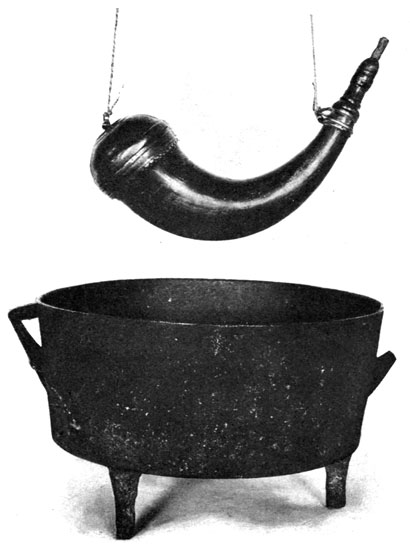
BOONE'S POWDER-HORN AND BAKE-KETTLE.
In possession of Wisconsin State Historical Society. The horn once
belonged to Daniel's brother Israel, and bears the initials "I B".
In these early years of married life Daniel
proved a good husbandman, planting and
garnering his crops with regularity, and pasturing
a few scrawny cattle and swine upon
the wild lands adjoining his farm. Doubtless
at times he did smithy-work for the
neighbors and took a hand at the loom, as
had his father and grandfather before him.
Sometimes he was engaged with his wagon
in the caravans which each autumn found
their way from the Yadkin and the other
mountain valleys down to the Atlantic
cities, carrying furs to market; it was as
yet too early in the history of the back
country for the cattle-raisers to send their
animals to the coast. In the Valley of Virginia,
hemmed in upon the east by the Blue
Ridge, packhorses were alone used in this
traffic, for the mountain paths were rough
and narrow; but wagons could be utilized
in the more southern districts. The caravans
brought back to the pioneers salt, iron,
cloths, and a few other manufactured goods.
This annual expedition over, Boone was free
to go upon long hunts in the forest, where
he cured great stores of meat for his family
and prepared the furs for market.
The backwoodsmen of the Yadkin had
few machines to assist them in their labor,
and these were of the simplest sort. Practically,
every settler was his own mechanic—although
some men became, in certain lines,
more expert than their neighbors, and to
them fell such work for the entire settlement.
Grinding corn into meal, or cracking it into
hominy, were, as usual with primitive peoples,
tasks involving the most machinery.
Rude mortars and pestles, some of the latter
ingeniously worked by means of springy
"sweeps," were commonly seen; a device
something like a nutmeg-grater was often
used when the corn was soft; two circular
millstones, worked by hand, were effective,
and there were some operated by water-power.
Medicine was at a crude stage, many of
the so-called cures being as old as Egypt,
while others were borrowed from the Indians.
The borderers firmly believed in the
existence of witches; bad dreams, eclipses of
the sun, the howling of dogs, and the croaking
of ravens, were sure to bring disasters
in their train.
Their sports laid stress on physical accomplishments—great
strength, dexterity
with the rifle, hunting, imitating the calls of
wild birds and beasts, throwing the tomahawk,
running, jumping, wrestling, dancing,
and horse-racing; they were also fond, as
they gathered around one another's great
fireplaces in the long winter evenings, of
story-telling and dramatic recitation. Some
of the wealthier members of this primitive
society owned negro slaves, to whom, sometimes,
they were cruel, freely using the whip
upon both women and men. Indeed, in their
own frequent quarrels fierce brutality was
sometimes used, adversaries in a fist-fight
being occasionally maimed or otherwise disfigured
for life.
There was, for a long time, "neither law
nor gospel" upon this far-away frontier.
Justices of the peace had small authority.
Preachers were at first unknown. Many of
the borderers were Presbyterians, and others
Quakers; but under such social conditions
these were little else than names. Nevertheless,
there was a sound public sentiment
among these rude, isolated people, who were
a law unto themselves. They respected and
honored candor, honesty, hospitality, regular
habits, and good behavior generally; and
very severe were the punishments with which
they visited offenders. If a man acted as
a coward in time of war, shirked his full
measure of duty to the public, failed to care
for his family, was careless about his debts,
stole from his neighbors, was needlessly profane,
or failed to treat women respectfully,
he was either shunned by his fellows or
forced to leave the settlement.
Amid such surroundings and of such stuff
was Daniel Boone in the days when he was
living uneventfully in the valley of the Yadkin
as farmer, blacksmith, wagoner, and
hunter, before the Indian wars and his explorations
west of the long-shadowed mountain-range
made of him a popular hero.
The borderers in the Valley of Virginia
and on the western highlands of the Carolinas
were largely engaged in raising horses,
cattle, sheep, and hogs, which grazed at will
upon the broad slopes of the eastern foot-hills
of the Alleghanies, most of them being
in as wild a state as the great roving herds
now to be seen upon the semi-arid plains
of the far West. Indeed, there are some
strong points of resemblance between the life
of the frontier herdsman of the middle of the
eighteenth century and that of the "cow"
ranchers of our own day, although the most
primitive conditions now existing would have
seemed princely to Daniel Boone. The annual
round-up, the branding of young stock,
the sometimes deadly disputes between
herdsmen, and the autumnal drive to market,
are features in common.
With the settlement of the valleys and the
steady increase in the herds, it was necessary
each season to find new pastures. Thus
the herdsmen pushed farther and farther
into the wilderness to the south and west,
and actually crossed the mountains at many
points. Even before the arrival of the
Boones, the Bryans had frequently, toward
the end of summer, as the lower pastures
thinned, driven their stock to a distance of
sixty and seventy miles to green valleys lying
between the western buttresses of the mountain
wall.
This gradual pressure upon the hunting-grounds
of the Cherokees and the Catawbas
was not unnoticed by the tribesmen. There
had long been heard deep mutterings, especially
by the former, who were well-disposed
toward the ever-meddling French; but
until the year of Daniel Boone's wedding
the southern frontiers had not known an Indian
uprising.
The year previous (1755) the Cherokees
had given reluctant permission to the whites
to build two posts in their country for the
protection of the frontiers against the
French, who, with their Indian allies, were
continually active against the New York,
Pennsylvania, and Virginia frontiers, and
were known to be attempting the corruption
of the Southern Indians. Fort Prince
George was accordingly erected upon the Savannah
River, and Fort Loudon upon the
Tennessee. In 1756 Fort Dobbs was constructed
a short distance south of the South
Fork of the Yadkin. These three centers of
refuge were upon the extreme southwestern
borders of the English colonies.
These "forts" of the American border
would have proved slight defenses in the
presence of an enemy armed with even the
lightest artillery, but were generally sufficient
to withstand a foe possessing only muskets
and rifles. Fort Dobbs was an oblong
space forty-three by fifty-three feet, girt by
walls about twelve feet high, consisting of
double rows of logs standing on end; earth
dug from the ditch which surrounded the fort
was piled against the feet of these palisades,
inside and out, to steady them; they were
fastened to one another by wooden pins, and
their tops were sharpened so as to impede
those who might seek to climb over. At the
angles of the stockade were blockhouses
three stories high, each story projecting
about eighteen inches beyond the one beneath;
there were openings in the floors of
the two upper stories to enable the defenders
to fire down upon an enemy which sought
to enter below. Along the inside of one, or
perhaps two, of the four walls of the stockade
was a range of cabins—or rather, one long
cabin with log partitions—with the slope of
the roof turned inward to the square; this
furnished a platform for the garrison, who,
protected by the rampart of pointed logs,
could fire into the attacking party. Other
platforms were bracketed against the walls
not backed by cabins. There was a large
double gate made of thick slabs and so situated
as to be guarded by the blockhouses on
either corner; this was the main entrance,
but another and smaller gate furnished a
rear exit to and entrance from the spring
hard by. Blockhouses, cabins, and walls
were all amply provided with port-holes;
Fort Dobbs had capacity for a hundred men-at-arms
to fire at one volley. Destructive
fusillades could be maintained from within,
and everywhere the walls were bullet-proof;
but good marksmen in the attacking force
could work great havoc by firing through the
port-holes, and thus quietly picking off those
who chanced to be in range. Fortunately for
the whites few Indians became so expert as
this.
Upon the arrival of breathless messengers
bringing news of the approach of hostile Indians,
the men, women, and children of a
wide district would flock into such a fort as
this. "I well remember," says Dr. Doddridge
in his Notes on Virginia, "that when
a little boy the family were sometimes waked
up in the dead of night by an express with
a report that the Indians were at hand. The
express came softly to the door or back window,
and by gentle tapping waked the family;
this was easily done, as an habitual fear
made us ever watchful and sensible to the
slightest alarm. The whole family were instantly
in motion: my father seized his gun
and other implements of war; my stepmother
waked up and dressed the children as well
as she could; and being myself the oldest of
the children, I had to take my share of the
burthens to be carried to the fort. There
was no possibility of getting a horse in the
night to aid us in removing to the fort; besides
the little children, we caught up what
articles of clothing and provisions we could
get hold of in the dark, for we durst not
light a candle or even stir the fire. All this
was done with the utmost despatch and the
silence of death; the greatest care was taken
not to awaken the youngest child; to the rest
it was enough to say Indian, and not a
whimper was heard afterwards. Thus it
often happened that the whole number of
families belonging to a fort, who were in the
evening at their homes, were all in their little
fortress before the dawn of the next morning.
In the course of the succeeding day
their household furniture was brought in by
parties of the men under arms."
The large public frontier forts, such as
we have described, did not house all of the
backwoodsmen. There were some who,
either because of great distance or other
reasons, erected their own private defenses;
or, in many cases, several isolated families
united in such a structure. Often these were
but single blockhouses, with a few outlying
cabins. It was difficult to induce some of
the more venturesome folk to enter the forts
unless Indians were actually in the settlement;
they took great risks in order to care
for their crops and stock until the last moment;
and, soon tiring of the monotony of
life within the fort cabins, would often leave
the refuge before the danger was really over.
"Such families," reports Doddridge, "gave
no small amount of trouble by creating frequent
necessities of sending runners to warn
them of their danger, and sometimes parties
of our men to protect them during their removal."
For the first few years Fort Dobbs was
but little used. There was, however, much
uneasiness. The year 1757 had, all along the
line, been disastrous to English arms in the
North, and the Cherokees became increasingly
insolent. The next year they committed
several deadly assaults in the Valley
of Virginia, but themselves suffered greatly
in return. The French, at last driven from
Fort Duquesne (Pittsburg), had retreated
down the Ohio River to Fort Massac, in
southern Illinois, and sent their emissaries
far and near to stir up the Indians west of
the mountains. The following April (1759)
the Yadkin and Catawba Valleys were raided
by the Cherokees, with the usual results of
ruined crops, burned farm-buildings, and
murdered households; not a few of the borderers
being carried off as prisoners into the
Indian country, there generally to suffer
either slavery or slow death from the most
horrid forms of torture. The Catawbas,
meanwhile, remained faithful to their white
friends.
Until this outbreak the Carolinas had
prospered greatly. Hundreds of settlers
had poured in from the more exposed northern
valleys, and the western uplands were
now rapidly being dotted over with clearings
and log cabins. The Indian forays at once
created a general panic throughout this region,
heretofore considered safe. Most of
the Yadkin families, together with English
fur-traders who hurried in from the woods,
huddled within the walls either of Fort
Dobbs or of small neighborhood forts hastily
constructed; but many others, in their fright,
fled with all their possessions to settlements
on or near the Atlantic coast.
Among the latter were old Squire Boone
and his wife, Daniel and Rebecca, with their
two sons,[5] and several other families of
Bryans and Boones, although some of both
names preferred to remain at Fort Dobbs.
The fugitives scattered to various parts of
Virginia and Maryland—Squire going to
Georgetown, now in the District of Columbia,
where he lived for three years and then returned
to the Yadkin; while Daniel's family
went in their two-horse wagon to Culpeper
County, in eastern Virginia. The
settlers there employed him with his wagon
in hauling tobacco to Fredericksburg, the
nearest market-town.
The April forays created almost as much
consternation at Charleston as on the Yadkin.
Governor Lyttleton, of South Carolina,
sent out fifteen hundred men to overcome the
Cherokees, who now pretended to be grieved
at the acts of their young hot-bloods and
patched up a peace. Fur-traders, eager to
renew their profitable barter, hastened back
into the western forests. But very soon their
confidence was shattered, for the Indians
again dug up the tomahawk. Their war-parties
infested every road and trail; most of
the traders, with trains of packhorses to
carry their goods and furs, fell an easy prey
to their forest customers; and Forts Loudon,
Dobbs, and Prince George were besieged.
By January (1760) the entire southwest
border was once more a scene of carnage.
Captain Waddell, our old friend of Braddock's
campaign, commanded at Fort Dobbs,
with several Bryans and Boones in his little
garrison. Here the Cherokees were repulsed
with great loss. At Fort Prince George the
country round about was sadly harried by
the enemy, who finally withdrew. Fort
Loudon, however, had one of the saddest experiences
in the thrilling annals of the
frontier.
In April General Amherst, of the British
Army, sent Colonel Montgomery against the
Cherokees with a formidable column composed
of twelve hundred regular troops—among
them six hundred kilted Highlanders—to
whom were attached seven hundred
Carolina backwoods rangers under Waddell,
with some Catawba allies. They laid waste
with fire and sword all the Cherokee villages
on the Keowee and Tennessee Rivers, including
the growing crops and magazines of corn.
The soldiers killed seventy Indians, captured
forty prisoners, and reduced the greater part
of the tribe to the verge of starvation.
The Cherokees were good fighters, and
soon had their revenge. On the morning of
the twenty-seventh of June the army was
proceeding along a rough road on the southern
bank of the Little Tennessee, where on
one side is a sheer descent to the stream, on
the other a lofty cliff. Here it was ambuscaded
by over six hundred savage warriors
under the noted chief Silouee. In the course
of an engagement lasting several hours the
whites lost twenty killed and sixty wounded,
and the Cherokee casualties were perhaps
greater. Montgomery desperately beat his
way to a level tract, but in the night hastily
withdrew, and did not stop until he reached
Charleston. Despite the entreaties of the
Assembly, he at once retired to the North
with his little army, and left the frontiers
of Carolina open to the assaults of the merciless
foe.
The siege of Fort Loudon was now pushed
by the Cherokees with vigor. It had already
withstood several desperate and protracted
assaults. But the garrison contrived to exist
for several months, almost wholly upon the
active sympathy of several Indian women
who were married to frontiersmen shut up
within the walls. The dusky wives frequently
contrived to smuggle food into the
fort despite the protests of the Indian leaders.
Women, however, despite popular notions
to the contrary, have a powerful influence
in Indian camps; and they but laughed
the chiefs to scorn, saying that they would
suffer death rather than refuse assistance to
their white husbands.
This relief, however, furnished but a precarious
existence. Receiving no help from
the settlements, which were cut off from communication
with them, and weak from irregular
food, the garrison finally surrendered on
promise of a safe-conduct to their fellows in
the East. Early in the morning of August
ninth they marched out—men, women, and
children to the number of several hundred—leaving
behind them their cannon, ammunition,
and spare arms. The next day, upon
their sorry march, they were set upon by a
bloodthirsty mob of seven hundred Cherokees.
Many were killed outright, others surrendered
merely to meet torture and death.
Finally, after several hours of horror, a
friendly chief succeeded, by browbeating his
people and by subterfuge, in saving the lives
of about two hundred persons, who in due
time and after great suffering, reached the
relief party which had for several months
been making its way thither from Virginia;
but it had been delayed by storms and high
water in the mountain streams, and was now
seeking needed rest in a camp at the head
of the Holston. It is recorded that during
the heartrending mêlée several other Indians
risked their lives for white friends, performing
deeds of heroism which deserve to be
remembered.
Although New France was now tottering
to its fall, the French officers at Fort Massac
still continued, with their limited resources,
to keep alive the Cherokee war spirit.
French outrages occurred throughout the autumn
and early winter of 1760. At nearly
all of the forts, large and small, skirmishes
took place, some of these giving occasion for
exhibitions of rare enterprise and courage
on the part of the garrisons, women and men
alike.
During the winter, the governors of Virginia,
North Carolina, and South Carolina
agreed upon a joint campaign against the
hostiles. The southern column, comprising
twenty-six hundred men, chiefly Highlanders,
was under Lieutenant-Colonel James Grant.
Starting early in June, they carried with
them seven hundred packhorses, four hundred
head of cattle, and a large train of baggage
and supplies. Their route from Fort
Prince George to the lower and middle
Cherokee towns on the Little Tennessee lay
through a rough, mountainous country; high
water, storms, intensely warm weather, the
lack of tents, and bruises from rocks and
briers, caused the troops to suffer greatly.
After heavy losses from ambuscades in narrow
defiles, they finally reached their destination,
and spent a month in burning and
ravaging fifteen or more large villages and
fourteen hundred acres of growing corn, and
in driving five thousand men, women, and
children into the hills to starve. Wrote one
of the pious participators in this terrible
work of devastation: "Heaven has blest us
with the greatest success; we have finished
our business as completely as the most sanguine
of us could have wished." The Cherokees,
completely crushed, humbly begged for
peace, which was granted upon liberal terms
and proved to be permanent.
The northern column was composed of
backwoodsmen from Virginia and North
Carolina, under Colonel William Byrd, an
experienced campaigner. Byrd was much
hampered for both men and supplies, and
accomplished little. He appears to have
largely spent his time in making roads and
building blockhouses—laborious methods ill-fitted
for Indian warfare, and loudly criticized
by Waddell, who joined him with a
regiment of five hundred North Carolinians,
among whom was Daniel Boone, now returned
to the Yadkin. Waddell and Boone
had experienced the folly of this sort of
thing in Braddock's ill-fated campaign. As
a result of dissatisfaction, Byrd resigned, and
Colonel Stephen succeeded him. The force,
now composed of about twelve hundred men,
pushed on to the Long Island of Holston
River, where they were met by four hundred
Cherokees, who, brought to their knees by
Grant, likewise sought peace from Stephen.
Articles were accordingly signed on the nineteenth
of November. The North Carolina
men returned home; but a portion of the Virginia
regiment remained as a winter garrison
for Fort Robinson, as the new fort at
Long Island was called.
Now that the Yadkin region has, after its
sad experience, been blessed with a promise
of peace, we may well pause, briefly to consider
the ethics of border warfare. This life-history
will, to its close, have much to do
with Indian forays and white reprisals, and
it is well that we should consider them dispassionately.
The Cherokees were conducting a warfare
in defense of their villages, fields, and hunting-grounds,
which were being rapidly destroyed
by the inrush of white settlers, who
seemed to think that the Indians had no
rights worth consideration. Encouraged by
the French, who deemed the English intruders
on lands which they had first explored, the
American aborigines seriously thought that
they might stem the tide of English settlement.
It was impossible that they should
win, for civilization has in such cases ever
triumphed over savagery; but that they
should make the attempt was to be expected
from a high-spirited race trained to war.
We can but sympathize with and honor them
for making their several stout stands against
the European wave which was ultimately to
sweep them from their native land.[6] King
Philip, Opecancano, Pontiac, Tecumseh, Red
Jacket, Sitting Bull, Captain Jack, were
types of successive leaders who, at various
stages of our growth westward, have stood
as bravely as any Spartan hero to contest
our all-conquering advance.
It is the time-honored custom of historians
of the frontier to consider Indians as
all wrong and whites as all right; and that,
of course, was the opinion of the borderers
themselves—of Daniel Boone and all the men
of his day. But we are now far enough removed
from these events, and the fierce passions
they engendered, to see them more
clearly. The Indian was a savage and
fought like a savage—cruel, bloodthirsty, unrelenting,
treacherous, seldom a respecter of
childhood, of age, or of women. But one
can not read closely the chronicles of border
warfare without discovering that civilized
men at times could, in fighting savages, descend
quite as low in the scale as they, in
bloodthirstiness and treachery. Some of the
most atrocious acts in the pioneer history of
Kentucky and the Middle West were performed
by whites; and some of the most
Christianlike deeds—there were many such
on both sides—were those of painted savages.
It is needless to blame either of the contending
races; their conflict was inevitable.
The frontiersman was generally unlettered,
and used, without ceremony, to overcoming
the obstacles which nature set in his path;
one more patient could not have tamed the
wilderness as quickly as he. His children
often rose to high positions as scholars,
statesmen, and diplomats. But he himself
was a diamond in the rough, and not accustomed
to nice ethical distinctions. To his
mind the Indian was an inferior being, if
not a child of Satan; he was not making the
best use of the soil; his customs and habits
of thought were such as to repel the British
mind, however much they may have attracted
the French. The tribesmen, whom the pioneer
could not and would not understand,
stood in his way, hence must be made to go or
to die in his tracks. When the savage, quick
to resentment, struck back, the turbulent passions
of the overbearing white were aroused,
and with compound interest he repaid the
blow. Upon the theory that the devil must
be fought with fire, the borderer not seldom
adopted methods of reprisal that outdid the
savage in brutality.
The red man fighting, after his own wild
standards, for all that he held most dear, and
the white man, who brooks no opposition
from an inferior race, hitting back with a
fury sometimes increased by fear—such, in
brief, is the blood-stained history of the
American border.
When Daniel Boone returned from tidewater
Virginia to the Yadkin region is not
now known. It is probable that the monotony
of hauling tobacco to market at a time when
his old neighbors were living in a state of
panic palled upon a man who loved excitement
and had had a taste of Indian warfare.
It has been surmised that he served with
the Rowan rangers upon Lyttleton's campaign,
alluded to in the previous chapter,
and possibly aided in defending Fort Dobbs,
or served with Waddell under Montgomery.
That he was, some time in 1760, in the mountains
west of the Yadkin upon either a hunt
or a scout, or both, appears to be well established;
for up to a few years ago there
was still standing upon the banks of Boone's
Creek, a small tributary of the Watauga in
eastern Tennessee, a tree upon whose smooth
bark had been rudely carved this characteristic
legend, undoubtedly by the great hunter
himself: "D Boon cilled A BAR on this tree
year 1760."[7]
We have already seen that he accompanied
Waddell in 1761, when that popular
frontier leader reenforced Colonel Byrd's expedition
against the Cherokees. Upon Waddell's
return to North Carolina his leather-shirted
followers dispersed to their homes,
and Boone was again enabled to undertake a
protracted hunt, no longer disturbed by fear
that in his absence Indians might raid the
settlement; for hunting was now his chief
occupation, his wife and children conducting
the farm, which held second place in his affections.
Thus we see how close the borderers
came to the savage life wherein men are
the warriors and hunters and women the
crop-gatherers and housekeepers. Organizing
a party of kindred spirits—a goodly portion
of the Yadkin settlers were more hunters
than farmers—Boone crossed the mountains
and roamed through the valleys of southwest
Virginia and eastern Tennessee, being especially
delighted with the Valley of the
Holston, where game was found to be unusually
abundant. At about the same time another
party of nineteen hunters went upon a
similar expedition into the hills and valleys
westward of the Yadkin, penetrating well
into Tennessee, and being absent for eighteen
months.
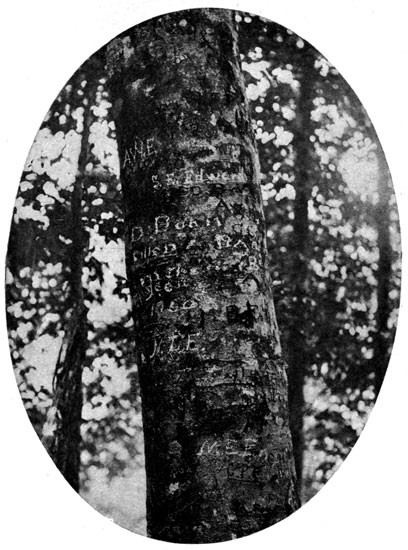
A BOONE TREE.
Tree on Boone's Creek, Tenn., bearing Daniel Boone's autograph.
(See pp. 55, 56.)
We must not conclude, from the passionate
devotion to hunting exhibited by these
backwoodsmen of the eighteenth century,
that they led the same shiftless, aimless lives
as are followed by the "poor whites" found
in some of the river-bottom communities of
our own day, who are in turn farmers, fishermen,
or hunters, as fancy or the seasons dictate.
It must be remembered that farming
upon the Virginia and Carolina uplands was,
in the pioneer period, crude as to methods
and insignificant as to crops. The principal
wealth of the well-to-do was in herds of
horses and cattle which grazed in wild meadows,
and in droves of long-nosed swine feeding
upon the roots and acorns of the hillside
forests. Among the outlying settlers much
of the family food came from the woods, and
often months would pass without bread being
seen inside the cabin walls. Besides the
live stock of the richer folk, whose herds were
driven to market, annual caravans to tidewater
towns carried furs and skins won by
the real backwoodsmen, who lived on the
fringe of the wilderness. For lack of money
accounts were kept in pelts, and with these
were purchased rifles, ammunition, iron, and
salt. It was, then, to the forests that the
borderers largely looked for their sustenance.
Hence those long hunts, from which
the men of the Yadkin, unerring marksmen,
would come back laden with great packs of
pelts for the markets, and dried venison,
bear's meat, and bear's oil for their family
larders. Naturally, this wandering, adventurous
life, spiced with excitement in
many forms, strongly appealed to the rough,
hardy borderers, and unfitted them for other
occupations. Under such conditions farming
methods were not likely to improve, nor
the arts of civilization to prosper; for the
hunter not only best loved the wilderness,
but settlement narrowed his hunting-grounds.
Thus it was that the frontiersman
of the Daniel Boone type, Indian hater as he
was, had at heart much the same interests
as the savage whom he was seeking to supplant.
It was simply a question as to which
hunter, red or white, should occupy the forest;
to neither was settlement welcome.
With the opening of 1762 the southwest
border began to be reoccupied. The abandoned
log cabins once more had fires lighted
upon their hearths, at the base of the great
outside chimneys of stones and mud-plastered
boughs; the deserted clearings, which had
become choked with weeds and underbrush
in the five years of Indian warfare, were
again cultivated by their reassured owners.
Among the returned refugees were Daniel's
parents, Squire and Sarah Boone, who had
ridden on horseback overland all the way
from Maryland. Three years later Squire
Boone died, one of the most highly esteemed
men in the valley.
The Yadkin country was more favored
than some other portions of the backwoods
of North Carolina. Pontiac's uprising
(1763) against the English, who had now
supplanted the French in Canada and in the
wilderness between the Alleghanies and the
Mississippi, led some of the Southern tribes
again to attack the frontiers of the Southwest;
but they were defeated before the Yadkin
was affected by this fresh panic.
The Indian wars had lasted so long that
the entire border had become demoralized.
Of course not all the people in the backwoods
were of good character. Not a few of them
had been driven out from the more thickly
settled parts of the country because of crimes
or of bad reputation; and some of the fur-traders
who lived upon the edge of the settlement
were sorry rogues. When the panic-stricken
people were crowded within the narrow
walls of the forts they could not work.
Many of them found this life of enforced
idleness to their liking, and fell into the habit
of making secret expeditions to plunder
abandoned houses and to steal uncared-for
live stock. When peace came these marauders
had acquired a distaste for honest labor;
leaving the forts, they pillaged right and left,
and horse-stealing became an especially
prevalent frontier vice.
Justice on the border was as yet insufficiently
organized. Some of the Virginia and
Carolina magistrates were themselves rascals,
whose decisions could be purchased by
criminals. Many of the best citizens, therefore,
formed associations whose members
were called "regulators." They bound
themselves to pursue, arrest, and try criminals,
and to punish them by whipping, also
by expulsion from the neighborhood. The
law-breakers, on the other hand, organized
in defense, and popular opinion was divided
between the two elements; for there were
some good people who did not like the arbitrary
methods of the regulators, and insisted
upon every man being given a regular trial
by jury. In South Carolina, particularly,
the settlers were much exercised on this
question, and arrayed themselves into opposing
bands, armed to carry out their respective
views. For a time civil war was feared;
but finally, after five years of disturbance,
an agreement was reached, efficient courts
were established, and justice triumphed.
Affairs did not reach so serious a stage
in North Carolina. Nevertheless there were
several bands of vicious and indolent men,
who, entrenched in the hills, long defied the
regulators. One of these parties built a
rude stockaded fort beneath an overhanging
cliff in the mountains back of the Yadkin
settlements. They stole horses, cattle, farming
utensils; in fact, anything that they could
lay their hands upon. One day they grew so
bold as to kidnap a girl. The settlers, now
roused to action, organized attacking companies,
one of them headed by Daniel Boone,
and carried the log fortress of the bandits
by storm. The culprits were taken to Salisbury
jail and the clan broken up.
The rapid growth of the country soon
made game scarce in Boone's neighborhood.
Not only did the ever-widening area of
cleared fields destroy the cover, but there
were, of course, more hunters than before.
Thus our Nimrod, who in his early manhood
cared for nothing smaller than deer, was
compelled to take extended trips in his
search for less-frequented places. It was not
long before he had explored all the mountains
and valleys within easy reach, and become
familiar with the views from every
peak in the region, many of them five and six
thousand feet in height.
As early as 1764-65 Boone was in the
habit of taking with him, upon these trips
near home, his little son James, then seven
or eight years of age. This was partly for
company, but mainly for the lad's education
as a hunter. Frequently they would spend
several days together in the woods during the
autumn and early winter—the deer-hunting
season—and often, when in "open" camps,
were overtaken by snow-storms. On such
occasions the father would keep the boy
warm by clasping him to his bosom as they
lay with feet toward the glowing camp-fire.
As the well-taught lad grew into early manhood
these two companions would be absent
from home for two and three months together,
always returning well laden with the
spoils of the chase.
Hunters in Boone's day had two kinds of
camp—"open" when upon the move, which
meant sleeping in their blankets upon the
ground wherever darkness or weariness
overtook them; "closed" where remaining
for some time in a locality. A closed camp
consisted of a rude hut of logs or poles, the
front entirely open, the sides closely chinked
with moss, and the roof covered with blankets,
boughs, or bark, sloping down to a back-log.
In times when the Indians were not
feared a fire was kept up throughout the
night, in front, in order to warm the enclosure.
Upon a bed of hemlock boughs or of
dried leaves the hunters lay with heads to
the back-log and stockinged feet to the blaze,
for their spongy moccasins were hung to dry.[8]
Such a camp, often called a "half-faced
cabin," was carefully placed so that it might
be sheltered by neighboring hills from the
cold north and west winds. It was fairly
successful as a protection from rain and
snow, and sometimes served a party of hunters
throughout several successive seasons;
but it was ill-fitted for the coldest weather.
Boone frequently occupied a shelter of this
kind in the woods of Kentucky.
During the last four months of 1765
Boone and seven companions went on horseback
to the new colony of Florida with a view
to moving thither if they found it suited
to their tastes. Wherever possible, they
stopped overnight at borderers' cabins upon
the frontiers of the Carolinas and Georgia.
But such opportunities did not always occur;
they often suffered from hunger, and once
they might have died from starvation but for
the timely succor of a roving band of Seminole
Indians. They explored Florida all the
way from St. Augustine to Pensacola, and
appear to have had a rather wretched time
of it. The trails were miry from frequent
rains, the number and extent of the swamps
appalled them, and there was not game
enough to satisfy a man like Boone, who
scorned alligators. Pensacola, however, so
pleased him that he determined to settle
there, and purchased a house and lot which
he might in due time occupy. Upon their return
Boone told his wife of his Pensacola venture,
but this sturdy woman of the frontier
spurned the idea of moving to a gameless
land. So the town lot was left to take care
of itself, and henceforth the dutiful husband
looked only to the West as his model of a
perfect country.
At the close of the French and Indian
War there arrived in the Boone settlement
a Scotch-Irishman named Benjamin Cutbirth,
aged about twenty-three years. He
was a man of good character and a fine hunter.
Marrying Elizabeth Wilcoxen, a niece of
Daniel Boone, he and Boone went upon long
hunts together, and attained that degree of
comradeship which joint life in a wilderness
camp is almost certain to produce.
In 1766 several families from North Carolina
went to Louisiana, apparently by sea to
New Orleans, and founded an English settlement
above Baton Rouge on the Mississippi
River. The news of this event gave
rise to a general desire for exploring the
country between the mountains and the great
river. The year following, Cutbirth, John
Stuart, John Baker, and John Ward, all of
them young married men on the Yadkin, and
excellent hunters, resolved to perform this
feat, and if possible to discover a region superior
to their own valley. They crossed the
mountain range and eventually saw the Mississippi,
being, so far as we know from contemporary
documents, the first party of
white men to succeed in this overland enterprise.
Possibly fur-traders may have done
so before them, but they left no record to
prove it.
Cutbirth and his friends spent a year or
two upon the river. In the autumn they ascended
the stream for a considerable distance,
also one of its tributaries, made a stationary
camp for the winter, and in the
spring descended to New Orleans, where they
sold at good prices their skins, furs, bear-bacon,
bear's oil, buffalo "jerk" (dried
meat), tallow, and dried venison hams.
Their expedition down the river was performed
at great risks, for they had many
hairbreadth escapes from snags, river banks
shelving in, whirlpools, wind-storms, and Indians.
Their reward, says a chronicler of
the day, was "quite a respectable property;"
but while upon their return homeward,
overland, they were set upon by Choctaws,
who robbed them of their all.
Meanwhile, Daniel Boone was slow in
making up his mind to leave home and the
wife and family whom he dearly loved for so
long and perilous a trip as a journey into
the now much-talked-of land of Kentucky.
Perhaps, despite his longings, he might never
have gone had affairs upon the Yadkin remained
satisfactory to him. But game, his
chief reliance, was year by year becoming
harder to obtain. And the rascally agents
of Earl Granville, the principal landholder
of the region, from whom the Boones had
purchased, were pretending to find flaws in
the land-titles and insisting upon the necessity
for new deeds, for which large fees were
exacted.
This gave rise to great popular discontent.
Boone's protest consisted in leaving
the Sugar Tree settlement and moving northwest
for sixty-five miles toward the head of
the Yadkin. His new cabin, a primitive shell
of logs, could still be seen, a few years ago,
at the foot of a range of hills some seven
and a half miles above Wilkesboro, in Wilkes
County. After a time, dissatisfied with this
location, he moved five miles farther up the
river and about half a mile up Beaver Creek.
Again he changed his mind, choosing his
final home on the upper Yadkin, just above
the mouth of Beaver. It was from this beautiful
region among the Alleghany foot-hills,
where game and fish were plenty and his
swine and cattle had good range, that Boone,
crowded out by advancing civilization, eventually
moved to Kentucky.
In the spring and early summer of 1767
there were fresh outbreaks on the part of
the Indians. Governor Tryon had run a
boundary-line between the back settlements
of the Carolinas and the Cherokee hunting-grounds.
But hunters and traders would
persist in wandering to the west of this line,
and sometimes they were killed.
In the autumn of that year Daniel Boone
and a warm friend, William Hill, and possibly
Squire Boone, determined to seek Kentucky,
of which Finley had told him twelve
years before. They crossed the mountain
wall, were in the valleys of the Holston and
the Clinch, and reached the head waters of
the West Fork of the Big Sandy. Following
down this river for a hundred miles, determined
to find the Ohio, they appear to have
struck a buffalo-path, along which they traveled
as far as a salt-lick ten miles west of
the present town of Prestonburg, on a tributary
of the West (or Louisa) Fork of the
Sandy, within Floyd County, in the extreme
eastern part of Kentucky.
Caught in a severe snow-storm, they were
compelled to camp at this lick for the entire
winter. It proved to be the most profitable
station that they could have selected, for buffaloes
and other animals came in large numbers
to lick the brackish soil, and all the hunters
had to do was to "rise, kill, and eat."
Although now considerably west of the
Cumberland Mountains, the explorers were
not aware that they were within the famed
Kentucky; and as the country was very hilly,
covered with briers which annoyed them
greatly, and altogether forbidding, they despaired
of reaching the promised land by
this path, and in the spring returned to the
Yadkin.
In the winter of 1768-69 a pedler with
horse and wagon wandered into the valley
of the upper Yadkin, offering small wares
to the settlers' wives. This was thrifty John
Finley, former fur-trader and Indian fighter,
who, thirteen years before, had, as we have
seen, fraternized with Boone in Braddock's
ill-fated army on the Monongahela. Finley
had, in 1752, in his trade with the Indians,
descended the Ohio in a canoe to the site of
Louisville, accompanied by three or four
voyageurs, and, with some of his dusky customers,
traveled widely through the interior
of Kentucky. His glowing descriptions of
this beautiful land had inspired Boone to try
to find it. The latter was still sorrowing over
his unpromising expedition by way of the Big
Sandy when, by the merest chance, the man
who had fired his imagination knocked at his
very door.
Throughout the winter that Finley was
Daniel's guest, he and his brother Squire were
ready listeners to the pedler's stories of the
over-mountain country—tales of countless
water-fowl, turkeys, deer, elk, and buffaloes,
which doubtless lost nothing in the telling.
The two Boones resolved to try Finley's proposed
route by way of Cumberland Gap, and
the fur-trader promised to lead the way.
After the spring crops were in, Finley,
Daniel Boone, and the latter's brother-in-law,
John Stuart, started from Daniel's house
upon the first of May. In their employ, as
hunters and camp-keepers, were three neighbors—Joseph
Holden, James Mooney, and
William Cooley. Each man was fully armed,
clad in the usual deerskin costume of the
frontier, and mounted upon a good horse;
blanket or bearskin was strapped on behind
the saddle, together with camp-kettle, a store
of salt, and a small supply of provisions, although
their chief food was to be game.
Squire remained to care for the crops of the
two families, and agreed to reenforce the
hunters late in the autumn.
Scaling the lofty Blue Ridge, the explorers
passed over Stone and Iron Mountains and
reached Holston Valley, whence they proceeded
through Moccasin Gap of Clinch
Mountain, and crossed over intervening rivers
and densely wooded hills until they came
to Powell's Valley, then the farthest limit of
white settlement. Here they found a hunter's
trail which led them through Cumberland
Gap. The "warriors' path"—trodden
by Indian war-parties from across the mountains—was
now discovered, and this they followed
by easy stages until at last they
reached what is now called Station Camp
Creek, a tributary of the Kentucky River, in
Estill County, Ky.—so named because here
was built their principal, or "station" camp,
the center of their operations for many
months to come.
While Boone, Finley, and Stuart made
frequent explorations, and Boone in particular
ascended numerous lofty hills in order to
view the country, the chief occupation of the
party was hunting. Throughout the summer
and autumn deerskins were in their best
condition. Other animals were occasionally
killed to afford variety of food, but fur-bearers
as a rule only furnish fine pelts in the
winter season. Even in the days of abundant
game the hunter was required to exercise
much skill, patience, and endurance. It
was no holiday task to follow this calling.
Deer, especially, were difficult to obtain.
The habits of this excessively cautious animal
were carefully studied; the hunter must
know how to imitate its various calls, to take
advantage of wind and weather, and to practise
all the arts of strategy.
Deerskins were, all things considered, the
most remunerative of all. When roughly
dressed and dried they were worth about a
dollar each; as they were numerous, and a
horse could carry for a long distance about a
hundred such skins, the trade was considered
profitable in those primitive times, when dollars
were hard to obtain. Pelts of beavers,
found in good condition only in the winter,
were worth about two dollars and a half
each, and of otters from three to five dollars.
Thus, a horse-load of beaver furs, when obtainable,
was worth about five times that of a
load of deerskins; and if a few otters could
be thrown in, the value was still greater. The
skins of buffaloes, bears, and elks were too
bulky to carry for long distances, and were
not readily marketable. A few elk-hides were
needed, however, to cut up into harness and
straps, and bear- and buffalo-robes were useful
for bedding.
When an animal was killed the hunter
skinned it on the spot, and packed on his
back the hide and the best portion of the
meat. At night the meat was smoked or prepared
for "jerking," and the skins were
scraped and cured. When collected at the
camps, the bales of skins, protected from
the weather by strips of bark, were placed
upon high scaffolds, secure from bears and
wolves.
Our Yadkin hunters were in the habit,
each day, of dividing themselves into pairs
for company and mutual aid in times of
danger, usually leaving one pair behind as
camp-keepers. Boone and Stuart frequently
were companions upon such trips; for the
former, being a man of few words, enjoyed
by contrast the talkative, happy disposition
of his friend. Occasionally the entire party,
when the game grew timid, moved for some
distance, where they would establish a new
camp; but their headquarters remained at
Station Camp, where were kept their principal
skins, furs, and stores. In this way the
time passed from June to December. Boone
used to assert, in after years, that these
months were the happiest of his life. The
genial climate, the beauty of the country, and
the entire freedom of this wild life, strongly
appealed to him. Here this taciturn but
good-natured man, who loved solitary adventure,
was now in his element. Large packs of
skins had been obtained by the little company
and stored at Station Camp and their
outlying shelters; and there was now a generous
supply of buffalo, bear, and elk meat,
venison, and turkeys, all properly jerked for
the winter which was before them, with buffalo
tallow and bear's oil to serve as cooking
grease.
Finley and Boone were both aware that
Kentucky lay between the warring tribes of
the North and the South; that through it
warriors' paths crossed in several directions;
and that this, probably the finest hunting-field
in North America, was a debatable land,
frequently fought over by contending savages—a
"dark and bloody ground" indeed.
Yet thus far there had been no signs of Indians,
and the Carolina hunters had almost
ceased to think of them.
Toward the close of day on the twenty-second
of December, while Boone and Stuart
were ascending a low hill near the Kentucky
River, in one of the most beautiful districts
they had seen, they were suddenly surrounded
and captured by a large party of Shawnese
horsemen returning from an autumn
hunt on Green River to their homes north
of the Ohio. The two captives were forced
to lead the savages to their camps, which
were deliberately plundered, one after the
other, of everything in them. The Shawnese,
releasing their prisoners, considerately
left with each hunter just enough supplies
to enable him to support himself on the way
back to the settlements. The white men
were told what was a fact under existing
treaties with the tribes—treaties, however, of
which Boone and his companions probably
knew nothing—that they were trespassing
upon Indian hunting-grounds, and must not
come again, or "the wasps and yellow-jackets
will sting you severely."
The others proposed to leave for home at
once; but Boone and Stuart, enraged at having
lost their year's work and all that they
had brought into the wilderness, and having
no sympathy for Indian treaty rights, started
out to recover their property. After two
days they came up with the Shawnese, and
secreting themselves in the bushes until dark,
contrived to regain four or five horses and
make off with them. But they, in turn, were
overtaken in two days by the Indians and
again made prisoners. After a week of captivity,
in which they were kindly treated, they
effected their escape in the dark and returned
to Station Camp.
Their companions, giving them up for
lost, had departed toward home, but were
overtaken by the two adventurers. Boone
was gratified to find with them his brother
Squire, who, having gathered the fall crops,
had come out with a fresh supply of horses,
traps, and ammunition. He had followed
the trail of his predecessors, and in the New
River region was joined by Alexander Neely.
Not finding Daniel and Stuart at Station
Camp, and grief-stricken at the report concerning
them, he was traveling homeward
with the party.
Daniel, however, who had staked upon
this venture almost all that he owned, did
not relish the thought of returning empty-handed,
now that reenforcements had arrived,
and determined to stay and seek to
regain his lost fortunes. Squire, Stuart, and
Neely concluded also to remain, and the four
were now left behind in the wilderness. On
reaching the Holston Valley, Finley turned
northward to seek his relatives in Pennsylvania;
while Holden, Mooney, and Cooley
proceeded southeastward to their Yadkin
homes, carrying dismal news of the events attending
this notable exploration of Kentucky.
The quartette promptly abandoned Station
Camp as being dangerously near the
warriors' path, and, tradition says, built another
on or near the northern bank of Kentucky
River, not far from the mouth of the
Red. The deer season was now over, but
beavers and otters were in their prime, and
soon the hunters were enjoying a profitable
season. A small canoe which they built added
greatly to their equipment, and they were
now enabled to set their traps throughout
a wide region.
Hunting in pairs, Daniel was generally
accompanied by Stuart, while Neely and
Squire were partners. In their wanderings
the two pairs were sometimes several days
without seeing each other; and frequently
partners would be separated throughout the
day, but at night met at some appointed spot.
One day, toward the close of January or
early in February (1770), Stuart did not return
to the rendezvous, much to Boone's
alarm. The following day the latter discovered
the embers of a fire, doubtless built by
the lost man; but that was all, for Stuart
was seen no more. Five years later Boone
came across the bones of his light-hearted
comrade in a hollow sycamore tree upon
Rockcastle River—he recognized them by
Stuart's name cut upon his powder-horn.
What caused Stuart's death is a mystery to
the present day; possibly he was wounded
and chased by Indians to this distant spot,
and died while in hiding.
Stuart's mysterious disappearance frightened
Neely, who at once left for home, thus
leaving Daniel and Squire to pass the remainder
of the winter in the wilderness by
themselves. Dejected, but not discouraged,
the brothers built a comfortable hut and continued
their work. With the close of the
trapping season the ammunition was nearly
exhausted. Upon the first of May, a year
after Daniel had left his cabin upon the upper
Yadkin, Squire started out upon the return,
their horses well laden with furs, skins,
and jerked meat. Both men had, in their
enterprise, contracted debts of considerable
extent for frontier hunters, hence they were
anxious to square themselves with the world,
as well as to obtain more horses, ammunition,
and miscellaneous supplies.
Daniel was now left alone in Kentucky,
"without bread, salt, or sugar, without company
of his fellow-creatures, or even a horse
or dog." In after years he acknowledged
that he was at times homesick during the
three months which followed, and felt deeply
his absence from the wife and family to
whom he was so warmly attached. But possessing
a cheerful, hopeful nature, he forgot
his loneliness in untrammeled enjoyment of
the far-stretching wilderness.
Almost without ammunition, he could not
hunt, save to obtain sufficient food, and largely
spent his time in exploration. Fearing Indians,
he frequently changed his location,
sometimes living in shelters of bark and
boughs, and again in caves; but seldom venturing
to sleep in these temporary homes,
preferring the thickets and the dense cane-brakes
as less liable to be sought by savage
prowlers.
Kentucky has a remarkably diversified
landscape of densely wooded hills and valleys
and broad prairie expanses. The genial
climate admirably suited the philosophical
wanderer. He enjoyed the exquisite beauty
and stateliness of the trees—the sycamores,
tulip-trees, sugar-trees, honey-locusts, coffee-trees,
pawpaws, cucumber-trees, and black
mulberries—and found flowers in surprising
variety and loveliness. The mineral springs
interested him—Big Lick, the Blue Licks, and
Big Bone Lick, with its fossil remains of
mastodons which had become mired when
coming to lick the brackish soil. He traveled
far and wide in his search for the beautiful
and curious, being chiefly in the valleys of
the Licking and the Kentucky, and upon the
banks of the Ohio as far down as the site of
Louisville, where, at the foot of the falls, he
inspected the remains of an old fur trade
stockade concerning which Finley had told
him.
Once he saw some Indians walking upon
the northern bank of the Ohio, but managed
himself to keep out of sight. At another
time, when on the Kentucky, he saw a savage
calmly fishing from the trunk of a fallen
tree. In mentioning this incident to his family,
in later days, he would declare with gravity:
"While I was looking at the fellow he
tumbled into the river, and I saw him no
more." Probably the man of the Yadkin
shot him, fearing that the fisherman might
carry the news of the former's whereabouts
to a possible camp near by. On another occasion,
when exploring Dick's River, he was
suddenly surrounded by Indians. Having
either to surrender or to leap down the precipitous
height to a bank sixty feet below,
he chose to leap. Landing in the top of a
small sugar-maple, he slid down the tree,
and was able to escape by running under the
overhanging bank and then swimming the
stream. Adventures such as this gave
abundant spice to the joys of solitude.
In the latter part of July Squire arrived
from the settlements, having paid all their
debts and with the surplus purchased sufficient
supplies for another summer and fall
campaign against the deer. This was highly
successful. They did not lack some interesting
experiences, but Indians were not again
encountered; so that, when winter approached,
Squire was enabled once more to
leave with well-laden horses for the markets
of the East. Another two months of loneliness
were suffered by Daniel; but in December
Squire rejoined him with horses, ammunition,
and other necessaries, and the pair
joyously settled down for still another winter
together in the dark and lonely forests of
Kentucky.
The reader of this narrative has, of
course, already discovered that Daniel Boone
was neither the original white explorer of
Kentucky nor the first white hunter within
its limits. Many others had been there before
him. It will be worth our while at this
point to take a hasty review of some of the
previous expeditions which had made the
"dark and bloody ground" known to the
world.
Probably none of the several Spanish explorations
of the sixteenth century along the
Mississippi River and through the Gulf
States had touched Kentucky. But during
the seventeenth century both the French in
Canada and the English on the Atlantic tidewater
came to have fairly accurate notions
of the country lying immediately to the south
of the Ohio River. As early as 1650 Governor
Berkeley, of Virginia, made a vain attempt
to cross the Alleghany barrier in
search of the Mississippi, concerning which
he had heard from Indians; and we know
that at the same time the French, especially
the Jesuit missionaries, were looking eagerly
in that direction. A few years later Colonel
Abraham Wood, of Virginia, discovered
streams which poured into the Ohio and the
Mississippi. Just a century before Boone's
great hunt, John Lederer, also of Virginia,
explored for a considerable distance beyond
the mountains. The following year Thomas
Batts and his party proclaimed King Charles
II upon New River, the upper waters of the
Great Kanawha—twelve months before La
Salle took possession of all Western waters
for the French king, and nineteen before
Marquette and Joliet discovered the Mississippi.
There is a tradition that in 1678, only
five years after the voyage of Marquette and
Joliet, a party of New Englanders ventured
into the Western wilderness as far as New
Mexico. The later French expeditions of
La Salle, Hennepin, and D'Iberville are well
known. Several Englishmen traded with Indians
upon the Mississippi before the close
of the seventeenth century; by 1719 the English
were so numerous that Governor Keith,
of Pennsylvania, suggested that four forts
be built for their protection in the Wabash
and Illinois countries. We hear of a French
expedition investigating Big Bone Lick, in
Kentucky, in 1735; and other visits were successively
made by bands of their compatriots
until the downfall of New France, over a
quarter of a century later. In 1742 John
Howard and Peter Salling, of Virginia, were
exploring in Kentucky; six years after them
Dr. Thomas Walker made a notable expedition
through the same country; and two years
after that Washington's backwoods friend,
Christopher Gist, was on the site of Louisville
selecting lands for the Ohio Company,
which had a large grant upon the Ohio
River.
Henceforward, border chronicles abound
with reports of the adventures of English
fur-traders, hunters, and land-viewers, all
along the Ohio River and tributary waters
above Louisville. Among these early adventurers
was our friend Finley, whose experiences
in Kentucky dated from 1752, and
who piloted Boone to the promised land
through the gateway of Cumberland Gap.
The subsequent Indian wars, with the expeditions
into the upper Ohio Valley by Generals
Braddock, Forbes, and Bouquet, made
the country still better known; and settlers
were soon rushing in by scores, although as
yet none of them appear to have made clearings
within Kentucky itself.
Officers and soldiers who had served in
the French and Indian War were given liberal
grants of land in the West. Washington
had not only his own grant, as the principal
officer upon the southwest frontier, but
was agent for a number of fellow-soldiers,
and in 1767 went to the Ohio River to select
and survey claims. At the very time when
Boone was engaged upon his fruitless expedition
down the Big Sandy, Washington was
making the first surveys in Kentucky on both
the Little and Big Sandy. Again, in 1770,
when Boone was exploring the Kentucky
wilderness, Washington was surveying extensive
tracts along the Ohio and the Great
Kanawha, and planning for a large colony
upon his own lands. The outbreak of the
Revolution caused the great man to turn his
attention from the over-mountain region to
the defense of his country. Had he been left
to carry out his plans, he would doubtless
have won fame as the most energetic of
Western pioneers.
It will be remembered that when Boone
and his companions passed through Cumberland
Gap in the early summer of 1769, they
found the well-worn trail of other hunters
who had preceded them from the settlements.
The men of the Yadkin Valley were not the
only persons seeking game in Kentucky that
year. At about the time when Boone was
bidding farewell to his family, Hancock
and Richard Taylor, Abraham Hempinstall,
and one Barbour, frontiersmen of the same
type, started from their homes in Orange
County, Va., to explore the valleys of the
Ohio and Mississippi. They descended from
Pittsburg in a boat, explored Kentucky, and
proceeded into Arkansas, where they camped
and hunted during the following winter.
The next year two of them traveled eastward
to Florida, and thence northwardly to their
homes; the others stayed in Arkansas for
another year, and returned by sea from New
Orleans to New York.
Simultaneously with the expeditions of
Boone and the Taylors, a party of twenty or
more adventurous hunters and explorers was
formed in the New River region, in the Valley
of Virginia. They set out in June
(1769), piloted by Uriah Stone, who had been
in Kentucky three years before. Entering
by way of the now familiar Cumberland Gap,
these men had experiences quite similar to
those of Boone and his comrades. At some
of the Kentucky salt-licks they found herds
of buffaloes numbering up in the thousands—at
one lick a hundred acres were densely
massed with these bulky animals, who exhibited
no fear until the wind blew from the
hunters toward them, and then they would
"dash wildly away in large droves and disappear."
Like Boone's party, they also were
the victims of Cherokees, who plundered
their camps, and after leaving them some
guns and a little ammunition, ordered them
out of the country. The New River party
being large, however, some of their number
were deputed to go to the settlements and
bring back fresh supplies, so that they could
finish their hunt. After further adventures
with Indians half of the hunters returned
home; while the others wandered into Tennessee
and as far as the Ozark Mountains,
finally reaching New River through Georgia
and the Carolinas. Another Virginian,
named John McCulloch, who courted the
perils of exploration, was in Kentucky in the
summer of 1769 with a white man-servant
and a negro. He visited the site of Terre
Haute, Ind., and went by canoe to Natchez
and New Orleans, and at length reached
Philadelphia by sea.
But the most famous of all the expeditions
of the period was that of the "Long
Hunters," as they have come to be known in
Western history. Inspired by the favorable
reports of Stone and others, about forty of
the most noted and successful hunters of
New River and Holston Valleys formed, in
the summer of 1770, a company for hunting
and trapping to the west of Cumberland
Mountains. Under the leadership of two of
the best woodsmen of the region, Joseph
Drake and Henry Skaggs, and including several
of Stone's party, they set out in early
autumn fully prepared for meeting Indians
and living on game. Each man took with
him three packhorses, rifles, ammunition,
traps, dogs, blankets, and salt, and was
dressed in the deerskin costume of the times.
Pushing on through Cumberland Gap, the
adventurers were soon in the heart of Kentucky.
In accordance with custom, they visited
some of the best licks—a few of which
were probably first seen by them—for here
wild beasts were always to be found in profusion.
At Knob Licks they beheld from
an eminence which overlooked the springs
"what they estimated at largely over a thousand
animals, including buffaloe, elk, bear,
and deer, with many wild turkies scattered
among them—all quite restless, some playing,
and others busily employed in licking the
earth; but at length they took flight and
bounded away all in one direction, so that in
the brief space of a couple of minutes not
an animal was to be seen." Within an area
of many acres, the animals had eaten the
salty earth to a depth of several feet.
Successful in a high degree, the party
ceased operations in February, and had completed
preparations for sending a large shipment
of skins, furs, and "jerk" to the settlements,
when, in their temporary absence,
roving Cherokees robbed them of much of
their stores and spoiled the greater part of
the remainder. "Fifteen hundred skins
gone to ruination!" was the legend which
one of them carved upon the bark of a neighboring
tree, a record to which were appended
the initials of each member of the party. A
series of disasters followed, in the course of
which two men were carried off by Indians
and never again seen, and others fled for home.
Those remaining, having still much ammunition
and the horses, continued their hunt,
chiefly upon the Green and Cumberland Rivers,
and in due time brought together another
store of peltries, almost as extensive as
that despoiled by the savages.
Not long after the robbery, when the
Long Hunters were upon Green River, one
of the parties into which the band was divided
were going into camp for the night,
when a singular noise was heard proceeding
from a considerable distance in the forest.
The leader, Caspar Mausker, commanded
silence on the part of his comrades, and himself
crept cautiously from tree to tree in the
direction of the sound. Imagine his surprise
and amusement to find "a man bare-headed,
stretched flat upon his back on a deerskin
spread on the ground, singing merrily at the
top of his voice!" The singer was our hero,
Daniel Boone, who, regardless of possible
Indian neighbors, was thus enjoying himself
while awaiting Squire's belated return to
camp. Like most woodsmen of his day and
ours, Boone was fond of singing, in his rude
way, as well as of relating tales of stirring
adventure. In such manner were many
hours whiled away around the camp-fires of
wilderness hunters.
The Boones at once joined and spent some
time with the Long Hunters, no doubt delighted
at this opportunity of once more
mingling with men of their kind. Among
their amusements was that of naming rivers,
creeks, and hills after members of the party;
many of these names are still preserved upon
the map of Kentucky. At one time they discovered
that some French hunters from the
Illinois country had recently visited a lick to
kill buffaloes for their tongues and tallow,
which they had loaded into a keel-boat and
taken down the Cumberland. In after years
one of the Long Hunters declared that this
wholesale slaughter was so great "that one
could walk for several hundred yards in and
around the lick on buffaloes' skulls and
bones, with which the whole flat around the
lick was bleached."
It was not until August that the Long
Hunters returned to their homes, after a
profitable absence of eleven months. But
the Boone brothers left their comrades in
March and headed for the Yadkin, with
horses now well laden with spoils of the
chase. They were deeply in debt for their
latest supplies, but were returning in light
heart, cheered with the prospect of settling
their accounts and being able to revisit Kentucky
in good condition. But in Powell's
Valley, near Cumberland Gap, where they
might well have supposed that small chance
of danger remained, they were suddenly set
upon by a war party of Northern Indians
who had been raiding the white settlers as
well as their Southern foes, the Cherokees
and Catawbas. Roughly handled and robbed
of their packs, the unfortunate hunters
reached the Yadkin in no happy frame of
mind. Daniel had been absent for two years,
and was now poorer than when he left home.
He used to say, however, in after years, that
having at last seen Kentucky, his ideal of
an earthly paradise, that served as solace for
his woes.
While Daniel Boone had been hunting
and exploring amid the deep forests and waving
greenswards of Kentucky, important
events had been taking place in the settlements.
The colonists along the Atlantic tidewater
had become so crowded that there were
no longer any free lands in that region; and
settlers' cabins in the western uplands of
Pennsylvania, Maryland, the Carolinas, and
Georgia had so multiplied that now much of
the best land there had also been taken up.
The far-outlying frontier upon which the
Boones and Bryans had reared their rude
log huts nearly a quarter of a century before,
no longer abounded in game and in free pastures
for roving herds; indeed, the frontier
was now pushed forward to the west-flowing
streams—to the head waters of the Watauga,
Clinch, Powell, French Broad, Holston, and
Nolichucky, all of them affluents of the Tennessee,
and to the Monongahela and other
tributaries of the upper Ohio.
The rising tide of population demanded
more room to the westward. The forbidding
mountain-ranges had long hemmed in the
restless borderers; but the dark-skinned
wilderness tribes had formed a still more
serious barrier, as, with rifles and tomahawks
purchased from white traders, they
terrorized the slowly advancing outposts of
civilization. With the French government no
longer in control of Canada and the region
east of the Mississippi—although French-Canadian
woodsmen were freely employed
by the British Indian Department—with the
consequent quieting of Indian forays, with
increased knowledge of the over-mountain
passes, and with the strong push of population
from behind, there had arisen a general
desire to scale the hills, and beyond them
to seek exemption from tax-gatherers, free
lands, and the abundant game concerning
which the Kentucky hunters had brought
glowing reports.
Upon the defeat of the French, the English
king had issued a proclamation (1763)
forbidding his "loving subjects" to settle to
the west of the mountains. The home government
was no doubt actuated in this by
two motives: first, a desire to preserve the
wilderness for the benefit of the growing fur
trade, which brought wealth to many London
merchants; second, a fear that borderers
who pushed beyond the mountains might not
only be beyond the reach of English trade,
but also beyond English political control.
But the frontiersmen were already too far
distant to have much regard for royal proclamations.
The king's command appears to
have had no more effect than had he, like
one of his predecessors, bade the ocean tide
rise no higher.
In 1768, at Fort Stanwix, N.Y., the
Iroquois of that province, whose war parties
had raided much of the country between the
Hudson and the Mississippi, surrendered
what shadowy rights they might be supposed
to have over all lands lying between the Ohio
and the Tennessee. Meanwhile, at the South,
the Cherokees had agreed to a frontier which
opened to settlement eastern Kentucky and
Tennessee.
But, without waiting for these treaties,
numerous schemes had been proposed in
England and the Atlantic coast colonies for
the settlement of Kentucky and the lands of
the upper Ohio. Most of these projects
failed, even the more promising of them being
checked by the opening of the Revolutionary
War; but their existence showed how
general was the desire of English colonists
to occupy those fertile Western lands which
explorers like Gist, Washington, the Boones,
and the Long Hunters had now made familiar
to the world. The new treaties
strengthened this desire, so that when Daniel
and Squire Boone reached their homes upon
the Yadkin the subject of Western settlement
was uppermost in the minds of the
people.
The land excitement was, however, less
intense in North Carolina than in the Valley
of Virginia and other mountain troughs to
the north and northeast. At Boone's home
there was unrest of a more serious character.
The tax-gatherers were arousing great popular
discontent because of unlawful and extortionate
demands, and in some cases Governor
Tryon had come to blows with the
regulators who stood for the people's rights.
For two and a half years after his return
Boone quietly conducted his little farm, and,
as of old, made long hunting trips in autumn
and winter, occasionally venturing—sometimes
alone, sometimes with one or two companions—far
west into Kentucky, once visiting
French Lick, on the Cumberland, where
he found several French hunters. There is
reason to believe that in 1772 he moved to
the Watauga Valley, but after living there
for a time went back to the Yadkin. Early
in the following year he accompanied Benjamin
Cutbirth and others as far as the present
Jessamine County, Ky., and from this
trip returned fired with quickened zeal for
making a settlement in the new country.
The spring and summer were spent in
active preparations. He enlisted the cooperation
of Captain William Russell, the
principal pioneer in the Clinch Valley; several
of the Bryans, whose settlement was
now sixty-five miles distant, also agreed to
join him; and five other families in his own
neighborhood engaged to join the expedition.
The Bryan party, numbering forty men,
some of them from the Valley of Virginia
and Powell's Valley, were not to be accompanied
by their families, as they preferred
to go in advance and prepare homes before
making a final move. But Boone and the
other men of the upper Yadkin took with
them their wives and children; most of
them sold their farms, as did Boone, thus
burning their bridges behind them. Arranging
to meet the Bryan contingent in Powell's
Valley, Boone's party left for the West upon
the twenty-fifth of September, 1773—fifty-six
years after old George Boone had departed
from England for the Pennsylvania
frontier near Philadelphia, and twenty-three
after the family had set out for the new
southwest frontier on the Yadkin.
Reaching Powell's, Boone went into camp
to await the rear party, his riding and packhorses
hoppled and belled, after the custom
of such caravans, and their small herd of
cattle properly guarded in a meadow. His
eldest son, James, now a boy of sixteen
years, was sent with two men, with pack-animals,
across country to notify Russell and
to secure some flour and farming tools.
They were returning laden, in company with
Russell's son Henry, a year older than
James, two of Russell's negro slaves, and
two or three white workpeople, when, missing
their path, they went into camp for the
night only three miles from Boone's quarters.
At daybreak they were attacked by a Shawnese
war party and all killed except a white
laborer and a negro. This pathetic tragedy
created such consternation among the movers
that, despite Boone's entreaties to go forward,
all of them returned to Virginia and
Carolina. Daniel and his family, no longer
having a home on the Yadkin, would not retreat,
and took up their quarters in an empty
cabin upon the farm of Captain David Gass,
seven or eight miles from Russell's, upon
Clinch River. Throughout this sorrowful
winter the Boones were supported from their
stock of cattle and by means of Daniel's unerring
rifle.
It was long before the intrepid pioneers
could again take up their line of march.
Ever since the Bouquet treaty of 1764 there
had been more or less disturbance upon the
frontiers. During all these years, although
there was no open warfare between whites
and reds, many scores of lives had been lost.
Indians had wantonly plundered and murdered
white men, and the latter had been
quite as merciless toward the savages.
Whenever a member of one race met a man
of the other the rifle was apt to be at once
brought into play. Meanwhile, armed parties
of surveyors and land speculators were
swarming into Kentucky, notching the trees
for landmarks, and giving evidence to apprehensive
tribesmen that the hordes of civilization
were upon them. In 1773 George
Rogers Clark, afterward the most famous of
border leaders, had staked a claim at the
mouth of Fishing Creek, on the Ohio; Washington
had, this summer, descended the river
to the same point; while at the Falls of the
Ohio, and upon interior waters of the Kentucky
wilderness, other parties were laying
ambitious plans for the capitals of new colonies.
In the following spring the Cherokees and
Shawnese, now wrought to a high pitch of ill
temper, combined for onslaughts on the advancing
frontiersmen. The wanton murder
by border ruffians of Chief John Logan's
family, near Mingo Junction, on the Ohio,
was the match which, in early summer, fired
the tinder. The Mingos, ablaze with the fire
of vengeance, carried the war-pipe through
the neighboring villages; runners were sent
in every direction to rouse the tribes; tomahawks
were unearthed, war-posts were planted;
messages of defiance were sent to the
"Virginians," as all frontiersmen were generally
called by the Western Indians; and in
a few days the border war to which history
has given the name of Lord Dunmore, then
governor of Virginia, was in full swing from
Cumberland Gap to Fort Pitt, from the Alleghanies
to the Wabash.
Its isolation at first protected the Valley
of the Clinch. The commandant of the
southwest militia—which comprised every
boy or man capable of bearing arms—was
Colonel William Preston; under him was
Major Arthur Campbell; the principal man
in the Clinch Valley was Boone's friend,
Russell. When, in June, the border captains
were notified by Lord Dunmore that the war
was now on, forts were erected in each of the
mountain valleys, and scouts sent out along
the trails and streams to ascertain the whereabouts
of the enemy.
There were in Kentucky, at this time,
several surveying parties which could not
obtain news by way of the Ohio because of
the blockade maintained by the Shawnese.
It became necessary to notify them overland,
and advise their retreat to the settlements
by way of Cumberland Gap. Russell having
been ordered by Preston to employ "two
faithful woodsmen" for this purpose, chose
Daniel Boone and Michael Stoner. "If they
are alive," wrote Russell to his colonel, "it
is indisputable but Boone must find them."
Leaving the Clinch on June twenty-seventh,
the two envoys were at Harrodsburg before
July eighth. There they found James Harrod
and thirty-four other men laying off a
large town,[9] in which they proposed to give
each inhabitant a half-acre in-lot and a ten-acre
out-lot. Boone, who had small capacity
for business, but in land was something of a
speculator, registered as a settler, and in
company with a neighbor put up a cabin for
his future occupancy. This done, he and
Stoner hurried on down the Kentucky River
to its mouth, and thence to the Falls of the
Ohio (site of Louisville), notifying several
bands of surveyors and town-builders of
their danger. After an absence of sixty-one
days they were back again upon the Clinch,
having traveled eight hundred miles through
a practically unbroken forest, experienced
many dangers from Indians, and overcome
natural difficulties almost without number.
Meanwhile Lord Dunmore, personally unpopular
but an energetic and competent military
manager, had sent out an army of nearly
three thousand backwoodsmen against the
Shawnese north of the Ohio. One wing of
this army, led by the governor himself, went
by way of Fort Pitt and descended the Ohio;
among its members was George Rogers Clark.
The other wing, commanded by General Andrew
Lewis, included the men of the Southwest,
eleven hundred strong; they were
to descend the Great Kanawha and rendezvous
with the northern wing at Point Pleasant,
at the junction of the Kanawha and the
Ohio.
When Boone arrived upon the Clinch he
found that Russell and most of the other militiamen
of the district had departed upon the
campaign. With a party of recruits, the
great hunter started out to overtake the expedition,
but was met by orders to return
and aid in defending his own valley; for the
drawing off of the militia by Dunmore had
left the southwest frontiers in weak condition.
During September the settlers upon
the Clinch suffered much apprehension; the
depredations of the tribesmen were not numerous,
but several men were either wounded
or captured.
In a letter written upon the sixth of October,
Major Campbell gives a list of forts
upon the Clinch: "Blackmore's, sixteen men,
Sergeant Moore commanding; Moore's, twenty
miles above, twenty men, Lieutenant
Boone commanding; Russell's, four miles
above, twenty men, Sergeant W. Poage commanding;
Glade Hollow, twelve miles above,
fifteen men, Sergeant John Dunkin commanding;
Elk Garden, fourteen miles above,
eighteen men, Sergeant John Kinkead commanding;
Maiden Spring, twenty-three miles
above, five men, Sergeant John Crane commanding;
Whitton's Big Crab Orchard,
twelve miles above, three men, Ensign John
Campbell, of Rich Valley, commanding."
During this month Boone and his little garrison
made frequent sallies against the enemy,
and now and then fought brief but desperate
skirmishes. He appears to have been by far
the most active commander in the valley, and
when neighboring forts were attacked his
party of well-trained riflemen generally furnished
the relief necessary to raise the siege.
"Mr. Boone," writes Campbell to Preston,
"is very diligent at Castle's-woods, and
keeps up good order." His conduct is frequently
alluded to in the military correspondence
of that summer; Campbell and other
leaders exhibited in their references to our
hero a respectful and even deferential tone.
An eye-witness of some of these stirring
scenes has left us a description of Daniel
Boone, now forty years of age, in which it is
stated that his was then a familiar figure
throughout the valley as he hurried to and
fro upon his military duties "dressed in
deerskin colored black, and his hair plaited
and clubbed up."
Upon the tenth of October, Cornstalk, a
famous Shawnese chief, taking advantage of
Dunmore's failure to join the southern wing,
led against Lewis's little army encamped at
Point Pleasant a thousand picked warriors
gathered from all parts of the Northwest.
Here, upon the wooded eminence at the junction
of the two rivers, was waged from dawn
until dusk one of the most bloody and stubborn
hand-to-hand battles ever fought between
Indians and whites. It is hard to say
who displayed the best generalship, Cornstalk
or Lewis. The American savage was a
splendid fighter; although weak in discipline
he could competently plan a battle. The tactics
of surprise were his chief resource, and
these are legitimate even in civilized warfare;
but he could also make a determined
contest in the open, and when, as at Point
Pleasant, the opposing numbers were nearly
equal, the result was often slow of determination.
Desperately courageous, pertinacious,
with a natural aptitude for war combined
with consummate treachery, cruelty, and cunning,
it is small wonder that the Indian long
offered a formidable barrier to the advance
of civilization. In early Virginia, John
Smith noticed that in Indian warfare the
whites won at the expense of losses far beyond
those suffered by the tribesmen; and
here at Point Pleasant, while the "Long
Knives"[10] gained the day, the number of
their dead and wounded was double that of
the casualties sustained by Cornstalk's painted
band.
The victory at Point Pleasant practically
closed the war upon the border. Boone had
been made a captain in response to a popular
petition that the hero of Clinch Valley be
thus honored, and was given charge of the
three lower forts; but there followed only
a few alarms, and upon the twentieth of
November he and his brother militiamen of
the region received their discharge. The
war had cost Virginia £10,000 sterling, many
valuable lives had been sacrificed, and an incalculable
amount of suffering and privation
had been occasioned all along the three hundred
and fifty miles of American frontier.
But the Shawnese had been humbled, the
Cherokees had retired behind the new border
line, and a lasting peace appeared to be
assured.
In the following January Captain Boone,
true son of the wilderness, was celebrating
his freedom from duties incident to war's
alarms by a solitary hunt upon the banks of
Kentucky River.
Kentucky had so long been spasmodically
occupied and battled over by Shawnese,
Iroquois, and Cherokees, that it can not be
said that any of them had well-defined rights
over its soil. Not until white men appeared
anxious to settle there did the tribes begin
to assert their respective claims, in the hope
of gaining presents at the treaties whereat
they were asked to make cessions. The
whites, on their part, when negotiating for
purchases, were well aware of the shadowy
character of these claims; but, when armed
with a signed deed of cession, they had something
tangible upon which thenceforth to
base their own claims of proprietorship.
There was therefore much insincerity upon
both sides. It is well to understand this situation
in studying the history of Kentucky
settlement.
Colonel Richard Henderson was one of the
principal judges in North Carolina, a scholarly,
talented man, eminent in the legal profession;
although but thirty-nine years of
age, he wielded much influence. Knowing
and respecting Daniel Boone, Henderson was
much impressed by the former's enthusiastic
reports concerning the soil, climate, and
scenery of Kentucky; and, acting solely upon
this information, resolved to establish a colony
in that attractive country. He associated
with himself three brothers, Nathaniel,
David, and Thomas Hart, the last-named of
whom in later life wrote that he "had known
Boone of old, when poverty and distress held
him fast by the hand; and in those wretched
circumstances he had ever found him a noble
and generous soul, despising everything
mean." Their proposed colony was styled
Transylvania, and the association of proprietors
the Transylvania Company.
It will be remembered that in the treaty
of Fort Stanwix (1768) the Iroquois of New
York had ceded to the English crown their
pretensions to lands lying between the Ohio
and the Tennessee. The Transylvania Company,
however, applied to the Cherokees, because
this was the tribe commanding the path
from Virginia and the Carolinas to Kentucky.
In March, 1775, a great council was held at
Sycamore Shoals, on the Watauga River, between
the company and twelve hundred
Cherokees who had been brought in for the
purpose by Boone. For $50,000 worth of
cloths, clothing, utensils, ornaments, and firearms,
the Indians ceded to Henderson and
his partners an immense grant including all
the country lying between the Kentucky and
Cumberland Rivers, also a path of approach
from the east, through Powell's Valley. At
this council were some of the most prominent
Cherokee chiefs and southwestern frontiersmen.
When the goods came to be distributed
among the Indians it was found that, although
they filled a large cabin and looked
very tempting in bulk, there was but little
for each warrior, and great dissatisfaction
arose. One Cherokee, whose portion was a
shirt, declared that in one day, upon this
land, he could have killed deer enough to
buy such a garment; to surrender his hunting-ground
for this trifle naturally seemed
to him a bad bargain. For the safety of the
pioneers the chiefs could give no guarantee;
they warned Boone, who appears to have
acted as spokesman for the company, that
"a black cloud hung over this land," warpaths
crossed it from north to south, and
settlers would surely get killed; for such results
the Cherokees must not be held responsible.
This was not promising. Neither was
the news, now received, that Governors
Martin of North Carolina, and Dunmore
of Virginia had both of them issued proclamations
against the great purchase. The
former had called Henderson and his partners
an "infamous Company of Land
Pyrates"; and they were notified that this
movement was in violation of the king's
proclamation of 1763, forbidding Western
settlements.
The company, relying upon popular sympathy
and their great distance from tidewater
seats of government, proceeded without
regard to these proclamations. Boone,
at the head of a party of about thirty enlisted
men, some of them the best backwoodsmen
in the country,[11] was sent ahead to mark
a path through the forest to Kentucky River,
and there establish a capital for the new
colony. They encountered many difficulties,
especially when traveling through cane-brakes
and brush; and once, while asleep,
were attacked by Indians, who killed a negro
servant and wounded two of the party.
Boone won hearty commendation for his skill
and courage throughout the expedition,
which finally arrived at its destination on the
sixth of April. This was Big Lick, on Kentucky
River, just below the mouth of Otter
Creek. Here it was decided to build a town
to be called Boonesborough, to serve as the
capital of Transylvania. The site was "a
plain on the south side of the river, wherein
was a lick with sulphur springs strongly impregnated."
To Felix Walker, one of the pioneers, we
are indebted for the details of this notable
colonizing expedition, set forth in a narrative
which is still preserved. "On entering
the plain," he writes, "we were permitted to
view a very interesting and romantic sight.
A number of buffaloes, of all sizes, supposed
to be between two and three hundred, made
off from the lick in every direction: some
running, some walking, others loping slowly
and carelessly, with young calves playing,
skipping, and bounding through the plain.
Such a sight some of us never saw before,
nor perhaps ever may again." A fort was
commenced, and a few cabins "strung along
the river-bank;" but it was long before the
stronghold was completed, for, now that the
journey was at an end, Boone's men had become
callous to danger.
Meanwhile Henderson was proceeding
slowly from the settlements with thirty men
and several wagons loaded with goods and
tools. Delayed from many causes, they at
last felt obliged to leave the encumbering
wagons in Powell's Valley. Pushing forward,
they were almost daily met by parties
of men and boys returning home from
Kentucky bearing vague reports of Indian
forays. This resulted in Henderson losing
many of his own followers from desertion.
Arriving at Boonesborough on the twentieth
of April, the relief party was "saluted by a
running fire of about twenty-five guns."
Some of Boone's men had, in the general
uneasiness, also deserted, and others had
scattered throughout the woods, hunting,
exploring, or surveying on their own account.
The method of surveying then in vogue
upon the Western frontier was of the crudest,
although it must be acknowledged that
any system more formal might, at that stage
of our country's growth, have prevented
rapid settlement. Each settler or land speculator
was practically his own surveyor. With
a compass and a chain, a few hours' work
would suffice to mark the boundaries of a
thousand-acre tract. There were as yet no
adequate maps of the country, and claims
overlapped each other in the most bewildering
manner. A speculator who "ran out"
a hundred thousand acres might, without
knowing it, include in his domain a half-dozen
claims previously surveyed by modest
settlers who wanted but a hundred acres
each. A man who paid the land-office fees
might "patent" any land he pleased and
have it recorded, the colony, and later the
State, only guaranteeing such entries as covered
land not already patented. This overlapping,
conscious or unconscious, at last became
so perplexing that thousands of vexatious
lawsuits followed, some of which are
still unsettled; and even to-day in Kentucky
there are lands whose ownership is actually
unknown, which pay no taxes and support
only squatters who can not be turned out—possibly
some of it, lying between patented
tracts, by chance has never been entered at
all. Nobody can now say. Thus it was
that we find our friend Daniel Boone quickly
transformed from a wilderness hunter
into a frontier surveyor. Before Henderson's
arrival he had laid off the town site
into lots of two acres each. These were now
drawn at a public lottery; while those who
wished larger tracts within the neighborhood
were able to obtain them by promising to
plant a crop of corn and pay to the Transylvania
Company a quit-rent of two English
shillings for each hundred acres.
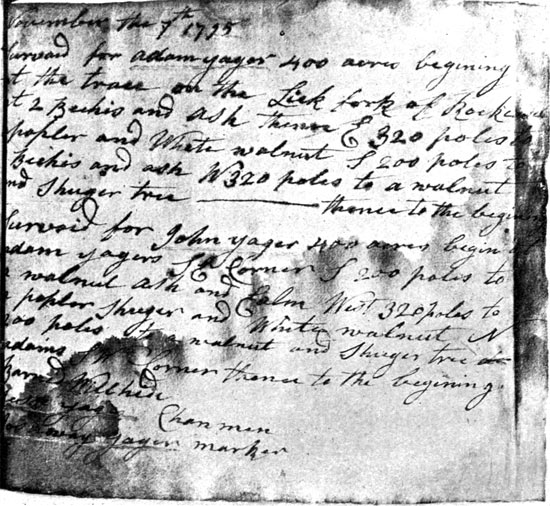
A SURVEY NOTE BY BOONE.
Reduced facsimile from his field-books in possession of Wisconsin State
Historical Society.
There were now four settlements in the
Transylvania grant: Boonesborough; Harrodsburg,
fifty miles west, with about a hundred
men; Boiling Spring, some six or seven
miles from Harrodsburg; and St. Asaph.
The crown lands to the north and east of the
Kentucky, obtained by the Fort Stanwix
treaty, contained two small settlements;
forty miles north of Boonesborough was
Hinkson's, later known as Ruddell's Station,
where were about nineteen persons; lower
down the Kentucky, also on the north side,
was Willis Lee's settlement, near the present
Frankfort; and ranging at will through the
crown lands were several small parties of
"land-jobbers," surveyors, and explorers,
laying off the claims of militia officers who
had fought in the Indian wars, and here and
there building cabins to indicate possession.
Henderson had no sooner arrived than
he prepared for a convention, at which the
people should adopt a form of government
for the colony and elect officers. This was
held at Boonesborough, in the open air, under
a gigantic elm, during the week commencing
Tuesday, the twenty-third of May. There
were eighteen delegates, representing each of
the four settlements south of the Kentucky.
Among them were Daniel and Squire Boone,
the former of whom proposed laws for the
preservation of game and for improving the
breed of horses; to the latter fell the presentation
of rules for preserving the cattle-ranges.
The compact finally agreed upon
between the colonists and the proprietors
declared "the powers of the one and the liberties
of the others," and was "the earliest
form of government in the region west of
the Alleghanies." It provided for "perfect
religious freedom and general toleration,"
militia and judicial systems, and complete
liberty on the part of the settlers to conduct
colonial affairs according to their needs.
This liberal and well-digested plan appeared
to please both Henderson and the settlers.
But the opposition of the governors, the objections
raised by the Assembly of Virginia,
of which Kentucky was then a part,[12] and
finally, the outbreak of the Revolution, which
put an end to proprietary governments in
America, caused the downfall of the Transylvania
Company. The Boonesborough legislative
convention met but once more—in
December, to elect a surveyor-general.
The May meeting had no sooner adjourned
than Transylvania began again to
lose its population. Few of the pioneers
who had come out with Boone and Henderson,
or had since wandered into the district,
were genuine home-seekers. Many appear
to have been mere adventurers, out for the
excitement of the expedition and to satisfy
their curiosity, who either returned home or
wandered farther into the woods to seek
fresh experiences of wild life; others had
deliberately intended first to stake out claims
in the neighborhood of the new settlements
and then return home to look after their
crops, and perhaps move to Kentucky in the
autumn; others there were who, far removed
from their families, proved restless; while
many became uneasy because of Indian outrages,
reports of which soon began to be circulated.
Henderson wrote cheerful letters to
his partners at home, describing the country
as a paradise; but by the end of June, when
Boone returned to the East for salt, Harrodsburg
and Boiling Spring were almost
deserted, while Boonesborough could muster
but ten or twelve "guns," as men or boys
capable of fighting Indians were called in
the militia rolls.
The infant colony of Kentucky had certainly
reached a crisis in its career. Game
was rapidly becoming more scarce, largely
because of careless, inexperienced hunters
who wounded more than they killed, and
killed more than was needed for food; the
frightened buffaloes had now receded so far
west that they were several days' journey
from Boonesborough. Yet game was still the
staff of life. Captain Floyd, the surveyor-general,
wrote to Colonel Preston: "I must
hunt or starve."
As the summer wore away and crops in the
Eastern settlements were gathered, there was
a considerable increase in the population.
Many men who, in later days, were to exert
a powerful influence in Kentucky now arrived—George
Rogers Clark, the principal
Western hero of the Revolution; Simon
Kenton, famous throughout the border as
hunter, scout, and Indian fighter; Benjamin
Logan, William Whitley, the Lewises, Campbells,
Christians, Prestons, MacDowells, McAfees,
Hite, Bowman, Randolph, Todd, McClellan,
Benton, Patterson—all of them
names familiar in Western history.
In the first week of September Boone arrived
with his wife and family and twenty
young men—"twenty-one guns," the report
reads; Squire and his family soon followed;
four Bryans, their brothers-in-law, came at
the head of thirty men from the Yadkin; and,
at the same time, Harrodsburg was reached
by several other families who had, like the
Boones, come on horseback through Cumberland
Gap and Powell's Valley. This powerful
reenforcement of pioneers, most of whom
proposed to stay, had largely been attracted
by Henderson's advertisements in Virginia
newspapers offering terms of settlement on
Transylvania lands. "Any person," said
the announcement, "who will settle on and
inhabit the same before the first day of June,
1776, shall have the privilege of taking up
and surveying for himself five hundred acres,
and for each tithable person he may carry
with him and settle there, two hundred and
fifty acres, on the payment of fifty shillings
sterling per hundred, subject to a yearly
quit-rent of two shillings, like money, to commence
in the year 1780." Toward the end
of November Henderson himself, who had
gone on a visit to Carolina, returned with
forty men, one of whom was Colonel Arthur
Campbell, a prominent settler in the Holston
Valley.
This increase of population, which had
been noticeable throughout the autumn and
early winter, received a sudden check, however,
two days before Christmas, when the
Indians, who had been friendly for several
months past, began again to annoy settlers,
several being either killed or carried into
captivity. This gave rise to a fresh panic,
in the course of which many fled to the east
of the mountains.
During the year about five hundred persons
from the frontiers of Pennsylvania,
Virginia, and North Carolina had visited and
explored Kentucky; but now, at the close of
December, the population of all the settlements
did not aggregate over two hundred.
The recent outbreak had much to do with
this situation of affairs; but there were other
causes conspiring to disturb the minds of
the people and postpone the growth of settlement—the
clashing of interests between
the Transylvania Company and the governors
of Virginia and North Carolina, uncertainty
as to the possibilities of a general Indian
war, the threatened rupture between the
colonies and the English crown, and the
alarming scarcity of provisions and ammunition
throughout Kentucky.
Nevertheless, over nine hundred entries
had been made in the Transylvania land-office
at Boonesborough, embracing 560,000
acres, and most of these tracts were waiting
to be surveyed; two hundred and thirty acres
of corn had been successfully raised; horses,
hogs, and poultry had been introduced, and
apple- and peach-trees had been started at
several settlements. The germ of a colony
was firmly planted, laws had been made,
the militia had been organized, civil and military
officers had been commissioned, and in
the face of several slight Indian attacks the
savages had been repelled and the country
maintained. Most promising of all, there
were now twelve women in the country, all
of them heads of families.
The principal pioneers were nearly all of
sturdy Scotch-Irish blood, men of sterling
merit, intensely devoted to the cause of
American liberty, and destined to contribute
powerfully to its aid in the great war which
had now begun, and concerning which messengers
from over the mountains had during
the year brought them scanty information.
With the opening of the year 1776 Daniel
and Squire Boone were employed for several
weeks as hunters or assistants to a party of
surveyors sent by the Transylvania Company
to the Falls of the Ohio, in the vicinity
of which Henderson and his friends had
taken up seventy thousand acres of land.
They met no Indians and saw plenty of
game; but returned to find that the settlers
were indignant because of this wholesale preemption
by the proprietors of the colony in
a neighborhood where it was now felt the
chief city in Kentucky was sure to be planted.
In response to this clamor Henderson promised
that hereafter, in that locality, only
small tracts should be granted to individuals,
and that a town should at once be laid out
at the Falls; but the scanty supply of powder
and provisions, and the company's growing
troubles with the Virginia Assembly, prevented
the execution of this project.
In the spring newcomers everywhere appeared.
In order to please the people of
Harrodsburg, now the largest settlement,
who were disposed to be critical, the company's
land-office was moved thither, and it
at once entered upon a flourishing business.
Not only did many Virginians and Carolinians
come in on horseback over the "Wilderness
Road," as the route through Cumberland
Gap was now styled, but hundreds also
descended the Ohio in boats from the new
settlements on the Monongahela, and from
those farther east in Pennsylvania.
While the horsemen of the Wilderness
Road generally settled in Transylvania,
those journeying by boat were chiefly interested
in the crown lands north of the Kentucky;
through these they ranged at will,
building rude pens, half-faced cabins, and
log huts, as convenience dictated, and planting
small crops of corn in order to preempt
their claims. The majority, however, after
making sometimes as many as twenty such
claims each, often upon land already surveyed
on militia officers' warrants, returned
home at the close of the season, seeking to
sell their fictitious holdings to actual settlers.
Of course the unscrupulous conduct of these
"claim-jumping" speculators led to numerous
quarrels. John Todd, of Harrodsburg,
wrote to a friend: "I am afraid to lose sight
of my house lest some invader should take
possession."
It was difficult, even for those who came
to settle, to get down to hard work during
those earliest years. Never was there a
more beautiful region than the Kentucky
wilderness. Both old and new settlers were
fond of roaming through this wonderland of
forests and glades and winding rivers,
where the nights were cool and refreshing
and the days filled with harmonies of sound
and sight and smell. Hill and valley, timberland
and thicket, meadow and prairie, grasslands
and cane-brake—these abounded on
every hand, in happy distribution of light
and shadow. The soil was extremely fertile;
there were many open spots fitted for immediate
cultivation; the cattle-ranges were
of the best, for nowhere was cane more
abundant; game was more plentiful than
men's hopes had ever before conceived—of
turkeys, bears, deer, and buffaloes it seemed,
for a time, as if the supply must always far
excelled any possible demand. It is small
wonder that the imaginations of the pioneers
were fired with dreams of the future, that
they saw in fancy great cities springing up
in this new world of the West, and wealth
pouring into the laps of those who could first
obtain a foothold. Thus, in that beautiful
spring of 1776, did Kentuckians revel in the
pleasures of hope, and cast to the winds all
thought of the peril and toil by which alone
can man conquer a savage-haunted wilderness.
But the "dark cloud" foretold at the Watauga
treaty soon settled upon the land. Incited
by British agents—for the Revolution
was now on—the Cherokees on the south and
the Shawnese and Mingos on the north declared
war upon the American borderers.
The Kentuckians were promptly warned by
messengers from the East. The "cabiners,"
as claim speculators were called by actual
settlers; the wandering fur-traders, most of
whom were shabby rascals, whose example
corrupted the savages, and whose conduct
often led to outbreaks of race hostility; and
the irresponsible hunters, who were recklessly
killing or frightening off the herds of
game—all of these classes began, with the
mutterings of conflict, to draw closer to the
settlements; while many hurried back to their
old homes, carrying exaggerated reports of
the situation.
Meanwhile, opposition to the Transylvania
proprietors was fast developing. The
settlers in the Harrodsburg neighborhood
held a convention in June and sent Colonel
George Rogers Clark and Captain John Gabriel
Jones as delegates to the Virginia Convention
with a petition to that body to make
Kentucky a county of Virginia. This project
was bitterly opposed by Henderson; but
upon the adoption by Congress, in July, of
the Declaration of Independence, there was
small chance left for the recognition of any
proprietary government. When the new
Virginia legislature met in the autumn, the
petition of the "inhabitants of Kentuckie"
was granted, and a county government organized.[13]
David Robinson was appointed
county lieutenant, John Bowman colonel, Anthony
Bledsoe and George Rogers Clark majors,
and Daniel Boone, James Harrod, John
Todd, and Benjamin Logan captains.
It was not until July that the Kentuckians
fully realized the existence of an Indian war.
During that month several hunters, surveyors,
and travelers were killed in various parts
of the district. The situation promised so
badly that Colonel William Russell, of the
Holston Valley, commandant of the southwestern
Virginia militia, advised the immediate
abandonment of Kentucky. Such advice
fell upon unheeding ears in the case of men
like Boone and his companions, although
many of the less valorous were quick to retire
beyond the mountains.
On Sunday, the seventeenth of July,
an incident occurred at Boonesborough which
created wide-spread consternation. Jemima,
the second daughter of Daniel Boone, aged
fourteen years, together with two girl
friends, Betsey and Fanny Calloway, sixteen
and fourteen respectively, were paddling in
a canoe upon the Kentucky. Losing control
of their craft in the swift current, not over
a quarter of a mile from the settlement, they
were swept near the north bank, when five
Shawnese braves, hiding in the bushes, waded
out and captured them. The screams of
the girls alarmed the settlers, who sallied
forth in hot pursuit of the kidnappers.
The mounted men, under Colonel Calloway,
father of two of the captives, pushed
forward to Lower Blue Licks, hoping to cut
off the Indians as they crossed the Licking
River on their way to the Shawnese towns
in Ohio, whither it was correctly supposed
they were fleeing. Boone headed the footmen,
who followed closely on the trail of the
fugitives, which had been carefully marked
by the girls, who, with the self-possession
of true borderers, furtively scattered broken
twigs and scraps of clothing as they were
hurried along through the forest by their
grim captors. After a two days' chase,
Boone's party caught up with the unsuspecting
savages some thirty-five miles from
Boonesborough, and by dint of a skilful dash
recaptured the young women, unharmed.
Two of the Shawnese were killed and the
others fled into the woods. Calloway's
horsemen met no foe.
Although few other attacks were reported
during the summer or autumn, the people
were in a continual state of apprehension,
neglected their crops, and either huddled in
the neighborhood of the settlements, or
"stations" as they were called, or abandoned
the country altogether. In the midst
of this uneasiness Floyd wrote to his friend
Preston, in Virginia, urging that help be sent
to the distressed colony: "They all seem
deaf to anything we can say to dissuade
them.... I think more than three hundred
men have left the country since I came out,
and not one has arrived, except a few cabiners
down the Ohio. I want to return as much
as any man can do; but if I leave the country
now there is scarcely one single man
who will not follow the example. When I
think of the deplorable condition a few
helpless families are likely to be in, I conclude
to sell my life as dearly as I can in
their defense rather than make an ignominious
escape."
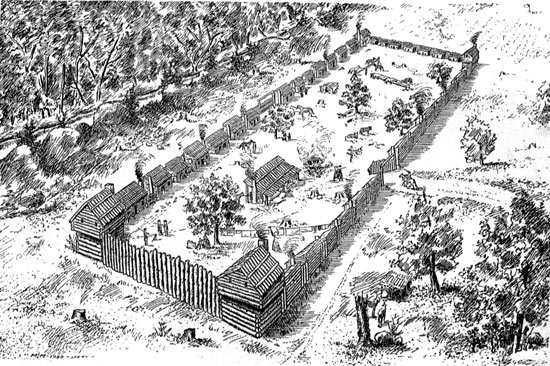
FORT BOONESBOROUGH.
Drawn from Henderson's plans and other historical data by George W. Ranck; reduced from the latter's
"Boonesborough" (Filson Club Publications, No. 16).
Seven stations had now been abandoned—Huston's,
on the present site of Paris;
Hinkson's, on the Licking; Bryan's, on the
Elkhorn; Lee's, on the Kentucky; Harrod's,
or the Boiling Spring settlement; Whitley's,
and Logan's. But three remained occupied—McClellan's,
Harrodsburg, and Boonesborough.
Up to this time none of the Kentucky
stations had been fortified; there had been
some unfinished work at Boonesborough, but
it was soon allowed to fall into decay. Work
was now resumed at all three of the occupied
settlements; this consisted simply of connecting
the cabins, which faced an open square,
by lines of palisades. It was only at McClellan's,
however, that even this slender
protection was promptly completed; at
Boonesborough and Harrodsburg the work,
although but a task of a few days, dragged
slowly, and was not finished for several
months. It was next to impossible for Boone
and the other militia captains to induce men
to labor at the common defenses in time of
peace.
Great popular interest was taken by the
people of the Carolinas, Virginia, and Pennsylvania
in the fate of the Kentucky settlements,
whither so many prominent borderers
from those States had moved. The frantic
appeals for help sent out by Floyd, Logan,
and McGary, and expressed in person by
George Rogers Clark, awakened keen sympathy;
but the demands of Washington's
army were now so great, in battles for national
liberty upon the Atlantic coast, that little
could be spared for the Western settlers.
During the summer a small supply of powder
was sent out by Virginia to Captain Boone;
in the autumn Harrod and Logan rode to
the Holston and obtained from the military
authorities a packhorse-load of lead; and in
the closing days of the year Clark arrived
at Limestone (now Maysville), on the Ohio,
with a boat-load of powder and other stores,
voted to the service of Kentucky by the Virginia
Assembly. He had experienced a long
and exciting voyage from Pittsburg with this
precious consignment, and about thirty of
the settlers aided him in the perilous enterprise
of transporting it overland to the stations
on the Kentucky. While the ammunition
was supposed to be used for defense,
the greater part of it was necessarily spent
in obtaining food. Without the great profusion
of game the inhabitants must have
starved; although several large crops of corn
were raised, and some wheat, these were as
yet insufficient for all.
Early in 1777 Indian "signs" began to
multiply. McClellan's was now abandoned,
leaving Boonesborough and Harrodsburg
the only settlements maintained—except, perhaps,
Price's, on the Cumberland, although
Logan's Station was reoccupied in February.
The number of men now in the country
fit for duty did not exceed a hundred
and fifty. In March the fighting men met at
their respective stations and organized under
commissioned officers; hitherto all military
operations in Kentucky had been voluntary,
headed by such temporary leaders as the
men chose from their own number.
During the greater part of the year the
palisaded stations were frequently attacked
by the savages—Shawnese, Cherokees, and
Mingos, in turn or in company. Some of
these sieges lasted through several days,
taxing the skill and bravery of the inhabitants
to their utmost. Indian methods of attacking
forts were far different from those
that would be practised by white men. Being
practically without military organization,
each warrior acted largely on his own behalf.
His object was to secrete himself, to kill his
enemy, and if possible to bear away his scalp
as a trophy. Every species of cover was
taken advantage of—trees, stumps, bushes,
hillocks, stones, furnished hiding-places.
Feints were made to draw the attention of
the garrison to one side, while the main body
of the besiegers hurled themselves against
the other. Having neither artillery nor scaling-ladders,
they frequently succeeded in
effecting a breach by setting fire to the walls.
Pretending to retreat, they would lull the defenders
into carelessness, when they would
again appear from ambush, picking off those
who came out for water, to attend to crops
and cattle, or to hunt for food; often they exhibited
a remarkable spirit of daring, especially
when making a dash to secure scalps.
Destroying crops, cattle, hogs, and poultry,
stealing the horses for their own use, burning
the outlying cabins, and guarding the trails
against possible relief, they sought to reduce
the settlers to starvation, and thus make
them an easy prey. Every artifice known
to besiegers was skilfully practised by these
crafty, keen-eyed, quick-witted wilderness
fighters, who seldom showed mercy. Only
when white men aggressively fought them
in their own manner could they be overcome.
In the last week of April, while Boone
and Kenton were heading a sortie against a
party of Shawnese besieging Boonesborough,
the whites stumbled into an ambuscade, and
Boone was shot in an ankle, the bone being
shattered. Kenton, with that cool bravery
for which this tall, vigorous backwoodsman
was known throughout the border, rushed up,
and killing a warrior whose tomahawk was
lifted above the fallen man, picked his comrade
up in his arms, and desperately fought
his way back into the enclosure. It was several
months before the captain recovered
from this painful wound; but from his room
he directed many a day-and-night defense,
and laid plans for the scouting expeditions
which were frequently undertaken throughout
the region in order to discover signs of
the lurking foe.
Being the larger settlement, Harrodsburg
was more often attacked than Boonesborough,
although simultaneous sieges were
sometimes in progress, thus preventing the
little garrisons from helping each other. At
both stations the women soon became the
equal of the men, fearlessly taking turns at
the port-holes, from which little puffs of
white smoke would follow the sharp rifle-cracks
whenever a savage head revealed
itself from behind bush or tree. When not
on duty as marksmen, women were melting
their pewter plates into bullets, loading the
rifles and handing them to the men, caring
for the wounded, and cooking whatever food
might be obtainable. During a siege food
was gained only by stealth and at great
peril. Some brave volunteer would escape
into the woods by night, and after a day spent
in hunting, far away from hostile camps, return,
if possible under cover of darkness,
with what game he could find. It was a time
to make heroes or cowards of either men or
women—there was no middle course.
Amid this spasmodic hurly-burly there
was no lack of marrying and giving in marriage.
One day in early August, 1776, Betsey
Calloway, the eldest of the captive girls,
was married at Boonesborough to Samuel
Henderson, one of the rescuing party—the
first wedding in Kentucky. Daniel Boone,
as justice of the peace, tied the knot. A
diarist of the time has this record of a similar
Harrodsburg event: "July 9, 1777.—Lieutenant
Linn married—great merriment."
At each garrison, whenever not under
actual siege, half of the men were acting as
guards and scouts while the others cultivated
small patches of corn within sight of the
walls. But even this precaution sometimes
failed of its purpose. For instance, one day
in May two hundred Indians suddenly surrounded
the corn-field at Boonesborough,
and there was a lively skirmish before the
planters could reach the fort.
Thus the summer wore away. In August
Colonel Bowman arrived with a hundred
militiamen from the Virginia frontier. A
little later forty-eight horsemen came from
the Yadkin country to Boone's relief, making
so brave a display as they emerged from the
tangled woods and in open order filed
through the gates of the palisade, that some
Shawnese watching the procession from a
neighboring hill fled into Ohio with the startling
report that two hundred Long Knife
warriors had arrived from Virginia. In October
other Virginians came, to the extent
of a hundred expert riflemen; and late in
the autumn the valiant Logan brought in
from the Holston as much powder and lead
as four packhorses could carry, guarded by
a dozen sharpshooters, thus insuring a better
prospect for food.
With these important supplies and reenforcements
at hand the settlers were inspired
by new hope. Instead of waiting for the
savages to attack them, they thenceforth
went in search of the savages, killing them
wherever seen, thus seeking to outgeneral
the enemy. These tactics quite disheartened
the astonished tribesmen, and the year closed
with a brighter outlook for the weary Kentuckians.
It had been a time of constant
anxiety and watchfulness. The settlers were
a handful in comparison with their vigilant
enemies. But little corn had been raised;
the cattle were practically gone; few horses
were now left; and on the twelfth of December
Bowman sent word to Virginia that
he had only two months' supply of bread
for two hundred women and children, many
of whom were widows and orphans. As for
clothing, there was little to be had, although
from the fiber of nettles a rude cloth was
made, and deerskins were commonly worn.
We have seen that Kentucky's numerous
salt-springs lured wild animals thither in astonishing
numbers; but for lack of suitable
boiling-kettles the pioneers were at first dependent
upon the older settlements for the
salt needed in curing their meat. The Indian
outbreak now rendered the Wilderness
Road an uncertain path, and the Kentuckians
were beginning to suffer from lack of salt—a
serious deprivation for a people largely
dependent upon a diet of game.
Late in the year 1777 the Virginia government
sent out several large salt-boiling
kettles for the use of the Western settlers.
Both residents and visiting militiamen were
allotted into companies, which were to relieve
each other at salt-making until sufficient was
manufactured to last the several stations for
a year. It was Boone's duty to head the first
party, thirty strong, which, with the kettles
packed on horses, went to Lower Blue Licks
early in January. A month passed, during
which a considerable quantity of salt was
made; several horse-loads had been sent to
Boonesborough, but most of it was still at
the camp awaiting shipment.
The men were daily expecting relief by
the second company, when visitors of a different
character appeared. While half of
the men worked at the boiling, the others
engaged in the double service of watching
for Indians and obtaining food; of these was
Boone. Toward evening of the seventh of
February he was returning home from a
wide circuit with his packhorse laden with
buffalo-meat and some beaver-skins, for he
had many traps in the neighborhood. A
blinding snow-storm was in progress, which
caused him to neglect his usual precautions,
when suddenly he was confronted by four
burly Shawnese, who sprang from an ambush.
Keen of foot, he thought to outrun
them, but soon had to surrender, for they
shot so accurately that it was evident that
they could kill him if they would.
The prisoner was conducted to the Shawnese
camp, a few miles distant. There he
found a hundred and twenty warriors under
Chief Black Fish. Two Frenchmen, in English
employ, were of the party; also two
American renegades from the Pittsburg region,
James and George Girty. These latter,
with their brother Simon, had joined the Indians
and, dressed and painted like savages,
were assisting the tribesmen of the Northwest
in raids against their fellow-borderers
of Pennsylvania and Virginia. Boone was
well known by reputation to all these men
of the wilderness, reds and whites alike; indeed,
he noticed that among the party were
his captors of eight years before, who
laughed heartily at again having him in their
clutches.
He was loudly welcomed to camp, the Indians
shaking his hands, patting him on the
back, and calling him "brother"—for they
always greatly enjoyed such exhibitions of
mock civility and friendship—and the hunter
himself pretended to be equally pleased at
the meeting. They told him that they were
on their way to attack Boonesborough, and
wished him to lead them, but insisted that
he first induce his fellow salt-makers to surrender.
Boone thoroughly understood Indians;
he had learned the arts of forest
diplomacy, and although generally a silent
man of action, appears to have been a plausible
talker when dealing with red men.
Knowing that only one side of the Boonesborough
palisade had been completed, and
that the war-party was five times as strong
as the population of the hamlet, he thought
to delay operations by strategy. He promised
to persuade the salt-makers to surrender,
in view of the overwhelming force and
the promise of good treatment, and to go
peacefully with their captors to the Shawnese
towns north of the Ohio; and suggested
that in the spring, when the weather was
warmer, they could all go together to
Boonesborough, and by means of horses comfortably
remove the women and children.
These would, under his persuasion, Boone
assured his captors, be content to move to
the North, and thenceforth either lived with
the Shawnese as their adopted children or
place themselves under British protection at
Detroit, where Governor Hamilton offered
£20 apiece for American prisoners delivered
to him alive and well.
The proposition appeared reasonable to
the Indians, and they readily agreed to it.
What would be the outcome Boone could not
foretell. He realized, however, that his station
was unprepared, that delay meant everything,
in view of possible reenforcements
from Virginia, and was willing that he and
his comrades should stand, if need be, as a
sacrifice—indeed, no other course seemed
open. Going with his captors to the salt
camp, his convincing words caused the men
to stack their arms and accompany the savages,
hoping thereby at least to save their
families at Boonesborough from immediate
attack.
The captives were but twenty-seven in
number, some of the hunters not having returned
to camp. Not all of the captors were,
despite their promise, in favor of lenient
treatment of the prisoners. A council was
held, at which Black Fish, a chieftain of fine
qualities, had much difficulty, through a session
of two hours, in securing a favorable
verdict. Boone was permitted to address
the savage throng in explanation of his plan,
his words being interpreted by a negro
named Pompey, a fellow of some consequence
among the Shawnese. The vote was
close—fifty-nine for at once killing the prisoners,
except Boone, and sixty-one for
mercy; but it was accepted as decisive, and
the store of salt being destroyed, and kettles,
guns, axes, and other plunder packed on
horses, the march northward promptly commenced.
Each night the captives were made fast
and closely watched. The weather was unusually
severe; there was much suffering
from hunger, for the snow was deep, game
scarce, and slippery-elm bark sometimes the
only food obtainable. Descending the Licking,
the band crossed the Ohio in a large boat
made of buffalo-hides, which were stretched
on a rude frame holding twenty persons;
they then entered the trail leading to the
Shawnese towns on the Little Miami, where
they arrived upon the tenth day.
The prisoners were taken to the chief
town of the Shawnese, Little Chillicothe,
about three miles north of the present Xenia,
Ohio. There was great popular rejoicing,
for not since Braddock's defeat had so many
prisoners been brought into Ohio. Boone
and sixteen of his companions, presumably
selected for their good qualities and their
apparent capacity as warriors, were now
formally adopted into the tribe. Boone himself
had the good fortune to be accepted as
the son of Black Fish, and received the name
Sheltowee (Big Turtle)—perhaps because he
was strong and compactly built.
Adoption was a favorite method of recruiting
the ranks of American tribes. The
most tractable captives were often taken into
the families of the captors to supply the
place of warriors killed in battle. They
were thereafter treated with the utmost affection,
apparently no difference being made
between them and actual relatives, save that,
until it was believed that they were no longer
disposed to run away, they were watched
with care to prevent escape. Such was now
Boone's experience. Black Fish and his
squaw appeared to regard their new son with
abundant love, and everything was done for
his comfort, so far as was possible in an
Indian camp, save that he found himself
carefully observed by day and night, and
flight long seemed impracticable.
Boone was a shrewd philosopher. In his
so-called "autobiography" written by Filson,
he tells us that the food and lodging were
"not so good as I could desire, but necessity
made everything acceptable." Such as
he obtained was, however, the lot of all. In
the crowded, slightly built wigwams it was
impossible to avoid drafts; they were filthy
to the last degree; when in the home villages,
there was generally an abundance of food—corn,
hominy, pumpkins, beans, and game,
sometimes all boiled together in the same kettle—although
it was prepared in so slovenly
a manner as to disgust even so hardy a man
of the forest as our hero; the lack of privacy,
the ever-present insects, the blinding smoke
of the lodge-fire, the continual yelping of
dogs, and the shrill, querulous tones of old
women, as they haggled and bickered through
the livelong day—all these and many other
discomforts were intensely irritating to most
white men. In order to disarm suspicion,
Boone appeared to be happy. He whistled
cheerfully at his tasks, learning what little
there was left for him to learn of the arts
of the warrior, sharing his game with his
"father," and pretending not to see that he
was being watched. At the frequent shooting-matches
he performed just well enough to
win the applause of his fellow braves, although,
for fear of arousing jealousy, careful
not to outdo the best of them. His fellow
prisoners, less tactful, marveled at the ease
with which their old leader adapted himself
to the new life, and his apparent enjoyment
of it. Yet never did he miss an opportunity
to ascertain particulars of the intended attack
on Boonesborough, and secretly planned for
escape when the proper moment should arrive.
March was a third gone, when Black Fish
and a large party of his braves and squaws
went to Detroit to secure Governor Hamilton's
bounty on those of the salt-makers who,
from having acted in an ugly manner, had
not been adopted into the tribe. Boone accompanied
his "father," and frequently witnessed,
unable to interfere, the whipping and
"gauntlet-running" to which his unhappy
fellow Kentuckians were subjected in punishment
for their fractious behavior. He himself,
early in his captivity, had been forced
to undergo this often deadly ordeal; but by
taking a dodging, zigzag course, and freely
using his head as a battering-ram to topple
over some of the warriors in the lines, had
emerged with few bruises.[14]
Upon the arrival of the party at Detroit
Governor Hamilton at once sent for the now
famous Kentucky hunter and paid him many
attentions. With the view of securing his
liberty, the wily forest diplomat used the
same sort of duplicity with the governor that
had proved so effective with Black Fish. It
was his habit to carry a leather bag fastened
about his neck, containing his old commission
as captain in the British colonial forces,
signed by Lord Dunmore. This was for the
purpose of convincing Indians, into whose
hands he might fall, that he was a friend of
the king; which accounts in a large measure
for the tender manner in which they treated
him. Showing the document to Hamilton as
proof of his devotion to the British cause,
he appears to have repeated his promise that
he would surrender the people of Boonesborough
and conduct them to Detroit, to live
under British jurisdiction and protection.
This greatly pleased the governor, who
sought to ransom him from Black Fish for
£100. But to this his "father" would not
agree, stating that he loved him too strongly
to let him go—as a matter of fact, he
wished his services as guide for the Boonesborough
expedition. Upon leaving for home,
Hamilton presented Boone with a pony, saddle,
bridle, and blanket, and a supply of silver
trinkets to be used as currency among
the Indians, and bade him remember his duty
to the king.
Returning to Chillicothe with Black Fish,
the hunter saw that preparations for the
spring invasion of Kentucky were at last
under way. Delawares, Mingos, and Shawnese
were slowly assembling, and runners
were carrying the war-pipe from village to
village throughout Ohio. But while they had
been absent at Detroit an event occurred
which gave Black Fish great concern: one
of the adopted men, Andrew Johnson—who
had pretended among the Indians to be a
simpleton, in order to throw off suspicion,
but who in reality was one of the most astute
of woodsmen—had escaped, carrying warning
to Kentucky, and the earliest knowledge
that reached the settlers of the location of the
Shawnese towns. In May, Johnson and five
comrades went upon a raid against one of
these villages, capturing several horses and
bringing home a bunch of Indian scalps,
for scalping was now almost as freely practised
by the frontiersmen as the savages;
such is the degeneracy wrought by warlike
contact with an inferior race. In June there
was a similar raid by Boonesborough men,
resulting to the tribesmen in large losses of
lives and horses.
Upon the sixteenth of June, while Black
Fish's party were boiling salt at the saline
springs of the Scioto—about a dozen miles
south of the present Chillicothe—Boone managed,
by exercise of rare sagacity and enterprise,
to escape the watchful eyes of his keepers,
their attention having been arrested by
the appearance of a huge flock of wild turkeys.
He reached Boonesborough four days
later after a perilous journey of a hundred
and sixty miles through the forest, during
which he had eaten but one meal—from a
buffalo which he shot at Blue Licks. He had
been absent for four and a half months, and
Mrs. Boone, giving him up for dead, had returned
with their family to her childhood
home upon the Yadkin. His brother Squire,
and his daughter Jemima—now married to
Flanders Calloway—were the only kinsfolk
to greet the returned captive, who appeared
out of the woods as one suddenly delivered
from a tomb.
During the absence of Daniel Boone there
had been the usual Indian troubles in Kentucky.
Colonel Bowman had just written to
Colonel George Rogers Clark, "The Indians
have pushed us hard this summer." But
Clark himself at this time was gaining an
important advantage over the enemy in his
daring expedition against the British posts
of Kaskaskia, Cahokia, and Vincennes, in the
Illinois country. Realizing that there would
be no end to Kentucky's trouble so long as
the British, aided by their French-Canadian
agents, were free to organize Indian armies
north of the Ohio for the purpose of harrying
the southern settlements, Clark "carried
the war into Africa." With about a hundred
and fifty men gathered from the frontiers
of Virginia, Pennsylvania, and Kentucky, he
descended the Ohio River, built a fort at
Louisville, and by an heroic forced march
across the country captured Kaskaskia, while
Cahokia and Vincennes at once surrendered
to the valorous Kentuckian.
Meanwhile there was business at hand
for the people of Boonesborough. Amid
all these alarms they had still neglected to
complete their defenses; but now, under
the energetic administration of Boone, the
palisades were finished, gates and fortresses
strengthened, and all four of the
corner blockhouses put in order. In ten
days they were ready for the slowly advancing
host.
Unless fleeing, Indians are never in a
hurry; they spend much time in noisy preparation.
Hunters and scouts came into
Boonesborough from time to time, and occasionally
a retaliatory expedition would return
with horses and scalps from the Little
Miami and the Scioto, all of them reporting
delays on the part of the enemy; nevertheless
all agreed that a large force was forming.
Toward the close of August Boone,
wearied of being cooped up in the fort,
went forth at the head of thirty woodsmen
to scout in the neighborhood of the Scioto
towns. With him were Kenton and Alexander
Montgomery, who remained behind in
Ohio to capture horses and probably prisoners,
while Boone and the others returned
after a week's absence. On their way home
they discovered that the enemy was now at
Lower Blue Licks, but a short distance from
Boonesborough.
At about ten o'clock the following morning
(September 7th) the Indian army appeared
before the fort. It numbered fully
four hundred warriors, mostly Shawnese,
but with some Wyandots, Cherokees, Delawares,
Mingos, and other tribesmen. Accompanying
them were some forty French-Canadians,
all under the command of Boone's
"father," the redoubtable Black Fish. Pompey
served as chief interpreter.
Much time was spent in parleys, Boone
in this manner delaying operations as long
as possible, vainly hoping that promised reenforcements
might meanwhile arrive from
the Holston. Black Fish wept freely, after
the Indian fashion, over the ingratitude of
his runaway "son," and his present stubborn
attitude; for the latter now told the
forest chief that he and his people proposed
to fight to the last man. Black Fish presented
letters and proclamations from Hamilton,
again offering pardon to all who would
take the oath of allegiance to the king, and
military offices for Boone and the other leaders.
When these were rejected, the Indians
attempted treachery, seeking to overpower
and kill the white commissioners to a treaty
being held in front of the fort. From this
final council, ending in a wild uproar, in
which bullets flew and knives and tomahawks
clashed, the whites escaped with difficulty,
the two Boones and another commissioner
receiving painful wounds.
A siege of ten days now ensued (September
8th to 17th), one of the most remarkable
in the history of savage warfare. The site
of the fort, a parallelogram embracing three-quarters
of an acre, had been unwisely chosen.
There was abundant cover for the enemy
under the high river bank, also beneath
an encircling clay bank rising from the salt-lick
branch; from hills upon either side spies
could see what was happening within the
walls, and occasionally drop a ball into the
small herd of cattle and horses sheltered behind
the palisades; while to these natural
disadvantages were added the failure of the
garrison to clear from the neighborhood of
the walls the numerous trees, stumps, bushes,
and rocks, each of which furnished the best
of cover for a lurking foe.
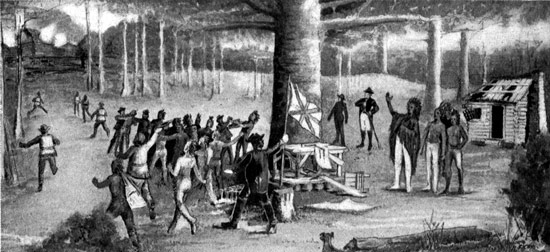
CLIMAX OF THE TREATY.
Indians and British agents treacherously attack treaty commissioners. (See pp. 161, 162.) Reduced from
Ranck's "Boonesborough."
Such, however, was the stubbornness of
the defense, in which the women were, in
their way, quite as efficient as the men, that
the forces under Black Fish could make but
small impression upon the valiant little garrison.
Every artifice known to savages, or
that could be suggested by the French, was
without avail. Almost nightly rains and the
energy of the riflemen frustrated the numerous
attempts to set fire to the cabins by
throwing torches and lighted fagots upon
their roofs; a tunnel, intended to be used for
blowing up the walls, was well under way
from the river bank when rain caused it to
cave in; attempts at scaling were invariably
repelled, and in sharpshooting the whites as
usual proved the superiors.
But the result often hung in the balance.
Sometimes the attack lasted throughout the
night, the scene being constantly lighted by
the flash of the rifles and the glare of hurling
fagots. Besiegers and garrison frequently
exchanged fierce cries of threat and defiance,
mingled with many a keen shaft of wit and
epithet; at times the yells and whoops of
the savages, the answering shouts and huzzahs
of the defenders, the screams of women
and girls, the howling of dogs, the snorting
and bellowing of the plunging live stock, together
with the sharp rattle of firearms, created
a deafening hubbub well calculated to
test the nerves of the strongest.
At last, on the morning of Friday, the
eighteenth, the Indians, now thoroughly disheartened,
suddenly disappeared into the
forest as silently as they had come. Again
Boonesborough was free, having passed
through the longest and severest ordeal of
attack ever known in Kentucky; indeed, it
proved to be the last effort against this station.
Within the walls sixty persons had
been capable of bearing arms, but only forty
were effective, some of these being negroes;
Logan's Fort had sent a reenforcement of
fifteen men, and Harrodsburg a few others.
Of the garrison but two were killed and four
wounded, while Boone estimated that the
enemy lost thirty-seven killed and a large
number wounded. The casualties within the
fort were astonishingly small, when the large
amount of ammunition expended by the besiegers
is taken into account. After they had
retired, Boone's men picked up a hundred
and twenty-five pounds of flattened bullets
that had been fired at the log stronghold,
handfuls being scooped up beneath the port-holes
of the bastions; this salvage made no
account of the balls thickly studding the
walls, it being estimated that a hundred
pounds of lead were buried in the logs of
one of the bastions.
A week later a small company of militiamen
arrived from Virginia, and several minor
expeditions were now made against the Shawnese
upon their own soil. These raids were
chiefly piloted by Boone's salt-makers, many
of whom had now returned from captivity.
Boone is credited with saying in his later
years, although no doubt in ruder language
than this: "Never did the Indians pursue so
disastrous a policy as when they captured
me and my salt-boilers, and taught us, what
we did not know before, the way to their
towns and the geography of their country;
for though at first our captivity was considered
a great calamity to Kentucky, it resulted
in the most signal benefits to the
country."
Captain Boone was not without his critics.
Soon after the siege he was arraigned
before a court-martial at Logan's Fort upon
the following charges preferred by Colonel
Calloway, who thought that the great hunter
was in favor of the British Government
and had sought opportunity to play into
its hands, therefore should be deprived of
his commission in the Kentucky County militia:
"1. That Boone had taken out twenty-six
men[15] to make salt at the Blue Licks, and the
Indians had caught him trapping for beaver
ten miles below on Licking, and he voluntarily
surrendered his men at the Licks to
the enemy.
"2. That when a prisoner, he engaged
with Gov. Hamilton to surrender the people
of Boonesborough to be removed to Detroit,
and live under British protection and jurisdiction.
"3. That returning from captivity, he encouraged
a party of men to accompany him
to the Paint Lick Town, weakening the garrison
at a time when the arrival of an Indian
army was daily expected to attack the
fort.
"4. That preceding the attack on Boonesborough,
he was willing to take the officers
of the fort, on pretense of making peace, to
the Indian camp, beyond the protection of
the guns of the garrison."
Boone defended himself at length, maintaining
that he aimed only at the interests
of the country; that while hunting at the
licks he was engaged in the necessary service
of the camp; that he had used duplicity to
win the confidence of the enemy, and it resulted
favorably, as he was thereby enabled
to escape in time to warn his people and
put them in a state of defense; that his Scioto
expedition was a legitimate scouting trip,
and turned out well; and that in the negotiations
before the fort he was simply "playing"
the Indians in order to gain time for
expected reenforcements. He was not only
honorably acquitted, but at once advanced
to the rank of major, and received evidences
of the unhesitating loyalty of all classes of
his fellow borderers, the majority of whom
appear to have always confided in his sagacity
and patriotism.
Personally vindicated, the enemy departed,
and several companies of militia now arriving
to garrison the stations for the winter,
Major Boone once more turned his face to
the Yadkin and sought his family. He found
them at the Bryan settlement, living comfortably
in a small log cabin, but until then
unconscious of his return from the wilderness
in which they had supposed he found
his grave.
In Daniel Boone's "autobiography," he
dismisses his year of absence from Kentucky
with few words: "I went into the settlement,
and nothing worthy of notice passed for some
time." No doubt he hunted in some of his
old haunts upon the Yadkin; and there is
reason for believing that he made a trip upon
business of some character to Charleston,
S.C.
Meanwhile, his fellow settlers of Kentucky
had not been inactive. In February
(1779) Clark repossessed himself of Vincennes
after one of the most brilliant forced
marches of the Revolution; and having there
captured Governor Hamilton—the "hair-buying
general," as the frontiersmen called
him, because they thought he paid bounties
on American scalps—had sent him a prisoner
to Virginia. The long siege of Boonesborough
and the other attacks of the preceding
year, together with more recent assaults
upon flatboats descending the Ohio, had
strongly disposed the Kentuckians to retaliate
on the Shawnese. Two hundred and
thirty riflemen under Colonel Bowman rendezvoused
in July at the mouth of the Licking,
where is now the city of Covington.
Nearly a third of the force were left to guard
the boats in which they crossed the Ohio,
the rest marching against Old Chillicothe,
the chief Shawnese town on the Little Miami.
They surprised the Indians, and a hotly contested
battle ensued, lasting from dawn until
ten o'clock in the morning; but the overpowering
numbers of the savages caused Bowman
to return crestfallen to Kentucky with
a loss of nearly a dozen men. This was the
forerunner of many defeats of Americans,
both bordermen and regulars, at the hands
of the fierce tribesmen of Ohio.
Readers of Revolutionary history as related
from the Eastern standpoint are led
to suppose that the prolonged struggle with
the mother country everywhere strained the
resources of the young nation, and was the
chief thought of the people. This high tension
was, however, principally in the tidewater
region. In the "back country," as the
Western frontiers were called, there was no
lack of patriotism, and bordermen were
numerous in the colonial armies; yet the development
of the trans-Alleghany region was
to them of more immediate concern, and
went forward vigorously, especially during
the last half of the war. This did not mean
that the backwoodsmen of the foot-hills were
escaping from the conflict by crossing westward
beyond the mountains; they were instead
planting themselves upon the left flank,
for French and Indian scalping parties were
continually harrying the Western settlements,
and the Eastern forces were too
busily engaged to give succor. Kentuckians
were left practically alone to defend the backdoor
of the young Republic.
In this year (1779) the Virginia legislature
adopted laws for the preemption of land
in Kentucky, which promised a more secure
tenure than had hitherto prevailed, and thus
gave great impetus to over-mountain emigration.
Hitherto those going out to Kentucky
were largely hunters, explorers, surveyors,
and land speculators; comparatively
few families were established in the wilderness
stations. But henceforth the emigration
was chiefly by households, some by
boats down the Ohio River, and others overland
by the Wilderness Road—for the first
official improvement of which Virginia made
a small appropriation at this time. Says
Chief Justice Robinson,[16] whose parents settled
in Kentucky in December:
"This beneficent enactment brought to
the country during the fall and winter of
that year an unexampled tide of emigrants,
who, exchanging all the comforts of their
native society and homes for settlements for
themselves and their children here, came like
pilgrims to a wilderness to be made secure
by their arms and habitable by the toil of
their lives. Through privations incredible
and perils thick, thousands of men, women,
and children came in successive caravans,
forming continuous streams of human beings,
horses, cattle, and other domestic animals,
all moving onward along a lonely and houseless
path to a wild and cheerless land. Cast
your eyes back on that long procession of
missionaries in the cause of civilization; behold
the men on foot with their trusty guns
on their shoulders, driving stock and leading
packhorses; and the women, some walking
with pails on their heads, others riding,
with children in their laps, and other children
swung in baskets on horses, fastened
to the tails of others going before; see them
encamped at night expecting to be massacred
by Indians; behold them in the month of December,
in that ever-memorable season of unprecedented
cold called the 'hard winter,'
traveling two or three miles a day, frequently
in danger of being frozen, or killed
by the falling of horses on the icy and almost
impassable trace, and subsisting on stinted
allowances of stale bread and meat; but now,
lastly, look at them at the destined fort, perhaps
on the eve of merry Christmas, when
met by the hearty welcome of friends who
had come before, and cheered by fresh buffalo-meat
and parched corn, they rejoice at
their deliverance, and resolve to be contented
with their lot."
In October, as a part of this great throng,
Daniel Boone and his family returned to
Kentucky by his old route through Cumberland
Gap, being two weeks upon the journey.
The great hunter was at the head of a company
of Rowan County folk, and carried
with him two small cannon, the first artillery
sent by Virginia to protect the Western forts.
Either as one of his party, or later in the
season, there came to Kentucky Abraham
Lincoln, of Rockingham County, Va., grandfather
of the martyred president. The Lincolns
and the Boones had been neighbors and
warm friends in Pennsylvania, and ever
since had maintained pleasant relations—indeed,
had frequently intermarried. It was
by Boone's advice and encouragement that
Lincoln migrated with his family to the
"dark and bloody ground" and took up a
forest claim in the heart of Jefferson County.
Daniel's younger brother Edward, killed by
Indians a year later, was of the same company.
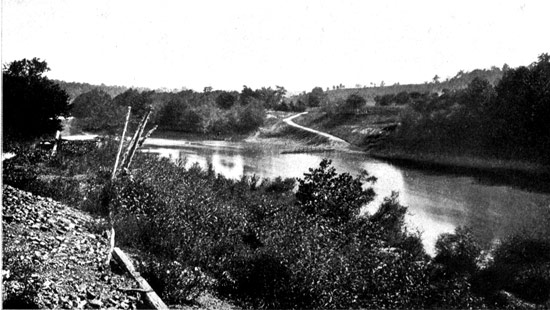
SITE OF BOONESBOROUGH TO-DAY.
Fort site, to which roadway leads, is hidden by foliage on the left; the ridge in the background faced and
overlooked the fort. Reduced from Ranck's "Boonesborough."
Boone also brought news that the legislature
had incorporated "the town of
Boonesborough in the County of Kentuckey,"
of which he was named a trustee, which
office he eventually declined. The town, although
now laid out into building lots, and anticipating
a prosperous growth, never rose to
importance and at last passed away. Nothing
now remains upon the deserted site,
which Boone could have known, save a decrepit
sycamore-tree and a tumble-down
ferry established in the year of the incorporation.
As indicated in Robinson's address, quoted
above, the winter of 1779-80 was a season
of unwonted severity. After an exceptionally
mild autumn, cold weather set in by the
middle of November and lasted without thaw
for two months, with deep snow and zero
temperature. The rivers were frozen as far
south as Nashville; emigrant wagons were
stalled in the drifts while crossing the mountains,
and everywhere was reported unexampled
hardship. It will be remembered that
the Revolutionary Army in the East suffered
intensely from the same cause. The Indians
had, the preceding summer, destroyed most
of the corn throughout Kentucky; the game
was rapidly decreasing, deer and buffaloes
having receded before the advance of settlement,
and a temporary famine ensued.
Hunters were employed to obtain meat for
the newcomers; and in this occupation Boone
and Harrod, in particular, were actively engaged
throughout the winter, making long
trips into the forest, both north and south
of Kentucky River.
The land titles granted by the Transylvania
Company having been declared
void, it became necessary for Boone and the
other settlers under that grant to purchase
from the State government of Virginia new
warrants. For this purpose Boone set out
for Richmond in the spring. Nathaniel and
Thomas Hart and others of his friends commissioned
him to act as their agent in this
matter. With his own small means and that
which was entrusted to him for the purpose,
he carried $20,000 in depreciated paper
money—probably worth but half that amount
in silver. It appears that of this entire sum
he was robbed upon his way—where, or under
what circumstances, we are unable to
discover. His petition to the Kentucky legislature,
in his old age, simply states the
fact of the robbery, adding that he "was
left destitute." A large part of the money
was the property of his old friends, the
Harts, but many others also suffered greatly.
There was some disposition on the part of
a few to attribute dishonorable action to
Boone; but the Harts, although the chief
losers, came promptly to the rescue and
sharply censured his critics, declaring him
to be a "just and upright" man, beyond suspicion—a
verdict which soon became unanimous.
Sympathy for the honest but unbusinesslike
pioneer was so general, that late in
June, soon after the robbery, Virginia granted
him a preemption of a thousand acres of
land in what is now Bourbon County.
A tradition exists that while in Virginia
that summer Boone called upon his former
host at Detroit, then a prisoner of war, and
expressed sympathy for the sad plight into
which the English governor had fallen;
also some indignation at the harsh treatment
accorded him, and of which Hamilton bitterly
complained.
The founder of Boonesborough was soon
back at his station, for he served as a juryman
there on the first of July. During his
absence immigration into Kentucky had been
greater than ever; three hundred well-laden
family boats had arrived in the spring from
the Pennsylvania and New York frontiers,
while many caravans had come from Virginia
and the Carolinas over the Wilderness
Road. Attacks by Indian scalping parties
had been numerous along both routes, but
particularly upon the Ohio. As a reprisal
for Bowman's expedition of the previous
year, and intending to interrupt settlement,
Colonel Byrd, of the British Army, descended
in June upon Ruddle's and Martin's
Stations, at the forks of the Licking, with six
hundred Indians and French-Canadians, and
bringing six small cannon with which to batter
the Kentucky palisades. Both garrisons
were compelled to surrender, and the victors
returned to Detroit with a train of three hundred
prisoners—men, women, and children—upon
whom the savages practised cruelties
of a particularly atrocious character.
This inhuman treatment of prisoners of
war created wide-spread indignation upon
the American border. In retaliation, George
Rogers Clark at once organized an expedition
to destroy Pickaway, one of the principal
Shawnese towns on the Great Miami.
The place was reduced to ashes and a large
number of Indians killed, the Americans losing
seventeen men. Clark had previously
built Fort Jefferson, upon the first bluff on
the eastern side of the Mississippi below the
mouth of the Ohio, in order to accentuate
the claim of the United States that it extended
to the Mississippi on the west; but as this
was upon the territory of friendly Chickasaws,
the invasion aroused their ire, and it
was deemed prudent temporarily to abandon
the post.
Another important event of the year (November,
1780) was the division of Kentucky
by the Virginia legislature into three counties—Jefferson,
with its seat at Louisville,
now the chief town in the Western country;
Lincoln, governed from Harrodsburg; and
Fayette, with Lexington as its seat. Of
these, Fayette, embracing the country between
the Kentucky and the Ohio, was the
least populated; and, being the most northern
and traversed by the Licking River, now
the chief war-path of the Shawnese, was most
exposed to attack. After his return Boone
soon tired of Boonesborough, for in his absence
the population had greatly changed by
the removal or death of many of his old
friends; and, moreover, game had quite deserted
the neighborhood. With his family,
his laden packhorses, and his dogs, he therefore
moved to a new location across Kentucky
River, about five miles northwest of
his first settlement. Here, at the crossing of
several buffalo-trails, and on the banks of
Boone's Creek, he built a palisaded log house
called Boone's Station. Upon the division of
Kentucky this new stronghold fell within the
borders of Fayette County.
In the primitive stage of frontier settlement,
when the common weal demanded from
every man or boy able to carry a rifle active
militia service whenever called upon, the
military organization was quite equal in importance
to the civil. The new wilderness
counties were therefore equipped with a full
roll of officers, Fayette County's colonel being
John Todd, while Daniel Boone was lieutenant-colonel;
Floyd, Pope, Logan, and
Trigg served the sister counties in like manner.
The three county regiments were
formed into a brigade, with Clark as brigadier-general,
his headquarters being at Louisville
(Fort Nelson). Each county had also
a court to try civil and criminal cases, but
capital offenses could only be tried at Richmond.
There was likewise a surveyor for
each county, Colonel Thomas Marshall serving
for Fayette; Boone was his deputy for
several years (1782-85).
In October, 1780, Edward Boone, then but
thirty-six years of age, accompanied Daniel
to Grassy Lick, in the northeast part of the
present Bourbon County, to boil salt. Being
attacked by a large band of Indians, Edward
was killed in the first volley, and fell at the
feet of his brother, who at once shot the
savage whom he thought to be the slayer.
Daniel then fled, stopping once to load and
kill another foe. Closely pursued, he had
recourse to all the arts of evasion at his command—wading
streams to break the trail,
swinging from tree to tree by aid of wild
grape-vines, and frequently zigzagging. A
hound used in the chase kept closely to him,
however, and revealed his whereabouts by
baying, until the hunter killed the wily beast,
and finally reached his station in safety.
Heading an avenging party of sixty men,
Boone at once went in pursuit of the enemy,
and followed them into Ohio, but the expedition
returned without result.
The following April Boone went to Richmond
as one of the first representatives of
Fayette County in the State legislature.
With the approach of Cornwallis, La Fayette,
whose corps was then protecting Virginia,
abandoned Richmond, and the Assembly adjourned
to Charlottesville. Colonel Tarleton,
at the head of a body of light horse, made a
dash upon the town, hoping to capture the
law-makers, and particularly Governor Jefferson,
whose term was just then expiring.
Jefferson and the entire Assembly had been
warned, but had a narrow escape (June 4th),
for while they were riding out of one end
of town Tarleton was galloping in at the
other. The raider succeeded in capturing
three or four of the legislators, Boone among
them, and after destroying a quantity of military
stores took his prisoners to Cornwallis's
camp. The members were paroled after a
few days' detention. The Assembly fled to
Staunton, thirty-five miles distant, where it
resumed the session. The released members
are reported to have again taken their seats,
although, after his capture, Boone's name
does not appear in the printed journals.
Possibly the conditions of the parole did not
permit him again to serve at the current session,
which closed the twenty-third of June.
He seems to have spent the summer in Kentucky,
and late in September went up the
Ohio to Pittsburg, thence journeying to the
home of his boyhood in eastern Pennsylvania,
where he visited friends and relatives
for a month, and then returned to Richmond
to resume his legislative duties.
Of all the dark years which Kentucky experienced,
1782 was the bloodiest. The British
authorities at Detroit exerted their utmost
endeavors to stem the rising tide of
settlement and to crush the aggressive military
operations of Clark and his fellow-borderers.
With presents and smooth words
they enlisted the cooperation of the most
distant tribes, the hope being held out that
success would surely follow persistent attack
and a policy of "no quarter." It would be
wearisome to cite all the forays made by savages
during this fateful year, upon flatboats
descending the Ohio, upon parties of immigrants
following the Wilderness Road, upon
outlying forest settlers, and in the neighborhood
of fortified stations. The border annals
of the time abound in details of robbery,
burning, murder, captivities, and of
heart-rending tortures worse than death. A
few only which have won prominence in history
must here suffice.
In March, some Wyandots had been operating
in the neighborhood of Boonesborough
and then departed for Estill's Station,
fifteen miles away, near the present town
of Richmond. Captain Estill and his garrison
of twenty-five men were at the time
absent on a scout, and thus unable to prevent
the killing and scalping of a young
woman and the capture of a negro slave.
According to custom, the Indians retreated
rapidly after this adventure, but were pursued
by Estill. A stubborn fight ensued,
there being now eighteen whites and twenty-five
savages. Each man stood behind a tree,
and through nearly two hours fought with
uncommon tenacity. The Indians lost seventeen
killed and two wounded, while the whites
were reduced to three survivors, Estill himself
being among the slain. The survivors
then withdrew by mutual consent.
In May, his station having been attacked
with some loss, Captain Ashton followed the
retreating party of besiegers, much larger
than his own squad, and had a fierce engagement
with them lasting two hours. He and
eleven of his comrades lost their lives, and
the remainder fled in dismay. A similar
tragedy occurred in August, when Captain
Holden, chasing a band of scalpers, was defeated
with a loss of four killed and one
wounded.
The month of August marked the height
of the onslaught. Horses were carried off,
cattle killed, men at work in the fields
mercilessly slaughtered, and several of the
more recent and feeble stations were abandoned.
Bryan's Station, consisting of forty
cabins enclosed by a stout palisade, was the
largest and northernmost of a group of
Fayette County settlements in the rich country
of which Lexington is the center. An
army of nearly a thousand Indians—the largest
of either race that had thus far been
mustered in the West—was gathered under
Captains Caldwell and McKee, of the British
Army, who were accompanied by the renegade
Simon Girty and a small party of rangers.
Scouts had given a brief warning to
the little garrison of fifty riflemen, but when
the invaders appeared during the night of
August 15th the defenders were still lacking
a supply of water.
The Indians at first sought to conceal
their presence by hiding in the weeds and
bushes which, as at Boonesborough, had
carelessly been left standing. Although
aware of the extent of the attacking force,
the garrison affected to be without suspicion.
In the morning the women and girls, confident
that if no fear were exhibited they
would not be shot by the hiding savages, volunteered
to go to the spring outside the walls,
and by means of buckets bring in enough
water to fill the reservoir. This daring feat
was successfully accomplished. Although
painted faces and gleaming rifles could readily
be seen in the underbrush all about the
pool, this bucket-line of brave frontiers-women
laughed and talked as gaily as if unconscious
of danger, and were unmolested.
Immediately after their return within the
gates, some young men went to the spring
to draw the enemy's fire, and met a fusillade
from which they barely escaped with their
lives. The assault now began in earnest.
Runners were soon spreading the news of
the invasion among the neighboring garrisons.
A relief party of forty-six hurrying in
from Lexington fell into an ambush and lost
a few of their number in killed and wounded,
but the majority reached the fort through a
storm of bullets. The besiegers adopted the
usual methods of savage attack—quick rushes,
shooting from cover, fire-arrows, and the
customary uproar of whoops and yells—but
without serious effect. The following morning,
fearful of a general outpouring of settlers,
the enemy withdrew hurriedly and in
sullen mood.
Colonel Boone was soon marching
through the forest toward Bryan's, as were
similar companies from Lexington, McConnell's,
and McGee's, the other members of
the Fayette County group; and men from
the counties of Jefferson and Lincoln were
also upon the way, under their military leaders.
The neighboring contingents promptly
arrived at Bryan's in the course of the afternoon.
The next morning a hundred and eighty-two
of the best riflemen in Kentucky, under
Colonel Todd as ranking officer, started in
pursuit of the foe, who had followed a buffalo-trail
to Blue Licks, and were crossing
the Licking when the pursuers arrived on the
scene. A council of war was held, at which
Boone, the most experienced man in the
party, advised delay until the expected reenforcements
could arrive. The bulk of the
Indians had by this time escaped, leaving
only about three hundred behind, who were
plainly luring the whites to an attack. Todd,
Trigg, and most of the other leaders sided
with Boone; but Major Hugh McGary, an ardent,
hot-headed man, with slight military
training, dared the younger men to follow
him, and spurred his horse into the river,
whither, in the rash enthusiasm of the moment,
the hot-bloods followed him, leaving
the chief officers no choice but to accompany
them.
Rushing up a rocky slope on the other
side, where a few Indians could be seen, the
column soon fell into an ambush. A mad
panic resulted, in which the Kentuckians for
the most part acted bravely and caused many
of the enemy to fall; but they were overpowered
and forced to flee in hot haste, leaving
seventy of their number dead on the field
and seven captured. Among the killed were
Todd and Trigg, fighting gallantly to the last.
Boone lost his son Israel, battling by his
side, and himself escaped only by swimming
the river amid a shower of lead. A day or
two later Logan arrived with four hundred
men, among whom was Simon Kenton, to
reenforce Todd; to him was left only the
melancholy duty of burying the dead, now
sadly disfigured by Indians, vultures, and
wolves.
The greater part of the savage victors,
laden with scalps and spoils, returned exultantly
to their northern homes, although
small bands still remained south of the Ohio,
carrying wide-spread devastation through
the settlements, especially in the neighborhood
of Salt River, where, at one station,
thirty-seven prisoners were taken.
While all these tragedies were being enacted,
General Clark, at the Falls of the Ohio,
had offered only slight aid. But indignant
protests sent in to the Virginia authorities
by the Kentucky settlers, who were now in
a state of great alarm, roused the hero of
Kaskaskia and Vincennes to a sense of his
duty. A vigorous call to arms was now issued
throughout the three counties. Early in
November over a thousand mounted riflemen
met their brigadier at the mouth of the Licking,
and from the site of Cincinnati marched
through the Ohio forests to the Indian towns
on the Little Miami. The savages fled in
consternation, leaving the Kentuckians to
burn their cabins and the warehouses of several
British traders, besides large stores of
grain and dried meats, thus entailing great
suffering among the Shawnese during the
winter now close at hand.
The triumphant return of this expedition
gave fresh heart to the people of Kentucky;
and the sequel proved that, although the
tribesmen of the north frequently raided the
over-mountain settlers throughout the decade
to come, no such important invasions as
those of 1782 were again undertaken.
The preliminary articles of peace between
the United States and Great Britain
had been signed on the thirtieth of November,
1782; but it was not until the following
spring that the news reached Kentucky. The
northern tribes had information of the peace
quite as early; and discouraged at apparently
losing their British allies, who had fed,
clothed, armed, and paid them from headquarters
in Detroit, for a time suspended
their organized raids into Kentucky. This
welcome respite caused immigration to increase
rapidly.
We have seen how the old system of making
preemptions and surveys led to the overlapping
of claims, the commission of many
acts of injustice, and wide-spread confusion
in titles. Late in 1782, Colonel Thomas Marshall,
the surveyor of Fayette County, arrived
from Virginia, and began to attempt a
straightening of the land conflict. Boone
was now not only the surveyor's deputy, but
both sheriff and county lieutenant of Fayette,
a combination of offices which he held until
his departure from Kentucky. It was his
duty as commandant to provide an escort
for Marshall through the woods to the Falls
of the Ohio, where was now the land-office.
The following order which he issued for this
guard has been preserved; it is a characteristic
sample of the many scores of letters
and other documents which have come down
to us from the old hero, who fought better
than he spelled:
"Orders to Capt. Hazelrigg—your are
amedetly to order on Duty 3 of your Company
as goude [guard] to scorte Col Marshshall
to the falls of ohigho you will call on
those who was Exicused from the Shone
[Shawnese] Expedistion and those who
Come into the County after the army
Marched they are to meet at Lexinton on
Sunday next with out fale given under my
hand this 6 Day of Janury 1783.
"Dnl Boone"
Another specimen document of the time
has reference to the scouting which it was
necessary to maintain throughout much of
the year; for small straggling bands of the
enemy were still lurking about, eager to capture
occasional scalps, the proudest trophies
which a warrior could obtain. It also is apparently
addressed to Hazelrigg:
"orders the 15th feberry 1783
"Sir you are amedetly to Call on Duty
one thurd of our melitia as will mounted on
horse as poseble and Eight Days purvistion
to take a touere as follows Commanded by
Leut Col patison and Rendevues at Strod
[Strode's Station] on thusday the 20th from
there to March to Colkes [Calk's] Cabin
thence an Este Corse till the gat 10 miles
above the uper Blew Licks then Down to
Lickes thence to Limestown and if no Sine
[is] found a stright Corse to Eagel Crick 10
miles from the head from then home if Sine
be found the Commander to act as he thinks
most prudent as you will be the Best Judge
when on the Spot. You will first Call on all
who [were] Excused from the Expedistion
Except those that went to the falls with Col.
Marshall and then Call them off as they
Stand on the List here in faile not. given und
my hand
"Daniel Boone C Lt."
In March the Virginia legislature united
the three counties into the District of Kentucky,
with complete legal and military machinery;
in the latter, Benjamin Logan
ranked as senior colonel and district lieutenant.
It will be remembered that when the
over-mountain country was detached from
Fincastle, it was styled the County of Kentucky;
then the name of Kentucky was obliterated
by its division into three counties;
and now the name was revived by the creation
of the district, which in due time was
to become a State. The log-built town of
Danville was named as the capital.
It is estimated that during the few years
immediately following the close of the Revolutionary
War several thousand persons
came each year to Kentucky from the seaboard
States, although many of these returned
to their homes either disillusioned or
because of Indian scares. In addition to the
actual settlers, who cared for no more land
than they could use, there were merchants
who saw great profits in taking boat-loads of
goods down the Ohio or by pack-trains over
the mountains; lawyers and other young professional
men who wished to make a start in
new communities; and speculators who hoped
to make fortunes in obtaining for a song extensive
tracts of fertile wild land, which they
vainly imagined would soon be salable at
large prices for farms and town sites. Many
of the towns, although ill-kept and far from
prosperous in appearance, were fast extending
beyond their lines of palisade and boasting
of stores, law-offices, market-places, and
regular streets; Louisville had now grown
to a village of three hundred inhabitants, of
whom over a third were fighting-men. Besides
Americans, there were among the newcomers
many Germans, Scotch, and Irish,
thrifty in the order named.
At last Kentucky was raising produce
more than sufficient to feed her own people,
and an export trade had sprung up. Crops
were being diversified: Indian corn still remained
the staple, but there were also melons,
pumpkins, tobacco, and orchards; besides,
great droves of horses, cattle, sheep,
and hogs, branded or otherwise marked,
ranged at large over the country, as
in old days on the Virginia and Carolina
foot-hills. Away from the settlements buffaloes
still yielded much beef, bacon was
made from bears, and venison was a staple
commodity.
The fur trade was chiefly carried on by
French trappers; but American hunters, like
the Boones and Kenton, still gathered peltries
from the streams and forests, and took or
sent them to the East, either up the Ohio in
bateaux or on packhorses over the mountains—paths
still continually beset by savage
assailants. Large quantities of ginseng
were also shipped to the towns on the seaboard.
Of late there had likewise developed
a considerable trade with New Orleans and
other Spanish towns down the Mississippi
River. Traders with flatboats laden with
Kentucky produce—bacon, beef, salt, and
tobacco—would descend the great waterway,
both of whose banks were audaciously
claimed by Spain as far up as the mouth of
the Ohio, and take great risks from Indian attack
or from corrupt Spanish custom-house
officials, whom it was necessary to bribe freely
that they might not confiscate boat and
cargo. This commerce was always uncertain,
often ending in disaster, but immensely profitable
to the unprincipled men who managed
to ingratiate themselves with the Spanish authorities.
Boone was now in frequent demand as a
pilot and surveyor by capitalists who relied
upon his unrivaled knowledge of the country
to help them find desirable tracts of land;
often he was engaged to meet incoming parties
of immigrants over the Wilderness Road,
with a band of riflemen to guard them against
Indians, to furnish them with wild meat—for
the newcomers at first were inexpert in
killing buffaloes—and to show them the way
to their claims. He was prominent as a pioneer;
as county lieutenant he summoned his
faithful men-at-arms to repel or avenge savage
attacks; and his fame as hunter and explorer
had by this time not only become general
throughout the United States but had
even reached Europe.
His reputation was largely increased by
the appearance in 1784 of the so-called "autobiography."
We have seen that, although
capable of roughly expressing himself on
paper, and of making records of his rude
surveys, he was in no sense a scholar. Yet
this autobiography, although signed by himself,
is pedantic in form, and deals in words
as large and sonorous as though uttered by
the great Doctor Samuel Johnson. As a
matter of fact, it is the production of John
Filson, the first historian of Kentucky and
one of the pioneers of Cincinnati. Filson
was a schoolmaster, quite devoid of humor,
and with a strong penchant for learned
phrases. In setting down the story of
Boone's life, as related to him by the great
hunter, he made the latter talk in the first
person, in a stilted manner quite foreign
to the hardy but unlettered folk of whom
Boone was a type. Wherever Boone's memory
failed, Filson appears to have filled in
the gaps from tradition and his own imagination;
thus the autobiography is often wrong
as to facts, and possesses but minor value as
historical material. The little book was, however,
widely circulated both at home and
abroad, and gave Boone a notoriety excelled
by few men of his day. Some years later
Byron wrote some indifferent lines upon
"General Boone of Kentucky;" the public
journals of the time had accounts of his
prowess, often grossly exaggerated; and
English travelers into the interior of America
eagerly sought the hero and told of him
in their books.
Yet it must be confessed that he had now
ceased to be a real leader in the affairs of
Kentucky. A kindly, simple-hearted, modest,
silent man, he had lived so long by himself
alone in the woods that he was ill fitted to
cope with the horde of speculators and other
self-seekers who were now despoiling the old
hunting-grounds to which Finley had piloted
him only fifteen years before. Of great use
to the frontier settlements as explorer, hunter,
pilot, land-seeker, surveyor, Indian fighter,
and sheriff—and, indeed, as magistrate
and legislator so long as Kentucky was a
community of riflemen—he had small capacity
for the economic and political sides of
commonwealth-building. For this reason we
find him hereafter, although still in middle
life, taking but slight part in the making of
Kentucky; none the less did his career
continue to be adventurous, picturesque, and
in a measure typical of the rapidly expanding
West.
Probably in the early spring of 1786
Boone left the neighborhood of the Kentucky
River, and for some three years dwelt at
Maysville (Limestone), still the chief gateway
to Kentucky for the crowds of immigrants
who came by water. He was there a
tavern-keeper—probably Mrs. Boone was
the actual hostess—and small river merchant.
He still frequently worked at surveying,
of course hunted and trapped as of
old, and traded up and down the Ohio River
between Maysville and Point Pleasant—the
last-named occupation a far from peaceful
one, for in those troublous times navigation
of the Ohio was akin to running the gauntlet;
savages haunted the banks, and by dint
of both strategy and open attack wrought a
heavy mortality among luckless travelers and
tradesmen. The goods which he bartered to
the Kentuckians for furs, skins, and ginseng
were obtained in Maryland, whither he and
his sons went with laden pack-animals, often
driving before them loose horses for sale in
the Eastern markets. Sometimes they followed
some familiar mountain road, at others
struck out over new paths, for no longer was
the Wilderness Road the only overland highway
to the West.
Kentucky was now pursuing a path
strewn with thorns. Northward, the British
still held the military posts on the upper
lakes, owing to the non-fulfilment of certain
stipulations in the treaty of peace. Between
these and the settlements south of the Ohio
lay a wide area populated by powerful and
hostile tribes of Indians, late allies of the
British, deadly enemies of Kentucky, and
still aided and abetted by military agents of
the king. To the South, Spain controlled the
Mississippi, the commercial highway of the
West; jealous of American growth, she
harshly denied to Kentuckians the freedom
of the river, and was accused of turning
against them and their neighbors of Tennessee
the fierce warriors of the Creek and Cherokee
tribes. On their part, the Kentuckians
looked with hungry eyes upon the rich lands
held by Spain.
Not least of Kentucky's trials was the political
discontent among her own people,
which for many years lay like a blight upon
her happiness and prosperity. Virginia's
home necessities had prevented that commonwealth
from giving much aid to the West
during the Revolution, and at its conclusion
her policy toward the Indians lacked the aggressive
vigor for which Kentuckians pleaded.
This was sufficient cause for dissatisfaction;
but to this was added another of still greater
importance. To gain the free navigation of
the Mississippi, and thus to have an outlet
to the sea, long appeared to be essential to
Western progress. At first the Eastern men
in Congress failed to realize this need,
thereby greatly exasperating the over-mountain
men. All manner of schemes were in
the air, varying with men's temperaments
and ambitions. Some, like Clark—who, by
this time had, under the influence of intemperance,
greatly fallen in popular esteem,
although not without followers—favored a
filibustering expedition against the Spanish;
and later (1788), when this did not appear
practicable, were willing to join hands with
Spain herself in the development of the continental
interior; and later still (1793-94), to
help France oust Spain from Louisiana.
Others wished Kentucky to be an independent
State, free to conduct her own affairs
and make such foreign alliances as were
needful; but Virginia and Congress did not
release her.
Interwoven with this more or less secret
agitation for separating the West from the
East were the corrupt intrigues of Spain,
which might have been more successful had
she pursued a persistent policy. Her agents—among
whom were some Western pioneers
who later found difficulty in explaining their
conduct—craftily fanned the embers of discontent,
spread reports that Congress intended
to sacrifice to Spain the navigation rights
of the West, distributed bribes, and were
even accused of advising Spain to arm the
Southern Indians in order to increase popular
uneasiness over existing conditions.
Spain also offered large land grants to prominent
American borderers who should lead
colonies to settle beyond the Mississippi and
become her subjects—a proposition which
Clark once offered to accept, but did not;
but of which we shall see that Daniel
Boone, in his days of discontent, took advantage,
as did also a few other Kentucky
pioneers. Ultimately Congress resolved never
to abandon its claim to the Mississippi
(1787); and when the United States became
strong, and the advantages of union were
more clearly seen in the West, Kentucky became
a member of the sisterhood of States
(1792).
It is estimated that, between 1783 and
1790, fully fifteen hundred Kentuckians were
massacred by Indians or taken captive to
the savage towns; and the frontiers of Virginia
and Pennsylvania furnished their full
quota to the long roll of victims. It is impossible
in so small a volume as this to
mention all of even the principal incidents
in the catalogue of assaults, heroic defenses,
murders, burnings, torturings, escapes, reprisals,
and ambushes which constitute the
lurid annals of this protracted border warfare.
The reader who has followed thus far
this story of a strenuous life, will understand
what these meant; to what deeds of daring
they gave rise on the part of the men and
women of the border; what privation and anguish
they entailed. But let us not forget
that neither race could claim, in this titanic
struggle for the mastery of the hunting-grounds,
a monopoly of courage or of cowardice,
of brutality or of mercy. The Indians
suffered quite as keenly as the whites
in the burning of their villages, crops, and
supplies, and by the loss of life either in
battle, by stealthy attack, or by treachery.
The frontiersmen learned from the red men
the lessons of forest warfare, and often outdid
their tutors in ferocity. The contest between
civilization and savagery is, in the nature
of things, unavoidable; the result also
is foreordained. It is well for our peace of
mind that, in the dark story of the Juggernaut
car, we do not inquire too closely into
details.
In 1785, goaded by numerous attacks on
settlers and immigrants, Clark led a thousand
men against the tribes on the Wabash;
but by this time he had lost control of the
situation, and cowardice on the part of his
troops, combined with lack of provisions, led
to the practical failure of the expedition,
although the Indians were much frightened.
At the same time, Logan was more successful
in an attack on the Shawnese of the
Scioto Valley, who lost heavily in killed and
prisoners. In neither of these expeditions
does Boone appear to have taken part.
The year 1787 was chiefly notable, in the
history of the West, for the adoption by Congress
of the Ordinance for the government
of the Territory Northwest of the River Ohio,
wherein there dwelt perhaps seven thousand
whites, mostly unprogressive French-Canadians,
in small settlements flanking the Mississippi
and the Great Lakes, and in the Wabash
Valley. Along the Ohio were scattered
a few American hamlets, chiefly in Kentucky.
In the same year the Indian war reached
a height of fury which produced a panic
throughout the border, and frantic appeals
to Virginia, which brought insufficient aid.
Boone, now a town trustee of Maysville, was
sent to the legislature that autumn, and occupied
his seat at Richmond from October until
January. While there, we find him strongly
complaining that the arms sent out to Kentucky
by the State during the year were unfit
for use, the swords being without scabbards,
and the rifles without cartridge-boxes or
flints.
A child of the wilderness, Boone was law-abiding
and loved peace, but he chafed at
legal forms. He had, in various parts
of Kentucky, preempted much land in the
crude fashion of his day, both under the
Transylvania Company and the later statutes
of Virginia—how much, it would now be
difficult to ascertain. In his old survey-books,
still preserved in the Wisconsin State
Historical Library, one finds numerous claim
entries for himself, ranging from four hundred
to ten thousand acres each—a tract
which he called "Stockfield," near Boonesborough;
on Cartwright's Creek, a branch of
Beech Fork of Salt River; on the Licking,
Elkhorn, Boone's Creek, and elsewhere. The
following is a specimen entry, dated "Aperel
the 22 1785," recording a claim made "on
the Bank of Cantuckey"; it illustrates the
loose surveying methods of the time: "Survayd
for Dal Boone 5000 acres begin at Robert
Camels N E Corner at a 2 White ashes
and Buckeyes S 1200 p[oles] to 3 Shuger
trees Ealm and walnut E 666 p to 6 Shuger
trees and ash N 1200 p to a poplar and beech
W 666 p to the begining."
It did not occur to our easy-going hero
that any one would question his right to as
much land as he cared to hold in a wilderness
which he had done so much to bring to
the attention of the world. But claim-jumpers
were no respecters of persons. It was
discovered that Boone had carelessly failed
to make any of his preemptions according
to the letter of the law, leaving it open for
any adventurer to reenter the choice claims
which he had selected with the care of an
expert, and to treat him as an interloper.
Suits of ejectment followed one by one
(1785-98), until in the end his acres were
taken from him by the courts, and the good-hearted,
simple fellow was sent adrift in the
world absolutely landless.
At first, when his broad acres began to
melt away, the great hunter, careless of his
possessions, appeared to exhibit no concern;
but the accumulation of his disasters, together
with the rapid growth of settlement
upon the hunting-grounds, and doubtless
some domestic nagging, developed within
him an intensity of depression which led him
to abandon his long-beloved Kentucky and
vow never again to dwell within her limits.
In the autumn of 1788, before his disasters
were quite complete, this resolution was carried
into effect; with wife and family, and
what few worldly goods he possessed, he removed
to Point Pleasant, at the junction of
the Great Kanawha and the Ohio—in our
day a quaint little court-house town in West
Virginia.
During his early years on the Kanawha,
Boone kept a small store at Point Pleasant.
Later, he moved to the neighborhood of
Charleston, where he was engaged in the
usual variety of occupations—piloting immigrants;
as deputy surveyor of Kanawha
County, surveying lands for settlers and
speculators; taking small contracts for victualing
the militia, who were frequently
called out to protect the country from Indian
forays; and in hunting. Some of his expeditions
took him to the north of the Ohio,
where he had several narrow escapes from
capture and death at the hands of the enemy,
and even into his old haunts on the Big
Sandy, the Licking, and the Kentucky.
He traveled much, for a frontiersman.
In 1788 he went with his wife and their son
Nathan by horseback to the old Pennsylvania
home in Berks County, where they spent a
month with kinsfolk and friends. We find
him in Maysville, on a business trip, during
the year; indeed, there are evidences of numerous
subsequent visits to that port. In
May of the following year he was on the
Monongahela River with a drove of horses
for sale, Brownsville then being an important
market for ginseng, horses, and cattle; and
in the succeeding July he writes to a client,
for whom he had done some surveying, that
he would be in Philadelphia during the coming
winter.
In October, 1789, there came to him, as
the result of a popular petition, the appointment
of lieutenant-colonel of Kanawha County—the
first military organization in the valley;
and in other ways he was treated with
marked distinction by the primitive border
folk of the valley, both because of his brilliant
career in Kentucky and the fact that
he was a surveyor and could write letters.
One who knew him intimately at this time
has left a pleasing description of the man,
which will assist us in picturing him as he
appeared to his new neighbors: "His large
head, full chest, square shoulders, and stout
form are still impressed upon my mind. He
was (I think) about five feet ten inches in
height, and his weight say 175. He was
solid in mind as well as in body, never frivolous,
thoughtless, or agitated; but was always
quiet, meditative, and impressive, unpretentious,
kind, and friendly in his manner.
He came very much up to the idea we have
of the old Grecian philosophers—particularly
Diogenes."
By the summer of 1790, Indian raids
again became almost unbearable. Fresh
robberies and murders were daily reported
in Kentucky, and along the Ohio and the Wabash.
The expedition of Major J. F. Hamtramck,
of the Federal Army, against the
tribesmen on the Wabash, resulted in the
burning of a few villages and the destruction
of much corn; but Colonel Josiah Harmar's
expedition in October against the
towns on the Scioto and the St. Joseph, at
the head of nearly 1,500 men, ended in failure
and a crushing defeat, although the Indian
losses were so great that the army was allowed
to return to Cincinnati unmolested.
Boone does not appear to have taken part in
these operations, his militiamen probably
being needed for home protection.
The following year the General Government
for the first time took the field against
the Indians in earnest. For seven years it
had attempted to bring the tribesmen to
terms by means of treaties, but without avail.
Roused to fury by the steady increase of settlement
north as well as south of the Ohio,
the savages were making life a torment to
the borderers. War seemed alone the remedy.
In June, General Charles Scott, of
Kentucky, raided the Miami and Wabash
Indians. Two months later General James
Wilkinson, with five hundred Kentuckians,
laid waste a Miami village and captured
many prisoners. These were intended but
to open the road for an expedition of far
greater proportions. In October, Governor
Arthur St. Clair, of the Northwest Territory,
a broken-down man unequal to such a task,
was despatched against the Miami towns
with an ill-organized army of two thousand
raw troops. Upon the fourth of November
they were surprised near the principal Miami
village; hundreds of the men fled at the first
alarm, and of those who remained over six
hundred fell during the engagement, while
nearly three hundred were wounded. This
disastrous termination of the campaign demoralized
the West and left the entire border
again open to attack—an advantage which
the scalping parties did not neglect.
While this disaster was occurring, Boone
was again sitting in the legislature at Richmond,
where he represented Kanawha County
from October 17th to December 20th. The
journals of the Assembly show him to have
been a silent member, giving voice only in
yea and nay; but he was placed upon two
then important committees—religion, and
propositions and licenses. It was voted to
send ammunition for the militia on the Monongahela
and the Kanawha, who were to be
called out for the defense of the frontier.
Before leaving Richmond, Boone wrote as
follows to the governor:
"Monday 13th Dec 1791
"Sir as sum purson Must Carry out the
armantstion [ammunition] to Red Stone
[Brownsville, Pa.,] if your Exclency should
have thought me a proper purson I would
undertake it on conditions I have the apintment
to vitel the company at Kanhowway
[Kanawha] so that I Could take Down the
flowre as I paste that place I am your Excelenceys
most obedent omble servant
"Dal Boone."
Five days later the contract was awarded
to him; and we find among his papers receipts,
obtained at several places on his way
home, for the lead and flints which he was
to deliver to the various military centers.
But the following May, Colonel George Clendennin
sharply complains to the governor
that the ammunition and rations which Boone
was to have supplied to Captain Caperton's
rangers had not yet been delivered, and that
Clendennin was forced to purchase these supplies
from others. It does not appear from
the records how this matter was settled; but
as there seems to have been no official inquiry,
the non-delivery was probably the result of a
misunderstanding.
At last, after a quarter of a century of
bloodshed, the United States Government
was prepared to act in an effective manner.
General Anthony Wayne—"Mad Anthony,"
of Stony Point—after spending a year and
a half in reorganizing the Western army,
established himself, in the winter of 1793-94,
in a log fort at Greenville, eighty miles
north of Cincinnati, and built a strong outpost
at Fort Recovery, on the scene of St.
Clair's defeat. After resisting an attack on
Fort Recovery made on the last day of June
by over two thousand painted warriors from
the Upper Lakes, he advanced with his
legion of about three thousand well-disciplined
troops to the Maumee Valley and
built Fort Defiance. Final battle was given
to the tribesmen on the twentieth of August
at Fallen Timbers. As the result of superb
charges by infantry and cavalry, in forty
minutes the Indian army was defeated and
scattered. The backbone of savage opposition
to Northwestern settlement was broken,
and at the treaty of Greenville in the following
summer (1795) a peace was secured
which remained unbroken for fifteen years.
Wayne's great victory over the men of
the wilderness gave new heart to Kentucky
and the Northwest. The pioneers were exuberant
in the expression of their joy. The
long war, which had lasted practically since
the mountains were first crossed by Boone
and Finley, had been an almost constant
strain upon the resources of the country.
Now no longer pent up within palisades, and
expecting nightly to be awakened by the
whoops of savages to meet either slaughter
or still more dreaded captivity, men could
go forth without fear to open up forests, to
cultivate fields, and peaceably to pursue the
chase.
To hunters like Boone, in particular, this
great change in their lives was a matter for
rejoicing. The Kanawha Valley was not as
rich in game as he had hoped; but in Kentucky
and Ohio were still large herds of buffaloes
and deer feeding on the cane-brake
and the rank vegetation of the woods, and
resorting to the numerous salt-licks which
had as yet been uncontaminated by settlement.
After the peace, Boone for several seasons
devoted himself almost exclusively to
hunting; in beaver-trapping he was especially
successful, his favorite haunt for these
animals being the neighboring Valley of
the Gauley. His game he shared freely with
neighbors, now fast increasing in numbers,
and the skins and furs were shipped
to market, overland or by river, as of old.
Upon removing to the Kanawha, he still
had a few claims left in Kentucky, but suits
for ejectment were pending over most of
these. They were all decided against him,
and the remaining lands were sold by the
sheriff for taxes, the last of them going in
1798. His failure to secure anything for his
children to inherit, was to the last a source
of sorrow to Boone.
The Kanawha in time came to be distasteful
to him. Settlements above and below were
driving away the game, and sometimes his
bag was slight; the crowding of population
disturbed the serenity which he sought in
deep forests; the nervous energy of these
newcomers, and the avarice of some of them,
annoyed his quiet, hospitable soul; and he
fretted to be again free, thinking that civilization
cost too much in wear and tear of
spirit.
Boone had long looked kindly toward the
broad, practically unoccupied lands of forest
and plain west of the Mississippi. Adventurous
hunters brought him glowing tales of
buffaloes, grizzly bears, and beavers to be
found there without number. Spain, fearing
an assault upon her possessions from
Canada, was just now making flattering
offers to those American pioneers who
should colonize her territory, and by casting
their fortunes with her people strengthen
them. This opportunity attracted the disappointed
man; he thought the time ripe for
making a move which should leave the crowd
far behind, and comfortably establish him in
a country wherein a hunter might, for many
years to come, breathe fresh air and follow
the chase untrammeled.
In 1796, Daniel Morgan Boone, his oldest
son, traveled with other adventurers in boats
to St. Charles County, in eastern Missouri,
where they took lands under certificates of
cession from Charles Dehault Delassus, the
Spanish lieutenant-governor of Upper Louisiana,
resident at St. Louis. There were
four families, all settling upon Femme Osage
Creek, six miles above its junction with the
Missouri, some twenty-five miles above the
town of St. Charles, and forty-five by water
from St. Louis.
Thither they were followed, apparently
in the spring of 1799, by Daniel Boone and
wife and their younger children. The departure
of the great hunter, now in his sixty-fifth
year, was the occasion for a general
gathering of Kanawha pioneers at the home
near Charleston. They came on foot, by
horseback, and in canoe, from far and near,
and bade him a farewell as solemnly affectionate
as though he were departing for another
world; indeed, Missouri then seemed
almost as far away to the West Virginians
as the Klondike is to dwellers in the Mississippi
basin to-day—a long journey by
packhorse or by flatboat into foreign wilds,
beyond the great waterway concerning which
the imaginations of untraveled men often
ran riot.
The hegira of the Boones, from the junction
of the Elk and the Kanawha, was accomplished
by boats, into which were crowded
such of their scant herd of live stock as
could be accommodated. Upon the way they
stopped at Kentucky towns along the Ohio,
either to visit friends or to obtain provisions,
and attracted marked attention, for throughout
the West Boone was, of course, one of
the best-known men of his day. In Cincinnati
he was asked why, at his time of life,
he left the comforts of an established home
again to subject himself to the privations of
the frontier. "Too crowded!" he replied
with feeling. "I want more elbow-room!"
Arriving at the little Kentucky colony on
Femme Osage Creek, where the Spanish authorities
had granted him a thousand arpents[17]
of land abutting his son's estate upon
the north, he settled down in a little log cabin
erected largely by his own hands, for the
fourth and last time as a pioneer. He was
never again in the Kanawha Valley, and but
twice in Kentucky—once to testify as to some
old survey-marks made by him, and again to
pay the debts which he had left when removing
to Point Pleasant.
Missouri's sparse population at that time
consisted largely of Frenchmen, who had
taken easily to the yoke of Spain. For a
people of easy-going disposition, theirs was
an ideal existence. They led a patriarchal
life, with their flocks and herds grazing upon
a common pasture, and practised a crude agriculture
whose returns were eked out by
hunting in the limitless forests hard by. For
companionship, the crude log cabins in the
little settlements were assembled by the
banks of the waterways, and there was small
disposition to increase tillage beyond domestic
necessities. There were practically no
taxes to pay; military burdens sat lightly;
the local syndic (or magistrate), the only
government servant to be met outside of St.
Louis, was sheriff, judge, jury, and commandant
combined; there were no elections,
for representative government was unknown;
the fur and lead trade with St. Louis was the
sole commerce, and their vocabulary did not
contain the words enterprise and speculation.
Here was a paradise for a man of Boone's
temperament, and through several years to
come he was wont to declare that, next to his
first long hunt in Kentucky, this was the happiest
period of his life. On the eleventh of
July, 1800, Delassus—a well-educated French
gentleman, and a good judge of character—appointed
him syndic for the Femme Osage
district, a position which the old man held
until the cession of Louisiana to the United
States. This selection was not only because
of his prominence among the settlers and his
recognized honesty and fearlessness, but for
the reason that he was one of the few among
these unsophisticated folk who could make
records. In a primitive community like the
Femme Osage, Boone may well have ranked
as a man of some education; and certainly he
wrote a bold, free hand, showing much practise
with the pen, although we have seen that
his spelling and grammar might have been
improved. When the government was turned
over to President Jefferson's commissioner,
Delassus delivered to that officer, by request,
a detailed report upon the personality of his
subordinates, and this is one of the entries
in the list of syndics: "Mr. Boone, a respectable
old man, just and impartial, he has already,
since I appointed him, offered his resignation
owing to his infirmities—believing I
know his probity, I have induced him to remain,
in view of my confidence in him, for
the public good."
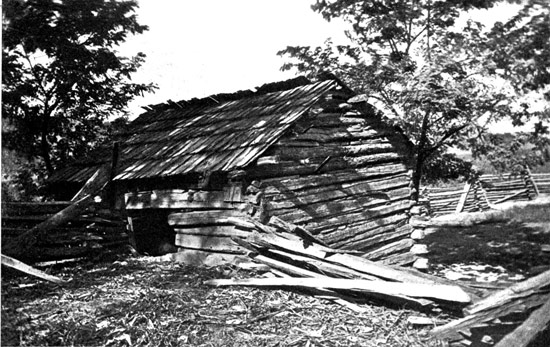
BOONE'S CABIN IN ST. CHARLES COUNTY, MISSOURI.
From photograph in possession of Wisconsin State Historical Society.
Boone's knowledge did not extend to law-books,
but he had a strong sense of justice;
and during his four years of office passed
upon the petty disputes of his neighbors with
such absolute fairness as to win popular approbation.
His methods were as primitive
and arbitrary as those of an Oriental pasha;
his penalties frequently consisted of lashes
on the bare back "well laid on;" he would
observe no rules of evidence, saying he
wished only to know the truth; and sometimes
both parties to a suit were compelled
to divide the costs and begone. The French
settlers had a fondness for taking their quarrels
to court; but the decisions of the good-hearted
syndic of Femme Osage, based solely
upon common sense in the rough, were respected
as if coming from a supreme bench.
His contemporaries said that in no other
office ever held by the great rifleman did he
give such evidence of undisguised satisfaction,
or display so great dignity as in this
rôle of magistrate. Showing newly arrived
American immigrants to desirable tracts of
land was one of his most agreeable duties;
when thus tendering the hospitalities of the
country to strangers, it was remarked that
our patriarch played the Spanish "don" to
perfection.
In October, 1800, Spain agreed to deliver
Louisiana to France; but the latter found
it impracticable at that time to take possession
of the territory. By the treaty of April
30, 1803, the United States, long eager to
secure for the West the open navigation of
the Mississippi, purchased the rights of
France. It was necessary to go through the
form, both in New Orleans and in St. Louis,
of transfer by Spain to France, and then by
France to the United States. The former
ceremony took place in St. Louis, the capital
of Upper Louisiana, upon the ninth of
March, 1804, and the latter upon the following
day. Daniel Boone's authority as a
Spanish magistrate ended when the flag of his
adopted country was hauled down for the last
time in the Valley of the Mississippi.
The coming of the Americans into power
was welcomed by few of the people of Louisiana.
The French had slight patience with
the land-grabbing temper of the "Yankees,"
who were eager to cut down the forests, to
open up farms, to build towns, to extend
commerce, to erect factories—to inaugurate
a reign of noise and bustle and avarice.
Neither did men of the Boone type—who had
become Spanish subjects in order to avoid
the crowds, to get and to keep cheap lands,
to avoid taxes, to hunt big game, and to live
a simple Arcadian life—at all enjoy this sudden
crossing of the Mississippi River, which
they had vainly hoped to maintain as a perpetual
barrier to so-called progress.
Our hero soon had still greater reason
for lamenting the advent of the new régime.
His sad experience with lands in Kentucky
had not taught him prudence. When the
United States commission came to examine
the titles of Louisiana settlers to the claims
which they held, it was discovered that Boone
had failed properly to enter the tract which
had been ceded to him by Delassus. The
signature of the lieutenant-governor was
sufficient to insure a temporary holding, but
a permanent cession required the approval of
the governor at New Orleans; this Boone
failed to obtain, being misled, he afterward
stated, by the assertion of Delassus that so
important an officer as a syndic need not
take such precautions, for he would never be
disturbed. The commissioners, while highly
respecting him, were regretfully obliged under
the terms of the treaty to dispossess the
old pioneer, who again found himself landless.
Six years later (1810) Congress tardily
hearkened to his pathetic appeal, backed by
the resolutions of the Kentucky legislature,
and confirmed his Spanish grant in words of
praise for "the man who has opened the way
to millions of his fellow men."
By the time he was seventy years old,
Boone's skill as a hunter had somewhat lessened.
His eyes had lost their phenomenal
strength; he could no longer perform those
nice feats of marksmanship for which in his
prime he had attained wide celebrity, and
rheumatism made him less agile. But as a
trapper he was still unexcelled, and for many
years made long trips into the Western wilderness,
even into far-off Kansas, and at
least once (1814, when eighty years old) to
the great game fields of the Yellowstone.
Upon such expeditions, often lasting several
months, he was accompanied by one or more
of his sons, by his son-in-law Flanders Calloway,
or by an old Indian servant who was
sworn to bring his master back to the Femme
Osage dead or alive—for, curiously enough,
this wandering son of the wilderness ever
yearned for a burial near home.
Beaver-skins, which were his chief desire,
were then worth nine dollars each in the St.
Louis market. He appears to have amassed a
considerable sum from this source, and from
the sale of his land grant to his sons, and in
1810 we find him in Kentucky paying his debts.
This accomplished, tradition says that he had
remaining only fifty cents; but he gloried in
the fact that he was at last "square with the
world," and returned to Missouri exultant.
The War of 1812-15 brought Indian troubles
to this new frontier, and some of the
farm property of the younger Boones was
destroyed in one of the savage forays. The
old man fretted at his inability to assist in
the militia organization, of which his sons
Daniel Morgan and Nathan were conspicuous
leaders; and the state of the border did not
permit of peaceful hunting. In the midst of
the war he deeply mourned the death of his
wife (1813)—a woman of meek, generous,
heroic nature, who had journeyed over the
mountains with him from North Carolina,
and upon his subsequent pilgrimages, sharing
all his hardships and perils, a proper
helpmeet in storm and calm.
Penniless, and a widower, he now went to
live with his sons, chiefly with Nathan, then
forty-three years of age. After being first a
hunter and explorer, and then an industrious
and successful farmer, Nathan had won distinction
in the war just closed and entered the
regular army, where he reached the rank of
lieutenant-colonel and had a wide and thrilling
experience in Indian fighting. Daniel
Morgan is thought to have been the first settler
in Kansas (1827); A. G. Boone, a grandson,
was one of the early settlers of Colorado,
and prominently connected with Western Indian
treaties and Rocky Mountain exploration;
and another grandson of the great
Kentuckian was Kit Carson, the famous
scout for Frémont's transcontinental expedition.
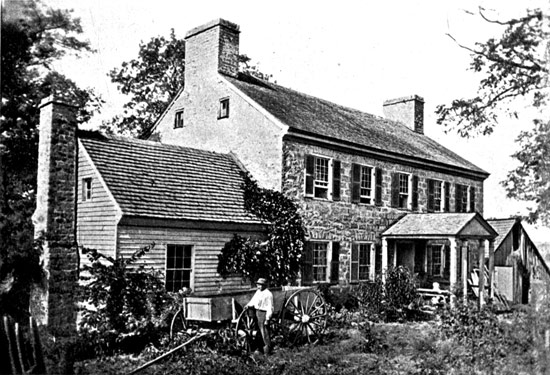
NATHAN BOONE'S HOUSE IN ST. CHARLES COUNTY, MISSOURI.
Herein Daniel Boone died.
It was not long before the Yankee régime
confirmed Boone's fears. The tide of immigration
crossed the river, and rolling westward
again passed the door of the great
Kentuckian, driving off the game and
monopolizing the hunting-grounds. Laws,
courts, politics, speculation, and improvements
were being talked about, to the bewilderment
of the French and the unconcealed
disgust of the former syndic. Despite his
great age, he talked strongly of moving still
farther West, hoping to get beyond the reach
of settlement; but his sons and neighbors
persuaded him against it, and he was obliged
to accommodate himself as best he might to
the new conditions. In summer he would
work on the now substantial and prosperous
farms of his children, chopping trees for the
winter's wood. But at the advent of autumn
the spirit of restlessness seized him, when
he would take his canoe, with some relative
or his Indian servant, and disappear up the
Missouri and its branches for weeks together.
In 1816, we hear of him as being at Fort
Osage, on his way to the Platte, "in the
dress of the roughest, poorest hunter." Two
years later, he writes to his son Daniel M.:
"I intend by next autumn to take two or
three whites and a party of Osage Indians
to visit the salt mountains, lakes, and ponds
and see these natural curiosities. They are
about five or six hundred miles west of here"—presumably
the rock salt in Indian Territory;
it is not known whether this trip was
taken. He was greatly interested in Rocky
Mountain exploration, then much talked of,
and eagerly sought information regarding
California; and was the cause of several
young men migrating thither. A tale of
new lands ever found in him a delighted
listener.
In these his declining years, although he
had suffered much at the hands of the world,
Boone's temperament, always kindly, mellowed
in tone. Decay came gradually, without
palsy or pain; and, amid kind friends
and an admiring public, his days passed in
tranquillity. The following letter written by
him at this period to his sister-in-law Sarah
(Day) Boone, wife of his brother Samuel, is
characteristic of the man, and gives to us,
moreover, probably the only reliable account
we possess of his religious views:
"october the 19th 1816
"Deer Sister
"With pleasuer I Rad a Later from your
sun Samuel Boone who informs me that you
are yett Liveing and in good health Considing
your age I wright to you to Latt you
know I have Not forgot you and to inform
you of my own Situation sence the Death of
your Sister Rabacah I Leve with flanders
Calaway But am at present at my sun Nathans
and in tolarabel halth you Can gass
at my feilings by your own as we are So
Near one age I Need Not write you of our
satuation as Samuel Bradley or James
grimes Can inform you of Every Surcomstance
Relating to our famaly and how we
Leve in this World and what Chance we shall
have in the next we know Not for my part
I am as ignerant as a Child all the Relegan I
have to Love and fear god beleve in Jeses
Christ Don all the good to my Nighbour and
my self that I Can and Do as Little harm as
I Can help and trust on gods marcy for the
Rest and I Beleve god neve made a man of
my prisepel to be Lost and I flater my self
Deer sister that you are well on your way
in Cristeanaty gave my Love to all your
Childran and all my frends fearwell my
Deer sister
"Daniel Boone
"Mrs. Sarah Boone
"N B I Red a Later yesterday from sister
Hanah peninton by hir grand sun Dal Ringe
she and all hir Childran are Well at present
"D B"
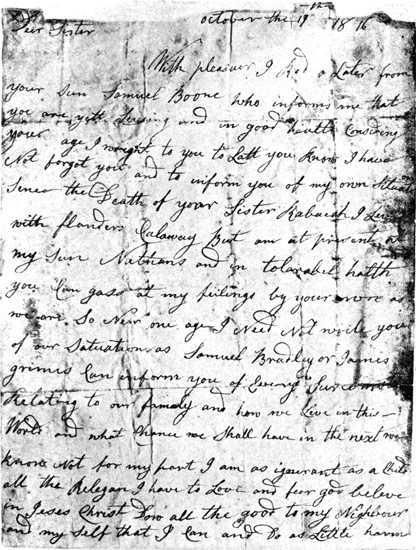
BOONE'S RELIGIOUS VIEWS.
Reduced facsimile from original MS. in possession of Wisconsin State
Historical Society.
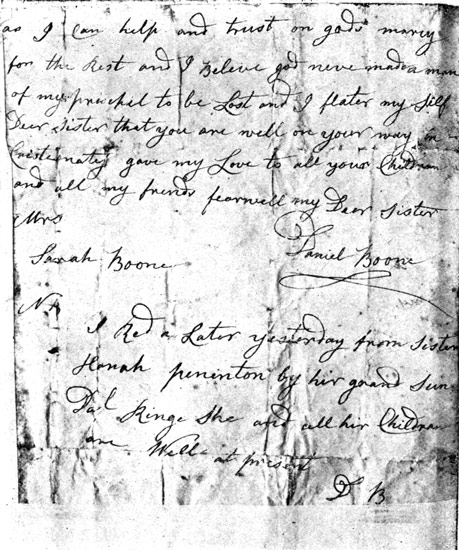
Many strangers of distinction visited him
at Nathan's home near the banks of the Missouri,
and the public journals of the day
always welcomed an anecdote of the great
hunter's prowess—although most of the stories
which found their way into print were
either deliberate inventions or unconsciously
exaggerated traditions. From published descriptions
of the man by those who could
discriminate, we may gain some idea of his
appearance and manner. The great naturalist
Audubon once passed a night under a
West Virginia roof in the same room with
Boone, whose "extraordinary skill in the
management of a rifle" is alluded to. He
says: "The stature and general appearance
of this wanderer of the Western forests approached
the gigantic. His chest was broad
and prominent; his muscular powers displayed
themselves in every limb; his countenance
gave indication of his great courage,
enterprise, and perseverance; and when he
spoke the very motion of his lips brought the
impression that whatever he uttered could
not be otherwise than strictly true. I undressed,
whilst he merely took off his hunting-shirt
and arranged a few folds of blankets
on the floor, choosing rather to lie there,
as he observed, than on the softest bed."
Timothy Flint, one of his early biographers,
knew the "grand old man" in Missouri,
and thus pictures him: "He was five
feet ten inches in height, of a very erect,
clean-limbed, and athletic form—admirably
fitted in structure, muscle, temperament, and
habit for the endurance of the labors,
changes, and sufferings he underwent. He
had what phrenologists would have considered
a model head—with a forehead peculiarly
high, noble, and bold—thin and compressed
lips—a mild, clear, blue eye—a large
and prominent chin, and a general expression
of countenance in which fearlessness
and courage sat enthroned, and which told
the beholder at a glance what he had been
and was formed to be." Flint declares that
the busts, paintings, and engravings of
Boone bear little resemblance to him. "They
want the high port and noble daring of his
countenance.... Never was old age more
green, or gray hairs more graceful. His
high, calm, bold forehead seemed converted
by years into iron."
Rev. James E. Welch, a revivalist, thus
tells of Boone as he saw him at his meetings
in 1818: "He was rather low of stature,
broad shoulders, high cheek-bones, very mild
countenance, fair complexion, soft and quiet
in his manner, but little to say unless spoken
to, amiable and kind in his feelings, very
fond of quiet retirement, of cool self-possession
and indomitable perseverance. He
never made a profession of religion, but still
was what the world calls a very moral man."
In 1819, the year before the death of
Boone, Chester Harding, an American portrait-painter
of some note, went out from St.
Louis to make a life study of the aged Kentuckian.
He found him at the time "living
alone in a cabin, a part of an old blockhouse,"
evidently having escaped for a time from
the conventionalities of home life, which
palled upon him. The great man was roasting
a steak of venison on the end of his ramrod.
He had a marvelous memory of the
incidents of early days, although forgetful
of passing events. "I asked him," says
Harding, "if he never got lost in his long
wanderings after game? He said 'No, I was
never lost, but I was bewildered once for
three days.'" The portrait is now in the possession
of the painter's grandson, Mr. William
H. King, of Winnetka, Ill. Harding says
that he "never finished the drapery of the
original picture, but copied the head, I think,
at three different times." It is from this
portrait (our frontispiece), made when
Boone was an octogenarian, emaciated and
feeble—although not appearing older than
seventy years—that most others have been
taken; thus giving us, as Flint says, but a
shadowy notion of how the famous explorer
looked in his prime. There is in existence,
however, a portrait made by Audubon, from
memory—a charming picture, representing
Boone in middle life.[18]
Serene and unworldly to the last, and
with slight premonition of the end, Daniel
Boone passed from this life upon the twenty-sixth
of September, 1820, in the eighty-sixth
year of his age. The event took place in the
home of his son Nathan, said to be the first
stone house built in Missouri. The convention
for drafting the first constitution of the
new State was then in session in St. Louis.
Upon learning the news, the commonwealth-builders
adjourned for the day in respect
to his memory; and as a further mark of regard
wore crape on their left arms for twenty
days. The St. Louis Gazette, in formally
announcing his death, said: "Colonel Boone
was a man of common stature, of great enterprise,
strong intellect, amiable disposition,
and inviolable integrity—he died universally
regretted by all who knew him.... Such
is the veneration for his name and character."
Pursuant to his oft-repeated request, he
was buried by the side of his wife, upon the
bank of Teugue Creek, about a mile from the
Missouri. There, in sight of the great river
of the new West, the two founders of Boonesborough
rested peacefully. Their graves
were, however, neglected until 1845, when the
legislature of Kentucky made a strong appeal
to the people of Missouri to allow the
bones to be removed to Frankfort, where, it
was promised, they should be surmounted
by a fitting monument. The eloquence of
Kentucky's commissioners succeeded in overcoming
the strong reluctance of the Missourians,
and such fragments as had not
been resolved into dust were removed amid
much display. But in their new abiding-place
they were again the victims of indifference;
it was not until 1880, thirty-five
years later, that the present monument was
erected.
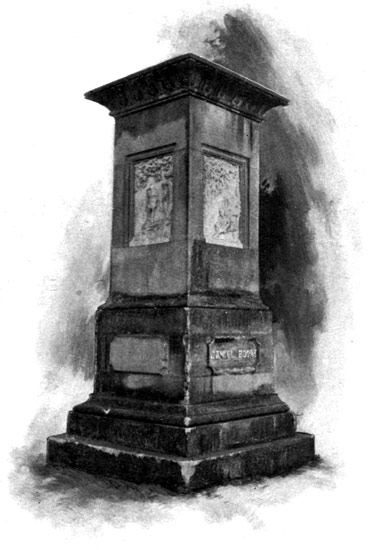
BOONE'S MONUMENT AT FRANKFORT, KENTUCKY.
We have seen that Daniel Boone was
neither the first explorer nor the first settler
of Kentucky. The trans-Alleghany wilds
had been trodden by many before him; even
he was piloted through Cumberland Gap by
Finley, and Harrodsburg has nearly a year's
priority over Boonesborough. He had not
the intellect of Clark or of Logan, and his
services in the defense of the country were
of less importance than theirs. He was not
a constructive agent of civilization. But in
the minds of most Americans there is a pathetic,
romantic interest attaching to Boone
that is associated with few if any others of
the early Kentuckians. His migrations in
the vanguard of settlement into North Carolina,
Kentucky, West Virginia, and Missouri,
each in their turn; his heroic wanderings in
search of game and fresh lands; his activity
and numerous thrilling adventures during
nearly a half-century of border warfare; his
successive failures to acquire a legal foothold
in the wilderness to which he had piloted
others; his persistent efforts to escape the
civilization of which he had been the forerunner;
his sunny temper amid trials of the
sort that made of Clark a plotter and a misanthrope;
his sterling integrity; his serene old
age—all these have conspired to make for
Daniel Boone a place in American history as
one of the most lovable and picturesque of
our popular heroes; indeed, the typical backwoodsman
of the trans-Alleghany region.
- Abingdon (Pa.), Boones in, 4.
- Alleghany Mountains, bound French claims, 19, 60;
border Valley of Virginia, 14;
pioneers on eastern foot-hills, 27, 35, 69;
barrier to Western advance, 13;
Berkeley's exploration, 85, 86;
crossed by Americans, 20;
in Dunmore's War, 105;
first government west of, 122, 123.
- Allen, ——, paints Boone's portrait, 238.
- Amherst, Gen. Jeffrey, of British Army, 44.
- Appalachian Mountains, troughs of, 13-15.
See also Alleghany Mountains.
- Arkansas, Virginia hunters in, 89, 90.
- Ashton, Captain, killed by Indians, 185.
- Audubon, John James, knew Boone, 10, 235, 238.
- Baker, John, explores Kentucky, 66.
- Barbour, ——, hunts in Kentucky, 89, 90.
- Baton Rouge (La.), North Carolinians near, 66.
- Batts, Thomas, on New River, 86.
- Bears, 18, 56, 58, 67, 75, 76, 92, 133, 197.
- Beaver Creek, Boone on, 68.
- Beavers, 18, 74, 229.
- Benton, ——, Kentucky pioneer, 125.
- Berkeley, Gov. William, in Alleghanies, 85, 86.
- Berks County (Pa.), Boones in, 4-15, 211, 212.
- Black Fish, Shawnese chief, 148-157, 161-167.
- Bledsoe, Maj. Anthony, militia leader, 134.
- Blue Ridge, borders Valley of Virginia, 14, 15;
crossed by Boone, 72.
- Boiling Spring (Ky.), founded, 121.
See also Fort Boiling Spring.
- Boone, A. G., grandson of Daniel, 231.
- —, Benjamin, son of George1, 1.
- —, Daniel, Dutch painter, 7.
- —, Daniel, born, 6;
youth, 7-15;
training, 10-12;
education, 199, 224;
moves to Yadkin, 16, 17;
explores Yadkin region, 62, 63;
in French and Indian War, 21-23;
marriage, 25-27, 36;
list of children, 43;
life on the Yadkin, 17-20, 28-36;
flees to Virginia, 43, 55;
returns to Yadkin, 50, 55;
visits Florida, 64, 65;
early Kentucky explorations, 24, 69, 70;
trains James, 63;
discontented in North Carolina, 67-69;
hunts in Tennessee, 55, 56;
in Cherokee War, 50, 55, 56;
carves name on trees, 56;
captures criminals, 62;
opinion of Indians, 52, 59;
piloted by Finley, 218, 241;
crosses Cumberland Gap, ix, 89, 200, 218;
long hunt in Kentucky, 72-84, 86, 94-97, 100, 224;
starts for Kentucky, 101-103;
on Clinch, 103;
in Dunmore's War, 105-112;
pioneer for Transylvania Company, 114-117;
settles Boonesborough, 117-119, 124, 125;
defends Boonesborough, 137, 138, 141, 142;
capture of daughter, 134-136;
captured by Shawnese, 146-158;
returns to Kentucky, 174-178;
hunts for settlers, 176;
robbed of money, 176, 177;
militia leader, 112, 134, 180, 212, 213;
Indian expeditions, 181, 182, 187-189;
pilot for immigrants, 198, 211, 226;
leaves Boonesborough, 180;
justice of peace, 143;
surveyor, 120, 121, 129, 181, 193, 198, 208, 209, 211, 212;
member of legislature, 182, 183, 215;
revisits Pennsylvania, 211, 212;
loses Kentucky lands, 208-210, 219;
at Maysville, 201, 202, 207-210;
river trader, 201, 202;
life on Kanawha, 210-222;
"autobiography," 153, 169, 199;
ships furs to East, 197, 201, 202;
moves to Missouri, 205, 219-222;
Spanish syndic, 224-227;
hunts in Missouri, 220, 229-232;
laments growth of settlement, 227, 231;
loses Spanish grant, 227, 228;
pays debts, 229;
old age, 228-241;
death and burial, 239, 240;
character, vii-ix, 200, 232, 233, 241, 242;
religious views, 233, 234;
specimen letters, 193-195, 233-235;
descriptions of, 109, 110, 212-214, 225, 235-237, 239, 240;
not first in Kentucky, 85;
Byron's verses, 200;
nature of services, 200;
extent of fame, 198, 199, 222, 233-235;
portraits, 237-239;
Draper's proposed biography, ix-x.
- Boone, Mrs. Daniel, marriage, 25-27, 36;
life on Yadkin, 29, 30;
flees to Virginia, 43;
scorns Florida, 65;
in Kentucky, 125, 158, 168, 201;
death and burial, 230, 240.
- —, Daniel Morgan, son of Daniel, 43;
in Missouri, 220, 230, 232;
in Kansas, 230, 231.
- —, Edward, brother of Daniel, 7;
killed by Indians, 7, 174, 181.
- —, Elizabeth, sister of Daniel, 7.
- —, George1, grandfather of Daniel, early life, 1-3;
moves to Pennsylvania, 3, 4, 102;
death, 5.
- —, George2, son of foregoing, born, 1;
in Pennsylvania, 2-5.
- —, George3, brother of Daniel, 7.
- —, Hannah, sister of Daniel, 7.
- —, Israel1, brother of Daniel, 7, 12.
- —, Israel2, son of Daniel, 43;
killed by Indians, 189.
- —, James1, son of George1, 1, 15.
- —, James2, son of Daniel, 43;
trained as hunter, 63;
killed by Indians, 102, 103.
- —, Jemima, daughter of Daniel, 43;
captured by Indians, 134-136;
marries Flanders Calloway, 158.
- —, John, son of George1, 1, 2, 15.
- —, John B., son of Daniel, 43.
- —, Jonathan, brother of Daniel, 7.
- —, Joseph, son of George1, 1.
- —, Lavinia, daughter of Daniel, 43.
- —, Mary1, daughter of George1, 1.
- —, Mary2, sister of Daniel, 7.
- —, Nathan, son of Daniel, 43;
visits Pennsylvania, 211, 212;
in Missouri, 230, 233, 239.
- —, Rebecca, daughter of Daniel, 43.
- —, Samuel1, son of George1, 1.
- Boone, Samuel2, brother of Daniel, 7, 10;
marries Sarah Day, 233.
- —, Samuel3, son of foregoing, 233.
- —, Sarah1, daughter of George1, born, 1;
moves to Pennsylvania, 2, 3;
marries Jacob Stover, 4, 5.
- —, Sarah2, sister of Daniel, 7, 12.
- —, Sarah Day, letter from Daniel, 233.
See also Sarah Day.
- —, Squire1, father of Daniel, born, 1;
moves to Pennsylvania, 2, 3;
marriage, 5;
life in Pennsylvania, 5-15;
expelled by Quakers, 12;
moves to Yadkin, 15-17;
flees to Virginia, 43;
returns to Yadkin, 59;
life on Yadkin, 25, 27;
death, 59.
- —, Squire2, brother of Daniel, 7;
on Big Sandy, 69;
visits Kentucky, 72, 78-81, 84, 94-97, 100;
at Boonesborough, 117, 122, 125, 129, 158, 162.
- —, Susannah, daughter of Daniel, 43.
- — family, in Cherokee War, 43, 44;
in Kentucky, 43;
in Missouri, 44, 220-241.
- Boone's Creek (Ky.), Boone on, 180, 208.
- — Creek (Tenn.), Boone on, 55, 56.
- — Station. See Fort Boone.
- Boonesborough (Ky.), 118, 119, 121, 124-128, 240, 241;
Transylvania convention at, 122, 123;
capture of girls, 134-136;
in Revolutionary War, 137, 139, 141-143, 148, 149, 154, 156-158, 184;
besieged by Indians, 159-167, 169, 186;
Boone's return to, 174-180, 208, 209;
incorporated, 174, 175;
left by Boone, 180;
present condition, 175;
Ranck's monograph, x.
- Bouquet, Gen. Henry, campaign of, 88;
treats with Indians, 103, 104.
- Bourbon County (Ky.), Boone in, 177, 181.
- Bowman, Col. John, Kentucky pioneer, 125;
militia leader, 134;
in Revolutionary War, 143-145, 158, 170, 178.
- Braddock, Gen. Edward, defeated by French, 21-23, 25, 50, 71, 81, 152.
- Bradley, Edward, Kentucky pioneer, 117.
- —, Samuel, mentioned by Boone, 233.
- Bradninch (Eng.), early home of Boones, 1-3.
- Bridges, James, Kentucky pioneer, 117.
- Brownsville (Pa.), Boone at, 212, 215, 216.
- Bryan, Joseph, father-in-law of Boone, 25.
- —, Rebecca. See Mrs. Daniel Boone.
- — family, Yadkin pioneers, 24-27, 36, 168;
in Cherokee War, 43, 44;
in Kentucky, 101, 102, 125.
- Buffaloes, 17, 18, 23, 67, 69, 70, 72, 75, 76, 90, 92, 95, 118, 133, 158, 197.
- Bush, William, Kentucky pioneer, 117.
- Byrd, Colonel, of British Army, 178.
- —, Col. William, raids Cherokees, 49, 50, 56.
- Byron, George Noel Gordon, Lord, lines on Boone, 200.
- Cahokia (Ill.), won by Clark, 159.
- Caldwell, Capt. William, raids Kentucky, 186.
- California, Boone interested in, 232.
- Calk, William, Kentucky pioneer, 194.
- Calloway, Betsey, captured by Indians, 135, 136;
marries Samuel Henderson, 143.
- Calloway, Fanny, captured by Indians, 135, 136.
- —, Flanders, marries Jemima Boone, 158;
in Missouri, 229, 233.
- —, Col. Richard, Kentucky pioneer, 117;
daughters captured, 135, 136;
accuses Boone, 165-167.
- Campbell, Maj. Arthur, in Dunmore's War, 105, 108, 109;
in Kentucky, 126.
- —, Ensign John, in Dunmore's War, 109.
- — (Camel), Robert, Kentucky pioneer, 209.
- — family, Kentucky pioneers, 125.
- Camp Madison (Ky.), 172.
- Caperton, Captain, militia leader, 216.
- Captain Jack, Indian hero, 52.
- Carson, Kit, grandson of Boone, 231.
- Cartwright's Creek, Boone on, 208.
- Castle's-woods, Boone at, 109.
- Catawba Indians, relations with Yadkin settlers, 18, 19, 22, 36, 42;
allies of whites, 45;
raided by Northern Indians, 96.
- Cattle-raising, on frontier, 8, 9, 15, 16, 30, 31, 35, 36, 57, 58, 62, 69, 102, 122, 127, 128, 131, 132, 140, 162, 163, 173, 197, 223.
- Charleston (S.C.), in Cherokee War, 43, 46;
Boone at, 169.
- — (W. Va.), Boone near, 211, 221.
- Charlottesville (Va.), Boone at, 182.
- Cherokee Indians, raided by Northern tribes, 96;
relations with Yadkin settlers, 18, 19, 22;
war with whites, 36-56, 60, 69;
plunder Kentucky hunters, 90, 91, 93;
treaty with settlers, 99;
in Dunmore's War, 104, 105, 112, 113;
in Transylvania cession, 113-116;
in Revolutionary War, 132, 139-144, 160-167;
inflamed by Spain, 202, 204.
- Chickasaw Indians, in Revolutionary War, 179.
- Chillicothe (Ohio), Boone near, 158.
- —, Little, Shawnese town, 151, 152, 156, 166.
- —, Old, Shawnese town, 170.
- Choctaw Indians, rob hunters, 67.
- Christian family, Kentucky pioneers, 125.
- Cincinnati, founded, 199;
Clark at, 190;
Harmar, 213;
Boone, 222;
Wayne, 218.
- Clark, George Rogers, arrival in Kentucky, 104, 125;
delegate to Virginia, 133;
in Dunmore's War, 107;
in Revolutionary War, 125, 134, 138, 139, 158, 159, 169, 178, 179, 181, 183, 190;
Wabash expedition, 206, 207;
separatist intrigues, 203-205, 242;
misanthropic, vii;
character of services, vii, 241.
- Clendennin, Col. George, militia leader, 216.
- Clinch Mountain, crossed by Boone, 73.
- Coburn, Samuel, Kentucky pioneer, 117.
- Colorado, A. G. Boone in, 231.
- Cooley, William, accompanies Boone, 72-79.
- Cornstalk, Shawnese chief, 110, 111.
- Cornwallis, Lord, imprisons Boone, 182, 183.
- Covington (Ky.), Bowman at, 170.
- Crabtree, Capt. Jacob, Kentucky pioneer, 117.
- Crane, Sergt. John, in Dunmore's War, 109.
- Creek Indians, inflamed by Spain, 202, 204.
- Crime, on frontier, 33, 34, 60-62.
- Croghan, George, fur-trader, 23.
- Culpeper County (Va.), Boone in, 43.
- Cumberland Gap, crossed by Virginia hunters, 90, 92;
Finley, 23, 88;
Boone, vii, 72, 73, 88, 89, 95, 125, 230, 241;
in Dunmore's War, 105.
See also Wilderness Road.
- — Mountains, bound Kentucky, 70, 91.
- Cutbirth, Benjamin, friend of Boone, 66;
in Kentucky, 66, 67, 101.
- Danville (Ky.), district capital, 195.
- Davie County (N.C.), Boones in, 27.
- Dawson, Miss Marjory, aid acknowledged, xi.
- Day, Rebecca, 233.
- —, Sarah, marries Samuel Boone, 10;
teaches Daniel, 10, 11.
- Deer, 18, 58, 63, 67, 72-74, 76, 92, 133, 197.
- Delassus, Charles Dehault, lieutenant-governor of Upper Louisiana, 220, 224, 225, 228.
- Delaware Indians, Christian converts, 7, 8;
in Revolutionary War, 156, 157, 160-167.
- Detroit, Boone at, 154-157, 166, 177;
British headquarters, 178, 183, 192.
- District of Columbia, Squire Boone in, 43.
- Doddridge, Joseph, Notes on Virginia, 39-41.
- Drake, Joseph, heads Long Hunters, 91, 92.
- Draper, Lyman Copeland, gathers Boone manuscripts, ix-x;
letters from Harding, 238, 239.
- Dress, of pioneers, 28, 29.
- Dunkin, Sergt. John, in Dunmore's War, 109.
- Dunmore, Lord, commissions Boone, 155, 156;
raids Indians, 105-112;
opposes Henderson, 116.
- Durrett, Col. Reuben T., aid acknowledged, x.
- Dutchman's Creek, Boones on, 17.
- Eagle Creek, in Indian campaign, 194.
- Education, on frontier, 10, 11, 27, 53, 224.
- Elk, 72, 75, 76, 92.
- English, in French and Indian War, 19-23;
defeat French, 59, 60;
employ French woodsmen, 98;
fur trade of, 42;
oppose American settlement, 98, 99, 202;
in Revolutionary War, 132, 149, 154-156, 159, 165-167, 171, 178, 186, 190, 192;
designs on Louisiana, 220.
- Estill, Capt. James, killed by Indians, 184, 185.
- — County (Ky.), Boone in, 73.
- Etting, J. Marx, aid acknowledged, xi.
- Exeter township (Pa.), Boones in, 5-7.
- Fayette County (Ky.), organized, 179-182;
raided by Indians, 186;
surveying, 181, 192, 193.
- Fallen Timbers, battle of, 217, 218.
- Falls of Ohio. See Louisville.
- Femme Osage Creek, Boone on, 220-222, 224, 225, 229.
- Filson, John, writes Boone's "autobiography," 153, 199, 200.
- Fincastle County (Va.), includes Kentucky, 123, 195.
- Finley, John, early exploration of Kentucky, 22, 23, 87, 88;
tells Boone thereof, 22-24, 69, 71;
pilots Boone thither, vii, 71-79, 88, 200, 218, 241.
- Fishing Creek, Clark on, 104.
- Flint, Timothy, describes Boone, 235, 236, 238.
- Florida, Virginia hunters in, 89;
Boone, 64, 65.
- Floyd, Capt. John, on state of frontier, 136, 137;
in Revolutionary War, 138, 180.
- Forbes, Gen. John, campaign of, 88.
- Fort Blackmore, in Dunmore's War, 108.
- — Boiling Spring, in Revolutionary War, 137.
- — Boone (Boone's Station), built, 180.
- — Bryan (Ky.), in Revolutionary War, 137, 185-188.
- — Defiance, Wayne at, 217.
- — Dobbs, erected, 37-39;
in Cherokee War, 41-44, 55.
- — Duquesne. See Pittsburg.
- — Elk Garden, in Dunmore's War, 109.
- — Estill, attacked by Indians, 184.
- — Glade Hollow, in Dunmore's War, 109.
- — Harrod. See Fort Boiling Spring.
- — Hinkson, in Revolutionary War, 137.
- — Huston (Ky.), in Revolutionary War, 137.
- — Jefferson, built by Clark, 179.
- — Logan, in Revolutionary War, 137, 139, 164, 165.
- — Loudon, erected, 37;
in Cherokee War, 44, 46, 47.
- — McClellan, in Revolutionary War, 137, 139.
- — McConnell, in Revolutionary War, 188.
- — McGee, in Revolutionary War, 188.
- — Maiden Spring, in Dunmore's War, 109.
- — Martin, besieged, 178.
- — Massac, French at, 41, 42, 48.
- — Moore, in Dunmore's War, 108.
- — Nelson. See Louisville.
- — Osage, Boone at, 232.
- — Pitt. See Pittsburg.
- — Price (Ky.), in Revolutionary War, 139.
- — Prince George, in Cherokee War, 37, 44, 48.
- — Recovery, Wayne at, 217.
- — Robinson, erected, 50.
- — Ruddell, founded, 121;
besieged, 178.
- — Russell, in Dunmore's War, 108.
- — Stanwix, treaty of, 99, 114, 121.
- — Strode, militia rendezvous, 194.
- — Whitley, in Revolutionary War, 137.
- — Whitton (Big Crab Orchard), in Dunmore's War, 109.
- Forts on frontier, described, 37-41;
methods of defense, 142, 143.
- Frankfort (Ky.), 121;
Boone portrait at, 238;
Boone's grave, 240.
- Fredericksburg (Va.), Boone in, 43.
- Frelinghuysen, Theodore, on Cherokee bravery, 51.
- Frémont, Gen. John C., explorer, 231.
- French, introduce knives, 111;
early knowledge of Kentucky, 85-87;
in French and Indian War, 19-23, 66;
inflame Southern Indians, 36, 37, 41, 42, 48, 51, 98;
fall of New France, 48, 60;
hunting in Kentucky, 95, 101, 197;
employed by English, 98, 148, 159, 161, 171, 178;
in Northwest Territory, 207;
in Missouri, 223-226, 231;
intrigue against Spain, 204;
cede Louisiana to United States, 226, 227.
- — Creek, French on, 20.
- Fur trade, near Philadelphia, 4, 10;
French and English rivalry, 19, 20;
Ohio Company, 20, 24, 87;
Finley, 22, 23, 71, 83, 87, 88;
Croghan, 23;
with Southern Indians, 18, 42, 44, 58, 60, 132, 133;
roving of traders, 67, 69;
English operations, 87, 99, 190;
character of traders, 60, 132, 133;
autumnal caravans, 31, 58, 197;
Boone's operations, 201, 202, 219.
- Gass, Capt. David, on Clinch, 103;
Kentucky pioneer, 117.
- Gauntlet-running, described, 154, 155.
- Georgetown (D.C.), Squire Boone in, 43.
- Georgia, Virginia hunters in, 91;
Boone, 65;
increase of settlement, 97.
- Germans, among frontiersmen, 4, 5, 14, 196.
- Girty, George, met by Boone, 148.
- —, James, met by Boone, 148.
- —, Simon, American renegade, 148, 186.
- Gist, Christopher, explores Kentucky, 87, 100.
- Grant, Lieut.-Col. James, raids Cherokees, 48-50.
- Granville, Earl, North Carolina landholder, 68.
- Great Lakes, French posts on, 19.
- — Meadows, defeat of Washington, 20.
- Greenville (Ohio), treaty of, 217.
- Grimes, James, mentioned by Boone, 233.
- Gwynedd township (Pa.), Boones in, 4-6.
- Hamilton, Gov. Henry, 149, 150;
relations with Boone, 154-156, 161, 166;
imprisoned, 169, 177.
- Hamtramck, Maj. J. F., raids Indians, 213.
- Harding, Chester, paints Boone's portrait, 237-239.
- Harmar, Col. Josiah, raids Indians, 213.
- Harper's Ferry (Va.), Boones at, 16.
- Harrisonburg (Va.), Boones near, 16.
- Harrod, Capt. James, in Revolutionary War, 134, 138, 176.
- Harrodsburg, founded, vii, 121, 131, 238, 241;
convention at, 133;
in Revolutionary War, 137, 139, 142, 143, 164;
seat of Lincoln County, 179.
- Hart, David, of Transylvania Company, 114.
- —, John, Kentucky pioneer, 117.
- —, Nathaniel, of Transylvania Company, 114, 176, 177.
- —, Thomas, of Transylvania Company, 114, 176, 177.
- Hays, William, Boone's son-in-law, 117.
- —, Mrs. William, daughter of Boone, 117.
- Hazelrigg, Captain, letters from Boone, 193-195.
- Hempinstall, Abraham, hunts in Kentucky, 89, 90.
- Henderson, Col. Richard, settles Kentucky, 113-115, 118-120, 122-124, 126, 129, 133.
- —, Samuel, marries Betsey Calloway, 143.
- Hennepin, Father Louis, explorations of, 86.
- Hewett, Gen. Fayette, aid acknowledged, xi.
- Hicks, William, Kentucky pioneer, 117.
- Hill, William, accompanies Boone, 69, 70.
- Hinkson, Maj. John, Kentucky pioneer, 121.
- Hite, Isaac, Kentucky pioneer, 125.
- Holden, Capt. Joseph, accompanies Boone, 72-77;
defeated by Indians, 185.
- Howard, John, in Kentucky, 87.
- Hunting, early practised by Boone, 9-12, 16;
in Yadkin country, 17, 18, 28-34, 55, 58, 62, 63;
early trail through Cumberland Gap, 73, 89;
in Tennessee, 55-57;
abundant in Kentucky, 76, 98, 132, 218;
Long Hunters, 91-95;
Boone's long Kentucky hunt, 72-84, 86, 94-97;
Boone's contemporaries, 87-91;
after Revolution, in Kentucky, 197, 211, 218;
in Kanawha Valley, 218, 219;
in Missouri, 220, 229-232;
profits of, 57-59, 73-75, 229;
methods employed, 75, 76;
camps described, 63, 64;
game decreasing, 62, 97, 124, 219.
See also the several animals.
- Iberville, Lemoyne d', explorations of, 86.
- Illinois, French in, 42;
English, 87.
- Indian Territory, mentioned by Boone, 232.
- Indians, understood by Boone, viii, 7, 8, 10;
influence of women, 46;
lodge life, 153;
adopt captives, 152, 153;
affected by fur trade, 133;
barrier to settlement, 98;
in eastern Pennsylvania, 4, 7, 8, 10, 13;
infest mountain valleys, 14, 16;
in French and Indian War, 19-23, 36-56;
raid Yadkin region, 27, 36-56;
raid Kentucky, 126, 127;
warrior's paths, 73, 76, 79, 180;
gauntlet-running, 154, 155;
methods of warfare, 39-41, 52-54, 111, 140, 141, 160-167, 186-189, 205;
ethics of border warfare, 50-54, 206;
finally quieted in Northwest, 216-218.
See also the several tribes.
- Irish, among frontiersmen, 14, 24, 196.
- Iron Mountain, crossed by Boone, 73.
- Iroquois, in Kentucky, 99, 113, 114.
- Jefferson, Thomas, governor of Virginia, 182;
President, 224.
- Jefferson County (Ky.), organized, 179-181;
in Revolutionary War, 188;
Lincolns in, 174.
- Jennings, Edmund, Kentucky pioneer, 117.
- Jessamine County (Ky.), Bone in, 101.
- Jesuits, seek Mississippi River, 86.
- Johnson, Andrew, escapes from Indians, 157.
- —, Thomas, Kentucky pioneer, 117.
- Joliet, Louis, discovers Mississippi, 86.
- Jones, Capt. John Gabriel, delegate to Virginia, 133.
- Justice, on frontier, 61, 223, 225, 226.
- Kanawha County (W. Va.), Boone in, 210-222.
- Kansas, Boone in, 229.
- Kaskaskia (Ill.), won by Clark, 159, 190.
- Keith, Sir William, governor of Pennsylvania, 87.
- Kennedy, John, Kentucky pioneer, 117.
- Kenton, Simon, scout, 125;
in Revolutionary War, 141, 160, 189.
- Kentucky, described, 82, 131, 132;
debatable land between tribes, 76, 77;
early explorations, vii, 85-87, 89-91;
Virginia hunters, 20;
Finley, 22, 23, 71, 87, 88;
Boone's early explorations, 24, 64, 68-70, 88, 89, 101;
Boone's long hunt, 72-84, 86, 94-97;
Long Hunters in, 91-95;
Washington, 88, 89;
Cutbirth, 66, 67;
Boone family, 25, 43, 241;
game abundant, 98, 129, 218;
Cherokee lands settled, 99;
early colonial projects, 100;
Transylvania Company, 113-176;
first settled, vii-viii;
rush of settlers, 104, 178, 195-198, 207;
in Dunmore's War, 106, 107, 113;
during Revolutionary War, 132-192;
losses in Indian wars, 205;
Indians finally quelled, 213-218;
established as Virginia County, 123, 133, 134;
divided into three counties, 179-181;
made a district, 195;
becomes a State, 205;
sends Boone to legislature, 182, 183;
separatist agitation, 202-205;
first wedding, 143;
first artillery, 174;
hard winter, 173, 175, 176;
early commerce, 196, 197;
Boone pays debts, 229;
Boone's services to, 200, 201;
petitions Congress for Boone, 176, 177, 228;
obtains Boone's remains, ix, 240;
declines to buy Harding's portrait, 238;
Filson's History, 199.
- King, John, Kentucky pioneer, 117.
- —, John L., owns Boone portrait, 239.
- —, William H., owns Boone portrait, 237-239;
aid acknowledged, xi.
- King Philip, Indian hero, 51, 52.
- Kinkead, Sergt. John, in Dunmore's War, 109.
- Lackey, W. G., aid acknowledged, xi.
- La Fayette, Gen. Marquis de, in Virginia, 182.
- Land grants, to French and Indian War veterans, 88, 121, 131;
by Iroquois to whites, 114;
by Cherokees to whites, 113-116;
Boone from Virginia, 177;
Boone from Spain, 222, 227, 228.
See also Transylvania Company.
- La Salle, Robert Cavelier, sieur de, on Western waters, 86.
- Law, on frontier, 33, 34, 224-227.
- Lederer, John, on Western waters, 86.
- Lee, William, Kentucky pioneer, 121, 137.
- Lewis, Gen. Andrew, in Dunmore's War, 107, 110, 111.
- — family, Kentucky pioneers, 125.
- Lexington (Ky.), seat of Fayette County, 179, 193;
in Revolutionary War, 186-188.
- Limestone. See Maysville.
- Lincoln, Abraham, Kentucky pioneer, 174.
- — County (Ky.), organized, 179-181;
in Revolutionary War, 188.
- Linn, Lieutenant, marries, 143.
- Linnville Creek, Boones on, 16.
- Logan, Benjamin, arrives in Kentucky, 125;
raids Indians, vii, 134, 207;
in Revolutionary War, 138, 144, 164, 165, 180, 181, 189;
character of services, 241.
- Logan, Chief John, attacks whites, 105.
- Long Hunters, in Kentucky, 91-95.
- Long Island, of Holston, 50.
- Long Knives, use of term, 11, 144.
- Louisiana, North Carolinians in, 66;
French, 19;
owned by Spain, 220;
French intrigue against, 204;
ceded to United States, 224, 226-228.
- Louisville (Ky.), Gist at site of, 87;
Finley, 22, 23, 71;
Washington, 104;
Clark, 159;
Boone, 83, 129, 193;
in Revolutionary War, 181, 190;
seat of Jefferson County, 179;
early growth, 196.
- Lyttleton, William Henry, governor of South Carolina, 43, 55.
- McAfee family, Kentucky pioneers, 125.
- McClellan, Alexander, Kentucky pioneer, 125.
- McCulloch, John, explores Kentucky, 91.
- MacDowell family, Kentucky pioneers, 125.
- McGary, Maj. Hugh, in Revolutionary War, 138, 188, 189.
- McKee, Capt. Alexander, raids Kentucky, 186.
- Marquette, Father Jacques, discovers Mississippi, 86.
- Marshall, Col. Thomas, surveyor, 181, 192, 193, 195.
- Martin, Josiah, governor of North Carolina, 116.
- Maryland, Boones in, 43, 59;
increase of settlement, 97;
commerce with Kentucky, 202.
- Matthews, Albert, on "Long Knives," 111.
- Maugridge, Mary, marries George Boone1, 1.
- Mausker, Caspar, of Long Hunters, 94.
- Maysville (Ky.), 194;
in Revolutionary War, 138;
Boone at, 201, 202, 207-210, 212.
- Medicine, on frontier, 32.
- Mill, John Stuart, on forcing civilization, 51.
- Miller, William, Kentucky pioneer, 117.
- Mingo Indians, in Dunmore's War, 105;
in Revolutionary War, 132, 139-144, 156, 157, 161-167.
- Mingo Junction (Ohio), Logan tragedy near, 105.
- Missouri, Boone family in, viii, 43, 220-241;
life previous to cession, 223-226;
first stone house, 239;
Constitutional Convention, viii, 239;
releases Boone's remains, 240.
- Moccasin Gap, followed by Boone, 73.
- Monocacy Valley, Boone in, 10.
- Montgomery, Alexander, scout, 160.
- —, Col. John, raids Cherokees, 44-46, 55.
- Mooney, James, accompanies Boone, 72-79.
- Moore, Sergeant, in Dunmore's War, 108.
- —, William, Kentucky pioneer, 117.
- Moravian Indian missions, 7, 8.
- Morgan, John, grandfather of Daniel Boone, 5.
- —, Sarah, marries Squire Boone1, 5, 59;
life in Oley, 5-15.
- — family, Welsh settlers, 5.
- Morton, Mrs. Jennie C., aid acknowledged, x.
- Muskrats, 18.
- Nall, James, Kentucky pioneer, 117.
- Nashville (Tenn.), hard winter at, 175.
- Neely, Alexander, joins Boone, 78-81.
- Neversink Mountains, Boone in, 10.
- New France, fall of, 48, 60, 87, 98.
See also French.
- New Mexico, New Englanders in, 86.
- New Orleans, French at, 19;
Spanish, 228;
North Carolinians, 66, 67;
Virginians, 90, 91;
early commerce with, 197.
- New York (State), Indian uprising, 37;
sends emigrants to Kentucky, 178.
- North Carolina, pioneers of, 13-15;
sends colony to Louisiana, 66;
Boones in, viii, 17-102, 241;
in French and Indian War, 21-23, 48-50, 56;
interest in Western settlement, 100, 138, 178;
Henderson's colony, 113-176;
opposition to Henderson, 116, 123, 127;
regulators, 61, 62;
rapid settlement, 42.
- North Wales (Pa.), Boones in, 4, 5.
- Northwest Territory, organized, 207.
- Ohio, Shawnese in, 135, 144, 149-160, 170, 182, 190;
Boone hunts in, 211, 218.
- — Company, founded, 20;
operations of, 24;
land grants on Ohio River, 87.
- Oley township (Pa.), Boones in, 4-15.
- Opecancano, Indian hero, 52.
- Orange County (Va.), settlers hunt in Kentucky, 89, 90.
- Ordinance of 1787, 205.
- Osage Indians, mentioned by Boone, 232.
- Otter Creek, Boone on, 117.
- Otters, 18, 74.
- Owatin Creek (Pa.), Boones on, 6.
- Ozark Mountains, Virginians in, 91.
- Paint Lick Town. See Chillicothe, Little.
- Panthers, 18.
- Paris (Ky.), fort on site of, 137.
- Patterson, Col. Robert, Kentucky pioneer, 125, 194.
- Peeke, James, Kentucky pioneer, 117.
- Penn, William, founds Pennsylvania, 2.
- Pennington (Peninton), Hannah, mentioned by Boone, 234.
- Pennsylvania, founded by Penn, 2;
Boones in, viii, 2-14, 102, 174, 183, 211, 212;
Finley, 79;
sends settlers to southwest, 13-15, 20, 24:
interest in Western settlement, 138, 178;
increase of settlement, 97, 130;
in French and Indian War, 20-23, 37;
in Revolutionary War, 148, 159;
losses in Indian wars, 205.
- Pensacola (Fla.), Boone in, 65.
- Philadelphia, in time of Boones, 3, 4, 10, 102, 212.
- Pickaway, Shawnese town, 179.
- Pittsburg, French at, 20, 21, 41;
Virginia hunters, 89;
in Dunmore's War, 105, 107;
in Revolutionary War, 138, 148, 183.
- Poage, Sergt. W., in Dunmore's War, 108.
- Point Pleasant (W. Va.), battle at, 108, 110-112;
Boone, 201, 210-222.
- Pompey, negro interpreter, 151, 161.
- Pontiac, Indian hero, 52, 59, 60.
- Pope, Col. William, militia leader, 180, 181.
- Presbyterians, among frontiersmen, 33.
- Preston, Col. William, in Dunmore's War, 105, 109;
in Revolutionary War, 136.
- — family, Kentucky pioneers, 125.
- Prestonburg (Ky.), Boone near, 69, 70.
- Quakers, Boones of this persuasion, 1, 2, 4-7, 10-12;
expel Boones, 12;
familiar with Indians, 13;
among frontiersmen, 14, 33.
- Ranck, George W., Boonesborough, x.
- —, Mrs. George W., aid acknowledged, x.
- Randolph, Nathaniel, Kentucky pioneer, 125.
- Reading (Pa.), Boones near, 6.
- Red Jacket, Indian hero, 52.
- — Stone. See Brownsville, Pa.
- Regulators, in Carolinas, 61, 101.
- Religion, on frontier, 33.
See also the several denominations.
- Revolutionary War, 175;
effect on proprietary governments, 123;
causes Washington to turn from West, 89;
checks Western colonies, 100;
Western interest in, 128, 170, 171;
G. R. Clark, 125, 138, 139, 158, 159, 169;
Kentucky in, 132-192.
- Richmond (Va.), seat of government, 181, 182, 207, 208, 215.
- Ringe, Daniel, 234.
- River Alleghany, French on, 20.
- — Big Sandy, Boone on, 69-71, 211;
Washington, 88.
- — Catawba, early settlements on, 17;
Indian hostilities, 42.
- — Clinch, Boone on, 69, 101, 103-112;
early settlement, 97.
- — Cumberland, Long Hunters on, 93, 95;
Boone, 101;
in Transylvania cession, 115;
in Revolutionary War, 139.
- — Dick's, Boone on, 83.
- — Elk, Boone on, 221.
- — Elkhorn, Boone on, 208;
in Revolutionary War, 137.
- — French Broad, early settlement on, 97.
- — Gauley, Boone on, 219.
- — Green, Long Hunters on, 93, 94;
Boone, 77.
- — Great Miami, Shawnese on, 179.
- — Holston, Finley on, 79;
Boone, 57, 69, 73;
Long Hunters, 91;
in Cherokee War, 47, 50;
in Revolutionary War, 134, 138, 144, 161;
early settlements, 97, 126.
- — Hudson, Iroquois on, 99.
- — Kanawha (Great Kanawha), explored, 86;
in Dunmore's War, 108;
Boone on, viii, 210-222;
hunting, 218, 219.
- — Kentucky, Boone on, 73, 79, 83, 112, 180, 211;
Transylvania settlement, 115-119, 121;
crown lands abutting, 121, 130;
capture of girls, 134-136;
in Revolutionary War, 137, 139, 176;
bounds Fayette County, 179;
Boone leaves, 201.
- — Keowee, Cherokees on, 45.
- — Licking, Shawnese on, 135, 137, 151, 166, 170, 178-180, 188, 190;
Boone, 83, 208, 211.
- — Little Miami, Shawnese on, 151, 190;
in Revolutionary War, 160, 170.
- — Little Sandy, Washington on, 88.
- — Little Tennessee, Cherokees on, 45, 48, 49.
- — Maumee, Wayne on, 217.
- — Miami, Indians raided on, 214.
- — Mississippi, Iroquois on, 99;
French, 19, 60, 85-87, 207;
early English explorations, 20, 85-87, 89-91;
North Carolinians, 66, 67;
in Revolutionary War, 179;
Spanish, 85, 197, 198, 202-205;
free navigation sought by West, 203-205, 226;
early commerce on, 197, 198.
- — Missouri, Boone on, 221, 232, 234, 240.
- — Monongahela, fur trade route, 24;
Braddock on, 71;
early settlements, 98, 130;
Boone, 212, 215, 216.
- — New, Batts on, 86;
Squire Boone, 78;
settlers explore Kentucky, 90, 91.
- — Nolichucky, early settlement on, 97.
- — Ohio, drains Virginia, 16;
French on, 19, 20, 41, 42;
early explorations, 22;
Virginia hunters, 89-91;
Gist, 87;
Finley, 22, 23, 71;
in Dunmore's War, 105;
Iroquois land sale, 99;
Boone on, 69, 70, 83, 183, 201, 202, 210, 222;
in Transylvania cession, 114, 129;
in Revolutionary War, 138, 151, 159, 170;
Indian wars on, 88, 107, 108;
early settlements, 98, 100, 104, 207, 214;
highway for emigrants, 130, 172, 178, 184, 196, 201;
early commerce, 197, 198;
last of Indian raids, 213-218.
- River Platte, Boone on, 232.
- — Potomac, fur trade route, 24.
- — Powell, Boone on, 73, 95, 96, 125;
early settlements, 97, 102, 115, 119.
- — Red, Boone on, 79.
- — Rich, in Dunmore's War, 109.
- — Rockcastle, Indians on, 80, 117.
- — St. Joseph, Indians raided on, 213.
- — St. Lawrence, Indians on, 19.
- — Salt, Indians near, 190.
- — —, Beech Fork of, 208.
- — Sandy, West Fork of, Boone on, 70.
- — Savannah, Indians on, 37.
- — Schuylkill, Boones on, 6-15.
- — Scioto, Shawnese on, 157, 158, 160, 167, 207;
Indians raided, 213.
- — Shenandoah, Boones on, 16.
- — Tennessee, Indian uprising, 37, 45;
Iroquois land sale, 99, 114;
in Transylvania cession, 114.
- — Wabash, Shawnese on, 206, 207;
French, 207;
English, 87;
in Dunmore's War, 105;
Indians raided on, 213, 214.
- — Watauga, Boone on, 55, 56, 101, 115;
Cherokee council, 115, 116, 133;
early settlement, 97.
- — Yadkin, early known to Pennsylvanians, 14;
Bryan family on, 25-27, 43;
Boone family, 16-20, 24-27, 34, 43, 55-57, 68-70, 81, 89, 95, 96, 100, 102, 103, 125, 158, 168, 169, 208, 209;
Indians on, 18, 19, 22, 37-56, 59, 60;
hunting, 17, 18, 28-34, 55, 58;
trading caravans, 31, 58;
crime, 60-62;
Finley's arrival, 71, 72.
- — Yellowstone, Boone on, 229.
- Robinson, Chief Justice, on Wilderness Road, 172, 173, 175.
- —, David, militia leader, 134.
- Rockingham County (Va.), Boones in, 16;
Lincolns, 174.
- Rocky Mountains, explorations of, 231, 232.
- Rowan County (N.C.), Boones in, 25, 55, 174.
- Russell, Henry, killed by Indians, 103.
- —, Col. William, starts for Kentucky, 101-103;
in Dunmore's War, 105, 108;
in Revolutionary War, 134.
- St. Asaph (Ky.), founded, 121.
- St. Augustine (Fla.), Boone in, 65.
- St. Charles County (Mo.), Boones in, 220-241.
- St. Clair, Gov. Arthur, raids Indians, 214, 215, 217.
- St. Louis, Spanish seat, 220, 221, 223;
fur market, 229;
Harding at, 237;
Gazette, 239, 240.
- Salisbury (N.C.), Boone near, 18, 62.
- Salling, Peter, in Kentucky, 87.
- Salt Licks, in Kentucky, 90, 92, 118, 146, 151;
near Prestonburg, 69, 70;
Big, 82, 117;
Big Bone, 82, 83, 87;
Blue, 82, 158, 166, 188, 189, 194;
Buffalo, 17;
French, 101;
Grassy, 181;
Knob, 92;
Lower Blue, 135, 147-151, 160.
- Scotch-Irish, among frontiersmen, 5, 14, 22, 66, 128, 196.
- Scott, Gen. Charles, raids Indians, 214.
- Searcy, Bartlet, Kentucky pioneer, 117.
- —, Reuben, Kentucky pioneer, 117.
- Shawnese Indians, raid Southern tribes, 19;
in Kentucky, 23;
in Dunmore's War, 104, 105, 107, 108, 110-113;
capture Boone, 77, 78, 146-158;
capture girls, 134-136;
attack Boone, 103;
in Revolutionary War, 132, 139-144, 156, 157, 160-167, 170, 179, 180, 183-191, 193;
raided by Kentuckians, 206, 207.
- Sheltowee (Big Turtle), Boone's Indian name, 152.
- Silouee, Cherokee chief, 45.
- Sitting Bull, Indian hero, 52.
- Skaggs, Henry, heads Long Hunters, 92.
- Slavery, among Indians, 42;
negro, 33, 103, 184.
- Smith, John, on Indian warfare, 111.
- South Carolina, pioneers of, 13-15;
in Cherokee War, 43, 44, 48;
regulators, 61;
interest in Western settlement, 138, 178.
- Southern Indians, attack whites, 60, 202, 204.
See also Cherokee Indians.
- Spanish, extent of explorations, 85;
control Mississippi River, 202-205;
relations with Kentuckians, 197, 198, 202-205;
entice American colonists, 204, 205, 220, 222.
- Sports, of pioneers, 32, 33.
- Station Camp Creek, Boone on, 73-79.
- Staunton (Va.), Boone at, 183.
- Stephen, Col. Adam, raids Cherokees, 50.
- Stockfield, owned by Boone, 208.
- Stone, Uriah, in Kentucky, 90-92.
- Stone Mountain, crossed by Boone, 73.
- Stoner, Michael, Kentucky pioneer, 117.
- Stuart, John, early exploration of Kentucky, 66, 67;
accompanies Boone, 72-80;
death, 80.
- Sugar Tree Creek, Boones on, 27, 68.
- Surveying, on frontier, 88, 104, 107, 119-121, 127, 131, 171, 172, 181, 192, 193, 198, 200, 208, 209, 211, 212.
- Sycamore Shoals, treaty at, 115, 116.
- Tarleton, Col. Banastre, captures Boone, 182.
- Tate, Samuel, Kentucky pioneer, 117.
- Taylor, Hancock, hunts in Kentucky, 89, 90.
- —, Richard, hunts in Kentucky, 89, 90.
- Tecumseh, Indian hero, 52.
- Tennessee, Virginia hunters in, 20, 91;
Boone, 55-57;
Cherokee lands settled, 99;
attacked by Southern Indians, 202, 204.
- Terre Haute (Ind.), Virginians at, 91.
- Teugue Creek, Boone buried on, 240.
- Thoreau, Henry David, likened to Boone, 10.
- Todd, Capt. John, Kentucky pioneer, 125, 131;
militia leader, 134, 180;
killed by Indians, 188, 189.
- Towns, Oswell, Kentucky pioneer, 117.
- Transylvania Company, settles Kentucky, 113-176, 208;
nullified by Virginia, 134, 176.
- Trigg, Col. Stephen, militia leader, 181;
killed by Indians, 188, 189.
- Tryon, Gov. William, conflict with regulators, 101;
runs boundary line, 69.
- Turkeys, 18, 72, 76, 92, 133.
- Turtle Creek, Braddock's defeat on, 21.
- Twitty, Capt. William, Kentucky pioneer, 117.
- Vardeman, John, Kentucky pioneer, 117.
- Vincennes (Ind.), won by Clark, 159, 169, 190.
- Virginia, early Indian hostilities, 111;
early explorations from, 85-87, 89-91;
pioneer advance through, 13-15, 20;
Boones in, 16, 43, 57;
path to Kentucky, 115;
in French and Indian War, 20-23, 37, 41, 47-49;
in Dunmore's War, 105-112;
losses in Indian wars, 205;
sends settlers to Kentucky, 178, 192;
opposition to Henderson, 116, 123, 127, 130, 133, 134, 176;
interest in Western settlement, 138;
regulators, 61;
organizes Kentucky County, 123, 133, 134, 174;
in Revolutionary War, 148, 169, 171, 203;
aids Kentucky, 138, 139, 143, 146, 150, 159, 165, 172, 174, 190, 207, 208;
erects district of Kentucky, 195;
Boone in Assembly, 182, 183, 215;
grants land to Boone, 177;
fails to release Kentucky, 204.
- —, Valley of, its pioneers, 13-16, 19, 20, 24, 31, 35, 100, 102.
- Waddell, Capt. Hugh, in French and Indian War, 21;
in Cherokee War, 44, 45, 49, 50, 55, 56.
- Walker, Felix, Kentucky pioneer, 117, 118.
- —, Dr. Thomas, in Kentucky, 87.
- War of 1812-15, effect on Missouri, 230.
- Ward, John, explores Kentucky, 66.
- Warriors' paths, 73, 76, 79, 180.
- Washington, George, in French and Indian War, 20, 21;
in Kentucky, 87-89, 100, 104;
in Revolutionary War, 138.
- Wayne, Gen. Anthony, conquers Indians, 217, 218.
- Welch, Rev. James E., describes Boone, 236, 237.
- Welsh, among frontiersmen, 4, 5.
- West Virginia, pioneer advance through, 13-15;
Boone in, 210-222, 235.
- Whitley, William, arrives in Kentucky, 125.
- Wilcoxen, Elizabeth, marries Benjamin Cutbirth, 66.
- Wildcats, 18.
- Wilderness Road, 130, 146, 172-174, 178, 184, 198, 202.
See also Cumberland Gap.
- Wilkes County (N.C.), Boone in, 68.
- Wilkesboro (N.C.), Boone near, 68.
- Wilkinson, Gen. James, raids Indians, 214.
- Wisconsin State Historical Society, possesses Boone's records, ix-x, 208.
- Wolves, 18.
- Wood, Col. Abraham, on Western waters, 86.
- Wyandot Indians, in Revolutionary War, 184.
- Xenia (O.), Boone near, 151, 152.
- Zinzendorf und Pottendorf, Nikolaus Ludwig, Count von, Moravian missionary, 7, 8.
AN IMPORTANT HISTORICAL BOOK.
The History of the Louisiana Purchase.
By Dr. James K. Hosmer, Author of "A Short History
of the Mississippi Valley," etc. With Illustrations and
Maps. 12mo. Cloth, $1.20 net; postage, 12 cents
additional.
The story that Dr. Hosmer tells of the acquisition of the western
empire included in the Louisiana Purchase presents fresh and picturesque
phases of a most important historical event of peculiar and
timely interest, in view of the anniversary which comes next year. He
pictures the vague and curious ideas of the Louisiana country held by
most Americans one hundred years ago, and the objections to this
form of expansion. He treats the changes in the ownership of the
territory from France to Spain, and again to France, and he develops
fully the purposes and acts of Jefferson and the American Commissioners
in Paris.
Of special importance from both the historical and personal points
of view are the chapters which picture more fully and vividly than has
been done before the leading part taken by Napoleon in bringing about
the sale of Louisiana, and the relations between France and America,
which are shown to possess a historical importance that has not been
appreciated.
There has been no account of the Louisiana Purchase which is so
popular and constant in its interest, and the authoritative character of
the historian's work renders the volume indispensable for younger
and older readers who wish to gain a thorough knowledge of the personal
elements and the historic significance of the acquisition of
Louisiana.
McMASTER'S FIFTH VOLUME.
History of the People of the United
States.
By Prof. John Bach McMaster. Vols. I, II, III,
IV, and V now ready. 8vo. Cloth, with Maps,
$2.50 per volume.
The fifth volume covers the time of the administrations of
John Quincy Adams and Andrew Jackson, and describes the
development of the democratic spirit, the manifestations of new
interest in social problems, and the various conditions and plans
presented between 1821 and 1830. Many of the subjects included
have necessitated years of first-hand investigations, and
are now treated adequately for the first time.
"John Bach McMaster needs no introduction, but only a greeting....
The appearance of this fifth volume is an event in American literature
second to none in importance this season."—New York Times.
"This volume contains 576 pages, and every page is worth reading.
The author has ransacked a thousand new sources of information, and has
found a wealth of new details throwing light upon all the private and public
activities of the American people of three quarters of a century ago."—Chicago
Tribune.
"In the fifth volume Professor McMaster has kept up to the high standard
he set for himself in the previous numbers. It is hard to realize thoroughly
the amount of detailed work necessary to produce these books, which contain
the best history of our country that has yet been published."—Philadelphia
Telegraph.
"The first installment of the history came as a pleasant surprise, and
the later volumes have maintained a high standard in regard to research
and style of treatment."—New York Critic.
"A monumental work.... Professor McMaster gives on every page
ample evidence of exhaustive research for his facts."—Rochester Herald.
"The reader can not fail to be impressed by the wealth of material out
of which the author has weighed and condensed and arranged his matter."—Detroit
Free Press.
"Professor McMaster is our most popular historian.... He never
wearies, even when dealing with subjects that would be most wearisome
under clumsier handling. This fifth volume is the most triumphant evidence
of his art."—New York Herald.
By EDGAR STANTON MACLAY, A. M.
A History of the United States Navy. (1775
to 1902.)—New and revised edition.
In three volumes, the new volume containing an Account of the Navy
since the Civil War, with a history of the Spanish-American War
revised to the date of this edition, and an Account of naval operations
in the Philippines, etc. Technical Revision of the first two volumes
by Lieutenant Roy C. Smith, U. S. N. Illustrated. 8vo. Cloth,
$3.00 net per volume; postage, 26 cents per volume additional.
In the new edition of Vol. III, which is now ready for publication, the author brings
his History of the Navy down to the present time. In the prefaces of the volumes of
this history the author has expressed and emphasized his desire for suggestions, new
information, and corrections which might be utilized in perfecting his work. He has,
therefore, carefully studied the evidence brought out at the recent Schley Court of
Inquiry, and while the findings of that Court were for the most part in accordance with
the results of his own historical investigations, he has modified certain portions of his
narrative. Whatever opinions may be held regarding any phases of our recent naval
history, the fact remains that the industry, care, and thoroughness, which were unanimously
praised by newspaper reviewers and experts in the case of the first two volumes,
have been sedulously applied to the preparation of this new edition of the third volume.
A History of American Privateers.
Uniform with "A History of the United States Navy." One volume.
Illustrated. 8vo. Cloth, $3.00 net; postage, 24 cents additional.
After several years of research the distinguished historian of American sea power
presents the first comprehensive account of one of the most picturesque and absorbing
phases of our maritime warfare. The importance of the theme is indicated by the fact
that the value of prizes and cargoes taken by privateers in the Revolution was three
times that of the prizes and cargoes taken by naval vessels, while in the War of 1812
we had 517 privateers and only 23 vessels in our navy. Mr. Maclay's romantic tale is
accompanied by reproductions of contemporary pictures, portraits, and documents, and
also by illustrations by Mr. George Gibbs.
The Private Journal of William Maclay,
United States Senator from Pennsylvania, 1789-1791. With Portrait
from Original Miniature. Edited by Edgar Stanton Maclay, A. M.
Large 8vo. Cloth, $2.25.
During his two years in the Senate William Maclay kept a journal of his own in
which he minutely recorded the transactions of each day. This record throws a flood
of light on the doings of our first legislators.
APPLETONS' WORLD SERIES.
A New Geographical Library.
Edited by H. J. Mackinder, M. A., Student of Christ Church, Reader in
Geography in the University of Oxford, Principal of Reading College. Each,
8vo. Cloth.
The series will consist of twelve volumes, each being an essay descriptive
of a great natural region, its marked physical features, and the life of the
people. Together, the volumes will give a complete account of the world,
more especially as the field of human activity.
NOW READY.
Britain and the British Seas. By the Editor. With numerous
Maps and Diagrams. $2.00 net; postage, 19 cents additional.
The Nearer East. By D. G. Hogarth, M. A., Fellow of Magdalen
College, Oxford; Director of the British School at Athens;
Author of "A Wandering Scholar in the Levant." $2.00 net;
postage, 17 cents additional.
IN PREPARATION.
CENTRAL EUROPE. By Dr. Joseph Partsch, Professor of Geography
in the University of Breslau.
INDIA. By Sir T. Hungerford Holdich, K. C. I. E., C. B., R. E.,
Superintendent of Indian Frontier Surveys; author of numerous papers
on Military Surveying and Geographical subjects.
SCANDINAVIA AND THE ARCTIC OCEAN. By Sir Clements R.
Markham, K. C. B., F. R. S., President of the Royal Geographical
Society.
THE RUSSIAN EMPIRE. By Prince Kropotkin, author of the articles
"Russia" and "Siberia" in the Encyclopædia Britannica.
AFRICA. By J. Scott Keltie, Secretary of the Royal Geographical
Society; Editor of The Statesman's Year-Book; Author of "The
Partition of Africa."
THE FARTHER EAST. By Archibald Little.
WESTERN EUROPE AND THE MEDITERRANEAN. By Elisée
Reclus, author of the "Nouvelle Géographie Universelle."
AUSTRALASIA AND ANTARCTICA. By Dr. H. O. Forbes, Curator
of the Liverpool Museum, late Curator of the Christ Church Museum, N.
Z.; Author of "A Naturalist's Wanderings in the Eastern Archipelago."
NORTH AMERICA. By Prof. Israel Cook Russell, M. S., C. E.,
LL. D., Professor of Geology in the University of Michigan; author of
numerous works on geological and physiographical subjects.
SOUTH AMERICA. By John Casper Branner, Ph.D., LL. D.,
Professor of Geology, and sometime Vice-President Leland Stanford
Junior University; author of many publications on Brazil, Geology,
and Physical Geography.
Maps by J. G. Bartholomew.
THE GREAT PEOPLES SERIES.
Edited by Dr. YORK POWELL,
Regius Professor of Modern History in the University of Oxford.
Each 12mo. Cloth, $1.50 net; postage, 14 cents additional.
The aim of this series is to give in well-printed, clearly written, and readable
volumes a view of the process by which the leading peoples of the world
have become great and earned their title to greatness, to describe the share
each has contributed to the common stock of civilization. It is not so much
a set of political or military or even social histories, as a sequence of readable
studies on the tendencies and potencies of the chief peoples of the world,
that this series will strive to present.
NOW READY:
THE SPANISH PEOPLE.
By Dr. Martin A. S. Hume.
"The reader quickly perceives that the riches promised by Dr. Powell
are amply found, at least in this first volume. The history is written with a
new object and from a new standpoint; there is not a dull page in it.
Mr. Hume writes with all the advantages of the modern historical specialist,
and his picture of the development of the Spaniard is an important history
of a people whose picturesque career is one of unfailing interest."—Boston
Daily Advertiser.
THE FRENCH PEOPLE.
By Arthur Hassall, M. A., Student of Christ Church,
Oxford; Author of "The Balance of Power," etc.
In accordance with the general plan of the series, this important work
presents the evolution of a people. The method is modern, and although
the sources, development, and transitions of a great race are fully indicated
in a comparatively small compass, the author's aims and results differ widely
from the set record of political, dynastic, and military facts which are chronicled
in the dry language of the usual hand-book. The part that France has
played in the world's history has been frequently so picturesque and dramatic,
as well as great, that a vital analysis of her history like this possesses
a profound interest. The author is one of the ablest of the rising English
historians and a lecturer at Christ Church, Oxford.
IN PREPARATION:
THE RUSSIAN PEOPLE.
By J. Fitzmaurice-Kelly.
THE STANDARD AUTHORITY.
The Presidents of the United States.
By John Fiske, Carl Schurz, Robert C. Winthrop, Daniel G.
Gilman, William Walter Phelps, George Ticknor Curtis, George
Bancroft, John Hay and others. Edited by General James Grant
Wilson. New and revised edition with complete life of William McKinley
and sketch of Theodore Roosevelt. Illustrated with steel engravings and
photogravures. 8vo. Cloth. $3.50. Half Morocco, or Half Calf, $6.00.
This book has been the standard authority for many years and
justly so. Its list of contributors lifts it far above the commonplace,
and infinitely removes it from the possibility of political coloring or
sectionalism. The article on President McKinley gives a brief and
accurate résumé of the Spanish war while the book as a whole is a
composite review of the constitutional history of the United States
with the White House as the keynote.
"A book well worth owning, for reading and for reference."—The Outlook.
"Such a work as this can not fail to appeal to the pride of patriotic Americans."—Chicago
Dial.
"A monumental volume, which no American who cares for the memory of the
public men of his country can afford to be without."—New York Mail and Express.
"A valuable addition to both our biographical and historical literature, and
meets a want long recognized."—Boston Advertiser.
"A book which every one should read over and over again.... We have carefully
run through it, and laid it down with the feeling that some such book ought to
find its way into every household."—New York Herald.
"General Wilson has performed a public service in presenting this volume to the
public in so attractive a shape. It is full of incentive to ambitious youth; it abounds
in encouragement to every patriotic heart."—Charleston News and Courier.
"It is precisely the book which ought to have a very wide sale in this country—a
book which one needs to own rather than to read and lay aside. No common-school
library or collection of books for young readers should be without it."—The
Churchman.
"These names are in themselves sufficient to guarantee adequacy of treatment
and interest in the presentation, and it is safe to say that such succinct biographies
of the complete portrait gallery of our Presidents, written with such unquestioned
ability, have never before been published."—Hartford Courant.
"Just the sort of book that the American who wishes to fix in his mind the
varying phases of his country's history as it is woven on the warp of the administrations
will find most useful. Everything is presented in a clear-cut way, and no
pleasanter excursions into history can be found than a study of 'The Presidents of
the United States.'"—Philadelphia Press.
The United States of America.
A Study of the American Commonwealth, its
Natural Resources, People, Industries, Manufactures,
Commerce, and its Work in Literature,
Science, Education, and Self-Government.
Edited by NATHANIEL S. SHALER, S. D.,
PROFESSOR OF GEOLOGY IN HARVARD UNIVERSITY.
In two volumes, royal 8vo. Maps, and 150 full-page
Illustrations. Cloth, $10.00.
Every subject in this comprehensive work is timely, because it is of immediate
interest to every American. Special attention, however, may be
called to the account of "American Productive Industry," by the Hon. Edward
Atkinson, with its array of immensely informing diagrams and tables;
and also to "Industry and Finance," a succinct and logical presentation of
the subject by Professor F. W. Taussig, of Harvard University. Both these
eminent authorities deal with questions which are uppermost to-day.
LIST OF CONTRIBUTORS.
- Hon. WILLIAM L. WILSON, Chairman of the Ways and Means Committee, Fifty-third Congress.
- Hon. J. R. SOLEY, formerly Assistant Secretary of the Navy.
- EDWARD ATKINSON, LL. D., Ph. D.
- Col. T. A. DODGE, U. S. A.
- Col. GEORGE E. WARING, Jr.
- J. B. McMASTER, Professor of History in the University of Pennsylvania.
- CHARLES DUDLEY WARNER, LL. D.
- Major J. W. POWELL, Director of the United States Geological Survey and the Bureau of Ethnology.
- WILLIAM T. HARRIS, LL. D., U. S. Commissioner of Education.
- LYMAN ABBOTT, D. D.
- H. H. BANCROFT, author of "Native Races of the Pacific Coast."
- HARRY PRATT JUDSON, Head Dean of the Colleges, Univ. of Chicago.
- Judge THOMAS M. COOLEY, formerly Chairman of the Interstate Commerce Commission.
- CHARLES FRANCIS ADAMS.
- D. A. SARGENT, M. D., Director Hemenway Gymnasium, Harvard Univ.
- CHARLES HORTON COOLEY.
- A. E. KENNELLY, Assistant to Thomas A. Edison.
- D. C. GILMAN, LL. D., President of Johns Hopkins University.
- H. G. PROUT, Editor of the Railroad Gazette.
- F. D. MILLET, formerly Vice-Pres. of the National Academy of Design.
- F. W. TAUSSIG, Professor of Political Economy in Harvard University.
- HENRY VAN BRUNT.
- H. P. FAIRFIELD.
- SAMUEL W. ABBOTT, M. D., Sec. State Board of Health, Massachusetts.
- N. S. SHALER.
Sold only by subscription. Prospectus, giving detailed chapter titles
and specimen illustrations, mailed free on request.
THE CONCISE KNOWLEDGE LIBRARY.
Each, small 8vo, half leather, $2.00.
The History of the World,
From the Earliest Historical Time to the Year 1898. By
Edgar Sanderson, M. A., author of "A History of the British
Empire," etc.
The Historical Reference-Book.
Comprising a Chronological Table of Universal History, a
Chronological Dictionary of Universal History, and a Biographical
Dictionary. With Geographical Notes. For the use of
Students, Teachers, and Readers. By Louis Heilprin. Fifth
edition, revised to 1898.
Natural History.
By R. Lydekker, B. A.; W. F. Kirby, F. L. S.; B. B. Woodward,
F. L. S.; R. Kirkpatrick; R. I. Pocock; R. Bowdler
Sharpe, LL. D.; W. Garstang, M. A.; F. A. Bather, M. A.,
and H. M. Bernard, M. A. Nearly 800 pages, and 500
Illustrations drawn especially for this work.
Astronomy.
Fully illustrated. By Agnes M. Clerke, A. Fowler, F. R. A. S.,
Demonstrator of Astronomical Physics of the Royal College of
Science, and J. Ellard Gore, F. R. A. S.
THE ROMANCE OF HISTORY.
Peter the Great.
By K. Waliszewski. Translated by Lady Mary Loyd. With
Portrait. Small 8vo. Cloth, $2.00.
The Romance of an Empress. Catharine II of
Russia.
By K. Waliszewski. Uniform with "Peter the Great." With
Portrait. Small 8vo. Cloth, $2.00.
New Letters of Napoleon I.
Omitted from the Collection published under the auspices of
Napoleon III. Edited by M. Léon Lecestre, Curator of the
French Archives. Translated by Lady Mary Loyd. With Portrait.
Small 8vo. Cloth, $2.00.
Uniform with the "New Letters."
Memoirs illustrating the History of Napoleon I,
from 1802 to 1815. By Baron Claude François de Méneval,
Private Secretary of Napoleon. Edited by his Grandson, Baron
Napoleon Joseph de Méneval. With Portraits and Autograph
Letters. In three volumes. Small 8vo. Cloth, $6.00.
An Aide-de-Camp of Napoleon.
Memoirs of General Count de Ségur, of the French Academy,
1800-1812. Revised by his Grandson, Count Louis de Ségur.
With Portrait. Small 8vo. Cloth, $2.00.
Memoirs of Marshal Oudinot,
Duc de Reggio. Compiled from the Hitherto Unpublished
Souvenirs of the Duchesse de Reggio, by Gaston Stiegler, and
now first translated into English by Alexander Teixeira de Mattos.
With Two Portraits. Small 8vo. Cloth, $2.00.
A Friend of the Queen.
(Marie Antoinette—Count de Fersen.) By Paul Gaulot.
With Two Portraits. 12mo. Cloth, $2.00.
THE LIVES OF ROYALTIES.
The Private Life of the Sultan.
By Georges Dorys, son of the late Prince of Samos, a former minister
of the Sultan, and formerly Governor of Crete. Translated by Arthur
Hornblow. Uniform with "The Private Life of King Edward VII."
Illustrated. 12mo. Cloth, $1.20 net; postage, 10 cents additional.
The high position which the writer's father held at Constantinople gave the son a
close insight into the personality of one of the least known of modern rulers, so far
as personality is concerned. It is unnecessary to say that the author has long since
left the domain of the Sultan of Turkey, and he is now a member of the Young Turk
party and a resident of Paris. It is announced that he has been recently condemned
to death by the Sultan on account of this book.
The Private Life of King Edward VII.
By a Member of the Royal Household. Illustrated. 12mo. Cloth, $1.50.
"While the book gives a narrative that is intimate and personal in character, it does
not descend to vulgar narrative. It is a book which will be found of unusual interest."—Brooklyn
Eagle.
The Private Life of the Queen.
By a Member of the Royal Household. Illustrated. 12mo. Cloth, $1.50.
"A singularly attractive picture of Queen Victoria.... The interests and occupations
that make up the Queen's day, and the functions of many of the members of her
household, are described in a manner calculated to gratify the natural desire to know
what goes on behind closed doors that very few of the world's dignitaries are privileged
to pass."—Boston Herald.
The Sovereigns and Courts of Europe.
The Home and Court Life and Characteristics of the Reigning Families.
By "Politikos." With many Portraits. 12mo. Cloth, $1.50.
"The anonymous author of these sketches of the reigning sovereigns of Europe
appears to have gathered a good deal of curious information about their private lives,
manners, and customs, and has certainly in several instances had access to unusual
sources. The result is a volume which furnishes views of the kings and queens concerned,
far fuller and more intimate than can be found elsewhere."—New York
Tribune.
The Life of his Royal Highness the Prince
Consort.
By Sir Theodore Martin. In five volumes, each with Portrait. 12mo.
Cloth, $10.00.
"A full and impartial biography of a noble and enlightened prince.... Mr. Martin's
work is not gossipy, not light, nor yet dull, guarded in its details of the domestic
lives of Albert and Victoria, but sufficiently full and familiar to contribute much interesting
information."—Chicago Tribune.
THE STORY OF THE WEST SERIES.
Edited by RIPLEY HITCHCOCK.
Each, illustrated, 12mo, cloth, $1.50.
The Story of the Soldier.
By General G. A. Forsyth, U. S. Army (retired). Illustrated by
R. F. Zogbaum.
"A very complete and vivid picture of the development of the West from a military
point of view, with side lights on the civil war."—The Churchman.
The Story of the Railroad.
By Cy Warman, author of "The Express Messenger," etc.
With Maps and many Illustrations by B. West Clinedinst and
from photographs.
"In Mr. Warman's book we are kept constantly reminded of the fortitude, the suffering,
the enterprise, and the endurance of the pioneers."—The Railroad Gazette.
The Story of the Cowboy.
By E. Hough, author of "The Singing Mouse Stories," etc.
Illustrated by William L. Wells and C. M. Russell.
"Mr. Hough is to be thanked for having written so excellent a book. The cowboy
story, as this author has told it, will be the cowboy's fitting eulogy. This volume will
be consulted in years to come as an authority on past conditions of the far West. For
fine literary work the author is to be highly complimented. Here, certainly, we have a
choice piece of writing."—New York Times.
The Story of the Mine.
As illustrated by the Great Comstock Lode of Nevada. By
Charles Howard Shinn.
"The author has written a book not alone full of information, but replete with the
true romance of the American mine."—New York Times.
The Story of the Indian.
By George Bird Grinnell, author of "Pawnee Hero Stories,"
"Blackfoot Lodge Tales," etc.
"Only an author qualified by personal experience could offer us a profitable study
of a race so alien from our own as is the Indian in thought, feeling, and culture. Only
long association with Indians can enable a white man measurably to comprehend their
thoughts and enter into their feelings. Such association has been Mr. Grinnell's."—New
York Sun.
STANDARD HISTORICAL WORKS.
The American Revolution, 1763-1783.
Being the Chapters and Passages relating to America, from the
Author's "History of England in the Eighteenth Century."
By William Edward Hartpole Lecky, M. P. Arranged and
edited, with Historical and Biographical Notes, by James Albert
Woodburn, Professor of American History and Politics in Indiana
University. 12mo. Cloth, $1.25.
The Rise and Growth of the English Nation.
With Special Reference to Epochs and Crises. A History of and
for the People. By W. H. S. Aubrey, LL. D. In three volumes.
12mo. Cloth, $4.50.
This work is written in no partisan or sectarian spirit, and is not designed
to advocate any particular theory of politics, of philosophy, or of religion; but
it claims to be thoroughly patriotic, and is inspired by a love of the freedom
that springs out of righteousness and justice.
A History of Germany, from the Earliest Times
to the Present Day.
By Bayard Taylor. With an additional Chapter by Mrs. Bayard
Taylor. With Portrait and Maps. 12mo. Cloth, $1.50.
"When one considers the confused, complicated, and sporadic elements
of German history, it seems scarcely possible to present a clear, continuous
narrative. Yet this is what Bayard Taylor did. He omitted no episode of
importance, and yet managed to preserve a main line of connection from century
to century throughout the narrative."—Philadelphia Ledger.
A French Volunteer of the War of Independence.
By the Chevalier de Pontgibaud. Translated and edited by
Robert B. Douglas. With Introduction and Frontispiece. 12mo.
Cloth, $1.50.
STANDARD HISTORICAL WORKS.
History of the People of the United States,
From the Revolution to the Civil War. By John Bach
McMaster. To be completed in Six Volumes. Vols.
I, II, III, IV, and V now ready. 8vo. Cloth, gilt top,
$2.50 each.
The Beginners of a Nation.
By Edward Eggleston. A History of the Source
and Rise of the Earliest English Settlements in America,
with Special Reference to the Life and Character of the
People. The first volume in a History of Life in the
United States. Small 8vo. Gilt top, uncut, with Maps.
Cloth, $1.50.
The Transit of Civilization.
From England to America in the Seventeenth Century.
By Edward Eggleston. Uniform with "The Beginners
of a Nation." Small 8vo. Gilt top, uncut. Cloth, $1.50.
The Household History of the United States and
its People.
By Edward Eggleston. For Young Americans.
Richly illustrated with 350 Drawings, 75 Maps, etc.
Square 8vo. Cloth, $2.50.
Bancroft's History of the United States,
From the Discovery of the Continent to the Establishment
of the Constitution in 1789. (Also Edition de Luxe,
on large paper, limited to one hundred sets, numbered.)
Complete in six volumes, with a Portrait of the Author.
8vo. Cloth, uncut, gilt top, $15.00; half calf or half
morocco, $27.00; tree calf, $50.00.
GREAT COMMANDERS.
Edited by General JAMES GRANT WILSON.
This series forms one of the most notable collections of books that has
been published for many years. The success it has met with since the first
volume was issued, and the widespread attention it has attracted, indicate
that it has satisfactorily fulfilled its purpose, viz., to provide in a popular
form and moderate compass the records of the lives of men who have been
conspicuously eminent in the great conflicts that established American independence
and maintained our national integrity and unity. Each biography
has been written by an author especially well qualified for the task,
and the result is not only a series of fascinating stories of the lives and deeds
of great men, but a rich mine of valuable information for the student of
American history and biography.
Each, 12mo, cloth, gilt top, $1.50 net.
Postage, 11 cents additional,
NOW READY.
| Admiral Farragut | By Captain A. T. Mahan, U. S. N. |
| General Taylor | By General O. O. Howard, U. S. A. |
| General Jackson | By James Parton. |
| General Greene | By General Francis V. Greene. |
| General J. E. Johnston | By Robert M. Hughes, of Virginia. |
| General Thomas | By Henry Coppee, LL. D. |
| General Scott | By General Marcus J. Wright. |
| General Washington | By General Bradley T. Johnson. |
| General Lee | By General Fitzhugh Lee. |
| General Hancock | By General Francis A. Walker. |
| General Sheridan | By General Henry E. Davies. |
| General Grant | By General James Grant Wilson. |
| General Sherman | By General Manning F. Force. |
| Commodore Paul Jones | By Cyrus Townsend Brady. |
| General Meade | By Isaac R. Pennypacker. |
| General McClellan | By General Peter S. Michie. |
| General Forrest | By Captain J. Harvey Mathes. |
IN PREPARATION.
| Admiral Porter | By James R. Soley, late Ass't Sec'y U. S. Navy. |
| General Schofield | An Autobiography. |
D. APPLETON AND COMPANY, NEW YORK.