Boone leads a company toward the promised land of
Kentucky—They are attacked by Indians in Powell’s
Valley—Six of the party are slain and among them
Boone’s eldest son—The sorrow of a strong man and
his sense of duty—The dead are buried and the march
resumed—Boone’s lonely watch over the sleeping
settlers—His encounter with Hardy Goodfellow in
the gray dawn—“Now that father’s dead, I’m all
alone”—Hardy finds a new father and Boone another
son—Man and boy make a strange compact—“Maybe
the Lord meant it that way—who knows?”
“Isn’t it about time to make camp, Captain?”
“Pretty near that, but I don’t exactly fancy
campin’ right on a trace. I reckon we’ll push on
a bit and see if we can’t find a likelier location.”
The first speaker was not a backwoodsman but
a Charlestown surveyor. The day’s march had
wearied him to the point of exhaustion, and he felt
faint for lack of a good meal, for the frontiersman
ate plenteously but once in the twenty-four hours
and that at the close of the day. He turned to his
pipe for solace, first offering his plug of strong
tobacco to his companion.
“Have a fill, Captain?”
“Thanks; I don’t use it.”
“You don’t smoke, Captain?” said the other, in
astonishment.
“No; I never learned and I don’t see that it
would have done me any particular good if I had.
It seems to take pretty hard hold on a man. I’ve
seen hunters well nigh crazy when their tobacco run
out, and I shouldn’t like to be that way myself.
Then it’s apt to make trouble in other ways. A deer
could scent your pipe half a mile away, and an
Injun’s nose is near as keen.”
“You don’t think there are any Indians hereabouts,
do you?” asked the surveyor, with some
show of apprehension.
“I wouldn’t like to say one way or the other.
There might be a hundred in there”—he jerked
his head in the direction of the dense undergrowth—“and
we not know it till they showed themselves.
You see, a redskin’s like a copperhead—you don’t
know where he is till he strikes.”
The men who thus conversed were following a
forest trail, or “trace,” as it was called at the time,
in Powell’s Valley, which lay near the point where
the States of Virginia, Kentucky, and Tennessee
meet. On either side stretched forest so dense that
the sun never penetrated the canopy of leaves.
Even at midday a gloom prevailed, and now, as
evening approached, it was impossible for any but
the keenest eyes to see farther than a few yards in
the growing dusk. The undergrowth was so thick
as to be impenetrable at most points without the aid
of the axe. Only a practiced woodsman dare enter
that tangle of shrubs and vines. Had Mr. Sproul,
the surveyor, ventured a hundred yards from the
trail, he could only have found it again by accident
and would in all probability have died of hunger,
unless, indeed, his sufferings had been cut short
by wild beasts or Indians.
It was precisely in this manner that Stuart,
Boone’s companion in his first expedition to Kentucky,
lost his life. He wandered from their camp
and, failing to find his way back, probably died of
starvation after his ammunition became exhausted.
Years afterwards his skeleton was found in a hollow
sycamore and identified by the powder-horn
which bore his initials.
Of the two men we have under notice, one would
have attracted immediate attention in any company,
or under any conditions. He was verging upon his
fortieth year and in the prime of life. Five feet
ten inches in height, his erect carriage gave him an
appearance of greater stature. His body, encased
in the deerskin dress of the backwoodsman, was
splendidly formed, the extraordinarily broad and
deep chest giving evidence of great strength. A
sculptor might have taken the head, with its noble
brow and fine features, for a model. The long hair
was plaited and rolled into a knot. The clear, keen,
blue eye had a mild expression, but force was written
in the large, aquiline nose and the square chin,
while the thin, compressed lips denoted resolution.
It was a face on which courage and composure were
strongly stamped. As he swung along with easy
stride, his rifle over his shoulder, the movement of
the sinewy limbs betrayed strength and agility.
It did not appear to the surveyor that his companion
was particularly mindful of his surroundings
but, as a matter of fact, nothing escaped the ever-watchful
eyes of Daniel Boone. To him a twig, a
leaf, a stone, the bark of a tree, or the lightest impression
on the earth, told a story that none but a
master of woodcraft might read. Throughout the
day his piercing glance had fallen on this side and on
that, taking in every detail as he passed along the
trail. This caution was habitual with the backwoodsman,
but on the present occasion Boone’s vigilance
was, if possible, keener than usual because he
was responsible for the safety of a large company
which included many women and children. Behind
the leader came a train of settlers bound for the
promised land beyond the mountains.
The band, which had left their homes at Boone’s
persuasion, numbered about forty men and the
women and children of five families including his
own. The majority were old neighbors from the
Yadkin Valley who had been fired by the glowing
accounts of Boone and other hunters who had penetrated
to the wonderful country that was the favorite
hunting-ground of the Indians. The settlers had
crossed the Blue Ridge and some lesser ranges and
were approaching the Cumberland Gap, which was
the gateway to the region they sought. The hardships
of a backwoods migration were nothing to
them, but they were a little apprehensive about pushing
so far into the interior and going hundreds of
miles from the nearest settlement. Such a thing
had never been done, and probably would not have
been attempted except under the guidance of Boone,
who was already an acknowledged leader on the
frontier and one in whom all placed the utmost
reliance.
It was now the 6th of October and the party had
left the Yadkin district on the 25th of the preceding
month. Their progress was necessarily slow, owing
to the nature of the country they had to traverse
and the character of the cavalcade. The narrow
and rough trail forbade their using wagons as did
the later pioneers in crossing the prairie regions. A
string of pack-horses, tied head to tail, carried their
bedding, clothing, and other belongings. Aside
from corn, maple-sugar, and salt, they did not need
to burden the animals with provisions, for the men
could always be depended upon to supply the evening
camp-kitchen with an abundance of meat. Wild
turkeys were numerous, and at this time of the year
fat and lazy. Pigeons, quail, and other game birds
abounded in the forest, and an occasional deer or
bear was to be had.
Here and there in the line a woman rode, holding
a child before her, but for the most part the backwoods
women tramped along with the men. Some
mothers placed their infants in baskets, Indian fashion,
and hung them to the sides of the ponies.
Others carried them slung to their backs or straddled
across their hips. Early in life the little ones
became accustomed to tramping and a boy or girl
of ten years, born in the wilderness, made small
matter of a ten or twelve miles journey on foot.
At night they encamped near some spring or
creek. Meat was broiled over the flames of the fire,
and bread baked in the ashes. Each family or
group of men made its fire in front of the shelter
for the night, so that they might lie with their feet
to it. A low structure, open in front and sloping
towards the back, was readily raised by means of
poles covered with skins. A comfortable bed was
made of dry leaves or grass, with a blanket or pelt
for covering. With such accommodations, these
hardy, simple people deemed themselves well provided
for, and without doubt they enjoyed better
health than would have been their lot under the
softer conditions of city life.
Boone and Mr. Sproul—whom it is needless to
describe, for he does not figure any further in our
story—were pacing the path in silence when several
shots fired in rapid succession rang out. The surveyor
dropped his pipe and stood paralyzed with
alarm. At the first sound the hunter had wheeled
about, and before the last report, which his trained
ear told him was half a mile at least in the rear,
had died away, he was speeding past the string of
pack-animals with his rifle in readiness. In passing
he called on five men to follow him and ordered the
remainder to guard the women and children.
It was evident that the attack—for the character
of the firing clearly indicated an attack—had been
upon the party set to guard and drive the cattle,
which often lagged a long way behind. Boone remembered,
with a sudden pang, that his young son
was one of the cattle escort that day, and the thought
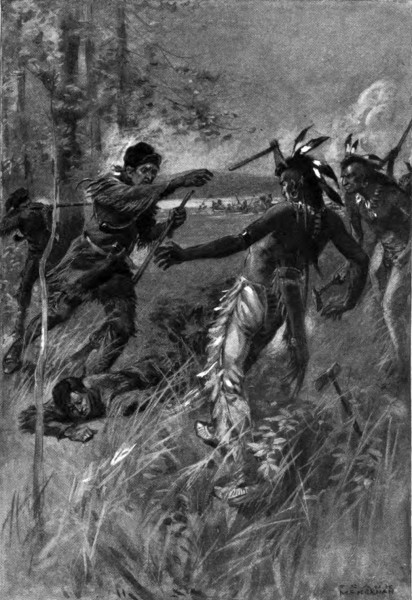
spurred him onward. Presently a savage whoop of
triumph broke upon his ears and the next instant
he was upon the scene.
The animals had plunged into the thicket and
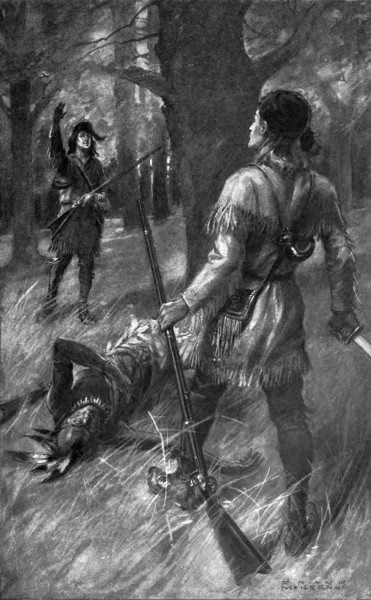
scattered. Six figures lay upon the earth, still in
death. Five Indians, each exultantly brandishing a
bleeding scalp, were in the act of diving into the
neighboring undergrowth. A sixth bent over one
of the prostrate forms, with his fingers entwined
in the hair and knife raised to make the circular
sweep in the crown of the head. Boone’s rifle went
up, and had hardly touched his shoulder before it
spoke. The Indian dropped, shot through the brain.
The father had the poor consolation of having
saved his boy’s body from mutilation. That to a
backwoodsman was a source of satisfaction, but it
did not go far towards mitigating Boone’s present
grief. He stood for some minutes, leaning upon
his rifle and looking down at the face of his dead
boy. The convulsive twitching of his features told
of the inward commotion. But there was urgent
duty at hand and Boone sternly put his grief behind
him and turned to it. When he lifted his head, his
companions saw that the features, though drawn,
were calm and the eyes keen and alert as ever.
Reloading his rifle, Boone stepped into the forest
at the point where the Indians had disappeared. In
ten minutes’ time he rejoined the anxiously waiting
men.
“Only seven,” he said. “No likelihood of another
attack. McCurdy, you go and fetch back
five men—and don’t tell them what’s happened as
yet.”
With the reinforcement, the party set to work
digging a broad and shallow grave, in which they
laid their dead without further preparation or ceremony.
It was but an incident of backwoods life
and the men who performed the service to-day might
be in need of it to-morrow. Having marked the
grave with stones and blazed some neighboring
trees, they rejoined the main body, which resumed
the march, leaving the cattle to be sought for the
next day.
A little farther on, the party came upon a favorable
spot and went into camp for the night. As
soon as Boone had made the shelter for his family
and built a fire, he devoted himself to comforting
his stricken wife. But even this task could not be
pursued uninterruptedly. The camp needed guarding
with special vigilance. It is true that Boone
believed the attack of the afternoon to have been
made by a small party of wandering Indians who
killed the settlers for the mere sake of securing their
scalps. On the other hand, they might have been
a scouting party sent out by a large band. Although
Boone was as fearless as any man that ever lived,
he was never imprudent, much less reckless. In
the course of their conversation Mr. Sproul had said
something about “trusting to Providence.” The
hunter had replied that he didn’t “believe in trusting
to Providence until you have done all you can
for yourself. After that, Providence is much more
likely to lend a willing hand.”
As soon, therefore, as the other settlers had composed
themselves to rest, Boone went out and seated
himself upon a fallen tree, prepared to spend the
night in watchfulness. His ears were alive to the
slightest sound and he could instantly detect the
origin of each. Now and again the stillness of the
forest would be broken by the howl of a wolf, or
the hoot of an owl. At such times the hunter would
raise his head and listen intently, for the Indians
imitated the cries of birds and animals in signalling
to one another. Boone was himself a very good
hand at that form of reproduction and was seldom
deceived by the performance of another.
Boone’s vigil had extended to the gray dawn when
his attention was attracted by a dim figure moving
on the farther side of the camp. He thought that
it was probably one of the settlers suffering from
indigestion or, perhaps, walking in his sleep. However,
prudence demanded that he should stalk the
figure, and he accordingly slipped noiselessly round
the back of the shelters in his moccasined feet. The
manœuvre brought him suddenly within sight of the
person at a few feet distance. The light was just
strong enough to enable him to discern the form of
a youth who was struggling to suppress the sobs that
convulsed his frame at intervals.
Boone took the boy by the arm and gently led
him to the fallen tree by his own camp fire.
“Sit down,” he said. “Now, what’s the trouble,
young man?” He spoke in a low, soft voice that
told the lad that he had fallen in with a friend.
“Take your time,” continued the hunter, soothingly;
“I know it hurts, whatever it is, and you’re taking
it like a man, anyhow.”
He placed an arm across the boy’s shoulders and
the youngster felt the touch strengthen and calm
him as had not all the comforting words of the
sympathetic settlers’ wives. After a while he controlled
himself sufficiently to speak.
“My father was killed yesterday,” said the lad,
at last, “and—and I didn’t see him.”
“Too bad, too bad,” said Boone, drawing the
boy closer to his side. “I wouldn’t worry about
not seeing him, though. I saw him—I buried him,
and he looked peaceful and I don’t doubt is happier
than you or me at this moment. Where’s your
mother, young man?”
“Mother died long ago, before we left England.”
“You don’t mean that you’re all alone?”
“Yes, now that father’s dead, I’m all alone.”
The thought of his utter loneliness overcame the
lad, and for a few minutes he was again shaken
with grief. Boone waited silently until the boy
had somewhat recovered himself. Then he asked:
“What’s your name?”
“Hardy Goodfellow, sir.”
“I like that name,” said the hunter. “Hardy
Goodfellow sounds like it ought to fit a backwoodsman.
What are you going to do, Hardy?” The
hunter did not wait for an answer to his question
but went on: “We can’t leave you here and there’s
no way of sending you back, at present. Do you
want to go on to Kentucky, Hardy?”
“Yes, I’d rather go on,” replied the lad. “I
think father would want me to, if he knew.”
“Why do you think he would?”
“Well, I’ve often heard him say he hated to see
a man turn back when he’d once started to do anything—but,
of course, I’m not a man.”
“I’m not so sure of that, Hardy. You don’t need
to have a certain number of years nor a certain number
of feet to be a man, leastways not in the backwoods.
It’s more a matter of the heart and head,
Hardy, and I think you’ve got as much pluck and
sense as many of your elders.”
After this speech the hunter lapsed into silent
thought and so sat for ten or fifteen minutes. When
he turned again to his young companion it was with
an air of satisfied decision.
“Hardy, the same Injuns that killed your father
killed my son. The eldest he was—the other’s only
a baby. Now, if you’re willin’, I’ll try to take the
place of your father and you shall take the place of
our Jim. What do you say?”
The boy strove to speak but his emotions choked
him. He looked up at Boone and the hunter could
see gratitude and joy written on his face.
“Shake on it—that’s enough,” said Boone, extending
his hand. “That’s settled, then, and I
don’t think either of us will ever be sorry for the
bargain. My woman will make you a good mother
and I’ll go bail you’ll make her a good son. Now
crawl into your new home, Hardy, and get an hour’s
sleep. I’ll stretch my legs a bit.”
It may seem strange that Boone should on such
short acquaintance have taken a boy into his family
on the footing of a son. However, Boone’s judgment
of human character amounted to almost unerring
intuition and he felt strongly drawn towards
Hardy, largely perhaps on account of his recent
bereavement. Moreover, he was not devoid of the
backwoods trait of superstition, as was evidenced by
his muttered remark as he turned on his heel after
seeing the boy enter the shelter: “Maybe the Lord
meant it that way—who knows?”