“Why don’t you call them tonight? We’ve got to
know pretty soon.”
The speaker was Arthur Cook, a deeply tanned
giant of a man with close-cropped graying hair,
whose piercing blue eyes told of a lifetime spent in
open spaces. He was talking to a boy of sixteen
who had wrapped himself around a dining-room
chair and was staring thoughtfully down at a map
on the table.
“What do you say, Sandy?” Mr. Cook urged.
“Want me to ring the operator?”
Sandy Steele looked up with sudden decision.
“All right,” he said. “We’ll get it settled right
now.”
8
“That’s the ticket!” chimed in Mr. Cook’s son,
Michael, as he shouldered his way through the
swinging kitchen door, a glass of milk in one hand
and an enormous slice of layer cake in the other.
“Then we can start making plans right away.”
“If you think you can spare us the time from
your hobby,” his father said dryly.
“Hobby?” Mike’s jaws closed down over the
cake. “What hobby?”
“Eating. Or has it become a full-time job with
you?” Mr. Cook turned to Sandy. “Ever see anybody
eat so much?”
Sandy shook his head in mock amazement.
“That son of yours sure can stash it away!”
Mike drained half the glass of milk in one gulp
and grinned over at them. “A long time ago,” he
told them, “I made up my mind never to eat on
an empty stomach. That’s why I always have a
snack before dinner.” He finished the rest of the
milk hastily. “That reminds me. Mom said to
clear all these maps out of the dining room. Soup’s
almost on.”
Mr. Cook got up and headed for the door to the
hallway. “I’ll just have time to place the call.
What’s your number, Sandy?”
“Valley 5-3649.”
“Thanks. Mike, you take care of things in here
for your mother.”
9
“Sure ... and hey, Dad!” Mike looked earnestly
at his father.
“What?”
“You can sound awfully convincing if you want,
so make it good, huh? It’d really be great if Sandy
could come along.”
Mr. Cook laughed and disappeared through the
door. A moment later the boys heard him dialing
the long-distance operator.
“Well?” Mike demanded as he gathered in the
scattered maps. “What do you think?”
Sandy shrugged. “It’s hard to say. I don’t see
why not, though. School’s out for the summer and
we haven’t made any plans of our own.”
“Guess we’ll just have to hold our breath,”
Mike said and started for his father’s den with the
papers he had collected. “Tell Mom the decks are
clear.”
10
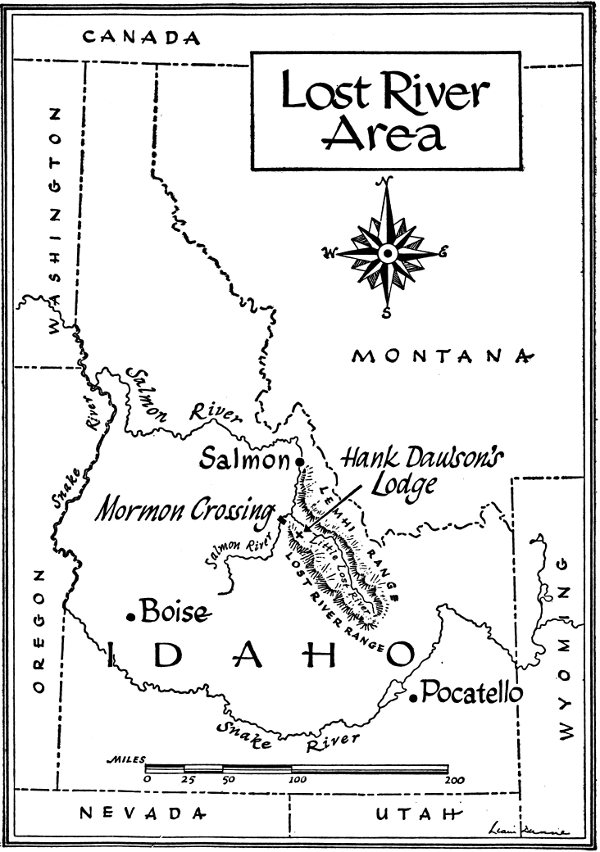
“Okay, but let me see that map again.” Sandy
reached out and took a large-scale National Geographic
map of Idaho from the pile Mike was
carrying. A rough red crayon circle had been
drawn around the Snake River country in the
southern part of the state. An X was placed further
north near the town of Salmon and a thin line
followed the Lost River down through a blue-gray
area known as the Lost River Range. Judging
from the color of the map, the altitude there
varied between 8,000 and 11,000 feet. There
wasn’t a sign of a town or a road for miles. It was
real Rocky Mountain country, unspoiled, wild
and beautiful, exactly as Sandy had always hoped
one day to see it.
And now, at last, he had a chance. Mr. Cook
and Mike were planning a pack trip along the
Lost River and they wanted to take him along.
In his mind’s eye he already saw the rugged splendor
of the mountains, smelled the pungent smoke
of a crackling campfire after a full day’s hunting
or fishing.
“Hey, wake up! You look as if you’re dreaming.”
It was Mike, back from his father’s den.
Sandy looked over at him, shook his head and
sighed. “I was, Mike, I really was.”
Mike clapped a sympathetic hand on his friend’s
shoulder. “Worrying won’t help. Why don’t you
hunt up Dad and see how he made out? I’ll call
you when dinner’s ready.”
11
Sandy smiled back and nodded. He had known
Mike and his parents for only a little over ten
days, but already they were like a second family
to him. He had heard about the Cooks for about as
long as he could remember. Mr. Cook was his
father’s oldest friend. The two men had met early
in their careers and had worked on a number of
projects together. John Steele was a government
geologist, while Arthur Cook was a mining engineer—one
of the best in the business, according to
Sandy’s father.
Their work took both men away from home a
great deal of the time, and for years they had been
trying, without success, to bring their families together.
Finally, about three weeks ago, a letter arrived
from Mr. Cook, inviting all three Steeles to spend
the first two weeks of the summer vacation in
Oakland, across the bay from San Francisco.
“Throw some camping gear into your car,” Mr.
Cook had advised. “We might all take a run up
to Lake Tahoe for some fishing. Sandy and Mike
have never met, but I can’t think of a better way
for the two boys to get acquainted than in the
middle of a trout pool.”
To Sandy’s intense disappointment they had to
turn down the offer. His father was snowed under
with paper work at the office and he couldn’t spare
the time.
But by return mail a second letter arrived.
Why not send Sandy alone? There didn’t seem to
be any objections, and so it was arranged.
12
Mike was a chunky, junior-sized version of his
father, with dancing blue eyes and a tendency
to leap into things without thinking. Sandy
was on the slender side, with a strong, good-humored
mouth and a shock of unruly blond
hair that never seemed to stay down properly.
Despite their differences in appearance and personality,
the two boys hit it off right from the
start. And when Mr. Cook announced his plan for
a month’s trip through Idaho, it was assumed
that Sandy would come along, provided, of course,
that he got his parents’ approval.
Mr. Cook appeared at the dining-room door.
“Your father’s on the wire,” he said. “Want me to
talk to him first?”
Sandy nodded briefly and followed Mr. Cook
out into the hallway. Mike, who had overheard the
exchange from the kitchen, slipped out and joined
them.
13
Mr. Cook picked up the receiver, winked at
Sandy and spoke into the mouthpiece. “Hello,
John; how have you been?... Good. John, I
have a favor to ask. Mike and I are planning a
camping trip up to the Rockies and we’d like
Sandy’s company.... Where? North of the Snake
River country, in the Lost River Range. It’s for
a month, but I think it would be four weeks
the boys will never forget.... What?... Oh,
don’t worry about that. We have plenty of equipment....
Yes, we’d leave in three days and be
back about the tenth of next month.... What’s
that? Well here, why don’t you ask him yourself?”
Mr. Cook cupped a hand over the mouthpiece
and nodded to Sandy. “He wants to know how you
feel about it.”
“Let me talk to him!” Sandy nearly tripped
over the rug in his hurry to get to the phone.
“Hello, Dad!” he shouted. “How do I feel about
it! I think it’s a chance of a lifetime!” There was
a pause as Sandy listened carefully for several
minutes. “Sure,” he said at last, a grin of delight
creeping over his face. “You bet! Great, Dad! I’ll
wire you as soon as we get back. Goodbye and
give Mom a hug for me!”
Sandy put down the receiver and looked at the
Cooks with a dazed smile of happiness. “It’s all
set!” he breathed. “What a great guy!”
Mr. Cook beamed his pleasure as Mike bounded
over to Sandy and walloped him exuberantly on
the back. “Attaboy, Sandy! I knew it all along!”
14
“Well,” said Mr. Cook. “Congratulations on becoming
an official member of the expedition. Soon
as dinner’s over, we’ll go into the den and do a
little homework—draw up a list of the things we’ll
need and talk over the kind of country we’ll
be going through.” He looked over at Mike with
a smile on his face. “But let’s wait till after we’ve
eaten. If we get to talking about it at table, your
mother won’t be able to get a word in edgewise.”
All through the meal, Sandy tried to put
thoughts of the trip out of his mind, but with
little success. His attempts at polite table talk
only brought amused glances from Mrs. Cook.
Mike, too, seemed preoccupied, even to the point
of refusing a third helping of fried chicken—an
event that so stunned his mother that she almost
forgot dessert.
When they finally finished, Mr. Cook pushed
back from the table and stood up. “And that, I
think,” he said, smiling gently, “was the quietest
meal ever eaten in this house. You fellows are a
couple of real sparklers in the conversation line.”
“Well, Dad ...” Mike began to protest.
Mr. Cook held up his hand. “I know. I know.
You want to talk about the trip. I don’t blame you.
So do I. Come on in here and let’s get it off our
chests.” He led the way into his comfortably
furnished den and paused before a pipe rack.
The walls of the room were hung with Mr. Cook’s
hunting trophies. Two whitetail deer flanked a
stone fireplace, and over the mantel loomed the
head of a huge Alaska brown bear. At one end of
the room, rows of bookcases shared wall space
with a gleaming walnut gun cabinet.
15
Mr. Cook selected a pipe, fingered some tobacco
into the bowl and dropped into a chair near the
fireplace. “Now,” he said. “Let’s have some
questions. The floor is open for discussion.”
Both boys started together.
“Do you think I’d better ...” Sandy blurted.
“How are we going to ...” Mike began.
They looked at each other and grinned.
“After you, my dear Alphonse.” Mike bowed
solemnly. “You’re the guest.”
“Go ahead, Sandy,” Mr. Cook invited.
Sandy leaned forward in his chair. “I was going
to ask if I should send for my rifle. I have a .22 at
home.”
Mr. Cook laughed and put down his pipe. “I
don’t think you’d use it once, Sandy,” he said.
“This is big-game country we’re going into. We’ll
see mule deer and elk, pronghorn antelope and
mountain goats. If we’re lucky we may even spot
a grizzly or a bighorn sheep. And we’re almost
certain to run into a mountain lion or two.”
“A mountain lion,” Sandy breathed. “What a
trophy that would make. I bet Pepper March
never even saw a mountain lion!”
“Who’s Pepper March?” Mr. Cook asked.
16
Sandy scowled. “Somebody I know back home,”
he said.
Mr. Cook smiled. “You don’t seem to like him
much.”
“Oh, he’s all right,” Sandy explained. “It’s just
that he gets under my skin sometimes.”
“What would you do with a mountain-lion
trophy?” Mr. Cook asked. “Do you have room
for him at home?”
Sandy thought a moment. “I guess you’re
right,” he said. “But I know what I could do.”
“What?”
“Start a trophy room at Valley View High.
Jerry and I could build some cases, and Quiz—he’s
our brainy friend—could write up descriptions
of all the animals—like they have in natural-history
museums.”
Mr. Cook nodded approvingly. “Good idea. A
museum’s the perfect place for a lion. But over a
fireplace, I’d rather have a six-point buck any
day.”
“How do you rate big-game trophies, Dad?”
Mike asked.
17
“That varies with the animal,” Mr. Cook replied.
“An elk, for example, is measured for
spread between antlers, and the number of points—or
branches—growing out of each antler. If I
remember rightly, the record elk had a spread
of nearly seventy inches and about seventeen
points.”
“Whew!” Sandy whistled. “He must have been
built like a truck!”
“He was a real granddaddy, all right,” said Mr.
Cook and smiled at the memory. “But to get back
to your question about guns, Sandy. Here are the
cannons we’ll be taking along.” Mr. Cook got up
and moved over to the gun rack at the end of the
room.
“For power shooting, we’ll use this Weatherby
.300 Magnum. And I think you boys ought to get
used to this one.” Mr. Cook reached up and
took down a beautifully balanced bolt-action rifle.
“That’s a Remington 721 in a .30/06 caliber. It’s
lighter than the Weatherby but it packs quite a
punch.”
“Enough to bring down a mountain lion?”
Mike asked eagerly.
Mr. Cook looked at the two boys and allowed
a slight smile to play at the corners of his mouth.
“Since you both seem to have mountain lions on
the brain, I’ll tell you something I was going to
keep a secret ...”
18
But before he could finish, the sound of a telephone
bell tinkled softly from the desk in the
den.
“I’ll take it here, Julia!” Mr. Cook called as he
reached for the receiver. “Hello,” he said. He
listened for a moment, then broke into a beaming
grin.
“Hank Dawson! You old son of a gun! Good to
hear from you.” With the telephone still cradled
to his ear, he maneuvered the cord across the desk
and sat down in the chair behind it. “So you got
my telegram.... Yes, we’ll be there. On the
eighteenth. Oh, and Hank—bring along kits for
four. That’s right. A friend of ours is coming
along. A lad named Sandy Steele. Right. See you
then. Goodbye.”
Mr. Cook put down the telephone with a
chuckle and swiveled around to face the boys.
“Well,” he said. “Speak of the devil ...”
“Who was that?” Mike demanded.
“That, Mike, was about the best professional
guide and hunter in the Rockies. His name’s
Hank Dawson and he has a honey of a hunting
lodge up in the Lost River Range. The three of
us have a date to meet Hank on the eighteenth.
He’s meeting us with pack mules and horses at a
place called Mormon Crossing on the Lost River.
I think you’ll like Hank. He shares an enthusiasm
of yours.”
19
“What’s that?”
“Mountain lions. His hobby is going after the
big cats. He makes a good bit of money collecting
the bounty on their hides. Hank says he wants
to take us up in the hills for a cougar hunt.”
Mike jumped to his feet and gave a war whoop
that rattled the windows. “Where exactly is this
place we’re going to?” he asked excitedly. “What’s
our first stop in Idaho?”
“Which question do you want me to answer?”
“Where are we going first?”
Mr. Cook spread the map over his desk. “Here,”
he said, pointing the stem of his pipe at the juncture
of three rivers in central Idaho. “Near the
town of Salmon. We’ll stop there, hire some boats
and a guide and get you two fellows used to a little
white water.”
“White water?” Sandy’s expression was blank.
“Rapids. We’re going to have to run dozens on
our trip downriver. They’re dangerous, too. We’ll
portage our way around the worst ones, but we’ll
go through most of them. By the way, do you know
what portage is?”
“Not exactly, no,” replied Sandy.
20
“Well, it’s simple enough. When you get to a
part of any stream that isn’t navigable for one
reason or another, you pull in to land and tote
everything, including the boat, to the next navigable
part.”
“‘Simple,’ he calls it,” groaned Mike.
“It’s hard work, of course; but you’ll both come
back in better shape than you’ve ever been in
your life.”
Mike scrambled to his feet. “In that case,” he
announced, “I’m going to have to start preparing
myself. I think I remember a little cold chicken
going back into the icebox, and that’s no way to
treat chicken!” He started for the door.
“But you just finished dinner,” his father
pointed out.
“I know,” Mike shot back over his shoulder.
“But I didn’t do a very good job of it. Too busy
thinking about the trip.”
Mr. Cook made a notation on the paper in front
of him. “Item one on our list. Hire the Queen
Mary as a provision ship so Mike will never have
to go hungry.”
“The Queen Elizabeth’s bigger,” Mike called
and disappeared into the kitchen.
21
CHAPTER TWO White Water
Four days later, Sandy and Mike stood on the
pine-cloaked southern bank of the Salmon River,
looking down on a patch of foaming water that
boiled and hissed over jagged rocks, gleaming wet
with spray.
The boys stared at each other wordlessly. Sandy
was the first to break the silence. “What did your
father call this place?” he asked.
“Kindergarten Rapids,” Mike answered in an
awed voice. “He said it was a nice easy run to
start with.”
22
The boys turned back to the river. From where
they watched, they could see a tiny flotilla of
bright, orange-colored air rafts bobbing along in
the quiet water above the rapids. At first the
rafts seemed to float lazily downstream, but as
they approached the rapids, they gradually picked
up speed until they looked like miniature beetles
racing along to certain destruction on the shoals
ahead.
Within seconds the lead raft had entered the
white water. At first contact, it veered wildly to
one side and was thrown roughly into the air.
Miraculously it landed right side up, but was
immediately caught by the relentless current and
carried with express-train speed toward a narrow
ledge of rock.
Sandy started to raise his hand and strained
forward. Beside him, Mike cried out a warning.
But before they could move, the tiny, fragile-looking
craft had skimmed past the edge of the
rock, missing it by inches, and was careening
wildly down the last of the rapids toward a quiet
pool in the bend of the river. Scurrying gaily
behind the leader came three others and finally a
fourth.
Mike sighed audibly. “Wow! So that’s Kindergarten
Rapids! Where do I go to get sent back a
class?”
23
Sandy leaned down to pick up the raft and
paddle he had brought with him. “Come on, boy,
might as well face the music and get our first
lesson.”
“All right,” Mike grumbled, reaching for his
equipment. “Just write my mother a nice letter.
That’s all I ask.”
They trudged along in silence for a few steps.
“Say, who is it we’re supposed to look up?” Mike
suddenly asked.
“Doug Henderson. He’s the son of the man who
rented us the cabin. Mr. Henderson said he’d be
expecting us.”
“I sure hope he knows what he’s talking about!”
“According to Mr. Henderson, he’s been running
these rapids ever since he was seven years
old.”
Mike shook his head. “What some people will
do for fun!”
The boys scrambled down the side of a steep
embankment and approached the river. Crowded
around a homemade dock directly ahead of them
were several boys about ten or eleven years of
age. Except for the youngest ones, who had on
bathing trunks, all the boys were dressed in faded
dungarees and T-shirts. Sandy and Mike ambled
up to the dock and hailed a sturdy lad who was
busy inflating his canvas raft.
24
“Do you know where we can find Doug Henderson?”
Sandy asked.
The boy looked up and pointed. “Sure. Hey,
Doug!”
A friendly face covered with freckles popped up
from the other side of the dock. “Hi!” he called.
“You the fellows that Pop sent over?”
Out of the corner of his eye, Sandy saw Mike’s
jaw drop. “That’s right.” He smiled. “Think you
can teach us to handle these?” He held out a raft.
The boy rubbed his hands along the sides of his
dungarees and vaulted over a wooden piling sunk
into the ground. “Sure!” he cried confidently.
“Nothing to it!”
“So he’s been running these rapids ever since he
was seven years old!” Mike murmured. “That
gives him about three weeks’ experience.”
As usual Mike was exaggerating. Doug, though
small, was nearly eleven and he had all the assurance
of a qualified expert in his field.
“You’re going down the Lost River.” It was
more a statement than a question.
“That’s right.”
The boy shook his head in envy. “Lucky. It’s
wonderful country. Have you got a guide yet?”
“My father’s out arranging for one now,” Mike
said.
25
“Hope he gets a good one. It makes all the difference.”
He pronounced this judgment with so
much grown-up seriousness that Sandy had to
fight to suppress a smile.
“You’re right,” he acknowledged, “but it won’t
make any difference to us unless we can learn how
to shoot some of those rapids.”
“All right, let’s have one of your rafts.”
Sandy handed over his and watched carefully as
Doug Henderson flopped it on the ground.
“Now the important thing to remember is
balance. Sit in the middle of the raft with your
knees wedged tight against both sides—like this.”
He hopped in and demonstrated.
“Don’t tense your body but keep your legs
firm. Make sure your middle is loose so you can
turn your shoulders in both directions. You want
to be ready to handle trouble no matter what side
it comes from. Okay so far?”
Sandy and Mike nodded gravely.
“You fellows know how to handle a canoe?”
They both nodded a second time. “Good. Then
we don’t have to go into steering. Come on over
here and I’ll tell you about the rapids.”
He led the way down to the end of the rickety
dock toward the white water and launched into a
lecture that took nearly twenty minutes.
26
It turned out that Doug knew every ripple and
wave in the Kindergarten Rapids. He told them
what to expect in the way of currents, where a
whirlpool was likely to form, how to fight clear of
the rocks and what to do if they got thrown into
the water.
When he finished, he turned to them with
finality. “And now you’re ready to try it,” he announced.
“You’ll get dumped but don’t let that
bother you. Everybody does. But you’ve got to
remember to take it easy. If you stiffen all up,
you’re bound to tip over. Ready?”
Mike scratched his head and shrugged his
shoulders. “Nope. But I guess that doesn’t make
any difference. Who’s first?”
“We’ll all go together,” their freckle-faced instructor
ordered. “You two go on ahead and I’ll
bring up the rear. That way I can tell you what
you did wrong when we get through the run.”
“If we get through,” Mike muttered, sliding his
raft into the water.
“Oh, you can’t help getting through,” Doug
called out reassuringly. “Even if you’re dead, the
current’ll carry you.”
27
“Thanks a lot,” Mike said as he got ready to
cast off. “That takes a big load off my mind.” The
next instant the current was carrying him into the
middle of the river.
Sandy took a firm grip on the sides of his raft
and followed. Even as he scrambled to keep his
balance, he could feel the river tugging insistently
at his tiny craft. Bracing his knees, he reached
down gingerly to grab his paddle. The current was
much stronger than he had imagined.
Suddenly a crosscurrent caught him amidships
and sent him rolling violently, like a cork on an
angry sea. Every muscle in his body tightened as
he swayed back and forth to keep upright. Then
he remembered Doug’s advice: “Don’t fight the
current. Ride with it and relax.”
Sandy took a deep breath and forced himself to
ease up. Almost immediately he felt more confident.
The rocking motion continued, but he was
on top of each swell, his entire body moving gracefully
with the raft and not against it.
Just as he was beginning to enjoy the ride, he
heard the first rushing noise of the rapids and he
was catapulted forward. It crossed his mind that
this was like going off a high diving board; there
was no turning back. Then suddenly he was too
busy to think. Everything became a series of reflex
actions.
28
The raft spun with a snap and he was shooting
off to the right. Sandy leaned back on his haunches
and stabbed the paddle down into the water at his
left. The shaft bit into the river and slowly hauled
him back on course.
He heard a loud smack and felt himself flying
through a curtain of white spray. There was a
sickening bump and he was back on the river,
riding furiously through a world of roaring noise
and bone-jarring motion. A long ledge of rock
loomed up ahead. Sandy brought the paddle up
and pushed with all the strength in his shoulders.
His little raft bounced away and was flung sideways
into a channel between two ledges. Doug
had told them that this was the fastest point in the
rapids and he was right. Sandy’s raft quivered like
a live animal as it shot through the funnel of
rushing water, twisting steadily to the left.
Further and further it leaned until water licked
hungrily over the sides. Sandy knew he had to
right himself quickly and jammed all his weight
down on his right knee. As he did, an invisible
hand seemed to pluck at him and he felt himself
pitch over. The paddle shot from his hand, and in
the next moment the waters of Salmon River
closed over his head.
29
The current carried him, bouncing him around
like an old sock in a washing machine, for another
thirty yards. Finally he was swept into a pool of
relatively quiet water. He cut for the surface,
blinked the water out of his eyes and looked up
to see a grinning Doug Henderson sitting calmly
in his raft, fishing for Sandy’s lost paddle.
“Nice try!” Doug nodded approvingly. “But
you got too tense toward the end. Head for shore
and we’ll go through again.”
Sandy flashed the boy a grin and struck out for
the near bank where Mike, looking mournful and
disgusted with himself, was hauling himself out
of the water. As Sandy reached shore, Mike leaned
down and held out a hand.
“I won’t need a drink for a week,” Mike announced,
pulling Sandy up beside him. “I just
managed to swallow half the river. A couple more
tries like that and there won’t be any rapids to go
through.”
Sandy ran a hand through his dripping hair and
looked back at the rapids. Half a dozen rafts were
shooting through them with ease. He shook his
head in admiration. “Look at them,” he said
purposefully. “If they can do it, so can we.”
Mike nodded vehemently. “Now you’re talking.
Let’s go!”
30
Two hours and over a dozen tries later, Doug
was ready to graduate both of them from the
Kindergarten Rapids. “See,” he said, spreading
his hands in a gesture of finality, “all it takes is a
little practice. You fellows could get through
there now blindfolded.”
“Maybe,” Mike admitted. “But I’ll wait for a
while before I try it.”
They were standing near the dock, toweling
themselves vigorously after four successful runs
in a row, pleased at having mastered a new skill.
The crowd had grown since early morning and,
along with the younger boys, there were a number
of older teen-agers dressed in flashy cowboy boots
and sombreros. The older boys eyed Sandy and
Mike from under their hats.
“Who are the characters?” Mike demanded.
Doug squinted over at them and made a wry
face. “Oh, those! Don’t pay any attention to them.
I guess they heard you were around and came over
to see the fun.”
“Well, the show’s over,” Sandy said as he picked
up his raft. “We’ve got to get back to your
father’s.”
“I’ll go along with you,” Doug said. Suddenly
he stopped and ran forward. “Hey!” he cried.
“That’s my paddle!”
31
One of the older boys was walking away with
Doug’s ash-wood paddle. He stopped when he
heard the challenge and turned insolently.
“Prove it,” he snapped.
Doug planted himself in front of the boy and
made a grab for the handle. “There’s a notch up
there on the hand grip. Give it to me and I’ll show
you.”
The older boy winked at his companions and
held up one hand. “I’ll look,” he said. Carefully
shielding the handle so that Doug couldn’t see it,
he stared down at the wood. When he looked up,
he was grinning. “You’re wrong, kid. There’s no
notch. Now beat it.”
Sandy felt a sudden surge of anger as he moved
forward to stand beside Doug. “Let me take a look
at it,” he said slowly. He could feel his face flush
in an attempt to hold down his temper.
The older boy turned to Sandy and stared at
him rudely. A faint smile twisted at the corner
of his mouth. “Well, well,” he drawled. “A real
river expert, now, eh? Know all about rafts and
paddles and such. Little Doug here got you
through the course.”
“He did all right,” Sandy snapped. “Now, let’s
see the paddle.”
“Are you going to fight for it?” The question
came as a mocking taunt.
32
“If I have to.”
The older boy made a clicking sound with his
tongue and shook his head reproachfully. “That’s
no way to act. Suppose we settle this with a little
bet.”
“What kind?”
The older boy dug the paddle into the ground
and leaned on it easily. “Now that you’re such an
ace in white water, let’s you and me go through
some rapids. Whoever gets dumped loses. The
winner gets to keep the paddle.”
Sandy shook his head firmly. “The paddle
doesn’t belong to either of us, win or lose.”
“Afraid?” The question came like a slap in the
face.
“No.”
“I think you are.”
Sandy breathed heavily, but managed to keep
his temper. “All right,” he said, biting off each
word separately. “I’ll go through any rapids with
you. But we’ll settle the business about the paddle
afterwards.”
“Done!”
Doug shook his head and grabbed Sandy’s arm.
“Don’t do it!” he pleaded. “He’s not going to take
you down the Kindergarten.”
33
“That’s right,” the older boy nodded. “I
wouldn’t ask an expert like you to go down a playground
for kids. We’ll try something more interesting.”
Mike moved up beside Sandy and grabbed his
shoulder. “Take it easy, Sandy,” he said softly.
“Don’t get stampeded into anything.”
Sandy’s face was white and stubborn. He shook
his head doggedly. “Thanks, Mike, but this is the
way I have to do it.” He turned to the older boy.
“Where is this white water of yours?”
“It’s right down the bend of the river near a
place called Dog Leg Falls.”
There was a gasp from Doug. “Don’t do it,
Sandy!” he begged. “Forget about the paddle.
You don’t know that part of the river. Two men
got drowned there last year.”
Sandy looked steadily into the older boy’s grinning
face, then walked over and picked up his raft
and paddle.
“I’m ready whenever you are,” he announced in
a quiet voice.
34
CHAPTER THREE Dog Leg Falls
The boy standing opposite Sandy grunted. “Okay,
champ,” he said mockingly. “Follow me.” He
swung the paddle up over his shoulder and was
halfway up the embankment when Mike’s voice
rang out.
“Just keep walking. We’ll find our own way.”
Mike was amazed at the edge in his words. He
hadn’t realized he was so angry.
The boy stiffened in exaggerated surprise and
turned. He did it so slowly that it was more of an
insult than an acknowledgment. A sneering smile
played over his face as he stared at Mike.
“Well, well,” he drawled. “Another county
heard from. Maybe you’d like to ...”
35
“Cut that kind of talk and get out of here!”
Mike’s tone was curt and hard. He took a few
steps up to the boy and looked at him squarely.
The boy dangled the paddle carelessly from one
hand and came down a few steps toward Mike.
“You wouldn’t be thinking about running out—now
would you?”
“I don’t think I’d ask that question if I were
you.” Mike’s tone was deceptively soft but there
was no mistaking the fire in his eyes. He glanced
over at the boy’s paddle. It was swinging in a
wider arc, drawing closer to him with each step.
“And I’d put that paddle down before somebody
gets hurt.”
For a moment Mike thought the boy was going
to charge him. He shifted his weight and got himself
ready, but the attack never came. The paddle
suddenly stopped as the boy spun around on his
heel and moved back up the embankment, motioning
for his friends to follow. Silently they trooped
along.
Mike took a deep breath and relaxed. Then he
turned and joined Sandy and Doug at the dock.
“Whew!” Doug whistled admiringly. “You
really gave it to him!”
36
“It didn’t take much, Doug,” Mike replied,
keeping his eyes on Sandy’s worried face. “Hey,
Sandy,” he said softly. “You sure you want to go
through with this?”
Sandy flashed him an amused look. “Want me to
run away?”
“No, but ...”
“Then I guess that’s it. I’m in too far to back
down now.” Sandy reached out for his raft. “The
only thing I need now is some information. How
about it, Doug?” he asked. “Do I get a briefing on
those rapids?”
Doug shuffled over to Sandy, one toe digging
into the piled-up sand along the dock. “Sandy ...”
he began in a troubled voice.
Sandy held up a hand. “That’s enough,” he
said good-naturedly. “The only lecture I want to
hear from you is how to get myself through those
rapids I’ve let myself in for.”
Doug stared up at him in momentary indecision.
“All right,” he said. “But let’s wait till
we get there.”
Dog Leg Falls was about a mile upstream from
the Kindergarten Rapids, in a wild and barren
part of the river.
37
Mike took one look at the wild water, plunging
noisily through the funnel of rocks, and smiled
weakly over at Sandy. “Wonder where you turn
off the faucet?” But it wasn’t much of a joke and
nobody laughed.
Down by the falls—which weren’t really falls at
all, but a series of turbulent runs of water—the
banks of the river closed in on the channel like
two jaws, wrenching it violently around in a sharp
L-shaped turn. Through this narrow trough, the
water snarled and fought its way, cascading over
the rocks at the bend in towering sheets of spray.
On any other day, Sandy thought to himself, the
rugged beauty and awesome power of the river at
Dog Leg Falls would make an exciting spectacle.
On this particular day, however, it looked vicious
and threatening.
Sandy tore his eyes away from the river and
forced himself to listen to what Doug Henderson
was saying.
“... there’s really only one bad place. It’s just
at the turn. See how the river curves to the left?”
Sandy shaded his eyes and peered over at the
spray. He nodded silently.
“Well, the current will try to pull you over to
those rocks on the right. You mustn’t let that
happen. ’Cause if you get dumped too near the
rocks, there’s an undertow that’ll grab you.”
38
“Won’t it carry me along through the channel?”
Doug shook his head. “No, it won’t. It’ll tangle
you up in the rocks. They look solid from here,
but they’re not. There are all sorts of crevices and
things, worn out by the water pounding against
them. That’s why it’s so dangerous.”
There was a puzzled look on Sandy’s face. “I
don’t get it.”
“The crevices,” Doug explained patiently, “can
catch you just like a trap. You can put your foot
in one of them and never get it out. It’ll hold you
under the water until you—” He faltered and
looked away.
Sandy nodded in grim understanding. “How do
I keep away from them?”
“When you enter the channel stay over to the
left as far as you can. Keep steering to the left no
matter what the current does. If you’re over far
enough, you’ll make it with about three feet to
spare. Think you’ve got it?”
“I think so. Let’s get this thing over with.”
“You’re sure you’re all set?” Mike asked anxiously.
“Yep.”
Mike held out a hand. “Good luck, Sandy,” he
said solemnly.
39
Sandy, who looked surprisingly cheerful,
grinned confidently. “There’s nothing to it. All
I have to do is remember what Doug told me.
Come on.”
Sandy led the way down to the water where
about twenty silent boys were gathered in tense
expectation. Mike took a place near them and
watched Sandy wade a foot or two into the river.
Standing by helplessly, he had an overpowering
urge to shout out, to stop the competition
that was about to take place. But before he could
make a move, Sandy turned, threw Mike a wink
and swung into his raft. A second later he was
floating out from shore. The older boy pushed
off directly behind Sandy.
With Sandy in the lead, the two rafts shot
toward the narrow opening of Dog Leg Falls.
From where he stood, Mike could see that Sandy
was holding the course Doug had charted. The
tiny raft trembled and tugged to the right, but
Sandy held her steady.
Mike felt a small hand grip his elbow with surprising
strength. “He’s going in just right.”
Doug’s voice was breathless with excitement.
40
Mike nodded and leaned forward. “Come on,
Sandy,” he heard himself murmur. “You’re doing
great.” Suddenly the two rafts disappeared in a
boiling cloud of white spray. His muscles stiff
with tension, Mike strained to pick out the bobbing
rafts.
Doug spotted them before he did. “He’s okay!”
he shouted. “That’s it, Sandy!”
Mike saw them the next instant. They were
both leaning into the dangerous turn. Sandy’s raft
hugged the left-hand side of the channel, well
away from the sharp wall of rocks to his right. In
another moment, he would be through. Mike felt
his fingernails dig into the palms of his hands as
he mentally fought the white water along with
Sandy.
“He’s rounding it! There’s room to spare!”
Beside him, Doug was dancing with excitement.
“Look at him go!”
Suddenly there was a gasp from the boys
crowded along the shore. Mike’s eyes widened
with horror. The boy behind Sandy had stopped
steering his raft. He had shifted his position and
was leaning ahead recklessly, a paddle in his outstretched
hand.
“What’s he doing?” Mike yelled.
“He’s trying to tip Sandy over!” Doug shouted.
His voice trailed off as he watched the paddle
snake out and jab at Sandy’s raft.
41
Mike stared with growing uneasiness as the two
rafts slowly began to spin. Faster and faster they
whipped around, both boys now trying desperately
to keep their balance and stay on course.
At that distance, with both rafts floundering
through towering walls of water, it was difficult to
tell which raft was Sandy’s. Mike fought down an
impulse to yell a warning when he saw one of the
rafts steadily tip higher in the water.
“He’s going to spill!” came a cry.
Almost as if that were a signal, the raft
shuddered and flipped over. There was a flash of a
figure flailing the water and then, over by the
deadly rocks of Dog Leg Falls, a head appeared.
“He’s caught!” Doug’s face was white and
frightened. “He’ll drown!”
The second raft, meanwhile, was still afloat and
coming around the turn fast. With a final leap, it
shook itself free of the white water and skidded
to safety.
Mike forced himself to hunt for the figure in the
water. Was it Sandy? Or the other boy? There was
a movement of color in the seething foam near
the rocks, and then out into the quiet part of the
river popped a paddle, an overturned raft and,
following close behind, the head of a swimmer,
striking for the far shore.
42
Sandy wouldn’t do that, Mike thought to himself.
He’d head for the near shore. It must be the
other boy! He swung around and squinted at the
lone raft floating safely in the middle of the
river. Whoever was in it was trying to fish something
out of the water.
“He made it!” Doug yelled, dancing in excitement.
“It’s Sandy! He’s all right!”
Suddenly Mike was laughing. Despite the dirty
trick at the end, Sandy had won out. It was the
other boy who had fallen in—not Sandy. It was
a lucky thing he escaped with nothing worse than
a thorough soaking.
“Come on!” Mike yelled. “He’s coming in for
a landing!” Together, Mike and Doug sprinted
down the bank of the river to meet the raft before
it touched shore.
“Hey!” yelled Doug, breaking stride for a moment.
“What’s he got in his hand?”
As Sandy guided his raft toward them Mike saw
him grin and wave something in the air. Then all
at once he knew what it was.
“It’s your paddle, Doug,” he chuckled. “Sandy
picked it up out of the water. Don’t you remember?
That’s what this whole thing was supposed
to be about. Your paddle!”
Laughing as they ran, the two of them splashed
out into the river to welcome Sandy.
43
CHAPTER FOUR Eagle Plume
“Well, Mike,” Mr. Cook said as he settled down
on a porch chair in front of the cabin the Hendersons
had rented them. “Think you can last till
dinner?”
Mike, who was stretched out contentedly on a
hammock slung between corner posts, opened one
eye sleepily. “Depends on what day,” he said.
“I meant tonight.”
Mike held up a hand in protest. “Oh no,
please! I won’t be able to touch a bite till next
Tuesday.” He sighed happily. “You know, it’s a
real pleasure to meet a woman like Mrs. Henderson.
She never batted an eye when I asked for
thirds.”
44
“You sent her into a state of shock, most likely,”
Sandy ventured. “She couldn’t believe it after
what you packed away.”
“I couldn’t believe it myself,” Mike agreed,
stretching lazily. “I must have lost my head. Oh,
well,” he said, smothering a yawn, “I’m just a poor
kid who didn’t know the ropes. Give me another
chance, officer. I’ll go straight.”
“All right,” Sandy said severely. “Bread and
water for three days. Next case.”
“Oh, thank you, sir. Thank you. I’ll never forget
you for this.”
“Say,” interrupted Mike’s father, putting his
long legs up on the porch railing. “If I can break
into your act for a moment, I’d like to find out
how things went this morning. We were so busy
talking about hunting at lunch that I forgot to
find out if you got your feet wet in some white
water.”
Sandy and Mike exchanged glances. On their
way back to the Hendersons’ they had decided it
would be just as well to skip over the experience
at Dog Leg Falls.
“Why, sure,” Mike replied casually. “We went
through three or four times.”
“Was Doug a good teacher?”
“The best.”
45
Mr. Cook groped for pipe and tobacco pouch.
“I thought Doug acted sort of funny all through
lunch. Excited is more what I mean.” He cupped
his hand over the pipe bowl and began to fill it.
“Anything happen this morning?”
Sandy caught Mike’s eye as he shook his head.
“No,” he said. “Nothing special.”
“Hmmm.” Mr. Cook was drawing on his pipe.
“You knew, didn’t you,” he said between puffs,
“that I’d hired a guide?”
Mike propped himself up on one elbow. “No,
Dad, you didn’t tell us.”
“Well, I have. Fellow Mr. Henderson recommended.”
“Who is he? What’s his name?”
Mr. Cook pulled his feet down from the railing
and stood up. There was a look of amusement on
his face as if he was enjoying a private joke. “If
you turn around, Mike, I’ll introduce you. He’s
been standing behind you for the last two minutes.”
46
The two boys whirled around in surprise.
Standing near the porch was a short, dark man
with deep-set brown eyes. His straight black hair,
worn long, was carefully brushed back and held in
place by a battered gray felt hat. A red checked
shirt, well-worn suspenders and a loose pair of
trousers tucked into high-topped shoes completed
his outfit. There was a feeling of relaxed strength
and quiet power about his bearing that reminded
the boys of the mountains that towered in the distance
beyond the river. He looked as if he were
carved out of the same stuff—solid granite.
Mr. Cook shifted his pipe and extended his
right hand. “Come on up and meet the boys.
Mike,” he said, “I’d like you to meet Chief Eagle
Plume.”
Mike almost pitched forward on his face as he
scrambled out of the hammock. The Indian glided
over the porch steps and suddenly he was standing
next to all three of them. Sandy had never seen a
man move so effortlessly.
“And this,” Mr. Cook went on, “is Sandy Steele,
the third member of our expedition.”
The Indian nodded gravely as he acknowledged
the introduction. Mike, who was clearly puzzling
over what to say next, decided the proper thing
to do was bow formally.
“Heap glad you come with us,” he said solemnly.
“We go trip together, we catchum
plenty—uh—” He glanced over at his father for
some support, but Mr. Cook was busy with his
pipe.
Mike gritted his teeth and plunged on.
“Catchum plenty—ah—”
47
“Scalps?” the Indian suggested helpfully.
Mike blushed furiously. “Yes, I mean—no—”
There was a flash of white as the Indian broke
into an amused laugh. “Sure hate to disillusion
you, Mike. But that sort of thing’s a little out of
date.”
Mike stared at him with a dazed expression.
“But I....” He grinned sheepishly. “I thought
you were an Indian. That name, Chief Eagle
Plume....”
“Oh, I am—a full-blooded Blackfoot. And your
father got the name right. It’s Eagle Plume, only
most people call me Joe. It’s simpler.” He threw
Mike a friendly grin. “You wouldn’t guess it, but
I even went to college.”
“No kidding! Where?”
“Agricultural school in Montana.”
“So you’re a farmer,” Mr. Cook said.
Joe shook his head. “No, I studied animal husbandry.
I figure on owning a cattle ranch some
day. Got one all picked out.” He gestured to a
chair. “Mind if I sit down?”
“No, no. Here.” Mike pushed over a chair.
Joe lowered himself comfortably and took off
his hat. “Incidentally,” he said, “last time I used
that ‘Me heap big Injun’ routine was when I was
hired as an extra by a movie company.”
48
Sandy moved over to the porch railing and
hoisted himself up against a post. “Gee, a movie
star! Were you a real bad Indian?”
Joe laughed. “I was a real dead Indian, that’s
for sure. I got killed eight different times in that
picture. Some fun. The only trouble was that I
had to pretend to be a Crow Indian.”
“What’s bad about that?”
“Nothing really, I suppose. It’s just that Crows
and Blackfeet never got along too well together.
Our ancestors fought over the same hunting
ground for years. We were always at war.”
Mr. Cook scratched another match along the
arm of his chair. “But that’s all finished now, isn’t
it? There’s no bad feeling any more.”
Joe took a cigarette out of his shirt pocket and
huddled over a light. “You better not pay any
attention to me. I just happen to know some
Crows I’m not too fond of.”
“But that’s personal,” objected Mr. Cook.
“Nothing to do with the whole nation.”
Joe hooked one leg over the other and frowned
at the glowing tip of his cigarette. “Yeah,” he said
softly. “It’s personal, all right. And mutual.” A
look of hard anger clouded over his face, then
disappeared almost as quickly as it had come.
“Well,” he said after a pause, his good humor
apparently restored, “so you’re going down Lost
River to meet Hank Dawson?”
49
Mr. Cook’s face lit up. “Do you know Hank?”
The Indian shook his head. “No, but I’ve heard
of him. Where’s he meeting you?”
“At Mormon Crossing.”
“Dad,” Mike interrupted, “I’ve been meaning
to ask you about that place. I thought the Mormons
settled Utah—around Salt Lake City.”
“They did,” his father answered. “But some of
them didn’t like it.”
“And moved on,” Sandy chimed in.
Mr. Cook turned to Sandy in surprise. “Right!
How did you know?”
“That last day before we left Oakland, Mike
and I went downtown to do some last-minute
shopping. Remember?”
“Sure.”
“When we finished Mike said he wanted a soda.
With Mike, that’s a full hour’s proposition. I
didn’t want any, so I said I’d meet him at the
library.”
“Squealer,” muttered Mike.
Joe looked at Mike in amazement. “You mean
it takes him an hour to drink a soda?”
Sandy shrugged. “You know how it is. One
soda leads to another.”
50
“I see.” Joe nodded gravely. “He drinks.”
Sandy sighed and nodded his head. “That’s
about the size of it.”
Joe looked over at Mike sympathetically. “Poor
fellow.”
“Hey, wait a minute,” cried Mike. “I’m not as
bad as that. I can take them or leave them alone.”
“That’s what they all say,” his father said. He
turned back to Sandy. “But what’s this got to do
with you knowing about the Mormons?”
“Well, I went to the library,” Sandy explained,
“and looked up Mormon Crossing. I was just
curious about the name.”
“What did it say?” Joe suddenly sat forward,
looking watchful.
“It seems there was this party of Mormons on
their way west from Ohio. They didn’t stop in
Utah, as so many of them did. They pushed on
farther west, planning to join the settlement in
Nevada that was set up in 1849. It’s not clear
whether they never got there, or whether they got
there and turned back. The last anyone ever heard
about them, they were in Idaho. Mormon Crossing
was where they forded the Lost River.”
“What do you mean—the last anybody heard of
them?” Mike wanted to know.
51
Sandy threw up his hands. “They vanished. The
theory is the Indians massacred them. But nobody
knows for sure.”
“They were massacred, all right,” declared Joe,
staring off into space. “Every last one of them was
killed.”
Sandy frowned in bewilderment. “How do you
know that?”
Joe looked up sharply. “What?”
“I said, how do you know? There weren’t any
records. I asked.”
“Oh,” said Joe, reaching for another cigarette.
“I mean, that’s the way it must have
happened. It was pretty wild country then, and it
all belonged to my people. I’m afraid they didn’t
take too kindly to strangers.”
“In any event,” said Sandy, changing the subject,
“that’s how Mormon Crossing got its name.”
“And that’s where we’re going,” said Mike,
throwing himself back on the hammock. “Sounds
like a real garden spot. Any of your relatives still
hang around there, Joe? Let me know and I’ll
keep out of their way.”
Joe grinned and shook his head. “We’re all
nice and tame now, Mike,” he said.
“You never go on the warpath any more?” Mike
made it sound as if he were disappointed.
“Just little ones. We kinda yell in whispers.”
52
“To keep in practice, you mean?”
“That’s it,” said Joe, throwing back his head
in a laugh. “Then we’re always ready in case another
movie company wants to hire us.”
“Don’t take any jobs for a month, Joe,” Mr.
Cook said as he leaned over to knock the ashes out
of his pipe. “You’re all booked up.”
“Suits me.”
“When do we start, Dad?” Mike asked idly.
“I thought in about two days.”
“Two days!” The Indian was suddenly on his
feet and over by Mr. Cook. Again it crossed
Sandy’s mind that Joe moved with the grace of a
cat. “I don’t mean to speak out of turn or anything,”
he said, “but why waste all that time?”
“There’s a lot to be done,” Mr. Cook pointed
out mildly. “The gear’s got to be sorted and
packed in trip boxes. The boats have to be
loaded—”
Joe sat down on the porch railing. “I can do it
this afternoon.”
“It’s a big job.”
Joe shrugged. “I’ll handle it.”
Mr. Cook looked up at Joe curiously. “You
seem in an awful hurry to get out of here.”
53
Now Joe became flustered. “No,” he stammered.
“That’s not it. It’s just that ... that every day
you stay here is a day lost.”
Sandy remembered their appointment at Mormon
Crossing. “What about Hank Dawson? We’re
not due to meet him for another five days.”
“Oh, that’s no problem,” Mr. Cook replied.
“Hank’s probably there now—getting in some
fishing.”
“Then there’s nothing to hold you?” It was Joe
again.
“No,” Mr. Cook conceded. “Just the problem
of getting ready.”
Joe stared down at the porch flooring. “Well,
suit yourself,” he said, but it was clear he was not
too happy about it.
“Why don’t we go!” cried Mike suddenly,
bounding up from his hammock.
Mr. Cook was still unconvinced. “We have to
check our ammunition and sight in the guns. We
haven’t had a chance to do that yet.”
“Why don’t you do it right now?” Joe suggested
eagerly. “You go on downriver while I get
things organized here. We’ll be ready by morning.
I guarantee it.”
“Well,” Mr. Cook said dubiously. “What do
you boys think about it?”
54
“I’m all for it,” Mike asserted.
“Sandy?”
Sandy nodded. “The sooner the better for me.”
Mr. Cook laughed. “Okay, Joe. You win. I’ll
get the guns and you do the rest.”
“Yes, sir!” Joe grinned as he vaulted down the
steps. “I’ll go see about the boats.” The next instant
he was gone and running down the path
toward the river.
Mr. Cook watched him go and turned to the
boys with a puzzled expression. “Did you get the
feeling there was something odd about all that?”
he asked.
“I sure did,” Sandy said emphatically. “It
started when I began talking about Mormon
Crossing.”
Mr. Cook nodded in agreement and led the way
into their cabin. “Let’s take the guns a mile or
two upstream and chew this thing over while
we’re walking. Frankly,” he concluded with a
frown, “I don’t think I like it much.”
55
CHAPTER FIVE Sighting In
After half an hour of speculation, neither
Sandy, Mike nor Mr. Cook could come up with a
reasonable explanation for Joe’s strange behavior.
But, as Mr. Cook said, that wasn’t too surprising.
“We don’t have too much to go on,” he pointed
out.
The three of them were walking along the south
shore of the Salmon River, not far from Dog Leg
Falls. The country there was perfect for their purpose:
it was clear of woods and reasonably deserted.
Sandy was carrying several boxes of shells
and four or five sheets of white plastic material,
painted over with a red bull’s-eye. Mike had a
small bale of packed straw he had found in Mr.
Henderson’s stable, and Mr. Cook was lugging two
gun cases.
56
“Let’s go over it once more,” Sandy insisted.
“We know this much. Joe wants to leave here in
a hurry and Mormon Crossing means something
to him.”
“You think it means something to him,” Mr.
Cook corrected.
“We agreed that he began to act funny as soon
as I started talking about it. And besides, he
seemed to be pretty sure about what happened
to that party of Mormons.”
“But, Sandy,” Mike protested, “they were massacred
more than a hundred years ago. How could
that make any difference to Joe now?”
“That’s my whole point,” Sandy explained.
“How did he know it was a massacre? They might
have died of starvation or any number of things.
Why was he so sure?”
The three of them walked on, lost in thought.
It was Mike who finally broke the silence. “This
may be crazy,” he began, “but Joe could have
some inside information.”
“How do you mean?” his father asked.
57
“He’s a Blackfoot,” Mike explained earnestly.
“This used to be Blackfoot country. Maybe the
story about the Mormon massacre was handed
down within the tribe—you know, from father to
son—until it reached Joe.” He shifted the bale of
straw to his other arm and began to talk more
quickly. “I know that Indians are part of our life
now, but the tribe still means something to them.”
“You’re right.” Mr. Cook nodded. “They have
a strong sense of tribal identification. It’s quite
possible that each tribe passes its own legends
along from generation to generation. Indians don’t
keep any records, so naturally it wouldn’t be in
the library. Joe might have heard about the massacre
from his father or some of the elders of the
tribe.”
Sandy still wasn’t satisfied. “That doesn’t answer
the question about why he wanted to leave
in such a hurry.”
“No,” Mr. Cook had to agree. “It doesn’t.” He
started to say more, but just then the path took a
sharp turn and they came face to face with the
spectacle of the river gathering itself for its rush
through Dog Leg Falls.
Mr. Cook stood and watched the lashing water
of the rapids with a look of admiration. “Beautiful,
isn’t it?” he said.
Behind his back, Sandy and Mike exchanged
glances.
“That all depends,” Sandy ventured uncertainly.
58
Mr. Cook turned and smiled. “I guess it does,
Sandy. I sure would hate to try to battle through
it on a raft, wouldn’t you?”
Sandy coughed and turned away. “Wouldn’t
dream of it,” he muttered. “Er—don’t you think
we’d better start to work?”
Mr. Cook tore himself away from the sight of
the rapids and nodded. “Good idea. Let’s look for
a shooting range.”
“Over there.” Sandy pointed. “There’s a nice
little hill and about fifty yards of clearing.”
“All right,” Mr. Cook said, picking up the gun
cases. “You boys set up the target.”
“Wouldn’t dream of going through those
rapids, eh?” Mike muttered out of the corner of
his mouth as he and Sandy walked over to the hill
together.
Sandy grinned back at him. “What did you
want me to say? That I do it all the time for
laughs?” He watched Mike put down the straw
bale and prop it solidly against the side of the hill.
“Besides,” he whispered, “you know something?”
“What?”
“I’m afraid I may dream about it some night—and
wake up screaming.”
“Come on!” a voice yelled. “You two fellows do
more talking than a pair of old ladies!”
59
“Okay, Dad!” Mike shouted. “We’ll be ready in
a minute.”
Quickly he helped Sandy drape the plastic cloth
over the bale so that the concentric rings of the
bull’s-eye faced Mr. Cook.
“Let’s weight it down with some stones,” Sandy
suggested. “One or two shots and it’ll probably
fly right off.”
“Good idea.”
“Boys!” It was Mr. Cook again. “Pace off fifty
yards toward me.”
They did as they were told, and in a few moments
they were standing beside Mike’s father,
who was bending over the Remington .721.
“There,” he said, after the last shell slipped into
place. “We’re all set.” He held the rifle out to
Sandy. “Care to try it?” he asked.
Sandy took the gun and ran his hand down the
smooth wood finish of the stock. Checking to make
sure the safety lock was on, he cradled it in his
arms and turned to Mr. Cook.
“You know,” he said with a puzzled grin, “I’m
not exactly sure what I’m supposed to do.”
“Ever shoot one of these before?”
60
Sandy shook his head. “A .22 is about the only
thing I’ve ever handled. How does this gadget
work?” He pointed to a telescopic sight mounted
on top of the gun stock.
“Just like a regular sight,” Mr. Cook explained.
“It’s detachable, you see. If you’re shooting short
distances, you take it off and use the notch sight
right on the barrel. But if your target is—oh, let’s
say 250 yards off, then you screw on this telescope.
Take a look through it and tell me what you see.”
Sandy hoisted the gun up against his shoulder
and squinted through the round glass end of the
scope. “Wow!” he exclaimed. “That target looks
as if it’s right on top of me.”
“Well, it’s a telescope, you know. What else do
you see?”
“Two tiny cross hairs that intersect at right
angles just about in the center of the circle.”
“Right. Now what you want to do is line up the
intersection of those cross hairs with the target.
Got that?”
Sandy nodded and, shifting his aim slightly, he
focused on the exact center of the bull’s-eye. “I’m
on,” he said, holding the position as best he could.
“Okay,” Mr. Cook said. “Shoot.”
61
Sandy took a deep breath and curled his finger
slowly around the trigger. He braced himself for
the blast and recoil, every muscle poised and tense,
concentrating on the circle of red that filled the
sight.
Suddenly he felt an insistent tap on his shoulder.
He jerked around to find Mike’s grinning face
staring into his.
“Hate to bother you, Daniel Boone,” Mike said
apologetically, “but you’ll do better with that
thing off.”
“What thing?”
Mike reached out and flipped off the safety
catch. “Okay, sport,” he said. “Fire away!”
Sandy gave an embarrassed grunt and nodded.
He brought up the rifle a second time and tucked
it into the hollow of his shoulder. Resting his
cheek against the curve of the stock, he closed
down gently on the trigger. The rifle bucked and
roared in his hand. Sandy threw the bolt and
pumped another shell into place.
“How did I do?” he asked.
Mr. Cook peered at the target through a pair
of field glasses. “About five inches off center. Try
again.”
Sandy brought the rifle up. “Want me to allow
for it?”
“No, no,” Mr. Cook said quickly. “Aim for the
target.”
62
Sandy spread his feet a little farther apart and
took a comfortable stance. “Here goes.”
The rifle barked again. “Same place,” Mr. Cook
announced. “You sure you were centered?”
“As far as I could tell,” Sandy said, a little annoyed
with himself for missing a second time.
“Let Mike have a try at it.”
Sandy handed the rifle over to Mike and stepped
back. Two shots rang out in quick succession.
Mike looked over at his father questioningly.
“I guess that proves it,” came the answer. “Here,
take a look.” He ducked his head through the strap
of the binoculars and turned the glasses over to
Sandy.
Sandy swung over to the target and focused in
on four neat holes clustered close together about
five inches to the right of the bull’s-eye.
“I don’t get it,” he said, lowering the glasses.
“How come we’re missing?”
63
“The sights are off,” Mr. Cook explained. “A
little adjusting will fix that.” He reached into a
side pocket on one of the gun cases and pulled
out a screw driver. “Now, let’s see,” he said, glancing
over at the target. “At fifty yards, a minute of
angle has a value of about half an inch. Each
click on this scope is equal to two minutes of
angle. That would make—” he pursed his lips
as he made the mental calculation—“ahh—five
clicks to bring her in line.” He shook his head
and pushed his hat back off his forehead. “That’s
too much. We’ll have to adjust the windage screws
on the scope’s mount.” Squatting on his haunches,
he began to manipulate two screws on either side
of the sight.
“Hey, Dad!” Mike cut in. “You left me out in
left field somewhere. How about filling us in?”
He turned to Sandy. “Do you know what’s going
on?” he asked.
“I think so,” Sandy said as he looked over Mr.
Cook’s shoulder. “According to what we saw
through the sight, we were right on target. The
only trouble was, the sight didn’t match up with
the barrel of the gun. It’s just sitting on top of
the gun and it must have twisted around to one
side. Right now your father is trying to get the
two of them back together so that what we see is
what we shoot at.”
“That makes sense,” Mike conceded. “But
how do you know which way to turn the scope?
Do you swivel it around to the left or to the
right?”
64
“That’s easy.” Sandy grabbed a twig and drew
a small rectangle on the ground. “Here’s your
scope. And there—” he ran a dotted straight line
out to a spot he marked with an X—“that’s the
target. You see the scope’s pointing right at it.”
Mike nodded and Sandy went on.
“The four shots all fell about here.” He
punched four holes to the right of the X.
“Which means,” Mike added, “that the gun was
over to the right in relation to the line of sight
through the scope.”
“You got it,” Sandy nodded.
“So,” Mike went on, “in order to get the scope
and barrel lined up together, we have to move
the cross hairs over to the right.”
“And there are two ways of doing that,” Mr.
Cook pointed out. “We can move the cross hairs
inside the scope. Or we can move the scope itself.”
“What’s the difference?” Mike asked.
“One is for fine adjustments.” He pointed to a
knob on top of the telescopic sight. “See this?”
The boys nodded.
“This,” he went on, “moves the cross hairs. And
these—” he gestured to a pair of screws—“turn
the whole mount any degree you want.” He
grinned at them. “Simple, eh?”
“One more question.”
“Shoot.”
65
“How do you know how much to turn it? All
that business about a minute of angle having a
value of about half an inch at fifty yards—that’s
all Greek to me.”
“You remember your geometry, don’t you,
Mike? An angle cuts off an arc. And you know
how to measure an arc.”
Mike looked surprised. “In minutes and degrees,”
he said, with sudden comprehension.
“There’s your answer. Now I’ll grant you,” Mr.
Cook added, “that I just happen to know how big
an arc an angle makes at various distances. But
that’s only because I’ve been working with guns
for a long time. And if I didn’t know, I could always
figure it out. The rest,” he said, standing up,
“is trial and error. Let’s see how we did.”
With a single easy motion, he hunched over the
rifle and, in rapid succession, poured three shots
into the bull’s-eye. “Well?” he demanded as he
straightened up.
Sandy peered through the binoculars. Three
holes bunched together in the space of a dime had
perforated the plastic directly above the target.
“You’re right on,” he announced. “But a little
high.”
“Good,” Mr. Cook replied. “We want to be
high.”
“How come?” Mike demanded.
66
“Bullets don’t go straight forever,” Mr. Cook
explained. “Gravity forces them to curve down
until they hit the ground. This rifle shoots a little
high at fifty yards. But it’ll be right on target at
two hundred and fifty—and that,” he pointed out,
“will be about as close as you’ll get to an elk.” He
patted the gun with evident satisfaction. “She’s
all set,” he said. “Let’s get busy on the others.”
Now that the boys knew what they were doing,
the work went faster. An hour and a half later,
they were finishing with the last rifle.
“One more shot, Dad,” begged Mike. “I’m still
not happy with this one.”
His father shrugged. “Suit yourself. I think she’s
fine.”
“You watching, Sandy?” Mike called out, slinging
up the gun.
“Go ahead,” Sandy called.
Mike had just put his eye against the sight when
Sandy yelled out a warning. “Hold it! There’s
somebody coming down the hill.”
“He sure is running fast, whoever he is,” commented
Mr. Cook. “Take a look through your
glasses and see if we know him.”
“Sure we do,” Sandy said after a pause. “It’s
Doug Henderson. He looks scared—almost as if
somebody’s chasing him.”
“Hey, Doug!” Mike yelled. “Over here!”
67
The boy scrambled down the foot of the hill
and came sprinting up to them. His face was pale
and his eyes were unnaturally large.
“Is there anything wrong, Doug?” Mr. Cook
asked.
The boy gasped as he struggled to catch his
breath.
“It’s Joe,” he gulped. “Something’s happened to
him.”
“What?” Mr. Cook’s tone was sharp and worried.
Doug swallowed hard and shook his head.
“Don’t know,” he panted. “He’s hurt. Dad says
for you to come. It happened while he was loading
your trip boxes.”
68
CHAPTER SIX Joe’s Story
Mr. Henderson was waiting for them on the
porch of their cabin when they arrived. “You can
rest easy,” he called when he saw their worried
faces. “He’s not hurt bad.”
Mr. Cook leaped up the steps two at a time.
“What happened?” he demanded.
Mr. Henderson shrugged. “Can’t tell for sure.
All we know is he got himself a whack on the head
an’ fell in the river.”
“Was he knocked out?”
“Colder’n a mackerel.”
“Then he could have drowned!” cried Sandy.
Mr. Henderson peered over at Sandy. “More’n
likely,” he agreed.
69
“Who fished him out?” Mr. Cook wanted to
know.
Mr. Henderson rubbed his jaw reflectively.
“Now there was a lucky thing,” he said. “’Bout
four o’clock I told Luke—that’s my hired man—to
go down and check the calking on your
boats. Seein’ as how they ain’t been in the water
since last summer, I figured ’twould be a good
idea to have a look at ’em. Well,” he continued,
refusing to be hurried, “Luke gets down to the
place where I keep the boats and all of a sudden
he hears a kind of a yell and a splash. Being
curious like, Luke decides to have a look-see at
what fell in. So he saunters on down to the river
and spots three fellers actin’ funny. They see him
comin’ and start off the other way. Luke hollers
but they keep right on goin’. Injuns, he thinks
they were. Course, Luke’s gettin’ a bit old and his
eyesight ain’t what it used to be, so it might not
be Injuns after all. You never can tell about them
things. I recollect once—it was in the summer
of—”
“But what about Joe?” insisted Sandy impatiently.
70
Mr. Henderson shot him a reproachful glance.
“I was just getting ’round to that. Seein’ them
Injuns, or whatever it was, made Luke move a
little faster and he gets down to the river just in
time to see old Joe a-floating away.”
“He was on top of the water?” Sandy asked.
“Well, no, not exactly,” Mr. Henderson admitted.
“He was about three, mebbe four feet
down. But the current was carryin’ him along
right smart, y’see.”
“What did Luke do?”
“He hightails it over to another dock further
downstream, grabs a boat and, when Joe comes
by, he fishes him out. That’s about all.”
“Do you think those Indians, or whatever they
were, had anything to do with it?” Mr. Cook
asked anxiously.
“Hard to say. Best ask Joe.”
Mr. Cook moved to the door. “Let’s do it now.”
Mr. Henderson held out a hand. “Doc’s in there
with him. He said to keep everybody out till he’s
through.”
“It’s all right,” came a voice from inside the
house. “Come on in.”
The doctor had just finished and was buttoning
his jacket as Mr. Cook led the way through the
front door. “Is he out of danger, Doctor?” Mr.
Cook asked.
71
“Yes, indeed,” said the doctor, reaching for his
medical bag. “He’s got a nasty bump on the back
of his head, but nothing serious. There’s no concussion.
He may be a little sick at his stomach
from all the water he swallowed, but that’ll pass.
The only thing he needs right now is a little broth
and a good night’s sleep.”
“He’ll get both,” Mr. Henderson promised.
“Good.” The doctor moved to the door and
turned. “You know,” he said, “Joe’s a mighty
lucky man. If Luke had been a few minutes later,
he’d be finished.” He shrugged and pushed his
way out. “As it is, I expect he’ll be up and around
by tomorrow. Goodbye. Let me know if he becomes
delirious or suddenly starts to run a fever.”
“We will,” Mr. Cook assured him. “Goodbye,
Doctor, and thanks a lot.”
“Right.” The doctor smiled around the room
and stepped out of the cabin.
“Well,” Mr. Cook said, after the doctor had
gone. “I think we better ask Joe a few questions.
Where is he?”
“He’s in this room right here.” Mr. Henderson
walked over to a door and knocked gently. “Joe!”
he called. “You’ve got company.”
“Come in!” answered a voice.
72
Joe was sitting up in bed, wearing a red flannel
nightshirt that belonged to Mr. Henderson. With
the white bandage wrapped around his head he
looked even more like an Indian than he had
earlier that afternoon. He smiled in welcome as he
caught sight of the Cooks and Sandy. “Boy!” he
said. “Am I glad to see you again! Did you get
those guns sighted in?”
Mr. Cook moved to the foot of the bed. “We
had just finished when we heard the news. What
happened, Joe?”
The Indian made an impatient gesture with
one hand. “Foolish accident. I was lining the boxes
up along the dock when I thought I heard somebody
call my name. I looked up and turned
around. Well, I guess I must have lost my footing,
because the next thing I knew I was falling
in the water. Then, all of a sudden, I felt this bang
on my head and all the lights went out. Cracked
right into a piling, I guess.” He grinned up at
them. “Things like that happen sometimes. You
can’t do much about it.”
“What about those Indians, Joe?” Mr. Cook
asked quietly.
Joe’s eyes narrowed and Sandy thought he saw
him grow pale. “What Indians?” he said sharply.
73
“Luke said he thought he saw some Indians
right near the place where you fell. He said they
were coming away from the river after you went
in.” Mr. Cook laid a slight but significant stress
on the word “after.”
Joe tried to dismiss the Indians with a shrug.
“If they were there, I didn’t see them.”
“Luke yelled out,” Mr. Cook continued, “but
they didn’t stop.”
“Why should they?”
“Wouldn’t you stop if somebody called?”
“That depends on who it was. Maybe they didn’t
hear him.” He looked at Mr. Cook with an unfriendly
stare. “I don’t get it,” he said resentfully.
“What are you trying to prove?”
There was a pause as Mr. Cook dragged over a
chair and sat down beside the bed. “Look, Joe,”
he said, “take it easy. I’m not trying to prove a
thing. It’s just that there are a couple of things
that are bothering us.” Joe waited unsmilingly for
Mr. Cook to go on. “Earlier today, you mentioned
some Crow Indians you didn’t seem to like very
much. Next, you can’t wait to get started on the
trip to Mormon Crossing. And finally, you almost
get killed.”
Joe looked thoughtfully down at the sheet.
“And you think that all adds up to something?”
he asked.
“That’s what I’m trying to find out. Is anybody
after you, Joe? It looks a little like it.”
74
Joe leaned back with a smile. “I have to admit
it looks funny,” he conceded with a chuckle. “But
I’m afraid you’ve been reading too many mystery
stories. Now,” he said, settling back comfortably,
“let’s start from the beginning. About those three
Crows—it’s perfectly true I don’t get along with
them. But it wasn’t serious enough to lead to any
bloodshed. Besides, as far as I know, they’re still
in Montana. It’s also true that I’m eager to get
going. I gave you my reasons this afternoon and
they still hold. Why waste time here when we
can be on the river? Finally, the accident.” He
shook his head in bewilderment. “I don’t know
how to explain that, except to say that it was exactly
that—an accident. The Indians Luke saw
were just a coincidence. I don’t have the slightest
idea of why they were there.” Joe looked around
the room and smiled disarmingly. “Sorry I can’t
give you a more dramatic story, but that’s the
truth. Okay?”
Mr. Cook stood up and moved the chair back
against the wall. “All right, Joe,” he said quietly.
“No cross-examination.”
The Indian seemed relieved. “Good,” he said.
“Now what time do you want to start tomorrow?”
Mr. Cook stared at Joe in astonishment. “But
great Scott, Joe! You’re in no shape to travel!”
75
“You heard what the doctor said.”
“He said you’d be up and around by tomorrow,
but he didn’t mean for you to start downriver.”
“It’s better than lying around here. Besides, a
little exercise will get my strength back a lot faster
than a week in bed.”
“Well,” Mr. Cook said as he turned to go out
the door, “let’s see how you feel in the morning.”
“I’ll make you a sporting proposition,” Joe
called. “If I say I’m ready, will you leave?”
“All right,” Mr. Cook agreed after a pause. “But
don’t push yourself too hard.”
“Don’t worry,” Joe said, grinning. “And say,”
he shouted as Mr. Cook was closing the door,
“better get to bed early tonight. I plan to be up
at five-thirty.”
Mr. Cook nodded and pulled the door shut.
The four of them trooped back out onto the
porch. “Well?” demanded Mr. Cook as he looked
at each of them in turn. “What do you think?”
“I don’t know,” Sandy muttered. “It sounds all
right, but....”
“Exactly,” Mr. Cook agreed. “His story has too
many holes as far as I’m concerned.”
“But why should he lie?” Mike objected. “If
he’s in trouble, why doesn’t he tell us? Maybe we
could help.”
76
“What struck you as the fishiest part of his
story?” Mr. Cook asked Sandy.
“The accident on the dock” came the prompt
reply.
“It could have happened just that way,” Mr.
Henderson volunteered. “There’s more’n a couple
of rotten boards on that dock. He could’ve caught
himself easy and pitched over.”
Sandy refused to be convinced. “I doubt it,” he
said. “Ever notice how Joe moves? He’s as graceful
as a cat.”
“You’re right,” Mr. Henderson admitted. “But
I just can’t bring myself to call Joe a liar. I’ve
known him a long time.”
“What do you think of him?” Mr. Cook demanded.
“As a guide or as a man?”
“Both.”
“As a man I’ve never known him to do a dishonest
thing. And as a guide, I’ve never known
him to do a foolish one. I’d trust Joe anywhere.”
“So would I,” Mr. Cook agreed. “That’s what
makes it so funny. I like him and I trust him and
yet....” He shook his head helplessly. “There’s
something he’s not telling us.”
“Want me to try to find another guide for you?”
Mr. Henderson asked.
77
Mr. Cook turned to Mike and Sandy. “What do
you think, boys?”
“Maybe he is mixed up in something, but I still
vote we stick with him,” Mike declared.
Sandy nodded his head. “I’ll go along with that.”
“All right,” Mr. Cook said decisively. “That’s
decided. We’ll leave as soon as Joe’s ready.”
“Better do what he said,” Mr. Henderson advised,
“and set your alarm clocks for five-thirty.”
“You think he’ll be ready then?”
Mr. Henderson nodded. “He’s a pretty tough
customer, is old Joe. When he makes up his mind
to do a thing—well, it gets done.”
Mr. Cook grinned and threw up his hands in
defeat. “Okay. I’m convinced.” He turned and
started back into the cabin. “Let’s get going,” he
said. “We’ve got some packing to do if we’re leaving
for Mormon Crossing in the morning.”
78
CHAPTER SEVEN Cutthroats
Lying in the prow of the lead boat, with his head
pillowed on a rolled-up sleeping bag, Sandy
watched the towering stands of green pine glide
smoothly by. This was their second day on the
river and they had yet to see a sign of human life.
The clear, sparkling river wound through what
seemed to be an endless wilderness of mountain
peaks and sweet-smelling fir forests.
79
The fast-flowing current carried them effortlessly
ahead, deeper and deeper into the wild,
tangled beauty of the Lost River country. Occasionally,
Joe, who was stationed at the tiller in
the rear of Sandy’s boat, would yell, “White water
ahead!” This was the signal for Sandy to take up
his paddle and brace himself firmly against the
prow. Then, as Joe steered skillfully through the
suddenly turbulent water, Sandy’s job was to keep
the boat well away from potentially dangerous
rocks by pushing out with a heavy river paddle,
whose shaft was almost as thick as his wrist. Behind
the first boat, Mike and his father tried to
follow the course Joe set.
Only once—when Joe announced that the
rapids ahead were too risky—did they have to
portage. It was a long, hot job.
But most of the time they simply floated. Mr.
Cook and Joe kept a hand on the tillers of their
boats, while Sandy and Mike watched the scenery
or sprawled lazily on their backs, drinking in the
sun and the bracing mountain air.
As Sandy stretched and shifted into a more
comfortable position, he could hear Mike singing
in the other boat.
“‘Oh, give me a home where the buffalo roam,
and the deer and the antelope play! Where seldom
is heard a discouraging’—Hey, Joe!”
“What?”
“Ever see any antelopes?”
“Sure.”
“What do they play?”
“Baseball mostly” came the reply. “And a little
tennis, sometimes.”
80
“Thanks. Just wondered.” Mike took a breath
and plunged ahead. “And the deer and the antelope
play! It’s baseball at night! A discouraging
sight! After watching the tennis all day!”
Sandy grinned and hoisted himself up to a sitting
position. “I like the original words better,
Mike!” he shouted.
In the other boat, Mike assumed a posture of
dignified disappointment. “That’s the trouble
with people like you,” he replied haughtily. “You
never appreciate an original talent. Why, I predict
in a hundred years, they’ll be singing my
songs from—”
“Quiet, Mike!” The sharp command came from
Joe, who was sitting motionless in the stern of his
boat. Slowly, he raised one hand and pointed to
the shore about a hundred yards ahead. “Look!”
he said in a low, urgent voice. “Look what’s over
there.”
81
Sandy turned and followed Joe’s finger. At first,
all he saw was restless motion in a grove of trees
growing close by the river. Then, as he watched,
the underbrush parted and a head appeared. An
instant later, a huge mahogany bear was standing
on the narrow strip of beach that ran along the
water. Cautiously, the bear lifted up its snout and
sniffed the breeze. Apparently satisfied, the animal
waddled out to the edge of the river.
“Boy!” Sandy breathed. “Think we can get in a
shot?” Keeping his eyes glued on the bear, he
reached around for a rifle.
“No shooting,” ordered Joe. “It’s against the
law.”
“How come?” Sandy asked in surprise.
“Can’t shoot bears from a boat,” Joe explained.
“You have to be on dry land. Besides,” he added,
“that’s a sow bear.”
“A what?”
“A female. I bet she’s got cubs with her.”
Joe’s guess turned out to be right. In a few
moments, the big bear turned around and was
pushing something out from behind one of the
trees. Two little balls of fur tumbled out on the
beach and began wrestling near the water. The
mother bear gave them both a cuff that sent them
streaking around behind her broad back.
“Never shoot a sow bear, Sandy,” Joe was saying.
“The cubs still need her and would die without
her. Every time you shoot a female, you’re
killing three animals. Bears, you see, usually have
two in a litter.”
82
Sandy forgot about the rifle and turned back to
watch the family outing on the beach ahead. Suddenly,
when they were about fifty yards away, the
mother bear caught sight of them. With surprising
speed, she snatched her cubs and tucked them
between her legs. Growling fiercely, her huge
snout wrinkled and her teeth bared, she backed
slowly into the bushes. But just as she was about
to disappear into the trees, one of the cubs broke
away and scampered back out into the open. Exactly
like any irate mother, the bear let out a shrill
scream of warning as she jumped to cut him off.
Growling and snarling, she scolded her tiny runaway
and gave him a slap that sent him spinning
head over heels. The little bear scrambled back
to its feet and raced for the protection of the underbrush.
Still scolding and snarling, the big bear
followed. Sandy could hear the tirade go on for
several minutes until, at last, it died down.
“Now there,” Mike observed, “is a mother who
doesn’t believe in spoiling her child. Did you see
the spanking that little cub got?”
“I sure did. I wonder if he knows why he got it.”
“I think so,” Joe said. “Wild animals have to
learn fast. She’s probably giving them both a lecture
right now.”
83
“Speaking of lectures,” Mike called out to
Sandy, “when are you going to give me that lesson
in bait casting?”
“Soon as we find some fish,” Sandy replied. “I
thought you said this river was full of trout,” he
said, turning to Joe.
“It is. You’ll have your chance tonight after we
make camp. I know a pool ahead that’s a regular
hangout for cutthroats.”
“Cutthroats! Never heard of them.”
“They’ve got a red slash on both sides of their
lower jaw. I think this is the only part of the world
where you’ll find them.”
“That’s right,” agreed Mr. Cook. “The Lewis
and Clark expedition was the first to describe
them. They’re greedy fish and fighters.”
“Hey!” Mike shouted. “Sounds good. How do
they taste?”
“You would think of that,” his father commented.
“But, for your information, they’re delicious.”
“Great!” answered Mike. “Put me down for
three or four.”
“Got to catch them first.”
“Sandy’ll take care of that.”
“How far away is that pool of yours, Joe?”
84
“About five miles from here we’re going to run
into the worst rapids on the river. I call them Cutthroat
Rapids because the trout run is just upstream.”
“Are they worse than Dog Leg Falls?”
“Much worse. You can’t get through them. The
river drops about six feet—right on a row of razor-sharp
rocks.”
“Oh, oh!” cried Mike. “Sounds like another
portage!”
“You’re right. Feel the river picking up speed?
That’s Cutthroat Rapids. We’d better move over
a little closer to the shore.”
An hour later they were tied to the roots of a
stranded drift log. Mr. Cook and Joe were busy
unloading gear for the night, while Sandy and
Mike inflated two small rubber rafts and checked
over their fishing equipment. When Mr. Cook saw
the rafts, he raised an eyebrow. “How come?” he
demanded.
“I thought we could move up and down along
the shore a little easier with these,” Sandy explained.
“I guess you’re right. But isn’t it a little dangerous?
We’re just above Cutthroat Rapids.”
“We’ll be careful,” Mike assured him. “Don’t
worry about that.”
85
“All right,” Mr. Cook agreed reluctantly. “But
wrap a length of rope around your middles. In
case you start to drift, it might come in handy.”
“Okay,” Mike said breezily. “But now it’s time
for us fishermen to go to work. We’re bringing
back tonight’s supper, you know.”
“I’ll go grease up the frying pan right now,”
Mr. Cook said, grinning at his son. “It won’t take
you more than ten minutes, will it?”
“Give us fifteen.”
Mr. Cook laughed and went back to help Joe
build the fire.
It was nearly five o’clock in the afternoon by
the time Sandy and Mike got down to the river
with their fiberglas casting rods. Taking a position
opposite some broken currents about three
quarters of a mile above the roaring cataracts of
Cutthroat Rapids, Sandy unhooked the catch of
his reel and made ready for his first cast.
“A good caster,” he told Mike, “can hit a leaf
floating in the middle of a stream.” He pointed to
a small twig moving in their direction. “That’ll
be my target,” he said.
86
Sandy placed his right foot in front of his left,
almost as if he intended to walk out into the water.
He held his rod in front of his body with his right
hand. With an easy, swinging motion, he brought
up his rod until his thumb reached eye-level. The
rod quivered back in an arc, then lunged forward.
The line snaked out and soared gracefully through
the air.
A moment later there was an almost imperceptible
splash about three inches from the twig.
Sandy kept a gentle pressure on the reel with his
thumb and allowed the bait to be carried along
by the river for eight or ten feet before he began
to reel in.
Mike whistled in admiration. “Pretty fancy.
Let’s have a lesson.”
“Okay,” Sandy said, putting down his rod.
“Now hold your thumb against the reel like this.
Bring the rod up so that the tip is just about level
with your eyes. That’s it. Now, keep your elbow
away from your body. No, no. That’s too far. Just
a couple of inches or so. Use your elbow as a pivot
and bring the rod up. Stop it when your thumb
comes up even with your eyes and then snap forward
with your wrist as you come down with your
arm.”
Mike nodded. “All right. Let me try.”
Sandy stepped back and watched as Mike concentrated
on his first cast. The light rod whistled
back and sprang forward. But instead of coming
out in an even play, the line fluttered from the reel
and flew erratically over the water.
87
Mike shot a glance over at Sandy. “What did I
do wrong?” he demanded.
“Just about everything,” Sandy said, laughing.
“First of all, relax. You’re snapping the rod instead
of swinging it. You just need a little twist on
the downstroke. In the second place, you’re not
using your thumb right. When the line begins to
play out, make your thumb act like a brake. Here,
let’s try it again.”
After forty minutes of Sandy’s expert coaching,
Mike managed several reasonably accurate casts.
“Okay,” Sandy said approvingly. “You’re on your
own. I’m going to take the raft and drift downstream
a little ways.”
“Watch the current,” Mike warned as he set
himself for another cast.
“Like a hawk,” Sandy said, pushing off from
shore.
But Sandy had underestimated the treacherous
power of Lost River.
88
CHAPTER EIGHT A Perfect Cast
The first hint that he was in trouble came when
Sandy felt his raft give a trembling lurch to one
side and swing sharply out into the channel. He
had been casting for about fifteen minutes without
success, keeping close to the protection of the
rocky shore as he searched the water around him
for the telltale ripple of a surfacing fish. Once or
twice, when he had strayed out toward the middle
of the stream in pursuit of a silvery flash, he
quickly realized his danger and paddled back to
safety. But now he had gone too far. He was nearly
ten yards away from the near shore, moving at an
ever-increasing rate of speed toward Cutthroat
Rapids.
89
Still, he thought to himself, there was plenty
of time to get back. The rapids were a good half
mile away and the river was not yet white with
lashing foam.
In the end, it was a cutthroat trout that very
nearly caused his death. He was a big fellow—at
least eighteen inches, Sandy figured—and he chose
that particular moment to break through the water
with a twisting leap that nearly sent him into
Sandy’s lap. The sight of that magnificent fish
momentarily drove all thought of danger from
Sandy’s head. Just one cast more, he decided, and
then he would head back.
But Sandy never had a chance to make that cast.
The river, in one of its unpredictable shifts, suddenly
grabbed his raft and sent it skimming and
twisting out into the main current. Dropping all
thoughts of landing the cutthroat, Sandy leaned
hastily over to pick up his paddle.
How it happened, Sandy never knew. One moment
he had the paddle; the next instant he saw
it shoot out of his hand and land in the water out
of reach. He was helpless, caught in the grip of
Lost River, minutes away from a bone-shattering
fall over Cutthroat Rapids.
90
Fighting down the panic that threatened to
overwhelm him, Sandy twisted around to call for
help. Mike was standing just about where he had
left him, patiently practicing his casts, unaware
of the terrible danger that had suddenly overtaken
Sandy.
“Mike!” Sandy screamed, realizing, as he
shouted, that nobody could help him now.
“Mike!”
Mike looked up with a start. A look of surprise
and horror passed over his face as he took in the
situation. Sandy saw him turn and shout something
to his father and Joe. Then he was running
along the side of the river, his fly rod still clutched
in his hand.
Cutthroat Rapids was closer now. It sent up a
deep, angry roar as hundreds of tons of water thundered
over its rocks. Sandy’s fragile raft swayed
and shook, tossed in every direction by the seething
current. Clinging desperately to the slippery
sides of his raft, Sandy could feel a cold spray lash
at his face. Shifting his weight to ride out the
bucking river, Sandy leaned to one side, then the
other. Suddenly the raft leaped out of the water,
gave an agonized shake and fell back on its side.
The force of the fall threw Sandy from the raft
and he was swept along into the remorseless current.
The raging waters carried him for about
fifteen feet before they slammed him, dazed and
shaken, into an obstruction that clogged the river
just above the rapids.
91
At first Sandy thought he had hit a rock. But
as his groping hands clawed for a grip, he felt the
sharp scratch of a branch and the rough, comforting
scrape of a tree trunk.
Miraculously, the current had deposited him on
the upriver side of a log jam that trembled less
than twenty yards above the rapids.
Gasping for breath, Sandy shook the water out
of his eyes and took a closer look at his island. He
knew almost immediately that this was merely a
reprieve. Already the tangle of trees groaned and
shifted under the insistent tugging of the current.
Here and there a few branches were tearing free,
too frail to withstand the pounding pressure of
the surly river.
He glanced over at the nearest shore. Only about
twenty feet. He hadn’t realized he was that close.
The distance gave him an idea. The rope around
his middle! Would it reach? Would he be able to
throw it? Hardly daring to believe he had a chance,
he took a tight grip on a stout branch and, with
his free hand, began to unwind the line.
When he looked back at the shore, the rope
dangling from one hand, he saw that Mike had
arrived and was trying to wade out into the water
toward him.
92
“No, Mike!” Sandy shouted. “You’ll be carried
away!” He held his rope over his head. “I’m going
to try to throw this!” he yelled.
But even as Sandy reared back to heave the line,
he knew the light rope would never carry all the
way to the shore. He felt the log jam shudder and
move a few inches closer to the rapids. He put
every ounce of his strength into the throw, but the
rope didn’t even reach halfway.
Sandy’s mind raced over the possibilities of escape.
There had to be a way out. There just had
to!
“Sandy!” It was Mike calling out to him. “Get
ready and watch your eyes!” Sandy saw that Mike
had taken up his fly rod and was about to cast.
Suddenly, as he realized what Mike had in mind,
his heart gave a leap. It might work!
“Go ahead!” he shouted, ducking underneath a
branch. Following the instructions Sandy had
given him, Mike brought up his rod in a free and
easy motion. The line hummed through the reel
and floated above Sandy’s head. As the lure hit
the water a few feet to Sandy’s left, he reached out
for it blindly, ignoring the risk of a ripped finger.
But the current carried it in a mocking dance,
just out of reach.
93
Back on shore, Mike patiently reeled in his line
and set himself for another try. The log jam was
breaking up now. Sandy could feel it sway and
give with each push from the river. He knew
there wasn’t much time left.
Mike’s rod snapped forward and, as Sandy
watched, the glittering lure flashed through the
air to settle lightly on the coarse bark of a branch
six inches from his head.
Sandy felt the blood hammering in his temples
as he maneuvered himself over to the hook that
seemed to hang there by a thread. With a trembling
hand, he reached out and snatched at the
line. As his fingers closed around it, he allowed
himself a gasp of relief.
“I’ve got it!” Sandy cried hoarsely.
“Hurry up!” came a deep voice from the shore.
Sandy looked up to see Mr. Cook and Joe standing
tensely beside Mike. “The jam’s about to give!”
Even as he worked the end of his rope through
two of the barbed hooks, Sandy heard a noise that
sounded like a piece of heavy paper being ripped
down the middle. A large branch—it was more
like a small tree—suddenly tore away and was
swept down to the rapids by the surging current.
Sandy looped the rope once around the lure and
signaled to shore. “All right!” he shouted.
94
The line gave a tug and began to inch toward
Mike. Carefully Mike reeled in, making sure that
no sudden movement would shake the rope free. It
was halfway there now. Joe and Mr. Cook splashed
into the water, ready to grab it as it came within
range.
Sandy wanted to yell out at Mike to reel in
faster, but he realized Mike knew what he was
doing. He couldn’t take a chance of a slip this time.
There wouldn’t be a third try.
With agonizing slowness, the end of the rope
crawled toward shore. Another two or three feet.
The log jam gave another sickening lurch, but
Sandy hardly noticed it. He was watching the rope.
Suddenly it was there. Joe leaned over and
grabbed the end. Mr. Cook moved in beside him
and, together, they pulled.
“Come on!” Mr. Cook shouted. “We’ve got
you!”
95
Sandy filled his lungs with air and kicked off
from the pile of logs that had saved his life. The
rope jerked once and then he was in the water,
being drawn along like an enormous, awkward
fish. The river fought to tear the rope out of his
numbed fingers, but Sandy held on desperately.
The world around him had long ago ceased to be
anything but foaming water and crashing noise.
There was an almost unbearable strain on his arms
as he was tossed back and forth like a prize in the
deadly tug of war between life and the river.
Just as he thought he couldn’t hold out another
second, he felt a strong hand grip his arm. Fingers
reached out and grabbed his belt, and the next
moment he was being supported by Joe and Mr.
Cook. Mike was standing on the shore ahead of
him, his face white and shaken, his casting rod
still in his hand.
“You’re all right, Sandy,” Mr. Cook was saying.
“You’re safe now.”
He tried to speak, but the words stuck in his
throat and refused to come out. Panting heavily,
he was led up the beach and finally allowed to
rest. As he threw himself down on the ground,
a crashing noise filled the air. Sandy forced himself
to look around.
The tangled hump of tree branches was rising
out of the water. As Sandy watched with a dazed
expression, it seemed to give a heaving sigh before
settling back into the river. There was a grinding
roar and suddenly the trees were gone, claimed by
the howling fury of Cutthroat Rapids. A minute
later, and Sandy would have gone over too.
96
CHAPTER NINE Smoke on the Horizon
“Care to talk about it, Sandy?” Mr. Cook asked
as he threw three or four thick slabs of bacon into
a frying pan. Sandy was sitting, wrapped in a blanket,
propped up next to a roaring fire, a cup of
steaming instant bouillon in his hand. Joe was
squatting on his heels, Indian-fashion, in front of
a flat rock, mixing up a batch of johnnycake. Mike
was kneeling beside Sandy, busy opening two No.
2 cans of peaches. A casual visitor would have
taken it for an ordinary camping party getting
ready for a relaxed evening meal. Except for
Sandy’s drawn face, there was no hint of their recent
close brush with death.
97
Sandy took a deep breath and another swallow
of broth before he answered. “Sure,” he replied.
“But there’s not much to say. I kept following
the trout farther and farther out into the stream
until finally I realized I was too far.”
“You couldn’t get back?”
Sandy shook his head in disgust. “I shouldn’t
really tell you this. It makes me look like such a
dope. I was just about to head back for shore when
suddenly this enormous trout finned out right
under me. He must have been at least a foot and
a half.”
“Whew,” whistled Joe softly. “That’s the one
that always gets away.”
Sandy smiled wanly. “That’s the one that almost
got me! I went after him.”
“And that brought you out still farther into
the river,” concluded Mr. Cook.
Sandy nodded grimly. “I felt the raft give a
heave and I knew I’d better get out of there. But
I was in too much of a hurry, I guess. I grabbed
for the paddle and it shot out of my hand. Next
thing I knew I was being carried on down to the
rapids. If it hadn’t been for Mike....” Sandy
broke off and shook his head.
“You mean if it hadn’t been for the way you
taught me to use that fly rod!” Mike interrupted
with a grin. “Boy, was I scared when I made that
cast out to you! I knew it had to be just right!”
98
“And it was,” Mr. Cook said with a smile.
“Prettiest cast I ever saw,” Joe admitted. “Bet
you could thread a needle with that thing.”
Mike flushed and worked furiously at the second
can of peaches. “Well,” he said, “it worked out
okay, so let’s forget it.”
Sandy looked at the three of them and felt a
lump rise in his throat. “Listen,” he said, and he
noticed his voice sounded strained and husky. “I
don’t know how to thank you—all of you—for
what you did. I guess it sounds sort of foolish to
say that you saved my life, and all. But I just....”
Mr. Cook stood up and moved over beside
Sandy. “Don’t say any more, Sandy. There’s no
need to thank us. We were very lucky, that’s all.”
“But it was all my fault!” Sandy muttered, staring
into the fire. “What a bonehead thing to do!”
“Sure,” Mr. Cook agreed cheerfully. “You
should have been more careful. But you weren’t.”
He shrugged expressively. “Now that it’s all over
and done with, let’s look ahead.”
After a moment’s silence, Sandy grinned up at
him. “You’re right,” he said. “I’ve got my eye on
tomorrow. What’s the schedule?”
Mr. Cook turned to Joe. “How about it? You’re
the guide around here. Think we’ll make Mormon
Crossing?”
99
Joe walked over and put the frying pan with its
johnnycake batter on the fire. “We’ll be there
before lunch,” he predicted. He winked over at
Mr. Cook and Sandy. “If we can get Sleeping
Beauty there on his feet bright and early.”
Mike, who always took a long time to wake up
in the morning, ignored this remark. Leaning
back comfortably, he began to chew thoughtfully
on a blade of grass. “You know,” he said, “I read
a book once that said that all the great thinkers
of the world like to sleep late. Brainy fellows like
us,” he explained, “just seem to need more rest.
Besides,” he reflected, “we do most of our heavy
thinking at night.”
“So that explains it,” his father remarked.
“Explains what?”
“That noise that comes out of your sleeping bag
every night.”
“You thought I was snoring?” Mike seemed
surprised.
“Yes,” Mr. Cook admitted. “I’m afraid I did.”
Mike laughed disdainfully. “If you only knew
the problems I have to solve! Night after night
I turn them over in my mind, searching for the
right answer....” He paused and looked at them
seriously. “I tell you, those problems are heavy.
When I turn them over they make a big racket.
That must be what you keep hearing, Dad,” he
confided.
100
“Oh, oh!” Joe grinned. “Better stuff some
cotton in your ears tonight,” he said.
“How come?” Sandy asked.
“Mike’s going to have a real problem to solve.
How to portage around Cutthroat Rapids without
doing any work.”
“Another portage,” groaned Mike.
“I wouldn’t advise trying to go through them,”
Sandy remarked with a smile.
Mike grinned back at him. “Right!” he nodded.
“There speaks a man of experience. Joe,” he said,
suddenly changing the subject, “you ever been
in the mountains above Mormon Crossing?”
“Sure, a couple of times.”
“What sort of country is it?”
“A lot wilder than what we’ve gone through. In
places it gets above the timber line.”
“Good hunting?”
“The best. I can show you a rock bluff where
you’ll see mountain goats every morning.”
“What about mountain lions?” Sandy asked
eagerly.
101
“You’ll get your cougar, Sandy,” Joe said.
“Don’t worry. The Lost River Range is full of
game. A regular hunter’s paradise.” He shook the
frying pan and tested the johnny cake with a fork.
“You know,” he said meditatively, rocking back
on his heels, “next to a little spot in Montana
I’ve got my eye on, I love this country best. It’s
unspoiled,” he explained. “It’s exactly the way it
was when men like Jim Bridger and John Colter
first saw it nearly a hundred and fifty years ago.”
“Who were they?” Sandy wanted to know.
“Trappers. Guides, like myself. John Colter
guided Lewis and Clark. He traded with my people,
the Blackfeet, and was the first white man ever
to see Yellowstone National Park. The Indians
told him about it and he went to have a look for
himself. When he got back to his trading station,
nobody would believe him. A whole valley where
the smoke comes right out of the ground! They
laughed in his face!”
“What finally happened to Colter?” Mike asked.
“He died, still sticking to his story. He was only
about thirty-eight or so. It was a hard country.”
“It still is,” Mr. Cook said.
“Yes,” Joe agreed. “But that’s what I like about
it. Some day,” he said softly, staring out at the
setting sun in the west, “I’m going to settle into
that ranch in Montana and spend the rest of my
life living with it. Right in the back yard of the
wilderness. I hope I never see another city.”
102
“When will that be?” Sandy asked.
Joe laughed. “When I can save up enough
money to buy it,” he replied.
“What happens if it gets crowded?” Mike asked.
“Full of tourists like us?”
“Not much chance!” Joe said. “Look at us. I bet
we’re the first people to come through here in
months.”
“Well, we’re not alone,” Mike observed, pointing
off toward the river. “The joint’s filling up.”
The three of them swiveled around and followed
Mike’s outstretched finger. In the distance,
behind a range of hills, in the direction from
which they had come, a lazy plume of smoke
curled slowly above the treetops.
Joe gave a cry of surprise and jumped to his
feet. He stood watching the smoke, every muscle
in his body tense, his hands balled tight into hard
fists at his side. Sandy saw he was breathing in
shallow, panting gasps, like a runner after a long
race.
Mr. Cook saw it too. He and Sandy exchanged
glances. “What’s the matter, Joe?” he asked. “You
seem upset.”
Joe turned with a start. “What ... upset?” he
stammered. “No,” he said, forcing a thin smile.
“I just didn’t expect anybody else to be out here.”
103
“They seem to be following us downriver,”
Mike observed.
“Pity we won’t be able to meet them,” Mr. Cook
remarked. “But we’ll be leaving the river at Mormon
Crossing.”
As they were talking, the smoke suddenly
stopped. It was as if someone had thrown a bucket
of water on the campfire. “That’s odd,” Mr.
Cook muttered. “I wonder why they did that? You
don’t normally build a fire and then douse it
right away.”
“No, you don’t,” Joe said grimly. He looked
even more disturbed than he had the day of his
accident on the Henderson dock. It was especially
strange since Joe had been in excellent spirits
all through the trip downriver.
There was an awkward pause that was broken
by Mr. Cook bending over their cookfire. “No
sense in wondering about something that must be
fifteen or twenty miles away,” he declared. “Let’s
eat.”
Dinner was a silent, thoughtful affair. As soon
as the dishes were scraped and cleaned in the
river, Mr. Cook announced he was going to turn
in. “We’ll be up by dawn tomorrow,” he said. “So
I advise you boys to do the same.”
104
Mike yawned and said he thought it was a good
idea. Fifteen minutes later, the camp was quiet.
But Sandy, who was stretched out near the fire,
found he couldn’t sleep. The excitement of his
narrow escape from the rapids was still with him.
And now, added to that, here was Joe’s odd behavior
to worry about.
Restlessly he tossed and turned, dead-tired, but
still awake. Finally—it must have been nearly
nine o’clock because he saw the moon was beginning
to rise—he opened his eyes with an angry
shake.
Their clearing was in almost total darkness.
The only light came from the few embers that
still glowed in the ashes. Suddenly Sandy became
aware of a figure on the other side of the fire. In
the faint light Sandy could just make out a face.
It was Joe.
He was sitting with his arms crossed over his
drawn-up knees, staring into the red coals. His
eyes were clouded with worry and there was a
heavy, brooding look about his mouth.
105
Sandy wondered whether to speak, but decided
against it. Joe, he knew from experience, was not a
man who would willingly talk about his troubles.
All at once Sandy realized he was sleepy. He made
up his mind to forget about the mystery that surrounded
Joe. He would think about the cougar
hunt tomorrow. And if he was very lucky, he
would forget about his experience in Cutthroat
Rapids forever.
He finally fell into a fitful sleep that was
streaked and shattered by nightmares. Three huge
black crows were chasing Joe, and he was trying
to help. As they ran together, they came to a quiet
stream. But as they started to cross, the stream became
a roaring river and the three crows turned
into giant cutthroat trout. Sandy could see the red
slashes on either side of their lower jaws as they
strained to catch him in their razor-sharp teeth.
Twisting himself around in a desperate attempt
to escape, he swam faster through the boiling
current.
Suddenly he was awake, drenched with sweat
and shaking like a reed. The panic left him as
soon as he knew where he was. Before he settled
himself back into his sleeping bag, he looked over
at the fire.
Joe was still there, the troubled look still on his
face. After a moment, Sandy slept deeply.
106
CHAPTER TEN Lion Country
“Listen!” Hank Dawson threw up one hand as
he reined in his horse. Behind him the column of
riders plowed to a sudden halt. “Hear that?” he
called. Down from the mountain above them,
through the lonely, windswept stands of ponderosa
and jackpine, drifted a yelping chorus of excited
barks.
“Dogs!” Sandy cried. “We must be nearly
there.”
Hank nodded. “About twenty minutes,” he
said. “Hear that deep-voiced bark? That’s Drum—the
leader. Best lion dog I ever had.” He turned
in his saddle and called back to the others. “Not
far to go now. Think you can hold out?”
107
They had been riding steadily since mid-morning,
shortly after they arrived at Mormon Crossing.
Hank Dawson was waiting for them, as Mr.
Cook had predicted, with four pack mules and five
saddle horses, ready and eager to start the upland
trek without delay.
Hank Dawson turned out to be a huge, raw-boned
man who looked, unexpectedly, as if he had
just stepped down from the deck of a Viking ship.
His thick blond hair and reddish-gold beard were
both worn long—because, as he explained, he
couldn’t find his scissors and he never bothered
to take a razor with him into the mountains.
Standing side by side, Joe and Hank Dawson
made an odd contrast. Both men had the same air
of rugged power and quiet competence. But while
Joe’s strength was that of solid rock—planted
firmly and unyieldingly in the ground—Hank’s
was that of a sturdy tree that towered high in the
clear mountain air.
It was a subdued party that had pulled up to
Mormon Crossing to meet Hank that morning.
Joe, although he had regained some of his composure
after seeing the smoke from the mysterious
campfire the night before, was still thoughtful and
quiet. As for Sandy, the experience above Cutthroat
Rapids was too fresh a memory for him to
be his normal, cheerful self.
108
But hard work quickly brightened the mood.
The boats had to be beached, turned upside down
and covered with canvas tarpaulins. Trip boxes
and camping gear had to be unloaded, sorted, repacked
and arranged evenly on the backs of the
sturdy, patient pack mules—bandy-legged little
animals that seemed to be willing to carry an incredible
amount of baggage without complaint.
Hank Dawson directed the entire operation
with practiced efficiency. He gave Sandy and Mike
the job of weeding out excess equipment and
storing it away.
“That includes all your fishing tackle,” he told
them. “You won’t be needing that in the mountains.
And the heavy camping stuff—like tents
and sleeping bags and cooking gear.”
“All the comforts of home,” Mike observed ruefully.
“That’s it,” Hank agreed. “Tents are too bulky.
One frying pan apiece is plenty, and a couple of
blankets is all you’ll need for a bedroll.”
“What about an air mattress?” Mike suggested
hopefully.
109
Hank brushed the idea aside. “That’s the
trouble with most campers. They go out on the
trail with so much fancy equipment that they
don’t have time to enjoy what they came for. Why,
I remember a party I guided once—he came up
here to get himself a mountain sheep.” Hank
shook his head in wonder. “That man was a walking
sporting-goods store. Took three mules for
his equipment alone. It used to take us two hours
in the morning just to break camp. I tried to tell
him right after dawn was the best time to bag a
sheep, but he wouldn’t listen.”
“Did he ever get one?” Sandy asked.
Hank smiled. “Sure,” he said. “I’ve got my
reputation to think of. I got up one morning while
he was still in the sack and found me a real nice
ram. After I shot him, I propped him up against
some rocks and went back down to camp. ‘I think
we’ll find ourselves a sheep today,’ I told him.
‘There’s a set of tracks near here that looks
promising.’” Hank chuckled and fished in his
pocket for some cigarette makings. “Course, what
he didn’t know,” he went on, as he expertly rolled
himself a smoke, “was that no man alive ever saw
tracks over solid rock. Anyway, he thought I could
and that was the important thing. I led him
around for about an hour and finally brought him
to where he could see the ram I’d planted. ‘Go
ahead,’ I told him. ‘Shoot before he gets away.’
Well, he rears up his rifle and lets that sheep have
it. The force of his bullet knocks the sheep over
just like I knew it would. I skinned it real quick
so’s he wouldn’t notice the second bullet hole and
then gave him the head to have mounted. He was
the happiest man I ever saw. Guess he’s still
bragging about that shot.”
110
“Do all guides have that kind of trouble?” Mr.
Cook asked.
Hank shrugged. “It’s bound to happen in this
business. Ask Joe. He knows.”
The Indian nodded gravely. “I’ve been at it
for nearly five years and you’re about the best
party I’ve ever taken out.”
“Gee!” Mike laughed. “Can you imagine what
some of the others must have been like! We’re
certainly not a prize bunch.”
“Yes, you are,” Joe insisted. “At least you let me
do my job. The arguments some people give me!”
“That’s it,” Hank cut in. “That’s exactly the
trouble. People hire a guide to tell them what to
do—and then refuse to do it.”
“Or else they want a long explanation,” Joe
added. “Which you can’t give because there isn’t
time.”
111
“Speaking of time,” Hank said, reaching into
the bottom of one of the boats to pull out a trip
box. “We’ve got to get moving if we want to make
my place before nightfall. Start sorting that gear,
boys.”
“Aye, aye, sir!” Mike said smartly. “No
questions asked.”
Hank grunted approvingly as he brought the
box up to his shoulder. “Good. We’ll get along
fine.”
After about an hour’s work, the boats were
beached and secured under canvas covers, the
mules were loaded and they were ready to mount.
“I’ll take the lead,” Hank announced. “Sandy, you
follow behind me. Then you and your father,
Mike. Do you think you can handle those mules by
yourself, Joe?” The Indian nodded. “Good. One
final word of advice. We’ll be going up nearly
four thousand feet. The trails are hard to follow
and sometimes they’ll look dangerous. But these
animals have made the trip before. So don’t try to
guide them. Just give them their head and they’ll
get you up safe and sound.” He looked around
inquiringly. “All set? Then let’s go.”
112
It seemed to Sandy that the trail led straight up,
through narrow box canyons and over barren
stretches of rock fall where every step sent a shower
of loose stones cascading down the steep slope.
Most of the time he concentrated grimly on keeping
his balance and breathed a prayer that the wiry
little pony underneath him knew what it was doing.
Occasionally, though, Hank would lead them
across a relatively flat plateau and let them stop
to admire the view.
They were standing on one of these ridges—the
silvery ribbon of Lost River far below them
and a towering panorama of snow-capped peaks all
around them—when Mike sighed deeply.
“What a perfect place,” he said, “for a picnic.”
“A what?” his father asked.
“Eats,” Mike explained. “Big thick roast beef
sandwiches and a thermos bottle full of cold milk.”
“You wouldn’t be hungry, would you?” Mr.
Cook said with a smile.
“Oh no,” Mike assured him. “I’m not hungry,
exactly. I’m just plain starved. I’m so lightheaded
from not having any food that I can’t stay on the
back of my horse. I keep floating away.”
“I’m afraid we can’t stop to cook a meal,” Hank
told Mike. “These mountains are no fun in the
dark.”
“The death sentence,” Mike muttered gloomily.
“I’ll never make it.”
“Oh yes, you will,” Joe called out. “Indians used
to travel for days with nothing more than a handful
of dried corn. If they did it, so can you.”
113
“I’m a little out of practice,” Mike pointed out.
“Besides, I don’t have any corn.”
“But, Mike,” Hank said, “there’s food all
around you.”
“I know,” Mike replied gloomily. “I see it
everywhere I look. Cold fried chicken, hot buttered
rolls, strawberry shortcake....”
“No, I mean it,” Hank interrupted. “A man
could live for days on the food that grows in the
mountains.” He swung down from his horse and
walked over to a whitebark pine. “See these
cones?” He reached up, twisted one from a branch,
and broke it open. A dozen tiny reddish-orange
pellets spilled out into his hand. “These are pine
nuts,” he explained, holding one up for Mike to
take. “They’re like the piñon nuts that grow in
the Southwest.”
Mike took an experimental bite. “They’re delicious,”
he announced.
“Help yourself. Plenty more where that came
from.” Hank walked over to a clump of grass that
was laced with delicate-looking flowers. “Here’s
something else,” he called, bending down to pull
up the blossoms. Up through the earth came white
roots that resembled onions. “Camass bulbs,” he
said. “You boil them in water and they taste like
potatoes. They saved the Lewis and Clark expedition
more than once. If we looked hard enough, I
imagine we could find some puffball mushrooms.”
114
“What are they?” Sandy demanded.
“Just like regular mushrooms,” Hank explained,
“but much bigger. Some of them grow to
be the size of a basketball. Two of them will feed
a dozen men. In the fall,” he went on, “these
mountains are covered with golden currants. Wild
grapes ripen later in the summer. What more
could you ask for?”
“Nothing,” said Mike, munching happily. “Except
maybe some more of these nuts.”
“Tear some loose and let’s get going,” Hank
ordered. “It must be nearly three o’clock by now.”
For three more hours they plodded ahead, with
Hank setting a steady, tireless pace. The only
sound that broke the mountain stillness was the
creak of saddle leather and the sharp, scraping
noise made by the horses as they carefully picked
their way up the rocky trail.
The sun was just beginning to turn a deep
orange at their backs when Hank finally called
the weary riders to a halt and pointed out the
faint, echoing chorus of dogs in the distance.
“How do they know we’re coming?” Sandy
wondered. “Can they hear us so far away?”
115
“They’ve caught our scent,” Hank explained.
“They have a very keen sense of smell.”
“How many dogs do you have?” Mike asked.
“About twenty. Real scrappers, every one.”
“I guess they have to be,” Sandy said, “to tangle
with mountain lions.”
“Say!” Mike said. “That’s right. We’re in mountain-lion
country now.” He turned in his saddle
and peered up at the bluffs of raw rock above him.
Hank nodded. “Yep,” he said. “They’re thick
as fleas around here. You’ll be close enough to
shake hands with one before the week’s out.”
Hank’s prediction, it turned out later, was
almost too close for comfort.
116
CHAPTER ELEVEN Hunting Talk
Hank Dawson’s hunting lodge, high in the Lost
River Mountains of Idaho, was the first house
Sandy had ever been in where no woman had ever
set foot. In every way it was a man’s paradise—designed
exclusively for male society.
No chintz curtains cluttered the view. There
were no pictures, prints or china figurines on side
tables, no hooked rugs underfoot, no attempt to
cover wooden walls with plaster or, even worse,
with decorative wallpaper. Hank Dawson had
built himself a straightforward, sturdy house.
Massive, seasoned beams supported the roof. Half-rounded
logs formed the walls and the floor. All
wood surfaces were scraped, sanded and still fresh
with the fragrant smell of the forest.
117
An enormous forty-foot main room looked out
on a breath-taking view of jutting peaks and misty
valleys. Behind the lodge bulged a huge rock bluff,
dotted with clusters of vivid green jackpine and
traced by a thin finger of crystal-clear water that
trickled musically down its rough, gray surface.
One end of the living room was completely
faced with a stone wall that held the biggest fireplace
Sandy had ever seen. Splendid heads of elk,
mule deer, mountain goats and pronghorn antelope
filled up the rest of the space. One animal,
though, was significantly missing. Mike was the
first to notice it.
“How come no mountain lions, Hank?” he
asked.
They were stretched out in front of the fireplace,
deep in comfortable chairs, relaxing as the
stiffness of a hard day in the saddle drained slowly
out of their tired bodies. A full meal and the warm
glow of the fire had made them all pleasantly
drowsy.
118
Mr. Cook and Hank Dawson were both drawing
thoughtfully on their pipes. Joe sat with his head
thrown back against the stone wall, the smoke
from his cigarette curling lazily through his fingers.
Mike was propped up on one elbow, staring
into the fire with glazed fascination. Sandy was
lying on a large, overstuffed sofa, one hand absent-mindedly
scratching the floppy ear of a big-chested
tan-and-black dog.
The dog, Drum—Hank’s favorite lion hound—had
adopted Sandy the first moment they met.
Ignoring everyone else, even Hank, he insisted on
padding around after him all evening and was
now settled happily by his side.
Mike’s question broke a contented, peaceful
silence that had lasted for nearly ten minutes.
“What’s that, Mike?” Hank said.
Mike repeated his question. “I see every other
kind of trophy up there, but no lion,” he added.
Hank tapped the bowl of his pipe reflectively
against the side of the fireplace. “Frankly,” he said,
“I don’t think they’re worth mounting.”
Mike looked surprised. “I thought they were
the best prize of all.”
Hank shook his head. “I don’t agree. Oh,
they’re dangerous, all right. Don’t make any mistake
about that.”
“How big do they get?” Sandy asked.
119
“They vary,” Hank replied. “Mountain lions
or pumas or cougars—they’re the same animal,
you know—are found all the way from British
Columbia down to the tip of South America. And
the farther north you go, the bigger they get. A
full-grown male will weigh as much as two hundred
pounds. That makes them bigger than an
African leopard.”
“Then why don’t you like to hunt them?” Mike
asked.
“That’s just it. I don’t hunt them.”
“Huh?” Mike was confused.
“I kill them. There’s a big difference.” Hank
shrugged and reached for a match. “At least there
is for me.”
Sandy slid along the bottom of the sofa and sat
up. “I don’t get it,” he said.
“Well,” Hank said deliberately through a cloud
of smoke, “look at it this way. If you had a
vegetable garden and a woodchuck was tearing it
apart, what would you do?”
“Shoot him,” Mike replied promptly.
“You see?” Hank grinned. “I notice you didn’t
use the word ‘hunt.’ That’s exactly the way I feel
about a cougar. They’re destructive beasts and
wanton killers. I’ve known them to kill fifty sheep
in a night just for the fun of it. That’s why I’ve declared
war on them.” He paused and looked up
at the trophy heads lined up along the wall.
“There’s another reason I don’t care much for
mountain lions. They’re no challenge to me as a
hunter. It’s no good trying to match wits with
them because, essentially, they’re cowards. All you
do is set the dogs on their trail and they do the rest.
You just follow the pack and, after a little while,
you come up against your lion crouched in a tree
like a frightened old lady. After that, it doesn’t
take much to knock it off.”
120
“Couldn’t they kill the dogs?” Sandy asked.
“Oh, yes,” Hank said. “And they do. Old
Drum’s been clawed plenty of times, but, knock
on wood, he’s still alive and kicking. A cornered
animal is always dangerous. I’ve had them charge
me on several occasions. If they’re hungry enough
they’ll come right up to a house. One of them tried
to get into my corral once. I shot him just outside,
on the path as you come up to the front door.”
Mike shook his head in bewilderment. “I give
up,” he said. “It sure sounds like exciting sport to
me. I wouldn’t exactly put it in the same class as
shooting woodchucks.”
Mr. Cook spoke for the first time. “I think I
know what Hank means. He’s the man with the
gun. He’s got the advantage. The sport isn’t in
the killing—it’s in the stalking.”
121
“Right!” Hank agreed, leaning back comfortably.
“I remember one time I was hunting elk up
in Thoroughfare Creek country in Wyoming. On
the first day, I spotted a real giant—oh, he was a
beauty! He must have had close to twenty points
and a spread of nearly seventy inches. How I
wanted that head! Nothing else would do. I stalked
that animal for ten days trying to get into position
for a shot. But he was a wise customer and always
managed to keep out of my way. Not that he got
panicky or ran!” Hank broke into a grin of admiration.
“That’s the whole point. He knew what
I was after—I’m convinced of that—but he
wouldn’t give me the satisfaction of showing any
fear. He was that proud. Well, as I say, we played
our little game for ten days and, finally, on the
morning of the eleventh, just as dawn was beginning
to break through some gray clouds, I
stepped out into a clearing in the woods. I heard
a noise behind me and there was my elk. He was
standing straight as an arrow, staring at me—a
perfect shot against the rising sun.” Hank threw
up his hands. “But I couldn’t do it. We stood
looking at each other for about a minute or two
and then he slowly moved back into the woods—one
of the most majestic sights I’ve ever seen.”
Hank found a twig and began to scrape the bowl
of his pipe. “I’ve never regretted losing that elk.”
Hank paused and corrected himself. “Actually, I
didn’t lose him. He was mine—in a way that no
stuffed trophy will ever be.”
122
Mr. Cook looked over at his son and Sandy.
“You boys still want to bother with a cougar?”
Hank threw back his head and laughed. “Oh,
come now, Arthur. Don’t discourage them. Of
course they do and I don’t blame them. I just hope
they’ll experience some real hunting, too.”
Mike, who had been listening to Hank’s story
with a rapt expression on his face, scrambled to
his feet. The quick movement made Drum open
one curious eye. “Why don’t we start tomorrow?”
Mike cried excitedly.
“Tomorrow?” his father said with a frown. “I’d
just as soon wait a day or two.”
“Why?”
“Well, for one thing, we’re up pretty high, you
know. Before I go scrambling around any mountain
peaks, I’d like to get used to the altitude.”
“I’ll go out with the boys,” Hank said unexpectedly.
“You can loaf around the house and take
it easy.”
“How about it, Dad?”
Mr. Cook shrugged and put down his pipe. “As
far as I’m concerned there’s no better man in the
world to take you hunting than Hank. You’re sure
you want to, Hank?”
“Positive.”
123
“Then that’s settled.” Mr. Cook nodded over to
the Indian, who was sitting with his back against
the stone wall. “How about you, Joe? Feel like
going out?”
Joe smiled and shook his head slowly. “I don’t
think so,” he said quietly. “I’ll just wander around
here for a while until I get my mountain legs
under me.”
“Suit yourself,” Hank Dawson replied. “What’s
your pleasure, gents?” he said, turning back to the
boys.
“How do you mean?” Sandy asked.
“What do you want to go out after—giraffes,
elephants, saber-toothed tigers—you name it!”
“You’re the boss,” Mike said, grinning. “You
say!”
Hank paused and considered the question.
“Well,” he said slowly, “how about trying for an
Oreamnos montanus?”
“A what?”
“A mountain goat to you, Mike.”
“A mountain goat!” Mike’s face fell. “I thought
we were going to go after some big game—not
a billy goat!”
Hank laughed. “Don’t kid yourself—if you’ll
pardon the pun. A mountain goat is my personal
candidate for the most dangerous animal in the
world.”
124
“No fooling!”
“I’m serious. A mountain goat lives in the most
inaccessible places. He’s got eyes like binoculars,
he’s smart and fast, and he’s not afraid of anything
that walks. I’ve known of cases where
mountain goats have killed a lion. He may not be
much to look at, but I can promise you an exciting
chase and one you won’t forget in a hurry. Okay?”
Sandy and Mike both nodded their heads in
agreement. “Okay,” they chorused.
“Good.” Hank stood up and stretched his arms
over his head. “I’m for bed,” he announced. “And
you better do the same. If we’re going hunting
tomorrow, we’ll have to be up at....”
“Oh, no!” Mike groaned as he lumbered to his
feet. “Don’t tell me—dawn again! Why is it,” he
asked plaintively, “that everything around here
starts at dawn?”
“Tell you what,” Hank said, moving to the door
of one of the bedrooms that opened off from the
main room. “When we get back, we’ll let you lie
around in bed some morning all you like.”
“Sure,” Sandy agreed. “We’ll let you sleep till
six—or maybe even seven.”
125
“Lucky boy.” Mr. Cook chuckled as he reached
over to turn down the wick of the kerosene lamp.
“Just let me know what the sunrise is like tomorrow
morning, will you? Personally, I plan to
sleep until noon.”
“Still want that goat?” Hank asked Mike, a
smile playing at the corners of his mouth.
Mike grinned back at him. “See you at dawn,”
he said. “If I’m lucky, I may even have one eye
open.”
126
CHAPTER TWELVE Rockslide
The urgent jangling of the alarm clock woke
Sandy first. The room was icy cold and pitch-black,
but the soft glow of the dial read four-thirty.
Sandy forced himself to grope free of the
blanket and shut off the insistent clamor. He
leaned over and gave Mike’s shoulder a shake.
“Hey, Mike!” he called.
Mike groaned, opened one eye, and then turned
back to the wall, muttering something under his
breath.
Sandy shook him a second time. “Wake up,
Mike. Let’s go.”
The figure under the blanket heaved up and
settled back down on the mattress. “Whazzamattawhyuh,
huh?” it said.
127
Sandy sighed and swung his feet down on the
cold floor. “A brilliant conversationalist,” he observed,
reaching for his trousers. “May I quote
you on that?” A bulge under the blanket made a
tempting target. He gave it a friendly whack.
“Rise and shine, boy. We’ve got a date with a
goat.”
There was a sharp yelp and a flurry of movement.
Slowly a tousled head appeared from under
the covers and regarded Sandy with a baleful look.
“No self-respecting goat is up at a time like this,”
he said bitterly. “So let me go back to sleep. What
time is it, anyway?”
“After four-thirty. I’m going to go out and see
about breakfast. See you in the kitchen.”
Mike reached for the covers. “Good,” he
grunted. “That gives me another fifteen minutes.”
Sandy stood over Mike’s bed threateningly.
“You want the cold-water treatment?” he said.
“You win.” Mike struggled up and peered out
at the morning. “Looks like the middle of the
night,” he said.
“The sun’ll be up pretty soon. I’ll throw on
some bacon and eggs while you get dressed.”
“Lots of eggs!” Mike shouted as Sandy opened
the door and went out into the main room.
128
Hank was already up. A fire was going in the
fireplace and Sandy could hear noises coming
from the kitchen. He pushed open the door to find
Hank mopping up a plate of eggs. He was dressed
in a heavy flannel shirt, a pair of corduroy trousers
and high-topped, sturdy-looking climbing shoes. A
leather jacket, a bedroll and a rifle were propped
against the far wall.
“I put out some bacon and eggs for you two,” he
said when he saw Sandy. “Got your gear all
packed?”
“We’re all ready. We did it last night.” He
threw half a dozen thick slabs of bacon into the
frying pan and sat down beside Hank. “Doesn’t
look as if it’s going to be much of a day,” he said.
“’Fraid not. We’re due for some rain.” Hank
got up and scraped his plate. “Hurry up with your
breakfast and meet me outside. I’d like to be up
in the peaks by dawn.”
Later that morning, they stood on a narrow,
windswept ledge of rock, nearly ten thousand feet
high, watching a pale, watery dawn touch the tops
of mountain peaks fifty miles away. It was an experience
Sandy would never forget. One moment
they were in darkness; then gradually the world
around them began to take shape. First the tops of
the ridges loomed up out of the gray mist. As the
sun rose higher, faint fingers of light streaked down
into the valleys far below, probing the shadowy
pools of night that still huddled there.
129
Sandy and Mike stared at the scene wordlessly,
lost in the wonder of the view. Finally Mike sighed
deeply. “It must have looked like this a million
years ago,” he said softly.
Sandy nodded. “Not a living thing in sight. Just
the mountains and the wind....”
“And the rain,” Hank said suddenly. “Here it
comes.”
The first spattering gusts of rain lashed the rock
outcropping above them. In the east, dirty ragged
clouds scudded over the sun. “Want to go back?”
Hank asked.
Sandy and Mike both shook their heads. “Not
unless the rain drives the goats away,” Sandy said.
“Don’t worry about that,” Hank replied. “I told
you they’re tough. Weather like this won’t stop a
goat.” He dropped the pack from his shoulder and
reached into a pocket for a pair of binoculars.
“Here,” he said, offering the glasses to Sandy.
“Start looking.”
Sandy brought the binoculars up to his eyes and
started to scan the neighboring peaks. “Where do I
look?” he asked.
130
“Notice how the south sides of all the peaks are
covered with trees?” Hank asked. Sandy nodded.
“That’s because they get most of the sun.”
“The sides facing north are practically all rock,”
Sandy observed.
“Except for a big yellow pine here and there.
See them?”
“Sure. And there seems to be something that
looks like snow at the base of each tree.”
“Right.”
“Snow!” Mike said. “At the end of June?”
“It never had a chance to melt,” Hank explained.
“The shade of the tree keeps the ground
cold until the middle of July. Now take a close
look at every patch of snow you can see. That’s
where you’ll spot a goat.”
Sandy swept back and forth across the peaks
with his glasses. “Not a thing,” he announced.
“Let me look.” After a moment or two, Hank
stiffened and leaned forward. “There’s your billy
goat,” he said.
“Where?” Sandy cried. “I just looked there.”
“Well, you didn’t look hard enough.” He
turned the glasses back to Sandy. “Try another
peek.”
131
Sandy focused in on a tiny white spot that stood
out against the gray granite. At first he thought it
was a faint smear of snow. But then, unexpectedly,
he saw it move. “I’ll be darned!” he breathed.
“You’re right!”
“Let me take a look!” Mike cried. He stared
through the binoculars and nodded his head excitedly.
“I see him,” he cried. “How do you know
it’s a billy?”
“I don’t think it’s a nanny goat,” Hank said.
“This one’s all by himself and nannies mostly stay
together.”
“Just like women!” Mike observed with a laugh.
“That’s right.” Hank grinned. “I guess they
like to gossip. And then you’ll usually see some
kids around if it’s a nanny.”
“Anything else?” Sandy asked.
“One more thing. Nannies are snow-white, but
billies get dirty. From the color, I’ll bet that
goat’s a billy.”
“Okay,” Mike said. “Now how do we get him?”
They were separated from their quarry by a
deep box canyon whose sides plunged almost
straight down from the narrow ledge at their feet.
To reach the goat, they would have to work their
way down the sheer rock wall, cross over a small
stream that flowed along the canyon floor and then
climb up the far side.
132
But instead of heading directly into the canyon,
Hank Dawson led them along the narrow ledge,
around to the other side of the mountain.
“We can’t climb right up under his nose,” he
explained. “He’d spot us for sure. We’re going
to have to get behind and above him.”
“Is there a trail up there?” Mike asked.
“I doubt it. You all set for a rough ride?”
The boys tightened their pack straps and
nodded.
“Then let’s go. We’ll have to move fast. He’s
not going to stay up there all morning.”
Hank set a fast, sure-footed pace over a ledge
that curled around the peak like a vine. Sandy
and Mike followed as best they could, concentrating
on keeping their balance as they worked
their way over rain-slippery rock, inches away
from about 700 feet of space that yawned emptily
to their left.
As they came puffing around the first turn,
Hank was waiting for them, a tree branch in either
hand.
“We’re in luck,” he said, pointing down. “A
rockslide.”
133
Sandy peered over the edge. Hundreds of small
pieces of rock had spilled down the side of the
mountain, forming a steep pathway to the floor of
the canyon below.
“Isn’t that dangerous?” Mike asked. “Won’t
the whole thing give way?”
“It’ll slide, if that’s what you mean,” Hank
replied. “But it won’t all come tumbling down
at once. It’s sort of like running down a long sand
dune. The particles of sand keep slipping downhill,
but the hill itself holds together. Use these
branches for balance and you’ll get down without
any trouble. Here, watch me.”
With a carefree abandon that made the boys
gasp, Hank flung himself down on the river of
rock. The force of his leap made the slide slip
forward about six feet. Rocks about the size of a
man’s fist clattered and grated downhill in a
sagging wave with Hank riding on the crest. When
it stopped, he plunged his branch down and
leaned on it to catch his balance. Lifting one leg
free, he used his makeshift alpenstock like a pole
vault to propel himself forward a second time.
“Look at him go!” Mike said admiringly.
“We’d better get going ourselves,” Sandy said.
“Or he’ll be halfway up the other side.”
134
“What we need for this maneuver,” Mike said
as he braced himself for a take-off, “is a little armor
for the seat of our pants. I have the feeling we’re
going to need it.”
Sandy grinned at him, took a deep breath and
jumped. His feet ground into a bed of pebbles
and suddenly he was sliding downhill. Clawing
wildly to keep upright, he felt the rocks brake to a
halt. Before he fell he managed to catch himself
and push off for another short spurt.
Their progress was remarkably fast. They made
the 700-foot descent in a matter of minutes, arriving
at the bottom shaken, bruised, but triumphant.
“Good for you,” Hank said as they came hurtling
down to join him. “You made that like experts.
It’s a little like skiing, isn’t it?”
Mike managed a lopsided grin as he shook out
a pocketful of pebbles. “Think we’ll make the
Olympics?” he asked.
“Not this year, Mike,” Hank answered.
“Good,” grunted Mike. “I can wait. Where to
now?”
“We’ll follow the canyon down to the other
side of the peak and go up there.”
135
The south face of the peak was covered with
scrubby pine that somehow managed to grow
despite a fifty-degree slope. Burdened by their
rifles and full packs, they began to haul themselves
up, using tree trunks, rock outcroppings and
anything else that came to hand. Slowly they
inched along, scraping on their stomachs through
soaking wet, sharp pine needles that cut their
faces and dripped water down the backs of their
necks.
“Brother!” Mike muttered. “This is work!”
“We can always go back if you don’t think it’s
worth it,” Hank called back. He was almost fifty
yards ahead of them, moving through the tangled
underbrush with comparative ease.
“Wouldn’t dream of it!” Mike replied. “I just
wish I could get one hand free. I’ve got a terrible
itch on my right shoulder blade.”
“You would think of that at a time like this!”
Sandy said.
“Just keep moving, please,” Mike said. “That’s
a beautiful boot you’ve got on, but not in my
face.”
“Hey, boys!” It was Hank calling from up
ahead.
“What?” Sandy said.
“I’m going on and spot the goat,” he said. “I
want some time to figure out the best stalk for the
shot. It’s a little clearer up ahead, so you won’t
have too much trouble. Just keep coming as fast as
you can and I’ll meet you at the top.”
136
“Okay,” Sandy yelled. “We’ll see you up there.”
“You’re sure you can find the way?”
“Positive,” Sandy assured him.
Hank waved a hand and scrambled out of sight.
Behind him, Sandy heard Mike mutter, “We’re
a fine pair of hunters! Here we are—stuck on the
side of a mountain in the middle of a cloudburst
like a couple of flies caught on flypaper.”
“Well, at least we can move,” Sandy said philosophically,
shaking the water out of his eyes.
“Looks like another seventy-five yards or so. Think
you can make it?”
“Carry on, old man.”
After another five minutes of hard climbing,
they broke through to a clearing that led in one
direction to another clump of trees. In the other
direction was another rock slide, similar to the one
they had just negotiated, but smaller.
“Which way?” Mike wondered.
“Hank said it was easy going from here on,”
Sandy reasoned. “He must mean up the slide.”
“He certainly can’t mean through those trees,”
Mike agreed. “Let’s try it your way.”
Moving along on all fours, Sandy started to
scramble up the slippery rock. He was surprised
to find the going was much easier than he had
anticipated.
137
“Hey!” he said. “This is a cinch.”
“A real pleasure,” Mike echoed.
They were halfway up when, abruptly, the rock
slide gave an ominous lurch. Both boys froze as
they felt the tremor and heard a grinding rumble
beneath their feet.
“I don’t think I like this!” Mike’s voice sounded
shaky.
“Me either,” Sandy said. “Let’s go back—quick!”
“Right!”
Sandy could hear Mike backtracking down the
slide. There was a clatter of loose rolling stones,
a second, more violent tremor, and then a sharp
cry.
“Sandy!” Mike shouted. “It’s giving way! I’m
falling!”
Forgetting his own balance, Sandy whirled
around and grabbed for Mike’s arm. Below him
the entire slide was slowly caving in. Sandy’s
fingers tightened around Mike’s wrist but he could
offer no support.
Suddenly, the sliding surface gave way with a
rush, and he was plunged with sickening force
through a roaring avalanche of grinding rock.
138
CHAPTER THIRTEEN The Hidden Cave
Neither boy cried out. The accident had happened
so suddenly there wasn’t time. Sandy started
to protect his head from flying hunks of granite,
but before he could lift his arms, he felt his body
break through the curtain of tumbling rock. The
next instant his feet hit solid ground and he was
thrown over on his side.
For a moment Sandy lay in semi-darkness,
dazed by his fall. The thundering roar of the avalanche
was passing somewhere over his head. Then
he remembered Mike. “Mike—you all right?” he
called, almost afraid to ask the question.
It seemed hours before he heard an answering
gasp. “Yes. Wind knocked out ... me.”
139
Sandy pulled himself over beside Mike. A swirling
cloud of dust cut down visibility to a few
inches. Just as he reached over to touch Mike’s
arm, there was a sigh and Mike struggled to sit up.
“I’m okay now, thanks,” he said. “I just couldn’t
catch my breath.” He looked around wonderingly.
“What happened?”
They were sitting in what looked like the entrance
to a large cave that sloped back down
into the mountain at a steep slant. A jagged pile
of loose stones nearly—but not quite—blocked
the mouth.
“How did we get here?” Mike asked in an awed
voice. The dust had settled and they were sitting
in a tomblike silence. Occasionally a single stone
clattered noisily down the slope outside.
“I’ll tell you in a minute.” Sandy crawled over
the rocks and stuck his head out through the
opening.
“What do you see?” Mike called.
“We got caught in an avalanche, all right,”
Sandy said. “Half the mountain seems to be down
there below us.”
“I still don’t see how we ended up in here.”
140
“There’s only one explanation,” Sandy said as
he scrambled back to join Mike. “The slide was
covering the mouth of this cave. When the rocks
started to give way, the entrance suddenly opened
up and we fell in.”
“And all that stuff passed right over our heads,”
Mike said.
“Looks like that’s it.”
The two boys stared at each other in silence.
“You know,” Sandy said quietly, “we’re a couple
of pretty lucky guys.”
“I’ll say! If we had been any other place when
the slide started to go....”
“We’d be down there at the bottom under a few
hundred tons of rock,” Sandy finished.
“Let’s not talk about it.” Mike shivered.
“All right,” Sandy agreed. “Let’s talk about how
we’re going to get out of here.”
Mike’s brows knit together in a frown. “Do you
think Hank knows what happened?”
Sandy laughed. “One thing’s for sure,” he said.
“He certainly heard us. That was a pretty big
racket we set off.”
“Yeah,” Mike agreed. “But I wonder if he knows
where we are?”
“I don’t see how he can,” Sandy replied. “Do
you feel good enough to crawl up to the entrance?”
“Oh, sure,” Mike said. “I’m fine.”
141
Together they scrambled over the loose rubble
that had collected at the mouth of the cave. “Let’s
take it easy,” Sandy said, picking his way with
care. “We don’t want to start another one.”
Mike flashed Sandy a grin over his shoulder.
“Why not?” he demanded. “Now that we’ve done
it once, the next time should be easier.”
“Do me a favor and practice it when I’m not
around,” Sandy said with a chuckle. He pulled
himself up to the lip of the cave and leaned over.
“Nobody in sight,” he announced.
“Do you think it’s safe to go down?”
“I don’t know,” Sandy said. “I wish we could
see Hank.”
“I’ve got an idea,” Mike declared. “We’ve got
our rifles. Why don’t we fire off a couple of shots?”
“Hey, that’s using your head!” Sandy commented.
“Can you reach mine and unstrap it?”
Both boys still carried their rifles, having secured
them firmly to their packs before starting out.
Sandy could feel Mike working the slings of his
rifle loose. “Got it?” he asked.
“Just a minute,” Mike muttered. “There,” he
said at last. “Where are the shells?”
“In a flap pocket on the side.”
“I see them.”
142
Mike opened the box and fed the shells into the
chamber. “Here,” he said. “Fire away. The safety’s
on.”
Sandy took the gun, flipped the safety switch
and jabbed the barrel out of the cave. He fired
twice. The booming shots echoed hollowly as they
rumbled over the mountains.
“Hear any answer?” Mike asked.
“Give him a chance.”
A moment later they heard a pair of muffled
explosions. Mike grinned over at Sandy. “That’s
Hank, all right. Let’s try it again.”
“Okay.” Sandy blasted two more holes in the
sky and sat back to wait. This time Hank answered
almost immediately.
“I wonder where he is?” Mike muttered.
“Hank!” Sandy shouted. “Hello!”
“Sandy!” came a voice. “Mike! Are you all
right?”
“We’re fine!” Sandy yelled.
“Where are you?”
“Up here!”
“That’s a big help!” Hank’s voice was tinged
with sarcasm. “Where’s ‘up here’?”
“He’s got a point,” Sandy muttered sheepishly.
“Do you have a handkerchief, Mike?”
143
“I think so.” Mike fumbled in his pocket.
“Here.”
Quickly Sandy tied the white handkerchief to
the forward sight of the gun and poked it out over
the ledge. “Can you see that?” he yelled. “I’m
waving a handkerchief.”
After a minute or two there was an excited shout
from below. “I’ve got you! How’d you two ever
manage to get up there?”
“It wasn’t easy!” Mike yelled back. “If you can
figure a way of getting us down, we’ll let you in
on our secret.”
“What’s the matter with walking?”
“You think it’s safe?”
“Sure. It is now.”
Sandy and Mike grinned at each other. “Sounds
simple,” Mike said. “Let’s go.”
Minutes later they were down at the foot of the
slope, telling Hank, as best they could, what had
happened.
When they finished, Hank looked at both of
them and shook his head. “You know,” he said,
“some people think there’s a guardian angel whose
special job is to look out for tenderfeet in the
mountains. I never believed it before. But I do
now. There’s no other explanation.”
144
Mike thought back over the past several days
and broke into a grin. “If there is such an angel,”
he said, “the poor fellow must be close to a nervous
breakdown. He’s been working overtime.”
Hank grunted and peered up the side of the
mountain. “It’s funny about that cave,” he said.
“You think it’s a big one?”
Sandy nodded. “It looked that way to us.”
“It must have been covered over for a long time.
I’ve never seen it before.”
“Why don’t we explore it some day?”
“Not a bad idea.” Hank’s eyes were still glued
to the hillside. “You can hardly see it from here,”
he said. “The rocks cover it up completely.”
“A good place for an ambush—if there were
any Indians around,” Sandy commented.
“Or a hiding place,” Mike suggested.
Hank glanced at them with amusement. “You
fellows sure have lively imaginations.”
“Well, you see,” Mike explained seriously, “we
live such dull lives. Nothing ever happens to us.”
Hank laughed. “All right,” he said, “let’s give
you a little action. Still want that goat?”
“Is he still around?” Sandy asked wonderingly.
“After all that noise?”
145
“You mean the goat we spotted up on the peak?
Oh no! He lit out for Canada soon as he heard you
two tearing that mountain apart. But he’s not the
only billy in these hills. How about it?” He looked
at them closely. “Or are you still a little shaky?”
Sandy turned to Mike. “What do you think?”
he asked. It had almost stopped raining, but instead
of clearing, the sky had taken on an even
darker, more ominous color. Mike squinted up at
the gathering clouds, hitched his pack more comfortably
onto his shoulders and nodded. “Let’s
go!” he said firmly.
Hank grinned at them. “You boys are all right,”
he said. “I’m going to take you to a hill that’s
swarming with goats. I never took anybody there
before. We might even get ourselves a head that’ll
make the record books.”
But just as he started to turn down the trail,
the storm broke with violent, ear-shattering fury.
Angry flickers of lightning danced across the tops
of nearby ridges. An earth-shaking peal of thunder
boomed and rattled down far-off valleys. The rain,
which earlier had been falling in a steady drizzle,
now came flooding down in streaming torrents.
“Let’s find some shelter,” Mike shouted.
“Don’t bother,” Hank replied, pulling up the
collar of his jacket. “We’re about as wet as we’ll
ever be. Let’s head back to the house. The mountains
aren’t safe in an electric storm.”
146
Bracing himself against the wind, Hank
hunched over and bulled his way through the
driving rain, with Sandy and Mike following. It
was a miserable hike back, climbing down muddy
ravines and slipping over wet gravelly rock. Sandy
breathed a sigh of relief when he caught sight of
the well-worn trail that led down to Hank’s lodge.
“Boy, that looks good!” he shouted above the
wind.
Mike looked back and started to say something,
but an enormous clap of thunder drowned his
words. He gave it up and grinned instead.
They were about halfway down the trail when
two sharp reports rang out over the howling storm.
Hank stopped abruptly.
“What’s that?” Mike asked. “Thunder?”
As another report boomed out, Hank stiffened
in surprise.
“No,” he said uneasily, reaching for the rifle at
his back. “Those are shots. Somebody’s shooting
down near the house.”
Suddenly all three of them were running down
the trail. They had heard a sound that was definitely
not a part of the storm. It was a terrible,
high-pitched scream that cut through the sighing
wind like a knife.
147
CHAPTER FOURTEEN Yellow Fury
Mike was the first to see his father. Mr. Cook
was standing on the porch, feet braced apart, a
rifle cradled in his arms. Even at that distance,
they could see there was an air of tense watchfulness
about him, almost as though he expected
a sudden attack. When he saw the three of them
pounding down the hill toward the house, he
vaulted down the steps, waving his arms in an
urgent message of warning. But they were still too
far away to hear what he was trying to tell them.
Hank broke stride briefly and levered a handful
of shells into the breech of his rifle. Without
knowing why, Sandy followed suit.
148
Mr. Cook was now standing in the middle of
what could be considered Hank’s back yard.
The two corrals—one for the dogs and the other
for the pack animals—were over to his right.
Hank’s lean-to that served as a feed barn was fifty
yards over to his left. The dogs, especially Drum,
were wild with excitement, adding to the noise
and confusion with their sharp yelps of eagerness.
Sandy jammed the last shell into position and
raced to catch up with Mike and Hank. “Watch
out!” he heard Mr. Cook cry. “He’s somewhere
near us.”
“Who?” Sandy shouted breathlessly as he
braked to a stop beside them.
“There’s a wounded mountain lion around,”
Hank said. The line of his jaw was firm and his
eyes looked grim.
“He came up to the house about five minutes
ago,” Mr. Cook explained. “I was inside, sitting
by the fire, when I heard a terrific racket behind
the house. All the dogs were barking at once. I
went out to investigate and saw them scratching
and jumping, trying to get out of the corral. Then
I saw the cat. I raced back into the house, grabbed
a gun and tried for a shot. I should have been
more careful and taken a little time. But I was
rattled. My first two shots were wild. The third
one, though, got him. I’m positive of that.”
149
“Where was he when you hit him?” Hank
asked.
“Right over there. Near the watering trough.”
“Let’s take a look.” Hank led the way over to
the trough and crouched down to examine the
ground. “This rain’s coming down so fast it’s hard
to tell,” he muttered. He peered closely at the
area around the trough and then straightened
with a grunt of satisfaction. “You got him all
right,” he said. “There’s a spill of fresh blood on
the grass there.”
“I’m sorry I didn’t put him away,” Mr. Cook
apologized. “I thought I was a better shot than
that.”
“Don’t blame you a bit,” Hank replied. “What
with the storm and all, this light’s tricky.” He
turned to Sandy and Mike. “Well, you’ve got your
lion hunt, boys. We’re going to get that cat.”
Sandy wheeled and started for the corral. “I’ll
let the dogs out,” he said.
Hank threw out an arm to stop him. “Wait a
minute. I don’t think we’ll use them. We already
know where he is.” He spoke to Mr. Cook.
“Where did you see him last?”
Mr. Cook pointed in the direction of the feeding
shed. “He was headed that way.”
150
“All right,” Hank said. “We’ll each take one
side of the building. Check your guns and make
sure your safety’s off. As soon as you spot him,
start pouring lead. If you’ve got a side shot, aim
right behind his shoulder. If he’s coming at you
head-on, blast him in the chest. Is that clear?”
They nodded and started to move away. “One
thing more,” Hank added. “Don’t take any
chances. He’s wounded and he’s dangerous. This
storm has made him nervous and he’s probably
plenty mad. Sandy, you take the north side of the
shed. Mike, you cover the west.”
It was then that Sandy noticed for the first time
that Joe wasn’t with them. He started to ask why,
but checked himself. There would be plenty of
time for that later. Thumbing the safety catch
back, he curled his finger around the trigger and
moved cautiously into position.
The rain was letting up a little, but it was still
difficult to see. Massive dark clouds continued to
roll overhead. Trees, heavy with rainwater, bent
and rustled under the force of a snarling wind
that slashed at loose leaves and stirred bushes into
sudden motion.
Or was that the wind?
151
Sandy froze and took a closer look. The top
leaves of a bush about seventy-five yards away
trembled slightly and then settled back into immobility.
Crouched under the tangled stems of
the bush was what looked like a long, lean shape,
hugging flatly against the ground.
Sandy’s heart thumped under the pressure of
pounding blood as he knelt slowly to pick up a
handful of stones. How long, he wondered, did
it take for a mountain lion in full charge to cover
seventy-five yards? The thought crossed his mind
that he should shoot first, but he rejected it almost
immediately as being too risky. The first shot,
Hank had told him once, was the one that counted.
Every competent hunter waited for his quarry to
present itself before he pulled the trigger. Shooting
at shadows was wasteful and dangerous.
Sandy took a deep breath and heaved the stones
into the bush. As they whistled through the
leaves and branches, he yanked his rifle up to his
shoulder and tensed himself for a flash of yellow
fury.
But nothing happened.
The long, menacing shape under the bush
hadn’t moved. Sandy’s hand was shaking as he
lowered the rifle. Breathing in short, dry gasps,
he forced himself to relax. There was nothing
under the bush more dangerous than a dead, half-rotted
log.
152
Feeling embarrassed and a little foolish, he
turned to see how the others were doing. Over to
his right, Mike was sweeping carefully in toward
the shed, his body bent slightly forward in an
attitude of absorbed concentration.
Just as Sandy craned around to locate Mr.
Cook, the corner of his eye caught a lightning-fast
motion. It happened so quickly and was over
so fast that Sandy wasn’t sure, at first, whether he
had actually seen it.
Something vaguely earth-colored had dropped
silently from a tree behind Mike and was now
hidden under a cover of tall grass that ran along
the border of the clearing.
Uneasily, Sandy swung around and moved
closer to the waving grass under the tree. He saw
a flurry among the stems and then what looked
like a ripple of motion less than forty yards
behind Mike’s back.
Sandy broke into a quick trot, narrowing the
range to approximately sixty yards. Mike was completely
unaware of what was going on behind
him, and Sandy felt no inclination to shout. A
startled cat might jump before he was properly
in position.
153
There was another rippling movement from
the clump of grass. Then slowly the tangle of
underbrush parted and Sandy saw the mountain
lion.
The big cat’s head was flat against the ground
and his eyes were fastened on Mike. Sandy sensed
that the beast was gathering itself for a spring,
and suddenly he knew that he would have to fire
quickly.
Now that the crisis had come, Sandy was surprisingly
calm. He brought the rifle up to his
shoulder and nestled his cheek comfortably
against the stock. As the mountain lion loomed
up into the field of his telescopic sight, Sandy
noticed that his eyes were thin slits of yellow.
They looked malevolent and deadly. Powerful
muscles at the joints of his shoulders gathered and
hunched into hard knots. In another moment
they would uncoil, sending two hundred pounds
of clawing death down on Mike’s unsuspecting
back.
Bracing himself for the gun’s recoil, Sandy took
a deep breath and squeezed slowly down on the
trigger. The intersection of the two cross hairs was
centered on a spot directly above and behind the
cougar’s foreleg. Sandy could feel the trigger pressing
harder into the crook of his finger as he held
the rifle steady. He closed down the last sixteenth
of an inch and held his breath.
154
The cat made his move a split second before
Sandy fired. Then three things happened simultaneously.
Sandy’s rifle roared out, missing a fatal
spot, but slamming into the cougar’s side. Mike
whirled around at the sound of the explosion, saw
the cat and backed away instinctively. As he
stepped back, his foot caught on a stray root and
he sprawled awkwardly to the ground, losing his
rifle. The impact of the bullet momentarily broke
the lion’s charge. The force of the blow sent him
spinning into the earth with a spine-tingling
scream of pain and rage. By the time he clawed
back to his feet to renew his attack, Sandy had
managed to pump another shell into the chamber.
This time he didn’t miss. He caught the cat
three inches behind the shoulder and could almost
see the slug smack home. The lion lunged through
the air, jerked once and slumped to the ground,
barely fifteen feet from Mike’s frightened face.
Still holding his rifle, Sandy walked unsteadily
over to Mike.
“You all right?” he asked huskily.
Mike gulped and nodded wordlessly. His face
was completely drained of color. He made no
attempt to stand up.
155
The next moment, Mr. Cook was bending over
his son, but Mike refused any help and scrambled
to his feet. He walked over to Sandy and extended
his hand. “Thanks, Sandy,” he said quietly. “I
never expected to come out of that alive.”
Sandy took the outstretched hand and gave
Mike a friendly punch on the shoulder. “That
makes us even, Mike.”
Mike managed a weak grin of acknowledgment.
“Let’s not do it again,” he said.
Hank, who had been covering the south side
of the shed, was the last to arrive on the scene.
When he was told what had happened, he
frowned and walked over to Mr. Cook.
“Listen, Arthur,” he said sincerely, “I’m sorry
Mike had such a bad time, but I guess it’s my
fault. I should have stalked that lion alone.”
“Don’t talk nonsense,” Mr. Cook replied. “The
boys wouldn’t have let you.”
“Anyway,” Hank went on, “I never expected
to see a mountain lion attack from cover. They
don’t normally do that, unless they’re being
deviled by dogs. I’ve been going after them for
more than twenty years and this is the first time
anything like that’s ever happened. I knew there’d
be a little danger, but I didn’t think it would be
quite so serious. I was confident the boys would
have plenty of time to place their shots.”
156
“Well,” observed Mr. Cook with a smile, “they
did. Or at least one of them did.”
They walked over to the dead mountain
lion. Hank bent down and lifted one enormous
paw. “Right where I told you to shoot,” he said.
“Nice work, Sandy. I’ll skin it for you and you’ll
have yourself a fine trophy.”
“I think Mike should have it,” Sandy said. “As
a sort of reminder.”
“No, thanks!” Mike protested. “I’d just as soon
never see that cat again. I’ll bag one of my own.
Joe guaranteed it—remember?” Mike stopped
and looked around with a puzzled expression.
“By the way,” he said, “where is Joe? You’d
think he’d be here, with all this shooting.”
Mr. Cook cleared his throat and looked at the
three of them strangely. “I’ve got some news for
you,” he said, “and I don’t know what to make of
it. Early this morning—right after you left—Joe
and I were sitting on the porch, cleaning the guns,
when suddenly I noticed him start and grow pale.
I followed his eyes and there—up in the mountains
behind the lodge—I saw a thin column of
smoke. You three didn’t light a campfire by any
chance?”
They shook their heads.
157
Mr. Cook raised his eyebrows and nodded. “I
was afraid of that,” he went on. “About an hour
later I noticed that Joe was gone. I looked around
and called, but he wasn’t in the house or near it.”
“What do you mean?” Sandy asked.
“Exactly what I said,” Mr. Cook slowly replied.
“Joe has disappeared—vanished.”
158
CHAPTER FIFTEEN Three Crows
“You don’t suppose,” Sandy suggested, and the
words came out hesitantly, “that he was killed by
the lion? That he walked right across his path?”
“The lion came down from above us,” Mr.
Cook pointed out. “There’s no guarantee that Joe
went in that direction.”
“But the smoke,” Sandy countered. “You said
it was coming from the mountain.”
“Yes, but how do we know he went looking for
the men that built the fire? It seemed to me he
didn’t especially want to meet them. He probably
went back down the trail to Mormon Crossing.”
“That’s true,” Sandy admitted. “Except for one
thing. It doesn’t sound like Joe.”
159
“I go along with Sandy,” Mike asserted. “Joe
isn’t the kind of person who backs away from
trouble.”
“Say, hold on for a minute,” Hank interrupted.
“You people seem to know an awful lot more than
I do.” He turned to Mr. Cook. “What did you
mean just now when you said something about
the men who built the fire? Have you seen anybody
on your trip upriver?”
Mr. Cook quickly filled Hank in on the story
of Joe’s mishap back in Salmon. Hank listened
attentively, without unnecessary interruptions.
Mr. Cook told him Joe’s story about the three
Crow Indians and ended up describing Joe’s reaction
the night above Cutthroat Rapids when
they saw the mysterious smoke on the horizon.
“It’s all too much of a pattern for me to believe
it’s coincidence,” Mr. Cook concluded.
“But what kind of a pattern?”
“I haven’t the foggiest idea.”
“You left out one thing,” Sandy reminded Mr.
Cook. “How he seemed to know all about Mormon
Crossing and the massacre.”
“I thought we’d settled that. It was tribal lore
passed down from his elders.”
“No,” Sandy insisted. “That’s still a theory. We
don’t know for sure.”
160
“Hey!” Mike interrupted suddenly. “Did you
take a look to see if his stuff is still around?”
“I did,” his father replied. “And it is.”
“Then he didn’t go back down to the river,”
Mike said triumphantly.
“Why do you say that?”
“If he planned to run away, he’d take his things
with him. If he intended to come back, he
wouldn’t bother.”
Mr. Cook nodded in agreement. “You’ve got a
point there.”
“That means,” Mike went on, “that he’s up
there somewhere in the mountains.”
“With the chances very good,” Sandy said, “of
his being in trouble.”
There was a pause as the four of them stared
thoughtfully at the jagged range of peaks that
towered above them. The rain had tapered off
and a weak sun was struggling to break through
the clouds.
“Yes, you may be right,” Mr. Cook agreed. “But
I’m afraid we can’t do much. No sense in stumbling
around without knowing where we’re going.”
“Would you help him if you could?” Sandy
asked eagerly.
161
“Yes, I would,” Mr. Cook said with conviction.
“I like Joe and if there’s anything dishonest going
on, I’m positive Joe’s not mixed up in it.”
“All right, then,” Sandy said unexpectedly.
“Let’s go.”
They stared at him in astonishment. “Where?”
Mr. Cook said. “Where do we start?”
“You said Joe left his things?”
“That’s right.”
Sandy addressed his next question to Hank.
“Those dogs of yours—they track lions by scent,
don’t they?”
Hank granted that was so.
“If we give them some of Joe’s clothing to
sniff,” Sandy went on, “wouldn’t they follow his
scent?”
“Like bloodhounds!” Mike cried.
“Exactly. What about it?”
“It might work,” Hank said slowly. “It’s
certainly worth a try.”
“I’ll go and get an old shirt of Joe’s,” Mike
said, turning toward the lodge.
“Hang on a minute,” Mr. Cook ordered. “Let’s
not rush out right away. If we start tracking Joe,
it might take some time. Overnight maybe. I
suggest we pack some supplies, get a good meal
inside ourselves and then go.”
162
Mike grinned over at his father. “Now that,” he
said enthusiastically, “sounds like a first-rate idea—particularly
the part about food.”
“I thought you’d appreciate it,” Mr. Cook said
dryly.
At first the dogs were undecided about Joe’s
shirt. They sniffed it and nosed it back and forth
eagerly but refused to strike out on a course.
Instead they ran around in circles, some of them
off in one direction, others headed exactly the
opposite way.
It was Drum who finally called the pack to
order. He had been moving purposefully around
the clearing, keeping his nose close to the ground,
when suddenly he stopped and began to scratch
the earth. After a few minutes of furious activity,
he looked up and trotted back to the shirt for a
second sniff. It seemed to satisfy him. Raising his
head, he barked commandingly. The dogs around
him stopped their aimless wandering and turned
around. A series of deep-throated barks brought
them scampering up as he led the way over the
trail that curved deep into the mountains.
“That’s it!” cried Hank. “He’s got the scent!
You can always tell.”
163
Hurriedly they formed a line behind the dogs.
Hank was first, Mr. Cook second, while the boys
brought up the rear.
After nearly an hour of breathless climbing,
Sandy saw they were following the trail they had
taken earlier that morning on the goat hunt that
had almost ended in disaster. “Look,” he said,
pointing to a tumbled pile of rocks spilled over
the lower half of a peak. “Recognize that?”
Mike glanced over and grimaced. “I won’t
forget it in a hurry.”
Sandy stopped for a moment and peered up.
“You can’t even see the cave from here,” he
remarked.
“That’s right,” Mike said. “No wonder Hank
had a hard time finding us.”
“Hey, you two!” came a voice. “Stop admiring
the view and keep moving.”
“We’re coming!” Sandy shouted. “Boy,” he said,
panting, “those dogs can really travel.”
Mike nodded. “Save your breath,” he advised.
They moved ahead in silence for another
twenty minutes when suddenly Sandy heard Mike
grunt irritably. “Darn it!” he muttered.
Sandy turned to see Mike’s bedroll on the
ground with his belongings scattered beside it.
“Strap broke,” Mike explained.
164
“Hank!” Sandy shouted. “Can you wait a
minute?”
Hank turned and looked back. “What happened?”
he yelled.
“A bedroll strap broke. We’ll have it fixed in
a minute.”
“We’ll go on ahead to the top of this slope,”
Hank shouted down. “We can see a lot of the
country from up there. I’ll collect the dogs and
wait for you.”
“Okay! We’ll be right up.”
Mike was hurriedly gathering together his
equipment, frowning angrily as he stuffed various
articles into his blanket. “Everything happens to
me!” he said in an annoyed voice. “D’you think
we can mend that strap?”
“I think so. It won’t take long.”
“Just when we’re in a hurry!”
“What’s that?” Sandy said suddenly.
“Where?”
“Behind you.”
Mike swiveled and made a grab for something
lying on the ground. With a sheepish grin he tried
to tuck it into the folds of his bedroll.
Sandy laughed when he saw what it was. “That
looks suspiciously like a sandwich wrapped in
waxed paper.”
165
“Wrong again,” Mike said cheerfully. “It’s two
sandwiches. I thought we might get a little
hungry.”
Sandy shook his head admiringly. “Remind me
never to go into the grocery business with you.
You’d eat up all the profits before ...”
But Mike wasn’t listening. He was staring down
at a colorful patch of red-checked cloth draped
over a rock about three feet off the trail.
“What’s the matter?” Sandy asked.
Mike pointed to the patch. “Take a look at
that,” he said.
Sandy walked over and picked it up. “It’s a
piece of cloth,” he said.
“It’s more than that,” Mike said seriously. “It
belongs to Joe’s shirt.”
“Are you sure?”
“Positive. Don’t you recognize the pattern? Big
black stripes over the red, with little yellow lines
running through it.”
Sandy nodded. “It’s Joe’s all right. What do we
do now?”
“Let’s get this strap fixed and tell Hank and
Dad.”
“It looks to me,” Sandy mused as he glanced
over the terrain, “as if Joe broke away from the
trail right about here.”
166
“What makes you say that?” Mike was busy tying
a knot in his broken strap.
“Look where the piece fell. I think he climbed
up here and tore his shirt doing it. Maybe we
ought to do a little exploring on our own.”
Mike shook his head in disagreement. “Let’s
stop being heroes. If Joe’s in trouble, we won’t be
able to help him alone.”
“I guess you’re right,” Sandy admitted. “But I
sure would like to know what’s above those
rocks.”
“We’ll know in a little while,” Mike assured
him, heaving the bedroll over his shoulder, “soon
as we can bring Dad and Hank down here.”
“I think,” Sandy said in a very quiet voice,
“that we’ll know sooner than that.”
“What do you mean?” Mike asked. He glanced
at Sandy, and was surprised to see the strange
expression on his face. He followed Sandy’s gaze
up to the row of boulders above their heads, and
suddenly he knew why Sandy had frozen.
Standing on the rocks were three men. Two of
them carried rifles which they kept trained down
at the boys. All three, Mike saw, had the dark complexion
and long, straight hair of Indians.
167
CHAPTER SIXTEEN Captured
The middle Indian—the one without a rifle—was
the first to speak. “Drop your packs to the
ground,” he ordered. His voice was hard and
guttural. “And do it slow.”
Mike stiffened in anger, and for a moment
Sandy thought he was going to try to make a
break for it. “Take it easy,” he muttered out of
the corner of his mouth. “Better do what he
says.”
Mike shook his head stubbornly. “They’re not
going to do any shooting,” he insisted. “The
others are too close.”
The Indian gave a short, unpleasant laugh.
“You think they’d get back in time?” he asked.
168
“They’d be back in time to get you!” Mike
flared.
“Try it,” the Indian invited. His voice became
hard and menacing. “We could pick you off and
wait for the others to come running back. This
place makes a perfect ambush.”
The realization that Hank and his father might
also be killed sobered Mike considerably. He
reached up and loosened the strap that held his
bedroll and rifle. Keeping his eyes on the rifles
that stared down at them, Sandy did the same.
“Now move back. And keep your hands up in
the air.”
Sandy and Mike did as they were told. The two
armed Indians vaulted lightly down from their
perch, approached the blankets, and took the boys’
guns.
“All right,” the Indian on the rock ordered.
“Pick up your packs and climb up here.”
“Where are we going?” Sandy demanded.
“You’ll find out soon enough” came the answer.
“Just keep moving—and don’t try anything.”
169
For the better part of an hour, they moved
silently ahead, climbing higher into the mountains,
avoiding what trails there were, keeping
close to the protective cover afforded by the thick
stands of jack pine. At last they arrived at a small
clearing, perched high on the top of a lonely, desolate
peak. The clearing was admirably situated,
with an unobstructed view on three sides and accessible
only by a single trail that wound tortuously
up through jagged piles of razor-sharp rock. Sandy
noticed the remains of a fire surrounded by three
blanket rolls. It was an uncomfortable but well-hidden
campsite.
“Sit over there,” the lead Indian commanded.
He walked over to a blanket roll and rummaged
through it. The other Indians stood to one side,
keeping their guns trained on Sandy and Mike.
“What’s all this about?” Sandy said irritably.
“What do you want from us?”
“Nothing,” the Indian replied. “Not a single
thing. It’s Eagle Plume we want—Joe, to you.”
“Then you must be the three Crows!” Mike
blurted out.
The Indian straightened up from his pack and
looked at them. There was a flat, veiled expression
in his eyes. “Yes,” he said quietly, “we’re
Crows. So Joe’s been telling you about us.”
Sandy glanced over at Mike to warn him into
silence. “He mentioned you once,” he replied.
“Said there was some bad feeling between you.”
“What else did he say?” It was more of a
command than a question.
170
“Nothing. Joe didn’t talk much.”
The Indian nodded. “I can believe that. He
wouldn’t want you to know too much.”
“About what?”
“Never mind,” the Indian said briefly. “I bet
you never guessed that Joe has been using you all
this time.”
“Using us!”
“Sure. He had to find some way of getting to
Mormon Crossing. You made it easy for him.”
Sandy and Mike digested this piece of news in
silence. Joe didn’t seem like the kind who would
deliberately “use” somebody and then disappear
without a word. But there was no effective reply
to what they had heard.
“It’s too bad you had to poke your noses into
this,” the Indian went on. “But now that you’re
here, you can be useful.”
“We wouldn’t lift a finger to help you!” Mike
declared hotly.
171
The Indian threw him a disdainful look. “You
won’t have anything to say about it.” He reached
down and drew a long rope from his pack. He
tossed it to one of the Indians with a rifle. “Tie
them up,” he ordered. “The dark one first.” Mike
struggled to his feet and the second Indian moved
around to a point directly behind Sandy. “I
wouldn’t try that,” the leader advised Mike
sharply. “Unless you want to see your friend shot.
I wouldn’t kill him—just a bullet in his leg,
maybe. But I don’t think he’d like it much.”
Mike stiffened, his mouth a grim line of anger,
but he allowed the Indian to pin his arms behind
his back. The Crow worked quickly and efficiently.
In a moment Mike was helpless.
“Now the other one,” the Indian said. Sandy
felt strong hands grab his arms and twist a length
of rope tightly around his wrists. He gasped involuntarily
as the rope bit deep into his skin. A
second rope was coiled around his ankles. Rough
hands threw him heavily on the ground, ran a
line through his wrist bindings and joined the
other end to the rope that held his ankles. When
this was drawn tight, Sandy’s legs were jerked
back, forcing his spine into an awkward arc. The
halter knotted between the two bindings made it
impossible for him to move. If he tried to work
his fingers free, the pressure drew his legs further
up behind him. Any motion from his feet pulled
his arms painfully out of joint.
172
When the job was done, the lead Indians
seemed satisfied. “Good,” he grunted. “That’ll
keep you from wandering off.” He glanced speculatively
up at the sky. “Couple more hours of
daylight,” he said. “Time enough to try to find
Joe and have a talk with him.”
“What are you going to do with us?” Sandy
asked, gritting his teeth against the pain of the
ropes.
“Leave you here until we get back. Don’t worry.
You’ll be all right. You’re too valuable to us alive—for
now, anyway.”
Sandy let the last remark pass. “How do you
know where to find Joe?”
“Curious, aren’t you?” The Indian leaned
down and picked up Sandy’s rifle. “To tell you the
truth,” he said, throwing open the bolt, “I don’t
know.” He slammed the bolt shut and moved off.
“But if we don’t find him today, we’ll talk to him
tomorrow. Don’t worry. We’ll get together sooner
or later.” He made an abrupt motion with his
head and the other two Indians disappeared
silently down the trail.
“The quicker we see Joe,” he said, “the quicker
you two get out of here. So wish us luck.” He
turned and followed his companions. Sandy and
Mike could hear the subdued tones of whispered
conversation, then silence.
173
By working himself around on one shoulder,
Sandy managed to twist himself into a position
where he could see Mike. “You okay?” he called
softly.
Mike grunted sourly. “I’d feel a lot better if I
could figure this thing out.”
“Joe sure seems to have gotten himself into a
mess of trouble,” Sandy said.
“What about us, for Pete’s sake! We’re not
doing too badly.”
Despite their situation, Sandy grinned. “You’re
right,” he admitted. “Those boys don’t fool
around, do they?”
Mike pulled himself around and grimaced.
“One thing I’ll have to hand them. They tie a
mean knot.”
“Can you move at all?” Sandy asked.
“Sure,” Mike replied bitterly. “Just enough to
break my back!”
“There’s a knife in my bedroll over there,”
Sandy speculated.
“Do you think you can make it?”
“I don’t know. I can try pushing myself along
the ground.”
Sandy concentrated on lunging forward, but
after a few minutes he knew it wasn’t going to
work. “No good,” he panted. “I can’t make any
headway.”
174
“How long did they say they’d be gone?”
“Till dark. That’s about an hour and a half.
I’m afraid my arms are going to drop off before
then. How do yours feel?”
“Not too good.” The tightly knotted ropes were
beginning to cut off circulation and it occurred
to Sandy that he’d better keep his fingers and
toes in motion.
He was about to advise Mike to do the same
when he heard a faint scraping noise that froze
him into immobility. It came a second time, a
short distance to his rear. He experienced a
moment of panic as he envisioned a mountain lion
stalking up to the camp, but he managed to keep
his voice calm when he called out to Mike.
“Hey, Mike! Do you hear anything?”
Mike cocked his head. “No,” he said. “Not a
thing.”
“It sounds like somebody coming up the trail.”
Mike strained his head to take a look. “No,”
he began, “I don’t see any ...” His voice broke
off in an excited shout. “Joe! What are you doing
here?”
“Shhh!” came a voice. “Keep it down. Lie still
and let me get you out of those ropes.”
The next instant Joe was kneeling by Sandy’s
side, a sharp knife in one hand.
175
CHAPTER SEVENTEEN The Secret of the Cave
“What’s going on, Joe?” Sandy demanded. He
was rubbing his wrists, trying to get the circulation
going again while Joe was busy with the knots
that held Mike.
“There’s no time for a long explanation now,”
Joe said as he slashed through the last of the ropes.
“We’ve got to get out of here and find the others.”
“Those friends of yours seem to want something
pretty bad,” Mike said as he rolled over and
got back on his feet. “What I don’t get is why
they think we can help them.”
“You were taken as hostages,” Joe explained.
“They were going to use you to force me into
something.”
“Into what?” Sandy wanted to know.
176
Joe stepped over and put his hand on Sandy’s
shoulder. “Look,” he said. “I know I’ve acted
badly the last couple of days. I should have told
you right from the beginning. But, as I say, it’s a
long story and we just don’t have time now. Will
you trust me for a little while longer?”
Sandy nodded. “Sure. What’s the next move?”
“To find Hank and Mr. Cook.”
“Do you know where they are?”
Joe shook his head. “No idea.”
Sandy thought for a moment. “They probably
went back to the house after we disappeared.”
“That sounds right,” Joe said. He looked up
at the sky doubtfully. “But we’ll never make it by
dark.”
“Then we’ll travel as far as we can and hide out
till dawn.”
Mike snapped his fingers. “I know just the
place,” he said. “That cave of ours. The one we
fell into.”
“Right!” Sandy nodded.
“What cave?” Joe looked puzzled.
“That’s a long story too,” Sandy replied with
a grin. “We’ll tell you on the way.”
177
They reached the cave with about an hour of
daylight to spare. Mike was the first one to pull
himself over the lip and into the opening. Then
he reached down and helped Joe in.
“Welcome to our humble establishment,” he
said, bending over in a deep bow. “You’ll find this
the perfect place for an overnight stop. The rooms
are spacious and well ventilated. Our rates are
reasonable and I’m sure you’ll find the service....”
He checked himself when he saw the
look on Joe’s face. “What’s the matter?” he said.
“You say this cave was hidden?” Joe asked. His
voice sounded oddly hollow. It was clear he was
doing his best to hold down a mounting excitement.
“It was, before we knocked away the mountain,”
Sandy said.
“How deep is it?”
“We didn’t feel much like exploring the last
time we were here.”
“Have you got a flashlight?”
“In my bedroll.”
“Let me have it, please.”
Sandy reached into his blanket and handed
over his flashlight. Joe practically snatched it out
of his hand and plunged off into the interior of the
cave.
“Hey, wait for us!” Mike called.
178
The cave slanted back at a sharp angle and
opened gradually into a large shallow cavern.
Sandy stared at the blank wall opposite with a
frown of disappointment. “Not very big, is it?”
he commented.
But Joe didn’t hear him. He was down on his
knees beside a pile of stones near the right-hand
wall. “Help me with these,” he called urgently.
Mike and Sandy exchanged puzzled glances and
went over to the pile of rocks. Joe was pulling it
apart, working with a feverish concentration.
Sandy could hear him panting with excitement.
Suddenly there was a hoarse cry as Joe tore
away a large flat stone. “Look!” he shouted. The
boys leaned over his shoulder and, in the light of
the pocket flash, saw what appeared to be a goodsized
wooden box. The wood was very old and
part of the top had rotted off.
Joe swept the remaining stones out of the way
and curled his fingers under the lid. Bracing himself
against the floor of the cave, he heaved up
with all his strength. There was a sharp tearing
noise and the top cracked open.
“There!” said Joe, playing the flashlight down
into the box. “That’s what all this has been
about.”
179
Sandy gasped. The chest was full of neatly
stacked bars of silver—much of it tarnished with
age, but still recognizable.
For a moment nobody was able to speak. Sandy
was the first to find his voice.
“Who does it belong to?” he whispered.
“To us,” Joe said firmly. “To all of us.”
“Us?” Sandy cried. “Why?”
“Because you helped me find it. I couldn’t have
done it without you.”
Sandy started to say something but a familiar
sound caught him up short. “Listen!” he said
urgently. The others stood still and held their
breath. “Do you hear it?” Sandy cried in excitement.
“It’s the dogs. I can hear Drum!”
“They must be near the cave!” Mike shouted.
The three of them wheeled and sprinted for the
entrance, the treasure momentarily forgotten.
“They’re getting closer!” Sandy yelled. In a final
burst of speed, they scrambled up to the lip of
the cave and broke out into the fading sunlight.
Down at the bottom of the slope Sandy could see
the first of the dogs coming around a turn in the
trail. Drum was in the lead.
“Up here!” Sandy shouted, moving down the
slope. “We’re up by the cave!” Suddenly he felt
himself grabbed from behind and slammed to
the ground.
180
A rifle roared and Sandy heard the angry whine
of a bullet as it passed over his head.
“Back inside!” Joe shouted.
Sandy looked up to see three figures coming
toward them. “The Crows!” he gasped.
“Right!” Joe muttered as he struggled to his
feet. But the first of the Crows was already on top
of them. With a last desperate lunge, the Indian
covered the remaining distance by throwing himself
on Joe. Sandy saw him slash down with his
rifle butt and saw Joe duck the blow. Then the
two men were rolling on the ground, fighting
grimly for possession of the gun.
Sandy barely had time to lean down and grab
an apple-sized rock before the other two Indians
dove at him. Sandy heaved the rock at one of
them, saw it strike him full in the chest, and then
whirled to meet the charge of the second. Just as
they were about to close, a snarling black-and-tan
flash brushed Sandy to one side and fastened on
the Indian’s throat. The Crow gave a frightened
scream and battled to keep away from the slashing
jaws. It was Drum, Hank’s lead dog, who had
thrown himself at the Indian. The others in the
pack were right behind him.
With a yell of terror, the Indian disappeared
under a writhing wave of growling dogs.
181
“Down, Drum!” came an authoritative voice.
Hank Dawson was striding purposefully toward
the mass of dogs. He waded into them without
fear and grabbed Drum firmly by the scruff of
the neck. “Back!” he ordered. Drum shook himself
and moved off a few paces, sitting watchfully
on his hindquarters, ready to leap at his
master’s command. The other dogs of the pack
followed his example. The Indian was lying on
the ground, his torn hands covering his head.
Sandy glanced around to see how Joe was doing.
He had subdued his attacker and was standing to
one side, panting heavily, a rifle in his hand. The
third Crow was sitting where Sandy’s rock had
flattened him, a look of dazed surprise on his face.
“All right now,” Hank Dawson said sternly.
“What’s this all about?”
182
CHAPTER EIGHTEEN The Story of Mormon Crossing
“Ever hear of Sun Mountain?” It was evening,
after dinner. They were all sitting in front of
the big stone fireplace, dead-tired, but determined
to hear Joe’s story at last.
“Don’t think I have,” Hank rumbled. Nobody
else answered.
“Sun Mountain,” Joe went on, “is a fancy name
for one of the ugliest hunks of rock in the West.”
“Where is it?”
“In western Nevada, right near the California
border.” Joe paused and looked over at Hank.
“You don’t have a map by any chance, do you?”
“I think so.” Hank got up and plucked a dog-eared
atlas down from a nearby shelf. “This do?”
183
“Sure.” Joe leafed through the pages until he
came to a map of the northwest United States.
“Here,” he said as the others crowded around, “is
the place I’m talking about. Back in the days of
the gold rush, Sun Mountain was important for
only one reason. Wagon trains coming west used
it as a guide. Right behind the mountain, you
see, was a pass that took them over the Sierras
into California.”
“It was the last jumping-off point before the
gold fields,” Sandy remarked.
“Right,” Joe said. “But aside from that, nobody
was interested in it. It was a lonely, miserable
place. Sweltering hot in the summer and
bitter cold in the winter. It didn’t have much in
the way of trees or any kind of growth because all
the water around there was next door to being
poisonous.”
“How come?” Mike demanded.
“A mineral deposit inside the mountain seeped
arsenic into the water. Anyway,” Joe continued,
“wagon-train parties would rest up there before
trying the pass. Sometimes they’d have to wait
for days before they could move ahead.”
“What kept them back?” Sandy asked.
184
“Snow up in the high peaks. The pass would be
blocked.” Joe closed the atlas and went back to
his chair. “Some of the parties used to do a little
mining up around Sun Mountain while they
waited—nothing much, you understand—just
enough to make the time go by till they got to the
big bonanzas in California.” Joe laughed and
fished for a cigarette. “If they’d only known,” he
said. “The biggest bonanza of all was right under
their noses.”
“Was there gold on Sun Mountain?” Sandy
asked.
Joe shook his head. “No, not gold. Silver. That
whole mountain was practically made of silver.
You’ve heard of Virginia City?”
“Sure!” Sandy cried. “The Comstock Lode!”
“It was right on top of Sun Mountain. It was
discovered in 1859. A vein of pure silver nearly
sixty feet wide. Before it was worked out, it was
worth nearly three quarters of a billion dollars.”
Mike whistled softly. “Did you say billion?”
“I did.”
“And they passed it right by?”
“Back in the 1850s they weren’t interested in
silver. Everybody was thinking about gold.”
Mr. Cook leaned over and maneuvered another
log onto the fire. “I’m beginning to see the connection,”
he said. “The silver you found in the
cave originally came from Sun Mountain.”
185
“That’s right,” Joe said. “Somewhere in the
1850s a party of Mormons....”
“I knew it!” Sandy interrupted. “The same
party that was massacred!”
Joe smiled. “Yes,” he admitted. “You were
right all the time. I didn’t know that anybody
knew about that incident. That’s why I was so
startled when you told the story the day we first
met. It happened just the way you described. They
stopped over at Sun Mountain, found a rich vein
of silver, and then moved on. Maybe they wanted
to found a new community of their own. Anyway,
they decided to head north. My people—the
Blackfeet—massacred them here in the mountains.”
“How do you know that?” Hank asked.
“The story of the massacre was handed down
by my tribe. As a matter of fact, it was my great-great-great-grandfather
who led the raid.”
“Score one for Mike,” Mr. Cook said. “That’s
exactly the way he said it happened.”
Joe turned, to Mike and laughed. “You people
seem to have figured out everything.”
“But how did you know about the silver?”
Sandy insisted.
186
“Before they were wiped out,” Joe explained,
“the Mormons hid the silver in the cave that you
two found earlier today. Each man in the party
was given a map, just in case there were any survivors.”
“But there weren’t?”
Joe shook his head slowly. “No,” he said.
“Every last one of them was wiped out. My great-great-and-so-forth-grandfather
found a copy of the
map. He kept it as a souvenir of the victory. In
the years that went by, it was lost. I happened to
find it in among my father’s possessions about six
months ago. I knew about the story of the massacre
and I’d heard about the map. When I actually
saw it, I got pretty excited.”
“I can imagine,” Mr. Cook said.
“I’m afraid I talked about it too much. Other
people heard about it.”
“Including our friends, the Crows,” Hank said.
Joe nodded. “To make a long story short, they
stole my copy of the map. Luckily, I had it memorized.
I knew I had to get out here before they
did, and when you offered me a job to come to
Mormon Crossing, I thought everything was going
to be all right.”
“But you hadn’t counted on their moving so
fast,” Mr. Cook put in.
187
“Even then,” Joe said grimly, “I didn’t think
they’d actually try to kill me.” He paused and
stared into the fire. “I knew better after my ‘accident’
on Mr. Henderson’s dock in Salmon.”
“Did they do that?” Sandy asked.
“Yes,” Joe said. “They did. Apparently they
were desperate enough to do anything to keep me
away from Mormon Crossing.”
Mr. Cook leaned forward in his chair. “But,
Joe,” he said, “why didn’t you tell us?”
Joe shook his head and shrugged. “I guess I
should have,” he said. “But I didn’t want you to
get involved. I thought that once we got away,
the danger would be over.”
“But then you saw the smoke,” Mike said.
“And I knew they were on my trail. I didn’t
know what to do,” Joe said. “I knew I was putting
you in danger and I didn’t want that, so I decided
to disappear and try to find the silver before
they did.”
“What good would that have done?” Mr. Cook
pointed out. “They would just have come after
you later.”
“You’re right,” Joe admitted. “I guess I was too
worried to think things through clearly. At any
rate, I was up in the mountains when you came
looking for me. I saw Sandy and Mike get captured
by the Crows. I followed them up to the
Crow campsite and waited for the Crows to leave.
You know the rest. They were going to use the
boys as hostages to force me into giving up the
search.”
188
“One thing still puzzles me,” Mr. Cook said.
“What is it?”
“First of all, if you and the Crows both knew
where the silver was located, why didn’t you pick
it up right away?”
“Because we couldn’t,” Joe explained. “We
all went looking for the cave, but it was too well
hidden. If it hadn’t been for Sandy and Mike falling
into it, we’d still be running around up there
in the mountains.”
“Then why were the Crows up at the cave when
we arrived with the dogs?”
“They knew approximately where the cave
should be. The map told them that. They were
hunting around, the same as I was. What were
you doing there?”
“We were searching for you—or the boys. The
dogs led us up to the cave just in time to see the
action.”
“Lucky for us,” Sandy said.
“I’ll say!” Mike grinned. “By the way, what’s
going to happen to our friends?”
“The Crows?”
“Yes.”
189
“All taken care of,” Hank assured him.
Mike looked surprised. “How?” he asked.
“I’ve got a short-wave radio up here,” Hank
explained. “I’ve called the police and they’re sending
a helicopter.”
“Now there’s an unexpected touch,” said Mr.
Cook, laughing. “In the middle of all this wilderness
a helicopter!”
“A very handy device, Arthur,” Hank said.
“Most of the Western states today have an emergency
helicopter service for backwoods communities
and isolated hunting parties. It’s saved
a lot of lives.”
“I imagine it has.”
“When will it arrive?”
“First thing in the morning. It’ll take the Crows
to Boise. I’ve locked them in the barn for the
night. They’ll have to stand charges for assault
with intent to kill as well as a little matter of kidnaping.”
Mike frowned. “Does that mean we’ll have to
go, too?”
“I’m afraid so. But don’t worry. It won’t be
for long. We’ll be back here in three or four days
at the most.”
“Joe too?” They all turned and looked at the
Indian.
190
He grinned and nodded his head. “Sure, I’ll
be back,” he said. “I signed on for a month,
didn’t I?”
“I thought maybe now that you’re a millionaire,
you wouldn’t want to keep on being a guide.”
Joe laughed. “I’m not that rich. Three or four
thousand dollars at the most. Wouldn’t you say,
Hank?”
Hank nodded. “I figure it’s worth about that.”
“Split five ways, that makes....”
“Hey, hold on a minute!” Sandy cried. “We’re
not going to take any of it.”
“Yes, you are,” Joe insisted. “I thought we
decided that.”
“No,” Mr. Cook said firmly. “It’s your money.
You told us once about that place in Montana
you wanted. Well, now you can buy it.”
Joe tried to protest, but he was overruled. “All
right,” he said finally. “But there are two things
you can’t stop me from doing.”
“What’s that?” Sandy asked.
“Neither of the boys has a game rifle of his own.
They’ll have one when we get back here. The
second thing is this. As soon as I get my place in
Montana, you people have a standing invitation
to come up any time for the best hunting and fishing
in the Rockies.”
191
“We’ll take you up on that, Joe,” Mr. Cook
said.
“You bet!” Sandy cried enthusiastically.
Mike held up one hand. “There’s just one thing
I want to know.”
“What’s that?”
“In Montana—does everything start at dawn?
Or do you think maybe I could get some sleep?”
“Mike,” Joe replied, “when you come to visit
me, I’ll arrange it so the fish don’t start to bite
before noon, and as far as I’m concerned, you can
do your hunting from a hammock.”
“That,” said Mike, “is something I’m looking
forward to.”
“Right now,” Sandy said as he rose wearily to
his feet, “the only thing I’m looking forward to
is a good night’s sleep. When did you say that
helicopter was going to get here?”
Hank reached over and snuffed out the kerosene
lamp on the mantel. “At dawn,” he said.
“Right on the stroke of five-thirty.”
The general laughter drowned out Mike’s anguished
groan of protest.
Transcriber’s Notes
Copyright notice provided as in the original—this e-text is public domain in the country of publication.
Silently corrected palpable typos; left non-standard spellings and dialect unchanged.
In the text versions, delimited italics text in _underscores_ (the HTML version reproduces the font form of the printed book.)