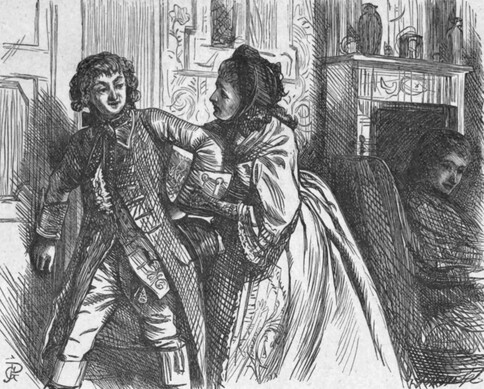
Scene I.—An Apartment in Young Honeywood's House.
Enter Sir William Honeywood and
Jarvis.
Sir Will. Good Jarvis, make no
apologies for this honest bluntness.
Fidelity like yours, is the best excuse
for every freedom.
Jarvis. I can't help being blunt, and
being very angry too, when I hear
you talk of disinheriting so good, so
worthy a young gentleman as your
nephew, my master. All the world
loves him.
Sir Will. Say rather, that he loves
all the world; that is his fault.
Jarvis. I'm sure there is no part of
it more dear to him than you are,
though he has not seen you since he
was a child.
Sir Will. What signifies his affection
to me? or how can I be proud of
a place in a heart where every sharper
and coxcomb finds an easy entrance?
Jarvis. I grant that he's rather too
good-natured; that he's too much every
man's man; that he laughs this minute
with one, and cries the next with
another; but whose instructions may
he thank for all this?
Sir Will. Not mine, sure! My letters
to him during my employment in
Italy, taught him only that philosophy
which might prevent, not defend, his
errors.
Jarvis. Faith, begging your honour's
pardon, I'm sorry they taught him any
philosophy at all; it has only served
to spoil him. This same philosophy
is a good horse in a stable, but an
errant jade on a journey. For my own
part, whenever I hear him mention
the name on't, I'm always sure he's
going to play the fool.
Sir Will. Don't let us ascribe his
faults to his philosophy, I entreat you.
No, Jarvis, his good-nature arises rather
from his fears of offending the importunate,
than his desire of making the
deserving happy.
Jarvis. What it rises from, I don't
know. But, to be sure, every body
has it, that asks it.
Sir Will. Ay, or that does not ask
it. I have been now for some time a
concealed spectator of his follies, and
find them as boundless as his dissipation.
Jarvis. And yet, faith, he has some
fine name or other for them all. He
call his extravagance, generosity; and
his trusting every body, universal benevolence.
It was but last week he
went security for a fellow whose face
he scarce knew, and that he called an
act of exalted mu-mu-munificence;
ay, that was the name he gave it.
Sir Will. And upon that I proceed,
as my last effort, though with very
little hopes to reclaim him. That very
fellow has just absconded, and I have
taken up the security. Now, my intention
is, to involve him in fictitious distress,
before he has plunged himself
into real calamity; to arrest him for
that very debt, to clap an officer upon
him, and then let him see which of
his friends will come to his relief.
Jarvis. Well, if I could but any way
see him thoroughly vexed, every groan
of his would be music to me; yet,
faith, I believe it impossible. I have
tried to fret him myself every morning
these three years; but, instead of being
angry, he sits as calmly to hear
me scold, as he does to his hair-dresser.
Sir Will. We must try him once
more, however, and I'll go this instant
to put my scheme into execution; and
I don't despair of succeeding, as by
your means, I can have frequent opportunities
of being about him, without
being known. What a pity it is,
Jarvis, that any man's good will to
others should produce so much neglect
of himself, as to require correction!
Yet, we must touch his weakness with
a delicate hand. There are some faults
so nearly allied to excellence, that we
can scarce weed out the vice without
eradicating the virtue.
Jarvis. Well, go thy ways, Sir
William Honeywood. It is not without
reason that the world allows thee
to be the best of men. But here
comes his hopeful nephew; the strange,
good-natured, foolish, open-hearted—And
yet, all his faults are such that
one loves him still the better for them.
Enter Honeywood.
Honeyw. Well, Jarvis, what messages
from my friends this morning!
Jarvis. You have no friends.
Honeyw. Well; from my acquaintance,
then?
Jarvis. (Pulling out bills.) A few
of our usual cards of compliment,
that's all. This bill from your tailor;
this from your mercer; and this from
the little broker in Crooked-lane. He
says he has been at a great deal of
trouble to get back the money you
borrowed.
Honeyw. That I don't know; but
I am sure we were at a great deal of
trouble in getting him to lend it.
Jarvis. He has lost all patience.
Honeyw. Then he has lost a very
good thing.
Jarvis. There's that ten guineas
you were sending to the poor gentleman
and his children in the Fleet.
I believe that would stop his mouth
for a while at least.
Honeyw. Ay, Jarvis, but what will
fill their mouths in the meantime?
Must I be cruel because he happens
to be importunate; and, to relieve his
avarice, leave them to insupportable
distress?
Jarvis. 'Sdeath, sir, the question
now is, how to relieve yourself. Yourself—Haven't
I reason to be out of
my senses, when I see things going at
sixes and sevens?
Honeyw. Whatever reason you may
have for being out of your senses,
I hope you'll allow that I'm not quite
unreasonable for continuing in mine.
Jarvis. You're the only man alive
in your present situation that could
do so—Every thing upon the waste.
There's Miss Richland and her fine
fortune gone already, and upon the
point of being given to your rival.
Honeyw. I'm no man's rival.
Jarvis. Your uncle in Italy preparing
to disinherit you; your own
fortune almost spent; and nothing but
pressing creditors, false friends, and a
pack of drunken servants that your
kindness has made unfit for any other
family.
Honeyw. Then they have the more
occasion for being in mine.
Jarvis. So! What will you have
done with him that I caught stealing
your plate in the pantry? In the fact;
I caught him in the fact.
Honeyw. In the fact? If so, I
really think that we should pay him
his wages, and turn him off.
Jarvis. He shall be turned off at
Tyburn, the dog; we'll hang him, if
it be only to frighten the rest of the
family.
Honeyw. No, Jarvis: it's enough
that we have lost what he has stolen,
let us not add to the loss of a fellow-creature.
Jarvis. Very fine; well, here was
the footman just now, to complain of
the butler; he says he does most
work, and ought to have most
wages.
Honeyw. That's but just: though
perhaps here comes the butler to complain
of the footman.
Jarvis. Ay, it's the way with them
all, from the scullion to the privy-counsellor.
If they have a bad master,
they keep quarrelling with him; if
they have a good master they keep
quarrelling with one another.
Enter Butler drunk.
Butler. Sir, I'll not stay in the
family with Jonathan: you must part
with him, or part with me, that's the
ex-ex-position of the matter, sir.
Honeyw. Full and explicit enough.
But what's his fault, good Phillip?
Butler. Sir, he's given to drinking,
sir, and I shall have my morals corrupted,
by keeping such company.
Honeyw. Ha! ha! he has such a
diverting way—
Jarvis. O! quite amusing.
Butler. I find my wines a-going,
sir; and liquors don't go without
mouths, sir; I hate a drunkard, sir.
Honeyw. Well, well, Philip, I'll
hear you upon that another time, so go
to bed now.
Jarvis. To bed! Let him go to the
devil.
Butler. Begging your honour's
pardon, and begging your pardon,
master Jarvis, I'll not go to bed, nor
to the devil neither. I have enough to
do to mind my cellar. I forgot, your
honour, Mr. Croaker is below. I came
on purpose to tell you.
Honeyw. Why didn't you show
him up, blockhead?
Butler. Show him up, sir? With
all my heart, sir. Up or down, all's
one to me.
Jarvis. Ay, we have one or other
of that family in this house from
morning till night. He comes on the
old affair, I suppose; the match between
his son, that's just returned
from Paris, and Miss Richland, the
young lady he's guardian to.
Honeyw. Perhaps so. Mr. Croaker,
knowing my friendship for the young
lady, has got it into his head that I can
persuade her to what I please.
Jarvis. Ah! if you loved yourself
but half as well as she loves you, we
should soon see a marriage that would
set all things to rights again.
Honeyw. Love me! Sure, Jarvis,
you dream. No, no; her intimacy
with me never amounted to more than
friendship—mere friendship. That she
is the most lovely woman that ever
warmed the human heart with desire,
I own. But never let me harbour a
thought of making her unhappy, by a
connection with one so unworthy her
merits, as I am. No, Jarvis, it shall be
my study to serve her, even in spite
of my wishes; and to secure her
happiness, though it destroys my own.
Jarvis. Was ever the like? I want
patience.
Honeyw. Besides, Jarvis, though I
could obtain Miss Richland's consent,
do you think I could succeed with her
guardian, or Mrs. Croaker, his wife;
who, though both very fine in their
way, are yet a little opposite in their
dispositions, you know?
Jarvis. Opposite enough, Heaven
knows; the very reverse of each other;
she all laugh and no joke, he always
complaining and never sorrowful; a
fretful poor soul, that has a new distress
for every hour in the four-and-twenty—
Honeyw. Hush, hush, he's coming
up! he'll hear you.
Jarvis. One whose voice is a passing
bell—
Honeyw. Well, well, go do.
Jarvis. A raven that bodes nothing
but mischief; a coffin and cross bones;
a bundle of rue; a sprig of deadly
nightshade; a—(Honeywood, stopping
his mouth, at last pushes him off.)
Honeyw. I must own, my old
monitor is not entirely wrong. There
is something in my friend Croaker's
conversation that quite depresses me.
His very mirth is an antidote to all
gaiety, and his appearance has a
stronger effect on my spirits than an
undertaker's shop.—Mr. Croaker, this
is such a satisfaction—
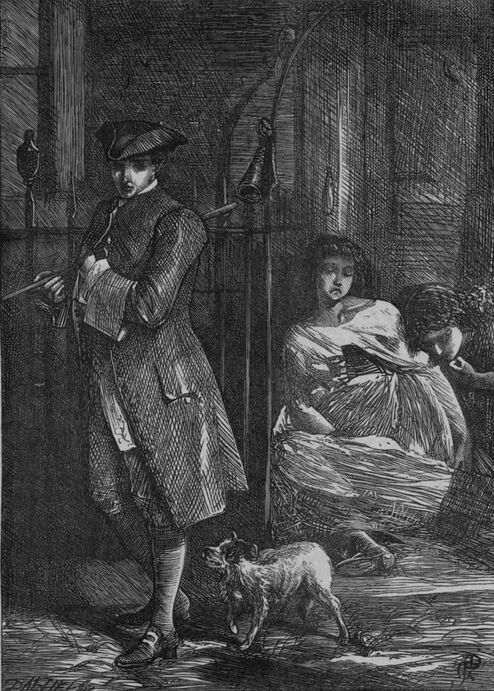
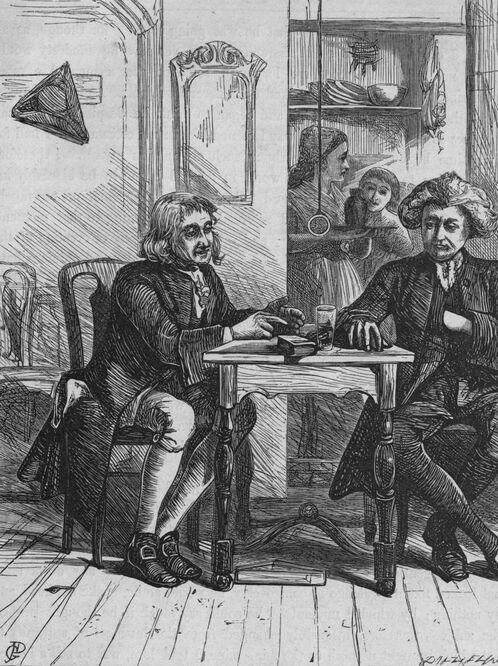
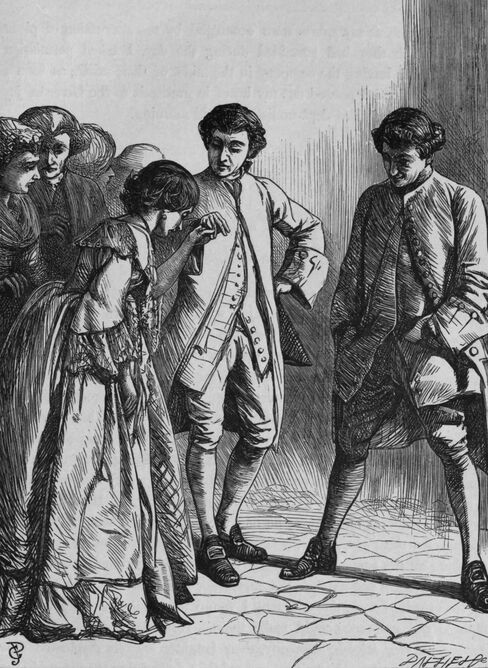
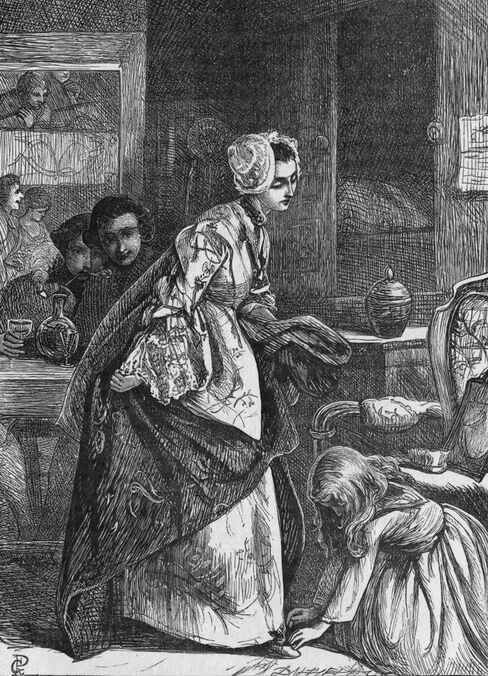
Croaker. A pleasant morning to
Mr. Honeywood, and many of them.
How is this? You look most shockingly
to-day, my dear friend. I hope
this weather does not affect your spirits.
To be sure, if this weather continues—I
say nothing—but God send we
be all better this day three months.
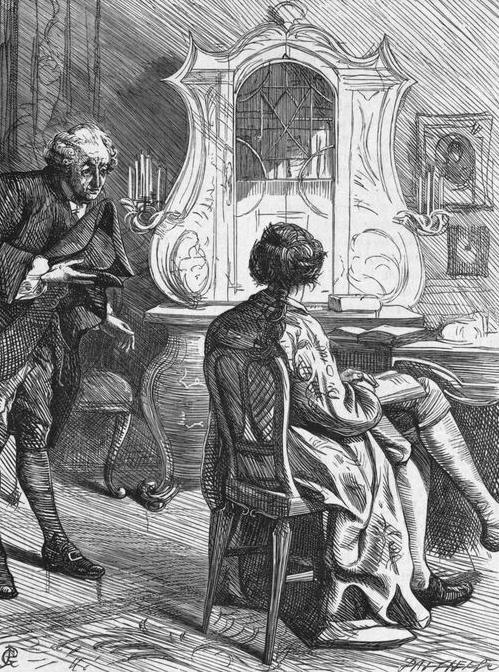
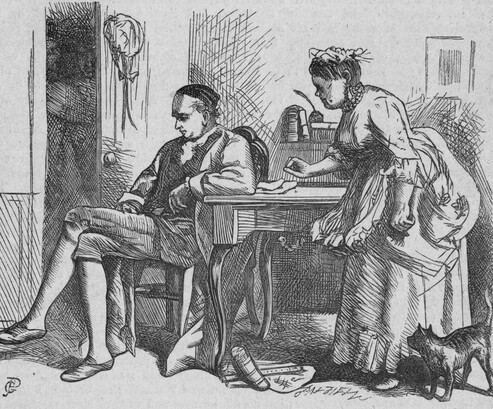
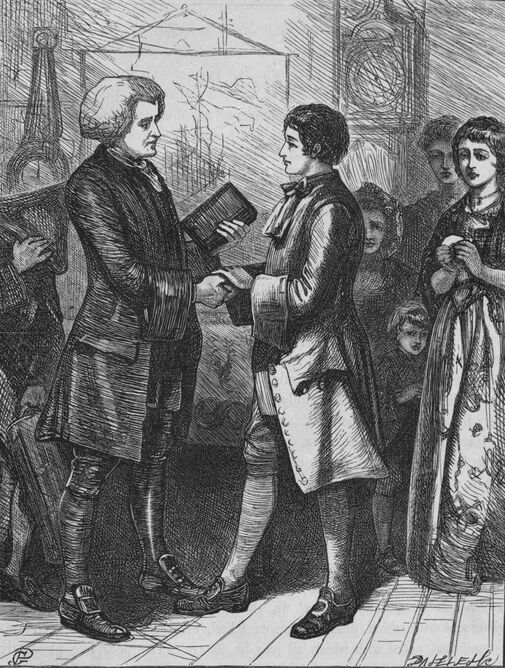
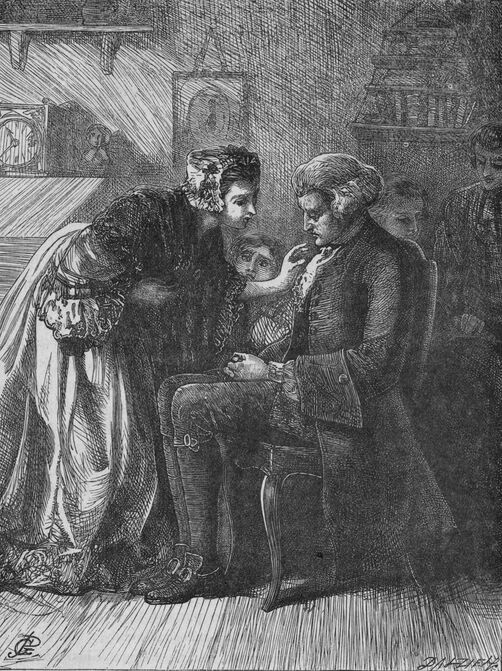
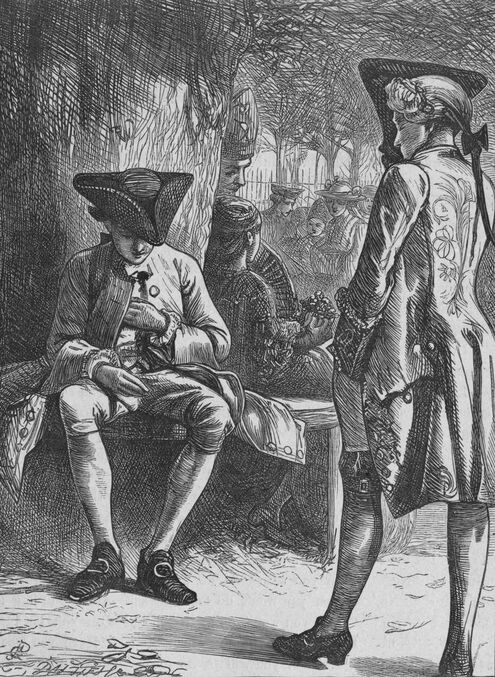
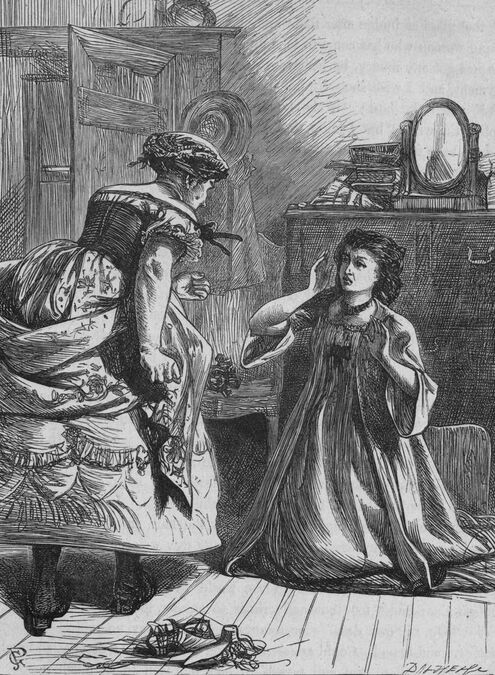
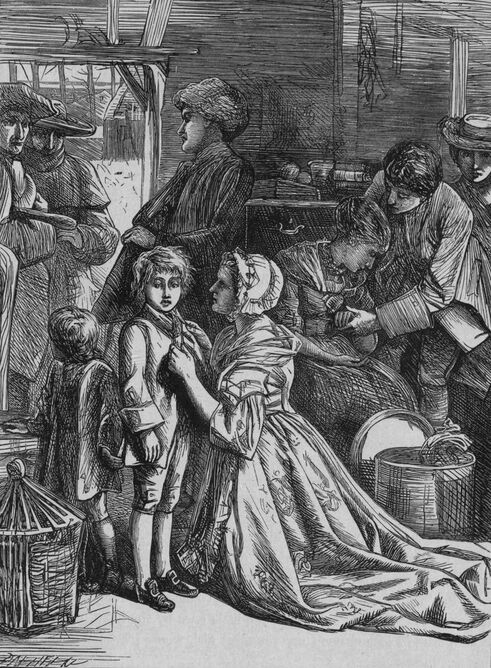
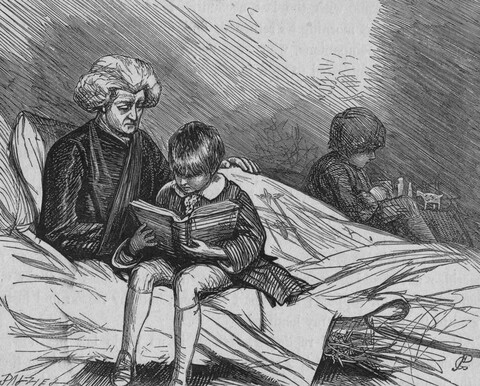
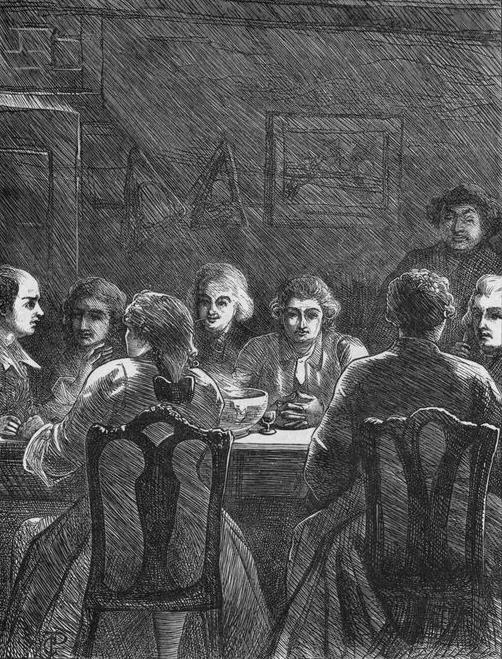
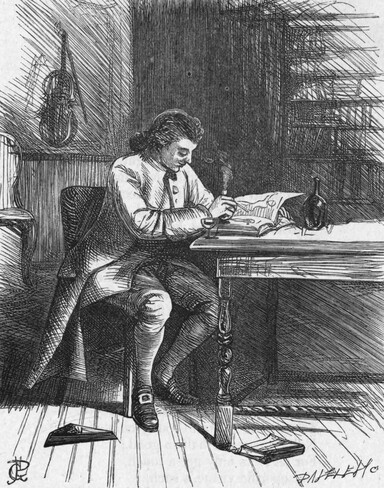
"Croaker.—A pleasant morning to Mr. Honeywood."—p. 272.
Honeyw. I heartily concur in the
wish, though, I own, not in your
apprehensions.
Croaker. May be not. Indeed,
what signifies what weather we have,
in a country going to ruin like ours?
Taxes rising and trade falling. Money
flying out of the kingdom, and Jesuits
swarming into it. I know at this time
no less than a hundred and twenty-seven
Jesuits between Charing-cross
and Temple-bar.
Honeyw. The Jesuits will scarce
pervert you or me, I should hope?
Croaker. May be not. Indeed
what signifies whom they pervert in a
country that has scarce any religion to
lose? I'm only afraid for our wives
and daughters.
Honeyw. I have no apprehensions
for the ladies, I assure you.
Croaker. May be not. Indeed what
signifies whether they be perverted or
not? The women in my time were
good for something. I have seen a
lady dressed from top to toe in her own
manufactures formerly. But now-a-days
the devil a thing of their own manufacture
about them, except their faces.
Honeyw. But, however these faults
may be practised abroad, you don't
find them at home, either with Mrs.
Croaker, Olivia, or Miss Richland.
Croaker. The best of them will
never be canonised for a saint when
she's dead. By the by, my dear
friend, I don't find this match between
Miss Richland and my son much relished,
either by one side or t'other.
Honeyw. I thought otherwise.
Croaker. Ah, Mr. Honeywood, a
little of your fine serious advice to the
young lady might go far: I know she
has a very exalted opinion of your
understanding.
Honeyw. But would not that be
usurping an authority that more properly
belongs to yourself?
Croaker. My dear friend, you know
but little of my authority at home.
People think, indeed, because they see
me come out in a morning thus, with
a pleasant face, and to make my friends
merry, that all's well within. But I
have cares that would break a heart of
stone. My wife has so encroached upon
every one of my privileges, that I'm
now no more than a mere lodger in
my own house.
Honeyw. But a little spirit exerted
on your side might perhaps restore
your authority.
Croaker. No, though I had the
spirit of a lion. I do rouse sometimes.
But what then? always haggling and
haggling. A man is tired of getting
the better, before his wife is tired of
losing the victory.
Honeyw. It's a melancholy consideration
indeed, that our chief comforts
often produce our greatest anxieties,
and that an increase of our possessions
is but an inlet to new disquietudes.
Croaker. Ah, my dear friend, these
were the very words of poor Dick
Doleful to me not a week before he
made away with himself. Indeed, Mr.
Honeywood, I never see you but you
put me in mind of poor Dick. Ah,
there was merit neglected for you!
and so true a friend; we loved each
other for thirty years, and yet he never
asked me to lend him a single farthing.
Honeyw. Pray what could induce
him to commit so rash an action at last?
Croaker. I don't know, some people
were malicious enough to say it was
keeping company with me; because
we used to meet now and then, and
open our hearts to each other. To be
sure I loved to hear him talk, and he
loved to hear me talk; poor dear Dick!
He used to say, that Croaker rhymed
to joker; and so we used to laugh—Poor
Dick!
Honeyw. His fate affects me.
Croaker. Ay, he grew sick of this
miserable life, where we do nothing
but eat and grow hungry, dress and
undress, get up and lie down; while
reason, that should watch like a nurse
by our side, falls as fast asleep as we
do.
Honeyw. To say truth, if we compare
that part of life which is to come,
by that which we have passed, the
prospect is hideous.
Croaker. Life at the greatest and
best is but a froward child, that must
be humoured and coaxed a little till it
falls asleep, and then all the care is
over.
Honeyw. Very true, sir; nothing
can exceed the vanity of our existence,
but the folly of our pursuits. We
wept when we came into the world,
and every day tells us why.
Croaker. Ah, my dear friend, it is
a perfect satisfaction to be miserable
with you. My son Leontine shan't
lose the benefit of such fine conversation.
I'll just step home for him. I
am willing to show him so much
seriousness in one scarce older than
himself—And what if I bring my last
letter to the Gazetteer on the increase
and progress of earthquakes? It will
amuse us, I promise you. I there
prove how the late earthquake is
coming round to pay us another visit
from London to Lisbon, from Lisbon
to the Canary Islands, from the Canary
Islands to Palmyra, from Palmyra to
Constantinople, and so from Constantinople
back to London again.
Honeyw. Poor Croaker! His situation
deserves the utmost pity. I shall
scarce recover my spirits these three
days. Sure, to live upon such terms
is worse than death itself. And yet,
when I consider my own situation, a
broken fortune, a hopeless passion,
friends in distress; the wish but not
the power to serve them—(pausing and
sighing.)
Enter Butler.
Butler. More company below, sir;
Mrs. Croaker and Miss Richland; shall
I show them up? But they're showing
up themselves.
Enter Mrs. Croaker and Miss Richland.
Miss Rich. You're always in such
spirits.
Mrs. Croaker. We have just come,
my dear Honeywood, from the auction.
There was the old deaf dowager, as
usual, bidding like a fury against herself.
And then so curious in antiques!
herself the most genuine piece of antiquity
in the whole collection.
Honeyw. Excuse me, ladies, if some
uneasiness from friendship makes me
unfit to share in this good humour:
I know you'll pardon me.
Mrs. Croaker. I vow, he seems as
melancholy as if he had taken a dose
of my husband this morning. Well,
if Richland here can pardon you, I
must.
Miss Rich. You would seem to insinuate,
madam, that I have particular
reasons for being disposed to refuse it.
Mrs. Croaker. Whatever I insinuate,
my dear, don't be so ready to wish
an explanation.
Miss Rich. I own I should be sorry
Mr. Honeywood's long friendship and
mine should be misunderstood.
Honeyw. There's no answering for
others, madam; but I hope you'll
never find me presuming to offer more
than the most delicate friendship may
readily allow.
Miss Rich. And, I shall be prouder
of such a tribute from you, than
the most passionate professions from
others.
Honeyw. My own sentiments,
madam: friendship is a disinterested
commerce between equals; love, an
abject intercourse between tyrants and
slaves.
Miss Rich. And, without a compliment,
I know none more disinterested
or more capable of friendship than
Mr. Honeywood.
Mrs. Croaker. And indeed I know
nobody that has more friends, at least
among the ladies. Miss Fruzz, Miss
Odbody, and Miss Winterbottom,
praise him in all companies. As for
Miss Biddy Bundle, she's his professed
admirer.
Miss Rich. Indeed! an admirer!
I did not know, sir, you were such
a favourite there. But is she seriously
so handsome? Is she the mighty
thing talked of?
Honeyw. The town, madam, seldom
begins to praise a lady's beauty, till
she's beginning to lose it.
[Smiling.
Mrs. Croaker. But she's resolved
never to lose it, it seems; for as her
natural face decays, her skill improves
in making the artificial one. Well,
nothing diverts me more than one of
those fine old dressy things, who
thinks to conceal her age by everywhere
exposing her person; sticking
herself up in the front of a side-box;
trailing through a minuet at
Almack's; and then, in the public
gardens, looking for all the world like
one of the painted ruins of the place.
Honeyw. Every age has its admirers,
ladies. While you, perhaps,
are trading among the warmer climates
of youth, there ought to be some to
carry on a useful commerce in the
frozen latitudes beyond fifty.
Miss Rich. But then the mortifications
they must suffer before they can
be fitted out for traffic! I have seen
one of them fret a whole morning at
her hair-dresser, when all the fault
was her face.
Honeyw. And yet I'll engage, has
carried that face at last to a very good
market. This good-natured town,
madam, has husbands, like spectacles,
to fit every age, from fifteen to four-score.
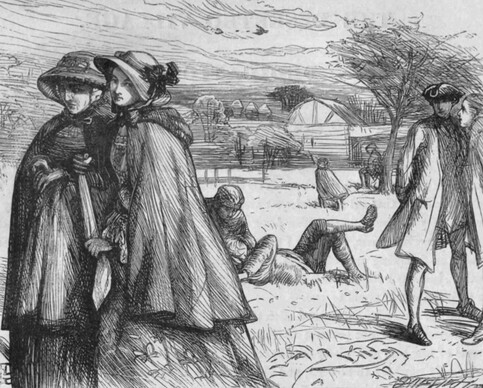
Mrs. Croaker. Well, you're a dear
good-natured creature. But you know
you're engaged with us this morning
upon a strolling party. I want to
show Olivia the town and the things;
I believe I shall have business for you
for the whole day.
Honeyw. I am sorry, madam, I have
an appointment with Mr. Croaker,
which it is impossible to put off.
Mrs. Croaker. What! with my
husband? Then I'm resolved to take
no refusal. Nay, I protest you must.
You know I never laugh so much as
with you.
Honeyw. Why, if I must, I must,
I'll swear, you have put me into such
spirits. Well, do you find jest, and
I'll find laugh, I promise you. We'll
wait for the chariot in the next room.
Enter Leontine and Olivia.
Leont. There they go, thoughtless
and happy. My dearest Olivia, what
would I give to see you capable of
sharing in their amusements, and as
cheerful as they are!
Olivia. How, my Leontine, how
can I be cheerful, when I have so many
terrors to oppress me? The fear of
being detected by this family, and the
apprehensions of a censuring world,
when I must be detected——
Leont. The world! my love, what
can it say? At worst, it can only say
that, being compelled by a mercenary
guardian to embrace a life you disliked,
you formed a resolution of flying with
the man of your choice; that you confided
in his honour, and took refuge in
my father's house; the only one where
yours could remain without censure.
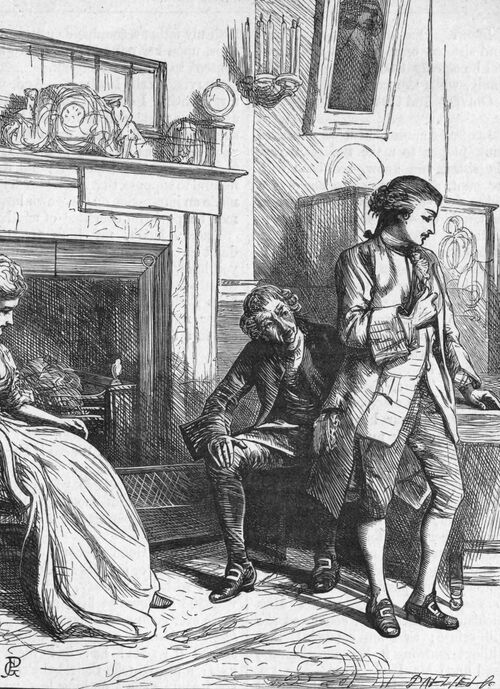
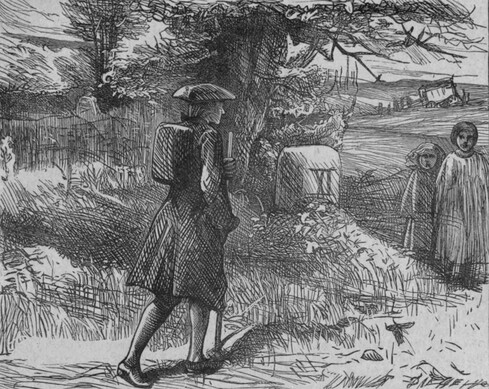
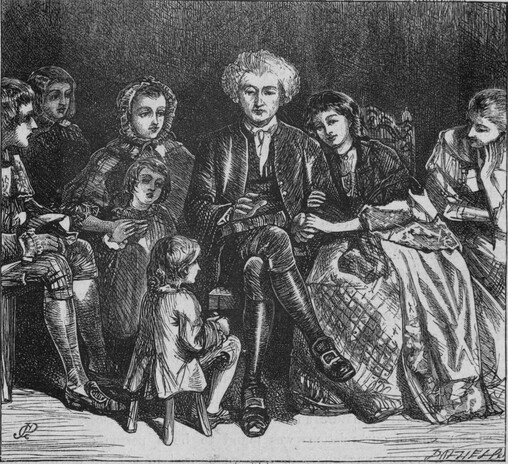
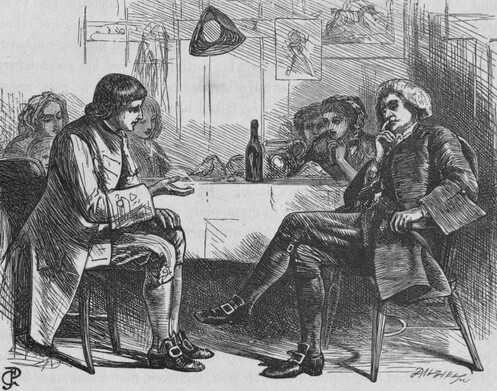
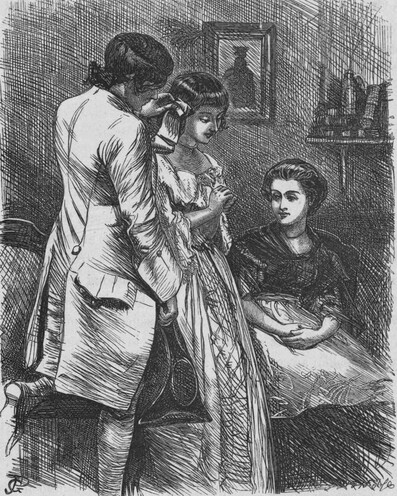
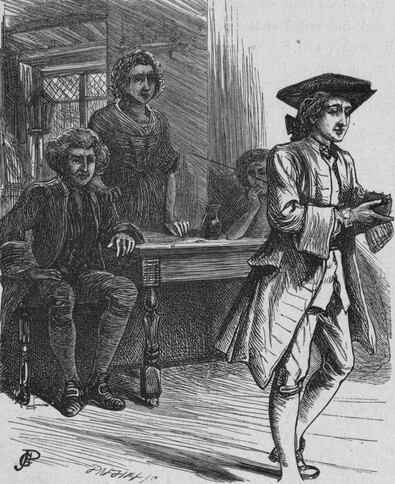
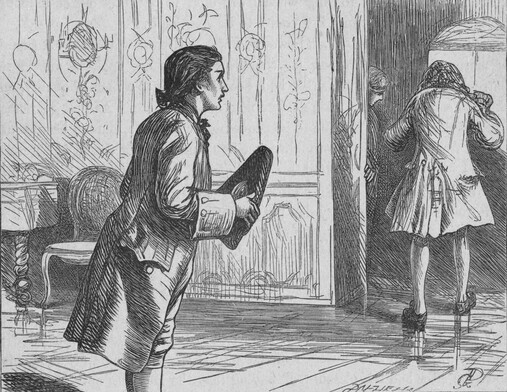
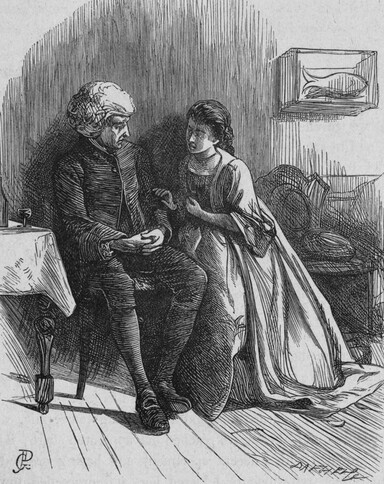
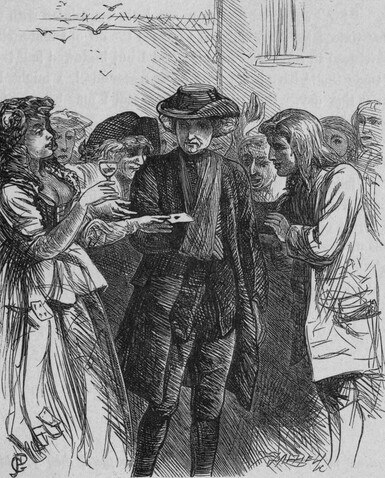
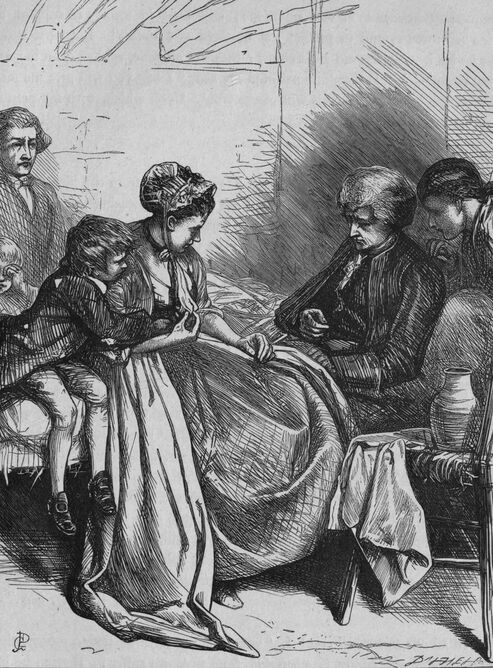
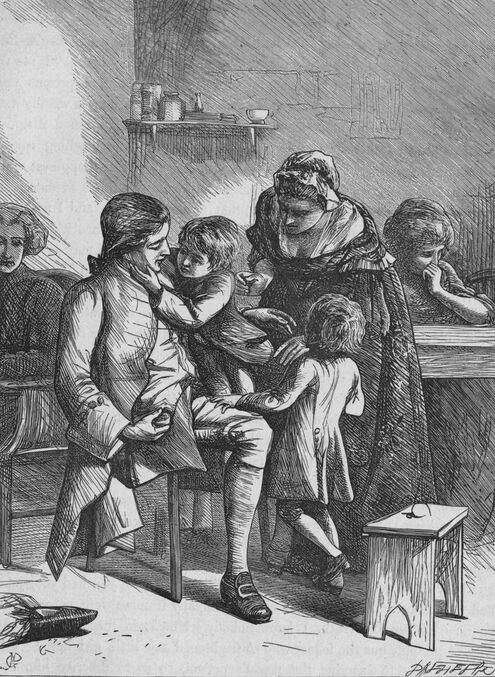
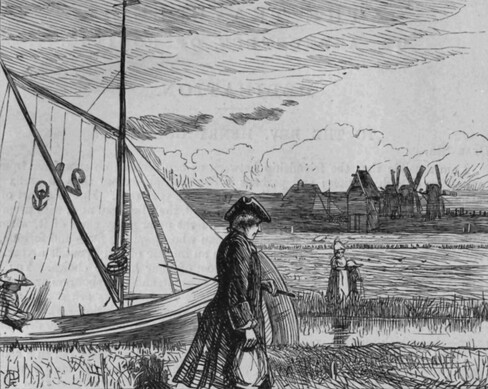
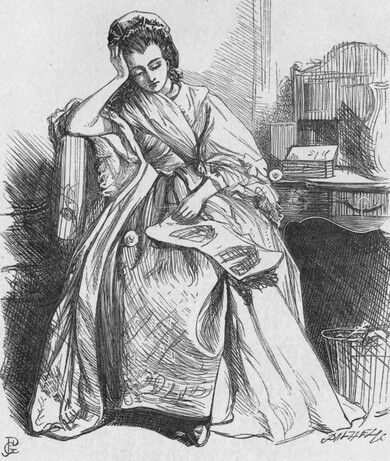
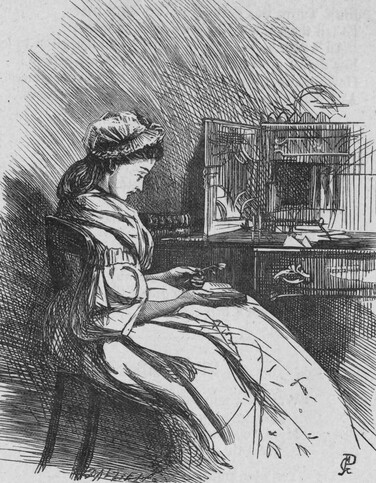
"Croaker.—Well, and you have both of
you a mutual choice."—p. 279.
Olivia. But consider, Leontine,
your disobedience and my indiscretion:
your being sent to France to
bring home a sister; and, instead of a
sister, bringing home——
Leont. One dearer than a thousand
sisters; one that I am convinced
will be equally dear to the rest of the
family, when she comes to be known.
Olivia. And that I fear, will shortly
be.
Leont. Impossible till we ourselves
think proper to make the discovery.
My sister, you know, has been with
her aunt, at Lyons, since she was a
child; and you find every creature in
the family takes you for her.
Olivia. But mayn't she write?
mayn't her aunt write?
Leont. Her aunt scarce ever writes,
and all my sister's letters are directed
to me.
Olivia. But won't your refusing
Miss Richland, for whom you know
the old gentleman intends you, create
a suspicion?
Leont. There, there's my masterstroke.
I have resolved not to refuse
her; nay, an hour hence I have consented
to go with my father, to make
her an offer of my heart and fortune.
Olivia. Your heart and fortune!
Leont. Don't be alarmed, my dearest.
Can Olivia think so meanly of
my honour, or my love, as to suppose
I could ever hope for happiness from
any but her? No, my Olivia, neither
the force, nor permit me to add, the
delicacy of my passion, leave any room
to suspect me. I only offer Miss
Richland a heart, I am convinced she
will refuse; as I am confident, that
without knowing it, her affections are
fixed upon Mr. Honeywood.
Olivia. Mr. Honeywood! You'll
excuse my apprehensions; but when
your merits come to be put in the
balance—
Leont. You view them with too
much partiality. However, by making
this offer, I show a seeming compliance
with my father's commands; and perhaps,
upon her refusal, I may have his
consent to choose for myself.
Olivia. Well, I submit. And, yet
my Leontine, I own, I shall envy her,
even your pretended addresses. I consider
every look, every expression of
your esteem, as due only to me. This
is folly, perhaps: I allow it; but it is
natural to suppose, that merit which has
made an impression on one's own heart,
may be powerful over that of another.
Leont. Don't, my life's treasure,
don't let us make imaginary evils, when
you know we have so many real ones
to encounter. At worst, you know, if
Miss Richland should consent, or my
father refuse his pardon, it can but
end in a trip to Scotland; and——
Enter Croaker.
Croaker. Where have you been,
boy? I have been seeking you. My
friend Honeywood here has been saying
such comfortable things. Ah! he's
an example indeed. Where is he? I
left him here.
Leont. Sir, I believe you may see
him, and hear him too, in the next
room: he's preparing to go out with
the ladies.
Croaker. Good gracious, can I believe
my eyes or my ears? I'm struck
dumb with his vivacity, and stunned
with the loudness of his laugh. Was
there ever such a transformation? (A
laugh behind the scenes; Croaker
mimics it.) Ha! ha! ha! there it
goes: a plague take their balderdash;
yet I could expect nothing less, when
my precious wife was of the party.
On my conscience, I believe she could
spread a horse-laugh through the pews
of a tabernacle.
Leont. Since you find so many objections
to a wife, sir, how can you be
so earnest in recommending one to
me?
Croaker. I have told you, and tell
you again, boy, that Miss Richland's
fortune must not go out of the family;
one may find comfort in the money,
whatever one does in the wife.
Leont. But, sir, though in obedience
to your desire, I am ready to
marry her; it may be possible, she has
no inclination to me.
Croaker. I'll tell you once for all
how it stands. A good part of Miss
Richland's large fortune consists in a
claim upon government, which my
good friend, Mr. Lofty, assures me
the treasury will allow. One half of
this she is to forfeit, by her father's
will, in case she refuses to marry you.
So if she rejects you, we seize half her
fortune; if she accepts you, we seize
the whole, and a fine girl into the
bargain.
Leont. But, sir, if you will but
listen to reason—
Croaker. Come, then produce your
reasons. I tell you I'm fixed, determined,
so now produce your reasons.
When I'm determined I always listen
to reason, because it can then do no
harm.
Leont. You have alleged that a
mutual choice was the first requisite
in matrimonial happiness—
Croaker. Well, and you have both
of you a mutual choice. She has her
choice—to marry you, or lose half her
fortune; and you have your choice—to
marry her, or pack out of doors
without any fortune at all.
Leont. An only son, sir, might
expect more indulgence.
Croaker. An only father, sir, might
expect more obedience; besides, has
not your sister here, that never disobliged
me in her life, as good a right
as you? He's a sad dog, Livy my
dear, and would take all from you.
But he shan't, I tell you he shan't, for
you shall have your share.
Olivia. Dear sir, I wish you'd be
convinced that I can never be happy
in any addition to my fortune, which
is taken from his.
Croaker. Well, well, it's a good
child; so say no more, but come with
me, and we shall see something that
will give us a great deal of pleasure, I
promise you; old Ruggins, the currycomb
maker, lying in state: I'm told
he makes a very handsome corpse, and
becomes his coffin prodigiously. He
was an intimate friend of mine, and
these are friendly things we ought to
do for each other.
ACT II.
Scene.—Croaker's house.
Miss Richland, Garnet.
Miss Rich. Olivia not his sister?
Olivia not Leontine's sister? You amaze me!
Garnet. No more his sister than I
am; I had it all from his own servant;
I can get anything from that
quarter.
Miss Rich. But how? Tell me
again, Garnet.
Garnet. Why madam, as I told
you before, instead of going to Lyons
to bring home his sister, who has been
there with her aunt these ten years he
never went further than Paris; there
he saw and fell in love with this
young lady: by the bye, of a prodigious
family.
Miss Rich. And brought her home
to my guardian, as his daughter.
Garnet. Yes, and daughter she will
be. If he don't consent to their marriage,
they talk of trying what a Scotch
parson can do.
Miss Rich. Well, I own they have
deceived me—And so demurely as
Olivia carried it too!—Would you believe
it, Garnet, I told her all my
secrets; and yet the sly cheat concealed
all this from me?
Garnet. And, upon my word, madam,
I don't much blame her; she
was loth to trust one with her secrets,
that was so very bad at keeping her
own.
Miss Rich. But, to add to their
deceit, the young gentleman, it seems,
pretends to make me serious proposals.
My guardian and he are to be here
presently, to open the affair in form.
You know I am to lose half my fortune
if I refuse him.
Garnet. Yet what can you do? for
being, as you are, in love with Mr.
Honeywood, madam—
Miss Rich. How, idiot! what do
you mean? In love with Mr. Honeywood!
Is this to provoke me?
Garnet. That is, madam, in friendship
with him; I meant nothing more
than friendship, as I hope to be married;
nothing more.
Miss Rich. Well, no more of this.
As to my guardian and his son, they
shall find me prepared to receive them;
I'm resolved to accept their proposal
with seeming pleasure, to mortify them
by compliance, and so throw the refusal
at last upon them.
Garnet. Delicious! and that will
secure your whole fortune to yourself.
Well, who could have thought so innocent
a face could cover so much cuteness?
Miss Rich. Why, girl, I only oppose
my prudence to their cunning, and
practise a lesson they have taught me
against themselves.
Garnet. Then you're likely not
long to want employment; for here
they come, and in close conference.
Enter Croaker, Leontine.
Leont. Excuse me, sir, if I seem to
hesitate upon the point of putting to
the lady so important a question.
Croaker. Lord, good sir! moderate
your fears; you're so plaguy shy, that
one would think you had changed
sexes. I tell you, we must have the
half or the whole. Come, let me see
with what spirit you begin. Well,
why don't you? Eh? What? Well
then—I must, it seems. Miss Richland,
my dear, I believe you guess at
our business; an affair which my son
here comes to open, that nearly concerns
your happiness.
Miss Rich. Sir, I should be ungrateful
not to be pleased with anything
that comes recommended by
you.
Croaker. How, boy, could you desire
a finer opportunity? Why don't
you begin, I say?
[To Leont.
Leont. 'Tis true, madam, my father,
madam, has some intentions—hem—of
explaining an affair—which—himself—can
best explain, madam.
Croaker. Yes, my dear; it comes
entirely from my son; it's all a request
of his own, madam. And I will permit
him to make the best of it.
Leont. The whole affair is only this,
madam; my father has a proposal to
make, which he insists none but himself
shall deliver.
Croaker. My mind misgives me,
the fellow will never be brought on.
(Aside.) In short, madam, you see
before you one that loves you; one
whose whole happiness is all in you.
Miss Rich. I never had any doubts
of your regard, sir; and I hope you
can have none of my duty.
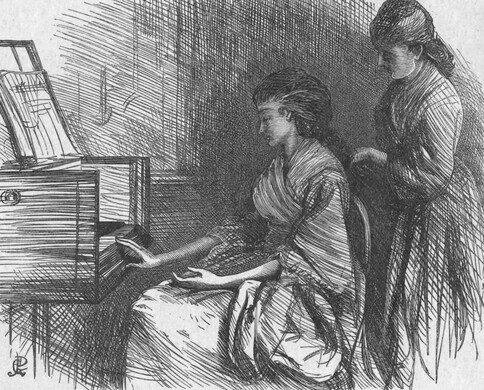
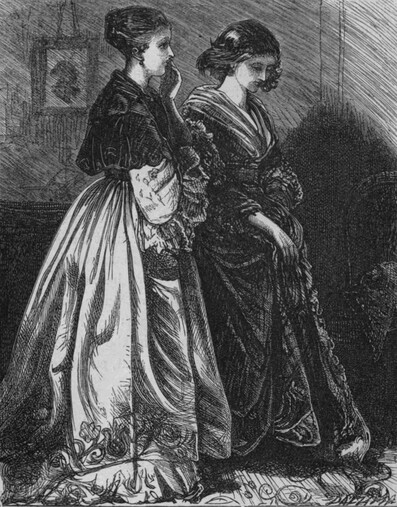
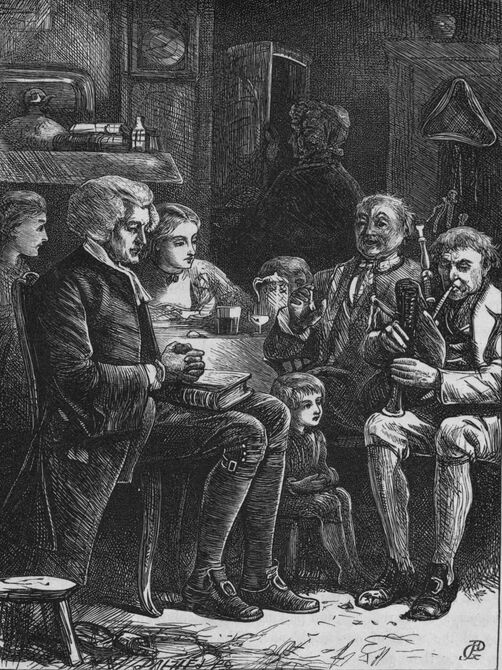
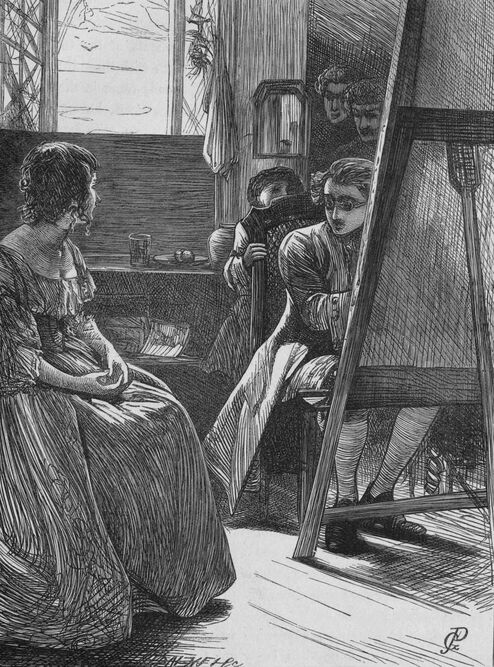
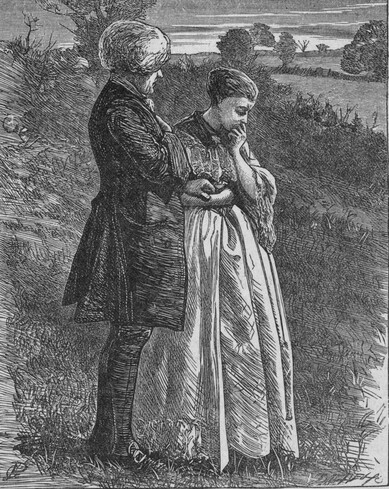
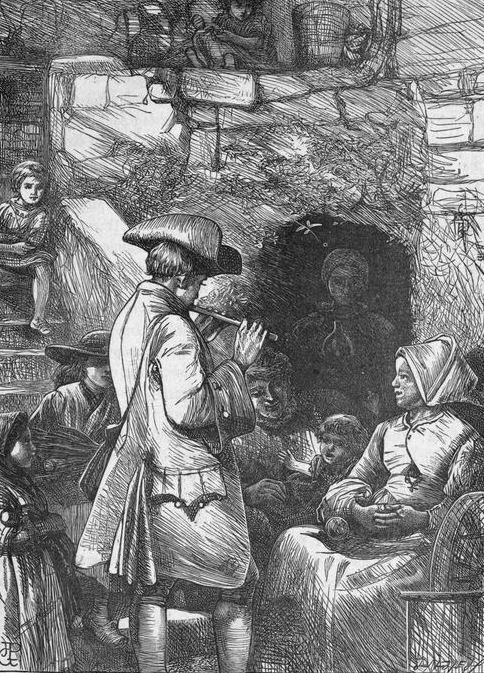
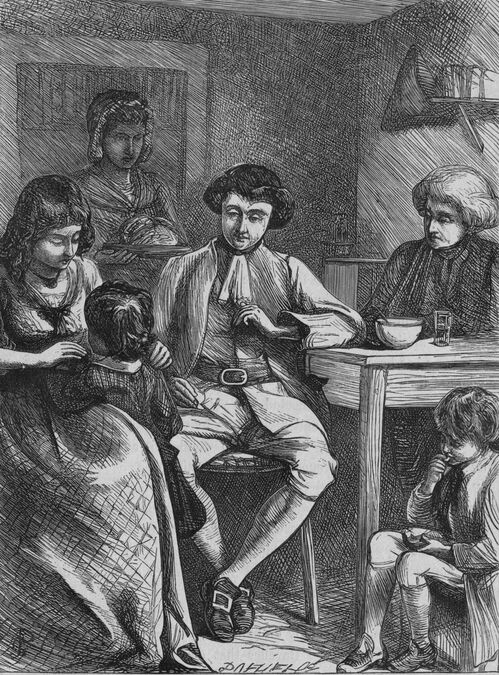
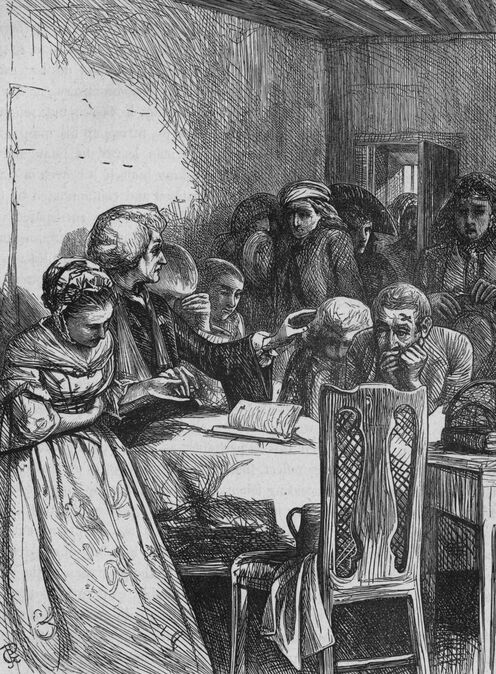
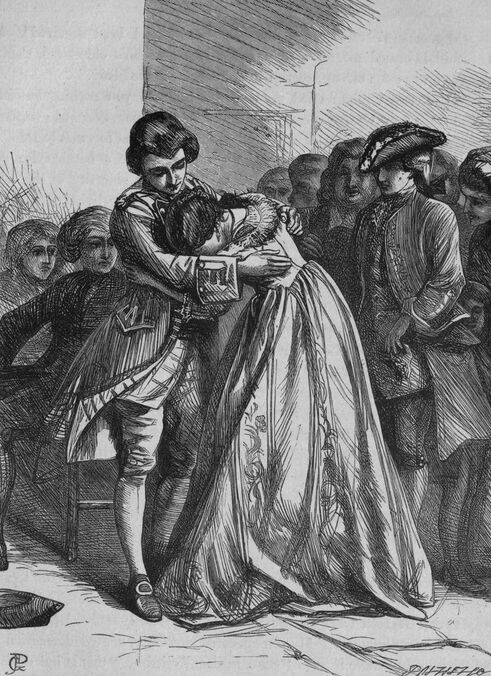
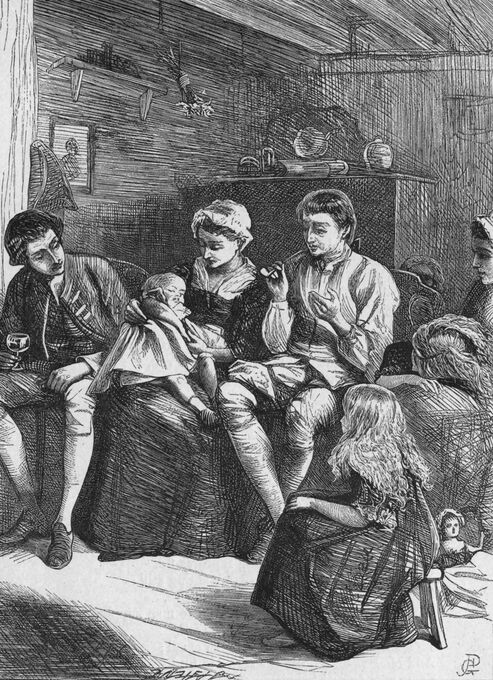
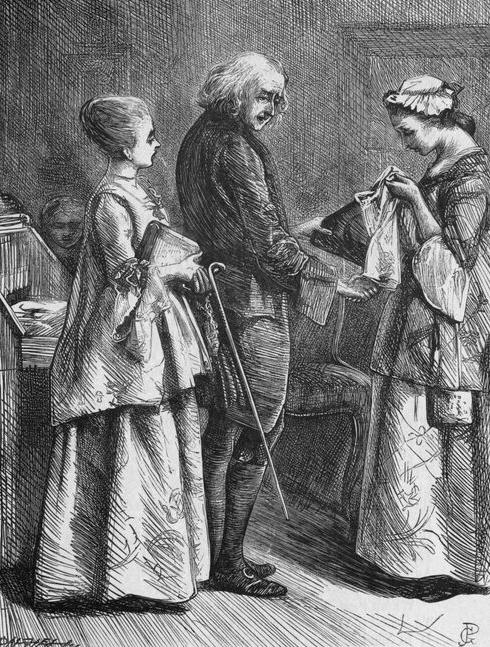
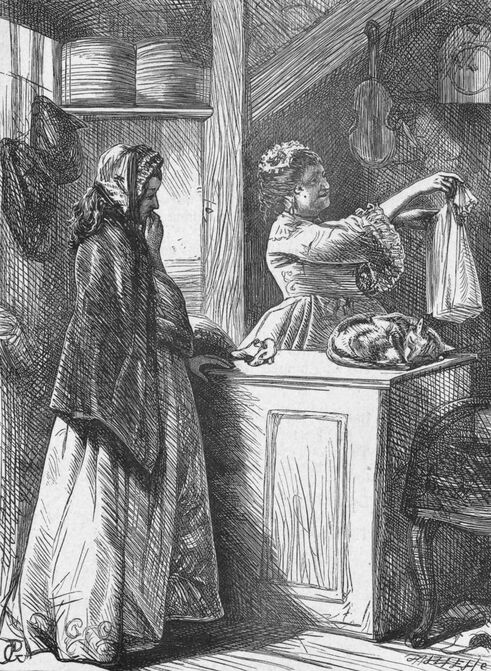
Garnet.—"For being, as you are,
in love with Mr. Honeywood, madam."—p. 280.
Croaker. That's not the thing, my
little sweeting, my love. No, no,
another-guess lover than I, there he
stands, madam; his very looks declare
the force of his passion—Call up a
look, you dog—But then, had you
seen him, as I have, weeping, speaking
soliloquies and blank verse, sometimes
melancholy, and sometimes absent—
Miss Rich. I fear, sir, he's absent
now; or such a declaration would have
come most properly from himself.
Croaker. Himself, madam! He
would die before he could make such
a confession; and if he had not a
channel for his passion through me, it
would ere now have drowned his understanding.
Miss Rich. I must grant, sir, there
are attractions in modest diffidence,
above the force of words. A silent
address is the genuine eloquence of
sincerity.
Croaker. Madam, he has forgot to
speak any other language; silence is
become his mother-tongue.
Miss Rich. And it must be confessed,
sir, it speaks very powerful in
his favour. And yet, I shall be thought
too forward in making such a confession;
shan't I, Mr. Leontine?
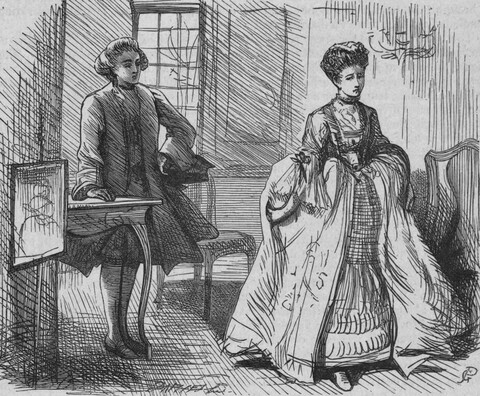
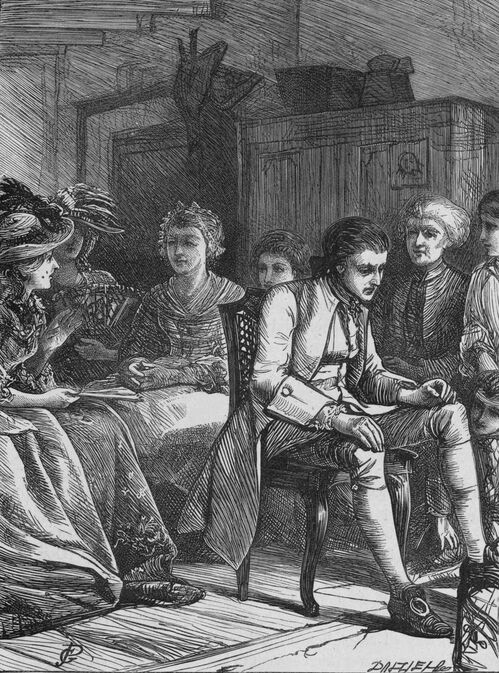
Leont. Confusion! my reserve will
undo me. But, if modesty attracts
her, impudence may disgust her. I'll
try. (Aside.) Don't imagine from my
silence, madam, that I want a due sense
of the honour and happiness intended
me. My father, madam, tells me,
your humble servant is not totally indifferent
to you. He admires you; I
adore you; and when we come together,
upon my soul I believe we
shall be the happiest couple in all St.
James's.
Miss Rich. If I could flatter myself,
you thought as you speak, sir—
Leont. Doubt my sincerity, madam?
By your dear self I swear. Ask the
brave if they desire glory, ask cowards
if they covet safety—
Croaker. Well, well, no more questions
about it.
Leont. Ask the sick if they long for
health, ask misers if they love money,
ask—
Croaker. Ask a fool if he can talk
nonsense! What's come over the
boy? What signifies asking, when
there's not a soul to give you an
answer? If you would ask to the
purpose, ask this lady's consent to
make you happy.
Miss Rich. Why indeed, sir, his
uncommon ardour almost compels me,
forces me, to comply, And yet I am
afraid he'll despise a conquest gained
with too much ease; won't you Mr.
Leontine?
Leont. Confusion! (Aside.) O, by
no means, madam, by no means. And
yet, madam, you talked of force.
There is nothing I would avoid so
much as compulsion in a thing of this
kind. No, madam; I will still be
generous, and leave you at liberty to
refuse.
Croaker. But I tell you, sir, the
lady is not at liberty. It's a match.
You see she says nothing. Silence
gives consent.
Leont. But, sir, she talked of force.
Consider, sir, the cruelty of constraining
her inclinations.
Croaker. But I say there's no
cruelty. Don't you know, blockhead,
that girls have always a round-about
way of saying Yes before company?
So get you both gone together into the
next room, and hang him that interrupts
the tender explanation. Get you
gone, I say; I'll not hear a word.
Leont. But, sir, I must beg leave
to insist—
Croaker. Get off, you puppy, or
I'll beg leave to insist upon knocking
you down. Stupid whelp! But I
don't wonder; the boy takes entirely
after his mother.
[Exeunt Miss Rich. and Leont.
Enter Mrs. Croaker.
Mrs. Croaker. Mr. Croaker, I
bring you something, my dear, that I
believe will make you smile.
Croaker. I'll hold you a guinea of
that, my dear.
Mrs. Croaker. A letter; and, as I
knew the hand, I ventured to open it.
Croaker. And how can you expect
your breaking open my letters should
give me pleasure?
Mrs. Croaker. Pooh, it's from your
sister at Lyons, and contains good
news: read it.
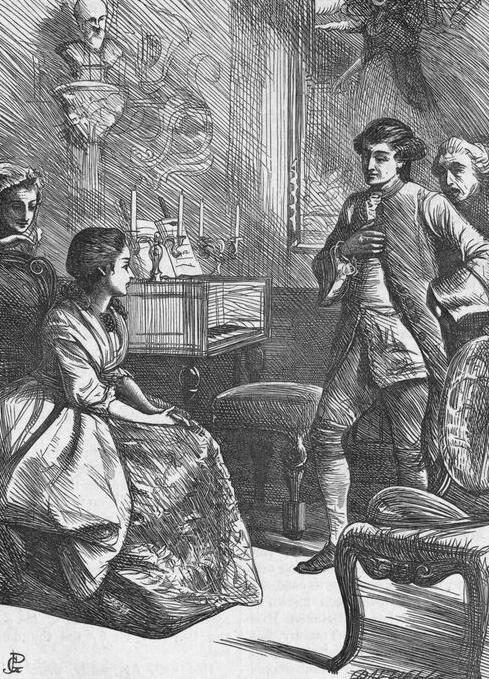
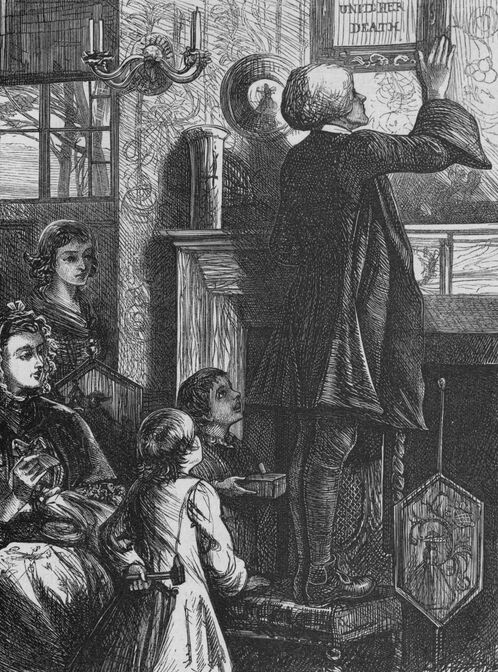
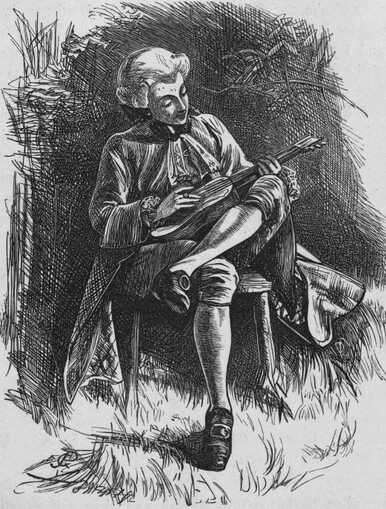
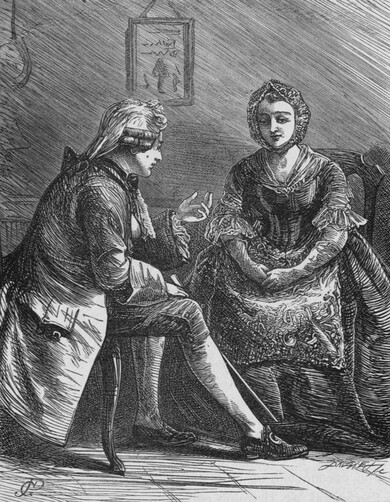
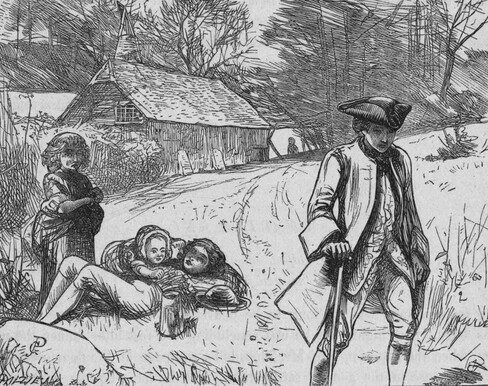
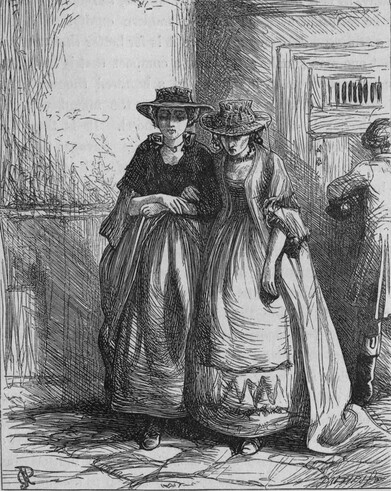
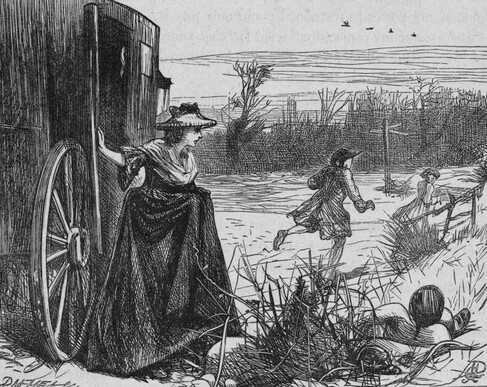
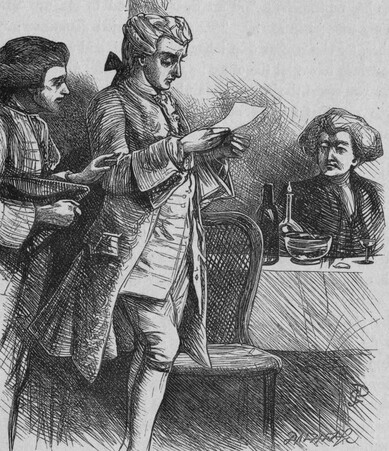
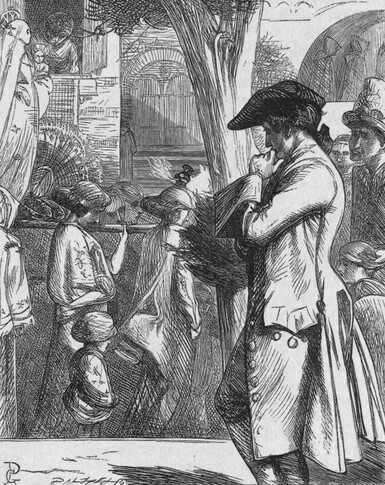
Leont.—"But, if modesty attracts her,
impudence may disgust her. I'll try."—p. 282.
Croaker. What a Frenchified cover
is here! That sister of mine has some
good qualities, but I could never teach
her to fold a letter.
Mrs. Croaker. Fold a fiddlestick!
Read what it contains.
Croaker. (reading.) "Dear Nick,—An
English gentleman, of large fortune,
has for some time made private,
though honourable, proposals to your
daughter Olivia. They love each other
tenderly, and I find she has consented,
without letting any of the family know,
to crown his addresses. As such good
offers don't come every day, your own
good sense, his large fortune, and
family considerations, will induce you
to forgive her.—Yours ever, Rachel
Croaker." My daughter Olivia privately
contracted to a man of large
fortune! This is good news indeed.
My heart never foretold me of this. And
yet, how slily the little baggage has
carried it since she came home! Not
a word on't to the old ones, for the
world! Yet I thought I saw something
she wanted to conceal.
Mrs. Croaker. Well, if they have
concealed their amour, they shan't
conceal their wedding; that shall be
public, I'm resolved.
Croaker. I tell thee, woman, the
wedding is the most foolish part of the
ceremony. I can never get this woman
to think of the more serious part of
the nuptial engagement.
Mrs. Croaker. What, would you
have me think of their funeral? But
come, tell me, my dear, don't you owe
more to me than you care to confess?
Would you have ever been known to
Mr. Lofty, who has undertaken Miss
Richland's claim at the Treasury, but
for me? Who was it first made him
an acquaintance at Lady Shabbaroon's
rout? Who got him to promise us
his interest? Is not he a back-stairs
favourite, one that can do what he
pleases with those that do what they
please? Isn't he an acquaintance that
all your groaning and lamentations
could never have got us?
Croaker. He is a man of importance,
I grant you; and yet, what
amazes me is, that while he is giving
away places to all the world, he can't
get one for himself.
Mrs. Croaker. That perhaps may
be owing to his nicety. Great men
are not easily satisfied.
Enter French Servant.
Servant. An expresse from Monsieur
Lofty. He vil be vait upon your
honours instamment. He be only
giving four five instruction, read two
tree memorial, call upon von ambassadeur.
He vil be vid you in one tree
minutes.
Mrs. Croaker. You see now, my
dear, what an extensive department.
Well, friend, let your master know,
that we are extremely honoured by this
honour. Was there any thing ever in
a higher style of breeding? All messages
among the great are now done
by express.
Croaker. To be sure, no man does
little things with more solemnity, or
claims more respect, than he. But
he's in the right on't. In our bad
world, respect is given where respect
is claimed.
Mrs. Croaker. Never mind the
world, my dear; you were never in a
pleasanter place in your life. Let us
now think of receiving him with proper
respect: (a loud rapping at the door)
and there he is, by the thundering
rap.
Croaker. Ay, verily, there he is;
as close upon the heels of his own
express, as an endorsement upon the
back of a bill. Well, I'll leave you to
receive him, whilst I go to chide my
little Olivia for intending to steal a
marriage without mine or her aunt's
consent. I must seem to be angry, or
she too may begin to despise my
authority.
Enter Lofty, speaking to his Servant.
Lofty. And if the Venetian ambassador,
or that teazing creature the
marquis, should call, I'm not at home.
Dam'me, I'll be packhorse to none of
them. My dear madam, I have just
snatched a moment—and if the expresses
to his grace be ready, let them
be sent off; they're of importance.
Madam, I ask a thousand pardons.
Mrs. Croaker. Sir, this honour—
Lofty. And, Dubardieu, if the person
calls about the commission, let
him know that it is made out. As for
Lord Cumbercourt's stale request; it
can keep cold: you understand me.
Madam, I ask ten thousand pardons.
Mrs. Croaker. Sir, this honour—
Lofty. And, Dubardieu, if the man
comes from the Cornish borough, you
must do him; you must do him, I say.
Madam, I ask ten thousand pardons.
And if the Russian ambassador calls;
but he will scarce call to-day, I believe.
And now, madam, I have just got time
to express my happiness in having the
honour of being permitted to profess
myself your most obedient humble
servant.
Mrs. Croaker. Sir, the happiness
and honour are all mine: and yet I'm
only robbing the public while I detain
you.
Lofty. Sink the public, madam,
when the fair are to be attended. Ah,
could all my hours be so charmingly
devoted! Sincerely, don't you pity us
poor creatures in affairs? Thus it is
eternally; solicited for places here,
teazed for pensions there, and courted
everywhere. I know you pity me.
Yes, I see you do.
Mrs. Croaker. Excuse me, sir;
"Toils of empires pleasures are," as
Waller says.
Lofty. Waller, Waller; is he of
the house?
Mrs. Croaker. The modern poet
of that name, sir.
Lofty. Oh, a modern! We men of
business despise the moderns; and as
for the ancients, we have no time to
read them. Poetry is a pretty thing
enough for our wives and daughters;
but not for us. Why now, here I
stand that know nothing of books;
I say, madam, I know nothing of
books; and yet, I believe, upon a
land carriage fishery, a stamp act, or
a jaghire, I can talk my two hours
without feeling the want of them.
Mrs. Croaker. The world is no
stranger to Mr. Lofty's eminence in
every capacity.
Lofty. I vow to gad, madam, you
make me blush. I'm nothing, nothing,
nothing, in the world; a mere obscure
gentleman. To be sure, indeed, one
or two of the present ministers are
pleased to represent me as a formidable
man. I know they are pleased to
bespatter me at all their little dirty
levees. Yet, upon my soul, I wonder
what they see in me to treat me so.
Measures, not men, have always been
my mark; and I vow, by all that's
honourable, my resentment has never
done the men, as mere men, any manner
of harm—that is, as mere men.
Mrs. Croaker. What importance,
and yet what modesty!
Lofty. Oh, if you talk of modesty,
madam; there, I own, I'm accessible
to praise: modesty is my foible: it
was so, the Duke of Brentford used to
say of me. I love Jack Lofty, he used
to say: no man has a finer knowledge
of things; quite a man of information;
and when he speaks upon his
legs, by the Lord he's prodigious; he
scouts them: and yet all men have
their faults; too much modesty is his,
says his grace.
Mrs. Croaker. And yet, I dare
say, you don't want assurance when
you come to solicit for your friends.
Lofty. O, there indeed I'm in
bronze. Apropos, I have just been
mentioning Miss Richland's case to a
certain personage; we must name no
names. When I ask, I am not to be
put off, madam. No, no, I take my
friend by the button. "A fine girl,
sir; great justice in her case. A friend
of mine. Borough interest. Business
must be done, Mr. Secretary. I say,
Mr. Secretary, her business must be
done, sir." That's my way, madam.
Mrs. Croaker. Bless me! you said
all this to the secretary of state, did
you?
Lofty. I did not say the secretary,
did I? Well, curse it, since you have
found me out I will not deny it. It
was to the secretary.
Mrs. Croaker. This was going to
the fountain head at once; not applying
to the understrappers, as Mr.
Honeywood would have had us.
Lofty. Honeywood! he-he! He
was, indeed, a fine solicitor. I suppose
you have heard what has just
happened to him?
Mrs. Croaker. Poor dear man!
No accident, I hope.
Lofty. Undone, madam, that's all.
His creditors have taken him into
custody. A prisoner in his own house.
Mrs. Croaker. A prisoner in his
own house! How! At this very time?
I'm quite unhappy for him.
Lofty. Why, so am I. The man,
to be sure, was immensely good-natured;
but then, I could never find
that he had anything in him.
Mrs. Croaker. His manner, to be
sure, was excessive harmless; some,
indeed, thought it a little dull. For
my part I always concealed my opinion.
Lofty. It can't be concealed, madam:
the man was dull, dull as the
last new comedy! A poor impracticable
creature! I tried once or twice
to know if he was fit for business, but
he had scarce talents to be groom-porter
to an orange barrow.
Mrs. Croaker. How differently
does Miss Richland think of him! for,
I believe, with all his faults, she loves
him.
Lofty. Loves him! Does she? You
should cure her of that, by all means.
Let me see: what if she were sent to
him this instant, in his present doleful
situation? My life for it, that works
her cure. Distress is a perfect antidote
to love. Suppose we join her in the
next room? Miss Richland is a fine
girl, has a fine fortune, and must not
be thrown away. Upon my honour,
madam, I have a regard for Miss
Richland; and, rather than she should
be thrown away, I should think it no
indignity to marry her myself.
Enter Olivia and Leontine.
Leont. And yet, trust me, Olivia,
I had every reason to expect Miss
Richland's refusal, as I did everything
in my power to deserve it. Her indelicacy
surprises me.
Olivia. Sure, Leontine, there's
nothing so indelicate in being sensible
of your merit. If so, I fear I shall be
the most guilty thing alive.
Leont. But you mistake, my dear.
The same attention I used to advance
my merit with you, I practised to lessen
it with her. What more could I do?
Olivia. Let us now rather consider
what's to be done. We have both
dissembled too long. I have always
been ashamed, I am now quite weary,
of it. Sure, I could never have undergone
so much for any other but you.
Leont. And you shall find my
gratitude equal to your kindest compliance.
Though our friends should
totally forsake us, Olivia, we can draw
upon content for the deficiencies of
fortune.
Olivia. Then why should we defer
our scheme of humble happiness, when
it is now in our power? I may be
the favourite of your father, it is true;
but can it ever be thought, that his
present kindness to a supposed child,
will continue to a known deceiver?
Leont. I have many reasons to
believe it will. As his attachments
are but few, they are lasting. His
own marriage was a private one, as
ours may be. Besides, I have sounded
him already at a distance, and find all
his answers exactly to our wish. Nay
by an expression or two that dropp'd
from him, I am induced to think he
knows of this affair.
Olivia. Indeed! But that would
be a happiness too great to be expected.
Leont. However it be, I'm certain
you have power over him; and am
persuaded, if you informed him of
our situation, that he would be disposed
to pardon it.
Olivia. You had equal expectations,
Leontine, from your last scheme with
Miss Richland, which you find has
succeeded most wretchedly.
Leont. And that's the best reason
for trying another.
Olivia. If it must be so, I submit.
Leont. As we could wish, he comes
this way. Now, my dearest Olivia, be
resolute. I'll just retire within hearing,
to come in at a proper time, either
to share your danger, or confirm your
victory.
Enter Croaker.
Croaker. Yes, I must forgive her;
and yet not too easily, neither. It will
be proper to keep up the decorums
of resentment a little, if it be only
to impress her with an idea of my
authority.
Olivia. How I tremble to approach
him!—Might I presume, sir—If I
interrupt you—
Croaker. No, child; where I have
an affection, it is not a little thing
can interrupt me. Affection gets over
little things.
Olivia. Sir, you're too kind. I'm
sensible how ill I deserve this partiality.
Yet Heaven knows there is nothing I
would not do to gain it.
Croaker. And you have but too
well succeeded, you little hussy, you.
With those endearing ways of yours,
on my conscience, I could be brought
to forgive any thing, unless it were a
very great offence indeed.
Olivia. But mine is such an offence—When
you know my guilt—Yes,
you shall know it, though I feel the
greatest pain in the confession.
Croaker. Why then, if it be so
very great a pain, you may spare yourself
the trouble, for I know every
syllable of the matter before you
begin.
Olivia. Indeed! Then I'm undone.
Croaker. Ay, miss, you wanted to
steal a match, without letting me
know it, did you? But I'm not
worth being consulted, I suppose, when
there's to be a marriage in my own
family. No, I'm to have no hand in
the disposal of my own children. No,
I'm nobody. I'm to be a mere article
of family lumber; a piece of crack'd
china to be stuck up in a corner.
Olivia. Dear sir, nothing but the
dread of your authority could induce
us to conceal it from you.
Croaker. No, no, my consequence
is no more; I'm as little minded as a
dead Russian in winter, just stuck up
with a pipe in his mouth till there
comes a thaw—It goes to my heart to
vex her.
Olivia. I was prepared, sir, for
your anger, and despaired of pardon,
even while I presumed to ask it. But
your severity shall never abate my
affection, as my punishment is but
justice.
Croaker. And yet you should not
despair neither, Livy. We ought to
hope all for the best.
Olivia. And do you permit me to
hope, sir? Can I ever expect to be
forgiven? But hope has too long
deceived me.
Croaker. Why then, child, it shan't
deceive you now, for I forgive you this
very moment; I forgive you all; and
now you are indeed my daughter.
Olivia. O transport! This kindness
overpowers me.
Croaker. I was always against
severity to our children. We have
been young and giddy ourselves, and
we can't expect boys and girls to be
old before their time.
Olivia. What generosity! But can
you forget the many falsehoods, the
dissimulation——
Croaker. You did indeed dissemble,
you urchin you; but where's the
girl that won't dissemble for a husband?
My wife and I had never been married,
if we had not dissembled a little
beforehand.
Olivia. It shall be my future care
never to put such generosity to a
second trial. And as for the partner
of my offence and folly, from his native
honour, and the just sense he has of
his duty, I can answer for him
that——
Enter Leontine.
Leont. Permit him thus to answer
for himself. (Kneeling.) Thus, sir,
let me speak my gratitude for this unmerited
forgiveness. Yes, sir, this
even exceeds all your former tenderness:
I now can boast the most indulgent
of fathers. The life he gave,
compared to this, was but a trifling
blessing.
Croaker. And, good sir, who sent
for you, with that fine tragedy face,
and flourishing manner? I don't
know what we have to do with your
gratitude upon this occasion.
Leont. How, sir, is it possible to be
silent when so much obliged? Would
you refuse me the pleasure of being
grateful? Of adding my thanks to
my Olivia's? Of sharing in the transports
that you have thus occasioned?
Croaker. Lord, sir, we can be
happy enough, without your coming in
to make up the party. I don't know
what's the matter with the boy all this
day; he has got into such a rhodomontade
manner all the morning!
Leont. But, sir, I that have so
large a part in the benefit, is it not
my duty to show my joy? Is the
being admitted to your favour so
slight an obligation? Is the happiness
of marrying my Olivia so small a
blessing?
Croaker. Marrying Olivia! marrying
Olivia! marrying his own sister!
Sure the boy is out of his senses! His
own sister!
Leont. My sister!
Olivia. Sister! How have I been
mistaken!
Aside.
Leont. Some cursed mistake in all
this, I find.
Aside.
Croaker. What does the booby
mean, or has he any meaning? Eh,
what do you mean, you blockhead you?
Leont. Mean, sir—why, sir—only
when my sister is to be married, that I
have the pleasure of marrying her, sir;
that is, of giving her away, sir—I have
made a point of it.
Croaker. O, is that all? Give her
away. You have made a point of it.
Then you had as good make a point of
first giving away yourself, as I'm
going to prepare the writings between
you and Miss Richland this very
minute. What a fuss is here about
nothing! Why, what's the matter
now? I thought I had made you at
least as happy as you could wish.
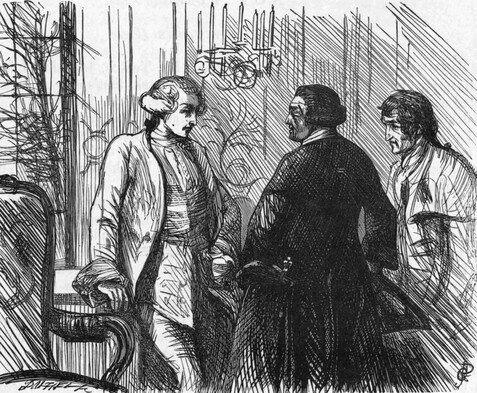
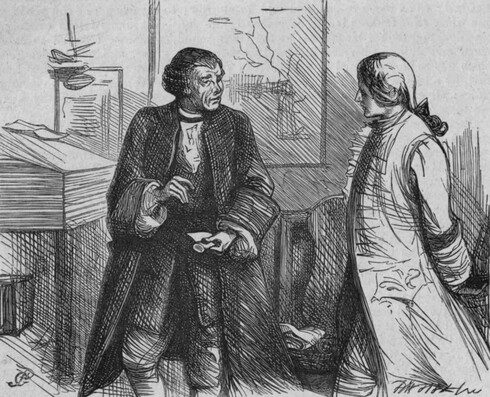
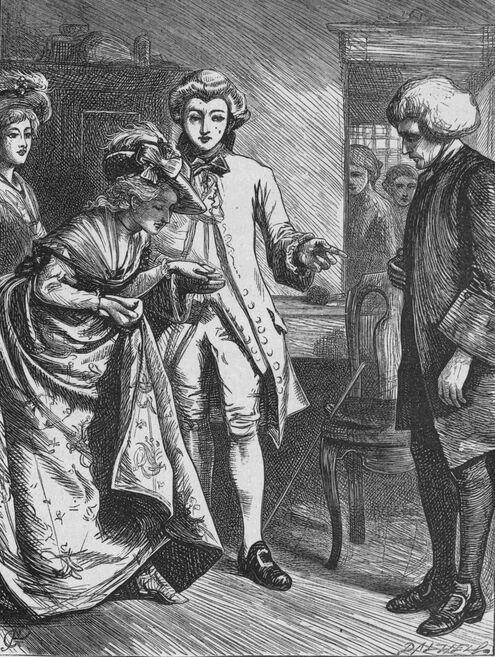
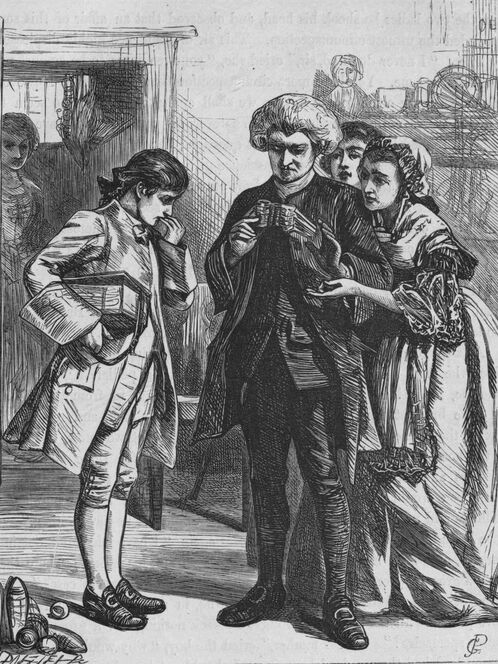
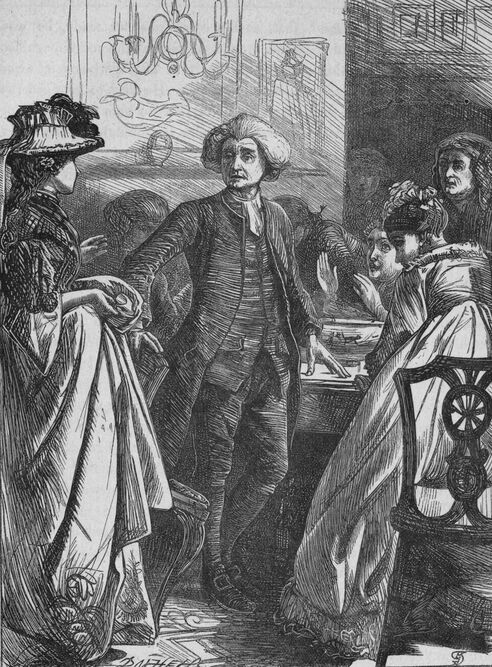
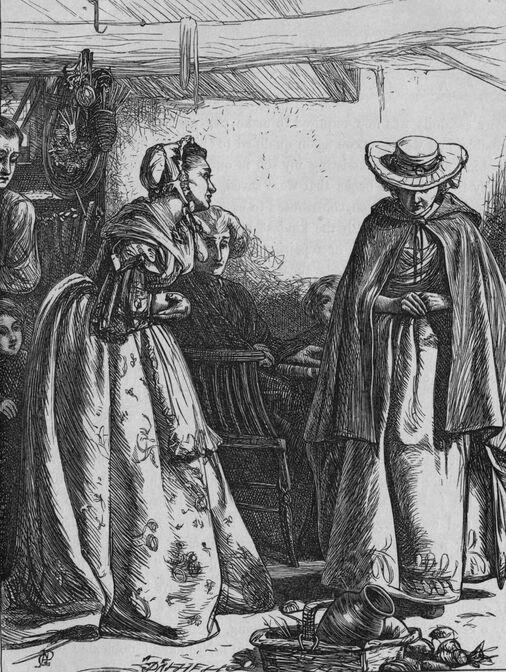
Bailiff.—"Look-ye, sir, I have arrested
as good men as you in my time."—p. 290.
Olivia. Oh! yes, sir, very happy.
Croaker. Do you foresee anything,
child? You look as if you did. I
think if anything was to be foreseen, I
have as sharp a look-out as another:
and yet I foresee nothing.
Leontine, Olivia.
Olivia. What can it mean?
Leont. He knows something, and
yet for my life I can't tell what.
Olivia. It can't be the connexion
between us, I'm pretty certain.
Leont. Whatever it be, my dearest,
I'm resolved to put it out of Fortune's
power to repeat our mortification. I'll
haste, and prepare for our journey to
Scotland this very evening. My friend
Honeywood has promised me his advice
and assistance. I'll go to him,
and repose our distresses on his
friendly bosom: and I know so much
of his honest heart, that if he can't
relieve our uneasinesses, he will at
least share them.
Scene.—Young Honeywood's House.
Bailiff, Honeywood, Follower.
Bailiff. Look-ye, sir, I have arrested
as good men as you in my time;
no disparagement of you neither. Men
that would go forty guineas on a game
of cribbage. I challenge the town to
show a man in more genteeler practice
than myself.
Honeyw. Without all question,
Mr. ——. I forget your name, sir?
Bailiff. How can you forget what
you never knew? he, he, he!
Honeyw. May I beg leave to ask
your name?
Bailiff. Yes, you may.
Honeyw. Then, pray, sir, what is
your name, sir?
Bailiff. That I didn't promise to
tell you; he, he, he! A joke breaks
no bones, as we say among us that
practise the law.
Honeyw. You may have reason for
keeping it a secret perhaps.
Bailiff. The law does nothing
without reason. I'm ashamed to tell
my name to no man, sir. If you can
show cause, as why, upon a special
capus, that I should prove my name—But,
come, Timothy Twitch is my
name. And, now you know my name,
what have you to say to that?
Honeyw. Nothing in the world,
good Mr. Twitch, but that I have a
favour to ask, that's all.
Bailiff. Ay, favours are more
easily asked than granted, as we say
among us that practise the law. I
have taken an oath against granting
favours. Would you have me perjure
myself?
Honeyw. But my request will come
recommended in so strong a manner,
as, I believe, you'll have no scruple.
(Pulling out his purse.) The thing is
only this: I believe I shall be able to
discharge this trifle in two or three
days at farthest; but as I would not
have the affair known for the world, I
have thought of keeping you, and your
good friend here, about me till the
debt is discharged; for which I shall
be properly grateful.
Bailiff. Oh! that's another maxum,
and altogether within my oath. For
certain, if an honest man is to get
anything by a thing, there's no reason
why all things should not be done in
civility.
Honeyw. Doubtless, all trades must
live, Mr. Twitch, and yours is a necessary
one. (Gives him money.)
Bailiff. Oh! your honour; I hope
your honour takes nothing amiss as I
does, as I does nothing but my duty
in so doing. I'm sure no man can say
I ever give a gentleman, that was a
gentleman, ill-usage. If I saw that a
gentleman was a gentleman, I have
taken money not to see him for ten
weeks together.
Honeyw. Tenderness is a virtue,
Mr. Twitch.
Bailiff. Ay, sir, it's a perfect treasure.
I love to see a gentleman with
a tender heart. I don't know, but I
think I have a tender heart myself. If
all that I have lost by my heart was
put together, it would make a—but
no matter for that.
Honeyw. Don't account it lost, Mr.
Twitch. The ingratitude of the world
can never deprive us of the conscious
happiness of having acted with humanity
ourselves.
Bailiff. Humanity, sir, is a jewel.
It's better than gold. I love humanity.
People may say that we, in our way,
have no humanity; but I'll show you
my humanity this moment. There's
my follower here, little Flanigan, with
a wife and four children, a guinea or
two would be more to him, than twice
as much to another. Now, as I can't
show him any humanity myself, I must
beg you'll do it for me.
Honeyw. I assure you, Mr. Twitch,
yours is a most powerful recommendation.
(Giving money to the Follower.)
Bailiff. Sir, you're a gentleman.
I see you know what to do with your
money. But, to business: we are to
be with you here as your friends, I
suppose. But set in case company
comes.—Little Flanigan here, to be
sure, has a good face; a very good
face; but then, he is a little seedy, as
we say among us that practise the law.
Not well in clothes. Smoke the pocket-holes.
Honeyw. Well, that should be remedied
without delay.
Enter Servant.
Servant. Sir, Miss Richland is
below.
Honeyw. How unlucky! Detain
her a moment. We must improve,
my good friend, little Mr. Flanigan's
appearance first. Here, let Mr. Flanigan
have a suit of my clothes—quick—the
brown and silver—Do you hear?
Servant. That your honour gave
away to the begging gentleman that
makes verses, because it was as good
as new.
Honeyw. The white and gold then.
Servant. That, your honour, I
made bold to sell because it was good
for nothing.
Honeyw. Well, the first that comes
to hand then. The blue and gold. I
believe Mr. Flanigan will look best
in blue.
Bailiff. Rabbit me, but little Flanigan
will look well in anything. Ah,
if your honour knew that bit of flesh
as well as I do, you'd be perfectly in
love with him. There's not a prettier
scout in the four counties after a shy-cock
than he. Scents like a hound;
sticks like a weasel. He was master
of the ceremonies to the black queen
of Morocco when I took him to follow
me. [Re-enter Flanigan.] Heh, ecod,
I think he looks so well, that I don't
care if I have a suit from the same
place for myself.
Honeyw. Well, well, I hear the
lady coming. Dear Mr. Twitch, I beg
you'll give your friend directions not
to speak. As for yourself, I know
you will say nothing without being
directed.
Bailiff. Never you fear me, I'll
show the lady that I have something
to say for myself as well as another.
One man has one way of talking, and
another man has another, that's all the
difference between them.
Enter Miss Richland and her Maid.
Miss Rich. You'll be surprised, sir,
with this visit. But you know I'm
yet to thank you for choosing my little
library.
Honeyw. Thanks, madam, are unnecessary,
as it was I that was obliged
by your commands. Chairs here.
Two of my very good friends, Mr.
Twitch, and Mr. Flanigan. Pray,
gentlemen, sit without ceremony.
Miss Rich. Who can these odd-looking
men be? I fear it is as I was
informed. It must be so.
Aside.
Bailiff (after a pause). Pretty
weather, very pretty weather, for the
time of the year, madam.
Follower. Very good circuit weather
in the country.
Honeyw. You officers are generally
favourites among the ladies. My
friends, madam, have been upon very
disagreeable duty, I assure you. The
fair should, in some measure, recompense
the toils of the brave.
Miss Rich. Our officers do indeed
deserve every favour. The gentlemen
are in the marine service, I presume, sir?
Honeyw. Why, madam, they do—occasionally
serve in the Fleet, madam.
A dangerous service.
Miss Rich. I'm told so. And I
own, it has often surprised me, that,
while we have had so many instances
of bravery there, we have had so few
of wit at home to praise it.
Honeyw. I grant, madam, that our
poets have not written as our soldiers
have fought; but, they have done all
they could, and Hawke or Amherst
could do no more.
Miss Rich. I'm quite displeased
when I see a fine subject spoiled by a
dull writer.
Honeyw. We should not be so
severe against dull writers, madam.
It is ten to one, but the dullest writer
exceeds the most rigid French critic
who presumes to despise him.
Follower. Damn the French, the
parle vous, and all that belongs to
them.
Miss Rich. Sir!
Honeyw. Ha, ha, ha, honest Mr.
Flanigan. A true English officer,
madam; he's not contented with beating
the French, but he will scold them
too.
Miss Rich. Yet, Mr. Honeywood,
this does not convince me but that
severity in criticism is necessary. It
was our first adopting the severity of
French taste, that has brought them
in turn to taste us.
Bailiff. Taste us! By the Lord,
madam, they devour us. Give Monseers
but a taste, and I'll be damn'd,
but they come in for a bellyful.
Miss Rich. Very extraordinary this.
Follower. But very true. What
makes the bread rising? the parle vous
that devour us. What makes the
mutton five pence a pound? the parle
vous that eat it up. What makes the
beer threepence halfpenny a pot—
Honeyw. Ah! the vulgar rogues,
all will be out. Right, gentlemen,
very right upon my word, and quite
to the purpose. They draw a parallel,
madam, between the mental taste, and
that of our senses. We are injured
as much by French severity in the one,
as by French rapacity in the other.
That's their meaning.
Miss Rich. Though I don't see the
force of the parallel, yet, I'll own, that
we should sometimes pardon books, as
we do our friends, that have now and
then agreeable absurdities to recommend
them.
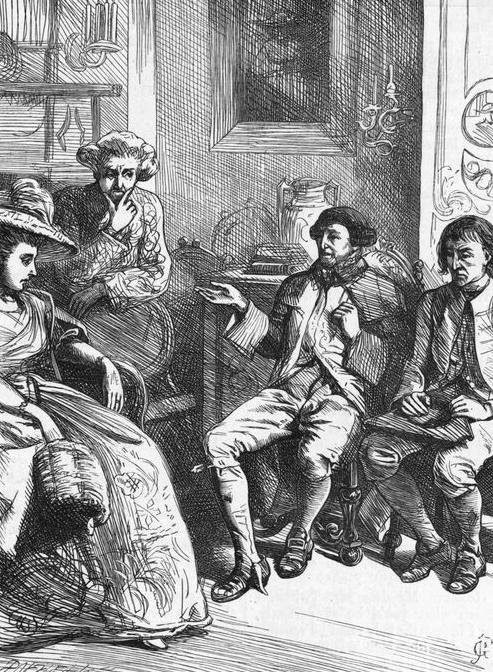
Bailiff.—"Taste us! By the Lord,
madam, they devour us."—p. 292.
Bailiff. That's all my eye. The
king only can pardon, as the law says;
for set in case——
Honeyw. I'm quite of your opinion,
sir. I see the whole drift of your
argument. Yes, certainly our presuming
to pardon any work, is arrogating
a power that belongs to another.
If all have power to condemn, what
writer can be free?
Bailiff. By his habus corpus. His
habus corpus can set him free at any
time. For set in case—
Honeyw. I'm obliged to you, sir,
for the hint. If madam, as my friend
observes, our laws are so careful of a
gentleman's person, sure we ought to
be equally careful of his dearer part,
his fame.
Follower. Ay, but if so be a man's
nabbed, you know—
Honeyw. Mr. Flanigan, if you spoke
for ever, you could not improve the
last observation. For my own part,
I think it conclusive.
Bailiff. As for the matter of that,
mayhap——
Honeyw. Nay, sir, give me leave
in this instance to be positive. For
where is the necessity of censuring
works without genius, which must
shortly sink of themselves: what is
it, but aiming our unnecessary blow
against a victim already under the
hands of justice?
Bailiff. Justice! O, by the elevens,
if you talk about justice, I think I am
at home there; for, in a course of
law—
Honeyw. My dear Mr. Twitch, I
discern what you'd be at perfectly,
and I believe the lady must be sensible
of the art with which it is introduced.
I suppose you perceive the meaning,
madam, of his course of law?
Miss Rich. I protest, sir, I do not.
I perceive only that you answer one
gentleman before he has finished, and
the other before he has well begun.
Bailiff. Madam, you are a gentlewoman,
and I will make the matter
out. This here question is about
severity and justice, and pardon, and
the like of they. Now to explain the
thing—
Honeyw. O! curse your explanations.
Aside.
Enter Servant.
Servant. Mr. Leontine, sir, below,
desires to speak with you upon earnest
business.
Honeyw. That's lucky (aside.) Dear
madam, you'll excuse me, and my good
friends here, for a few minutes. There
are books, madam, to amuse you.
Come, gentlemen, you know I make
no ceremony with such friends. After
you, sir. Excuse me. Well, if I must;
but I know your natural politeness.
Bailiff. Before and behind, you
know.
Follower. Ay, ay, before and behind,
before and behind.
[Exeunt Honeywood, Bailiff, and Follower.
Miss Rich. What can all this mean,
Garnet?
Garnet. Mean, madam? why, what
should it mean, but what Mr. Lofty
sent you here to see? These people he
calls officers, are officers sure enough:
sheriff's officers; bailiffs, madam.
Miss Rich. Ay, it is certainly so.
Well, though his perplexities are far
from giving me pleasure; yet I own
there's something very ridiculous in
them, and a just punishment for his
dissimulation.
Garnet. And so they are. But I
wonder, madam, that the lawyer you
just employed to pay his debts and set
him free, has not done it by this time.
He ought at least to have been here
before now. But lawyers are always
more ready to get a man into troubles,
than out of them.
Enter Sir William.
Sir Will. For Miss Richland to
undertake setting him free, I own, was
quite unexpected. It has totally unhinged
my schemes to reclaim him.
Yet, it gives me pleasure to find, that,
among a number of worthless friendships,
he has made one acquisition of
real value; for there must be some
softer passion on her side that prompts
this generosity. Ha! here before me:
I'll endeavour to sound her affections.
Madam, as I am the person that have
had some demands upon the gentleman
of this house, I hope you'll excuse me,
if, before I enlarged him, I wanted to
see yourself.
Miss Rich. The precaution was
very unnecessary, sir. I suppose your
wants were only such as my agent had
power to satisfy.
Sir Will. Partly, madam. But, I
was also willing you should be fully
apprised of the character of the gentleman
you intended to serve.
Miss Rich. It must come, sir, with
a very ill grace from you. To censure
it, after what you have done, would
look like malice; and to speak favourably
of a character you have oppressed,
would be impeaching your own. And
sure, his tenderness, his humanity, his
universal friendship, may atone for
many faults.
Sir Will. That friendship, madam,
which is exerted in too wide a sphere,
becomes totally useless. Our bounty,
like a drop of water, disappears when
diffused too widely. They, who pretend
most to this universal benevolence,
are either deceivers, or dupes—men
who desire to cover their private ill-nature
by a pretended regard for all;
or men who, reasoning themselves into
false feelings, are more earnest in pursuit
of splendid, than of useful virtues.
Miss Rich. I am surprised, sir, to
hear one who has probably been a
gainer by the folly of others, so severe
in his censure of it.
Sir Will. Whatever I may have
gained by folly, madam, you see I am
willing to prevent your losing by it.
Miss Rich. Your cares for me, sir,
are unnecessary. I always suspect
those services which are denied where
they are wanted, and offered, perhaps,
in hopes of a refusal. No, sir, my
directions have been given, and I insist
upon their being complied with.
Sir Will. Thou amiable woman, I
can no longer contain the expressions
of my gratitude—my pleasure. You
see before you one who has been equally
careful of his interest: one, who has
for some time been a concealed spectator
of his follies, and only punished,
in hopes to reclaim them—His uncle.
Miss Rich. Sir William Honeywood!
You amaze me! How shall I
conceal my confusion? I fear, sir,
you'll think I have been too forward
in my services. I confess I——
Sir Will. Don't make any apologies,
madam. I only find myself unable to
repay the obligation. And yet, I have
been trying my interest of late to serve
you. Having learnt, madam, that you
had some demands upon government,
I have, though unasked, been your
solicitor there.
Miss Rich. Sir, I am infinitely obliged
to your intentions; but my
guardian has employed another gentleman,
who assures him of success.
Sir Will. Who, the important little
man that visits here? Trust me,
madam, he's quite contemptible among
men in power, and utterly unable to
serve you. Mr. Lofty's promises are
much better known to people of fashion
than his person, I assure you.
Miss Rich. How have we been
deceived! As sure as can be, here he
comes.
Sir Will. Does he? Remember
I'm to continue unknown. My return
to England has not as yet been made
public. With what impudence he
enters!
Enter Lofty.
Lofty. Let the chariot—let my
chariot drive off, I'll visit to his grace's
in a chair. Miss Richland here before
me! Punctual, as usual, to the calls
of humanity. I'm very sorry, madam,
things of this kind should happen,
especially to a man I have shown every
where, and carried amongst us as a
particular acquaintance.
Miss Rich. I find, sir, you have
the art of making the misfortunes of
others your own.
Lofty. My dear madam, what can
a private man like me do? One man
can't do everything; and then, I do
so much in this way every day. Let
me see, something considerable might
be done for him by subscription; it
could not fail if I carried the list. I'll
undertake to set down a brace of dukes,
two dozen lords, and half the lower
house, at my own peril.
Sir Will. And after all, it is more
than probable, sir, he might reject the
offer, of such powerful patronage.
Lofty. Then, madam, what can we
do? You know I never make promises.
In truth, I once or twice tried
to do something with him in the way
of business; but as I often told his
uncle, Sir William Honeywood, the
man was utterly impracticable.
Sir Will. His uncle! Then that
gentleman, I suppose, is a particular
friend of yours?
Lofty. Meaning me, sir?—Yes,
madam, as I often said, My dear Sir
William, you are sensible I would do
anything as far as my poor interest
goes, to serve your family; but what
can be done? there's no procuring
first-rate places for ninth-rate abilities.
Miss Rich. I have heard of Sir
William Honeywood; he's abroad in
employment; he confided in your
judgment, I suppose.
Lofty. Why, yes, madam; I believe
Sir William had some reason to confide
in my judgment; one little reason,
perhaps.
Miss Rich. Pray, sir, what was
it?
Lofty. Why, madam—but let it go
no further—it was I procured him his
place.
Sir Will. Did you, sir?
Lofty. Either you or I, sir.
Miss Rich. This, Mr. Lofty, was
very kind, indeed.
Lofty. I did love him, to be sure;
he had some amusing qualities; no
man was fitter to be toastmaster to a
club, or had a better head.
Miss Rich. A better head?
Lofty. Ay, at a bottle. To be sure
he was as dull as a choice spirit; but
hang it, he was grateful, very grateful;
and gratitude hides a multitude of
faults.
Sir Will. He might have reason,
perhaps. His place is pretty considerable,
I'm told.
Lofty. A trifle, a mere trifle, among
us men of business. The truth is, he
wanted dignity to fill up a greater.
Sir Will. Dignity of person, do
you mean sir? I'm told he's much
about my size and figure, sir.
Lofty. Ay, tall enough for a marching
regiment; but then he wanted a
something—a consequence of form—a
kind of a—I believe the lady perceives
my meaning.
Miss Rich. O perfectly; you courtiers
can do any thing, I see.
Lofty. My dear madam, all this is
but a mere exchange; we do greater
things for one another every day. Why
as thus, now; let me suppose you the
first lord of the treasury; you have an
employment in you that I want; I
have a place in me that you want; do
me here, do you there: interest on both
sides, few words, flat, done and done,
and it's over.
Sir Will. A thought strikes me
(aside). Now you mention Sir William
Honeywood, madam, and as he seems,
sir, an acquaintance of yours, you'll be
glad to hear he's arrived from Italy; I
had it from a friend who knows him
as well as he does me, and you may
depend on my information.
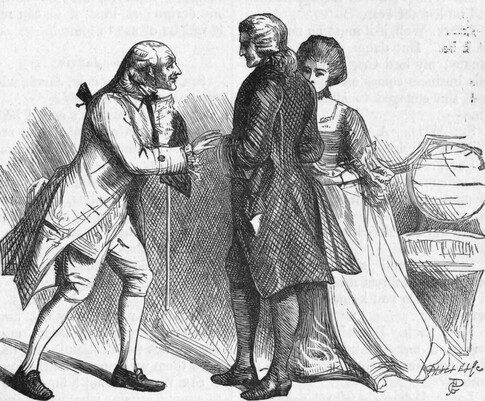
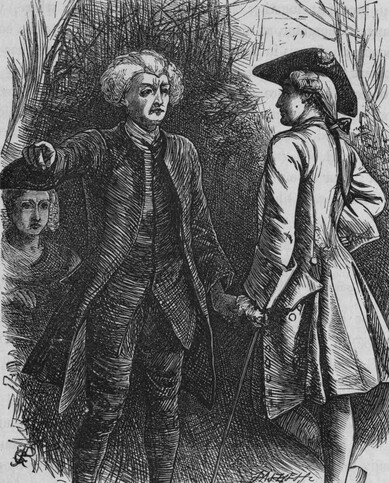
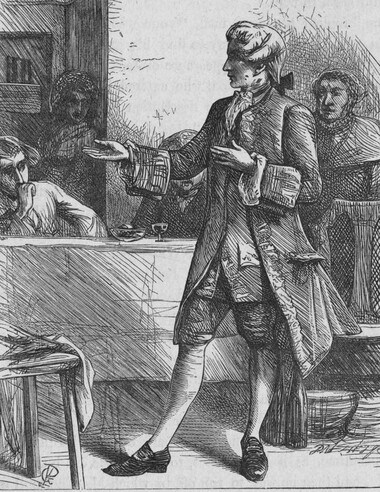
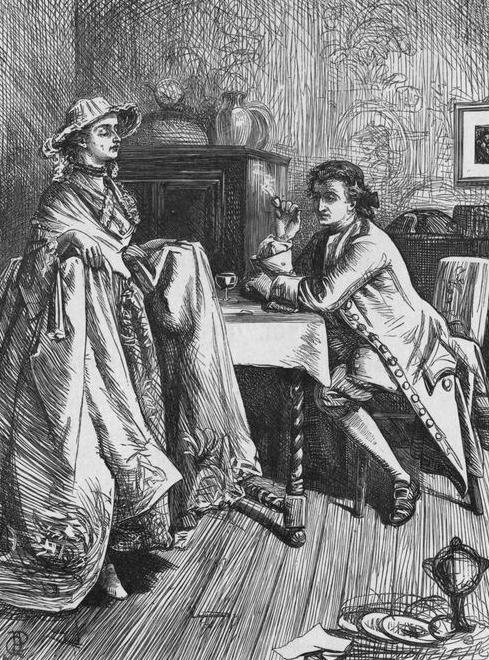
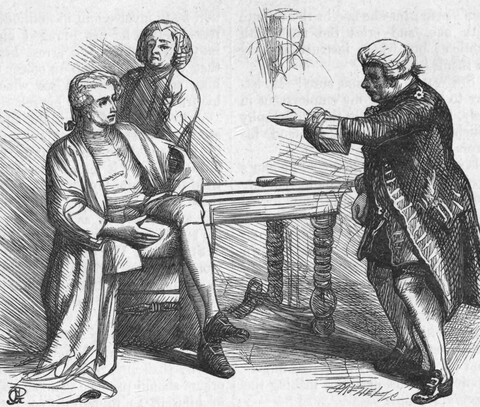
Lofty.—"Either you or I, sir."—p. 296.
Lofty. The devil he is! If I had
known that we should not have been
quite so well acquainted (aside).
Sir Will. He is certainly returned;
and as this gentleman is a friend of
yours, he can be of signal service to us,
by introducing me to him; there are
some papers relative to your affairs,
that require dispatch and his inspection.
Miss Rich. This gentleman, Mr.
Lofty, is a person employed in my
affairs: I know you'll serve us.
Lofty. My dear madam, I live but
to serve you. Sir William shall even
wait upon him, if you think proper to
command it.
Sir Will. That would be quite unnecessary.
Lofty. Well, we must introduce you
then. Call upon me—let me see—ay,
in two days.
Sir Will. Now, or the opportunity
will be lost for ever.
Lofty. Well, if it must be now, now
let it be. But damn it, that's unfortunate;
my lord Grig's cursed Pensacola
business comes on this very hour,
and I'm engaged to attend—another
time—
Sir Will. A short letter to Sir
William will do.
Lofty. You shall have it; yet, in
my opinion, a letter is a very bad way
of going to work; face to face, that's
my way.
Sir Will. The letter sir, will do
quite as well.
Lofty. Zounds, sir, do you pretend
to direct me? direct me in the business
of office? Do you know me, sir? who
am I?
Miss Rich. Dear Mr. Lofty, this
request is not so much his as mine;
if my commands—but you despise my
power.
Lofty. Delicate creature! your commands
could even control a debate at
midnight; to a power so constitutional,
I am all obedience and tranquility. He
shall have a letter; where is my secretary?
Dubardieu! And yet, I protest,
I don't like this way of doing business.
I think if I spoke first to Sir William—But
you will have it so.
Sir William alone.
Sir Will. Ha, ha, ha! This too is
one of my nephew's hopeful associates.
O vanity, thou constant deceiver, how
do all thy efforts to exalt, serve but to
sink us! thy false colourings, like those
employed to heighten beauty, only
seem to mend that bloom which they
contribute to destroy. I'm not displeased
at this interview; exposing
this fellow's impudence to the contempt
it deserves, may be of use to
my design; at least, if he can reflect,
it will be of use to himself.
Enter Jarvis.
Sir Will. How now, Jarvis, where's
your master my nephew?
Jarvis. At his wit's end, I believe;
he's scarce gotten out of one scrape,
but he's running his head into another.
Sir Will. How so?
Jarvis. The house has but just been
cleared of the bailiffs, and now he's
again engaging tooth and nail in assisting
old Croaker's son to patch up a
clandestine match with the young lady
that passes in the house for his sister.
Sir Will. Ever busy to serve
others.
Jarvis. Ay, any body but himself.
The young couple, it seems, are just
setting out for Scotland, and he supplies
them with money for the journey.
Sir Will. Money! how is he able
to supply others, who has scarce any
for himself?
Jarvis. Why, there it is; he has no
money, that's true; but then, as he
never said No to any request in his
life, he has given them a bill drawn by
a friend of his upon a merchant in the
city, which I am to get changed; for
you must know that I am to go with
them to Scotland myself.
Sir Will. How!
Jarvis. It seems the young gentleman
is obliged to take a different road
from his mistress, as he is to call
upon an uncle of his that lives out of
the way, in order to prepare a place
for their reception, when they return;
so they have borrowed me from my
master, as the properest person to attend
the young lady down.
Sir Will. To the land of matrimony!
A pleasant journey, Jarvis.
Jarvis. Ay, but I'm only to have all
the fatigues on't.
Sir Will. Well, it may be shorter,
and less fatiguing, than you imagine.
I know but too much of the young
lady's family and connexions, whom I
have seen abroad, I have also discovered
that Miss Richland is not
indifferent to my thoughtless nephew;
and will endeavour, though I fear in
vain, to establish that connexion. But,
come, the letter I wait for must be
almost finished; I'll let you further
into my intentions in the next room.
ACT IV.
Scene.—Croaker's House.
Lofty. Well, sure the devil's in me
of late, for running my head in such
defiles, as nothing but a genius like
my own could draw me from. I was
formerly contented to husband out my
places and pensions with some degree
of frugality; but, curse it, of late I
have given away the whole Court Register
in less time than they could
print the title-page; yet, hang it, why
scruple a lie or two to come at a fine
girl, when I every day tell a thousand
for nothing? Ha! Honeywood here
before me. Could Miss Richland have
set him at liberty?
Enter Honeywood.
Mr. Honeywood, I'm glad to see
you abroad again. I find my concurrence
was not necessary in your
unfortunate affairs. I had put things
in a train to do your business; but it
is not for me to say what I intended
doing.
Honeyw. It was unfortunate indeed,
sir. But what adds to my uneasiness
is, that while you seem to be acquainted
with my misfortune, I, myself
continue still a stranger to my
benefactor.
Lofty. How! not know the friend
that served you?
Honeyw. Can't guess at the person.
Lofty. Inquire.
Honeyw. I have, but all I can learn
is, that he chooses to remain concealed,
and that all inquiry must be fruitless.
Lofty. Must be fruitless?
Honeyw. Absolutely fruitless.
Lofty. Sure of that?
Honeyw. Very sure.
Lofty. Then I'll be damn'd if you
shall ever know it from me.
Honeyw. How, sir!
Lofty. I suppose now, Mr. Honeywood,
you think my rent-roll very
considerable, and that I have vast
sums of money to throw away; I
know you do. The world, to be sure
says such things of me.
Honeyw. The world, by what I
learn, is no stranger to your generosity.
But where does this tend?
Lofty. To nothing; nothing in the
world. The town, to be sure, when it
makes such a thing as me the subject
of conversation, has asserted, that I
never yet patronised a man of merit.
Honeyw. I have heard instances to
the contrary, even from yourself.
Lofty. Yes, Honeywood, and there
are instances to the contrary that you
shall never hear from myself.
Honeyw. Ha, dear sir, permit me
to ask you but one question.
Lofty. Sir, ask me no questions; I
say, sir, ask me no questions; I'll be
damn'd if I answer them.
Honeyw. I will ask no further. My
friend, my benefactor, it is, it must be
here, that I am indebted for freedom
for honour. Yes, thou worthiest of
men, from the beginning I suspected
it, but was afraid to return thanks;
which, if undeserved, might seem reproaches.
Lofty. I protest I don't understand
all this, Mr. Honeywood. You treat
me very cavalierly, I do assure you, sir.—Blood,
sir, can't a man be permitted
to enjoy the luxury of his own feelings
without all this parade?
Honeyw. Nay, do not attempt to
conceal an action that adds to your
honour. Your looks, your air, your
manner, all confess it.
Lofty. Confess it sir! Torture itself,
sir, shall never bring me to confess
it. Mr. Honeywood, I have admitted
you upon terms of friendship. Don't
let us fall out; make me happy, and
let this be buried in oblivion. You
know I hate ostentation; you know I
do. Come come, Honeywood, you
know I always loved to be a friend,
and not a patron. I beg this may
make no kind of distance between us.
Come, come, you and I must be more
familiar—indeed we must.
Honeyw. Heavens! Can I ever repay
such friendship? Is there any
way? Thou best of men, can I ever
return the obligation?
Lofty. A bagatelle, a mere bagatelle.
But I see your heart is labouring
to be grateful. You shall be grateful.
It would be cruel to disappoint you.
Honeyw. How! teach me the manner.
Is there any way?
Lofty. From this moment you're
mine. Yes, my friend you shall know
it—I'm in love.
Honeyw. And can I assist you?
Lofty. Nobody so well.
Honeyw. In what manner? I'm all
impatience.
Lofty. You shall make love for me.
Honeyw. And to whom shall I
speak in your favour?
Lofty. To a lady with whom you
have great interest, I assure you—Miss
Richland.
Honeyw. Miss Richland!
Lofty. Yes, Miss Richland. She
has struck the blow up to the hilt in
my bosom, by Jupiter.
Honeyw. Heavens was ever anything
more unfortunate? It is too much to
be endured.
Lofty. Unfortunate indeed! and
yet I can endure it, till you have
opened the affair to her for me. Between
ourselves, I think she likes me;
I'm not apt to boast, but I think she
does.
Honeyw. Indeed! but you know the
person you apply to?
Lofty. Yes, I know you are her
friend, and mine: that's enough. To
you, therefore, I commit the success of
my passion. I'll say no more, let
friendship do the rest. I have only
to add, that if at any time my little
interest can be of service—but, hang
it, I'll make no promises—you know
my interest is yours at any time. No
apologies, my friend; I'll not be answered;
it shall be so.
Honeyw. Open, generous, unsuspecting
man! He little thinks that
I love her too; and with such an
ardent passion!—But then it was ever
but a vain and hopeless one; my torment,
my persecution! What shall I
do? Love, friendship, a hopeless
passion, a deserving friend! Love
that has been my tormentor; a friend,
that has, perhaps, distressed himself to
serve me. It shall be so. Yes, I will
discard the fondling hope from my
bosom, and exert all my influence in
his favour. And yet to see her in the
possession of another!—Insupportable.
But then to betray a generous, trusting
friend!—Worse, worse. Yes, I'm resolved.
Let me but be the instrument
of their happiness, and then quit a
country, where I must for ever despair
of finding my own.
[Exit.
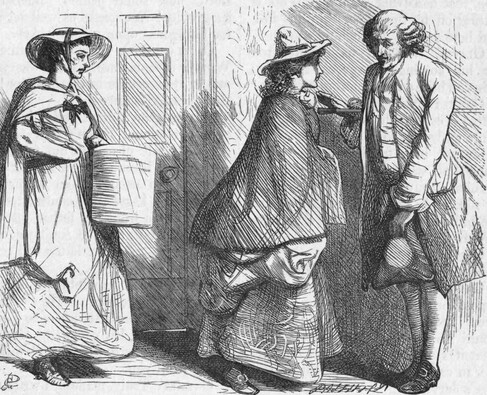
Olivia.—"O, Jarvis, are you come at last?"—p. 302.
Enter Olivia and Garnet, who carries a
milliner's box.
Olivia. Dear me, I wish this journey
were over. No news of Jarvis yet?
I believe the old peevish creature delays
purely to vex me.
Garnet. Why, to be sure, madam,
I did hear him say, a little snubbing
before marriage would teach you to
bear it the better afterwards.
Olivia. To be gone a full hour,
though he had only to get a bill changed
in the city! How provoking!
Garnet. I'll lay my life Mr. Leontine,
that had twice as much to do, is
setting off by this time from his inn,
and here you are left behind.
Olivia. Well, let us be prepared
for his coming, however. Are you
sure you have omitted nothing, Garnet?
Garnet. Not a stick, madam—all's
here. Yet I wish you could take the
white and silver to be married in. It's
the worst luck in the world, in any
thing but white. I knew one Bet
Stubbs, of our town, that was married
in red, and, as sure as eggs is eggs,
the bridegroom and she had a miff before
morning.
Olivia. No matter—I'm all impatience
till we are out of the house.
Garnet. Bless me, madam, I had
almost forgot the wedding ring!—The
sweet little thing—I don't think it
would go on my little finger. And
what if I put in a gentleman's night-cap,
in case of necessity, madam? But
here's Jarvis.
Enter Jarvis.
Olivia. O, Jarvis, are you come at
last? We have been ready this half
hour. Now let's be going—Let us
fly!
Jarvis. Ay, to Jericho; for we shall
have no going to Scotland this bout, I
fancy.
Olivia. How! What's the matter?
Jarvis. Money, money, is the matter,
madam. We have got no money.
What the plague do you send me of
your fool's errand for? My master's
bill upon the city is not worth a rush.
Here it is; Mrs. Garnet may pin up
her hair with it.
Olivia. Undone! How could Honeywood
serve us so! What shall we
do? Can't we go without it?
Jarvis. Go to Scotland without
money! To Scotland without money!
Lord, how some people understand
geography! We might as well set sail
for Patagonia upon a cork jacket.
Olivia. Such a disappointment!
What a base insincere man was your
master, to serve us in this manner! Is
this his good-nature?
Jarvis. Nay, don't talk ill of my
master, madam: I won't bear to hear
any body talk ill of him but myself.
Garnet. Bless us! now I think on't,
madam, you need not be under any
uneasiness: I saw Mr. Leontine receive
forty guineas from his father just before
he set out, and he can't yet have
left the inn. A short letter will reach
him there.
Olivia. Well remembered, Garnet;
I'll write immediately. How's this?
Bless me, my hand trembles so I can't
write a word. Do you write, Garnet;
and, upon second thought, it will be
better from you.
Garnet. Truly, madam, I write and
indite but poorly: I never was cute at
my larning. But I'll do what I can to
please you. Let me see. All out of
my own head, I suppose?
Olivia. Whatever you please.
Garnet (writing). Muster Croaker—Twenty
guineas, madam?
Olivia. Ay, twenty will do.
Garnet. At the bar of the Talbot
till called for. Expedition—will be
blown up—All of a flame—Quick, dispatch—Cupid,
the little God of Love—I
conclude it, madam, with Cupid;
I love to see a love-letter end like
poetry.
Olivia. Well, well, what you please,
anything. But how shall we send it?
I can trust none of the servants of this
family.
Garnet. Odso, Madam, Mr. Honeywood's
butler is in the next room; he's
a dear, sweet man; he'll do anything
for me.
Jarvis. He! the dog, he'll certainly
commit some blunder. He's drunk
and sober ten times a day.
Olivia. No matter. Fly, Garnet;
any body we can trust will do. Exit
Garnet. Well, Jarvis, now we can
have nothing more to interrupt us.
You may take up the things, and carry
them on to the inn. Have you no
hands, Jarvis?
Jarvis. Soft and fair, young lady.
You, that are going to be married,
think things can never be done too
fast: but we that are old, and know
what we are about must elope methodically,
madam.
Olivia. Well, sure, if my indiscretions
were to be done over again—
Jarvis. My life for it you would do
them ten times over.
Olivia. Why will you talk so? If
you knew how unhappy they make
me—
Jarvis. Very unhappy, no doubt:
I was once just as unhappy when I
was going to be married myself. I'll
tell you a story about that—
Olivia. A story! when I'm all impatient
to be away. Was there ever
such a dilatory creature?—
Jarvis. Well, madam, if we must
march, why we will march; that's all.
Though, odds-bobs we have still forgot
one thing we should never travel without—a
case of good razors, and a box
of shaving-powder. But no matter, I
believe we shall be pretty well shaved
by the way.
[Going
Enter Garnet.
Garnet. Undone, undone, madam.
Ah, Mr. Jarvis, you said right enough.
As sure as death, Mr. Honeywood's
rogue of a drunken butler dropped the
letter before he went ten yards from
the door. There's old Croaker has
just picked it up, and is this moment
reading it to himself in the hall.
Olivia. Unfortunate! we shall be
discovered.
Garnet. No, madam, don't be uneasy,
he can make neither head nor
tail of it. To be sure, he looks as if
he was broke loose from Bedlam about
it, but he can't find what it means for
all that. O Lud, he is coming this
way all in the horrors!
Olivia. Then let us leave the house
this instant, for fear he should ask
farther questions. In the mean time,
Garnet, do you write and send off just
such another.
[Exeunt.
Croaker. Death and destruction!
Are all the horrors of air, fire, and
water, to be levelled only at me? Am I
only to be singled out for gunpowder-plots,
combustibles and conflagration?
Here it is—An incendiary letter
dropped at my door. 'To Muster
Croaker, these, with speed.' Ay, ay,
plain enough the direction: all in the
genuine incendiary spelling, and as
cramp as the devil, 'With speed!'
O, confound your speed. But let me
read it once more. (Reads). 'Muster
Croakar as sone as yoew see this leve
twenty gunnes at the bar of the
Talboot tell caled for or yowe and
yower experetion will be al blown
up.' Ah, but too plain. Blood and
gunpowder in every line of it. Blown
up! murderous dog! All blown up!
Heavens! what have I and my poor
family done, to be all blown up!
(Reads). 'Our pockets are low, and
money we must have.' Ay, there's
the reason; they'll blow us up, because
they have got low pockets. (Reads).
'It is but a short time you have to
consider; for if it takes wind, the house
will quickly be all of a flame.' Inhuman
monsters! blow us up, and
then burn us. The earthquake at Lisbon
was but a bonfire to it. (Reads).
'Make quick dispatch, and so no more
at present. But may cupid, the little
God of Love, go with you wherever
you go.' The little God of Love!
Cupid, the little God of Love go with
me! Go you to the devil, you and
your little Cupid together; I'm so
frightened, I scarce know whether I
sit, stand, or go. Perhaps this moment
I'm treading on lighted matches, blazing
brimstone, and barrels of gunpowder.
They are preparing to blow
me up into the clouds. Murder! We
shall be all burnt in our beds; we shall
be all burnt in our beds.
Enter Miss Richland
Miss Rich. Lord, sir, what's the
matter?
Croaker. Murder's the matter. We
shall be all blown up in our beds before
morning.
Miss Rich. I hope not, sir.
Croaker. What signifies what you
hope, madam, when I have a certificate
of it here in my hand? Will nothing
alarm my family? Sleeping and
eating, sleeping and eating, is the only
work from morning till night in my
house. My insensible crew could
sleep, though rocked by an earthquake;
and fry beef-steaks at a volcano.
Miss Rich. But, sir, you have
alarmed them so often already, we
have nothing but earthquakes, famines,
plagues, and mad dogs, from year's end
to years' end. You remember, sir, it
is not above a month ago you assured
us of a conspiracy among the bakers,
to poison us in our bread; and so kept
the whole family a week upon potatoes.
Croaker. And potatoes were too
good for them. But why do I stand
talking here with a girl, when I should
be facing the enemy without? Here,
John, Nicodemus, search the house.
Look into the cellars, to see if there be
any combustibles below; and above,
in the apartments, that no matches
be thrown in at the windows. Let
all the fires be put out, and let the
engine be drawn out in the yard, to
play upon the house in case of necessity.
Miss Richland alone.
Miss Rich. What can he mean by
all this? Yet, why should I inquire,
when he alarms us in this manner
almost every day? But Honeywood
has desired an interview with me in
private. What can he mean? or,
rather, what means this palpitation at
his approach? It is the first time he
ever showed anything in his conduct
that seemed particular. Sure he cannot
mean to——but he's here.
Enter Honeywood.
Honeyw. I presumed to solicit this
interview, madam, before I left town,
to be permitted—
Miss Rich. Indeed! Leaving town,
sir?—
Honeyw. Yes, madam; perhaps the
kingdom. I have presumed, I say, to
desire the favour of this interview—in
order to disclose something which our
long friendship prompts. And yet
my fears—
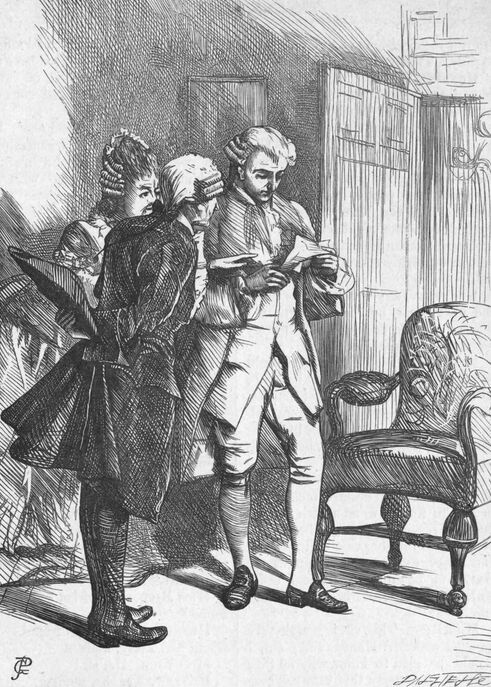
Croaker.—"It's your supreme pleasure
to give me no better consolation?"—p. 307.
Miss Rich. His fears! what are
his fears to mine? Aside.—We have
indeed been long acquainted, sir; very
long. If I remember, our first meeting
was at the French ambassador's.—Do
you recollect how you were pleased
to rally me upon my complexion there?
Honeyw. Perfectly, madam; I presumed
to reprove you for painting:
but your warmer blushes soon convinced
the company that the colouring
was all from nature.
Miss Rich. And yet you only
meant it, in your good-natured way,
to make me pay a compliment to
myself. In the same manner you
danced the same night with the most
awkward woman in company, because
you saw nobody else would take her
out.
Honeyw. Yes; and was rewarded
the next night, by dancing with the
finest woman in company, whom every
body wished to take out.
Miss Rich. Well, sir, if you thought
so then, I fear your judgment has since
corrected the errors of a first impression.
We generally show to most advantage
at first. Our sex are like poor
tradesmen, that put all their best goods
to be seen at the windows.
Honeyw. The first impression, madam,
did, indeed, deceive me. I expected
to find a woman with all the
faults of conscious flattered beauty. I
expected to find her vain and insolent.
But every day has since taught me
that it is possible to possess sense
without pride, and beauty without
affectation.
Miss Rich. This, sir, is a style very
unusual with Mr. Honeywood; and I
should be glad to know why he thus
attempts to increase that vanity, which
his own lesson hath taught me to
despise.
Honeyw. I ask pardon, madam,
Yet, from our long friendship, I presumed
I might have some right to offer,
without offence, what you may refuse
without offending.
Miss Rich. Sir! I beg you'd reflect;
though, I fear, I shall scarce have any
power to refuse a request of yours;
yet, you may be precipitate: consider,
sir.
Honeyw. I own my rashness; but,
as I plead the cause of friendship, of
one who loves—Don't be alarmed,
madam—Who loves you with the
most ardent passion; whose whole
happiness is placed in you—
Miss Rich. I fear, sir, I shall never
find whom you mean, by this description
of him.
Honeyw. Ah, madam, it but too
plainly points him out; though he
should be too humble himself to urge
his pretensions, or you too modest to
understand them.
Miss Rich. Well; it would be
affectation any longer to pretend ignorance;
and, I will own, sir, I have
long been prejudiced in his favour.
It was but natural to wish to make
his heart mine, as he seemed himself
ignorant of its value.
Honeyw. I see she always loved
him (aside). I find, madam, you're
already sensible of his worth, his passion.
How happy is my friend, to be
the favourite of one with such sense
to distinguish merit, and such beauty
to reward it!
Miss Rich. Your friend, sir! What
friend?
Honeyw. My best friend—my
friend Mr. Lofty, madam.
Miss Rich. He, sir!
Honeyw. Yes, he, madam. He is,
indeed, what your warmest wishes
might have formed him. And to his
other qualities, he adds that of the
most passionate regard for you.
Miss Rich. Amazement!—No more
of this, I beg you, sir.
Honeyw. I see your confusion,
madam, and know how to interpret it.
And since I so plainly read the language
of your heart, shall I make my
friend happy, by communicating your
sentiments?
Miss Rich. By no means.
Honeyw. Excuse me; I must—I
know you desire it.
Miss Rich. Mr. Honeywood, let
me tell you, that you wrong my sentiments
and yourself. When I first
applied to your friendship, I expected
advice and assistance; but now, sir, I
see that it is vain to expect happiness
from him who has been so bad an
economist of his own; and that I
must disclaim his friendship who ceases
to be a friend to himself.
Honeyw. How is this? she has
confessed she loved him, and yet she
seemed to part in displeasure. Can I
have done anything to reproach myself
with? No, I believe not; yet, after
all, these things should not be done
by a third person; I should have
spared her confusion. My friendship
carried me a little too far.
Enter Croaker, with the letter in his hand,
and Mrs. Croaker.
Mrs. Croaker. Ha, ha, ha! And
so my dear, it's your supreme wish
that I should be quite wretched upon
this occasion? Ha, ha!
Croaker (mimicking). Ha, ha, ha!
and so, my dear, it's your supreme
pleasure to give me no better consolation?
Mrs. Croaker. Positively, my dear,
what is this incendiary stuff and trumpery
to me? Our house may travel
through the air like the house of Loretto,
for aught I care, if I'm to be
miserable in it.
Croaker. Would to heaven it were
converted into a house of correction
for your benefit! Have we not everything
to alarm us? Perhaps, this very
moment the tragedy is beginning.
Mrs. Croaker. Then let us reserve
our distress till the rising of the curtain,
or give them the money they
want, and have done with them.
Croaker. Give them my money!—and
pray what right have they to
my money?
Mrs. Croaker. And pray what
right then have you to my good
humour?
Croaker. And so your good humour
advises me to part with my
money? Why, then, to tell your
good humour a piece of my mind, I'd
sooner part with my wife. Here's
Mr. Honeywood, see what he'll say
to it. My dear Honeywood, look at
this incendiary letter dropped at my
door. It will freeze you with terror;
and yet lovey here can read it—can
read it, and laugh.
Mrs. Croaker. Yes, and so will
Mr. Honeywood.
Croaker. If he does, I'll suffer to
be hanged the next minute in the
rogue's place, that's all.
Mrs. Croaker. Speak, Mr. Honeywood;
is there anything more foolish
than my husband's fright upon this
occasion?
Honeyw. It would not become me
to decide, madam; but, doubtless, the
greatness of his terrors now will but
invite them to renew their villainy
another time.
Mrs. Croaker. I told you he'd be
of my opinion.
Croaker. How, sir! do you maintain
that I should lie down under such
an injury, and show, neither by my
tears nor complaints, that I have something
of the spirit of a man in me?
Honeyw. Pardon me, sir. You
ought to make the loudest complaints
if you desire redress. The surest way
to have redress, is to be earnest in the
pursuit of it.
Croaker. Ay, whose opinion is he
of now?
Mrs. Croaker. But don't you think
that laughing off our fears is the best
way?
Honeyw. What is the best, madam,
few can say; but I'll maintain it to
be a very wise way.
Croaker. But we're talking of the
best. Surely the best way is to face
the enemy in the field, and not wait
till he plunders us in our very bed-chamber.
Honeyw. Why, sir, as to the best,
that—that's a very wise way too.
Mrs. Croaker. But can anything
be more absurd than to double our
distresses by our apprehensions, and
put it in the power of every low fellow,
that can scrawl ten words of wretched
spelling, to torment us?
Honeyw. Without doubt, nothing
more absurd.
Croaker. How! would it not be
more absurd to despise the rattle till
we are bit by the snake?
Honeyw. Without doubt, perfectly
absurd.
Croaker. Then you are of my
opinion?
Honeyw. Entirely.
Mrs. Croaker. And you reject
mine?
Honeyw. Heavens forbid, madam.
No; sure no reasoning can be more
just than yours. We ought certainly
to despise malice, if we cannot oppose
it, and not make the incendiary's pen
as fatal to our repose as the highwayman's
pistol.
Mrs. Croaker. O! then you think
I'm quite right?
Honeyw. Perfectly right.
Croaker. A plague of plagues, we
can't both be right. I ought to be
sorry, or I ought to be glad. My hat
must be on my head, or my hat must
be off.
Mrs. Croaker. Certainly; in two
opposite opinions, if one be perfectly
reasonable, the other can't be perfectly
right.
Honeyw. And why may not both
be right, madam; Mr. Croaker in
earnestly seeking redress, and you in
waiting the event with good humour?
Pray let me see the letter again. I
have it. This letter requires twenty
guineas to be left at the bar of the
Talbot inn. If it be indeed an incendiary
letter, what if you and I, sir,
go there; and when the writer comes to
be paid his expected booty, seize him?
Croaker. My dear friend, it's the
very thing; the very thing. While I
walk by the door, you shall plant yourself
in ambush near the bar; burst out
upon the miscreant like a masqued
battery; extort a confession at once,
and so hang him up by surprise.
Honeyw. Yes; but I would not
choose to exercise too much severity.
It is my maxim, sir, that crimes generally
punish themselves.
Croaker. Well, but we may upbraid
him a little, I suppose? (Ironically.)
Honeyw. Ay, but not punish him
too rigidly.
Croaker. Well, well, leave that to
my own benevolence.
Honeyw. Well, I do; but remember
that universal benevolence is the
first law of nature.
[Exeunt Honeywood and Mrs. Croaker.
Croaker. Yes; and my universal
benevolence will hang the dog if he
had as many necks as a hydra.
ACT V.
Scene.—An Inn.
Enter Olivia, Jarvis.
Olivia. Well, we have got safe to
the inn, however. Now, if the post-chaise
were ready—
Jarvis. The horses are just finishing
their oats; and, as they are not
going to be married, they choose to
take their own time.
Olivia. You are for ever giving
wrong motives to my impatience.
Jarvis. Be as impatient as you
will, the horses must take their own
time; besides, you don't consider we
have got no answer from our fellow-traveller
yet. If we hear nothing from
Mr. Leontine, we have only one way
left us.
Olivia. What way?
Jarvis. The way home again.
Olivia. Not so. I have made a
resolution to go, and nothing shall
induce me to break it.
Jarvis. Ay; resolutions are well
kept when they jump with inclination.
However, I'll go hasten things without.
And I'll call too at the bar to
see if anything should be left for us
there. Don't be in such a plaguy
hurry, madam, and we shall go the
faster, I promise you.
[Exit Jarvis.
Enter Landlady.
Landlady. What! Solomon; why
don't you move? Pipes and tobacco
for the Lamb there. Will nobody
answer? To the Dolphin; quick.
The Angel has been outrageous this
half-hour. Did your ladyship call,
madam?
Olivia. No, madam.
Landlady. I find, as you're for
Scotland, madam—but that's no business
of mine; married or not married,
I ask no questions. To be sure, we
had a sweet little couple set off from
this two days ago for the same place.
The gentleman, for a tailor, was, to be
sure, as fine a spoken tailor as ever
blew froth from a full pot. And the
young lady so bashful, it was near
half an hour before we could get her
to finish a pint of raspberry between
us.
Olivia. But this gentleman and I
are not going to be married, I assure
you
Landlady. May be not. That's
no business of mine; for certain,
Scotch marriages seldom turn out.
There was, of my own knowledge,
Miss Macfag, that married her father's
footman. Alack-a-day! she and her
husband soon parted, and now keep
separate cellars in Hedge-lane.
Olivia. A very pretty picture of
what lies before me.
Aside.
Enter Leontine.
Leont. My dear Olivia, my anxiety
till you were out of danger, was too
great to be resisted. I could not help
coming to see you set out, though it
exposes us to a discovery.
Olivia. May everything you do
prove as fortunate. Indeed, Leontine,
we have been most cruelly disappointed.
Mr. Honeywood's bill upon
the city has, it seems, been protested;
and we have been utterly at a loss
how to proceed.
Leont. How! An offer of his own
too. Sure, he could not mean to deceive
us.
Olivia. Depend upon his sincerity;
he only mistook the desire for the
power of serving us. But let us think
no more of it. I believe the post-chaise
is ready by this.
Landlady. Not quite yet; and,
begging your ladyship's pardon, I
don't think your ladyship quite ready
for the post-chaise. The north road
is a cold place, madam. I have a drop
in the house of as pretty raspberry as
ever was tipt over tongue. Just a
thimblefull, to keep the wind off your
stomach. To be sure, the last couple
we had here, they said it was a perfect
nosegay. Ecod, I sent them both
away as good-natured—Up went the
blinds, round went the wheels, and,
Drive away, postboy! was the word.
Enter Croaker.
Croaker. Well, while my friend
Honeywood is upon the post of danger
at the bar, it must be my business to
have an eye about me here. I think
I know an incendiary's look; for,
wherever the devil makes a purchase,
he never fails to set his mark. Ha!
who have we here? My son and
daughter! What can they be doing
here?
Landlady. I tell you, madam, it
will do you good; I think I know by
this time what's good for the north
road. It's a raw night, madam.—Sir—
Leont. Not a drop more, good
madam. I should now take it as a
greater favour if you hasten the horses;
for I am afraid to be seen myself.
Landlady. That shall be done.
Wha, Solomon! are you all dead
there? Wha, Solomon, I say.
Olivia. Well; I dread, lest an
expedition begun in fear should end in
repentance.—Every moment we stay
increases our danger, and adds to my
apprehensions.
Leont. There's no danger, trust
me, my dear; there can be none. If
Honeywood has acted with honour,
and kept my father, as he promised,
in employment, till we are out of
danger, nothing can interrupt our
journey.
Olivia. I have no doubt of Mr.
Honeywood's sincerity, and even his
desires to serve us. My fears are
from your father's suspicions. A
mind so disposed to be alarmed without
a cause will be but too ready
when there's a reason.
Leont. Why, let him, when we are
out of his power. But, believe me,
Olivia, you have no great reason to
dread his resentment. His repining
temper, as it does no manner of injury
to himself, so will it never do harm to
others. He only frets to keep himself
employed, and scolds for his private
amusement.
Olivia. I don't know that; but
I'm sure, on some occasions, it makes
him look most shockingly.
Croaker (discovering himself). How
does he look now?—How does he
look now?
Olivia. Ah!
Leont. Undone.
Croaker. How do I look now?
Sir, I am your very humble servant.
Madam, I am yours. What! you are
going off, are you? Then, first, if you
please, take a word or two from me
with you before you go. Tell me first
where you are going; and when you
have told me that, perhaps, I shall
know as little as I did before.
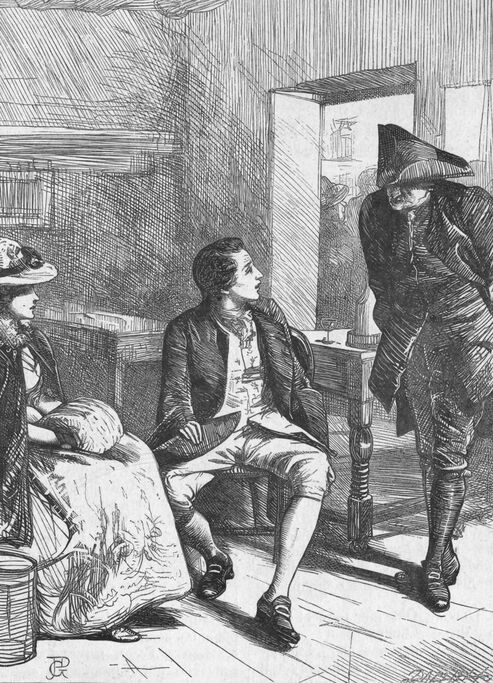
Croaker.—"How does he look now?"—p. 310.
Leont. If that be so, our answer
might but increase your displeasure,
without adding to your information.
Croaker. I want no information
from you, puppy! and you, too,
madam, what answer have you got?
Eh! A cry without, Stop him! I
think I heard a noise. My friend,
Honeywood, without—has he seized
the incendiary? Ah, no, for now I
hear no more on't.
Leont. Honeywood without? Then,
sir, it was Mr. Honeywood that directed
you hither.
Croaker. No, sir, it was Mr.
Honeywood conducted me hither.
Leont. Is it possible?
Croaker. Possible! why he's in
the house now, sir. More anxious
about me, than my own son, sir.
Leont. Then, sir, he's a villain.
Croaker. How, sirrah; a villain,
because he takes most care of your
father? I'll not bear it. I tell you
I'll not bear it. Honeywood is a
friend to the family, and I'll have him
treated as such.
Leont. I shall study to repay his
friendship as it deserves.
Croaker. Ah, rogue, if you knew
how earnestly he entered into my
griefs, and pointed out the means to
detect them, you would love him as I
do. A cry without, Stop him! Fire
and fury! they have seized the incendiary:
they have the villain, the incendiary
in view. Stop him, stop an
incendiary, a murderer! stop him.
Olivia. Oh, my terrors! What
can this new tumult mean?
Leont. Some new mark, I suppose,
of Mr. Honeywood's sincerity. But
we shall have satisfaction: he shall
give me instant satisfaction.
Olivia. It must not be, my Leontine,
if you value my esteem, or my
happiness. Whatever be our fate, let
us not add guilt to our misfortunes.
Consider that our innocence will
shortly be all we have left us. You
must forgive him.
Leont. Forgive him! Has he not
in every instance betrayed us? Forced
me to borrow money from him, which
appears a mere trick to delay us:
promised to keep my father engaged,
till we were out of danger, and here
brought him to the very scene of our
escape?
Olivia. Don't be precipitate. We
may yet be mistaken.
Enter Postboy, dragging in Jarvis: Honeywood
entering soon after.
Postboy. Ay, master, we have him
fast enough. Here is the incendiary
dog. I'm entitled to the reward; I'll
take my oath I saw him ask for the
money at the bar, and then run for it.
Honeyw. Come, bring him along.
Let us see him. Let him learn to
blush for his crimes. (Discovering his
mistake.) Death! what's here?—Jarvis,
Leontine, Olivia! What can
all this mean?
Jarvis. Why, I'll tell you what it
means: that I was an old fool, and
that you are my master—that's all.
Honeyw. Confusion.
Leont. Yes, sir; I find you have
kept your word with me. After such
baseness, I wonder how you can
venture to see the man you have
injured.
Honeyw. My dear Leontine, by my
life, my honour—
Leont. Peace, peace, for shame;
and do not continue to aggravate
baseness by hypocrisy. I know you,
sir, I know you.
Honeyw. Why, won't you hear me?
By all that's just, I knew not—
Leont. Hear you, sir, to what purpose?
I now see through all your
low arts; your ever complying with
every opinion; your never refusing
any request; your friendship is as
common as a prostitute's favours, and
as fallacious; all these, sir, have long
been contemptible to the world, and
are now perfectly so to me.
Honeyw. Ha! contemptible to the
world! That reaches me.
Aside.
Leont. All the seeming sincerity of
your professions, I now find, were
only allurements to betray; and all
your seeming regret for their consequences,
only calculated to cover
the cowardice of your heart. Draw,
villain!
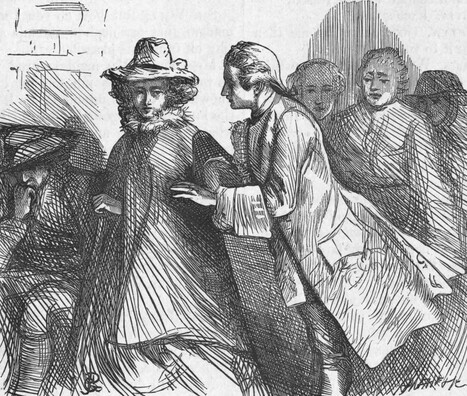
Honeyw.—"Madam, you seem at least
calm enough to hear reason."—p. 314.
Enter Croaker out of breath.
Croaker. Where is the villain?
Where is the incendiary! (Seizing the
Postboy.) Hold him fast, the dog; he
has the gallows in his face. Come,
you dog, confess; confess all, and hang
yourself.
Postboy. Zounds, master! what do
you throttle me for?
Croaker. (beating him). Dog, do
you resist? do you resist?
Postboy. Zounds, master! I'm not
he; there's the man that we thought
was the rogue, and turns out to be
one of the company.
Croaker. How!
Honeyw. Mr. Croaker, we have all
been under a strange mistake here: I
find there is nobody guilty; it was all
an error; entirely an error of our own.
Croaker. And I say, sir, that you're
in an error: for there's guilt, and
double guilt; a plot, a damn'd jesuitical,
pestilential plot; and I must
have proof of it.
Honeyw. Do but hear me.
Croaker. What! you intend to
bring 'em off, I suppose? I'll hear
nothing.
Honeyw. Madam, you seem at
least calm enough to hear reason.
Olivia. Excuse me.
Honeyw. Good Jarvis, let me then
explain it to you.
Jarvis. What signifies explanation,
when the thing is done?
Honeyw. Will nobody hear me?
Was there ever such a set, so blinded
by passion and prejudice!—(To the
Postboy). My good friend, I believe
you'll be surprised when I assure
you——
Postboy. Sure me nothing—I'm
sure of nothing but a good beating.
Croaker. Come then, you, madam;
if you ever hope for any favour or forgiveness,
tell me sincerely all you
know of this affair.
Olivia. Unhappily, sir, I'm but too
much the cause of your suspicions;
you see before you, sir, one, that
with false pretences has stept into
your family, to betray it: not your
daughter—
Croaker. Not my daughter!
Olivia. Not your daughter—but a
mean deceiver—who—support me, I
cannot—
Honeyw. Help, she's going! give
her air.
Croaker. Ay, ay, take the young
woman to the air; I would not hurt a
hair of her head, whoseever daughter
she may be—not so bad as that
neither.
Croaker. Yes, yes, all's out; I now
see the whole affair; my son is either
married, or going to be so, to this
lady, whom he imposed upon me as
his sister. Ay, certainly so; and yet
I don't find it afflicts me so much as
one might think. There's the advantage
of fretting away our misfortunes
beforehand, we never feel them when
they come.
Enter Miss Richland and Sir William.
Sir Will. But how do you know,
madam, that my nephew intends setting
off from this place?
Miss Rich. My maid assured me
he was come to this inn, and my own
knowledge of his intending to leave
the kingdom, suggested the rest. But
what do I see? my guardian here
before us! Who, my dear sir, could
have expected meeting you here? to
what accident do we owe this pleasure?
Croaker. To a fool, I believe.
Miss Rich. But to what purpose
did you come?
Croaker. To play the fool.
Miss Rich. But with whom?
Croaker. With greater fools than
myself.
Miss Rich. Explain.
Croaker. Why, Mr. Honeywood
brought me here, to do nothing now I
am here; and my son is going to be
married to I don't know who that is
here; so now you are as wise as I am.
Miss Rich. Married! to whom,
sir?
Croaker. To Olivia; my daughter,
as I took her to be; but who the
devil she is, or whose daughter she is,
I know no more than the man in the
moon.
Sir Will. Then, sir, I can inform
you; and though a stranger, yet you
shall find me a friend to your family:
it will be enough at present to assure
you, that, both in point of birth and
fortune, the young lady is at least
your son's equal. Being left by her
father, Sir James Woodville—
Croaker. Sir James Woodville!
What of the west!
Sir Will. Being left by him, I say,
to the care of a mercenary wretch,
whose only aim was to secure her
fortune to himself, she was sent into
France, under pretence of education;
and there every art was tried to fix
her for life in a convent, contrary to
her inclinations. Of this I was informed
upon my arrival at Paris; and
as I had been once her father's friend,
I did all in my power to frustrate her
guardian's base intentions. I had
even meditated to rescue her from his
authority, when your son stept in with
more pleasing violence, gave her
liberty, and you a daughter.
Croaker. But I intend to have a
daughter of my own choosing, sir. A
young lady, sir, whose fortune, by my
interest with those that have interest,
will be double what my son has a
right to expect. Do you know Mr.
Lofty, sir?
Sir Will. Yes, sir; and know that
you are deceived in him. But step
this way, and I'll convince you.
Croaker and Sir William seem to confer.
Enter Honeywood.
Honeyw. Obstinate man, still to
persist in his outrage! Insulted by
him, despised by all, I now begin to
grow contemptible even to myself.
How have I sunk, by too great an
assiduity to please! How have I
overtaxed all my abilities, lest the
approbation of a single fool should
escape me! But all is now over; I
have survived my reputation, my
fortune, my friendships; and nothing
remains henceforward for me but
solitude and repentance.
Miss Rich. Is it true, Mr. Honeywood,
that you are setting off, without
taking leave of your friends? The
report is, that you are quitting
England. Can it be?
Honeyw. Yes, madam; and though
I am so unhappy as to have fallen
under your displeasure, yet, thank
Heaven, I leave you to happiness; to
one who loves you, and deserves your
love; to one who has power to procure
you affluence, and generosity to improve
your enjoyment of it.
Miss Rich. And are you sure, sir,
that the gentleman you mean is what
you describe him?
Honeyw. I have the best assurances
of it, his serving me. He does, indeed,
deserve the highest happiness, and that
is in your power to confer. As for me,
weak and wavering as I have been,
obliged by all and incapable of serving
any, what happiness can I find, but in
solitude? What hope, but in being
forgotten?
Miss Rich. A thousand! to live
among friends that esteem you; whose
happiness it will be to be permitted
to oblige you.
Honeyw. No, madam; my resolution
is fixed. Inferiority among
strangers is easy; but among those
that once were equals, insupportable.
Nay, to show you how far my resolution
can go, I can now speak with
calmness of my former follies, my
vanity, my dissipation, my weakness.
I will even confess, that, among the
number of my other presumptions, I
had the insolence to think of loving
you. Yes, madam, while I was pleading
the passion of another, my heart
was tortured with its own. But it is
over, it was unworthy our friendship,
and let it be forgotten.
Miss Rich. You amaze me!
Honeyw. But you'll forgive it, I
know you will; since the confession
should not have come from me even
now, but to convince you of the sincerity
of my intention of—never
mentioning it more.
Going.
Miss Rich. Stay, sir, one moment—Ha!
he here—
Enter Lofty.
Lofty. Is the coast clear? None
but friends. I have followed you here
with a trifling piece of intelligence:
but it goes no farther; things are not
yet ripe for a discovery. I have
spirits working at a certain board:
your affair at the treasury will be done
in less than—a thousand years. Mum!
Miss Rich. Sooner, sir, I should
hope.
Lofty. Why, yes, I believe it may,
if it falls into proper hands, that know
where to push and where to parry;
that know how the land lies—eh,
Honeywood?
Miss Rich. It is fallen into yours.
Lofty. Well, to keep you no longer
in suspense, your thing is done. It is
done, I say—that's all. I have just
had assurances of Lord Neverout,
that the claim has been examined, and
found admissible. Quietus is the word,
madam.
Honeyw. But how! his lordship
has been at Newmarket these ten
days.
Lofty. Indeed. Then Sir Gilbert
Goose must have been most damnably
mistaken. I had it of him.
Miss Rich. He! why Sir Gilbert
and his family have been in the country
this month.
Lofty. This month! It must certainly
be so—Sir Gilbert's letter did
come to me from Newmarket, so that
he must have met his lordship there;
and so it came about. I have this
letter about me; I'll read it to you
(Taking out a large bundle.) That's
from Paoli of Corsica; that's from the
Marquis of Squilachi. Have you a
mind to see a letter from Count Poniatowski,
now king of Poland—Honest
Pon—— (Searching.) O, sir, what are
you here too? I'll tell you what,
honest friend, if you have not absolutely
delivered my letter to Sir William
Honeywood, you may return it.
The thing will do without him.
Sir Will. Sir, I have delivered it,
and must inform you, it was received
with the most mortifying contempt.
Croaker. Contempt! Mr. Lofty,
what can that mean?
Lofty. Let him go on, let him go
on, I say. You'll find it come to something
presently.
Sir Will. Yes, sir, I believe you'll
be amazed, if, after waiting some time
in the ante-chamber; after being surveyed
with insolent curiosity by the
passing servants, I was at last assured,
that Sir William Honeywood knew no
such person, and I must certainly have
been imposed upon.
Lofty. Good; let me die, very good.
Ha! ha! ha!
Croaker. Now, for my life, I can't
find out half the goodness of it.
Lofty. You can't. Ha! ha!
Croaker. No, for the soul of me;
I think it was as confounded a bad
answer, as ever was sent from one private
gentleman to another.
Lofty. And so you can't find out
the force of the message? Why, I
was in the house at that very time.
Ha! ha! It was I that sent that very
answer to my own letter. Ha! ha!
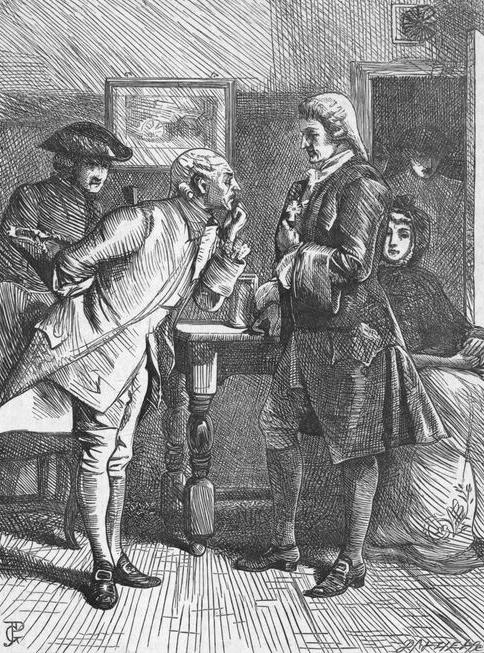
Lofty.—"Ay, stick it where you will;
for, by the Lord, it cuts but a very poor figure where
it sticks at present."—p. 318.
Croaker. Indeed? How! why!
Lofty. In one word, things between
Sir William and me, must
be behind the curtain. A party
has many eyes. He sides with Lord
Buzzard; I side with Sir Gilbert
Goose. So that unriddles the mystery.
Croaker. And so it does, indeed,
and all my suspicions are over.
Lofty. Your suspicions? What,
then, you have been suspecting, have
you? Mr. Croaker, you and I were
friends; we are friends no longer.
Never talk to me. It's over; I say,
it's over.
Croaker. As I hope for your favour,
I did not mean to offend. It
escaped me. Don't be discomposed.
Lofty. Zounds, sir, but I am discomposed,
and will be discomposed.
To be treated thus! Who am I?
Was it for this I have been dreaded
both by ins and outs? Have I been
libelled in the Gazetteer, and praised
in the St. James's? Have I been
cheered at Wildman's, and a speaker
at Merchant Tailors' Hall? Have I
had my hand to addresses, and my
head in the print-shops; and talk to
me of suspects?
Croaker. My dear sir, be pacified.
What can you have but asking pardon?
Lofty. Sir, I will not be pacified.—Suspects!
Who am I? To be used
thus, have I paid court to men in favour
to serve my friends, the lords of the
treasury, Sir William Honeywood, and
the rest of the gang, and talk to me
of suspects? Who am I, I say? who
am I?
Sir Will. Since, sir, you're so
pressing for an answer, I'll tell you
who you are—a gentleman, as well acquainted
with politics as with men in
power; as well acquainted with persons
of fashion as with modesty; with
lords of the treasury as with truth;
and with all as you are with Sir William
Honeywood. I am Sir William
Honeywood.
Discovering his ensigns of the Bath.
Croaker. Sir William Honeywood!
Honeyw. Astonishment! my uncle!
Aside.
Lofty. So then, my confounded
genius has been all this time only leading
me up to the garret, in order to
fling me out of the window.
Croaker. What, Mr. Importance,
and are these your works? Suspect
you! You, who have been dreaded
by the ins and outs: you, who have
had your hand to addresses, and your
head stuck up in print-shops. If you
were served right, you should have
your head stuck up in the pillory.
Lofty. Ay, stick it where you will;
for, by the Lord, it cuts but a very
poor figure where it sticks at present.
Sir Will. Well, Mr. Croaker, I
hope you now see how incapable this
gentleman is of serving you, and how
little Miss Richland has to expect from
his influence.
Croaker. Ay, sir, too well I see it,
and I can't but say I have had some
boding of it these ten days. So I'm
resolved, since my son has placed his
affections on a lady of moderate fortune,
to be satisfied with his choice,
and not run the hazard of another Mr.
Lofty in helping him to a better.
Sir Will. I approve your resolution;
and here they come, to receive
a confirmation of your pardon and
consent.
Enter Mrs. Croaker, Jarvis, Leontine,
Olivia.
Mrs. Croaker. Where's my husband?
Come, come, lovey, you must
forgive them. Jarvis here has been to
tell me the whole affair; and, I say,
you must forgive them. Our own was
a stolen match, you know, my dear;
and we never had any reason to repent
of it.
Croaker. I wish we could both say
so: however, this gentleman, Sir William
Honeywood, has been beforehand
with you in obtaining their pardon.
So, if the two poor fools have a mind
to marry, I think we can tack them
together without crossing the Tweed
for it.
Joining their hands.
Leont. How blest and unexpected!
What, what can we say to such goodness?
But our future obedience shall
be the best reply. And as for this
gentleman, to whom we owe——
Sir Will. Excuse me sir, if I interrupt
your thanks, as I have here an
interest that calls me. (Turning to
Honeywood.) Yes, sir, you are surprised
to see me; and I own that a
desire of correcting your follies led
me hither. I saw with indignation
the errors of a mind that only sought
applause from others; that easiness of
disposition which, though inclined to
the right, had not courage to condemn
the wrong. I saw with regret those
splendid errors, that still took name
from some neighbouring duty. Your
charity, that was but injustice; your
benevolence, that was but weakness;
and your friendship but credulity. I
saw, with regret, great talents and
extensive learning only employed to
add sprightliness to error, and increase
your perplexities. I saw your mind,
with a thousand natural charms; but
the greatness of its beauty served only
to heighten my pity for its prostitution.
Honeyw. Cease to upbraid me, sir:
I have for some time but too strongly
felt the justice of your reproaches;
but there is one way still left me.
Yes, sir, I have determined this very
hour to quit for ever, a place where I
have made myself the voluntary slave
of all; and to seek among strangers
that fortitude which may give strength
to the mind, and marshal all its dissipated
virtues. Yet, ere I depart, permit
me to solicit favour for this gentleman;
who, notwithstanding what
has happened, has laid me under the
most signal obligations. Mr. Lofty—
Lofty. Mr. Honeywood, I am resolved
upon a reformation, as well as
you. I now begin to find, that the
man who first invented the art of
speaking truth, was a much cunninger
fellow than I thought him. And to
prove that I design to speak truth for
the future, I must now assure you that
you owe your late enlargement to
another; as, upon my soul, I had no
hand in the matter. So now, if any
of the company has a mind for preferment,
he may take my place. I
am determined to resign.
Honeyw. How have I been deceived!
Sir Will. No, sir, you have been
obliged to a kinder, fairer friend for
that favour—to Miss Richland. Would
she complete our joy, and make the
man she has honoured by her friendship
happy in her love, I should then
forget all, and be as blest as the welfare
of my dearest kinsman can make
me.
Miss Rich. After what is past, it
would be but affectation to pretend to
indifference. Yes, I will own an attachment,
which, I find, was more than
friendship. And if my entreaties cannot
alter his resolution to quit the
country, I will even try if my hand
has not power to detain him.
Giving her hand.
Honeyw. Heavens! how can I have
deserved all this? How express my
happiness, my gratitude! A moment
like this overpays an age of apprehension.
Croaker. Well, now I see content
in every face; but Heaven send we be
all better this day three months.
Sir Will. Henceforth, nephew,
learn to respect yourself. He who seeks
only for applause from without, has
all his happiness in another's keeping.
Honeyw. Yes, sir, I now too plainly
perceive my errors. My vanity, in attempting
to please all, by fearing to
offend any. My meanness in approving
folly, lest fools should disapprove.
Henceforth, therefore, it shall be my
study to reserve my pity for real distress;
my friendship for true merit;
and my love for her who first taught
me what it is to be happy.
SPOKEN BY MRS. BULKLEY.
As puffing quacks some caitiff wretch procure
To swear the pill, or drop, has wrought a cure;
Thus, on the stage, our play-wrights still depend
For epilogues and prologues on some friend,
Who knows each art of coaxing up the town,
And make full many a bitter pill go down:
Conscious of this, our bard has gone about,
And teased each rhyming friend to help him out.
An epilogue! things can't go on without it;
It could not fail, would you but set about it:
"Young man," cries one, (a bard laid up in clover,)
"Alas! young man, my writing days are over;
Let boys play tricks, and kick the straw, not I;
Your brother doctor there, perhaps, may try,"
"What I! dear Sir," the doctor interposes;
"What, plant my thistle, Sir, among his roses!
No, no, I've other contests to maintain;
To-night I heard our troops at Warwick-lane.
Go ask your manager"—"Who, me! Your pardon,
Those things are not our forte at Covent Garden."
Our author's friends, thus placed at happy distance,
Give him good words, indeed, but no assistance.
As some unhappy wight, at some new play,
At the pit door stands elbowing a way,
While oft, with many a smile, and many a shrug,
He eyes the centre, where his friends sit snug;
His simpering friends, with pleasure in their eyes,
Sink as he sinks, and as he rises rise:
He nods, they nod; he cringes, they grimace;
But not a soul will budge to give him place.
Since, then, unhelp'd, our bard must now conform
"To 'bide the pelting of this pitiless storm,"
Blame where you must, be candid where you can,
And be each critic the Good-natured Man.
ACT I.
Scene.—A scene in an old-fashioned house.
Enter Mrs. Hardcastle and Mr. Hardcastle.
Mrs. Hard. I vow, Mr. Hardcastle,
you're very particular. Is there a
creature in the whole country, but
ourselves, that does not take a trip
to town now and then to rub off
the rust a little? There's the two
Miss Hoggs, and our neighbour Mrs.
Grisby, go to take a month's polishing
every winter.
Hard. Ay, and bring back vanity
and affectation to last them the whole
year. I wonder why London cannot
keep its own fools at home. In my
time, the follies of the town crept
slowly among us, but now they travel
faster than a stage-coach. Its fopperies
come down, not only as inside
passengers, but in the very basket.
Mrs. Hard. Ay, your times were
fine times, indeed; you have been
telling us of them for many a long
year. Here we live in an old rambling
mansion, that looks for all the
world like an inn, but that we never
see company. Our best visitors are old
Mrs. Oddfish, the curate's wife, and
little Cripplegate, the lame dancing-master;
and all our entertainment,
your old stories of Prince Eugene and
the Duke of Marlborough. I hate
such old-fashioned trumpery.
Hard. And I love it. I love
everything that's old: old friends, old
times, old manners, old books, old
wine; and, I believe, Dorothy (taking
her hand), you'll own I have been
pretty fond of an old wife.
Mrs. Hard. Lord, Mr. Hardcastle,
you're for ever at your Dorothys, and
your old wives. You may be a Darby,
but I'll be no Joan, I promise you.
I'm not so old as you'd make me,
by more than one good year. Add
twenty to twenty, and make money
of that.
Hard. Let me see; twenty added
to twenty, makes just fifty and
seven.
Mrs. Hard. It's false, Mr. Hardcastle:
I was but twenty when I was
brought to bed of Tony, that I had
by Mr. Lumpkin, my first husband;
and he's not come to years of discretion
yet.
Hard. Nor ever will, I dare answer
for him. Ay, you have taught him
finely.
Mrs. Hard. No matter, Tony
Lumpkin has a good fortune. My
son is not to live by his learning.
I don't think a boy wants much
learning to spend fifteen hundred
a-year.
Hard. Learning, quotha! a mere
composition of tricks and mischief.
Mrs. Hard. Humour, my dear:
nothing but humour. Come, Mr.
Hardcastle, you must allow the boy
a little humour.
Hard. I'd sooner allow him a
horse-pond. If burning the footmen's
shoes, frighting the maids, worrying
the kittens—be humour, he has it.
It was but yesterday he fastened
my wig to the back of my chair,
and when I went to make a bow, I
popt my bald head in Mrs. Frizzle's
face.
Mrs. Hard. And am I to blame?
The poor boy was always too sickly
to do any good. A school would be
his death. When he comes to be a
little stronger, who knows what a year
or two's Latin may do for him!
Hard. Latin for him! A cat and
fiddle. No, no, the alehouse and the
stable are the only schools he'll ever
go to.
Mrs. Hard. Well, we must not
snub the poor boy now, for I believe
we shan't have him long among us.
Anybody that looks in his face may
see he's consumptive.
Hard. Ay, if growing too fat be
one of the symptoms.
Mrs. Hard. He coughs sometimes.
Hard. Yes, when his liquor goes
the wrong way.
Mrs. Hard. I'm actually afraid of
his lungs.
Hard. And truly so am I; for he
sometimes whoops like a speaking
trumpet—(Tony hallooing behind the
scenes)—O there he goes—A very
consumptive figure, truly.
Enter Tony, crossing the stage.
Mrs. Hard. Tony, where are you
going, my charmer? Won't you give
papa and I a little of your company,
lovee?
Tony. I'm in haste, mother, I
cannot stay.
Mrs. Hard. You shan't venture
out this raw evening, my dear; you
look most shockingly.
Tony. I can't stay, I tell you. The
Three Pigeons expects me down every
moment. There's some fun going
forward.
Hard. Ay; the alehouse, the old
place: I thought so.
Mrs. Hard. A low, paltry set of
fellows.
Tony. Not so low neither. There's
Dick Muggins the exciseman, Jack
Slang the horse-doctor, little Aminadab,
that grinds the music-box, and
Tom Twist, that spins the pewter
platter.
Mrs. Hard. Pray, my dear, disappoint
them for one night at least.
Tony. As for disappointing them,
I should not so much mind; but I
can't abide to disappoint myself.
Mrs. Hard. (Detaining him.) You
shan't go.
Tony. I will, I tell you.
Mrs. Hard. I say you shan't.
Tony. We'll see which is the
strongest, you or I!
Hardcastle, solus.
Hard. Ay, there goes a pair that
only spoil each other; but is not the
whole age in a combination to drive
sense and discretion out of doors?
There's my pretty darling Kate; the
fashions of the times have almost
infected her too. By living a year or
two in town, she is as fond of gauze,
and French frippery, as the best of
them.
Enter Miss Hardcastle.
Hard. Blessings on my pretty
innocence! Drest out as usual, my
Kate. Goodness! What a quantity of
superfluous silk hast thou got about
thee, girl! I could never teach the
fools of this age, that the indigent
world could be clothed out of the
trimmings of the vain.
Miss Hard. You know our agreement,
sir. You allow me the morning
to receive and pay visits, and to
dress in my own manner; and in the
evening, I put on my housewife's
dress to please you.
Hard. Well, remember I insist on
the terms of our agreement; and, by
the by, I believe I shall have occasion
to try your obedience this very
evening.
Miss Hard. I protest, sir, I don't
comprehend your meaning.
Hard. Then, to be plain with you,
Kate, I expect the young gentleman
I have chosen to be your husband
from town this very day. I have his
father's letter, in which he informs me
his son is set out, and that he intends
to follow himself shortly after.
Miss Hard. Indeed! I wish I
had known something of this before.
Bless me, how shall I behave! It's
a thousand to one I shan't like him;
our meeting will be so formal, and
so like a thing of business, that I
shall find no room for friendship or
esteem.
Hard. Depend upon it, child, I'll
never control your choice; but Mr.
Marlow, whom I have pitched upon,
is the son of my old friend, Sir
Charles Marlow, of whom you have
heard me talk so often. The young
gentleman has been bred a scholar,
and is designed for an employment
in the service of his country. I
am told he's a man of an excellent
understanding.
Miss Hard. Is he?
Hard. Very generous.
Miss Hard. I believe I shall like
him.
Hard. Young and brave.
Miss Hard. I'm sure I shall like
him.
Hard. And very handsome.
Miss Hard. My dear papa, say no
more (kissing his hand), he's mine, I'll
have him!
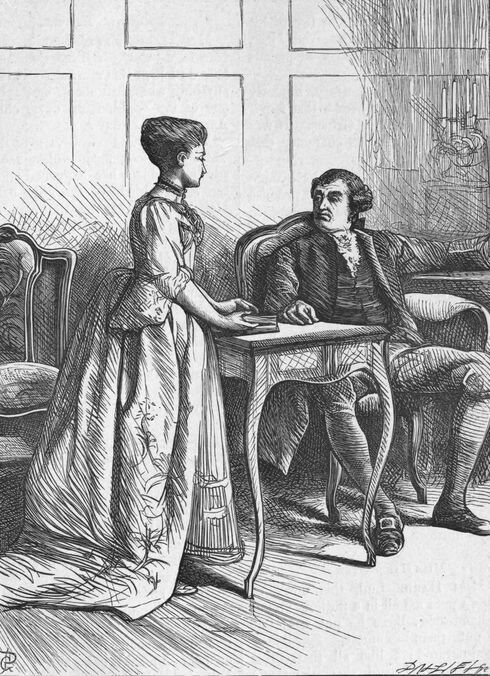
Miss Hardcastle.—"I protest, Sir, I
do not comprehend your meaning."—p. 326.
Hard. And to crown all, Kate,
he's one of the most bashful and
reserved young fellows in all the
world.
Miss Hard. Eh! you have frozen
me to death again. That word reserved,
has undone all the rest of his
accomplishments. A reserved lover,
it is said, always makes a suspicious
husband.
Hard. On the contrary, modesty
seldom resides in a breast that is not
enriched with nobler virtues. It was
the very feature in his character that
first struck me.
Miss Hard. He must have more
striking features to catch me, I promise
you. However, if he be so young, so
handsome, and so everything, as you
mention, I believe he'll do still. I
think I'll have him.
Hard. Ay, Kate, but there is still
an obstacle. It's more than an even
wager, he may not have you.
Miss Hard. My dear papa, why
will you mortify one so!—Well, if he
refuses, instead of breaking my heart
at his indifference, I'll only break my
glass for its flattery, set my cap to
some newer fashion, and look out for
some less difficult admirer.
Hard. Bravely resolved! In the
meantime I'll go prepare the servants
for his reception; as we seldom see
company, they want as much training
as a company of recruits the first
day's muster.
Miss Hardcastle, sola.
Miss Hard. Lud, this news of
papa's puts me all in a flutter. Young—handsome:
these he put last; but
I put them foremost. Sensible—good-natured:
I like all that. But
then—reserved, and sheepish: that's
much against him. Yet, can't he be
cur'd of his timidity, by being taught
to be proud of his wife? Yes; and
can't I—But, I vow, I'm disposing of
the husband, before I have secured
the lover.
Enter Miss Neville.
Miss Hard. I'm glad you're come,
Neville, my dear. Tell me, Constance:
how do I look this evening? Is there
anything whimsical about me? Is it
one of my well-looking days, child?
Am I in face to-day?
Miss Nev. Perfectly, my dear.
Yet, now I look again—bless me!—sure
no accident has happened among
the canary birds, or the gold fishes.
Has your brother or the cat been
meddling? Or, has the last novel
been too moving?
Miss Hard. No; nothing of all
this. I have been threatened—I can
scarce get it out—I have been threatened
with a lover.
Miss Nev. And his name—
Miss Hard. Is Marlow.
Miss Nev. Indeed!
Miss Hard. The son of Sir Charles
Marlow.
Miss Nev. As I live, the most intimate
friend of Mr. Hastings, my
admirer. They are never asunder.
I believe you must have seen him
when we lived in town.
Miss Hard. Never.
Miss Nev. He's a very singular
character, I assure you. Among
women of reputation and virtue, he is
the modestest man alive; but his acquaintance
give him a very different
character among creatures of another
stamp: you understand me.
Miss Hard. An odd character,
indeed. I shall never be able to
manage him. What shall I do?
Pshaw, think no more of him, but
trust to occurrences for success. But
how goes on your own affair, my
dear? has my mother been courting
you for my brother Tony, as usual!
Miss Nev. I have just come from
one of our agreeable tête-à-têtes.
She has been saying a hundred tender
things, and setting off her pretty
monster as the very pink of perfection.
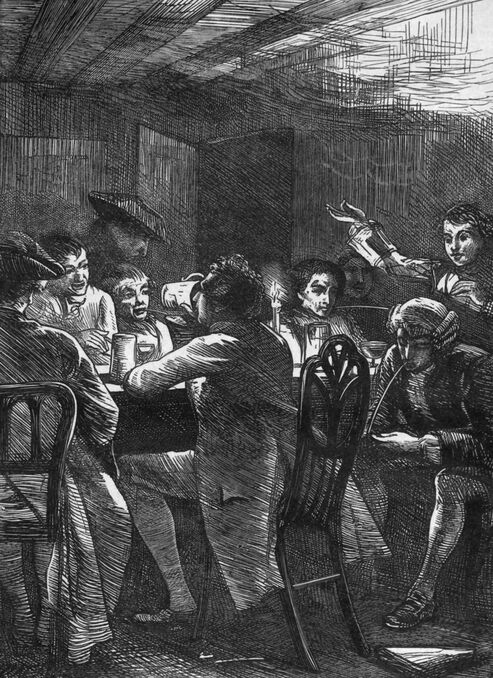
Tony.—"Then I'll sing you,
gentlemen, a song."—p. 330.
Miss Hard. And her partiality is
such, that she actually thinks him so.
A fortune like yours is no small temptation.
Besides, as she has the sole
management of it, I'm not surprised
to see her unwilling to let it go out of
the family.
Miss Nev. A fortune like mine,
which chiefly consists in jewels, is no
such mighty temptation. But, at any
rate, if my dear Hastings be but constant,
I make no doubt to be too hard
for her at last. However, I let her
suppose that I am in love with her
son, and she never once dreams that
my affections are fixed upon another.
Miss Hard. My good brother holds
out stoutly. I could almost love him
for hating you so.
Miss Nev. It is a good-natured
creature at bottom, and I'm sure
would wish to see me married to anybody
but himself. But my aunt's
bell rings for our afternoon's walk
round the improvements. Allons!
Courage is necessary, as our affairs
are critical.
Miss Hard. Would it were bedtime,
and all were well.
Scene.—An ale house room. Several shabby
fellows, with punch and tobacco. Tony at
the head of the table, a little higher than
the rest: a mallet in his hand.
Omnes. Hurrea, hurrea, hurrea,
bravo!
1 Fel. Now, gentlemen, silence for
a song. The 'squire is going to knock
himself down for a song.
Omnes. Ay, a song, a song!
Tony. Then I'll sing you, gentlemen,
a song I made upon this alehouse,
the Three Pigeons.
SONG.
Let school-masters puzzle their brain,
With grammar, and nonsense, and learning;
Good liquor, I stoutly maintain,
Give genus a better discerning.
Let them brag of their heathenish gods,
Their Lethes, their Styxes, and Stygians;
Their quis, and their quæs, and their quods,
They're all but a parcel of pigeons.
Toroddle, toroddle, toroll.
When methodist-preachers come down,
A preaching that drinking is sinful,
I'll wager the rascals a crown,
They always preach best with a skin full.
But when you come down with your pence,
For a slice of their scurvy religion,
I'll leave it to all men of sense,
But you, my good friend, are the pigeon.
Toroddle, toroddle, toroll.
Then come, put the jorum about,
And let us be merry and clever;
Our hearts and our liquors are stout,
Here's the Three Jolly Pigeons for ever!
Let some cry up woodcock or hare,
Your bustards, your ducks, and your widgeons;
But of all the birds in the air,
Here's a health to the Three Jolly Pigeons!
Toroddle, toroddle, toroll.
Omnes. Bravo! bravo!
1 Fel. The 'squire has got spunk
in him.
2 Fel. I loves to hear him sing,
bekeays he never gives us nothing
that's low.
3 Fel. O damn anything that's
low, I cannot bear it.
4 Fel. The genteel thing, is the
genteel thing at any time. If so be
that a gentleman bees in a concatenation
accordingly.
3 Fel. I like the maxum of it,
Master Muggins. What though I
am obligated to dance a bear? a man
may be a gentleman for all that. May
this be my poison, if my bear ever
dances but to the very genteelest of
tunes: "Water parted," or "The
minuet in Ariadne."
2 Fel. What a pity it is the 'squire
is not come to his own! It would be
well for all the publicans within ten
miles round of him.
Tony. Ecod and so it would,
Master Slang. I'd then show what
it was to keep choice of company.
2 Fel. O he takes after his own
father for that. To be sure, old
'squire Lumpkin was the finest gentleman
I ever set my eyes on. For
winding the straight horn, or beating
a thicket for a hare, or a wench, he
never had his fellow. It was a saying
in the place, that he kept the best
horses, dogs, and girls in the whole
county.
Tony. Ecod, and when I'm of age
I'll be no bastard, I promise you! I
have been thinking of Bett Bouncer,
and the miller's grey mare to begin
with. But come, my boys, drink
about and be merry, for you pay no
reckoning.—Well, Stingo, what's the
matter?
Enter Landlord.
Land. There be two gentlemen in a
post-chaise at the door. They have
lost their way upo' the forest; and
they are talking something about Mr.
Hardcastle.
Tony. As sure as can be, one of
them must be the gentleman that's
coming down to court my sister.—Do
they seem to be Londoners?
Land. I believe they may. They
look woundily like Frenchmen.
Tony. Then desire them to step
this way, and I'll set them right in a
twinkling. (Exit Landlord.) Gentlemen,
as they mayn't be good enough
company for you, step down for a
moment, and I'll be with you in the
squeezing of a lemon.
Tony, solus.
Tony. Father-in-law has been calling
me whelp, and hound, this half
year. Now if I pleased, I could be so
revenged upon the old grumbletonian.
But then I'm afraid—afraid of what?
I shall soon be worth fifteen hundred
a-year, and let him frighten me out of
that if he can.
Enter Landlord, conducting Marlow and
Hastings.
Marl. What a tedious uncomfortable
day have we had of it! We were
told it was but forty miles across the
country, and we have come above
threescore.
Hast. And all, Marlow, from that
unaccountable reserve of yours, that
would not let us inquire more frequently
on the way.
Marl. I own, Hastings, I am unwilling
to lay myself under an obligation
to every one I meet; and often
stand the chance of an unmannerly
answer.
Hast. At present, however, we are
not likely to receive any answer.
Tony. No offence, gentlemen; but
I'm told you have been inquiring for
one Mr. Hardcastle, in those parts.
Do you know what part of the country
you are in?
Hast. Not in the least, sir; but
should thank you for information.
Tony. Nor the way you came?
Hast. No, sir; but if you can
inform us——
Tony. Why, gentlemen, if you
know neither the road you are going,
nor where you are, nor the road you
came, the first thing I have to inform
you is, that—you have lost your way.
Marl. We wanted no ghost to tell
us that.
Tony. Pray, gentlemen, may I be
so bold as to ask the place from
whence you came?
Marl. That's not necessary towards
directing us where we are to go.
Tony. No offence; but question for
question is all fair, you know. Pray,
gentlemen, is not this same Hardcastle
a cross-grained, old-fashioned,
whimsical fellow, with an ugly face; a
daughter, and a pretty son?
Hast. We have not seen the gentleman;
but he has the family you mention.
Tony. The daughter, a tall trapesing,
trolloping, talkative May-pole——The
son, a pretty, well-bred, agreeable
youth, that everybody is fond of.
Marl. Our information differs in
this. The daughter is said to be
well-bred and beautiful; the son, an
awkward booby, reared up, and spoiled
at his mother's apron-string.
Tony. He-he-hem—Then, gentlemen,
all I have to tell you is, that you
won't reach Mr. Hardcastle's house
this night, I believe.
Hast. Unfortunate!
Tony. It's a damn'd long, dark,
boggy, dirty, dangerous way. Stingo,
tell the gentlemen the way to Mr.
Hardcastle's; (winking upon the landlord.)
Mr. Hardcastle's, of Quagmire
Marsh; you understand me.
Land. Master Hardcastle's? Lack-a-daisy,
my masters, you're come a
deadly deal wrong! When you came
to the bottom of the hill, you should
have crossed down Squash-lane.
Marl. Cross down Squash-lane?
Land. Then you were to keep
straight forward, till you came to four
roads.
Marl. Come to where four roads
meet!
Tony. Aye; but you must be sure
to take only one of them.
Marl. O sir, you're facetious.
Tony. Then keeping to the right,
you are to go sideways till you come
upon Crack-skull-common: there you
must look sharp for the track of the
wheel, and go forward, till you come
to farmer Murrain's barn. Coming to
the farmer's barn, you are to turn to
the right, and then to the left, and
then to the right-about again, till you
find out the old mill——
Marl. Zounds, man! we could as
soon find out the longitude!
Hast. What's to be done, Marlow?
Marl. This house promises but a
poor reception; though perhaps the
landlord can accommodate us.
Land. Alack, master, we have but
one spare bed in the whole house.
Tony. And, to my knowledge, that's
taken up by three lodgers already.
(After a pause, in which the rest seem
disconcerted.) I have hit it. Don't
you think, Stingo, our landlady would
accommodate the gentlemen by the
fireside, with—three chairs and a
bolster?
Hast. I hate sleeping by the fireside.
Marl. And I detest your three
chairs and a bolster.
Tony. You do, do you?—then let
me see—what if you go on a mile further,
to the Buck's Head; the old
Buck's Head on the hill, one of the
best inns in the whole country?
Hast. O, ho! so we have escaped
an adventure for this night, however.
Land. (Apart to Tony.) Sure, you
ben't sending them to your father's as
an inn, be you?
Tony. Mum, you fool you. Let
them find that out. (To them.) You
have only to keep on straight forward,
till you come to a large old house by
the road-side. You'll see a pair of
large horns over the door. That's the
sign. Drive up the yard, and call
stoutly about you.
Hast. Sir, we are obliged to you.
The servants can't miss the way.
Tony. No, no. But I tell you
though, the landlord is rich, and going
to leave off business; so he wants to
be thought a gentleman, saving your
presence, he! he! he! He'll be for
giving you his company, and ecod, if
you mind him, he'll persuade you that
his mother was an alderman, and his
aunt a justice of the peace.
Land. A troublesome old blade,
to be sure; but a keeps as good
wines and beds as any in the whole
country.
Marl. Well, if he supplies us with
these, we shall want no further connexion.
We are to turn to the right,
did you say?
Tony. No, no; straightforward. I'll
just step myself, and show you a piece
of the way. (To the landlord.) Mum.
Land. Ah, bless your heart, for a
sweet, pleasant-damn'd mischievous
son of a whore.
Scene.—An old-fashioned house.
Enter Hardcastle, followed by three or
four awkward Servants.
Hard. Well, I hope you're perfect
in the table exercise I have been
teaching you these three days. You
all know your posts and your places;
and can show that you have been used
to good company, without stirring from
home.
Omnes. Ay, ay.
Hard. When company comes, you
are not to pop out and stare, and then
run in again, like frighted rabbits in a
warren.
Omnes. No, no.
Hard. You, Diggory, whom I have
taken from the barn, are to make a
show at the side-table; and you,
Roger, whom I have advanced from
the plough, are to place yourself behind
my chair. But you're not to
stand so, with your hands in your
pockets. Take your hands from your
pockets, Roger; and from your head,
you blockhead you. See how Diggory
carries his hands. They're a little
too stiff, indeed, but that's no great
matter.
Digg. Ay; mind how I hold them.
I learned to hold my hands this way,
when I was upon drill for the militia.
And so being upon drill—
Hard. You must not be so talkative,
Diggory. You must be all attention
to the guests. You must hear us talk,
and not think of talking; you must
see us drink, and not think of drinking;
you must see us eat, and not
think of eating.
Digg. By the laws, your worship,
that's parfectly unpossible. Whenever
Diggory sees yeating going forward,
ecod he's always wishing for a
mouthful himself.
Hard. Blockhead! Is not a belly-full
in the kitchen as good as a belly-full
in the parlour? Stay your stomach
with that reflection.
Digg. Ecod, I thank your worship
I'll make a shift to stay my stomach
with a slice of cold beef in the pantry.
Hard. Diggory you are too talkative.
Then if I happen to say a good
thing, or tell a good story at table, you
must not all burst out a-laughing, as
if you made part of the company.
Digg. Then ecod, your worship
must not tell the story of Ould Grouse
in the gun-room: I can't help laughing
at that—he! he! he!—for the
soul of me. We have laughed at that
these twenty years—ha! ha! ha!
Hard. Ha! ha! ha! The story is
a good one. Well, honest Diggory,
you may laugh at that—but still remember
to be attentive. Suppose one
of the company should call for a glass
of wine, how will you behave? A glass
of wine, sir, if you please. (To Diggory.)
Eh, why don't you move?
Digg. Ecod, your worship, I never
have courage till I see the eatables and
drinkables brought upon the table, and
then I'm as bauld as a lion.
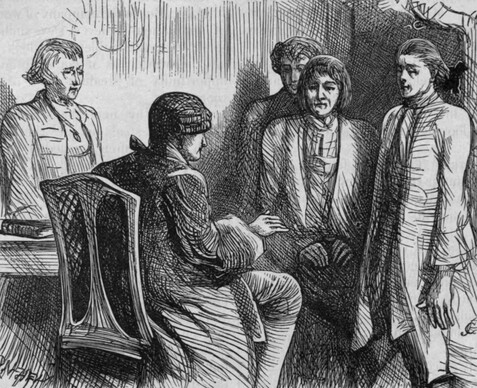
Hardcastle.—"You must not be
so talkative, Diggory."—p. 333.
Hard. What, will nobody move?
1. Serv. I'm not to leave this
place.
2. Serv. I'm sure it's no place of
mine.
3. Serv. Nor mine, for sartain.
Digg. Wauns, and I'm sure it canna
be mine.
Hard. You numskulls! and so
while, like your betters, you are quarrelling
for places, the guests must be
starved. O you dunces! I find I
must begin all over again.—But don't
I hear a coach drive into the yard?
To your posts, you blockheads. I'll go
in the mean time and give my old
friend's son a hearty welcome at the
gate.
Digg. By the elevens, my place is
gone quite out of my head.
Roger. I know that my place is to
be everywhere.
1. Serv. Where the devil is mine?
2. Serv. My place is to be no where
at all; and so Ize go about my business.
Exeunt Servants, running about as if
frighted, different ways.
Enter Servant with candles, showing in
Marlow and Hastings.
Serv. Welcome, gentlemen, very
welcome. This way.
Hast. After the disappointments of
the day, welcome once more, Charles,
to the comforts of a clean room and a
good fire. Upon my word, a very
well-looking house; antique, but creditable.
Marl. The usual fate of a large
mansion. Having first ruined the
master by good housekeeping, it at
last comes to levy contributions as an
inn.
Hast. As you say, we passengers
are to be taxed to pay all these fineries.
I have often seen a good sideboard, or
a marble chimney-piece, though not
actually put in the bill, inflame the
bill confoundedly.
Marl. Travellers, George, must pay
in all places. The only difference is,
that in good inns you pay dearly for
luxuries; in bad inns you are fleeced
and starved.
Hast. You have lived pretty much
among them. In truth, I have been
often surprised, that you, who have
seen so much of the world, with your
natural good sense, and your many
opportunities, could never yet acquire
a requisite share of assurance.
Marl. The Englishman's malady.
But tell me, George, where could I
have learned that assurance you talk
of? My life has been chiefly spent in
a college, or an inn; in seclusion from
that lovely part of the creation that
chiefly teach men confidence. I don't
know that I was ever familiarly acquainted
with a single modest woman—except
my mother—But among
females of another class, you know—
Hast. Aye, among them you are
impudent enough of all conscience.
Marl. They are of us, you know.
Hast. But in the company of women
of reputation, I never saw such an
idiot, such a trembler; you look, for
all the world, as if you wanted an
opportunity of stealing out of the
room.
Marl. Why, man, that's because I
do want to steal out of the room.
Faith, I have often formed a resolution
to break the ice, and rattle away
at any rate. But I don't know how, a
single glance from a pair of fine eyes
has totally overset my resolution. An
impudent fellow may counterfeit modesty;
but I'll be hanged if a modest
man can ever counterfeit impudence.
Hast. If you could but say half the
fine things to them that I have heard
you lavish upon the bar-maid of an inn,
or even a college bed-maker—
Marl. Why, George, I can't say
fine things to them. They freeze,
they petrify me. They may talk of a
comet, or a burning mountain, or some
such bagatelle: but to me, a modest
woman, dressed out in all her finery,
is the most tremendous object of the
whole creation.
Hast. Ha! ha! ha! At this rate,
man, how can you ever expect to
marry?
Marl. Never, unless, as among
kings and princes, my bride were to
be courted by proxy. If, indeed, like
an eastern bridegroom, one were to be
introduced to a wife he never saw
before, it might be endured. But to
go through all the terrors of a formal
courtship, together with the episode of
aunts, grandmothers, and cousins, and
at last to blurt out the broad-star question,
of—madam, will you marry me?
No, no; that's a strain much above
me, I assure you.
Hast. I pity you. But how do you
intend behaving to the lady you are
come down to visit at the request of
your father?
Marl. As I behave to all other
ladies: bow very low; answer yes, or
no, to all her demands—But for the
rest, I don' think I shall venture to
look in her face till I see my father's
again.
Hast. I am surprised that one who
is so warm a friend can be so cool a
lover.
Marl. To be explicit, my dear
Hastings, my chief inducement down,
was to be instrumental in forwarding
your happiness, not my own. Miss
Neville loves you, the family don't
know you, as my friend you are a sure
of a reception, and let honour do the
rest.
Hast. My dear Marlow!—But I'll
suppress the emotion. Were I a
wretch, meanly seeking to carry off a
fortune, you should be the last man in
the world I would apply to for assistance.
But Miss Neville's person is all
I ask; and that is mine, both from her
deceased father's consent, and her own
inclination.
Marl. Happy man! You have
talents and art to captivate any woman.
I am doomed to adore the sex, and yet
to converse with the only part of it I
despise. This stammer in my address,
and this awkward prepossessing visage
of mine, can never permit me to soar
above the reach of a milliner's prentice,
or one of the duchesses of Drury-lane.—Pshaw!
this fellow here to
interrupt us.
Enter Hardcastle.
Hard. Gentlemen, once more you
are heartily welcome. Which is Mr.
Marlow? Sir, you are heartily welcome.
It's not my way, you see, to receive my
friends with my back to the fire. I
like to give them a hearty reception, in
the old style, at my gate. I like to
see their horses and trunks taken
care of.
Marl. (Aside.) He has got our
names from the servants already. (To
him.) We approve your caution and
hospitality, sir. (To Hastings.) I have
been thinking, George, of changing
our travelling dresses in the morning.
I am grown confoundedly ashamed of
mine.
Hard. I beg, Mr. Marlow, you'll
use no ceremony in this house.
Hast. I fancy, Charles, you're
right: the first blow is half the battle.
I intend opening the campaign with
the white and gold.
Hard. Mr. Marlow—Mr. Hastings—gentlemen—pray
be under no restraint
in this house. This is Liberty
Hall, gentlemen. You may do just
as you please here.
Marl. Yet, George, if we open
the campaign too fiercely at first we
may want ammunition before it is over.
I think to reserve the embroidery to
secure a retreat.
Hard. Your talking of a retreat,
Mr. Marlow, puts me in mind of the
Duke of Marlborough, when he went
to besiege Denain. He first summoned
the garrison.
Marl. Don't you think the ventre
d'or waistcoat will do with the plain brown?
Hard. He first summoned the
garrison, which might consist of about
five thousand men—
Hast. I think not: brown and
yellow mix but very poorly.
Hard. I say, gentlemen, as I was
telling you, he summoned the garrison,
which might consist of about five
thousand men—
Marl. The girls like finery.
Hard. Which might consist of
about five thousand men, well appointed
with stores, ammunition, and
other implements of war. Now, says
the Duke of Marlborough, to George
Brooks, that stood next to him—you
must have heard of George Brooks;
"I'll pawn my dukedom," says he,
"but I take that garrison without
spilling a drop of blood." So——
Marl. What, my good friend, if
you gave us a glass of punch in the
meantime? It would help us to carry
on the siege with vigour.
Hard. Punch, sir! (Aside.) This
is the most unaccountable kind of modesty
I ever met with.
Marl. Yes, sir, punch. A glass of
warm punch, after our journey, will
be comfortable. This is Liberty-hall,
you know.
Hard. Here's cup, sir.
Marl. (Aside.) So this fellow, in
his Liberty-hall, will only let us have
just what he pleases.
Hard. (Taking the cup.) I hope
you'll find it to your mind. I have
prepared it with my own hands, and
I believe you'll own the ingredients
are tolerable. Will you be so good as
to pledge me, sir? Here, Mr. Marlow,
here is to our better acquaintance.
Drinks.
Marl. (Aside.) A very impudent
fellow this! but he's a character, and
I'll humour him a little. Sir, my service
to you.
Drinks.
Hast. (Aside.) I see this fellow
wants to give us his company, and
forgets that he's an inn-keeper, before
he has learned to be a gentleman.
Marl. From the excellence of your
cup my old friend, I suppose you have
a good deal of business in this part of
the country. Warm work, now and
then, at elections, I suppose.
Hard. No, sir, I have long given
that work over. Since our betters
have hit upon the expedient of electing
each other, there's no business for us
that sell ale.
Hast. So, then you have no turn
for politics I see.
Hard. Not in the least. There
was a time, indeed, I fretted myself
about the mistakes of government, like
other people; but, finding myself every
day grow more angry, and the government
growing no better, I left it to
mend itself. Since that, I no more
trouble my head about Heyder Alley,
or Ally Cawn, than about Ally Croaker.—Sir,
my service to you.
Hast. So that with eating above
stairs, and drinking below; with receiving
your friends within, and amusing
them without, you lead a good
pleasant bustling life of it.
Hard. I do stir about a great deal,
that's certain. Half the differences of
the parish are adjusted in this very
parlour.
Marl. (After drinking.) And you
have an argument in your cup, old
gentleman, better than any in Westminster
Hall.
Hard. Ay, young gentleman, that,
and a little philosophy.
Marl. (Aside.) Well, this is the
first time I ever heard of an inn-keeper's
philosophy!
Hast. So then, like an experienced
general, you attack them on every
quarter. If you find their reason
manageable, you attack it with your
philosophy; if you find they have no
reason, you attack them with this.—Here's
your health, my philosopher.
Drinks.
Hard. Good, very good, thank you;
ha! ha! Your generalship puts me
in mind of Prince Eugene, when he
fought the Turks at the battle of Belgrade.
You shall hear.
Marl. Instead of the battle of Belgrade,
I think it's almost time to talk
about supper. What has your philosophy
got in the house for supper?
Hard. For supper, sir! (Aside.)
Was ever such a request to a man in
his own house?
Marl. Yes, sir; supper, sir: I begin
to feel an appetite. I shall make devilish
work to-night in the larder, I promise
you.
Hard. (Aside.) Such a brazen dog
sure never my eyes beheld. (To him.)
Why really, sir, as for supper, I can't
well tell. My Dorothy, and the cook-maid,
settle these things between them.
I leave these kind of things entirely to
them.
Marl. You do, do you?
Hard. Entirely. By-the-by, I believe
they are in actual consultation,
upon what's for supper, this moment
in the kitchen.
Marl. Then I beg they'll admit
me as one of their privy council. It's
a way I have got. When I travel, I
always choose to regulate my own
supper. Let the cook be called. No
offence I hope, sir.
Hard. O no, sir, none in the least;
yet, I don't know how, our Bridget,
the cook-maid, is not very communicative
upon these occasions. Should
we send for her, she might scold us
all out of the house.
Hast. Let's see the list of the
larder then. I ask it as a favour. I
always match my appetite to my bill
of fare.
Marl. (To Hardcastle, who looks
at them with surprise.) Sir, he's very
right, and it's my way too.
Hard. Sir, you have a right to command
here. Roger, bring us the bill
of fare for to-night's supper. I believe
it's drawn up. Your manner, Mr.
Hastings, puts me in mind of my
uncle, Colonel Wallop. It was a saying
of his that no man was sure of his
supper till he had eaten it.
Hast. (Aside.) All upon the high
ropes! His uncle a colonel! we shall
soon hear of his mother being a justice
of peace. But let's hear the bill of
fare.
Marl. (Perusing.) What's here?
For the first course; for the second
course; for the dessert. The devil,
sir, do you think we have brought
down the whole joiner's company, or
the corporation of Bedford, to eat up
such a supper? Two or three little
things, clean and comfortable, will do.
Hast. But let's hear it.
Marl. (Reading.) For the first
course at the top, a pig, and pruin
sauce.
Hast. Damn your pig, I say.
Marl. And damn your pruin sauce,
say I.
Hard. And yet, gentlemen, to men
that are hungry, pig, with pruin sauce,
is very good eating.
Marl. At the bottom, a calf's tongue
and brains.
Hast. Let your brains be knocked
out, my good sir; I don't like them.
Marl. Or you may clap them on a
plate by themselves. I do.
Hard. (Aside.) Their impudence
confounds me. (To them.) Gentlemen,
you are my guests, make what alterations
you please. Is there any thing
else you wish to retrench, or alter, gentlemen?
Marl. Item, A pork pie, a boiled
rabbit and sausages, a florentine, a
shaking pudding, and a dish of tiff—taff—taffety
cream!
Hast. Confound your made dishes.
I shall be as much at a loss in this
house, as at a green and yellow dinner,
at the French ambassador's table. I'm
for plain eating.
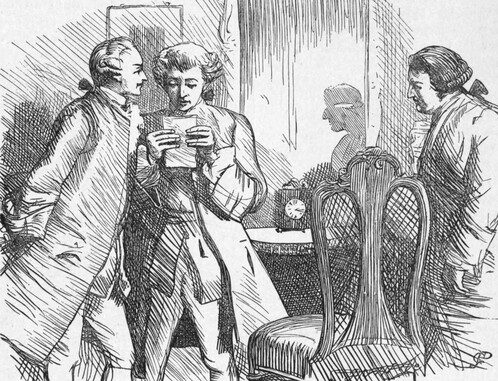
Hastings.—"Let your brains be knocked
out, my good sir; I don't like them."—p. 338.
Hard. I'm sorry, gentlemen, that
I have nothing you like; but if there
be any thing you have a particular
fancy to——
Marl. Why really, sir, your bill of
fare is so exquisite, that any one part
of it is full as good as another. Send
us what you please. So much for
supper: and now to see that our beds
are aired, and properly taken care of.
Hard. I entreat you'll leave all
that to me. You shall not stir a
step.
Marl. Leave that to you? I protest,
sir, you must excuse me; I always
look to these things myself.
Hard. I must insist, sir, you'll
make yourself easy on that head.
Marl. You see I'm resolved on it.
(Aside.) A very troublesome fellow
this, as ever I met with.
Hard. Well, sir, I'm resolved at
least to attend you. (Aside.) This may
be modern modesty, but I never saw
anything look so like old-fashioned
impudence.
Hastings, solus.
Hast. So I find, this fellow's civilities
begin to grow troublesome. But
who can be angry at those assiduities,
which are meant to please him? Ha!
what do I see? Miss Neville, by all
that's happy!
Enter Miss Neville.
Miss Nev. My dear Hastings! To
what unexpected good fortune, to what
accident am I to ascribe this happy
meeting?
Hast. Rather, let me ask the same
question, as I could never have hoped
to meet my dear Constance at an inn.
Miss Nev. An inn? sure you mistake!
my aunt, my guardian, lives
here. What could induce you to think
this house an inn?
Hast. My friend, Mr. Marlow, with
whom I came down, and I, have been
sent here as to an inn, I assure you.
A young fellow, whom we accidentally
met at a house hard by, directed us
hither.
Miss Nev. Certainly it must be one
of my hopeful cousin's tricks, of whom
you have heard me talk so often, ha!
ha! ha! ha!
Hast. He whom your aunt intends
for you? He of whom I have such
just apprehensions?
Miss Nev. You have nothing to fear from him,
I assure you. You'd adore him, if you knew how
heartily he despises me. My aunt knows it too,
and has undertaken to court me for him;
and actually begins to think she has
made a conquest.
Hast. Thou dear dissembler! You
must know, my Constance, I have just
seized this happy opportunity of my
friend's visit here, to get admittance
into the family. The horses that
carried us down, are now fatigued
with their journey; but they'll soon
be refreshed; and then, if my dearest
girl will trust in her faithful Hastings,
we shall soon be landed in France;
where, even among slaves, the laws of
marriage are respected.
Miss Nev. I have often told you
that, though ready to obey you, I yet
should leave my little fortune behind
with reluctance. The greatest part of
it was left me by my uncle, the India
director, and chiefly consists in jewels.
I have been for some time persuading
my aunt to let me wear them. I fancy
I am very near succeeding. The instant
they are put into my possession,
you shall find me ready to make them
and myself yours.
Hast. Perish the baubles! Your
person is all I desire. In the meantime,
my friend Marlow must not
be let into his mistake; I know the
strange reserve of his temper is such,
that if abruptly informed of it, he
would instantly quit the house, before
our plan was ripe for execution.
Miss Nev. But how shall we keep
him in the deception? Miss Hardcastle
is just returned from walking;
what if we still continue to deceive
him?—This, this way——
They confer.
Enter Marlow.
Marl. The assiduities of these good
people tease me beyond bearing. My
host seems to think it ill manners to
leave me alone, and so he claps not
only himself, but his old-fashioned wife
on my back. They talk of coming to
sup with us too; and then, I suppose,
we are to run the gauntlet through all
the rest of the family.—What have we
got here?—
Hast. My dear Charles! Let me
congratulate you!—The most fortunate
accident!—Who do you think is just
alighted?
Marl. Cannot guess.
Hast. Our mistresses, boy, Miss
Hardcastle and Miss Neville. Give
me leave to introduce Miss Constance
Neville to your acquaintance. Happening
to dine in the neighbourhood,
they called, on their return, to take
fresh horses here. Miss Hardcastle
has just stept into the next room, and
will be back in an instant. Wasn't it
lucky, eh?
Marl. (Aside.) I have just been
mortified enough of all conscience, and
here comes something to complete my
embarrassment.
Hast. Well, but wasn't it the most
fortunate thing in the world?
Marl. Oh! yes. Very fortunate—a
most joyful encounter—But our
dresses, George, you know, are in disorder—What
if we should postpone
the happiness till to-morrow?—To-morrow,
at her own house—It will be
every bit as convenient—And rather
more respectful—To-morrow let it be.
Offering to go.
Miss Nev. By no means, sir. Your
ceremony will displease her. The disorder
of your dress will show the
ardour of your impatience: besides,
she knows you are in the house, and
will permit you to see her.
Marl. O! the devil! how shall I
support it? Hem! hem! Hastings,
you must not go. You are to assist
me, you know. I shall be confoundedly
ridiculous. Yet, hang it! I'll take
courage. Hem!
Hast. Pshaw, man! it's but the
first plunge, and all's over. She's but
a woman, you know.
Marl. And of all women, she that
I dread most to encounter.
Enter Miss Hardcastle, as returning from
walking, a bonnet, &c.
Hast. (Introducing him.) Miss
Hardcastle—Mr. Marlow. I'm proud
of bringing two persons of such merit
together, that only want to know, to
esteem each other.
Miss Hard. (Aside.) Now, for meeting
my modest gentleman with a demure
face, and quite in his own manner.
(After a pause, in which he appears
very uneasy and disconcerted.) I'm glad
of your safe arrival, sir—I'm told, you
had some accidents by the way.
Marl. Only a few, madam. Yes,
we had some. Yes, madam, a good
many accidents; but should be sorry—madam—or
rather glad of any accidents—that
are so agreeably concluded.
Hem!
Hast. (To him.) You never spoke
better in your whole life. Keep it up,
and I'll ensure you the victory.
Miss Hard. I'm afraid you flatter,
sir. You, that have seen so much of
the finest company, can find little
entertainment in an obscure corner of
the country.
Marl. (Gathering courage.) I have
lived, indeed, in the world, madam;
but I have kept very little company.
I have been but an observer upon life,
madam, while others were enjoying it.
Miss Nev. But that, I am told, is
the way to enjoy it at last.
Hast. (To him.) Cicero never spoke
better. Once more, and you are confirmed
in assurance for ever.
Marl. (To him.) Hem! Stand
by me, then, and when I'm down,
throw in a word or two, to set me
up again.
Miss Hard. An observer, like you,
upon life, were, I fear, disagreeably
employed, since you must have had
much more to censure than to approve.
Marl. Pardon me, madam. I was
always willing to be amused. The
folly of most people is rather an object
of mirth than uneasiness.
Hast. (To him.) Bravo, bravo.
Never spoke so well in your whole
life. Well! Miss Hardcastle, I see,
that you and Mr. Marlow are going
to be very good company. I believe
our being here will but embarrass the
interview.
Marl. Not in the least, Mr. Hastings.
We like your company of all
things. (To him.) Zounds! George,
sure you won't go: how can you
leave us?
Hast. Our presence will but spoil
conversation, so we'll retire to the
next room. (To him.) You don't
consider, man, that we are to manage
a little tête-à-tête of our own.
Exeunt.
Miss Hard. (After a pause.) But
you have not been wholly an observer,
I presume, sir: the ladies, I should
hope, have employed some part of
your addresses.
Marl. (Relapsing into timidity.)
Pardon me, madam, I—I—I—as yet
have studied—only—to—deserve
them.
Miss Hard. And that, some say, is
the very worst way to obtain them.
Marl. Perhaps so, madam. But
I love to converse only with the more
grave and sensible part of the sex.—But
I'm afraid I grow tiresome.
Miss Hard. Not at all, sir; there
is nothing I like so much as grave
conversation myself; I could hear it
for ever. Indeed—I have often been
surprised how a man of sentiment
could ever admire those light airy
pleasures, where nothing reaches the
heart.
Marl. It's—a disease—of the
mind, madam. In the variety of
tastes there must be some who, wanting
a relish—for—um-a-um.
Miss Hard. I understand you, sir.
There must be some, who, wanting a
relish for refined pleasures, pretend to
despise what they are incapable of
tasting.
Marl. My meaning, madam, but
infinitely better expressed. And I
can't help observing—a—
Miss Hard. (Aside.) Who could
ever suppose this fellow impudent
upon some occasions? (To him.) You
were going to observe, sir——
Marl. I was observing, madam—I
protest, madam, I forget what I was
going to observe.
Miss Hard. (Aside.) I vow, and
so do I. (To him.) You were
observing, sir, that in this age of
hypocrisy, something about hypocrisy,
sir.
Marl. Yes, madam; in this age
of hypocrisy there are few who, upon
strict inquiry, do not—a—a—a—
Miss Hard. I understand you perfectly,
sir.
Marl. (Aside.) Egad! and that's
more than I do myself.
Miss Hard. You mean that, in this
hypocritical age, there are few that
do not condemn in public what they
practise in private, and think they
pay every debt to virtue when they
praise it.
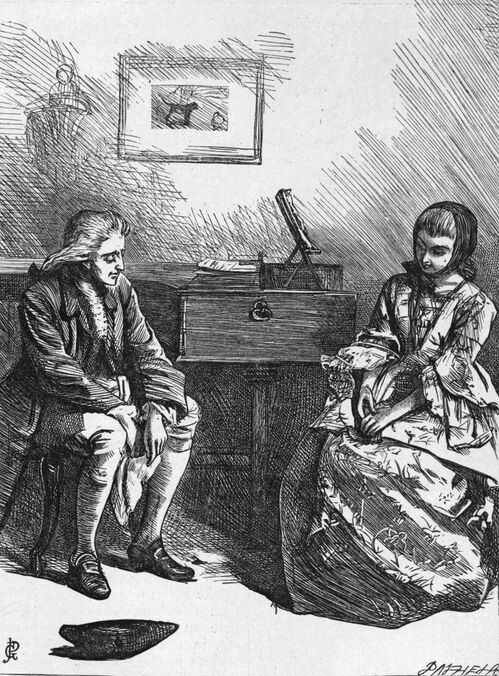
Marlow.—"I was observing, madam."—p. 342.
Marl. True, madam; those who
have most virtue in their mouths,
have least of it in their bosoms. But
I'm sure I tire you, madam.
Miss Hard. Not in the least, sir;
there's something so agreeable, and
spirited, in your manner; such life
and force—pray, sir, go on.
Marl. Yes, madam; I was saying—that
there are some occasions—when
a total want of courage, madam,
destroys all the—and puts us—upon
a—a—a—
Miss Hard. I agree with you
entirely; a want of courage upon
some occasions, assumes the appearance
of ignorance, and betrays us
when we most want to excel. I beg
you'll proceed.
Marl. Yes, madam; morally speaking,
madam—But I see Miss Neville,
expecting us in the next room. I
would not intrude for the world.
Miss Hard. I protest, sir, I never
was more agreeably entertained in all
my life. Pray go on.
Marl. Yes, madam; I was—But
she beckons us to join her. Madam,
shall I do myself the honour to attend
you?
Miss Hard. Well then, I'll follow.
Marl. (Aside.) This pretty smooth
dialogue has done for me.
Miss Hardcastle, sola.
Miss Hard. Ha! ha! ha! Was
there ever such a sober sentimental
interview? I'm certain he scarce
looked in my face the whole time.
Yet the fellow, but for his unaccountable
bashfulness, is pretty well too.
He has good sense; but then, so
buried in his fears, that it fatigues
one more than ignorance. If I could
teach him a little confidence, it would
be doing somebody, that I know of,
a piece of service. But who is that
somebody?—that, faith, is a question
I can scarce answer.
Enter Tony and Miss Neville, followed
by Mrs. Hardcastle and Hastings.
Tony. What do you follow me for,
cousin Con? I wonder you're not
ashamed, to be so very engaging.
Miss Nev. I hope, cousin, one may
speak to one's own relations, and not
be to blame?
Tony. Ay, but I know what sort
of a relation you want to make me
though; but it won't do. I tell you,
cousin Con, it won't do, so I beg
you'll keep your distance; I want
no nearer relationship.
She follows, coquetting him to the back-scene.
Mrs. Hard. Well! I vow, Mr.
Hastings, you are very entertaining.
There's nothing in the world I love
to talk of so much as London, and
the fashions, though I was never there
myself.
Hast. Never there! You amaze
me! From your air and manner, I
concluded you had been bred all your
life either at Ranelagh, St. James's, or
Tower Wharf.
Mrs. Hard. O! sir, you're only
pleased to say so. We country persons
can have no manner at all. I'm
in love with the town, and that serves
to raise me above some of our neighbouring
rustics; but who can have
a manner, that has never seen the
Pantheon, the Grotto Gardens, the
Borough, and such places, where the
nobility chiefly resort? All I can do,
is to enjoy London at second-hand.
I take care to know every tête-à-tête
from the Scandalous Magazine, and
have all the fashions, as they come
out, in a letter from the two Miss
Rickets of Crooked-lane. Pray how
do you like this head, Mr. Hastings?
Hast. Extremely elegant and dégagée,
upon my word, madam. Your
friseur is a Frenchman, I suppose?
Mrs. Hard. I protest I dressed it
myself from a print in the Ladies'
Memorandum Book for the last year.
Hast. Indeed! such a head in a
side-box, at the play-house, would
draw as many gazers, as my lady
Mayoress at a city ball.
Mrs. Hard. I vow, since inoculation
began, there is no such thing to
be seen as a plain woman; so one
must dress a little particular, or one
may escape in the crowd.
Hast. But that can never be your
case, madam, in any dress.
Bowing.
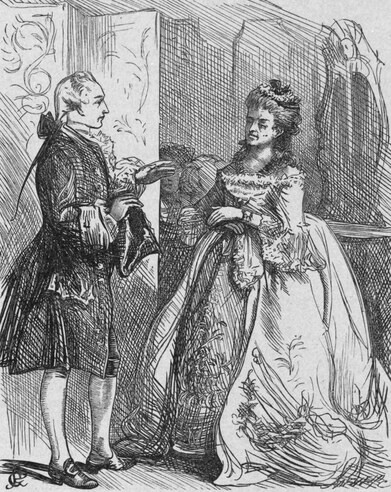
Hastings.—"Extremely elegant and
dégagée, upon my word, madam."—p. 344.
Mrs. Hard. Yet what signifies my
dressing when I have such a piece of
antiquity by my side as Mr. Hardcastle?
all I can say will not argue
down a single button from his clothes.
I have often wanted him to throw off
his great flaxen wig, and where he
was bald, to plaster it over, like my
lord Pately, with powder.
Hast. You are right, madam; for
as, among the ladies, there are none
ugly, so, among the men, there are
none old.
Mrs. Hard. But what do you
think his answer was? Why, with
his usual gothic vivacity, he said, I
only wanted him to throw off his wig,
to convert it into a tête for my own
wearing.
Hast. Intolerable! At your age
you may wear what you please, and
it must become you.
Mrs. Hard. Pray, Mr. Hastings,
what do you take to be the most
fashionable age about town?
Hast. Some time ago, forty was all
the mode; but I'm told the ladies
intend to bring up fifty for the ensuing
winter.
Miss Hard. Seriously! then I shall
be too young for the fashion.
Hast. No lady begins now to put
on jewels till she's past forty. For
instance, Miss there, in a polite circle,
would be considered as a child, as a
mere maker of samplers.
Mrs. Hard. And yet Mrs. Niece
thinks herself as much a woman, and
is as fond of jewels, as the oldest of
us all.
Hast. Your niece, is she? and that
young gentleman, a brother of yours,
I should presume?
Mrs. Hard. My son, sir. They
are contracted to each other. Observe
their little sports. They fall in and
out ten times a day, as if they were
man and wife already. (To them.)
Well, Tony, child, what soft things
are you saying to your cousin Constance
this evening.
Tony. I have been saying no soft
things; but that it's very hard to be
followed about so. Ecod! I've not a
place in the house now, that's left to
myself, but the stable.
Mrs. Hard. Never mind him, Con
my dear. He's in another story behind
your back.
Miss Nev. There's something generous
in my cousin's manner. He
falls out before faces to be forgiven
in private.
Tony. That's a damned confounded—crack.
Mrs. Hard. Ah! he's a sly one.
Don't you think they're like each
other about the mouth, Mr. Hastings?
The Blenkinsop mouth to a
T. They're of a size too. Back to
back, my pretties, that Mr. Hastings
may see you. Come, Tony.
Tony. You had as good not make
me, I tell you.
Measuring.
Miss Nev. O lud! he has almost
cracked my head.
Mrs. Hard. O, the monster! For
shame, Tony. You a man, and behave
so!
Tony. If I'm a man, let me have
my fortin. Ecod, I'll not be made a
fool of no longer.
Mrs. Hard. Is this, ungrateful
boy, all that I'm to get for the pains
I have taken in your education? I
that have rocked you in your cradle,
and fed that pretty mouth with a
spoon! Did not I work that waistcoat,
to make you genteel? Did
not I prescribe for you every day,
and weep while the receipt was operating?
Tony. Ecod! you had reason to
weep, for you have been dosing me
ever since I was born. I have gone
through every receipt in the Complete
Huswife ten times over; and
you have thoughts of coursing me
through Quincy next spring. But,
ecod! I tell you, I'll not be made a
fool of no longer.
Mrs. Hard. Wasn't it all for your
good, viper? Wasn't it all for your
good?
Tony. I wish you'd let me and my
good alone then. Snubbing this way,
when I'm in spirits. If I'm to have
any good, let it come of itself; not
to keep dinging it, dinging it into
one so.
Mrs. Hard. That's false; I never
see you when you're in spirits. No,
Tony, you then go to the alehouse, or
kennel. I'm never to be delighted
with your agreeable wild notes, unfeeling
monster!
Tony. Ecod! mamma, your own
notes are the wildest of the two.
Mrs. Hard. Was ever the like!
But I see he wants to break my heart,
I see he does.
Hast. Dear madam, permit me to
lecture the young gentleman a little.
I'm certain I can persuade him to his
duty.
Mrs. Hard. Well! I must retire.
Come, Constance, my love. You see,
Mr. Hastings, the wretchedness of my
situation. Was ever poor woman so
plagued with a dear, sweet, pretty,
provoking, undutiful boy?
Exeunt Mrs. Hard. and Miss Neville.
Hastings. Tony.
Tony. (Singing)
There was a young man riding by,
And fain would have his will.
Rang do didlo dee.
Don't mind her. Let her cry. It's
the comfort of her heart. I have seen
her and sister cry over a book for an
hour together; and they said, they
liked the book the better the more
it made them cry.
Hast. Then you're no friend to the
ladies, I find, my pretty young gentleman?
Tony. That's as I find 'um.
Hast. Not to her of your mother's
choosing, I dare answer: and yet she
appears to me a pretty, well-tempered
girl.
Tony. That's because you don't
know her as well as I. Ecod! I know
every inch about her; and there's not
a more bitter cantankerous toad in
all Christendom.
Hast. (Aside.) Pretty encouragement
this for a lover!
Tony. I have seen her since the
height of that. She has as many
tricks as a hare in a thicket, or a colt
the first day's breaking.
Hast. To me she appears sensible
and silent.
Tony. Ay, before company. But
when she's with her playmates, she's
as loud as a hog in a gate.
Hast. But there is a meek modesty
about her that charms me.
Tony. Yes; but curb her never so
little, she kicks up, and you're flung
in a ditch.
Hast. Well; but you must allow
her a little beauty.—Yes, you must
allow her some beauty.
Tony. Bandbox! She's all a made
up thing, mun. Ah! could you but
see Bet Bouncer, of these parts, you
might then talk of beauty. Ecod, she
has two eyes as black as sloes, and
cheeks as broad and red as a pulpit
cushion. She'd make two of she.
Hast. Well, what say you to a
friend that would take this bitter
bargain off your hands?
Tony. Anon.
Hast. Would you thank him that
would take Miss Neville, and leave
you to happiness and your dear
Betsy?
Tony. Ay; but where is there
such a friend? for who would take
her?
Hast. I am he. If you but assist
me, I'll engage to whip her off to
France, and you shall never hear more
of her.
Tony. Assist you! Ecod, I will, to
the last drop of my blood. I'll clap a
pair of horses to your chaise, that shall
trundle you off in a twinkling; and
may be, get you a part of her fortin
beside, in jewels, that you little dream
of.
Hast. My dear 'squire, this looks
like a lad of spirit.
Tony. Come along then, and you
shall see more of my spirit before you
have done with me. Singing.
We are the boys,
That fears no noise,
Where the thundering cannons roar.
Enter Hardcastle, solus.
Hard. What could my old friend
Sir Charles mean, by recommending
his son as the modestest young man in
town? To me he appears the most
impudent piece of brass that ever
spoke with a tongue. He has taken
possession of the easy chair by the
fireside already. He took off his
boots in the parlour, and desired me
to see them taken care of. I'm desirous
to know how his impudence
affects my daughter.—She will certainly
be shocked at it.
Enter Miss Hardcastle, plainly dressed.
Hard. Well, my Kate, I see you
have changed your dress, as I bid you;
and yet, I believe, there was no great
occasion.
Miss Hard. I find such a pleasure,
sir, in obeying your commands, that I
take care to obey them without ever
debating their propriety.
Hard. And yet, Kate, I sometimes
give you some cause, particularly when
I recommended my modest gentleman
to you as a lover to-day.
Miss Hard. You taught me to
expect something extraordinary, and I
find the original exceeds the description.
Hard. I was never so surprised in
my life! He has quite confounded all
my faculties!
Miss Hard. I never saw anything
like it: and a man of the world too!
Hard. Ay, he learned it all abroad,—what
a fool was I, to think a young
man could learn modesty by travelling!
He might as soon learn wit at a
masquerade.
Miss Hard. It seems all natural to
him.
Hard. A good deal assisted by
bad company, and a French dancing-master.
Miss Hard. Sure you mistake,
papa! A French dancing-master
could never have taught him that
timid look,—that awkward address,—that
bashful manner—
Hard. Whose look? whose manner,
child?
Miss Hard. Mr. Marlow's: his
mauvaise honte, his timidity struck me
at the first sight.
Hard. Then your first sight deceived
you; for I think him one of the
most brazen first-sights that ever
astonished my senses.
Miss Hard. Sure, sir, you rally! I
never saw any one so modest.
Hard. And can you be serious! I
never saw such a bouncing, swaggering
puppy, since I was born. Bully
Dawson was but a fool to him.
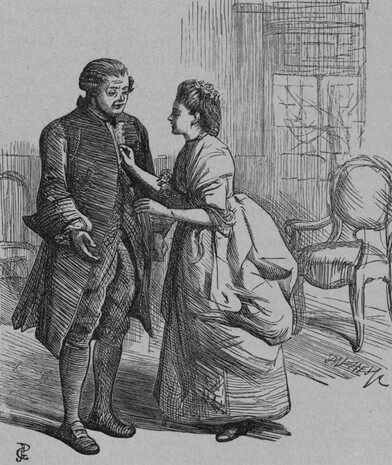
Miss Hardcastle.—"Yes. But upon conditions."—p. 350.
Miss Hard. Surprising! he met me
with a respectful bow, a stammering
voice, and a look fixed on the ground.
Hard. He met me with a loud
voice, a lordly air, and a familiarity
that made my blood freeze again.
Miss Hard. He treated me with
diffidence and respect; censured the
manners of the age; admired the prudence
of girls that never laughed;
tired me with apologies for being tiresome;
then left the room with a bow,
and, "Madam, I would not for the
world detain you."
Hard. He spoke to me, as if he
knew me all his life before; asked
twenty questions, and never waited for
an answer; interrupted my best remarks
with some silly pun; and when
I was in my best story of the Duke of
Marlborough and Prince Eugene, he
asked if I had not a good hand at
making punch. Yes, Kate, he asked
your father if he was a maker of
punch!
Miss Hard. One of us must certainly
be mistaken.
Hard. If he be what he has shown
himself, I'm determined he shall never
have my consent.
Miss Hard. And if he be the
sullen thing I take him, he shall never
have mine.
Hard. In one thing then we are
agreed—to reject him.
Miss Hard. Yes. But upon conditions.
For if you should find him
less impudent, and I more presuming;
if you find him more respectful, and I
more importunate—I don't know—the
fellow is good enough for a man—Certainly
we don't meet many such at
a horse-race in the country.
Hard. If we should find him so—but
that's impossible. The first appearance
has done my business. I'm
seldom deceived in that.
Miss Hard. And yet there may be
many good qualities under that first
appearance.
Hard. Ay, when a girl finds a
fellow's outside to her taste, she then
sets about guessing the rest of his
furniture. With her, a smooth face
stands for good sense, and a genteel
figure, for every virtue.
Miss Hard. I hope, sir, a conversation
begun with a compliment to my
good sense, won't end with a sneer at
my understanding.
Hard. Pardon me, Kate. But if
young Mr. Brazen can find the art of
reconciling contradictions, he may
please us both, perhaps.
Miss Hard. And as one of us
must be mistaken, what if we go to
make further discoveries?
Hard. But depend on't I'm in the
right.
Miss Hard. And depend on't I'm
not much in the wrong.
Enter Tony running in with a casket.
Tony. Ecod! I have got them.
Here they are. My cousin Con's
necklaces, bobs, and all. My mother
shan't cheat the poor souls out of
their fortin neither. O! my genius,
is that you?
Enter Hastings.
Hast. My dear friend, how have
you managed with your mother? I
hope you have amused her with pretending
love for your cousin; and
that you are willing to be reconciled
at last. Our horses will be refreshed
in a short time, and we shall soon be
ready to set off.
Tony. And here's something to
bear your charges by the way. (Giving
the casket.) Your sweetheart's
jewels. Keep them; and hang those,
I say, that would rob you of one of
them.
Hast. But how have you procured
them from your mother?
Tony. Ask me no questions, and
I'll tell you no fibs. I procured
them by the rule of thumb. If I had
not a key to every drawer in mother's
bureau, how could I go to the alehouse
so often as I do? An honest man
may rob of himself his own at any
time.
Hast. Thousands do it every day.
But to be plain with you; Miss
Neville is endeavouring to procure
them from her aunt this very instant.
If she succeeds, it will be the most
delicate way at least of obtaining
them.
Tony. Well, keep them, till you
know how it will be. I know how it
will be well enough; she'd as soon
part with the only sound tooth in her
head.
Hast. But I dread the effects of
her resentment, when she finds she
has lost them.
Tony. Never you mind her resentment,
leave me to manage that. I
don't value her resentment the bounce
of a cracker. Zounds! here they are.
Morrice. Prance.
Tony, Mrs. Hardcastle, Miss Neville.
Mrs. Hard. Indeed, Constance,
you amaze me. Such a girl as you
want jewels! It will be time enough
for jewels, my dear, twenty years
hence; when your beauty begins to
want repairs.
Miss Nev. But what will repair
beauty at forty, will certainly improve
it at twenty, madam.
Mrs. Hard. Yours, my dear, can
admit of none. That natural blush is
beyond a thousand ornaments. Besides,
child, jewels are quite out at
present. Don't you see half the
ladies of our acquaintance, my Lady
Kill-day-light, and Mr. Crump, and
the rest of them, carry their jewels to
town, and bring nothing but paste
and marcasites back?
Miss Nev. But who knows, madam,
but somebody that shall be nameless
would like me best with all my little
finery about me?
Mrs. Hard. Consult your glass,
my dear, and then see, if, with such a
pair of eyes, you want any better
sparklers. What do you think, Tony,
my dear, does your cousin Con want
jewels, in your eyes to set off her
beauty?
Tony. That's as thereafter may be.
Miss Nev. My dear aunt, if you
knew how it would oblige me.
Mrs. Hard. A parcel of old
fashioned rose and table-cut things.
They would make you look like the
court of king Solomon at a puppet-show.
Besides, I believe I can't
readily come at them. They may be
missing for aught I know to the contrary.
Tony. (Apart to Mrs. Hardcastle.)
Then why don't you tell her so at
once, as she's so longing for them?
Tell her they're lost. It's the only
way to quiet her. Say they're lost,
and call me to bear witness.
Mrs. Hard. (Apart to Tony.) You
know, my dear, I'm only keeping
them for you. So, if I say they're
gone, you'll bear me witness, will you?
He! he! he!
Tony. Never fear me. Ecod! I'll
say I saw them taken out with mine
own eyes.
Miss Nev. I desire them but for a
day, madam. Just to be permitted
to show them as relics, and then they
may be locked up again.
Mrs. Hard. To be plain with you,
my dear Constance; if I could find
them, you should have them. They're
missing, I assure you. Lost, for
aught I know; but we must have
patience wherever they are.
Miss Nev. I'll not believe it; this
is but a shallow pretence to deny me.
I know they're too valuable to be so
slightly kept, and as you are to answer
for the loss.
Mrs. Hard. Don't be alarmed,
Constance; if they be lost, I must
restore an equivalent. But my son
knows they are missing, and not to be
found.
Tony. That I can bear witness to.
They are missing, and not to be found,
I'll take my oath on't.
Mrs. Hard. You must learn resignation,
my dear; for though we lose
our fortune, yet we should not lose
our patience. See me, how calm I
am.
Miss Nev. Ay, people are generally
calm at the misfortunes of
others.
Mrs. Hard. Now, I wonder a girl
of your good sense, should waste a
thought upon such trumpery. We
shall soon find them; and, in the
mean time, you shall make use of my
garnets, till your jewels be found.
Miss Nev. I detest garnets.
Mrs. Hard. The most becoming
things in the world to set off a clear
complexion. You have often seen how
well they look upon me. You shall
have them.
Miss Nev. I dislike them of all
things. You shan't stir.—Was ever
anything so provoking? to mislay my
own jewels, and force me to wear her
trumpery.
Tony. Don't be a fool. If she gives
you the garnets, take what you can get.
The jewels are your own already. I
have stolen them out of her bureau,
and she does not know it. Fly to your
spark, he'll tell you more of the matter.
Leave me to manage her.
Miss Nev. My dear cousin!
Tony. Vanish. She's here, and has
missed them already. Zounds! how
she fidgets, and spits about like a
Catherine-wheel!
Enter Mrs. Hardcastle.
Mrs. Hard. Confusion! thieves!
robbers! We are cheated, plundered,
broke open, undone.
Tony. What's the matter, what's
the matter, mamma? I hope nothing
has happened to any of the good
family!
Mrs. Hard. We are robbed. My
bureau has been broke open, the jewels
taken out, and I'm undone.
Tony. Oh! is that all? Ha! ha!
ha! By the laws, I never saw it better
acted in my life. Ecod, I thought
you was ruined in earnest; ha, ha, ha!
Mrs. Hard. Why, boy, I am ruined
in earnest. My bureau has been broke
open, and all taken away.
Tony. Stick to that; ha, ha, ha!
stick to that; I'll bear witness, you
know; call me to bear witness.
Mrs. Hard. I tell you, Tony, by
all that's precious, the jewels are gone,
and I shall be ruined for ever.
Tony. Sure, I know they're gone,
and I am to say so.
Mrs. Hard. My dearest Tony, but
hear me. They're gone, I say.
Tony. By the laws, mamma, you
make me for to laugh; ha! ha! I know
who took them well enough, ha! ha!
ha!
Mrs. Hard. Was there ever such
a blockhead, that can't tell the difference
between jest and earnest? I tell
you I'm not in jest, booby.
Tony. That's right, that's right.
You must be in a bitter passion, and
then nobody will suspect either of us.
I'll bear witness that they are gone.
Mrs. Hard. Was there ever such a
cross-grained brute, that won't hear
me! Can you bear witness that you're
no better than a fool? Was ever poor
woman so beset with fools on one
hand, and thieves on the other?
Tony. I can bear witness to that.
Mrs. Hard. Bear witness again, you
blockhead you, and I'll turn you out
of the room directly. My poor niece,
what will become of her! Do you
laugh, you unfeeling brute, as if you
enjoyed my distress?
Tony. I can bear witness to that.
Mrs. Hard. Do you insult me,
monster? I'll teach you to vex your
mother, I will.
Tony. I can bear witness to that.
He runs off, she follows him.
Enter Miss Hardcastle and Maid.
Miss Hard. What an unaccountable
creature is that brother of mine, to
send them to the house as an inn, ha!
ha! I don't wonder at his impudence.
Maid. But what is more, madam,
the young gentlemen, as you passed by
in your present dress, asked me if you
were the bar-maid? He mistook you
for the bar-maid, madam.
Miss Hard. Did he? Then, as I
live, I'm resolved to keep up the delusion.
Tell me, Pimple, how do you
like my present dress? Don't you
think I look something like Cherry in
the Beaux' Stratagem?
Maid. It's the dress, madam, that
every lady wears in the country, but
when she visits or receives company.
Miss Hard. And are you sure he
does not remember my face or person?
Maid. Certain of it.
Miss Hard. I vow, I thought so;
for though we spoke for some time together,
yet his fears were such, that he
never once looked up during the interview.
Indeed, if he had, my bonnet
would have kept him from seeing me.
Maid. But what do you hope from
keeping him in his mistake?
Miss Hard. In the first place I
shall be seen, and that is no small advantage
to a girl who brings her face
to market. Then I shall, perhaps,
make an acquaintance, and that's no
small victory gained over one, who
never addresses any but the wildest of
her sex. But my chief aim is to take
my gentleman off his guard, and, like
an invisible champion of romance, examine
the giant's force before I offer
to combat.
Maid. But are you sure you can
act your part, and disguise your voice,
so that he may mistake that, as he has
already mistaken your person?
Miss Hard. Never fear me. I think
I have got the true bar-cant—Did your
honour call?—Attend the Lion there.—Pipes
and tobacco for the Angel.—The
Lamb has been outrageous this
half-hour.
Maid. It will do, madam. But he's
here.
Enter Marlow.
Marl. What a bawling in every
part of the house! I have scarce a
moment's repose. If I go to the best
room, there I find my host and his
story. If I fly to the gallery, there
we have my hostess, with her curtesy
down to the ground. I have at last
got a moment to myself, and now for
recollection.
Walks and muses.
Miss Hard. Did you call, sir?
Did your honour call?
Marl. (Musing). As for Miss Hardcastle,
she's too grave and sentimental
for me.
Miss Hard. Did your honour call?
She still places herself before him, he turning
away.
Marl. No, child. (Musing.) Besides,
from the glimpse I had of her, I think
she squints.
Miss Hard. I'm sure, sir, I heard
the bell ring.
Marl. No, no. (Musing.) I have
pleased my father, however, by coming
down, and I'll to-morrow please myself
by returning.
Taking out his tablets, and perusing.
Miss Hard. Perhaps the other gentleman
called, sir.
Marl. I tell you, no.
Miss Hard. I should be glad to
know, sir. We have such a parcel of
servants.
Marl. No, no, I'll tell you. (Looks
full in her face.) Yes, child, I think I
did call. I wanted—I wanted—I vow,
child, you are vastly handsome.
Miss Hard. O la, sir, you'll make
one ashamed.
Marl. Never saw a more sprightly
malicious eye. Yes, yes, my dear, I
did call. Have you got any of your—a—what
d'ye call it, in the house?
Miss Hard. No, sir, we have been
out of that these ten days.
Marl. One may call in this house,
I find, to very little purpose. Suppose
I should call for a taste, just by way
of trial, of the nectar of your lips;
perhaps I might be disappointed in
that too.
Miss Hard. Nectar! nectar! that's
a liquor there's no call for in these
parts. French, I suppose. We keep
no French wines here, sir.
Marl. Of true English growth, I
assure you.
Miss Hard. Then it's odd I should
not know it. We brew all sorts of
wines in this house, and I have lived
here these eighteen years.
Marl. Eighteen years? Why, one
would think, child, you kept the bar
before you were born. How old are
you?
Miss Hard. O! sir, I must not tell
my age. They say women and music
should never be dated.
Marl. To guess at this distance,
you can't be much above forty. (Approaching.)
Yet, nearer, I don't think
so much. (Approaching.) By coming
close to some women they look younger
still; but when we come very close
indeed——
Attempting to kiss her.
Miss Hard. Pray, sir, keep your
distance. One would think you wanted
to know one's age as they do horses,
by mark of mouth.
Marl. I protest, child, you use me
extremely ill. If you keep me at this
distance, how is it possible you and
I can be ever acquainted?
Miss Hard. And who wants to be
acquainted with you? I want no such
acquaintance, not I. I'm sure you did
not treat Miss Hardcastle, that was
here a while ago, in this obstropalous
manner. I'll warrant me, before her
you looked dashed, and kept bowing
to the ground, and talked, for all the
world, as if you was before a justice of
peace.
Marl. (Aside.) Egad! she has hit
it, sure enough. (To her.) In awe of
her, child? Ha! ha! ha! A mere
awkward, squinting thing; no, no. I
find you don't know me. I laughed,
and rallied her a little; but I was unwilling
to be too severe. No, I could
not be too severe, curse me!
Miss Hard. O! then, sir, you are
a favourite, I find, among the ladies.
Marl. Yes, my dear, a great favourite.
And yet, hang me, I don't
see what they find in me to follow.
At the ladies' club in town, I'm called
their agreeable Rattle. Rattle, child,
is not my real name, but one I'm
known by. My name is Solomons.
Mr. Solomons, my dear, at your service.
Offering to salute her.
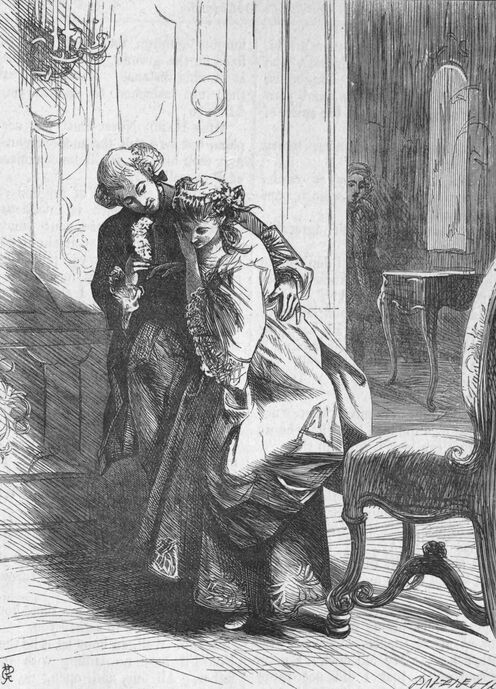
Marlow.—"And why not now, my angel?"—p. 356.
Miss Hard. Hold, sir; you were
introducing me to your club, not to
yourself. And you're so great a favourite
there, you say?
Marl. Yes, my dear; there's Mrs.
Mantrap, lady Betty Blackleg, the
countess of Sligo, Mrs. Longhorns,
old Miss Biddy Buckskin, and your
humble servant, keep up the spirit of
the place.
Miss Hard. Then it's a very merry
place, I suppose.
Marl. Yes; as merry as cards,
suppers, wine, and old women, can
make us.
Miss Hard. And their agreeable
Rattle; ha! ha! ha!
Marl. (Aside.) Egad! I don't quite
like this chit. She looks knowing, methinks.
You laugh, child!
Miss Hard. I can't but laugh to
think what time they all have for
minding their work or their family.
Marl. (Aside.) All's well, she
don't laugh at me. (To her. ) Do you
ever work, child?
Miss Hard. Ay, sure. There's not
a screen or a quilt in the whole house
but what can bear witness to that.
Marl. Odso! Then you must show
me your embroidery. I embroider and
draw patterns myself a little. If you
want a judge of your work, you must
apply to me.
Seizing her hand.
Miss Hard. Ay, but the colours
don't look well by candle-light. You
shall see all in the morning.
Struggling.
Marl. And why not now, my
angel? Such beauty fires beyond the
power of resistance.—Pshaw! the
father here! My old luck: I never
nicked seven, that I did not throw
ames-ace three times following.
Enter Hardcastle, who stands in surprise.
Hard. So, madam! So I find this
is your modest lover. This is your
humble admirer, that kept his eyes,
fixed on the ground, and only adored
at humble distance. Kate, Kate, art
thou not ashamed to deceive your
father so?
Miss Hard. Never trust me, dear
papa, but he's still the modest man I
first took him for, you'll be convinced
of it as well as I.
Hard. By the hand of my body, I
believe his impudence is infectious!
Didn't I see him seize your hand?
Didn't I see him haul you about like
a milk-maid? and now you talk of his
respect and his modesty, forsooth!
Miss Hard. But if I shortly convince
you of his modesty; that he has
only the faults that will pass off with
time, and the virtues that will improve
with age; I hope you'll forgive him.
Hard. The girl would actually make
one run mad; I tell you, I will not be
convinced. I am convinced. He has
scarcely been three hours in the house,
and he has already encroached on all
my prerogatives. You may like his
impudence, and call it modesty; but
my son-in-law, madam, must have very
different qualifications.
Miss Hard. Sir, I ask but this
night to convince you.
Hard. You shall not have half the
time; for I have thoughts of turning
him out this very hour.
Miss Hard. Give me that hour,
then, and I hope to satisfy you.
Hard. Well, an hour let it be then.
But I'll have no trifling with your
father. All fair and open, do you
mind me?
Miss Hard. I hope, sir, you have
ever found that I considered your
commands as my pride; for your
kindness is such, that my duty as yet
has been inclination.
ACT IV.
Enter Hastings and Miss Neville.
Hast. You surprise me! Sir Charles
Marlow expected here this night?
Where have you had your information?
Miss Nev. You may depend upon it.
I just saw his letter to Mr. Hardcastle,
in which he tells him he intends setting
out a few hours after his son.
Hast. Then, my Constance, all
must be completed before he arrives.
He knows me; and should he find
me here, would discover my name,
and perhaps my designs, to the rest
of the family.
Miss Nev. The jewels, I hope, are
safe.
Hast. Yes, yes. I have sent them
to Marlow, who keeps the keys of our
baggage. In the meantime, I'll go
to prepare matters for our elopement.
I have had the squire's promise of a
fresh pair of horses; and, if I should
not see him again, will write him
further directions.
Miss Nev. Well! success attend
you. In the meantime, I'll go amuse
my aunt with the old pretence of a
violent passion for my cousin.
Enter Marlow followed by a Servant.
Marl. I wonder what Hastings
could mean by sending me so valuable
a thing as a casket to keep for him,
when he knows the only place I have,
is the seat of a post-coach at an inn-door.—Have
you deposited the casket
with the landlady, as I ordered you?
Have you put it into her own hands?
Serv. Yes, your honour.
Marl. She said she'd keep it safe,
did she?
Serv. Yes, she said she'd keep it
safe enough; she asked me how I came
by it, and she said she had a great
mind to make me give an account of
myself.
Marl. Ha! ha! ha! They're safe,
however. What an unaccountable set
of beings have we got amongst! This
little bar-maid, though, runs in my
head most strangely, and drives out
the absurdities of all the rest of the
family. She's mine, she must be mine,
or I'm greatly mistaken.
Enter Hastings.
Hast. Bless me! I quite forgot to
tell her, that I intended to prepare at
the bottom of the garden. Marlow
here, and in spirits too!
Marl. Give me joy, George! Crown
me, shadow me with laurels! Well,
George, after all, we modest fellows
don't want for success among the
women.
Hast. Some women, you mean.
But what success has your honour's
modesty been crowned with now, that
it grows so insolent upon us?
Marl. Didn't you see the tempting,
brisk, lovely, little thing, that runs
about the house, with a bunch of keys
to its girdle?
Hast. Well, and what then?
Marl. She's mine, you rogue you.
Such fire, such motion, such eyes,
such lips—but, egad! she would not
let me kiss them though.
Hast. But are you so sure, so very
sure of her?
Marl. Why man, she talked of
showing me her work above-stairs,
and I'm to improve the pattern.
Hast. But how can you, Charles,
go about to rob a woman of her
honour?
Marl. Pshaw! pshaw! We all
know the honour of the bar-maid of an
inn. I don't intend to rob her, take
my word for it; there's nothing in
this house I shan't honestly pay for.
Hast. I believe the girl has virtue.
Marl. And if she has, I should be
the last man in the world that would
attempt to corrupt it.
Hast. You have taken care, I hope,
of the casket I sent you to lock up?
Is it in safety?
Marl. Yes, yes; it's safe enough.
I have taken care of it. But how
could you think the seat of a post-coach,
at an inn-door, a place of safety?
Ah! numb-skull! I have taken better
precautions for you than you did for
yourself.—I have—
Hast. What?
Marl. I have sent it to the landlady,
to keep for you.
Hast. To the landlady!
Marl. The landlady.
Hast. You did!
Marl. I did. She's to be answerable
for its forthcoming, you know.
Hast. Yes, she'll bring it forth,
with a witness.
Marl. Wasn't I right? I believe
you'll allow that I acted prudently
upon this occasion.
Hast. (Aside.) He must not see
my uneasiness.
Marl. You seem a little disconcerted
though, methinks. Sure nothing
has happened.
Hast. No, nothing. Never was in
better spirits in all my life. And so
you left it with the landlady, who, no
doubt, very readily undertook the
charge?
Marl. Rather too readily. For she
not only kept the casket; but, through
her great precaution, was going to
keep the messenger too. Ha! ha!
ha!
Hast. He! he! he! They are
safe, however.
Marl. As a guinea in a miser'spurse.
Hast. (Aside.) So now all hopes of
fortune are at an end, and we must
set off without it. (To him. ) Well,
Charles, I'll leave you to your meditations
on the pretty bar-maid; and,
he! he! he! may you be as successful
for yourself as you have been for
me.
Marl. Thank ye, George! I ask
no more; ha! ha! ha!
Enter Hardcastle.
Hard. I no longer know my own
house. It's turned all topsy-turvy.
His servants have got drunk already.
I'll bear it no longer; and yet, from
my respect for his father, I'll be calm.
(To him. ) Mr. Marlow, your servant.
I'm your very humble servant.
Bowing low.
Marl. Sir, your humble servant.
(Aside.) What's to be the wonder
now?
Hard. I believe, sir, you must be
sensible, sir, that no man alive ought
to be more welcome than your father's
son, sir. I hope you think so.
Marl. I do, from my soul, sir. I
don't want much entreaty. I generally
make my father's son welcome wherever
he goes.
Hard. I believe you do, from my
soul, sir. But though I say nothing
to your own conduct, that of your
servants is insufferable. Their manner
of drinking is setting a very bad example
in this house, I assure you.
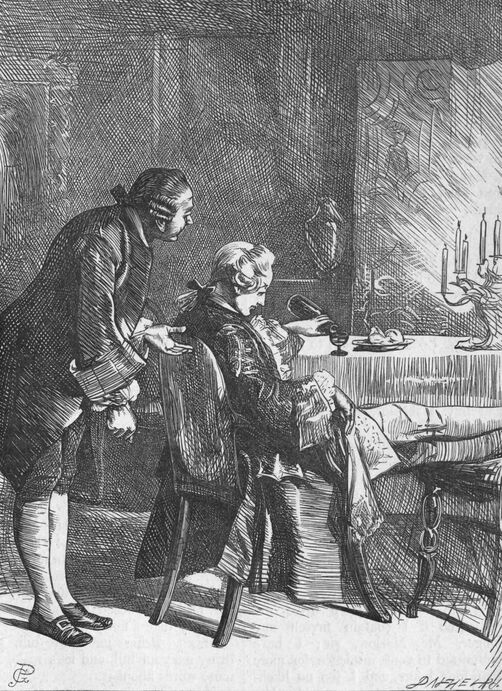
Hardcastle.—"I'm your very humble servant."—p. 358.
Marl. I protest, my very good sir,
that's no fault of mine. If they don't
drink as they ought, they are to blame.
I ordered them not to spare the cellar:
I did, I assure you. (To the side scene.)
Here, let one of my servants come up.
(To him.) My positive directions were,
that, as I did not drink myself, they
should make up for my deficiencies
below.
Hard. Then, they had your orders
for what they do! I'm satisfied.
Marl. They had, I assure you.
You shall hear from one of themselves.
Enter Servant, drunk.
Marl. You, Jeremy! Come forward,
sirrah! What were my orders?
Were you not told to drink freely, and
call for what you thought fit, for the
good of the house?
Hard. (Aside.) I begin to lose my
patience.
Jeremy. Please your honour, liberty
and Fleet-street for ever! Though
I'm but a servant, I'm as good as
another man. I'll drink for no man
before supper, sir, damme! Good
liquor will sit upon a good supper;
but a good supper will not sit upon—(Hiccup.)—upon
my conscience,
sir.
Marl. You see, my old friend, the
fellow is as drunk as he can possibly
be. I don't know what you'd have
more, unless you'd have the poor
devil soused in a beer-barrel.
Hard. Zounds! He'll drive me
distracted if I contain myself any
longer. Mr. Marlow, sir; I have
submitted to your insolence for more
than four hours, and I see no likelihood
of its coming to an end. I'm
now resolved to be master here, sir;
and I desire that you and your
drunken pack may leave my house
directly.
Marl. Leave your house?—Sure
you jest, my good friend! What,
when I'm doing what I can to please
you?
Hard. I tell you, sir, you don't
please me; so I desire you'll leave my
house.
Marl. Sure you cannot be serious!
At this time o'night, and such a
night! You only mean to banter me.
Hard. I tell you, sir, I'm serious;
and, now that my passions are roused,
I say this house is mine, sir; this
house is mine, and I command you to
leave it directly!
Marl. Ha! ha! ha! A puddle in
a storm. I shan't stir a step, I assure
you. (In a serious tone.) This your
house, fellow! It's my house. This
is my house. Mine, while I choose
to stay. What right have you to bid
me leave this house, sir? I never
met with such impudence, curse me,
never in my whole life before.
Hard. Nor I, confound me if ever
I did. To come to my house, to call
for what he likes, to turn me out of
my own chair, to insult the family, to
order his servants to get drunk, and
then to tell me, This house is mine, sir.
By all that's impudent, it makes me
laugh. Ha! ha! Pray, sir, (Bantering.)
as you take the house, what think
you of taking the rest of the furniture?
There's a pair of silver candlesticks,
and there's a fire-screen, and here's a
pair of brazen-nosed bellows, perhaps
you may take a fancy to them.
Marl. Bring me your bill, sir,
bring me your bill, and let's make no
more words about it.
Hard. There are a set of prints
too. What think you of the Rake's
Progress for your own apartment?
Marl. Bring me your bill, I say;
and I'll leave you and your infernal
house directly.
Hard. Then there's a mahogany
table, that you may see your own face
in.
Marl. My bill, I say.
Hard. I had forgot the great chair,
for your own particular slumbers, after
a hearty meal.
Marl. Zounds! bring me my bill,
I say; and let's hear no more on't.
Hard. Young man, young man,
from your father's letter to me, I was
taught to expect a well-bred, modest
man, as a visitor here; but now I find
him no better than a coxcomb, and
a bully. But he will be down here
presently, and shall hear more of it.
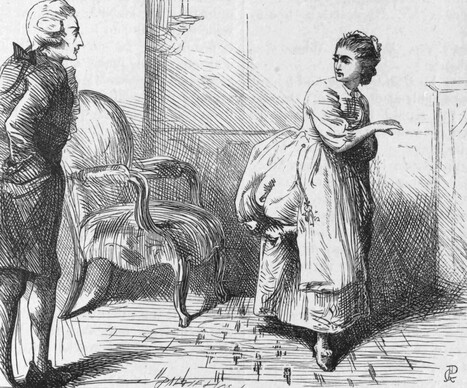
Miss Hardcastle.—"Let it be short, then."—p. 361.
Marl. How's this? Sure I have
not mistaken the house! Everything
looks like an inn. The servants cry,
Coming. The attendance is awkward;
the bar-maid too to attend us. But
she's here, and will further inform me.
Whither so fast, child! A word with
you.
Enter Miss Hardcastle.
Miss Hard. Let it be short then.
I'm in a hurry, (Aside.) I believe he
begins to find out his mistake; but
it's too soon quite to undeceive him.
Marl. Pray, child, answer me one
question.—What are you, and what
may your business in this house be?
Miss Hard. A relation of the
family, sir.
Marl. What; a poor relation?
Miss Hard. Yes, sir; a poor relation,
appointed to keep the keys, and
to see that the guests want nothing in
my power to give them.
Marl. That is, you act as the bar-maid
of this inn.
Miss Hard. O law!—What brought
that in your head? One of the best
families in the county keep an inn!
Ha! ha! ha! old Mr. Hardcastle's
house an inn!
Marl. Mr. Hardcastle's house? Is
this house Mr. Hardcastle's house,
child?
Miss Hard. Ay, sure. Whose else
should it be?
Marl. So then all's out, and I have
been damnably imposed on. O, confound
my stupid head, I shall be
laughed at over the whole town. I
shall be stuck up in caricatura in all
the print-shops: the Dullissimo Maccaroni.
To mistake this house, of all
others, for an inn; and my father's
old friend for an inn-keeper! What
a swaggering puppy must he take me
for! What a silly puppy do I find
myself! There again, may I be
hanged, my dear, but I mistook you
for the bar-maid.
Miss Hard. Dear me! dear me!
I'm sure there's nothing in my behaviour
to put me upon a level with
one of that stamp.
Marl. Nothing, my dear, nothing.
But I was in for a list of blunders,
and could not help making you a
subscriber. My stupidity saw everything
the wrong way. I mistook
your assiduity for assurance, and your
simplicity for allurement. But it's
over—This house I no more show my
face in.
Miss Hard. I hope, sir, I have
done nothing to disoblige you. I'm
sure I should be sorry to affront any
gentleman who has been so polite, and
said so many civil things to me. I'm
sure I should be sorry (Pretending to
cry.) if he left the family upon my
account. I'm sure I should be sorry,
if people said anything amiss, since I
have no fortune but my character.
Marl. (Aside.) By heaven, she
weeps. This is the first mark of
tenderness I ever had from a modest
woman, and it touches me. (To her.)
Excuse me, my lovely girl, you are the
only part of the family I leave with
reluctance. But to be plain with you,
the difference of our birth, fortune,
and education, make an honourable
connexion impossible; and I can never
harbour a thought of bringing ruin
upon one, whose only fault was being
too lovely.
Miss Hard. (Aside.) Generous
man! I now begin to admire him.
(To him.) But I'm sure my family is
as good as Miss Hardcastle's; and
though I'm poor, that's no great misfortune
to a contented mind; and
until this moment, I never thought
that it was bad to want fortune.
Marl. And why now, my pretty
simplicity?
Miss Hard. Because it puts me a
distance from one, that if I had a
thousand pound I would give it all
too.
Marl. (Aside.) This simplicity
bewitches me so that if I stay I'm undone.
I must make one bold effort,
and leave her. (To her.) Your partiality
in my favour, my dear, touches
me most sensibly; and were I to live
for myself alone, I could easily fix my
choice. But I owe too much to the
opinion of the world, too much to the
authority of a father, so that—I can
scarcely speak it—it affects me. Farewell.
Miss Hard. I never knew half his
merit till now. He shall not go, if I
have power or art to detain him. I'll
still preserve the character in which I
stooped to conquer; but will undeceive
my papa, who, perhaps, may
laugh him out of his resolution.
Enter Tony, Miss Neville.
Tony. Ay, you may steal for yourselves
the next time. I have done my
duty. She has got the jewels again,
that's a sure thing; but she believes
it was all a mistake of the servants.
Miss Nev. But, my dear cousin,
sure you won't forsake us in this distress.
If she in the least suspects that
I am going off, I shall certainly be
locked up, or sent to my aunt Pedigree's,
which is ten times worse.
Tony. To be sure, aunts of all
kinds are damn'd bad things; but
what can I do? I have got you a
pair of horses that will fly like Whistle-jacket,
and I'm sure you can't say but
I have courted you nicely before her
face. Here she comes, we must court
a bit or two more, for fear she should
suspect us.
They retire and seem to fondle.
Enter Mrs. Hardcastle.
Mrs. Hard. Well, I was greatly
fluttered, to be sure. But my son
tells me it was all a mistake of the
servants. I shan't be easy, however,
till they are fairly married, and then
let her keep her own fortune. But
what do I see? Fondling together, as
I'm alive. I never saw Tony so
sprightly before. Ah! have I caught
you, my pretty doves? What! billing,
exchanging stolen glances, and
broken murmurs? Ah!
Tony. As for murmurs, mother, we
grumble a little now and then, to be
sure. But there's no love lost between
us.
Mrs. Hard. A mere sprinkling,
Tony, upon the flame, only to make it
burn brighter.
Miss Nev. Cousin Tony promises
to give us more of his company at
home. Indeed, he shan't leave us any
more. It won't leave us, cousin Tony,
will it?
Tony. O! it's a pretty creature.
No, I'd sooner leave my horse in a
pound, than leave you, when you
smile upon one so. Your laugh makes
you so becoming.
Miss Nev. Agreeable cousin! Who
can help admiring that natural humour,
that pleasant, broad, red, thoughtless,
(patting his cheek) ah! it's a bold face.
Mrs. Hard. Pretty innocence!
Tony. I'm sure I always loved
cousin Con's hazel eyes, and her pretty
long fingers, that she twists this way
and that, over the haspicholls, like a
parcel of bobbins.
Mrs. Hard. Ah, he would charm
the bird from the tree. I was never
so happy before. My boy takes after
his father, poor Mr. Lumpkin, exactly.
The jewels, my dear Con, shall be
yours incontinently. You shall have
them. Isn't he a sweet boy, my
dear? You shall be married to-morrow,
and we'll put off the rest of
his education, like Mr. Drowsy's
sermons, to a fitter opportunity.
Enter Diggory.
Digg. Where's the 'squire? I have
got a letter for your worship.
Tony. Give it to my mamma. She
reads all my letters first.
Digg. I had orders to deliver it
into your own hands.
Tony. Who does it come from?
Digg. Your worship mun ask that
o' the letter itself.
Tony. I could wish to know,
though (turning the letter and gazing
on it).
Miss Nev. (Aside.) Undone, undone!
A letter to him from Hastings.
I know the hand. If my aunt sees it,
we are ruined for ever. I'll keep her
employed a little if I can. (To Mrs.
Hardcastle.) But I have not told
you, madam, of my cousin's smart
answer just now to Mr. Marlow. We
so laughed—You must know, madam—this
way a little; for he must not
hear us.
They confer.
Tony. (Still gazing.) A damn'd
cramp piece of penmanship, as ever I
saw in my life. I can read your printhand
very well. But here there are such
handles, and shanks, and dashes, that
one can scarce tell the head from the
tail. To Anthony Lumpkin, Esq. It's
very odd, I can read the outside of my
letters, where my own name is, well
enough. But when I come to open it,
it is all—buzz. That's hard, very
hard; for the inside of the letter is
always the cream of the correspondence.
Mrs. Hard. Ha! ha! ha! Very
well, very well. And so my son was
too hard for the philosopher.
Miss Nev. Yes, madam; but you
must hear the rest, madam. A little
more this way, or he may hear us.
You'll hear how he puzzled him again.
Mrs. Hard. He seems strangely
puzzled now himself, methinks.
Tony. (Still gazing.) A damned up
and down hand, as if it was disguised
in liquor. (Reading.) Dear Sir, Ay,
that's that. Then there's an M, and
a T, and S; but whether the next be
an izzard or an R, confound me, I
cannot tell.
Mrs. Hard. What's that, my dear.
Can I give you any assistance?
Miss Nev. Pray, aunt, let me read
it. Nobody reads a cramp hand
better than I. (Twitching the letter
from her.) Do you know who it is
from?
Tony. Can't tell, except from Dick
Ginger, the feeder.
Miss Nev. Ay, so it is. (Pretending
to read.) Dear 'Squire, Hoping
that you're in health, as I am at this
present. The gentlemen of the Shake-bag
club has cut the gentlemen of
Goose green quite out of feather.
The odds—um—odd battle—um—long
fighting—um—Here, here; it's
all about cocks, and fighting: it's of
no consequence; here, put it up, put
it up.
Thrusting the crumpled letter upon him.
Tony. But I tell you, miss, it's of
all the consequence in the world. I
would not lose the rest of it for a
guinea. Here, mother, do you make
it out. Of no consequence!
Giving Mrs. Hardcastle the letter.
Mrs. Hard. How's this? (Reads.)
Dear 'Squire, I'm now waiting for
Miss Neville, with a post-chaise and
pair, at the bottom of the garden, but
I find my horses yet unable to perform
the journey. I expect you'll assist us
with a pair of fresh horses, as you
promised. Dispatch is necessary, as
the hag (ay the hag), your mother, will
otherwise suspect us. Yours, Hastings.
Grant me patience. I shall
run distracted. My rage chokes me.
Miss Nev. I hope, madam, you'll
suspend your resentment for a few
moments, and not impute to me any
impertinence, or sinister design that
belongs to another.
Mrs. Hard. (Curtseying very low.)
Fine-spoken madam, you are most
miraculously polite and engaging, and
quite the very pink of courtesy and
circumspection, madam. (Changing
her tone. ) And you, you great ill-fashioned
oaf, with scarce sense enough
to keep your mouth shut. Were you
too joined against me? But I'll
defeat all your plots in a moment. As
for you, madam, since you have got a
pair of fresh horses ready, it would be
cruel to disappoint them. So, if you
please, instead of running away with
your spark, prepare, this very moment,
to run off with me. Your old aunt
Pedigree will keep you secure, I'll
warrant me. You too, sir, may
mount your horse, and guard us upon
the way. Here, Thomas, Roger, Diggory,
I'll show you, that I wish you
better than you do yourselves.
Miss Nev. So, now I'm completely
ruined.
Tony. Ay, that's a sure thing.
Miss Nev. What better could be
expected, from being connected with
such a stupid fool, and after all the
nods and signs I made him?
Tony. By the laws, miss, it was
your own cleverness, and not my stupidity,
that did your business. You
were so nice, and so busy, with your
Shake-bags and Goose-greens, that I
thought you could never be making
believe.
Enter Hastings.
Hast. So, sir, I find by my servant,
that you have shown my letter, and
betrayed us. Was this well done,
young gentleman?
Tony. Here's another. Ask miss
there, who betrayed you. Ecod, it
was her doing, not mine.
Enter Marlow.
Marl. So, I have been finely used
here among you. Rendered contemptible,
driven into ill manners,
despised, insulted, laughed at.
Tony. Here's another. We shall,
have old Bedlam broke loose presently.
Miss Nev. And there, sir, is the
gentleman to whom we all owe every
obligation.
Marl. What can I say to him, a
mere boy, an idiot, whose ignorance
and age are a protection?
Hast. A poor contemptible booby,
that would but disgrace correction.
Miss Nev. Yet with cunning and
malice enough to make himself merry
with all our embarrassments.
Hast. An insensible cub.
Marl. Replete with tricks and
mischief.
Tony. Baw! damme, but I'll fight
you both, one after the other,——with
baskets.
Marl. As for him, he's below resentment.
But your conduct, Mr.
Hastings, requires an explanation.
You knew of my mistakes, yet would
not undeceive me.
Hast. Tortured as I am with my
own disappointments, is this a time
for explanations? It is not friendly,
Mr. Marlow.
Marl. But, sir——
Miss Nev. Mr. Marlow, we never
kept on your mistake, till it was too
late to undeceive you. Be pacified.
Enter Servant.
Serv. My mistress desires you'll
get ready immediately, madam. The
horses are putting to. Your hat and
things are in the next room. We are
to go thirty miles before morning.
Miss Nev. Well, well; I'll come
presently.
Marl. (To Hastings.) Was it well
done, sir, to assist in rendering me
ridiculous? To hang me out for the
scorn of all my acquaintance? Depend
upon it, sir, I shall expect an explanation.
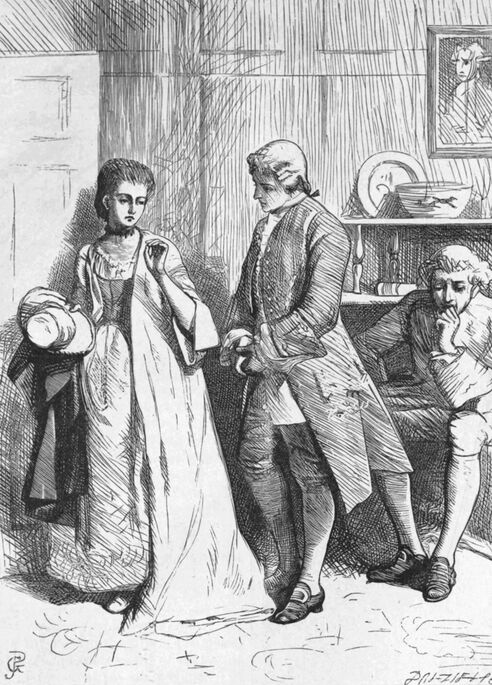
Miss Neville.—"Constancy is the word."—p. 367.
Hast. Was it well done, sir, if
you're upon that subject, to deliver
what I intrusted to yourself, to the
care of another, sir?
Miss Nev. Mr. Hastings, Mr.
Marlow, why will you increase my
distress by this groundless dispute? I
implore, I entreat you—
Enter Servant.
Serv. Your cloak, madam. My
mistress is impatient.
Miss Nev. I come. Pray be pacified.
If I leave you thus, I shall die
with apprehension.
Enter Servant.
Serv. Your fan, muff, and gloves,
madam. The horses are waiting.
Miss Nev. O, Mr. Marlow! if you
knew what a scene of constraint and
ill-nature lies before me, I'm sure it
would convert your resentment into
pity.
Marl. I'm so distracted with a
variety of passions, that I don't know
what I do. Forgive me, madam.
George, forgive me. You know my
hasty temper, and should not exasperate
it.
Hast. The torture of my situation
is my only excuse.
Miss Nev. Well, my dear Hastings,
if you have that esteem for me that I
think, that I am sure you have, your
constancy for three years will but increase
the happiness of our future
connexion. If—
Mrs. Hard. (Within.) Miss Neville—Constance,
why Constance, I say.
Miss Nev. I'm coming. Well,
constancy. Remember, constancy is
the word.
Hast. My heart, how can I support
this! To be so near happiness, and
such happiness.
Marl. (To Tony.) You see now,
young gentleman, the effects of your
folly. What might be amusement to
you, is here disappointment, and even
distress.
Tony. (From a reverie.) Ecod, I
have hit it. It's here. Your hands.
Yours and yours, my poor sulky. My
boots there, ho! Meet me two hours
hence at the bottom of the garden;
and if you don't find Tony Lumpkin
a more good-natured fellow than you
thought for, I'll give you leave to take
my best horse, and Bet Bouncer into
the bargain. Come along. My boots,
ho!
ACT V.
Scene continues.
Enter Hastings and Servant.
Hast. You saw the old lady and
Miss Neville drive off, you say?
Serv. Yes, your honour; they went
off in a post-coach, and the young
'squire went on horseback. They're
thirty miles off by this time.
Hast. Then all my hopes are over.
Serv. Yes, sir. Old Sir Charles
is arrived. He and the old gentleman
of the house have been laughing at
Mr. Marlow's mistake this half-hour.
They are coming this way.
Hast. Then I must not be seen.
So, now to my fruitless appointment,
at the bottom of the garden. This is
about the time.
Enter Sir Charles and Hardcastle.
Hard. Ha! ha! ha! The peremptory
tone in which he sent forth his
sublime commands!
Sir Charles. And the reserve with
which I suppose he treated all your
advances!
Hard. And yet he might have seen
something in me above a common inn-keeper
too.
Sir Charles. Yes, Dick, but he
mistook you for an uncommon inn-keeper,
ha! ha! ha!
Hard. Well, I'm in too good spirits
to think of anything but joy. Yes,
my dear friend, this union of our families
will make our personal friendships
hereditary; and though my daughter's
fortune is but small——
Sir Charles. Why, Dick, will you
talk of fortune to me? My son is
possessed of more than a competence
already, and can want nothing but a
good and virtuous girl to share his
happiness and increase it. If they like
each other, as you say they do——
Hard. If, man! I tell you they
do like each other. My daughter as
good as told me so.
Sir Charles. But girls are apt to
flatter themselves, you know.
Hard. I saw him grasp her hand
in the warmest manner myself; and
here he comes to put you out of your
ifs, I warrant you.
Enter Marlow.
Marl. I come, sir, once more, to
ask pardon for my strange conduct.
I can scarce reflect on my insolence
without confusion.
Hard. Tut, boy, a trifle. You take
it too gravely. An hour or two's
laughing with my daughter will set all
to rights again.—She'll never like you
the worse for it.
Marl. Sir, I shall be always proud
of her approbation.
Hard. Approbation is but a cold
word, Mr. Marlow: if I am not deceived,
you have something more than approbation
thereabouts. You take me.
Marl. Really, sir, I have not that
happiness.
Hard. Come boy, I'm an old fellow,
and know what's what, as well as you
that are younger. I know what has
passed between you; but mum.
Marl. Sure, sir, nothing has passed
between us, but the most profound
respect on my side, and the most
distant reserve on hers. You don't
think, sir, that my impudence has
been passed upon all the rest of the
family.
Hard. Impudence! No, I don't
say that—Not quite impudence—Though
girls like to be played with,
and rumpled a little too sometimes.
But she has told no tales I assure you.
Marl. I never gave her the slightest
cause.
Hard. Well, well, I like modesty
in its place well enough. But this is
over-acting, young gentleman. You
may be open. Your father and I will
like you the better for it.
Marl. May I die, sir, if I ever——
Hard. I tell you, she don't dislike
you; and as I'm sure you like her——
Marl. Dear sir—I protest, sir——
Hard. I see no reason why you
should not be joined as fast as the
parson can tie you.
Marl. But hear me, sir——
Hard. Your father approves the
match, I admire it, every moment's
delay will be doing mischief, so——
Marl. But why won't you hear
me? By all that's just and true, I
never gave Miss Hardcastle the slightest
mark of my attachment, or even
the most distant hint to suspect me of
affection. We had but one interview,
and that was formal, modest and uninteresting.
Hard. (Aside.). This fellow's formal
modest impudence is beyond bearing.
Sir Charles. And you never
grasped her hand, or made any protestations?
Marl. As Heaven is my witness, I
came down in obedience to your commands.
I saw the lady without
emotion, and parted without reluctance.
I hope you'll exact no further
proofs of my duty, nor prevent me
from leaving a house in which I suffer
so many mortifications.
Sir Charles. I'm astonished at the
air of sincerity with which he parted.
Hard. And I'm astonished at the
deliberate intrepidity of his assurance.
Sir Charles. I dare pledge my
life and honour upon his truth.
Hard. Here comes my daughter,
and I would stake my happiness upon
her veracity.
Enter Miss Hardcastle.
Hard. Kate, come hither, child.
Answer us sincerely, and without reserve:
has Mr. Marlow made you any
professions of love and affection?
Miss Hard. The question is very
abrupt, sir! But since you require
unreserved sincerity, I think he has.
Hard. (To Sir Charles.) You see.
Sir Charles. And pray, madam,
have you and my son had more than
one interview?
Miss Hard. Yes, sir, several.
Hard. (To Sir Charles.) You
see.
Sir Charles. But did he profess
any attachment?
Miss Hard. A lasting one.
Sir Charles. Did he talk of love?
Miss Hard. Much, sir.
Sir Charles. Amazing! and all
this formally?
Miss Hard. Formally.
Hard. Now, my friend, I hope you
are satisfied?
Sir Charles. And how did he behave,
madam?
Miss Hard. As most professed admirers
do. Said some civil things of
my face: talked much of his want of
merit, and the greatness of mine;
mentioned his heart; gave a short
tragedy speech, and ended with pretended
rapture.
Sir Charles. Now I'm perfectly
convinced, indeed. I know his conversation
among women to be modest
and submissive. This forward, canting,
ranting manner by no means describes
him, and I am confident he
never sat for the picture.
Miss Hard. Then what, sir, if I
should convince you to your face of
my sincerity? If you and my papa,
in about half-an-hour, will place yourselves
behind that screen, you shall
hear him declare his passion to me in
person.
Sir Charles. Agreed. And if I
find him what you describe, all my
happiness in him must have an end.
Miss Hard. And if you don't find
him what I describe—I fear my happiness
must never have a beginning.
Scene changes to the back of the garden.
Enter Hastings.
Hast. What an idiot am I, to wait
here for a fellow who probably takes a
delight in mortifying me. He never
intended to be punctual, and I'll wait
no longer. What do I see? It is he,
and perhaps with news of my Constance.
Enter Tony, booted and spattered.
Hast. My honest 'squire! I now
find you a man of your word. This
looks like friendship.
Tony. Ay, I'm your friend, and the
best friend you have in the world, if
you knew but all. This riding by
night, by-the-by, is cursedly tiresome.
It has shook me worse than the basket
of a stage-coach.
Hast. But how? Where did you
leave your fellow travellers? Are they
in safety! Are they housed?
Tony. Five-and-twenty miles in two
hours and a half is no such bad driving.
The poor beasts have smoked
for it. Rabbet me, but I'd rather ride
forty miles after a fox, than ten with
such varment.
Hast. Well, but where have you
left the ladies? I die with impatience.
Tony. Left them? Why where
should I leave them but where I found
them.
Hast. This is a riddle.
Tony. Riddle me this, then. What's
that goes round the house, and round
the house and never touches the
house?
Hast. I'm still astray.
Tony. Why that's it, mon. I have
led them astray. By jingo, there's not
a pond or slough within five miles of
the place, but they can tell the taste of.
Hast. Ha, ha, ha! I understand:
you took them in a round, while they
supposed themselves going forward.
And so you have at last brought them
home again.
Tony. You shall hear. I first took
them down Feather-bed-lane, where
we stuck fast in the mud. I then
rattled them crack over the stones of
Up-and-down Hill—I then introduced
them to the gibbet, on Heavy-tree
Heath; and from that, with a circumbendibus,
I fairly lodged them in the
horse-pond at the bottom of the
garden.
Hast. But no accident, I hope.
Tony. No, no. Only mother is
confoundedly frightened. She thinks
herself forty miles off. She's sick of
the journey, and the cattle can scarce
crawl. So if your own horses be
ready, you may whip off with cousin,
and I'll be bound that no soul here
can budge a foot to follow you.
Hast. My dear friend, how can I
be grateful?
Tony. Ay, now it's dear friend,
noble 'squire. Just now, it was all
idiot, cub, and run me through the
guts. Damn your way of fighting, I
say. After we take a knock in this
part of the country, we kiss and be
friends. But, if you had run me
through the guts, then I should be
dead, and you might go kiss the hangman.
Hast. The rebuke is just. But I
must hasten to relieve Miss Neville;
if you keep the old lady employed, I
promise to take care of the young one.
Tony. Never fear me. Here she
comes. Vanish. She's got from the
pond, and draggled up to the waist
like a mermaid.
Enter Mrs. Hardcastle.
Mrs. Hard. Oh, Tony, I'm killed.
Shook. Battered to death. I shall
never survive it. That last jolt, that
laid us against the quickset hedge, has
done my business.
Tony. Alack, mamma, it was all
your own fault. You would be for
running away by night, without knowing
one inch of the way.
Mrs. Hard. I wish we were at
home again. I never met so many accidents
in so short a journey. Drenched
in the mud, overturned in a ditch,
stuck fast in a slough, jolted to a
jelly, and at last to lose our way!
Whereabouts do you think we are,
Tony?
Tony. By my guess we should be
upon Crackskull Common, about forty
miles from home.
Mrs. Hard. O lud! O lud! the
most notorious spot in all the country.
We only want a robbery to make a
complete night on't.
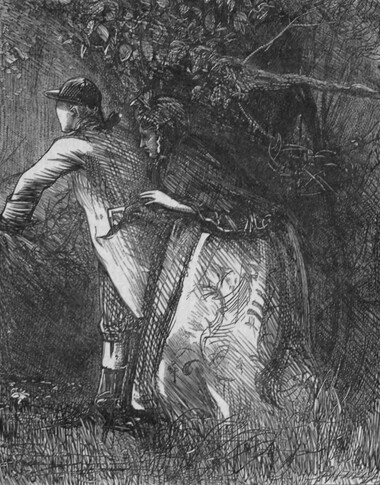
Tony.—"Don't be afraid, mamma."—p. 371.
Tony. Don't be afraid, mamma,
don't be afraid. Two of the five that
kept here are hanged, and the other
three may not find us. Don't be afraid.
Is that a man that's galloping behind
us? No; it's only a tree. Don't be
afraid.
Mrs. Hard. The fright will certainly
kill me.
Tony. Do you see anything like a
black hat moving behind the thicket?
Mrs. Hard. O death!
Tony. No, it's only a cow. Don't
be afraid, mamma: don't be afraid.
Mrs. Hard. As I'm alive, Tony, I
see a man coming towards us. Ah!
I'm sure on't. If he perceives us we
are undone.
Tony (Aside.) Father-in-law, by all
that's unlucky, come to take one of
his night walks. (To her.) Ah! it's
a highwayman, with pistols as long as
my arm. A damn'd ill looking fellow.
Mrs. Hard. Good Heaven defend
us! He approaches.
Tony. Do you hide yourself in that
thicket, and leave me to manage him.
If there be any danger I'll cough, and
cry—hem! When I cough, be sure
to keep close.
Mrs. Hardcastle hides behind a tree, in
the back scene.
Enter Hardcastle.
Hard. I'm mistaken, or I heard
voices of people in want of help. O,
Tony, is that you? I did not expect
you so soon back. Are your mother
and her charge in safety?
Tony. Very safe, sir, at my aunt
Pedigree's. Hem!
Mrs. Hard. (From behind.). Ah,
death! I find there's danger.
Hard. Forty miles in three hours;
sure that's too much, my youngster.
Tony. Stout horses and willing
minds make short journeys, as they
say. Hem!
Mrs. Hard. (From behind.) Sure
he'll do the dear boy no harm.
Hard. But I heard a voice here; I
should be glad to know from whence
it came.
Tony. It was I, sir; talking to myself,
sir. I was saying, that forty miles
in three hours, was very good going—hem!
As, to be sure, it was—hem!
I have got a sort of cold by being out
in the air. We'll go in, if you please—hem!
Hard. But if you talked to yourself,
you did not answer yourself. I
am certain I heard two voices, and am
resolved (Raising his voice) to find the
other out.
Mrs. Hard. (From behind.) Oh!
he's coming to find me out. Oh!
Tony. What need you go, sir, if I
tell you—hem! I'll lay down my life
for the truth—hem! I'll tell you all,
sir.
Detaining him.
Hard. I tell you, I will not be detained.
I insist on seeing. It's in
vain to expect I'll believe you.
Mrs. Hard. (Running forward from
behind.) O lud, he'll murder my poor
boy, my darling. Here, good gentleman,
whet your rage upon me. Take
my money, my life; but spare that
young gentleman, spare my child, if
you have any mercy.
Hard. My wife! as I'm a Christian.
From whence can she come, or what
does she mean?
Mrs. Hard. (Kneeling.) Take compassion
on us, good Mr. Highwayman.
Take our money, our watches, all we
have; but spare our lives. We will
never bring you to justice; indeed we
won't, good Mr. Highwayman.
Hard. I believe the woman's out of
her senses. What, Dorothy, don't
you know me?
Mrs. Hard. Mr. Hardcastle, as I'm
alive! My fears blinded me. But
who, my dear, could have expected to
meet you here, in this frightful place,
so far from home? What has brought
you to follow us?
Hard. Sure, Dorothy, you have not
lost your wits? So far from home,
when you are within forty yards of
your own door? (To him.) This is
one of your old tricks, you graceless
rogue you. (To her.) Don't you
know the gate, and the mulberry-tree?
and don't you remember the horse-pond,
my dear?
Mrs. Hard. Yes, I shall remember
the horse-pond as long as I live: I
have caught my death in it. (To
Tony.) And is it to you, you graceless
varlet, I owe all this? I'll teach you
to abuse your mother, I will.
Tony. Ecod, mother, all the parish
says you have spoiled me, and so you
may take the fruits on't.
Mrs. Hard. I'll spoil you, I will.
Follows him off the stage. Exit.
Hard. There's morality, however,
in his reply.
Enter Hastings and Miss Neville.
Hast. My dear Constance, why will
you deliberate thus? If we delay a
moment, all is lost for ever. Pluck
up a little resolution, and we shall
soon be out of the reach of her malignity.
Miss Nev. I find it impossible.
My spirits are so sunk with the agitations
I have suffered, that I am
unable to face any new danger. Two
or three years' patience will at last
crown us with happiness.
Hast. Such a tedious delay is worse
than inconstancy. Let us fly, my
charmer. Let us date our happiness
from this very moment. Perish fortune.
Love and content will increase
what we possess, beyond a monarch's
revenue. Let me prevail.
Miss Nev. No, Mr. Hastings; no.
Prudence once more comes to my
relief, and I will obey its dictates.
In the moment of passion, fortune
may be despised; but it ever produces
a lasting repentance. I am resolved
to apply to Mr. Hardcastle's compassion
and justice for redress.
Hast. But though he had the will,
he has not the power, to relieve you.
Miss Nev. But he has influence,
and upon that I am resolved to rely.
Hast. I have no hopes. But since
you persist, I must reluctantly obey
you.
Scene changes.
Enter Sir Charles and Miss Hardcastle.
Sir Charles. What a situation am
I in! If what you say appears, I
shall then find a guilty son. If what
he says be true, I shall then lose one
that, of all others, I most wished for
a daughter.
Miss Hard. I am proud of your
approbation, and to show I merit it,
if you place yourselves as I directed,
you shall hear his explicit declaration.
But he comes.
Sir Charles. I'll to your father,
and keep him to the appointment.
Enter Marlow.
Marl. Though prepared for setting
out, I come once more to take leave;
nor did I, till this moment, know the
pain I feel in the separation.
Miss Hard. (In her own natural
manner.) I believe these sufferings
cannot be very great, sir, which you
can so easily remove. A day or two
longer, perhaps, might lessen your uneasiness,
by showing the little value of
what you now think proper to regret.
Marl. (Aside.) This girl every moment
improves upon me. (To her.) It
must not be, madam. I have already
trifled too long with my heart. My
very pride begins to submit to my
passion. The disparity of education
and fortune, the anger of a parent,
and the contempt of my equals, begin
to lose their weight, and nothing can
restore me to myself, but this painful
effort of resolution.
Miss Hard. Then go, sir. I'll
urge nothing more to detain you.
Though my family be as good as hers
you came down to visit; and my education,
I hope, not inferior, what are
these advantages, without equal affluence?
I must remain contented with
the slight approbation of imputed
merit; I must have only the mockery
of your addresses, while all your
serious aims are fixed on fortune.
Enter Hardcastle and Sir Charles, from
behind.
Sir Charles. Here, behind this
screen.
Hard. Ay, ay, make no noise. I'll
engage my Kate covers him with confusion
at last.
Marl. By heavens, madam, fortune
was ever my smallest consideration.
Your beauty at first caught my eye;
for who could see that without emotion?
But every moment that I converse
with you, steals in some new
grace, heightens the picture, and gives
it stronger expression. What at first
seemed rustic plainness, now appears
refined simplicity. What seemed forward
assurance, now strikes me as the
result of courageous innocence and
conscious virtue.
Sir Charles. What can it mean?
He amazes me!
Hard. I told you how it would be.
Hush!
Marl. I am now determined to
stay, madam; and I have too good an
opinion of my father's discernment,
when he sees you, to doubt his approbation.
Miss Hard. No, Mr. Marlow, I
will not, cannot detain you. Do you
think I could suffer a connexion in
which there is the smallest room for
repentance? Do you think I would
take the mean advantage of a transient
passion, to load you with confusion?
Do you think I could ever relish that
happiness which was acquired by lessening
yours?
Marl. By all that's good, I can
have no happiness but what's in your
power to grant me. Nor shall I ever
feel repentance, but in not having seen
your merits before. I will stay, even
contrary to your wishes; and though
you should persist to shun me, I will
make my respectful assiduities atone
for the levity of my past conduct.
Miss Hard. Sir, I must entreat
you'll desist. As our acquaintance
began, so let it end, in indifference.
I might have given an hour or two to
levity; but seriously, Mr. Marlow, do
you think I could ever submit to a
connexion where I must appear mercenary,
and you imprudent? Do you
think I could ever catch at the confident
addresses of a secure admirer?
Marl. (Kneeling.) Does this look
like security? Does this look like
confidence? No, madam; every moment
that shows me your merit, only
serves to increase my diffidence and
confusion. Here let me continue—
Sir Charles. I can hold it no
longer. Charles, Charles, how hast
thou deceived me! Is this your indifference,
your uninteresting conversation?
Hard. Your cold contempt; your
formal interview? What have you to
say now?
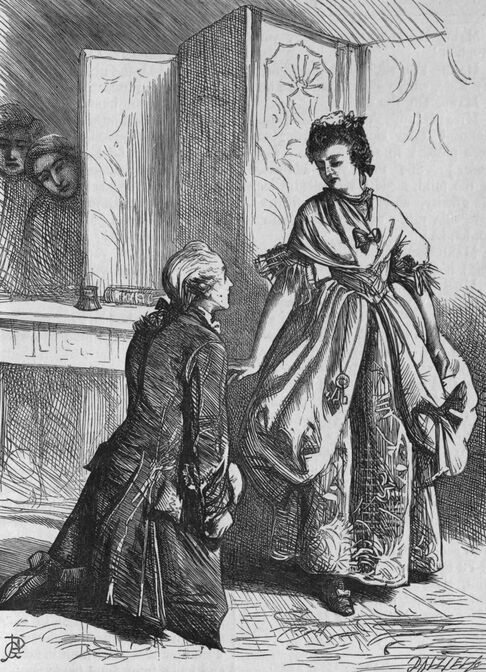
Marlow.—"Does this look like security?"—p. 374.
Marl. That I'm all amazement!
What can it mean?
Hard. It means, that you can say
and unsay things at pleasure. That
you can address a lady in private,
and deny it in public; that you have
one story for us, and another for my
daughter.
Marl. Daughter!—this lady your
daughter!
Hard. Yes, sir, my only daughter.
My Kate, whose else should she be?
Marl. Oh, the devil!
Miss Hard. Yes, sir, that very
identical tall, squinting lady you
were pleased to take me for. (Curtseying.)
She that you addressed
as the mild, modest, sentimental man
of gravity, and the bold, forward,
agreeable rattle of the ladies' club;
ha, ha, ha!
Marl. Zounds, there's no bearing
this; it's worse than death.
Miss Hard. In which of your characters,
sir, will you give us leave to
address you? As the faltering gentleman,
with looks on the ground, that
speaks just to be heard, and hates hypocrisy;
or the loud confident creature,
that keeps it up with Mrs. Mantrap,
and old Miss Biddy Buckskin,
till three in the morning? ha, ha, ha!
Marl. O, curse on my noisy head!
I never attempted to be impudent yet,
that I was not taken down. I must
be gone.
Hard. By the hand of my body,
but you shall not. I see it was all a
mistake, and I am rejoiced to find it.
You shall not, sir, I tell you. I know
she'll forgive you. Won't you forgive
him, Kate? We'll all forgive you.
Take courage, man.
They retire, she tormenting him to the back
scene.
Enter Mrs. Hardcastle. Tony.
Mrs. Hard. So, so, they're gone
off. Let them go, I care not.
Hard. Who gone?
Mrs. Hard. My dutiful niece and
her gentleman, Mr. Hastings, from
town. He who came down with our
modest visitor here.
Sir Charles. Who, my honest
George Hastings? As worthy a fellow
as lives; and the girl could not have
made a more prudent choice.
Hard. Then, by the hand of my
body, I'm proud of the connexion.
Mrs. Hard. Well, if he has taken
away the lady, he has not taken her
fortune; that remains in this family
to console us for her loss.
Hard. Sure, Dorothy, you would
not be so mercenary.
Mrs. Hard. Ay, that's my affair,
not yours. But you know, if your
son, when of age, refuses to marry his
cousin, her whole fortune is then at
her own disposal.
Hard. Ay, but he's not of age, and
she has not thought proper to wait for
his refusal.
Enter Hastings and Miss Neville.
Mrs. Hard. (Aside.) What, returned
so soon? I begin not to like it.
Hast. (To Hardcastle.) For my
late attempt to fly off with your niece,
let my present confusion be my punishment.
We are now come back, to
appeal from your justice to your humanity.
By her father's consent, I
first paid her my addresses, and our
passions were first founded on duty.
Miss Nev. Since his death, I have
been obliged to stoop to dissimulation
to avoid oppression. In an hour of
levity, I was ready even to give up
my fortune to secure my choice. But
I am now recovered from the delusion,
and hope, from your tenderness, what
is denied me from a nearer connexion.
Mrs. Hard. Pshaw, pshaw! this is
all but the whining end of a modern
novel.
Hard. Be it what it will, I'm
glad they are come back to reclaim
their due. Come hither, Tony, boy.
Do you refuse this lady's hand whom
I now offer you?
Tony. What signifies my refusing?
You know I can't refuse her till I'm of
age, father.
Hard. While I thought concealing
your age, boy, was likely to conduce to
your improvement, I concurred with
your mother's desire, to keep it secret.
But since I find she turns it to a
wrong use, I must now declare, you
have been of age these three months.
Tony. Of age! Am I of age,
father?
Hard. Above three months.
Tony. Then you'll see the first use
I'll make of my liberty. (Taking Miss
Neville's hand.) Witness all men by
these presents, that I, Anthony Lumpkin,
Esquire, of blank place, refuse
you, Constantia Neville, spinster, of
no place at all, for my true and lawful
wife. So Constantia Neville may marry
whom she pleases, and Tony Lumpkin
is his own man again.
Sir Charles. O brave 'squire!
Hast. My worthy friend!
Mrs. Hard. My undutiful offspring!
Marl. Joy, my dear George; I give
you joy sincerely. And could I prevail
upon my little tyrant here, to be
less arbitrary, I should be the happiest
man alive, if you would return me the
favour.
Hast. (To Miss Hardcastle.)
Come, madam, you are now driven to
the very last scene of all your contrivances.
I know you like him, I'm
sure he loves you, and you must and
shall have him.
Hard. (Joining their hands.) And I
say so too. And, Mr. Marlow, if she
makes as good a wife as she has a
daughter, I don't believe you'll ever
repent your bargain. So now to
supper. To-morrow we shall gather
all the poor of the parish about us;
and the mistakes of the night shall be
crowned with a merry morning. So,
boy, take her; and as you have been
mistaken in the mistress, my wish is,
that you may never be mistaken in
the wife.
EPILOGUE,
BY DR. GOLDSMITH.
SPOKEN BY MRS. BULKLEY,
Well, having stoop'd to conquer with success,
And gain'd a husband without aid from dress,
Still, as a bar-maid, I could wish it too,
As I have conquer'd him to conquer you:
And let me say, for all your resolution,
That pretty bar-maids have done execution.
Our life is all a play, composed to please:
"We have our exits and our entrances."
The first act shows the simple country maid,
Harmless and young, of everything afraid;
Blushes when hired, and, with unmeaning action,
"I hopes as how to give you satisfaction."
Her second act displays a livelier scene,—
The unblushing bar-maid of a country inn,
Who whisks about the house, at market caters,
Talks loud, coquets the guests, and scolds the waiters.
Next the scene shifts to town, and there she soars,
The chop-house toast of ogling connoisseurs:
On 'squires and cuts she there displays her arts,
And on the gridiron broils her lovers' hearts;
And, as she smiles, her triumphs to complete,
E'en common-councilmen forget to eat.
The fourth act shows her wedded to the 'squire,
And madam now begins to hold it higher;
Pretends to taste, at operas cries caro!
And quits her Nancy Dawson for Che Faro:
Doats upon dancing, and, in all her pride,
Swims round the room, the Heinelle of Cheapside:
Ogles and leers with artificial skill,
Till, having lost in age the power to kill,
She sits all night at cards, and ogles at spadille.
Such through our lives the eventful history—
The fifth and last act still remains for me:
The bar-maid now for your protection prays,
Turns female barrister, and pleads for bays.
WARD, LOCK & CO.'S STANDARD BOOKS.
Admirably adapted for Presentation.
HAYDN'S DICTIONARY OF DATES. Relating to all Ages and Nations for
Universal Reference. By Benjamin Vincent, Librarian of the Royal
Institution of Great Britain. Seventeenth Edition, Enlarged,
Corrected, and Revised. Containing 10,000 distinct Articles, and
90,000 Dates and Facts. In One thick Volume, 8vo, cloth, 18s.;
half-calf, 24s.; full or tree-calf,
31s. 6d.
"The most universal book of reference in a moderate compass that we
know of in the English Language."—The Times.
THE CHEAPEST ENCYCLOPÆDIA EVER PUBLISHED.
BEETON'S ILLUSTRATED ENCYCLOPÆDIA OF UNIVERSAL
INFORMATION. Comprising Geography, History, Biography,
Science, Art, and Literature, and containing nearly 4,000
Pages, 50,000 Distinct Articles, 2,000 Engravings, and Coloured Maps.
Complete in Four Vols., half-roan, price 42s.; half-calf, 63s.
"We know of no book which in such small compass gives so much
information."—Scotsman.
THE BEST COOKERY BOOK IN THE WORLD.—373rd THOUSAND.
Mrs. BEETON'S BOOK OF HOUSEHOLD MANAGEMENT. Containing
1,350 Pages, 4,000 Recipes and Instructions, 1,000 Engravings and
Coloured Maps. With Duties of the Mistress, Housekeeper, and all
kinds of Servants; Directions for Carving, Legal Memoranda, the
Rearing and Management of Children, &c. Crown 8vo, half-roan,
7s. 6d.; cloth gilt, gilt edges, 8s. 6d.; half-calf, 10s. 6d.
The MOST COMPLETE and USEFUL BOOK hitherto produced for AMATEURS.
EVERY MAN HIS OWN MECHANIC. Being a Complete Guide to all Operations
in Building, Making, and Mending that can be done by Amateurs including
Household Carpentry and Joinery, Ornamental and Constructional
Carpentry and Joinery, and Household Building Art and Practice.
With about 750 Illustrations of Tools, Processes, Buildings, &c.
Demy 8vo, cloth gilt, 7s. 6d.; half-calf, 12s.
"There is a fund of solid information of every kind in the work before
us, which entitles it to the proud distinction of being A COMPLETE
'VADE-MECUM' OF THE SUBJECTS UPON WHICH IT TREATS."—Daily Telegraph.
SCIENCE MADE EASY.—A most interesting Book for Winter Evenings.
POPULAR SCIENTIFIC RECREATIONS, in Natural Philosophy, Astronomy,
Geology, Chemistry, &c. Translated and Enlarged from "Les
Récréations Scientifiques" of Gaston Tissandier. With about 900
Illustrations. Royal 8vo, 800 pp., cloth gilt, price 7s. 6d.
"Science not only made easy, but rendered absolutely delightful.
"—Western Morning News.
AN INVALUABLE WORK FOR PERSONS OF MODERATE MEANS.
THE THRIFT BOOK: A Cyclopædia of Cottage Management and Practical
Economy for the People. With 350 Illustrations. Medium 8vo, cloth gilt, price 6s.
"The MOST IMPORTANT WORK, so far as variety of subjects goes,
THAT WE HAVE YET SEEN for the benefit of persons
of small means."—Saturday Review.
LAND, SEA, AND SKY; or, Wonders of Life and Nature. A Description of the
Physical Geography and Organic Life of the Earth. Translated from the
German of Dr. Kerman, J. Klein and Dr. Thome, by
J. Minshull. Beautifully Illustrated with 300 Original Engravings.
Royal 8vo, 800 pp., cloth gilt, price 7s. 6d.
WORTHIES OF THE WORLD. Containing Lives of Great Men of all Countries
and all Times. With Portraits. Medium 8vo, cloth gilt, 7s. 6d.; half-calf, 12s.
"The BOOK IS AN EXCELLENT ONE for Free Libraries and
Young Men's Institutions."—The Graphic.
A COMPANION VOLUME TO "WORTHIES OF THE WORLD."
EPOCHS AND EPISODES OF HISTORY: A Book of Memorable Days and
Notable Events. With about 200 Wood Engravings.
Royal 8vo, cloth gilt, 7s. 6d.
HALLAM'S LITERATURE OF EUROPE: An Introduction to the Literature of
Europe in the Fifteenth, Sixteenth, and Seventeenth Centuries. By
Henry Hallam. A New Edition, with Illustrations.
Medium 8vo, cloth gilt, 7s. 6d.
ROLLIN'S ANCIENT HISTORY: The Ancient History of the Egyptians,
Carthaginians, Assyrians, Babylonians, Medes and Persians, Grecians,
and Macedonians. By M. Rollin. A New Edition, with
Illustrations. Medium 8vo, cloth gilt, 7s. 6d.
CURIOSITIES OF LITERATURE. By Isaac D'Israeli. A New Edition,
with Portrait and Illustrations. Medium 8vo, cloth gilt, 7s. 6d.
A COMPLETE CATALOGUE of WARD, LOCK & CO.'S PUBLICATIONS,
comprising about 2,000 Volumes in all departments of
Literature, will be sent post free on application.
London: WARD, LOCK & CO., Warwick House, Salisbury Square.
New York; 10, Bond Street.
WARD, LOCK & CO.'S NEW BOOKS.
Admirably adapted for Presentation.
AN ENTIRELY NEW ELEMENTARY INSTRUCTION
BOOK FOR TEACHING YOUNG CHILDREN.
THE CHILD'S INSTRUCTOR; or, Learning made Easy by Toys, Pictures,
and Stories. A Comprehensive Work, partially planned on the now
celebrated Kindergarten System of Toy Teaching and Play Learning.
Profusely and beautifully Illustrated. Royal 8vo, cloth gilt,
price 7s. 6d.
How often has a fond and anxious mother wished for a book which
should contain within itself Easy and Entertaining Lessons on various
subjects, all of them so bright with good Pictures and so amusingly
written that the child cannot fail to be attracted? In this work will
be found just what is required for the Play Learning of Little Folks.
THE SELECTED EDITION OF THE WAVERLEY NOVELS.
IVANHOE. By Sir Walter Scott, Bart. With his Introduction
and Notes. Superbly Illustrated with Original Designs by Eminent
Artists. Super-royal 8vo, cloth gilt, price 10s. 6d.
Every English reader desires to possess the Masterpieces of
Sir Walter Scott. This Edition is the best ever offered
to the public. It is printed from a new fount of type with the
greatest care; the paper is of extra quality and fineness; each
novel will form an elegant octavo volume. The Illustrations
are no mere fancy sketches, but present correct representations
of Localities, Historical Personages, Costumes, Architectural
Details, &c.
THE CHILDREN'S PICTORIAL BIBLE. With Questions and Explanations
for the Young. Illustrated with beautiful Coloured Plates, and 80
separate pages of Engravings. 4to, cloth gilt, price 10s. 6d.
In this work is offered an Abridgment, not an Alteration of the Bible.
The divisional headings will, it is hoped, make the Bible more easily
understood; the notes have been prepared with especial care for the
explanation of difficulties which a child might experience.
AMATEUR WORK, Illustrated. Volume II. Edited by the Author of
"Every Man his Own Mechanic." With Twelve Folding Supplements,
containing Designs, Sketches, and Working Drawings, and Five
Hundred Wood Engravings in the Text. Crown 4to, cloth gilt, 7s. 6d.
Volume I. still on sale, uniform, 7s. 6d.
"One of the most useful works any 'handy man' can possess.
It will, in many cases, render such a man quite independent of
various classes of so-called skilled workmen."—Derby Mercury.
THE LIFE OF NAPOLEON BONAPARTE. By J. S. C. Abbott.
With Biographies of the Bonaparte Family and of
Napoleon III. A New Edition, with numerous
full-page Illustrations. Royal 8vo, cloth gilt, 7s. 6d.
Abbott's Life of Napoleon Bonaparte is well known to many readers
as a clear, concise, and extremely interesting work. The
Supplementary matter now added will be of great use to the Student, while
of interest to the General Reader, and the numerous Illustrations will,
it is hoped, be found of great assistance in bringing forward the
stirring events treated of.
THE COMPLETE WORKS OF SHAKESPEARE. Revised from the Original Text. With
Introductory Remarks and Copious Notes, Critical, General,
and Explanatory, by Samuel Phelps.
With Illustrations by H. K. Browne and other Artists.
Royal 8vo, cloth gilt, price 10s. 6d.
WARD & LOCK'S UNIVERSAL INSTRUCTOR; or, Self-Culture for All.
A Complete Guide to Learning and Self-Education, meeting the
requirements of all classes of Students, and forming a Perfect
System of Intellectual Culture. With 2,000 Illustrations.
Complete in Three Volumes.
Medium 8vo, cloth gilt, 7s. 6d. each; half-calf, 12s.
"The work is excellent, and it is to be hoped it ma
meet with the popularity it deserves."—Athenæum.
MOTLEY'S DUTCH REPUBLIC: The Rise of the Dutch Republic.
By John Lothrop Motley. A New Edition, with Map
and numerous full-page Illustrations. Royal 8vo, cloth
gilt, price 7s. 6d.
BONNECHOSE'S HISTORY OF FRANCE: The History of France,
to the Revolution of 1848. By Emile de Bonnechose.
A New Edition, with numerous full-page Illustrations.
Medium 8vo, cloth gilt, price 7s. 6d.
D'ISRAELI'S MISCELLANIES OF LITERATURE. By Isaac D'Israeli.
A New Edition, with Portrait and numerous
full-page Illustrations. Medium 8vo, cloth gilt, price 7s. 6d.
Third Edition now Ready.
THE FREEDOM OF FAITH: A Volume of Sermons.
By Theodore T. Munger.
The Authorised Edition, printed in large Type, from the
original plates, and published by special arrangement with the
Author. Crown 8vo, cloth gilt, price 3s. 6d.
A very remarkable book.... "Will, we feel sure, be hailed with
delight by a large number of ministers and others in this
country."—The Christian World.
NEW BOOK by the AUTHOR of "THE FREEDOM OF FAITH."
Third Edition now ready.
ON THE THRESHOLD: Talks to Young People on Purpose, Friends
and Companions, Manners, Thrift, Self-reliance and Courage,
Health, Reading and Intellectual Life, Amusements, and Faith.
Uniform with the above, price 3s. 6d.
"It will work a revolution among young men who read it
"—New York Times.
A Complete Catalogue of WARD, LOCK & CO.'S PUBLICATIONS,
comprising about 2,000 Volumes, in all departments of
Literature, sent post-free on application.
London: WARD, LOCK & CO., Salisbury Square, E.C.
New York 10. Bond Street.
TRANSCRIBER’S NOTE
Punctuation has been normalized.
Variations in hyphenation have been retained as they
were in the original publication.